
ChemistryQ201–300 of 716 questions
Page 5 of 8 · English
201
ChemistryEasyMCQMHT CET · 2023
Equal masses of $H_{2(g)}$ and $He_{(g)}$ are enclosed in a container at constant temperature. The ratio of partial pressure of $H_2$ to $He$ is
A
$1: 1$
B
$1: 2$
C
$2: 1$
D
$1: 4$
Solution
(C) Let the mass of each gas be $x \ g$.
$n_{H_2} = \frac{x \ g}{2 \ g \ mol^{-1}} = \frac{x}{2} \ mol$.
$n_{He} = \frac{x \ g}{4 \ g \ mol^{-1}} = \frac{x}{4} \ mol$.
According to Dalton's law of partial pressures,the partial pressure of a gas is directly proportional to its number of moles in a mixture at constant temperature and volume $(P_i = \frac{n_i RT}{V})$.
Therefore,the ratio of partial pressures is equal to the ratio of the number of moles:
$\frac{P_{H_2}}{P_{He}} = \frac{n_{H_2}}{n_{He}} = \frac{x/2}{x/4} = \frac{4}{2} = \frac{2}{1}$.
Thus,the ratio is $2: 1$.
$n_{H_2} = \frac{x \ g}{2 \ g \ mol^{-1}} = \frac{x}{2} \ mol$.
$n_{He} = \frac{x \ g}{4 \ g \ mol^{-1}} = \frac{x}{4} \ mol$.
According to Dalton's law of partial pressures,the partial pressure of a gas is directly proportional to its number of moles in a mixture at constant temperature and volume $(P_i = \frac{n_i RT}{V})$.
Therefore,the ratio of partial pressures is equal to the ratio of the number of moles:
$\frac{P_{H_2}}{P_{He}} = \frac{n_{H_2}}{n_{He}} = \frac{x/2}{x/4} = \frac{4}{2} = \frac{2}{1}$.
Thus,the ratio is $2: 1$.
0 likesView Solution
202
ChemistryMediumMCQMHT CET · 2023
$A$ closed container contains a mixture of non-reacting gases $A$ and $B$. The partial pressures of $A$ and $B$ are $4.5 \ bar$ and $5.5 \ bar$ respectively. Find the mole fractions of $A$ and $B$ respectively.
A
$0.035$ and $0.065$
B
$0.055$ and $0.045$
C
$0.45$ and $0.55$
D
$0.55$ and $0.45$
Solution
(C) According to Dalton's Law of Partial Pressures,the total pressure $P_{Total}$ is the sum of partial pressures of individual gases: $P_{Total} = P_A + P_B = 4.5 \ bar + 5.5 \ bar = 10.0 \ bar$.
The mole fraction $x_i$ of a gas is given by the ratio of its partial pressure to the total pressure: $x_A = \frac{P_A}{P_{Total}} = \frac{4.5 \ bar}{10.0 \ bar} = 0.45$.
Similarly,for gas $B$: $x_B = \frac{P_B}{P_{Total}} = \frac{5.5 \ bar}{10.0 \ bar} = 0.55$.
Therefore,the mole fractions of $A$ and $B$ are $0.45$ and $0.55$ respectively.
The mole fraction $x_i$ of a gas is given by the ratio of its partial pressure to the total pressure: $x_A = \frac{P_A}{P_{Total}} = \frac{4.5 \ bar}{10.0 \ bar} = 0.45$.
Similarly,for gas $B$: $x_B = \frac{P_B}{P_{Total}} = \frac{5.5 \ bar}{10.0 \ bar} = 0.55$.
Therefore,the mole fractions of $A$ and $B$ are $0.45$ and $0.55$ respectively.
0 likesView Solution
203
ChemistryEasyMCQMHT CET · 2023
$A$ neon-dioxygen mixture contains $64 \ g$ $O_2$ and $160 \ g$ $Ne$. If the total pressure is $25 \ bar$,calculate the partial pressure of dioxygen. (in $bar$)
A
$5$
B
$7.5$
C
$10$
D
$20$
Solution
(A) First,calculate the number of moles for each gas:
$n_{O_2} = \frac{64 \ g}{32 \ g/mol} = 2 \ mol$
$n_{Ne} = \frac{160 \ g}{20 \ g/mol} = 8 \ mol$
Next,calculate the mole fraction of dioxygen $(x_{O_2})$:
$x_{O_2} = \frac{n_{O_2}}{n_{O_2} + n_{Ne}} = \frac{2}{2 + 8} = \frac{2}{10} = 0.2$
Finally,calculate the partial pressure of dioxygen $(P_{O_2})$ using Dalton's Law:
$P_{O_2} = x_{O_2} \times P_{Total} = 0.2 \times 25 \ bar = 5 \ bar$
$n_{O_2} = \frac{64 \ g}{32 \ g/mol} = 2 \ mol$
$n_{Ne} = \frac{160 \ g}{20 \ g/mol} = 8 \ mol$
Next,calculate the mole fraction of dioxygen $(x_{O_2})$:
$x_{O_2} = \frac{n_{O_2}}{n_{O_2} + n_{Ne}} = \frac{2}{2 + 8} = \frac{2}{10} = 0.2$
Finally,calculate the partial pressure of dioxygen $(P_{O_2})$ using Dalton's Law:
$P_{O_2} = x_{O_2} \times P_{Total} = 0.2 \times 25 \ bar = 5 \ bar$
0 likesView Solution
204
ChemistryMediumMCQMHT CET · 2023
What is the volume of $1 \ mole$ of a real gas at $STP$ $(V_{ideal} = 22.4 \ dm^3)$,if the compressibility factor of the real gas is $1.1$ at $STP$ (in $dm^3$)?
A
$22.40$
B
$23.64$
C
$24.64$
D
$23.50$
Solution
(C) The compressibility factor $Z$ is defined as the ratio of the volume of a real gas $(V_{real})$ to the volume of an ideal gas $(V_{ideal})$ at the same temperature and pressure.
$Z = \frac{V_{real}}{V_{ideal}}$
Given $Z = 1.1$ and $V_{ideal} = 22.4 \ dm^3$ at $STP$.
$V_{real} = Z \times V_{ideal} = 1.1 \times 22.4 \ dm^3 = 24.64 \ dm^3$.
$Z = \frac{V_{real}}{V_{ideal}}$
Given $Z = 1.1$ and $V_{ideal} = 22.4 \ dm^3$ at $STP$.
$V_{real} = Z \times V_{ideal} = 1.1 \times 22.4 \ dm^3 = 24.64 \ dm^3$.
0 likesView Solution
205
ChemistryEasyMCQMHT CET · 2023
Which of the following formulae is used to determine the compressibility factor $(Z)$ for the measurement of deviation from ideal behavior?
A
$Z = \frac{nRT}{PV}$
B
$Z = \frac{PV}{nRT}$
C
$Z = \frac{nRT}{V}$
D
$Z = \frac{nRT}{P}$
Solution
(B) The compressibility factor $(Z)$ is defined as the ratio of the actual molar volume of a gas $(V_m)$ to the molar volume of an ideal gas $(V_{ideal})$ at the same temperature and pressure.
For an ideal gas,the equation of state is $PV = nRT$. Thus,$V_{ideal} = \frac{nRT}{P}$.
The compressibility factor is given by the formula $Z = \frac{PV}{nRT}$.
For an ideal gas,$Z = 1$. For real gases,$Z \neq 1$,which indicates the deviation from ideal behavior.
For an ideal gas,the equation of state is $PV = nRT$. Thus,$V_{ideal} = \frac{nRT}{P}$.
The compressibility factor is given by the formula $Z = \frac{PV}{nRT}$.
For an ideal gas,$Z = 1$. For real gases,$Z \neq 1$,which indicates the deviation from ideal behavior.
0 likesView Solution
206
ChemistryEasyMCQMHT CET · 2023
Which of the following statements is $NOT$ true about Rutherford's atomic model?
A
Each atom consists of a massive,$+$vely charged center.
B
The electrons are revolving continuously around the nucleus.
C
This model does not describe the distribution of electrons around the nucleus.
D
This model describes the energies of electrons.
Solution
(D) Rutherford's atomic model proposed that electrons revolve around the nucleus,but it could not explain the stability of the atom or the distribution of electrons. It also failed to describe the energies of electrons. Bohr's atomic model was the one that successfully described the energies of electrons.
0 likesView Solution
207
ChemistryEasyMCQMHT CET · 2023
Which of the following species is $NOT$ isoelectronic with neon?
A
$O^{2-}$
B
$Na$
C
$Mg^{2+}$
D
$Al^{3+}$
Solution
(B) Atoms and ions having the same number of electrons are isoelectronic.
Neon $(Ne)$ has an atomic number of $10$,so it has $10$ electrons.
Since $Na$ has $11$ electrons,it is not isoelectronic with neon.
Neon $(Ne)$ has an atomic number of $10$,so it has $10$ electrons.
| Species | Number of electrons |
|---|---|
| Neon $(Ne)$ | $10$ |
| $O^{2-}$ | $8 + 2 = 10$ |
| $Na$ | $11$ |
| $Mg^{2+}$ | $12 - 2 = 10$ |
| $Al^{3+}$ | $13 - 3 = 10$ |
Since $Na$ has $11$ electrons,it is not isoelectronic with neon.
0 likesView Solution
208
ChemistryEasyMCQMHT CET · 2023
Which of the following elements is isoelectronic with $Na^{+}$?
A
$F$
B
$O$
C
$Mg$
D
$Ne$
Solution
(D) $Na^{+}$ has $10$ electrons $(11 - 1 = 10)$.
Among the given options,$Ne$ (Neon) has an atomic number of $10$,meaning it also has $10$ electrons.
Therefore,$Na^{+}$ and $Ne$ are isoelectronic.
Among the given options,$Ne$ (Neon) has an atomic number of $10$,meaning it also has $10$ electrons.
Therefore,$Na^{+}$ and $Ne$ are isoelectronic.
0 likesView Solution
209
ChemistryMediumMCQMHT CET · 2023
Which of the following pairs is an example of isoelectronic species?
A
$O^{2-} ; Na^{+}$
B
$O^{2-} ; F$
C
$K ; Ca^{2+}$
D
$Ar ; Al^{3+}$
Solution
(A) Isoelectronic species are atoms or ions that have the same number of electrons.
For $O^{2-}$: Atomic number of $O$ is $8$,so $O^{2-}$ has $8 + 2 = 10$ electrons.
For $Na^{+}$: Atomic number of $Na$ is $11$,so $Na^{+}$ has $11 - 1 = 10$ electrons.
Since both $O^{2-}$ and $Na^{+}$ contain $10$ electrons each,they are isoelectronic species.
For $O^{2-}$: Atomic number of $O$ is $8$,so $O^{2-}$ has $8 + 2 = 10$ electrons.
For $Na^{+}$: Atomic number of $Na$ is $11$,so $Na^{+}$ has $11 - 1 = 10$ electrons.
Since both $O^{2-}$ and $Na^{+}$ contain $10$ electrons each,they are isoelectronic species.
0 likesView Solution
210
ChemistryEasyMCQMHT CET · 2023
What is the radius of the fourth orbit of $Be^{3+}$ (in $pm$)?
A
$211.6$
B
$158.7$
C
$52.9$
D
$13.2$
Solution
(A) The radius of an orbit in a hydrogen-like species is given by the formula: $r_n = 52.9 \times \frac{n^2}{Z} \ pm$.
For $Be^{3+}$, the atomic number $Z = 4$ and the orbit number $n = 4$.
Substituting these values into the formula:
$r_4 = 52.9 \times \frac{4^2}{4} \ pm$
$r_4 = 52.9 \times \frac{16}{4} \ pm$
$r_4 = 52.9 \times 4 \ pm = 211.6 \ pm$.
For $Be^{3+}$, the atomic number $Z = 4$ and the orbit number $n = 4$.
Substituting these values into the formula:
$r_4 = 52.9 \times \frac{4^2}{4} \ pm$
$r_4 = 52.9 \times \frac{16}{4} \ pm$
$r_4 = 52.9 \times 4 \ pm = 211.6 \ pm$.
0 likesView Solution
211
ChemistryEasyMCQMHT CET · 2023
Which of the following statements is $NOT$ true about the $Bohr$ atomic model?
A
An electron in a hydrogen atom can move around the nucleus in one of the many possible orbits of fixed radius and energy.
B
The energy of an electron in the orbit does not change with time.
C
An electron can move only in those orbits for which angular momentum is an integral multiple of $\frac{h}{2 \pi}$.
D
This model can explain the ability of atoms to form molecules by chemical bonds.
Solution
(D) The $Bohr$ atomic model is based on the quantization of energy and angular momentum for a single-electron species like the hydrogen atom.
It successfully explains the stability of the atom and the line spectra of hydrogen.
However,it fails to explain the ability of atoms to form molecules by chemical bonds,as it does not account for the interaction between multiple atoms or the nature of chemical bonding.
It successfully explains the stability of the atom and the line spectra of hydrogen.
However,it fails to explain the ability of atoms to form molecules by chemical bonds,as it does not account for the interaction between multiple atoms or the nature of chemical bonding.
0 likesView Solution
212
ChemistryEasyMCQMHT CET · 2023
What is the radius of the fourth orbit of a hydrogen atom (in $pm$)?
A
$846.4$
B
$211.6$
C
$476.1$
D
$1322.5$
Solution
(A) The radius of the $n^{th}$ orbit of a hydrogen-like atom is given by the formula: $r_n = 52.9 \times \frac{n^2}{Z} \ pm$.
For a hydrogen atom, the atomic number $Z = 1$.
For the fourth orbit, $n = 4$.
Substituting these values into the formula: $r_4 = 52.9 \times \frac{4^2}{1} \ pm$.
$r_4 = 52.9 \times 16 \ pm = 846.4 \ pm$.
For a hydrogen atom, the atomic number $Z = 1$.
For the fourth orbit, $n = 4$.
Substituting these values into the formula: $r_4 = 52.9 \times \frac{4^2}{1} \ pm$.
$r_4 = 52.9 \times 16 \ pm = 846.4 \ pm$.
0 likesView Solution
213
ChemistryMediumMCQMHT CET · 2023
Find the radius of the fourth orbit of a hydrogen atom if its radius of the first orbit is $R \text{ pm}$.
A
$R \text{ pm}$
B
$4 \ R \text{ pm}$
C
$9 \ R \text{ pm}$
D
$16 \ R \text{ pm}$
Solution
(D) The radius of the $n^{th}$ orbit of a hydrogen atom is given by the formula $r_n = n^2 a_0$, where $a_0$ is the radius of the first orbit.
Given that the radius of the first orbit is $R \text{ pm}$, we have $a_0 = R \text{ pm}$.
For the fourth orbit $(n = 4)$, the radius is $r_4 = (4)^2 \times R \text{ pm} = 16 \ R \text{ pm}$.
Given that the radius of the first orbit is $R \text{ pm}$, we have $a_0 = R \text{ pm}$.
For the fourth orbit $(n = 4)$, the radius is $r_4 = (4)^2 \times R \text{ pm} = 16 \ R \text{ pm}$.
0 likesView Solution
214
ChemistryMediumMCQMHT CET · 2023
Calculate the radius of the third orbit of $He^{+}$. (in $pm$)
A
$52.9$
B
$105.8$
C
$238.1$
D
$423.2$
Solution
(C) The radius of the $n^{th}$ orbit for a hydrogen-like species is given by the formula: $r_n = \frac{52.9 \times n^2}{Z} \ pm$.
For $He^{+}$, the atomic number $Z = 2$.
For the third orbit, $n = 3$.
Substituting these values into the formula:
$r_3 = \frac{52.9 \times (3)^2}{2} \ pm$
$r_3 = \frac{52.9 \times 9}{2} \ pm$
$r_3 = \frac{476.1}{2} \ pm = 238.05 \ pm \approx 238.1 \ pm$.
For $He^{+}$, the atomic number $Z = 2$.
For the third orbit, $n = 3$.
Substituting these values into the formula:
$r_3 = \frac{52.9 \times (3)^2}{2} \ pm$
$r_3 = \frac{52.9 \times 9}{2} \ pm$
$r_3 = \frac{476.1}{2} \ pm = 238.05 \ pm \approx 238.1 \ pm$.
0 likesView Solution
215
ChemistryMediumMCQMHT CET · 2023
Calculate the wavenumber of the photon emitted during transition from the orbit of $n=2$ to $n=1$ in a hydrogen atom. $[R_H = 109677 \ cm^{-1}]$ (in $cm^{-1}$)
A
$27419.3$
B
$109677.0$
C
$12064.5$
D
$82257.8$
Solution
(D) For a hydrogen atom,the wavenumber $\bar{\nu}$ is given by the Rydberg formula:
$\bar{\nu} = R_H \left[ \frac{1}{n_f^2} - \frac{1}{n_i^2} \right] \ cm^{-1}$
Given $n_i = 2$ and $n_f = 1$:
$\bar{\nu} = 109677 \left[ \frac{1}{1^2} - \frac{1}{2^2} \right] \ cm^{-1}$
$\bar{\nu} = 109677 \left[ 1 - \frac{1}{4} \right] \ cm^{-1}$
$\bar{\nu} = 109677 \left[ \frac{3}{4} \right] \ cm^{-1}$
$\bar{\nu} = 82257.75 \ cm^{-1} \approx 82257.8 \ cm^{-1}$
$\bar{\nu} = R_H \left[ \frac{1}{n_f^2} - \frac{1}{n_i^2} \right] \ cm^{-1}$
Given $n_i = 2$ and $n_f = 1$:
$\bar{\nu} = 109677 \left[ \frac{1}{1^2} - \frac{1}{2^2} \right] \ cm^{-1}$
$\bar{\nu} = 109677 \left[ 1 - \frac{1}{4} \right] \ cm^{-1}$
$\bar{\nu} = 109677 \left[ \frac{3}{4} \right] \ cm^{-1}$
$\bar{\nu} = 82257.75 \ cm^{-1} \approx 82257.8 \ cm^{-1}$
0 likesView Solution
216
ChemistryMediumMCQMHT CET · 2023
What is the wave number of a photon emitted during the transition from orbit $n=4$ to $n=2$ in a hydrogen atom (in $cm^{-1}$)? $[R_{H}=109677 \ cm^{-1}]$
A
$20564.44$
B
$23032.17$
C
$15354.78$
D
$25225.7$
Solution
(A) The wave number $\bar{\nu}$ is given by the Rydberg formula: $\bar{\nu} = R_{H} [\frac{1}{n_1^2} - \frac{1}{n_2^2}]$
Given $n_1 = 2$,$n_2 = 4$,and $R_{H} = 109677 \ cm^{-1}$.
Substituting the values:
$\bar{\nu} = 109677 [\frac{1}{2^2} - \frac{1}{4^2}] \ cm^{-1}$
$= 109677 [\frac{1}{4} - \frac{1}{16}] \ cm^{-1}$
$= 109677 [\frac{4-1}{16}] \ cm^{-1}$
$= 109677 [\frac{3}{16}] \ cm^{-1}$
$= 20564.44 \ cm^{-1}$
Given $n_1 = 2$,$n_2 = 4$,and $R_{H} = 109677 \ cm^{-1}$.
Substituting the values:
$\bar{\nu} = 109677 [\frac{1}{2^2} - \frac{1}{4^2}] \ cm^{-1}$
$= 109677 [\frac{1}{4} - \frac{1}{16}] \ cm^{-1}$
$= 109677 [\frac{4-1}{16}] \ cm^{-1}$
$= 109677 [\frac{3}{16}] \ cm^{-1}$
$= 20564.44 \ cm^{-1}$
0 likesView Solution
217
ChemistryEasyMCQMHT CET · 2023
Which emission transition series is obtained when an electron jumps from $n_2 = \infty$ to $n_1 = 1$?
A
Balmer
B
Lyman
C
Paschen
D
Bracket
Solution
(B) When an electron jumps from any higher energy level $(n_2 > 1)$ to the ground state $(n_1 = 1)$,the resulting emission spectral lines belong to the Lyman series.
Since the transition is from $n_2 = \infty$ to $n_1 = 1$,it represents the limiting line of the Lyman series.
Since the transition is from $n_2 = \infty$ to $n_1 = 1$,it represents the limiting line of the Lyman series.
0 likesView Solution
218
ChemistryEasyMCQMHT CET · 2023
Which of the following coloured light has the highest energy?
A
Red
B
Blue
C
Yellow
D
Violet
Solution
(D) The energy of a photon is given by the equation $E = \frac{hc}{\lambda}$.
This shows that energy is inversely proportional to the wavelength $(\lambda)$.
Shorter the wavelength,higher is the frequency,and higher is the energy.
Among the given colours,violet light has the shortest wavelength (approximately $400 \ nm$),therefore it possesses the highest energy.
This shows that energy is inversely proportional to the wavelength $(\lambda)$.
Shorter the wavelength,higher is the frequency,and higher is the energy.
Among the given colours,violet light has the shortest wavelength (approximately $400 \ nm$),therefore it possesses the highest energy.
0 likesView Solution
219
ChemistryMediumMCQMHT CET · 2023
Calculate the wavenumber of a photon emitted during the transition from the orbit of $n=3$ to $n=2$ in a hydrogen atom. $(R_{H} = 109677 \ cm^{-1})$ (in $cm^{-1}$)
A
$15232.9$
B
$82257.8$
C
$30515.4$
D
$41128.5$
Solution
(A) The formula for the wavenumber $(\bar{\nu})$ is given by the Rydberg equation: $\bar{\nu} = R_{H} \left[ \frac{1}{n_f^2} - \frac{1}{n_i^2} \right] \ cm^{-1}$
Given $n_f = 2$,$n_i = 3$,and $R_{H} = 109677 \ cm^{-1}$.
Substituting the values: $\bar{\nu} = 109677 \left[ \frac{1}{2^2} - \frac{1}{3^2} \right] \ cm^{-1}$
$= 109677 \left[ \frac{1}{4} - \frac{1}{9} \right] \ cm^{-1}$
$= 109677 \left[ \frac{9-4}{36} \right] \ cm^{-1}$
$= 109677 \left[ \frac{5}{36} \right] \ cm^{-1}$
$= 15232.9 \ cm^{-1}$
Given $n_f = 2$,$n_i = 3$,and $R_{H} = 109677 \ cm^{-1}$.
Substituting the values: $\bar{\nu} = 109677 \left[ \frac{1}{2^2} - \frac{1}{3^2} \right] \ cm^{-1}$
$= 109677 \left[ \frac{1}{4} - \frac{1}{9} \right] \ cm^{-1}$
$= 109677 \left[ \frac{9-4}{36} \right] \ cm^{-1}$
$= 109677 \left[ \frac{5}{36} \right] \ cm^{-1}$
$= 15232.9 \ cm^{-1}$
0 likesView Solution
220
ChemistryMediumMCQMHT CET · 2023
Calculate the frequency if the wavelength is $750 \ nm$.
A
$2 \times 10^{14} \ Hz$
B
$4 \times 10^{14} \ Hz$
C
$6 \times 10^{15} \ Hz$
D
$8 \times 10^{15} \ Hz$
Solution
(B) The relationship between frequency $(v)$,speed of light $(c)$,and wavelength $(\lambda)$ is given by the formula: $v = \frac{c}{\lambda}$.
Given: $c = 3 \times 10^8 \ m \ s^{-1}$ and $\lambda = 750 \ nm = 750 \times 10^{-9} \ m$.
Substituting the values: $v = \frac{3 \times 10^8 \ m \ s^{-1}}{750 \times 10^{-9} \ m} = \frac{3}{750} \times 10^{17} \ Hz = 0.004 \times 10^{17} \ Hz = 4 \times 10^{14} \ Hz$.
Given: $c = 3 \times 10^8 \ m \ s^{-1}$ and $\lambda = 750 \ nm = 750 \times 10^{-9} \ m$.
Substituting the values: $v = \frac{3 \times 10^8 \ m \ s^{-1}}{750 \times 10^{-9} \ m} = \frac{3}{750} \times 10^{17} \ Hz = 0.004 \times 10^{17} \ Hz = 4 \times 10^{14} \ Hz$.
0 likesView Solution
221
ChemistryEasyMCQMHT CET · 2023
Which of the following equations is used to express the angular momentum of an electron in a stationary state according to Bohr's model?
A
$mvr = \frac{nh}{2 \pi}$
B
$mvr = \frac{2 \pi}{nh}$
C
$r = \frac{mvh}{n 2 \pi}$
D
$mv = \frac{2 \pi r}{nh}$
Solution
(A) According to Bohr's postulate for the hydrogen atom,the electron revolves only in those orbits for which the angular momentum is an integral multiple of $\frac{h}{2 \pi}$.
Mathematically,this is expressed as: $mvr = \frac{nh}{2 \pi}$,where $m$ is the mass of the electron,$v$ is the velocity,$r$ is the radius of the orbit,$n$ is the principal quantum number $(n = 1, 2, 3, ...)$,and $h$ is Planck's constant.
Mathematically,this is expressed as: $mvr = \frac{nh}{2 \pi}$,where $m$ is the mass of the electron,$v$ is the velocity,$r$ is the radius of the orbit,$n$ is the principal quantum number $(n = 1, 2, 3, ...)$,and $h$ is Planck's constant.
0 likesView Solution
222
ChemistryEasyMCQMHT CET · 2023
Identify degenerate orbitals from the following for a hydrogen atom.
A
$1s$ and $2s$
B
$1s$ and $2p$
C
$2s$ and $2p$
D
$3s$ and $2p$
Solution
(C) In a hydrogen atom,the energy of an orbital depends only on the principal quantum number $(n)$.
Since $2s$ and $2p$ both have $n = 2$,they have the same energy.
Orbitals having the same energy are called degenerate orbitals.
Therefore,$2s$ and $2p$ are degenerate orbitals.
Since $2s$ and $2p$ both have $n = 2$,they have the same energy.
Orbitals having the same energy are called degenerate orbitals.
Therefore,$2s$ and $2p$ are degenerate orbitals.
0 likesView Solution
223
ChemistryEasyMCQMHT CET · 2023
What is the angular momentum of an electron in the fourth orbit of a hydrogen atom?
A
$\frac{h}{2 \pi}$
B
$\frac{h}{\pi}$
C
$\frac{2h}{\pi}$
D
$\frac{3h}{\pi}$
Solution
(C) The angular momentum $(L)$ of an electron in a stationary orbit is given by Bohr's postulate: $L = mvr = \frac{nh}{2 \pi}$.
For the fourth orbit,the principal quantum number $n = 4$.
Substituting the value of $n$ in the formula: $L = \frac{4h}{2 \pi} = \frac{2h}{\pi}$.
For the fourth orbit,the principal quantum number $n = 4$.
Substituting the value of $n$ in the formula: $L = \frac{4h}{2 \pi} = \frac{2h}{\pi}$.
0 likesView Solution
224
ChemistryMediumMCQMHT CET · 2023
The maximum number of electrons in a $p$-orbital with $n=5, m=1$ is$-$
A
$6$
B
$2$
C
$14$
D
$10$
Solution
(B) According to the Pauli Exclusion Principle,any single orbital can accommodate a maximum of $2$ electrons with opposite spins.
Since the question specifies a single $p$-orbital defined by the quantum numbers $n=5$ and $m=1$,it can hold a maximum of $2$ electrons.
Since the question specifies a single $p$-orbital defined by the quantum numbers $n=5$ and $m=1$,it can hold a maximum of $2$ electrons.
0 likesView Solution
225
ChemistryMediumMCQMHT CET · 2023
Find the number of orbitals and maximum electrons respectively present in $M$-shell?
A
$4, 8$
B
$9, 18$
C
$16, 32$
D
$1, 2$
Solution
(B) The $M$-shell corresponds to the principal quantum number $n = 3$.
For $n = 3$,the possible values of the azimuthal quantum number $l$ are $0, 1, 2$,which correspond to the $3s, 3p,$ and $3d$ subshells.
The number of orbitals in a subshell is given by $2l + 1$.
For $l = 0$ $(3s)$: $2(0) + 1 = 1$ orbital.
For $l = 1$ $(3p)$: $2(1) + 1 = 3$ orbitals.
For $l = 2$ $(3d)$: $2(2) + 1 = 5$ orbitals.
Total number of orbitals $= 1 + 3 + 5 = 9$.
Each orbital can accommodate a maximum of $2$ electrons.
Therefore,the maximum number of electrons in the $M$-shell $= 9 \times 2 = 18$.
For $n = 3$,the possible values of the azimuthal quantum number $l$ are $0, 1, 2$,which correspond to the $3s, 3p,$ and $3d$ subshells.
The number of orbitals in a subshell is given by $2l + 1$.
For $l = 0$ $(3s)$: $2(0) + 1 = 1$ orbital.
For $l = 1$ $(3p)$: $2(1) + 1 = 3$ orbitals.
For $l = 2$ $(3d)$: $2(2) + 1 = 5$ orbitals.
Total number of orbitals $= 1 + 3 + 5 = 9$.
Each orbital can accommodate a maximum of $2$ electrons.
Therefore,the maximum number of electrons in the $M$-shell $= 9 \times 2 = 18$.
0 likesView Solution
226
ChemistryEasyMCQMHT CET · 2023
Which of the following rules or principles states that "No two electrons in an atom can have the same set of four quantum numbers"?
A
Pauli's exclusion principle
B
Hund's rule
C
Aufbau rule
D
Heisenberg uncertainty principle
Solution
(A) According to Pauli's exclusion principle,no two electrons in an atom can have the same set of four quantum numbers $(n, l, m_l, m_s)$.
This implies that an orbital can hold a maximum of two electrons,and they must have opposite spins.
This implies that an orbital can hold a maximum of two electrons,and they must have opposite spins.
0 likesView Solution
227
ChemistryEasyMCQMHT CET · 2023
Identify the element from the following having six unpaired electrons in its observed electronic configuration.
A
$Cu$
B
$Zn$
C
$Cr$
D
$Ti$
Solution
(C) Chromium $(Cr)$ has an atomic number of $24$.
Its expected electronic configuration is $[Ar] 3d^4 4s^2$.
However,due to the extra stability of half-filled $d$-orbitals,the observed electronic configuration is $[Ar] 3d^5 4s^1$.
In this configuration,there are $5$ unpaired electrons in the $3d$ subshell and $1$ unpaired electron in the $4s$ orbital.
Therefore,the total number of unpaired electrons is $5 + 1 = 6$.
Its expected electronic configuration is $[Ar] 3d^4 4s^2$.
However,due to the extra stability of half-filled $d$-orbitals,the observed electronic configuration is $[Ar] 3d^5 4s^1$.
In this configuration,there are $5$ unpaired electrons in the $3d$ subshell and $1$ unpaired electron in the $4s$ orbital.
Therefore,the total number of unpaired electrons is $5 + 1 = 6$.
0 likesView Solution
228
ChemistryEasyMCQMHT CET · 2023
Which among the following pair of properties is intensive?
A
Mass and heat capacity
B
Heat capacity and pressure
C
Specific heat and pressure
D
Internal energy and boiling point
Solution
(C) An intensive property is a physical property of a system that does not depend on the system size or the amount of material in the system.
$Specific \ heat$ and $pressure$ are independent of the amount of matter present,hence they are intensive properties.
In contrast,$mass$,$heat \ capacity$,and $internal \ energy$ are extensive properties as they depend on the amount of matter.
$Specific \ heat$ and $pressure$ are independent of the amount of matter present,hence they are intensive properties.
In contrast,$mass$,$heat \ capacity$,and $internal \ energy$ are extensive properties as they depend on the amount of matter.
0 likesView Solution
229
ChemistryEasyMCQMHT CET · 2023
Identify the type of system if boiling water is kept in a half-filled closed vessel.
A
Homogeneous closed system
B
Heterogeneous closed system
C
Homogeneous isolated system
D
Heterogeneous isolated system
Solution
(B) system is called $closed$ if it can exchange energy but not matter with the surroundings.
In a half-filled closed vessel containing boiling water,both liquid water and water vapor are present.
Since there are two distinct phases (liquid and gas) present in the system,it is $heterogeneous$.
Therefore,the system is a $heterogeneous$ $closed$ $system$.
In a half-filled closed vessel containing boiling water,both liquid water and water vapor are present.
Since there are two distinct phases (liquid and gas) present in the system,it is $heterogeneous$.
Therefore,the system is a $heterogeneous$ $closed$ $system$.
0 likesView Solution
230
ChemistryEasyMCQMHT CET · 2023
Which among the following are intensive and extensive properties respectively?
A
Boiling point and heat capacity
B
Heat capacity and boiling point
C
Internal energy and pressure
D
Heat capacity and surface tension
Solution
(A) Intensive properties are those which do not depend on the quantity or size of matter present in the system,such as boiling point.
Extensive properties are those whose value depends on the quantity or size of matter present in the system,such as heat capacity.
Therefore,boiling point is an intensive property and heat capacity is an extensive property.
Extensive properties are those whose value depends on the quantity or size of matter present in the system,such as heat capacity.
Therefore,boiling point is an intensive property and heat capacity is an extensive property.
0 likesView Solution
231
ChemistryMediumMCQMHT CET · 2023
Which among the following reactions exhibits $\Delta H = \Delta U$?
A
$H_{2(g)} + Br_{2(g)} \rightarrow 2 HBr_{(g)}$
B
$2 CO_{(g)} + O_{2(g)} \rightarrow 2 CO_{2(g)}$
C
$PCl_{5(g)} \rightarrow PCl_{3(g)} + Cl_{2(g)}$
D
$C_{(s)} + 2 H_2O_{(g)} \rightarrow 2 H_{2(g)} + CO_{2(g)}$
Solution
(A) The relationship between enthalpy change $(\Delta H)$ and internal energy change $(\Delta U)$ is given by the equation: $\Delta H = \Delta U + \Delta n_g RT$.
For $\Delta H = \Delta U$ to hold true,the term $\Delta n_g$ must be equal to $0$.
$\Delta n_g$ is defined as the difference between the sum of stoichiometric coefficients of gaseous products and gaseous reactants.
For option $A$: $H_{2(g)} + Br_{2(g)} \rightarrow 2 HBr_{(g)}$,$\Delta n_g = 2 - (1 + 1) = 0$.
Since $\Delta n_g = 0$,the condition $\Delta H = \Delta U$ is satisfied.
For $\Delta H = \Delta U$ to hold true,the term $\Delta n_g$ must be equal to $0$.
$\Delta n_g$ is defined as the difference between the sum of stoichiometric coefficients of gaseous products and gaseous reactants.
For option $A$: $H_{2(g)} + Br_{2(g)} \rightarrow 2 HBr_{(g)}$,$\Delta n_g = 2 - (1 + 1) = 0$.
Since $\Delta n_g = 0$,the condition $\Delta H = \Delta U$ is satisfied.
0 likesView Solution
232
ChemistryMediumMCQMHT CET · 2023
An ideal gas expands by $1.5 \ L$ against a constant external pressure of $2 \ atm$ at $298 \ K$. Calculate the work done (in $J$)?
A
$-75$
B
$-303.9$
C
$13.3$
D
$-30$
Solution
(B) The work done during expansion against a constant external pressure is given by the formula: $W = -P_{ext} \Delta V$.
Given: $P_{ext} = 2 \ atm$,$\Delta V = 1.5 \ L$.
Substituting the values: $W = -2 \ atm \times 1.5 \ L = -3 \ atm \cdot L$.
Since $1 \ atm \cdot L = 101.325 \ J$,we have: $W = -3 \times 101.325 \ J = -303.975 \ J$.
Rounding to one decimal place,we get $W \cong -303.9 \ J$.
Given: $P_{ext} = 2 \ atm$,$\Delta V = 1.5 \ L$.
Substituting the values: $W = -2 \ atm \times 1.5 \ L = -3 \ atm \cdot L$.
Since $1 \ atm \cdot L = 101.325 \ J$,we have: $W = -3 \times 101.325 \ J = -303.975 \ J$.
Rounding to one decimal place,we get $W \cong -303.9 \ J$.
0 likesView Solution
233
ChemistryEasyMCQMHT CET · 2023
What is the value of $\Delta H - \Delta U$ for the following reaction? $2 C_{(s)} + 3 H_{2(g)} \rightarrow C_2H_{6(g)}$
A
$4 RT$
B
$-5 RT$
C
$RT$
D
$-2 RT$
Solution
(D) The relationship between $\Delta H$ and $\Delta U$ is given by the equation: $\Delta H = \Delta U + \Delta n_g RT$.
Rearranging this,we get $\Delta H - \Delta U = \Delta n_g RT$.
For the reaction $2 C_{(s)} + 3 H_{2(g)} \rightarrow C_2H_{6(g)}$,the change in the number of moles of gaseous species is $\Delta n_g = (n_{g, \text{products}}) - (n_{g, \text{reactants}})$.
Here,$n_{g, \text{products}} = 1$ (for $C_2H_{6(g)}$) and $n_{g, \text{reactants}} = 3$ (for $H_{2(g)}$).
Thus,$\Delta n_g = 1 - 3 = -2$.
Substituting this value into the equation,we get $\Delta H - \Delta U = -2 RT$.
Rearranging this,we get $\Delta H - \Delta U = \Delta n_g RT$.
For the reaction $2 C_{(s)} + 3 H_{2(g)} \rightarrow C_2H_{6(g)}$,the change in the number of moles of gaseous species is $\Delta n_g = (n_{g, \text{products}}) - (n_{g, \text{reactants}})$.
Here,$n_{g, \text{products}} = 1$ (for $C_2H_{6(g)}$) and $n_{g, \text{reactants}} = 3$ (for $H_{2(g)}$).
Thus,$\Delta n_g = 1 - 3 = -2$.
Substituting this value into the equation,we get $\Delta H - \Delta U = -2 RT$.
0 likesView Solution
234
ChemistryMediumMCQMHT CET · 2023
Calculate the final volume when $2$ moles of an ideal gas expand from $3 \ dm^3$ at constant external pressure $1.6 \ bar$ and the work done in the process is $800 \ J$. (in $dm^3$)
A
$2.66$
B
$4.8$
C
$5.0$
D
$8.0$
Solution
(D) The work done during expansion is given by the formula $W = -P_{ext} \Delta V = -P_{ext}(V_2 - V_1)$.
Given: $W = -800 \ J$,$P_{ext} = 1.6 \ bar$,$V_1 = 3 \ dm^3$.
Since $1 \ dm^3 \ bar = 100 \ J$,we convert the work done to $dm^3 \ bar$: $W = -800 \ J = -8 \ dm^3 \ bar$.
Substituting the values into the equation: $-8 \ dm^3 \ bar = -1.6 \ bar \times (V_2 - 3 \ dm^3)$.
$V_2 - 3 = \frac{-8}{-1.6} = 5$.
$V_2 = 5 + 3 = 8 \ dm^3$.
Given: $W = -800 \ J$,$P_{ext} = 1.6 \ bar$,$V_1 = 3 \ dm^3$.
Since $1 \ dm^3 \ bar = 100 \ J$,we convert the work done to $dm^3 \ bar$: $W = -800 \ J = -8 \ dm^3 \ bar$.
Substituting the values into the equation: $-8 \ dm^3 \ bar = -1.6 \ bar \times (V_2 - 3 \ dm^3)$.
$V_2 - 3 = \frac{-8}{-1.6} = 5$.
$V_2 = 5 + 3 = 8 \ dm^3$.
0 likesView Solution
235
ChemistryEasyMCQMHT CET · 2023
What is the change in internal energy when a system releases $8 \ kJ$ of heat and performs $660 \ J$ of work on the surroundings (in $J$)?
A
$-7340$
B
$-5400$
C
$-8660$
D
$-1212$
Solution
(C) According to the first law of thermodynamics,the change in internal energy is given by $\Delta U = q + w$.
Since the system releases heat,$q = -8 \ kJ = -8000 \ J$.
Since the system performs work on the surroundings,$w = -660 \ J$.
Therefore,$\Delta U = -8000 \ J + (-660 \ J) = -8660 \ J$.
Since the system releases heat,$q = -8 \ kJ = -8000 \ J$.
Since the system performs work on the surroundings,$w = -660 \ J$.
Therefore,$\Delta U = -8000 \ J + (-660 \ J) = -8660 \ J$.
0 likesView Solution
236
ChemistryEasyMCQMHT CET · 2023
The difference between $\Delta H$ and $\Delta U$ is usually significant for systems consisting of:
A
only solids
B
only gases
C
only liquids
D
both solids and liquids
Solution
(B) The relationship between enthalpy change $(\Delta H)$ and internal energy change $(\Delta U)$ is given by the equation: $\Delta H = \Delta U + \Delta (PV)$.
For ideal gases,this can be written as $\Delta H = \Delta U + \Delta n_g RT$,where $\Delta n_g$ is the change in the number of moles of gaseous species.
In solids and liquids,the change in volume $(\Delta V)$ is very small,making the term $P\Delta V$ negligible.
However,for systems consisting of gases,the change in volume is significant,making the difference between $\Delta H$ and $\Delta U$ substantial.
Therefore,the difference is significant for systems consisting of only gases.
For ideal gases,this can be written as $\Delta H = \Delta U + \Delta n_g RT$,where $\Delta n_g$ is the change in the number of moles of gaseous species.
In solids and liquids,the change in volume $(\Delta V)$ is very small,making the term $P\Delta V$ negligible.
However,for systems consisting of gases,the change in volume is significant,making the difference between $\Delta H$ and $\Delta U$ substantial.
Therefore,the difference is significant for systems consisting of only gases.
0 likesView Solution
237
ChemistryMediumMCQMHT CET · 2023
$A$ gas absorbs $200 \ J$ of heat and expands by $500 \ cm^3$ against a constant external pressure of $2 \times 10^5 \ N \ m^{-2}$. What is the change in internal energy (in $J$)?
A
$800$
B
$-750$
C
$100$
D
$-150$
Solution
(C) Given: Heat absorbed $(Q)$ = $+200 \ J$ (since heat is absorbed by the system).
Change in volume $(\Delta V)$ = $500 \ cm^3 = 500 \times 10^{-6} \ m^3 = 5 \times 10^{-4} \ m^3$.
External pressure $(P_{ext})$ = $2 \times 10^5 \ N \ m^{-2}$.
Work done $(W)$ = $-P_{ext} \times \Delta V$.
$W = -(2 \times 10^5 \ N \ m^{-2}) \times (5 \times 10^{-4} \ m^3) = -100 \ J$.
According to the first law of thermodynamics,$\Delta U = Q + W$.
$\Delta U = 200 \ J + (-100 \ J) = +100 \ J$.
Change in volume $(\Delta V)$ = $500 \ cm^3 = 500 \times 10^{-6} \ m^3 = 5 \times 10^{-4} \ m^3$.
External pressure $(P_{ext})$ = $2 \times 10^5 \ N \ m^{-2}$.
Work done $(W)$ = $-P_{ext} \times \Delta V$.
$W = -(2 \times 10^5 \ N \ m^{-2}) \times (5 \times 10^{-4} \ m^3) = -100 \ J$.
According to the first law of thermodynamics,$\Delta U = Q + W$.
$\Delta U = 200 \ J + (-100 \ J) = +100 \ J$.
0 likesView Solution
238
ChemistryEasyMCQMHT CET · 2023
What is the value of $PV$ type of work for the following reaction at $1 \ bar$ pressure (in $J$)? The reaction is: $C_2H_4(g) + HCl(g) \rightarrow C_2H_5Cl(g)$. Given volumes are $200 \ mL$ of $C_2H_4$ and $150 \ mL$ of $HCl$.
A
$3.5$
B
$4.5$
C
$9.0$
D
$15$
Solution
(D) The reaction is $C_2H_4(g) + HCl(g) \rightarrow C_2H_5Cl(g)$.
$1$ mole of $C_2H_4$ reacts with $1$ mole of $HCl$ to produce $1$ mole of $C_2H_5Cl$.
Given: $V(C_2H_4) = 200 \ mL$,$V(HCl) = 150 \ mL$.
Since $HCl$ is the limiting reagent,$150 \ mL$ of $HCl$ reacts with $150 \ mL$ of $C_2H_4$ to produce $150 \ mL$ of $C_2H_5Cl$.
Initial volume $V_1 = 150 \ mL (C_2H_4) + 150 \ mL (HCl) = 300 \ mL = 0.3 \ dm^3$.
Final volume $V_2 = 150 \ mL (C_2H_5Cl) = 0.15 \ dm^3$.
Work $W = -P_{ext} \Delta V = -P_{ext}(V_2 - V_1)$.
$W = -1 \ bar \times (0.15 \ dm^3 - 0.3 \ dm^3) = -1 \ bar \times (-0.15 \ dm^3) = 0.15 \ dm^3 \ bar$.
Since $1 \ dm^3 \ bar = 100 \ J$,
$W = 0.15 \times 100 \ J = 15 \ J$.
$1$ mole of $C_2H_4$ reacts with $1$ mole of $HCl$ to produce $1$ mole of $C_2H_5Cl$.
Given: $V(C_2H_4) = 200 \ mL$,$V(HCl) = 150 \ mL$.
Since $HCl$ is the limiting reagent,$150 \ mL$ of $HCl$ reacts with $150 \ mL$ of $C_2H_4$ to produce $150 \ mL$ of $C_2H_5Cl$.
Initial volume $V_1 = 150 \ mL (C_2H_4) + 150 \ mL (HCl) = 300 \ mL = 0.3 \ dm^3$.
Final volume $V_2 = 150 \ mL (C_2H_5Cl) = 0.15 \ dm^3$.
Work $W = -P_{ext} \Delta V = -P_{ext}(V_2 - V_1)$.
$W = -1 \ bar \times (0.15 \ dm^3 - 0.3 \ dm^3) = -1 \ bar \times (-0.15 \ dm^3) = 0.15 \ dm^3 \ bar$.
Since $1 \ dm^3 \ bar = 100 \ J$,
$W = 0.15 \times 100 \ J = 15 \ J$.
0 likesView Solution
239
ChemistryEasyMCQMHT CET · 2023
Which among the following is $TRUE$ for an isobaric process?
A
$ \Delta U = 0 $
B
$ -\Delta U = -W $
C
$ \Delta U = Q $
D
$ Q_P = \Delta U + P_{ext} \Delta V $
Solution
(D) For an isobaric process,the pressure remains constant $( P = \text{constant} )$.
According to the first law of thermodynamics,$ \Delta U = Q + W $.
The work done in an expansion or compression process is given by $ W = -P_{ext} \Delta V $.
Substituting this into the first law equation: $ \Delta U = Q_P - P_{ext} \Delta V $.
Rearranging the terms gives: $ Q_P = \Delta U + P_{ext} \Delta V $.
According to the first law of thermodynamics,$ \Delta U = Q + W $.
The work done in an expansion or compression process is given by $ W = -P_{ext} \Delta V $.
Substituting this into the first law equation: $ \Delta U = Q_P - P_{ext} \Delta V $.
Rearranging the terms gives: $ Q_P = \Delta U + P_{ext} \Delta V $.
0 likesView Solution
240
ChemistryMediumMCQMHT CET · 2023
What is the value of the increase in internal energy when a system does $8 \ J$ of work on the surroundings by supplying $40 \ J$ of heat to it (in $J$)?
A
$23$
B
$32$
C
$40$
D
$48$
Solution
(B) According to the first law of thermodynamics,$\Delta U = Q + W$.
Given that heat is supplied to the system,$Q = +40 \ J$.
Since the system does work on the surroundings,$W = -8 \ J$.
Substituting these values into the equation:
$\Delta U = 40 \ J + (-8 \ J) = 32 \ J$.
Therefore,the increase in internal energy is $32 \ J$.
Given that heat is supplied to the system,$Q = +40 \ J$.
Since the system does work on the surroundings,$W = -8 \ J$.
Substituting these values into the equation:
$\Delta U = 40 \ J + (-8 \ J) = 32 \ J$.
Therefore,the increase in internal energy is $32 \ J$.
0 likesView Solution
241
ChemistryMediumMCQMHT CET · 2023
What is the work done during the oxidation of $4 \ mol$ of $SO_{2(g)}$ to $SO_{3(g)}$ at $27^{\circ} C$ (in $kJ$)? $(R = 8.314 \ J \ K^{-1} \ mol^{-1})$
A
$1.780$
B
$-1.125$
C
$3.234$
D
$-4.988$
Solution
(NONE) The chemical equation for the oxidation of $4 \ mol$ of $SO_{2(g)}$ is:
$4 SO_{2(g)} + 2 O_{2(g)} \longrightarrow 4 SO_{3(g)}$
Calculate the change in the number of moles of gaseous species,$\Delta n_g$:
$\Delta n_g = (n_{product, gas}) - (n_{reactant, gas}) = 4 - (4 + 2) = -2 \ mol$
The work done $(W)$ is given by the formula:
$W = -\Delta n_g RT$
Given $T = 27^{\circ} C = 300 \ K$ and $R = 8.314 \ J \ K^{-1} \ mol^{-1}$:
$W = -(-2 \ mol) \times 8.314 \ J \ K^{-1} \ mol^{-1} \times 300 \ K$
$W = +4988.4 \ J = +4.988 \ kJ$
Since the calculated value is $+4.988 \ kJ$ and it does not match any of the given options,the provided options are incorrect.
$4 SO_{2(g)} + 2 O_{2(g)} \longrightarrow 4 SO_{3(g)}$
Calculate the change in the number of moles of gaseous species,$\Delta n_g$:
$\Delta n_g = (n_{product, gas}) - (n_{reactant, gas}) = 4 - (4 + 2) = -2 \ mol$
The work done $(W)$ is given by the formula:
$W = -\Delta n_g RT$
Given $T = 27^{\circ} C = 300 \ K$ and $R = 8.314 \ J \ K^{-1} \ mol^{-1}$:
$W = -(-2 \ mol) \times 8.314 \ J \ K^{-1} \ mol^{-1} \times 300 \ K$
$W = +4988.4 \ J = +4.988 \ kJ$
Since the calculated value is $+4.988 \ kJ$ and it does not match any of the given options,the provided options are incorrect.
0 likesView Solution
242
ChemistryEasyMCQMHT CET · 2023
For the reaction,$CO_{(g)} + \frac{1}{2} O_{2_{(g)}} \longrightarrow CO_{2_{(g)}}$,which of the following equations is $CORRECT$ at constant $T$ and $P$?
A
$\Delta H < \Delta U$
B
$\Delta H > \Delta U$
C
$\Delta H = \Delta U$
D
$\Delta H = 0$
Solution
(A) The relationship between enthalpy change and internal energy change is given by $\Delta H = \Delta U + \Delta n_{g} RT$.
For the reaction $CO_{(g)} + \frac{1}{2} O_{2_{(g)}} \longrightarrow CO_{2_{(g)}}$,the change in the number of gaseous moles is $\Delta n_{g} = n_{p(g)} - n_{r(g)} = 1 - (1 + 0.5) = -0.5$.
Substituting this into the equation,we get $\Delta H = \Delta U - 0.5 RT$.
Since $R$ and $T$ are positive,$-0.5 RT$ is negative,therefore $\Delta H < \Delta U$.
For the reaction $CO_{(g)} + \frac{1}{2} O_{2_{(g)}} \longrightarrow CO_{2_{(g)}}$,the change in the number of gaseous moles is $\Delta n_{g} = n_{p(g)} - n_{r(g)} = 1 - (1 + 0.5) = -0.5$.
Substituting this into the equation,we get $\Delta H = \Delta U - 0.5 RT$.
Since $R$ and $T$ are positive,$-0.5 RT$ is negative,therefore $\Delta H < \Delta U$.
0 likesView Solution
243
ChemistryMediumMCQMHT CET · 2023
Equal masses in grams of $H_2$, $N_2$, $Cl_2$, and $O_2$ are enclosed in cylinders separately. If these gases expand isothermally and reversibly by $10 \ dm^3$ at $300 \ K$, the work done by the gas is maximum for:
A
$H_2$
B
$N_2$
C
$Cl_2$
D
$O_2$
Solution
(A) The work done in an isothermal reversible expansion is given by the formula: $W = -2.303 nRT \log_{10} (V_2/V_1)$.
Since $R$, $T$, and the change in volume $(\Delta V = 10 \ dm^3)$ are constant, the work done $W$ is directly proportional to the number of moles $n$ $(W \propto n)$.
The number of moles $n$ is given by $n = \text{mass} / \text{molar mass}$.
Since the mass is equal for all gases, $n \propto 1/M$, where $M$ is the molar mass.
Therefore, $W \propto 1/M$.
To maximize the work done, we need the gas with the smallest molar mass.
The molar masses are: $H_2 = 2 \ g/mol$, $N_2 = 28 \ g/mol$, $Cl_2 = 71 \ g/mol$, and $O_2 = 32 \ g/mol$.
Since $H_2$ has the lowest molar mass, the work done is maximum for $H_2$.
Since $R$, $T$, and the change in volume $(\Delta V = 10 \ dm^3)$ are constant, the work done $W$ is directly proportional to the number of moles $n$ $(W \propto n)$.
The number of moles $n$ is given by $n = \text{mass} / \text{molar mass}$.
Since the mass is equal for all gases, $n \propto 1/M$, where $M$ is the molar mass.
Therefore, $W \propto 1/M$.
To maximize the work done, we need the gas with the smallest molar mass.
The molar masses are: $H_2 = 2 \ g/mol$, $N_2 = 28 \ g/mol$, $Cl_2 = 71 \ g/mol$, and $O_2 = 32 \ g/mol$.
Since $H_2$ has the lowest molar mass, the work done is maximum for $H_2$.
0 likesView Solution
244
ChemistryMediumMCQMHT CET · 2023
$A$ gas absorbs $150 \ J$ of heat and expands by $300 \ cm^3$ against a constant external pressure of $2 \times 10^5 \ N \ m^{-2}$. What is the change in internal energy $(\Delta U)$ of the system (in $J$)?
A
$210$
B
$90$
C
$450$
D
$-300$
Solution
(B) Given: Heat absorbed $(q)$ = $+150 \ J$ (since heat is absorbed by the system).
External pressure $(P_{ext})$ = $2 \times 10^5 \ N \ m^{-2}$.
Change in volume $(\Delta V)$ = $300 \ cm^3 = 300 \times 10^{-6} \ m^3 = 3 \times 10^{-4} \ m^3$.
Work done $(W)$ = $-P_{ext} \times \Delta V$.
$W = -(2 \times 10^5 \ N \ m^{-2}) \times (3 \times 10^{-4} \ m^3) = -60 \ J$.
According to the first law of thermodynamics:
$\Delta U = q + W$.
$\Delta U = 150 \ J + (-60 \ J) = 90 \ J$.
External pressure $(P_{ext})$ = $2 \times 10^5 \ N \ m^{-2}$.
Change in volume $(\Delta V)$ = $300 \ cm^3 = 300 \times 10^{-6} \ m^3 = 3 \times 10^{-4} \ m^3$.
Work done $(W)$ = $-P_{ext} \times \Delta V$.
$W = -(2 \times 10^5 \ N \ m^{-2}) \times (3 \times 10^{-4} \ m^3) = -60 \ J$.
According to the first law of thermodynamics:
$\Delta U = q + W$.
$\Delta U = 150 \ J + (-60 \ J) = 90 \ J$.
0 likesView Solution
245
ChemistryEasyMCQMHT CET · 2023
Which among the following is $NOT$ a feature of a reversible process?
A
The driving and opposing forces differ by a large amount.
B
The process can be reversed by an infinitesimal change in pressure.
C
$A$ reversible process proceeds very slowly.
D
The system attains mechanical equilibrium at the end of every step.
Solution
(A) reversible process is one that proceeds infinitely slowly such that the system remains in equilibrium with its surroundings at every stage.
In a reversible process,the driving force and the opposing force differ by an infinitesimal amount,not a large amount.
Therefore,the statement that 'The driving and opposing forces differ by a large amount' is $NOT$ a feature of a reversible process.
In a reversible process,the driving force and the opposing force differ by an infinitesimal amount,not a large amount.
Therefore,the statement that 'The driving and opposing forces differ by a large amount' is $NOT$ a feature of a reversible process.
0 likesView Solution
246
ChemistryMediumMCQMHT CET · 2023
Calculate the work done in the following reaction at $300 \ K$ and at constant pressure. $(R = 8.314 \ J \ K^{-1} \ mol^{-1})$ $4 \ HCl_{(g)} + O_{2_{(g)}} \rightarrow 2 \ Cl_{2_{(g)}} + 2 \ H_2O_{(g)}$ (in $J$)
A
$-7482$
B
$-4988$
C
$2494$
D
$3200$
Solution
(C) The work done in a chemical reaction at constant pressure is given by the formula: $W = -\Delta n_g RT$.
First,calculate the change in the number of moles of gaseous species,$\Delta n_g$:
$\Delta n_g = (n_{products}) - (n_{reactants}) = (2 + 2) - (4 + 1) = 4 - 5 = -1$.
Now,substitute the values into the work formula:
$W = -(-1) \times 8.314 \ J \ K^{-1} \ mol^{-1} \times 300 \ K$.
$W = 1 \times 8.314 \times 300 \ J = 2494.2 \ J$.
Rounding to the nearest integer,the work done is $2494 \ J$.
First,calculate the change in the number of moles of gaseous species,$\Delta n_g$:
$\Delta n_g = (n_{products}) - (n_{reactants}) = (2 + 2) - (4 + 1) = 4 - 5 = -1$.
Now,substitute the values into the work formula:
$W = -(-1) \times 8.314 \ J \ K^{-1} \ mol^{-1} \times 300 \ K$.
$W = 1 \times 8.314 \times 300 \ J = 2494.2 \ J$.
Rounding to the nearest integer,the work done is $2494 \ J$.
0 likesView Solution
247
ChemistryEasyMCQMHT CET · 2023
One mole of an ideal gas performs $900 \ J$ of work on the surroundings. If the internal energy increases by $625 \ J$,find the value of $\Delta H$. (in $J$)
A
$-275$
B
$200$
C
$-150$
D
$1525$
Solution
(D) According to the first law of thermodynamics,$\Delta U = q + w$.
Since the gas performs work on the surroundings,$w = -900 \ J$.
The internal energy increases,so $\Delta U = +625 \ J$.
Substituting these values: $625 = q - 900$,which gives $q = 1525 \ J$.
For an ideal gas,the enthalpy change is defined as $\Delta H = \Delta U + P\Delta V$.
Since $w = -P\Delta V$,we have $P\Delta V = -w = 900 \ J$.
Therefore,$\Delta H = 625 \ J + 900 \ J = 1525 \ J$.
Since the gas performs work on the surroundings,$w = -900 \ J$.
The internal energy increases,so $\Delta U = +625 \ J$.
Substituting these values: $625 = q - 900$,which gives $q = 1525 \ J$.
For an ideal gas,the enthalpy change is defined as $\Delta H = \Delta U + P\Delta V$.
Since $w = -P\Delta V$,we have $P\Delta V = -w = 900 \ J$.
Therefore,$\Delta H = 625 \ J + 900 \ J = 1525 \ J$.
0 likesView Solution
248
ChemistryEasyMCQMHT CET · 2023
Which of the following processes exhibits an increase in internal energy?
A
Adiabatic compression of gas.
B
Adiabatic expansion of gas.
C
Isothermal expansion of gas.
D
Isothermal compression of gas.
Solution
(A) In an adiabatic process,there is no exchange of heat between the system and its surroundings,so $q = 0$.
According to the first law of thermodynamics,$\Delta U = q + W$.
For adiabatic compression,work is done on the system,so $W > 0$.
Therefore,$\Delta U = W > 0$,which means the internal energy increases.
In isothermal processes,$\Delta T = 0$,so $\Delta U = 0$ for an ideal gas.
According to the first law of thermodynamics,$\Delta U = q + W$.
For adiabatic compression,work is done on the system,so $W > 0$.
Therefore,$\Delta U = W > 0$,which means the internal energy increases.
In isothermal processes,$\Delta T = 0$,so $\Delta U = 0$ for an ideal gas.
0 likesView Solution
249
ChemistryMediumMCQMHT CET · 2023
An ideal gas absorbs $210 \ J$ of heat and undergoes expansion from $3 \ L$ to $6 \ L$ against a constant external pressure of $10^5 \ Pa$. What is the value of $\Delta U$ (in $J$)?
A
$310$
B
$-90$
C
$-210$
D
$190$
Solution
(B) Given: Heat absorbed $(Q)$ = $+210 \ J$.
External pressure $(P_{ext})$ = $10^5 \ Pa = 1 \ bar$.
Change in volume $(\Delta V)$ = $6 \ L - 3 \ L = 3 \ L = 3 \ dm^3$.
Work done $(W)$ = $-P_{ext} \times \Delta V = -1 \ bar \times 3 \ dm^3 = -3 \ L \cdot bar$.
Since $1 \ L \cdot bar = 100 \ J$,then $W = -3 \times 100 \ J = -300 \ J$.
According to the first law of thermodynamics,$\Delta U = Q + W$.
$\Delta U = 210 \ J + (-300 \ J) = -90 \ J$.
External pressure $(P_{ext})$ = $10^5 \ Pa = 1 \ bar$.
Change in volume $(\Delta V)$ = $6 \ L - 3 \ L = 3 \ L = 3 \ dm^3$.
Work done $(W)$ = $-P_{ext} \times \Delta V = -1 \ bar \times 3 \ dm^3 = -3 \ L \cdot bar$.
Since $1 \ L \cdot bar = 100 \ J$,then $W = -3 \times 100 \ J = -300 \ J$.
According to the first law of thermodynamics,$\Delta U = Q + W$.
$\Delta U = 210 \ J + (-300 \ J) = -90 \ J$.
0 likesView Solution
250
ChemistryEasyMCQMHT CET · 2023
Two moles of an ideal gas expand freely and isothermally from $5 \ dm^3$ to $50 \ dm^3$. What is the value of $\Delta H$?
A
Zero $kJ$
B
$20 \ kJ$
C
$100 \ kJ$
D
$150 \ kJ$
Solution
(A) free expansion means expansion against zero opposing force,so $P_{ext} = 0$,which implies $W = 0$.
For an isothermal process of an ideal gas,the internal energy change $\Delta U = 0$.
The enthalpy change is given by the formula $\Delta H = \Delta U + \Delta(PV)$.
Since $\Delta U = 0$ and for an ideal gas at constant temperature $\Delta(PV) = 0$,it follows that $\Delta H = 0 \ kJ$.
For an isothermal process of an ideal gas,the internal energy change $\Delta U = 0$.
The enthalpy change is given by the formula $\Delta H = \Delta U + \Delta(PV)$.
Since $\Delta U = 0$ and for an ideal gas at constant temperature $\Delta(PV) = 0$,it follows that $\Delta H = 0 \ kJ$.
0 likesView Solution
251
ChemistryEasyMCQMHT CET · 2023
Which among the following is an allylic halide?
A
$CH_3-CH_2-CH_2-X$
B
$C_6H_5-CH_2-X$
C
$CH_2=CH-CH_2-X$
D
$CH_3-CH=CH-X$
Solution
(C) In allylic halides,the halogen atom is bonded to an $sp^3$ hybridized carbon atom that is directly attached to a carbon-carbon double bond.
The general structure is $CH_2=CH-CH_2-X$.
Therefore,$CH_2=CH-CH_2-X$ is an allylic halide.
The general structure is $CH_2=CH-CH_2-X$.
Therefore,$CH_2=CH-CH_2-X$ is an allylic halide.
0 likesView Solution
252
ChemistryEasyMCQMHT CET · 2023
Identify an aromatic,mixed,$3^{\circ}$ amine from the following.
A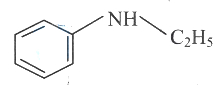
$N,N$-dimethylaniline
B
$(C_2H_5)_3N$
C
$(CH_3)_3C-NH_2$
D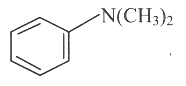
$N$-ethyl-$N$-methylaniline
Solution
(D) tertiary $(3^{\circ})$ amine is formed by replacing all $3$ hydrogen atoms of $NH_3$ with alkyl or aryl groups.
An aromatic amine contains at least one phenyl ring attached to the nitrogen atom.
$A$ mixed amine contains different types of groups (e.g.,alkyl and aryl) attached to the nitrogen.
$N,N$-dimethylaniline is an aromatic,tertiary amine,but it is a simple amine because the two alkyl groups are identical.
$N$-ethyl-$N$-methylaniline is an aromatic,tertiary amine,and it is a mixed amine because the two alkyl groups attached to the nitrogen are different (ethyl and methyl).
An aromatic amine contains at least one phenyl ring attached to the nitrogen atom.
$A$ mixed amine contains different types of groups (e.g.,alkyl and aryl) attached to the nitrogen.
$N,N$-dimethylaniline is an aromatic,tertiary amine,but it is a simple amine because the two alkyl groups are identical.
$N$-ethyl-$N$-methylaniline is an aromatic,tertiary amine,and it is a mixed amine because the two alkyl groups attached to the nitrogen are different (ethyl and methyl).
0 likesView Solution
253
ChemistryEasyMCQMHT CET · 2023
Identify the ketone from the following.
A
Ethyl ethanoate
B
Acetophenone
C
$N$-Methylphthalimide
D
Methyl salicylate
Solution
(B) ketone is an organic compound containing a carbonyl group $(C=O)$ bonded to two carbon atoms.
$1$. Ethyl ethanoate is an ester $(CH_3COOCH_2CH_3)$.
$2$. Acetophenone is a ketone with the structure $C_6H_5COCH_3$,where the carbonyl group is attached to a phenyl group and a methyl group.
$3$. $N$-Methylphthalimide is an imide.
$4$. Methyl salicylate is an ester.
Therefore,the correct answer is Acetophenone.
$1$. Ethyl ethanoate is an ester $(CH_3COOCH_2CH_3)$.
$2$. Acetophenone is a ketone with the structure $C_6H_5COCH_3$,where the carbonyl group is attached to a phenyl group and a methyl group.
$3$. $N$-Methylphthalimide is an imide.
$4$. Methyl salicylate is an ester.
Therefore,the correct answer is Acetophenone.
0 likesView Solution
254
ChemistryEasyMCQMHT CET · 2023
The structure of the functional group of a secondary amide is:
A
$>NH$
B
$-CONH_2$
C
$-CONH-$
D
$-CON < $
Solution
(C) Amides are classified based on the number of alkyl or aryl groups attached to the nitrogen atom.
$1$. Primary $(1^{\circ})$ amide: $-CONH_2$
$2$. Secondary $(2^{\circ})$ amide: $-CONH-$
$3$. Tertiary $(3^{\circ})$ amide: $-CON<$
Therefore,the structure of the functional group of a secondary amide is $-CONH-$.
$1$. Primary $(1^{\circ})$ amide: $-CONH_2$
$2$. Secondary $(2^{\circ})$ amide: $-CONH-$
$3$. Tertiary $(3^{\circ})$ amide: $-CON<$
Therefore,the structure of the functional group of a secondary amide is $-CONH-$.
0 likesView Solution
255
ChemistryEasyMCQMHT CET · 2023
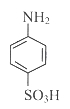
Identify the name of the compound from the following structure.
A
Sulphanilic acid
B
Sulphonic acid
C
Benzene sulphonic acid
D
Amino benzoic acid
Solution
(A) The given structure is a benzene ring substituted with an amino group $(-NH_2)$ at the $1$-position and a sulphonic acid group $(-SO_3H)$ at the $4$-position (para-position).
This compound is known as $p$-aminobenzenesulphonic acid,which is commonly called Sulphanilic acid.
Therefore,the correct option is $A$.
This compound is known as $p$-aminobenzenesulphonic acid,which is commonly called Sulphanilic acid.
Therefore,the correct option is $A$.
0 likesView Solution
256
ChemistryEasyMCQMHT CET · 2023
Which among the following compounds is a hemiacetal?
A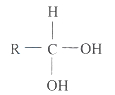
B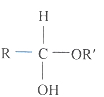
C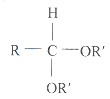
D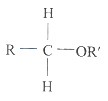
Solution
(B) hemiacetal is an organic compound formed by the reaction of an aldehyde or ketone with an alcohol. It is characterized by a central carbon atom bonded to one hydroxyl group $(-OH)$,one alkoxy group $(-OR^{\prime})$,one hydrogen atom $(-H)$,and one alkyl or aryl group $(-R)$.
Looking at the options:
Option $(A)$ represents a gem-diol.
Option $(B)$ represents a hemiacetal,as it contains both an $-OH$ and an $-OR^{\prime}$ group on the same carbon.
Option $(C)$ represents an acetal.
Option $(D)$ represents an ether.
Therefore,the correct structure is $(B)$.
Looking at the options:
Option $(A)$ represents a gem-diol.
Option $(B)$ represents a hemiacetal,as it contains both an $-OH$ and an $-OR^{\prime}$ group on the same carbon.
Option $(C)$ represents an acetal.
Option $(D)$ represents an ether.
Therefore,the correct structure is $(B)$.
0 likesView Solution
257
ChemistryEasyMCQMHT CET · 2023
Which of the following is the general representation of a Grignard reagent?
A
$R-O-Na$
B
$R-COO-Ag$
C
$R-Mg-X$
D
$R-COOK$
Solution
(C) The general representation of a Grignard reagent is $R-Mg-X$,where $R$ is an alkyl or aryl group and $X$ is a halogen atom (such as $Cl$,$Br$,or $I$).
0 likesView Solution
258
ChemistryEasyMCQMHT CET · 2023
Which among the following is a vinylic halide?
A
$CH_2=CH-CH_2-X$
B
$CH_3-CH=CH-X$
C
$CH_3-C \equiv C-X$
D
$C_6H_5-CH_2-X$
Solution
(B) In vinylic halides,the halogen atom is directly bonded to an $sp^2$ hybridized carbon atom of a carbon-carbon double bond.
In $CH_3-CH=CH-X$,the halogen atom $X$ is attached to the $sp^2$ hybridized carbon atom involved in the double bond,which satisfies the definition of a vinylic halide.
In $CH_3-CH=CH-X$,the halogen atom $X$ is attached to the $sp^2$ hybridized carbon atom involved in the double bond,which satisfies the definition of a vinylic halide.
0 likesView Solution
259
ChemistryEasyMCQMHT CET · 2023
Which of the following is a tricarboxylic acid?
A
Propionic acid
B
Oxalic acid
C
Malonic acid
D
Citric acid
Solution
(D) tricarboxylic acid is an organic compound that contains three carboxylic acid $(-COOH)$ functional groups.
$1$. Propionic acid $(CH_3CH_2COOH)$ is a monocarboxylic acid.
$2$. Oxalic acid $(HOOC-COOH)$ is a dicarboxylic acid.
$3$. Malonic acid $(HOOC-CH_2-COOH)$ is a dicarboxylic acid.
$4$. Citric acid $(HOOC-CH_2-C(OH)(COOH)-CH_2-COOH)$ contains three $-COOH$ groups,making it a tricarboxylic acid.
Therefore,the correct option is $D$.
$1$. Propionic acid $(CH_3CH_2COOH)$ is a monocarboxylic acid.
$2$. Oxalic acid $(HOOC-COOH)$ is a dicarboxylic acid.
$3$. Malonic acid $(HOOC-CH_2-COOH)$ is a dicarboxylic acid.
$4$. Citric acid $(HOOC-CH_2-C(OH)(COOH)-CH_2-COOH)$ contains three $-COOH$ groups,making it a tricarboxylic acid.
Therefore,the correct option is $D$.
0 likesView Solution
260
ChemistryEasyMCQMHT CET · 2023
Which of the following is a tertiary allylic alcohol?
A
Prop$-2-$en$-1-$ol
B
But$-3-$en$-2-$ol
C
$2-$Methylprop$-2-$en$-1-$ol
D
$2-$Methylbut$-3-$en$-2-$ol
Solution
(D) An allylic alcohol is one where the $-OH$ group is attached to a carbon atom adjacent to a carbon-carbon double bond $(C=C-C-OH)$.
$A$ tertiary alcohol is one where the carbon atom bearing the $-OH$ group is attached to three other carbon atoms.
In $2-$Methylbut$-3-$en$-2-$ol $(CH_2=CH-C(CH_3)_2-OH)$,the $-OH$ group is attached to a carbon that is adjacent to a double bond (making it allylic) and is bonded to three other carbon atoms (making it tertiary).
$A$ tertiary alcohol is one where the carbon atom bearing the $-OH$ group is attached to three other carbon atoms.
In $2-$Methylbut$-3-$en$-2-$ol $(CH_2=CH-C(CH_3)_2-OH)$,the $-OH$ group is attached to a carbon that is adjacent to a double bond (making it allylic) and is bonded to three other carbon atoms (making it tertiary).
0 likesView Solution
261
ChemistryEasyMCQMHT CET · 2023
Which of the following is a primary allylic alcohol?
A
$H_2C=CH-CH(CH_3)-OH$
B
$H_2C=CH-CH_2OH$
C
$H_2C=CH-C(CH_3)_2-OH$
D
$H_3C-CH=CH-CH(CH_3)-OH$
Solution
(B) An allylic alcohol is one in which the hydroxyl group $(-OH)$ is attached to a $sp^3$ hybridized carbon atom adjacent to a carbon-carbon double bond.
$A$ primary $(1^\circ)$ allylic alcohol has the $-OH$ group attached to a primary carbon atom (a carbon atom bonded to only one other carbon atom) that is adjacent to a double bond.
Analyzing the options:
$(A)$ $H_2C=CH-CH(CH_3)-OH$: The $-OH$ is on a secondary carbon. This is a secondary allylic alcohol.
$(B)$ $H_2C=CH-CH_2OH$: The $-OH$ is on a primary carbon $(CH_2)$ adjacent to the $C=C$ bond. This is a primary allylic alcohol.
$(C)$ $H_2C=CH-C(CH_3)_2-OH$: The $-OH$ is on a tertiary carbon. This is a tertiary allylic alcohol.
$(D)$ $H_3C-CH=CH-CH(CH_3)-OH$: The $-OH$ is on a secondary carbon. This is a secondary allylic alcohol.
Therefore,the correct option is $(B)$.
$A$ primary $(1^\circ)$ allylic alcohol has the $-OH$ group attached to a primary carbon atom (a carbon atom bonded to only one other carbon atom) that is adjacent to a double bond.
Analyzing the options:
$(A)$ $H_2C=CH-CH(CH_3)-OH$: The $-OH$ is on a secondary carbon. This is a secondary allylic alcohol.
$(B)$ $H_2C=CH-CH_2OH$: The $-OH$ is on a primary carbon $(CH_2)$ adjacent to the $C=C$ bond. This is a primary allylic alcohol.
$(C)$ $H_2C=CH-C(CH_3)_2-OH$: The $-OH$ is on a tertiary carbon. This is a tertiary allylic alcohol.
$(D)$ $H_3C-CH=CH-CH(CH_3)-OH$: The $-OH$ is on a secondary carbon. This is a secondary allylic alcohol.
Therefore,the correct option is $(B)$.
0 likesView Solution
262
ChemistryEasyMCQMHT CET · 2023
Which among the following reagents is called as Hinsberg's reagent?
A
Benzenesulphonyl chloride
B
Sodium nitroprusside
C
Chromyl chloride
D
Hydrazine
Solution
(A) Hinsberg's reagent is $C_6H_5SO_2Cl$,which is known as benzenesulphonyl chloride.
It is used to distinguish between primary,secondary,and tertiary amines.
It is used to distinguish between primary,secondary,and tertiary amines.
0 likesView Solution
263
ChemistryEasyMCQMHT CET · 2023
The common name of $Benzene-1,3-diol$ is:
A
catechol
B
resorcinol
C
quinol
D
pyrogallol
Solution
(B) The structure of $Benzene-1,3-diol$ consists of a benzene ring with two hydroxyl $(-OH)$ groups attached at the $1$ and $3$ positions.
This compound is commonly known as $resorcinol$.
- $Catechol$ is $Benzene-1,2-diol$.
- $Quinol$ (or $hydroquinone$) is $Benzene-1,4-diol$.
- $Pyrogallol$ is $Benzene-1,2,3-triol$.
Therefore,the correct option is $B$.
This compound is commonly known as $resorcinol$.
- $Catechol$ is $Benzene-1,2-diol$.
- $Quinol$ (or $hydroquinone$) is $Benzene-1,4-diol$.
- $Pyrogallol$ is $Benzene-1,2,3-triol$.
Therefore,the correct option is $B$.
0 likesView Solution
264
ChemistryEasyMCQMHT CET · 2023
Which among the following is a simple ketone?
A
Acetophenone
B
Butanone
C
Benzophenone
D
Pentan-$2$-one
Solution
(C) simple or symmetrical ketone is one in which the two alkyl or aryl groups attached to the carbonyl carbon $(C=O)$ are identical.
Benzophenone $(C_6H_5-CO-C_6H_5)$ has two phenyl groups attached to the carbonyl carbon,making it a simple (symmetrical) ketone.
Acetophenone $(C_6H_5-CO-CH_3)$,Butanone $(CH_3-CH_2-CO-CH_3)$,and Pentan-$2$-one $(CH_3-CO-CH_2-CH_2-CH_3)$ are mixed (unsymmetrical) ketones because the groups attached to the carbonyl carbon are different.
Benzophenone $(C_6H_5-CO-C_6H_5)$ has two phenyl groups attached to the carbonyl carbon,making it a simple (symmetrical) ketone.
Acetophenone $(C_6H_5-CO-CH_3)$,Butanone $(CH_3-CH_2-CO-CH_3)$,and Pentan-$2$-one $(CH_3-CO-CH_2-CH_2-CH_3)$ are mixed (unsymmetrical) ketones because the groups attached to the carbonyl carbon are different.
0 likesView Solution
265
ChemistryMediumMCQMHT CET · 2023
Identify the chiral molecule from the following.
A
$2-$Iodopropane
B
$2-$Iodo$-2-$methylbutane
C
$2-$Iodo$-3-$methylbutane
D
$3-$Iodopentane
Solution
(C) chiral carbon atom is defined as a carbon atom that is bonded to four different groups or atoms.
Let us analyze the structures:
$A$. $2-$Iodopropane: $CH_3-CH(I)-CH_3$. The central carbon is attached to two identical $-CH_3$ groups,so it is achiral.
$B$. $2-$Iodo$-2-$methylbutane: $CH_3-C(I)(CH_3)-CH_2-CH_3$. The central carbon is attached to two identical $-CH_3$ groups,so it is achiral.
$C$. $2-$Iodo$-3-$methylbutane: $CH_3-CH(I)-CH(CH_3)_2$. The carbon at position $2$ is attached to four different groups: $-H$,$-I$,$-CH_3$,and $-CH(CH_3)_2$. Thus,it is a chiral molecule.
$D$. $3-$Iodopentane: $CH_3-CH_2-CH(I)-CH_2-CH_3$. The carbon at position $3$ is attached to two identical $-CH_2CH_3$ groups,so it is achiral.
Therefore,the correct option is $C$.
Let us analyze the structures:
$A$. $2-$Iodopropane: $CH_3-CH(I)-CH_3$. The central carbon is attached to two identical $-CH_3$ groups,so it is achiral.
$B$. $2-$Iodo$-2-$methylbutane: $CH_3-C(I)(CH_3)-CH_2-CH_3$. The central carbon is attached to two identical $-CH_3$ groups,so it is achiral.
$C$. $2-$Iodo$-3-$methylbutane: $CH_3-CH(I)-CH(CH_3)_2$. The carbon at position $2$ is attached to four different groups: $-H$,$-I$,$-CH_3$,and $-CH(CH_3)_2$. Thus,it is a chiral molecule.
$D$. $3-$Iodopentane: $CH_3-CH_2-CH(I)-CH_2-CH_3$. The carbon at position $3$ is attached to two identical $-CH_2CH_3$ groups,so it is achiral.
Therefore,the correct option is $C$.
0 likesView Solution
266
ChemistryMediumMCQMHT CET · 2023
Which among the following $\alpha$-amino acids does $NOT$ have a chiral carbon atom?
A
Histidine
B
Glutamic acid
C
Serine
D
Glycine
Solution
(D) The general structure of an $\alpha$-amino acid is $R-CH(NH_2)-COOH$.
In this structure,the $\alpha$-carbon is attached to four different groups ($H$,$NH_2$,$COOH$,and $R$) if $R$ is not a hydrogen atom.
For glycine,the $R$ group is a hydrogen atom $(H)$.
Thus,the structure of glycine is $H_2N-CH_2-COOH$.
Since the $\alpha$-carbon in glycine is attached to two identical hydrogen atoms,it is achiral.
Therefore,glycine is the only $\alpha$-amino acid that does not have a chiral carbon atom.
In this structure,the $\alpha$-carbon is attached to four different groups ($H$,$NH_2$,$COOH$,and $R$) if $R$ is not a hydrogen atom.
For glycine,the $R$ group is a hydrogen atom $(H)$.
Thus,the structure of glycine is $H_2N-CH_2-COOH$.
Since the $\alpha$-carbon in glycine is attached to two identical hydrogen atoms,it is achiral.
Therefore,glycine is the only $\alpha$-amino acid that does not have a chiral carbon atom.
0 likesView Solution
267
ChemistryMediumMCQMHT CET · 2023
How many isomers of $C_4H_{11}N$ are tertiary amines?
A
$1$
B
$2$
C
$3$
D
$4$
Solution
(A) tertiary amine has the general structure $R_3N$.
For the molecular formula $C_4H_{11}N$,the only possible tertiary amine is $N,N$-dimethylethanamine,which has the structure $CH_3-CH_2-N(CH_3)_2$.
Thus,there is only $1$ isomer of $C_4H_{11}N$ that is a tertiary amine.
For the molecular formula $C_4H_{11}N$,the only possible tertiary amine is $N,N$-dimethylethanamine,which has the structure $CH_3-CH_2-N(CH_3)_2$.
Thus,there is only $1$ isomer of $C_4H_{11}N$ that is a tertiary amine.
0 likesView Solution
268
ChemistryEasyMCQMHT CET · 2023
Which isomer among the following has the highest boiling point?
A
$n$-Butylamine
B
$tert$-Butylamine
C
Ethyldimethylamine
D
Diethylamine
Solution
(A) The boiling point of amines depends on the extent of intermolecular hydrogen bonding.
Primary amines $(R-NH_2)$ have two hydrogen atoms attached to the nitrogen,allowing for extensive hydrogen bonding.
Secondary amines $(R_2NH)$ have one hydrogen atom,and tertiary amines $(R_3N)$ have no hydrogen atoms attached to nitrogen,thus they cannot form intermolecular hydrogen bonds.
Among the given isomers,$n$-Butylamine $(CH_3CH_2CH_2CH_2NH_2)$ is a primary amine with a straight chain,which allows for maximum surface area and stronger intermolecular forces compared to branched isomers or secondary/tertiary amines.
Therefore,$n$-Butylamine has the highest boiling point.
Primary amines $(R-NH_2)$ have two hydrogen atoms attached to the nitrogen,allowing for extensive hydrogen bonding.
Secondary amines $(R_2NH)$ have one hydrogen atom,and tertiary amines $(R_3N)$ have no hydrogen atoms attached to nitrogen,thus they cannot form intermolecular hydrogen bonds.
Among the given isomers,$n$-Butylamine $(CH_3CH_2CH_2CH_2NH_2)$ is a primary amine with a straight chain,which allows for maximum surface area and stronger intermolecular forces compared to branched isomers or secondary/tertiary amines.
Therefore,$n$-Butylamine has the highest boiling point.
0 likesView Solution
269
ChemistryEasyMCQMHT CET · 2023
What different elements are found in baryte?
A
$Ca, S, O$
B
$Zn, S, O$
C
$Ba, S, O$
D
$Mg, S, H, O$
Solution
(C) The chemical formula of baryte is $BaSO_4$.
Therefore,it consists of the elements Barium $(Ba)$,Sulfur $(S)$,and Oxygen $(O)$.
Therefore,it consists of the elements Barium $(Ba)$,Sulfur $(S)$,and Oxygen $(O)$.
0 likesView Solution
270
ChemistryEasyMCQMHT CET · 2023
When $tert$-butyl bromide is heated with silver fluoride,the major product obtained is:
A
$1$-Fluoro-$2$-methylpropane
B
$2$-Fluoro-$2$-methylpropane
C
$1$-Fluorobutane
D
$2$-Fluorobutane
Solution
(B) The reaction of $tert$-butyl bromide $((CH_3)_3CBr)$ with silver fluoride $(AgF)$ is a Swarts reaction,which is used for the synthesis of alkyl fluorides.
However,$tert$-butyl bromide is a tertiary alkyl halide. When heated with $AgF$,it undergoes an $E1$ elimination reaction rather than a nucleophilic substitution ($S_N1$ or $S_N2$) because the tertiary carbocation is highly stable and the fluoride ion acts as a base.
The major product formed is $2$-methylpropene (isobutylene) due to the elimination of $HBr$.
However,$tert$-butyl bromide is a tertiary alkyl halide. When heated with $AgF$,it undergoes an $E1$ elimination reaction rather than a nucleophilic substitution ($S_N1$ or $S_N2$) because the tertiary carbocation is highly stable and the fluoride ion acts as a base.
The major product formed is $2$-methylpropene (isobutylene) due to the elimination of $HBr$.
0 likesView Solution
271
ChemistryEasyMCQMHT CET · 2023
Which among the following is a haloalkyne?
A
$CH_3-CH_2-CH=CH-X$
B
$CH_3-C \equiv C-CH_2-X$
C
$CH \equiv C-CH_2-CH_2-X$
D
$CH_3-CH_2-C \equiv C-X$
Solution
(B) haloalkyne is an organic compound that contains both a halogen atom $(X)$ and a carbon-carbon triple bond $(C \equiv C)$.
- Option $(A)$ $CH_3-CH_2-CH=CH-X$ is a haloalkene because it contains a double bond $(C=C)$.
- Option $(B)$ $CH_3-C \equiv C-CH_2-X$ is a haloalkyne as it contains a triple bond $(C \equiv C)$ and a halogen atom $(X)$.
- Option $(C)$ $CH \equiv C-CH_2-CH_2-X$ is also a haloalkyne.
- Option $(D)$ $CH_3-CH_2-C \equiv C-X$ is also a haloalkyne.
Given the standard nomenclature and structure,options $(B)$,$(C)$,and $(D)$ all represent haloalkynes. However,in many textbook contexts,the simplest representation or specific structural isomer is sought. Since multiple options are technically correct,we identify the structure containing the functional group as requested.
- Option $(A)$ $CH_3-CH_2-CH=CH-X$ is a haloalkene because it contains a double bond $(C=C)$.
- Option $(B)$ $CH_3-C \equiv C-CH_2-X$ is a haloalkyne as it contains a triple bond $(C \equiv C)$ and a halogen atom $(X)$.
- Option $(C)$ $CH \equiv C-CH_2-CH_2-X$ is also a haloalkyne.
- Option $(D)$ $CH_3-CH_2-C \equiv C-X$ is also a haloalkyne.
Given the standard nomenclature and structure,options $(B)$,$(C)$,and $(D)$ all represent haloalkynes. However,in many textbook contexts,the simplest representation or specific structural isomer is sought. Since multiple options are technically correct,we identify the structure containing the functional group as requested.
0 likesView Solution
272
ChemistryMediumMCQMHT CET · 2023
Which among the following is $NOT$ a feature of $S_{N}2$ mechanism?
A
Single step mechanism.
B
Backside attack of nucleophile.
C
Formation of planar carbocation intermediate.
D
Involves simultaneous bond breaking and bond forming.
Solution
(C) The $S_{N}2$ mechanism proceeds through a transition state where the nucleophile and the leaving group are both partially bonded to the central carbon atom.
$A$ carbocation intermediate is not formed; this is a characteristic of the $S_{N}1$ mechanism.
$A$ carbocation intermediate is not formed; this is a characteristic of the $S_{N}1$ mechanism.
0 likesView Solution
273
ChemistryEasyMCQMHT CET · 2023
Identify the reagent $A$ in the following conversion.
Alkyl halide $\xrightarrow{A}$ Alkyl nitrite
Alkyl halide $\xrightarrow{A}$ Alkyl nitrite
A
$KNO_3$
B
$NaNO_3$
C
$AgNO_2$
D
$KNO_2$
Solution
(D) Alkyl halides $(R-X)$ react with ionic nitrites like $KNO_2$ to form alkyl nitrites $(R-O-N=O)$ as the major product because the oxygen atom is more nucleophilic than the nitrogen atom.
Conversely,reaction with $AgNO_2$ (covalent) typically yields nitroalkanes $(R-NO_2)$.
Conversely,reaction with $AgNO_2$ (covalent) typically yields nitroalkanes $(R-NO_2)$.
0 likesView Solution
274
ChemistryEasyMCQMHT CET · 2023
Identify compound $Y$ in the following reaction.
$C_2H_5Cl + Y \xrightarrow{\Delta} C_2H_5CN$
$C_2H_5Cl + Y \xrightarrow{\Delta} C_2H_5CN$
A
$NH_3$
B
$HNO_3$
C
$KCN$ (alc.)
D
$AgCN$ (alc.)
Solution
(C) The reaction of an alkyl halide $(C_2H_5Cl)$ with alcoholic $KCN$ is a nucleophilic substitution reaction.
$KCN$ is an ionic compound that provides $CN^-$ ions in solution,which acts as an ambident nucleophile and attacks the alkyl halide to form an alkyl cyanide $(C_2H_5CN)$.
The reaction is: $C_2H_5Cl + KCN \text{ (alc.)} \xrightarrow{\Delta} C_2H_5CN + KCl$.
Therefore,the compound $Y$ is $KCN$ (alc.).
$KCN$ is an ionic compound that provides $CN^-$ ions in solution,which acts as an ambident nucleophile and attacks the alkyl halide to form an alkyl cyanide $(C_2H_5CN)$.
The reaction is: $C_2H_5Cl + KCN \text{ (alc.)} \xrightarrow{\Delta} C_2H_5CN + KCl$.
Therefore,the compound $Y$ is $KCN$ (alc.).
0 likesView Solution
275
ChemistryMediumMCQMHT CET · 2023
Identify $A$ and $B$ in the following reaction.
$CH_3Br$ $\xrightarrow{AgNO_2} A$ $\xrightarrow{Sn / HCl} B$
$CH_3Br$ $\xrightarrow{AgNO_2} A$ $\xrightarrow{Sn / HCl} B$
A
$CH_3NO_2$ and $CH_3Cl$
B
$CH_3NO_2$ and $CH_3NH_2$
C
$CH_3NH_2$ and $CH_3Cl$
D
$CH_3NH_2$ and $CH_3CH_2NO_2$
Solution
(B) The reaction of $CH_3Br$ with $AgNO_2$ is a nucleophilic substitution reaction that yields nitromethane $(A = CH_3NO_2)$.
$CH_3Br + AgNO_2 \rightarrow CH_3NO_2 + AgBr$
Reduction of nitromethane with $Sn / HCl$ (a reducing agent) converts the nitro group $(-NO_2)$ into an amine group $(-NH_2)$,yielding methanamine $(B = CH_3NH_2)$.
$CH_3NO_2 + 6[H] \xrightarrow{Sn / HCl} CH_3NH_2 + 2H_2O$
$CH_3Br + AgNO_2 \rightarrow CH_3NO_2 + AgBr$
Reduction of nitromethane with $Sn / HCl$ (a reducing agent) converts the nitro group $(-NO_2)$ into an amine group $(-NH_2)$,yielding methanamine $(B = CH_3NH_2)$.
$CH_3NO_2 + 6[H] \xrightarrow{Sn / HCl} CH_3NH_2 + 2H_2O$
0 likesView Solution
276
ChemistryEasyMCQMHT CET · 2023
The reaction of an aryl halide with an alkyl halide and sodium metal in dry ether to form substituted aromatic compounds is known as:
A
Wurtz reaction
B
Fittig reaction
C
Wurtz-Fittig reaction
D
Friedel-Craft's reaction
Solution
(C) The reaction involving an aryl halide $(Ar-X)$ and an alkyl halide $(R-X)$ in the presence of sodium metal $(Na)$ in dry ether is known as the $Wurtz-Fittig$ reaction.
The general equation is: $Ar-X + 2Na + R-X \xrightarrow{\text{dry ether}} Ar-R + 2NaX$.
The general equation is: $Ar-X + 2Na + R-X \xrightarrow{\text{dry ether}} Ar-R + 2NaX$.
0 likesView Solution
277
ChemistryEasyMCQMHT CET · 2023
Which among the following is a feature of $S_N1$ mechanism?
A
Single step mechanism
B
Only backside attack of nucleophile
C
Transition state contains pentacoordinate carbon
D
Formation of planar carbocation intermediate
Solution
(D) In the $S_N1$ mechanism,the first step involves the ionization of the substrate to form a planar carbocation intermediate. This intermediate is $sp^2$ hybridized.
0 likesView Solution
278
ChemistryMediumMCQMHT CET · 2023
Identify the major product formed in the following reaction: $3-$Bromo$-2-$methylpentane $\xrightarrow{Alc. KOH, \Delta}$ Major product
A
$2-$Methylpent$-2-$ene
B
$2-$Methylpent$-3-$ene
C
$4-$Methylpent$-2-$ene
D
$3-$Methylpent$-2-$ene
Solution
(A) The reaction of $3-$bromo$-2-$methylpentane with alcoholic $KOH$ is a dehydrohalogenation reaction ($E2$ mechanism).
According to Saytzeff's rule,the major product is the more substituted alkene.
The starting material is $CH_3-CH(CH_3)-CH(Br)-CH_2-CH_3$.
Removal of $H$ from $C-2$ gives $CH_3-C(CH_3)=CH-CH_2-CH_3$ ($2-$methylpent$-2-$ene).
Removal of $H$ from $C-4$ gives $CH_3-CH(CH_3)-CH=CH-CH_3$ ($4-$methylpent$-2-$ene).
$2-$Methylpent$-2-$ene is more substituted (trisubstituted) compared to $4-$methylpent$-2-$ene (disubstituted),hence it is the major product.
According to Saytzeff's rule,the major product is the more substituted alkene.
The starting material is $CH_3-CH(CH_3)-CH(Br)-CH_2-CH_3$.
Removal of $H$ from $C-2$ gives $CH_3-C(CH_3)=CH-CH_2-CH_3$ ($2-$methylpent$-2-$ene).
Removal of $H$ from $C-4$ gives $CH_3-CH(CH_3)-CH=CH-CH_3$ ($4-$methylpent$-2-$ene).
$2-$Methylpent$-2-$ene is more substituted (trisubstituted) compared to $4-$methylpent$-2-$ene (disubstituted),hence it is the major product.
0 likesView Solution
279
ChemistryEasyMCQMHT CET · 2023
Which among the following is a haloalkyne?
A
Chloroethyne
B
$3-$Chlorobut$-1-$yne
C
$1-$Chloropent$-2-$yne
D
$4-$Chloropent$-2-$yne
Solution
(A) In a haloalkyne,the halogen atom is directly bonded to an $sp$ hybridized carbon atom of the triple bond.
In $Chloroethyne$ $(CH \equiv C-Cl)$,the chlorine atom is attached to the $sp$ hybridized carbon atom.
In the other options,the chlorine atom is attached to $sp^3$ hybridized carbon atoms.
Therefore,chloroethyne is a haloalkyne.
In $Chloroethyne$ $(CH \equiv C-Cl)$,the chlorine atom is attached to the $sp$ hybridized carbon atom.
In the other options,the chlorine atom is attached to $sp^3$ hybridized carbon atoms.
Therefore,chloroethyne is a haloalkyne.
0 likesView Solution
280
ChemistryEasyMCQMHT CET · 2023
Which among the following is a benzylic halide?
A
$C_6H_5-CH_2-X$
B
$C_6H_5-X$
C
$C_6H_5-CH=CH-X$
D
$C_6H_5-CH_2-CH_2-X$
Solution
(A) benzylic halide is a compound in which the halogen atom is bonded to an $sp^3$ hybridized carbon atom,which is directly attached to an aromatic ring.
In the structure $C_6H_5-CH_2-X$,the halogen atom $X$ is attached to a carbon atom that is bonded to a benzene ring $(C_6H_5)$.
This carbon atom is $sp^3$ hybridized,making it a benzylic halide.
Therefore,the correct option is $A$.
In the structure $C_6H_5-CH_2-X$,the halogen atom $X$ is attached to a carbon atom that is bonded to a benzene ring $(C_6H_5)$.
This carbon atom is $sp^3$ hybridized,making it a benzylic halide.
Therefore,the correct option is $A$.
0 likesView Solution
281
ChemistryEasyMCQMHT CET · 2023
Which of the following compounds has difficulty in breaking the $C-X$ bond during a nucleophilic substitution reaction?
A
$o-$Nitrochlorobenzene
B
$p-$Nitrochlorobenzene
C
$m-$Nitrochlorobenzene
D
$2,4,6-$Trinitrochlorobenzene
Solution
(C) The reactivity of haloarenes towards nucleophilic substitution increases with the presence of electron-withdrawing groups (like $-NO_2$) at the $ortho$ and $para$ positions due to the stabilization of the carbanion intermediate.
Electron-withdrawing groups at the $meta$ position have a negligible effect on the reactivity compared to $ortho$ and $para$ positions.
Therefore,among the given options,$m-$nitrochlorobenzene is the least reactive,making it the most difficult to break the $C-X$ bond during a nucleophilic substitution reaction.
Electron-withdrawing groups at the $meta$ position have a negligible effect on the reactivity compared to $ortho$ and $para$ positions.
Therefore,among the given options,$m-$nitrochlorobenzene is the least reactive,making it the most difficult to break the $C-X$ bond during a nucleophilic substitution reaction.
0 likesView Solution
282
ChemistryEasyMCQMHT CET · 2023
Which of the following is the structural formula of $DDT$?
A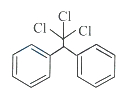
B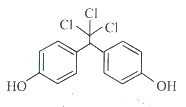
C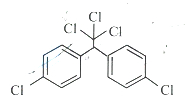
D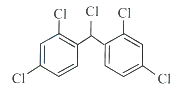
Solution
(C) $DDT$ stands for $p,p'$-dichlorodiphenyltrichloroethane.
Its structure consists of two $p$-chlorophenyl groups attached to a central carbon atom,which is also bonded to a hydrogen atom and a trichloromethyl group $(CCl_3)$.
This corresponds to the structure shown in option $C$.
Its structure consists of two $p$-chlorophenyl groups attached to a central carbon atom,which is also bonded to a hydrogen atom and a trichloromethyl group $(CCl_3)$.
This corresponds to the structure shown in option $C$.
0 likesView Solution
283
ChemistryMediumMCQMHT CET · 2023
Which of the following is the Wolff-Kishner reduction?
A
$RCOCl \xrightarrow[Pd-BaSO_4]{H_2} R-CHO + HCl$
B
$RCN \xrightarrow{SnCl_2, HCl} R-CHO + NH_4Cl$
C
$R-CHO \xrightarrow[\Delta]{Zn-Hg, \text{ conc. } HCl} R-CH_3 + H_2O$
D
$R-CO-R \xrightarrow[(ii) KOH, HO(CH_2)_2OH]{(i) H_2N-NH_2, \Delta} R-CH_2-R + N_2$
Solution
(D) The Wolff-Kishner reduction is a chemical reaction used to convert carbonyl groups (aldehydes or ketones) into methylene groups $(-CH_2-)$ using hydrazine $(H_2N-NH_2)$ and a strong base (like $KOH$) in a high-boiling solvent such as ethylene glycol $(HO(CH_2)_2OH)$.
Option $D$ represents this reaction: $R-CO-R \xrightarrow[(ii) KOH, HO(CH_2)_2OH]{(i) H_2N-NH_2, \Delta} R-CH_2-R + N_2$.
Option $A$ is the Rosenmund reduction.
Option $B$ is the Stephen reduction.
Option $C$ is the Clemmensen reduction.
Option $D$ represents this reaction: $R-CO-R \xrightarrow[(ii) KOH, HO(CH_2)_2OH]{(i) H_2N-NH_2, \Delta} R-CH_2-R + N_2$.
Option $A$ is the Rosenmund reduction.
Option $B$ is the Stephen reduction.
Option $C$ is the Clemmensen reduction.
0 likesView Solution
284
ChemistryEasyMCQMHT CET · 2023
Identify the reaction in which the carbonyl group of aldehydes and ketones is reduced to a methylene group upon treatment with hydrazine followed by heating with sodium hydroxide in ethylene glycol.
A
$A$ Wolff-Kishner reduction
B
$B$ Clemmensen reduction
C
$C$ Stephen reaction
D
$D$ Etard reaction
Solution
(A) The reaction described is the Wolff-Kishner reduction.
In this reaction,aldehydes and ketones are treated with hydrazine $(NH_2NH_2)$ to form a hydrazone intermediate.
This hydrazone is then heated with a strong base like potassium hydroxide $(KOH)$ in a high-boiling solvent such as ethylene glycol $(HO-CH_2-CH_2-OH)$.
This process results in the reduction of the carbonyl group $(>C=O)$ to a methylene group $(-CH_2-)$ with the evolution of nitrogen gas $(N_2)$.
In this reaction,aldehydes and ketones are treated with hydrazine $(NH_2NH_2)$ to form a hydrazone intermediate.
This hydrazone is then heated with a strong base like potassium hydroxide $(KOH)$ in a high-boiling solvent such as ethylene glycol $(HO-CH_2-CH_2-OH)$.
This process results in the reduction of the carbonyl group $(>C=O)$ to a methylene group $(-CH_2-)$ with the evolution of nitrogen gas $(N_2)$.
0 likesView Solution
285
ChemistryEasyMCQMHT CET · 2023
Which of the following is Clemmensen reduction?
A
$RCOCl \xrightarrow{H_2, Pd-BaSO_4} RCHO + HCl$
B
$RCN \xrightarrow{SnCl_2, HCl, H_3O^+} RCHO + NH_4Cl$
C
$RCHO \xrightarrow{Zn-Hg, \text{Conc. } HCl, \Delta} RCH_3 + H_2O$
D
$RCOR \xrightarrow{i) H_2N-NH_2, ii) KOH, HO-CH_2-CH_2-OH} R-CH_2-R$
Solution
(C) The Clemmensen reduction is a chemical reaction that reduces aldehydes or ketones to their corresponding alkanes using zinc amalgam $(Zn-Hg)$ and concentrated hydrochloric acid $(HCl)$.
Option $C$ represents this reaction: $RCHO \xrightarrow{Zn-Hg, \text{Conc. } HCl, \Delta} RCH_3 + H_2O$.
Option $C$ represents this reaction: $RCHO \xrightarrow{Zn-Hg, \text{Conc. } HCl, \Delta} RCH_3 + H_2O$.
0 likesView Solution
286
ChemistryEasyMCQMHT CET · 2023
Which of the following reactions is used for the conversion of alkyl chloride to alkyl iodide?
A
Fitting reaction
B
Friedel Crafts reaction
C
Finkelstein reaction
D
Swartz reaction
Solution
(C) The conversion of alkyl chlorides or alkyl bromides into alkyl iodides is known as the $Finkelstein$ reaction.
In this reaction,the alkyl halide is treated with sodium iodide $(NaI)$ in the presence of dry acetone.
The reaction is: $R-X + NaI \xrightarrow{\text{dry acetone}} R-I + NaX$ (where $X = Cl, Br$).
In this reaction,the alkyl halide is treated with sodium iodide $(NaI)$ in the presence of dry acetone.
The reaction is: $R-X + NaI \xrightarrow{\text{dry acetone}} R-I + NaX$ (where $X = Cl, Br$).
0 likesView Solution
287
ChemistryMediumMCQMHT CET · 2023
Identify the product '$B$' in the following reaction.
$Cumene$ $\xrightarrow{KMnO_4, KOH} A$ $\xrightarrow{H_3O^+} B$
$Cumene$ $\xrightarrow{KMnO_4, KOH} A$ $\xrightarrow{H_3O^+} B$
A
Phenol
B
Potassium benzoate
C
Benzoic acid
D
Aniline
Solution
(C) The reaction of $Cumene$ (isopropylbenzene) with alkaline $KMnO_4$ followed by acidic hydrolysis is a standard method for the oxidation of alkylbenzenes.
Step $1$: Oxidation of $Cumene$ with $KMnO_4$ and $KOH$ yields $Potassium \ benzoate$ $(A)$.
Step $2$: Acidification of $Potassium \ benzoate$ with $H_3O^+$ yields $Benzoic \ acid$ $(B)$.
Therefore,the final product $B$ is $Benzoic \ acid$.
Step $1$: Oxidation of $Cumene$ with $KMnO_4$ and $KOH$ yields $Potassium \ benzoate$ $(A)$.
Step $2$: Acidification of $Potassium \ benzoate$ with $H_3O^+$ yields $Benzoic \ acid$ $(B)$.
Therefore,the final product $B$ is $Benzoic \ acid$.
0 likesView Solution
288
ChemistryMediumMCQMHT CET · 2023
Identify the product obtained when benzonitrile is reduced by stannous chloride $(SnCl_2)$ in the presence of hydrochloric acid $(HCl)$,followed by acid hydrolysis.
A
Benzal chloride
B
Benzoyl chloride
C
Benzophenone
D
Benzaldehyde
Solution
(D) This reaction is known as the Stephen reduction. The reaction proceeds as follows:
$1$. Benzonitrile $(C_6H_5-C \equiv N)$ is reduced by $SnCl_2$ and $HCl$ to form an imine hydrochloride intermediate,benzanimine hydrochloride $(C_6H_5-CH=NH \cdot HCl)$.
$2$. Subsequent acid hydrolysis $(H_3O^+)$ of the imine hydrochloride yields benzaldehyde $(C_6H_5-CHO)$ and ammonium chloride $(NH_4Cl)$.
The overall reaction is: $C_6H_5-C \equiv N + 2[H]$ $\xrightarrow{SnCl_2, HCl} C_6H_5-CH=NH \cdot HCl$ $\xrightarrow{H_3O^+} C_6H_5-CHO + NH_4Cl$.
$1$. Benzonitrile $(C_6H_5-C \equiv N)$ is reduced by $SnCl_2$ and $HCl$ to form an imine hydrochloride intermediate,benzanimine hydrochloride $(C_6H_5-CH=NH \cdot HCl)$.
$2$. Subsequent acid hydrolysis $(H_3O^+)$ of the imine hydrochloride yields benzaldehyde $(C_6H_5-CHO)$ and ammonium chloride $(NH_4Cl)$.
The overall reaction is: $C_6H_5-C \equiv N + 2[H]$ $\xrightarrow{SnCl_2, HCl} C_6H_5-CH=NH \cdot HCl$ $\xrightarrow{H_3O^+} C_6H_5-CHO + NH_4Cl$.
0 likesView Solution
289
ChemistryMediumMCQMHT CET · 2023
Benzonitrile on reduction with stannous chloride $(SnCl_2)$ in the presence of hydrochloric acid $(HCl)$ followed by acid hydrolysis forms:
A
Benzal chloride
B
Benzoyl chloride
C
Benzophenone
D
Benzaldehyde
Solution
(D) The reaction described is the $Stephen$ reduction.
Benzonitrile $(C_6H_5CN)$ reacts with $SnCl_2$ and $HCl$ to form an imine hydrochloride intermediate $(C_6H_5CH=NH \cdot HCl)$.
This intermediate,upon subsequent acid hydrolysis $(H_3O^+)$,yields benzaldehyde $(C_6H_5CHO)$ and ammonium chloride $(NH_4Cl)$.
The overall reaction is:
$C_6H_5CN + 2[H] \xrightarrow{SnCl_2, HCl} C_6H_5CH=NH \cdot HCl$
$C_6H_5CH=NH \cdot HCl + H_2O \xrightarrow{H_3O^+} C_6H_5CHO + NH_4Cl$
Benzonitrile $(C_6H_5CN)$ reacts with $SnCl_2$ and $HCl$ to form an imine hydrochloride intermediate $(C_6H_5CH=NH \cdot HCl)$.
This intermediate,upon subsequent acid hydrolysis $(H_3O^+)$,yields benzaldehyde $(C_6H_5CHO)$ and ammonium chloride $(NH_4Cl)$.
The overall reaction is:
$C_6H_5CN + 2[H] \xrightarrow{SnCl_2, HCl} C_6H_5CH=NH \cdot HCl$
$C_6H_5CH=NH \cdot HCl + H_2O \xrightarrow{H_3O^+} C_6H_5CHO + NH_4Cl$
0 likesView Solution
290
ChemistryEasyMCQMHT CET · 2023
Which of the following gases is formed during the oxidation of trichloromethane?
A
$CO_{(g)}$
B
$CO_{2_{(g)}}$
C
$COCl_{2_{(g)}}$
D
$H_{2_{(g)}}$
Solution
(C) Chloroform ($CHCl_3$,trichloromethane) undergoes slow oxidation in the presence of air and light to form a highly poisonous gas known as phosgene $(COCl_2)$.
The chemical reaction is: $2CHCl_3 + O_2 \xrightarrow{\text{light}} 2COCl_2 + 2HCl$.
Due to this,chloroform is stored in dark-colored,airtight bottles to prevent oxidation.
The chemical reaction is: $2CHCl_3 + O_2 \xrightarrow{\text{light}} 2COCl_2 + 2HCl$.
Due to this,chloroform is stored in dark-colored,airtight bottles to prevent oxidation.
0 likesView Solution
291
ChemistryEasyMCQMHT CET · 2023
Identify the reagent $R$ used in the reaction stated below.
$C_6H_5N_2Cl + R \rightarrow C_6H_6$
$C_6H_5N_2Cl + R \rightarrow C_6H_6$
A
$HCl$
B
$H_3PO_2 / H_2O$
C
$H_2O / HCl$
D
$HNO_3$
Solution
(B) The conversion of benzene diazonium chloride to benzene is a reduction reaction.
This reaction is carried out using hypophosphorous acid $(H_3PO_2)$ in the presence of water $(H_2O)$.
The reaction is: $C_6H_5N_2Cl + H_3PO_2 + H_2O \rightarrow C_6H_6 + N_2 + H_3PO_3 + HCl$.
This reaction is carried out using hypophosphorous acid $(H_3PO_2)$ in the presence of water $(H_2O)$.
The reaction is: $C_6H_5N_2Cl + H_3PO_2 + H_2O \rightarrow C_6H_6 + N_2 + H_3PO_3 + HCl$.
0 likesView Solution
292
ChemistryEasyMCQMHT CET · 2023
Which among the following statements is $TRUE$ about gammexane?
A
It is an isomer of $BHC$.
B
It is one of the herbicides.
C
It is obtained from benzene by bromination.
D
It is monochloro derivative of benzene.
Solution
(A) Gammexane,also known as lindane,is the $\gamma$-isomer of benzene hexachloride $(BHC)$.
It is prepared by the addition of chlorine to benzene in the presence of ultraviolet light.
It is widely used as an insecticide,not a herbicide.
It is prepared by the addition of chlorine to benzene in the presence of ultraviolet light.
It is widely used as an insecticide,not a herbicide.
0 likesView Solution
293
ChemistryMediumMCQMHT CET · 2023
Identify '$A$' in the following reaction:
$A + \text{Chloromethane} \xrightarrow{\text{Anhydrous } AlCl_3} \text{2-Chlorotoluene} + \text{4-Chlorotoluene}$
$A + \text{Chloromethane} \xrightarrow{\text{Anhydrous } AlCl_3} \text{2-Chlorotoluene} + \text{4-Chlorotoluene}$
A
Benzene
B
Chlorobenzene
C
Toluene
D
Phenol
Solution
(B) The given reaction is a Friedel-Crafts alkylation reaction.
In this reaction,$A$ reacts with chloromethane $(CH_3Cl)$ in the presence of anhydrous $AlCl_3$ to form $2$-chlorotoluene and $4$-chlorotoluene.
Since the products are ortho and para substituted chlorotoluenes,the reactant $A$ must be chlorobenzene $(C_6H_5Cl)$.
Chlorine is an ortho/para directing group,which directs the incoming methyl group to the ortho and para positions.
Therefore,$A$ is chlorobenzene.
In this reaction,$A$ reacts with chloromethane $(CH_3Cl)$ in the presence of anhydrous $AlCl_3$ to form $2$-chlorotoluene and $4$-chlorotoluene.
Since the products are ortho and para substituted chlorotoluenes,the reactant $A$ must be chlorobenzene $(C_6H_5Cl)$.
Chlorine is an ortho/para directing group,which directs the incoming methyl group to the ortho and para positions.
Therefore,$A$ is chlorobenzene.
0 likesView Solution
294
ChemistryEasyMCQMHT CET · 2023
Identify the product of the following reaction:
$C_6H_5COCl \xrightarrow{H_2O} \text{Product}$
$C_6H_5COCl \xrightarrow{H_2O} \text{Product}$
A
Benzyl alcohol
B
Benzaldehyde
C
Benzoic acid
D
Benzophenone
Solution
(C) The reaction of benzoyl chloride $(C_6H_5COCl)$ with water $(H_2O)$ is a hydrolysis reaction.
In this reaction,the chlorine atom of the acid chloride is replaced by a hydroxyl group $(-OH)$ from water,resulting in the formation of benzoic acid $(C_6H_5COOH)$ and hydrochloric acid $(HCl)$ as a byproduct.
The chemical equation is:
$C_6H_5COCl + H_2O \rightarrow C_6H_5COOH + HCl$
Therefore,the product is benzoic acid.
In this reaction,the chlorine atom of the acid chloride is replaced by a hydroxyl group $(-OH)$ from water,resulting in the formation of benzoic acid $(C_6H_5COOH)$ and hydrochloric acid $(HCl)$ as a byproduct.
The chemical equation is:
$C_6H_5COCl + H_2O \rightarrow C_6H_5COOH + HCl$
Therefore,the product is benzoic acid.
0 likesView Solution
295
ChemistryMediumMCQMHT CET · 2023
Identify the product of the following reaction:
$\text{Aniline} \xrightarrow[ii) \text{H}_2\text{O}, \Delta]{i) \text{NaNO}_2 + \text{HCl}, 273 \text{ K}} \text{Product}$
$\text{Aniline} \xrightarrow[ii) \text{H}_2\text{O}, \Delta]{i) \text{NaNO}_2 + \text{HCl}, 273 \text{ K}} \text{Product}$
A
$o-\text{Nitroaniline}$
B
$m-\text{Nitroaniline}$
C
$p-\text{Nitroaniline}$
D
$\text{Phenol}$
Solution
(D) The reaction of aniline with $\text{NaNO}_2$ and $\text{HCl}$ at $273-278 \text{ K}$ is known as diazotization,which produces benzenediazonium chloride.
When benzenediazonium chloride is heated with water,it undergoes hydrolysis to form phenol.
The overall reaction is:
$\text{C}_6\text{H}_5\text{NH}_2$ $\xrightarrow[ii) \text{H}_2\text{O}, \Delta]{i) \text{NaNO}_2 + \text{HCl}, 273 \text{ K}} \text{C}_6\text{H}_5\text{OH} (\text{Phenol})$
When benzenediazonium chloride is heated with water,it undergoes hydrolysis to form phenol.
The overall reaction is:
$\text{C}_6\text{H}_5\text{NH}_2$ $\xrightarrow[ii) \text{H}_2\text{O}, \Delta]{i) \text{NaNO}_2 + \text{HCl}, 273 \text{ K}} \text{C}_6\text{H}_5\text{OH} (\text{Phenol})$
0 likesView Solution
296
ChemistryMediumMCQMHT CET · 2023
Identify the final product formed on ammonolysis of benzyl chloride followed by the reaction with two moles of $CH_3 I$.
A
$C_6 H_5 CH_2 NHCH_3$
B
$C_6 H_5 CH_2 NH_2$
C
$C_6 H_5 N(CH_3)_2$
D
$C_6 H_5 CH_2 N(CH_3)_2$
Solution
(D) Step $1$: Ammonolysis of benzyl chloride $(C_6 H_5 CH_2 Cl)$ with alcoholic $NH_3$ yields benzylamine $(C_6 H_5 CH_2 NH_2)$.
$C_6 H_5 CH_2 Cl + NH_3 \rightarrow C_6 H_5 CH_2 NH_2 + HCl$
Step $2$: Benzylamine reacts with two moles of methyl iodide $(CH_3 I)$ via nucleophilic substitution (alkylation) to form $N,N$-dimethylbenzylamine $(C_6 H_5 CH_2 N(CH_3)_2)$.
$C_6 H_5 CH_2 NH_2 + 2CH_3 I \rightarrow C_6 H_5 CH_2 N(CH_3)_2 + 2HI$
Thus,the final product is $C_6 H_5 CH_2 N(CH_3)_2$.
$C_6 H_5 CH_2 Cl + NH_3 \rightarrow C_6 H_5 CH_2 NH_2 + HCl$
Step $2$: Benzylamine reacts with two moles of methyl iodide $(CH_3 I)$ via nucleophilic substitution (alkylation) to form $N,N$-dimethylbenzylamine $(C_6 H_5 CH_2 N(CH_3)_2)$.
$C_6 H_5 CH_2 NH_2 + 2CH_3 I \rightarrow C_6 H_5 CH_2 N(CH_3)_2 + 2HI$
Thus,the final product is $C_6 H_5 CH_2 N(CH_3)_2$.
0 likesView Solution
297
ChemistryEasyMCQMHT CET · 2023
Identify the reagent '$R$' used in the following reaction:
$C_6H_5-CO-Cl \xrightarrow{R} C_6H_5-CHO + HCl$
$C_6H_5-CO-Cl \xrightarrow{R} C_6H_5-CHO + HCl$
A
$CO, HCl$
B
$H_2, Pd-BaSO_4$
C
$H_2O$
D
$DIBAL-H$
Solution
(B) The given reaction is the reduction of an acyl chloride $(C_6H_5COCl)$ to an aldehyde $(C_6H_5CHO)$.
This specific reaction is known as the Rosenmund reduction.
In this process,the acyl chloride is hydrogenated using hydrogen gas $(H_2)$ in the presence of a palladium catalyst that is poisoned with barium sulfate $(Pd-BaSO_4)$.
The role of $BaSO_4$ is to prevent the further reduction of the aldehyde to an alcohol.
This specific reaction is known as the Rosenmund reduction.
In this process,the acyl chloride is hydrogenated using hydrogen gas $(H_2)$ in the presence of a palladium catalyst that is poisoned with barium sulfate $(Pd-BaSO_4)$.
The role of $BaSO_4$ is to prevent the further reduction of the aldehyde to an alcohol.
0 likesView Solution
298
ChemistryEasyMCQMHT CET · 2023
Which of the following is $NOT$ a difficulty in setting up a Standard Hydrogen Electrode $(SHE)$?
A
To obtain pure hydrogen gas
B
To obtain dry hydrogen gas
C
To maintain exactly $1 \ atm$ pressure
D
To bring the reaction in reverse direction
Solution
(D) In a Standard Hydrogen Electrode $(SHE)$,a platinum plate coated with platinum black is used as the electrode.
Platinum black is highly effective at adsorbing large quantities of $H_2$ gas.
This property facilitates the reversible conversion between gaseous $H_2$ and aqueous $H^+$ ions,meaning the reaction can easily proceed in both directions.
Therefore,bringing the reaction in the reverse direction is not a difficulty.
Platinum black is highly effective at adsorbing large quantities of $H_2$ gas.
This property facilitates the reversible conversion between gaseous $H_2$ and aqueous $H^+$ ions,meaning the reaction can easily proceed in both directions.
Therefore,bringing the reaction in the reverse direction is not a difficulty.
0 likesView Solution
299
ChemistryEasyMCQMHT CET · 2023
Which of the following elements is the most abundant on Earth's crust?
A
$N$
B
$C$
C
$O$
D
$H$
Solution
(C) Oxygen is the most abundant element in the Earth's crust,accounting for approximately $46.6\%$ of its total mass by weight.
0 likesView Solution
300
ChemistryEasyMCQMHT CET · 2023
Which among the following amines has the highest value of $pK_{b}$?
A
$(CH_3)_2 NH$
B
$(CH_3)_3 N$
C
$CH_3 NH_2$
D
$C_6 H_5 NH_2$
Solution
(D) The $pK_{b}$ value is inversely proportional to the basic strength of the amine. $A$ higher $pK_{b}$ value indicates a weaker base.
Among the given options,$C_6 H_5 NH_2$ (aniline) is an aromatic amine where the lone pair of electrons on the nitrogen atom is delocalized into the benzene ring due to resonance.
This delocalization significantly reduces the availability of the lone pair for protonation,making aniline a much weaker base compared to aliphatic amines like $(CH_3)_2 NH$,$(CH_3)_3 N$,and $CH_3 NH_2$.
Since aniline is the weakest base,it has the highest $pK_{b}$ value.
Among the given options,$C_6 H_5 NH_2$ (aniline) is an aromatic amine where the lone pair of electrons on the nitrogen atom is delocalized into the benzene ring due to resonance.
This delocalization significantly reduces the availability of the lone pair for protonation,making aniline a much weaker base compared to aliphatic amines like $(CH_3)_2 NH$,$(CH_3)_3 N$,and $CH_3 NH_2$.
Since aniline is the weakest base,it has the highest $pK_{b}$ value.
0 likesView Solution
Vedclass Products
For Students
Vedclass Test Series
Mock tests in real MHT CET style covering Chemistry with performance analysis. 5-day free trial.
Start Free TrialFor Teachers
Exam Paper Generator
Generate Set A/B/C/D Chemistry papers from 7.5L+ questions in 2 minutes. 3 chapters free.
Try FreeFor Institutes
Online Exam Module
Run live MHT CET mock exams with unlimited students, 360° analytics & white-label branding.
See DemoFrequently Asked Questions
How many Chemistry questions are in MHT CET 2023?
There are 716 Chemistry questions from the MHT CET 2023 paper on Vedclass, each with a detailed step-by-step solution in English.
Are MHT CET 2023 Chemistry solutions available in English?
Yes. All solutions on this page are in English. You can also switch to English or Hindi using the language buttons above the questions.
Can I practice MHT CET 2023 Chemistry as a timed test?
Yes. Use the Vedclass Test Series to attempt a full MHT CET mock test covering Chemistry with time limits and instant score analysis.
Can teachers create Chemistry papers from MHT CET previous year questions?
Yes. The Vedclass Exam Paper Generator lets teachers mix MHT CET Chemistry questions and generate Set A/B/C/D papers in minutes.
For Teachers & Institutes
Build a Custom Chemistry Paper
Pick MHT CET 2023 Chemistry questions, set difficulty, and generate Set A/B/C/D in 2 minutes.