
ChemistryQ1–100 of 563 questions
Page 1 of 7 · English
1
ChemistryMCQMHT CET · 2021
The area of the triangle formed by the lines ${y^2} - 9xy + 18{x^2} = 0$ and $y = 9$ is
A
$\frac{27}{4} \text{ sq. units}$
B
$27 \text{ sq. units}$
C
$\frac{27}{2} \text{ sq. units}$
D
None of these
Solution
(A) The given equation is ${y^2} - 9xy + 18{x^2} = 0$.
Factoring the quadratic expression: $(y - 6x)(y - 3x) = 0$.
So,the two lines are $y = 6x$ and $y = 3x$.
The third line is $y = 9$.
To find the vertices of the triangle,we find the intersection points:
$1$. Intersection of $y = 6x$ and $y = 3x$ is $(0, 0)$.
$2$. Intersection of $y = 6x$ and $y = 9$ is $x = \frac{9}{6} = \frac{3}{2}$,so point is $(\frac{3}{2}, 9)$.
$3$. Intersection of $y = 3x$ and $y = 9$ is $x = \frac{9}{3} = 3$,so point is $(3, 9)$.
The area of the triangle with vertices $(0, 0)$,$(\frac{3}{2}, 9)$,and $(3, 9)$ is given by:
$\text{Area} = \frac{1}{2} |x_1(y_2 - y_3) + x_2(y_3 - y_1) + x_3(y_1 - y_2)|$
$\text{Area} = \frac{1}{2} |0(9 - 9) + \frac{3}{2}(9 - 0) + 3(0 - 9)|$
$\text{Area} = \frac{1}{2} |0 + \frac{27}{2} - 27| = \frac{1}{2} |-\frac{27}{2}| = \frac{27}{4} \text{ sq. units}$.
Factoring the quadratic expression: $(y - 6x)(y - 3x) = 0$.
So,the two lines are $y = 6x$ and $y = 3x$.
The third line is $y = 9$.
To find the vertices of the triangle,we find the intersection points:
$1$. Intersection of $y = 6x$ and $y = 3x$ is $(0, 0)$.
$2$. Intersection of $y = 6x$ and $y = 9$ is $x = \frac{9}{6} = \frac{3}{2}$,so point is $(\frac{3}{2}, 9)$.
$3$. Intersection of $y = 3x$ and $y = 9$ is $x = \frac{9}{3} = 3$,so point is $(3, 9)$.
The area of the triangle with vertices $(0, 0)$,$(\frac{3}{2}, 9)$,and $(3, 9)$ is given by:
$\text{Area} = \frac{1}{2} |x_1(y_2 - y_3) + x_2(y_3 - y_1) + x_3(y_1 - y_2)|$
$\text{Area} = \frac{1}{2} |0(9 - 9) + \frac{3}{2}(9 - 0) + 3(0 - 9)|$
$\text{Area} = \frac{1}{2} |0 + \frac{27}{2} - 27| = \frac{1}{2} |-\frac{27}{2}| = \frac{27}{4} \text{ sq. units}$.
0 likesView Solution
2
ChemistryMCQMHT CET · 2021
If $(a \times b)^2 + (a \cdot b)^2 = 144$ and $|a| = 4$,then $|b| = $
A
$16$
B
$8$
C
$3$
D
$12$
Solution
(C) We know the Lagrange's identity for vectors: $(a \times b)^2 + (a \cdot b)^2 = |a|^2 |b|^2$.
Given that $(a \times b)^2 + (a \cdot b)^2 = 144$ and $|a| = 4$.
Substituting these values into the identity:
$144 = (4)^2 |b|^2$
$144 = 16 |b|^2$
$|b|^2 = \frac{144}{16} = 9$
$|b| = \sqrt{9} = 3$.
Thus,$|b| = 3$.
Given that $(a \times b)^2 + (a \cdot b)^2 = 144$ and $|a| = 4$.
Substituting these values into the identity:
$144 = (4)^2 |b|^2$
$144 = 16 |b|^2$
$|b|^2 = \frac{144}{16} = 9$
$|b| = \sqrt{9} = 3$.
Thus,$|b| = 3$.
0 likesView Solution
3
ChemistryMCQMHT CET · 2021
If $x = \frac{1 - t^2}{1 + t^2}$ and $y = \frac{2at}{1 + t^2}$,then $\frac{dy}{dx} = $
A
$\frac{a(1 - t^2)}{2t}$
B
$\frac{a(t^2 - 1)}{2t}$
C
$\frac{a(t^2 + 1)}{2t}$
D
$\frac{a(t^2 - 1)}{t}$
Solution
(B) Given $x = \frac{1 - t^2}{1 + t^2}$ and $y = \frac{2at}{1 + t^2}$.
Differentiating $x$ with respect to $t$ using the quotient rule:
$\frac{dx}{dt} = \frac{(1 + t^2)(-2t) - (1 - t^2)(2t)}{(1 + t^2)^2} = \frac{-2t - 2t^3 - 2t + 2t^3}{(1 + t^2)^2} = \frac{-4t}{(1 + t^2)^2}$.
Differentiating $y$ with respect to $t$ using the quotient rule:
$\frac{dy}{dt} = \frac{(1 + t^2)(2a) - (2at)(2t)}{(1 + t^2)^2} = \frac{2a + 2at^2 - 4at^2}{(1 + t^2)^2} = \frac{2a(1 - t^2)}{(1 + t^2)^2}$.
Now,$\frac{dy}{dx} = \frac{dy/dt}{dx/dt} = \frac{\frac{2a(1 - t^2)}{(1 + t^2)^2}}{\frac{-4t}{(1 + t^2)^2}} = \frac{2a(1 - t^2)}{-4t} = \frac{a(1 - t^2)}{-2t} = \frac{a(t^2 - 1)}{2t}$.
Differentiating $x$ with respect to $t$ using the quotient rule:
$\frac{dx}{dt} = \frac{(1 + t^2)(-2t) - (1 - t^2)(2t)}{(1 + t^2)^2} = \frac{-2t - 2t^3 - 2t + 2t^3}{(1 + t^2)^2} = \frac{-4t}{(1 + t^2)^2}$.
Differentiating $y$ with respect to $t$ using the quotient rule:
$\frac{dy}{dt} = \frac{(1 + t^2)(2a) - (2at)(2t)}{(1 + t^2)^2} = \frac{2a + 2at^2 - 4at^2}{(1 + t^2)^2} = \frac{2a(1 - t^2)}{(1 + t^2)^2}$.
Now,$\frac{dy}{dx} = \frac{dy/dt}{dx/dt} = \frac{\frac{2a(1 - t^2)}{(1 + t^2)^2}}{\frac{-4t}{(1 + t^2)^2}} = \frac{2a(1 - t^2)}{-4t} = \frac{a(1 - t^2)}{-2t} = \frac{a(t^2 - 1)}{2t}$.
0 likesView Solution
4
ChemistryMCQMHT CET · 2021
$\int [\sin (\log x) + \cos (\log x)] \;dx = $
A
$x \cos (\log x) + c$
B
$\sin (\log x) + c$
C
$\cos (\log x) + c$
D
$x \sin (\log x) + c$
Solution
(D) Let $I = \int [\sin (\log x) + \cos (\log x)] \;dx$.
We can split the integral as $I = \int \sin (\log x) \;dx + \int \cos (\log x) \;dx$.
Consider the first integral $\int \sin (\log x) \;dx$. Let $u = \log x$,then $x = e^u$ and $dx = e^u \;du$.
So,$\int \sin (\log x) \;dx = \int e^u \sin u \;du$.
Using the formula $\int e^u \sin u \;du = \frac{e^u}{2} (\sin u - \cos u) + c_1$,we get $\int \sin (\log x) \;dx = \frac{x}{2} [\sin (\log x) - \cos (\log x)] + c_1$.
Similarly,$\int \cos (\log x) \;dx = \int e^u \cos u \;du = \frac{e^u}{2} (\sin u + \cos u) + c_2 = \frac{x}{2} [\sin (\log x) + \cos (\log x)] + c_2$.
Adding these,$I = \frac{x}{2} [\sin (\log x) - \cos (\log x)] + \frac{x}{2} [\sin (\log x) + \cos (\log x)] + c$.
$I = \frac{x}{2} [2 \sin (\log x)] + c = x \sin (\log x) + c$.
We can split the integral as $I = \int \sin (\log x) \;dx + \int \cos (\log x) \;dx$.
Consider the first integral $\int \sin (\log x) \;dx$. Let $u = \log x$,then $x = e^u$ and $dx = e^u \;du$.
So,$\int \sin (\log x) \;dx = \int e^u \sin u \;du$.
Using the formula $\int e^u \sin u \;du = \frac{e^u}{2} (\sin u - \cos u) + c_1$,we get $\int \sin (\log x) \;dx = \frac{x}{2} [\sin (\log x) - \cos (\log x)] + c_1$.
Similarly,$\int \cos (\log x) \;dx = \int e^u \cos u \;du = \frac{e^u}{2} (\sin u + \cos u) + c_2 = \frac{x}{2} [\sin (\log x) + \cos (\log x)] + c_2$.
Adding these,$I = \frac{x}{2} [\sin (\log x) - \cos (\log x)] + \frac{x}{2} [\sin (\log x) + \cos (\log x)] + c$.
$I = \frac{x}{2} [2 \sin (\log x)] + c = x \sin (\log x) + c$.
0 likesView Solution
5
ChemistryMCQMHT CET · 2021
The value of $\int_0^1 {{{\tan }^{ - 1}}\left( {\frac{{2x - 1}}{{1 + x - {x^2}}}} \right)} \,dx$ is
A
$1$
B
$0$
C
$-1$
D
None of these
Solution
(B) Let $I = \int_0^1 {{{\tan }^{ - 1}}} \left( {\frac{{2x - 1}}{{1 + x - {x^2}}}} \right)\,dx$.
We can rewrite the argument of the $\tan^{-1}$ function as:
$\frac{2x - 1}{1 + x - x^2} = \frac{x + (x - 1)}{1 - x(x - 1)}$.
Using the identity $\tan^{-1}(A) + \tan^{-1}(B) = \tan^{-1}\left(\frac{A+B}{1-AB}\right)$,we get:
$I = \int_0^1 (\tan^{-1}x + \tan^{-1}(x - 1)) \,dx$.
Now,split the integral:
$I = \int_0^1 \tan^{-1}x \,dx + \int_0^1 \tan^{-1}(x - 1) \,dx$.
Apply the property $\int_0^a f(x) \,dx = \int_0^a f(a - x) \,dx$ to the second integral:
Let $J = \int_0^1 \tan^{-1}(x - 1) \,dx$. Substituting $x = 1 - t$,$dx = -dt$:
$J = \int_1^0 \tan^{-1}(1 - t - 1) \,(-dt) = \int_0^1 \tan^{-1}(-t) \,dt = -\int_0^1 \tan^{-1}t \,dt$.
Thus,$I = \int_0^1 \tan^{-1}x \,dx - \int_0^1 \tan^{-1}x \,dx = 0$.
We can rewrite the argument of the $\tan^{-1}$ function as:
$\frac{2x - 1}{1 + x - x^2} = \frac{x + (x - 1)}{1 - x(x - 1)}$.
Using the identity $\tan^{-1}(A) + \tan^{-1}(B) = \tan^{-1}\left(\frac{A+B}{1-AB}\right)$,we get:
$I = \int_0^1 (\tan^{-1}x + \tan^{-1}(x - 1)) \,dx$.
Now,split the integral:
$I = \int_0^1 \tan^{-1}x \,dx + \int_0^1 \tan^{-1}(x - 1) \,dx$.
Apply the property $\int_0^a f(x) \,dx = \int_0^a f(a - x) \,dx$ to the second integral:
Let $J = \int_0^1 \tan^{-1}(x - 1) \,dx$. Substituting $x = 1 - t$,$dx = -dt$:
$J = \int_1^0 \tan^{-1}(1 - t - 1) \,(-dt) = \int_0^1 \tan^{-1}(-t) \,dt = -\int_0^1 \tan^{-1}t \,dt$.
Thus,$I = \int_0^1 \tan^{-1}x \,dx - \int_0^1 \tan^{-1}x \,dx = 0$.
0 likesView Solution
6
ChemistryMCQMHT CET · 2021
The differential equation of the family of parabolas with focus at the origin and the $x$-axis as axis is
A
$y\left( \frac{dy}{dx} \right)^2 + 4x\frac{dy}{dx} = 4y$
B
$-y\left( \frac{dy}{dx} \right)^2 = 2x\frac{dy}{dx} - y$
C
$y\left( \frac{dy}{dx} \right)^2 + y = 2xy\frac{dy}{dx}$
D
$y\left( \frac{dy}{dx} \right)^2 + 2xy\frac{dy}{dx} + y = 0$
Solution
(B) The equation of a family of parabolas with focus at $(0, 0)$ and the $x$-axis as the axis is given by $y^2 = 4a(x + a)$,where $a$ is a parameter.
Differentiating with respect to $x$:
$2y \frac{dy}{dx} = 4a$
$Rightarrow a = \frac{y}{2} \frac{dy}{dx}$.
Substituting the value of $a$ back into the original equation:
$y^2 = 4 \left( \frac{y}{2} \frac{dy}{dx} \right) \left( x + \frac{y}{2} \frac{dy}{dx} \right)$
$y^2 = 2y \frac{dy}{dx} \left( x + \frac{y}{2} \frac{dy}{dx} \right)$
Dividing by $y$ (assuming $y \neq 0$):
$y = 2x \frac{dy}{dx} + y \left( \frac{dy}{dx} \right)^2$
Rearranging the terms:
$-y \left( \frac{dy}{dx} \right)^2 = 2x \frac{dy}{dx} - y$.
Thus,the correct option is $B$.
Differentiating with respect to $x$:
$2y \frac{dy}{dx} = 4a$
$Rightarrow a = \frac{y}{2} \frac{dy}{dx}$.
Substituting the value of $a$ back into the original equation:
$y^2 = 4 \left( \frac{y}{2} \frac{dy}{dx} \right) \left( x + \frac{y}{2} \frac{dy}{dx} \right)$
$y^2 = 2y \frac{dy}{dx} \left( x + \frac{y}{2} \frac{dy}{dx} \right)$
Dividing by $y$ (assuming $y \neq 0$):
$y = 2x \frac{dy}{dx} + y \left( \frac{dy}{dx} \right)^2$
Rearranging the terms:
$-y \left( \frac{dy}{dx} \right)^2 = 2x \frac{dy}{dx} - y$.
Thus,the correct option is $B$.
0 likesView Solution
7
ChemistryMCQMHT CET · 2021
The mean of five observations is $4$ and their variance is $5.2$. If three of these observations are $1, 2$ and $6$,then the other two are
A
$2$ and $9$
B
$3$ and $8$
C
$4$ and $7$
D
$5$ and $6$
Solution
(C) Let the two unknown observations be $x$ and $y$.
Given the mean of $5$ observations is $4$,we have:
$\frac{1 + 2 + 6 + x + y}{5} = 4$
$9 + x + y = 20$
$x + y = 11$ .....$(i)$
Given the variance is $5.2$,we use the formula $\text{Variance} = \frac{\sum x_i^2}{n} - (\text{mean})^2$:
$5.2 = \frac{1^2 + 2^2 + 6^2 + x^2 + y^2}{5} - (4)^2$
$5.2 = \frac{1 + 4 + 36 + x^2 + y^2}{5} - 16$
$21.2 = \frac{41 + x^2 + y^2}{5}$
$106 = 41 + x^2 + y^2$
$x^2 + y^2 = 65$ .....$(ii)$
From $(i)$,$y = 11 - x$. Substituting into $(ii)$:
$x^2 + (11 - x)^2 = 65$
$x^2 + 121 - 22x + x^2 = 65$
$2x^2 - 22x + 56 = 0$
$x^2 - 11x + 28 = 0$
$(x - 4)(x - 7) = 0$
Thus,$x = 4$ or $x = 7$. If $x = 4$,then $y = 7$. If $x = 7$,then $y = 4$.
Therefore,the other two observations are $4$ and $7$.
Given the mean of $5$ observations is $4$,we have:
$\frac{1 + 2 + 6 + x + y}{5} = 4$
$9 + x + y = 20$
$x + y = 11$ .....$(i)$
Given the variance is $5.2$,we use the formula $\text{Variance} = \frac{\sum x_i^2}{n} - (\text{mean})^2$:
$5.2 = \frac{1^2 + 2^2 + 6^2 + x^2 + y^2}{5} - (4)^2$
$5.2 = \frac{1 + 4 + 36 + x^2 + y^2}{5} - 16$
$21.2 = \frac{41 + x^2 + y^2}{5}$
$106 = 41 + x^2 + y^2$
$x^2 + y^2 = 65$ .....$(ii)$
From $(i)$,$y = 11 - x$. Substituting into $(ii)$:
$x^2 + (11 - x)^2 = 65$
$x^2 + 121 - 22x + x^2 = 65$
$2x^2 - 22x + 56 = 0$
$x^2 - 11x + 28 = 0$
$(x - 4)(x - 7) = 0$
Thus,$x = 4$ or $x = 7$. If $x = 4$,then $y = 7$. If $x = 7$,then $y = 4$.
Therefore,the other two observations are $4$ and $7$.
0 likesView Solution
8
ChemistryMCQMHT CET · 2021
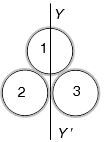
Three rings each of mass $M$ and radius $R$ are arranged as shown in the figure. The moment of inertia of the system about $YY'$ will be
A
$3MR^2$
B
$\frac{3}{2}MR^2$
C
$5MR^2$
D
$\frac{7}{2}MR^2$
Solution
(D) The moment of inertia $(I)$ of the system about the axis $YY'$ is the sum of the moments of inertia of the three individual rings.
$I = I_1 + I_2 + I_3$
For ring $1$,the axis $YY'$ passes through its diameter. The moment of inertia of a ring about its diameter is $I_1 = \frac{1}{2}MR^2$.
For rings $2$ and $3$,the axis $YY'$ is tangent to the ring in its own plane. Using the parallel axis theorem,$I = I_{cm} + Md^2$,where $I_{cm} = \frac{1}{2}MR^2$ and $d = R$. Thus,$I_2 = I_3 = \frac{1}{2}MR^2 + MR^2 = \frac{3}{2}MR^2$.
Adding these together: $I = \frac{1}{2}MR^2 + \frac{3}{2}MR^2 + \frac{3}{2}MR^2 = \frac{7}{2}MR^2$.
$I = I_1 + I_2 + I_3$
For ring $1$,the axis $YY'$ passes through its diameter. The moment of inertia of a ring about its diameter is $I_1 = \frac{1}{2}MR^2$.
For rings $2$ and $3$,the axis $YY'$ is tangent to the ring in its own plane. Using the parallel axis theorem,$I = I_{cm} + Md^2$,where $I_{cm} = \frac{1}{2}MR^2$ and $d = R$. Thus,$I_2 = I_3 = \frac{1}{2}MR^2 + MR^2 = \frac{3}{2}MR^2$.
Adding these together: $I = \frac{1}{2}MR^2 + \frac{3}{2}MR^2 + \frac{3}{2}MR^2 = \frac{7}{2}MR^2$.
0 likesView Solution
9
ChemistryMCQMHT CET · 2021
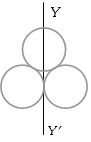
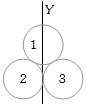
Three rings each of mass $M$ and radius $R$ are arranged as shown in the figure. The moment of inertia of the system about the axis $YY'$ is:
A
$3\, MR^{2}$
B
$\frac{3}{2}MR^{2}$
C
$5\, MR^{2}$
D
$\frac{7}{2}MR^{2}$
Solution
(D) The system consists of three rings. Let the top ring be $1$,and the two bottom rings be $2$ and $3$. The axis $YY'$ passes through the center of ring $1$ (diameter) and is tangent to rings $2$ and $3$ (parallel to their diameters).
$1$. For ring $1$,the axis $YY'$ is its diameter. The moment of inertia is $I_1 = \frac{1}{2}MR^2$.
$2$. For rings $2$ and $3$,the axis $YY'$ is parallel to their diameters at a distance $R$. Using the parallel axis theorem,$I = I_{cm} + Md^2$,where $I_{cm} = \frac{1}{2}MR^2$ and $d = R$. Thus,$I_2 = I_3 = \frac{1}{2}MR^2 + MR^2 = \frac{3}{2}MR^2$.
$3$. The total moment of inertia of the system is $I = I_1 + I_2 + I_3 = \frac{1}{2}MR^2 + \frac{3}{2}MR^2 + \frac{3}{2}MR^2 = \frac{7}{2}MR^2$.
$1$. For ring $1$,the axis $YY'$ is its diameter. The moment of inertia is $I_1 = \frac{1}{2}MR^2$.
$2$. For rings $2$ and $3$,the axis $YY'$ is parallel to their diameters at a distance $R$. Using the parallel axis theorem,$I = I_{cm} + Md^2$,where $I_{cm} = \frac{1}{2}MR^2$ and $d = R$. Thus,$I_2 = I_3 = \frac{1}{2}MR^2 + MR^2 = \frac{3}{2}MR^2$.
$3$. The total moment of inertia of the system is $I = I_1 + I_2 + I_3 = \frac{1}{2}MR^2 + \frac{3}{2}MR^2 + \frac{3}{2}MR^2 = \frac{7}{2}MR^2$.
0 likesView Solution
10
ChemistryMediumMCQMHT CET · 2021
Two electrons occupying the same orbital are distinguished by
A
azimuthal quantum number
B
spin quantum number
C
principal quantum number
D
magnetic quantum number
Solution
(B) According to the Pauli Exclusion Principle,no two electrons in an atom can have the same set of all four quantum numbers.
For two electrons in the same orbital,the principal quantum number $(n)$,azimuthal quantum number $(l)$,and magnetic quantum number $(m_l)$ are identical.
Therefore,they must differ in their spin quantum number $(m_s)$,which can be either $+1/2$ or $-1/2$.
For two electrons in the same orbital,the principal quantum number $(n)$,azimuthal quantum number $(l)$,and magnetic quantum number $(m_l)$ are identical.
Therefore,they must differ in their spin quantum number $(m_s)$,which can be either $+1/2$ or $-1/2$.
0 likesView Solution
11
ChemistryMCQMHT CET · 2021
Two long conductors,separated by a distance $d$,carry currents $I_1$ and $I_2$ in the same direction. They exert a force $F$ on each other. Now,the current in one of them is increased to two times its original value and its direction is reversed. The distance between them is also increased to $3d$. The new value of the force between them is
A
$-\frac{2F}{3}$
B
$\frac{F}{3}$
C
$-2F$
D
$-\frac{F}{3}$
Solution
(A) The force per unit length between two parallel conductors carrying currents $I_1$ and $I_2$ separated by distance $d$ is given by $F = \frac{\mu_0 I_1 I_2}{2\pi d}$.
According to the problem,the initial force is $F = \frac{\mu_0 I_1 I_2}{2\pi d}$.
In the new condition,the current in one conductor becomes $I_1' = -2I_1$ (negative sign indicates reversed direction) and the distance becomes $d' = 3d$.
The new force $F'$ is given by:
$F' = \frac{\mu_0 (-2I_1) I_2}{2\pi (3d)}$
$F' = -\frac{2}{3} \left( \frac{\mu_0 I_1 I_2}{2\pi d} \right)$
Substituting the initial force $F$ into the equation:
$F' = -\frac{2}{3} F$.
According to the problem,the initial force is $F = \frac{\mu_0 I_1 I_2}{2\pi d}$.
In the new condition,the current in one conductor becomes $I_1' = -2I_1$ (negative sign indicates reversed direction) and the distance becomes $d' = 3d$.
The new force $F'$ is given by:
$F' = \frac{\mu_0 (-2I_1) I_2}{2\pi (3d)}$
$F' = -\frac{2}{3} \left( \frac{\mu_0 I_1 I_2}{2\pi d} \right)$
Substituting the initial force $F$ into the equation:
$F' = -\frac{2}{3} F$.
0 likesView Solution
12
ChemistryMCQMHT CET · 2021
The value of $\int_{0}^{1} \tan ^{-1}\left(\frac{2 x-1}{1+x-x^{2}}\right) d x$ is
A
$1$
B
$-1$
C
$\frac{\pi}{4}$
D
$0$
Solution
(D) Let $I = \int_{0}^{1} \tan^{-1}\left(\frac{2x-1}{1+x-x^2}\right) dx$.
We can rewrite the argument of the $\tan^{-1}$ function as:
$\frac{2x-1}{1+x-x^2} = \frac{x - (1-x)}{1 + x(1-x)}$.
Using the identity $\tan^{-1}(a) - \tan^{-1}(b) = \tan^{-1}\left(\frac{a-b}{1+ab}\right)$,we get:
$I = \int_{0}^{1} [\tan^{-1}(x) - \tan^{-1}(1-x)] dx$ ...... $(1)$
Using the property $\int_{0}^{a} f(x) dx = \int_{0}^{a} f(a-x) dx$,we have:
$I = \int_{0}^{1} [\tan^{-1}(1-x) - \tan^{-1}(1-(1-x))] dx$
$I = \int_{0}^{1} [\tan^{-1}(1-x) - \tan^{-1}(x)] dx$ ...... $(2)$
Adding $(1)$ and $(2)$:
$2I = \int_{0}^{1} [\tan^{-1}(x) - \tan^{-1}(1-x) + \tan^{-1}(1-x) - \tan^{-1}(x)] dx$
$2I = \int_{0}^{1} 0 dx = 0$.
Therefore,$I = 0$.
Hence,the correct answer is $D$.
We can rewrite the argument of the $\tan^{-1}$ function as:
$\frac{2x-1}{1+x-x^2} = \frac{x - (1-x)}{1 + x(1-x)}$.
Using the identity $\tan^{-1}(a) - \tan^{-1}(b) = \tan^{-1}\left(\frac{a-b}{1+ab}\right)$,we get:
$I = \int_{0}^{1} [\tan^{-1}(x) - \tan^{-1}(1-x)] dx$ ...... $(1)$
Using the property $\int_{0}^{a} f(x) dx = \int_{0}^{a} f(a-x) dx$,we have:
$I = \int_{0}^{1} [\tan^{-1}(1-x) - \tan^{-1}(1-(1-x))] dx$
$I = \int_{0}^{1} [\tan^{-1}(1-x) - \tan^{-1}(x)] dx$ ...... $(2)$
Adding $(1)$ and $(2)$:
$2I = \int_{0}^{1} [\tan^{-1}(x) - \tan^{-1}(1-x) + \tan^{-1}(1-x) - \tan^{-1}(x)] dx$
$2I = \int_{0}^{1} 0 dx = 0$.
Therefore,$I = 0$.
Hence,the correct answer is $D$.
0 likesView Solution
13
ChemistryMCQMHT CET · 2021
The mean of the numbers obtained on throwing a die having $1$ on three faces,$2$ on two faces,and $5$ on one face is
A
$1$
B
$2$
C
$5$
D
$\frac{8}{3}$
Solution
(B) Let $X$ be the random variable representing the number obtained on the die.
The total number of faces on the die is $6$.
The probabilities of obtaining each number are:
$P(X=1) = \frac{3}{6} = \frac{1}{2}$
$P(X=2) = \frac{2}{6} = \frac{1}{3}$
$P(X=5) = \frac{1}{6}$
The mean (expected value) $E(X)$ is calculated as $\sum x_i P(x_i)$:
$E(X) = (1 \times \frac{1}{2}) + (2 \times \frac{1}{3}) + (5 \times \frac{1}{6})$
$E(X) = \frac{1}{2} + \frac{2}{3} + \frac{5}{6}$
To add these fractions,find the common denominator,which is $6$:
$E(X) = \frac{3}{6} + \frac{4}{6} + \frac{5}{6}$
$E(X) = \frac{3+4+5}{6} = \frac{12}{6} = 2$
Thus,the mean is $2$. The correct answer is $B$.
The total number of faces on the die is $6$.
The probabilities of obtaining each number are:
$P(X=1) = \frac{3}{6} = \frac{1}{2}$
$P(X=2) = \frac{2}{6} = \frac{1}{3}$
$P(X=5) = \frac{1}{6}$
The mean (expected value) $E(X)$ is calculated as $\sum x_i P(x_i)$:
$E(X) = (1 \times \frac{1}{2}) + (2 \times \frac{1}{3}) + (5 \times \frac{1}{6})$
$E(X) = \frac{1}{2} + \frac{2}{3} + \frac{5}{6}$
To add these fractions,find the common denominator,which is $6$:
$E(X) = \frac{3}{6} + \frac{4}{6} + \frac{5}{6}$
$E(X) = \frac{3+4+5}{6} = \frac{12}{6} = 2$
Thus,the mean is $2$. The correct answer is $B$.
0 likesView Solution
14
ChemistryMCQMHT CET · 2021
Ethers,when dissolved in cold concentrated sulphuric acid,form:
A
Alkanoic acids
B
Oxonium salts
C
Alkanols
D
Alkyl hydrogen sulphate
Solution
(B) Ethers contain an oxygen atom with two lone pairs of electrons,which makes them basic in nature. When ethers are dissolved in cold concentrated $H_2SO_4$,the oxygen atom accepts a proton $(H^+)$ from the acid to form a stable oxonium salt. The reaction is represented as: $R-O-R + H_2SO_4 \rightarrow [R-O^+(H)-R]HSO_4^-$. This product is known as an oxonium salt.
0 likesView Solution
15
ChemistryMediumMCQMHT CET · 2021
Cannizzaro reaction is an example of
A
Elimination reaction
B
Disproportionation reaction
C
Decomposition reaction
D
Nucleophilic addition reaction
Solution
(B) The Cannizzaro reaction is a classic example of a disproportionation reaction (also known as an auto-oxidation-reduction reaction).
In this reaction,an aldehyde that lacks an $\alpha$-hydrogen atom undergoes self-oxidation and reduction in the presence of a concentrated base.
One molecule of the aldehyde is oxidized to form a salt of a carboxylic acid,while another molecule is reduced to form a primary alcohol.
In this reaction,an aldehyde that lacks an $\alpha$-hydrogen atom undergoes self-oxidation and reduction in the presence of a concentrated base.
One molecule of the aldehyde is oxidized to form a salt of a carboxylic acid,while another molecule is reduced to form a primary alcohol.
0 likesView Solution
16
ChemistryMediumMCQMHT CET · 2021
What are the final products obtained by ozonolysis of propene?
A
$2$ molecules of acetaldehyde
B
acetone
C
$2$ molecules of formaldehyde
D
formaldehyde and acetaldehyde
Solution
(D) Ozonolysis of propene $(CH_3-CH=CH_2)$ involves the reaction with ozone $(O_3)$ followed by reductive cleavage with zinc and water $(Zn/H_2O)$.
The reaction breaks the double bond and forms carbonyl compounds:
$CH_3-CH=CH_2 \xrightarrow[(ii) Zn/H_2O]{(i) O_3} CH_3CHO + HCHO$
The products obtained are acetaldehyde $(CH_3CHO)$ and formaldehyde $(HCHO)$.
The reaction breaks the double bond and forms carbonyl compounds:
$CH_3-CH=CH_2 \xrightarrow[(ii) Zn/H_2O]{(i) O_3} CH_3CHO + HCHO$
The products obtained are acetaldehyde $(CH_3CHO)$ and formaldehyde $(HCHO)$.
0 likesView Solution
17
ChemistryMCQMHT CET · 2021
Which among the following compounds has the highest boiling point?
A
Hexanal
B
Propanal
C
Ethanal
D
Pentanal
Solution
(A) The boiling point of aldehydes depends on the molecular weight of the compound.
As the molecular weight increases,the magnitude of van der Waals forces increases,leading to a higher boiling point.
Comparing the molecular weights:
$Ethanal (C_2H_4O) < Propanal (C_3H_6O) < Pentanal (C_5H_{10}O) < Hexanal (C_6H_{12}O)$.
Therefore,$Hexanal$ has the highest molecular weight and consequently the highest boiling point.
As the molecular weight increases,the magnitude of van der Waals forces increases,leading to a higher boiling point.
Comparing the molecular weights:
$Ethanal (C_2H_4O) < Propanal (C_3H_6O) < Pentanal (C_5H_{10}O) < Hexanal (C_6H_{12}O)$.
Therefore,$Hexanal$ has the highest molecular weight and consequently the highest boiling point.
0 likesView Solution
18
ChemistryMediumMCQMHT CET · 2021
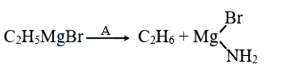
Identify the reagent $(A)$ used in the following reaction.
A
$NH_3$
B
$RNH_2$
C
$H_2O$
D
$CH_3OH$
Solution
(A) Grignard reagents $(RMgX)$ are highly reactive towards compounds containing active hydrogen atoms (like $H$ attached to $O, N, S$).
In the given reaction,$C_2H_5MgBr$ reacts with ammonia $(NH_3)$ to form ethane $(C_2H_6)$ and magnesium bromamide $(Mg(NH_2)Br)$.
The reaction is: $C_2H_5MgBr + NH_3 \rightarrow C_2H_6 + Mg(NH_2)Br$.
Thus,the reagent $(A)$ is $NH_3$.
In the given reaction,$C_2H_5MgBr$ reacts with ammonia $(NH_3)$ to form ethane $(C_2H_6)$ and magnesium bromamide $(Mg(NH_2)Br)$.
The reaction is: $C_2H_5MgBr + NH_3 \rightarrow C_2H_6 + Mg(NH_2)Br$.
Thus,the reagent $(A)$ is $NH_3$.
0 likesView Solution
19
ChemistryMCQMHT CET · 2021
Identify the glycosidic linkage present in lactose.
A
$\alpha-1,6$
B
$\alpha-1,4$
C
$\beta-1,4$
D
$\alpha, \beta-1,2$
Solution
(C) Lactose is a disaccharide composed of $\beta-D-galactose$ and $\beta-D-glucose$ units.
These two monosaccharide units are joined together by a $\beta-1,4-glycosidic$ linkage.
In this linkage,the $C-1$ of $\beta-D-galactose$ is connected to the $C-4$ of $\beta-D-glucose$ through an oxygen atom.
These two monosaccharide units are joined together by a $\beta-1,4-glycosidic$ linkage.
In this linkage,the $C-1$ of $\beta-D-galactose$ is connected to the $C-4$ of $\beta-D-glucose$ through an oxygen atom.
0 likesView Solution
20
ChemistryMediumMCQMHT CET · 2021
Which of the following alkenes on oxidation by $KMnO_4$ in dil. $H_2SO_4$ forms adipic acid?
A
Hex$-3-$ene
B
Hex$-1-$ene
C
Hex$-2-$ene
D
Cyclohexene
Solution
(D) Adipic acid is a dicarboxylic acid with the formula $HOOC-(CH_2)_4-COOH$.
Oxidation of cyclic alkenes with strong oxidizing agents like $KMnO_4$ in acidic medium leads to the cleavage of the double bond and the ring,resulting in the formation of dicarboxylic acids.
Cyclohexene,when treated with $KMnO_4$ in dil. $H_2SO_4$,undergoes oxidative cleavage to form adipic acid (hexanedioic acid).
The reaction is: $\text{Cyclohexene} + [O] \xrightarrow{KMnO_4/H^+} HOOC-(CH_2)_4-COOH$.
Oxidation of cyclic alkenes with strong oxidizing agents like $KMnO_4$ in acidic medium leads to the cleavage of the double bond and the ring,resulting in the formation of dicarboxylic acids.
Cyclohexene,when treated with $KMnO_4$ in dil. $H_2SO_4$,undergoes oxidative cleavage to form adipic acid (hexanedioic acid).
The reaction is: $\text{Cyclohexene} + [O] \xrightarrow{KMnO_4/H^+} HOOC-(CH_2)_4-COOH$.
0 likesView Solution
21
ChemistryMediumMCQMHT CET · 2021
Which statement from the following is correct for homolytic fission?
A
In this,a single electron of the shared pair moves to one of the bonded atoms and the other to the other atom.
B
In this,electron-deficient and electron-rich species are formed.
C
In this,an electronegative atom pulls both electrons of the shared pair.
D
In this,the carbon free radical formed has $sp^3$ hybridization.
Solution
(A) Homolytic fission is a type of bond cleavage where the shared pair of electrons in a covalent bond is split equally between the two bonded atoms.
Each atom retains one electron from the shared pair,resulting in the formation of free radicals.
Therefore,the correct statement is that a single electron of the shared pair moves to each of the bonded atoms.
Each atom retains one electron from the shared pair,resulting in the formation of free radicals.
Therefore,the correct statement is that a single electron of the shared pair moves to each of the bonded atoms.
0 likesView Solution
22
ChemistryEasyMCQMHT CET · 2021
What is the bond angle $O-S-O$ in the $SO_2$ molecule (in $^{\circ}$)?
A
$107$
B
$180$
C
$90$
D
$119.5$
Solution
(D) The $SO_2$ molecule has a bent geometry with $sp^2$ hybridization at the sulfur atom.
It contains one lone pair of electrons on the sulfur atom.
According to $VSEPR$ theory,the lone pair-bond pair repulsion is greater than the bond pair-bond pair repulsion.
This causes the bond angle to decrease from the ideal trigonal planar angle of $120^{\circ}$ to approximately $119.5^{\circ}$.
It contains one lone pair of electrons on the sulfur atom.
According to $VSEPR$ theory,the lone pair-bond pair repulsion is greater than the bond pair-bond pair repulsion.
This causes the bond angle to decrease from the ideal trigonal planar angle of $120^{\circ}$ to approximately $119.5^{\circ}$.
0 likesView Solution
23
ChemistryEasyMCQMHT CET · 2021
What is the geometry of the $SbF_5$ molecule?
A
Trigonal pyramidal
B
Trigonal planar
C
Square pyramidal
D
Trigonal bipyramidal
Solution
(D) The central atom $Sb$ has $5$ valence electrons and forms $5$ bonds with $F$ atoms,resulting in $5$ bond pairs and $0$ lone pairs.
According to $VSEPR$ theory,a molecule with $5$ bond pairs and $0$ lone pairs has $sp^3d$ hybridization.
The geometry of $SbF_5$ is Trigonal bipyramidal.
According to $VSEPR$ theory,a molecule with $5$ bond pairs and $0$ lone pairs has $sp^3d$ hybridization.
The geometry of $SbF_5$ is Trigonal bipyramidal.
0 likesView Solution
24
ChemistryMediumMCQMHT CET · 2021
Which among the following halides has a trigonal bipyramidal structure?
A
$SeCl_2$
B
$SeF_4$
C
$SF_6$
D
$TeF_6$
Solution
(B) To determine the geometry,we calculate the hybridization of the central atom using the formula: $H = \frac{1}{2} (V + M - C + A)$,where $V$ is the number of valence electrons,$M$ is the number of monovalent atoms,$C$ is the cationic charge,and $A$ is the anionic charge.
$1$. For $SeCl_2$: $H = \frac{1}{2} (6 + 2) = 4$ ($sp^3$ hybridization). With $2$ lone pairs,it has a bent shape.
$2$. For $SeF_4$: $H = \frac{1}{2} (6 + 4) = 5$ ($sp^3d$ hybridization). With $1$ lone pair,it has a seesaw shape,which is derived from a trigonal bipyramidal electron geometry.
$3$. For $SF_6$: $H = \frac{1}{2} (6 + 6) = 6$ ($sp^3d^2$ hybridization). It has an octahedral geometry.
$4$. For $TeF_6$: $H = \frac{1}{2} (6 + 6) = 6$ ($sp^3d^2$ hybridization). It has an octahedral geometry.
Among the given options,$SeF_4$ is the only one associated with the trigonal bipyramidal electron geometry.
$1$. For $SeCl_2$: $H = \frac{1}{2} (6 + 2) = 4$ ($sp^3$ hybridization). With $2$ lone pairs,it has a bent shape.
$2$. For $SeF_4$: $H = \frac{1}{2} (6 + 4) = 5$ ($sp^3d$ hybridization). With $1$ lone pair,it has a seesaw shape,which is derived from a trigonal bipyramidal electron geometry.
$3$. For $SF_6$: $H = \frac{1}{2} (6 + 6) = 6$ ($sp^3d^2$ hybridization). It has an octahedral geometry.
$4$. For $TeF_6$: $H = \frac{1}{2} (6 + 6) = 6$ ($sp^3d^2$ hybridization). It has an octahedral geometry.
Among the given options,$SeF_4$ is the only one associated with the trigonal bipyramidal electron geometry.
0 likesView Solution
25
ChemistryEasyMCQMHT CET · 2021
How many hydrogen atoms are bonded to the nitrogen atom in an ammonium ion $(NH_4^+)$?
A
$1$
B
$4$
C
$3$
D
$2$
Solution
(B) The ammonium ion $(NH_4^+)$ is formed by the reaction of ammonia $(NH_3)$ with a hydrogen ion $(H^+)$.
In ammonia $(NH_3)$,the nitrogen atom is bonded to $3$ hydrogen atoms.
When $NH_3$ reacts with $H^+$,the lone pair on the nitrogen atom forms a coordinate covalent bond with the $H^+$ ion.
As a result,the nitrogen atom in the ammonium ion $(NH_4^+)$ is bonded to a total of $4$ hydrogen atoms.
In ammonia $(NH_3)$,the nitrogen atom is bonded to $3$ hydrogen atoms.
When $NH_3$ reacts with $H^+$,the lone pair on the nitrogen atom forms a coordinate covalent bond with the $H^+$ ion.
As a result,the nitrogen atom in the ammonium ion $(NH_4^+)$ is bonded to a total of $4$ hydrogen atoms.
0 likesView Solution
26
ChemistryMediumMCQMHT CET · 2021
Which of the following bonds has the highest bond enthalpy?
A
$N-H$ in $NH_3$
B
$O=O$ in $O_2$
C
$C-H$ in $CH_4$
D
$N \equiv N$ in $N_2$
Solution
(D) The bond enthalpy is directly related to the bond order or the number of bonds between atoms.
$N_2$ contains a triple bond $(N \equiv N)$,which is significantly stronger than the single bonds in $NH_3$ $(N-H)$ and $CH_4$ $(C-H)$,or the double bond in $O_2$ $(O=O)$.
Therefore,$N_2$ has the highest bond enthalpy.
$N_2$ contains a triple bond $(N \equiv N)$,which is significantly stronger than the single bonds in $NH_3$ $(N-H)$ and $CH_4$ $(C-H)$,or the double bond in $O_2$ $(O=O)$.
Therefore,$N_2$ has the highest bond enthalpy.
0 likesView Solution
27
ChemistryEasyMCQMHT CET · 2021
Which of the following concepts is $NOT$ part of the valence bond theory $(VBT)$?
A
Covalent character of bond
B
Shielding effect of electrons
C
Delocalization of electrons over the two nuclei
D
Combination of atomic orbitals to give molecular orbitals
Solution
(D) The concept of the combination of atomic orbitals to form molecular orbitals belongs to the Molecular Orbital Theory $(MOT)$,not the Valence Bond Theory $(VBT)$.
0 likesView Solution
28
ChemistryMediumMCQMHT CET · 2021
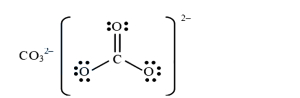
What is the formal charge on the carbon atom in the $CO_3^{2-}$ ion?
A
$-2$
B
$-4$
C
$4$
D
$\text{zero}$
Solution
(D) The formal charge $(FC)$ on an atom in a Lewis structure is calculated using the formula:
$FC = V - L - \frac{1}{2}S$
Where:
$V$ = Number of valence electrons of the free atom
$L$ = Number of non-bonding (lone pair) electrons
$S$ = Number of bonding (shared) electrons
For the carbon atom in $CO_3^{2-}$:
$V = 4$ (Carbon belongs to group $14$)
$L = 0$ (Carbon has no lone pairs in the carbonate ion)
$S = 8$ (Carbon forms $4$ bonds: one double bond and two single bonds)
$FC = 4 - 0 - \frac{1}{2}(8) = 4 - 4 = 0$.
$FC = V - L - \frac{1}{2}S$
Where:
$V$ = Number of valence electrons of the free atom
$L$ = Number of non-bonding (lone pair) electrons
$S$ = Number of bonding (shared) electrons
For the carbon atom in $CO_3^{2-}$:
$V = 4$ (Carbon belongs to group $14$)
$L = 0$ (Carbon has no lone pairs in the carbonate ion)
$S = 8$ (Carbon forms $4$ bonds: one double bond and two single bonds)
$FC = 4 - 0 - \frac{1}{2}(8) = 4 - 4 = 0$.
0 likesView Solution
29
ChemistryMediumMCQMHT CET · 2021
What is the formal charge of oxygen atoms in carbon monoxide?
A
$2$
B
$1$
C
$-1$
D
Zero
Solution
(B) The Lewis structure of carbon monoxide is $:C \equiv O:$.
Formal charge $= [\text{Total no. of valence } e^- \text{ in free state}] - [\text{Total no. of lone pair } e^-] - \frac{1}{2}[\text{Total no. of bonding } e^-]$.
For oxygen atom:
Valence electrons $= 6$.
Lone pair electrons $= 2$.
Bonding electrons $= 6$.
Formal charge $= 6 - 2 - \frac{1}{2} \times 6 = 6 - 2 - 3 = +1$.
Formal charge $= [\text{Total no. of valence } e^- \text{ in free state}] - [\text{Total no. of lone pair } e^-] - \frac{1}{2}[\text{Total no. of bonding } e^-]$.
For oxygen atom:
Valence electrons $= 6$.
Lone pair electrons $= 2$.
Bonding electrons $= 6$.
Formal charge $= 6 - 2 - \frac{1}{2} \times 6 = 6 - 2 - 3 = +1$.
0 likesView Solution
30
ChemistryMediumMCQMHT CET · 2021
What is the formal charge on the $N$ atom in the $NH_4^{+}$ ion?
A
$+1$
B
$-3$
C
$-1$
D
zero
Solution
(A) The formula for calculating the formal charge is:
$\text{Formal charge} = [\text{Total number of valence electrons in free state}] - [\text{Total number of lone pair electrons}] - \frac{1}{2} [\text{Number of bonding electrons on that particular atom}]$
For the $N$ atom in $NH_4^{+}$:
- The number of valence electrons in a free $N$ atom is $5$.
- The number of lone pair electrons on the $N$ atom is $0$.
- The number of bonding electrons around the $N$ atom is $8$ (since there are $4$ covalent bonds).
$\text{Formal charge on } N = 5 - 0 - \frac{1}{2} \times 8 = 5 - 4 = +1$.
$\text{Formal charge} = [\text{Total number of valence electrons in free state}] - [\text{Total number of lone pair electrons}] - \frac{1}{2} [\text{Number of bonding electrons on that particular atom}]$
For the $N$ atom in $NH_4^{+}$:
- The number of valence electrons in a free $N$ atom is $5$.
- The number of lone pair electrons on the $N$ atom is $0$.
- The number of bonding electrons around the $N$ atom is $8$ (since there are $4$ covalent bonds).
$\text{Formal charge on } N = 5 - 0 - \frac{1}{2} \times 8 = 5 - 4 = +1$.
0 likesView Solution
31
ChemistryMediumMCQMHT CET · 2021
What is the formal charge on the $C$ atom in the structure $S \equiv C - \ddot{N} :$?
A
$ -1 $
B
$ -2 $
C
$ 1 $
D
Zero
Solution
(D) The formula for formal charge is: $\text{Formal charge} = [ \text{Total no. of valence } e^- \text{ in free state} ] - [ \text{Total no. of lone pair electrons} ] - \frac{1}{2} [ \text{Total no. of bonding electrons} ]$.
For the carbon atom $(C)$ in the structure $S \equiv C - \ddot{N} :$,the number of valence electrons is $4$.
The carbon atom has $0$ lone pair electrons and forms $4$ bonds (a triple bond with $S$ and a single bond with $N$),which corresponds to $8$ bonding electrons.
Substituting these values: $\text{Formal charge} = 4 - 0 - \frac{1}{2} \times 8 = 4 - 4 = 0$.
For the carbon atom $(C)$ in the structure $S \equiv C - \ddot{N} :$,the number of valence electrons is $4$.
The carbon atom has $0$ lone pair electrons and forms $4$ bonds (a triple bond with $S$ and a single bond with $N$),which corresponds to $8$ bonding electrons.
Substituting these values: $\text{Formal charge} = 4 - 0 - \frac{1}{2} \times 8 = 4 - 4 = 0$.
0 likesView Solution
32
ChemistryMediumMCQMHT CET · 2021
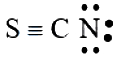
Calculate the formal charge on the $C$ atom in the thiocyanate ion $(SCN^-)$ as shown in the structure.
A
$-1$
B
$0$
C
$+1$
D
$+2$
Solution
(B) The formal charge $(FC)$ of an atom in a molecule or ion is calculated using the formula:
$FC = V - L - \frac{B}{2}$
Where:
$V$ = Total number of valence electrons in the free atom.
$L$ = Total number of non-bonding (lone pair) electrons.
$B$ = Total number of bonding (shared) electrons.
For the Carbon $(C)$ atom in the given structure of $SCN^-$ $(S \equiv C - N:)$:
$V = 4$ (Carbon is in group $14$)
$L = 0$ (Carbon has no lone pairs)
$B = 8$ (Carbon forms $3$ bonds with $S$ and $1$ bond with $N$,total $4$ bonds = $8$ electrons)
$FC = 4 - 0 - \frac{8}{2} = 4 - 4 = 0$.
Thus,the formal charge on the $C$ atom is $0$.
$FC = V - L - \frac{B}{2}$
Where:
$V$ = Total number of valence electrons in the free atom.
$L$ = Total number of non-bonding (lone pair) electrons.
$B$ = Total number of bonding (shared) electrons.
For the Carbon $(C)$ atom in the given structure of $SCN^-$ $(S \equiv C - N:)$:
$V = 4$ (Carbon is in group $14$)
$L = 0$ (Carbon has no lone pairs)
$B = 8$ (Carbon forms $3$ bonds with $S$ and $1$ bond with $N$,total $4$ bonds = $8$ electrons)
$FC = 4 - 0 - \frac{8}{2} = 4 - 4 = 0$.
Thus,the formal charge on the $C$ atom is $0$.
0 likesView Solution
33
ChemistryMediumMCQMHT CET · 2021
What is the formal charge on the $N$ atom in the $[S-C \equiv N:]^-$ ion?
A
zero
B
$3$
C
$-2$
D
$2$
Solution
(A) The formal charge $(FC)$ is calculated using the formula: $FC = V - L - \frac{B}{2}$.
For the nitrogen $(N)$ atom in the $[S-C \equiv N:]^-$ ion:
Valence electrons $(V)$ of $N = 5$.
Lone pair electrons $(L)$ on $N = 2$.
Bonding electrons $(B)$ for $N = 6$ (due to the triple bond).
$FC = 5 - 2 - \frac{6}{2} = 5 - 2 - 3 = 0$.
For the nitrogen $(N)$ atom in the $[S-C \equiv N:]^-$ ion:
Valence electrons $(V)$ of $N = 5$.
Lone pair electrons $(L)$ on $N = 2$.
Bonding electrons $(B)$ for $N = 6$ (due to the triple bond).
$FC = 5 - 2 - \frac{6}{2} = 5 - 2 - 3 = 0$.
0 likesView Solution
34
ChemistryMediumMCQMHT CET · 2021
Identify the metal halide from the following that has the highest ionic character? ($M =$ metal atom)
A
$MF$
B
$MBr$
C
$MI$
D
$MCl$
Solution
(A) According to Fajan's rule,as the size of the anion increases,its polarizability increases,which leads to an increase in covalent character and a decrease in ionic character.
Since the size of the fluoride ion $(F^-)$ is the smallest among the given halide ions $(F^- < Cl^- < Br^- < I^-)$,it has the least polarizability.
Therefore,$MF$ exhibits the highest ionic character.
The order of ionic character is: $MF > MCl > MBr > MI$.
Since the size of the fluoride ion $(F^-)$ is the smallest among the given halide ions $(F^- < Cl^- < Br^- < I^-)$,it has the least polarizability.
Therefore,$MF$ exhibits the highest ionic character.
The order of ionic character is: $MF > MCl > MBr > MI$.
0 likesView Solution
35
ChemistryEasyMCQMHT CET · 2021
Identify the compound having a non-zero dipole moment.
A
$BF_3$
B
$CCl_4$
C
$CHCl_3$
D
$CH_4$
Solution
(C) The dipole moment $(\mu)$ of a molecule depends on its geometry and the polarity of its bonds.
$BF_3$ has a trigonal planar geometry,$CCl_4$ and $CH_4$ have tetrahedral geometries. Due to their highly symmetric structures,the individual bond dipoles cancel each other out,resulting in a net dipole moment of $\mu = 0$.
$CHCl_3$ (chloroform) has a tetrahedral geometry,but because the atoms attached to the central carbon atom are not identical ($3$ chlorine atoms and $1$ hydrogen atom),the bond dipoles do not cancel out. Therefore,$CHCl_3$ has a non-zero net dipole moment $(\mu \neq 0)$.
$BF_3$ has a trigonal planar geometry,$CCl_4$ and $CH_4$ have tetrahedral geometries. Due to their highly symmetric structures,the individual bond dipoles cancel each other out,resulting in a net dipole moment of $\mu = 0$.
$CHCl_3$ (chloroform) has a tetrahedral geometry,but because the atoms attached to the central carbon atom are not identical ($3$ chlorine atoms and $1$ hydrogen atom),the bond dipoles do not cancel out. Therefore,$CHCl_3$ has a non-zero net dipole moment $(\mu \neq 0)$.
0 likesView Solution
36
ChemistryEasyMCQMHT CET · 2021
What is the molar concentration of a weak monobasic acid if its dissociation constant is $5 \times 10^{-8}$ and it undergoes $0.5 \%$ dissociation (in $M$)?
A
$0.03$
B
$0.002$
C
$0.001$
D
$0.005$
Solution
(B) For a weak monobasic acid $HA$,the dissociation equilibrium is $HA \rightleftharpoons H^+ + A^-$.
Let $C$ be the initial molar concentration and $x$ be the degree of dissociation.
$K_a = \frac{[H^+][A^-]}{[HA]} = \frac{(Cx)(Cx)}{C(1-x)} = \frac{Cx^2}{1-x}$.
Since the acid is weak,$x \ll 1$,so $1-x \approx 1$,and $K_a \approx Cx^2$.
Given $K_a = 5 \times 10^{-8}$ and $x = 0.5 \% = 0.005 = 5 \times 10^{-3}$.
$C = \frac{K_a}{x^2} = \frac{5 \times 10^{-8}}{(5 \times 10^{-3})^2}$.
$C = \frac{5 \times 10^{-8}}{25 \times 10^{-6}} = \frac{5}{25} \times 10^{-2} = 0.2 \times 10^{-2} = 0.002 \ M$.
Let $C$ be the initial molar concentration and $x$ be the degree of dissociation.
$K_a = \frac{[H^+][A^-]}{[HA]} = \frac{(Cx)(Cx)}{C(1-x)} = \frac{Cx^2}{1-x}$.
Since the acid is weak,$x \ll 1$,so $1-x \approx 1$,and $K_a \approx Cx^2$.
Given $K_a = 5 \times 10^{-8}$ and $x = 0.5 \% = 0.005 = 5 \times 10^{-3}$.
$C = \frac{K_a}{x^2} = \frac{5 \times 10^{-8}}{(5 \times 10^{-3})^2}$.
$C = \frac{5 \times 10^{-8}}{25 \times 10^{-6}} = \frac{5}{25} \times 10^{-2} = 0.2 \times 10^{-2} = 0.002 \ M$.
0 likesView Solution
37
ChemistryEasyMCQMHT CET · 2021
The $pH$ of a $0.1 \ M$ solution of a monobasic acid is $2.34$. Calculate the degree of dissociation of the acid.
A
$3.1 \times 10^{-2}$
B
$4.57 \times 10^{-2}$
C
$2.18 \times 10^{-2}$
D
$2.5 \times 10^{-3}$
Solution
(B) Given: $pH = 2.34$,$c = 0.1 \ M$.
Step $1$: Calculate the concentration of hydrogen ions $[H^+]$.
$[H^+] = 10^{-pH} = 10^{-2.34} = 4.571 \times 10^{-3} \ M$.
Step $2$: Use the relation for a monobasic acid,$[H^+] = c \alpha$.
$\alpha = \frac{[H^+]}{c} = \frac{4.571 \times 10^{-3}}{0.1} = 4.571 \times 10^{-2}$.
Thus,the degree of dissociation is $4.57 \times 10^{-2}$.
Step $1$: Calculate the concentration of hydrogen ions $[H^+]$.
$[H^+] = 10^{-pH} = 10^{-2.34} = 4.571 \times 10^{-3} \ M$.
Step $2$: Use the relation for a monobasic acid,$[H^+] = c \alpha$.
$\alpha = \frac{[H^+]}{c} = \frac{4.571 \times 10^{-3}}{0.1} = 4.571 \times 10^{-2}$.
Thus,the degree of dissociation is $4.57 \times 10^{-2}$.
0 likesView Solution
38
ChemistryEasyMCQMHT CET · 2021
The dissociation constant of propionic acid is $1.32 \times 10^{-5}$. Calculate the degree of dissociation of the acid in a $0.05 \ M$ solution.
A
$2.6 \times 10^{-4}$
B
$1.61 \times 10^{-2}$
C
$1.90 \times 10^{-2}$
D
$3.5 \times 10^{-5}$
Solution
(B) For a weak acid,the dissociation constant $K_a$ is related to the degree of dissociation $\alpha$ and concentration $C$ by the formula: $K_a = C\alpha^2$ (assuming $\alpha \ll 1$).
Given $K_a = 1.32 \times 10^{-5}$ and $C = 0.05 \ M$.
$\alpha = \sqrt{\frac{K_a}{C}}$
$\alpha = \sqrt{\frac{1.32 \times 10^{-5}}{0.05}}$
$\alpha = \sqrt{\frac{1.32 \times 10^{-5}}{5 \times 10^{-2}}} = \sqrt{0.264 \times 10^{-3}} = \sqrt{2.64 \times 10^{-4}}$
$\alpha = 1.624 \times 10^{-2} \approx 1.61 \times 10^{-2}$.
Given $K_a = 1.32 \times 10^{-5}$ and $C = 0.05 \ M$.
$\alpha = \sqrt{\frac{K_a}{C}}$
$\alpha = \sqrt{\frac{1.32 \times 10^{-5}}{0.05}}$
$\alpha = \sqrt{\frac{1.32 \times 10^{-5}}{5 \times 10^{-2}}} = \sqrt{0.264 \times 10^{-3}} = \sqrt{2.64 \times 10^{-4}}$
$\alpha = 1.624 \times 10^{-2} \approx 1.61 \times 10^{-2}$.
0 likesView Solution
39
ChemistryEasyMCQMHT CET · 2021
The dissociation constant of a weak monobasic acid is $2.7 \times 10^{-5}$. If the degree of dissociation of the acid is $3 \times 10^{-2}$,what is the concentration of the acid (in $M$)?
A
$0.24$
B
$0.03$
C
$0.3$
D
$0.11$
Solution
(B) For a weak monobasic acid $HA$,the dissociation equilibrium is:
$HA_{(aq)} \rightleftharpoons H^+_{(aq)} + A^-_{(aq)}$
At equilibrium,the concentration of $H^+$ and $A^-$ is $C\alpha$ and the concentration of $HA$ is $C(1-\alpha)$,where $C$ is the initial concentration and $\alpha$ is the degree of dissociation.
The dissociation constant $K_a$ is given by:
$K_a = \frac{[H^+][A^-]}{[HA]} = \frac{C\alpha^2}{1-\alpha}$
Since the acid is weak,$\alpha \ll 1$,so $1-\alpha \approx 1$.
Thus,$K_a = C\alpha^2$.
Rearranging to solve for $C$:
$C = \frac{K_a}{\alpha^2} = \frac{2.7 \times 10^{-5}}{(3 \times 10^{-2})^2} = \frac{2.7 \times 10^{-5}}{9 \times 10^{-4}} = 0.3 \times 10^{-1} = 0.03 \ M$.
$HA_{(aq)} \rightleftharpoons H^+_{(aq)} + A^-_{(aq)}$
At equilibrium,the concentration of $H^+$ and $A^-$ is $C\alpha$ and the concentration of $HA$ is $C(1-\alpha)$,where $C$ is the initial concentration and $\alpha$ is the degree of dissociation.
The dissociation constant $K_a$ is given by:
$K_a = \frac{[H^+][A^-]}{[HA]} = \frac{C\alpha^2}{1-\alpha}$
Since the acid is weak,$\alpha \ll 1$,so $1-\alpha \approx 1$.
Thus,$K_a = C\alpha^2$.
Rearranging to solve for $C$:
$C = \frac{K_a}{\alpha^2} = \frac{2.7 \times 10^{-5}}{(3 \times 10^{-2})^2} = \frac{2.7 \times 10^{-5}}{9 \times 10^{-4}} = 0.3 \times 10^{-1} = 0.03 \ M$.
0 likesView Solution
40
ChemistryMediumMCQMHT CET · 2021
$A$ weak monobasic acid is $10 \%$ dissociated in $0.05 \ M$ solution. What is its percentage dissociation in $0.10 \ M$ solution (in $\%$)?
A
$5.27$
B
$7.17$
C
$10.3$
D
$4.5$
Solution
(B) For a weak monobasic acid $(HA)$,the dissociation is given by: $HA_{(aq)} \rightleftharpoons H^{+}_{(aq)} + A^{-}_{(aq)}$.
The dissociation constant $K_a$ is given by $K_a = \frac{C \alpha^2}{1-\alpha}$.
Since the acid is weak,$\alpha \ll 1$,so $1-\alpha \approx 1$,and $K_a \approx C \alpha^2$.
For condition $1$: $C_1 = 0.05 \ M$,$\alpha_1 = 0.10$.
$K_a = 0.05 \times (0.1)^2 = 0.05 \times 0.01 = 0.0005$.
For condition $2$: $C_2 = 0.10 \ M$,$\alpha_2 = ?$.
$K_a = C_2 \alpha_2^2 \implies 0.0005 = 0.10 \times \alpha_2^2$.
$\alpha_2^2 = \frac{0.0005}{0.10} = 0.005$.
$\alpha_2 = \sqrt{0.005} \approx 0.0707$.
Percentage dissociation $= 0.0707 \times 100 = 7.07 \%$.
The closest option is $7.17 \%$.
The dissociation constant $K_a$ is given by $K_a = \frac{C \alpha^2}{1-\alpha}$.
Since the acid is weak,$\alpha \ll 1$,so $1-\alpha \approx 1$,and $K_a \approx C \alpha^2$.
For condition $1$: $C_1 = 0.05 \ M$,$\alpha_1 = 0.10$.
$K_a = 0.05 \times (0.1)^2 = 0.05 \times 0.01 = 0.0005$.
For condition $2$: $C_2 = 0.10 \ M$,$\alpha_2 = ?$.
$K_a = C_2 \alpha_2^2 \implies 0.0005 = 0.10 \times \alpha_2^2$.
$\alpha_2^2 = \frac{0.0005}{0.10} = 0.005$.
$\alpha_2 = \sqrt{0.005} \approx 0.0707$.
Percentage dissociation $= 0.0707 \times 100 = 7.07 \%$.
The closest option is $7.17 \%$.
0 likesView Solution
41
ChemistryMediumMCQMHT CET · 2021
The $pH$ of a monoacidic weak base is $10.9$. Calculate the percent dissociation in a $0.02 \ M$ solution. (in $\%$)
A
$7.92$
B
$3.95$
C
$6.25$
D
$2.51$
Solution
(B) For a monoacidic weak base $BOH$:
$BOH_{(aq)} \rightleftharpoons B_{(aq)}^{+} + OH_{(aq)}^{-}$
Given $pH = 10.9$,we calculate $pOH$:
$pOH = 14 - pH = 14 - 10.9 = 3.1$
The concentration of hydroxide ions is:
$[OH^{-}] = 10^{-pOH} = 10^{-3.1} = 10^{-4} \times 10^{0.9} \approx 7.94 \times 10^{-4} \ M$
For a weak base,$[OH^{-}] = C \times \alpha$,where $C = 0.02 \ M$:
$\alpha = \frac{[OH^{-}]}{C} = \frac{7.94 \times 10^{-4}}{0.02} = 3.97 \times 10^{-2}$
The percent dissociation is $\alpha \times 100$:
$\% \alpha = 3.97 \times 10^{-2} \times 100 = 3.97 \% \approx 3.95 \%$
Thus,the correct option is $B$.
$BOH_{(aq)} \rightleftharpoons B_{(aq)}^{+} + OH_{(aq)}^{-}$
Given $pH = 10.9$,we calculate $pOH$:
$pOH = 14 - pH = 14 - 10.9 = 3.1$
The concentration of hydroxide ions is:
$[OH^{-}] = 10^{-pOH} = 10^{-3.1} = 10^{-4} \times 10^{0.9} \approx 7.94 \times 10^{-4} \ M$
For a weak base,$[OH^{-}] = C \times \alpha$,where $C = 0.02 \ M$:
$\alpha = \frac{[OH^{-}]}{C} = \frac{7.94 \times 10^{-4}}{0.02} = 3.97 \times 10^{-2}$
The percent dissociation is $\alpha \times 100$:
$\% \alpha = 3.97 \times 10^{-2} \times 100 = 3.97 \% \approx 3.95 \%$
Thus,the correct option is $B$.
0 likesView Solution
42
ChemistryMediumMCQMHT CET · 2021
What is the percent dissociation of acetic acid in its $0.01 \ M$ solution if the dissociation constant of the acid is $1.34 \times 10^{-6}$ (in $\%$)?
A
$13.4$
B
$4.02$
C
$2.68$
D
$1.15$
Solution
(D) For the dissociation of acetic acid: $CH_3COOH_{(aq)} \rightleftharpoons CH_3COO^-_{(aq)} + H^+_{(aq)}$
Given concentration $C = 0.01 \ M$ and dissociation constant $K_a = 1.34 \times 10^{-6}$.
The expression for dissociation constant is $K_a = \frac{C \alpha^2}{1-\alpha}$.
Since $K_a$ is very small,$1-\alpha \approx 1$,so $K_a \approx C \alpha^2$.
Thus,$\alpha = \sqrt{\frac{K_a}{C}} = \sqrt{\frac{1.34 \times 10^{-6}}{0.01}} = \sqrt{1.34 \times 10^{-4}} = 1.157 \times 10^{-2}$.
Percent dissociation $\% \alpha = \alpha \times 100 = 1.157 \times 10^{-2} \times 100 = 1.157 \% \approx 1.15 \%$.
Given concentration $C = 0.01 \ M$ and dissociation constant $K_a = 1.34 \times 10^{-6}$.
The expression for dissociation constant is $K_a = \frac{C \alpha^2}{1-\alpha}$.
Since $K_a$ is very small,$1-\alpha \approx 1$,so $K_a \approx C \alpha^2$.
Thus,$\alpha = \sqrt{\frac{K_a}{C}} = \sqrt{\frac{1.34 \times 10^{-6}}{0.01}} = \sqrt{1.34 \times 10^{-4}} = 1.157 \times 10^{-2}$.
Percent dissociation $\% \alpha = \alpha \times 100 = 1.157 \times 10^{-2} \times 100 = 1.157 \% \approx 1.15 \%$.
0 likesView Solution
43
ChemistryMediumMCQMHT CET · 2021
$A$ weak monobasic acid is $3.0 \%$ dissociated in its $0.04 \ M$ solution. What is the dissociation constant of the acid?
A
$9 \times 10^{-4}$
B
$3.6 \times 10^{-5}$
C
$3 \times 10^{-2}$
D
$4 \times 10^{-2}$
Solution
(B) For a weak monobasic acid $HA$,the dissociation equilibrium is: $HA_{(aq)} \rightleftharpoons H^+_{(aq)} + A^-_{(aq)}$
Given concentration $C = 0.04 \ M$ and degree of dissociation $\alpha = 3.0 \% = 0.03$.
The dissociation constant $K_a$ is given by the formula: $K_a = \frac{C \alpha^2}{1 - \alpha}$.
Since the acid is weak,$\alpha \ll 1$,so $1 - \alpha \approx 1$.
Thus,$K_a \approx C \alpha^2$.
Substituting the values: $K_a = 0.04 \times (0.03)^2$.
$K_a = 0.04 \times 0.0009 = 3.6 \times 10^{-5}$.
Given concentration $C = 0.04 \ M$ and degree of dissociation $\alpha = 3.0 \% = 0.03$.
The dissociation constant $K_a$ is given by the formula: $K_a = \frac{C \alpha^2}{1 - \alpha}$.
Since the acid is weak,$\alpha \ll 1$,so $1 - \alpha \approx 1$.
Thus,$K_a \approx C \alpha^2$.
Substituting the values: $K_a = 0.04 \times (0.03)^2$.
$K_a = 0.04 \times 0.0009 = 3.6 \times 10^{-5}$.
0 likesView Solution
44
ChemistryMediumMCQMHT CET · 2021
At $298 \ K$,$0.1 \ M$ solution of acetic acid is $1.34 \ \%$ ionized. What is the dissociation constant of acetic acid?
A
$1.4 \times 10^{-3}$
B
$1.8 \times 10^{-5}$
C
$1.6 \times 10^{-3}$
D
$1.34 \times 10^{-5}$
Solution
(B) The dissociation of acetic acid is given by: $CH_3COOH_{(aq)} \rightleftharpoons CH_3COO^-_{(aq)} + H^+_{(aq)}$
Given concentration $C = 0.1 \ M$ and degree of ionization $\alpha = 1.34 \ \% = 0.0134$.
The dissociation constant $K_a$ is given by the formula: $K_a = \frac{C\alpha^2}{1-\alpha}$.
Since $\alpha$ is very small,we can approximate $1-\alpha \approx 1$.
Thus,$K_a \approx C\alpha^2$.
Substituting the values: $K_a = 0.1 \times (0.0134)^2$.
$K_a = 0.1 \times 0.00017956 = 1.7956 \times 10^{-5} \approx 1.8 \times 10^{-5}$.
Given concentration $C = 0.1 \ M$ and degree of ionization $\alpha = 1.34 \ \% = 0.0134$.
The dissociation constant $K_a$ is given by the formula: $K_a = \frac{C\alpha^2}{1-\alpha}$.
Since $\alpha$ is very small,we can approximate $1-\alpha \approx 1$.
Thus,$K_a \approx C\alpha^2$.
Substituting the values: $K_a = 0.1 \times (0.0134)^2$.
$K_a = 0.1 \times 0.00017956 = 1.7956 \times 10^{-5} \approx 1.8 \times 10^{-5}$.
0 likesView Solution
45
ChemistryEasyMCQMHT CET · 2021
Which of the following is an alkali metal?
A
Barium
B
Rubidium
C
Strontium
D
Gallium
Solution
(B) is the correct answer.
Alkali metals are the elements belonging to Group $1$ of the periodic table.
These include lithium $(Li)$,sodium $(Na)$,potassium $(K)$,rubidium $(Rb)$,caesium $(Cs)$,and francium $(Fr)$.
Among the given options,rubidium $(Rb)$ is an alkali metal.
Alkali metals are the elements belonging to Group $1$ of the periodic table.
These include lithium $(Li)$,sodium $(Na)$,potassium $(K)$,rubidium $(Rb)$,caesium $(Cs)$,and francium $(Fr)$.
Among the given options,rubidium $(Rb)$ is an alkali metal.
0 likesView Solution
46
ChemistryMediumMCQMHT CET · 2021
Which of the following is an alkali metal?
A
$Ba$
B
$Cs$
C
$Ca$
D
$Sr$
Solution
(B) The alkali metals are the elements belonging to Group $1$ of the periodic table.
These include lithium $(Li)$,sodium $(Na)$,potassium $(K)$,rubidium $(Rb)$,caesium $(Cs)$,and francium $(Fr)$.
Among the given options,$Cs$ (caesium) is an alkali metal,while $Ba$,$Ca$,and $Sr$ are alkaline earth metals belonging to Group $2$.
These include lithium $(Li)$,sodium $(Na)$,potassium $(K)$,rubidium $(Rb)$,caesium $(Cs)$,and francium $(Fr)$.
Among the given options,$Cs$ (caesium) is an alkali metal,while $Ba$,$Ca$,and $Sr$ are alkaline earth metals belonging to Group $2$.
0 likesView Solution
47
ChemistryMediumMCQMHT CET · 2021
Identify the compound formed from elements $X, Y, Z$ having oxidation states $+2, +5, -2$ respectively.
A
$X(Y_4Z)$
B
$X_3(YZ_4)_2$
C
$X_3(YZ_2)_2$
D
$XYZ_2$
Solution
(B) The oxidation states are $X = +2$,$Y = +5$,and $Z = -2$.
For a neutral compound,the sum of oxidation states must be zero.
Checking option $B$: $X_3(YZ_4)_2$.
Total charge $= 3 \times (+2) + 2 \times (+5 + 4 \times (-2)) = 6 + 2 \times (5 - 8) = 6 + 2 \times (-3) = 6 - 6 = 0$.
Since the total charge is zero,the correct formula is $X_3(YZ_4)_2$.
For a neutral compound,the sum of oxidation states must be zero.
Checking option $B$: $X_3(YZ_4)_2$.
Total charge $= 3 \times (+2) + 2 \times (+5 + 4 \times (-2)) = 6 + 2 \times (5 - 8) = 6 + 2 \times (-3) = 6 - 6 = 0$.
Since the total charge is zero,the correct formula is $X_3(YZ_4)_2$.
0 likesView Solution
48
ChemistryMediumMCQMHT CET · 2021
Pure dihydrogen $(99.95\%)$ is obtained by the electrolysis of
A
$NaOH_{(aq)}$ using $Zn$ electrodes
B
Pure water
C
Dilute $H_2SO_4$ using cadmium electrodes
D
Warm barium hydroxide solution using $Ni$ electrodes
Solution
(D) High purity dihydrogen $(> 99.95\%)$ is obtained by the electrolysis of warm aqueous barium hydroxide solution between $Ni$ electrodes.
In this process,the electrolyte is $Ba(OH)_2$ and the electrodes used are $Ni$ electrodes.
This method is preferred for producing high-purity hydrogen gas.
In this process,the electrolyte is $Ba(OH)_2$ and the electrodes used are $Ni$ electrodes.
This method is preferred for producing high-purity hydrogen gas.
0 likesView Solution
49
ChemistryEasyMCQMHT CET · 2021
Which among the following statements about ozone depletion is $NOT$ true?
A
Depletion of ozone is most pronounced over Antarctica.
B
Freons used in aerosols that enter the atmosphere cause depletion of the ozone layer.
C
Nitrogen oxides released from cars cause ozone depletion.
D
Due to ozone depletion,less amount of $UV$ radiation reaches the earth's surface.
Solution
(D) The ozone layer is primarily found in the stratosphere. It has the potential to absorb around $97-99 \%$ of the harmful ultraviolet $(UV)$ radiation coming from the sun,which can damage life on Earth.
Ozone depletion leads to the thinning of this protective layer,allowing a higher amount of harmful $UV$ radiation to reach the Earth's surface.
Therefore,the statement that 'less amount of $UV$ radiation reaches the earth's surface' due to ozone depletion is incorrect.
Ozone depletion leads to the thinning of this protective layer,allowing a higher amount of harmful $UV$ radiation to reach the Earth's surface.
Therefore,the statement that 'less amount of $UV$ radiation reaches the earth's surface' due to ozone depletion is incorrect.
0 likesView Solution
50
ChemistryEasyMCQMHT CET · 2021
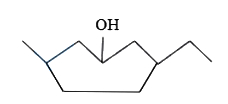
What is the $IUPAC$ name of the following compound?
A
$3-$Methyl$-6-$ethylcycloheptan$-1-$ol
B
$3-$Ethyl$-6-$methylcycloheptan$-1-$ol
C
$3-$Ethylcycloheptanol
D
$1-$Ethyl$-5-$methylcycloheptan$-3-$ol
Solution
(B) $1$. Identify the principal functional group: The hydroxyl group $(-OH)$ is the principal functional group,so the parent chain is a cycloheptanol. The carbon attached to the $-OH$ group is assigned position $1$.
$2$. Number the ring: To give the substituents the lowest possible locants,we number the ring starting from the carbon with the $-OH$ group. Moving clockwise,the ethyl group is at position $3$ and the methyl group is at position $6$.
$3$. Alphabetical order: Ethyl comes before methyl. Thus,the name is $3-$ethyl$-6-$methylcycloheptan$-1-$ol.
$2$. Number the ring: To give the substituents the lowest possible locants,we number the ring starting from the carbon with the $-OH$ group. Moving clockwise,the ethyl group is at position $3$ and the methyl group is at position $6$.
$3$. Alphabetical order: Ethyl comes before methyl. Thus,the name is $3-$ethyl$-6-$methylcycloheptan$-1-$ol.
0 likesView Solution
51
ChemistryMediumMCQMHT CET · 2021
Identify the product formed in the following reaction: $CH_3-CH=CH-CH_2-CHO \xrightarrow[(ii) \ H_3O^{+}]{(i) \ LiAlH_4} \text{Product}$
A
$CH_3-CH=CH-CH_2-CH_2-OH$
B
$CH_3-CH_2-CH_2-CH_2-CH_2-OH$
C
$CH_3-CH=CH-CH_2-CHO$
D
$CH_3-CH_2-CH=CH-CH_2-OH$
Solution
(A) $LiAlH_4$ is a strong reducing agent that reduces aldehydes to primary alcohols.
It does not reduce isolated carbon-carbon double bonds $(C=C)$.
Therefore,the aldehyde group $(-CHO)$ is reduced to a primary alcohol group $(-CH_2OH)$ while the double bond remains intact.
The reaction is:
$CH_3-CH=CH-CH_2-CHO \xrightarrow[(ii) \ H_3O^{+}]{(i) \ LiAlH_4} CH_3-CH=CH-CH_2-CH_2-OH$
Thus,the correct product is $CH_3-CH=CH-CH_2-CH_2-OH$.
It does not reduce isolated carbon-carbon double bonds $(C=C)$.
Therefore,the aldehyde group $(-CHO)$ is reduced to a primary alcohol group $(-CH_2OH)$ while the double bond remains intact.
The reaction is:
$CH_3-CH=CH-CH_2-CHO \xrightarrow[(ii) \ H_3O^{+}]{(i) \ LiAlH_4} CH_3-CH=CH-CH_2-CH_2-OH$
Thus,the correct product is $CH_3-CH=CH-CH_2-CH_2-OH$.
0 likesView Solution
52
ChemistryMediumMCQMHT CET · 2021
Which of the following compounds on reaction with Grignard reagent followed by hydrolysis forms secondary alcohol?
A
$CH_3CHO$
B
$HCHO$
C
$CH_3CH_2COCH_3$
D
$CH_3COCH_3$
Solution
(A) Aldehydes other than formaldehyde $(HCHO)$ react with Grignard reagents $(RMgX)$ to form secondary alcohols after acidic hydrolysis.
$CH_3CHO + RMgX$ $\rightarrow CH_3CH(OMgX)R$ $\xrightarrow{H_3O^+} CH_3CH(OH)R$ (Secondary alcohol).
Formaldehyde $(HCHO)$ forms primary alcohols,while ketones form tertiary alcohols.
Therefore,$CH_3CHO$ is the correct answer.
$CH_3CHO + RMgX$ $\rightarrow CH_3CH(OMgX)R$ $\xrightarrow{H_3O^+} CH_3CH(OH)R$ (Secondary alcohol).
Formaldehyde $(HCHO)$ forms primary alcohols,while ketones form tertiary alcohols.
Therefore,$CH_3CHO$ is the correct answer.
0 likesView Solution
53
ChemistryMediumMCQMHT CET · 2021
Which among the following compounds has the highest melting point?
A
$tert-$Butyl alcohol
B
$n-$Butyl alcohol
C
Isobutyl alcohol
D
$sec-$Butyl alcohol
Solution
(A) The melting point of a compound depends on its molecular symmetry and packing in the crystal lattice.
$tert-$Butyl alcohol ($2-$methylpropan$-2-$ol) has a highly symmetrical structure compared to the other isomers.
Due to this high symmetry,it packs more efficiently into the crystal lattice,leading to stronger intermolecular forces and a significantly higher melting point.
$tert-$Butyl alcohol ($2-$methylpropan$-2-$ol) has a highly symmetrical structure compared to the other isomers.
Due to this high symmetry,it packs more efficiently into the crystal lattice,leading to stronger intermolecular forces and a significantly higher melting point.
0 likesView Solution
54
ChemistryMediumMCQMHT CET · 2021
Which among the following isomers of $C_4H_9OH$ has the lowest boiling point?
A
Isobutyl alcohol
B
$n$-Butyl alcohol
C
tert-Butyl alcohol
D
sec-Butyl alcohol
Solution
(C) The boiling point of isomeric alcohols depends on the extent of branching in the carbon chain.
As the branching increases,the surface area of the molecule decreases,which reduces the magnitude of van der Waals forces of attraction.
Consequently,the boiling point decreases with an increase in branching.
Among the given isomers:
$n$-Butyl alcohol $(CH_3CH_2CH_2CH_2OH)$ has no branching.
Isobutyl alcohol $((CH_3)_2CHCH_2OH)$ has one branch.
sec-Butyl alcohol $(CH_3CH_2CH(OH)CH_3)$ has one branch.
tert-Butyl alcohol $((CH_3)_3COH)$ has the maximum branching (three methyl groups attached to the central carbon).
Therefore,tert-Butyl alcohol has the lowest boiling point.
As the branching increases,the surface area of the molecule decreases,which reduces the magnitude of van der Waals forces of attraction.
Consequently,the boiling point decreases with an increase in branching.
Among the given isomers:
$n$-Butyl alcohol $(CH_3CH_2CH_2CH_2OH)$ has no branching.
Isobutyl alcohol $((CH_3)_2CHCH_2OH)$ has one branch.
sec-Butyl alcohol $(CH_3CH_2CH(OH)CH_3)$ has one branch.
tert-Butyl alcohol $((CH_3)_3COH)$ has the maximum branching (three methyl groups attached to the central carbon).
Therefore,tert-Butyl alcohol has the lowest boiling point.
0 likesView Solution
55
ChemistryEasyMCQMHT CET · 2021
Which among the following compounds has the highest melting point?
A
Phenol
B
$p$-Nitrophenol
C
$p$-Cresol
D
$o$-Nitrophenol
Solution
(B) $p$-Nitrophenol has the highest melting point due to strong intermolecular hydrogen bonding in the solid state,which leads to a more stable crystal lattice structure compared to the other isomers. $o$-Nitrophenol exhibits intramolecular hydrogen bonding,which reduces its melting point.
0 likesView Solution
56
ChemistryEasyMCQMHT CET · 2021
Which of the following is likely to undergo racemization during alkaline hydrolysis?
A
$CH_3-CH_2-CH(Cl)-CH_2-CH_3$
B
$CH_3-CH(C_2H_5)-CH_2-Cl$
C
$CH_3-CH(Cl)-CH_3$
D
$CH_3-CH_2-CH(Cl)-CH_3$
Solution
(D) Racemization occurs during the alkaline hydrolysis of an alkyl halide if the reaction proceeds via an $S_N1$ mechanism,which involves the formation of a planar carbocation intermediate. This requires the starting alkyl halide to be chiral (optically active). Among the given options,$CH_3-CH_2-CH(Cl)-CH_3$ ($2$-chlorobutane) is a chiral molecule because the carbon atom attached to the chlorine is bonded to four different groups $(-H, -Cl, -CH_3, -CH_2CH_3)$. Therefore,it can form a planar carbocation and undergo racemization.
0 likesView Solution
57
ChemistryMediumMCQMHT CET · 2021
To obtain $3-$methylbutan$-2-$ol from acetaldehyde,the Grignard's reagent used is
A
$CH_3MgBr$
B
$CH_3CH_2CH_2MgBr$
C
$CH_3CH_2MgBr$
D
$(CH_3)_2CHMgBr$
Solution
(D) The reaction of acetaldehyde $(CH_3CHO)$ with a Grignard reagent $(RMgBr)$ followed by acid hydrolysis $(H_3O^+)$ yields a secondary alcohol.
To obtain $3-$methylbutan$-2-$ol $(CH_3-CH(OH)-CH(CH_3)_2)$,the Grignard reagent must provide the isopropyl group $(CH(CH_3)_2)$.
The reaction is as follows:
$CH_3-CH=O + (CH_3)_2CHMgBr \rightarrow CH_3-CH(OMgBr)-CH(CH_3)_2$
$CH_3-CH(OMgBr)-CH(CH_3)_2 + H_2O/H^+ \rightarrow CH_3-CH(OH)-CH(CH_3)_2 + Mg(OH)Br$
Thus,the required Grignard reagent is isopropylmagnesium bromide,which is $(CH_3)_2CHMgBr$.
To obtain $3-$methylbutan$-2-$ol $(CH_3-CH(OH)-CH(CH_3)_2)$,the Grignard reagent must provide the isopropyl group $(CH(CH_3)_2)$.
The reaction is as follows:
$CH_3-CH=O + (CH_3)_2CHMgBr \rightarrow CH_3-CH(OMgBr)-CH(CH_3)_2$
$CH_3-CH(OMgBr)-CH(CH_3)_2 + H_2O/H^+ \rightarrow CH_3-CH(OH)-CH(CH_3)_2 + Mg(OH)Br$
Thus,the required Grignard reagent is isopropylmagnesium bromide,which is $(CH_3)_2CHMgBr$.
0 likesView Solution
58
ChemistryMediumMCQMHT CET · 2021
Identify compound $A$ from the following reaction:
$A + C_2H_5MgBr$ $\xrightarrow[ether]{dry} B$ $\xrightarrow{H_3O^{+}} 3-\text{methylpentan}-3-\text{ol}$
$A + C_2H_5MgBr$ $\xrightarrow[ether]{dry} B$ $\xrightarrow{H_3O^{+}} 3-\text{methylpentan}-3-\text{ol}$
A
Butanal
B
Propanone
C
Propanal
D
Butanone
Solution
(D) The reaction of a Grignard reagent $(C_2H_5MgBr)$ with a carbonyl compound $(A)$ followed by acid hydrolysis $(H_3O^{+})$ yields an alcohol.
In the final product,$3-\text{methylpentan}-3-\text{ol}$,the carbon atom bearing the hydroxyl group is bonded to two ethyl groups $(C_2H_5-)$ and one methyl group $(CH_3-)$.
Since one ethyl group comes from the Grignard reagent $(C_2H_5MgBr)$,the carbonyl compound $(A)$ must provide the remaining part of the structure,which is a ketone with one methyl group and one ethyl group attached to the carbonyl carbon.
Thus,the structure of $A$ is $CH_3-CO-CH_2-CH_3$,which is butanone.
The reaction is:
$CH_3-CO-CH_2-CH_3 + C_2H_5MgBr$ $\rightarrow CH_3-C(OMgBr)(C_2H_5)-CH_2-CH_3$ $\xrightarrow{H_3O^{+}} CH_3-C(OH)(C_2H_5)-CH_2-CH_3$ (which is $3-\text{methylpentan}-3-\text{ol}$).
In the final product,$3-\text{methylpentan}-3-\text{ol}$,the carbon atom bearing the hydroxyl group is bonded to two ethyl groups $(C_2H_5-)$ and one methyl group $(CH_3-)$.
Since one ethyl group comes from the Grignard reagent $(C_2H_5MgBr)$,the carbonyl compound $(A)$ must provide the remaining part of the structure,which is a ketone with one methyl group and one ethyl group attached to the carbonyl carbon.
Thus,the structure of $A$ is $CH_3-CO-CH_2-CH_3$,which is butanone.
The reaction is:
$CH_3-CO-CH_2-CH_3 + C_2H_5MgBr$ $\rightarrow CH_3-C(OMgBr)(C_2H_5)-CH_2-CH_3$ $\xrightarrow{H_3O^{+}} CH_3-C(OH)(C_2H_5)-CH_2-CH_3$ (which is $3-\text{methylpentan}-3-\text{ol}$).
0 likesView Solution
59
ChemistryEasyMCQMHT CET · 2021
Which of the following alcohols has the lowest boiling point?
A
$sec-Butyl$ alcohol
B
$tert-Butyl$ alcohol
C
$iso-Butyl$ alcohol
D
$n-Butyl$ alcohol
Solution
(B) $(i)$ Boiling point $\propto$ Molar mass. Since all are isomers of $C_4H_9OH$,molar mass is the same.
$(ii)$ Boiling point $\propto \frac{1}{\text{Branching}}$.
$(iii)$ $tert-Butyl$ alcohol has the maximum branching,which reduces the surface area and decreases the van der Waals forces of attraction.
$(iv)$ Therefore,$tert-Butyl$ alcohol has the lowest boiling point.
$(ii)$ Boiling point $\propto \frac{1}{\text{Branching}}$.
$(iii)$ $tert-Butyl$ alcohol has the maximum branching,which reduces the surface area and decreases the van der Waals forces of attraction.
$(iv)$ Therefore,$tert-Butyl$ alcohol has the lowest boiling point.
0 likesView Solution
60
ChemistryMediumMCQMHT CET · 2021
Identify the reactant,reagent,and condition of Kolbe's reaction from the following.
A
$C_6H_5ONa, CO_2$ and $398\ K, 6\ atm$
B
$C_6H_5ONa, Na_2CO_3$ and $398\ K$
C
$C_6H_5OH, CHCl_3$ and aq. $NaOH$
D
$C_6H_5OH$,dil. $HNO_3$ and $413\ K$
Solution
(A) In Kolbe's reaction,sodium phenoxide $(C_6H_5ONa)$ is treated with carbon dioxide $(CO_2)$ at a temperature of $398\ K$ and a pressure of $6\ atm$,followed by acidification to yield salicylic acid.
Therefore,the correct reactants and conditions are $C_6H_5ONa, CO_2$ and $398\ K, 6\ atm$.
Therefore,the correct reactants and conditions are $C_6H_5ONa, CO_2$ and $398\ K, 6\ atm$.
0 likesView Solution
61
ChemistryEasyMCQMHT CET · 2021
Identify the product obtained when phenol reacts with concentrated sulphuric acid at $293 \ K$?
A
Picric acid
B
$o-$Phenol sulphonic acid
C
$p-$Phenol sulphonic acid
D
Salicylic acid
Solution
(B) When phenol reacts with concentrated sulphuric acid at a low temperature of $293 \ K$,the electrophilic substitution reaction occurs primarily at the ortho position.
This results in the formation of $o-$phenol sulphonic acid as the major product.
At higher temperatures (e.g.,$373 \ K$),the para isomer becomes the major product due to thermodynamic stability.
This results in the formation of $o-$phenol sulphonic acid as the major product.
At higher temperatures (e.g.,$373 \ K$),the para isomer becomes the major product due to thermodynamic stability.
0 likesView Solution
62
ChemistryMediumMCQMHT CET · 2021
Identify the product $(A)$ obtained in the following reaction.
Phenol + concentrated $HNO_3$ $\xrightarrow[H_2SO_4]{\text{concentrated}}$ $A$
Phenol + concentrated $HNO_3$ $\xrightarrow[H_2SO_4]{\text{concentrated}}$ $A$
A
$o-$Nitrophenol
B
$p-$Nitrophenol
C
mixture of $o-$Nitrophenol and $p-$Nitrophenol
D
$2, 4, 6-$Trinitrophenol
Solution
(D) When phenol is treated with concentrated $HNO_3$ in the presence of concentrated $H_2SO_4$,it undergoes electrophilic aromatic substitution (nitration) at all available ortho and para positions.
This reaction results in the formation of $2, 4, 6-$trinitrophenol,which is commonly known as picric acid.
Therefore,the correct product $(A)$ is $2, 4, 6-$trinitrophenol.
This reaction results in the formation of $2, 4, 6-$trinitrophenol,which is commonly known as picric acid.
Therefore,the correct product $(A)$ is $2, 4, 6-$trinitrophenol.
0 likesView Solution
63
ChemistryMediumMCQMHT CET · 2021
When a mixture of vapours of phenol and hydrogen is passed over nickel catalyst at $433 \ K$,the product obtained is
A
Benzene
B
Benzaldehyde
C
Cyclohexane
D
Cyclohexanol
Solution
(D) When phenol $(C_6H_5OH)$ is hydrogenated in the presence of a nickel catalyst at $433 \ K$,the aromatic ring undergoes reduction to form a saturated cyclic alcohol.
The reaction is as follows:
$C_6H_5OH + 3H_2 \xrightarrow{Ni, 433 \ K} C_6H_{11}OH$
Thus,the product obtained is cyclohexanol.
The reaction is as follows:
$C_6H_5OH + 3H_2 \xrightarrow{Ni, 433 \ K} C_6H_{11}OH$
Thus,the product obtained is cyclohexanol.
0 likesView Solution
64
ChemistryDifficultMCQMHT CET · 2021
Identify the major product when anisole is treated with $Br_2$ in the presence of acetic acid.
A
$m$-Bromo anisole
B
$p$-Bromo anisole
C
$o$-Bromo anisole
D
$2,4,6$-Tribromo anisole
Solution
(B) Anisole $(C_6H_5OCH_3)$ undergoes electrophilic aromatic substitution when treated with $Br_2$ in the presence of acetic acid $(CH_3COOH)$.
The methoxy group $(-OCH_3)$ is an activating group and is ortho/para-directing.
Due to steric hindrance at the ortho position,the para-isomer is formed as the major product.
Thus,the reaction is: $C_6H_5OCH_3 + Br_2 \xrightarrow{CH_3COOH} p\text{-bromoanisole} + HBr$.
The methoxy group $(-OCH_3)$ is an activating group and is ortho/para-directing.
Due to steric hindrance at the ortho position,the para-isomer is formed as the major product.
Thus,the reaction is: $C_6H_5OCH_3 + Br_2 \xrightarrow{CH_3COOH} p\text{-bromoanisole} + HBr$.
0 likesView Solution
65
ChemistryMediumMCQMHT CET · 2021
Ethers,when dissolved in cold concentrated sulfuric acid,form:
A
Alkanols
B
Alkanoic acids
C
Alkyl hydrogen sulphate
D
Oxonium salts
Solution
(D) Ethers contain an oxygen atom with two lone pairs of electrons,which makes them act as weak Lewis bases.
When ethers are dissolved in cold concentrated sulfuric acid $(H_2SO_4)$,the oxygen atom of the ether gets protonated by the acid to form an oxonium salt.
The reaction is as follows:
$R-O-R' + H_2SO_4 \rightarrow [R-O(H)-R']^+ HSO_4^-$
Here,the product formed is an oxonium salt.
When ethers are dissolved in cold concentrated sulfuric acid $(H_2SO_4)$,the oxygen atom of the ether gets protonated by the acid to form an oxonium salt.
The reaction is as follows:
$R-O-R' + H_2SO_4 \rightarrow [R-O(H)-R']^+ HSO_4^-$
Here,the product formed is an oxonium salt.
0 likesView Solution
66
ChemistryMediumMCQMHT CET · 2021
Which among the following is obtained as the major product $x$ in the reaction stated below?
$\text{Anisole} \xrightarrow{\text{conc. } HNO_3, \text{conc. } H_2SO_4} x$
$\text{Anisole} \xrightarrow{\text{conc. } HNO_3, \text{conc. } H_2SO_4} x$
A
$2, 4, 6-$Trinitro anisole
B
$4-$Nitro anisole
C
$2-$Nitro anisole
D
$3-$Nitro anisole
Solution
(B) The reaction of anisole with a mixture of concentrated $HNO_3$ and concentrated $H_2SO_4$ is an electrophilic aromatic substitution reaction known as nitration.
In anisole $(C_6H_5OCH_3)$,the methoxy group $(-OCH_3)$ is an ortho/para-directing group due to its $+M$ effect.
Due to steric hindrance at the ortho position,the para-substituted product is formed as the major product.
Therefore,the major product $x$ is $4-$nitro anisole.
In anisole $(C_6H_5OCH_3)$,the methoxy group $(-OCH_3)$ is an ortho/para-directing group due to its $+M$ effect.
Due to steric hindrance at the ortho position,the para-substituted product is formed as the major product.
Therefore,the major product $x$ is $4-$nitro anisole.
0 likesView Solution
67
ChemistryMediumMCQMHT CET · 2021
Ethoxybenzene on reaction with hot and concentrated $HI$ forms:
A
ethyl iodide and phenol
B
ethyl iodide and iodobenzene
C
ethyl alcohol and iodobenzene
D
ethyl alcohol and phenol
Solution
(A) The reaction of ethoxybenzene $(C_6H_5-O-CH_2CH_3)$ with hot and concentrated $HI$ involves the cleavage of the $C-O$ bond between the oxygen atom and the ethyl group.
This occurs because the $C-O$ bond between the oxygen and the phenyl ring has partial double bond character due to resonance,making it stronger and harder to break.
Therefore,the $I^-$ ion attacks the less sterically hindered ethyl group via an $S_N2$ mechanism.
The products formed are phenol $(C_6H_5OH)$ and ethyl iodide $(CH_3CH_2I)$.
This occurs because the $C-O$ bond between the oxygen and the phenyl ring has partial double bond character due to resonance,making it stronger and harder to break.
Therefore,the $I^-$ ion attacks the less sterically hindered ethyl group via an $S_N2$ mechanism.
The products formed are phenol $(C_6H_5OH)$ and ethyl iodide $(CH_3CH_2I)$.
0 likesView Solution
68
ChemistryMediumMCQMHT CET · 2021
Identify '$A$' in the following reaction.
$A$ $\xrightarrow{\text{Dimethyl cadmium}}$ $\text{Propanone} + \text{Cadmium chloride}$
$A$ $\xrightarrow{\text{Dimethyl cadmium}}$ $\text{Propanone} + \text{Cadmium chloride}$
A
Ethyl chloride
B
Ethylene dichloride
C
Ethanoyl chloride
D
Ethylidene dichloride
Solution
(C) The reaction of acid chlorides with dialkyl cadmium reagents is a standard method for the preparation of ketones.
The chemical equation is:
$2CH_3COCl + (CH_3)_2Cd \rightarrow 2CH_3COCH_3 + CdCl_2$
Here,$CH_3COCl$ is ethanoyl chloride (also known as acetyl chloride),which reacts with dimethyl cadmium to form propanone (acetone).
Therefore,'$A$' is ethanoyl chloride.
The chemical equation is:
$2CH_3COCl + (CH_3)_2Cd \rightarrow 2CH_3COCH_3 + CdCl_2$
Here,$CH_3COCl$ is ethanoyl chloride (also known as acetyl chloride),which reacts with dimethyl cadmium to form propanone (acetone).
Therefore,'$A$' is ethanoyl chloride.
0 likesView Solution
69
ChemistryEasyMCQMHT CET · 2021
Which of the following compounds on reaction with ammoniacal silver nitrate solution forms a precipitate of silver?
A
Ethanal
B
Ethanoic acid
C
Ethanol
D
Ethoxy ethane
Solution
(A) The silver mirror test,also known as Tollen's test,is given by aldehydes.
Ethanal $(CH_3CHO)$ is an aldehyde,so it reacts with ammoniacal silver nitrate $([Ag(NH_3)_2]^+)$ to form a silver mirror (precipitate of silver).
The reaction is: $CH_3CHO + 2[Ag(NH_3)_2]^+ + 3OH^- \rightarrow CH_3COO^- + 2Ag(s) + 4NH_3 + 2H_2O$.
Ethanal $(CH_3CHO)$ is an aldehyde,so it reacts with ammoniacal silver nitrate $([Ag(NH_3)_2]^+)$ to form a silver mirror (precipitate of silver).
The reaction is: $CH_3CHO + 2[Ag(NH_3)_2]^+ + 3OH^- \rightarrow CH_3COO^- + 2Ag(s) + 4NH_3 + 2H_2O$.
0 likesView Solution
70
ChemistryDifficultMCQMHT CET · 2021
When an alcoholic solution of an organic compound is treated with a few drops of Schiff's reagent,a pink colour appears. This confirms the presence of which group?
A
$-COOH$
B
$-CHO$
C
$-C=O$
D
$-CH_2OH$
Solution
(B) Schiff's reagent is a specific test used to detect the presence of an aldehydic group $(-CHO)$.
When an aldehyde reacts with Schiff's reagent,it restores the pink colour of the reagent,confirming the presence of the $-CHO$ group.
When an aldehyde reacts with Schiff's reagent,it restores the pink colour of the reagent,confirming the presence of the $-CHO$ group.
0 likesView Solution
71
ChemistryMediumMCQMHT CET · 2021
What is the product formed when side chain chlorination of toluene is carried out followed by acid hydrolysis at $373 \ K$?
A
Benzaldehyde
B
Benzal chloride
C
Chlorobenzene
D
Benzoic acid
Solution
(A) The side chain chlorination of toluene $(C_6H_5CH_3)$ with $Cl_2$ in the presence of light $(hv)$ gives benzal chloride $(C_6H_5CHCl_2)$.
Subsequent acid hydrolysis of benzal chloride at $373 \ K$ leads to the formation of benzaldehyde $(C_6H_5CHO)$ as the final product.
The reaction sequence is:
$C_6H_5CH_3$ $\xrightarrow{Cl_2/hv} C_6H_5CHCl_2$ $\xrightarrow{H_2O/H^+, 373 \ K} C_6H_5CHO$.
Subsequent acid hydrolysis of benzal chloride at $373 \ K$ leads to the formation of benzaldehyde $(C_6H_5CHO)$ as the final product.
The reaction sequence is:
$C_6H_5CH_3$ $\xrightarrow{Cl_2/hv} C_6H_5CHCl_2$ $\xrightarrow{H_2O/H^+, 373 \ K} C_6H_5CHO$.
0 likesView Solution
72
ChemistryMediumMCQMHT CET · 2021
The reagent used for the Gatterman-Koch formylation of arene is
A
$CO_2, HCl$
B
$CrO_2 Cl_2$
C
$CO, HCl$
D
$DiBAl-H$
Solution
(C) In the Gatterman-Koch reaction,benzene or its derivatives are treated with carbon monoxide $(CO)$ and hydrogen chloride $(HCl)$ in the presence of anhydrous aluminum chloride $(AlCl_3)$ or cuprous chloride $(CuCl)$ under high pressure to form benzaldehyde or substituted benzaldehydes.
Thus,the reagents used are $CO$ and $HCl$.
Thus,the reagents used are $CO$ and $HCl$.
0 likesView Solution
73
ChemistryMediumMCQMHT CET · 2021
Identify the reagent used in the following conversion.
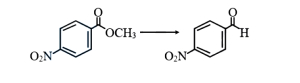
A
$CO, HCl / AlCl_3$
B
$CrO_2 Cl_2 \cdot H_3 O^{+}$
C
$AlH(i-Bu)_2, H_3 O^{+}$
D
$CrO_3, (CH_3 CO)_2 O$
Solution
(C) The given reaction is the reduction of an ester (methyl $4$-nitrobenzoate) to an aldehyde ($4$-nitrobenzaldehyde).
$DIBAL-H$ (Diisobutylaluminium hydride),represented as $AlH(i-Bu)_2$,is a selective reducing agent that reduces esters to aldehydes at low temperatures,followed by acidic workup $(H_3 O^{+})$.
Therefore,the correct reagent is $AlH(i-Bu)_2, H_3 O^{+}$.
$DIBAL-H$ (Diisobutylaluminium hydride),represented as $AlH(i-Bu)_2$,is a selective reducing agent that reduces esters to aldehydes at low temperatures,followed by acidic workup $(H_3 O^{+})$.
Therefore,the correct reagent is $AlH(i-Bu)_2, H_3 O^{+}$.
0 likesView Solution
74
ChemistryMediumMCQMHT CET · 2021
Which of the following reagents is used in the reaction shown below?
Benzoyl chloride $\stackrel{?}{\longrightarrow}$ Benzaldehyde
Benzoyl chloride $\stackrel{?}{\longrightarrow}$ Benzaldehyde
A
$DIBAL-H$
B
$SnCl_2 / HCl$
C
$H_2 / Pd-BaSO_4$
D
Dimethyl cadmium
Solution
(C) The reaction shown is the Rosenmund reduction,which is used to convert acid chlorides to aldehydes.
In this reaction,benzoyl chloride is hydrogenated using $H_2$ gas in the presence of a palladium catalyst supported on barium sulfate $(Pd-BaSO_4)$.
The $BaSO_4$ acts as a poison to prevent the further reduction of the aldehyde to an alcohol.
Therefore,the correct reagent is $H_2 / Pd-BaSO_4$.
In this reaction,benzoyl chloride is hydrogenated using $H_2$ gas in the presence of a palladium catalyst supported on barium sulfate $(Pd-BaSO_4)$.
The $BaSO_4$ acts as a poison to prevent the further reduction of the aldehyde to an alcohol.
Therefore,the correct reagent is $H_2 / Pd-BaSO_4$.
0 likesView Solution
75
ChemistryMediumMCQMHT CET · 2021
Identify the product formed when benzoyl chloride is reduced by hydrogen using a palladium catalyst poisoned with barium sulphate.
A
Chlorobenzene
B
Benzyl alcohol
C
Benzene
D
Benzaldehyde
Solution
(D) The reaction of benzoyl chloride with hydrogen in the presence of palladium $(Pd)$ catalyst supported on barium sulphate $(BaSO_4)$ is known as the Rosenmund reduction.
In this reaction,the acid chloride is selectively reduced to an aldehyde.
The chemical equation is:
$C_6H_5COCl + H_2 \xrightarrow{Pd/BaSO_4} C_6H_5CHO + HCl$
Thus,the product formed is benzaldehyde.
In this reaction,the acid chloride is selectively reduced to an aldehyde.
The chemical equation is:
$C_6H_5COCl + H_2 \xrightarrow{Pd/BaSO_4} C_6H_5CHO + HCl$
Thus,the product formed is benzaldehyde.
0 likesView Solution
76
ChemistryEasyMCQMHT CET · 2021
Which of the following reactions is an example of Rosenmund reduction?
A
$R-CO-R \xrightarrow[\text{ethylene glycol}]{\text{NH}_2-\text{NH}_2, \Delta, \text{KOH}} R-CH_2-R$
B
$R-CHO \xrightarrow[\Delta]{\text{Zn-Hg} / \text{conc. HCl}} R-CH_3$
C
$R-CO-Cl \xrightarrow[\text{Pd/BaSO}_4]{\text{H}_2} R-CHO + \text{HCl}$
D
$R-CN \xrightarrow[\text{H}_3\text{O}^+]{\text{SnCl}_2 / \text{HCl}} R-CHO + \text{NH}_4\text{Cl}$
Solution
(C) The Rosenmund reduction is a hydrogenation process where an acid chloride $(R-CO-Cl)$ is reduced to an aldehyde $(R-CHO)$ using hydrogen gas in the presence of a poisoned palladium catalyst,typically $Pd$ supported on $BaSO_4$. The reaction is: $R-CO-Cl + \text{H}_2 \xrightarrow{\text{Pd/BaSO}_4} R-CHO + \text{HCl}$. Therefore,option $C$ represents the Rosenmund reduction.
0 likesView Solution
77
ChemistryMediumMCQMHT CET · 2021
Identify the reagent used in the following conversion: $\text{Pent-3-enenitrile} \xrightarrow{A} \text{Pent-3-enal}$
A
$AlH(i-Bu)_2 / H_3O^{+}$
B
$K_2Cr_2O_7 / H_2SO_4$
C
$H_2 / Pd \cdot BaSO_4$
D
$SnCl_2 \cdot HCl$
Solution
(A) The conversion of a nitrile $(-CN)$ to an aldehyde $(-CHO)$ while preserving other functional groups like a double bond is achieved using Diisobutylaluminium hydride ($DIBAL-H$ or $AlH(i-Bu)_2$),followed by acid hydrolysis $(H_3O^{+})$.
$DIBAL-H$ is a selective reducing agent that reduces nitriles to imines,which upon hydrolysis yield aldehydes.
Therefore,the correct reagent is $AlH(i-Bu)_2 / H_3O^{+}$.
$DIBAL-H$ is a selective reducing agent that reduces nitriles to imines,which upon hydrolysis yield aldehydes.
Therefore,the correct reagent is $AlH(i-Bu)_2 / H_3O^{+}$.
0 likesView Solution
78
ChemistryEasyMCQMHT CET · 2021
Which among the following compounds has the highest boiling point?
A
Propanal
B
Ethanal
C
Pentanal
D
Hexanal
Solution
(D) The boiling point of aldehydes and ketones depends on the molecular mass and the strength of intermolecular forces.
As the carbon chain length increases,the molecular mass increases,which leads to an increase in the magnitude of van der Waals forces of attraction.
Among the given options,$Hexanal$ $(C_6H_{12}O)$ has the longest carbon chain and the highest molecular mass compared to $Propanal$ $(C_3H_6O)$,$Ethanal$ $(C_2H_4O)$,and $Pentanal$ $(C_5H_{10}O)$.
Therefore,$Hexanal$ has the highest boiling point.
As the carbon chain length increases,the molecular mass increases,which leads to an increase in the magnitude of van der Waals forces of attraction.
Among the given options,$Hexanal$ $(C_6H_{12}O)$ has the longest carbon chain and the highest molecular mass compared to $Propanal$ $(C_3H_6O)$,$Ethanal$ $(C_2H_4O)$,and $Pentanal$ $(C_5H_{10}O)$.
Therefore,$Hexanal$ has the highest boiling point.
0 likesView Solution
79
ChemistryMediumMCQMHT CET · 2021
Identify the product '$B$' in the following reaction:
$2 CH_3CHO$ $\xrightarrow{\text{dil. NaOH}} A$ $\xrightarrow[\Delta]{-H_2O} B$
$2 CH_3CHO$ $\xrightarrow{\text{dil. NaOH}} A$ $\xrightarrow[\Delta]{-H_2O} B$
A
But$-3-$enal
B
$3-$Hydroxybutanal
C
But$-2-$enal
D
$4-$Hydroxybutanal
Solution
(C) The reaction is an Aldol condensation followed by dehydration.
Step $1$: Two molecules of acetaldehyde $(CH_3CHO)$ react in the presence of dilute $NaOH$ to form $3-$hydroxybutanal $(A)$,which is $CH_3CH(OH)CH_2CHO$.
Step $2$: Upon heating with acid or base,$3-$hydroxybutanal undergoes dehydration (loss of $H_2O$) to form an $\alpha,\beta-$unsaturated aldehyde,which is but$-2-$enal $(CH_3CH=CHCHO)$,also known as crotonaldehyde.
Therefore,the product '$B$' is but$-2-$enal.
Step $1$: Two molecules of acetaldehyde $(CH_3CHO)$ react in the presence of dilute $NaOH$ to form $3-$hydroxybutanal $(A)$,which is $CH_3CH(OH)CH_2CHO$.
Step $2$: Upon heating with acid or base,$3-$hydroxybutanal undergoes dehydration (loss of $H_2O$) to form an $\alpha,\beta-$unsaturated aldehyde,which is but$-2-$enal $(CH_3CH=CHCHO)$,also known as crotonaldehyde.
Therefore,the product '$B$' is but$-2-$enal.
0 likesView Solution
80
ChemistryEasyMCQMHT CET · 2021
Which of the following aldehydes is less reactive towards nucleophilic addition reaction?
A
Benzaldehyde
B
Formaldehyde
C
Acetaldehyde
D
Butyraldehyde
Solution
(A) The reactivity of aldehydes towards nucleophilic addition reactions depends on two main factors: steric hindrance and electronic effects.
$1$. Steric hindrance: As the size of the alkyl group attached to the carbonyl carbon increases,the attack of the nucleophile becomes more difficult.
$2$. Electronic effects: Electron-donating groups ($+I$ or $+M$ effect) decrease the electrophilicity of the carbonyl carbon,thereby reducing reactivity.
In $C_6H_5CHO$ (Benzaldehyde),the phenyl group is bulky (high steric hindrance) and also exerts a $+M$ effect (resonance),which stabilizes the carbonyl carbon and reduces its electrophilicity.
Therefore,the decreasing order of reactivity is: $HCHO > CH_3CHO > CH_3CH_2CH_2CHO > C_6H_5CHO$.
Thus,$C_6H_5CHO$ is the least reactive.
$1$. Steric hindrance: As the size of the alkyl group attached to the carbonyl carbon increases,the attack of the nucleophile becomes more difficult.
$2$. Electronic effects: Electron-donating groups ($+I$ or $+M$ effect) decrease the electrophilicity of the carbonyl carbon,thereby reducing reactivity.
In $C_6H_5CHO$ (Benzaldehyde),the phenyl group is bulky (high steric hindrance) and also exerts a $+M$ effect (resonance),which stabilizes the carbonyl carbon and reduces its electrophilicity.
Therefore,the decreasing order of reactivity is: $HCHO > CH_3CHO > CH_3CH_2CH_2CHO > C_6H_5CHO$.
Thus,$C_6H_5CHO$ is the least reactive.
0 likesView Solution
81
ChemistryEasyMCQMHT CET · 2021
Which of the following aldehydes has a buttery odour?
A
Crotonaldehyde
B
Benzaldehyde
C
Butyraldehyde
D
Cinnamaldehyde
Solution
(C) Butyraldehyde $(CH_3CH_2CH_2CHO)$ is known for its characteristic buttery or rancid butter-like odour.
0 likesView Solution
82
ChemistryEasyMCQMHT CET · 2021
Identify product $B$ in the following reaction: $\text{Propanone}$ $\xrightarrow{\text{Ba(OH)}_2} A$ $\xrightarrow{\Delta, -\text{H}_2\text{O}} B$
A
$2-$Methylpentan$-3-$one
B
$4-$Hydroxy$-4-$methylpentan$-2-$one
C
$4-$Methylpent$-3-$en$-2-$one
D
$2-$Methylpent$-2-$en$-4-$one
Solution
(C) The reaction of propanone with $\text{Ba(OH)}_2$ is an aldol condensation reaction.
Two molecules of propanone undergo self-aldol condensation to form $4-$hydroxy$-4-$methylpentan$-2-$one (product $A$).
Upon heating $(A)$,it undergoes dehydration (loss of water) to form an $\alpha,\beta-$unsaturated ketone,which is $4-$methylpent$-3-$en$-2-$one (product $B$).
Two molecules of propanone undergo self-aldol condensation to form $4-$hydroxy$-4-$methylpentan$-2-$one (product $A$).
Upon heating $(A)$,it undergoes dehydration (loss of water) to form an $\alpha,\beta-$unsaturated ketone,which is $4-$methylpent$-3-$en$-2-$one (product $B$).
0 likesView Solution
83
ChemistryMediumMCQMHT CET · 2021
How many molecules of methyl iodide are required to obtain tetramethyl ammonium iodide from dimethyl amine?
A
$1$
B
$3$
C
$2$
D
$4$
Solution
(C) The reaction of dimethylamine $(CH_3)_2NH$ with methyl iodide $(CH_3I)$ proceeds via nucleophilic substitution (Hofmann alkylation).
Step $1$: $(CH_3)_2NH + CH_3I \rightarrow (CH_3)_3N + HI$
Step $2$: $(CH_3)_3N + CH_3I \rightarrow (CH_3)_4N^{+}I^{-}$
Thus,a total of $2$ molecules of methyl iodide are required to convert dimethylamine into tetramethylammonium iodide.
Step $1$: $(CH_3)_2NH + CH_3I \rightarrow (CH_3)_3N + HI$
Step $2$: $(CH_3)_3N + CH_3I \rightarrow (CH_3)_4N^{+}I^{-}$
Thus,a total of $2$ molecules of methyl iodide are required to convert dimethylamine into tetramethylammonium iodide.
0 likesView Solution
84
ChemistryEasyMCQMHT CET · 2021
Which among the following statements is $NOT$ true about Gabriel phthalimide synthesis?
A
In this method,the formation of $N$-alkyl phthalimide is involved.
B
In this method,sodium phthalate is also obtained.
C
This method is useful for the preparation of aromatic amines.
D
In this method,the potassium salt of phthalimide is formed as an intermediate product.
Solution
(C) Gabriel phthalimide synthesis is used for the preparation of primary aliphatic amines.
It cannot be used for the preparation of aromatic amines because aryl halides do not undergo nucleophilic substitution with the anion formed by phthalimide due to the partial double bond character of the $C-X$ bond and the instability of the phenyl cation.
It cannot be used for the preparation of aromatic amines because aryl halides do not undergo nucleophilic substitution with the anion formed by phthalimide due to the partial double bond character of the $C-X$ bond and the instability of the phenyl cation.
0 likesView Solution
85
ChemistryMediumMCQMHT CET · 2021
Identify the compound from the following having the lowest boiling point.
A
$n-C_4H_9NH_2$
B
$C_2H_5CH(CH_3)_2$
C
$C_2H_5N(CH_3)_2$
D
$(C_2H_5)_2NH$
Solution
(B) The boiling point of compounds depends on intermolecular forces such as hydrogen bonding and molar mass.
$1$. Primary amines $(n-C_4H_9NH_2)$ and secondary amines $((C_2H_5)_2NH)$ can form intermolecular hydrogen bonds,leading to higher boiling points.
$2$. Tertiary amines $(C_2H_5N(CH_3)_2)$ cannot form intermolecular hydrogen bonds because they lack a hydrogen atom attached to the nitrogen.
$3$. Alkanes $(C_2H_5CH(CH_3)_2)$ have only weak van der Waals forces.
$4$. Comparing $C_2H_5N(CH_3)_2$ (molar mass $\approx 73 \ g/mol$) and $C_2H_5CH(CH_3)_2$ (molar mass $\approx 72 \ g/mol$),the tertiary amine has a higher boiling point due to the dipole-dipole interaction of the $C-N$ bond compared to the non-polar alkane.
$5$. Therefore,$C_2H_5CH(CH_3)_2$ has the lowest boiling point.
$1$. Primary amines $(n-C_4H_9NH_2)$ and secondary amines $((C_2H_5)_2NH)$ can form intermolecular hydrogen bonds,leading to higher boiling points.
$2$. Tertiary amines $(C_2H_5N(CH_3)_2)$ cannot form intermolecular hydrogen bonds because they lack a hydrogen atom attached to the nitrogen.
$3$. Alkanes $(C_2H_5CH(CH_3)_2)$ have only weak van der Waals forces.
$4$. Comparing $C_2H_5N(CH_3)_2$ (molar mass $\approx 73 \ g/mol$) and $C_2H_5CH(CH_3)_2$ (molar mass $\approx 72 \ g/mol$),the tertiary amine has a higher boiling point due to the dipole-dipole interaction of the $C-N$ bond compared to the non-polar alkane.
$5$. Therefore,$C_2H_5CH(CH_3)_2$ has the lowest boiling point.
0 likesView Solution
86
ChemistryMediumMCQMHT CET · 2021
What is the number of moles of $H$ atoms required to prepare one mole of ethylamine from one mole of acetamide?
A
$2$
B
$4$
C
$3$
D
$1$
Solution
(B) The reduction of acetamide $(CH_3CONH_2)$ to ethylamine $(CH_3CH_2NH_2)$ using a strong reducing agent like $LiAlH_4$ or $Na/C_2H_5OH$ is represented by the following chemical equation:
$CH_3CONH_2 + 4[H] \xrightarrow{LiAlH_4/ether} CH_3CH_2NH_2 + H_2O$
From the stoichiometry of the reaction,it is clear that $4$ moles of nascent hydrogen $([H])$ are required to reduce $1$ mole of acetamide to $1$ mole of ethylamine.
Therefore,the correct option is $B$.
$CH_3CONH_2 + 4[H] \xrightarrow{LiAlH_4/ether} CH_3CH_2NH_2 + H_2O$
From the stoichiometry of the reaction,it is clear that $4$ moles of nascent hydrogen $([H])$ are required to reduce $1$ mole of acetamide to $1$ mole of ethylamine.
Therefore,the correct option is $B$.
0 likesView Solution
87
ChemistryMediumMCQMHT CET · 2021
Which among the following carbohydrates is a trisaccharide?
A
Ribose
B
Raffinose
C
Glycogen
D
Stachyose
Solution
(B) trisaccharide is a carbohydrate that yields three monosaccharide units upon hydrolysis.
$Raffinose$ is a trisaccharide composed of galactose,glucose,and fructose units.
$Raffinose$ is a trisaccharide composed of galactose,glucose,and fructose units.
0 likesView Solution
88
ChemistryMediumMCQMHT CET · 2021
Which carbon atom of ribose sugar is joined to the nitrogen base to form a nucleoside?
A
$C-2$
B
$C-5$
C
$C-3$
D
$C-1$
Solution
(D) In a nucleoside,the nitrogenous base is attached to the $C-1$ position of the ribose sugar via a $\beta$-glycosidic linkage.
0 likesView Solution
89
ChemistryEasyMCQMHT CET · 2021
The units of monosaccharide present in raffinose are
A
Two Galactose and one Fructose
B
Two Fructose and one Glucose
C
Two Glucose and one Fructose
D
Glucose,Fructose and Galactose (one unit of each)
Solution
(D) Raffinose is a trisaccharide with the molecular formula $C_{18}H_{32}O_{16}$. Upon hydrolysis,it yields one molecule of each of the following monosaccharides: $D$-Glucose,$D$-Fructose,and $D$-Galactose.
0 likesView Solution
90
ChemistryEasyMCQMHT CET · 2021
Which of the following is an aldohexose?
A
Ribose
B
Glucose
C
Fructose
D
Threose
Solution
(B) An aldohexose is a monosaccharide containing six carbon atoms and an aldehyde group $(-CHO)$.
Glucose has the molecular formula $C_6H_{12}O_6$ and contains an aldehyde group at the $C-1$ position,making it an aldohexose.
Ribose is an aldopentose $(C_5H_{10}O_5)$.
Fructose is a ketohexose $(C_6H_{12}O_6)$ containing a ketone group.
Threose is an aldotetrose $(C_4H_8O_4)$.
Glucose has the molecular formula $C_6H_{12}O_6$ and contains an aldehyde group at the $C-1$ position,making it an aldohexose.
Ribose is an aldopentose $(C_5H_{10}O_5)$.
Fructose is a ketohexose $(C_6H_{12}O_6)$ containing a ketone group.
Threose is an aldotetrose $(C_4H_8O_4)$.
0 likesView Solution
91
ChemistryMediumMCQMHT CET · 2021
Glucose and gluconic acid on oxidation with dilute nitric acid $(HNO_3)$ form saccharic acid. This reaction confirms that glucose contains:
A
four primary alcoholic groups
B
two primary alcoholic groups
C
one primary alcoholic group
D
five hydroxyl groups
Solution
(C) Glucose $(CHO-(CHOH)_4-CH_2OH)$ and gluconic acid $(COOH-(CHOH)_4-CH_2OH)$ both undergo oxidation with dilute $HNO_3$ to form saccharic acid $(COOH-(CHOH)_4-COOH)$.
In this reaction,the terminal primary alcoholic group $(-CH_2OH)$ is oxidized to a carboxylic acid group $(-COOH)$.
Since only one $-CH_2OH$ group is present in the glucose molecule and it gets converted to $-COOH$,this reaction confirms the presence of one primary alcoholic group in glucose.
In this reaction,the terminal primary alcoholic group $(-CH_2OH)$ is oxidized to a carboxylic acid group $(-COOH)$.
Since only one $-CH_2OH$ group is present in the glucose molecule and it gets converted to $-COOH$,this reaction confirms the presence of one primary alcoholic group in glucose.
0 likesView Solution
92
ChemistryMediumMCQMHT CET · 2021
Identify the hydrolysis product of starch.
A
$Glucose$
B
$Fructose$
C
$Galactose$
D
$Ribose$
Solution
(A) Starch is a polysaccharide that acts as the main storage carbohydrate in plants.
Upon complete hydrolysis,starch breaks down into its monomeric units.
The monomeric unit of starch is $\alpha-D-glucose$.
Upon complete hydrolysis,starch breaks down into its monomeric units.
The monomeric unit of starch is $\alpha-D-glucose$.
0 likesView Solution
93
ChemistryMediumMCQMHT CET · 2021
Which reagent oxidizes glucose to saccharic acid?
A
Dil. $HNO_3$
B
$NH_2OH$
C
$HCN$
D
$Br_2$ water
Solution
(A) Glucose $(CHO(CHOH)_4CH_2OH)$ on oxidation with strong oxidizing agents like dilute nitric acid $(HNO_3)$ gets oxidized to a dicarboxylic acid known as saccharic acid (or glucaric acid).
The reaction is:
$CHO(CHOH)_4CH_2OH + [O] \xrightarrow{\text{Dil. } HNO_3} COOH(CHOH)_4COOH$
Thus,dilute $HNO_3$ is the correct reagent.
The reaction is:
$CHO(CHOH)_4CH_2OH + [O] \xrightarrow{\text{Dil. } HNO_3} COOH(CHOH)_4COOH$
Thus,dilute $HNO_3$ is the correct reagent.
0 likesView Solution
94
ChemistryMediumMCQMHT CET · 2021
Which of the following enzymes is useful in the conversion of glucose to fructose?
A
Invertase
B
Glucose isomerase
C
Amylase
D
Proteases
Solution
(B) $Glucose$ $(xylose)$ $isomerase$ catalyzes the reversible isomerization of $glucose$ to $fructose$ and that of $xylose$ to $xylulose$.
It is an important enzyme used in the industrial production of high-$fructose$ corn syrup.
It is an important enzyme used in the industrial production of high-$fructose$ corn syrup.
0 likesView Solution
95
ChemistryMediumMCQMHT CET · 2021
Identify the reagent $R$ used in the following conversion: $\text{Glucose} \xrightarrow{R} n-\text{hexane}$
A
$HI, \Delta$
B
$NH_2OH$
C
$HCN$
D
$HNO_3$
Solution
(A) When glucose is heated with concentrated $HI$ (hydroiodic acid) for a long time,it undergoes reduction to form $n$-hexane.
This reaction confirms the presence of a straight chain of six carbon atoms in the glucose molecule.
The reaction is as follows:
$CHO-(CHOH)_4-CH_2OH \xrightarrow{HI, \Delta} CH_3-(CH_2)_4-CH_3$ (n-hexane).
This reaction confirms the presence of a straight chain of six carbon atoms in the glucose molecule.
The reaction is as follows:
$CHO-(CHOH)_4-CH_2OH \xrightarrow{HI, \Delta} CH_3-(CH_2)_4-CH_3$ (n-hexane).
0 likesView Solution
96
ChemistryEasyMCQMHT CET · 2021
Which of the following reagents is used to identify the straight chain of glucose?
A
$HI$
B
Dil. $HNO_3$
C
$HCN$
D
Acetic anhydride
Solution
(A) When glucose is heated with $HI$ (hydroiodic acid) and red phosphorus,it undergoes reduction to form $n$-hexane $(CH_3(CH_2)_4CH_3)$.
This reaction confirms that the six carbon atoms in glucose are linked in a straight chain.
This reaction confirms that the six carbon atoms in glucose are linked in a straight chain.
0 likesView Solution
97
ChemistryMediumMCQMHT CET · 2021
Which of the following compounds is obtained when glucose is treated with dilute nitric acid?
A
Glucose oxime
B
Gluconic acid
C
Saccharic acid
D
Glucose cyanohydrin
Solution
(C) When glucose is treated with dilute nitric acid $(HNO_3)$,both the aldehyde group $(-CHO)$ and the primary alcoholic group $(-CH_2OH)$ are oxidized to carboxylic acid groups $(-COOH)$.
This reaction results in the formation of a dicarboxylic acid known as saccharic acid (also called glucaric acid).
The reaction is represented as:
$CHO-(CHOH)_4-CH_2OH + [O] \xrightarrow{Dil. HNO_3} COOH-(CHOH)_4-COOH$
Thus,the correct product is saccharic acid.
This reaction results in the formation of a dicarboxylic acid known as saccharic acid (also called glucaric acid).
The reaction is represented as:
$CHO-(CHOH)_4-CH_2OH + [O] \xrightarrow{Dil. HNO_3} COOH-(CHOH)_4-COOH$
Thus,the correct product is saccharic acid.
0 likesView Solution
98
ChemistryMediumMCQMHT CET · 2021
Which of the following is used for the synthesis of adipic acid enzymatically by $Drath$ and $Frost$?
A
Benzene
B
Glucose
C
Fructose
D
Galactose
Solution
(B) The synthesis of adipic acid from renewable resources was developed by $Drath$ and $Frost$ using an engineered strain of $Escherichia \text{ } coli$. The process utilizes $Glucose$ as the primary carbon source to produce adipic acid through a microbial fermentation pathway.
0 likesView Solution
99
ChemistryEasyMCQMHT CET · 2021
Identify the glycosidic linkage present in lactose.
A
$\beta-1,2$
B
$\alpha-1,4$
C
$\beta-1,4$
D
$\beta-1,6$
Solution
(C) Lactose is a disaccharide composed of $\beta-D-galactose$ and $\beta-D-glucose$.
The glycosidic linkage is formed between the $C-1$ of $\beta-D-galactose$ and the $C-4$ of $\beta-D-glucose$.
Therefore,the linkage is a $\beta-1,4-glycosidic$ linkage.
The glycosidic linkage is formed between the $C-1$ of $\beta-D-galactose$ and the $C-4$ of $\beta-D-glucose$.
Therefore,the linkage is a $\beta-1,4-glycosidic$ linkage.
0 likesView Solution
100
ChemistryMediumMCQMHT CET · 2021
Which of the following sugars is found in milk?
A
Sucrose
B
Maltose
C
Lactose
D
Fructose
Solution
(C) Lactose is a disaccharide sugar composed of galactose and glucose units. It is commonly known as milk sugar because it is found in the milk of mammals.
0 likesView Solution
Vedclass Products
For Students
Vedclass Test Series
Mock tests in real MHT CET style covering Chemistry with performance analysis. 5-day free trial.
Start Free TrialFor Teachers
Exam Paper Generator
Generate Set A/B/C/D Chemistry papers from 7.5L+ questions in 2 minutes. 3 chapters free.
Try FreeFor Institutes
Online Exam Module
Run live MHT CET mock exams with unlimited students, 360° analytics & white-label branding.
See DemoFrequently Asked Questions
How many Chemistry questions are in MHT CET 2021?
There are 563 Chemistry questions from the MHT CET 2021 paper on Vedclass, each with a detailed step-by-step solution in English.
Are MHT CET 2021 Chemistry solutions available in English?
Yes. All solutions on this page are in English. You can also switch to English or Hindi using the language buttons above the questions.
Can I practice MHT CET 2021 Chemistry as a timed test?
Yes. Use the Vedclass Test Series to attempt a full MHT CET mock test covering Chemistry with time limits and instant score analysis.
Can teachers create Chemistry papers from MHT CET previous year questions?
Yes. The Vedclass Exam Paper Generator lets teachers mix MHT CET Chemistry questions and generate Set A/B/C/D papers in minutes.
For Teachers & Institutes
Build a Custom Chemistry Paper
Pick MHT CET 2021 Chemistry questions, set difficulty, and generate Set A/B/C/D in 2 minutes.