
ChemistryQ151–250 of 772 questions
Page 4 of 10 · English
151
ChemistryEasyMCQMHT CET · 2020
The units nanometer and picometer are related as,
A
$1 \ nm = 10^{3} \ pm$
B
$1 \ nm = 10^{-9} \ pm$
C
$1 \ nm = 10^{-12} \ pm$
D
$1 \ nm = 10^{-3} \ pm$
Solution
$(A)$ We know that $1 \ nm = 10^{-9} \ m$ and $1 \ pm = 10^{-12} \ m$.
To find the relationship between $nm$ and $pm$, we divide the two values:
$\frac{1 \ nm}{1 \ pm} = \frac{10^{-9} \ m}{10^{-12} \ m} = 10^{-9 - (-12)} = 10^{3}$.
Therefore, $1 \ nm = 10^{3} \ pm$.
To find the relationship between $nm$ and $pm$, we divide the two values:
$\frac{1 \ nm}{1 \ pm} = \frac{10^{-9} \ m}{10^{-12} \ m} = 10^{-9 - (-12)} = 10^{3}$.
Therefore, $1 \ nm = 10^{3} \ pm$.
0 likesView Solution
152
ChemistryEasyMCQMHT CET · 2020
If two moles of an ideal gas at $546 \ K$ occupy a volume of $44.8 \ L$,what is the pressure of the ideal gas at $546 \ K$ (in $atm$)? $(R = 0.0821 \ L \ atm \ mol^{-1} \ K^{-1})$
A
$2.0$
B
$0.2$
C
$0.5$
D
$1.0$
Solution
(A) Given: $n = 2 \ mol$,$T = 546 \ K$,$V = 44.8 \ L$,$R = 0.0821 \ L \ atm \ mol^{-1} \ K^{-1}$.
According to the ideal gas equation,$PV = nRT$.
Therefore,$P = \frac{nRT}{V}$.
Substituting the values: $P = \frac{2 \times 0.0821 \times 546}{44.8}$.
$P = \frac{89.6532}{44.8} \approx 2.0 \ atm$.
According to the ideal gas equation,$PV = nRT$.
Therefore,$P = \frac{nRT}{V}$.
Substituting the values: $P = \frac{2 \times 0.0821 \times 546}{44.8}$.
$P = \frac{89.6532}{44.8} \approx 2.0 \ atm$.
0 likesView Solution
153
ChemistryMediumMCQMHT CET · 2020
$A$ certain sample of gas has a volume of $0.2 \ L$ at one atmosphere pressure and $273.15 \ K$. What is the volume of gas at $273.15 \ ^{\circ}C$ at the same pressure (in $L$)?
A
$2.703$
B
$0.2$
C
$0.4$
D
$5.406$
Solution
(C) Given: $V_{1} = 0.2 \ L$,$T_{1} = 273.15 \ K$.
The final temperature is $T_{2} = 273.15 \ ^{\circ}C = 273.15 + 273.15 = 546.30 \ K$.
According to Charles's Law,at constant pressure $(P)$ and amount of gas $(n)$:
$\frac{V_{1}}{T_{1}} = \frac{V_{2}}{T_{2}}$
Substituting the values:
$V_{2} = \frac{V_{1} \times T_{2}}{T_{1}} = \frac{0.2 \times 546.30}{273.15} = 0.4 \ L$.
The final temperature is $T_{2} = 273.15 \ ^{\circ}C = 273.15 + 273.15 = 546.30 \ K$.
According to Charles's Law,at constant pressure $(P)$ and amount of gas $(n)$:
$\frac{V_{1}}{T_{1}} = \frac{V_{2}}{T_{2}}$
Substituting the values:
$V_{2} = \frac{V_{1} \times T_{2}}{T_{1}} = \frac{0.2 \times 546.30}{273.15} = 0.4 \ L$.
0 likesView Solution
154
ChemistryMediumMCQMHT CET · 2020
$A$ gas has a volume of $3.4 \ L$ at $25^{\circ} C$. What is the final temperature if the volume increases to $10.2 \ L$ at constant pressure (in $K$)?
A
$1894$
B
$694$
C
$894$
D
$394$
Solution
(C) Given: $V_{1} = 3.4 \ L$,$T_{1} = 25^{\circ} C = 25 + 273 = 298 \ K$.
$V_{2} = 10.2 \ L$,$T_{2} = ?$.
According to Charles's Law,at constant pressure and amount of gas,$\frac{V_{1}}{T_{1}} = \frac{V_{2}}{T_{2}}$.
Substituting the values: $\frac{3.4 \ L}{298 \ K} = \frac{10.2 \ L}{T_{2}}$.
$T_{2} = \frac{10.2 \ L \times 298 \ K}{3.4 \ L} = 3 \times 298 \ K = 894 \ K$.
$V_{2} = 10.2 \ L$,$T_{2} = ?$.
According to Charles's Law,at constant pressure and amount of gas,$\frac{V_{1}}{T_{1}} = \frac{V_{2}}{T_{2}}$.
Substituting the values: $\frac{3.4 \ L}{298 \ K} = \frac{10.2 \ L}{T_{2}}$.
$T_{2} = \frac{10.2 \ L \times 298 \ K}{3.4 \ L} = 3 \times 298 \ K = 894 \ K$.
0 likesView Solution
155
ChemistryEasyMCQMHT CET · 2020
$A$ certain mass of a gas occupies a volume of $2 \ dm^{3}$ at $STP$. At what temperature will the volume of the gas become double,keeping the pressure constant (in $^{\circ} C$)?
A
$540.15$
B
$400.15$
C
$546.15$
D
$273.15$
Solution
(D) Given: $V_{1} = 2 \ dm^{3}$,$T_{1} = 273.15 \ K$ (at $STP$).
We need to find $T_{2}$ when $V_{2} = 2 \times V_{1} = 4 \ dm^{3}$ at constant pressure.
According to Charles's law,$\frac{V_{1}}{T_{1}} = \frac{V_{2}}{T_{2}}$.
Substituting the values: $\frac{2}{273.15} = \frac{4}{T_{2}}$.
$T_{2} = \frac{4 \times 273.15}{2} = 546.3 \ K$.
To convert to Celsius: $t^{\circ} C = T(K) - 273.15$.
$t^{\circ} C = 546.3 - 273.15 = 273.15^{\circ} C$.
We need to find $T_{2}$ when $V_{2} = 2 \times V_{1} = 4 \ dm^{3}$ at constant pressure.
According to Charles's law,$\frac{V_{1}}{T_{1}} = \frac{V_{2}}{T_{2}}$.
Substituting the values: $\frac{2}{273.15} = \frac{4}{T_{2}}$.
$T_{2} = \frac{4 \times 273.15}{2} = 546.3 \ K$.
To convert to Celsius: $t^{\circ} C = T(K) - 273.15$.
$t^{\circ} C = 546.3 - 273.15 = 273.15^{\circ} C$.
0 likesView Solution
156
ChemistryMediumMCQMHT CET · 2020
At what new pressure will $100 \ mL$ of a gas at a pressure of $720 \ mm$ occupy a volume of $84 \ mL$,keeping the temperature constant (in $mm$)?
A
$857.14$
B
$712.14$
C
$816.60$
D
$604.82$
Solution
(A) According to Boyle's law,at constant temperature,$P_1 V_1 = P_2 V_2$.
Given: $P_1 = 720 \ mm$,$V_1 = 100 \ mL$,$V_2 = 84 \ mL$.
Substituting the values into the equation: $P_2 = \frac{P_1 V_1}{V_2}$.
$P_2 = \frac{720 \times 100}{84} = \frac{72000}{84} \approx 857.14 \ mm$.
Given: $P_1 = 720 \ mm$,$V_1 = 100 \ mL$,$V_2 = 84 \ mL$.
Substituting the values into the equation: $P_2 = \frac{P_1 V_1}{V_2}$.
$P_2 = \frac{720 \times 100}{84} = \frac{72000}{84} \approx 857.14 \ mm$.
0 likesView Solution
157
ChemistryEasyMCQMHT CET · 2020
According to Andrews isothermals,the minimum temperature at which carbon dioxide gas obeys Boyle's law is (in $^{\circ}C$)
A
$32.5$
B
$31.1$
C
$48.1$
D
$35.5$
Solution
(B) According to Andrews' experiments on carbon dioxide,the gas obeys Boyle's law only at temperatures above its critical temperature.
For carbon dioxide,the critical temperature $(T_c)$ is $31.1^{\circ}C$.
At temperatures below $31.1^{\circ}C$,the gas can be liquefied by pressure,and it deviates significantly from ideal gas behavior.
Therefore,the minimum temperature at which $CO_2$ behaves like an ideal gas (obeying Boyle's law) is its critical temperature,which is $31.1^{\circ}C$.
For carbon dioxide,the critical temperature $(T_c)$ is $31.1^{\circ}C$.
At temperatures below $31.1^{\circ}C$,the gas can be liquefied by pressure,and it deviates significantly from ideal gas behavior.
Therefore,the minimum temperature at which $CO_2$ behaves like an ideal gas (obeying Boyle's law) is its critical temperature,which is $31.1^{\circ}C$.
0 likesView Solution
158
ChemistryEasyMCQMHT CET · 2020
If $2$ moles of an ideal gas at $546 \ K$ has a volume of $44.8 \ L$,then what will be its pressure (in $atm$)? $(R=0.082 \ L \ atm \ K^{-1} \ mol^{-1})$
A
$1.998$
B
$1.098$
C
$2.408$
D
$3.129$
Solution
(A) Given: $n=2 \ mol$,$T=546 \ K$,$V=44.8 \ L$,$R=0.082 \ L \ atm \ K^{-1} \ mol^{-1}$.
According to the ideal gas equation,$PV=nRT$.
Substituting the values: $P = \frac{nRT}{V} = \frac{2 \times 0.082 \times 546}{44.8}$.
$P = \frac{89.544}{44.8} \approx 1.998 \ atm$.
Therefore,the correct option is $A$.
According to the ideal gas equation,$PV=nRT$.
Substituting the values: $P = \frac{nRT}{V} = \frac{2 \times 0.082 \times 546}{44.8}$.
$P = \frac{89.544}{44.8} \approx 1.998 \ atm$.
Therefore,the correct option is $A$.
0 likesView Solution
159
ChemistryEasyMCQMHT CET · 2020
At what temperature does the volume of a gas become theoretically zero?
A
$273.15^{\circ} C$
B
$-273.15 \ K$
C
$273.15 \ K$
D
$-273.15^{\circ} C$
Solution
(D) According to Charles's Law,the volume of a fixed mass of gas is directly proportional to its absolute temperature $(V \propto T)$.
As the temperature decreases,the volume of the gas decreases.
At a temperature of $-273.15^{\circ} C$ (which is $0 \ K$),the volume of a gas theoretically becomes zero.
This temperature is known as absolute zero.
As the temperature decreases,the volume of the gas decreases.
At a temperature of $-273.15^{\circ} C$ (which is $0 \ K$),the volume of a gas theoretically becomes zero.
This temperature is known as absolute zero.
0 likesView Solution
160
ChemistryEasyMCQMHT CET · 2020
What is the $SI$ unit of viscosity?
A
$Kg \ s^{-1}$
B
$N \ s \ m^{-2}$
C
$Kg \ s^{2}$
D
$N \ m^{-1}$
Solution
(B) The $SI$ unit of viscosity is the Pascal-second $(Pa \ s)$,which is equivalent to $N \ s \ m^{-2}$ or $Kg \ m^{-1} \ s^{-1}$.
Therefore,the correct option is $(B)$.
Therefore,the correct option is $(B)$.
0 likesView Solution
161
ChemistryEasyMCQMHT CET · 2020
Volume of a balloon at $25^{\circ} C$ and $1 \ bar$ pressure is $2.27 \ L$. If the pressure of the gas in the balloon is reduced to $0.227 \ bar$,what is the rise in volume of the gas (in $L$)?
A
$12.27$
B
$7.73$
C
$10$
D
$4.10$
Solution
(B) Given: $P_{1} = 1 \ bar$,$V_{1} = 2.27 \ L$,$P_{2} = 0.227 \ bar$.
According to Boyle's Law,$P_{1}V_{1} = P_{2}V_{2}$ at constant temperature.
Substituting the values: $1 \ bar \times 2.27 \ L = 0.227 \ bar \times V_{2}$.
$V_{2} = \frac{1 \times 2.27}{0.227} = 10 \ L$.
The rise in volume of the gas is $\Delta V = V_{2} - V_{1} = 10 \ L - 2.27 \ L = 7.73 \ L$.
According to Boyle's Law,$P_{1}V_{1} = P_{2}V_{2}$ at constant temperature.
Substituting the values: $1 \ bar \times 2.27 \ L = 0.227 \ bar \times V_{2}$.
$V_{2} = \frac{1 \times 2.27}{0.227} = 10 \ L$.
The rise in volume of the gas is $\Delta V = V_{2} - V_{1} = 10 \ L - 2.27 \ L = 7.73 \ L$.
0 likesView Solution
162
ChemistryEasyMCQMHT CET · 2020
According to Andrews isothermals,at what temperature does carbon dioxide gas start to condense at $73 \ atm$ (in $^{\circ} C$)?
A
$21.5$
B
$30.98$
C
$13.1$
D
$48.1$
Solution
(B) According to Andrews' experiments on $CO_2$ isotherms,the critical pressure $(P_C)$ of carbon dioxide is $73 \ atm$.
At this critical pressure,the temperature at which the gas starts to condense (or the temperature at which the gas becomes indistinguishable from its liquid phase) is known as the critical temperature $(T_C)$.
For $CO_2$,the critical temperature $(T_C)$ is $30.98^{\circ} C$.
At this critical pressure,the temperature at which the gas starts to condense (or the temperature at which the gas becomes indistinguishable from its liquid phase) is known as the critical temperature $(T_C)$.
For $CO_2$,the critical temperature $(T_C)$ is $30.98^{\circ} C$.
0 likesView Solution
163
ChemistryMediumMCQMHT CET · 2020
Which among the following gases liquefy easily?
A
Oxygen
B
Helium
C
Chlorine
D
Nitrogen
Solution
(C) Gases with higher critical temperatures and stronger intermolecular forces of attraction are easier to liquefy.
Among the given options,$Cl_{2}$ (chlorine) has a relatively high critical temperature $(417 \ K)$ and strong van der Waals forces,making it easy to liquefy.
In contrast,gases like $O_{2}$,$N_{2}$,and $He$ have very low critical temperatures and are considered permanent gases,which are difficult to liquefy at room temperature.
Among the given options,$Cl_{2}$ (chlorine) has a relatively high critical temperature $(417 \ K)$ and strong van der Waals forces,making it easy to liquefy.
In contrast,gases like $O_{2}$,$N_{2}$,and $He$ have very low critical temperatures and are considered permanent gases,which are difficult to liquefy at room temperature.
0 likesView Solution
164
ChemistryEasyMCQMHT CET · 2020
Which among the following is the heaviest isotope of water?
A
$T_{2}{ }^{17}O$
B
$T_{2}{ }^{16}O$
C
$HD^{18}O$
D
$T_{2}{ }^{18}O$
Solution
(D) The molecular weight of water isotopes depends on the mass of the hydrogen isotopes $(H=1, D=2, T=3)$ and oxygen isotopes $(^{16}O=16, ^{17}O=17, ^{18}O=18)$.
Calculating the molar mass for each option:
$A$. $T_{2}{ }^{17}O = (3 \times 2) + 17 = 23 \ g/mol$
$B$. $T_{2}{ }^{16}O = (3 \times 2) + 16 = 22 \ g/mol$
$C$. $HD^{18}O = (1 + 2) + 18 = 21 \ g/mol$
$D$. $T_{2}{ }^{18}O = (3 \times 2) + 18 = 24 \ g/mol$
Comparing the values,$T_{2}{ }^{18}O$ has the highest molecular weight,making it the heaviest isotope of water.
Calculating the molar mass for each option:
$A$. $T_{2}{ }^{17}O = (3 \times 2) + 17 = 23 \ g/mol$
$B$. $T_{2}{ }^{16}O = (3 \times 2) + 16 = 22 \ g/mol$
$C$. $HD^{18}O = (1 + 2) + 18 = 21 \ g/mol$
$D$. $T_{2}{ }^{18}O = (3 \times 2) + 18 = 24 \ g/mol$
Comparing the values,$T_{2}{ }^{18}O$ has the highest molecular weight,making it the heaviest isotope of water.
0 likesView Solution
165
ChemistryMediumMCQMHT CET · 2020
Identify the element if its expected electronic configuration is $[Ar] 3d^{10} 4s^{2}$.
A
$Hg$
B
$Co$
C
$Cd$
D
$Zn$
Solution
(D) The given electronic configuration is $[Ar] 3d^{10} 4s^{2}$.
Summing the electrons: $18 (Ar) + 10 (3d) + 2 (4s) = 30$.
The atomic number $Z = 30$ corresponds to the element Zinc $(Zn)$.
Summing the electrons: $18 (Ar) + 10 (3d) + 2 (4s) = 30$.
The atomic number $Z = 30$ corresponds to the element Zinc $(Zn)$.
0 likesView Solution
166
ChemistryEasyMCQMHT CET · 2020
Which among the following elements possesses one electron in the $4s$ orbital in its observed electronic configuration?
A
$V (Z=23)$
B
$Ni (Z=28)$
C
$Mn (Z=25)$
D
$Cu (Z=29)$
Solution
(D) The electronic configuration of $Cu (Z=29)$ is $[Ar] 3d^{10} 4s^{1}$.
This occurs because a fully filled $3d$ subshell provides extra stability to the atom.
Therefore,$Cu$ has only one electron in the $4s$ orbital.
This occurs because a fully filled $3d$ subshell provides extra stability to the atom.
Therefore,$Cu$ has only one electron in the $4s$ orbital.
0 likesView Solution
167
ChemistryDifficultMCQMHT CET · 2020
Which among the following sources contains caryophyllene?
A
Peppermint
B
Oil of roses
C
Oil of ginger
D
Oil of cloves
Solution
(D) Caryophyllene is a natural bicyclic sesquiterpene that is a constituent of many essential oils.
It is primarily found in the essential oil of $Syzygium$ $aromaticum$ (cloves),$Cannabis$ $sativa$,rosemary,and hops.
Therefore,the correct source among the given options is oil of cloves.
It is primarily found in the essential oil of $Syzygium$ $aromaticum$ (cloves),$Cannabis$ $sativa$,rosemary,and hops.
Therefore,the correct source among the given options is oil of cloves.
0 likesView Solution
168
ChemistryEasyMCQMHT CET · 2020
Which of the following is $NOT$ an intensive property?
A
Surface tension
B
Density
C
Refractive index
D
Heat capacity
Solution
(D) $I$. Extensive property: Heat capacity (depends on the amount of matter present in the system).
$II$. Intensive property: Surface tension,density,and refractive index (independent of the amount of matter present in the system).
$II$. Intensive property: Surface tension,density,and refractive index (independent of the amount of matter present in the system).
0 likesView Solution
169
ChemistryEasyMCQMHT CET · 2020
Which of the following is true for heat and temperature?
A
Extensive and intensive properties respectively
B
Intensive and extensive properties respectively
C
Both are extensive properties
D
Both are intensive properties
Solution
(A) An extensive property is a property whose value depends on the quantity or size of matter present in the system (e.g.,heat,mass,volume).
An intensive property is a property whose value is independent of the quantity or size of matter present in the system (e.g.,temperature,pressure,density).
Therefore,heat is an extensive property and temperature is an intensive property.
An intensive property is a property whose value is independent of the quantity or size of matter present in the system (e.g.,temperature,pressure,density).
Therefore,heat is an extensive property and temperature is an intensive property.
0 likesView Solution
170
ChemistryDifficultMCQMHT CET · 2020
When $2$ moles of an ideal gas are expanded isothermally from a volume of $12.5 \ L$ to $15.0 \ L$ against a constant external pressure of $760 \ mm \ Hg$,calculate the amount of work done in joules. (in $J$)
A
$-253.25$
B
$-190.0$
C
$-1924.0$
D
$-25.325$
Solution
(A) Given: $n = 2 \ mol$,$V_{1} = 12.5 \ L = 12.5 \times 10^{-3} \ m^{3}$,$V_{2} = 15.0 \ L = 15.0 \times 10^{-3} \ m^{3}$,$P_{ext} = 760 \ mm \ Hg = 1.013 \times 10^{5} \ N \ m^{-2}$.
Work done in an irreversible expansion is given by the formula: $W = -P_{ext} \Delta V$.
$W = -P_{ext}(V_{2} - V_{1}) = -1.013 \times 10^{5} \times (15.0 - 12.5) \times 10^{-3} \ J$.
$W = -1.013 \times 10^{5} \times 2.5 \times 10^{-3} \ J$.
$W = -1.013 \times 250 \ J$.
$W = -253.25 \ J$.
Work done in an irreversible expansion is given by the formula: $W = -P_{ext} \Delta V$.
$W = -P_{ext}(V_{2} - V_{1}) = -1.013 \times 10^{5} \times (15.0 - 12.5) \times 10^{-3} \ J$.
$W = -1.013 \times 10^{5} \times 2.5 \times 10^{-3} \ J$.
$W = -1.013 \times 250 \ J$.
$W = -253.25 \ J$.
0 likesView Solution
171
ChemistryDifficultMCQMHT CET · 2020
In an isothermal and reversible process,$1.6 \times 10^{-2} \ kg$ of $O_2$ expands from $10 \ dm^3$ to $100 \ dm^3$ at $300 \ K$. The work done in the process is: $(R = 8.314 \ J \ K^{-1} \ mol^{-1})$ (in $J$)
A
$-1436$
B
$-5744$
C
$-4308$
D
$-2872$
Solution
(D) Given: $V_1 = 10 \ dm^3, V_2 = 100 \ dm^3, T = 300 \ K, R = 8.314 \ J \ K^{-1} \ mol^{-1}$.
Mass of $O_2$ $(m)$ = $1.6 \times 10^{-2} \ kg = 16 \ g$.
Molar mass of $O_2$ $(M)$ = $32 \ g \ mol^{-1}$.
Number of moles $(n)$ = $\frac{m}{M} = \frac{16}{32} = 0.5 \ mol$.
For an isothermal and reversible expansion process,the work done is given by:
$W = -2.303 \ nRT \ \log_{10} \left( \frac{V_2}{V_1} \right)$.
Substituting the values:
$W = -2.303 \times 0.5 \times 8.314 \times 300 \times \log_{10} \left( \frac{100}{10} \right)$.
$W = -2.303 \times 0.5 \times 8.314 \times 300 \times \log_{10} (10)$.
Since $\log_{10} (10) = 1$,
$W = -2.303 \times 0.5 \times 8.314 \times 300 = -2872 \ J$.
Mass of $O_2$ $(m)$ = $1.6 \times 10^{-2} \ kg = 16 \ g$.
Molar mass of $O_2$ $(M)$ = $32 \ g \ mol^{-1}$.
Number of moles $(n)$ = $\frac{m}{M} = \frac{16}{32} = 0.5 \ mol$.
For an isothermal and reversible expansion process,the work done is given by:
$W = -2.303 \ nRT \ \log_{10} \left( \frac{V_2}{V_1} \right)$.
Substituting the values:
$W = -2.303 \times 0.5 \times 8.314 \times 300 \times \log_{10} \left( \frac{100}{10} \right)$.
$W = -2.303 \times 0.5 \times 8.314 \times 300 \times \log_{10} (10)$.
Since $\log_{10} (10) = 1$,
$W = -2.303 \times 0.5 \times 8.314 \times 300 = -2872 \ J$.
0 likesView Solution
172
ChemistryMediumMCQMHT CET · 2020
Calculate the amount of work done during isothermal expansion of a gas from a volume of $4 \ dm^{3}$ to $6 \ dm^{3}$ against a constant external pressure of $3 \ atm$ (in $J$)?
A
$-30.4$
B
$-60.8$
C
$-607.8$
D
$-6.0$
Solution
(C) Given: $V_{1} = 4 \ dm^{3}$,$V_{2} = 6 \ dm^{3}$,$P_{ex} = 3 \ atm$.
The formula for work done against constant external pressure is $W = -P_{ex} \Delta V$.
$\Delta V = V_{2} - V_{1} = 6 \ dm^{3} - 4 \ dm^{3} = 2 \ dm^{3} = 2 \ L$.
$W = -3 \ atm \times 2 \ L = -6 \ L \cdot atm$.
Since $1 \ L \cdot atm = 101.3 \ J$,we have $W = -6 \times 101.3 \ J = -607.8 \ J$.
The formula for work done against constant external pressure is $W = -P_{ex} \Delta V$.
$\Delta V = V_{2} - V_{1} = 6 \ dm^{3} - 4 \ dm^{3} = 2 \ dm^{3} = 2 \ L$.
$W = -3 \ atm \times 2 \ L = -6 \ L \cdot atm$.
Since $1 \ L \cdot atm = 101.3 \ J$,we have $W = -6 \times 101.3 \ J = -607.8 \ J$.
0 likesView Solution
173
ChemistryEasyMCQMHT CET · 2020
An ideal gas expands from $1 \times 10^{-3} \ m^{3}$ to $1 \times 10^{-2} \ m^{3}$ at $300 \ K$ against a constant external pressure of $1 \times 10^{5} \ Nm^{-2}$. The work done is:
A
$-9 \times 10^{2} \ J$
B
$-9 \times 10^{3} \ J$
C
$-0.7 \times 10^{3} \ J$
D
$-1 \times 10^{3} \ J$
Solution
(A) The formula for work done during expansion against a constant external pressure is $W = -P_{ex} \Delta V$.
Given:
$V_{1} = 1 \times 10^{-3} \ m^{3} = 0.001 \ m^{3}$
$V_{2} = 1 \times 10^{-2} \ m^{3} = 0.01 \ m^{3}$
$P_{ex} = 1 \times 10^{5} \ Nm^{-2}$
Change in volume $\Delta V = V_{2} - V_{1} = 0.01 - 0.001 = 0.009 \ m^{3}$.
Substituting the values:
$W = -1 \times 10^{5} \times 0.009 = -900 \ J = -9 \times 10^{2} \ J$.
Given:
$V_{1} = 1 \times 10^{-3} \ m^{3} = 0.001 \ m^{3}$
$V_{2} = 1 \times 10^{-2} \ m^{3} = 0.01 \ m^{3}$
$P_{ex} = 1 \times 10^{5} \ Nm^{-2}$
Change in volume $\Delta V = V_{2} - V_{1} = 0.01 - 0.001 = 0.009 \ m^{3}$.
Substituting the values:
$W = -1 \times 10^{5} \times 0.009 = -900 \ J = -9 \times 10^{2} \ J$.
0 likesView Solution
174
ChemistryEasyMCQMHT CET · 2020
When a system absorbs $8 \ kJ$ of heat and does $2.2 \ kJ$ of work on the surroundings,calculate the internal energy change. (in $kJ$)
A
$10.2$
B
$10.8$
C
$8.0$
D
$5.8$
Solution
(D) According to the first law of thermodynamics,$\Delta U = Q + W$.
Given that the system absorbs heat,$Q = +8 \ kJ$.
Since the system does work on the surroundings,$W = -2.2 \ kJ$.
Substituting these values into the equation: $\Delta U = 8 \ kJ + (-2.2 \ kJ) = 5.8 \ kJ$.
Therefore,the internal energy change is $5.8 \ kJ$.
Given that the system absorbs heat,$Q = +8 \ kJ$.
Since the system does work on the surroundings,$W = -2.2 \ kJ$.
Substituting these values into the equation: $\Delta U = 8 \ kJ + (-2.2 \ kJ) = 5.8 \ kJ$.
Therefore,the internal energy change is $5.8 \ kJ$.
0 likesView Solution
175
ChemistryEasyMCQMHT CET · 2020
An ideal gas expands isothermally and reversibly from $10 \ m^3$ to $20 \ m^3$ at $300 \ K$,performing $5.187 \ kJ$ of work on the surroundings. Calculate the number of moles of gas used.
A
$1$
B
$3$
C
$2$
D
$1.5$
Solution
(B) For an isothermal reversible expansion of an ideal gas,the work done by the gas is given by:
$W = nRT \ln\left(\frac{V_2}{V_1}\right)$
Given:
$W = 5.187 \ kJ = 5187 \ J$
$V_1 = 10 \ m^3$
$V_2 = 20 \ m^3$
$T = 300 \ K$
$R = 8.314 \ J \ mol^{-1} \ K^{-1}$
Substituting the values:
$5187 = n \times 8.314 \times 300 \times \ln\left(\frac{20}{10}\right)$
$5187 = n \times 8.314 \times 300 \times 0.6931$
$5187 = n \times 1728.5$
$n = \frac{5187}{1728.5} \approx 3$
Therefore,the number of moles of gas used is $3$.
$W = nRT \ln\left(\frac{V_2}{V_1}\right)$
Given:
$W = 5.187 \ kJ = 5187 \ J$
$V_1 = 10 \ m^3$
$V_2 = 20 \ m^3$
$T = 300 \ K$
$R = 8.314 \ J \ mol^{-1} \ K^{-1}$
Substituting the values:
$5187 = n \times 8.314 \times 300 \times \ln\left(\frac{20}{10}\right)$
$5187 = n \times 8.314 \times 300 \times 0.6931$
$5187 = n \times 1728.5$
$n = \frac{5187}{1728.5} \approx 3$
Therefore,the number of moles of gas used is $3$.
0 likesView Solution
176
ChemistryEasyMCQMHT CET · 2020
$A$ sample of gas absorbs $4000 \ kJ$ of heat and the surrounding does $2000 \ J$ of work on the sample. What is the value of $\Delta U$ (in $kJ$)?
A
$2000$
B
$4002$
C
$4000$
D
$6000$
Solution
(B) According to the first law of thermodynamics,$\Delta U = Q + W$.
Given: Heat absorbed by the system,$Q = +4000 \ kJ$.
Work done on the system by the surroundings,$W = +2000 \ J = +2 \ kJ$.
Therefore,$\Delta U = 4000 \ kJ + 2 \ kJ = 4002 \ kJ$.
Given: Heat absorbed by the system,$Q = +4000 \ kJ$.
Work done on the system by the surroundings,$W = +2000 \ J = +2 \ kJ$.
Therefore,$\Delta U = 4000 \ kJ + 2 \ kJ = 4002 \ kJ$.
0 likesView Solution
177
ChemistryDifficultMCQMHT CET · 2020
Work done when $2 \ mol$ of an ideal gas is compressed from a volume of $5 \ m^{3}$ to $2.5 \ m^{3}$ at $300 \ K$, under a constant external pressure of $100 \ kPa$ is: (in $kJ$)
A
$250$
B
$125$
C
$500$
D
$100$
Solution
(A) The work done during the compression of a gas against a constant external pressure is given by the formula: $W = -P_{ext} \Delta V$.
Given:
$P_{ext} = 100 \ kPa = 10^{5} \ Pa$
$V_{initial} = 5 \ m^{3}$
$V_{final} = 2.5 \ m^{3}$
$\Delta V = V_{final} - V_{initial} = 2.5 \ m^{3} - 5 \ m^{3} = -2.5 \ m^{3}$
Substituting the values:
$W = -(10^{5} \ Pa) \times (-2.5 \ m^{3})$
$W = 2.5 \times 10^{5} \ J$
$W = 250,000 \ J = 250 \ kJ$.
Since the gas is compressed, work is done on the system, resulting in a positive value.
Given:
$P_{ext} = 100 \ kPa = 10^{5} \ Pa$
$V_{initial} = 5 \ m^{3}$
$V_{final} = 2.5 \ m^{3}$
$\Delta V = V_{final} - V_{initial} = 2.5 \ m^{3} - 5 \ m^{3} = -2.5 \ m^{3}$
Substituting the values:
$W = -(10^{5} \ Pa) \times (-2.5 \ m^{3})$
$W = 2.5 \times 10^{5} \ J$
$W = 250,000 \ J = 250 \ kJ$.
Since the gas is compressed, work is done on the system, resulting in a positive value.
0 likesView Solution
178
ChemistryMediumMCQMHT CET · 2020
What is the work done when $2 \text{ mole}$ of an ideal gas are expanded isothermally and reversibly from $5 \text{ m}^{3}$ to $10 \text{ m}^{3}$ at $300 \text{ K}$ (in $\text{ kJ}$)? $(R=8.314 \text{ J K}^{-1} \text{ mol}^{-1})$
A
$-34.58$
B
$3.458$
C
$-1.728$
D
$-3.458$
Solution
(D) Given: $n = 2 \text{ mol}$,$V_{1} = 5 \text{ m}^{3}$,$V_{2} = 10 \text{ m}^{3}$,$T = 300 \text{ K}$,$R = 8.314 \text{ J K}^{-1} \text{ mol}^{-1}$.
For an isothermal reversible expansion,the work done is given by the formula: $W = -2.303 nRT \log_{10} \frac{V_{2}}{V_{1}}$.
Substituting the values: $W = -2.303 \times 2 \times 8.314 \times 300 \times \log_{10} \frac{10}{5}$.
$W = -2.303 \times 2 \times 8.314 \times 300 \times \log_{10} 2$.
Since $\log_{10} 2 \approx 0.3010$,we get: $W = -2.303 \times 2 \times 8.314 \times 300 \times 0.3010$.
$W \approx -3457.97 \text{ J} = -3.458 \text{ kJ}$.
For an isothermal reversible expansion,the work done is given by the formula: $W = -2.303 nRT \log_{10} \frac{V_{2}}{V_{1}}$.
Substituting the values: $W = -2.303 \times 2 \times 8.314 \times 300 \times \log_{10} \frac{10}{5}$.
$W = -2.303 \times 2 \times 8.314 \times 300 \times \log_{10} 2$.
Since $\log_{10} 2 \approx 0.3010$,we get: $W = -2.303 \times 2 \times 8.314 \times 300 \times 0.3010$.
$W \approx -3457.97 \text{ J} = -3.458 \text{ kJ}$.
0 likesView Solution
179
ChemistryMediumMCQMHT CET · 2020
When $1 \ mole$ of gas is heated at constant volume and heat supplied is $500 \ J$,then which of the following is correct?
A
$\Delta U = -0.5 \ J, q = -500 \ J$
B
$q = -500 \ J, \Delta U = 0$
C
$q = 500 \ J, w = 0$
D
$w = 500 \ J, \Delta U = 0$
Solution
(C) According to the first law of thermodynamics,$\Delta U = q + w$.
Since the process occurs at constant volume,the work done $w = -P \Delta V = 0$.
Given that heat is supplied to the system,$q = +500 \ J$.
Therefore,$q = 500 \ J$ and $w = 0$.
Since the process occurs at constant volume,the work done $w = -P \Delta V = 0$.
Given that heat is supplied to the system,$q = +500 \ J$.
Therefore,$q = 500 \ J$ and $w = 0$.
0 likesView Solution
180
ChemistryDifficultMCQMHT CET · 2020
An ideal gas expands isothermally and reversibly from $10 \ m^{3}$ to $20 \ m^{3}$ at $300 \ K$ performing $5.187 \ kJ$ of work on surroundings. Calculate the number of moles of gas undergoing expansion? $(R = 8.314 \ J \ K^{-1} \ mol^{-1})$
A
$1.5$
B
$2$
C
$3$
D
$1$
Solution
(C) Given: $V_{1} = 10 \ m^{3}$,$V_{2} = 20 \ m^{3}$,$T = 300 \ K$,$W = -5.187 \ kJ = -5187 \ J$.
For an isothermal reversible expansion,the work done is given by the formula:
$W = -2.303 \ nRT \log_{10} \left(\frac{V_{2}}{V_{1}}\right)$
Substituting the values:
$-5187 = -2.303 \times n \times 8.314 \times 300 \times \log_{10} \left(\frac{20}{10}\right)$
$-5187 = -2.303 \times n \times 8.314 \times 300 \times 0.3010$
$n = \frac{5187}{2.303 \times 8.314 \times 300 \times 0.3010}$
$n = \frac{5187}{1729.0} \approx 3 \ mol$.
For an isothermal reversible expansion,the work done is given by the formula:
$W = -2.303 \ nRT \log_{10} \left(\frac{V_{2}}{V_{1}}\right)$
Substituting the values:
$-5187 = -2.303 \times n \times 8.314 \times 300 \times \log_{10} \left(\frac{20}{10}\right)$
$-5187 = -2.303 \times n \times 8.314 \times 300 \times 0.3010$
$n = \frac{5187}{2.303 \times 8.314 \times 300 \times 0.3010}$
$n = \frac{5187}{1729.0} \approx 3 \ mol$.
0 likesView Solution
181
ChemistryMediumMCQMHT CET · 2020
$2.5 \ kJ$ of work is done on the system and it releases $1500 \ J$ of heat. What is the change in internal energy (in $J$)?
A
$1000$
B
$4000$
C
$2500$
D
$1500$
Solution
(A) According to the first law of thermodynamics,$\Delta U = q + w$.
Here,work is done on the system,so $w = +2.5 \ kJ = +2500 \ J$.
The system releases heat,so $q = -1500 \ J$.
Therefore,$\Delta U = -1500 \ J + 2500 \ J = 1000 \ J$.
Here,work is done on the system,so $w = +2.5 \ kJ = +2500 \ J$.
The system releases heat,so $q = -1500 \ J$.
Therefore,$\Delta U = -1500 \ J + 2500 \ J = 1000 \ J$.
0 likesView Solution
182
ChemistryEasyMCQMHT CET · 2020
Enthalpy of fusion and enthalpy of vaporization for water respectively are $6.01 \ kJ \ mol^{-1}$ and $45.07 \ kJ \ mol^{-1}$ at $0^{\circ}C$. What is enthalpy of sublimation at $0^{\circ}C$?
A
$27.50 \ kJ \ mol^{-1}$
B
$48.07 \ kJ \ mol^{-1}$
C
$51.08 \ kJ \ mol^{-1}$
D
$39.06 \ kJ \ mol^{-1}$
Solution
(C) The enthalpy of sublimation $(\Delta_{sub} H)$ is the sum of the enthalpy of fusion $(\Delta_{fus} H)$ and the enthalpy of vaporization $(\Delta_{vap} H)$.
Given:
$\Delta_{fus} H = 6.01 \ kJ \ mol^{-1}$
$\Delta_{vap} H = 45.07 \ kJ \ mol^{-1}$
For the process $H_2O_{(s)} \rightarrow H_2O_{(g)}$ at $0^{\circ}C$:
$\Delta_{sub} H = \Delta_{fus} H + \Delta_{vap} H$
$\Delta_{sub} H = 6.01 \ kJ \ mol^{-1} + 45.07 \ kJ \ mol^{-1} = 51.08 \ kJ \ mol^{-1}$
Given:
$\Delta_{fus} H = 6.01 \ kJ \ mol^{-1}$
$\Delta_{vap} H = 45.07 \ kJ \ mol^{-1}$
For the process $H_2O_{(s)} \rightarrow H_2O_{(g)}$ at $0^{\circ}C$:
$\Delta_{sub} H = \Delta_{fus} H + \Delta_{vap} H$
$\Delta_{sub} H = 6.01 \ kJ \ mol^{-1} + 45.07 \ kJ \ mol^{-1} = 51.08 \ kJ \ mol^{-1}$
0 likesView Solution
183
ChemistryDifficultMCQMHT CET · 2020
Which of the following equations has $\Delta_{f} H^{\circ}$ and $\Delta H^{\circ}$ the same?
A
$H_{2(g)} + \frac{1}{2} O_{2(g)} \longrightarrow H_{2}O_{(l)}$
B
$N_{2(g)} + \frac{3}{2} O_{2(g)} \longrightarrow N_{2}O_{3(g)}$
C
$CH_{4(g)} + 2 Cl_{2(g)} \longrightarrow CH_{2}Cl_{2(g)} + 2 HCl_{(g)}$
D
$CO_{(g)} + \frac{1}{2} O_{2(g)} \longrightarrow CO_{2(g)}$
Solution
(A) The standard enthalpy of formation,$\Delta_{f} H^{\circ}$,is defined as the enthalpy change when $1 \text{ mole}$ of a compound is formed from its constituent elements in their standard states.
For $\Delta_{f} H^{\circ} = \Delta H^{\circ}$,the reaction must form exactly $1 \text{ mole}$ of the product from its elements in their standard states.
In option $A$,$H_{2(g)} + \frac{1}{2} O_{2(g)} \longrightarrow H_{2}O_{(l)}$ represents the formation of $1 \text{ mole}$ of liquid water from its elements $H_2$ and $O_2$ in their standard states,thus $\Delta_{f} H^{\circ} = \Delta H^{\circ}$.
For $\Delta_{f} H^{\circ} = \Delta H^{\circ}$,the reaction must form exactly $1 \text{ mole}$ of the product from its elements in their standard states.
In option $A$,$H_{2(g)} + \frac{1}{2} O_{2(g)} \longrightarrow H_{2}O_{(l)}$ represents the formation of $1 \text{ mole}$ of liquid water from its elements $H_2$ and $O_2$ in their standard states,thus $\Delta_{f} H^{\circ} = \Delta H^{\circ}$.
0 likesView Solution
184
ChemistryEasyMCQMHT CET · 2020
Which of the following equations is correct for the heat of sublimation?
A
$\Delta_{vap} H = \Delta_{sub} H + \Delta_{fus} H$
B
$\Delta_{sub} H = \Delta_{fus} H - \Delta_{vap} H$
C
$\Delta_{fus} H = \Delta_{sub} H \times \Delta_{vap} H$
D
$\Delta_{sub} H = \Delta_{fus} H + \Delta_{vap} H$
Solution
(D) Sublimation is the process of direct conversion of a solid into a gas.
According to Hess's Law,the enthalpy change for a process is the same whether it occurs in one step or multiple steps.
Solid to gas can be represented as:
$1. \text{Solid} \rightarrow \text{Liquid} \quad (\Delta_{fus} H)$
$2. \text{Liquid} \rightarrow \text{Gas} \quad (\Delta_{vap} H)$
Therefore,the total enthalpy change for sublimation is the sum of the enthalpy of fusion and the enthalpy of vaporization:
$\Delta_{sub} H = \Delta_{fus} H + \Delta_{vap} H$.
According to Hess's Law,the enthalpy change for a process is the same whether it occurs in one step or multiple steps.
Solid to gas can be represented as:
$1. \text{Solid} \rightarrow \text{Liquid} \quad (\Delta_{fus} H)$
$2. \text{Liquid} \rightarrow \text{Gas} \quad (\Delta_{vap} H)$
Therefore,the total enthalpy change for sublimation is the sum of the enthalpy of fusion and the enthalpy of vaporization:
$\Delta_{sub} H = \Delta_{fus} H + \Delta_{vap} H$.
0 likesView Solution
185
ChemistryMediumMCQMHT CET · 2020
Average bond enthalpy of water is $464.5 \text{ kJ mol}^{-1}$. If the energy required to break the first $O-H$ bond is $502 \text{ kJ mol}^{-1}$,how much energy per mol is required to break the second $O-H$ bond?
A
$929 \text{ kJ mol}^{-1}$
B
$251 \text{ kJ mol}^{-1}$
C
$427 \text{ kJ mol}^{-1}$
D
$678 \text{ kJ mol}^{-1}$
Solution
(C) Average bond enthalpy is the mean of the bond dissociation enthalpies of all bonds of the same type.
For water $(H_2O)$,the average bond enthalpy is given by $\Delta H_{avg} = \frac{\Delta H_1 + \Delta H_2}{2}$.
Given $\Delta H_{avg} = 464.5 \text{ kJ mol}^{-1}$ and $\Delta H_1 = 502 \text{ kJ mol}^{-1}$.
Substituting the values: $464.5 = \frac{502 + \Delta H_2}{2}$.
$929 = 502 + \Delta H_2$.
$\Delta H_2 = 929 - 502 = 427 \text{ kJ mol}^{-1}$.
For water $(H_2O)$,the average bond enthalpy is given by $\Delta H_{avg} = \frac{\Delta H_1 + \Delta H_2}{2}$.
Given $\Delta H_{avg} = 464.5 \text{ kJ mol}^{-1}$ and $\Delta H_1 = 502 \text{ kJ mol}^{-1}$.
Substituting the values: $464.5 = \frac{502 + \Delta H_2}{2}$.
$929 = 502 + \Delta H_2$.
$\Delta H_2 = 929 - 502 = 427 \text{ kJ mol}^{-1}$.
0 likesView Solution
186
ChemistryEasyMCQMHT CET · 2020
For the following reaction,the relation between $\Delta H$ and $\Delta U$ is:
$2 SO_{2(g)} + O_{2(g)} \rightarrow 2 SO_{3(g)}$
$2 SO_{2(g)} + O_{2(g)} \rightarrow 2 SO_{3(g)}$
A
$\Delta H = \Delta U - 2 RT$
B
$\Delta H = \Delta U - RT$
C
$\Delta H = \Delta U + 2 RT$
D
$\Delta H = \Delta U + RT$
Solution
(B) The relationship between enthalpy change $(\Delta H)$ and internal energy change $(\Delta U)$ is given by the equation: $\Delta H = \Delta U + \Delta n_g RT$.
For the reaction: $2 SO_{2(g)} + O_{2(g)} \rightarrow 2 SO_{3(g)}$.
The change in the number of moles of gaseous species is calculated as: $\Delta n_g = \sum n_{p(g)} - \sum n_{r(g)}$.
$\Delta n_g = 2 - (2 + 1) = 2 - 3 = -1$.
Substituting this value into the equation,we get: $\Delta H = \Delta U + (-1) RT$.
Therefore,$\Delta H = \Delta U - RT$.
For the reaction: $2 SO_{2(g)} + O_{2(g)} \rightarrow 2 SO_{3(g)}$.
The change in the number of moles of gaseous species is calculated as: $\Delta n_g = \sum n_{p(g)} - \sum n_{r(g)}$.
$\Delta n_g = 2 - (2 + 1) = 2 - 3 = -1$.
Substituting this value into the equation,we get: $\Delta H = \Delta U + (-1) RT$.
Therefore,$\Delta H = \Delta U - RT$.
0 likesView Solution
187
ChemistryDifficultMCQMHT CET · 2020
For the combustion of $1 \ mol$ of liquid benzene at $298 \ K$,the heat of reaction at constant pressure is $-3268 \ kJ \ mol^{-1}$. What is the heat of combustion at constant volume? $(R = 8.314 \times 10^{-3} \ kJ \ K^{-1} \ mol^{-1})$
A
$-3264.2 \ kJ \ mol^{-1}$
B
$-1632 \ kJ \ mol^{-1}$
C
$-6728 \ kJ \ mol^{-1}$
D
$-672.8 \ kJ \ mol^{-1}$
Solution
(A) The combustion reaction of benzene is:
$C_6H_{6(l)} + \frac{15}{2} O_{2(g)} \rightarrow 6 CO_{2(g)} + 3 H_2O_{(l)}$
The change in the number of gaseous moles is $\Delta n_g = n_{p(g)} - n_{r(g)} = 6 - 7.5 = -1.5$.
Given: $\Delta H = -3268 \ kJ \ mol^{-1}$,$T = 298 \ K$,$R = 8.314 \times 10^{-3} \ kJ \ K^{-1} \ mol^{-1}$.
The relationship between enthalpy change and internal energy change is $\Delta H = \Delta U + \Delta n_g RT$.
Rearranging for internal energy change (heat of combustion at constant volume): $\Delta U = \Delta H - \Delta n_g RT$.
Substituting the values: $\Delta U = -3268 - (-1.5 \times 8.314 \times 10^{-3} \times 298)$.
$\Delta U = -3268 + 3.716 = -3264.284 \ kJ \ mol^{-1}$.
Thus,the heat of combustion at constant volume is approximately $-3264.2 \ kJ \ mol^{-1}$.
$C_6H_{6(l)} + \frac{15}{2} O_{2(g)} \rightarrow 6 CO_{2(g)} + 3 H_2O_{(l)}$
The change in the number of gaseous moles is $\Delta n_g = n_{p(g)} - n_{r(g)} = 6 - 7.5 = -1.5$.
Given: $\Delta H = -3268 \ kJ \ mol^{-1}$,$T = 298 \ K$,$R = 8.314 \times 10^{-3} \ kJ \ K^{-1} \ mol^{-1}$.
The relationship between enthalpy change and internal energy change is $\Delta H = \Delta U + \Delta n_g RT$.
Rearranging for internal energy change (heat of combustion at constant volume): $\Delta U = \Delta H - \Delta n_g RT$.
Substituting the values: $\Delta U = -3268 - (-1.5 \times 8.314 \times 10^{-3} \times 298)$.
$\Delta U = -3268 + 3.716 = -3264.284 \ kJ \ mol^{-1}$.
Thus,the heat of combustion at constant volume is approximately $-3264.2 \ kJ \ mol^{-1}$.
0 likesView Solution
188
ChemistryEasyMCQMHT CET · 2020
Energy required to dissociate $16 \ g$ of $O_{2(g)}$ into free atoms is $x \ kJ$. The value of bond enthalpy of $O=O$ bond is
A
$2x \ kJ$
B
$\frac{x}{2} \ kJ$
C
$4x \ kJ$
D
$16x \ kJ$
Solution
(A) The molar mass of $O_2$ is $32 \ g/mol$.
Given mass of $O_2$ is $16 \ g$.
Number of moles of $O_2 = \frac{16 \ g}{32 \ g/mol} = 0.5 \ mol$.
Energy required to dissociate $0.5 \ mol$ of $O_2$ is $x \ kJ$.
Bond enthalpy is defined as the energy required to dissociate $1 \ mol$ of bonds.
Energy required for $1 \ mol$ of $O_2 = \frac{x \ kJ}{0.5 \ mol} = 2x \ kJ/mol$.
Therefore,the bond enthalpy of $O=O$ bond is $2x \ kJ$.
Given mass of $O_2$ is $16 \ g$.
Number of moles of $O_2 = \frac{16 \ g}{32 \ g/mol} = 0.5 \ mol$.
Energy required to dissociate $0.5 \ mol$ of $O_2$ is $x \ kJ$.
Bond enthalpy is defined as the energy required to dissociate $1 \ mol$ of bonds.
Energy required for $1 \ mol$ of $O_2 = \frac{x \ kJ}{0.5 \ mol} = 2x \ kJ/mol$.
Therefore,the bond enthalpy of $O=O$ bond is $2x \ kJ$.
0 likesView Solution
189
ChemistryEasyMCQMHT CET · 2020
The heats of combustion of $C_{(s)}$,$H_{2(g)}$,and $C_{2}H_{6(g)}$ are $-x_{1}$,$-x_{2}$,and $-x_{3}$ respectively. The heat of formation of $C_{2}H_{6(g)}$ is:
A
$-x_{1} - x_{2} + x_{3}$
B
$-2x_{1} - 3x_{2} + x_{3}$
C
$x_{1} + x_{2} - x_{3}$
D
$-x_{3} + 2x_{1} + 3x_{2}$
Solution
(B) The combustion reactions are:
$I. C_{(s)} + O_{2(g)} \longrightarrow CO_{2(g)} \quad \Delta H_{1} = -x_{1}$
$II. H_{2(g)} + \frac{1}{2} O_{2(g)} \longrightarrow H_{2}O_{(l)} \quad \Delta H_{2} = -x_{2}$
$III. C_{2}H_{6(g)} + \frac{7}{2} O_{2(g)} \longrightarrow 2CO_{2(g)} + 3H_{2}O_{(l)} \quad \Delta H_{3} = -x_{3}$
We need the heat of formation of $C_{2}H_{6(g)}$:
$2C_{(s)} + 3H_{2(g)} \longrightarrow C_{2}H_{6(g)} \quad \Delta H_f = ?$
Perform the operation: $(2 \times I) + (3 \times II) - III$
$\Delta H_f = 2(-x_{1}) + 3(-x_{2}) - (-x_{3})$
$\Delta H_f = -2x_{1} - 3x_{2} + x_{3}$
$I. C_{(s)} + O_{2(g)} \longrightarrow CO_{2(g)} \quad \Delta H_{1} = -x_{1}$
$II. H_{2(g)} + \frac{1}{2} O_{2(g)} \longrightarrow H_{2}O_{(l)} \quad \Delta H_{2} = -x_{2}$
$III. C_{2}H_{6(g)} + \frac{7}{2} O_{2(g)} \longrightarrow 2CO_{2(g)} + 3H_{2}O_{(l)} \quad \Delta H_{3} = -x_{3}$
We need the heat of formation of $C_{2}H_{6(g)}$:
$2C_{(s)} + 3H_{2(g)} \longrightarrow C_{2}H_{6(g)} \quad \Delta H_f = ?$
Perform the operation: $(2 \times I) + (3 \times II) - III$
$\Delta H_f = 2(-x_{1}) + 3(-x_{2}) - (-x_{3})$
$\Delta H_f = -2x_{1} - 3x_{2} + x_{3}$
0 likesView Solution
190
ChemistryEasyMCQMHT CET · 2020
The relation between $\Delta H$ and $\Delta U$ for the reaction $2 SO_{3(g)} \longrightarrow 2 SO_{2(g)} + O_{2(g)}$ is:
A
$\Delta H - \Delta U = 2 RT$
B
$\Delta H - \Delta U = RT$
C
$\Delta H + \Delta U = -RT$
D
$\Delta H + \Delta U = RT$
Solution
(B) The given reaction is: $2 SO_{3(g)} \longrightarrow 2 SO_{2(g)} + O_{2(g)}$
Calculate the change in the number of moles of gaseous species,$\Delta n_g = \sum n_{g(products)} - \sum n_{g(reactants)}$
$\Delta n_g = (2 + 1) - 2 = 1$
Using the thermodynamic relation: $\Delta H = \Delta U + \Delta n_g RT$
Substituting $\Delta n_g = 1$,we get: $\Delta H = \Delta U + RT$
Therefore,$\Delta H - \Delta U = RT$
Calculate the change in the number of moles of gaseous species,$\Delta n_g = \sum n_{g(products)} - \sum n_{g(reactants)}$
$\Delta n_g = (2 + 1) - 2 = 1$
Using the thermodynamic relation: $\Delta H = \Delta U + \Delta n_g RT$
Substituting $\Delta n_g = 1$,we get: $\Delta H = \Delta U + RT$
Therefore,$\Delta H - \Delta U = RT$
0 likesView Solution
191
ChemistryMediumMCQMHT CET · 2020
What is the quantity of heat evolved when $6 \ g$ of carbon combines with sulphur to form $CS_2$ according to the reaction $C + 2S \rightarrow CS_2 \quad \Delta H = 92 \ kJ \ mol^{-1}$ (in $kJ$)?
A
$22$
B
$32$
C
$46$
D
$11$
Solution
(C) The balanced chemical equation is $C(s) + 2S(s) \rightarrow CS_2(l) \quad \Delta H = 92 \ kJ \ mol^{-1}$.
This reaction is endothermic,meaning $92 \ kJ$ of heat is absorbed for every $1 \ mol$ $(12 \ g)$ of carbon reacted.
To find the heat for $6 \ g$ of carbon:
Heat $= (92 \ kJ \ mol^{-1} / 12 \ g \ mol^{-1}) \times 6 \ g = 46 \ kJ$.
This reaction is endothermic,meaning $92 \ kJ$ of heat is absorbed for every $1 \ mol$ $(12 \ g)$ of carbon reacted.
To find the heat for $6 \ g$ of carbon:
Heat $= (92 \ kJ \ mol^{-1} / 12 \ g \ mol^{-1}) \times 6 \ g = 46 \ kJ$.
0 likesView Solution
192
ChemistryMediumMCQMHT CET · 2020
What is the value of $\Delta H^{\circ}$ for the formation of ethanol from ethene gas and liquid water from the following data (in $kJ$)?
$(i)$ $C_2H_5OH_{(l)} + 3O_{2_{(g)}} \longrightarrow 2CO_{2_{(g)}} + 3H_2O_{(l)}$ $\Delta H^{\circ} = -1368 \ kJ$
$(ii)$ $C_2H_{4_{(g)}} + 3O_{2_{(g)}} \longrightarrow 2CO_{2_{(g)}} + 2H_2O_{(l)}$ $\Delta H^{\circ} = -1410 \ kJ$
$(i)$ $C_2H_5OH_{(l)} + 3O_{2_{(g)}} \longrightarrow 2CO_{2_{(g)}} + 3H_2O_{(l)}$ $\Delta H^{\circ} = -1368 \ kJ$
$(ii)$ $C_2H_{4_{(g)}} + 3O_{2_{(g)}} \longrightarrow 2CO_{2_{(g)}} + 2H_2O_{(l)}$ $\Delta H^{\circ} = -1410 \ kJ$
A
$-1326.0$
B
$-4188.0$
C
$-42.0$
D
$-2778.0$
Solution
(C) The target reaction is the hydration of ethene: $C_2H_{4_{(g)}} + H_2O_{(l)} \longrightarrow C_2H_5OH_{(l)}$.
We can obtain this by subtracting equation $(i)$ from equation $(ii)$:
$(ii) - (i): (C_2H_{4_{(g)}} + 3O_{2_{(g)}}) - (C_2H_5OH_{(l)} + 3O_{2_{(g)}})$ $\longrightarrow (2CO_{2_{(g)}} + 2H_2O_{(l)}) - (2CO_{2_{(g)}} + 3H_2O_{(l)})$
This simplifies to: $C_2H_{4_{(g)}} - C_2H_5OH_{(l)} \longrightarrow -H_2O_{(l)}$,which rearranges to $C_2H_{4_{(g)}} + H_2O_{(l)} \longrightarrow C_2H_5OH_{(l)}$.
The enthalpy change is $\Delta H^{\circ} = \Delta H^{\circ}_{(ii)} - \Delta H^{\circ}_{(i)} = -1410 \ kJ - (-1368 \ kJ) = -42 \ kJ$.
We can obtain this by subtracting equation $(i)$ from equation $(ii)$:
$(ii) - (i): (C_2H_{4_{(g)}} + 3O_{2_{(g)}}) - (C_2H_5OH_{(l)} + 3O_{2_{(g)}})$ $\longrightarrow (2CO_{2_{(g)}} + 2H_2O_{(l)}) - (2CO_{2_{(g)}} + 3H_2O_{(l)})$
This simplifies to: $C_2H_{4_{(g)}} - C_2H_5OH_{(l)} \longrightarrow -H_2O_{(l)}$,which rearranges to $C_2H_{4_{(g)}} + H_2O_{(l)} \longrightarrow C_2H_5OH_{(l)}$.
The enthalpy change is $\Delta H^{\circ} = \Delta H^{\circ}_{(ii)} - \Delta H^{\circ}_{(i)} = -1410 \ kJ - (-1368 \ kJ) = -42 \ kJ$.
0 likesView Solution
193
ChemistryEasyMCQMHT CET · 2020
If $38.55 \ kJ$ of heat is absorbed when $6.0 \ g$ of $O_2$ reacts with $ClF$ according to the reaction $2ClF_{(g)} + O_{2(g)} \longrightarrow Cl_2O_{(g)} + OF_{2(g)}$. What is the standard enthalpy of reaction (in $kJ$)?
A
$72.28$
B
$205.6$
C
$102.8$
D
$49.80$
Solution
(B) The balanced chemical equation is: $2ClF_{(g)} + O_{2(g)} \longrightarrow Cl_2O_{(g)} + OF_{2(g)}$.
Given that $6.0 \ g$ of $O_2$ corresponds to $n = \frac{6.0 \ g}{32.0 \ g/mol} = 0.1875 \ mol$ of $O_2$.
The heat absorbed for $0.1875 \ mol$ of $O_2$ is $\Delta H = +38.55 \ kJ$.
The standard enthalpy of reaction $(\Delta H^0)$ is defined for the reaction as written,which involves $1 \ mol$ of $O_2$.
Therefore,$\Delta H^0 = \frac{38.55 \ kJ}{0.1875 \ mol} = 205.6 \ kJ/mol$.
Given that $6.0 \ g$ of $O_2$ corresponds to $n = \frac{6.0 \ g}{32.0 \ g/mol} = 0.1875 \ mol$ of $O_2$.
The heat absorbed for $0.1875 \ mol$ of $O_2$ is $\Delta H = +38.55 \ kJ$.
The standard enthalpy of reaction $(\Delta H^0)$ is defined for the reaction as written,which involves $1 \ mol$ of $O_2$.
Therefore,$\Delta H^0 = \frac{38.55 \ kJ}{0.1875 \ mol} = 205.6 \ kJ/mol$.
0 likesView Solution
194
ChemistryMediumMCQMHT CET · 2020
Standard enthalpy of formation of water is $-286 \ kJ \ mol^{-1}$. When $1800 \ mg$ of water is formed from its constituent elements in their standard states,the amount of energy liberated is: (in $kJ$)
A
$2.86$
B
$5.72$
C
$57.2$
D
$28.6$
Solution
(D) The thermochemical equation for the formation of water is:
$H_{2(g)} + \frac{1}{2} O_{2(g)} \longrightarrow H_{2}O_{(\ell)} \quad \Delta H_{f}^{0} = -286 \ kJ \ mol^{-1}$
This means $1 \ mol$ of $H_{2}O$ $(18 \ g)$ releases $286 \ kJ$ of energy.
Given mass of water $= 1800 \ mg = 1.8 \ g$.
Number of moles of $H_{2}O = \frac{1.8 \ g}{18 \ g \ mol^{-1}} = 0.1 \ mol$.
Energy liberated $= 0.1 \ mol \times 286 \ kJ \ mol^{-1} = 28.6 \ kJ$.
$H_{2(g)} + \frac{1}{2} O_{2(g)} \longrightarrow H_{2}O_{(\ell)} \quad \Delta H_{f}^{0} = -286 \ kJ \ mol^{-1}$
This means $1 \ mol$ of $H_{2}O$ $(18 \ g)$ releases $286 \ kJ$ of energy.
Given mass of water $= 1800 \ mg = 1.8 \ g$.
Number of moles of $H_{2}O = \frac{1.8 \ g}{18 \ g \ mol^{-1}} = 0.1 \ mol$.
Energy liberated $= 0.1 \ mol \times 286 \ kJ \ mol^{-1} = 28.6 \ kJ$.
0 likesView Solution
195
ChemistryMediumMCQMHT CET · 2020
From the given reaction,$N_{2(g)} + 3H_{2(g)} \longrightarrow 2NH_{3(g)} \quad \Delta H = -92.6 \ kJ$,the enthalpy of formation of $NH_3$ is (in $kJ$):
A
$-92.6$
B
$-138.9$
C
$-185.2$
D
$-46.3$
0 likesView Solution
196
ChemistryDifficultMCQMHT CET · 2020
If $2 \ kJ$ of heat is released from the system and $6 \ kJ$ of work is done on the system,what is the internal energy change $(\Delta U)$ of the system?
A
$+8 \ kJ$
B
$+6 \ kJ$
C
$-8 \ kJ$
D
$+4 \ kJ$
Solution
(D) According to the first law of thermodynamics,$\Delta U = Q + W$.
Given that heat is released from the system,$Q = -2 \ kJ$.
Since work is done on the system,$W = +6 \ kJ$.
Therefore,$\Delta U = -2 \ kJ + 6 \ kJ = +4 \ kJ$.
Given that heat is released from the system,$Q = -2 \ kJ$.
Since work is done on the system,$W = +6 \ kJ$.
Therefore,$\Delta U = -2 \ kJ + 6 \ kJ = +4 \ kJ$.
0 likesView Solution
197
ChemistryDifficultMCQMHT CET · 2020
What is the standard $N \equiv N$ bond enthalpy from the following reaction? $N_{2(g)} + 3H_{2(g)} \longrightarrow 2NH_{3(g)} \quad \Delta H^{\circ} = -83 \ kJ$
Given: $(\Delta H^{\circ}_{(H-H)} = 435 \ kJ \text{ mol}^{-1}, \Delta H^{\circ}_{(N-H)} = 389 \ kJ \text{ mol}^{-1})$
Given: $(\Delta H^{\circ}_{(H-H)} = 435 \ kJ \text{ mol}^{-1}, \Delta H^{\circ}_{(N-H)} = 389 \ kJ \text{ mol}^{-1})$
A
$435 \ kJ \text{ mol}^{-1}$
B
$2334 \ kJ \text{ mol}^{-1}$
C
$946 \ kJ \text{ mol}^{-1}$
D
$1305 \ kJ \text{ mol}^{-1}$
Solution
(C) The enthalpy change of a reaction is given by the sum of bond enthalpies of reactants minus the sum of bond enthalpies of products:
$\Delta H^{\circ} = \sum \Delta H^{\circ}_{(\text{reactants})} - \sum \Delta H^{\circ}_{(\text{products})}$
For the reaction $N_{2(g)} + 3H_{2(g)} \longrightarrow 2NH_{3(g)}$:
$\Delta H^{\circ} = [\Delta H^{\circ}_{(N \equiv N)} + 3 \Delta H^{\circ}_{(H-H)}] - [6 \Delta H^{\circ}_{(N-H)}]$
Substituting the given values:
$-83 = \Delta H^{\circ}_{(N \equiv N)} + 3(435) - 6(389)$
$-83 = \Delta H^{\circ}_{(N \equiv N)} + 1305 - 2334$
$-83 = \Delta H^{\circ}_{(N \equiv N)} - 1029$
$\Delta H^{\circ}_{(N \equiv N)} = 1029 - 83 = 946 \ kJ \text{ mol}^{-1}$
$\Delta H^{\circ} = \sum \Delta H^{\circ}_{(\text{reactants})} - \sum \Delta H^{\circ}_{(\text{products})}$
For the reaction $N_{2(g)} + 3H_{2(g)} \longrightarrow 2NH_{3(g)}$:
$\Delta H^{\circ} = [\Delta H^{\circ}_{(N \equiv N)} + 3 \Delta H^{\circ}_{(H-H)}] - [6 \Delta H^{\circ}_{(N-H)}]$
Substituting the given values:
$-83 = \Delta H^{\circ}_{(N \equiv N)} + 3(435) - 6(389)$
$-83 = \Delta H^{\circ}_{(N \equiv N)} + 1305 - 2334$
$-83 = \Delta H^{\circ}_{(N \equiv N)} - 1029$
$\Delta H^{\circ}_{(N \equiv N)} = 1029 - 83 = 946 \ kJ \text{ mol}^{-1}$
0 likesView Solution
198
ChemistryEasyMCQMHT CET · 2020
When $6.0 \ g$ of graphite reacts with dihydrogen to give methane gas,$37.4 \ kJ$ of heat is liberated. What is the standard enthalpy of formation of $CH_{4(g)}$?
A
$112.2 \ kJ \ mol^{-1}$
B
$-74.8 \ kJ \ mol^{-1}$
C
$-37.4 \ kJ \ mol^{-1}$
D
$-112.2 \ kJ \ mol^{-1}$
Solution
(B) The chemical equation for the formation of methane is: $C_{(s)} + 2H_{2(g)} \longrightarrow CH_{4(g)}$
The molar mass of graphite $(C)$ is $12.0 \ g \ mol^{-1}$.
Given that $6.0 \ g$ of graphite releases $37.4 \ kJ$ of heat,the enthalpy change $(\Delta H)$ for this amount is $-37.4 \ kJ$.
To find the standard enthalpy of formation $(\Delta H_f^{\circ})$,we calculate the heat released for $1 \ mol$ $(12.0 \ g)$ of graphite:
$\Delta H_f^{\circ} = \frac{-37.4 \ kJ}{6.0 \ g} \times 12.0 \ g \ mol^{-1} = -74.8 \ kJ \ mol^{-1}$.
The molar mass of graphite $(C)$ is $12.0 \ g \ mol^{-1}$.
Given that $6.0 \ g$ of graphite releases $37.4 \ kJ$ of heat,the enthalpy change $(\Delta H)$ for this amount is $-37.4 \ kJ$.
To find the standard enthalpy of formation $(\Delta H_f^{\circ})$,we calculate the heat released for $1 \ mol$ $(12.0 \ g)$ of graphite:
$\Delta H_f^{\circ} = \frac{-37.4 \ kJ}{6.0 \ g} \times 12.0 \ g \ mol^{-1} = -74.8 \ kJ \ mol^{-1}$.
0 likesView Solution
199
ChemistryEasyMCQMHT CET · 2020
For the reaction,$N_{2(g)} + 3 H_{2(g)} \rightarrow 2 NH_{3(g)}$,$\Delta H$ is equal to
A
$\Delta U + RT$
B
$\Delta U + 2 RT$
C
$\Delta U - RT$
D
$\Delta U - 2 RT$
Solution
(D) The relationship between enthalpy change $(\Delta H)$ and internal energy change $(\Delta U)$ is given by the equation: $\Delta H = \Delta U + \Delta n_g RT$.
For the reaction $N_{2(g)} + 3 H_{2(g)} \rightarrow 2 NH_{3(g)}$,the change in the number of moles of gaseous species $(\Delta n_g)$ is calculated as: $\Delta n_g = (\text{moles of gaseous products}) - (\text{moles of gaseous reactants}) = 2 - (1 + 3) = 2 - 4 = -2$.
Substituting this value into the equation: $\Delta H = \Delta U + (-2) RT = \Delta U - 2 RT$.
Therefore,the correct option is $D$.
For the reaction $N_{2(g)} + 3 H_{2(g)} \rightarrow 2 NH_{3(g)}$,the change in the number of moles of gaseous species $(\Delta n_g)$ is calculated as: $\Delta n_g = (\text{moles of gaseous products}) - (\text{moles of gaseous reactants}) = 2 - (1 + 3) = 2 - 4 = -2$.
Substituting this value into the equation: $\Delta H = \Delta U + (-2) RT = \Delta U - 2 RT$.
Therefore,the correct option is $D$.
0 likesView Solution
200
ChemistryDifficultMCQMHT CET · 2020
The heat of combustion of acetaldehyde to carbon dioxide and water is $-1172 \ kJ \ mol^{-1}$. Calculate the amount of heat liberated when $66 \ g$ of acetaldehyde is completely oxidised. (Atomic mass: $C=12, H=1, O=16$) (in $kJ$)
A
$1758$
B
$2344$
C
$6600$
D
$1172$
Solution
(A) The chemical formula of acetaldehyde is $CH_3CHO$. The molar mass of $CH_3CHO = (2 \times 12) + (4 \times 1) + 16 = 44 \ g \ mol^{-1}$.
Given that the heat of combustion for $1 \ mol$ $(44 \ g)$ of $CH_3CHO$ is $-1172 \ kJ \ mol^{-1}$.
For $66 \ g$ of $CH_3CHO$,the number of moles $n = \frac{66 \ g}{44 \ g \ mol^{-1}} = 1.5 \ mol$.
The heat liberated = $n \times \Delta H = 1.5 \ mol \times 1172 \ kJ \ mol^{-1} = 1758 \ kJ$.
Therefore,the amount of heat liberated is $1758 \ kJ$.
Given that the heat of combustion for $1 \ mol$ $(44 \ g)$ of $CH_3CHO$ is $-1172 \ kJ \ mol^{-1}$.
For $66 \ g$ of $CH_3CHO$,the number of moles $n = \frac{66 \ g}{44 \ g \ mol^{-1}} = 1.5 \ mol$.
The heat liberated = $n \times \Delta H = 1.5 \ mol \times 1172 \ kJ \ mol^{-1} = 1758 \ kJ$.
Therefore,the amount of heat liberated is $1758 \ kJ$.
0 likesView Solution
201
ChemistryEasyMCQMHT CET · 2020
$A$ first order reaction is $75 \%$ completed in $60 \ min$. The time required for its $50 \%$ completion is: (in $min$)
A
$120$
B
$60$
C
$40$
D
$30$
Solution
(D) For a first order reaction,the rate constant $k$ is given by $k = \frac{2.303}{t} \log_{10} \frac{[A]_0}{[A]_t}$.
Given that $75 \%$ is completed in $60 \ min$,the remaining concentration $[A]_t$ is $100 - 75 = 25 \%$ of $[A]_0$.
$k = \frac{2.303}{60} \log_{10} \frac{100}{25} = \frac{2.303}{60} \log_{10} 4 = \frac{2.303 \times 0.6020}{60} \approx 0.0231 \ min^{-1}$.
The time required for $50 \%$ completion is the half-life $t_{1/2}$.
$t_{1/2} = \frac{0.693}{k} = \frac{0.693}{0.0231} = 30 \ min$.
Given that $75 \%$ is completed in $60 \ min$,the remaining concentration $[A]_t$ is $100 - 75 = 25 \%$ of $[A]_0$.
$k = \frac{2.303}{60} \log_{10} \frac{100}{25} = \frac{2.303}{60} \log_{10} 4 = \frac{2.303 \times 0.6020}{60} \approx 0.0231 \ min^{-1}$.
The time required for $50 \%$ completion is the half-life $t_{1/2}$.
$t_{1/2} = \frac{0.693}{k} = \frac{0.693}{0.0231} = 30 \ min$.
0 likesView Solution
202
ChemistryEasyMCQMHT CET · 2020
Which among the following is correct when energy of activation,$E_a$ of the catalyzed reaction decreases at constant temperature and for same concentration?
A
$E_a / RT$ decreases
B
$K$ decreases
C
$e^{-E_a / RT}$ decreases
D
$-E_a / RT$ decreases
Solution
(A) According to the Arrhenius equation,the rate constant $K$ is given by $K = A e^{-E_a / RT}$.
When the activation energy $E_a$ decreases at a constant temperature $T$,the term $E_a / RT$ decreases.
Consequently,the exponent $-E_a / RT$ increases (becomes less negative).
Since the exponential function $e^x$ is an increasing function,$e^{-E_a / RT}$ increases,leading to an increase in the rate constant $K$.
Therefore,the term $E_a / RT$ decreases.
When the activation energy $E_a$ decreases at a constant temperature $T$,the term $E_a / RT$ decreases.
Consequently,the exponent $-E_a / RT$ increases (becomes less negative).
Since the exponential function $e^x$ is an increasing function,$e^{-E_a / RT}$ increases,leading to an increase in the rate constant $K$.
Therefore,the term $E_a / RT$ decreases.
0 likesView Solution
203
ChemistryMediumMCQMHT CET · 2020
The highest peak in the energy profile diagram for the mechanism of alkaline hydrolysis of tertiary butyl bromide represents:
A
transition state of $1^{st}$ step
B
formation of carbocation
C
transition state of $2^{nd}$ step
D
products
Solution
(A) The alkaline hydrolysis of tert-butyl bromide with aqueous alkali such as $NaOH$ or $KOH$ follows an $SN^1$ mechanism.
This is a two-step process:
Step $1$: $(CH_3)_3C-Br \rightarrow (CH_3)_3C^+ + Br^-$ (Slow,rate-determining step)
Step $2$: $(CH_3)_3C^+ + OH^- \rightarrow (CH_3)_3C-OH$ (Fast step)
In an energy profile diagram for a multi-step reaction,the highest peak corresponds to the transition state of the rate-determining step.
Since the first step is the rate-determining step,the highest energy barrier (peak) in the energy profile diagram represents the transition state of the $1^{st}$ step.
This is a two-step process:
Step $1$: $(CH_3)_3C-Br \rightarrow (CH_3)_3C^+ + Br^-$ (Slow,rate-determining step)
Step $2$: $(CH_3)_3C^+ + OH^- \rightarrow (CH_3)_3C-OH$ (Fast step)
In an energy profile diagram for a multi-step reaction,the highest peak corresponds to the transition state of the rate-determining step.
Since the first step is the rate-determining step,the highest energy barrier (peak) in the energy profile diagram represents the transition state of the $1^{st}$ step.
0 likesView Solution
204
ChemistryEasyMCQMHT CET · 2020
What is the percentage of formaldehyde in formalin (in $\%$)?
A
$60$
B
$40$
C
$10$
D
$20$
Solution
(B) The correct answer is $40 \%$.
Formalin is an aqueous solution of formaldehyde gas.
It typically contains $40 \%$ formaldehyde by volume in water.
Formalin is an aqueous solution of formaldehyde gas.
It typically contains $40 \%$ formaldehyde by volume in water.
0 likesView Solution
205
ChemistryEasyMCQMHT CET · 2020
Blurring of vision is a side effect caused by the use of
A
antibiotics
B
antacids
C
tranquilizers
D
analgesics
Solution
(C) Blurring of vision is a side effect caused by the use of tranquilizers.
Other side effects include irregular sleep patterns,disorientation,confusion,restlessness,inability to relax,respiratory distress or arrest,and cardiac arrest.
Other side effects include irregular sleep patterns,disorientation,confusion,restlessness,inability to relax,respiratory distress or arrest,and cardiac arrest.
0 likesView Solution
206
ChemistryEasyMCQMHT CET · 2020
Which of the following antihistamines contains a $-CN$ group?
A
Dimetapp
B
Cimetidine
C
Terfenadine
D
Ranitidine
Solution
(B) The chemical structure of $Cimetidine$ contains a cyano group $(-CN)$ attached to the nitrogen atom in the side chain.
Other options like $Ranitidine$ contain a nitro group $(-NO_2)$ and $Famotidine$ contains a sulfamoyl group $(-SO_2NH_2)$.
Therefore,$Cimetidine$ is the correct answer.
Other options like $Ranitidine$ contain a nitro group $(-NO_2)$ and $Famotidine$ contains a sulfamoyl group $(-SO_2NH_2)$.
Therefore,$Cimetidine$ is the correct answer.
0 likesView Solution
207
ChemistryEasyMCQMHT CET · 2020
Identify the type of drug used to reduce pain and irritation of the stomach.
A
Tranquilizer
B
Antibiotic
C
Antiseptic
D
Antacid
Solution
(D) $Aluminum$ $Hydroxide$ and $Magnesium$ $Hydroxide$ are common examples of antacids. They are prescribed to neutralize excess stomach acid,thereby preventing ulcers,relieving heartburn,and treating acid indigestion and stomach upsets.
0 likesView Solution
208
ChemistryEasyMCQMHT CET · 2020
Which of the following is used as a disinfectant?
A
Bithional
B
Novestrol
C
Sulphur dioxide
D
Cloroxylenol
Solution
(C) Disinfectants are chemical substances that kill or stop the growth of microorganisms but are not safe to be applied to living tissues.
$Bithional$ (also known as $Bithionol$) and $Chloroxylenol$ are used as antiseptics.
$Sulphur \ dioxide$ $(SO_2)$ is widely used as a disinfectant,a refrigerant,a reducing agent,a bleach,and a food preservative,especially in dried fruits.
$Bithional$ (also known as $Bithionol$) and $Chloroxylenol$ are used as antiseptics.
$Sulphur \ dioxide$ $(SO_2)$ is widely used as a disinfectant,a refrigerant,a reducing agent,a bleach,and a food preservative,especially in dried fruits.
0 likesView Solution
209
ChemistryEasyMCQMHT CET · 2020
Sulphapyridine is a/an
A
antibiotic
B
tranquilizer
C
antihistamine
D
analgesics
Solution
(A) Sulfapyridine ($INN$; also known as sulphapyridine) is a sulfanilamide antibacterial medication.
It is classified as an antibiotic.
At one time,it was commonly referred to as $M\&B \ 693$.
Sulfapyridine is no longer prescribed for the treatment of infections in humans,but it may be used to treat linear $IgA$ disease and has applications in veterinary medicine.
It is classified as an antibiotic.
At one time,it was commonly referred to as $M\&B \ 693$.
Sulfapyridine is no longer prescribed for the treatment of infections in humans,but it may be used to treat linear $IgA$ disease and has applications in veterinary medicine.
0 likesView Solution
210
ChemistryEasyMCQMHT CET · 2020
Which among the following is used as a fumigant pesticide for strawberries?
A
$CCl_2F_2$
B
$CH_2Cl_2$
C
$CCl_3F$
D
$CCl_4$
Solution
(B) The compound $CH_3Br$ (methyl bromide) is commonly used as a fumigant for strawberries. However,among the given options,$CH_2Cl_2$ (dichloromethane) is often used as a solvent and in various industrial applications,but it is not the standard fumigant. Given the context of halogenated compounds,$CH_3Br$ is the correct chemical,but since it is not listed,the question likely refers to a specific context where $CH_2Cl_2$ is mentioned in certain older textbooks or specific industrial applications. Based on standard chemistry curricula,$CH_2Cl_2$ is the intended answer in this specific multiple-choice context.
0 likesView Solution
211
ChemistryEasyMCQMHT CET · 2020
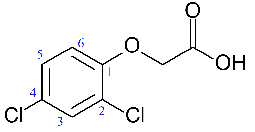
Which among the following is a use of $2, 4$-dichlorophenoxy acetic acid?
A
Antiseptic
B
Selective drug
C
Selective weed killer
D
Explosive
Solution
(C) $2, 4-D$ or $2, 4$-dichlorophenoxy acetic acid is used as a herbicide.
It causes uncontrolled growth and selectively kills most broadleaf weeds.
It leaves most grasses such as cereals,lawn turf,and grassland unaffected.
It causes uncontrolled growth and selectively kills most broadleaf weeds.
It leaves most grasses such as cereals,lawn turf,and grassland unaffected.
0 likesView Solution
212
ChemistryEasyMCQMHT CET · 2020
Which statement about aspirin is $\underline{\text{NOT}}$ true?
A
It is effective in relieving pain
B
Aspirin belongs to narcotic analgesics
C
It reduces body temperature
D
It has antiblood clotting action
Solution
(B) Aspirin is a non-narcotic analgesic,which means it relieves pain without causing addiction or sedation.
It is also an antipyretic,meaning it reduces body temperature.
Additionally,it has anti-blood clotting action,which is why it is often used to prevent heart attacks.
Therefore,the statement that aspirin belongs to narcotic analgesics is false.
It is also an antipyretic,meaning it reduces body temperature.
Additionally,it has anti-blood clotting action,which is why it is often used to prevent heart attacks.
Therefore,the statement that aspirin belongs to narcotic analgesics is false.
0 likesView Solution
213
ChemistryEasyMCQMHT CET · 2020
Which of the following is used as an antiseptic in soap?
A
Iodoform
B
Boric acid
C
Tincture iodine
D
Bithionol
Solution
(D) Bithionol (also known as Bithional) is added to soaps to impart antiseptic properties.
It acts as an antibacterial,antifungal,and algaecidal agent.
This helps in reducing the growth of microorganisms on the skin.
It acts as an antibacterial,antifungal,and algaecidal agent.
This helps in reducing the growth of microorganisms on the skin.
0 likesView Solution
214
ChemistryEasyMCQMHT CET · 2020
The compound which causes antidepressant action on the central nervous system is
A
phenelzine
B
penicillin
C
Chloroxylenol
D
terpineol
Solution
(A) Phenelzine is an antidepressant drug that acts as a monoamine oxidase inhibitor $(MAOI)$.
It treats depression by inhibiting the enzyme monoamine oxidase,which breaks down neurotransmitters like serotonin,norepinephrine,and dopamine.
By preventing their breakdown,it increases the concentration of these neurotransmitters in the brain,thereby improving mood and feelings of well-being.
It treats depression by inhibiting the enzyme monoamine oxidase,which breaks down neurotransmitters like serotonin,norepinephrine,and dopamine.
By preventing their breakdown,it increases the concentration of these neurotransmitters in the brain,thereby improving mood and feelings of well-being.
0 likesView Solution
215
ChemistryEasyMCQMHT CET · 2020
Which of the following is $o$-acetylsalicylic acid?
A
Aspirin
B
Equanil
C
Veronal
D
Valium
Solution
(A) $o$-Acetylsalicylic acid is the chemical name for $Aspirin$.
It is a widely used medication that acts as an analgesic,antipyretic,and anti-inflammatory agent.
It is a widely used medication that acts as an analgesic,antipyretic,and anti-inflammatory agent.
0 likesView Solution
216
ChemistryEasyMCQMHT CET · 2020
Which of the following is $NOT$ an antacid?
A
$Al(OH)_3$
B
$Mg(OH)_2$
C
$Na_2CO_3$
D
$NaHCO_3$
Solution
(C) $Na_2CO_3$ (sodium carbonate) is strongly alkaline and is not used as an antacid because it can be corrosive to the stomach lining.
Antacids are mild bases that neutralize excess stomach acid.
$Al(OH)_3$,$Mg(OH)_2$,and $NaHCO_3$ are commonly used as antacids to provide relief from acidity.
Antacids are mild bases that neutralize excess stomach acid.
$Al(OH)_3$,$Mg(OH)_2$,and $NaHCO_3$ are commonly used as antacids to provide relief from acidity.
0 likesView Solution
217
ChemistryEasyMCQMHT CET · 2020
Which of the following is a synthetic estrogen derivative?
A
Tegamet
B
Norethindrone
C
Novestrol
D
Ranitidine
Solution
(C) Ethinylestradiol,commonly known as $Novestrol$,is a synthetic estrogen derivative.
It is widely used in birth control pills in combination with progestins.
It is also used as a component of menopausal hormone therapy to treat menopausal symptoms.
It is widely used in birth control pills in combination with progestins.
It is also used as a component of menopausal hormone therapy to treat menopausal symptoms.
0 likesView Solution
218
ChemistryEasyMCQMHT CET · 2020
Which among the following elements is not present in salvarsan?
A
$P$
B
$O$
C
$N$
D
$As$
Solution
(A) Salvarsan is an organoarsenic compound with the chemical formula $C_{12}H_{12}As_2N_2O_2 \cdot 2HCl$.
By observing the molecular structure,we can identify the elements present:
$C$ (Carbon),$H$ (Hydrogen),$As$ (Arsenic),$N$ (Nitrogen),$O$ (Oxygen),and $Cl$ (Chlorine).
Phosphorus $(P)$ is not present in the structure of salvarsan.
Therefore,the correct option is $A$.
By observing the molecular structure,we can identify the elements present:
$C$ (Carbon),$H$ (Hydrogen),$As$ (Arsenic),$N$ (Nitrogen),$O$ (Oxygen),and $Cl$ (Chlorine).
Phosphorus $(P)$ is not present in the structure of salvarsan.
Therefore,the correct option is $A$.
0 likesView Solution
219
ChemistryEasyMCQMHT CET · 2020
Which among the following is an antioxidant?
A
Pentaerythrityl stearate
B
Aspirin
C
$BHA$
D
Penicillin
Solution
(C) Butylated hydroxyanisole $(BHA)$ is a well-known antioxidant.
It consists of a mixture of two isomeric organic compounds,$2-tert-butyl-4-hydroxyanisole$ and $3-tert-butyl-4-hydroxyanisole$.
It consists of a mixture of two isomeric organic compounds,$2-tert-butyl-4-hydroxyanisole$ and $3-tert-butyl-4-hydroxyanisole$.
0 likesView Solution
220
ChemistryEasyMCQMHT CET · 2020
Which of the following is $\underline{NOT}$ a character of an ideal drug?
A
Should destroy harmful organisms
B
Should not disturb physiological processes
C
Harmless to the host
D
Is not localised to the affected site
Solution
(D) The correct answer is $D$.
An ideal drug should be specific to the affected site to minimize side effects.
Therefore,being 'not localised to the affected site' is $\underline{NOT}$ a characteristic of an ideal drug.
Key characteristics of an ideal drug include:
$1$. It should be effective against the target pathogen or disease.
$2$. It should be non-toxic and harmless to the host.
$3$. It should not disturb normal physiological processes.
$4$. It should be localised to the affected site to ensure maximum efficacy with minimal systemic toxicity.
An ideal drug should be specific to the affected site to minimize side effects.
Therefore,being 'not localised to the affected site' is $\underline{NOT}$ a characteristic of an ideal drug.
Key characteristics of an ideal drug include:
$1$. It should be effective against the target pathogen or disease.
$2$. It should be non-toxic and harmless to the host.
$3$. It should not disturb normal physiological processes.
$4$. It should be localised to the affected site to ensure maximum efficacy with minimal systemic toxicity.
0 likesView Solution
221
ChemistryEasyMCQMHT CET · 2020
Which of the following molecules does not contain oxygen?
A
Serotonin
B
Phenelzine
C
Veronal
D
Iproniazid
Solution
(B) Phenelzine does not contain oxygen.
Phenelzine is a hydrazine derivative with the molecular formula $C_8H_{12}N_2$. It consists of a phenyl group attached to an ethyl chain,which is linked to a hydrazine moiety $(-NH-NH_2)$.
Serotonin $(C_{10}H_{12}N_2O)$,Veronal $(C_8H_{12}N_2O_3)$,and Iproniazid $(C_9H_{13}N_3O)$ all contain oxygen atoms in their structures.
Phenelzine is a hydrazine derivative with the molecular formula $C_8H_{12}N_2$. It consists of a phenyl group attached to an ethyl chain,which is linked to a hydrazine moiety $(-NH-NH_2)$.
Serotonin $(C_{10}H_{12}N_2O)$,Veronal $(C_8H_{12}N_2O_3)$,and Iproniazid $(C_9H_{13}N_3O)$ all contain oxygen atoms in their structures.
0 likesView Solution
222
ChemistryEasyMCQMHT CET · 2020
Which of the following is used as disinfectant as well as antiseptic?
A
Veronal
B
Seldane
C
Prontocil
D
Phenol
Solution
(D) $0.2 \% $ solution of $Phenol$ is used as an antiseptic,while its $1 \%$ solution is used as a disinfectant.
0 likesView Solution
223
ChemistryEasyMCQMHT CET · 2020
Which of the following is $NOT$ an example of an antiseptic drug?
A
Hydrogen peroxide
B
Bithional
C
Chloroxylenol
D
Sulphur dioxide
Solution
(D) The correct answer is $D$.
$Sulphur \ dioxide$ is not an antiseptic drug.
Antiseptics are chemical substances that are applied to living tissues such as wounds,cuts,ulcers,and diseased skin surfaces to either kill or prevent the growth of microorganisms.
$Hydrogen \ peroxide$,$Bithional$,and $Chloroxylenol$ are well-known examples of antiseptics.
$Sulphur \ dioxide$ is not an antiseptic drug.
Antiseptics are chemical substances that are applied to living tissues such as wounds,cuts,ulcers,and diseased skin surfaces to either kill or prevent the growth of microorganisms.
$Hydrogen \ peroxide$,$Bithional$,and $Chloroxylenol$ are well-known examples of antiseptics.
0 likesView Solution
224
ChemistryEasyMCQMHT CET · 2020
Identify the tranquilizer from the following:
A
Prontosil
B
Aspirin
C
Meprobamate
D
Salvarsan
Solution
(C) Meprobamate is used to treat anxiety disorders or for short-term relief of the symptoms of anxiety in adults and children $6$ years of age and older.
Meprobamate belongs to a class of medications called tranquilizers.
It works by slowing down the activity in the brain to allow for relaxation.
Meprobamate belongs to a class of medications called tranquilizers.
It works by slowing down the activity in the brain to allow for relaxation.
0 likesView Solution
225
ChemistryEasyMCQMHT CET · 2020
Which of the following drugs produce depression of the central nervous system?
A
$Methyl$ salicylate
B
Codeine
C
Ibuprofen
D
Paracetamol
Solution
(B) Codeine is an opioid analgesic that acts on the central nervous system.
It binds to opioid receptors in the brain and spinal cord,which leads to the depression of central nervous system functions,including respiration and pain perception.
It binds to opioid receptors in the brain and spinal cord,which leads to the depression of central nervous system functions,including respiration and pain perception.
0 likesView Solution
226
ChemistryMediumMCQMHT CET · 2020
Which among the following drugs is not a tranquilizer?
A
Equanil
B
Novestrol
C
Valium
D
Veronal
Solution
(B) Tranquilizers are a class of chemical compounds used for the treatment of stress,and mild or even severe mental diseases.
$Equanil$,$Valium$,and $Veronal$ are well-known examples of tranquilizers.
$Novestrol$ is an estrogen derivative used as an antifertility drug,not a tranquilizer.
$Equanil$,$Valium$,and $Veronal$ are well-known examples of tranquilizers.
$Novestrol$ is an estrogen derivative used as an antifertility drug,not a tranquilizer.
0 likesView Solution
227
ChemistryEasyMCQMHT CET · 2020
Which of the following artificial sweeteners contains chlorine in its molecular formula?
A
Saccharin
B
Alitame
C
Aspartame
D
Sucralose
Solution
(D) Sucralose is the artificial sweetener that contains chlorine.
It is a trichloro derivative of sucrose.
It is $600$ times sweeter than cane sugar.
It is a trichloro derivative of sucrose.
It is $600$ times sweeter than cane sugar.
0 likesView Solution
228
ChemistryEasyMCQMHT CET · 2020
Which from the following methods is $\underline{\text{NOT}}$ used to preserve food?
A
Removal of heat
B
Irradiation
C
Addition of water
D
Addition of heat
Solution
(C) Food preservation involves techniques that inhibit the growth of microorganisms or prevent chemical changes.
$1$. Removal of heat (refrigeration/freezing) slows down microbial growth.
$2$. Irradiation kills bacteria and parasites.
$3$. Addition of heat (pasteurization/canning) destroys enzymes and microorganisms.
$4$. Addition of water (hydration) actually promotes microbial growth and spoilage,so it is $\underline{\text{NOT}}$ a method of food preservation.
$1$. Removal of heat (refrigeration/freezing) slows down microbial growth.
$2$. Irradiation kills bacteria and parasites.
$3$. Addition of heat (pasteurization/canning) destroys enzymes and microorganisms.
$4$. Addition of water (hydration) actually promotes microbial growth and spoilage,so it is $\underline{\text{NOT}}$ a method of food preservation.
0 likesView Solution
229
ChemistryMediumMCQMHT CET · 2020
Which of the following is the formula of $BHA$?
A
$C_{15}H_{24}O$
B
$C_{7}H_{5}SNO_{3}$
C
$C_{11}H_{16}O_{2}$
D
$C_{14}H_{18}N_{2}O_{5}$
Solution
(C) $BHA$ stands for Butylated Hydroxyanisole.
It is a common food preservative.
The molecular formula of $BHA$ is $C_{11}H_{16}O_{2}$.
It is a common food preservative.
The molecular formula of $BHA$ is $C_{11}H_{16}O_{2}$.
0 likesView Solution
230
ChemistryMediumMCQMHT CET · 2020
Which of the following oxides is $\underline{\text{NOT}}$ volatile?
A
$As_2O_3$
B
$ZnO$
C
$P_2O_5$
D
$SO_2$
Solution
(B) $As_2O_3$,$P_2O_5$,and $SO_2$ are covalent compounds that exist as molecular solids or gases at room temperature,making them volatile.
$ZnO$ is an ionic solid with a high melting point and is non-volatile.
$ZnO$ is an ionic solid with a high melting point and is non-volatile.
0 likesView Solution
231
ChemistryEasyMCQMHT CET · 2020
What is the effective atomic number $(EAN)$ of $Fe$ in $[Fe(CN)_6]^{4-}$? (Atomic number of $Fe = 26$)
A
$34$
B
$26$
C
$36$
D
$35$
Solution
(C) The effective atomic number $(EAN)$ is calculated using the formula: $EAN = Z - X + Y$,where $Z$ is the atomic number of the metal,$X$ is the oxidation state of the metal,and $Y$ is the number of electrons donated by the ligands.
For $[Fe(CN)_6]^{4-}$:
$Z = 26$ (for $Fe$).
Let the oxidation state of $Fe$ be $x$. Then $x + 6(-1) = -4$,which gives $x = +2$. So,$X = 2$.
Since $CN^-$ is a monodentate ligand,$6$ ligands donate $6 \times 2 = 12$ electrons. So,$Y = 12$.
$EAN = 26 - 2 + 12 = 36$.
For $[Fe(CN)_6]^{4-}$:
$Z = 26$ (for $Fe$).
Let the oxidation state of $Fe$ be $x$. Then $x + 6(-1) = -4$,which gives $x = +2$. So,$X = 2$.
Since $CN^-$ is a monodentate ligand,$6$ ligands donate $6 \times 2 = 12$ electrons. So,$Y = 12$.
$EAN = 26 - 2 + 12 = 36$.
0 likesView Solution
232
ChemistryEasyMCQMHT CET · 2020
Which among the following coordination compounds does not have a coordination number equal to the number of ligands?
A
$[Pt(NH_3)_6]^{4+}$
B
$[Co(en)_3]^{3+}$
C
$[Cu(NH_3)_4]^{2+}$
D
$[Co(NH_3)_6]^{3+}$
Solution
(B) The coordination number is defined as the total number of sigma bonds formed by the central metal atom with the ligands.
For monodentate ligands,the coordination number equals the number of ligands.
For polydentate ligands,the coordination number is the number of ligands multiplied by their denticity.
In $[Co(en)_3]^{3+}$,the ligand $en$ (ethylenediamine) is a bidentate ligand.
Therefore,the number of ligands is $3$,but the coordination number is $3 \times 2 = 6$.
Thus,the coordination number is not equal to the number of ligands.
For monodentate ligands,the coordination number equals the number of ligands.
For polydentate ligands,the coordination number is the number of ligands multiplied by their denticity.
In $[Co(en)_3]^{3+}$,the ligand $en$ (ethylenediamine) is a bidentate ligand.
Therefore,the number of ligands is $3$,but the coordination number is $3 \times 2 = 6$.
Thus,the coordination number is not equal to the number of ligands.
0 likesView Solution
233
ChemistryEasyMCQMHT CET · 2020
Which among the following complexes is homoleptic and cationic in nature?
A
$\left[CoCl_{2}(en)_{2}\right] Cl$
B
$\left[Fe(H_{2}O)_{6}\right] Cl_{3}$
C
$K\left[Ag(CN)_{2}\right]$
D
$\left[Fe(CO)_{5}\right]$
Solution
(B) complex is homoleptic if the metal atom is bonded to only one type of donor atom/ligand. $A$ complex is cationic if the coordination sphere carries a positive charge.
$1$. $\left[CoCl_{2}(en)_{2}\right] Cl$: Heteroleptic (contains $Cl^-$ and $en$) and cationic.
$2$. $\left[Fe(H_{2}O)_{6}\right] Cl_{3}$: Homoleptic (only $H_{2}O$ ligands) and cationic $(\left[Fe(H_{2}O)_{6}\right]^{3+})$.
$3$. $K\left[Ag(CN)_{2}\right]$: Homoleptic but anionic $(\left[Ag(CN)_{2}\right]^{-})$.
$4$. $\left[Fe(CO)_{5}\right]$: Homoleptic but neutral.
Therefore,the correct option is $\left[Fe(H_{2}O)_{6}\right] Cl_{3}$.
$1$. $\left[CoCl_{2}(en)_{2}\right] Cl$: Heteroleptic (contains $Cl^-$ and $en$) and cationic.
$2$. $\left[Fe(H_{2}O)_{6}\right] Cl_{3}$: Homoleptic (only $H_{2}O$ ligands) and cationic $(\left[Fe(H_{2}O)_{6}\right]^{3+})$.
$3$. $K\left[Ag(CN)_{2}\right]$: Homoleptic but anionic $(\left[Ag(CN)_{2}\right]^{-})$.
$4$. $\left[Fe(CO)_{5}\right]$: Homoleptic but neutral.
Therefore,the correct option is $\left[Fe(H_{2}O)_{6}\right] Cl_{3}$.
0 likesView Solution
234
ChemistryMediumMCQMHT CET · 2020
Which statement from the following is true for the complex hexamminecobalt$(III)$ chloride?
A
In this,the coordination number of cobalt is $9$.
B
In this,the oxidation state of cobalt is $+3$.
C
It is a heteroleptic complex.
D
It is an anionic complex.
Solution
(B) The chemical formula for hexamminecobalt$(III)$ chloride is $[Co(NH_3)_6]Cl_3$.
In this complex,the central metal ion is $Co^{3+}$.
The coordination number of $Co$ is $6$ (since there are $6$ $NH_3$ ligands).
The oxidation state of $Co$ is $+3$.
Since all ligands are the same $(NH_3)$,it is a homoleptic complex.
It is a cationic complex because the complex ion is $[Co(NH_3)_6]^{3+}$.
Therefore,the statement that the oxidation state of cobalt is $+3$ is true.
In this complex,the central metal ion is $Co^{3+}$.
The coordination number of $Co$ is $6$ (since there are $6$ $NH_3$ ligands).
The oxidation state of $Co$ is $+3$.
Since all ligands are the same $(NH_3)$,it is a homoleptic complex.
It is a cationic complex because the complex ion is $[Co(NH_3)_6]^{3+}$.
Therefore,the statement that the oxidation state of cobalt is $+3$ is true.
0 likesView Solution
235
ChemistryEasyMCQMHT CET · 2020
Which among the following complexes is heteroleptic and cationic in nature?
A
$[Ni(CO)_{4}]$
B
$[Co(NH_{3})_{4}Cl_{2}]Cl$
C
$[Pt(NH_{3})_{2}Cl_{2}]$
D
$K_{4}[Fe(CN)_{6}]$
Solution
(B) complex is heteroleptic if it contains more than one type of ligand attached to the central metal atom.
It is cationic if the complex ion carries a positive charge.
In $[Co(NH_{3})_{4}Cl_{2}]Cl$,the coordination sphere is $[Co(NH_{3})_{4}Cl_{2}]^{+}$,which contains two different ligands ($NH_{3}$ and $Cl^{-}$) and carries a positive charge.
Thus,it is both heteroleptic and cationic.
It is cationic if the complex ion carries a positive charge.
In $[Co(NH_{3})_{4}Cl_{2}]Cl$,the coordination sphere is $[Co(NH_{3})_{4}Cl_{2}]^{+}$,which contains two different ligands ($NH_{3}$ and $Cl^{-}$) and carries a positive charge.
Thus,it is both heteroleptic and cationic.
0 likesView Solution
236
ChemistryMediumMCQMHT CET · 2020
Which of the following complexes does the central metal ion $NOT$ obey the $EAN$ rule? (Atomic numbers: $Pt=78, Cu=29, Zn=30, Fe=26$)
A
$[Zn(NH_3)_4]^{2+}$
B
$[Cu(NH_3)_4]^{2+}$
C
$[Pt(NH_3)_6]^{4+}$
D
$[Fe(CN)_6]^{4-}$
Solution
(B) The $EAN$ (Effective Atomic Number) rule states that the total number of electrons around the central metal ion should equal the atomic number of the next noble gas.
$EAN = Z - \text{oxidation state} + 2 \times (\text{coordination number})$.
For $A: [Zn(NH_3)_4]^{2+}: EAN = 30 - 2 + 8 = 36$ (Obeys rule).
For $B: [Cu(NH_3)_4]^{2+}: EAN = 29 - 2 + 8 = 35$ (Does $NOT$ obey rule).
For $C: [Pt(NH_3)_6]^{4+}: EAN = 78 - 4 + 12 = 86$ (Obeys rule).
For $D: [Fe(CN)_6]^{4-}: EAN = 26 - 2 + 12 = 36$ (Obeys rule).
Therefore,the complex that does not obey the $EAN$ rule is $[Cu(NH_3)_4]^{2+}$.
$EAN = Z - \text{oxidation state} + 2 \times (\text{coordination number})$.
For $A: [Zn(NH_3)_4]^{2+}: EAN = 30 - 2 + 8 = 36$ (Obeys rule).
For $B: [Cu(NH_3)_4]^{2+}: EAN = 29 - 2 + 8 = 35$ (Does $NOT$ obey rule).
For $C: [Pt(NH_3)_6]^{4+}: EAN = 78 - 4 + 12 = 86$ (Obeys rule).
For $D: [Fe(CN)_6]^{4-}: EAN = 26 - 2 + 12 = 36$ (Obeys rule).
Therefore,the complex that does not obey the $EAN$ rule is $[Cu(NH_3)_4]^{2+}$.
0 likesView Solution
237
ChemistryMediumMCQMHT CET · 2020
What is the effective atomic number $(EAN)$ of $Zn$ in $[Zn(NH_3)_4]SO_4$? (Atomic number of $Zn = 30$)
A
$30$
B
$27$
C
$36$
D
$28$
Solution
(C) The formula for $EAN$ is $EAN = Z - X + Y$,where $Z$ is the atomic number,$X$ is the oxidation state,and $Y$ is the total number of electrons donated by ligands.
In $[Zn(NH_3)_4]SO_4$,the oxidation state of $Zn$ is $+2$ (since $NH_3$ is neutral and $SO_4$ is $-2$).
$Z = 30$,$X = 2$,and $Y = 4 \times 2 = 8$.
$EAN = 30 - 2 + 8 = 36$.
In $[Zn(NH_3)_4]SO_4$,the oxidation state of $Zn$ is $+2$ (since $NH_3$ is neutral and $SO_4$ is $-2$).
$Z = 30$,$X = 2$,and $Y = 4 \times 2 = 8$.
$EAN = 30 - 2 + 8 = 36$.
0 likesView Solution
238
ChemistryMediumMCQMHT CET · 2020
Identify the tetradentate ligand from the following.
A
Ethylene diamine tetracetato
B
Triethylene tetramine
C
Dimethyl glyoximato
D
Oxalato
Solution
(B) tetradentate ligand is a ligand that can form $4$ coordinate bonds with a central metal atom or ion.
$1$. Ethylene diamine tetracetato $(EDTA^{4-})$ is a hexadentate ligand.
$2$. Triethylene tetramine $(trien)$ has $4$ nitrogen donor atoms,making it a tetradentate ligand.
$3$. Dimethyl glyoximato $(dmg^-)$ is a bidentate ligand.
$4$. Oxalato $(C_2O_4^{2-})$ is a bidentate ligand.
Therefore,the correct option is $B$.
$1$. Ethylene diamine tetracetato $(EDTA^{4-})$ is a hexadentate ligand.
$2$. Triethylene tetramine $(trien)$ has $4$ nitrogen donor atoms,making it a tetradentate ligand.
$3$. Dimethyl glyoximato $(dmg^-)$ is a bidentate ligand.
$4$. Oxalato $(C_2O_4^{2-})$ is a bidentate ligand.
Therefore,the correct option is $B$.
0 likesView Solution
239
ChemistryDifficultMCQMHT CET · 2020
What is the number of $=N-OH$ groups present in dimethyl glyoximato?
A
$3$
B
$4$
C
$1$
D
$2$
Solution
(D) Dimethyl glyoximato (dmg) is a bidentate ligand with the structure $(CH_3C=NOH)_2$.
In the structure of dimethyl glyoxime,there are two $=N-OH$ groups attached to the carbon atoms.
Therefore,the number of $=N-OH$ groups present in dimethyl glyoximato is $2$.
In the structure of dimethyl glyoxime,there are two $=N-OH$ groups attached to the carbon atoms.
Therefore,the number of $=N-OH$ groups present in dimethyl glyoximato is $2$.
0 likesView Solution
240
ChemistryEasyMCQMHT CET · 2020
Identify the number of donor groups present in $EDTA$.
A
Two
B
Three
C
Six
D
Four
Solution
(C) $EDTA$ stands for Ethylenediaminetetraacetate ion.
It contains two nitrogen atoms and four oxygen atoms as donor sites.
Therefore,it acts as a hexadentate ligand,meaning it has $6$ donor groups.
It contains two nitrogen atoms and four oxygen atoms as donor sites.
Therefore,it acts as a hexadentate ligand,meaning it has $6$ donor groups.
0 likesView Solution
241
ChemistryEasyMCQMHT CET · 2020
Which among the following is an ambidentate ligand?
A
$NO_{2}^{-}$
B
$H_{2}O$
C
$NH_{3}$
D
$C_{2}O_{4}^{2-}$
Solution
(A) An ambidentate ligand is a ligand that can coordinate to a central metal atom through two different donor atoms.
$NO_{2}^{-}$ is an ambidentate ligand because it can coordinate through either the nitrogen atom $(N)$ or the oxygen atom $(O)$.
$H_{2}O$ and $NH_{3}$ are monodentate ligands.
$C_{2}O_{4}^{2-}$ (oxalate ion) is a bidentate ligand.
$NO_{2}^{-}$ is an ambidentate ligand because it can coordinate through either the nitrogen atom $(N)$ or the oxygen atom $(O)$.
$H_{2}O$ and $NH_{3}$ are monodentate ligands.
$C_{2}O_{4}^{2-}$ (oxalate ion) is a bidentate ligand.
0 likesView Solution
242
ChemistryEasyMCQMHT CET · 2020
What is the total number of ligands present in $[CoCl_{2}(NH_{3})_{4}]Cl$?
A
$2$
B
$4$
C
$1$
D
$6$
Solution
(D) In the coordination compound $[CoCl_{2}(NH_{3})_{4}]Cl$,the central metal ion is $Co^{3+}$.
The ligands present inside the coordination sphere are $4$ $NH_{3}$ molecules and $2$ $Cl^{-}$ ions.
Therefore,the total number of ligands (coordination number) is $4 + 2 = 6$.
The ligands present inside the coordination sphere are $4$ $NH_{3}$ molecules and $2$ $Cl^{-}$ ions.
Therefore,the total number of ligands (coordination number) is $4 + 2 = 6$.
0 likesView Solution
243
ChemistryEasyMCQMHT CET · 2020
Which among the following is a monodentate ligand?
A
Oxalato
B
Water
C
Ethylenediamine
D
Dimethylglyoximato
Solution
(B) monodentate ligand is a ligand that binds to a central metal atom through only one donor atom.
Water $(H_2O)$ is a monodentate ligand because it uses only the oxygen atom to donate a lone pair.
Oxalato $(C_2O_4^{2-})$,ethylenediamine $(en)$,and dimethylglyoximato $(dmg^-)$ are all bidentate ligands.
Water $(H_2O)$ is a monodentate ligand because it uses only the oxygen atom to donate a lone pair.
Oxalato $(C_2O_4^{2-})$,ethylenediamine $(en)$,and dimethylglyoximato $(dmg^-)$ are all bidentate ligands.
0 likesView Solution
244
ChemistryDifficultMCQMHT CET · 2020
What is the Effective Atomic Number $(EAN)$ of Cobalt in $[Co(NH_3)_6]Cl_3$ (Atomic number of $Co = 27$)?
A
$30$
B
$28$
C
$27$
D
$36$
Solution
(D) The formula for $EAN$ is $EAN = Z - X + Y$,where $Z$ is the atomic number,$X$ is the oxidation state,and $Y$ is the number of electrons donated by ligands.
For $[Co(NH_3)_6]Cl_3$:
$1$. The oxidation state of $Co$ $(X)$ is $+3$.
$2$. The atomic number of $Co$ $(Z)$ is $27$.
$3$. The number of electrons donated by $6$ $NH_3$ ligands $(Y)$ is $6 \times 2 = 12$.
$EAN = 27 - 3 + 12 = 36$.
For $[Co(NH_3)_6]Cl_3$:
$1$. The oxidation state of $Co$ $(X)$ is $+3$.
$2$. The atomic number of $Co$ $(Z)$ is $27$.
$3$. The number of electrons donated by $6$ $NH_3$ ligands $(Y)$ is $6 \times 2 = 12$.
$EAN = 27 - 3 + 12 = 36$.
0 likesView Solution
245
ChemistryEasyMCQMHT CET · 2020
How many donor groups (donor atoms) are present in diethylene triamine?
A
$4$
B
$2$
C
$6$
D
$3$
Solution
(D) The chemical formula of diethylene triamine (dien) is $NH_2-CH_2-CH_2-NH-CH_2-CH_2-NH_2$.
It contains $3$ nitrogen atoms,each having a lone pair of electrons that can be donated to a central metal ion.
Therefore,it acts as a tridentate ligand with $3$ donor groups.
It contains $3$ nitrogen atoms,each having a lone pair of electrons that can be donated to a central metal ion.
Therefore,it acts as a tridentate ligand with $3$ donor groups.
0 likesView Solution
246
ChemistryMediumMCQMHT CET · 2020
Which among the following is a correct formula of Pentammine aqua cobalt$(III)$ iodide?
A
$[Co(NH_{3})_{5}(H_{2}O)]I_{3}$
B
$[Co(H_{2}O)(NH_{3})_{5}I]$
C
$[Co(NH_{3})_{5}I]H_{2}O$
D
$[Co(H_{2}O)(NH_{3})_{5}]I$
Solution
(A) The coordination entity is Pentammine aqua cobalt$(III)$ iodide.
$NH_{3}$ (ammine) and $H_{2}O$ (aqua) are neutral ligands.
The oxidation state of $Co$ is $+3$.
To balance the charge of $+3$ on the complex cation $[Co(NH_{3})_{5}(H_{2}O)]^{3+}$,three iodide ions $(I^-)$ are required.
Therefore,the correct formula is $[Co(NH_{3})_{5}(H_{2}O)]I_{3}$.
$NH_{3}$ (ammine) and $H_{2}O$ (aqua) are neutral ligands.
The oxidation state of $Co$ is $+3$.
To balance the charge of $+3$ on the complex cation $[Co(NH_{3})_{5}(H_{2}O)]^{3+}$,three iodide ions $(I^-)$ are required.
Therefore,the correct formula is $[Co(NH_{3})_{5}(H_{2}O)]I_{3}$.
0 likesView Solution
247
ChemistryEasyMCQMHT CET · 2020
Identify the formula of potassium trioxalato aluminate $(III)$.
A
$K_{4}[Al(C_{2}O_{4})_{3}]$
B
$[K_{3}Al(C_{2}O_{4})_{3}]$
C
$Al_{3}[K_{3}(C_{2}O_{4})_{3}]$
D
$K_{3}[Al(C_{2}O_{4})_{3}]$
Solution
(D) The oxalate ion $(C_{2}O_{4}^{2-})$ is a bidentate ligand with a charge of $-2$.
Given the oxidation state of $Al$ is $+3$.
Let the number of potassium ions be $x$.
For the complex to be neutral: $x(+1) + 1(+3) + 3(-2) = 0$.
$x + 3 - 6 = 0 \implies x = 3$.
Therefore,the formula is $K_{3}[Al(C_{2}O_{4})_{3}]$.
Given the oxidation state of $Al$ is $+3$.
Let the number of potassium ions be $x$.
For the complex to be neutral: $x(+1) + 1(+3) + 3(-2) = 0$.
$x + 3 - 6 = 0 \implies x = 3$.
Therefore,the formula is $K_{3}[Al(C_{2}O_{4})_{3}]$.
0 likesView Solution
248
ChemistryEasyMCQMHT CET · 2020
What is the $IUPAC$ name of $[CoCl_{2}(en)_{2}]^{+}$?
A
Dichloridobis(ethane-$1,2$-diamine)cobalt$(III)$ ion
B
Bis(ethylenediamine)dichlorocobalt$(III)$ ion
C
Dichloridoethylenediaminecobalt$(I)$ ion
D
Ethylenediaminecobalt$(III)$ chloride
Solution
(A) $1$. Identify the ligands: There are two chloride ions $(Cl^-)$ named as 'dichlorido' and two ethylenediamine $(en)$ molecules named as 'bis(ethane-$1,2$-diamine)'.
$2$. Determine the oxidation state of the central metal atom $(Co)$: Let the oxidation state be $x$. The charge on $Cl$ is $-1$ and $en$ is neutral $(0)$. The overall charge on the complex is $+1$. So,$x + 2(-1) + 2(0) = +1$,which gives $x = +3$.
$3$. Assemble the name: Ligands are named alphabetically. 'Dichlorido' comes before 'bis(ethane-$1,2$-diamine)'.
$4$. The final name is Dichloridobis(ethane-$1,2$-diamine)cobalt$(III)$ ion.
$2$. Determine the oxidation state of the central metal atom $(Co)$: Let the oxidation state be $x$. The charge on $Cl$ is $-1$ and $en$ is neutral $(0)$. The overall charge on the complex is $+1$. So,$x + 2(-1) + 2(0) = +1$,which gives $x = +3$.
$3$. Assemble the name: Ligands are named alphabetically. 'Dichlorido' comes before 'bis(ethane-$1,2$-diamine)'.
$4$. The final name is Dichloridobis(ethane-$1,2$-diamine)cobalt$(III)$ ion.
0 likesView Solution
249
ChemistryEasyMCQMHT CET · 2020
Which among the following is a correct formula of Barium tetrachlorocuprate$(II)$?
A
$Cu[BaCl_2]Cl_2$
B
$Ba[CuCl_2]Cl_2$
C
$Cu[BaCl_4]$
D
$Ba[CuCl_4]$
Solution
(D) The name of the coordination compound is Barium tetrachlorocuprate$(II)$.
$1$. The cation is Barium,which is $Ba^{2+}$.
$2$. The anion is the coordination entity tetrachlorocuprate$(II)$.
$3$. 'Tetra' indicates four chloride ligands $(Cl^-)$,and 'cuprate$(II)$' indicates copper in the $+2$ oxidation state.
$4$. The charge on the complex ion $[CuCl_4]$ is calculated as: $x + 4(-1) = -2$,so $x = +2$. Thus,the complex ion is $[CuCl_4]^{2-}$.
$5$. Combining the cation $Ba^{2+}$ and the anion $[CuCl_4]^{2-}$,the formula is $Ba[CuCl_4]$.
$1$. The cation is Barium,which is $Ba^{2+}$.
$2$. The anion is the coordination entity tetrachlorocuprate$(II)$.
$3$. 'Tetra' indicates four chloride ligands $(Cl^-)$,and 'cuprate$(II)$' indicates copper in the $+2$ oxidation state.
$4$. The charge on the complex ion $[CuCl_4]$ is calculated as: $x + 4(-1) = -2$,so $x = +2$. Thus,the complex ion is $[CuCl_4]^{2-}$.
$5$. Combining the cation $Ba^{2+}$ and the anion $[CuCl_4]^{2-}$,the formula is $Ba[CuCl_4]$.
0 likesView Solution
250
ChemistryDifficultMCQMHT CET · 2020
Which coordination compound from the following has a net negative charge on the complex ion?
A
Tris(ethylenediamine)cobalt$(III)$ chloride
B
Potassium trioxalatoaluminate$(III)$
C
Tetracarbonylnickel$(0)$
D
Diamminesilver$(I)$ chloride
Solution
(B) Let us analyze the charge on the complex ion for each option:
$A$: $[Co(en)_{3}]Cl_{3} \rightarrow [Co(en)_{3}]^{3+} + 3Cl^{-}$. The complex ion has a $+3$ charge.
$B$: $K_{3}[Al(C_{2}O_{4})_{3}] \rightarrow 3K^{+} + [Al(C_{2}O_{4})_{3}]^{3-}$. The complex ion has a $-3$ charge.
$C$: $[Ni(CO)_{4}]$ is a neutral complex with $0$ charge.
$D$: $[Ag(NH_{3})_{2}]Cl \rightarrow [Ag(NH_{3})_{2}]^{+} + Cl^{-}$. The complex ion has a $+1$ charge.
Therefore,the compound with a net negative charge on the complex ion is Potassium trioxalatoaluminate$(III)$.
$A$: $[Co(en)_{3}]Cl_{3} \rightarrow [Co(en)_{3}]^{3+} + 3Cl^{-}$. The complex ion has a $+3$ charge.
$B$: $K_{3}[Al(C_{2}O_{4})_{3}] \rightarrow 3K^{+} + [Al(C_{2}O_{4})_{3}]^{3-}$. The complex ion has a $-3$ charge.
$C$: $[Ni(CO)_{4}]$ is a neutral complex with $0$ charge.
$D$: $[Ag(NH_{3})_{2}]Cl \rightarrow [Ag(NH_{3})_{2}]^{+} + Cl^{-}$. The complex ion has a $+1$ charge.
Therefore,the compound with a net negative charge on the complex ion is Potassium trioxalatoaluminate$(III)$.
0 likesView Solution
Vedclass Products
For Students
Vedclass Test Series
Mock tests in real MHT CET style covering Chemistry with performance analysis. 5-day free trial.
Start Free TrialFor Teachers
Exam Paper Generator
Generate Set A/B/C/D Chemistry papers from 7.5L+ questions in 2 minutes. 3 chapters free.
Try FreeFor Institutes
Online Exam Module
Run live MHT CET mock exams with unlimited students, 360° analytics & white-label branding.
See DemoFrequently Asked Questions
How many Chemistry questions are in MHT CET 2020?
There are 772 Chemistry questions from the MHT CET 2020 paper on Vedclass, each with a detailed step-by-step solution in English.
Are MHT CET 2020 Chemistry solutions available in English?
Yes. All solutions on this page are in English. You can also switch to English or Hindi using the language buttons above the questions.
Can I practice MHT CET 2020 Chemistry as a timed test?
Yes. Use the Vedclass Test Series to attempt a full MHT CET mock test covering Chemistry with time limits and instant score analysis.
Can teachers create Chemistry papers from MHT CET previous year questions?
Yes. The Vedclass Exam Paper Generator lets teachers mix MHT CET Chemistry questions and generate Set A/B/C/D papers in minutes.
For Teachers & Institutes
Build a Custom Chemistry Paper
Pick MHT CET 2020 Chemistry questions, set difficulty, and generate Set A/B/C/D in 2 minutes.