
ChemistryQ51–150 of 772 questions
Page 2 of 10 · English
51
ChemistryEasyMCQMHT CET · 2020
What is the difference in molar mass of any two neighbouring alkanes?
A
$12 \ g \ mol^{-1}$
B
$10 \ g \ mol^{-1}$
C
$15 \ g \ mol^{-1}$
D
$14 \ g \ mol^{-1}$
Solution
(D) Successive members of a homologous series differ by a $-CH_2-$ group.
The molar mass of a carbon atom is $12 \ g \ mol^{-1}$ and that of two hydrogen atoms is $2 \times 1 \ g \ mol^{-1} = 2 \ g \ mol^{-1}$.
Therefore,the difference in molar mass between any two neighbouring alkanes is $12 + 2 = 14 \ g \ mol^{-1}$.
The molar mass of a carbon atom is $12 \ g \ mol^{-1}$ and that of two hydrogen atoms is $2 \times 1 \ g \ mol^{-1} = 2 \ g \ mol^{-1}$.
Therefore,the difference in molar mass between any two neighbouring alkanes is $12 + 2 = 14 \ g \ mol^{-1}$.
0 likesView Solution
52
ChemistryEasyMCQMHT CET · 2020
The $IUPAC$ name of isobutyl chloride is:
A
$2-$chloropropane
B
$2-$chlorobutane
C
$2-$chloro$-2-$methylpropane
D
$1-$chloro$-2-$methylpropane
Solution
(D) The structure of isobutyl chloride is $(CH_3)_2CH-CH_2Cl$.
To determine the $IUPAC$ name,we identify the longest carbon chain containing the functional group.
The longest chain has $3$ carbon atoms (propane).
There is a methyl group at the $2^{nd}$ position and a chlorine atom at the $1^{st}$ position.
Therefore,the $IUPAC$ name is $1-$chloro$-2-$methylpropane.
To determine the $IUPAC$ name,we identify the longest carbon chain containing the functional group.
The longest chain has $3$ carbon atoms (propane).
There is a methyl group at the $2^{nd}$ position and a chlorine atom at the $1^{st}$ position.
Therefore,the $IUPAC$ name is $1-$chloro$-2-$methylpropane.
0 likesView Solution
53
ChemistryEasyMCQMHT CET · 2020
Which of the following is a functional isomer of $pentan-2-ol$?
A
$Pentan-1-ol$
B
$Pentan-2-one$
C
$Ethoxypropane$
D
$Pentan-3-ol$
Solution
(C) $Pentan-2-ol$ $(C_5H_{12}O)$ is an alcohol.
Functional isomers are compounds with the same molecular formula but different functional groups.
$Ethoxypropane$ $(C_2H_5-O-C_3H_7)$ has the molecular formula $C_5H_{12}O$ and belongs to the ether functional group.
Therefore,$ethoxypropane$ is a functional isomer of $pentan-2-ol$.
$Pentan-1-ol$ and $pentan-3-ol$ are positional isomers,while $pentan-2-one$ is a ketone with the formula $C_5H_{10}O$.
Functional isomers are compounds with the same molecular formula but different functional groups.
$Ethoxypropane$ $(C_2H_5-O-C_3H_7)$ has the molecular formula $C_5H_{12}O$ and belongs to the ether functional group.
Therefore,$ethoxypropane$ is a functional isomer of $pentan-2-ol$.
$Pentan-1-ol$ and $pentan-3-ol$ are positional isomers,while $pentan-2-one$ is a ketone with the formula $C_5H_{10}O$.
0 likesView Solution
54
ChemistryEasyMCQMHT CET · 2020
How many primary,secondary and tertiary carbon atoms respectively are present in isobutane?
A
$0, 1$ and $3$
B
$3, 1$ and $0$
C
$3, 0$ and $1$
D
$1, 0$ and $3$
Solution
(C) The structure of isobutane is $(CH_3)_3CH$.
In this structure:
$1$. $A$ primary $(1^{\circ})$ carbon atom is attached to only one other carbon atom. There are three such $CH_3$ groups in isobutane.
$2$. $A$ secondary $(2^{\circ})$ carbon atom is attached to two other carbon atoms. There are no such carbon atoms in isobutane.
$3$. $A$ tertiary $(3^{\circ})$ carbon atom is attached to three other carbon atoms. The central carbon atom is attached to three $CH_3$ groups,so it is a tertiary carbon.
Thus,there are $3$ primary,$0$ secondary,and $1$ tertiary carbon atom in isobutane.
In this structure:
$1$. $A$ primary $(1^{\circ})$ carbon atom is attached to only one other carbon atom. There are three such $CH_3$ groups in isobutane.
$2$. $A$ secondary $(2^{\circ})$ carbon atom is attached to two other carbon atoms. There are no such carbon atoms in isobutane.
$3$. $A$ tertiary $(3^{\circ})$ carbon atom is attached to three other carbon atoms. The central carbon atom is attached to three $CH_3$ groups,so it is a tertiary carbon.
Thus,there are $3$ primary,$0$ secondary,and $1$ tertiary carbon atom in isobutane.
0 likesView Solution
55
ChemistryEasyMCQMHT CET · 2020
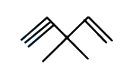
How many $\pi$ bonds and $\sigma$ bonds are present in the following molecule?
A
$5 \pi, 14 \sigma$ bonds
B
$3 \pi, 17 \sigma$ bonds
C
$3 \pi, 16 \sigma$ bonds
D
$2 \pi, 17 \sigma$ bonds
Solution
(C) The given molecule is $2$-methylpent-$1$-en-$4$-yne,which has the structure $CH_2=C(CH_3)-CH_2-C\equiv CH$.
Counting the bonds:
$1$. $\sigma$ bonds: There are $16$ $\sigma$ bonds in total ($1$ in $C=C$,$1$ in $C-C$,$1$ in $C-C$,$1$ in $C\equiv C$,and $12$ $C-H$ bonds).
$2$. $\pi$ bonds: There is $1$ $\pi$ bond in the double bond $(C=C)$ and $2$ $\pi$ bonds in the triple bond $(C\equiv C)$,totaling $3$ $\pi$ bonds.
Thus,the molecule contains $3 \pi$ and $16 \sigma$ bonds.
Counting the bonds:
$1$. $\sigma$ bonds: There are $16$ $\sigma$ bonds in total ($1$ in $C=C$,$1$ in $C-C$,$1$ in $C-C$,$1$ in $C\equiv C$,and $12$ $C-H$ bonds).
$2$. $\pi$ bonds: There is $1$ $\pi$ bond in the double bond $(C=C)$ and $2$ $\pi$ bonds in the triple bond $(C\equiv C)$,totaling $3$ $\pi$ bonds.
Thus,the molecule contains $3 \pi$ and $16 \sigma$ bonds.
0 likesView Solution
56
ChemistryMediumMCQMHT CET · 2020
Identify the decreasing order of boiling point of the following alkanes:
$(i)$ $n$-pentane
$(ii)$ Isopentane
$(iii)$ Neopentane
$(i)$ $n$-pentane
$(ii)$ Isopentane
$(iii)$ Neopentane
A
Isopentane $>$ $n$-pentane $>$ Neopentane
B
Neopentane $>$ Isopentane $>$ $n$-pentane
C
$n$-pentane $>$ Isopentane $>$ Neopentane
D
Isopentane $>$ Neopentane $>$ $n$-pentane
Solution
(C) The boiling point of alkanes depends on the surface area of the molecule.
As the branching in the alkane chain increases,the surface area decreases,leading to weaker van der Waals forces of attraction.
Therefore,the boiling point decreases as branching increases.
$n$-pentane is a straight-chain alkane with the largest surface area,followed by Isopentane (one branch),and Neopentane (two branches) has the smallest surface area.
Thus,the decreasing order of boiling point is: $n$-pentane $>$ Isopentane $>$ Neopentane.
As the branching in the alkane chain increases,the surface area decreases,leading to weaker van der Waals forces of attraction.
Therefore,the boiling point decreases as branching increases.
$n$-pentane is a straight-chain alkane with the largest surface area,followed by Isopentane (one branch),and Neopentane (two branches) has the smallest surface area.
Thus,the decreasing order of boiling point is: $n$-pentane $>$ Isopentane $>$ Neopentane.
0 likesView Solution
57
ChemistryEasyMCQMHT CET · 2020
In which of the following molecules,$2$ $\pi$ bonds are present?
A
$C_{2}H_{6}$
B
$C_{2}H_{4}$
C
$C_{2}H_{2}$
D
$C_{3}H_{6}$
Solution
(C) $I$. $CH_{3}-CH_{3}$ $(C_{2}H_{6})$: Contains only $\sigma$ bonds. (No $\pi$ bond)
$II$. $CH_{2}=CH_{2}$ $(C_{2}H_{4})$: Contains $1$ $\sigma$ bond and $1$ $\pi$ bond between carbons.
$III$. $CH \equiv CH$ $(C_{2}H_{2})$: Contains $1$ $\sigma$ bond and $2$ $\pi$ bonds between carbons.
$IV$. $CH_{3}-CH=CH_{2}$ $(C_{3}H_{6})$: Contains $1$ $\pi$ bond in the $C=C$ double bond.
$II$. $CH_{2}=CH_{2}$ $(C_{2}H_{4})$: Contains $1$ $\sigma$ bond and $1$ $\pi$ bond between carbons.
$III$. $CH \equiv CH$ $(C_{2}H_{2})$: Contains $1$ $\sigma$ bond and $2$ $\pi$ bonds between carbons.
$IV$. $CH_{3}-CH=CH_{2}$ $(C_{3}H_{6})$: Contains $1$ $\pi$ bond in the $C=C$ double bond.
0 likesView Solution
58
ChemistryEasyMCQMHT CET · 2020
Which of the following molecules contains $50 \%$ $p$-character in the hybrid orbitals of the $C$ atom?
A
Propene
B
Acetylene
C
Methane
D
Ethane
Solution
(B) The percentage of $p$-character in a hybrid orbital is determined by its hybridization state.
In $sp$ hybridization,there is $50 \%$ $s$-character and $50 \%$ $p$-character.
In $sp^2$ hybridization,there is $33.33 \%$ $s$-character and $66.67 \%$ $p$-character.
In $sp^3$ hybridization,there is $25 \%$ $s$-character and $75 \%$ $p$-character.
Acetylene $(C_2H_2)$ has $sp$ hybridized carbon atoms,which corresponds to $50 \%$ $p$-character.
In $sp$ hybridization,there is $50 \%$ $s$-character and $50 \%$ $p$-character.
In $sp^2$ hybridization,there is $33.33 \%$ $s$-character and $66.67 \%$ $p$-character.
In $sp^3$ hybridization,there is $25 \%$ $s$-character and $75 \%$ $p$-character.
Acetylene $(C_2H_2)$ has $sp$ hybridized carbon atoms,which corresponds to $50 \%$ $p$-character.
0 likesView Solution
59
ChemistryEasyMCQMHT CET · 2020
Which free radical is most stable among the following?
A
$R-CH_2^{\bullet}$
B
$R_3C^{\bullet}$
C
$CH_3^{\bullet}$
D
$R_2CH^{\bullet}$
Solution
(B) The stability of free radicals is governed by the inductive effect and hyperconjugation.
The order of stability is $3^{\circ} > 2^{\circ} > 1^{\circ} > \text{methyl}$.
$R_3C^{\bullet}$ is a tertiary $(3^{\circ})$ radical,which is the most stable due to the maximum number of hyperconjugative structures and the electron-donating inductive effect of three $R$ groups.
The order of stability is $3^{\circ} > 2^{\circ} > 1^{\circ} > \text{methyl}$.
$R_3C^{\bullet}$ is a tertiary $(3^{\circ})$ radical,which is the most stable due to the maximum number of hyperconjugative structures and the electron-donating inductive effect of three $R$ groups.
0 likesView Solution
60
ChemistryMediumMCQMHT CET · 2020
Which among the following carbocations is the most reactive?
A
$(CH_{3})_{3}C^{+}$
B
$(CH_{3})_{2}CH^{+}$
C
$CH_{3}^{+}$
D
$CH_{3}CH_{2}^{+}$
Solution
(C) The reactivity of a carbocation is inversely proportional to its stability.
$CH_{3}^{+}$ is a methyl carbocation,which is the least stable among the given options because it lacks any electron-donating groups (such as alkyl groups) to stabilize the positive charge through $+I$ (inductive) or hyperconjugation effects.
Since it is the least stable,it is the most reactive.
$CH_{3}^{+}$ is a methyl carbocation,which is the least stable among the given options because it lacks any electron-donating groups (such as alkyl groups) to stabilize the positive charge through $+I$ (inductive) or hyperconjugation effects.
Since it is the least stable,it is the most reactive.
0 likesView Solution
61
ChemistryMediumMCQMHT CET · 2020
The total number of electrons around the carbon atom of a methyl free radical is:
A
$6$
B
$8$
C
$7$
D
$9$
Solution
(C) The methyl free radical is represented as $\cdot CH_3$.
In this structure,the carbon atom is bonded to three hydrogen atoms by three covalent bonds.
Each $C-H$ bond consists of $2$ electrons,contributing $3 \times 2 = 6$ electrons.
Additionally,there is one unpaired electron on the carbon atom.
Therefore,the total number of electrons around the carbon atom is $6 + 1 = 7$.
In this structure,the carbon atom is bonded to three hydrogen atoms by three covalent bonds.
Each $C-H$ bond consists of $2$ electrons,contributing $3 \times 2 = 6$ electrons.
Additionally,there is one unpaired electron on the carbon atom.
Therefore,the total number of electrons around the carbon atom is $6 + 1 = 7$.
0 likesView Solution
62
ChemistryEasyMCQMHT CET · 2020
Which of the following groups does not show $(+R)$ effect?
A
$-NH_2$
B
$-NHCOR$
C
$-CN$
D
$-NR_2$
Solution
(C) The $(+R)$ effect (positive resonance effect) is shown by groups that donate electrons through resonance,typically having a lone pair of electrons on the atom directly attached to the conjugated system.
$-NH_2$,$-NHCOR$,and $-NR_2$ all possess a lone pair on the nitrogen atom and thus exhibit the $(+R)$ effect.
$-CN$ contains a multiple bond between carbon and nitrogen,which acts as an electron-withdrawing group via resonance,thus showing the $(-R)$ effect.
$-NH_2$,$-NHCOR$,and $-NR_2$ all possess a lone pair on the nitrogen atom and thus exhibit the $(+R)$ effect.
$-CN$ contains a multiple bond between carbon and nitrogen,which acts as an electron-withdrawing group via resonance,thus showing the $(-R)$ effect.
0 likesView Solution
63
ChemistryEasyMCQMHT CET · 2020
Which of the following groups does not show $(-R)$ effect?
A
$I$. $-CHO$
B
$II$. $-COOH$
C
$III$. $-CN$
D
$IV$. $-OH$
Solution
(D) The resonance effect ($R$ effect) is the polarity produced in a molecule by the interaction of two $\pi$-bonds or between a $\pi$-bond and a lone pair of electrons present on an adjacent atom.
Groups like $-CHO$,$-COOH$,and $-CN$ contain multiple bonds with electronegative atoms,which withdraw electron density from the conjugated system,thus showing a $(-R)$ effect.
Conversely,the $-OH$ group possesses lone pairs of electrons on the oxygen atom that can be donated into the conjugated system,thereby exhibiting a $(+R)$ effect.
Groups like $-CHO$,$-COOH$,and $-CN$ contain multiple bonds with electronegative atoms,which withdraw electron density from the conjugated system,thus showing a $(-R)$ effect.
Conversely,the $-OH$ group possesses lone pairs of electrons on the oxygen atom that can be donated into the conjugated system,thereby exhibiting a $(+R)$ effect.
0 likesView Solution
64
ChemistryEasyMCQMHT CET · 2020
Resonance is $\underline{\text{NOT}}$ exhibited by
A
cyclohexane
B
aniline
C
nitrobenzene
D
phenol
Solution
(A) Resonance requires a conjugated system of $\pi$ bonds,such as alternating single and double bonds or the presence of lone pairs adjacent to a $\pi$ system.
$1$. $Aniline$,$nitrobenzene$,and $phenol$ all contain a benzene ring,which is a conjugated system of $\pi$ electrons,allowing for resonance.
$2$. $Cyclohexane$ $(C_6H_{12})$ is a saturated cyclic hydrocarbon where all carbon atoms are $sp^3$ hybridized and connected by single $\sigma$ bonds.
$3$. Since $cyclohexane$ lacks any $\pi$ bonds or a conjugated system,it does not exhibit resonance.
$1$. $Aniline$,$nitrobenzene$,and $phenol$ all contain a benzene ring,which is a conjugated system of $\pi$ electrons,allowing for resonance.
$2$. $Cyclohexane$ $(C_6H_{12})$ is a saturated cyclic hydrocarbon where all carbon atoms are $sp^3$ hybridized and connected by single $\sigma$ bonds.
$3$. Since $cyclohexane$ lacks any $\pi$ bonds or a conjugated system,it does not exhibit resonance.
0 likesView Solution
65
ChemistryMediumMCQMHT CET · 2020
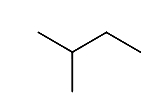
How many isomers of monobromo derivatives are obtained on the bromination of the following compound?
A
$4$
B
$3$
C
$2$
D
$5$
Solution
(A) The given compound is $2-$methylbutane $(CH_3-CH(CH_3)-CH_2-CH_3)$.
There are $4$ distinct types of hydrogen atoms in $2-$methylbutane,which leads to the formation of $4$ different monobromo isomers upon bromination:
$1.$ $1-$bromo$-2-$methylbutane
$2.$ $2-$bromo$-2-$methylbutane
$3.$ $2-$bromo$-3-$methylbutane
$4.$ $1-$bromo$-3-$methylbutane
Therefore,the total number of isomers is $4$.
There are $4$ distinct types of hydrogen atoms in $2-$methylbutane,which leads to the formation of $4$ different monobromo isomers upon bromination:
$1.$ $1-$bromo$-2-$methylbutane
$2.$ $2-$bromo$-2-$methylbutane
$3.$ $2-$bromo$-3-$methylbutane
$4.$ $1-$bromo$-3-$methylbutane
Therefore,the total number of isomers is $4$.
0 likesView Solution
66
ChemistryMediumMCQMHT CET · 2020
Which one of the following compounds is optically active?
A
$2-$Chloropentane
B
$3-$Chloropentane
C
$2-$Chloropropane
D
$2-$Chloro$-2-$methylbutane
Solution
(A) compound is optically active if it contains at least one chiral carbon atom (a carbon atom bonded to four different groups).
$1$. $2-$Chloropentane: $CH_3-CHCl-CH_2-CH_2-CH_3$. The $C-2$ atom is bonded to $-H$,$-Cl$,$-CH_3$,and $-CH_2CH_2CH_3$. Since all four groups are different,it is a chiral center. Thus,it is optically active.
$2$. $3-$Chloropentane: $CH_3-CH_2-CHCl-CH_2-CH_3$. The $C-3$ atom is bonded to two identical ethyl groups $(-CH_2CH_3)$,so it is achiral.
$3$. $2-$Chloropropane: $CH_3-CHCl-CH_3$. The $C-2$ atom is bonded to two identical methyl groups $(-CH_3)$,so it is achiral.
$4$. $2-$Chloro$-2-$methylbutane: $CH_3-CCl(CH_3)-CH_2-CH_3$. The $C-2$ atom is bonded to two identical methyl groups $(-CH_3)$,so it is achiral.
Therefore,$2-$Chloropentane is the optically active compound.
$1$. $2-$Chloropentane: $CH_3-CHCl-CH_2-CH_2-CH_3$. The $C-2$ atom is bonded to $-H$,$-Cl$,$-CH_3$,and $-CH_2CH_2CH_3$. Since all four groups are different,it is a chiral center. Thus,it is optically active.
$2$. $3-$Chloropentane: $CH_3-CH_2-CHCl-CH_2-CH_3$. The $C-3$ atom is bonded to two identical ethyl groups $(-CH_2CH_3)$,so it is achiral.
$3$. $2-$Chloropropane: $CH_3-CHCl-CH_3$. The $C-2$ atom is bonded to two identical methyl groups $(-CH_3)$,so it is achiral.
$4$. $2-$Chloro$-2-$methylbutane: $CH_3-CCl(CH_3)-CH_2-CH_3$. The $C-2$ atom is bonded to two identical methyl groups $(-CH_3)$,so it is achiral.
Therefore,$2-$Chloropentane is the optically active compound.
0 likesView Solution
67
ChemistryMediumMCQMHT CET · 2020
Which of the following compounds does $\underline{\text{NOT}}$ contain phantom atoms?
A
Acetaldehyde
B
Methyl cyanide
C
$n$-propyl alcohol
D
Propionic acid
Solution
(C) In the $Cahn-Ingold-Prelog$ $(CIP)$ priority rules,phantom atoms are used to represent multiple bonds by expanding them into single bonds.
- Acetaldehyde $(CH_3CHO)$ contains a $C=O$ double bond,which requires phantom atoms.
- Methyl cyanide $(CH_3CN)$ contains a $C \equiv N$ triple bond,which requires phantom atoms.
- Propionic acid $(CH_3CH_2COOH)$ contains a $C=O$ double bond,which requires phantom atoms.
- $n$-propyl alcohol $(CH_3CH_2CH_2OH)$ contains only single bonds between all atoms. Therefore,it does not require any phantom atoms.
- Acetaldehyde $(CH_3CHO)$ contains a $C=O$ double bond,which requires phantom atoms.
- Methyl cyanide $(CH_3CN)$ contains a $C \equiv N$ triple bond,which requires phantom atoms.
- Propionic acid $(CH_3CH_2COOH)$ contains a $C=O$ double bond,which requires phantom atoms.
- $n$-propyl alcohol $(CH_3CH_2CH_2OH)$ contains only single bonds between all atoms. Therefore,it does not require any phantom atoms.
0 likesView Solution
68
ChemistryMediumMCQMHT CET · 2020
How many optical isomers are possible for a compound having $3$ asymmetric carbon atoms?
A
$9$
B
$8$
C
$3$
D
$6$
Solution
(B) The number of optical isomers for a compound with $n$ asymmetric (chiral) carbon atoms is given by the formula $2^n$,provided there is no internal symmetry in the molecule.
Given $n = 3$,the number of optical isomers is $2^3 = 8$.
Given $n = 3$,the number of optical isomers is $2^3 = 8$.
0 likesView Solution
69
ChemistryDifficultMCQMHT CET · 2020
Which among the following compounds contains a phantom atom in the context of Cahn-Ingold-Prelog $(CIP)$ priority rules?
A
$CH_{3}COOH$
B
$CH_{3}CH_{2}Cl$
C
$CH_{3}CH_{2}NH_{2}$
D
$CH_{3}CH_{2}CH_{2}OH$
Solution
(A) According to the Cahn-Ingold-Prelog $(CIP)$ priority rules,phantom atoms are used to account for multiple bonds (double or triple bonds) by expanding them into single bonds.
In $CH_{3}COOH$ (acetic acid),the carbonyl group $(C=O)$ contains a double bond between carbon and oxygen.
To assign priorities,the $C=O$ bond is expanded by treating the carbon as bonded to two oxygens (one real,one phantom) and the oxygen as bonded to two carbons (one real,one phantom).
Since the other options ($CH_{3}CH_{2}Cl$,$CH_{3}CH_{2}NH_{2}$,and $CH_{3}CH_{2}CH_{2}OH$) contain only single bonds,they do not require the use of phantom atoms for priority assignment.
Therefore,$CH_{3}COOH$ is the correct answer.
In $CH_{3}COOH$ (acetic acid),the carbonyl group $(C=O)$ contains a double bond between carbon and oxygen.
To assign priorities,the $C=O$ bond is expanded by treating the carbon as bonded to two oxygens (one real,one phantom) and the oxygen as bonded to two carbons (one real,one phantom).
Since the other options ($CH_{3}CH_{2}Cl$,$CH_{3}CH_{2}NH_{2}$,and $CH_{3}CH_{2}CH_{2}OH$) contain only single bonds,they do not require the use of phantom atoms for priority assignment.
Therefore,$CH_{3}COOH$ is the correct answer.
0 likesView Solution
70
ChemistryEasyMCQMHT CET · 2020
How many optical isomers are possible for a compound having four asymmetric carbon atoms?
A
$16$
B
$8$
C
$12$
D
$4$
Solution
(A) The number of optical isomers for a compound with $n$ asymmetric carbon atoms is given by the formula $2^{n}$.
Given that the compound has $n = 4$ asymmetric carbon atoms.
Therefore,the number of optical isomers is $2^{4} = 16$.
Given that the compound has $n = 4$ asymmetric carbon atoms.
Therefore,the number of optical isomers is $2^{4} = 16$.
0 likesView Solution
71
ChemistryMediumMCQMHT CET · 2020
Which among the following compounds is $\underline{NOT}$ optically active?
A
$3-$Chloropentane
B
$2-$Chloropentane
C
$2-$Chloro$-3-$methylpentane
D
$3-$Chloro$-2-$methylpentane
Solution
(A) compound is optically active if it lacks a plane of symmetry or center of symmetry (i.e.,it is chiral).
$3-$Chloropentane $(CH_3CH_2CHClCH_2CH_3)$ has a plane of symmetry passing through the $C-3$ atom,making it achiral and thus optically inactive.
$2-$Chloropentane,$2-$chloro$-3-$methylpentane,and $3-$chloro$-2-$methylpentane all contain at least one chiral carbon atom and lack internal symmetry,making them optically active.
$3-$Chloropentane $(CH_3CH_2CHClCH_2CH_3)$ has a plane of symmetry passing through the $C-3$ atom,making it achiral and thus optically inactive.
$2-$Chloropentane,$2-$chloro$-3-$methylpentane,and $3-$chloro$-2-$methylpentane all contain at least one chiral carbon atom and lack internal symmetry,making them optically active.
0 likesView Solution
72
ChemistryEasyMCQMHT CET · 2020
If $n$ is the number of asymmetric carbon atoms,the number of optical isomers possible is given by the formula:
A
$n^{2}$
B
$\frac{n}{2}$
C
$2n$
D
$2^{n}$
Solution
(D) The general formula for calculating the number of optical isomers is $2^{n}$,where $n$ represents the number of asymmetric (chiral) carbon atoms.
An asymmetric carbon atom is a carbon atom bonded to $4$ different groups.
Therefore,for a molecule with $n$ chiral centers,the maximum number of optical isomers is $2^{n}$.
An asymmetric carbon atom is a carbon atom bonded to $4$ different groups.
Therefore,for a molecule with $n$ chiral centers,the maximum number of optical isomers is $2^{n}$.
0 likesView Solution
73
ChemistryDifficultMCQMHT CET · 2020
The number of optical isomers possible for $3,4-$dichloropentan$-2-$ol is
A
Two
B
Sixteen
C
Eight
D
Four
Solution
(C) The structure of $3,4-$dichloropentan$-2-$ol is $CH_3-CH(OH)-CH(Cl)-CH(Cl)-CH_3$.
This molecule has $3$ chiral centers (at $C2, C3,$ and $C4$).
Since the molecule is asymmetric (the groups attached to the chiral centers are different),the number of optical isomers is given by the formula $2^n$,where $n$ is the number of chiral centers.
Here,$n = 3$.
Therefore,the number of optical isomers = $2^3 = 8$.
This molecule has $3$ chiral centers (at $C2, C3,$ and $C4$).
Since the molecule is asymmetric (the groups attached to the chiral centers are different),the number of optical isomers is given by the formula $2^n$,where $n$ is the number of chiral centers.
Here,$n = 3$.
Therefore,the number of optical isomers = $2^3 = 8$.
0 likesView Solution
74
ChemistryEasyMCQMHT CET · 2020
Separation of $Acetone$ and $Benzene$ from their mixture is carried out by
A
Fractional distillation
B
Simple distillation
C
Fractional distillation using fractionating column
D
Distillation under reduced pressure
Solution
(C) The separation of $Acetone$ and $Benzene$ from their mixture is effectively carried out by $Fractional \ distillation$ using a $fractionating \ column$.
This method is employed because the boiling points of $Acetone$ $(56 \ ^\circ C)$ and $Benzene$ $(80 \ ^\circ C)$ are relatively close,necessitating the use of a fractionating column to achieve efficient separation through repeated vaporization and condensation cycles.
This method is employed because the boiling points of $Acetone$ $(56 \ ^\circ C)$ and $Benzene$ $(80 \ ^\circ C)$ are relatively close,necessitating the use of a fractionating column to achieve efficient separation through repeated vaporization and condensation cycles.
0 likesView Solution
75
ChemistryEasyMCQMHT CET · 2020
Identify the carrier gas commonly used in gas chromatography.
A
Helium
B
Argon
C
Hydrogen
D
Neon
Solution
(A) In gas chromatography,an inert carrier gas is required to transport the sample through the column. $Helium$ $(He)$ is the most commonly used carrier gas due to its inert nature,high thermal conductivity,and safety compared to $Hydrogen$. While $Argon$ is inert,$Helium$ is preferred in standard analytical applications.
0 likesView Solution
76
ChemistryEasyMCQMHT CET · 2020
$A$ mixture of sodium chloride and ammonium chloride is separated by:
A
sublimation
B
distillation
C
chromatography
D
differential extraction
Solution
(A) The correct method is $sublimation$.
$Ammonium \ chloride$ $(NH_4Cl)$ is a sublime substance,meaning it changes directly from a solid to a gas upon heating.
$Sodium \ chloride$ $(NaCl)$ does not sublime.
Therefore,when the mixture is heated,$NH_4Cl$ vaporizes and can be collected,leaving $NaCl$ behind.
$Ammonium \ chloride$ $(NH_4Cl)$ is a sublime substance,meaning it changes directly from a solid to a gas upon heating.
$Sodium \ chloride$ $(NaCl)$ does not sublime.
Therefore,when the mixture is heated,$NH_4Cl$ vaporizes and can be collected,leaving $NaCl$ behind.
0 likesView Solution
77
ChemistryEasyMCQMHT CET · 2020
Which among the following is a mineral of magnesium?
A
Limonite
B
Cryolite
C
Magnesite
D
Magnetite
Solution
(C) Magnesite is a mineral with the chemical formula $MgCO_3$.
It is a primary source of magnesium.
Limonite is an ore of iron,Cryolite is an ore of aluminium,and Magnetite is an ore of iron.
It is a primary source of magnesium.
Limonite is an ore of iron,Cryolite is an ore of aluminium,and Magnetite is an ore of iron.
0 likesView Solution
78
ChemistryMediumMCQMHT CET · 2020
If a mixture of iodomethane $(CH_3I)$ and iodoethane $(C_2H_5I)$ is treated with sodium metal in the presence of dry ether,it forms:
A
propane and ethane
B
ethane and butane
C
propane and butane
D
ethane,propane and butane
Solution
(D) The reaction of a mixture of two different alkyl halides with sodium metal in the presence of dry ether is known as the Wurtz reaction. $2CH_3I + 2C_2H_5I + 4Na \xrightarrow{\text{dry ether}} CH_3-CH_3 + CH_3-CH_2-CH_2-CH_3 + CH_3-CH_2-CH_3 + 4NaI$. The products formed are a mixture of alkanes: ethane $(CH_3-CH_3)$,butane $(CH_3-CH_2-CH_2-CH_3)$,and propane $(CH_3-CH_2-CH_3)$.
0 likesView Solution
79
ChemistryMediumMCQMHT CET · 2020
Which of the following is the major product obtained in the reaction of isobutylene with hydrogen bromide?
A
$tert-$butyl bromide
B
$sec-$butyl bromide
C
$n-$butyl bromide
D
Isobutyl bromide
Solution
(A) The reaction of isobutylene $(CH_3)_2C=CH_2$ with hydrogen bromide $(HBr)$ follows Markovnikov's rule.
According to this rule,the negative part of the addendum $(Br^-)$ attaches to the carbon atom having a lesser number of hydrogen atoms.
The reaction proceeds via the formation of a more stable $3^{\circ}$ carbocation intermediate.
$(CH_3)_2C=CH_2 + HBr \rightarrow (CH_3)_3C-Br$
The major product formed is $tert-$butyl bromide.
According to this rule,the negative part of the addendum $(Br^-)$ attaches to the carbon atom having a lesser number of hydrogen atoms.
The reaction proceeds via the formation of a more stable $3^{\circ}$ carbocation intermediate.
$(CH_3)_2C=CH_2 + HBr \rightarrow (CH_3)_3C-Br$
The major product formed is $tert-$butyl bromide.
0 likesView Solution
80
ChemistryMediumMCQMHT CET · 2020
When $HCl$ is treated with propene in the presence of sodium peroxide,the major product obtained is
A
$1-$Chloropropane
B
$1, 2-$dichloropropane
C
$2-$Chloropropane
D
$2, 2-$dichloropropane
Solution
(C) The peroxide effect (Kharasch effect) is only applicable to the addition of $HBr$ to unsymmetrical alkenes.
It does not apply to $HCl$ or $HI$.
Therefore,the addition of $HCl$ to propene follows Markovnikov's rule $(M.R.)$ even in the presence of peroxide.
According to Markovnikov's rule,the negative part of the addendum $(Cl^-)$ attaches to the carbon atom with fewer hydrogen atoms.
Reaction: $CH_3-CH=CH_2 + HCl \xrightarrow{Na_2O_2} CH_3-CHCl-CH_3$ ($2-$Chloropropane).
It does not apply to $HCl$ or $HI$.
Therefore,the addition of $HCl$ to propene follows Markovnikov's rule $(M.R.)$ even in the presence of peroxide.
According to Markovnikov's rule,the negative part of the addendum $(Cl^-)$ attaches to the carbon atom with fewer hydrogen atoms.
Reaction: $CH_3-CH=CH_2 + HCl \xrightarrow{Na_2O_2} CH_3-CHCl-CH_3$ ($2-$Chloropropane).
0 likesView Solution
81
ChemistryDifficultMCQMHT CET · 2020
Identify product $C$ in the following reaction: Propylene dibromide $\xrightarrow[\text{Alcohol}]{Zn, \Delta} A$ $\xrightarrow{HBr} B$ $\xrightarrow{Na, \text{ether}} C$
A
$2-$Bromobutane
B
Isobutane
C
$2,3-$Dimethylbutane
D
$1,2-$Dibromobutane
Solution
(C) $(i)$ Propylene dibromide $(CH_3-CHBr-CH_2Br)$ $\xrightarrow{Zn, \Delta}$ Propene $(CH_3-CH=CH_2)$ $(A)$.
$(ii)$ Propene $(A)$ $\xrightarrow{HBr}$ $2-$Bromopropane $(CH_3-CHBr-CH_3)$ $(B)$ (following Markovnikov's rule).
$(iii)$ $2-$Bromopropane $(B)$ $\xrightarrow{Na, \text{ether}}$ $2,3-$Dimethylbutane $(CH_3-CH(CH_3)-CH(CH_3)-CH_3)$ $(C)$ (Wurtz reaction).
$(ii)$ Propene $(A)$ $\xrightarrow{HBr}$ $2-$Bromopropane $(CH_3-CHBr-CH_3)$ $(B)$ (following Markovnikov's rule).
$(iii)$ $2-$Bromopropane $(B)$ $\xrightarrow{Na, \text{ether}}$ $2,3-$Dimethylbutane $(CH_3-CH(CH_3)-CH(CH_3)-CH_3)$ $(C)$ (Wurtz reaction).
0 likesView Solution
82
ChemistryEasyMCQMHT CET · 2020
What is the number of carbon atoms in alkanes found in diesel?
A
$C_{29}$ to $C_{31}$
B
$C_{6}$ to $C_{8}$
C
$C_{1}$ to $C_{4}$
D
$C_{15}$ to $C_{18}$
Solution
(D) Diesel fuel consists mainly of paraffins,aromatics,and naphthenes.
Gasoline hydrocarbons typically contain $4-12$ carbon atoms with a boiling range between $30 \ ^\circ C$ and $210 \ ^\circ C$.
In contrast,diesel fuel contains hydrocarbons with approximately $15-18$ carbon atoms and a boiling range between $170 \ ^\circ C$ and $360 \ ^\circ C$.
Gasoline hydrocarbons typically contain $4-12$ carbon atoms with a boiling range between $30 \ ^\circ C$ and $210 \ ^\circ C$.
In contrast,diesel fuel contains hydrocarbons with approximately $15-18$ carbon atoms and a boiling range between $170 \ ^\circ C$ and $360 \ ^\circ C$.
0 likesView Solution
83
ChemistryMediumMCQMHT CET · 2020
What is the source of an alkane if its molar mass is $240 \ g \ mol^{-1}$ and the percentage by mass of hydrogen is $15 \ \%$?
A
Gasoline
B
Diesel
C
Petrol
D
Coatings on green leaves
Solution
(B) For an alkane with general formula $C_nH_{2n+2}$,the molar mass is $12n + 1(2n+2) = 14n + 2 = 240 \ g \ mol^{-1}$.
$14n = 238$,so $n = 17$.
The alkane is $C_{17}H_{36}$.
The mass percentage of hydrogen is $\frac{36}{240} \times 100 = 15 \ \%$.
$C_{17}H_{36}$ is a component found in diesel fuel.
$14n = 238$,so $n = 17$.
The alkane is $C_{17}H_{36}$.
The mass percentage of hydrogen is $\frac{36}{240} \times 100 = 15 \ \%$.
$C_{17}H_{36}$ is a component found in diesel fuel.
0 likesView Solution
84
ChemistryEasyMCQMHT CET · 2020
Which alkane is secreted by cockroaches to attract the opposite gender of its species?
A
$Octane$
B
$Nonane$
C
$Undecane$
D
$Decane$
Solution
(C) $Undecane$ is a volatile hydrocarbon secreted by cockroaches as a sex pheromone to attract the opposite gender of its species.
0 likesView Solution
85
ChemistryDifficultMCQMHT CET · 2020
Compound $A$ on reaction with chlorine in the presence of $U.V.$ light gives $B$; which when reacted with $NaNO_{2}$ in the solvent $N, N$-dimethylformamide $(DMF)$,gives $2$-nitrobutane. The compound $A$ is:
A
Butane
B
Butan-$2$-ol
C
$2$-chloropropane
D
$1$-chlorobutane
Solution
(A) The reaction sequence is as follows:
$1$. Compound $A$ is $n$-butane $(CH_{3}CH_{2}CH_{2}CH_{3})$.
$2$. Reaction with $Cl_{2}$ in the presence of $U.V.$ light (free radical substitution) gives $2$-chlorobutane $(B)$ as the major product: $CH_{3}CH_{2}CH_{2}CH_{3} + Cl_{2} \xrightarrow{h\nu} CH_{3}CH_{2}CHClCH_{3} (B) + HCl$.
$3$. $2$-chlorobutane $(B)$ reacts with $NaNO_{2}$ in $DMF$ (a polar aprotic solvent) via an $S_{N}2$ mechanism to form $2$-nitrobutane: $CH_{3}CH_{2}CHClCH_{3} + NaNO_{2} \xrightarrow{DMF} CH_{3}CH_{2}CH(NO_{2})CH_{3} + NaCl$.
Thus,compound $A$ is butane.
$1$. Compound $A$ is $n$-butane $(CH_{3}CH_{2}CH_{2}CH_{3})$.
$2$. Reaction with $Cl_{2}$ in the presence of $U.V.$ light (free radical substitution) gives $2$-chlorobutane $(B)$ as the major product: $CH_{3}CH_{2}CH_{2}CH_{3} + Cl_{2} \xrightarrow{h\nu} CH_{3}CH_{2}CHClCH_{3} (B) + HCl$.
$3$. $2$-chlorobutane $(B)$ reacts with $NaNO_{2}$ in $DMF$ (a polar aprotic solvent) via an $S_{N}2$ mechanism to form $2$-nitrobutane: $CH_{3}CH_{2}CHClCH_{3} + NaNO_{2} \xrightarrow{DMF} CH_{3}CH_{2}CH(NO_{2})CH_{3} + NaCl$.
Thus,compound $A$ is butane.
0 likesView Solution
86
ChemistryMediumMCQMHT CET · 2020
Identify the product $X$ obtained in the following reaction:
$CH_{3}-(CH_{2})_{4}-CH_{3} \xrightarrow{Cr_{2}O_{3}, 773 \ K, 10-20 \ atm} X$
$CH_{3}-(CH_{2})_{4}-CH_{3} \xrightarrow{Cr_{2}O_{3}, 773 \ K, 10-20 \ atm} X$
A
$CH_{3}-CH=CH-CH_{3} + CH_{2}=CH_{2} + H_{2}$
B
$2 \ CH_{3}-CH=CH_{2} + H_{2}$
C
$C_{6}H_{6} + 4 \ H_{2}$
D
$CH_{3}-(CH_{2})_{3}-CH=CH_{2} + H_{2}$
Solution
(C) The reaction of $n$-hexane $(CH_{3}-(CH_{2})_{4}-CH_{3})$ in the presence of $Cr_{2}O_{3}$ supported on alumina at $773 \ K$ and $10-20 \ atm$ pressure is known as aromatization or catalytic reforming.
In this process,$n$-hexane undergoes cyclization and dehydrogenation to form benzene $(C_{6}H_{6})$ and hydrogen gas $(H_{2})$.
The balanced chemical equation is:
$CH_{3}-(CH_{2})_{4}-CH_{3} \xrightarrow{Cr_{2}O_{3}, 773 \ K, 10-20 \ atm} C_{6}H_{6} + 4 \ H_{2}$
Thus,the product $X$ is $C_{6}H_{6} + 4 \ H_{2}$.
In this process,$n$-hexane undergoes cyclization and dehydrogenation to form benzene $(C_{6}H_{6})$ and hydrogen gas $(H_{2})$.
The balanced chemical equation is:
$CH_{3}-(CH_{2})_{4}-CH_{3} \xrightarrow{Cr_{2}O_{3}, 773 \ K, 10-20 \ atm} C_{6}H_{6} + 4 \ H_{2}$
Thus,the product $X$ is $C_{6}H_{6} + 4 \ H_{2}$.
0 likesView Solution
87
ChemistryMediumMCQMHT CET · 2020
Identify the product $C$ in the following reaction:
$CH_{3}CH_{2}COOH$ $\xrightarrow{NaOH} A$ $\xrightarrow{NaOH, CaO, \Delta} B$ $\xrightarrow{HNO_{3}, \Delta} C$
$CH_{3}CH_{2}COOH$ $\xrightarrow{NaOH} A$ $\xrightarrow{NaOH, CaO, \Delta} B$ $\xrightarrow{HNO_{3}, \Delta} C$
A
$CH_{3}CH_{2}CH_{3}$
B
$CH_{2}=CH_{2}$
C
$CH_{3}CH_{2}NO_{2}$
D
$CH_{3}CH_{2}CH_{2}OH$
Solution
(C) Step $1$: $CH_{3}CH_{2}COOH + NaOH \rightarrow CH_{3}CH_{2}COONa (A) + H_{2}O$
Step $2$: $CH_{3}CH_{2}COONa + NaOH \xrightarrow{CaO, \Delta} CH_{3}CH_{3} (B) + Na_{2}CO_{3}$ (Decarboxylation)
Step $3$: $CH_{3}CH_{3} + HNO_{3} \xrightarrow{\Delta} CH_{3}CH_{2}NO_{2} (C) + H_{2}O$ (Nitration of alkane)
Thus,the product $C$ is nitroethane $(CH_{3}CH_{2}NO_{2})$.
Step $2$: $CH_{3}CH_{2}COONa + NaOH \xrightarrow{CaO, \Delta} CH_{3}CH_{3} (B) + Na_{2}CO_{3}$ (Decarboxylation)
Step $3$: $CH_{3}CH_{3} + HNO_{3} \xrightarrow{\Delta} CH_{3}CH_{2}NO_{2} (C) + H_{2}O$ (Nitration of alkane)
Thus,the product $C$ is nitroethane $(CH_{3}CH_{2}NO_{2})$.
0 likesView Solution
88
ChemistryDifficultMCQMHT CET · 2020
Identify '$B$' in the following reaction: $C_{2}H_{6}$ $\xrightarrow[AlBr_{3}]{Br_{2}} A$ $\xrightarrow[\Delta]{CH_{3}COOAg} B$
A
$CH_{3}COOC_{2}H_{5}$
B
$C_{2}H_{5}COOCH_{3}$
C
$CH_{3}COOCH_{3}$
D
$C_{2}H_{5}COOC_{2}H_{5}$
Solution
(A) Step $1$: The reaction of ethane $(C_{2}H_{6})$ with bromine $(Br_{2})$ in the presence of $AlBr_{3}$ is a bromination reaction,which yields ethyl bromide $(A = C_{2}H_{5}Br)$.
Step $2$: The reaction of ethyl bromide $(C_{2}H_{5}Br)$ with silver acetate $(CH_{3}COOAg)$ is a nucleophilic substitution reaction (specifically,an esterification reaction).
Step $3$: The reaction proceeds as follows: $C_{2}H_{5}Br + CH_{3}COOAg \rightarrow CH_{3}COOC_{2}H_{5} + AgBr$.
Step $4$: The product $B$ is ethyl acetate,which is $CH_{3}COOC_{2}H_{5}$.
Step $2$: The reaction of ethyl bromide $(C_{2}H_{5}Br)$ with silver acetate $(CH_{3}COOAg)$ is a nucleophilic substitution reaction (specifically,an esterification reaction).
Step $3$: The reaction proceeds as follows: $C_{2}H_{5}Br + CH_{3}COOAg \rightarrow CH_{3}COOC_{2}H_{5} + AgBr$.
Step $4$: The product $B$ is ethyl acetate,which is $CH_{3}COOC_{2}H_{5}$.
0 likesView Solution
89
ChemistryMediumMCQMHT CET · 2020
Which of the following compounds on heating with potassium permanganate $(KMnO_4)$ and dilute sulphuric acid $(H_2SO_4)$ forms adipic acid?
A
$Methylbenzene$
B
$Phenylethene$
C
$Cyclohexene$
D
$n-butylbenzene$
Solution
(C) The oxidation of $Cyclohexene$ with strong oxidizing agents like acidic $KMnO_4$ leads to the oxidative cleavage of the double bond.
This reaction breaks the ring and results in the formation of a dicarboxylic acid.
Specifically,$Cyclohexene$ reacts with $KMnO_4$ and dilute $H_2SO_4$ to produce $Hexanedioic$ acid,which is commonly known as adipic acid.
The reaction is represented as: $Cyclohexene + 4[O] \xrightarrow{KMnO_4 / dil. H_2SO_4, \Delta} HOOC-(CH_2)_4-COOH$ (Adipic acid).
This reaction breaks the ring and results in the formation of a dicarboxylic acid.
Specifically,$Cyclohexene$ reacts with $KMnO_4$ and dilute $H_2SO_4$ to produce $Hexanedioic$ acid,which is commonly known as adipic acid.
The reaction is represented as: $Cyclohexene + 4[O] \xrightarrow{KMnO_4 / dil. H_2SO_4, \Delta} HOOC-(CH_2)_4-COOH$ (Adipic acid).
0 likesView Solution
90
ChemistryEasyMCQMHT CET · 2020
Which of the following properties of hydrogen is similar to the halogen family?
A
Ionisation enthalpy
B
Formation of unipositive ion
C
Electronic configuration
D
Electron gain enthalpy
Solution
(A) Hydrogen resembles halogens in several properties:
$1$. Both exist as diatomic molecules $(H_2, F_2, Cl_2, Br_2, I_2)$.
$2$. Both have high ionisation enthalpy values.
$3$. Both form uninegative ions $(H^-, F^-, Cl^-, Br^-, I^-)$ by gaining one electron.
$4$. Both form covalent compounds with non-metals.
Among the given options,the ionisation enthalpy of hydrogen is comparable to that of halogens,making it the most appropriate similarity in terms of periodic trends.
$1$. Both exist as diatomic molecules $(H_2, F_2, Cl_2, Br_2, I_2)$.
$2$. Both have high ionisation enthalpy values.
$3$. Both form uninegative ions $(H^-, F^-, Cl^-, Br^-, I^-)$ by gaining one electron.
$4$. Both form covalent compounds with non-metals.
Among the given options,the ionisation enthalpy of hydrogen is comparable to that of halogens,making it the most appropriate similarity in terms of periodic trends.
0 likesView Solution
91
ChemistryEasyMCQMHT CET · 2020
Which of the following is used as a promoter in the Bosch process?
A
$CO_{2}$
B
$CO$
C
$Fe_{2}O_{3}$
D
$Cr_{2}O_{3}$
Solution
(D) In the Bosch process,water gas $(CO + H_{2})$ is reacted with steam to produce $CO_{2}$ and $H_{2}$.
$Fe_{2}O_{3}$ acts as a catalyst,while $Cr_{2}O_{3}$ is used as a promoter to increase the efficiency of the catalyst.
$Fe_{2}O_{3}$ acts as a catalyst,while $Cr_{2}O_{3}$ is used as a promoter to increase the efficiency of the catalyst.
0 likesView Solution
92
ChemistryDifficultMCQMHT CET · 2020
Which of the following hydrides is electron-deficient?
A
$LiH$
B
$KH$
C
$NiH$
D
$NaH$
Solution
(C) The hydride $NiH$ is an example of a metallic or non-stoichiometric hydride.
These hydrides are often electron-deficient,meaning they do not have a sufficient number of electrons to form normal covalent bonds,which is why they are also referred to as non-stoichiometric hydrides.
These hydrides are often electron-deficient,meaning they do not have a sufficient number of electrons to form normal covalent bonds,which is why they are also referred to as non-stoichiometric hydrides.
0 likesView Solution
93
ChemistryEasyMCQMHT CET · 2020
Which is an example of a molecular hydride?
A
$KH$
B
$NaH$
C
$HF$
D
$LiH$
Solution
(C) $HF$ is a molecular (covalent) hydride because it is formed by the sharing of electrons between hydrogen and a non-metal (fluorine).
$KH$,$NaH$,and $LiH$ are examples of saline or ionic hydrides,which are formed by the transfer of electrons from an alkali metal to hydrogen.
$KH$,$NaH$,and $LiH$ are examples of saline or ionic hydrides,which are formed by the transfer of electrons from an alkali metal to hydrogen.
0 likesView Solution
94
ChemistryEasyMCQMHT CET · 2020
What is the formula of hydrolith?
A
$MgH_{2}$
B
$CaH_{2}$
C
$BaH_{2}$
D
$BeH_{2}$
Solution
(B) The formula of hydrolith is $CaH_{2}$.
Calcium hydride $(CaH_{2})$ is a salt-like binary hydride that is commonly used as a reducing agent and as a convenient source of hydrogen gas.
Calcium hydride $(CaH_{2})$ is a salt-like binary hydride that is commonly used as a reducing agent and as a convenient source of hydrogen gas.
0 likesView Solution
95
ChemistryEasyMCQMHT CET · 2020
In the gas phase,the $H-O-O-H$ dihedral angle in $H_{2}O_{2}$ is: (in $^{\circ}$)
A
$111.5$
B
$94.8$
C
$98.4$
D
$147.5$
Solution
(B) In the gas phase,the $H-O-O-H$ dihedral angle in $H_{2}O_{2}$ is $111.5^{\circ}$,while the $O-O-H$ bond angle is $94.8^{\circ}$.
In the solid phase,the $H-O-O-H$ dihedral angle is $90.2^{\circ}$ and the $O-O-H$ bond angle is $101.9^{\circ}$.
The question asks for the $H-O-O-H$ bond angle (often referred to as the dihedral angle in this context) in the gas phase,which is $111.5^{\circ}$. However,based on the provided image and options,the question is specifically asking for the $O-O-H$ bond angle in the gas phase,which is $94.8^{\circ}$.
In the solid phase,the $H-O-O-H$ dihedral angle is $90.2^{\circ}$ and the $O-O-H$ bond angle is $101.9^{\circ}$.
The question asks for the $H-O-O-H$ bond angle (often referred to as the dihedral angle in this context) in the gas phase,which is $111.5^{\circ}$. However,based on the provided image and options,the question is specifically asking for the $O-O-H$ bond angle in the gas phase,which is $94.8^{\circ}$.
0 likesView Solution
96
ChemistryEasyMCQMHT CET · 2020
Which of the following compounds is $NOT$ present in its standard state at $25^{\circ} C$ and $1 \text{ atmosphere}$ pressure?
A
$CO_{2(g)}$
B
$CaCO_{3(s)}$
C
$C_{2}H_{5}OH_{(l)}$
D
$H_{2}O_{(g)}$
Solution
(D) The standard state of a substance is its most stable physical form at a specified temperature (usually $298 \text{ K}$ or $25^{\circ} C$) and $1 \text{ bar}$ (or $1 \text{ atm}$) pressure.
At $25^{\circ} C$ and $1 \text{ atm}$ pressure,water exists as a liquid $(H_{2}O_{(l)})$,not as a gas $(H_{2}O_{(g)})$.
Therefore,$H_{2}O_{(g)}$ is not in its standard state under these conditions.
At $25^{\circ} C$ and $1 \text{ atm}$ pressure,water exists as a liquid $(H_{2}O_{(l)})$,not as a gas $(H_{2}O_{(g)})$.
Therefore,$H_{2}O_{(g)}$ is not in its standard state under these conditions.
0 likesView Solution
97
ChemistryEasyMCQMHT CET · 2020
How many hydrogen atoms are surrounding each oxygen atom in the structure of ice?
A
$2$
B
$4$
C
$3$
D
$1$
Solution
(B) In the crystalline structure of ice,each oxygen atom is surrounded by four hydrogen atoms.
Two of these hydrogen atoms are covalently bonded to the oxygen atom,while the other two are linked through hydrogen bonding.
This arrangement creates a tetrahedral geometry around each oxygen atom.
Two of these hydrogen atoms are covalently bonded to the oxygen atom,while the other two are linked through hydrogen bonding.
This arrangement creates a tetrahedral geometry around each oxygen atom.
0 likesView Solution
98
ChemistryEasyMCQMHT CET · 2020
What is the boiling point of heavy water (in $^{\circ} C$)?
A
$101.4$
B
$100.4$
C
$273$
D
$100$
Solution
(A) The boiling point of heavy water $(D_2O)$ is $101.4^{\circ} C$ $(374.4 \ K)$.
This is higher than the boiling point of ordinary water $(H_2O)$,which is $100^{\circ} C$ $(373 \ K)$,due to stronger hydrogen bonding in $D_2O$.
This is higher than the boiling point of ordinary water $(H_2O)$,which is $100^{\circ} C$ $(373 \ K)$,due to stronger hydrogen bonding in $D_2O$.
0 likesView Solution
99
ChemistryEasyMCQMHT CET · 2020
Identify the hydrocarbon compound from the following containing carbon atoms in the range of $C_{6}$ to $C_{8}$?
A
Waxes
B
Petrol
C
Diesel
D
$CNG$
Solution
(B) The correct answer is $B$ (Petrol).
Petrol is a mixture of hydrocarbons containing carbon atoms typically in the range of $C_{6}$ to $C_{8}$.
It consists of various alkanes (linear or branched) and cycloalkanes.
Specifically,petrol is composed of alkanes ranging from pentane $(C_{5}H_{12})$ to octane $(C_{8}H_{18})$,making it the correct choice for the given range.
Petrol is a mixture of hydrocarbons containing carbon atoms typically in the range of $C_{6}$ to $C_{8}$.
It consists of various alkanes (linear or branched) and cycloalkanes.
Specifically,petrol is composed of alkanes ranging from pentane $(C_{5}H_{12})$ to octane $(C_{8}H_{18})$,making it the correct choice for the given range.
0 likesView Solution
100
ChemistryEasyMCQMHT CET · 2020
What is the range of the number of carbon atoms in alkanes found in paraffin wax?
A
$C_{21}$ to $C_{30}$
B
$C_{17}$ to $C_{18}$
C
$C_{19}$ to $C_{20}$
D
$C_{6}$ to $C_{8}$
Solution
(A) Paraffin wax is a white or colourless soft solid that is derived from petroleum,coal,or oil shale.
It consists of a mixture of hydrocarbon molecules,specifically alkanes.
The range of carbon atoms in these alkanes typically falls between $C_{20}$ and $C_{40}$,but the most common range cited for commercial paraffin wax is $C_{21}$ to $C_{30}$.
It is widely used in applications such as candles,wax paper,polishes,cosmetics,and electrical insulation.
It consists of a mixture of hydrocarbon molecules,specifically alkanes.
The range of carbon atoms in these alkanes typically falls between $C_{20}$ and $C_{40}$,but the most common range cited for commercial paraffin wax is $C_{21}$ to $C_{30}$.
It is widely used in applications such as candles,wax paper,polishes,cosmetics,and electrical insulation.
0 likesView Solution
101
ChemistryMediumMCQMHT CET · 2020
Propanenitrile on reaction with ethylmagnesium iodide in the presence of dry ether gives an imine complex. This imine complex on acid hydrolysis forms:
A
$2-$Pentanone
B
Butanone
C
Propanone
D
$3-$Pentanone
Solution
(D) The reaction of propanenitrile $(CH_3CH_2CN)$ with ethylmagnesium iodide $(C_2H_5MgI)$ in the presence of dry ether proceeds as follows:
$1$. Nucleophilic attack of the ethyl group from the Grignard reagent on the carbon atom of the nitrile group leads to the formation of an imine magnesium complex: $CH_3CH_2CN + C_2H_5MgI \rightarrow CH_3CH_2C(C_2H_5)=NMgI$.
$2$. Acid hydrolysis $(H_3O^+)$ of this imine complex results in the formation of a ketone and ammonia: $CH_3CH_2C(C_2H_5)=NMgI + H_2O/H^+ \rightarrow CH_3CH_2COCH_2CH_3 + NH_3 + Mg(OH)I$.
$3$. The product formed is $CH_3CH_2COCH_2CH_3$,which is $3-$pentanone (pentan-$3-$one).
Therefore,the correct option is $D$.
$1$. Nucleophilic attack of the ethyl group from the Grignard reagent on the carbon atom of the nitrile group leads to the formation of an imine magnesium complex: $CH_3CH_2CN + C_2H_5MgI \rightarrow CH_3CH_2C(C_2H_5)=NMgI$.
$2$. Acid hydrolysis $(H_3O^+)$ of this imine complex results in the formation of a ketone and ammonia: $CH_3CH_2C(C_2H_5)=NMgI + H_2O/H^+ \rightarrow CH_3CH_2COCH_2CH_3 + NH_3 + Mg(OH)I$.
$3$. The product formed is $CH_3CH_2COCH_2CH_3$,which is $3-$pentanone (pentan-$3-$one).
Therefore,the correct option is $D$.
0 likesView Solution
102
ChemistryDifficultMCQMHT CET · 2020
Identify '$B$' in the following reaction:
$C_6H_5CN + C_6H_5MgBr$ $\xrightarrow{\text{ether}} A$ $\xrightarrow{H_3O^+} B + Mg(Br)(OH)$
$C_6H_5CN + C_6H_5MgBr$ $\xrightarrow{\text{ether}} A$ $\xrightarrow{H_3O^+} B + Mg(Br)(OH)$
A
Benzophenone
B
Benzaldehyde
C
Aniline
D
Diphenyl
Solution
(A) The reaction of benzonitrile $(C_6H_5CN)$ with phenylmagnesium bromide $(C_6H_5MgBr)$ in the presence of dry ether forms an intermediate imine complex $(A)$.
This imine complex is then hydrolyzed by $H_3O^+$ to yield benzophenone $(C_6H_5COC_6H_5)$ as the final product '$B$'.
The reaction is: $C_6H_5CN + C_6H_5MgBr$ $\rightarrow C_6H_5C(NMgBr)C_6H_5$ $\xrightarrow{H_3O^+} C_6H_5COC_6H_5 + NH_3 + Mg(Br)(OH)$.
This imine complex is then hydrolyzed by $H_3O^+$ to yield benzophenone $(C_6H_5COC_6H_5)$ as the final product '$B$'.
The reaction is: $C_6H_5CN + C_6H_5MgBr$ $\rightarrow C_6H_5C(NMgBr)C_6H_5$ $\xrightarrow{H_3O^+} C_6H_5COC_6H_5 + NH_3 + Mg(Br)(OH)$.
0 likesView Solution
103
ChemistryMediumMCQMHT CET · 2020
Which of the following carbonyl compounds does $NOT$ undergo aldol condensation?
A
Acetone
B
Benzophenone
C
Acetaldehyde
D
Acetophenone
Solution
(B) Aldol condensation requires the presence of at least one $\alpha$-hydrogen atom in the carbonyl compound.
$1$. Acetone $(CH_3COCH_3)$ has $6$ $\alpha$-hydrogens.
$2$. Benzophenone $(C_6H_5COC_6H_5)$ has no $\alpha$-hydrogen atom attached to the carbonyl carbon.
$3$. Acetaldehyde $(CH_3CHO)$ has $3$ $\alpha$-hydrogens.
$4$. Acetophenone $(C_6H_5COCH_3)$ has $3$ $\alpha$-hydrogens.
Therefore,Benzophenone does not undergo aldol condensation.
$1$. Acetone $(CH_3COCH_3)$ has $6$ $\alpha$-hydrogens.
$2$. Benzophenone $(C_6H_5COC_6H_5)$ has no $\alpha$-hydrogen atom attached to the carbonyl carbon.
$3$. Acetaldehyde $(CH_3CHO)$ has $3$ $\alpha$-hydrogens.
$4$. Acetophenone $(C_6H_5COCH_3)$ has $3$ $\alpha$-hydrogens.
Therefore,Benzophenone does not undergo aldol condensation.
0 likesView Solution
104
ChemistryEasyMCQMHT CET · 2020
Identify $A$ in the following reaction: $A + CH_3MgBr$ $\xrightarrow{\text{ether}} \text{complex}$ $\xrightarrow{H_3O^{+}} (CH_3)_3C-OH$
A
Acetaldehyde
B
Propionaldehyde
C
Acetyl chloride
D
Acetone
Solution
(D) The reaction of a Grignard reagent $(CH_3MgBr)$ with a carbonyl compound followed by acid hydrolysis $(H_3O^{+})$ produces an alcohol.
In the given reaction,the product is tert-butyl alcohol,which is $(CH_3)_3C-OH$.
Since the Grignard reagent provides one methyl group $(CH_3)$,the carbonyl compound $A$ must provide the remaining three-carbon skeleton with a carbonyl group.
Acetone $(CH_3COCH_3)$ reacts with $CH_3MgBr$ to form an intermediate complex,which upon hydrolysis yields tert-butyl alcohol.
The reaction is: $CH_3COCH_3 + CH_3MgBr$ $\rightarrow (CH_3)_3C-OMgBr$ $\xrightarrow{H_3O^{+}} (CH_3)_3C-OH + Mg(OH)Br$.
Therefore,$A$ is Acetone.
In the given reaction,the product is tert-butyl alcohol,which is $(CH_3)_3C-OH$.
Since the Grignard reagent provides one methyl group $(CH_3)$,the carbonyl compound $A$ must provide the remaining three-carbon skeleton with a carbonyl group.
Acetone $(CH_3COCH_3)$ reacts with $CH_3MgBr$ to form an intermediate complex,which upon hydrolysis yields tert-butyl alcohol.
The reaction is: $CH_3COCH_3 + CH_3MgBr$ $\rightarrow (CH_3)_3C-OMgBr$ $\xrightarrow{H_3O^{+}} (CH_3)_3C-OH + Mg(OH)Br$.
Therefore,$A$ is Acetone.
0 likesView Solution
105
ChemistryMediumMCQMHT CET · 2020
Which of the following compounds is highly reactive towards $HCN$?
A
$C_6H_5CHO$
B
$HCHO$
C
$CH_3COCH_3$
D
$CH_3CHO$
Solution
(B) The reactivity of carbonyl compounds towards nucleophilic addition reactions like $HCN$ addition depends on two factors: steric hindrance and electronic effects.
$1$. Steric hindrance: Smaller groups around the carbonyl carbon facilitate the attack of the nucleophile $(CN^-)$.
$2$. Electronic effects: Electron-withdrawing groups increase the electrophilicity of the carbonyl carbon.
Among the given options,$HCHO$ (formaldehyde) has the smallest hydrogen atoms attached to the carbonyl carbon,resulting in the least steric hindrance.
Therefore,$HCHO$ is the most reactive towards $HCN$.
$1$. Steric hindrance: Smaller groups around the carbonyl carbon facilitate the attack of the nucleophile $(CN^-)$.
$2$. Electronic effects: Electron-withdrawing groups increase the electrophilicity of the carbonyl carbon.
Among the given options,$HCHO$ (formaldehyde) has the smallest hydrogen atoms attached to the carbonyl carbon,resulting in the least steric hindrance.
Therefore,$HCHO$ is the most reactive towards $HCN$.
0 likesView Solution
106
ChemistryEasyMCQMHT CET · 2020
Which of the following is Clemmensen reduction?
A
$>C=O + 4[H] \xrightarrow{Zn-Hg / \text{conc. } HCl / \Delta} >CH_2 + H_2O$
B
$-COCl \xrightarrow{H_2 / Pd-BaSO_4} -CHO + HCl$
C
$-CH=O$ $\xrightarrow{H_2N-NH_2 / -H_2O} R-CH=N-NH_2$ $\xrightarrow{KOH / \text{ethylene glycol} / \Delta} -CH_3 + N_2$
D
$-C \equiv N + 2[H]$ $\xrightarrow{SnCl_2 / \text{dil. } HCl} -CH=NH \cdot HCl$ $\xrightarrow{H_3O^+} -CHO + NH_4Cl$
Solution
(A) The Clemmensen reduction is a chemical reaction where aldehydes or ketones are reduced to alkanes using zinc amalgam $(Zn-Hg)$ and concentrated hydrochloric acid $(HCl)$.
Option $A$ represents the general reaction for the Clemmensen reduction: $>C=O + 4[H] \xrightarrow{Zn-Hg / \text{conc. } HCl / \Delta} >CH_2 + H_2O$.
Option $B$ is the Rosenmund reduction.
Option $C$ is the Wolff-Kishner reduction.
Option $D$ is the Stephen reduction.
Option $A$ represents the general reaction for the Clemmensen reduction: $>C=O + 4[H] \xrightarrow{Zn-Hg / \text{conc. } HCl / \Delta} >CH_2 + H_2O$.
Option $B$ is the Rosenmund reduction.
Option $C$ is the Wolff-Kishner reduction.
Option $D$ is the Stephen reduction.
0 likesView Solution
107
ChemistryMediumMCQMHT CET · 2020
Which of the following is a solid trimer of formaldehyde?
A
Metaldehyde
B
Paraformaldehyde
C
Paraldehyde
D
Trioxane
Solution
(D) Formaldehyde $(HCHO)$ undergoes polymerization to form different products depending on the conditions.
$1$. Paraformaldehyde is a linear polymer of formaldehyde with the formula $HO(CH_2O)_n H$.
$2$. Trioxane $(C_3H_6O_3)$ is the cyclic trimer of formaldehyde,which is a solid at room temperature.
$3$. Paraldehyde is the cyclic trimer of acetaldehyde,not formaldehyde.
Therefore,the correct answer is Trioxane.
$1$. Paraformaldehyde is a linear polymer of formaldehyde with the formula $HO(CH_2O)_n H$.
$2$. Trioxane $(C_3H_6O_3)$ is the cyclic trimer of formaldehyde,which is a solid at room temperature.
$3$. Paraldehyde is the cyclic trimer of acetaldehyde,not formaldehyde.
Therefore,the correct answer is Trioxane.
0 likesView Solution
108
ChemistryMediumMCQMHT CET · 2020
Which of the following compounds reacts with ammonia to form urotropine?
A
Ethanal
B
Methanal
C
Propanone
D
Propanal
Solution
(B) Methanal $(HCHO)$ reacts with ammonia $(NH_3)$ to form urotropine (hexamethylenetetramine).
The chemical reaction is as follows:
$6HCHO + 4NH_3 \rightarrow (CH_2)_6N_4 + 6H_2O$
The chemical reaction is as follows:
$6HCHO + 4NH_3 \rightarrow (CH_2)_6N_4 + 6H_2O$
0 likesView Solution
109
ChemistryEasyMCQMHT CET · 2020
Which of the following does $NOT$ give a yellow precipitate when reacted with a $(NaOH + I_{2})$ mixture?
A
Acetophenone
B
Benzaldehyde
C
Acetone
D
Acetaldehyde
Solution
(B) The haloform reaction is given by compounds containing the $CH_{3}CO-$ group or the $CH_{3}CH(OH)-$ group.
Acetaldehyde $(CH_{3}CHO)$,acetone $(CH_{3}COCH_{3})$,and acetophenone $(C_{6}H_{5}COCH_{3})$ all contain the $CH_{3}CO-$ group and thus give a yellow precipitate of iodoform $(CHI_{3})$ with $I_{2}$ and $NaOH$.
Benzaldehyde $(C_{6}H_{5}CHO)$ does not contain the $CH_{3}CO-$ group,so it does not undergo the haloform reaction.
Acetaldehyde $(CH_{3}CHO)$,acetone $(CH_{3}COCH_{3})$,and acetophenone $(C_{6}H_{5}COCH_{3})$ all contain the $CH_{3}CO-$ group and thus give a yellow precipitate of iodoform $(CHI_{3})$ with $I_{2}$ and $NaOH$.
Benzaldehyde $(C_{6}H_{5}CHO)$ does not contain the $CH_{3}CO-$ group,so it does not undergo the haloform reaction.
0 likesView Solution
110
ChemistryMediumMCQMHT CET · 2020
Which of the following reactions does $NOT$ yield an amine?
A
$R-X + NH_{3(alc)} \longrightarrow R-NH_2$
B
$R-NO_2 \xrightarrow{Sn/conc.HCl} R-NH_2$
C
$R-CH=NOH \xrightarrow{Na/C_2H_5OH} R-CH_2NH_2$
D
$R-CN + H_2O \xrightarrow{H^+} R-COOH$
Solution
(D) The reaction $R-CN + H_2O \xrightarrow{H^+} R-COOH$ is the hydrolysis of a nitrile,which yields a carboxylic acid,not an amine.
- Option $A$: Ammonolysis of alkyl halides yields amines.
- Option $B$: Reduction of nitro compounds yields amines.
- Option $C$: Reduction of oximes yields amines.
- Option $D$: Hydrolysis of nitriles yields carboxylic acids.
- Option $A$: Ammonolysis of alkyl halides yields amines.
- Option $B$: Reduction of nitro compounds yields amines.
- Option $C$: Reduction of oximes yields amines.
- Option $D$: Hydrolysis of nitriles yields carboxylic acids.
0 likesView Solution
111
ChemistryEasyMCQMHT CET · 2020
Identify '$A$' in the following reaction:
$R-NO_2 \xrightarrow{Zn / NH_4Cl, \text{ neutral medium }} A + H_2O$
$R-NO_2 \xrightarrow{Zn / NH_4Cl, \text{ neutral medium }} A + H_2O$
A
$R-NO$
B
$R-NHOH$
C
$R-COOH$
D
$R-NH_2$
Solution
(B) The reduction of nitro compounds $(R-NO_2)$ with $Zn$ and $NH_4Cl$ in a neutral medium is a selective reduction process.
This reaction yields $N$-alkylhydroxylamine $(R-NHOH)$ as the major product '$A$'.
The reaction is represented as:
$R-NO_2 + 4[H] \xrightarrow{Zn / NH_4Cl} R-NHOH + H_2O$
This reaction yields $N$-alkylhydroxylamine $(R-NHOH)$ as the major product '$A$'.
The reaction is represented as:
$R-NO_2 + 4[H] \xrightarrow{Zn / NH_4Cl} R-NHOH + H_2O$
0 likesView Solution
112
ChemistryEasyMCQMHT CET · 2020
Which of the following is a Gattermann reaction?
A
$ArN_{2}^{+}X^{-} \xrightarrow{Cu/HCl} ArCl + N_{2} \uparrow$
B
$ArN_{2}^{+}X^{-}$ $\xrightarrow{HBF_{4}} ArN_{2}^{+}BF_{4}^{-}$ $\xrightarrow{\Delta} ArF + N_{2} \uparrow + BF_{3}$
C
$ArN_{2}^{+}X^{-} \xrightarrow{Cu/HBr} ArBr + N_{2} \uparrow$
D
$ArN_{2}^{+}X^{-} \xrightarrow{KI, \Delta} ArI + N_{2} \uparrow + KX$
Solution
(C) In the Gattermann reaction,chlorine or bromine can be introduced into the arene ring by treating the arene diazonium salt solution with the corresponding halogen acid in the presence of copper powder.
Option $C$ represents the Gattermann reaction where $ArN_{2}^{+}X^{-}$ reacts with $Cu/HBr$ to form $ArBr$.
Option $C$ represents the Gattermann reaction where $ArN_{2}^{+}X^{-}$ reacts with $Cu/HBr$ to form $ArBr$.
0 likesView Solution
113
ChemistryMediumMCQMHT CET · 2020
Which among the following decreasing order of boiling points is correct for amines?
A
$Ethyl$ dimethylamine $>$ $Diethylamine$ $>$ $n-Butylamine$
B
$Diethylamine$ $>$ $Ethyl$ dimethylamine $>$ $n-Butylamine$
C
$n-Butylamine$ $>$ $Ethyl$ dimethylamine $>$ $Diethylamine$
D
$n-Butylamine$ $>$ $Diethylamine$ $>$ $Ethyl$ dimethylamine
Solution
(D) The boiling point of amines depends on the extent of intermolecular hydrogen bonding.
Primary amines $(R-NH_2)$ have two hydrogen atoms available for hydrogen bonding,secondary amines $(R_2NH)$ have one,and tertiary amines $(R_3N)$ have none.
Therefore,the general order of boiling points is $1^{\circ} > 2^{\circ} > 3^{\circ}$ for isomeric amines.
$n-Butylamine$ $(1^{\circ})$ has the highest boiling point,followed by $Diethylamine$ $(2^{\circ})$,and $Ethyl$ dimethylamine $(3^{\circ})$ has the lowest.
The correct order is $n-Butylamine > Diethylamine > Ethyl$ dimethylamine.
Primary amines $(R-NH_2)$ have two hydrogen atoms available for hydrogen bonding,secondary amines $(R_2NH)$ have one,and tertiary amines $(R_3N)$ have none.
Therefore,the general order of boiling points is $1^{\circ} > 2^{\circ} > 3^{\circ}$ for isomeric amines.
$n-Butylamine$ $(1^{\circ})$ has the highest boiling point,followed by $Diethylamine$ $(2^{\circ})$,and $Ethyl$ dimethylamine $(3^{\circ})$ has the lowest.
The correct order is $n-Butylamine > Diethylamine > Ethyl$ dimethylamine.
0 likesView Solution
114
ChemistryMediumMCQMHT CET · 2020
In the aqueous phase,what is the correct order of basic strength for methyl-substituted amines?
A
$CH_{3}NH_{2} > (CH_{3})_{2}NH > (CH_{3})_{3}N > NH_{3}$
B
$(CH_{3})_{2}NH > (CH_{3})_{3}N > CH_{3}NH_{2} > NH_{3}$
C
$(CH_{3})_{3}N > (CH_{3})_{2}NH > CH_{3}NH_{2} > NH_{3}$
D
$(CH_{3})_{2}NH > CH_{3}NH_{2} > (CH_{3})_{3}N > NH_{3}$
Solution
(D) In the aqueous phase,the basic strength of amines is determined by a combination of three factors: inductive effect,solvation effect (solvation of the conjugate acid),and steric hindrance.
For methyl-substituted amines,the order is $(CH_{3})_{2}NH > CH_{3}NH_{2} > (CH_{3})_{3}N > NH_{3}$.
This is because the secondary amine $(CH_{3})_{2}NH$ has the optimal balance of inductive effect and solvation,while the tertiary amine $(CH_{3})_{3}N$ experiences significant steric hindrance,reducing its basicity compared to the secondary and primary amines.
For methyl-substituted amines,the order is $(CH_{3})_{2}NH > CH_{3}NH_{2} > (CH_{3})_{3}N > NH_{3}$.
This is because the secondary amine $(CH_{3})_{2}NH$ has the optimal balance of inductive effect and solvation,while the tertiary amine $(CH_{3})_{3}N$ experiences significant steric hindrance,reducing its basicity compared to the secondary and primary amines.
0 likesView Solution
115
ChemistryMediumMCQMHT CET · 2020
Identify product $B$ in the following reaction:
Acetanilide $\xrightarrow[conc. H_2SO_4]{conc. HNO_3}$ $A$ $\xrightarrow{H^+ \text{ or } OH^-}$ $B$
Acetanilide $\xrightarrow[conc. H_2SO_4]{conc. HNO_3}$ $A$ $\xrightarrow{H^+ \text{ or } OH^-}$ $B$
A
$p$-nitroaniline
B
$o$-nitroacetanilide
C
Aniline
D
Nitrobenzene
Solution
(A) $1$. The reaction of acetanilide with a nitrating mixture $(conc. HNO_3 + conc. H_2SO_4)$ leads to electrophilic aromatic substitution,primarily yielding $p$-nitroacetanilide as product $A$ due to the steric hindrance at the ortho position.
$2$. The subsequent step involves the hydrolysis of the amide group $(-NHCOCH_3)$ in $p$-nitroacetanilide using acid $(H^+)$ or base $(OH^-)$.
$3$. This hydrolysis converts the $-NHCOCH_3$ group back into an amino group $(-NH_2)$,resulting in the formation of $p$-nitroaniline as product $B$.
$2$. The subsequent step involves the hydrolysis of the amide group $(-NHCOCH_3)$ in $p$-nitroacetanilide using acid $(H^+)$ or base $(OH^-)$.
$3$. This hydrolysis converts the $-NHCOCH_3$ group back into an amino group $(-NH_2)$,resulting in the formation of $p$-nitroaniline as product $B$.
0 likesView Solution
116
ChemistryMediumMCQMHT CET · 2020
Identify product $B$ obtained in the following reaction: $CH_{3}CH_{2}NO_{2}$ $\xrightarrow[\Delta]{HNO_{2}} A$ $\xrightarrow{LiAlH_{4}} \text{ether} B$
A
Ethanoic acid
B
Ethanal
C
Ethanol
D
Ethanamine
Solution
(D) The reaction sequence is: $CH_{3}CH_{2}NO_{2}$ $\xrightarrow[\Delta]{HNO_{2}} A$ $\xrightarrow{LiAlH_{4}} B$.
Nitroalkanes like nitroethane $(CH_{3}CH_{2}NO_{2})$ react with nitrous acid $(HNO_{2})$ to form nitrolic acids or pseudonitroles. However,in the context of standard organic synthesis problems,the reduction of a nitro group $(NO_{2})$ using $LiAlH_{4}$ yields a primary amine.
$A$ is the nitro compound $CH_{3}CH_{2}NO_{2}$.
Reduction of $CH_{3}CH_{2}NO_{2}$ with $LiAlH_{4}$ gives $CH_{3}CH_{2}NH_{2}$.
Therefore,$B$ is $CH_{3}CH_{2}NH_{2}$ (Ethanamine).
Nitroalkanes like nitroethane $(CH_{3}CH_{2}NO_{2})$ react with nitrous acid $(HNO_{2})$ to form nitrolic acids or pseudonitroles. However,in the context of standard organic synthesis problems,the reduction of a nitro group $(NO_{2})$ using $LiAlH_{4}$ yields a primary amine.
$A$ is the nitro compound $CH_{3}CH_{2}NO_{2}$.
Reduction of $CH_{3}CH_{2}NO_{2}$ with $LiAlH_{4}$ gives $CH_{3}CH_{2}NH_{2}$.
Therefore,$B$ is $CH_{3}CH_{2}NH_{2}$ (Ethanamine).
0 likesView Solution
117
ChemistryMediumMCQMHT CET · 2020
Which of the following reactions does $NOT$ involve the replacement of the diazonium group?
A
Reaction with potassium iodide
B
Reaction with aniline
C
Reaction with cuprous chloride in $HCl$
D
Reaction with hypophosphorus acid
Solution
(B) The reaction of benzene diazonium chloride with aniline is a coupling reaction,not a replacement reaction. In this reaction,the diazonium group $(-N_2^+Cl^-)$ is retained in the product,$p$-aminoazobenzene,where the nitrogen atoms form an azo linkage $(-N=N-)$ between the two benzene rings.
In contrast,the other options involve the replacement of the diazonium group:
$1$. Reaction with $KI$ replaces the $-N_2^+Cl^-$ group with $-I$.
$2$. Reaction with $CuCl/HCl$ (Sandmeyer reaction) replaces the $-N_2^+Cl^-$ group with $-Cl$.
$3$. Reaction with $H_3PO_2$ (hypophosphorus acid) replaces the $-N_2^+Cl^-$ group with $-H$ (reduction to benzene).
In contrast,the other options involve the replacement of the diazonium group:
$1$. Reaction with $KI$ replaces the $-N_2^+Cl^-$ group with $-I$.
$2$. Reaction with $CuCl/HCl$ (Sandmeyer reaction) replaces the $-N_2^+Cl^-$ group with $-Cl$.
$3$. Reaction with $H_3PO_2$ (hypophosphorus acid) replaces the $-N_2^+Cl^-$ group with $-H$ (reduction to benzene).
0 likesView Solution
118
ChemistryEasyMCQMHT CET · 2020
Primary nitroalkanes on boiling with hydrochloric acid undergo hydrolysis to form
A
Alcohol and nitrous acid
B
Carboxylic acid and hydroxylamine
C
Aldehyde and hydroxylamine
D
Ketone and nitrous acid
Solution
(B) Primary nitroalkanes $(R-CH_2-NO_2)$ undergo hydrolysis when boiled with concentrated mineral acids like $HCl$ or $H_2SO_4$ to form the corresponding carboxylic acid $(R-COOH)$ and hydroxylamine $(NH_2OH)$.
The reaction is represented as: $R-CH_2-NO_2 + H_2O \xrightarrow{HCl/\Delta} R-COOH + NH_2OH$.
The reaction is represented as: $R-CH_2-NO_2 + H_2O \xrightarrow{HCl/\Delta} R-COOH + NH_2OH$.
0 likesView Solution
119
ChemistryMediumMCQMHT CET · 2020
Benzene diazonium chloride on reaction with aniline in a mild alkaline medium forms:
A
yellow dye
B
blue dye
C
red dye
D
orange dye
Solution
(A) The reaction of benzene diazonium chloride with aniline in a mild alkaline medium is a coupling reaction.
This reaction leads to the formation of $p$-aminoazobenzene,which is a yellow dye.
The reaction is: $C_6H_5N_2Cl + C_6H_5NH_2 \xrightarrow{pH \approx 4-5} C_6H_5-N=N-C_6H_4-NH_2 + HCl$.
This reaction leads to the formation of $p$-aminoazobenzene,which is a yellow dye.
The reaction is: $C_6H_5N_2Cl + C_6H_5NH_2 \xrightarrow{pH \approx 4-5} C_6H_5-N=N-C_6H_4-NH_2 + HCl$.
0 likesView Solution
120
ChemistryMediumMCQMHT CET · 2020
Which of the following amines cannot be prepared by Gabriel phthalimide synthesis?
A
Ethylamine
B
Sec-butylamine
C
Aniline
D
Isopropylamine
Solution
(C) Gabriel phthalimide synthesis is used for the preparation of aliphatic primary amines.
It involves the nucleophilic substitution of an alkyl halide with the phthalimide anion.
Aromatic primary amines,such as $Aniline$,cannot be prepared by this method because aryl halides do not undergo nucleophilic substitution with the phthalimide anion under these conditions.
It involves the nucleophilic substitution of an alkyl halide with the phthalimide anion.
Aromatic primary amines,such as $Aniline$,cannot be prepared by this method because aryl halides do not undergo nucleophilic substitution with the phthalimide anion under these conditions.
0 likesView Solution
121
ChemistryEasyMCQMHT CET · 2020
Which of the following does $NOT$ give carbylamine test?
A
Ethylamine
B
Sec. butylamine
C
Isopropylamine
D
Dimethylamine
Solution
(D) The carbylamine test is a characteristic reaction given only by primary $(1^{\circ})$ amines,whether aliphatic or aromatic.
In this reaction,the primary amine reacts with chloroform $(CHCl_3)$ and alcoholic potassium hydroxide $(KOH)$ to form an isocyanide (carbylamine),which has a foul smell.
$R-NH_2 + CHCl_3 + 3KOH \rightarrow R-NC + 3KCl + 3H_2O$.
Among the given options:
$A$. Ethylamine $(CH_3CH_2NH_2)$ is a primary amine.
$B$. Sec. butylamine $(CH_3CH_2CH(NH_2)CH_3)$ is a primary amine.
$C$. Isopropylamine $((CH_3)_2CHNH_2)$ is a primary amine.
$D$. Dimethylamine $((CH_3)_2NH)$ is a secondary $(2^{\circ})$ amine.
Therefore,Dimethylamine does not give the carbylamine test.
In this reaction,the primary amine reacts with chloroform $(CHCl_3)$ and alcoholic potassium hydroxide $(KOH)$ to form an isocyanide (carbylamine),which has a foul smell.
$R-NH_2 + CHCl_3 + 3KOH \rightarrow R-NC + 3KCl + 3H_2O$.
Among the given options:
$A$. Ethylamine $(CH_3CH_2NH_2)$ is a primary amine.
$B$. Sec. butylamine $(CH_3CH_2CH(NH_2)CH_3)$ is a primary amine.
$C$. Isopropylamine $((CH_3)_2CHNH_2)$ is a primary amine.
$D$. Dimethylamine $((CH_3)_2NH)$ is a secondary $(2^{\circ})$ amine.
Therefore,Dimethylamine does not give the carbylamine test.
0 likesView Solution
122
ChemistryMediumMCQMHT CET · 2020
Ketoxime on reduction with sodium in ethanol forms
A
$1^{\circ}$ amine
B
$2^{\circ}$ amine
C
$1^{\circ}$ and $2^{\circ}$ amine
D
$3^{\circ}$ amine
Solution
(A) The reduction of ketoximes $(R_2C=NOH)$ using sodium $(Na)$ in ethanol $(C_2H_5OH)$ is a standard method for the preparation of primary amines ($1^{\circ}$ amines).
For example,acetoxime $(CH_3-C(=NOH)-CH_3)$ upon reduction with $Na/C_2H_5OH$ yields isopropylamine $(CH_3-CH(NH_2)-CH_3)$,which is a $1^{\circ}$ amine.
For example,acetoxime $(CH_3-C(=NOH)-CH_3)$ upon reduction with $Na/C_2H_5OH$ yields isopropylamine $(CH_3-CH(NH_2)-CH_3)$,which is a $1^{\circ}$ amine.
0 likesView Solution
123
ChemistryEasyMCQMHT CET · 2020
Which of the following reagents is used in the Hoffmann elimination reaction of amines?
A
$NaNO_{2} + HCl$
B
$CH_{3}COCl$
C
$Ag_{2}O / H_{2}O, \Delta$
D
$CHCl_{3} + KOH$
Solution
(C) The Hoffmann elimination reaction involves the conversion of a quaternary ammonium halide into an alkene.
First,the quaternary ammonium halide is treated with moist silver oxide $(Ag_{2}O / H_{2}O)$ to form a quaternary ammonium hydroxide.
This hydroxide is then subjected to strong heating $(\Delta)$,which causes $\beta$-elimination to yield an alkene as the major product.
Therefore,the reagent used is $Ag_{2}O / H_{2}O, \Delta$.
First,the quaternary ammonium halide is treated with moist silver oxide $(Ag_{2}O / H_{2}O)$ to form a quaternary ammonium hydroxide.
This hydroxide is then subjected to strong heating $(\Delta)$,which causes $\beta$-elimination to yield an alkene as the major product.
Therefore,the reagent used is $Ag_{2}O / H_{2}O, \Delta$.
0 likesView Solution
124
ChemistryEasyMCQMHT CET · 2020
Identify the product $A$ in the following reaction:
Aniline $\xrightarrow{(CH_3CO)_2O / \text{pyridine}} A$
Aniline $\xrightarrow{(CH_3CO)_2O / \text{pyridine}} A$
A
Acetanilide
B
Sulphanilic acid
C
$p-$Nitroacetanilide
D
Benzenediazonium chloride
Solution
(A) The reaction of aniline with acetic anhydride in the presence of pyridine is an acetylation reaction.
Aniline reacts with acetic anhydride to form $N$-phenylacetamide,which is commonly known as Acetanilide.
The reaction is as follows:
$C_6H_5NH_2 + (CH_3CO)_2O \xrightarrow{\text{pyridine}} C_6H_5NHCOCH_3 + CH_3COOH$
Thus,the product $A$ is Acetanilide.
Aniline reacts with acetic anhydride to form $N$-phenylacetamide,which is commonly known as Acetanilide.
The reaction is as follows:
$C_6H_5NH_2 + (CH_3CO)_2O \xrightarrow{\text{pyridine}} C_6H_5NHCOCH_3 + CH_3COOH$
Thus,the product $A$ is Acetanilide.
0 likesView Solution
125
ChemistryMediumMCQMHT CET · 2020
Which of the following groups increases the basic strength of substituted aniline?
A
$-SO_3H$
B
$-OCH_3$
C
$-NO_2$
D
$-CN$
Solution
(B)
$-OCH_3$ is an electron-donating group $(EDG)$ due to the $+M$ effect,which increases the electron density on the nitrogen atom of the aniline ring,thereby increasing the basic strength of substituted aniline.
$-OCH_3$ is an electron-donating group $(EDG)$ due to the $+M$ effect,which increases the electron density on the nitrogen atom of the aniline ring,thereby increasing the basic strength of substituted aniline.
0 likesView Solution
126
ChemistryEasyMCQMHT CET · 2020
Benzene diazonium chloride on reaction with ethanol forms
A
aniline
B
benzene
C
nitrobenzene
D
phenol
Solution
(B) The correct answer is $B$.
When benzene diazonium chloride reacts with ethanol,it undergoes a reduction reaction where the diazonium group is replaced by a hydrogen atom.
The ethanol is oxidized to acetaldehyde.
The reaction is as follows:
$C_6H_5N_2Cl + CH_3CH_2OH \xrightarrow{\Delta} C_6H_6 + CH_3CHO + HCl + N_2$
Thus,benzene is formed.
When benzene diazonium chloride reacts with ethanol,it undergoes a reduction reaction where the diazonium group is replaced by a hydrogen atom.
The ethanol is oxidized to acetaldehyde.
The reaction is as follows:
$C_6H_5N_2Cl + CH_3CH_2OH \xrightarrow{\Delta} C_6H_6 + CH_3CHO + HCl + N_2$
Thus,benzene is formed.
0 likesView Solution
127
ChemistryEasyMCQMHT CET · 2020
The end product $C$ of the following reaction is $C_2H_5NH_2$ $\xrightarrow{HNO_2} A$ $\xrightarrow{PCl_5} B$ $\xrightarrow{NH_3 (alc.)} C$
A
Ethanol
B
Ethanamine
C
Chloroethane
D
Nitroethane
Solution
(B) The reaction sequence is as follows:
$1$. $C_2H_5NH_2 \xrightarrow{HNO_2} C_2H_5OH$ (Product $A$ is Ethanol).
$2$. $C_2H_5OH \xrightarrow{PCl_5} C_2H_5Cl$ (Product $B$ is Chloroethane).
$3$. $C_2H_5Cl \xrightarrow{NH_3 (alc.)} C_2H_5NH_2$ (Product $C$ is Ethanamine).
Therefore,the end product $C$ is Ethanamine.
$1$. $C_2H_5NH_2 \xrightarrow{HNO_2} C_2H_5OH$ (Product $A$ is Ethanol).
$2$. $C_2H_5OH \xrightarrow{PCl_5} C_2H_5Cl$ (Product $B$ is Chloroethane).
$3$. $C_2H_5Cl \xrightarrow{NH_3 (alc.)} C_2H_5NH_2$ (Product $C$ is Ethanamine).
Therefore,the end product $C$ is Ethanamine.
0 likesView Solution
128
ChemistryEasyMCQMHT CET · 2020
What is the name of the reaction involving the replacement of a diazonium group by a chloride ion using a cuprous $(I)$ salt?
A
Wolff-Kishner reduction
B
Friedel-Crafts reaction
C
Sandmeyer's reaction
D
Balz-Schiemann reaction
Solution
(C) $(C)$
Sandmeyer's reaction is the process where the diazonium group $(-N_{2}^{+}X^{-})$ is replaced by a halogen (like $-Cl$ or $-Br$) using the corresponding cuprous salt ($CuCl$ or $CuBr$) in the presence of its acid ($HCl$ or $HBr$).
The chemical equation is: $Ar-N_{2}^{+}X^{-} \xrightarrow{CuCl / HCl} Ar-Cl + N_{2} \uparrow$
Sandmeyer's reaction is the process where the diazonium group $(-N_{2}^{+}X^{-})$ is replaced by a halogen (like $-Cl$ or $-Br$) using the corresponding cuprous salt ($CuCl$ or $CuBr$) in the presence of its acid ($HCl$ or $HBr$).
The chemical equation is: $Ar-N_{2}^{+}X^{-} \xrightarrow{CuCl / HCl} Ar-Cl + N_{2} \uparrow$
0 likesView Solution
129
ChemistryMediumMCQMHT CET · 2020
Which of the following amines is most basic in nature in the aqueous phase?
A
Ammonia
B
Trimethylamine
C
Methylamine
D
Dimethylamine
Solution
(D) The basicity of amines in the aqueous phase depends on the combined effect of inductive effect,solvation effect,and steric hindrance.
For methyl-substituted amines,the order of basicity is $(CH_3)_2NH > CH_3NH_2 > (CH_3)_3N > NH_3$.
Thus,dimethylamine is the most basic among the given options.
For methyl-substituted amines,the order of basicity is $(CH_3)_2NH > CH_3NH_2 > (CH_3)_3N > NH_3$.
Thus,dimethylamine is the most basic among the given options.
0 likesView Solution
130
ChemistryMediumMCQMHT CET · 2020
Which of the following compounds does $NOT$ react with bromine in an alkaline medium?
A
$CH_3CH_2CH(NO_2)CH_3$
B
$(CH_3)_3CNO_2$
C
$(CH_3)_2CHNO_2$
D
$CH_3CH_2NO_2$
Solution
(B) In an alkaline medium,nitroalkanes react with bromine only if they possess at least one $\alpha$-hydrogen atom.
The reaction involves the formation of a carbanion at the $\alpha$-carbon,which then reacts with bromine.
Option $B$,which is $2$-methyl-$2$-nitropropane $((CH_3)_3CNO_2)$,is a tertiary nitroalkane and does not have any $\alpha$-hydrogen atom.
Therefore,it cannot form the required carbanion and does not react with bromine in an alkaline medium.
The reaction involves the formation of a carbanion at the $\alpha$-carbon,which then reacts with bromine.
Option $B$,which is $2$-methyl-$2$-nitropropane $((CH_3)_3CNO_2)$,is a tertiary nitroalkane and does not have any $\alpha$-hydrogen atom.
Therefore,it cannot form the required carbanion and does not react with bromine in an alkaline medium.
0 likesView Solution
131
ChemistryEasyMCQMHT CET · 2020
The reaction in which copper$(I)$ salt is used to replace nitrogen in diazonium salt is called,
A
Sandmeyer reaction
B
Hoffmann elimination
C
Gattermann reaction
D
Balz-Schiemann reaction
Solution
(A) The reaction in which a diazonium group $(-N_2^+)$ is replaced by a halogen or a cyano group using copper$(I)$ salts ($CuCl/HCl$,$CuBr/HBr$,or $CuCN/KCN$) is known as the Sandmeyer reaction.
In this reaction,the diazonium salt is treated with the corresponding cuprous halide in the presence of its respective acid to yield aryl halides or aryl nitriles.
In this reaction,the diazonium salt is treated with the corresponding cuprous halide in the presence of its respective acid to yield aryl halides or aryl nitriles.
0 likesView Solution
132
ChemistryEasyMCQMHT CET · 2020
Which of the following reagents is used in the Mendius reduction reaction of alkyl cyanide?
A
$Sn / HCl$
B
$LiAlH_4 / \text{Ether}$
C
$Na-Hg / H_2O$
D
$Na / C_2H_5OH$
Solution
(D) The Mendius reduction involves the reduction of nitriles (alkyl cyanides) to primary amines using sodium $(Na)$ in ethanol $(C_2H_5OH)$.
The reaction is represented as:
$R-C \equiv N + 4[H] \xrightarrow{Na / C_2H_5OH} R-CH_2-NH_2$ (primary amine).
The reaction is represented as:
$R-C \equiv N + 4[H] \xrightarrow{Na / C_2H_5OH} R-CH_2-NH_2$ (primary amine).
0 likesView Solution
133
ChemistryMediumMCQMHT CET · 2020
Which of the following type of amines is obtained by alkylation of phthalimide?
A
$Ar-NH_2$
B
$R-NH_2$
C
$(R)_3N$
D
$R-NH-R$
Solution
(B) The reaction of phthalimide with an alkyl halide in the presence of a base followed by alkaline hydrolysis is known as the Gabriel phthalimide synthesis.
This method is specifically used for the preparation of primary aliphatic amines $(R-NH_2)$.
It cannot be used for the preparation of aromatic amines $(Ar-NH_2)$ because aryl halides do not undergo nucleophilic substitution with the phthalimide anion.
This method is specifically used for the preparation of primary aliphatic amines $(R-NH_2)$.
It cannot be used for the preparation of aromatic amines $(Ar-NH_2)$ because aryl halides do not undergo nucleophilic substitution with the phthalimide anion.
0 likesView Solution
134
ChemistryMediumMCQMHT CET · 2020
Which of the following amines forms a clear solution when treated with benzene sulphonyl chloride and excess of potassium hydroxide?
A
$(CH_{3})_{3}N$
B
$(CH_{3})_{2}NC_{2}H_{5}$
C
$(CH_{3})_{2}NH$
D
$CH_{3}NH_{2}$
Solution
(D) The reaction with benzene sulphonyl chloride (Hinsberg's reagent) is used to distinguish between primary,secondary,and tertiary amines.
Primary amines $(R-NH_{2})$ react with benzene sulphonyl chloride to form $N$-alkylbenzene sulphonamide,which contains an acidic hydrogen atom attached to the nitrogen.
This acidic hydrogen makes the product soluble in excess of potassium hydroxide $(KOH)$,resulting in a clear solution.
Secondary amines $(R_{2}NH)$ form $N,N$-dialkylbenzene sulphonamides,which lack an acidic hydrogen and are insoluble in $KOH$.
Tertiary amines $(R_{3}N)$ do not react with benzene sulphonyl chloride.
Among the given options,$CH_{3}NH_{2}$ is a primary amine,so it forms a clear solution.
Primary amines $(R-NH_{2})$ react with benzene sulphonyl chloride to form $N$-alkylbenzene sulphonamide,which contains an acidic hydrogen atom attached to the nitrogen.
This acidic hydrogen makes the product soluble in excess of potassium hydroxide $(KOH)$,resulting in a clear solution.
Secondary amines $(R_{2}NH)$ form $N,N$-dialkylbenzene sulphonamides,which lack an acidic hydrogen and are insoluble in $KOH$.
Tertiary amines $(R_{3}N)$ do not react with benzene sulphonyl chloride.
Among the given options,$CH_{3}NH_{2}$ is a primary amine,so it forms a clear solution.
0 likesView Solution
135
ChemistryMediumMCQMHT CET · 2020
Identify product $A$ in the following reaction.

A
$C_{6}H_{5}COOH$
B
$C_{6}H_{5}NH_{2}$
C
$C_{6}H_{5}COCl$
D
$C_{6}H_{5}CHO$
Solution
(A) The reaction of benzamide $(C_{6}H_{5}CONH_{2})$ with water in the presence of an acid $(HCl)$ and heat is an acid-catalyzed hydrolysis reaction.
The amide group $(-CONH_{2})$ is hydrolyzed to a carboxylic acid group $(-COOH)$ and ammonium chloride $(NH_{4}Cl)$ is formed as a byproduct.
The chemical equation is:
$C_{6}H_{5}CONH_{2} + H_{2}O + HCl \xrightarrow{\Delta} C_{6}H_{5}COOH + NH_{4}Cl$
Thus,the product $A$ is benzoic acid $(C_{6}H_{5}COOH)$.
The amide group $(-CONH_{2})$ is hydrolyzed to a carboxylic acid group $(-COOH)$ and ammonium chloride $(NH_{4}Cl)$ is formed as a byproduct.
The chemical equation is:
$C_{6}H_{5}CONH_{2} + H_{2}O + HCl \xrightarrow{\Delta} C_{6}H_{5}COOH + NH_{4}Cl$
Thus,the product $A$ is benzoic acid $(C_{6}H_{5}COOH)$.
0 likesView Solution
136
ChemistryEasyMCQMHT CET · 2020
Identify the product obtained when benzamide is treated with bromine and aqueous sodium hydroxide.
A
Bromobenzene
B
Phenol
C
Benzyl alcohol
D
Aniline
Solution
(D) The reaction of benzamide with bromine and aqueous sodium hydroxide is known as the Hofmann bromamide degradation reaction. In this reaction,an amide is converted into a primary amine with one fewer carbon atom. The reaction is as follows: $C_6H_5CONH_2 + Br_2 + 4NaOH \rightarrow C_6H_5NH_2 + Na_2CO_3 + 2NaBr + 2H_2O$. The final product obtained is aniline $(C_6H_5NH_2)$.
0 likesView Solution
137
ChemistryEasyMCQMHT CET · 2020
Alkyl cyanides on reduction by sodium and ethanol give primary amines. This reaction is called as
A
Wolff-Kishner reduction
B
Hell-Volhard-Zelinsky reaction
C
Mendius reduction
D
Clemmensen reduction
Solution
(C)
Primary amines can be obtained by the reduction of alkyl cyanide with sodium and ethanol. The chemical reaction is:
$R-C \equiv N + 4[H] \xrightarrow{Na/ethanol} R-CH_2-NH_2$
This reaction is known as Mendius reduction.
Primary amines can be obtained by the reduction of alkyl cyanide with sodium and ethanol. The chemical reaction is:
$R-C \equiv N + 4[H] \xrightarrow{Na/ethanol} R-CH_2-NH_2$
This reaction is known as Mendius reduction.
0 likesView Solution
138
ChemistryEasyMCQMHT CET · 2020
Which among the following reagents is used to obtain gluconic acid from glucose?
A
$dil. \ HNO_3$
B
Acetyl chloride
C
Bromine water
D
Acetic anhydride
Solution
(C) When glucose is treated with bromine water ($Br_2$ water),it undergoes mild oxidation.
In this reaction,the aldehydic group $(-CHO)$ of glucose is selectively oxidized to a carboxylic acid group $(-COOH)$,resulting in the formation of gluconic acid.
The reaction is:
$CHO(CHOH)_4CH_2OH + [O] \xrightarrow{Br_2/H_2O} COOH(CHOH)_4CH_2OH$
In this reaction,the aldehydic group $(-CHO)$ of glucose is selectively oxidized to a carboxylic acid group $(-COOH)$,resulting in the formation of gluconic acid.
The reaction is:
$CHO(CHOH)_4CH_2OH + [O] \xrightarrow{Br_2/H_2O} COOH(CHOH)_4CH_2OH$
0 likesView Solution
139
ChemistryEasyMCQMHT CET · 2020
Which among the following reagents is used for the conversion of glucose to glucoxime?
A
$HCN$
B
$Br_2$ water
C
Hydroxylamine
D
Dilute $HNO_3$
Solution
(C) Glucose reacts with hydroxylamine $(NH_2OH)$ to form an oxime,which is known as glucoxime.
The reaction is:
$CHO(CHOH)_4CH_2OH + NH_2OH \rightarrow CH=NOH(CHOH)_4CH_2OH + H_2O$
Therefore,the reagent used is hydroxylamine.
The reaction is:
$CHO(CHOH)_4CH_2OH + NH_2OH \rightarrow CH=NOH(CHOH)_4CH_2OH + H_2O$
Therefore,the reagent used is hydroxylamine.
0 likesView Solution
140
ChemistryEasyMCQMHT CET · 2020
Identify the number of oxygen atoms present in saccharic acid.
A
$8$
B
$12$
C
$4$
D
$6$
Solution
(A) The chemical formula of saccharic acid (also known as $D$-glucaric acid) is $C_6H_{10}O_8$.
Based on the structure provided:
- There are two $COOH$ groups,each containing $2$ oxygen atoms ($2 \times 2 = 4$ oxygen atoms).
- There are four $OH$ groups attached to the carbon chain,each containing $1$ oxygen atom ($4 \times 1 = 4$ oxygen atoms).
- Total number of oxygen atoms $= 4 + 4 = 8$.
Based on the structure provided:
- There are two $COOH$ groups,each containing $2$ oxygen atoms ($2 \times 2 = 4$ oxygen atoms).
- There are four $OH$ groups attached to the carbon chain,each containing $1$ oxygen atom ($4 \times 1 = 4$ oxygen atoms).
- Total number of oxygen atoms $= 4 + 4 = 8$.
0 likesView Solution
141
ChemistryMediumMCQMHT CET · 2020
How many moles of acetic acid are obtained in the reaction when one mole of glucose is treated with excess acetic anhydride (in $moles$)?
A
$5$
B
$3$
C
$4$
D
$2$
Solution
(A) Glucose contains $5$ hydroxyl $(-OH)$ groups ($4$ secondary and $1$ primary).
When glucose reacts with excess acetic anhydride,all $5$ hydroxyl groups are acetylated to form glucose pentaacetate.
The reaction is as follows:
$CHO(CHOH)_4CH_2OH + 5(CH_3CO)_2O \xrightarrow{Pyridine} CHO(CHOCOCH_3)_4CH_2OCOCH_3 + 5CH_3COOH$
As shown in the reaction,$5$ moles of acetic acid $(CH_3COOH)$ are produced for every mole of glucose reacted.
When glucose reacts with excess acetic anhydride,all $5$ hydroxyl groups are acetylated to form glucose pentaacetate.
The reaction is as follows:
$CHO(CHOH)_4CH_2OH + 5(CH_3CO)_2O \xrightarrow{Pyridine} CHO(CHOCOCH_3)_4CH_2OCOCH_3 + 5CH_3COOH$
As shown in the reaction,$5$ moles of acetic acid $(CH_3COOH)$ are produced for every mole of glucose reacted.
0 likesView Solution
142
ChemistryEasyMCQMHT CET · 2020
Which among the following compounds is obtained when glucose reacts with hydrogen cyanide?
A
$n$-Hexane
B
Glucose cyanohydrin
C
Gluconic acid
D
Saccharic acid
Solution
(B) The reaction of glucose with hydrogen cyanide $(HCN)$ is a nucleophilic addition reaction. The carbonyl group $(CHO)$ of glucose reacts with $HCN$ to form a cyanohydrin derivative known as glucose cyanohydrin. The reaction is represented as follows:
$CHO(CHOH)_4CH_2OH + HCN \rightarrow CN-CH(OH)(CHOH)_4CH_2OH$
$CHO(CHOH)_4CH_2OH + HCN \rightarrow CN-CH(OH)(CHOH)_4CH_2OH$
0 likesView Solution
143
ChemistryEasyMCQMHT CET · 2020
What is the product obtained when $Br_{2}$ water reacts with glucose?
A
Gluconic acid
B
Saccharic acid
C
$1, 6-$ dibromo glucose
D
Bromohexane
Solution
(A) When glucose is treated with bromine water ($Br_{2}$ water),it undergoes mild oxidation.
The aldehydic group $(-CHO)$ of glucose is oxidized to a carboxylic acid group $(-COOH)$,while the secondary alcoholic groups remain unaffected.
This reaction produces gluconic acid.
The reaction is:
$CHO(CHOH)_{4}CH_{2}OH + [O] \xrightarrow{Br_{2}/H_{2}O} COOH(CHOH)_{4}CH_{2}OH$
(Glucose) $\rightarrow$ (Gluconic acid)
The aldehydic group $(-CHO)$ of glucose is oxidized to a carboxylic acid group $(-COOH)$,while the secondary alcoholic groups remain unaffected.
This reaction produces gluconic acid.
The reaction is:
$CHO(CHOH)_{4}CH_{2}OH + [O] \xrightarrow{Br_{2}/H_{2}O} COOH(CHOH)_{4}CH_{2}OH$
(Glucose) $\rightarrow$ (Gluconic acid)
0 likesView Solution
144
ChemistryEasyMCQMHT CET · 2020
Which reagent among the following is used to confirm the presence of an aldehydic carbonyl group in glucose?
A
Acetic anhydride
B
Dilute Nitric acid
C
Bromine water
D
Hydroxylamine
Solution
(C)
When glucose is treated with bromine water ($Br_2$ water),it undergoes mild oxidation to form gluconic acid.
In this reaction,the aldehydic group $(-CHO)$ is selectively oxidized to a carboxylic acid group $(-COOH)$,while the secondary alcoholic groups remain unaffected.
This reaction confirms that the carbonyl group in glucose is an aldehydic group.
The reaction is:
$CHO(CHOH)_4CH_2OH + [O] \xrightarrow{Br_2/H_2O} COOH(CHOH)_4CH_2OH$
(Glucose $\rightarrow$ Gluconic acid)
When glucose is treated with bromine water ($Br_2$ water),it undergoes mild oxidation to form gluconic acid.
In this reaction,the aldehydic group $(-CHO)$ is selectively oxidized to a carboxylic acid group $(-COOH)$,while the secondary alcoholic groups remain unaffected.
This reaction confirms that the carbonyl group in glucose is an aldehydic group.
The reaction is:
$CHO(CHOH)_4CH_2OH + [O] \xrightarrow{Br_2/H_2O} COOH(CHOH)_4CH_2OH$
(Glucose $\rightarrow$ Gluconic acid)
0 likesView Solution
145
ChemistryEasyMCQMHT CET · 2020
Identify the product $Y$ in the following reaction:
$\text{Maltose}$ $\xrightarrow{\text{Hydrolysis}} X$ $\xrightarrow{\text{dil. HNO}_3 \text{ (excess)}} Y$
$\text{Maltose}$ $\xrightarrow{\text{Hydrolysis}} X$ $\xrightarrow{\text{dil. HNO}_3 \text{ (excess)}} Y$
A
Gluconic acid
B
Saccharic acid
C
$n-$Hexane
D
Glucoxime
Solution
(B) $1$. The hydrolysis of maltose yields two molecules of glucose $(X = \text{Glucose})$.
$2$. When glucose is treated with excess dilute nitric acid $(\text{dil. HNO}_3)$,it acts as a strong oxidizing agent and oxidizes both the terminal primary alcohol group $(-CH_2OH)$ and the aldehydic group $(-CHO)$ to carboxylic acid groups $(-COOH)$.
$3$. This oxidation results in the formation of saccharic acid (also known as glucaric acid).
$2$. When glucose is treated with excess dilute nitric acid $(\text{dil. HNO}_3)$,it acts as a strong oxidizing agent and oxidizes both the terminal primary alcohol group $(-CH_2OH)$ and the aldehydic group $(-CHO)$ to carboxylic acid groups $(-COOH)$.
$3$. This oxidation results in the formation of saccharic acid (also known as glucaric acid).
0 likesView Solution
146
ChemistryEasyMCQMHT CET · 2020
When one mole of lactose is hydrolysed,the hydrolysate contains
A
$1.0 \ mol$ Galactose $+ 1.0 \ mol$ Glucose
B
$1.0 \ mol$ Glucose $+ 2.0 \ mol$ Galactose
C
$1.0 \ mol$ Glucose $+ 1.0 \ mol$ Fructose
D
$2.0 \ mol$ Glucose
Solution
(A) Lactose is a disaccharide with the formula $C_{12}H_{22}O_{11}$.
On hydrolysis in the presence of an acid or the enzyme lactase,it undergoes cleavage to produce one molecule of $D-(+)$-glucose and one molecule of $D-(+)$-galactose.
The chemical reaction is:
$C_{12}H_{22}O_{11} + H_2O$ $\xrightarrow{H_3O^+ \text{ or lactase}} C_6H_{12}O_6 (\text{Glucose}) + C_6H_{12}O_6 (\text{Galactose})$
Therefore,one mole of lactose yields $1.0 \ mol$ of glucose and $1.0 \ mol$ of galactose.
On hydrolysis in the presence of an acid or the enzyme lactase,it undergoes cleavage to produce one molecule of $D-(+)$-glucose and one molecule of $D-(+)$-galactose.
The chemical reaction is:
$C_{12}H_{22}O_{11} + H_2O$ $\xrightarrow{H_3O^+ \text{ or lactase}} C_6H_{12}O_6 (\text{Glucose}) + C_6H_{12}O_6 (\text{Galactose})$
Therefore,one mole of lactose yields $1.0 \ mol$ of glucose and $1.0 \ mol$ of galactose.
0 likesView Solution
147
ChemistryEasyMCQMHT CET · 2020
Which among the following is a product of hydrolysis of one mole of raffinose?
A
$1$ mole Glucose $+ 1$ mole Fructose $+ 1$ mole Galactose
B
$1$ mole Fructose $+ 2$ moles Glucose
C
$2$ moles of Glucose
D
$2$ moles Glucose $+ 1$ mole Fructose $+ 1$ mole Galactose
Solution
(A) Raffinose is a trisaccharide with the molecular formula $C_{18}H_{32}O_{16}$.
Upon complete acid-catalyzed hydrolysis,one mole of raffinose reacts with two moles of water to yield one mole each of glucose,fructose,and galactose.
The chemical equation is: $C_{18}H_{32}O_{16} + 2H_2O$ $\xrightarrow{H^+} C_6H_{12}O_6 (\text{Glucose}) + C_6H_{12}O_6 (\text{Fructose}) + C_6H_{12}O_6 (\text{Galactose})$.
Upon complete acid-catalyzed hydrolysis,one mole of raffinose reacts with two moles of water to yield one mole each of glucose,fructose,and galactose.
The chemical equation is: $C_{18}H_{32}O_{16} + 2H_2O$ $\xrightarrow{H^+} C_6H_{12}O_6 (\text{Glucose}) + C_6H_{12}O_6 (\text{Fructose}) + C_6H_{12}O_6 (\text{Galactose})$.
0 likesView Solution
148
ChemistryEasyMCQMHT CET · 2020
Which among the following types of linkages is present in cellulose?
A
$1 \rightarrow 6$ $\beta$-glycosidic linkages
B
$1 \rightarrow 4$ $\beta$-glycosidic linkages
C
$1 \rightarrow 4$ $\alpha$-glycosidic linkages
D
$1 \rightarrow 6$ $\alpha$-glycosidic linkages
Solution
(B) Cellulose is a linear polysaccharide consisting of $D$-glucose units joined by $\beta$-glycosidic linkages between $C-1$ of one glucose unit and $C-4$ of the adjacent glucose unit.
Therefore,cellulose contains $1 \rightarrow 4$ $\beta$-glycosidic linkages.
The correct option is $(B)$.
Therefore,cellulose contains $1 \rightarrow 4$ $\beta$-glycosidic linkages.
The correct option is $(B)$.
0 likesView Solution
149
ChemistryDifficultMCQMHT CET · 2020
Which of the following pairs of monomers is used for the preparation of Dexon?
A
$3-$Hydroxybutanoic acid and $3-$hydroxypentanoic acid
B
Glycine and $\omega-$aminocaproic acid
C
Lactic acid and glycolic acid
D
Isobutylene and Isoprene
Solution
(C) Dexon is a biodegradable polymer prepared from the monomers lactic acid and glycolic acid.
It is a copolymer formed by the condensation polymerization of these two hydroxy acids,resulting in the formation of ester linkages.
The reaction is as follows:
$nCH_3-CH(OH)-COOH + nHO-CH_2-COOH \rightarrow [-O-CH(CH_3)-CO-O-CH_2-CO-]_n + nH_2O$
It is a copolymer formed by the condensation polymerization of these two hydroxy acids,resulting in the formation of ester linkages.
The reaction is as follows:
$nCH_3-CH(OH)-COOH + nHO-CH_2-COOH \rightarrow [-O-CH(CH_3)-CO-O-CH_2-CO-]_n + nH_2O$
0 likesView Solution
150
ChemistryEasyMCQMHT CET · 2020
Which carbon atoms of $\alpha-D$-glucopyranose and $\beta-D$-fructofuranose respectively are linked together to form the glycosidic linkage in sucrose?
A
$C-2$ of $\alpha-D$-glucopyranose and $C-3$ of $\beta-D$-fructofuranose
B
$C-1$ of $\alpha-D$-glucopyranose and $C-6$ of $\beta-D$-fructofuranose
C
$C-2$ of $\alpha-D$-glucopyranose and $C-2$ of $\beta-D$-fructofuranose
D
$C-1$ of $\alpha-D$-glucopyranose and $C-2$ of $\beta-D$-fructofuranose
Solution
(D) Sucrose is a disaccharide formed by the condensation of one molecule of $\alpha-D$-glucopyranose and one molecule of $\beta-D$-fructofuranose.
In this structure,the glycosidic linkage is formed between the $C-1$ carbon of $\alpha-D$-glucopyranose and the $C-2$ carbon of $\beta-D$-fructofuranose.
Therefore,the correct option is $D$.
In this structure,the glycosidic linkage is formed between the $C-1$ carbon of $\alpha-D$-glucopyranose and the $C-2$ carbon of $\beta-D$-fructofuranose.
Therefore,the correct option is $D$.
0 likesView Solution
Vedclass Products
For Students
Vedclass Test Series
Mock tests in real MHT CET style covering Chemistry with performance analysis. 5-day free trial.
Start Free TrialFor Teachers
Exam Paper Generator
Generate Set A/B/C/D Chemistry papers from 7.5L+ questions in 2 minutes. 3 chapters free.
Try FreeFor Institutes
Online Exam Module
Run live MHT CET mock exams with unlimited students, 360° analytics & white-label branding.
See DemoFrequently Asked Questions
How many Chemistry questions are in MHT CET 2020?
There are 772 Chemistry questions from the MHT CET 2020 paper on Vedclass, each with a detailed step-by-step solution in English.
Are MHT CET 2020 Chemistry solutions available in English?
Yes. All solutions on this page are in English. You can also switch to English or Hindi using the language buttons above the questions.
Can I practice MHT CET 2020 Chemistry as a timed test?
Yes. Use the Vedclass Test Series to attempt a full MHT CET mock test covering Chemistry with time limits and instant score analysis.
Can teachers create Chemistry papers from MHT CET previous year questions?
Yes. The Vedclass Exam Paper Generator lets teachers mix MHT CET Chemistry questions and generate Set A/B/C/D papers in minutes.
For Teachers & Institutes
Build a Custom Chemistry Paper
Pick MHT CET 2020 Chemistry questions, set difficulty, and generate Set A/B/C/D in 2 minutes.