
ChemistryQ101–200 of 772 questions
Page 3 of 10 · English
101
ChemistryMediumMCQMHT CET · 2020
Which among the following oxides is amphoteric in nature?
A
$Cl_2O_7$
B
$CaO$
C
$B_2O_3$
D
$SnO$
Solution
(D) $Cl_2O_7$ is an acidic oxide because it is a non-metallic oxide with a high oxidation state.
$CaO$ is a basic oxide because it is an oxide of an alkaline earth metal.
$B_2O_3$ is an acidic oxide as it is a non-metallic oxide.
$SnO$ is an amphoteric oxide because it can react with both acids and bases to form salts and water.
$CaO$ is a basic oxide because it is an oxide of an alkaline earth metal.
$B_2O_3$ is an acidic oxide as it is a non-metallic oxide.
$SnO$ is an amphoteric oxide because it can react with both acids and bases to form salts and water.
0 likesView Solution
102
ChemistryEasyMCQMHT CET · 2020
How many lone pairs of electrons are present on the chlorine atom in chlorous acid $(HClO_2)$?
A
$4$
B
$2$
C
$1$
D
$3$
Solution
(B) The chemical formula for chlorous acid is $HClO_2$.
In the structure of $HClO_2$,the chlorine atom is bonded to one hydroxyl group $(-OH)$ and one oxygen atom via a double bond.
The valence shell configuration of chlorine is $3s^2 3p^5$,meaning it has $7$ valence electrons.
In $HClO_2$,chlorine forms $3$ bonds ($1$ with $O$ of $-OH$ group and $2$ with the other $O$ atom).
Out of $7$ valence electrons,$3$ are involved in bonding,leaving $4$ electrons as lone pairs.
Since $2$ electrons make $1$ lone pair,$4$ electrons correspond to $2$ lone pairs on the chlorine atom.
In the structure of $HClO_2$,the chlorine atom is bonded to one hydroxyl group $(-OH)$ and one oxygen atom via a double bond.
The valence shell configuration of chlorine is $3s^2 3p^5$,meaning it has $7$ valence electrons.
In $HClO_2$,chlorine forms $3$ bonds ($1$ with $O$ of $-OH$ group and $2$ with the other $O$ atom).
Out of $7$ valence electrons,$3$ are involved in bonding,leaving $4$ electrons as lone pairs.
Since $2$ electrons make $1$ lone pair,$4$ electrons correspond to $2$ lone pairs on the chlorine atom.
0 likesView Solution
103
ChemistryEasyMCQMHT CET · 2020
How many lone pairs of electrons are present on the chlorine atom in hypochlorous acid $(HOCl)$?
A
$1$
B
$3$
C
$2$
D
$4$
Solution
(B) The chemical formula for hypochlorous acid is $HOCl$.
In this molecule,the chlorine atom is bonded to one oxygen atom and one hydrogen atom.
The valence shell configuration of chlorine is $3s^2 3p^5$.
Chlorine forms one single bond with oxygen $(Cl-O)$ and one single bond with hydrogen is not present; rather,the structure is $H-O-Cl$.
In $H-O-Cl$,the oxygen atom is bonded to both $H$ and $Cl$.
Oxygen has $2$ lone pairs,and chlorine,having $7$ valence electrons,uses $1$ electron for bonding with oxygen,leaving $6$ electrons as $3$ lone pairs on the chlorine atom.
In this molecule,the chlorine atom is bonded to one oxygen atom and one hydrogen atom.
The valence shell configuration of chlorine is $3s^2 3p^5$.
Chlorine forms one single bond with oxygen $(Cl-O)$ and one single bond with hydrogen is not present; rather,the structure is $H-O-Cl$.
In $H-O-Cl$,the oxygen atom is bonded to both $H$ and $Cl$.
Oxygen has $2$ lone pairs,and chlorine,having $7$ valence electrons,uses $1$ electron for bonding with oxygen,leaving $6$ electrons as $3$ lone pairs on the chlorine atom.
0 likesView Solution
104
ChemistryEasyMCQMHT CET · 2020
$A$ mixture of iodine and sodium sulphate is separated by:
A
Sublimation
B
Chromatography
C
Differential extraction
D
Distillation
Solution
(A) mixture of iodine $(I_2)$ and sodium sulphate $(Na_2SO_4)$ is separated by the process of sublimation.
Sublimation is the transition of a substance directly from the solid phase to the gas phase without passing through the liquid state.
In this mixture,iodine acts as a sublimate (a volatile component),while sodium sulphate is a non-sublimable impurity.
Upon heating,iodine vaporizes,leaving behind the solid sodium sulphate,allowing for their effective separation.
Sublimation is the transition of a substance directly from the solid phase to the gas phase without passing through the liquid state.
In this mixture,iodine acts as a sublimate (a volatile component),while sodium sulphate is a non-sublimable impurity.
Upon heating,iodine vaporizes,leaving behind the solid sodium sulphate,allowing for their effective separation.
0 likesView Solution
105
ChemistryMediumMCQMHT CET · 2020
What is the oxidation state of chlorine atom in hypochlorous acid?
A
$+2$
B
$+3$
C
$-1$
D
$+1$
Solution
(D) The chemical formula for hypochlorous acid is $HOCl$.
Let the oxidation state of $Cl$ be $x$.
The oxidation state of $H$ is $+1$ and $O$ is $-2$.
Sum of oxidation states in a neutral molecule is $0$:
$(+1) + (-2) + x = 0$
$-1 + x = 0$
$x = +1$.
Therefore,the oxidation state of chlorine in $HOCl$ is $+1$.
Let the oxidation state of $Cl$ be $x$.
The oxidation state of $H$ is $+1$ and $O$ is $-2$.
Sum of oxidation states in a neutral molecule is $0$:
$(+1) + (-2) + x = 0$
$-1 + x = 0$
$x = +1$.
Therefore,the oxidation state of chlorine in $HOCl$ is $+1$.
0 likesView Solution
106
ChemistryMediumMCQMHT CET · 2020
Identify the reducing agent in the following reaction:
$CH_{4(g)} + 2O_{2(g)} \longrightarrow CO_{2(g)} + 2H_2O_{(l)}$
$CH_{4(g)} + 2O_{2(g)} \longrightarrow CO_{2(g)} + 2H_2O_{(l)}$
A
$CO_{2(g)}$
B
$H_2O_{(l)}$
C
$O_{2(g)}$
D
$CH_{4(g)}$
Solution
(D) In the given reaction: $CH_{4(g)} + 2O_{2(g)} \longrightarrow CO_{2(g)} + 2H_2O_{(l)}$
$1$. The oxidation state of carbon in $CH_4$ increases from $-4$ to $+4$ (oxidation).
$2$. The oxidation state of oxygen in $O_2$ decreases from $0$ to $-2$ (reduction).
$3$. $A$ substance that undergoes oxidation acts as a reducing agent.
$4$. Since $CH_4$ is oxidized,it is the reducing agent.
$1$. The oxidation state of carbon in $CH_4$ increases from $-4$ to $+4$ (oxidation).
$2$. The oxidation state of oxygen in $O_2$ decreases from $0$ to $-2$ (reduction).
$3$. $A$ substance that undergoes oxidation acts as a reducing agent.
$4$. Since $CH_4$ is oxidized,it is the reducing agent.
0 likesView Solution
107
ChemistryMediumMCQMHT CET · 2020
When $SO_{2}$ is passed through acidified $K_{2}Cr_{2}O_{7}$,the process that takes place is
A
the solution turns blue
B
the solution is decolourised
C
$SO_{2}$ is reduced
D
green $Cr_{2}(SO_{4})_{3}$ is formed
Solution
(D) When $SO_{2}$ is passed through an acidified $K_{2}Cr_{2}O_{7}$ solution,the orange dichromate ion $(Cr_{2}O_{7}^{2-})$ is reduced to the green chromium$(III)$ ion $(Cr^{3+})$.
The balanced chemical equation is:
$K_{2}Cr_{2}O_{7} + H_{2}SO_{4} + 3SO_{2} \rightarrow K_{2}SO_{4} + Cr_{2}(SO_{4})_{3} + H_{2}O$
As a result,the solution turns green due to the formation of $Cr_{2}(SO_{4})_{3}$.
The balanced chemical equation is:
$K_{2}Cr_{2}O_{7} + H_{2}SO_{4} + 3SO_{2} \rightarrow K_{2}SO_{4} + Cr_{2}(SO_{4})_{3} + H_{2}O$
As a result,the solution turns green due to the formation of $Cr_{2}(SO_{4})_{3}$.
0 likesView Solution
108
ChemistryEasyMCQMHT CET · 2020
The sum of the oxidation numbers of all atoms in the $S_{2}O_{3}^{2-}$ ion is:
A
$+2$
B
$+5$
C
$-2$
D
$+7$
Solution
(C) The sum of the oxidation numbers of all atoms in a polyatomic ion is equal to the charge on the ion.
For the $S_{2}O_{3}^{2-}$ ion,the total charge is $-2$.
Therefore,the sum of the oxidation numbers of all atoms ($2$ sulfur atoms and $3$ oxygen atoms) is equal to $-2$.
For the $S_{2}O_{3}^{2-}$ ion,the total charge is $-2$.
Therefore,the sum of the oxidation numbers of all atoms ($2$ sulfur atoms and $3$ oxygen atoms) is equal to $-2$.
0 likesView Solution
109
ChemistryMediumMCQMHT CET · 2020
Which among the following pairs of elements show the highest oxidation state of $+7$ in their different compounds? (Atomic numbers: $Cr=24, V=23, Mn=25, Cl=17, S=16$)
A
$Mn, Cl$
B
$Cr, Mn$
C
$V, Mn$
D
$S, Cl$
Solution
(A) The maximum oxidation state of an element is generally related to the number of valence electrons.
For $Mn$ ($Z=25$,configuration: $[Ar] 3d^5 4s^2$),the maximum oxidation state is $+7$.
For $Cl$ ($Z=17$,configuration: $[Ne] 3s^2 3p^5$),the maximum oxidation state is $+7$ (e.g.,in $HClO_4$).
For $Cr$ $(Z=24)$,the maximum oxidation state is $+6$.
For $V$ $(Z=23)$,the maximum oxidation state is $+5$.
For $S$ $(Z=16)$,the maximum oxidation state is $+6$.
Therefore,the pair showing the highest oxidation state of $+7$ is $Mn$ and $Cl$.
For $Mn$ ($Z=25$,configuration: $[Ar] 3d^5 4s^2$),the maximum oxidation state is $+7$.
For $Cl$ ($Z=17$,configuration: $[Ne] 3s^2 3p^5$),the maximum oxidation state is $+7$ (e.g.,in $HClO_4$).
For $Cr$ $(Z=24)$,the maximum oxidation state is $+6$.
For $V$ $(Z=23)$,the maximum oxidation state is $+5$.
For $S$ $(Z=16)$,the maximum oxidation state is $+6$.
Therefore,the pair showing the highest oxidation state of $+7$ is $Mn$ and $Cl$.
0 likesView Solution
110
ChemistryEasyMCQMHT CET · 2020
What is the oxidation state of $As$ in $H_{3}AsO_{4}$?
A
$3$
B
$5$
C
$-3$
D
$-1$
Solution
(B) Let the oxidation state of $As$ be $x$.
For $H_{3}AsO_{4}$,the sum of oxidation states of all atoms is $0$.
$(3 \times (+1)) + x + (4 \times (-2)) = 0$
$3 + x - 8 = 0$
$x - 5 = 0$
$x = +5$
Therefore,the oxidation state of $As$ in $H_{3}AsO_{4}$ is $+5$.
For $H_{3}AsO_{4}$,the sum of oxidation states of all atoms is $0$.
$(3 \times (+1)) + x + (4 \times (-2)) = 0$
$3 + x - 8 = 0$
$x - 5 = 0$
$x = +5$
Therefore,the oxidation state of $As$ in $H_{3}AsO_{4}$ is $+5$.
0 likesView Solution
111
ChemistryEasyMCQMHT CET · 2020
The sum of oxidation states of all atoms in $Cr_{2}O_{7}^{2-}$ ion is
A
Zero
B
$-2$
C
$2$
D
$+6$
Solution
(B) The sum of the oxidation states of all atoms in a polyatomic ion is equal to the net charge on the ion.
For the $Cr_{2}O_{7}^{2-}$ ion,the net charge is $-2$.
Therefore,the sum of the oxidation states of all atoms $(2 \times Cr + 7 \times O)$ is equal to $-2$.
For the $Cr_{2}O_{7}^{2-}$ ion,the net charge is $-2$.
Therefore,the sum of the oxidation states of all atoms $(2 \times Cr + 7 \times O)$ is equal to $-2$.
0 likesView Solution
112
ChemistryMediumMCQMHT CET · 2020
What is the oxidation number of $Cr$ in $K_{2}Cr_{2}O_{7}$?
A
$+2$
B
$+12$
C
$-6$
D
$+6$
Solution
(D) Let the oxidation number of $Cr$ be $x$.
For $K_{2}Cr_{2}O_{7}$,the sum of oxidation numbers of all atoms is $0$.
$(+1 \times 2) + (x \times 2) + (-2 \times 7) = 0$
$2 + 2x - 14 = 0$
$2x - 12 = 0$
$2x = 12$
$x = +6$
Therefore,the oxidation number of $Cr$ is $+6$.
For $K_{2}Cr_{2}O_{7}$,the sum of oxidation numbers of all atoms is $0$.
$(+1 \times 2) + (x \times 2) + (-2 \times 7) = 0$
$2 + 2x - 14 = 0$
$2x - 12 = 0$
$2x = 12$
$x = +6$
Therefore,the oxidation number of $Cr$ is $+6$.
0 likesView Solution
113
ChemistryMediumMCQMHT CET · 2020
What is the oxidation state of chlorine atom in chloric acid?
A
$+3$
B
$-1$
C
$+5$
D
$+1$
Solution
(C) The chemical formula for chloric acid is $HClO_3$.
Let the oxidation state of chlorine be $x$.
The oxidation states of hydrogen $(H)$ and oxygen $(O)$ are $+1$ and $-2$ respectively.
Applying the rule for the sum of oxidation states in a neutral molecule:
$(+1) + x + 3(-2) = 0$
$1 + x - 6 = 0$
$x - 5 = 0$
$x = +5$
Therefore,the oxidation state of chlorine in chloric acid is $+5$.
Let the oxidation state of chlorine be $x$.
The oxidation states of hydrogen $(H)$ and oxygen $(O)$ are $+1$ and $-2$ respectively.
Applying the rule for the sum of oxidation states in a neutral molecule:
$(+1) + x + 3(-2) = 0$
$1 + x - 6 = 0$
$x - 5 = 0$
$x = +5$
Therefore,the oxidation state of chlorine in chloric acid is $+5$.
0 likesView Solution
114
ChemistryEasyMCQMHT CET · 2020
What is the oxidation number of $As$ in $H_{3}AsO_{3}$?
A
$4$
B
$2$
C
$3$
D
$+3$
Solution
(D) Let the oxidation number of $As$ be $x$.
The sum of oxidation numbers of all atoms in a neutral molecule is $0$.
For $H_{3}AsO_{3}$: $(3 \times (+1)) + x + (3 \times (-2)) = 0$
$3 + x - 6 = 0$
$x - 3 = 0$
$x = +3$
Therefore,the oxidation number of $As$ is $+3$.
The sum of oxidation numbers of all atoms in a neutral molecule is $0$.
For $H_{3}AsO_{3}$: $(3 \times (+1)) + x + (3 \times (-2)) = 0$
$3 + x - 6 = 0$
$x - 3 = 0$
$x = +3$
Therefore,the oxidation number of $As$ is $+3$.
0 likesView Solution
115
ChemistryMediumMCQMHT CET · 2020
What is the oxidation state of sulphur in oil of vitriol?
A
$+2$
B
$+6$
C
$-3$
D
$+3$
Solution
(B) The chemical name for oil of vitriol is sulphuric acid,which has the formula $H_2SO_4$.
To find the oxidation state of sulphur $(S)$,let it be $x$.
The oxidation state of hydrogen $(H)$ is $+1$ and oxygen $(O)$ is $-2$.
Setting the sum of oxidation states to zero: $2(+1) + x + 4(-2) = 0$.
$2 + x - 8 = 0$.
$x - 6 = 0$.
$x = +6$.
Therefore,the oxidation state of sulphur in $H_2SO_4$ is $+6$.
To find the oxidation state of sulphur $(S)$,let it be $x$.
The oxidation state of hydrogen $(H)$ is $+1$ and oxygen $(O)$ is $-2$.
Setting the sum of oxidation states to zero: $2(+1) + x + 4(-2) = 0$.
$2 + x - 8 = 0$.
$x - 6 = 0$.
$x = +6$.
Therefore,the oxidation state of sulphur in $H_2SO_4$ is $+6$.
0 likesView Solution
116
ChemistryEasyMCQMHT CET · 2020
What is the oxidation number of $Mn$ in $MnO_{4}^{2-}$ ion?
A
$-6$
B
$+6$
C
$-8$
D
$+8$
Solution
(B)
Let the oxidation number of $Mn$ be $x$.
In $MnO_{4}^{2-}$,the oxidation number of oxygen is $-2$.
$x + 4 \times (-2) = -2$
$x - 8 = -2$
$x = +6$
Therefore,the oxidation number of $Mn$ is $+6$.
Let the oxidation number of $Mn$ be $x$.
In $MnO_{4}^{2-}$,the oxidation number of oxygen is $-2$.
$x + 4 \times (-2) = -2$
$x - 8 = -2$
$x = +6$
Therefore,the oxidation number of $Mn$ is $+6$.
0 likesView Solution
117
ChemistryMediumMCQMHT CET · 2020
Carbon is present in the highest oxidation number in
A
$CO_{3}^{2-}$
B
$CaC_{2}$
C
$CO$
D
$C_{2}O_{4}^{2-}$
Solution
(A) Let the oxidation number of carbon be $x$.
For $CO_{3}^{2-}$: $x + 3(-2) = -2 \implies x - 6 = -2 \implies x = +4$.
For $CaC_{2}$: $Ca^{2+} + 2x = 0 \implies +2 + 2x = 0 \implies x = -1$.
For $CO$: $x + (-2) = 0 \implies x = +2$.
For $C_{2}O_{4}^{2-}$: $2x + 4(-2) = -2 \implies 2x - 8 = -2 \implies 2x = +6 \implies x = +3$.
Comparing the values,the highest oxidation number of carbon is $+4$,which is present in $CO_{3}^{2-}$.
For $CO_{3}^{2-}$: $x + 3(-2) = -2 \implies x - 6 = -2 \implies x = +4$.
For $CaC_{2}$: $Ca^{2+} + 2x = 0 \implies +2 + 2x = 0 \implies x = -1$.
For $CO$: $x + (-2) = 0 \implies x = +2$.
For $C_{2}O_{4}^{2-}$: $2x + 4(-2) = -2 \implies 2x - 8 = -2 \implies 2x = +6 \implies x = +3$.
Comparing the values,the highest oxidation number of carbon is $+4$,which is present in $CO_{3}^{2-}$.
0 likesView Solution
118
ChemistryEasyMCQMHT CET · 2020
What is the oxidation number of Carbon in $K_{2}C_{2}O_{4}$?
A
$+3$
B
$-2$
C
$0$
D
$+4$
Solution
(A) The chemical formula is $K_{2}C_{2}O_{4}$.
Let the oxidation number of $C$ be $x$.
The oxidation number of $K$ is $+1$ and $O$ is $-2$.
Sum of oxidation numbers in a neutral molecule is $0$.
$(2 \times (+1)) + (2 \times x) + (4 \times (-2)) = 0$
$2 + 2x - 8 = 0$
$2x - 6 = 0$
$2x = 6$
$x = +3$
Therefore,the oxidation number of $C$ is $+3$.
Let the oxidation number of $C$ be $x$.
The oxidation number of $K$ is $+1$ and $O$ is $-2$.
Sum of oxidation numbers in a neutral molecule is $0$.
$(2 \times (+1)) + (2 \times x) + (4 \times (-2)) = 0$
$2 + 2x - 8 = 0$
$2x - 6 = 0$
$2x = 6$
$x = +3$
Therefore,the oxidation number of $C$ is $+3$.
0 likesView Solution
119
ChemistryMediumMCQMHT CET · 2020
Which among the following is used as a source of oxygen in submarines in emergency breathing apparatus?
A
potassium superoxide
B
sodium peroxide
C
rubidium superoxide
D
lithium monoxide
Solution
(A) Potassium superoxide $(KO_{2})$ is used as a source of oxygen in submarines in emergency breathing apparatus because it has the ability to absorb carbon dioxide and release oxygen simultaneously.
$4KO_{2} + 2CO_{2} \longrightarrow 2K_{2}CO_{3} + 3O_{2} \uparrow$
$4KO_{2} + 2CO_{2} \longrightarrow 2K_{2}CO_{3} + 3O_{2} \uparrow$
0 likesView Solution
120
ChemistryEasyMCQMHT CET · 2020
Which of the following formulas represents lithium imide?
A
$Li_{3}N$
B
$LiNH_{2}$
C
$Li_{2}NH$
D
$LiNH$
Solution
(C) $Li_{2}NH$ is the chemical formula for lithium imide.
It is an inorganic compound that can be synthesized by the reaction between lithium amide and lithium hydride:
$LiNH_{2} + LiH \longrightarrow Li_{2}NH + H_{2}$
Lithium imide is a light-sensitive substance and can undergo disproportionation to form lithium nitride.
It is an inorganic compound that can be synthesized by the reaction between lithium amide and lithium hydride:
$LiNH_{2} + LiH \longrightarrow Li_{2}NH + H_{2}$
Lithium imide is a light-sensitive substance and can undergo disproportionation to form lithium nitride.
0 likesView Solution
121
ChemistryEasyMCQMHT CET · 2020
Which of the following compounds is used as a fire extinguisher?
A
$NaHCO_3$
B
$Na_2CO_3$
C
$NaOH$
D
$Na_2SO_4$
Solution
(A) When the fire extinguisher is operated by pressing the knob,the sulphuric acid reacts with the sodium bicarbonate $(NaHCO_3)$ solution.
This reaction produces a large amount of carbon dioxide $(CO_2)$ gas.
Since carbon dioxide is neither combustible nor a supporter of combustion,it effectively extinguishes the fire.
Therefore,$NaHCO_3$ is used in fire extinguishers.
This reaction produces a large amount of carbon dioxide $(CO_2)$ gas.
Since carbon dioxide is neither combustible nor a supporter of combustion,it effectively extinguishes the fire.
Therefore,$NaHCO_3$ is used in fire extinguishers.
0 likesView Solution
122
ChemistryEasyMCQMHT CET · 2020
Which among the following gas is bubbled through the brine solution during the preparation of sodium carbonate in Solvay's process?
A
$CO_{2(g)}$
B
$N_{2(g)}$
C
$NO_{2(g)}$
D
$O_{2(g)}$
Solution
(A) In the Solvay process,the preparation of sodium carbonate $(Na_2CO_3)$ involves passing $CO_{2(g)}$ through a concentrated solution of sodium chloride $(NaCl)$ and ammonia $(NH_3)$,known as ammoniated brine.
The reaction is: $NaCl + NH_3 + H_2O + CO_2 \rightarrow NaHCO_3 + NH_4Cl$.
The formed sodium bicarbonate $(NaHCO_3)$ is then heated to obtain sodium carbonate.
The reaction is: $NaCl + NH_3 + H_2O + CO_2 \rightarrow NaHCO_3 + NH_4Cl$.
The formed sodium bicarbonate $(NaHCO_3)$ is then heated to obtain sodium carbonate.
0 likesView Solution
123
ChemistryMediumMCQMHT CET · 2020
What is the formula of lithium imide?
A
$LiNO_{3}$
B
$Li_{2}NH$
C
$Li_{3}N$
D
$LiNH_{2}$
Solution
(B) Lithium imide is an inorganic compound with the chemical formula $Li_{2}NH$.
This white solid can be formed by a reaction between lithium amide and lithium hydride.
$LiNH_{2} + LiH \rightarrow Li_{2}NH + H_{2}$.
The product is light-sensitive and can undergo disproportionation to form lithium nitride,which is characteristically red.
This white solid can be formed by a reaction between lithium amide and lithium hydride.
$LiNH_{2} + LiH \rightarrow Li_{2}NH + H_{2}$.
The product is light-sensitive and can undergo disproportionation to form lithium nitride,which is characteristically red.
0 likesView Solution
124
ChemistryEasyMCQMHT CET · 2020
Which among the following alkali metal chlorides crystallises in the form of a hydrate?
A
$LiCl$
B
$KCl$
C
$CsCl$
D
$NaCl$
Solution
(A) Lithium is the smallest in size among the alkali metals.
Due to its small size,the $Li^{+}$ ion has a high charge density and can polarize water molecules more effectively than other alkali metal ions.
This high polarizing power allows $LiCl$ to crystallize as a hydrate (specifically $LiCl \cdot 2H_2O$).
As the size of the alkali metal ions increases down the group,their polarizing power decreases,which is why other alkali metal chlorides typically form anhydrous salts.
Due to its small size,the $Li^{+}$ ion has a high charge density and can polarize water molecules more effectively than other alkali metal ions.
This high polarizing power allows $LiCl$ to crystallize as a hydrate (specifically $LiCl \cdot 2H_2O$).
As the size of the alkali metal ions increases down the group,their polarizing power decreases,which is why other alkali metal chlorides typically form anhydrous salts.
0 likesView Solution
125
ChemistryEasyMCQMHT CET · 2020
Which of the following is $NOT$ present in baking powder?
A
$Sodium$ carbonate
B
$Sodium$ hydrogen carbonate
C
$Potassium$ hydrogen tartrate
D
Starch
Solution
(A) Baking powder is a mixture of $Sodium$ hydrogen carbonate $(NaHCO_3)$ and a mild edible acid such as $Potassium$ hydrogen tartrate (cream of tartar) or tartaric acid,along with starch to keep it dry.
$Sodium$ carbonate $(Na_2CO_3)$ is not a component of baking powder; it is a component of washing soda.
Therefore,the correct answer is $A$.
$Sodium$ carbonate $(Na_2CO_3)$ is not a component of baking powder; it is a component of washing soda.
Therefore,the correct answer is $A$.
0 likesView Solution
126
ChemistryEasyMCQMHT CET · 2020
Identify the ore of magnesium from the following.
A
Siderite
B
Calamine
C
Limonite
D
Dolomite
Solution
(D) Magnesium is found in minerals such as magnesite $(MgCO_3)$,dolomite $(MgCO_3 \cdot CaCO_3)$,brucite $(Mg(OH)_2)$,and serpentinite.
Among the given options,dolomite is an important ore of magnesium.
Siderite is an ore of iron $(FeCO_3)$,calamine is an ore of zinc $(ZnCO_3)$,and limonite is an ore of iron $(FeO(OH) \cdot nH_2O)$.
Among the given options,dolomite is an important ore of magnesium.
Siderite is an ore of iron $(FeCO_3)$,calamine is an ore of zinc $(ZnCO_3)$,and limonite is an ore of iron $(FeO(OH) \cdot nH_2O)$.
0 likesView Solution
127
ChemistryEasyMCQMHT CET · 2020
The increasing order of reactivity of alkaline earth metals with water is
A
$Mg < Sr < Ca < Ba$
B
$Ba < Mg < Ca < Sr$
C
$Ba < Sr < Ca < Mg$
D
$Mg < Ca < Sr < Ba$
Solution
(D) The reactivity of alkaline earth metals with water increases as we move down the group from $Be$ to $Ba$.
This is because the atomic size increases and the ionization enthalpy decreases down the group,making it easier to lose valence electrons.
The order of reactivity is $Be < Mg < Ca < Sr < Ba$.
Therefore,the correct increasing order is $Mg < Ca < Sr < Ba$.
This is because the atomic size increases and the ionization enthalpy decreases down the group,making it easier to lose valence electrons.
The order of reactivity is $Be < Mg < Ca < Sr < Ba$.
Therefore,the correct increasing order is $Mg < Ca < Sr < Ba$.
0 likesView Solution
128
ChemistryEasyMCQMHT CET · 2020
Caesium is used in
A
devising photo electric cells
B
air conditioning plants
C
extraction of boron
D
fast breeder nuclear reactors
Solution
(A) Caesium $(Cs)$ has a very low ionization enthalpy,which makes it highly sensitive to light. Due to this property,it is widely used in the manufacturing of photoelectric cells.
0 likesView Solution
129
ChemistryEasyMCQMHT CET · 2020
Which among the following alkali metal elements is used as a coolant in fast breeder nuclear reactors?
A
Sodium
B
Potassium
C
Caesium
D
Lithium
Solution
(A)
Liquid sodium is used as a coolant in fast breeder nuclear reactors due to its high thermal conductivity and low melting point.
Liquid sodium is used as a coolant in fast breeder nuclear reactors due to its high thermal conductivity and low melting point.
0 likesView Solution
130
ChemistryEasyMCQMHT CET · 2020
Dry ice is an example of
A
covalent solid
B
ionic solid
C
molecular solid
D
metallic solid
Solution
(C) Dry ice is solid $CO_2$.
In solid $CO_2$,the constituent particles are $CO_2$ molecules held together by weak van der Waals forces.
Therefore,it is classified as a molecular solid.
In solid $CO_2$,the constituent particles are $CO_2$ molecules held together by weak van der Waals forces.
Therefore,it is classified as a molecular solid.
0 likesView Solution
131
ChemistryEasyMCQMHT CET · 2020
Calcite crystals used in Nicol's prism are formed of
A
$CaC_{2}$
B
$CaCO_{3}$
C
$CaCl_{2}$
D
$CaO$
Solution
(B) The correct answer is $CaCO_{3}$.
Nicol prism is a type of optical device used to produce plane-polarized light.
It is constructed from a crystal of calcite,which is a naturally occurring form of calcium carbonate $(CaCO_{3})$,also known as Iceland Spar.
Nicol prism is a type of optical device used to produce plane-polarized light.
It is constructed from a crystal of calcite,which is a naturally occurring form of calcium carbonate $(CaCO_{3})$,also known as Iceland Spar.
0 likesView Solution
132
ChemistryMediumMCQMHT CET · 2020
The molecular mass of an organic monobasic acid is $129$ and the value of $n$ is $2$. What is the empirical formula mass of the compound?
A
$158.0$
B
$193.5$
C
$64.5$
D
$258$
Solution
(C) The relationship between molecular mass,empirical formula mass,and the integer $n$ is given by the formula:
$\text{Molecular mass} = n \times \text{Empirical formula mass}$
Given that the molecular mass is $129$ and $n = 2$:
$\text{Empirical formula mass} = \frac{\text{Molecular mass}}{n} = \frac{129}{2} = 64.5$.
$\text{Molecular mass} = n \times \text{Empirical formula mass}$
Given that the molecular mass is $129$ and $n = 2$:
$\text{Empirical formula mass} = \frac{\text{Molecular mass}}{n} = \frac{129}{2} = 64.5$.
0 likesView Solution
133
ChemistryEasyMCQMHT CET · 2020
An organic compound was found to contain $40.0 \% C$ and $6.66 \% H$. Find its molecular formula (molar mass $= 180$).
A
$C_{22} H_{24} O_{11}$
B
$C_{2} H_{4} O_{2}$
C
$CH_{2} O$
D
$C_{6} H_{12} O_{6}$
Solution
(D) First,calculate the percentage of oxygen: $\% O = 100 - (40.0 + 6.66) = 53.34 \%$.
Construct the table for empirical formula calculation:
Empirical formula $= CH_{2} O$.
Empirical formula mass $= 12 + (2 \times 1) + 16 = 30$.
Calculate $n = \text{Molar mass} / \text{Empirical formula mass} = 180 / 30 = 6$.
Molecular formula $= n \times (\text{Empirical formula}) = 6 \times (CH_{2} O) = C_{6} H_{12} O_{6}$.
Construct the table for empirical formula calculation:
| Element | % Composition | Atomic Mass | Mole Ratio | Simple Ratio |
|---|---|---|---|---|
| $C$ | $40.0$ | $12$ | $40/12 = 3.33$ | $1$ |
| $H$ | $6.66$ | $1$ | $6.66/1 = 6.66$ | $2$ |
| $O$ | $53.34$ | $16$ | $53.34/16 = 3.33$ | $1$ |
Empirical formula $= CH_{2} O$.
Empirical formula mass $= 12 + (2 \times 1) + 16 = 30$.
Calculate $n = \text{Molar mass} / \text{Empirical formula mass} = 180 / 30 = 6$.
Molecular formula $= n \times (\text{Empirical formula}) = 6 \times (CH_{2} O) = C_{6} H_{12} O_{6}$.
0 likesView Solution
134
ChemistryEasyMCQMHT CET · 2020
Identify the symbol used for water according to $\text{Dalton's}$ atomic theory?
A
B
C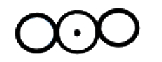
D
Solution
(B) The correct answer is $(B)$.
According to $\text{Dalton's}$ atomic theory,the symbols for elements and compounds were represented by specific pictorial symbols.
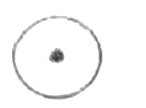
The symbol for water was represented by two circles,one containing a dot (representing hydrogen) and the other empty (representing oxygen),placed side by side.
According to $\text{Dalton's}$ atomic theory,the symbols for elements and compounds were represented by specific pictorial symbols.
The symbol for water was represented by two circles,one containing a dot (representing hydrogen) and the other empty (representing oxygen),placed side by side.
0 likesView Solution
135
ChemistryMediumMCQMHT CET · 2020
Find the empirical formula of an organic compound if it contains $18.6 \% C$,$1.55 \% H$,and $55.04 \% Cl$. (Atomic masses: $C=12$,$H=1$,$Cl=35.5$,$O=16$)
A
$C_{2}H_{2}Cl_{2}O_{2}$
B
$CH_{2}ClO$
C
$CHClO$
D
$CHClO_{2}$
Solution
(C) $1$. Calculate the percentage of oxygen: $\% O = 100 - (18.6 + 1.55 + 55.04) = 24.81 \%$.
$2$. Calculate the moles of each element in $100 \ g$ of the compound:
$n_C = \frac{18.6}{12} = 1.55$,
$n_H = \frac{1.55}{1} = 1.55$,
$n_{Cl} = \frac{55.04}{35.5} = 1.55$,
$n_O = \frac{24.81}{16} = 1.55$.
$3$. Determine the simplest molar ratio: $1.55 : 1.55 : 1.55 : 1.55 = 1 : 1 : 1 : 1$.
$4$. The empirical formula is $CHClO$.
$2$. Calculate the moles of each element in $100 \ g$ of the compound:
$n_C = \frac{18.6}{12} = 1.55$,
$n_H = \frac{1.55}{1} = 1.55$,
$n_{Cl} = \frac{55.04}{35.5} = 1.55$,
$n_O = \frac{24.81}{16} = 1.55$.
$3$. Determine the simplest molar ratio: $1.55 : 1.55 : 1.55 : 1.55 = 1 : 1 : 1 : 1$.
$4$. The empirical formula is $CHClO$.
0 likesView Solution
136
ChemistryMediumMCQMHT CET · 2020
$A$ sample of calcium carbonate has the following percentage composition: $Ca = 40 \%$,$C = 12 \%$,and $O = 48 \%$. According to the law of definite proportion,the weight of calcium in $4 \ g$ of a sample of calcium carbonate from another source will be (atomic weights: $Ca = 40, C = 12, O = 16$).
A
$1.6 \times 10^{-2} \ g$
B
$1.6 \ g$
C
$0.1 \ g$
D
$0.2 \ g$
Solution
(B) According to the law of definite proportion,the percentage composition of a compound remains constant regardless of its source.
Given that $Ca$ constitutes $40 \%$ of the sample by mass.
Therefore,in a $4 \ g$ sample of calcium carbonate,the mass of calcium is calculated as:
$\text{Mass of } Ca = \frac{40}{100} \times 4 \ g = 1.6 \ g$.
Given that $Ca$ constitutes $40 \%$ of the sample by mass.
Therefore,in a $4 \ g$ sample of calcium carbonate,the mass of calcium is calculated as:
$\text{Mass of } Ca = \frac{40}{100} \times 4 \ g = 1.6 \ g$.
0 likesView Solution
137
ChemistryMediumMCQMHT CET · 2020
Pure samples of copper carbonate synthesized in the laboratory and found naturally both contain $51.35 \%$ copper,$38.91 \%$ carbon,and $9.74 \%$ oxygen by weight. This is in accordance with:
A
Law of combining volumes
B
Law of conservation of mass
C
Law of multiple proportion
D
Law of definite proportion
Solution
(D) The Law of Definite Proportions (also known as the Law of Constant Composition) states that a given chemical compound always contains its component elements in a fixed ratio by mass,regardless of its source or method of preparation.
Since the samples of copper carbonate from both the laboratory and natural sources contain the same percentage composition by weight ($51.35 \%$ copper,$38.91 \%$ carbon,and $9.74 \%$ oxygen),it confirms the Law of Definite Proportions.
Since the samples of copper carbonate from both the laboratory and natural sources contain the same percentage composition by weight ($51.35 \%$ copper,$38.91 \%$ carbon,and $9.74 \%$ oxygen),it confirms the Law of Definite Proportions.
0 likesView Solution
138
ChemistryEasyMCQMHT CET · 2020
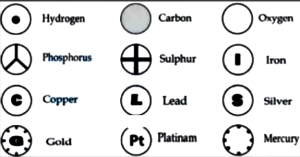
The symbol used for hydrogen in Dalton's atomic theory is
A
$\oplus$
B
$O$
C
$\odot$
D
$\text{A circle with a vertical line through the center}$
Solution
(C) According to John Dalton's atomic theory,he proposed specific symbols for various elements. The symbol for hydrogen was represented as a circle with a dot in the center $(\odot)$. However,looking at the provided options and the standard historical representation,the symbol $\odot$ is the correct representation for hydrogen in Dalton's notation.
0 likesView Solution
139
ChemistryEasyMCQMHT CET · 2020
The unit of atomic mass,$amu$ is replaced by $u$,here $u$ stands for
A
unified mass
B
united mass
C
unique mass
D
universal mass
Solution
(A) The unit of atomic mass,$amu$ (atomic mass unit),has been replaced by $u$ in the modern $IUPAC$ system.
Here,$u$ stands for $unified \ mass$.
Here,$u$ stands for $unified \ mass$.
0 likesView Solution
140
ChemistryEasyMCQMHT CET · 2020
In the reaction $2 KClO_{3(s)} \longrightarrow 2 KCl_{(s)} + 3 O_{2(g)}$,$\Delta H^{\circ} = -78 \ kJ$. If $33.6 \ L$ of oxygen gas is liberated at $S.T.P.$,what is the mass of $KCl_{(s)}$ produced (in $g$)? (Atomic mass: $K = 39, Cl = 35.5 \ g \ mol^{-1}$)
A
$48.0$
B
$7.45$
C
$24.0$
D
$74.5$
Solution
(D) The balanced chemical equation is: $2 KClO_{3(s)} \longrightarrow 2 KCl_{(s)} + 3 O_{2(g)}$
From the stoichiometry of the reaction,$3 \ moles$ of $O_2$ are produced along with $2 \ moles$ of $KCl$.
At $S.T.P.$,$1 \ mole$ of any gas occupies $22.4 \ L$.
Thus,$3 \ moles$ of $O_2$ occupy $3 \times 22.4 \ L = 67.2 \ L$.
The molar mass of $KCl = 39 + 35.5 = 74.5 \ g \ mol^{-1}$.
So,$2 \ moles$ of $KCl = 2 \times 74.5 \ g = 149 \ g$.
According to the reaction,$67.2 \ L$ of $O_2$ is produced by $149 \ g$ of $KCl$.
Therefore,$33.6 \ L$ of $O_2$ will be produced by: $\frac{149 \times 33.6}{67.2} = 74.5 \ g$ of $KCl$.
From the stoichiometry of the reaction,$3 \ moles$ of $O_2$ are produced along with $2 \ moles$ of $KCl$.
At $S.T.P.$,$1 \ mole$ of any gas occupies $22.4 \ L$.
Thus,$3 \ moles$ of $O_2$ occupy $3 \times 22.4 \ L = 67.2 \ L$.
The molar mass of $KCl = 39 + 35.5 = 74.5 \ g \ mol^{-1}$.
So,$2 \ moles$ of $KCl = 2 \times 74.5 \ g = 149 \ g$.
According to the reaction,$67.2 \ L$ of $O_2$ is produced by $149 \ g$ of $KCl$.
Therefore,$33.6 \ L$ of $O_2$ will be produced by: $\frac{149 \times 33.6}{67.2} = 74.5 \ g$ of $KCl$.
0 likesView Solution
141
ChemistryEasyMCQMHT CET · 2020
Which gas among the following contains the maximum number of molecules at $STP$? (Molar masses in $g \ mol^{-1}$: $CO_{2}=44, Ar=39.9, CH_{4}=16, O_{2}=32$)
A
$24.0 \ g$ of $O_{2}$
B
$16.0 \ g$ of $CH_{4}$
C
$13.3 \ g$ of $Ar$
D
$11 \ g$ of $CO_{2}$
Solution
(B) The number of molecules is directly proportional to the number of moles $(n = \frac{\text{mass}}{\text{molar mass}})$.
$I. \ n_{Ar} = \frac{13.3 \ g}{39.9 \ g \ mol^{-1}} = 0.33 \ mol$
$II. \ n_{O_{2}} = \frac{24.0 \ g}{32 \ g \ mol^{-1}} = 0.75 \ mol$
$III. \ n_{CO_{2}} = \frac{11 \ g}{44 \ g \ mol^{-1}} = 0.25 \ mol$
$IV. \ n_{CH_{4}} = \frac{16.0 \ g}{16 \ g \ mol^{-1}} = 1.0 \ mol$
Since $CH_{4}$ has the maximum number of moles $(1.0 \ mol)$,it contains the maximum number of molecules.
$I. \ n_{Ar} = \frac{13.3 \ g}{39.9 \ g \ mol^{-1}} = 0.33 \ mol$
$II. \ n_{O_{2}} = \frac{24.0 \ g}{32 \ g \ mol^{-1}} = 0.75 \ mol$
$III. \ n_{CO_{2}} = \frac{11 \ g}{44 \ g \ mol^{-1}} = 0.25 \ mol$
$IV. \ n_{CH_{4}} = \frac{16.0 \ g}{16 \ g \ mol^{-1}} = 1.0 \ mol$
Since $CH_{4}$ has the maximum number of moles $(1.0 \ mol)$,it contains the maximum number of molecules.
0 likesView Solution
142
ChemistryEasyMCQMHT CET · 2020
What is the number of moles and total number of atoms respectively present in $5.6 \ cm^{3}$ of ammonia gas at $STP$?
A
$2.50 \times 10^{-3} \ mol$ and $1.5 \times 10^{20}$ atoms
B
$1.505 \ mol$ and $6.022 \times 10^{20}$ atoms
C
$2.05 \ mol$ and $1.50 \times 10^{20}$ atoms
D
$2.50 \times 10^{-4} \ mol$ and $6.022 \times 10^{20}$ atoms
Solution
(D) Volume of $NH_{3}$ gas at $STP = 5.6 \ cm^{3} = 5.6 \times 10^{-3} \ L$ (or $dm^{3}$).
Since $22.4 \ L$ of any gas at $STP$ contains $1 \ mole$.
Number of moles of $NH_{3} = \frac{5.6 \times 10^{-3} \ L}{22.4 \ L/mol} = 2.5 \times 10^{-4} \ mol$.
One molecule of $NH_{3}$ contains $4$ atoms ($1$ Nitrogen and $3$ Hydrogen).
Total number of atoms = (Number of moles) $\times$ (Avogadro's number) $\times$ (Atomicity).
Total number of atoms = $2.5 \times 10^{-4} \times 6.022 \times 10^{23} \times 4 = 6.022 \times 10^{20}$ atoms.
Since $22.4 \ L$ of any gas at $STP$ contains $1 \ mole$.
Number of moles of $NH_{3} = \frac{5.6 \times 10^{-3} \ L}{22.4 \ L/mol} = 2.5 \times 10^{-4} \ mol$.
One molecule of $NH_{3}$ contains $4$ atoms ($1$ Nitrogen and $3$ Hydrogen).
Total number of atoms = (Number of moles) $\times$ (Avogadro's number) $\times$ (Atomicity).
Total number of atoms = $2.5 \times 10^{-4} \times 6.022 \times 10^{23} \times 4 = 6.022 \times 10^{20}$ atoms.
0 likesView Solution
143
ChemistryEasyMCQMHT CET · 2020
The volume of dihydrogen required for complete hydrogenation of $0.5 \ dm^{3}$ of ethene at $\text{S.T.P.}$ is (in $dm^{3}$)
A
$1.0$
B
$0.5$
C
$0.75$
D
$0.25$
Solution
(B) The hydrogenation reaction of ethene is given by:
$CH_{2}=CH_{2} + H_{2} \longrightarrow CH_{3}-CH_{3}$
According to the stoichiometry of the reaction,$1 \ mole$ of ethene reacts with $1 \ mole$ of $H_{2}$ gas.
Since volumes of gases are directly proportional to the number of moles at $\text{S.T.P.}$,$0.5 \ dm^{3}$ of ethene will require $0.5 \ dm^{3}$ of dihydrogen for complete hydrogenation.
$CH_{2}=CH_{2} + H_{2} \longrightarrow CH_{3}-CH_{3}$
According to the stoichiometry of the reaction,$1 \ mole$ of ethene reacts with $1 \ mole$ of $H_{2}$ gas.
Since volumes of gases are directly proportional to the number of moles at $\text{S.T.P.}$,$0.5 \ dm^{3}$ of ethene will require $0.5 \ dm^{3}$ of dihydrogen for complete hydrogenation.
0 likesView Solution
144
ChemistryMediumMCQMHT CET · 2020
How many moles of ethene are required to prepare $6.0 \ g$ of ethane by the hydrogenation process (in $mole$)?
A
$0.2$
B
$0.1$
C
$1.0$
D
$4.0$
Solution
(A) The chemical equation for the hydrogenation of ethene is: $CH_2=CH_2 + H_2 \rightarrow CH_3-CH_3$
From the stoichiometry,$1 \ mole$ of ethene ($C_2H_4$,molar mass $28 \ g/mol$) produces $1 \ mole$ of ethane ($C_2H_6$,molar mass $30 \ g/mol$).
The molar mass of ethane $(C_2H_6)$ is $(2 \times 12) + (6 \times 1) = 30 \ g/mol$.
To prepare $6.0 \ g$ of ethane,the number of moles of ethane required is $n = \frac{mass}{molar \ mass} = \frac{6.0 \ g}{30 \ g/mol} = 0.2 \ mol$.
Since $1 \ mole$ of ethene produces $1 \ mole$ of ethane,$0.2 \ mole$ of ethene is required to produce $0.2 \ mole$ of ethane.
From the stoichiometry,$1 \ mole$ of ethene ($C_2H_4$,molar mass $28 \ g/mol$) produces $1 \ mole$ of ethane ($C_2H_6$,molar mass $30 \ g/mol$).
The molar mass of ethane $(C_2H_6)$ is $(2 \times 12) + (6 \times 1) = 30 \ g/mol$.
To prepare $6.0 \ g$ of ethane,the number of moles of ethane required is $n = \frac{mass}{molar \ mass} = \frac{6.0 \ g}{30 \ g/mol} = 0.2 \ mol$.
Since $1 \ mole$ of ethene produces $1 \ mole$ of ethane,$0.2 \ mole$ of ethene is required to produce $0.2 \ mole$ of ethane.
0 likesView Solution
145
ChemistryMediumMCQMHT CET · 2020
Which among the following elements has the highest number of atoms in $1 \ g$ each? (Atomic masses: $Au=197, Na=23, Cu=63.5, Fe=56$)
A
$Cu_{(s)}$
B
$Na_{(s)}$
C
$Au_{(s)}$
D
$Fe_{(s)}$
Solution
(B) The number of atoms is calculated by the formula: $\text{Number of atoms} = \frac{\text{Given mass}}{\text{Molar mass}} \times N_A$.
Since the mass is $1 \ g$ for all,the number of atoms is inversely proportional to the molar mass.
$I$. $1 \ g \ Fe = \frac{1}{56} \times N_A \approx 0.0178 \times N_A$ atoms.
$II$. $1 \ g \ Au = \frac{1}{197} \times N_A \approx 0.0051 \times N_A$ atoms.
$III$. $1 \ g \ Na = \frac{1}{23} \times N_A \approx 0.0435 \times N_A$ atoms.
$IV$. $1 \ g \ Cu = \frac{1}{63.5} \times N_A \approx 0.0157 \times N_A$ atoms.
Comparing the values,$Na$ has the smallest molar mass,therefore it has the highest number of atoms.
Since the mass is $1 \ g$ for all,the number of atoms is inversely proportional to the molar mass.
$I$. $1 \ g \ Fe = \frac{1}{56} \times N_A \approx 0.0178 \times N_A$ atoms.
$II$. $1 \ g \ Au = \frac{1}{197} \times N_A \approx 0.0051 \times N_A$ atoms.
$III$. $1 \ g \ Na = \frac{1}{23} \times N_A \approx 0.0435 \times N_A$ atoms.
$IV$. $1 \ g \ Cu = \frac{1}{63.5} \times N_A \approx 0.0157 \times N_A$ atoms.
Comparing the values,$Na$ has the smallest molar mass,therefore it has the highest number of atoms.
0 likesView Solution
146
ChemistryEasyMCQMHT CET · 2020
The $SI$ unit of pressure is
A
$kg \ m \ s^{-2}$
B
$kg \ m \ s^{2}$
C
$kg \ m^{-1} \ s^{-2}$
D
$kg \ m^{2} \ s$
Solution
(C) Pressure is defined as force per unit area,$P = \frac{F}{A}$.
Force $(F)$ has the $SI$ unit $kg \ m \ s^{-2}$ (Newton).
Area $(A)$ has the $SI$ unit $m^2$.
Therefore,the $SI$ unit of pressure is $\frac{kg \ m \ s^{-2}}{m^2} = kg \ m^{-1} \ s^{-2}$ (Pascal).
Thus,the correct option is $C$.
Force $(F)$ has the $SI$ unit $kg \ m \ s^{-2}$ (Newton).
Area $(A)$ has the $SI$ unit $m^2$.
Therefore,the $SI$ unit of pressure is $\frac{kg \ m \ s^{-2}}{m^2} = kg \ m^{-1} \ s^{-2}$ (Pascal).
Thus,the correct option is $C$.
0 likesView Solution
147
ChemistryEasyMCQMHT CET · 2020
What will be the volume of oxygen gas produced if the reaction $2 KClO_{3(s)} \longrightarrow 2 KCl_{(s)} + 3 O_{2(g)}$,$\Delta H^{\circ} = -78 \ kJ$ is carried out at $S.T.P.$ (in $L$)?
A
$48.0$
B
$44.8$
C
$22.4$
D
$67.2$
Solution
(D) The balanced chemical equation is: $2 KClO_{3(s)} \longrightarrow 2 KCl_{(s)} + 3 O_{2(g)}$.
According to the stoichiometry of the reaction,$2 \ moles$ of $KClO_3$ produce $3 \ moles$ of $O_2$ gas.
At $S.T.P.$ (Standard Temperature and Pressure),the molar volume of an ideal gas is $22.4 \ L \ mol^{-1}$.
Therefore,the volume of $3 \ moles$ of $O_2$ gas produced is $3 \times 22.4 \ L = 67.2 \ L$.
According to the stoichiometry of the reaction,$2 \ moles$ of $KClO_3$ produce $3 \ moles$ of $O_2$ gas.
At $S.T.P.$ (Standard Temperature and Pressure),the molar volume of an ideal gas is $22.4 \ L \ mol^{-1}$.
Therefore,the volume of $3 \ moles$ of $O_2$ gas produced is $3 \times 22.4 \ L = 67.2 \ L$.
0 likesView Solution
148
ChemistryEasyMCQMHT CET · 2020
The volume of oxygen required for complete combustion of $0.25 \ mol$ of methane at $S.T.P.$ is (in $dm^{3}$)
A
$5.6$
B
$7.46$
C
$11.2$
D
$22.4$
Solution
(C) The balanced chemical equation for the combustion of methane is:
$CH_{4}(g) + 2O_{2}(g) \longrightarrow CO_{2}(g) + 2H_{2}O(l)$
From the stoichiometry of the reaction,$1 \ mol$ of $CH_{4}$ requires $2 \ mol$ of $O_{2}$ for complete combustion.
At $S.T.P.$,$1 \ mol$ of any gas occupies $22.4 \ dm^{3}$.
Therefore,$2 \ mol$ of $O_{2}$ occupies $2 \times 22.4 \ dm^{3} = 44.8 \ dm^{3}$.
For $0.25 \ mol$ of $CH_{4}$,the volume of $O_{2}$ required is:
$0.25 \ mol \times (2 \ mol \ O_{2} / 1 \ mol \ CH_{4}) \times 22.4 \ dm^{3}/mol = 0.5 \ mol \times 22.4 \ dm^{3}/mol = 11.2 \ dm^{3}$.
Thus,the correct option is $C$.
$CH_{4}(g) + 2O_{2}(g) \longrightarrow CO_{2}(g) + 2H_{2}O(l)$
From the stoichiometry of the reaction,$1 \ mol$ of $CH_{4}$ requires $2 \ mol$ of $O_{2}$ for complete combustion.
At $S.T.P.$,$1 \ mol$ of any gas occupies $22.4 \ dm^{3}$.
Therefore,$2 \ mol$ of $O_{2}$ occupies $2 \times 22.4 \ dm^{3} = 44.8 \ dm^{3}$.
For $0.25 \ mol$ of $CH_{4}$,the volume of $O_{2}$ required is:
$0.25 \ mol \times (2 \ mol \ O_{2} / 1 \ mol \ CH_{4}) \times 22.4 \ dm^{3}/mol = 0.5 \ mol \times 22.4 \ dm^{3}/mol = 11.2 \ dm^{3}$.
Thus,the correct option is $C$.
0 likesView Solution
149
ChemistryDifficultMCQMHT CET · 2020
How many grams of dihydrogen are required to react with dinitrogen to produce $34 \ g$ of ammonia (in $g$)?
A
$6$
B
$2$
C
$12$
D
$3$
Solution
(A) The balanced chemical equation for the reaction is: $N_{2(g)} + 3H_{2(g)} \rightarrow 2NH_{3(g)}$
From the stoichiometry of the reaction,the molar masses are:
$N_2 = 28 \ g/mol$,$H_2 = 2 \ g/mol$,$NH_3 = 17 \ g/mol$.
For $2 \ moles$ of $NH_3$ $(2 \times 17 \ g = 34 \ g)$,the amount of $H_2$ required is $3 \ moles$ $(3 \times 2 \ g = 6 \ g)$.
Therefore,to produce $34 \ g$ of ammonia,$6 \ g$ of dihydrogen is required.
From the stoichiometry of the reaction,the molar masses are:
$N_2 = 28 \ g/mol$,$H_2 = 2 \ g/mol$,$NH_3 = 17 \ g/mol$.
For $2 \ moles$ of $NH_3$ $(2 \times 17 \ g = 34 \ g)$,the amount of $H_2$ required is $3 \ moles$ $(3 \times 2 \ g = 6 \ g)$.
Therefore,to produce $34 \ g$ of ammonia,$6 \ g$ of dihydrogen is required.
0 likesView Solution
150
ChemistryEasyMCQMHT CET · 2020
What is the mass percentage of carbon in urea (in $\%$)? (molar mass of urea $= 60 \ g \ mol^{-1}$)
A
$28.0$
B
$20.0$
C
$26.67$
D
$46.67$
Solution
(B) The molecular formula of urea is $NH_2CONH_2$.
We know that the mass percentage of an element in a compound is given by:
$\text{Mass percentage} = \frac{\text{Total mass of the element in one mole of compound}}{\text{Molar mass of the compound}} \times 100$
In one mole of urea $(NH_2CONH_2)$,there is $1$ mole of carbon atom.
The molar mass of carbon is $12 \ g \ mol^{-1}$.
The molar mass of urea is given as $60 \ g \ mol^{-1}$.
Therefore,the mass percentage of carbon in urea $= \frac{12 \ g \ mol^{-1}}{60 \ g \ mol^{-1}} \times 100 = 20 \%$.
Hence,option $B$ is correct.
We know that the mass percentage of an element in a compound is given by:
$\text{Mass percentage} = \frac{\text{Total mass of the element in one mole of compound}}{\text{Molar mass of the compound}} \times 100$
In one mole of urea $(NH_2CONH_2)$,there is $1$ mole of carbon atom.
The molar mass of carbon is $12 \ g \ mol^{-1}$.
The molar mass of urea is given as $60 \ g \ mol^{-1}$.
Therefore,the mass percentage of carbon in urea $= \frac{12 \ g \ mol^{-1}}{60 \ g \ mol^{-1}} \times 100 = 20 \%$.
Hence,option $B$ is correct.
0 likesView Solution
151
ChemistryMediumMCQMHT CET · 2020
Which among the following sugars does not reduce Tollen's reagent?
A
Ribose
B
Lactose
C
Maltose
D
Sucrose
Solution
(D) Sugars that contain a free aldehydic or ketonic group are called reducing sugars,as they can reduce Tollen's reagent or Fehling's solution.
$Ribose$,$Lactose$,and $Maltose$ are reducing sugars.
$Sucrose$ is a non-reducing sugar because its glycosidic linkage involves the anomeric carbons of both glucose and fructose,meaning no free aldehydic or ketonic group can be produced in solution.
$Ribose$,$Lactose$,and $Maltose$ are reducing sugars.
$Sucrose$ is a non-reducing sugar because its glycosidic linkage involves the anomeric carbons of both glucose and fructose,meaning no free aldehydic or ketonic group can be produced in solution.
0 likesView Solution
152
ChemistryEasyMCQMHT CET · 2020
Which among the following is a natural biopolymer of monosaccharides?
A
Glycogen
B
Neoprene
C
Silk
D
Isoprene
Solution
(A) Glycogen is a natural biopolymer of monosaccharides,specifically a branched polymer consisting of linear chains of $D$-glucose residues.
0 likesView Solution
153
ChemistryEasyMCQMHT CET · 2020
On hydrolysis,sucrose gives:
A
$2$ moles of glucose
B
$2$ moles of galactose
C
equimolar mixture of glucose and fructose
D
$2$ moles of fructose
Solution
(C) Sucrose on hydrolysis in the presence of dilute acid or the enzyme invertase gives one molecule each of glucose and fructose.
$C_{12}H_{22}O_{11} (\text{Sucrose}) + H_2O$ $\xrightarrow[\text{or invertase}]{H_3O^+} C_6H_{12}O_6 (D(+) \text{Glucose}) + C_6H_{12}O_6 (D(-) \text{Fructose})$
$C_{12}H_{22}O_{11} (\text{Sucrose}) + H_2O$ $\xrightarrow[\text{or invertase}]{H_3O^+} C_6H_{12}O_6 (D(+) \text{Glucose}) + C_6H_{12}O_6 (D(-) \text{Fructose})$
0 likesView Solution
154
ChemistryEasyMCQMHT CET · 2020
Identify the basic amino acid from the following:
A
Phenylalanine
B
Histidine
C
Alanine
D
Serine
Solution
(B) Amino acids are classified as acidic,basic,or neutral based on the relative number of amino $(-NH_2)$ and carboxyl $(-COOH)$ groups in their structure.
Basic amino acids contain more amino groups than carboxyl groups.
Among the given options,$Histidine$ contains an imidazole ring with a nitrogen atom that can accept a proton,making it a basic amino acid.
Therefore,the correct option is $B$.
Basic amino acids contain more amino groups than carboxyl groups.
Among the given options,$Histidine$ contains an imidazole ring with a nitrogen atom that can accept a proton,making it a basic amino acid.
Therefore,the correct option is $B$.
0 likesView Solution
155
ChemistryMediumMCQMHT CET · 2020
Which among the following formulae represents the $\omega$-amino caproic acid?
A
$H_2N-(CH_2)_5-COOH$
B
$H_2N-CH_2-COOH$
C
$H_2N-CO-CH_2-CH(NH_2)-COOH$
D
$HO-CH_2-CH(NH_2)-COOH$
Solution
(A) The $\omega$-amino caproic acid is a straight-chain amino acid with a total of $6$ carbon atoms,where the amino group $(-NH_2)$ is at the terminal $(\omega)$ position and the carboxylic acid group $(-COOH)$ is at the other end.
Caproic acid is a $6$-carbon carboxylic acid $(CH_3(CH_2)_4COOH)$.
Replacing the terminal hydrogen with an amino group gives $H_2N-(CH_2)_5-COOH$,which is $6$-aminohexanoic acid,commonly known as $\omega$-amino caproic acid.
Therefore,the correct formula is $H_2N-(CH_2)_5-COOH$.
Caproic acid is a $6$-carbon carboxylic acid $(CH_3(CH_2)_4COOH)$.
Replacing the terminal hydrogen with an amino group gives $H_2N-(CH_2)_5-COOH$,which is $6$-aminohexanoic acid,commonly known as $\omega$-amino caproic acid.
Therefore,the correct formula is $H_2N-(CH_2)_5-COOH$.
0 likesView Solution
156
ChemistryEasyMCQMHT CET · 2020
If the side chain group $-R$ for an amino acid is $-CH_{2}OH$,identify the amino acid from the following:
A
Arginine
B
Tyrosine
C
Serine
D
Proline
Solution
(C) The general structure of an amino acid is $R-CH(NH_{2})COOH$.
Given that the side chain group $R$ is $-CH_{2}OH$,the amino acid is $HOCH_{2}-CH(NH_{2})COOH$.
This structure corresponds to the amino acid Serine.
Therefore,the correct option is $C$.
Given that the side chain group $R$ is $-CH_{2}OH$,the amino acid is $HOCH_{2}-CH(NH_{2})COOH$.
This structure corresponds to the amino acid Serine.
Therefore,the correct option is $C$.
0 likesView Solution
157
ChemistryEasyMCQMHT CET · 2020
Which among the following amino acids has the lowest molar mass?
A
Alanine
B
Aspartic acid
C
Arginine
D
Glycine
Solution
(D) The molar masses of the given amino acids are as follows:
$1$. $Alanine$ $(C_3H_7NO_2)$: $89 \ g/mol$
$2$. $Aspartic \ acid$ $(C_4H_7NO_4)$: $133 \ g/mol$
$3$. $Arginine$ $(C_6H_{14}N_4O_2)$: $174 \ g/mol$
$4$. $Glycine$ $(C_2H_5NO_2)$: $75 \ g/mol$
Comparing these values,$Glycine$ has the lowest molar mass. Therefore,the correct option is $D$.
$1$. $Alanine$ $(C_3H_7NO_2)$: $89 \ g/mol$
$2$. $Aspartic \ acid$ $(C_4H_7NO_4)$: $133 \ g/mol$
$3$. $Arginine$ $(C_6H_{14}N_4O_2)$: $174 \ g/mol$
$4$. $Glycine$ $(C_2H_5NO_2)$: $75 \ g/mol$
Comparing these values,$Glycine$ has the lowest molar mass. Therefore,the correct option is $D$.
0 likesView Solution
158
ChemistryDifficultMCQMHT CET · 2020
Which among the following amino acids has the lowest molecular mass?
A
Proline
B
Aspartic acid
C
Serine
D
Glycine
Solution
(D) The general formula for an amino acid is $NH_2-CH(R)-COOH$.
The molecular mass depends on the side chain $R$.
For $Glycine$,$R = H$ (molecular formula $C_2H_5NO_2$,molar mass $\approx 75 \ g/mol$).
For $Serine$,$R = CH_2OH$.
For $Aspartic \ acid$,$R = CH_2COOH$.
For $Proline$,it is a cyclic amino acid with a larger structure.
Since $Glycine$ has the simplest side chain $(H)$,it has the lowest molecular mass among the given options.
Therefore,the correct option is $D$.
The molecular mass depends on the side chain $R$.
For $Glycine$,$R = H$ (molecular formula $C_2H_5NO_2$,molar mass $\approx 75 \ g/mol$).
For $Serine$,$R = CH_2OH$.
For $Aspartic \ acid$,$R = CH_2COOH$.
For $Proline$,it is a cyclic amino acid with a larger structure.
Since $Glycine$ has the simplest side chain $(H)$,it has the lowest molecular mass among the given options.
Therefore,the correct option is $D$.
0 likesView Solution
159
ChemistryEasyMCQMHT CET · 2020
Which among the following is a basic amino acid?
A
Lysine
B
Glycine
C
Cystine
D
Cysteine
Solution
(A) Hint: Amino acids are classified as acidic,basic,or neutral depending upon the relative number of amino $(-NH_2)$ and carboxyl $(-COOH)$ groups in their molecule.
Step $1$: Definition of basic amino acids. Basic amino acids are those that contain more amino groups than carboxyl groups,which imparts basic character to the molecule.
Step $2$: Analysis of given options.
$A$) Lysine: Contains two amino groups and one carboxyl group,making it basic.
$B$) Glycine: Contains one amino group and one carboxyl group,making it neutral.
$C$) Cystine: Contains two amino groups and two carboxyl groups,making it neutral.
$D$) Cysteine: Contains one amino group,one carboxyl group,and a thiol $(-SH)$ group,making it neutral.
Final Answer: The correct option is $(A)$ Lysine.
Step $1$: Definition of basic amino acids. Basic amino acids are those that contain more amino groups than carboxyl groups,which imparts basic character to the molecule.
Step $2$: Analysis of given options.
$A$) Lysine: Contains two amino groups and one carboxyl group,making it basic.
$B$) Glycine: Contains one amino group and one carboxyl group,making it neutral.
$C$) Cystine: Contains two amino groups and two carboxyl groups,making it neutral.
$D$) Cysteine: Contains one amino group,one carboxyl group,and a thiol $(-SH)$ group,making it neutral.
Final Answer: The correct option is $(A)$ Lysine.
0 likesView Solution
160
ChemistryEasyMCQMHT CET · 2020
Which among the following is a globular protein?
A
Insulin
B
Myosin
C
Collagen
D
Fibroin
Solution
(A) Globular proteins are spherical in shape and are generally soluble in water. $Insulin$ is a classic example of a globular protein.
Fibrous proteins are thread-like and insoluble in water. $Collagen$,$Fibroin$,and $Myosin$ are examples of fibrous proteins.
Fibrous proteins are thread-like and insoluble in water. $Collagen$,$Fibroin$,and $Myosin$ are examples of fibrous proteins.
0 likesView Solution
161
ChemistryEasyMCQMHT CET · 2020
Which among the following vitamins belongs to the aromatic series?
A
Vitamin $A$
B
Vitamin $C$
C
Vitamin $B$ complex
D
Vitamin $K$
Solution
(D) The vitamin that belongs to the aromatic series is Vitamin $K$.
Vitamin $K$ contains a naphthoquinone ring system,which is an aromatic structure.
Therefore,it is classified as belonging to the aromatic series of vitamins.
Vitamin $K$ contains a naphthoquinone ring system,which is an aromatic structure.
Therefore,it is classified as belonging to the aromatic series of vitamins.
0 likesView Solution
162
ChemistryEasyMCQMHT CET · 2020
Which among the following vitamins belongs to the aliphatic series?
A
Vitamin $C$
B
Vitamin $A$
C
Vitamin $K$
D
Vitamin $B$ complex
Solution
(A) Vitamin $C$ (ascorbic acid) is a polyhydroxy compound that contains a lactone ring and is considered to be part of the aliphatic series due to its open-chain-like structural features and lack of aromatic rings.
Other vitamins like Vitamin $A$,$K$,and many $B$ complex vitamins contain aromatic or complex cyclic structures.
Other vitamins like Vitamin $A$,$K$,and many $B$ complex vitamins contain aromatic or complex cyclic structures.
0 likesView Solution
163
ChemistryEasyMCQMHT CET · 2020
Which among the following compounds belongs to lipids?
A
Chloroxylenol
B
Terpenes
C
$BHA$
D
Novestrol
Solution
(B) Terpenes are classified as lipids or lipid-like compounds because they are hydrophobic and soluble in organic solvents. They are synthesized from isoprene units,which are $C_5H_8$ hydrocarbon units. Chloroxylenol is an antiseptic,$BHA$ is an antioxidant,and Novestrol is a synthetic estrogen.
0 likesView Solution
164
ChemistryMediumMCQMHT CET · 2020
The sodium salt of an $\alpha-$halogen carboxylic acid,when heated with sodium nitrite followed by hydrolysis,forms:
A
nitroalkane
B
amine
C
alcohol
D
amide
Solution
(A) The reaction of the sodium salt of an $\alpha-$chloro carboxylic acid with aqueous sodium nitrite $(NaNO_2)$ leads to the formation of a nitro-substituted intermediate.
Upon subsequent hydrolysis and decarboxylation,this intermediate yields a nitroalkane.
For example,the reaction of sodium $\alpha-$chloroacetate with $NaNO_2$ followed by hydrolysis produces nitromethane $(CH_3NO_2)$.
Upon subsequent hydrolysis and decarboxylation,this intermediate yields a nitroalkane.
For example,the reaction of sodium $\alpha-$chloroacetate with $NaNO_2$ followed by hydrolysis produces nitromethane $(CH_3NO_2)$.
0 likesView Solution
165
ChemistryEasyMCQMHT CET · 2020
Which of the following is $NOT$ a dicarboxylic acid?
A
Succinic acid
B
Acrylic acid
C
Malonic acid
D
Phthalic acid
Solution
(B) dicarboxylic acid contains two carboxylic acid $(-COOH)$ groups.
$1$. Succinic acid is $HOOC-CH_2-CH_2-COOH$ (dicarboxylic acid).
$2$. Acrylic acid is $CH_2=CH-COOH$ (monocarboxylic acid).
$3$. Malonic acid is $HOOC-CH_2-COOH$ (dicarboxylic acid).
$4$. Phthalic acid is $C_6H_4(COOH)_2$ (dicarboxylic acid).
Therefore,Acrylic acid is not a dicarboxylic acid.
$1$. Succinic acid is $HOOC-CH_2-CH_2-COOH$ (dicarboxylic acid).
$2$. Acrylic acid is $CH_2=CH-COOH$ (monocarboxylic acid).
$3$. Malonic acid is $HOOC-CH_2-COOH$ (dicarboxylic acid).
$4$. Phthalic acid is $C_6H_4(COOH)_2$ (dicarboxylic acid).
Therefore,Acrylic acid is not a dicarboxylic acid.
0 likesView Solution
166
ChemistryEasyMCQMHT CET · 2020
Identify $A$ in the following reaction:
Salicylic acid $\xrightarrow{\text{Acetic anhydride}} A$
Salicylic acid $\xrightarrow{\text{Acetic anhydride}} A$
A
Aspirin
B
Methyl salicylate
C
$BHT$
D
Stearic acid
Solution
(A) The reaction of salicylic acid ($2$-hydroxybenzoic acid) with acetic anhydride in the presence of an acid catalyst (like $H_2SO_4$) is an acetylation reaction.
In this reaction,the phenolic $-OH$ group of salicylic acid is acetylated to form $2$-acetoxybenzoic acid,which is commonly known as Aspirin.
The reaction is as follows:
Salicylic acid + Acetic anhydride $\xrightarrow{H^+}$ Aspirin + Acetic acid.
Therefore,$A$ is Aspirin.
In this reaction,the phenolic $-OH$ group of salicylic acid is acetylated to form $2$-acetoxybenzoic acid,which is commonly known as Aspirin.
The reaction is as follows:
Salicylic acid + Acetic anhydride $\xrightarrow{H^+}$ Aspirin + Acetic acid.
Therefore,$A$ is Aspirin.
0 likesView Solution
167
ChemistryMediumMCQMHT CET · 2020
Which of the following acids does $NOT$ undergo the Hell-Volhard-Zelinsky reaction?
A
Butanoic acid
B
Propanoic acid
C
Ethanoic acid
D
Methanoic acid
Solution
(D) The $Hell-Volhard-Zelinsky$ $(HVZ)$ reaction occurs in carboxylic acids that contain at least one $\alpha-hydrogen$ atom.
In this reaction,the $\alpha-hydrogen$ is replaced by a halogen (chlorine or bromine) in the presence of red phosphorus.
$Butanoic$ $acid$ $(CH_3CH_2CH_2COOH)$,$Propanoic$ $acid$ $(CH_3CH_2COOH)$,and $Ethanoic$ $acid$ $(CH_3COOH)$ all possess $\alpha-hydrogen$ atoms and thus undergo the $HVZ$ reaction.
$Methanoic$ $acid$ $(HCOOH)$,also known as $Formic$ $acid$,does not contain an $\alpha-carbon$ atom,and consequently,it lacks an $\alpha-hydrogen$ atom.
Therefore,$Methanoic$ $acid$ does not undergo the $HVZ$ reaction.
In this reaction,the $\alpha-hydrogen$ is replaced by a halogen (chlorine or bromine) in the presence of red phosphorus.
$Butanoic$ $acid$ $(CH_3CH_2CH_2COOH)$,$Propanoic$ $acid$ $(CH_3CH_2COOH)$,and $Ethanoic$ $acid$ $(CH_3COOH)$ all possess $\alpha-hydrogen$ atoms and thus undergo the $HVZ$ reaction.
$Methanoic$ $acid$ $(HCOOH)$,also known as $Formic$ $acid$,does not contain an $\alpha-carbon$ atom,and consequently,it lacks an $\alpha-hydrogen$ atom.
Therefore,$Methanoic$ $acid$ does not undergo the $HVZ$ reaction.
0 likesView Solution
168
ChemistryEasyMCQMHT CET · 2020
Which of the following reactions involves $\alpha$-halogenation of carboxylic acid?
A
Gattermann reaction
B
Riemer-Tiemann reaction
C
Sandmeyer reaction
D
Hell-Volhard-Zelinsky reaction
Solution
(D) The Hell-Volhard-Zelinsky $(HVZ)$ reaction is a specific reaction used for the $\alpha$-halogenation of carboxylic acids.
In this reaction,carboxylic acids containing an $\alpha$-hydrogen atom react with chlorine or bromine in the presence of a small amount of red phosphorus to form $\alpha$-halo carboxylic acids.
The reaction proceeds as follows:
$CH_{3}CH_{2}COOH$ $\xrightarrow{Br_{2}/P} CH_{3}CH(Br)COOH$ $\xrightarrow{Br_{2}/P} CH_{3}C(Br)_{2}COOH$
In this reaction,carboxylic acids containing an $\alpha$-hydrogen atom react with chlorine or bromine in the presence of a small amount of red phosphorus to form $\alpha$-halo carboxylic acids.
The reaction proceeds as follows:
$CH_{3}CH_{2}COOH$ $\xrightarrow{Br_{2}/P} CH_{3}CH(Br)COOH$ $\xrightarrow{Br_{2}/P} CH_{3}C(Br)_{2}COOH$
0 likesView Solution
169
ChemistryEasyMCQMHT CET · 2020
Which of the following compounds is obtained when benzoic acid is treated with conc. $H_{2}SO_{4}$ and conc. $HNO_{3}$?
A
$2,4,6-$trinitrobenzoic acid
B
$o-$Nitrobenzoic acid
C
$m-$Nitrobenzoic acid
D
$p-$Nitrobenzoic acid
Solution
(C) The reaction of benzoic acid with a mixture of conc. $H_{2}SO_{4}$ and conc. $HNO_{3}$ is an electrophilic aromatic substitution reaction known as nitration.
Benzoic acid contains a $-COOH$ group,which is a deactivating and meta-directing group.
Therefore,the incoming electrophile,the nitronium ion $(NO_{2}^{+})$,attacks the meta-position of the benzene ring.
This results in the formation of $m-$nitrobenzoic acid as the major product.
Benzoic acid contains a $-COOH$ group,which is a deactivating and meta-directing group.
Therefore,the incoming electrophile,the nitronium ion $(NO_{2}^{+})$,attacks the meta-position of the benzene ring.
This results in the formation of $m-$nitrobenzoic acid as the major product.
0 likesView Solution
170
ChemistryEasyMCQMHT CET · 2020
The number of $\sigma$ bonds in carbolic acid is
A
$13$
B
$8$
C
$12$
D
$6$
Solution
(A) Carbolic acid is the common name for phenol,which has the chemical formula $C_6H_5OH$.
To determine the number of $\sigma$ bonds,we look at its structure:
$1$. There are $6$ carbon atoms in the ring,with $3$ $C-C$ $\sigma$ bonds and $3$ $C=C$ bonds (each containing $1$ $\sigma$ bond),totaling $6$ $\sigma$ bonds in the ring.
$2$. There are $5$ $C-H$ $\sigma$ bonds attached to the ring.
$3$. There is $1$ $C-O$ $\sigma$ bond.
$4$. There is $1$ $O-H$ $\sigma$ bond.
Total $\sigma$ bonds = $6 + 5 + 1 + 1 = 13$.
To determine the number of $\sigma$ bonds,we look at its structure:
$1$. There are $6$ carbon atoms in the ring,with $3$ $C-C$ $\sigma$ bonds and $3$ $C=C$ bonds (each containing $1$ $\sigma$ bond),totaling $6$ $\sigma$ bonds in the ring.
$2$. There are $5$ $C-H$ $\sigma$ bonds attached to the ring.
$3$. There is $1$ $C-O$ $\sigma$ bond.
$4$. There is $1$ $O-H$ $\sigma$ bond.
Total $\sigma$ bonds = $6 + 5 + 1 + 1 = 13$.
0 likesView Solution
171
ChemistryMediumMCQMHT CET · 2020
Which of the following compounds has the highest boiling point?
A
$CH_3(CH_2)_2CH_2OH$
B
$C_2H_5CH(CH_3)_2$
C
$CH_3(CH_2)_2CH_2NH_2$
D
$(C_2H_5)_2NH$
Solution
(A) The boiling point depends on the strength of intermolecular forces.
$CH_3(CH_2)_2CH_2OH$ is a primary alcohol,which exhibits strong intermolecular hydrogen bonding due to the highly electronegative oxygen atom.
$CH_3(CH_2)_2CH_2NH_2$ and $(C_2H_5)_2NH$ are amines,which also exhibit hydrogen bonding,but the $N-H$ bond is less polar than the $O-H$ bond,resulting in weaker hydrogen bonding.
$C_2H_5CH(CH_3)_2$ is an alkane,which only has weak London dispersion forces.
Therefore,the alcohol has the highest boiling point.
$CH_3(CH_2)_2CH_2OH$ is a primary alcohol,which exhibits strong intermolecular hydrogen bonding due to the highly electronegative oxygen atom.
$CH_3(CH_2)_2CH_2NH_2$ and $(C_2H_5)_2NH$ are amines,which also exhibit hydrogen bonding,but the $N-H$ bond is less polar than the $O-H$ bond,resulting in weaker hydrogen bonding.
$C_2H_5CH(CH_3)_2$ is an alkane,which only has weak London dispersion forces.
Therefore,the alcohol has the highest boiling point.
0 likesView Solution
172
ChemistryMediumMCQMHT CET · 2020
Which of the following has the highest boiling point?
A
$1 \%$ urea solution
B
$1 \%$ sucrose solution
C
$1 \%$ NaCl solution
D
$1 \% CaCl_{2}$ solution
Solution
(D) The elevation in boiling point is given by $\Delta T_{b} = i \times K_{b} \times m$.
Since the concentration $(m)$ is the same for all solutions,the elevation in boiling point is directly proportional to the van't Hoff factor $(i)$.
$(i)$ For $1 \%$ urea,$i = 1$ (non-electrolyte).
$(ii)$ For $1 \%$ sucrose,$i = 1$ (non-electrolyte).
$(iii)$ For $1 \%$ NaCl,$i = 2$ (dissociates into $Na^{+}$ and $Cl^{-}$).
$(iv)$ For $1 \% CaCl_{2}$,$i = 3$ (dissociates into $Ca^{2+}$ and $2Cl^{-}$).
Since $CaCl_{2}$ has the highest van't Hoff factor $(i = 3)$,it will show the maximum elevation in boiling point. Therefore,the $1 \% CaCl_{2}$ solution has the highest boiling point.
Since the concentration $(m)$ is the same for all solutions,the elevation in boiling point is directly proportional to the van't Hoff factor $(i)$.
$(i)$ For $1 \%$ urea,$i = 1$ (non-electrolyte).
$(ii)$ For $1 \%$ sucrose,$i = 1$ (non-electrolyte).
$(iii)$ For $1 \%$ NaCl,$i = 2$ (dissociates into $Na^{+}$ and $Cl^{-}$).
$(iv)$ For $1 \% CaCl_{2}$,$i = 3$ (dissociates into $Ca^{2+}$ and $2Cl^{-}$).
Since $CaCl_{2}$ has the highest van't Hoff factor $(i = 3)$,it will show the maximum elevation in boiling point. Therefore,the $1 \% CaCl_{2}$ solution has the highest boiling point.
0 likesView Solution
173
ChemistryDifficultMCQMHT CET · 2020
Which among the following compounds has the highest boiling point?
A
$CH_3-CH_2-CH_2-CH_2-OH$
B
$CH_3-CH_2-CO-CH_3$
C
$CH_3-CH_2-COOH$
D
$CH_3-CH_2-CH_2-CHO$
Solution
(C) The boiling point of a compound depends on the strength of intermolecular forces.
Carboxylic acids $(CH_3-CH_2-COOH)$ form strong intermolecular hydrogen bonds,often existing as dimers in the liquid phase.
This results in significantly higher boiling points compared to alcohols $(CH_3-CH_2-CH_2-CH_2-OH)$,ketones $(CH_3-CH_2-CO-CH_3)$,and aldehydes $(CH_3-CH_2-CH_2-CHO)$ of comparable molecular mass.
Carboxylic acids $(CH_3-CH_2-COOH)$ form strong intermolecular hydrogen bonds,often existing as dimers in the liquid phase.
This results in significantly higher boiling points compared to alcohols $(CH_3-CH_2-CH_2-CH_2-OH)$,ketones $(CH_3-CH_2-CO-CH_3)$,and aldehydes $(CH_3-CH_2-CH_2-CHO)$ of comparable molecular mass.
0 likesView Solution
174
ChemistryEasyMCQMHT CET · 2020
Which among the following is $NOT$ a polar molecular solid?
A
$CH_{4}$
B
$SO_{2}$
C
$HCl$
D
$H_{2}S$
Solution
(A) polar molecular solid consists of molecules held together by dipole-dipole interactions.
$CH_{4}$ has a symmetrical tetrahedral geometry,which results in a net dipole moment of $0$.
Therefore,$CH_{4}$ is a non-polar molecular solid.
$SO_{2}$,$HCl$,and $H_{2}S$ are polar molecules due to the difference in electronegativity between the bonded atoms and their non-symmetrical shapes.
$CH_{4}$ has a symmetrical tetrahedral geometry,which results in a net dipole moment of $0$.
Therefore,$CH_{4}$ is a non-polar molecular solid.
$SO_{2}$,$HCl$,and $H_{2}S$ are polar molecules due to the difference in electronegativity between the bonded atoms and their non-symmetrical shapes.
0 likesView Solution
175
ChemistryDifficultMCQMHT CET · 2020
The rate constant for a second order reaction,$A \rightarrow \text{Product}$ is $1.62 \ M^{-1} \ s^{-1}$. What will be the rate of reaction when concentration of reactant is $2 \times 10^{-3} \ M$ (in $M \ s^{-1}$)?
A
$3.24 \times 10^{-3}$
B
$3.24 \times 10^{-6}$
C
$6.48 \times 10^{-6}$
D
$2 \times 10^{-3}$
Solution
(C) For a second order reaction,the rate law is given by $R = k[A]^2$.
Given:
$k = 1.62 \ M^{-1} \ s^{-1}$
$[A] = 2 \times 10^{-3} \ M$
Substituting the values into the rate law:
$R = 1.62 \times (2 \times 10^{-3})^2$
$R = 1.62 \times 4 \times 10^{-6}$
$R = 6.48 \times 10^{-6} \ M \ s^{-1}$
Given:
$k = 1.62 \ M^{-1} \ s^{-1}$
$[A] = 2 \times 10^{-3} \ M$
Substituting the values into the rate law:
$R = 1.62 \times (2 \times 10^{-3})^2$
$R = 1.62 \times 4 \times 10^{-6}$
$R = 6.48 \times 10^{-6} \ M \ s^{-1}$
0 likesView Solution
176
ChemistryMediumMCQMHT CET · 2020
In the reaction $2 N_{2}O_{5(g)} \longrightarrow 4 NO_{2(g)} + O_{2(g)}$,the ratio of the rate of formation of $NO_{2(g)}$ to the rate of formation of $O_{2(g)}$ is:
A
$1: 4$
B
$1: 1$
C
$6: 1$
D
$4: 1$
Solution
(D) For the reaction $2 N_{2}O_{5(g)} \longrightarrow 4 NO_{2(g)} + O_{2(g)}$,the rate of reaction is expressed as:
$\text{Rate} = -\frac{1}{2} \frac{d[N_{2}O_{5}]}{dt} = \frac{1}{4} \frac{d[NO_{2}]}{dt} = \frac{d[O_{2}]}{dt}$
From the equality $\frac{1}{4} \frac{d[NO_{2}]}{dt} = \frac{d[O_{2}]}{dt}$,we can rearrange the terms to find the ratio of the rates of formation:
$\frac{d[NO_{2}]/dt}{d[O_{2}]/dt} = \frac{4}{1} = 4:1$
Thus,the ratio of the rate of formation of $NO_{2(g)}$ to the rate of formation of $O_{2(g)}$ is $4:1$.
$\text{Rate} = -\frac{1}{2} \frac{d[N_{2}O_{5}]}{dt} = \frac{1}{4} \frac{d[NO_{2}]}{dt} = \frac{d[O_{2}]}{dt}$
From the equality $\frac{1}{4} \frac{d[NO_{2}]}{dt} = \frac{d[O_{2}]}{dt}$,we can rearrange the terms to find the ratio of the rates of formation:
$\frac{d[NO_{2}]/dt}{d[O_{2}]/dt} = \frac{4}{1} = 4:1$
Thus,the ratio of the rate of formation of $NO_{2(g)}$ to the rate of formation of $O_{2(g)}$ is $4:1$.
0 likesView Solution
177
ChemistryMediumMCQMHT CET · 2020
For the reaction $2 \ NOBr_{(g)} \rightarrow 2 \ NO_{(g)} + Br_{2_{(g)}}$,the rate law is $r = k[NOBr]^{2}$. If the rate constant is $1.62 \ M^{-1} \ s^{-1}$ and the concentration of $NOBr$ is $2.00 \times 10^{-3} \ M$,what is the rate of reaction?
A
$6.48 \times 10^{-6} \ M \ s^{-1}$
B
$4.05 \times 10^{-5} \ M \ s^{-1}$
C
$2.46 \times 10^{-6} \ M \ s^{-1}$
D
$5.24 \times 10^{-6} \ M \ s^{-1}$
Solution
(A) The given reaction is $2 \ NOBr_{(g)} \rightarrow 2 \ NO_{(g)} + Br_{2_{(g)}}$.
Given: $k = 1.62 \ M^{-1} \ s^{-1}$ and $[NOBr] = 2.00 \times 10^{-3} \ M$.
The rate law is $r = k[NOBr]^{2}$.
Substituting the values:
$r = 1.62 \ M^{-1} \ s^{-1} \times (2.00 \times 10^{-3} \ M)^{2}$
$r = 1.62 \times 4.00 \times 10^{-6} \ M \ s^{-1}$
$r = 6.48 \times 10^{-6} \ M \ s^{-1}$.
Given: $k = 1.62 \ M^{-1} \ s^{-1}$ and $[NOBr] = 2.00 \times 10^{-3} \ M$.
The rate law is $r = k[NOBr]^{2}$.
Substituting the values:
$r = 1.62 \ M^{-1} \ s^{-1} \times (2.00 \times 10^{-3} \ M)^{2}$
$r = 1.62 \times 4.00 \times 10^{-6} \ M \ s^{-1}$
$r = 6.48 \times 10^{-6} \ M \ s^{-1}$.
0 likesView Solution
178
ChemistryEasyMCQMHT CET · 2020
In the reaction,$N_{2} + 3H_{2} \longrightarrow 2NH_{3}$,the rate of disappearance of $H_{2}$ is $0.02 \ M/s$. The rate of appearance of $NH_{3}$ is (in $M/s$)
A
$0.0133$
B
$0.023$
C
$0.004$
D
$0.032$
Solution
(A) The balanced chemical equation is $N_{2} + 3H_{2} \longrightarrow 2NH_{3}$.
According to the rate expression for the reaction:
$\text{Rate} = -\frac{d[N_{2}]}{dt} = -\frac{1}{3} \frac{d[H_{2}]}{dt} = \frac{1}{2} \frac{d[NH_{3}]}{dt}$.
Given that the rate of disappearance of $H_{2}$ is $-\frac{d[H_{2}]}{dt} = 0.02 \ M/s$.
We need to find the rate of appearance of $NH_{3}$,which is $\frac{d[NH_{3}]}{dt}$.
From the relation $\frac{1}{2} \frac{d[NH_{3}]}{dt} = \frac{1}{3} \left(-\frac{d[H_{2}]}{dt}\right)$:
$\frac{d[NH_{3}]}{dt} = \frac{2}{3} \times 0.02 \ M/s = 0.0133 \ M/s$.
According to the rate expression for the reaction:
$\text{Rate} = -\frac{d[N_{2}]}{dt} = -\frac{1}{3} \frac{d[H_{2}]}{dt} = \frac{1}{2} \frac{d[NH_{3}]}{dt}$.
Given that the rate of disappearance of $H_{2}$ is $-\frac{d[H_{2}]}{dt} = 0.02 \ M/s$.
We need to find the rate of appearance of $NH_{3}$,which is $\frac{d[NH_{3}]}{dt}$.
From the relation $\frac{1}{2} \frac{d[NH_{3}]}{dt} = \frac{1}{3} \left(-\frac{d[H_{2}]}{dt}\right)$:
$\frac{d[NH_{3}]}{dt} = \frac{2}{3} \times 0.02 \ M/s = 0.0133 \ M/s$.
0 likesView Solution
179
ChemistryEasyMCQMHT CET · 2020
The rate law for the reaction $2 NO_{(g)} + O_{2(g)} \longrightarrow 2 NO_{2(g)}$ is $\text{rate} = k[NO]^2[O_2]$. Which of the following statements is correct?
A
The reaction is first order in $O_2$,first order in $NO$,and second order overall.
B
The reaction is second order in $NO$,zero order in $O_2$,and second order overall.
C
The reaction is second order in $NO$,first order in $O_2$,and third order overall.
D
The reaction is zero order overall.
Solution
(C) The given rate law is $\text{rate} = k[NO]^2[O_2]$.
In this expression,the exponent of $[NO]$ is $2$,which means the reaction is second order with respect to $NO$.
The exponent of $[O_2]$ is $1$,which means the reaction is first order with respect to $O_2$.
The overall order of the reaction is the sum of the exponents of the concentration terms in the rate law: $2 + 1 = 3$.
Therefore,the reaction is second order in $NO$,first order in $O_2$,and third order overall.
In this expression,the exponent of $[NO]$ is $2$,which means the reaction is second order with respect to $NO$.
The exponent of $[O_2]$ is $1$,which means the reaction is first order with respect to $O_2$.
The overall order of the reaction is the sum of the exponents of the concentration terms in the rate law: $2 + 1 = 3$.
Therefore,the reaction is second order in $NO$,first order in $O_2$,and third order overall.
0 likesView Solution
180
ChemistryEasyMCQMHT CET · 2020
The rate law for the reaction $A^{+} + B^{+} + C \longrightarrow \text{Product}$ is expressed as $\text{Rate} = k[A]^{2}[B]^{1}[C]^{0}$. What is the overall order of the reaction?
A
$3$
B
$0$
C
$1$
D
$2$
Solution
(A) The overall order of a reaction is defined as the sum of the exponents of the concentration terms in the rate law expression.
Given the rate law: $\text{Rate} = k[A]^{2}[B]^{1}[C]^{0}$.
The exponents are $2, 1, \text{ and } 0$.
Overall order $= 2 + 1 + 0 = 3$.
Given the rate law: $\text{Rate} = k[A]^{2}[B]^{1}[C]^{0}$.
The exponents are $2, 1, \text{ and } 0$.
Overall order $= 2 + 1 + 0 = 3$.
0 likesView Solution
181
ChemistryEasyMCQMHT CET · 2020
For the reaction $4 NH_3 + 5 O_2 \rightarrow 4 NO + 6 H_2 O$,if the rate of disappearance of $NH_3$ is $3.6 \times 10^{-3} \ M/s$,what is the rate of formation of water?
A
$4.0 \times 10^{-4} \ M/s$
B
$3.6 \times 10^{-3} \ M/s$
C
$6.0 \times 10^{-4} \ M/s$
D
$5.4 \times 10^{-3} \ M/s$
Solution
(D) The given reaction is $4 NH_3 + 5 O_2 \rightarrow 4 NO + 6 H_2 O$.
According to the rate expression:
Rate of reaction $= -\frac{1}{4} \frac{d[NH_3]}{dt} = \frac{1}{6} \frac{d[H_2 O]}{dt}$.
Given that the rate of disappearance of $NH_3$ is $-\frac{d[NH_3]}{dt} = 3.6 \times 10^{-3} \ M/s$.
Substituting this into the rate expression:
$\frac{1}{4} (3.6 \times 10^{-3}) = \frac{1}{6} \frac{d[H_2 O]}{dt}$.
Therefore,the rate of formation of water is $\frac{d[H_2 O]}{dt} = \frac{6}{4} \times 3.6 \times 10^{-3} \ M/s$.
$\frac{d[H_2 O]}{dt} = 1.5 \times 3.6 \times 10^{-3} = 5.4 \times 10^{-3} \ M/s$.
According to the rate expression:
Rate of reaction $= -\frac{1}{4} \frac{d[NH_3]}{dt} = \frac{1}{6} \frac{d[H_2 O]}{dt}$.
Given that the rate of disappearance of $NH_3$ is $-\frac{d[NH_3]}{dt} = 3.6 \times 10^{-3} \ M/s$.
Substituting this into the rate expression:
$\frac{1}{4} (3.6 \times 10^{-3}) = \frac{1}{6} \frac{d[H_2 O]}{dt}$.
Therefore,the rate of formation of water is $\frac{d[H_2 O]}{dt} = \frac{6}{4} \times 3.6 \times 10^{-3} \ M/s$.
$\frac{d[H_2 O]}{dt} = 1.5 \times 3.6 \times 10^{-3} = 5.4 \times 10^{-3} \ M/s$.
0 likesView Solution
182
ChemistryEasyMCQMHT CET · 2020
What is the order of reaction for the decomposition of gaseous acetaldehyde?
A
$1$
B
$2$
C
$1.5$
D
$0$
Solution
(C) The decomposition of gaseous acetaldehyde is represented by the equation: $CH_{3}CHO_{(g)} \longrightarrow CH_{4_{(g)}} + CO_{(g)}$
According to the experimental rate law for this reaction,the rate is given by: $\text{Rate} = k[CH_{3}CHO]^{3/2}$
The order of reaction is the sum of the powers of the concentration terms in the rate law expression.
Therefore,the order of the reaction is $1.5$.
According to the experimental rate law for this reaction,the rate is given by: $\text{Rate} = k[CH_{3}CHO]^{3/2}$
The order of reaction is the sum of the powers of the concentration terms in the rate law expression.
Therefore,the order of the reaction is $1.5$.
0 likesView Solution
183
ChemistryEasyMCQMHT CET · 2020
If the concentration of reactant $A$ is increased by $10$ times,the rate of reaction becomes $100$ times. What is the order of reaction if the rate law is,$\text{rate} = k[A]^{x}$?
A
$1$
B
$4$
C
$3$
D
$2$
Solution
(D)
Given rate law: $\text{rate}_{1} = k[A]^{x}$
When concentration is increased by $10$ times,the new rate is $\text{rate}_{2} = 100 \times \text{rate}_{1}$
So,$k[10A]^{x} = 100 \times k[A]^{x}$
Dividing both sides by $k[A]^{x}$:
$10^{x} = 100$
$10^{x} = 10^{2}$
Therefore,$x = 2$
The order of reaction is $2$.
Given rate law: $\text{rate}_{1} = k[A]^{x}$
When concentration is increased by $10$ times,the new rate is $\text{rate}_{2} = 100 \times \text{rate}_{1}$
So,$k[10A]^{x} = 100 \times k[A]^{x}$
Dividing both sides by $k[A]^{x}$:
$10^{x} = 100$
$10^{x} = 10^{2}$
Therefore,$x = 2$
The order of reaction is $2$.
0 likesView Solution
184
ChemistryMediumMCQMHT CET · 2020
What is the molecularity and order of the following reaction if the rate law is $\text{rate} = k[O_3][O]$ respectively?
$O_{3(g)} + O_{(g)} \longrightarrow 2O_{2(g)}$
$O_{3(g)} + O_{(g)} \longrightarrow 2O_{2(g)}$
A
$2$ and $2$
B
$2$ and $1$
C
$1$ and $2$
D
$2$ and $0$
Solution
(A) The given reaction is: $O_{3(g)} + O_{(g)} \longrightarrow 2O_{2(g)}$
$i$. The rate law is given as: $\text{rate} = k[O_3]^1[O]^1$.
$ii$. The order of the reaction is the sum of the powers of the concentration terms in the rate law: $1 + 1 = 2$.
$iii$. The molecularity is the number of reactant species taking part in the elementary step: $1 \text{ molecule of } O_3 + 1 \text{ atom of } O = 2$.
Therefore,the molecularity is $2$ and the order is $2$.
$i$. The rate law is given as: $\text{rate} = k[O_3]^1[O]^1$.
$ii$. The order of the reaction is the sum of the powers of the concentration terms in the rate law: $1 + 1 = 2$.
$iii$. The molecularity is the number of reactant species taking part in the elementary step: $1 \text{ molecule of } O_3 + 1 \text{ atom of } O = 2$.
Therefore,the molecularity is $2$ and the order is $2$.
0 likesView Solution
185
ChemistryMediumMCQMHT CET · 2020
Consider the reaction $2 \ A + 2 \ B \rightarrow C + 2 \ D$. If the concentration of $A$ is doubled at constant $B$,the rate increases by a factor of $4$. If the concentration of $B$ is doubled at constant $A$,the rate is doubled. What is the rate law?
A
$r = k[A]^{2}[B]^{2}$
B
$r = k[A]^{4}[B]^{2}$
C
$r = k[A][B]^{2}$
D
$r = k[A]^{2}[B]$
Solution
(D) Let the rate law be $r = k[A]^{x}[B]^{y}$.
Given that when $[A]$ is doubled at constant $[B]$,the rate increases by a factor of $4$:
$4r = k[2A]^{x}[B]^{y}$ $\Rightarrow 4 = 2^{x}$ $\Rightarrow x = 2$.
Given that when $[B]$ is doubled at constant $[A]$,the rate is doubled:
$2r = k[A]^{x}[2B]^{y}$ $\Rightarrow 2 = 2^{y}$ $\Rightarrow y = 1$.
Substituting the values of $x$ and $y$ into the rate law expression,we get $r = k[A]^{2}[B]^{1}$.
Given that when $[A]$ is doubled at constant $[B]$,the rate increases by a factor of $4$:
$4r = k[2A]^{x}[B]^{y}$ $\Rightarrow 4 = 2^{x}$ $\Rightarrow x = 2$.
Given that when $[B]$ is doubled at constant $[A]$,the rate is doubled:
$2r = k[A]^{x}[2B]^{y}$ $\Rightarrow 2 = 2^{y}$ $\Rightarrow y = 1$.
Substituting the values of $x$ and $y$ into the rate law expression,we get $r = k[A]^{2}[B]^{1}$.
0 likesView Solution
186
ChemistryEasyMCQMHT CET · 2020
The half-life of a first-order reaction is $20 \text{ min}$. What is the time taken to reduce the initial concentration of the reactant to $\frac{1}{10}$th of its original value (in $\text{ min}$)?
A
$6.6$
B
$66.56$
C
$150$
D
$79.68$
Solution
(B) For a first-order reaction, the rate constant $k$ is given by:
$k = \frac{0.693}{t_{1/2}} = \frac{0.693}{20} \text{ min}^{-1}$
The time required for a first-order reaction is:
$t = \frac{2.303}{k} \log\left(\frac{[A]_0}{[A]_t}\right)$
Given $[A]_t = \frac{[A]_0}{10}$, so $\frac{[A]_0}{[A]_t} = 10$.
$t = \frac{2.303 \times 20}{0.693} \log(10) = \frac{46.06}{0.693} \times 1 \approx 66.46 \text{ min}$.
The closest option provided is $66.56 \text{ min}$.
$k = \frac{0.693}{t_{1/2}} = \frac{0.693}{20} \text{ min}^{-1}$
The time required for a first-order reaction is:
$t = \frac{2.303}{k} \log\left(\frac{[A]_0}{[A]_t}\right)$
Given $[A]_t = \frac{[A]_0}{10}$, so $\frac{[A]_0}{[A]_t} = 10$.
$t = \frac{2.303 \times 20}{0.693} \log(10) = \frac{46.06}{0.693} \times 1 \approx 66.46 \text{ min}$.
The closest option provided is $66.56 \text{ min}$.
0 likesView Solution
187
ChemistryMediumMCQMHT CET · 2020
In a first order reaction,$87.5 \%$ of the reactant is converted into the product in $15 \ minutes$. The rate constant for the reaction is given by:
A
$\frac{0.693}{5} \ min^{-1}$
B
$\frac{0.693}{15} \ min^{-1}$
C
$\frac{5}{0.693} \ min^{-1}$
D
$0.693 \times 5 \ min^{-1}$
Solution
(A) For a first order reaction,the amount of reactant remaining after $87.5 \%$ conversion is $100 \% - 87.5 \% = 12.5 \%$.
Let the initial concentration $[A]_0 = 100$ and the concentration at time $t = 15 \ min$ be $[A]_t = 12.5$.
The number of half-lives $n$ can be calculated as $12.5 = 100 \times (1/2)^n$,which gives $(1/2)^n = 1/8$,so $n = 3$.
Since $t = n \times t_{1/2}$,we have $15 = 3 \times t_{1/2}$,which means $t_{1/2} = 5 \ min$.
The rate constant $k$ is given by $k = \frac{0.693}{t_{1/2}} = \frac{0.693}{5} \ min^{-1}$.
Let the initial concentration $[A]_0 = 100$ and the concentration at time $t = 15 \ min$ be $[A]_t = 12.5$.
The number of half-lives $n$ can be calculated as $12.5 = 100 \times (1/2)^n$,which gives $(1/2)^n = 1/8$,so $n = 3$.
Since $t = n \times t_{1/2}$,we have $15 = 3 \times t_{1/2}$,which means $t_{1/2} = 5 \ min$.
The rate constant $k$ is given by $k = \frac{0.693}{t_{1/2}} = \frac{0.693}{5} \ min^{-1}$.
0 likesView Solution
188
ChemistryMediumMCQMHT CET · 2020
The half-life of a first-order reaction is $6.0 \ h$. How long will it take for the concentration of the reactant to decrease from $0.4 \ M$ to $0.12 \ M$ (in $h$)?
A
$30.36$
B
$10.42$
C
$4.25$
D
$9.51$
Solution
(B) For a first-order reaction,the rate constant $k$ is given by:
$k = \frac{0.693}{t_{1/2}} = \frac{0.693}{6.0 \ h} = 0.1155 \ h^{-1}$
Given initial concentration $[A]_0 = 0.4 \ M$ and final concentration $[A]_t = 0.12 \ M$.
Using the integrated rate equation for a first-order reaction:
$t = \frac{2.303}{k} \log_{10} \frac{[A]_0}{[A]_t}$
$t = \frac{2.303}{0.1155 \ h^{-1}} \times \log_{10} \left( \frac{0.4}{0.12} \right)$
$t = \frac{2.303}{0.1155} \times \log_{10} (3.333)$
$t = 19.939 \times 0.5228 \approx 10.42 \ h$
$k = \frac{0.693}{t_{1/2}} = \frac{0.693}{6.0 \ h} = 0.1155 \ h^{-1}$
Given initial concentration $[A]_0 = 0.4 \ M$ and final concentration $[A]_t = 0.12 \ M$.
Using the integrated rate equation for a first-order reaction:
$t = \frac{2.303}{k} \log_{10} \frac{[A]_0}{[A]_t}$
$t = \frac{2.303}{0.1155 \ h^{-1}} \times \log_{10} \left( \frac{0.4}{0.12} \right)$
$t = \frac{2.303}{0.1155} \times \log_{10} (3.333)$
$t = 19.939 \times 0.5228 \approx 10.42 \ h$
0 likesView Solution
189
ChemistryEasyMCQMHT CET · 2020
For the first order reaction $A \rightarrow B$,the rate constant is $0.25 \ s^{-1}$. If the concentration of $A$ is reduced to half,the value of the rate constant will be: (in $s^{-1}$)
A
$2.25$
B
$0.075$
C
$0.30$
D
$0.25$
Solution
(D) The rate constant $(k)$ of a reaction is a characteristic property that depends only on temperature and the nature of the reactants.
It is independent of the concentration of the reactants.
Therefore,even if the concentration of $A$ is reduced to half,the rate constant remains unchanged at $0.25 \ s^{-1}$.
It is independent of the concentration of the reactants.
Therefore,even if the concentration of $A$ is reduced to half,the rate constant remains unchanged at $0.25 \ s^{-1}$.
0 likesView Solution
190
ChemistryMediumMCQMHT CET · 2020
The reaction $N_{2}O_{5} \longrightarrow 2NO_{2} + \frac{1}{2}O_{2}$ is first order in $N_{2}O_{5}$ having rate constant $6.2 \times 10^{-4} \ s^{-1}$. What is the value of rate of reaction when concentration of $N_{2}O_{5}$ is $1.25 \ mol \ L^{-1}$?
A
$7.75 \times 10^{-4} \ mol \ L^{-1} \ s^{-1}$
B
$8.15 \times 10^{-4} \ mol \ L^{-1} \ s^{-1}$
C
$4.96 \times 10^{-4} \ mol \ L^{-1} \ s^{-1}$
D
$2.01 \times 10^{-4} \ mol \ L^{-1} \ s^{-1}$
Solution
(A) For a first order reaction,the rate law is given by: $\text{Rate} = k[N_{2}O_{5}]$
Given,$k = 6.2 \times 10^{-4} \ s^{-1}$ and $[N_{2}O_{5}] = 1.25 \ mol \ L^{-1}$.
Substituting the values:
$\text{Rate} = (6.2 \times 10^{-4} \ s^{-1}) \times (1.25 \ mol \ L^{-1})$
$\text{Rate} = 7.75 \times 10^{-4} \ mol \ L^{-1} \ s^{-1}$
Given,$k = 6.2 \times 10^{-4} \ s^{-1}$ and $[N_{2}O_{5}] = 1.25 \ mol \ L^{-1}$.
Substituting the values:
$\text{Rate} = (6.2 \times 10^{-4} \ s^{-1}) \times (1.25 \ mol \ L^{-1})$
$\text{Rate} = 7.75 \times 10^{-4} \ mol \ L^{-1} \ s^{-1}$
0 likesView Solution
191
ChemistryEasyMCQMHT CET · 2020
The rate constant for a first-order reaction is $0.02232 \ min^{-1}$. Calculate the time required for $75 \%$ completion of the reaction. (in $min$)
A
$62.12$
B
$28.31$
C
$12.77$
D
$48.12$
Solution
(A) For a first-order reaction,the integrated rate equation is given by: $t = \frac{2.303}{k} \log \frac{[A]_{0}}{[A]_{t}}$
Given: $[A]_{0} = 100$,$[A]_{t} = 100 - 75 = 25$,and $k = 0.02232 \ min^{-1}$.
Substituting the values: $t = \frac{2.303}{0.02232} \log \frac{100}{25}$
$t = \frac{2.303}{0.02232} \log 4$
Since $\log 4 \approx 0.6021$,we get: $t = \frac{2.303 \times 0.6021}{0.02232} \approx 62.12 \ min$.
Given: $[A]_{0} = 100$,$[A]_{t} = 100 - 75 = 25$,and $k = 0.02232 \ min^{-1}$.
Substituting the values: $t = \frac{2.303}{0.02232} \log \frac{100}{25}$
$t = \frac{2.303}{0.02232} \log 4$
Since $\log 4 \approx 0.6021$,we get: $t = \frac{2.303 \times 0.6021}{0.02232} \approx 62.12 \ min$.
0 likesView Solution
192
ChemistryEasyMCQMHT CET · 2020
Which among the following is an example of a zero order reaction?
A
Decomposition of $N_{2}O$ in the presence of a catalyst
B
Inversion of $C_{12}H_{22}O_{11}$
C
Hydrolysis of $CH_{3}COOCH_{3}$
D
Decomposition of $N_{2}O_{5}$
Solution
(A) The decomposition of $N_{2}O$ on a hot platinum surface is a classic example of a zero order reaction.
Because the catalyst surface becomes saturated with $N_{2}O$ molecules,the reaction rate becomes independent of the concentration of $N_{2}O$.
Therefore,the rate law is $Rate = k[N_{2}O]^0 = k$,which follows zero order kinetics.
Because the catalyst surface becomes saturated with $N_{2}O$ molecules,the reaction rate becomes independent of the concentration of $N_{2}O$.
Therefore,the rate law is $Rate = k[N_{2}O]^0 = k$,which follows zero order kinetics.
0 likesView Solution
193
ChemistryEasyMCQMHT CET · 2020
What is the unit of rate constant for the zero order reaction?
A
$mol \ dm^{-3} \ t^{-1}$
B
$mol \ dm^3 \ t^{-1}$
C
$t^{-1}$
D
$mol \ dm^{-3} \ t$
Solution
(A) For a zero order reaction,the rate law is given by $Rate = k[A]^0 = k$.
Since $Rate = \frac{d[A]}{dt}$,the unit of rate is $mol \ dm^{-3} \ t^{-1}$.
Therefore,the unit of the rate constant $k$ for a zero order reaction is $mol \ dm^{-3} \ t^{-1}$.
Since $Rate = \frac{d[A]}{dt}$,the unit of rate is $mol \ dm^{-3} \ t^{-1}$.
Therefore,the unit of the rate constant $k$ for a zero order reaction is $mol \ dm^{-3} \ t^{-1}$.
0 likesView Solution
194
ChemistryMediumMCQMHT CET · 2020
For a first order reaction,the slope of the graph of $\log_{10}[A]_t$ versus time is equal to:
A
$k$
B
$-k / 2.303$
C
$-k$
D
$k / 2.303$
Solution
(B) For a first order reaction,the integrated rate equation is given by: $k = \frac{2.303}{t} \log_{10} \frac{[A]_0}{[A]_t}$.
Rearranging this equation,we get: $\log_{10} [A]_t = -\frac{k}{2.303} t + \log_{10} [A]_0$.
Comparing this with the equation of a straight line,$y = mx + c$,where $y = \log_{10} [A]_t$,$x = t$,and $c = \log_{10} [A]_0$,the slope $m$ is equal to $-k / 2.303$.
Rearranging this equation,we get: $\log_{10} [A]_t = -\frac{k}{2.303} t + \log_{10} [A]_0$.
Comparing this with the equation of a straight line,$y = mx + c$,where $y = \log_{10} [A]_t$,$x = t$,and $c = \log_{10} [A]_0$,the slope $m$ is equal to $-k / 2.303$.
0 likesView Solution
195
ChemistryEasyMCQMHT CET · 2020
$A$ first order reaction has a rate constant of $1 \times 10^{-2} \ s^{-1}$. How much time will it take for $20 \ g$ of reactant to reduce to $5 \ g$ (in $s$)?
A
$346.5$
B
$238.6$
C
$138.6$
D
$693.0$
Solution
(C) The rate constant $k = 1 \times 10^{-2} \ s^{-1}$,initial concentration $[A]_0 = 20 \ g$,and final concentration $[A]_t = 5 \ g$.
For a first order reaction,the time $t$ is given by the formula:
$t = \frac{2.303}{k} \log_{10} \frac{[A]_0}{[A]_t}$
Substituting the values:
$t = \frac{2.303}{1 \times 10^{-2}} \log_{10} \frac{20}{5}$
$t = 2.303 \times 10^2 \times \log_{10}(4)$
Since $\log_{10}(4) \approx 0.602$:
$t = 230.3 \times 0.602 \approx 138.6 \ s$
Therefore,the correct option is $C$.
For a first order reaction,the time $t$ is given by the formula:
$t = \frac{2.303}{k} \log_{10} \frac{[A]_0}{[A]_t}$
Substituting the values:
$t = \frac{2.303}{1 \times 10^{-2}} \log_{10} \frac{20}{5}$
$t = 2.303 \times 10^2 \times \log_{10}(4)$
Since $\log_{10}(4) \approx 0.602$:
$t = 230.3 \times 0.602 \approx 138.6 \ s$
Therefore,the correct option is $C$.
0 likesView Solution
196
ChemistryEasyMCQMHT CET · 2020
What is the value of the rate constant for a first-order reaction,if it takes $15 \ min$ for the consumption of $20 \%$ of the reactants?
A
$1.84 \times 10^{-2} \ min^{-1}$
B
$1.38 \times 10^{-2} \ min^{-1}$
C
$1.07 \times 10^{-2} \ min^{-1}$
D
$1.48 \times 10^{-2} \ min^{-1}$
Solution
(D) The correct option is $(D)$.
For a first-order reaction,the rate constant $k$ is given by the formula:
$k = \frac{2.303}{t} \log_{10} \frac{[A]_0}{[A]_t}$
Given:
Initial concentration $[A]_0 = 100$
Amount consumed $= 20 \%$,so remaining concentration $[A]_t = 100 - 20 = 80$
Time $t = 15 \ min$
Substituting the values:
$k = \frac{2.303}{15} \log_{10} \frac{100}{80}$
$k = \frac{2.303}{15} \log_{10} (1.25)$
$k = \frac{2.303}{15} \times 0.0969$
$k \approx 0.01487 \ min^{-1} = 1.487 \times 10^{-2} \ min^{-1}$
Thus,the value is approximately $1.48 \times 10^{-2} \ min^{-1}$.
For a first-order reaction,the rate constant $k$ is given by the formula:
$k = \frac{2.303}{t} \log_{10} \frac{[A]_0}{[A]_t}$
Given:
Initial concentration $[A]_0 = 100$
Amount consumed $= 20 \%$,so remaining concentration $[A]_t = 100 - 20 = 80$
Time $t = 15 \ min$
Substituting the values:
$k = \frac{2.303}{15} \log_{10} \frac{100}{80}$
$k = \frac{2.303}{15} \log_{10} (1.25)$
$k = \frac{2.303}{15} \times 0.0969$
$k \approx 0.01487 \ min^{-1} = 1.487 \times 10^{-2} \ min^{-1}$
Thus,the value is approximately $1.48 \times 10^{-2} \ min^{-1}$.
0 likesView Solution
197
ChemistryEasyMCQMHT CET · 2020
$A$ first order reaction has a rate constant $0.00813 \ min^{-1}$. How long will it take for $60 \%$ completion (in $min$)?
A
$98.7$
B
$56.35$
C
$112.7$
D
$62.77$
Solution
(C) For a first order reaction,the rate equation is given by $t = \frac{2.303}{k} \log_{10} \frac{[A]_0}{[A]_t}$.
Given,rate constant $k = 0.00813 \ min^{-1}$.
Let the initial concentration $[A]_0 = 100$.
For $60 \%$ completion,the amount reacted is $60$,so the remaining concentration $[A]_t = 100 - 60 = 40$.
Substituting the values in the formula:
$t = \frac{2.303}{0.00813} \log_{10} \frac{100}{40}$
$t = \frac{2.303}{0.00813} \log_{10} (2.5)$
$t = \frac{2.303}{0.00813} \times 0.3979$
$t \approx 112.7 \ min$.
Given,rate constant $k = 0.00813 \ min^{-1}$.
Let the initial concentration $[A]_0 = 100$.
For $60 \%$ completion,the amount reacted is $60$,so the remaining concentration $[A]_t = 100 - 60 = 40$.
Substituting the values in the formula:
$t = \frac{2.303}{0.00813} \log_{10} \frac{100}{40}$
$t = \frac{2.303}{0.00813} \log_{10} (2.5)$
$t = \frac{2.303}{0.00813} \times 0.3979$
$t \approx 112.7 \ min$.
0 likesView Solution
198
ChemistryDifficultMCQMHT CET · 2020
The half-life of a first-order reaction $X \longrightarrow Y + Z$ is $3 \ minutes$. What is the time required to reduce the concentration of $X$ by $90 \%$ of its initial concentration?
A
$4.12 \ minutes$
B
$9.969 \ minutes$
C
$9.105 \ minutes$
D
$12.05 \ minutes$
Solution
(B)
For a first-order reaction,the rate constant $k$ is given by $k = \frac{0.693}{t_{1/2}}$.
Given $t_{1/2} = 3 \ min$,so $k = \frac{0.693}{3} = 0.231 \ min^{-1}$.
Let the initial concentration $[A]_0 = 100$.
Since the concentration is reduced by $90 \%$,the remaining concentration $[A]_t = 100 - 90 = 10$.
Using the first-order integrated rate equation: $t = \frac{2.303}{k} \log_{10} \frac{[A]_0}{[A]_t}$.
$t = \frac{2.303}{0.231} \log_{10} \frac{100}{10} = \frac{2.303}{0.231} \times 1 = 9.969 \ min$.
For a first-order reaction,the rate constant $k$ is given by $k = \frac{0.693}{t_{1/2}}$.
Given $t_{1/2} = 3 \ min$,so $k = \frac{0.693}{3} = 0.231 \ min^{-1}$.
Let the initial concentration $[A]_0 = 100$.
Since the concentration is reduced by $90 \%$,the remaining concentration $[A]_t = 100 - 90 = 10$.
Using the first-order integrated rate equation: $t = \frac{2.303}{k} \log_{10} \frac{[A]_0}{[A]_t}$.
$t = \frac{2.303}{0.231} \log_{10} \frac{100}{10} = \frac{2.303}{0.231} \times 1 = 9.969 \ min$.
0 likesView Solution
199
ChemistryDifficultMCQMHT CET · 2020
For a first order reaction,the concentration of reactant decreases from $0.2 \ M$ to $0.1 \ M$ in $100 \ minutes$. What is the rate constant of the reaction?
A
$6.93 \ min^{-1}$
B
$69.3 \ min^{-1}$
C
$6.93 \times 10^{-3} \ min^{-1}$
D
$144.3 \ min^{-1}$
Solution
(C) The reaction is a first order reaction.
Since the concentration decreases from $0.2 \ M$ to $0.1 \ M$ (which is half of the initial concentration),the time taken is the half-life period,$t_{1/2} = 100 \ minutes$.
For a first order reaction,the rate constant $k$ is given by the formula: $k = \frac{0.693}{t_{1/2}}$.
Substituting the value: $k = \frac{0.693}{100 \ min} = 6.93 \times 10^{-3} \ min^{-1}$.
Since the concentration decreases from $0.2 \ M$ to $0.1 \ M$ (which is half of the initial concentration),the time taken is the half-life period,$t_{1/2} = 100 \ minutes$.
For a first order reaction,the rate constant $k$ is given by the formula: $k = \frac{0.693}{t_{1/2}}$.
Substituting the value: $k = \frac{0.693}{100 \ min} = 6.93 \times 10^{-3} \ min^{-1}$.
0 likesView Solution
200
ChemistryEasyMCQMHT CET · 2020
$A$ first order reaction is $25 \%$ completed in $40 \ min$. What is the rate constant $k$ for the reaction?
A
$\frac{2.303 \times \log 1.33}{40}$
B
$\frac{2.303}{40} \times \log \frac{4}{3}$
C
$\frac{2.303}{40} \times \log \frac{1}{4}$
D
$\frac{2.303 \times \log 4}{40 \times 3}$
Solution
(B) For a first order reaction,the rate constant $k$ is given by the formula: $k = \frac{2.303}{t} \log_{10} \frac{[A]_{0}}{[A]_{t}}$.
Given that the reaction is $25 \%$ completed,if the initial concentration $[A]_{0} = 100$,then the remaining concentration $[A]_{t} = 100 - 25 = 75$.
The time taken $t = 40 \ min$.
Substituting these values into the formula:
$k = \frac{2.303}{40} \log_{10} \frac{100}{75}$.
Simplifying the fraction $\frac{100}{75}$ gives $\frac{4}{3}$.
Therefore,$k = \frac{2.303}{40} \log_{10} \frac{4}{3}$.
Given that the reaction is $25 \%$ completed,if the initial concentration $[A]_{0} = 100$,then the remaining concentration $[A]_{t} = 100 - 25 = 75$.
The time taken $t = 40 \ min$.
Substituting these values into the formula:
$k = \frac{2.303}{40} \log_{10} \frac{100}{75}$.
Simplifying the fraction $\frac{100}{75}$ gives $\frac{4}{3}$.
Therefore,$k = \frac{2.303}{40} \log_{10} \frac{4}{3}$.
0 likesView Solution
Vedclass Products
For Students
Vedclass Test Series
Mock tests in real MHT CET style covering Chemistry with performance analysis. 5-day free trial.
Start Free TrialFor Teachers
Exam Paper Generator
Generate Set A/B/C/D Chemistry papers from 7.5L+ questions in 2 minutes. 3 chapters free.
Try FreeFor Institutes
Online Exam Module
Run live MHT CET mock exams with unlimited students, 360° analytics & white-label branding.
See DemoFrequently Asked Questions
How many Chemistry questions are in MHT CET 2020?
There are 772 Chemistry questions from the MHT CET 2020 paper on Vedclass, each with a detailed step-by-step solution in English.
Are MHT CET 2020 Chemistry solutions available in English?
Yes. All solutions on this page are in English. You can also switch to English or Hindi using the language buttons above the questions.
Can I practice MHT CET 2020 Chemistry as a timed test?
Yes. Use the Vedclass Test Series to attempt a full MHT CET mock test covering Chemistry with time limits and instant score analysis.
Can teachers create Chemistry papers from MHT CET previous year questions?
Yes. The Vedclass Exam Paper Generator lets teachers mix MHT CET Chemistry questions and generate Set A/B/C/D papers in minutes.
For Teachers & Institutes
Build a Custom Chemistry Paper
Pick MHT CET 2020 Chemistry questions, set difficulty, and generate Set A/B/C/D in 2 minutes.