
ChemistryQ201–300 of 772 questions
Page 5 of 10 · English
201
ChemistryMediumMCQMHT CET · 2020
For the following reaction $Fe_2O_{3(s)} + 3 CO_{(g)} \longrightarrow 2 Fe_{(s)} + 3 CO_{2(g)}$,$\Delta H^{\circ} = -29.8 \ kJ$ and $\Delta S^{\circ} = 15 \ JK^{-1}$. What is the value of $\Delta S_{\text{total}}$ at $298 \ K$ (in $JK^{-1}$)?
A
$29.8$
B
$100.0$
C
$298.0$
D
$115.0$
Solution
(D) The total entropy change is given by $\Delta S_{\text{total}} = \Delta S_{\text{sys}} + \Delta S_{\text{surr}}$.
Given $\Delta S_{\text{sys}} = 15 \ JK^{-1}$.
The entropy change of the surroundings is calculated as $\Delta S_{\text{surr}} = -\frac{\Delta H_{\text{sys}}}{T}$.
Since $\Delta H_{\text{sys}} = -29.8 \ kJ = -29800 \ J$,we have $\Delta S_{\text{surr}} = -\frac{-29800 \ J}{298 \ K} = 100 \ JK^{-1}$.
Therefore,$\Delta S_{\text{total}} = 15 \ JK^{-1} + 100 \ JK^{-1} = 115 \ JK^{-1}$.
Given $\Delta S_{\text{sys}} = 15 \ JK^{-1}$.
The entropy change of the surroundings is calculated as $\Delta S_{\text{surr}} = -\frac{\Delta H_{\text{sys}}}{T}$.
Since $\Delta H_{\text{sys}} = -29.8 \ kJ = -29800 \ J$,we have $\Delta S_{\text{surr}} = -\frac{-29800 \ J}{298 \ K} = 100 \ JK^{-1}$.
Therefore,$\Delta S_{\text{total}} = 15 \ JK^{-1} + 100 \ JK^{-1} = 115 \ JK^{-1}$.
0 likesView Solution
202
ChemistryDifficultMCQMHT CET · 2020
What is the value of $\Delta S_{\text{total}}$ for the following reaction at $300 \ K$:
$Fe_{2}O_{3(s)} + 3CO_{(g)} \longrightarrow 2Fe_{(s)} + 3CO_{2(g)}$
$\Delta H^{\circ} = -25 \ kJ, \Delta S^{\circ} = 15 \ J \ K^{-1}$ (in $J \ K^{-1}$)
$Fe_{2}O_{3(s)} + 3CO_{(g)} \longrightarrow 2Fe_{(s)} + 3CO_{2(g)}$
$\Delta H^{\circ} = -25 \ kJ, \Delta S^{\circ} = 15 \ J \ K^{-1}$ (in $J \ K^{-1}$)
A
$68.2$
B
$98.3$
C
$8.32$
D
$-10.0$
Solution
(B) The total entropy change is given by $\Delta S_{\text{total}} = \Delta S_{\text{sys}} + \Delta S_{\text{sur}}$.
Given $\Delta S_{\text{sys}} = \Delta S^{\circ} = 15 \ J \ K^{-1}$.
The entropy change of the surroundings is $\Delta S_{\text{sur}} = -\frac{\Delta H_{\text{sys}}}{T}$.
Since $\Delta H_{\text{sys}} = -25 \ kJ = -25000 \ J$,we have $\Delta S_{\text{sur}} = -\frac{-25000 \ J}{300 \ K} = 83.33 \ J \ K^{-1}$.
Therefore,$\Delta S_{\text{total}} = 15 \ J \ K^{-1} + 83.33 \ J \ K^{-1} = 98.33 \ J \ K^{-1}$.
Given $\Delta S_{\text{sys}} = \Delta S^{\circ} = 15 \ J \ K^{-1}$.
The entropy change of the surroundings is $\Delta S_{\text{sur}} = -\frac{\Delta H_{\text{sys}}}{T}$.
Since $\Delta H_{\text{sys}} = -25 \ kJ = -25000 \ J$,we have $\Delta S_{\text{sur}} = -\frac{-25000 \ J}{300 \ K} = 83.33 \ J \ K^{-1}$.
Therefore,$\Delta S_{\text{total}} = 15 \ J \ K^{-1} + 83.33 \ J \ K^{-1} = 98.33 \ J \ K^{-1}$.
0 likesView Solution
203
ChemistryEasyMCQMHT CET · 2020
If the entropy of a solid is greater than zero at $T = 0 \ K$,it is called:
A
standard entropy
B
residual entropy
C
formal entropy
D
absolute entropy
Solution
(B) According to the $3^{rd}$ law of thermodynamics,the entropy of a perfectly crystalline substance is zero at $T = 0 \ K$.
If a substance is not perfectly crystalline (e.g.,it has defects or frozen-in disorder),its entropy at $T = 0 \ K$ is greater than zero.
This remaining entropy at absolute zero is known as residual entropy.
If a substance is not perfectly crystalline (e.g.,it has defects or frozen-in disorder),its entropy at $T = 0 \ K$ is greater than zero.
This remaining entropy at absolute zero is known as residual entropy.
0 likesView Solution
204
ChemistryEasyMCQMHT CET · 2020
For a reaction $\Delta H = -30 \ kJ$ and $\Delta S = -45 \ J \ K^{-1}$,at what temperature does the reaction change from spontaneous to non-spontaneous (in $K$)?
A
$777.0$
B
$675.0$
C
$666.6$
D
$375.0$
Solution
(C) The condition for spontaneity is given by the Gibbs free energy equation: $\Delta G = \Delta H - T\Delta S$.
For the reaction to be at equilibrium,$\Delta G = 0$,which implies $T = \frac{\Delta H}{\Delta S}$.
Given: $\Delta H = -30 \ kJ = -30000 \ J$ and $\Delta S = -45 \ J \ K^{-1}$.
Substituting the values: $T = \frac{-30000 \ J}{-45 \ J \ K^{-1}} = 666.67 \ K$.
Since both $\Delta H$ and $\Delta S$ are negative,the reaction is spontaneous at temperatures below $666.67 \ K$ and becomes non-spontaneous at temperatures above $666.67 \ K$.
For the reaction to be at equilibrium,$\Delta G = 0$,which implies $T = \frac{\Delta H}{\Delta S}$.
Given: $\Delta H = -30 \ kJ = -30000 \ J$ and $\Delta S = -45 \ J \ K^{-1}$.
Substituting the values: $T = \frac{-30000 \ J}{-45 \ J \ K^{-1}} = 666.67 \ K$.
Since both $\Delta H$ and $\Delta S$ are negative,the reaction is spontaneous at temperatures below $666.67 \ K$ and becomes non-spontaneous at temperatures above $666.67 \ K$.
0 likesView Solution
205
ChemistryEasyMCQMHT CET · 2020
Which of the following conditions indicates the reaction is spontaneous?
A
$\Delta S < 0, \Delta H > 0, \Delta G > 0$ at all temperatures
B
$\Delta S < 0, \Delta H > 0, \Delta G > 0$ at low temperatures
C
$\Delta S > 0, \Delta H < 0, \Delta G < 0$ at all temperatures
D
$\Delta S < 0, \Delta H > 0, \Delta G > 0$ at high temperatures
Solution
(C) For a reaction to be spontaneous,the Gibbs free energy change must be negative,i.e.,$\Delta G < 0$.
According to the Gibbs-Helmholtz equation,$\Delta G = \Delta H - T\Delta S$.
If $\Delta H < 0$ (exothermic) and $\Delta S > 0$ (increase in entropy),then $\Delta G$ will always be negative at all temperatures because $\Delta H$ is negative and $-T\Delta S$ is also negative.
Therefore,the condition $\Delta S > 0, \Delta H < 0, \Delta G < 0$ represents a spontaneous reaction at all temperatures.
According to the Gibbs-Helmholtz equation,$\Delta G = \Delta H - T\Delta S$.
If $\Delta H < 0$ (exothermic) and $\Delta S > 0$ (increase in entropy),then $\Delta G$ will always be negative at all temperatures because $\Delta H$ is negative and $-T\Delta S$ is also negative.
Therefore,the condition $\Delta S > 0, \Delta H < 0, \Delta G < 0$ represents a spontaneous reaction at all temperatures.
0 likesView Solution
206
ChemistryEasyMCQMHT CET · 2020
The equilibrium constant for a reaction is $20$. What is the value of $\Delta G^{\circ}$ at $300 \ K$? (Given: $R = 8 \times 10^{-3} \ kJ \ K^{-1} \ mol^{-1}$,$\ln(20) \approx 2.996$)
A
$-5.527 \ kJ \ mol^{-1}$
B
$-7.19 \ kJ \ mol^{-1}$
C
$-1.663 \ kJ \ mol^{-1}$
D
$-2.763 \ kJ \ mol^{-1}$
Solution
(B) The relationship between standard Gibbs free energy change and the equilibrium constant is given by the equation: $\Delta G^{\circ} = -RT \ln K$.
Given values: $K = 20$,$T = 300 \ K$,$R = 8 \times 10^{-3} \ kJ \ K^{-1} \ mol^{-1}$.
Substituting the values into the formula: $\Delta G^{\circ} = -(8 \times 10^{-3} \ kJ \ K^{-1} \ mol^{-1}) \times (300 \ K) \times \ln(20)$.
Since $\ln(20) \approx 2.996$,we have: $\Delta G^{\circ} = -2.4 \times 2.996 \approx -7.19 \ kJ \ mol^{-1}$.
Therefore,the correct value is $-7.19 \ kJ \ mol^{-1}$.
Given values: $K = 20$,$T = 300 \ K$,$R = 8 \times 10^{-3} \ kJ \ K^{-1} \ mol^{-1}$.
Substituting the values into the formula: $\Delta G^{\circ} = -(8 \times 10^{-3} \ kJ \ K^{-1} \ mol^{-1}) \times (300 \ K) \times \ln(20)$.
Since $\ln(20) \approx 2.996$,we have: $\Delta G^{\circ} = -2.4 \times 2.996 \approx -7.19 \ kJ \ mol^{-1}$.
Therefore,the correct value is $-7.19 \ kJ \ mol^{-1}$.
0 likesView Solution
207
ChemistryMediumMCQMHT CET · 2020
Under what conditions will a reaction become spontaneous at all temperatures?
A
$\Delta H = -ve, \quad \Delta S = -ve$
B
$\Delta H = -ve, \quad \Delta S = +ve$
C
$\Delta H = +ve, \quad \Delta S = +ve$
D
$\Delta H = +ve, \quad \Delta S = -ve$
Solution
(B) The spontaneity of a reaction is determined by the Gibbs free energy equation: $\Delta G = \Delta H - T\Delta S$.
For a reaction to be spontaneous at all temperatures,$\Delta G$ must be negative at all values of $T$.
If $\Delta H$ is negative (exothermic) and $\Delta S$ is positive (increase in entropy),then $\Delta G = (\text{negative}) - T(\text{positive})$.
Since $T$ is always positive in Kelvin,$-T\Delta S$ will always be negative.
Thus,$\Delta G$ will always be negative regardless of the temperature.
For a reaction to be spontaneous at all temperatures,$\Delta G$ must be negative at all values of $T$.
If $\Delta H$ is negative (exothermic) and $\Delta S$ is positive (increase in entropy),then $\Delta G = (\text{negative}) - T(\text{positive})$.
Since $T$ is always positive in Kelvin,$-T\Delta S$ will always be negative.
Thus,$\Delta G$ will always be negative regardless of the temperature.
0 likesView Solution
208
ChemistryMCQMHT CET · 2020
The bacteria increases at a rate proportional to the number of bacteria present. If the original number $N$ doubles in $4 \text{ hours}$,then the number of bacteria in $12 \text{ hours}$ will be (in $N$)
A
$4$
B
$3$
C
$8$
D
$6$
Solution
(C) Let $x$ be the number of bacteria at time $t$.
$\frac{dx}{dt} \propto x \Rightarrow \frac{dx}{dt} = kx \Rightarrow \int \frac{dx}{x} = \int k \cdot dt$
$\log x = kt + c$
Initially,i.e.,when $t = 0$,let $x = x_{0}$.
$\log x_{0} = k \times 0 + c \Rightarrow c = \log x_{0}$
$\log x - \log x_{0} = kt \Rightarrow \log \left(\frac{x}{x_{0}}\right) = kt$ ... $(1)$
Since the number doubles in $4 \text{ hours}$,i.e.,$t = 4$ and $x = 2x_{0}$:
$\log \left(\frac{2x_{0}}{x_{0}}\right) = 4k \Rightarrow \log 2 = 4k \Rightarrow k = \frac{1}{4} \log 2$
When $t = 12$,substituting $k$ into equation $(1)$:
$\log \left(\frac{x}{x_{0}}\right) = 12 \times \left(\frac{1}{4} \log 2\right) = 3 \log 2 = \log 2^{3} = \log 8$
Therefore,$\frac{x}{x_{0}} = 8 \Rightarrow x = 8x_{0}$.
Given the original number is $N$,the number after $12 \text{ hours}$ will be $8N$.
$\frac{dx}{dt} \propto x \Rightarrow \frac{dx}{dt} = kx \Rightarrow \int \frac{dx}{x} = \int k \cdot dt$
$\log x = kt + c$
Initially,i.e.,when $t = 0$,let $x = x_{0}$.
$\log x_{0} = k \times 0 + c \Rightarrow c = \log x_{0}$
$\log x - \log x_{0} = kt \Rightarrow \log \left(\frac{x}{x_{0}}\right) = kt$ ... $(1)$
Since the number doubles in $4 \text{ hours}$,i.e.,$t = 4$ and $x = 2x_{0}$:
$\log \left(\frac{2x_{0}}{x_{0}}\right) = 4k \Rightarrow \log 2 = 4k \Rightarrow k = \frac{1}{4} \log 2$
When $t = 12$,substituting $k$ into equation $(1)$:
$\log \left(\frac{x}{x_{0}}\right) = 12 \times \left(\frac{1}{4} \log 2\right) = 3 \log 2 = \log 2^{3} = \log 8$
Therefore,$\frac{x}{x_{0}} = 8 \Rightarrow x = 8x_{0}$.
Given the original number is $N$,the number after $12 \text{ hours}$ will be $8N$.
0 likesView Solution
209
ChemistryMCQMHT CET · 2020
The derivative of $f(\tan x)$ with respect to $g(\sec x)$ at $x=\frac{\pi}{4}$,where $f^{\prime}(1)=2$ and $g^{\prime}(\sqrt{2})=4$ is
A
$\frac{1}{\sqrt{2}}$
B
$2$
C
$\sqrt{2}$
D
$\frac{1}{2}$
Solution
(A) Let $y = f(\tan x)$ and $z = g(\sec x)$. We need to find $\frac{dy}{dz} = \frac{dy/dx}{dz/dx}$.
First,find the derivative of $y$ with respect to $x$:
$\frac{dy}{dx} = f^{\prime}(\tan x) \cdot \sec^2 x$.
Next,find the derivative of $z$ with respect to $x$:
$\frac{dz}{dx} = g^{\prime}(\sec x) \cdot \sec x \tan x$.
Now,calculate the ratio at $x = \frac{\pi}{4}$:
$\frac{dy}{dz} = \frac{f^{\prime}(\tan x) \cdot \sec^2 x}{g^{\prime}(\sec x) \cdot \sec x \tan x} = \frac{f^{\prime}(\tan x) \cdot \sec x}{g^{\prime}(\sec x) \cdot \tan x}$.
At $x = \frac{\pi}{4}$,$\tan x = 1$ and $\sec x = \sqrt{2}$:
$\frac{dy}{dz} = \frac{f^{\prime}(1) \cdot \sqrt{2}}{g^{\prime}(\sqrt{2}) \cdot 1} = \frac{2 \cdot \sqrt{2}}{4 \cdot 1} = \frac{2\sqrt{2}}{4} = \frac{\sqrt{2}}{2} = \frac{1}{\sqrt{2}}$.
First,find the derivative of $y$ with respect to $x$:
$\frac{dy}{dx} = f^{\prime}(\tan x) \cdot \sec^2 x$.
Next,find the derivative of $z$ with respect to $x$:
$\frac{dz}{dx} = g^{\prime}(\sec x) \cdot \sec x \tan x$.
Now,calculate the ratio at $x = \frac{\pi}{4}$:
$\frac{dy}{dz} = \frac{f^{\prime}(\tan x) \cdot \sec^2 x}{g^{\prime}(\sec x) \cdot \sec x \tan x} = \frac{f^{\prime}(\tan x) \cdot \sec x}{g^{\prime}(\sec x) \cdot \tan x}$.
At $x = \frac{\pi}{4}$,$\tan x = 1$ and $\sec x = \sqrt{2}$:
$\frac{dy}{dz} = \frac{f^{\prime}(1) \cdot \sqrt{2}}{g^{\prime}(\sqrt{2}) \cdot 1} = \frac{2 \cdot \sqrt{2}}{4 \cdot 1} = \frac{2\sqrt{2}}{4} = \frac{\sqrt{2}}{2} = \frac{1}{\sqrt{2}}$.
0 likesView Solution
210
ChemistryMCQMHT CET · 2020
$\int \frac{dx}{\cos x \sqrt{\cos 2x}} =$
A
$\frac{1}{2} \log \left|\tan \left(\frac{\pi}{4}+x\right)\right|+c$
B
$\frac{1}{2} \log \left|\frac{1-\tan x}{1+\tan x}\right|+c$
C
$2 \log \left|\frac{1+\tan x}{1-\tan x}\right|+c$
D
$\sin^{-1}(\tan x)+c$
Solution
(D) Let $I = \int \frac{dx}{\cos x \sqrt{\cos 2x}}$.
Divide the numerator and denominator by $\cos x$ inside the square root or manipulate the expression as follows:
$I = \int \frac{dx}{\cos x \sqrt{\cos^2 x - \sin^2 x}} = \int \frac{dx}{\cos x \cdot \cos x \sqrt{1 - \tan^2 x}} = \int \frac{\sec^2 x}{\sqrt{1 - \tan^2 x}} dx$.
Let $\tan x = t$,then $\sec^2 x \, dx = dt$.
Substituting these into the integral,we get:
$I = \int \frac{dt}{\sqrt{1 - t^2}} = \sin^{-1}(t) + c$.
Replacing $t$ with $\tan x$,we get:
$I = \sin^{-1}(\tan x) + c$.
Divide the numerator and denominator by $\cos x$ inside the square root or manipulate the expression as follows:
$I = \int \frac{dx}{\cos x \sqrt{\cos^2 x - \sin^2 x}} = \int \frac{dx}{\cos x \cdot \cos x \sqrt{1 - \tan^2 x}} = \int \frac{\sec^2 x}{\sqrt{1 - \tan^2 x}} dx$.
Let $\tan x = t$,then $\sec^2 x \, dx = dt$.
Substituting these into the integral,we get:
$I = \int \frac{dt}{\sqrt{1 - t^2}} = \sin^{-1}(t) + c$.
Replacing $t$ with $\tan x$,we get:
$I = \sin^{-1}(\tan x) + c$.
0 likesView Solution
211
ChemistryMCQMHT CET · 2020
The value of $\tan \left[\cos ^{-1}\left(\frac{4}{5}\right)+\tan ^{-1}\left(\frac{2}{3}\right)\right]$ is
A
$\frac{17}{6}$
B
$\frac{16}{7}$
C
$\frac{6}{17}$
D
$\frac{7}{16}$
Solution
(A) We need to find the value of $\tan \left[\cos ^{-1}\left(\frac{4}{5}\right)+\tan ^{-1}\left(\frac{2}{3}\right)\right]$.
Let $\cos ^{-1}\left(\frac{4}{5}\right) = \theta$. Then $\cos \theta = \frac{4}{5}$.
Since $\sin^2 \theta = 1 - \cos^2 \theta = 1 - \left(\frac{4}{5}\right)^2 = 1 - \frac{16}{25} = \frac{9}{25}$,we have $\sin \theta = \frac{3}{5}$.
Therefore,$\tan \theta = \frac{\sin \theta}{\cos \theta} = \frac{3/5}{4/5} = \frac{3}{4}$.
So,$\theta = \tan ^{-1}\left(\frac{3}{4}\right)$.
Substituting this into the expression,we get $\tan \left[\tan ^{-1}\left(\frac{3}{4}\right) + \tan ^{-1}\left(\frac{2}{3}\right)\right]$.
Using the formula $\tan ^{-1} x + \tan ^{-1} y = \tan ^{-1} \left(\frac{x+y}{1-xy}\right)$ for $xy < 1$:
$\tan ^{-1}\left(\frac{3}{4}\right) + \tan ^{-1}\left(\frac{2}{3}\right) = \tan ^{-1} \left(\frac{\frac{3}{4} + \frac{2}{3}}{1 - \left(\frac{3}{4}\right)\left(\frac{2}{3}\right)}\right) = \tan ^{-1} \left(\frac{\frac{9+8}{12}}{1 - \frac{6}{12}}\right) = \tan ^{-1} \left(\frac{17/12}{6/12}\right) = \tan ^{-1} \left(\frac{17}{6}\right)$.
Finally,$\tan \left[\tan ^{-1} \left(\frac{17}{6}\right)\right] = \frac{17}{6}$.
Let $\cos ^{-1}\left(\frac{4}{5}\right) = \theta$. Then $\cos \theta = \frac{4}{5}$.
Since $\sin^2 \theta = 1 - \cos^2 \theta = 1 - \left(\frac{4}{5}\right)^2 = 1 - \frac{16}{25} = \frac{9}{25}$,we have $\sin \theta = \frac{3}{5}$.
Therefore,$\tan \theta = \frac{\sin \theta}{\cos \theta} = \frac{3/5}{4/5} = \frac{3}{4}$.
So,$\theta = \tan ^{-1}\left(\frac{3}{4}\right)$.
Substituting this into the expression,we get $\tan \left[\tan ^{-1}\left(\frac{3}{4}\right) + \tan ^{-1}\left(\frac{2}{3}\right)\right]$.
Using the formula $\tan ^{-1} x + \tan ^{-1} y = \tan ^{-1} \left(\frac{x+y}{1-xy}\right)$ for $xy < 1$:
$\tan ^{-1}\left(\frac{3}{4}\right) + \tan ^{-1}\left(\frac{2}{3}\right) = \tan ^{-1} \left(\frac{\frac{3}{4} + \frac{2}{3}}{1 - \left(\frac{3}{4}\right)\left(\frac{2}{3}\right)}\right) = \tan ^{-1} \left(\frac{\frac{9+8}{12}}{1 - \frac{6}{12}}\right) = \tan ^{-1} \left(\frac{17/12}{6/12}\right) = \tan ^{-1} \left(\frac{17}{6}\right)$.
Finally,$\tan \left[\tan ^{-1} \left(\frac{17}{6}\right)\right] = \frac{17}{6}$.
0 likesView Solution
212
ChemistryMCQMHT CET · 2020
If $p \rightarrow (\sim p \vee q)$ is false,then the truth values of $p$ and $q$ are respectively
A
$F, T$
B
$F, F$
C
$T, T$
D
$T, F$
Solution
(D) The implication $p \rightarrow (\sim p \vee q)$ is false only when the antecedent is true and the consequent is false.
Therefore,$p$ must be $T$ and $(\sim p \vee q)$ must be $F$.
Since $p$ is $T$,$\sim p$ is $F$.
For the disjunction $(\sim p \vee q)$ to be $F$,both $\sim p$ and $q$ must be $F$.
Thus,$q$ must be $F$.
Hence,the truth values of $p$ and $q$ are $T$ and $F$ respectively.
Therefore,$p$ must be $T$ and $(\sim p \vee q)$ must be $F$.
Since $p$ is $T$,$\sim p$ is $F$.
For the disjunction $(\sim p \vee q)$ to be $F$,both $\sim p$ and $q$ must be $F$.
Thus,$q$ must be $F$.
Hence,the truth values of $p$ and $q$ are $T$ and $F$ respectively.
0 likesView Solution
213
ChemistryMCQMHT CET · 2020
The negation of the statement pattern $\sim p \vee (q \rightarrow \sim r)$ is
A
$p \wedge (q \wedge r)$
B
$p \vee (q \wedge r)$
C
$p \wedge (q \wedge \sim r)$
D
$\sim p \wedge (q \wedge r)$
Solution
(C) To find the negation of the statement pattern $\sim p \vee (q \rightarrow \sim r)$,we apply the negation operator $\sim$ to the entire expression:
$\sim [\sim p \vee (q \rightarrow \sim r)]$
Using De Morgan's Law,$\sim (A \vee B) \equiv \sim A \wedge \sim B$:
$\equiv \sim (\sim p) \wedge \sim (q \rightarrow \sim r)$
$\equiv p \wedge \sim (\sim q \vee \sim r)$
Using De Morgan's Law again,$\sim (\sim q \vee \sim r) \equiv q \wedge r$:
$\equiv p \wedge (q \wedge r)$
Thus,the correct option is $C$.
$\sim [\sim p \vee (q \rightarrow \sim r)]$
Using De Morgan's Law,$\sim (A \vee B) \equiv \sim A \wedge \sim B$:
$\equiv \sim (\sim p) \wedge \sim (q \rightarrow \sim r)$
$\equiv p \wedge \sim (\sim q \vee \sim r)$
Using De Morgan's Law again,$\sim (\sim q \vee \sim r) \equiv q \wedge r$:
$\equiv p \wedge (q \wedge r)$
Thus,the correct option is $C$.
0 likesView Solution
214
ChemistryMCQMHT CET · 2020
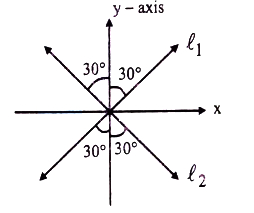
The joint equation of two lines passing through the origin,each making an angle of $30^{\circ}$ with the $Y$-axis,is
A
$x^{2}-3y^{2}=0$
B
$x^{2}+3y^{2}=0$
C
$3x^{2}-y^{2}=0$
D
$2x^{2}-3y^{2}=0$
Solution
(C) The lines pass through the origin and make an angle of $30^{\circ}$ with the $Y$-axis.
The angles these lines make with the positive $X$-axis are $90^{\circ}-30^{\circ}=60^{\circ}$ and $90^{\circ}+30^{\circ}=120^{\circ}$.
The slopes of the lines are $m_{1}=\tan 60^{\circ}=\sqrt{3}$ and $m_{2}=\tan 120^{\circ}=-\sqrt{3}$.
The equations of the lines are $y=\sqrt{3}x$ and $y=-\sqrt{3}x$,which can be written as $\sqrt{3}x-y=0$ and $\sqrt{3}x+y=0$.
The joint equation is $(\sqrt{3}x-y)(\sqrt{3}x+y)=0$.
Expanding this,we get $(\sqrt{3}x)^{2}-y^{2}=0$,which simplifies to $3x^{2}-y^{2}=0$.
The angles these lines make with the positive $X$-axis are $90^{\circ}-30^{\circ}=60^{\circ}$ and $90^{\circ}+30^{\circ}=120^{\circ}$.
The slopes of the lines are $m_{1}=\tan 60^{\circ}=\sqrt{3}$ and $m_{2}=\tan 120^{\circ}=-\sqrt{3}$.
The equations of the lines are $y=\sqrt{3}x$ and $y=-\sqrt{3}x$,which can be written as $\sqrt{3}x-y=0$ and $\sqrt{3}x+y=0$.
The joint equation is $(\sqrt{3}x-y)(\sqrt{3}x+y)=0$.
Expanding this,we get $(\sqrt{3}x)^{2}-y^{2}=0$,which simplifies to $3x^{2}-y^{2}=0$.
0 likesView Solution
215
ChemistryMCQMHT CET · 2020
If the function $f$ defined by $f(x) = K(x - x^2)$ for $0 < x < 1$ and $f(x) = 0$ otherwise,is the probability density function (p.d.f.) of a random variable $X$,then the value of $P(X < \frac{1}{2})$ is
A
$\frac{1}{4}$
B
$\frac{1}{2}$
C
$\frac{1}{3}$
D
$\frac{2}{3}$
Solution
(B) Since $f(x)$ is the p.d.f. of a random variable $X$,the total area under the curve must be $1$:
$\int_{0}^{1} K(x - x^2) dx = 1$
$K \left[ \frac{x^2}{2} - \frac{x^3}{3} \right]_{0}^{1} = 1$
$K \left( \frac{1}{2} - \frac{1}{3} \right) = 1 \Rightarrow K \left( \frac{1}{6} \right) = 1 \Rightarrow K = 6$
Now,we calculate $P(X < \frac{1}{2})$:
$P(X < \frac{1}{2}) = \int_{0}^{1/2} 6(x - x^2) dx$
$= 6 \left[ \frac{x^2}{2} - \frac{x^3}{3} \right]_{0}^{1/2}$
$= 6 \left( \frac{(1/2)^2}{2} - \frac{(1/2)^3}{3} \right)$
$= 6 \left( \frac{1/4}{2} - \frac{1/8}{3} \right) = 6 \left( \frac{1}{8} - \frac{1}{24} \right)$
$= 6 \left( \frac{3 - 1}{24} \right) = 6 \left( \frac{2}{24} \right) = 6 \left( \frac{1}{12} \right) = \frac{1}{2}$
$\int_{0}^{1} K(x - x^2) dx = 1$
$K \left[ \frac{x^2}{2} - \frac{x^3}{3} \right]_{0}^{1} = 1$
$K \left( \frac{1}{2} - \frac{1}{3} \right) = 1 \Rightarrow K \left( \frac{1}{6} \right) = 1 \Rightarrow K = 6$
Now,we calculate $P(X < \frac{1}{2})$:
$P(X < \frac{1}{2}) = \int_{0}^{1/2} 6(x - x^2) dx$
$= 6 \left[ \frac{x^2}{2} - \frac{x^3}{3} \right]_{0}^{1/2}$
$= 6 \left( \frac{(1/2)^2}{2} - \frac{(1/2)^3}{3} \right)$
$= 6 \left( \frac{1/4}{2} - \frac{1/8}{3} \right) = 6 \left( \frac{1}{8} - \frac{1}{24} \right)$
$= 6 \left( \frac{3 - 1}{24} \right) = 6 \left( \frac{2}{24} \right) = 6 \left( \frac{1}{12} \right) = \frac{1}{2}$
0 likesView Solution
216
ChemistryMCQMHT CET · 2020
The area of the triangle $ABC$ is $10 \sqrt{3} \text{ cm}^2$,angle $B$ is $60^{\circ}$ and its perimeter is $20 \text{ cm}$,then $\ell(AC) = $ (in $text{ cm}$)
A
$7$
B
$8$
C
$10$
D
$5$
Solution
(A) Given: Area $= 10 \sqrt{3} \text{ cm}^2$,$\angle B = 60^{\circ}$,Perimeter $P = a + b + c = 20 \text{ cm}$.
Using the area formula: $\text{Area} = \frac{1}{2} ac \sin B$.
$10 \sqrt{3} = \frac{1}{2} ac \sin 60^{\circ} \implies 10 \sqrt{3} = \frac{1}{2} ac \left( \frac{\sqrt{3}}{2} \right) \implies ac = 40$.
Using the Law of Cosines: $\cos B = \frac{a^2 + c^2 - b^2}{2ac}$.
$\cos 60^{\circ} = \frac{a^2 + c^2 - b^2}{2(40)} \implies \frac{1}{2} = \frac{(a+c)^2 - 2ac - b^2}{80}$.
Since $a+c = 20 - b$,we have $40 = (20-b)^2 - 2(40) - b^2$.
$40 = 400 - 40b + b^2 - 80 - b^2$.
$40 = 320 - 40b$.
$40b = 280 \implies b = 7$.
Thus,$\ell(AC) = b = 7 \text{ cm}$.
Using the area formula: $\text{Area} = \frac{1}{2} ac \sin B$.
$10 \sqrt{3} = \frac{1}{2} ac \sin 60^{\circ} \implies 10 \sqrt{3} = \frac{1}{2} ac \left( \frac{\sqrt{3}}{2} \right) \implies ac = 40$.
Using the Law of Cosines: $\cos B = \frac{a^2 + c^2 - b^2}{2ac}$.
$\cos 60^{\circ} = \frac{a^2 + c^2 - b^2}{2(40)} \implies \frac{1}{2} = \frac{(a+c)^2 - 2ac - b^2}{80}$.
Since $a+c = 20 - b$,we have $40 = (20-b)^2 - 2(40) - b^2$.
$40 = 400 - 40b + b^2 - 80 - b^2$.
$40 = 320 - 40b$.
$40b = 280 \implies b = 7$.
Thus,$\ell(AC) = b = 7 \text{ cm}$.
0 likesView Solution
217
ChemistryMCQMHT CET · 2020
If the lines $\frac{x-1}{2}=\frac{y+1}{3}=\frac{z-1}{4}$ and $\frac{x-3}{1}=\frac{y-k}{2}=\frac{z}{1}$ intersect,then the value of $k$ is
A
$\frac{3}{2}$
B
$-\frac{3}{2}$
C
$\frac{9}{2}$
D
$-\frac{2}{9}$
Solution
(C) Let the first line be $\frac{x-1}{2}=\frac{y+1}{3}=\frac{z-1}{4} = \lambda$. Then any point on this line is $(2\lambda+1, 3\lambda-1, 4\lambda+1)$.
Let the second line be $\frac{x-3}{1}=\frac{y-k}{2}=\frac{z}{1} = \mu$. Then any point on this line is $(\mu+3, 2\mu+k, \mu)$.
If the lines intersect,there exist $\lambda$ and $\mu$ such that:
$2\lambda+1 = \mu+3 \implies 2\lambda - \mu = 2$ (Equation $1$)
$4\lambda+1 = \mu \implies 4\lambda - \mu = -1$ (Equation $2$)
Subtracting Equation $1$ from Equation $2$: $(4\lambda - \mu) - (2\lambda - \mu) = -1 - 2 \implies 2\lambda = -3 \implies \lambda = -\frac{3}{2}$.
Substituting $\lambda = -\frac{3}{2}$ into Equation $1$: $2(-\frac{3}{2}) - \mu = 2 \implies -3 - \mu = 2 \implies \mu = -5$.
Now,equate the $y$-coordinates: $3\lambda - 1 = 2\mu + k$.
Substitute $\lambda = -\frac{3}{2}$ and $\mu = -5$: $3(-\frac{3}{2}) - 1 = 2(-5) + k$.
$-\frac{9}{2} - 1 = -10 + k \implies -\frac{11}{2} = -10 + k$.
$k = 10 - \frac{11}{2} = \frac{20-11}{2} = \frac{9}{2}$.
Let the second line be $\frac{x-3}{1}=\frac{y-k}{2}=\frac{z}{1} = \mu$. Then any point on this line is $(\mu+3, 2\mu+k, \mu)$.
If the lines intersect,there exist $\lambda$ and $\mu$ such that:
$2\lambda+1 = \mu+3 \implies 2\lambda - \mu = 2$ (Equation $1$)
$4\lambda+1 = \mu \implies 4\lambda - \mu = -1$ (Equation $2$)
Subtracting Equation $1$ from Equation $2$: $(4\lambda - \mu) - (2\lambda - \mu) = -1 - 2 \implies 2\lambda = -3 \implies \lambda = -\frac{3}{2}$.
Substituting $\lambda = -\frac{3}{2}$ into Equation $1$: $2(-\frac{3}{2}) - \mu = 2 \implies -3 - \mu = 2 \implies \mu = -5$.
Now,equate the $y$-coordinates: $3\lambda - 1 = 2\mu + k$.
Substitute $\lambda = -\frac{3}{2}$ and $\mu = -5$: $3(-\frac{3}{2}) - 1 = 2(-5) + k$.
$-\frac{9}{2} - 1 = -10 + k \implies -\frac{11}{2} = -10 + k$.
$k = 10 - \frac{11}{2} = \frac{20-11}{2} = \frac{9}{2}$.
0 likesView Solution
218
ChemistryMCQMHT CET · 2020
If the lines $\frac{x-1}{2}=\frac{y+1}{3}=\frac{z-1}{4}$ and $\frac{x-3}{1}=\frac{y-k}{2}=\frac{z}{1}$ intersect,then the value of $k$ is:
A
$\frac{3}{2}$
B
$\frac{9}{2}$
C
$-\frac{2}{9}$
D
$-\frac{3}{2}$
Solution
(B) For two lines $\frac{x-x_1}{a_1} = \frac{y-y_1}{b_1} = \frac{z-z_1}{c_1}$ and $\frac{x-x_2}{a_2} = \frac{y-y_2}{b_2} = \frac{z-z_2}{c_2}$ to intersect,the condition is $\left|\begin{array}{ccc} x_2-x_1 & y_2-y_1 & z_2-z_1 \\ a_1 & b_1 & c_1 \\ a_2 & b_2 & c_2 \end{array}\right| = 0$.
Substituting the given values: $(x_1, y_1, z_1) = (1, -1, 1)$,$(a_1, b_1, c_1) = (2, 3, 4)$,$(x_2, y_2, z_2) = (3, k, 0)$,and $(a_2, b_2, c_2) = (1, 2, 1)$.
The determinant becomes: $\left|\begin{array}{ccc} 3-1 & k-(-1) & 0-1 \\ 2 & 3 & 4 \\ 1 & 2 & 1 \end{array}\right| = 0$.
$\left|\begin{array}{ccc} 2 & k+1 & -1 \\ 2 & 3 & 4 \\ 1 & 2 & 1 \end{array}\right| = 0$.
Expanding the determinant: $2(3(1) - 4(2)) - (k+1)(2(1) - 4(1)) - 1(2(2) - 3(1)) = 0$.
$2(3-8) - (k+1)(2-4) - 1(4-3) = 0$.
$2(-5) - (k+1)(-2) - 1(1) = 0$.
$-10 + 2k + 2 - 1 = 0$.
$2k - 9 = 0$.
$k = \frac{9}{2}$.
Substituting the given values: $(x_1, y_1, z_1) = (1, -1, 1)$,$(a_1, b_1, c_1) = (2, 3, 4)$,$(x_2, y_2, z_2) = (3, k, 0)$,and $(a_2, b_2, c_2) = (1, 2, 1)$.
The determinant becomes: $\left|\begin{array}{ccc} 3-1 & k-(-1) & 0-1 \\ 2 & 3 & 4 \\ 1 & 2 & 1 \end{array}\right| = 0$.
$\left|\begin{array}{ccc} 2 & k+1 & -1 \\ 2 & 3 & 4 \\ 1 & 2 & 1 \end{array}\right| = 0$.
Expanding the determinant: $2(3(1) - 4(2)) - (k+1)(2(1) - 4(1)) - 1(2(2) - 3(1)) = 0$.
$2(3-8) - (k+1)(2-4) - 1(4-3) = 0$.
$2(-5) - (k+1)(-2) - 1(1) = 0$.
$-10 + 2k + 2 - 1 = 0$.
$2k - 9 = 0$.
$k = \frac{9}{2}$.
0 likesView Solution
219
ChemistryMCQMHT CET · 2020
If the lines $\frac{x-1}{2}=\frac{y+1}{3}=\frac{z-1}{4}$ and $\frac{x-3}{1}=\frac{y-k}{2}=\frac{z}{1}$ intersect,then the value of $k$ is
A
$\frac{-2}{9}$
B
$\frac{9}{2}$
C
$\frac{3}{2}$
D
$\frac{-3}{2}$
Solution
(B) Let the two lines be $L_1: \frac{x-1}{2}=\frac{y+1}{3}=\frac{z-1}{4}$ and $L_2: \frac{x-3}{1}=\frac{y-k}{2}=\frac{z}{1}$.
The lines intersect if the shortest distance between them is $0$. This condition is equivalent to the scalar triple product of the vector connecting a point on each line and the direction vectors of the lines being $0$.
Let $P_1 = (1, -1, 1)$ be a point on $L_1$ and $P_2 = (3, k, 0)$ be a point on $L_2$.
The direction vectors are $\vec{v_1} = (2, 3, 4)$ and $\vec{v_2} = (1, 2, 1)$.
The condition for intersection is given by the determinant:
$\begin{vmatrix} x_2-x_1 & y_2-y_1 & z_2-z_1 \\ a_1 & b_1 & c_1 \\ a_2 & b_2 & c_2 \end{vmatrix} = 0$
Substituting the values:
$\begin{vmatrix} 3-1 & k-(-1) & 0-1 \\ 2 & 3 & 4 \\ 1 & 2 & 1 \end{vmatrix} = 0$
$\begin{vmatrix} 2 & k+1 & -1 \\ 2 & 3 & 4 \\ 1 & 2 & 1 \end{vmatrix} = 0$
Expanding the determinant along the first row:
$2(3(1) - 4(2)) - (k+1)(2(1) - 4(1)) - 1(2(2) - 3(1)) = 0$
$2(3-8) - (k+1)(2-4) - 1(4-3) = 0$
$2(-5) - (k+1)(-2) - 1(1) = 0$
$-10 + 2k + 2 - 1 = 0$
$2k - 9 = 0$
$k = \frac{9}{2}$
The lines intersect if the shortest distance between them is $0$. This condition is equivalent to the scalar triple product of the vector connecting a point on each line and the direction vectors of the lines being $0$.
Let $P_1 = (1, -1, 1)$ be a point on $L_1$ and $P_2 = (3, k, 0)$ be a point on $L_2$.
The direction vectors are $\vec{v_1} = (2, 3, 4)$ and $\vec{v_2} = (1, 2, 1)$.
The condition for intersection is given by the determinant:
$\begin{vmatrix} x_2-x_1 & y_2-y_1 & z_2-z_1 \\ a_1 & b_1 & c_1 \\ a_2 & b_2 & c_2 \end{vmatrix} = 0$
Substituting the values:
$\begin{vmatrix} 3-1 & k-(-1) & 0-1 \\ 2 & 3 & 4 \\ 1 & 2 & 1 \end{vmatrix} = 0$
$\begin{vmatrix} 2 & k+1 & -1 \\ 2 & 3 & 4 \\ 1 & 2 & 1 \end{vmatrix} = 0$
Expanding the determinant along the first row:
$2(3(1) - 4(2)) - (k+1)(2(1) - 4(1)) - 1(2(2) - 3(1)) = 0$
$2(3-8) - (k+1)(2-4) - 1(4-3) = 0$
$2(-5) - (k+1)(-2) - 1(1) = 0$
$-10 + 2k + 2 - 1 = 0$
$2k - 9 = 0$
$k = \frac{9}{2}$
0 likesView Solution
220
ChemistryMCQMHT CET · 2020
The principal solutions of $\cot x = \sqrt{3}$ are
A
$\frac{\pi}{4}, \frac{5 \pi}{4}$
B
$\frac{\pi}{6}, \frac{7 \pi}{6}$
C
$\frac{\pi}{6}, \frac{5 \pi}{6}$
D
$\frac{\pi}{3}, \frac{7 \pi}{3}$
Solution
(B) The given equation is $\cot x = \sqrt{3}$,which is equivalent to $\tan x = \frac{1}{\sqrt{3}}$.
We know that $\tan \frac{\pi}{6} = \frac{1}{\sqrt{3}}$.
Since $\tan x$ is positive in the first and third quadrants,the principal solutions lie in the interval $[0, 2\pi)$.
The first solution is $x = \frac{\pi}{6}$.
The second solution in the third quadrant is $x = \pi + \frac{\pi}{6} = \frac{7\pi}{6}$.
Thus,the principal solutions are $\frac{\pi}{6}$ and $\frac{7\pi}{6}$.
We know that $\tan \frac{\pi}{6} = \frac{1}{\sqrt{3}}$.
Since $\tan x$ is positive in the first and third quadrants,the principal solutions lie in the interval $[0, 2\pi)$.
The first solution is $x = \frac{\pi}{6}$.
The second solution in the third quadrant is $x = \pi + \frac{\pi}{6} = \frac{7\pi}{6}$.
Thus,the principal solutions are $\frac{\pi}{6}$ and $\frac{7\pi}{6}$.
0 likesView Solution
221
ChemistryMCQMHT CET · 2020
If $\sin (y+z-x), \sin (z+x-y)$ and $\sin (x+y-z)$ are in $AP$,then
A
$\tan y=\tan x+\tan z$
B
$\tan y=\tan x-\tan z$
C
$2 \tan y=\tan x+\tan z$
D
$2 \tan y=\tan x-\tan z$
Solution
(C) Given that $\sin (y+z-x), \sin (z+x-y), \sin (x+y-z)$ are in $AP$.
Therefore,$2 \sin (z+x-y) = \sin (y+z-x) + \sin (x+y-z)$.
Using the sum-to-product formula $\sin A + \sin B = 2 \sin \frac{A+B}{2} \cos \frac{A-B}{2}$,we get:
$2 \sin (z+x-y) = 2 \sin \frac{(y+z-x) + (x+y-z)}{2} \cos \frac{(y+z-x) - (x+y-z)}{2}$
$2 \sin (z+x-y) = 2 \sin y \cos (z-x)$.
Since $\sin (z+x-y) = \sin (z-(y-x)) = \sin z \cos (y-x) - \cos z \sin (y-x)$,this approach is complex.
Alternatively,using $\sin A - \sin B = 2 \cos \frac{A+B}{2} \sin \frac{A-B}{2}$:
$\sin (z+x-y) - \sin (y+z-x) = \sin (x+y-z) - \sin (z+x-y)$
$2 \cos z \sin (x-y) = 2 \cos x \sin (y-z)$
$\cos z (\sin x \cos y - \cos x \sin y) = \cos x (\sin y \cos z - \cos y \sin z)$
$\cos z \sin x \cos y - \cos z \cos x \sin y = \cos x \sin y \cos z - \cos x \cos y \sin z$
$2 \cos z \cos x \sin y = \cos x \cos y \sin z + \sin x \cos y \cos z$
Dividing by $\cos x \cos y \cos z$:
$2 \tan y = \tan z + \tan x$.
Therefore,$2 \sin (z+x-y) = \sin (y+z-x) + \sin (x+y-z)$.
Using the sum-to-product formula $\sin A + \sin B = 2 \sin \frac{A+B}{2} \cos \frac{A-B}{2}$,we get:
$2 \sin (z+x-y) = 2 \sin \frac{(y+z-x) + (x+y-z)}{2} \cos \frac{(y+z-x) - (x+y-z)}{2}$
$2 \sin (z+x-y) = 2 \sin y \cos (z-x)$.
Since $\sin (z+x-y) = \sin (z-(y-x)) = \sin z \cos (y-x) - \cos z \sin (y-x)$,this approach is complex.
Alternatively,using $\sin A - \sin B = 2 \cos \frac{A+B}{2} \sin \frac{A-B}{2}$:
$\sin (z+x-y) - \sin (y+z-x) = \sin (x+y-z) - \sin (z+x-y)$
$2 \cos z \sin (x-y) = 2 \cos x \sin (y-z)$
$\cos z (\sin x \cos y - \cos x \sin y) = \cos x (\sin y \cos z - \cos y \sin z)$
$\cos z \sin x \cos y - \cos z \cos x \sin y = \cos x \sin y \cos z - \cos x \cos y \sin z$
$2 \cos z \cos x \sin y = \cos x \cos y \sin z + \sin x \cos y \cos z$
Dividing by $\cos x \cos y \cos z$:
$2 \tan y = \tan z + \tan x$.
0 likesView Solution
222
ChemistryMCQMHT CET · 2020
$\tan A + 2 \tan 2A + 4 \tan 4A + 8 \cot 8A = $
A
$\tan A$
B
$\cot A$
C
$\tan 2A$
D
$\cot 2A$
Solution
(B) We use the identity $\cot \theta = \frac{1 - \tan^2(\theta/2)}{2 \tan(\theta/2)}$ or $\cot \theta = \frac{1}{\tan \theta}$.
Starting with the expression: $\tan A + 2 \tan 2A + 4 \tan 4A + 8 \cot 8A$
$= \tan A + 2 \tan 2A + 4 \tan 4A + 8 \left( \frac{1 - \tan^2 4A}{2 \tan 4A} \right)$
$= \tan A + 2 \tan 2A + 4 \tan 4A + \frac{4(1 - \tan^2 4A)}{\tan 4A}$
$= \tan A + 2 \tan 2A + \frac{4 \tan^2 4A + 4 - 4 \tan^2 4A}{\tan 4A}$
$= \tan A + 2 \tan 2A + \frac{4}{\tan 4A} = \tan A + 2 \tan 2A + 4 \cot 4A$
$= \tan A + 2 \tan 2A + 4 \left( \frac{1 - \tan^2 2A}{2 \tan 2A} \right)$
$= \tan A + 2 \tan 2A + \frac{2(1 - \tan^2 2A)}{\tan 2A}$
$= \tan A + \frac{2 \tan^2 2A + 2 - 2 \tan^2 2A}{\tan 2A} = \tan A + \frac{2}{\tan 2A}$
$= \tan A + 2 \cot 2A = \tan A + 2 \left( \frac{1 - \tan^2 A}{2 \tan A} \right)$
$= \tan A + \frac{1 - \tan^2 A}{\tan A} = \frac{\tan^2 A + 1 - \tan^2 A}{\tan A} = \frac{1}{\tan A} = \cot A$
Starting with the expression: $\tan A + 2 \tan 2A + 4 \tan 4A + 8 \cot 8A$
$= \tan A + 2 \tan 2A + 4 \tan 4A + 8 \left( \frac{1 - \tan^2 4A}{2 \tan 4A} \right)$
$= \tan A + 2 \tan 2A + 4 \tan 4A + \frac{4(1 - \tan^2 4A)}{\tan 4A}$
$= \tan A + 2 \tan 2A + \frac{4 \tan^2 4A + 4 - 4 \tan^2 4A}{\tan 4A}$
$= \tan A + 2 \tan 2A + \frac{4}{\tan 4A} = \tan A + 2 \tan 2A + 4 \cot 4A$
$= \tan A + 2 \tan 2A + 4 \left( \frac{1 - \tan^2 2A}{2 \tan 2A} \right)$
$= \tan A + 2 \tan 2A + \frac{2(1 - \tan^2 2A)}{\tan 2A}$
$= \tan A + \frac{2 \tan^2 2A + 2 - 2 \tan^2 2A}{\tan 2A} = \tan A + \frac{2}{\tan 2A}$
$= \tan A + 2 \cot 2A = \tan A + 2 \left( \frac{1 - \tan^2 A}{2 \tan A} \right)$
$= \tan A + \frac{1 - \tan^2 A}{\tan A} = \frac{\tan^2 A + 1 - \tan^2 A}{\tan A} = \frac{1}{\tan A} = \cot A$
0 likesView Solution
223
ChemistryMCQMHT CET · 2020
When a capacitor is connected in series to an $LR$ circuit,the alternating current flowing in the circuit
A
is zero.
B
increases.
C
decreases.
D
remains constant.
Solution
(B) The impedance of an $L-R$ circuit is given by $Z_1 = \sqrt{R^2 + X_L^2}$.
When a capacitor is connected in series,the circuit becomes an $L-C-R$ circuit.
The impedance of an $L-C-R$ circuit is given by $Z_2 = \sqrt{R^2 + (X_L - X_C)^2}$.
Since $(X_L - X_C)^2 < X_L^2$ (assuming the circuit is not at resonance where $X_L = X_C$),the total impedance $Z_2$ is less than $Z_1$.
According to Ohm's law for $AC$ circuits,$I = \frac{V}{Z}$.
Since the impedance $Z$ decreases,the alternating current $I$ flowing in the circuit increases.
When a capacitor is connected in series,the circuit becomes an $L-C-R$ circuit.
The impedance of an $L-C-R$ circuit is given by $Z_2 = \sqrt{R^2 + (X_L - X_C)^2}$.
Since $(X_L - X_C)^2 < X_L^2$ (assuming the circuit is not at resonance where $X_L = X_C$),the total impedance $Z_2$ is less than $Z_1$.
According to Ohm's law for $AC$ circuits,$I = \frac{V}{Z}$.
Since the impedance $Z$ decreases,the alternating current $I$ flowing in the circuit increases.
0 likesView Solution
224
ChemistryMCQMHT CET · 2020
When a capacitor is connected in series to an $LR$ circuit,the alternating current flowing in the circuit
A
is zero.
B
remains constant.
C
increases.
D
decreases.
Solution
(C) The impedance of an $LR$ circuit is given by $Z_{LR} = \sqrt{R^2 + X_L^2}$.
When a capacitor is connected in series,the circuit becomes an $LCR$ circuit.
The impedance of an $LCR$ circuit is given by $Z_{LCR} = \sqrt{R^2 + (X_L - X_C)^2}$.
Since $(X_L - X_C)^2 < X_L^2$ (assuming $X_C$ is not zero),the total impedance $Z$ of the circuit decreases.
According to Ohm's law for $AC$ circuits,$I = \frac{V}{Z}$.
Since $I \propto \frac{1}{Z}$,a decrease in impedance $Z$ leads to an increase in the alternating current $I$ flowing through the circuit.
When a capacitor is connected in series,the circuit becomes an $LCR$ circuit.
The impedance of an $LCR$ circuit is given by $Z_{LCR} = \sqrt{R^2 + (X_L - X_C)^2}$.
Since $(X_L - X_C)^2 < X_L^2$ (assuming $X_C$ is not zero),the total impedance $Z$ of the circuit decreases.
According to Ohm's law for $AC$ circuits,$I = \frac{V}{Z}$.
Since $I \propto \frac{1}{Z}$,a decrease in impedance $Z$ leads to an increase in the alternating current $I$ flowing through the circuit.
0 likesView Solution
225
ChemistryMCQMHT CET · 2020
When a capacitor is connected in series $LR$ circuit,the alternating current flowing in the circuit
A
increases.
B
decreases.
C
remains constant.
D
is zero.
Solution
(A) The impedance of an $LR$ circuit is given by $Z = \sqrt{R^2 + X_L^2}$.
When a capacitor is connected in series,the circuit becomes an $LCR$ circuit.
The new impedance is $Z' = \sqrt{R^2 + (X_L - X_C)^2}$.
Since $(X_L - X_C)^2 < X_L^2$ (assuming $X_C < 2X_L$),the impedance $Z'$ decreases compared to $Z$.
According to Ohm's law for $AC$ circuits,$I = \frac{V}{Z}$.
Since the impedance $Z$ decreases,the alternating current $I$ flowing in the circuit increases.
When a capacitor is connected in series,the circuit becomes an $LCR$ circuit.
The new impedance is $Z' = \sqrt{R^2 + (X_L - X_C)^2}$.
Since $(X_L - X_C)^2 < X_L^2$ (assuming $X_C < 2X_L$),the impedance $Z'$ decreases compared to $Z$.
According to Ohm's law for $AC$ circuits,$I = \frac{V}{Z}$.
Since the impedance $Z$ decreases,the alternating current $I$ flowing in the circuit increases.
0 likesView Solution
226
ChemistryMCQMHT CET · 2020
An electron in a Hydrogen atom first jumps from the third excited state to the second excited state and then from the second excited state to the first excited state. The ratio of the wavelengths $\lambda_{1} : \lambda_{2}$ emitted in the two cases respectively is:
A
$\frac{7}{5}$
B
$\frac{27}{20}$
C
$\frac{27}{5}$
D
$\frac{20}{7}$
Solution
(D) The energy levels for a Hydrogen atom are given by $n=1$ (ground state),$n=2$ (first excited state),$n=3$ (second excited state),and $n=4$ (third excited state).
For the first transition from the third excited state $(n=4)$ to the second excited state $(n=3)$:
$\frac{1}{\lambda_{1}} = R \left( \frac{1}{3^{2}} - \frac{1}{4^{2}} \right) = R \left( \frac{1}{9} - \frac{1}{16} \right) = R \left( \frac{16-9}{144} \right) = R \left( \frac{7}{144} \right)$.
For the second transition from the second excited state $(n=3)$ to the first excited state $(n=2)$:
$\frac{1}{\lambda_{2}} = R \left( \frac{1}{2^{2}} - \frac{1}{3^{2}} \right) = R \left( \frac{1}{4} - \frac{1}{9} \right) = R \left( \frac{9-4}{36} \right) = R \left( \frac{5}{36} \right)$.
Taking the ratio $\frac{\lambda_{1}}{\lambda_{2}}$:
$\frac{\lambda_{1}}{\lambda_{2}} = \frac{1/\lambda_{2}}{1/\lambda_{1}} = \frac{R(5/36)}{R(7/144)} = \frac{5}{36} \times \frac{144}{7} = \frac{5 \times 4}{7} = \frac{20}{7}$.
For the first transition from the third excited state $(n=4)$ to the second excited state $(n=3)$:
$\frac{1}{\lambda_{1}} = R \left( \frac{1}{3^{2}} - \frac{1}{4^{2}} \right) = R \left( \frac{1}{9} - \frac{1}{16} \right) = R \left( \frac{16-9}{144} \right) = R \left( \frac{7}{144} \right)$.
For the second transition from the second excited state $(n=3)$ to the first excited state $(n=2)$:
$\frac{1}{\lambda_{2}} = R \left( \frac{1}{2^{2}} - \frac{1}{3^{2}} \right) = R \left( \frac{1}{4} - \frac{1}{9} \right) = R \left( \frac{9-4}{36} \right) = R \left( \frac{5}{36} \right)$.
Taking the ratio $\frac{\lambda_{1}}{\lambda_{2}}$:
$\frac{\lambda_{1}}{\lambda_{2}} = \frac{1/\lambda_{2}}{1/\lambda_{1}} = \frac{R(5/36)}{R(7/144)} = \frac{5}{36} \times \frac{144}{7} = \frac{5 \times 4}{7} = \frac{20}{7}$.
0 likesView Solution
227
ChemistryMCQMHT CET · 2020
The function of a dielectric in a capacitor is
A
to increase the effective potential on plates.
B
to reduce the effective potential on plates.
C
to decrease the capacitance.
D
to reduce the plate area of capacitor.
Solution
(B) When a dielectric material is inserted between the plates of a capacitor,it gets polarized. The induced electric field $E_i$ inside the dielectric opposes the external electric field $E_0$ produced by the charges on the plates. The net electric field becomes $E = E_0 - E_i$. Since the potential difference $V$ is related to the electric field by $V = E \cdot d$,the reduction in the net electric field leads to a reduction in the effective potential difference between the plates. This reduction in potential,while the charge $Q$ remains constant,results in an increase in the capacitance $C = Q/V$.
0 likesView Solution
228
ChemistryMCQMHT CET · 2020
In a system of two particles of masses $m_{1}$ and $m_{2}$,the second particle is moved by a distance $d$ towards the centre of mass. To keep the centre of mass unchanged,the first particle will have to be moved by a distance:
A
$\frac{m_{2}}{m_{1}} d$,towards the centre of mass.
B
$\frac{m_{1}}{m_{2}} d$,away from the centre of mass.
C
$\frac{m_{2}}{m_{1}} d$,away from the centre of mass.
D
$\frac{m_{1}}{m_{2}} d$,towards the centre of mass.
Solution
(A) Let the distances of masses $m_{1}$ and $m_{2}$ from the centre of mass be $r_{1}$ and $r_{2}$ respectively. By the definition of the centre of mass,$m_{1}r_{1} = m_{2}r_{2}$.
If the second particle $(m_{2})$ is moved by a distance $d$ towards the centre of mass,its new distance becomes $(r_{2} - d)$.
To keep the centre of mass unchanged,let the first particle $(m_{1})$ be moved by a distance $d'$ towards the centre of mass,so its new distance becomes $(r_{1} - d')$.
The new condition for the centre of mass is $m_{1}(r_{1} - d') = m_{2}(r_{2} - d)$.
Expanding this,we get $m_{1}r_{1} - m_{1}d' = m_{2}r_{2} - m_{2}d$.
Since $m_{1}r_{1} = m_{2}r_{2}$,these terms cancel out,leaving $-m_{1}d' = -m_{2}d$.
Thus,$d' = \frac{m_{2}}{m_{1}} d$.
Since the displacement is towards the centre of mass for both to maintain the balance,the first particle must move by $\frac{m_{2}}{m_{1}} d$ towards the centre of mass.
If the second particle $(m_{2})$ is moved by a distance $d$ towards the centre of mass,its new distance becomes $(r_{2} - d)$.
To keep the centre of mass unchanged,let the first particle $(m_{1})$ be moved by a distance $d'$ towards the centre of mass,so its new distance becomes $(r_{1} - d')$.
The new condition for the centre of mass is $m_{1}(r_{1} - d') = m_{2}(r_{2} - d)$.
Expanding this,we get $m_{1}r_{1} - m_{1}d' = m_{2}r_{2} - m_{2}d$.
Since $m_{1}r_{1} = m_{2}r_{2}$,these terms cancel out,leaving $-m_{1}d' = -m_{2}d$.
Thus,$d' = \frac{m_{2}}{m_{1}} d$.
Since the displacement is towards the centre of mass for both to maintain the balance,the first particle must move by $\frac{m_{2}}{m_{1}} d$ towards the centre of mass.
0 likesView Solution
229
ChemistryMCQMHT CET · 2020
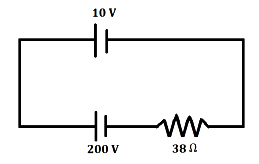
In the given circuit, the current flowing through it is: (in $ A$)
A
$5$
B
$4$
C
$2$
D
$3$
Solution
(A) The circuit consists of two batteries connected in opposition and a resistor in series.
The net electromotive force $(EMF)$ of the circuit is $E_{net} = 200 \, V - 10 \, V = 190 \, V$.
The total resistance of the circuit is $R = 38 \, \Omega$.
According to Ohm's law, the current $i$ flowing through the circuit is given by:
$i = \frac{E_{net}}{R} = \frac{190 \, V}{38 \, \Omega} = 5 \, A$.
The net electromotive force $(EMF)$ of the circuit is $E_{net} = 200 \, V - 10 \, V = 190 \, V$.
The total resistance of the circuit is $R = 38 \, \Omega$.
According to Ohm's law, the current $i$ flowing through the circuit is given by:
$i = \frac{E_{net}}{R} = \frac{190 \, V}{38 \, \Omega} = 5 \, A$.
0 likesView Solution
230
ChemistryMCQMHT CET · 2020
$A$ galvanometer has resistance $G$ and range $V_g$. How much resistance is required to read voltage up to $V$ volt?
A
$\frac{G(V+V_g)}{V}$
B
$G(\frac{V}{V_g}-1)$
C
$\frac{G(V-V_g)}{V}$
D
$G V_g$
Solution
(B) To convert a galvanometer into a voltmeter,a high resistance $R$ is connected in series with the galvanometer.
Let $I_g$ be the full-scale deflection current of the galvanometer.
Given,$V_g = I_g G$,so $I_g = \frac{V_g}{G}$.
The total resistance of the voltmeter is $(G + R)$.
For a range $V$,the total voltage is $V = I_g(G + R)$.
Substituting $I_g = \frac{V_g}{G}$,we get $V = \frac{V_g}{G}(G + R)$.
Rearranging for $R$: $\frac{V}{V_g} = \frac{G + R}{G} = 1 + \frac{R}{G}$.
Therefore,$\frac{R}{G} = \frac{V}{V_g} - 1$.
$R = G(\frac{V}{V_g} - 1)$.
Let $I_g$ be the full-scale deflection current of the galvanometer.
Given,$V_g = I_g G$,so $I_g = \frac{V_g}{G}$.
The total resistance of the voltmeter is $(G + R)$.
For a range $V$,the total voltage is $V = I_g(G + R)$.
Substituting $I_g = \frac{V_g}{G}$,we get $V = \frac{V_g}{G}(G + R)$.
Rearranging for $R$: $\frac{V}{V_g} = \frac{G + R}{G} = 1 + \frac{R}{G}$.
Therefore,$\frac{R}{G} = \frac{V}{V_g} - 1$.
$R = G(\frac{V}{V_g} - 1)$.
0 likesView Solution
231
ChemistryMCQMHT CET · 2020
When light of wavelength $\lambda$ is incident on a photosensitive surface,photons of power $P$ are emitted. The number of photons $n$ emitted in $t$ seconds is (where $h$ = Planck's constant,$c$ = velocity of light in vacuum).
A
$\frac{h c}{P \lambda t}$
B
$\frac{P \lambda t}{h c}$
C
$\frac{P \lambda}{h t c}$
D
$\frac{h P}{\lambda t c}$
Solution
(B) The energy of each photon is given by $E = \frac{hc}{\lambda}$.
If $n$ photons are emitted in time $t$,the total energy emitted is $E_{total} = \frac{nhc}{\lambda}$.
Power $P$ is defined as the energy emitted per unit time:
$P = \frac{E_{total}}{t} = \frac{nhc}{\lambda t}$.
Rearranging the formula to solve for $n$:
$n = \frac{P \lambda t}{hc}$.
If $n$ photons are emitted in time $t$,the total energy emitted is $E_{total} = \frac{nhc}{\lambda}$.
Power $P$ is defined as the energy emitted per unit time:
$P = \frac{E_{total}}{t} = \frac{nhc}{\lambda t}$.
Rearranging the formula to solve for $n$:
$n = \frac{P \lambda t}{hc}$.
0 likesView Solution
232
ChemistryMCQMHT CET · 2020
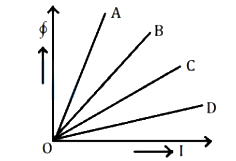
$A$ graph of magnetic flux $(\phi)$ versus current $(I)$ is shown for four inductors $A, B, C$ and $D$. Which inductor has the largest value of self-inductance?
A
$D$
B
$B$
C
$C$
D
$A$
Solution
(D) The magnetic flux linked with an inductor is given by $\phi = LI$,where $L$ is the self-inductance.
From this,we can write $L = \frac{\phi}{I}$.
This expression represents the slope of the $\phi$ versus $I$ graph.
Since the slope is $\frac{\phi}{I}$,the inductor with the steepest slope will have the largest value of self-inductance $L$.
Looking at the graph,the line $A$ has the maximum slope compared to $B, C$ and $D$.
Therefore,inductor $A$ has the largest self-inductance.
From this,we can write $L = \frac{\phi}{I}$.
This expression represents the slope of the $\phi$ versus $I$ graph.
Since the slope is $\frac{\phi}{I}$,the inductor with the steepest slope will have the largest value of self-inductance $L$.
Looking at the graph,the line $A$ has the maximum slope compared to $B, C$ and $D$.
Therefore,inductor $A$ has the largest self-inductance.
0 likesView Solution
233
ChemistryMCQMHT CET · 2020
$A$ coil of $n$ turns and resistance $R \ \Omega$ is connected in series with a resistance $R/2$. The combination is moved for time $t$ seconds through a magnetic flux change from $\phi_{1}$ to $\phi_{2}$. The induced current in the circuit is:
A
$\frac{2 n(\phi_{1}-\phi_{2})}{3 R t}$
B
$\frac{n(\phi_{1}-\phi_{2})}{3 R t}$
C
$\frac{n(\phi_{1}-\phi_{2})}{R t}$
D
$\frac{2 n(\phi_{1}-\phi_{2})}{R t}$
Solution
(A) The total resistance of the circuit is $R_{total} = R + \frac{R}{2} = \frac{3R}{2}$.
According to Faraday's law of electromagnetic induction,the magnitude of induced electromotive force $(EMF)$ is $e = n \frac{|\Delta \phi|}{\Delta t} = n \frac{|\phi_{1} - \phi_{2}|}{t}$.
The induced current $i$ is given by $i = \frac{e}{R_{total}}$.
Substituting the values,we get $i = \frac{n |\phi_{1} - \phi_{2}| / t}{3R/2} = \frac{2n |\phi_{1} - \phi_{2}|}{3Rt}$.
Thus,the induced current is $\frac{2n(\phi_{1} - \phi_{2})}{3Rt}$.
According to Faraday's law of electromagnetic induction,the magnitude of induced electromotive force $(EMF)$ is $e = n \frac{|\Delta \phi|}{\Delta t} = n \frac{|\phi_{1} - \phi_{2}|}{t}$.
The induced current $i$ is given by $i = \frac{e}{R_{total}}$.
Substituting the values,we get $i = \frac{n |\phi_{1} - \phi_{2}| / t}{3R/2} = \frac{2n |\phi_{1} - \phi_{2}|}{3Rt}$.
Thus,the induced current is $\frac{2n(\phi_{1} - \phi_{2})}{3Rt}$.
0 likesView Solution
234
ChemistryMCQMHT CET · 2020
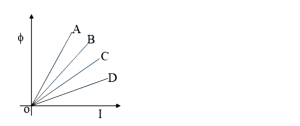
$A$ graph of magnetic flux $(\phi)$ versus current $(I)$ is drawn for four inductors $A, B, C, D$. Which inductor has the largest value of self-inductance?
A
$A$
B
$D$
C
$C$
D
$B$
Solution
(A) The relationship between magnetic flux $(\phi)$ and current $(I)$ for an inductor is given by $\phi = L I$,where $L$ is the self-inductance.
From this,we can write $L = \frac{\phi}{I}$.
In a graph of $\phi$ versus $I$,the slope of the line is given by $\frac{\phi}{I}$,which represents the self-inductance $L$.
$A$ steeper slope indicates a larger value of $L$.
Comparing the slopes of the lines $A, B, C,$ and $D$,line $A$ has the maximum slope.
Therefore,inductor $A$ has the largest self-inductance.
From this,we can write $L = \frac{\phi}{I}$.
In a graph of $\phi$ versus $I$,the slope of the line is given by $\frac{\phi}{I}$,which represents the self-inductance $L$.
$A$ steeper slope indicates a larger value of $L$.
Comparing the slopes of the lines $A, B, C,$ and $D$,line $A$ has the maximum slope.
Therefore,inductor $A$ has the largest self-inductance.
0 likesView Solution
235
ChemistryMCQMHT CET · 2020
$A$ graph of magnetic flux $\phi$ versus current $(I)$ is shown for four inductors $A, B, C, D$. The inductor with the smallest value of self-inductance is:
A
$A$
B
$C$
C
$B$
D
$D$
Solution
(D) The relationship between magnetic flux $\phi$ and current $I$ is given by $\phi = LI$,where $L$ is the self-inductance of the inductor.
From this equation,the self-inductance $L$ is the slope of the $\phi$ versus $I$ graph,i.e.,$L = \frac{\phi}{I}$.
The slope of the line represents the value of $L$.
$A$ steeper slope indicates a larger value of $L$,while a shallower slope indicates a smaller value of $L$.
Comparing the slopes of the four lines $A, B, C,$ and $D$,the line $D$ has the smallest slope.
Therefore,the inductor $D$ has the smallest value of self-inductance.
From this equation,the self-inductance $L$ is the slope of the $\phi$ versus $I$ graph,i.e.,$L = \frac{\phi}{I}$.
The slope of the line represents the value of $L$.
$A$ steeper slope indicates a larger value of $L$,while a shallower slope indicates a smaller value of $L$.
Comparing the slopes of the four lines $A, B, C,$ and $D$,the line $D$ has the smallest slope.
Therefore,the inductor $D$ has the smallest value of self-inductance.
0 likesView Solution
236
ChemistryMCQMHT CET · 2020
Which one of the following statements is $NOT$ the property of light?
A
Light involves transportation of energy.
B
Light can travel through vacuum.
C
Light requires material medium for propagation.
D
Light has finite speed.
Solution
(C) Light is an electromagnetic wave in nature. Electromagnetic waves do not require any material medium for their propagation and can travel through a vacuum at a speed of approximately $3 \times 10^8 \ m/s$. Therefore,the statement that light requires a material medium for propagation is incorrect.
0 likesView Solution
237
ChemistryMCQMHT CET · 2020
In Searle's method to find Young's modulus of a wire,when a force of $1.5 \text{ kg-wt}$ is applied at its free end,the length of the wire is '$a$'. When a force of $2.5 \text{ kg-wt}$ is applied,the length of the wire is '$b$'. What would be its original length?
A
$b-a$
B
$\frac{b-a}{4}$
C
$2.5a - 1.5b$
D
$2.5b - 1.5a$
Solution
(C) Let the original length of the wire be $L$ and the cross-sectional area be $A$. Young's modulus $Y$ is given by $Y = \frac{F L}{A \Delta l}$,where $\Delta l$ is the extension.
Case $1$: Force $F_1 = 1.5 \text{ kg-wt}$. The total length is $a = L + \Delta l_1$,so $\Delta l_1 = a - L$.
Thus,$Y = \frac{1.5 L}{A (a - L)} \implies a - L = \frac{1.5 L}{Y A} \implies a = L (1 + \frac{1.5}{Y A}) \quad \dots (1)$
Case $2$: Force $F_2 = 2.5 \text{ kg-wt}$. The total length is $b = L + \Delta l_2$,so $\Delta l_2 = b - L$.
Thus,$Y = \frac{2.5 L}{A (b - L)} \implies b - L = \frac{2.5 L}{Y A} \implies b = L (1 + \frac{2.5}{Y A}) \quad \dots (2)$
From $(1)$,$\frac{1.5}{Y A} = \frac{a}{L} - 1 = \frac{a - L}{L}$.
From $(2)$,$\frac{2.5}{Y A} = \frac{b}{L} - 1 = \frac{b - L}{L}$.
Dividing the two equations: $\frac{2.5}{1.5} = \frac{b - L}{a - L} \implies \frac{5}{3} = \frac{b - L}{a - L}$.
$5(a - L) = 3(b - L) \implies 5a - 5L = 3b - 3L$.
$5a - 3b = 2L \implies L = \frac{5a - 3b}{2} = 2.5a - 1.5b$.
Case $1$: Force $F_1 = 1.5 \text{ kg-wt}$. The total length is $a = L + \Delta l_1$,so $\Delta l_1 = a - L$.
Thus,$Y = \frac{1.5 L}{A (a - L)} \implies a - L = \frac{1.5 L}{Y A} \implies a = L (1 + \frac{1.5}{Y A}) \quad \dots (1)$
Case $2$: Force $F_2 = 2.5 \text{ kg-wt}$. The total length is $b = L + \Delta l_2$,so $\Delta l_2 = b - L$.
Thus,$Y = \frac{2.5 L}{A (b - L)} \implies b - L = \frac{2.5 L}{Y A} \implies b = L (1 + \frac{2.5}{Y A}) \quad \dots (2)$
From $(1)$,$\frac{1.5}{Y A} = \frac{a}{L} - 1 = \frac{a - L}{L}$.
From $(2)$,$\frac{2.5}{Y A} = \frac{b}{L} - 1 = \frac{b - L}{L}$.
Dividing the two equations: $\frac{2.5}{1.5} = \frac{b - L}{a - L} \implies \frac{5}{3} = \frac{b - L}{a - L}$.
$5(a - L) = 3(b - L) \implies 5a - 5L = 3b - 3L$.
$5a - 3b = 2L \implies L = \frac{5a - 3b}{2} = 2.5a - 1.5b$.
0 likesView Solution
238
ChemistryMCQMHT CET · 2020
The focal length of a convex lens will be maximum for:
A
yellow light.
B
violet light.
C
blue light.
D
red light.
Solution
(D) The focal length $f$ of a lens is related to the refractive index $\mu$ of the material by the Lens Maker's Formula: $\frac{1}{f} = (\mu - 1) \left( \frac{1}{R_1} - \frac{1}{R_2} \right)$.
From this formula,it is clear that $f \propto \frac{1}{\mu - 1}$.
According to Cauchy's equation,the refractive index $\mu$ is inversely proportional to the square of the wavelength $\lambda$ $(\mu \approx A + \frac{B}{\lambda^2})$.
Therefore,as the wavelength $\lambda$ increases,the refractive index $\mu$ decreases.
Among the given colors,red light has the maximum wavelength $(\lambda_{red} > \lambda_{yellow} > \lambda_{blue} > \lambda_{violet})$.
Since red light has the longest wavelength,it has the minimum refractive index $\mu$ for the lens material.
Consequently,the focal length $f$ will be maximum for red light.
From this formula,it is clear that $f \propto \frac{1}{\mu - 1}$.
According to Cauchy's equation,the refractive index $\mu$ is inversely proportional to the square of the wavelength $\lambda$ $(\mu \approx A + \frac{B}{\lambda^2})$.
Therefore,as the wavelength $\lambda$ increases,the refractive index $\mu$ decreases.
Among the given colors,red light has the maximum wavelength $(\lambda_{red} > \lambda_{yellow} > \lambda_{blue} > \lambda_{violet})$.
Since red light has the longest wavelength,it has the minimum refractive index $\mu$ for the lens material.
Consequently,the focal length $f$ will be maximum for red light.
0 likesView Solution
239
ChemistryMCQMHT CET · 2020
$A$ glass convex lens is of refractive index $1.55$ with both faces of same radius of curvature. What will be the radius of curvature if the focal length is to be $20 \text{ cm}$ (in $text{ cm}$)?
A
$22$
B
$21$
C
$18$
D
$20$
Solution
(A) According to the lens maker's formula:
$\frac{1}{f} = (\mu - 1) \left( \frac{1}{R_1} - \frac{1}{R_2} \right)$
Given that the lens is a convex lens with both faces having the same radius of curvature,we have $R_1 = R$ and $R_2 = -R$.
The focal length $f = 20 \text{ cm}$ and refractive index $\mu = 1.55$.
Substituting these values into the formula:
$\frac{1}{20} = (1.55 - 1) \left( \frac{1}{R} - \frac{1}{-R} \right)$
$\frac{1}{20} = 0.55 \times \left( \frac{1}{R} + \frac{1}{R} \right)$
$\frac{1}{20} = 0.55 \times \frac{2}{R}$
$\frac{1}{20} = \frac{1.1}{R}$
$R = 1.1 \times 20 = 22 \text{ cm}$
Therefore,the radius of curvature is $22 \text{ cm}$.
$\frac{1}{f} = (\mu - 1) \left( \frac{1}{R_1} - \frac{1}{R_2} \right)$
Given that the lens is a convex lens with both faces having the same radius of curvature,we have $R_1 = R$ and $R_2 = -R$.
The focal length $f = 20 \text{ cm}$ and refractive index $\mu = 1.55$.
Substituting these values into the formula:
$\frac{1}{20} = (1.55 - 1) \left( \frac{1}{R} - \frac{1}{-R} \right)$
$\frac{1}{20} = 0.55 \times \left( \frac{1}{R} + \frac{1}{R} \right)$
$\frac{1}{20} = 0.55 \times \frac{2}{R}$
$\frac{1}{20} = \frac{1.1}{R}$
$R = 1.1 \times 20 = 22 \text{ cm}$
Therefore,the radius of curvature is $22 \text{ cm}$.
0 likesView Solution
240
ChemistryMCQMHT CET · 2020
In a resonance tube experiment,a tuning fork resonates with an air column of length $12 ~cm$ and again resonates when the air column is $38 ~cm$ long. The end correction will be: (in $~cm$)
A
$0.25$
B
$0.5$
C
$1$
D
$0.75$
Solution
(C) In a resonance tube experiment,the resonance lengths $l_1$ and $l_2$ are related to the wavelength $\lambda$ and end correction $e$ as follows:
$l_1 + e = \frac{\lambda}{4}$
$l_2 + e = \frac{3\lambda}{4}$
Dividing the second equation by the first,we get:
$\frac{l_2 + e}{l_1 + e} = 3$
$l_2 + e = 3(l_1 + e)$
$l_2 + e = 3l_1 + 3e$
$l_2 - 3l_1 = 2e$
$e = \frac{l_2 - 3l_1}{2}$
Given $l_1 = 12 ~cm$ and $l_2 = 38 ~cm$:
$e = \frac{38 - 3(12)}{2} = \frac{38 - 36}{2} = \frac{2}{2} = 1 ~cm$.
$l_1 + e = \frac{\lambda}{4}$
$l_2 + e = \frac{3\lambda}{4}$
Dividing the second equation by the first,we get:
$\frac{l_2 + e}{l_1 + e} = 3$
$l_2 + e = 3(l_1 + e)$
$l_2 + e = 3l_1 + 3e$
$l_2 - 3l_1 = 2e$
$e = \frac{l_2 - 3l_1}{2}$
Given $l_1 = 12 ~cm$ and $l_2 = 38 ~cm$:
$e = \frac{38 - 3(12)}{2} = \frac{38 - 36}{2} = \frac{2}{2} = 1 ~cm$.
0 likesView Solution
241
ChemistryMCQMHT CET · 2020
The acceleration due to gravity on the moon is $\left(\frac{1}{6}\right)$ times the acceleration due to gravity on the earth. If the ratio of the density of the earth $\rho_{e}$ to the density of the moon $\rho_{m}$ is $\frac{5}{3}$,then the radius of the moon $R_{m}$ in terms of the radius of the earth $R_{e}$ is:
A
$\left(\frac{7}{6}\right) R_{e}$
B
$\left(\frac{3}{18}\right) R_{e}$
C
$\left(\frac{5}{18}\right) R_{e}$
D
$\left(\frac{1}{2 \sqrt{3}}\right) R_{e}$
Solution
(C) Given: $\frac{g_{m}}{g_{e}} = \frac{1}{6}$ and $\frac{\rho_{e}}{\rho_{m}} = \frac{5}{3}$.
We know that the acceleration due to gravity is given by $g = \frac{GM}{R^2}$.
Since $M = \rho \times V = \rho \times \frac{4}{3} \pi R^3$,we have $g = \frac{G \times \frac{4}{3} \pi R^3 \rho}{R^2} = \frac{4}{3} \pi G R \rho$.
Therefore,the ratio $\frac{g_{m}}{g_{e}} = \frac{R_{m} \rho_{m}}{R_{e} \rho_{e}}$.
Substituting the given values: $\frac{1}{6} = \left(\frac{R_{m}}{R_{e}}\right) \times \left(\frac{\rho_{m}}{\rho_{e}}\right)$.
Since $\frac{\rho_{e}}{\rho_{m}} = \frac{5}{3}$,then $\frac{\rho_{m}}{\rho_{e}} = \frac{3}{5}$.
So,$\frac{1}{6} = \left(\frac{R_{m}}{R_{e}}\right) \times \left(\frac{3}{5}\right)$.
$\frac{R_{m}}{R_{e}} = \frac{1}{6} \times \frac{5}{3} = \frac{5}{18}$.
Thus,$R_{m} = \left(\frac{5}{18}\right) R_{e}$.
We know that the acceleration due to gravity is given by $g = \frac{GM}{R^2}$.
Since $M = \rho \times V = \rho \times \frac{4}{3} \pi R^3$,we have $g = \frac{G \times \frac{4}{3} \pi R^3 \rho}{R^2} = \frac{4}{3} \pi G R \rho$.
Therefore,the ratio $\frac{g_{m}}{g_{e}} = \frac{R_{m} \rho_{m}}{R_{e} \rho_{e}}$.
Substituting the given values: $\frac{1}{6} = \left(\frac{R_{m}}{R_{e}}\right) \times \left(\frac{\rho_{m}}{\rho_{e}}\right)$.
Since $\frac{\rho_{e}}{\rho_{m}} = \frac{5}{3}$,then $\frac{\rho_{m}}{\rho_{e}} = \frac{3}{5}$.
So,$\frac{1}{6} = \left(\frac{R_{m}}{R_{e}}\right) \times \left(\frac{3}{5}\right)$.
$\frac{R_{m}}{R_{e}} = \frac{1}{6} \times \frac{5}{3} = \frac{5}{18}$.
Thus,$R_{m} = \left(\frac{5}{18}\right) R_{e}$.
0 likesView Solution
242
ChemistryMCQMHT CET · 2020
If a gas is compressed isothermally,then the r.m.s. velocity of the molecules
A
decreases.
B
increases.
C
remains the same.
D
first decreases and then increases.
Solution
(C) The root-mean-square (rms) velocity of gas molecules is given by the formula:
$v_{rms} = \sqrt{\frac{3kT}{m}}$
From this expression,we can see that $v_{rms} \propto \sqrt{T}$ for a given gas.
In an isothermal process,the temperature $(T)$ of the system remains constant.
Since the temperature does not change,the r.m.s. velocity of the gas molecules remains the same.
$v_{rms} = \sqrt{\frac{3kT}{m}}$
From this expression,we can see that $v_{rms} \propto \sqrt{T}$ for a given gas.
In an isothermal process,the temperature $(T)$ of the system remains constant.
Since the temperature does not change,the r.m.s. velocity of the gas molecules remains the same.
0 likesView Solution
243
ChemistryMCQMHT CET · 2020
If a gas is compressed isothermally,then the r.m.s. velocity of the molecules
A
remains the same.
B
increases.
C
decreases.
D
first decreases and then increases.
Solution
(A) The root mean square (r.m.s.) velocity of gas molecules is given by the formula $v_{rms} = \sqrt{\frac{3RT}{M}}$,where $R$ is the universal gas constant,$T$ is the absolute temperature,and $M$ is the molar mass of the gas.
In an isothermal process,the temperature $T$ of the gas remains constant.
Since $v_{rms}$ depends only on the temperature $T$ (for a given gas),if $T$ is constant,the r.m.s. velocity $v_{rms}$ will also remain constant.
Therefore,when a gas is compressed isothermally,the r.m.s. velocity of the molecules remains the same.
In an isothermal process,the temperature $T$ of the gas remains constant.
Since $v_{rms}$ depends only on the temperature $T$ (for a given gas),if $T$ is constant,the r.m.s. velocity $v_{rms}$ will also remain constant.
Therefore,when a gas is compressed isothermally,the r.m.s. velocity of the molecules remains the same.
0 likesView Solution
244
ChemistryMCQMHT CET · 2020
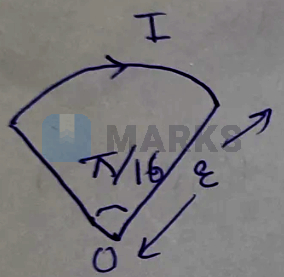
$A$ circular arc of radius $r$ carrying current $I$ subtends an angle $\frac{\pi}{16}$ at its centre. The radius of the metal wire is uniform. The magnetic induction at the centre of the circular arc is
A
$\frac{\mu_{0} I}{16 r}$
B
$\frac{\mu_{0} I}{32 r}$
C
$\frac{\mu_{0} I}{64 r}$
D
$\frac{\mu_{0} I}{8 r}$
Solution
(C) The magnetic field $B$ at the centre of a circular arc of radius $r$ carrying current $I$ that subtends an angle $\theta$ at the centre is given by the formula:
$B = \frac{\mu_{0} I \theta}{4 \pi r}$
Here,the angle subtended is $\theta = \frac{\pi}{16}$.
Substituting the value of $\theta$ into the formula:
$B = \frac{\mu_{0} I}{4 \pi r} \times \left( \frac{\pi}{16} \right)$
$B = \frac{\mu_{0} I \pi}{64 \pi r}$
$B = \frac{\mu_{0} I}{64 r}$
Thus,the correct option is $C$.
$B = \frac{\mu_{0} I \theta}{4 \pi r}$
Here,the angle subtended is $\theta = \frac{\pi}{16}$.
Substituting the value of $\theta$ into the formula:
$B = \frac{\mu_{0} I}{4 \pi r} \times \left( \frac{\pi}{16} \right)$
$B = \frac{\mu_{0} I \pi}{64 \pi r}$
$B = \frac{\mu_{0} I}{64 r}$
Thus,the correct option is $C$.
0 likesView Solution
245
ChemistryMCQMHT CET · 2020
An electron accelerated through a potential difference '$V$' passes through a uniform transverse magnetic field and experiences a force '$F$'. If the accelerating potential is increased to '$2V$',the electron in the same magnetic field will experience a force:
A
$3F$
B
$F$
C
$\sqrt{2}F$
D
$\frac{F}{2}$
Solution
(C) The kinetic energy of the electron is given by $K = eV$,where '$e$' is the charge of the electron and '$V$' is the accelerating potential.
In the first case,$K_1 = eV_1 = eV$.
In the second case,$K_2 = eV_2 = e(2V) = 2eV$.
Since $K = \frac{1}{2}mv^2$,we have $v = \sqrt{\frac{2K}{m}}$.
Thus,the ratio of velocities is $\frac{v_2}{v_1} = \sqrt{\frac{K_2}{K_1}} = \sqrt{\frac{2eV}{eV}} = \sqrt{2}$.
The magnetic force on a moving charge is given by $F = evB \sin(\theta)$. Since the electron enters the transverse magnetic field,$\theta = 90^\circ$ and $\sin(90^\circ) = 1$,so $F = evB$.
Since '$e$' and '$B$' are constant,$F \propto v$.
Therefore,$\frac{F_2}{F_1} = \frac{v_2}{v_1} = \sqrt{2}$.
Hence,$F_2 = \sqrt{2}F$.
In the first case,$K_1 = eV_1 = eV$.
In the second case,$K_2 = eV_2 = e(2V) = 2eV$.
Since $K = \frac{1}{2}mv^2$,we have $v = \sqrt{\frac{2K}{m}}$.
Thus,the ratio of velocities is $\frac{v_2}{v_1} = \sqrt{\frac{K_2}{K_1}} = \sqrt{\frac{2eV}{eV}} = \sqrt{2}$.
The magnetic force on a moving charge is given by $F = evB \sin(\theta)$. Since the electron enters the transverse magnetic field,$\theta = 90^\circ$ and $\sin(90^\circ) = 1$,so $F = evB$.
Since '$e$' and '$B$' are constant,$F \propto v$.
Therefore,$\frac{F_2}{F_1} = \frac{v_2}{v_1} = \sqrt{2}$.
Hence,$F_2 = \sqrt{2}F$.
0 likesView Solution
246
ChemistryMCQMHT CET · 2020
An electron is projected along the axis of a circular conductor carrying current $I$. The electron will experience:
A
a force at an angle of $30^{\circ}$ with the axis.
B
no force.
C
a force along the axis.
D
a force perpendicular to the axis.
Solution
(B) The magnetic field produced by a circular current-carrying loop along its axis is directed along the axis itself.
Since the electron is projected along the axis,its velocity vector $\vec{v}$ is parallel or antiparallel to the magnetic field vector $\vec{B}$.
The magnetic force on a moving charge is given by $\vec{F} = q(\vec{v} \times \vec{B})$,which has a magnitude $F = qvB \sin \theta$.
Here,the angle $\theta$ between the velocity and the magnetic field is $0^{\circ}$ or $180^{\circ}$.
Since $\sin(0^{\circ}) = 0$ and $\sin(180^{\circ}) = 0$,the magnetic force $F = 0$.
Therefore,the electron experiences no force.
Since the electron is projected along the axis,its velocity vector $\vec{v}$ is parallel or antiparallel to the magnetic field vector $\vec{B}$.
The magnetic force on a moving charge is given by $\vec{F} = q(\vec{v} \times \vec{B})$,which has a magnitude $F = qvB \sin \theta$.
Here,the angle $\theta$ between the velocity and the magnetic field is $0^{\circ}$ or $180^{\circ}$.
Since $\sin(0^{\circ}) = 0$ and $\sin(180^{\circ}) = 0$,the magnetic force $F = 0$.
Therefore,the electron experiences no force.
0 likesView Solution
247
ChemistryMCQMHT CET · 2020
Two stones of masses $m$ and $3m$ are whirled in horizontal circles,the heavier one in a radius $\left(\frac{r}{3}\right)$ and the lighter one in a radius $r$. The tangential speed of the lighter stone is '$n$' times the value of the heavier stone. When the magnitude of the centripetal force becomes equal,the value of $n$ is:
A
$4$
B
$3$
C
$2$
D
$1$
Solution
(B) Let the mass of the lighter stone be $m_1 = m$ and its radius be $r_1 = r$. Let its tangential speed be $v_1$.
Let the mass of the heavier stone be $m_2 = 3m$ and its radius be $r_2 = \frac{r}{3}$. Let its tangential speed be $v_2$.
Given that $v_1 = n v_2$.
The centripetal force is given by $F = \frac{mv^2}{r}$.
Equating the centripetal forces for both stones: $F_1 = F_2$.
$\frac{m_1 v_1^2}{r_1} = \frac{m_2 v_2^2}{r_2}$.
Substituting the given values: $\frac{m (n v_2)^2}{r} = \frac{3m v_2^2}{r/3}$.
$\frac{m n^2 v_2^2}{r} = \frac{9m v_2^2}{r}$.
Canceling common terms $m, v_2^2,$ and $r$ from both sides,we get $n^2 = 9$.
Therefore,$n = 3$.
Let the mass of the heavier stone be $m_2 = 3m$ and its radius be $r_2 = \frac{r}{3}$. Let its tangential speed be $v_2$.
Given that $v_1 = n v_2$.
The centripetal force is given by $F = \frac{mv^2}{r}$.
Equating the centripetal forces for both stones: $F_1 = F_2$.
$\frac{m_1 v_1^2}{r_1} = \frac{m_2 v_2^2}{r_2}$.
Substituting the given values: $\frac{m (n v_2)^2}{r} = \frac{3m v_2^2}{r/3}$.
$\frac{m n^2 v_2^2}{r} = \frac{9m v_2^2}{r}$.
Canceling common terms $m, v_2^2,$ and $r$ from both sides,we get $n^2 = 9$.
Therefore,$n = 3$.
0 likesView Solution
248
ChemistryMCQMHT CET · 2020
$A$ particle moves along a circular path with decreasing speed. Hence
A
its resultant acceleration is towards the centre.
B
its angular momentum remains constant.
C
the direction of angular momentum remains constant.
D
it moves in a spiral path with decreasing radius.
Solution
(C) The angular momentum $\overrightarrow{L}$ of a particle moving in a circular path is given by $\overrightarrow{L} = \overrightarrow{r} \times \overrightarrow{p} = \overrightarrow{r} \times m\overrightarrow{v}$.
Since the particle moves in a circular path,the position vector $\overrightarrow{r}$ and the velocity vector $\overrightarrow{v}$ are always perpendicular to each other.
The direction of the angular momentum vector $\overrightarrow{L}$ is determined by the right-hand rule,which is perpendicular to the plane of the circular motion.
As the speed $v$ decreases,the magnitude of the angular momentum $|\overrightarrow{L}| = mvr$ decreases.
However,because the particle remains in the same plane of motion,the direction of the angular momentum vector remains constant.
Since the particle moves in a circular path,the position vector $\overrightarrow{r}$ and the velocity vector $\overrightarrow{v}$ are always perpendicular to each other.
The direction of the angular momentum vector $\overrightarrow{L}$ is determined by the right-hand rule,which is perpendicular to the plane of the circular motion.
As the speed $v$ decreases,the magnitude of the angular momentum $|\overrightarrow{L}| = mvr$ decreases.
However,because the particle remains in the same plane of motion,the direction of the angular momentum vector remains constant.
0 likesView Solution
249
ChemistryMCQMHT CET · 2020
Two different radioactive elements with half-lives $T_{1}$ and $T_{2}$ have undecayed atoms $N_{1}$ and $N_{2}$ respectively,present at a given instant. The ratio of their activities at this instant is
A
$\frac{T_{1} T_{2}}{N_{1} N_{2}}$
B
$\frac{N_{1} N_{2}}{T_{1} T_{2}}$
C
$\frac{N_{1} T_{1}}{N_{2} T_{2}}$
D
$\frac{N_{1} T_{2}}{N_{2} T_{1}}$
Solution
(D) The activity $R$ of a radioactive sample is defined as the rate of decay,given by $R = \lambda N$,where $\lambda$ is the decay constant and $N$ is the number of undecayed atoms.
The decay constant $\lambda$ is related to the half-life $T$ by the formula $\lambda = \frac{\ln 2}{T}$.
Substituting this into the activity formula,we get $R = \frac{(\ln 2) N}{T}$.
For the two elements,the activities are:
$R_{1} = \frac{(\ln 2) N_{1}}{T_{1}}$
$R_{2} = \frac{(\ln 2) N_{2}}{T_{2}}$
The ratio of their activities is:
$\frac{R_{1}}{R_{2}} = \frac{(\ln 2) N_{1} / T_{1}}{(\ln 2) N_{2} / T_{2}} = \frac{N_{1}}{T_{1}} \times \frac{T_{2}}{N_{2}} = \frac{N_{1} T_{2}}{N_{2} T_{1}}$.
The decay constant $\lambda$ is related to the half-life $T$ by the formula $\lambda = \frac{\ln 2}{T}$.
Substituting this into the activity formula,we get $R = \frac{(\ln 2) N}{T}$.
For the two elements,the activities are:
$R_{1} = \frac{(\ln 2) N_{1}}{T_{1}}$
$R_{2} = \frac{(\ln 2) N_{2}}{T_{2}}$
The ratio of their activities is:
$\frac{R_{1}}{R_{2}} = \frac{(\ln 2) N_{1} / T_{1}}{(\ln 2) N_{2} / T_{2}} = \frac{N_{1}}{T_{1}} \times \frac{T_{2}}{N_{2}} = \frac{N_{1} T_{2}}{N_{2} T_{1}}$.
0 likesView Solution
250
ChemistryMCQMHT CET · 2020
Two bodies $A$ and $B$ of equal mass are suspended from two separate massless springs of force constant $k_{1}$ and $k_{2}$ respectively. The bodies oscillate vertically such that their maximum velocities are equal. The ratio of the amplitudes of body $A$ to that of body $B$ is
A
$\sqrt{\frac{k_{2}}{k_{1}}}$
B
$\frac{k_{1}}{k_{2}}$
C
$\sqrt{\frac{k_{1}}{k_{2}}}$
D
$\frac{k_{2}}{k_{1}}$
Solution
(A) For a body of mass $m$ oscillating with amplitude $A$ and angular frequency $\omega$,the maximum velocity is given by $v_{max} = A\omega$.
Given that the masses are equal $(m_A = m_B = m)$ and the force constants are $k_1$ and $k_2$,the angular frequencies are $\omega_1 = \sqrt{\frac{k_1}{m}}$ and $\omega_2 = \sqrt{\frac{k_2}{m}}$.
Since the maximum velocities are equal,we have $A_1 \omega_1 = A_2 \omega_2$.
Substituting the expressions for $\omega_1$ and $\omega_2$:
$A_1 \sqrt{\frac{k_1}{m}} = A_2 \sqrt{\frac{k_2}{m}}$.
Squaring both sides and simplifying:
$A_1^2 \frac{k_1}{m} = A_2^2 \frac{k_2}{m} \implies \frac{A_1^2}{A_2^2} = \frac{k_2}{k_1}$.
Taking the square root,the ratio of the amplitudes is $\frac{A_1}{A_2} = \sqrt{\frac{k_2}{k_1}}$.
Given that the masses are equal $(m_A = m_B = m)$ and the force constants are $k_1$ and $k_2$,the angular frequencies are $\omega_1 = \sqrt{\frac{k_1}{m}}$ and $\omega_2 = \sqrt{\frac{k_2}{m}}$.
Since the maximum velocities are equal,we have $A_1 \omega_1 = A_2 \omega_2$.
Substituting the expressions for $\omega_1$ and $\omega_2$:
$A_1 \sqrt{\frac{k_1}{m}} = A_2 \sqrt{\frac{k_2}{m}}$.
Squaring both sides and simplifying:
$A_1^2 \frac{k_1}{m} = A_2^2 \frac{k_2}{m} \implies \frac{A_1^2}{A_2^2} = \frac{k_2}{k_1}$.
Taking the square root,the ratio of the amplitudes is $\frac{A_1}{A_2} = \sqrt{\frac{k_2}{k_1}}$.
0 likesView Solution
251
ChemistryMediumMCQMHT CET · 2020
What is the type of hybridisation and the geometry respectively found in $[CoF_{6}]^{3-}$?
A
$d^{3}sp^{3}$ and pentagonal bipyramidal
B
$sp^{3}d^{2}$ and octahedral
C
$dsp^{3}$ and trigonal bipyramidal
D
$dsp^{2}$ and pentagonal bipyramidal
Solution
(B) In $[CoF_{6}]^{3-}$,the oxidation state of $Co$ is $+3$.
The electronic configuration of $Co^{3+}$ is $[Ar] 3d^{6}$.
Since $F^{-}$ is a weak field ligand $(WFL)$,it does not cause pairing of electrons in the $3d$ orbitals.
Therefore,the $Co^{3+}$ ion uses one $4s$,three $4p$,and two $4d$ orbitals to form six hybrid orbitals.
This results in $sp^{3}d^{2}$ hybridisation.
The geometry associated with $sp^{3}d^{2}$ hybridisation is octahedral.
The electronic configuration of $Co^{3+}$ is $[Ar] 3d^{6}$.
Since $F^{-}$ is a weak field ligand $(WFL)$,it does not cause pairing of electrons in the $3d$ orbitals.
Therefore,the $Co^{3+}$ ion uses one $4s$,three $4p$,and two $4d$ orbitals to form six hybrid orbitals.
This results in $sp^{3}d^{2}$ hybridisation.
The geometry associated with $sp^{3}d^{2}$ hybridisation is octahedral.
0 likesView Solution
252
ChemistryEasyMCQMHT CET · 2020
What is the value of the primary valence of $Co$ in $CoCl_{3}$?
A
$2$
B
$4$
C
$3$
D
$1$
Solution
(C) The primary valence of a central metal atom in a coordination compound corresponds to its oxidation state.
In $CoCl_{3}$,the oxidation state of $Co$ is calculated as follows:
$x + 3(-1) = 0$
$x - 3 = 0$
$x = +3$
Therefore,the primary valence of $Co$ is $3$.
In $CoCl_{3}$,the oxidation state of $Co$ is calculated as follows:
$x + 3(-1) = 0$
$x - 3 = 0$
$x = +3$
Therefore,the primary valence of $Co$ is $3$.
0 likesView Solution
253
ChemistryEasyMCQMHT CET · 2020
Which of the following types of valences,according to Werner's theory,is also called as primary valence?
A
Ionisable valence
B
Auxiliary valence
C
Residual valence
D
Subsidiary valence
Solution
(A) According to Werner's coordination theory,the primary valence corresponds to the oxidation state of the central metal atom.
It is ionisable and is satisfied by negative ions.
Therefore,it is also known as the ionisable valence.
It is ionisable and is satisfied by negative ions.
Therefore,it is also known as the ionisable valence.
0 likesView Solution
254
ChemistryMediumMCQMHT CET · 2020
What is the oxidation number of $Fe$ in $K_3[Fe(CN)_6]$?
A
$+2$
B
$+3$
C
$+4$
D
$+1$
Solution
(B) To find the oxidation number of $Fe$ in $K_3[Fe(CN)_6]$,let the oxidation number of $Fe$ be $x$.
The oxidation number of $K$ is $+1$ and the oxidation number of the $CN^-$ ligand is $-1$.
The sum of the oxidation numbers of all atoms in a neutral complex is $0$.
Therefore,$3(+1) + x + 6(-1) = 0$.
$3 + x - 6 = 0$.
$x - 3 = 0$.
$x = +3$.
Thus,the oxidation number of $Fe$ is $+3$.
The oxidation number of $K$ is $+1$ and the oxidation number of the $CN^-$ ligand is $-1$.
The sum of the oxidation numbers of all atoms in a neutral complex is $0$.
Therefore,$3(+1) + x + 6(-1) = 0$.
$3 + x - 6 = 0$.
$x - 3 = 0$.
$x = +3$.
Thus,the oxidation number of $Fe$ is $+3$.
0 likesView Solution
255
ChemistryMediumMCQMHT CET · 2020
Identify the ionic charge and magnetic nature respectively of the manganate ion.
A
$-1$,Diamagnetic
B
$-2$,Diamagnetic
C
$-2$,Paramagnetic
D
$-1$,Paramagnetic
Solution
(C) The chemical formula for the manganate ion is $MnO_4^{2-}$.
In $MnO_4^{2-}$,the oxidation state of $Mn$ is $+6$. The electronic configuration of $Mn^{6+}$ is $[Ar] 3d^1$.
Due to the presence of one unpaired electron in the $3d$ orbital,the manganate ion is paramagnetic.
The ionic charge of the manganate ion is $-2$.
In $MnO_4^{2-}$,the oxidation state of $Mn$ is $+6$. The electronic configuration of $Mn^{6+}$ is $[Ar] 3d^1$.
Due to the presence of one unpaired electron in the $3d$ orbital,the manganate ion is paramagnetic.
The ionic charge of the manganate ion is $-2$.
0 likesView Solution
256
ChemistryMediumMCQMHT CET · 2020
What is the type of magnetic behavior and geometry respectively in Cuproammonium sulphate (Atomic no. of $Cu=29$)?
A
Paramagnetic and tetrahedral
B
Diamagnetic and pyramidal
C
Diamagnetic and tetrahedral
D
Paramagnetic and square planar
Solution
(D) The chemical formula for Cuproammonium sulphate is $[Cu(NH_{3})_{4}]SO_{4} \cdot H_{2}O$.
In the complex ion $[Cu(NH_{3})_{4}]^{2+}$,the oxidation state of $Cu$ is $+2$.
The electronic configuration of $Cu^{2+}$ is $[Ar] 3d^{9}$.
Due to the presence of $NH_{3}$ (a strong field ligand),the complex undergoes $dsp^{2}$ hybridization,resulting in a square planar geometry.
Since there is one unpaired electron in the $3d$ orbital,the complex is paramagnetic.
In the complex ion $[Cu(NH_{3})_{4}]^{2+}$,the oxidation state of $Cu$ is $+2$.
The electronic configuration of $Cu^{2+}$ is $[Ar] 3d^{9}$.
Due to the presence of $NH_{3}$ (a strong field ligand),the complex undergoes $dsp^{2}$ hybridization,resulting in a square planar geometry.
Since there is one unpaired electron in the $3d$ orbital,the complex is paramagnetic.
0 likesView Solution
257
ChemistryMediumMCQMHT CET · 2020
What is the value of effective magnetic moment found in $+3$ oxidation state of Chromium $(Z=24)$ (in $BM$)?
A
$1.73$
B
$3.87$
C
$4.90$
D
$2.84$
Solution
(B) The electronic configuration of $Cr$ $(Z=24)$ is $[Ar] 3d^5 4s^1$.
In the $+3$ oxidation state, $Cr^{3+}$ loses three electrons to form $[Ar] 3d^3$.
This configuration contains $n = 3$ unpaired electrons.
The effective magnetic moment $\mu$ is calculated using the formula $\mu = \sqrt{n(n+2)} \ BM$.
Substituting $n=3$, we get $\mu = \sqrt{3(3+2)} = \sqrt{15} \approx 3.87 \ BM$.
In the $+3$ oxidation state, $Cr^{3+}$ loses three electrons to form $[Ar] 3d^3$.
This configuration contains $n = 3$ unpaired electrons.
The effective magnetic moment $\mu$ is calculated using the formula $\mu = \sqrt{n(n+2)} \ BM$.
Substituting $n=3$, we get $\mu = \sqrt{3(3+2)} = \sqrt{15} \approx 3.87 \ BM$.
0 likesView Solution
258
ChemistryMediumMCQMHT CET · 2020
How many water molecules are hydrogen bonded in the following molecular formula $[Cu(H_{2}O)_{4}]^{2+} SO_{4}^{2-} \cdot H_{2}O$?
A
$4$
B
$3$
C
$1$
D
$5$
Solution
(C) In the structure of copper$(II)$ sulfate pentahydrate,$[Cu(H_{2}O)_{4}]SO_{4} \cdot H_{2}O$,four water molecules are directly coordinated to the $Cu^{2+}$ ion.
The fifth water molecule is held in the crystal lattice by hydrogen bonding between the $SO_{4}^{2-}$ ion and the coordinated water molecules.
The fifth water molecule is held in the crystal lattice by hydrogen bonding between the $SO_{4}^{2-}$ ion and the coordinated water molecules.
0 likesView Solution
259
ChemistryEasyMCQMHT CET · 2020
What is the secondary valence of $Co^{3+}$ ion according to Werner's theory in $[Co(NH_3)_4 Cl_2]^+$?
A
$5$
B
$4$
C
$3$
D
$6$
Solution
(D) According to Werner's theory,the secondary valence of a central metal ion is equal to its coordination number.
In the complex $[Co(NH_3)_4 Cl_2]^+$,the $Co^{3+}$ ion is bonded to $4$ $NH_3$ molecules and $2$ $Cl^-$ ions.
Therefore,the coordination number $= 4 + 2 = 6$.
Thus,the secondary valence of $Co^{3+}$ is $6$.
In the complex $[Co(NH_3)_4 Cl_2]^+$,the $Co^{3+}$ ion is bonded to $4$ $NH_3$ molecules and $2$ $Cl^-$ ions.
Therefore,the coordination number $= 4 + 2 = 6$.
Thus,the secondary valence of $Co^{3+}$ is $6$.
0 likesView Solution
260
ChemistryEasyMCQMHT CET · 2020
What is the oxidation state and coordination number of platinum respectively in $[Pt(NH_{3})_{6}]^{4+}$?
A
$+6$ and $4$
B
$+4$ and $4$
C
$+6$ and $6$
D
$+4$ and $6$
Solution
(D) In the complex $[Pt(NH_{3})_{6}]^{4+}$:
$I$. Let the oxidation state of $Pt$ be $x$. Since $NH_{3}$ is a neutral ligand,$x + 6(0) = +4$,which gives $x = +4$.
$II$. The coordination number is the number of ligand donor atoms bonded to the central metal ion. Since there are $6$ $NH_{3}$ ligands,each donating one lone pair,the coordination number is $6$.
$I$. Let the oxidation state of $Pt$ be $x$. Since $NH_{3}$ is a neutral ligand,$x + 6(0) = +4$,which gives $x = +4$.
$II$. The coordination number is the number of ligand donor atoms bonded to the central metal ion. Since there are $6$ $NH_{3}$ ligands,each donating one lone pair,the coordination number is $6$.
0 likesView Solution
261
ChemistryEasyMCQMHT CET · 2020
Which element from the following forms colourless compounds in $+2$ oxidation state?
A
$Co$ $(Z=27)$
B
$Zn$ $(Z=30)$
C
$Cu$ $(Z=29)$
D
$Mn$ $(Z=25)$
Solution
(B) The electronic configuration of $Zn$ $(Z=30)$ is $[Ar] 3d^{10} 4s^2$.
In the $+2$ oxidation state,$Zn^{2+}$ has the configuration $[Ar] 3d^{10}$.
Since the $3d$ subshell is completely filled,there are no unpaired electrons.
Therefore,$Zn^{2+}$ compounds are colourless due to the absence of $d-d$ transitions.
In the $+2$ oxidation state,$Zn^{2+}$ has the configuration $[Ar] 3d^{10}$.
Since the $3d$ subshell is completely filled,there are no unpaired electrons.
Therefore,$Zn^{2+}$ compounds are colourless due to the absence of $d-d$ transitions.
0 likesView Solution
262
ChemistryEasyMCQMHT CET · 2020
Which ligand among the following has the highest splitting power of $d$-orbitals of the central metal ion?
A
$S^{2-}$
B
$OH^{-}$
C
$NCS^{-}$
D
$CO$
Solution
(D) The splitting power of ligands is determined by the spectrochemical series.
According to the spectrochemical series,the order of field strength is: $S^{2-} < OH^{-} < NCS^{-} < CO$.
$CO$ is a strong field ligand and causes the maximum splitting of $d$-orbitals.
Therefore,$CO$ has the highest splitting power.
According to the spectrochemical series,the order of field strength is: $S^{2-} < OH^{-} < NCS^{-} < CO$.
$CO$ is a strong field ligand and causes the maximum splitting of $d$-orbitals.
Therefore,$CO$ has the highest splitting power.
0 likesView Solution
263
ChemistryEasyMCQMHT CET · 2020
Which among the following elements has the lowest density and is the lightest?
A
Scandium
B
Cobalt
C
Copper
D
Iron
Solution
(A) In the $3d-$ series elements,the density and atomic mass increase from $Sc$ to $Zn$ across the period.
Since $Sc$ $(Z = 21)$ is the first element in the $3d-$ series,it has the lowest atomic mass and the lowest density among the given options.
Since $Sc$ $(Z = 21)$ is the first element in the $3d-$ series,it has the lowest atomic mass and the lowest density among the given options.
0 likesView Solution
264
ChemistryEasyMCQMHT CET · 2020
Which among the following elements is a soft element as compared to others?
A
$Co$
B
$Zn$
C
$W$
D
$Mo$
Solution
(B) Most transition elements are very hard due to strong metallic bonding involving $d$-electrons.
However,elements like $Zn, Cd,$ and $Hg$ have completely filled $d$-orbitals ($d^{10}$ configuration),which results in weak metallic bonding.
Therefore,$Zn$ is a soft element compared to $Co, W,$ and $Mo$.
However,elements like $Zn, Cd,$ and $Hg$ have completely filled $d$-orbitals ($d^{10}$ configuration),which results in weak metallic bonding.
Therefore,$Zn$ is a soft element compared to $Co, W,$ and $Mo$.
0 likesView Solution
265
ChemistryEasyMCQMHT CET · 2020
Which among the following is an alloy of antimony,tin and copper?
A
Babbitt metal
B
Spiegeleisen
C
Duralumin
D
Stainless steel
Solution
(A) Babbitt metal is a soft alloy primarily composed of tin.
It typically contains $89.3 \%$ tin,$7.1 \%$ antimony,and $3.6 \%$ copper.
It typically contains $89.3 \%$ tin,$7.1 \%$ antimony,and $3.6 \%$ copper.
0 likesView Solution
266
ChemistryEasyMCQMHT CET · 2020
What is the highest oxidation state exhibited by any transition element among all?
A
$+7$
B
$+5$
C
$+8$
D
$+6$
Solution
(C) The highest oxidation state exhibited by any transition element is $+8$.
This is observed in elements like Ruthenium $(Ru)$ and Osmium $(Os)$ in their tetroxides,such as $RuO_4$ and $OsO_4$.
This is observed in elements like Ruthenium $(Ru)$ and Osmium $(Os)$ in their tetroxides,such as $RuO_4$ and $OsO_4$.
0 likesView Solution
267
ChemistryEasyMCQMHT CET · 2020
Identify the correct decreasing order of densities of $d-$block elements.
A
$Fe > Ni > V > Cr$
B
$Cr > Fe > V > Ni$
C
$Ni > Fe > Cr > V$
D
$V > Cr > Fe > Ni$
Solution
(C) $(C)$
Across the $3d-$ series, the density of the elements generally increases with an increase in atomic number due to the increase in atomic mass and the decrease in atomic radius.
Therefore, the correct decreasing order of density is $Ni > Fe > Cr > V$.
Across the $3d-$ series, the density of the elements generally increases with an increase in atomic number due to the increase in atomic mass and the decrease in atomic radius.
Therefore, the correct decreasing order of density is $Ni > Fe > Cr > V$.
0 likesView Solution
268
ChemistryEasyMCQMHT CET · 2020
Which of the following compounds is formed when tungsten adsorbs oxygen gas?
A
Tungsten dioxide
B
Tungsten oxide
C
Tungsten tetraoxide
D
Tungsten trioxide
Solution
(D) When tungsten $(W)$ metal is exposed to oxygen gas $(O_2)$,it undergoes surface adsorption followed by oxidation to form tungsten trioxide $(WO_3)$.
0 likesView Solution
269
ChemistryEasyMCQMHT CET · 2020
Identify the correct statement from the following:
A
Lanthanoids have a greater tendency to form complexes than actinoids.
B
Actinoid contraction is greater than lanthanoid contraction.
C
Hydroxides of actinoids are less basic than lanthanoid hydroxides.
D
Binding energy of $4f$-orbitals is lower than $5f$-orbitals.
Solution
(B) The correct statement is that actinoid contraction is greater than lanthanoid contraction.
This is because the $5f$ electrons have poorer shielding effect compared to $4f$ electrons,leading to a greater effective nuclear charge and more significant contraction in the actinoid series.
This is because the $5f$ electrons have poorer shielding effect compared to $4f$ electrons,leading to a greater effective nuclear charge and more significant contraction in the actinoid series.
0 likesView Solution
270
ChemistryEasyMCQMHT CET · 2020
Identify the formula of compound $(B)$ formed in the following reaction:
$(i)$ Lanthanoids $(Ln)$ are burnt in oxygen to form compound $(A)$.
$(ii)$ Compound $(A)$ reacts with $CO_2$ in excess to form compound $(B)$.
$(i)$ Lanthanoids $(Ln)$ are burnt in oxygen to form compound $(A)$.
$(ii)$ Compound $(A)$ reacts with $CO_2$ in excess to form compound $(B)$.
A
$LnO_2$
B
$Ln_2CO_3$
C
$Ln_3(CO_3)_2$
D
$Ln_2(CO_3)_3$
Solution
(D) The reaction of lanthanoids $(Ln)$ with oxygen produces the stable oxide $(Ln_2O_3)$:
$4Ln + 3O_2 \rightarrow 2Ln_2O_3$ (Compound $A$)
When the lanthanoid oxide $(Ln_2O_3)$ reacts with excess $CO_2$,it forms the corresponding carbonate $(Ln_2(CO_3)_3)$:
$Ln_2O_3 + 3CO_2 \rightarrow Ln_2(CO_3)_3$ (Compound $B$)
Therefore,the formula of compound $(B)$ is $Ln_2(CO_3)_3$.
$4Ln + 3O_2 \rightarrow 2Ln_2O_3$ (Compound $A$)
When the lanthanoid oxide $(Ln_2O_3)$ reacts with excess $CO_2$,it forms the corresponding carbonate $(Ln_2(CO_3)_3)$:
$Ln_2O_3 + 3CO_2 \rightarrow Ln_2(CO_3)_3$ (Compound $B$)
Therefore,the formula of compound $(B)$ is $Ln_2(CO_3)_3$.
0 likesView Solution
271
ChemistryEasyMCQMHT CET · 2020
Which of the following pairs of elements does $NOT$ represent chemical twins?
A
$Nb-Ta$
B
$Zr-Rf$
C
$Mo-W$
D
$Tc-Re$
Solution
(B) Chemical twins are pairs of elements that exhibit very similar chemical properties due to the lanthanoid contraction.
$Nb-Ta$, $Mo-W$, and $Tc-Re$ are examples of chemical twins.
$Zr-Hf$ (Hafnium) are chemical twins, but $Zr-Rf$ (Rutherfordium) are not, as $Rf$ belongs to the actinoid series and has different chemical characteristics.
$Nb-Ta$, $Mo-W$, and $Tc-Re$ are examples of chemical twins.
$Zr-Hf$ (Hafnium) are chemical twins, but $Zr-Rf$ (Rutherfordium) are not, as $Rf$ belongs to the actinoid series and has different chemical characteristics.
0 likesView Solution
272
ChemistryEasyMCQMHT CET · 2020
Which among the following lanthanoids has the smallest atomic size?
A
$Pr$
B
$Ce$
C
$Sm$
D
$Pm$
Solution
(C) In the lanthanoid series,the atomic size decreases from left to right due to lanthanoid contraction.
As the atomic number increases,the shielding effect of $4f$ electrons is poor,leading to an increase in effective nuclear charge.
Among the given elements ($Ce$,$Pr$,$Pm$,$Sm$),the atomic numbers are $Ce(58)$,$Pr(59)$,$Pm(61)$,and $Sm(62)$.
Since atomic size decreases as atomic number increases,$Sm$ has the smallest atomic size among the options provided.
The order is $Ce > Pr > Pm > Sm$.
As the atomic number increases,the shielding effect of $4f$ electrons is poor,leading to an increase in effective nuclear charge.
Among the given elements ($Ce$,$Pr$,$Pm$,$Sm$),the atomic numbers are $Ce(58)$,$Pr(59)$,$Pm(61)$,and $Sm(62)$.
Since atomic size decreases as atomic number increases,$Sm$ has the smallest atomic size among the options provided.
The order is $Ce > Pr > Pm > Sm$.
0 likesView Solution
273
ChemistryMediumMCQMHT CET · 2020
Identify the correct decreasing order of ionic radii of the following lanthanoids: $Ce^{3+}$,$Pm^{3+}$,$Sm^{3+}$,and $Gd^{3+}$.
A
$Sm^{3+} > Gd^{3+} > Ce^{3+} > Pm^{3+}$
B
$Gd^{3+} > Pm^{3+} > Ce^{3+} > Sm^{3+}$
C
$Ce^{3+} > Pm^{3+} > Sm^{3+} > Gd^{3+}$
D
$Pm^{3+} > Sm^{3+} > Ce^{3+} > Gd^{3+}$
Solution
(C) In the lanthanoid series,as the atomic number increases from $Ce$ $(Z=58)$ to $Lu$ $(Z=71)$,the ionic radii of the trivalent ions $(Ln^{3+})$ decrease steadily. This phenomenon is known as lanthanoid contraction.
Therefore,the decreasing order of ionic radii for the given ions is: $Ce^{3+} > Pm^{3+} > Sm^{3+} > Gd^{3+}$.
Therefore,the decreasing order of ionic radii for the given ions is: $Ce^{3+} > Pm^{3+} > Sm^{3+} > Gd^{3+}$.
0 likesView Solution
274
ChemistryEasyMCQMHT CET · 2020
Which of the following elements exhibits oxidation states other than $+3$?
A
$Ce$
B
$Gd$
C
$Lu$
D
$La$
Solution
(A) The general oxidation state for lanthanoids is $+3$.
$Ce$ (Cerium) has the electronic configuration $[Xe] 4f^1 5d^1 6s^2$.
Due to the stability of the empty $f$-orbital after losing four electrons,$Ce$ exhibits a $+4$ oxidation state in addition to $+3$.
$Ce$ (Cerium) has the electronic configuration $[Xe] 4f^1 5d^1 6s^2$.
Due to the stability of the empty $f$-orbital after losing four electrons,$Ce$ exhibits a $+4$ oxidation state in addition to $+3$.
0 likesView Solution
275
ChemistryEasyMCQMHT CET · 2020
Which among the following lanthanoids shows only $+3$ oxidation state?
A
Terbium
B
Gadolinium
C
Neodymium
D
Cerium
Solution
(B) The correct answer is $B$.
Lanthanoids generally exhibit a $+3$ oxidation state.
However,some elements show $+2$ or $+4$ oxidation states due to the stability of $f^0$,$f^7$,or $f^{14}$ configurations.
Gadolinium $(Gd)$ has the electronic configuration $[Xe] \ 4f^7 \ 5d^1 \ 6s^2$.
Upon losing three electrons,it forms $Gd^{3+}$ with the configuration $[Xe] \ 4f^7$,which is a half-filled stable $f$-subshell configuration.
Due to this extra stability,$Gd$ predominantly exhibits only the $+3$ oxidation state.
Lanthanoids generally exhibit a $+3$ oxidation state.
However,some elements show $+2$ or $+4$ oxidation states due to the stability of $f^0$,$f^7$,or $f^{14}$ configurations.
Gadolinium $(Gd)$ has the electronic configuration $[Xe] \ 4f^7 \ 5d^1 \ 6s^2$.
Upon losing three electrons,it forms $Gd^{3+}$ with the configuration $[Xe] \ 4f^7$,which is a half-filled stable $f$-subshell configuration.
Due to this extra stability,$Gd$ predominantly exhibits only the $+3$ oxidation state.
0 likesView Solution
276
ChemistryEasyMCQMHT CET · 2020
Which of the following actinoids exhibits only $+3$ oxidation state?
A
$Lr$ $(Z=103)$
B
$U$ $(Z=92)$
C
$Th$ $(Z=90)$
D
$Pa$ $(Z=91)$
Solution
(A) The correct option is $A$.
$Lr$ $(Z=103)$ has the electronic configuration $[Rn] 5f^{14} 6d^{1} 7s^{2}$.
Due to the completely filled $5f$ orbital,$Lr$ exhibits only the $+3$ oxidation state.
$Lr$ $(Z=103)$ has the electronic configuration $[Rn] 5f^{14} 6d^{1} 7s^{2}$.
Due to the completely filled $5f$ orbital,$Lr$ exhibits only the $+3$ oxidation state.
0 likesView Solution
277
ChemistryEasyMCQMHT CET · 2020
Which of the following elements belongs to the first inner transition series?
A
$Bk$
B
$Pu$
C
$Pr$
D
$Fm$
Solution
(C) The first inner transition series is known as the $Lanthanoid$ series,which includes elements from atomic number $58$ $(Ce)$ to $71$ $(Lu)$.
$Pr$ $(Praseodymium)$ has an atomic number of $59$,which falls within the range of the $Lanthanoid$ series.
$Bk$ $(Berkelium)$,$Pu$ $(Plutonium)$,and $Fm$ $(Fermium)$ belong to the second inner transition series,known as the $Actinoid$ series.
Therefore,the correct option is $C$.
$Pr$ $(Praseodymium)$ has an atomic number of $59$,which falls within the range of the $Lanthanoid$ series.
$Bk$ $(Berkelium)$,$Pu$ $(Plutonium)$,and $Fm$ $(Fermium)$ belong to the second inner transition series,known as the $Actinoid$ series.
Therefore,the correct option is $C$.
0 likesView Solution
278
ChemistryEasyMCQMHT CET · 2020
What is the highest oxidation state exhibited by actinoids?
A
$+7$
B
$+3$
C
$+6$
D
$+4$
Solution
(A) The actinoids exhibit a range of oxidation states due to the comparable energies of $5f$,$6d$,and $7s$ orbitals.
While the most common oxidation state is $+3$,the elements like $Np$ and $Pu$ exhibit oxidation states up to $+7$.
Therefore,the highest oxidation state exhibited by actinoids is $+7$.
While the most common oxidation state is $+3$,the elements like $Np$ and $Pu$ exhibit oxidation states up to $+7$.
Therefore,the highest oxidation state exhibited by actinoids is $+7$.
0 likesView Solution
279
ChemistryEasyMCQMHT CET · 2020
Which among the following elements is radioactive?
A
$Lu$
B
$Nd$
C
$Eu$
D
$Pm$
Solution
(D) Promethium $(Pm)$ is the only radioactive lanthanide.
0 likesView Solution
280
ChemistryEasyMCQMHT CET · 2020
Which of the following statements is true for an electrolytic cell?
A
Oxidation occurs at the positive electrode.
B
Oxidation occurs at the negative electrode.
C
Anode is negative and cathode is positive.
D
Reduction occurs at the positive electrode.
Solution
(A) In an electrolytic cell,the anode is the positive electrode where oxidation takes place,and the cathode is the negative electrode where reduction takes place. Therefore,oxidation occurs at the positive electrode.
0 likesView Solution
281
ChemistryMediumMCQMHT CET · 2020
What is the standard potential of the cell $Ni|Ni^{2+}_{(1 \ M)} || Cu^{2+}_{(1 \ M)}| Cu$ (in $V$)? Given $E^{\circ}_{Cu^{2+}/Cu} = 0.337 \ V$ and $E^{\circ}_{Ni^{2+}/Ni} = -0.236 \ V$.
A
$0.101$
B
$-0.136$
C
$0.573$
D
$-0.753$
Solution
(C) The standard cell potential is calculated using the formula: $E^{\circ}_{cell} = E^{\circ}_{cathode} - E^{\circ}_{anode}$.
In the given cell $Ni|Ni^{2+} || Cu^{2+}| Cu$,$Cu$ acts as the cathode and $Ni$ acts as the anode.
$E^{\circ}_{cell} = E^{\circ}_{Cu^{2+}/Cu} - E^{\circ}_{Ni^{2+}/Ni}$.
Substituting the given values: $E^{\circ}_{cell} = 0.337 \ V - (-0.236 \ V)$.
$E^{\circ}_{cell} = 0.337 \ V + 0.236 \ V = 0.573 \ V$.
In the given cell $Ni|Ni^{2+} || Cu^{2+}| Cu$,$Cu$ acts as the cathode and $Ni$ acts as the anode.
$E^{\circ}_{cell} = E^{\circ}_{Cu^{2+}/Cu} - E^{\circ}_{Ni^{2+}/Ni}$.
Substituting the given values: $E^{\circ}_{cell} = 0.337 \ V - (-0.236 \ V)$.
$E^{\circ}_{cell} = 0.337 \ V + 0.236 \ V = 0.573 \ V$.
0 likesView Solution
282
ChemistryMediumMCQMHT CET · 2020
During the electrolysis of aqueous sodium chloride,the product obtained at the anode is:
A
$H_{2(g)}$
B
$Cl_{2(g)}$
C
$Na_{(s)}$
D
$O_{2(g)}$
Solution
(B) During the electrolysis of aqueous $NaCl$ solution,the following reactions occur:
At the cathode: $2H_2O(l) + 2e^- \rightarrow H_2(g) + 2OH^-(aq)$
At the anode: $2Cl^-(aq) \rightarrow Cl_2(g) + 2e^-$
Thus,$Cl_2$ gas is released at the anode.
At the cathode: $2H_2O(l) + 2e^- \rightarrow H_2(g) + 2OH^-(aq)$
At the anode: $2Cl^-(aq) \rightarrow Cl_2(g) + 2e^-$
Thus,$Cl_2$ gas is released at the anode.
0 likesView Solution
283
ChemistryEasyMCQMHT CET · 2020
How much charge in coulombs is required for the reduction of one mole of $Al^{3+}$ to $Al$?
A
$1.930 \times 10^{4} \ C$
B
$2.895 \times 10^{5} \ C$
C
$2.895 \times 10^{4} \ C$
D
$1.930 \times 10^{5} \ C$
Solution
(B) The reduction reaction is: $Al^{3+} + 3e^{-} \longrightarrow Al$.
According to the reaction,$1 \ \text{mole}$ of $Al^{3+}$ requires $3 \ \text{moles}$ of electrons for reduction to $Al$.
We know that $1 \ \text{mole}$ of electrons carries a charge of $1 \ F = 96500 \ C$.
Therefore,the charge required for $3 \ \text{moles}$ of electrons is $3 \times 96500 \ C = 289500 \ C$.
This can be expressed in scientific notation as $2.895 \times 10^{5} \ C$.
According to the reaction,$1 \ \text{mole}$ of $Al^{3+}$ requires $3 \ \text{moles}$ of electrons for reduction to $Al$.
We know that $1 \ \text{mole}$ of electrons carries a charge of $1 \ F = 96500 \ C$.
Therefore,the charge required for $3 \ \text{moles}$ of electrons is $3 \times 96500 \ C = 289500 \ C$.
This can be expressed in scientific notation as $2.895 \times 10^{5} \ C$.
0 likesView Solution
284
ChemistryMediumMCQMHT CET · 2020
How many electrons flow when a current of $5 \ A$ is passed through a cell for $200 \ s$?
A
$9.65 \times 10^{21}$
B
$1.60 \times 10^{21}$
C
$3.12 \times 10^{21}$
D
$6.24 \times 10^{21}$
Solution
(D) The total charge $Q$ passed through the cell is calculated using the formula $Q = I \times t$.
Given $I = 5 \ A$ and $t = 200 \ s$,we have $Q = 5 \ A \times 200 \ s = 1000 \ C$.
The charge of a single electron is approximately $1.602 \times 10^{-19} \ C$.
The number of electrons $n$ is given by $n = \frac{Q}{e} = \frac{1000 \ C}{1.602 \times 10^{-19} \ C} \approx 6.24 \times 10^{21}$ electrons.
Given $I = 5 \ A$ and $t = 200 \ s$,we have $Q = 5 \ A \times 200 \ s = 1000 \ C$.
The charge of a single electron is approximately $1.602 \times 10^{-19} \ C$.
The number of electrons $n$ is given by $n = \frac{Q}{e} = \frac{1000 \ C}{1.602 \times 10^{-19} \ C} \approx 6.24 \times 10^{21}$ electrons.
0 likesView Solution
285
ChemistryMediumMCQMHT CET · 2020
What is the standard free energy change for the cell,having the following cell reaction (in $kJ$)?
$2 Ag_{(aq)}^{+} + Cd_{(s)} \longrightarrow 2 Ag_{(s)} + Cd_{(aq)}^{2+}, E^{\circ}_{cell} = 1.20 \ V$
$2 Ag_{(aq)}^{+} + Cd_{(s)} \longrightarrow 2 Ag_{(s)} + Cd_{(aq)}^{2+}, E^{\circ}_{cell} = 1.20 \ V$
A
$-231.6$
B
$-160.8$
C
$-115.8$
D
$-260.8$
Solution
(A) The cell reaction is: $2 Ag_{(aq)}^{+} + Cd_{(s)} \longrightarrow 2 Ag_{(s)} + Cd_{(aq)}^{2+}$
Here,the number of electrons transferred,$n = 2$.
The standard free energy change is given by the formula: $\Delta G^{\circ} = -nFE^{\circ}_{cell}$
Substituting the values: $\Delta G^{\circ} = -2 \times 96500 \ C/mol \times 1.20 \ V$
$\Delta G^{\circ} = -231600 \ J/mol = -231.6 \ kJ/mol$
Here,the number of electrons transferred,$n = 2$.
The standard free energy change is given by the formula: $\Delta G^{\circ} = -nFE^{\circ}_{cell}$
Substituting the values: $\Delta G^{\circ} = -2 \times 96500 \ C/mol \times 1.20 \ V$
$\Delta G^{\circ} = -231600 \ J/mol = -231.6 \ kJ/mol$
0 likesView Solution
286
ChemistryMediumMCQMHT CET · 2020
For the following cell,the standard potential of the copper electrode is $0.337 \ V$ and the standard cell potential is $0.463 \ V$ for the reaction $Cu|Cu^{2+}(1 \ M)||Ag^{+}(1 \ M)|Ag$. What is the standard potential of the silver electrode (in $V$)?
A
$-0.126$
B
$0.800$
C
$-0.463$
D
$0.126$
Solution
(B) The standard cell potential is given by the formula: $E_{cell}^{0} = E_{cathode}^{0} - E_{anode}^{0}$.
Here,the copper electrode acts as the anode and the silver electrode acts as the cathode.
Given: $E_{cell}^{0} = 0.463 \ V$ and $E_{Cu}^{0} = 0.337 \ V$.
Substituting the values: $0.463 \ V = E_{Ag}^{0} - 0.337 \ V$.
Therefore,$E_{Ag}^{0} = 0.463 \ V + 0.337 \ V = 0.800 \ V$.
Here,the copper electrode acts as the anode and the silver electrode acts as the cathode.
Given: $E_{cell}^{0} = 0.463 \ V$ and $E_{Cu}^{0} = 0.337 \ V$.
Substituting the values: $0.463 \ V = E_{Ag}^{0} - 0.337 \ V$.
Therefore,$E_{Ag}^{0} = 0.463 \ V + 0.337 \ V = 0.800 \ V$.
0 likesView Solution
287
ChemistryEasyMCQMHT CET · 2020
How many electrons are involved in the reaction when $0.40 \ F$ of electricity is passed through an electrolytic solution?
A
$6.642 \times 10^{25}$
B
$2.4088 \times 10^{23}$
C
$1.505 \times 10^{24}$
D
$6.022 \times 10^{23}$
Solution
(B) $1 \ F$ is the charge of $1 \ \text{mole}$ of electrons.
$1 \ \text{mole}$ of electrons = $6.022 \times 10^{23} \ \text{electrons}$.
The number of electrons involved for $0.40 \ F$ is calculated as:
$\text{Number of electrons} = 0.40 \times 6.022 \times 10^{23} = 2.4088 \times 10^{23}$.
$1 \ \text{mole}$ of electrons = $6.022 \times 10^{23} \ \text{electrons}$.
The number of electrons involved for $0.40 \ F$ is calculated as:
$\text{Number of electrons} = 0.40 \times 6.022 \times 10^{23} = 2.4088 \times 10^{23}$.
0 likesView Solution
288
ChemistryMediumMCQMHT CET · 2020
$A$ solution of $CuSO_4$ is electrolysed using a current of $1.5 \ A$ for $10 \ minutes$. What mass of $Cu$ is deposited at the cathode (in $g$)? (Atomic mass of $Cu = 63.7$)
A
$0.395$
B
$0.150$
C
$0.637$
D
$0.297$
Solution
(D) The half-reaction at the cathode is:
$Cu^{2+}_{(aq)} + 2e^- \longrightarrow Cu_{(s)}$
Given: Current $I = 1.5 \ A$,Time $t = 10 \ min = 600 \ s$.
According to Faraday's law of electrolysis,the mass of substance deposited is given by:
$m = \frac{I \times t \times M}{n \times F}$
Where $M = 63.7 \ g/mol$,$n = 2$ (electrons involved),and $F = 96500 \ C/mol$.
$m = \frac{1.5 \times 600 \times 63.7}{2 \times 96500} = \frac{57330}{193000} \approx 0.297 \ g$.
Therefore,the correct option is $D$.
$Cu^{2+}_{(aq)} + 2e^- \longrightarrow Cu_{(s)}$
Given: Current $I = 1.5 \ A$,Time $t = 10 \ min = 600 \ s$.
According to Faraday's law of electrolysis,the mass of substance deposited is given by:
$m = \frac{I \times t \times M}{n \times F}$
Where $M = 63.7 \ g/mol$,$n = 2$ (electrons involved),and $F = 96500 \ C/mol$.
$m = \frac{1.5 \times 600 \times 63.7}{2 \times 96500} = \frac{57330}{193000} \approx 0.297 \ g$.
Therefore,the correct option is $D$.
0 likesView Solution
289
ChemistryEasyMCQMHT CET · 2020
What is the $SI$ unit for electrochemical equivalent?
A
$J \ C^{-1}$
B
$Kg \ C^{-1}$
C
$Kg \ C$
D
$J \ S^{-1}$
Solution
(B) The electrochemical equivalent $(Z)$ is defined as the mass of a substance deposited or liberated at an electrode per unit charge $(Q)$ passed through the electrolyte.
According to Faraday's law of electrolysis,$m = Z \times Q$,where $m$ is the mass in $Kg$ and $Q$ is the charge in $Coulombs$ $(C)$.
Therefore,$Z = \frac{m}{Q}$.
The $SI$ unit of mass is $Kg$ and the $SI$ unit of charge is $C$.
Thus,the $SI$ unit of electrochemical equivalent is $Kg \ C^{-1}$.
According to Faraday's law of electrolysis,$m = Z \times Q$,where $m$ is the mass in $Kg$ and $Q$ is the charge in $Coulombs$ $(C)$.
Therefore,$Z = \frac{m}{Q}$.
The $SI$ unit of mass is $Kg$ and the $SI$ unit of charge is $C$.
Thus,the $SI$ unit of electrochemical equivalent is $Kg \ C^{-1}$.
0 likesView Solution
290
ChemistryEasyMCQMHT CET · 2020
How many faradays of electricity is required to produce $4.8 \ g$ of $Mg$ at cathode in the electrolysis of molten $MgCl_2$ (in $F$)? (Molar mass of $Mg = 24 \ g/mol$)
A
$0.4$
B
$4$
C
$10$
D
$0.2$
Solution
(A) The reduction reaction at the cathode is: $Mg^{2+} + 2e^{-} \longrightarrow Mg$.
According to the stoichiometry,$1 \ mol$ of $Mg$ $(24 \ g)$ requires $2 \ F$ of electricity.
Therefore,the number of faradays required for $4.8 \ g$ of $Mg$ is calculated as:
$\text{Faradays} = \frac{4.8 \ g}{24 \ g/mol} \times 2 \ F/mol = 0.2 \ mol \times 2 \ F/mol = 0.4 \ F$.
According to the stoichiometry,$1 \ mol$ of $Mg$ $(24 \ g)$ requires $2 \ F$ of electricity.
Therefore,the number of faradays required for $4.8 \ g$ of $Mg$ is calculated as:
$\text{Faradays} = \frac{4.8 \ g}{24 \ g/mol} \times 2 \ F/mol = 0.2 \ mol \times 2 \ F/mol = 0.4 \ F$.
0 likesView Solution
291
ChemistryEasyMCQMHT CET · 2020
The number of electrons involved in the reaction when $1 \ Faraday$ of electricity is passed through an electrolytic solution is?
A
$8 \times 10^{16}$
B
$96500$
C
$12 \times 10^{46}$
D
$6.022 \times 10^{23}$
Solution
(D) $1 \ Faraday$ is defined as the total charge carried by $1 \ mole$ of electrons.
Since $1 \ mole$ of any substance contains $6.022 \times 10^{23}$ particles,$1 \ Faraday$ of electricity corresponds to $6.022 \times 10^{23}$ electrons.
Since $1 \ mole$ of any substance contains $6.022 \times 10^{23}$ particles,$1 \ Faraday$ of electricity corresponds to $6.022 \times 10^{23}$ electrons.
0 likesView Solution
292
ChemistryDifficultMCQMHT CET · 2020
If $E^{\circ}_{\text{cell}}$ is $1.049 \ V$ and the reaction involves the transfer of $2$ electrons,calculate the equilibrium constant $(K)$ of the cell.
A
$2.75 \times 10^{35}$
B
$2.75 \times 10^{10}$
C
$0.524 \times 10^{35}$
D
$2.098 \times 10^{10}$
Solution
(A) Given: $E^{\circ}_{\text{cell}} = 1.049 \ V$,$n = 2$.
The relationship between $E^{\circ}_{\text{cell}}$ and the equilibrium constant $K$ is given by the Nernst equation at $298 \ K$:
$E^{\circ}_{\text{cell}} = \frac{0.0592}{n} \log_{10} K$
Rearranging for $\log_{10} K$:
$\log_{10} K = \frac{E^{\circ}_{\text{cell}} \times n}{0.0592} = \frac{1.049 \times 2}{0.0592}$
$\log_{10} K = \frac{2.098}{0.0592} \approx 35.439$
Taking the antilog:
$K = 10^{35.439} = 2.75 \times 10^{35}$
The relationship between $E^{\circ}_{\text{cell}}$ and the equilibrium constant $K$ is given by the Nernst equation at $298 \ K$:
$E^{\circ}_{\text{cell}} = \frac{0.0592}{n} \log_{10} K$
Rearranging for $\log_{10} K$:
$\log_{10} K = \frac{E^{\circ}_{\text{cell}} \times n}{0.0592} = \frac{1.049 \times 2}{0.0592}$
$\log_{10} K = \frac{2.098}{0.0592} \approx 35.439$
Taking the antilog:
$K = 10^{35.439} = 2.75 \times 10^{35}$
0 likesView Solution
293
ChemistryDifficultMCQMHT CET · 2020
Which among the following is an example of a metal-metal ion electrode?
A
$Fe^{3+} (aq.), Fe^{2+} (aq.) \mid Pt$
B
$Cl^{-} (aq.) \mid AgCl (s) \mid Ag$
C
$Zn^{2+} (aq.) \mid Zn (s)$
D
$OH^{-} (aq.) \mid O_{2} (g), Pt$
Solution
(C) metal-metal ion electrode consists of a metal rod dipped in a solution containing its own ions.
In the option $Zn^{2+} (aq.) \mid Zn (s)$,a zinc metal rod is in contact with $Zn^{2+}$ ions in the solution.
Therefore,it represents a metal-metal ion electrode.
In the option $Zn^{2+} (aq.) \mid Zn (s)$,a zinc metal rod is in contact with $Zn^{2+}$ ions in the solution.
Therefore,it represents a metal-metal ion electrode.
0 likesView Solution
294
ChemistryDifficultMCQMHT CET · 2020
Which among the following is an example of a metal-sparingly soluble salt electrode?
A
$OH^{-} (aq) | O_{2(g)}, Pt$
B
$Cl^{-} (aq) | AgCl_{(s)} | Ag_{(s)}$
C
$Zn^{2+} (aq) | Zn_{(s)}$
D
$Cu^{+} (aq), Cu^{2+} (aq) | Pt$
Solution
(B) metal-sparingly soluble salt electrode consists of a metal in contact with its sparingly soluble salt and a solution containing the anion of that salt.
In the electrode $Cl^{-} (aq) | AgCl_{(s)} | Ag_{(s)}$,the metal $Ag$ is in contact with its sparingly soluble salt $AgCl$ and the anion $Cl^{-}$.
The half-cell reaction is: $AgCl_{(s)} + e^{-} \rightarrow Ag_{(s)} + Cl^{-} (aq)$.
This is a classic example of a metal-sparingly soluble salt electrode,often used as a reference electrode.
In the electrode $Cl^{-} (aq) | AgCl_{(s)} | Ag_{(s)}$,the metal $Ag$ is in contact with its sparingly soluble salt $AgCl$ and the anion $Cl^{-}$.
The half-cell reaction is: $AgCl_{(s)} + e^{-} \rightarrow Ag_{(s)} + Cl^{-} (aq)$.
This is a classic example of a metal-sparingly soluble salt electrode,often used as a reference electrode.
0 likesView Solution
295
ChemistryMediumMCQMHT CET · 2020
During discharging,the change taking place at the cathode in a lead accumulator is:
A
$Pb_{(s)}$ is oxidised to $Pb^{2+}_{(aq.)}$
B
$Pb^{2+}_{(aq.)}$ is oxidised to $PbO_{2_{(s)}}$
C
$PbO_{2_{(s)}}$ is reduced to $Pb^{2+}_{(aq.)}$
D
$Pb^{2+}_{(aq.)}$ is reduced to $Pb_{(s)}$
Solution
(C) In a lead accumulator (lead-acid battery),the cathode is made of lead dioxide $(PbO_{2_{(s)}})$.
During the discharging process,the reaction at the cathode is: $PbO_{2\text{(s)}} + 4H^{+}{_{\text{(aq)}}} + SO_4^{2-}{_{\text{(aq)}}} + 2e^{-} \rightarrow PbSO_{4\text{(s)}} + 2H_2O_{\text{(l)}}$.
In this reaction,the oxidation state of $Pb$ in $PbO_{2}$ changes from $+4$ to $+2$ in $PbSO_{4}$.
Since the oxidation state decreases,$PbO_{2_{(s)}}$ is reduced to $Pb^{2+}$ ions (which then form $PbSO_{4_{(s)}}$).
During the discharging process,the reaction at the cathode is: $PbO_{2\text{(s)}} + 4H^{+}{_{\text{(aq)}}} + SO_4^{2-}{_{\text{(aq)}}} + 2e^{-} \rightarrow PbSO_{4\text{(s)}} + 2H_2O_{\text{(l)}}$.
In this reaction,the oxidation state of $Pb$ in $PbO_{2}$ changes from $+4$ to $+2$ in $PbSO_{4}$.
Since the oxidation state decreases,$PbO_{2_{(s)}}$ is reduced to $Pb^{2+}$ ions (which then form $PbSO_{4_{(s)}}$).
0 likesView Solution
296
ChemistryEasyMCQMHT CET · 2020
What is the molar conductivity of $0.1 \ M$ $NaCl$ if its conductivity is $1.06 \times 10^{-2} \ \Omega^{-1} \ cm^{-1}$?
A
$1.06 \times 10^{2} \ \Omega^{-1} \ cm^{2} \ mol^{-1}$
B
$1.06 \times 10^{-2} \ \Omega^{-1} \ cm^{2} \ mol^{-1}$
C
$9.4 \times 10^{-2} \ \Omega^{-1} \ cm^{2} \ mol^{-1}$
D
$5.3 \times 10^{3} \ \Omega^{-1} \ cm^{2} \ mol^{-1}$
Solution
(A) Given: Conductivity,$\kappa = 1.06 \times 10^{-2} \ \Omega^{-1} \ cm^{-1}$ and Concentration,$C = 0.1 \ M$.
The formula for molar conductivity is $\Lambda_m = \frac{\kappa \times 1000}{C}$.
Substituting the values: $\Lambda_m = \frac{1.06 \times 10^{-2} \times 1000}{0.1} = \frac{10.6}{0.1} = 106 \ \Omega^{-1} \ cm^{2} \ mol^{-1}$.
Thus,$\Lambda_m = 1.06 \times 10^{2} \ \Omega^{-1} \ cm^{2} \ mol^{-1}$.
The formula for molar conductivity is $\Lambda_m = \frac{\kappa \times 1000}{C}$.
Substituting the values: $\Lambda_m = \frac{1.06 \times 10^{-2} \times 1000}{0.1} = \frac{10.6}{0.1} = 106 \ \Omega^{-1} \ cm^{2} \ mol^{-1}$.
Thus,$\Lambda_m = 1.06 \times 10^{2} \ \Omega^{-1} \ cm^{2} \ mol^{-1}$.
0 likesView Solution
297
ChemistryEasyMCQMHT CET · 2020
What is the common unit of conductivity if the dimensions are expressed in centimeter?
A
$\Omega \ cm^{-1}$
B
$\Omega^{-1} \ cm^{-1}$
C
$\Omega \ cm$
D
$\Omega^{-1} \ cm$
Solution
(B) Conductivity $(\kappa)$ is the reciprocal of resistivity $(\rho)$.
$\kappa = \frac{1}{\rho}$
Since resistivity $\rho = R \times \frac{A}{l}$,where $R$ is resistance in $\Omega$,$A$ is area in $cm^2$,and $l$ is length in $cm$.
$\kappa = \frac{1}{R} \times \frac{l}{A} = \Omega^{-1} \times \frac{cm}{cm^2} = \Omega^{-1} \ cm^{-1}$.
Thus,the common unit of conductivity in the $C.G.S.$ system is $\Omega^{-1} \ cm^{-1}$ or $S \ cm^{-1}$.
$\kappa = \frac{1}{\rho}$
Since resistivity $\rho = R \times \frac{A}{l}$,where $R$ is resistance in $\Omega$,$A$ is area in $cm^2$,and $l$ is length in $cm$.
$\kappa = \frac{1}{R} \times \frac{l}{A} = \Omega^{-1} \times \frac{cm}{cm^2} = \Omega^{-1} \ cm^{-1}$.
Thus,the common unit of conductivity in the $C.G.S.$ system is $\Omega^{-1} \ cm^{-1}$ or $S \ cm^{-1}$.
0 likesView Solution
298
ChemistryEasyMCQMHT CET · 2020
What is the conductivity of $0.01 \ M$ $NaCl$ solution if the resistance and cell constant of the $NaCl$ solution are $375 \ \Omega$ and $0.5 \ cm^{-1}$ respectively at $298 \ K$?
A
$7.50 \times 10^{-3} \ \Omega^{-1} \ cm^{-1}$
B
$1.333 \times 10^{-3} \ \Omega^{-1} \ cm^{-1}$
C
$1.333 \times 10^{-4} \ \Omega^{-1} \ cm^{-1}$
D
$1.875 \times 10^{-3} \ \Omega^{-1} \ cm^{-1}$
Solution
(B) The formula for conductivity $(k)$ is given by: $k = \frac{\text{Cell constant}}{R}$
Given that the cell constant is $0.5 \ cm^{-1}$ and the resistance $(R)$ is $375 \ \Omega$.
Substituting these values into the formula:
$k = \frac{0.5 \ cm^{-1}}{375 \ \Omega} = 1.333 \times 10^{-3} \ \Omega^{-1} \ cm^{-1}$
Given that the cell constant is $0.5 \ cm^{-1}$ and the resistance $(R)$ is $375 \ \Omega$.
Substituting these values into the formula:
$k = \frac{0.5 \ cm^{-1}}{375 \ \Omega} = 1.333 \times 10^{-3} \ \Omega^{-1} \ cm^{-1}$
0 likesView Solution
299
ChemistryEasyMCQMHT CET · 2020
$A$ conductivity cell is filled with $0.01 \ M \ KCl$ and gives a resistance of $484 \ \Omega$. The conductivity of the solution is $0.00141 \ \Omega^{-1} \ cm^{-1}$ at $25^{\circ}C$. What is the cell constant (in $cm^{-1}$)?
A
$0.682$
B
$0.341$
C
$0.751$
D
$0.510$
Solution
(A) Given: Resistance $(R) = 484 \ \Omega$,Conductivity $(\kappa) = 0.00141 \ \Omega^{-1} \ cm^{-1}$.
Formula for cell constant $(G^*)$ is: $G^* = \kappa \times R$.
Substituting the values: $G^* = 0.00141 \ \Omega^{-1} \ cm^{-1} \times 484 \ \Omega$.
$G^* = 0.68244 \ cm^{-1} \approx 0.682 \ cm^{-1}$.
Formula for cell constant $(G^*)$ is: $G^* = \kappa \times R$.
Substituting the values: $G^* = 0.00141 \ \Omega^{-1} \ cm^{-1} \times 484 \ \Omega$.
$G^* = 0.68244 \ cm^{-1} \approx 0.682 \ cm^{-1}$.
0 likesView Solution
300
ChemistryEasyMCQMHT CET · 2020
What is the molar conductivity at infinite dilution of $CaCl_{2}$,if the molar conductivity of $Ca^{2+}$ ion and $Cl^{-}$ ion at infinite dilution is $119$ and $71 \ \Omega^{-1} \ cm^{2} \ mol^{-1}$ respectively?
A
$431.0 \ \Omega^{-1} \ cm^{2} \ mol^{-1}$
B
$341.0 \ \Omega^{-1} \ cm^{2} \ mol^{-1}$
C
$261.0 \ \Omega^{-1} \ cm^{2} \ mol^{-1}$
D
$126.0 \ \Omega^{-1} \ cm^{2} \ mol^{-1}$
Solution
(C) According to Kohlrausch's Law of independent migration of ions,the molar conductivity of an electrolyte at infinite dilution is the sum of the molar conductivities of its constituent ions.
$\wedge_{m}^{0}(CaCl_{2}) = \lambda_{Ca^{2+}}^{0} + 2 \lambda_{Cl^{-}}^{0}$
Given,$\lambda_{Ca^{2+}}^{0} = 119 \ \Omega^{-1} \ cm^{2} \ mol^{-1}$ and $\lambda_{Cl^{-}}^{0} = 71 \ \Omega^{-1} \ cm^{2} \ mol^{-1}$.
Substituting the values:
$\wedge_{m}^{0}(CaCl_{2}) = 119 + 2(71)$
$\wedge_{m}^{0}(CaCl_{2}) = 119 + 142 = 261.0 \ \Omega^{-1} \ cm^{2} \ mol^{-1}$.
$\wedge_{m}^{0}(CaCl_{2}) = \lambda_{Ca^{2+}}^{0} + 2 \lambda_{Cl^{-}}^{0}$
Given,$\lambda_{Ca^{2+}}^{0} = 119 \ \Omega^{-1} \ cm^{2} \ mol^{-1}$ and $\lambda_{Cl^{-}}^{0} = 71 \ \Omega^{-1} \ cm^{2} \ mol^{-1}$.
Substituting the values:
$\wedge_{m}^{0}(CaCl_{2}) = 119 + 2(71)$
$\wedge_{m}^{0}(CaCl_{2}) = 119 + 142 = 261.0 \ \Omega^{-1} \ cm^{2} \ mol^{-1}$.
0 likesView Solution
Vedclass Products
For Students
Vedclass Test Series
Mock tests in real MHT CET style covering Chemistry with performance analysis. 5-day free trial.
Start Free TrialFor Teachers
Exam Paper Generator
Generate Set A/B/C/D Chemistry papers from 7.5L+ questions in 2 minutes. 3 chapters free.
Try FreeFor Institutes
Online Exam Module
Run live MHT CET mock exams with unlimited students, 360° analytics & white-label branding.
See DemoFrequently Asked Questions
How many Chemistry questions are in MHT CET 2020?
There are 772 Chemistry questions from the MHT CET 2020 paper on Vedclass, each with a detailed step-by-step solution in English.
Are MHT CET 2020 Chemistry solutions available in English?
Yes. All solutions on this page are in English. You can also switch to English or Hindi using the language buttons above the questions.
Can I practice MHT CET 2020 Chemistry as a timed test?
Yes. Use the Vedclass Test Series to attempt a full MHT CET mock test covering Chemistry with time limits and instant score analysis.
Can teachers create Chemistry papers from MHT CET previous year questions?
Yes. The Vedclass Exam Paper Generator lets teachers mix MHT CET Chemistry questions and generate Set A/B/C/D papers in minutes.
For Teachers & Institutes
Build a Custom Chemistry Paper
Pick MHT CET 2020 Chemistry questions, set difficulty, and generate Set A/B/C/D in 2 minutes.