
ChemistryQ301–350 of 772 questions
Page 7 of 10 · English
301
ChemistryEasyMCQMHT CET · 2020
Zirconium is refined by
A
Liquation process
B
Mond process
C
Van Arkel method
D
Electrolytic refining process
Solution
(C) Zirconium $(Zr)$ and Titanium $(Ti)$ are refined by the Van Arkel method.
In this method,the metal is converted into its volatile iodide and then decomposed on a tungsten filament to give pure metal.
$Zr + 2I_2$ $\xrightarrow{870 \ K} ZrI_4$ $\xrightarrow{2075 \ K} Zr + 2I_2$
In this method,the metal is converted into its volatile iodide and then decomposed on a tungsten filament to give pure metal.
$Zr + 2I_2$ $\xrightarrow{870 \ K} ZrI_4$ $\xrightarrow{2075 \ K} Zr + 2I_2$
0 likesView Solution
302
ChemistryEasyMCQMHT CET · 2020
Which of the following metals is refined by vapour phase refining in the Mond process?
A
$Zn$
B
$Si$
C
$Ni$
D
$Zr$
Solution
(C) The correct answer is $Ni$.
In the Mond process,impure nickel $(Ni)$ is heated in a stream of carbon monoxide $(CO)$ at $330-350 \ K$ to form volatile nickel tetracarbonyl,$Ni(CO)_4$.
$Ni(s) + 4CO(g) \xrightarrow{330-350 \ K} Ni(CO)_4(g)$
This volatile complex is then decomposed at a higher temperature $(450-470 \ K)$ to obtain pure nickel metal.
$Ni(CO)_4(g) \xrightarrow{450-470 \ K} Ni(s) + 4CO(g)$
In the Mond process,impure nickel $(Ni)$ is heated in a stream of carbon monoxide $(CO)$ at $330-350 \ K$ to form volatile nickel tetracarbonyl,$Ni(CO)_4$.
$Ni(s) + 4CO(g) \xrightarrow{330-350 \ K} Ni(CO)_4(g)$
This volatile complex is then decomposed at a higher temperature $(450-470 \ K)$ to obtain pure nickel metal.
$Ni(CO)_4(g) \xrightarrow{450-470 \ K} Ni(s) + 4CO(g)$
0 likesView Solution
303
ChemistryEasyMCQMHT CET · 2020
Identify the process of refining to obtain pig tin.
A
Liquation
B
Mond process
C
van Arkel
D
Polling
Solution
(A) The correct process is $Liquation$.
$Pig$ $tin$ is obtained using the $Liquation$ process,which is a partial melting technique for separating elements of an ore,metal,or alloy.
The material is heated on a sloping hearth to a temperature where the metal (tin) melts while the impurities remain solid.
The molten pure metal flows down the slope and is collected,leaving the non-fusible impurities behind on the hearth.
$Pig$ $tin$ is obtained using the $Liquation$ process,which is a partial melting technique for separating elements of an ore,metal,or alloy.
The material is heated on a sloping hearth to a temperature where the metal (tin) melts while the impurities remain solid.
The molten pure metal flows down the slope and is collected,leaving the non-fusible impurities behind on the hearth.
0 likesView Solution
304
ChemistryEasyMCQMHT CET · 2020
Which among the following elements is obtained in pure form by the liquation process of refining?
A
Copper
B
Tin
C
Gallium
D
Silicon
Solution
(B) Liquation is a refining process used for metals that have a low melting point and are associated with high-melting impurities.
Examples of such metals include $Pb$,$Sn$,$Sb$,$Bi$,and $Hg$.
In this process,the impure metal is heated on the sloping hearth of a furnace.
The pure metal melts and flows down,leaving behind the non-fusible (high-melting) impurities on the hearth.
Among the given options,$Sn$ (Tin) is refined using this method.
Examples of such metals include $Pb$,$Sn$,$Sb$,$Bi$,and $Hg$.
In this process,the impure metal is heated on the sloping hearth of a furnace.
The pure metal melts and flows down,leaving behind the non-fusible (high-melting) impurities on the hearth.
Among the given options,$Sn$ (Tin) is refined using this method.
0 likesView Solution
305
ChemistryEasyMCQMHT CET · 2020
Which among the following processes occurs at $1500 \ K$ in a blast furnace for the extraction of iron?
A
Reduction of ore
B
Ore loses moisture
C
Combustion of coke
D
Slag formation
Solution
(D) In the blast furnace,different temperature zones exist for different processes.
At $1500 \ K$,the formation of slag occurs where calcium oxide $(CaO)$ reacts with silica $(SiO_{2})$ impurity to form calcium silicate $(CaSiO_{3})$.
The reaction is: $CaO + SiO_{2} \rightarrow CaSiO_{3} \ (\text{slag})$.
At $1500 \ K$,the formation of slag occurs where calcium oxide $(CaO)$ reacts with silica $(SiO_{2})$ impurity to form calcium silicate $(CaSiO_{3})$.
The reaction is: $CaO + SiO_{2} \rightarrow CaSiO_{3} \ (\text{slag})$.
0 likesView Solution
306
ChemistryEasyMCQMHT CET · 2020
Which of the following compounds acts as a flux in the extraction of copper from copper pyrites?
A
$CaSiO_{3}$
B
$FeO$
C
$FeSiO_{3}$
D
$SiO_{2}$
Solution
(D) Copper is extracted from the ore copper pyrite $(CuFeS_{2})$ by smelting in a blast furnace.
In this process,$FeO$ is formed as an impurity (gangue).
To remove this impurity,silica $(SiO_{2})$ is added as an acidic flux.
It reacts with $FeO$ to form a fusible slag,$FeSiO_{3}$.
$FeO + SiO_{2} \rightarrow FeSiO_{3}$ (slag).
In this process,$FeO$ is formed as an impurity (gangue).
To remove this impurity,silica $(SiO_{2})$ is added as an acidic flux.
It reacts with $FeO$ to form a fusible slag,$FeSiO_{3}$.
$FeO + SiO_{2} \rightarrow FeSiO_{3}$ (slag).
0 likesView Solution
307
ChemistryEasyMCQMHT CET · 2020
What happens during the Bessemerization process in the extraction of copper from copper pyrites?
A
$Au$ and $Ag$ metals are deposited as anode mud.
B
Impurities such as $As$ and $Sb$ are removed as volatile oxides.
C
$Cu$ is obtained by auto-reduction of $Cu_2O$ and $Cu_2S$.
D
Iron is removed in the form of slag.
Solution
(C) In the Bessemer converter,air is blown through the molten matte. The remaining $FeS$ is oxidized to $FeO$,which reacts with silica to form slag $(FeSiO_3)$. Subsequently,a portion of $Cu_2S$ is oxidized to $Cu_2O$. This $Cu_2O$ then reacts with the remaining $Cu_2S$ to produce metallic copper through a process known as auto-reduction (or self-reduction): $2Cu_2O + Cu_2S \rightarrow 6Cu + SO_2 \uparrow$.
0 likesView Solution
308
ChemistryEasyMCQMHT CET · 2020
Which among the following reactions occurs at the zone of slag formation in the extraction of iron by a blast furnace?
A
$C + \frac{1}{2} O_2 \longrightarrow CO$
B
$CaO + SiO_2 \longrightarrow CaSiO_3$
C
$Fe_2O_3 + 3CO \longrightarrow 2Fe + 3CO_2$
D
$Fe_2O_3 + 3C \longrightarrow 2Fe + 3CO$
Solution
(B) In the blast furnace,the extraction of iron involves different temperature zones.
At the zone of slag formation (approx. $1073-1273 \ K$),the limestone $(CaCO_3)$ decomposes to $CaO$.
This $CaO$ acts as a flux and reacts with the silica $(SiO_2)$ impurity present in the ore to form calcium silicate,which is the slag.
The reaction is: $CaO + SiO_2 \longrightarrow CaSiO_3 \text{ (slag)}$.
At the zone of slag formation (approx. $1073-1273 \ K$),the limestone $(CaCO_3)$ decomposes to $CaO$.
This $CaO$ acts as a flux and reacts with the silica $(SiO_2)$ impurity present in the ore to form calcium silicate,which is the slag.
The reaction is: $CaO + SiO_2 \longrightarrow CaSiO_3 \text{ (slag)}$.
0 likesView Solution
309
ChemistryEasyMCQMHT CET · 2020
Which oxide formation according to the Ellingham diagram shows a graph with a sudden change in slope?
A
$CO_{2}$
B
$Ag_{2}O$
C
$Al_{2}O_{3}$
D
$MgO$
Solution
(C) In an Ellingham diagram,a sudden change in the slope of the $\Delta G^{\circ}$ vs $T$ plot indicates a phase change (melting or boiling) of the metal or the oxide.
Looking at the provided Ellingham diagram,the line corresponding to the formation of $Al_{2}O_{3}$ (represented by the reaction $\frac{4}{3} Al + O_{2} \rightarrow \frac{2}{3} Al_{2}O_{3}$) shows a distinct change in slope at a specific temperature,which corresponds to the melting point of aluminum.
Therefore,the correct option is $C$.
Looking at the provided Ellingham diagram,the line corresponding to the formation of $Al_{2}O_{3}$ (represented by the reaction $\frac{4}{3} Al + O_{2} \rightarrow \frac{2}{3} Al_{2}O_{3}$) shows a distinct change in slope at a specific temperature,which corresponds to the melting point of aluminum.
Therefore,the correct option is $C$.
0 likesView Solution
310
ChemistryEasyMCQMHT CET · 2020
What is the product formed when bauxite ore is treated with sodium hydroxide?
A
Sodium meta-aluminate
B
Aluminium hydroxide
C
Sodium aluminate
D
Sodium hydrogen carbonate
Solution
(A) Bauxite ore is finely divided and heated under pressure with a concentrated solution of sodium hydroxide $(NaOH)$ at $150^{\circ} C$ to obtain sodium meta-aluminate.
The chemical reaction is as follows:
$Al_{2}O_{3} \cdot 2H_{2}O + 2NaOH \xrightarrow{150^{\circ} C} 2NaAlO_{2} + 3H_{2}O$
Thus,the product formed is sodium meta-aluminate.
The chemical reaction is as follows:
$Al_{2}O_{3} \cdot 2H_{2}O + 2NaOH \xrightarrow{150^{\circ} C} 2NaAlO_{2} + 3H_{2}O$
Thus,the product formed is sodium meta-aluminate.
0 likesView Solution
311
ChemistryMediumMCQMHT CET · 2020
What is the approximate ratio of roasted ore,coke and limestone respectively in the charge to be added into the blast furnace for the extraction of iron?
A
$5: 12: 3$
B
$12: 3: 5$
C
$12: 5: 3$
D
$5: 3: 12$
Solution
(C) In the blast furnace process for the extraction of iron,the charge consists of roasted ore,coke,and limestone.
The approximate ratio of these components by mass is $12: 5: 3$.
The approximate ratio of these components by mass is $12: 5: 3$.
0 likesView Solution
312
ChemistryEasyMCQMHT CET · 2020
What is the role of tuyeres used in a blast furnace for the extraction of iron?
A
It enables the even distribution of charge.
B
To blow a blast of preheated air into the furnace.
C
It is used to remove molten slag and iron.
D
It prevents the loss of hot gases.
Solution
(B) In a blast furnace,the tuyeres are pipes located near the base of the furnace.
Their primary function is to blow a blast of preheated air into the furnace to facilitate the combustion of coke.
This combustion process produces $CO_2$ and generates a significant amount of heat,which is essential for the reduction of iron oxides.
Their primary function is to blow a blast of preheated air into the furnace to facilitate the combustion of coke.
This combustion process produces $CO_2$ and generates a significant amount of heat,which is essential for the reduction of iron oxides.
0 likesView Solution
313
ChemistryMediumMCQMHT CET · 2020
Which reaction from the following occurs at $2000 \ K$ in the blast furnace for the extraction of iron?
A
$CaO + SiO_2 \longrightarrow CaSiO_3$
B
$CaCO_3 \longrightarrow CaO + CO_2$
C
$Fe_2O_3 + 3CO \longrightarrow 2Fe + 3CO_2$
D
$2C + O_2 \longrightarrow 2CO$
Solution
(D) In the blast furnace,different temperature zones exist.
At the bottom of the furnace,the temperature is approximately $2000 \ K$.
In this high-temperature zone,carbon reacts with oxygen to form carbon monoxide: $2C + O_2 \longrightarrow 2CO$.
This reaction is exothermic and provides the heat required for the process.
At the bottom of the furnace,the temperature is approximately $2000 \ K$.
In this high-temperature zone,carbon reacts with oxygen to form carbon monoxide: $2C + O_2 \longrightarrow 2CO$.
This reaction is exothermic and provides the heat required for the process.
0 likesView Solution
314
ChemistryEasyMCQMHT CET · 2020
How many moles of gaseous oxygen at one atmosphere are considered for the reaction with an element to plot a graph in an Ellingham diagram?
A
$2$
B
$0.25$
C
$0.5$
D
$1$
Solution
(D) In an Ellingham diagram,the standard free energy change $(\Delta G^{\circ})$ is plotted against temperature for the oxidation of elements. The reactions are normalized such that they involve exactly $1 \text{ mole}$ of gaseous oxygen $(O_2)$ at $1 \text{ atm}$ pressure. For example,the reaction for the formation of magnesium oxide is written as $2Mg(s) + O_2(g) \rightarrow 2MgO(s)$,and for aluminum oxide,it is $\frac{4}{3}Al(s) + O_2(g) \rightarrow \frac{2}{3}Al_2O_3(s)$. Thus,$1 \text{ mole}$ of $O_2$ is used.
0 likesView Solution
315
ChemistryEasyMCQMHT CET · 2020
Identify the product formed when bauxite ore is treated with sodium hydroxide?
A
Sodium hydrogen carbonate
B
Aluminium hydroxide
C
Sodium meta aluminate
D
Aluminium chloride
Solution
(C) Bauxite ore $(Al_2O_3 \cdot 2H_2O)$ is treated with a concentrated solution of sodium hydroxide $(NaOH)$ at $473-523 \ K$ and $35-36 \ bar$ pressure.
This process dissolves the aluminium oxide to form soluble sodium meta aluminate $(NaAlO_2)$:
$Al_2O_3(s) + 2NaOH(aq) + 3H_2O(l) \rightarrow 2Na[Al(OH)_4](aq)$ or $2NaAlO_2(aq) + 3H_2O(l)$.
This process dissolves the aluminium oxide to form soluble sodium meta aluminate $(NaAlO_2)$:
$Al_2O_3(s) + 2NaOH(aq) + 3H_2O(l) \rightarrow 2Na[Al(OH)_4](aq)$ or $2NaAlO_2(aq) + 3H_2O(l)$.
0 likesView Solution
316
ChemistryDifficultMCQMHT CET · 2020
Identify '$Z$' in the following series of reaction:
$Butan-2-ol$ $\xrightarrow{PCl_3} X$ $\xrightarrow{alc. KOH} Y$ $\xrightarrow[ii) H-OH/heat]{i) H_2SO_4} Z$
$Butan-2-ol$ $\xrightarrow{PCl_3} X$ $\xrightarrow{alc. KOH} Y$ $\xrightarrow[ii) H-OH/heat]{i) H_2SO_4} Z$
A
$Butan-1-ol$
B
$2-chlorobutane$
C
$Butan-2-ol$
D
$But-2-ene$
Solution
(C) Step $1$: $Butan-2-ol$ reacts with $PCl_3$ to form $2-chlorobutane$ $(X)$.
$CH_3-CH_2-CH(OH)-CH_3 + PCl_3 \rightarrow CH_3-CH_2-CH(Cl)-CH_3 + H_3PO_3$
Step $2$: $2-chlorobutane$ $(X)$ undergoes dehydrohalogenation with alcoholic $KOH$ to form $But-2-ene$ $(Y)$ as the major product.
$CH_3-CH_2-CH(Cl)-CH_3 + alc. KOH \rightarrow CH_3-CH=CH-CH_3 (Y) + KCl + H_2O$
Step $3$: $But-2-ene$ $(Y)$ reacts with $H_2SO_4$ followed by hydrolysis $(H-OH/heat)$ to undergo hydration according to Markovnikov's rule,yielding $Butan-2-ol$ $(Z)$.
$CH_3-CH=CH-CH_3 + H_2SO_4 \rightarrow CH_3-CH_2-CH(OSO_3H)-CH_3$
$CH_3-CH_2-CH(OSO_3H)-CH_3 + H_2O \xrightarrow{\Delta} CH_3-CH_2-CH(OH)-CH_3 (Z) + H_2SO_4$
$CH_3-CH_2-CH(OH)-CH_3 + PCl_3 \rightarrow CH_3-CH_2-CH(Cl)-CH_3 + H_3PO_3$
Step $2$: $2-chlorobutane$ $(X)$ undergoes dehydrohalogenation with alcoholic $KOH$ to form $But-2-ene$ $(Y)$ as the major product.
$CH_3-CH_2-CH(Cl)-CH_3 + alc. KOH \rightarrow CH_3-CH=CH-CH_3 (Y) + KCl + H_2O$
Step $3$: $But-2-ene$ $(Y)$ reacts with $H_2SO_4$ followed by hydrolysis $(H-OH/heat)$ to undergo hydration according to Markovnikov's rule,yielding $Butan-2-ol$ $(Z)$.
$CH_3-CH=CH-CH_3 + H_2SO_4 \rightarrow CH_3-CH_2-CH(OSO_3H)-CH_3$
$CH_3-CH_2-CH(OSO_3H)-CH_3 + H_2O \xrightarrow{\Delta} CH_3-CH_2-CH(OH)-CH_3 (Z) + H_2SO_4$
0 likesView Solution
317
ChemistryEasyMCQMHT CET · 2020
Which of the following compounds is obtained when $t$-butyl bromide is treated with alcoholic ammonia?
A
$CH_3-C(CH_3)_2-NHBr$
B
$CH_3-C(CH_3)(Br)-CH_2-NH_2$
C
$CH_3-C(CH_3)=CH_2$
D
$CH_3-C(CH_3)_2-NH_2$
Solution
(C) When $t$-butyl bromide is treated with alcoholic ammonia,it undergoes a dehydrohalogenation reaction (elimination reaction) rather than nucleophilic substitution because $t$-butyl bromide is a tertiary alkyl halide and ammonia acts as a base.
The reaction is:
$(CH_3)_3C-Br + NH_3 \rightarrow CH_3-C(CH_3)=CH_2 + NH_4Br$
The product formed is isobutylene ($2$-methylpropene).
The reaction is:
$(CH_3)_3C-Br + NH_3 \rightarrow CH_3-C(CH_3)=CH_2 + NH_4Br$
The product formed is isobutylene ($2$-methylpropene).
0 likesView Solution
318
ChemistryEasyMCQMHT CET · 2020
When alkyl halide is boiled with a large excess of alcoholic ammonia,it forms:
A
primary amine
B
tertiary amine
C
secondary amine
D
quaternary ammonium salt
Solution
(A) When an alkyl halide $(R-X)$ is reacted with an excess of alcoholic ammonia $(NH_3)$,the reaction is an ammonolysis reaction.
Since ammonia is in large excess,the probability of the alkyl halide molecule colliding with an ammonia molecule is much higher than colliding with the formed amine.
Therefore,the reaction stops at the formation of the primary amine $(R-NH_2)$:
$R-X + NH_3 (\text{alc.}) \xrightarrow{\Delta} R-NH_2 + HX$
Thus,the correct option is $A$.
Since ammonia is in large excess,the probability of the alkyl halide molecule colliding with an ammonia molecule is much higher than colliding with the formed amine.
Therefore,the reaction stops at the formation of the primary amine $(R-NH_2)$:
$R-X + NH_3 (\text{alc.}) \xrightarrow{\Delta} R-NH_2 + HX$
Thus,the correct option is $A$.
0 likesView Solution
319
ChemistryMediumMCQMHT CET · 2020
Identify the compounds $A$ and $B$ in the following reaction.
A
$A =$ methylisocyanide,$B =$ Methanoic acid
B
$A =$ Ethanenitrile,$B =$ Methanoic acid
C
$A =$ Ethanenitrile,$B =$ Ethanoic acid
D
$A =$ methyl cyanide,$B =$ methanoic acid
Solution
(C) The reaction is as follows:
$CH_3Cl + KCN_{(alc)} \xrightarrow{\Delta} CH_3CN (A) + KCl$
$CH_3CN + 2H_2O \xrightarrow{HCl} CH_3COOH (B) + NH_4Cl$
In the first step,chloromethane reacts with alcoholic $KCN$ to form ethanenitrile $(CH_3CN)$,which is compound $A$.
In the second step,the acid hydrolysis of ethanenitrile yields ethanoic acid $(CH_3COOH)$,which is compound $B$.
Therefore,$A =$ Ethanenitrile and $B =$ Ethanoic acid.
$CH_3Cl + KCN_{(alc)} \xrightarrow{\Delta} CH_3CN (A) + KCl$
$CH_3CN + 2H_2O \xrightarrow{HCl} CH_3COOH (B) + NH_4Cl$
In the first step,chloromethane reacts with alcoholic $KCN$ to form ethanenitrile $(CH_3CN)$,which is compound $A$.
In the second step,the acid hydrolysis of ethanenitrile yields ethanoic acid $(CH_3COOH)$,which is compound $B$.
Therefore,$A =$ Ethanenitrile and $B =$ Ethanoic acid.
0 likesView Solution
320
ChemistryMediumMCQMHT CET · 2020
Which among the following is true for the Balz-Schiemann reaction?
A
In this,$Ar-Cl$ is obtained from $Ar-N_{2}^{+} X^{-}$
B
It is useful for the preparation of nitrobenzene from benzene diazonium salts
C
In this,$Ar-CN$ is obtained from $Ar-N_{2}^{+} X^{-}$
D
In this,$Ar-F$ is obtained from $Ar-N_{2}^{+} X^{-}$
Solution
(D) The Balz-Schiemann reaction is a chemical reaction used to synthesize aryl fluorides from primary aromatic amines.
In this reaction,the arene diazonium salt is treated with fluoroboric acid $(HBF_{4})$ to form arene diazonium fluoroborate $(Ar-N_{2}^{+} BF_{4}^{-})$,which precipitates out.
Upon heating,this salt decomposes to yield aryl fluoride $(Ar-F)$,boron trifluoride $(BF_{3})$,and nitrogen gas $(N_{2})$.
The reaction is represented as:
$Ar-N_{2}^{+} Cl^{-} + HBF_{4} \rightarrow Ar-N_{2}^{+} BF_{4}^{-} + HCl$
$Ar-N_{2}^{+} BF_{4}^{-} \xrightarrow{\Delta} Ar-F + BF_{3} + N_{2}$
In this reaction,the arene diazonium salt is treated with fluoroboric acid $(HBF_{4})$ to form arene diazonium fluoroborate $(Ar-N_{2}^{+} BF_{4}^{-})$,which precipitates out.
Upon heating,this salt decomposes to yield aryl fluoride $(Ar-F)$,boron trifluoride $(BF_{3})$,and nitrogen gas $(N_{2})$.
The reaction is represented as:
$Ar-N_{2}^{+} Cl^{-} + HBF_{4} \rightarrow Ar-N_{2}^{+} BF_{4}^{-} + HCl$
$Ar-N_{2}^{+} BF_{4}^{-} \xrightarrow{\Delta} Ar-F + BF_{3} + N_{2}$
0 likesView Solution
321
ChemistryEasyMCQMHT CET · 2020
What is the relative rate of $S_{N}1$ reaction for $(CH_{3})_{2}CHBr$?
A
$10^{6}$
B
Less than $10^{-4}$
C
$0.02$
D
$1$
Solution
(C) The rate of $S_{N}1$ reaction depends on the stability of the carbocation intermediate formed.
For $(CH_{3})_{2}CHBr$ (isopropyl bromide),a $2^{\circ}$ carbocation is formed.
Relative rates for $S_{N}1$ reactions are typically defined as: $CH_{3}Br (1) < CH_{3}CH_{2}Br (1) < (CH_{3})_{2}CHBr (0.02) < (CH_{3})_{3}CBr (10^{6})$.
Therefore,the relative rate for $(CH_{3})_{2}CHBr$ is $0.02$.
For $(CH_{3})_{2}CHBr$ (isopropyl bromide),a $2^{\circ}$ carbocation is formed.
Relative rates for $S_{N}1$ reactions are typically defined as: $CH_{3}Br (1) < CH_{3}CH_{2}Br (1) < (CH_{3})_{2}CHBr (0.02) < (CH_{3})_{3}CBr (10^{6})$.
Therefore,the relative rate for $(CH_{3})_{2}CHBr$ is $0.02$.
0 likesView Solution
322
ChemistryEasyMCQMHT CET · 2020
Identify the name of the reaction in which alkyl fluorides are prepared by heating alkyl bromide or alkyl chloride with metallic fluorides like $AgF$,$Hg_2F_2$,$CoF_2$,or $SbF_3$.
A
Sandmeyer reaction
B
Wurtz reaction
C
Swarts reaction
D
Finkelstein reaction
Solution
(C) The reaction in which alkyl fluorides are prepared by heating alkyl bromides or alkyl chlorides with metallic fluorides (such as $AgF$,$Hg_2F_2$,$CoF_2$,or $SbF_3$) is known as the $Swarts$ reaction.
The general reaction is: $R-X + AgF \rightarrow R-F + AgX$ (where $X = Cl, Br$).
The general reaction is: $R-X + AgF \rightarrow R-F + AgX$ (where $X = Cl, Br$).
0 likesView Solution
323
ChemistryDifficultMCQMHT CET · 2020
Identify $Z$ in the following series of reactions:

A
$CH_{3}CH_{2}CH_{2}CN$
B
$CH_{3}CH_{2}CH_{2}Br$
C
$CH_{3}CH(CN)CH_{3}$
D
$CH_{3}CH=CH_{2}$
Solution
(A) Step $1$: Dehydrohalogenation of $1$-iodopropane with alcoholic $KOH$ gives propene $(X)$:
$CH_{3}CH_{2}CH_{2}I + KOH(alc.) \xrightarrow{\Delta} CH_{3}CH=CH_{2} (X) + KI + H_{2}O$
Step $2$: Anti-Markovnikov addition of $HBr$ to propene in the presence of peroxide gives $1$-bromopropane $(Y)$:
$CH_{3}CH=CH_{2} + HBr \xrightarrow{\text{peroxide}} CH_{3}CH_{2}CH_{2}Br (Y)$
Step $3$: Nucleophilic substitution of $1$-bromopropane with $KCN$ gives butanenitrile $(Z)$:
$CH_{3}CH_{2}CH_{2}Br + KCN \xrightarrow{\text{alcohol}, \Delta} CH_{3}CH_{2}CH_{2}CN (Z) + KBr$
Thus,$Z$ is $CH_{3}CH_{2}CH_{2}CN$.
$CH_{3}CH_{2}CH_{2}I + KOH(alc.) \xrightarrow{\Delta} CH_{3}CH=CH_{2} (X) + KI + H_{2}O$
Step $2$: Anti-Markovnikov addition of $HBr$ to propene in the presence of peroxide gives $1$-bromopropane $(Y)$:
$CH_{3}CH=CH_{2} + HBr \xrightarrow{\text{peroxide}} CH_{3}CH_{2}CH_{2}Br (Y)$
Step $3$: Nucleophilic substitution of $1$-bromopropane with $KCN$ gives butanenitrile $(Z)$:
$CH_{3}CH_{2}CH_{2}Br + KCN \xrightarrow{\text{alcohol}, \Delta} CH_{3}CH_{2}CH_{2}CN (Z) + KBr$
Thus,$Z$ is $CH_{3}CH_{2}CH_{2}CN$.
0 likesView Solution
324
ChemistryMediumMCQMHT CET · 2020
Identify the catalyst $X$ used in the following reaction: $CH_{3}CH_{2}Br + 2[H] \stackrel{X}{\longrightarrow} CH_{3}CH_{3} + HBr$
A
$CaO, \Delta$
B
$Zn-Cu$ couple in alcohol
C
$KMnO_{4}$
D
$K_{2}Cr_{2}O_{7}$
Solution
(B) The reaction $CH_{3}CH_{2}Br + 2[H] \xrightarrow[\text{Alcohol}]{Zn-Cu(X)} CH_{3}CH_{3} + HBr$ represents the reduction of an alkyl halide to an alkane.
In this reaction,the $Zn-Cu$ couple acts as a reducing agent in the presence of alcohol.
Ethyl bromide $(CH_{3}CH_{2}Br)$ is reduced to ethane $(CH_{3}CH_{3})$ by the $Zn-Cu$ couple,where the alcohol provides the necessary protons for the reaction.
In this reaction,the $Zn-Cu$ couple acts as a reducing agent in the presence of alcohol.
Ethyl bromide $(CH_{3}CH_{2}Br)$ is reduced to ethane $(CH_{3}CH_{3})$ by the $Zn-Cu$ couple,where the alcohol provides the necessary protons for the reaction.
0 likesView Solution
325
ChemistryEasyMCQMHT CET · 2020
The reaction $2 R-Cl + CoF_{2} \longrightarrow 2 R-F + CoCl_{2}$ is an example of
A
Swarts reaction
B
Finkelstein reaction
C
Wurtz-Fittig reaction
D
Sandmeyer's reaction
Solution
(A) The given reaction involves the replacement of a chlorine atom in an alkyl chloride $(R-Cl)$ with a fluorine atom using a metallic fluoride $(CoF_{2})$.
This specific method of preparing alkyl fluorides from alkyl chlorides or bromides using metallic fluorides like $AgF$,$Hg_{2}F_{2}$,$CoF_{2}$,or $SbF_{3}$ is known as the $Swarts$ reaction.
Therefore,the correct option is $A$.
This specific method of preparing alkyl fluorides from alkyl chlorides or bromides using metallic fluorides like $AgF$,$Hg_{2}F_{2}$,$CoF_{2}$,or $SbF_{3}$ is known as the $Swarts$ reaction.
Therefore,the correct option is $A$.
0 likesView Solution
326
ChemistryMediumMCQMHT CET · 2020
Which among the following methods is $NOT$ suitable for the preparation of alkyl chlorides?
A
Addition of $HCl$ to alkene
B
Treating alcohols with Lucas reagent
C
By heating alcohols with thionyl chloride
D
Chlorination of alkanes in presence of sunlight
Solution
(D) The correct answer is $D$.
Chlorination of alkanes in the presence of sunlight (free radical substitution) is not a suitable method for the preparation of alkyl chlorides because it produces a complex mixture of mono-,di-,and polychloroalkanes,which are difficult to separate into individual components.
Chlorination of alkanes in the presence of sunlight (free radical substitution) is not a suitable method for the preparation of alkyl chlorides because it produces a complex mixture of mono-,di-,and polychloroalkanes,which are difficult to separate into individual components.
0 likesView Solution
327
ChemistryEasyMCQMHT CET · 2020
What is the correct order of $C-X$ bond strength in $CH_{3}X$?
A
$CH_{3}F > CH_{3}Cl > CH_{3}Br > CH_{3}I$
B
$CH_{3}F > CH_{3}Br > CH_{3}Cl > CH_{3}I$
C
$CH_{3}Cl > CH_{3}Br > CH_{3}I > CH_{3}F$
D
$CH_{3}I > CH_{3}Br > CH_{3}Cl > CH_{3}F$
Solution
(A) $(A)$
As the size of the halogen atom increases from $F$ to $I$, the $C-X$ bond length increases.
Since bond strength is inversely proportional to bond length, the bond strength decreases as the size of the halogen increases.
Therefore, the correct order of $C-X$ bond strength is $CH_{3}F > CH_{3}Cl > CH_{3}Br > CH_{3}I$.
As the size of the halogen atom increases from $F$ to $I$, the $C-X$ bond length increases.
Since bond strength is inversely proportional to bond length, the bond strength decreases as the size of the halogen increases.
Therefore, the correct order of $C-X$ bond strength is $CH_{3}F > CH_{3}Cl > CH_{3}Br > CH_{3}I$.
0 likesView Solution
328
ChemistryMediumMCQMHT CET · 2020
Which of the following is least reactive towards $SN^{1}$ reactions?
A
$CH_{3}CH_{2}Br$
B
$CH_{3}CH(Br)CH_{3}$
C
$(CH_{3})_{3}CBr$
D
$CH_{3}Br$
Solution
(D)
The reactivity of alkyl halides towards $SN^{1}$ reactions depends on the stability of the carbocation intermediate formed.
The order of stability of carbocations is: $3^{\circ} > 2^{\circ} > 1^{\circ} > \text{methyl}$.
Therefore,the order of reactivity towards $SN^{1}$ is: $(CH_{3})_{3}CBr > CH_{3}CH(Br)CH_{3} > CH_{3}CH_{2}Br > CH_{3}Br$.
Thus,$CH_{3}Br$ (methyl bromide) is the least reactive.
The reactivity of alkyl halides towards $SN^{1}$ reactions depends on the stability of the carbocation intermediate formed.
The order of stability of carbocations is: $3^{\circ} > 2^{\circ} > 1^{\circ} > \text{methyl}$.
Therefore,the order of reactivity towards $SN^{1}$ is: $(CH_{3})_{3}CBr > CH_{3}CH(Br)CH_{3} > CH_{3}CH_{2}Br > CH_{3}Br$.
Thus,$CH_{3}Br$ (methyl bromide) is the least reactive.
0 likesView Solution
329
ChemistryMediumMCQMHT CET · 2020
Which among the following has the highest boiling point?
A
tert-butyl bromide
B
isobutyl bromide
C
n-butyl bromide
D
sec-butyl bromide
Solution
(C) For isomeric haloalkanes,the boiling point decreases with an increase in branching.
$n$-butyl bromide is a straight-chain molecule with the largest surface area,leading to stronger van der Waals forces.
As branching increases,the surface area decreases,resulting in weaker intermolecular forces and lower boiling points.
Therefore,the order of boiling points is: $n$-butyl bromide > isobutyl bromide > sec-butyl bromide > tert-butyl bromide.
$n$-butyl bromide is a straight-chain molecule with the largest surface area,leading to stronger van der Waals forces.
As branching increases,the surface area decreases,resulting in weaker intermolecular forces and lower boiling points.
Therefore,the order of boiling points is: $n$-butyl bromide > isobutyl bromide > sec-butyl bromide > tert-butyl bromide.
0 likesView Solution
330
ChemistryMediumMCQMHT CET · 2020
How many chlorine atoms are present in a molecule of $D.D.T.$?
A
$3$
B
$5$
C
$2$
D
$4$
Solution
(B) The chemical structure of $D.D.T.$ (dichlorodiphenyltrichloroethane) consists of two chlorobenzene rings attached to a central carbon atom,which is also bonded to a trichloromethyl group $(-CCl_3)$.
By examining the structure,we can count the chlorine atoms:
$1$. There is one chlorine atom on each of the two benzene rings ($2$ atoms).
$2$. There are three chlorine atoms on the terminal carbon atom ($3$ atoms).
Total number of chlorine atoms = $2 + 3 = 5$.
By examining the structure,we can count the chlorine atoms:
$1$. There is one chlorine atom on each of the two benzene rings ($2$ atoms).
$2$. There are three chlorine atoms on the terminal carbon atom ($3$ atoms).
Total number of chlorine atoms = $2 + 3 = 5$.
0 likesView Solution
331
ChemistryMediumMCQMHT CET · 2020
Identify the correct decreasing order of reactivity of alkyl halides with ammonia.
A
$R-I > R-Br > R-Cl$
B
$R-Br > R-Cl > R-I$
C
$R-I > R-Cl > R-Br$
D
$R-Cl > R-Br > R-I$
Solution
(A) The reactivity of alkyl halides towards nucleophilic substitution (like with ammonia) depends on the strength of the $C-X$ bond.
As the size of the halogen atom increases,the bond length increases and the bond dissociation energy decreases.
The decreasing order of $C-X$ bond strength is $C-Cl > C-Br > C-I$.
Therefore,the ease of breaking the bond follows the order $C-I > C-Br > C-Cl$.
Thus,the correct decreasing order of reactivity of alkyl halides with ammonia is $R-I > R-Br > R-Cl$.
As the size of the halogen atom increases,the bond length increases and the bond dissociation energy decreases.
The decreasing order of $C-X$ bond strength is $C-Cl > C-Br > C-I$.
Therefore,the ease of breaking the bond follows the order $C-I > C-Br > C-Cl$.
Thus,the correct decreasing order of reactivity of alkyl halides with ammonia is $R-I > R-Br > R-Cl$.
0 likesView Solution
332
ChemistryMediumMCQMHT CET · 2020
Identify the product $A$ in the following reaction:
$CH_3-CCl_2-CH_2-CH_3 + 2KOH_{(aq)} \xrightarrow{\Delta} A + 2KCl + H_2O$
$CH_3-CCl_2-CH_2-CH_3 + 2KOH_{(aq)} \xrightarrow{\Delta} A + 2KCl + H_2O$
A
$CH_3-CH(OH)-CH_2-CH_3$
B
$CH_3-CH(Cl)-CHO$
C
$CH_3-CH(Cl)-CH(OH)-CH_3$
D
$CH_3-CH_2-CO-CH_3$
Solution
(D) The reaction of a geminal dihalide with aqueous $KOH$ followed by heating leads to the hydrolysis of both halogen atoms.
$CH_3-CCl_2-CH_2-CH_3 + 2KOH_{(aq)} \rightarrow CH_3-C(OH)_2-CH_2-CH_3 + 2KCl$.
Geminal diols are unstable and readily lose a water molecule to form a carbonyl compound.
$CH_3-C(OH)_2-CH_2-CH_3 \rightarrow CH_3-CO-CH_2-CH_3 + H_2O$.
Thus,the product $A$ is butan$-2-$one $(CH_3-CO-CH_2-CH_3)$.
$CH_3-CCl_2-CH_2-CH_3 + 2KOH_{(aq)} \rightarrow CH_3-C(OH)_2-CH_2-CH_3 + 2KCl$.
Geminal diols are unstable and readily lose a water molecule to form a carbonyl compound.
$CH_3-C(OH)_2-CH_2-CH_3 \rightarrow CH_3-CO-CH_2-CH_3 + H_2O$.
Thus,the product $A$ is butan$-2-$one $(CH_3-CO-CH_2-CH_3)$.
0 likesView Solution
333
ChemistryEasyMCQMHT CET · 2020
Which of the following haloalkane is used as a paint remover?
A
Carbon tetrachloride
B
Dichloromethane
C
Chloroethane
D
Trichloromethane
Solution
(B) $CH_2Cl_2$ (Dichloromethane) is used as a paint remover.
$CHCl_3$ (Trichloromethane) is used as a solvent and as an anaesthetic.
$CCl_4$ (Carbon tetrachloride) is used as a fire extinguisher.
$CH_3Cl$ (Chloromethane) is used as a refrigerant.
$CHCl_3$ (Trichloromethane) is used as a solvent and as an anaesthetic.
$CCl_4$ (Carbon tetrachloride) is used as a fire extinguisher.
$CH_3Cl$ (Chloromethane) is used as a refrigerant.
0 likesView Solution
334
ChemistryMediumMCQMHT CET · 2020
Which of the following pairs of aryl halides can $\underline{NOT}$ be prepared directly by electrophilic substitution?
A
Aryl bromide and aryl iodide
B
Aryl chloride and aryl bromide
C
Aryl fluoride and aryl chloride
D
Aryl iodide and aryl fluoride
Solution
(D) The correct answer is $D$.
Electrophilic substitution of benzene with iodine is a reversible reaction,requiring an oxidizing agent (like $HNO_3$ or $HIO_4$) to remove $HI$ and drive the reaction forward; hence,it is not considered a direct preparation.
Fluorination is extremely exothermic and highly reactive,making it difficult to control for direct electrophilic substitution.
Therefore,aryl iodide and aryl fluoride cannot be prepared directly by simple electrophilic substitution.
Electrophilic substitution of benzene with iodine is a reversible reaction,requiring an oxidizing agent (like $HNO_3$ or $HIO_4$) to remove $HI$ and drive the reaction forward; hence,it is not considered a direct preparation.
Fluorination is extremely exothermic and highly reactive,making it difficult to control for direct electrophilic substitution.
Therefore,aryl iodide and aryl fluoride cannot be prepared directly by simple electrophilic substitution.
0 likesView Solution
335
ChemistryMediumMCQMHT CET · 2020
Which among the following is $NOT$ obtained when bromobenzene is treated with bromoethane and sodium in the presence of dry ether?
A
$n$-butane
B
Diphenyl
C
Toluene
D
Ethylbenzene
Solution
(C) The reaction of bromobenzene $(C_6H_5Br)$ and bromoethane $(C_2H_5Br)$ with sodium in the presence of dry ether is a Wurtz-Fittig reaction.
In this reaction,a mixture of alkyl halide and aryl halide reacts with sodium to form an alkylbenzene.
Possible products are formed by the coupling of the radicals generated:
$1$. Coupling of two bromoethane molecules gives $n$-butane $(CH_3CH_2CH_2CH_3)$.
$2$. Coupling of two bromobenzene molecules gives diphenyl $(C_6H_5-C_6H_5)$.
$3$. Coupling of one bromobenzene and one bromoethane molecule gives ethylbenzene $(C_6H_5-C_2H_5)$.
Toluene $(C_6H_5CH_3)$ cannot be formed because it would require the use of bromomethane $(CH_3Br)$ instead of bromoethane $(C_2H_5Br)$.
Therefore,toluene is $NOT$ obtained.
In this reaction,a mixture of alkyl halide and aryl halide reacts with sodium to form an alkylbenzene.
Possible products are formed by the coupling of the radicals generated:
$1$. Coupling of two bromoethane molecules gives $n$-butane $(CH_3CH_2CH_2CH_3)$.
$2$. Coupling of two bromobenzene molecules gives diphenyl $(C_6H_5-C_6H_5)$.
$3$. Coupling of one bromobenzene and one bromoethane molecule gives ethylbenzene $(C_6H_5-C_2H_5)$.
Toluene $(C_6H_5CH_3)$ cannot be formed because it would require the use of bromomethane $(CH_3Br)$ instead of bromoethane $(C_2H_5Br)$.
Therefore,toluene is $NOT$ obtained.
0 likesView Solution
336
ChemistryMediumMCQMHT CET · 2020
Which of the following compounds is obtained when a quaternary ammonium hydroxide is strongly heated?
A
Alkane
B
Alkyne
C
Alkene
D
Amide
Solution
(C) Quaternary ammonium hydroxides on strong heating undergo $\beta$-elimination to give an alkene.
This reaction is known as the Hoffmann elimination reaction.
This reaction is known as the Hoffmann elimination reaction.
0 likesView Solution
337
ChemistryEasyMCQMHT CET · 2020
Which of the following reactions yields propan$-2-$ol?
A
$CH_3-CO-CH_3 \xrightarrow{(i) CH_3MgI / \text{ether}, (ii) H_3O^{+}} CH_3-C(OH)(CH_3)-CH_3$
B
$CH_3-CH=CH_2 \xrightarrow{(i) B_2H_6, (ii) H_2O_2 / OH^{-}} CH_3-CH_2-CH_2-OH$
C
$CH_3-CH=CH_2 \xrightarrow{(i) \text{cold conc. } H_2SO_4, (ii) H_2O} CH_3-CH(OH)-CH_3$
D
$H-CHO \xrightarrow{(i) C_2H_5MgBr / \text{ether}, (ii) H_3O^{+}} CH_3-CH_2-CH_2-OH$
Solution
(C) Let us analyze each reaction:
$A)$ Reaction of acetone $(CH_3COCH_3)$ with $CH_3MgI$ followed by hydrolysis gives $2-$methylpropan$-2-$ol.
$B)$ Hydroboration-oxidation of propene gives propan$-1-$ol.
$C)$ Acid-catalyzed hydration of propene follows Markovnikov's rule to give propan$-2-$ol.
$D)$ Reaction of formaldehyde $(HCHO)$ with $C_2H_5MgBr$ followed by hydrolysis gives propan$-1-$ol.
Therefore,the correct reaction is $C$.
$A)$ Reaction of acetone $(CH_3COCH_3)$ with $CH_3MgI$ followed by hydrolysis gives $2-$methylpropan$-2-$ol.
$B)$ Hydroboration-oxidation of propene gives propan$-1-$ol.
$C)$ Acid-catalyzed hydration of propene follows Markovnikov's rule to give propan$-2-$ol.
$D)$ Reaction of formaldehyde $(HCHO)$ with $C_2H_5MgBr$ followed by hydrolysis gives propan$-1-$ol.
Therefore,the correct reaction is $C$.
0 likesView Solution
338
ChemistryEasyMCQMHT CET · 2020
Which of the following formulas represents laughing gas?
A
$N_{2}O$
B
$N_{2}O_{5}$
C
$N_{2}O_{4}$
D
$N_{2}O_{3}$
Solution
(A) Nitrous oxide,also known as dinitrogen oxide or dinitrogen monoxide,has the chemical formula $N_{2}O$.
It is commonly known as laughing gas.
Under room conditions,it is a colourless,non-flammable gas with a pleasant,slightly sweet odour.
It is commonly known as laughing gas.
Under room conditions,it is a colourless,non-flammable gas with a pleasant,slightly sweet odour.
0 likesView Solution
339
ChemistryEasyMCQMHT CET · 2020
Which among the following oxides of nitrogen is a brown-coloured gas?
A
$N_2O_5$
B
$N_2O_3$
C
$NO_2$
D
$N_2O_4$
Solution
(C) Nitrogen dioxide $(NO_2)$ is a paramagnetic,dark reddish-brown gas at room temperature.
$N_2O_5$ is a white solid.
$N_2O_3$ is a blue liquid at low temperatures.
$N_2O_4$ is a colourless gas or liquid.
Therefore,$NO_2$ is the correct answer.
$N_2O_5$ is a white solid.
$N_2O_3$ is a blue liquid at low temperatures.
$N_2O_4$ is a colourless gas or liquid.
Therefore,$NO_2$ is the correct answer.
0 likesView Solution
340
ChemistryEasyMCQMHT CET · 2020
Which among the following group-$15$ elements forms hydrogen bonding in its hydride compounds?
A
$Sb$
B
$P$
C
$As$
D
$N$
Solution
(D) Hydrogen bonding occurs when hydrogen is covalently bonded to a highly electronegative atom like $N$,$O$,or $F$. Among the group-$15$ hydrides ($NH_3$,$PH_3$,$AsH_3$,$SbH_3$,$BiH_3$),only $NH_3$ exhibits hydrogen bonding because $N$ has a high electronegativity and small atomic size.
0 likesView Solution
341
ChemistryEasyMCQMHT CET · 2020
Which of the following oxides of nitrogen is coloured?
A
$N_2O$
B
$NO$
C
$NO_2$
D
$N_2O_4$
Solution
(C) Among the given oxides,$N_2O$ (nitrous oxide) and $NO$ (nitric oxide) are colourless gases.
$N_2O_4$ (dinitrogen tetroxide) is a colourless solid or liquid.
$NO_2$ (nitrogen dioxide) is a reddish-brown coloured gas.
Therefore,the correct option is $NO_2$.
$N_2O_4$ (dinitrogen tetroxide) is a colourless solid or liquid.
$NO_2$ (nitrogen dioxide) is a reddish-brown coloured gas.
Therefore,the correct option is $NO_2$.
0 likesView Solution
342
ChemistryEasyMCQMHT CET · 2020
Which among the following group-$15$ elements does $NOT$ react with concentrated sulphuric acid?
A
Phosphorus
B
Arsenic
C
Nitrogen
D
Antimony
Solution
(C) The correct answer is $Nitrogen$ $(N)$.
Nitrogen exists as a diatomic molecule $(N_2)$ with a very strong triple bond $(N \equiv N)$.
Due to the high bond dissociation energy of this triple bond and its small atomic size,nitrogen is chemically inert under these conditions and does not react with concentrated sulphuric acid $(H_2SO_4)$.
Nitrogen exists as a diatomic molecule $(N_2)$ with a very strong triple bond $(N \equiv N)$.
Due to the high bond dissociation energy of this triple bond and its small atomic size,nitrogen is chemically inert under these conditions and does not react with concentrated sulphuric acid $(H_2SO_4)$.
0 likesView Solution
343
ChemistryEasyMCQMHT CET · 2020
Which of the following is obtained by catalytic oxidation of ammonia?
A
$N_2O$
B
$NO$
C
$HNO_2$
D
$NO_2$
Solution
(B) The catalytic oxidation of ammonia produces nitric oxide $(NO)$.
This process is a key step in the Ostwald process for the manufacture of nitric acid.
Ammonia is oxidized by atmospheric oxygen in the presence of a platinum-rhodium catalyst at $800-900^{\circ}C$.
The chemical equation for this reaction is:
$4NH_3(g) + 5O_2(g) \xrightarrow[Pt/Rh]{800-900^{\circ}C} 4NO(g) + 6H_2O(g)$
This process is a key step in the Ostwald process for the manufacture of nitric acid.
Ammonia is oxidized by atmospheric oxygen in the presence of a platinum-rhodium catalyst at $800-900^{\circ}C$.
The chemical equation for this reaction is:
$4NH_3(g) + 5O_2(g) \xrightarrow[Pt/Rh]{800-900^{\circ}C} 4NO(g) + 6H_2O(g)$
0 likesView Solution
344
ChemistryMediumMCQMHT CET · 2020
What is the lowest oxidation state possessed by phosphorus in its oxyacids?
A
$+4$
B
$+2$
C
$+5$
D
$+1$
Solution
(D) The oxidation state of phosphorus $(P)$ in its oxyacids ranges from $+1$ to $+5$.
In hypophosphorous acid $(H_3PO_2)$,the oxidation state of $P$ is calculated as:
$3(+1) + x + 2(-2) = 0$
$3 + x - 4 = 0$
$x - 1 = 0$
$x = +1$.
Thus,the lowest oxidation state of phosphorus in its oxyacids is $+1$.
In hypophosphorous acid $(H_3PO_2)$,the oxidation state of $P$ is calculated as:
$3(+1) + x + 2(-2) = 0$
$3 + x - 4 = 0$
$x - 1 = 0$
$x = +1$.
Thus,the lowest oxidation state of phosphorus in its oxyacids is $+1$.
0 likesView Solution
345
ChemistryEasyMCQMHT CET · 2020
The $P-P-P$ bond angle in white phosphorus is
A
$90^{\circ}$
B
$109^{\circ} 28^{\prime}$
C
$120^{\circ}$
D
$60^{\circ}$
Solution
(D) White phosphorus $(P_4)$ consists of four phosphorus atoms arranged at the corners of a regular tetrahedron.
In this structure,each phosphorus atom is bonded to three other phosphorus atoms.
Due to the geometric constraints of the tetrahedral arrangement,the $P-P-P$ bond angle is $60^{\circ}$.
This high angular strain makes white phosphorus highly reactive.
In this structure,each phosphorus atom is bonded to three other phosphorus atoms.
Due to the geometric constraints of the tetrahedral arrangement,the $P-P-P$ bond angle is $60^{\circ}$.
This high angular strain makes white phosphorus highly reactive.
0 likesView Solution
346
ChemistryEasyMCQMHT CET · 2020
$P_{4}O_{10}$ reacts with water to produce
A
$H_{3}P(OH)_{3}$
B
$H_{3}PO_{3}$
C
$H_{3}PO_{4}$
D
$H_{4}P(OH)_{3}$
Solution
(C) $P_{4}O_{10}$ is the anhydride of phosphoric acid. When $P_{4}O_{10}$ reacts with water,it undergoes hydrolysis to form phosphoric acid $(H_{3}PO_{4})$.
The balanced chemical equation is:
$P_{4}O_{10} + 6H_{2}O \rightarrow 4H_{3}PO_{4}$
The balanced chemical equation is:
$P_{4}O_{10} + 6H_{2}O \rightarrow 4H_{3}PO_{4}$
0 likesView Solution
347
ChemistryEasyMCQMHT CET · 2020
Which among the following is non-poisonous in nature?
A
Phosgene
B
Gaseous chlorine
C
Phosphine
D
Red phosphorus
Solution
(D) Red phosphorus is non-poisonous in nature.
Unlike white phosphorus,which is highly toxic,red phosphorus is a polymeric form that is stable and non-toxic under normal conditions.
Phosgene $(COCl_2)$,gaseous chlorine $(Cl_2)$,and phosphine $(PH_3)$ are all highly toxic substances.
Unlike white phosphorus,which is highly toxic,red phosphorus is a polymeric form that is stable and non-toxic under normal conditions.
Phosgene $(COCl_2)$,gaseous chlorine $(Cl_2)$,and phosphine $(PH_3)$ are all highly toxic substances.
0 likesView Solution
348
ChemistryEasyMCQMHT CET · 2020
How many numbers of $P-OH$ and $P-O-P$ bonds are present in pyrophosphoric acid respectively?
A
$4, 1$
B
$3, 1$
C
$4, 3$
D
$3, 3$
Solution
(A) The chemical formula of pyrophosphoric acid is $H_4P_2O_7$.
By observing its structure,we can count the bonds:
$1$. Each phosphorus atom is bonded to two $OH$ groups. Since there are two phosphorus atoms,the total number of $P-OH$ bonds is $2 \times 2 = 4$.
$2$. There is one $P-O-P$ linkage connecting the two phosphorus atoms.
Therefore,the number of $P-OH$ bonds is $4$ and the number of $P-O-P$ bonds is $1$.
By observing its structure,we can count the bonds:
$1$. Each phosphorus atom is bonded to two $OH$ groups. Since there are two phosphorus atoms,the total number of $P-OH$ bonds is $2 \times 2 = 4$.
$2$. There is one $P-O-P$ linkage connecting the two phosphorus atoms.
Therefore,the number of $P-OH$ bonds is $4$ and the number of $P-O-P$ bonds is $1$.
0 likesView Solution
349
ChemistryMediumMCQMHT CET · 2020
Which of the following reactions proves the chlorinating property of phosphorus pentachloride?
A
$PCl_{5} + H_{2}O \longrightarrow POCl_{3} + 2 HCl$
B
$2 PCl_{5} + Sn \longrightarrow SnCl_{4} + 2 PCl_{3}$
C
$PCl_{5} \longrightarrow PCl_{3} + Cl_{2}$
D
$P_{4} + 10 Cl_{2} \longrightarrow 4 PCl_{5}$
Solution
(B) The chlorinating property of $PCl_{5}$ is demonstrated by its ability to provide chlorine atoms to other substances.
When $PCl_{5}$ reacts with metals like $Sn$,it acts as a chlorinating agent by transferring chlorine atoms to the metal,resulting in the formation of metal chlorides and $PCl_{3}$.
Specifically,the reaction $2 PCl_{5} + Sn \longrightarrow SnCl_{4} + 2 PCl_{3}$ shows $PCl_{5}$ acting as a chlorinating agent for $Sn$.
When $PCl_{5}$ reacts with metals like $Sn$,it acts as a chlorinating agent by transferring chlorine atoms to the metal,resulting in the formation of metal chlorides and $PCl_{3}$.
Specifically,the reaction $2 PCl_{5} + Sn \longrightarrow SnCl_{4} + 2 PCl_{3}$ shows $PCl_{5}$ acting as a chlorinating agent for $Sn$.
0 likesView Solution
350
ChemistryEasyMCQMHT CET · 2020
What is the highest oxidation state possessed by phosphorus in its oxyacids?
A
$+6$
B
$+4$
C
$+3$
D
$+5$
Solution
(D) The highest oxidation state possessed by phosphorus in its oxyacids is $+5$.
In oxoacids,phosphorus is tetrahedrally surrounded by other atoms.
All these acids contain at least one $P=O$ bond and one $P-OH$ bond.
The oxoacids in which phosphorus has the maximum oxidation state of $+5$ are orthophosphoric acid $(H_3PO_4)$,pyrophosphoric acid $(H_4P_2O_7)$,and metaphosphoric acid $((HPO_3)_n)$.
In oxoacids,phosphorus is tetrahedrally surrounded by other atoms.
All these acids contain at least one $P=O$ bond and one $P-OH$ bond.
The oxoacids in which phosphorus has the maximum oxidation state of $+5$ are orthophosphoric acid $(H_3PO_4)$,pyrophosphoric acid $(H_4P_2O_7)$,and metaphosphoric acid $((HPO_3)_n)$.
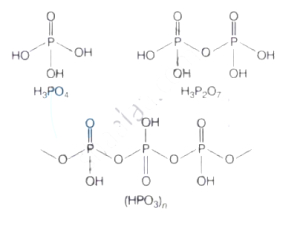
0 likesView Solution
Vedclass Products
For Students
Vedclass Test Series
Mock tests in real MHT CET style covering Chemistry with performance analysis. 5-day free trial.
Start Free TrialFor Teachers
Exam Paper Generator
Generate Set A/B/C/D Chemistry papers from 7.5L+ questions in 2 minutes. 3 chapters free.
Try FreeFor Institutes
Online Exam Module
Run live MHT CET mock exams with unlimited students, 360° analytics & white-label branding.
See DemoFrequently Asked Questions
How many Chemistry questions are in MHT CET 2020?
There are 772 Chemistry questions from the MHT CET 2020 paper on Vedclass, each with a detailed step-by-step solution in English.
Are MHT CET 2020 Chemistry solutions available in English?
Yes. All solutions on this page are in English. You can also switch to English or Hindi using the language buttons above the questions.
Can I practice MHT CET 2020 Chemistry as a timed test?
Yes. Use the Vedclass Test Series to attempt a full MHT CET mock test covering Chemistry with time limits and instant score analysis.
Can teachers create Chemistry papers from MHT CET previous year questions?
Yes. The Vedclass Exam Paper Generator lets teachers mix MHT CET Chemistry questions and generate Set A/B/C/D papers in minutes.
For Teachers & Institutes
Build a Custom Chemistry Paper
Pick MHT CET 2020 Chemistry questions, set difficulty, and generate Set A/B/C/D in 2 minutes.