
ChemistryQ251–324 of 772 questions
Page 6 of 10 · English
251
ChemistryMCQMHT CET · 2020
$A$ mass $M$ attached to a horizontal spring executes $S.H.M.$ of amplitude $A_1$. When the mass $M$ passes through its mean position,a smaller mass $m$ is placed over it and both of them move together with amplitude $A_2$. The ratio $\left(\frac{A_1}{A_2}\right)$ is
A
$\frac{M+m}{M}$
B
$\frac{M}{M+m}$
C
$\left(\frac{M+m}{M}\right)^{\frac{1}{2}}$
D
$\left(\frac{M}{M+m}\right)^{\frac{1}{2}}$
Solution
(C) At the mean position,the velocity of the mass $M$ is maximum,given by $v_{max} = \omega_1 A_1 = \sqrt{\frac{k}{M}} A_1$.
When mass $m$ is placed on $M$,the total mass becomes $(M+m)$.
Since the collision is perfectly inelastic and occurs at the mean position,the momentum is conserved.
$M v_{max} = (M+m) v'_{max}$.
So,$v'_{max} = \frac{M}{M+m} v_{max}$.
The new angular frequency is $\omega_2 = \sqrt{\frac{k}{M+m}}$.
Since $v'_{max} = \omega_2 A_2$,we have $\frac{M}{M+m} (\omega_1 A_1) = \omega_2 A_2$.
Substituting the values: $\frac{M}{M+m} \sqrt{\frac{k}{M}} A_1 = \sqrt{\frac{k}{M+m}} A_2$.
$\frac{A_1}{A_2} = \frac{M+m}{M} \sqrt{\frac{k}{M+m}} \sqrt{\frac{M}{k}} = \frac{M+m}{M} \sqrt{\frac{M}{M+m}} = \sqrt{\frac{M+m}{M}} = \left(\frac{M+m}{M}\right)^{\frac{1}{2}}$.
When mass $m$ is placed on $M$,the total mass becomes $(M+m)$.
Since the collision is perfectly inelastic and occurs at the mean position,the momentum is conserved.
$M v_{max} = (M+m) v'_{max}$.
So,$v'_{max} = \frac{M}{M+m} v_{max}$.
The new angular frequency is $\omega_2 = \sqrt{\frac{k}{M+m}}$.
Since $v'_{max} = \omega_2 A_2$,we have $\frac{M}{M+m} (\omega_1 A_1) = \omega_2 A_2$.
Substituting the values: $\frac{M}{M+m} \sqrt{\frac{k}{M}} A_1 = \sqrt{\frac{k}{M+m}} A_2$.
$\frac{A_1}{A_2} = \frac{M+m}{M} \sqrt{\frac{k}{M+m}} \sqrt{\frac{M}{k}} = \frac{M+m}{M} \sqrt{\frac{M}{M+m}} = \sqrt{\frac{M+m}{M}} = \left(\frac{M+m}{M}\right)^{\frac{1}{2}}$.
0 likesView Solution
252
ChemistryMCQMHT CET · 2020
$A$ mass $M$ attached to a horizontal spring executes $S.H.M.$ of amplitude $A_{1}$. When the mass $M$ passes through its mean position,a smaller mass $m$ is placed over it and both of them move together with amplitude $A_{2}$. The ratio of $\left(\frac{A_{1}}{A_{2}}\right)$ is
A
$\frac{M+m}{M}$
B
$\left(\frac{M}{M+m}\right)^{\frac{1}{2}}$
C
$\left(\frac{M+m}{M}\right)^{\frac{1}{2}}$
D
$\frac{M}{M+m}$
Solution
(C) When the mass $M$ passes through the mean position,its velocity $V$ is maximum,given by $V = \omega_{1} A_{1} = \sqrt{\frac{k}{M}} A_{1}$.
When mass $m$ is placed on $M$,the momentum is conserved during the collision (as the impulsive force acts internally).
$M V = (M + m) V^{\prime}$,where $V^{\prime}$ is the new velocity at the mean position.
$V^{\prime} = \frac{M}{M+m} V$.
The new amplitude $A_{2}$ is determined by the new angular frequency $\omega_{2} = \sqrt{\frac{k}{M+m}}$.
Since $V^{\prime} = \omega_{2} A_{2}$,we have $A_{2} = \frac{V^{\prime}}{\omega_{2}} = \frac{M V}{(M+m) \sqrt{\frac{k}{M+m}}} = \frac{M \sqrt{\frac{k}{M}} A_{1}}{(M+m) \sqrt{\frac{k}{M+m}}} = \frac{M}{\sqrt{M}} \cdot \frac{\sqrt{M+m}}{M+m} A_{1} = \sqrt{\frac{M}{M+m}} A_{1}$.
Therefore,$\frac{A_{1}}{A_{2}} = \sqrt{\frac{M+m}{M}} = \left(\frac{M+m}{M}\right)^{\frac{1}{2}}$.
When mass $m$ is placed on $M$,the momentum is conserved during the collision (as the impulsive force acts internally).
$M V = (M + m) V^{\prime}$,where $V^{\prime}$ is the new velocity at the mean position.
$V^{\prime} = \frac{M}{M+m} V$.
The new amplitude $A_{2}$ is determined by the new angular frequency $\omega_{2} = \sqrt{\frac{k}{M+m}}$.
Since $V^{\prime} = \omega_{2} A_{2}$,we have $A_{2} = \frac{V^{\prime}}{\omega_{2}} = \frac{M V}{(M+m) \sqrt{\frac{k}{M+m}}} = \frac{M \sqrt{\frac{k}{M}} A_{1}}{(M+m) \sqrt{\frac{k}{M+m}}} = \frac{M}{\sqrt{M}} \cdot \frac{\sqrt{M+m}}{M+m} A_{1} = \sqrt{\frac{M}{M+m}} A_{1}$.
Therefore,$\frac{A_{1}}{A_{2}} = \sqrt{\frac{M+m}{M}} = \left(\frac{M+m}{M}\right)^{\frac{1}{2}}$.
0 likesView Solution
253
ChemistryMCQMHT CET · 2020
For a ray of light,the critical angle is minimum when it travels from
A
air to glass.
B
glass to water.
C
water to glass.
D
glass to air.
Solution
(D) The critical angle $c$ is given by the formula $\sin c = \frac{1}{\mu}$,where $\mu$ is the refractive index of the denser medium with respect to the rarer medium.
For the critical angle to be minimum,$\sin c$ must be minimum,which implies $\mu$ must be maximum.
Refractive indices are: $a\mu_w = 1.33$,$a\mu_g = 1.50$.
For light traveling from glass to air,$\mu = \frac{a\mu_g}{a\mu_a} = \frac{1.5}{1} = 1.5$.
For light traveling from water to glass,$\mu = \frac{a\mu_g}{a\mu_w} = \frac{1.5}{1.33} \approx 1.125$.
For light traveling from glass to water,$\mu = \frac{a\mu_w}{a\mu_g} = \frac{1.33}{1.5} < 1$ (Total internal reflection is not possible).
Comparing the values of $\mu$ for which total internal reflection is possible,the value $\mu = 1.5$ (glass to air) is the maximum.
Therefore,the critical angle is minimum for light traveling from glass to air.
For the critical angle to be minimum,$\sin c$ must be minimum,which implies $\mu$ must be maximum.
Refractive indices are: $a\mu_w = 1.33$,$a\mu_g = 1.50$.
For light traveling from glass to air,$\mu = \frac{a\mu_g}{a\mu_a} = \frac{1.5}{1} = 1.5$.
For light traveling from water to glass,$\mu = \frac{a\mu_g}{a\mu_w} = \frac{1.5}{1.33} \approx 1.125$.
For light traveling from glass to water,$\mu = \frac{a\mu_w}{a\mu_g} = \frac{1.33}{1.5} < 1$ (Total internal reflection is not possible).
Comparing the values of $\mu$ for which total internal reflection is possible,the value $\mu = 1.5$ (glass to air) is the maximum.
Therefore,the critical angle is minimum for light traveling from glass to air.
0 likesView Solution
254
ChemistryMCQMHT CET · 2020
$A$ convex lens of focal length $F$ produces a real image $n$ times the size of the object. The image distance is
A
$F(n+1)$
B
$F(n-1)$
C
$\frac{F}{(n+1)}$
D
$\frac{F}{(n-1)}$
Solution
(A) For a real image formed by a convex lens,the magnification $m$ is given by $m = -n$.
Since $m = \frac{v}{u}$,we have $\frac{v}{u} = -n$,which implies $u = -\frac{v}{n}$.
Using the lens formula $\frac{1}{F} = \frac{1}{v} - \frac{1}{u}$,we substitute $u$:
$\frac{1}{F} = \frac{1}{v} - \frac{1}{(-v/n)} = \frac{1}{v} + \frac{n}{v} = \frac{1+n}{v}$.
Therefore,the image distance $v = F(n+1)$.
Since $m = \frac{v}{u}$,we have $\frac{v}{u} = -n$,which implies $u = -\frac{v}{n}$.
Using the lens formula $\frac{1}{F} = \frac{1}{v} - \frac{1}{u}$,we substitute $u$:
$\frac{1}{F} = \frac{1}{v} - \frac{1}{(-v/n)} = \frac{1}{v} + \frac{n}{v} = \frac{1+n}{v}$.
Therefore,the image distance $v = F(n+1)$.
0 likesView Solution
255
ChemistryMCQMHT CET · 2020
The magnifying power of a refracting type of astronomical telescope is $m$. If the focal length of the eyepiece is doubled,the magnifying power will become:
A
$\frac{m}{4}$
B
$\frac{m}{2}$
C
$2m$
D
$m$
Solution
(B) The magnifying power $m$ of an astronomical telescope in normal adjustment is given by the formula $m = \frac{f_o}{f_e}$,where $f_o$ is the focal length of the objective lens and $f_e$ is the focal length of the eyepiece.
If the focal length of the eyepiece is doubled,the new focal length $f_e' = 2f_e$.
The new magnifying power $m'$ becomes $m' = \frac{f_o}{f_e'} = \frac{f_o}{2f_e} = \frac{1}{2} \left( \frac{f_o}{f_e} \right) = \frac{m}{2}$.
Therefore,the magnifying power becomes half of its original value.
If the focal length of the eyepiece is doubled,the new focal length $f_e' = 2f_e$.
The new magnifying power $m'$ becomes $m' = \frac{f_o}{f_e'} = \frac{f_o}{2f_e} = \frac{1}{2} \left( \frac{f_o}{f_e} \right) = \frac{m}{2}$.
Therefore,the magnifying power becomes half of its original value.
0 likesView Solution
256
ChemistryMCQMHT CET · 2020
Two bodies have their moments of inertia $I$ and $2I$ respectively about their axes of rotation. If their kinetic energies of rotation are equal,their angular momenta will be in the ratio:
A
$2: 1$
B
$1: 2 \sqrt{2}$
C
$1: \sqrt{2}$
D
$1: 2$
Solution
(C) The rotational kinetic energy $K$ is given by $K = \frac{L^2}{2I}$,where $L$ is the angular momentum and $I$ is the moment of inertia.
Given that the kinetic energies are equal,$K_1 = K_2$.
Therefore,$\frac{L_1^2}{2I_1} = \frac{L_2^2}{2I_2}$.
Substituting $I_1 = I$ and $I_2 = 2I$:
$\frac{L_1^2}{2I} = \frac{L_2^2}{2(2I)}$
$\frac{L_1^2}{I} = \frac{L_2^2}{2I}$
$\frac{L_1^2}{L_2^2} = \frac{I}{2I} = \frac{1}{2}$
Taking the square root on both sides:
$\frac{L_1}{L_2} = \frac{1}{\sqrt{2}}$
Thus,the ratio of their angular momenta is $1: \sqrt{2}$.
Given that the kinetic energies are equal,$K_1 = K_2$.
Therefore,$\frac{L_1^2}{2I_1} = \frac{L_2^2}{2I_2}$.
Substituting $I_1 = I$ and $I_2 = 2I$:
$\frac{L_1^2}{2I} = \frac{L_2^2}{2(2I)}$
$\frac{L_1^2}{I} = \frac{L_2^2}{2I}$
$\frac{L_1^2}{L_2^2} = \frac{I}{2I} = \frac{1}{2}$
Taking the square root on both sides:
$\frac{L_1}{L_2} = \frac{1}{\sqrt{2}}$
Thus,the ratio of their angular momenta is $1: \sqrt{2}$.
0 likesView Solution
257
ChemistryMCQMHT CET · 2020
$A$ rotating body has angular momentum $L$. If its frequency of rotation is halved and its rotational kinetic energy is doubled,what will be its new angular momentum?
A
$2 ~L$
B
$\frac{L}{4}$
C
$4 ~L$
D
$\frac{L}{2}$
Solution
(C) The rotational kinetic energy is given by $K = \frac{1}{2} I \omega^2$,where $I$ is the moment of inertia and $\omega$ is the angular velocity.
Given that the frequency $f$ is halved,the angular velocity $\omega = 2\pi f$ is also halved,so $\omega_2 = \frac{\omega_1}{2}$.
Given that the kinetic energy is doubled,$K_2 = 2K_1$.
Using the ratio: $\frac{K_2}{K_1} = \frac{\frac{1}{2} I_2 \omega_2^2}{\frac{1}{2} I_1 \omega_1^2} \implies 2 = \frac{I_2}{I_1} \left( \frac{1}{2} \right)^2 \implies 2 = \frac{I_2}{I_1} \times \frac{1}{4} \implies \frac{I_2}{I_1} = 8$.
Angular momentum is given by $L = I\omega$.
The new angular momentum $L_2$ is $\frac{L_2}{L_1} = \frac{I_2 \omega_2}{I_1 \omega_1} = \left( \frac{I_2}{I_1} \right) \left( \frac{\omega_2}{\omega_1} \right) = 8 \times \frac{1}{2} = 4$.
Therefore,$L_2 = 4L$.
Given that the frequency $f$ is halved,the angular velocity $\omega = 2\pi f$ is also halved,so $\omega_2 = \frac{\omega_1}{2}$.
Given that the kinetic energy is doubled,$K_2 = 2K_1$.
Using the ratio: $\frac{K_2}{K_1} = \frac{\frac{1}{2} I_2 \omega_2^2}{\frac{1}{2} I_1 \omega_1^2} \implies 2 = \frac{I_2}{I_1} \left( \frac{1}{2} \right)^2 \implies 2 = \frac{I_2}{I_1} \times \frac{1}{4} \implies \frac{I_2}{I_1} = 8$.
Angular momentum is given by $L = I\omega$.
The new angular momentum $L_2$ is $\frac{L_2}{L_1} = \frac{I_2 \omega_2}{I_1 \omega_1} = \left( \frac{I_2}{I_1} \right) \left( \frac{\omega_2}{\omega_1} \right) = 8 \times \frac{1}{2} = 4$.
Therefore,$L_2 = 4L$.
0 likesView Solution
258
ChemistryMCQMHT CET · 2020
Two bodies have their moments of inertia $I$ and $2I$ respectively about their axis of rotation. If their kinetic energies of rotation are equal,their angular momenta will be in the ratio
A
$1: 2$
B
$\sqrt{2}: 1$
C
$2: 1$
D
$1: \sqrt{2}$
Solution
(D) The kinetic energy of rotation $K$ is related to angular momentum $L$ and moment of inertia $I$ by the formula $K = \frac{L^2}{2I}$.
Rearranging for angular momentum,we get $L = \sqrt{2KI}$.
Since the kinetic energies $K$ are equal for both bodies,we have $L \propto \sqrt{I}$.
Therefore,the ratio of the angular momenta of the two bodies is $\frac{L_1}{L_2} = \sqrt{\frac{I_1}{I_2}}$.
Given $I_1 = I$ and $I_2 = 2I$,we substitute these values:
$\frac{L_1}{L_2} = \sqrt{\frac{I}{2I}} = \sqrt{\frac{1}{2}} = \frac{1}{\sqrt{2}}$.
Thus,the ratio is $1: \sqrt{2}$.
Rearranging for angular momentum,we get $L = \sqrt{2KI}$.
Since the kinetic energies $K$ are equal for both bodies,we have $L \propto \sqrt{I}$.
Therefore,the ratio of the angular momenta of the two bodies is $\frac{L_1}{L_2} = \sqrt{\frac{I_1}{I_2}}$.
Given $I_1 = I$ and $I_2 = 2I$,we substitute these values:
$\frac{L_1}{L_2} = \sqrt{\frac{I}{2I}} = \sqrt{\frac{1}{2}} = \frac{1}{\sqrt{2}}$.
Thus,the ratio is $1: \sqrt{2}$.
0 likesView Solution
259
ChemistryMCQMHT CET · 2020
Two rings of radius $R$ and $nR$ made of the same material have a ratio of moment of inertia about an axis passing through their centers and perpendicular to their planes as $1:8$. The value of $n$ is (mass per unit length is constant).
A
$1$
B
$3$
C
$4$
D
$2$
Solution
(D) Let the mass per unit length be $\lambda$. The mass of a ring is $M = \lambda \times (2\pi r)$.
For the first ring of radius $R$,mass $M_1 = \lambda (2\pi R)$. The moment of inertia is $I_1 = M_1 R^2 = \lambda (2\pi R) R^2 = 2\pi \lambda R^3$.
For the second ring of radius $nR$,mass $M_2 = \lambda (2\pi nR) = n M_1$. The moment of inertia is $I_2 = M_2 (nR)^2 = (n M_1) (n^2 R^2) = n^3 M_1 R^2 = n^3 I_1$.
Given the ratio $\frac{I_1}{I_2} = \frac{1}{8}$.
Substituting $I_2 = n^3 I_1$,we get $\frac{I_1}{n^3 I_1} = \frac{1}{n^3} = \frac{1}{8}$.
Therefore,$n^3 = 8$,which gives $n = 2$.
For the first ring of radius $R$,mass $M_1 = \lambda (2\pi R)$. The moment of inertia is $I_1 = M_1 R^2 = \lambda (2\pi R) R^2 = 2\pi \lambda R^3$.
For the second ring of radius $nR$,mass $M_2 = \lambda (2\pi nR) = n M_1$. The moment of inertia is $I_2 = M_2 (nR)^2 = (n M_1) (n^2 R^2) = n^3 M_1 R^2 = n^3 I_1$.
Given the ratio $\frac{I_1}{I_2} = \frac{1}{8}$.
Substituting $I_2 = n^3 I_1$,we get $\frac{I_1}{n^3 I_1} = \frac{1}{n^3} = \frac{1}{8}$.
Therefore,$n^3 = 8$,which gives $n = 2$.
0 likesView Solution
260
ChemistryMCQMHT CET · 2020
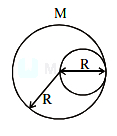
From a disc of mass $M$ and radius $R$,a circular hole of diameter $R$ is cut such that its rim passes through the center of the disc. The moment of inertia of the remaining part of the disc about a perpendicular axis passing through the center of the original disc is
A
$\frac{11 MR^{2}}{32}$
B
$\frac{7 MR^{2}}{32}$
C
$\frac{9 MR^{2}}{32}$
D
$\frac{13 MR^{2}}{32}$
Solution
(D) The moment of inertia of the original disc of mass $M$ and radius $R$ about an axis passing through its center and perpendicular to its plane is $I_{\text{total}} = \frac{1}{2} MR^2$.
The area of the original disc is $A = \pi R^2$. The diameter of the hole is $R$,so its radius is $r = R/2$. The area of the hole is $A_{\text{hole}} = \pi (R/2)^2 = \frac{\pi R^2}{4} = \frac{A}{4}$.
Since the mass is proportional to the area,the mass of the removed part is $M_{\text{removed}} = \frac{M}{4}$.
The center of the hole is at a distance $d = R/2$ from the center of the original disc. Using the parallel axis theorem,the moment of inertia of the removed disc about the axis passing through the center of the original disc is:
$I_{\text{removed}} = I_{\text{cm}} + M_{\text{removed}} d^2$
$I_{\text{removed}} = \left[ \frac{1}{2} M_{\text{removed}} r^2 \right] + M_{\text{removed}} (R/2)^2$
$I_{\text{removed}} = \left[ \frac{1}{2} \left( \frac{M}{4} \right) \left( \frac{R}{2} \right)^2 \right] + \left( \frac{M}{4} \right) \left( \frac{R}{2} \right)^2$
$I_{\text{removed}} = \frac{MR^2}{32} + \frac{MR^2}{16} = \frac{MR^2 + 2MR^2}{32} = \frac{3MR^2}{32}$.
The moment of inertia of the remaining part is:
$I_{\text{remaining}} = I_{\text{total}} - I_{\text{removed}}$
$I_{\text{remaining}} = \frac{1}{2} MR^2 - \frac{3}{32} MR^2 = \frac{16 MR^2 - 3 MR^2}{32} = \frac{13 MR^2}{32}$.
The area of the original disc is $A = \pi R^2$. The diameter of the hole is $R$,so its radius is $r = R/2$. The area of the hole is $A_{\text{hole}} = \pi (R/2)^2 = \frac{\pi R^2}{4} = \frac{A}{4}$.
Since the mass is proportional to the area,the mass of the removed part is $M_{\text{removed}} = \frac{M}{4}$.
The center of the hole is at a distance $d = R/2$ from the center of the original disc. Using the parallel axis theorem,the moment of inertia of the removed disc about the axis passing through the center of the original disc is:
$I_{\text{removed}} = I_{\text{cm}} + M_{\text{removed}} d^2$
$I_{\text{removed}} = \left[ \frac{1}{2} M_{\text{removed}} r^2 \right] + M_{\text{removed}} (R/2)^2$
$I_{\text{removed}} = \left[ \frac{1}{2} \left( \frac{M}{4} \right) \left( \frac{R}{2} \right)^2 \right] + \left( \frac{M}{4} \right) \left( \frac{R}{2} \right)^2$
$I_{\text{removed}} = \frac{MR^2}{32} + \frac{MR^2}{16} = \frac{MR^2 + 2MR^2}{32} = \frac{3MR^2}{32}$.
The moment of inertia of the remaining part is:
$I_{\text{remaining}} = I_{\text{total}} - I_{\text{removed}}$
$I_{\text{remaining}} = \frac{1}{2} MR^2 - \frac{3}{32} MR^2 = \frac{16 MR^2 - 3 MR^2}{32} = \frac{13 MR^2}{32}$.
0 likesView Solution
261
ChemistryMCQMHT CET · 2020
$A$ bucket containing water is revolved in a vertical circle of radius $r$. To prevent the water from falling down, the minimum frequency of revolution required is $[g = \text{acceleration due to gravity}]$.
A
$\frac{1}{2 \pi} \sqrt{\frac{g}{r}}$
B
$2 \pi \sqrt{\frac{g}{r}}$
C
$\frac{2 \pi g}{r}$
D
$\frac{1}{2 \pi} \sqrt{\frac{r}{g}}$
Solution
(A) At the highest point of the vertical circle, the condition to prevent water from falling is that the gravitational force must be provided by the centripetal force at minimum velocity.
$mr\omega^2 = mg$
$\omega^2 = \frac{g}{r}$
$\omega = \sqrt{\frac{g}{r}}$
Since angular frequency $\omega = 2\pi f$, where $f$ is the frequency of revolution:
$2\pi f = \sqrt{\frac{g}{r}}$
$f = \frac{1}{2\pi} \sqrt{\frac{g}{r}}$
$mr\omega^2 = mg$
$\omega^2 = \frac{g}{r}$
$\omega = \sqrt{\frac{g}{r}}$
Since angular frequency $\omega = 2\pi f$, where $f$ is the frequency of revolution:
$2\pi f = \sqrt{\frac{g}{r}}$
$f = \frac{1}{2\pi} \sqrt{\frac{g}{r}}$
0 likesView Solution
262
ChemistryMCQMHT CET · 2020
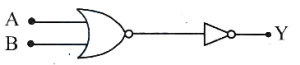
The resultant gate and its Boolean expression in the given circuit is
A
$OR$,$A+B$
B
$AND$,$A \cdot B$
C
$NOR$,$\overline{A+B}$
D
$NAND$,$\overline{A \cdot B}$
Solution
(A) The given circuit consists of a $NOR$ gate followed by a $NOT$ gate.
$1$. The output of the $NOR$ gate is $\overline{A+B}$.
$2$. This output is then passed through a $NOT$ gate (inverter),which performs the complement operation.
$3$. The final output $Y$ is the complement of the $NOR$ output: $Y = \overline{(\overline{A+B})} = A+B$.
$4$. The Boolean expression $A+B$ corresponds to the $OR$ gate.
Therefore,the combination of a $NOR$ gate and a $NOT$ gate acts as an $OR$ gate.
$1$. The output of the $NOR$ gate is $\overline{A+B}$.
$2$. This output is then passed through a $NOT$ gate (inverter),which performs the complement operation.
$3$. The final output $Y$ is the complement of the $NOR$ output: $Y = \overline{(\overline{A+B})} = A+B$.
$4$. The Boolean expression $A+B$ corresponds to the $OR$ gate.
Therefore,the combination of a $NOR$ gate and a $NOT$ gate acts as an $OR$ gate.
0 likesView Solution
263
ChemistryMCQMHT CET · 2020
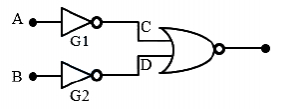
The resultant gate and its Boolean expression in the given circuit is
A
$NOR, \overline{A+B}$
B
$AND, A \cdot B$
C
$OR, A+B$
D
$NAND, \overline{AB}$
Solution
(B) The circuit consists of two $NOT$ gates ($G1$ and $G2$) followed by a $NOR$ gate. The inputs to the $NOT$ gates are $A$ and $B$. Thus,the outputs of the $NOT$ gates are $C = \overline{A}$ and $D = \overline{B}$. These are fed into a $NOR$ gate. The output $Y$ of the $NOR$ gate is given by $Y = \overline{C+D}$. Substituting the values of $C$ and $D$,we get $Y = \overline{\overline{A} + \overline{B}}$. By De Morgan's theorem,$\overline{\overline{A} + \overline{B}} = \overline{\overline{A}} \cdot \overline{\overline{B}} = A \cdot B$. This is the Boolean expression for an $AND$ gate. The truth table is as follows:
| $A$ | $B$ | $C=\overline{A}$ | $D=\overline{B}$ | $Y=\overline{C+D}$ |
| $0$ | $0$ | $1$ | $1$ | $0$ |
| $0$ | $1$ | $1$ | $0$ | $0$ |
| $1$ | $0$ | $0$ | $1$ | $0$ |
| $1$ | $1$ | $0$ | $0$ | $1$ |
0 likesView Solution
264
ChemistryMCQMHT CET · 2020
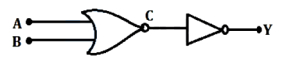
The resultant gate and its Boolean expression for the given circuit is
A
$OR$,$A+B$
B
$NOR, \overline{A+B}$
C
$NAND, \overline{A \cdot B}$
D
$AND, A \cdot B$
Solution
(A) The given circuit consists of a $NOR$ gate followed by a $NOT$ gate.
$1$. The output of the $NOR$ gate with inputs $A$ and $B$ is $C = \overline{A+B}$.
$2$. This output $C$ is then passed through a $NOT$ gate.
$3$. The final output $Y$ is the complement of $C$,so $Y = \overline{C} = \overline{\overline{A+B}}$.
$4$. By the law of double negation,$\overline{\overline{X}} = X$,therefore $Y = A+B$.
$5$. $A$ gate with the Boolean expression $Y = A+B$ is an $OR$ gate.
$1$. The output of the $NOR$ gate with inputs $A$ and $B$ is $C = \overline{A+B}$.
$2$. This output $C$ is then passed through a $NOT$ gate.
$3$. The final output $Y$ is the complement of $C$,so $Y = \overline{C} = \overline{\overline{A+B}}$.
$4$. By the law of double negation,$\overline{\overline{X}} = X$,therefore $Y = A+B$.
$5$. $A$ gate with the Boolean expression $Y = A+B$ is an $OR$ gate.
0 likesView Solution
265
ChemistryMCQMHT CET · 2020
Two spheres $S_{1}$ and $S_{2}$ have the same radii but temperatures $T_{1}$ and $T_{2}$ respectively. Their emissive power is the same and their emissivity is in the ratio $1: 4$. Then the ratio of $T_{1}$ to $T_{2}$ is:
A
$\sqrt{2}: 1$
B
$1: 2$
C
$2: 1$
D
$1: \sqrt{2}$
Solution
(A) The emissive power $P$ of a body is given by the Stefan-Boltzmann law: $P = \sigma e T^{4}$,where $\sigma$ is the Stefan-Boltzmann constant,$e$ is the emissivity,and $T$ is the absolute temperature.
Given that the emissive power of both spheres is the same,we have $P_{1} = P_{2}$.
Therefore,$\sigma e_{1} T_{1}^{4} = \sigma e_{2} T_{2}^{4}$.
This simplifies to $\frac{T_{1}^{4}}{T_{2}^{4}} = \frac{e_{2}}{e_{1}}$.
Given the ratio of emissivity $e_{1} : e_{2} = 1 : 4$,we have $\frac{e_{2}}{e_{1}} = \frac{4}{1} = 4$.
Substituting this into the equation: $\frac{T_{1}^{4}}{T_{2}^{4}} = 4$.
Taking the fourth root on both sides: $\frac{T_{1}}{T_{2}} = (4)^{1/4} = (2^{2})^{1/4} = 2^{1/2} = \sqrt{2}$.
Thus,the ratio $T_{1} : T_{2} = \sqrt{2} : 1$.
Given that the emissive power of both spheres is the same,we have $P_{1} = P_{2}$.
Therefore,$\sigma e_{1} T_{1}^{4} = \sigma e_{2} T_{2}^{4}$.
This simplifies to $\frac{T_{1}^{4}}{T_{2}^{4}} = \frac{e_{2}}{e_{1}}$.
Given the ratio of emissivity $e_{1} : e_{2} = 1 : 4$,we have $\frac{e_{2}}{e_{1}} = \frac{4}{1} = 4$.
Substituting this into the equation: $\frac{T_{1}^{4}}{T_{2}^{4}} = 4$.
Taking the fourth root on both sides: $\frac{T_{1}}{T_{2}} = (4)^{1/4} = (2^{2})^{1/4} = 2^{1/2} = \sqrt{2}$.
Thus,the ratio $T_{1} : T_{2} = \sqrt{2} : 1$.
0 likesView Solution
266
ChemistryMCQMHT CET · 2020
$A$ parallel beam of monochromatic light falls normally on a single narrow slit. The angular width of the central maximum in the resulting diffraction pattern
A
decreases with increase of slit width.
B
increases with increase of slit width.
C
decreases with decrease of slit width.
D
may increase or decrease.
Solution
(A) The angular width of the central maximum for a single slit diffraction is given by $\theta = \frac{2 \lambda}{a}$,where $\lambda$ is the wavelength of light and $a$ is the width of the slit.
From this formula,it is clear that the angular width $\theta$ is inversely proportional to the slit width $a$ $(\theta \propto \frac{1}{a})$.
Therefore,as the slit width $a$ increases,the angular width $\theta$ of the central maximum decreases.
From this formula,it is clear that the angular width $\theta$ is inversely proportional to the slit width $a$ $(\theta \propto \frac{1}{a})$.
Therefore,as the slit width $a$ increases,the angular width $\theta$ of the central maximum decreases.
0 likesView Solution
267
ChemistryMCQMHT CET · 2020
In a biprism experiment,if the $5^{\text{th}}$ bright band with wavelength $\lambda_{1}$ coincides with the $6^{\text{th}}$ dark band with wavelength $\lambda_{2}$,then the ratio $\left(\frac{\lambda_{2}}{\lambda_{1}}\right)$ is:
A
$\frac{10}{11}$
B
$\frac{7}{9}$
C
$\frac{11}{10}$
D
$\frac{9}{7}$
Solution
(A) The position of the $n^{\text{th}}$ bright fringe is given by $y_{n} = \frac{n \lambda_{1} D}{d}$. For the $5^{\text{th}}$ bright band,$y_{5} = \frac{5 \lambda_{1} D}{d}$.
The position of the $m^{\text{th}}$ dark fringe is given by $y'_{m} = \frac{(2m - 1) \lambda_{2} D}{2d}$. For the $6^{\text{th}}$ dark band,$y'_{6} = \frac{(2 \times 6 - 1) \lambda_{2} D}{2d} = \frac{11 \lambda_{2} D}{2d}$.
Since the bands coincide,$y_{5} = y'_{6}$.
$\frac{5 \lambda_{1} D}{d} = \frac{11 \lambda_{2} D}{2d}$.
Simplifying,$5 \lambda_{1} = \frac{11 \lambda_{2}}{2}$.
Therefore,$\frac{\lambda_{1}}{\lambda_{2}} = \frac{11}{10}$,which implies $\frac{\lambda_{2}}{\lambda_{1}} = \frac{10}{11}$.
The position of the $m^{\text{th}}$ dark fringe is given by $y'_{m} = \frac{(2m - 1) \lambda_{2} D}{2d}$. For the $6^{\text{th}}$ dark band,$y'_{6} = \frac{(2 \times 6 - 1) \lambda_{2} D}{2d} = \frac{11 \lambda_{2} D}{2d}$.
Since the bands coincide,$y_{5} = y'_{6}$.
$\frac{5 \lambda_{1} D}{d} = \frac{11 \lambda_{2} D}{2d}$.
Simplifying,$5 \lambda_{1} = \frac{11 \lambda_{2}}{2}$.
Therefore,$\frac{\lambda_{1}}{\lambda_{2}} = \frac{11}{10}$,which implies $\frac{\lambda_{2}}{\lambda_{1}} = \frac{10}{11}$.
0 likesView Solution
268
ChemistryMCQMHT CET · 2020
In a diffraction experiment from a single slit,the angular width of the central maxima does $NOT$ depend upon
A
wavelength of light used
B
distance of the slit from the screen
C
width of the slit
D
ratio of wavelength and slit width
Solution
(B) The linear width of the central maximum in a single-slit diffraction pattern is given by $w = \frac{2 \lambda D}{d}$,where $\lambda$ is the wavelength,$D$ is the distance from the slit to the screen,and $d$ is the slit width.
The angular width of the central maximum is defined as the angle subtended by the central maximum at the slit,given by $\theta = \frac{w}{D} = \frac{2 \lambda}{d}$.
From this formula,it is clear that the angular width depends only on the wavelength $\lambda$ and the slit width $d$. It does not depend on the distance $D$ between the slit and the screen.
The angular width of the central maximum is defined as the angle subtended by the central maximum at the slit,given by $\theta = \frac{w}{D} = \frac{2 \lambda}{d}$.
From this formula,it is clear that the angular width depends only on the wavelength $\lambda$ and the slit width $d$. It does not depend on the distance $D$ between the slit and the screen.
0 likesView Solution
269
ChemistryMCQMHT CET · 2020
Two waves $Y_1 = 0.25 \sin 316 t$ and $Y_2 = 0.25 \sin 310 t$ are propagating in the same direction. The number of beats produced per second is
A
$\frac{3}{\pi}$
B
$\frac{\pi}{3}$
C
$\frac{\pi}{2}$
D
$\frac{2}{\pi}$
Solution
(A) The general equation for a wave is $Y = A \sin(\omega t)$,where $\omega = 2 \pi f$.
Given $Y_1 = 0.25 \sin 316 t$,we have $\omega_1 = 316 \text{ rad/s}$.
Thus,$2 \pi f_1 = 316 \implies f_1 = \frac{316}{2 \pi} = \frac{158}{\pi} \text{ Hz}$.
Given $Y_2 = 0.25 \sin 310 t$,we have $\omega_2 = 310 \text{ rad/s}$.
Thus,$2 \pi f_2 = 310 \implies f_2 = \frac{310}{2 \pi} = \frac{155}{\pi} \text{ Hz}$.
The beat frequency is the difference between the two frequencies:
$\text{Beat frequency} = f_1 - f_2 = \frac{158}{\pi} - \frac{155}{\pi} = \frac{3}{\pi} \text{ Hz}$.
Given $Y_1 = 0.25 \sin 316 t$,we have $\omega_1 = 316 \text{ rad/s}$.
Thus,$2 \pi f_1 = 316 \implies f_1 = \frac{316}{2 \pi} = \frac{158}{\pi} \text{ Hz}$.
Given $Y_2 = 0.25 \sin 310 t$,we have $\omega_2 = 310 \text{ rad/s}$.
Thus,$2 \pi f_2 = 310 \implies f_2 = \frac{310}{2 \pi} = \frac{155}{\pi} \text{ Hz}$.
The beat frequency is the difference between the two frequencies:
$\text{Beat frequency} = f_1 - f_2 = \frac{158}{\pi} - \frac{155}{\pi} = \frac{3}{\pi} \text{ Hz}$.
0 likesView Solution
270
ChemistryMCQMHT CET · 2020
Two waves $Y_{1} = 0.25 \sin(316 t)$ and $Y_{2} = 0.25 \sin(310 t)$ are propagating along the same direction. The number of beats produced per second is:
A
$\frac{\pi}{2}$
B
$\frac{2}{\pi}$
C
$\frac{\pi}{3}$
D
$\frac{3}{\pi}$
Solution
(D) The general equation for a wave is $Y = A \sin(\omega t)$,where $\omega = 2 \pi n$ and $n$ is the frequency in Hz.
For the first wave,$Y_{1} = 0.25 \sin(316 t)$,so $\omega_{1} = 316 \text{ rad/s}$.
The frequency $n_{1} = \frac{\omega_{1}}{2 \pi} = \frac{316}{2 \pi} \text{ Hz}$.
For the second wave,$Y_{2} = 0.25 \sin(310 t)$,so $\omega_{2} = 310 \text{ rad/s}$.
The frequency $n_{2} = \frac{\omega_{2}}{2 \pi} = \frac{310}{2 \pi} \text{ Hz}$.
The number of beats produced per second is the difference in frequencies: $n_{beat} = |n_{1} - n_{2}|$.
$n_{beat} = \frac{316}{2 \pi} - \frac{310}{2 \pi} = \frac{316 - 310}{2 \pi} = \frac{6}{2 \pi} = \frac{3}{\pi} \text{ beats/s}$.
For the first wave,$Y_{1} = 0.25 \sin(316 t)$,so $\omega_{1} = 316 \text{ rad/s}$.
The frequency $n_{1} = \frac{\omega_{1}}{2 \pi} = \frac{316}{2 \pi} \text{ Hz}$.
For the second wave,$Y_{2} = 0.25 \sin(310 t)$,so $\omega_{2} = 310 \text{ rad/s}$.
The frequency $n_{2} = \frac{\omega_{2}}{2 \pi} = \frac{310}{2 \pi} \text{ Hz}$.
The number of beats produced per second is the difference in frequencies: $n_{beat} = |n_{1} - n_{2}|$.
$n_{beat} = \frac{316}{2 \pi} - \frac{310}{2 \pi} = \frac{316 - 310}{2 \pi} = \frac{6}{2 \pi} = \frac{3}{\pi} \text{ beats/s}$.
0 likesView Solution
271
ChemistryMCQMHT CET · 2020
On closing an open organ pipe from one end,it is noticed that the frequency of the third harmonic is $50 ~Hz$ more than the fundamental frequency of vibration in the open organ pipe. The fundamental frequency of the open organ pipe is (in $~Hz$)
A
$250$
B
$100$
C
$50$
D
$200$
Solution
(B) Let the length of the pipe be $\ell$ and the velocity of sound be $V$.
For an open organ pipe,the fundamental frequency is $f_{open} = \frac{V}{2\ell}$.
When one end is closed,the pipe becomes a closed organ pipe. The harmonics of a closed organ pipe are odd multiples of the fundamental frequency $f_{closed} = \frac{V}{4\ell}$.
The third harmonic of a closed organ pipe is $f_{3, closed} = 3 \times \frac{V}{4\ell} = \frac{3V}{4\ell}$.
According to the problem,$f_{3, closed} - f_{open} = 50 ~Hz$.
Substituting the expressions: $\frac{3V}{4\ell} - \frac{V}{2\ell} = 50$.
$\frac{3V - 2V}{4\ell} = 50 \implies \frac{V}{4\ell} = 50 ~Hz$.
We need to find the fundamental frequency of the open pipe,$f_{open} = \frac{V}{2\ell} = 2 \times \frac{V}{4\ell} = 2 \times 50 = 100 ~Hz$.
For an open organ pipe,the fundamental frequency is $f_{open} = \frac{V}{2\ell}$.
When one end is closed,the pipe becomes a closed organ pipe. The harmonics of a closed organ pipe are odd multiples of the fundamental frequency $f_{closed} = \frac{V}{4\ell}$.
The third harmonic of a closed organ pipe is $f_{3, closed} = 3 \times \frac{V}{4\ell} = \frac{3V}{4\ell}$.
According to the problem,$f_{3, closed} - f_{open} = 50 ~Hz$.
Substituting the expressions: $\frac{3V}{4\ell} - \frac{V}{2\ell} = 50$.
$\frac{3V - 2V}{4\ell} = 50 \implies \frac{V}{4\ell} = 50 ~Hz$.
We need to find the fundamental frequency of the open pipe,$f_{open} = \frac{V}{2\ell} = 2 \times \frac{V}{4\ell} = 2 \times 50 = 100 ~Hz$.
0 likesView Solution
272
ChemistryMCQMHT CET · 2020
$A$ stationary wave is represented by $y = 10 \sin \frac{\pi x}{4} \cos 20 \pi t$,where $x$ and $y$ are expressed in $cm$ and $t$ in seconds. The distance between two consecutive nodes is: (in $cm$)
A
$4$
B
$1$
C
$8$
D
$2$
Solution
(A) The standard equation for a stationary wave is given by $y = A \sin(kx) \cos(\omega t)$.
Comparing this with the given equation $y = 10 \sin \frac{\pi x}{4} \cos 20 \pi t$,we find the wave number $k = \frac{\pi}{4} \ cm^{-1}$.
The wave number $k$ is related to the wavelength $\lambda$ by the formula $k = \frac{2\pi}{\lambda}$.
Substituting the value of $k$: $\frac{\pi}{4} = \frac{2\pi}{\lambda}$.
Solving for $\lambda$,we get $\lambda = 8 \ cm$.
The distance between two consecutive nodes in a stationary wave is equal to $\frac{\lambda}{2}$.
Therefore,the distance $= \frac{8 \ cm}{2} = 4 \ cm$.
Comparing this with the given equation $y = 10 \sin \frac{\pi x}{4} \cos 20 \pi t$,we find the wave number $k = \frac{\pi}{4} \ cm^{-1}$.
The wave number $k$ is related to the wavelength $\lambda$ by the formula $k = \frac{2\pi}{\lambda}$.
Substituting the value of $k$: $\frac{\pi}{4} = \frac{2\pi}{\lambda}$.
Solving for $\lambda$,we get $\lambda = 8 \ cm$.
The distance between two consecutive nodes in a stationary wave is equal to $\frac{\lambda}{2}$.
Therefore,the distance $= \frac{8 \ cm}{2} = 4 \ cm$.
0 likesView Solution
273
ChemistryMCQMHT CET · 2020
$A$ progressive wave of frequency $50 ~Hz$ is travelling with velocity $350 ~m/s$ through a medium. The change in phase at a given time interval of $0.01 ~s$ is
A
$\pi ~rad$
B
$\frac{\pi}{4} ~rad$
C
$\frac{\pi}{2} ~rad$
D
$\frac{3\pi}{2} ~rad$
Solution
(A) The angular frequency $\omega$ is given by $\omega = 2\pi f$.
Given $f = 50 ~Hz$,we have $\omega = 2 \times \pi \times 50 = 100\pi ~rad/s$.
The phase change $\Delta \phi$ for a time interval $\Delta t$ is given by the formula $\Delta \phi = \omega \Delta t$.
Substituting the given values,$\Delta \phi = (100\pi) \times (0.01) = \pi ~rad$.
Given $f = 50 ~Hz$,we have $\omega = 2 \times \pi \times 50 = 100\pi ~rad/s$.
The phase change $\Delta \phi$ for a time interval $\Delta t$ is given by the formula $\Delta \phi = \omega \Delta t$.
Substituting the given values,$\Delta \phi = (100\pi) \times (0.01) = \pi ~rad$.
0 likesView Solution
274
ChemistryMCQMHT CET · 2020
$A$ progressive wave of frequency $50 ~Hz$ is travelling with velocity $350 ~m/s$ through a medium. The change in phase at a given time interval of $0.01 ~s$ is
A
$\frac{\pi}{2} ~rad$
B
$\pi ~rad$
C
$\frac{\pi}{4} ~rad$
D
$\frac{3\pi}{2} ~rad$
Solution
(B) The wavelength $\lambda$ is given by $\lambda = \frac{v}{f} = \frac{350}{50} = 7 ~m$.
The distance $x$ covered by the wave in time $t = 0.01 ~s$ is $x = v \times t = 350 \times 0.01 = 3.5 ~m$.
The phase change $\Delta \phi$ is given by the formula $\Delta \phi = \frac{2\pi}{\lambda} \times x$.
Substituting the values,$\Delta \phi = \frac{2\pi}{7} \times 3.5 = \frac{2\pi}{7} \times \frac{7}{2} = \pi ~rad$.
The distance $x$ covered by the wave in time $t = 0.01 ~s$ is $x = v \times t = 350 \times 0.01 = 3.5 ~m$.
The phase change $\Delta \phi$ is given by the formula $\Delta \phi = \frac{2\pi}{\lambda} \times x$.
Substituting the values,$\Delta \phi = \frac{2\pi}{7} \times 3.5 = \frac{2\pi}{7} \times \frac{7}{2} = \pi ~rad$.
0 likesView Solution
275
ChemistryMediumMCQMHT CET · 2020
What is the cell constant of $\frac{N}{10}$ $KCl$ solution at $25^{\circ} C$,if conductivity and resistance of a solution is $0.0112 \ \Omega^{-1} cm^{-1}$ and $55.0 \ \Omega$ respectively (in $cm^{-1}$)?
A
$0.616$
B
$0.491$
C
$2.0$
D
$0.2$
Solution
(A) Given: Conductivity $(k)$ = $0.0112 \ \Omega^{-1} cm^{-1}$ and Resistance $(R)$ = $55.0 \ \Omega$.
The formula for cell constant $(G^*)$ is: $G^* = k \times R$.
Substituting the values: $G^* = 0.0112 \ \Omega^{-1} cm^{-1} \times 55.0 \ \Omega$.
Therefore,$G^* = 0.616 \ cm^{-1}$.
The formula for cell constant $(G^*)$ is: $G^* = k \times R$.
Substituting the values: $G^* = 0.0112 \ \Omega^{-1} cm^{-1} \times 55.0 \ \Omega$.
Therefore,$G^* = 0.616 \ cm^{-1}$.
0 likesView Solution
276
ChemistryEasyMCQMHT CET · 2020
If the conductivity of $0.08 \ M$ $KCl$ solution is $2 \times 10^{-2} \ \Omega^{-1} \ cm^{-1}$,what is the molar conductivity of the solution?
A
$350 \ \Omega^{-1} \ cm^{2} \ mol^{-1}$
B
$250 \ \Omega^{-1} \ cm^{2} \ mol^{-1}$
C
$25.0 \ \Omega^{-1} \ cm^{2} \ mol^{-1}$
D
$0.25 \ \Omega^{-1} \ cm^{2} \ mol^{-1}$
Solution
(B) The formula for molar conductivity $(\Lambda_m)$ is given by: $\Lambda_m = \frac{1000 \times \kappa}{C}$
Here,conductivity $(\kappa)$ = $2 \times 10^{-2} \ \Omega^{-1} \ cm^{-1}$ and concentration $(C)$ = $0.08 \ M$.
Substituting the values: $\Lambda_m = \frac{1000 \times 2 \times 10^{-2}}{0.08} = \frac{20}{0.08} = 250 \ \Omega^{-1} \ cm^{2} \ mol^{-1}$.
Here,conductivity $(\kappa)$ = $2 \times 10^{-2} \ \Omega^{-1} \ cm^{-1}$ and concentration $(C)$ = $0.08 \ M$.
Substituting the values: $\Lambda_m = \frac{1000 \times 2 \times 10^{-2}}{0.08} = \frac{20}{0.08} = 250 \ \Omega^{-1} \ cm^{2} \ mol^{-1}$.
0 likesView Solution
277
ChemistryEasyMCQMHT CET · 2020
What is the relation between cell constant,conductivity and electrical resistance?
A
$k = \frac{R}{G^*}$
B
$k = \frac{G^*}{R}$
C
$k = \frac{1}{R \cdot G^*}$
D
$k = R \cdot G^*$
Solution
(B) The conductivity $(k)$ of an electrolytic solution is defined as the product of the conductance $(G)$ and the cell constant $(G^*)$.
Since conductance $(G)$ is the reciprocal of electrical resistance $(R)$,we have $G = \frac{1}{R}$.
Substituting this into the formula for conductivity,we get $k = G \cdot G^* = \frac{1}{R} \cdot G^* = \frac{G^*}{R}$.
Therefore,the correct relation is $k = \frac{G^*}{R}$.
Since conductance $(G)$ is the reciprocal of electrical resistance $(R)$,we have $G = \frac{1}{R}$.
Substituting this into the formula for conductivity,we get $k = G \cdot G^* = \frac{1}{R} \cdot G^* = \frac{G^*}{R}$.
Therefore,the correct relation is $k = \frac{G^*}{R}$.
0 likesView Solution
278
ChemistryEasyMCQMHT CET · 2020
What will be the concentration of $NaCl$ solution,if the molar conductivity and conductivity of $NaCl$ solution are $124.3 \ \Omega^{-1} \ cm^{2} \ mol^{-1}$ and $1.243 \times 10^{-4} \ \Omega^{-1} \ cm^{-1}$ respectively?
A
$0.001 \ mol \ L^{-1}$
B
$0.01 \ mol \ L^{-1}$
C
$0.02 \ mol \ L^{-1}$
D
$0.1 \ mol \ L^{-1}$
Solution
(A) Given: Molar conductivity $(\Lambda_m)$ = $124.3 \ \Omega^{-1} \ cm^{2} \ mol^{-1}$,Conductivity $(\kappa)$ = $1.243 \times 10^{-4} \ \Omega^{-1} \ cm^{-1}$.
Formula: $\Lambda_m = \frac{1000 \times \kappa}{C}$,where $C$ is the concentration in $mol \ L^{-1}$.
Rearranging for $C$: $C = \frac{1000 \times \kappa}{\Lambda_m}$.
Calculation: $C = \frac{1000 \times 1.243 \times 10^{-4}}{124.3} = \frac{0.1243}{124.3} = 0.001 \ mol \ L^{-1}$.
Therefore,the correct option is $A$.
Formula: $\Lambda_m = \frac{1000 \times \kappa}{C}$,where $C$ is the concentration in $mol \ L^{-1}$.
Rearranging for $C$: $C = \frac{1000 \times \kappa}{\Lambda_m}$.
Calculation: $C = \frac{1000 \times 1.243 \times 10^{-4}}{124.3} = \frac{0.1243}{124.3} = 0.001 \ mol \ L^{-1}$.
Therefore,the correct option is $A$.
0 likesView Solution
279
ChemistryEasyMCQMHT CET · 2020
If the resistivity of a $0.8 \ M \ KCl$ solution is $2.5 \times 10^{-3} \ \Omega \ cm$,calculate the molar conductivity of the solution.
A
$3 \times 10^{5} \ \Omega^{-1} \ cm^{2} \ mol^{-1}$
B
$2 \times 10^{5} \ \Omega^{-1} \ cm^{2} \ mol^{-1}$
C
$4 \times 10^{5} \ \Omega^{-1} \ cm^{2} \ mol^{-1}$
D
$5 \times 10^{5} \ \Omega^{-1} \ cm^{2} \ mol^{-1}$
Solution
(D) Conductivity $(k) = \frac{1}{\text{resistivity}} = \frac{1}{2.5 \times 10^{-3} \ \Omega \ cm} = 400 \ \Omega^{-1} \ cm^{-1}$.
Molar conductivity $(\Lambda_{m}) = \frac{1000 \times k}{C}$.
Substituting the values: $\Lambda_{m} = \frac{1000 \times 400}{0.8} = \frac{400000}{0.8} = 5 \times 10^{5} \ \Omega^{-1} \ cm^{2} \ mol^{-1}$.
Thus,the correct option is $D$.
Molar conductivity $(\Lambda_{m}) = \frac{1000 \times k}{C}$.
Substituting the values: $\Lambda_{m} = \frac{1000 \times 400}{0.8} = \frac{400000}{0.8} = 5 \times 10^{5} \ \Omega^{-1} \ cm^{2} \ mol^{-1}$.
Thus,the correct option is $D$.
0 likesView Solution
280
ChemistryMediumMCQMHT CET · 2020
The distance between electrodes of a conductivity cell is $0.98 \ cm$ and area of cross section is $1.96 \ cm^{2}$. What is the cell constant (in $cm^{-1}$)?
A
$0.5$
B
$1.5$
C
$2$
D
$1$
Solution
(A) The cell constant $(G^*)$ is defined as the ratio of the distance between the electrodes $(\ell)$ to the area of cross-section $(a)$.
$G^* = \frac{\ell}{a}$
Given: $\ell = 0.98 \ cm$,$a = 1.96 \ cm^{2}$.
$G^* = \frac{0.98 \ cm}{1.96 \ cm^{2}} = 0.5 \ cm^{-1}$.
Therefore,the correct option is $A$.
$G^* = \frac{\ell}{a}$
Given: $\ell = 0.98 \ cm$,$a = 1.96 \ cm^{2}$.
$G^* = \frac{0.98 \ cm}{1.96 \ cm^{2}} = 0.5 \ cm^{-1}$.
Therefore,the correct option is $A$.
0 likesView Solution
281
ChemistryMediumMCQMHT CET · 2020
Molar conductivity of $0.01 \ M$ $HCl$ solution is $400.0 \ \Omega^{-1} \ cm^{2} \ mol^{-1}$. Calculate the conductivity of $HCl$ solution.
A
$4.0 \times 10^{-4} \ \Omega^{-1} \ cm^{-1}$
B
$8.0 \times 10^{-2} \ \Omega^{-1} \ cm^{-1}$
C
$2.5 \times 10^{-2} \ \Omega^{-1} \ cm^{-1}$
D
$4.0 \times 10^{-3} \ \Omega^{-1} \ cm^{-1}$
Solution
(D) Given: Concentration $C = 0.01 \ M$,Molar conductivity $\Lambda_m = 400.0 \ \Omega^{-1} \ cm^{2} \ mol^{-1}$.
Formula: $\Lambda_m = \frac{1000 \times \kappa}{C}$,where $\kappa$ is the conductivity.
Rearranging for $\kappa$: $\kappa = \frac{\Lambda_m \times C}{1000}$.
Calculation: $\kappa = \frac{400.0 \times 0.01}{1000} = \frac{4}{1000} = 4.0 \times 10^{-3} \ \Omega^{-1} \ cm^{-1}$.
Formula: $\Lambda_m = \frac{1000 \times \kappa}{C}$,where $\kappa$ is the conductivity.
Rearranging for $\kappa$: $\kappa = \frac{\Lambda_m \times C}{1000}$.
Calculation: $\kappa = \frac{400.0 \times 0.01}{1000} = \frac{4}{1000} = 4.0 \times 10^{-3} \ \Omega^{-1} \ cm^{-1}$.
0 likesView Solution
282
ChemistryEasyMCQMHT CET · 2020
Conductivity of a conductor is
A
equal to resistivity
B
inverse of resistance
C
inverse of conductance
D
inverse of resistivity
Solution
(D) Conductivity $(\kappa)$ is defined as the reciprocal of resistivity $(\rho)$.
$\kappa = \frac{1}{\rho}$
$\kappa = \frac{1}{\rho}$
0 likesView Solution
283
ChemistryEasyMCQMHT CET · 2020
Which of the following is $NOT$ an example of freons?
A
Dichloro difluoromethane
B
Diphenyl
C
Trichloro fluoromethane
D
Chloro difluoromethane
Solution
(B) Freons are chlorofluoro derivatives of methane and ethane. $CCl_2F_2$ (Dichloro difluoromethane),$CCl_3F$ (Trichloro fluoromethane),and $CHClF_2$ (Chloro difluoromethane) are common examples of freons. Diphenyl $(C_6H_5-C_6H_5)$ is an aromatic hydrocarbon and is not a freon.
0 likesView Solution
284
ChemistryEasyMCQMHT CET · 2020
The $IUPAC$ name of benzylamine is:
A
phenylethanamine
B
phenylmethanamine
C
benzenamine
D
$N$-methylbenzenamine
Solution
(B) The structure of benzylamine is $C_6H_5CH_2NH_2$.
In the $IUPAC$ nomenclature,the parent chain is methane,which is substituted by a phenyl group and an amino group.
Therefore,the $IUPAC$ name is phenylmethanamine.
In the $IUPAC$ nomenclature,the parent chain is methane,which is substituted by a phenyl group and an amino group.
Therefore,the $IUPAC$ name is phenylmethanamine.
0 likesView Solution
285
ChemistryEasyMCQMHT CET · 2020
The $IUPAC$ name of $CH_3-CH_2-O-CH_2-CH(CH_3)_2$ is
A
$3-$Ethoxy$-2-$methylpropane
B
$1-$Ethoxybutane
C
$1-$Ethoxy$-2-$methylpropane
D
$1-$Ethoxyisobutane
Solution
(C) The given compound is an ether: $CH_3-CH_2-O-CH_2-CH(CH_3)_2$.
To name it according to $IUPAC$ rules,we identify the longest carbon chain attached to the oxygen atom.
The longest chain has $3$ carbon atoms,which is a propane chain.
The ethoxy group $(-OCH_2CH_3)$ is attached to the first carbon of this chain.
There is a methyl group $(-CH_3)$ attached to the second carbon of the propane chain.
Thus,the $IUPAC$ name is $1-$ethoxy$-2-$methylpropane.
To name it according to $IUPAC$ rules,we identify the longest carbon chain attached to the oxygen atom.
The longest chain has $3$ carbon atoms,which is a propane chain.
The ethoxy group $(-OCH_2CH_3)$ is attached to the first carbon of this chain.
There is a methyl group $(-CH_3)$ attached to the second carbon of the propane chain.
Thus,the $IUPAC$ name is $1-$ethoxy$-2-$methylpropane.
0 likesView Solution
286
ChemistryEasyMCQMHT CET · 2020
How many methyl groups are present in $n-hexadecyl$ trimethyl ammonium chloride?
A
$3$
B
$4$
C
$14$
D
$6$
Solution
(B) The chemical formula for $n-hexadecyl$ trimethyl ammonium chloride is $[CH_3(CH_2)_{15}N(CH_3)_3]^+Cl^-$.
In this structure,there are $3$ methyl groups attached to the nitrogen atom (trimethyl part).
Additionally,there is $1$ methyl group at the end of the $n-hexadecyl$ chain.
Total number of methyl groups = $3 + 1 = 4$.
In this structure,there are $3$ methyl groups attached to the nitrogen atom (trimethyl part).
Additionally,there is $1$ methyl group at the end of the $n-hexadecyl$ chain.
Total number of methyl groups = $3 + 1 = 4$.
0 likesView Solution
287
ChemistryMediumMCQMHT CET · 2020
What is the $IUPAC$ name of $3-$chloropropyl ethyl ether?
A
$3-$Chloro$-1-$propoxyethane
B
$3-$Chloro$-1-$ethoxypropane
C
$1-$Chloro$-3-$propoxyethane
D
$1-$Chloro$-3-$ethoxypropane
Solution
(B) The structure of $3-$chloropropyl ethyl ether is $CH_3-CH_2-O-CH_2-CH_2-CH_2-Cl$.
In $IUPAC$ nomenclature,the ether group is named as an alkoxy substituent.
The longest carbon chain containing the ether oxygen is a propane chain.
The ethoxy group $(-OCH_2CH_3)$ is attached to the $1^{st}$ carbon,and the chlorine atom is attached to the $3^{rd}$ carbon.
Therefore,the $IUPAC$ name is $1-$ethoxy$-3-$chloropropane,which is equivalent to $3-$chloro$-1-$ethoxypropane.
In $IUPAC$ nomenclature,the ether group is named as an alkoxy substituent.
The longest carbon chain containing the ether oxygen is a propane chain.
The ethoxy group $(-OCH_2CH_3)$ is attached to the $1^{st}$ carbon,and the chlorine atom is attached to the $3^{rd}$ carbon.
Therefore,the $IUPAC$ name is $1-$ethoxy$-3-$chloropropane,which is equivalent to $3-$chloro$-1-$ethoxypropane.
0 likesView Solution
288
ChemistryMediumMCQMHT CET · 2020
What is the $IUPAC$ name of mesityl oxide?
A
$4-$Methylbenzaldehyde
B
$2-$Bromohexan$-3-$one
C
$4-$Methylpent$-3-$en$-2-$one
D
$1-$Phenylbutan$-2-$one
Solution
(C) The structure of mesityl oxide is $(CH_3)_2C=CHCOCH_3$.
To name this compound according to $IUPAC$ rules:
$1$. Identify the longest carbon chain containing the functional group (ketone) and the double bond. The chain has $5$ carbon atoms,so the parent alkane is pentane.
$2$. Number the chain starting from the end closer to the ketone group: $C_1$ is the methyl carbon,$C_2$ is the carbonyl carbon,$C_3$ is the $CH$ group,$C_4$ is the $C$ group,and $C_5$ is the methyl group attached to $C_4$.
$3$. The ketone is at position $2$,and the double bond starts at position $3$. There is a methyl group at position $4$.
$4$. Combining these,the name is $4-$methylpent$-3-$en$-2-$one.
To name this compound according to $IUPAC$ rules:
$1$. Identify the longest carbon chain containing the functional group (ketone) and the double bond. The chain has $5$ carbon atoms,so the parent alkane is pentane.
$2$. Number the chain starting from the end closer to the ketone group: $C_1$ is the methyl carbon,$C_2$ is the carbonyl carbon,$C_3$ is the $CH$ group,$C_4$ is the $C$ group,and $C_5$ is the methyl group attached to $C_4$.
$3$. The ketone is at position $2$,and the double bond starts at position $3$. There is a methyl group at position $4$.
$4$. Combining these,the name is $4-$methylpent$-3-$en$-2-$one.
0 likesView Solution
289
ChemistryEasyMCQMHT CET · 2020
What is the molecular formula of allyl chloride?
A
$C_{3}H_{3}Cl$
B
$C_{3}H_{5}Cl$
C
$C_{3}H_{7}Cl$
D
$C_{3}H_{6}Cl$
Solution
(B) The structure of allyl chloride is $CH_{2}=CH-CH_{2}Cl$.
Counting the atoms in the structure:
There are $3$ carbon atoms $(C_{3})$.
There are $5$ hydrogen atoms $(H_{5})$.
There is $1$ chlorine atom $(Cl)$.
Therefore,the molecular formula is $C_{3}H_{5}Cl$.
Counting the atoms in the structure:
There are $3$ carbon atoms $(C_{3})$.
There are $5$ hydrogen atoms $(H_{5})$.
There is $1$ chlorine atom $(Cl)$.
Therefore,the molecular formula is $C_{3}H_{5}Cl$.
0 likesView Solution
290
ChemistryEasyMCQMHT CET · 2020
Which among the following is an allylic secondary alcohol?
A
but$-2-$en$-1-$ol
B
but$-3-$en$-2-$ol
C
$2-$Methylbut$-3-$en$-2-$ol
D
prop$-2-$en$-1-$ol
Solution
(B) An allylic alcohol is one where the $-OH$ group is attached to a carbon atom adjacent to a carbon-carbon double bond.
For an allylic alcohol to be secondary,the carbon atom bearing the $-OH$ group must be attached to two other carbon atoms.
In $CH_2=CH-CH(OH)-CH_3$ (but$-3-$en$-2-$ol),the $-OH$ group is on the $C-2$ carbon,which is adjacent to the double bond $(C-3=C-4)$ and is attached to two other carbon atoms ($C-1$ and $C-3$).
Thus,but$-3-$en$-2-$ol is an allylic secondary alcohol.
For an allylic alcohol to be secondary,the carbon atom bearing the $-OH$ group must be attached to two other carbon atoms.
In $CH_2=CH-CH(OH)-CH_3$ (but$-3-$en$-2-$ol),the $-OH$ group is on the $C-2$ carbon,which is adjacent to the double bond $(C-3=C-4)$ and is attached to two other carbon atoms ($C-1$ and $C-3$).
Thus,but$-3-$en$-2-$ol is an allylic secondary alcohol.
0 likesView Solution
291
ChemistryMediumMCQMHT CET · 2020
Identify the neohexyl chloride from the following:
A
$(CH_{3})_{3}C-CH_{2}-CH_{2}-Cl$
B
$CH_{3}-(CH_{2})_{4}-CH_{2}-Cl$
C
$(CH_{3})_{2}CH-CH_{2}-CH_{2}-CH_{2}-Cl$
D
$(CH_{3})_{3}C-CH(Cl)-CH_{3}$
Solution
(A) Neohexyl chloride is the common name for $3,3-$dimethylbutyl chloride,which has the structure $(CH_{3})_{3}C-CH_{2}-CH_{2}-Cl$.
Option $A$ represents $3,3-$dimethylbutyl chloride (neohexyl chloride).
Option $B$ represents $n-$hexyl chloride.
Option $C$ represents $5-$methylhexyl chloride.
Option $D$ represents $3,3-$dimethyl$-2-$chlorobutane.
Option $A$ represents $3,3-$dimethylbutyl chloride (neohexyl chloride).
Option $B$ represents $n-$hexyl chloride.
Option $C$ represents $5-$methylhexyl chloride.
Option $D$ represents $3,3-$dimethyl$-2-$chlorobutane.
0 likesView Solution
292
ChemistryEasyMCQMHT CET · 2020
Which of the following is called as Mandelonitrile?
A
Acetone Cyanohydrin
B
Acetaldehyde Cyanohydrin
C
Benzaldehyde Cyanohydrin
D
Formaldehyde Cyanohydrin
Solution
(C) Mandelonitrile is the cyanohydrin of benzaldehyde.
Its chemical formula is $C_6H_5CH(OH)CN$.
It is also known as $\alpha$-hydroxyphenylacetonitrile or benzaldehyde cyanohydrin.
Its chemical formula is $C_6H_5CH(OH)CN$.
It is also known as $\alpha$-hydroxyphenylacetonitrile or benzaldehyde cyanohydrin.
0 likesView Solution
293
ChemistryEasyMCQMHT CET · 2020
Which among the following is an example of an allylic alcohol?
A
$2-$Phenylpropan$-2-$ol
B
$But-3-en-2-ol$
C
Propane$-1,2,3-$triol
D
Propane$-1,3-$diol
Solution
(B) An allylic alcohol is an alcohol in which the $-OH$ group is attached to a $sp^3$ hybridized carbon atom adjacent to a carbon-carbon double bond $(C=C)$.
In $But-3-en-2-ol$ $(CH_2=CH-CH(OH)-CH_3)$, the $-OH$ group is attached to the carbon atom adjacent to the double bond, which satisfies the definition of an allylic alcohol.
In $But-3-en-2-ol$ $(CH_2=CH-CH(OH)-CH_3)$, the $-OH$ group is attached to the carbon atom adjacent to the double bond, which satisfies the definition of an allylic alcohol.
0 likesView Solution
294
ChemistryMediumMCQMHT CET · 2020
The common name of $1-$chloro$-2,2-$dimethylpropane is
A
neo-pentyl chloride
B
isopropyl chloride
C
n-pentyl chloride
D
isopentyl chloride
Solution
(A) The structure of $1-$chloro$-2,2-$dimethylpropane is $(CH_3)_3C-CH_2Cl$.
In this molecule,the carbon atom attached to the chlorine is a primary carbon,which is bonded to a quaternary carbon atom (a carbon bonded to four other carbons).
This structural arrangement,where a central carbon is bonded to three methyl groups and one $-CH_2Cl$ group,is commonly referred to as the $neo-$pentyl group.
Therefore,the common name for this compound is $neo-$pentyl chloride.
In this molecule,the carbon atom attached to the chlorine is a primary carbon,which is bonded to a quaternary carbon atom (a carbon bonded to four other carbons).
This structural arrangement,where a central carbon is bonded to three methyl groups and one $-CH_2Cl$ group,is commonly referred to as the $neo-$pentyl group.
Therefore,the common name for this compound is $neo-$pentyl chloride.
0 likesView Solution
295
ChemistryEasyMCQMHT CET · 2020
Number of oxygen atoms present in salicylaldehyde are
A
$3$
B
$1$
C
$2$
D
$4$
Solution
(C) The chemical formula of salicylaldehyde is $C_7H_6O_2$.
It consists of a benzene ring substituted with an aldehyde group $(-CHO)$ and a hydroxyl group $(-OH)$ at the ortho position.
Looking at the structure,there is one oxygen atom in the aldehyde group and one oxygen atom in the hydroxyl group.
Therefore,the total number of oxygen atoms present in salicylaldehyde is $1 + 1 = 2$.
It consists of a benzene ring substituted with an aldehyde group $(-CHO)$ and a hydroxyl group $(-OH)$ at the ortho position.
Looking at the structure,there is one oxygen atom in the aldehyde group and one oxygen atom in the hydroxyl group.
Therefore,the total number of oxygen atoms present in salicylaldehyde is $1 + 1 = 2$.
0 likesView Solution
296
ChemistryEasyMCQMHT CET · 2020
Which of the following compounds does $\underline{\text{NOT}}$ contain a $>C=O$ group?
A
Ether
B
Ester
C
Amide
D
Acyl halide
Solution
(A) The correct answer is $A$ (Ether).
An ether functional group has the general structure $R-O-R'$,where $R$ and $R'$ are alkyl or aryl groups.
It does not contain a carbonyl group $(>C=O)$.
In contrast,esters $(R-CO-OR')$,amides $(R-CO-NH_2)$,and acyl halides $(R-CO-X)$ all contain the carbonyl group $(>C=O)$.
An ether functional group has the general structure $R-O-R'$,where $R$ and $R'$ are alkyl or aryl groups.
It does not contain a carbonyl group $(>C=O)$.
In contrast,esters $(R-CO-OR')$,amides $(R-CO-NH_2)$,and acyl halides $(R-CO-X)$ all contain the carbonyl group $(>C=O)$.
0 likesView Solution
297
ChemistryEasyMCQMHT CET · 2020
Which of the following benzylic alcohols is a tertiary alcohol?
A
Phenyl methanol
B
$1$-phenyl ethanol
C
$2$-phenyl propan-$2$-ol
D
$1$-phenyl propan-$2$-ol
Solution
(C) benzylic alcohol is one where the hydroxyl group $(-OH)$ is attached to a carbon atom that is directly bonded to a benzene ring.
In a tertiary $(3^{\circ})$ alcohol,the carbon atom bearing the $-OH$ group is attached to three other carbon atoms.
Let's analyze the structures:
$A$: Phenyl methanol $(C_6H_5CH_2OH)$ - The carbon attached to $-OH$ is bonded to one carbon (the benzene ring),making it a primary $(1^{\circ})$ alcohol.
$B$: $1$-phenyl ethanol $(C_6H_5CH(OH)CH_3)$ - The carbon attached to $-OH$ is bonded to two carbons,making it a secondary $(2^{\circ})$ alcohol.
$C$: $2$-phenyl propan-$2$-ol $(C_6H_5C(CH_3)_2OH)$ - The carbon attached to $-OH$ is bonded to three carbons (two methyl groups and one phenyl group),making it a tertiary $(3^{\circ})$ alcohol.
$D$: $1$-phenyl propan-$2$-ol $(C_6H_5CH_2CH(OH)CH_3)$ - This is not a benzylic alcohol because the $-OH$ is not on the carbon directly attached to the benzene ring.
Therefore,the correct option is $C$.
In a tertiary $(3^{\circ})$ alcohol,the carbon atom bearing the $-OH$ group is attached to three other carbon atoms.
Let's analyze the structures:
$A$: Phenyl methanol $(C_6H_5CH_2OH)$ - The carbon attached to $-OH$ is bonded to one carbon (the benzene ring),making it a primary $(1^{\circ})$ alcohol.
$B$: $1$-phenyl ethanol $(C_6H_5CH(OH)CH_3)$ - The carbon attached to $-OH$ is bonded to two carbons,making it a secondary $(2^{\circ})$ alcohol.
$C$: $2$-phenyl propan-$2$-ol $(C_6H_5C(CH_3)_2OH)$ - The carbon attached to $-OH$ is bonded to three carbons (two methyl groups and one phenyl group),making it a tertiary $(3^{\circ})$ alcohol.
$D$: $1$-phenyl propan-$2$-ol $(C_6H_5CH_2CH(OH)CH_3)$ - This is not a benzylic alcohol because the $-OH$ is not on the carbon directly attached to the benzene ring.
Therefore,the correct option is $C$.
0 likesView Solution
298
ChemistryEasyMCQMHT CET · 2020
What is the $IUPAC$ name of hydroquinone?
A
Benzene-$1,4$-diol
B
Benzene-$1,3,5$-triol
C
Benzene-$1,2$-diol
D
Benzene-$1,2,4$-triol
Solution
(A) Hydroquinone is a phenolic compound with two hydroxyl $(-OH)$ groups attached to the benzene ring at the para positions ($1$ and $4$ positions).
Therefore,the $IUPAC$ name of hydroquinone is Benzene-$1,4$-diol.
Therefore,the $IUPAC$ name of hydroquinone is Benzene-$1,4$-diol.
0 likesView Solution
299
ChemistryEasyMCQMHT CET · 2020
Which of the following is a tricarboxylic acid?
A
Valeric acid
B
Oxalic acid
C
Caproic acid
D
Citric acid
Solution
(D) tricarboxylic acid is an organic compound that contains three carboxyl groups $(-COOH)$.
$1$. Valeric acid $(CH_3(CH_2)_3COOH)$ is a monocarboxylic acid.
$2$. Oxalic acid $(HOOC-COOH)$ is a dicarboxylic acid.
$3$. Caproic acid $(CH_3(CH_2)_4COOH)$ is a monocarboxylic acid.
$4$. Citric acid $(HOOC-CH_2-C(OH)(COOH)-CH_2-COOH)$ is a tricarboxylic acid.
Therefore,the correct option is $D$.
$1$. Valeric acid $(CH_3(CH_2)_3COOH)$ is a monocarboxylic acid.
$2$. Oxalic acid $(HOOC-COOH)$ is a dicarboxylic acid.
$3$. Caproic acid $(CH_3(CH_2)_4COOH)$ is a monocarboxylic acid.
$4$. Citric acid $(HOOC-CH_2-C(OH)(COOH)-CH_2-COOH)$ is a tricarboxylic acid.
Therefore,the correct option is $D$.
0 likesView Solution
300
ChemistryMediumMCQMHT CET · 2020
How many methyl groups are present in butylated hydroxytoluene?
A
$6$
B
$10$
C
$4$
D
$7$
Solution
(D) Butylated hydroxytoluene $(BHT)$ has the structure $2,6-di-tert-butyl-4-methylphenol$.
Each $tert-butyl$ group $(-C(CH_3)_3)$ contains $3$ methyl groups.
There are two $tert-butyl$ groups,so $2 \times 3 = 6$ methyl groups.
Additionally,there is one methyl group attached to the para position of the benzene ring.
Total number of methyl groups = $6 + 1 = 7$.
Each $tert-butyl$ group $(-C(CH_3)_3)$ contains $3$ methyl groups.
There are two $tert-butyl$ groups,so $2 \times 3 = 6$ methyl groups.
Additionally,there is one methyl group attached to the para position of the benzene ring.
Total number of methyl groups = $6 + 1 = 7$.
0 likesView Solution
301
ChemistryEasyMCQMHT CET · 2020
What is the molecular formula of glyceraldehyde?
A
$C_{3}H_{6}O_{3}$
B
$C_{4}H_{6}O_{3}$
C
$C_{3}H_{8}O_{3}$
D
$C_{2}H_{2}O_{2}$
Solution
(A) Glyceraldehyde is an aldotriose with the structural formula $HOCH_{2}-CH(OH)-CHO$.
Counting the atoms in the structure: there are $3$ carbon atoms,$6$ hydrogen atoms,and $3$ oxygen atoms.
Therefore,the molecular formula is $C_{3}H_{6}O_{3}$.
Counting the atoms in the structure: there are $3$ carbon atoms,$6$ hydrogen atoms,and $3$ oxygen atoms.
Therefore,the molecular formula is $C_{3}H_{6}O_{3}$.
0 likesView Solution
302
ChemistryEasyMCQMHT CET · 2020
Which among the following is used as refrigerants and for air conditioning?
A
Trichloromethane
B
Carbon tetrachloride
C
Dichloromethane
D
Dichlorodifluoromethane
Solution
(D) $CFC$s (Chlorofluorocarbons) are widely used as refrigerants in refrigerators and air conditioning systems.
$Dichlorodifluoromethane$ $(CCl_2F_2)$,also known as $Freon-12$,is a common $CFC$ used for this purpose.
$Dichlorodifluoromethane$ $(CCl_2F_2)$,also known as $Freon-12$,is a common $CFC$ used for this purpose.
0 likesView Solution
303
ChemistryEasyMCQMHT CET · 2020
Which of the following statements is true for the carbonyl group?
A
Carbon atom is $sp^3$ hybridised
B
Carbon atom forms three sigma bonds
C
$C-C-O$ bond angle is $90^{\circ}$
D
The carbonyl bond is weaker as compared to the double bond in alkene
Solution
(B) In the carbonyl group,the $C$ atom is $sp^2$ hybridised and forms three sigma bonds.
The $C-C-O$ bond angle is approximately $120^{\circ}$.
The $C=O$ bond is stronger than the $C=C$ bond in alkenes because oxygen has higher electronegativity than carbon,which results in partial ionic character in the $C=O$ bond,making it stronger.
The $C-C-O$ bond angle is approximately $120^{\circ}$.
The $C=O$ bond is stronger than the $C=C$ bond in alkenes because oxygen has higher electronegativity than carbon,which results in partial ionic character in the $C=O$ bond,making it stronger.
0 likesView Solution
304
ChemistryEasyMCQMHT CET · 2020
Which among the following formulae represents glycolic acid?
A
$CH_3-CH(OH)-COOH$
B
$HOOC-CH_2-CH_2-CH(NH_2)-COOH$
C
$HOOC-CH_2-CH(NH_2)-COOH$
D
$HO-CH_2-COOH$
Solution
(D) Glycolic acid,also known as hydroxyacetic acid,has the chemical formula $HO-CH_2-COOH$.
It consists of a carboxylic acid group $(-COOH)$ attached to a hydroxymethyl group $(-CH_2OH)$.
It consists of a carboxylic acid group $(-COOH)$ attached to a hydroxymethyl group $(-CH_2OH)$.
0 likesView Solution
305
ChemistryEasyMCQMHT CET · 2020
Which among the following substituent groups decreases the acidic strength of aromatic carboxylic acid?
A
$-NH_{2}$
B
$-CN$
C
$-Cl$
D
$-NO_{2}$
Solution
(A) The acidic strength of aromatic carboxylic acids is influenced by the electronic effect of the substituent group attached to the benzene ring.
Electron-withdrawing groups $(EWG)$ like $-Cl$,$-CN$,and $-NO_{2}$ stabilize the carboxylate anion through inductive and/or resonance effects,thereby increasing the acidic strength.
Conversely,electron-donating groups $(EDG)$ like $-NH_{2}$ destabilize the carboxylate anion by increasing electron density,which decreases the acidic strength of the aromatic carboxylic acid.
Therefore,$-NH_{2}$ is the group that decreases the acidic strength.
Electron-withdrawing groups $(EWG)$ like $-Cl$,$-CN$,and $-NO_{2}$ stabilize the carboxylate anion through inductive and/or resonance effects,thereby increasing the acidic strength.
Conversely,electron-donating groups $(EDG)$ like $-NH_{2}$ destabilize the carboxylate anion by increasing electron density,which decreases the acidic strength of the aromatic carboxylic acid.
Therefore,$-NH_{2}$ is the group that decreases the acidic strength.
0 likesView Solution
306
ChemistryDifficultMCQMHT CET · 2020
The number of possible monohalogen derivatives for the alkyl halide having molecular formula $C_4H_9X$ is
A
$3$
B
$2$
C
$4$
D
$1$
Solution
(C) The molecular formula $C_4H_9X$ corresponds to the alkyl group derived from butane $(C_4H_{10})$.
There are two isomeric alkanes with the formula $C_4H_{10}$: $n$-butane $(CH_3-CH_2-CH_2-CH_3)$ and isobutane $(CH_3-CH(CH_3)-CH_3)$.
For $n$-butane,there are two non-equivalent sets of hydrogen atoms,leading to two isomers: $1$-halobutane and $2$-halobutane.
For isobutane,there are two non-equivalent sets of hydrogen atoms,leading to two isomers: $1$-halo-$2$-methylpropane and $2$-halo-$2$-methylpropane.
Thus,the total number of possible monohalogen derivatives is $2 + 2 = 4$.
There are two isomeric alkanes with the formula $C_4H_{10}$: $n$-butane $(CH_3-CH_2-CH_2-CH_3)$ and isobutane $(CH_3-CH(CH_3)-CH_3)$.
For $n$-butane,there are two non-equivalent sets of hydrogen atoms,leading to two isomers: $1$-halobutane and $2$-halobutane.
For isobutane,there are two non-equivalent sets of hydrogen atoms,leading to two isomers: $1$-halo-$2$-methylpropane and $2$-halo-$2$-methylpropane.
Thus,the total number of possible monohalogen derivatives is $2 + 2 = 4$.
0 likesView Solution
307
ChemistryMediumMCQMHT CET · 2020
Among the following isomeric amines,the amine having the highest boiling point is:
A
diethylamine
B
$n$-butylamine
C
tert-butylamine
D
ethyldimethylamine
Solution
(B) The boiling point of amines depends on the extent of intermolecular $H$-bonding.
$1^{\circ}$-amines (primary amines) have two $H$-atoms attached to the nitrogen atom,allowing for extensive intermolecular $H$-bonding.
$n$-butylamine $(CH_3CH_2CH_2CH_2NH_2)$ is a $1^{\circ}$-amine,whereas diethylamine is a $2^{\circ}$-amine and ethyldimethylamine is a $3^{\circ}$-amine.
$tert$-butylamine is also a $1^{\circ}$-amine,but its branched structure reduces the surface area for van der Waals forces compared to the straight-chain $n$-butylamine.
Therefore,$n$-butylamine has the highest boiling point.
$1^{\circ}$-amines (primary amines) have two $H$-atoms attached to the nitrogen atom,allowing for extensive intermolecular $H$-bonding.
$n$-butylamine $(CH_3CH_2CH_2CH_2NH_2)$ is a $1^{\circ}$-amine,whereas diethylamine is a $2^{\circ}$-amine and ethyldimethylamine is a $3^{\circ}$-amine.
$tert$-butylamine is also a $1^{\circ}$-amine,but its branched structure reduces the surface area for van der Waals forces compared to the straight-chain $n$-butylamine.
Therefore,$n$-butylamine has the highest boiling point.
0 likesView Solution
308
ChemistryMediumMCQMHT CET · 2020
How many primary amines are possible for the formula $C_4H_{11}N$?
A
$2$
B
$4$
C
$1$
D
$3$
Solution
(B) primary amine has the general structure $R-NH_2$. For the molecular formula $C_4H_{11}N$,the alkyl group $R$ must be $C_4H_9$.
The possible isomers for the butyl group $(C_4H_9-)$ are:
$1$. $n$-butylamine: $CH_3CH_2CH_2CH_2NH_2$
$2$. Isobutylamine: $(CH_3)_2CHCH_2NH_2$
$3$. sec-butylamine: $CH_3CH_2CH(NH_2)CH_3$
$4$. tert-butylamine: $(CH_3)_3CNH_2$
Thus,there are $4$ possible primary amines.
The possible isomers for the butyl group $(C_4H_9-)$ are:
$1$. $n$-butylamine: $CH_3CH_2CH_2CH_2NH_2$
$2$. Isobutylamine: $(CH_3)_2CHCH_2NH_2$
$3$. sec-butylamine: $CH_3CH_2CH(NH_2)CH_3$
$4$. tert-butylamine: $(CH_3)_3CNH_2$
Thus,there are $4$ possible primary amines.
0 likesView Solution
309
ChemistryEasyMCQMHT CET · 2020
Which of the following processes for refining of metals involves a principle of selective adsorption of the components from a mixture?
A
Electrolytic refining
B
Chromatography
C
Poling
D
Zone refining
Solution
(B) The correct answer is $Chromatography$.
Adsorption chromatography is based on the principle of selective adsorption of components from a mixture onto a stationary phase.
It involves a stationary phase (solid) and a mobile phase (liquid or gas).
The separation occurs due to the difference in the extent to which different components are adsorbed on the stationary phase.
Adsorption chromatography is based on the principle of selective adsorption of components from a mixture onto a stationary phase.
It involves a stationary phase (solid) and a mobile phase (liquid or gas).
The separation occurs due to the difference in the extent to which different components are adsorbed on the stationary phase.
0 likesView Solution
310
ChemistryEasyMCQMHT CET · 2020
Which of the following compounds is obtained by dry distillation of calcium propionate?
A
Pentan-$3$-one
B
Pentan-$2$-one
C
Propanone
D
Butan-$2$-one
Solution
(A) The dry distillation of calcium salts of carboxylic acids is a standard method for the preparation of ketones.
For calcium propionate,$(CH_3CH_2COO)_2Ca$,the reaction proceeds as follows:
$(CH_3CH_2COO)_2Ca \xrightarrow{\text{Dry Distillation}} CaCO_3 + CH_3CH_2COCH_2CH_3$
The product formed is $CH_3CH_2COCH_2CH_3$,which is diethyl ketone.
Diethyl ketone is also known as pentan-$3$-one.
For calcium propionate,$(CH_3CH_2COO)_2Ca$,the reaction proceeds as follows:
$(CH_3CH_2COO)_2Ca \xrightarrow{\text{Dry Distillation}} CaCO_3 + CH_3CH_2COCH_2CH_3$
The product formed is $CH_3CH_2COCH_2CH_3$,which is diethyl ketone.
Diethyl ketone is also known as pentan-$3$-one.
0 likesView Solution
311
ChemistryEasyMCQMHT CET · 2020
Which inert gas is used in chromatography?
A
$Ar$
B
$Ne$
C
$Kr$
D
$He$
Solution
(D) In gas chromatography,a carrier gas is an inert gas used to transport the sample through the column.
Commonly used carrier gases include helium $(He)$,nitrogen $(N_2)$,hydrogen $(H_2)$,and argon $(Ar)$.
Helium and nitrogen are the most frequently used gases,and helium is particularly preferred when using a capillary column due to its efficiency.
Commonly used carrier gases include helium $(He)$,nitrogen $(N_2)$,hydrogen $(H_2)$,and argon $(Ar)$.
Helium and nitrogen are the most frequently used gases,and helium is particularly preferred when using a capillary column due to its efficiency.
0 likesView Solution
312
ChemistryEasyMCQMHT CET · 2020
Identify the mineral of aluminium from the following:
A
Diaspore
B
Limonite
C
Azurite
D
Chalcopyrite
Solution
(A) The mineral of aluminium among the given options is $Diaspore$.
$Diaspore$ is an aluminium oxide hydroxide mineral with the chemical formula $\alpha-AlO(OH)$.
$Limonite$ is an iron ore,$Azurite$ is a copper mineral,and $Chalcopyrite$ is a copper iron sulfide mineral.
$Diaspore$ is an aluminium oxide hydroxide mineral with the chemical formula $\alpha-AlO(OH)$.
$Limonite$ is an iron ore,$Azurite$ is a copper mineral,and $Chalcopyrite$ is a copper iron sulfide mineral.
0 likesView Solution
313
ChemistryEasyMCQMHT CET · 2020
What is the formula of calamine?
A
$ZnCO_{3}$
B
$MgCO_{3}, CaCO_{3}$
C
$Fe_{2}O_{3}$
D
$FeCO_{3}$
Solution
(A) Calamine is an ore of zinc.
It is zinc carbonate with the chemical formula $ZnCO_{3}$.
It is zinc carbonate with the chemical formula $ZnCO_{3}$.
0 likesView Solution
314
ChemistryEasyMCQMHT CET · 2020
What is the formula of pyrolusite ore?
A
$PbCrO_{4}$
B
$Cu_{2}O$
C
$Cr_{2}O_{3}$
D
$MnO_{2}$
Solution
(D) Pyrolusite is a mineral consisting essentially of manganese dioxide $(MnO_{2})$.
It is the most important ore of manganese.
It is the most important ore of manganese.
0 likesView Solution
315
ChemistryEasyMCQMHT CET · 2020
Which of the following is a product of the first step and is used as a reactant in the next step for the manufacture of $K_{2}Cr_{2}O_{7}$ from concentrated chromite ore?
A
$Sodium \ dichromate$
B
$Potassium \ chromate$
C
$Sodium \ sulphate$
D
$Sodium \ chromate$
Solution
(D) The manufacturing process of $K_{2}Cr_{2}O_{7}$ from chromite ore $(FeCr_{2}O_{4})$ involves three main steps:
$1$. Conversion of chromite ore into sodium chromate:
$4FeCr_{2}O_{4} + 8Na_{2}CO_{3} + 7O_{2} \longrightarrow 2Fe_{2}O_{3} + 8CO_{2} + 8Na_{2}CrO_{4}$
$2$. Conversion of sodium chromate into sodium dichromate:
$2Na_{2}CrO_{4} + H_{2}SO_{4} \longrightarrow Na_{2}Cr_{2}O_{7} + Na_{2}SO_{4} + H_{2}O$
$3$. Conversion of sodium dichromate to potassium dichromate:
$Na_{2}Cr_{2}O_{7} + 2KCl \longrightarrow K_{2}Cr_{2}O_{7} + 2NaCl$
In the first step,$Na_{2}CrO_{4}$ (sodium chromate) is produced. This $Na_{2}CrO_{4}$ is then used as a reactant in the second step to produce $Na_{2}Cr_{2}O_{7}$.
$1$. Conversion of chromite ore into sodium chromate:
$4FeCr_{2}O_{4} + 8Na_{2}CO_{3} + 7O_{2} \longrightarrow 2Fe_{2}O_{3} + 8CO_{2} + 8Na_{2}CrO_{4}$
$2$. Conversion of sodium chromate into sodium dichromate:
$2Na_{2}CrO_{4} + H_{2}SO_{4} \longrightarrow Na_{2}Cr_{2}O_{7} + Na_{2}SO_{4} + H_{2}O$
$3$. Conversion of sodium dichromate to potassium dichromate:
$Na_{2}Cr_{2}O_{7} + 2KCl \longrightarrow K_{2}Cr_{2}O_{7} + 2NaCl$
In the first step,$Na_{2}CrO_{4}$ (sodium chromate) is produced. This $Na_{2}CrO_{4}$ is then used as a reactant in the second step to produce $Na_{2}Cr_{2}O_{7}$.
0 likesView Solution
316
ChemistryEasyMCQMHT CET · 2020
Which of the following alloys contains $Al$,$Cu$,$Mg$,and $Mn$?
A
Babbitt metal
B
Stainless steel
C
Spiegeleisen
D
Duralumin
Solution
(D) .
Duralumin is an alloy,which is a trade name for the earliest types of age-hardenable aluminum alloys.
It is composed of approximately $90 \% \ Al$,$4 \% \ Cu$,$1 \% \ Mg$,and $0.5 \% - 1 \% \ Mn$.
It is known for being a very hard and lightweight alloy.
Therefore,option $D$ is correct.
Duralumin is an alloy,which is a trade name for the earliest types of age-hardenable aluminum alloys.
It is composed of approximately $90 \% \ Al$,$4 \% \ Cu$,$1 \% \ Mg$,and $0.5 \% - 1 \% \ Mn$.
It is known for being a very hard and lightweight alloy.
Therefore,option $D$ is correct.
0 likesView Solution
317
ChemistryEasyMCQMHT CET · 2020
Which mineral among the following contains Vanadium in it?
A
Azurite
B
Malachite
C
Carnotite
D
Crocoisite
Solution
(C) The correct answer is $C$ (Carnotite).
Carnotite is a mineral that contains vanadium. Its chemical formula is approximately $K_2(UO_2)_2(VO_4)_2 \cdot 3H_2O$.
It contains approximately $53 \% \text{ uranium}$,$12 \% \text{ vanadium}$,and trace quantities of radium.
It is a radioactive,bright-yellow,soft,and earthy mineral that serves as a significant source of uranium and vanadium.
Carnotite is a mineral that contains vanadium. Its chemical formula is approximately $K_2(UO_2)_2(VO_4)_2 \cdot 3H_2O$.
It contains approximately $53 \% \text{ uranium}$,$12 \% \text{ vanadium}$,and trace quantities of radium.
It is a radioactive,bright-yellow,soft,and earthy mineral that serves as a significant source of uranium and vanadium.
0 likesView Solution
318
ChemistryEasyMCQMHT CET · 2020
Which among the following sets of elements is present in chalcopyrite?
A
$Fe, S$
B
$Al, O$
C
$Al, Fe, O$
D
$Cu, Fe, S$
Solution
(D) The chemical formula for chalcopyrite is $CuFeS_{2}$.
It is a copper iron sulphide mineral.
Therefore,the elements present in chalcopyrite are $Cu$,$Fe$,and $S$.
It is a copper iron sulphide mineral.
Therefore,the elements present in chalcopyrite are $Cu$,$Fe$,and $S$.
0 likesView Solution
319
ChemistryEasyMCQMHT CET · 2020
Identify the mineral from the following that contains aluminium.
A
Magnesite
B
Haematite
C
Cryolite
D
Siderite
Solution
(C) The chemical name of cryolite is sodium hexafluoroaluminate and its chemical formula is $Na_{3}AlF_{6}$.
It is a halide mineral that contains aluminium.
Magnesite is $MgCO_{3}$,Haematite is $Fe_{2}O_{3}$,and Siderite is $FeCO_{3}$.
Cryolite is used as a solvent for bauxite in the electrolytic production of aluminium.
It is a halide mineral that contains aluminium.
Magnesite is $MgCO_{3}$,Haematite is $Fe_{2}O_{3}$,and Siderite is $FeCO_{3}$.
Cryolite is used as a solvent for bauxite in the electrolytic production of aluminium.
0 likesView Solution
320
ChemistryEasyMCQMHT CET · 2020
Which of the following magnetic impurity is present in Cassiterite ore?
A
$Fe_2O_3$
B
$FeWO_4$
C
$FeO$
D
$Fe_3O_4$
Solution
(B) Cassiterite $(SnO_2)$ is the principal ore of tin.
It often contains magnetic impurities of wolframite,which is a mixture of iron tungstate $(FeWO_4)$ and manganese tungstate $(MnWO_4)$.
These magnetic impurities are separated from the non-magnetic $SnO_2$ ore using electromagnetic separation.
It often contains magnetic impurities of wolframite,which is a mixture of iron tungstate $(FeWO_4)$ and manganese tungstate $(MnWO_4)$.
These magnetic impurities are separated from the non-magnetic $SnO_2$ ore using electromagnetic separation.
0 likesView Solution
321
ChemistryEasyMCQMHT CET · 2020
Which among the following is a mineral of copper?
A
Carnotite
B
Azurite
C
Pyrolusite
D
Chromite
Solution
(B) Azurite is a soft,deep-blue copper mineral with the chemical formula $Cu_3(CO_3)_2(OH)_2$.
It is produced by the weathering of copper ore deposits.
Carnotite is an ore of uranium,Pyrolusite is an ore of manganese $(MnO_2)$,and Chromite is an ore of chromium $(FeCr_2O_4)$.
It is produced by the weathering of copper ore deposits.
Carnotite is an ore of uranium,Pyrolusite is an ore of manganese $(MnO_2)$,and Chromite is an ore of chromium $(FeCr_2O_4)$.
0 likesView Solution
322
ChemistryEasyMCQMHT CET · 2020
Which among the following ores is concentrated by the froth flotation process?
A
Diaspore
B
Bauxite
C
Dolomite
D
Galena
Solution
(D) The correct answer is $Galena$.
$Galena$ $(PbS)$ is a sulphide ore.
The froth flotation process is specifically used for the concentration of sulphide ores because sulphide ores are preferentially wetted by oil,while gangue particles are wetted by water.
Since $Galena$ is lead$(II)$ sulphide,it is concentrated using this method.
$Galena$ $(PbS)$ is a sulphide ore.
The froth flotation process is specifically used for the concentration of sulphide ores because sulphide ores are preferentially wetted by oil,while gangue particles are wetted by water.
Since $Galena$ is lead$(II)$ sulphide,it is concentrated using this method.
0 likesView Solution
323
ChemistryEasyMCQMHT CET · 2020
Which among the following elements is obtained in pure form by the zone refining process?
A
Germanium
B
Tin
C
Copper
D
Bismuth
Solution
(A) The zone refining process is based on the principle that the impurities are more soluble in the melt than in the solid state of the metal.
- This process is used to obtain metals of very high purity.
- Elements like $Germanium$,$Silicon$,$Boron$,$Gallium$,and $Indium$ are purified using this method.
- Therefore,$Germanium$ is the correct answer.
- This process is used to obtain metals of very high purity.
- Elements like $Germanium$,$Silicon$,$Boron$,$Gallium$,and $Indium$ are purified using this method.
- Therefore,$Germanium$ is the correct answer.
0 likesView Solution
324
ChemistryEasyMCQMHT CET · 2020
Which of the following methods is used for the refining of impure zirconium?
A
Liquation
B
Zone refining
C
Polling
D
Van Arkel method
Solution
(D) The $Van \ Arkel$ method is used for the refining of $Zr$ and $Ti$.
The $Van \ Arkel$ process involves heating the impure metal with iodine to form a volatile complex.
This complex,upon decomposition at high temperatures,yields the pure metal.
For $Zirconium$:
$Zr \text{ (impure)} + 2I_2 \rightarrow ZrI_4$
$ZrI_4 \rightarrow Zr \text{ (pure)} + 2I_2 \text{ (at } 1800 \ K)$
For $Titanium$:
$Ti \text{ (impure)} + 2I_2 \rightarrow TiI_4$
$TiI_4 \rightarrow Ti \text{ (pure)} + 2I_2 \text{ (at } 1800 \ K)$
The $Van \ Arkel$ process involves heating the impure metal with iodine to form a volatile complex.
This complex,upon decomposition at high temperatures,yields the pure metal.
For $Zirconium$:
$Zr \text{ (impure)} + 2I_2 \rightarrow ZrI_4$
$ZrI_4 \rightarrow Zr \text{ (pure)} + 2I_2 \text{ (at } 1800 \ K)$
For $Titanium$:
$Ti \text{ (impure)} + 2I_2 \rightarrow TiI_4$
$TiI_4 \rightarrow Ti \text{ (pure)} + 2I_2 \text{ (at } 1800 \ K)$
0 likesView Solution
Vedclass Products
For Students
Vedclass Test Series
Mock tests in real MHT CET style covering Chemistry with performance analysis. 5-day free trial.
Start Free TrialFor Teachers
Exam Paper Generator
Generate Set A/B/C/D Chemistry papers from 7.5L+ questions in 2 minutes. 3 chapters free.
Try FreeFor Institutes
Online Exam Module
Run live MHT CET mock exams with unlimited students, 360° analytics & white-label branding.
See DemoFrequently Asked Questions
How many Chemistry questions are in MHT CET 2020?
There are 772 Chemistry questions from the MHT CET 2020 paper on Vedclass, each with a detailed step-by-step solution in English.
Are MHT CET 2020 Chemistry solutions available in English?
Yes. All solutions on this page are in English. You can also switch to English or Hindi using the language buttons above the questions.
Can I practice MHT CET 2020 Chemistry as a timed test?
Yes. Use the Vedclass Test Series to attempt a full MHT CET mock test covering Chemistry with time limits and instant score analysis.
Can teachers create Chemistry papers from MHT CET previous year questions?
Yes. The Vedclass Exam Paper Generator lets teachers mix MHT CET Chemistry questions and generate Set A/B/C/D papers in minutes.
For Teachers & Institutes
Build a Custom Chemistry Paper
Pick MHT CET 2020 Chemistry questions, set difficulty, and generate Set A/B/C/D in 2 minutes.