
PhysicsQ1–60 of 60 questions
Page 1 of 1 · English
1
PhysicsEasyMCQKCET · 2015
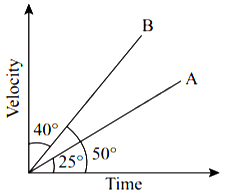
The velocity-time graph for two bodies $A$ and $B$ is shown. Then the acceleration of $A$ and $B$ are in the ratio:
A
$\tan 25^{\circ}$ to $\tan 40^{\circ}$
B
$\tan 25^{\circ}$ to $\tan 50^{\circ}$
C
$\sin 25^{\circ}$ to $\sin 50^{\circ}$
D
$\cos 25^{\circ}$ to $\cos 50^{\circ}$
Solution
(B) The acceleration of a body is given by the slope of its velocity-time graph.
Acceleration $a = \frac{dv}{dt} = \tan \theta$,where $\theta$ is the angle the line makes with the time axis.
For body $A$,the angle with the time axis is $25^{\circ}$. Thus,$a_A = \tan 25^{\circ}$.
For body $B$,the angle with the time axis is $50^{\circ}$. Thus,$a_B = \tan 50^{\circ}$.
Therefore,the ratio of the acceleration of $A$ to the acceleration of $B$ is $\frac{a_A}{a_B} = \frac{\tan 25^{\circ}}{\tan 50^{\circ}}$.
Acceleration $a = \frac{dv}{dt} = \tan \theta$,where $\theta$ is the angle the line makes with the time axis.
For body $A$,the angle with the time axis is $25^{\circ}$. Thus,$a_A = \tan 25^{\circ}$.
For body $B$,the angle with the time axis is $50^{\circ}$. Thus,$a_B = \tan 50^{\circ}$.
Therefore,the ratio of the acceleration of $A$ to the acceleration of $B$ is $\frac{a_A}{a_B} = \frac{\tan 25^{\circ}}{\tan 50^{\circ}}$.
0 likesView Solution
2
PhysicsEasyMCQKCET · 2015
$A$ stone of mass $0.05 \,kg$ is thrown vertically upwards. What is the direction and magnitude of the net force on the stone during its upward motion?
A
$0.49 \,N$ vertically upwards
B
$0.49 \,N$ vertically downwards
C
$0.98 \,N$ vertically downwards
D
$9.8 \,N$ vertically downwards
Solution
(B) Given,mass $m = 0.05 \,kg$.
During the upward motion of the stone,the only force acting on it (ignoring air resistance) is the gravitational force.
The magnitude of the gravitational force is given by $F = m \times g$.
Taking $g = 9.8 \,m/s^2$,we have:
$F = 0.05 \,kg \times 9.8 \,m/s^2 = 0.49 \,N$.
The direction of the gravitational force is always towards the center of the Earth,which is vertically downwards.
Therefore,the net force is $0.49 \,N$ vertically downwards.
During the upward motion of the stone,the only force acting on it (ignoring air resistance) is the gravitational force.
The magnitude of the gravitational force is given by $F = m \times g$.
Taking $g = 9.8 \,m/s^2$,we have:
$F = 0.05 \,kg \times 9.8 \,m/s^2 = 0.49 \,N$.
The direction of the gravitational force is always towards the center of the Earth,which is vertically downwards.
Therefore,the net force is $0.49 \,N$ vertically downwards.
0 likesView Solution
3
PhysicsEasyMCQKCET · 2015
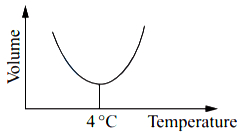
When water is heated from $0^{\circ} C$ to $10^{\circ} C$,its volume:
A
decreases
B
increases
C
does not change
D
first decreases and then increases
Solution
(D) Water exhibits anomalous expansion between $0^{\circ} C$ and $4^{\circ} C$.
As water is heated from $0^{\circ} C$ to $4^{\circ} C$,its density increases,which means its volume decreases.
At $4^{\circ} C$,water attains its maximum density and minimum volume.
When water is heated further from $4^{\circ} C$ to $10^{\circ} C$,it expands like a normal liquid,and its volume increases.
Therefore,the volume of water first decreases and then increases.
As water is heated from $0^{\circ} C$ to $4^{\circ} C$,its density increases,which means its volume decreases.
At $4^{\circ} C$,water attains its maximum density and minimum volume.
When water is heated further from $4^{\circ} C$ to $10^{\circ} C$,it expands like a normal liquid,and its volume increases.
Therefore,the volume of water first decreases and then increases.
0 likesView Solution
4
PhysicsEasyMCQKCET · 2015
When two tuning forks $A$ and $B$ are sounded together, $4$ beats per second are heard. The frequency of the fork $B$ is $384 \,Hz$. When one of the prongs of the fork $A$ is filed and sounded with $B$, the beat frequency increases. Then the frequency of the fork $A$ is: (in $\,Hz$)
A
$380$
B
$388$
C
$379$
D
$389$
Solution
(B) Given: Beat frequency $= 4 \,Hz$, frequency of fork $B$ $(f_B)$ $= 384 \,Hz$.
The possible frequencies of fork $A$ $(f_A)$ are $f_B \pm 4$, which are $388 \,Hz$ or $380 \,Hz$.
When a prong of a tuning fork is filed, its mass decreases, which increases its frequency ($f_A$ increases).
Case $1$: If $f_A = 380 \,Hz$, filing increases $f_A$ towards $384 \,Hz$, so the beat frequency $(|f_A - f_B|)$ would decrease.
Case $2$: If $f_A = 388 \,Hz$, filing increases $f_A$ away from $384 \,Hz$ (e.g., to $389 \,Hz$), so the beat frequency $(|f_A - f_B|)$ increases.
Since the problem states that the beat frequency increases, the initial frequency of fork $A$ must be $388 \,Hz$.
The possible frequencies of fork $A$ $(f_A)$ are $f_B \pm 4$, which are $388 \,Hz$ or $380 \,Hz$.
When a prong of a tuning fork is filed, its mass decreases, which increases its frequency ($f_A$ increases).
Case $1$: If $f_A = 380 \,Hz$, filing increases $f_A$ towards $384 \,Hz$, so the beat frequency $(|f_A - f_B|)$ would decrease.
Case $2$: If $f_A = 388 \,Hz$, filing increases $f_A$ away from $384 \,Hz$ (e.g., to $389 \,Hz$), so the beat frequency $(|f_A - f_B|)$ increases.
Since the problem states that the beat frequency increases, the initial frequency of fork $A$ must be $388 \,Hz$.
0 likesView Solution
5
PhysicsEasyMCQKCET · 2015
Moment of Inertia of a thin uniform rod rotating about the perpendicular axis passing through its centre is $I$. If the same rod is bent into a ring and its moment of inertia about its diameter is $I^{\prime}$,then the ratio $\frac{I}{I^{\prime}}$ is
A
$\frac{3}{2} \pi^{2}$
B
$\frac{8}{3} \pi^{2}$
C
$\frac{2}{3} \pi^{2}$
D
$\frac{5}{3} \pi^{2}$
Solution
(C) The moment of inertia of a thin uniform rod of mass $M$ and length $L$ about an axis passing through its centre and perpendicular to its length is $I = \frac{ML^2}{12}$.
When the rod is bent into a ring of radius $R$,the circumference of the ring is equal to the length of the rod,so $L = 2\pi R$,which implies $R = \frac{L}{2\pi}$.
The moment of inertia of a ring about its diameter is $I^{\prime} = \frac{MR^2}{2}$.
Substituting $R = \frac{L}{2\pi}$ into the expression for $I^{\prime}$,we get $I^{\prime} = \frac{M}{2} \left(\frac{L}{2\pi}\right)^2 = \frac{ML^2}{8\pi^2}$.
Now,the ratio $\frac{I}{I^{\prime}}$ is $\frac{\frac{ML^2}{12}}{\frac{ML^2}{8\pi^2}} = \frac{8\pi^2}{12} = \frac{2\pi^2}{3}$.
When the rod is bent into a ring of radius $R$,the circumference of the ring is equal to the length of the rod,so $L = 2\pi R$,which implies $R = \frac{L}{2\pi}$.
The moment of inertia of a ring about its diameter is $I^{\prime} = \frac{MR^2}{2}$.
Substituting $R = \frac{L}{2\pi}$ into the expression for $I^{\prime}$,we get $I^{\prime} = \frac{M}{2} \left(\frac{L}{2\pi}\right)^2 = \frac{ML^2}{8\pi^2}$.
Now,the ratio $\frac{I}{I^{\prime}}$ is $\frac{\frac{ML^2}{12}}{\frac{ML^2}{8\pi^2}} = \frac{8\pi^2}{12} = \frac{2\pi^2}{3}$.
0 likesView Solution
6
PhysicsMediumMCQKCET · 2015
If the mass of a body is $M$ on the surface of the earth,the mass of the same body on the surface of the moon is
A
$M / 6$
B
$M$
C
$6M$
D
Zero
Solution
(B) Mass is a fundamental property of matter and it does not depend on external conditions such as gravity or location.
It represents the amount of matter contained in an object.
Since mass is an intrinsic property,it remains constant regardless of where the object is placed.
Therefore,if the mass of the body on the surface of the Earth is $M$,its mass on the surface of the moon will also be $M$.
It represents the amount of matter contained in an object.
Since mass is an intrinsic property,it remains constant regardless of where the object is placed.
Therefore,if the mass of the body on the surface of the Earth is $M$,its mass on the surface of the moon will also be $M$.
0 likesView Solution
7
PhysicsMediumMCQKCET · 2015
$ 1 \text{ g} $ of ice is mixed with $ 1 \text{ g} $ of steam. At thermal equilibrium,the temperature of the mixture is (in $^{\circ} C$)
A
$0$
B
$100$
C
$50$
D
$55$
Solution
(B) Heat required to melt $ 1 \text{ g} $ of ice at $ 0^{\circ} C $ to water at $ 0^{\circ} C $ is $ Q_1 = m L_f = 1 \times 80 = 80 \text{ cal} $.
Heat required to raise the temperature of $ 1 \text{ g} $ of water from $ 0^{\circ} C $ to $ 100^{\circ} C $ is $ Q_2 = m c \Delta T = 1 \times 1 \times 100 = 100 \text{ cal} $.
Total heat required to convert $ 1 \text{ g} $ of ice at $ 0^{\circ} C $ to $ 1 \text{ g} $ of water at $ 100^{\circ} C $ is $ Q_{total} = 80 + 100 = 180 \text{ cal} $.
Heat released by $ 1 \text{ g} $ of steam at $ 100^{\circ} C $ to condense into water at $ 100^{\circ} C $ is $ Q_{steam} = m L_v = 1 \times 540 = 540 \text{ cal} $.
Since $ Q_{steam} > Q_{total} $,the steam has more than enough heat to melt the ice and raise the water to $ 100^{\circ} C $.
Therefore,the mixture will reach thermal equilibrium at $ 100^{\circ} C $ with some steam remaining.
Heat required to raise the temperature of $ 1 \text{ g} $ of water from $ 0^{\circ} C $ to $ 100^{\circ} C $ is $ Q_2 = m c \Delta T = 1 \times 1 \times 100 = 100 \text{ cal} $.
Total heat required to convert $ 1 \text{ g} $ of ice at $ 0^{\circ} C $ to $ 1 \text{ g} $ of water at $ 100^{\circ} C $ is $ Q_{total} = 80 + 100 = 180 \text{ cal} $.
Heat released by $ 1 \text{ g} $ of steam at $ 100^{\circ} C $ to condense into water at $ 100^{\circ} C $ is $ Q_{steam} = m L_v = 1 \times 540 = 540 \text{ cal} $.
Since $ Q_{steam} > Q_{total} $,the steam has more than enough heat to melt the ice and raise the water to $ 100^{\circ} C $.
Therefore,the mixture will reach thermal equilibrium at $ 100^{\circ} C $ with some steam remaining.
0 likesView Solution
8
PhysicsDifficultMCQKCET · 2015
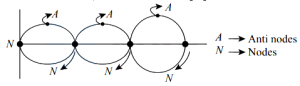
$A$ stretched string is vibrating in the second overtone. The number of nodes and antinodes between the ends of the string are respectively:
A
$ 4 $ and $ 3 $
B
$ 3 $ and $ 2 $
C
$ 3 $ and $ 4 $
D
$ 2 $ and $ 3 $
Solution
(A) For a stretched string fixed at both ends,the frequency of the $ n $-th overtone is given by $ f_n = (n+1) f_1 $,where $ f_1 $ is the fundamental frequency.
For the second overtone,$ n = 2 $,so the string vibrates in the $ 3^{rd} $ harmonic mode.
In the $ 3^{rd} $ harmonic mode,the string has $ 3 $ loops.
The number of nodes $( N )$ in a standing wave with $ p $ loops is $ p+1 $. Here,$ p = 3 $,so the number of nodes is $ 3+1 = 4 $.
The number of antinodes $( A )$ is equal to the number of loops,which is $ 3 $.
Therefore,there are $ 4 $ nodes and $ 3 $ antinodes.
For the second overtone,$ n = 2 $,so the string vibrates in the $ 3^{rd} $ harmonic mode.
In the $ 3^{rd} $ harmonic mode,the string has $ 3 $ loops.
The number of nodes $( N )$ in a standing wave with $ p $ loops is $ p+1 $. Here,$ p = 3 $,so the number of nodes is $ 3+1 = 4 $.
The number of antinodes $( A )$ is equal to the number of loops,which is $ 3 $.
Therefore,there are $ 4 $ nodes and $ 3 $ antinodes.
0 likesView Solution
9
PhysicsMediumMCQKCET · 2015
The efficiency of a Carnot engine which operates between the two temperatures $T_{1} = 500 \ K$ and $T_{2} = 300 \ K$ is: (in $\%$)
A
$50$
B
$25$
C
$75$
D
$40$
Solution
(D) The efficiency $\eta$ of a Carnot engine is given by the formula: $\eta = \left(1 - \frac{T_{2}}{T_{1}}\right) \times 100 \%$.
Given: $T_{1} = 500 \ K$ (source temperature) and $T_{2} = 300 \ K$ (sink temperature).
Substituting the values into the formula:
$\eta = \left(1 - \frac{300}{500}\right) \times 100 \%$.
$\eta = \left(1 - 0.6\right) \times 100 \%$.
$\eta = 0.4 \times 100 \% = 40 \%$.
Thus,the efficiency of the Carnot engine is $40 \%$.
Given: $T_{1} = 500 \ K$ (source temperature) and $T_{2} = 300 \ K$ (sink temperature).
Substituting the values into the formula:
$\eta = \left(1 - \frac{300}{500}\right) \times 100 \%$.
$\eta = \left(1 - 0.6\right) \times 100 \%$.
$\eta = 0.4 \times 100 \% = 40 \%$.
Thus,the efficiency of the Carnot engine is $40 \%$.
0 likesView Solution
10
PhysicsMediumMCQKCET · 2015
The ratio of the dimensions of Planck's constant and that of moment of inertia has the dimensions of
A
time
B
frequency
C
angular momentum
D
velocity
Solution
(B) The dimensions of Planck's constant $(h)$ are $[M L^{2} T^{-1}]$.
The dimensions of moment of inertia $(I)$ are $[M L^{2}]$.
The ratio of the dimensions of Planck's constant to the moment of inertia is given by $\frac{[h]}{[I]} = \frac{[M L^{2} T^{-1}]}{[M L^{2}]} = [T^{-1}]$.
The dimension of frequency is $[T^{-1}]$.
The dimension of velocity is $[L T^{-1}]$.
The dimension of angular momentum is $[M L^{2} T^{-1}]$.
The dimension of time is $[T]$.
Therefore,the ratio of the dimensions of Planck's constant and the moment of inertia has the dimensions of frequency.
The dimensions of moment of inertia $(I)$ are $[M L^{2}]$.
The ratio of the dimensions of Planck's constant to the moment of inertia is given by $\frac{[h]}{[I]} = \frac{[M L^{2} T^{-1}]}{[M L^{2}]} = [T^{-1}]$.
The dimension of frequency is $[T^{-1}]$.
The dimension of velocity is $[L T^{-1}]$.
The dimension of angular momentum is $[M L^{2} T^{-1}]$.
The dimension of time is $[T]$.
Therefore,the ratio of the dimensions of Planck's constant and the moment of inertia has the dimensions of frequency.
0 likesView Solution
11
PhysicsMediumMCQKCET · 2015
The ratio of the angular speed of a second-hand to the hour-hand of a watch is (in $: 1$)
A
$720$
B
$60$
C
$3600$
D
$72$
Solution
(A) For the second-hand,the time period $T_s = 60 \text{ s}$.
So,the angular speed $\omega_s = \frac{2\pi}{T_s} = \frac{2\pi}{60} \text{ rad/s}$.
For the hour-hand,the time period $T_h = 12 \text{ hours} = 12 \times 60 \times 60 \text{ s} = 43200 \text{ s}$.
So,the angular speed $\omega_h = \frac{2\pi}{T_h} = \frac{2\pi}{43200} \text{ rad/s}$.
The ratio of the angular speed of the second-hand to the hour-hand is $\frac{\omega_s}{\omega_h} = \frac{2\pi / 60}{2\pi / 43200} = \frac{43200}{60} = 720$.
Thus,the ratio is $720: 1$.
So,the angular speed $\omega_s = \frac{2\pi}{T_s} = \frac{2\pi}{60} \text{ rad/s}$.
For the hour-hand,the time period $T_h = 12 \text{ hours} = 12 \times 60 \times 60 \text{ s} = 43200 \text{ s}$.
So,the angular speed $\omega_h = \frac{2\pi}{T_h} = \frac{2\pi}{43200} \text{ rad/s}$.
The ratio of the angular speed of the second-hand to the hour-hand is $\frac{\omega_s}{\omega_h} = \frac{2\pi / 60}{2\pi / 43200} = \frac{43200}{60} = 720$.
Thus,the ratio is $720: 1$.
0 likesView Solution
12
PhysicsEasyMCQKCET · 2015
The kinetic energy of a body of mass $4 \,kg$ and momentum $6 \,Ns$ will be (in $\,J$)
A
$2.5$
B
$3.5$
C
$4.5$
D
$5.5$
Solution
(C) Given: mass $m = 4 \,kg$, momentum $p = 6 \,Ns$.
The relationship between kinetic energy $K$ and momentum $p$ is given by $K = \frac{p^2}{2m}$.
Substituting the given values into the formula:
$K = \frac{6^2}{2 \times 4} = \frac{36}{8} = 4.5 \,J$.
Therefore, the kinetic energy of the body is $4.5 \,J$.
The relationship between kinetic energy $K$ and momentum $p$ is given by $K = \frac{p^2}{2m}$.
Substituting the given values into the formula:
$K = \frac{6^2}{2 \times 4} = \frac{36}{8} = 4.5 \,J$.
Therefore, the kinetic energy of the body is $4.5 \,J$.
0 likesView Solution
13
PhysicsDifficultMCQKCET · 2015
$A$ particle is projected with a velocity $v$ such that its horizontal range is twice the greatest height attained. The horizontal range is
A
$ \frac{v^{2}}{g} $
B
$ \frac{2 v^{2}}{3 g} $
C
$ \frac{4 v^{2}}{5 g} $
D
$ \frac{v^{2}}{2 g} $
Solution
(C) Given: Horizontal range $(R)$ $= 2 \times$ Maximum height $(H)$.
Formula for range: $R = \frac{v^{2} \sin 2\theta}{g}$.
Formula for maximum height: $H = \frac{v^{2} \sin^{2} \theta}{2g}$.
According to the problem: $\frac{v^{2} \sin 2\theta}{g} = 2 \times \frac{v^{2} \sin^{2} \theta}{2g}$.
Simplifying: $\sin 2\theta = \sin^{2} \theta$.
Using the identity $\sin 2\theta = 2 \sin \theta \cos \theta$: $2 \sin \theta \cos \theta = \sin^{2} \theta$.
Dividing by $\sin \theta$ (assuming $\theta \neq 0$): $2 \cos \theta = \sin \theta$,which means $\tan \theta = 2$.
From $\tan \theta = 2$,we have $\sin \theta = \frac{2}{\sqrt{5}}$ and $\cos \theta = \frac{1}{\sqrt{5}}$.
Substituting these into the range formula: $R = \frac{v^{2} (2 \sin \theta \cos \theta)}{g} = \frac{2v^{2}}{g} \times \frac{2}{\sqrt{5}} \times \frac{1}{\sqrt{5}} = \frac{4v^{2}}{5g}$.
Formula for range: $R = \frac{v^{2} \sin 2\theta}{g}$.
Formula for maximum height: $H = \frac{v^{2} \sin^{2} \theta}{2g}$.
According to the problem: $\frac{v^{2} \sin 2\theta}{g} = 2 \times \frac{v^{2} \sin^{2} \theta}{2g}$.
Simplifying: $\sin 2\theta = \sin^{2} \theta$.
Using the identity $\sin 2\theta = 2 \sin \theta \cos \theta$: $2 \sin \theta \cos \theta = \sin^{2} \theta$.
Dividing by $\sin \theta$ (assuming $\theta \neq 0$): $2 \cos \theta = \sin \theta$,which means $\tan \theta = 2$.
From $\tan \theta = 2$,we have $\sin \theta = \frac{2}{\sqrt{5}}$ and $\cos \theta = \frac{1}{\sqrt{5}}$.
Substituting these into the range formula: $R = \frac{v^{2} (2 \sin \theta \cos \theta)}{g} = \frac{2v^{2}}{g} \times \frac{2}{\sqrt{5}} \times \frac{1}{\sqrt{5}} = \frac{4v^{2}}{5g}$.
0 likesView Solution
14
PhysicsEasyMCQKCET · 2015
The ratio of hydraulic stress to the corresponding strain is known as:
A
Compressibility
B
Bulk modulus
C
Young's modulus
D
Rigidity modulus
Solution
(B) The ratio of hydraulic stress to the corresponding volumetric strain is defined as the Bulk modulus $(B)$.
Mathematically,$B = -\frac{\Delta P}{\Delta V / V}$,where $\Delta P$ is the change in pressure and $\frac{\Delta V}{V}$ is the volumetric strain.
Mathematically,$B = -\frac{\Delta P}{\Delta V / V}$,where $\Delta P$ is the change in pressure and $\frac{\Delta V}{V}$ is the volumetric strain.
0 likesView Solution
15
PhysicsEasyMCQKCET · 2015
The ratio of kinetic energy to the potential energy of a particle executing $SHM$ at a distance equal to half its amplitude,the distance being measured from its equilibrium position,is:
A
$3:1$
B
$4:1$
C
$1:3$
D
$8:1$
Solution
(A) The kinetic energy $(KE)$ of a particle executing $SHM$ is given by:
$KE = \frac{1}{2} m \omega^{2} (A^{2} - y^{2})$
Given the distance $y = \frac{A}{2}$,where $A$ is the amplitude:
$KE = \frac{1}{2} m \omega^{2} (A^{2} - (\frac{A}{2})^{2}) = \frac{1}{2} m \omega^{2} (A^{2} - \frac{A^{2}}{4}) = \frac{1}{2} m \omega^{2} (\frac{3A^{2}}{4})$
The potential energy $(PE)$ of a particle executing $SHM$ is given by:
$PE = \frac{1}{2} m \omega^{2} y^{2}$
Substituting $y = \frac{A}{2}$:
$PE = \frac{1}{2} m \omega^{2} (\frac{A}{2})^{2} = \frac{1}{2} m \omega^{2} (\frac{A^{2}}{4})$
The ratio of kinetic energy to potential energy is:
$\frac{KE}{PE} = \frac{\frac{1}{2} m \omega^{2} (\frac{3A^{2}}{4})}{\frac{1}{2} m \omega^{2} (\frac{A^{2}}{4})} = \frac{3/4}{1/4} = 3$
Therefore,the ratio is $3:1$.
$KE = \frac{1}{2} m \omega^{2} (A^{2} - y^{2})$
Given the distance $y = \frac{A}{2}$,where $A$ is the amplitude:
$KE = \frac{1}{2} m \omega^{2} (A^{2} - (\frac{A}{2})^{2}) = \frac{1}{2} m \omega^{2} (A^{2} - \frac{A^{2}}{4}) = \frac{1}{2} m \omega^{2} (\frac{3A^{2}}{4})$
The potential energy $(PE)$ of a particle executing $SHM$ is given by:
$PE = \frac{1}{2} m \omega^{2} y^{2}$
Substituting $y = \frac{A}{2}$:
$PE = \frac{1}{2} m \omega^{2} (\frac{A}{2})^{2} = \frac{1}{2} m \omega^{2} (\frac{A^{2}}{4})$
The ratio of kinetic energy to potential energy is:
$\frac{KE}{PE} = \frac{\frac{1}{2} m \omega^{2} (\frac{3A^{2}}{4})}{\frac{1}{2} m \omega^{2} (\frac{A^{2}}{4})} = \frac{3/4}{1/4} = 3$
Therefore,the ratio is $3:1$.
0 likesView Solution
16
PhysicsMediumMCQKCET · 2015
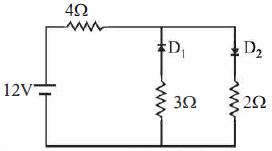
The circuit has two oppositely connected ideal diodes in parallel. What is the current flowing in the circuit (in $A$)?
A
$1.33$
B
$1.71$
C
$2$
D
$2.31$
Solution
(C) In the given circuit,the positive terminal of the $12 \ V$ battery is connected such that diode $D_2$ is forward-biased and diode $D_1$ is reverse-biased.
Since $D_1$ is reverse-biased,it acts as an open circuit and no current flows through the $3 \ \Omega$ resistor branch.
Since $D_2$ is forward-biased and ideal,it acts as a short circuit. The current flows through the $4 \ \Omega$ resistor and the $2 \ \Omega$ resistor branch.
The total resistance of the circuit is $R = 4 \ \Omega + 2 \ \Omega = 6 \ \Omega$.
Using Ohm's law,the current $i$ in the circuit is given by:
$i = \frac{V}{R} = \frac{12 \ V}{6 \ \Omega} = 2 \ A$.
Since $D_1$ is reverse-biased,it acts as an open circuit and no current flows through the $3 \ \Omega$ resistor branch.
Since $D_2$ is forward-biased and ideal,it acts as a short circuit. The current flows through the $4 \ \Omega$ resistor and the $2 \ \Omega$ resistor branch.
The total resistance of the circuit is $R = 4 \ \Omega + 2 \ \Omega = 6 \ \Omega$.
Using Ohm's law,the current $i$ in the circuit is given by:
$i = \frac{V}{R} = \frac{12 \ V}{6 \ \Omega} = 2 \ A$.
0 likesView Solution
17
PhysicsEasyMCQKCET · 2015
The magnetic susceptibility of a paramagnetic material at $-73^{\circ} C$ is $0.0075$. Its value at $-173^{\circ} C$ will be
A
$0.0075$
B
$0.0045$
C
$0.0150$
D
$0.0030$
Solution
(C) According to Curie's Law,the magnetic susceptibility $\chi$ of a paramagnetic material is inversely proportional to its absolute temperature $T$,i.e.,$\chi \propto \frac{1}{T}$.
Therefore,$\frac{\chi_1}{\chi_2} = \frac{T_2}{T_1}$.
Given:
$T_1 = -73^{\circ} C = 273 - 73 = 200 \ K$
$T_2 = -173^{\circ} C = 273 - 173 = 100 \ K$
$\chi_1 = 0.0075$
Substituting the values:
$\chi_2 = \chi_1 \times \frac{T_1}{T_2} = 0.0075 \times \frac{200}{100} = 0.0075 \times 2 = 0.0150$.
Thus,the correct option is $C$.
Therefore,$\frac{\chi_1}{\chi_2} = \frac{T_2}{T_1}$.
Given:
$T_1 = -73^{\circ} C = 273 - 73 = 200 \ K$
$T_2 = -173^{\circ} C = 273 - 173 = 100 \ K$
$\chi_1 = 0.0075$
Substituting the values:
$\chi_2 = \chi_1 \times \frac{T_1}{T_2} = 0.0075 \times \frac{200}{100} = 0.0075 \times 2 = 0.0150$.
Thus,the correct option is $C$.
0 likesView Solution
18
PhysicsEasyMCQKCET · 2015
$A$ person wants a real image of his own,$3$ times enlarged. Where should he stand in front of a concave mirror of radius of curvature $30 \ cm$ (in $cm$)?
A
$10$
B
$30$
C
$90$
D
$20$
Solution
(D) Given: Magnification $m = -3$ (since the image is real,it must be inverted). Radius of curvature $R = -30 \ cm$. Focal length $f = R/2 = -15 \ cm$.
Using the magnification formula: $m = -v/u \Rightarrow -3 = -v/u \Rightarrow v = 3u$.
Using the mirror formula: $1/f = 1/v + 1/u$.
Substituting the values: $1/(-15) = 1/(3u) + 1/u$.
$1/(-15) = (1 + 3)/(3u) = 4/(3u)$.
$-3u = 60 \Rightarrow u = -20 \ cm$.
The negative sign indicates that the person should stand $20 \ cm$ in front of the concave mirror.
Using the magnification formula: $m = -v/u \Rightarrow -3 = -v/u \Rightarrow v = 3u$.
Using the mirror formula: $1/f = 1/v + 1/u$.
Substituting the values: $1/(-15) = 1/(3u) + 1/u$.
$1/(-15) = (1 + 3)/(3u) = 4/(3u)$.
$-3u = 60 \Rightarrow u = -20 \ cm$.
The negative sign indicates that the person should stand $20 \ cm$ in front of the concave mirror.
0 likesView Solution
19
PhysicsEasyMCQKCET · 2015
If an electron in a hydrogen atom jumps from an orbit of level $n=3$ to an orbit of level $n=2$,the emitted radiation has a frequency ($R=$ Rydberg constant,$C=$ velocity of light).
A
$ \frac{3RC}{27} $
B
$ \frac{RC}{25} $
C
$ \frac{8RC}{9} $
D
$ \frac{5RC}{36} $
Solution
(D) The energy difference between two orbits in a hydrogen atom is given by the Rydberg formula for wavenumber: $\frac{1}{\lambda} = R \left( \frac{1}{n_1^2} - \frac{1}{n_2^2} \right)$.
Since the frequency $f$ is related to wavelength $\lambda$ by $f = \frac{C}{\lambda}$,we can write $\frac{f}{C} = R \left( \frac{1}{n_1^2} - \frac{1}{n_2^2} \right)$.
Rearranging for frequency,we get $f = RC \left( \frac{1}{n_1^2} - \frac{1}{n_2^2} \right)$.
Given $n_1 = 2$ and $n_2 = 3$,we substitute these values into the equation:
$f = RC \left( \frac{1}{2^2} - \frac{1}{3^2} \right) = RC \left( \frac{1}{4} - \frac{1}{9} \right)$.
Calculating the fraction: $\frac{1}{4} - \frac{1}{9} = \frac{9-4}{36} = \frac{5}{36}$.
Thus,the frequency is $f = \frac{5RC}{36}$.
Since the frequency $f$ is related to wavelength $\lambda$ by $f = \frac{C}{\lambda}$,we can write $\frac{f}{C} = R \left( \frac{1}{n_1^2} - \frac{1}{n_2^2} \right)$.
Rearranging for frequency,we get $f = RC \left( \frac{1}{n_1^2} - \frac{1}{n_2^2} \right)$.
Given $n_1 = 2$ and $n_2 = 3$,we substitute these values into the equation:
$f = RC \left( \frac{1}{2^2} - \frac{1}{3^2} \right) = RC \left( \frac{1}{4} - \frac{1}{9} \right)$.
Calculating the fraction: $\frac{1}{4} - \frac{1}{9} = \frac{9-4}{36} = \frac{5}{36}$.
Thus,the frequency is $f = \frac{5RC}{36}$.
0 likesView Solution
20
PhysicsMediumMCQKCET · 2015
If $\varepsilon_{0}$ and $\mu_{0}$ are the permittivity and permeability of free space and $\varepsilon$ and $\mu$ are the corresponding quantities for a medium,then the refractive index of the medium is:
A
$\sqrt{\frac{\mu_{0} \varepsilon_{0}}{\mu \varepsilon}}$
B
$\sqrt{\frac{\mu \varepsilon}{\mu_{0} \varepsilon_{0}}}$
C
$1$
D
Insufficient information
Solution
(B) The speed of light in free space is given by $c = \frac{1}{\sqrt{\mu_{0} \varepsilon_{0}}}$.
The speed of light in a medium is given by $v = \frac{1}{\sqrt{\mu \varepsilon}}$.
The refractive index $n$ of a medium is defined as the ratio of the speed of light in vacuum to the speed of light in the medium:
$n = \frac{c}{v} = \frac{\frac{1}{\sqrt{\mu_{0} \varepsilon_{0}}}}{\frac{1}{\sqrt{\mu \varepsilon}}} = \frac{\sqrt{\mu \varepsilon}}{\sqrt{\mu_{0} \varepsilon_{0}}} = \sqrt{\frac{\mu \varepsilon}{\mu_{0} \varepsilon_{0}}}$.
Thus,the correct option is $B$.
The speed of light in a medium is given by $v = \frac{1}{\sqrt{\mu \varepsilon}}$.
The refractive index $n$ of a medium is defined as the ratio of the speed of light in vacuum to the speed of light in the medium:
$n = \frac{c}{v} = \frac{\frac{1}{\sqrt{\mu_{0} \varepsilon_{0}}}}{\frac{1}{\sqrt{\mu \varepsilon}}} = \frac{\sqrt{\mu \varepsilon}}{\sqrt{\mu_{0} \varepsilon_{0}}} = \sqrt{\frac{\mu \varepsilon}{\mu_{0} \varepsilon_{0}}}$.
Thus,the correct option is $B$.
0 likesView Solution
21
PhysicsEasyMCQKCET · 2015
The given truth table is for:
| $A$ | $B$ | $Y$ |
|---|---|---|
| $0$ | $0$ | $1$ |
| $0$ | $1$ | $1$ |
| $1$ | $0$ | $1$ |
| $1$ | $1$ | $0$ |
A
$AND$ gate
B
$OR$ gate
C
$NAND$ gate
D
$NOR$ gate
Solution
(C) truth table defines the output of a logic gate for all possible input combinations.
For the given table:
- When $A=0, B=0$,output $Y=1$.
- When $A=0, B=1$,output $Y=1$.
- When $A=1, B=0$,output $Y=1$.
- When $A=1, B=1$,output $Y=0$.
This behavior corresponds to the $NAND$ gate,which is the inverse of the $AND$ gate. The Boolean expression for a $NAND$ gate is $Y = \overline{A \cdot B}$.
For the given table:
- When $A=0, B=0$,output $Y=1$.
- When $A=0, B=1$,output $Y=1$.
- When $A=1, B=0$,output $Y=1$.
- When $A=1, B=1$,output $Y=0$.
This behavior corresponds to the $NAND$ gate,which is the inverse of the $AND$ gate. The Boolean expression for a $NAND$ gate is $Y = \overline{A \cdot B}$.
0 likesView Solution
22
PhysicsDifficultMCQKCET · 2015
The waves used for line-of-sight $(LOS)$ communication are
A
ground waves
B
space waves
C
sound waves
D
sky waves
Solution
(B) Space waves are used for line-of-sight $(LOS)$ communication.
Line-of-sight is a type of communication that can transmit and receive data only when transmitter and receiver stations are in view of each other with no obstacle between them.
This mode of propagation is typically used for high-frequency signals like $VHF$,$UHF$,and microwave signals.
Line-of-sight is a type of communication that can transmit and receive data only when transmitter and receiver stations are in view of each other with no obstacle between them.
This mode of propagation is typically used for high-frequency signals like $VHF$,$UHF$,and microwave signals.
0 likesView Solution
23
PhysicsEasyMCQKCET · 2015
What is the wavelength of light for the least energetic photon emitted in the Lyman series of the hydrogen spectrum (in $\text{ nm}$)? (Take $hc = 1240 \text{ eV nm}$)
A
$82$
B
$102$
C
$122$
D
$150$
Solution
(C) The energy of a photon emitted during a transition from $n_2$ to $n_1$ is given by $E = hc / \lambda$. The energy is least when the transition is between the closest energy levels.
For the Lyman series, the transitions occur to $n_1 = 1$. The least energetic photon corresponds to the transition from $n_2 = 2$ to $n_1 = 1$.
The energy difference is $\Delta E = 13.6 \text{ eV} \times (1/n_1^2 - 1/n_2^2) = 13.6 \times (1/1^2 - 1/2^2) = 13.6 \times (3/4) = 10.2 \text{ eV}$.
Using the relation $\lambda = hc / \Delta E$:
$\lambda = 1240 \text{ eV nm} / 10.2 \text{ eV} \approx 121.57 \text{ nm} \approx 122 \text{ nm}$.
For the Lyman series, the transitions occur to $n_1 = 1$. The least energetic photon corresponds to the transition from $n_2 = 2$ to $n_1 = 1$.
The energy difference is $\Delta E = 13.6 \text{ eV} \times (1/n_1^2 - 1/n_2^2) = 13.6 \times (1/1^2 - 1/2^2) = 13.6 \times (3/4) = 10.2 \text{ eV}$.
Using the relation $\lambda = hc / \Delta E$:
$\lambda = 1240 \text{ eV nm} / 10.2 \text{ eV} \approx 121.57 \text{ nm} \approx 122 \text{ nm}$.
0 likesView Solution
24
PhysicsEasyMCQKCET · 2015
The resistance of the bulb filament is $100 \ \Omega$ at a temperature of $100^{\circ} C$. If its temperature coefficient of resistance is $0.005 \ ^{\circ} C^{-1}$,at what temperature will its resistance become $200 \ \Omega$ (in $^{\circ} C$)?
A
$300$
B
$400$
C
$500$
D
$200$
Solution
(A) Given: Initial temperature $T_{1} = 100^{\circ} C$,initial resistance $R_{1} = 100 \ \Omega$,final resistance $R_{2} = 200 \ \Omega$,and temperature coefficient $\alpha = 0.005 \ ^{\circ} C^{-1}$.
Using the formula for temperature dependence of resistance: $R_{2} = R_{1}[1 + \alpha(T_{2} - T_{1})]$.
Rearranging for $T_{2}$: $T_{2} - T_{1} = \frac{R_{2} - R_{1}}{\alpha R_{1}}$.
Substituting the values: $T_{2} - 100 = \frac{200 - 100}{0.005 \times 100}$.
$T_{2} - 100 = \frac{100}{0.5} = 200$.
$T_{2} = 200 + 100 = 300^{\circ} C$.
Using the formula for temperature dependence of resistance: $R_{2} = R_{1}[1 + \alpha(T_{2} - T_{1})]$.
Rearranging for $T_{2}$: $T_{2} - T_{1} = \frac{R_{2} - R_{1}}{\alpha R_{1}}$.
Substituting the values: $T_{2} - 100 = \frac{200 - 100}{0.005 \times 100}$.
$T_{2} - 100 = \frac{100}{0.5} = 200$.
$T_{2} = 200 + 100 = 300^{\circ} C$.
0 likesView Solution
25
PhysicsMediumMCQKCET · 2015
In a Wheatstone network,$P=2 \Omega, Q=2 \Omega, R=2 \Omega$,and $S=3 \Omega$. The resistance with which $S$ is to be shunted so that the bridge may be balanced is: (in $Omega$)
A
$6$
B
$2$
C
$4$
D
$1$
Solution
(A) Given: $P=2 \Omega, Q=2 \Omega, R=2 \Omega, S=3 \Omega$.
The condition for a balanced Wheatstone bridge is $\frac{P}{Q} = \frac{R}{S_{eq}}$,where $S_{eq}$ is the equivalent resistance of $S$ shunted with $X$.
The equivalent resistance $S_{eq}$ when $S$ is shunted with $X$ is given by $S_{eq} = \frac{S \cdot X}{S+X}$.
Substituting the values into the balance equation: $\frac{2}{2} = \frac{2}{\left(\frac{3X}{3+X}\right)}$.
This simplifies to $1 = \frac{2(3+X)}{3X}$.
Therefore,$3X = 6 + 2X$,which gives $X = 6 \Omega$.
Thus,$S$ must be shunted with a resistance of $6 \Omega$ to balance the bridge.
The condition for a balanced Wheatstone bridge is $\frac{P}{Q} = \frac{R}{S_{eq}}$,where $S_{eq}$ is the equivalent resistance of $S$ shunted with $X$.
The equivalent resistance $S_{eq}$ when $S$ is shunted with $X$ is given by $S_{eq} = \frac{S \cdot X}{S+X}$.
Substituting the values into the balance equation: $\frac{2}{2} = \frac{2}{\left(\frac{3X}{3+X}\right)}$.
This simplifies to $1 = \frac{2(3+X)}{3X}$.
Therefore,$3X = 6 + 2X$,which gives $X = 6 \Omega$.
Thus,$S$ must be shunted with a resistance of $6 \Omega$ to balance the bridge.
0 likesView Solution
26
PhysicsMediumMCQKCET · 2015
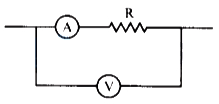
In the circuit shown below,the ammeter and the voltmeter readings are $3 \text{ A}$ and $6 \text{ V}$ respectively. Then the value of the resistance $R$ is
A
$2 \Omega$
B
$R > 2 \Omega$
C
$R < 2 \Omega$
D
$R = 2 \Omega$
Solution
(C) From the circuit diagram,the voltmeter is connected in parallel to the combination of the ammeter and the resistor $R$.
Let the resistance of the ammeter be $R_A$ and the resistance of the voltmeter be $R_V$.
The voltmeter reading $V = 6 \text{ V}$ is the potential difference across the series combination of the ammeter and the resistor $R$.
The ammeter reading $I = 3 \text{ A}$ is the current flowing through the ammeter and the resistor $R$.
According to Ohm's law for the series combination,the total resistance $R_{total} = R + R_A = \frac{V}{I} = \frac{6 \text{ V}}{3 \text{ A}} = 2 \Omega$.
Since the ammeter has some finite resistance $R_A > 0$,it follows that $R = 2 \Omega - R_A$.
Therefore,$R < 2 \Omega$.
Let the resistance of the ammeter be $R_A$ and the resistance of the voltmeter be $R_V$.
The voltmeter reading $V = 6 \text{ V}$ is the potential difference across the series combination of the ammeter and the resistor $R$.
The ammeter reading $I = 3 \text{ A}$ is the current flowing through the ammeter and the resistor $R$.
According to Ohm's law for the series combination,the total resistance $R_{total} = R + R_A = \frac{V}{I} = \frac{6 \text{ V}}{3 \text{ A}} = 2 \Omega$.
Since the ammeter has some finite resistance $R_A > 0$,it follows that $R = 2 \Omega - R_A$.
Therefore,$R < 2 \Omega$.
0 likesView Solution
27
PhysicsMediumMCQKCET · 2015
$A$ cyclotron is used to accelerate
A
neutrons
B
only positively charged particles
C
only negatively charged particles
D
both positively and negatively charged particles
Solution
(B) cyclotron is a particle accelerator that uses a magnetic field to keep charged particles in a circular path and an alternating electric field to increase their kinetic energy.
It is primarily used to accelerate positively charged particles such as protons,deuterons,and alpha particles.
Neutrons cannot be accelerated by a cyclotron because they are electrically neutral and do not experience the Lorentz force $(F = q(v \times B))$ required for circular motion or the electric force $(F = qE)$ required for acceleration.
It is primarily used to accelerate positively charged particles such as protons,deuterons,and alpha particles.
Neutrons cannot be accelerated by a cyclotron because they are electrically neutral and do not experience the Lorentz force $(F = q(v \times B))$ required for circular motion or the electric force $(F = qE)$ required for acceleration.
0 likesView Solution
28
PhysicsMediumMCQKCET · 2015
$A$ transformer is used to light a $100 \,W-110 \,V$ lamp from a $220 \,V$ mains. If the main current is $0.5 \,A$, the efficiency of the transformer is: (in $\%$)
A
$90$
B
$95$
C
$96$
D
$99$
Solution
(A) Given: Output power $(P_{out})$ = $100 \,W$, Input voltage $(V_{in})$ = $220 \,V$, Input current $(I_{in})$ = $0.5 \,A$.
The input power $(P_{in})$ is calculated as $P_{in} = V_{in} \times I_{in} = 220 \,V \times 0.5 \,A = 110 \,W$.
The efficiency $(\eta)$ of a transformer is defined as the ratio of output power to input power: $\eta = \frac{P_{out}}{P_{in}} \times 100$.
Substituting the values: $\eta = \frac{100 \,W}{110 \,W} \times 100 = \frac{10}{11} \times 100 \approx 90.91 \%$.
Rounding to the nearest provided option, the efficiency is $90 \%$.
The input power $(P_{in})$ is calculated as $P_{in} = V_{in} \times I_{in} = 220 \,V \times 0.5 \,A = 110 \,W$.
The efficiency $(\eta)$ of a transformer is defined as the ratio of output power to input power: $\eta = \frac{P_{out}}{P_{in}} \times 100$.
Substituting the values: $\eta = \frac{100 \,W}{110 \,W} \times 100 = \frac{10}{11} \times 100 \approx 90.91 \%$.
Rounding to the nearest provided option, the efficiency is $90 \%$.
0 likesView Solution
29
PhysicsMediumMCQKCET · 2015
$A$ galvanometer of resistance $50 \Omega$ gives a full-scale deflection for a current of $5 \times 10^{-4} \text{ A}$. The resistance that should be connected in series with the galvanometer to read $3 \text{ V}$ is: (in $Omega$)
A
$595$
B
$5050$
C
$5059$
D
$5950$
Solution
(D) Given: Resistance of galvanometer $G = 50 \Omega$,full-scale deflection current $I_g = 5 \times 10^{-4} \text{ A}$,and target voltage $V = 3 \text{ V}$.
To convert a galvanometer into a voltmeter,a high resistance $R$ must be connected in series with it.
The formula for the total resistance is $V = I_g(R + G)$.
Rearranging for $R$: $R = \frac{V}{I_g} - G$.
Substituting the values: $R = \frac{3}{5 \times 10^{-4}} - 50$.
$R = 0.6 \times 10^4 - 50 = 6000 - 50 = 5950 \Omega$.
Thus,the required resistance is $5950 \Omega$.
To convert a galvanometer into a voltmeter,a high resistance $R$ must be connected in series with it.
The formula for the total resistance is $V = I_g(R + G)$.
Rearranging for $R$: $R = \frac{V}{I_g} - G$.
Substituting the values: $R = \frac{3}{5 \times 10^{-4}} - 50$.
$R = 0.6 \times 10^4 - 50 = 6000 - 50 = 5950 \Omega$.
Thus,the required resistance is $5950 \Omega$.
0 likesView Solution
30
PhysicsMediumMCQKCET · 2015
Core of electromagnets are made of ferromagnetic material which has
A
high permeability and low retentivity
B
high permeability and high retentivity
C
low permeability and high retentivity
D
low permeability and low retentivity
Solution
(A) The core of an electromagnet is designed to concentrate the magnetic flux produced by the current-carrying coil.
To achieve this efficiently,the material must have high magnetic permeability,allowing it to be easily magnetized.
Additionally,it must have low retentivity so that the magnetism disappears quickly when the electric current is switched off.
Therefore,soft iron is commonly used for this purpose because it possesses high permeability and low retentivity.
To achieve this efficiently,the material must have high magnetic permeability,allowing it to be easily magnetized.
Additionally,it must have low retentivity so that the magnetism disappears quickly when the electric current is switched off.
Therefore,soft iron is commonly used for this purpose because it possesses high permeability and low retentivity.
0 likesView Solution
31
PhysicsEasyMCQKCET · 2015
$A$ nucleus at rest splits into two nuclear parts having radii in the ratio $1:2$. Their velocities are in the ratio: (in $:1$)
A
$8$
B
$4$
C
$6$
D
$2$
Solution
(A) According to the law of conservation of linear momentum,for a nucleus initially at rest,the total momentum after splitting must be zero.
$m_1 v_1 = m_2 v_2 \implies \frac{v_1}{v_2} = \frac{m_2}{m_1}$
Since the density of nuclear matter is constant,the mass $m$ of a nucleus is proportional to its volume,which is proportional to the cube of its radius $R$.
$m \propto R^3 \implies \frac{m_2}{m_1} = \left(\frac{R_2}{R_1}\right)^3$
Given the ratio of radii $\frac{R_1}{R_2} = \frac{1}{2}$,we have $\frac{R_2}{R_1} = \frac{2}{1}$.
Substituting this into the velocity ratio equation:
$\frac{v_1}{v_2} = \left(\frac{2}{1}\right)^3 = \frac{8}{1}$.
Thus,the ratio of their velocities is $8:1$.
$m_1 v_1 = m_2 v_2 \implies \frac{v_1}{v_2} = \frac{m_2}{m_1}$
Since the density of nuclear matter is constant,the mass $m$ of a nucleus is proportional to its volume,which is proportional to the cube of its radius $R$.
$m \propto R^3 \implies \frac{m_2}{m_1} = \left(\frac{R_2}{R_1}\right)^3$
Given the ratio of radii $\frac{R_1}{R_2} = \frac{1}{2}$,we have $\frac{R_2}{R_1} = \frac{2}{1}$.
Substituting this into the velocity ratio equation:
$\frac{v_1}{v_2} = \left(\frac{2}{1}\right)^3 = \frac{8}{1}$.
Thus,the ratio of their velocities is $8:1$.
0 likesView Solution
32
PhysicsDifficultMCQKCET · 2015
The half-life of a radioactive substance is $ 20 \text{ minutes} $. The time taken between $ 50\% $ decay and $ 87.5\% $ decay of the substance will be
A
$ 30 \text{ minutes} $
B
$ 40 \text{ minutes} $
C
$ 25 \text{ minutes} $
D
$ 10 \text{ minutes} $
Solution
(B) Given, half-life of the radioactive substance, $ T_{1/2} = 20 \text{ minutes} $.
At $ 50\% $ decay, the remaining amount $ N_1 = 50\% $ of $ N_0 = 0.5 N_0 $. This corresponds to $ 1 $ half-life, so $ t_1 = 20 \text{ minutes} $.
At $ 87.5\% $ decay, the remaining amount $ N_2 = (100 - 87.5)\% $ of $ N_0 = 12.5\% $ of $ N_0 = 0.125 N_0 = (1/8) N_0 = (1/2)^3 N_0 $.
This corresponds to $ 3 $ half-lives, so $ t_2 = 3 \times T_{1/2} = 3 \times 20 = 60 \text{ minutes} $.
The time taken between $ 50\% $ decay and $ 87.5\% $ decay is $ \Delta t = t_2 - t_1 = 60 - 20 = 40 \text{ minutes} $.
At $ 50\% $ decay, the remaining amount $ N_1 = 50\% $ of $ N_0 = 0.5 N_0 $. This corresponds to $ 1 $ half-life, so $ t_1 = 20 \text{ minutes} $.
At $ 87.5\% $ decay, the remaining amount $ N_2 = (100 - 87.5)\% $ of $ N_0 = 12.5\% $ of $ N_0 = 0.125 N_0 = (1/8) N_0 = (1/2)^3 N_0 $.
This corresponds to $ 3 $ half-lives, so $ t_2 = 3 \times T_{1/2} = 3 \times 20 = 60 \text{ minutes} $.
The time taken between $ 50\% $ decay and $ 87.5\% $ decay is $ \Delta t = t_2 - t_1 = 60 - 20 = 40 \text{ minutes} $.
0 likesView Solution
33
PhysicsDifficultMCQKCET · 2015
Calculate the focal length of a reading glass of a person if his distance of distinct vision is $ 75 \ cm $. (in $cm$)
A
$25.6$
B
$37.5$
C
$75.2$
D
$100.4$
Solution
(B) The person has a near point of $ 75 \ cm $. To read at a normal distance of $ 25 \ cm $,the lens must form a virtual image of an object placed at $ 25 \ cm $ at the person's near point of $ 75 \ cm $.
Given: Object distance $ u = -25 \ cm $,Image distance $ v = -75 \ cm $.
Using the lens formula: $ \frac{1}{f} = \frac{1}{v} - \frac{1}{u} $
$ \frac{1}{f} = \frac{1}{-75} - \frac{1}{-25} $
$ \frac{1}{f} = -\frac{1}{75} + \frac{3}{75} = \frac{2}{75} $
$ f = \frac{75}{2} = 37.5 \ cm $
Thus,the focal length of the reading glass is $ 37.5 \ cm $.
Given: Object distance $ u = -25 \ cm $,Image distance $ v = -75 \ cm $.
Using the lens formula: $ \frac{1}{f} = \frac{1}{v} - \frac{1}{u} $
$ \frac{1}{f} = \frac{1}{-75} - \frac{1}{-25} $
$ \frac{1}{f} = -\frac{1}{75} + \frac{3}{75} = \frac{2}{75} $
$ f = \frac{75}{2} = 37.5 \ cm $
Thus,the focal length of the reading glass is $ 37.5 \ cm $.
0 likesView Solution
34
PhysicsDifficultMCQKCET · 2015
In a Young's double slit experiment,the screen is at a distance of $0.5 \ m$ from the slits. For a monochromatic light of wavelength $500 \ nm$ and slit separation of $0.5 \ mm$,the distance of the $3^{rd}$ maxima from the $2^{nd}$ minima on the other side is:
A
$2.75 \ mm$
B
$2.5 \ mm$
C
$2.25 \ mm$
D
None of the above
Solution
(C) Given: Wavelength $\lambda = 500 \ nm = 500 \times 10^{-9} \ m$,Distance $D = 0.5 \ m$,Slit separation $d = 0.5 \ mm = 0.5 \times 10^{-3} \ m$.
Position of $n^{th}$ maxima is $x_n = \frac{n \lambda D}{d}$. For $n=3$,$x_3 = \frac{3 \lambda D}{d}$.
Position of $m^{th}$ minima on the other side is $x'_m = \frac{(2m-1) \lambda D}{2d}$. For $m=2$,$x'_2 = \frac{(2 \times 2 - 1) \lambda D}{2d} = \frac{3 \lambda D}{2d}$.
The total distance between them is $x = x_3 + x'_2 = \frac{3 \lambda D}{d} + \frac{3 \lambda D}{2d} = \frac{9 \lambda D}{2d}$.
Substituting the values: $x = \frac{9 \times 500 \times 10^{-9} \times 0.5}{2 \times 0.5 \times 10^{-3}} = \frac{4500 \times 10^{-9}}{2 \times 10^{-3}} = 2250 \times 10^{-6} \ m = 2.25 \ mm$.
Position of $n^{th}$ maxima is $x_n = \frac{n \lambda D}{d}$. For $n=3$,$x_3 = \frac{3 \lambda D}{d}$.
Position of $m^{th}$ minima on the other side is $x'_m = \frac{(2m-1) \lambda D}{2d}$. For $m=2$,$x'_2 = \frac{(2 \times 2 - 1) \lambda D}{2d} = \frac{3 \lambda D}{2d}$.
The total distance between them is $x = x_3 + x'_2 = \frac{3 \lambda D}{d} + \frac{3 \lambda D}{2d} = \frac{9 \lambda D}{2d}$.
Substituting the values: $x = \frac{9 \times 500 \times 10^{-9} \times 0.5}{2 \times 0.5 \times 10^{-3}} = \frac{4500 \times 10^{-9}}{2 \times 10^{-3}} = 2250 \times 10^{-6} \ m = 2.25 \ mm$.
0 likesView Solution
35
PhysicsEasyMCQKCET · 2015
An $\alpha$-particle of energy $5 \text{ MeV}$ is scattered through $180^{\circ}$ by a gold nucleus. The distance of closest approach is of the order of:
A
$10^{-10} \text{ cm}$
B
$10^{-12} \text{ cm}$
C
$10^{-14} \text{ cm}$
D
$10^{-16} \text{ cm}$
Solution
(B) The distance of closest approach $(d)$ is the distance at which the kinetic energy of the $\alpha$-particle is completely converted into electrostatic potential energy.
$d = \frac{1}{4 \pi \varepsilon_{0}} \frac{(Z_1 e)(Z_2 e)}{K}$
Here,$Z_1 = 2$ (for $\alpha$-particle),$Z_2 = 79$ (for gold nucleus),and $K = 5 \text{ MeV} = 5 \times 10^6 \times 1.6 \times 10^{-19} \text{ J} = 8 \times 10^{-13} \text{ J}$.
Substituting the values:
$d = (9 \times 10^9) \times \frac{(2 \times 1.6 \times 10^{-19}) \times (79 \times 1.6 \times 10^{-19})}{8 \times 10^{-13}}$
$d = \frac{9 \times 10^9 \times 2 \times 79 \times 2.56 \times 10^{-38}}{8 \times 10^{-13}}$
$d \approx 4.55 \times 10^{-14} \text{ m} = 4.55 \times 10^{-12} \text{ cm}$.
Thus,the order of magnitude is $10^{-12} \text{ cm}$.
$d = \frac{1}{4 \pi \varepsilon_{0}} \frac{(Z_1 e)(Z_2 e)}{K}$
Here,$Z_1 = 2$ (for $\alpha$-particle),$Z_2 = 79$ (for gold nucleus),and $K = 5 \text{ MeV} = 5 \times 10^6 \times 1.6 \times 10^{-19} \text{ J} = 8 \times 10^{-13} \text{ J}$.
Substituting the values:
$d = (9 \times 10^9) \times \frac{(2 \times 1.6 \times 10^{-19}) \times (79 \times 1.6 \times 10^{-19})}{8 \times 10^{-13}}$
$d = \frac{9 \times 10^9 \times 2 \times 79 \times 2.56 \times 10^{-38}}{8 \times 10^{-13}}$
$d \approx 4.55 \times 10^{-14} \text{ m} = 4.55 \times 10^{-12} \text{ cm}$.
Thus,the order of magnitude is $10^{-12} \text{ cm}$.
0 likesView Solution
36
PhysicsDifficultMCQKCET · 2015
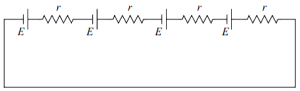
Four identical cells of emf $E$ and internal resistance $r$ are to be connected in series. If one of the cells is connected wrongly,the equivalent emf and effective internal resistance of the combination are
A
$4 E$ and $4 r$
B
$4 E$ and $2 r$
C
$2 E$ and $4 r$
D
$2 E$ and $2 r$
Solution
(C) When $n$ identical cells,each of emf $E$ and internal resistance $r$,are connected in series,the total emf is $nE$ and the total internal resistance is $nr$.
If $m$ cells are connected with reversed polarity,the effective emf $E'$ is given by the formula:
$E' = (n - 2m)E$
Here,the total number of cells $n = 4$ and the number of wrongly connected cells $m = 1$.
Substituting these values:
$E' = (4 - 2 \times 1)E = (4 - 2)E = 2E$
The internal resistance of cells in series is additive regardless of their polarity. Therefore,the effective internal resistance $r_{eq}$ remains:
$r_{eq} = n \times r = 4r$
Thus,the equivalent emf is $2E$ and the effective internal resistance is $4r$.
If $m$ cells are connected with reversed polarity,the effective emf $E'$ is given by the formula:
$E' = (n - 2m)E$
Here,the total number of cells $n = 4$ and the number of wrongly connected cells $m = 1$.
Substituting these values:
$E' = (4 - 2 \times 1)E = (4 - 2)E = 2E$
The internal resistance of cells in series is additive regardless of their polarity. Therefore,the effective internal resistance $r_{eq}$ remains:
$r_{eq} = n \times r = 4r$
Thus,the equivalent emf is $2E$ and the effective internal resistance is $4r$.
0 likesView Solution
37
PhysicsMediumMCQKCET · 2015
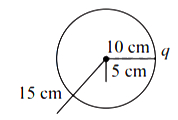
$A$ spherical shell of radius $10 \,cm$ is carrying a charge $q$. If the electric potential at distances $5 \,cm$, $10 \,cm$, and $15 \,cm$ from the centre of the spherical shell is $V_{1}$, $V_{2}$, and $V_{3}$ respectively, then:
A
$V_{1} > V_{2} > V_{3}$
B
$V_{1} < V_{2} < V_{3}$
C
$V_{1} = V_{2} > V_{3}$
D
$V_{1} = V_{2} < V_{3}$
Solution
(C) For a charged spherical shell of radius $R = 10 \,cm$ carrying charge $q$:
$1$. Inside the shell $(r < R)$, the electric potential is constant and equal to the potential at the surface: $V = \frac{1}{4 \pi \varepsilon_{0}} \frac{q}{R}$.
$2$. Outside the shell $(r > R)$, the potential varies inversely with distance: $V = \frac{1}{4 \pi \varepsilon_{0}} \frac{q}{r}$.
Given distances are $r_{1} = 5 \,cm$, $r_{2} = 10 \,cm$, and $r_{3} = 15 \,cm$.
Since $r_{1} < R$ and $r_{2} = R$, we have $V_{1} = V_{2} = \frac{1}{4 \pi \varepsilon_{0}} \frac{q}{10}$.
For $r_{3} = 15 \,cm$, $V_{3} = \frac{1}{4 \pi \varepsilon_{0}} \frac{q}{15}$.
Comparing the values, since $15 > 10$, it follows that $\frac{q}{15} < \frac{q}{10}$, therefore $V_{3} < V_{1} = V_{2}$.
Thus, the correct relation is $V_{1} = V_{2} > V_{3}$.
$1$. Inside the shell $(r < R)$, the electric potential is constant and equal to the potential at the surface: $V = \frac{1}{4 \pi \varepsilon_{0}} \frac{q}{R}$.
$2$. Outside the shell $(r > R)$, the potential varies inversely with distance: $V = \frac{1}{4 \pi \varepsilon_{0}} \frac{q}{r}$.
Given distances are $r_{1} = 5 \,cm$, $r_{2} = 10 \,cm$, and $r_{3} = 15 \,cm$.
Since $r_{1} < R$ and $r_{2} = R$, we have $V_{1} = V_{2} = \frac{1}{4 \pi \varepsilon_{0}} \frac{q}{10}$.
For $r_{3} = 15 \,cm$, $V_{3} = \frac{1}{4 \pi \varepsilon_{0}} \frac{q}{15}$.
Comparing the values, since $15 > 10$, it follows that $\frac{q}{15} < \frac{q}{10}$, therefore $V_{3} < V_{1} = V_{2}$.
Thus, the correct relation is $V_{1} = V_{2} > V_{3}$.
0 likesView Solution
38
PhysicsEasyMCQKCET · 2015
$A$ parallel plate capacitor is charged and then isolated. The effect of increasing the plate separation on charge,potential,and capacitance respectively are:
A
constant,decreases,decreases
B
increases,decreases,decreases
C
constant,decreases,increases
D
constant,increases,decreases
Solution
(D) Given that the parallel plate capacitor is charged and then isolated. Therefore,the charge $Q$ remains constant.
Capacitance of a parallel plate capacitor is given by $C = \frac{\varepsilon_{0} A}{d}$,which implies $C \propto \frac{1}{d}$.
If the separation $d$ between the plates is increased,the capacitance $C$ decreases.
From the relation $Q = CV$,we have $V = \frac{Q}{C}$. Since $Q$ is constant and $C$ decreases,the potential $V$ must increase.
Thus,on increasing the plate separation,the charge remains constant,the potential increases,and the capacitance decreases.
Capacitance of a parallel plate capacitor is given by $C = \frac{\varepsilon_{0} A}{d}$,which implies $C \propto \frac{1}{d}$.
If the separation $d$ between the plates is increased,the capacitance $C$ decreases.
From the relation $Q = CV$,we have $V = \frac{Q}{C}$. Since $Q$ is constant and $C$ decreases,the potential $V$ must increase.
Thus,on increasing the plate separation,the charge remains constant,the potential increases,and the capacitance decreases.
0 likesView Solution
39
PhysicsEasyMCQKCET · 2015
Two concentric coils each of radius equal to $2\pi \text{ cm}$ are placed at right angles to each other. If $3 \text{ A}$ and $4 \text{ A}$ are the currents flowing through the two coils respectively,the magnetic induction (in $\text{Wb m}^{-2}$) at the centre of the coils will be:
A
$12 \times 10^{-5}$
B
$10^{-5}$
C
$5 \times 10^{-5}$
D
$7 \times 10^{-5}$
Solution
(C) The magnetic field at the centre of a circular coil is given by $B = \frac{\mu_0 I}{2a}$,where $a$ is the radius.
Given $a = 2\pi \text{ cm} = 2\pi \times 10^{-2} \text{ m}$.
For the first coil with current $I_1 = 3 \text{ A}$:
$B_1 = \frac{\mu_0 \times 3}{2 \times 2\pi \times 10^{-2}} = \frac{4\pi \times 10^{-7} \times 3}{4\pi \times 10^{-2}} = 3 \times 10^{-5} \text{ T}$.
For the second coil with current $I_2 = 4 \text{ A}$:
$B_2 = \frac{\mu_0 \times 4}{2 \times 2\pi \times 10^{-2}} = \frac{4\pi \times 10^{-7} \times 4}{4\pi \times 10^{-2}} = 4 \times 10^{-5} \text{ T}$.
Since the coils are placed at right angles,the resultant magnetic field is $B = \sqrt{B_1^2 + B_2^2}$.
$B = \sqrt{(3 \times 10^{-5})^2 + (4 \times 10^{-5})^2} = \sqrt{9 \times 10^{-10} + 16 \times 10^{-10}} = \sqrt{25 \times 10^{-10}} = 5 \times 10^{-5} \text{ T}$.
Given $a = 2\pi \text{ cm} = 2\pi \times 10^{-2} \text{ m}$.
For the first coil with current $I_1 = 3 \text{ A}$:
$B_1 = \frac{\mu_0 \times 3}{2 \times 2\pi \times 10^{-2}} = \frac{4\pi \times 10^{-7} \times 3}{4\pi \times 10^{-2}} = 3 \times 10^{-5} \text{ T}$.
For the second coil with current $I_2 = 4 \text{ A}$:
$B_2 = \frac{\mu_0 \times 4}{2 \times 2\pi \times 10^{-2}} = \frac{4\pi \times 10^{-7} \times 4}{4\pi \times 10^{-2}} = 4 \times 10^{-5} \text{ T}$.
Since the coils are placed at right angles,the resultant magnetic field is $B = \sqrt{B_1^2 + B_2^2}$.
$B = \sqrt{(3 \times 10^{-5})^2 + (4 \times 10^{-5})^2} = \sqrt{9 \times 10^{-10} + 16 \times 10^{-10}} = \sqrt{25 \times 10^{-10}} = 5 \times 10^{-5} \text{ T}$.
0 likesView Solution
40
PhysicsDifficultMCQKCET · 2015
$A$ proton beam enters a magnetic field of $ 10^{-4} \,Wb m^{-2} $ normally. If the specific charge of the proton is $ 10^{11} \,C kg^{-1} $ and its velocity is $ 10^{9} \,ms^{-1} $, then the radius of the circle described will be (in $\,m$)
A
$0.1$
B
$10$
C
$100$
D
$1$
Solution
(C) Given: Magnetic field $ B = 10^{-4} \,Wb m^{-2} $.
Specific charge of the proton $ \frac{q}{m} = 10^{11} \,C kg^{-1} $.
Velocity of the proton $ v = 10^{9} \,ms^{-1} $.
When a charged particle enters a magnetic field normally, it follows a circular path with radius $ r $ given by the formula:
$ r = \frac{mv}{qB} $.
We can rewrite this as $ r = \frac{v}{(\frac{q}{m}) \times B} $.
Substituting the given values:
$ r = \frac{10^{9}}{10^{11} \times 10^{-4}} $.
$ r = \frac{10^{9}}{10^{7}} $.
$ r = 10^{2} \,m = 100 \,m $.
Thus, the radius of the circle described is $ 100 \,m $.
Specific charge of the proton $ \frac{q}{m} = 10^{11} \,C kg^{-1} $.
Velocity of the proton $ v = 10^{9} \,ms^{-1} $.
When a charged particle enters a magnetic field normally, it follows a circular path with radius $ r $ given by the formula:
$ r = \frac{mv}{qB} $.
We can rewrite this as $ r = \frac{v}{(\frac{q}{m}) \times B} $.
Substituting the given values:
$ r = \frac{10^{9}}{10^{11} \times 10^{-4}} $.
$ r = \frac{10^{9}}{10^{7}} $.
$ r = 10^{2} \,m = 100 \,m $.
Thus, the radius of the circle described is $ 100 \,m $.
0 likesView Solution
41
PhysicsEasyMCQKCET · 2015
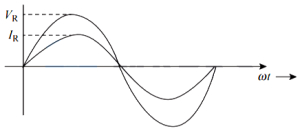
In an $LCR$ circuit,at resonance
A
the current and voltage are in phase
B
the impedance is maximum
C
the current is minimum
D
the current leads the voltage by $\pi / 2$
Solution
(A) In an $LCR$ circuit,resonance occurs when the inductive reactance $(X_L = \omega L)$ is equal to the capacitive reactance $(X_C = 1/(\omega C))$.
At this condition,the net reactance $X = X_L - X_C = 0$.
The impedance of the circuit is given by $Z = \sqrt{R^2 + (X_L - X_C)^2}$.
At resonance,$Z = R$,which is the minimum possible impedance.
Since the net reactance is zero,the phase angle $\phi = \tan^{-1}((X_L - X_C)/R) = 0$.
Therefore,the current and voltage are in phase at resonance.
At this condition,the net reactance $X = X_L - X_C = 0$.
The impedance of the circuit is given by $Z = \sqrt{R^2 + (X_L - X_C)^2}$.
At resonance,$Z = R$,which is the minimum possible impedance.
Since the net reactance is zero,the phase angle $\phi = \tan^{-1}((X_L - X_C)/R) = 0$.
Therefore,the current and voltage are in phase at resonance.
0 likesView Solution
42
PhysicsDifficultMCQKCET · 2015
If there is no torsion in the suspension thread, then the time period of a magnet executing $SHM$ is
A
$T=\frac{1}{2 \pi} \sqrt{\frac{M B}{I}}$
B
$T=\frac{1}{2 \pi} \sqrt{\frac{I}{M B}}$
C
$T=2 \pi \sqrt{\frac{I}{M B}}$
D
$T=2 \pi \sqrt{\frac{M B}{I}}$
Solution
(C) magnetic dipole of magnetic moment $M$ and moment of inertia $I$ placed in a uniform magnetic field $B$ experiences a restoring torque $\tau = -MB \sin \theta$.
For small oscillations, $\sin \theta \approx \theta$, so $\tau = -MB \theta$.
Comparing this with the equation for angular $SHM$, $\tau = -C \theta$, where $C = MB$.
The time period $T$ of an angular $SHM$ is given by $T = 2 \pi \sqrt{\frac{I}{C}}$.
Substituting $C = MB$, we get $T = 2 \pi \sqrt{\frac{I}{MB}}$.
For small oscillations, $\sin \theta \approx \theta$, so $\tau = -MB \theta$.
Comparing this with the equation for angular $SHM$, $\tau = -C \theta$, where $C = MB$.
The time period $T$ of an angular $SHM$ is given by $T = 2 \pi \sqrt{\frac{I}{C}}$.
Substituting $C = MB$, we get $T = 2 \pi \sqrt{\frac{I}{MB}}$.
0 likesView Solution
43
PhysicsDifficultMCQKCET · 2015
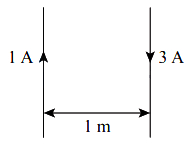
Two parallel wires $1 \text{ m}$ apart carry currents of $1 \text{ A}$ and $3 \text{ A}$ respectively in opposite directions. The force per unit length acting between these two wires is
A
$6 \times 10^{-7} \text{ N m}^{-1}$ repulsive
B
$6 \times 10^{-7} \text{ N m}^{-1}$ attractive
C
$6 \times 10^{-5} \text{ N m}^{-1}$ repulsive
D
$6 \times 10^{-5} \text{ N m}^{-1}$ attractive
Solution
(A) The force per unit length $f$ between two parallel wires carrying currents $I_1$ and $I_2$ separated by a distance $d$ is given by the formula:
$f = \frac{\mu_0}{4\pi} \frac{2 I_1 I_2}{d}$
Given values are $I_1 = 1 \text{ A}$,$I_2 = 3 \text{ A}$,$d = 1 \text{ m}$,and $\frac{\mu_0}{4\pi} = 10^{-7} \text{ T m A}^{-1}$.
Substituting these values into the formula:
$f = 10^{-7} \times \frac{2 \times 1 \times 3}{1} = 6 \times 10^{-7} \text{ N m}^{-1}$
Since the currents flow in opposite directions,the force between the wires is repulsive.
Therefore,the force per unit length is $6 \times 10^{-7} \text{ N m}^{-1}$ and it is repulsive.
$f = \frac{\mu_0}{4\pi} \frac{2 I_1 I_2}{d}$
Given values are $I_1 = 1 \text{ A}$,$I_2 = 3 \text{ A}$,$d = 1 \text{ m}$,and $\frac{\mu_0}{4\pi} = 10^{-7} \text{ T m A}^{-1}$.
Substituting these values into the formula:
$f = 10^{-7} \times \frac{2 \times 1 \times 3}{1} = 6 \times 10^{-7} \text{ N m}^{-1}$
Since the currents flow in opposite directions,the force between the wires is repulsive.
Therefore,the force per unit length is $6 \times 10^{-7} \text{ N m}^{-1}$ and it is repulsive.
0 likesView Solution
44
PhysicsEasyMCQKCET · 2015
The average power dissipated in a pure inductor is
A
$ \frac{1}{2} VI $
B
$ VI^{2} $
C
$ \frac{VI^{2}}{4} $
D
zero
Solution
(D) The average power dissipated in an $AC$ circuit is given by the formula $ P_{av} = VI \cos \phi $,where $ V $ is the $RMS$ voltage,$ I $ is the $RMS$ current,and $ \phi $ is the phase angle between voltage and current.
In a pure inductor,the current lags behind the voltage by a phase angle of $ \phi = \pi / 2 $.
Substituting this into the power formula: $ P_{av} = VI \cos(\pi / 2) $.
Since $ \cos(\pi / 2) = 0 $,we get $ P_{av} = VI \times 0 = 0 $.
Therefore,the average power dissipated in a pure inductor is zero.
In a pure inductor,the current lags behind the voltage by a phase angle of $ \phi = \pi / 2 $.
Substituting this into the power formula: $ P_{av} = VI \cos(\pi / 2) $.
Since $ \cos(\pi / 2) = 0 $,we get $ P_{av} = VI \times 0 = 0 $.
Therefore,the average power dissipated in a pure inductor is zero.
0 likesView Solution
45
PhysicsEasyMCQKCET · 2015
An aircraft with a wingspan of $40 \text{ m}$ flies with a speed of $1080 \text{ km h}^{-1}$ in the eastward direction at a constant altitude in the northern hemisphere,where the vertical component of the earth's magnetic field is $1.75 \times 10^{-5} \text{ T}$. The emf developed between the tips of the wings is: (in $\text{ V}$)
A
$0.5$
B
$0.34$
C
$0.21$
D
$2.1$
Solution
(C) Given: Wingspan $l = 40 \text{ m}$,speed $v = 1080 \text{ km h}^{-1}$.
Convert speed to $SI$ units: $v = 1080 \times \frac{5}{18} \text{ m s}^{-1} = 300 \text{ m s}^{-1}$.
Vertical component of Earth's magnetic field $B = 1.75 \times 10^{-5} \text{ T}$.
The motional emf induced across the wingspan is given by $E = B l v$.
Substituting the values: $E = (1.75 \times 10^{-5} \text{ T}) \times (40 \text{ m}) \times (300 \text{ m s}^{-1})$.
$E = 1.75 \times 10^{-5} \times 12000 = 1.75 \times 0.12 = 0.21 \text{ V}$.
Thus,the emf developed between the tips of the wings is $0.21 \text{ V}$.
Convert speed to $SI$ units: $v = 1080 \times \frac{5}{18} \text{ m s}^{-1} = 300 \text{ m s}^{-1}$.
Vertical component of Earth's magnetic field $B = 1.75 \times 10^{-5} \text{ T}$.
The motional emf induced across the wingspan is given by $E = B l v$.
Substituting the values: $E = (1.75 \times 10^{-5} \text{ T}) \times (40 \text{ m}) \times (300 \text{ m s}^{-1})$.
$E = 1.75 \times 10^{-5} \times 12000 = 1.75 \times 0.12 = 0.21 \text{ V}$.
Thus,the emf developed between the tips of the wings is $0.21 \text{ V}$.
0 likesView Solution
46
PhysicsEasyMCQKCET · 2015
Two coils have a mutual inductance of $ 0.005 \ H $. The current changes in the first coil according to the equation $ i = i_{m} \sin \omega t $,where $ i_{m} = 10 \ A $ and $ \omega = 100 \pi \ rad \ s^{-1} $. The maximum value of the emf induced in the second coil is:
A
$ 2 \pi $
B
$ 5 \pi $
C
$ \pi $
D
$ 4 \pi $
Solution
(B) Given: Mutual inductance $ M = 0.005 \ H $,current $ i = i_{m} \sin \omega t $,peak current $ i_{m} = 10 \ A $,and angular frequency $ \omega = 100 \pi \ rad \ s^{-1} $.
The induced emf $ \varepsilon $ in the second coil is given by $ \varepsilon = M \frac{di}{dt} $.
Substituting the expression for current: $ \varepsilon = M \frac{d}{dt} (i_{m} \sin \omega t) = M i_{m} \omega \cos \omega t $.
The maximum value of the induced emf $ \varepsilon_{\max} $ occurs when $ \cos \omega t = 1 $.
Therefore,$ \varepsilon_{\max} = M \omega i_{m} $.
Substituting the values: $ \varepsilon_{\max} = 0.005 \times 100 \pi \times 10 = 5 \pi \ V $.
Thus,the maximum value of the emf induced in the second coil is $ 5 \pi \ V $.
The induced emf $ \varepsilon $ in the second coil is given by $ \varepsilon = M \frac{di}{dt} $.
Substituting the expression for current: $ \varepsilon = M \frac{d}{dt} (i_{m} \sin \omega t) = M i_{m} \omega \cos \omega t $.
The maximum value of the induced emf $ \varepsilon_{\max} $ occurs when $ \cos \omega t = 1 $.
Therefore,$ \varepsilon_{\max} = M \omega i_{m} $.
Substituting the values: $ \varepsilon_{\max} = 0.005 \times 100 \pi \times 10 = 5 \pi \ V $.
Thus,the maximum value of the emf induced in the second coil is $ 5 \pi \ V $.
0 likesView Solution
47
PhysicsMediumMCQKCET · 2015
To observe diffraction,the size of the obstacle
A
has no relation to wavelength.
B
should be $ \lambda / 2 $,where $ \lambda $ is the wavelength.
C
should be much larger than the wavelength.
D
should be of the order of wavelength.
Solution
(D) Diffraction is the phenomenon of the bending or spreading of light around the corners of an obstacle or through an aperture.
For significant diffraction to occur,the size of the obstacle or the aperture must be comparable to the wavelength $( \lambda )$ of the incident light.
If the size of the obstacle is much larger than the wavelength,the light travels in a straight line (rectilinear propagation),and diffraction is negligible.
Therefore,the condition for observing diffraction is that the size of the obstacle should be of the order of the wavelength of light.
For significant diffraction to occur,the size of the obstacle or the aperture must be comparable to the wavelength $( \lambda )$ of the incident light.
If the size of the obstacle is much larger than the wavelength,the light travels in a straight line (rectilinear propagation),and diffraction is negligible.
Therefore,the condition for observing diffraction is that the size of the obstacle should be of the order of the wavelength of light.
0 likesView Solution
48
PhysicsEasyMCQKCET · 2015
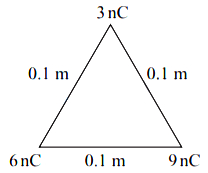
Three point charges $3 \text{ nC}$,$6 \text{ nC}$,and $9 \text{ nC}$ are placed at the corners of an equilateral triangle of side $0.1 \text{ m}$. The potential energy of the system is:
A
$8.91 \times 10^{-6} \text{ J}$
B
$9.91 \times 10^{-6} \text{ J}$
C
$9.91 \times 10^{-5} \text{ J}$
D
None of these
Solution
(D) The potential energy $U$ of a system of point charges is given by the sum of the potential energies of all pairs of charges:
$U = \frac{1}{4 \pi \epsilon_0} \left( \frac{q_1 q_2}{r_{12}} + \frac{q_2 q_3}{r_{23}} + \frac{q_3 q_1}{r_{31}} \right)$
Given $q_1 = 3 \times 10^{-9} \text{ C}$,$q_2 = 6 \times 10^{-9} \text{ C}$,$q_3 = 9 \times 10^{-9} \text{ C}$,and $r = 0.1 \text{ m}$.
$U = \frac{9 \times 10^9}{0.1} \left( (3 \times 6) + (6 \times 9) + (9 \times 3) \right) \times 10^{-18} \text{ J}$
$U = 9 \times 10^{11} \times (18 + 54 + 27) \times 10^{-18} \text{ J}$
$U = 9 \times 10^{11} \times 99 \times 10^{-18} \text{ J}$
$U = 891 \times 10^{-7} \text{ J} = 8.91 \times 10^{-6} \text{ J}$
$U = \frac{1}{4 \pi \epsilon_0} \left( \frac{q_1 q_2}{r_{12}} + \frac{q_2 q_3}{r_{23}} + \frac{q_3 q_1}{r_{31}} \right)$
Given $q_1 = 3 \times 10^{-9} \text{ C}$,$q_2 = 6 \times 10^{-9} \text{ C}$,$q_3 = 9 \times 10^{-9} \text{ C}$,and $r = 0.1 \text{ m}$.
$U = \frac{9 \times 10^9}{0.1} \left( (3 \times 6) + (6 \times 9) + (9 \times 3) \right) \times 10^{-18} \text{ J}$
$U = 9 \times 10^{11} \times (18 + 54 + 27) \times 10^{-18} \text{ J}$
$U = 9 \times 10^{11} \times 99 \times 10^{-18} \text{ J}$
$U = 891 \times 10^{-7} \text{ J} = 8.91 \times 10^{-6} \text{ J}$
0 likesView Solution
49
PhysicsEasyMCQKCET · 2015
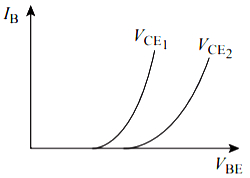
The input characteristics of a transistor in $CE$ mode is the graph obtained by plotting
A
$I_{B}$ against $V_{BE}$ at constant $V_{CE}$
B
$I_{B}$ against $V_{CE}$ at constant $V_{BE}$
C
$I_{B}$ against $I_{C}$ at constant $V_{CE}$
D
$I_{B}$ against $I_{C}$ at constant $V_{BE}$
Solution
(A) The input characteristics of a transistor in common emitter $(CE)$ configuration describe the relationship between the input current and the input voltage.
Specifically,it is the curve obtained by plotting the base current $(I_{B})$ against the base-emitter voltage $(V_{BE})$ while keeping the collector-emitter voltage $(V_{CE})$ constant.
This graph shows how the base current changes as the input voltage increases for different fixed values of the output voltage.
Specifically,it is the curve obtained by plotting the base current $(I_{B})$ against the base-emitter voltage $(V_{BE})$ while keeping the collector-emitter voltage $(V_{CE})$ constant.
This graph shows how the base current changes as the input voltage increases for different fixed values of the output voltage.
0 likesView Solution
50
PhysicsEasyMCQKCET · 2015
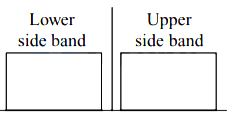
Amplitude modulation has
A
one carrier with two side band frequencies
B
one carrier
C
one carrier with infinite frequencies
D
one carrier with high frequency
Solution
(A) In amplitude modulation,the amplitude of the carrier wave is varied in accordance with the instantaneous value of the modulating signal.
Mathematically,the modulated wave consists of the carrier frequency $(f_c)$ and two sideband frequencies: the upper sideband $(f_c + f_m)$ and the lower sideband $(f_c - f_m)$,where $f_m$ is the frequency of the modulating signal.
Therefore,amplitude modulation consists of one carrier frequency and two sideband frequencies.
Mathematically,the modulated wave consists of the carrier frequency $(f_c)$ and two sideband frequencies: the upper sideband $(f_c + f_m)$ and the lower sideband $(f_c - f_m)$,where $f_m$ is the frequency of the modulating signal.
Therefore,amplitude modulation consists of one carrier frequency and two sideband frequencies.
0 likesView Solution
51
PhysicsEasyMCQKCET · 2015
Light of two different frequencies whose photons have energies $1 \text{ eV}$ and $2.5 \text{ eV}$ respectively,successively illuminate a metallic surface whose work function is $0.5 \text{ eV}$. The ratio of the maximum speeds of the emitted electrons will be:
A
$1:5$
B
$1:4$
C
$1:2$
D
$1:1$
Solution
(C) According to Einstein's photoelectric equation,the maximum kinetic energy $K_{max}$ of emitted electrons is given by $K_{max} = E - \Phi$,where $E$ is the energy of the incident photon and $\Phi$ is the work function of the metal.
For the first photon with energy $E_1 = 1 \text{ eV}$:
$K_1 = 1 \text{ eV} - 0.5 \text{ eV} = 0.5 \text{ eV}$.
For the second photon with energy $E_2 = 2.5 \text{ eV}$:
$K_2 = 2.5 \text{ eV} - 0.5 \text{ eV} = 2.0 \text{ eV}$.
Since $K_{max} = \frac{1}{2}mv^2$,the ratio of the kinetic energies is:
$\frac{K_1}{K_2} = \frac{0.5}{2.0} = \frac{1}{4}$.
Substituting the expression for kinetic energy:
$\frac{\frac{1}{2}mv_1^2}{\frac{1}{2}mv_2^2} = \frac{1}{4} \Rightarrow \frac{v_1^2}{v_2^2} = \frac{1}{4}$.
Taking the square root on both sides:
$\frac{v_1}{v_2} = \sqrt{\frac{1}{4}} = \frac{1}{2}$.
Thus,the ratio of the maximum speeds is $1:2$.
For the first photon with energy $E_1 = 1 \text{ eV}$:
$K_1 = 1 \text{ eV} - 0.5 \text{ eV} = 0.5 \text{ eV}$.
For the second photon with energy $E_2 = 2.5 \text{ eV}$:
$K_2 = 2.5 \text{ eV} - 0.5 \text{ eV} = 2.0 \text{ eV}$.
Since $K_{max} = \frac{1}{2}mv^2$,the ratio of the kinetic energies is:
$\frac{K_1}{K_2} = \frac{0.5}{2.0} = \frac{1}{4}$.
Substituting the expression for kinetic energy:
$\frac{\frac{1}{2}mv_1^2}{\frac{1}{2}mv_2^2} = \frac{1}{4} \Rightarrow \frac{v_1^2}{v_2^2} = \frac{1}{4}$.
Taking the square root on both sides:
$\frac{v_1}{v_2} = \sqrt{\frac{1}{4}} = \frac{1}{2}$.
Thus,the ratio of the maximum speeds is $1:2$.
0 likesView Solution
52
PhysicsMediumMCQKCET · 2015
Find the de-Broglie wavelength of an electron with kinetic energy of $ 120 eV $. (in $pm$)
A
$95$
B
$102$
C
$112$
D
$124$
Solution
(C) Given, kinetic energy of electron $K = 120 eV$.
The de-Broglie wavelength $\lambda$ is related to the accelerating potential $V$ (where $K = eV$) as:
$\lambda = \frac{1.227 \text{ nm}}{\sqrt{V}}$
Substituting $V = 120 V$:
$\lambda = \frac{1.227 \times 10^{-9} \text{ m}}{\sqrt{120}}$
$\lambda = \frac{1.227 \times 10^{-9}}{10.954}$
$\lambda \approx 0.112 \times 10^{-9} \text{ m}$
$\lambda = 112 \times 10^{-12} \text{ m} = 112 \text{ pm}$.
The de-Broglie wavelength $\lambda$ is related to the accelerating potential $V$ (where $K = eV$) as:
$\lambda = \frac{1.227 \text{ nm}}{\sqrt{V}}$
Substituting $V = 120 V$:
$\lambda = \frac{1.227 \times 10^{-9} \text{ m}}{\sqrt{120}}$
$\lambda = \frac{1.227 \times 10^{-9}}{10.954}$
$\lambda \approx 0.112 \times 10^{-9} \text{ m}$
$\lambda = 112 \times 10^{-12} \text{ m} = 112 \text{ pm}$.
0 likesView Solution
53
PhysicsMediumMCQKCET · 2015
Two spheres carrying charges $+6 \mu C$ and $+9 \mu C$ are separated by a distance $d$ and experience a force of repulsion $F$. When a charge of $-3 \mu C$ is added to both spheres and they are kept at the same distance as before,the new force of repulsion is:
A
$F$
B
$3F$
C
$F/3$
D
$F/9$
Solution
(C) The initial force between the two charges is given by Coulomb's Law: $F = k \frac{q_1 q_2}{d^2}$.
Substituting the initial values: $F = k \frac{(6 \mu C)(9 \mu C)}{d^2} = k \frac{54 \mu C^2}{d^2} \dots (1)$.
When a charge of $-3 \mu C$ is added to both spheres,the new charges are:
$q_1' = 6 \mu C - 3 \mu C = 3 \mu C$
$q_2' = 9 \mu C - 3 \mu C = 6 \mu C$.
The new force $F'$ is: $F' = k \frac{q_1' q_2'}{d^2} = k \frac{(3 \mu C)(6 \mu C)}{d^2} = k \frac{18 \mu C^2}{d^2} \dots (2)$.
Dividing equation $(2)$ by equation $(1)$:
$\frac{F'}{F} = \frac{18}{54} = \frac{1}{3}$.
Therefore,the new force is $F' = F/3$.
Substituting the initial values: $F = k \frac{(6 \mu C)(9 \mu C)}{d^2} = k \frac{54 \mu C^2}{d^2} \dots (1)$.
When a charge of $-3 \mu C$ is added to both spheres,the new charges are:
$q_1' = 6 \mu C - 3 \mu C = 3 \mu C$
$q_2' = 9 \mu C - 3 \mu C = 6 \mu C$.
The new force $F'$ is: $F' = k \frac{q_1' q_2'}{d^2} = k \frac{(3 \mu C)(6 \mu C)}{d^2} = k \frac{18 \mu C^2}{d^2} \dots (2)$.
Dividing equation $(2)$ by equation $(1)$:
$\frac{F'}{F} = \frac{18}{54} = \frac{1}{3}$.
Therefore,the new force is $F' = F/3$.
0 likesView Solution
54
PhysicsEasyMCQKCET · 2015
Pick out the statement which is incorrect.
A
The tangent drawn to a line of force represents the direction of electric field.
B
The electric field lines form closed loops.
C
$A$ negative test charge experiences a force opposite to the direction of the field.
D
Field lines never intersect.
Solution
(B) Statement $A$ is correct: The tangent drawn to a line of force at any point gives the direction of the electric field at that point.
Statement $B$ is incorrect: Electric field lines originate from positive charges and terminate at negative charges. They do not form closed loops,unlike magnetic field lines.
Statement $C$ is correct: The force on a charge $q$ in an electric field $E$ is given by $F = qE$. If $q$ is negative,the force $F$ is in the direction opposite to $E$.
Statement $D$ is correct: Two electric field lines can never intersect,because if they did,there would be two directions for the electric field at the point of intersection,which is physically impossible.
Statement $B$ is incorrect: Electric field lines originate from positive charges and terminate at negative charges. They do not form closed loops,unlike magnetic field lines.
Statement $C$ is correct: The force on a charge $q$ in an electric field $E$ is given by $F = qE$. If $q$ is negative,the force $F$ is in the direction opposite to $E$.
Statement $D$ is correct: Two electric field lines can never intersect,because if they did,there would be two directions for the electric field at the point of intersection,which is physically impossible.
0 likesView Solution
55
PhysicsEasyMCQKCET · 2015
The angle between the dipole moment and electric field at any point on the equatorial plane is (in $^{\circ}$)
A
$0$
B
$90$
C
$180$
D
$45$
Solution
(C) The electric dipole moment $\vec{p}$ is a vector directed from the negative charge $(-q)$ to the positive charge $(+q)$.
At any point on the equatorial plane of an electric dipole,the resultant electric field $\vec{E}$ is directed parallel to the dipole axis but in the opposite direction to the dipole moment vector $\vec{p}$.
Since the electric field vector $\vec{E}$ and the dipole moment vector $\vec{p}$ are anti-parallel,the angle between them is $180^{\circ}$.
At any point on the equatorial plane of an electric dipole,the resultant electric field $\vec{E}$ is directed parallel to the dipole axis but in the opposite direction to the dipole moment vector $\vec{p}$.
Since the electric field vector $\vec{E}$ and the dipole moment vector $\vec{p}$ are anti-parallel,the angle between them is $180^{\circ}$.
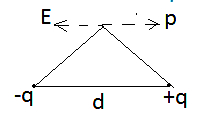
0 likesView Solution
56
PhysicsEasyMCQKCET · 2015
An $LED$ is constructed from a $pn$ junction based on a certain semiconducting material whose energy gap is $1.9 \ eV$. The wavelength of the emitted light is:
A
$2.9 \times 10^{-9} \ m$
B
$1.6 \times 10^{-8} \ m$
C
$6.5 \times 10^{-7} \ m$
D
$9.1 \times 10^{-5} \ m$
Solution
(C) The energy gap $E_g$ of a semiconductor is related to the wavelength $\lambda$ of the emitted light by the formula: $E_g = \frac{hc}{\lambda}$.
Given $E_g = 1.9 \ eV$. Converting this to Joules: $E_g = 1.9 \times 1.6 \times 10^{-19} \ J$.
Using the values $h = 6.6 \times 10^{-34} \ J \cdot s$ and $c = 3 \times 10^8 \ m/s$:
$\lambda = \frac{hc}{E_g} = \frac{6.6 \times 10^{-34} \times 3 \times 10^8}{1.9 \times 1.6 \times 10^{-19}} \ m$.
$\lambda = \frac{19.8 \times 10^{-26}}{3.04 \times 10^{-19}} \ m \approx 6.513 \times 10^{-7} \ m$.
Rounding to the nearest given option,the wavelength is $6.5 \times 10^{-7} \ m$.
Given $E_g = 1.9 \ eV$. Converting this to Joules: $E_g = 1.9 \times 1.6 \times 10^{-19} \ J$.
Using the values $h = 6.6 \times 10^{-34} \ J \cdot s$ and $c = 3 \times 10^8 \ m/s$:
$\lambda = \frac{hc}{E_g} = \frac{6.6 \times 10^{-34} \times 3 \times 10^8}{1.9 \times 1.6 \times 10^{-19}} \ m$.
$\lambda = \frac{19.8 \times 10^{-26}}{3.04 \times 10^{-19}} \ m \approx 6.513 \times 10^{-7} \ m$.
Rounding to the nearest given option,the wavelength is $6.5 \times 10^{-7} \ m$.
0 likesView Solution
57
PhysicsMediumMCQKCET · 2015
$A$ radioactive decay can form an isotope of the original nucleus with the emission of which particles?
A
one $ \alpha $ and four $ \beta $
B
one $ \alpha $ and two $ \beta $
C
one $ \alpha $ and one $ \beta $
D
four $ \alpha $ and one $ \beta $
Solution
(B) Let the original nucleus be $ _{Z}^{A}X $.
When an $ \alpha $-particle $( _{2}^{4}He )$ is emitted,the mass number decreases by $ 4 $ and the atomic number decreases by $ 2 $. The new nucleus is $ _{Z-2}^{A-4}Y $.
When a $ \beta $-particle $( _{-1}^{0}e )$ is emitted,the atomic number increases by $ 1 $ and the mass number remains unchanged.
If we emit one $ \alpha $ and two $ \beta $ particles:
$1$. After $ \alpha $ emission: $ _{Z-2}^{A-4}Y $
$2$. After first $ \beta $ emission: $ _{Z-1}^{A-4}Y' $
$3$. After second $ \beta $ emission: $ _{Z}^{A-4}Y'' $
Since the atomic number $ Z $ is the same as the original nucleus,it is an isotope of the original nucleus.
When an $ \alpha $-particle $( _{2}^{4}He )$ is emitted,the mass number decreases by $ 4 $ and the atomic number decreases by $ 2 $. The new nucleus is $ _{Z-2}^{A-4}Y $.
When a $ \beta $-particle $( _{-1}^{0}e )$ is emitted,the atomic number increases by $ 1 $ and the mass number remains unchanged.
If we emit one $ \alpha $ and two $ \beta $ particles:
$1$. After $ \alpha $ emission: $ _{Z-2}^{A-4}Y $
$2$. After first $ \beta $ emission: $ _{Z-1}^{A-4}Y' $
$3$. After second $ \beta $ emission: $ _{Z}^{A-4}Y'' $
Since the atomic number $ Z $ is the same as the original nucleus,it is an isotope of the original nucleus.
0 likesView Solution
58
PhysicsDifficultMCQKCET · 2015
The polarizing angle of glass is $57^{\circ}$. $A$ ray of light which is incident at this angle will have an angle of refraction as (in $^{\circ}$)
A
$25$
B
$33$
C
$43$
D
$38$
Solution
(B) Given,the polarizing angle of glass,$i_{p} = 57^{\circ}$.
We know that when light is incident at the polarizing angle,the reflected ray and the refracted ray are at right angles to each other.
According to Brewster's law,the relationship between the angle of incidence $(i_{p})$ and the angle of refraction $(r)$ is given by $i_{p} + r = 90^{\circ}$.
Therefore,$r = 90^{\circ} - i_{p}$.
Substituting the given value,$r = 90^{\circ} - 57^{\circ} = 33^{\circ}$.
Thus,the angle of refraction is $33^{\circ}$.
We know that when light is incident at the polarizing angle,the reflected ray and the refracted ray are at right angles to each other.
According to Brewster's law,the relationship between the angle of incidence $(i_{p})$ and the angle of refraction $(r)$ is given by $i_{p} + r = 90^{\circ}$.
Therefore,$r = 90^{\circ} - i_{p}$.
Substituting the given value,$r = 90^{\circ} - 57^{\circ} = 33^{\circ}$.
Thus,the angle of refraction is $33^{\circ}$.
0 likesView Solution
59
PhysicsDifficultMCQKCET · 2015
Two cells of emf $E_{1}$ and $E_{2}$ are joined in opposition (such that $E_{1} > E_{2}$). If $r_{1}$ and $r_{2}$ are the internal resistances and $R$ is the external resistance,then the terminal potential difference across the external resistance $R$ is:
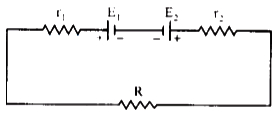
A
$ \frac{E_{1}+E_{2}}{r_{1}+r_{2}} \times R $
B
$ \frac{E_{1}+E_{2}}{r_{1}+r_{2}+R} \times R $
C
$ \frac{E_{1}-E_{2}}{r_{1}+r_{2}} \times R $
D
$ \frac{E_{1}-E_{2}}{r_{1}+r_{2}+R} \times R $
Solution
(D) The two cells are connected in opposition,so the net electromotive force (emf) of the circuit is $E_{net} = E_{1} - E_{2}$.
The total resistance of the circuit is the sum of the internal resistances and the external resistance,which is $R_{total} = r_{1} + r_{2} + R$.
According to Ohm's law,the current $I$ flowing through the circuit is given by $I = \frac{E_{net}}{R_{total}} = \frac{E_{1} - E_{2}}{r_{1} + r_{2} + R}$.
The terminal potential difference $V$ across the external resistance $R$ is given by $V = I \times R$.
Substituting the value of $I$,we get $V = \frac{E_{1} - E_{2}}{r_{1} + r_{2} + R} \times R$.
The total resistance of the circuit is the sum of the internal resistances and the external resistance,which is $R_{total} = r_{1} + r_{2} + R$.
According to Ohm's law,the current $I$ flowing through the circuit is given by $I = \frac{E_{net}}{R_{total}} = \frac{E_{1} - E_{2}}{r_{1} + r_{2} + R}$.
The terminal potential difference $V$ across the external resistance $R$ is given by $V = I \times R$.
Substituting the value of $I$,we get $V = \frac{E_{1} - E_{2}}{r_{1} + r_{2} + R} \times R$.
0 likesView Solution
60
PhysicsEasyMCQKCET · 2015
Three resistances $2 \Omega, 3 \Omega$ and $4 \Omega$ are connected in parallel. The ratio of currents passing through them when a potential difference is applied across its ends will be
A
$6: 3: 2$
B
$6: 4: 3$
C
$5: 4: 3$
D
$4: 3: 2$
Solution
(B) According to Ohm's law,$V = IR$,where $V$ is the potential difference,$I$ is the current,and $R$ is the resistance.
Since the resistors are connected in parallel,the potential difference $V$ across each resistor is the same.
Therefore,$I = V/R$,which implies $I \propto 1/R$.
Let the currents through the $2 \Omega, 3 \Omega$,and $4 \Omega$ resistors be $I_1, I_2$,and $I_3$ respectively.
Then,$I_1 : I_2 : I_3 = \frac{1}{2} : \frac{1}{3} : \frac{1}{4}$.
To simplify this ratio,multiply each term by the least common multiple $(LCM)$ of $2, 3$,and $4$,which is $12$.
$I_1 : I_2 : I_3 = (\frac{1}{2} \times 12) : (\frac{1}{3} \times 12) : (\frac{1}{4} \times 12) = 6 : 4 : 3$.
Since the resistors are connected in parallel,the potential difference $V$ across each resistor is the same.
Therefore,$I = V/R$,which implies $I \propto 1/R$.
Let the currents through the $2 \Omega, 3 \Omega$,and $4 \Omega$ resistors be $I_1, I_2$,and $I_3$ respectively.
Then,$I_1 : I_2 : I_3 = \frac{1}{2} : \frac{1}{3} : \frac{1}{4}$.
To simplify this ratio,multiply each term by the least common multiple $(LCM)$ of $2, 3$,and $4$,which is $12$.
$I_1 : I_2 : I_3 = (\frac{1}{2} \times 12) : (\frac{1}{3} \times 12) : (\frac{1}{4} \times 12) = 6 : 4 : 3$.
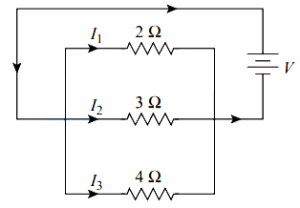
0 likesView Solution
Vedclass Products
For Students
Vedclass Test Series
Mock tests in real KCET style covering Physics with performance analysis. 5-day free trial.
Start Free TrialFor Teachers
Exam Paper Generator
Generate Set A/B/C/D Physics papers from 7.5L+ questions in 2 minutes. 3 chapters free.
Try FreeFor Institutes
Online Exam Module
Run live KCET mock exams with unlimited students, 360° analytics & white-label branding.
See DemoFrequently Asked Questions
How many Physics questions are in KCET 2015?
There are 60 Physics questions from the KCET 2015 paper on Vedclass, each with a detailed step-by-step solution in English.
Are KCET 2015 Physics solutions available in English?
Yes. All solutions on this page are in English. You can also switch to English or Hindi using the language buttons above the questions.
Can I practice KCET 2015 Physics as a timed test?
Yes. Use the Vedclass Test Series to attempt a full KCET mock test covering Physics with time limits and instant score analysis.
Can teachers create Physics papers from KCET previous year questions?
Yes. The Vedclass Exam Paper Generator lets teachers mix KCET Physics questions and generate Set A/B/C/D papers in minutes.
For Teachers & Institutes
Build a Custom Physics Paper
Pick KCET 2015 Physics questions, set difficulty, and generate Set A/B/C/D in 2 minutes.