
PhysicsQ1–60 of 60 questions
Page 1 of 1 · English
1
PhysicsEasyMCQKCET · 2020
One end of a string of length $l$ is connected to a particle of mass $m$ and the other to a small peg on a smooth horizontal table. If the particle moves in a circle with speed $v$,the net force on the particle (directed towards the centre) is ($T$ is the tension in the string).
A
$T$
B
$T - \frac{m v^{2}}{l}$
C
$T + \frac{m v^{2}}{l}$
D
zero
Solution
(A) The particle is moving in a uniform circular motion on a smooth horizontal table.
In this motion,the only horizontal force acting on the particle towards the center of the circle is the tension $T$ in the string.
According to Newton's second law of motion,the net force acting on a body in circular motion must be equal to the centripetal force required for that motion.
The centripetal force $F_c$ is given by the formula $F_c = \frac{m v^{2}}{l}$.
Since the tension $T$ is the only force providing this centripetal force,we have:
Net force (directed towards the centre) $= T = \frac{m v^{2}}{l}$.
Therefore,the net force on the particle directed towards the centre is $T$.
In this motion,the only horizontal force acting on the particle towards the center of the circle is the tension $T$ in the string.
According to Newton's second law of motion,the net force acting on a body in circular motion must be equal to the centripetal force required for that motion.
The centripetal force $F_c$ is given by the formula $F_c = \frac{m v^{2}}{l}$.
Since the tension $T$ is the only force providing this centripetal force,we have:
Net force (directed towards the centre) $= T = \frac{m v^{2}}{l}$.
Therefore,the net force on the particle directed towards the centre is $T$.
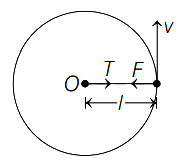
0 likesView Solution
2
PhysicsEasyMCQKCET · 2020
$A$ cylindrical wire has a mass $(0.3 \pm 0.003) \text{ g}$,radius $(0.5 \pm 0.005) \text{ mm}$ and length $(6 \pm 0.06) \text{ cm}$. The maximum percentage error in the measurement of its density is (in $\%$)
A
$1$
B
$2$
C
$3$
D
$4$
Solution
(D) Given,mass,$m = (0.3 \pm 0.003) \text{ g}$
Radius,$r = (0.5 \pm 0.005) \text{ mm}$
Length,$l = (6 \pm 0.06) \text{ cm}$
Density of cylinder,$\rho = \frac{\text{Mass}}{\text{Volume}} = \frac{m}{\pi r^2 l}$
The fractional error in $\rho$ is given by:
$\frac{\Delta \rho}{\rho} = \frac{\Delta m}{m} + 2\frac{\Delta r}{r} + \frac{\Delta l}{l}$
Percentage error in $\rho$ is:
$\frac{\Delta \rho}{\rho} \times 100 = \left( \frac{\Delta m}{m} \times 100 \right) + 2 \left( \frac{\Delta r}{r} \times 100 \right) + \left( \frac{\Delta l}{l} \times 100 \right)$
Substituting the values:
$\frac{\Delta \rho}{\rho} \times 100 = \left( \frac{0.003}{0.3} \times 100 \right) + 2 \left( \frac{0.005}{0.5} \times 100 \right) + \left( \frac{0.06}{6} \times 100 \right)$
$\frac{\Delta \rho}{\rho} \times 100 = 1\% + 2(1\%) + 1\% = 4\%$
Radius,$r = (0.5 \pm 0.005) \text{ mm}$
Length,$l = (6 \pm 0.06) \text{ cm}$
Density of cylinder,$\rho = \frac{\text{Mass}}{\text{Volume}} = \frac{m}{\pi r^2 l}$
The fractional error in $\rho$ is given by:
$\frac{\Delta \rho}{\rho} = \frac{\Delta m}{m} + 2\frac{\Delta r}{r} + \frac{\Delta l}{l}$
Percentage error in $\rho$ is:
$\frac{\Delta \rho}{\rho} \times 100 = \left( \frac{\Delta m}{m} \times 100 \right) + 2 \left( \frac{\Delta r}{r} \times 100 \right) + \left( \frac{\Delta l}{l} \times 100 \right)$
Substituting the values:
$\frac{\Delta \rho}{\rho} \times 100 = \left( \frac{0.003}{0.3} \times 100 \right) + 2 \left( \frac{0.005}{0.5} \times 100 \right) + \left( \frac{0.06}{6} \times 100 \right)$
$\frac{\Delta \rho}{\rho} \times 100 = 1\% + 2(1\%) + 1\% = 4\%$
0 likesView Solution
3
PhysicsMediumMCQKCET · 2020
An iceberg floats in water with part of it submerged. What is the fraction of the volume of the iceberg submerged,if the density of ice is $\rho_{i} = 0.917 \ g \ cm^{-3}$ and the density of water is $\rho_{w} = 1.00 \ g \ cm^{-3}$?
A
$0.917$
B
$1.000$
C
$0.458$
D
$0.083$
Solution
(A) According to the Law of Floatation,for an object floating in a liquid,the weight of the object is equal to the weight of the liquid displaced.
Let $V$ be the total volume of the iceberg and $V_{sub}$ be the volume submerged in water.
Weight of the iceberg = $V \cdot \rho_{i} \cdot g$
Weight of the water displaced = $V_{sub} \cdot \rho_{w} \cdot g$
Equating the two: $V \cdot \rho_{i} \cdot g = V_{sub} \cdot \rho_{w} \cdot g$
The fraction of the volume submerged is $\frac{V_{sub}}{V} = \frac{\rho_{i}}{\rho_{w}}$.
Given $\rho_{i} = 0.917 \ g \ cm^{-3}$ and $\rho_{w} = 1.00 \ g \ cm^{-3}$.
Therefore,$\frac{V_{sub}}{V} = \frac{0.917}{1.00} = 0.917$.
Let $V$ be the total volume of the iceberg and $V_{sub}$ be the volume submerged in water.
Weight of the iceberg = $V \cdot \rho_{i} \cdot g$
Weight of the water displaced = $V_{sub} \cdot \rho_{w} \cdot g$
Equating the two: $V \cdot \rho_{i} \cdot g = V_{sub} \cdot \rho_{w} \cdot g$
The fraction of the volume submerged is $\frac{V_{sub}}{V} = \frac{\rho_{i}}{\rho_{w}}$.
Given $\rho_{i} = 0.917 \ g \ cm^{-3}$ and $\rho_{w} = 1.00 \ g \ cm^{-3}$.
Therefore,$\frac{V_{sub}}{V} = \frac{0.917}{1.00} = 0.917$.
0 likesView Solution
4
PhysicsMediumMCQKCET · 2020
What happens when a soap bubble is charged?
A
Its radius increases
B
Its radius decreases
C
The radius remains the same
D
Its radius may increase or decrease
Solution
(A) When a soap bubble is charged,the charge distributes uniformly over its surface.
Due to the electrostatic repulsion between the like charges on the surface,an outward pressure is exerted on the bubble.
This additional outward pressure acts in the same direction as the pressure due to the air inside the bubble.
Consequently,the bubble expands to balance these forces,leading to an increase in its radius.
Due to the electrostatic repulsion between the like charges on the surface,an outward pressure is exerted on the bubble.
This additional outward pressure acts in the same direction as the pressure due to the air inside the bubble.
Consequently,the bubble expands to balance these forces,leading to an increase in its radius.
0 likesView Solution
5
PhysicsEasyMCQKCET · 2020
Young's modulus of a perfect rigid body is
A
zero
B
unity
C
infinity
D
Between $(a)$ and $(b)$
Solution
(C) For a perfect rigid body,the strain is always zero for any applied stress.
Young's modulus $(Y)$ is defined as the ratio of normal stress to longitudinal strain:
$Y = \frac{\text{Normal stress}}{\text{Longitudinal strain}}$
Since the strain for a perfectly rigid body is $0$,the denominator becomes $0$.
Therefore,$Y = \frac{\text{Stress}}{0} = \infty$.
Thus,the Young's modulus of a perfect rigid body is infinity.
Young's modulus $(Y)$ is defined as the ratio of normal stress to longitudinal strain:
$Y = \frac{\text{Normal stress}}{\text{Longitudinal strain}}$
Since the strain for a perfectly rigid body is $0$,the denominator becomes $0$.
Therefore,$Y = \frac{\text{Stress}}{0} = \infty$.
Thus,the Young's modulus of a perfect rigid body is infinity.
0 likesView Solution
6
PhysicsMediumMCQKCET · 2020
The value of acceleration due to gravity at a height of $10 \,km$ from the surface of the Earth is $x$. At what depth inside the Earth is the value of the acceleration due to gravity the same value $x$ (in $\,km$)?
A
$5$
B
$20$
C
$10$
D
$15$
Solution
(B) The value of acceleration due to gravity at height $h = 10 \,km$ is given by $g_h = g(1 - \frac{2h}{R_e}) = x$,where $R_e$ is the radius of the Earth.
At a depth $d$ below the surface,the acceleration due to gravity is given by $g_d = g(1 - \frac{d}{R_e}) = x$.
Equating the two expressions for $x$:
$g(1 - \frac{2h}{R_e}) = g(1 - \frac{d}{R_e})$
$1 - \frac{2h}{R_e} = 1 - \frac{d}{R_e}$
$\frac{2h}{R_e} = \frac{d}{R_e}$
$d = 2h$.
Given $h = 10 \,km$,we get $d = 2 \times 10 \,km = 20 \,km$.
At a depth $d$ below the surface,the acceleration due to gravity is given by $g_d = g(1 - \frac{d}{R_e}) = x$.
Equating the two expressions for $x$:
$g(1 - \frac{2h}{R_e}) = g(1 - \frac{d}{R_e})$
$1 - \frac{2h}{R_e} = 1 - \frac{d}{R_e}$
$\frac{2h}{R_e} = \frac{d}{R_e}$
$d = 2h$.
Given $h = 10 \,km$,we get $d = 2 \times 10 \,km = 20 \,km$.
0 likesView Solution
7
PhysicsEasyMCQKCET · 2020
At a metro station, a girl walks up a stationary escalator in $20 \,s$. If she remains stationary on the escalator, then the escalator takes her up in $30 \,s$. The time taken by her to walk up on the moving escalator will be (in $\,s$)
A
$25$
B
$60$
C
$12$
D
$10$
Solution
(C) Let $h$ be the height of the escalator.
Speed of the girl walking on the stationary escalator is $v_{g} = \frac{h}{20}$.
Speed of the moving escalator is $v_{e} = \frac{h}{30}$.
When the girl walks on the moving escalator, her effective speed is the sum of her walking speed and the escalator's speed: $v_{total} = v_{g} + v_{e}$.
$v_{total} = \frac{h}{20} + \frac{h}{30} = h \left( \frac{3+2}{60} \right) = \frac{5h}{60} = \frac{h}{12}$.
The time taken to cover the distance $h$ is $t = \frac{h}{v_{total}} = \frac{h}{h/12} = 12 \,s$.
Speed of the girl walking on the stationary escalator is $v_{g} = \frac{h}{20}$.
Speed of the moving escalator is $v_{e} = \frac{h}{30}$.
When the girl walks on the moving escalator, her effective speed is the sum of her walking speed and the escalator's speed: $v_{total} = v_{g} + v_{e}$.
$v_{total} = \frac{h}{20} + \frac{h}{30} = h \left( \frac{3+2}{60} \right) = \frac{5h}{60} = \frac{h}{12}$.
The time taken to cover the distance $h$ is $t = \frac{h}{v_{total}} = \frac{h}{h/12} = 12 \,s$.
0 likesView Solution
8
PhysicsEasyMCQKCET · 2020
$A$ body is initially at rest. It undergoes one-dimensional motion with constant acceleration. The power delivered to it at time $t$ is proportional to
A
$t^{1/2}$
B
$t$
C
$t^{3/2}$
D
$t^2$
Solution
(B) Let the body start from rest $(u = 0)$ and move with a constant acceleration $a$.
At any time $t$,the velocity $v$ of the body is given by the first equation of motion: $v = u + at = 0 + at = at$.
The force $F$ acting on the body is given by Newton's second law: $F = ma$.
Power $P$ delivered to the body is defined as the product of force and velocity: $P = F \cdot v$.
Substituting the expressions for $F$ and $v$: $P = (ma) \cdot (at) = ma^2t$.
Since mass $m$ and acceleration $a$ are constants,the term $ma^2$ is constant.
Therefore,$P \propto t$.
At any time $t$,the velocity $v$ of the body is given by the first equation of motion: $v = u + at = 0 + at = at$.
The force $F$ acting on the body is given by Newton's second law: $F = ma$.
Power $P$ delivered to the body is defined as the product of force and velocity: $P = F \cdot v$.
Substituting the expressions for $F$ and $v$: $P = (ma) \cdot (at) = ma^2t$.
Since mass $m$ and acceleration $a$ are constants,the term $ma^2$ is constant.
Therefore,$P \propto t$.
0 likesView Solution
9
PhysicsEasyMCQKCET · 2020
Rain is falling vertically with a speed of $12 \ ms^{-1}$. $A$ woman rides a bicycle with a speed of $12 \ ms^{-1}$ in the east to west direction. What is the direction in which she should hold her umbrella?
A
$30^{\circ}$,towards east
B
$45^{\circ}$,towards east
C
$30^{\circ}$,towards west
D
$45^{\circ}$,towards west
Solution
(D) The velocity of rain is $\vec{v}_r = -12 \hat{j} \ ms^{-1}$.
The velocity of the woman is $\vec{v}_w = -12 \hat{i} \ ms^{-1}$ (since she is moving from east to west).
The relative velocity of rain with respect to the woman is $\vec{v}_{rw} = \vec{v}_r - \vec{v}_w = -12 \hat{j} - (-12 \hat{i}) = 12 \hat{i} - 12 \hat{j} \ ms^{-1}$.
To protect herself from rain,the woman must hold her umbrella in the direction of the relative velocity of the rain,which is opposite to $\vec{v}_{rw}$.
The angle $\theta$ with the vertical is given by $\tan \theta = \frac{|v_w|}{|v_r|} = \frac{12}{12} = 1$ .
Therefore,$\theta = \tan^{-1}(1) = 45^{\circ}$.
Since the woman is moving towards the west,the relative velocity vector points towards the west,so she must hold the umbrella at an angle of $45^{\circ}$ towards the west to counteract the rain.
The velocity of the woman is $\vec{v}_w = -12 \hat{i} \ ms^{-1}$ (since she is moving from east to west).
The relative velocity of rain with respect to the woman is $\vec{v}_{rw} = \vec{v}_r - \vec{v}_w = -12 \hat{j} - (-12 \hat{i}) = 12 \hat{i} - 12 \hat{j} \ ms^{-1}$.
To protect herself from rain,the woman must hold her umbrella in the direction of the relative velocity of the rain,which is opposite to $\vec{v}_{rw}$.
The angle $\theta$ with the vertical is given by $\tan \theta = \frac{|v_w|}{|v_r|} = \frac{12}{12} = 1$ .
Therefore,$\theta = \tan^{-1}(1) = 45^{\circ}$.
Since the woman is moving towards the west,the relative velocity vector points towards the west,so she must hold the umbrella at an angle of $45^{\circ}$ towards the west to counteract the rain.
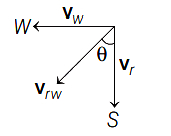
0 likesView Solution
10
PhysicsEasyMCQKCET · 2020
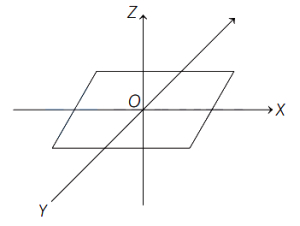
$A$ thin uniform rectangular plate of mass $2 \, kg$ is placed in the $xy$-plane as shown in the figure. The moment of inertia about the $x$-axis is $I_{x}=0.2 \, kg \cdot m^{2}$ and the moment of inertia about the $y$-axis is $I_{y}=0.3 \, kg \cdot m^{2}$. The radius of gyration of the plate about the axis passing through $O$ and perpendicular to the plane of the plate is (in $ \, cm$)
A
$50$
B
$5$
C
$38.7$
D
$31.6$
Solution
(A) Given: Mass of the plate,$M = 2 \, kg$.
Moment of inertia about the $x$-axis,$I_{x} = 0.2 \, kg \cdot m^{2}$.
Moment of inertia about the $y$-axis,$I_{y} = 0.3 \, kg \cdot m^{2}$.
According to the perpendicular axis theorem,the moment of inertia $I_{z}$ of a planar body about an axis perpendicular to its plane (passing through the origin $O$) is given by:
$I_{z} = I_{x} + I_{y}$
$I_{z} = 0.2 + 0.3 = 0.5 \, kg \cdot m^{2}$.
We know that the moment of inertia is also related to the radius of gyration $k$ by the formula:
$I = M k^{2}$
Substituting the values:
$0.5 = 2 \cdot k^{2}$
$k^{2} = \frac{0.5}{2} = 0.25 \, m^{2}$
$k = \sqrt{0.25} = 0.5 \, m$.
Converting to centimeters:
$k = 0.5 \times 100 \, cm = 50 \, cm$.
Thus,the radius of gyration is $50 \, cm$.
Moment of inertia about the $x$-axis,$I_{x} = 0.2 \, kg \cdot m^{2}$.
Moment of inertia about the $y$-axis,$I_{y} = 0.3 \, kg \cdot m^{2}$.
According to the perpendicular axis theorem,the moment of inertia $I_{z}$ of a planar body about an axis perpendicular to its plane (passing through the origin $O$) is given by:
$I_{z} = I_{x} + I_{y}$
$I_{z} = 0.2 + 0.3 = 0.5 \, kg \cdot m^{2}$.
We know that the moment of inertia is also related to the radius of gyration $k$ by the formula:
$I = M k^{2}$
Substituting the values:
$0.5 = 2 \cdot k^{2}$
$k^{2} = \frac{0.5}{2} = 0.25 \, m^{2}$
$k = \sqrt{0.25} = 0.5 \, m$.
Converting to centimeters:
$k = 0.5 \times 100 \, cm = 50 \, cm$.
Thus,the radius of gyration is $50 \, cm$.
0 likesView Solution
11
PhysicsEasyMCQKCET · 2020
$A$ wheel starting from rest gains an angular velocity of $10 \ rad/s$ after being uniformly accelerated for $5 \ s$. The total angle through which it has turned is
A
$25 \ rad$
B
$100 \ rad$
C
$25 \pi \ rad$
D
$50 \pi \ rad$
Solution
(A) Initial angular velocity of the wheel,$\omega_{0} = 0 \ rad/s$.
Final angular velocity,$\omega = 10 \ rad/s$.
Time taken,$t = 5 \ s$.
Using the first equation of rotational motion:
$\omega = \omega_{0} + \alpha t$
$10 = 0 + \alpha \times 5$
$\alpha = \frac{10}{5} = 2 \ rad/s^{2}$.
Now,using the second equation of rotational motion to find the total angle $\theta$:
$\theta = \omega_{0} t + \frac{1}{2} \alpha t^{2}$
$\theta = 0 \times 5 + \frac{1}{2} \times 2 \times (5)^{2}$
$\theta = 0 + 25 = 25 \ rad$.
Final angular velocity,$\omega = 10 \ rad/s$.
Time taken,$t = 5 \ s$.
Using the first equation of rotational motion:
$\omega = \omega_{0} + \alpha t$
$10 = 0 + \alpha \times 5$
$\alpha = \frac{10}{5} = 2 \ rad/s^{2}$.
Now,using the second equation of rotational motion to find the total angle $\theta$:
$\theta = \omega_{0} t + \frac{1}{2} \alpha t^{2}$
$\theta = 0 \times 5 + \frac{1}{2} \times 2 \times (5)^{2}$
$\theta = 0 + 25 = 25 \ rad$.
0 likesView Solution
12
PhysicsMediumMCQKCET · 2020
$A$ sphere,a cube,and a thin circular plate,all of the same material and same mass,are initially heated to the same high temperature and allowed to cool down under similar conditions. Then,the
A
plate will cool the fastest and cube the slowest
B
sphere will cool the fastest and cube the slowest
C
plate will cool the fastest and sphere the slowest
D
cube will cool the fastest and plate the slowest
Solution
(C) According to Newton's law of cooling,the rate of cooling is proportional to the surface area of the body $(dQ/dt \propto A)$.
For a given mass and material,the volume is constant. Among a sphere,a cube,and a thin circular plate,the thin circular plate has the largest surface area,while the sphere has the smallest surface area.
Since the rate of cooling is directly proportional to the surface area,the body with the largest surface area will lose heat the fastest.
Therefore,the plate will cool the fastest and the sphere will cool the slowest.
For a given mass and material,the volume is constant. Among a sphere,a cube,and a thin circular plate,the thin circular plate has the largest surface area,while the sphere has the smallest surface area.
Since the rate of cooling is directly proportional to the surface area,the body with the largest surface area will lose heat the fastest.
Therefore,the plate will cool the fastest and the sphere will cool the slowest.
0 likesView Solution
13
PhysicsEasyMCQKCET · 2020
$A$ certain amount of heat energy is supplied to a monoatomic ideal gas which expands at constant pressure. What fraction of the heat energy is converted into work?
A
$1$
B
$\frac{2}{3}$
C
$\frac{2}{5}$
D
$\frac{5}{7}$
Solution
(C) According to the first law of thermodynamics,the heat supplied $Q$ is equal to the change in internal energy $\Delta U$ plus the work done $W$: $Q = \Delta U + W$.
For a process at constant pressure,the heat supplied is $Q = n C_p \Delta T$.
The change in internal energy is $\Delta U = n C_V \Delta T$.
The work done is $W = Q - \Delta U = n C_p \Delta T - n C_V \Delta T = n R \Delta T$.
The fraction of heat energy converted into work is $\frac{W}{Q} = \frac{n R \Delta T}{n C_p \Delta T} = \frac{R}{C_p}$.
For a monoatomic ideal gas,$C_p = \frac{5}{2} R$.
Therefore,the fraction is $\frac{W}{Q} = \frac{R}{\frac{5}{2} R} = \frac{2}{5}$.
For a process at constant pressure,the heat supplied is $Q = n C_p \Delta T$.
The change in internal energy is $\Delta U = n C_V \Delta T$.
The work done is $W = Q - \Delta U = n C_p \Delta T - n C_V \Delta T = n R \Delta T$.
The fraction of heat energy converted into work is $\frac{W}{Q} = \frac{n R \Delta T}{n C_p \Delta T} = \frac{R}{C_p}$.
For a monoatomic ideal gas,$C_p = \frac{5}{2} R$.
Therefore,the fraction is $\frac{W}{Q} = \frac{R}{\frac{5}{2} R} = \frac{2}{5}$.
0 likesView Solution
14
PhysicsEasyMCQKCET · 2020
In an adiabatic expansion of an ideal gas,the product of pressure and volume:
A
decreases
B
increases
C
remains constant
D
at first increases and then decreases
Solution
(A) For an adiabatic process,the system does work on the surroundings at the expense of its internal energy.
Since the internal energy of an ideal gas depends only on its temperature $(U = n C_v T)$,a decrease in internal energy implies a decrease in temperature $(T)$.
According to the ideal gas equation,$p V = n R T$.
Since $n$ and $R$ are constants and the temperature $T$ decreases during adiabatic expansion,the product $p V$ must also decrease.
Since the internal energy of an ideal gas depends only on its temperature $(U = n C_v T)$,a decrease in internal energy implies a decrease in temperature $(T)$.
According to the ideal gas equation,$p V = n R T$.
Since $n$ and $R$ are constants and the temperature $T$ decreases during adiabatic expansion,the product $p V$ must also decrease.
0 likesView Solution
15
PhysicsDifficultMCQKCET · 2020
$A$ train whistling at a constant frequency $n$ is moving towards a station at a constant speed $v_s$. The train goes past a stationary observer on the station. The frequency $n'$ of the sound as heard by the observer is plotted as a function of time $t$. Identify the correct curve.
A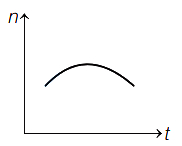
B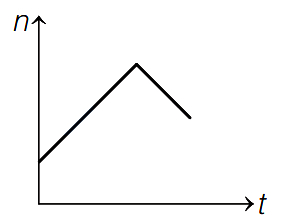
C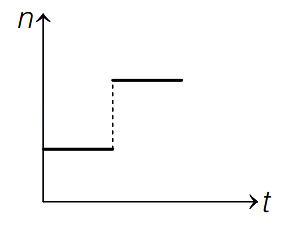
D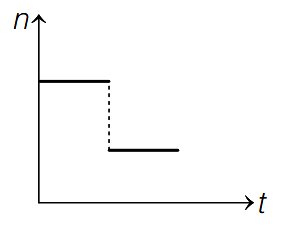
Solution
(D) According to the Doppler effect,when a source of sound moves with a constant speed $v_s$ towards a stationary observer,the observed frequency $n'$ is given by $n' = n \left( \frac{v}{v - v_s} \right)$,where $v$ is the speed of sound in air. Since $v - v_s < v$,it follows that $n' > n$. This frequency remains constant as long as the train approaches the observer at a constant speed.
When the train passes the observer and moves away,the source is now moving away from the stationary observer. The observed frequency $n''$ is given by $n'' = n \left( \frac{v}{v + v_s} \right)$. Since $v + v_s > v$,it follows that $n'' < n$. This frequency also remains constant as long as the train moves away at a constant speed.
Therefore,the frequency is higher than the actual frequency $n$ before passing the observer and drops to a value lower than $n$ after passing the observer. This step-like change is correctly represented by the graph in option $D$.
When the train passes the observer and moves away,the source is now moving away from the stationary observer. The observed frequency $n''$ is given by $n'' = n \left( \frac{v}{v + v_s} \right)$. Since $v + v_s > v$,it follows that $n'' < n$. This frequency also remains constant as long as the train moves away at a constant speed.
Therefore,the frequency is higher than the actual frequency $n$ before passing the observer and drops to a value lower than $n$ after passing the observer. This step-like change is correctly represented by the graph in option $D$.
0 likesView Solution
16
PhysicsDifficultMCQKCET · 2020
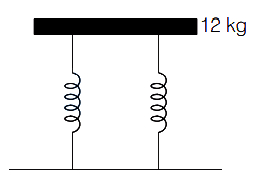
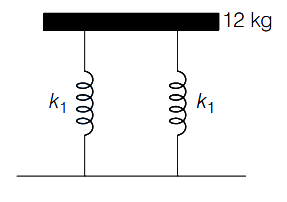
$A$ tray of mass $12 \,kg$ is supported by two identical springs as shown in the figure. When the tray is pressed down slightly and then released, it executes $SHM$ with a time period of $1.5 \,s$. The spring constant of each spring is
A
$50 \,Nm^{-1}$
B
$0$
C
$105 \,Nm^{-1}$
D
$\infty$
Solution
(C) Mass of the tray, $m = 12 \,kg$.
Time period, $T = 1.5 \,s$.
Let $k$ be the spring constant of each spring.
Since the springs are connected in parallel, the effective spring constant is $k_{\text{net}} = k + k = 2k$.
The time period of a mass-spring system is given by $T = 2\pi \sqrt{\frac{m}{k_{\text{net}}}}$.
Substituting the values, we get $1.5 = 2\pi \sqrt{\frac{12}{2k}}$.
$1.5 = 2\pi \sqrt{\frac{6}{k}}$.
Squaring both sides, we have $(1.5)^2 = (2\pi)^2 \cdot \frac{6}{k}$.
$2.25 = 4\pi^2 \cdot \frac{6}{k}$.
$k = \frac{24\pi^2}{2.25} \approx \frac{24 \times 9.87}{2.25} \approx 105.28 \,Nm^{-1}$.
Thus, the spring constant of each spring is approximately $105 \,Nm^{-1}$.
Time period, $T = 1.5 \,s$.
Let $k$ be the spring constant of each spring.
Since the springs are connected in parallel, the effective spring constant is $k_{\text{net}} = k + k = 2k$.
The time period of a mass-spring system is given by $T = 2\pi \sqrt{\frac{m}{k_{\text{net}}}}$.
Substituting the values, we get $1.5 = 2\pi \sqrt{\frac{12}{2k}}$.
$1.5 = 2\pi \sqrt{\frac{6}{k}}$.
Squaring both sides, we have $(1.5)^2 = (2\pi)^2 \cdot \frac{6}{k}$.
$2.25 = 4\pi^2 \cdot \frac{6}{k}$.
$k = \frac{24\pi^2}{2.25} \approx \frac{24 \times 9.87}{2.25} \approx 105.28 \,Nm^{-1}$.
Thus, the spring constant of each spring is approximately $105 \,Nm^{-1}$.
0 likesView Solution
17
PhysicsMediumMCQKCET · 2020
The ratio of the magnetic field at the centre of a current-carrying circular loop to its magnetic moment is '$x$'. When both the current and the radius are doubled,the new ratio will be:
A
$2x$
B
$\frac{x}{2}$
C
$\frac{x}{4}$
D
$\frac{x}{8}$
Solution
(D) The magnetic field at the center of a circular loop is $B = \frac{\mu_0 i}{2r}$.
The magnetic moment of the loop is $M = i \pi r^2$.
The ratio is $x = \frac{B}{M} = \frac{\mu_0 i / 2r}{i \pi r^2} = \frac{\mu_0}{2 \pi r^3}$.
When the current $i$ becomes $2i$ and the radius $r$ becomes $2r$,the new magnetic field $B'$ is $B' = \frac{\mu_0 (2i)}{2(2r)} = \frac{\mu_0 i}{2r} = B$.
The new magnetic moment $M'$ is $M' = (2i) \pi (2r)^2 = (2i) \pi (4r^2) = 8(i \pi r^2) = 8M$.
The new ratio $x'$ is $x' = \frac{B'}{M'} = \frac{B}{8M} = \frac{1}{8} \left( \frac{B}{M} \right) = \frac{x}{8}$.
The magnetic moment of the loop is $M = i \pi r^2$.
The ratio is $x = \frac{B}{M} = \frac{\mu_0 i / 2r}{i \pi r^2} = \frac{\mu_0}{2 \pi r^3}$.
When the current $i$ becomes $2i$ and the radius $r$ becomes $2r$,the new magnetic field $B'$ is $B' = \frac{\mu_0 (2i)}{2(2r)} = \frac{\mu_0 i}{2r} = B$.
The new magnetic moment $M'$ is $M' = (2i) \pi (2r)^2 = (2i) \pi (4r^2) = 8(i \pi r^2) = 8M$.
The new ratio $x'$ is $x' = \frac{B'}{M'} = \frac{B}{8M} = \frac{1}{8} \left( \frac{B}{M} \right) = \frac{x}{8}$.
0 likesView Solution
18
PhysicsEasyMCQKCET · 2020
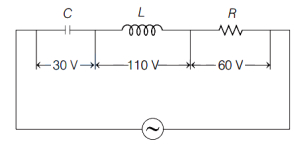
In the given circuit,the peak voltages across $C$,$L$,and $R$ are $30 \,V$,$110 \,V$,and $60 \,V$,respectively. The rms value of the applied voltage is (in $\,V$)
A
$100$
B
$200$
C
$70.7$
D
$141$
Solution
(C) Given,peak voltages are $V_{C}=30 \,V$,$V_{L}=110 \,V$,and $V_{R}=60 \,V$.
The peak voltage $(V_{0})$ across a series $L-C-R$ circuit is given by the formula:
$V_{0} = \sqrt{V_{R}^{2} + (V_{L} - V_{C})^{2}}$
Substituting the given values:
$V_{0} = \sqrt{(60)^{2} + (110 - 30)^{2}}$
$V_{0} = \sqrt{60^{2} + 80^{2}}$
$V_{0} = \sqrt{3600 + 6400} = \sqrt{10000} = 100 \,V$
The rms value of the applied voltage is related to the peak voltage by $V_{\text{rms}} = \frac{V_{0}}{\sqrt{2}}$.
$V_{\text{rms}} = \frac{100}{\sqrt{2}} \approx 70.7 \,V$.
The peak voltage $(V_{0})$ across a series $L-C-R$ circuit is given by the formula:
$V_{0} = \sqrt{V_{R}^{2} + (V_{L} - V_{C})^{2}}$
Substituting the given values:
$V_{0} = \sqrt{(60)^{2} + (110 - 30)^{2}}$
$V_{0} = \sqrt{60^{2} + 80^{2}}$
$V_{0} = \sqrt{3600 + 6400} = \sqrt{10000} = 100 \,V$
The rms value of the applied voltage is related to the peak voltage by $V_{\text{rms}} = \frac{V_{0}}{\sqrt{2}}$.
$V_{\text{rms}} = \frac{100}{\sqrt{2}} \approx 70.7 \,V$.
0 likesView Solution
19
PhysicsMediumMCQKCET · 2020
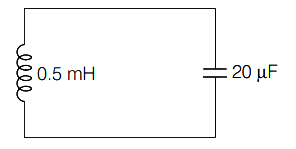
In the given circuit, the resonant frequency is (in $ Hz$)
A
$15.92$
B
$159.2$
C
$1592$
D
$15910$
Solution
(C) Given, $L = 0.5 \, mH = 0.5 \times 10^{-3} \, H$ and $C = 20 \, \mu F = 20 \times 10^{-6} \, F$.
The resonant frequency of an $L-C$ circuit is given by the formula:
$f = \frac{1}{2 \pi \sqrt{L C}}$
Substituting the values:
$f = \frac{1}{2 \pi \sqrt{0.5 \times 10^{-3} \times 20 \times 10^{-6}}}$
$f = \frac{1}{2 \pi \sqrt{10 \times 10^{-9}}} = \frac{1}{2 \pi \sqrt{10^{-8}}}$
$f = \frac{1}{2 \pi \times 10^{-4}} = \frac{10^4}{2 \pi} \approx \frac{10000}{6.283} \approx 1592.3 \, Hz$
Thus, the resonant frequency is approximately $1592 \, Hz$.
The resonant frequency of an $L-C$ circuit is given by the formula:
$f = \frac{1}{2 \pi \sqrt{L C}}$
Substituting the values:
$f = \frac{1}{2 \pi \sqrt{0.5 \times 10^{-3} \times 20 \times 10^{-6}}}$
$f = \frac{1}{2 \pi \sqrt{10 \times 10^{-9}}} = \frac{1}{2 \pi \sqrt{10^{-8}}}$
$f = \frac{1}{2 \pi \times 10^{-4}} = \frac{10^4}{2 \pi} \approx \frac{10000}{6.283} \approx 1592.3 \, Hz$
Thus, the resonant frequency is approximately $1592 \, Hz$.
0 likesView Solution
20
PhysicsEasyMCQKCET · 2020
The power factor of an $R-L$ circuit is $\frac{1}{\sqrt{3}}$. If the inductive reactance is $2 \Omega$,the value of the resistance is:
A
$2 \Omega$
B
$\sqrt{2} \Omega$
C
$0.5 \Omega$
D
$\frac{1}{\sqrt{2}} \Omega$
Solution
(B) Given,power factor $= \frac{1}{\sqrt{3}}$.
Inductive reactance,$X_{L} = 2 \Omega$.
The power factor in an $R-L$ circuit is given by:
$\text{Power factor} = \frac{R}{Z} = \frac{R}{\sqrt{R^{2} + X_{L}^{2}}}$
Substituting the given values:
$\frac{1}{\sqrt{3}} = \frac{R}{\sqrt{R^{2} + 2^{2}}} = \frac{R}{\sqrt{R^{2} + 4}}$
Squaring both sides:
$\frac{1}{3} = \frac{R^{2}}{R^{2} + 4}$
$R^{2} + 4 = 3R^{2}$
$2R^{2} = 4$
$R^{2} = 2$
$R = \sqrt{2} \Omega$.
Inductive reactance,$X_{L} = 2 \Omega$.
The power factor in an $R-L$ circuit is given by:
$\text{Power factor} = \frac{R}{Z} = \frac{R}{\sqrt{R^{2} + X_{L}^{2}}}$
Substituting the given values:
$\frac{1}{\sqrt{3}} = \frac{R}{\sqrt{R^{2} + 2^{2}}} = \frac{R}{\sqrt{R^{2} + 4}}$
Squaring both sides:
$\frac{1}{3} = \frac{R^{2}}{R^{2} + 4}$
$R^{2} + 4 = 3R^{2}$
$2R^{2} = 4$
$R^{2} = 2$
$R = \sqrt{2} \Omega$.
0 likesView Solution
21
PhysicsMediumMCQKCET · 2020
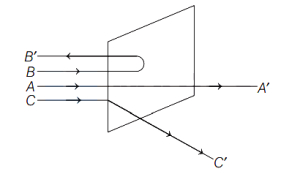
$A$ beam of fast-moving alpha particles was directed towards a thin gold foil. The parts $A, B$,and $C$ of the incident beam and their corresponding transmitted or reflected parts $A^{\prime}, B^{\prime}$,and $C^{\prime}$ are shown in the adjoining diagram. The number of alpha particles in:
A
$B^{\prime}$ will be minimum and in $C^{\prime}$ maximum
B
$A^{\prime}$ will be maximum and in $B^{\prime}$ minimum
C
$A^{\prime}$ will be minimum and in $B^{\prime}$ maximum
D
$C^{\prime}$ will be minimum and in $B^{\prime}$ maximum
Solution
(B) According to Rutherford's $\alpha$-particle scattering experiment,the following observations were made:
$(i)$ Most of the $\alpha$-particles passed through the gold foil undeflected,corresponding to path $A-A^{\prime}$.
(ii) $A$ small fraction of $\alpha$-particles were scattered by small angles,corresponding to path $C-C^{\prime}$.
(iii) $A$ very small fraction of $\alpha$-particles were scattered by large angles (or reflected back),corresponding to path $B-B^{\prime}$.
Since the number of particles scattered decreases as the scattering angle increases,the number of particles $n$ follows the order $n_{A^{\prime}} > n_{C^{\prime}} > n_{B^{\prime}}$.
Therefore,the number of $\alpha$-particles is maximum in $A^{\prime}$ and minimum in $B^{\prime}$.
$(i)$ Most of the $\alpha$-particles passed through the gold foil undeflected,corresponding to path $A-A^{\prime}$.
(ii) $A$ small fraction of $\alpha$-particles were scattered by small angles,corresponding to path $C-C^{\prime}$.
(iii) $A$ very small fraction of $\alpha$-particles were scattered by large angles (or reflected back),corresponding to path $B-B^{\prime}$.
Since the number of particles scattered decreases as the scattering angle increases,the number of particles $n$ follows the order $n_{A^{\prime}} > n_{C^{\prime}} > n_{B^{\prime}}$.
Therefore,the number of $\alpha$-particles is maximum in $A^{\prime}$ and minimum in $B^{\prime}$.
0 likesView Solution
22
PhysicsDifficultMCQKCET · 2020
The de-Broglie wavelength associated with an electron of a hydrogen atom in its ground state is (in $\text{ Å}$)
A
$0.3$
B
$3.3$
C
$6.26$
D
$10$
Solution
(B) The angular momentum of an electron in an orbit of radius $r$ is given by Bohr's quantization condition:
$mvr = \frac{nh}{2\pi}$
For the ground state $(n=1)$,the momentum $p = mv$ is:
$p = \frac{h}{2\pi r}$
The de-Broglie wavelength $\lambda$ is defined as:
$\lambda = \frac{h}{p}$
Substituting the value of $p$ from the angular momentum equation:
$\lambda = \frac{h}{(h / 2\pi r)} = 2\pi r$
In the ground state of a hydrogen atom,the Bohr radius $r = 0.53 \text{ Å}$.
Therefore,$\lambda = 2 \times 3.14 \times 0.53 \text{ Å} \approx 3.33 \text{ Å}$.
Thus,the correct option is $3.3 \text{ Å}$.
$mvr = \frac{nh}{2\pi}$
For the ground state $(n=1)$,the momentum $p = mv$ is:
$p = \frac{h}{2\pi r}$
The de-Broglie wavelength $\lambda$ is defined as:
$\lambda = \frac{h}{p}$
Substituting the value of $p$ from the angular momentum equation:
$\lambda = \frac{h}{(h / 2\pi r)} = 2\pi r$
In the ground state of a hydrogen atom,the Bohr radius $r = 0.53 \text{ Å}$.
Therefore,$\lambda = 2 \times 3.14 \times 0.53 \text{ Å} \approx 3.33 \text{ Å}$.
Thus,the correct option is $3.3 \text{ Å}$.
0 likesView Solution
23
PhysicsEasyMCQKCET · 2020
The period of revolution of an electron revolving in $n^{th}$ orbit of $H$-atom is proportional to
A
$n^{2}$
B
$1/n$
C
$n^{3}$
D
independent of $n$
Solution
(C) The time period of revolution $T$ of an electron in the $n^{th}$ orbit is defined as the ratio of the circumference of the orbit to the orbital velocity of the electron: $T = \frac{2 \pi r_{n}}{v_{n}}$.
According to Bohr's theory,the radius of the $n^{th}$ orbit is $r_{n} \propto n^{2}$ and the velocity of the electron in the $n^{th}$ orbit is $v_{n} \propto \frac{1}{n}$.
Substituting these proportionalities into the formula for the time period:
$T_{n} \propto \frac{r_{n}}{v_{n}} \propto \frac{n^{2}}{1/n} = n^{3}$.
Thus,the time period of revolution is proportional to $n^{3}$.
According to Bohr's theory,the radius of the $n^{th}$ orbit is $r_{n} \propto n^{2}$ and the velocity of the electron in the $n^{th}$ orbit is $v_{n} \propto \frac{1}{n}$.
Substituting these proportionalities into the formula for the time period:
$T_{n} \propto \frac{r_{n}}{v_{n}} \propto \frac{n^{2}}{1/n} = n^{3}$.
Thus,the time period of revolution is proportional to $n^{3}$.
0 likesView Solution
24
PhysicsEasyMCQKCET · 2020
The difference between the equivalent capacitances of two identical capacitors connected in parallel and in series is $6 \mu F$. The value of the capacitance of each capacitor is (in $\mu F$)
A
$2$
B
$3$
C
$4$
D
$6$
Solution
(C) Let the capacitance of each identical capacitor be $C$.
When connected in parallel,the equivalent capacitance is $C_{p} = C + C = 2C$.
When connected in series,the equivalent capacitance is $\frac{1}{C_{s}} = \frac{1}{C} + \frac{1}{C} = \frac{2}{C}$,which gives $C_{s} = \frac{C}{2}$.
According to the problem,the difference between these equivalent capacitances is $6 \mu F$:
$C_{p} - C_{s} = 6 \mu F$
$2C - \frac{C}{2} = 6 \mu F$
$\frac{3C}{2} = 6 \mu F$
$3C = 12 \mu F$
$C = 4 \mu F$.
When connected in parallel,the equivalent capacitance is $C_{p} = C + C = 2C$.
When connected in series,the equivalent capacitance is $\frac{1}{C_{s}} = \frac{1}{C} + \frac{1}{C} = \frac{2}{C}$,which gives $C_{s} = \frac{C}{2}$.
According to the problem,the difference between these equivalent capacitances is $6 \mu F$:
$C_{p} - C_{s} = 6 \mu F$
$2C - \frac{C}{2} = 6 \mu F$
$\frac{3C}{2} = 6 \mu F$
$3C = 12 \mu F$
$C = 4 \mu F$.
0 likesView Solution
25
PhysicsEasyMCQKCET · 2020
The colour code for a carbon resistor of resistance $0.2 \ k\Omega \pm 10 \%$ is
A
red,grey,brown,silver
B
red,green,brown,silver
C
red,grey,silver,silver
D
red,black,brown,silver
Solution
(D) The given resistance is $R = 0.2 \ k\Omega \pm 10 \%$.
Converting this to ohms,we get $R = 200 \ \Omega \pm 10 \%$.
This can be written as $R = 20 \times 10^1 \ \Omega \pm 10 \%$.
According to the standard carbon resistor colour code:
The digit $2$ corresponds to the colour red.
The digit $0$ corresponds to the colour black.
The multiplier $10^1$ corresponds to the colour brown.
The tolerance of $10 \%$ corresponds to the colour silver.
Therefore,the colour code is red,black,brown,and silver.
Converting this to ohms,we get $R = 200 \ \Omega \pm 10 \%$.
This can be written as $R = 20 \times 10^1 \ \Omega \pm 10 \%$.
According to the standard carbon resistor colour code:
The digit $2$ corresponds to the colour red.
The digit $0$ corresponds to the colour black.
The multiplier $10^1$ corresponds to the colour brown.
The tolerance of $10 \%$ corresponds to the colour silver.
Therefore,the colour code is red,black,brown,and silver.
0 likesView Solution
26
PhysicsDifficultMCQKCET · 2020
$A$ metal rod of length $10 \text{ cm}$ and a rectangular cross-section of $1 \text{ cm} \times 0.5 \text{ cm}$ is connected to a battery across opposite faces. The resistance will be
A
maximum when the battery is connected across $1 \text{ cm} \times 0.5 \text{ cm}$ faces
B
maximum when the battery is connected across $10 \text{ cm} \times 0.5 \text{ cm}$ faces
C
maximum when the battery is connected across $10 \text{ cm} \times 1 \text{ cm}$ faces
D
same irrespective of the three faces
Solution
(A) The resistance $R$ of a conductor is given by the formula $R = \rho \frac{L}{A}$,where $\rho$ is the resistivity,$L$ is the length of the conductor in the direction of current flow,and $A$ is the cross-sectional area perpendicular to the current flow.
From the relation $R \propto \frac{L}{A}$,we see that for a fixed volume of the material,the resistance is proportional to the square of the length $(L^2)$ or inversely proportional to the square of the area $(A^2)$.
Alternatively,for a fixed rod,the resistance is maximum when the current flows through the smallest cross-sectional area $A$,which results in the longest effective length $L$.
The three possible cross-sectional areas are:
$1$. $A_1 = 10 \text{ cm} \times 1 \text{ cm} = 10 \text{ cm}^2$
$2$. $A_2 = 10 \text{ cm} \times 0.5 \text{ cm} = 5 \text{ cm}^2$
$3$. $A_3 = 1 \text{ cm} \times 0.5 \text{ cm} = 0.5 \text{ cm}^2$
The resistance is maximum when the cross-sectional area $A$ is minimum. The minimum area is $0.5 \text{ cm}^2$,which corresponds to the faces of dimensions $1 \text{ cm} \times 0.5 \text{ cm}$.
From the relation $R \propto \frac{L}{A}$,we see that for a fixed volume of the material,the resistance is proportional to the square of the length $(L^2)$ or inversely proportional to the square of the area $(A^2)$.
Alternatively,for a fixed rod,the resistance is maximum when the current flows through the smallest cross-sectional area $A$,which results in the longest effective length $L$.
The three possible cross-sectional areas are:
$1$. $A_1 = 10 \text{ cm} \times 1 \text{ cm} = 10 \text{ cm}^2$
$2$. $A_2 = 10 \text{ cm} \times 0.5 \text{ cm} = 5 \text{ cm}^2$
$3$. $A_3 = 1 \text{ cm} \times 0.5 \text{ cm} = 0.5 \text{ cm}^2$
The resistance is maximum when the cross-sectional area $A$ is minimum. The minimum area is $0.5 \text{ cm}^2$,which corresponds to the faces of dimensions $1 \text{ cm} \times 0.5 \text{ cm}$.
0 likesView Solution
27
PhysicsMediumMCQKCET · 2020
Each resistance in the given cubical network has a resistance of $1 \Omega$. The equivalent resistance between points $A$ and $B$ is:
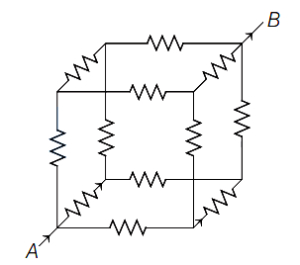
A
$\frac{5}{6} \Omega$
B
$\frac{6}{5} \Omega$
C
$\frac{5}{12} \Omega$
D
$\frac{12}{5} \Omega$
Solution
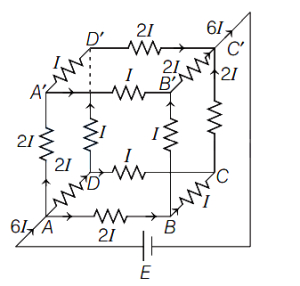
(A) Let the total current entering the cubical network at point $A$ be $6I$. Due to the symmetry of the cube, the current splits equally into three branches at $A$, each carrying $2I$.
At the next set of nodes, these currents split again.
Applying Kirchhoff's voltage law to a path from $A$ to $B$ (e.g., $A \rightarrow \text{node} \rightarrow \text{node} \rightarrow B$), the potential drop $V$ across the network is the sum of potential drops across the resistors in any path.
For a path consisting of three edges, the potential drop is $V = (2I \times R) + (I \times R) + (2I \times R) = 5IR$.
Given $R = 1 \Omega$, we have $V = 5I$.
The equivalent resistance $R_{eq}$ is given by $R_{eq} = \frac{V}{I_{total}} = \frac{5I}{6I} = \frac{5}{6} \Omega$.
At the next set of nodes, these currents split again.
Applying Kirchhoff's voltage law to a path from $A$ to $B$ (e.g., $A \rightarrow \text{node} \rightarrow \text{node} \rightarrow B$), the potential drop $V$ across the network is the sum of potential drops across the resistors in any path.
For a path consisting of three edges, the potential drop is $V = (2I \times R) + (I \times R) + (2I \times R) = 5IR$.
Given $R = 1 \Omega$, we have $V = 5I$.
The equivalent resistance $R_{eq}$ is given by $R_{eq} = \frac{V}{I_{total}} = \frac{5I}{6I} = \frac{5}{6} \Omega$.
0 likesView Solution
28
PhysicsMediumMCQKCET · 2020
$A$ car has a fresh storage battery of emf $12 \, V$ and internal resistance $2 \times 10^{-2} \, \Omega$. If the starter motor draws a current of $80 \, A$, then the terminal voltage when the starter is $ON$ is: (in $V$)
A
$12$
B
$10.4$
C
$8.4$
D
$9.3$
Solution
(B) Given:
Emf of the battery, $E = 12 \, V$
Internal resistance, $r = 2 \times 10^{-2} \, \Omega = 0.02 \, \Omega$
Current drawn by the starter motor, $I = 80 \, A$
When the starter is $ON$, the battery supplies current to the motor. The terminal voltage $V$ is given by the formula:
$V = E - Ir$
Substituting the given values:
$V = 12 - (80 \times 0.02)$
$V = 12 - 1.6$
$V = 10.4 \, V$
Therefore, the terminal voltage when the starter is $ON$ is $10.4 \, V$.
Emf of the battery, $E = 12 \, V$
Internal resistance, $r = 2 \times 10^{-2} \, \Omega = 0.02 \, \Omega$
Current drawn by the starter motor, $I = 80 \, A$
When the starter is $ON$, the battery supplies current to the motor. The terminal voltage $V$ is given by the formula:
$V = E - Ir$
Substituting the given values:
$V = 12 - (80 \times 0.02)$
$V = 12 - 1.6$
$V = 10.4 \, V$
Therefore, the terminal voltage when the starter is $ON$ is $10.4 \, V$.
0 likesView Solution
29
PhysicsEasyMCQKCET · 2020
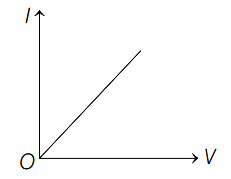
$I-V$ characteristic of a copper wire of length $L$ and area of cross-section $A$ is shown in the figure. The slope of the curve becomes
A
More if the experiment is performed at a higher temperature
B
More if a wire of steel of the same dimension is used
C
Less if the area of the wire is increased
D
Less if the length of the wire is increased
Solution
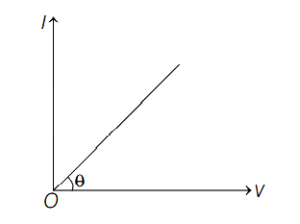
(D) The $I-V$ characteristic of a copper wire of length $L$ and area of cross-section $A$ is shown in the figure.
Since the $I-V$ characteristic is a straight line,it obeys Ohm's law.
The slope of the $I-V$ graph is given by $\text{slope} = \tan \theta = \frac{I}{V}$.
From Ohm's law,$V = IR$,so $\frac{I}{V} = \frac{1}{R}$.
Since $R = \rho \frac{L}{A}$,we have $\text{slope} = \frac{1}{\rho \frac{L}{A}} = \frac{A}{\rho L}$.
$(i)$ If the length $L$ is increased,the slope $\frac{A}{\rho L}$ decreases.
(ii) If the area $A$ is increased,the slope $\frac{A}{\rho L}$ increases.
(iii) If a steel wire of the same dimensions is used,since $\rho_{\text{steel}} > \rho_{\text{copper}}$,the slope $\frac{A}{\rho L}$ decreases.
(iv) If the experiment is performed at a higher temperature,the resistivity $\rho$ of copper increases,so the slope $\frac{A}{\rho L}$ decreases.
Therefore,the correct statement is that the slope becomes less if the length of the wire is increased.
Since the $I-V$ characteristic is a straight line,it obeys Ohm's law.
The slope of the $I-V$ graph is given by $\text{slope} = \tan \theta = \frac{I}{V}$.
From Ohm's law,$V = IR$,so $\frac{I}{V} = \frac{1}{R}$.
Since $R = \rho \frac{L}{A}$,we have $\text{slope} = \frac{1}{\rho \frac{L}{A}} = \frac{A}{\rho L}$.
$(i)$ If the length $L$ is increased,the slope $\frac{A}{\rho L}$ decreases.
(ii) If the area $A$ is increased,the slope $\frac{A}{\rho L}$ increases.
(iii) If a steel wire of the same dimensions is used,since $\rho_{\text{steel}} > \rho_{\text{copper}}$,the slope $\frac{A}{\rho L}$ decreases.
(iv) If the experiment is performed at a higher temperature,the resistivity $\rho$ of copper increases,so the slope $\frac{A}{\rho L}$ decreases.
Therefore,the correct statement is that the slope becomes less if the length of the wire is increased.
0 likesView Solution
30
PhysicsMediumMCQKCET · 2020
$A$ potentiometer has a uniform wire of length $5 \,m$. $A$ battery of emf $10 \,V$ and negligible internal resistance is connected between its ends. $A$ secondary cell connected to the circuit gives a balancing length at $200 \,cm$. The emf of the secondary cell is: (in $\,V$)
A
$4$
B
$6$
C
$2$
D
$8$
Solution
(A) Given,length of potentiometer wire $l = 5 \,m$.
Emf of the primary battery $E = 10 \,V$.
The potential gradient $K$ across the potentiometer wire is given by $K = \frac{E}{l} = \frac{10 \,V}{5 \,m} = 2 \,V/m$.
When the secondary cell is connected,the balancing length is $l_1 = 200 \,cm = 2 \,m$.
The emf of the secondary cell $E_s$ is given by $E_s = K \times l_1$.
Substituting the values,$E_s = 2 \,V/m \times 2 \,m = 4 \,V$.
Emf of the primary battery $E = 10 \,V$.
The potential gradient $K$ across the potentiometer wire is given by $K = \frac{E}{l} = \frac{10 \,V}{5 \,m} = 2 \,V/m$.
When the secondary cell is connected,the balancing length is $l_1 = 200 \,cm = 2 \,m$.
The emf of the secondary cell $E_s$ is given by $E_s = K \times l_1$.
Substituting the values,$E_s = 2 \,V/m \times 2 \,m = 4 \,V$.
0 likesView Solution
31
PhysicsEasyMCQKCET · 2020
$A$ hot filament liberates an electron with zero initial velocity. The anode potential is $1200 \,V$. The speed of the electron when it strikes the anode is
A
$1.5 \times 10^{5} \,ms^{-1}$
B
$2.5 \times 10^{6} \,ms^{-1}$
C
$2.1 \times 10^{7} \,ms^{-1}$
D
$2.5 \times 10^{8} \,ms^{-1}$
Solution
(C) The kinetic energy gained by an electron accelerated through a potential difference $V$ is given by $K.E. = eV$.
Since the electron starts from rest, its kinetic energy is $\frac{1}{2}mv^2$.
Equating the two, we get $\frac{1}{2}mv^2 = eV$.
Solving for velocity $v$, we have $v = \sqrt{\frac{2eV}{m}}$.
Substituting the values: $e = 1.6 \times 10^{-19} \,C$, $m = 9.1 \times 10^{-31} \,kg$, and $V = 1200 \,V$.
$v = \sqrt{\frac{2 \times 1.6 \times 10^{-19} \times 1200}{9.1 \times 10^{-31}}} = \sqrt{\frac{3.84 \times 10^{-16}}{9.1 \times 10^{-31}}} = \sqrt{0.42198 \times 10^{15}} = \sqrt{42.198 \times 10^{13}} \approx 2.05 \times 10^{7} \,ms^{-1}$.
Rounding this value, we get $v \approx 2.1 \times 10^{7} \,ms^{-1}$.
Since the electron starts from rest, its kinetic energy is $\frac{1}{2}mv^2$.
Equating the two, we get $\frac{1}{2}mv^2 = eV$.
Solving for velocity $v$, we have $v = \sqrt{\frac{2eV}{m}}$.
Substituting the values: $e = 1.6 \times 10^{-19} \,C$, $m = 9.1 \times 10^{-31} \,kg$, and $V = 1200 \,V$.
$v = \sqrt{\frac{2 \times 1.6 \times 10^{-19} \times 1200}{9.1 \times 10^{-31}}} = \sqrt{\frac{3.84 \times 10^{-16}}{9.1 \times 10^{-31}}} = \sqrt{0.42198 \times 10^{15}} = \sqrt{42.198 \times 10^{13}} \approx 2.05 \times 10^{7} \,ms^{-1}$.
Rounding this value, we get $v \approx 2.1 \times 10^{7} \,ms^{-1}$.
0 likesView Solution
32
PhysicsDifficultMCQKCET · 2020
$A$ light beam of intensity $20 \,W/cm^2$ is incident normally on a perfectly reflecting surface of sides $25 \,cm \times 15 \,cm$. The momentum imparted to the surface by the light per second is
A
$2 \times 10^{-5} \,kg \cdot m/s$
B
$1 \times 10^{-5} \,kg \cdot m/s$
C
$5 \times 10^{-5} \,kg \cdot m/s$
D
$1.2 \times 10^{-5} \,kg \cdot m/s$
Solution
(C) Given: Intensity $I = 20 \,W/cm^2 = 20 \times 10^4 \,W/m^2$.
Area $A = 25 \,cm \times 15 \,cm = 375 \,cm^2 = 375 \times 10^{-4} \,m^2$.
Time $t = 1 \,s$.
The energy $E$ incident on the surface per second is $E = I \times A \times t = 20 \times 10^4 \times 375 \times 10^{-4} \times 1 = 7500 \,J$.
For a perfectly reflecting surface,the momentum $p$ imparted by light is given by $p = \frac{2E}{c}$,where $c = 3 \times 10^8 \,m/s$ is the speed of light.
$p = \frac{2 \times 7500}{3 \times 10^8} = \frac{15000}{3 \times 10^8} = 5000 \times 10^{-8} = 5 \times 10^{-5} \,kg \cdot m/s$.
Area $A = 25 \,cm \times 15 \,cm = 375 \,cm^2 = 375 \times 10^{-4} \,m^2$.
Time $t = 1 \,s$.
The energy $E$ incident on the surface per second is $E = I \times A \times t = 20 \times 10^4 \times 375 \times 10^{-4} \times 1 = 7500 \,J$.
For a perfectly reflecting surface,the momentum $p$ imparted by light is given by $p = \frac{2E}{c}$,where $c = 3 \times 10^8 \,m/s$ is the speed of light.
$p = \frac{2 \times 7500}{3 \times 10^8} = \frac{15000}{3 \times 10^8} = 5000 \times 10^{-8} = 5 \times 10^{-5} \,kg \cdot m/s$.
0 likesView Solution
33
PhysicsMediumMCQKCET · 2020
Angular momentum of an electron in a hydrogen atom is $\frac{3h}{2\pi}$ ($h$ is the Planck's constant). The kinetic energy $(KE)$ of the electron is (in $\text{ eV}$)
A
$4.35$
B
$1.51$
C
$3.4$
D
$6.8$
Solution
(B) Given,angular momentum of electron in $H$-atom $= \frac{3h}{2\pi} \dots (i)$
From Bohr's postulate,angular momentum $= \frac{nh}{2\pi} \dots (ii)$
Comparing equations $(i)$ and $(ii)$,we get $n = 3$.
The kinetic energy $(KE)$ of an electron in a hydrogen atom is given by the formula:
$KE = \frac{13.6 \times Z^2}{n^2} \text{ eV}$
For hydrogen atom,atomic number $Z = 1$. Substituting $Z = 1$ and $n = 3$:
$KE = \frac{13.6 \times 1^2}{3^2} \text{ eV}$
$KE = \frac{13.6}{9} \text{ eV}$
$KE = 1.51 \text{ eV}$
From Bohr's postulate,angular momentum $= \frac{nh}{2\pi} \dots (ii)$
Comparing equations $(i)$ and $(ii)$,we get $n = 3$.
The kinetic energy $(KE)$ of an electron in a hydrogen atom is given by the formula:
$KE = \frac{13.6 \times Z^2}{n^2} \text{ eV}$
For hydrogen atom,atomic number $Z = 1$. Substituting $Z = 1$ and $n = 3$:
$KE = \frac{13.6 \times 1^2}{3^2} \text{ eV}$
$KE = \frac{13.6}{9} \text{ eV}$
$KE = 1.51 \text{ eV}$
0 likesView Solution
34
PhysicsEasyMCQKCET · 2020
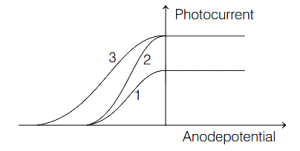
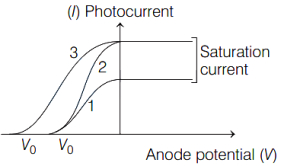
The following graph represents the variation of photocurrent with anode potential for a metal surface. Here $I_{1}, I_{2}$ and $I_{3}$ represent intensities and $\gamma_{1}, \gamma_{2}, \gamma_{3}$ represent frequencies for curves $1, 2$ and $3$ respectively,then
A
$\gamma_{1}=\gamma_{2}$ and $I_{1} \neq I_{2}$
B
$\gamma_{1}=\gamma_{3}$ and $I_{1} \neq I_{3}$
C
$\gamma_{1}=\gamma_{2}$ and $I_{1}=I_{2}$
D
$\gamma_{2}=\gamma_{3}$ and $I_{1}=I_{3}$
Solution
(A) From the graph,we observe that the stopping potential $V_{0}$ is the same for curves $1$ and $2$. However,for curve $3$,the stopping potential is greater in magnitude than that for curves $1$ and $2$.
We know that the stopping potential is given by the relation: $e V_{0} = E_{\max} = h \gamma - \phi_{0}$,where $\phi_{0}$ is the work function of the metal.
Since $V_{0}$ is the same for curves $1$ and $2$,it implies that the incident frequencies are equal,i.e.,$\gamma_{1} = \gamma_{2}$.
For curve $3$,the stopping potential is higher,which means $\gamma_{3} > \gamma_{1} = \gamma_{2}$.
Regarding the saturation current,it depends on the intensity of the incident light. Curves $2$ and $3$ reach the same saturation current,meaning $I_{2} = I_{3}$,while curve $1$ has a lower saturation current,so $I_{1} < I_{2} = I_{3}$.
Therefore,comparing the options,$\gamma_{1} = \gamma_{2}$ and $I_{1} \neq I_{2}$ is the correct statement.
We know that the stopping potential is given by the relation: $e V_{0} = E_{\max} = h \gamma - \phi_{0}$,where $\phi_{0}$ is the work function of the metal.
Since $V_{0}$ is the same for curves $1$ and $2$,it implies that the incident frequencies are equal,i.e.,$\gamma_{1} = \gamma_{2}$.
For curve $3$,the stopping potential is higher,which means $\gamma_{3} > \gamma_{1} = \gamma_{2}$.
Regarding the saturation current,it depends on the intensity of the incident light. Curves $2$ and $3$ reach the same saturation current,meaning $I_{2} = I_{3}$,while curve $1$ has a lower saturation current,so $I_{1} < I_{2} = I_{3}$.
Therefore,comparing the options,$\gamma_{1} = \gamma_{2}$ and $I_{1} \neq I_{2}$ is the correct statement.
0 likesView Solution
35
PhysicsMediumMCQKCET · 2020
The current in a coil of inductance $0.2 \,H$ changes from $5 \,A$ to $2 \,A$ in $0.5 \,s$. The magnitude of the average induced emf in the coil is (in $\,V$)
A
$0.6$
B
$1.2$
C
$30$
D
$0.3$
Solution
(B) Given: Inductance $L = 0.2 \,H$,initial current $I_1 = 5 \,A$,final current $I_2 = 2 \,A$,and time interval $\Delta t = 0.5 \,s$.
The change in current is $\Delta I = I_1 - I_2 = 5 \,A - 2 \,A = 3 \,A$.
The magnitude of the average induced emf $|e|$ in the coil is given by the formula:
$|e| = L \left| \frac{\Delta I}{\Delta t} \right| = 0.2 \,H \times \frac{3 \,A}{0.5 \,s} = 0.2 \times 6 \,V = 1.2 \,V$.
The change in current is $\Delta I = I_1 - I_2 = 5 \,A - 2 \,A = 3 \,A$.
The magnitude of the average induced emf $|e|$ in the coil is given by the formula:
$|e| = L \left| \frac{\Delta I}{\Delta t} \right| = 0.2 \,H \times \frac{3 \,A}{0.5 \,s} = 0.2 \times 6 \,V = 1.2 \,V$.
0 likesView Solution
36
PhysicsDifficultMCQKCET · 2020
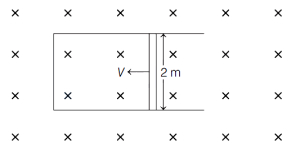
$A$ rod of length $2 \, m$ slides with a speed of $5 \, ms^{-1}$ on a rectangular conducting frame as shown in the figure. There exists a uniform magnetic field of $0.04 \, T$ perpendicular to the plane of the figure. If the resistance of the rod is $3 \, \Omega$, the current through the rod is
A
$75 \, mA$
B
$133 \, mA$
C
$0.75 \, A$
D
$1.33 \, A$
Solution
(B) Given: Length of the rod $l = 2 \, m$, speed $v = 5 \, ms^{-1}$, magnetic field $B = 0.04 \, T$, and resistance $R = 3 \, \Omega$.
The motional electromotive force $(EMF)$ induced in the rod is given by:
$\varepsilon = B l v$
$\varepsilon = 0.04 \, T \times 2 \, m \times 5 \, ms^{-1} = 0.4 \, V$
The current $I$ induced in the rod is given by Ohm's law:
$I = \frac{\varepsilon}{R}$
$I = \frac{0.4 \, V}{3 \, \Omega} = 0.1333... \, A$
$I \approx 0.133 \, A = 133 \, mA$.
The motional electromotive force $(EMF)$ induced in the rod is given by:
$\varepsilon = B l v$
$\varepsilon = 0.04 \, T \times 2 \, m \times 5 \, ms^{-1} = 0.4 \, V$
The current $I$ induced in the rod is given by Ohm's law:
$I = \frac{\varepsilon}{R}$
$I = \frac{0.4 \, V}{3 \, \Omega} = 0.1333... \, A$
$I \approx 0.133 \, A = 133 \, mA$.
0 likesView Solution
37
PhysicsEasyMCQKCET · 2020
Two protons are kept at a separation of $10 \, nm$. Let $F_{n}$ and $F_{e}$ be the nuclear force and the electromagnetic force between them, respectively.
A
$F_{e} = F_{n}$
B
$F_{e} \gg F_{n}$
C
$F_{e} < F_{n}$
D
$F_{e}$ and $F_{n}$ differ only slightly
Solution
(B) The nuclear force is a short-range force, typically effective within a range of a few $fm$ $(1 \, fm = 10^{-15} \, m)$.
Whereas, the electromagnetic force is a long-range force that follows the inverse-square law.
Given the separation is $10 \, nm = 10 \times 10^{-9} \, m = 10^{-8} \, m$.
Since $10^{-8} \, m$ is much larger than the range of the nuclear force $(\, 10^{-15} \, m)$, the nuclear force $F_{n}$ is effectively zero at this distance.
Therefore, the electromagnetic force $F_{e}$ is significantly greater than the nuclear force $F_{n}$, i.e., $F_{e} \gg F_{n}$.
Whereas, the electromagnetic force is a long-range force that follows the inverse-square law.
Given the separation is $10 \, nm = 10 \times 10^{-9} \, m = 10^{-8} \, m$.
Since $10^{-8} \, m$ is much larger than the range of the nuclear force $(\, 10^{-15} \, m)$, the nuclear force $F_{n}$ is effectively zero at this distance.
Therefore, the electromagnetic force $F_{e}$ is significantly greater than the nuclear force $F_{n}$, i.e., $F_{e} \gg F_{n}$.
0 likesView Solution
38
PhysicsEasyMCQKCET · 2020
$A$ dipole with dipole moment $p$ and moment of inertia $I$ is placed in a uniform electric field $E$. If it is displaced slightly from its stable equilibrium position,the period of oscillation of the dipole is
A
$\sqrt{\frac{p E}{I}}$
B
$2 \pi \sqrt{\frac{I}{p E}}$
C
$\frac{1}{2 \pi} \sqrt{\frac{p E}{I}}$
D
$\pi \sqrt{\frac{I}{p E}}$
Solution
(B) The torque $\tau$ on an electric dipole placed in a uniform electric field $E$ is given by $\tau = p E \sin \theta$,where $p$ is the electric dipole moment and $\theta$ is the angle between $p$ and $E$.
For small angles $\theta$,we can approximate $\sin \theta \approx \theta$.
Thus,the torque becomes $\tau = p E \theta$.
Since the torque is also given by $\tau = I \alpha$,where $I$ is the moment of inertia and $\alpha$ is the angular acceleration,we have $I \alpha = p E \theta$.
Rearranging for angular acceleration,we get $\alpha = \frac{p E}{I} \theta$.
This equation is of the form $\alpha = -\omega^2 \theta$,which represents simple harmonic motion.
Comparing the terms,we find $\omega^2 = \frac{p E}{I}$,so $\omega = \sqrt{\frac{p E}{I}}$.
The time period $T$ is given by $T = \frac{2 \pi}{\omega} = 2 \pi \sqrt{\frac{I}{p E}}$.
For small angles $\theta$,we can approximate $\sin \theta \approx \theta$.
Thus,the torque becomes $\tau = p E \theta$.
Since the torque is also given by $\tau = I \alpha$,where $I$ is the moment of inertia and $\alpha$ is the angular acceleration,we have $I \alpha = p E \theta$.
Rearranging for angular acceleration,we get $\alpha = \frac{p E}{I} \theta$.
This equation is of the form $\alpha = -\omega^2 \theta$,which represents simple harmonic motion.
Comparing the terms,we find $\omega^2 = \frac{p E}{I}$,so $\omega = \sqrt{\frac{p E}{I}}$.
The time period $T$ is given by $T = \frac{2 \pi}{\omega} = 2 \pi \sqrt{\frac{I}{p E}}$.
0 likesView Solution
39
PhysicsEasyMCQKCET · 2020
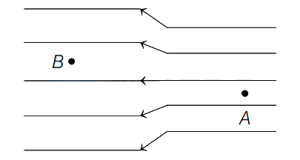
The electric field lines on the left have twice the separation of those on the right as shown in the figure. If the magnitude of the electric field at $A$ is $40 \ Vm^{-1}$,what is the force on a $20 \ \mu C$ charge kept at $B$?
A
$4 \times 10^{-4} \ N$
B
$8 \times 10^{-4} \ N$
C
$16 \times 10^{-4} \ N$
D
$1 \times 10^{-4} \ N$
Solution
(A) The density of electric field lines is directly proportional to the magnitude of the electric field.
Given that the separation of field lines on the left (at point $B$) is twice the separation of those on the right (at point $A$),the electric field at $B$ is half the electric field at $A$.
$E_B = \frac{E_A}{2} = \frac{40 \ Vm^{-1}}{2} = 20 \ Vm^{-1}$.
The force $F$ on a charge $q$ in an electric field $E$ is given by $F = qE$.
Given $q = 20 \ \mu C = 20 \times 10^{-6} \ C$.
$F = (20 \times 10^{-6} \ C) \times (20 \ Vm^{-1}) = 400 \times 10^{-6} \ N = 4 \times 10^{-4} \ N$.
Given that the separation of field lines on the left (at point $B$) is twice the separation of those on the right (at point $A$),the electric field at $B$ is half the electric field at $A$.
$E_B = \frac{E_A}{2} = \frac{40 \ Vm^{-1}}{2} = 20 \ Vm^{-1}$.
The force $F$ on a charge $q$ in an electric field $E$ is given by $F = qE$.
Given $q = 20 \ \mu C = 20 \times 10^{-6} \ C$.
$F = (20 \times 10^{-6} \ C) \times (20 \ Vm^{-1}) = 400 \times 10^{-6} \ N = 4 \times 10^{-4} \ N$.
0 likesView Solution
40
PhysicsMediumMCQKCET · 2020
An infinitely long thin straight wire has a uniform charge density of $\frac{1}{4} \times 10^{-2} \text{ C/m}$. What is the magnitude of the electric field at a distance of $20 \text{ cm}$ from the axis of the wire?
A
$1.12 \times 10^{10} \text{ N/C}$
B
$4.5 \times 10^{10} \text{ N/C}$
C
$2.25 \times 10^{10} \text{ N/C}$
D
$9 \times 10^{10} \text{ N/C}$
Solution
(C) Given,linear charge density of the infinitely long wire,$\lambda = \frac{1}{4} \times 10^{-2} \text{ C/m} = 0.25 \times 10^{-2} \text{ C/m} = 2.5 \times 10^{-3} \text{ C/m}$.
Distance from the wire,$r = 20 \text{ cm} = 0.2 \text{ m}$.
The electric field $E$ due to an infinitely long straight wire is given by the formula: $E = \frac{\lambda}{2 \pi \varepsilon_0 r} = \frac{2k\lambda}{r}$,where $k = \frac{1}{4 \pi \varepsilon_0} = 9 \times 10^9 \text{ N m}^2/\text{C}^2$.
Substituting the values:
$E = \frac{2 \times (9 \times 10^9) \times (2.5 \times 10^{-3})}{0.2}$
$E = \frac{18 \times 10^9 \times 2.5 \times 10^{-3}}{0.2}$
$E = \frac{45 \times 10^6}{0.2} = 225 \times 10^6 = 2.25 \times 10^8 \text{ N/C}$.
Note: Based on the provided options and the calculation,the correct magnitude is $2.25 \times 10^8 \text{ N/C}$. Given the options provided in the prompt,option $C$ is the intended answer assuming a typo in the exponent of the charge density in the original question.
Distance from the wire,$r = 20 \text{ cm} = 0.2 \text{ m}$.
The electric field $E$ due to an infinitely long straight wire is given by the formula: $E = \frac{\lambda}{2 \pi \varepsilon_0 r} = \frac{2k\lambda}{r}$,where $k = \frac{1}{4 \pi \varepsilon_0} = 9 \times 10^9 \text{ N m}^2/\text{C}^2$.
Substituting the values:
$E = \frac{2 \times (9 \times 10^9) \times (2.5 \times 10^{-3})}{0.2}$
$E = \frac{18 \times 10^9 \times 2.5 \times 10^{-3}}{0.2}$
$E = \frac{45 \times 10^6}{0.2} = 225 \times 10^6 = 2.25 \times 10^8 \text{ N/C}$.
Note: Based on the provided options and the calculation,the correct magnitude is $2.25 \times 10^8 \text{ N/C}$. Given the options provided in the prompt,option $C$ is the intended answer assuming a typo in the exponent of the charge density in the original question.
0 likesView Solution
41
PhysicsMediumMCQKCET · 2020
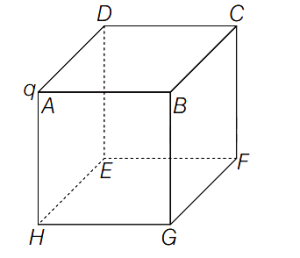
$A$ point charge $q$ is placed at the corner of a cube of side $a$ as shown in the figure. What is the electric flux through the face $ABCD$?
A
$0$
B
$\frac{q}{24 \varepsilon_{0}}$
C
$\frac{q}{6 \varepsilon_{0}}$
D
$\frac{q}{72 \varepsilon_{0}}$
Solution
(B) According to Gauss's Law,the total electric flux through a closed surface is $\frac{q_{enclosed}}{\varepsilon_{0}}$.
When a charge $q$ is placed at one corner of a cube,it is shared equally by $8$ such identical cubes to enclose the charge completely.
Therefore,the flux through one cube is $\Phi_{cube} = \frac{q}{8 \varepsilon_{0}}$.
$A$ cube has $6$ faces. The charge $q$ is located at a corner. The three faces meeting at this corner (in this case,faces $ADHE$,$ABFE$,and $ABCD$ if the charge is at $A$) contain the charge $q$ on their plane. For these faces,the electric field lines are parallel to the surface,meaning the angle between the area vector and the electric field is $90^{\circ}$. Thus,the flux through these $3$ faces is $0$.
The remaining $3$ faces share the total flux $\Phi_{cube}$ equally due to symmetry.
Therefore,the flux through each of the remaining $3$ faces is $\Phi_{face} = \frac{\Phi_{cube}}{3} = \frac{q / 8 \varepsilon_{0}}{3} = \frac{q}{24 \varepsilon_{0}}$.
Thus,the electric flux through the face $ABCD$ is $\frac{q}{24 \varepsilon_{0}}$.
When a charge $q$ is placed at one corner of a cube,it is shared equally by $8$ such identical cubes to enclose the charge completely.
Therefore,the flux through one cube is $\Phi_{cube} = \frac{q}{8 \varepsilon_{0}}$.
$A$ cube has $6$ faces. The charge $q$ is located at a corner. The three faces meeting at this corner (in this case,faces $ADHE$,$ABFE$,and $ABCD$ if the charge is at $A$) contain the charge $q$ on their plane. For these faces,the electric field lines are parallel to the surface,meaning the angle between the area vector and the electric field is $90^{\circ}$. Thus,the flux through these $3$ faces is $0$.
The remaining $3$ faces share the total flux $\Phi_{cube}$ equally due to symmetry.
Therefore,the flux through each of the remaining $3$ faces is $\Phi_{face} = \frac{\Phi_{cube}}{3} = \frac{q / 8 \varepsilon_{0}}{3} = \frac{q}{24 \varepsilon_{0}}$.
Thus,the electric flux through the face $ABCD$ is $\frac{q}{24 \varepsilon_{0}}$.
0 likesView Solution
42
PhysicsEasyMCQKCET · 2020
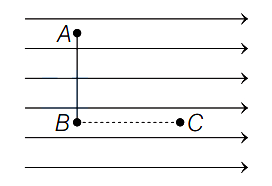
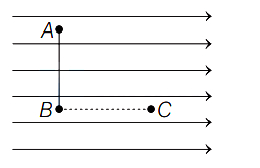
The figure shows three points $A, B$ and $C$ in a region of uniform electric field $E$. The line $A B$ is perpendicular and $B C$ is parallel to the field lines. Then,which of the following holds good? ($V_{A}, V_{B}$ and $V_{C}$ represent the electric potential at points $A, B$ and $C$,respectively)
A
$V_{A}=V_{B}=V_{C}$
B
$V_{A}=V_{B}>V_{C}$
C
$V_{A}=V_{B} < V_{C}$
D
$V_{A}>V_{B}=V_{C}$
Solution
(B) According to the given figure,the line $A B$ is perpendicular to the direction of the electric field lines. Hence,the surface passing through line $A B$ and perpendicular to the electric field lines behaves like an equipotential surface,therefore
$V_{A}=V_{B} \dots (i)$
Electric field and electric potential are related as
$E=-\frac{d V}{d x} \Rightarrow V=-\int E d x$
This indicates that the electric potential decreases in the direction of the electric field,i.e.
$V_{B}>V_{C} \dots (ii)$
From Eqs. $(i)$ and $(ii)$,we have
$V_{A}=V_{B}>V_{C}$
$V_{A}=V_{B} \dots (i)$
Electric field and electric potential are related as
$E=-\frac{d V}{d x} \Rightarrow V=-\int E d x$
This indicates that the electric potential decreases in the direction of the electric field,i.e.
$V_{B}>V_{C} \dots (ii)$
From Eqs. $(i)$ and $(ii)$,we have
$V_{A}=V_{B}>V_{C}$
0 likesView Solution
43
PhysicsEasyMCQKCET · 2020
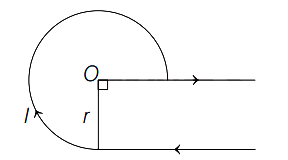
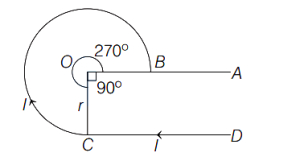
In the given figure,find the magnetic field at point $O$.
A
$\frac{3}{4} \frac{\mu_{0} I}{r} + \frac{\mu_{0} I}{4 \pi r}$
B
$\frac{3}{10} \frac{\mu_{0} I}{r} - \frac{\mu_{0} I}{4 \pi r}$
C
$\frac{3}{8} \frac{\mu_{0} I}{r} + \frac{\mu_{0} I}{4 \pi r}$
D
$\frac{3}{8} \frac{\mu_{0} I}{r} - \frac{\mu_{0} I}{4 \pi r}$
Solution
(C) The total magnetic field at point $O$ is the vector sum of the magnetic fields produced by the three segments: the straight wire $AB$,the circular arc $BC$,and the straight wire $CD$.
$1$. For the straight wire $AB$,the point $O$ lies on the axis of the wire. Therefore,the magnetic field due to segment $AB$ is $B_{AB} = 0$.
$2$. For the straight wire $CD$,the point $O$ is at a perpendicular distance $r$ from the wire. The wire extends from $C$ to infinity. The magnetic field due to a semi-infinite wire is given by $B_{CD} = \frac{\mu_0 I}{4 \pi r}$.
$3$. For the circular arc $BC$,the angle subtended at the center $O$ is $\theta = 270^\circ = \frac{3\pi}{2}$ radians. The magnetic field due to a circular arc is $B_{arc} = \frac{\mu_0 I}{2r} \cdot \frac{\theta}{2\pi} = \frac{\mu_0 I}{2r} \cdot \frac{3\pi/2}{2\pi} = \frac{3\mu_0 I}{8r}$.
Since the directions of the magnetic fields from the arc and the semi-infinite wire are the same (into the page),the net magnetic field is:
$B_{net} = B_{AB} + B_{arc} + B_{CD} = 0 + \frac{3\mu_0 I}{8r} + \frac{\mu_0 I}{4\pi r} = \frac{3}{8} \frac{\mu_0 I}{r} + \frac{\mu_0 I}{4\pi r}$.
$1$. For the straight wire $AB$,the point $O$ lies on the axis of the wire. Therefore,the magnetic field due to segment $AB$ is $B_{AB} = 0$.
$2$. For the straight wire $CD$,the point $O$ is at a perpendicular distance $r$ from the wire. The wire extends from $C$ to infinity. The magnetic field due to a semi-infinite wire is given by $B_{CD} = \frac{\mu_0 I}{4 \pi r}$.
$3$. For the circular arc $BC$,the angle subtended at the center $O$ is $\theta = 270^\circ = \frac{3\pi}{2}$ radians. The magnetic field due to a circular arc is $B_{arc} = \frac{\mu_0 I}{2r} \cdot \frac{\theta}{2\pi} = \frac{\mu_0 I}{2r} \cdot \frac{3\pi/2}{2\pi} = \frac{3\mu_0 I}{8r}$.
Since the directions of the magnetic fields from the arc and the semi-infinite wire are the same (into the page),the net magnetic field is:
$B_{net} = B_{AB} + B_{arc} + B_{CD} = 0 + \frac{3\mu_0 I}{8r} + \frac{\mu_0 I}{4\pi r} = \frac{3}{8} \frac{\mu_0 I}{r} + \frac{\mu_0 I}{4\pi r}$.
0 likesView Solution
44
PhysicsMediumMCQKCET · 2020
Two long straight parallel wires are a distance $2d$ apart. They carry steady equal currents flowing out of the plane of the paper. The variation of magnetic field $B$ along the line $xx'$ is given by:
A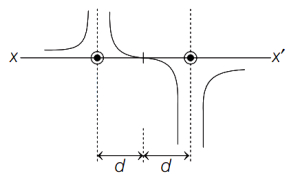
B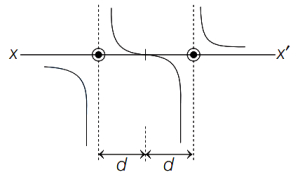
C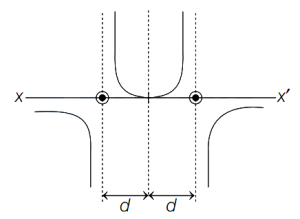
D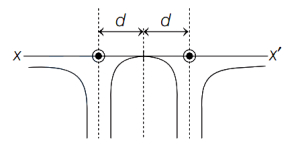
Solution
(A) Let the two wires be located at $x = -d$ and $x = +d$ on the $xx'$ axis. The currents are flowing out of the plane of the paper.
Using the right-hand rule, the magnetic field due to a wire carrying current $i$ at a distance $r$ is $B = \frac{\mu_0 i}{2\pi r}$.
For the wire at $x = -d$, the field is $B_1 = \frac{\mu_0 i}{2\pi (x+d)}$ in the $(-\hat{j})$ direction for $x > -d$.
For the wire at $x = +d$, the field is $B_2 = \frac{\mu_0 i}{2\pi (d-x)}$ in the $\hat{j}$ direction for $x < d$.
In the region between the wires $(-d < x < d)$, the net magnetic field is $B_{net} = B_2 - B_1 = \frac{\mu_0 i}{2\pi} \left[ \frac{1}{d-x} - \frac{1}{d+x} \right]$.
At the midpoint $x = 0$, $B_{net} = 0$. As $x$ approaches $d$, $B_{net} \to \infty$ in the $\hat{j}$ direction. As $x$ approaches $-d$, $B_{net} \to -\infty$ in the $(-\hat{j})$ direction.
Outside the wires, the fields add up in magnitude. The correct graphical representation showing the field passing through zero at the midpoint and having opposite signs on either side is represented by option $A$.
Using the right-hand rule, the magnetic field due to a wire carrying current $i$ at a distance $r$ is $B = \frac{\mu_0 i}{2\pi r}$.
For the wire at $x = -d$, the field is $B_1 = \frac{\mu_0 i}{2\pi (x+d)}$ in the $(-\hat{j})$ direction for $x > -d$.
For the wire at $x = +d$, the field is $B_2 = \frac{\mu_0 i}{2\pi (d-x)}$ in the $\hat{j}$ direction for $x < d$.
In the region between the wires $(-d < x < d)$, the net magnetic field is $B_{net} = B_2 - B_1 = \frac{\mu_0 i}{2\pi} \left[ \frac{1}{d-x} - \frac{1}{d+x} \right]$.
At the midpoint $x = 0$, $B_{net} = 0$. As $x$ approaches $d$, $B_{net} \to \infty$ in the $\hat{j}$ direction. As $x$ approaches $-d$, $B_{net} \to -\infty$ in the $(-\hat{j})$ direction.
Outside the wires, the fields add up in magnitude. The correct graphical representation showing the field passing through zero at the midpoint and having opposite signs on either side is represented by option $A$.
0 likesView Solution
45
PhysicsEasyMCQKCET · 2020
The magnetic field at the origin due to a current element $i d l$ placed at a point with vector position $r$ is
A
$\frac{\mu_{0} i}{4 \pi} \frac{d l \times r}{r^{3}}$
B
$\frac{\mu_{0} i}{4 \pi} \frac{r \times d l}{r^{3}}$
C
$\frac{\mu_{0} i}{4 \pi} \frac{d l \times r}{r^{2}}$
D
$\frac{\mu_{0} i}{4 \pi} \frac{r \times d l}{r^{2}}$
Solution
(A) According to the Biot-Savart law,the magnetic field $dB$ at a point due to a current element $i d l$ is given by the expression:
$dB = \frac{\mu_{0}}{4 \pi} \frac{i (d l \times r)}{r^{3}}$
Here,$i$ is the current,$d l$ is the length element vector,$r$ is the position vector of the point where the field is to be calculated relative to the current element,and $\mu_{0}$ is the permeability of free space.
Thus,the correct expression is $\frac{\mu_{0} i}{4 \pi} \frac{d l \times r}{r^{3}}$.
$dB = \frac{\mu_{0}}{4 \pi} \frac{i (d l \times r)}{r^{3}}$
Here,$i$ is the current,$d l$ is the length element vector,$r$ is the position vector of the point where the field is to be calculated relative to the current element,and $\mu_{0}$ is the permeability of free space.
Thus,the correct expression is $\frac{\mu_{0} i}{4 \pi} \frac{d l \times r}{r^{3}}$.
0 likesView Solution
46
PhysicsEasyMCQKCET · 2020
$A$ long cylindrical wire of radius $R$ carries a uniform current $I$ flowing through it. The variation of magnetic field $B$ with distance $r$ from the axis of the wire is shown by:
A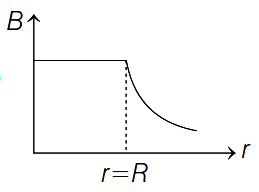
B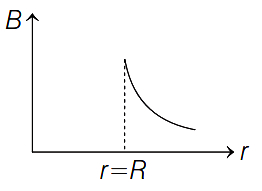
C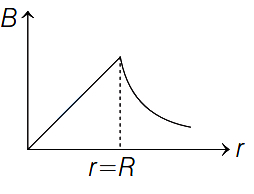
D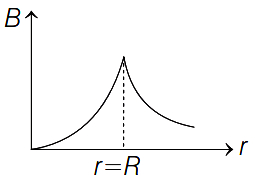
Solution
(C) For a long cylindrical wire of radius $R$ carrying a uniform current $I$:
$1$. Inside the wire $(r < R)$,the magnetic field $B_{\text{in}}$ is given by $B_{\text{in}} = \frac{\mu_0 I r}{2 \pi R^2}$. Since $\mu_0, I, R$ are constants,we have $B_{\text{in}} \propto r$. This represents a straight line passing through the origin.
$2$. Outside the wire $(r > R)$,the magnetic field $B_{\text{out}}$ is given by $B_{\text{out}} = \frac{\mu_0 I}{2 \pi r}$. Since $\mu_0, I$ are constants,we have $B_{\text{out}} \propto \frac{1}{r}$. This represents a rectangular hyperbola.
$3$. At the surface $(r = R)$,the magnetic field is maximum,$B_{\text{max}} = \frac{\mu_0 I}{2 \pi R}$.
Combining these,the graph shows a linear increase for $r < R$ and a hyperbolic decrease for $r > R$,which corresponds to Graph $C$.
$1$. Inside the wire $(r < R)$,the magnetic field $B_{\text{in}}$ is given by $B_{\text{in}} = \frac{\mu_0 I r}{2 \pi R^2}$. Since $\mu_0, I, R$ are constants,we have $B_{\text{in}} \propto r$. This represents a straight line passing through the origin.
$2$. Outside the wire $(r > R)$,the magnetic field $B_{\text{out}}$ is given by $B_{\text{out}} = \frac{\mu_0 I}{2 \pi r}$. Since $\mu_0, I$ are constants,we have $B_{\text{out}} \propto \frac{1}{r}$. This represents a rectangular hyperbola.
$3$. At the surface $(r = R)$,the magnetic field is maximum,$B_{\text{max}} = \frac{\mu_0 I}{2 \pi R}$.
Combining these,the graph shows a linear increase for $r < R$ and a hyperbolic decrease for $r > R$,which corresponds to Graph $C$.
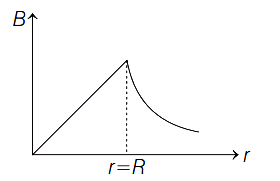
0 likesView Solution
47
PhysicsMediumMCQKCET · 2020
$A$ cyclotron is used to accelerate protons $\left({ }_{1}^{1} H\right)$,deuterons $\left({ }_{1}^{2} H\right)$,and $\alpha$-particles $\left({ }_{2}^{4} He\right)$. While exiting under similar conditions,the minimum kinetic energy $(KE)$ is gained by:
A
$\alpha$-particles
B
protons
C
deuterons
D
Same for all
Solution
(C) When a charged particle is accelerated in a cyclotron,the radius $r$ of its path is given by $r = \frac{\sqrt{2Km}}{Bq}$.
Squaring both sides,we get $r^2 = \frac{2Km}{B^2q^2}$,which implies $K = \frac{B^2q^2r^2}{2m}$.
Since $B$ and $r$ are the same for all particles at the exit,$K \propto \frac{q^2}{m}$.
For protons $\left({ }_{1}^{1} H\right)$,deuterons $\left({ }_{1}^{2} H\right)$,and $\alpha$-particles $\left({ }_{2}^{4} He\right)$:
Charge ratio: $q_p : q_d : q_{\alpha} = 1 : 1 : 2$.
Mass ratio: $m_p : m_d : m_{\alpha} = 1 : 2 : 4$.
Calculating the ratio of kinetic energies $K \propto \frac{q^2}{m}$:
$K_p \propto \frac{1^2}{1} = 1$.
$K_d \propto \frac{1^2}{2} = 0.5$.
$K_{\alpha} \propto \frac{2^2}{4} = 1$.
Comparing the values,the minimum kinetic energy is gained by deuterons.
Squaring both sides,we get $r^2 = \frac{2Km}{B^2q^2}$,which implies $K = \frac{B^2q^2r^2}{2m}$.
Since $B$ and $r$ are the same for all particles at the exit,$K \propto \frac{q^2}{m}$.
For protons $\left({ }_{1}^{1} H\right)$,deuterons $\left({ }_{1}^{2} H\right)$,and $\alpha$-particles $\left({ }_{2}^{4} He\right)$:
Charge ratio: $q_p : q_d : q_{\alpha} = 1 : 1 : 2$.
Mass ratio: $m_p : m_d : m_{\alpha} = 1 : 2 : 4$.
Calculating the ratio of kinetic energies $K \propto \frac{q^2}{m}$:
$K_p \propto \frac{1^2}{1} = 1$.
$K_d \propto \frac{1^2}{2} = 0.5$.
$K_{\alpha} \propto \frac{2^2}{4} = 1$.
Comparing the values,the minimum kinetic energy is gained by deuterons.
0 likesView Solution
48
PhysicsMediumMCQKCET · 2020
$A$ paramagnetic sample shows a net magnetisation of $8 \text{ Am}^{-1}$ when placed in an external magnetic field of $0.6 \text{ T}$ at a temperature of $4 \text{ K}$. When the same sample is placed in an external magnetic field of $0.2 \text{ T}$ at a temperature of $16 \text{ K}$,the magnetisation will be
A
$\frac{32}{3} \text{ Am}^{-1}$
B
$\frac{2}{3} \text{ Am}^{-1}$
C
$6 \text{ Am}^{-1}$
D
$2.4 \text{ Am}^{-1}$
Solution
(B) Given: $M_{1} = 8 \text{ Am}^{-1}$,$B_{1} = 0.6 \text{ T}$,$T_{1} = 4 \text{ K}$,$B_{2} = 0.2 \text{ T}$,and $T_{2} = 16 \text{ K}$.
According to Curie's law for paramagnetic materials,the magnetization $M$ is given by $M = \frac{C B}{T}$,where $C$ is the Curie constant.
Therefore,$M_{1} = \frac{C B_{1}}{T_{1}}$ and $M_{2} = \frac{C B_{2}}{T_{2}}$.
Taking the ratio: $\frac{M_{2}}{M_{1}} = \frac{B_{2}}{B_{1}} \times \frac{T_{1}}{T_{2}}$.
Substituting the values: $\frac{M_{2}}{8} = \frac{0.2}{0.6} \times \frac{4}{16}$.
$\frac{M_{2}}{8} = \frac{1}{3} \times \frac{1}{4} = \frac{1}{12}$.
$M_{2} = \frac{8}{12} = \frac{2}{3} \text{ Am}^{-1}$.
According to Curie's law for paramagnetic materials,the magnetization $M$ is given by $M = \frac{C B}{T}$,where $C$ is the Curie constant.
Therefore,$M_{1} = \frac{C B_{1}}{T_{1}}$ and $M_{2} = \frac{C B_{2}}{T_{2}}$.
Taking the ratio: $\frac{M_{2}}{M_{1}} = \frac{B_{2}}{B_{1}} \times \frac{T_{1}}{T_{2}}$.
Substituting the values: $\frac{M_{2}}{8} = \frac{0.2}{0.6} \times \frac{4}{16}$.
$\frac{M_{2}}{8} = \frac{1}{3} \times \frac{1}{4} = \frac{1}{12}$.
$M_{2} = \frac{8}{12} = \frac{2}{3} \text{ Am}^{-1}$.
0 likesView Solution
49
PhysicsEasyMCQKCET · 2020
In a permanent magnet at room temperature,
A
magnetic moment of each molecule is zero
B
the individual molecules have non-zero magnetic moment which are all perfectly aligned
C
domains are partially aligned
D
domains are all perfectly aligned
Solution
(D) permanent magnet is made of ferromagnetic material. In a permanent magnet,the magnetic domains are aligned in a specific direction due to the manufacturing process (like cooling in an external magnetic field). Therefore,at room temperature,the domains are all perfectly aligned to produce a net magnetic moment.
0 likesView Solution
50
PhysicsMediumMCQKCET · 2020
During a $\beta^{-}$-decay,
A
an atomic electron is ejected
B
an electron which is already present within the nucleus is ejected
C
a neutron in the nucleus decays emitting an electron
D
a proton in the nucleus decays emitting an electron
Solution
(C) The process of $\beta^{-}$-decay is represented by the following nuclear reaction:
${ }_{Z}^{A} X \longrightarrow{ }_{Z+1}^{A} Y + e^{-} + \bar{\nu} + Q$
In this process,a neutron inside the nucleus transforms into a proton,emitting an electron $(e^{-})$ and an anti-neutrino $(\bar{\nu})$.
Therefore,the correct statement is that a neutron in the nucleus decays,emitting an electron.
${ }_{Z}^{A} X \longrightarrow{ }_{Z+1}^{A} Y + e^{-} + \bar{\nu} + Q$
In this process,a neutron inside the nucleus transforms into a proton,emitting an electron $(e^{-})$ and an anti-neutrino $(\bar{\nu})$.
Therefore,the correct statement is that a neutron in the nucleus decays,emitting an electron.
0 likesView Solution
51
PhysicsMediumMCQKCET · 2020
$A$ radioactive element has a half-life of $15$ years. What is the fraction that will decay in $30$ years?
A
$0.25$
B
$0.5$
C
$0.75$
D
$0.85$
Solution
(C) Given,half-life,$T_{1/2} = 15$ years.
Time,$t = 30$ years.
Number of half-lives,$n = \frac{t}{T_{1/2}} = \frac{30}{15} = 2$.
The fraction of nuclei remaining undecayed after $n$ half-lives is given by $\frac{N}{N_0} = (\frac{1}{2})^n$.
Substituting $n = 2$,we get $\frac{N}{N_0} = (\frac{1}{2})^2 = \frac{1}{4} = 0.25$.
The fraction of the element that has decayed is $1 - \frac{N}{N_0} = 1 - 0.25 = 0.75$.
Time,$t = 30$ years.
Number of half-lives,$n = \frac{t}{T_{1/2}} = \frac{30}{15} = 2$.
The fraction of nuclei remaining undecayed after $n$ half-lives is given by $\frac{N}{N_0} = (\frac{1}{2})^n$.
Substituting $n = 2$,we get $\frac{N}{N_0} = (\frac{1}{2})^2 = \frac{1}{4} = 0.25$.
The fraction of the element that has decayed is $1 - \frac{N}{N_0} = 1 - 0.25 = 0.75$.
0 likesView Solution
52
PhysicsMediumMCQKCET · 2020
Two poles are separated by a distance of $3.14 \, m$. The resolving power of the human eye is $1 \, min$ of an arc. The maximum distance from which one can identify the two poles distinctly is
A
$10.8 \, km$
B
$5.4 \, km$
C
$188 \, m$
D
$376 \, m$
Solution
(A) Given, distance between poles $(d) = 3.14 \, m$.
Resolving power $(\theta) = 1 \, min = (1/60)^{\circ} = (1/60) \times (\pi/180) \, radians$.
Let the maximum distance from which the two poles can be identified distinctly be $x$.
Using the formula for small angles, $\theta = d/x$ (where $\theta$ is in radians).
$\theta = 1 \, min = (1/60) \times (\pi/180) \, rad$.
Substituting the values: $(1/60) \times (\pi/180) = 3.14 / x$.
Since $\pi \approx 3.14$, we have $(1/60) \times (3.14/180) = 3.14 / x$.
$1 / (60 \times 180) = 1 / x$.
$x = 60 \times 180 = 10800 \, m$.
$x = 10.8 \, km$.
Resolving power $(\theta) = 1 \, min = (1/60)^{\circ} = (1/60) \times (\pi/180) \, radians$.
Let the maximum distance from which the two poles can be identified distinctly be $x$.
Using the formula for small angles, $\theta = d/x$ (where $\theta$ is in radians).
$\theta = 1 \, min = (1/60) \times (\pi/180) \, rad$.
Substituting the values: $(1/60) \times (\pi/180) = 3.14 / x$.
Since $\pi \approx 3.14$, we have $(1/60) \times (3.14/180) = 3.14 / x$.
$1 / (60 \times 180) = 1 / x$.
$x = 60 \times 180 = 10800 \, m$.
$x = 10.8 \, km$.
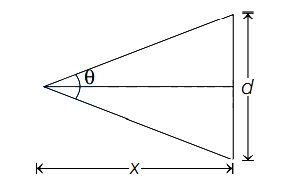
0 likesView Solution
53
PhysicsDifficultMCQKCET · 2020
An object approaches a convergent lens from the left of the lens with a uniform speed $5 \ m/s$ and stops at the focus. The image:
A
moves away from the lens with a uniform speed $5 \ m/s$
B
moves away from the lens with a uniform acceleration
C
moves away from the lens with a non-uniform acceleration
D
moves towards the lens with a non-uniform acceleration
Solution
(C) From the lens formula,$\frac{1}{f} = \frac{1}{v} - \frac{1}{u}$.
Differentiating with respect to time $t$,we get $0 = -\frac{1}{v^2} \frac{dv}{dt} + \frac{1}{u^2} \frac{du}{dt}$.
Rearranging,we find the velocity of the image $v_i = \frac{dv}{dt} = \left(\frac{v^2}{u^2}\right) \frac{du}{dt} = m^2 v_o$,where $m = \frac{v}{u}$ is the magnification and $v_o$ is the object speed.
Since $m = \frac{f}{f+u}$,the magnification $m$ changes as the object moves towards the focus $(u \to -f)$.
Differentiating the velocity $v_i$ with respect to time to find acceleration $a_i = \frac{dv_i}{dt} = \frac{d}{dt}(m^2 v_o) = 2m v_o \frac{dm}{dt}$.
As the object approaches the focus,$m$ changes non-linearly,making $\frac{dm}{dt}$ variable. Thus,the image moves away from the lens with a non-uniform acceleration.
Differentiating with respect to time $t$,we get $0 = -\frac{1}{v^2} \frac{dv}{dt} + \frac{1}{u^2} \frac{du}{dt}$.
Rearranging,we find the velocity of the image $v_i = \frac{dv}{dt} = \left(\frac{v^2}{u^2}\right) \frac{du}{dt} = m^2 v_o$,where $m = \frac{v}{u}$ is the magnification and $v_o$ is the object speed.
Since $m = \frac{f}{f+u}$,the magnification $m$ changes as the object moves towards the focus $(u \to -f)$.
Differentiating the velocity $v_i$ with respect to time to find acceleration $a_i = \frac{dv_i}{dt} = \frac{d}{dt}(m^2 v_o) = 2m v_o \frac{dm}{dt}$.
As the object approaches the focus,$m$ changes non-linearly,making $\frac{dm}{dt}$ variable. Thus,the image moves away from the lens with a non-uniform acceleration.
0 likesView Solution
54
PhysicsEasyMCQKCET · 2020
The following figure shows a beam of light converging at point $P$. When a concave lens of focal length $16 \,cm$ is introduced in the path of the beam at a place shown by the dotted line such that $OP$ becomes the axis of the lens,the beam converges at a distance $x$ from the lens. The value of $x$ will be equal to (in $\,cm$)
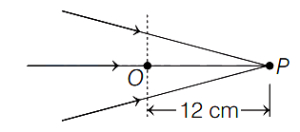
A
$12$
B
$24$
C
$36$
D
$48$
Solution
(D) Since the beam of light is converging at point $P$,it acts as a virtual object for the concave lens. The distance of point $P$ from the lens position is $u = +12 \,cm$ (as it is in the direction of incident light).
The focal length of the concave lens is $f = -16 \,cm$.
Using the lens formula:
$\frac{1}{v} - \frac{1}{u} = \frac{1}{f}$
Substituting the values:
$\frac{1}{v} - \frac{1}{12} = \frac{1}{-16}$
$\frac{1}{v} = \frac{1}{12} - \frac{1}{16}$
$\frac{1}{v} = \frac{4 - 3}{48} = \frac{1}{48}$
Therefore,$v = 48 \,cm$.
Since the beam converges at a distance $x$ from the lens,$x = 48 \,cm$.
The focal length of the concave lens is $f = -16 \,cm$.
Using the lens formula:
$\frac{1}{v} - \frac{1}{u} = \frac{1}{f}$
Substituting the values:
$\frac{1}{v} - \frac{1}{12} = \frac{1}{-16}$
$\frac{1}{v} = \frac{1}{12} - \frac{1}{16}$
$\frac{1}{v} = \frac{4 - 3}{48} = \frac{1}{48}$
Therefore,$v = 48 \,cm$.
Since the beam converges at a distance $x$ from the lens,$x = 48 \,cm$.
0 likesView Solution
55
PhysicsMediumMCQKCET · 2020
The refracting angle of a prism is $A$ and the refractive index of the material of the prism is $\cot \frac{A}{2}$. The angle of minimum deviation is:
A
$180^{\circ}-3 A$
B
$180^{\circ}+2 A$
C
$90^{\circ}-A$
D
$180^{\circ}-2 A$
Solution
(D) Given,angle of prism $= A$.
Refractive index of prism,$\mu = \cot \frac{A}{2}$.
We know the formula for refractive index in terms of minimum deviation $\delta_m$ is:
$\mu = \frac{\sin \left(\frac{A+\delta_m}{2}\right)}{\sin \left(\frac{A}{2}\right)}$
Substituting the given value of $\mu$:
$\cot \left(\frac{A}{2}\right) = \frac{\sin \left(\frac{A+\delta_m}{2}\right)}{\sin \left(\frac{A}{2}\right)}$
Using $\cot \theta = \frac{\cos \theta}{\sin \theta}$:
$\frac{\cos (A/2)}{\sin (A/2)} = \frac{\sin \left(\frac{A+\delta_m}{2}\right)}{\sin (A/2)}$
$\cos (A/2) = \sin \left(\frac{A+\delta_m}{2}\right)$
Since $\cos \theta = \sin (90^{\circ} - \theta)$,we have:
$\sin (90^{\circ} - A/2) = \sin \left(\frac{A+\delta_m}{2}\right)$
Equating the angles:
$90^{\circ} - \frac{A}{2} = \frac{A+\delta_m}{2}$
$180^{\circ} - A = A + \delta_m$
$\delta_m = 180^{\circ} - 2A$.
Refractive index of prism,$\mu = \cot \frac{A}{2}$.
We know the formula for refractive index in terms of minimum deviation $\delta_m$ is:
$\mu = \frac{\sin \left(\frac{A+\delta_m}{2}\right)}{\sin \left(\frac{A}{2}\right)}$
Substituting the given value of $\mu$:
$\cot \left(\frac{A}{2}\right) = \frac{\sin \left(\frac{A+\delta_m}{2}\right)}{\sin \left(\frac{A}{2}\right)}$
Using $\cot \theta = \frac{\cos \theta}{\sin \theta}$:
$\frac{\cos (A/2)}{\sin (A/2)} = \frac{\sin \left(\frac{A+\delta_m}{2}\right)}{\sin (A/2)}$
$\cos (A/2) = \sin \left(\frac{A+\delta_m}{2}\right)$
Since $\cos \theta = \sin (90^{\circ} - \theta)$,we have:
$\sin (90^{\circ} - A/2) = \sin \left(\frac{A+\delta_m}{2}\right)$
Equating the angles:
$90^{\circ} - \frac{A}{2} = \frac{A+\delta_m}{2}$
$180^{\circ} - A = A + \delta_m$
$\delta_m = 180^{\circ} - 2A$.
0 likesView Solution
56
PhysicsEasyMCQKCET · 2020
$A$ $220 \,V$ $AC$ supply is connected between points $A$ and $B$ as shown in the figure. What will be the potential difference $V$ across the capacitor?
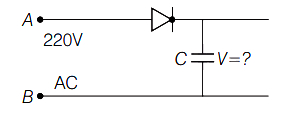
A
$220 \,V$
B
$110 \,V$
C
zero
D
$220 \sqrt{2} \,V$
Solution
(D) The circuit acts as a half-wave rectifier with a capacitor filter.
When the $AC$ supply is connected, the $p-n$ junction diode conducts only during the positive half-cycle (forward biased condition).
During this cycle, the capacitor charges to the peak value of the input $AC$ voltage.
Once charged, the capacitor maintains this peak voltage as there is no discharge path provided in the circuit.
The potential difference $V$ across the capacitor is equal to the peak value of the input $AC$ voltage $(V_0)$.
Given that the $RMS$ voltage $V_{\text{rms}} = 220 \,V$, the peak voltage is calculated as:
$V = V_0 = V_{\text{rms}} \times \sqrt{2}$
$V = 220 \times \sqrt{2} \,V = 220 \sqrt{2} \,V$.
When the $AC$ supply is connected, the $p-n$ junction diode conducts only during the positive half-cycle (forward biased condition).
During this cycle, the capacitor charges to the peak value of the input $AC$ voltage.
Once charged, the capacitor maintains this peak voltage as there is no discharge path provided in the circuit.
The potential difference $V$ across the capacitor is equal to the peak value of the input $AC$ voltage $(V_0)$.
Given that the $RMS$ voltage $V_{\text{rms}} = 220 \,V$, the peak voltage is calculated as:
$V = V_0 = V_{\text{rms}} \times \sqrt{2}$
$V = 220 \times \sqrt{2} \,V = 220 \sqrt{2} \,V$.
0 likesView Solution
57
PhysicsEasyMCQKCET · 2020
In the following circuit, what are the values of $P$ and $Q$?
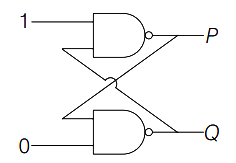
A
$P=1, Q=0$
B
$P=0, Q=1$
C
$P=0, Q=0$
D
$P=1, Q=1$
Solution
(B) The circuit consists of two cross-coupled $NAND$ gates, forming an $S-R$ latch.
Let the inputs be $S=1$ and $R=0$.
The output $P$ is given by $P = \overline{1 \cdot Q} = \overline{Q}$.
The output $Q$ is given by $Q = \overline{0 \cdot P} = \overline{0} = 1$.
Since $Q=1$, substituting this into the equation for $P$ gives $P = \overline{1} = 0$.
Thus, the stable state of the circuit is $P=0$ and $Q=1$.
Let the inputs be $S=1$ and $R=0$.
The output $P$ is given by $P = \overline{1 \cdot Q} = \overline{Q}$.
The output $Q$ is given by $Q = \overline{0 \cdot P} = \overline{0} = 1$.
Since $Q=1$, substituting this into the equation for $P$ gives $P = \overline{1} = 0$.
Thus, the stable state of the circuit is $P=0$ and $Q=1$.
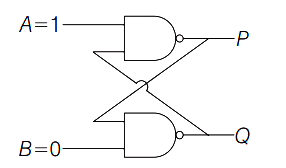
0 likesView Solution
58
PhysicsEasyMCQKCET · 2020
$A$ positive hole in a semiconductor is
A
an anti-particle of electron
B
a vacancy created when an electron leaves a covalent bond
C
absence of free electrons
D
an artificially created particle
Solution
(B) At room temperature,some of the valence electrons acquire thermal energy greater than $E_{g}$ (energy gap between the conduction and valence band) and become free.
When a valence electron is shifted to the conduction band,it leaves behind a vacancy in the valence band.
This vacancy is known as a hole and it acts as a charge carrier with a positive charge.
When a valence electron is shifted to the conduction band,it leaves behind a vacancy in the valence band.
This vacancy is known as a hole and it acts as a charge carrier with a positive charge.
0 likesView Solution
59
PhysicsEasyMCQKCET · 2020
Three polaroid sheets $P_{1}, P_{2}$ and $P_{3}$ are kept parallel to each other such that the angle between pass axes of $P_{1}$ and $P_{2}$ is $45^{\circ}$ and that between $P_{2}$ and $P_{3}$ is $45^{\circ}$. If an unpolarised beam of light of intensity $128 \ Wm^{-2}$ is incident on $P_{1}$,what is the intensity of light coming out of $P_{3}$?
A
$128 \ Wm^{-2}$
B
zero
C
$16 \ Wm^{-2}$
D
$64 \ Wm^{-2}$
Solution
(C) When unpolarised light of intensity $I_{0}$ passes through the first polaroid $P_{1}$,the intensity of the transmitted light becomes $I_{1} = \frac{I_{0}}{2}$.
Given $I_{0} = 128 \ Wm^{-2}$,so $I_{1} = \frac{128}{2} = 64 \ Wm^{-2}$.
According to Malus's law,when light of intensity $I_{1}$ passes through a polaroid whose pass axis makes an angle $\theta$ with the incident light's polarization direction,the transmitted intensity is $I = I_{1} \cos^{2} \theta$.
For $P_{2}$,the angle between the pass axis of $P_{1}$ and $P_{2}$ is $\theta_{1} = 45^{\circ}$.
Intensity after $P_{2}$ is $I_{2} = I_{1} \cos^{2} 45^{\circ} = 64 \times (\frac{1}{\sqrt{2}})^{2} = 64 \times \frac{1}{2} = 32 \ Wm^{-2}$.
For $P_{3}$,the angle between the pass axis of $P_{2}$ and $P_{3}$ is $\theta_{2} = 45^{\circ}$.
Intensity after $P_{3}$ is $I_{3} = I_{2} \cos^{2} 45^{\circ} = 32 \times (\frac{1}{\sqrt{2}})^{2} = 32 \times \frac{1}{2} = 16 \ Wm^{-2}$.
Given $I_{0} = 128 \ Wm^{-2}$,so $I_{1} = \frac{128}{2} = 64 \ Wm^{-2}$.
According to Malus's law,when light of intensity $I_{1}$ passes through a polaroid whose pass axis makes an angle $\theta$ with the incident light's polarization direction,the transmitted intensity is $I = I_{1} \cos^{2} \theta$.
For $P_{2}$,the angle between the pass axis of $P_{1}$ and $P_{2}$ is $\theta_{1} = 45^{\circ}$.
Intensity after $P_{2}$ is $I_{2} = I_{1} \cos^{2} 45^{\circ} = 64 \times (\frac{1}{\sqrt{2}})^{2} = 64 \times \frac{1}{2} = 32 \ Wm^{-2}$.
For $P_{3}$,the angle between the pass axis of $P_{2}$ and $P_{3}$ is $\theta_{2} = 45^{\circ}$.
Intensity after $P_{3}$ is $I_{3} = I_{2} \cos^{2} 45^{\circ} = 32 \times (\frac{1}{\sqrt{2}})^{2} = 32 \times \frac{1}{2} = 16 \ Wm^{-2}$.
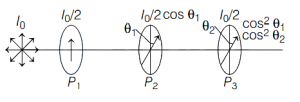
0 likesView Solution
60
PhysicsEasyMCQKCET · 2020
In Young's double slit experiment, the distance between the slits and the screen is $1.2 \, m$ and the distance between the two slits is $2.4 \, mm$. If a thin transparent mica sheet of thickness $1 \, \mu m$ and refractive index $1.5$ is introduced in the path of one of the interfering beams, the shift in the position of the central bright fringe is (in $ \, mm$)
A
$2$
B
$0.5$
C
$0.125$
D
$0.25$
Solution
(D) Given: Distance between slits and screen $D = 1.2 \, m$, distance between slits $d = 2.4 \, mm = 2.4 \times 10^{-3} \, m$, thickness of mica sheet $t = 1 \, \mu m = 1 \times 10^{-6} \, m$, and refractive index $\mu = 1.5$.
When a transparent sheet is introduced in the path of one of the interfering beams, the shift in the position of the central bright fringe is given by the formula:
$y = (\mu - 1) t \frac{D}{d}$
Substituting the given values:
$y = (1.5 - 1) \times (1 \times 10^{-6} \, m) \times \frac{1.2 \, m}{2.4 \times 10^{-3} \, m}$
$y = 0.5 \times 10^{-6} \times \frac{1.2}{2.4 \times 10^{-3}}$
$y = 0.5 \times 10^{-6} \times 0.5 \times 10^{3}$
$y = 0.25 \times 10^{-3} \, m = 0.25 \, mm$
Thus, the shift in the position of the central bright fringe is $0.25 \, mm$.
When a transparent sheet is introduced in the path of one of the interfering beams, the shift in the position of the central bright fringe is given by the formula:
$y = (\mu - 1) t \frac{D}{d}$
Substituting the given values:
$y = (1.5 - 1) \times (1 \times 10^{-6} \, m) \times \frac{1.2 \, m}{2.4 \times 10^{-3} \, m}$
$y = 0.5 \times 10^{-6} \times \frac{1.2}{2.4 \times 10^{-3}}$
$y = 0.5 \times 10^{-6} \times 0.5 \times 10^{3}$
$y = 0.25 \times 10^{-3} \, m = 0.25 \, mm$
Thus, the shift in the position of the central bright fringe is $0.25 \, mm$.
0 likesView Solution
Vedclass Products
For Students
Vedclass Test Series
Mock tests in real KCET style covering Physics with performance analysis. 5-day free trial.
Start Free TrialFor Teachers
Exam Paper Generator
Generate Set A/B/C/D Physics papers from 7.5L+ questions in 2 minutes. 3 chapters free.
Try FreeFor Institutes
Online Exam Module
Run live KCET mock exams with unlimited students, 360° analytics & white-label branding.
See DemoFrequently Asked Questions
How many Physics questions are in KCET 2020?
There are 60 Physics questions from the KCET 2020 paper on Vedclass, each with a detailed step-by-step solution in English.
Are KCET 2020 Physics solutions available in English?
Yes. All solutions on this page are in English. You can also switch to English or Hindi using the language buttons above the questions.
Can I practice KCET 2020 Physics as a timed test?
Yes. Use the Vedclass Test Series to attempt a full KCET mock test covering Physics with time limits and instant score analysis.
Can teachers create Physics papers from KCET previous year questions?
Yes. The Vedclass Exam Paper Generator lets teachers mix KCET Physics questions and generate Set A/B/C/D papers in minutes.
For Teachers & Institutes
Build a Custom Physics Paper
Pick KCET 2020 Physics questions, set difficulty, and generate Set A/B/C/D in 2 minutes.