
PhysicsQ1–60 of 60 questions
Page 1 of 1 · English
1
PhysicsMediumMCQKCET · 2025
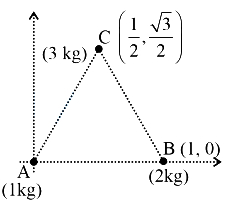
Three particles of mass $1 \ kg, 2 \ kg$ and $3 \ kg$ are placed at the vertices $A, B$ and $C$ respectively of an equilateral triangle $ABC$ of side $1 \ m$. The centre of mass of the system from vertex $A$ (located at origin) is
A
$\left(\frac{7}{12}, \frac{3 \sqrt{3}}{12}\right)$
B
$\left(\frac{9}{12}, \frac{3 \sqrt{3}}{12}\right)$
C
$\left(\frac{7}{12}, \frac{6+3 \sqrt{3}}{12}\right)$
D
$(0,0)$
Solution
(A) The coordinates of the vertices are $A(0, 0)$,$B(1, 0)$,and $C(1/2, \sqrt{3}/2)$.
The masses are $m_A = 1 \ kg$,$m_B = 2 \ kg$,and $m_C = 3 \ kg$.
The total mass $M = m_A + m_B + m_C = 1 + 2 + 3 = 6 \ kg$.
The $x$-coordinate of the centre of mass is given by:
$x_{cm} = \frac{m_A x_A + m_B x_B + m_C x_C}{M} = \frac{1(0) + 2(1) + 3(1/2)}{6} = \frac{0 + 2 + 1.5}{6} = \frac{3.5}{6} = \frac{7}{12}$.
The $y$-coordinate of the centre of mass is given by:
$y_{cm} = \frac{m_A y_A + m_B y_B + m_C y_C}{M} = \frac{1(0) + 2(0) + 3(\sqrt{3}/2)}{6} = \frac{3\sqrt{3}/2}{6} = \frac{3\sqrt{3}}{12}$.
Thus,the centre of mass is $\left(\frac{7}{12}, \frac{3\sqrt{3}}{12}\right)$.
The masses are $m_A = 1 \ kg$,$m_B = 2 \ kg$,and $m_C = 3 \ kg$.
The total mass $M = m_A + m_B + m_C = 1 + 2 + 3 = 6 \ kg$.
The $x$-coordinate of the centre of mass is given by:
$x_{cm} = \frac{m_A x_A + m_B x_B + m_C x_C}{M} = \frac{1(0) + 2(1) + 3(1/2)}{6} = \frac{0 + 2 + 1.5}{6} = \frac{3.5}{6} = \frac{7}{12}$.
The $y$-coordinate of the centre of mass is given by:
$y_{cm} = \frac{m_A y_A + m_B y_B + m_C y_C}{M} = \frac{1(0) + 2(0) + 3(\sqrt{3}/2)}{6} = \frac{3\sqrt{3}/2}{6} = \frac{3\sqrt{3}}{12}$.
Thus,the centre of mass is $\left(\frac{7}{12}, \frac{3\sqrt{3}}{12}\right)$.
0 likesView Solution
2
PhysicsEasyMCQKCET · 2025
During an elastic collision between two bodies,which of the following statements are correct?
$I$. The initial kinetic energy is equal to the final kinetic energy of the system.
$II$. The linear momentum is conserved.
$III$. The kinetic energy during $\Delta t$ (the collision time) is not conserved.
$I$. The initial kinetic energy is equal to the final kinetic energy of the system.
$II$. The linear momentum is conserved.
$III$. The kinetic energy during $\Delta t$ (the collision time) is not conserved.
A
$II$ and $III$ only
B
$I$ and $III$ only
C
$I, II$ and $III$
D
$I$ and $II$ only
Solution
(C) $I$. In an elastic collision,the total kinetic energy of the system is conserved,meaning the initial kinetic energy equals the final kinetic energy.
$II$. Linear momentum is conserved in all types of collisions (elastic or inelastic) provided no external force acts on the system.
$III$. During the collision interval $\Delta t$,the bodies deform,and part of the kinetic energy is temporarily converted into elastic potential energy. Therefore,the kinetic energy is not conserved during the collision process itself.
$\therefore$ All three statements are correct.
$II$. Linear momentum is conserved in all types of collisions (elastic or inelastic) provided no external force acts on the system.
$III$. During the collision interval $\Delta t$,the bodies deform,and part of the kinetic energy is temporarily converted into elastic potential energy. Therefore,the kinetic energy is not conserved during the collision process itself.
$\therefore$ All three statements are correct.
0 likesView Solution
3
PhysicsMediumMCQKCET · 2025
If $r_p, v_p, L_p$ and $r_a, v_a, L_a$ are radii,velocities and angular momenta of a planet at perihelion and aphelion of its elliptical orbit around the Sun respectively,then
A
$r_p > r_a, v_p > v_a, L_a > L_p$
B
$r_p < r_a, v_p > v_a, L_a = L_p$
C
$r_p > r_a, v_p < v_a, L_a = L_p$
D
$r_p < r_a, v_p < v_a, L_a < L_p$
Solution
(B) According to Kepler's second law,the angular momentum of a planet revolving around the Sun is conserved because the gravitational force is a central force.
Therefore,$L_p = L_a$.
Perihelion is the point in the orbit closest to the Sun,and aphelion is the point farthest from the Sun.
Therefore,$r_p < r_a$.
Since angular momentum $L = mvr$ is conserved,we have $m v_p r_p = m v_a r_a$.
Since $r_p < r_a$,it follows that $v_p > v_a$.
Thus,the correct relation is $r_p < r_a, v_p > v_a, L_a = L_p$.
Therefore,$L_p = L_a$.
Perihelion is the point in the orbit closest to the Sun,and aphelion is the point farthest from the Sun.
Therefore,$r_p < r_a$.
Since angular momentum $L = mvr$ is conserved,we have $m v_p r_p = m v_a r_a$.
Since $r_p < r_a$,it follows that $v_p > v_a$.
Thus,the correct relation is $r_p < r_a, v_p > v_a, L_a = L_p$.
0 likesView Solution
4
PhysicsMediumMCQKCET · 2025
The total energy of a satellite in a circular orbit at a distance $(R+h)$ from the centre of the Earth varies as [ $R$ is the radius of the Earth and $h$ is the height of the orbit from Earth's surface].
A
$-\frac{1}{(R+h)}$
B
$\frac{1}{(R+h)^2}$
C
$-\frac{1}{(R+h)^2}$
D
$\frac{1}{(R+h)}$
Solution
(A) The total energy $(E)$ of a satellite in a circular orbit is given by the formula:
$E = -\frac{GMm}{2r}$
Where:
- $G$ is the universal gravitational constant.
- $M$ is the mass of the Earth.
- $m$ is the mass of the satellite.
- $r = R + h$ is the distance from the center of the Earth.
Substituting $r = R + h$ into the energy equation,we get:
$E = -\frac{GMm}{2(R+h)}$
Since $G, M, m,$ and $2$ are constants,the total energy $E$ is proportional to $-\frac{1}{R+h}$.
Thus,the total energy varies as $-\frac{1}{R+h}$.
$E = -\frac{GMm}{2r}$
Where:
- $G$ is the universal gravitational constant.
- $M$ is the mass of the Earth.
- $m$ is the mass of the satellite.
- $r = R + h$ is the distance from the center of the Earth.
Substituting $r = R + h$ into the energy equation,we get:
$E = -\frac{GMm}{2(R+h)}$
Since $G, M, m,$ and $2$ are constants,the total energy $E$ is proportional to $-\frac{1}{R+h}$.
Thus,the total energy varies as $-\frac{1}{R+h}$.
0 likesView Solution
5
PhysicsEasyMCQKCET · 2025
At $27^{\circ} C$ temperature,the mean kinetic energy of the atoms of an ideal gas is $E_1$. If the temperature is increased to $327^{\circ} C$,then the mean kinetic energy of the atoms will be
A
$\frac{E_1}{\sqrt{2}}$
B
$\sqrt{2} E_1$
C
$2 E_1$
D
$\frac{E_1}{2}$
Solution
(C) The mean kinetic energy $(E)$ of an ideal gas is directly proportional to its absolute temperature ($T$ in Kelvin),given by the formula $E = \frac{3}{2} k_B T$.
Therefore,$E \propto T$.
Given initial temperature $T_1 = 27^{\circ} C = 27 + 273 = 300 \ K$.
Given final temperature $T_2 = 327^{\circ} C = 327 + 273 = 600 \ K$.
Using the proportionality ratio: $\frac{E_2}{E_1} = \frac{T_2}{T_1}$.
Substituting the values: $E_2 = E_1 \times \frac{600}{300}$.
$E_2 = 2 E_1$.
Therefore,$E \propto T$.
Given initial temperature $T_1 = 27^{\circ} C = 27 + 273 = 300 \ K$.
Given final temperature $T_2 = 327^{\circ} C = 327 + 273 = 600 \ K$.
Using the proportionality ratio: $\frac{E_2}{E_1} = \frac{T_2}{T_1}$.
Substituting the values: $E_2 = E_1 \times \frac{600}{300}$.
$E_2 = 2 E_1$.
0 likesView Solution
6
PhysicsMediumMCQKCET · 2025
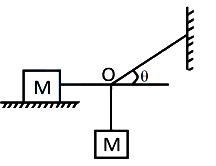
$A$ wooden block of mass $M$ lies on a rough floor. Another wooden block of the same mass is hanging from the point $O$ through strings as shown in the figure. To achieve equilibrium,the coefficient of static friction between the block on the floor and the floor itself is:
A
$\mu=\cot \theta$
B
$\mu=\sin \theta$
C
$\mu=\tan \theta$
D
$\mu=\cos \theta$
Solution
(A) Let $T_1$ be the tension in the horizontal string and $T_2$ be the tension in the inclined string at angle $\theta$.
For the hanging block of mass $M$,the vertical equilibrium gives $T_2 \sin \theta = Mg$ ... $(i)$.
For the point $O$,the horizontal equilibrium gives $T_1 = T_2 \cos \theta$ ... (ii).
For the block on the floor,the horizontal force is $T_1$ and the limiting friction is $f_s = \mu N = \mu Mg$.
For equilibrium,$T_1 = f_s = \mu Mg$ ... (iii).
From (ii) and (iii),$T_2 \cos \theta = \mu Mg$ ... (iv).
Dividing $(i)$ by (iv),we get $\frac{T_2 \sin \theta}{T_2 \cos \theta} = \frac{Mg}{\mu Mg}$.
Therefore,$\tan \theta = \frac{1}{\mu}$,which implies $\mu = \cot \theta$.
For the hanging block of mass $M$,the vertical equilibrium gives $T_2 \sin \theta = Mg$ ... $(i)$.
For the point $O$,the horizontal equilibrium gives $T_1 = T_2 \cos \theta$ ... (ii).
For the block on the floor,the horizontal force is $T_1$ and the limiting friction is $f_s = \mu N = \mu Mg$.
For equilibrium,$T_1 = f_s = \mu Mg$ ... (iii).
From (ii) and (iii),$T_2 \cos \theta = \mu Mg$ ... (iv).
Dividing $(i)$ by (iv),we get $\frac{T_2 \sin \theta}{T_2 \cos \theta} = \frac{Mg}{\mu Mg}$.
Therefore,$\tan \theta = \frac{1}{\mu}$,which implies $\mu = \cot \theta$.
0 likesView Solution
7
PhysicsMediumMCQKCET · 2025
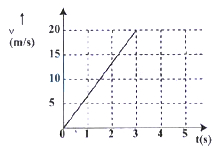
$A$ block of a certain mass is placed on a rough floor. The coefficients of static and kinetic friction between the block and the floor are $0.4$ and $0.25$ respectively. $A$ constant horizontal force $F = 20 \text{ N}$ acts on it so that the velocity of the block varies with time according to the following graph. The mass of the block is nearly (Take $g = 10 \text{ m/s}^2$): (in $\text{ kg}$)
A
$4.4$
B
$1.2$
C
$1.0$
D
$2.2$
Solution
(D) From the velocity-time graph,the acceleration $a$ of the block is the slope of the line:
$a = \frac{v - u}{t} = \frac{20 - 0}{3} = \frac{20}{3} \text{ m/s}^2$
Since the block is moving,the friction acting on it is kinetic friction,$f_k = \mu_k N = \mu_k mg$.
Given $\mu_k = 0.25$ and $g = 10 \text{ m/s}^2$,the kinetic friction is $f_k = 0.25 \times m \times 10 = 2.5m$.
Applying Newton's second law of motion,$F - f_k = ma$:
$20 - 2.5m = m \times \frac{20}{3}$
$20 = m \left( \frac{20}{3} + 2.5 \right)$
$20 = m \left( \frac{20 + 7.5}{3} \right) = m \left( \frac{27.5}{3} \right)$
$m = \frac{20 \times 3}{27.5} = \frac{60}{27.5} \approx 2.18 \text{ kg}$.
Rounding to the nearest value,the mass is $2.2 \text{ kg}$.
$a = \frac{v - u}{t} = \frac{20 - 0}{3} = \frac{20}{3} \text{ m/s}^2$
Since the block is moving,the friction acting on it is kinetic friction,$f_k = \mu_k N = \mu_k mg$.
Given $\mu_k = 0.25$ and $g = 10 \text{ m/s}^2$,the kinetic friction is $f_k = 0.25 \times m \times 10 = 2.5m$.
Applying Newton's second law of motion,$F - f_k = ma$:
$20 - 2.5m = m \times \frac{20}{3}$
$20 = m \left( \frac{20}{3} + 2.5 \right)$
$20 = m \left( \frac{20 + 7.5}{3} \right) = m \left( \frac{27.5}{3} \right)$
$m = \frac{20 \times 3}{27.5} = \frac{60}{27.5} \approx 2.18 \text{ kg}$.
Rounding to the nearest value,the mass is $2.2 \text{ kg}$.
0 likesView Solution
8
PhysicsMediumMCQKCET · 2025
$A$ horizontal pipe carries water in a streamlined flow. At a point along the pipe,where the cross-sectional area is $10 \text{ cm}^2$,the velocity of water is $1 \text{ ms}^{-1}$ and the pressure is $2000 \text{ Pa}$. What is the pressure of water at another point where the cross-sectional area is $5 \text{ cm}^2$ (in $Pa$)? [Density of water $= 1000 \text{ kgm}^{-3}$]
A
$300$
B
$400$
C
$500$
D
$200$
Solution
(C) Using the equation of continuity,$A_1 V_1 = A_2 V_2$.
Given $A_1 = 10 \text{ cm}^2$,$V_1 = 1 \text{ ms}^{-1}$,and $A_2 = 5 \text{ cm}^2$.
$V_2 = (A_1 V_1) / A_2 = (10 \times 1) / 5 = 2 \text{ ms}^{-1}$.
Using Bernoulli's equation for a horizontal pipe,$P_1 + 0.5 \rho V_1^2 = P_2 + 0.5 \rho V_2^2$.
$P_2 = P_1 + 0.5 \rho (V_1^2 - V_2^2)$.
$P_2 = 2000 + 0.5 \times 1000 \times (1^2 - 2^2)$.
$P_2 = 2000 + 500 \times (1 - 4) = 2000 - 1500 = 500 \text{ Pa}$.
Given $A_1 = 10 \text{ cm}^2$,$V_1 = 1 \text{ ms}^{-1}$,and $A_2 = 5 \text{ cm}^2$.
$V_2 = (A_1 V_1) / A_2 = (10 \times 1) / 5 = 2 \text{ ms}^{-1}$.
Using Bernoulli's equation for a horizontal pipe,$P_1 + 0.5 \rho V_1^2 = P_2 + 0.5 \rho V_2^2$.
$P_2 = P_1 + 0.5 \rho (V_1^2 - V_2^2)$.
$P_2 = 2000 + 0.5 \times 1000 \times (1^2 - 2^2)$.
$P_2 = 2000 + 500 \times (1 - 4) = 2000 - 1500 = 500 \text{ Pa}$.
0 likesView Solution
9
PhysicsMediumMCQKCET · 2025
While determining the coefficient of viscosity of the given liquid,a spherical steel ball sinks by a distance $h=0.9 \,m$. The radius of the ball $r=\sqrt{3} \times 10^{-3} \,m$. The time taken by the ball to sink in three trials are tabulated as follows:
The difference between the densities of the steel ball and the liquid is $7000 \,kg \,m^{-3}$. If $g=10 \,ms^{-2}$,then the coefficient of viscosity of the given liquid at room temperature is
| Trial No. | Time taken by the ball to fall by $h$ (in second) |
| $1$. | $2.75$ |
| $2$. | $2.65$ |
| $3$. | $2.70$ |
A
$0.14 \,Pa \cdot s$
B
$0.14 \times 10^{-3} \,Pa \cdot s$
C
$14 \,Pa \cdot s$
D
$0.28 \,Pa \cdot s$
Solution
(A) First,calculate the average time $t_{\text{avg}}$ taken by the ball to sink: $t_{\text{avg}} = \frac{2.75 + 2.65 + 2.70}{3} = 2.7 \,s$.
The terminal velocity $v_t$ is given by $v_t = \frac{h}{t_{\text{avg}}} = \frac{0.9}{2.7} = \frac{1}{3} \,m/s$.
According to Stokes' Law,the terminal velocity is $v_t = \frac{2r^2g(\rho_s - \rho_l)}{9\eta}$,where $\eta$ is the coefficient of viscosity.
Rearranging for $\eta$: $\eta = \frac{2r^2g(\rho_s - \rho_l)}{9v_t}$.
Given $r = \sqrt{3} \times 10^{-3} \,m$,so $r^2 = 3 \times 10^{-6} \,m^2$.
Given $(\rho_s - \rho_l) = 7000 \,kg/m^3$ and $g = 10 \,m/s^2$.
Substituting the values: $\eta = \frac{2 \times (3 \times 10^{-6}) \times 10 \times 7000}{9 \times (1/3)} = \frac{6 \times 10^{-5} \times 7000}{3} = 2 \times 10^{-5} \times 7000 = 0.14 \,Pa \cdot s$.
The terminal velocity $v_t$ is given by $v_t = \frac{h}{t_{\text{avg}}} = \frac{0.9}{2.7} = \frac{1}{3} \,m/s$.
According to Stokes' Law,the terminal velocity is $v_t = \frac{2r^2g(\rho_s - \rho_l)}{9\eta}$,where $\eta$ is the coefficient of viscosity.
Rearranging for $\eta$: $\eta = \frac{2r^2g(\rho_s - \rho_l)}{9v_t}$.
Given $r = \sqrt{3} \times 10^{-3} \,m$,so $r^2 = 3 \times 10^{-6} \,m^2$.
Given $(\rho_s - \rho_l) = 7000 \,kg/m^3$ and $g = 10 \,m/s^2$.
Substituting the values: $\eta = \frac{2 \times (3 \times 10^{-6}) \times 10 \times 7000}{9 \times (1/3)} = \frac{6 \times 10^{-5} \times 7000}{3} = 2 \times 10^{-5} \times 7000 = 0.14 \,Pa \cdot s$.
0 likesView Solution
10
PhysicsMediumMCQKCET · 2025
Two wires $A$ and $B$ are made of the same material. Their diameters are in the ratio of $1: 2$ and their lengths are in the ratio of $1: 3$. If they are stretched by the same force,then the increase in their lengths will be in the ratio of:
A
$3: 4$
B
$2: 3$
C
$3: 2$
D
$4: 3$
Solution
(D) The formula for Young's modulus $Y$ is given by $Y = \frac{F/A}{\Delta \ell / \ell}$,where $F$ is the force,$A$ is the cross-sectional area,$\ell$ is the original length,and $\Delta \ell$ is the change in length.
Rearranging for $\Delta \ell$,we get $\Delta \ell = \frac{F \ell}{AY}$.
Since the area $A = \pi r^2 = \pi (d/2)^2$,where $d$ is the diameter,we have $\Delta \ell = \frac{F \ell}{\pi (d/2)^2 Y} = \frac{4F \ell}{\pi d^2 Y}$.
Given that the wires are made of the same material ($Y$ is constant) and are stretched by the same force ($F$ is constant),the change in length is proportional to $\frac{\ell}{d^2}$.
Therefore,$\frac{\Delta \ell_A}{\Delta \ell_B} = \left( \frac{\ell_A}{\ell_B} \right) \times \left( \frac{d_B}{d_A} \right)^2$.
Given $\frac{\ell_A}{\ell_B} = \frac{1}{3}$ and $\frac{d_A}{d_B} = \frac{1}{2}$ (which implies $\frac{d_B}{d_A} = 2$),we substitute these values:
$\frac{\Delta \ell_A}{\Delta \ell_B} = \left( \frac{1}{3} \right) \times (2)^2 = \frac{1}{3} \times 4 = \frac{4}{3}$.
Thus,the ratio of the increase in their lengths is $4: 3$.
Rearranging for $\Delta \ell$,we get $\Delta \ell = \frac{F \ell}{AY}$.
Since the area $A = \pi r^2 = \pi (d/2)^2$,where $d$ is the diameter,we have $\Delta \ell = \frac{F \ell}{\pi (d/2)^2 Y} = \frac{4F \ell}{\pi d^2 Y}$.
Given that the wires are made of the same material ($Y$ is constant) and are stretched by the same force ($F$ is constant),the change in length is proportional to $\frac{\ell}{d^2}$.
Therefore,$\frac{\Delta \ell_A}{\Delta \ell_B} = \left( \frac{\ell_A}{\ell_B} \right) \times \left( \frac{d_B}{d_A} \right)^2$.
Given $\frac{\ell_A}{\ell_B} = \frac{1}{3}$ and $\frac{d_A}{d_B} = \frac{1}{2}$ (which implies $\frac{d_B}{d_A} = 2$),we substitute these values:
$\frac{\Delta \ell_A}{\Delta \ell_B} = \left( \frac{1}{3} \right) \times (2)^2 = \frac{1}{3} \times 4 = \frac{4}{3}$.
Thus,the ratio of the increase in their lengths is $4: 3$.
0 likesView Solution
11
PhysicsMediumMCQKCET · 2025
Two stones begin to fall from rest from the same height,with the second stone starting to fall $\Delta t$ seconds after the first. The distance of separation between the two stones becomes $H$,$t_0$ seconds after the first stone starts its motion. Then $t_0$ is equal to:
A
$\frac{H}{\Delta t} + \frac{\Delta t}{2}$
B
$\frac{H}{g \Delta t} - \frac{\Delta t}{2}$
C
$\frac{H}{g \Delta t} + \frac{\Delta t}{2}$
D
$\frac{H}{g \Delta t}$
Solution
(C) Let the first stone fall for time $t_0$. Its distance covered is $S_1 = \frac{1}{2} g t_0^2$.
The second stone starts $\Delta t$ seconds later,so it falls for time $(t_0 - \Delta t)$. Its distance covered is $S_2 = \frac{1}{2} g (t_0 - \Delta t)^2$.
The separation distance $H$ is given by $H = S_1 - S_2$.
Substituting the expressions: $H = \frac{1}{2} g t_0^2 - \frac{1}{2} g (t_0 - \Delta t)^2$.
Expanding the term: $H = \frac{1}{2} g [t_0^2 - (t_0^2 - 2 t_0 \Delta t + \Delta t^2)]$.
$H = \frac{1}{2} g [2 t_0 \Delta t - \Delta t^2]$.
$H = g t_0 \Delta t - \frac{1}{2} g \Delta t^2$.
Rearranging for $t_0$: $g t_0 \Delta t = H + \frac{1}{2} g \Delta t^2$.
Dividing by $g \Delta t$: $t_0 = \frac{H}{g \Delta t} + \frac{\Delta t}{2}$.
The second stone starts $\Delta t$ seconds later,so it falls for time $(t_0 - \Delta t)$. Its distance covered is $S_2 = \frac{1}{2} g (t_0 - \Delta t)^2$.
The separation distance $H$ is given by $H = S_1 - S_2$.
Substituting the expressions: $H = \frac{1}{2} g t_0^2 - \frac{1}{2} g (t_0 - \Delta t)^2$.
Expanding the term: $H = \frac{1}{2} g [t_0^2 - (t_0^2 - 2 t_0 \Delta t + \Delta t^2)]$.
$H = \frac{1}{2} g [2 t_0 \Delta t - \Delta t^2]$.
$H = g t_0 \Delta t - \frac{1}{2} g \Delta t^2$.
Rearranging for $t_0$: $g t_0 \Delta t = H + \frac{1}{2} g \Delta t^2$.
Dividing by $g \Delta t$: $t_0 = \frac{H}{g \Delta t} + \frac{\Delta t}{2}$.
0 likesView Solution
12
PhysicsEasyMCQKCET · 2025
In the projectile motion of a particle on a level ground,which of the following remains constant with reference to time and position?
A
Average velocity between any two points on the path
B
Horizontal component of velocity
C
Angle between the instantaneous velocity with the horizontal
D
Vertical component of the velocity of the projectile
Solution
(B) In projectile motion,the horizontal component of velocity $(v_x)$ remains constant with respect to time and position.
This is because there is no horizontal acceleration $(a_x = 0)$ acting on the projectile,assuming air resistance is neglected.
The vertical component of velocity $(v_y)$ changes due to the acceleration due to gravity $(g)$.
Therefore,the horizontal component of velocity is the only quantity among the options that remains constant throughout the motion.
This is because there is no horizontal acceleration $(a_x = 0)$ acting on the projectile,assuming air resistance is neglected.
The vertical component of velocity $(v_y)$ changes due to the acceleration due to gravity $(g)$.
Therefore,the horizontal component of velocity is the only quantity among the options that remains constant throughout the motion.
0 likesView Solution
13
PhysicsMediumMCQKCET · 2025
$A$ particle is in uniform circular motion. The equation of its trajectory is given by $(x-2)^2+y^2=25$,where $x$ and $y$ are in meters. The speed of the particle is $2 \text{ m/s}$. When the particle attains the lowest $y$ coordinate,the acceleration of the particle is (in $\text{m/s}^2$):
A
$0.4 \hat{j}$
B
$0.8 \hat{i}$
C
$0.8 \hat{j}$
D
$0.4 \hat{i}$
Solution
(C) The equation of the trajectory is $(x-2)^2 + y^2 = 25$. This represents a circle with center at $(2, 0)$ and radius $R = 5 \text{ m}$.
In uniform circular motion,the acceleration is purely centripetal,directed towards the center of the circle.
The magnitude of centripetal acceleration is $a_c = \frac{v^2}{R}$.
Given $v = 2 \text{ m/s}$ and $R = 5 \text{ m}$,we have $a_c = \frac{2^2}{5} = \frac{4}{5} = 0.8 \text{ m/s}^2$.
The particle attains the lowest $y$ coordinate at the point $(2, -5)$.
At this point,the center of the circle $(2, 0)$ is directly above the particle (along the positive $y$-axis).
Therefore,the centripetal acceleration vector is directed along the positive $y$-axis,which is $0.8 \hat{j} \text{ m/s}^2$.
In uniform circular motion,the acceleration is purely centripetal,directed towards the center of the circle.
The magnitude of centripetal acceleration is $a_c = \frac{v^2}{R}$.
Given $v = 2 \text{ m/s}$ and $R = 5 \text{ m}$,we have $a_c = \frac{2^2}{5} = \frac{4}{5} = 0.8 \text{ m/s}^2$.
The particle attains the lowest $y$ coordinate at the point $(2, -5)$.
At this point,the center of the circle $(2, 0)$ is directly above the particle (along the positive $y$-axis).
Therefore,the centripetal acceleration vector is directed along the positive $y$-axis,which is $0.8 \hat{j} \text{ m/s}^2$.
0 likesView Solution
14
PhysicsMediumMCQKCET · 2025
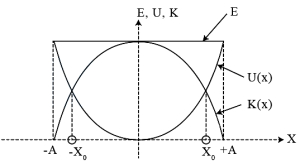
The variations of kinetic energy $K(x)$,potential energy $U(x)$,and total energy $E$ as a function of displacement $x$ of a particle in $SHM$ are as shown in the figure. The value of $|x_0|$ is
A
$2A$
B
$\frac{A}{\sqrt{2}}$
C
$\sqrt{2}A$
D
$\frac{A}{2}$
Solution
(B) In $SHM$,the kinetic energy $K(x)$ and potential energy $U(x)$ are given by:
$K(x) = \frac{1}{2}m\omega^2(A^2 - x^2)$
$U(x) = \frac{1}{2}m\omega^2x^2$
At the point $x = x_0$,the kinetic energy and potential energy are equal,i.e.,$K(x_0) = U(x_0)$.
$\frac{1}{2}m\omega^2(A^2 - x_0^2) = \frac{1}{2}m\omega^2x_0^2$
$A^2 - x_0^2 = x_0^2$
$A^2 = 2x_0^2$
$x_0^2 = \frac{A^2}{2}$
$|x_0| = \frac{A}{\sqrt{2}}$
$K(x) = \frac{1}{2}m\omega^2(A^2 - x^2)$
$U(x) = \frac{1}{2}m\omega^2x^2$
At the point $x = x_0$,the kinetic energy and potential energy are equal,i.e.,$K(x_0) = U(x_0)$.
$\frac{1}{2}m\omega^2(A^2 - x_0^2) = \frac{1}{2}m\omega^2x_0^2$
$A^2 - x_0^2 = x_0^2$
$A^2 = 2x_0^2$
$x_0^2 = \frac{A^2}{2}$
$|x_0| = \frac{A}{\sqrt{2}}$
0 likesView Solution
15
PhysicsMediumMCQKCET · 2025
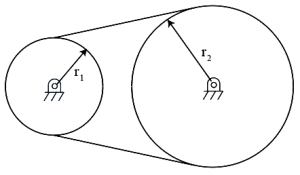
Two flywheels are connected by a non-slipping belt as shown in the figure. $I_1 = 4 \ kg \ m^2$,$r_1 = 20 \ cm$,$I_2 = 20 \ kg \ m^2$,and $r_2 = 30 \ cm$. $A$ torque of $10 \ Nm$ is applied on the smaller wheel. Match the entries of column $I$ with appropriate entries of column $II$.
| Quantities | Their numerical values (in $SI$ units) |
| a. Angular acceleration of smaller wheel | $1$. $5/3$ |
| b. Torque on the larger wheel | $2$. $100/3$ |
| c. Angular acceleration of larger wheel | $3$. $5/2$ |
A
$a-iii, b-ii, c-i$
B
$a-iii, b-i, c-ii$
C
$a-ii, b-i, c-iii$
D
$a-ii, b-iii, c-i$
Solution
(A) Given: $I_1 = 4 \ kg \ m^2$,$r_1 = 0.2 \ m$,$I_2 = 20 \ kg \ m^2$,$r_2 = 0.3 \ m$,$\tau_1 = 10 \ Nm$.
Since the belt is non-slipping,the linear acceleration of the rims is the same: $a = \alpha_1 r_1 = \alpha_2 r_2$.
For the smaller wheel: $\tau_1 = I_1 \alpha_1 \implies 10 = 4 \alpha_1 \implies \alpha_1 = 2.5 = 5/2 \ rad/s^2$.
For the larger wheel: $\alpha_2 = \alpha_1 (r_1 / r_2) = (5/2) \times (0.2 / 0.3) = (5/2) \times (2/3) = 5/3 \ rad/s^2$.
The tension $T$ in the belt provides the torque on the larger wheel: $\tau_2 = T r_2$ and $\tau_1 - T r_1 = I_1 \alpha_1$. However,using the relation $\tau_2 = I_2 \alpha_2$ is more direct: $\tau_2 = 20 \times (5/3) = 100/3 \ Nm$.
Matching: $a \to 3, b \to 2, c \to 1$.
Since the belt is non-slipping,the linear acceleration of the rims is the same: $a = \alpha_1 r_1 = \alpha_2 r_2$.
For the smaller wheel: $\tau_1 = I_1 \alpha_1 \implies 10 = 4 \alpha_1 \implies \alpha_1 = 2.5 = 5/2 \ rad/s^2$.
For the larger wheel: $\alpha_2 = \alpha_1 (r_1 / r_2) = (5/2) \times (0.2 / 0.3) = (5/2) \times (2/3) = 5/3 \ rad/s^2$.
The tension $T$ in the belt provides the torque on the larger wheel: $\tau_2 = T r_2$ and $\tau_1 - T r_1 = I_1 \alpha_1$. However,using the relation $\tau_2 = I_2 \alpha_2$ is more direct: $\tau_2 = 20 \times (5/3) = 100/3 \ Nm$.
Matching: $a \to 3, b \to 2, c \to 1$.
0 likesView Solution
16
PhysicsMediumMCQKCET · 2025
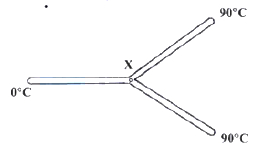
Three metal rods of the same material and identical in all respects are joined as shown in the figure. The temperatures at the ends of these rods are maintained as indicated. Assuming no heat energy loss occurs through the curved surfaces of the rods,the temperature at the junction $X$ is (in $^{\circ} C$)
A
$60$
B
$30$
C
$20$
D
$45$
Solution
(A) Let the thermal resistance of each rod be $R$ and the temperature of the junction be $T_X$.
According to the principle of conservation of energy,the total heat flowing into the junction must equal the total heat flowing out of the junction.
Here,heat flows from the two rods at $90^{\circ} C$ towards the junction $X$,and then from the junction $X$ towards the rod at $0^{\circ} C$.
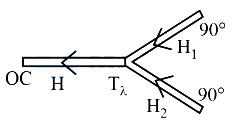
Let $H_1$ and $H_2$ be the heat currents from the two rods at $90^{\circ} C$,and $H$ be the heat current flowing towards the $0^{\circ} C$ end.
$H = H_1 + H_2$
Using the formula for heat current $H = \frac{\Delta T}{R}$,we have:
$\frac{T_X - 0}{R} = \frac{90 - T_X}{R} + \frac{90 - T_X}{R}$
Since the rods are identical,the thermal resistance $R$ is the same for all.
$T_X = (90 - T_X) + (90 - T_X)$
$T_X = 180 - 2T_X$
$3T_X = 180$
$T_X = 60^{\circ} C$
Thus,the temperature at the junction $X$ is $60^{\circ} C$.
According to the principle of conservation of energy,the total heat flowing into the junction must equal the total heat flowing out of the junction.
Here,heat flows from the two rods at $90^{\circ} C$ towards the junction $X$,and then from the junction $X$ towards the rod at $0^{\circ} C$.
Let $H_1$ and $H_2$ be the heat currents from the two rods at $90^{\circ} C$,and $H$ be the heat current flowing towards the $0^{\circ} C$ end.
$H = H_1 + H_2$
Using the formula for heat current $H = \frac{\Delta T}{R}$,we have:
$\frac{T_X - 0}{R} = \frac{90 - T_X}{R} + \frac{90 - T_X}{R}$
Since the rods are identical,the thermal resistance $R$ is the same for all.
$T_X = (90 - T_X) + (90 - T_X)$
$T_X = 180 - 2T_X$
$3T_X = 180$
$T_X = 60^{\circ} C$
Thus,the temperature at the junction $X$ is $60^{\circ} C$.
0 likesView Solution
17
PhysicsEasyMCQKCET · 2025
$A$ gas is taken from state $A$ to state $B$ along two different paths $1$ and $2$. The heat absorbed and work done by the system along these two paths are $Q_1, Q_2$ and $W_1, W_2$ respectively. Then:
A
$W_1 = W_2$
B
$Q_1 - W_1 = Q_2 - W_2$
C
$Q_1 + W_1 = Q_2 + W_2$
D
$Q_1 = Q_2$
Solution
(B) According to the first law of thermodynamics,the change in internal energy $\Delta U$ is given by $\Delta U = Q - W$.
Since internal energy is a state function,it depends only on the initial and final states of the system.
For both paths $1$ and $2$,the system moves from state $A$ to state $B$,so the change in internal energy is the same for both paths: $\Delta U_1 = \Delta U_2$.
Therefore,$Q_1 - W_1 = Q_2 - W_2$.
Since internal energy is a state function,it depends only on the initial and final states of the system.
For both paths $1$ and $2$,the system moves from state $A$ to state $B$,so the change in internal energy is the same for both paths: $\Delta U_1 = \Delta U_2$.
Therefore,$Q_1 - W_1 = Q_2 - W_2$.
0 likesView Solution
18
PhysicsMediumMCQKCET · 2025
Which of the following expressions can be deduced on the basis of dimensional analysis? (All symbols have their usual meanings)
A
$x=A \cos (\omega t)$
B
$N=N_0 e^{-\lambda t}$
C
$F=6 \pi \eta r \nu$
D
None of these
Solution
(C) Dimensional analysis is a powerful tool for checking the consistency of physical equations,but it has limitations. It cannot determine dimensionless constants (like $6 \pi$) or the presence of transcendental functions (like trigonometric,exponential,or logarithmic functions) because their arguments must be dimensionless.
$1$. $x=A \cos (\omega t)$: While dimensionally consistent,the presence of the trigonometric function $\cos$ cannot be derived using dimensional analysis.
$2$. $N=N_0 e^{-\lambda t}$: While dimensionally consistent,the exponential form cannot be derived using dimensional analysis.
$3$. $F=6 \pi \eta r \nu$ (Stokes' Law): The dimensions of the right-hand side are $[M L^{-1} T^{-1}] \cdot [L] \cdot [L T^{-1}] = [M L T^{-2}]$,which is the dimension of force. Dimensional analysis can relate $F$ to $\eta$,$r$,and $\nu$ as $F \propto \eta^a r^b \nu^c$. By comparing dimensions,we can find $a=1, b=1, c=1$,leading to $F \propto \eta r \nu$. Thus,the functional dependence can be deduced.
Therefore,option $C$ is the correct choice.
$1$. $x=A \cos (\omega t)$: While dimensionally consistent,the presence of the trigonometric function $\cos$ cannot be derived using dimensional analysis.
$2$. $N=N_0 e^{-\lambda t}$: While dimensionally consistent,the exponential form cannot be derived using dimensional analysis.
$3$. $F=6 \pi \eta r \nu$ (Stokes' Law): The dimensions of the right-hand side are $[M L^{-1} T^{-1}] \cdot [L] \cdot [L T^{-1}] = [M L T^{-2}]$,which is the dimension of force. Dimensional analysis can relate $F$ to $\eta$,$r$,and $\nu$ as $F \propto \eta^a r^b \nu^c$. By comparing dimensions,we can find $a=1, b=1, c=1$,leading to $F \propto \eta r \nu$. Thus,the functional dependence can be deduced.
Therefore,option $C$ is the correct choice.
0 likesView Solution
19
PhysicsEasyMCQKCET · 2025
The angle between the particle velocity and wave velocity in a transverse wave is [except when the particle passes through the mean position].
A
$\frac{\pi}{4}$ radian
B
$\frac{\pi}{2}$ radian
C
$\pi$ radian
D
Zero radian
Solution
(B) In a transverse wave,the particles of the medium oscillate in a direction perpendicular to the direction of wave propagation.
Since the wave velocity is along the direction of propagation and the particle velocity is perpendicular to it,the angle between them is $\frac{\pi}{2}$ radian.
This holds true for all positions of the particle except at the mean position,where the particle velocity is momentarily zero.
Since the wave velocity is along the direction of propagation and the particle velocity is perpendicular to it,the angle between them is $\frac{\pi}{2}$ radian.
This holds true for all positions of the particle except at the mean position,where the particle velocity is momentarily zero.
0 likesView Solution
20
PhysicsMediumMCQKCET · 2025
$A$ body of mass $0.25 \ kg$ travels along a straight line from $x=0$ to $x=2 \ m$ with a speed $v=k x^{3/2}$ where $k=2$ $SI$ units. The work done by the net force during this displacement is: (in $J$)
A
$8$
B
$16$
C
$32$
D
$4$
Solution
(D) According to the Work-Energy Theorem,the net work done on a body is equal to the change in its kinetic energy.
$W_{\text{net}} = \Delta KE = KE_f - KE_i$
Given mass $m = 0.25 \ kg$,speed $v = k x^{3/2}$,and $k = 2$.
At $x = 0$,$v_i = 2(0)^{3/2} = 0 \ m/s$,so $KE_i = 0 \ J$.
At $x = 2 \ m$,$v_f = 2(2)^{3/2} = 2 \times 2 \sqrt{2} = 4\sqrt{2} \ m/s$.
$KE_f = \frac{1}{2} m v_f^2 = \frac{1}{2} \times 0.25 \times (4\sqrt{2})^2$
$KE_f = \frac{1}{2} \times 0.25 \times 16 \times 2 = 0.25 \times 16 = 4 \ J$.
Therefore,$W_{\text{net}} = 4 \ J - 0 \ J = 4 \ J$.
$W_{\text{net}} = \Delta KE = KE_f - KE_i$
Given mass $m = 0.25 \ kg$,speed $v = k x^{3/2}$,and $k = 2$.
At $x = 0$,$v_i = 2(0)^{3/2} = 0 \ m/s$,so $KE_i = 0 \ J$.
At $x = 2 \ m$,$v_f = 2(2)^{3/2} = 2 \times 2 \sqrt{2} = 4\sqrt{2} \ m/s$.
$KE_f = \frac{1}{2} m v_f^2 = \frac{1}{2} \times 0.25 \times (4\sqrt{2})^2$
$KE_f = \frac{1}{2} \times 0.25 \times 16 \times 2 = 0.25 \times 16 = 4 \ J$.
Therefore,$W_{\text{net}} = 4 \ J - 0 \ J = 4 \ J$.
0 likesView Solution
21
PhysicsMediumMCQKCET · 2025
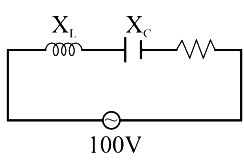
$A$ series $LCR$ circuit containing an $AC$ source of $100 \ V$ has an inductor and a capacitor of reactances $24 \ \Omega$ and $16 \ \Omega$ respectively. If a resistance of $6 \ \Omega$ is connected in series,then the potential difference across the series combination of inductor and capacitor only is (in $V$)
A
$80$
B
$400$
C
$8$
D
$40$
Solution
(A) Given: $X_L = 24 \ \Omega$,$X_C = 16 \ \Omega$,$R = 6 \ \Omega$,$V = 100 \ V$.
In a series $LCR$ circuit,the impedance $Z$ is given by:
$Z = \sqrt{R^2 + (X_L - X_C)^2}$
$Z = \sqrt{6^2 + (24 - 16)^2} = \sqrt{6^2 + 8^2} = \sqrt{36 + 64} = \sqrt{100} = 10 \ \Omega$.
The current $i$ in the circuit is:
$i = \frac{V}{Z} = \frac{100}{10} = 10 \ A$.
The potential difference across the series combination of the inductor and capacitor is given by:
$V_{LC} = i |X_L - X_C|$
$V_{LC} = 10 \times |24 - 16| = 10 \times 8 = 80 \ V$.
In a series $LCR$ circuit,the impedance $Z$ is given by:
$Z = \sqrt{R^2 + (X_L - X_C)^2}$
$Z = \sqrt{6^2 + (24 - 16)^2} = \sqrt{6^2 + 8^2} = \sqrt{36 + 64} = \sqrt{100} = 10 \ \Omega$.
The current $i$ in the circuit is:
$i = \frac{V}{Z} = \frac{100}{10} = 10 \ A$.
The potential difference across the series combination of the inductor and capacitor is given by:
$V_{LC} = i |X_L - X_C|$
$V_{LC} = 10 \times |24 - 16| = 10 \times 8 = 80 \ V$.
0 likesView Solution
22
PhysicsEasyMCQKCET · 2025
In domestic electric mains supply,the voltage and the current are
A
$AC$ voltage and $DC$ current
B
$DC$ voltage and $DC$ current
C
$DC$ voltage and $AC$ current
D
$AC$ voltage and $AC$ current
Solution
(D) In domestic electric mains supply,the power is transmitted as Alternating Current $(AC)$.
This means that both the voltage and the current oscillate sinusoidally with time.
Therefore,the domestic supply consists of $AC$ voltage and $AC$ current.
This means that both the voltage and the current oscillate sinusoidally with time.
Therefore,the domestic supply consists of $AC$ voltage and $AC$ current.
0 likesView Solution
23
PhysicsEasyMCQKCET · 2025
$A$ sinusoidal voltage produced by an $AC$ generator at any instant $t$ is given by the equation $V = 311 \sin(314t)$. The $rms$ value of voltage and frequency are respectively:
A
$200 \ V, 50 \ Hz$
B
$220 \ V, 100 \ Hz$
C
$220 \ V, 50 \ Hz$
D
$200 \ V, 100 \ Hz$
Solution
(C) The given equation is $V = V_0 \sin(\omega t)$,where $V_0 = 311 \ V$ and $\omega = 314 \ rad/s$.
The $rms$ value of voltage is given by $V_{rms} = \frac{V_0}{\sqrt{2}}$.
$V_{rms} = \frac{311}{1.414} \approx 220 \ V$.
The angular frequency is $\omega = 2\pi f$.
$314 = 2 \times 3.14 \times f$.
$314 = 6.28 \times f$.
$f = \frac{314}{6.28} = 50 \ Hz$.
Thus,the $rms$ voltage is $220 \ V$ and the frequency is $50 \ Hz$.
The $rms$ value of voltage is given by $V_{rms} = \frac{V_0}{\sqrt{2}}$.
$V_{rms} = \frac{311}{1.414} \approx 220 \ V$.
The angular frequency is $\omega = 2\pi f$.
$314 = 2 \times 3.14 \times f$.
$314 = 6.28 \times f$.
$f = \frac{314}{6.28} = 50 \ Hz$.
Thus,the $rms$ voltage is $220 \ V$ and the frequency is $50 \ Hz$.
0 likesView Solution
24
PhysicsEasyMCQKCET · 2025
If the radius of the first Bohr orbit is $r$, then the radius of the second Bohr orbit will be
A
$8 r$
B
$4 r$
C
$2 \sqrt{2} r$
D
$2 r$
Solution
(B) The radius of the $n^{th}$ Bohr orbit is given by the formula $r_n = n^2 r_1$, where $r_1$ is the radius of the first orbit $(r_1 = r)$.
For the second Bohr orbit, $n = 2$.
Substituting the value of $n$ into the formula:
$r_2 = (2)^2 \times r$
$r_2 = 4 r$
Therefore, the radius of the second Bohr orbit is $4 r$.
For the second Bohr orbit, $n = 2$.
Substituting the value of $n$ into the formula:
$r_2 = (2)^2 \times r$
$r_2 = 4 r$
Therefore, the radius of the second Bohr orbit is $4 r$.
0 likesView Solution
25
PhysicsEasyMCQKCET · 2025
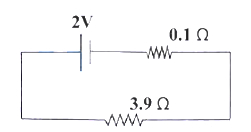
In the following circuit,the terminal voltage across the cell is (in $V$)
A
$1.68$
B
$1.95$
C
$2.71$
D
$0.52$
Solution
(B) The circuit consists of a cell with $EMF$ $E = 2 \ V$ and internal resistance $r = 0.1 \ \Omega$,connected in series with an external resistor $R = 3.9 \ \Omega$.
First,calculate the total resistance of the circuit: $R_{total} = R + r = 3.9 \ \Omega + 0.1 \ \Omega = 4.0 \ \Omega$.
Next,calculate the current $i$ flowing through the circuit using Ohm's law: $i = \frac{E}{R_{total}} = \frac{2 \ V}{4.0 \ \Omega} = 0.5 \ A$.
The terminal voltage $V$ across the cell is given by the formula: $V = E - i \times r$.
Substituting the values: $V = 2 \ V - (0.5 \ A \times 0.1 \ \Omega) = 2 \ V - 0.05 \ V = 1.95 \ V$.
First,calculate the total resistance of the circuit: $R_{total} = R + r = 3.9 \ \Omega + 0.1 \ \Omega = 4.0 \ \Omega$.
Next,calculate the current $i$ flowing through the circuit using Ohm's law: $i = \frac{E}{R_{total}} = \frac{2 \ V}{4.0 \ \Omega} = 0.5 \ A$.
The terminal voltage $V$ across the cell is given by the formula: $V = E - i \times r$.
Substituting the values: $V = 2 \ V - (0.5 \ A \times 0.1 \ \Omega) = 2 \ V - 0.05 \ V = 1.95 \ V$.
0 likesView Solution
26
PhysicsMediumMCQKCET · 2025
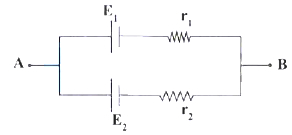
Two cells of emfs $E_1$ and $E_2$ and internal resistances $r_1$ and $r_2$ ($E_2 > E_1$ and $r_2 > r_1$) respectively,are connected in parallel as shown in the figure. The equivalent emf of the combination is $E_{eq}$. Then
A
$E_1 < E_{eq} < E_2$ and $E_{eq}$ is nearer $E_2$
B
$E_{eq} > E_2$
C
$E_{eq} < E_1$
D
$E_1 < E_{eq} < E_2$ and $E_{eq}$ is nearer $E_1$
Solution
(D) The equivalent emf of two cells connected in parallel is given by the formula:
$E_{eq} = \frac{\frac{E_1}{r_1} + \frac{E_2}{r_2}}{\frac{1}{r_1} + \frac{1}{r_2}} = \frac{E_1 r_2 + E_2 r_1}{r_1 + r_2}$
This can be rewritten as:
$E_{eq} = \frac{E_1 r_2 + E_2 r_1}{r_1 + r_2} = \frac{E_1 r_2 + E_1 r_1 - E_1 r_1 + E_2 r_1}{r_1 + r_2} = \frac{E_1(r_1 + r_2) + r_1(E_2 - E_1)}{r_1 + r_2} = E_1 + \frac{r_1}{r_1 + r_2}(E_2 - E_1)$
Since $E_2 > E_1$ and $r_1, r_2 > 0$,it is clear that $E_{eq} > E_1$.
Similarly,$E_{eq} = E_2 - \frac{r_2}{r_1 + r_2}(E_2 - E_1)$. Since $E_2 > E_1$ and $r_1, r_2 > 0$,it is clear that $E_{eq} < E_2$.
Thus,$E_1 < E_{eq} < E_2$.
Given $r_2 > r_1$,the term $\frac{r_1}{r_1 + r_2} < \frac{1}{2}$.
Therefore,$E_{eq}$ is closer to $E_1$ than to $E_2$.
$E_{eq} = \frac{\frac{E_1}{r_1} + \frac{E_2}{r_2}}{\frac{1}{r_1} + \frac{1}{r_2}} = \frac{E_1 r_2 + E_2 r_1}{r_1 + r_2}$
This can be rewritten as:
$E_{eq} = \frac{E_1 r_2 + E_2 r_1}{r_1 + r_2} = \frac{E_1 r_2 + E_1 r_1 - E_1 r_1 + E_2 r_1}{r_1 + r_2} = \frac{E_1(r_1 + r_2) + r_1(E_2 - E_1)}{r_1 + r_2} = E_1 + \frac{r_1}{r_1 + r_2}(E_2 - E_1)$
Since $E_2 > E_1$ and $r_1, r_2 > 0$,it is clear that $E_{eq} > E_1$.
Similarly,$E_{eq} = E_2 - \frac{r_2}{r_1 + r_2}(E_2 - E_1)$. Since $E_2 > E_1$ and $r_1, r_2 > 0$,it is clear that $E_{eq} < E_2$.
Thus,$E_1 < E_{eq} < E_2$.
Given $r_2 > r_1$,the term $\frac{r_1}{r_1 + r_2} < \frac{1}{2}$.
Therefore,$E_{eq}$ is closer to $E_1$ than to $E_2$.
0 likesView Solution
27
PhysicsEasyMCQKCET · 2025
Given a current-carrying wire of non-uniform cross-section,which of the following is constant throughout the length of the wire?
A
Drift speed
B
Current and drift speed
C
Current only
D
Current,electric field,and drift speed
Solution
(C) The correct answer is current only.
According to the principle of continuity for steady current,the current $I$ flowing through any cross-section of a conductor remains constant,regardless of the area of the cross-section.
Since $I = nAev_d$,where $n$ is the number density of electrons,$A$ is the area of cross-section,$e$ is the charge of an electron,and $v_d$ is the drift speed,if the area $A$ changes,the drift speed $v_d$ must change to keep the current $I$ constant.
Similarly,the electric field $E$ depends on the current density $J = I/A$,so it also varies with the cross-sectional area.
According to the principle of continuity for steady current,the current $I$ flowing through any cross-section of a conductor remains constant,regardless of the area of the cross-section.
Since $I = nAev_d$,where $n$ is the number density of electrons,$A$ is the area of cross-section,$e$ is the charge of an electron,and $v_d$ is the drift speed,if the area $A$ changes,the drift speed $v_d$ must change to keep the current $I$ constant.
Similarly,the electric field $E$ depends on the current density $J = I/A$,so it also varies with the cross-sectional area.
0 likesView Solution
28
PhysicsMediumMCQKCET · 2025
Two similar galvanometers are converted into an ammeter and a milliammeter. The shunt resistance of the ammeter as compared to the shunt resistance of the milliammeter will be
A
Zero
B
More
C
Less
D
Equal
Solution
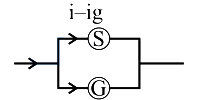
(C) galvanometer is converted into an ammeter by connecting a small shunt resistance $S$ in parallel with it.
For a galvanometer with resistance $G$ and full-scale deflection current $i_g$,if it is to measure a maximum current $i$,the shunt resistance $S$ is given by:
$S = \frac{i_g G}{i - i_g}$
From this formula,we can see that $S \propto \frac{1}{i - i_g}$.
Since an ammeter is designed to measure a larger current $(i_{ammeter})$ compared to a milliammeter $(i_{milliammeter})$,the denominator $(i - i_g)$ will be larger for the ammeter.
Therefore,the shunt resistance $S$ required for the ammeter will be less than the shunt resistance required for the milliammeter.
Thus,the shunt resistance of the ammeter is less than that of the milliammeter.
For a galvanometer with resistance $G$ and full-scale deflection current $i_g$,if it is to measure a maximum current $i$,the shunt resistance $S$ is given by:
$S = \frac{i_g G}{i - i_g}$
From this formula,we can see that $S \propto \frac{1}{i - i_g}$.
Since an ammeter is designed to measure a larger current $(i_{ammeter})$ compared to a milliammeter $(i_{milliammeter})$,the denominator $(i - i_g)$ will be larger for the ammeter.
Therefore,the shunt resistance $S$ required for the ammeter will be less than the shunt resistance required for the milliammeter.
Thus,the shunt resistance of the ammeter is less than that of the milliammeter.
0 likesView Solution
29
PhysicsMediumMCQKCET · 2025
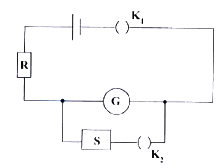
In an experiment to determine the figure of merit of a galvanometer by the half-deflection method,a student constructed the following circuit. He unplugged a resistance of $5200 \ \Omega$ in $R$. When $K_1$ is closed and $K_2$ is open,the deflection observed in the galvanometer is $26 \ \text{div}$. When $K_2$ is also closed and a resistance of $90 \ \Omega$ is removed in $S$,the deflection becomes $13 \ \text{div}$. The resistance of the galvanometer is nearly: (in $Omega$)
A
$45.0$
B
$103.0$
C
$91.6$
D
$116.0$
Solution
(C) In the half-deflection method,the resistance of the galvanometer $G$ is given by the formula:
$G = \frac{S \cdot R}{R - S}$
Given:
Resistance in series $R = 5200 \ \Omega$
Shunt resistance $S = 90 \ \Omega$
Initial deflection $\theta = 26 \ \text{div}$
Final deflection $\theta' = \theta/2 = 13 \ \text{div}$
Substituting the values:
$G = \frac{90 \times 5200}{5200 - 90}$
$G = \frac{468000}{5110}$
$G \approx 91.58 \ \Omega$
Rounding to the nearest option,$G \approx 91.6 \ \Omega$.
$G = \frac{S \cdot R}{R - S}$
Given:
Resistance in series $R = 5200 \ \Omega$
Shunt resistance $S = 90 \ \Omega$
Initial deflection $\theta = 26 \ \text{div}$
Final deflection $\theta' = \theta/2 = 13 \ \text{div}$
Substituting the values:
$G = \frac{90 \times 5200}{5200 - 90}$
$G = \frac{468000}{5110}$
$G \approx 91.58 \ \Omega$
Rounding to the nearest option,$G \approx 91.6 \ \Omega$.
0 likesView Solution
30
PhysicsMediumMCQKCET · 2025
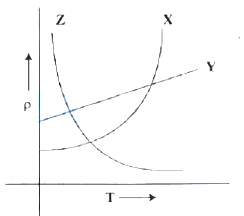
The variations of resistivity $\rho$ with absolute temperature $T$ for three different materials $X, Y$ and $Z$ are shown in the graph below. Identify the materials $X, Y$ and $Z$.
A
$X$ - copper,$Y$ - nichrome,$Z$ - semiconductor
B
$X$ - semiconductor,$Y$ - nichrome,$Z$ - copper
C
$X$ - nichrome,$Y$ - copper,$Z$ - semiconductor
D
$X$ - copper,$Y$ - semiconductor,$Z$ - nichrome
Solution
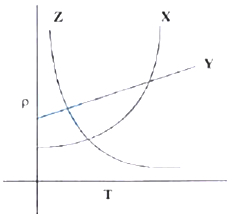
(A) In the given graph:
$1$. For material $Z$,resistivity $\rho$ decreases exponentially with an increase in temperature $T$. This is a characteristic property of semiconductors.
$2$. For material $Y$,resistivity $\rho$ increases linearly with temperature $T$. This is a characteristic property of alloys like nichrome,which have a very small temperature coefficient of resistance.
$3$. For material $X$,resistivity $\rho$ increases non-linearly with temperature $T$. This is a characteristic property of metals like copper.
Therefore,$X$ is copper,$Y$ is nichrome,and $Z$ is a semiconductor.
$1$. For material $Z$,resistivity $\rho$ decreases exponentially with an increase in temperature $T$. This is a characteristic property of semiconductors.
$2$. For material $Y$,resistivity $\rho$ increases linearly with temperature $T$. This is a characteristic property of alloys like nichrome,which have a very small temperature coefficient of resistance.
$3$. For material $X$,resistivity $\rho$ increases non-linearly with temperature $T$. This is a characteristic property of metals like copper.
Therefore,$X$ is copper,$Y$ is nichrome,and $Z$ is a semiconductor.
0 likesView Solution
31
PhysicsEasyMCQKCET · 2025
The graph showing the variation of resistance $(R)$ of a metal wire as a function of its diameter $(D)$,while keeping other parameters like length and temperature constant,is:
A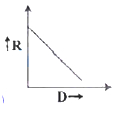
B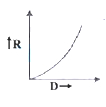
C
D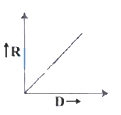
Solution
(C) The resistance $(R)$ of a wire is given by the formula: $R = \frac{\rho \ell}{A}$,where $\rho$ is resistivity,$\ell$ is length,and $A$ is the cross-sectional area.
Since the wire is cylindrical,the cross-sectional area $A = \pi r^2 = \pi (D/2)^2 = \frac{\pi D^2}{4}$.
Substituting this into the resistance formula,we get: $R = \frac{\rho \ell}{\pi D^2 / 4} = \frac{4 \rho \ell}{\pi D^2}$.
Since $\rho$,$\ell$,and $\pi$ are constants,we have $R \propto \frac{1}{D^2}$.
This relationship represents an inverse square law,which corresponds to a curve that decreases as $D$ increases. Among the given options,Graph $C$ represents this behavior.
Since the wire is cylindrical,the cross-sectional area $A = \pi r^2 = \pi (D/2)^2 = \frac{\pi D^2}{4}$.
Substituting this into the resistance formula,we get: $R = \frac{\rho \ell}{\pi D^2 / 4} = \frac{4 \rho \ell}{\pi D^2}$.
Since $\rho$,$\ell$,and $\pi$ are constants,we have $R \propto \frac{1}{D^2}$.
This relationship represents an inverse square law,which corresponds to a curve that decreases as $D$ increases. Among the given options,Graph $C$ represents this behavior.
0 likesView Solution
32
PhysicsEasyMCQKCET · 2025
The range of electrical conductivity $(\sigma)$ and resistivity $(\rho)$ for metals,among the following,is
A
$\rho \rightarrow 10^{-5}-10^{-6} \Omega \text{ m}, \sigma \rightarrow 10^5-10^6 \text{ S m}^{-1}$
B
$\rho \rightarrow 10^{11}-10^{19} \Omega \text{ m}, \sigma \rightarrow 10^{-11}-10^{-19} \text{ S m}^{-1}$
C
$\rho \rightarrow 10^2-10^8 \Omega \text{ m}, \sigma \rightarrow 10^{-2}-10^{-8} \text{ S m}^{-1}$
D
$\rho \rightarrow 10^{-8}-10^{-6} \Omega \text{ m}, \sigma \rightarrow 10^6-10^8 \text{ S m}^{-1}$
Solution
(D) Electrical conductivity $(\sigma)$ is the reciprocal of electrical resistivity $(\rho)$,i.e.,$\sigma = 1/\rho$.
For metals,the resistivity $(\rho)$ is very low,typically in the range of $10^{-8} \Omega \text{ m}$ to $10^{-6} \Omega \text{ m}$.
Consequently,the electrical conductivity $(\sigma)$ is very high,typically in the range of $10^6 \text{ S m}^{-1}$ to $10^8 \text{ S m}^{-1}$.
Comparing this with the given options,option $D$ correctly represents these ranges.
For metals,the resistivity $(\rho)$ is very low,typically in the range of $10^{-8} \Omega \text{ m}$ to $10^{-6} \Omega \text{ m}$.
Consequently,the electrical conductivity $(\sigma)$ is very high,typically in the range of $10^6 \text{ S m}^{-1}$ to $10^8 \text{ S m}^{-1}$.
Comparing this with the given options,option $D$ correctly represents these ranges.
0 likesView Solution
33
PhysicsEasyMCQKCET · 2025
If we consider an electron and a photon of the same de-Broglie wavelength,then they will have the same:
A
Angular momentum
B
Energy
C
Velocity
D
Momentum
Solution
(D) The de-Broglie wavelength $\lambda$ is related to the momentum $p$ of a particle by the equation $\lambda = \frac{h}{p}$,where $h$ is Planck's constant.
Since the de-Broglie wavelength $\lambda$ is the same for both the electron and the photon,their momenta $p$ must also be the same.
Therefore,they will have the same momentum.
Since the de-Broglie wavelength $\lambda$ is the same for both the electron and the photon,their momenta $p$ must also be the same.
Therefore,they will have the same momentum.
0 likesView Solution
34
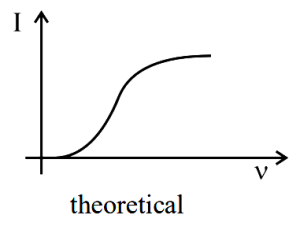
PhysicsMediumMCQKCET · 2025
The anode voltage of a photocell is kept fixed. The frequency of the light falling on the cathode is gradually increased. Then the correct graph which shows the variation of photo current $I$ with the frequency $\nu$ of incident light is
A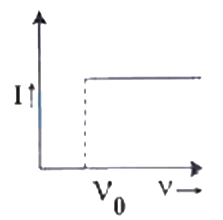
B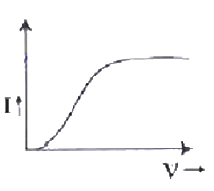
C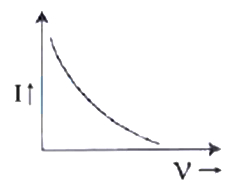
D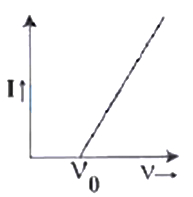
Solution
(A) In the photoelectric effect,the photoelectric current $I$ is directly proportional to the intensity of the incident light,provided the frequency $\nu$ of the incident light is greater than the threshold frequency $\nu_0$.
If the intensity of the incident light is kept constant while the frequency $\nu$ is increased,the number of photons incident per unit time remains constant (since $P = n h \nu$,if power $P$ is constant,$n$ decreases as $\nu$ increases). However,in practical experimental setups,the photoelectric current is independent of the frequency of light as long as $\nu > \nu_0$.
Therefore,the graph of photoelectric current $I$ versus frequency $\nu$ is a horizontal line for $\nu > \nu_0$ and zero for $\nu < \nu_0$. This corresponds to the graph shown in option $A$.
If the intensity of the incident light is kept constant while the frequency $\nu$ is increased,the number of photons incident per unit time remains constant (since $P = n h \nu$,if power $P$ is constant,$n$ decreases as $\nu$ increases). However,in practical experimental setups,the photoelectric current is independent of the frequency of light as long as $\nu > \nu_0$.
Therefore,the graph of photoelectric current $I$ versus frequency $\nu$ is a horizontal line for $\nu > \nu_0$ and zero for $\nu < \nu_0$. This corresponds to the graph shown in option $A$.
0 likesView Solution
35
PhysicsEasyMCQKCET · 2025
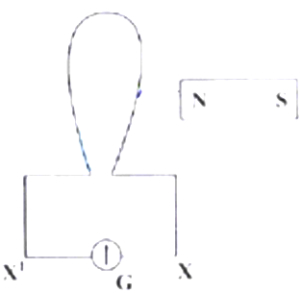
When a bar magnet is pushed towards the coil,along its axis,as shown in the figure,the galvanometer pointer deflects towards $X$. When this magnet is pulled away from the coil,the galvanometer pointer:
A
Deflects towards $X^1$
B
Does not deflect
C
Oscillates
D
Deflects towards $X$
Solution
(A) According to Lenz's law,the induced current in the coil always opposes the change in magnetic flux that produces it.
When the north pole of the magnet is pushed towards the coil,the magnetic flux through the coil increases,and the induced current flows in a direction to oppose this increase.
When the magnet is pulled away from the coil,the magnetic flux through the coil decreases. To oppose this decrease,the induced current flows in the opposite direction compared to the first case.
Since the galvanometer pointer deflected towards $X$ when the magnet was pushed in,it will deflect in the opposite direction,i.e.,towards $X^1$,when the magnet is pulled away.
When the north pole of the magnet is pushed towards the coil,the magnetic flux through the coil increases,and the induced current flows in a direction to oppose this increase.
When the magnet is pulled away from the coil,the magnetic flux through the coil decreases. To oppose this decrease,the induced current flows in the opposite direction compared to the first case.
Since the galvanometer pointer deflected towards $X$ when the magnet was pushed in,it will deflect in the opposite direction,i.e.,towards $X^1$,when the magnet is pulled away.
0 likesView Solution
36
PhysicsEasyMCQKCET · 2025
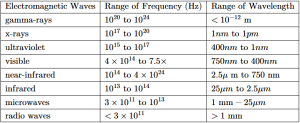
Match the following types of waves with their wavelength ranges:
| $i$. Microwave | $(a)$. $700 \ nm$ to $400 \ nm$ |
| $ii$. Visible light | $(b)$. $1 \ nm$ to $10^{-3} \ nm$ |
| $iii$. Ultraviolet | $(c)$. $0.1 \ m$ to $1 \ mm$ |
| $iv$. $X$-rays | $(d)$. $400 \ nm$ to $1 \ nm$ |
A
$i-c, ii-a, iii-d, iv-b$
B
$i-d, ii-b, iii-c, iv-a$
C
$i-b, ii-c, iii-a, iv-d$
D
$i-a, ii-d, iii-b, iv-c$
Solution
(A) To match the electromagnetic waves with their respective wavelength ranges,we refer to the standard electromagnetic spectrum:
$1$. Microwave: The wavelength range is approximately $0.1 \ m$ to $1 \ mm$ (corresponds to $c$).
$2$. Visible light: The wavelength range is approximately $700 \ nm$ to $400 \ nm$ (corresponds to $a$).
$3$. Ultraviolet: The wavelength range is approximately $400 \ nm$ to $1 \ nm$ (corresponds to $d$).
$4$. $X$-rays: The wavelength range is approximately $1 \ nm$ to $10^{-3} \ nm$ (corresponds to $b$).
Thus,the correct matching is $i-c, ii-a, iii-d, iv-b$.
$1$. Microwave: The wavelength range is approximately $0.1 \ m$ to $1 \ mm$ (corresponds to $c$).
$2$. Visible light: The wavelength range is approximately $700 \ nm$ to $400 \ nm$ (corresponds to $a$).
$3$. Ultraviolet: The wavelength range is approximately $400 \ nm$ to $1 \ nm$ (corresponds to $d$).
$4$. $X$-rays: The wavelength range is approximately $1 \ nm$ to $10^{-3} \ nm$ (corresponds to $b$).
Thus,the correct matching is $i-c, ii-a, iii-d, iv-b$.
0 likesView Solution
37
PhysicsEasyMCQKCET · 2025
The total energy carried by a light wave when it travels from a rarer to a non-reflecting and non-absorbing medium:
A
remains same
B
increases
C
either increases or decreases depending upon the angle of incidence
D
decreases
Solution
(A) When a light wave travels from a rarer medium to a non-reflecting and non-absorbing medium,the total energy it carries remains the same.
Energy in a light wave is proportional to the frequency of the wave and the number of photons present.
Since the frequency of light remains constant when it changes mediums and the medium is non-absorbing (no energy loss) and non-reflecting (no energy diverted),the total energy is conserved.
Energy in a light wave is proportional to the frequency of the wave and the number of photons present.
Since the frequency of light remains constant when it changes mediums and the medium is non-absorbing (no energy loss) and non-reflecting (no energy diverted),the total energy is conserved.
0 likesView Solution
38
PhysicsMediumMCQKCET · 2025
Match Column-$I$ with Column-$II$ related to an electric dipole of dipole moment $\vec{p}$ that is placed in a uniform electric field $\overrightarrow{E}$.
| Column-$I$ (Angle between $\vec{p}$ and $\vec{E}$) | Column-$II$ (Potential energy of the dipole) |
| $a. 180^{\circ}$ | $i. -pE$ |
| $b. 120^{\circ}$ | $ii. pE$ |
| $c. 90^{\circ}$ | $iii. \frac{1}{2} pE$ |
| $iv. 0$ |
A
$a-i, b-ii, c-iii$
B
$a-ii, b-iii, c-i$
C
$a-ii, b-i, c-iv$
D
$a-ii, b-iii, c-iv$
Solution
(D) The potential energy $(U)$ of an electric dipole in a uniform electric field is given by the formula: $U = -\vec{p} \cdot \vec{E} = -pE \cos \theta$.
For each case:
$(a)$ At $\theta = 180^{\circ}$,$U = -pE \cos 180^{\circ} = -pE(-1) = pE$. This matches $(ii)$.
$(b)$ At $\theta = 120^{\circ}$,$U = -pE \cos 120^{\circ} = -pE(-1/2) = \frac{1}{2} pE$. This matches $(iii)$.
$(c)$ At $\theta = 90^{\circ}$,$U = -pE \cos 90^{\circ} = -pE(0) = 0$. This matches $(iv)$.
Therefore,the correct matching is $a-ii, b-iii, c-iv$.
For each case:
$(a)$ At $\theta = 180^{\circ}$,$U = -pE \cos 180^{\circ} = -pE(-1) = pE$. This matches $(ii)$.
$(b)$ At $\theta = 120^{\circ}$,$U = -pE \cos 120^{\circ} = -pE(-1/2) = \frac{1}{2} pE$. This matches $(iii)$.
$(c)$ At $\theta = 90^{\circ}$,$U = -pE \cos 90^{\circ} = -pE(0) = 0$. This matches $(iv)$.
Therefore,the correct matching is $a-ii, b-iii, c-iv$.
0 likesView Solution
39
PhysicsMediumMCQKCET · 2025
Charges are uniformly spread on the surface of a conducting sphere. The electric field from the centre of the sphere to a point outside the sphere varies with distance $r$ from the centre as:
A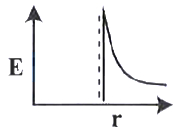
B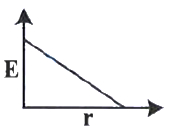
C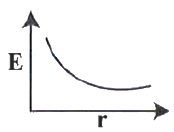
D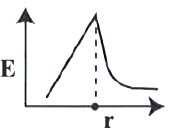
Solution
(A) For a conducting sphere of radius $R$ carrying a total charge $Q$:
$1$. Inside the sphere $(r < R)$,the electric field $E$ is zero because all charges reside on the surface.
$2$. Outside the sphere $(r \geq R)$,the sphere acts as a point charge located at its center,so the electric field is given by $E = \frac{1}{4 \pi \epsilon_0} \frac{Q}{r^2}$,which means $E \propto \frac{1}{r^2}$.
$3$. Therefore,the electric field is zero for $r < R$ and decreases as $1/r^2$ for $r \geq R$. The graph that represents this behavior is Graph $A$,where $E=0$ up to $r=R$ and then follows an inverse-square decay.
$1$. Inside the sphere $(r < R)$,the electric field $E$ is zero because all charges reside on the surface.
$2$. Outside the sphere $(r \geq R)$,the sphere acts as a point charge located at its center,so the electric field is given by $E = \frac{1}{4 \pi \epsilon_0} \frac{Q}{r^2}$,which means $E \propto \frac{1}{r^2}$.
$3$. Therefore,the electric field is zero for $r < R$ and decreases as $1/r^2$ for $r \geq R$. The graph that represents this behavior is Graph $A$,where $E=0$ up to $r=R$ and then follows an inverse-square decay.
0 likesView Solution
40
PhysicsEasyMCQKCET · 2025
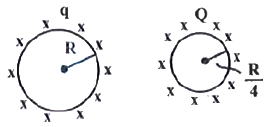
$A$ metallic sphere of radius $R$ carrying a charge $q$ is kept at a certain distance from another metallic sphere of radius $R/4$ carrying a charge $Q$. What is the electric flux at any point inside the metallic sphere of radius $R$ due to the sphere of radius $R/4$?
A
$\frac{Q}{\varepsilon_0} - \frac{q}{\varepsilon_0}$
B
Zero
C
$\frac{q}{\varepsilon_0} - \frac{Q}{\varepsilon_0}$
D
$\frac{Q}{\varepsilon_0}$
Solution
(B) According to the properties of conductors in electrostatic equilibrium,the electric field inside the material of a metallic conductor is always zero.
Since the electric field $E$ is zero everywhere inside the metallic sphere of radius $R$,the electric flux $\phi$ through any closed surface drawn inside the material of this sphere is given by $\phi = \oint E \cdot dA = 0$.
Therefore,the electric flux at any point inside the metallic sphere of radius $R$ due to the external charge $Q$ on the other sphere is zero.
Since the electric field $E$ is zero everywhere inside the metallic sphere of radius $R$,the electric flux $\phi$ through any closed surface drawn inside the material of this sphere is given by $\phi = \oint E \cdot dA = 0$.
Therefore,the electric flux at any point inside the metallic sphere of radius $R$ due to the external charge $Q$ on the other sphere is zero.
0 likesView Solution
41
PhysicsEasyMCQKCET · 2025
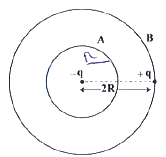
You are given a dipole of charge $+q$ and $-q$ separated by a distance $2R$. $A$ sphere '$A$' of radius ' $R$ ' passes through the centre of the dipole as shown below and another sphere '$B$' of radius ' $2R$ ' passes through the charge $+q$. Then the electric flux through the sphere '$A$' is
A
$q / \varepsilon_0$
B
Zero
C
$2q / \varepsilon_0$
D
$-q / \varepsilon_0$
Solution
(D) According to Gauss's Law,the electric flux $\phi$ through any closed surface is given by $\phi = \frac{q_{\text{enclosed}}}{\varepsilon_0}$,where $q_{\text{enclosed}}$ is the total charge enclosed by the surface.
In the given figure,sphere '$A$' has a radius ' $R$ ' and is centered at the midpoint of the dipole. The distance between the charges $+q$ and $-q$ is $2R$. Therefore,the distance of each charge from the center is $R$.
Since sphere '$A$' has a radius ' $R$ ',it encloses only the charge $-q$ located at the center of the sphere.
Thus,the charge enclosed by sphere '$A$' is $q_{\text{enclosed}} = -q$.
Therefore,the electric flux through sphere '$A$' is $\phi_A = \frac{-q}{\varepsilon_0}$.
In the given figure,sphere '$A$' has a radius ' $R$ ' and is centered at the midpoint of the dipole. The distance between the charges $+q$ and $-q$ is $2R$. Therefore,the distance of each charge from the center is $R$.
Since sphere '$A$' has a radius ' $R$ ',it encloses only the charge $-q$ located at the center of the sphere.
Thus,the charge enclosed by sphere '$A$' is $q_{\text{enclosed}} = -q$.
Therefore,the electric flux through sphere '$A$' is $\phi_A = \frac{-q}{\varepsilon_0}$.
0 likesView Solution
42
PhysicsEasyMCQKCET · 2025
Which of the following is a correct statement?
A
Gauss's law is true for any open surface
B
Gauss's law is not applicable when charges are not symmetrically distributed over a closed surface.
C
Gauss's law does not hold good for a charge situated outside the Gaussian surface.
D
Gauss's law is true for any closed surface
Solution
(D) Gauss's law states that the total electric flux through a closed surface is equal to $\frac{1}{\epsilon_0}$ times the total charge enclosed by the surface.
Therefore,Gauss's law is valid for any closed surface,regardless of the shape or the distribution of charges inside it.
Charges outside the surface do not contribute to the net flux through the surface.
Thus,option $D$ is the correct statement.
Therefore,Gauss's law is valid for any closed surface,regardless of the shape or the distribution of charges inside it.
Charges outside the surface do not contribute to the net flux through the surface.
Thus,option $D$ is the correct statement.
0 likesView Solution
43
PhysicsEasyMCQKCET · 2025
$A$ potential at a point $A$ is $-3 \ V$ and that at another point $B$ is $5 \ V$. What is the work done in carrying a charge of $5 \ mC$ from $B$ to $A$?
A
-$0.04$ $J$
B
-$0.4$ $J$
C
-$4$ $J$
D
-$40$ $J$
Solution
(A) The work done $W$ in moving a charge $q$ from point $B$ to point $A$ is given by the formula: $W = q(V_A - V_B)$.
Given:
Charge $q = 5 \ mC = 5 \times 10^{-3} \ C$.
Potential at $A$,$V_A = -3 \ V$.
Potential at $B$,$V_B = 5 \ V$.
Substituting the values:
$W = 5 \times 10^{-3} \times (-3 - 5)$
$W = 5 \times 10^{-3} \times (-8)$
$W = -40 \times 10^{-3} \ J$
$W = -0.04 \ J$.
Given:
Charge $q = 5 \ mC = 5 \times 10^{-3} \ C$.
Potential at $A$,$V_A = -3 \ V$.
Potential at $B$,$V_B = 5 \ V$.
Substituting the values:
$W = 5 \times 10^{-3} \times (-3 - 5)$
$W = 5 \times 10^{-3} \times (-8)$
$W = -40 \times 10^{-3} \ J$
$W = -0.04 \ J$.
0 likesView Solution
44
PhysicsEasyMCQKCET · 2025
Which of the following statements is not true?
A
Work done to move a charge on an equipotential surface is not zero
B
Equipotential surfaces are the surfaces where the potential is constant
C
Equipotential surfaces for a uniform electric field are parallel and equidistant from each other
D
Electric field is always perpendicular to an equipotential surface
Solution
(A) An equipotential surface is defined as a surface where the electric potential is the same at every point.
Since the potential difference $(V_B - V_A)$ between any two points on an equipotential surface is zero,the work done $(W)$ in moving a charge $(q)$ from one point to another is given by $W = q(V_B - V_A) = 0$.
Therefore,the statement that 'Work done to move a charge on an equipotential surface is not zero' is false.
Since the potential difference $(V_B - V_A)$ between any two points on an equipotential surface is zero,the work done $(W)$ in moving a charge $(q)$ from one point to another is given by $W = q(V_B - V_A) = 0$.
Therefore,the statement that 'Work done to move a charge on an equipotential surface is not zero' is false.
0 likesView Solution
45
PhysicsEasyMCQKCET · 2025
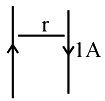
Two thin long parallel wires separated by a distance '$r$' from each other in a vacuum carry a current of $I$ ampere in opposite directions. Then,they will:
A
Attract each other with a force per unit length of $\frac{\mu_0 I^2}{2 \pi r}$
B
Repel each other with a force per unit length of $\frac{\mu_0 I^2}{2 \pi r}$
C
Repel each other with a force per unit length of $\frac{\mu_0 I^2}{2 \pi r^2}$
D
Attract each other with a force per unit length of $\frac{\mu_0 I^2}{2 \pi r^2}$
Solution
(B) The magnetic force per unit length between two long parallel wires carrying currents $I_1$ and $I_2$ separated by a distance $r$ is given by the formula:
$\frac{F}{\ell} = \frac{\mu_0 I_1 I_2}{2 \pi r}$
In this case,both wires carry the same current $I$,so $I_1 = I_2 = I$. Thus,the force per unit length is:
$\frac{F}{\ell} = \frac{\mu_0 I^2}{2 \pi r}$
According to the right-hand rule,parallel wires carrying currents in the same direction attract each other,while wires carrying currents in opposite directions repel each other.
Since the currents are in opposite directions,the wires will repel each other.
$\frac{F}{\ell} = \frac{\mu_0 I_1 I_2}{2 \pi r}$
In this case,both wires carry the same current $I$,so $I_1 = I_2 = I$. Thus,the force per unit length is:
$\frac{F}{\ell} = \frac{\mu_0 I^2}{2 \pi r}$
According to the right-hand rule,parallel wires carrying currents in the same direction attract each other,while wires carrying currents in opposite directions repel each other.
Since the currents are in opposite directions,the wires will repel each other.
0 likesView Solution
46
PhysicsMediumMCQKCET · 2025
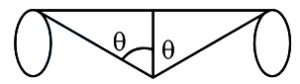
$A$ solenoid is $1 \ m$ long and $4 \ cm$ in diameter. It has five layers of windings of $1000$ turns each and carries a current of $7 \ A$. The magnetic field at the centre of the solenoid is
A
$0.4396 \times 10^{-5} \ T$
B
$4.396 \times 10^{-2} \ T$
C
$43.96 \times 10^{-2} \ T$
D
$439.6 \ T$
Solution
(B) Given: Length of solenoid $\ell = 1 \ m$,Diameter $d = 4 \ cm$,Radius $r = 2 \ cm = 0.02 \ m$.
Total number of turns $N = 5 \times 1000 = 5000$.
Current $I = 7 \ A$.
The magnetic field at the centre of a finite solenoid is given by $B = \frac{\mu_0 N I}{2\ell} (\cos \theta_1 + \cos \theta_2)$.
Since the solenoid is long compared to its radius,we can approximate the field using the formula for an ideal solenoid $B = \mu_0 n I$,where $n = N/\ell$.
$B = \frac{\mu_0 N I}{\ell} = \frac{4\pi \times 10^{-7} \times 5000 \times 7}{1}$.
$B = 4\pi \times 10^{-7} \times 35000 = 14\pi \times 10^{-3} \ T$.
$B \approx 14 \times 3.14159 \times 10^{-3} \ T = 43.98 \times 10^{-3} \ T = 4.398 \times 10^{-2} \ T$.
Rounding to the given options,the correct value is $4.396 \times 10^{-2} \ T$.
Total number of turns $N = 5 \times 1000 = 5000$.
Current $I = 7 \ A$.
The magnetic field at the centre of a finite solenoid is given by $B = \frac{\mu_0 N I}{2\ell} (\cos \theta_1 + \cos \theta_2)$.
Since the solenoid is long compared to its radius,we can approximate the field using the formula for an ideal solenoid $B = \mu_0 n I$,where $n = N/\ell$.
$B = \frac{\mu_0 N I}{\ell} = \frac{4\pi \times 10^{-7} \times 5000 \times 7}{1}$.
$B = 4\pi \times 10^{-7} \times 35000 = 14\pi \times 10^{-3} \ T$.
$B \approx 14 \times 3.14159 \times 10^{-3} \ T = 43.98 \times 10^{-3} \ T = 4.398 \times 10^{-2} \ T$.
Rounding to the given options,the correct value is $4.396 \times 10^{-2} \ T$.
0 likesView Solution
47
PhysicsEasyMCQKCET · 2025
Identify the correct statement.
A
$A$ current-carrying conductor produces an electric field around it.
B
$A$ straight current-carrying conductor has circular magnetic field lines around it.
C
The direction of the magnetic field due to a current element is given by Fleming's Left-Hand Rule.
D
The magnetic field inside a solenoid is non-uniform.
Solution
(B) According to Oersted's experiment and the Biot-Savart law,a straight current-carrying conductor produces a magnetic field. The magnetic field lines around a long straight current-carrying wire are concentric circles with the wire as the center. Therefore,option $B$ is correct. Fleming's Left-Hand Rule is used to determine the direction of force on a current-carrying conductor in a magnetic field,not the field itself. The magnetic field inside an ideal solenoid is uniform.
0 likesView Solution
48
PhysicsEasyMCQKCET · 2025
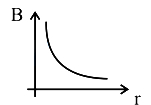
Which of the following graphs represents the variation of magnetic field $B$ with perpendicular distance $r$ from an infinitely long,straight conductor carrying current?
A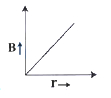
B
C
D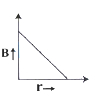
Solution
(B) The magnetic field $B$ at a perpendicular distance $r$ from an infinitely long,straight current-carrying conductor is given by the formula:
$B = \frac{\mu_0 I}{2 \pi r}$
From this expression,it is clear that $B \propto \frac{1}{r}$.
This relationship represents a rectangular hyperbola,where $B$ decreases as $r$ increases. Therefore,the graph in option $B$ correctly represents this variation.
$B = \frac{\mu_0 I}{2 \pi r}$
From this expression,it is clear that $B \propto \frac{1}{r}$.
This relationship represents a rectangular hyperbola,where $B$ decreases as $r$ increases. Therefore,the graph in option $B$ correctly represents this variation.
0 likesView Solution
49
PhysicsEasyMCQKCET · 2025
$A$ square loop of side $2 \ m$ lies in the $Y-Z$ plane in a region having a magnetic field $\vec{B}=(5 \hat{i}+3 \hat{j}-4 \hat{k}) \ T$. The magnitude of magnetic flux through the square loop is (in $Wb$)
A
$20$
B
$12$
C
$16$
D
$10$
Solution
(A) The area vector $\vec{A}$ of a square loop of side $2 \ m$ lying in the $Y-Z$ plane is directed along the $X$-axis.
$\vec{A} = (2 \times 2) \hat{i} = 4 \hat{i} \ m^2$.
The magnetic field is given by $\vec{B} = (5 \hat{i} + 3 \hat{j} - 4 \hat{k}) \ T$.
The magnetic flux $\phi$ is given by the dot product of the magnetic field and the area vector:
$\phi = \vec{B} \cdot \vec{A}$
$\phi = (5 \hat{i} + 3 \hat{j} - 4 \hat{k}) \cdot (4 \hat{i})$
$\phi = (5 \times 4) + (3 \times 0) + (-4 \times 0)$
$\phi = 20 \ Wb$.
Thus,the magnitude of the magnetic flux is $20 \ Wb$.
$\vec{A} = (2 \times 2) \hat{i} = 4 \hat{i} \ m^2$.
The magnetic field is given by $\vec{B} = (5 \hat{i} + 3 \hat{j} - 4 \hat{k}) \ T$.
The magnetic flux $\phi$ is given by the dot product of the magnetic field and the area vector:
$\phi = \vec{B} \cdot \vec{A}$
$\phi = (5 \hat{i} + 3 \hat{j} - 4 \hat{k}) \cdot (4 \hat{i})$
$\phi = (5 \times 4) + (3 \times 0) + (-4 \times 0)$
$\phi = 20 \ Wb$.
Thus,the magnitude of the magnetic flux is $20 \ Wb$.
0 likesView Solution
50
PhysicsEasyMCQKCET · 2025
Which of the following statements is true in respect of diamagnetic substances?
A
They are feebly attracted by magnets
B
Permeability is greater than $1000$
C
Susceptibility decreases with temperature.
D
Susceptibility is small and negative
Solution
(D) Diamagnetic substances are materials that develop a weak magnetization in the direction opposite to the applied magnetic field.
Their magnetic susceptibility $(\chi)$ is small and negative, typically ranging from $-10^{-5}$ to $-10^{-9}$.
Unlike paramagnetic or ferromagnetic substances, the magnetic susceptibility of diamagnetic substances is independent of temperature.
Therefore, the statement that susceptibility is small and negative is correct.
Their magnetic susceptibility $(\chi)$ is small and negative, typically ranging from $-10^{-5}$ to $-10^{-9}$.
Unlike paramagnetic or ferromagnetic substances, the magnetic susceptibility of diamagnetic substances is independent of temperature.
Therefore, the statement that susceptibility is small and negative is correct.
0 likesView Solution
51
PhysicsEasyMCQKCET · 2025
Match the following types of nuclei with their respective examples:
| Column-$I$ | Column-$II$ |
| $A$. Isotopes | $i$. $Li^7, Be^7$ |
| $B$. Isobars | $ii$. $_8O^{18}, _9F^{19}$ |
| $C$. Isotones | $iii$. $_1H^1, _1H^2$ |
A
$A-ii, B-iii, C-i$
B
$A-i, B-iii, C-ii$
C
$A-iii, B-ii, C-i$
D
$A-iii, B-i, C-ii$
Solution
(D) $1$. Isotopes: Atoms with the same atomic number $(Z)$ but different mass numbers $(A)$. Example: $_1H^1$ and $_1H^2$ have $Z=1$. Thus,$A-iii$.
$2$. Isobars: Atoms with the same mass number $(A)$ but different atomic numbers $(Z)$. Example: $Li^7$ and $Be^7$ both have $A=7$. Thus,$B-i$.
$3$. Isotones: Atoms with the same number of neutrons $(N = A-Z)$. For $_8O^{18}$,$N = 18-8 = 10$. For $_9F^{19}$,$N = 19-9 = 10$. Thus,$C-ii$.
Therefore,the correct matching is $A-iii, B-i, C-ii$.
$2$. Isobars: Atoms with the same mass number $(A)$ but different atomic numbers $(Z)$. Example: $Li^7$ and $Be^7$ both have $A=7$. Thus,$B-i$.
$3$. Isotones: Atoms with the same number of neutrons $(N = A-Z)$. For $_8O^{18}$,$N = 18-8 = 10$. For $_9F^{19}$,$N = 19-9 = 10$. Thus,$C-ii$.
Therefore,the correct matching is $A-iii, B-i, C-ii$.
0 likesView Solution
52
PhysicsMediumMCQKCET · 2025
Which of the following statements is incorrect with reference to 'Nuclear force'?
A
Nuclear force becomes attractive for nucleon distances larger than $0.8 \ fm$
B
Nuclear force becomes repulsive for nucleon distances less than $0.8 \ fm$
C
Nuclear force is always attractive
D
Potential energy is minimum if the separation between the nucleons is $0.8 \ fm$
Solution
(C) The strong nuclear force is not always attractive. It is strongly attractive at distances larger than $0.8 \ fm$ and becomes strongly repulsive at distances less than $0.8 \ fm$ to prevent the collapse of the nucleus. Therefore,the statement that the nuclear force is 'always attractive' is incorrect.
0 likesView Solution
53
PhysicsMediumMCQKCET · 2025
$A$ convex lens has power $P$. It is cut into two halves along its principal axis. Further,one piece (out of two halves) is cut into two halves perpendicular to the principal axis as shown in the figure. Choose the incorrect option for the reported lens pieces.
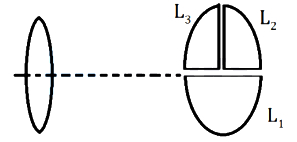
A
Power of $L_2$ is $\frac{P}{2}$
B
Power of $L_3$ is $\frac{P}{2}$
C
Power of $L_1$ is $P$
D
Power of $L_1$ is $\frac{P}{2}$
Solution
(D) $1$. When a lens is cut along its principal axis,the focal length of each half remains the same as the original lens,so the power of each half remains $P$. Thus,the power of $L_1$ is $P$.
$2$. When a lens is cut perpendicular to its principal axis,the focal length of each part doubles,which means the power of each part becomes half of the original power.
$3$. Since $L_2$ and $L_3$ are obtained by cutting the upper half of the original lens perpendicular to the principal axis,the power of $L_2$ is $\frac{P}{2}$ and the power of $L_3$ is $\frac{P}{2}$.
$4$. Comparing these with the given options,the incorrect statement is that the power of $L_1$ is $\frac{P}{2}$.
$2$. When a lens is cut perpendicular to its principal axis,the focal length of each part doubles,which means the power of each part becomes half of the original power.
$3$. Since $L_2$ and $L_3$ are obtained by cutting the upper half of the original lens perpendicular to the principal axis,the power of $L_2$ is $\frac{P}{2}$ and the power of $L_3$ is $\frac{P}{2}$.
$4$. Comparing these with the given options,the incorrect statement is that the power of $L_1$ is $\frac{P}{2}$.
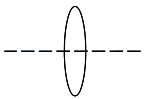
0 likesView Solution
54
PhysicsEasyMCQKCET · 2025
The image formed by an objective lens of a compound microscope is
A
Real and diminished
B
Real and enlarged
C
Virtual and enlarged
D
Virtual and diminished
Solution
(B) In a compound microscope,the objective lens is placed close to the object. The object is placed just beyond the focal point of the objective lens. This results in the formation of a real,inverted,and enlarged image. This image acts as an object for the eyepiece,which further magnifies it to produce the final virtual image.
0 likesView Solution
55
PhysicsMediumMCQKCET · 2025
If $r$ and $r^1$ denote the angles of refraction at the two faces of a prism with a prism angle of $50^{\circ}$,and $r$ varies with time $t$ as $r = 10^{\circ} + t^2$,how will $r^1$ vary with time?
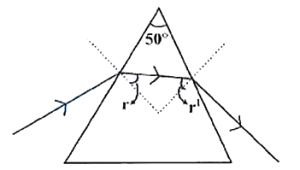
A
$40^{\circ} + t^2$
B
$50^{\circ} - t^2$
C
$50^{\circ} + t^2$
D
$40^{\circ} - t^2$
Solution
(D) For a prism,the sum of the angles of refraction at the two faces is equal to the angle of the prism $(A)$:
$r + r^1 = A$
Given that the angle of the prism $A = 50^{\circ}$ and $r = 10^{\circ} + t^2$,we can substitute these values into the equation:
$10^{\circ} + t^2 + r^1 = 50^{\circ}$
Solving for $r^1$:
$r^1 = 50^{\circ} - 10^{\circ} - t^2$
$r^1 = 40^{\circ} - t^2$
$r + r^1 = A$
Given that the angle of the prism $A = 50^{\circ}$ and $r = 10^{\circ} + t^2$,we can substitute these values into the equation:
$10^{\circ} + t^2 + r^1 = 50^{\circ}$
Solving for $r^1$:
$r^1 = 50^{\circ} - 10^{\circ} - t^2$
$r^1 = 40^{\circ} - t^2$
0 likesView Solution
56
PhysicsMediumMCQKCET · 2025
$A$ ray of light passes from vacuum into a medium of refractive index $n$. If the angle of incidence is twice the angle of refraction,then the angle of incidence in terms of refractive index is
A
$\operatorname{Sin}^{-1}\left(\frac{n}{2}\right)$
B
$2 \operatorname{Cos}^{-1}\left(\frac{n}{2}\right)$
C
$2 \operatorname{Sin}^{-1}\left(\frac{n}{2}\right)$
D
$\operatorname{Cos}^{-1}\left(\frac{n}{2}\right)$
Solution
(B) According to Snell's law,$n_1 \sin i = n_2 \sin r$.
Here,$n_1 = 1$ (vacuum),$n_2 = n$,$i$ is the angle of incidence,and $r$ is the angle of refraction.
Given that $i = 2r$,we have $r = \frac{i}{2}$.
Substituting these into Snell's law:
$1 \times \sin i = n \sin \left(\frac{i}{2}\right)$
Using the trigonometric identity $\sin i = 2 \sin \left(\frac{i}{2}\right) \cos \left(\frac{i}{2}\right)$:
$2 \sin \left(\frac{i}{2}\right) \cos \left(\frac{i}{2}\right) = n \sin \left(\frac{i}{2}\right)$
Dividing both sides by $\sin \left(\frac{i}{2}\right)$ (assuming $i \neq 0$):
$2 \cos \left(\frac{i}{2}\right) = n$
$\cos \left(\frac{i}{2}\right) = \frac{n}{2}$
$\frac{i}{2} = \cos^{-1} \left(\frac{n}{2}\right)$
$i = 2 \cos^{-1} \left(\frac{n}{2}\right)$
Here,$n_1 = 1$ (vacuum),$n_2 = n$,$i$ is the angle of incidence,and $r$ is the angle of refraction.
Given that $i = 2r$,we have $r = \frac{i}{2}$.
Substituting these into Snell's law:
$1 \times \sin i = n \sin \left(\frac{i}{2}\right)$
Using the trigonometric identity $\sin i = 2 \sin \left(\frac{i}{2}\right) \cos \left(\frac{i}{2}\right)$:
$2 \sin \left(\frac{i}{2}\right) \cos \left(\frac{i}{2}\right) = n \sin \left(\frac{i}{2}\right)$
Dividing both sides by $\sin \left(\frac{i}{2}\right)$ (assuming $i \neq 0$):
$2 \cos \left(\frac{i}{2}\right) = n$
$\cos \left(\frac{i}{2}\right) = \frac{n}{2}$
$\frac{i}{2} = \cos^{-1} \left(\frac{n}{2}\right)$
$i = 2 \cos^{-1} \left(\frac{n}{2}\right)$
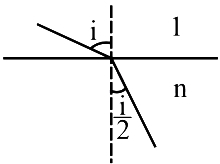
0 likesView Solution
57
PhysicsMediumMCQKCET · 2025
In determining the refractive index of a glass slab using a travelling microscope,the following readings are tabulated:
$(a)$ Reading of travelling microscope for ink mark $= 5.123 \ cm$
$(b)$ Reading of travelling microscope for ink mark through glass slab $= 6.123 \ cm$
$(c)$ Reading of travelling microscope for chalk dust on glass slab $= 8.123 \ cm$
From the data,the refractive index of a glass slab is:
$(a)$ Reading of travelling microscope for ink mark $= 5.123 \ cm$
$(b)$ Reading of travelling microscope for ink mark through glass slab $= 6.123 \ cm$
$(c)$ Reading of travelling microscope for chalk dust on glass slab $= 8.123 \ cm$
From the data,the refractive index of a glass slab is:
A
$1.5$
B
$1.601$
C
$1.399$
D
$1.39$
Solution
(A) The refractive index $n$ is given by the ratio of real depth to apparent depth.
Real depth $(RD)$ is the actual thickness of the glass slab,which is the difference between the reading for the chalk dust on top of the slab and the reading for the ink mark at the bottom: $RD = 8.123 \ cm - 5.123 \ cm = 3.000 \ cm$.
Apparent depth $(AD)$ is the depth of the ink mark as seen through the glass slab,which is the difference between the reading for the chalk dust on top and the reading for the ink mark through the slab: $AD = 8.123 \ cm - 6.123 \ cm = 2.000 \ cm$.
The refractive index is $n = \frac{RD}{AD} = \frac{3.000}{2.000} = 1.5$.
Real depth $(RD)$ is the actual thickness of the glass slab,which is the difference between the reading for the chalk dust on top of the slab and the reading for the ink mark at the bottom: $RD = 8.123 \ cm - 5.123 \ cm = 3.000 \ cm$.
Apparent depth $(AD)$ is the depth of the ink mark as seen through the glass slab,which is the difference between the reading for the chalk dust on top and the reading for the ink mark through the slab: $AD = 8.123 \ cm - 6.123 \ cm = 2.000 \ cm$.
The refractive index is $n = \frac{RD}{AD} = \frac{3.000}{2.000} = 1.5$.
0 likesView Solution
58
PhysicsMediumMCQKCET · 2025
The circuit shown in the figure contains two ideal diodes $D_1$ and $D_2$. If a cell of emf $3 \text{ V}$ and negligible internal resistance is connected as shown,then the current through the $70 \Omega$ resistance (in ampere) is:
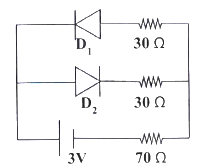
A
$0.01$
B
$0.02$
C
$0.03$
D
$0$
Solution
(C) In the given circuit,the positive terminal of the $3 \text{ V}$ battery is connected to the cathode of diode $D_1$ and the anode of diode $D_2$.
$1$. Diode $D_1$: The positive terminal of the battery is connected to the n-side (cathode) of $D_1$. Thus,$D_1$ is reverse-biased and acts as an open circuit (no current flows through this branch).
$2$. Diode $D_2$: The positive terminal of the battery is connected to the p-side (anode) of $D_2$. Thus,$D_2$ is forward-biased and acts as a closed switch (ideal diode has zero resistance).
$3$. Equivalent Resistance: Since $D_1$ is an open circuit,the current flows only through the branch containing $D_2$ and the $30 \Omega$ resistor,which is in series with the $70 \Omega$ resistor.
$R_{eq} = 30 \Omega + 70 \Omega = 100 \Omega$
$4$. Current Calculation: Using Ohm's law,$I = \frac{V}{R_{eq}}$
$I = \frac{3 \text{ V}}{100 \Omega} = 0.03 \text{ A}$
$1$. Diode $D_1$: The positive terminal of the battery is connected to the n-side (cathode) of $D_1$. Thus,$D_1$ is reverse-biased and acts as an open circuit (no current flows through this branch).
$2$. Diode $D_2$: The positive terminal of the battery is connected to the p-side (anode) of $D_2$. Thus,$D_2$ is forward-biased and acts as a closed switch (ideal diode has zero resistance).
$3$. Equivalent Resistance: Since $D_1$ is an open circuit,the current flows only through the branch containing $D_2$ and the $30 \Omega$ resistor,which is in series with the $70 \Omega$ resistor.
$R_{eq} = 30 \Omega + 70 \Omega = 100 \Omega$
$4$. Current Calculation: Using Ohm's law,$I = \frac{V}{R_{eq}}$
$I = \frac{3 \text{ V}}{100 \Omega} = 0.03 \text{ A}$
0 likesView Solution
59
PhysicsEasyMCQKCET · 2025
Which of the following statements is correct for an $n$-type semiconductor?
A
The donor energy level lies closely above the top of the valence band.
B
The donor energy level lies at the halfway mark of the forbidden energy gap.
C
The donor energy level does not exist.
D
The donor energy level lies just below the bottom of the conduction band.
Solution
(D) In an $n$-type semiconductor,donor impurities are added to the intrinsic semiconductor. These impurities create discrete energy levels known as donor energy levels. These levels are located within the forbidden energy gap,very close to the bottom of the conduction band. This proximity allows electrons from the donor level to be easily excited into the conduction band at room temperature,thereby increasing the conductivity of the material.
0 likesView Solution
60
PhysicsEasyMCQKCET · 2025
If $AB$ is an incident plane wave front,then what will be the refracted wave front for a lens with refractive index $n_2 > n_1$?
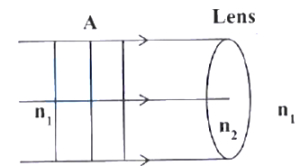
A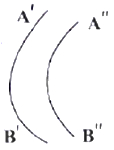
B
C
D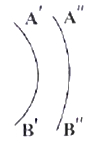
Solution
(A) When a plane wave front is incident on a convex lens,the central part of the wave front travels through the thickest part of the lens,while the edges travel through thinner parts.
Since the refractive index of the lens $n_2$ is greater than the surrounding medium $n_1$,the speed of light inside the lens is lower than outside.
Consequently,the central part of the wave front is delayed more than the edges.
This causes the initially plane wave front to become spherical and converge towards the focal point of the lens.
Therefore,the refracted wave front is a spherical wave front that is concave towards the direction of propagation (or concave towards the lens as it converges).
Looking at the options,the shape that represents a converging spherical wave front is a concave curve.
Since the refractive index of the lens $n_2$ is greater than the surrounding medium $n_1$,the speed of light inside the lens is lower than outside.
Consequently,the central part of the wave front is delayed more than the edges.
This causes the initially plane wave front to become spherical and converge towards the focal point of the lens.
Therefore,the refracted wave front is a spherical wave front that is concave towards the direction of propagation (or concave towards the lens as it converges).
Looking at the options,the shape that represents a converging spherical wave front is a concave curve.
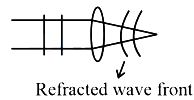
0 likesView Solution
Vedclass Products
For Students
Vedclass Test Series
Mock tests in real KCET style covering Physics with performance analysis. 5-day free trial.
Start Free TrialFor Teachers
Exam Paper Generator
Generate Set A/B/C/D Physics papers from 7.5L+ questions in 2 minutes. 3 chapters free.
Try FreeFor Institutes
Online Exam Module
Run live KCET mock exams with unlimited students, 360° analytics & white-label branding.
See DemoFrequently Asked Questions
How many Physics questions are in KCET 2025?
There are 60 Physics questions from the KCET 2025 paper on Vedclass, each with a detailed step-by-step solution in English.
Are KCET 2025 Physics solutions available in English?
Yes. All solutions on this page are in English. You can also switch to English or Hindi using the language buttons above the questions.
Can I practice KCET 2025 Physics as a timed test?
Yes. Use the Vedclass Test Series to attempt a full KCET mock test covering Physics with time limits and instant score analysis.
Can teachers create Physics papers from KCET previous year questions?
Yes. The Vedclass Exam Paper Generator lets teachers mix KCET Physics questions and generate Set A/B/C/D papers in minutes.
For Teachers & Institutes
Build a Custom Physics Paper
Pick KCET 2025 Physics questions, set difficulty, and generate Set A/B/C/D in 2 minutes.