
PhysicsQ1–60 of 60 questions
Page 1 of 1 · English
1
PhysicsEasyMCQKCET · 2019
During an inelastic collision between two objects,which of the following quantities always remains conserved?
A
Total linear momentum
B
Total kinetic energy
C
Speed of each body
D
Total mechanical energy
Solution
(A) In any collision,if there are no external forces acting on the system,the total linear momentum of the system remains conserved according to the law of conservation of linear momentum.
This principle applies to both elastic and inelastic collisions.
However,total kinetic energy is only conserved in perfectly elastic collisions.
In inelastic collisions,some kinetic energy is transformed into other forms of energy (such as heat,sound,or deformation energy),so it is not conserved.
Therefore,total linear momentum is the quantity that always remains conserved.
This principle applies to both elastic and inelastic collisions.
However,total kinetic energy is only conserved in perfectly elastic collisions.
In inelastic collisions,some kinetic energy is transformed into other forms of energy (such as heat,sound,or deformation energy),so it is not conserved.
Therefore,total linear momentum is the quantity that always remains conserved.
0 likesView Solution
2
PhysicsEasyMCQKCET · 2019
Two particles which are initially at rest move towards each other under the action of their mutual attraction. If their speeds are $v$ and $2v$ at any instant,then the speed of the center of mass of the system is,
A
$1.5v$
B
$2v$
C
$v$
D
zero
Solution
(D) The center of mass velocity is given by $V_{cm} = \frac{m_1v_1 + m_2v_2}{m_1 + m_2}$.
Since the particles are initially at rest,the initial momentum of the system is $P_{initial} = 0$.
There are no external forces acting on the system (only mutual internal attraction),so the net external force $F_{ext} = 0$.
According to the law of conservation of linear momentum,the total momentum of the system remains constant.
Therefore,$P_{final} = P_{initial} = 0$.
Since $P_{final} = M_{total} \times V_{cm}$,and the total mass $M_{total}$ is non-zero,the velocity of the center of mass $V_{cm}$ must be $0$ at all times.
Since the particles are initially at rest,the initial momentum of the system is $P_{initial} = 0$.
There are no external forces acting on the system (only mutual internal attraction),so the net external force $F_{ext} = 0$.
According to the law of conservation of linear momentum,the total momentum of the system remains constant.
Therefore,$P_{final} = P_{initial} = 0$.
Since $P_{final} = M_{total} \times V_{cm}$,and the total mass $M_{total}$ is non-zero,the velocity of the center of mass $V_{cm}$ must be $0$ at all times.
0 likesView Solution
3
PhysicsDifficultMCQKCET · 2019
$A$ satellite is orbiting close to the Earth and has a kinetic energy $K$. The minimum extra kinetic energy required by it to just overcome the gravitational pull of the Earth is
A
$ \sqrt{3} K $
B
$ K $
C
$ 2 \sqrt{2} K $
D
$ 2 K $
Solution
(B) The orbital velocity of a satellite orbiting close to the Earth is given by $v_0 = \sqrt{\frac{GM}{R}}$.
The kinetic energy of the satellite in this orbit is $K = \frac{1}{2}mv_0^2 = \frac{GMm}{2R}$.
To escape the gravitational pull of the Earth,the satellite must reach the escape velocity,which is $v_e = \sqrt{\frac{2GM}{R}} = \sqrt{2}v_0$.
The required kinetic energy to escape is $K_e = \frac{1}{2}mv_e^2 = \frac{1}{2}m(2v_0^2) = 2(\frac{1}{2}mv_0^2) = 2K$.
The extra kinetic energy required is $\Delta K = K_e - K = 2K - K = K$.
The kinetic energy of the satellite in this orbit is $K = \frac{1}{2}mv_0^2 = \frac{GMm}{2R}$.
To escape the gravitational pull of the Earth,the satellite must reach the escape velocity,which is $v_e = \sqrt{\frac{2GM}{R}} = \sqrt{2}v_0$.
The required kinetic energy to escape is $K_e = \frac{1}{2}mv_e^2 = \frac{1}{2}m(2v_0^2) = 2(\frac{1}{2}mv_0^2) = 2K$.
The extra kinetic energy required is $\Delta K = K_e - K = 2K - K = K$.
0 likesView Solution
4
PhysicsMediumMCQKCET · 2019
One mole of a diatomic gas is heated at constant pressure starting at $ 27^{\circ}C $. How much energy must be added to the gas as heat to double its volume?
A
$ 750 R $
B
Zero
C
$ 1050 R $
D
$ 450 R $
Solution
(C) For an ideal gas at constant pressure,Charles's Law states that $ V \propto T $.
Since the volume is doubled $( V_2 = 2V_1 )$,the temperature must also double.
The initial temperature is $ T_1 = 27^{\circ}C = 27 + 273 = 300 \text{ K} $.
The final temperature is $ T_2 = 2 \times 300 \text{ K} = 600 \text{ K} $.
The change in temperature is $ \Delta T = 600 \text{ K} - 300 \text{ K} = 300 \text{ K} $.
For a diatomic gas,the molar heat capacity at constant pressure is $ C_p = \frac{7}{2}R $.
The heat added is given by $ Q = n C_p \Delta T $.
Substituting the values: $ Q = 1 \times \frac{7}{2} R \times 300 = 1050 R $.
Since the volume is doubled $( V_2 = 2V_1 )$,the temperature must also double.
The initial temperature is $ T_1 = 27^{\circ}C = 27 + 273 = 300 \text{ K} $.
The final temperature is $ T_2 = 2 \times 300 \text{ K} = 600 \text{ K} $.
The change in temperature is $ \Delta T = 600 \text{ K} - 300 \text{ K} = 300 \text{ K} $.
For a diatomic gas,the molar heat capacity at constant pressure is $ C_p = \frac{7}{2}R $.
The heat added is given by $ Q = n C_p \Delta T $.
Substituting the values: $ Q = 1 \times \frac{7}{2} R \times 300 = 1050 R $.
0 likesView Solution
5
PhysicsMediumMCQKCET · 2019
An object with mass $5 \ kg$ is acted upon by a force,$\vec{F}=(-3 \hat{i}+4 \hat{j}) \ N$. If its initial velocity at $t=0$ is $\vec{v}=(6 \hat{i}-12 \hat{j}) \ ms^{-1}$,the time at which it will just have a velocity along the $y$-axis is: (in $s$)
A
$2$
B
$5$
C
$15$
D
$10$
Solution
(D) Given: Mass $m = 5 \ kg$,Force $\vec{F} = (-3 \hat{i} + 4 \hat{j}) \ N$,Initial velocity $\vec{u} = (6 \hat{i} - 12 \hat{j}) \ ms^{-1}$.
Using Newton's second law,$\vec{a} = \frac{\vec{F}}{m} = \left(\frac{-3}{5} \hat{i} + \frac{4}{5} \hat{j}\right) \ ms^{-2}$.
The velocity at any time $t$ is given by $\vec{v} = \vec{u} + \vec{a}t$.
$\vec{v} = (6 \hat{i} - 12 \hat{j}) + \left(-\frac{3}{5} \hat{i} + \frac{4}{5} \hat{j}\right)t$.
$\vec{v} = \left(6 - \frac{3}{5}t\right) \hat{i} + \left(-12 + \frac{4}{5}t\right) \hat{j}$.
For the velocity to be along the $y$-axis,the $x$-component of the velocity must be zero:
$6 - \frac{3}{5}t = 0$.
$\frac{3}{5}t = 6$.
$t = \frac{6 \times 5}{3} = 10 \ s$.
Using Newton's second law,$\vec{a} = \frac{\vec{F}}{m} = \left(\frac{-3}{5} \hat{i} + \frac{4}{5} \hat{j}\right) \ ms^{-2}$.
The velocity at any time $t$ is given by $\vec{v} = \vec{u} + \vec{a}t$.
$\vec{v} = (6 \hat{i} - 12 \hat{j}) + \left(-\frac{3}{5} \hat{i} + \frac{4}{5} \hat{j}\right)t$.
$\vec{v} = \left(6 - \frac{3}{5}t\right) \hat{i} + \left(-12 + \frac{4}{5}t\right) \hat{j}$.
For the velocity to be along the $y$-axis,the $x$-component of the velocity must be zero:
$6 - \frac{3}{5}t = 0$.
$\frac{3}{5}t = 6$.
$t = \frac{6 \times 5}{3} = 10 \ s$.
0 likesView Solution
6
PhysicsMediumMCQKCET · 2019
An aluminium sphere is dipped into water. Which of the following is true?
A
Buoyancy in water at $0 \ ^\circ C$ will be same as that in water at $4 \ ^\circ C$
B
Buoyancy will be less in water at $0 \ ^\circ C$ than that in water at $4 \ ^\circ C$
C
Buoyancy may be more or less in water at $4 \ ^\circ C$ depending on the radius of the sphere
D
Buoyancy will be more in water at $0 \ ^\circ C$ than that in water at $4 \ ^\circ C$
Solution
(B) The buoyant force $F_b$ acting on a submerged object is given by Archimedes' principle: $F_b = V \rho g$,where $V$ is the volume of the displaced liquid,$\rho$ is the density of the liquid,and $g$ is the acceleration due to gravity.
The density of water is maximum at $4 \ ^\circ C$ $(\rho_4 \approx 1000 \ kg/m^3)$ and is lower at $0 \ ^\circ C$ $(\rho_0 \approx 999.8 \ kg/m^3)$.
Since the volume of the aluminium sphere $V$ remains constant,the buoyancy at $0 \ ^\circ C$ is $F_b = V \rho_0 g$ and at $4 \ ^\circ C$ is $F'_b = V \rho_4 g$.
Comparing the two,since $\rho_0 < \rho_4$,it follows that $F_b < F'_b$.
Therefore,the buoyancy is less in water at $0 \ ^\circ C$ than in water at $4 \ ^\circ C$.
The density of water is maximum at $4 \ ^\circ C$ $(\rho_4 \approx 1000 \ kg/m^3)$ and is lower at $0 \ ^\circ C$ $(\rho_0 \approx 999.8 \ kg/m^3)$.
Since the volume of the aluminium sphere $V$ remains constant,the buoyancy at $0 \ ^\circ C$ is $F_b = V \rho_0 g$ and at $4 \ ^\circ C$ is $F'_b = V \rho_4 g$.
Comparing the two,since $\rho_0 < \rho_4$,it follows that $F_b < F'_b$.
Therefore,the buoyancy is less in water at $0 \ ^\circ C$ than in water at $4 \ ^\circ C$.
0 likesView Solution
7
PhysicsMediumMCQKCET · 2019
$A$ cylindrical container containing water has a small hole at a height of $H = 8 \text{ cm}$ from the bottom and at a depth of $h = 2 \text{ cm}$ from the top surface of the liquid. The horizontal distance (range) travelled by the water before it hits the ground is:
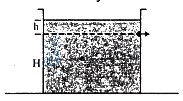
A
$4 \text{ cm}$
B
$8 \text{ cm}$
C
$6 \text{ cm}$
D
$4\sqrt{2} \text{ cm}$
Solution
(B) According to Torricelli's law,the velocity of efflux $v$ is given by $v = \sqrt{2gh}$,where $h$ is the depth of the hole from the free surface.
Given $h = 2 \text{ cm}$,so $v = \sqrt{2 \times g \times 2} = 2\sqrt{g}$.
The time $t$ taken for the water to reach the ground from a height $H = 8 \text{ cm}$ is given by $H = \frac{1}{2}gt^2$,which implies $t = \sqrt{\frac{2H}{g}} = \sqrt{\frac{2 \times 8}{g}} = \sqrt{\frac{16}{g}} = \frac{4}{\sqrt{g}}$.
The horizontal range $R$ is the product of the velocity of efflux and the time of flight:
$R = v \times t = (\sqrt{2gh}) \times \sqrt{\frac{2H}{g}} = 2\sqrt{hH}$.
Substituting the values $h = 2 \text{ cm}$ and $H = 8 \text{ cm}$:
$R = 2 \times \sqrt{2 \times 8} = 2 \times \sqrt{16} = 2 \times 4 = 8 \text{ cm}$.
Given $h = 2 \text{ cm}$,so $v = \sqrt{2 \times g \times 2} = 2\sqrt{g}$.
The time $t$ taken for the water to reach the ground from a height $H = 8 \text{ cm}$ is given by $H = \frac{1}{2}gt^2$,which implies $t = \sqrt{\frac{2H}{g}} = \sqrt{\frac{2 \times 8}{g}} = \sqrt{\frac{16}{g}} = \frac{4}{\sqrt{g}}$.
The horizontal range $R$ is the product of the velocity of efflux and the time of flight:
$R = v \times t = (\sqrt{2gh}) \times \sqrt{\frac{2H}{g}} = 2\sqrt{hH}$.
Substituting the values $h = 2 \text{ cm}$ and $H = 8 \text{ cm}$:
$R = 2 \times \sqrt{2 \times 8} = 2 \times \sqrt{16} = 2 \times 4 = 8 \text{ cm}$.
0 likesView Solution
8
PhysicsMediumMCQKCET · 2019
$A$ wire is stretched such that its volume remains constant. The Poisson's ratio of the material of the wire is
A
$0.25$
B
$0.50$
C
$-0.25$
D
$-0.50$
Solution
(B) The Poisson's ratio $\sigma$ is defined as the negative ratio of transverse strain to longitudinal strain: $\sigma = -\frac{\Delta D/D}{\Delta L/L}$.
For a wire of length $L$ and diameter $D$,the volume $V = \frac{\pi D^2 L}{4}$.
Since the volume $V$ remains constant,$\frac{\Delta V}{V} = 2\frac{\Delta D}{D} + \frac{\Delta L}{L} = 0$.
This implies $2\frac{\Delta D}{D} = -\frac{\Delta L}{L}$,or $\frac{\Delta D/D}{\Delta L/L} = -0.5$.
Substituting this into the definition of Poisson's ratio: $\sigma = -(-0.5) = 0.5$.
Therefore,for a material with constant volume under stretching,the Poisson's ratio is $0.5$.
Thus,option $(B)$ is correct.
For a wire of length $L$ and diameter $D$,the volume $V = \frac{\pi D^2 L}{4}$.
Since the volume $V$ remains constant,$\frac{\Delta V}{V} = 2\frac{\Delta D}{D} + \frac{\Delta L}{L} = 0$.
This implies $2\frac{\Delta D}{D} = -\frac{\Delta L}{L}$,or $\frac{\Delta D/D}{\Delta L/L} = -0.5$.
Substituting this into the definition of Poisson's ratio: $\sigma = -(-0.5) = 0.5$.
Therefore,for a material with constant volume under stretching,the Poisson's ratio is $0.5$.
Thus,option $(B)$ is correct.
0 likesView Solution
9
PhysicsEasyMCQKCET · 2019
The given graph shows the variation of velocity $(v)$ with position $(x)$ for a particle moving along a straight line. Which of the following graphs shows the variation of acceleration $(a)$ with position $(x)$?
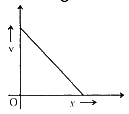
A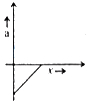
B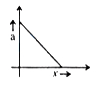
C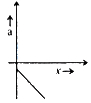
D
Solution
(A) The given graph is a straight line with a positive intercept on the $v$-axis and a negative slope.
Its equation can be written as:
$v = -mx + v_0 \dots(1)$
where $m = \tan \theta = \frac{v_0}{x_0}$ is the magnitude of the slope.
The acceleration $a$ is given by $a = v \frac{dv}{dx}$.
From equation $(1)$,differentiating $v$ with respect to $x$ gives:
$\frac{dv}{dx} = -m$
Substituting this into the expression for acceleration:
$a = v(-m) = (-mx + v_0)(-m)$
$a = m^2x - mv_0$
This is the equation of a straight line with a positive slope $(m^2)$ and a negative intercept $(-mv_0)$ on the acceleration axis.
Comparing this with the given options,graph $(A)$ represents a straight line with a negative intercept and a positive slope.
Therefore,option $(A)$ is correct.
Its equation can be written as:
$v = -mx + v_0 \dots(1)$
where $m = \tan \theta = \frac{v_0}{x_0}$ is the magnitude of the slope.
The acceleration $a$ is given by $a = v \frac{dv}{dx}$.
From equation $(1)$,differentiating $v$ with respect to $x$ gives:
$\frac{dv}{dx} = -m$
Substituting this into the expression for acceleration:
$a = v(-m) = (-mx + v_0)(-m)$
$a = m^2x - mv_0$
This is the equation of a straight line with a positive slope $(m^2)$ and a negative intercept $(-mv_0)$ on the acceleration axis.
Comparing this with the given options,graph $(A)$ represents a straight line with a negative intercept and a positive slope.
Therefore,option $(A)$ is correct.
0 likesView Solution
10
PhysicsDifficultMCQKCET · 2019
The trajectory of a projectile projected from the origin is given by the equation $y = x - \frac{2x^2}{5}$. The initial velocity of the projectile is:
A
$25 \ m/s$
B
$\frac{2}{5} \ m/s$
C
$\frac{5}{2} \ m/s$
D
$5 \ m/s$
Solution
(D) The standard equation of the trajectory of a projectile is given by $y = x \tan \theta - \frac{gx^2}{2u^2 \cos^2 \theta}$.
Comparing this with the given equation $y = x - \frac{2x^2}{5}$,we get:
$\tan \theta = 1 \implies \theta = 45^{\circ}$.
Also,$\frac{g}{2u^2 \cos^2 \theta} = \frac{2}{5}$.
Substituting $g = 10 \ m/s^2$ and $\cos^2 45^{\circ} = (\frac{1}{\sqrt{2}})^2 = \frac{1}{2}$:
$\frac{10}{2u^2 (1/2)} = \frac{2}{5}$.
$\frac{10}{u^2} = \frac{2}{5}$.
$2u^2 = 50 \implies u^2 = 25$.
$u = 5 \ m/s$.
Comparing this with the given equation $y = x - \frac{2x^2}{5}$,we get:
$\tan \theta = 1 \implies \theta = 45^{\circ}$.
Also,$\frac{g}{2u^2 \cos^2 \theta} = \frac{2}{5}$.
Substituting $g = 10 \ m/s^2$ and $\cos^2 45^{\circ} = (\frac{1}{\sqrt{2}})^2 = \frac{1}{2}$:
$\frac{10}{2u^2 (1/2)} = \frac{2}{5}$.
$\frac{10}{u^2} = \frac{2}{5}$.
$2u^2 = 50 \implies u^2 = 25$.
$u = 5 \ m/s$.
0 likesView Solution
11
PhysicsEasyMCQKCET · 2019
$A$ piston is performing $S.H.M.$ in the vertical direction with a frequency of $0.5 \,Hz$. $A$ block of $10 \,kg$ is placed on the piston. The maximum amplitude of the system such that the block remains in contact with the piston is: (in $\,m$)
A
$1.5$
B
$1$
C
$0.1$
D
$0.5$
Solution
(B) Given frequency $f = 0.5 \,Hz$.
Angular frequency $\omega = 2 \pi f = 2 \pi (0.5) = \pi \,rad/s$.
For the block to remain in contact with the piston, the downward acceleration of the piston at the extreme position must not exceed the acceleration due to gravity $g$.
The condition for the block to just lose contact is $a_{max} = g$.
Since $a_{max} = \omega^2 A$, we have $\omega^2 A = g$.
Substituting the values, $\pi^2 A = 10$.
Taking $\pi^2 \approx 10$, we get $10 A = 10$.
Therefore, $A = 1 \,m$.
Angular frequency $\omega = 2 \pi f = 2 \pi (0.5) = \pi \,rad/s$.
For the block to remain in contact with the piston, the downward acceleration of the piston at the extreme position must not exceed the acceleration due to gravity $g$.
The condition for the block to just lose contact is $a_{max} = g$.
Since $a_{max} = \omega^2 A$, we have $\omega^2 A = g$.
Substituting the values, $\pi^2 A = 10$.
Taking $\pi^2 \approx 10$, we get $10 A = 10$.
Therefore, $A = 1 \,m$.
0 likesView Solution
12
PhysicsMediumMCQKCET · 2019
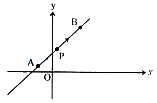
$A$ particle is moving uniformly along a straight line as shown in the figure. During the motion of the particle from $A$ to $B$,the angular momentum of the particle about '$O$' is:
A
remains constant
B
increases
C
first increases then decreases
D
decreases
Solution
(A) The angular momentum $L$ of a particle about a point $O$ is given by the cross product $L = \vec{r} \times \vec{p} = \vec{r} \times (m\vec{v})$.
The magnitude of angular momentum is $L = mvr \sin(\theta)$,where $r$ is the position vector of the particle from the origin $O$,$v$ is the velocity,and $\theta$ is the angle between $\vec{r}$ and $\vec{v}$.
This can also be written as $L = mv d$,where $d = r \sin(\theta)$ is the perpendicular distance from the origin $O$ to the line of motion of the particle.
Since the particle is moving along a straight line,the perpendicular distance $d$ from the origin $O$ to the line of motion remains constant throughout the motion.
Since the mass $m$ and the speed $v$ are also constant (uniform motion),the product $mvd$ remains constant.
Therefore,the angular momentum of the particle about $O$ remains constant during the motion from $A$ to $B$.
The magnitude of angular momentum is $L = mvr \sin(\theta)$,where $r$ is the position vector of the particle from the origin $O$,$v$ is the velocity,and $\theta$ is the angle between $\vec{r}$ and $\vec{v}$.
This can also be written as $L = mv d$,where $d = r \sin(\theta)$ is the perpendicular distance from the origin $O$ to the line of motion of the particle.
Since the particle is moving along a straight line,the perpendicular distance $d$ from the origin $O$ to the line of motion remains constant throughout the motion.
Since the mass $m$ and the speed $v$ are also constant (uniform motion),the product $mvd$ remains constant.
Therefore,the angular momentum of the particle about $O$ remains constant during the motion from $A$ to $B$.
0 likesView Solution
13
PhysicsMediumMCQKCET · 2019
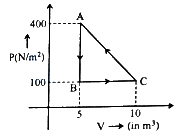
$A$ thermodynamic system undergoes a cyclic process $ABC$ as shown in the diagram. The work done by the system per cycle is (in $J$)
A
$-750$
B
$750$
C
$1250$
D
$-1250$
Solution
(A) The work done by a system in a cyclic process is equal to the area enclosed by the $P-V$ diagram.
For a clockwise cycle,the work done is positive,and for a counter-clockwise cycle,the work done is negative.
In the given diagram,the cycle $A \rightarrow B \rightarrow C \rightarrow A$ is counter-clockwise.
Area of the triangle $ABC = \frac{1}{2} \times \text{base} \times \text{height}$.
Base $= (V_C - V_B) = (10 - 5) \ m^3 = 5 \ m^3$.
Height $= (P_A - P_B) = (400 - 100) \ N/m^2 = 300 \ N/m^2$.
Area $= \frac{1}{2} \times 5 \times 300 = 750 \ J$.
Since the cycle is counter-clockwise,the work done by the system is $W = -750 \ J$.
For a clockwise cycle,the work done is positive,and for a counter-clockwise cycle,the work done is negative.
In the given diagram,the cycle $A \rightarrow B \rightarrow C \rightarrow A$ is counter-clockwise.
Area of the triangle $ABC = \frac{1}{2} \times \text{base} \times \text{height}$.
Base $= (V_C - V_B) = (10 - 5) \ m^3 = 5 \ m^3$.
Height $= (P_A - P_B) = (400 - 100) \ N/m^2 = 300 \ N/m^2$.
Area $= \frac{1}{2} \times 5 \times 300 = 750 \ J$.
Since the cycle is counter-clockwise,the work done by the system is $W = -750 \ J$.
0 likesView Solution
14
PhysicsEasyMCQKCET · 2019
If $P, Q$ and $R$ are physical quantities having different dimensions,which of the following combinations can never be a meaningful quantity?
A
$PQ/R$
B
$(P-Q)/R$
C
$(PR-Q^2)/R$
D
$PQ-R$
Solution
(B) According to the principle of homogeneity of dimensions,only physical quantities with the same dimensions can be added or subtracted.
$(A)$ $PQ/R$: Multiplication and division of physical quantities with different dimensions are allowed.
$(B)$ $(P-Q)/R$: Since $P$ and $Q$ have different dimensions,the subtraction $(P-Q)$ is physically meaningless.
$(C)$ $(PR-Q^2)/R$: Here,$PR$ and $Q^2$ must have the same dimensions for the subtraction to be valid. While $P, Q, R$ have different dimensions,specific combinations might be invalid,but $(P-Q)$ is fundamentally invalid regardless of the denominator.
$(D)$ $PQ-R$: Since $PQ$ and $R$ have different dimensions,the subtraction $(PQ-R)$ is physically meaningless.
However,in the context of standard multiple-choice questions,$(P-Q)$ is the most direct violation of the principle of homogeneity.
$(A)$ $PQ/R$: Multiplication and division of physical quantities with different dimensions are allowed.
$(B)$ $(P-Q)/R$: Since $P$ and $Q$ have different dimensions,the subtraction $(P-Q)$ is physically meaningless.
$(C)$ $(PR-Q^2)/R$: Here,$PR$ and $Q^2$ must have the same dimensions for the subtraction to be valid. While $P, Q, R$ have different dimensions,specific combinations might be invalid,but $(P-Q)$ is fundamentally invalid regardless of the denominator.
$(D)$ $PQ-R$: Since $PQ$ and $R$ have different dimensions,the subtraction $(PQ-R)$ is physically meaningless.
However,in the context of standard multiple-choice questions,$(P-Q)$ is the most direct violation of the principle of homogeneity.
0 likesView Solution
15
PhysicsEasyMCQKCET · 2019
The equation of a stationary wave is $ y = 2 \sin \left( \frac{\pi x}{15} \right) \cos (48 \pi t) $. The distance between a node and its next antinode is (in $units$)
A
$22.5$
B
$7.5$
C
$30$
D
$1.5$
Solution
(B) The given equation of the stationary wave is $ y = 2 \sin \left( \frac{\pi x}{15} \right) \cos (48 \pi t) $.
Comparing this with the standard equation $ y = A \sin(kx) \cos(\omega t) $, we get the wave number $ k = \frac{\pi}{15} $.
We know that $ k = \frac{2 \pi}{\lambda} $, so $ \frac{2 \pi}{\lambda} = \frac{\pi}{15} $.
Solving for wavelength $ \lambda $, we get $ \lambda = 30 $ units.
The distance between a node and its consecutive antinode is given by $ d = \frac{\lambda}{4} $.
Substituting the value of $ \lambda $, we get $ d = \frac{30}{4} = 7.5 $ units.
Comparing this with the standard equation $ y = A \sin(kx) \cos(\omega t) $, we get the wave number $ k = \frac{\pi}{15} $.
We know that $ k = \frac{2 \pi}{\lambda} $, so $ \frac{2 \pi}{\lambda} = \frac{\pi}{15} $.
Solving for wavelength $ \lambda $, we get $ \lambda = 30 $ units.
The distance between a node and its consecutive antinode is given by $ d = \frac{\lambda}{4} $.
Substituting the value of $ \lambda $, we get $ d = \frac{30}{4} = 7.5 $ units.
0 likesView Solution
16
PhysicsEasyMCQKCET · 2019
$A$ particle of mass $m$ and charge $q$ is placed at rest in a uniform electric field $E$ and then released. The kinetic energy attained by the particle after moving a distance $y$ is
A
$qE{y^2}$
B
$q{E^2}y$
C
$qEy$
D
${q^2}Ey$
Solution
(C) The force experienced by a charge $q$ in a uniform electric field $E$ is given by $F = qE$.
Since the particle starts from rest and moves a distance $y$ in the direction of the force,the work done by the electric field on the particle is $W = F \times y = (qE) \times y = qEy$.
According to the work-energy theorem,the work done by the electric field is equal to the change in kinetic energy of the particle.
Since the initial kinetic energy is $0$,the final kinetic energy attained by the particle is $K = qEy$.
Since the particle starts from rest and moves a distance $y$ in the direction of the force,the work done by the electric field on the particle is $W = F \times y = (qE) \times y = qEy$.
According to the work-energy theorem,the work done by the electric field is equal to the change in kinetic energy of the particle.
Since the initial kinetic energy is $0$,the final kinetic energy attained by the particle is $K = qEy$.
0 likesView Solution
17
PhysicsEasyMCQKCET · 2019
An inductor of inductance $L$ and resistor $R$ are joined together in series and connected to a source of frequency $\omega$. The power dissipated in the circuit is
A
$\frac{V^2}{R^2+\omega^2 L^2}$
B
$\frac{R^2+\omega^2 L^2}{V^2}$
C
$\frac{V^2 R}{\sqrt{R^2+\omega^2 L^2}}$
D
$\frac{V^2 R}{R^2+\omega^2 L^2}$
Solution
(D) The impedance $Z$ of an $LR$ series circuit is given by $Z = \sqrt{R^2 + X_L^2}$,where $X_L = \omega L$.
Thus,$Z = \sqrt{R^2 + \omega^2 L^2}$.
The $RMS$ current $I$ in the circuit is $I = \frac{V}{Z} = \frac{V}{\sqrt{R^2 + \omega^2 L^2}}$.
The power dissipated in the circuit is given by $P = I^2 R$.
Substituting the value of $I$,we get $P = \left( \frac{V}{\sqrt{R^2 + \omega^2 L^2}} \right)^2 R = \frac{V^2 R}{R^2 + \omega^2 L^2}$.
Thus,$Z = \sqrt{R^2 + \omega^2 L^2}$.
The $RMS$ current $I$ in the circuit is $I = \frac{V}{Z} = \frac{V}{\sqrt{R^2 + \omega^2 L^2}}$.
The power dissipated in the circuit is given by $P = I^2 R$.
Substituting the value of $I$,we get $P = \left( \frac{V}{\sqrt{R^2 + \omega^2 L^2}} \right)^2 R = \frac{V^2 R}{R^2 + \omega^2 L^2}$.
0 likesView Solution
18
PhysicsEasyMCQKCET · 2019
The frequency of an alternating current is $ 50 \,Hz $. What is the minimum time taken by the current to reach its peak value from its $ rms $ value?
A
$ 0.02 \,s $
B
$ 5 \times 10^{-3} \,s $
C
$ 10 \times 10^{-3} \,s $
D
$ 2.5 \times 10^{-3} \,s $
Solution
(D) The instantaneous current is given by $ I = I_0 \sin(\omega t) $.
At the $ rms $ value, $ I = I_{rms} = \frac{I_0}{\sqrt{2}} $.
So, $ \frac{I_0}{\sqrt{2}} = I_0 \sin(\omega t_1) \Rightarrow \sin(\omega t_1) = \frac{1}{\sqrt{2}} $.
This gives $ \omega t_1 = \frac{\pi}{4} $.
Since $ \omega = \frac{2\pi}{T} $, we have $ \frac{2\pi}{T} t_1 = \frac{\pi}{4} \Rightarrow t_1 = \frac{T}{8} $.
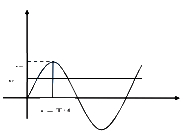
The peak value occurs at $ t_2 = \frac{T}{4} $.
The time taken to reach the peak value from the $ rms $ value is $ \Delta t = t_2 - t_1 = \frac{T}{4} - \frac{T}{8} = \frac{T}{8} $.
Given frequency $ f = 50 \,Hz $, the time period is $ T = \frac{1}{f} = \frac{1}{50} \,s = 0.02 \,s $.
Therefore, $ \Delta t = \frac{0.02}{8} = 0.0025 \,s = 2.5 \times 10^{-3} \,s $.
Thus, option $ D $ is correct.
At the $ rms $ value, $ I = I_{rms} = \frac{I_0}{\sqrt{2}} $.
So, $ \frac{I_0}{\sqrt{2}} = I_0 \sin(\omega t_1) \Rightarrow \sin(\omega t_1) = \frac{1}{\sqrt{2}} $.
This gives $ \omega t_1 = \frac{\pi}{4} $.
Since $ \omega = \frac{2\pi}{T} $, we have $ \frac{2\pi}{T} t_1 = \frac{\pi}{4} \Rightarrow t_1 = \frac{T}{8} $.
The peak value occurs at $ t_2 = \frac{T}{4} $.
The time taken to reach the peak value from the $ rms $ value is $ \Delta t = t_2 - t_1 = \frac{T}{4} - \frac{T}{8} = \frac{T}{8} $.
Given frequency $ f = 50 \,Hz $, the time period is $ T = \frac{1}{f} = \frac{1}{50} \,s = 0.02 \,s $.
Therefore, $ \Delta t = \frac{0.02}{8} = 0.0025 \,s = 2.5 \times 10^{-3} \,s $.
Thus, option $ D $ is correct.
0 likesView Solution
19
PhysicsDifficultMCQKCET · 2019
In the Rutherford experiment,for a head-on collision of $\alpha$-particles with a gold nucleus,the impact parameter is:
A
of the order of $10^{-10} \ m$
B
zero
C
of the order of $10^{-6} \ m$
D
of the order of $10^{-14} \ m$
Solution
(B) The impact parameter $b$ is defined as the perpendicular distance of the initial velocity vector of the $\alpha$-particle from the center of the nucleus.
For a head-on collision,the $\alpha$-particle travels directly towards the center of the nucleus and retraces its path after the collision.
In this case,the perpendicular distance between the path of the $\alpha$-particle and the center of the nucleus is zero.
Therefore,the impact parameter for a head-on collision is $0$.
For a head-on collision,the $\alpha$-particle travels directly towards the center of the nucleus and retraces its path after the collision.
In this case,the perpendicular distance between the path of the $\alpha$-particle and the center of the nucleus is zero.
Therefore,the impact parameter for a head-on collision is $0$.
0 likesView Solution
20
PhysicsMediumMCQKCET · 2019
The frequency of revolution of an electron revolving in the $n^{th}$ orbit of an $H$-atom is proportional to:
A
Independent of $n$
B
$1/n^2$
C
$1/n^3$
D
$n$
Solution
(C) According to Bohr's model,the velocity of an electron in the $n^{th}$ orbit is $v \propto 1/n$.
The radius of the $n^{th}$ orbit is $r \propto n^2$.
The frequency of revolution $f$ is given by $f = v / (2 \pi r)$.
Substituting the proportionalities: $f \propto (1/n) / n^2 = 1/n^3$.
Therefore,the frequency of revolution is proportional to $1/n^3$.
The radius of the $n^{th}$ orbit is $r \propto n^2$.
The frequency of revolution $f$ is given by $f = v / (2 \pi r)$.
Substituting the proportionalities: $f \propto (1/n) / n^2 = 1/n^3$.
Therefore,the frequency of revolution is proportional to $1/n^3$.
0 likesView Solution
21
PhysicsMediumMCQKCET · 2019
$A$ hydrogen atom in the ground state absorbs $ 10.2 \text{ eV} $ of energy. The orbital angular momentum of the electron is increased by:
A
$ 3.16 \times 10^{-34} \text{ Js} $
B
$ 1.05 \times 10^{-34} \text{ Js} $
C
$ 4.22 \times 10^{-34} \text{ Js} $
D
$ 2.11 \times 10^{-34} \text{ Js} $
Solution
(B) The energy of the $ n $-th orbit in a hydrogen atom is given by $ E_n = -\frac{13.6}{n^2} \text{ eV} $.
For the ground state $( n_1 = 1 )$,$ E_1 = -13.6 \text{ eV} $.
When the atom absorbs $ 10.2 \text{ eV} $,the new energy is $ E_2 = -13.6 + 10.2 = -3.4 \text{ eV} $.
Since $ E_2 = -\frac{13.6}{n_2^2} = -3.4 \text{ eV} $,we find $ n_2^2 = 4 $,so $ n_2 = 2 $.
The orbital angular momentum is given by $ L = \frac{nh}{2\pi} $.
The increase in angular momentum is $ \Delta L = L_2 - L_1 = \frac{n_2 h}{2\pi} - \frac{n_1 h}{2\pi} = \frac{(n_2 - n_1)h}{2\pi} $.
Substituting $ n_2 = 2 $,$ n_1 = 1 $,and $ h = 6.626 \times 10^{-34} \text{ Js} $:
$ \Delta L = \frac{(2 - 1) \times 6.626 \times 10^{-34}}{2 \times 3.14159} \approx 1.054 \times 10^{-34} \text{ Js} $.
Thus,the increase is $ 1.05 \times 10^{-34} \text{ Js} $.
For the ground state $( n_1 = 1 )$,$ E_1 = -13.6 \text{ eV} $.
When the atom absorbs $ 10.2 \text{ eV} $,the new energy is $ E_2 = -13.6 + 10.2 = -3.4 \text{ eV} $.
Since $ E_2 = -\frac{13.6}{n_2^2} = -3.4 \text{ eV} $,we find $ n_2^2 = 4 $,so $ n_2 = 2 $.
The orbital angular momentum is given by $ L = \frac{nh}{2\pi} $.
The increase in angular momentum is $ \Delta L = L_2 - L_1 = \frac{n_2 h}{2\pi} - \frac{n_1 h}{2\pi} = \frac{(n_2 - n_1)h}{2\pi} $.
Substituting $ n_2 = 2 $,$ n_1 = 1 $,and $ h = 6.626 \times 10^{-34} \text{ Js} $:
$ \Delta L = \frac{(2 - 1) \times 6.626 \times 10^{-34}}{2 \times 3.14159} \approx 1.054 \times 10^{-34} \text{ Js} $.
Thus,the increase is $ 1.05 \times 10^{-34} \text{ Js} $.
0 likesView Solution
22
PhysicsDifficultMCQKCET · 2019
$A$ capacitor of capacitance $C$ charged by an amount $Q$ is connected in parallel with an uncharged capacitor of capacitance $2C$. The final charges on the capacitors are
A
$ \frac{Q}{3}, \frac{2Q}{3} $
B
$ \frac{Q}{2}, \frac{Q}{2} $
C
$ \frac{Q}{5}, \frac{4Q}{5} $
D
$ \frac{Q}{4}, \frac{3Q}{4} $
Solution
(A) When two capacitors are connected in parallel,they reach a common potential $V_c$.
The total charge $Q_{total} = Q + 0 = Q$.
The total capacitance $C_{total} = C + 2C = 3C$.
The common potential is given by $V_c = \frac{Q_{total}}{C_{total}} = \frac{Q}{3C}$.
The final charge on the first capacitor is $Q_1 = C \cdot V_c = C \cdot \frac{Q}{3C} = \frac{Q}{3}$.
The final charge on the second capacitor is $Q_2 = 2C \cdot V_c = 2C \cdot \frac{Q}{3C} = \frac{2Q}{3}$.
Thus,the final charges are $\frac{Q}{3}$ and $\frac{2Q}{3}$.
The total charge $Q_{total} = Q + 0 = Q$.
The total capacitance $C_{total} = C + 2C = 3C$.
The common potential is given by $V_c = \frac{Q_{total}}{C_{total}} = \frac{Q}{3C}$.
The final charge on the first capacitor is $Q_1 = C \cdot V_c = C \cdot \frac{Q}{3C} = \frac{Q}{3}$.
The final charge on the second capacitor is $Q_2 = 2C \cdot V_c = 2C \cdot \frac{Q}{3C} = \frac{2Q}{3}$.
Thus,the final charges are $\frac{Q}{3}$ and $\frac{2Q}{3}$.
0 likesView Solution
23
PhysicsEasyMCQKCET · 2019
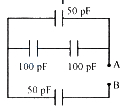
The equivalent capacitance between $ A $ and $ B $ is,
A
$ 150 pF $
B
$ 50 pF $
C
$ 300 pF $
D
$ \frac{100}{3} pF $
Solution
(D) From the circuit diagram,we can identify the arrangement of capacitors:
$1$. The two $ 100 pF $ capacitors are connected in series. Their equivalent capacitance $ C_1 $ is given by: $\frac{1}{C_1} = \frac{1}{100} + \frac{1}{100} = \frac{2}{100} \implies C_1 = 50 pF$.
$2$. This $ C_1 = 50 pF $ is in parallel with the top $ 50 pF $ capacitor. Let this parallel combination be $ C_2 $. $ C_2 = 50 pF + 50 pF = 100 pF$.
$3$. Finally,this $ C_2 = 100 pF $ is in series with the bottom $ 50 pF $ capacitor connected to terminal $ B $. The total equivalent capacitance $ C_{AB} $ is: $\frac{1}{C_{AB}} = \frac{1}{100} + \frac{1}{50} = \frac{1+2}{100} = \frac{3}{100}$.
$4$. Therefore,$ C_{AB} = \frac{100}{3} pF $.
$1$. The two $ 100 pF $ capacitors are connected in series. Their equivalent capacitance $ C_1 $ is given by: $\frac{1}{C_1} = \frac{1}{100} + \frac{1}{100} = \frac{2}{100} \implies C_1 = 50 pF$.
$2$. This $ C_1 = 50 pF $ is in parallel with the top $ 50 pF $ capacitor. Let this parallel combination be $ C_2 $. $ C_2 = 50 pF + 50 pF = 100 pF$.
$3$. Finally,this $ C_2 = 100 pF $ is in series with the bottom $ 50 pF $ capacitor connected to terminal $ B $. The total equivalent capacitance $ C_{AB} $ is: $\frac{1}{C_{AB}} = \frac{1}{100} + \frac{1}{50} = \frac{1+2}{100} = \frac{3}{100}$.
$4$. Therefore,$ C_{AB} = \frac{100}{3} pF $.
0 likesView Solution
24
PhysicsEasyMCQKCET · 2019
An antenna uses electromagnetic waves of frequency $5 \text{ MHz}$. For proper working,the size of the antenna should be:
A
$15 \text{ km}$
B
$15 \text{ m}$
C
$3 \text{ km}$
D
$300 \text{ m}$
Solution
(B) The wavelength $\lambda$ of the electromagnetic wave is given by the formula $\lambda = \frac{c}{f}$,where $c$ is the speed of light $(3 \times 10^8 \text{ m/s})$ and $f$ is the frequency $(5 \times 10^6 \text{ Hz})$.
Substituting the values: $\lambda = \frac{3 \times 10^8}{5 \times 10^6} = 0.6 \times 10^2 = 60 \text{ m}$.
For an antenna to work efficiently,its length should be at least $\frac{\lambda}{4}$.
Therefore,the required size of the antenna is $\frac{60}{4} = 15 \text{ m}$.
Substituting the values: $\lambda = \frac{3 \times 10^8}{5 \times 10^6} = 0.6 \times 10^2 = 60 \text{ m}$.
For an antenna to work efficiently,its length should be at least $\frac{\lambda}{4}$.
Therefore,the required size of the antenna is $\frac{60}{4} = 15 \text{ m}$.
0 likesView Solution
25
PhysicsEasyMCQKCET · 2019
The phenomenon involved in the reflection of radio waves by the ionosphere is similar to:
A
dispersion of light by water molecules during the formation of a rainbow
B
reflection of light by a plane mirror
C
scattering of light by air particles
D
total internal reflection of light in air during a mirage
Solution
(D) The reflection of radio waves by the ionosphere occurs because the refractive index of the ionosphere decreases with altitude. As radio waves travel into the ionosphere,they undergo continuous refraction until the angle of incidence exceeds the critical angle,leading to total internal reflection. This process is analogous to the total internal reflection of light that occurs in the atmosphere during the formation of a mirage. Therefore,the correct option is $D$.
0 likesView Solution
26
PhysicsEasyMCQKCET · 2019
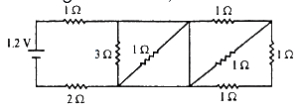
In the given circuit, the current through the $2 \Omega$ resistor is: (in $\text{ A}$)
A
$0.4$
B
$0.2$
C
$0.1$
D
$0.3$
Solution
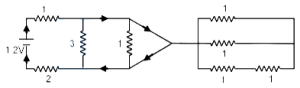
(D) To find the current through the $2 \Omega$ resistor, we first simplify the circuit.
$1$. The rightmost part of the circuit consists of two $1 \Omega$ resistors in series, which are in parallel with another $1 \Omega$ resistor. The equivalent resistance of this part is $R_1 = \frac{(1+1) \times 1}{(1+1) + 1} = \frac{2}{3} \Omega$.
$2$. This $R_1$ is in series with the $1 \Omega$ resistor, giving $R_2 = 1 + \frac{2}{3} = \frac{5}{3} \Omega$.
$3$. This $R_2$ is in parallel with the $3 \Omega$ resistor. The equivalent resistance is $R_3 = \frac{3 \times (5/3)}{3 + (5/3)} = \frac{5}{14/3} = \frac{15}{14} \Omega$.
$4$. Finally, this $R_3$ is in series with the $1 \Omega$ and $2 \Omega$ resistors. The total equivalent resistance is $R_{eq} = 1 + 2 + \frac{15}{14} = 3 + \frac{15}{14} = \frac{42+15}{14} = \frac{57}{14} \Omega$.
$5$. The total current from the battery is $I = \frac{V}{R_{eq}} = \frac{1.2}{57/14} = \frac{1.2 \times 14}{57} \approx 0.2947 \text{ A}$.
$6$. Since the $2 \Omega$ resistor is in series with the battery, the total current flows through it. Rounding to the nearest option, the current is approximately $0.3 \text{ A}$.
$1$. The rightmost part of the circuit consists of two $1 \Omega$ resistors in series, which are in parallel with another $1 \Omega$ resistor. The equivalent resistance of this part is $R_1 = \frac{(1+1) \times 1}{(1+1) + 1} = \frac{2}{3} \Omega$.
$2$. This $R_1$ is in series with the $1 \Omega$ resistor, giving $R_2 = 1 + \frac{2}{3} = \frac{5}{3} \Omega$.
$3$. This $R_2$ is in parallel with the $3 \Omega$ resistor. The equivalent resistance is $R_3 = \frac{3 \times (5/3)}{3 + (5/3)} = \frac{5}{14/3} = \frac{15}{14} \Omega$.
$4$. Finally, this $R_3$ is in series with the $1 \Omega$ and $2 \Omega$ resistors. The total equivalent resistance is $R_{eq} = 1 + 2 + \frac{15}{14} = 3 + \frac{15}{14} = \frac{42+15}{14} = \frac{57}{14} \Omega$.
$5$. The total current from the battery is $I = \frac{V}{R_{eq}} = \frac{1.2}{57/14} = \frac{1.2 \times 14}{57} \approx 0.2947 \text{ A}$.
$6$. Since the $2 \Omega$ resistor is in series with the battery, the total current flows through it. Rounding to the nearest option, the current is approximately $0.3 \text{ A}$.
0 likesView Solution
27
PhysicsEasyMCQKCET · 2019
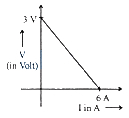
The variation of terminal potential difference $(V)$ with current $(I)$ flowing through a cell is as shown in the graph. The $EMF$ $(E)$ and internal resistance $(r)$ of the cell are:
A
$6 \text{ V}, 2 \ \Omega$
B
$3 \text{ V}, 2 \ \Omega$
C
$6 \text{ V}, 0.5 \ \Omega$
D
$3 \text{ V}, 0.5 \ \Omega$
Solution
(D) The terminal potential difference $V$ of a cell is given by the equation: $V = E - Ir$,where $E$ is the $EMF$ and $r$ is the internal resistance.
This equation is in the form of a straight line $y = mx + c$,where $V$ is on the y-axis and $I$ is on the x-axis.
$1$. When the current $I = 0$,the terminal potential difference $V = E$. From the graph,at $I = 0$,$V = 3 \text{ V}$. Therefore,$E = 3 \text{ V}$.
$2$. When the terminal potential difference $V = 0$,the current is $I = 6 \text{ A}$. Substituting these values into the equation: $0 = E - Ir \implies 0 = 3 - (6)r$.
$3$. Solving for $r$: $6r = 3 \implies r = \frac{3}{6} = 0.5 \ \Omega$.
Thus,the $EMF$ is $3 \text{ V}$ and the internal resistance is $0.5 \ \Omega$.
This equation is in the form of a straight line $y = mx + c$,where $V$ is on the y-axis and $I$ is on the x-axis.
$1$. When the current $I = 0$,the terminal potential difference $V = E$. From the graph,at $I = 0$,$V = 3 \text{ V}$. Therefore,$E = 3 \text{ V}$.
$2$. When the terminal potential difference $V = 0$,the current is $I = 6 \text{ A}$. Substituting these values into the equation: $0 = E - Ir \implies 0 = 3 - (6)r$.
$3$. Solving for $r$: $6r = 3 \implies r = \frac{3}{6} = 0.5 \ \Omega$.
Thus,the $EMF$ is $3 \text{ V}$ and the internal resistance is $0.5 \ \Omega$.
0 likesView Solution
28
PhysicsEasyMCQKCET · 2019
Though the electron drift velocity is small and electron charge is very small, a conductor can carry an appreciably large current because
A
electron number density depends on temperature
B
electron number density is very large
C
relaxation time is small
D
drift velocity of electron is very large
Solution
(B) The current $I$ in a conductor is given by the formula $I = neAv_d$, where $n$ is the electron number density, $e$ is the charge of an electron, $A$ is the cross-sectional area, and $v_d$ is the drift velocity.
Even though the drift velocity $v_d$ is very small (typically $10^{-4} \, m/s$) and the charge $e$ is small $(1.6 \times 10^{-19} \, C)$, the number density $n$ of free electrons in a conductor is extremely large, typically of the order of $10^{28} \, m^{-3}$.
Therefore, the product $neAv_d$ results in an appreciably large current.
Even though the drift velocity $v_d$ is very small (typically $10^{-4} \, m/s$) and the charge $e$ is small $(1.6 \times 10^{-19} \, C)$, the number density $n$ of free electrons in a conductor is extremely large, typically of the order of $10^{28} \, m^{-3}$.
Therefore, the product $neAv_d$ results in an appreciably large current.
0 likesView Solution
29
PhysicsMediumMCQKCET · 2019
The number of turns in a coil of a galvanometer is tripled. Then:
A
Both voltage and current sensitivity remain constant.
B
Voltage sensitivity increases $3$ times and current sensitivity remains constant.
C
Both voltage and current sensitivity decrease by $33\%$.
D
Voltage sensitivity remains constant and current sensitivity increases $3$ times.
Solution
(D) The current sensitivity $(I_s)$ of a galvanometer is given by $I_s = \frac{\theta}{I} = \frac{NAB}{k}$,where $N$ is the number of turns,$A$ is the area,$B$ is the magnetic field,and $k$ is the restoring torque constant per unit twist.
If $N$ is tripled $(N' = 3N)$,then $I_s' = \frac{(3N)AB}{k} = 3 I_s$. Thus,current sensitivity increases $3$ times.
The voltage sensitivity $(V_s)$ is given by $V_s = \frac{\theta}{V} = \frac{\theta}{IR} = \frac{I_s}{R}$.
Since the resistance $R$ is proportional to the length of the wire,and the length of the wire is proportional to the number of turns $(R' = 3R)$,the new voltage sensitivity is $V_s' = \frac{3I_s}{3R} = \frac{I_s}{R} = V_s$.
Therefore,voltage sensitivity remains constant and current sensitivity increases $3$ times.
If $N$ is tripled $(N' = 3N)$,then $I_s' = \frac{(3N)AB}{k} = 3 I_s$. Thus,current sensitivity increases $3$ times.
The voltage sensitivity $(V_s)$ is given by $V_s = \frac{\theta}{V} = \frac{\theta}{IR} = \frac{I_s}{R}$.
Since the resistance $R$ is proportional to the length of the wire,and the length of the wire is proportional to the number of turns $(R' = 3R)$,the new voltage sensitivity is $V_s' = \frac{3I_s}{3R} = \frac{I_s}{R} = V_s$.
Therefore,voltage sensitivity remains constant and current sensitivity increases $3$ times.
0 likesView Solution
30
PhysicsMediumMCQKCET · 2019
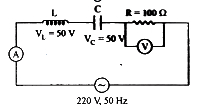
The readings of the ammeter and voltmeter in the following circuit are respectively:
A
$ 2.7 \, A, 220 \, V $
B
$ 1.2 \, A, 120 \, V $
C
$ 2.2 \, A, 220 \, V $
D
$ 1.5 \, A, 100 \, V $
Solution
(C) In the given $ LCR $ series circuit, the voltage across the inductor is $ V_L = 50 \, V $ and the voltage across the capacitor is $ V_C = 50 \, V $.
Since $ V_L = V_C $, the circuit is in resonance.
In a resonant $ LCR $ circuit, the net reactance is zero $( X_L - X_C = 0 )$, meaning the circuit behaves as a purely resistive circuit.
Therefore, the entire source voltage drops across the resistor $ R $.
Thus, the voltmeter reading is $ V_R = V_{source} = 220 \, V $.
The current in the circuit is given by $ I = \frac{V_R}{R} = \frac{220 \, V}{100 \, \Omega} = 2.2 \, A $.
Hence, the ammeter reading is $ 2.2 \, A $ and the voltmeter reading is $ 220 \, V $.
Since $ V_L = V_C $, the circuit is in resonance.
In a resonant $ LCR $ circuit, the net reactance is zero $( X_L - X_C = 0 )$, meaning the circuit behaves as a purely resistive circuit.
Therefore, the entire source voltage drops across the resistor $ R $.
Thus, the voltmeter reading is $ V_R = V_{source} = 220 \, V $.
The current in the circuit is given by $ I = \frac{V_R}{R} = \frac{220 \, V}{100 \, \Omega} = 2.2 \, A $.
Hence, the ammeter reading is $ 2.2 \, A $ and the voltmeter reading is $ 220 \, V $.
0 likesView Solution
31
PhysicsMediumMCQKCET · 2019
In a potentiometer experiment,the balancing point with a cell is at a length $240 \ cm$. On shunting the cell with a resistance of $2 \ \Omega$,the balancing length becomes $120 \ cm$. The internal resistance of the cell is: (in $Omega$)
A
$1$
B
$4$
C
$0.5$
D
$2$
Solution
(D) The internal resistance $r$ of a cell is given by the formula: $r = R \left( \frac{l_1 - l_2}{l_2} \right)$.
Here,$l_1 = 240 \ cm$ is the balancing length when the cell is in an open circuit.
$l_2 = 120 \ cm$ is the balancing length when the cell is shunted with an external resistance $R = 2 \ \Omega$.
Substituting the values into the formula:
$r = 2 \left( \frac{240 - 120}{120} \right) \ \Omega$.
$r = 2 \left( \frac{120}{120} \right) \ \Omega$.
$r = 2 \times 1 \ \Omega = 2 \ \Omega$.
Therefore,the internal resistance of the cell is $2 \ \Omega$.
Here,$l_1 = 240 \ cm$ is the balancing length when the cell is in an open circuit.
$l_2 = 120 \ cm$ is the balancing length when the cell is shunted with an external resistance $R = 2 \ \Omega$.
Substituting the values into the formula:
$r = 2 \left( \frac{240 - 120}{120} \right) \ \Omega$.
$r = 2 \left( \frac{120}{120} \right) \ \Omega$.
$r = 2 \times 1 \ \Omega = 2 \ \Omega$.
Therefore,the internal resistance of the cell is $2 \ \Omega$.
0 likesView Solution
32
PhysicsEasyMCQKCET · 2019
Kirchhoff's junction rule is a reflection of
A
conservation of momentum
B
conservation of current density vector
C
conservation of charges
D
conservation of energy
Solution
(C) Kirchhoff's junction rule,also known as Kirchhoff's Current Law $(KCL)$,states that the algebraic sum of currents meeting at any junction in a circuit is zero.
This implies that the total charge entering a junction per unit time must equal the total charge leaving the junction per unit time.
Since charge is neither created nor destroyed at the junction,this rule is a direct consequence of the law of conservation of charges.
Therefore,the correct option is $C$.
This implies that the total charge entering a junction per unit time must equal the total charge leaving the junction per unit time.
Since charge is neither created nor destroyed at the junction,this rule is a direct consequence of the law of conservation of charges.
Therefore,the correct option is $C$.
0 likesView Solution
33
PhysicsMediumMCQKCET · 2019
Masses of three wires of copper are in the ratio $1:3:5$ and their lengths are in the ratio $5:3:1$. The ratio of their electrical resistances is:
A
$1:3:5$
B
$5:3:1$
C
$125:15:1$
D
$1:15:125$
Solution
(C) The resistance $R$ of a wire is given by $R = \rho \frac{l}{A}$,where $\rho$ is the resistivity,$l$ is the length,and $A$ is the cross-sectional area.
Since $A = \frac{V}{l} = \frac{m}{l \cdot d}$ (where $m$ is mass and $d$ is density),we can write:
$R = \rho \frac{l^2 \cdot d}{m}$
Since $\rho$ and $d$ are constant for copper wires,$R \propto \frac{l^2}{m}$.
Given ratios: $m_1:m_2:m_3 = 1:3:5$ and $l_1:l_2:l_3 = 5:3:1$.
Calculating the ratio of resistances:
$R_1:R_2:R_3 = \frac{l_1^2}{m_1} : \frac{l_2^2}{m_2} : \frac{l_3^2}{m_3}$
$R_1:R_2:R_3 = \frac{5^2}{1} : \frac{3^2}{3} : \frac{1^2}{5}$
$R_1:R_2:R_3 = 25 : 3 : \frac{1}{5}$
Multiplying by $5$ to clear the fraction:
$R_1:R_2:R_3 = 125 : 15 : 1$.
Since $A = \frac{V}{l} = \frac{m}{l \cdot d}$ (where $m$ is mass and $d$ is density),we can write:
$R = \rho \frac{l^2 \cdot d}{m}$
Since $\rho$ and $d$ are constant for copper wires,$R \propto \frac{l^2}{m}$.
Given ratios: $m_1:m_2:m_3 = 1:3:5$ and $l_1:l_2:l_3 = 5:3:1$.
Calculating the ratio of resistances:
$R_1:R_2:R_3 = \frac{l_1^2}{m_1} : \frac{l_2^2}{m_2} : \frac{l_3^2}{m_3}$
$R_1:R_2:R_3 = \frac{5^2}{1} : \frac{3^2}{3} : \frac{1^2}{5}$
$R_1:R_2:R_3 = 25 : 3 : \frac{1}{5}$
Multiplying by $5$ to clear the fraction:
$R_1:R_2:R_3 = 125 : 15 : 1$.
0 likesView Solution
34
PhysicsEasyMCQKCET · 2019
Light of a certain frequency and intensity incident on a photosensitive material causes the photoelectric effect. If both the frequency and intensity are doubled,the photoelectric saturation current becomes
A
halved
B
quadrupled
C
unchanged
D
doubled
Solution
(D) The photoelectric current is directly proportional to the intensity of the incident light,provided the incident frequency is greater than the threshold frequency.
Since the saturation current depends only on the number of photoelectrons emitted per second,which is directly proportional to the intensity of the incident light,doubling the intensity will double the saturation current.
The frequency of the incident light affects the kinetic energy of the emitted photoelectrons,not the number of photoelectrons (saturation current),as long as it remains above the threshold frequency.
Therefore,when the intensity is doubled,the photoelectric saturation current doubles.
Since the saturation current depends only on the number of photoelectrons emitted per second,which is directly proportional to the intensity of the incident light,doubling the intensity will double the saturation current.
The frequency of the incident light affects the kinetic energy of the emitted photoelectrons,not the number of photoelectrons (saturation current),as long as it remains above the threshold frequency.
Therefore,when the intensity is doubled,the photoelectric saturation current doubles.
0 likesView Solution
35
PhysicsDifficultMCQKCET · 2019
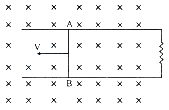
Consider the situation given in the figure. The wire $AB$ is slid on the fixed rails with a constant velocity $v$. If the wire $AB$ is replaced by a semicircular wire of the same length,the magnitude of the induced current will:
A
decrease
B
increase
C
increase or decrease depending on whether the semicircle bulges towards the resistance or away from it
D
remain same
Solution
(D) The motional electromotive force (emf) induced in a conductor moving in a magnetic field is given by $e = \int (\vec{v} \times \vec{B}) \cdot d\vec{l}$.
For a conductor moving with velocity $v$ perpendicular to a uniform magnetic field $B$,the induced emf is $e = B v L_{eff}$,where $L_{eff}$ is the effective length of the conductor perpendicular to the velocity vector.
The effective length $L_{eff}$ is the straight-line distance between the two ends of the wire that are in contact with the rails.
When the straight wire $AB$ is replaced by a semicircular wire with the same endpoints $A$ and $B$,the effective length $L_{eff}$ (the distance between $A$ and $B$) remains the same.
Since the induced emf $e = B v L_{eff}$ depends only on the distance between the contact points on the rails,the emf remains unchanged.
Assuming the resistance $R$ of the circuit remains constant,the induced current $i = e/R$ will also remain the same.
For a conductor moving with velocity $v$ perpendicular to a uniform magnetic field $B$,the induced emf is $e = B v L_{eff}$,where $L_{eff}$ is the effective length of the conductor perpendicular to the velocity vector.
The effective length $L_{eff}$ is the straight-line distance between the two ends of the wire that are in contact with the rails.
When the straight wire $AB$ is replaced by a semicircular wire with the same endpoints $A$ and $B$,the effective length $L_{eff}$ (the distance between $A$ and $B$) remains the same.
Since the induced emf $e = B v L_{eff}$ depends only on the distance between the contact points on the rails,the emf remains unchanged.
Assuming the resistance $R$ of the circuit remains constant,the induced current $i = e/R$ will also remain the same.
0 likesView Solution
36
PhysicsEasyMCQKCET · 2019
An electromagnetic wave is travelling in $x$-direction with electric field vector given by $\vec{E}_{y} = E_{0} \sin(kx - \omega t) \hat{j}$. The correct expression for the magnetic field vector is:
A
$\vec{B}_{y} = \frac{E_{0}}{C} \sin(kx - \omega t) \hat{j}$
B
$\vec{B}_{y} = E_{0} C \sin(kx - \omega t) \hat{j}$
C
$\vec{B}_{z} = \frac{E_{0}}{C} \sin(kx - \omega t) \hat{k}$
D
$\vec{B}_{z} = E_{0} C \sin(kx - \omega t) \hat{k}$
Solution
(C) The electric field is given by $\vec{E} = E_{0} \sin(kx - \omega t) \hat{j}$.
The wave travels in the $+x$-direction,so the direction of propagation is $\hat{i}$.
The relation between the magnitudes of the electric and magnetic fields is $E_{0} = C B_{0}$,which implies $B_{0} = \frac{E_{0}}{C}$.
The direction of the magnetic field $\vec{B}$ is given by the direction of $\vec{c} \times \vec{E}$,where $\vec{c}$ is the direction of wave propagation.
Here,$\hat{i} \times \hat{j} = \hat{k}$.
Therefore,the magnetic field vector is $\vec{B}_{z} = \frac{E_{0}}{C} \sin(kx - \omega t) \hat{k}$.
The wave travels in the $+x$-direction,so the direction of propagation is $\hat{i}$.
The relation between the magnitudes of the electric and magnetic fields is $E_{0} = C B_{0}$,which implies $B_{0} = \frac{E_{0}}{C}$.
The direction of the magnetic field $\vec{B}$ is given by the direction of $\vec{c} \times \vec{E}$,where $\vec{c}$ is the direction of wave propagation.
Here,$\hat{i} \times \hat{j} = \hat{k}$.
Therefore,the magnetic field vector is $\vec{B}_{z} = \frac{E_{0}}{C} \sin(kx - \omega t) \hat{k}$.
0 likesView Solution
37
PhysicsMediumMCQKCET · 2019
$A$ certain charge $2Q$ is divided at first into two parts $q_{1}$ and $q_{2}$. Later,the charges are placed at a certain distance. If the force of interaction between the two charges is maximum,then find the value of $\frac{Q}{q_{1}}$.
A
$1$
B
$4$
C
$0.5$
D
$2$
Solution
(A) Let the total charge be $2Q$. The two parts are $q_{1}$ and $q_{2}$,such that $q_{1} + q_{2} = 2Q$. Thus,$q_{2} = 2Q - q_{1}$.
According to Coulomb's law,the force of interaction $F$ between the charges separated by a distance $r$ is given by $F = k \frac{q_{1}q_{2}}{r^2}$.
Substituting $q_{2}$,we get $F = \frac{k}{r^2} (q_{1})(2Q - q_{1}) = \frac{k}{r^2} (2Qq_{1} - q_{1}^2)$.
For the force $F$ to be maximum,the derivative of $F$ with respect to $q_{1}$ must be zero: $\frac{dF}{dq_{1}} = 0$.
$\frac{d}{dq_{1}} [\frac{k}{r^2} (2Qq_{1} - q_{1}^2)] = \frac{k}{r^2} (2Q - 2q_{1}) = 0$.
This implies $2Q - 2q_{1} = 0$,so $q_{1} = Q$.
Therefore,the ratio $\frac{Q}{q_{1}} = \frac{Q}{Q} = 1$.
According to Coulomb's law,the force of interaction $F$ between the charges separated by a distance $r$ is given by $F = k \frac{q_{1}q_{2}}{r^2}$.
Substituting $q_{2}$,we get $F = \frac{k}{r^2} (q_{1})(2Q - q_{1}) = \frac{k}{r^2} (2Qq_{1} - q_{1}^2)$.
For the force $F$ to be maximum,the derivative of $F$ with respect to $q_{1}$ must be zero: $\frac{dF}{dq_{1}} = 0$.
$\frac{d}{dq_{1}} [\frac{k}{r^2} (2Qq_{1} - q_{1}^2)] = \frac{k}{r^2} (2Q - 2q_{1}) = 0$.
This implies $2Q - 2q_{1} = 0$,so $q_{1} = Q$.
Therefore,the ratio $\frac{Q}{q_{1}} = \frac{Q}{Q} = 1$.
0 likesView Solution
38
PhysicsEasyMCQKCET · 2019
An electric dipole is kept in a non-uniform electric field. It generally experiences:
A
a torque but not a force
B
a force and a torque
C
neither a force nor a torque
D
a force but not a torque
Solution
(B) In a non-uniform electric field,the electric field intensity varies at different points in space.
Since the two charges of the dipole ($+q$ and $-q$) are separated by a small distance,they experience different electric field strengths at their respective positions.
Because the forces $(F = qE)$ acting on the two charges are unequal in magnitude or direction,the net force on the dipole is non-zero.
Additionally,since the forces act at different points,they create a net torque about the center of the dipole.
Therefore,an electric dipole placed in a non-uniform electric field generally experiences both a force and a torque.
Since the two charges of the dipole ($+q$ and $-q$) are separated by a small distance,they experience different electric field strengths at their respective positions.
Because the forces $(F = qE)$ acting on the two charges are unequal in magnitude or direction,the net force on the dipole is non-zero.
Additionally,since the forces act at different points,they create a net torque about the center of the dipole.
Therefore,an electric dipole placed in a non-uniform electric field generally experiences both a force and a torque.
0 likesView Solution
39
PhysicsMediumMCQKCET · 2019
Two metal plates are separated by $2 \,cm$. The potentials of the plates are $-10 \,V$ and $+30 \,V$. The electric field between the two plates is: (in $\,V/m$)
A
$1000$
B
$2000$
C
$3000$
D
$4000$
Solution
(B) The electric field $E$ between two parallel plates is given by the formula $E = \frac{|\Delta V|}{d}$,where $\Delta V$ is the potential difference and $d$ is the distance between the plates.
Given:
Potential difference $\Delta V = V_2 - V_1 = 30 \,V - (-10 \,V) = 40 \,V$.
Distance $d = 2 \,cm = 2 \times 10^{-2} \,m$.
Substituting the values:
$E = \frac{40 \,V}{2 \times 10^{-2} \,m} = 20 \times 10^2 \,V/m = 2000 \,V/m$.
Therefore,the correct option is $B$.
Given:
Potential difference $\Delta V = V_2 - V_1 = 30 \,V - (-10 \,V) = 40 \,V$.
Distance $d = 2 \,cm = 2 \times 10^{-2} \,m$.
Substituting the values:
$E = \frac{40 \,V}{2 \times 10^{-2} \,m} = 20 \times 10^2 \,V/m = 2000 \,V/m$.
Therefore,the correct option is $B$.
0 likesView Solution
40
PhysicsEasyMCQKCET · 2019
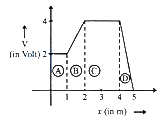
The figure shows the electric potential $V$ as a function of distance through four regions on the $x$-axis. Which of the following is true for the magnitude of the electric field $E$ in these regions?
A
$E_{B}=E_{D}$ and $E_{A} < E_{C}$
B
$E_{A}>E_{B}>E_{C}>E_{D}$
C
$E_{A} < E_{B} < E_{C} < E_{D}$
D
$E_{A}=E_{C}$ and $E_{B} < E_{D}$
Solution
(D) The electric field $E$ is related to the potential $V$ by the relation $E = -\frac{dV}{dx}$. The magnitude of the electric field is $|E| = |\frac{dV}{dx}|$,which represents the slope of the $V-x$ graph.
In region $A$ ($x=0$ to $1$ m),$V$ is constant ($2$ $V$),so the slope $\frac{dV}{dx} = 0$. Thus,$E_{A} = 0$.
In region $B$ ($x=1$ to $2$ m),the slope is $\frac{4-2}{2-1} = 2$ $V$/m. Thus,$|E_{B}| = 2$ $V$/m.
In region $C$ ($x=2$ to $4$ m),$V$ is constant ($4$ $V$),so the slope $\frac{dV}{dx} = 0$. Thus,$E_{C} = 0$.
In region $D$ ($x=4$ to $5$ m),the slope is $\frac{0-4}{5-4} = -4$ $V$/m. Thus,$|E_{D}| = |-4| = 4$ $V$/m.
Comparing the magnitudes: $E_{A} = E_{C} = 0$ and $E_{B} = 2$ $V$/m,$E_{D} = 4$ $V$/m. Therefore,$E_{A} = E_{C}$ and $E_{B} < E_{D}$.
In region $A$ ($x=0$ to $1$ m),$V$ is constant ($2$ $V$),so the slope $\frac{dV}{dx} = 0$. Thus,$E_{A} = 0$.
In region $B$ ($x=1$ to $2$ m),the slope is $\frac{4-2}{2-1} = 2$ $V$/m. Thus,$|E_{B}| = 2$ $V$/m.
In region $C$ ($x=2$ to $4$ m),$V$ is constant ($4$ $V$),so the slope $\frac{dV}{dx} = 0$. Thus,$E_{C} = 0$.
In region $D$ ($x=4$ to $5$ m),the slope is $\frac{0-4}{5-4} = -4$ $V$/m. Thus,$|E_{D}| = |-4| = 4$ $V$/m.
Comparing the magnitudes: $E_{A} = E_{C} = 0$ and $E_{B} = 2$ $V$/m,$E_{D} = 4$ $V$/m. Therefore,$E_{A} = E_{C}$ and $E_{B} < E_{D}$.
0 likesView Solution
41
PhysicsEasyMCQKCET · 2019
$A$ system of two charges separated by a certain distance apart stores electrical potential energy. If the distance between them is increased,the potential energy of the system,
A
may increase or decrease
B
increases in any case
C
remains the same
D
decreases in any case
Solution
(A) The electrical potential energy $U$ of a system of two point charges $q_1$ and $q_2$ separated by a distance $r$ is given by $U = \frac{1}{4 \pi \epsilon_0} \frac{q_1 q_2}{r}$.
Case $1$: If the charges are like (both positive or both negative),then $q_1 q_2 > 0$. As the distance $r$ increases,the value of $U$ decreases.
Case $2$: If the charges are unlike (one positive and one negative),then $q_1 q_2 < 0$. As the distance $r$ increases,the magnitude $|U|$ decreases,but since $U$ is negative,the value of $U$ increases (becomes less negative,moving closer to zero).
Therefore,the potential energy may increase or decrease depending on the nature of the charges.
Case $1$: If the charges are like (both positive or both negative),then $q_1 q_2 > 0$. As the distance $r$ increases,the value of $U$ decreases.
Case $2$: If the charges are unlike (one positive and one negative),then $q_1 q_2 < 0$. As the distance $r$ increases,the magnitude $|U|$ decreases,but since $U$ is negative,the value of $U$ increases (becomes less negative,moving closer to zero).
Therefore,the potential energy may increase or decrease depending on the nature of the charges.
0 likesView Solution
42
PhysicsMediumMCQKCET · 2019
An electron is moving with an initial velocity $\vec{V} = V_{0} \hat{i}$ and is in a uniform magnetic field $\vec{B} = B_{0} \hat{j}$. Then its de Broglie wavelength
A
decreases with time
B
remains constant
C
increases and decreases periodically
D
increases with time
Solution
(B) The de Broglie wavelength is given by $\lambda = \frac{h}{mv}$,where $h$ is Planck's constant,$m$ is the mass of the electron,and $v$ is its speed.
When an electron moves in a uniform magnetic field $\vec{B}$ with a velocity $\vec{V}$ perpendicular to the field,it experiences a magnetic Lorentz force $\vec{F} = q(\vec{V} \times \vec{B})$.
This force acts as a centripetal force,causing the electron to move in a circular path.
Since the magnetic force is always perpendicular to the velocity,it does no work on the electron $(W = \vec{F} \cdot d\vec{s} = 0)$.
According to the work-energy theorem,the kinetic energy and consequently the speed $v$ of the electron remain constant throughout its motion.
Since $h$,$m$,and $v$ are all constant,the de Broglie wavelength $\lambda$ remains constant.
When an electron moves in a uniform magnetic field $\vec{B}$ with a velocity $\vec{V}$ perpendicular to the field,it experiences a magnetic Lorentz force $\vec{F} = q(\vec{V} \times \vec{B})$.
This force acts as a centripetal force,causing the electron to move in a circular path.
Since the magnetic force is always perpendicular to the velocity,it does no work on the electron $(W = \vec{F} \cdot d\vec{s} = 0)$.
According to the work-energy theorem,the kinetic energy and consequently the speed $v$ of the electron remain constant throughout its motion.
Since $h$,$m$,and $v$ are all constant,the de Broglie wavelength $\lambda$ remains constant.
0 likesView Solution
43
PhysicsMediumMCQKCET · 2019
$A$ toroid has $500$ turns per metre length. If it carries a current of $2 \text{ A}$, the magnetic energy density inside the toroid is: (in $\text{ J/m}^3$)
A
$6.28$
B
$0.628$
C
$3.14$
D
$0.314$
Solution
(B) The magnetic field $B$ inside a toroid is given by $B = \mu_0 n I$, where $n$ is the number of turns per unit length and $I$ is the current.
Given: $n = 500 \text{ m}^{-1}$, $I = 2 \text{ A}$, $\mu_0 = 4\pi \times 10^{-7} \text{ T m/A}$.
The magnetic energy density $u_B$ is given by $u_B = \frac{B^2}{2\mu_0}$.
Substituting $B = \mu_0 n I$ into the formula, we get $u_B = \frac{(\mu_0 n I)^2}{2\mu_0} = \frac{\mu_0 n^2 I^2}{2}$.
Calculating the value: $u_B = \frac{(4\pi \times 10^{-7}) \times (500)^2 \times (2)^2}{2}$.
$u_B = \frac{(4\pi \times 10^{-7}) \times 250000 \times 4}{2} = 2\pi \times 10^{-7} \times 10^6 = 2\pi \times 10^{-1} = 0.2 \times 3.14 = 0.628 \text{ J/m}^3$.
Given: $n = 500 \text{ m}^{-1}$, $I = 2 \text{ A}$, $\mu_0 = 4\pi \times 10^{-7} \text{ T m/A}$.
The magnetic energy density $u_B$ is given by $u_B = \frac{B^2}{2\mu_0}$.
Substituting $B = \mu_0 n I$ into the formula, we get $u_B = \frac{(\mu_0 n I)^2}{2\mu_0} = \frac{\mu_0 n^2 I^2}{2}$.
Calculating the value: $u_B = \frac{(4\pi \times 10^{-7}) \times (500)^2 \times (2)^2}{2}$.
$u_B = \frac{(4\pi \times 10^{-7}) \times 250000 \times 4}{2} = 2\pi \times 10^{-7} \times 10^6 = 2\pi \times 10^{-1} = 0.2 \times 3.14 = 0.628 \text{ J/m}^3$.
0 likesView Solution
44
PhysicsMediumMCQKCET · 2019
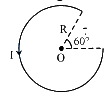
The magnetic field at the centre $O$ in the given figure is
A
$ \frac{3}{10} \mu_{0} I $
B
$ \frac{7}{14} \mu_{0} I $
C
$ \frac{\mu_{0} I}{12 R} $
D
$ \frac{5}{12} \frac{\mu_{0} I}{R} $
Solution
(D) The magnetic field at the centre of a circular arc of radius $R$ subtending an angle $\theta$ (in radians) at the centre is given by $B = \frac{\mu_0 I \theta}{4 \pi R}$.
In the given figure,the angle subtended by the arc at the centre is $\theta = 360^{\circ} - 60^{\circ} = 300^{\circ}$.
Converting the angle to radians: $\theta = 300^{\circ} \times \frac{\pi}{180^{\circ}} = \frac{5\pi}{3} \text{ radians}$.
Substituting this into the formula:
$B = \frac{\mu_0 I}{4 \pi R} \times \left( \frac{5\pi}{3} \right)$
$B = \frac{5 \mu_0 I}{12 R}$
In the given figure,the angle subtended by the arc at the centre is $\theta = 360^{\circ} - 60^{\circ} = 300^{\circ}$.
Converting the angle to radians: $\theta = 300^{\circ} \times \frac{\pi}{180^{\circ}} = \frac{5\pi}{3} \text{ radians}$.
Substituting this into the formula:
$B = \frac{\mu_0 I}{4 \pi R} \times \left( \frac{5\pi}{3} \right)$
$B = \frac{5 \mu_0 I}{12 R}$
0 likesView Solution
45
PhysicsEasyMCQKCET · 2019
$A$ circular current loop of magnetic moment $M$ is in an arbitrary orientation in an external uniform magnetic field $\vec{B}$. The work done to rotate the loop by $30^{\circ}$ about an axis perpendicular to its plane is
A
$MB/2$
B
$MB$
C
Zero
D
$\sqrt{3} MB/2$
Solution
(C) The potential energy $U$ of a magnetic dipole in a magnetic field is given by $U = -\vec{M} \cdot \vec{B} = -MB \cos \theta$,where $\theta$ is the angle between the magnetic moment vector $\vec{M}$ and the magnetic field vector $\vec{B}$.
When the loop is rotated about an axis perpendicular to its plane,the direction of the magnetic moment vector $\vec{M}$ (which is always perpendicular to the plane of the loop) remains unchanged relative to the magnetic field $\vec{B}$.
Since the angle $\theta$ between $\vec{M}$ and $\vec{B}$ does not change,the potential energy of the loop remains constant.
Therefore,the work done $W = \Delta U = 0$.
When the loop is rotated about an axis perpendicular to its plane,the direction of the magnetic moment vector $\vec{M}$ (which is always perpendicular to the plane of the loop) remains unchanged relative to the magnetic field $\vec{B}$.
Since the angle $\theta$ between $\vec{M}$ and $\vec{B}$ does not change,the potential energy of the loop remains constant.
Therefore,the work done $W = \Delta U = 0$.
0 likesView Solution
46
PhysicsMediumMCQKCET · 2019
$A$ magnetic needle has a magnetic moment of $5 \times 10^{-2} \text{ A m}^2$ and a moment of inertia of $8 \times 10^{-6} \text{ kg m}^2$. It has a period of oscillation of $2 \text{ s}$ in a magnetic field $\vec{B}$. The magnitude of the magnetic field is approximately:
A
$3.2 \times 10^{-4} \text{ T}$
B
$1.6 \times 10^{-4} \text{ T}$
C
$0.8 \times 10^{-4} \text{ T}$
D
$0.4 \times 10^{-4} \text{ T}$
Solution
(B) The time period of oscillation for a magnetic needle in a magnetic field is given by the formula: $T = 2\pi \sqrt{\frac{I}{MB}}$.
Given: $T = 2 \text{ s}$,$I = 8 \times 10^{-6} \text{ kg m}^2$,$M = 5 \times 10^{-2} \text{ A m}^2$.
Substituting the values into the formula: $2 = 2\pi \sqrt{\frac{8 \times 10^{-6}}{5 \times 10^{-2} \times B}}$.
Dividing by $2$: $1 = \pi \sqrt{\frac{8 \times 10^{-6}}{5 \times 10^{-2} \times B}}$.
Squaring both sides: $1 = \pi^2 \left( \frac{8 \times 10^{-6}}{5 \times 10^{-2} \times B} \right)$.
Rearranging for $B$: $B = \frac{\pi^2 \times 8 \times 10^{-6}}{5 \times 10^{-2}}$.
Using $\pi^2 \approx 9.86$ (or approximately $10$): $B = \frac{9.86 \times 8 \times 10^{-6}}{5 \times 10^{-2}} \approx 1.577 \times 10^{-4} \text{ T}$.
Rounding to the nearest option,$B \approx 1.6 \times 10^{-4} \text{ T}$.
Given: $T = 2 \text{ s}$,$I = 8 \times 10^{-6} \text{ kg m}^2$,$M = 5 \times 10^{-2} \text{ A m}^2$.
Substituting the values into the formula: $2 = 2\pi \sqrt{\frac{8 \times 10^{-6}}{5 \times 10^{-2} \times B}}$.
Dividing by $2$: $1 = \pi \sqrt{\frac{8 \times 10^{-6}}{5 \times 10^{-2} \times B}}$.
Squaring both sides: $1 = \pi^2 \left( \frac{8 \times 10^{-6}}{5 \times 10^{-2} \times B} \right)$.
Rearranging for $B$: $B = \frac{\pi^2 \times 8 \times 10^{-6}}{5 \times 10^{-2}}$.
Using $\pi^2 \approx 9.86$ (or approximately $10$): $B = \frac{9.86 \times 8 \times 10^{-6}}{5 \times 10^{-2}} \approx 1.577 \times 10^{-4} \text{ T}$.
Rounding to the nearest option,$B \approx 1.6 \times 10^{-4} \text{ T}$.
0 likesView Solution
47
PhysicsMediumMCQKCET · 2019
In a cyclotron,a charged particle:
A
speeds up in the dee
B
undergoes acceleration all the time
C
slows down within a dee and speeds up between dees
D
speeds up between the dees because of the magnetic field
Solution
(B) In a cyclotron,the charged particle is accelerated by an electric field in the gap between the two dees.
Within the dees,the particle moves in a circular path due to the perpendicular magnetic field,where its speed remains constant.
Since the particle is constantly changing its direction of motion while moving in a circle,it experiences centripetal acceleration at all times.
Therefore,the particle undergoes acceleration throughout its motion.
Within the dees,the particle moves in a circular path due to the perpendicular magnetic field,where its speed remains constant.
Since the particle is constantly changing its direction of motion while moving in a circle,it experiences centripetal acceleration at all times.
Therefore,the particle undergoes acceleration throughout its motion.
0 likesView Solution
48
PhysicsEasyMCQKCET · 2019
In a permanent magnet at room temperature,
A
magnetic moment of each molecule is zero
B
the individual molecules have non-zero magnetic moment which are all perfectly aligned
C
domains are partially aligned
D
domains are all perfectly aligned
Solution
(D) permanent magnet is made of ferromagnetic material. In a permanent magnet,the magnetic domains are aligned in a specific direction due to the manufacturing process (like cooling in an external magnetic field). Therefore,at room temperature,the domains are all perfectly aligned to produce a net magnetic moment.
0 likesView Solution
49
PhysicsDifficultMCQKCET · 2019
The coercivity of a magnet,where the ferromagnet gets completely demagnetized,is $3 \times 10^{3} \text{ A m}^{-1}$. The minimum current required to be passed in a solenoid having $1000 \text{ turns m}^{-1}$,so that the magnet gets completely demagnetized when placed inside the solenoid,is:
A
$3 \text{ A}$
B
$30 \text{ mA}$
C
$6 \text{ A}$
D
$60 \text{ mA}$
Solution
(A) The coercivity $H$ represents the magnetic field intensity required to demagnetize a ferromagnetic material.
For a solenoid,the magnetic field intensity $H$ is given by the formula $H = nI$,where $n$ is the number of turns per unit length and $I$ is the current.
Given:
Coercivity $H = 3 \times 10^{3} \text{ A m}^{-1}$
Number of turns per unit length $n = 1000 \text{ turns m}^{-1} = 10^{3} \text{ m}^{-1}$
Using the formula $I = \frac{H}{n}$:
$I = \frac{3 \times 10^{3}}{10^{3}} = 3 \text{ A}$
Therefore,the minimum current required is $3 \text{ A}$.
For a solenoid,the magnetic field intensity $H$ is given by the formula $H = nI$,where $n$ is the number of turns per unit length and $I$ is the current.
Given:
Coercivity $H = 3 \times 10^{3} \text{ A m}^{-1}$
Number of turns per unit length $n = 1000 \text{ turns m}^{-1} = 10^{3} \text{ m}^{-1}$
Using the formula $I = \frac{H}{n}$:
$I = \frac{3 \times 10^{3}}{10^{3}} = 3 \text{ A}$
Therefore,the minimum current required is $3 \text{ A}$.
0 likesView Solution
50
PhysicsEasyMCQKCET · 2019
Two protons are kept at a separation of $10 \ nm$. Let $F_n$ and $F_e$ be the nuclear force and the electromagnetic force between them,respectively.
A
$F_e \ll F_n$
B
$F_e = F_n$
C
$F_e$ and $F_n$ differ only slightly
D
$F_e \gg F_n$
Solution
(D) The nuclear force is a short-range force that acts effectively only within a range of approximately $1 \ fm$ to $3 \ fm$ $(1 \ fm = 10^{-15} \ m)$.
Given the separation between the two protons is $10 \ nm = 10 \times 10^{-9} \ m = 10^{-8} \ m$.
Since $10^{-8} \ m$ is much larger than the range of the nuclear force $(10^{-15} \ m)$,the nuclear force $F_n$ is negligible at this distance.
However,the electromagnetic force $F_e$ (Coulomb force) follows an inverse-square law and acts over long distances.
Therefore,at a separation of $10 \ nm$,the electromagnetic force is significantly greater than the nuclear force,i.e.,$F_e \gg F_n$.
Given the separation between the two protons is $10 \ nm = 10 \times 10^{-9} \ m = 10^{-8} \ m$.
Since $10^{-8} \ m$ is much larger than the range of the nuclear force $(10^{-15} \ m)$,the nuclear force $F_n$ is negligible at this distance.
However,the electromagnetic force $F_e$ (Coulomb force) follows an inverse-square law and acts over long distances.
Therefore,at a separation of $10 \ nm$,the electromagnetic force is significantly greater than the nuclear force,i.e.,$F_e \gg F_n$.
0 likesView Solution
51
PhysicsEasyMCQKCET · 2019
Which one of the following nuclei has a shorter mean life?
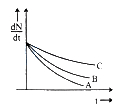
A
$C$
B
$A$
C
Same for all
D
$B$
Solution
(B) The activity of a radioactive sample is given by $R = |dN/dt|$.
From the graph,the decay curve for $A$ falls most rapidly,which means it has the highest decay constant $\lambda$.
The decay constant $\lambda$ and mean life $\tau$ are related by $\tau = 1/\lambda$.
Therefore,a higher decay constant $\lambda$ corresponds to a shorter mean life $\tau$.
Since curve $A$ has the steepest slope (highest activity),it has the largest $\lambda$ and thus the shortest mean life.
Hence,the correct option is $B$.
From the graph,the decay curve for $A$ falls most rapidly,which means it has the highest decay constant $\lambda$.
The decay constant $\lambda$ and mean life $\tau$ are related by $\tau = 1/\lambda$.
Therefore,a higher decay constant $\lambda$ corresponds to a shorter mean life $\tau$.
Since curve $A$ has the steepest slope (highest activity),it has the largest $\lambda$ and thus the shortest mean life.
Hence,the correct option is $B$.
0 likesView Solution
52
PhysicsMediumMCQKCET · 2019
The end product of the decay of $ { }_{90} Th^{232} $ is $ { }_{82} Pb^{208} $. The number of $ \alpha $ and $ \beta $ particles emitted are respectively:
A
$ 6, 0 $
B
$ 3, 3 $
C
$ 4, 6 $
D
$ 6, 4 $
Solution
(D) Let the number of $ \alpha $-particles emitted be $ x $ and the number of $ \beta $-particles emitted be $ y $.
The decay reaction is: $ { }_{90} Th^{232} \rightarrow { }_{82} Pb^{208} + x({ }_{2} He^{4}) + y({ }_{-1} e^{0}) $.
Equating the mass numbers: $ 232 = 208 + 4x \implies 4x = 24 \implies x = 6 $.
Equating the atomic numbers: $ 90 = 82 + 2x - y $.
Substituting $ x = 6 $: $ 90 = 82 + 2(6) - y \implies 90 = 82 + 12 - y \implies 90 = 94 - y \implies y = 4 $.
Thus,$ 6 $ $ \alpha $-particles and $ 4 $ $ \beta $-particles are emitted.
The decay reaction is: $ { }_{90} Th^{232} \rightarrow { }_{82} Pb^{208} + x({ }_{2} He^{4}) + y({ }_{-1} e^{0}) $.
Equating the mass numbers: $ 232 = 208 + 4x \implies 4x = 24 \implies x = 6 $.
Equating the atomic numbers: $ 90 = 82 + 2x - y $.
Substituting $ x = 6 $: $ 90 = 82 + 2(6) - y \implies 90 = 82 + 12 - y \implies 90 = 94 - y \implies y = 4 $.
Thus,$ 6 $ $ \alpha $-particles and $ 4 $ $ \beta $-particles are emitted.
0 likesView Solution
53
PhysicsEasyMCQKCET · 2019
$A$ point object is moving uniformly towards the pole of a concave mirror of focal length $25 \ cm$ along its axis as shown below. The speed of the object is $1 \ ms^{-1}$. At $t=0$,the distance of the object from the mirror is $50 \ cm$. The average velocity of the image formed by the mirror between time $t=0$ and $t=0.25 \ s$ is
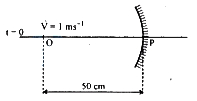
A
zero
B
$40 \ cm s^{-1}$
C
infinity
D
$20 \ cm s^{-1}$
Solution
(C) Given: Focal length $f = -25 \ cm$. Initial object distance $u_i = -50 \ cm$. Speed of object $v_o = 1 \ ms^{-1} = 100 \ cm s^{-1}$.
At $t=0$,$u_i = -50 \ cm$. Using mirror formula $\frac{1}{v} + \frac{1}{u} = \frac{1}{f}$,we get $\frac{1}{v_i} + \frac{1}{-50} = \frac{1}{-25} \implies \frac{1}{v_i} = -\frac{1}{25} + \frac{1}{50} = -\frac{1}{50} \implies v_i = -50 \ cm$.
At $t=0.25 \ s$,the distance moved by the object is $d = v_o \times t = 100 \ cm s^{-1} \times 0.25 \ s = 25 \ cm$.
New object distance $u_f = -50 \ cm + 25 \ cm = -25 \ cm$.
Since the object is at the focus,the image is formed at infinity,i.e.,$v_f = \infty$.
The average velocity of the image is $\langle v \rangle = \frac{v_f - v_i}{\Delta t} = \frac{\infty - (-50)}{0.25} = \infty$.
At $t=0$,$u_i = -50 \ cm$. Using mirror formula $\frac{1}{v} + \frac{1}{u} = \frac{1}{f}$,we get $\frac{1}{v_i} + \frac{1}{-50} = \frac{1}{-25} \implies \frac{1}{v_i} = -\frac{1}{25} + \frac{1}{50} = -\frac{1}{50} \implies v_i = -50 \ cm$.
At $t=0.25 \ s$,the distance moved by the object is $d = v_o \times t = 100 \ cm s^{-1} \times 0.25 \ s = 25 \ cm$.
New object distance $u_f = -50 \ cm + 25 \ cm = -25 \ cm$.
Since the object is at the focus,the image is formed at infinity,i.e.,$v_f = \infty$.
The average velocity of the image is $\langle v \rangle = \frac{v_f - v_i}{\Delta t} = \frac{\infty - (-50)}{0.25} = \infty$.
0 likesView Solution
54
PhysicsEasyMCQKCET · 2019
$A$ certain prism is found to produce a minimum deviation of $38^{\circ}$. It produces a deviation of $44^{\circ}$ when the angle of incidence is either $42^{\circ}$ or $62^{\circ}$. What is the angle of incidence when it is undergoing minimum deviation (in $^{\circ}$)?
A
$49$
B
$30$
C
$60$
D
$40$
Solution
(A) For a prism,the deviation $D$ is given by $D = (i_1 + i_2) - A$,where $i_1$ and $i_2$ are the angles of incidence and emergence,and $A$ is the prism angle.
Given $D = 44^{\circ}$ for $i_1 = 42^{\circ}$ and $i_2 = 62^{\circ}$ (or vice versa),we have:
$44^{\circ} = (42^{\circ} + 62^{\circ}) - A$
$44^{\circ} = 104^{\circ} - A$
$A = 104^{\circ} - 44^{\circ} = 60^{\circ}$.
At minimum deviation $(D_m = 38^{\circ})$,the angle of incidence $i$ is given by $i = \frac{A + D_m}{2}$.
$i = \frac{60^{\circ} + 38^{\circ}}{2} = \frac{98^{\circ}}{2} = 49^{\circ}$.
Given $D = 44^{\circ}$ for $i_1 = 42^{\circ}$ and $i_2 = 62^{\circ}$ (or vice versa),we have:
$44^{\circ} = (42^{\circ} + 62^{\circ}) - A$
$44^{\circ} = 104^{\circ} - A$
$A = 104^{\circ} - 44^{\circ} = 60^{\circ}$.
At minimum deviation $(D_m = 38^{\circ})$,the angle of incidence $i$ is given by $i = \frac{A + D_m}{2}$.
$i = \frac{60^{\circ} + 38^{\circ}}{2} = \frac{98^{\circ}}{2} = 49^{\circ}$.
0 likesView Solution
55
PhysicsMediumMCQKCET · 2019
For a transistor amplifier,the voltage gain:
A
is low at high and low frequencies and constant at mid frequencies
B
remains constant for all frequencies
C
constant at high frequencies and low at low frequencies
D
is high at high and low frequencies and constant in the middle frequency range
Solution
(A) The frequency response curve of a transistor amplifier shows that the voltage gain is not uniform across all frequencies.
At low frequencies,the coupling and bypass capacitors have high reactance,which reduces the gain.
At high frequencies,the internal junction capacitances of the transistor and stray capacitances become significant,providing a low-impedance path that shunts the signal,thereby reducing the gain.
In the mid-frequency range,these effects are negligible,and the amplifier provides a stable and maximum voltage gain.
Therefore,the voltage gain is low at both low and high frequencies and remains constant in the mid-frequency range.
At low frequencies,the coupling and bypass capacitors have high reactance,which reduces the gain.
At high frequencies,the internal junction capacitances of the transistor and stray capacitances become significant,providing a low-impedance path that shunts the signal,thereby reducing the gain.
In the mid-frequency range,these effects are negligible,and the amplifier provides a stable and maximum voltage gain.
Therefore,the voltage gain is low at both low and high frequencies and remains constant in the mid-frequency range.
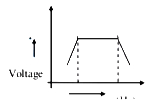
0 likesView Solution
56
PhysicsEasyMCQKCET · 2019
In the following circuit,what are $P$ and $Q$?
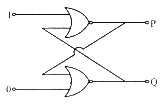
A
$P=0, Q=1$
B
$P=0, Q=0$
C
$P=1, Q=1$
D
$P=1, Q=0$
Solution
(A) The circuit consists of two cross-coupled $NOR$ gates forming an $SR$ latch.
For a $NOR$ gate,the output $Y = \overline{A+B}$.
Let the top gate be Gate $1$ and the bottom gate be Gate $2$.
The inputs to Gate $1$ are $1$ and $Q$. Thus,$P = \overline{1+Q} = 0$.
The inputs to Gate $2$ are $0$ and $P$. Thus,$Q = \overline{0+P}$.
Substituting $P=0$ into the equation for $Q$,we get $Q = \overline{0+0} = \overline{0} = 1$.
Therefore,$P=0$ and $Q=1$.
For a $NOR$ gate,the output $Y = \overline{A+B}$.
Let the top gate be Gate $1$ and the bottom gate be Gate $2$.
The inputs to Gate $1$ are $1$ and $Q$. Thus,$P = \overline{1+Q} = 0$.
The inputs to Gate $2$ are $0$ and $P$. Thus,$Q = \overline{0+P}$.
Substituting $P=0$ into the equation for $Q$,we get $Q = \overline{0+0} = \overline{0} = 1$.
Therefore,$P=0$ and $Q=1$.
0 likesView Solution
57
PhysicsEasyMCQKCET · 2019
The conductivity of a semiconductor increases with an increase in temperature because
A
both number density of charge carriers and relaxation time increase
B
number density of charge carriers increases
C
number density of charge carriers increases,relaxation time decreases,but the effect of the decrease in relaxation time is much less than the increase in number density
D
relaxation time increases
Solution
(C) The conductivity of a semiconductor is given by $\sigma = e(n_e \mu_e + n_h \mu_h)$.
As the temperature increases,the number density of charge carriers ($n_e$ and $n_h$) increases exponentially according to the relation $n = C T^{3/2} \exp(-E_g / 2kT)$.
Although the relaxation time $(\tau)$ decreases with an increase in temperature due to increased scattering,the exponential increase in the number density of charge carriers far outweighs the decrease in mobility caused by the reduction in relaxation time.
Therefore,the net effect is an increase in the conductivity of the semiconductor.
As the temperature increases,the number density of charge carriers ($n_e$ and $n_h$) increases exponentially according to the relation $n = C T^{3/2} \exp(-E_g / 2kT)$.
Although the relaxation time $(\tau)$ decreases with an increase in temperature due to increased scattering,the exponential increase in the number density of charge carriers far outweighs the decrease in mobility caused by the reduction in relaxation time.
Therefore,the net effect is an increase in the conductivity of the semiconductor.
0 likesView Solution
58
PhysicsEasyMCQKCET · 2019
$A$ transparent medium shows a relationship between $\sin i$ and $\sin r$ as shown in the graph. If the speed of light in vacuum is $c$,the Brewster angle for the medium is: (in $^{\circ}$)
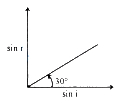
A
$60$
B
$30$
C
$90$
D
$45$
Solution
(A) According to Brewster's law,the refractive index $n$ of the medium is given by $n = \tan \theta_{p}$,where $\theta_{p}$ is the Brewster angle.
From Snell's law,the refractive index is $n = \frac{\sin i}{\sin r}$.
From the given graph,the slope is $\frac{\sin r}{\sin i} = \tan 30^{\circ}$.
Therefore,$\frac{\sin i}{\sin r} = \frac{1}{\tan 30^{\circ}} = \frac{1}{1/\sqrt{3}} = \sqrt{3}$.
Thus,$n = \sqrt{3}$.
Equating the two expressions for $n$,we get $\tan \theta_{p} = \sqrt{3}$.
Therefore,$\theta_{p} = \tan^{-1}(\sqrt{3}) = 60^{\circ}$.
From Snell's law,the refractive index is $n = \frac{\sin i}{\sin r}$.
From the given graph,the slope is $\frac{\sin r}{\sin i} = \tan 30^{\circ}$.
Therefore,$\frac{\sin i}{\sin r} = \frac{1}{\tan 30^{\circ}} = \frac{1}{1/\sqrt{3}} = \sqrt{3}$.
Thus,$n = \sqrt{3}$.
Equating the two expressions for $n$,we get $\tan \theta_{p} = \sqrt{3}$.
Therefore,$\theta_{p} = \tan^{-1}(\sqrt{3}) = 60^{\circ}$.
0 likesView Solution
59
PhysicsMediumMCQKCET · 2019
In Young's double slit experiment using monochromatic light of wavelength $ \lambda $, the intensity of light at a point on the screen where path difference is $ \lambda $ is $ K $ units. The intensity of light at a point where path difference is $ \frac{\lambda}{3} $ is:
A
$ 4 \,K $
B
$ K $
C
$ 2 \,K $
D
$ \frac{K}{4} $
Solution
(D) The intensity $ I $ at any point is given by $ I = I_{max} \cos^2 \left( \frac{\phi}{2} \right) $, where $ \phi $ is the phase difference.
Given that at path difference $ \Delta x = \lambda $, the intensity is $ K $. Since $ \Delta x = \lambda $ corresponds to a phase difference $ \phi = 2\pi $, we have $ K = I_{max} \cos^2 \left( \frac{2\pi}{2} \right) = I_{max} \cos^2(\pi) = I_{max} $.
Now, for a path difference $ \Delta x = \frac{\lambda}{3} $, the phase difference is $ \phi = \frac{2\pi}{\lambda} \cdot \Delta x = \frac{2\pi}{\lambda} \cdot \frac{\lambda}{3} = \frac{2\pi}{3} $.
The intensity at this point is $ I = I_{max} \cos^2 \left( \frac{\phi}{2} \right) = K \cos^2 \left( \frac{2\pi/3}{2} \right) $.
$ I = K \cos^2 \left( \frac{\pi}{3} \right) = K \left( \frac{1}{2} \right)^2 = \frac{K}{4} $.
Given that at path difference $ \Delta x = \lambda $, the intensity is $ K $. Since $ \Delta x = \lambda $ corresponds to a phase difference $ \phi = 2\pi $, we have $ K = I_{max} \cos^2 \left( \frac{2\pi}{2} \right) = I_{max} \cos^2(\pi) = I_{max} $.
Now, for a path difference $ \Delta x = \frac{\lambda}{3} $, the phase difference is $ \phi = \frac{2\pi}{\lambda} \cdot \Delta x = \frac{2\pi}{\lambda} \cdot \frac{\lambda}{3} = \frac{2\pi}{3} $.
The intensity at this point is $ I = I_{max} \cos^2 \left( \frac{\phi}{2} \right) = K \cos^2 \left( \frac{2\pi/3}{2} \right) $.
$ I = K \cos^2 \left( \frac{\pi}{3} \right) = K \left( \frac{1}{2} \right)^2 = \frac{K}{4} $.
0 likesView Solution
60
PhysicsDifficultMCQKCET · 2019
Due to the Doppler effect, the shift in wavelength observed is $0.1 \text{ Å}$ for a star producing a wavelength of $6000 \text{ Å}$. The velocity of recession of the star will be: (in $\text{ km/s}$)
A
$5$
B
$25$
C
$20$
D
$10$
Solution
(A) The formula for the Doppler shift in wavelength is given by $\frac{\Delta \lambda}{\lambda} = \frac{v}{c}$, where $v$ is the velocity of the source, $c$ is the speed of light, $\Delta \lambda$ is the shift in wavelength, and $\lambda$ is the original wavelength.
Given: $\Delta \lambda = 0.1 \text{ Å}$, $\lambda = 6000 \text{ Å}$, and $c = 3 \times 10^8 \text{ m/s}$.
Rearranging the formula to solve for $v$: $v = \frac{\Delta \lambda}{\lambda} \times c$.
Substituting the values: $v = \frac{0.1}{6000} \times 3 \times 10^8 \text{ m/s}$.
$v = \frac{1}{60000} \times 3 \times 10^8 \text{ m/s} = \frac{3 \times 10^8}{6 \times 10^4} \text{ m/s} = 0.5 \times 10^4 \text{ m/s} = 5000 \text{ m/s}$.
Converting to $\text{km/s}$: $v = 5 \text{ km/s}$.
Given: $\Delta \lambda = 0.1 \text{ Å}$, $\lambda = 6000 \text{ Å}$, and $c = 3 \times 10^8 \text{ m/s}$.
Rearranging the formula to solve for $v$: $v = \frac{\Delta \lambda}{\lambda} \times c$.
Substituting the values: $v = \frac{0.1}{6000} \times 3 \times 10^8 \text{ m/s}$.
$v = \frac{1}{60000} \times 3 \times 10^8 \text{ m/s} = \frac{3 \times 10^8}{6 \times 10^4} \text{ m/s} = 0.5 \times 10^4 \text{ m/s} = 5000 \text{ m/s}$.
Converting to $\text{km/s}$: $v = 5 \text{ km/s}$.
0 likesView Solution
Vedclass Products
For Students
Vedclass Test Series
Mock tests in real KCET style covering Physics with performance analysis. 5-day free trial.
Start Free TrialFor Teachers
Exam Paper Generator
Generate Set A/B/C/D Physics papers from 7.5L+ questions in 2 minutes. 3 chapters free.
Try FreeFor Institutes
Online Exam Module
Run live KCET mock exams with unlimited students, 360° analytics & white-label branding.
See DemoFrequently Asked Questions
How many Physics questions are in KCET 2019?
There are 60 Physics questions from the KCET 2019 paper on Vedclass, each with a detailed step-by-step solution in English.
Are KCET 2019 Physics solutions available in English?
Yes. All solutions on this page are in English. You can also switch to English or Hindi using the language buttons above the questions.
Can I practice KCET 2019 Physics as a timed test?
Yes. Use the Vedclass Test Series to attempt a full KCET mock test covering Physics with time limits and instant score analysis.
Can teachers create Physics papers from KCET previous year questions?
Yes. The Vedclass Exam Paper Generator lets teachers mix KCET Physics questions and generate Set A/B/C/D papers in minutes.
For Teachers & Institutes
Build a Custom Physics Paper
Pick KCET 2019 Physics questions, set difficulty, and generate Set A/B/C/D in 2 minutes.