
ChemistryQ1–65 of 65 questions
Page 1 of 1 · English
1
ChemistryMCQKCET · 2015
The magnetic susceptibility of a paramagnetic material at $-73\,^{\circ}C$ is $0.0075$. What will be its value at $-173\,^{\circ}C$?
A
$0.0045$
B
$0.0030$
C
$0.015$
D
$0.0075$
Solution
(C) According to Curie's Law,the magnetic susceptibility $\chi_m$ of a paramagnetic material is inversely proportional to its absolute temperature $T$ (in Kelvin).
$\chi_m \propto \frac{1}{T}$ or $\chi_m T = \text{constant}$.
Given:
$T_1 = -73\,^{\circ}C = -73 + 273 = 200\,K$
$\chi_{m1} = 0.0075$
$T_2 = -173\,^{\circ}C = -173 + 273 = 100\,K$
Using the relation $\chi_{m1} T_1 = \chi_{m2} T_2$:
$0.0075 \times 200 = \chi_{m2} \times 100$
$\chi_{m2} = \frac{0.0075 \times 200}{100}$
$\chi_{m2} = 0.0075 \times 2 = 0.015$.
$\chi_m \propto \frac{1}{T}$ or $\chi_m T = \text{constant}$.
Given:
$T_1 = -73\,^{\circ}C = -73 + 273 = 200\,K$
$\chi_{m1} = 0.0075$
$T_2 = -173\,^{\circ}C = -173 + 273 = 100\,K$
Using the relation $\chi_{m1} T_1 = \chi_{m2} T_2$:
$0.0075 \times 200 = \chi_{m2} \times 100$
$\chi_{m2} = \frac{0.0075 \times 200}{100}$
$\chi_{m2} = 0.0075 \times 2 = 0.015$.
0 likesView Solution
2
ChemistryMCQKCET · 2015
The pair of compounds,which cannot exist together in a solution is
A
$NaHCO_3$ and $NaOH$
B
$Na_2CO_3$ and $NaOH$
C
$NaHCO_3$ and $Na_2CO_3$
D
$NaHCO_3$ and $H_2O$
Solution
(A) The pair of compounds which cannot exist together in solution is $NaHCO_3$ and $NaOH$.
$NaHCO_3$ is an acidic salt (amphoteric in nature) and $NaOH$ is a strong base.
When they are present in the same solution,they undergo an acid-base neutralization reaction as follows:
$NaHCO_3 + NaOH \longrightarrow Na_2CO_3 + H_2O$
Since they react with each other,they cannot coexist in the same solution.
$NaHCO_3$ is an acidic salt (amphoteric in nature) and $NaOH$ is a strong base.
When they are present in the same solution,they undergo an acid-base neutralization reaction as follows:
$NaHCO_3 + NaOH \longrightarrow Na_2CO_3 + H_2O$
Since they react with each other,they cannot coexist in the same solution.
0 likesView Solution
3
ChemistryMCQKCET · 2015
Which of the following statements is correct?
A
Cells of all living organisms have a nucleus.
B
Both animal and plant cells have a well-defined cell wall.
C
Cells are formed de novo from abiotic materials.
D
In prokaryotes,there are no membrane-bound organelles.
Solution
(D) The correct statement is $(d)$.
Prokaryotic cells are characterized by the absence of a well-defined nucleus and membrane-bound organelles such as mitochondria,chloroplasts,endoplasmic reticulum,and Golgi apparatus.
Option $(a)$ is incorrect because prokaryotic cells lack a true nucleus.
Option $(b)$ is incorrect because animal cells do not possess a cell wall.
Option $(c)$ is incorrect because,according to the cell theory (Omnis cellula-e cellula),new cells arise from pre-existing cells,not from abiotic materials.
Prokaryotic cells are characterized by the absence of a well-defined nucleus and membrane-bound organelles such as mitochondria,chloroplasts,endoplasmic reticulum,and Golgi apparatus.
Option $(a)$ is incorrect because prokaryotic cells lack a true nucleus.
Option $(b)$ is incorrect because animal cells do not possess a cell wall.
Option $(c)$ is incorrect because,according to the cell theory (Omnis cellula-e cellula),new cells arise from pre-existing cells,not from abiotic materials.
0 likesView Solution
4
ChemistryMediumMCQKCET · 2015
Identify '$Q$' in the following sequence of reactions :
$\text{Cyclohexyl-CO-CH}_3$ $\xrightarrow{PCl_5} P$ $\xrightarrow{\text{NaNH}_2 \text{ (excess)}} Q$
$\text{Cyclohexyl-CO-CH}_3$ $\xrightarrow{PCl_5} P$ $\xrightarrow{\text{NaNH}_2 \text{ (excess)}} Q$
A
Cyclohexyl-$CH=CH_2$
B
Cyclohexyl-$CH=CH_2$ (with double bond at different position)
C
Cyclohexyl-$C\equiv CH$
D
Cyclohexanone
Solution
(C) The reaction sequence is as follows:
$1$. The reaction of a ketone with $PCl_5$ replaces the carbonyl oxygen with two chlorine atoms,forming a gem-dichloride: $\text{Cyclohexyl-CO-CH}_3 + PCl_5 \rightarrow \text{Cyclohexyl-CCl}_2\text{-CH}_3 (P) + POCl_3$.
$2$. The treatment of the gem-dichloride $(P)$ with excess $\text{NaNH}_2$ (a strong base) leads to double dehydrohalogenation,resulting in the formation of an alkyne: $\text{Cyclohexyl-CCl}_2\text{-CH}_3 + \text{excess NaNH}_2$ $\rightarrow \text{Cyclohexyl-C}\equiv\text{CH} (Q) + 2\text{NaCl} + 2\text{NH}_3$.
Therefore,the final product $Q$ is cyclohexylacetylene,which corresponds to option $C$.
$1$. The reaction of a ketone with $PCl_5$ replaces the carbonyl oxygen with two chlorine atoms,forming a gem-dichloride: $\text{Cyclohexyl-CO-CH}_3 + PCl_5 \rightarrow \text{Cyclohexyl-CCl}_2\text{-CH}_3 (P) + POCl_3$.
$2$. The treatment of the gem-dichloride $(P)$ with excess $\text{NaNH}_2$ (a strong base) leads to double dehydrohalogenation,resulting in the formation of an alkyne: $\text{Cyclohexyl-CCl}_2\text{-CH}_3 + \text{excess NaNH}_2$ $\rightarrow \text{Cyclohexyl-C}\equiv\text{CH} (Q) + 2\text{NaCl} + 2\text{NH}_3$.
Therefore,the final product $Q$ is cyclohexylacetylene,which corresponds to option $C$.
0 likesView Solution
5
ChemistryEasyMCQKCET · 2015
One of the following conversions results in the change of hybridization and geometry:
A
$CH_4$ to $C_2H_6$
B
$NH_3$ to $NH_4^+$
C
$BF_3$ to $BF_4^-$
D
$H_2O$ to $H_3O^+$
Solution
(C) For the conversion $CH_4 \rightarrow C_2H_6$,there is no change in the hybridization of the carbon atom. Both $CH_4$ and $C_2H_6$ have $sp^3$ hybridization and tetrahedral geometry.
For the conversion $NH_3 \rightarrow NH_4^+$,nitrogen in $NH_3$ is $sp^3$ hybridized with a pyramidal shape. In $NH_4^+$,it remains $sp^3$ hybridized but the geometry becomes tetrahedral.
For the conversion $H_2O \rightarrow H_3O^+$,oxygen in $H_2O$ is $sp^3$ hybridized with a bent shape. In $H_3O^+$,it remains $sp^3$ hybridized but the shape becomes pyramidal.
For the conversion $BF_3 \rightarrow BF_4^-$,boron in $BF_3$ is $sp^2$ hybridized with a trigonal planar geometry. In $BF_4^-$,the hybridization changes to $sp^3$ and the geometry changes to tetrahedral.
For the conversion $NH_3 \rightarrow NH_4^+$,nitrogen in $NH_3$ is $sp^3$ hybridized with a pyramidal shape. In $NH_4^+$,it remains $sp^3$ hybridized but the geometry becomes tetrahedral.
For the conversion $H_2O \rightarrow H_3O^+$,oxygen in $H_2O$ is $sp^3$ hybridized with a bent shape. In $H_3O^+$,it remains $sp^3$ hybridized but the shape becomes pyramidal.
For the conversion $BF_3 \rightarrow BF_4^-$,boron in $BF_3$ is $sp^2$ hybridized with a trigonal planar geometry. In $BF_4^-$,the hybridization changes to $sp^3$ and the geometry changes to tetrahedral.
0 likesView Solution
6
ChemistryEasyMCQKCET · 2015
Using $MOT$,compare $O_{2}^{+}$ and $O_{2}^{-}$ species and choose the incorrect option.
A
$O_{2}^{+}$ has a higher bond order than $O_{2}$
B
$O_{2}^{-}$ is less stable.
C
$O_{2}^{+}$ is diamagnetic while $O_{2}^{-}$ is paramagnetic.
D
Both $O_{2}^{+}$ and $O_{2}^{-}$ are paramagnetic.
Solution
(C) Molecular orbital configurations:
$O_{2}^{+} (15 \ e^{-}): \sigma 1s^{2} \sigma^{*} 1s^{2} \sigma 2s^{2} \sigma^{*} 2s^{2} \sigma 2p_{z}^{2} \pi 2p_{x}^{2} = \pi 2p_{y}^{2} \pi^{*} 2p_{x}^{1}$
Bond order $= \frac{1}{2}(10-5) = 2.5$,and it is paramagnetic due to one unpaired electron.
$O_{2}^{-} (17 \ e^{-}): \sigma 1s^{2} \sigma^{*} 1s^{2} \sigma 2s^{2} \sigma^{*} 2s^{2} \sigma 2p_{z}^{2} \pi 2p_{x}^{2} = \pi 2p_{y}^{2} \pi^{*} 2p_{x}^{2} = \pi^{*} 2p_{y}^{1}$
Bond order $= \frac{1}{2}(10-7) = 1.5$,and it is paramagnetic due to one unpaired electron.
Since both species have unpaired electrons,both are paramagnetic.
Option $C$ is incorrect because $O_{2}^{+}$ is paramagnetic,not diamagnetic.
$O_{2}^{+} (15 \ e^{-}): \sigma 1s^{2} \sigma^{*} 1s^{2} \sigma 2s^{2} \sigma^{*} 2s^{2} \sigma 2p_{z}^{2} \pi 2p_{x}^{2} = \pi 2p_{y}^{2} \pi^{*} 2p_{x}^{1}$
Bond order $= \frac{1}{2}(10-5) = 2.5$,and it is paramagnetic due to one unpaired electron.
$O_{2}^{-} (17 \ e^{-}): \sigma 1s^{2} \sigma^{*} 1s^{2} \sigma 2s^{2} \sigma^{*} 2s^{2} \sigma 2p_{z}^{2} \pi 2p_{x}^{2} = \pi 2p_{y}^{2} \pi^{*} 2p_{x}^{2} = \pi^{*} 2p_{y}^{1}$
Bond order $= \frac{1}{2}(10-7) = 1.5$,and it is paramagnetic due to one unpaired electron.
Since both species have unpaired electrons,both are paramagnetic.
Option $C$ is incorrect because $O_{2}^{+}$ is paramagnetic,not diamagnetic.
0 likesView Solution
7
ChemistryMediumMCQKCET · 2015
In the presence of $HCl$,$H_2S$ results in the precipitation of Group-$2$ elements but not Group-$4$ elements during qualitative analysis. It is due to
A
higher concentration of $S^{2-}$
B
higher concentration of $H^{+}$
C
lower concentration of $S^{2-}$
D
lower concentration of $H^{+}$
Solution
(C) The dissociation of $H_2S$ is given by the equilibrium: $H_2S \rightleftharpoons 2H^+ + S^{2-}$.
In the presence of $HCl$,the concentration of $H^+$ ions increases significantly.
According to the common ion effect,this shift in equilibrium suppresses the dissociation of $H_2S$,resulting in a lower concentration of $S^{2-}$ ions.
Group-$2$ metal sulfides have very low solubility products $(K_{sp})$,so they precipitate even at this low $S^{2-}$ concentration.
Group-$4$ metal sulfides have higher $K_{sp}$ values and require a higher $S^{2-}$ concentration to precipitate,which is not achieved in the presence of $HCl$.
In the presence of $HCl$,the concentration of $H^+$ ions increases significantly.
According to the common ion effect,this shift in equilibrium suppresses the dissociation of $H_2S$,resulting in a lower concentration of $S^{2-}$ ions.
Group-$2$ metal sulfides have very low solubility products $(K_{sp})$,so they precipitate even at this low $S^{2-}$ concentration.
Group-$4$ metal sulfides have higher $K_{sp}$ values and require a higher $S^{2-}$ concentration to precipitate,which is not achieved in the presence of $HCl$.
0 likesView Solution
8
ChemistryMediumMCQKCET · 2015
For one of the elements,various successive ionization enthalpies (in $kJ \cdot mol^{-1}$) are given below:
The element is:
| $I.E.$ | $1^{st}$ | $2^{nd}$ | $3^{rd}$ | $4^{th}$ | $5^{th}$ |
| Value | $577.5$ | $1810$ | $2750$ | $11580$ | $14820$ |
The element is:
A
$Si$
B
$P$
C
$Al$
D
$Mg$
Solution
(C) The jump between $IE_3$ and $IE_4$ is very large ($2750$ to $11580 \ kJ \cdot mol^{-1}$),indicating that the fourth electron is removed from a stable inner shell (noble gas configuration).
This means the element has $3$ valence electrons.
Among the given options,Aluminum $(Al)$ has $3$ valence electrons $([Ne] 3s^2 3p^1)$.
This means the element has $3$ valence electrons.
Among the given options,Aluminum $(Al)$ has $3$ valence electrons $([Ne] 3s^2 3p^1)$.
0 likesView Solution
9
ChemistryMCQKCET · 2015
The magnetic susceptibility of a paramagnetic material at $-73^{\circ} C$ is $0.0075$. What will be its value at $-173^{\circ} C$?
A
$0.0045$
B
$0.0030$
C
$0.015$
D
$0.0075$
Solution
(C) According to Curie's Law,the magnetic susceptibility $\chi$ of a paramagnetic material is inversely proportional to its absolute temperature $T$,i.e.,$\chi \propto \frac{1}{T}$.
Given:
$\chi_{1} = 0.0075$
$T_{1} = -73^{\circ} C = (-73 + 273) K = 200 K$
$T_{2} = -173^{\circ} C = (-173 + 273) K = 100 K$
Using the relation $\frac{\chi_{1}}{\chi_{2}} = \frac{T_{2}}{T_{1}}$:
$\frac{0.0075}{\chi_{2}} = \frac{100 K}{200 K}$
$\frac{0.0075}{\chi_{2}} = \frac{1}{2}$
$\chi_{2} = 2 \times 0.0075 = 0.015$
Thus,the magnetic susceptibility at $-173^{\circ} C$ is $0.015$.
Given:
$\chi_{1} = 0.0075$
$T_{1} = -73^{\circ} C = (-73 + 273) K = 200 K$
$T_{2} = -173^{\circ} C = (-173 + 273) K = 100 K$
Using the relation $\frac{\chi_{1}}{\chi_{2}} = \frac{T_{2}}{T_{1}}$:
$\frac{0.0075}{\chi_{2}} = \frac{100 K}{200 K}$
$\frac{0.0075}{\chi_{2}} = \frac{1}{2}$
$\chi_{2} = 2 \times 0.0075 = 0.015$
Thus,the magnetic susceptibility at $-173^{\circ} C$ is $0.015$.
0 likesView Solution
10
ChemistryEasyMCQKCET · 2015
$H_2O_2$ cannot oxidise
A
$PbS$
B
$Na_2SO_3$
C
$O_3$
D
$KI$
Solution
(C) $H_2O_2$ acts as an oxidizing agent in many reactions.
$H_2O_2$ oxidizes $PbS$ to $PbSO_4$,$Na_2SO_3$ to $Na_2SO_4$,and $KI$ to $I_2$.
However,$H_2O_2$ reacts with $O_3$ to form $H_2O$ and $O_2$ $(H_2O_2 + O_3 \rightarrow H_2O + 2O_2)$.
In this reaction,$O_3$ is reduced to $O_2$,and $H_2O_2$ acts as a reducing agent,not an oxidizing agent.
$H_2O_2$ oxidizes $PbS$ to $PbSO_4$,$Na_2SO_3$ to $Na_2SO_4$,and $KI$ to $I_2$.
However,$H_2O_2$ reacts with $O_3$ to form $H_2O$ and $O_2$ $(H_2O_2 + O_3 \rightarrow H_2O + 2O_2)$.
In this reaction,$O_3$ is reduced to $O_2$,and $H_2O_2$ acts as a reducing agent,not an oxidizing agent.
0 likesView Solution
11
ChemistryEasyMCQKCET · 2015
Number of possible alkynes with formula $C_{5}H_{8}$ is
A
$2$
B
$3$
C
$4$
D
$5$
Solution
(B) The general formula for alkynes is $C_{n}H_{2n-2}$. For $n=5$,the formula is $C_{5}H_{8}$.
There are three possible isomeric alkynes for this formula:
$(I)$ $CH \equiv C-CH_{2}-CH_{2}-CH_{3}$ (Pent-$1$-yne)
$(II)$ $CH_{3}-C \equiv C-CH_{2}-CH_{3}$ (Pent-$2$-yne)
$(III)$ $CH \equiv C-CH(CH_{3})_{2}$ ($3$-Methylbut-$1$-yne)
Thus,the total number of possible alkynes is $3$.
There are three possible isomeric alkynes for this formula:
$(I)$ $CH \equiv C-CH_{2}-CH_{2}-CH_{3}$ (Pent-$1$-yne)
$(II)$ $CH_{3}-C \equiv C-CH_{2}-CH_{3}$ (Pent-$2$-yne)
$(III)$ $CH \equiv C-CH(CH_{3})_{2}$ ($3$-Methylbut-$1$-yne)
Thus,the total number of possible alkynes is $3$.
0 likesView Solution
12
ChemistryEasyMCQKCET · 2015
Water softening by Clark's process uses
A
$Ca(HCO_3)_2$
B
$NaHCO_3$
C
$Na_2CO_3$
D
$Ca(OH)_2$
Solution
(D) Clark's process is a commercial method for the removal of temporary hardness from water.
In this process,a calculated amount of lime $(Ca(OH)_2)$ is added to the hard water.
The lime reacts with the soluble bicarbonates of calcium and magnesium to form insoluble carbonates,which are then removed by filtration.
The chemical reactions are as follows:
$CaO + H_2O \rightarrow Ca(OH)_2$
$Ca(HCO_3)_2 + Ca(OH)_2 \rightarrow 2 CaCO_3 \downarrow + 2 H_2O$
$Mg(HCO_3)_2 + 2 Ca(OH)_2 \rightarrow Mg(OH)_2 \downarrow + 2 CaCO_3 \downarrow + 2 H_2O$
In this process,a calculated amount of lime $(Ca(OH)_2)$ is added to the hard water.
The lime reacts with the soluble bicarbonates of calcium and magnesium to form insoluble carbonates,which are then removed by filtration.
The chemical reactions are as follows:
$CaO + H_2O \rightarrow Ca(OH)_2$
$Ca(HCO_3)_2 + Ca(OH)_2 \rightarrow 2 CaCO_3 \downarrow + 2 H_2O$
$Mg(HCO_3)_2 + 2 Ca(OH)_2 \rightarrow Mg(OH)_2 \downarrow + 2 CaCO_3 \downarrow + 2 H_2O$
0 likesView Solution
13
ChemistryEasyMCQKCET · 2015
The aqueous solution of the following salt will have the lowest $pH$:
A
$NaClO_{3}$
B
$NaClO$
C
$NaClO_{2}$
D
$NaClO_{4}$
Solution
(D) The $pH$ of the aqueous solution of these salts depends on the strength of the corresponding conjugate acid formed upon hydrolysis.
When these salts react with water,they form $NaOH$ (a strong base) and the corresponding oxoacid of chlorine.
The reactions are:
$NaClO + H_{2}O \rightarrow NaOH + HClO$
$NaClO_{2} + H_{2}O \rightarrow NaOH + HClO_{2}$
$NaClO_{3} + H_{2}O \rightarrow NaOH + HClO_{3}$
$NaClO_{4} + H_{2}O \rightarrow NaOH + HClO_{4}$
Since $NaOH$ is common to all,the $pH$ is determined by the acidity of the resulting acid.
$HClO_{4}$ is the strongest acid among the given options $(HClO < HClO_{2} < HClO_{3} < HClO_{4})$.
Therefore,the solution of $NaClO_{4}$ will have the highest concentration of $H^{+}$ ions,resulting in the lowest $pH$ value.
When these salts react with water,they form $NaOH$ (a strong base) and the corresponding oxoacid of chlorine.
The reactions are:
$NaClO + H_{2}O \rightarrow NaOH + HClO$
$NaClO_{2} + H_{2}O \rightarrow NaOH + HClO_{2}$
$NaClO_{3} + H_{2}O \rightarrow NaOH + HClO_{3}$
$NaClO_{4} + H_{2}O \rightarrow NaOH + HClO_{4}$
Since $NaOH$ is common to all,the $pH$ is determined by the acidity of the resulting acid.
$HClO_{4}$ is the strongest acid among the given options $(HClO < HClO_{2} < HClO_{3} < HClO_{4})$.
Therefore,the solution of $NaClO_{4}$ will have the highest concentration of $H^{+}$ ions,resulting in the lowest $pH$ value.
0 likesView Solution
14
ChemistryMCQKCET · 2015
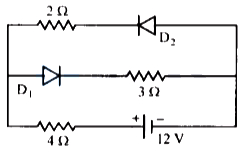
The circuit has two oppositely connected ideal diodes in parallel. What is the current flowing in the circuit (in $A$)?
A
$1.71$
B
$2.0$
C
$2.31$
D
$1.33$
Solution
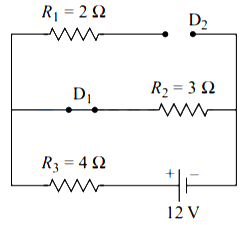
(A) In the given circuit,the battery of $ 12 \ V $ is connected in series with a $ 4 \ \Omega $ resistor. The two branches containing diodes $ D_{1} $ and $ D_{2} $ are in parallel with each other.
Diode $ D_{1} $ is forward-biased,allowing current to flow through the $ 3 \ \Omega $ resistor.
Diode $ D_{2} $ is reverse-biased,acting as an open circuit,so no current flows through the $ 2 \ \Omega $ resistor.
The total resistance of the circuit is the sum of the series resistor and the resistor in the active branch: $ R_{eq} = 4 \ \Omega + 3 \ \Omega = 7 \ \Omega $.
Using Ohm's law,the current $ I $ flowing in the circuit is:
$ I = \frac{V}{R_{eq}} = \frac{12 \ V}{7 \ \Omega} \approx 1.71 \ A $.
Diode $ D_{1} $ is forward-biased,allowing current to flow through the $ 3 \ \Omega $ resistor.
Diode $ D_{2} $ is reverse-biased,acting as an open circuit,so no current flows through the $ 2 \ \Omega $ resistor.
The total resistance of the circuit is the sum of the series resistor and the resistor in the active branch: $ R_{eq} = 4 \ \Omega + 3 \ \Omega = 7 \ \Omega $.
Using Ohm's law,the current $ I $ flowing in the circuit is:
$ I = \frac{V}{R_{eq}} = \frac{12 \ V}{7 \ \Omega} \approx 1.71 \ A $.
0 likesView Solution
15
ChemistryMediumMCQKCET · 2015
The correct statement is
A
$BF_{3}$ is the strongest Lewis acid among the other boron halides.
B
$BI_{3}$ is the weakest Lewis acid among the boron halides.
C
There is maximum $p\pi-p\pi$ back bonding in $BF_{3}$.
D
There is minimum $p\pi-p\pi$ back bonding in $BF_{3}$.
Solution
(C) In boron halides $(BX_{3})$,the boron atom has an incomplete octet and acts as a Lewis acid.
Back bonding occurs due to the donation of electron density from the filled $p$-orbital of the halogen to the empty $p$-orbital of boron.
In $BF_{3}$,the $2p$ orbital of $F$ and the $2p$ orbital of $B$ have similar sizes,leading to effective $p\pi-p\pi$ overlap.
Therefore,there is maximum $p\pi-p\pi$ back bonding in $BF_{3}$,which reduces its Lewis acidity.
Back bonding occurs due to the donation of electron density from the filled $p$-orbital of the halogen to the empty $p$-orbital of boron.
In $BF_{3}$,the $2p$ orbital of $F$ and the $2p$ orbital of $B$ have similar sizes,leading to effective $p\pi-p\pi$ overlap.
Therefore,there is maximum $p\pi-p\pi$ back bonding in $BF_{3}$,which reduces its Lewis acidity.
0 likesView Solution
16
ChemistryMediumMCQKCET · 2015
An alkali metal hydride $(NaH)$ reacts with diborane in '$A$' to give a tetrahedral compound '$B$' which is extensively used as a reducing agent in organic synthesis. The compounds '$A$' and '$B$' respectively are
A
$C_{2}H_{6}$ and $C_{2}H_{5}Na$
B
$CH_{3}COCH_{3}$ and $B_{3}N_{3}H_{6}$
C
$C_{6}H_{6}$ and $NaBH_{4}$
D
$(C_{2}H_{5})_{2}O$ and $NaBH_{4}$
Solution
(D) The reaction between sodium hydride $(NaH)$ and diborane $(B_{2}H_{6})$ occurs in an ether solvent,typically diethyl ether,$(C_{2}H_{5})_{2}O$,to produce sodium borohydride $(NaBH_{4})$.
The chemical equation is: $2NaH + B_{2}H_{6} \xrightarrow{(C_{2}H_{5})_{2}O} 2NaBH_{4}$.
Here,'$A$' is $(C_{2}H_{5})_{2}O$ and '$B$' is $NaBH_{4}$,which is a well-known reducing agent.
The chemical equation is: $2NaH + B_{2}H_{6} \xrightarrow{(C_{2}H_{5})_{2}O} 2NaBH_{4}$.
Here,'$A$' is $(C_{2}H_{5})_{2}O$ and '$B$' is $NaBH_{4}$,which is a well-known reducing agent.
0 likesView Solution
17
ChemistryEasyMCQKCET · 2015
The pair of compounds which cannot exist together in solution is
A
$NaHCO_{3}$ and $NaOH$
B
$NaHCO_{3}$ and $H_{2}O$
C
$NaHCO_{3}$ and $Na_{2}CO_{3}$
D
$Na_{2}CO_{3}$ and $NaOH$
Solution
(A) $NaHCO_{3}$ is an acidic salt (amphoteric) and $NaOH$ is a strong base.
They react with each other to form sodium carbonate and water.
The reaction is:
$NaHCO_{3} + NaOH \rightarrow Na_{2}CO_{3} + H_{2}O$.
Therefore,they cannot coexist in a solution.
They react with each other to form sodium carbonate and water.
The reaction is:
$NaHCO_{3} + NaOH \rightarrow Na_{2}CO_{3} + H_{2}O$.
Therefore,they cannot coexist in a solution.
0 likesView Solution
18
ChemistryEasyMCQKCET · 2015
What amount of dioxygen (in gram) contains $1.8 \times 10^{22}$ molecules?
A
$0.0960$
B
$0.960$
C
$9.60$
D
$96.0$
Solution
(B) $1$ mole of $O_2 = 6.022 \times 10^{23}$ molecules $= 32 \ g$ of $O_2$.
$1$ molecule of $O_2 = \frac{32}{6.022 \times 10^{23}} \ g$ of $O_2$.
Therefore,$1.8 \times 10^{22}$ molecules of $O_2 = \frac{32}{6.022 \times 10^{23}} \times 1.8 \times 10^{22} \ g$.
$= 0.960 \ g$ of $O_2$.
$1$ molecule of $O_2 = \frac{32}{6.022 \times 10^{23}} \ g$ of $O_2$.
Therefore,$1.8 \times 10^{22}$ molecules of $O_2 = \frac{32}{6.022 \times 10^{23}} \times 1.8 \times 10^{22} \ g$.
$= 0.960 \ g$ of $O_2$.
0 likesView Solution
19
ChemistryDifficultMCQKCET · 2015
$0.30 \ g$ of an organic compound containing $C$,$H$ and $O$ on combustion yields $0.44 \ g \ CO_2$ and $0.18 \ g \ H_2O$. If $1 \ mol$ of the compound weighs $60 \ g$,then the molecular formula of the compound is:
A
$CH_2O$
B
$C_3H_8O$
C
$C_4H_6O$
D
$C_2H_4O_2$
Solution
(D) $1$. Calculate the mass of $C$ and $H$ in the compound:
Mass of $C = \frac{12}{44} \times 0.44 \ g = 0.12 \ g$
Mass of $H = \frac{2}{18} \times 0.18 \ g = 0.02 \ g$
Mass of $O = 0.30 - (0.12 + 0.02) = 0.16 \ g$
$2$. Calculate the molar ratio:
Moles of $C = \frac{0.12}{12} = 0.01$
Moles of $H = \frac{0.02}{1} = 0.02$
Moles of $O = \frac{0.16}{16} = 0.01$
$3$. Determine the empirical formula:
The ratio $C:H:O = 0.01:0.02:0.01 = 1:2:1$. Thus,the empirical formula is $CH_2O$.
$4$. Determine the molecular formula:
Empirical formula mass $= 12 + 2(1) + 16 = 30 \ g \ mol^{-1}$.
$n = \frac{\text{Molecular mass}}{\text{Empirical formula mass}} = \frac{60}{30} = 2$.
Molecular formula $= 2 \times (CH_2O) = C_2H_4O_2$.
Mass of $C = \frac{12}{44} \times 0.44 \ g = 0.12 \ g$
Mass of $H = \frac{2}{18} \times 0.18 \ g = 0.02 \ g$
Mass of $O = 0.30 - (0.12 + 0.02) = 0.16 \ g$
$2$. Calculate the molar ratio:
Moles of $C = \frac{0.12}{12} = 0.01$
Moles of $H = \frac{0.02}{1} = 0.02$
Moles of $O = \frac{0.16}{16} = 0.01$
$3$. Determine the empirical formula:
The ratio $C:H:O = 0.01:0.02:0.01 = 1:2:1$. Thus,the empirical formula is $CH_2O$.
$4$. Determine the molecular formula:
Empirical formula mass $= 12 + 2(1) + 16 = 30 \ g \ mol^{-1}$.
$n = \frac{\text{Molecular mass}}{\text{Empirical formula mass}} = \frac{60}{30} = 2$.
Molecular formula $= 2 \times (CH_2O) = C_2H_4O_2$.
0 likesView Solution
20
ChemistryEasyMCQKCET · 2015
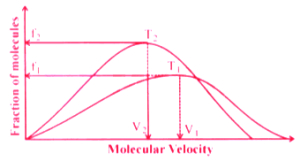
The plot of Maxwell's distribution of velocities is given below. Which of the following is correct about this plot?
A
$T_{1} < T_{2}$
B
$f_{1} > f_{2}$
C
$T_{1} > T_{2}$
D
$V_{1} < V_{2}$
Solution
(C) In Maxwell's distribution of velocities,as the temperature increases,the peak of the curve shifts to the right (higher velocity) and the height of the peak decreases.
From the given plot,the peak corresponding to $T_{1}$ is at a higher velocity $(V_{1})$ and has a lower height $(f_{1})$ compared to the peak corresponding to $T_{2}$ ($V_{2}$ and $f_{2}$).
Therefore,$T_{1} > T_{2}$,$V_{1} > V_{2}$,and $f_{2} > f_{1}$.
Thus,the correct statement is $T_{1} > T_{2}$.
From the given plot,the peak corresponding to $T_{1}$ is at a higher velocity $(V_{1})$ and has a lower height $(f_{1})$ compared to the peak corresponding to $T_{2}$ ($V_{2}$ and $f_{2}$).
Therefore,$T_{1} > T_{2}$,$V_{1} > V_{2}$,and $f_{2} > f_{1}$.
Thus,the correct statement is $T_{1} > T_{2}$.
0 likesView Solution
21
ChemistryMediumMCQKCET · 2015
The two electrons have the following set of quantum numbers:
$P = 3, 2, -2, +1/2$
$Q = 3, 0, 0, +1/2$
Which of the following statements is true?
$P = 3, 2, -2, +1/2$
$Q = 3, 0, 0, +1/2$
Which of the following statements is true?
A
$P$ and $Q$ have same energy
B
$P$ has greater energy than $Q$
C
$P$ has lesser energy than $Q$
D
$P$ and $Q$ represent same electron
Solution
(B) For electron $P$,the quantum numbers are $n = 3$ and $l = 2$.
Thus,the value of $(n + l) = 3 + 2 = 5$.
For electron $Q$,the quantum numbers are $n = 3$ and $l = 0$.
Thus,the value of $(n + l) = 3 + 0 = 3$.
According to the $(n + l)$ rule (Aufbau principle),the orbital with a higher $(n + l)$ value has higher energy.
Therefore,$P$ has greater energy than $Q$.
Thus,the value of $(n + l) = 3 + 2 = 5$.
For electron $Q$,the quantum numbers are $n = 3$ and $l = 0$.
Thus,the value of $(n + l) = 3 + 0 = 3$.
According to the $(n + l)$ rule (Aufbau principle),the orbital with a higher $(n + l)$ value has higher energy.
Therefore,$P$ has greater energy than $Q$.
0 likesView Solution
22
ChemistryMediumMCQKCET · 2015
In the reaction $S + \frac{3}{2} O_{2} \rightarrow SO_{3} + 2x \ kJ$ and $SO_{2} + \frac{1}{2} O_{2} \rightarrow SO_{3} + y \ kJ$,the heat of formation of $SO_{2}$ is
A
$x + y$
B
$x - y$
C
$2x - y$
D
$2x + y$
Solution
(C) Given equations:
$1) \ S_{(s)} + \frac{3}{2} O_{2(g)} \rightarrow SO_{3(g)}; \Delta H_{1} = 2x \ kJ$
$2) \ SO_{2(g)} + \frac{1}{2} O_{2(g)} \rightarrow SO_{3(g)}; \Delta H_{2} = y \ kJ$
We need to find the heat of formation of $SO_{2}$,which is the enthalpy change for the reaction:
$S_{(s)} + O_{2(g)} \rightarrow SO_{2(g)}; \Delta H_{3} = ?$
Reverse equation $(2)$:
$SO_{3(g)} \rightarrow SO_{2(g)} + \frac{1}{2} O_{2(g)}; \Delta H_{4} = -y \ kJ$ $(3)$
Add equation $(1)$ and equation $(3)$:
$(S_{(s)} + \frac{3}{2} O_{2(g)}) + (SO_{3(g)}) \rightarrow (SO_{3(g)}) + (SO_{2(g)} + \frac{1}{2} O_{2(g)})$
$S_{(s)} + O_{2(g)} \rightarrow SO_{2(g)}$
The enthalpy change is $\Delta H_{3} = \Delta H_{1} + \Delta H_{4} = 2x - y \ kJ$.
$1) \ S_{(s)} + \frac{3}{2} O_{2(g)} \rightarrow SO_{3(g)}; \Delta H_{1} = 2x \ kJ$
$2) \ SO_{2(g)} + \frac{1}{2} O_{2(g)} \rightarrow SO_{3(g)}; \Delta H_{2} = y \ kJ$
We need to find the heat of formation of $SO_{2}$,which is the enthalpy change for the reaction:
$S_{(s)} + O_{2(g)} \rightarrow SO_{2(g)}; \Delta H_{3} = ?$
Reverse equation $(2)$:
$SO_{3(g)} \rightarrow SO_{2(g)} + \frac{1}{2} O_{2(g)}; \Delta H_{4} = -y \ kJ$ $(3)$
Add equation $(1)$ and equation $(3)$:
$(S_{(s)} + \frac{3}{2} O_{2(g)}) + (SO_{3(g)}) \rightarrow (SO_{3(g)}) + (SO_{2(g)} + \frac{1}{2} O_{2(g)})$
$S_{(s)} + O_{2(g)} \rightarrow SO_{2(g)}$
The enthalpy change is $\Delta H_{3} = \Delta H_{1} + \Delta H_{4} = 2x - y \ kJ$.
0 likesView Solution
23
ChemistryEasyMCQKCET · 2015
Which of the following compounds possesses the $C-H$ bond with the lowest bond dissociation energy?
A
Toluene
B
Benzene
C
n-pentane
D
$2,2-$dimethyl propane
Solution
(A) The bond dissociation energy of a $C-H$ bond depends on the stability of the radical formed after the homolytic cleavage of the bond.
In toluene $(C_6H_5CH_3)$,the removal of a hydrogen atom from the methyl group results in the formation of a benzyl radical $(C_6H_5CH_2^{\bullet})$.
This benzyl radical is highly stabilized by resonance with the benzene ring,as shown in the provided resonance structures.
Since the resulting radical is very stable,the energy required to break the $C-H$ bond in the methyl group of toluene is the lowest among the given options.
In toluene $(C_6H_5CH_3)$,the removal of a hydrogen atom from the methyl group results in the formation of a benzyl radical $(C_6H_5CH_2^{\bullet})$.
This benzyl radical is highly stabilized by resonance with the benzene ring,as shown in the provided resonance structures.
Since the resulting radical is very stable,the energy required to break the $C-H$ bond in the methyl group of toluene is the lowest among the given options.
0 likesView Solution
24
ChemistryMediumMCQKCET · 2015
The product '$B$' is

A
Cyclohexanol
B
Cyclohexylmagnesium bromide
C
Cyclohexane
D
Phenol
Solution
(C) The reaction of bromocyclohexane with magnesium in the presence of dry ether forms the Grignard reagent,cyclohexylmagnesium bromide $(A)$.
$C_6H_{11}Br + Mg \xrightarrow{\text{dry ether}} C_6H_{11}MgBr (A)$
Subsequent hydrolysis of the Grignard reagent with water in an acidic medium yields cyclohexane $(B)$ as the final product.
$C_6H_{11}MgBr + H_2O \xrightarrow{H^+} C_6H_{12} (B) + Mg(OH)Br$
Therefore,the product '$B$' is cyclohexane.
$C_6H_{11}Br + Mg \xrightarrow{\text{dry ether}} C_6H_{11}MgBr (A)$
Subsequent hydrolysis of the Grignard reagent with water in an acidic medium yields cyclohexane $(B)$ as the final product.
$C_6H_{11}MgBr + H_2O \xrightarrow{H^+} C_6H_{12} (B) + Mg(OH)Br$
Therefore,the product '$B$' is cyclohexane.
0 likesView Solution
25
ChemistryDifficultMCQKCET · 2015
Arrange the following compounds in the increasing order of their acidic strength :
$i$. $m-$nitrophenol
$ii$. $m-$cresol
$iii$. phenol
$iv$. $m-$chlorophenol
$i$. $m-$nitrophenol
$ii$. $m-$cresol
$iii$. phenol
$iv$. $m-$chlorophenol
A
$ii < iii < iv < i$
B
$ii < iv < iii < i$
C
$ii < iii < i < iv$
D
$iv < i < iii < ii$
Solution
(A) The acidic strength of phenols depends on the stability of the phenoxide ion formed after the loss of a proton. Electron-withdrawing groups $(EWG)$ stabilize the phenoxide ion and increase acidity,while electron-donating groups $(EDG)$ destabilize it and decrease acidity.
$1$. $m-$cresol $(ii)$: The $-CH_3$ group is an $EDG$ due to $+I$ effect and hyperconjugation,making it less acidic than phenol.
$2$. Phenol $(iii)$: The reference compound.
$3$. $m-$chlorophenol $(iv)$: The $-Cl$ group is an $EWG$ due to its strong $-I$ effect,which outweighs its $+R$ effect at the meta position,making it more acidic than phenol.
$4$. $m-$nitrophenol $(i)$: The $-NO_2$ group is a strong $EWG$ due to both $-I$ and $-R$ effects,making it the most acidic among the given compounds.
Thus,the increasing order of acidic strength is: $m-$cresol $(ii)$ < phenol $(iii)$ < $m-$chlorophenol $(iv)$ < $m-$nitrophenol $(i)$.
The correct option is $A$.
$1$. $m-$cresol $(ii)$: The $-CH_3$ group is an $EDG$ due to $+I$ effect and hyperconjugation,making it less acidic than phenol.
$2$. Phenol $(iii)$: The reference compound.
$3$. $m-$chlorophenol $(iv)$: The $-Cl$ group is an $EWG$ due to its strong $-I$ effect,which outweighs its $+R$ effect at the meta position,making it more acidic than phenol.
$4$. $m-$nitrophenol $(i)$: The $-NO_2$ group is a strong $EWG$ due to both $-I$ and $-R$ effects,making it the most acidic among the given compounds.
Thus,the increasing order of acidic strength is: $m-$cresol $(ii)$ < phenol $(iii)$ < $m-$chlorophenol $(iv)$ < $m-$nitrophenol $(i)$.
The correct option is $A$.
0 likesView Solution
26
ChemistryEasyMCQKCET · 2015
The formation of cyanohydrin from a ketone is an example of
A
Nucleophilic substitution
B
Nucleophilic addition
C
Electrophilic addition
D
Electrophilic substitution
Solution
(B) The formation of cyanohydrin from a ketone by reaction with $HCN$ is an example of a nucleophilic addition reaction.
In this reaction,the nucleophile $CN^-$ attacks the electrophilic carbonyl carbon of the ketone,leading to the formation of an intermediate alkoxide ion,which is then protonated to form the cyanohydrin.
In this reaction,the nucleophile $CN^-$ attacks the electrophilic carbonyl carbon of the ketone,leading to the formation of an intermediate alkoxide ion,which is then protonated to form the cyanohydrin.
0 likesView Solution
27
ChemistryMediumMCQKCET · 2015
The distinguishing test between methanoic acid and ethanoic acid is
A
Litmus test
B
Tollen's test
C
Esterification test
D
Sodium bicarbonate test
Solution
(B) Methanoic acid $(HCOOH)$ contains a hydrogen atom attached to the carbonyl carbon,similar to an aldehyde group $(H-C(=O)-)$.
Therefore,like aldehydes,it reduces Tollen's reagent to metallic silver.
Ethanoic acid $(CH_3COOH)$ is a typical carboxylic acid that lacks this specific $H-C(=O)-$ group and does not reduce Tollen's reagent.
Thus,Tollen's test is used to distinguish between them.
Therefore,like aldehydes,it reduces Tollen's reagent to metallic silver.
Ethanoic acid $(CH_3COOH)$ is a typical carboxylic acid that lacks this specific $H-C(=O)-$ group and does not reduce Tollen's reagent.
Thus,Tollen's test is used to distinguish between them.
0 likesView Solution
28
ChemistryEasyMCQKCET · 2015
Iodoform can be prepared from all,except
A
propan$-2-$ol
B
butan$-2-$one
C
propan$-1-$ol
D
acetophenone
Solution
(C) Iodoform test is given by compounds containing the $-COCH_{3}$ group or the $-CH(OH)CH_{3}$ group.
Propan$-2-$ol contains the $-CH(OH)CH_{3}$ group.
Butan$-2-$one contains the $-COCH_{3}$ group.
Acetophenone contains the $-COCH_{3}$ group attached to a benzene ring.
Propan$-1-$ol is a primary alcohol $(CH_{3}CH_{2}CH_{2}OH)$ and does not contain the $-CH(OH)CH_{3}$ group. Ethanol is the only primary alcohol that gives the iodoform reaction.
Propan$-2-$ol contains the $-CH(OH)CH_{3}$ group.
Butan$-2-$one contains the $-COCH_{3}$ group.
Acetophenone contains the $-COCH_{3}$ group attached to a benzene ring.
Propan$-1-$ol is a primary alcohol $(CH_{3}CH_{2}CH_{2}OH)$ and does not contain the $-CH(OH)CH_{3}$ group. Ethanol is the only primary alcohol that gives the iodoform reaction.
0 likesView Solution
29
ChemistryEasyMCQKCET · 2015
On heating with concentrated $NaOH$ solution in an inert atmosphere of $CO_{2}$,white phosphorus gives a gas. Which of the following statements is incorrect about the gas?
A
It is less basic than $NH_{3}$.
B
It is more basic than $NH_{3}$.
C
It is highly poisonous and has a smell like rotten fish.
D
Its solution in water decomposes in the presence of light.
Solution
(B) The reaction of white phosphorus with concentrated $NaOH$ is: $P_{4} + 3NaOH + 3H_{2}O \xrightarrow{\Delta, CO_{2}} 3NaH_{2}PO_{2} + PH_{3}\uparrow$ (phosphine).
$PH_{3}$ is less basic than $NH_{3}$ because the lone pair of electrons on the phosphorus atom is less available for donation compared to nitrogen,due to the larger size of the phosphorus atom and the involvement of $s$-character in the bonding.
Therefore,the statement that $PH_{3}$ is more basic than $NH_{3}$ is incorrect.
$PH_{3}$ is less basic than $NH_{3}$ because the lone pair of electrons on the phosphorus atom is less available for donation compared to nitrogen,due to the larger size of the phosphorus atom and the involvement of $s$-character in the bonding.
Therefore,the statement that $PH_{3}$ is more basic than $NH_{3}$ is incorrect.
0 likesView Solution
30
ChemistryEasyMCQKCET · 2015
Which one of the following amides will not undergo the Hoffmann bromamide reaction?
A
$CH_3CONH_2$
B
$CH_3CONHCH_3$
C
$C_6H_5CONH_2$
D
$CH_3CH_2CONH_2$
Solution
(B) Only primary amides $(R-CONH_2)$ undergo the Hoffmann bromamide reaction to yield primary amines.
$R-CONH_2 + Br_2 + 4NaOH \xrightarrow{\Delta} R-NH_2 + Na_2CO_3 + 2NaBr + 2H_2O$
In the given options,$CH_3CONHCH_3$ is a secondary amide ($N$-methylacetamide) because the nitrogen atom is attached to one alkyl group in addition to the carbonyl group.
Since secondary amides lack the two hydrogen atoms on the nitrogen required for the rearrangement mechanism,it does not undergo the Hoffmann bromamide reaction.
$R-CONH_2 + Br_2 + 4NaOH \xrightarrow{\Delta} R-NH_2 + Na_2CO_3 + 2NaBr + 2H_2O$
In the given options,$CH_3CONHCH_3$ is a secondary amide ($N$-methylacetamide) because the nitrogen atom is attached to one alkyl group in addition to the carbonyl group.
Since secondary amides lack the two hydrogen atoms on the nitrogen required for the rearrangement mechanism,it does not undergo the Hoffmann bromamide reaction.
0 likesView Solution
31
ChemistryMediumMCQKCET · 2015
Glycogen is
A
a polymer of $\beta-D$-glucose units
B
a structural polysaccharide
C
structurally very much similar to amylopectin
D
structurally similar to amylopectin but extensively branched
Solution
(D) Glycogen is often referred to as animal starch because its structure is similar to amylopectin.
Both are polymers of $\alpha-D$-glucose units.
The primary difference is that glycogen is more highly branched than amylopectin.
While amylopectin has branching every $20-25$ glucose units,glycogen has branching every $10-14$ glucose units,making it more compact and extensively branched.
Both are polymers of $\alpha-D$-glucose units.
The primary difference is that glycogen is more highly branched than amylopectin.
While amylopectin has branching every $20-25$ glucose units,glycogen has branching every $10-14$ glucose units,making it more compact and extensively branched.
0 likesView Solution
32
ChemistryEasyMCQKCET · 2015
Which one of the following is an essential amino acid?
A
Tyrosine
B
Cysteine
C
Isoleucine
D
Serine
Solution
(C) Essential amino acids are those that the human body cannot synthesize on its own and must be obtained through the diet.
Out of the $20$ standard amino acids,$9$ are classified as essential.
Isoleucine is one of these $9$ essential amino acids.
Therefore,the correct option is $C$.
Out of the $20$ standard amino acids,$9$ are classified as essential.
Isoleucine is one of these $9$ essential amino acids.
Therefore,the correct option is $C$.
0 likesView Solution
33
ChemistryEasyMCQKCET · 2015
Cheilosis and digestive disorders are due to the deficiency of
A
Thiamine
B
Ascorbic acid
C
Riboflavin
D
Pyridoxine
Solution
(C) The deficiency of $Vitamin \ B_2$ (Riboflavin) leads to cheilosis (fissuring at corners of mouth and lips),digestive disorders,and burning sensation of the skin.
0 likesView Solution
34
ChemistryDifficultMCQKCET · 2015
In the sequence of the following reactions,the starting compound '$P$' is:

A
$o$-nitro toluene
B
$m$-nitro toluene
C
$o$-bromo toluene
D
$p$-nitro toluene
Solution
(D) The reaction sequence is as follows:
$1$. Starting with $p$-nitro toluene $(P)$,bromination gives $2-$bromo$-4-$nitrotoluene.
$2$. Reduction with $Sn/HCl$ converts the $-NO_2$ group to $-NH_2$,yielding $2-$bromo$-4-$aminotoluene $(Q)$.
$3$. Diazotization with $NaNO_2/HCl$ at $273-278 \ K$ followed by reduction with $H_3PO_2/H_2O$ removes the $-NH_2$ group,resulting in $o$-bromotoluene $(R)$.
$4$. Oxidation of the methyl group with $KMnO_4/OH^-$ gives $2-$bromobenzoic acid.
Thus,the starting compound $(P)$ is $p$-nitro toluene.
$1$. Starting with $p$-nitro toluene $(P)$,bromination gives $2-$bromo$-4-$nitrotoluene.
$2$. Reduction with $Sn/HCl$ converts the $-NO_2$ group to $-NH_2$,yielding $2-$bromo$-4-$aminotoluene $(Q)$.
$3$. Diazotization with $NaNO_2/HCl$ at $273-278 \ K$ followed by reduction with $H_3PO_2/H_2O$ removes the $-NH_2$ group,resulting in $o$-bromotoluene $(R)$.
$4$. Oxidation of the methyl group with $KMnO_4/OH^-$ gives $2-$bromobenzoic acid.
Thus,the starting compound $(P)$ is $p$-nitro toluene.
0 likesView Solution
35
ChemistryMediumMCQKCET · 2015
The arrangement of the following compounds in the increasing order of their boiling points is:
$i$. bromomethane
$ii$. bromoform
$iii$. chloromethane
$iv$. dibromomethane
$i$. bromomethane
$ii$. bromoform
$iii$. chloromethane
$iv$. dibromomethane
A
$iii < i < iv < ii$
B
$iv < iii < i < ii$
C
$ii < iii < i < iv$
D
$i < ii < iii < iv$
Solution
(A) The boiling point of haloalkanes increases with an increase in the molecular mass and the number of halogen atoms due to stronger van der Waals forces of attraction.
Comparing the compounds:
$iii$. Chloromethane ($CH_{3}Cl$,molar mass $\approx 50.5 \ g/mol$)
$i$. Bromomethane ($CH_{3}Br$,molar mass $\approx 95 \ g/mol$)
$iv$. Dibromomethane ($CH_{2}Br_{2}$,molar mass $\approx 173.8 \ g/mol$)
$ii$. Bromoform ($CHBr_{3}$,molar mass $\approx 252.7 \ g/mol$)
Thus,the increasing order of boiling points is $iii < i < iv < ii$.
Comparing the compounds:
$iii$. Chloromethane ($CH_{3}Cl$,molar mass $\approx 50.5 \ g/mol$)
$i$. Bromomethane ($CH_{3}Br$,molar mass $\approx 95 \ g/mol$)
$iv$. Dibromomethane ($CH_{2}Br_{2}$,molar mass $\approx 173.8 \ g/mol$)
$ii$. Bromoform ($CHBr_{3}$,molar mass $\approx 252.7 \ g/mol$)
Thus,the increasing order of boiling points is $iii < i < iv < ii$.
0 likesView Solution
36
ChemistryMediumMCQKCET · 2015
$100 \text{ cm}^3$ of $1 \text{ M } CH_3COOH$ was mixed with $100 \text{ cm}^3$ of $2 \text{ M } CH_3OH$ to form an ester. The change in the initial rate if each solution is diluted with an equal volume of water would be: (in $\text{times}$)
A
$2$
B
$4$
C
$0.5$
D
$0.25$
Solution
(D) The rate law for the esterification reaction is $Rate = k[CH_3COOH][CH_3OH]$.
In the first case,the total volume is $100 \text{ cm}^3 + 100 \text{ cm}^3 = 200 \text{ cm}^3$.
In the second case,each solution is diluted with an equal volume of water before mixing. Thus,$100 \text{ cm}^3$ of acid is diluted to $200 \text{ cm}^3$ and $100 \text{ cm}^3$ of alcohol is diluted to $200 \text{ cm}^3$. When these are mixed,the total volume becomes $400 \text{ cm}^3$.
Since the total volume of the mixture is doubled,the concentration of each reactant ($CH_3COOH$ and $CH_3OH$) becomes half of its initial concentration in the mixture.
Let the initial concentrations be $[C_1]$ and $[C_2]$. Then $Rate_1 = k[C_1][C_2]$.
In the second case,the new concentrations are $[C_1/2]$ and $[C_2/2]$.
$Rate_2 = k[C_1/2][C_2/2] = \frac{1}{4} k[C_1][C_2] = 0.25 \times Rate_1$.
Thus,the rate becomes $0.25$ times the initial rate.
In the first case,the total volume is $100 \text{ cm}^3 + 100 \text{ cm}^3 = 200 \text{ cm}^3$.
In the second case,each solution is diluted with an equal volume of water before mixing. Thus,$100 \text{ cm}^3$ of acid is diluted to $200 \text{ cm}^3$ and $100 \text{ cm}^3$ of alcohol is diluted to $200 \text{ cm}^3$. When these are mixed,the total volume becomes $400 \text{ cm}^3$.
Since the total volume of the mixture is doubled,the concentration of each reactant ($CH_3COOH$ and $CH_3OH$) becomes half of its initial concentration in the mixture.
Let the initial concentrations be $[C_1]$ and $[C_2]$. Then $Rate_1 = k[C_1][C_2]$.
In the second case,the new concentrations are $[C_1/2]$ and $[C_2/2]$.
$Rate_2 = k[C_1/2][C_2/2] = \frac{1}{4} k[C_1][C_2] = 0.25 \times Rate_1$.
Thus,the rate becomes $0.25$ times the initial rate.
0 likesView Solution
37
ChemistryMediumMCQKCET · 2015
In a first order reaction,the concentration of the reactant is reduced to $12.5 \%$ in one hour. When was it half completed?
A
$3 \ hr$
B
$20 \ min$
C
$30 \ min$
D
$15 \ min$
Solution
(B) For a first order reaction,the rate constant $k$ is given by $k = \frac{2.303}{t} \log \frac{[A]_0}{[A]}$.
Given that the concentration is reduced to $12.5 \%$ in $1 \ hr$ $(60 \ min)$,we have $[A]_0 = 100$ and $[A] = 12.5$.
$k = \frac{2.303}{60} \log \frac{100}{12.5} = \frac{2.303}{60} \log 8 = \frac{2.303}{60} \times 0.903 = 0.0346 \ min^{-1}$.
The half-life $t_{1/2}$ is calculated as $t_{1/2} = \frac{0.693}{k} = \frac{0.693}{0.0346} \approx 20 \ min$.
Alternatively,$12.5 \% = (1/2)^3$,which means $3$ half-lives have passed in $60 \ min$. Thus,$t_{1/2} = 60/3 = 20 \ min$.
Given that the concentration is reduced to $12.5 \%$ in $1 \ hr$ $(60 \ min)$,we have $[A]_0 = 100$ and $[A] = 12.5$.
$k = \frac{2.303}{60} \log \frac{100}{12.5} = \frac{2.303}{60} \log 8 = \frac{2.303}{60} \times 0.903 = 0.0346 \ min^{-1}$.
The half-life $t_{1/2}$ is calculated as $t_{1/2} = \frac{0.693}{k} = \frac{0.693}{0.0346} \approx 20 \ min$.
Alternatively,$12.5 \% = (1/2)^3$,which means $3$ half-lives have passed in $60 \ min$. Thus,$t_{1/2} = 60/3 = 20 \ min$.
0 likesView Solution
38
ChemistryDifficultMCQKCET · 2015
Half-life period of a first-order reaction is $10 \ min$. Starting with an initial concentration of $12 \ M$,the rate after $20 \ min$ is:
A
$0.0693 \ M \ min^{-1}$
B
$0.693 \times 3 \ M \ min^{-1}$
C
$0.0693 \times 3 \ M \ min^{-1}$
D
$0.0693 \times 4 \ M \ min^{-1}$
Solution
(C) For a first-order reaction,the rate constant $k$ is given by $k = \frac{0.693}{t_{1/2}}$.
Given $t_{1/2} = 10 \ min$,so $k = \frac{0.693}{10} = 0.0693 \ min^{-1}$.
After $20 \ min$ (which is $2 \times t_{1/2}$),the concentration $[A]$ will be reduced to $\frac{1}{4}$ of the initial concentration.
$[A] = \frac{12}{4} = 3 \ M$.
The rate of reaction is given by $Rate = k[A]$.
$Rate = 0.0693 \times 3 \ M \ min^{-1}$.
Given $t_{1/2} = 10 \ min$,so $k = \frac{0.693}{10} = 0.0693 \ min^{-1}$.
After $20 \ min$ (which is $2 \times t_{1/2}$),the concentration $[A]$ will be reduced to $\frac{1}{4}$ of the initial concentration.
$[A] = \frac{12}{4} = 3 \ M$.
The rate of reaction is given by $Rate = k[A]$.
$Rate = 0.0693 \times 3 \ M \ min^{-1}$.
0 likesView Solution
39
ChemistryMediumMCQKCET · 2015
Which of the following statements is not true?
A
$Erythromycin$ is a bacteriostatic antibiotic.
B
$Ampicillin$ is not a natural antibiotic.
C
$Prontosil$ is not converted into $sulphanilamide$ in the body.
D
$Vancomycin$ is a broad spectrum antibiotic.
Solution
(C) $Prontosil$ is converted into $sulphanilamide$ in the body,which is the real active compound. Therefore,the statement that $Prontosil$ is not converted into $sulphanilamide$ is false.
0 likesView Solution
40
ChemistryEasyMCQKCET · 2015
How many ions per molecule are produced in the solution when Mohr salt is dissolved in excess of water?
A
$04$
B
$05$
C
$06$
D
$10$
Solution
(B) Mohr salt is a double salt with the chemical formula $FeSO_{4} \cdot (NH_{4})_{2}SO_{4} \cdot 6H_{2}O$.
When dissolved in excess water,it dissociates completely into its constituent ions:
$FeSO_{4} \cdot (NH_{4})_{2}SO_{4} \cdot 6H_{2}O \rightarrow Fe^{2+} + 2NH_{4}^{+} + 2SO_{4}^{2-} + 6H_{2}O$.
The total number of ions produced per molecule is $1 (Fe^{2+}) + 2 (NH_{4}^{+}) + 2 (SO_{4}^{2-}) = 5$ ions.
When dissolved in excess water,it dissociates completely into its constituent ions:
$FeSO_{4} \cdot (NH_{4})_{2}SO_{4} \cdot 6H_{2}O \rightarrow Fe^{2+} + 2NH_{4}^{+} + 2SO_{4}^{2-} + 6H_{2}O$.
The total number of ions produced per molecule is $1 (Fe^{2+}) + 2 (NH_{4}^{+}) + 2 (SO_{4}^{2-}) = 5$ ions.
0 likesView Solution
41
ChemistryEasyMCQKCET · 2015
Which of the following will be able to show geometrical isomerism?
A
$M A_{3} B$ - Square planar
B
$M A_{2} B_{2}$ - Tetrahedral
C
$M A B C D$ - Square planar
D
$M A B C D$ - Tetrahedral
Solution
(C) Tetrahedral complexes do not show geometrical isomerism because,due to their symmetrical structure,the relative positions of the ligands are the same with respect to each other.
Square planar complexes of the type $M A_{3} B$ do not show geometrical isomerism because all possible spatial arrangements are equivalent.
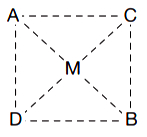
Square planar complexes of the type $M A B C D$ show three geometrical isomers. These can be obtained by fixing the position of one ligand and placing any of the remaining three ligands at the trans-position one by one.
Square planar complexes of the type $M A_{3} B$ do not show geometrical isomerism because all possible spatial arrangements are equivalent.
Square planar complexes of the type $M A B C D$ show three geometrical isomers. These can be obtained by fixing the position of one ligand and placing any of the remaining three ligands at the trans-position one by one.
0 likesView Solution
42
ChemistryEasyMCQKCET · 2015
The complex ion having minimum magnitude of $\Delta_{0}$ $(CFSE)$ is
A
$[Cr(CN)_{6}]^{3-}$
B
$[Co(NH_{3})_{6}]^{3+}$
C
$[Co(Cl)_{6}]^{3-}$
D
$[Cr(H_{2}O)_{6}]^{3+}$
Solution
(C) The magnitude of $\Delta_{0}$ depends on the nature of the ligand and the oxidation state of the central metal ion.
According to the spectrochemical series,the field strength of the ligands is $Cl^{-} < H_{2}O < NH_{3} < CN^{-}$.
Ligands with lower field strength result in a smaller crystal field splitting energy $(\Delta_{0})$.
Since $Cl^{-}$ is the weakest field ligand among the given options,the complex $[Co(Cl)_{6}]^{3-}$ will have the minimum magnitude of $\Delta_{0}$.
According to the spectrochemical series,the field strength of the ligands is $Cl^{-} < H_{2}O < NH_{3} < CN^{-}$.
Ligands with lower field strength result in a smaller crystal field splitting energy $(\Delta_{0})$.
Since $Cl^{-}$ is the weakest field ligand among the given options,the complex $[Co(Cl)_{6}]^{3-}$ will have the minimum magnitude of $\Delta_{0}$.
0 likesView Solution
43
ChemistryEasyMCQKCET · 2015
The electronic configuration of $Gd^{2+}$ is (at. no. of $Gd$ is $64$)
A
$[Xe] 4f^8$
B
$[Xe] 4f^7$
C
$[Xe] 4f^7 5d^1 6s^2$
D
$[Xe] 4f^7 5d^1$
Solution
(D) The atomic number of $Gd$ is $64$.
The electronic configuration of neutral $Gd$ is $[Xe] 4f^7 5d^1 6s^2$.
When forming the $Gd^{2+}$ ion,electrons are removed from the outermost shell first,which is the $6s$ orbital.
Removing two electrons from the $6s$ orbital results in the configuration $[Xe] 4f^7 5d^1$.
The electronic configuration of neutral $Gd$ is $[Xe] 4f^7 5d^1 6s^2$.
When forming the $Gd^{2+}$ ion,electrons are removed from the outermost shell first,which is the $6s$ orbital.
Removing two electrons from the $6s$ orbital results in the configuration $[Xe] 4f^7 5d^1$.
0 likesView Solution
44
ChemistryMediumMCQKCET · 2015
On heating potassium permanganate,one of the following compounds is not obtained:
A
$O_2$
B
$MnO$
C
$MnO_2$
D
$K_2MnO_4$
Solution
(B) The thermal decomposition of potassium permanganate $(KMnO_4)$ at $513 \ K$ is given by the following reaction:
$2KMnO_4 \rightarrow K_2MnO_4 + MnO_2 + O_2$
From the reaction,it is clear that $K_2MnO_4$,$MnO_2$,and $O_2$ are produced.
Therefore,$MnO$ is not obtained upon heating potassium permanganate.
$2KMnO_4 \rightarrow K_2MnO_4 + MnO_2 + O_2$
From the reaction,it is clear that $K_2MnO_4$,$MnO_2$,and $O_2$ are produced.
Therefore,$MnO$ is not obtained upon heating potassium permanganate.
0 likesView Solution
45
ChemistryMediumMCQKCET · 2015
How many Coulombs of electricity are required for the oxidation of one mol of water to dioxygen?
A
$9.65 \times 10^{4} \ C$
B
$1.93 \times 10^{4} \ C$
C
$1.93 \times 10^{5} \ C$
D
$19.3 \times 10^{5} \ C$
Solution
(C) The oxidation reaction of water is: $H_2O \rightarrow \frac{1}{2}O_2 + 2H^{+} + 2e^-$.
For the oxidation of $1 \ mol$ of $H_2O$,$2 \ mol$ of electrons are required.
Quantity of electricity required $(Q)$ = $nF$.
$Q = 2 \times 96500 \ C = 193000 \ C = 1.93 \times 10^5 \ C$.
For the oxidation of $1 \ mol$ of $H_2O$,$2 \ mol$ of electrons are required.
Quantity of electricity required $(Q)$ = $nF$.
$Q = 2 \times 96500 \ C = 193000 \ C = 1.93 \times 10^5 \ C$.
0 likesView Solution
46
ChemistryMediumMCQKCET · 2015
While charging the lead storage battery,
A
$PbSO_{4}$ on anode is reduced to $Pb$
B
$PbSO_{4}$ on cathode is reduced to $Pb$
C
$PbSO_{4}$ on cathode is oxidized to $Pb$
D
$PbSO_{4}$ on anode is oxidized to $PbO_{2}$
Solution
(B) During the charging process,the lead storage battery acts as an electrolytic cell.
At the anode (positive terminal during discharge,now connected to positive terminal of external source),$PbSO_{4}$ is oxidized to $PbO_{2}$:
$PbSO_{4(s)} + 2H_{2}O_{(l)} \rightarrow PbO_{2(s)} + S{O_{4}}^{2-}_{(aq)} + 4H^{+}_{(aq)} + 2e^{-}$
At the cathode (negative terminal during discharge,now connected to negative terminal of external source),$PbSO_{4}$ is reduced to $Pb$:
$PbSO_{4(s)} + 2e^{-} \rightarrow Pb_{(s)} + S{O_{4}}^{2-}_{(aq)}$
Therefore,$PbSO_{4}$ on the cathode is reduced to $Pb$.
At the anode (positive terminal during discharge,now connected to positive terminal of external source),$PbSO_{4}$ is oxidized to $PbO_{2}$:
$PbSO_{4(s)} + 2H_{2}O_{(l)} \rightarrow PbO_{2(s)} + S{O_{4}}^{2-}_{(aq)} + 4H^{+}_{(aq)} + 2e^{-}$
At the cathode (negative terminal during discharge,now connected to negative terminal of external source),$PbSO_{4}$ is reduced to $Pb$:
$PbSO_{4(s)} + 2e^{-} \rightarrow Pb_{(s)} + S{O_{4}}^{2-}_{(aq)}$
Therefore,$PbSO_{4}$ on the cathode is reduced to $Pb$.
0 likesView Solution
47
ChemistryEasyMCQKCET · 2015
In $H_2-O_2$ fuel cell,the reaction occurring at the cathode is:
A
$2H_{2(g)} + O_{2(g)} \rightarrow 2H_2O_{(l)}$
B
$O_{2(g)} + 2H_2O_{(l)} + 4e^- \rightarrow 4OH^{-}_{(aq)}$
C
$H^{+} + e^- \rightarrow \frac{1}{2}H_2$
D
$H^{+}_{(aq)} + OH^{-}_{(aq)} \rightarrow H_2O_{(l)}$
Solution
(B) In a hydrogen-oxygen fuel cell,the reduction of oxygen occurs at the cathode.
The reaction is:
$O_{2(g)} + 2H_2O_{(l)} + 4e^- \rightarrow 4OH^{-}_{(aq)}$
The reaction is:
$O_{2(g)} + 2H_2O_{(l)} + 4e^- \rightarrow 4OH^{-}_{(aq)}$
0 likesView Solution
48
ChemistryDifficultMCQKCET · 2015
Copper is extracted from copper pyrites $(CuFeS_2)$ by heating in a Bessemer converter. The method is based on the principle that:
A
Copper has more affinity for oxygen than sulphur at high temperature.
B
Iron has less affinity for oxygen than sulphur at high temperature.
C
Copper has less affinity for oxygen than sulphur at high temperature.
D
Sulphur has less affinity for oxygen at high temperature.
Solution
(C) In the Bessemer converter,copper is extracted through a self-reduction process. The reactions involved are:
$2Cu_2S + 3O_2 \rightarrow 2Cu_2O + 2SO_2$
$2Cu_2O + Cu_2S \rightarrow 6Cu + SO_2$
These reactions occur because,at high temperatures,sulphur has a greater affinity for oxygen than copper does,allowing sulphur to remove oxygen from $Cu_2O$ to form $SO_2$ gas. Thus,copper has less affinity for oxygen than sulphur.
$2Cu_2S + 3O_2 \rightarrow 2Cu_2O + 2SO_2$
$2Cu_2O + Cu_2S \rightarrow 6Cu + SO_2$
These reactions occur because,at high temperatures,sulphur has a greater affinity for oxygen than copper does,allowing sulphur to remove oxygen from $Cu_2O$ to form $SO_2$ gas. Thus,copper has less affinity for oxygen than sulphur.
0 likesView Solution
49
ChemistryMediumMCQKCET · 2015
Identify the metal $M$ and the precipitate $Z$ in the following reaction sequence:
$MSO_4$ $\xrightarrow{NH_4OH} \downarrow X \text{ (white)}$ $\xrightarrow{NH_4OH \text{ (excess)}} Y$ $\xrightarrow{H_2S} \downarrow Z$
$MSO_4$ $\xrightarrow{NH_4OH} \downarrow X \text{ (white)}$ $\xrightarrow{NH_4OH \text{ (excess)}} Y$ $\xrightarrow{H_2S} \downarrow Z$
A
$Cu, ZnS$
B
$Zn, ZnS$
C
$Fe, FeS$
D
$Al, Al_2S_3$
Solution
(B) The reaction sequence is as follows:
$ZnSO_4$ $\xrightarrow{NH_4OH} Zn(OH)_2 \downarrow \text{ (White ppt., } X)$ $\xrightarrow{NH_4OH \text{ (excess)}} [Zn(NH_3)_4]^{2+} \text{ (Clear solution, } Y)$ $\xrightarrow{H_2S} ZnS \downarrow \text{ (Ppt., } Z)$
Therefore,the metal $M$ is $Zn$ and the precipitate $Z$ is $ZnS$.
$ZnSO_4$ $\xrightarrow{NH_4OH} Zn(OH)_2 \downarrow \text{ (White ppt., } X)$ $\xrightarrow{NH_4OH \text{ (excess)}} [Zn(NH_3)_4]^{2+} \text{ (Clear solution, } Y)$ $\xrightarrow{H_2S} ZnS \downarrow \text{ (Ppt., } Z)$
Therefore,the metal $M$ is $Zn$ and the precipitate $Z$ is $ZnS$.
0 likesView Solution
50
ChemistryDifficultMCQKCET · 2015
Cryolite is
A
$Na_{3}AlF_{6}$ and is used in the electrolysis of alumina for decreasing electrical conductivity.
B
$Na_{3}AlF_{6}$ and is used in the electrolysis of alumina for lowering the melting point of alumina only.
C
$Na_{3}AlF_{6}$ and is used in the electrolysis of alumina for lowering the melting point and increasing the conductivity of alumina.
D
$Na_{3}AlF_{6}$ and is used in the electrolytic refining of alumina.
Solution
(C) Cryolite is $Na_{3}AlF_{6}$.
In the Hall-Heroult process,pure alumina $(Al_{2}O_{3})$ has a very high melting point $(2323 \ K)$ and is a poor conductor of electricity.
Cryolite $(Na_{3}AlF_{6})$ is added to the electrolyte to lower the melting point of the mixture to about $1240 \ K$ and to increase its electrical conductivity,making the electrolysis process more efficient.
In the Hall-Heroult process,pure alumina $(Al_{2}O_{3})$ has a very high melting point $(2323 \ K)$ and is a poor conductor of electricity.
Cryolite $(Na_{3}AlF_{6})$ is added to the electrolyte to lower the melting point of the mixture to about $1240 \ K$ and to increase its electrical conductivity,making the electrolysis process more efficient.
0 likesView Solution
51
ChemistryEasyMCQKCET · 2015
The hydrolysis of optically active $2-$bromobutane with aqueous $NaOH$ results in the formation of:
A
$(+)$ butan$-2-$ol
B
$(-)$ butan$-2-$ol
C
$(\pm)$ butan$-1-$ol
D
$(\pm)$ butan$-2-$ol
Solution
(D) $2-$Bromobutane is a secondary alkyl halide. In the presence of aqueous $NaOH$,the reaction proceeds primarily through the $S_N1$ mechanism.
This mechanism involves the formation of a planar carbocation intermediate.
The nucleophile $(OH^-)$ can attack the carbocation from either side with equal probability.
This leads to the formation of both enantiomers in equal amounts,resulting in a racemic mixture of $(\pm)$ butan$-2-$ol.
This mechanism involves the formation of a planar carbocation intermediate.
The nucleophile $(OH^-)$ can attack the carbocation from either side with equal probability.
This leads to the formation of both enantiomers in equal amounts,resulting in a racemic mixture of $(\pm)$ butan$-2-$ol.
0 likesView Solution
52
ChemistryEasyMCQKCET · 2015
Acetic acid is treated with $Ca(OH)_2$ and the product so obtained is subjected to dry distillation. The final product is
A
ethanal
B
propanal
C
propanone
D
ethanol
Solution
(C) When acetic acid reacts with slaked lime,calcium acetate is formed,which on dry distillation produces a ketone.
$2 CH_3COOH + Ca(OH)_2 \rightarrow (CH_3COO)_2Ca + 2 H_2O$
$(CH_3COO)_2Ca \xrightarrow{\Delta} CH_3COCH_3 + CaCO_3$
The final product obtained is propanone $(CH_3COCH_3)$.
$2 CH_3COOH + Ca(OH)_2 \rightarrow (CH_3COO)_2Ca + 2 H_2O$
$(CH_3COO)_2Ca \xrightarrow{\Delta} CH_3COCH_3 + CaCO_3$
The final product obtained is propanone $(CH_3COCH_3)$.
0 likesView Solution
53
ChemistryMediumMCQKCET · 2015
In the given set of reactions,the $IUPAC$ name of product '$Y$' is:
$2-\text{Bromopropane}$ $\xrightarrow[\text{alc. / heat}]{AgCN} X$ $\xrightarrow{LiAlH_4} Y$
$2-\text{Bromopropane}$ $\xrightarrow[\text{alc. / heat}]{AgCN} X$ $\xrightarrow{LiAlH_4} Y$
A
$N-\text{Methylpropanamine}$
B
$N-\text{Isopropylmethanamine}$
C
$\text{Butan-2-amine}$
D
$N-\text{Methylpropan-2-amine}$
Solution
(D) $AgCN$ is a covalent compound,therefore,the nucleophilic attack occurs through the nitrogen atom of the $CN^-$ group,leading to the formation of an isocyanide $(R-NC)$.
Step $1$: $CH_3-CH(Br)-CH_3 + AgCN \xrightarrow{\Delta} CH_3-CH(NC)-CH_3$ (Product $X$ is isopropyl isocyanide).
Step $2$: Reduction of isocyanide with $LiAlH_4$ yields a secondary amine.
$CH_3-CH(NC)-CH_3 \xrightarrow{LiAlH_4} CH_3-CH(NHCH_3)-CH_3$ (Product $Y$ is $N-\text{methylpropan-2-amine}$).
Step $1$: $CH_3-CH(Br)-CH_3 + AgCN \xrightarrow{\Delta} CH_3-CH(NC)-CH_3$ (Product $X$ is isopropyl isocyanide).
Step $2$: Reduction of isocyanide with $LiAlH_4$ yields a secondary amine.
$CH_3-CH(NC)-CH_3 \xrightarrow{LiAlH_4} CH_3-CH(NHCH_3)-CH_3$ (Product $Y$ is $N-\text{methylpropan-2-amine}$).
0 likesView Solution
54
ChemistryEasyMCQKCET · 2015
The electrolyte having maximum flocculation value for $AgI/Ag^{+}$ sol is:
A
$NaCl$
B
$Na_{2}S$
C
$Na_{2}SO_{4}$
D
$Na_{3}PO_{4}$
Solution
(A) The $AgI/Ag^{+}$ sol is a positively charged sol.
According to the Hardy-Schulze rule,the flocculation power of an electrolyte depends on the valency of the coagulating ion (the ion with a charge opposite to that of the sol).
For a positively charged sol,the coagulating power increases with the increase in the negative charge of the anion: $Cl^{-} < SO_{4}^{2-} < PO_{4}^{3-}$.
Flocculation value is inversely proportional to flocculation power.
Since $Cl^{-}$ has the minimum flocculation power,$NaCl$ will have the maximum flocculation value.
According to the Hardy-Schulze rule,the flocculation power of an electrolyte depends on the valency of the coagulating ion (the ion with a charge opposite to that of the sol).
For a positively charged sol,the coagulating power increases with the increase in the negative charge of the anion: $Cl^{-} < SO_{4}^{2-} < PO_{4}^{3-}$.
Flocculation value is inversely proportional to flocculation power.
Since $Cl^{-}$ has the minimum flocculation power,$NaCl$ will have the maximum flocculation value.
0 likesView Solution
55
ChemistryEasyMCQKCET · 2015
Which of the following compounds of Xenon has a pyramidal geometry?
A
$XeOF_4$
B
$XeF_2$
C
$XeO_3$
D
$XeF_4$
Solution
(C) The hybridization of $Xe$ in $XeO_3$ is $sp^3$,which involves three bond pairs and one lone pair.
Due to the presence of one lone pair,$XeO_3$ adopts a pyramidal geometry.
$XeOF_4$ has a square pyramidal geometry,$XeF_2$ is linear,and $XeF_4$ is square planar.
Due to the presence of one lone pair,$XeO_3$ adopts a pyramidal geometry.
$XeOF_4$ has a square pyramidal geometry,$XeF_2$ is linear,and $XeF_4$ is square planar.
0 likesView Solution
56
ChemistryEasyMCQKCET · 2015
Orlon has which monomeric unit?
A
Acrolein
B
Glycol
C
Vinyl cyanide
D
Isoprene
Solution
(C) Orlon is a polymer of acrylonitrile,which is also known as vinyl cyanide.
The polymerization reaction is as follows:
$nCH_2=CH(CN) \xrightarrow{\text{Peroxide}} -(CH_2-CH(CN))_n-$
Thus,the monomeric unit of Orlon is vinyl cyanide.
The polymerization reaction is as follows:
$nCH_2=CH(CN) \xrightarrow{\text{Peroxide}} -(CH_2-CH(CN))_n-$
Thus,the monomeric unit of Orlon is vinyl cyanide.
0 likesView Solution
57
ChemistryEasyMCQKCET · 2015
The salt which responds to dilute and concentrated $H_2SO_4$ is
A
$CaF_2$
B
$Ba(NO_3)_2$
C
$Na_2SO_4$
D
$Na_3PO_4$
Solution
(B) The reaction of $Ba(NO_3)_2$ with $H_2SO_4$ is a double displacement reaction that results in the formation of a white precipitate of $BaSO_4$.
Because $BaSO_4$ is highly insoluble,the reaction proceeds in the forward direction even with dilute $H_2SO_4$.
The chemical equation is: $Ba(NO_3)_2 + H_2SO_4 \rightarrow BaSO_4(s) + 2HNO_3$.
Because $BaSO_4$ is highly insoluble,the reaction proceeds in the forward direction even with dilute $H_2SO_4$.
The chemical equation is: $Ba(NO_3)_2 + H_2SO_4 \rightarrow BaSO_4(s) + 2HNO_3$.
0 likesView Solution
58
ChemistryEasyMCQKCET · 2015
The unit cell with crystallographic dimensions,$a \neq b \neq c$,$\alpha = \gamma = 90^{\circ}$ and $\beta \neq 90^{\circ}$ is
A
Triclinic
B
Monoclinic
C
Orthorhombic
D
Tetragonal
Solution
(B) The crystal system with dimensions $a \neq b \neq c$,$\alpha = \gamma = 90^{\circ}$ and $\beta \neq 90^{\circ}$ is known as the Monoclinic system.
0 likesView Solution
59
ChemistryMediumMCQKCET · 2015
Sodium metal crystallizes in $B.C.C.$ lattice with an edge length of $4.29 \ \mathring{A}$. The radius of the sodium atom is:
A
$2.857 \ \mathring{A}$
B
$1.601 \ \mathring{A}$
C
$2.145 \ \mathring{A}$
D
$1.857 \ \mathring{A}$
Solution
(D) For a $B.C.C.$ (Body-Centered Cubic) lattice,the relationship between the edge length $(a)$ and the atomic radius $(r)$ is given by the formula: $r = \frac{\sqrt{3}}{4} a$.
Given the edge length $a = 4.29 \ \mathring{A}$.
Substituting the value of $a$ into the formula:
$r = \frac{\sqrt{3}}{4} \times 4.29$
$r = 0.433 \times 4.29$
$r \approx 1.857 \ \mathring{A}$.
Given the edge length $a = 4.29 \ \mathring{A}$.
Substituting the value of $a$ into the formula:
$r = \frac{\sqrt{3}}{4} \times 4.29$
$r = 0.433 \times 4.29$
$r \approx 1.857 \ \mathring{A}$.
0 likesView Solution
60
ChemistryEasyMCQKCET · 2015
$0.06 \% (w/v)$ aqueous solution of urea is isotonic with:
A
$0.06 \%$ glucose solution
B
$0.6 \%$ glucose solution
C
$0.01 \ M$ glucose solution
D
$0.1 \ M$ glucose solution
Solution
(C) Isotonic solutions have the same molar concentration at the same temperature.
The molarity of the urea solution is calculated as:
$M = \frac{w \times 1000}{M_w \times V(mL)} = \frac{0.06 \times 1000}{60 \times 100} = 0.01 \ M$.
Since the molarity of the urea solution is $0.01 \ M$,it is isotonic with a $0.01 \ M$ glucose solution.
The molarity of the urea solution is calculated as:
$M = \frac{w \times 1000}{M_w \times V(mL)} = \frac{0.06 \times 1000}{60 \times 100} = 0.01 \ M$.
Since the molarity of the urea solution is $0.01 \ M$,it is isotonic with a $0.01 \ M$ glucose solution.
0 likesView Solution
61
ChemistryMediumMCQKCET · 2015
Which of the following aqueous solutions has the highest freezing point?
A
$0.1 \ M$ Sucrose
B
$0.01 \ M \ NaCl$
C
$0.1 \ M \ NaCl$
D
$0.01 \ M \ Na_2SO_4$
Solution
(B) The freezing point depression is given by $\Delta T_f = i \cdot K_f \cdot m$.
The freezing point of the solution is $T_f = T_f^\circ - \Delta T_f$.
For the highest freezing point,$\Delta T_f$ must be minimum,which implies that the product $i \cdot M$ must be minimum.
$(A)$ For $0.1 \ M$ Sucrose,$i = 1$,$i \cdot M = 1 \times 0.1 = 0.1$.
$(B)$ For $0.01 \ M \ NaCl$,$i = 2$,$i \cdot M = 2 \times 0.01 = 0.02$.
$(C)$ For $0.1 \ M \ NaCl$,$i = 2$,$i \cdot M = 2 \times 0.1 = 0.2$.
$(D)$ For $0.01 \ M \ Na_2SO_4$,$i = 3$,$i \cdot M = 3 \times 0.01 = 0.03$.
Since $0.01 \ M \ NaCl$ has the lowest $i \cdot M$ value,it has the highest freezing point.
The freezing point of the solution is $T_f = T_f^\circ - \Delta T_f$.
For the highest freezing point,$\Delta T_f$ must be minimum,which implies that the product $i \cdot M$ must be minimum.
$(A)$ For $0.1 \ M$ Sucrose,$i = 1$,$i \cdot M = 1 \times 0.1 = 0.1$.
$(B)$ For $0.01 \ M \ NaCl$,$i = 2$,$i \cdot M = 2 \times 0.01 = 0.02$.
$(C)$ For $0.1 \ M \ NaCl$,$i = 2$,$i \cdot M = 2 \times 0.1 = 0.2$.
$(D)$ For $0.01 \ M \ Na_2SO_4$,$i = 3$,$i \cdot M = 3 \times 0.01 = 0.03$.
Since $0.01 \ M \ NaCl$ has the lowest $i \cdot M$ value,it has the highest freezing point.
0 likesView Solution
62
ChemistryDifficultMCQKCET · 2015
After adding a non-volatile solute, the freezing point of water decreases to $-0.186^{\circ} C$. Calculate $\Delta T_b$ if $K_f = 1.86 \text{ K kg mol}^{-1}$ and $K_b = 0.521 \text{ K kg mol}^{-1}$. (in $\text{ K}$)
A
$0.521$
B
$0.0521$
C
$1.86$
D
$0.0186$
Solution
(B) Given:
Freezing point of solution $(T_f)$ = $-0.186^{\circ} C$
Freezing point of pure water $(T_f^{\circ})$ = $0^{\circ} C$
$\Delta T_f = T_f^{\circ} - T_f = 0 - (-0.186) = 0.186 \text{ K}$
We know that $\Delta T_f = K_f \cdot m$ and $\Delta T_b = K_b \cdot m$
Dividing the two equations: $\frac{\Delta T_b}{\Delta T_f} = \frac{K_b}{K_f}$
$\Delta T_b = \Delta T_f \times \frac{K_b}{K_f}$
$\Delta T_b = 0.186 \times \frac{0.521}{1.86} = 0.1 \times 0.521 = 0.0521 \text{ K}$.
Freezing point of solution $(T_f)$ = $-0.186^{\circ} C$
Freezing point of pure water $(T_f^{\circ})$ = $0^{\circ} C$
$\Delta T_f = T_f^{\circ} - T_f = 0 - (-0.186) = 0.186 \text{ K}$
We know that $\Delta T_f = K_f \cdot m$ and $\Delta T_b = K_b \cdot m$
Dividing the two equations: $\frac{\Delta T_b}{\Delta T_f} = \frac{K_b}{K_f}$
$\Delta T_b = \Delta T_f \times \frac{K_b}{K_f}$
$\Delta T_b = 0.186 \times \frac{0.521}{1.86} = 0.1 \times 0.521 = 0.0521 \text{ K}$.
0 likesView Solution
63
ChemistryMediumMCQKCET · 2015
Which of the following curves is in accordance with the Freundlich adsorption isotherm?
A
B
C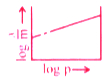
D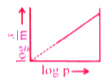
Solution
(C) The Freundlich adsorption isotherm is given by the equation:
$\frac{x}{m} = k p^{\frac{1}{n}}$
Taking the logarithm on both sides:
$\log \left(\frac{x}{m}\right) = \log k + \frac{1}{n} \log p$
This equation is of the form $y = mx + c$,where:
$y = \log \left(\frac{x}{m}\right)$
$x = \log p$
Slope $= \frac{1}{n}$
Intercept $= \log k$
Therefore,plotting $\log \left(\frac{x}{m}\right)$ against $\log p$ gives a straight line with a positive intercept $\log k$ and a slope of $\frac{1}{n}$. This corresponds to the curve shown in option $C$.
$\frac{x}{m} = k p^{\frac{1}{n}}$
Taking the logarithm on both sides:
$\log \left(\frac{x}{m}\right) = \log k + \frac{1}{n} \log p$
This equation is of the form $y = mx + c$,where:
$y = \log \left(\frac{x}{m}\right)$
$x = \log p$
Slope $= \frac{1}{n}$
Intercept $= \log k$
Therefore,plotting $\log \left(\frac{x}{m}\right)$ against $\log p$ gives a straight line with a positive intercept $\log k$ and a slope of $\frac{1}{n}$. This corresponds to the curve shown in option $C$.
0 likesView Solution
64
ChemistryEasyMCQKCET · 2015
Which of the following colloids cannot be easily coagulated?
A
Lyophobic colloids
B
Multimolecular colloids
C
Macromolecular colloids
D
Irreversible colloids
Solution
(C) Macromolecular colloids are quite stable and resemble true solutions in many respects.
Due to their high stability and the presence of a solvation layer,they cannot be easily coagulated compared to lyophobic colloids.
Due to their high stability and the presence of a solvation layer,they cannot be easily coagulated compared to lyophobic colloids.
0 likesView Solution
65
ChemistryEasyMCQKCET · 2015
Adenosine is an example of
A
Nucleotide
B
Purine base
C
Pyrimidine base
D
Nucleoside
Solution
(D) nucleoside is formed by the combination of a pentose sugar and a nitrogenous base.
Adenosine consists of the sugar ribose and the nitrogenous base adenine.
Since it lacks a phosphate group,it is classified as a nucleoside.
Adenosine consists of the sugar ribose and the nitrogenous base adenine.
Since it lacks a phosphate group,it is classified as a nucleoside.
0 likesView Solution
Vedclass Products
For Students
Vedclass Test Series
Mock tests in real KCET style covering Chemistry with performance analysis. 5-day free trial.
Start Free TrialFor Teachers
Exam Paper Generator
Generate Set A/B/C/D Chemistry papers from 7.5L+ questions in 2 minutes. 3 chapters free.
Try FreeFor Institutes
Online Exam Module
Run live KCET mock exams with unlimited students, 360° analytics & white-label branding.
See DemoFrequently Asked Questions
How many Chemistry questions are in KCET 2015?
There are 65 Chemistry questions from the KCET 2015 paper on Vedclass, each with a detailed step-by-step solution in English.
Are KCET 2015 Chemistry solutions available in English?
Yes. All solutions on this page are in English. You can also switch to English or Hindi using the language buttons above the questions.
Can I practice KCET 2015 Chemistry as a timed test?
Yes. Use the Vedclass Test Series to attempt a full KCET mock test covering Chemistry with time limits and instant score analysis.
Can teachers create Chemistry papers from KCET previous year questions?
Yes. The Vedclass Exam Paper Generator lets teachers mix KCET Chemistry questions and generate Set A/B/C/D papers in minutes.
For Teachers & Institutes
Build a Custom Chemistry Paper
Pick KCET 2015 Chemistry questions, set difficulty, and generate Set A/B/C/D in 2 minutes.