
BiologyQ1–50 of 50 questions
Page 1 of 1 · English
1
BiologyEasyMCQKCET · 2015
Greenhouse crops such as tomatoes and bell pepper produce higher yields. This is due to
A
$CO_2$ enriched atmosphere leads to higher yields
B
$CO_2$ is a limiting factor to photosynthesis
C
diffused light in greenhouse
D
tomatoes and bell pepper are not $C_3$ plants
Solution
(A) is the correct answer.
Greenhouse crops such as tomatoes and bell pepper produce higher yields because they are grown in a $CO_2$ enriched atmosphere.
These plants are $C_3$ plants,which respond to higher concentrations of $CO_2$ by increasing their rate of photosynthesis,as $CO_2$ is often a limiting factor for them in normal atmospheric conditions.
Greenhouse crops such as tomatoes and bell pepper produce higher yields because they are grown in a $CO_2$ enriched atmosphere.
These plants are $C_3$ plants,which respond to higher concentrations of $CO_2$ by increasing their rate of photosynthesis,as $CO_2$ is often a limiting factor for them in normal atmospheric conditions.
0 likesView Solution
2
BiologyEasyMCQKCET · 2015
Hibernating animals have tissues containing mitochondria with a membrane protein that accelerates electron transport while blocking the synthesis of $ATP$. What is the consequence of this?
A
Hibernating animals can synthesise fat instead of wasting energy of respiration.
B
Energy is saved because glycolysis and the citric acid cycle shuts down.
C
Pyruvate is converted to lactic acid by anaerobic fermentation.
D
The energy of respiration is converted into heat.
Solution
(D) The energy of respiration is converted into heat.
In mammals,there are two types of adipose tissue: white and brown. 'Brown fat' cells contain a great many mitochondria,and brown adipose tissue is well supplied by blood capillaries. Brown adipose tissue produces a considerable amount of heat because lipids are respired there with little or no $ATP$ formation; most energy is released as heat. This heat is transported in the blood to the body organs.
In mammals,there are two types of adipose tissue: white and brown. 'Brown fat' cells contain a great many mitochondria,and brown adipose tissue is well supplied by blood capillaries. Brown adipose tissue produces a considerable amount of heat because lipids are respired there with little or no $ATP$ formation; most energy is released as heat. This heat is transported in the blood to the body organs.
0 likesView Solution
3
BiologyEasyMCQKCET · 2015
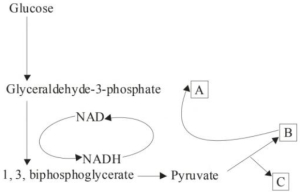
Choose the correct combination of labelling the molecules involved in the pathway of anaerobic respiration in Yeast.
A
$A$-Acetaldehyde,$B-CO_2$,$C$-Ethanol
B
$A$-Ethanol,$B-CO_2$,$C$-Acetaldehyde
C
$A$-Ethanol,$B$-Acetaldehyde,$C-CO_2$
D
$A-CO_2$,$B$-Ethanol,$C$-Acetaldehyde
Solution
(C) In the anaerobic respiration pathway in yeast,pyruvate is first converted into acetaldehyde and $CO_2$ by the enzyme pyruvate decarboxylase.
Then,acetaldehyde is reduced to ethanol by the enzyme alcohol dehydrogenase,using $NADH$ as a reducing agent.
Looking at the provided pathway diagram:
$1$. Pyruvate is converted to $C$ $(CO_2)$ and $B$ (Acetaldehyde).
$2$. Acetaldehyde $(B)$ is then converted to $A$ (Ethanol).
Therefore,the correct labels are $A$-Ethanol,$B$-Acetaldehyde,and $C-CO_2$.
Then,acetaldehyde is reduced to ethanol by the enzyme alcohol dehydrogenase,using $NADH$ as a reducing agent.
Looking at the provided pathway diagram:
$1$. Pyruvate is converted to $C$ $(CO_2)$ and $B$ (Acetaldehyde).
$2$. Acetaldehyde $(B)$ is then converted to $A$ (Ethanol).
Therefore,the correct labels are $A$-Ethanol,$B$-Acetaldehyde,and $C-CO_2$.
0 likesView Solution
4
BiologyEasyMCQKCET · 2015
Choose the correct statement.
A
Oxygen is vital in respiration for the removal of hydrogen.
B
Pyruvate is formed in the mitochondrial matrix.
C
There is complete breakdown of glucose in fermentation.
D
During the conversion of succinyl-CoA to succinic acid,a molecule of $ATP$ is synthesised.
Solution
(A) is the correct statement because oxygen acts as the final electron acceptor in the electron transport chain,combining with hydrogen ions to form water,which is essential for the removal of hydrogen.
$B$ is incorrect because pyruvate is formed in the cytosol during glycolysis.
$C$ is incorrect because fermentation involves the incomplete oxidation of glucose under anaerobic conditions.
$D$ is incorrect because during the conversion of succinyl-CoA to succinic acid in the Krebs cycle,a molecule of $GTP$ (guanosine triphosphate) is synthesised,not $ATP$.
$B$ is incorrect because pyruvate is formed in the cytosol during glycolysis.
$C$ is incorrect because fermentation involves the incomplete oxidation of glucose under anaerobic conditions.
$D$ is incorrect because during the conversion of succinyl-CoA to succinic acid in the Krebs cycle,a molecule of $GTP$ (guanosine triphosphate) is synthesised,not $ATP$.
0 likesView Solution
5
BiologyEasyMCQKCET · 2015
One hormone hastens the maturity period in juvenile conifers,a second hormone controls xylem differentiation,while the third increases the tolerance of plants to various stresses. They are respectively:
A
Gibberellin,Auxin,Cytokinin
B
Auxin,Gibberellin,Cytokinin
C
Gibberellin,Auxin,$ABA$
D
Auxin,Gibberellin,$ABA$
Solution
(C) The correct sequence is as follows:
$1$. Gibberellin: It is known to hasten the maturity period in juvenile conifers.
$2$. Auxin: It plays a crucial role in controlling xylem differentiation.
$3$. Abscisic acid $(ABA)$: It increases the tolerance of plants to various kinds of stress,which is why it is also known as the 'stress hormone'.
$1$. Gibberellin: It is known to hasten the maturity period in juvenile conifers.
$2$. Auxin: It plays a crucial role in controlling xylem differentiation.
$3$. Abscisic acid $(ABA)$: It increases the tolerance of plants to various kinds of stress,which is why it is also known as the 'stress hormone'.
0 likesView Solution
6
BiologyEasyMCQKCET · 2015
The $T$-wave in an $ECG$ represents
A
depolarisation of ventricles
B
electrical excitation of atria
C
beginning of systole
D
return of the ventricles from excited state
Solution
(D) The correct answer is $D$.
In an $ECG$,the $P$-wave represents the electrical excitation (or depolarisation) of the atria.
The $QRS$ complex represents the depolarisation of the ventricles,which initiates the ventricular contraction (systole).
The $T$-wave represents the return of the ventricles from an excited state to a normal state,which is known as ventricular repolarisation.
In an $ECG$,the $P$-wave represents the electrical excitation (or depolarisation) of the atria.
The $QRS$ complex represents the depolarisation of the ventricles,which initiates the ventricular contraction (systole).
The $T$-wave represents the return of the ventricles from an excited state to a normal state,which is known as ventricular repolarisation.
0 likesView Solution
7
BiologyEasyMCQKCET · 2015
$A$ fall in glomerular filtration rate activates
A
adrenal medulla to release adrenaline
B
juxta glomerular cells to release renin
C
posterior pituitary to release vasopressin
D
adrenal cortex to release aldosterone
Solution
(B) The correct answer is $B$. $A$ fall in glomerular blood flow,glomerular blood pressure,or $GFR$ can activate the $JG$ (juxta glomerular) cells to release renin.
Renin converts angiotensinogen in the blood to angiotensin $I$ and further to angiotensin $II$.
Angiotensin $II$,being a powerful vasoconstrictor,increases the glomerular blood pressure and thereby $GFR$.
Angiotensin $II$ also activates the adrenal cortex to release aldosterone.
Aldosterone causes reabsorption of $Na^+$ and water from the distal parts of the tubule.
This leads to an increase in blood pressure and $GFR$.
This complex mechanism is known as the Renin-Angiotensin mechanism.
Renin converts angiotensinogen in the blood to angiotensin $I$ and further to angiotensin $II$.
Angiotensin $II$,being a powerful vasoconstrictor,increases the glomerular blood pressure and thereby $GFR$.
Angiotensin $II$ also activates the adrenal cortex to release aldosterone.
Aldosterone causes reabsorption of $Na^+$ and water from the distal parts of the tubule.
This leads to an increase in blood pressure and $GFR$.
This complex mechanism is known as the Renin-Angiotensin mechanism.
0 likesView Solution
8
BiologyEasyMCQKCET · 2015
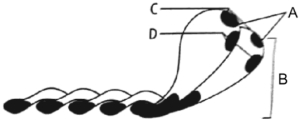
Identify the correct labels for the parts of the myosin monomer shown in the diagram.
A
$(A)$ Actin binding site,$(B)$ Head,$(C)$ $ATP$ binding site,$(D)$ Cross arm
B
$(A)$ Cross arm,$(B)$ Actin binding site,$(C)$ Head,$(D)$ $ATP$ binding site
C
$(A)$ $ATP$ binding site,$(B)$ Actin binding site,$(C)$ Head,$(D)$ Cross arm
D
$(A)$ Actin binding site,$(B)$ Head,$(C)$ $ATP$ binding site,$(D)$ Cross arm
Solution
(A) Based on the structure of the myosin monomer (meromyosin):
$A$ represents the Actin binding sites located on the head.
$B$ represents the Head (globular head).
$C$ represents the $ATP$ binding site located on the head.
$D$ represents the Cross arm (short arm connecting the head to the tail).
Therefore,the correct labeling is: $A$ = Actin binding site,$B$ = Head,$C$ = $ATP$ binding site,$D$ = Cross arm.
$A$ represents the Actin binding sites located on the head.
$B$ represents the Head (globular head).
$C$ represents the $ATP$ binding site located on the head.
$D$ represents the Cross arm (short arm connecting the head to the tail).
Therefore,the correct labeling is: $A$ = Actin binding site,$B$ = Head,$C$ = $ATP$ binding site,$D$ = Cross arm.
0 likesView Solution
9
BiologyEasyMCQKCET · 2015
Select the mismatch pair from the following.
A
Oxytocin - Contraction of uterine muscles
B
Insulin - Gluconeogenesis
C
Prolactin - Milk production in mammary glands
D
Glucagon - Glycogenolysis
Solution
(B) is the incorrect pair.
$Gluconeogenesis$ is the process of synthesizing glucose from non-carbohydrate sources like amino acids and glycerol.
$Insulin$ is a hypoglycemic hormone that promotes $glycogenesis$ (conversion of glucose to glycogen) and glucose uptake by cells,thereby lowering blood glucose levels.
$Gluconeogenesis$ is actually promoted by hormones like $glucagon$ and $cortisol$.
$Gluconeogenesis$ is the process of synthesizing glucose from non-carbohydrate sources like amino acids and glycerol.
$Insulin$ is a hypoglycemic hormone that promotes $glycogenesis$ (conversion of glucose to glycogen) and glucose uptake by cells,thereby lowering blood glucose levels.
$Gluconeogenesis$ is actually promoted by hormones like $glucagon$ and $cortisol$.
0 likesView Solution
10
BiologyEasyMCQKCET · 2015
The organisms which completely lack a cell wall and can live without oxygen are
A
mycoplasmas
B
archaebacteria
C
methanogens
D
thermoacidophiles
Solution
(A) $Mycoplasmas$ are the smallest living cells known and they completely lack a cell wall.
They are pleomorphic,meaning they can change their shape.
Many $Mycoplasmas$ are pathogenic in animals and plants.
They are facultative anaerobes,meaning they can survive and grow in the absence of oxygen.
They are pleomorphic,meaning they can change their shape.
Many $Mycoplasmas$ are pathogenic in animals and plants.
They are facultative anaerobes,meaning they can survive and grow in the absence of oxygen.
0 likesView Solution
11
BiologyEasyMCQKCET · 2015
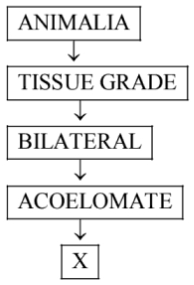
Identify the Phylum $X$ based on the given flow chart.
A
Hemichordata
B
Aschelminthes
C
Platyhelminthes
D
Ctenophora
Solution
(C) The flow chart describes the following characteristics:
$1$. Kingdom: $Animalia$
$2$. Level of organisation: Tissue grade
$3$. Symmetry: Bilateral
$4$. Coelom: Acoelomate
Analysis of the options:
- $Hemichordata$: Organ-system level,bilateral symmetry,coelomate.
- $Aschelminthes$: Organ-system level,bilateral symmetry,pseudocoelomate.
- $Platyhelminthes$: Organ-system level,bilateral symmetry,acoelomate.
- $Ctenophora$: Tissue grade,biradial symmetry,acoelomate.
Note: While $Platyhelminthes$ are acoelomate and bilateral,they typically exhibit organ-system level of organisation. However,in many simplified classification schemes,$Platyhelminthes$ is the only phylum that fits the 'acoelomate' and 'bilateral' criteria among the choices provided. Therefore,$Platyhelminthes$ is the most appropriate answer.
$1$. Kingdom: $Animalia$
$2$. Level of organisation: Tissue grade
$3$. Symmetry: Bilateral
$4$. Coelom: Acoelomate
Analysis of the options:
- $Hemichordata$: Organ-system level,bilateral symmetry,coelomate.
- $Aschelminthes$: Organ-system level,bilateral symmetry,pseudocoelomate.
- $Platyhelminthes$: Organ-system level,bilateral symmetry,acoelomate.
- $Ctenophora$: Tissue grade,biradial symmetry,acoelomate.
Note: While $Platyhelminthes$ are acoelomate and bilateral,they typically exhibit organ-system level of organisation. However,in many simplified classification schemes,$Platyhelminthes$ is the only phylum that fits the 'acoelomate' and 'bilateral' criteria among the choices provided. Therefore,$Platyhelminthes$ is the most appropriate answer.
0 likesView Solution
12
BiologyEasyMCQKCET · 2015
In $Prokaryotes$,the $glycocalyx$ when it is thick is called:
A
capsule
B
slime layer
C
cell wall
D
mesosome
Solution
(A) The correct answer is $A$ (capsule).
$Glycocalyx$ varies in composition and thickness among different bacteria.
If the $glycocalyx$ is loose and thin,it is known as the $slime$ $layer$.
If the $glycocalyx$ is thick and tough,it is known as the $capsule$.
$Glycocalyx$ varies in composition and thickness among different bacteria.
If the $glycocalyx$ is loose and thin,it is known as the $slime$ $layer$.
If the $glycocalyx$ is thick and tough,it is known as the $capsule$.
0 likesView Solution
13
BiologyEasyMCQKCET · 2015
Which of the following statements is correct?
A
In prokaryotes,there are no membrane-bound cell organelles.
B
Cells of all living organisms have a nucleus.
C
Cells are formed de novo from abiotic materials.
D
Both animal and plant cells have a well-defined cell wall.
Solution
(A) The correct statement is $A$.
Prokaryotes are unicellular organisms that lack membrane-bound cell organelles such as mitochondria,chloroplasts,and the endoplasmic reticulum.
Option $B$ is incorrect because prokaryotic cells lack a true nucleus.
Option $C$ is incorrect because cells arise from pre-existing cells (Omnis cellula-e cellula).
Option $D$ is incorrect because animal cells lack a cell wall.
Prokaryotes are unicellular organisms that lack membrane-bound cell organelles such as mitochondria,chloroplasts,and the endoplasmic reticulum.
Option $B$ is incorrect because prokaryotic cells lack a true nucleus.
Option $C$ is incorrect because cells arise from pre-existing cells (Omnis cellula-e cellula).
Option $D$ is incorrect because animal cells lack a cell wall.
0 likesView Solution
14
BiologyEasyMCQKCET · 2015
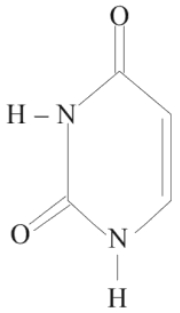
Identify the structure shown in the image.
A
Adenylic acid
B
Uracil
C
Cholesterol
D
Adenosine
Solution
(B) The structure shown in the image is $Uracil$.
$Uracil$ is a nitrogenous base,specifically a pyrimidine derivative,which is found in $RNA$ but not in $DNA$ (where it is replaced by $Thymine$).
The chemical structure consists of a six-membered ring containing two nitrogen atoms and two carbonyl groups,which matches the provided image.
Therefore,the correct option is $B$.
$Uracil$ is a nitrogenous base,specifically a pyrimidine derivative,which is found in $RNA$ but not in $DNA$ (where it is replaced by $Thymine$).
The chemical structure consists of a six-membered ring containing two nitrogen atoms and two carbonyl groups,which matches the provided image.
Therefore,the correct option is $B$.
0 likesView Solution
15
BiologyEasyMCQKCET · 2015
Seeds without fertilisation are obtained from
A
polyembryony
B
parthenocarpy
C
dormancy
D
apomixis
Solution
(D) The correct answer is $D$ (apomixis).
Apomixis is a form of asexual reproduction that mimics sexual reproduction.
In this process,seeds are produced without the fusion of male and female gametes (fertilisation).
Therefore,seeds formed through apomixis are genetically identical to the parent plant.
Apomixis is a form of asexual reproduction that mimics sexual reproduction.
In this process,seeds are produced without the fusion of male and female gametes (fertilisation).
Therefore,seeds formed through apomixis are genetically identical to the parent plant.
0 likesView Solution
16
BiologyEasyMCQKCET · 2015
The $2000$ year old seed excavated from King Herod's palace at the Dead Sea belongs to:
A
Dendrocalamus strictus
B
Lupinus arcticus
C
Phoenix dactylifera
D
Strobilanthes kunthiana
Solution
(C) $Phoenix$ $dactylifera$.
$A$ recent record of a $2000$ year old viable seed is that of the date palm,$Phoenix$ $dactylifera$,which was discovered during the archaeological excavation at King Herod's palace near the Dead Sea.
$A$ recent record of a $2000$ year old viable seed is that of the date palm,$Phoenix$ $dactylifera$,which was discovered during the archaeological excavation at King Herod's palace near the Dead Sea.
0 likesView Solution
17
BiologyEasyMCQKCET · 2015
Continued self-pollination results in
A
formation of unisexual flowers
B
inbreeding depression
C
gametes lose vigour
D
self-incompatibility
Solution
(B) The correct answer is $B$.
Continued self-pollination leads to the accumulation of recessive deleterious alleles in the population.
This process reduces the genetic diversity and results in a decrease in the biological fitness, vitality, and productivity of the offspring, a phenomenon known as $inbreeding \text{ } depression$.
Continued self-pollination leads to the accumulation of recessive deleterious alleles in the population.
This process reduces the genetic diversity and results in a decrease in the biological fitness, vitality, and productivity of the offspring, a phenomenon known as $inbreeding \text{ } depression$.
0 likesView Solution
18
BiologyEasyMCQKCET · 2015
The breakdown of detritus into small particles by detritivores is called
A
leaching
B
humification
C
fragmentation
D
catabolism
Solution
(C) fragmentation.
Fragmentation is the process of breaking down detritus into smaller particles by the action of detritivores,such as earthworms,termites,etc.
Fragmentation is the process of breaking down detritus into smaller particles by the action of detritivores,such as earthworms,termites,etc.
0 likesView Solution
19
BiologyEasyMCQKCET · 2015
If $30 \ J$ energy is trapped at the producer level,how much energy will be available to the peacock as food in the following food chain (in $J$)?
Plant $\rightarrow$ Mice $\rightarrow$ Snake $\rightarrow$ Peacock
Plant $\rightarrow$ Mice $\rightarrow$ Snake $\rightarrow$ Peacock
A
$0.3$
B
$0.03$
C
$0.0003$
D
$0.003$
Solution
(B) The correct answer is $(B)$ $0.03 \ J$.
According to the $10 \%$ law proposed by Lindeman $(1942)$,only $10 \%$ of the energy available at one trophic level is transferred to the next trophic level.
In the given food chain: Plant $\rightarrow$ Mice $\rightarrow$ Snake $\rightarrow$ Peacock.
$1$. Energy at producer level (Plant) = $30 \ J$.
$2$. Energy available to primary consumer (Mice) = $10 \%$ of $30 \ J = 3 \ J$.
$3$. Energy available to secondary consumer (Snake) = $10 \%$ of $3 \ J = 0.3 \ J$.
$4$. Energy available to tertiary consumer (Peacock) = $10 \%$ of $0.3 \ J = 0.03 \ J$.
Therefore,the peacock receives $0.03 \ J$ of energy.
According to the $10 \%$ law proposed by Lindeman $(1942)$,only $10 \%$ of the energy available at one trophic level is transferred to the next trophic level.
In the given food chain: Plant $\rightarrow$ Mice $\rightarrow$ Snake $\rightarrow$ Peacock.
$1$. Energy at producer level (Plant) = $30 \ J$.
$2$. Energy available to primary consumer (Mice) = $10 \%$ of $30 \ J = 3 \ J$.
$3$. Energy available to secondary consumer (Snake) = $10 \%$ of $3 \ J = 0.3 \ J$.
$4$. Energy available to tertiary consumer (Peacock) = $10 \%$ of $0.3 \ J = 0.03 \ J$.
Therefore,the peacock receives $0.03 \ J$ of energy.
0 likesView Solution
20
BiologyEasyMCQKCET · 2015
Given below is the representation of the extent of global diversity of vertebrates. What groups do the portions represent?
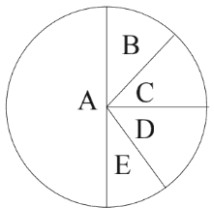
A
| $A$. Birds | $B$. Reptiles | $C$. Fishes | $D$. Mammals | $E$. Amphibians |
B
| $A$. Mammals | $B$. Birds | $C$. Fishes | $D$. Amphibians | $E$. Reptiles |
C
| $A$. Fishes | $B$. Amphibians | $C$. Mammals | $D$. Birds | $E$. Reptiles |
D
| $A$. Fishes | $B$. Mammals | $C$. Birds | $D$. Reptiles | $E$. Amphibians |
Solution
(D) The correct answer is $D$.
According to the $NCERT$ textbook diagram representing the global biodiversity of vertebrates:
$A$ represents Fishes (the largest portion).
$B$ represents Mammals.
$C$ represents Birds.
$D$ represents Reptiles.
$E$ represents Amphibians.
This distribution reflects the relative species diversity among these vertebrate groups.
According to the $NCERT$ textbook diagram representing the global biodiversity of vertebrates:
$A$ represents Fishes (the largest portion).
$B$ represents Mammals.
$C$ represents Birds.
$D$ represents Reptiles.
$E$ represents Amphibians.
This distribution reflects the relative species diversity among these vertebrate groups.
0 likesView Solution
21
BiologyEasyMCQKCET · 2015
Find the wrongly matched pair.
A
| Lungs of the planet - | Amazon rainforest |
B
| Endemism - | Species confined to one region and also found in other regions |
C
| Hotspots - | Regions with species richness |
D
| Alien species - | Clarias gariepinus |
Solution
$(B)$ . The pair "Endemism - Species confined to one region and also found in other regions" is incorrectly matched.
Endemic species are those that are restricted to a particular geographical area or region and are not found naturally anywhere else. They are not found in other regions. Therefore, the statement provided in option $B$ is incorrect.
Endemic species are those that are restricted to a particular geographical area or region and are not found naturally anywhere else. They are not found in other regions. Therefore, the statement provided in option $B$ is incorrect.
0 likesView Solution
22
BiologyEasyMCQKCET · 2015
Which of the following is not an ex situ conservation?
A
Cryopreservation
B
Seed bank
C
Biosphere reserves
D
Botanical garden
Solution
(C) The correct answer is $C$.
$Ex$ $situ$ conservation refers to the conservation of selected rare plants or animals in locations outside their natural habitats.
$Ex$ $situ$ conservation methods include offsite collections such as botanical gardens, zoological parks, seed banks, tissue culture, and cryopreservation.
Biosphere reserves are examples of $in$ $situ$ conservation, where the entire ecosystem is protected within its natural environment.
$Ex$ $situ$ conservation refers to the conservation of selected rare plants or animals in locations outside their natural habitats.
$Ex$ $situ$ conservation methods include offsite collections such as botanical gardens, zoological parks, seed banks, tissue culture, and cryopreservation.
Biosphere reserves are examples of $in$ $situ$ conservation, where the entire ecosystem is protected within its natural environment.
0 likesView Solution
23
BiologyEasyMCQKCET · 2015
The hormone which acts on Sertoli cells and stimulates the process of spermiogenesis is
A
GnRH
B
androgen
C
$FSH$
D
$LH$
Solution
(C) The correct option is $C$.
$FSH$ (Follicle Stimulating Hormone) acts on the Sertoli cells of the testes.
It stimulates the secretion of some factors which help in the process of spermiogenesis,which is the transformation of spermatids into spermatozoa.
$FSH$ (Follicle Stimulating Hormone) acts on the Sertoli cells of the testes.
It stimulates the secretion of some factors which help in the process of spermiogenesis,which is the transformation of spermatids into spermatozoa.
0 likesView Solution
24
BiologyEasyMCQKCET · 2015
During the menstrual cycle,cyclical changes take place in:
A
perimetrium
B
endometrium
C
corpus luteum
D
myometrium
Solution
(B) The correct answer is $B$.
During the menstrual cycle,the uterine wall undergoes significant structural and functional changes.
The innermost layer of the uterus,known as the $endometrium$,is the site of these cyclical changes.
It undergoes proliferation,secretory activity,and eventually sloughing off (menstruation) if fertilization does not occur.
During the menstrual cycle,the uterine wall undergoes significant structural and functional changes.
The innermost layer of the uterus,known as the $endometrium$,is the site of these cyclical changes.
It undergoes proliferation,secretory activity,and eventually sloughing off (menstruation) if fertilization does not occur.
0 likesView Solution
25
BiologyEasyMCQKCET · 2015
In a human foetus,the limbs and digits develop after:
A
$12$ weeks
B
first trimester
C
5th month
D
$8$ weeks
Solution
(D) The correct answer is $D$.
In human development,the heart is formed after one month of pregnancy.
By the end of the second month of pregnancy,the foetus develops limbs and digits.
Therefore,the limbs and digits are developed after $8$ weeks.
In human development,the heart is formed after one month of pregnancy.
By the end of the second month of pregnancy,the foetus develops limbs and digits.
Therefore,the limbs and digits are developed after $8$ weeks.
0 likesView Solution
26
BiologyEasyMCQKCET · 2015
Progestasert is an $IUD$ which makes the uterus unsuitable and cervix hostile to the sperms as they are:
A
hormone releasing $IUDs$
B
copper releasing $IUDs$
C
ideal contraceptive
D
non-medicated $IUDs$
Solution
(A) hormone releasing $IUDs$.
Progestasert is a hormone-releasing $IUD$ that releases progesterone.
It makes the uterus unsuitable for implantation and the cervix hostile to the sperms by increasing the viscosity of cervical mucus,which prevents sperm entry.
Progestasert is a hormone-releasing $IUD$ that releases progesterone.
It makes the uterus unsuitable for implantation and the cervix hostile to the sperms by increasing the viscosity of cervical mucus,which prevents sperm entry.
0 likesView Solution
27
BiologyEasyMCQKCET · 2015
Assisted Reproductive Technology $(ART)$ does not include:
A
Zygote Extra Fallopian Transfer
B
In-vitro fertilisation and embryo transfer $(IVF-ET)$
C
Artificial insemination
D
Gamete Intra Fallopian Transfer $(GIFT)$
Solution
(A) Assisted Reproductive Technology $(ART)$ refers to a set of medical procedures used to treat infertility.
Common $ART$ techniques include:
$1$. In-vitro fertilisation and embryo transfer $(IVF-ET)$.
$2$. Gamete Intra Fallopian Transfer $(GIFT)$.
$3$. Intra Cytoplasmic Sperm Injection $(ICSI)$.
$4$. Artificial insemination $(AI)$.
$5$. Zygote Intra Fallopian Transfer $(ZIFT)$.
Option $A$ mentions 'Zygote Extra Fallopian Transfer',which is not a recognized medical procedure. The correct term is $ZIFT$ (Zygote Intra Fallopian Transfer). Therefore,'Zygote Extra Fallopian Transfer' is not an $ART$ technique.
Common $ART$ techniques include:
$1$. In-vitro fertilisation and embryo transfer $(IVF-ET)$.
$2$. Gamete Intra Fallopian Transfer $(GIFT)$.
$3$. Intra Cytoplasmic Sperm Injection $(ICSI)$.
$4$. Artificial insemination $(AI)$.
$5$. Zygote Intra Fallopian Transfer $(ZIFT)$.
Option $A$ mentions 'Zygote Extra Fallopian Transfer',which is not a recognized medical procedure. The correct term is $ZIFT$ (Zygote Intra Fallopian Transfer). Therefore,'Zygote Extra Fallopian Transfer' is not an $ART$ technique.
0 likesView Solution
28
BiologyEasyMCQKCET · 2015
Three copies of chromosome-$21$ in a child with Down's syndrome have been analysed using molecular biology technology to detect any possible $DNA$ polymorphism with reference to different alleles located on chromosome-$21$. Results showed that out of $3$ copies,$2$ of the chromosomes of the child contain the same alleles as one of the mother's alleles. Based on this,when did the non-disjunction event most likely occur?
A
Paternal meiosis-$I$
B
Maternal meiosis-$I$
C
Paternal meiosis-$II$
D
Maternal meiosis-$II$
Solution
(B) The correct answer is $B$.
Down's syndrome is an autosomal aneuploidy caused by the presence of an extra copy of chromosome-$21$.
In this case,the child has $3$ copies of chromosome-$21$,where $2$ copies share the same alleles as one of the mother's chromosomes.
If non-disjunction occurs during meiosis-$I$,the homologous chromosomes fail to separate,resulting in a gamete containing both maternal homologs.
Since these $2$ chromosomes are identical to the mother's alleles (due to the presence of homologous chromosomes that did not segregate),it indicates that the non-disjunction event occurred during maternal meiosis-$I$.
Down's syndrome is an autosomal aneuploidy caused by the presence of an extra copy of chromosome-$21$.
In this case,the child has $3$ copies of chromosome-$21$,where $2$ copies share the same alleles as one of the mother's chromosomes.
If non-disjunction occurs during meiosis-$I$,the homologous chromosomes fail to separate,resulting in a gamete containing both maternal homologs.
Since these $2$ chromosomes are identical to the mother's alleles (due to the presence of homologous chromosomes that did not segregate),it indicates that the non-disjunction event occurred during maternal meiosis-$I$.
0 likesView Solution
29
BiologyEasyMCQKCET · 2015
Double lines in pedigree analysis show
A
unaffected offspring
B
sex unspecified
C
normal mating
D
consanguineous marriage
Solution
(D) In pedigree analysis,a single horizontal line between two individuals represents mating,while double horizontal lines represent consanguineous mating or mating between close relatives. Therefore,the correct option is $D$.
0 likesView Solution
30
BiologyEasyMCQKCET · 2015
With respect to phenylketonuria,identify which statement is not correct.
A
It is a case of aneuploidy
B
It is an example of pleiotropy
C
Caused due to autosomal recessive trait
D
It is an error in metabolism
Solution
(A) is the correct answer because it is not a case of aneuploidy.
$1$. Phenylketonuria $(PKU)$ is an inborn error of metabolism.
$2$. It is an autosomal recessive disorder caused by a mutation in the gene encoding the enzyme phenylalanine hydroxylase.
$3$. This enzyme is required to convert the amino acid phenylalanine into tyrosine in the liver.
$4$. Because the defective gene affects multiple phenotypic traits (such as mental retardation and reduction in hair and skin pigmentation),it is a classic example of pleiotropy.
$1$. Phenylketonuria $(PKU)$ is an inborn error of metabolism.
$2$. It is an autosomal recessive disorder caused by a mutation in the gene encoding the enzyme phenylalanine hydroxylase.
$3$. This enzyme is required to convert the amino acid phenylalanine into tyrosine in the liver.
$4$. Because the defective gene affects multiple phenotypic traits (such as mental retardation and reduction in hair and skin pigmentation),it is a classic example of pleiotropy.
0 likesView Solution
31
BiologyEasyMCQKCET · 2015
Identify the wrong statement.
A
Alleles b and c also produce sugar.
B
Alleles $I^{A}$ and $I^{B}$ produce sugars.
C
When $I^{B}$ and $i$ are present,$I^{B}$ is expressed.
D
Both $I^{A}$ and $I^{B}$ are present together and they express because of co-dominance.
Solution
(A) The wrong statement is: $A$. Alleles $b$ and $c$ also produce sugar.
Explanation:
$1$. The $ABO$ blood grouping in humans is controlled by the gene $I$,which has three alleles: $I^{A}$,$I^{B}$,and $i$.
$2$. The alleles $I^{A}$ and $I^{B}$ produce specific enzymes (glycosyltransferases) that add sugar polymers to the surface of red blood cells,forming antigens $A$ and $B$,respectively.
$3$. The allele $i$ does not produce any sugar or antigen.
$4$. When $I^{A}$ and $I^{B}$ are present together,both express themselves equally,a phenomenon known as co-dominance.
$5$. $I^{A}$ and $I^{B}$ are dominant over $i$,meaning if $I^{B}$ and $i$ are present,the phenotype will be blood group $B$ (due to $I^{B}$ expression).
Explanation:
$1$. The $ABO$ blood grouping in humans is controlled by the gene $I$,which has three alleles: $I^{A}$,$I^{B}$,and $i$.
$2$. The alleles $I^{A}$ and $I^{B}$ produce specific enzymes (glycosyltransferases) that add sugar polymers to the surface of red blood cells,forming antigens $A$ and $B$,respectively.
$3$. The allele $i$ does not produce any sugar or antigen.
$4$. When $I^{A}$ and $I^{B}$ are present together,both express themselves equally,a phenomenon known as co-dominance.
$5$. $I^{A}$ and $I^{B}$ are dominant over $i$,meaning if $I^{B}$ and $i$ are present,the phenotype will be blood group $B$ (due to $I^{B}$ expression).
0 likesView Solution
32
BiologyEasyMCQKCET · 2015
Which of the following conditions correctly describes the manner of determining the sex in the given example?
A
Homozygous sex chromosome $XX$ produces male in $Drosophila$.
B
$XO$ type of sex determines male sex in grasshopper.
C
Homozygous sex chromosome $ZZ$ determines female sex in birds.
D
$XO$ condition in humans as found in Klinefelter's syndrome determines female sex.
Solution
(B) is the correct answer: $XO$ type of sex determines male sex in grasshopper.
In $Drosophila$,the $XX$ condition (homozygous) results in a female,while $XY$ results in a male.
In birds,the $ZZ$ condition (homozygous) results in a male,while $ZW$ results in a female.
In humans,Klinefelter's syndrome is characterized by an $XXY$ genotype ($47$ chromosomes),not $XO$.
In $Drosophila$,the $XX$ condition (homozygous) results in a female,while $XY$ results in a male.
In birds,the $ZZ$ condition (homozygous) results in a male,while $ZW$ results in a female.
In humans,Klinefelter's syndrome is characterized by an $XXY$ genotype ($47$ chromosomes),not $XO$.
0 likesView Solution
33
BiologyEasyMCQKCET · 2015
If an inheritable mutation is observed in a population at high frequency, it is referred to as
A
sequence annotation
B
$DNA$ polymorphism
C
linkage
D
expressed sequence tag
Solution
(B) The correct answer is $B$.
$DNA$ polymorphism refers to the occurrence of an inheritable mutation in a population at a frequency greater than $0.01$ $(1\%)$.
These variations are the basis of genetic mapping and $DNA$ fingerprinting.
$DNA$ polymorphism refers to the occurrence of an inheritable mutation in a population at a frequency greater than $0.01$ $(1\%)$.
These variations are the basis of genetic mapping and $DNA$ fingerprinting.
0 likesView Solution
34
BiologyEasyMCQKCET · 2015
The codon $AUG$ has a dual function. It is an initiation codon and also codes for:
A
Phenylalanine
B
Formaldehyde
C
Serine
D
Methionine
Solution
(D) $AUG$ is a specific codon that serves two primary roles in protein synthesis.
First,it acts as the initiation codon,signaling the start of translation for the ribosome.
Second,it codes for the amino acid methionine $(Met)$.
Therefore,the correct option is $D$.
First,it acts as the initiation codon,signaling the start of translation for the ribosome.
Second,it codes for the amino acid methionine $(Met)$.
Therefore,the correct option is $D$.
0 likesView Solution
35
BiologyEasyMCQKCET · 2015
In a $125$ amino acid sequence,if the codon for the $25^{\text{th}}$ amino acid is mutated to $UAA$,then:
A
a polypeptide of $24$ amino acids is formed
B
a polypeptide of $124$ amino acids is formed
C
no polypeptides are formed
D
a polypeptide of $25$ amino acids is formed
Solution
(A) $UAA$ is one of the three stop codons (nonsense codons) which do not code for any amino acid.
If the codon for the $25^{\text{th}}$ amino acid is mutated to $UAA$,the translation process will be terminated at that specific position because no $tRNA$ molecule can recognize the stop codon to bring the next amino acid.
Consequently,the ribosome will release the growing peptide chain after the $24^{\text{th}}$ amino acid.
Therefore,a polypeptide chain consisting of $24$ amino acids will be formed.
If the codon for the $25^{\text{th}}$ amino acid is mutated to $UAA$,the translation process will be terminated at that specific position because no $tRNA$ molecule can recognize the stop codon to bring the next amino acid.
Consequently,the ribosome will release the growing peptide chain after the $24^{\text{th}}$ amino acid.
Therefore,a polypeptide chain consisting of $24$ amino acids will be formed.
0 likesView Solution
36
BiologyEasyMCQKCET · 2015
Match the following:
| Column $I$ | Column $II$ |
|---|---|
| $A$. $VNTR$ | $p$. Largest gene |
| $B$. Introns and exons | $q$. $DNA$ fingerprinting |
| $C$. Dystrophin | $r$. Bulk $DNA$ |
| $D$. Satellite | $s$. Splicing |
A
$A-r, B-s, C-p, D-q$
B
$A-q, B-s, C-p, D-r$
C
$A-q, B-p, C-s, D-r$
D
$A-s, B-p, C-q, D-r$
Solution
(B) . $VNTR$ (Variable Number Tandem Repeats) are used in $DNA$ fingerprinting $(A-q)$.
$B$. Introns and exons are processed during the splicing of $hnRNA$ $(B-s)$.
$C$. Dystrophin is known as the largest gene in humans $(C-p)$.
$D$. Satellite $DNA$ is separated from the main genomic $DNA$ as a peak during density gradient centrifugation,often referred to as bulk $DNA$ $(D-r)$.
Therefore,the correct matching is $A-q, B-s, C-p, D-r$.
$B$. Introns and exons are processed during the splicing of $hnRNA$ $(B-s)$.
$C$. Dystrophin is known as the largest gene in humans $(C-p)$.
$D$. Satellite $DNA$ is separated from the main genomic $DNA$ as a peak during density gradient centrifugation,often referred to as bulk $DNA$ $(D-r)$.
Therefore,the correct matching is $A-q, B-s, C-p, D-r$.
0 likesView Solution
37
BiologyEasyMCQKCET · 2015
The nitrogen base found only in $DNA$ is also called
A
uracil
B
$5-$methyl uracil
C
guanine
D
adenine
Solution
(B) The four nitrogenous bases present in $DNA$ are adenine,guanine,cytosine,and thymine.
Thymine is chemically known as $5$-methyl uracil.
Unlike $RNA$,which contains uracil,$DNA$ contains thymine as its specific nitrogenous base.
Thymine is chemically known as $5$-methyl uracil.
Unlike $RNA$,which contains uracil,$DNA$ contains thymine as its specific nitrogenous base.
0 likesView Solution
38
BiologyEasyMCQKCET · 2015
In a $3.2 \text{ Kbp}$ long piece of $DNA$,$820$ adenine bases were found. What would be the number of cytosine bases?
A
$780$
B
$1560$
C
$740$
D
$1480$
Solution
(A) Total length of $DNA$ = $3.2 \text{ Kbp} = 3200 \text{ bp}$.
According to Chargaff's rule,the amount of adenine $(A)$ is equal to thymine $(T)$,and the amount of guanine $(G)$ is equal to cytosine $(C)$.
Given,$A = 820$,therefore $T = 820$.
Total $A + T$ content = $820 + 820 = 1640$.
Total $G + C$ content = Total base pairs - Total $A + T$ content = $3200 - 1640 = 1560$.
Since $G = C$,the number of cytosine bases = $\frac{1560}{2} = 780$.
According to Chargaff's rule,the amount of adenine $(A)$ is equal to thymine $(T)$,and the amount of guanine $(G)$ is equal to cytosine $(C)$.
Given,$A = 820$,therefore $T = 820$.
Total $A + T$ content = $820 + 820 = 1640$.
Total $G + C$ content = Total base pairs - Total $A + T$ content = $3200 - 1640 = 1560$.
Since $G = C$,the number of cytosine bases = $\frac{1560}{2} = 780$.
0 likesView Solution
39
BiologyEasyMCQKCET · 2015
$RNA$ polymerase-$I$ transcribes eukaryotic ribosomal $RNA$ which does not consist of: (in $S$ $rRNA$)
A
$5.8$
B
$28$
C
$18$
D
$5$
Solution
(D) In eukaryotes,$RNA$ polymerase-$I$ is responsible for the transcription of $rRNA$ genes,specifically $28S$,$18S$,and $5.8S$ $rRNA$.
$5S$ $rRNA$ is transcribed by $RNA$ polymerase-$III$.
Therefore,the correct option is $(D)$.
$5S$ $rRNA$ is transcribed by $RNA$ polymerase-$III$.
Therefore,the correct option is $(D)$.
0 likesView Solution
40
BiologyEasyMCQKCET · 2015
The ancestors of modern day frogs and salamanders are:
A
Icthyophis
B
jawless fish
C
Amphioxus
D
Coelacanth
Solution
(D) Coelacanth.
In $1938$,a fish caught in South Africa was identified as a Coelacanth,a species previously thought to be extinct.
These lobe-finned fish are considered the evolutionary precursors to the first amphibians that transitioned to living on both land and water.
Consequently,they are recognized as the ancestors of modern-day amphibians,such as frogs and salamanders.
In $1938$,a fish caught in South Africa was identified as a Coelacanth,a species previously thought to be extinct.
These lobe-finned fish are considered the evolutionary precursors to the first amphibians that transitioned to living on both land and water.
Consequently,they are recognized as the ancestors of modern-day amphibians,such as frogs and salamanders.
0 likesView Solution
41
BiologyEasyMCQKCET · 2015
The formation of two species from one ancestral species is known as
A
convergent evolution
B
phyletic evolution
C
allopatry
D
divergent evolution
Solution
(D) divergent evolution.
Divergent evolution is the process by which two or more species evolve from a common ancestral species due to different environmental adaptations.
This process highlights the presence of common ancestry among the resulting species.
Divergent evolution is the process by which two or more species evolve from a common ancestral species due to different environmental adaptations.
This process highlights the presence of common ancestry among the resulting species.
0 likesView Solution
42
BiologyEasyMCQKCET · 2015
Which of the following is not correct with respect to malaria?
A
$RBCs$ rupture and release haemozoin which causes chills.
B
Sporozoites multiply in blood.
C
Female $Anopheles$ mosquito is the vector.
D
Malignant malaria is caused by $Plasmodium$ $falciparum$.
Solution
(B) The correct answer is $B$. Sporozoites do not multiply in the blood.
After entering the human body through the bite of an infected female $Anopheles$ mosquito,the sporozoites initially reach the liver and multiply within the liver cells.
Subsequently,they attack the red blood cells $(RBCs)$,causing them to rupture.
The rupture of $RBCs$ releases a toxic substance called haemozoin,which is responsible for the chill and high fever recurring every $3$ to $4$ days.
Therefore,the statement that sporozoites multiply in the blood is incorrect.
After entering the human body through the bite of an infected female $Anopheles$ mosquito,the sporozoites initially reach the liver and multiply within the liver cells.
Subsequently,they attack the red blood cells $(RBCs)$,causing them to rupture.
The rupture of $RBCs$ releases a toxic substance called haemozoin,which is responsible for the chill and high fever recurring every $3$ to $4$ days.
Therefore,the statement that sporozoites multiply in the blood is incorrect.
0 likesView Solution
43
BiologyEasyMCQKCET · 2015
Smack and Crack are produced from
A
Cannabis sativa and Papaver somniferum
B
Cannabis sativa and Atropa belladonna
C
Erythroxylum coca and Atropa belladonna
D
Papaver somniferum and Erythroxylum coca
Solution
(D) $Smack$ (heroin) is a depressant obtained from the latex of the poppy plant, $Papaver$ $somniferum$.
$Crack$ (cocaine) is a stimulant obtained from the leaves of the coca plant, $Erythroxylum$ $coca$.
Therefore, the correct answer is $D$.
$Crack$ (cocaine) is a stimulant obtained from the leaves of the coca plant, $Erythroxylum$ $coca$.
Therefore, the correct answer is $D$.
0 likesView Solution
44
BiologyEasyMCQKCET · 2015
Natural killer lymphocytes are an example of:
A
physical barrier
B
cytokine barrier
C
cellular barrier
D
physiological barrier
Solution
(C) Natural killer $(NK)$ cells are a type of white blood cell that plays a major role in the host-rejection of both tumors and virally infected cells.
In the context of innate immunity,the human body has four types of barriers:
$1$. Physical barriers: e.g.,skin,mucus coating of the epithelium.
$2$. Physiological barriers: e.g.,acid in the stomach,saliva in the mouth,tears from eyes.
$3$. Cellular barriers: e.g.,polymorphonuclear leukocytes ($PMNL$-neutrophils),monocytes,macrophages,and natural killer lymphocytes.
$4$. Cytokine barriers: e.g.,interferons.
Therefore,natural killer lymphocytes are classified under cellular barriers.
In the context of innate immunity,the human body has four types of barriers:
$1$. Physical barriers: e.g.,skin,mucus coating of the epithelium.
$2$. Physiological barriers: e.g.,acid in the stomach,saliva in the mouth,tears from eyes.
$3$. Cellular barriers: e.g.,polymorphonuclear leukocytes ($PMNL$-neutrophils),monocytes,macrophages,and natural killer lymphocytes.
$4$. Cytokine barriers: e.g.,interferons.
Therefore,natural killer lymphocytes are classified under cellular barriers.
0 likesView Solution
45
BiologyEasyMCQKCET · 2015
Ernst Chain and Howard Florey's contribution was
A
establishing the potential of penicillin as an effective antibiotic
B
discovery of streptokinase
C
production of genetically engineered insulin
D
discovery of $DNA$ sequence
Solution
(A) - Establishing the potential of penicillin as an effective antibiotic.
$Penicillium$ was the first antibiotic discovered by Alexander Fleming $(1928)$. He found that the fungus $Penicillium$ $notatum$ or its extract could inhibit the growth of the bacterium $Staphylococcus$ $aureus$.
However, its full potential as an effective antibiotic was established much later by Ernst Chain and Howard Florey.
This antibiotic was extensively used to treat American soldiers wounded in World War $II$.
Fleming, Chain, and Florey were awarded the Nobel Prize in $1945$ for this discovery.
$Penicillium$ was the first antibiotic discovered by Alexander Fleming $(1928)$. He found that the fungus $Penicillium$ $notatum$ or its extract could inhibit the growth of the bacterium $Staphylococcus$ $aureus$.
However, its full potential as an effective antibiotic was established much later by Ernst Chain and Howard Florey.
This antibiotic was extensively used to treat American soldiers wounded in World War $II$.
Fleming, Chain, and Florey were awarded the Nobel Prize in $1945$ for this discovery.
0 likesView Solution
46
BiologyEasyMCQKCET · 2015
During sewage treatment,the biogas produced includes:
A
hydrogen sulphide,nitrogen,methane
B
methane,oxygen,hydrogen sulphide
C
methane,hydrogen sulphide,carbon dioxide
D
hydrogen sulphide,methane,sulphur oxide
Solution
(C) The correct answer is $C$.
Biogas is a renewable fuel produced when organic matter,such as food or animal waste,is broken down by microbes under anaerobic conditions.
Biogas primarily consists of methane $(50-70\%)$,carbon dioxide $(30-40\%)$,and traces of nitrogen,hydrogen sulphide,and hydrogen.
Biogas is a renewable fuel produced when organic matter,such as food or animal waste,is broken down by microbes under anaerobic conditions.
Biogas primarily consists of methane $(50-70\%)$,carbon dioxide $(30-40\%)$,and traces of nitrogen,hydrogen sulphide,and hydrogen.
0 likesView Solution
47
BiologyEasyMCQKCET · 2015
$BOD$ refers to
A
the oxygen required for bacteria to grow in $1$ Litre of effluent
B
the amount of oxygen consumed if all the organic matter in $1000 \ mL$ of water were oxidised by bacteria.
C
the amount of oxygen released if all the organic matter in $1000 \ mL$ of water were oxidised by bacteria.
D
the amount of oxygen released when all the organic matter was consumed by bacteria in $1$ litre of water
Solution
(B) $BOD$ stands for Biochemical Oxygen Demand.
It is defined as the amount of oxygen that would be consumed if all the organic matter in $1000 \ mL$ ($1$ litre) of water were oxidised by bacteria.
It is a measure of the organic matter present in the water sample; higher $BOD$ indicates higher pollution levels.
It is defined as the amount of oxygen that would be consumed if all the organic matter in $1000 \ mL$ ($1$ litre) of water were oxidised by bacteria.
It is a measure of the organic matter present in the water sample; higher $BOD$ indicates higher pollution levels.
0 likesView Solution
48
BiologyEasyMCQKCET · 2015
The primary treatment of sewage water involves
A
sludge digestion
B
aerobic bacterial activity
C
anaerobic bacterial activity
D
filtration and sedimentation
Solution
(D) filtration and sedimentation.
Primary sewage water treatment entails the physical removal of particles through filtration and sedimentation of solid waste present in the water.
The purpose of primary treatment is to settle down large and small particles by gravity,removing floatable debris and grit,which reduces the pollution load to ease the subsequent secondary treatment process.
Primary sewage water treatment entails the physical removal of particles through filtration and sedimentation of solid waste present in the water.
The purpose of primary treatment is to settle down large and small particles by gravity,removing floatable debris and grit,which reduces the pollution load to ease the subsequent secondary treatment process.
0 likesView Solution
49
BiologyEasyMCQKCET · 2015
Which vector can clone a small fragment of $DNA$?
A
Plasmid
B
Bacterial artificial chromosome
C
Cosmid
D
Yeast artificial chromosome
Solution
(A) Plasmid.
Plasmids are extra-chromosomal,self-replicating,circular,$dsDNA$ molecules.
Plasmid vectors are typically used to clone small $DNA$ fragments,usually ranging from $100$ to $1000$ $bp$.
Plasmids are extra-chromosomal,self-replicating,circular,$dsDNA$ molecules.
Plasmid vectors are typically used to clone small $DNA$ fragments,usually ranging from $100$ to $1000$ $bp$.
0 likesView Solution
50
BiologyEasyMCQKCET · 2015
With respect to $DNA$ fragmentation:
Statement $A$: Gel electrophoresis and elution are two important processes.
Statement $B$: After staining with ethidium bromide,it has to be exposed to $UV$ light.
Statement $A$: Gel electrophoresis and elution are two important processes.
Statement $B$: After staining with ethidium bromide,it has to be exposed to $UV$ light.
A
Only $A$ is correct.
B
Both $A$ and $B$ are correct statements.
C
Only $B$ is correct.
D
Only $A$ is correct and $B$ is not correct.
Solution
(B) Both $A$ and $B$ are correct statements.
$1$. Gel electrophoresis is a technique used to separate $DNA$ fragments based on their size (molecular weight) and charge.
$2$. Elution is the process of extracting the separated $DNA$ fragments from the agarose gel matrix.
$3$. Ethidium bromide $(EtBr)$ is a fluorescent dye used to stain $DNA$. When exposed to $UV$ radiation,the $DNA$ bands stained with $EtBr$ appear as bright orange fluorescent bands,allowing for their visualization and subsequent extraction.
$1$. Gel electrophoresis is a technique used to separate $DNA$ fragments based on their size (molecular weight) and charge.
$2$. Elution is the process of extracting the separated $DNA$ fragments from the agarose gel matrix.
$3$. Ethidium bromide $(EtBr)$ is a fluorescent dye used to stain $DNA$. When exposed to $UV$ radiation,the $DNA$ bands stained with $EtBr$ appear as bright orange fluorescent bands,allowing for their visualization and subsequent extraction.
0 likesView Solution
Vedclass Products
For Students
Vedclass Test Series
Mock tests in real KCET style covering Biology with performance analysis. 5-day free trial.
Start Free TrialFor Teachers
Exam Paper Generator
Generate Set A/B/C/D Biology papers from 7.5L+ questions in 2 minutes. 3 chapters free.
Try FreeFor Institutes
Online Exam Module
Run live KCET mock exams with unlimited students, 360° analytics & white-label branding.
See DemoFrequently Asked Questions
How many Biology questions are in KCET 2015?
There are 50 Biology questions from the KCET 2015 paper on Vedclass, each with a detailed step-by-step solution in English.
Are KCET 2015 Biology solutions available in English?
Yes. All solutions on this page are in English. You can also switch to English or Hindi using the language buttons above the questions.
Can I practice KCET 2015 Biology as a timed test?
Yes. Use the Vedclass Test Series to attempt a full KCET mock test covering Biology with time limits and instant score analysis.
Can teachers create Biology papers from KCET previous year questions?
Yes. The Vedclass Exam Paper Generator lets teachers mix KCET Biology questions and generate Set A/B/C/D papers in minutes.
For Teachers & Institutes
Build a Custom Biology Paper
Pick KCET 2015 Biology questions, set difficulty, and generate Set A/B/C/D in 2 minutes.