
PhysicsQ1–60 of 60 questions
Page 1 of 1 · English
1
PhysicsMediumMCQKCET · 2024
What is the value of acceleration due to gravity at a height equal to half the radius of the Earth,from its surface?
A
$4.4 \ m/s^2$
B
$6.5 \ m/s^2$
C
Zero
D
$9.8 \ m/s^2$
Solution
(A) The acceleration due to gravity at a height $h$ above the Earth's surface is given by the formula: $g_h = \frac{g}{(1 + \frac{h}{R})^2}$.
Given that the height $h = \frac{R}{2}$,where $R$ is the radius of the Earth.
Substituting the value of $h$ into the formula:
$g_h = \frac{g}{(1 + \frac{R/2}{R})^2} = \frac{g}{(1 + \frac{1}{2})^2} = \frac{g}{(\frac{3}{2})^2}$.
$g_h = \frac{g}{9/4} = \frac{4}{9}g$.
Using $g = 9.8 \ m/s^2$:
$g_h = \frac{4}{9} \times 9.8 \approx 4.355 \ m/s^2 \approx 4.4 \ m/s^2$.
Given that the height $h = \frac{R}{2}$,where $R$ is the radius of the Earth.
Substituting the value of $h$ into the formula:
$g_h = \frac{g}{(1 + \frac{R/2}{R})^2} = \frac{g}{(1 + \frac{1}{2})^2} = \frac{g}{(\frac{3}{2})^2}$.
$g_h = \frac{g}{9/4} = \frac{4}{9}g$.
Using $g = 9.8 \ m/s^2$:
$g_h = \frac{4}{9} \times 9.8 \approx 4.355 \ m/s^2 \approx 4.4 \ m/s^2$.
0 likesView Solution
2
PhysicsEasyMCQKCET · 2024
The ratio of molar specific heats of oxygen is
A
$1.4$
B
$1.67$
C
$1.33$
D
$1.28$
Solution
(A) The ratio of molar specific heats $(\gamma = C_p / C_V)$ is given by the formula $\gamma = 1 + \frac{2}{f}$,where $f$ is the degree of freedom of the gas molecule.
Oxygen $(O_2)$ is a diatomic gas at room temperature.
For a diatomic gas,the number of degrees of freedom is $f = 5$ ($3$ translational and $2$ rotational).
Substituting the value of $f$ into the formula:
$\gamma = 1 + \frac{2}{5} = 1 + 0.4 = 1.4$.
Oxygen $(O_2)$ is a diatomic gas at room temperature.
For a diatomic gas,the number of degrees of freedom is $f = 5$ ($3$ translational and $2$ rotational).
Substituting the value of $f$ into the formula:
$\gamma = 1 + \frac{2}{5} = 1 + 0.4 = 1.4$.
0 likesView Solution
3
PhysicsMediumMCQKCET · 2024
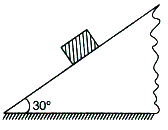
$A$ block of a certain mass is placed on a rough inclined plane. The angle between the plane and the horizontal is $30^{\circ}$. The coefficients of static and kinetic friction between the block and the inclined plane are $0.6$ and $0.5$ respectively. Then,the magnitude of the acceleration of the block is [Take $g = 10 \ ms^{-2}$]
A
$2 \ ms^{-2}$
B
zero
C
$0.196 \ ms^{-2}$
D
$0.67 \ ms^{-2}$
Solution
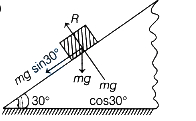
(B) The force pulling the block down the inclined plane is $F = mg \sin 30^{\circ} = mg \times 0.5 = 0.5 mg$.
The maximum static frictional force (limiting friction) is $f_{s,max} = \mu_s R = \mu_s mg \cos 30^{\circ}$.
Given $\mu_s = 0.6$,we have $f_{s,max} = 0.6 \times mg \times \frac{\sqrt{3}}{2} = 0.3 \times 1.732 \times mg = 0.5196 mg$.
Since the pulling force $F = 0.5 mg$ is less than the maximum static frictional force $f_{s,max} = 0.5196 mg$,the block will not move.
Therefore,the acceleration of the block is zero.
The maximum static frictional force (limiting friction) is $f_{s,max} = \mu_s R = \mu_s mg \cos 30^{\circ}$.
Given $\mu_s = 0.6$,we have $f_{s,max} = 0.6 \times mg \times \frac{\sqrt{3}}{2} = 0.3 \times 1.732 \times mg = 0.5196 mg$.
Since the pulling force $F = 0.5 mg$ is less than the maximum static frictional force $f_{s,max} = 0.5196 mg$,the block will not move.
Therefore,the acceleration of the block is zero.
0 likesView Solution
4
PhysicsEasyMCQKCET · 2024
Among the given pairs of vectors,the resultant of two vectors can never be $3$ units. The vectors are
A
$1$ unit and $2$ units
B
$2$ units and $5$ units
C
$3$ units and $6$ units
D
$4$ units and $8$ units
Solution
(D) The resultant $R$ of two vectors $A$ and $B$ lies in the range $|A-B| \leq R \leq |A+B|$.
For option $A$: $|1-2| \leq R \leq |1+2| \implies 1 \leq R \leq 3$. Since $3$ is in the range,the resultant can be $3$.
For option $B$: $|2-5| \leq R \leq |2+5| \implies 3 \leq R \leq 7$. Since $3$ is in the range,the resultant can be $3$.
For option $C$: $|3-6| \leq R \leq |3+6| \implies 3 \leq R \leq 9$. Since $3$ is in the range,the resultant can be $3$.
For option $D$: $|4-8| \leq R \leq |4+8| \implies 4 \leq R \leq 12$. The range is $[4, 12]$. Since $3$ is not in this range,the resultant can never be $3$ units.
For option $A$: $|1-2| \leq R \leq |1+2| \implies 1 \leq R \leq 3$. Since $3$ is in the range,the resultant can be $3$.
For option $B$: $|2-5| \leq R \leq |2+5| \implies 3 \leq R \leq 7$. Since $3$ is in the range,the resultant can be $3$.
For option $C$: $|3-6| \leq R \leq |3+6| \implies 3 \leq R \leq 9$. Since $3$ is in the range,the resultant can be $3$.
For option $D$: $|4-8| \leq R \leq |4+8| \implies 4 \leq R \leq 12$. The range is $[4, 12]$. Since $3$ is not in this range,the resultant can never be $3$ units.
0 likesView Solution
5
PhysicsEasyMCQKCET · 2024
Water flows through a horizontal pipe of varying cross-section at a rate of $0.314 \,m^3 \,s^{-1}$. The velocity of water at a point where the radius of the pipe is $10 \,cm$ is (in $\,m/s$)
A
$0.1$
B
$1$
C
$10$
D
$100$
Solution
(C) Given: Flow rate $Q = 0.314 \,m^3/s$ and radius $r = 10 \,cm = 0.1 \,m$.
Using the equation of continuity, $Q = A \times v$, where $A = \pi r^2$ is the cross-sectional area.
Substituting the values: $0.314 = \pi \times (0.1)^2 \times v$.
Taking $\pi \approx 3.14$, we get $0.314 = 3.14 \times 0.01 \times v$.
$0.314 = 0.0314 \times v$.
$v = \frac{0.314}{0.0314} = 10 \,m/s$.
Using the equation of continuity, $Q = A \times v$, where $A = \pi r^2$ is the cross-sectional area.
Substituting the values: $0.314 = \pi \times (0.1)^2 \times v$.
Taking $\pi \approx 3.14$, we get $0.314 = 3.14 \times 0.01 \times v$.
$0.314 = 0.0314 \times v$.
$v = \frac{0.314}{0.0314} = 10 \,m/s$.
0 likesView Solution
6
PhysicsMediumMCQKCET · 2024
$A$ thick metal wire of density $\rho$ and length $L$ is hung from a rigid support. The increase in length of the wire due to its own weight is ($Y =$ Young's modulus of the material of the wire).
A
$\frac{\rho g L}{Y}$
B
$\frac{1}{2} \frac{\rho g L^2}{Y}$
C
$\frac{\rho g L^2}{Y}$
D
$\frac{1}{4 Y} \rho g L^2$
Solution
(B) Consider an element of length $dx$ at a distance $x$ from the free end of the wire.
The weight of the portion of the wire below this element is $dw = (A \cdot x \cdot \rho) g$,where $A$ is the cross-sectional area.
The stress at this section is $\sigma = \frac{dw}{A} = \rho g x$.
The strain is $\frac{d(\Delta l)}{dx} = \frac{\sigma}{Y} = \frac{\rho g x}{Y}$.
Integrating from $x = 0$ to $x = L$ to find the total elongation $\Delta L$:
$\Delta L = \int_{0}^{L} \frac{\rho g x}{Y} dx = \frac{\rho g}{Y} \left[ \frac{x^2}{2} \right]_{0}^{L} = \frac{\rho g L^2}{2 Y}$.
The weight of the portion of the wire below this element is $dw = (A \cdot x \cdot \rho) g$,where $A$ is the cross-sectional area.
The stress at this section is $\sigma = \frac{dw}{A} = \rho g x$.
The strain is $\frac{d(\Delta l)}{dx} = \frac{\sigma}{Y} = \frac{\rho g x}{Y}$.
Integrating from $x = 0$ to $x = L$ to find the total elongation $\Delta L$:
$\Delta L = \int_{0}^{L} \frac{\rho g x}{Y} dx = \frac{\rho g}{Y} \left[ \frac{x^2}{2} \right]_{0}^{L} = \frac{\rho g L^2}{2 Y}$.
0 likesView Solution
7
PhysicsEasyMCQKCET · 2024
An athlete runs along a circular track of diameter $80 \ m$. The distance travelled and the magnitude of displacement of the athlete when he covers $3/4$th of the circle is (in $m$):
A
$60 \pi, 40 \sqrt{2}$
B
$40 \pi, 60 \sqrt{2}$
C
$120 \pi, 80 \sqrt{2}$
D
$80 \pi, 120 \sqrt{2}$
Solution
(A) Given,diameter,$d = 80 \ m$.
Therefore,radius,$r = d/2 = 40 \ m$.
Distance travelled after completion of $3/4$ revolution is given by:
Distance $= (3/4) \times (2 \pi r) = (3/2) \times \pi \times 40 = 60 \pi \ m$.
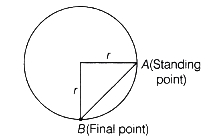
Displacement is the shortest distance between the initial point $A$ and the final point $B$. Since the athlete covers $3/4$ of the circle,the angle between the initial and final position vectors is $90^{\circ}$.
Using the Pythagorean theorem for the right-angled triangle formed by the two radii:
Displacement $= \sqrt{r^2 + r^2} = r \sqrt{2} = 40 \sqrt{2} \ m$.
Therefore,radius,$r = d/2 = 40 \ m$.
Distance travelled after completion of $3/4$ revolution is given by:
Distance $= (3/4) \times (2 \pi r) = (3/2) \times \pi \times 40 = 60 \pi \ m$.
Displacement is the shortest distance between the initial point $A$ and the final point $B$. Since the athlete covers $3/4$ of the circle,the angle between the initial and final position vectors is $90^{\circ}$.
Using the Pythagorean theorem for the right-angled triangle formed by the two radii:
Displacement $= \sqrt{r^2 + r^2} = r \sqrt{2} = 40 \sqrt{2} \ m$.
0 likesView Solution
8
PhysicsEasyMCQKCET · 2024
For a particle executing simple harmonic motion $(SHM)$,at its mean position
A
velocity is zero and acceleration is maximum.
B
velocity is maximum and acceleration is zero.
C
both velocity and acceleration are maximum.
D
both velocity and acceleration are zero.
Solution
(B) We know that for a particle executing $SHM$,the velocity $v$ and acceleration $a$ are given by the equations:
$v = \omega \sqrt{A^2 - y^2}$
$a = -\omega^2 y$
At the mean position,the displacement $y = 0$.
Substituting $y = 0$ into the velocity equation:
$v = \omega \sqrt{A^2 - 0} = \omega A$
Thus,the velocity is maximum $(v_{\max} = \omega A)$.
Substituting $y = 0$ into the acceleration equation:
$a = -\omega^2 (0) = 0$
Thus,the acceleration is zero.
$v = \omega \sqrt{A^2 - y^2}$
$a = -\omega^2 y$
At the mean position,the displacement $y = 0$.
Substituting $y = 0$ into the velocity equation:
$v = \omega \sqrt{A^2 - 0} = \omega A$
Thus,the velocity is maximum $(v_{\max} = \omega A)$.
Substituting $y = 0$ into the acceleration equation:
$a = -\omega^2 (0) = 0$
Thus,the acceleration is zero.
0 likesView Solution
9
PhysicsDifficultMCQKCET · 2024
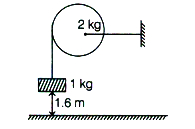
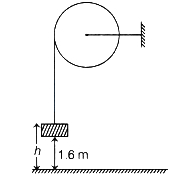
$A$ body of mass $1 \,kg$ is suspended by a weightless string which passes over a pulley of mass $2 \,kg$ as shown in the figure. The mass is released from a height of $1.6 \,m$ from the ground. With what velocity does it strike the ground?
A
$16 \,ms^{-1}$
B
$8 \,ms^{-1}$
C
$4 \sqrt{2} \,ms^{-1}$
D
$4 \,ms^{-1}$
Solution
(D) Given,mass of the body,$m_1 = 1 \,kg$.
Mass of the pulley,$m_2 = 2 \,kg$.
According to the law of conservation of energy,the potential energy lost by the mass is equal to the sum of the kinetic energy of the mass and the rotational kinetic energy of the pulley.
$m_1 g h = \frac{1}{2} m_1 v^2 + \frac{1}{2} I \omega^2$
Since the pulley is a disc,its moment of inertia is $I = \frac{1}{2} m_2 R^2$. Also,$\omega = \frac{v}{R}$.
Substituting these values:
$m_1 g h = \frac{1}{2} m_1 v^2 + \frac{1}{2} \left( \frac{1}{2} m_2 R^2 \right) \left( \frac{v}{R} \right)^2$
$m_1 g h = \frac{1}{2} m_1 v^2 + \frac{1}{4} m_2 v^2$
Substituting the given values $(m_1 = 1 \,kg, m_2 = 2 \,kg, g = 10 \,ms^{-2}, h = 1.6 \,m)$:
$1 \times 10 \times 1.6 = \frac{1}{2} \times 1 \times v^2 + \frac{1}{4} \times 2 \times v^2$
$16 = 0.5 v^2 + 0.5 v^2$
$16 = v^2$
$v = 4 \,ms^{-1}$
Mass of the pulley,$m_2 = 2 \,kg$.
According to the law of conservation of energy,the potential energy lost by the mass is equal to the sum of the kinetic energy of the mass and the rotational kinetic energy of the pulley.
$m_1 g h = \frac{1}{2} m_1 v^2 + \frac{1}{2} I \omega^2$
Since the pulley is a disc,its moment of inertia is $I = \frac{1}{2} m_2 R^2$. Also,$\omega = \frac{v}{R}$.
Substituting these values:
$m_1 g h = \frac{1}{2} m_1 v^2 + \frac{1}{2} \left( \frac{1}{2} m_2 R^2 \right) \left( \frac{v}{R} \right)^2$
$m_1 g h = \frac{1}{2} m_1 v^2 + \frac{1}{4} m_2 v^2$
Substituting the given values $(m_1 = 1 \,kg, m_2 = 2 \,kg, g = 10 \,ms^{-2}, h = 1.6 \,m)$:
$1 \times 10 \times 1.6 = \frac{1}{2} \times 1 \times v^2 + \frac{1}{4} \times 2 \times v^2$
$16 = 0.5 v^2 + 0.5 v^2$
$16 = v^2$
$v = 4 \,ms^{-1}$
0 likesView Solution
10
PhysicsMediumMCQKCET · 2024
$A$ solid cube of mass $m$ at a temperature $\theta_0$ is heated at a constant rate. It becomes liquid at temperature $\theta_1$ and vapour at temperature $\theta_2$. Let $s_1$ and $s_2$ be specific heats in its solid and liquid states respectively. If $L_f$ and $L_v$ are latent heats of fusion and vaporisation respectively,then the minimum heat energy supplied to the cube until it vaporises is
A
$m s_1(\theta_1-\theta_0)+m s_2(\theta_2-\theta_1)$
B
$m L_f+m s_2(\theta_2-\theta_1)+m L_v$
C
$m s_1(\theta_1-\theta_0)+m L_f+m s_2(\theta_2-\theta_1)+m L_v$
D
$m s_1(\theta_1-\theta_0)+m L_f+m s_2(\theta_2-\theta_0)+m L_v$
Solution
(C) The total heat energy $Q$ required to convert the solid cube at $\theta_0$ to vapour at $\theta_2$ is the sum of heat required for each phase change and temperature change step:
$1$. Heat to raise temperature of solid from $\theta_0$ to $\theta_1$: $Q_1 = m s_1(\theta_1 - \theta_0)$
$2$. Heat for fusion at $\theta_1$: $Q_2 = m L_f$
$3$. Heat to raise temperature of liquid from $\theta_1$ to $\theta_2$: $Q_3 = m s_2(\theta_2 - \theta_1)$
$4$. Heat for vaporisation at $\theta_2$: $Q_4 = m L_v$
Total heat $Q = Q_1 + Q_2 + Q_3 + Q_4 = m s_1(\theta_1 - \theta_0) + m L_f + m s_2(\theta_2 - \theta_1) + m L_v$.
$1$. Heat to raise temperature of solid from $\theta_0$ to $\theta_1$: $Q_1 = m s_1(\theta_1 - \theta_0)$
$2$. Heat for fusion at $\theta_1$: $Q_2 = m L_f$
$3$. Heat to raise temperature of liquid from $\theta_1$ to $\theta_2$: $Q_3 = m s_2(\theta_2 - \theta_1)$
$4$. Heat for vaporisation at $\theta_2$: $Q_4 = m L_v$
Total heat $Q = Q_1 + Q_2 + Q_3 + Q_4 = m s_1(\theta_1 - \theta_0) + m L_f + m s_2(\theta_2 - \theta_1) + m L_v$.
0 likesView Solution
11
PhysicsEasyMCQKCET · 2024
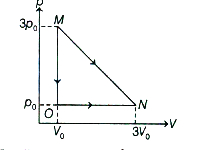
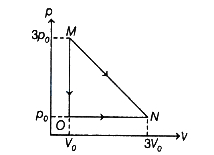
One mole of an ideal monoatomic gas is taken round the cyclic process $MNOM$. The work done by the gas is (in $p_0 V_0$)
A
$4.5$
B
$4$
C
$9$
D
$2$
Solution
(D) The work done by the gas in a cyclic process is equal to the area enclosed by the cycle on the $p-V$ diagram.
Since the cycle $MNOM$ is traversed in a clockwise direction, the work done is positive.
The area of the triangle $MNO$ is given by:
$W = \text{Area of } \triangle MNO = \frac{1}{2} \times \text{base} \times \text{height}$
$W = \frac{1}{2} \times (ON) \times (OM)$
From the graph, the base $ON = 3V_0 - V_0 = 2V_0$ and the height $OM = 3p_0 - p_0 = 2p_0$.
Substituting these values:
$W = \frac{1}{2} \times (2V_0) \times (2p_0)$
$W = 2p_0 V_0$
Thus, the work done by the gas is $2p_0 V_0$.
Since the cycle $MNOM$ is traversed in a clockwise direction, the work done is positive.
The area of the triangle $MNO$ is given by:
$W = \text{Area of } \triangle MNO = \frac{1}{2} \times \text{base} \times \text{height}$
$W = \frac{1}{2} \times (ON) \times (OM)$
From the graph, the base $ON = 3V_0 - V_0 = 2V_0$ and the height $OM = 3p_0 - p_0 = 2p_0$.
Substituting these values:
$W = \frac{1}{2} \times (2V_0) \times (2p_0)$
$W = 2p_0 V_0$
Thus, the work done by the gas is $2p_0 V_0$.
0 likesView Solution
12
PhysicsEasyMCQKCET · 2024
Dimensional formula for activity of radioactive substance is
A
$[M^0 L^0 T^{-1}]$
B
$[M^0 L^{-1} T^0]$
C
$[M^0 L^0 T^{-1}]$
D
$[M^{-1} L^0 T^0]$
Solution
(C) The activity of a radioactive substance is defined as the rate of decay,which is the number of disintegrations per unit time.
Mathematically,Activity $A = -\frac{dN}{dt}$.
Since $N$ (number of nuclei) is a dimensionless quantity and $t$ represents time,the dimensions of activity are $[T^{-1}]$.
Therefore,the dimensional formula is $[M^0 L^0 T^{-1}]$.
Mathematically,Activity $A = -\frac{dN}{dt}$.
Since $N$ (number of nuclei) is a dimensionless quantity and $t$ represents time,the dimensions of activity are $[T^{-1}]$.
Therefore,the dimensional formula is $[M^0 L^0 T^{-1}]$.
0 likesView Solution
13
PhysicsDifficultMCQKCET · 2024
$A$ motor-cyclist moving towards a huge cliff with a speed of $18 \ kmh^{-1}$,blows a horn of source frequency $325 \ Hz$. If the speed of the sound in air is $330 \ ms^{-1}$,the number of beats heard by him is
A
$5$
B
$4$
C
$10$
D
$7$
Solution
(A) The motor-cyclist moves towards a cliff,so the cliff acts as a stationary source of reflected sound.
Speed of the motor-cyclist,$v_o = 18 \ km/h = 18 \times \frac{5}{18} \ m/s = 5 \ m/s$.
Frequency of the source horn,$f = 325 \ Hz$.
Speed of sound in air,$v = 330 \ m/s$.
The frequency of the reflected sound heard by the motor-cyclist is given by the Doppler effect formula for a moving observer and a stationary source:
$f' = f \left( \frac{v + v_o}{v} \right) = 325 \left( \frac{330 + 5}{330} \right) = 325 \left( \frac{335}{330} \right) \approx 329.92 \ Hz$.
The number of beats heard is the difference between the reflected frequency and the original frequency:
$\Delta f = f' - f = 329.92 - 325 = 4.92 \ Hz \approx 5 \ Hz$.
Speed of the motor-cyclist,$v_o = 18 \ km/h = 18 \times \frac{5}{18} \ m/s = 5 \ m/s$.
Frequency of the source horn,$f = 325 \ Hz$.
Speed of sound in air,$v = 330 \ m/s$.
The frequency of the reflected sound heard by the motor-cyclist is given by the Doppler effect formula for a moving observer and a stationary source:
$f' = f \left( \frac{v + v_o}{v} \right) = 325 \left( \frac{330 + 5}{330} \right) = 325 \left( \frac{335}{330} \right) \approx 329.92 \ Hz$.
The number of beats heard is the difference between the reflected frequency and the original frequency:
$\Delta f = f' - f = 329.92 - 325 = 4.92 \ Hz \approx 5 \ Hz$.
0 likesView Solution
14
PhysicsEasyMCQKCET · 2024
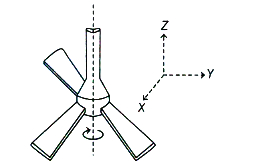
$A$ ceiling fan is rotating around a fixed axle as shown. The direction of angular velocity is along $\qquad$
A
$+\hat{j}$
B
$-\hat{j}$
C
$+\hat{k}$
D
$-\hat{k}$
Solution
(D) To determine the direction of the angular velocity vector $\vec{\omega}$,we use the right-hand thumb rule.
According to this rule,if we curl the fingers of our right hand in the direction of rotation of the fan,the thumb points in the direction of the angular velocity vector.
In the given figure,the fan is rotating in a clockwise direction when viewed from above.
Since the axle is along the $Z$-axis,the rotation occurs in the $XY$-plane.
Applying the right-hand rule,the thumb points downwards,which is in the negative $Z$-direction.
Therefore,the direction of angular velocity is along $-\hat{k}$.
According to this rule,if we curl the fingers of our right hand in the direction of rotation of the fan,the thumb points in the direction of the angular velocity vector.
In the given figure,the fan is rotating in a clockwise direction when viewed from above.
Since the axle is along the $Z$-axis,the rotation occurs in the $XY$-plane.
Applying the right-hand rule,the thumb points downwards,which is in the negative $Z$-direction.
Therefore,the direction of angular velocity is along $-\hat{k}$.
0 likesView Solution
15
PhysicsMediumMCQKCET · 2024
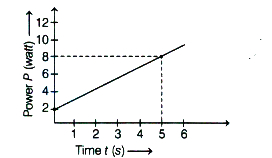
$A$ particle of mass $500 \text{ g}$ is at rest. It is free to move along a straight line. The power delivered to the particle varies with time according to the following graph. The momentum of the particle at $t = 5 \text{ s}$ is
A
$2 \sqrt{5} \text{ N-s}$
B
$5 \sqrt{2} \text{ N-s}$
C
$5 \text{ N-s}$
D
$5.5 \text{ N-s}$
Solution
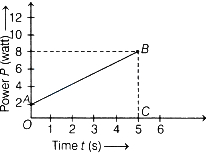
(C) The area under the $P-t$ graph is equal to the work done, which is equal to the change in kinetic energy $(\Delta K)$.
Given mass $m = 500 \text{ g} = 0.5 \text{ kg}$.
The area of the trapezoid $OABC$ is given by:
$\text{Area} = \frac{1}{2} \times (\text{sum of parallel sides}) \times (\text{height})$
$\text{Area} = \frac{1}{2} \times (2 + 8) \times 5 = \frac{1}{2} \times 10 \times 5 = 25 \text{ J}$.
Since the particle starts from rest, the initial kinetic energy is $0$. Thus, the final kinetic energy at $t = 5 \text{ s}$ is $K = 25 \text{ J}$.
We know that kinetic energy $K = \frac{p^2}{2m}$, where $p$ is the momentum.
$25 = \frac{p^2}{2 \times 0.5}$
$25 = \frac{p^2}{1}$
$p^2 = 25$
$p = 5 \text{ kg m/s} = 5 \text{ N-s}$.
Given mass $m = 500 \text{ g} = 0.5 \text{ kg}$.
The area of the trapezoid $OABC$ is given by:
$\text{Area} = \frac{1}{2} \times (\text{sum of parallel sides}) \times (\text{height})$
$\text{Area} = \frac{1}{2} \times (2 + 8) \times 5 = \frac{1}{2} \times 10 \times 5 = 25 \text{ J}$.
Since the particle starts from rest, the initial kinetic energy is $0$. Thus, the final kinetic energy at $t = 5 \text{ s}$ is $K = 25 \text{ J}$.
We know that kinetic energy $K = \frac{p^2}{2m}$, where $p$ is the momentum.
$25 = \frac{p^2}{2 \times 0.5}$
$25 = \frac{p^2}{1}$
$p^2 = 25$
$p = 5 \text{ kg m/s} = 5 \text{ N-s}$.
0 likesView Solution
16
PhysicsEasyMCQKCET · 2024
In an $L-C-R$ series circuit,the value of only capacitance $C$ is varied. The resulting variation of resonance frequency $f_0$ as a function of $C$ can be represented as
A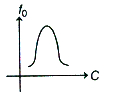
B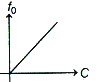
C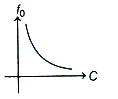
D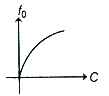
Solution
(C) The resonance frequency $f_0$ in an $L-C-R$ series circuit is given by the formula:
$f_0 = \frac{1}{2 \pi \sqrt{L C}}$
From this expression,we can see that the resonance frequency is inversely proportional to the square root of the capacitance:
$f_0 \propto \frac{1}{\sqrt{C}}$
As the value of capacitance $C$ increases,the resonance frequency $f_0$ decreases. This relationship represents a hyperbolic curve,which corresponds to the graph shown in option $C$.
$f_0 = \frac{1}{2 \pi \sqrt{L C}}$
From this expression,we can see that the resonance frequency is inversely proportional to the square root of the capacitance:
$f_0 \propto \frac{1}{\sqrt{C}}$
As the value of capacitance $C$ increases,the resonance frequency $f_0$ decreases. This relationship represents a hyperbolic curve,which corresponds to the graph shown in option $C$.
0 likesView Solution
17
PhysicsMediumMCQKCET · 2024
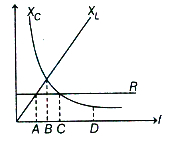
The figure shows the variation of $R$,$X_L$,and $X_C$ with frequency $f$ in a series $L-C-R$ circuit. For what frequency point is the circuit capacitive?
A
$B$
B
$D$
C
$A$
D
$C$
Solution
(C) In a series $L-C-R$ circuit,the circuit is capacitive when the capacitive reactance $X_C$ is greater than the inductive reactance $X_L$ (i.e.,$X_C > X_L$).
From the given graph,the intersection point $B$ represents the resonance frequency where $X_L = X_C$.
For frequencies less than the resonance frequency (i.e.,to the left of point $B$),the curve for $X_C$ lies above the curve for $X_L$,meaning $X_C > X_L$.
Among the given options,point $A$ lies to the left of point $B$,where $X_C > X_L$. Therefore,the circuit is capacitive at point $A$.
From the given graph,the intersection point $B$ represents the resonance frequency where $X_L = X_C$.
For frequencies less than the resonance frequency (i.e.,to the left of point $B$),the curve for $X_C$ lies above the curve for $X_L$,meaning $X_C > X_L$.
Among the given options,point $A$ lies to the left of point $B$,where $X_C > X_L$. Therefore,the circuit is capacitive at point $A$.
0 likesView Solution
18
PhysicsEasyMCQKCET · 2024
Which of the following combinations should be selected for better tuning of an $L-C-R$ circuit used for communication?
A
$R=20 \Omega, L=1.5 \text{ H}, C=35 \mu\text{F}$
B
$R=25 \Omega, L=2.5 \text{ H}, C=45 \mu\text{F}$
C
$R=25 \Omega, L=1.5 \text{ H}, C=45 \mu\text{F}$
D
$R=15 \Omega, L=3.5 \text{ H}, C=30 \mu\text{F}$
Solution
(D) For better tuning of an $L-C-R$ circuit used in communication,the quality factor $Q$ must be high.
The formula for the quality factor is $Q = \frac{1}{R} \sqrt{\frac{L}{C}}$.
To maximize $Q$,we need a small resistance $R$,a large inductance $L$,and a small capacitance $C$.
Comparing the given options:
$A: R=20, L=1.5, C=35$
$B: R=25, L=2.5, C=45$
$C: R=25, L=1.5, C=45$
$D: R=15, L=3.5, C=30$
Option $D$ has the minimum resistance $(15 \Omega)$,the maximum inductance $(3.5 \text{ H})$,and the minimum capacitance $(30 \mu\text{F})$.
Therefore,the combination in option $D$ provides the highest quality factor,resulting in better tuning.
The formula for the quality factor is $Q = \frac{1}{R} \sqrt{\frac{L}{C}}$.
To maximize $Q$,we need a small resistance $R$,a large inductance $L$,and a small capacitance $C$.
Comparing the given options:
$A: R=20, L=1.5, C=35$
$B: R=25, L=2.5, C=45$
$C: R=25, L=1.5, C=45$
$D: R=15, L=3.5, C=30$
Option $D$ has the minimum resistance $(15 \Omega)$,the maximum inductance $(3.5 \text{ H})$,and the minimum capacitance $(30 \mu\text{F})$.
Therefore,the combination in option $D$ provides the highest quality factor,resulting in better tuning.
0 likesView Solution
19
PhysicsMediumMCQKCET · 2024
In the alpha particle scattering experiment,if $v$ is the initial velocity of the particle,then the distance of closest approach is $d$. If the velocity is doubled,then the distance of closest approach changes to:
A
$4 d$
B
$2 d$
C
$\frac{d}{2}$
D
$\frac{d}{4}$
Solution
(D) The distance of closest approach $r_0$ is determined by equating the initial kinetic energy of the alpha particle to the electrostatic potential energy at the point of closest approach:
$\frac{1}{2} m v^2 = \frac{1}{4 \pi \varepsilon_0} \cdot \frac{(Ze)(2e)}{r_0}$
From this equation,we can see that $v^2 \propto \frac{1}{r_0}$,which implies $r_0 \propto \frac{1}{v^2}$.
Given that the initial distance of closest approach is $d$ for velocity $v$,let the new distance be $d'$ for velocity $2v$.
$\frac{d'}{d} = \frac{v^2}{(2v)^2} = \frac{v^2}{4v^2} = \frac{1}{4}$
Therefore,$d' = \frac{d}{4}$.
$\frac{1}{2} m v^2 = \frac{1}{4 \pi \varepsilon_0} \cdot \frac{(Ze)(2e)}{r_0}$
From this equation,we can see that $v^2 \propto \frac{1}{r_0}$,which implies $r_0 \propto \frac{1}{v^2}$.
Given that the initial distance of closest approach is $d$ for velocity $v$,let the new distance be $d'$ for velocity $2v$.
$\frac{d'}{d} = \frac{v^2}{(2v)^2} = \frac{v^2}{4v^2} = \frac{1}{4}$
Therefore,$d' = \frac{d}{4}$.
0 likesView Solution
20
PhysicsEasyMCQKCET · 2024
The ratio of the area of the first excited state to the ground state orbit of a hydrogen atom is:
A
$1: 16$
B
$1: 4$
C
$4: 1$
D
$16: 1$
Solution
(D) The radius of the $n^{th}$ orbit of a hydrogen atom is given by $r_n \propto n^2$.
Since the area $A$ of the orbit is $A = \pi r_n^2$,we have $A_n \propto (n^2)^2 = n^4$.
For the ground state,$n_1 = 1$.
For the first excited state,$n_2 = 2$.
The ratio of the area of the first excited state $(A_2)$ to the ground state $(A_1)$ is:
$\frac{A_2}{A_1} = \left(\frac{n_2}{n_1}\right)^4 = \left(\frac{2}{1}\right)^4 = 16$.
Therefore,the ratio is $16: 1$.
Since the area $A$ of the orbit is $A = \pi r_n^2$,we have $A_n \propto (n^2)^2 = n^4$.
For the ground state,$n_1 = 1$.
For the first excited state,$n_2 = 2$.
The ratio of the area of the first excited state $(A_2)$ to the ground state $(A_1)$ is:
$\frac{A_2}{A_1} = \left(\frac{n_2}{n_1}\right)^4 = \left(\frac{2}{1}\right)^4 = 16$.
Therefore,the ratio is $16: 1$.
0 likesView Solution
21
PhysicsEasyMCQKCET · 2024
The ratio of the volume of an $Al^{27}$ nucleus to its surface area is (Given,$R_0 = 1.2 \times 10^{-15} \ m$):
A
$2.1 \times 10^{-15} \ m$
B
$1.3 \times 10^{-15} \ m$
C
$0.22 \times 10^{-15} \ m$
D
$1.2 \times 10^{-15} \ m$
Solution
(D) The volume of a nucleus is given by $V = \frac{4}{3} \pi R^3$ and its surface area is $S = 4 \pi R^2$.
The ratio of volume to surface area is $\frac{V}{S} = \frac{\frac{4}{3} \pi R^3}{4 \pi R^2} = \frac{R}{3}$.
The radius of a nucleus is given by $R = R_0 A^{1/3}$,where $A$ is the mass number.
For $Al^{27}$,$A = 27$. Thus,$R = R_0 (27)^{1/3} = 3 R_0$.
Substituting this into the ratio: $\frac{V}{S} = \frac{3 R_0}{3} = R_0$.
Given $R_0 = 1.2 \times 10^{-15} \ m$,the ratio is $1.2 \times 10^{-15} \ m$.
The ratio of volume to surface area is $\frac{V}{S} = \frac{\frac{4}{3} \pi R^3}{4 \pi R^2} = \frac{R}{3}$.
The radius of a nucleus is given by $R = R_0 A^{1/3}$,where $A$ is the mass number.
For $Al^{27}$,$A = 27$. Thus,$R = R_0 (27)^{1/3} = 3 R_0$.
Substituting this into the ratio: $\frac{V}{S} = \frac{3 R_0}{3} = R_0$.
Given $R_0 = 1.2 \times 10^{-15} \ m$,the ratio is $1.2 \times 10^{-15} \ m$.
0 likesView Solution
22
PhysicsDifficultMCQKCET · 2024
$A$ capacitor of capacitance $5 \mu F$ is charged by a battery of emf $10 \text{ V}$. At an instant of time,the potential difference across the capacitor is $4 \text{ V}$ and the time rate of change of potential difference across the capacitor is $0.6 \text{ Vs}^{-1}$. Then,the time rate at which energy is stored in the capacitor at that instant is:
A
$12 \mu \text{W}$
B
$3 \mu \text{W}$
C
Zero
D
$30 \mu \text{W}$
Solution
(A) Given: Capacitance $C = 5 \mu \text{F} = 5 \times 10^{-6} \text{ F}$.
Potential difference $V = 4 \text{ V}$.
Rate of change of potential difference $\frac{dV}{dt} = 0.6 \text{ Vs}^{-1}$.
The energy stored in a capacitor is given by $U = \frac{1}{2}CV^2$.
To find the time rate at which energy is stored,we differentiate $U$ with respect to time $t$:
$\frac{dU}{dt} = \frac{d}{dt} (\frac{1}{2}CV^2) = \frac{1}{2}C \cdot 2V \cdot \frac{dV}{dt} = CV \frac{dV}{dt}$.
Substituting the given values:
$\frac{dU}{dt} = (5 \times 10^{-6} \text{ F}) \times (4 \text{ V}) \times (0.6 \text{ Vs}^{-1})$.
$\frac{dU}{dt} = 20 \times 0.6 \times 10^{-6} \text{ W} = 12 \times 10^{-6} \text{ W} = 12 \mu \text{W}$.
Potential difference $V = 4 \text{ V}$.
Rate of change of potential difference $\frac{dV}{dt} = 0.6 \text{ Vs}^{-1}$.
The energy stored in a capacitor is given by $U = \frac{1}{2}CV^2$.
To find the time rate at which energy is stored,we differentiate $U$ with respect to time $t$:
$\frac{dU}{dt} = \frac{d}{dt} (\frac{1}{2}CV^2) = \frac{1}{2}C \cdot 2V \cdot \frac{dV}{dt} = CV \frac{dV}{dt}$.
Substituting the given values:
$\frac{dU}{dt} = (5 \times 10^{-6} \text{ F}) \times (4 \text{ V}) \times (0.6 \text{ Vs}^{-1})$.
$\frac{dU}{dt} = 20 \times 0.6 \times 10^{-6} \text{ W} = 12 \times 10^{-6} \text{ W} = 12 \mu \text{W}$.
0 likesView Solution
23
PhysicsEasyMCQKCET · 2024
$E$ is the electric field inside a conductor whose material has conductivity $\sigma$ and resistivity $\rho$. The current density inside the conductor is $J$. The correct form of Ohm's law is
A
$E=\sigma J$
B
$J=\rho E$
C
$E=\rho J$
D
$E \cdot J=\rho$
Solution
(C) We know that Ohm's law is given by $V = I R$.
Substituting $V = E \cdot l$ and $R = \rho \cdot \frac{l}{A}$,where $l$ is the length and $A$ is the cross-sectional area of the conductor,we get:
$E \cdot l = I \cdot \rho \cdot \frac{l}{A}$
Dividing both sides by $l$,we get:
$E = \left( \frac{I}{A} \right) \rho$
Since current density $J = \frac{I}{A}$,we substitute this into the equation:
$E = J \rho$ or $E = \rho J$.
Substituting $V = E \cdot l$ and $R = \rho \cdot \frac{l}{A}$,where $l$ is the length and $A$ is the cross-sectional area of the conductor,we get:
$E \cdot l = I \cdot \rho \cdot \frac{l}{A}$
Dividing both sides by $l$,we get:
$E = \left( \frac{I}{A} \right) \rho$
Since current density $J = \frac{I}{A}$,we substitute this into the equation:
$E = J \rho$ or $E = \rho J$.
0 likesView Solution
24
PhysicsEasyMCQKCET · 2024
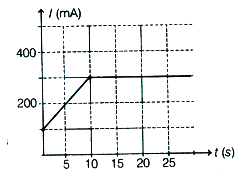
The electric current flowing through a given conductor varies with time as shown in the graph below. The number of free electrons which flow through a given cross-section of the conductor in the time interval $0 \leq t \leq 20 \ s$ is
A
$3.125 \times 10^{19}$
B
$1.6 \times 10^{19}$
C
$6.25 \times 10^{18}$
D
$1.625 \times 10^{18}$
Solution
(A) The total charge $Q$ flowing through the cross-section of the conductor is equal to the area under the $I-t$ graph.
From the graph,for $0 \leq t \leq 10 \ s$,the current increases linearly from $100 \ mA$ to $300 \ mA$. The area is a trapezoid: $A_1 = \frac{(100 + 300) \times 10^{-3} \ A}{2} \times 10 \ s = 2 \ C$.
For $10 \ s \leq t \leq 20 \ s$,the current is constant at $300 \ mA$. The area is a rectangle: $A_2 = 300 \times 10^{-3} \ A \times (20 - 10) \ s = 3 \ C$.
Total charge $Q = A_1 + A_2 = 2 \ C + 3 \ C = 5 \ C$.
Using the quantization of charge,$Q = ne$,where $e = 1.6 \times 10^{-19} \ C$ is the charge of an electron.
$n = \frac{Q}{e} = \frac{5}{1.6 \times 10^{-19}} = 3.125 \times 10^{19}$.
From the graph,for $0 \leq t \leq 10 \ s$,the current increases linearly from $100 \ mA$ to $300 \ mA$. The area is a trapezoid: $A_1 = \frac{(100 + 300) \times 10^{-3} \ A}{2} \times 10 \ s = 2 \ C$.
For $10 \ s \leq t \leq 20 \ s$,the current is constant at $300 \ mA$. The area is a rectangle: $A_2 = 300 \times 10^{-3} \ A \times (20 - 10) \ s = 3 \ C$.
Total charge $Q = A_1 + A_2 = 2 \ C + 3 \ C = 5 \ C$.
Using the quantization of charge,$Q = ne$,where $e = 1.6 \times 10^{-19} \ C$ is the charge of an electron.
$n = \frac{Q}{e} = \frac{5}{1.6 \times 10^{-19}} = 3.125 \times 10^{19}$.
0 likesView Solution
25
PhysicsMediumMCQKCET · 2024
An electric bulb of $60 \, W, 120 \, V$ is to be connected to a $220 \, V$ source. What resistance should be connected in series with the bulb so that the bulb glows properly?
A
$50 \, \Omega$
B
$100 \, \Omega$
C
$200 \, \Omega$
D
$288 \, \Omega$
Solution
(C) First, calculate the resistance of the bulb using the formula $R = \frac{V^2}{P}$.
$R = \frac{120 \times 120}{60} = 240 \, \Omega$.
Next, calculate the rated current of the bulb using $I = \frac{P}{V}$.
$I = \frac{60}{120} = 0.5 \, A$.
For the bulb to glow properly, it must draw the same current $I = 0.5 \, A$ when connected to the $220 \, V$ source.
The total resistance $R_{total}$ required in the circuit is $R_{total} = \frac{V_{source}}{I} = \frac{220}{0.5} = 440 \, \Omega$.
Since the bulb and the additional resistor are in series, $R_{total} = R + R_{series}$.
Therefore, $R_{series} = R_{total} - R = 440 \, \Omega - 240 \, \Omega = 200 \, \Omega$.
$R = \frac{120 \times 120}{60} = 240 \, \Omega$.
Next, calculate the rated current of the bulb using $I = \frac{P}{V}$.
$I = \frac{60}{120} = 0.5 \, A$.
For the bulb to glow properly, it must draw the same current $I = 0.5 \, A$ when connected to the $220 \, V$ source.
The total resistance $R_{total}$ required in the circuit is $R_{total} = \frac{V_{source}}{I} = \frac{220}{0.5} = 440 \, \Omega$.
Since the bulb and the additional resistor are in series, $R_{total} = R + R_{series}$.
Therefore, $R_{series} = R_{total} - R = 440 \, \Omega - 240 \, \Omega = 200 \, \Omega$.
0 likesView Solution
26
PhysicsDifficultMCQKCET · 2024
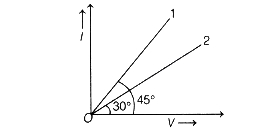
The $I-V$ graph for a conductor at two different temperatures $100^{\circ} C$ and $400^{\circ} C$ is as shown in the figure. The temperature coefficient of resistance of the conductor is about (in per degree Celsius).
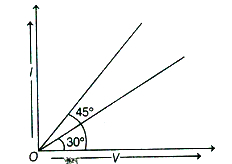
A
$3 \times 10^{-5}$
B
$8 \times 10^{-3}$
C
$9 \times 10^{-3}$
D
$12 \times 10^{-3}$
Solution
(A) From the $I-V$ graph,the slope represents $1/R$.
For temperature $t_1 = 100^{\circ} C$,the angle is $45^{\circ}$,so $1/R_1 = \tan 45^{\circ} = 1$,which gives $R_1 = 1 \Omega$.
For temperature $t_2 = 400^{\circ} C$,the angle is $30^{\circ}$,so $1/R_2 = \tan 30^{\circ} = 1/\sqrt{3}$,which gives $R_2 = \sqrt{3} \Omega \approx 1.732 \Omega$.
The temperature coefficient of resistance $\alpha$ is given by the formula:
$\alpha = \frac{R_2 - R_1}{R_1 t_2 - R_2 t_1} = \frac{\sqrt{3} - 1}{1 \times 400 - \sqrt{3} \times 100} = \frac{0.732}{400 - 173.2} = \frac{0.732}{226.8} \approx 3.22 \times 10^{-3} /^{\circ} C$.
Rounding to the nearest given option,the value is approximately $3 \times 10^{-3} /^{\circ} C$.
For temperature $t_1 = 100^{\circ} C$,the angle is $45^{\circ}$,so $1/R_1 = \tan 45^{\circ} = 1$,which gives $R_1 = 1 \Omega$.
For temperature $t_2 = 400^{\circ} C$,the angle is $30^{\circ}$,so $1/R_2 = \tan 30^{\circ} = 1/\sqrt{3}$,which gives $R_2 = \sqrt{3} \Omega \approx 1.732 \Omega$.
The temperature coefficient of resistance $\alpha$ is given by the formula:
$\alpha = \frac{R_2 - R_1}{R_1 t_2 - R_2 t_1} = \frac{\sqrt{3} - 1}{1 \times 400 - \sqrt{3} \times 100} = \frac{0.732}{400 - 173.2} = \frac{0.732}{226.8} \approx 3.22 \times 10^{-3} /^{\circ} C$.
Rounding to the nearest given option,the value is approximately $3 \times 10^{-3} /^{\circ} C$.
0 likesView Solution
27
PhysicsDifficultMCQKCET · 2024
In an experiment to determine the temperature coefficient of resistance of a conductor,a coil of wire $X$ is immersed in a liquid. It is heated by an external agent. $A$ meter bridge setup is used to determine the resistance of the coil $X$ at different temperatures. The balancing points measured at temperatures $t_1=0^{\circ} C$ and $t_2=100^{\circ} C$ are $50 \ cm$ and $60 \ cm$ respectively. If the standard resistance taken out is $S=4 \ \Omega$ in both trials,the temperature coefficient of the coil is
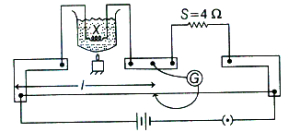
A
$0.05^{\circ} C^{-1}$
B
$0.02^{\circ} C^{-1}$
C
$0.005^{\circ} C^{-1}$
D
$2.0^{\circ} C^{-1}$
Solution
(C) Standard resistance,$S=4 \ \Omega$.
At $t_1=0^{\circ} C$,the balancing length is $l_1=50 \ cm$.
The resistance of the coil $X$ is given by $R_1 = \frac{l_1}{100-l_1} \times S$.
$R_1 = \frac{50}{100-50} \times 4 = \frac{50}{50} \times 4 = 4 \ \Omega$.
At $t_2=100^{\circ} C$,the balancing length is $l_2=60 \ cm$.
The resistance of the coil $X$ is $R_2 = \frac{l_2}{100-l_2} \times S$.
$R_2 = \frac{60}{100-60} \times 4 = \frac{60}{40} \times 4 = 6 \ \Omega$.
The temperature coefficient of resistance $\alpha$ is given by $\alpha = \frac{R_2 - R_1}{R_1(t_2 - t_1)}$.
$\alpha = \frac{6 - 4}{4(100 - 0)} = \frac{2}{400} = 0.005^{\circ} C^{-1}$.
At $t_1=0^{\circ} C$,the balancing length is $l_1=50 \ cm$.
The resistance of the coil $X$ is given by $R_1 = \frac{l_1}{100-l_1} \times S$.
$R_1 = \frac{50}{100-50} \times 4 = \frac{50}{50} \times 4 = 4 \ \Omega$.
At $t_2=100^{\circ} C$,the balancing length is $l_2=60 \ cm$.
The resistance of the coil $X$ is $R_2 = \frac{l_2}{100-l_2} \times S$.
$R_2 = \frac{60}{100-60} \times 4 = \frac{60}{40} \times 4 = 6 \ \Omega$.
The temperature coefficient of resistance $\alpha$ is given by $\alpha = \frac{R_2 - R_1}{R_1(t_2 - t_1)}$.
$\alpha = \frac{6 - 4}{4(100 - 0)} = \frac{2}{400} = 0.005^{\circ} C^{-1}$.
0 likesView Solution
28
PhysicsMediumMCQKCET · 2024
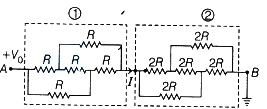
In the circuit shown,the end $A$ is at potential $V_0$ and end $B$ is grounded. The electric current $I$ indicated in the circuit is
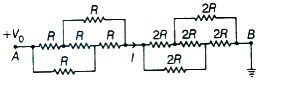
A
$V_0 / R$
B
$2 V_0 / R$
C
$3 V_0 / R$
D
$V_0 / 3 R$
Solution
(D) The circuit consists of two networks connected in series.
Each network forms a balanced Wheatstone bridge.
For the first network,the equivalent resistance $R_1$ is calculated by simplifying the parallel combinations of resistors,which results in $R_1 = R$.
For the second network,the equivalent resistance $R_2$ is calculated similarly,which results in $R_2 = 2R$.
The total equivalent resistance of the circuit is $R_{AB} = R_1 + R_2 = R + 2R = 3R$.
Using Ohm's law,the current $I$ is given by $I = V_0 / R_{AB} = V_0 / 3R$.
Each network forms a balanced Wheatstone bridge.
For the first network,the equivalent resistance $R_1$ is calculated by simplifying the parallel combinations of resistors,which results in $R_1 = R$.
For the second network,the equivalent resistance $R_2$ is calculated similarly,which results in $R_2 = 2R$.
The total equivalent resistance of the circuit is $R_{AB} = R_1 + R_2 = R + 2R = 3R$.
Using Ohm's law,the current $I$ is given by $I = V_0 / R_{AB} = V_0 / 3R$.
0 likesView Solution
29
PhysicsEasyMCQKCET · 2024
$A$ galaxy is moving away from the Earth such that a spectral line at $600 \ nm$ is observed at $601 \ nm$. Then,the speed of the galaxy with respect to the Earth is (in $km \ s^{-1}$)
A
$500$
B
$50$
C
$200$
D
$20$
Solution
(A) Given,the original wavelength $\lambda = 600 \ nm = 600 \times 10^{-9} \ m$.
The observed wavelength $\lambda' = 601 \ nm = 601 \times 10^{-9} \ m$.
The change in wavelength is $\Delta \lambda = \lambda' - \lambda = (601 - 600) \times 10^{-9} \ m = 1 \times 10^{-9} \ m$.
According to the Doppler effect for light,the relation is $\frac{\Delta \lambda}{\lambda} = \frac{v}{c}$,where $v$ is the speed of the galaxy and $c$ is the speed of light $(c = 3 \times 10^8 \ m/s)$.
Therefore,$v = c \cdot \frac{\Delta \lambda}{\lambda} = (3 \times 10^8 \ m/s) \cdot \frac{1 \times 10^{-9} \ m}{600 \times 10^{-9} \ m}$.
$v = 3 \times 10^8 \cdot \frac{1}{600} = \frac{3 \times 10^8}{600} = 0.5 \times 10^6 \ m/s$.
$v = 500,000 \ m/s = 500 \ km/s$.
The observed wavelength $\lambda' = 601 \ nm = 601 \times 10^{-9} \ m$.
The change in wavelength is $\Delta \lambda = \lambda' - \lambda = (601 - 600) \times 10^{-9} \ m = 1 \times 10^{-9} \ m$.
According to the Doppler effect for light,the relation is $\frac{\Delta \lambda}{\lambda} = \frac{v}{c}$,where $v$ is the speed of the galaxy and $c$ is the speed of light $(c = 3 \times 10^8 \ m/s)$.
Therefore,$v = c \cdot \frac{\Delta \lambda}{\lambda} = (3 \times 10^8 \ m/s) \cdot \frac{1 \times 10^{-9} \ m}{600 \times 10^{-9} \ m}$.
$v = 3 \times 10^8 \cdot \frac{1}{600} = \frac{3 \times 10^8}{600} = 0.5 \times 10^6 \ m/s$.
$v = 500,000 \ m/s = 500 \ km/s$.
0 likesView Solution
30
PhysicsEasyMCQKCET · 2024
Light of energy $E$ falls normally on a metal of work function $\frac{E}{3}$. The kinetic energies $K$ of the photoelectrons are
A
$K = \frac{2E}{3}$
B
$K = \frac{E}{3}$
C
$0 \leq K \leq \frac{2E}{3}$
D
$0 \leq K \leq \frac{E}{3}$
Solution
(C) Given,energy of incident light is $E$ and work function is $\phi_0 = \frac{E}{3}$.
According to Einstein's photoelectric equation,the maximum kinetic energy $K_{\max}$ is given by:
$K_{\max} = E - \phi_0$
$K_{\max} = E - \frac{E}{3} = \frac{2E}{3}$.
Since photoelectrons are emitted with a range of energies from $0$ to $K_{\max}$ due to collisions within the metal,the kinetic energy $K$ of the photoelectrons lies in the range $0 \leq K \leq \frac{2E}{3}$.
According to Einstein's photoelectric equation,the maximum kinetic energy $K_{\max}$ is given by:
$K_{\max} = E - \phi_0$
$K_{\max} = E - \frac{E}{3} = \frac{2E}{3}$.
Since photoelectrons are emitted with a range of energies from $0$ to $K_{\max}$ due to collisions within the metal,the kinetic energy $K$ of the photoelectrons lies in the range $0 \leq K \leq \frac{2E}{3}$.
0 likesView Solution
31
PhysicsEasyMCQKCET · 2024
The photoelectric work function for a metal is $2.4 \ eV$. Among the four wavelengths,the wavelength of light for which photoemission does not take place is: (in $nm$)
A
$200$
B
$300$
C
$700$
D
$400$
Solution
(C) Given,work function $\phi_0 = 2.4 \ eV$.
Photoemission occurs only if the incident photon energy $E \ge \phi_0$,which implies the incident wavelength $\lambda \le \lambda_0$.
The threshold wavelength $\lambda_0$ is calculated as:
$\lambda_0 = \frac{1240 \ eV \cdot nm}{\phi_0} = \frac{1240}{2.4} \approx 516.7 \ nm$.
Photoemission will not take place if the incident wavelength $\lambda > \lambda_0$.
Comparing the given options:
$A) 200 \ nm < 516.7 \ nm$ (Emission occurs)
$B) 300 \ nm < 516.7 \ nm$ (Emission occurs)
$C) 700 \ nm > 516.7 \ nm$ (No emission)
$D) 400 \ nm < 516.7 \ nm$ (Emission occurs)
Therefore,for $700 \ nm$,photoemission does not take place.
Photoemission occurs only if the incident photon energy $E \ge \phi_0$,which implies the incident wavelength $\lambda \le \lambda_0$.
The threshold wavelength $\lambda_0$ is calculated as:
$\lambda_0 = \frac{1240 \ eV \cdot nm}{\phi_0} = \frac{1240}{2.4} \approx 516.7 \ nm$.
Photoemission will not take place if the incident wavelength $\lambda > \lambda_0$.
Comparing the given options:
$A) 200 \ nm < 516.7 \ nm$ (Emission occurs)
$B) 300 \ nm < 516.7 \ nm$ (Emission occurs)
$C) 700 \ nm > 516.7 \ nm$ (No emission)
$D) 400 \ nm < 516.7 \ nm$ (Emission occurs)
Therefore,for $700 \ nm$,photoemission does not take place.
0 likesView Solution
32
PhysicsMediumMCQKCET · 2024
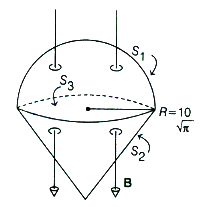
$A$ uniform magnetic field of strength $B=2 \text{ mT}$ exists vertically downwards. These magnetic field lines pass through a closed surface as shown in the figure. The closed surface consists of a hemisphere $S_1$,a right circular cone $S_2$,and a circular surface $S_3$. The magnetic flux through $S_1$ and $S_2$ are respectively:
A
$\Phi_{S_1}=-20 \mu \text{ Wb}, \Phi_{S_2}=+20 \mu \text{ Wb}$
B
$\Phi_{S_1}=+20 \mu \text{ Wb}, \Phi_{S_2}=-20 \mu \text{ Wb}$
C
$\Phi_{S_1}=-40 \mu \text{ Wb}, \Phi_{S_3}=+40 \mu \text{ Wb}$
D
$\Phi_{S_1}=+40 \mu \text{ Wb}, \Phi_{S_2}=-40 \mu \text{ Wb}$
Solution
(A) Given,$B = 2 \text{ mT} = 2 \times 10^{-3} \text{ T}$.
Radius $R = \frac{10}{\sqrt{\pi}} \text{ cm} = \frac{10}{\sqrt{\pi}} \times 10^{-2} \text{ m} = \frac{10^{-1}}{\sqrt{\pi}} \text{ m}$.
The area of the circular cross-section $S_3$ is $A = \pi R^2 = \pi \times \left(\frac{10^{-1}}{\sqrt{\pi}}\right)^2 = \pi \times \frac{10^{-2}}{\pi} = 10^{-2} \text{ m}^2$.
For the hemisphere $S_1$,the magnetic field lines enter the surface. The angle between the area vector (outward normal) and the magnetic field vector is $180^{\circ}$.
Flux $\Phi_{S_1} = B A \cos(180^{\circ}) = (2 \times 10^{-3} \text{ T}) \times (10^{-2} \text{ m}^2) \times (-1) = -2 \times 10^{-5} \text{ Wb} = -20 \times 10^{-6} \text{ Wb} = -20 \mu \text{ Wb}$.
Since the total magnetic flux through a closed surface is zero (Gauss's Law for magnetism),the flux leaving the cone $S_2$ must be equal in magnitude to the flux entering the hemisphere $S_1$.
Therefore,$\Phi_{S_1} + \Phi_{S_2} = 0 \implies \Phi_{S_2} = -\Phi_{S_1} = +20 \mu \text{ Wb}$.
Radius $R = \frac{10}{\sqrt{\pi}} \text{ cm} = \frac{10}{\sqrt{\pi}} \times 10^{-2} \text{ m} = \frac{10^{-1}}{\sqrt{\pi}} \text{ m}$.
The area of the circular cross-section $S_3$ is $A = \pi R^2 = \pi \times \left(\frac{10^{-1}}{\sqrt{\pi}}\right)^2 = \pi \times \frac{10^{-2}}{\pi} = 10^{-2} \text{ m}^2$.
For the hemisphere $S_1$,the magnetic field lines enter the surface. The angle between the area vector (outward normal) and the magnetic field vector is $180^{\circ}$.
Flux $\Phi_{S_1} = B A \cos(180^{\circ}) = (2 \times 10^{-3} \text{ T}) \times (10^{-2} \text{ m}^2) \times (-1) = -2 \times 10^{-5} \text{ Wb} = -20 \times 10^{-6} \text{ Wb} = -20 \mu \text{ Wb}$.
Since the total magnetic flux through a closed surface is zero (Gauss's Law for magnetism),the flux leaving the cone $S_2$ must be equal in magnitude to the flux entering the hemisphere $S_1$.
Therefore,$\Phi_{S_1} + \Phi_{S_2} = 0 \implies \Phi_{S_2} = -\Phi_{S_1} = +20 \mu \text{ Wb}$.
0 likesView Solution
33
PhysicsMediumMCQKCET · 2024
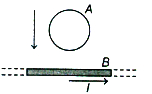
In the figure,a conducting ring of certain resistance is falling towards a current-carrying straight long conductor. The ring and conductor are in the same plane. Then,the:
A
induced electric current is zero
B
induced electric current is anti-clockwise
C
induced electric current is clockwise
D
ring will come to rest
Solution
(C) The magnetic field $B$ produced by a long straight current-carrying conductor at a distance $r$ is given by $B = \frac{\mu_0 I}{2 \pi r}$.
As the ring falls towards the conductor,the distance $r$ decreases,causing the magnetic field $B$ passing through the ring to increase.
According to the right-hand rule,the magnetic field lines from the conductor point out of the plane of the paper in the region where the ring is located.
Since the magnetic flux linked with the ring is increasing in the outward direction,according to Lenz's law,the induced current in the ring will create a magnetic field pointing into the plane of the paper to oppose this increase.
Using the right-hand grip rule,a magnetic field directed into the plane of the paper corresponds to a clockwise induced current in the ring.
As the ring falls towards the conductor,the distance $r$ decreases,causing the magnetic field $B$ passing through the ring to increase.
According to the right-hand rule,the magnetic field lines from the conductor point out of the plane of the paper in the region where the ring is located.
Since the magnetic flux linked with the ring is increasing in the outward direction,according to Lenz's law,the induced current in the ring will create a magnetic field pointing into the plane of the paper to oppose this increase.
Using the right-hand grip rule,a magnetic field directed into the plane of the paper corresponds to a clockwise induced current in the ring.
0 likesView Solution
34
PhysicsEasyMCQKCET · 2024
An induced current of $2 \text{ A}$ flows through a coil. The resistance of the coil is $10 \text{ } \Omega$. What is the change in magnetic flux associated with the coil in $1 \text{ ms}$?
A
$0.2 \times 10^{-2} \text{ Wb}$
B
$2 \times 10^{-2} \text{ Wb}$
C
$22 \times 10^{-2} \text{ Wb}$
D
$0.22 \times 10^{-2} \text{ Wb}$
Solution
(B) Given: Induced current $I = 2 \text{ A}$,Resistance $R = 10 \text{ } \Omega$,Time interval $\Delta t = 1 \text{ ms} = 10^{-3} \text{ s}$.
According to Faraday's law of induction,the magnitude of induced emf is $|\varepsilon| = \frac{\Delta \phi}{\Delta t}$.
Since $|\varepsilon| = I R$,we have $I R = \frac{\Delta \phi}{\Delta t}$.
Therefore,the change in magnetic flux is $\Delta \phi = I R \Delta t$.
Substituting the values: $\Delta \phi = 2 \times 10 \times 10^{-3} \text{ Wb}$.
$\Delta \phi = 20 \times 10^{-3} \text{ Wb} = 2 \times 10^{-2} \text{ Wb}$.
According to Faraday's law of induction,the magnitude of induced emf is $|\varepsilon| = \frac{\Delta \phi}{\Delta t}$.
Since $|\varepsilon| = I R$,we have $I R = \frac{\Delta \phi}{\Delta t}$.
Therefore,the change in magnetic flux is $\Delta \phi = I R \Delta t$.
Substituting the values: $\Delta \phi = 2 \times 10 \times 10^{-3} \text{ Wb}$.
$\Delta \phi = 20 \times 10^{-3} \text{ Wb} = 2 \times 10^{-2} \text{ Wb}$.
0 likesView Solution
35
PhysicsMediumMCQKCET · 2024
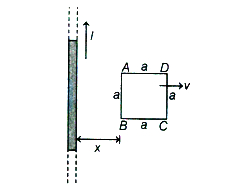
$A$ square loop of side length $a$ is moving away from an infinitely long current-carrying conductor at a constant speed $v$ as shown. Let $x$ be the instantaneous distance between the long conductor and side $AB$. The mutual inductance $M$ of the square loop-long conductor pair changes with time $t$ according to which of the following graphs?
A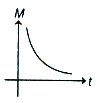
B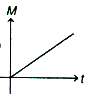
C
D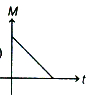
Solution
(A) The magnetic field $B$ produced by an infinitely long wire at a distance $r$ is given by $B = \frac{\mu_0 I}{2\pi r}$.
The magnetic flux $\phi$ through the square loop is $\phi = \int B \cdot dA = \int_{x}^{x+a} \frac{\mu_0 I}{2\pi r} (a \, dr) = \frac{\mu_0 I a}{2\pi} \ln\left(\frac{x+a}{x}\right)$.
The mutual inductance $M$ is defined as $M = \frac{\phi}{I} = \frac{\mu_0 a}{2\pi} \ln\left(1 + \frac{a}{x}\right)$.
Since the loop is moving at a constant speed $v$,the distance $x$ increases with time $t$ as $x = x_0 + vt$.
Substituting this into the expression for $M$,we get $M(t) = \frac{\mu_0 a}{2\pi} \ln\left(1 + \frac{a}{x_0 + vt}\right)$.
As $t$ increases,the term $\frac{a}{x_0 + vt}$ decreases,and therefore $\ln(1 + \frac{a}{x_0 + vt})$ decreases.
This corresponds to a curve that starts at a maximum value and decreases asymptotically towards zero as $t \to \infty$,which matches the graph shown in option $A$.
The magnetic flux $\phi$ through the square loop is $\phi = \int B \cdot dA = \int_{x}^{x+a} \frac{\mu_0 I}{2\pi r} (a \, dr) = \frac{\mu_0 I a}{2\pi} \ln\left(\frac{x+a}{x}\right)$.
The mutual inductance $M$ is defined as $M = \frac{\phi}{I} = \frac{\mu_0 a}{2\pi} \ln\left(1 + \frac{a}{x}\right)$.
Since the loop is moving at a constant speed $v$,the distance $x$ increases with time $t$ as $x = x_0 + vt$.
Substituting this into the expression for $M$,we get $M(t) = \frac{\mu_0 a}{2\pi} \ln\left(1 + \frac{a}{x_0 + vt}\right)$.
As $t$ increases,the term $\frac{a}{x_0 + vt}$ decreases,and therefore $\ln(1 + \frac{a}{x_0 + vt})$ decreases.
This corresponds to a curve that starts at a maximum value and decreases asymptotically towards zero as $t \to \infty$,which matches the graph shown in option $A$.
0 likesView Solution
36
PhysicsEasyMCQKCET · 2024
Electromagnetic waves are incident normally on a perfectly reflecting surface having surface area $A$. If $I$ is the intensity of the incident electromagnetic radiation and $c$ is the speed of light in vacuum,the force exerted by the electromagnetic wave on the reflecting surface is
A
$2 I A / c$
B
$I A / c$
C
$I A / 2 c$
D
$I / 2 A c$
Solution
(A) The intensity $I$ is defined as the power per unit area,so the power $P = I A$.
The momentum $p$ of a photon is given by $p = E / c$,where $E$ is the energy.
For a perfectly reflecting surface,the change in momentum $\Delta p$ for a photon is $p_{final} - p_{initial} = (-p) - (p) = -2p = -2E / c$.
The force $F$ is the rate of change of momentum,$F = \frac{dp}{dt} = \frac{2}{c} \frac{dE}{dt}$.
Since the power $P = \frac{dE}{dt} = I A$,the force exerted on the surface is $F = \frac{2 I A}{c}$.
The momentum $p$ of a photon is given by $p = E / c$,where $E$ is the energy.
For a perfectly reflecting surface,the change in momentum $\Delta p$ for a photon is $p_{final} - p_{initial} = (-p) - (p) = -2p = -2E / c$.
The force $F$ is the rate of change of momentum,$F = \frac{dp}{dt} = \frac{2}{c} \frac{dE}{dt}$.
Since the power $P = \frac{dE}{dt} = I A$,the force exerted on the surface is $F = \frac{2 I A}{c}$.
0 likesView Solution
37
PhysicsEasyMCQKCET · 2024
$A$ body has a charge of $-3.2 \mu C$. The number of excess electrons will be
A
$5.12 \times 10^{25}$
B
$5 \times 10^{12}$
C
$2 \times 10^{13}$
D
$5.12 \times 10^{13}$
Solution
(C) The charge on the body is given by $q = -3.2 \mu C = -3.2 \times 10^{-6} \ C$.
According to the quantization of charge,$q = ne$,where $n$ is the number of electrons and $e$ is the elementary charge $(e = -1.6 \times 10^{-19} \ C)$.
Therefore,the number of excess electrons is given by $n = \frac{q}{e}$.
$n = \frac{-3.2 \times 10^{-6} \ C}{-1.6 \times 10^{-19} \ C}$.
$n = 2 \times 10^{13}$.
According to the quantization of charge,$q = ne$,where $n$ is the number of electrons and $e$ is the elementary charge $(e = -1.6 \times 10^{-19} \ C)$.
Therefore,the number of excess electrons is given by $n = \frac{q}{e}$.
$n = \frac{-3.2 \times 10^{-6} \ C}{-1.6 \times 10^{-19} \ C}$.
$n = 2 \times 10^{13}$.
0 likesView Solution
38
PhysicsMediumMCQKCET · 2024
$A$ point charge $A$ of $+10 \mu C$ and another point charge $B$ of $+20 \mu C$ are kept $1 \ m$ apart in free space. The electrostatic force on $A$ due to $B$ is $F_1$ and the electrostatic force on $B$ due to $A$ is $F_2$. Then:
A
$F_1 = -2 F_2$
B
$F_1 = -F_2$
C
$2 F_1 = -F_2$
D
$F_1 = F_2$
Solution
(B) According to Coulomb's law and Newton's third law of motion,the electrostatic force exerted by one point charge on another is equal in magnitude and opposite in direction.
Let $\vec{F}_{AB}$ be the force on $A$ due to $B$ $(F_1)$ and $\vec{F}_{BA}$ be the force on $B$ due to $A$ $(F_2)$.
According to Newton's third law,$\vec{F}_{AB} = -\vec{F}_{BA}$.
Therefore,$F_1 = -F_2$.
Let $\vec{F}_{AB}$ be the force on $A$ due to $B$ $(F_1)$ and $\vec{F}_{BA}$ be the force on $B$ due to $A$ $(F_2)$.
According to Newton's third law,$\vec{F}_{AB} = -\vec{F}_{BA}$.
Therefore,$F_1 = -F_2$.
0 likesView Solution
39
PhysicsEasyMCQKCET · 2024
$A$ moving electron produces
A
only electric field
B
both electric and magnetic field
C
only magnetic field
D
neither electric nor magnetic field
Solution
(B) stationary charge produces an electric field in the space surrounding it.
When a charge is in motion,it constitutes an electric current.
An electric current produces a magnetic field in the space surrounding it.
Therefore,a moving electron produces both an electric field and a magnetic field.
When a charge is in motion,it constitutes an electric current.
An electric current produces a magnetic field in the space surrounding it.
Therefore,a moving electron produces both an electric field and a magnetic field.
0 likesView Solution
40
PhysicsDifficultMCQKCET · 2024
$A$ cube of side $1 \ cm$ contains $100$ molecules,each having an induced dipole moment of $0.2 \times 10^{-6} \ C \cdot m$ in an external electric field of $4 \ N \cdot C^{-1}$. The electric susceptibility of the material is .... $C^2 \cdot N^{-1} \cdot m^{-2}$.
A
$50$
B
$5$
C
$0.5$
D
$0.05$
Solution
(B) The volume of the cube is $V = (1 \ cm)^3 = 10^{-6} \ m^3$.
The number density of molecules is $n = \frac{100}{10^{-6}} = 10^8 \ m^{-3}$.
The polarization $P$ is given by $P = n \cdot p$,where $p$ is the induced dipole moment.
$P = 10^8 \times 0.2 \times 10^{-6} = 0.02 \ C \cdot m^{-2}$.
The relation between polarization $P$,electric susceptibility $\chi_e$,and electric field $E$ is $P = \epsilon_0 \chi_e E$. However,in many contexts,the susceptibility $\chi_e$ is defined via $P = \chi_e E$.
Using $P = \chi_e E$,we get $\chi_e = \frac{P}{E} = \frac{0.02}{4} = 0.005$.
Re-evaluating based on the provided solution logic: $\chi_e = \frac{n \cdot p}{E} = \frac{10^8 \times 0.2 \times 10^{-6}}{4} = \frac{20}{4} = 5$.
The number density of molecules is $n = \frac{100}{10^{-6}} = 10^8 \ m^{-3}$.
The polarization $P$ is given by $P = n \cdot p$,where $p$ is the induced dipole moment.
$P = 10^8 \times 0.2 \times 10^{-6} = 0.02 \ C \cdot m^{-2}$.
The relation between polarization $P$,electric susceptibility $\chi_e$,and electric field $E$ is $P = \epsilon_0 \chi_e E$. However,in many contexts,the susceptibility $\chi_e$ is defined via $P = \chi_e E$.
Using $P = \chi_e E$,we get $\chi_e = \frac{P}{E} = \frac{0.02}{4} = 0.005$.
Re-evaluating based on the provided solution logic: $\chi_e = \frac{n \cdot p}{E} = \frac{10^8 \times 0.2 \times 10^{-6}}{4} = \frac{20}{4} = 5$.
0 likesView Solution
41
PhysicsEasyMCQKCET · 2024
$A$ uniform electric field $E = 3 \times 10^5 \text{ NC}^{-1}$ is acting along the positive $Y$-axis. The electric flux through a rectangle of area $10 \text{ cm} \times 30 \text{ cm}$ whose plane is parallel to the $ZX$-plane is
A
$12 \times 10^3 \text{ Vm}$
B
$9 \times 10^3 \text{ Vm}$
C
$15 \times 10^3 \text{ Vm}$
D
$18 \times 10^5 \text{ Vm}$
Solution
(B) Given,electric field $\vec{E} = 3 \times 10^5 \hat{j} \text{ NC}^{-1}$.
Area of the rectangle $A = 10 \text{ cm} \times 30 \text{ cm} = 0.1 \text{ m} \times 0.3 \text{ m} = 3 \times 10^{-2} \text{ m}^2$.
Since the plane of the rectangle is parallel to the $ZX$-plane,its area vector $\vec{A}$ is directed along the $Y$-axis (normal to the $ZX$-plane).
Therefore,$\vec{A} = 3 \times 10^{-2} \hat{j} \text{ m}^2$.
The electric flux $\phi$ is given by the dot product of the electric field and the area vector:
$\phi = \vec{E} \cdot \vec{A} = (3 \times 10^5 \hat{j}) \cdot (3 \times 10^{-2} \hat{j})$
$\phi = 9 \times 10^3 \text{ Vm}$.
Area of the rectangle $A = 10 \text{ cm} \times 30 \text{ cm} = 0.1 \text{ m} \times 0.3 \text{ m} = 3 \times 10^{-2} \text{ m}^2$.
Since the plane of the rectangle is parallel to the $ZX$-plane,its area vector $\vec{A}$ is directed along the $Y$-axis (normal to the $ZX$-plane).
Therefore,$\vec{A} = 3 \times 10^{-2} \hat{j} \text{ m}^2$.
The electric flux $\phi$ is given by the dot product of the electric field and the area vector:
$\phi = \vec{E} \cdot \vec{A} = (3 \times 10^5 \hat{j}) \cdot (3 \times 10^{-2} \hat{j})$
$\phi = 9 \times 10^3 \text{ Vm}$.
0 likesView Solution
42
PhysicsEasyMCQKCET · 2024
The total electric flux through a closed spherical surface of radius $r$ enclosing an electric dipole of dipole moment $2aq$ is (Give $\varepsilon_0=$ permittivity of free space)
A
zero
B
$\frac{q}{\varepsilon_0}$
C
$\frac{2q}{\varepsilon_0}$
D
$\frac{8\pi r^2 q}{\varepsilon_0}$
Solution
(A) An electric dipole consists of two equal and opposite charges,$+q$ and $-q$,separated by a small distance.
Therefore,the net charge $q_{net}$ enclosed by the spherical surface is $q + (-q) = 0$.
According to Gauss's Law,the total electric flux $\phi$ through a closed surface is given by $\phi = \frac{q_{net}}{\varepsilon_0}$.
Substituting the value of $q_{net}$,we get $\phi = \frac{0}{\varepsilon_0} = 0$.
Therefore,the net charge $q_{net}$ enclosed by the spherical surface is $q + (-q) = 0$.
According to Gauss's Law,the total electric flux $\phi$ through a closed surface is given by $\phi = \frac{q_{net}}{\varepsilon_0}$.
Substituting the value of $q_{net}$,we get $\phi = \frac{0}{\varepsilon_0} = 0$.
0 likesView Solution
43
PhysicsDifficultMCQKCET · 2024
Under electrostatic condition of a charged conductor,which among the following statements is true?
A
The electric field on the surface of a charged conductor is $\frac{\sigma}{2 \varepsilon_0}$,where $\sigma$ is the surface charge density.
B
The electric potential inside a charged conductor is always zero.
C
Any excess charge resides on the surface of the conductor.
D
The net electric field is tangential to the surface of the conductor.
Solution
(C) In electrostatic equilibrium,the electric field inside a conductor is zero. According to Gauss's law,any excess charge placed on a conductor must reside entirely on its surface to minimize mutual repulsion.
The electric field just outside the surface of a charged conductor is given by $E = \frac{\sigma}{\varepsilon_0}$,where $\sigma$ is the surface charge density.
The electric potential inside a charged conductor is constant and equal to the potential at its surface,not zero.
The net electric field is always perpendicular (normal) to the surface of the conductor,not tangential.
Therefore,the correct statement is that any excess charge resides on the surface of the conductor.
The electric field just outside the surface of a charged conductor is given by $E = \frac{\sigma}{\varepsilon_0}$,where $\sigma$ is the surface charge density.
The electric potential inside a charged conductor is constant and equal to the potential at its surface,not zero.
The net electric field is always perpendicular (normal) to the surface of the conductor,not tangential.
Therefore,the correct statement is that any excess charge resides on the surface of the conductor.
0 likesView Solution
44
PhysicsMediumMCQKCET · 2024
$A$ coil having $9$ turns carrying a current produces a magnetic field $B_1$ at the centre. Now,the coil is rewound into $3$ turns carrying the same current. Then,the magnetic field at the centre $B_2$ is:
A
$B_1 / 9$
B
$9 B_1$
C
$3 B_1$
D
$B_1 / 3$
Solution
(A) Case-$I$: Number of turns,$N_1 = 9$. The magnetic field at the centre is given by $B_1 = \frac{\mu_0 N_1 I}{2 R} = \frac{9 \mu_0 I}{2 R}$.
Case-$II$: Number of turns,$N_2 = 3$. Let the new radius be $R'$. Since the total length of the wire remains constant,$N_1 (2 \pi R) = N_2 (2 \pi R')$.
Substituting the values: $9 (2 \pi R) = 3 (2 \pi R') \Rightarrow R' = 3 R$.
The new magnetic field is $B_2 = \frac{\mu_0 N_2 I}{2 R'} = \frac{\mu_0 \times 3 \times I}{2 \times 3 R} = \frac{\mu_0 I}{2 R}$.
Comparing $B_2$ with $B_1$: $\frac{B_2}{B_1} = \frac{\mu_0 I / 2 R}{9 \mu_0 I / 2 R} = \frac{1}{9}$.
Therefore,$B_2 = \frac{B_1}{9}$.
Case-$II$: Number of turns,$N_2 = 3$. Let the new radius be $R'$. Since the total length of the wire remains constant,$N_1 (2 \pi R) = N_2 (2 \pi R')$.
Substituting the values: $9 (2 \pi R) = 3 (2 \pi R') \Rightarrow R' = 3 R$.
The new magnetic field is $B_2 = \frac{\mu_0 N_2 I}{2 R'} = \frac{\mu_0 \times 3 \times I}{2 \times 3 R} = \frac{\mu_0 I}{2 R}$.
Comparing $B_2$ with $B_1$: $\frac{B_2}{B_1} = \frac{\mu_0 I / 2 R}{9 \mu_0 I / 2 R} = \frac{1}{9}$.
Therefore,$B_2 = \frac{B_1}{9}$.
0 likesView Solution
45
PhysicsEasyMCQKCET · 2024
The magnetic field at the centre of a circular coil of radius $R$ carrying current $I$ is $64$ times the magnetic field at a distance $x$ on its axis from the centre of the coil. Then,the value of $x$ is
A
$\frac{R}{4} \sqrt{15}$
B
$R \sqrt{3}$
C
$\frac{R}{4}$
D
$R \sqrt{15}$
Solution
(D) The magnetic field at the centre of a circular coil is given by $B_{\text{centre}} = \frac{\mu_0 I}{2R}$.
The magnetic field at a distance $x$ on the axis of the coil is given by $B_{\text{axis}} = \frac{\mu_0 I R^2}{2(R^2 + x^2)^{3/2}}$.
According to the problem,$B_{\text{centre}} = 64 \times B_{\text{axis}}$.
Substituting the formulas,we get $\frac{\mu_0 I}{2R} = 64 \times \frac{\mu_0 I R^2}{2(R^2 + x^2)^{3/2}}$.
Canceling common terms,we have $\frac{1}{R} = \frac{64 R^2}{(R^2 + x^2)^{3/2}}$.
This simplifies to $(R^2 + x^2)^{3/2} = 64 R^3$.
Taking the cube root of both sides,$(R^2 + x^2)^{1/2} = 4R$.
Squaring both sides,$R^2 + x^2 = 16R^2$.
Therefore,$x^2 = 15R^2$,which gives $x = R\sqrt{15}$.
The magnetic field at a distance $x$ on the axis of the coil is given by $B_{\text{axis}} = \frac{\mu_0 I R^2}{2(R^2 + x^2)^{3/2}}$.
According to the problem,$B_{\text{centre}} = 64 \times B_{\text{axis}}$.
Substituting the formulas,we get $\frac{\mu_0 I}{2R} = 64 \times \frac{\mu_0 I R^2}{2(R^2 + x^2)^{3/2}}$.
Canceling common terms,we have $\frac{1}{R} = \frac{64 R^2}{(R^2 + x^2)^{3/2}}$.
This simplifies to $(R^2 + x^2)^{3/2} = 64 R^3$.
Taking the cube root of both sides,$(R^2 + x^2)^{1/2} = 4R$.
Squaring both sides,$R^2 + x^2 = 16R^2$.
Therefore,$x^2 = 15R^2$,which gives $x = R\sqrt{15}$.
0 likesView Solution
46
PhysicsDifficultMCQKCET · 2024
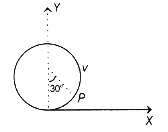
$A$ particle of specific charge $q / m = \pi \text{ C kg}^{-1}$ is projected from the origin towards the positive $X$-axis with a velocity $10 \text{ ms}^{-1}$ in a uniform magnetic field $\vec{B} = -2 \hat{k} \text{ T}$. The velocity $\vec{v}$ of the particle after time $t = \frac{1}{12} \text{ s}$ will be (in $\text{ ms}^{-1}$):
A
$5(\hat{i} + \hat{j})$
B
$5(\hat{i} + \sqrt{3} \hat{j})$
C
$5(\sqrt{3} \hat{i} - \hat{j})$
D
$5(\sqrt{3} \hat{i} + \hat{j})$
Solution
(D) The time period of a charged particle in a uniform magnetic field is given by $T = \frac{2 \pi m}{q B}$.
Given $q/m = \pi \text{ C kg}^{-1}$ and $B = 2 \text{ T}$,we have:
$T = \frac{2 \pi}{\pi \times 2} = 1 \text{ s}$.
The particle is projected along the $X$-axis. After time $t = \frac{1}{12} \text{ s}$,the angle of deviation $\theta$ is given by:
$\theta = \frac{t}{T} \times 360^{\circ} = \frac{1/12}{1} \times 360^{\circ} = 30^{\circ}$.
Since the magnetic field is in the $-\hat{k}$ direction,the particle moves in the $XY$-plane and deflects towards the positive $Y$-axis.
The velocity vector $\vec{v}$ at time $t$ is given by:
$\vec{v} = v_0 (\cos \theta \hat{i} + \sin \theta \hat{j})$
$\vec{v} = 10 (\cos 30^{\circ} \hat{i} + \sin 30^{\circ} \hat{j})$
$\vec{v} = 10 (\frac{\sqrt{3}}{2} \hat{i} + \frac{1}{2} \hat{j}) = 5(\sqrt{3} \hat{i} + \hat{j}) \text{ ms}^{-1}$.
Given $q/m = \pi \text{ C kg}^{-1}$ and $B = 2 \text{ T}$,we have:
$T = \frac{2 \pi}{\pi \times 2} = 1 \text{ s}$.
The particle is projected along the $X$-axis. After time $t = \frac{1}{12} \text{ s}$,the angle of deviation $\theta$ is given by:
$\theta = \frac{t}{T} \times 360^{\circ} = \frac{1/12}{1} \times 360^{\circ} = 30^{\circ}$.
Since the magnetic field is in the $-\hat{k}$ direction,the particle moves in the $XY$-plane and deflects towards the positive $Y$-axis.
The velocity vector $\vec{v}$ at time $t$ is given by:
$\vec{v} = v_0 (\cos \theta \hat{i} + \sin \theta \hat{j})$
$\vec{v} = 10 (\cos 30^{\circ} \hat{i} + \sin 30^{\circ} \hat{j})$
$\vec{v} = 10 (\frac{\sqrt{3}}{2} \hat{i} + \frac{1}{2} \hat{j}) = 5(\sqrt{3} \hat{i} + \hat{j}) \text{ ms}^{-1}$.
0 likesView Solution
47
PhysicsEasyMCQKCET · 2024
Magnetic hysteresis is exhibited by . . . . . . magnetic materials.
A
Only para
B
Only dia
C
Only ferro
D
Both para and ferro
Solution
(C) Magnetic hysteresis is a phenomenon where the magnetization of a material lags behind the applied external magnetic field.
This behavior is characteristic of ferromagnetic materials,such as iron $(Fe)$,nickel $(Ni)$,and cobalt $(Co)$.
In these materials,the formation and movement of magnetic domains result in energy loss during a complete cycle of magnetization and demagnetization,which is represented by the hysteresis loop.
Paramagnetic and diamagnetic materials do not exhibit this property.
This behavior is characteristic of ferromagnetic materials,such as iron $(Fe)$,nickel $(Ni)$,and cobalt $(Co)$.
In these materials,the formation and movement of magnetic domains result in energy loss during a complete cycle of magnetization and demagnetization,which is represented by the hysteresis loop.
Paramagnetic and diamagnetic materials do not exhibit this property.
0 likesView Solution
48
PhysicsEasyMCQKCET · 2024
Magnetic susceptibility of $Mg$ at $300 \ K$ is $1.2 \times 10^{-5}$. What is its susceptibility at $200 \ K$?
A
$18 \times 10^{-3}$
B
$180 \times 10^{-5}$
C
$1.8 \times 10^{-5}$
D
$0.18 \times 10^{-5}$
Solution
(C) For paramagnetic materials,the magnetic susceptibility $\chi$ is inversely proportional to the absolute temperature $T$,according to Curie's Law: $\chi \propto \frac{1}{T}$.
Given: $\chi_1 = 1.2 \times 10^{-5}$ at $T_1 = 300 \ K$.
We need to find $\chi_2$ at $T_2 = 200 \ K$.
Using the relation $\frac{\chi_2}{\chi_1} = \frac{T_1}{T_2}$,we get:
$\chi_2 = \chi_1 \times \frac{T_1}{T_2}$
$\chi_2 = 1.2 \times 10^{-5} \times \frac{300}{200}$
$\chi_2 = 1.2 \times 10^{-5} \times 1.5$
$\chi_2 = 1.8 \times 10^{-5}$.
Given: $\chi_1 = 1.2 \times 10^{-5}$ at $T_1 = 300 \ K$.
We need to find $\chi_2$ at $T_2 = 200 \ K$.
Using the relation $\frac{\chi_2}{\chi_1} = \frac{T_1}{T_2}$,we get:
$\chi_2 = \chi_1 \times \frac{T_1}{T_2}$
$\chi_2 = 1.2 \times 10^{-5} \times \frac{300}{200}$
$\chi_2 = 1.2 \times 10^{-5} \times 1.5$
$\chi_2 = 1.8 \times 10^{-5}$.
0 likesView Solution
49
PhysicsMediumMCQKCET · 2024
Consider the nuclear fission reaction ${ }_0^1 n+{ }_{92}^{235} U \longrightarrow{ }_{56}^{144} Ba+{ }_{36}^{89} Kr+3{ }_0^1 n$. Assuming all the kinetic energy is carried away by the fast neutrons only and total binding energies of ${ }_{92}^{235} U, { }_{56}^{144} Ba$ and ${ }_{36}^{89} Kr$ to be $1800 \ MeV, 1200 \ MeV$ and $780 \ MeV$ respectively,the average kinetic energy carried by each fast neutron is (in $MeV$):
A
$200$
B
$180$
C
$67$
D
$60$
Solution
(D) The energy released in a nuclear reaction is given by the difference in the total binding energy of the products and the reactants.
$Q = (BE_{\text{products}}) - (BE_{\text{reactants}})$
Given:
$BE(^{235}_{92}U) = 1800 \ MeV$
$BE(^{144}_{56}Ba) = 1200 \ MeV$
$BE(^{89}_{36}Kr) = 780 \ MeV$
Total $BE$ of reactants $= 1800 \ MeV$
Total $BE$ of products $= 1200 + 780 = 1980 \ MeV$
Energy released $Q = 1980 - 1800 = 180 \ MeV$
Since this energy is carried by $3$ neutrons,the average kinetic energy per neutron is:
$KE_{\text{avg}} = \frac{180 \ MeV}{3} = 60 \ MeV$
$Q = (BE_{\text{products}}) - (BE_{\text{reactants}})$
Given:
$BE(^{235}_{92}U) = 1800 \ MeV$
$BE(^{144}_{56}Ba) = 1200 \ MeV$
$BE(^{89}_{36}Kr) = 780 \ MeV$
Total $BE$ of reactants $= 1800 \ MeV$
Total $BE$ of products $= 1200 + 780 = 1980 \ MeV$
Energy released $Q = 1980 - 1800 = 180 \ MeV$
Since this energy is carried by $3$ neutrons,the average kinetic energy per neutron is:
$KE_{\text{avg}} = \frac{180 \ MeV}{3} = 60 \ MeV$
0 likesView Solution
50
PhysicsEasyMCQKCET · 2024
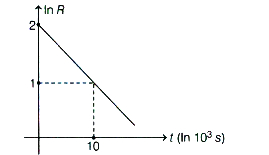
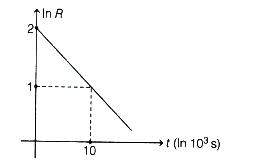
The natural logarithm of the activity $R$ of a radioactive sample varies with time $t$ as shown. At $t=0$,there are $N_0$ undecayed nuclei. Then,$N_0$ is equal to [Take $e^2=7.5$].
A
$7500$
B
$3500$
C
$75000$
D
$150000$
Solution
(C) The activity of a radioactive sample is given by $R = R_0 e^{-\lambda t}$.
Taking the natural logarithm on both sides,we get $\ln R = \ln R_0 - \lambda t$.
Comparing this with the equation of a straight line $y = mx + c$,the slope of the graph is $m = -\lambda$.
From the given graph,at $t = 0$,$\ln R_0 = 2$,which implies $R_0 = e^2 = 7.5$.
The slope of the graph is $\lambda = -\frac{\Delta(\ln R)}{\Delta t} = -\frac{1 - 2}{10 \times 10^3 - 0} = \frac{1}{10^4} = 10^{-4} \text{ s}^{-1}$.
We know that the activity $R_0 = \lambda N_0$,where $N_0$ is the number of undecayed nuclei at $t = 0$.
Therefore,$N_0 = \frac{R_0}{\lambda} = \frac{7.5}{10^{-4}} = 7.5 \times 10^4 = 75000$.
Taking the natural logarithm on both sides,we get $\ln R = \ln R_0 - \lambda t$.
Comparing this with the equation of a straight line $y = mx + c$,the slope of the graph is $m = -\lambda$.
From the given graph,at $t = 0$,$\ln R_0 = 2$,which implies $R_0 = e^2 = 7.5$.
The slope of the graph is $\lambda = -\frac{\Delta(\ln R)}{\Delta t} = -\frac{1 - 2}{10 \times 10^3 - 0} = \frac{1}{10^4} = 10^{-4} \text{ s}^{-1}$.
We know that the activity $R_0 = \lambda N_0$,where $N_0$ is the number of undecayed nuclei at $t = 0$.
Therefore,$N_0 = \frac{R_0}{\lambda} = \frac{7.5}{10^{-4}} = 7.5 \times 10^4 = 75000$.
0 likesView Solution
51
PhysicsMediumMCQKCET · 2024
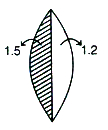
An equiconvex lens of radius of curvature $14 \ cm$ is made up of two different materials. The left half and right half of the vertical portion are made up of materials with refractive indices $1.5$ and $1.2$ respectively,as shown in the figure. If a point object is placed at a distance of $40 \ cm$,calculate the image distance. (in $cm$)
A
$25$
B
$50$
C
$35$
D
$40$
Solution
(D) From the diagram,the lens can be considered as a combination of two plano-convex lenses.
For the left half,the focal length $f_1$ is given by:
$\frac{1}{f_1} = (\mu_1 - 1) \left( \frac{1}{R_1} - \frac{1}{R_2} \right) = (1.5 - 1) \left( \frac{1}{R} - \frac{1}{\infty} \right) = \frac{0.5}{R}$
For the right half,the focal length $f_2$ is given by:
$\frac{1}{f_2} = (\mu_2 - 1) \left( \frac{1}{R_1} - \frac{1}{R_2} \right) = (1.2 - 1) \left( \frac{1}{\infty} - \frac{1}{-R} \right) = \frac{0.2}{R}$
The combined power of the lens is $P = P_1 + P_2$,so $\frac{1}{f} = \frac{1}{f_1} + \frac{1}{f_2}$.
$\frac{1}{f} = \frac{0.5}{R} + \frac{0.2}{R} = \frac{0.7}{14} = \frac{0.7}{14} = 0.05 \ cm^{-1}$.
Thus,$f = \frac{1}{0.05} = 20 \ cm$.
Using the lens formula $\frac{1}{f} = \frac{1}{v} - \frac{1}{u}$,where $u = -40 \ cm$ and $f = 20 \ cm$:
$\frac{1}{20} = \frac{1}{v} - \frac{1}{-40}$
$\frac{1}{v} = \frac{1}{20} - \frac{1}{40} = \frac{2-1}{40} = \frac{1}{40}$
Therefore,$v = 40 \ cm$.
For the left half,the focal length $f_1$ is given by:
$\frac{1}{f_1} = (\mu_1 - 1) \left( \frac{1}{R_1} - \frac{1}{R_2} \right) = (1.5 - 1) \left( \frac{1}{R} - \frac{1}{\infty} \right) = \frac{0.5}{R}$
For the right half,the focal length $f_2$ is given by:
$\frac{1}{f_2} = (\mu_2 - 1) \left( \frac{1}{R_1} - \frac{1}{R_2} \right) = (1.2 - 1) \left( \frac{1}{\infty} - \frac{1}{-R} \right) = \frac{0.2}{R}$
The combined power of the lens is $P = P_1 + P_2$,so $\frac{1}{f} = \frac{1}{f_1} + \frac{1}{f_2}$.
$\frac{1}{f} = \frac{0.5}{R} + \frac{0.2}{R} = \frac{0.7}{14} = \frac{0.7}{14} = 0.05 \ cm^{-1}$.
Thus,$f = \frac{1}{0.05} = 20 \ cm$.
Using the lens formula $\frac{1}{f} = \frac{1}{v} - \frac{1}{u}$,where $u = -40 \ cm$ and $f = 20 \ cm$:
$\frac{1}{20} = \frac{1}{v} - \frac{1}{-40}$
$\frac{1}{v} = \frac{1}{20} - \frac{1}{40} = \frac{2-1}{40} = \frac{1}{40}$
Therefore,$v = 40 \ cm$.
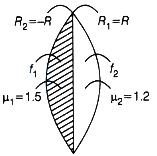
0 likesView Solution
52
PhysicsMediumMCQKCET · 2024
$A$ luminous point object $O$ is placed at a distance $2R$ from the spherical boundary separating two transparent media of refractive indices $n_1$ and $n_2$ as shown,where $R$ is the radius of curvature of the spherical surface. If $n_1 = \frac{4}{3}$,$n_2 = \frac{3}{2}$ and $R = 10 \text{ cm}$,the image is obtained at a distance from $P$ equal to:
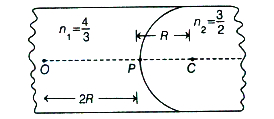
A
$30 \text{ cm}$ in the rarer medium
B
$30 \text{ cm}$ in the denser medium
C
$18 \text{ cm}$ in the rarer medium
D
$18 \text{ cm}$ in the denser medium
Solution
(A) Given: $n_1 = \frac{4}{3}$,$n_2 = \frac{3}{2}$,$R = 10 \text{ cm}$.
The object distance $u = -2R = -20 \text{ cm}$ (using sign convention).
The refraction formula at a spherical surface is given by:
$\frac{n_2}{v} - \frac{n_1}{u} = \frac{n_2 - n_1}{R}$
Substituting the values:
$\frac{3/2}{v} - \frac{4/3}{-20} = \frac{3/2 - 4/3}{10}$
$\frac{3}{2v} + \frac{4}{60} = \frac{1/6}{10}$
$\frac{3}{2v} + \frac{1}{15} = \frac{1}{60}$
$\frac{3}{2v} = \frac{1}{60} - \frac{1}{15} = \frac{1 - 4}{60} = -\frac{3}{60} = -\frac{1}{20}$
$\frac{3}{2v} = -\frac{1}{20}$
$2v = -60 \implies v = -30 \text{ cm}$.
Since $v$ is negative,the image is formed on the same side as the object (in the rarer medium) at a distance of $30 \text{ cm}$ from the pole $P$.
The object distance $u = -2R = -20 \text{ cm}$ (using sign convention).
The refraction formula at a spherical surface is given by:
$\frac{n_2}{v} - \frac{n_1}{u} = \frac{n_2 - n_1}{R}$
Substituting the values:
$\frac{3/2}{v} - \frac{4/3}{-20} = \frac{3/2 - 4/3}{10}$
$\frac{3}{2v} + \frac{4}{60} = \frac{1/6}{10}$
$\frac{3}{2v} + \frac{1}{15} = \frac{1}{60}$
$\frac{3}{2v} = \frac{1}{60} - \frac{1}{15} = \frac{1 - 4}{60} = -\frac{3}{60} = -\frac{1}{20}$
$\frac{3}{2v} = -\frac{1}{20}$
$2v = -60 \implies v = -30 \text{ cm}$.
Since $v$ is negative,the image is formed on the same side as the object (in the rarer medium) at a distance of $30 \text{ cm}$ from the pole $P$.
0 likesView Solution
53
PhysicsEasyMCQKCET · 2024
The final image formed by an astronomical telescope is
A
real,erect and diminished
B
virtual,inverted and diminished
C
real,inverted and magnified
D
virtual,inverted and magnified
Solution
(D) An astronomical telescope consists of two lenses: an objective lens and an eyepiece.
The objective lens forms a real,inverted,and diminished image of a distant object at its focal plane.
This image acts as an object for the eyepiece,which acts as a simple magnifier.
The eyepiece is adjusted so that the image lies within its focal length,resulting in a virtual,inverted,and magnified final image relative to the original distant object.
The objective lens forms a real,inverted,and diminished image of a distant object at its focal plane.
This image acts as an object for the eyepiece,which acts as a simple magnifier.
The eyepiece is adjusted so that the image lies within its focal length,resulting in a virtual,inverted,and magnified final image relative to the original distant object.
0 likesView Solution
54
PhysicsMediumMCQKCET · 2024
If the angle of minimum deviation is equal to the angle of an equilateral prism,then the speed of light inside the prism is .....
A
$3 \times 10^8 \ m/s$
B
$2 \sqrt{3} \times 10^8 \ m/s$
C
$\sqrt{3} \times 10^8 \ m/s$
D
$\frac{\sqrt{3}}{2} \times 10^8 \ m/s$
Solution
(C) Given,the prism is equilateral,so the angle of the prism $A = 60^{\circ}$.
Given that the angle of minimum deviation $\delta_m = A = 60^{\circ}$.
The refractive index $\mu$ of the prism is given by the formula:
$\mu = \frac{\sin \left(\frac{A + \delta_m}{2}\right)}{\sin \left(\frac{A}{2}\right)}$
Substituting the values:
$\mu = \frac{\sin \left(\frac{60^{\circ} + 60^{\circ}}{2}\right)}{\sin \left(\frac{60^{\circ}}{2}\right)} = \frac{\sin 60^{\circ}}{\sin 30^{\circ}} = \frac{\sqrt{3}/2}{1/2} = \sqrt{3}$.
We know that the refractive index $\mu$ is related to the speed of light in vacuum $c$ and the speed of light in the medium $v$ as $\mu = \frac{c}{v}$.
Therefore,$v = \frac{c}{\mu} = \frac{3 \times 10^8 \ m/s}{\sqrt{3}} = \sqrt{3} \times 10^8 \ m/s$.
Given that the angle of minimum deviation $\delta_m = A = 60^{\circ}$.
The refractive index $\mu$ of the prism is given by the formula:
$\mu = \frac{\sin \left(\frac{A + \delta_m}{2}\right)}{\sin \left(\frac{A}{2}\right)}$
Substituting the values:
$\mu = \frac{\sin \left(\frac{60^{\circ} + 60^{\circ}}{2}\right)}{\sin \left(\frac{60^{\circ}}{2}\right)} = \frac{\sin 60^{\circ}}{\sin 30^{\circ}} = \frac{\sqrt{3}/2}{1/2} = \sqrt{3}$.
We know that the refractive index $\mu$ is related to the speed of light in vacuum $c$ and the speed of light in the medium $v$ as $\mu = \frac{c}{v}$.
Therefore,$v = \frac{c}{\mu} = \frac{3 \times 10^8 \ m/s}{\sqrt{3}} = \sqrt{3} \times 10^8 \ m/s$.
0 likesView Solution
55
PhysicsMediumMCQKCET · 2024
In the diagram shown,the Zener diode has a reverse breakdown voltage of $V_Z$. The current through the load resistance $R_L$ is $I_L$. The current through the Zener diode is
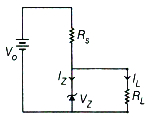
A
$\frac{V_0-V_Z}{R_S}$
B
$\frac{V_0-V_Z}{R_L}$
C
$\frac{V_Z}{R_L}$
D
$\left(\frac{V_0-V_Z}{R_S}\right)-I_L$
Solution
(D) From the circuit diagram,the total current $I$ flowing through the series resistor $R_S$ is given by the voltage drop across it divided by its resistance:
$I = \frac{V_0 - V_Z}{R_S}$
According to Kirchhoff's current law at the junction point,the total current $I$ splits into the Zener diode current $I_Z$ and the load current $I_L$:
$I = I_Z + I_L$
Rearranging this equation to solve for the Zener diode current $I_Z$:
$I_Z = I - I_L$
Substituting the expression for $I$:
$I_Z = \left(\frac{V_0 - V_Z}{R_S}\right) - I_L$
$I = \frac{V_0 - V_Z}{R_S}$
According to Kirchhoff's current law at the junction point,the total current $I$ splits into the Zener diode current $I_Z$ and the load current $I_L$:
$I = I_Z + I_L$
Rearranging this equation to solve for the Zener diode current $I_Z$:
$I_Z = I - I_L$
Substituting the expression for $I$:
$I_Z = \left(\frac{V_0 - V_Z}{R_S}\right) - I_L$
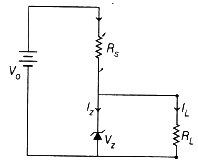
0 likesView Solution
56
PhysicsDifficultMCQKCET · 2024
$A$ $p-n$ junction diode is connected to a battery of emf $5.7 \ V$ in series with a resistor of $5 \ k\Omega$ such that it is forward biased. If the barrier potential of the diode is $0.7 \ V$,neglecting the diode resistance,the current in the circuit is:
A
$1.14 \ mA$
B
$1 \ mA$
C
$1 \ A$
D
$1.14 \ A$
Solution
(B) Given:
Battery emf,$V = 5.7 \ V$
Barrier potential of the diode,$V_B = 0.7 \ V$
Series resistance,$R_S = 5 \ k\Omega = 5 \times 10^3 \ \Omega$
In a forward-biased $p-n$ junction diode,the effective voltage across the resistor is the difference between the battery emf and the barrier potential.
Effective voltage,$V_{eff} = V - V_B = 5.7 \ V - 0.7 \ V = 5.0 \ V$
Using Ohm's law,the current $I$ in the circuit is:
$I = \frac{V_{eff}}{R_S} = \frac{5.0 \ V}{5 \times 10^3 \ \Omega} = 1 \times 10^{-3} \ A$
$I = 1 \ mA$
Battery emf,$V = 5.7 \ V$
Barrier potential of the diode,$V_B = 0.7 \ V$
Series resistance,$R_S = 5 \ k\Omega = 5 \times 10^3 \ \Omega$
In a forward-biased $p-n$ junction diode,the effective voltage across the resistor is the difference between the battery emf and the barrier potential.
Effective voltage,$V_{eff} = V - V_B = 5.7 \ V - 0.7 \ V = 5.0 \ V$
Using Ohm's law,the current $I$ in the circuit is:
$I = \frac{V_{eff}}{R_S} = \frac{5.0 \ V}{5 \times 10^3 \ \Omega} = 1 \times 10^{-3} \ A$
$I = 1 \ mA$
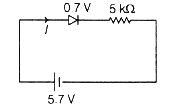
0 likesView Solution
57
PhysicsEasyMCQKCET · 2024
Depletion region in an unbiased semiconductor diode is a region consisting of
A
both free electrons and holes
B
neither free electrons nor holes
C
only free electrons
D
only holes
Solution
(B) In an unbiased $p-n$ junction diode,the diffusion of charge carriers across the junction creates a region depleted of mobile charge carriers.
This region is known as the depletion region.
It consists of immobile ionized donor and acceptor atoms (ions) fixed in the crystal lattice.
Since the mobile charge carriers (free electrons and holes) have diffused away or recombined,this region contains neither free electrons nor holes.
This region is known as the depletion region.
It consists of immobile ionized donor and acceptor atoms (ions) fixed in the crystal lattice.
Since the mobile charge carriers (free electrons and holes) have diffused away or recombined,this region contains neither free electrons nor holes.
0 likesView Solution
58
PhysicsMediumMCQKCET · 2024
The upper level of the valence band and the lower level of the conduction band overlap in the case of
A
silicon
B
copper
C
carbon
D
germanium
Solution
(B) In conductors,there is no forbidden energy gap between the conduction band and the valence band.
For materials like copper,which is a metal (conductor),the valence band and the conduction band overlap.
This overlapping allows electrons to move freely,which is why copper is a good conductor of electricity.
Silicon,germanium,and carbon (in diamond form) are semiconductors or insulators,where a forbidden energy gap exists.
For materials like copper,which is a metal (conductor),the valence band and the conduction band overlap.
This overlapping allows electrons to move freely,which is why copper is a good conductor of electricity.
Silicon,germanium,and carbon (in diamond form) are semiconductors or insulators,where a forbidden energy gap exists.
0 likesView Solution
59
PhysicsMediumMCQKCET · 2024
Three polaroid sheets are co-axially placed as indicated in the diagram. Pass axes of the polaroids $2$ and $3$ make $30^{\circ}$ and $90^{\circ}$ with the pass axis of polaroid sheet $1$. If $I_0$ is the intensity of the incident unpolarised light entering sheet $1$,the intensity of the emergent light through sheet $3$ is
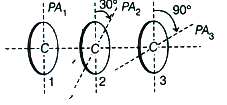
A
zero
B
$\frac{3 I_0}{32}$
C
$\frac{3 I_0}{8}$
D
$\frac{3 I_0}{16}$
Solution
(B) When unpolarised light of intensity $I_0$ passes through the first polaroid,the intensity of the transmitted light is $I_1 = \frac{I_0}{2}$.
The angle between the pass axes of the first and second polaroid is $\theta_{12} = 30^{\circ}$. According to Malus' Law,the intensity of light transmitted through the second polaroid is $I_2 = I_1 \cos^2(30^{\circ}) = \frac{I_0}{2} \times (\frac{\sqrt{3}}{2})^2 = \frac{I_0}{2} \times \frac{3}{4} = \frac{3 I_0}{8}$.
The angle between the pass axes of the second and third polaroid is $\theta_{23} = 90^{\circ} - 30^{\circ} = 60^{\circ}$.
According to Malus' Law,the intensity of light transmitted through the third polaroid is $I_3 = I_2 \cos^2(60^{\circ}) = \frac{3 I_0}{8} \times (\frac{1}{2})^2 = \frac{3 I_0}{8} \times \frac{1}{4} = \frac{3 I_0}{32}$.
The angle between the pass axes of the first and second polaroid is $\theta_{12} = 30^{\circ}$. According to Malus' Law,the intensity of light transmitted through the second polaroid is $I_2 = I_1 \cos^2(30^{\circ}) = \frac{I_0}{2} \times (\frac{\sqrt{3}}{2})^2 = \frac{I_0}{2} \times \frac{3}{4} = \frac{3 I_0}{8}$.
The angle between the pass axes of the second and third polaroid is $\theta_{23} = 90^{\circ} - 30^{\circ} = 60^{\circ}$.
According to Malus' Law,the intensity of light transmitted through the third polaroid is $I_3 = I_2 \cos^2(60^{\circ}) = \frac{3 I_0}{8} \times (\frac{1}{2})^2 = \frac{3 I_0}{8} \times \frac{1}{4} = \frac{3 I_0}{32}$.
0 likesView Solution
60
PhysicsDifficultMCQKCET · 2024
In Young's double slit experiment, an electron beam is used to produce interference fringes of width $\beta_1$. Now the electron beam is replaced by a beam of protons with the same experimental set-up and same speed. The fringe width obtained is $\beta_2$. The correct relation between $\beta_1$ and $\beta_2$ is
A
$\beta_1=\beta_2$
B
No fringes are formed
C
$\beta_1 < \beta_2$
D
$\beta_1 > \beta_2$
Solution
(D) In Young's double slit experiment, the fringe width is given by $\beta = \frac{D \lambda}{d}$.
Since the experimental setup ($D$ and $d$) remains the same, $\beta \propto \lambda$.
According to the de Broglie hypothesis, the wavelength $\lambda$ is given by $\lambda = \frac{h}{mv}$.
For the same speed $v$, the wavelength is inversely proportional to the mass $m$ of the particle, i.e., $\lambda \propto \frac{1}{m}$.
Since the mass of a proton $(m_p)$ is much greater than the mass of an electron $(m_e)$, we have $m_p > m_e$.
Therefore, the wavelength of the proton beam $(\lambda_2)$ will be smaller than the wavelength of the electron beam $(\lambda_1)$, i.e., $\lambda_2 < \lambda_1$.
Since $\beta \propto \lambda$, it follows that $\beta_2 < \beta_1$, or $\beta_1 > \beta_2$.
Since the experimental setup ($D$ and $d$) remains the same, $\beta \propto \lambda$.
According to the de Broglie hypothesis, the wavelength $\lambda$ is given by $\lambda = \frac{h}{mv}$.
For the same speed $v$, the wavelength is inversely proportional to the mass $m$ of the particle, i.e., $\lambda \propto \frac{1}{m}$.
Since the mass of a proton $(m_p)$ is much greater than the mass of an electron $(m_e)$, we have $m_p > m_e$.
Therefore, the wavelength of the proton beam $(\lambda_2)$ will be smaller than the wavelength of the electron beam $(\lambda_1)$, i.e., $\lambda_2 < \lambda_1$.
Since $\beta \propto \lambda$, it follows that $\beta_2 < \beta_1$, or $\beta_1 > \beta_2$.
0 likesView Solution
Vedclass Products
For Students
Vedclass Test Series
Mock tests in real KCET style covering Physics with performance analysis. 5-day free trial.
Start Free TrialFor Teachers
Exam Paper Generator
Generate Set A/B/C/D Physics papers from 7.5L+ questions in 2 minutes. 3 chapters free.
Try FreeFor Institutes
Online Exam Module
Run live KCET mock exams with unlimited students, 360° analytics & white-label branding.
See DemoFrequently Asked Questions
How many Physics questions are in KCET 2024?
There are 60 Physics questions from the KCET 2024 paper on Vedclass, each with a detailed step-by-step solution in English.
Are KCET 2024 Physics solutions available in English?
Yes. All solutions on this page are in English. You can also switch to English or Hindi using the language buttons above the questions.
Can I practice KCET 2024 Physics as a timed test?
Yes. Use the Vedclass Test Series to attempt a full KCET mock test covering Physics with time limits and instant score analysis.
Can teachers create Physics papers from KCET previous year questions?
Yes. The Vedclass Exam Paper Generator lets teachers mix KCET Physics questions and generate Set A/B/C/D papers in minutes.
For Teachers & Institutes
Build a Custom Physics Paper
Pick KCET 2024 Physics questions, set difficulty, and generate Set A/B/C/D in 2 minutes.