
PhysicsQ1–60 of 60 questions
Page 1 of 1 · English
1
PhysicsEasyMCQKCET · 2018
Two particles of masses $m_{1}$ and $m_{2}$ have equal kinetic energies. The ratio of their momentum is
A
$m_{1}: m_{2}$
B
$m_{2}: m_{1}$
C
$\sqrt{m_{1}}: \sqrt{m_{2}}$
D
$m_{1}^{2}: m_{2}^{2}$
Solution
(C) Given,the kinetic energy $(K)$ of two particles of masses $m_{1}$ and $m_{2}$ is equal.
We know that kinetic energy is related to momentum $(p)$ by the formula $K = \frac{p^{2}}{2m}$.
Since $K_{1} = K_{2}$,we have $\frac{p_{1}^{2}}{2m_{1}} = \frac{p_{2}^{2}}{2m_{2}}$.
Rearranging the terms to find the ratio of momenta $\frac{p_{1}}{p_{2}}$,we get $\frac{p_{1}^{2}}{p_{2}^{2}} = \frac{m_{1}}{m_{2}}$.
Taking the square root on both sides,we obtain $\frac{p_{1}}{p_{2}} = \sqrt{\frac{m_{1}}{m_{2}}} = \frac{\sqrt{m_{1}}}{\sqrt{m_{2}}}$.
Therefore,the ratio of their momenta is $\sqrt{m_{1}}: \sqrt{m_{2}}$.
We know that kinetic energy is related to momentum $(p)$ by the formula $K = \frac{p^{2}}{2m}$.
Since $K_{1} = K_{2}$,we have $\frac{p_{1}^{2}}{2m_{1}} = \frac{p_{2}^{2}}{2m_{2}}$.
Rearranging the terms to find the ratio of momenta $\frac{p_{1}}{p_{2}}$,we get $\frac{p_{1}^{2}}{p_{2}^{2}} = \frac{m_{1}}{m_{2}}$.
Taking the square root on both sides,we obtain $\frac{p_{1}}{p_{2}} = \sqrt{\frac{m_{1}}{m_{2}}} = \frac{\sqrt{m_{1}}}{\sqrt{m_{2}}}$.
Therefore,the ratio of their momenta is $\sqrt{m_{1}}: \sqrt{m_{2}}$.
0 likesView Solution
2
PhysicsEasyMCQKCET · 2018
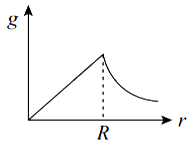
Which of the following graphs correctly represents the value of acceleration due to gravity '$g$' on the Earth as a function of distance '$r$' from the center?
A
B
C
D
Solution
(B) The acceleration due to gravity '$g$' at a distance '$r$' from the center of the Earth is given by:
$1$. Inside the Earth $(r < R)$: $g = \frac{GMr}{R^3}$,which implies $g \propto r$. This is a linear relationship.
$2$. Outside the Earth $(r \geq R)$: $g = \frac{GM}{r^2}$,which implies $g \propto \frac{1}{r^2}$. This is a non-linear,inverse-square decay.
Therefore,the graph shows a linear increase from the center $(r=0)$ to the surface $(r=R)$,and a non-linear decrease for distances greater than the radius of the Earth $(r > R)$. Graph $B$ correctly represents this behavior.
$1$. Inside the Earth $(r < R)$: $g = \frac{GMr}{R^3}$,which implies $g \propto r$. This is a linear relationship.
$2$. Outside the Earth $(r \geq R)$: $g = \frac{GM}{r^2}$,which implies $g \propto \frac{1}{r^2}$. This is a non-linear,inverse-square decay.
Therefore,the graph shows a linear increase from the center $(r=0)$ to the surface $(r=R)$,and a non-linear decrease for distances greater than the radius of the Earth $(r > R)$. Graph $B$ correctly represents this behavior.
0 likesView Solution
3
PhysicsMediumMCQKCET · 2018
$A$ space station is at a height equal to the radius of the Earth. If $V_{E}$ is the escape velocity on the surface of the Earth,the escape velocity on the space station is __ times $V_{E}$.
A
$1/2$
B
$1/4$
C
$1/\sqrt{2}$
D
$1/\sqrt{3}$
Solution
(C) The escape velocity $v$ at a distance $r$ from the center of the Earth is given by the formula $v = \sqrt{\frac{2GM}{r}}$.
For the surface of the Earth,the distance $r = R$,so the escape velocity is $V_{E} = \sqrt{\frac{2GM}{R}}$.
For a space station at a height $h = R$ above the surface,the distance from the center of the Earth is $r = R + h = R + R = 2R$.
The escape velocity $v_{s}$ at the space station is $v_{s} = \sqrt{\frac{2GM}{2R}} = \sqrt{\frac{GM}{R}}$.
Comparing $v_{s}$ with $V_{E}$:
$v_{s} = \frac{1}{\sqrt{2}} \sqrt{\frac{2GM}{R}} = \frac{1}{\sqrt{2}} V_{E}$.
Thus,the escape velocity on the space station is $\frac{1}{\sqrt{2}}$ times $V_{E}$.
For the surface of the Earth,the distance $r = R$,so the escape velocity is $V_{E} = \sqrt{\frac{2GM}{R}}$.
For a space station at a height $h = R$ above the surface,the distance from the center of the Earth is $r = R + h = R + R = 2R$.
The escape velocity $v_{s}$ at the space station is $v_{s} = \sqrt{\frac{2GM}{2R}} = \sqrt{\frac{GM}{R}}$.
Comparing $v_{s}$ with $V_{E}$:
$v_{s} = \frac{1}{\sqrt{2}} \sqrt{\frac{2GM}{R}} = \frac{1}{\sqrt{2}} V_{E}$.
Thus,the escape velocity on the space station is $\frac{1}{\sqrt{2}}$ times $V_{E}$.
0 likesView Solution
4
PhysicsEasyMCQKCET · 2018
Pressure of an ideal gas is increased by keeping temperature constant. The kinetic energy of molecules
A
Decreases
B
Increases
C
Remains same
D
Increases or decreases depending on the nature of gas
Solution
(C) The average kinetic energy $(K)$ of molecules of an ideal gas is directly proportional to its absolute temperature $(T)$,given by the relation $K = \frac{3}{2} k_B T$,where $k_B$ is the Boltzmann constant.
Since the temperature $(T)$ is kept constant,the kinetic energy of the molecules remains unchanged,regardless of the change in pressure.
Since the temperature $(T)$ is kept constant,the kinetic energy of the molecules remains unchanged,regardless of the change in pressure.
0 likesView Solution
5
PhysicsDifficultMCQKCET · 2018
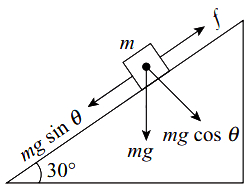
$A$ block rests on a rough inclined plane making an angle of $30^{\circ}$ with the horizontal. The coefficient of static friction between the block and the plane is $0.8$. If the frictional force on the block is $10 \text{ N}$, the mass of the block is $\left(g=10 \text{ ms}^{-2}\right)$ (in $\text{ kg}$)
A
$1$
B
$2$
C
$3$
D
$4$
Solution
(B) Given, coefficient of static friction, $\mu = 0.8$; frictional force, $f = 10 \text{ N}$.
Since the block is at rest on the inclined plane, the static frictional force balances the component of the gravitational force acting down the plane.
$f = mg \sin \theta$
Substituting the given values:
$10 = m \times 10 \times \sin 30^{\circ}$
$10 = m \times 10 \times 0.5$
$10 = 5m$
$m = \frac{10}{5} = 2 \text{ kg}$.
Therefore, the mass of the block is $2 \text{ kg}$.
Since the block is at rest on the inclined plane, the static frictional force balances the component of the gravitational force acting down the plane.
$f = mg \sin \theta$
Substituting the given values:
$10 = m \times 10 \times \sin 30^{\circ}$
$10 = m \times 10 \times 0.5$
$10 = 5m$
$m = \frac{10}{5} = 2 \text{ kg}$.
Therefore, the mass of the block is $2 \text{ kg}$.
0 likesView Solution
6
PhysicsMediumMCQKCET · 2018
$A$ man weighing $60 \text{ kg}$ is in a lift moving down with an acceleration of $1.8 \text{ ms}^{-2}$. The force exerted by the floor on him is:
A
$588 \text{ N}$
B
$480 \text{ N}$
C
Zero
D
$696 \text{ N}$
Solution
(B) Given: Mass of the man $m = 60 \text{ kg}$,acceleration of the lift $a = 1.8 \text{ ms}^{-2}$,and acceleration due to gravity $g = 9.8 \text{ ms}^{-2}$.
When a lift moves downwards with an acceleration $a$,the apparent weight (normal force $N$) exerted by the floor on the man is given by the formula:
$N = m(g - a)$
Substituting the given values:
$N = 60 \times (9.8 - 1.8)$
$N = 60 \times 8.0$
$N = 480 \text{ N}$
Therefore,the force exerted by the floor on the man is $480 \text{ N}$.
When a lift moves downwards with an acceleration $a$,the apparent weight (normal force $N$) exerted by the floor on the man is given by the formula:
$N = m(g - a)$
Substituting the given values:
$N = 60 \times (9.8 - 1.8)$
$N = 60 \times 8.0$
$N = 480 \text{ N}$
Therefore,the force exerted by the floor on the man is $480 \text{ N}$.
0 likesView Solution
7
PhysicsEasyMCQKCET · 2018
The resistance $R = \frac{V}{I}$ where $V = (100 \pm 5) \text{ V}$ and $I = (10 \pm 0.2) \text{ A}$. The percentage error in $R$ is: (in $\%$)
A
$5.2$
B
$4.8$
C
$7$
D
$3$
Solution
(C) The formula for resistance is $R = \frac{V}{I}$.
Given values are $V = 100 \text{ V}$,$\Delta V = 5 \text{ V}$,$I = 10 \text{ A}$,and $\Delta I = 0.2 \text{ A}$.
For division,the relative error is the sum of the relative errors of the individual quantities:
$\frac{\Delta R}{R} = \frac{\Delta V}{V} + \frac{\Delta I}{I}$.
To find the percentage error,multiply by $100$:
$\frac{\Delta R}{R} \times 100 = \left( \frac{\Delta V}{V} \times 100 \right) + \left( \frac{\Delta I}{I} \times 100 \right)$.
Substituting the given values:
$\frac{\Delta R}{R} \times 100 = \left( \frac{5}{100} \times 100 \right) + \left( \frac{0.2}{10} \times 100 \right)$.
$= 5\% + 2\% = 7\%$.
Therefore,the percentage error in $R$ is $7\%$.
Given values are $V = 100 \text{ V}$,$\Delta V = 5 \text{ V}$,$I = 10 \text{ A}$,and $\Delta I = 0.2 \text{ A}$.
For division,the relative error is the sum of the relative errors of the individual quantities:
$\frac{\Delta R}{R} = \frac{\Delta V}{V} + \frac{\Delta I}{I}$.
To find the percentage error,multiply by $100$:
$\frac{\Delta R}{R} \times 100 = \left( \frac{\Delta V}{V} \times 100 \right) + \left( \frac{\Delta I}{I} \times 100 \right)$.
Substituting the given values:
$\frac{\Delta R}{R} \times 100 = \left( \frac{5}{100} \times 100 \right) + \left( \frac{0.2}{10} \times 100 \right)$.
$= 5\% + 2\% = 7\%$.
Therefore,the percentage error in $R$ is $7\%$.
0 likesView Solution
8
PhysicsMediumMCQKCET · 2018
The pressure at the bottom of a liquid tank is not proportional to the
A
Acceleration due to gravity
B
Density of the liquid
C
Height of the liquid
D
Area of the liquid surface
Solution
(D) The pressure $P$ at the bottom of a liquid tank is given by the formula $P = h \rho g$,where $h$ is the height of the liquid column,$\rho$ is the density of the liquid,and $g$ is the acceleration due to gravity.
From this formula,it is clear that the pressure is directly proportional to the height of the liquid $h$,the density of the liquid $\rho$,and the acceleration due to gravity $g$.
The pressure does not depend on the area of the liquid surface or the shape of the container.
Therefore,the pressure is not proportional to the area of the liquid surface.
From this formula,it is clear that the pressure is directly proportional to the height of the liquid $h$,the density of the liquid $\rho$,and the acceleration due to gravity $g$.
The pressure does not depend on the area of the liquid surface or the shape of the container.
Therefore,the pressure is not proportional to the area of the liquid surface.
0 likesView Solution
9
PhysicsEasyMCQKCET · 2018
Two wires $A$ and $B$ are stretched by the same load. If the area of cross-section of wire $A$ is double that of wire $B$,then the stress on wire $B$ is
A
Equal to that on $A$
B
Twice that on $A$
C
Half that on $A$
D
Four times that on $A$
Solution
(B) Stress is defined as the force applied per unit area,given by the formula: $\text{Stress} = \frac{F}{A}$.
Given that both wires are stretched by the same load,the force $F$ is constant for both wires.
Let $A_A$ be the area of wire $A$ and $A_B$ be the area of wire $B$. According to the problem,$A_A = 2 A_B$.
The stress on wire $A$ is $\sigma_A = \frac{F}{A_A} = \frac{F}{2 A_B}$.
The stress on wire $B$ is $\sigma_B = \frac{F}{A_B}$.
Comparing the two,we get $\sigma_B = 2 \times \left(\frac{F}{2 A_B}\right) = 2 \sigma_A$.
Therefore,the stress on wire $B$ is twice that on wire $A$.
Given that both wires are stretched by the same load,the force $F$ is constant for both wires.
Let $A_A$ be the area of wire $A$ and $A_B$ be the area of wire $B$. According to the problem,$A_A = 2 A_B$.
The stress on wire $A$ is $\sigma_A = \frac{F}{A_A} = \frac{F}{2 A_B}$.
The stress on wire $B$ is $\sigma_B = \frac{F}{A_B}$.
Comparing the two,we get $\sigma_B = 2 \times \left(\frac{F}{2 A_B}\right) = 2 \sigma_A$.
Therefore,the stress on wire $B$ is twice that on wire $A$.
0 likesView Solution
10
PhysicsEasyMCQKCET · 2018
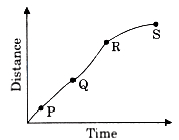
$A$ particle shows a distance-time curve as shown in the figure. The maximum instantaneous velocity of the particle is around the point:
A
$P$
B
$S$
C
$R$
D
$Q$
Solution
(D) In a distance-time graph,the instantaneous velocity of a particle at any point is given by the slope of the tangent to the curve at that point.
Mathematically,$v = \frac{ds}{dt} = \tan(\theta)$,where $\theta$ is the angle that the tangent makes with the time axis.
The slope is maximum where the curve is steepest.
By observing the given graph,the curve is steepest at point $Q$. Therefore,the instantaneous velocity is maximum around point $Q$.
Mathematically,$v = \frac{ds}{dt} = \tan(\theta)$,where $\theta$ is the angle that the tangent makes with the time axis.
The slope is maximum where the curve is steepest.
By observing the given graph,the curve is steepest at point $Q$. Therefore,the instantaneous velocity is maximum around point $Q$.
0 likesView Solution
11
PhysicsEasyMCQKCET · 2018
Moment of inertia of a body about two perpendicular axes $X$ and $Y$ in the plane of the lamina are $20 \text{ kg m}^2$ and $25 \text{ kg m}^2$ respectively. Its moment of inertia about an axis perpendicular to the plane of the lamina and passing through the point of intersection of $X$ and $Y$ axes is:
A
$5 \text{ kg m}^2$
B
$45 \text{ kg m}^2$
C
$12.5 \text{ kg m}^2$
D
$500 \text{ kg m}^2$
Solution
(B) According to the perpendicular axis theorem, for a planar body (lamina), the moment of inertia about an axis perpendicular to the plane $(I_Z)$ is equal to the sum of the moments of inertia about two mutually perpendicular axes ($I_X$ and $I_Y$) lying in the plane of the body and intersecting at the same point.
Given:
$I_X = 20 \text{ kg m}^2$
$I_Y = 25 \text{ kg m}^2$
Using the theorem: $I_Z = I_X + I_Y$
$I_Z = 20 \text{ kg m}^2 + 25 \text{ kg m}^2 = 45 \text{ kg m}^2$
Therefore, the moment of inertia about the axis perpendicular to the plane is $45 \text{ kg m}^2$.
Given:
$I_X = 20 \text{ kg m}^2$
$I_Y = 25 \text{ kg m}^2$
Using the theorem: $I_Z = I_X + I_Y$
$I_Z = 20 \text{ kg m}^2 + 25 \text{ kg m}^2 = 45 \text{ kg m}^2$
Therefore, the moment of inertia about the axis perpendicular to the plane is $45 \text{ kg m}^2$.
0 likesView Solution
12
PhysicsDifficultMCQKCET · 2018
$A$ cup of tea cools from $65.5^{\circ} C$ to $62.5^{\circ} C$ in one minute in a room at $22.5^{\circ} C$. How long will it take to cool from $46.5^{\circ} C$ to $40.5^{\circ} C$ in the same room?
A
$4$ minutes
B
$2$ minutes
C
$1$ minute
D
$3$ minutes
Solution
(A) According to Newton's law of cooling, $\frac{dT}{dt} = k(\theta - \theta_0)$.
For the first case: $\frac{65.5 - 62.5}{1} = k \left( \frac{65.5 + 62.5}{2} - 22.5 \right)$.
$3 = k(64 - 22.5) = k(41.5) \implies k = \frac{3}{41.5}$.
For the second case: $\frac{46.5 - 40.5}{t} = k \left( \frac{46.5 + 40.5}{2} - 22.5 \right)$.
$\frac{6}{t} = k(43.5 - 22.5) = k(21)$.
Substituting $k$: $\frac{6}{t} = \frac{3}{41.5} \times 21$.
$t = \frac{6 \times 41.5}{3 \times 21} = \frac{2 \times 41.5}{21} \approx 3.95 \text{ minutes} \approx 4 \text{ minutes}$.
For the first case: $\frac{65.5 - 62.5}{1} = k \left( \frac{65.5 + 62.5}{2} - 22.5 \right)$.
$3 = k(64 - 22.5) = k(41.5) \implies k = \frac{3}{41.5}$.
For the second case: $\frac{46.5 - 40.5}{t} = k \left( \frac{46.5 + 40.5}{2} - 22.5 \right)$.
$\frac{6}{t} = k(43.5 - 22.5) = k(21)$.
Substituting $k$: $\frac{6}{t} = \frac{3}{41.5} \times 21$.
$t = \frac{6 \times 41.5}{3 \times 21} = \frac{2 \times 41.5}{21} \approx 3.95 \text{ minutes} \approx 4 \text{ minutes}$.
0 likesView Solution
13
PhysicsEasyMCQKCET · 2018
$A$ Carnot engine takes $300$ calories of heat from a source at $500 \,K$ and rejects $150$ calories of heat to the sink. The temperature of the sink is (in $\,K$)
A
$125$
B
$250$
C
$750$
D
$1000$
Solution
(B) Given: Heat taken from source,$Q_{1} = 300$ calories; Temperature of source,$T_{1} = 500 \,K$; Heat rejected to the sink,$Q_{2} = 150$ calories.
We need to find the temperature of the sink,$T_{2}$.
For a Carnot engine,the efficiency $\eta$ is given by the ratio of heat exchange as $\eta = \frac{Q_{1} - Q_{2}}{Q_{1}}$ and also by the temperatures as $\eta = \frac{T_{1} - T_{2}}{T_{1}}$.
Equating the two expressions for efficiency:
$\frac{Q_{1} - Q_{2}}{Q_{1}} = \frac{T_{1} - T_{2}}{T_{1}}$
Substituting the given values:
$\frac{300 - 150}{300} = \frac{500 - T_{2}}{500}$
$\frac{150}{300} = 1 - \frac{T_{2}}{500}$
$\frac{1}{2} = 1 - \frac{T_{2}}{500}$
$\frac{T_{2}}{500} = 1 - \frac{1}{2}$
$\frac{T_{2}}{500} = \frac{1}{2}$
$T_{2} = 500 \times \frac{1}{2} = 250 \,K$.
Thus,the temperature of the sink is $250 \,K$.
We need to find the temperature of the sink,$T_{2}$.
For a Carnot engine,the efficiency $\eta$ is given by the ratio of heat exchange as $\eta = \frac{Q_{1} - Q_{2}}{Q_{1}}$ and also by the temperatures as $\eta = \frac{T_{1} - T_{2}}{T_{1}}$.
Equating the two expressions for efficiency:
$\frac{Q_{1} - Q_{2}}{Q_{1}} = \frac{T_{1} - T_{2}}{T_{1}}$
Substituting the given values:
$\frac{300 - 150}{300} = \frac{500 - T_{2}}{500}$
$\frac{150}{300} = 1 - \frac{T_{2}}{500}$
$\frac{1}{2} = 1 - \frac{T_{2}}{500}$
$\frac{T_{2}}{500} = 1 - \frac{1}{2}$
$\frac{T_{2}}{500} = \frac{1}{2}$
$T_{2} = 500 \times \frac{1}{2} = 250 \,K$.
Thus,the temperature of the sink is $250 \,K$.
0 likesView Solution
14
PhysicsMediumMCQKCET · 2018
The first overtone frequency of a closed pipe of length $l_{1}$ is equal to the $2^{\text{nd}}$ harmonic frequency of an open pipe of length $l_{2}$. The ratio $\frac{l_{1}}{l_{2}}$ is:
A
$\frac{3}{4}$
B
$\frac{4}{3}$
C
$\frac{3}{2}$
D
$\frac{2}{3}$
Solution
(A) The frequency of the $n^{\text{th}}$ overtone of a closed pipe is given by $f_{c} = \frac{(2n+1)v}{4l_{1}}$. For the first overtone,$n=1$,so $f_{c} = \frac{3v}{4l_{1}}$.
The frequency of the $m^{\text{th}}$ harmonic of an open pipe is given by $f_{o} = \frac{mv}{2l_{2}}$. For the $2^{\text{nd}}$ harmonic,$m=2$,so $f_{o} = \frac{2v}{2l_{2}} = \frac{v}{l_{2}}$.
Given that $f_{c} = f_{o}$,we have $\frac{3v}{4l_{1}} = \frac{v}{l_{2}}$.
Rearranging the terms to find the ratio $\frac{l_{1}}{l_{2}}$,we get $\frac{l_{1}}{l_{2}} = \frac{3}{4}$.
The frequency of the $m^{\text{th}}$ harmonic of an open pipe is given by $f_{o} = \frac{mv}{2l_{2}}$. For the $2^{\text{nd}}$ harmonic,$m=2$,so $f_{o} = \frac{2v}{2l_{2}} = \frac{v}{l_{2}}$.
Given that $f_{c} = f_{o}$,we have $\frac{3v}{4l_{1}} = \frac{v}{l_{2}}$.
Rearranging the terms to find the ratio $\frac{l_{1}}{l_{2}}$,we get $\frac{l_{1}}{l_{2}} = \frac{3}{4}$.
0 likesView Solution
15
PhysicsMediumMCQKCET · 2018
$A$ mass '$m$' on the surface of the Earth is shifted to a height equal to the radius of the Earth. If '$R$' is the radius and '$M$' is the mass of the Earth,then the work done in this process is:
A
$\frac{m g R}{2}$
B
$mgR$
C
$2 mgR$
D
$\frac{m g R}{4}$
Solution
(A) The gravitational potential energy on the surface of the Earth is $U_E = -\frac{G M m}{R}$,where $M$ is the mass of the Earth,$m$ is the mass of the object,$R$ is the radius of the Earth,and $G$ is the gravitational constant.
When the mass $m$ is shifted to a height equal to the radius of the Earth,the distance from the center becomes $r = R + R = 2R$.
The potential energy at this height is $U = -\frac{G M m}{2R}$.
The work done in the process is $W = U - U_E = -\frac{G M m}{2R} - (-\frac{G M m}{R}) = -\frac{G M m}{2R} + \frac{G M m}{R} = \frac{G M m}{2R}$.
Using the relation $g = \frac{G M}{R^2}$,we have $G M = g R^2$.
Substituting this into the work equation: $W = \frac{(g R^2) m}{2R} = \frac{m g R}{2}$.
When the mass $m$ is shifted to a height equal to the radius of the Earth,the distance from the center becomes $r = R + R = 2R$.
The potential energy at this height is $U = -\frac{G M m}{2R}$.
The work done in the process is $W = U - U_E = -\frac{G M m}{2R} - (-\frac{G M m}{R}) = -\frac{G M m}{2R} + \frac{G M m}{R} = \frac{G M m}{2R}$.
Using the relation $g = \frac{G M}{R^2}$,we have $G M = g R^2$.
Substituting this into the work equation: $W = \frac{(g R^2) m}{2R} = \frac{m g R}{2}$.
0 likesView Solution
16
PhysicsEasyMCQKCET · 2018
Which of the following graphs represents the variation of inductive reactance $(X_{L})$ with the frequency of the voltage source $(\nu)$?
A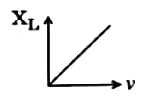
B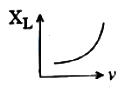
C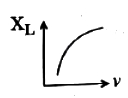
D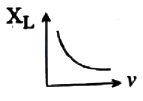
Solution
(A) The inductive reactance is given by the formula $X_{L} = \omega L$.
Here,$\omega = 2\pi\nu$,where $\nu$ is the frequency of the voltage source.
Substituting this into the formula,we get $X_{L} = 2\pi\nu L$.
Since $2$,$\pi$,and $L$ are constants,we have $X_{L} \propto \nu$.
This represents a linear relationship between inductive reactance and frequency,which is a straight line passing through the origin.
Therefore,the graph in option $A$ correctly represents this variation.
Here,$\omega = 2\pi\nu$,where $\nu$ is the frequency of the voltage source.
Substituting this into the formula,we get $X_{L} = 2\pi\nu L$.
Since $2$,$\pi$,and $L$ are constants,we have $X_{L} \propto \nu$.
This represents a linear relationship between inductive reactance and frequency,which is a straight line passing through the origin.
Therefore,the graph in option $A$ correctly represents this variation.
0 likesView Solution
17
PhysicsEasyMCQKCET · 2018
In a series $LCR$ circuit,the power dissipation occurs through
A
$R$
B
$L$
C
$C$
D
Both $L$ and $C$
Solution
(A) The instantaneous power dissipated in an electrical circuit is given by $P = I^2 R$.
In a series $LCR$ circuit,the inductor $(L)$ and the capacitor $(C)$ are reactive components that store energy in magnetic and electric fields,respectively,but they do not dissipate energy as heat.
The resistance $(R)$ is the only component that dissipates electrical energy into heat.
Therefore,the power dissipation in a series $LCR$ circuit occurs only through the resistance $R$.
In a series $LCR$ circuit,the inductor $(L)$ and the capacitor $(C)$ are reactive components that store energy in magnetic and electric fields,respectively,but they do not dissipate energy as heat.
The resistance $(R)$ is the only component that dissipates electrical energy into heat.
Therefore,the power dissipation in a series $LCR$ circuit occurs only through the resistance $R$.
0 likesView Solution
18
PhysicsEasyMCQKCET · 2018
$A$ $ 100 \,W $ bulb is connected to an $ AC $ source of $ 220 \,V, 50 \,Hz $. Then the current flowing through the bulb is
A
$ \frac{5}{11} \,A $
B
$ \frac{1}{2} \,A $
C
$ 2 \,A $
D
$ \frac{3}{4} \,A $
Solution
(A) Given: Power of the bulb $ P = 100 \,W $ and voltage of the $ AC $ source $ V = 220 \,V $.
For a resistive load like a bulb, the power is given by the formula $ P = I \times V $.
Rearranging the formula to solve for current $ I $, we get $ I = \frac{P}{V} $.
Substituting the given values: $ I = \frac{100}{220} \,A $.
Simplifying the fraction: $ I = \frac{10}{22} \,A = \frac{5}{11} \,A $.
Thus, the current flowing through the bulb is $ \frac{5}{11} \,A $.
For a resistive load like a bulb, the power is given by the formula $ P = I \times V $.
Rearranging the formula to solve for current $ I $, we get $ I = \frac{P}{V} $.
Substituting the given values: $ I = \frac{100}{220} \,A $.
Simplifying the fraction: $ I = \frac{10}{22} \,A = \frac{5}{11} \,A $.
Thus, the current flowing through the bulb is $ \frac{5}{11} \,A $.
0 likesView Solution
19
PhysicsEasyMCQKCET · 2018
In Karnataka,the normal domestic power supply $AC$ is $220 \text{ V}, 50 \text{ Hz}$. Here $220 \text{ V}$ and $50 \text{ Hz}$ refer to:
A
Peak value of voltage and frequency
B
Rms value of voltage and frequency
C
Mean value of voltage and frequency
D
Peak value of voltage and angular frequency
Solution
(B) In India,including Karnataka,the standard domestic $AC$ power supply is specified as $220 \text{ V}, 50 \text{ Hz}$.
By convention,the voltage value provided for $AC$ circuits is the Root Mean Square $(RMS)$ value,as it represents the effective voltage that would produce the same heating effect as an equivalent $DC$ voltage.
The frequency of $50 \text{ Hz}$ represents the number of cycles per second of the alternating current.
Therefore,$220 \text{ V}$ is the $RMS$ voltage and $50 \text{ Hz}$ is the frequency.
By convention,the voltage value provided for $AC$ circuits is the Root Mean Square $(RMS)$ value,as it represents the effective voltage that would produce the same heating effect as an equivalent $DC$ voltage.
The frequency of $50 \text{ Hz}$ represents the number of cycles per second of the alternating current.
Therefore,$220 \text{ V}$ is the $RMS$ voltage and $50 \text{ Hz}$ is the frequency.
0 likesView Solution
20
PhysicsDifficultMCQKCET · 2018
$A$ step-up transformer operates on a $230 \ V$ line and a load current of $2 \ A$. The ratio of primary and secondary windings is $1:25$. Then the current in the primary is (in $A$)
A
$25$
B
$50$
C
$15$
D
$12.5$
Solution
(B) For an ideal transformer,the power input equals the power output,which implies the relationship between currents and turns ratio is given by $\frac{I_P}{I_S} = \frac{N_S}{N_P}$.
Given the turns ratio $\frac{N_P}{N_S} = \frac{1}{25}$,we have $\frac{N_S}{N_P} = 25$.
The load current (secondary current) is $I_S = 2 \ A$.
Substituting these values into the formula: $I_P = I_S \times \frac{N_S}{N_P}$.
$I_P = 2 \ A \times 25 = 50 \ A$.
Therefore,the current in the primary winding is $50 \ A$.
Given the turns ratio $\frac{N_P}{N_S} = \frac{1}{25}$,we have $\frac{N_S}{N_P} = 25$.
The load current (secondary current) is $I_S = 2 \ A$.
Substituting these values into the formula: $I_P = I_S \times \frac{N_S}{N_P}$.
$I_P = 2 \ A \times 25 = 50 \ A$.
Therefore,the current in the primary winding is $50 \ A$.
0 likesView Solution
21
PhysicsEasyMCQKCET · 2018
The total energy of an electron revolving in the second orbit of a hydrogen atom is
A
$-13.6 \text{ eV}$
B
$-1.51 \text{ eV}$
C
$-3.4 \text{ eV}$
D
Zero
Solution
(C) The total energy of an electron revolving in the $n^{th}$ orbit of a hydrogen atom is given by the formula:
$E_{n} = \frac{-13.6}{n^{2}} \text{ eV}$
For the second orbit,we have $n = 2$.
Substituting the value of $n$ into the formula:
$E_{2} = \frac{-13.6}{2^{2}} \text{ eV}$
$E_{2} = \frac{-13.6}{4} \text{ eV}$
$E_{2} = -3.4 \text{ eV}$
Therefore,the total energy of the electron in the second orbit is $-3.4 \text{ eV}$.
$E_{n} = \frac{-13.6}{n^{2}} \text{ eV}$
For the second orbit,we have $n = 2$.
Substituting the value of $n$ into the formula:
$E_{2} = \frac{-13.6}{2^{2}} \text{ eV}$
$E_{2} = \frac{-13.6}{4} \text{ eV}$
$E_{2} = -3.4 \text{ eV}$
Therefore,the total energy of the electron in the second orbit is $-3.4 \text{ eV}$.
0 likesView Solution
22
PhysicsMediumMCQKCET · 2018
The period of revolution of an electron in the ground state of a hydrogen atom is $T$. The period of revolution of the electron in the first excited state is
A
$2T$
B
$4T$
C
$T$
D
$8T$
Solution
(D) The time period of revolution of an electron in a Bohr orbit is given by $T = \frac{2\pi r}{v}$.
We know that the radius of the orbit $r \propto n^2$ and the velocity of the electron $v \propto \frac{1}{n}$.
Substituting these relations into the time period formula: $T \propto \frac{n^2}{1/n} = n^3$.
For the ground state $(n_1 = 1)$,the time period is $T_1 = T$.
For the first excited state $(n_2 = 2)$,the time period is $T_2$.
Using the proportionality $T \propto n^3$,we have $\frac{T_2}{T_1} = \left(\frac{n_2}{n_1}\right)^3$.
$\frac{T_2}{T} = \left(\frac{2}{1}\right)^3 = 8$.
Therefore,$T_2 = 8T$.
We know that the radius of the orbit $r \propto n^2$ and the velocity of the electron $v \propto \frac{1}{n}$.
Substituting these relations into the time period formula: $T \propto \frac{n^2}{1/n} = n^3$.
For the ground state $(n_1 = 1)$,the time period is $T_1 = T$.
For the first excited state $(n_2 = 2)$,the time period is $T_2$.
Using the proportionality $T \propto n^3$,we have $\frac{T_2}{T_1} = \left(\frac{n_2}{n_1}\right)^3$.
$\frac{T_2}{T} = \left(\frac{2}{1}\right)^3 = 8$.
Therefore,$T_2 = 8T$.
0 likesView Solution
23
PhysicsMediumMCQKCET · 2018
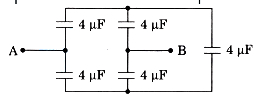
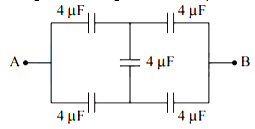
For the arrangement of capacitors as shown in the circuit,the effective capacitance between the points $A$ and $B$ is (capacitance of each capacitor is $4 \mu F$): (in $\mu F$)
A
$4$
B
$2$
C
$1$
D
$8$
Solution
(A) Let the capacitance of each capacitor be $C = 4 \mu F$.
Looking at the circuit,we can identify two branches connected in parallel between points $A$ and $B$.
Each branch consists of two capacitors in series.
For the upper branch,the two capacitors of $4 \mu F$ each are in series,so their equivalent capacitance $C_1$ is given by:
$1/C_1 = 1/4 + 1/4 = 2/4 = 1/2 \implies C_1 = 2 \mu F$.
Similarly,for the lower branch,the two capacitors of $4 \mu F$ each are in series,so their equivalent capacitance $C_2$ is given by:
$1/C_2 = 1/4 + 1/4 = 2/4 = 1/2 \implies C_2 = 2 \mu F$.
Now,these two branches ($C_1$ and $C_2$) are connected in parallel between points $A$ and $B$.
Therefore,the effective capacitance $C_{eq}$ is:
$C_{eq} = C_1 + C_2 = 2 \mu F + 2 \mu F = 4 \mu F$.
Looking at the circuit,we can identify two branches connected in parallel between points $A$ and $B$.
Each branch consists of two capacitors in series.
For the upper branch,the two capacitors of $4 \mu F$ each are in series,so their equivalent capacitance $C_1$ is given by:
$1/C_1 = 1/4 + 1/4 = 2/4 = 1/2 \implies C_1 = 2 \mu F$.
Similarly,for the lower branch,the two capacitors of $4 \mu F$ each are in series,so their equivalent capacitance $C_2$ is given by:
$1/C_2 = 1/4 + 1/4 = 2/4 = 1/2 \implies C_2 = 2 \mu F$.
Now,these two branches ($C_1$ and $C_2$) are connected in parallel between points $A$ and $B$.
Therefore,the effective capacitance $C_{eq}$ is:
$C_{eq} = C_1 + C_2 = 2 \mu F + 2 \mu F = 4 \mu F$.
0 likesView Solution
24
PhysicsMediumMCQKCET · 2018
Two capacitors of $3 \mu F$ and $6 \mu F$ are connected in series and a potential difference of $900 \ V$ is applied across the combination. They are then disconnected and reconnected in parallel. The potential difference across the combination is
A
Zero
B
$100 \ V$
C
$200 \ V$
D
$400 \ V$
Solution
(C) When two capacitors are connected in series,the equivalent capacitance $C_{eq}$ is given by $\frac{1}{C_{eq}} = \frac{1}{C_1} + \frac{1}{C_2} = \frac{1}{3} + \frac{1}{6} = \frac{3}{6} = \frac{1}{2} \mu F^{-1}$.
Thus,$C_{eq} = 2 \mu F$.
The total charge $Q$ stored in the series combination is $Q = C_{eq} \times V = 2 \mu F \times 900 \ V = 1800 \mu C$.
When the capacitors are disconnected and reconnected in parallel,the total charge $Q = 1800 \mu C$ remains the same.
The equivalent capacitance in parallel is $C_p = C_1 + C_2 = 3 \mu F + 6 \mu F = 9 \mu F$.
The new potential difference $V'$ across the parallel combination is $V' = \frac{Q}{C_p} = \frac{1800 \mu C}{9 \mu F} = 200 \ V$.
Thus,$C_{eq} = 2 \mu F$.
The total charge $Q$ stored in the series combination is $Q = C_{eq} \times V = 2 \mu F \times 900 \ V = 1800 \mu C$.
When the capacitors are disconnected and reconnected in parallel,the total charge $Q = 1800 \mu C$ remains the same.
The equivalent capacitance in parallel is $C_p = C_1 + C_2 = 3 \mu F + 6 \mu F = 9 \mu F$.
The new potential difference $V'$ across the parallel combination is $V' = \frac{Q}{C_p} = \frac{1800 \mu C}{9 \mu F} = 200 \ V$.
0 likesView Solution
25
PhysicsEasyMCQKCET · 2018
The radius of the Earth is $6400 \text{ km}$. If the height of the antenna is $500 \text{ m}$, then its range is: (in $\text{ km}$)
A
$800$
B
$100$
C
$80$
D
$10$
Solution
(C) Given: Radius of the Earth, $R = 6400 \text{ km} = 6400 \times 10^3 \text{ m}$.
Height of the antenna, $h = 500 \text{ m} = 0.5 \text{ km}$.
The formula for the range $(d)$ of an antenna is given by $d = \sqrt{2Rh}$.
Substituting the values:
$d = \sqrt{2 \times 6400 \text{ km} \times 0.5 \text{ km}}$
$d = \sqrt{6400 \times 1} \text{ km}$
$d = \sqrt{6400} \text{ km} = 80 \text{ km}$.
Thus, the range of the antenna is $80 \text{ km}$.
Height of the antenna, $h = 500 \text{ m} = 0.5 \text{ km}$.
The formula for the range $(d)$ of an antenna is given by $d = \sqrt{2Rh}$.
Substituting the values:
$d = \sqrt{2 \times 6400 \text{ km} \times 0.5 \text{ km}}$
$d = \sqrt{6400 \times 1} \text{ km}$
$d = \sqrt{6400} \text{ km} = 80 \text{ km}$.
Thus, the range of the antenna is $80 \text{ km}$.
0 likesView Solution
26
PhysicsEasyMCQKCET · 2018
If the last band on the carbon resistor is absent,then the tolerance is (in $\%$)
A
$5$
B
$20$
C
$10$
D
$15$
Solution
(B) In a standard four-band carbon resistor,the first three bands represent the resistance value,and the fourth band represents the tolerance.
If the fourth band is absent,it indicates that the resistor has no specific tolerance band,which by convention corresponds to a tolerance of $ 20 \% $.
If the fourth band is absent,it indicates that the resistor has no specific tolerance band,which by convention corresponds to a tolerance of $ 20 \% $.
0 likesView Solution
27
PhysicsEasyMCQKCET · 2018
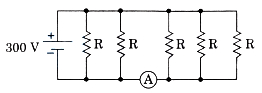
Five identical resistors, each of resistance $R = 1500 \Omega$, are connected to a $300 \text{ V}$ battery as shown in the circuit. The reading of the ideal ammeter $A$ is: (in $\text{ A}$)
A
$1$
B
$0.2$
C
$0.4$
D
$0.6$
Solution
(D) Given: $R = 1500 \Omega$, $V = 300 \text{ V}$.
Looking at the circuit diagram, the five resistors are connected in parallel across the battery. However, the ammeter $A$ is placed in series with the last three resistors.
Let the resistors be $R_1, R_2, R_3, R_4, R_5$ from left to right.
Resistors $R_1$ and $R_2$ are connected directly across the $300 \text{ V}$ battery.
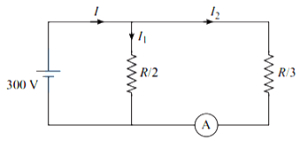
Resistors $R_3, R_4,$ and $R_5$ are connected in parallel with each other, and this combination is in series with the ammeter $A$ across the $300 \text{ V}$ battery.
The equivalent resistance of the three resistors $R_3, R_4, R_5$ in parallel is $R_{eq} = R / 3 = 1500 / 3 = 500 \Omega$.
The current $I$ flowing through the ammeter $A$ is the current through this parallel combination:
$I = \frac{V}{R_{eq}} = \frac{300}{500} = \frac{3}{5} \text{ A} = 0.6 \text{ A}$.
Looking at the circuit diagram, the five resistors are connected in parallel across the battery. However, the ammeter $A$ is placed in series with the last three resistors.
Let the resistors be $R_1, R_2, R_3, R_4, R_5$ from left to right.
Resistors $R_1$ and $R_2$ are connected directly across the $300 \text{ V}$ battery.
Resistors $R_3, R_4,$ and $R_5$ are connected in parallel with each other, and this combination is in series with the ammeter $A$ across the $300 \text{ V}$ battery.
The equivalent resistance of the three resistors $R_3, R_4, R_5$ in parallel is $R_{eq} = R / 3 = 1500 / 3 = 500 \Omega$.
The current $I$ flowing through the ammeter $A$ is the current through this parallel combination:
$I = \frac{V}{R_{eq}} = \frac{300}{500} = \frac{3}{5} \text{ A} = 0.6 \text{ A}$.
0 likesView Solution
28
PhysicsMediumMCQKCET · 2018
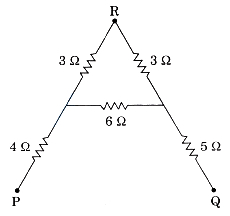
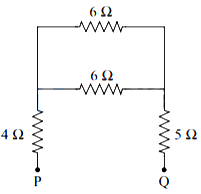
The effective resistance between $P$ and $Q$ for the following network is: (in $Omega$)
A
$10$
B
$12$
C
$15$
D
$21$
Solution
(B) Looking at the circuit,the two $3 \Omega$ resistors at the top are in series. Their equivalent resistance is $R_1 = 3 \Omega + 3 \Omega = 6 \Omega$.
This $6 \Omega$ equivalent resistance is in parallel with the $6 \Omega$ resistor connected between the two branches. The equivalent resistance $R_2$ of this parallel combination is given by $\frac{1}{R_2} = \frac{1}{6 \Omega} + \frac{1}{6 \Omega} = \frac{2}{6 \Omega} = \frac{1}{3 \Omega}$,so $R_2 = 3 \Omega$.
Now,the circuit consists of the $4 \Omega$ resistor,the $3 \Omega$ equivalent resistance $(R_2)$,and the $5 \Omega$ resistor,all connected in series.
Therefore,the total effective resistance between $P$ and $Q$ is $R_{eq} = 4 \Omega + 3 \Omega + 5 \Omega = 12 \Omega$.
This $6 \Omega$ equivalent resistance is in parallel with the $6 \Omega$ resistor connected between the two branches. The equivalent resistance $R_2$ of this parallel combination is given by $\frac{1}{R_2} = \frac{1}{6 \Omega} + \frac{1}{6 \Omega} = \frac{2}{6 \Omega} = \frac{1}{3 \Omega}$,so $R_2 = 3 \Omega$.
Now,the circuit consists of the $4 \Omega$ resistor,the $3 \Omega$ equivalent resistance $(R_2)$,and the $5 \Omega$ resistor,all connected in series.
Therefore,the total effective resistance between $P$ and $Q$ is $R_{eq} = 4 \Omega + 3 \Omega + 5 \Omega = 12 \Omega$.
0 likesView Solution
29
PhysicsEasyMCQKCET · 2018
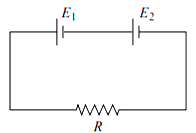
Two cells of internal resistance $r_{1}$ and $r_{2}$ and of the same emf are connected in series across a resistor of resistance $R$. If the terminal potential difference across the cell of internal resistance $r_{1}$ is zero,then the value of $R$ is
A
$R=2r_{1}+r_{2}$
B
$R=r_{2}-r_{1}$
C
$R=r_{1}-r_{2}$
D
$R=2r_{1}-r_{2}$
Solution
(C) Since the two cells are connected in series,the total emf is $E_{total} = E + E = 2E$,where $E$ is the emf of each cell.
The total resistance of the circuit is $R_{total} = R + r_{1} + r_{2}$.
The current $I$ flowing through the circuit is given by $I = \frac{2E}{R + r_{1} + r_{2}}$.
The terminal potential difference $V_{1}$ across the cell with internal resistance $r_{1}$ is given by $V_{1} = E - Ir_{1}$.
Given that $V_{1} = 0$,we have $E - Ir_{1} = 0$,which implies $E = Ir_{1}$.
Substituting the value of $I$,we get $E = \left( \frac{2E}{R + r_{1} + r_{2}} \right) r_{1}$.
Dividing both sides by $E$,we get $1 = \frac{2r_{1}}{R + r_{1} + r_{2}}$.
Rearranging the terms,$R + r_{1} + r_{2} = 2r_{1}$.
Therefore,$R = 2r_{1} - r_{1} - r_{2} = r_{1} - r_{2}$.
The total resistance of the circuit is $R_{total} = R + r_{1} + r_{2}$.
The current $I$ flowing through the circuit is given by $I = \frac{2E}{R + r_{1} + r_{2}}$.
The terminal potential difference $V_{1}$ across the cell with internal resistance $r_{1}$ is given by $V_{1} = E - Ir_{1}$.
Given that $V_{1} = 0$,we have $E - Ir_{1} = 0$,which implies $E = Ir_{1}$.
Substituting the value of $I$,we get $E = \left( \frac{2E}{R + r_{1} + r_{2}} \right) r_{1}$.
Dividing both sides by $E$,we get $1 = \frac{2r_{1}}{R + r_{1} + r_{2}}$.
Rearranging the terms,$R + r_{1} + r_{2} = 2r_{1}$.
Therefore,$R = 2r_{1} - r_{1} - r_{2} = r_{1} - r_{2}$.
0 likesView Solution
30
PhysicsEasyMCQKCET · 2018
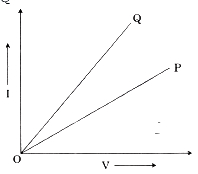
The $I-V$ graphs for two different electrical appliances $P$ and $Q$ are shown in the diagram. If $R_P$ and $R_Q$ are the resistances of the devices,then:
A
$R_P = R_Q$
B
$R_P > R_Q$
C
$R_P < R_Q$
D
$R_P = \frac{R_Q}{2}$
Solution
(B) According to Ohm's law,$V = IR$,which can be written as $I = \frac{1}{R}V$.
Comparing this with the equation of a straight line $y = mx$,the slope of the $I-V$ graph is $\frac{I}{V} = \frac{1}{R}$.
Thus,the slope of the $I-V$ graph is inversely proportional to the resistance $(Slope \propto \frac{1}{R})$.
In the given diagram,the slope of line $Q$ is greater than the slope of line $P$ (i.e.,$Slope_Q > Slope_P$).
Therefore,$\frac{1}{R_Q} > \frac{1}{R_P}$.
This implies that $R_P > R_Q$.
Comparing this with the equation of a straight line $y = mx$,the slope of the $I-V$ graph is $\frac{I}{V} = \frac{1}{R}$.
Thus,the slope of the $I-V$ graph is inversely proportional to the resistance $(Slope \propto \frac{1}{R})$.
In the given diagram,the slope of line $Q$ is greater than the slope of line $P$ (i.e.,$Slope_Q > Slope_P$).
Therefore,$\frac{1}{R_Q} > \frac{1}{R_P}$.
This implies that $R_P > R_Q$.
0 likesView Solution
31
PhysicsEasyMCQKCET · 2018
Ohm's Law is applicable to
A
Diode
B
Transistor
C
Electrolyte
D
Conductor
Solution
(D) Ohm's law is applicable to conductors under constant physical conditions.
Ohm's law states that the current flowing through a conductor is directly proportional to the potential difference applied across its ends,provided the temperature and other physical conditions remain constant.
Mathematically,this is expressed as $V = IR$,where $V$ is the potential difference,$I$ is the current,and $R$ is the resistance.
Since diodes,transistors,and electrolytes are non-ohmic devices,they do not follow this linear relationship.
Ohm's law states that the current flowing through a conductor is directly proportional to the potential difference applied across its ends,provided the temperature and other physical conditions remain constant.
Mathematically,this is expressed as $V = IR$,where $V$ is the potential difference,$I$ is the current,and $R$ is the resistance.
Since diodes,transistors,and electrolytes are non-ohmic devices,they do not follow this linear relationship.
0 likesView Solution
32
PhysicsMediumMCQKCET · 2018
The number of photons falling per second on a completely darkened plate to produce a force of $6.62 \times 10^{-5} \ N$ is $n$. If the wavelength of the light falling is $5 \times 10^{-7} \ m$,then $n = \_ \times 10^{22}$. (Given: $h = 6.62 \times 10^{-34} \ J \cdot s$)
A
$11$
B
$05$
C
$0.2$
D
$3.3$
Solution
(B) The force exerted by a beam of photons on a perfectly absorbing surface is given by $F = \frac{P}{c}$,where $P$ is the power of the light beam and $c$ is the speed of light.
The power $P$ is given by $P = n \cdot E_{photon} = n \cdot \frac{hc}{\lambda}$,where $n$ is the number of photons per second.
Substituting $P$ into the force equation: $F = \frac{n \cdot hc}{\lambda \cdot c} = \frac{n \cdot h}{\lambda}$.
Rearranging to solve for $n$: $n = \frac{F \cdot \lambda}{h}$.
Given $F = 6.62 \times 10^{-5} \ N$,$\lambda = 5 \times 10^{-7} \ m$,and $h = 6.62 \times 10^{-34} \ J \cdot s$.
$n = \frac{(6.62 \times 10^{-5}) \times (5 \times 10^{-7})}{6.62 \times 10^{-34}}$.
$n = \frac{6.62}{6.62} \times 5 \times 10^{-5-7+34} = 1 \times 5 \times 10^{22} = 5 \times 10^{22}$.
Thus,$n = 5$.
The power $P$ is given by $P = n \cdot E_{photon} = n \cdot \frac{hc}{\lambda}$,where $n$ is the number of photons per second.
Substituting $P$ into the force equation: $F = \frac{n \cdot hc}{\lambda \cdot c} = \frac{n \cdot h}{\lambda}$.
Rearranging to solve for $n$: $n = \frac{F \cdot \lambda}{h}$.
Given $F = 6.62 \times 10^{-5} \ N$,$\lambda = 5 \times 10^{-7} \ m$,and $h = 6.62 \times 10^{-34} \ J \cdot s$.
$n = \frac{(6.62 \times 10^{-5}) \times (5 \times 10^{-7})}{6.62 \times 10^{-34}}$.
$n = \frac{6.62}{6.62} \times 5 \times 10^{-5-7+34} = 1 \times 5 \times 10^{22} = 5 \times 10^{22}$.
Thus,$n = 5$.
0 likesView Solution
33
PhysicsEasyMCQKCET · 2018
$A$ proton and an $\alpha$-particle are accelerated through the same potential difference $V$. The ratio of their de-Broglie wavelengths is
A
$\sqrt{2}$
B
$2\sqrt{2}$
C
$\sqrt{3}$
D
$2\sqrt{3}$
Solution
(B) The de-Broglie wavelength $\lambda$ for a particle of mass $m$ and charge $q$ accelerated through a potential difference $V$ is given by:
$\lambda = \frac{h}{\sqrt{2mqV}}$
For a proton $(p)$: $\lambda_p = \frac{h}{\sqrt{2m_p q_p V}}$
For an $\alpha$-particle $(\alpha)$: $\lambda_{\alpha} = \frac{h}{\sqrt{2m_{\alpha} q_{\alpha} V}}$
Given that $m_{\alpha} = 4m_p$ and $q_{\alpha} = 2q_p$:
$\frac{\lambda_p}{\lambda_{\alpha}} = \sqrt{\frac{m_{\alpha} q_{\alpha}}{m_p q_p}} = \sqrt{\frac{4m_p \times 2q_p}{m_p \times q_p}} = \sqrt{8} = 2\sqrt{2}$
Thus, the ratio of their de-Broglie wavelengths is $2\sqrt{2}$.
$\lambda = \frac{h}{\sqrt{2mqV}}$
For a proton $(p)$: $\lambda_p = \frac{h}{\sqrt{2m_p q_p V}}$
For an $\alpha$-particle $(\alpha)$: $\lambda_{\alpha} = \frac{h}{\sqrt{2m_{\alpha} q_{\alpha} V}}$
Given that $m_{\alpha} = 4m_p$ and $q_{\alpha} = 2q_p$:
$\frac{\lambda_p}{\lambda_{\alpha}} = \sqrt{\frac{m_{\alpha} q_{\alpha}}{m_p q_p}} = \sqrt{\frac{4m_p \times 2q_p}{m_p \times q_p}} = \sqrt{8} = 2\sqrt{2}$
Thus, the ratio of their de-Broglie wavelengths is $2\sqrt{2}$.
0 likesView Solution
34
PhysicsEasyMCQKCET · 2018
The maximum kinetic energy of emitted photoelectrons depends on
A
Intensity of incident radiation
B
Frequency of incident radiation
C
Speed of incident radiation
D
Number of photons in the incident radiation
Solution
(B) In the photoelectric effect,the maximum kinetic energy of emitted photoelectrons depends on the frequency of the incident radiation.
According to Einstein's photoelectric equation:
$KE_{\max} = h\nu - \phi$
Where:
$KE_{\max}$ is the maximum kinetic energy of the emitted photoelectrons.
$h$ is Planck's constant.
$\nu$ is the frequency of the incident radiation.
$\phi$ is the work function of the metal.
Since the work function $\phi$ is a constant for a given metal,the maximum kinetic energy $(KE_{\max})$ is directly dependent on the frequency $\nu$ of the incident radiation.
According to Einstein's photoelectric equation:
$KE_{\max} = h\nu - \phi$
Where:
$KE_{\max}$ is the maximum kinetic energy of the emitted photoelectrons.
$h$ is Planck's constant.
$\nu$ is the frequency of the incident radiation.
$\phi$ is the work function of the metal.
Since the work function $\phi$ is a constant for a given metal,the maximum kinetic energy $(KE_{\max})$ is directly dependent on the frequency $\nu$ of the incident radiation.
0 likesView Solution
35
PhysicsEasyMCQKCET · 2018
$A$ charge $q$ is accelerated through a potential difference $V$. It is then passed normally through a uniform magnetic field,where it moves in a circle of radius $r$. The potential difference required to move it in a circle of radius $2r$ is (in $V$)
A
$12$
B
$4$
C
$1$
D
$3$
Solution
(B) When a charge $q$ is accelerated through a potential difference $V$,its kinetic energy is given by $\frac{1}{2}mv^2 = qV$.
This implies $mv = \sqrt{2mqV}$.
The radius $r$ of the circular path in a magnetic field $B$ is given by $r = \frac{mv}{qB}$.
Substituting the value of $mv$,we get $r = \frac{\sqrt{2mqV}}{qB}$.
Since $m, q,$ and $B$ are constant,we have $r \propto \sqrt{V}$.
If the radius becomes $2r$,then $\frac{r'}{r} = \frac{\sqrt{V'}}{\sqrt{V}} = 2$.
Squaring both sides,$\frac{V'}{V} = 4$,which gives $V' = 4V$.
This implies $mv = \sqrt{2mqV}$.
The radius $r$ of the circular path in a magnetic field $B$ is given by $r = \frac{mv}{qB}$.
Substituting the value of $mv$,we get $r = \frac{\sqrt{2mqV}}{qB}$.
Since $m, q,$ and $B$ are constant,we have $r \propto \sqrt{V}$.
If the radius becomes $2r$,then $\frac{r'}{r} = \frac{\sqrt{V'}}{\sqrt{V}} = 2$.
Squaring both sides,$\frac{V'}{V} = 4$,which gives $V' = 4V$.
0 likesView Solution
36
PhysicsEasyMCQKCET · 2018
The magnetic flux linked with a coil varies as $\phi = 3t^{2} + 4t + 9$. The magnitude of the emf induced at $t = 2 \text{ s}$ is: (in $\text{ V}$)
A
$8$
B
$16$
C
$32$
D
$64$
Solution
(B) Given,magnetic flux $\phi = 3t^{2} + 4t + 9$.
According to Faraday's law of electromagnetic induction,the magnitude of the induced emf is given by $\varepsilon = \left| \frac{d\phi}{dt} \right|$.
First,differentiate the flux expression with respect to time $t$:
$\frac{d\phi}{dt} = \frac{d}{dt}(3t^{2} + 4t + 9) = 6t + 4$.
Now,substitute the value $t = 2 \text{ s}$ into the derivative:
$\varepsilon = |6(2) + 4| = |12 + 4| = 16 \text{ V}$.
Thus,the magnitude of the induced emf at $t = 2 \text{ s}$ is $16 \text{ V}$.
According to Faraday's law of electromagnetic induction,the magnitude of the induced emf is given by $\varepsilon = \left| \frac{d\phi}{dt} \right|$.
First,differentiate the flux expression with respect to time $t$:
$\frac{d\phi}{dt} = \frac{d}{dt}(3t^{2} + 4t + 9) = 6t + 4$.
Now,substitute the value $t = 2 \text{ s}$ into the derivative:
$\varepsilon = |6(2) + 4| = |12 + 4| = 16 \text{ V}$.
Thus,the magnitude of the induced emf at $t = 2 \text{ s}$ is $16 \text{ V}$.
0 likesView Solution
37
PhysicsDifficultMCQKCET · 2018
The force of repulsion between two identical positive charges when kept with a separation $r$ in air is $F$. Half the gap between the two charges is filled by a dielectric slab of dielectric constant $K=4$. Then the new force of repulsion between those two charges becomes:
A
$F/3$
B
$F/2$
C
$F/4$
D
$4F/9$
Solution
(D) The initial force between two identical charges $q$ separated by distance $r$ in air is given by $F = \frac{1}{4 \pi \varepsilon_0} \frac{q^2}{r^2} \quad (1)$.
When a dielectric slab of thickness $t$ and dielectric constant $K$ is placed between the charges,the effective separation becomes $r_{eff} = (r - t) + t\sqrt{K}$.
Here,$t = r/2$ and $K = 4$.
Substituting these values,$r_{eff} = (r - r/2) + (r/2)\sqrt{4} = r/2 + (r/2)(2) = r/2 + r = 3r/2$.
The new force $F'$ is given by $F' = \frac{1}{4 \pi \varepsilon_0} \frac{q^2}{(r_{eff})^2} = \frac{1}{4 \pi \varepsilon_0} \frac{q^2}{(3r/2)^2}$.
$F' = \frac{1}{4 \pi \varepsilon_0} \frac{q^2}{(9/4)r^2} = \frac{4}{9} \left( \frac{1}{4 \pi \varepsilon_0} \frac{q^2}{r^2} \right)$.
Using equation $(1)$,we get $F' = \frac{4}{9}F$.
When a dielectric slab of thickness $t$ and dielectric constant $K$ is placed between the charges,the effective separation becomes $r_{eff} = (r - t) + t\sqrt{K}$.
Here,$t = r/2$ and $K = 4$.
Substituting these values,$r_{eff} = (r - r/2) + (r/2)\sqrt{4} = r/2 + (r/2)(2) = r/2 + r = 3r/2$.
The new force $F'$ is given by $F' = \frac{1}{4 \pi \varepsilon_0} \frac{q^2}{(r_{eff})^2} = \frac{1}{4 \pi \varepsilon_0} \frac{q^2}{(3r/2)^2}$.
$F' = \frac{1}{4 \pi \varepsilon_0} \frac{q^2}{(9/4)r^2} = \frac{4}{9} \left( \frac{1}{4 \pi \varepsilon_0} \frac{q^2}{r^2} \right)$.
Using equation $(1)$,we get $F' = \frac{4}{9}F$.
0 likesView Solution
38
PhysicsEasyMCQKCET · 2018
The magnitude of a point charge due to which the electric field $30 \ cm$ away has a magnitude of $2 \ N \ C^{-1}$ is:
A
$2 \times 10^{-11} \ C$
B
$3 \times 10^{-11} \ C$
C
$5 \times 10^{-11} \ C$
D
$9 \times 10^{-11} \ C$
Solution
(A) The electric field $E$ due to a point charge $q$ at a distance $r$ is given by the formula:
$E = \frac{1}{4 \pi \varepsilon_{0}} \frac{q}{r^{2}}$
Given values are:
$E = 2 \ N \ C^{-1}$
$r = 30 \ cm = 0.3 \ m = 30 \times 10^{-2} \ m$
$\frac{1}{4 \pi \varepsilon_{0}} = 9 \times 10^{9} \ N \ m^{2} \ C^{-2}$
Substituting these values into the formula:
$2 = 9 \times 10^{9} \times \frac{q}{(30 \times 10^{-2})^{2}}$
$2 = 9 \times 10^{9} \times \frac{q}{900 \times 10^{-4}}$
$2 = 9 \times 10^{9} \times \frac{q}{9 \times 10^{-2}}$
$2 = 10^{11} \times q$
$q = \frac{2}{10^{11}} = 2 \times 10^{-11} \ C$
Thus,the magnitude of the charge is $2 \times 10^{-11} \ C$.
$E = \frac{1}{4 \pi \varepsilon_{0}} \frac{q}{r^{2}}$
Given values are:
$E = 2 \ N \ C^{-1}$
$r = 30 \ cm = 0.3 \ m = 30 \times 10^{-2} \ m$
$\frac{1}{4 \pi \varepsilon_{0}} = 9 \times 10^{9} \ N \ m^{2} \ C^{-2}$
Substituting these values into the formula:
$2 = 9 \times 10^{9} \times \frac{q}{(30 \times 10^{-2})^{2}}$
$2 = 9 \times 10^{9} \times \frac{q}{900 \times 10^{-4}}$
$2 = 9 \times 10^{9} \times \frac{q}{9 \times 10^{-2}}$
$2 = 10^{11} \times q$
$q = \frac{2}{10^{11}} = 2 \times 10^{-11} \ C$
Thus,the magnitude of the charge is $2 \times 10^{-11} \ C$.
0 likesView Solution
39
PhysicsMediumMCQKCET · 2018
$A$ mass of $1 \ kg$ carrying a charge of $2 \ C$ is accelerated through a potential difference of $1 \ V$. The velocity acquired by it is:
A
$ \sqrt{2} \ m \ s^{-1} $
B
$ 2 \ m \ s^{-1} $
C
$ \frac{1}{\sqrt{2}} \ m \ s^{-1} $
D
$ \frac{1}{2} \ m \ s^{-1} $
Solution
(B) When a charge $q$ is accelerated through a potential difference $V$,the work done by the electric field is equal to the kinetic energy gained by the mass $m$.
The work done is given by $W = qV$.
The kinetic energy gained is $K = \frac{1}{2}mv^2$.
Equating the two: $\frac{1}{2}mv^2 = qV$.
Given values: $m = 1 \ kg$,$q = 2 \ C$,$V = 1 \ V$.
Substituting these values into the equation: $\frac{1}{2} \times 1 \times v^2 = 2 \times 1$.
$\frac{1}{2}v^2 = 2$.
$v^2 = 4$.
$v = 2 \ m \ s^{-1}$.
Therefore,the velocity acquired by the mass is $2 \ m \ s^{-1}$.
The work done is given by $W = qV$.
The kinetic energy gained is $K = \frac{1}{2}mv^2$.
Equating the two: $\frac{1}{2}mv^2 = qV$.
Given values: $m = 1 \ kg$,$q = 2 \ C$,$V = 1 \ V$.
Substituting these values into the equation: $\frac{1}{2} \times 1 \times v^2 = 2 \times 1$.
$\frac{1}{2}v^2 = 2$.
$v^2 = 4$.
$v = 2 \ m \ s^{-1}$.
Therefore,the velocity acquired by the mass is $2 \ m \ s^{-1}$.
0 likesView Solution
40
PhysicsMediumMCQKCET · 2018
The work done to move a charge on an equipotential surface is
A
Infinity
B
Less than $1$
C
Greater than $1$
D
Zero
Solution
(D) An equipotential surface has the same electric potential at all points.
Therefore,the work done in moving a charge $q$ from point $A$ to point $B$ on an equipotential surface is given by the formula:
$W = q(V_{B} - V_{A})$
Since the surface is equipotential,the potential at all points is the same,meaning $V_{A} = V_{B}$.
Substituting this into the equation:
$W = q(V_{A} - V_{A}) = q(0) = 0$
Thus,the work done in moving a charge on an equipotential surface is $0$.
Therefore,the work done in moving a charge $q$ from point $A$ to point $B$ on an equipotential surface is given by the formula:
$W = q(V_{B} - V_{A})$
Since the surface is equipotential,the potential at all points is the same,meaning $V_{A} = V_{B}$.
Substituting this into the equation:
$W = q(V_{A} - V_{A}) = q(0) = 0$
Thus,the work done in moving a charge on an equipotential surface is $0$.
0 likesView Solution
41
PhysicsEasyMCQKCET · 2018
The correct Biot-Savart law in vector form is
A
$\delta \vec{B} = \frac{\mu_{0}}{4 \pi} \frac{I(d\vec{l} \times \vec{r})}{r^{3}}$
B
$\delta \vec{B} = \frac{\mu_{0}}{4 \pi} \frac{I(d\vec{l} \times \vec{r})}{r^{3}}$
C
$\delta \vec{B} = \frac{\mu_{0}}{4 \pi} \frac{I(\vec{r} \times d\vec{l})}{r^{3}}$
D
$\delta \vec{B} = \frac{\mu_{0}}{4 \pi} \frac{I(d\vec{l} \times \vec{r})}{r^{2}}$
Solution
(B) The Biot-Savart law describes the magnetic field $d\vec{B}$ produced by a current element $I d\vec{l}$ at a position vector $\vec{r}$ from the element.
In vector form,the law is given by:
$d\vec{B} = \frac{\mu_{0}}{4 \pi} \frac{I(d\vec{l} \times \vec{r})}{r^{3}}$
Since $\vec{r} = r \hat{r}$,we can also write this as $d\vec{B} = \frac{\mu_{0}}{4 \pi} \frac{I(d\vec{l} \times \hat{r})}{r^{2}}$.
Comparing this with the given options,option $B$ is the correct representation.
In vector form,the law is given by:
$d\vec{B} = \frac{\mu_{0}}{4 \pi} \frac{I(d\vec{l} \times \vec{r})}{r^{3}}$
Since $\vec{r} = r \hat{r}$,we can also write this as $d\vec{B} = \frac{\mu_{0}}{4 \pi} \frac{I(d\vec{l} \times \hat{r})}{r^{2}}$.
Comparing this with the given options,option $B$ is the correct representation.
0 likesView Solution
42
PhysicsEasyMCQKCET · 2018
An electron is moving in a circle of radius $r$ in a magnetic field $B$. Suddenly,the field is reduced to $B/2$. The radius of the circular path is
A
$r/2$
B
$2r$
C
$r/4$
D
$4r$
Solution
(B) The radius $r$ of the circular path of a charged particle moving in a uniform magnetic field $B$ is given by the formula:
$r = \frac{mv}{qB}$
where $m$ is the mass,$v$ is the velocity,and $q$ is the charge of the particle.
From this relation,we can see that the radius is inversely proportional to the magnetic field strength: $r \propto \frac{1}{B}$.
Initially,the radius is $r$ for a field $B$. Let the new radius be $r'$ when the field is reduced to $B' = B/2$.
Since $r \cdot B = r' \cdot B'$,we have:
$r \cdot B = r' \cdot (B/2)$
$r' = \frac{r \cdot B}{B/2} = 2r$.
Therefore,the new radius of the circular path is $2r$.
$r = \frac{mv}{qB}$
where $m$ is the mass,$v$ is the velocity,and $q$ is the charge of the particle.
From this relation,we can see that the radius is inversely proportional to the magnetic field strength: $r \propto \frac{1}{B}$.
Initially,the radius is $r$ for a field $B$. Let the new radius be $r'$ when the field is reduced to $B' = B/2$.
Since $r \cdot B = r' \cdot B'$,we have:
$r \cdot B = r' \cdot (B/2)$
$r' = \frac{r \cdot B}{B/2} = 2r$.
Therefore,the new radius of the circular path is $2r$.
0 likesView Solution
43
PhysicsMediumMCQKCET · 2018
$A$ cyclotron's oscillator frequency is $10 \text{ MHz}$ and the operating magnetic field is $0.66 \text{ T}$. If the radius of its dees is $60 \text{ cm}$, then the kinetic energy of the proton beam produced by the accelerator is: (in $\text{ MeV}$)
A
$9$
B
$10$
C
$7$
D
$11$
Solution
(C) The cyclotron frequency is given by $f = \frac{qB}{2\pi m}$.
The maximum velocity $v$ of the proton at the radius $r$ is $v = \frac{qBr}{m} = 2\pi fr$.
The kinetic energy $K$ is given by $K = \frac{1}{2}mv^2 = \frac{1}{2}m(2\pi fr)^2 = 2\pi^2 mf^2r^2$.
Given values: $f = 10 \times 10^6 \text{ Hz}$, $r = 0.6 \text{ m}$, $m = 1.67 \times 10^{-27} \text{ kg}$.
Substituting these values:
$K = 2 \times (3.14)^2 \times (1.67 \times 10^{-27}) \times (10^7)^2 \times (0.6)^2$
$K = 2 \times 9.8596 \times 1.67 \times 10^{-27} \times 10^{14} \times 0.36$
$K \approx 1.185 \times 10^{-12} \text{ J}$.
To convert to $\text{MeV}$, divide by $1.6 \times 10^{-13} \text{ J/MeV}$:
$K = \frac{1.185 \times 10^{-12}}{1.6 \times 10^{-13}} \approx 7.4 \text{ MeV}$.
Rounding to the nearest given option, the kinetic energy is $7 \text{ MeV}$.
The maximum velocity $v$ of the proton at the radius $r$ is $v = \frac{qBr}{m} = 2\pi fr$.
The kinetic energy $K$ is given by $K = \frac{1}{2}mv^2 = \frac{1}{2}m(2\pi fr)^2 = 2\pi^2 mf^2r^2$.
Given values: $f = 10 \times 10^6 \text{ Hz}$, $r = 0.6 \text{ m}$, $m = 1.67 \times 10^{-27} \text{ kg}$.
Substituting these values:
$K = 2 \times (3.14)^2 \times (1.67 \times 10^{-27}) \times (10^7)^2 \times (0.6)^2$
$K = 2 \times 9.8596 \times 1.67 \times 10^{-27} \times 10^{14} \times 0.36$
$K \approx 1.185 \times 10^{-12} \text{ J}$.
To convert to $\text{MeV}$, divide by $1.6 \times 10^{-13} \text{ J/MeV}$:
$K = \frac{1.185 \times 10^{-12}}{1.6 \times 10^{-13}} \approx 7.4 \text{ MeV}$.
Rounding to the nearest given option, the kinetic energy is $7 \text{ MeV}$.
0 likesView Solution
44
PhysicsEasyMCQKCET · 2018
The strength of Earth's magnetic field is:
A
constant everywhere
B
Zero everywhere
C
Having very high value
D
varying from place to place on Earth's surface
Solution
(D) The strength of the Earth's magnetic field is not uniform across the globe.
It varies from place to place on the Earth's surface.
This variation occurs because the strength of a magnetic field is directly related to the density of magnetic field lines at a particular location.
Since the magnetic field lines of the Earth are not distributed with uniform density,the magnetic field strength changes depending on the geographic location.
It varies from place to place on the Earth's surface.
This variation occurs because the strength of a magnetic field is directly related to the density of magnetic field lines at a particular location.
Since the magnetic field lines of the Earth are not distributed with uniform density,the magnetic field strength changes depending on the geographic location.
0 likesView Solution
45
PhysicsDifficultMCQKCET · 2018
$A$ jet plane having a wing span of $25 \ m$ is travelling horizontally towards the east with a speed of $3600 \ km/h$. If the Earth's magnetic field at the location is $4 \times 10^{-4} \ T$ and the angle of dip is $30^{\circ}$,then the potential difference between the ends of the wing is: (in $V$)
A
$4$
B
$5$
C
$0$
D
$2.5$
Solution
(B) Given: Wing span $l = 25 \ m$; Speed of jet plane $v = 3600 \ km/h = 3600 \times \frac{5}{18} \ m/s = 1000 \ m/s$.
Earth's magnetic field $B = 4 \times 10^{-4} \ T$; Angle of dip $\delta = 30^{\circ}$.
The motional electromotive force (emf) induced across the wings is given by $e = B_v \cdot l \cdot v$,where $B_v$ is the vertical component of the Earth's magnetic field.
$B_v = B \sin(\delta) = 4 \times 10^{-4} \times \sin(30^{\circ}) = 4 \times 10^{-4} \times 0.5 = 2 \times 10^{-4} \ T$.
Substituting the values into the formula:
$e = (2 \times 10^{-4} \ T) \times (25 \ m) \times (1000 \ m/s)$.
$e = 2 \times 10^{-4} \times 25000 = 2 \times 2.5 = 5 \ V$.
Thus,the potential difference between the ends of the wing is $5 \ V$.
Earth's magnetic field $B = 4 \times 10^{-4} \ T$; Angle of dip $\delta = 30^{\circ}$.
The motional electromotive force (emf) induced across the wings is given by $e = B_v \cdot l \cdot v$,where $B_v$ is the vertical component of the Earth's magnetic field.
$B_v = B \sin(\delta) = 4 \times 10^{-4} \times \sin(30^{\circ}) = 4 \times 10^{-4} \times 0.5 = 2 \times 10^{-4} \ T$.
Substituting the values into the formula:
$e = (2 \times 10^{-4} \ T) \times (25 \ m) \times (1000 \ m/s)$.
$e = 2 \times 10^{-4} \times 25000 = 2 \times 2.5 = 5 \ V$.
Thus,the potential difference between the ends of the wing is $5 \ V$.
0 likesView Solution
46
PhysicsEasyMCQKCET · 2018
Needles $N_{1}$,$N_{2}$,and $N_{3}$ are made of a ferromagnetic,a paramagnetic,and a diamagnetic substance,respectively. $A$ magnet when brought close to them will
A
Attract all three of them
B
Attract $N_{1}$ strongly,$N_{2}$ weakly,and repel $N_{3}$ weakly
C
Attract $N_{1}$ strongly but repel $N_{2}$ and $N_{3}$ weakly
D
Attract $N_{1}$ and $N_{2}$ strongly but repel $N_{3}$
Solution
(B) The magnetic properties of materials determine their interaction with an external magnetic field:
$1$. Ferromagnetic substances $(N_{1})$ are strongly attracted by a magnet.
$2$. Paramagnetic substances $(N_{2})$ are weakly attracted by a magnet.
$3$. Diamagnetic substances $(N_{3})$ are weakly repelled by a magnet.
Therefore,when a magnet is brought close to these needles,it will attract $N_{1}$ strongly,attract $N_{2}$ weakly,and repel $N_{3}$ weakly.
$1$. Ferromagnetic substances $(N_{1})$ are strongly attracted by a magnet.
$2$. Paramagnetic substances $(N_{2})$ are weakly attracted by a magnet.
$3$. Diamagnetic substances $(N_{3})$ are weakly repelled by a magnet.
Therefore,when a magnet is brought close to these needles,it will attract $N_{1}$ strongly,attract $N_{2}$ weakly,and repel $N_{3}$ weakly.
0 likesView Solution
47
PhysicsMediumMCQKCET · 2018
The energy equivalent to a substance of mass $1 \,g$ is
A
$18 \times 10^{13} \,J$
B
$9 \times 10^{13} \,J$
C
$18 \times 10^{6} \,J$
D
$9 \times 10^{6} \,J$
Solution
(B) According to Einstein's mass-energy equivalence principle, the energy $E$ equivalent to a mass $m$ is given by the formula $E = mc^2$, where $c$ is the speed of light in a vacuum.
Given mass $m = 1 \,g = 1 \times 10^{-3} \,kg$.
The speed of light $c = 3 \times 10^8 \,m/s$.
Substituting these values into the equation:
$E = (1 \times 10^{-3} \,kg) \times (3 \times 10^8 \,m/s)^2$
$E = 1 \times 10^{-3} \times 9 \times 10^{16} \,J$
$E = 9 \times 10^{13} \,J$.
Therefore, the energy equivalent to a substance of mass $1 \,g$ is $9 \times 10^{13} \,J$.
Given mass $m = 1 \,g = 1 \times 10^{-3} \,kg$.
The speed of light $c = 3 \times 10^8 \,m/s$.
Substituting these values into the equation:
$E = (1 \times 10^{-3} \,kg) \times (3 \times 10^8 \,m/s)^2$
$E = 1 \times 10^{-3} \times 9 \times 10^{16} \,J$
$E = 9 \times 10^{13} \,J$.
Therefore, the energy equivalent to a substance of mass $1 \,g$ is $9 \times 10^{13} \,J$.
0 likesView Solution
48
PhysicsDifficultMCQKCET · 2018
The half-life of tritium is $ 12.5 $ years. What mass of tritium of initial mass $ 64 \ mg $ will remain undecayed after $ 50 $ years (in $mg$)?
A
$32$
B
$8$
C
$16$
D
$4$
Solution
(D) Given: Half-life $( T_{1/2} )$ $= 12.5 \text{ years}$,Initial mass $( N_0 )$ $= 64 \ mg$,Total time $( t )$ $= 50 \text{ years}$.
We use the formula for the number of half-lives passed: $ n = \frac{t}{T_{1/2}} $.
$ n = \frac{50}{12.5} = 4 $.
The remaining mass $( N )$ is given by the formula: $ N = N_0 \times (\frac{1}{2})^n $.
$ N = 64 \times (\frac{1}{2})^4 $.
$ N = 64 \times \frac{1}{16} $.
$ N = 4 \ mg $.
Thus,$ 4 \ mg $ of tritium will remain undecayed after $ 50 \text{ years} $.
We use the formula for the number of half-lives passed: $ n = \frac{t}{T_{1/2}} $.
$ n = \frac{50}{12.5} = 4 $.
The remaining mass $( N )$ is given by the formula: $ N = N_0 \times (\frac{1}{2})^n $.
$ N = 64 \times (\frac{1}{2})^4 $.
$ N = 64 \times \frac{1}{16} $.
$ N = 4 \ mg $.
Thus,$ 4 \ mg $ of tritium will remain undecayed after $ 50 \text{ years} $.
0 likesView Solution
49
PhysicsMediumMCQKCET · 2018
$A$ candle placed $25 \ cm$ from a lens forms an image on a screen placed $75 \ cm$ on the other side of the lens. The focal length and type of the lens should be
A
$+18.75 \ cm$ and convex lens
B
$-18.75 \ cm$ and concave lens
C
$+20.25 \ cm$ and convex lens
D
$-20.25 \ cm$ and concave lens
Solution
(A) Using the lens formula: $\frac{1}{f} = \frac{1}{v} - \frac{1}{u}$.
Given: Object distance $u = -25 \ cm$ (by sign convention) and image distance $v = +75 \ cm$ (since the image is formed on a screen on the other side).
Substituting the values:
$\frac{1}{f} = \frac{1}{75} - \frac{1}{-25} = \frac{1}{75} + \frac{1}{25}$.
$\frac{1}{f} = \frac{1 + 3}{75} = \frac{4}{75}$.
$f = \frac{75}{4} = +18.75 \ cm$.
Since the focal length is positive,the lens is a convex lens.
Given: Object distance $u = -25 \ cm$ (by sign convention) and image distance $v = +75 \ cm$ (since the image is formed on a screen on the other side).
Substituting the values:
$\frac{1}{f} = \frac{1}{75} - \frac{1}{-25} = \frac{1}{75} + \frac{1}{25}$.
$\frac{1}{f} = \frac{1 + 3}{75} = \frac{4}{75}$.
$f = \frac{75}{4} = +18.75 \ cm$.
Since the focal length is positive,the lens is a convex lens.
0 likesView Solution
50
PhysicsEasyMCQKCET · 2018
An object is placed at the principal focus of a convex mirror. The image will be at
A
Center of curvature
B
Principal focus
C
Infinity
D
No image will be formed
Solution
(D) For a convex mirror,the principal focus $(F)$ is located behind the mirror.
When an object is placed at the principal focus of a convex mirror,the rays of light originating from the object appear to diverge from the focus after reflection.
However,since the focus is behind the mirror,the rays cannot actually meet or appear to meet at any point to form an image in the conventional sense for this specific configuration.
Therefore,no image is formed at the principal focus of a convex mirror.
When an object is placed at the principal focus of a convex mirror,the rays of light originating from the object appear to diverge from the focus after reflection.
However,since the focus is behind the mirror,the rays cannot actually meet or appear to meet at any point to form an image in the conventional sense for this specific configuration.
Therefore,no image is formed at the principal focus of a convex mirror.
0 likesView Solution
51
PhysicsMediumMCQKCET · 2018
An object is placed at a distance of $20 \ cm$ from the pole of a concave mirror of focal length $10 \ cm$. The distance of the image formed is
A
$+20 \ cm$
B
$+10 \ cm$
C
$-20 \ cm$
D
$-10 \ cm$
Solution
(C) Using the mirror formula,we have $\frac{1}{f} = \frac{1}{v} + \frac{1}{u}$.
Here,the object distance $u = -20 \ cm$ and the focal length $f = -10 \ cm$ (for a concave mirror).
Substituting these values into the formula:
$\frac{1}{-10} = \frac{1}{v} + \frac{1}{-20}$.
Rearranging to solve for $v$:
$\frac{1}{v} = \frac{1}{20} - \frac{1}{10}$.
$\frac{1}{v} = \frac{1 - 2}{20} = \frac{-1}{20}$.
Therefore,$v = -20 \ cm$.
Here,the object distance $u = -20 \ cm$ and the focal length $f = -10 \ cm$ (for a concave mirror).
Substituting these values into the formula:
$\frac{1}{-10} = \frac{1}{v} + \frac{1}{-20}$.
Rearranging to solve for $v$:
$\frac{1}{v} = \frac{1}{20} - \frac{1}{10}$.
$\frac{1}{v} = \frac{1 - 2}{20} = \frac{-1}{20}$.
Therefore,$v = -20 \ cm$.
0 likesView Solution
52
PhysicsMediumMCQKCET · 2018
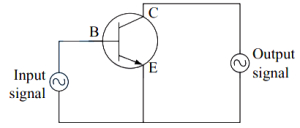
In a $CE$ amplifier,the input $ac$ signal to be amplified is applied across
A
Forward biased emitter-base junction
B
Reverse biased collector-base junction
C
Reverse biased emitter-base junction
D
Forward biased collector-base junction
Solution
(A) In a Common Emitter $(CE)$ amplifier configuration,the transistor is biased such that the emitter-base junction is forward biased and the collector-base junction is reverse biased.
To amplify an input $ac$ signal,it is superimposed on the $dc$ bias voltage at the input side.
Therefore,the input $ac$ signal is applied across the forward biased emitter-base junction to control the flow of charge carriers from the emitter to the collector.
To amplify an input $ac$ signal,it is superimposed on the $dc$ bias voltage at the input side.
Therefore,the input $ac$ signal is applied across the forward biased emitter-base junction to control the flow of charge carriers from the emitter to the collector.
0 likesView Solution
53
PhysicsDifficultMCQKCET · 2018
The dc common emitter current gain of an $n-p-n$ transistor is $50$. The potential difference applied across the collector and emitter of a transistor used in $CE$ configuration is $V_{CE} = 2 \ V$. If the collector resistance $R_{C} = 4 \ k\Omega$,the base current $(I_{B})$ and the collector current $(I_{C})$ are:
A
$I_{B} = 10 \ \mu A, I_{C} = 0.5 \ mA$
B
$I_{B} = 0.5 \ \mu A, I_{C} = 10 \ mA$
C
$I_{B} = 5 \ \mu A, I_{C} = 1 \ mA$
D
$I_{B} = 1 \ \mu A, I_{C} = 0.5 \ mA$
Solution
(A) Given: Current gain $\beta = 50$,$V_{CE} = 2 \ V$,and $R_{C} = 4 \ k\Omega$.
The collector current $I_{C}$ is determined by the output circuit loop: $I_{C} = \frac{V_{CE}}{R_{C}} = \frac{2 \ V}{4 \times 10^{3} \ \Omega} = 0.5 \times 10^{-3} \ A = 0.5 \ mA$.
The base current $I_{B}$ is related to the collector current by the current gain formula: $\beta = \frac{I_{C}}{I_{B}}$.
Rearranging for $I_{B}$: $I_{B} = \frac{I_{C}}{\beta} = \frac{0.5 \times 10^{-3} \ A}{50} = 0.01 \times 10^{-3} \ A = 10 \times 10^{-6} \ A = 10 \ \mu A$.
Thus,$I_{B} = 10 \ \mu A$ and $I_{C} = 0.5 \ mA$.
The collector current $I_{C}$ is determined by the output circuit loop: $I_{C} = \frac{V_{CE}}{R_{C}} = \frac{2 \ V}{4 \times 10^{3} \ \Omega} = 0.5 \times 10^{-3} \ A = 0.5 \ mA$.
The base current $I_{B}$ is related to the collector current by the current gain formula: $\beta = \frac{I_{C}}{I_{B}}$.
Rearranging for $I_{B}$: $I_{B} = \frac{I_{C}}{\beta} = \frac{0.5 \times 10^{-3} \ A}{50} = 0.01 \times 10^{-3} \ A = 10 \times 10^{-6} \ A = 10 \ \mu A$.
Thus,$I_{B} = 10 \ \mu A$ and $I_{C} = 0.5 \ mA$.
0 likesView Solution
54
PhysicsEasyMCQKCET · 2018
If $ A=1 $ and $ B=0 $,then in terms of Boolean algebra,$ \bar{A}+B= $
A
$ B $
B
$ \bar{B} $
C
$ A $
D
$ \bar{A} $
Solution
(A) Given $ A=1 $ and $ B=0 $.
In Boolean algebra,the complement of $ A $ is $ \bar{A} = \bar{1} = 0 $.
Now,substitute the values into the expression $ \bar{A}+B $:
$ \bar{A}+B = 0 + 0 = 0 $.
Since $ B=0 $,we can see that $ \bar{A}+B = B $.
Therefore,the correct option is $ A $.
In Boolean algebra,the complement of $ A $ is $ \bar{A} = \bar{1} = 0 $.
Now,substitute the values into the expression $ \bar{A}+B $:
$ \bar{A}+B = 0 + 0 = 0 $.
Since $ B=0 $,we can see that $ \bar{A}+B = B $.
Therefore,the correct option is $ A $.
0 likesView Solution
55
PhysicsMediumMCQKCET · 2018
The density of an electron-hole pair in a pure germanium is $3 \times 10^{16} \ m^{-3}$ at room temperature. On doping with aluminium,the hole density increases to $4.5 \times 10^{22} \ m^{-3}$. Now,the electron density (in $m^{-3}$) in doped germanium is:
A
$1 \times 10^{10}$
B
$2 \times 10^{10}$
C
$0.5 \times 10^{10}$
D
$4 \times 10^{10}$
Solution
(B) Given,the intrinsic carrier density (electron-hole pair density) in pure germanium is $n_i = 3 \times 10^{16} \ m^{-3}$.
After doping with aluminium (a trivalent impurity),the semiconductor becomes $p$-type,and the hole density is $n_h = 4.5 \times 10^{22} \ m^{-3}$.
According to the law of mass action for semiconductors,the product of electron density $(n_e)$ and hole density $(n_h)$ is equal to the square of the intrinsic carrier density $(n_i^2)$:
$n_e \times n_h = n_i^2$
Substituting the given values:
$n_e = \frac{n_i^2}{n_h} = \frac{(3 \times 10^{16})^2}{4.5 \times 10^{22}}$
$n_e = \frac{9 \times 10^{32}}{4.5 \times 10^{22}}$
$n_e = 2 \times 10^{10} \ m^{-3}$.
Therefore,the electron density in the doped germanium is $2 \times 10^{10} \ m^{-3}$.
After doping with aluminium (a trivalent impurity),the semiconductor becomes $p$-type,and the hole density is $n_h = 4.5 \times 10^{22} \ m^{-3}$.
According to the law of mass action for semiconductors,the product of electron density $(n_e)$ and hole density $(n_h)$ is equal to the square of the intrinsic carrier density $(n_i^2)$:
$n_e \times n_h = n_i^2$
Substituting the given values:
$n_e = \frac{n_i^2}{n_h} = \frac{(3 \times 10^{16})^2}{4.5 \times 10^{22}}$
$n_e = \frac{9 \times 10^{32}}{4.5 \times 10^{22}}$
$n_e = 2 \times 10^{10} \ m^{-3}$.
Therefore,the electron density in the doped germanium is $2 \times 10^{10} \ m^{-3}$.
0 likesView Solution
56
PhysicsEasyMCQKCET · 2018
The dimensions of the ratio of magnetic flux $(\phi)$ and permeability $(\mu)$ are
A
$[M^{0} L^{1} T^{0} A^{1}]$
B
$[M^{0} L^{-3} T^{0} A^{1}]$
C
$[M^{0} L^{1} T^{1} A^{-1}]$
D
$[M^{0} L^{2} T^{0} A^{1}]$
Solution
(A) Magnetic flux,$\phi = B A$ $(1)$,where $B$ is the magnetic field and $A$ is the area.
Also,$B = \mu H$ $(2)$,where $\mu$ is permeability and $H$ is magnetic field intensity.
Substituting Eq. $(2)$ into Eq. $(1)$,we get $\phi = (\mu H) A$.
Rearranging,we find the ratio $\frac{\phi}{\mu} = H A$.
The dimensions of area $A$ are $[L^{2}]$.
The magnetic field intensity $H$ is defined as $\frac{\text{Number of turns} \times \text{Current}}{\text{Length}}$,so its dimensions are $[L^{-1} A]$.
Therefore,the dimensions of $\frac{\phi}{\mu} = [L^{-1} A] \times [L^{2}] = [L^{1} A]$.
In terms of $M, L, T, A$,this is $[M^{0} L^{1} T^{0} A^{1}]$.
Also,$B = \mu H$ $(2)$,where $\mu$ is permeability and $H$ is magnetic field intensity.
Substituting Eq. $(2)$ into Eq. $(1)$,we get $\phi = (\mu H) A$.
Rearranging,we find the ratio $\frac{\phi}{\mu} = H A$.
The dimensions of area $A$ are $[L^{2}]$.
The magnetic field intensity $H$ is defined as $\frac{\text{Number of turns} \times \text{Current}}{\text{Length}}$,so its dimensions are $[L^{-1} A]$.
Therefore,the dimensions of $\frac{\phi}{\mu} = [L^{-1} A] \times [L^{2}] = [L^{1} A]$.
In terms of $M, L, T, A$,this is $[M^{0} L^{1} T^{0} A^{1}]$.
0 likesView Solution
57
PhysicsMediumMCQKCET · 2018
$A$ plane wavefront of wavelength $\lambda$ is incident on a slit of width $a$. The angular width of the principal maximum is
A
$\frac{\lambda}{a}$
B
$\frac{2\lambda}{a}$
C
$\frac{a}{\lambda}$
D
$\frac{a}{2\lambda}$
Solution
(B) In Fraunhofer diffraction due to a single slit of width $a$, the condition for the first minima on either side of the central maximum is given by $a \sin \theta = \pm \lambda$.
For small angles, $\sin \theta \approx \theta$, so $\theta = \pm \frac{\lambda}{a}$.
The angular width of the central (principal) maximum is the angular distance between the first minima on both sides.
Therefore, angular width $= \theta - (-\theta) = 2\theta = \frac{2\lambda}{a}$.
For small angles, $\sin \theta \approx \theta$, so $\theta = \pm \frac{\lambda}{a}$.
The angular width of the central (principal) maximum is the angular distance between the first minima on both sides.
Therefore, angular width $= \theta - (-\theta) = 2\theta = \frac{2\lambda}{a}$.
0 likesView Solution
58
PhysicsMediumMCQKCET · 2018
In a Fraunhofer diffraction at a single slit,if yellow light illuminating the slit is replaced by blue light,then the diffraction bands
A
Remains unchanged
B
Become wider
C
Disappear
D
Become narrower
Solution
(D) The width of the diffraction bands (or the width of the central maximum) in a single-slit Fraunhofer diffraction is given by the formula $\beta = \frac{2\lambda D}{a}$,where $\lambda$ is the wavelength of the light,$D$ is the distance of the screen from the slit,and $a$ is the width of the slit.
From the formula,it is clear that the width of the diffraction bands is directly proportional to the wavelength of the light used,i.e.,$\beta \propto \lambda$.
Since the wavelength of yellow light is greater than the wavelength of blue light $(\lambda_{\text{yellow}} > \lambda_{\text{blue}})$,replacing yellow light with blue light results in a decrease in the wavelength.
Consequently,the width of the diffraction bands will decrease,meaning the bands become narrower.
From the formula,it is clear that the width of the diffraction bands is directly proportional to the wavelength of the light used,i.e.,$\beta \propto \lambda$.
Since the wavelength of yellow light is greater than the wavelength of blue light $(\lambda_{\text{yellow}} > \lambda_{\text{blue}})$,replacing yellow light with blue light results in a decrease in the wavelength.
Consequently,the width of the diffraction bands will decrease,meaning the bands become narrower.
0 likesView Solution
59
PhysicsDifficultMCQKCET · 2018
In Young's double slit experiment,two wavelengths $\lambda_{1} = 780 \ nm$ and $\lambda_{2} = 520 \ nm$ are used to obtain interference fringes. If the $n^{\text{th}}$ bright band due to $\lambda_{1}$ coincides with $(n+1)^{\text{th}}$ bright band due to $\lambda_{2}$,then the value of $n$ is:
A
$04$
B
$03$
C
$02$
D
$06$
Solution
(C) The condition for the $n^{\text{th}}$ bright fringe in Young's double slit experiment is given by $y_n = \frac{n \lambda D}{d}$.
Given that the $n^{\text{th}}$ bright band of $\lambda_{1}$ coincides with the $(n+1)^{\text{th}}$ bright band of $\lambda_{2}$,we have:
$\frac{n \lambda_{1} D}{d} = \frac{(n+1) \lambda_{2} D}{d}$
Canceling the common terms $\frac{D}{d}$,we get:
$n \lambda_{1} = (n+1) \lambda_{2}$
Substituting the given values $\lambda_{1} = 780 \ nm$ and $\lambda_{2} = 520 \ nm$:
$n(780) = (n+1)(520)$
$780n = 520n + 520$
$780n - 520n = 520$
$260n = 520$
$n = \frac{520}{260} = 2$
Thus,the value of $n$ is $2$.
Given that the $n^{\text{th}}$ bright band of $\lambda_{1}$ coincides with the $(n+1)^{\text{th}}$ bright band of $\lambda_{2}$,we have:
$\frac{n \lambda_{1} D}{d} = \frac{(n+1) \lambda_{2} D}{d}$
Canceling the common terms $\frac{D}{d}$,we get:
$n \lambda_{1} = (n+1) \lambda_{2}$
Substituting the given values $\lambda_{1} = 780 \ nm$ and $\lambda_{2} = 520 \ nm$:
$n(780) = (n+1)(520)$
$780n = 520n + 520$
$780n - 520n = 520$
$260n = 520$
$n = \frac{520}{260} = 2$
Thus,the value of $n$ is $2$.
0 likesView Solution
60
PhysicsDifficultMCQKCET · 2018
In Young's double slit experiment,slits are separated by $2 \,mm$ and the screen is placed at a distance of $1.2 \,m$ from the slits. Light consisting of two wavelengths $6500 \text{ Å}$ and $5200 \text{ Å}$ are used to obtain interference fringes. Then the separation between the fourth bright fringes of two different patterns produced by the two wavelengths is (in $\,mm$)
A
$0.312$
B
$0.123$
C
$0.213$
D
$0.412$
Solution
(A) The position of the $n^{th}$ bright fringe is given by the formula:
$y = \frac{n \lambda D}{d}$
where $\lambda$ is the wavelength,$D$ is the distance of the screen from the slits,and $d$ is the separation between the slits.
For the fourth bright fringe $(n=4)$,the positions for the two wavelengths are:
$y_1 = \frac{4 \lambda_1 D}{d}$ and $y_2 = \frac{4 \lambda_2 D}{d}$
The separation between these two fringes is:
$\Delta y = y_1 - y_2 = \frac{4 D}{d} (\lambda_1 - \lambda_2)$
Given values:
$n = 4$
$D = 1.2 \,m$
$d = 2 \,mm = 2 \times 10^{-3} \,m$
$\lambda_1 = 6500 \text{ Å} = 6500 \times 10^{-10} \,m$
$\lambda_2 = 5200 \text{ Å} = 5200 \times 10^{-10} \,m$
Substituting these values into the formula:
$\Delta y = \frac{4 \times 1.2}{2 \times 10^{-3}} \times (6500 - 5200) \times 10^{-10} \,m$
$\Delta y = \frac{4.8}{2 \times 10^{-3}} \times 1300 \times 10^{-10} \,m$
$\Delta y = 2.4 \times 10^3 \times 1300 \times 10^{-10} \,m$
$\Delta y = 3120 \times 10^{-7} \,m = 0.312 \times 10^{-3} \,m$
$\Delta y = 0.312 \,mm$
Thus,the separation between the fourth bright fringes is $0.312 \,mm$.
$y = \frac{n \lambda D}{d}$
where $\lambda$ is the wavelength,$D$ is the distance of the screen from the slits,and $d$ is the separation between the slits.
For the fourth bright fringe $(n=4)$,the positions for the two wavelengths are:
$y_1 = \frac{4 \lambda_1 D}{d}$ and $y_2 = \frac{4 \lambda_2 D}{d}$
The separation between these two fringes is:
$\Delta y = y_1 - y_2 = \frac{4 D}{d} (\lambda_1 - \lambda_2)$
Given values:
$n = 4$
$D = 1.2 \,m$
$d = 2 \,mm = 2 \times 10^{-3} \,m$
$\lambda_1 = 6500 \text{ Å} = 6500 \times 10^{-10} \,m$
$\lambda_2 = 5200 \text{ Å} = 5200 \times 10^{-10} \,m$
Substituting these values into the formula:
$\Delta y = \frac{4 \times 1.2}{2 \times 10^{-3}} \times (6500 - 5200) \times 10^{-10} \,m$
$\Delta y = \frac{4.8}{2 \times 10^{-3}} \times 1300 \times 10^{-10} \,m$
$\Delta y = 2.4 \times 10^3 \times 1300 \times 10^{-10} \,m$
$\Delta y = 3120 \times 10^{-7} \,m = 0.312 \times 10^{-3} \,m$
$\Delta y = 0.312 \,mm$
Thus,the separation between the fourth bright fringes is $0.312 \,mm$.
0 likesView Solution
Vedclass Products
For Students
Vedclass Test Series
Mock tests in real KCET style covering Physics with performance analysis. 5-day free trial.
Start Free TrialFor Teachers
Exam Paper Generator
Generate Set A/B/C/D Physics papers from 7.5L+ questions in 2 minutes. 3 chapters free.
Try FreeFor Institutes
Online Exam Module
Run live KCET mock exams with unlimited students, 360° analytics & white-label branding.
See DemoFrequently Asked Questions
How many Physics questions are in KCET 2018?
There are 60 Physics questions from the KCET 2018 paper on Vedclass, each with a detailed step-by-step solution in English.
Are KCET 2018 Physics solutions available in English?
Yes. All solutions on this page are in English. You can also switch to English or Hindi using the language buttons above the questions.
Can I practice KCET 2018 Physics as a timed test?
Yes. Use the Vedclass Test Series to attempt a full KCET mock test covering Physics with time limits and instant score analysis.
Can teachers create Physics papers from KCET previous year questions?
Yes. The Vedclass Exam Paper Generator lets teachers mix KCET Physics questions and generate Set A/B/C/D papers in minutes.
For Teachers & Institutes
Build a Custom Physics Paper
Pick KCET 2018 Physics questions, set difficulty, and generate Set A/B/C/D in 2 minutes.