
PhysicsQ1–60 of 60 questions
Page 1 of 1 · English
1
PhysicsDifficultMCQKCET · 2021
$A$ $1 \,kg$ ball moving at $12 \,ms^{-1}$ collides with a $2 \,kg$ ball moving in the opposite direction at $24 \,ms^{-1}$. If the coefficient of restitution is $2/3$, then their velocities after the collision are
A
$-4 \,ms^{-1}, -28 \,ms^{-1}$
B
$-28 \,ms^{-1}, -4 \,ms^{-1}$
C
$4 \,ms^{-1}, 28 \,ms^{-1}$
D
$28 \,ms^{-1}, 4 \,ms^{-1}$
Solution
(B) Given: $m_1 = 1 \,kg$, $u_1 = 12 \,ms^{-1}$, $m_2 = 2 \,kg$, $u_2 = -24 \,ms^{-1}$ (negative sign indicates opposite direction).
Coefficient of restitution $e = 2/3$.
The formula for the coefficient of restitution is $e = \frac{v_2 - v_1}{u_1 - u_2}$.
Substituting the values: $\frac{2}{3} = \frac{v_2 - v_1}{12 - (-24)} = \frac{v_2 - v_1}{36}$.
Thus, $v_2 - v_1 = 24$ ... $(i)$.
By the law of conservation of linear momentum: $m_1 u_1 + m_2 u_2 = m_1 v_1 + m_2 v_2$.
$(1)(12) + (2)(-24) = (1)v_1 + (2)v_2$.
$12 - 48 = v_1 + 2v_2 \Rightarrow v_1 + 2v_2 = -36$ ... (ii).
From $(i)$, $v_2 = v_1 + 24$. Substituting into (ii):
$v_1 + 2(v_1 + 24) = -36$.
$v_1 + 2v_1 + 48 = -36 \Rightarrow 3v_1 = -84 \Rightarrow v_1 = -28 \,ms^{-1}$.
Then $v_2 = -28 + 24 = -4 \,ms^{-1}$.
The velocities are $-28 \,ms^{-1}$ and $-4 \,ms^{-1}$.
Coefficient of restitution $e = 2/3$.
The formula for the coefficient of restitution is $e = \frac{v_2 - v_1}{u_1 - u_2}$.
Substituting the values: $\frac{2}{3} = \frac{v_2 - v_1}{12 - (-24)} = \frac{v_2 - v_1}{36}$.
Thus, $v_2 - v_1 = 24$ ... $(i)$.
By the law of conservation of linear momentum: $m_1 u_1 + m_2 u_2 = m_1 v_1 + m_2 v_2$.
$(1)(12) + (2)(-24) = (1)v_1 + (2)v_2$.
$12 - 48 = v_1 + 2v_2 \Rightarrow v_1 + 2v_2 = -36$ ... (ii).
From $(i)$, $v_2 = v_1 + 24$. Substituting into (ii):
$v_1 + 2(v_1 + 24) = -36$.
$v_1 + 2v_1 + 48 = -36 \Rightarrow 3v_1 = -84 \Rightarrow v_1 = -28 \,ms^{-1}$.
Then $v_2 = -28 + 24 = -4 \,ms^{-1}$.
The velocities are $-28 \,ms^{-1}$ and $-4 \,ms^{-1}$.
0 likesView Solution
2
PhysicsEasyMCQKCET · 2021
$A$ ball hits the floor and rebounds after an inelastic collision. In this case:
A
the momentum of the ball is conserved
B
the mechanical energy of the ball is conserved
C
the total momentum of the ball and the earth is conserved
D
the total mechanical energy of the ball and the earth is conserved
Solution
(C) According to the law of conservation of linear momentum,if the net external force on a system is zero,the total momentum of the system remains conserved.
When a ball hits the floor,the interaction between the ball and the Earth (floor) involves internal forces. Since there is no external force acting on the system of the ball and the Earth,the total momentum of the system is conserved.
In an inelastic collision,kinetic energy is not conserved as some energy is dissipated as heat,sound,or deformation energy.
Therefore,the mechanical energy of the ball is not conserved,and the total mechanical energy of the ball and the Earth is also not conserved due to the energy loss during the inelastic collision.
When a ball hits the floor,the interaction between the ball and the Earth (floor) involves internal forces. Since there is no external force acting on the system of the ball and the Earth,the total momentum of the system is conserved.
In an inelastic collision,kinetic energy is not conserved as some energy is dissipated as heat,sound,or deformation energy.
Therefore,the mechanical energy of the ball is not conserved,and the total mechanical energy of the ball and the Earth is also not conserved due to the energy loss during the inelastic collision.
0 likesView Solution
3
PhysicsDifficultMCQKCET · 2021
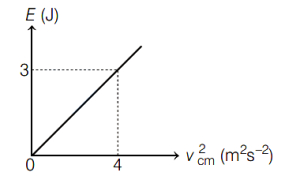
In the figure,$E$ and $v_{cm}$ represent the total energy and speed of the centre of mass of an object of mass $1 \ kg$ in pure rolling. The object is
A
sphere
B
ring
C
disc
D
hollow cylinder
Solution
(C) The total kinetic energy of an object in pure rolling motion is given by:
$E = \frac{1}{2} m v_{cm}^{2} \left(1 + \frac{k^{2}}{R^{2}}\right)$
where $k$ is the radius of gyration,$R$ is the radius,and $m$ is the mass of the object.
Given $m = 1 \ kg$,the expression becomes:
$\frac{E}{v_{cm}^{2}} = \frac{1}{2} \left(1 + \frac{k^{2}}{R^{2}}\right) \quad ...(i)$
From the given graph,the slope of the line is $\frac{E}{v_{cm}^{2}} = \frac{3}{4}$.
Substituting this value into Eq. $(i)$:
$\frac{3}{4} = \frac{1}{2} \left(1 + \frac{k^{2}}{R^{2}}\right)$
$\frac{3}{2} = 1 + \frac{k^{2}}{R^{2}}$
$\frac{k^{2}}{R^{2}} = \frac{3}{2} - 1 = \frac{1}{2}$
We know that for a disc,the moment of inertia $I = \frac{1}{2} m R^{2}$,so $k^{2} = \frac{1}{2} R^{2}$,which means $\frac{k^{2}}{R^{2}} = \frac{1}{2}$.
Thus,the object is a disc.
$E = \frac{1}{2} m v_{cm}^{2} \left(1 + \frac{k^{2}}{R^{2}}\right)$
where $k$ is the radius of gyration,$R$ is the radius,and $m$ is the mass of the object.
Given $m = 1 \ kg$,the expression becomes:
$\frac{E}{v_{cm}^{2}} = \frac{1}{2} \left(1 + \frac{k^{2}}{R^{2}}\right) \quad ...(i)$
From the given graph,the slope of the line is $\frac{E}{v_{cm}^{2}} = \frac{3}{4}$.
Substituting this value into Eq. $(i)$:
$\frac{3}{4} = \frac{1}{2} \left(1 + \frac{k^{2}}{R^{2}}\right)$
$\frac{3}{2} = 1 + \frac{k^{2}}{R^{2}}$
$\frac{k^{2}}{R^{2}} = \frac{3}{2} - 1 = \frac{1}{2}$
We know that for a disc,the moment of inertia $I = \frac{1}{2} m R^{2}$,so $k^{2} = \frac{1}{2} R^{2}$,which means $\frac{k^{2}}{R^{2}} = \frac{1}{2}$.
Thus,the object is a disc.
0 likesView Solution
4
PhysicsEasyMCQKCET · 2021
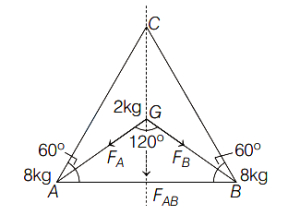
Two bodies of masses $8 \,kg$ are placed at the vertices $A$ and $B$ of an equilateral triangle $ABC$. $A$ third body of mass $2 \,kg$ is placed at the centroid $G$ of the triangle. If $AG=BG=CG=1 \,m$, where should a fourth body of mass $4 \,kg$ be placed, so that the resultant force on the $2 \,kg$ body is zero?
A
At $C$
B
At a point $P$ on the line $CG$ such that $PG=\frac{1}{\sqrt{2}} \,m$
C
At a point $P$ on the line $CG$ such that $PG=0.5 \,m$
D
At a point $P$ on the line $CG$ such that $PG=2 \,m$
Solution
(B) The gravitational force between two masses is given by $F = \frac{G m_1 m_2}{r^2}$.
Given $m_A = m_B = 8 \,kg$, $m_G = 2 \,kg$, and $AG = BG = 1 \,m$.
The force exerted by mass at $A$ on mass at $G$ is $F_A = \frac{G \times 8 \times 2}{1^2} = 16G$.
The force exerted by mass at $B$ on mass at $G$ is $F_B = \frac{G \times 8 \times 2}{1^2} = 16G$.
The angle between $F_A$ and $F_B$ is $120^{\circ}$.
The resultant force $F_{AB}$ is given by $F_{AB} = \sqrt{F_A^2 + F_B^2 + 2 F_A F_B \cos 120^{\circ}}$.
Since $F_A = F_B = 16G$, $F_{AB} = \sqrt{(16G)^2 + (16G)^2 + 2(16G)(16G)(-0.5)} = \sqrt{3(16G)^2 - (16G)^2} = 16G$.
This resultant force $F_{AB}$ acts along the line $GC$ directed towards $C$.
To make the net force on the $2 \,kg$ body zero, a fourth body of mass $m_C = 4 \,kg$ must be placed at a distance $x$ from $G$ along the line $GC$ such that the gravitational force $F_C$ exerted by it balances $F_{AB}$.
$F_C = \frac{G \times 4 \times 2}{x^2} = 16G$.
$\frac{8G}{x^2} = 16G \Rightarrow x^2 = \frac{8}{16} = 0.5$.
$x = \frac{1}{\sqrt{2}} \,m$.
Thus, the fourth body should be placed at a point $P$ on the line $CG$ such that $PG = \frac{1}{\sqrt{2}} \,m$.
Given $m_A = m_B = 8 \,kg$, $m_G = 2 \,kg$, and $AG = BG = 1 \,m$.
The force exerted by mass at $A$ on mass at $G$ is $F_A = \frac{G \times 8 \times 2}{1^2} = 16G$.
The force exerted by mass at $B$ on mass at $G$ is $F_B = \frac{G \times 8 \times 2}{1^2} = 16G$.
The angle between $F_A$ and $F_B$ is $120^{\circ}$.
The resultant force $F_{AB}$ is given by $F_{AB} = \sqrt{F_A^2 + F_B^2 + 2 F_A F_B \cos 120^{\circ}}$.
Since $F_A = F_B = 16G$, $F_{AB} = \sqrt{(16G)^2 + (16G)^2 + 2(16G)(16G)(-0.5)} = \sqrt{3(16G)^2 - (16G)^2} = 16G$.
This resultant force $F_{AB}$ acts along the line $GC$ directed towards $C$.
To make the net force on the $2 \,kg$ body zero, a fourth body of mass $m_C = 4 \,kg$ must be placed at a distance $x$ from $G$ along the line $GC$ such that the gravitational force $F_C$ exerted by it balances $F_{AB}$.
$F_C = \frac{G \times 4 \times 2}{x^2} = 16G$.
$\frac{8G}{x^2} = 16G \Rightarrow x^2 = \frac{8}{16} = 0.5$.
$x = \frac{1}{\sqrt{2}} \,m$.
Thus, the fourth body should be placed at a point $P$ on the line $CG$ such that $PG = \frac{1}{\sqrt{2}} \,m$.
0 likesView Solution
5
PhysicsMediumMCQKCET · 2021
Two capillary tubes $P$ and $Q$ are dipped vertically in water. The height of water level in capillary tube $P$ is $\frac{2}{3}$ of the height in capillary tube $Q$. The ratio of their diameters is
A
$2: 3$
B
$3: 2$
C
$3: 4$
D
$4: 3$
Solution
(B) The height of capillary rise $h$ of a liquid in a capillary tube is given by the formula:
$h = \frac{2 T \cos \theta}{r \rho g}$
Since $T$,$\theta$,$\rho$,and $g$ are constant for the same liquid and tube material,we have:
$h \propto \frac{1}{r}$
Since the diameter $D = 2r$,we can also write $h \propto \frac{1}{D}$.
Given that $h_P = \frac{2}{3} h_Q$,we have $\frac{h_P}{h_Q} = \frac{2}{3}$.
Using the inverse proportionality $h \propto \frac{1}{D}$,we get:
$\frac{h_P}{h_Q} = \frac{D_Q}{D_P} = \frac{2}{3}$
Therefore,the ratio of their diameters is $\frac{D_P}{D_Q} = \frac{3}{2}$ or $3: 2$.
$h = \frac{2 T \cos \theta}{r \rho g}$
Since $T$,$\theta$,$\rho$,and $g$ are constant for the same liquid and tube material,we have:
$h \propto \frac{1}{r}$
Since the diameter $D = 2r$,we can also write $h \propto \frac{1}{D}$.
Given that $h_P = \frac{2}{3} h_Q$,we have $\frac{h_P}{h_Q} = \frac{2}{3}$.
Using the inverse proportionality $h \propto \frac{1}{D}$,we get:
$\frac{h_P}{h_Q} = \frac{D_Q}{D_P} = \frac{2}{3}$
Therefore,the ratio of their diameters is $\frac{D_P}{D_Q} = \frac{3}{2}$ or $3: 2$.
0 likesView Solution
6
PhysicsEasyMCQKCET · 2021
To propagate both longitudinal and transverse waves,a material must have
A
bulk and shear moduli
B
bulk modulus
C
shear modulus
D
Young's and bulk modulus
Solution
(A) In transverse waves,the particle motion is perpendicular to the direction of wave propagation. This requires the medium to resist shearing stress,which is characterized by the shear modulus.
In longitudinal waves,the particles oscillate along the direction of wave propagation,causing volume changes. This requires the medium to resist compressive stress,which is characterized by the bulk modulus.
Therefore,for a medium to support both types of waves,it must possess both bulk modulus and shear modulus.
In longitudinal waves,the particles oscillate along the direction of wave propagation,causing volume changes. This requires the medium to resist compressive stress,which is characterized by the bulk modulus.
Therefore,for a medium to support both types of waves,it must possess both bulk modulus and shear modulus.
0 likesView Solution
7
PhysicsEasyMCQKCET · 2021
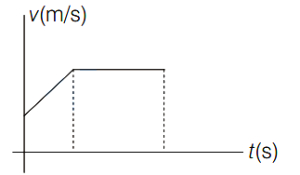
For a body moving along a straight line, the following $v-t$ graph is obtained. According to the graph, the displacement during
A
uniform acceleration is greater than that during uniform motion
B
uniform acceleration is less than that during uniform motion
C
uniform acceleration is equal to that during uniform motion
D
uniform motion is zero
Solution
(B) The displacement of an object is given by the area under the $v-t$ graph.
$s = \text{Area under } v-t \text{ graph}$
In the given graph, the area under the uniform motion part (a rectangle) is greater than the area under the uniform acceleration part (a trapezoid) for the same time interval.
Therefore, the displacement during uniform acceleration is less than that during uniform motion.
$s = \text{Area under } v-t \text{ graph}$
In the given graph, the area under the uniform motion part (a rectangle) is greater than the area under the uniform acceleration part (a trapezoid) for the same time interval.
Therefore, the displacement during uniform acceleration is less than that during uniform motion.
0 likesView Solution
8
PhysicsDifficultMCQKCET · 2021
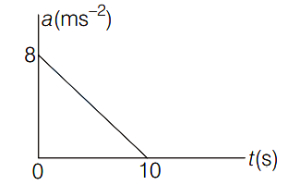
$A$ particle starts from rest. Its acceleration $a$ versus time $t$ is shown in the figure. The maximum speed of the particle will be (in $m/s$)
A
$80$
B
$40$
C
$18$
D
$2$
Solution
(B) The change in velocity of a particle is equal to the area under the acceleration-time $(a-t)$ graph.
Given that the particle starts from rest,the initial velocity $u = 0$.
The area under the $a-t$ graph is a triangle with base $b = 10 \ s$ and height $h = 8 \ m/s^2$.
Area $= \frac{1}{2} \times \text{base} \times \text{height}$
Area $= \frac{1}{2} \times 10 \times 8 = 40 \ m/s$.
Since $\Delta v = v - u = \text{Area}$,and $u = 0$,we have $v = 40 \ m/s$.
Thus,the maximum speed of the particle is $40 \ m/s$.
Given that the particle starts from rest,the initial velocity $u = 0$.
The area under the $a-t$ graph is a triangle with base $b = 10 \ s$ and height $h = 8 \ m/s^2$.
Area $= \frac{1}{2} \times \text{base} \times \text{height}$
Area $= \frac{1}{2} \times 10 \times 8 = 40 \ m/s$.
Since $\Delta v = v - u = \text{Area}$,and $u = 0$,we have $v = 40 \ m/s$.
Thus,the maximum speed of the particle is $40 \ m/s$.
0 likesView Solution
9
PhysicsMediumMCQKCET · 2021
The maximum range of a gun on a horizontal plane is $16 \,km$. If $g=10 \,ms^{-2}$,then the muzzle velocity of a shell is
A
$160 \,ms^{-1}$
B
$200 \sqrt{2} \,ms^{-1}$
C
$400 \,ms^{-1}$
D
$800 \,ms^{-1}$
Solution
(C) Given: Maximum range $R_{max} = 16 \,km = 16,000 \,m$ and acceleration due to gravity $g = 10 \,ms^{-2}$.
We know that the formula for the maximum range of a projectile is $R_{max} = \frac{u^2}{g}$,where $u$ is the muzzle velocity.
Substituting the given values into the formula:
$16,000 = \frac{u^2}{10}$
$u^2 = 16,000 \times 10$
$u^2 = 160,000$
$u = \sqrt{160,000}$
$u = 400 \,ms^{-1}$.
Thus,the muzzle velocity of the shell is $400 \,ms^{-1}$.
We know that the formula for the maximum range of a projectile is $R_{max} = \frac{u^2}{g}$,where $u$ is the muzzle velocity.
Substituting the given values into the formula:
$16,000 = \frac{u^2}{10}$
$u^2 = 16,000 \times 10$
$u^2 = 160,000$
$u = \sqrt{160,000}$
$u = 400 \,ms^{-1}$.
Thus,the muzzle velocity of the shell is $400 \,ms^{-1}$.
0 likesView Solution
10
PhysicsEasyMCQKCET · 2021
The trajectory of a projectile is
A
a semicircle
B
an ellipse
C
a parabola always
D
a parabola in the absence of air resistance
Solution
(D) The trajectory of a projectile is a parabola only when air resistance is neglected.
In the presence of air resistance,the projectile experiences a drag force that opposes its motion,causing both the range and the maximum height to decrease.
Consequently,the path deviates from a perfect parabola,making the statement 'a parabola always' incorrect.
Therefore,the trajectory is a parabola only in the absence of air resistance.
In the presence of air resistance,the projectile experiences a drag force that opposes its motion,causing both the range and the maximum height to decrease.
Consequently,the path deviates from a perfect parabola,making the statement 'a parabola always' incorrect.
Therefore,the trajectory is a parabola only in the absence of air resistance.
0 likesView Solution
11
PhysicsEasyMCQKCET · 2021
For a projectile motion,the angle between the velocity and acceleration is minimum and acute at
A
only one point
B
two points
C
three points
D
four points
Solution
(A) In projectile motion,the acceleration is constant and directed vertically downwards (gravity).
Let the velocity vector be $\vec{v} = v_x \hat{i} + v_y \hat{j}$ and the acceleration vector be $\vec{a} = -g \hat{j}$.
The angle $\theta$ between $\vec{v}$ and $\vec{a}$ is given by $\cos \theta = \frac{\vec{v} \cdot \vec{a}}{|\vec{v}| |\vec{a}|} = \frac{-g v_y}{\sqrt{v_x^2 + v_y^2} \cdot g} = \frac{-v_y}{\sqrt{v_x^2 + v_y^2}}$.
As the projectile moves,$v_y$ changes from positive (upward) to negative (downward).
When $v_y > 0$,$\cos \theta$ is negative,meaning $\theta$ is obtuse $(> 90^{\circ})$.
When $v_y < 0$,$\cos \theta$ is positive,meaning $\theta$ is acute $(< 90^{\circ})$.
As $v_y$ becomes more negative,$\cos \theta$ increases,meaning $\theta$ decreases.
Thus,the angle is acute throughout the downward journey and reaches its minimum value at the point of impact (where $v_y$ is most negative).
However,in the context of standard physics problems,the angle is considered acute during the entire descent. The question asks for the point where it is minimum and acute; this occurs at the final point of the trajectory.
Let the velocity vector be $\vec{v} = v_x \hat{i} + v_y \hat{j}$ and the acceleration vector be $\vec{a} = -g \hat{j}$.
The angle $\theta$ between $\vec{v}$ and $\vec{a}$ is given by $\cos \theta = \frac{\vec{v} \cdot \vec{a}}{|\vec{v}| |\vec{a}|} = \frac{-g v_y}{\sqrt{v_x^2 + v_y^2} \cdot g} = \frac{-v_y}{\sqrt{v_x^2 + v_y^2}}$.
As the projectile moves,$v_y$ changes from positive (upward) to negative (downward).
When $v_y > 0$,$\cos \theta$ is negative,meaning $\theta$ is obtuse $(> 90^{\circ})$.
When $v_y < 0$,$\cos \theta$ is positive,meaning $\theta$ is acute $(< 90^{\circ})$.
As $v_y$ becomes more negative,$\cos \theta$ increases,meaning $\theta$ decreases.
Thus,the angle is acute throughout the downward journey and reaches its minimum value at the point of impact (where $v_y$ is most negative).
However,in the context of standard physics problems,the angle is considered acute during the entire descent. The question asks for the point where it is minimum and acute; this occurs at the final point of the trajectory.
0 likesView Solution
12
PhysicsEasyMCQKCET · 2021
$A$ particle starts from the origin at $t=0$ with a velocity of $10 \hat{j} \text{ ms}^{-1}$ and moves in the $x-y$ plane with a constant acceleration of $(8 \hat{i} + 2 \hat{j}) \text{ ms}^{-2}$. At an instant when the $x$-coordinate of the particle is $16 \text{ m}$, the $y$-coordinate of the particle is: (in $\text{ m}$)
A
$16$
B
$28$
C
$36$
D
$24$
Solution
(D) Given: Initial velocity $\vec{u} = 10 \hat{j} \text{ ms}^{-1}$, Acceleration $\vec{a} = 8 \hat{i} + 2 \hat{j} \text{ ms}^{-2}$.
Using the kinematic equation $\vec{s} = \vec{u}t + \frac{1}{2} \vec{a}t^2$:
$\vec{s} = (10 \hat{j})t + \frac{1}{2} (8 \hat{i} + 2 \hat{j})t^2$
$\vec{s} = (4t^2) \hat{i} + (10t + t^2) \hat{j}$.
Comparing the components with $\vec{s} = x \hat{i} + y \hat{j}$, we get $x = 4t^2$ and $y = 10t + t^2$.
Given $x = 16 \text{ m}$, so $4t^2 = 16 \Rightarrow t^2 = 4 \Rightarrow t = 2 \text{ s}$.
Substituting $t = 2 \text{ s}$ into the expression for $y$:
$y = 10(2) + (2)^2 = 20 + 4 = 24 \text{ m}$.
Using the kinematic equation $\vec{s} = \vec{u}t + \frac{1}{2} \vec{a}t^2$:
$\vec{s} = (10 \hat{j})t + \frac{1}{2} (8 \hat{i} + 2 \hat{j})t^2$
$\vec{s} = (4t^2) \hat{i} + (10t + t^2) \hat{j}$.
Comparing the components with $\vec{s} = x \hat{i} + y \hat{j}$, we get $x = 4t^2$ and $y = 10t + t^2$.
Given $x = 16 \text{ m}$, so $4t^2 = 16 \Rightarrow t^2 = 4 \Rightarrow t = 2 \text{ s}$.
Substituting $t = 2 \text{ s}$ into the expression for $y$:
$y = 10(2) + (2)^2 = 20 + 4 = 24 \text{ m}$.
0 likesView Solution
13
PhysicsEasyMCQKCET · 2021
$A$ pendulum oscillates simple harmonically if and only if:
$I$. The size of the bob of the pendulum is negligible in comparison with the length of the pendulum.
$II$. The angular amplitude is less than $10^{\circ}$.
Choose the correct option.
$I$. The size of the bob of the pendulum is negligible in comparison with the length of the pendulum.
$II$. The angular amplitude is less than $10^{\circ}$.
Choose the correct option.
A
Both $I$ and $II$
B
Only $I$
C
Only $II$
D
None of these
Solution
(A) simple pendulum,in practice,consists of a heavy but small-sized metallic bob suspended by a light,inextensible,and flexible string.
It oscillates simple harmonically if and only if:
$(I)$ The size of the bob is negligible compared to the length of the string of the pendulum,which allows us to treat the bob as a point mass.
$(II)$ The angular amplitude (the angle between the vertical mean position and the string at the extreme point) is small,typically less than $10^{\circ}$,so that the approximation $\sin \theta \approx \theta$ holds true.
Thus,both statements are correct.
It oscillates simple harmonically if and only if:
$(I)$ The size of the bob is negligible compared to the length of the string of the pendulum,which allows us to treat the bob as a point mass.
$(II)$ The angular amplitude (the angle between the vertical mean position and the string at the extreme point) is small,typically less than $10^{\circ}$,so that the approximation $\sin \theta \approx \theta$ holds true.
Thus,both statements are correct.
0 likesView Solution
14
PhysicsEasyMCQKCET · 2021
$A$ coin placed on a rotating turntable just slips if it is placed at a distance of $4 \ cm$ from the centre. If the angular velocity of the turntable is doubled,it will just slip at a distance of: (in $cm$)
A
$1$
B
$2$
C
$4$
D
$8$
Solution
(A) When a coin is placed on a rotating turntable,the necessary centripetal force for circular motion is provided by the static frictional force between the coin and the surface of the turntable.
For the coin to just slip,the centripetal force must equal the maximum static frictional force:
$m r \omega^2 = \mu m g$
where $m$ is the mass of the coin,$r$ is the distance from the centre,$\omega$ is the angular velocity,$\mu$ is the coefficient of friction,and $g$ is the acceleration due to gravity.
Since $m, \mu$,and $g$ are constant,we have:
$r \omega^2 = \text{constant}$
This implies $r \propto \frac{1}{\omega^2}$.
Therefore,the ratio of distances for two different angular velocities is:
$\frac{r_2}{r_1} = \left( \frac{\omega_1}{\omega_2} \right)^2$
Given $r_1 = 4 \ cm$ and $\omega_2 = 2 \omega_1$,we substitute these values:
$\frac{r_2}{4} = \left( \frac{\omega_1}{2 \omega_1} \right)^2 = \left( \frac{1}{2} \right)^2 = \frac{1}{4}$
$r_2 = 4 \times \frac{1}{4} = 1 \ cm$.
For the coin to just slip,the centripetal force must equal the maximum static frictional force:
$m r \omega^2 = \mu m g$
where $m$ is the mass of the coin,$r$ is the distance from the centre,$\omega$ is the angular velocity,$\mu$ is the coefficient of friction,and $g$ is the acceleration due to gravity.
Since $m, \mu$,and $g$ are constant,we have:
$r \omega^2 = \text{constant}$
This implies $r \propto \frac{1}{\omega^2}$.
Therefore,the ratio of distances for two different angular velocities is:
$\frac{r_2}{r_1} = \left( \frac{\omega_1}{\omega_2} \right)^2$
Given $r_1 = 4 \ cm$ and $\omega_2 = 2 \omega_1$,we substitute these values:
$\frac{r_2}{4} = \left( \frac{\omega_1}{2 \omega_1} \right)^2 = \left( \frac{1}{2} \right)^2 = \frac{1}{4}$
$r_2 = 4 \times \frac{1}{4} = 1 \ cm$.
0 likesView Solution
15
PhysicsEasyMCQKCET · 2021
Which of the following curves represent the variation of coefficient of volume expansion of an ideal gas at constant pressure?
A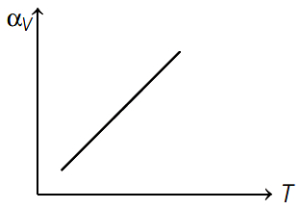
B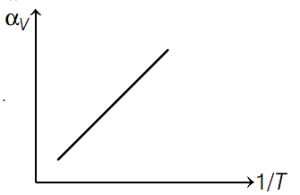
C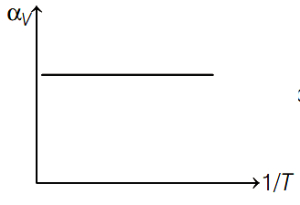
D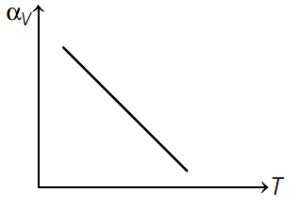
Solution
(B) Volume expansion is the expansion of the volume of a gas due to an increase in its temperature.
$\therefore$ The coefficient of volume expansion $\alpha_{V}$ is defined as:
$\alpha_{V} = \frac{1}{V} \left( \frac{\partial V}{\partial T} \right)_{p} ... (i)$
From the ideal gas equation,$pV = nRT$,we have $V = \frac{nRT}{p}$.
Differentiating with respect to $T$ at constant pressure $p$:
$\left( \frac{\partial V}{\partial T} \right)_{p} = \frac{nR}{p}$
Substituting this into equation $(i)$:
$\alpha_{V} = \frac{1}{V} \left( \frac{nR}{p} \right) = \frac{1}{V} \left( \frac{pV}{T} \cdot \frac{1}{p} \right) = \frac{1}{T}$
Thus,$\alpha_{V} = \frac{1}{T}$.
This implies that $\alpha_{V}$ is directly proportional to $\frac{1}{T}$. Therefore,a graph of $\alpha_{V}$ versus $\frac{1}{T}$ will be a straight line passing through the origin. This is correctly depicted in option $(b)$.
$\therefore$ The coefficient of volume expansion $\alpha_{V}$ is defined as:
$\alpha_{V} = \frac{1}{V} \left( \frac{\partial V}{\partial T} \right)_{p} ... (i)$
From the ideal gas equation,$pV = nRT$,we have $V = \frac{nRT}{p}$.
Differentiating with respect to $T$ at constant pressure $p$:
$\left( \frac{\partial V}{\partial T} \right)_{p} = \frac{nR}{p}$
Substituting this into equation $(i)$:
$\alpha_{V} = \frac{1}{V} \left( \frac{nR}{p} \right) = \frac{1}{V} \left( \frac{pV}{T} \cdot \frac{1}{p} \right) = \frac{1}{T}$
Thus,$\alpha_{V} = \frac{1}{T}$.
This implies that $\alpha_{V}$ is directly proportional to $\frac{1}{T}$. Therefore,a graph of $\alpha_{V}$ versus $\frac{1}{T}$ will be a straight line passing through the origin. This is correctly depicted in option $(b)$.
0 likesView Solution
16
PhysicsEasyMCQKCET · 2021
$A$ gas mixture contains monoatomic and diatomic molecules of $2$ moles each. The mixture has a total internal energy of (symbols have usual meanings): (in $R T$)
A
$3$
B
$5$
C
$8$
D
$9$
Solution
(C) The total internal energy of a gas is given by the formula:
$U = \frac{n f R T}{2}$
where $n$ is the number of moles and $f$ is the degree of freedom.
Given,$n_{\text{diatomic}} = n_{\text{monoatomic}} = 2$.
For a monoatomic gas,the degree of freedom $f_{\text{monoatomic}} = 3$.
For a diatomic gas,the degree of freedom $f_{\text{diatomic}} = 5$.
Calculating internal energy for each:
$U_{\text{monoatomic}} = \frac{2 \times 3 \times R T}{2} = 3 R T$
$U_{\text{diatomic}} = \frac{2 \times 5 \times R T}{2} = 5 R T$
Therefore,the total internal energy of the mixture is:
$U_{\text{total}} = U_{\text{monoatomic}} + U_{\text{diatomic}} = 3 R T + 5 R T = 8 R T$.
$U = \frac{n f R T}{2}$
where $n$ is the number of moles and $f$ is the degree of freedom.
Given,$n_{\text{diatomic}} = n_{\text{monoatomic}} = 2$.
For a monoatomic gas,the degree of freedom $f_{\text{monoatomic}} = 3$.
For a diatomic gas,the degree of freedom $f_{\text{diatomic}} = 5$.
Calculating internal energy for each:
$U_{\text{monoatomic}} = \frac{2 \times 3 \times R T}{2} = 3 R T$
$U_{\text{diatomic}} = \frac{2 \times 5 \times R T}{2} = 5 R T$
Therefore,the total internal energy of the mixture is:
$U_{\text{total}} = U_{\text{monoatomic}} + U_{\text{diatomic}} = 3 R T + 5 R T = 8 R T$.
0 likesView Solution
17
PhysicsDifficultMCQKCET · 2021
$A$ number of Carnot engines are operated at identical cold reservoir temperatures $(T_{L})$. However,their hot reservoir temperatures are kept different. $A$ graph of the efficiency of the engines versus hot reservoir temperature $(T_{H})$ is plotted. The correct graphical representation is
A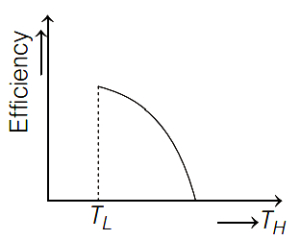
B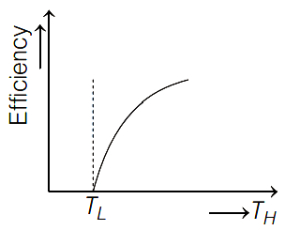
C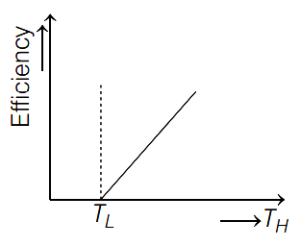
D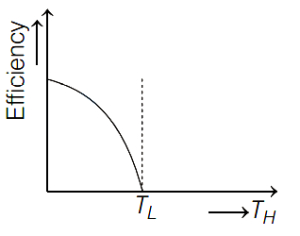
Solution
(B) The efficiency $(\eta)$ of a Carnot engine is given by the formula:
$\eta = 1 - \frac{T_{L}}{T_{H}}$
where $T_{L}$ is the temperature of the cold reservoir and $T_{H}$ is the temperature of the hot reservoir.
For a fixed cold reservoir temperature $T_{L}$,as the hot reservoir temperature $T_{H}$ increases,the ratio $\frac{T_{L}}{T_{H}}$ decreases.
Consequently,the efficiency $\eta = 1 - \frac{T_{L}}{T_{H}}$ increases as $T_{H}$ increases.
When $T_{H} = T_{L}$,the efficiency $\eta = 1 - \frac{T_{L}}{T_{L}} = 0$.
As $T_{H} \to \infty$,the efficiency $\eta \to 1$.
The graph of $\eta$ versus $T_{H}$ starts from $0$ at $T_{H} = T_{L}$ and increases with a decreasing slope (concave down) towards the value $1$.
This behavior is correctly represented by the graph in option $(b)$.
$\eta = 1 - \frac{T_{L}}{T_{H}}$
where $T_{L}$ is the temperature of the cold reservoir and $T_{H}$ is the temperature of the hot reservoir.
For a fixed cold reservoir temperature $T_{L}$,as the hot reservoir temperature $T_{H}$ increases,the ratio $\frac{T_{L}}{T_{H}}$ decreases.
Consequently,the efficiency $\eta = 1 - \frac{T_{L}}{T_{H}}$ increases as $T_{H}$ increases.
When $T_{H} = T_{L}$,the efficiency $\eta = 1 - \frac{T_{L}}{T_{L}} = 0$.
As $T_{H} \to \infty$,the efficiency $\eta \to 1$.
The graph of $\eta$ versus $T_{H}$ starts from $0$ at $T_{H} = T_{L}$ and increases with a decreasing slope (concave down) towards the value $1$.
This behavior is correctly represented by the graph in option $(b)$.
0 likesView Solution
18
PhysicsMediumMCQKCET · 2021
In an oscillating $LC$-circuit,$L = 3 \ mH$ and $C = 2.7 \ \mu F$. At $t = 0$,the charge on the capacitor is zero and the current is $2 \ A$. The maximum charge that will appear on the capacitor will be
A
$1.8 \times 10^{-5} \ C$
B
$18 \times 10^{-5} \ C$
C
$9 \times 10^{-5} \ C$
D
$90 \times 10^{-5} \ C$
Solution
(B) The charge $q$ as a function of time $t$ is given by $q = q_0 \sin(\omega t)$,where $q_0$ is the maximum charge and $\omega$ is the angular frequency.
Differentiating with respect to $t$,the current $I$ is given by $I = \frac{dq}{dt} = \omega q_0 \cos(\omega t)$.
At $t = 0$,the current is $I = \omega q_0 \cos(0) = \omega q_0$.
Given $I = 2 \ A$ at $t = 0$,we have $2 = \omega q_0$.
Since $\omega = \frac{1}{\sqrt{LC}}$,we substitute this into the equation: $q_0 = I \sqrt{LC}$.
Given $L = 3 \times 10^{-3} \ H$ and $C = 2.7 \times 10^{-6} \ F$,we calculate:
$q_0 = 2 \times \sqrt{3 \times 10^{-3} \times 2.7 \times 10^{-6}}$
$q_0 = 2 \times \sqrt{8.1 \times 10^{-9}} = 2 \times \sqrt{81 \times 10^{-10}}$
$q_0 = 2 \times 9 \times 10^{-5} = 18 \times 10^{-5} \ C$.
Differentiating with respect to $t$,the current $I$ is given by $I = \frac{dq}{dt} = \omega q_0 \cos(\omega t)$.
At $t = 0$,the current is $I = \omega q_0 \cos(0) = \omega q_0$.
Given $I = 2 \ A$ at $t = 0$,we have $2 = \omega q_0$.
Since $\omega = \frac{1}{\sqrt{LC}}$,we substitute this into the equation: $q_0 = I \sqrt{LC}$.
Given $L = 3 \times 10^{-3} \ H$ and $C = 2.7 \times 10^{-6} \ F$,we calculate:
$q_0 = 2 \times \sqrt{3 \times 10^{-3} \times 2.7 \times 10^{-6}}$
$q_0 = 2 \times \sqrt{8.1 \times 10^{-9}} = 2 \times \sqrt{81 \times 10^{-10}}$
$q_0 = 2 \times 9 \times 10^{-5} = 18 \times 10^{-5} \ C$.
0 likesView Solution
19
PhysicsDifficultMCQKCET · 2021
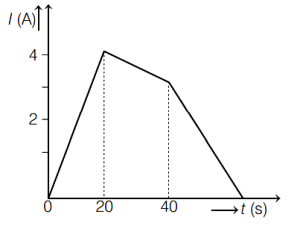
The current flowing through an inductance coil of self-inductance $6 \text{ mH}$ at different time instants is as shown. The emf induced between $t=20 \text{ s}$ and $t=40 \text{ s}$ is nearly
A
$2 \times 10^{-2} \text{ V}$
B
$3 \times 10^{-2} \text{ V}$
C
$4 \times 10^{-3} \text{ V}$
D
$30 \times 10^{-4} \text{ V}$
Solution
(D) The induced emf in an inductor is given by the formula $|e| = L \left| \frac{dI}{dt} \right|$.
Given self-inductance $L = 6 \text{ mH} = 6 \times 10^{-3} \text{ H}$.
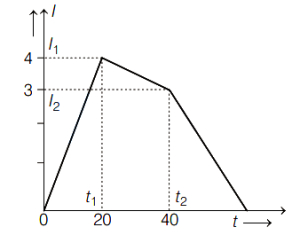
From the graph,at $t_1 = 20 \text{ s}$,the current $I_1 = 4 \text{ A}$,and at $t_2 = 40 \text{ s}$,the current $I_2 = 3 \text{ A}$.
The rate of change of current is $\left| \frac{dI}{dt} \right| = \left| \frac{I_2 - I_1}{t_2 - t_1} \right| = \left| \frac{3 - 4}{40 - 20} \right| = \left| \frac{-1}{20} \right| = 0.05 \text{ A/s}$.
Thus,the induced emf is $|e| = (6 \times 10^{-3} \text{ H}) \times (0.05 \text{ A/s}) = 0.3 \times 10^{-3} \text{ V} = 3 \times 10^{-4} \text{ V}$.
However,checking the options provided,$3 \times 10^{-4} \text{ V}$ is equivalent to $30 \times 10^{-5} \text{ V}$. Re-evaluating the calculation: $6 \times 10^{-3} \times (1/20) = 6/20 \times 10^{-3} = 0.3 \times 10^{-3} = 3 \times 10^{-4} \text{ V}$.
Given the options,$30 \times 10^{-5} \text{ V}$ is not listed,but $30 \times 10^{-4} \text{ V}$ is option $D$. Let's re-examine the graph. If the current at $t=40$ was $0$,the change would be $4/20 = 0.2$. $6 \times 10^{-3} \times 0.2 = 1.2 \times 10^{-3}$. If the current at $t=20$ was $4$ and $t=40$ was $3$,the slope is $1/20$. The calculation $3 \times 10^{-4} \text{ V}$ is correct. Since $30 \times 10^{-5} \text{ V}$ is not an option,and $3 \times 10^{-4} \text{ V}$ is the result,we select the closest magnitude if applicable,or note the discrepancy. Given the options,$30 \times 10^{-5} \text{ V}$ is $3 \times 10^{-4} \text{ V}$. Option $D$ is $30 \times 10^{-4} \text{ V} = 3 \times 10^{-3} \text{ V}$. There might be a typo in the question's options. Assuming the intended answer is $3 \times 10^{-4} \text{ V}$.
Given self-inductance $L = 6 \text{ mH} = 6 \times 10^{-3} \text{ H}$.
From the graph,at $t_1 = 20 \text{ s}$,the current $I_1 = 4 \text{ A}$,and at $t_2 = 40 \text{ s}$,the current $I_2 = 3 \text{ A}$.
The rate of change of current is $\left| \frac{dI}{dt} \right| = \left| \frac{I_2 - I_1}{t_2 - t_1} \right| = \left| \frac{3 - 4}{40 - 20} \right| = \left| \frac{-1}{20} \right| = 0.05 \text{ A/s}$.
Thus,the induced emf is $|e| = (6 \times 10^{-3} \text{ H}) \times (0.05 \text{ A/s}) = 0.3 \times 10^{-3} \text{ V} = 3 \times 10^{-4} \text{ V}$.
However,checking the options provided,$3 \times 10^{-4} \text{ V}$ is equivalent to $30 \times 10^{-5} \text{ V}$. Re-evaluating the calculation: $6 \times 10^{-3} \times (1/20) = 6/20 \times 10^{-3} = 0.3 \times 10^{-3} = 3 \times 10^{-4} \text{ V}$.
Given the options,$30 \times 10^{-5} \text{ V}$ is not listed,but $30 \times 10^{-4} \text{ V}$ is option $D$. Let's re-examine the graph. If the current at $t=40$ was $0$,the change would be $4/20 = 0.2$. $6 \times 10^{-3} \times 0.2 = 1.2 \times 10^{-3}$. If the current at $t=20$ was $4$ and $t=40$ was $3$,the slope is $1/20$. The calculation $3 \times 10^{-4} \text{ V}$ is correct. Since $30 \times 10^{-5} \text{ V}$ is not an option,and $3 \times 10^{-4} \text{ V}$ is the result,we select the closest magnitude if applicable,or note the discrepancy. Given the options,$30 \times 10^{-5} \text{ V}$ is $3 \times 10^{-4} \text{ V}$. Option $D$ is $30 \times 10^{-4} \text{ V} = 3 \times 10^{-3} \text{ V}$. There might be a typo in the question's options. Assuming the intended answer is $3 \times 10^{-4} \text{ V}$.
0 likesView Solution
20
PhysicsEasyMCQKCET · 2021
Energy of an electron in the second orbit of a hydrogen atom is $E_{2}$. The energy of an electron in the third orbit of $He^{+}$ will be
A
$\frac{9}{16} E_{2}$
B
$\frac{16}{9} E_{2}$
C
$\frac{3}{16} E_{2}$
D
$\frac{16}{3} E_{2}$
Solution
(B) The energy of an electron in the $n$th orbit of a hydrogen-like atom is given by the formula:
$E_{n} = -13.6 \text{ eV} \times \frac{Z^{2}}{n^{2}}$
This implies that $E_{n} \propto \frac{Z^{2}}{n^{2}}$.
For a hydrogen atom,the atomic number $Z = 1$. Thus,for the second orbit $(n = 2)$:
$E_{2} = k \times \frac{1^{2}}{2^{2}} = \frac{k}{4}$,where $k = -13.6 \text{ eV}$.
For a $He^{+}$ ion,the atomic number $Z = 2$. For the third orbit $(n = 3)$:
$E_{3} = k \times \frac{2^{2}}{3^{2}} = \frac{4k}{9}$.
Now,we find the ratio of $E_{3}$ to $E_{2}$:
$\frac{E_{3}}{E_{2}} = \frac{4k/9}{k/4} = \frac{4}{9} \times 4 = \frac{16}{9}$.
Therefore,$E_{3} = \frac{16}{9} E_{2}$.
$E_{n} = -13.6 \text{ eV} \times \frac{Z^{2}}{n^{2}}$
This implies that $E_{n} \propto \frac{Z^{2}}{n^{2}}$.
For a hydrogen atom,the atomic number $Z = 1$. Thus,for the second orbit $(n = 2)$:
$E_{2} = k \times \frac{1^{2}}{2^{2}} = \frac{k}{4}$,where $k = -13.6 \text{ eV}$.
For a $He^{+}$ ion,the atomic number $Z = 2$. For the third orbit $(n = 3)$:
$E_{3} = k \times \frac{2^{2}}{3^{2}} = \frac{4k}{9}$.
Now,we find the ratio of $E_{3}$ to $E_{2}$:
$\frac{E_{3}}{E_{2}} = \frac{4k/9}{k/4} = \frac{4}{9} \times 4 = \frac{16}{9}$.
Therefore,$E_{3} = \frac{16}{9} E_{2}$.
0 likesView Solution
21
PhysicsMediumMCQKCET · 2021
An electron in an excited state of $Li^{2+}$ ion has angular momentum $\frac{3 h}{2 \pi}$. The de-Broglie wavelength of the electron in this state is $p \pi a_{0}$ (where, $a_{0} = \text{Bohr radius}$). The value of $p$ is
A
$3$
B
$2$
C
$1$
D
$4$
Solution
(B) According to Bohr's postulate, the angular momentum $L$ is given by $L = \frac{n h}{2 \pi}$.
Given $L = \frac{3 h}{2 \pi}$, we get $n = 3$.
The de-Broglie wavelength $\lambda$ is given by $\lambda = \frac{h}{mv}$.
From the angular momentum quantization, $mvr = \frac{nh}{2\pi} = \frac{3h}{2\pi}$, so $mv = \frac{3h}{2\pi r}$.
Substituting this into the wavelength formula: $\lambda = \frac{h}{mv} = \frac{h \cdot 2\pi r}{3h} = \frac{2}{3} \pi r$.
The radius of the $n$-th orbit for a hydrogen-like ion is $r = a_{0} \frac{n^2}{Z}$.
For $Li^{2+}$, $Z = 3$ and $n = 3$, so $r = a_{0} \frac{3^2}{3} = 3 a_{0}$.
Substituting $r$ into the expression for $\lambda$: $\lambda = \frac{2}{3} \pi (3 a_{0}) = 2 \pi a_{0}$.
Comparing this with the given form $p \pi a_{0}$, we find $p = 2$.
Given $L = \frac{3 h}{2 \pi}$, we get $n = 3$.
The de-Broglie wavelength $\lambda$ is given by $\lambda = \frac{h}{mv}$.
From the angular momentum quantization, $mvr = \frac{nh}{2\pi} = \frac{3h}{2\pi}$, so $mv = \frac{3h}{2\pi r}$.
Substituting this into the wavelength formula: $\lambda = \frac{h}{mv} = \frac{h \cdot 2\pi r}{3h} = \frac{2}{3} \pi r$.
The radius of the $n$-th orbit for a hydrogen-like ion is $r = a_{0} \frac{n^2}{Z}$.
For $Li^{2+}$, $Z = 3$ and $n = 3$, so $r = a_{0} \frac{3^2}{3} = 3 a_{0}$.
Substituting $r$ into the expression for $\lambda$: $\lambda = \frac{2}{3} \pi (3 a_{0}) = 2 \pi a_{0}$.
Comparing this with the given form $p \pi a_{0}$, we find $p = 2$.
0 likesView Solution
22
PhysicsEasyMCQKCET · 2021
Eight drops of mercury of equal radii combine to form a big drop. The capacitance of a bigger drop as compared to each smaller drop is (in $times$)
A
$2$
B
$8$
C
$4$
D
$16$
Solution
(A) Let $R$ and $r$ be the radii of the bigger and each smaller drop, respectively.
Volume of the bigger drop $= 8 \times$ Volume of a smaller drop.
$\frac{4}{3} \pi R^{3} = 8 \times \frac{4}{3} \pi r^{3}$
$R^{3} = 8r^{3} \Rightarrow R = 2r$ ... $(i)$
As the capacitance of a spherical conductor is given by $C = 4 \pi \varepsilon_{0} r$, we have $C \propto r$.
Therefore, the ratio of the capacitance of the bigger drop to the smaller drop is:
$\frac{C_{\text{bigger}}}{C_{\text{smaller}}} = \frac{R}{r} = \frac{2r}{r} = 2$.
Thus, the capacitance of the bigger drop is $2$ times that of each smaller drop.
Volume of the bigger drop $= 8 \times$ Volume of a smaller drop.
$\frac{4}{3} \pi R^{3} = 8 \times \frac{4}{3} \pi r^{3}$
$R^{3} = 8r^{3} \Rightarrow R = 2r$ ... $(i)$
As the capacitance of a spherical conductor is given by $C = 4 \pi \varepsilon_{0} r$, we have $C \propto r$.
Therefore, the ratio of the capacitance of the bigger drop to the smaller drop is:
$\frac{C_{\text{bigger}}}{C_{\text{smaller}}} = \frac{R}{r} = \frac{2r}{r} = 2$.
Thus, the capacitance of the bigger drop is $2$ times that of each smaller drop.
0 likesView Solution
23
PhysicsMediumMCQKCET · 2021
If a slab of insulating material $4 \times 10^{-3} \ m$ thick is introduced between the plates of a parallel plate capacitor,the separation between the plates has to be increased by $3.5 \times 10^{-3} \ m$ to restore the capacity to its original value. The dielectric constant of the material will be:
A
$6$
B
$8$
C
$10$
D
$12$
Solution
(B) Let $t$ be the thickness of the dielectric slab and $K$ be the dielectric constant.
When a dielectric slab of thickness $t$ is introduced,the effective separation between the plates increases by an amount $x = t(1 - 1/K)$ to maintain the same capacitance.
Given,$x = 3.5 \times 10^{-3} \ m$ and $t = 4 \times 10^{-3} \ m$.
Substituting these values into the equation:
$3.5 \times 10^{-3} = 4 \times 10^{-3} \left(1 - \frac{1}{K}\right)$
Dividing both sides by $4 \times 10^{-3}$:
$\frac{3.5}{4} = 1 - \frac{1}{K}$
$0.875 = 1 - \frac{1}{K}$
$\frac{1}{K} = 1 - 0.875 = 0.125$
$K = \frac{1}{0.125} = 8$.
Thus,the dielectric constant of the material is $8$.
When a dielectric slab of thickness $t$ is introduced,the effective separation between the plates increases by an amount $x = t(1 - 1/K)$ to maintain the same capacitance.
Given,$x = 3.5 \times 10^{-3} \ m$ and $t = 4 \times 10^{-3} \ m$.
Substituting these values into the equation:
$3.5 \times 10^{-3} = 4 \times 10^{-3} \left(1 - \frac{1}{K}\right)$
Dividing both sides by $4 \times 10^{-3}$:
$\frac{3.5}{4} = 1 - \frac{1}{K}$
$0.875 = 1 - \frac{1}{K}$
$\frac{1}{K} = 1 - 0.875 = 0.125$
$K = \frac{1}{0.125} = 8$.
Thus,the dielectric constant of the material is $8$.
0 likesView Solution
24
PhysicsMediumMCQKCET · 2021
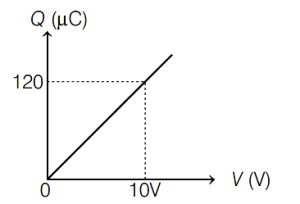
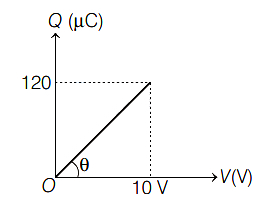
In the figure,the charge on the capacitor is plotted against the potential difference across the capacitor. The capacitance and energy stored in the capacitor are respectively:
A
$12 \mu F, 1200 \mu J$
B
$12 \mu F, 600 \mu J$
C
$24 \mu F, 600 \mu J$
D
$24 \mu F, 1200 \mu J$
Solution
(B) The energy stored in a capacitor is given by the formula:
$U = \frac{1}{2} C V^{2} \dots (i)$
where $C$ is the capacitance and $V$ is the potential difference.
From the given graph,the slope is:
$\text{Slope} = \tan \theta = \frac{Q}{V} = \frac{120 \mu C}{10 \text{ V}} = 12 \mu F \dots (ii)$
Since the capacitance $C = \frac{Q}{V}$,we have:
$C = 12 \mu F = 12 \times 10^{-6} \text{ F}$
Now,substituting the values of $C = 12 \times 10^{-6} \text{ F}$ and $V = 10 \text{ V}$ into Eq. $(i)$:
$U = \frac{1}{2} \times (12 \times 10^{-6} \text{ F}) \times (10 \text{ V})^{2}$
$U = \frac{1}{2} \times 12 \times 10^{-6} \times 100$
$U = 6 \times 10^{-4} \text{ J} = 600 \times 10^{-6} \text{ J} = 600 \mu J$
Thus,the capacitance is $12 \mu F$ and the energy stored is $600 \mu J$.
$U = \frac{1}{2} C V^{2} \dots (i)$
where $C$ is the capacitance and $V$ is the potential difference.
From the given graph,the slope is:
$\text{Slope} = \tan \theta = \frac{Q}{V} = \frac{120 \mu C}{10 \text{ V}} = 12 \mu F \dots (ii)$
Since the capacitance $C = \frac{Q}{V}$,we have:
$C = 12 \mu F = 12 \times 10^{-6} \text{ F}$
Now,substituting the values of $C = 12 \times 10^{-6} \text{ F}$ and $V = 10 \text{ V}$ into Eq. $(i)$:
$U = \frac{1}{2} \times (12 \times 10^{-6} \text{ F}) \times (10 \text{ V})^{2}$
$U = \frac{1}{2} \times 12 \times 10^{-6} \times 100$
$U = 6 \times 10^{-4} \text{ J} = 600 \times 10^{-6} \text{ J} = 600 \mu J$
Thus,the capacitance is $12 \mu F$ and the energy stored is $600 \mu J$.
0 likesView Solution
25
PhysicsEasyMCQKCET · 2021
An electrician requires a capacitance of $6 \mu F$ in a circuit across a potential difference of $1.5 kV$. $A$ large number of $2 \mu F$ capacitors which can withstand a potential difference of not more than $500 V$ are available. The minimum number of capacitors required for the purpose is
A
$3$
B
$9$
C
$6$
D
$27$
Solution
(D) To withstand a potential difference of $1.5 kV$ $(1500 V)$ using capacitors that can withstand $500 V$ each,the number of capacitors $(m)$ in each series row is:
$m = \frac{1500 V}{500 V} = 3$
The equivalent capacitance of one such row of $3$ capacitors (each $2 \mu F$) is:
$C_{row} = \frac{2 \mu F}{3}$
If we connect $n$ such rows in parallel to achieve a total capacitance of $6 \mu F$,we have:
$C_{eff} = n \times C_{row} = n \times \frac{2}{3} \mu F = 6 \mu F$
$n = \frac{6 \times 3}{2} = 9$
The total number of capacitors required is $N = m \times n = 3 \times 9 = 27$.
$m = \frac{1500 V}{500 V} = 3$
The equivalent capacitance of one such row of $3$ capacitors (each $2 \mu F$) is:
$C_{row} = \frac{2 \mu F}{3}$
If we connect $n$ such rows in parallel to achieve a total capacitance of $6 \mu F$,we have:
$C_{eff} = n \times C_{row} = n \times \frac{2}{3} \mu F = 6 \mu F$
$n = \frac{6 \times 3}{2} = 9$
The total number of capacitors required is $N = m \times n = 3 \times 9 = 27$.
0 likesView Solution
26
PhysicsMediumMCQKCET · 2021
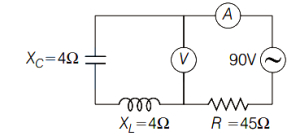
What will be the reading in the voltmeter and ammeter of the circuit shown?
A
$90 \, V, 2 \, A$
B
$0, 2 \, A$
C
$90 \, V, 1 \, A$
D
$0, 1 \, A$
Solution
(B) Given, $X_{L} = 4 \, \Omega$ and $X_{C} = 4 \, \Omega$.
In a series $LC$ circuit, the voltage across the inductor $(V_{L})$ and the capacitor $(V_{C})$ are $180^{\circ}$ out of phase.
Therefore, the net voltage across the series combination of the inductor and capacitor is $V_{\text{net}} = |V_{L} - V_{C}|$.
Since $X_{L} = X_{C}$, the magnitudes of the voltages are equal, i.e., $V_{L} = I X_{L}$ and $V_{C} = I X_{C}$.
Thus, $V_{\text{net}} = I(X_{L} - X_{C}) = I(4 - 4) = 0 \, V$.
The voltmeter is connected across this series $LC$ combination, so its reading is $0 \, V$.
The total impedance of the circuit is $Z = \sqrt{R^{2} + (X_{L} - X_{C})^{2}}$.
Substituting the values, $Z = \sqrt{45^{2} + (4 - 4)^{2}} = \sqrt{45^{2}} = 45 \, \Omega$.
The current in the circuit is $I = \frac{V}{Z} = \frac{90 \, V}{45 \, \Omega} = 2 \, A$.
Therefore, the voltmeter reading is $0 \, V$ and the ammeter reading is $2 \, A$.
In a series $LC$ circuit, the voltage across the inductor $(V_{L})$ and the capacitor $(V_{C})$ are $180^{\circ}$ out of phase.
Therefore, the net voltage across the series combination of the inductor and capacitor is $V_{\text{net}} = |V_{L} - V_{C}|$.
Since $X_{L} = X_{C}$, the magnitudes of the voltages are equal, i.e., $V_{L} = I X_{L}$ and $V_{C} = I X_{C}$.
Thus, $V_{\text{net}} = I(X_{L} - X_{C}) = I(4 - 4) = 0 \, V$.
The voltmeter is connected across this series $LC$ combination, so its reading is $0 \, V$.
The total impedance of the circuit is $Z = \sqrt{R^{2} + (X_{L} - X_{C})^{2}}$.
Substituting the values, $Z = \sqrt{45^{2} + (4 - 4)^{2}} = \sqrt{45^{2}} = 45 \, \Omega$.
The current in the circuit is $I = \frac{V}{Z} = \frac{90 \, V}{45 \, \Omega} = 2 \, A$.
Therefore, the voltmeter reading is $0 \, V$ and the ammeter reading is $2 \, A$.
0 likesView Solution
27
PhysicsDifficultMCQKCET · 2021
$A$ copper wire of length $1 \,m$ and uniform cross-sectional area $5 \times 10^{-7} \,m^{2}$ carries a current of $1 \,A$. Assuming that there are $8 \times 10^{28}$ free electrons per $m^{3}$ in copper,how long will an electron take to drift from one end of the wire to the other?
A
$0.8 \times 10^{3} \,s$
B
$1.6 \times 10^{3} \,s$
C
$3.2 \times 10^{3} \,s$
D
$6.4 \times 10^{3} \,s$
Solution
(D) Given: Length $l = 1 \,m$,Area $A = 5 \times 10^{-7} \,m^{2}$,Current $I = 1 \,A$,Electron density $n = 8 \times 10^{28} \,m^{-3}$,Charge of electron $e = 1.6 \times 10^{-19} \,C$.
The drift velocity $v_{d}$ is given by the formula $v_{d} = \frac{I}{neA}$.
Substituting the values: $v_{d} = \frac{1}{8 \times 10^{28} \times 1.6 \times 10^{-19} \times 5 \times 10^{-7}} = \frac{1}{64 \times 10^{2}} = \frac{1}{6.4 \times 10^{3}} \,m/s$.
The time $T$ taken to drift across the length $l$ is $T = \frac{l}{v_{d}}$.
$T = \frac{1}{1 / (6.4 \times 10^{3})} = 6.4 \times 10^{3} \,s$.
The drift velocity $v_{d}$ is given by the formula $v_{d} = \frac{I}{neA}$.
Substituting the values: $v_{d} = \frac{1}{8 \times 10^{28} \times 1.6 \times 10^{-19} \times 5 \times 10^{-7}} = \frac{1}{64 \times 10^{2}} = \frac{1}{6.4 \times 10^{3}} \,m/s$.
The time $T$ taken to drift across the length $l$ is $T = \frac{l}{v_{d}}$.
$T = \frac{1}{1 / (6.4 \times 10^{3})} = 6.4 \times 10^{3} \,s$.
0 likesView Solution
28
PhysicsEasyMCQKCET · 2021
Consider an electrical conductor connected across a potential difference $V$. Let $\Delta q$ be a small charge moving through it in time $\Delta t$. If $I$ is the electric current through it,
$I$. the kinetic energy of the charge increases by $I V \Delta t$.
$II$. the electric potential energy of the charge decreases by $I V \Delta t$.
$III$. the thermal energy of the conductor increases by $I V \Delta t$.
Choose the correct option.
$I$. the kinetic energy of the charge increases by $I V \Delta t$.
$II$. the electric potential energy of the charge decreases by $I V \Delta t$.
$III$. the thermal energy of the conductor increases by $I V \Delta t$.
Choose the correct option.
A
Only $I$
B
$I$ and $II$
C
$I$ and $III$
D
$II$ and $III$
Solution
(D) When a charge $\Delta q$ moves through a potential difference $V$,the change in its electric potential energy is given by $\Delta U = \Delta q \cdot V$. Since $I = \frac{\Delta q}{\Delta t}$,we have $\Delta q = I \Delta t$. Thus,the potential energy decreases by $I V \Delta t$.
In a steady current,the drift velocity of the charge carriers remains constant,meaning the kinetic energy of the charge does not increase significantly. Instead,the lost potential energy is dissipated as heat due to collisions with the lattice ions of the conductor.
Therefore,the thermal energy of the conductor increases by $I V \Delta t$.
Statements $II$ and $III$ are correct.
In a steady current,the drift velocity of the charge carriers remains constant,meaning the kinetic energy of the charge does not increase significantly. Instead,the lost potential energy is dissipated as heat due to collisions with the lattice ions of the conductor.
Therefore,the thermal energy of the conductor increases by $I V \Delta t$.
Statements $II$ and $III$ are correct.
0 likesView Solution
29
PhysicsEasyMCQKCET · 2021
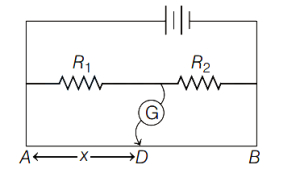
In the given arrangement of the experiment on a meter bridge,if $AD$ corresponding to the null deflection of the galvanometer is $X$,what would be its value if the radius of the wire $AB$ is doubled?
A
$X$
B
$\frac{X}{4}$
C
$4X$
D
$2X$
Solution
(A) In a meter bridge,the condition for null deflection is given by the Wheatstone bridge principle: $\frac{R_1}{R_2} = \frac{R_{AD}}{R_{DB}}$.
Here,$R_{AD}$ is the resistance of the wire segment $AD$ and $R_{DB}$ is the resistance of the wire segment $DB$.
Let $l$ be the length of the wire $AD$,then the length of $DB$ is $(100 - l)$.
The resistance of a wire is given by $R = \rho \frac{L}{A}$,where $\rho$ is resistivity,$L$ is length,and $A$ is the cross-sectional area.
Substituting this into the balance condition: $\frac{R_1}{R_2} = \frac{\rho l / A}{\rho (100 - l) / A} = \frac{l}{100 - l}$.
Since the cross-sectional area $A$ cancels out from the numerator and denominator,the balancing length $l$ (which is $X$) is independent of the radius (and thus the area of cross-section) of the wire.
Therefore,if the radius of the wire $AB$ is doubled,the balancing length will remain $X$.
Here,$R_{AD}$ is the resistance of the wire segment $AD$ and $R_{DB}$ is the resistance of the wire segment $DB$.
Let $l$ be the length of the wire $AD$,then the length of $DB$ is $(100 - l)$.
The resistance of a wire is given by $R = \rho \frac{L}{A}$,where $\rho$ is resistivity,$L$ is length,and $A$ is the cross-sectional area.
Substituting this into the balance condition: $\frac{R_1}{R_2} = \frac{\rho l / A}{\rho (100 - l) / A} = \frac{l}{100 - l}$.
Since the cross-sectional area $A$ cancels out from the numerator and denominator,the balancing length $l$ (which is $X$) is independent of the radius (and thus the area of cross-section) of the wire.
Therefore,if the radius of the wire $AB$ is doubled,the balancing length will remain $X$.
0 likesView Solution
30
PhysicsEasyMCQKCET · 2021
$A$ wire of resistance $3 \Omega$ is stretched to twice its original length. The resistance of the new wire will be (in $Omega$)
A
$1.5$
B
$3$
C
$6$
D
$12$
Solution
(D) Given,initial resistance,$R_{1} = 3 \Omega$.
Let the original length of the wire be $l$. When the wire is stretched to twice its length,the new length becomes $l^{\prime} = 2l$.
Since the volume of the wire remains constant during stretching,$V = A \times l = A^{\prime} \times l^{\prime}$.
Therefore,$A^{\prime} = \frac{A \times l}{l^{\prime}} = \frac{A \times l}{2l} = \frac{A}{2}$.
The resistance of a wire is given by $R = \rho \frac{l}{A}$.
The new resistance $R_{2}$ is $R_{2} = \rho \frac{l^{\prime}}{A^{\prime}} = \rho \frac{2l}{A/2} = 4 \left( \rho \frac{l}{A} \right) = 4 R_{1}$.
Substituting the value of $R_{1}$,we get $R_{2} = 4 \times 3 \Omega = 12 \Omega$.
Let the original length of the wire be $l$. When the wire is stretched to twice its length,the new length becomes $l^{\prime} = 2l$.
Since the volume of the wire remains constant during stretching,$V = A \times l = A^{\prime} \times l^{\prime}$.
Therefore,$A^{\prime} = \frac{A \times l}{l^{\prime}} = \frac{A \times l}{2l} = \frac{A}{2}$.
The resistance of a wire is given by $R = \rho \frac{l}{A}$.
The new resistance $R_{2}$ is $R_{2} = \rho \frac{l^{\prime}}{A^{\prime}} = \rho \frac{2l}{A/2} = 4 \left( \rho \frac{l}{A} \right) = 4 R_{1}$.
Substituting the value of $R_{1}$,we get $R_{2} = 4 \times 3 \Omega = 12 \Omega$.
0 likesView Solution
31
PhysicsMediumMCQKCET · 2021
$A$ proton moving with a momentum $p_{1}$ has a kinetic energy $1/8$th of its rest mass-energy. Another light photon having energy equal to the kinetic energy of the proton possesses a momentum $p_{2}$. Then,the ratio $\frac{p_{1}-p_{2}}{p_{1}}$ is equal to
A
$1$
B
$1/4$
C
$1/2$
D
$3/4$
Solution
(D) For a proton,the total energy $E_{total} = E_k + mc^2 = \frac{1}{8}mc^2 + mc^2 = \frac{9}{8}mc^2$.
Using the relativistic relation $E_{total}^2 = (pc)^2 + (mc^2)^2$:
$(\frac{9}{8}mc^2)^2 = (p_1c)^2 + (mc^2)^2$
$\frac{81}{64}m^2c^4 = p_1^2c^2 + m^2c^4$
$p_1^2c^2 = (\frac{81}{64} - 1)m^2c^4 = \frac{17}{64}m^2c^4$
$p_1 = \frac{\sqrt{17}}{8}mc$.
For a photon,energy $E = p_2c = E_k = \frac{1}{8}mc^2$,so $p_2 = \frac{mc}{8}$.
The ratio $\frac{p_1 - p_2}{p_1} = 1 - \frac{p_2}{p_1} = 1 - \frac{mc/8}{\sqrt{17}mc/8} = 1 - \frac{1}{\sqrt{17}}$.
Note: If we assume non-relativistic kinetic energy $E_k = \frac{p_1^2}{2m} = \frac{1}{8}mc^2$,then $p_1^2 = \frac{1}{4}m^2c^2$,so $p_1 = \frac{mc}{2}$.
Then $p_2 = \frac{E_k}{c} = \frac{mc}{8}$.
The ratio $\frac{p_1 - p_2}{p_1} = \frac{mc/2 - mc/8}{mc/2} = \frac{3/8}{1/2} = \frac{3}{4}$.
Using the relativistic relation $E_{total}^2 = (pc)^2 + (mc^2)^2$:
$(\frac{9}{8}mc^2)^2 = (p_1c)^2 + (mc^2)^2$
$\frac{81}{64}m^2c^4 = p_1^2c^2 + m^2c^4$
$p_1^2c^2 = (\frac{81}{64} - 1)m^2c^4 = \frac{17}{64}m^2c^4$
$p_1 = \frac{\sqrt{17}}{8}mc$.
For a photon,energy $E = p_2c = E_k = \frac{1}{8}mc^2$,so $p_2 = \frac{mc}{8}$.
The ratio $\frac{p_1 - p_2}{p_1} = 1 - \frac{p_2}{p_1} = 1 - \frac{mc/8}{\sqrt{17}mc/8} = 1 - \frac{1}{\sqrt{17}}$.
Note: If we assume non-relativistic kinetic energy $E_k = \frac{p_1^2}{2m} = \frac{1}{8}mc^2$,then $p_1^2 = \frac{1}{4}m^2c^2$,so $p_1 = \frac{mc}{2}$.
Then $p_2 = \frac{E_k}{c} = \frac{mc}{8}$.
The ratio $\frac{p_1 - p_2}{p_1} = \frac{mc/2 - mc/8}{mc/2} = \frac{3/8}{1/2} = \frac{3}{4}$.
0 likesView Solution
32
PhysicsDifficultMCQKCET · 2021
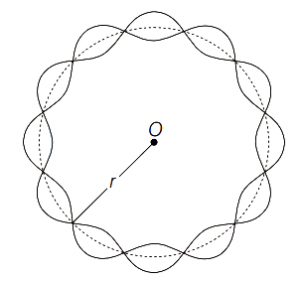
The figure shows standing de-Broglie waves due to the revolution of an electron in a certain orbit of a hydrogen atom. Then,the expression for the orbit radius is (All notations have their usual meanings).
A
$\frac{h^{2} \varepsilon_{0}}{\pi m e^{2}}$
B
$\frac{4 h^{2} \varepsilon_{0}}{\pi m e^{2}}$
C
$\frac{9 h^{2} \varepsilon_{0}}{\pi m e^{2}}$
D
$\frac{36 h^{2} \varepsilon_{0}}{\pi m e^{2}}$
Solution
(D) According to the de-Broglie hypothesis,the circumference of a stationary orbit must be an integral number of wavelengths:
$n \lambda = 2 \pi r_n$
Also,the angular momentum of the electron is given by:
$m v_n r_n = \frac{n h}{2 \pi}$
From the Bohr model,the velocity of an electron in the $n^{th}$ orbit is $v_n = \frac{e^2}{2 n h \varepsilon_0}$.
Substituting this into the angular momentum equation:
$m \left( \frac{e^2}{2 n h \varepsilon_0} \right) r_n = \frac{n h}{2 \pi}$
$r_n = \frac{n^2 h^2 \varepsilon_0}{\pi m e^2}$
In the given figure,counting the number of standing wave loops (or wavelengths),we find $n = 6$.
Therefore,the radius is:
$r_n = \frac{6^2 h^2 \varepsilon_0}{\pi m e^2} = \frac{36 h^2 \varepsilon_0}{\pi m e^2}$
$n \lambda = 2 \pi r_n$
Also,the angular momentum of the electron is given by:
$m v_n r_n = \frac{n h}{2 \pi}$
From the Bohr model,the velocity of an electron in the $n^{th}$ orbit is $v_n = \frac{e^2}{2 n h \varepsilon_0}$.
Substituting this into the angular momentum equation:
$m \left( \frac{e^2}{2 n h \varepsilon_0} \right) r_n = \frac{n h}{2 \pi}$
$r_n = \frac{n^2 h^2 \varepsilon_0}{\pi m e^2}$
In the given figure,counting the number of standing wave loops (or wavelengths),we find $n = 6$.
Therefore,the radius is:
$r_n = \frac{6^2 h^2 \varepsilon_0}{\pi m e^2} = \frac{36 h^2 \varepsilon_0}{\pi m e^2}$
0 likesView Solution
33
PhysicsMediumMCQKCET · 2021
The work-function of a metal is $1 eV$. Light of wavelength $3000 \text{Å}$ is incident on this metal surface. The velocity of emitted photoelectrons will be
A
$10 \text{ ms}^{-1}$
B
$1 \times 10^{3} \text{ ms}^{-1}$
C
$1 \times 10^{4} \text{ ms}^{-1}$
D
$1 \times 10^{6} \text{ ms}^{-1}$
Solution
(D) Given: Work-function, $\phi_{0} = 1 eV = 1.6 \times 10^{-19} J$.
Wavelength, $\lambda = 3000 \text{Å} = 3000 \times 10^{-10} m$.
The energy of the incident photon is given by $E = \frac{hc}{\lambda}$.
$E = \frac{6.63 \times 10^{-34} \times 3 \times 10^{8}}{3000 \times 10^{-10}} = 6.63 \times 10^{-19} J$.
According to Einstein's photoelectric equation, $E = \phi_{0} + KE_{max}$.
$KE_{max} = E - \phi_{0} = 6.63 \times 10^{-19} - 1.6 \times 10^{-19} = 5.03 \times 10^{-19} J$.
Since $KE_{max} = \frac{1}{2}mv^{2}$, we have $v = \sqrt{\frac{2 \times KE_{max}}{m}}$.
$v = \sqrt{\frac{2 \times 5.03 \times 10^{-19}}{9.1 \times 10^{-31}}} = \sqrt{1.105 \times 10^{12}} \approx 1.05 \times 10^{6} m/s$.
Thus, the velocity is approximately $1 \times 10^{6} m/s$.
Wavelength, $\lambda = 3000 \text{Å} = 3000 \times 10^{-10} m$.
The energy of the incident photon is given by $E = \frac{hc}{\lambda}$.
$E = \frac{6.63 \times 10^{-34} \times 3 \times 10^{8}}{3000 \times 10^{-10}} = 6.63 \times 10^{-19} J$.
According to Einstein's photoelectric equation, $E = \phi_{0} + KE_{max}$.
$KE_{max} = E - \phi_{0} = 6.63 \times 10^{-19} - 1.6 \times 10^{-19} = 5.03 \times 10^{-19} J$.
Since $KE_{max} = \frac{1}{2}mv^{2}$, we have $v = \sqrt{\frac{2 \times KE_{max}}{m}}$.
$v = \sqrt{\frac{2 \times 5.03 \times 10^{-19}}{9.1 \times 10^{-31}}} = \sqrt{1.105 \times 10^{12}} \approx 1.05 \times 10^{6} m/s$.
Thus, the velocity is approximately $1 \times 10^{6} m/s$.
0 likesView Solution
34
PhysicsEasyMCQKCET · 2021
According to Einstein's photoelectric equation,the graph between the kinetic energy of ejected photoelectrons and the frequency of incident radiation is:
A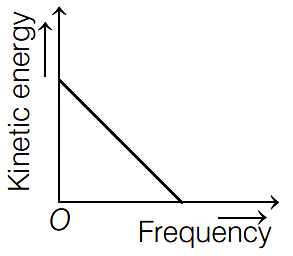
B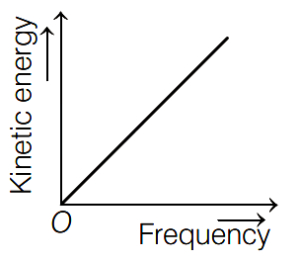
C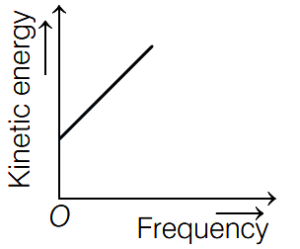
D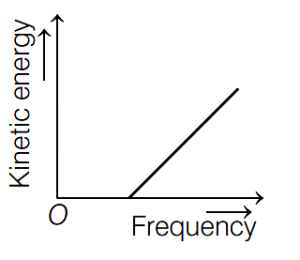
Solution
(D) According to Einstein's photoelectric equation,the maximum kinetic energy $K_{max}$ of an ejected photoelectron is given by:
$K_{max} = h\nu - \phi_0$
where $h$ is Planck's constant,$\nu$ is the frequency of incident radiation,and $\phi_0$ is the work function of the metal.
Since $\phi_0 = h\nu_0$,where $\nu_0$ is the threshold frequency,we can write:
$K_{max} = h\nu - h\nu_0 = h(\nu - \nu_0)$
This equation represents a straight line of the form $y = mx + c$,where the slope is $h$ and the intercept on the frequency axis is $\nu_0$.
For frequencies $\nu < \nu_0$,the kinetic energy is zero because no photoemission occurs. For $\nu \geq \nu_0$,the kinetic energy increases linearly with frequency. This behavior is correctly represented by graph $D$.
$K_{max} = h\nu - \phi_0$
where $h$ is Planck's constant,$\nu$ is the frequency of incident radiation,and $\phi_0$ is the work function of the metal.
Since $\phi_0 = h\nu_0$,where $\nu_0$ is the threshold frequency,we can write:
$K_{max} = h\nu - h\nu_0 = h(\nu - \nu_0)$
This equation represents a straight line of the form $y = mx + c$,where the slope is $h$ and the intercept on the frequency axis is $\nu_0$.
For frequencies $\nu < \nu_0$,the kinetic energy is zero because no photoemission occurs. For $\nu \geq \nu_0$,the kinetic energy increases linearly with frequency. This behavior is correctly represented by graph $D$.
0 likesView Solution
35
PhysicsEasyMCQKCET · 2021
The physical quantity which is measured in the unit of $\text{wb A}^{-1}$ is
A
self-inductance
B
mutual inductance
C
magnetic flux
D
Both $(a)$ and $(b)$
Solution
(D) The self-inductance $(L)$ and mutual inductance $(M)$ both have the same unit.
Both are defined as the magnetic flux $(\phi)$ per unit current $(I)$.
Mathematically,$M = L = \frac{\phi}{I}$.
The unit of magnetic flux $(\phi)$ is Weber $(\text{wb})$ and the unit of current $(I)$ is Ampere $(\text{A})$.
Therefore,the unit of both self-inductance and mutual inductance is $\text{wb A}^{-1}$ (also known as Henry $(\text{H})$).
Thus,both $(a)$ and $(b)$ are correct.
Both are defined as the magnetic flux $(\phi)$ per unit current $(I)$.
Mathematically,$M = L = \frac{\phi}{I}$.
The unit of magnetic flux $(\phi)$ is Weber $(\text{wb})$ and the unit of current $(I)$ is Ampere $(\text{A})$.
Therefore,the unit of both self-inductance and mutual inductance is $\text{wb A}^{-1}$ (also known as Henry $(\text{H})$).
Thus,both $(a)$ and $(b)$ are correct.
0 likesView Solution
36
PhysicsEasyMCQKCET · 2021
Suppose that the electric field amplitude of an electromagnetic wave is $E_{0}=120 \text{ NC}^{-1}$ and its frequency $f=50 \text{ MHz}$. Then,which of the following values is incorrectly computed?
A
Magnetic field amplitude is $400 \text{ nT}$.
B
Angular frequency of $EM$ wave is $\pi \times 10^{8} \text{ rad/s}$.
C
Propagation constant (angular wave number) is $2.1 \text{ rad/m}$.
D
Wavelength of $EM$ wave is $6 \text{ m}$.
Solution
(C) Given: $E_{0}=120 \text{ NC}^{-1}$,$f=50 \text{ MHz} = 50 \times 10^{6} \text{ Hz}$.
$(a)$ Magnetic field amplitude: $B_{0} = \frac{E_{0}}{c} = \frac{120}{3 \times 10^{8}} = 40 \times 10^{-8} \text{ T} = 400 \text{ nT}$. (Correct)
$(b)$ Angular frequency: $\omega = 2\pi f = 2\pi \times 50 \times 10^{6} = \pi \times 10^{8} \text{ rad/s}$. (Correct)
$(c)$ Propagation constant: $k = \frac{\omega}{c} = \frac{\pi \times 10^{8}}{3 \times 10^{8}} = \frac{\pi}{3} \approx 1.047 \text{ rad/m}$. The given value $2.1 \text{ rad/m}$ is incorrect.
$(d)$ Wavelength: $\lambda = \frac{c}{f} = \frac{3 \times 10^{8}}{50 \times 10^{6}} = 6 \text{ m}$. (Correct)
$(a)$ Magnetic field amplitude: $B_{0} = \frac{E_{0}}{c} = \frac{120}{3 \times 10^{8}} = 40 \times 10^{-8} \text{ T} = 400 \text{ nT}$. (Correct)
$(b)$ Angular frequency: $\omega = 2\pi f = 2\pi \times 50 \times 10^{6} = \pi \times 10^{8} \text{ rad/s}$. (Correct)
$(c)$ Propagation constant: $k = \frac{\omega}{c} = \frac{\pi \times 10^{8}}{3 \times 10^{8}} = \frac{\pi}{3} \approx 1.047 \text{ rad/m}$. The given value $2.1 \text{ rad/m}$ is incorrect.
$(d)$ Wavelength: $\lambda = \frac{c}{f} = \frac{3 \times 10^{8}}{50 \times 10^{6}} = 6 \text{ m}$. (Correct)
0 likesView Solution
37
PhysicsEasyMCQKCET · 2021
The source of an electromagnetic wave can be a charge
A
moving with a constant velocity
B
moving in a circular orbit
C
at rest
D
moving parallel to the magnetic field
Solution
(B) According to the principles of electromagnetism,electromagnetic waves are produced by accelerated charges.
An electric charge at rest produces only a static electric field.
$A$ charge moving with a constant velocity produces a steady electric current,which creates a constant magnetic field,but does not radiate energy as electromagnetic waves.
$A$ charge moving in a circular orbit is undergoing centripetal acceleration,which is a form of accelerated motion.
Therefore,a charge moving in a circular orbit acts as a source of electromagnetic waves.
An electric charge at rest produces only a static electric field.
$A$ charge moving with a constant velocity produces a steady electric current,which creates a constant magnetic field,but does not radiate energy as electromagnetic waves.
$A$ charge moving in a circular orbit is undergoing centripetal acceleration,which is a form of accelerated motion.
Therefore,a charge moving in a circular orbit acts as a source of electromagnetic waves.
0 likesView Solution
38
PhysicsEasyMCQKCET · 2021
Electric field due to an infinite,straight,uniformly charged wire varies with distance $r$ as:
A
$r$
B
$\frac{1}{r}$
C
$\frac{1}{r^{2}}$
D
$r^{2}$
Solution
(B) The electric field intensity $E$ at a perpendicular distance $r$ from an infinitely long,straight,uniformly charged wire with linear charge density $\lambda$ is given by Gauss's Law as:
$E = \frac{\lambda}{2 \pi \varepsilon_{0} r}$
Here,$\lambda$ is the linear charge density,$\varepsilon_{0}$ is the permittivity of free space,and $\pi$ is a constant.
Since $\lambda$,$\pi$,and $\varepsilon_{0}$ are constants,the relationship between the electric field and distance is:
$E \propto \frac{1}{r}$
Therefore,the electric field varies inversely with the distance $r$.
$E = \frac{\lambda}{2 \pi \varepsilon_{0} r}$
Here,$\lambda$ is the linear charge density,$\varepsilon_{0}$ is the permittivity of free space,and $\pi$ is a constant.
Since $\lambda$,$\pi$,and $\varepsilon_{0}$ are constants,the relationship between the electric field and distance is:
$E \propto \frac{1}{r}$
Therefore,the electric field varies inversely with the distance $r$.
0 likesView Solution
39
PhysicsMediumMCQKCET · 2021
Which of the following statements is false in the case of polar molecules?
A
Centres of positive and negative charges are separated in the absence of external electric field.
B
Centres of positive and negative charges are separated in the presence of external electric field.
C
Do not possess permanent dipole moments.
D
Ionic molecule $HCl$ is the example of polar molecule.
Solution
(C) Polar molecules are molecules in which the centres of positive and negative charges are separated even when there is no external electric field.
Such molecules possess a permanent electric dipole moment.
Examples include $HCl$,$H_{2}O$,etc.
Therefore,the statement in option $(C)$ is false because polar molecules do possess permanent dipole moments.
Such molecules possess a permanent electric dipole moment.
Examples include $HCl$,$H_{2}O$,etc.
Therefore,the statement in option $(C)$ is false because polar molecules do possess permanent dipole moments.
0 likesView Solution
40
PhysicsDifficultMCQKCET · 2021
$A$ copper rod $AB$ of length $l$ is rotated about end $A$ with a constant angular velocity $\omega$. The electric field at a distance $x$ from the axis of rotation is
A
$\frac{m \omega^{2} x}{e}$
B
$\frac{m \omega x}{e}$
C
$\frac{m x}{\omega^{2} l}$
D
$\frac{m e}{\omega^{2} x}$
Solution
(A) In circular motion,the net centripetal force on an electron of mass $m$ at a distance $x$ from the axis of rotation is given by $F_{c} = m \omega^{2} x$.
When the rod rotates,the electrons within the rod also rotate,experiencing this centripetal force.
This centripetal force is provided by the induced electric field $E$ acting on the electron,such that $F_{e} = e E$.
Equating the two forces,we have $e E = m \omega^{2} x$.
Solving for the electric field $E$,we get $E = \frac{m \omega^{2} x}{e}$.
When the rod rotates,the electrons within the rod also rotate,experiencing this centripetal force.
This centripetal force is provided by the induced electric field $E$ acting on the electron,such that $F_{e} = e E$.
Equating the two forces,we have $e E = m \omega^{2} x$.
Solving for the electric field $E$,we get $E = \frac{m \omega^{2} x}{e}$.
0 likesView Solution
41
PhysicsMediumMCQKCET · 2021
$A$ $2 \ g$ object,located in a region of uniform electric field $E = (300 \ NC^{-1}) \hat{i}$,carries a charge $Q$. The object is released from rest at $x = 0$ and has a kinetic energy of $0.12 \ J$ at $x = 0.5 \ m$. Then,$Q$ is: (in $\mu C$)
A
$400$
B
$-400$
C
$800$
D
$-800$
Solution
(C) Given: Mass $m = 2 \ g = 2 \times 10^{-3} \ kg$.
Electric field $E = 300 \ NC^{-1}$.
Initial kinetic energy $(KE)_1 = 0$ at $x = 0$.
Final kinetic energy $(KE)_2 = 0.12 \ J$ at $x = 0.5 \ m$.
According to the work-energy theorem,the work done by the electric force is equal to the change in kinetic energy.
Work done $W = F \cdot d = (QE) \cdot d$.
Change in kinetic energy $\Delta KE = KE_2 - KE_1 = 0.12 \ J - 0 \ J = 0.12 \ J$.
Equating the two: $Q \times 300 \times 0.5 = 0.12$.
$Q \times 150 = 0.12$.
$Q = \frac{0.12}{150} = 0.0008 \ C$.
$Q = 800 \times 10^{-6} \ C = 800 \ \mu C$.
Since the object gains kinetic energy moving in the direction of the electric field,the charge $Q$ must be positive.
Electric field $E = 300 \ NC^{-1}$.
Initial kinetic energy $(KE)_1 = 0$ at $x = 0$.
Final kinetic energy $(KE)_2 = 0.12 \ J$ at $x = 0.5 \ m$.
According to the work-energy theorem,the work done by the electric force is equal to the change in kinetic energy.
Work done $W = F \cdot d = (QE) \cdot d$.
Change in kinetic energy $\Delta KE = KE_2 - KE_1 = 0.12 \ J - 0 \ J = 0.12 \ J$.
Equating the two: $Q \times 300 \times 0.5 = 0.12$.
$Q \times 150 = 0.12$.
$Q = \frac{0.12}{150} = 0.0008 \ C$.
$Q = 800 \times 10^{-6} \ C = 800 \ \mu C$.
Since the object gains kinetic energy moving in the direction of the electric field,the charge $Q$ must be positive.
0 likesView Solution
42
PhysicsMediumMCQKCET · 2021
Two parallel wires in free space are $10 \,cm$ apart and each carries a current of $10 \,A$ in the same direction. The force exerted by one wire on the other [per unit length] is
A
$2 \times 10^{-4} \,N/m$ [attractive]
B
$2 \times 10^{-7} \,N/m$ [attractive]
C
$2 \times 10^{-4} \,N/m$ [repulsive]
D
$2 \times 10^{-7} \,N/m$ [repulsive]
Solution
(A) Given:
$r = 10 \,cm = 0.1 \,m$
$I_1 = I_2 = 10 \,A$
The force per unit length between two parallel current-carrying wires is given by the formula:
$\frac{F}{l} = \frac{\mu_0 I_1 I_2}{2 \pi r}$
Substituting the values:
$\frac{F}{l} = \frac{(4 \pi \times 10^{-7} \,T \cdot m/A) \times (10 \,A) \times (10 \,A)}{2 \pi \times 0.1 \,m}$
$\frac{F}{l} = \frac{2 \times 10^{-7} \times 100}{0.1} = 2 \times 10^{-4} \,N/m$
Since the currents are in the same direction,the force is attractive.
$r = 10 \,cm = 0.1 \,m$
$I_1 = I_2 = 10 \,A$
The force per unit length between two parallel current-carrying wires is given by the formula:
$\frac{F}{l} = \frac{\mu_0 I_1 I_2}{2 \pi r}$
Substituting the values:
$\frac{F}{l} = \frac{(4 \pi \times 10^{-7} \,T \cdot m/A) \times (10 \,A) \times (10 \,A)}{2 \pi \times 0.1 \,m}$
$\frac{F}{l} = \frac{2 \times 10^{-7} \times 100}{0.1} = 2 \times 10^{-4} \,N/m$
Since the currents are in the same direction,the force is attractive.
0 likesView Solution
43
PhysicsMediumMCQKCET · 2021
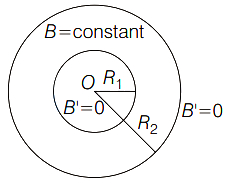
$A$ toroid with thick windings of $N$ turns has inner and outer radii $R_{1}$ and $R_{2}$,respectively. If it carries a steady current $I$,the variation of the magnetic field due to the toroid with radial distance $r$ is correctly graphed in
A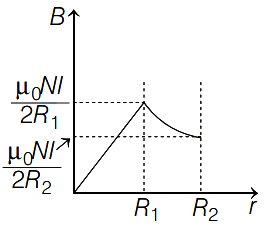
B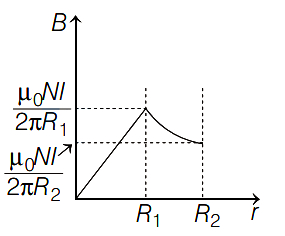
C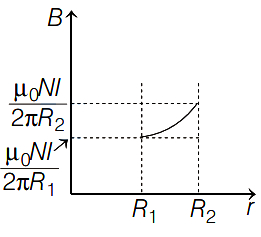
D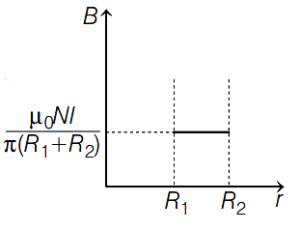
Solution
(C) The magnetic field $B$ due to a toroid is determined using Ampere's circuital law:
$(i)$ For $r < R_{1}$ (inside the hollow space of the toroid),the net current enclosed is zero,so $B = 0$.
(ii) For $R_{1} < r < R_{2}$ (inside the core of the toroid),the magnetic field is given by $B = \frac{\mu_{0} N I}{2 \pi r}$.
(iii) For $r > R_{2}$ (outside the toroid),the net current enclosed by the Amperian loop is zero,so $B = 0$.
Since the question asks for the variation of the magnetic field with radial distance $r$ within the core,and the options provided represent the behavior across the cross-section,the correct representation for the field inside the toroid is a curve proportional to $1/r$,which is shown in graph $C$.
$(i)$ For $r < R_{1}$ (inside the hollow space of the toroid),the net current enclosed is zero,so $B = 0$.
(ii) For $R_{1} < r < R_{2}$ (inside the core of the toroid),the magnetic field is given by $B = \frac{\mu_{0} N I}{2 \pi r}$.
(iii) For $r > R_{2}$ (outside the toroid),the net current enclosed by the Amperian loop is zero,so $B = 0$.
Since the question asks for the variation of the magnetic field with radial distance $r$ within the core,and the options provided represent the behavior across the cross-section,the correct representation for the field inside the toroid is a curve proportional to $1/r$,which is shown in graph $C$.
0 likesView Solution
44
PhysicsEasyMCQKCET · 2021
$A$ tightly wound long solenoid has $n$ turns per unit length,a radius $r$ and carries a current $I$. $A$ particle having charge $q$ and mass $m$ is projected from a point on the axis in a direction perpendicular to the axis. The maximum speed of the particle for which the particle does not strike the solenoid is
A
$\frac{\mu_{0} n I q r}{m}$
B
$\frac{\mu_{0} n I q r}{2 m}$
C
$\frac{\mu_{0} n I q r}{4 m}$
D
$\frac{\mu_{0} n I q r}{8 m}$
Solution
(B) The magnetic field inside a long solenoid is uniform and directed along its axis,given by $B = \mu_{0} n I$.
When a particle of charge $q$ and mass $m$ is projected perpendicular to the axis,it experiences a Lorentz force $F = q(v \times B)$. Since $v \perp B$,the force is $F = qvB$,which acts as the centripetal force.
The particle moves in a circular path of radius $R_{c} = \frac{mv}{qB}$.
For the particle not to strike the solenoid wall,the diameter of its circular path must be less than or equal to the radius of the solenoid $r$.
Thus,$2R_{c} \leq r$,which implies $R_{c} \leq \frac{r}{2}$.
Substituting $R_{c} = \frac{mv}{qB}$,we get $\frac{mv}{qB} \leq \frac{r}{2}$.
Solving for $v$,we get $v \leq \frac{qBr}{2m}$.
Substituting $B = \mu_{0} n I$,the maximum speed is $v_{max} = \frac{\mu_{0} n I q r}{2m}$.
When a particle of charge $q$ and mass $m$ is projected perpendicular to the axis,it experiences a Lorentz force $F = q(v \times B)$. Since $v \perp B$,the force is $F = qvB$,which acts as the centripetal force.
The particle moves in a circular path of radius $R_{c} = \frac{mv}{qB}$.
For the particle not to strike the solenoid wall,the diameter of its circular path must be less than or equal to the radius of the solenoid $r$.
Thus,$2R_{c} \leq r$,which implies $R_{c} \leq \frac{r}{2}$.
Substituting $R_{c} = \frac{mv}{qB}$,we get $\frac{mv}{qB} \leq \frac{r}{2}$.
Solving for $v$,we get $v \leq \frac{qBr}{2m}$.
Substituting $B = \mu_{0} n I$,the maximum speed is $v_{max} = \frac{\mu_{0} n I q r}{2m}$.
0 likesView Solution
45
PhysicsEasyMCQKCET · 2021
$A$ strong magnetic field is applied on a stationary electron. Then,the electron
A
moves in the direction of the field
B
moves in an opposite direction of the field
C
remains stationary
D
starts spinning
Solution
(C) The magnetic force $F$ acting on a charged particle moving with velocity $v$ in a magnetic field $B$ is given by the Lorentz force formula: $F = q(v \times B)$.
Since the electron is stationary,its velocity $v = 0$.
Substituting this into the formula,we get $F = q(0 \times B) = 0$.
Since the net force acting on the electron is zero,it will remain stationary.
Since the electron is stationary,its velocity $v = 0$.
Substituting this into the formula,we get $F = q(0 \times B) = 0$.
Since the net force acting on the electron is zero,it will remain stationary.
0 likesView Solution
46
PhysicsEasyMCQKCET · 2021
Earth's magnetic field always has a horizontal component except at
A
equator
B
magnetic poles
C
a latitude of $60^{\circ}$
D
an altitude of $60^{\circ}$
Solution
(B) At the magnetic poles,the angle of dip (inclination),$\delta = 90^{\circ}$.
The horizontal component of the Earth's magnetic field $(B_{H})$ is given by the formula:
$B_{H} = B \cos \delta$
where $B$ is the net magnetic field of the Earth.
Substituting the value of $\delta$ at the poles:
$B_{H} = B \cos 90^{\circ}$
Since $\cos 90^{\circ} = 0$,we get:
$B_{H} = 0$
Therefore,at the magnetic poles,the horizontal component of the Earth's magnetic field is zero.
The horizontal component of the Earth's magnetic field $(B_{H})$ is given by the formula:
$B_{H} = B \cos \delta$
where $B$ is the net magnetic field of the Earth.
Substituting the value of $\delta$ at the poles:
$B_{H} = B \cos 90^{\circ}$
Since $\cos 90^{\circ} = 0$,we get:
$B_{H} = 0$
Therefore,at the magnetic poles,the horizontal component of the Earth's magnetic field is zero.
0 likesView Solution
47
PhysicsEasyMCQKCET · 2021
Which of the field patterns given below is valid for an electric field as well as for a magnetic field?
A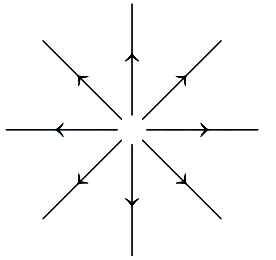
B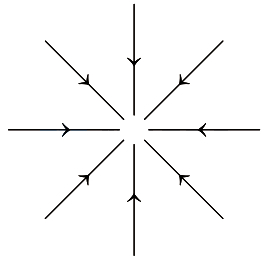
C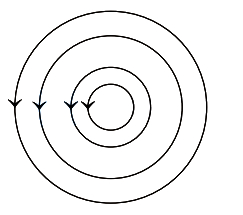
D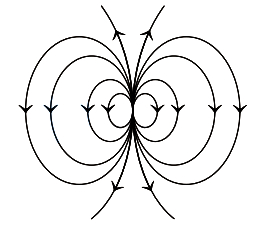
Solution
(D) Option $(A)$ and $(B)$ represent electric field lines due to isolated positive and negative charges,respectively. However,magnetic monopoles do not exist in nature,so these patterns are not valid for magnetic field lines.
Option $(C)$ represents circular magnetic field lines around a current-carrying conductor. Electric field lines cannot form closed loops,so this is not valid for an electric field.
Option $(D)$ represents the field lines of a dipole. This pattern is valid for an electric dipole (electric field lines originating from positive and terminating at negative charge) and also for a magnetic dipole (magnetic field lines forming continuous loops from North to South pole outside and South to North inside).
Thus,option $(D)$ is valid for both electric and magnetic fields.
Option $(C)$ represents circular magnetic field lines around a current-carrying conductor. Electric field lines cannot form closed loops,so this is not valid for an electric field.
Option $(D)$ represents the field lines of a dipole. This pattern is valid for an electric dipole (electric field lines originating from positive and terminating at negative charge) and also for a magnetic dipole (magnetic field lines forming continuous loops from North to South pole outside and South to North inside).
Thus,option $(D)$ is valid for both electric and magnetic fields.
0 likesView Solution
48
PhysicsEasyMCQKCET · 2021
Which graph in the following diagrams correctly represents the potential energy $U$ of a pair of nucleons as a function of their separation $r$?
A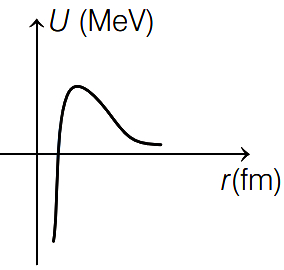
B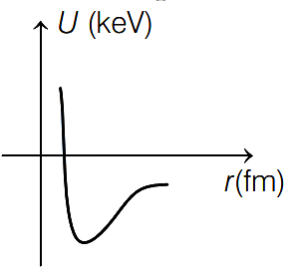
C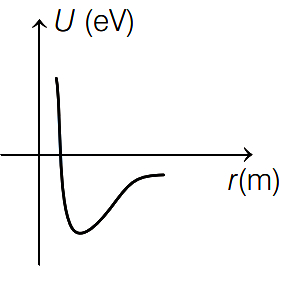
D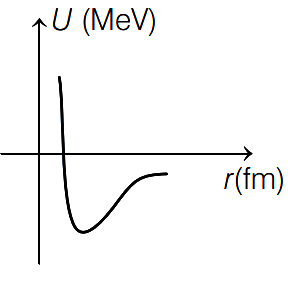
Solution
(D) The potential energy $U$ of a pair of nucleons as a function of their separation $r$ is characterized by a deep potential well.
For separations $r < r_{0}$ (where $r_{0} \approx 0.8 \ \text{fm}$), the nuclear force is strongly repulsive, causing the potential energy to rise sharply.
For separations $r > r_{0}$, the nuclear force is attractive, and the potential energy increases towards zero as $r$ increases.
The minimum potential energy occurs at the equilibrium separation $r_{0}$, where the net force between the nucleons is zero.
Graph $D$ correctly depicts this behavior with $U$ in $\text{MeV}$ and $r$ in $\text{fm}$.
For separations $r < r_{0}$ (where $r_{0} \approx 0.8 \ \text{fm}$), the nuclear force is strongly repulsive, causing the potential energy to rise sharply.
For separations $r > r_{0}$, the nuclear force is attractive, and the potential energy increases towards zero as $r$ increases.
The minimum potential energy occurs at the equilibrium separation $r_{0}$, where the net force between the nucleons is zero.
Graph $D$ correctly depicts this behavior with $U$ in $\text{MeV}$ and $r$ in $\text{fm}$.
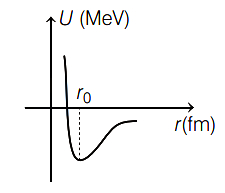
0 likesView Solution
49
PhysicsDifficultMCQKCET · 2021
In a nuclear reactor,heavy nuclei are not used as moderators because:
A
they will break up
B
elastic collision of neutrons with heavy nuclei will not slow them down
C
the net weight of the reactor would be unbearably high
D
substances with heavy nuclei do not occur in liquid or gaseous state at room temperature
Solution
(B) The moderator used in a nuclear reactor must have light nuclei (like protons or deuterium).
When neutrons undergo a perfectly elastic collision with light nuclei,they transfer a significant portion of their kinetic energy to the nuclei,effectively slowing down the neutrons.
In contrast,if neutrons collide with heavy nuclei,the mass of the heavy nucleus is much larger than that of the neutron.
According to the laws of conservation of momentum and energy,in an elastic collision with a very heavy object,the velocity of the incident particle (neutron) remains nearly unchanged.
Therefore,heavy nuclei cannot effectively slow down neutrons and are not suitable as moderators.
When neutrons undergo a perfectly elastic collision with light nuclei,they transfer a significant portion of their kinetic energy to the nuclei,effectively slowing down the neutrons.
In contrast,if neutrons collide with heavy nuclei,the mass of the heavy nucleus is much larger than that of the neutron.
According to the laws of conservation of momentum and energy,in an elastic collision with a very heavy object,the velocity of the incident particle (neutron) remains nearly unchanged.
Therefore,heavy nuclei cannot effectively slow down neutrons and are not suitable as moderators.
0 likesView Solution
50
PhysicsDifficultMCQKCET · 2021
$LC$-oscillations are similar and analogous to the mechanical oscillations of a block attached to a spring. The electrical equivalent of the force constant of the spring is
A
reciprocal of capacitive reactance
B
capacitive reactance
C
reciprocal of capacitance
D
capacitance
Solution
(C) For $LC$-oscillations,the differential equation is given by $L \frac{di}{dt} + \frac{q}{C} = 0$.
Differentiating with respect to time $t$,we get $L \frac{d^2i}{dt^2} + \frac{1}{C} \frac{dq}{dt} = 0$. Since $i = \frac{dq}{dt}$,this becomes $L \frac{d^2i}{dt^2} + \frac{1}{C} i = 0$ ... $(i)$.
For a mechanical spring-block system,the equation of motion is $m \frac{d^2x}{dt^2} + kx = 0$ ... $(ii)$.
Comparing equation $(i)$ and $(ii)$,we observe that the mass $m$ is analogous to inductance $L$,and the force constant $k$ is analogous to the reciprocal of capacitance,i.e.,$k \propto \frac{1}{C}$.
Differentiating with respect to time $t$,we get $L \frac{d^2i}{dt^2} + \frac{1}{C} \frac{dq}{dt} = 0$. Since $i = \frac{dq}{dt}$,this becomes $L \frac{d^2i}{dt^2} + \frac{1}{C} i = 0$ ... $(i)$.
For a mechanical spring-block system,the equation of motion is $m \frac{d^2x}{dt^2} + kx = 0$ ... $(ii)$.
Comparing equation $(i)$ and $(ii)$,we observe that the mass $m$ is analogous to inductance $L$,and the force constant $k$ is analogous to the reciprocal of capacitance,i.e.,$k \propto \frac{1}{C}$.
0 likesView Solution
51
PhysicsDifficultMCQKCET · 2021
Two thin biconvex lenses have focal lengths $f_{1}$ and $f_{2}$. $A$ third thin biconcave lens has a focal length of $f_{3}$. If the two biconvex lenses are in contact,the total power of the lenses is $P_{1}$. If the first convex lens is in contact with the third lens,the total power is $P_{2}$. If the second lens is in contact with the third lens,the total power is $P_{3}$,then:
A
$P_{1}=\frac{f_{1} f_{2}}{f_{1}-f_{2}}, P_{2}=\frac{f_{1} f_{3}}{f_{3}-f_{1}}$ and $P_{3}=\frac{f_{2} f_{3}}{f_{3}-f_{2}}$
B
$P_{1}=\frac{f_{1}-f_{2}}{f_{1} f_{2}}, P_{2}=\frac{f_{3}-f_{1}}{f_{3}+f_{1}}$ and $P_{3}=\frac{f_{3}-f_{2}}{f_{2} f_{3}}$
C
$P_{1}=\frac{f_{1}-f_{2}}{f_{1} f_{2}}, P_{2}=\frac{f_{3}-f_{1}}{f_{1} f_{3}}$ and $P_{3}=\frac{f_{3}-f_{2}}{f_{2} f_{3}}$
D
$P_{1}=\frac{f_{1}+f_{2}}{f_{1} f_{2}}, P_{2}=\frac{f_{3}-f_{1}}{f_{1} f_{3}}$ and $P_{3}=\frac{f_{3}-f_{2}}{f_{2} f_{3}}$
Solution
(D) According to the Cartesian sign convention:
Focal length of the first biconvex lens $= f_{1}$
Focal length of the second biconvex lens $= f_{2}$
Focal length of the third biconcave lens $= -f_{3}$
For a combination of thin lenses in contact,the total power $P = P_{A} + P_{B} = \frac{1}{f_{A}} + \frac{1}{f_{B}}$.
For the first and second lenses: $P_{1} = \frac{1}{f_{1}} + \frac{1}{f_{2}} = \frac{f_{1} + f_{2}}{f_{1} f_{2}}$.
For the first and third lenses: $P_{2} = \frac{1}{f_{1}} + \frac{1}{-f_{3}} = \frac{1}{f_{1}} - \frac{1}{f_{3}} = \frac{f_{3} - f_{1}}{f_{1} f_{3}}$.
For the second and third lenses: $P_{3} = \frac{1}{f_{2}} + \frac{1}{-f_{3}} = \frac{1}{f_{2}} - \frac{1}{f_{3}} = \frac{f_{3} - f_{2}}{f_{2} f_{3}}$.
Focal length of the first biconvex lens $= f_{1}$
Focal length of the second biconvex lens $= f_{2}$
Focal length of the third biconcave lens $= -f_{3}$
For a combination of thin lenses in contact,the total power $P = P_{A} + P_{B} = \frac{1}{f_{A}} + \frac{1}{f_{B}}$.
For the first and second lenses: $P_{1} = \frac{1}{f_{1}} + \frac{1}{f_{2}} = \frac{f_{1} + f_{2}}{f_{1} f_{2}}$.
For the first and third lenses: $P_{2} = \frac{1}{f_{1}} + \frac{1}{-f_{3}} = \frac{1}{f_{1}} - \frac{1}{f_{3}} = \frac{f_{3} - f_{1}}{f_{1} f_{3}}$.
For the second and third lenses: $P_{3} = \frac{1}{f_{2}} + \frac{1}{-f_{3}} = \frac{1}{f_{2}} - \frac{1}{f_{3}} = \frac{f_{3} - f_{2}}{f_{2} f_{3}}$.
0 likesView Solution
52
PhysicsMediumMCQKCET · 2021
If the refractive index from air to glass is $\frac{3}{2}$ and that from air to water is $\frac{4}{3}$,then the ratio of focal lengths of a glass lens in water and in air is
A
$1: 2$
B
$2: 1$
C
$1: 4$
D
$4: 1$
Solution
(D) Given,refractive index of glass with respect to air,${ }_{a} \mu_{g} = \frac{3}{2}$.
Refractive index of water with respect to air,${ }_{a} \mu_{w} = \frac{4}{3}$.
Using the Lens Maker's formula: $\frac{1}{f} = (\mu - 1) \left( \frac{1}{R_1} - \frac{1}{R_2} \right)$.
For a lens in air: $\frac{1}{f_a} = ({ }_{a} \mu_{g} - 1) \left( \frac{1}{R_1} - \frac{1}{R_2} \right)$.
For a lens in water: $\frac{1}{f_w} = ({ }_{w} \mu_{g} - 1) \left( \frac{1}{R_1} - \frac{1}{R_2} \right)$,where ${ }_{w} \mu_{g} = \frac{{ }_{a} \mu_{g}}{{ }_{a} \mu_{w}} = \frac{3/2}{4/3} = \frac{9}{8}$.
Taking the ratio $\frac{f_w}{f_a}$:
$\frac{f_w}{f_a} = \frac{{ }_{a} \mu_{g} - 1}{{ }_{w} \mu_{g} - 1} = \frac{3/2 - 1}{9/8 - 1} = \frac{1/2}{1/8} = \frac{1}{2} \times 8 = 4$.
Thus,the ratio is $4: 1$.
Refractive index of water with respect to air,${ }_{a} \mu_{w} = \frac{4}{3}$.
Using the Lens Maker's formula: $\frac{1}{f} = (\mu - 1) \left( \frac{1}{R_1} - \frac{1}{R_2} \right)$.
For a lens in air: $\frac{1}{f_a} = ({ }_{a} \mu_{g} - 1) \left( \frac{1}{R_1} - \frac{1}{R_2} \right)$.
For a lens in water: $\frac{1}{f_w} = ({ }_{w} \mu_{g} - 1) \left( \frac{1}{R_1} - \frac{1}{R_2} \right)$,where ${ }_{w} \mu_{g} = \frac{{ }_{a} \mu_{g}}{{ }_{a} \mu_{w}} = \frac{3/2}{4/3} = \frac{9}{8}$.
Taking the ratio $\frac{f_w}{f_a}$:
$\frac{f_w}{f_a} = \frac{{ }_{a} \mu_{g} - 1}{{ }_{w} \mu_{g} - 1} = \frac{3/2 - 1}{9/8 - 1} = \frac{1/2}{1/8} = \frac{1}{2} \times 8 = 4$.
Thus,the ratio is $4: 1$.
0 likesView Solution
53
PhysicsEasyMCQKCET · 2021
The size of the image of an object at infinity, formed by a convex lens of focal length $30 \,cm$, is $2 \,cm$. If a concave lens of focal length $20 \,cm$ is placed between the convex lens and the image at a distance of $26 \,cm$ from the convex lens, what is the new size of the image (in $\,cm$)?
A
$1.25$
B
$2.5$
C
$1.05$
D
$2$
Solution
(B) Given: Focal length of convex lens $f_{1} = 30 \,cm$, focal length of concave lens $f_{2} = -20 \,cm$, and initial image size $h_{o} = 2 \,cm$.
Since the object is at infinity, the image formed by the convex lens is at its focus, $v_{1} = 30 \,cm$.
The concave lens is placed at a distance of $26 \,cm$ from the convex lens. Thus, the image formed by the convex lens acts as a virtual object for the concave lens.
The distance of this virtual object from the concave lens is $u_{2} = v_{1} - 26 = 30 - 26 = 4 \,cm$.
Using the lens formula for the concave lens: $\frac{1}{v_{2}} - \frac{1}{u_{2}} = \frac{1}{f_{2}}$.
Substituting the values: $\frac{1}{v_{2}} - \frac{1}{4} = \frac{1}{-20}$.
$\frac{1}{v_{2}} = \frac{1}{4} - \frac{1}{20} = \frac{5-1}{20} = \frac{4}{20} = \frac{1}{5}$.
So, $v_{2} = 5 \,cm$.
The magnification $m$ produced by the concave lens is $m = \frac{v_{2}}{u_{2}} = \frac{5}{4} = 1.25$.
The new size of the image $h_{i} = m \times h_{o} = 1.25 \times 2 \,cm = 2.5 \,cm$.
Since the object is at infinity, the image formed by the convex lens is at its focus, $v_{1} = 30 \,cm$.
The concave lens is placed at a distance of $26 \,cm$ from the convex lens. Thus, the image formed by the convex lens acts as a virtual object for the concave lens.
The distance of this virtual object from the concave lens is $u_{2} = v_{1} - 26 = 30 - 26 = 4 \,cm$.
Using the lens formula for the concave lens: $\frac{1}{v_{2}} - \frac{1}{u_{2}} = \frac{1}{f_{2}}$.
Substituting the values: $\frac{1}{v_{2}} - \frac{1}{4} = \frac{1}{-20}$.
$\frac{1}{v_{2}} = \frac{1}{4} - \frac{1}{20} = \frac{5-1}{20} = \frac{4}{20} = \frac{1}{5}$.
So, $v_{2} = 5 \,cm$.
The magnification $m$ produced by the concave lens is $m = \frac{v_{2}}{u_{2}} = \frac{5}{4} = 1.25$.
The new size of the image $h_{i} = m \times h_{o} = 1.25 \times 2 \,cm = 2.5 \,cm$.
0 likesView Solution
54
PhysicsEasyMCQKCET · 2021
In refraction,light waves are bent on passing from one medium to a second medium because,in the second medium,
A
frequency is different
B
speed is different
C
coefficient of elasticity is different
D
amplitude is smaller
Solution
(B) The bending of light when passing from one medium to another is due to the change in the speed of light.
Refraction occurs because the refractive index of the second medium is different from that of the first medium.
The refractive index $( \mu )$ is defined as the ratio of the speed of light in a vacuum $( c )$ to the speed of light in the medium $( v )$,i.e.,$ \mu = c/v $.
When light travels from one medium to another,its frequency remains constant,but its speed changes,which causes the light ray to deviate from its original path (bending).
Therefore,the correct reason for the bending of light is that the speed of light is different in the second medium.
Refraction occurs because the refractive index of the second medium is different from that of the first medium.
The refractive index $( \mu )$ is defined as the ratio of the speed of light in a vacuum $( c )$ to the speed of light in the medium $( v )$,i.e.,$ \mu = c/v $.
When light travels from one medium to another,its frequency remains constant,but its speed changes,which causes the light ray to deviate from its original path (bending).
Therefore,the correct reason for the bending of light is that the speed of light is different in the second medium.
0 likesView Solution
55
PhysicsMediumMCQKCET · 2021
Identify the incorrect statement.
A
When a $p-n$ junction diode is forward biased,the width of the depletion region decreases.
B
When a $p-n$ junction diode is reverse biased,the barrier potential increases.
C
$A$ photodiode is operated in the reverse bias.
D
An $LED$ is a lightly doped $p-n$ junction diode which emits spontaneous radiation on forward biasing.
Solution
(D) The correct answer is $D$. An $LED$ (Light Emitting Diode) is a heavily doped $p-n$ junction diode,not a lightly doped one. When it is forward biased,the recombination of electrons and holes releases energy in the form of photons (light). Options $A$,$B$,and $C$ are correct statements regarding semiconductor diodes.
0 likesView Solution
56
PhysicsEasyMCQKCET · 2021
The circuit given represents which of the logic operations?

A
$OR$
B
$AND$
C
$NOT$
D
$NOR$
Solution
(B) The given circuit consists of two $NAND$ gates connected in series,where the second $NAND$ gate acts as a $NOT$ gate because its inputs are shorted together.
Let the inputs to the first $NAND$ gate be $A$ and $B$. The output of the first $NAND$ gate is $\overline{A \cdot B}$.
This output is fed as the input to the second $NAND$ gate. Since both inputs of the second $NAND$ gate are connected to the same signal,its output $Y$ is given by:
$Y = \overline{(\overline{A \cdot B}) \cdot (\overline{A \cdot B})}$
Using the property of Boolean algebra $\overline{X \cdot X} = \overline{X}$,we get:
$Y = \overline{(\overline{A \cdot B})} = A \cdot B$
Thus,the circuit performs the operation of an $AND$ gate.
Let the inputs to the first $NAND$ gate be $A$ and $B$. The output of the first $NAND$ gate is $\overline{A \cdot B}$.
This output is fed as the input to the second $NAND$ gate. Since both inputs of the second $NAND$ gate are connected to the same signal,its output $Y$ is given by:
$Y = \overline{(\overline{A \cdot B}) \cdot (\overline{A \cdot B})}$
Using the property of Boolean algebra $\overline{X \cdot X} = \overline{X}$,we get:
$Y = \overline{(\overline{A \cdot B})} = A \cdot B$
Thus,the circuit performs the operation of an $AND$ gate.
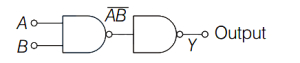
0 likesView Solution
57
PhysicsMediumMCQKCET · 2021
Three photodiodes $D_{1}, D_{2}$ and $D_{3}$ are made of semiconductors having band gaps of $2.5 eV, 2 eV$ and $3 eV$,respectively. Which one will be able to detect light of wavelength $600 nm$?
A
$D_{1}$ only
B
Both $D_{1}$ and $D_{3}$
C
$D_{2}$ only
D
All of these
Solution
(C) The energy of a photon corresponding to a wavelength $\lambda$ is given by $E = \frac{1240}{\lambda (nm)} eV$.
For $\lambda = 600 nm$,the energy of the incident photon is $E = \frac{1240}{600} \approx 2.07 eV$.
$A$ photodiode can detect light only if the energy of the incident photon is greater than or equal to the band gap energy $(E_{g})$ of the semiconductor material $(E \ge E_{g})$.
Comparing the photon energy $(2.07 eV)$ with the band gaps:
For $D_{1}$: $E_{g} = 2.5 eV$. Since $2.07 eV < 2.5 eV$,$D_{1}$ cannot detect this light.
For $D_{2}$: $E_{g} = 2 eV$. Since $2.07 eV > 2 eV$,$D_{2}$ can detect this light.
For $D_{3}$: $E_{g} = 3 eV$. Since $2.07 eV < 3 eV$,$D_{3}$ cannot detect this light.
Therefore,only $D_{2}$ will be able to detect the light of wavelength $600 nm$.
For $\lambda = 600 nm$,the energy of the incident photon is $E = \frac{1240}{600} \approx 2.07 eV$.
$A$ photodiode can detect light only if the energy of the incident photon is greater than or equal to the band gap energy $(E_{g})$ of the semiconductor material $(E \ge E_{g})$.
Comparing the photon energy $(2.07 eV)$ with the band gaps:
For $D_{1}$: $E_{g} = 2.5 eV$. Since $2.07 eV < 2.5 eV$,$D_{1}$ cannot detect this light.
For $D_{2}$: $E_{g} = 2 eV$. Since $2.07 eV > 2 eV$,$D_{2}$ can detect this light.
For $D_{3}$: $E_{g} = 3 eV$. Since $2.07 eV < 3 eV$,$D_{3}$ cannot detect this light.
Therefore,only $D_{2}$ will be able to detect the light of wavelength $600 nm$.
0 likesView Solution
58
PhysicsEasyMCQKCET · 2021
$A$ slit of width $a$ is illuminated by red light of wavelength $6500 Å$. If the first diffraction minimum falls at $30^{\circ}$,then the value of $a$ is
A
$6.5 \times 10^{-4} \text{ mm}$
B
$1.3 \text{ micron}$
C
$3250 Å$
D
$26 \times 10^{-4} \text{ cm}$
Solution
(B) Given: Wavelength $\lambda = 6500 Å = 6500 \times 10^{-10} \text{ m}$,Angle $\theta = 30^{\circ}$.
For the diffraction pattern of a single slit,the condition for the $n^{\text{th}}$ minimum is given by $a \sin \theta = n \lambda$.
For the first diffraction minimum,$n = 1$.
Substituting the values: $a \sin 30^{\circ} = 1 \times (6500 \times 10^{-10} \text{ m})$.
Since $\sin 30^{\circ} = 0.5$,we have $a \times 0.5 = 6500 \times 10^{-10} \text{ m}$.
$a = 2 \times 6500 \times 10^{-10} \text{ m} = 13000 \times 10^{-10} \text{ m}$.
$a = 1.3 \times 10^{-6} \text{ m} = 1.3 \text{ micron}$.
For the diffraction pattern of a single slit,the condition for the $n^{\text{th}}$ minimum is given by $a \sin \theta = n \lambda$.
For the first diffraction minimum,$n = 1$.
Substituting the values: $a \sin 30^{\circ} = 1 \times (6500 \times 10^{-10} \text{ m})$.
Since $\sin 30^{\circ} = 0.5$,we have $a \times 0.5 = 6500 \times 10^{-10} \text{ m}$.
$a = 2 \times 6500 \times 10^{-10} \text{ m} = 13000 \times 10^{-10} \text{ m}$.
$a = 1.3 \times 10^{-6} \text{ m} = 1.3 \text{ micron}$.
0 likesView Solution
59
PhysicsEasyMCQKCET · 2021
Which of the following statements are correct with reference to single slit diffraction pattern?
$(I)$ The central maxima is twice as wide as the secondary maxima.
$(II)$ The intensity of secondary maxima decreases as we move away from the central maxima.
$(III)$ The width of the central maxima is independent of the slit width.
$(IV)$ The intensity of the central maxima is the same as that of the secondary maxima.
$(I)$ The central maxima is twice as wide as the secondary maxima.
$(II)$ The intensity of secondary maxima decreases as we move away from the central maxima.
$(III)$ The width of the central maxima is independent of the slit width.
$(IV)$ The intensity of the central maxima is the same as that of the secondary maxima.
A
Both $(I)$ and $(III)$
B
Both $(I)$ and $(IV)$
C
Both $(II)$ and $(IV)$
D
Both $(I)$ and $(II)$
Solution
(D) In a single slit diffraction pattern,the width of the central maxima is given by $w = 2\lambda D/a$,while the width of secondary maxima is $\lambda D/a$.
Thus,the central maxima is twice as wide as the secondary maxima (Statement $I$ is correct).
The intensity of the secondary maxima decreases rapidly as we move away from the central maxima (Statement $II$ is correct).
The width of the central maxima is inversely proportional to the slit width $a$ (Statement $III$ is incorrect).
The intensity of the central maxima is much higher than that of the secondary maxima (Statement $IV$ is incorrect).
Therefore,statements $I$ and $II$ are correct.
Thus,the central maxima is twice as wide as the secondary maxima (Statement $I$ is correct).
The intensity of the secondary maxima decreases rapidly as we move away from the central maxima (Statement $II$ is correct).
The width of the central maxima is inversely proportional to the slit width $a$ (Statement $III$ is incorrect).
The intensity of the central maxima is much higher than that of the secondary maxima (Statement $IV$ is incorrect).
Therefore,statements $I$ and $II$ are correct.
0 likesView Solution
60
PhysicsMediumMCQKCET · 2021
In the Young's double slit experiment,a monochromatic source of wavelength $\lambda$ is used. The intensity of light passing through each slit is $I_{0}$. The intensity of light reaching the screen $S_{C}$ at a point $P$,at a distance $x$ from $O$,is given by (Take $d \ll D$):
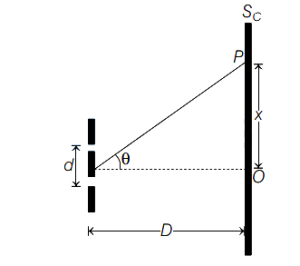
A
$I_{0} \cos ^{2}\left(\frac{\pi D}{\lambda d} x\right)$
B
$4 I_{0} \cos ^{2}\left(\frac{\pi d}{\lambda D} x\right)$
C
$I_{0} \sin ^{2}\left(\frac{\pi d}{2 \lambda D} x\right)$
D
$4 I_{0} \cos \left(\frac{\pi d}{2 \lambda D} x\right)$
Solution
(B) The path difference between the waves reaching point $P$ from the two slits is given by $\Delta x = \frac{xd}{D}$.
The corresponding phase difference $\phi$ is given by $\phi = \frac{2\pi}{\lambda} \Delta x = \frac{2\pi}{\lambda} \left(\frac{xd}{D}\right)$.
The resultant intensity $I_P$ at point $P$ for two coherent sources of equal intensity $I_0$ is given by the formula $I_P = 4I_0 \cos^2\left(\frac{\phi}{2}\right)$.
Substituting the value of $\phi$:
$I_P = 4I_0 \cos^2\left(\frac{1}{2} \cdot \frac{2\pi xd}{\lambda D}\right)$
$I_P = 4I_0 \cos^2\left(\frac{\pi dx}{\lambda D}\right)$.
The corresponding phase difference $\phi$ is given by $\phi = \frac{2\pi}{\lambda} \Delta x = \frac{2\pi}{\lambda} \left(\frac{xd}{D}\right)$.
The resultant intensity $I_P$ at point $P$ for two coherent sources of equal intensity $I_0$ is given by the formula $I_P = 4I_0 \cos^2\left(\frac{\phi}{2}\right)$.
Substituting the value of $\phi$:
$I_P = 4I_0 \cos^2\left(\frac{1}{2} \cdot \frac{2\pi xd}{\lambda D}\right)$
$I_P = 4I_0 \cos^2\left(\frac{\pi dx}{\lambda D}\right)$.
0 likesView Solution
Vedclass Products
For Students
Vedclass Test Series
Mock tests in real KCET style covering Physics with performance analysis. 5-day free trial.
Start Free TrialFor Teachers
Exam Paper Generator
Generate Set A/B/C/D Physics papers from 7.5L+ questions in 2 minutes. 3 chapters free.
Try FreeFor Institutes
Online Exam Module
Run live KCET mock exams with unlimited students, 360° analytics & white-label branding.
See DemoFrequently Asked Questions
How many Physics questions are in KCET 2021?
There are 60 Physics questions from the KCET 2021 paper on Vedclass, each with a detailed step-by-step solution in English.
Are KCET 2021 Physics solutions available in English?
Yes. All solutions on this page are in English. You can also switch to English or Hindi using the language buttons above the questions.
Can I practice KCET 2021 Physics as a timed test?
Yes. Use the Vedclass Test Series to attempt a full KCET mock test covering Physics with time limits and instant score analysis.
Can teachers create Physics papers from KCET previous year questions?
Yes. The Vedclass Exam Paper Generator lets teachers mix KCET Physics questions and generate Set A/B/C/D papers in minutes.
For Teachers & Institutes
Build a Custom Physics Paper
Pick KCET 2021 Physics questions, set difficulty, and generate Set A/B/C/D in 2 minutes.