
ChemistryQ51–150 of 726 questions
Page 2 of 9 · English
51
ChemistryDifficultMCQJEE Main · 2023
When the hydrogen ion concentration $[H^{+}]$ changes by a factor of $1000$,the value of $pH$ of the solution $.........$.
A
increases by $1000$ units
B
decreases by $3$ units
C
decreases by $2$ units
D
increases by $2$ units
Solution
(B) The $pH$ of a solution is defined as $pH = -\log [H^{+}]$.
When the concentration $[H^{+}]$ changes by a factor of $1000$,the change in $pH$ is given by $\Delta pH = -\log(\frac{[H^{+}]_{final}}{[H^{+}]_{initial}})$.
Since the concentration changes by a factor of $1000$,we have $\frac{[H^{+}]_{final}}{[H^{+}]_{initial}} = 1000 = 10^3$.
Therefore,$\Delta pH = -\log(10^3) = -3$.
This means the $pH$ value decreases by $3$ units.
When the concentration $[H^{+}]$ changes by a factor of $1000$,the change in $pH$ is given by $\Delta pH = -\log(\frac{[H^{+}]_{final}}{[H^{+}]_{initial}})$.
Since the concentration changes by a factor of $1000$,we have $\frac{[H^{+}]_{final}}{[H^{+}]_{initial}} = 1000 = 10^3$.
Therefore,$\Delta pH = -\log(10^3) = -3$.
This means the $pH$ value decreases by $3$ units.
0 likesView Solution
52
ChemistryMediumMCQJEE Main · 2023
The number of given orbitals which have electron density along the axis is $..........$. $p_{x}, p_{y}, p_{z}, d_{xy}, d_{yz}, d_{xz}, d_{z^2}, d_{x^2-y^2}$
A
$2.00$
B
$2.5$
C
$6.00$
D
$5$
Solution
(D) The orbitals with electron density along the axes are the axial orbitals.
These include the three $p$-orbitals $(p_{x}, p_{y}, p_{z})$ and two $d$-orbitals $(d_{z^2}, d_{x^2-y^2})$.
$p_{xy}, p_{yz}, p_{xz}$ are non-axial orbitals (nodal planes lie along the axes).
Therefore,the total number of axial orbitals is $3 + 2 = 5$.
These include the three $p$-orbitals $(p_{x}, p_{y}, p_{z})$ and two $d$-orbitals $(d_{z^2}, d_{x^2-y^2})$.
$p_{xy}, p_{yz}, p_{xz}$ are non-axial orbitals (nodal planes lie along the axes).
Therefore,the total number of axial orbitals is $3 + 2 = 5$.
0 likesView Solution
53
ChemistryDifficultMCQJEE Main · 2023
$28.0 \, L$ of $CO_2$ is produced on complete combustion of $16.8 \, L$ gaseous mixture of ethene $(C_2H_4)$ and methane $(CH_4)$ at $25^{\circ}C$ and $1 \, atm$. Heat evolved during the combustion process is $......... \, kJ$.
Given :
$\Delta H_C(CH_4) = -900 \, kJ \, mol^{-1}$
$\Delta H_C(C_2H_4) = -1400 \, kJ \, mol^{-1}$
Given :
$\Delta H_C(CH_4) = -900 \, kJ \, mol^{-1}$
$\Delta H_C(C_2H_4) = -1400 \, kJ \, mol^{-1}$
A
$847.3$
B
$926$
C
$986$
D
$925$
Solution
(A) Let the volume of $C_2H_4$ be $x \, L$ and the volume of $CH_4$ be $(16.8 - x) \, L$.
Combustion reactions:
$C_2H_4(g) + 3O_2(g) \rightarrow 2CO_2(g) + 2H_2O(l)$
$CH_4(g) + 2O_2(g) \rightarrow CO_2(g) + 2H_2O(l)$
From stoichiometry,total volume of $CO_2$ produced is $2x + (16.8 - x) = 28.0 \, L$.
$16.8 + x = 28.0 \Rightarrow x = 11.2 \, L$ of $C_2H_4$.
Volume of $CH_4 = 16.8 - 11.2 = 5.6 \, L$.
At $25^{\circ}C$ $(298 \, K)$ and $1 \, atm$,$1 \, mol$ of gas occupies $V_m = \frac{RT}{P} = \frac{0.0821 \times 298}{1} \approx 24.46 \, L \, mol^{-1}$.
Moles of $C_2H_4 = \frac{11.2}{24.46} \approx 0.458 \, mol$.
Moles of $CH_4 = \frac{5.6}{24.46} \approx 0.229 \, mol$.
Heat evolved $= (0.458 \times 1400) + (0.229 \times 900) = 641.2 + 206.1 = 847.3 \, kJ$.
Combustion reactions:
$C_2H_4(g) + 3O_2(g) \rightarrow 2CO_2(g) + 2H_2O(l)$
$CH_4(g) + 2O_2(g) \rightarrow CO_2(g) + 2H_2O(l)$
From stoichiometry,total volume of $CO_2$ produced is $2x + (16.8 - x) = 28.0 \, L$.
$16.8 + x = 28.0 \Rightarrow x = 11.2 \, L$ of $C_2H_4$.
Volume of $CH_4 = 16.8 - 11.2 = 5.6 \, L$.
At $25^{\circ}C$ $(298 \, K)$ and $1 \, atm$,$1 \, mol$ of gas occupies $V_m = \frac{RT}{P} = \frac{0.0821 \times 298}{1} \approx 24.46 \, L \, mol^{-1}$.
Moles of $C_2H_4 = \frac{11.2}{24.46} \approx 0.458 \, mol$.
Moles of $CH_4 = \frac{5.6}{24.46} \approx 0.229 \, mol$.
Heat evolved $= (0.458 \times 1400) + (0.229 \times 900) = 641.2 + 206.1 = 847.3 \, kJ$.
0 likesView Solution
54
ChemistryMediumMCQJEE Main · 2023
Number of hydrogen atoms per molecule of a hydrocarbon $A$ having $85.8 \%$ carbon is $...............$. (Given : Molar mass of $A = 84 \ g \ mol^{-1}$ )
A
$13$
B
$14$
C
$15$
D
$12$
Solution
(D) The percentage of carbon is $85.8 \%$,so the percentage of hydrogen is $100 - 85.8 = 14.2 \%$.
The empirical formula is $CH_2$.
The empirical formula mass is $12 + 2(1) = 14 \ g \ mol^{-1}$.
Given the molar mass is $84 \ g \ mol^{-1}$,we find $n = \frac{84}{14} = 6$.
The molecular formula is $(CH_2)_6 = C_6H_{12}$.
Therefore,the number of hydrogen atoms per molecule is $12$.
| Element | Mole ratio |
| $C$ | $\frac{85.8}{12} = 7.15 \rightarrow 1$ |
| $H$ | $\frac{14.2}{1} = 14.2 \rightarrow 2$ |
The empirical formula is $CH_2$.
The empirical formula mass is $12 + 2(1) = 14 \ g \ mol^{-1}$.
Given the molar mass is $84 \ g \ mol^{-1}$,we find $n = \frac{84}{14} = 6$.
The molecular formula is $(CH_2)_6 = C_6H_{12}$.
Therefore,the number of hydrogen atoms per molecule is $12$.
0 likesView Solution
55
ChemistryDifficultMCQJEE Main · 2023
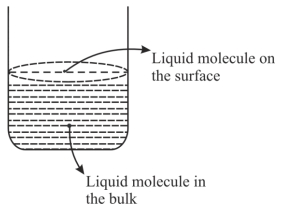
Based on the given figure,the number of correct statement/s is/are $........$.
$A.$ Surface tension is the outcome of equal attractive and repulsion forces acting on the liquid molecule in bulk.
$B.$ Surface tension is due to uneven forces acting on the molecules present on the surface.
$C.$ The molecule in the bulk can never come to the liquid surface.
$D.$ The molecules on the surface are responsible for vapour pressure if the system is a closed system.
$A.$ Surface tension is the outcome of equal attractive and repulsion forces acting on the liquid molecule in bulk.
$B.$ Surface tension is due to uneven forces acting on the molecules present on the surface.
$C.$ The molecule in the bulk can never come to the liquid surface.
$D.$ The molecules on the surface are responsible for vapour pressure if the system is a closed system.
A
$3$
B
$6$
C
$8$
D
$2$
Solution
(D) Statement $A$ is incorrect because surface tension arises from unbalanced attractive forces on the surface,not equal forces in the bulk.
Statement $B$ is correct because molecules on the surface experience a net inward pull,leading to surface tension.
Statement $C$ is incorrect because molecules in the bulk are in constant motion and can reach the surface due to their kinetic energy.
Statement $D$ is correct because molecules on the surface have higher energy and can escape into the gas phase,creating vapour pressure in a closed system.
Therefore,there are $2$ correct statements ($B$ and $D$).
Statement $B$ is correct because molecules on the surface experience a net inward pull,leading to surface tension.
Statement $C$ is incorrect because molecules in the bulk are in constant motion and can reach the surface due to their kinetic energy.
Statement $D$ is correct because molecules on the surface have higher energy and can escape into the gas phase,creating vapour pressure in a closed system.
Therefore,there are $2$ correct statements ($B$ and $D$).
0 likesView Solution
56
ChemistryDifficultMCQJEE Main · 2023
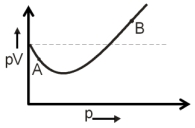
For $1 \ mol$ of gas,the plot of $pV$ vs $p$ is shown below. $p$ is the pressure and $V$ is the volume of the gas. What is the value of compressibility factor at point $A$?
A
$1 - \frac{a}{RTV}$
B
$1 + \frac{b}{V}$
C
$1 - \frac{b}{V}$
D
$1 + \frac{a}{RTV}$
Solution
(A) For $1$ mole of a real gas,the van der Waals equation is $(P + \frac{a}{V_m^2})(V_m - b) = RT$.
At low pressure,the attractive forces are dominant,so $Z < 1$.
The compressibility factor $Z$ is given by $Z = \frac{PV_m}{RT}$.
For low pressure,the approximate form of the van der Waals equation is $Z = 1 - \frac{a}{V_mRT}$.
At point $A$,which lies in the region where $Z < 1$ (below the ideal gas line),the compressibility factor is $1 - \frac{a}{V_mRT}$ (or $1 - \frac{a}{RTV}$).
At low pressure,the attractive forces are dominant,so $Z < 1$.
The compressibility factor $Z$ is given by $Z = \frac{PV_m}{RT}$.
For low pressure,the approximate form of the van der Waals equation is $Z = 1 - \frac{a}{V_mRT}$.
At point $A$,which lies in the region where $Z < 1$ (below the ideal gas line),the compressibility factor is $1 - \frac{a}{V_mRT}$ (or $1 - \frac{a}{RTV}$).
0 likesView Solution
57
ChemistryDifficultMCQJEE Main · 2023
The shortest wavelength of hydrogen atom in Lyman series is $\lambda$. The longest wavelength in Balmer series of $He^{+}$ is
A
$\frac{5}{9 \lambda}$
B
$\frac{9 \lambda}{5}$
C
$\frac{36 \lambda}{5}$
D
$\frac{5 \lambda}{9}$
Solution
(B) For $H$ atom in Lyman series,the shortest wavelength corresponds to the transition from $n_2 = \infty$ to $n_1 = 1$:
$\frac{1}{\lambda} = R_H \times 1^2 \times (\frac{1}{1^2} - \frac{1}{\infty^2}) = R_H$ $(1)$
For $He^{+}$ ion in Balmer series,the longest wavelength corresponds to the transition from $n_2 = 3$ to $n_1 = 2$:
$\frac{1}{\lambda_{He^{+}}} = R_H \times 2^2 \times (\frac{1}{2^2} - \frac{1}{3^2}) = R_H \times 4 \times (\frac{1}{4} - \frac{1}{9}) = R_H \times 4 \times \frac{5}{36} = R_H \times \frac{5}{9}$ $(2)$
Dividing $(1)$ by $(2)$:
$\frac{\lambda_{He^{+}}}{\lambda} = \frac{R_H}{R_H \times \frac{5}{9}} = \frac{9}{5}$
Therefore,$\lambda_{He^{+}} = \frac{9 \lambda}{5}$.
$\frac{1}{\lambda} = R_H \times 1^2 \times (\frac{1}{1^2} - \frac{1}{\infty^2}) = R_H$ $(1)$
For $He^{+}$ ion in Balmer series,the longest wavelength corresponds to the transition from $n_2 = 3$ to $n_1 = 2$:
$\frac{1}{\lambda_{He^{+}}} = R_H \times 2^2 \times (\frac{1}{2^2} - \frac{1}{3^2}) = R_H \times 4 \times (\frac{1}{4} - \frac{1}{9}) = R_H \times 4 \times \frac{5}{36} = R_H \times \frac{5}{9}$ $(2)$
Dividing $(1)$ by $(2)$:
$\frac{\lambda_{He^{+}}}{\lambda} = \frac{R_H}{R_H \times \frac{5}{9}} = \frac{9}{5}$
Therefore,$\lambda_{He^{+}} = \frac{9 \lambda}{5}$.
0 likesView Solution
58
ChemistryDifficultMCQJEE Main · 2023
Which of the given compounds can enhance the efficiency of hydrogen storage tank?
A
$Li/P_4$
B
$SiH_4$
C
$NaNi_5$
D
Di-isobutylaluminium hydride
Solution
(C) Hydrogen can be stored in tanks in the form of metal hydrides.
$NaNi_5$ is a well-known intermetallic compound used for the storage of hydrogen because it can absorb and release hydrogen efficiently at moderate temperatures and pressures.
Therefore,$NaNi_5$ enhances the efficiency of hydrogen storage tanks.
$NaNi_5$ is a well-known intermetallic compound used for the storage of hydrogen because it can absorb and release hydrogen efficiently at moderate temperatures and pressures.
Therefore,$NaNi_5$ enhances the efficiency of hydrogen storage tanks.
0 likesView Solution
59
ChemistryMediumMCQJEE Main · 2023
The correct order of hydration enthalpies is
$A. K^{+}$; $B. Rb^{+}$; $C. Mg^{2+}$; $D. Cs^{+}$; $E. Ca^{2+}$
Choose the correct answer from the options given below:
$A. K^{+}$; $B. Rb^{+}$; $C. Mg^{2+}$; $D. Cs^{+}$; $E. Ca^{2+}$
Choose the correct answer from the options given below:
A
$C > E > A > B > D$
B
$E > C > A > B > D$
C
$C > E > A > D > B$
D
$C > E > A > B > D$
Solution
(A) The hydration enthalpy of an ion depends on its charge density,which is directly proportional to the charge and inversely proportional to the ionic radius $(H_{hyd} \propto \frac{q}{r})$.
$1$. Comparing charges: Ions with higher charge $(Mg^{2+}, Ca^{2+})$ have significantly higher hydration enthalpies than monovalent ions $(K^{+}, Rb^{+}, Cs^{+})$.
$2$. Within the same group,hydration enthalpy decreases as the ionic radius increases.
$3$. For group $2$ ions: $Mg^{2+} > Ca^{2+}$ $(C > E)$.
$4$. For group $1$ ions: $K^{+} > Rb^{+} > Cs^{+}$ $(A > B > D)$.
Combining these,the overall order is $Mg^{2+} > Ca^{2+} > K^{+} > Rb^{+} > Cs^{+}$,which corresponds to $C > E > A > B > D$.
$1$. Comparing charges: Ions with higher charge $(Mg^{2+}, Ca^{2+})$ have significantly higher hydration enthalpies than monovalent ions $(K^{+}, Rb^{+}, Cs^{+})$.
$2$. Within the same group,hydration enthalpy decreases as the ionic radius increases.
$3$. For group $2$ ions: $Mg^{2+} > Ca^{2+}$ $(C > E)$.
$4$. For group $1$ ions: $K^{+} > Rb^{+} > Cs^{+}$ $(A > B > D)$.
Combining these,the overall order is $Mg^{2+} > Ca^{2+} > K^{+} > Rb^{+} > Cs^{+}$,which corresponds to $C > E > A > B > D$.
0 likesView Solution
60
ChemistryDifficultMCQJEE Main · 2023
The magnetic behaviour of $Li_2O$,$Na_2O_2$ and $KO_2$,respectively,are
A
diamagnetic,paramagnetic and diamagnetic
B
paramagnetic,paramagnetic and diamagnetic
C
paramagnetic,diamagnetic and paramagnetic
D
diamagnetic,diamagnetic and paramagnetic
Solution
(D) $Li_2O$ contains the oxide ion $O^{2-}$,which has the electronic configuration $[He] 2s^2 2p^6$. Since all electrons are paired,it is diamagnetic.
$Na_2O_2$ contains the peroxide ion $O_2^{2-}$. The molecular orbital configuration is $\sigma 1s^2, \sigma^* 1s^2, \sigma 2s^2, \sigma^* 2s^2, \sigma 2p_z^2, \pi 2p_x^2 = \pi 2p_y^2, \pi^* 2p_x^2 = \pi^* 2p_y^2$. All electrons are paired,so it is diamagnetic.
$KO_2$ contains the superoxide ion $O_2^-$. The molecular orbital configuration is $\sigma 1s^2, \sigma^* 1s^2, \sigma 2s^2, \sigma^* 2s^2, \sigma 2p_z^2, \pi 2p_x^2 = \pi 2p_y^2, \pi^* 2p_x^2 = \pi^* 2p_y^1$. It has one unpaired electron in the $\pi^*$ orbital,making it paramagnetic.
Therefore,the correct sequence is diamagnetic,diamagnetic,and paramagnetic.
$Na_2O_2$ contains the peroxide ion $O_2^{2-}$. The molecular orbital configuration is $\sigma 1s^2, \sigma^* 1s^2, \sigma 2s^2, \sigma^* 2s^2, \sigma 2p_z^2, \pi 2p_x^2 = \pi 2p_y^2, \pi^* 2p_x^2 = \pi^* 2p_y^2$. All electrons are paired,so it is diamagnetic.
$KO_2$ contains the superoxide ion $O_2^-$. The molecular orbital configuration is $\sigma 1s^2, \sigma^* 1s^2, \sigma 2s^2, \sigma^* 2s^2, \sigma 2p_z^2, \pi 2p_x^2 = \pi 2p_y^2, \pi^* 2p_x^2 = \pi^* 2p_y^1$. It has one unpaired electron in the $\pi^*$ orbital,making it paramagnetic.
Therefore,the correct sequence is diamagnetic,diamagnetic,and paramagnetic.
0 likesView Solution
61
ChemistryMediumMCQJEE Main · 2023
Which of the following statements about smog is correct?
A
$NO_2$ is present in classical smog
B
Both $NO_2$ and $SO_2$ are present in classical smog
C
Photochemical smog has a high concentration of oxidizing agents
D
Classical smog also has a high concentration of oxidizing agents
Solution
(C) Photochemical smog is formed in the presence of sunlight and contains a high concentration of oxidizing agents like $O_3$,$NO_2$,and peroxyacetyl nitrate $(PAN)$.
Classical smog consists of smoke,fog,and $SO_2$. It is known as reducing smog because it acts as a reducing mixture.
Therefore,the correct statement is that photochemical smog has a high concentration of oxidizing agents.
Classical smog consists of smoke,fog,and $SO_2$. It is known as reducing smog because it acts as a reducing mixture.
Therefore,the correct statement is that photochemical smog has a high concentration of oxidizing agents.
0 likesView Solution
62
ChemistryDifficultMCQJEE Main · 2023
Which of the following compounds will give a positive Lassaigne's test for both nitrogen and halogen?
A
$N_2H_4 \cdot HCl$
B
$CH_3NH_2 \cdot HCl$
C
$NH_4Cl$
D
$NH_2OH \cdot HCl$
Solution
(B) Lassaigne's test is used to detect elements like nitrogen,sulfur,and halogens in organic compounds.
For a positive test,the compound must contain carbon along with nitrogen and halogen to form sodium cyanide $(NaCN)$ and sodium halide $(NaX)$ upon fusion with sodium metal.
$CH_3NH_2 \cdot HCl$ is an organic compound containing carbon,nitrogen,and chlorine.
Upon fusion with sodium $(Na)$,it forms $NaCN$ (which gives a positive test for nitrogen) and $NaCl$ (which gives a positive test for halogen).
$N_2H_4 \cdot HCl$,$NH_4Cl$,and $NH_2OH \cdot HCl$ are inorganic compounds that do not contain carbon,hence they do not form $NaCN$ during the fusion process.
For a positive test,the compound must contain carbon along with nitrogen and halogen to form sodium cyanide $(NaCN)$ and sodium halide $(NaX)$ upon fusion with sodium metal.
$CH_3NH_2 \cdot HCl$ is an organic compound containing carbon,nitrogen,and chlorine.
Upon fusion with sodium $(Na)$,it forms $NaCN$ (which gives a positive test for nitrogen) and $NaCl$ (which gives a positive test for halogen).
$N_2H_4 \cdot HCl$,$NH_4Cl$,and $NH_2OH \cdot HCl$ are inorganic compounds that do not contain carbon,hence they do not form $NaCN$ during the fusion process.
0 likesView Solution
63
ChemistryDifficultMCQJEE Main · 2023
Millimoles of calcium hydroxide required to produce $100 \ mL$ of the aqueous solution of $pH$ $12$ is $x \times 10^{-1}$. The value of $x$ is $..............$. (Nearest integer). Assume complete dissociation.
A
$5$
B
$4$
C
$3$
D
$2$
Solution
(A) Given $pH = 12$,we know that $pOH = 14 - pH = 14 - 12 = 2$.
$[OH^-] = 10^{-pOH} = 10^{-2} \ M$.
Since $Ca(OH)_2$ dissociates completely as $Ca(OH)_2 \rightarrow Ca^{2+} + 2OH^-$,the concentration of $Ca(OH)_2$ is $[Ca(OH)_2] = \frac{[OH^-]}{2} = \frac{10^{-2}}{2} = 0.5 \times 10^{-2} = 5 \times 10^{-3} \ M$.
Number of millimoles $= \text{Molarity} \times \text{Volume in } mL = (5 \times 10^{-3} \ M) \times (100 \ mL) = 0.5 \ \text{millimoles}$.
This can be written as $5 \times 10^{-1} \ \text{millimoles}$.
Comparing with $x \times 10^{-1}$,we get $x = 5$.
$[OH^-] = 10^{-pOH} = 10^{-2} \ M$.
Since $Ca(OH)_2$ dissociates completely as $Ca(OH)_2 \rightarrow Ca^{2+} + 2OH^-$,the concentration of $Ca(OH)_2$ is $[Ca(OH)_2] = \frac{[OH^-]}{2} = \frac{10^{-2}}{2} = 0.5 \times 10^{-2} = 5 \times 10^{-3} \ M$.
Number of millimoles $= \text{Molarity} \times \text{Volume in } mL = (5 \times 10^{-3} \ M) \times (100 \ mL) = 0.5 \ \text{millimoles}$.
This can be written as $5 \times 10^{-1} \ \text{millimoles}$.
Comparing with $x \times 10^{-1}$,we get $x = 5$.
0 likesView Solution
64
ChemistryDifficultMCQJEE Main · 2023
The number of molecules or ions from the following,which do not have an odd number of electrons are $...............$.
$A. NO_2$ $B. ICl_4^{-}$ $C. BrF_3$ $D. ClO_2$ $E. NO_2^{+}$ $F. NO$
$A. NO_2$ $B. ICl_4^{-}$ $C. BrF_3$ $D. ClO_2$ $E. NO_2^{+}$ $F. NO$
A
$3$
B
$5$
C
$4$
D
$1$
Solution
(A) To determine if a molecule or ion has an odd number of electrons,we calculate the total valence electrons:
$A. NO_2$: $5 + 2(6) = 17$ (Odd)
$B. ICl_4^{-}$: $7 + 4(7) + 1 = 36$ (Even)
$C. BrF_3$: $7 + 3(7) = 28$ (Even)
$D. ClO_2$: $7 + 2(6) = 19$ (Odd)
$E. NO_2^{+}$: $5 + 2(6) - 1 = 16$ (Even)
$F. NO$: $5 + 6 = 11$ (Odd)
The species with an even number of electrons are $ICl_4^{-}$,$BrF_3$,and $NO_2^{+}$.
Therefore,the total count is $3$.
$A. NO_2$: $5 + 2(6) = 17$ (Odd)
$B. ICl_4^{-}$: $7 + 4(7) + 1 = 36$ (Even)
$C. BrF_3$: $7 + 3(7) = 28$ (Even)
$D. ClO_2$: $7 + 2(6) = 19$ (Odd)
$E. NO_2^{+}$: $5 + 2(6) - 1 = 16$ (Even)
$F. NO$: $5 + 6 = 11$ (Odd)
The species with an even number of electrons are $ICl_4^{-}$,$BrF_3$,and $NO_2^{+}$.
Therefore,the total count is $3$.
0 likesView Solution
65
ChemistryDifficultMCQJEE Main · 2023
Consider the following reaction approaching equilibrium at $27^{\circ} C$ and $1 \ atm$ pressure. Given the rate constants for the forward and backward reactions are $K_{f} = 10^{3} \ s^{-1}$ and $K_{b} = 10^{2} \ s^{-1}$ respectively,calculate the standard Gibb's energy change $(\Delta_{r} G^{\circ})$ at $27^{\circ} C$ in $kJ \ mol^{-1}$ (Nearest integer). (Given: $R = 8.3 \ J \ K^{-1} \ mol^{-1}$ and $\ln 10 = 2.3$)
A
$6$
B
$3$
C
$12$
D
$9$
Solution
(A) The equilibrium constant $K_{eq}$ is defined as the ratio of the rate constant of the forward reaction to the rate constant of the backward reaction: $K_{eq} = \frac{K_{f}}{K_{b}}$.
Given $K_{f} = 10^{3}$ and $K_{b} = 10^{2}$,we have $K_{eq} = \frac{10^{3}}{10^{2}} = 10$.
The standard Gibbs energy change is related to the equilibrium constant by the equation: $\Delta_{r} G^{\circ} = -RT \ln K_{eq}$.
Given $T = 27^{\circ} C = 300 \ K$,$R = 8.3 \ J \ K^{-1} \ mol^{-1}$,and $\ln 10 = 2.3$.
Substituting the values: $\Delta_{r} G^{\circ} = -(8.3 \times 300 \times 2.3) \ J \ mol^{-1}$.
$\Delta_{r} G^{\circ} = -5727 \ J \ mol^{-1} = -5.727 \ kJ \ mol^{-1}$.
Rounding to the nearest integer,the magnitude is $6 \ kJ \ mol^{-1}$.
Given $K_{f} = 10^{3}$ and $K_{b} = 10^{2}$,we have $K_{eq} = \frac{10^{3}}{10^{2}} = 10$.
The standard Gibbs energy change is related to the equilibrium constant by the equation: $\Delta_{r} G^{\circ} = -RT \ln K_{eq}$.
Given $T = 27^{\circ} C = 300 \ K$,$R = 8.3 \ J \ K^{-1} \ mol^{-1}$,and $\ln 10 = 2.3$.
Substituting the values: $\Delta_{r} G^{\circ} = -(8.3 \times 300 \times 2.3) \ J \ mol^{-1}$.
$\Delta_{r} G^{\circ} = -5727 \ J \ mol^{-1} = -5.727 \ kJ \ mol^{-1}$.
Rounding to the nearest integer,the magnitude is $6 \ kJ \ mol^{-1}$.
0 likesView Solution
66
ChemistryMediumMCQJEE Main · 2023
Water decomposes at $2300 \ K$. $H_2O_{(g)} \rightleftharpoons H_{2(g)} + \frac{1}{2} O_{2(g)}$. The percent of water decomposing at $2300 \ K$ and $1 \ bar$ is $...........$ (Nearest integer). Equilibrium constant for the reaction is $2 \times 10^{-3}$ at $2300 \ K$.
A
$2$
B
$4$
C
$6$
D
$8$
Solution
(A) The reaction is $H_2O_{(g)} \rightleftharpoons H_{2(g)} + \frac{1}{2} O_{2(g)}$.
Let the degree of dissociation be $\alpha$. At equilibrium,the partial pressures are $P_{H_2O} = P(1-\alpha)$,$P_{H_2} = P\alpha$,and $P_{O_2} = P(\frac{\alpha}{2})$,where $P = 1 \ bar$.
The total pressure is $P_{total} = P(1-\alpha) + P\alpha + P\frac{\alpha}{2} = P(1 + \frac{\alpha}{2}) = 1 \ bar$.
Since $\alpha$ is very small,$1 + \frac{\alpha}{2} \approx 1$,so $P \approx 1 \ bar$.
The equilibrium constant $K_p$ is given by $K_p = \frac{P_{H_2} \cdot (P_{O_2})^{1/2}}{P_{H_2O}} = \frac{(P\alpha) \cdot (P\alpha/2)^{1/2}}{P(1-\alpha)} = 2 \times 10^{-3}$.
Assuming $\alpha \ll 1$,we have $1-\alpha \approx 1$,so $\frac{\alpha \cdot (\alpha/2)^{1/2}}{1} = 2 \times 10^{-3}$.
$\frac{\alpha^{3/2}}{\sqrt{2}} = 2 \times 10^{-3} \implies \alpha^{3/2} = 2 \times 10^{-3} \times \sqrt{2} = 2^{1.5} \times 10^{-3}$.
$\alpha = (2^{1.5} \times 10^{-3})^{2/3} = 2 \times 10^{-2} = 0.02$.
The percentage of decomposition is $\alpha \times 100 = 0.02 \times 100 = 2 \%$.
Let the degree of dissociation be $\alpha$. At equilibrium,the partial pressures are $P_{H_2O} = P(1-\alpha)$,$P_{H_2} = P\alpha$,and $P_{O_2} = P(\frac{\alpha}{2})$,where $P = 1 \ bar$.
The total pressure is $P_{total} = P(1-\alpha) + P\alpha + P\frac{\alpha}{2} = P(1 + \frac{\alpha}{2}) = 1 \ bar$.
Since $\alpha$ is very small,$1 + \frac{\alpha}{2} \approx 1$,so $P \approx 1 \ bar$.
The equilibrium constant $K_p$ is given by $K_p = \frac{P_{H_2} \cdot (P_{O_2})^{1/2}}{P_{H_2O}} = \frac{(P\alpha) \cdot (P\alpha/2)^{1/2}}{P(1-\alpha)} = 2 \times 10^{-3}$.
Assuming $\alpha \ll 1$,we have $1-\alpha \approx 1$,so $\frac{\alpha \cdot (\alpha/2)^{1/2}}{1} = 2 \times 10^{-3}$.
$\frac{\alpha^{3/2}}{\sqrt{2}} = 2 \times 10^{-3} \implies \alpha^{3/2} = 2 \times 10^{-3} \times \sqrt{2} = 2^{1.5} \times 10^{-3}$.
$\alpha = (2^{1.5} \times 10^{-3})^{2/3} = 2 \times 10^{-2} = 0.02$.
The percentage of decomposition is $\alpha \times 100 = 0.02 \times 100 = 2 \%$.
0 likesView Solution
67
ChemistryDifficultMCQJEE Main · 2023
$17 \, mg$ of a hydrocarbon ($M$.$F$. $C_{10}H_{16}$) takes up $8.40 \, mL$ of $H_2$ gas measured at $0^{\circ}C$ and $760 \, mm$ of $Hg$. Ozonolysis of the same hydrocarbon yields acetone,formaldehyde,and a compound with the structure $CH_3-CO-CH_2-CH_2-CHO$. The number of double bonds present in the hydrocarbon is $...........$.
A
$3$
B
$6$
C
$9$
D
$12$
Solution
(A) $1$. Calculate the moles of the hydrocarbon: Molar mass of $C_{10}H_{16} = (10 \times 12) + (16 \times 1) = 136 \, g/mol$. Moles of hydrocarbon $= \frac{17 \times 10^{-3} \, g}{136 \, g/mol} = 1.25 \times 10^{-4} \, mol$.
$2$. Calculate the moles of $H_2$ gas: At $STP$ ($0^{\circ}C$,$760 \, mm \, Hg$),$22400 \, mL$ corresponds to $1 \, mol$. Moles of $H_2 = \frac{8.40 \, mL}{22400 \, mL/mol} = 3.75 \times 10^{-4} \, mol$.
$3$. Determine the number of double bonds: Each double bond consumes $1 \, mol$ of $H_2$ for hydrogenation. Number of double bonds $= \frac{\text{moles of } H_2}{\text{moles of hydrocarbon}} = \frac{3.75 \times 10^{-4}}{1.25 \times 10^{-4}} = 3$.
$2$. Calculate the moles of $H_2$ gas: At $STP$ ($0^{\circ}C$,$760 \, mm \, Hg$),$22400 \, mL$ corresponds to $1 \, mol$. Moles of $H_2 = \frac{8.40 \, mL}{22400 \, mL/mol} = 3.75 \times 10^{-4} \, mol$.
$3$. Determine the number of double bonds: Each double bond consumes $1 \, mol$ of $H_2$ for hydrogenation. Number of double bonds $= \frac{\text{moles of } H_2}{\text{moles of hydrocarbon}} = \frac{3.75 \times 10^{-4}}{1.25 \times 10^{-4}} = 3$.
0 likesView Solution
68
ChemistryDifficultMCQJEE Main · 2023
Given below are two statements:
Statement $I$: The decrease in first ionization enthalpy from $B$ to $Al$ is much larger than that from $Al$ to $Ga$.
Statement $II$: The $d$ orbitals in $Ga$ are completely filled.
In the light of the above statements,choose the most appropriate answer from the options given below:
Statement $I$: The decrease in first ionization enthalpy from $B$ to $Al$ is much larger than that from $Al$ to $Ga$.
Statement $II$: The $d$ orbitals in $Ga$ are completely filled.
In the light of the above statements,choose the most appropriate answer from the options given below:
A
Statement $I$ is incorrect but statement $II$ is correct.
B
Both the statements $I$ and $II$ are correct.
C
Statement $I$ is correct but statement $II$ is incorrect.
D
Both the statements $I$ and $II$ are incorrect.
Solution
(B) The first ionization enthalpy values are as follows:
$B$: $801 \ kJ/mol$
$Al$: $577 \ kJ/mol$
$Ga$: $579 \ kJ/mol$
Statement $I$: The decrease from $B$ to $Al$ is $801 - 577 = 224 \ kJ/mol$,while the change from $Al$ to $Ga$ is $579 - 577 = 2 \ kJ/mol$ (an increase). Thus,the decrease from $B$ to $Al$ is indeed much larger than the change from $Al$ to $Ga$. Statement $I$ is correct.
Statement $II$: The electronic configuration of $Ga$ $(Z=31)$ is $[Ar] \ 3d^{10} \ 4s^2 \ 4p^1$. The $3d$ orbitals are completely filled. Statement $II$ is correct.
$B$: $801 \ kJ/mol$
$Al$: $577 \ kJ/mol$
$Ga$: $579 \ kJ/mol$
Statement $I$: The decrease from $B$ to $Al$ is $801 - 577 = 224 \ kJ/mol$,while the change from $Al$ to $Ga$ is $579 - 577 = 2 \ kJ/mol$ (an increase). Thus,the decrease from $B$ to $Al$ is indeed much larger than the change from $Al$ to $Ga$. Statement $I$ is correct.
Statement $II$: The electronic configuration of $Ga$ $(Z=31)$ is $[Ar] \ 3d^{10} \ 4s^2 \ 4p^1$. The $3d$ orbitals are completely filled. Statement $II$ is correct.
0 likesView Solution
69
ChemistryDifficultMCQJEE Main · 2023
When a hydrocarbon $A$ undergoes combustion in the presence of air,it requires $9.5$ equivalents of oxygen and produces $3$ equivalents of water. What is the molecular formula of $A$?
A
$C_8H_6$
B
$C_9H_9$
C
$C_6H_6$
D
$C_9H_6$
Solution
(A) The general combustion reaction for a hydrocarbon $C_xH_y$ is given by:
$C_xH_y + (x + \frac{y}{4}) O_2 \rightarrow xCO_2 + \frac{y}{2} H_2O$
Given that the reaction produces $3$ equivalents of water,we have:
$\frac{y}{2} = 3 \Rightarrow y = 6$
Given that the reaction requires $9.5$ equivalents of oxygen,we have:
$x + \frac{y}{4} = 9.5$
Substituting $y = 6$:
$x + \frac{6}{4} = 9.5$
$x + 1.5 = 9.5$
$x = 8$
Therefore,the molecular formula of the hydrocarbon $A$ is $C_8H_6$.
$C_xH_y + (x + \frac{y}{4}) O_2 \rightarrow xCO_2 + \frac{y}{2} H_2O$
Given that the reaction produces $3$ equivalents of water,we have:
$\frac{y}{2} = 3 \Rightarrow y = 6$
Given that the reaction requires $9.5$ equivalents of oxygen,we have:
$x + \frac{y}{4} = 9.5$
Substituting $y = 6$:
$x + \frac{6}{4} = 9.5$
$x + 1.5 = 9.5$
$x = 8$
Therefore,the molecular formula of the hydrocarbon $A$ is $C_8H_6$.
0 likesView Solution
70
ChemistryMediumMCQJEE Main · 2023
According to $MO$ theory,the bond orders for $O_2^{2-}$,$CO$,and $NO^{+}$ respectively,are:
A
$1, 3, 3$
B
$1, 3, 2$
C
$1, 2, 3$
D
$2, 3, 3$
Solution
(A) The bond order is calculated using the formula: $\text{Bond Order} = \frac{1}{2} (N_b - N_a)$,where $N_b$ is the number of electrons in bonding orbitals and $N_a$ is the number of electrons in antibonding orbitals.
$1$. For $O_2^{2-}$ ($18$ electrons): The configuration is $\sigma 1s^2, \sigma^* 1s^2, \sigma 2s^2, \sigma^* 2s^2, \sigma 2p_z^2, \pi 2p_x^2 = \pi 2p_y^2, \pi^* 2p_x^2 = \pi^* 2p_y^2$. Bond order = $\frac{1}{2} (10 - 8) = 1$.
$2$. For $CO$ ($14$ electrons): The configuration is $\sigma 1s^2, \sigma^* 1s^2, \sigma 2s^2, \sigma^* 2s^2, \pi 2p_x^2 = \pi 2p_y^2, \sigma 2p_z^2$. Bond order = $\frac{1}{2} (10 - 4) = 3$.
$3$. For $NO^{+}$ ($14$ electrons): Being isoelectronic with $CO$,it also has a bond order of $3$.
$1$. For $O_2^{2-}$ ($18$ electrons): The configuration is $\sigma 1s^2, \sigma^* 1s^2, \sigma 2s^2, \sigma^* 2s^2, \sigma 2p_z^2, \pi 2p_x^2 = \pi 2p_y^2, \pi^* 2p_x^2 = \pi^* 2p_y^2$. Bond order = $\frac{1}{2} (10 - 8) = 1$.
$2$. For $CO$ ($14$ electrons): The configuration is $\sigma 1s^2, \sigma^* 1s^2, \sigma 2s^2, \sigma^* 2s^2, \pi 2p_x^2 = \pi 2p_y^2, \sigma 2p_z^2$. Bond order = $\frac{1}{2} (10 - 4) = 3$.
$3$. For $NO^{+}$ ($14$ electrons): Being isoelectronic with $CO$,it also has a bond order of $3$.
0 likesView Solution
71
ChemistryMediumMCQJEE Main · 2023
The concentration of dissolved oxygen in water for the growth of fish should be more than $X \ ppm$ and the Biochemical Oxygen Demand $(BOD)$ in clean water should be less than $Y \ ppm$. $X$ and $Y$ in $ppm$ are,respectively:
A
$X=6, Y=5$
B
$X=4, Y=8$
C
$X=4, Y=15$
D
$X=6, Y=12$
Solution
(A) For the healthy growth of fish,the concentration of dissolved oxygen $(DO)$ in water should be more than $6 \ ppm$.
If the concentration of dissolved oxygen is less than $6 \ ppm$,the growth of fish is inhibited.
Biochemical Oxygen Demand $(BOD)$ is the amount of oxygen required by bacteria to break down the organic matter present in a certain volume of a sample of water.
Clean water would have a $BOD$ value of less than $5 \ ppm$.
Therefore,$X = 6$ and $Y = 5$.
If the concentration of dissolved oxygen is less than $6 \ ppm$,the growth of fish is inhibited.
Biochemical Oxygen Demand $(BOD)$ is the amount of oxygen required by bacteria to break down the organic matter present in a certain volume of a sample of water.
Clean water would have a $BOD$ value of less than $5 \ ppm$.
Therefore,$X = 6$ and $Y = 5$.
0 likesView Solution
72
ChemistryMediumMCQJEE Main · 2023
Which of the following relations are correct?
$(A)$ $\Delta U = q + p \Delta V$
$(B)$ $\Delta G = \Delta H - T \Delta S$
$(C)$ $\Delta S = \frac{q_{rev}}{T}$
$(D)$ $\Delta H = \Delta U - \Delta nRT$
Choose the most appropriate answer from the options given below:
$(A)$ $\Delta U = q + p \Delta V$
$(B)$ $\Delta G = \Delta H - T \Delta S$
$(C)$ $\Delta S = \frac{q_{rev}}{T}$
$(D)$ $\Delta H = \Delta U - \Delta nRT$
Choose the most appropriate answer from the options given below:
A
$C$ and $D$ only
B
$B$ and $C$ only
C
$A$ and $B$ only
D
$B$ and $D$ only
Solution
(B) Only $(B)$ and $(C)$ are correct.
$(B)$ The Gibbs free energy equation is $G = H - TS$. At constant $T$,this becomes $\Delta G = \Delta H - T \Delta S$.
$(C)$ By the definition of entropy change for a reversible process,$dS = \frac{dq_{rev}}{T}$. At constant $T$,this integrates to $\Delta S = \frac{q_{rev}}{T}$.
$(A)$ The first law of thermodynamics is $\Delta U = q + w$. For expansion work,$w = -P \Delta V$,so $\Delta U = q - P \Delta V$. Thus,$(A)$ is incorrect.
$(D)$ From the enthalpy definition $H = U + PV$,for an ideal gas,$H = U + nRT$. At constant $T$,$\Delta H = \Delta U + \Delta nRT$. Thus,$(D)$ is incorrect.
$(B)$ The Gibbs free energy equation is $G = H - TS$. At constant $T$,this becomes $\Delta G = \Delta H - T \Delta S$.
$(C)$ By the definition of entropy change for a reversible process,$dS = \frac{dq_{rev}}{T}$. At constant $T$,this integrates to $\Delta S = \frac{q_{rev}}{T}$.
$(A)$ The first law of thermodynamics is $\Delta U = q + w$. For expansion work,$w = -P \Delta V$,so $\Delta U = q - P \Delta V$. Thus,$(A)$ is incorrect.
$(D)$ From the enthalpy definition $H = U + PV$,for an ideal gas,$H = U + nRT$. At constant $T$,$\Delta H = \Delta U + \Delta nRT$. Thus,$(D)$ is incorrect.
0 likesView Solution
73
ChemistryMediumMCQJEE Main · 2023
Given below are two statements:
Statement $I$ : Nickel is being used as the catalyst for producing syn gas and edible fats.
Statement $II$ : Silicon forms both electron rich and electron deficient hydrides.
In the light of the above statements,choose the most appropriate answer from the options given below:
Statement $I$ : Nickel is being used as the catalyst for producing syn gas and edible fats.
Statement $II$ : Silicon forms both electron rich and electron deficient hydrides.
In the light of the above statements,choose the most appropriate answer from the options given below:
A
Both the statements $I$ and $II$ are correct
B
Statement $I$ is incorrect but statement $II$ is correct
C
Both the statements $I$ and $II$ are incorrect
D
Statement $I$ is correct but statement $II$ is incorrect
Solution
(D) Statement-$I$ is correct.
$Ni$ is used as a catalyst in the hydrogenation of oils to produce edible fats.
Statement-$II$ is incorrect because silicon forms electron-precise hydrides (e.g.,$SiH_4$),not electron-rich or electron-deficient hydrides.
$Ni$ is used as a catalyst in the hydrogenation of oils to produce edible fats.
Statement-$II$ is incorrect because silicon forms electron-precise hydrides (e.g.,$SiH_4$),not electron-rich or electron-deficient hydrides.
0 likesView Solution
74
ChemistryMediumMCQJEE Main · 2023
On heating,$LiNO_3$ gives how many compounds among the following?
$Li_2O, N_2, O_2, LiNO_2, NO_2$
$Li_2O, N_2, O_2, LiNO_2, NO_2$
A
$4$
B
$5$
C
$3$
D
$8$
Solution
(C) The thermal decomposition of lithium nitrate $(LiNO_3)$ is given by the following equation:
$2LiNO_3 \xrightarrow{\Delta} Li_2O + 2NO_2 + \frac{1}{2}O_2$
From the given list $(Li_2O, N_2, O_2, LiNO_2, NO_2)$,the products formed are $Li_2O$,$NO_2$,and $O_2$.
Therefore,there are $3$ compounds formed.
$2LiNO_3 \xrightarrow{\Delta} Li_2O + 2NO_2 + \frac{1}{2}O_2$
From the given list $(Li_2O, N_2, O_2, LiNO_2, NO_2)$,the products formed are $Li_2O$,$NO_2$,and $O_2$.
Therefore,there are $3$ compounds formed.
0 likesView Solution
75
ChemistryDifficultMCQJEE Main · 2023
At $298 \ K$,
$N_2(g) + 3H_2(g) \rightleftharpoons 2NH_3(g), K_1 = 4 \times 10^5$
$N_2(g) + O_2(g) \rightleftharpoons 2NO(g), K_2 = 1.6 \times 10^{12}$
$H_2(g) + \frac{1}{2}O_2(g) \rightleftharpoons H_2O(g), K_3 = 1.0 \times 10^{-13}$
Based on the above equilibria,the equilibrium constant of the reaction,
$2NH_3(g) + \frac{5}{2}O_2(g) \rightleftharpoons 2NO(g) + 3H_2O(g)$
is $.......... \times 10^{-33}$ (Nearest integer).
$N_2(g) + 3H_2(g) \rightleftharpoons 2NH_3(g), K_1 = 4 \times 10^5$
$N_2(g) + O_2(g) \rightleftharpoons 2NO(g), K_2 = 1.6 \times 10^{12}$
$H_2(g) + \frac{1}{2}O_2(g) \rightleftharpoons H_2O(g), K_3 = 1.0 \times 10^{-13}$
Based on the above equilibria,the equilibrium constant of the reaction,
$2NH_3(g) + \frac{5}{2}O_2(g) \rightleftharpoons 2NO(g) + 3H_2O(g)$
is $.......... \times 10^{-33}$ (Nearest integer).
A
$2$
B
$6$
C
$4$
D
$8$
Solution
(C) The target reaction is $2NH_3(g) + \frac{5}{2}O_2(g) \rightleftharpoons 2NO(g) + 3H_2O(g)$.
This can be obtained by the operation: $(ii) + 3 \times (iii) - (i)$.
$K_{eq} = \frac{K_2 \times K_3^3}{K_1}$.
Substituting the given values:
$K_{eq} = \frac{1.6 \times 10^{12} \times (1.0 \times 10^{-13})^3}{4 \times 10^5}$.
$K_{eq} = \frac{1.6 \times 10^{12} \times 10^{-39}}{4 \times 10^5}$.
$K_{eq} = 0.4 \times 10^{12 - 39 - 5} = 0.4 \times 10^{-32} = 4 \times 10^{-33}$.
Thus,the value is $4$.
This can be obtained by the operation: $(ii) + 3 \times (iii) - (i)$.
$K_{eq} = \frac{K_2 \times K_3^3}{K_1}$.
Substituting the given values:
$K_{eq} = \frac{1.6 \times 10^{12} \times (1.0 \times 10^{-13})^3}{4 \times 10^5}$.
$K_{eq} = \frac{1.6 \times 10^{12} \times 10^{-39}}{4 \times 10^5}$.
$K_{eq} = 0.4 \times 10^{12 - 39 - 5} = 0.4 \times 10^{-32} = 4 \times 10^{-33}$.
Thus,the value is $4$.
0 likesView Solution
76
ChemistryDifficultMCQJEE Main · 2023
When $0.01 \ mol$ of an organic compound containing $60 \%$ carbon was burnt completely,$4.4 \ g$ of $CO_2$ was produced. The molar mass of the compound is $......... \ g \ mol^{-1}$ (Nearest integer).
A
$100$
B
$50$
C
$200$
D
$150$
Solution
(C) Let $M$ be the molar mass of the compound in $g \ mol^{-1}$.
Mass of $0.01 \ mol$ of the compound $= 0.01 \times M \ g$.
Since the compound contains $60 \%$ carbon by mass,the mass of carbon in the compound $= 0.01 \times M \times 0.60 = 0.006 \ M \ g$.
Moles of carbon in the compound $= \frac{0.006 \ M}{12} = 0.0005 \ M$.
During combustion,all carbon in the compound is converted to $CO_2$.
Moles of $CO_2$ produced $= \frac{4.4 \ g}{44 \ g \ mol^{-1}} = 0.1 \ mol$.
Since $1 \ mol$ of $CO_2$ contains $1 \ mol$ of carbon,the moles of carbon in the compound must equal the moles of $CO_2$ produced.
Therefore,$0.0005 \ M = 0.1$.
$M = \frac{0.1}{0.0005} = 200 \ g \ mol^{-1}$.
Mass of $0.01 \ mol$ of the compound $= 0.01 \times M \ g$.
Since the compound contains $60 \%$ carbon by mass,the mass of carbon in the compound $= 0.01 \times M \times 0.60 = 0.006 \ M \ g$.
Moles of carbon in the compound $= \frac{0.006 \ M}{12} = 0.0005 \ M$.
During combustion,all carbon in the compound is converted to $CO_2$.
Moles of $CO_2$ produced $= \frac{4.4 \ g}{44 \ g \ mol^{-1}} = 0.1 \ mol$.
Since $1 \ mol$ of $CO_2$ contains $1 \ mol$ of carbon,the moles of carbon in the compound must equal the moles of $CO_2$ produced.
Therefore,$0.0005 \ M = 0.1$.
$M = \frac{0.1}{0.0005} = 200 \ g \ mol^{-1}$.
0 likesView Solution
77
ChemistryMediumMCQJEE Main · 2023
Assume that the radius of the first Bohr orbit of hydrogen atom is $0.6 \mathring{A}$. The radius of the third Bohr orbit of $He^{+}$ is $..................$ picometer. (Nearest Integer)
A
$170$
B
$180$
C
$270$
D
$250$
Solution
(C) The radius of the $n^{th}$ Bohr orbit is given by the formula $r_n = a_0 \times \frac{n^2}{Z}$,where $a_0$ is the radius of the first Bohr orbit of the hydrogen atom.
Given $a_0 = 0.6 \mathring{A} = 60 \, pm$.
For the third Bohr orbit of $He^{+}$,$n = 3$ and $Z = 2$.
$r = 60 \times \frac{3^2}{2} \, pm$.
$r = 60 \times \frac{9}{2} \, pm$.
$r = 30 \times 9 = 270 \, pm$.
Given $a_0 = 0.6 \mathring{A} = 60 \, pm$.
For the third Bohr orbit of $He^{+}$,$n = 3$ and $Z = 2$.
$r = 60 \times \frac{3^2}{2} \, pm$.
$r = 60 \times \frac{9}{2} \, pm$.
$r = 30 \times 9 = 270 \, pm$.
0 likesView Solution
78
ChemistryDifficultMCQJEE Main · 2023
The volume of $HCl$,containing $73 \ g \ L^{-1}$,required to completely neutralize $NaOH$ obtained by reacting $0.69 \ g$ of metallic sodium with water,is $........ mL$. (Nearest Integer) (Given: molar masses of $Na, Cl, O, H$ are $23, 35.5, 16$ and $1 \ g \ mol^{-1}$ respectively)
A
$14$
B
$12$
C
$15$
D
$13$
Solution
(C) $1$. Calculate moles of $Na$: $n(Na) = \frac{0.69 \ g}{23 \ g \ mol^{-1}} = 0.03 \ mol$.
$2$. Reaction with water: $Na + H_2O \longrightarrow NaOH + \frac{1}{2} H_2$.
$3$. From the stoichiometry,$1 \ mol$ of $Na$ produces $1 \ mol$ of $NaOH$. Thus,$n(NaOH) = 0.03 \ mol$.
$4$. Neutralization reaction: $NaOH + HCl \longrightarrow NaCl + H_2O$.
$5$. Moles of $HCl$ required = $0.03 \ mol$.
$6$. Concentration of $HCl$ solution: Molarity $M = \frac{73 \ g \ L^{-1}}{36.5 \ g \ mol^{-1}} = 2 \ M$.
$7$. Volume of $HCl$ required: $V = \frac{n}{M} = \frac{0.03 \ mol}{2 \ mol \ L^{-1}} = 0.015 \ L = 15 \ mL$.
$2$. Reaction with water: $Na + H_2O \longrightarrow NaOH + \frac{1}{2} H_2$.
$3$. From the stoichiometry,$1 \ mol$ of $Na$ produces $1 \ mol$ of $NaOH$. Thus,$n(NaOH) = 0.03 \ mol$.
$4$. Neutralization reaction: $NaOH + HCl \longrightarrow NaCl + H_2O$.
$5$. Moles of $HCl$ required = $0.03 \ mol$.
$6$. Concentration of $HCl$ solution: Molarity $M = \frac{73 \ g \ L^{-1}}{36.5 \ g \ mol^{-1}} = 2 \ M$.
$7$. Volume of $HCl$ required: $V = \frac{n}{M} = \frac{0.03 \ mol}{2 \ mol \ L^{-1}} = 0.015 \ L = 15 \ mL$.
0 likesView Solution
79
ChemistryDifficultMCQJEE Main · 2023
Which of the following compounds would give the following set of qualitative analysis?
$(i)$ Fehling's Test : Positive
$(ii)$ $Na$ fusion extract upon treatment with sodium nitroprusside gives a blood red colour.
$(i)$ Fehling's Test : Positive
$(ii)$ $Na$ fusion extract upon treatment with sodium nitroprusside gives a blood red colour.
A
Imidazole$-2-$carboxaldehyde
B
Oxazole$-2-$carboxaldehyde
C
Thiazole$-2-$carboxaldehyde
D
$2-$(Thiazol$-2-$yl)acetaldehyde
Solution
(D) The qualitative analysis results are as follows:
$(i)$ Fehling's test is positive for aliphatic aldehydes. Aromatic aldehydes and heterocyclic aldehydes where the $-CHO$ group is directly attached to the ring (like in $A, B, C$) do not give a positive Fehling's test due to resonance stabilization. Only $D$ ($2$-(thiazol$-2-$yl)acetaldehyde) has the $-CHO$ group separated from the ring by a $-CH_2-CH_2-$ chain,making it behave like an aliphatic aldehyde,thus giving a positive Fehling's test.
$(ii)$ The formation of a blood-red colour with sodium nitroprusside in the $Na$ fusion extract indicates the presence of both Nitrogen $(N)$ and Sulfur $(S)$ in the compound. Among the options,only $C$ and $D$ contain both $N$ and $S$.
Combining both observations,only compound $D$ satisfies both conditions.
$(i)$ Fehling's test is positive for aliphatic aldehydes. Aromatic aldehydes and heterocyclic aldehydes where the $-CHO$ group is directly attached to the ring (like in $A, B, C$) do not give a positive Fehling's test due to resonance stabilization. Only $D$ ($2$-(thiazol$-2-$yl)acetaldehyde) has the $-CHO$ group separated from the ring by a $-CH_2-CH_2-$ chain,making it behave like an aliphatic aldehyde,thus giving a positive Fehling's test.
$(ii)$ The formation of a blood-red colour with sodium nitroprusside in the $Na$ fusion extract indicates the presence of both Nitrogen $(N)$ and Sulfur $(S)$ in the compound. Among the options,only $C$ and $D$ contain both $N$ and $S$.
Combining both observations,only compound $D$ satisfies both conditions.
0 likesView Solution
80
ChemistryDifficultMCQJEE Main · 2023
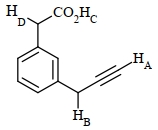
What is the correct order of acidity of the protons marked $H_A, H_B, H_C,$ and $H_D$ in the given compound?
A
$H_C > H_D > H_B > H_A$
B
$H_C > H_D > H_A > H_B$
C
$H_D > H_C > H_B > H_A$
D
$H_C > H_A > H_D > H_B$
Solution
(B) The acidity of a proton depends on the stability of its conjugate base. The more stable the conjugate base,the more acidic the proton.
$1$. $H_C$ is a carboxylic acid proton $(-COOH)$,which is the most acidic $(pK_a \approx 4-5)$.
$2$. $H_D$ is an $\alpha$-proton to a carboxylic acid group,which is acidic due to resonance stabilization of the enolate anion $(pK_a \approx 10-12)$.
$3$. $H_A$ is an acetylenic proton ($sp$ hybridized carbon),which is more acidic than an $sp^3$ hybridized $C-H$ bond $(pK_a \approx 25)$.
$4$. $H_B$ is a benzylic $sp^3$ $C-H$ proton,which is the least acidic $(pK_a \approx 40-45)$.
Thus,the correct order of acidity is $H_C > H_D > H_A > H_B$.
$1$. $H_C$ is a carboxylic acid proton $(-COOH)$,which is the most acidic $(pK_a \approx 4-5)$.
$2$. $H_D$ is an $\alpha$-proton to a carboxylic acid group,which is acidic due to resonance stabilization of the enolate anion $(pK_a \approx 10-12)$.
$3$. $H_A$ is an acetylenic proton ($sp$ hybridized carbon),which is more acidic than an $sp^3$ hybridized $C-H$ bond $(pK_a \approx 25)$.
$4$. $H_B$ is a benzylic $sp^3$ $C-H$ proton,which is the least acidic $(pK_a \approx 40-45)$.
Thus,the correct order of acidity is $H_C > H_D > H_A > H_B$.
1 likesView Solution
81
ChemistryMediumMCQJEE Main · 2023
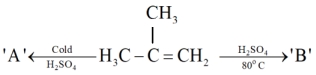
The major products '$A$' and '$B$',respectively,are
A
$H_3C-C(CH_3)_2-OSO_3H$ & $CH_3-C(CH_3)=CH-C(CH_3)_3$
B
$CH_3-C(CH_3)=CH-C(CH_3)_3$ & $H_3C-C(CH_3)_2-OSO_3H$
C
$CH_3-CH(CH_3)-CH_2-CH_2-CH(CH_3)-CH_3$ & $H_3C-C(CH_3)_2-OSO_3H$
D
$H_3C-C(CH_3)_2-OSO_3H$ & $CH_3-CH(CH_3)-CH_2-CH_2-CH(CH_3)-CH_3$
Solution
(A) The reaction of $2$-methylpropene with cold $H_2SO_4$ follows Markovnikov's addition,where the proton $H^+$ adds to the terminal carbon to form a stable tertiary carbocation $(CH_3)_3C^+$. This carbocation then reacts with the hydrogen sulfate ion $HSO_4^-$ to form the alkyl hydrogen sulfate,$2$-methyl$-2-$propyl hydrogen sulfate,which is product '$A$'.
At higher temperatures $(80^{\circ}C)$,the reaction involves the dimerization of the alkene. The tertiary carbocation $(CH_3)_3C^+$ formed initially attacks another molecule of $2$-methylpropene to form a more stable carbocation,which then undergoes deprotonation to yield the dimer,$2,4,4$-trimethylpent-$2$-ene,which is product '$B$'.
At higher temperatures $(80^{\circ}C)$,the reaction involves the dimerization of the alkene. The tertiary carbocation $(CH_3)_3C^+$ formed initially attacks another molecule of $2$-methylpropene to form a more stable carbocation,which then undergoes deprotonation to yield the dimer,$2,4,4$-trimethylpent-$2$-ene,which is product '$B$'.
0 likesView Solution
82
ChemistryMediumMCQJEE Main · 2023
The alkaline earth metal sulphate$(s)$ which are readily soluble in water is/are:
$(A)$ $BeSO_4$; $(B)$ $MgSO_4$; $(C)$ $CaSO_4$; $(D)$ $SrSO_4$; $(E)$ $BaSO_4$
Choose the correct answer from the options given below:
$(A)$ $BeSO_4$; $(B)$ $MgSO_4$; $(C)$ $CaSO_4$; $(D)$ $SrSO_4$; $(E)$ $BaSO_4$
Choose the correct answer from the options given below:
A
$A$ only
B
$B$ only
C
$A$ and $B$
D
$B$ and $C$
Solution
(C) The solubility of alkaline earth metal sulphates decreases down the group from $Be$ to $Ba$.
This is because the hydration energy decreases more rapidly than the lattice energy as the size of the cation increases.
$BeSO_4$ and $MgSO_4$ have very high hydration energies,which compensate for their lattice energies,making them readily soluble in water.
Therefore,$(A)$ and $(B)$ are the correct choices.
This is because the hydration energy decreases more rapidly than the lattice energy as the size of the cation increases.
$BeSO_4$ and $MgSO_4$ have very high hydration energies,which compensate for their lattice energies,making them readily soluble in water.
Therefore,$(A)$ and $(B)$ are the correct choices.
0 likesView Solution
83
ChemistryMediumMCQJEE Main · 2023
Formation of photochemical smog involves the following reactions in which $A$,$B$,and $C$ are respectively:
$(i)$ $NO_2 \stackrel{h\nu}{\longrightarrow} A + B$
$(ii)$ $B + O_2 \rightarrow C$
$(iii)$ $A + C \rightarrow NO_2 + O_2$
Choose the correct answer from the options given below:
$(i)$ $NO_2 \stackrel{h\nu}{\longrightarrow} A + B$
$(ii)$ $B + O_2 \rightarrow C$
$(iii)$ $A + C \rightarrow NO_2 + O_2$
Choose the correct answer from the options given below:
A
$O$,$NO$ and $NO_3^{-}$
B
$O$,$N_2O$ and $NO$
C
$N$,$O_2$ and $O_3$
D
$NO$,$O$ and $O_3$
Solution
(D) The photochemical smog formation involves the following steps:
$(i)$ $NO_{2(g)} \stackrel{h\nu}{\longrightarrow} NO_{(g)} + O_{(g)}$
Comparing this with $NO_2 \stackrel{h\nu}{\longrightarrow} A + B$,we get $A = NO$ and $B = O$.
$(ii)$ $O_{(g)} + O_{2(g)} \rightarrow O_{3(g)}$
Comparing this with $B + O_2 \rightarrow C$,we get $C = O_3$.
$(iii)$ $NO_{(g)} + O_{3(g)} \rightarrow NO_{2(g)} + O_{2(g)}$
This confirms $A = NO$,$B = O$,and $C = O_3$.
Thus,the correct answer is $D$.
$(i)$ $NO_{2(g)} \stackrel{h\nu}{\longrightarrow} NO_{(g)} + O_{(g)}$
Comparing this with $NO_2 \stackrel{h\nu}{\longrightarrow} A + B$,we get $A = NO$ and $B = O$.
$(ii)$ $O_{(g)} + O_{2(g)} \rightarrow O_{3(g)}$
Comparing this with $B + O_2 \rightarrow C$,we get $C = O_3$.
$(iii)$ $NO_{(g)} + O_{3(g)} \rightarrow NO_{2(g)} + O_{2(g)}$
This confirms $A = NO$,$B = O$,and $C = O_3$.
Thus,the correct answer is $D$.
0 likesView Solution
84
ChemistryMediumMCQJEE Main · 2023
Match List-$I$ with List-$II$.
Choose the correct answer from the options given below:
| List-$I$ (molecules/ions) | List-$II$ (No. of lone pairs of $e^-$ on central atom) |
| $A$. $IF_7$ | $I$. Three |
| $B$. $ICl_4^-$ | $II$. One |
| $C$. $XeF_6$ | $III$. Two |
| $D$. $XeF_2$ | $IV$. Zero |
Choose the correct answer from the options given below:
A
$A-IV, B-III, C-II, D-I$
B
$A-IV, B-III, C-II, D-I$
C
$A-II, B-I, C-IV, D-III$
D
$A-IV, B-I, C-II, D-III$
Solution
(A) $IF_7$: Central atom $I$ has $7$ valence electrons,all used in bonding. Lone pairs = $0$ $(IV)$.
$ICl_4^-$: Central atom $I$ has $7$ valence electrons + $1$ (negative charge) = $8$. $4$ electrons used in bonding,leaving $4$ electrons ($2$ lone pairs) $(III)$.
$XeF_6$: Central atom $Xe$ has $8$ valence electrons. $6$ used in bonding,leaving $2$ electrons ($1$ lone pair) $(II)$.
$XeF_2$: Central atom $Xe$ has $8$ valence electrons. $2$ used in bonding,leaving $6$ electrons ($3$ lone pairs) $(I)$.
Correct matching: $A-IV, B-III, C-II, D-I$.
$ICl_4^-$: Central atom $I$ has $7$ valence electrons + $1$ (negative charge) = $8$. $4$ electrons used in bonding,leaving $4$ electrons ($2$ lone pairs) $(III)$.
$XeF_6$: Central atom $Xe$ has $8$ valence electrons. $6$ used in bonding,leaving $2$ electrons ($1$ lone pair) $(II)$.
$XeF_2$: Central atom $Xe$ has $8$ valence electrons. $2$ used in bonding,leaving $6$ electrons ($3$ lone pairs) $(I)$.
Correct matching: $A-IV, B-III, C-II, D-I$.
0 likesView Solution
85
ChemistryMediumMCQJEE Main · 2023
For $OF_2$ molecule,consider the following statements:
$A$. Number of lone pairs on oxygen is $2$.
$B$. $FOF$ bond angle is less than $104.5^{\circ}$.
$C$. Oxidation state of $O$ is $-2$.
$D$. Molecule is bent $V$-shaped.
$E$. Molecular geometry is linear.
Which of the following options is correct?
$A$. Number of lone pairs on oxygen is $2$.
$B$. $FOF$ bond angle is less than $104.5^{\circ}$.
$C$. Oxidation state of $O$ is $-2$.
$D$. Molecule is bent $V$-shaped.
$E$. Molecular geometry is linear.
Which of the following options is correct?
A
$C, D, E$ only
B
$B, E, A$ only
C
$A, C, D$ only
D
$A, B, D$ only
Solution
(D) $OF_2$ has $sp^3$ hybridization with two lone pairs on the oxygen atom.
Due to the presence of two lone pairs,the molecule adopts a bent $V$-shaped geometry.
The $FOF$ bond angle is $103^{\circ}$,which is less than $104.5^{\circ}$ (the bond angle of $H_2O$).
Since fluorine is more electronegative than oxygen,the oxidation state of $O$ in $OF_2$ is $+2$.
Therefore,statements $A$,$B$,and $D$ are correct.
Due to the presence of two lone pairs,the molecule adopts a bent $V$-shaped geometry.
The $FOF$ bond angle is $103^{\circ}$,which is less than $104.5^{\circ}$ (the bond angle of $H_2O$).
Since fluorine is more electronegative than oxygen,the oxidation state of $O$ in $OF_2$ is $+2$.
Therefore,statements $A$,$B$,and $D$ are correct.
0 likesView Solution
86
ChemistryMediumMCQJEE Main · 2023
Lithium aluminium hydride can be prepared from the reaction of
A
$LiCl$ and $Al_2H_6$
B
$LiH$ and $Al_2Cl_6$
C
$LiCl, Al$ and $H_2$
D
$LiH$ and $Al(OH)_3$
Solution
(B) Lithium aluminium hydride $(LiAlH_4)$ is prepared by the reaction of lithium hydride $(LiH)$ with aluminium chloride ($Al_2Cl_6$ or $AlCl_3$) in an ether solvent.
The balanced chemical equation is:
$8 LiH + Al_2Cl_6 \longrightarrow 2 LiAlH_4 + 6 LiCl$
The balanced chemical equation is:
$8 LiH + Al_2Cl_6 \longrightarrow 2 LiAlH_4 + 6 LiCl$
0 likesView Solution
87
ChemistryMediumMCQJEE Main · 2023
Match List-$I$ with List-$II$:
Choose the correct answer from the options given below:
| List-$I$ (Atomic Number) | List-$II$ (Block of periodic table) |
|---|---|
| $A$. $37$ | $I$. $p$-block |
| $B$. $78$ | $II$. $d$-block |
| $C$. $52$ | $III$. $f$-block |
| $D$. $65$ | $IV$. $s$-block |
Choose the correct answer from the options given below:
A
$A-II, B-IV, C-I, D-III$
B
$A-I, B-III, C-IV, D-II$
C
$A-IV, B-III, C-II, D-I$
D
$A-IV, B-II, C-I, D-III$
Solution
(D) To determine the block of an element from its atomic number,we look at the last orbital filled:
$1$. Atomic number $37$ is Rubidium $(Rb)$,which belongs to the $s$-block (Group $1$). Thus,$A-IV$.
$2$. Atomic number $78$ is Platinum $(Pt)$,which is a transition metal belonging to the $d$-block. Thus,$B-II$.
$3$. Atomic number $52$ is Tellurium $(Te)$,which belongs to the $p$-block (Group $16$). Thus,$C-I$.
$4$. Atomic number $65$ is Terbium $(Tb)$,which is a lanthanoid belonging to the $f$-block. Thus,$D-III$.
Therefore,the correct matching is $A-IV, B-II, C-I, D-III$.
$1$. Atomic number $37$ is Rubidium $(Rb)$,which belongs to the $s$-block (Group $1$). Thus,$A-IV$.
$2$. Atomic number $78$ is Platinum $(Pt)$,which is a transition metal belonging to the $d$-block. Thus,$B-II$.
$3$. Atomic number $52$ is Tellurium $(Te)$,which belongs to the $p$-block (Group $16$). Thus,$C-I$.
$4$. Atomic number $65$ is Terbium $(Tb)$,which is a lanthanoid belonging to the $f$-block. Thus,$D-III$.
Therefore,the correct matching is $A-IV, B-II, C-I, D-III$.
0 likesView Solution
88
ChemistryDifficultMCQJEE Main · 2023
$A$ $300 \ mL$ bottle of soft drink has $0.2 \ M$ $CO_2$ dissolved in it. Assuming $CO_2$ behaves as an ideal gas,the volume of the dissolved $CO_2$ at $STP$ is $...... \ mL$. (Nearest integer) Given: At $STP$,molar volume of an ideal gas is $22.7 \ L \ mol^{-1}$.
A
$1361$
B
$1362$
C
$1360$
D
$1368$
Solution
(B) Step $1$: Calculate the number of moles of $CO_2$ dissolved in the solution.
$n = Molarity \times Volume(L) = 0.2 \ mol \ L^{-1} \times 0.3 \ L = 0.06 \ mol$.
Step $2$: Calculate the volume of $0.06 \ mol$ of $CO_2$ at $STP$ using the given molar volume.
$Volume = n \times \text{Molar Volume at } STP = 0.06 \ mol \times 22.7 \ L \ mol^{-1} = 1.362 \ L$.
Step $3$: Convert the volume from $L$ to $mL$.
$1.362 \ L = 1.362 \times 1000 \ mL = 1362 \ mL$.
$n = Molarity \times Volume(L) = 0.2 \ mol \ L^{-1} \times 0.3 \ L = 0.06 \ mol$.
Step $2$: Calculate the volume of $0.06 \ mol$ of $CO_2$ at $STP$ using the given molar volume.
$Volume = n \times \text{Molar Volume at } STP = 0.06 \ mol \times 22.7 \ L \ mol^{-1} = 1.362 \ L$.
Step $3$: Convert the volume from $L$ to $mL$.
$1.362 \ L = 1.362 \times 1000 \ mL = 1362 \ mL$.
0 likesView Solution
89
ChemistryMediumMCQJEE Main · 2023
The energy of one mole of photons of radiation of frequency $2 \times 10^{12} \ Hz$ in $J \ mol^{-1}$ is $.....$ (Nearest integer) (Given: $h = 6.626 \times 10^{-34} \ Js$,$N_A = 6.022 \times 10^{23} \ mol^{-1}$)
A
$796$
B
$798$
C
$797$
D
$785$
Solution
(B) The energy of one photon is given by $E = h\nu$.
The energy of one mole of photons is given by $E = N_A \times h \times \nu$.
Substituting the given values:
$E = (6.022 \times 10^{23} \ mol^{-1}) \times (6.626 \times 10^{-34} \ Js) \times (2 \times 10^{12} \ s^{-1})$.
$E = 6.022 \times 6.626 \times 2 \times 10^{23-34+12} \ J \ mol^{-1}$.
$E = 79.795 \times 10^{1} \ J \ mol^{-1} = 797.95 \ J \ mol^{-1}$.
Rounding to the nearest integer,we get $798 \ J \ mol^{-1}$.
The energy of one mole of photons is given by $E = N_A \times h \times \nu$.
Substituting the given values:
$E = (6.022 \times 10^{23} \ mol^{-1}) \times (6.626 \times 10^{-34} \ Js) \times (2 \times 10^{12} \ s^{-1})$.
$E = 6.022 \times 6.626 \times 2 \times 10^{23-34+12} \ J \ mol^{-1}$.
$E = 79.795 \times 10^{1} \ J \ mol^{-1} = 797.95 \ J \ mol^{-1}$.
Rounding to the nearest integer,we get $798 \ J \ mol^{-1}$.
0 likesView Solution
90
ChemistryMediumMCQJEE Main · 2023
The number of electrons involved in the reduction of permanganate to manganese dioxide in acidic medium is $.......$.
A
$4$
B
$3$
C
$2$
D
$1$
Solution
(B) The reduction half-reaction for permanganate $(MnO_4^-)$ to manganese dioxide $(MnO_2)$ in an acidic medium is given by:
$MnO_4^- + 4H^+ + 3e^- \longrightarrow MnO_2 + 2H_2O$
In this reaction,the oxidation state of manganese changes from $+7$ in $MnO_4^-$ to $+4$ in $MnO_2$.
The change in oxidation state is $7 - 4 = 3$.
Therefore,$3$ electrons are involved in the reduction process.
$MnO_4^- + 4H^+ + 3e^- \longrightarrow MnO_2 + 2H_2O$
In this reaction,the oxidation state of manganese changes from $+7$ in $MnO_4^-$ to $+4$ in $MnO_2$.
The change in oxidation state is $7 - 4 = 3$.
Therefore,$3$ electrons are involved in the reduction process.
0 likesView Solution
91
ChemistryMediumMCQJEE Main · 2023
When $2 \ L$ of an ideal gas expands isothermally into a vacuum to a total volume of $6 \ L$,what is the change in internal energy in $J$? (Nearest integer)
A
$0$
B
$2$
C
$4$
D
$6$
Solution
(A) For an ideal gas,the internal energy $U$ is a function of temperature only,i.e.,$U = f(T)$.
Since the process is isothermal,the temperature remains constant $(\Delta T = 0)$.
Therefore,the change in internal energy $\Delta U = 0 \ J$.
Since the process is isothermal,the temperature remains constant $(\Delta T = 0)$.
Therefore,the change in internal energy $\Delta U = 0 \ J$.
0 likesView Solution
92
ChemistryDifficultMCQJEE Main · 2023
$600 \, mL$ of $0.01 \, M \, HCl$ is mixed with $400 \, mL$ of $0.01 \, M \, H_2SO_4$. The $pH$ of the mixture is $....... \times 10^{-2}$. (Nearest integer) [Given $\log 2 = 0.30, \quad \log 3 = 0.48, \quad \log 5 = 0.69, \quad \log 7 = 0.84, \quad \log 11 = 1.04$]
A
$185$
B
$186$
C
$184$
D
$183$
Solution
(B) Total millimoles of $H^{+} = (600 \times 0.01) + (400 \times 0.01 \times 2) = 6 + 8 = 14 \, mmol$.
Total volume $= 600 + 400 = 1000 \, mL$.
Concentration of $[H^{+}] = \frac{14 \, mmol}{1000 \, mL} = 0.014 \, M = 1.4 \times 10^{-2} \, M$.
$pH = -\log[H^{+}] = -\log(1.4 \times 10^{-2}) = 2 - \log(1.4) = 2 - \log(14/10) = 2 - (\log 14 - \log 10) = 2 - (\log 2 + \log 7 - 1) = 2 - (0.30 + 0.84 - 1) = 2 - 0.14 = 1.86$.
Thus,$pH = 1.86 = 186 \times 10^{-2}$.
Total volume $= 600 + 400 = 1000 \, mL$.
Concentration of $[H^{+}] = \frac{14 \, mmol}{1000 \, mL} = 0.014 \, M = 1.4 \times 10^{-2} \, M$.
$pH = -\log[H^{+}] = -\log(1.4 \times 10^{-2}) = 2 - \log(1.4) = 2 - \log(14/10) = 2 - (\log 14 - \log 10) = 2 - (\log 2 + \log 7 - 1) = 2 - (0.30 + 0.84 - 1) = 2 - 0.14 = 1.86$.
Thus,$pH = 1.86 = 186 \times 10^{-2}$.
0 likesView Solution
93
ChemistryMediumMCQJEE Main · 2023
Which of the following reactions is correct for the thermal decomposition of lithium nitrate?
A
$2 LiNO_3 \stackrel{\Delta}{\longrightarrow} 2 LiNO_2 + O_2$
B
$4 LiNO_3 \stackrel{\Delta}{\longrightarrow} 2 Li_2O + 2 N_2O_4 + O_2$
C
$4 LiNO_3 \stackrel{\Delta}{\longrightarrow} 2 Li_2O + 4 NO_2 + O_2$
D
$2 LiNO_3 \stackrel{\Delta}{\longrightarrow} 2 Li + 2 NO_2 + O_2$
Solution
(C) Lithium nitrate $(LiNO_3)$ is unique among alkali metal nitrates because it decomposes upon heating to form lithium oxide $(Li_2O)$,nitrogen dioxide $(NO_2)$,and oxygen $(O_2)$.
The balanced chemical equation for this thermal decomposition is:
$4 LiNO_3 \stackrel{\Delta}{\longrightarrow} 2 Li_2O + 4 NO_2 + O_2$
The balanced chemical equation for this thermal decomposition is:
$4 LiNO_3 \stackrel{\Delta}{\longrightarrow} 2 Li_2O + 4 NO_2 + O_2$
0 likesView Solution
94
ChemistryMediumMCQJEE Main · 2023
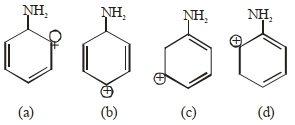
The most stable carbocation among the following is:
A
$a$
B
$b$
C
$c$
D
$d$
Solution
(C) The stability of a carbocation is increased by the $+M$ (mesomeric) effect of the $-NH_2$ group.
In structure $(c)$,the positive charge is at the ortho position relative to the $-NH_2$ group.
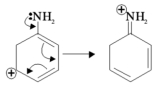
The lone pair on the nitrogen atom can delocalize into the ring to stabilize the positive charge,forming a resonance structure where all atoms have a complete octet (except hydrogen).
This resonance stabilization is most effective when the positive charge is adjacent to the group providing the $+M$ effect.
In structure $(c)$,the positive charge is at the ortho position relative to the $-NH_2$ group.
The lone pair on the nitrogen atom can delocalize into the ring to stabilize the positive charge,forming a resonance structure where all atoms have a complete octet (except hydrogen).
This resonance stabilization is most effective when the positive charge is adjacent to the group providing the $+M$ effect.
0 likesView Solution
95
ChemistryMediumMCQJEE Main · 2023
The maximum number of electrons that can be accommodated in a shell with $n=4$ is:
A
$16$
B
$32$
C
$50$
D
$72$
Solution
(B) The maximum number of electrons in a shell is given by the formula $2n^2$,where $n$ is the principal quantum number.
For $n=4$,the maximum number of electrons is $2 \times (4)^2 = 2 \times 16 = 32$.
Alternatively,summing the electrons in the subshells of the $n=4$ shell:
For $n=4$,the maximum number of electrons is $2 \times (4)^2 = 2 \times 16 = 32$.
Alternatively,summing the electrons in the subshells of the $n=4$ shell:
| Subshell | Electrons |
| $4s$ | $2$ |
| $4p$ | $6$ |
| $4d$ | $10$ |
| $4f$ | $14$ |
| Total | $32$ |
0 likesView Solution
96
ChemistryMediumMCQJEE Main · 2023
Chlorides of which metal are soluble in organic solvents:
A
$Ca$
B
$Mg$
C
$K$
D
$Be$
Solution
(D) The chlorides of alkaline earth metals generally show ionic character,but $BeCl_2$ is an exception.
Due to the small size and high polarizing power of the $Be^{2+}$ ion,$BeCl_2$ exhibits significant covalent character.
According to the principle of 'like dissolves like',covalent compounds are soluble in organic solvents.
Therefore,$BeCl_2$ is soluble in organic solvents.
Due to the small size and high polarizing power of the $Be^{2+}$ ion,$BeCl_2$ exhibits significant covalent character.
According to the principle of 'like dissolves like',covalent compounds are soluble in organic solvents.
Therefore,$BeCl_2$ is soluble in organic solvents.
0 likesView Solution
97
ChemistryMediumMCQJEE Main · 2023
The wave function $(\Psi)$ of $2s$ is given by
$\Psi_{2s} = \frac{1}{2\sqrt{2\pi}} \left(\frac{1}{a_0}\right)^{3/2} \left(2 - \frac{r}{a_0}\right) e^{-r/2a_0}$
At $r = r_0$,a radial node is formed. Thus,$r_0$ in terms of $a_0$ is:
$\Psi_{2s} = \frac{1}{2\sqrt{2\pi}} \left(\frac{1}{a_0}\right)^{3/2} \left(2 - \frac{r}{a_0}\right) e^{-r/2a_0}$
At $r = r_0$,a radial node is formed. Thus,$r_0$ in terms of $a_0$ is:
A
$r_0 = a_0$
B
$r_0 = 4a_0$
C
$r_0 = \frac{a_0}{2}$
D
$r_0 = 2a_0$
Solution
(D) radial node is a point where the probability density and the wave function $(\Psi)$ become zero.
For the $2s$ orbital,the wave function is given by:
$\Psi_{2s} = \frac{1}{2\sqrt{2\pi}} \left(\frac{1}{a_0}\right)^{3/2} \left(2 - \frac{r}{a_0}\right) e^{-r/2a_0}$
At the radial node,$\Psi_{2s} = 0$.
Since the exponential term $e^{-r/2a_0}$ cannot be zero,the term in the parenthesis must be zero:
$2 - \frac{r_0}{a_0} = 0$
Solving for $r_0$:
$r_0 = 2a_0$
For the $2s$ orbital,the wave function is given by:
$\Psi_{2s} = \frac{1}{2\sqrt{2\pi}} \left(\frac{1}{a_0}\right)^{3/2} \left(2 - \frac{r}{a_0}\right) e^{-r/2a_0}$
At the radial node,$\Psi_{2s} = 0$.
Since the exponential term $e^{-r/2a_0}$ cannot be zero,the term in the parenthesis must be zero:
$2 - \frac{r_0}{a_0} = 0$
Solving for $r_0$:
$r_0 = 2a_0$
0 likesView Solution
98
ChemistryDifficultMCQJEE Main · 2023
$KMnO_4$ oxidises $I^{-}$ in acidic and neutral/faintly alkaline solution,respectively to
A
$I_2$ and $IO_3^-$
B
$IO_3^-$ and $I_2$
C
$IO_3^-$ and $IO_3^-$
D
$I_2$ and $I_2$
Solution
(A) In acidic medium,$KMnO_4$ acts as a strong oxidizing agent and oxidizes iodide ions $(I^{-})$ to iodine $(I_2)$:
$2 MnO_4^{-} + 10 I^{-} + 16 H^{+} \rightarrow 2 Mn^{2+} + 5 I_2 + 8 H_2 O$
In neutral or faintly alkaline medium,$KMnO_4$ oxidizes iodide ions $(I^{-})$ to iodate ions $(IO_3^{-})$:
$2 MnO_4^{-} + I^{-} + H_2 O \rightarrow 2 MnO_2 + IO_3^{-} + 2 OH^{-}$
Therefore,the products are $I_2$ and $IO_3^{-}$ respectively.
$2 MnO_4^{-} + 10 I^{-} + 16 H^{+} \rightarrow 2 Mn^{2+} + 5 I_2 + 8 H_2 O$
In neutral or faintly alkaline medium,$KMnO_4$ oxidizes iodide ions $(I^{-})$ to iodate ions $(IO_3^{-})$:
$2 MnO_4^{-} + I^{-} + H_2 O \rightarrow 2 MnO_2 + IO_3^{-} + 2 OH^{-}$
Therefore,the products are $I_2$ and $IO_3^{-}$ respectively.
0 likesView Solution
99
ChemistryEasyMCQJEE Main · 2023
The water quality of a pond was analysed and its $BOD$ was found to be $4$. The pond has
A
Highly polluted water
B
Water has high amount of fluoride compounds
C
Very clean water
D
Slightly polluted water
Solution
(C) The $BOD$ (Biochemical Oxygen Demand) value is a measure of water pollution.
Clean water typically has a $BOD$ value of less than $5 \ ppm$.
Polluted water has a $BOD$ value of $15 \ ppm$ or more.
Since the $BOD$ of the pond is $4$,it indicates that the water is very clean.
Clean water typically has a $BOD$ value of less than $5 \ ppm$.
Polluted water has a $BOD$ value of $15 \ ppm$ or more.
Since the $BOD$ of the pond is $4$,it indicates that the water is very clean.
0 likesView Solution
100
ChemistryDifficultMCQJEE Main · 2023
Match List-$I$ with List-$II$:
| List-$I$ (Mixture) | List-$II$ (Separation Technique) |
|---|---|
| $A$. $CHCl_3 + C_6H_5NH_2$ | $I$. Steam distillation |
| $B$. $C_6H_{14} + C_5H_{12}$ | $II$. Differential extraction |
| $C$. $C_6H_5NH_2 + H_2O$ | $III$. Distillation |
| $D$. Organic compound in $H_2O$ | $IV$. Fractional distillation |
A
$A-IV, B-I, C-III, D-II$
B
$A-III, B-IV, C-I, D-II$
C
$A-II, B-I, C-III, D-IV$
D
$A-III, B-I, C-IV, D-II$
Solution
(B) The correct matches are:
$A$. $CHCl_3 + C_6H_5NH_2$ (Chloroform and Aniline) are separated by $III$. Distillation due to difference in boiling points.
$B$. $C_6H_{14} + C_5H_{12}$ (Hexane and Pentane) are separated by $IV$. Fractional distillation as they are miscible liquids with close boiling points.
$C$. $C_6H_5NH_2 + H_2O$ (Aniline and Water) are separated by $I$. Steam distillation.
$D$. Organic compound in $H_2O$ is separated by $II$. Differential extraction (solvent extraction).
Therefore,the correct sequence is $A-III, B-IV, C-I, D-II$.
$A$. $CHCl_3 + C_6H_5NH_2$ (Chloroform and Aniline) are separated by $III$. Distillation due to difference in boiling points.
$B$. $C_6H_{14} + C_5H_{12}$ (Hexane and Pentane) are separated by $IV$. Fractional distillation as they are miscible liquids with close boiling points.
$C$. $C_6H_5NH_2 + H_2O$ (Aniline and Water) are separated by $I$. Steam distillation.
$D$. Organic compound in $H_2O$ is separated by $II$. Differential extraction (solvent extraction).
Therefore,the correct sequence is $A-III, B-IV, C-I, D-II$.
0 likesView Solution
101
ChemistryDifficultMCQJEE Main · 2023
For the first order reaction $A \rightarrow B$,the half-life is $30 \ min$. The time taken for $75 \%$ completion of the reaction is $..... \ min$. (Nearest integer)
Given: $\log 2 = 0.3010, \log 3 = 0.4771, \log 5 = 0.6989$
Given: $\log 2 = 0.3010, \log 3 = 0.4771, \log 5 = 0.6989$
A
$30$
B
$60$
C
$15$
D
$20$
Solution
(B) For a first-order reaction,the half-life is given by $t_{1/2} = \frac{0.693}{k} = 30 \ min$.
The time required for $75 \%$ completion $(T_{75\%})$ is the time taken for two half-lives to pass.
$T_{75\%} = 2 \times t_{1/2} = 2 \times 30 \ min = 60 \ min$.
Alternatively,using the formula $k = \frac{2.303}{t} \log \frac{[A]_0}{[A]_t}$:
$t = \frac{2.303}{k} \log \frac{100}{100-75} = \frac{2.303}{k} \log 4 = \frac{2.303}{k} \times 2 \log 2$.
Since $t_{1/2} = \frac{2.303 \log 2}{k} = 30 \ min$,then $t = 2 \times 30 = 60 \ min$.
The time required for $75 \%$ completion $(T_{75\%})$ is the time taken for two half-lives to pass.
$T_{75\%} = 2 \times t_{1/2} = 2 \times 30 \ min = 60 \ min$.
Alternatively,using the formula $k = \frac{2.303}{t} \log \frac{[A]_0}{[A]_t}$:
$t = \frac{2.303}{k} \log \frac{100}{100-75} = \frac{2.303}{k} \log 4 = \frac{2.303}{k} \times 2 \log 2$.
Since $t_{1/2} = \frac{2.303 \log 2}{k} = 30 \ min$,then $t = 2 \times 30 = 60 \ min$.
0 likesView Solution
102
ChemistryMediumMCQJEE Main · 2023
The number of paramagnetic species from the following is $............$.
$[Ni(CN)_4]^{2-}, [Ni(CO)_4], [NiCl_4]^{2-}$
$[Fe(CN)_6]^{4-}, [Cu(NH_3)_4]^{2+}$
$[Fe(CN)_6]^{3-}$ and $[Fe(H_2O)_6]^{2+}$
$[Ni(CN)_4]^{2-}, [Ni(CO)_4], [NiCl_4]^{2-}$
$[Fe(CN)_6]^{4-}, [Cu(NH_3)_4]^{2+}$
$[Fe(CN)_6]^{3-}$ and $[Fe(H_2O)_6]^{2+}$
A
$2$
B
$3$
C
$4$
D
$5$
Solution
(C) To determine the number of paramagnetic species,we analyze the electronic configuration and magnetic behavior of each complex:
$1. [Ni(CN)_4]^{2-}$: $Ni^{2+}$ is $3d^8$. $CN^-$ is a strong field ligand,causing pairing of electrons. It is diamagnetic.
$2. [Ni(CO)_4]$: $Ni$ is $3d^8 4s^2$. $CO$ is a strong field ligand,forcing electrons to pair. It is diamagnetic.
$3. [NiCl_4]^{2-}$: $Ni^{2+}$ is $3d^8$. $Cl^-$ is a weak field ligand,no pairing occurs. It has $2$ unpaired electrons,so it is paramagnetic.
$4. [Fe(CN)_6]^{4-}$: $Fe^{2+}$ is $3d^6$. $CN^-$ is a strong field ligand,causing pairing. It is diamagnetic.
$5. [Cu(NH_3)_4]^{2+}$: $Cu^{2+}$ is $3d^9$. It has $1$ unpaired electron,so it is paramagnetic.
$6. [Fe(CN)_6]^{3-}$: $Fe^{3+}$ is $3d^5$. $CN^-$ is a strong field ligand,causing pairing. It has $1$ unpaired electron,so it is paramagnetic.
$7. [Fe(H_2O)_6]^{2+}$: $Fe^{2+}$ is $3d^6$. $H_2O$ is a weak field ligand,no pairing occurs. It has $4$ unpaired electrons,so it is paramagnetic.
The paramagnetic species are $[NiCl_4]^{2-}, [Cu(NH_3)_4]^{2+}, [Fe(CN)_6]^{3-}$,and $[Fe(H_2O)_6]^{2+}$.
Total number of paramagnetic species = $4$.
$1. [Ni(CN)_4]^{2-}$: $Ni^{2+}$ is $3d^8$. $CN^-$ is a strong field ligand,causing pairing of electrons. It is diamagnetic.
$2. [Ni(CO)_4]$: $Ni$ is $3d^8 4s^2$. $CO$ is a strong field ligand,forcing electrons to pair. It is diamagnetic.
$3. [NiCl_4]^{2-}$: $Ni^{2+}$ is $3d^8$. $Cl^-$ is a weak field ligand,no pairing occurs. It has $2$ unpaired electrons,so it is paramagnetic.
$4. [Fe(CN)_6]^{4-}$: $Fe^{2+}$ is $3d^6$. $CN^-$ is a strong field ligand,causing pairing. It is diamagnetic.
$5. [Cu(NH_3)_4]^{2+}$: $Cu^{2+}$ is $3d^9$. It has $1$ unpaired electron,so it is paramagnetic.
$6. [Fe(CN)_6]^{3-}$: $Fe^{3+}$ is $3d^5$. $CN^-$ is a strong field ligand,causing pairing. It has $1$ unpaired electron,so it is paramagnetic.
$7. [Fe(H_2O)_6]^{2+}$: $Fe^{2+}$ is $3d^6$. $H_2O$ is a weak field ligand,no pairing occurs. It has $4$ unpaired electrons,so it is paramagnetic.
The paramagnetic species are $[NiCl_4]^{2-}, [Cu(NH_3)_4]^{2+}, [Fe(CN)_6]^{3-}$,and $[Fe(H_2O)_6]^{2+}$.
Total number of paramagnetic species = $4$.
0 likesView Solution
103
ChemistryMediumMCQJEE Main · 2023
Consider the cell:
$Pt_{(s)} | H_{2(g)}(1 \ atm) | H^{+}_{(aq)}, [H^{+}]=1 \ M || Fe^{3+}_{(aq)}, Fe^{2+}_{(aq)} | Pt_{(s)}$
Given: $E^0_{Fe^{3+}/Fe^{2+}} = 0.771 \ V$ and $E^0_{H^{+}/\frac{1}{2}H_2} = 0 \ V$ at $T = 298 \ K$.
If the potential of the cell is $0.712 \ V$,the ratio of concentration of $Fe^{2+}$ to $Fe^{3+}$ is $........$. (Nearest integer)
$Pt_{(s)} | H_{2(g)}(1 \ atm) | H^{+}_{(aq)}, [H^{+}]=1 \ M || Fe^{3+}_{(aq)}, Fe^{2+}_{(aq)} | Pt_{(s)}$
Given: $E^0_{Fe^{3+}/Fe^{2+}} = 0.771 \ V$ and $E^0_{H^{+}/\frac{1}{2}H_2} = 0 \ V$ at $T = 298 \ K$.
If the potential of the cell is $0.712 \ V$,the ratio of concentration of $Fe^{2+}$ to $Fe^{3+}$ is $........$. (Nearest integer)
A
$100$
B
$10$
C
$105$
D
$852$
Solution
(B) The cell reaction is: $\frac{1}{2}H_{2(g)} + Fe^{3+}_{(aq)} \longrightarrow H^{+}_{(aq)} + Fe^{2+}_{(aq)}$
The Nernst equation for the cell is: $E_{cell} = E^0_{cell} - \frac{0.0591}{n} \log \frac{[H^{+}][Fe^{2+}]}{[Fe^{3+}](P_{H_2})^{1/2}}$
Here,$n = 1$,$[H^{+}] = 1 \ M$,$P_{H_2} = 1 \ atm$,and $E^0_{cell} = E^0_{cathode} - E^0_{anode} = 0.771 \ V - 0 \ V = 0.771 \ V$.
Substituting the values: $0.712 = 0.771 - 0.0591 \log \frac{[Fe^{2+}]}{[Fe^{3+}]}$
$0.0591 \log \frac{[Fe^{2+}]}{[Fe^{3+}]} = 0.771 - 0.712 = 0.059$
$\log \frac{[Fe^{2+}]}{[Fe^{3+}]} = \frac{0.059}{0.0591} \approx 1$
Therefore,$\frac{[Fe^{2+}]}{[Fe^{3+}]} = 10^1 = 10$.
The Nernst equation for the cell is: $E_{cell} = E^0_{cell} - \frac{0.0591}{n} \log \frac{[H^{+}][Fe^{2+}]}{[Fe^{3+}](P_{H_2})^{1/2}}$
Here,$n = 1$,$[H^{+}] = 1 \ M$,$P_{H_2} = 1 \ atm$,and $E^0_{cell} = E^0_{cathode} - E^0_{anode} = 0.771 \ V - 0 \ V = 0.771 \ V$.
Substituting the values: $0.712 = 0.771 - 0.0591 \log \frac{[Fe^{2+}]}{[Fe^{3+}]}$
$0.0591 \log \frac{[Fe^{2+}]}{[Fe^{3+}]} = 0.771 - 0.712 = 0.059$
$\log \frac{[Fe^{2+}]}{[Fe^{3+}]} = \frac{0.059}{0.0591} \approx 1$
Therefore,$\frac{[Fe^{2+}]}{[Fe^{3+}]} = 10^1 = 10$.
0 likesView Solution
104
ChemistryMediumMCQJEE Main · 2023
Given below are two statements :-
Statement $I$: In froth floatation method,a rotating paddle agitates the mixture to draw air into it.
Statement $II$: Iron pyrites are generally avoided for the extraction of iron due to environmental reasons.
In the light of the above statements,choose the correct answer from the options given below :-
Statement $I$: In froth floatation method,a rotating paddle agitates the mixture to draw air into it.
Statement $II$: Iron pyrites are generally avoided for the extraction of iron due to environmental reasons.
In the light of the above statements,choose the correct answer from the options given below :-
A
Both Statement $I$ and Statement $II$ are true
B
Statement $I$ is false but Statement $II$ is true
C
Statement $I$ is true but Statement $II$ is false
D
Both Statement $I$ and Statement $II$ are false
Solution
(B) Statement $I$ is false because in the froth floatation method,the rotating paddle agitates the mixture to draw air into it,not to drive air out of it.
Statement $II$ is true because iron pyrites $(FeS_2)$ contain a high percentage of sulfur,which leads to the release of $SO_2$ gas upon roasting,causing severe environmental pollution and acid rain. Therefore,it is generally avoided for the extraction of iron.
Statement $II$ is true because iron pyrites $(FeS_2)$ contain a high percentage of sulfur,which leads to the release of $SO_2$ gas upon roasting,causing severe environmental pollution and acid rain. Therefore,it is generally avoided for the extraction of iron.
0 likesView Solution
105
ChemistryDifficultMCQJEE Main · 2023
What is the mass ratio of ethylene glycol $(C_2H_6O_2, \text{molar mass} = 62 g/mol)$ required for making $500 g$ of $0.25 m$ aqueous solution and $250 mL$ of $0.25 M$ aqueous solution?
A
$1:1$
B
$3:1$
C
$2:1$
D
$1:2$
Solution
(C) Case $I$: For $0.25 m$ solution,molality $(m) = \frac{W_1 \times 1000}{M_2 \times W_{\text{solvent}}}$.
Assuming the mass of the solvent is approximately equal to the mass of the solution $(500 g)$:
$0.25 = \frac{W_1 \times 1000}{62 \times 500} \implies W_1 = \frac{0.25 \times 62}{2} = 7.75 g$.
Case $II$: For $0.25 M$ solution,molarity $(M) = \frac{W_2 \times 1000}{M_2 \times V_{\text{solution}}}$.
$0.25 = \frac{W_2 \times 1000}{62 \times 250} \implies W_2 = \frac{0.25 \times 62}{4} = 3.875 g$.
Ratio $\frac{W_1}{W_2} = \frac{7.75}{3.875} = \frac{2}{1}$.
Assuming the mass of the solvent is approximately equal to the mass of the solution $(500 g)$:
$0.25 = \frac{W_1 \times 1000}{62 \times 500} \implies W_1 = \frac{0.25 \times 62}{2} = 7.75 g$.
Case $II$: For $0.25 M$ solution,molarity $(M) = \frac{W_2 \times 1000}{M_2 \times V_{\text{solution}}}$.
$0.25 = \frac{W_2 \times 1000}{62 \times 250} \implies W_2 = \frac{0.25 \times 62}{4} = 3.875 g$.
Ratio $\frac{W_1}{W_2} = \frac{7.75}{3.875} = \frac{2}{1}$.
0 likesView Solution
106
ChemistryMediumMCQJEE Main · 2023
Given below are two statements,one is labelled as Assertion $A$ and the other is labelled as Reason $R$.
Assertion $A$: Butylated hydroxy anisole when added to butter increases its shelf life.
Reason $R$: Butylated hydroxy anisole is more reactive towards oxygen than food.
In the light of the above statements,choose the most appropriate answer from the options given below:
Assertion $A$: Butylated hydroxy anisole when added to butter increases its shelf life.
Reason $R$: Butylated hydroxy anisole is more reactive towards oxygen than food.
In the light of the above statements,choose the most appropriate answer from the options given below:
A
Both $A$ and $R$ are correct and $R$ is the correct explanation of $A$.
B
$A$ is correct but $R$ is not correct.
C
$A$ is not correct but $R$ is correct.
D
Both $A$ and $R$ are correct but $R$ is $NOT$ the correct explanation of $A$.
Solution
(A) Butylated hydroxy anisole $(BHA)$ is a well-known antioxidant used as a food preservative.
Antioxidants like $BHA$ act by reacting with free radicals or oxygen more readily than the food components (like fats and oils) do,thereby preventing the oxidative rancidity of the food.
Therefore,both Assertion $A$ and Reason $R$ are correct,and $R$ is the correct explanation of $A$.
Antioxidants like $BHA$ act by reacting with free radicals or oxygen more readily than the food components (like fats and oils) do,thereby preventing the oxidative rancidity of the food.
Therefore,both Assertion $A$ and Reason $R$ are correct,and $R$ is the correct explanation of $A$.
0 likesView Solution
107
ChemistryDifficultMCQJEE Main · 2023
Match List $I$ with List $II$:
Choose the correct answer from the options given below:
| List $I$ (Amines) | List $II$ $(pK_{b})$ |
| $A$. Aniline | $I$. $3.25$ |
| $B$. Ethanamine | $II$. $3.00$ |
| $C$. $N$-Ethylethanamine | $III$. $9.38$ |
| $D$. $N,N$-Diethylethanamine | $IV$. $3.29$ |
Choose the correct answer from the options given below:
A
$A-I, B-IV, C-II, D-III$
B
$A-III, B-II, C-I, D-IV$
C
$A-III, B-II, C-IV, D-I$
D
$A-III, B-IV, C-II, D-I$
Solution
(D) The basic strength of amines is inversely proportional to their $pK_{b}$ values.
$1$. Aniline $(A)$ is the least basic due to resonance,so it has the highest $pK_{b}$ value: $9.38$ $(III)$.
$2$. Among aliphatic amines,the basicity order in aqueous solution is determined by inductive effect,solvation,and steric hindrance. For ethylamines,the order is: $N$-Ethylethanamine ($C$,secondary) > $N,N$-Diethylethanamine ($D$,tertiary) > Ethanamine ($B$,primary).
$3$. Corresponding $pK_{b}$ values are:
- $C$ ($N$-Ethylethanamine): $3.00$ $(II)$
- $D$ ($N,N$-Diethylethanamine): $3.25$ $(I)$
- $B$ (Ethanamine): $3.29$ $(IV)$
Thus,the correct matching is: $A-III, B-IV, C-II, D-I$.
$1$. Aniline $(A)$ is the least basic due to resonance,so it has the highest $pK_{b}$ value: $9.38$ $(III)$.
$2$. Among aliphatic amines,the basicity order in aqueous solution is determined by inductive effect,solvation,and steric hindrance. For ethylamines,the order is: $N$-Ethylethanamine ($C$,secondary) > $N,N$-Diethylethanamine ($D$,tertiary) > Ethanamine ($B$,primary).
$3$. Corresponding $pK_{b}$ values are:
- $C$ ($N$-Ethylethanamine): $3.00$ $(II)$
- $D$ ($N,N$-Diethylethanamine): $3.25$ $(I)$
- $B$ (Ethanamine): $3.29$ $(IV)$
Thus,the correct matching is: $A-III, B-IV, C-II, D-I$.
0 likesView Solution
108
ChemistryMediumMCQJEE Main · 2023
Match List-$I$ with List-$II$.
Choose the correct answer from the options given below:
| List-$I$ (Name of polymer) | List-$II$ (Uses) |
|---|---|
| $A$. Glyptal | $I$. Flexible pipes |
| $B$. Neoprene | $II$. Synthetic wool |
| $C$. Acrilan | $III$. Paints and Lacquers |
| $D$. $LDP$ | $IV$. Gaskets |
Choose the correct answer from the options given below:
A
$A-III, B-II, C-IV, D-I$
B
$A-III, B-IV, C-II, D-I$
C
$A-III, B-IV, C-I, D-II$
D
$A-III, B-I, C-IV, D-II$
Solution
(B) The correct matches are as follows:
$A$. Glyptal is used in the manufacture of paints and lacquers $(A-III)$.
$B$. Neoprene is used for manufacturing gaskets and hoses $(B-IV)$.
$C$. Acrilan (polyacrylonitrile) is used as a substitute for wool in making synthetic blankets and sweaters $(C-II)$.
$D$. $LDP$ (Low Density Polyethylene) is used in the manufacture of squeeze bottles,toys,and flexible pipes $(D-I)$.
Therefore,the correct sequence is $A-III, B-IV, C-II, D-I$.
$A$. Glyptal is used in the manufacture of paints and lacquers $(A-III)$.
$B$. Neoprene is used for manufacturing gaskets and hoses $(B-IV)$.
$C$. Acrilan (polyacrylonitrile) is used as a substitute for wool in making synthetic blankets and sweaters $(C-II)$.
$D$. $LDP$ (Low Density Polyethylene) is used in the manufacture of squeeze bottles,toys,and flexible pipes $(D-I)$.
Therefore,the correct sequence is $A-III, B-IV, C-II, D-I$.
0 likesView Solution
109
ChemistryDifficultMCQJEE Main · 2023
Match List-$I$ with List-$II$.
Choose the correct answer from the options given below:
| List-$I$ (Coordination entity) | List-$II$ (Wavelength of light absorbed in $nm$) |
|---|---|
| $A$. $[CoCl(NH_3)_5]^{2+}$ | $I$. $310$ |
| $B$. $[Co(NH_3)_6]^{3+}$ | $II$. $475$ |
| $C$. $[Co(CN)_6]^{3-}$ | $III$. $535$ |
| $D$. $[Cu(H_2O)_4]^{2+}$ | $IV$. $600$ |
Choose the correct answer from the options given below:
A
$A-IV, B-II, C-I, D-III$
B
$A-III, B-II, C-I, D-IV$
C
$A-III, B-I, C-II, D-IV$
D
$A-II, B-III, C-IV, D-I$
Solution
(B) The crystal field splitting energy $(\Delta)$ is inversely proportional to the wavelength of light absorbed $(\lambda_{abs})$,i.e.,$\Delta \propto \frac{1}{\lambda_{abs}}$.
Stronger ligands cause larger splitting,resulting in the absorption of light with shorter wavelengths.
The order of ligand field strength is: $CN^- > NH_3 > H_2O > Cl^-$.
$1$. $[Co(CN)_6]^{3-}$: Strongest ligand $(CN^-)$,so it absorbs the shortest wavelength $(310 \ nm)$. $(C-I)$
$2$. $[Co(NH_3)_6]^{3 }$: Strong ligand $(NH_3)$,absorbs $475 \ nm$. $(B-II)$
$3$. $[CoCl(NH_3)_5]^{2 }$: Contains $Cl^-$ which reduces the overall field strength compared to $[Co(NH_3)_6]^{3 }$,absorbs $535 \ nm$. $(A-III)$
$4$. $[Cu(H_2O)_4]^{2 }$: Weakest field among these,absorbs the longest wavelength $(600 \ nm)$. $(D-IV)$
Therefore,the correct matching is $A-III, B-II, C-I, D-IV$.
Stronger ligands cause larger splitting,resulting in the absorption of light with shorter wavelengths.
The order of ligand field strength is: $CN^- > NH_3 > H_2O > Cl^-$.
$1$. $[Co(CN)_6]^{3-}$: Strongest ligand $(CN^-)$,so it absorbs the shortest wavelength $(310 \ nm)$. $(C-I)$
$2$. $[Co(NH_3)_6]^{3 }$: Strong ligand $(NH_3)$,absorbs $475 \ nm$. $(B-II)$
$3$. $[CoCl(NH_3)_5]^{2 }$: Contains $Cl^-$ which reduces the overall field strength compared to $[Co(NH_3)_6]^{3 }$,absorbs $535 \ nm$. $(A-III)$
$4$. $[Cu(H_2O)_4]^{2 }$: Weakest field among these,absorbs the longest wavelength $(600 \ nm)$. $(D-IV)$
Therefore,the correct matching is $A-III, B-II, C-I, D-IV$.
0 likesView Solution
110
ChemistryMediumMCQJEE Main · 2023
Find out the major product from the following reaction.
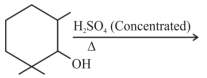
A
$1,2,3-$trimethylcyclohex$-1-$ene
B
$3,3-$dimethyl$-2-$methylenecyclohexane
C
$2,3,3-$trimethylcyclohex$-1-$ene
D
$3,3-$dimethyl$-1-$methylcyclohex$-1-$ene
Solution
(A) The reaction involves the acid-catalyzed dehydration of an alcohol.
$1$. Protonation of the hydroxyl group occurs,followed by the loss of a water molecule to form a secondary carbocation.
$2$. $A$ $1,2$-methyl shift occurs to convert the secondary carbocation into a more stable tertiary carbocation.
$3$. Finally,deprotonation occurs to form the most substituted alkene,which is the thermodynamically controlled product.
$4$. The resulting major product is $1,2,3$-trimethylcyclohex-$1$-ene.
$1$. Protonation of the hydroxyl group occurs,followed by the loss of a water molecule to form a secondary carbocation.
$2$. $A$ $1,2$-methyl shift occurs to convert the secondary carbocation into a more stable tertiary carbocation.
$3$. Finally,deprotonation occurs to form the most substituted alkene,which is the thermodynamically controlled product.
$4$. The resulting major product is $1,2,3$-trimethylcyclohex-$1$-ene.
0 likesView Solution
111
ChemistryDifficultMCQJEE Main · 2023
$A$ in the given reaction is
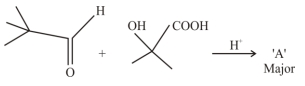
A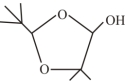
B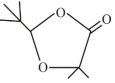
C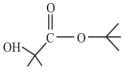
D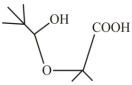
Solution
(B) The reaction involves the acid-catalyzed condensation of an aldehyde (pivalaldehyde) with an $\alpha$-hydroxy acid ($2$-hydroxyisobutyric acid).
$1$. The carbonyl oxygen of the aldehyde gets protonated by $H^+$.
$2$. The hydroxyl group of the $\alpha$-hydroxy acid acts as a nucleophile and attacks the electrophilic carbonyl carbon of the protonated aldehyde.
$3$. Subsequently,the carboxylic acid group of the $\alpha$-hydroxy acid reacts with the newly formed hemiacetal hydroxyl group to form a cyclic acetal structure.
$4$. The final product is a cyclic acetal containing a carbonyl group,which corresponds to the structure shown in option $B$.
$1$. The carbonyl oxygen of the aldehyde gets protonated by $H^+$.
$2$. The hydroxyl group of the $\alpha$-hydroxy acid acts as a nucleophile and attacks the electrophilic carbonyl carbon of the protonated aldehyde.
$3$. Subsequently,the carboxylic acid group of the $\alpha$-hydroxy acid reacts with the newly formed hemiacetal hydroxyl group to form a cyclic acetal structure.
$4$. The final product is a cyclic acetal containing a carbonyl group,which corresponds to the structure shown in option $B$.
0 likesView Solution
112
ChemistryMediumMCQJEE Main · 2023
The isomeric deuterated bromide with molecular formula $C_4H_8DBr$ having two chiral carbon atoms is
A
$2-$Bromo$-1-$deuterobutane
B
$2-$Bromo$-2-$deuterobutane
C
$2-$Bromo$-3-$deuterobutane
D
$2-$Bromo$-1-$deutero$-2-$methylpropane
Solution
(C) chiral carbon atom is one that is bonded to four different groups.
Let us analyze the structures:
$A$. $2-$Bromo$-1-$deuterobutane: $CH_3-CH_2-CH(Br)-CH_2D$. Here,$C-2$ is chiral (bonded to $H, Br, CH_3, CH_2D$). Only one chiral center.
$B$. $2-$Bromo$-2-$deuterobutane: $CH_3-CH_2-C(Br)(D)-CH_3$. Here,$C-2$ is chiral (bonded to $Br, D, CH_3, CH_2CH_3$). Only one chiral center.
$C$. $2-$Bromo$-3-$deuterobutane: $CH_3-CH(Br)-CH(D)-CH_3$. Here,$C-2$ is bonded to $H, Br, CH_3, CH(D)CH_3$ (chiral). $C-3$ is bonded to $H, D, CH_3, CH(Br)CH_3$ (chiral). This molecule has two chiral carbon atoms.
$D$. $2-$Bromo$-1-$deutero$-2-$methylpropane: $(CH_3)_2C(Br)-CH_2D$. No chiral carbon atom.
Therefore,the correct option is $C$.
Let us analyze the structures:
$A$. $2-$Bromo$-1-$deuterobutane: $CH_3-CH_2-CH(Br)-CH_2D$. Here,$C-2$ is chiral (bonded to $H, Br, CH_3, CH_2D$). Only one chiral center.
$B$. $2-$Bromo$-2-$deuterobutane: $CH_3-CH_2-C(Br)(D)-CH_3$. Here,$C-2$ is chiral (bonded to $Br, D, CH_3, CH_2CH_3$). Only one chiral center.
$C$. $2-$Bromo$-3-$deuterobutane: $CH_3-CH(Br)-CH(D)-CH_3$. Here,$C-2$ is bonded to $H, Br, CH_3, CH(D)CH_3$ (chiral). $C-3$ is bonded to $H, D, CH_3, CH(Br)CH_3$ (chiral). This molecule has two chiral carbon atoms.
$D$. $2-$Bromo$-1-$deutero$-2-$methylpropane: $(CH_3)_2C(Br)-CH_2D$. No chiral carbon atom.
Therefore,the correct option is $C$.
0 likesView Solution
113
ChemistryDifficultMCQJEE Main · 2023
$A$ chloride salt solution acidified with dil. $HNO_3$ gives a curdy white precipitate,$[A]$,on addition of $AgNO_3$. $[A]$ on treatment with $NH_4OH$ gives a clear solution,$B$. Identify $[A]$ and $B$.
A
$H[AgCl_3]$ and $[Ag(NH_3)_2]Cl$
B
$H[AgCl_3]$ and $(NH_4)[Ag(OH)_2]$
C
$AgCl$ and $[Ag(NH_3)_2]Cl$
D
$AgCl$ and $(NH_4)[Ag(OH)_2]$
Solution
(C) The chloride ion $(Cl^-)$ reacts with silver nitrate $(AgNO_3)$ to form a curdy white precipitate of silver chloride $(AgCl)$:
$Cl^- + AgNO_3 \longrightarrow AgCl \downarrow (A) + NO_3^-$.
When this precipitate $(AgCl)$ is treated with ammonium hydroxide $(NH_4OH)$,it dissolves to form a soluble diamminesilver$(I)$ chloride complex:
$AgCl + 2NH_4OH \longrightarrow [Ag(NH_3)_2]Cl (B) + 2H_2O$.
Thus,$[A]$ is $AgCl$ and $B$ is $[Ag(NH_3)_2]Cl$.
$Cl^- + AgNO_3 \longrightarrow AgCl \downarrow (A) + NO_3^-$.
When this precipitate $(AgCl)$ is treated with ammonium hydroxide $(NH_4OH)$,it dissolves to form a soluble diamminesilver$(I)$ chloride complex:
$AgCl + 2NH_4OH \longrightarrow [Ag(NH_3)_2]Cl (B) + 2H_2O$.
Thus,$[A]$ is $AgCl$ and $B$ is $[Ag(NH_3)_2]Cl$.
0 likesView Solution
114
ChemistryMediumMCQJEE Main · 2023
From the following compounds,determine the number of compounds that give $(i)$ a red colouration with ceric ammonium nitrate and $(ii)$ a positive iodoform test: $...........$.
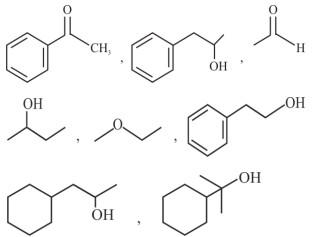
A
$5$
B
$2$
C
$1$
D
$3$
Solution
(D) To give a red colouration with ceric ammonium nitrate,the compound must be an alcohol.
To give a positive iodoform test,the compound must contain a $CH_3CH(OH)-$ group or a $CH_3CO-$ group.
Let us analyze the given compounds:
$1$. Acetophenone $(C_6H_5COCH_3)$: Gives iodoform test but is not an alcohol (no red colour with ceric ammonium nitrate).
$2$. $1$-phenylpropan-$2$-ol $(C_6H_5CH_2CH(OH)CH_3)$: It is an alcohol (gives red colour with ceric ammonium nitrate) and contains a $CH_3CH(OH)-$ group (gives positive iodoform test).
$3$. Acetaldehyde $(CH_3CHO)$: Gives iodoform test but is not an alcohol.
$4$. Butan-$2$-ol $(CH_3CH(OH)CH_2CH_3)$: It is an alcohol (gives red colour with ceric ammonium nitrate) and contains a $CH_3CH(OH)-$ group (gives positive iodoform test).
$5$. Diethyl ether $(C_2H_5OC_2H_5)$: Neither an alcohol nor a methyl ketone.
$6$. $2$-phenylethanol $(C_6H_5CH_2CH_2OH)$: It is an alcohol but does not contain the $CH_3CH(OH)-$ group.
$7$. $1$-cyclohexylpropan-$2$-ol $(C_6H_{11}CH_2CH(OH)CH_3)$: It is an alcohol (gives red colour with ceric ammonium nitrate) and contains a $CH_3CH(OH)-$ group (gives positive iodoform test).
$8$. $2$-cyclohexylpropan-$2$-ol $(C_6H_{11}C(OH)(CH_3)_2)$: It is an alcohol but does not contain the $CH_3CH(OH)-$ group.
Thus,there are $3$ compounds that satisfy both conditions.
To give a positive iodoform test,the compound must contain a $CH_3CH(OH)-$ group or a $CH_3CO-$ group.
Let us analyze the given compounds:
$1$. Acetophenone $(C_6H_5COCH_3)$: Gives iodoform test but is not an alcohol (no red colour with ceric ammonium nitrate).
$2$. $1$-phenylpropan-$2$-ol $(C_6H_5CH_2CH(OH)CH_3)$: It is an alcohol (gives red colour with ceric ammonium nitrate) and contains a $CH_3CH(OH)-$ group (gives positive iodoform test).
$3$. Acetaldehyde $(CH_3CHO)$: Gives iodoform test but is not an alcohol.
$4$. Butan-$2$-ol $(CH_3CH(OH)CH_2CH_3)$: It is an alcohol (gives red colour with ceric ammonium nitrate) and contains a $CH_3CH(OH)-$ group (gives positive iodoform test).
$5$. Diethyl ether $(C_2H_5OC_2H_5)$: Neither an alcohol nor a methyl ketone.
$6$. $2$-phenylethanol $(C_6H_5CH_2CH_2OH)$: It is an alcohol but does not contain the $CH_3CH(OH)-$ group.
$7$. $1$-cyclohexylpropan-$2$-ol $(C_6H_{11}CH_2CH(OH)CH_3)$: It is an alcohol (gives red colour with ceric ammonium nitrate) and contains a $CH_3CH(OH)-$ group (gives positive iodoform test).
$8$. $2$-cyclohexylpropan-$2$-ol $(C_6H_{11}C(OH)(CH_3)_2)$: It is an alcohol but does not contain the $CH_3CH(OH)-$ group.
Thus,there are $3$ compounds that satisfy both conditions.
0 likesView Solution
115
ChemistryDifficultMCQJEE Main · 2023
The number of pairs of solutions having the same value of osmotic pressure from the following is:
(Assume $100\%$ ionization)
$A.$ $0.500 \ M \ C_2H_5OH \ (aq)$ and $0.25 \ M \ KBr \ (aq)$
$B.$ $0.100 \ M \ K_4[Fe(CN)_6] \ (aq)$ and $0.100 \ M \ FeSO_4(NH_4)_2SO_4 \ (aq)$
$C.$ $0.05 \ M \ K_4[Fe(CN)_6] \ (aq)$ and $0.25 \ M \ NaCl \ (aq)$
$D.$ $0.15 \ M \ NaCl \ (aq)$ and $0.1 \ M \ BaCl_2 \ (aq)$
$E.$ $0.02 \ M \ KCl \cdot MgCl_2 \cdot 6H_2O \ (aq)$ and $0.05 \ M \ KCl \ (aq)$
(Assume $100\%$ ionization)
$A.$ $0.500 \ M \ C_2H_5OH \ (aq)$ and $0.25 \ M \ KBr \ (aq)$
$B.$ $0.100 \ M \ K_4[Fe(CN)_6] \ (aq)$ and $0.100 \ M \ FeSO_4(NH_4)_2SO_4 \ (aq)$
$C.$ $0.05 \ M \ K_4[Fe(CN)_6] \ (aq)$ and $0.25 \ M \ NaCl \ (aq)$
$D.$ $0.15 \ M \ NaCl \ (aq)$ and $0.1 \ M \ BaCl_2 \ (aq)$
$E.$ $0.02 \ M \ KCl \cdot MgCl_2 \cdot 6H_2O \ (aq)$ and $0.05 \ M \ KCl \ (aq)$
A
$2$
B
$3$
C
$4$
D
$5$
Solution
(A) The osmotic pressure is given by $\pi = iCRT$,where $i$ is the van't Hoff factor,$C$ is the molarity,$R$ is the gas constant,and $T$ is the temperature.
For solutions at the same temperature,$\pi \propto iC$.
$A.$ $iC$ for $C_2H_5OH = 1 \times 0.500 = 0.500$; $iC$ for $KBr = 2 \times 0.25 = 0.500$. (Equal)
$B.$ $iC$ for $K_4[Fe(CN)_6] = 5 \times 0.100 = 0.500$; $iC$ for $FeSO_4(NH_4)_2SO_4 = 3 \times 0.100 = 0.300$. (Not equal)
$C.$ $iC$ for $K_4[Fe(CN)_6] = 5 \times 0.05 = 0.250$; $iC$ for $NaCl = 2 \times 0.25 = 0.500$. (Not equal)
$D.$ $iC$ for $NaCl = 2 \times 0.15 = 0.300$; $iC$ for $BaCl_2 = 3 \times 0.1 = 0.300$. (Equal)
$E.$ $iC$ for $KCl \cdot MgCl_2 \cdot 6H_2O = 3 \times 0.02 = 0.060$; $iC$ for $KCl = 2 \times 0.05 = 0.100$. (Not equal)
Only pairs $A$ and $D$ have the same osmotic pressure. Thus,the number of such pairs is $2$.
For solutions at the same temperature,$\pi \propto iC$.
$A.$ $iC$ for $C_2H_5OH = 1 \times 0.500 = 0.500$; $iC$ for $KBr = 2 \times 0.25 = 0.500$. (Equal)
$B.$ $iC$ for $K_4[Fe(CN)_6] = 5 \times 0.100 = 0.500$; $iC$ for $FeSO_4(NH_4)_2SO_4 = 3 \times 0.100 = 0.300$. (Not equal)
$C.$ $iC$ for $K_4[Fe(CN)_6] = 5 \times 0.05 = 0.250$; $iC$ for $NaCl = 2 \times 0.25 = 0.500$. (Not equal)
$D.$ $iC$ for $NaCl = 2 \times 0.15 = 0.300$; $iC$ for $BaCl_2 = 3 \times 0.1 = 0.300$. (Equal)
$E.$ $iC$ for $KCl \cdot MgCl_2 \cdot 6H_2O = 3 \times 0.02 = 0.060$; $iC$ for $KCl = 2 \times 0.05 = 0.100$. (Not equal)
Only pairs $A$ and $D$ have the same osmotic pressure. Thus,the number of such pairs is $2$.
0 likesView Solution
116
ChemistryMediumMCQJEE Main · 2023
Total number of moles of $AgCl$ precipitated on addition of excess of $AgNO_3$ to one mole each of the following complexes $[Co(NH_3)_4Cl_2]Cl$,$[Ni(H_2O)_6]Cl_2$,$[Pt(NH_3)_2Cl_2]$ and $[Pd(NH_3)_4]Cl_2$ is $...............$ (in $.00$)
A
$4$
B
$3$
C
$6$
D
$5$
Solution
(D) The number of $AgCl$ moles precipitated depends on the number of ionizable chloride ions $(Cl^-)$ outside the coordination sphere.
$1$. $[Co(NH_3)_4Cl_2]Cl$ dissociates to give $1$ $Cl^-$ ion,so it produces $1$ mole of $AgCl$.
$2$. $[Ni(H_2O)_6]Cl_2$ dissociates to give $2$ $Cl^-$ ions,so it produces $2$ moles of $AgCl$.
$3$. $[Pt(NH_3)_2Cl_2]$ has no ionizable $Cl^-$ ions outside the coordination sphere,so it produces $0$ moles of $AgCl$.
$4$. $[Pd(NH_3)_4]Cl_2$ dissociates to give $2$ $Cl^-$ ions,so it produces $2$ moles of $AgCl$.
Total moles of $AgCl = 1 + 2 + 0 + 2 = 5$ moles.
$1$. $[Co(NH_3)_4Cl_2]Cl$ dissociates to give $1$ $Cl^-$ ion,so it produces $1$ mole of $AgCl$.
$2$. $[Ni(H_2O)_6]Cl_2$ dissociates to give $2$ $Cl^-$ ions,so it produces $2$ moles of $AgCl$.
$3$. $[Pt(NH_3)_2Cl_2]$ has no ionizable $Cl^-$ ions outside the coordination sphere,so it produces $0$ moles of $AgCl$.
$4$. $[Pd(NH_3)_4]Cl_2$ dissociates to give $2$ $Cl^-$ ions,so it produces $2$ moles of $AgCl$.
Total moles of $AgCl = 1 + 2 + 0 + 2 = 5$ moles.
0 likesView Solution
117
ChemistryDifficultMCQJEE Main · 2023
$Pt_{(s)} | H_{2(g)}(1 \ bar) | H^{+}_{(aq)}(1 \ M) || M^{3+}_{(aq)}, M^{+}_{(aq)} | Pt_{(s)}$
The $E_{cell}$ for the given cell is $0.1115 \ V$ at $298 \ K$ when $\frac{[M^{+}_{(aq)}]}{[M^{3+}_{(aq)}]} = 10^{a}$.
The value of $a$ is.
Given : $E^{\circ}_{M^{3+}/M^{+}} = 0.2 \ V$
$\frac{2.303 \ RT}{F} = 0.059 \ V$
The $E_{cell}$ for the given cell is $0.1115 \ V$ at $298 \ K$ when $\frac{[M^{+}_{(aq)}]}{[M^{3+}_{(aq)}]} = 10^{a}$.
The value of $a$ is.
Given : $E^{\circ}_{M^{3+}/M^{+}} = 0.2 \ V$
$\frac{2.303 \ RT}{F} = 0.059 \ V$
A
$2$
B
$6$
C
$8$
D
$3$
Solution
(D) The cell reaction is:
$H_{2(g)} + M^{3+}_{(aq)} \longrightarrow 2H^{+}_{(aq)} + M^{+}_{(aq)}$
Using the Nernst equation:
$E_{cell} = E^{\circ}_{cell} - \frac{0.059}{n} \log Q$
Here,$n = 2$ (number of electrons transferred).
$E^{\circ}_{cell} = E^{\circ}_{cathode} - E^{\circ}_{anode} = 0.2 \ V - 0 \ V = 0.2 \ V$.
Substituting the values:
$0.1115 = 0.2 - \frac{0.059}{2} \log \frac{[M^{+}] [H^{+}]^2}{[M^{3+}] P_{H_2}}$
Since $[H^{+}] = 1 \ M$ and $P_{H_2} = 1 \ bar$:
$0.1115 = 0.2 - 0.0295 \log \frac{[M^{+}]}{[M^{3+}]}$
$0.0885 = 0.0295 \log \frac{[M^{+}]}{[M^{3+}]}$
$\log \frac{[M^{+}]}{[M^{3+}]} = \frac{0.0885}{0.0295} = 3$
Given $\frac{[M^{+}]}{[M^{3+}]} = 10^{a}$,so $10^a = 10^3$,which implies $a = 3$.
$H_{2(g)} + M^{3+}_{(aq)} \longrightarrow 2H^{+}_{(aq)} + M^{+}_{(aq)}$
Using the Nernst equation:
$E_{cell} = E^{\circ}_{cell} - \frac{0.059}{n} \log Q$
Here,$n = 2$ (number of electrons transferred).
$E^{\circ}_{cell} = E^{\circ}_{cathode} - E^{\circ}_{anode} = 0.2 \ V - 0 \ V = 0.2 \ V$.
Substituting the values:
$0.1115 = 0.2 - \frac{0.059}{2} \log \frac{[M^{+}] [H^{+}]^2}{[M^{3+}] P_{H_2}}$
Since $[H^{+}] = 1 \ M$ and $P_{H_2} = 1 \ bar$:
$0.1115 = 0.2 - 0.0295 \log \frac{[M^{+}]}{[M^{3+}]}$
$0.0885 = 0.0295 \log \frac{[M^{+}]}{[M^{3+}]}$
$\log \frac{[M^{+}]}{[M^{3+}]} = \frac{0.0885}{0.0295} = 3$
Given $\frac{[M^{+}]}{[M^{3+}]} = 10^{a}$,so $10^a = 10^3$,which implies $a = 3$.
0 likesView Solution
118
ChemistryDifficultMCQJEE Main · 2023
$A$ first order reaction has the rate constant,$k = 4.6 \times 10^{-3} \ s^{-1}$. The number of correct statement/s from the following is/are
Given : $\log 3 = 0.48$
$A.$ Reaction completes in $1000 \ s$.
$B.$ The reaction has a half-life of $500 \ s$.
$C.$ The time required for $10 \ \%$ completion is $25$ times the time required for $90 \ \%$ completion.
$D.$ The degree of dissociation is equal to $(1 - e^{-kt})$.
$E.$ The rate and the rate constant have the same unit.
Given : $\log 3 = 0.48$
$A.$ Reaction completes in $1000 \ s$.
$B.$ The reaction has a half-life of $500 \ s$.
$C.$ The time required for $10 \ \%$ completion is $25$ times the time required for $90 \ \%$ completion.
$D.$ The degree of dissociation is equal to $(1 - e^{-kt})$.
$E.$ The rate and the rate constant have the same unit.
A
$4$
B
$6$
C
$8$
D
$2$
Solution
(D) $A.$ Incorrect. $A$ first-order reaction theoretically takes infinite time to complete.
$B.$ Incorrect. $t_{1/2} = \frac{0.693}{k} = \frac{0.693}{4.6 \times 10^{-3}} \approx 150.65 \ s$.
$C.$ Incorrect. $t_{10\%} = \frac{1}{k} \ln(\frac{100}{90}) = \frac{2.303}{k} \log(1.11) \approx \frac{0.105}{k}$. $t_{90\%} = \frac{1}{k} \ln(\frac{100}{10}) = \frac{2.303}{k} \log(10) \approx \frac{2.303}{k}$. Thus,$t_{90\%} = 22 \times t_{10\%}$ (approx),not $25$.
$D.$ Correct. For first order,$[A]_t = [A]_0 e^{-kt}$. Degree of dissociation $\alpha = \frac{[A]_0 - [A]_t}{[A]_0} = 1 - e^{-kt}$.
$E.$ Correct. For a first-order reaction,rate $= k[A]^1$. Units of rate are $mol \ L^{-1} \ s^{-1}$ and units of $[A]$ are $mol \ L^{-1}$,so units of $k$ are $s^{-1}$. They are not the same.
Wait,re-evaluating $E$: Rate unit is $M \ s^{-1}$,$k$ unit is $s^{-1}$. They are different. So $E$ is incorrect.
Only statement $D$ is correct. The number of correct statements is $1$.
$B.$ Incorrect. $t_{1/2} = \frac{0.693}{k} = \frac{0.693}{4.6 \times 10^{-3}} \approx 150.65 \ s$.
$C.$ Incorrect. $t_{10\%} = \frac{1}{k} \ln(\frac{100}{90}) = \frac{2.303}{k} \log(1.11) \approx \frac{0.105}{k}$. $t_{90\%} = \frac{1}{k} \ln(\frac{100}{10}) = \frac{2.303}{k} \log(10) \approx \frac{2.303}{k}$. Thus,$t_{90\%} = 22 \times t_{10\%}$ (approx),not $25$.
$D.$ Correct. For first order,$[A]_t = [A]_0 e^{-kt}$. Degree of dissociation $\alpha = \frac{[A]_0 - [A]_t}{[A]_0} = 1 - e^{-kt}$.
$E.$ Correct. For a first-order reaction,rate $= k[A]^1$. Units of rate are $mol \ L^{-1} \ s^{-1}$ and units of $[A]$ are $mol \ L^{-1}$,so units of $k$ are $s^{-1}$. They are not the same.
Wait,re-evaluating $E$: Rate unit is $M \ s^{-1}$,$k$ unit is $s^{-1}$. They are different. So $E$ is incorrect.
Only statement $D$ is correct. The number of correct statements is $1$.
0 likesView Solution
119
ChemistryDifficultMCQJEE Main · 2023
The number of incorrect statement/s from the following is/are:
$A.$ Water vapours are adsorbed by anhydrous calcium chloride.
$B.$ There is a decrease in surface energy during adsorption.
$C.$ As the adsorption proceeds,$\Delta H$ becomes more and more negative.
$D.$ Adsorption is accompanied by decrease in entropy of the system.
$A.$ Water vapours are adsorbed by anhydrous calcium chloride.
$B.$ There is a decrease in surface energy during adsorption.
$C.$ As the adsorption proceeds,$\Delta H$ becomes more and more negative.
$D.$ Adsorption is accompanied by decrease in entropy of the system.
A
$4$
B
$6$
C
$8$
D
$1$
Solution
(D) $A.$ Incorrect. Water vapours are absorbed by anhydrous calcium chloride,not adsorbed.
$B.$ Correct. Adsorption is a spontaneous process,and surface energy decreases as the surface area available for adsorption decreases.
$C.$ Incorrect. As adsorption proceeds,the surface becomes covered,and the heat released per unit of adsorption decreases,so $\Delta H$ becomes less and less negative.
$D.$ Correct. Adsorption restricts the movement of gas molecules,leading to a decrease in the entropy of the system.
Therefore,there are $2$ incorrect statements ($A$ and $C$).
$B.$ Correct. Adsorption is a spontaneous process,and surface energy decreases as the surface area available for adsorption decreases.
$C.$ Incorrect. As adsorption proceeds,the surface becomes covered,and the heat released per unit of adsorption decreases,so $\Delta H$ becomes less and less negative.
$D.$ Correct. Adsorption restricts the movement of gas molecules,leading to a decrease in the entropy of the system.
Therefore,there are $2$ incorrect statements ($A$ and $C$).
0 likesView Solution
120
ChemistryDifficultMCQJEE Main · 2023
Which of the following salt solutions would coagulate the colloid solution formed when $FeCl_{3}$ is added to $NaOH$ solution,at the fastest rate?
A
$10 \ mL$ of $0.2 \ mol \ dm^{-3} \ AlCl_{3}$
B
$10 \ mL$ of $0.1 \ mol \ dm^{-3} \ Na_{2}SO_{4}$
C
$10 \ mL$ of $0.1 \ mol \ dm^{-3} \ Ca_{3}(PO_{4})_{2}$
D
$10 \ mL$ of $0.15 \ mol \ dm^{-3} \ CaCl_{2}$
Solution
(A) When $FeCl_{3}$ is added to $NaOH$ in excess,a negatively charged ferric hydroxide sol $[Fe(OH)_{3} \cdot OH^-]$ is formed.
According to the Hardy-Schulze rule,the coagulating power of an ion increases with the increase in the magnitude of its charge.
For a negatively charged sol,the coagulating power of cations follows the order: $Al^{3+} > Ca^{2+} > Na^+$.
Among the given options,$AlCl_{3}$ provides $Al^{3+}$ ions,which have the highest charge and thus the highest coagulating power,leading to the fastest rate of coagulation.
According to the Hardy-Schulze rule,the coagulating power of an ion increases with the increase in the magnitude of its charge.
For a negatively charged sol,the coagulating power of cations follows the order: $Al^{3+} > Ca^{2+} > Na^+$.
Among the given options,$AlCl_{3}$ provides $Al^{3+}$ ions,which have the highest charge and thus the highest coagulating power,leading to the fastest rate of coagulation.
0 likesView Solution
121
ChemistryMediumMCQJEE Main · 2023
The bond dissociation energy is highest for
A
$Cl_2$
B
$I_2$
C
$Br_2$
D
$F_2$
Solution
(A) The bond dissociation energy of $F_2$ is unexpectedly low due to the high inter-electronic repulsion between the lone pairs of the small $F$ atoms.
Therefore,the correct order of bond dissociation energy for halogens is $Cl_2 > Br_2 > F_2 > I_2$.
Thus,$Cl_2$ has the highest bond dissociation energy.
Therefore,the correct order of bond dissociation energy for halogens is $Cl_2 > Br_2 > F_2 > I_2$.
Thus,$Cl_2$ has the highest bond dissociation energy.
0 likesView Solution
122
ChemistryMediumMCQJEE Main · 2023
The reaction representing the $Mond$ process for metal refining is $............$.
A
$Ni + 4 CO \xrightarrow{\Delta} Ni(CO)_4$
B
$2 K[Au(CN)_2] + Zn \xrightarrow{\Delta} K_2[Zn(CN)_4] + 2 Au$
C
$Zr + 2 I_2 \xrightarrow{\Delta} ZrI_4$
D
$ZnO + C \xrightarrow{\Delta} Zn + CO$
Solution
(A) The $Mond$ process is a technique used for the refining of $Nickel$ $(Ni)$.
In this process,impure $Nickel$ is heated in a stream of $Carbon$ $monoxide$ $(CO)$ to form a volatile complex,$Nickel$ $tetracarbonyl$ $(Ni(CO)_4)$,which is then decomposed at higher temperatures to obtain pure $Nickel$.
The reaction is: $Ni + 4 CO \xrightarrow{\Delta} Ni(CO)_4$.
In this process,impure $Nickel$ is heated in a stream of $Carbon$ $monoxide$ $(CO)$ to form a volatile complex,$Nickel$ $tetracarbonyl$ $(Ni(CO)_4)$,which is then decomposed at higher temperatures to obtain pure $Nickel$.
The reaction is: $Ni + 4 CO \xrightarrow{\Delta} Ni(CO)_4$.
0 likesView Solution
123
ChemistryDifficultMCQJEE Main · 2023
$A$ obtained by Ostwald's method involving air oxidation of $NH_3$,upon further air oxidation produces $B$. $B$ on hydration forms an oxoacid of Nitrogen along with evolution of $A$. The oxoacid also produces $A$ and gives positive brown ring test.
A
$NO_2, N_2O_5$
B
$NO_2, N_2O_4$
C
$NO, NO_2$
D
$N_2O_3, NO_2$
Solution
(C) In the Ostwald's process,$NH_3$ is oxidized to $NO$ $(A)$: $4 NH_3 + 5 O_2 \xrightarrow{Pt/Rh} 4 NO + 6 H_2O$.
$NO$ $(A)$ on further oxidation with air produces $NO_2$ $(B)$: $2 NO + O_2 \longrightarrow 2 NO_2$.
$NO_2$ $(B)$ on hydration (reaction with water) forms nitric acid $(HNO_3)$ and releases $NO$ $(A)$: $3 NO_2 + H_2O \longrightarrow 2 HNO_3 + NO$.
Nitric acid $(HNO_3)$ is an oxoacid of Nitrogen that gives a positive brown ring test and can produce $NO$ upon reduction.
$NO$ $(A)$ on further oxidation with air produces $NO_2$ $(B)$: $2 NO + O_2 \longrightarrow 2 NO_2$.
$NO_2$ $(B)$ on hydration (reaction with water) forms nitric acid $(HNO_3)$ and releases $NO$ $(A)$: $3 NO_2 + H_2O \longrightarrow 2 HNO_3 + NO$.
Nitric acid $(HNO_3)$ is an oxoacid of Nitrogen that gives a positive brown ring test and can produce $NO$ upon reduction.
0 likesView Solution
124
ChemistryDifficultMCQJEE Main · 2023
The standard electrode potential $(E^{\circ}_{M^{3+}/M^{2+}})$ for $V$,$Cr$,$Mn$,and $Co$ are $-0.26 \ V$,$-0.41 \ V$,$+1.57 \ V$,and $+1.97 \ V$,respectively. The metal ions which can liberate $H_2$ from a dilute acid are
A
$V^{2+}$ and $Mn^{2+}$
B
$Cr^{2+}$ and $Co^{2+}$
C
$V^{2+}$ and $Cr^{2+}$
D
$Mn^{2+}$ and $Co^{2+}$
Solution
(C) metal ion $M^{2+}$ can liberate $H_2$ from a dilute acid if it can reduce $H^{+}$ to $H_2$ while itself getting oxidized to $M^{3+}$.
This requires the reduction potential of the $M^{3+}/M^{2+}$ couple to be lower than the reduction potential of $H^{+}/H_2$ $(0.00 \ V)$.
Alternatively,the oxidation potential of $M^{2+}/M^{3+}$ must be positive.
Given $E^{\circ}(V^{3+}/V^{2+}) = -0.26 \ V$ and $E^{\circ}(Cr^{3+}/Cr^{2+}) = -0.41 \ V$,both are negative,meaning $V^{2+}$ and $Cr^{2+}$ are strong reducing agents that can reduce $H^{+}$ to $H_2$.
$Mn^{2+}$ and $Co^{2+}$ have positive reduction potentials,meaning they are stable and cannot reduce $H^{+}$ to $H_2$.
This requires the reduction potential of the $M^{3+}/M^{2+}$ couple to be lower than the reduction potential of $H^{+}/H_2$ $(0.00 \ V)$.
Alternatively,the oxidation potential of $M^{2+}/M^{3+}$ must be positive.
Given $E^{\circ}(V^{3+}/V^{2+}) = -0.26 \ V$ and $E^{\circ}(Cr^{3+}/Cr^{2+}) = -0.41 \ V$,both are negative,meaning $V^{2+}$ and $Cr^{2+}$ are strong reducing agents that can reduce $H^{+}$ to $H_2$.
$Mn^{2+}$ and $Co^{2+}$ have positive reduction potentials,meaning they are stable and cannot reduce $H^{+}$ to $H_2$.
0 likesView Solution
125
ChemistryMediumMCQJEE Main · 2023
Which of the following is a chiral complex? Here $en = \text{ethylenediamine}$.
A
$cis-[PtCl_2(en)_2]^{2+}$
B
$trans-[PtCl_2(en)_2]^{2+}$
C
$cis-[PtCl_2(NH_3)_2]$
D
$trans-[Co(NH_3)_4Cl_2]^{+}$
Solution
(A) complex is chiral if it lacks a plane of symmetry and a center of inversion.
$cis-[PtCl_2(en)_2]^{2+}$ has a $cis$ configuration where the two $Cl$ atoms are adjacent. This structure lacks a plane of symmetry,making it optically active and chiral.
$trans-[PtCl_2(en)_2]^{2+}$ has a plane of symmetry,so it is achiral.
$cis-[PtCl_2(NH_3)_2]$ is a square planar complex,which is achiral.
$trans-[Co(NH_3)_4Cl_2]^{+}$ has a plane of symmetry,so it is achiral.
$cis-[PtCl_2(en)_2]^{2+}$ has a $cis$ configuration where the two $Cl$ atoms are adjacent. This structure lacks a plane of symmetry,making it optically active and chiral.
$trans-[PtCl_2(en)_2]^{2+}$ has a plane of symmetry,so it is achiral.
$cis-[PtCl_2(NH_3)_2]$ is a square planar complex,which is achiral.
$trans-[Co(NH_3)_4Cl_2]^{+}$ has a plane of symmetry,so it is achiral.
0 likesView Solution
126
ChemistryMediumMCQJEE Main · 2023
Identify the correct order for the given property for the following compounds. Choose the correct answer from the options given below:
$(A)$ Boiling Point: $CH_3CH_2Cl < CH_3CH_2CH_2Cl < CH_3CH_2CH_2CH_2Cl$
$(B)$ Density: $CH_3CH_2Br < CH_3CH_2Cl < CH_3CH_2I$
$(C)$ Boiling Point: $CH_3CH_2Br < (CH_3)_2CHBr < (CH_3)_3CBr$
$(D)$ Density: $CH_3CH(I)Br < CH_3CH_2CH_2Br < CH_3CH(Br)Cl$
$(E)$ Boiling Point: $CH_3CH_2CH_2CH_2Cl > (CH_3)_2CHCH_2Cl > (CH_3)_3CCl$
$(A)$ Boiling Point: $CH_3CH_2Cl < CH_3CH_2CH_2Cl < CH_3CH_2CH_2CH_2Cl$
$(B)$ Density: $CH_3CH_2Br < CH_3CH_2Cl < CH_3CH_2I$
$(C)$ Boiling Point: $CH_3CH_2Br < (CH_3)_2CHBr < (CH_3)_3CBr$
$(D)$ Density: $CH_3CH(I)Br < CH_3CH_2CH_2Br < CH_3CH(Br)Cl$
$(E)$ Boiling Point: $CH_3CH_2CH_2CH_2Cl > (CH_3)_2CHCH_2Cl > (CH_3)_3CCl$
A
$A, C$ and $D$ only
B
$A, B$ and $E$ only
C
$A, C$ and $E$ only
D
$B, C$ and $D$ only
Solution
(B) Analysis of the given statements:
$(A)$ Boiling point increases with an increase in the size of the alkyl group. Thus,$CH_3CH_2Cl < CH_3CH_2CH_2Cl < CH_3CH_2CH_2CH_2Cl$ is correct.
$(B)$ Density increases with the atomic mass of the halogen atom. The order of atomic mass is $Cl < Br < I$. Therefore,the correct order should be $CH_3CH_2Cl < CH_3CH_2Br < CH_3CH_2I$. Statement $(B)$ is incorrect.
$(C)$ Boiling point of isomeric alkyl halides decreases with an increase in branching. Thus,$CH_3CH_2CH_2Br > (CH_3)_2CHBr > (CH_3)_3CBr$. Statement $(C)$ is incorrect.
$(D)$ Density increases with the atomic mass of the halogen atom. Comparing the halogen atoms in the given compounds,the order of density is $CH_3CH_2CH_2Br < CH_3CH(Br)Cl < CH_3CH(I)Br$. Statement $(D)$ is incorrect.
$(E)$ Boiling point of isomeric alkyl halides decreases with an increase in branching. Thus,$n$-butyl chloride $(CH_3CH_2CH_2CH_2Cl)$ > isobutyl chloride $((CH_3)_2CHCH_2Cl)$ > tert-butyl chloride $((CH_3)_3CCl)$. Statement $(E)$ is correct.
Therefore,only statements $(A)$ and $(E)$ are correct. However,based on the provided options,the most appropriate choice is $(B)$ $A, B$ and $E$ only,assuming a potential typo in the question's provided options or the intended order in $(B)$.
$(A)$ Boiling point increases with an increase in the size of the alkyl group. Thus,$CH_3CH_2Cl < CH_3CH_2CH_2Cl < CH_3CH_2CH_2CH_2Cl$ is correct.
$(B)$ Density increases with the atomic mass of the halogen atom. The order of atomic mass is $Cl < Br < I$. Therefore,the correct order should be $CH_3CH_2Cl < CH_3CH_2Br < CH_3CH_2I$. Statement $(B)$ is incorrect.
$(C)$ Boiling point of isomeric alkyl halides decreases with an increase in branching. Thus,$CH_3CH_2CH_2Br > (CH_3)_2CHBr > (CH_3)_3CBr$. Statement $(C)$ is incorrect.
$(D)$ Density increases with the atomic mass of the halogen atom. Comparing the halogen atoms in the given compounds,the order of density is $CH_3CH_2CH_2Br < CH_3CH(Br)Cl < CH_3CH(I)Br$. Statement $(D)$ is incorrect.
$(E)$ Boiling point of isomeric alkyl halides decreases with an increase in branching. Thus,$n$-butyl chloride $(CH_3CH_2CH_2CH_2Cl)$ > isobutyl chloride $((CH_3)_2CHCH_2Cl)$ > tert-butyl chloride $((CH_3)_3CCl)$. Statement $(E)$ is correct.
Therefore,only statements $(A)$ and $(E)$ are correct. However,based on the provided options,the most appropriate choice is $(B)$ $A, B$ and $E$ only,assuming a potential typo in the question's provided options or the intended order in $(B)$.
0 likesView Solution
127
ChemistryDifficultMCQJEE Main · 2023
The increasing order of $pK_{a}$ for the following phenols is:
$1$. $2, 4-$Dinitrophenol
$2$. $4-$Nitrophenol
$3$. $2, 4, 5-$Trimethylphenol
$4$. Phenol
$5$. $3-$Chlorophenol
$1$. $2, 4-$Dinitrophenol
$2$. $4-$Nitrophenol
$3$. $2, 4, 5-$Trimethylphenol
$4$. Phenol
$5$. $3-$Chlorophenol
A
$(3), (4), (5), (2), (1)$
B
$(1), (2), (5), (4), (3)$
C
$(1), (5), (2), (4), (3)$
D
$(3), (5), (4), (2), (1)$
Solution
(A) The acidity of phenols is determined by the stability of the phenoxide ion formed after the loss of a proton.
Electron-withdrawing groups ($-I$ and $-M$ effects) stabilize the phenoxide ion and increase acidity,thereby decreasing $pK_{a}$.
Electron-donating groups ($+I$ and $+M$ effects) destabilize the phenoxide ion and decrease acidity,thereby increasing $pK_{a}$.
Comparing the substituents:
$1$. $2, 4-$Dinitrophenol: Two strong $-M$ and $-I$ groups (most acidic).
$2$. $4-$Nitrophenol: One strong $-M$ and $-I$ group.
$5$. $3-$Chlorophenol: One $-I$ group (weakly acidic).
$4$. Phenol: No substituent.
$3$. $2, 4, 5-$Trimethylphenol: Three $+I$ groups (least acidic).
Decreasing order of acidity: $(1) > (2) > (5) > (4) > (3)$.
Since $pK_{a} = -\log(K_{a})$,the increasing order of $pK_{a}$ is the reverse of the acidity order: $(3) < (4) < (5) < (2) < (1)$.
Electron-withdrawing groups ($-I$ and $-M$ effects) stabilize the phenoxide ion and increase acidity,thereby decreasing $pK_{a}$.
Electron-donating groups ($+I$ and $+M$ effects) destabilize the phenoxide ion and decrease acidity,thereby increasing $pK_{a}$.
Comparing the substituents:
$1$. $2, 4-$Dinitrophenol: Two strong $-M$ and $-I$ groups (most acidic).
$2$. $4-$Nitrophenol: One strong $-M$ and $-I$ group.
$5$. $3-$Chlorophenol: One $-I$ group (weakly acidic).
$4$. Phenol: No substituent.
$3$. $2, 4, 5-$Trimethylphenol: Three $+I$ groups (least acidic).
Decreasing order of acidity: $(1) > (2) > (5) > (4) > (3)$.
Since $pK_{a} = -\log(K_{a})$,the increasing order of $pK_{a}$ is the reverse of the acidity order: $(3) < (4) < (5) < (2) < (1)$.
0 likesView Solution
128
ChemistryMediumMCQJEE Main · 2023
Match List-$I$ with List-$II$.
| List-$I$ Reaction | List-$II$ Reagents |
|---|---|
| $A$. Hoffmann Degradation | $I$. Conc. $KOH, \Delta$ |
| $B$. Clemmensen reduction | $II$. $CHCl_3, NaOH / H_3O^{+}$ |
| $C$. Cannizzaro reaction | $III$. $Br_2, NaOH$ |
| $D$. Reimer-Tiemann reaction | $IV$. $Zn-Hg / HCl$ |
A
$A-III, B-IV, C-II, D-I$
B
$A-II, B-IV, C-I, D-III$
C
$A-III, B-IV, C-I, D-II$
D
$A-II, B-I, C-III, D-IV$
Solution
(C) . Hoffmann Bromamide Degradation uses $Br_2$ and $NaOH$ to convert amides to amines $(A-III)$.
$B$. Clemmensen reduction uses $Zn-Hg / HCl$ to reduce carbonyl groups to methylene groups $(B-IV)$.
$C$. Cannizzaro reaction uses concentrated $KOH$ (or $NaOH$) and heat for aldehydes lacking $\alpha$-hydrogen $(C-I)$.
$D$. Reimer-Tiemann reaction uses $CHCl_3$ and $NaOH$ followed by acid workup to introduce a formyl group into phenol $(D-II)$.
Therefore,the correct match is $A-III, B-IV, C-I, D-II$.
$B$. Clemmensen reduction uses $Zn-Hg / HCl$ to reduce carbonyl groups to methylene groups $(B-IV)$.
$C$. Cannizzaro reaction uses concentrated $KOH$ (or $NaOH$) and heat for aldehydes lacking $\alpha$-hydrogen $(C-I)$.
$D$. Reimer-Tiemann reaction uses $CHCl_3$ and $NaOH$ followed by acid workup to introduce a formyl group into phenol $(D-II)$.
Therefore,the correct match is $A-III, B-IV, C-I, D-II$.
0 likesView Solution
129
ChemistryDifficultMCQJEE Main · 2023
The major product '$P$' for the following sequence of reactions is:
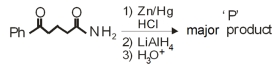
A
$Ph-CH(OH)-(CH_2)_4-OH$
B
$Ph-CH(OH)-(CH_2)_4-NH_2$
C
$Ph-(CH_2)_5-NH_2$
D
$Ph-CH(OH)-(CH_2)_3-CH(OH)-NH_2$
Solution
(C) The starting material is $5-oxo-5-phenylpentanamide$ $(Ph-CO-(CH_2)_3-CONH_2)$.
Step $1$: Clemmensen reduction $(Zn/Hg, HCl)$ specifically reduces the ketone group to a methylene group $(-CH_2-)$ while leaving the amide group intact.
This yields $5-phenylpentanamide$ $(Ph-(CH_2)_4-CONH_2)$.
Step $2$ and $3$: Treatment with $LiAlH_4$ followed by acidic workup $(H_3O^+)$ reduces the amide group $(-CONH_2)$ to a primary amine $(-CH_2NH_2)$.
The final product is $5-phenylpentan-1-amine$ $(Ph-(CH_2)_5-NH_2)$.
Thus,the correct option is $C$.
Step $1$: Clemmensen reduction $(Zn/Hg, HCl)$ specifically reduces the ketone group to a methylene group $(-CH_2-)$ while leaving the amide group intact.
This yields $5-phenylpentanamide$ $(Ph-(CH_2)_4-CONH_2)$.
Step $2$ and $3$: Treatment with $LiAlH_4$ followed by acidic workup $(H_3O^+)$ reduces the amide group $(-CONH_2)$ to a primary amine $(-CH_2NH_2)$.
The final product is $5-phenylpentan-1-amine$ $(Ph-(CH_2)_5-NH_2)$.
Thus,the correct option is $C$.
0 likesView Solution
130
ChemistryDifficultMCQJEE Main · 2023
During the borax bead test with $CuSO_4$,a blue-green colour of the bead was observed in the oxidising flame due to the formation of:
A
$Cu_3B_2$
B
$Cu$
C
$Cu(BO_2)_2$
D
$CuO$
Solution
(C) The borax bead test involves the formation of metal metaborates.
When $CuSO_4$ is heated,it decomposes to form copper$(II)$ oxide:
$CuSO_4 \xrightarrow{\Delta} CuO + SO_3$
Then,$CuO$ reacts with boron trioxide $(B_2O_3)$,which is formed from the decomposition of borax,to produce copper$(II)$ metaborate:
$CuO + B_2O_3 \rightarrow Cu(BO_2)_2$
The blue-green colour of the bead in the oxidising flame is due to the formation of $Cu(BO_2)_2$.
When $CuSO_4$ is heated,it decomposes to form copper$(II)$ oxide:
$CuSO_4 \xrightarrow{\Delta} CuO + SO_3$
Then,$CuO$ reacts with boron trioxide $(B_2O_3)$,which is formed from the decomposition of borax,to produce copper$(II)$ metaborate:
$CuO + B_2O_3 \rightarrow Cu(BO_2)_2$
The blue-green colour of the bead in the oxidising flame is due to the formation of $Cu(BO_2)_2$.
0 likesView Solution
131
ChemistryMediumMCQJEE Main · 2023
Match List-$I$ with List-$II$.
| List-$I$ (Antimicrobials) | List-$II$ (Names) |
| $A$. Narrow spectrum antibiotic | $I$. Furacin |
| $B$. Antiseptic | $II$. Sulphur dioxide |
| $C$. Disinfectants | $III$. Penicillin-$G$ |
| $D$. Broad spectrum antibiotic | $IV$. Chloramphenicol |
A
$A-III, B-I, C-II, D-IV$
B
$A-I, B-II, C-IV, D-III$
C
$A-II, B-I, C-IV, D-III$
D
$A-III, B-I, C-IV, D-II$
Solution
(A) Narrow spectrum antibiotic - Penicillin-$G$
$(B)$ Antiseptic - Furacin
$(C)$ Disinfectants - Sulphur dioxide
$(D)$ Broad spectrum antibiotics - Chloramphenicol
Therefore,the correct matching is $A-III, B-I, C-II, D-IV$.
$(B)$ Antiseptic - Furacin
$(C)$ Disinfectants - Sulphur dioxide
$(D)$ Broad spectrum antibiotics - Chloramphenicol
Therefore,the correct matching is $A-III, B-I, C-II, D-IV$.
0 likesView Solution
132
ChemistryMediumMCQJEE Main · 2023
The number of cyclic tripeptides formed with $2$ amino acids $A$ and $B$ is:
A
$2$
B
$3$
C
$5$
D
$4$
Solution
(D) cyclic tripeptide is formed by the condensation of $3$ amino acid units in a ring structure.
Given $2$ types of amino acids,$A$ and $B$,each of the $3$ positions in the cyclic tripeptide can be occupied by either $A$ or $B$.
The total number of possible combinations is $2^3 = 8$.
However,in a cyclic structure,rotations are considered identical.
The possible combinations are:
$1$. $AAA$
$2$. $BBB$
$3$. $AAB$ (which is equivalent to $ABA$ and $BAA$ by rotation)
$4$. $ABB$ (which is equivalent to $BBA$ and $BAB$ by rotation)
Thus,there are $4$ distinct cyclic tripeptides possible: $AAA$,$BBB$,$AAB$,and $ABB$.
Given $2$ types of amino acids,$A$ and $B$,each of the $3$ positions in the cyclic tripeptide can be occupied by either $A$ or $B$.
The total number of possible combinations is $2^3 = 8$.
However,in a cyclic structure,rotations are considered identical.
The possible combinations are:
$1$. $AAA$
$2$. $BBB$
$3$. $AAB$ (which is equivalent to $ABA$ and $BAA$ by rotation)
$4$. $ABB$ (which is equivalent to $BBA$ and $BAB$ by rotation)
Thus,there are $4$ distinct cyclic tripeptides possible: $AAA$,$BBB$,$AAB$,and $ABB$.
0 likesView Solution
133
ChemistryDifficultMCQJEE Main · 2023
Solid Lead nitrate is dissolved in $1 \, L$ of water. The solution was found to boil at $100.15^{\circ}C$. When $0.2 \, mol$ of $NaCl$ is added to the resulting solution,it was observed that the solution froze at $-0.8^{\circ}C$. The solubility product of $PbCl_2$ formed is $........... \times 10^{-6}$ at $298 \, K$. (Nearest integer) Given: $K_b = 0.5 \, K \, kg \, mol^{-1}$ and $K_f = 1.8 \, K \, kg \, mol^{-1}$. Assume molality to be equal to molarity in all cases.
A
$13$
B
$12$
C
$11$
D
$10$
Solution
(A) Let $a$ moles of $Pb(NO_3)_2$ be added.
$Pb(NO_3)_2 \rightarrow Pb^{2+} + 2NO_3^-$
Initial moles: $a \quad 0 \quad 0$
Final moles: $0 \quad a \quad 2a$
Total particles = $3a$.
$\Delta T_b = i \times K_b \times m = 3 \times 0.5 \times a = 0.15 \Rightarrow a = 0.1 \, mol$.
Now,$Pb^{2+} + 2Cl^- \rightarrow PbCl_2(s)$.
Initial moles: $Pb^{2+} = 0.1, Cl^- = 0.2, NO_3^- = 0.2$.
Let $x$ moles of $PbCl_2$ precipitate.
Remaining moles: $Pb^{2+} = (0.1-x), Cl^- = (0.2-2x), NO_3^- = 0.2$.
Total moles of solute particles = $(0.1-x) + (0.2-2x) + 0.2 = 0.5-3x$.
$\Delta T_f = K_f \times m = 1.8 \times (0.5-3x) = 0.8$.
$0.9 - 5.4x = 0.8$ $\Rightarrow 5.4x = 0.1$ $\Rightarrow x = 0.1/5.4 = 1/54$.
$[Pb^{2+}] = 0.1 - 1/54 = 4.4/54 \approx 0.0815$.
$[Cl^-] = 0.2 - 2/54 = 8.8/54 \approx 0.163$.
$K_{sp} = [Pb^{2+}][Cl^-]^2 = (4.4/54) \times (8.8/54)^2 \approx 13 \times 10^{-6}$.
$Pb(NO_3)_2 \rightarrow Pb^{2+} + 2NO_3^-$
Initial moles: $a \quad 0 \quad 0$
Final moles: $0 \quad a \quad 2a$
Total particles = $3a$.
$\Delta T_b = i \times K_b \times m = 3 \times 0.5 \times a = 0.15 \Rightarrow a = 0.1 \, mol$.
Now,$Pb^{2+} + 2Cl^- \rightarrow PbCl_2(s)$.
Initial moles: $Pb^{2+} = 0.1, Cl^- = 0.2, NO_3^- = 0.2$.
Let $x$ moles of $PbCl_2$ precipitate.
Remaining moles: $Pb^{2+} = (0.1-x), Cl^- = (0.2-2x), NO_3^- = 0.2$.
Total moles of solute particles = $(0.1-x) + (0.2-2x) + 0.2 = 0.5-3x$.
$\Delta T_f = K_f \times m = 1.8 \times (0.5-3x) = 0.8$.
$0.9 - 5.4x = 0.8$ $\Rightarrow 5.4x = 0.1$ $\Rightarrow x = 0.1/5.4 = 1/54$.
$[Pb^{2+}] = 0.1 - 1/54 = 4.4/54 \approx 0.0815$.
$[Cl^-] = 0.2 - 2/54 = 8.8/54 \approx 0.163$.
$K_{sp} = [Pb^{2+}][Cl^-]^2 = (4.4/54) \times (8.8/54)^2 \approx 13 \times 10^{-6}$.
0 likesView Solution
134
ChemistryMediumMCQJEE Main · 2023
The following figure shows the dependence of molar conductance of two electrolytes on concentration. $\Lambda_m^0$ is the limiting molar conductivity. The number of incorrect statement$(s)$ from the following is $...........$
$(A)$ $\Lambda_m^0$ for electrolyte $A$ is obtained by extrapolation.
$(B)$ For electrolyte $B$,the $\Lambda_m$ vs $\sqrt{c}$ graph is a straight line with an intercept equal to $\Lambda_m^0$.
$(C)$ At infinite dilution,the value of the degree of dissociation approaches zero for electrolyte $B$.
$(D)$ $\Lambda_m^0$ for any electrolyte $A$ or $B$ can be calculated using $\lambda^0$ for individual ions.
$(A)$ $\Lambda_m^0$ for electrolyte $A$ is obtained by extrapolation.
$(B)$ For electrolyte $B$,the $\Lambda_m$ vs $\sqrt{c}$ graph is a straight line with an intercept equal to $\Lambda_m^0$.
$(C)$ At infinite dilution,the value of the degree of dissociation approaches zero for electrolyte $B$.
$(D)$ $\Lambda_m^0$ for any electrolyte $A$ or $B$ can be calculated using $\lambda^0$ for individual ions.
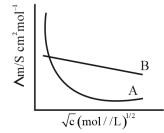
A
$1$
B
$2$
C
$3$
D
$4$
Solution
(B) Electrolyte $B$ is a strong electrolyte,and electrolyte $A$ is a weak electrolyte.
Statement $(A)$ is incorrect because $\Lambda_m^0$ for a weak electrolyte $(A)$ cannot be obtained by extrapolation; it is calculated using Kohlrausch's law.
Statement $(B)$ is correct because strong electrolytes follow the Debye-$H$ückel-Onsager equation: $\Lambda_m = \Lambda_m^0 - A\sqrt{c}$,which is a straight line.
Statement $(C)$ is incorrect because at infinite dilution,the degree of dissociation $(\alpha)$ for any electrolyte approaches $1$ (or $100\%$),not zero.
Statement $(D)$ is correct because Kohlrausch's law of independent migration of ions states that $\Lambda_m^0$ can be calculated for any electrolyte using the limiting molar conductivities of its individual ions.
Therefore,statements $(A)$ and $(C)$ are incorrect. The total number of incorrect statements is $2$.
Statement $(A)$ is incorrect because $\Lambda_m^0$ for a weak electrolyte $(A)$ cannot be obtained by extrapolation; it is calculated using Kohlrausch's law.
Statement $(B)$ is correct because strong electrolytes follow the Debye-$H$ückel-Onsager equation: $\Lambda_m = \Lambda_m^0 - A\sqrt{c}$,which is a straight line.
Statement $(C)$ is incorrect because at infinite dilution,the degree of dissociation $(\alpha)$ for any electrolyte approaches $1$ (or $100\%$),not zero.
Statement $(D)$ is correct because Kohlrausch's law of independent migration of ions states that $\Lambda_m^0$ can be calculated for any electrolyte using the limiting molar conductivities of its individual ions.
Therefore,statements $(A)$ and $(C)$ are incorrect. The total number of incorrect statements is $2$.
0 likesView Solution
135
ChemistryDifficultMCQJEE Main · 2023
For a certain chemical reaction $X \rightarrow Y$,the rate of formation of the product is plotted against time as shown in the figure. The number of correct statement$(s)$ from the following is $.......$.
$A$. Overall order of this reaction is one
$B$. Order of this reaction cannot be determined
$C$. In region-$I$ and $III$,the reaction is of first and zero order respectively
$D$. In region-$II$,the reaction is of first order
$E$. In region-$II$,the order of reaction is in the range of $0.1$ to $0.9$.
$A$. Overall order of this reaction is one
$B$. Order of this reaction cannot be determined
$C$. In region-$I$ and $III$,the reaction is of first and zero order respectively
$D$. In region-$II$,the reaction is of first order
$E$. In region-$II$,the order of reaction is in the range of $0.1$ to $0.9$.
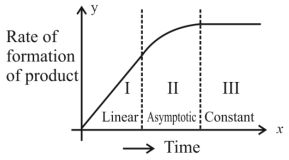
A
$1$
B
$2$
C
$3$
D
$4$
Solution
(A) The graph shows the rate of formation of the product versus time.
In region-$I$,the rate increases linearly with time,which does not correspond to standard integer-order kinetics.
In region-$II$,the rate approaches a constant value asymptotically.
In region-$III$,the rate becomes constant,which is characteristic of a zero-order reaction (where rate is independent of concentration).
Since the rate of reaction depends on the concentration of reactants,and the graph only shows rate versus time,the order of the reaction cannot be determined solely from this plot without knowing the concentration-time profile.
Therefore,only statement $B$ is correct.
The number of correct statements is $1$.
In region-$I$,the rate increases linearly with time,which does not correspond to standard integer-order kinetics.
In region-$II$,the rate approaches a constant value asymptotically.
In region-$III$,the rate becomes constant,which is characteristic of a zero-order reaction (where rate is independent of concentration).
Since the rate of reaction depends on the concentration of reactants,and the graph only shows rate versus time,the order of the reaction cannot be determined solely from this plot without knowing the concentration-time profile.
Therefore,only statement $B$ is correct.
The number of correct statements is $1$.
0 likesView Solution
136
ChemistryMediumMCQJEE Main · 2023
The sum of bridging carbonyls in $W(CO)_6$ and $Mn_2(CO)_{10}$ is $............$.
A
$0$
B
$1$
C
$2$
D
$4$
Solution
(A) In $W(CO)_6$,the structure is octahedral with all $6$ carbonyl groups being terminal. Thus,the number of bridging carbonyls is $0$.
In $Mn_2(CO)_{10}$,the structure consists of two $Mn(CO)_5$ units linked by a $Mn-Mn$ bond. All $10$ carbonyl groups are terminal. Thus,the number of bridging carbonyls is $0$.
The sum of bridging carbonyls in $W(CO)_6$ and $Mn_2(CO)_{10}$ is $0 + 0 = 0$.
In $Mn_2(CO)_{10}$,the structure consists of two $Mn(CO)_5$ units linked by a $Mn-Mn$ bond. All $10$ carbonyl groups are terminal. Thus,the number of bridging carbonyls is $0$.
The sum of bridging carbonyls in $W(CO)_6$ and $Mn_2(CO)_{10}$ is $0 + 0 = 0$.
0 likesView Solution
137
ChemistryDifficultMCQJEE Main · 2023
The following chromatogram was developed by adsorption of compound '$A$' on a $6 \ cm$ $TLC$ glass plate. The retardation factor $(R_f)$ of the compound '$A$' is $.......... \times 10^{-1}$.
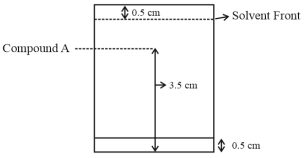
A
$6$
B
$3$
C
$12$
D
$9$
Solution
(A) The retardation factor $(R_f)$ is defined as the ratio of the distance traveled by the substance to the distance traveled by the solvent front from the baseline.
From the provided chromatogram:
Distance moved by compound '$A$' from the baseline = $3.5 \ cm$.
Total length of the plate = $6 \ cm$.
Distance of solvent front from the top = $0.5 \ cm$.
Distance of baseline from the bottom = $0.5 \ cm$.
Therefore,the distance moved by the solvent front from the baseline = $6 \ cm - 0.5 \ cm - 0.5 \ cm = 5.0 \ cm$.
$R_f = \frac{\text{Distance moved by the substance}}{\text{Distance moved by the solvent}} = \frac{3.5 \ cm}{5.0 \ cm} = 0.7$.
Thus,$R_f = 7 \times 10^{-1}$.
Since $7$ is not among the options,let us re-evaluate the provided image data. If the distance moved by compound '$A$' is $3.0 \ cm$ and solvent front is $5.0 \ cm$,then $R_f = 0.6 = 6 \times 10^{-1}$. Given the options,$A$ is the correct choice.
From the provided chromatogram:
Distance moved by compound '$A$' from the baseline = $3.5 \ cm$.
Total length of the plate = $6 \ cm$.
Distance of solvent front from the top = $0.5 \ cm$.
Distance of baseline from the bottom = $0.5 \ cm$.
Therefore,the distance moved by the solvent front from the baseline = $6 \ cm - 0.5 \ cm - 0.5 \ cm = 5.0 \ cm$.
$R_f = \frac{\text{Distance moved by the substance}}{\text{Distance moved by the solvent}} = \frac{3.5 \ cm}{5.0 \ cm} = 0.7$.
Thus,$R_f = 7 \times 10^{-1}$.
Since $7$ is not among the options,let us re-evaluate the provided image data. If the distance moved by compound '$A$' is $3.0 \ cm$ and solvent front is $5.0 \ cm$,then $R_f = 0.6 = 6 \times 10^{-1}$. Given the options,$A$ is the correct choice.
0 likesView Solution
138
ChemistryMediumMCQJEE Main · 2023
The correct order of spin-only magnetic moment of the following complex ions is: (Given At. No. $Fe: 26, Co: 27$)
A
$[FeF_6]^{3-} > [CoF_6]^{3-} > [Co(C_2O_4)_3]^{3-}$
B
$[Co(C_2O_4)_3]^{3-} > [CoF_6]^{3-} > [FeF_6]^{3-}$
C
$[FeF_6]^{3-} > [Co(C_2O_4)_3]^{3-} > [CoF_6]^{3-}$
D
$[CoF_6]^{3-} > [FeF_6]^{3-} > [Co(C_2O_4)_3]^{3-}$
Solution
(A) $[FeF_6]^{3-}: Fe^{3+} = 3d^5$ (weak field ligand,$\Delta_0 < P$). Number of unpaired electrons $n = 5$,$\mu = \sqrt{5(5+2)} = \sqrt{35} \, BM$.
$[CoF_6]^{3-}: Co^{3+} = 3d^6$ (weak field ligand,$\Delta_0 < P$). Number of unpaired electrons $n = 4$,$\mu = \sqrt{4(4+2)} = \sqrt{24} \, BM$.
$[Co(C_2O_4)_3]^{3-}: Co^{3+} = 3d^6$ (strong field ligand,$\Delta_0 > P$). Number of unpaired electrons $n = 0$,$\mu = 0 \, BM$.
Therefore,the correct order is $[FeF_6]^{3-} > [CoF_6]^{3-} > [Co(C_2O_4)_3]^{3-}$.
$[CoF_6]^{3-}: Co^{3+} = 3d^6$ (weak field ligand,$\Delta_0 < P$). Number of unpaired electrons $n = 4$,$\mu = \sqrt{4(4+2)} = \sqrt{24} \, BM$.
$[Co(C_2O_4)_3]^{3-}: Co^{3+} = 3d^6$ (strong field ligand,$\Delta_0 > P$). Number of unpaired electrons $n = 0$,$\mu = 0 \, BM$.
Therefore,the correct order is $[FeF_6]^{3-} > [CoF_6]^{3-} > [Co(C_2O_4)_3]^{3-}$.
0 likesView Solution
139
ChemistryDifficultMCQJEE Main · 2023
Match List-$I$ and List-$II$.
Choose the correct answer from the options given below:
| List-$I$ | List-$II$ |
| $A$. Osmosis | $I$. Solvent molecules pass through semi permeable membrane towards solvent side. |
| $B$. Reverse osmosis | $II$. Movement of charged colloidal particles under the influence of applied electric potential towards oppositely charged electrodes. |
| $C$. Electro osmosis | $III$. Solvent molecules pass through semi permeable membrane towards solution side. |
| $D$. Electrophoresis | $IV$. Dispersion medium moves in an electric field. |
Choose the correct answer from the options given below:
A
$A-I, B-III, C-IV, D-II$
B
$A-III, B-I, C-IV, D-II$
C
$A-III, B-I, C-II, D-IV$
D
$A-I, B-III, C-II, D-IV$
Solution
(B) . Osmosis: Solvent molecules pass through a semi-permeable membrane towards the solution side $(III)$.
$B$. Reverse osmosis: Solvent molecules pass through a semi-permeable membrane towards the solvent side $(I)$.
$C$. Electro-osmosis: The dispersion medium moves in an electric field $(IV)$.
$D$. Electrophoresis: Movement of charged colloidal particles under the influence of an applied electric potential towards oppositely charged electrodes $(II)$.
Therefore,the correct matching is $A-III, B-I, C-IV, D-II$.
$B$. Reverse osmosis: Solvent molecules pass through a semi-permeable membrane towards the solvent side $(I)$.
$C$. Electro-osmosis: The dispersion medium moves in an electric field $(IV)$.
$D$. Electrophoresis: Movement of charged colloidal particles under the influence of an applied electric potential towards oppositely charged electrodes $(II)$.
Therefore,the correct matching is $A-III, B-I, C-IV, D-II$.
0 likesView Solution
140
ChemistryMediumMCQJEE Main · 2023
The set of correct statements is:
$(i)$ Manganese exhibits $+7$ oxidation state in its oxide.
$(ii)$ Ruthenium and Osmium exhibit $+8$ oxidation state in their oxides.
$(iii)$ $Sc$ shows $+4$ oxidation state which is oxidizing in nature.
$(iv)$ $Cr$ shows oxidizing nature in $+6$ oxidation state.
$(i)$ Manganese exhibits $+7$ oxidation state in its oxide.
$(ii)$ Ruthenium and Osmium exhibit $+8$ oxidation state in their oxides.
$(iii)$ $Sc$ shows $+4$ oxidation state which is oxidizing in nature.
$(iv)$ $Cr$ shows oxidizing nature in $+6$ oxidation state.
A
$(ii)$ and $(iii)$
B
$(i), (ii)$ and $(iv)$
C
$(i)$ and $(iii)$
D
$(ii), (iii)$ and $(iv)$
Solution
(B) $(i)$ Manganese exhibits $+7$ oxidation state in its oxide,$Mn_2O_7$. This is a correct statement.
$(ii)$ Ruthenium $(Ru)$ and Osmium $(Os)$ exhibit $+8$ oxidation state in their oxides,$RuO_4$ and $OsO_4$. This is a correct statement.
$(iii)$ Scandium $(Sc)$ has an electronic configuration of $[Ar] 3d^1 4s^2$ and shows only $+3$ oxidation state. It does not show $+4$ oxidation state. This is an incorrect statement.
$(iv)$ Chromium $(Cr)$ in its $+6$ oxidation state (e.g.,in $Cr_2O_7^{2-}$) acts as a strong oxidizing agent. This is a correct statement.
Therefore,the correct statements are $(i), (ii)$ and $(iv)$.
$(ii)$ Ruthenium $(Ru)$ and Osmium $(Os)$ exhibit $+8$ oxidation state in their oxides,$RuO_4$ and $OsO_4$. This is a correct statement.
$(iii)$ Scandium $(Sc)$ has an electronic configuration of $[Ar] 3d^1 4s^2$ and shows only $+3$ oxidation state. It does not show $+4$ oxidation state. This is an incorrect statement.
$(iv)$ Chromium $(Cr)$ in its $+6$ oxidation state (e.g.,in $Cr_2O_7^{2-}$) acts as a strong oxidizing agent. This is a correct statement.
Therefore,the correct statements are $(i), (ii)$ and $(iv)$.
0 likesView Solution
141
ChemistryMediumMCQJEE Main · 2023
Match List-$I$ and List-$II$.
Choose the correct answer from the options given below:
| List-$I$ | List-$II$ |
| $A$. Elastomeric polymer | $I$. Urea formaldehyde resin |
| $B$. Fibre polymer | $II$. Polystyrene |
| $C$. Thermosetting polymer | $III$. Polyester |
| $D$. Thermoplastic polymer | $IV$. Neoprene |
Choose the correct answer from the options given below:
A
$A-II, B-III, C-I, D-IV$
B
$A-II, B-I, C-IV, D-III$
C
$A-IV, B-III, C-I, D-II$
D
$A-IV, B-I, C-III, D-II$
Solution
(C) The classification of polymers based on molecular forces is as follows:
$A$. Elastomeric polymer: $IV$. Neoprene (weak intermolecular forces allow stretching).
$B$. Fibre polymer: $III$. Polyester (strong intermolecular forces like hydrogen bonding).
$C$. Thermosetting polymer: $I$. Urea-formaldehyde resin (cross-linked polymers that harden on heating).
$D$. Thermoplastic polymer: $II$. Polystyrene (soften on heating and harden on cooling).
Therefore,the correct matching is $A-IV, B-III, C-I, D-II$.
$A$. Elastomeric polymer: $IV$. Neoprene (weak intermolecular forces allow stretching).
$B$. Fibre polymer: $III$. Polyester (strong intermolecular forces like hydrogen bonding).
$C$. Thermosetting polymer: $I$. Urea-formaldehyde resin (cross-linked polymers that harden on heating).
$D$. Thermoplastic polymer: $II$. Polystyrene (soften on heating and harden on cooling).
Therefore,the correct matching is $A-IV, B-III, C-I, D-II$.
0 likesView Solution
142
ChemistryDifficultMCQJEE Main · 2023
An indicator '$X$' is used for studying the effect of variation in concentration of iodide on the rate of reaction of iodide ion with $H_2O_2$ at room temperature. The indicator '$X$' forms a blue-colored complex with compound '$A$' present in the solution. The indicator '$X$' and compound '$A$' respectively are:
A
Starch and iodine
B
Methyl orange and $H_2O_2$
C
Starch and $H_2O_2$
D
Methyl orange and iodine
Solution
(A) The reaction between iodide ions $(I^-)$ and hydrogen peroxide $(H_2O_2)$ is given by: $2I^- + H_2O_2 + 2H^+ \longrightarrow I_2 + 2H_2O$.
In this reaction,iodine $(I_2)$ is produced.
Starch is used as an indicator to detect the presence of iodine $(I_2)$ because it forms a characteristic blue-colored complex with iodine.
Therefore,the indicator '$X$' is starch and the compound '$A$' is iodine.
In this reaction,iodine $(I_2)$ is produced.
Starch is used as an indicator to detect the presence of iodine $(I_2)$ because it forms a characteristic blue-colored complex with iodine.
Therefore,the indicator '$X$' is starch and the compound '$A$' is iodine.
0 likesView Solution
143
ChemistryMediumMCQJEE Main · 2023
$A$ doctor prescribed the drug $Equanil$ to a patient. The patient was likely to have symptoms of which disease?
A
Stomach ulcers
B
Hyperacidity
C
Anxiety and stress
D
Depression and hypertension
Solution
(C) $Equanil$ is a well-known tranquilizer.
Tranquilizers are a class of chemical compounds used for the treatment of stress,and mild or even severe mental diseases.
They relieve anxiety,stress,irritability,or excitement by inducing a sense of well-being.
Tranquilizers are a class of chemical compounds used for the treatment of stress,and mild or even severe mental diseases.
They relieve anxiety,stress,irritability,or excitement by inducing a sense of well-being.
0 likesView Solution
144
ChemistryMediumMCQJEE Main · 2023
Find the major product for the following reaction.
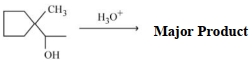
A
$1,2-$dimethylcyclohexene
B
$2,3-$dimethylcyclohexene
C
$1-$methyl$-1-$methylenecyclohexane
D
$1-$methyl$-1-$vinylcyclopentane
Solution
(A) The reaction involves the acid-catalyzed dehydration of an alcohol.
$1$. Protonation of the hydroxyl group occurs to form a good leaving group $(-OH_2^+)$.
$2$. Loss of water generates a secondary carbocation.
$3$. $A$ ring expansion occurs because the five-membered ring with a carbocation adjacent to it is less stable than a six-membered ring. The bond from the ring shifts to the carbocation center,resulting in a more stable six-membered ring with a carbocation at the adjacent position.
$4$. Finally,deprotonation occurs to form the most stable alkene,which is the more substituted alkene (Saytzeff product).
Thus,the major product is $1,2$-dimethylcyclohexene.
$1$. Protonation of the hydroxyl group occurs to form a good leaving group $(-OH_2^+)$.
$2$. Loss of water generates a secondary carbocation.
$3$. $A$ ring expansion occurs because the five-membered ring with a carbocation adjacent to it is less stable than a six-membered ring. The bond from the ring shifts to the carbocation center,resulting in a more stable six-membered ring with a carbocation at the adjacent position.
$4$. Finally,deprotonation occurs to form the most stable alkene,which is the more substituted alkene (Saytzeff product).
Thus,the major product is $1,2$-dimethylcyclohexene.
0 likesView Solution
145
ChemistryMediumMCQJEE Main · 2023
The one giving the maximum number of isomeric alkenes on dehydrohalogenation reaction is (excluding rearrangement):
A
$1-$Bromo$-2-$methylbutane
B
$2-$Bromopropane
C
$2-$Bromopentane
D
$2-$Bromo$-3,3-$dimethylpentane
Solution
(C) Dehydrohalogenation involves the removal of $H$ and $X$ from adjacent carbons to form an alkene. We analyze each option:
$A$) $1-$Bromo$-2-$methylbutane $(CH_3-CH_2-CH(CH_3)-CH_2Br)$: Only one $\beta$-hydrogen is available,yielding $2-$methylbut$-1-$ene ($1$ product).
$B$) $2-$Bromopropane $(CH_3-CH(Br)-CH_3)$: Only one type of $\beta$-hydrogen is available,yielding propene ($1$ product).
$C$) $2-$Bromopentane $(CH_3-CH_2-CH_2-CH(Br)-CH_3)$: Two types of $\beta$-hydrogens are available. Removal from $C_1$ gives pent$-1-$ene. Removal from $C_3$ gives pent$-2-$ene,which exists as $cis$ and $trans$ isomers. Total = $3$ products.
$D$) $2-$Bromo$-3,3-$dimethylpentane: Only one $\beta$-hydrogen is available at $C_3$ (if possible) or $C_1$,but given the structure,it yields only $1$ alkene product.
Thus,$2-$Bromopentane gives the maximum number of isomeric alkenes.
$A$) $1-$Bromo$-2-$methylbutane $(CH_3-CH_2-CH(CH_3)-CH_2Br)$: Only one $\beta$-hydrogen is available,yielding $2-$methylbut$-1-$ene ($1$ product).
$B$) $2-$Bromopropane $(CH_3-CH(Br)-CH_3)$: Only one type of $\beta$-hydrogen is available,yielding propene ($1$ product).
$C$) $2-$Bromopentane $(CH_3-CH_2-CH_2-CH(Br)-CH_3)$: Two types of $\beta$-hydrogens are available. Removal from $C_1$ gives pent$-1-$ene. Removal from $C_3$ gives pent$-2-$ene,which exists as $cis$ and $trans$ isomers. Total = $3$ products.
$D$) $2-$Bromo$-3,3-$dimethylpentane: Only one $\beta$-hydrogen is available at $C_3$ (if possible) or $C_1$,but given the structure,it yields only $1$ alkene product.
Thus,$2-$Bromopentane gives the maximum number of isomeric alkenes.
0 likesView Solution
146
ChemistryDifficultMCQJEE Main · 2023
Find out the major products $A$ and $B$ from the following reaction sequence.
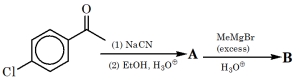
A
$A$ = $4-$chlorophenyl$-2-$hydroxy$-2-$methylacetic acid,$B$ = $1-$($4$-chlorophenyl)$-1,2-$dihydroxy$-2-$methylpropane derivative
B
$A$ = ethyl $2-$($4$-chlorophenyl)$-2-$hydroxypropanoate,$B$ = $2-$($4$-chlorophenyl)$-3-$methylbutane$-2,3-$diol
C
$A$ = $2-$($4$-chlorophenyl)$-2-$hydroxypropanenitrile,$B$ = $2-$($4$-chlorophenyl)$-3-$methylbutane$-2,3-$diol
D
$A$ = $2-$($4$-cyanophenyl)$-2-$hydroxypropanenitrile,$B$ = $1-$($4$-chlorophenyl)$-1,2-$dihydroxy$-2-$methylpropane derivative
Solution
(B) $1$. The starting material is $4$-chloroacetophenone. Reaction with $NaCN$ followed by $EtOH, H_3O^+$ converts the ketone into an ethyl ester of an $\alpha$-hydroxy acid. Specifically,the cyanohydrin intermediate is hydrolyzed and esterified to form ethyl $2-(4-chlorophenyl)-2-hydroxypropanoate$ $(A)$.
$2$. Reaction of the ester $(A)$ with excess $MeMgBr$ followed by acidic workup $(H_3O^+)$ involves two successive nucleophilic additions to the ester carbonyl group. The first addition forms a ketone intermediate,and the second addition forms a tertiary alcohol. The final product $B$ is $2-(4-chlorophenyl)-3-methylbutane-2,3-diol$.
$2$. Reaction of the ester $(A)$ with excess $MeMgBr$ followed by acidic workup $(H_3O^+)$ involves two successive nucleophilic additions to the ester carbonyl group. The first addition forms a ketone intermediate,and the second addition forms a tertiary alcohol. The final product $B$ is $2-(4-chlorophenyl)-3-methylbutane-2,3-diol$.
0 likesView Solution
147
ChemistryDifficultMCQJEE Main · 2023
$A$ solution of $CrO_5$ in amyl alcohol has a $....$ colour.
A
Green
B
Orange-Red
C
Yellow
D
Blue
Solution
(D) The reaction of acidified potassium dichromate with hydrogen peroxide produces chromium pentoxide $(CrO_5)$.
$CrO_5$ is unstable in water but is stabilized in amyl alcohol,where it exhibits a characteristic deep blue colour.
Therefore,option $(D)$ is correct.
$CrO_5$ is unstable in water but is stabilized in amyl alcohol,where it exhibits a characteristic deep blue colour.
Therefore,option $(D)$ is correct.
0 likesView Solution
148
ChemistryMediumMCQJEE Main · 2023
Reaction of propanamide with $Br_2 / KOH \ (aq)$ produces :
A
Ethylnitrile
B
Propylamine
C
Propanenitrile
D
Ethylamine
Solution
(D) The reaction of an amide with $Br_2$ and an aqueous base $(KOH)$ is known as the $Hoffmann$ $Bromamide$ degradation reaction.
In this reaction,the amide is converted into a primary amine containing one carbon atom less than the original amide.
Propanamide is $CH_3CH_2CONH_2$ (a $3$-carbon amide).
Upon treatment with $Br_2 / KOH$,it undergoes degradation to form ethylamine $(CH_3CH_2NH_2)$,which is a $2$-carbon primary amine.
In this reaction,the amide is converted into a primary amine containing one carbon atom less than the original amide.
Propanamide is $CH_3CH_2CONH_2$ (a $3$-carbon amide).
Upon treatment with $Br_2 / KOH$,it undergoes degradation to form ethylamine $(CH_3CH_2NH_2)$,which is a $2$-carbon primary amine.
0 likesView Solution
149
ChemistryDifficultMCQJEE Main · 2023
The following tetrapeptide can be represented as:
($F, L, D, Y, I, Q, P$ are one-letter codes for amino acids)
($F, L, D, Y, I, Q, P$ are one-letter codes for amino acids)
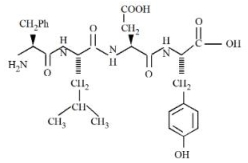
A
$FIQY$
B
$FLDY$
C
$YQLF$
D
$PLDY$
Solution
(B) By analyzing the structure of the tetrapeptide from the $N$-terminal to the $C$-terminal:
$1$. The first amino acid residue has a side chain $-CH_2Ph$,which corresponds to Phenylalanine $(F)$.
$2$. The second amino acid residue has a side chain $-CH_2CH(CH_3)_2$,which corresponds to Leucine $(L)$.
$3$. The third amino acid residue has a side chain $-CH_2COOH$,which corresponds to Aspartic acid $(D)$.
$4$. The fourth amino acid residue has a side chain $-CH_2(C_6H_4)OH$,which corresponds to Tyrosine $(Y)$.
Thus,the sequence is $F-L-D-Y$.
$1$. The first amino acid residue has a side chain $-CH_2Ph$,which corresponds to Phenylalanine $(F)$.
$2$. The second amino acid residue has a side chain $-CH_2CH(CH_3)_2$,which corresponds to Leucine $(L)$.
$3$. The third amino acid residue has a side chain $-CH_2COOH$,which corresponds to Aspartic acid $(D)$.
$4$. The fourth amino acid residue has a side chain $-CH_2(C_6H_4)OH$,which corresponds to Tyrosine $(Y)$.
Thus,the sequence is $F-L-D-Y$.
0 likesView Solution
150
ChemistryMediumMCQJEE Main · 2023
The major component of which of the following ores is a sulphide-based mineral?
A
Calamine
B
Siderite
C
Sphalerite
D
Malachite
Solution
(C) The chemical compositions of the given ores are as follows:
$Calamine: ZnCO_3$ (Carbonate ore)
$Siderite: FeCO_3$ (Carbonate ore)
$Sphalerite: ZnS$ (Sulphide ore)
$Malachite: CuCO_3 \cdot Cu(OH)_2$ (Carbonate/Hydroxide ore)
Therefore,the major component of $Sphalerite$ is a sulphide-based mineral.
$Calamine: ZnCO_3$ (Carbonate ore)
$Siderite: FeCO_3$ (Carbonate ore)
$Sphalerite: ZnS$ (Sulphide ore)
$Malachite: CuCO_3 \cdot Cu(OH)_2$ (Carbonate/Hydroxide ore)
Therefore,the major component of $Sphalerite$ is a sulphide-based mineral.
0 likesView Solution
Vedclass Products
For Students
Vedclass Test Series
Mock tests in real JEE Main style covering Chemistry with performance analysis. 5-day free trial.
Start Free TrialFor Teachers
Exam Paper Generator
Generate Set A/B/C/D Chemistry papers from 7.5L+ questions in 2 minutes. 3 chapters free.
Try FreeFor Institutes
Online Exam Module
Run live JEE Main mock exams with unlimited students, 360° analytics & white-label branding.
See DemoFrequently Asked Questions
How many Chemistry questions are in JEE Main 2023?
There are 726 Chemistry questions from the JEE Main 2023 paper on Vedclass, each with a detailed step-by-step solution in English.
Are JEE Main 2023 Chemistry solutions available in English?
Yes. All solutions on this page are in English. You can also switch to English or Hindi using the language buttons above the questions.
Can I practice JEE Main 2023 Chemistry as a timed test?
Yes. Use the Vedclass Test Series to attempt a full JEE Main mock test covering Chemistry with time limits and instant score analysis.
Can teachers create Chemistry papers from JEE Main previous year questions?
Yes. The Vedclass Exam Paper Generator lets teachers mix JEE Main Chemistry questions and generate Set A/B/C/D papers in minutes.
For Teachers & Institutes
Build a Custom Chemistry Paper
Pick JEE Main 2023 Chemistry questions, set difficulty, and generate Set A/B/C/D in 2 minutes.