
ChemistryQ251–350 of 666 questions
Page 6 of 8 · English
251
ChemistryMediumMCQJEE Main · 2022
At $310 \, K$,the solubility of $CaF_{2}$ in water is $2.34 \times 10^{-3} \, g / 100 \, mL$. The solubility product of $CaF_{2}$ is $x \times 10^{-8} \, (mol / L)^{3}$. Find the value of $x$. (Given molar mass: $CaF_{2} = 78 \, g \, mol^{-1}$)
A
$0.0108$
B
$0.108$
C
$1.08$
D
$10.8$
Solution
(A) First,calculate the solubility $S$ in $mol / L$:
$S = \frac{2.34 \times 10^{-3} \, g}{78 \, g/mol} \times \frac{1}{0.1 \, L} = \frac{0.03 \times 10^{-3}}{0.1} = 3 \times 10^{-4} \, mol / L$.
The dissociation of $CaF_{2}$ is $CaF_{2} \rightleftharpoons Ca^{2+} + 2F^-$.
$K_{sp} = [Ca^{2+}][F^-]^{2} = (S)(2S)^{2} = 4S^{3}$.
$K_{sp} = 4 \times (3 \times 10^{-4})^{3} = 4 \times 27 \times 10^{-12} = 108 \times 10^{-12} = 0.0108 \times 10^{-8} \, (mol / L)^{3}$.
Thus,$x = 0.0108$.
$S = \frac{2.34 \times 10^{-3} \, g}{78 \, g/mol} \times \frac{1}{0.1 \, L} = \frac{0.03 \times 10^{-3}}{0.1} = 3 \times 10^{-4} \, mol / L$.
The dissociation of $CaF_{2}$ is $CaF_{2} \rightleftharpoons Ca^{2+} + 2F^-$.
$K_{sp} = [Ca^{2+}][F^-]^{2} = (S)(2S)^{2} = 4S^{3}$.
$K_{sp} = 4 \times (3 \times 10^{-4})^{3} = 4 \times 27 \times 10^{-12} = 108 \times 10^{-12} = 0.0108 \times 10^{-8} \, (mol / L)^{3}$.
Thus,$x = 0.0108$.
0 likesView Solution
252
ChemistryMediumMCQJEE Main · 2022
In the titration of $KMnO_{4}$ and oxalic acid in acidic medium,the change in oxidation number of carbon at the end point is
A
$1$
B
$0$
C
$2$
D
$3$
Solution
(A) In oxalic acid $(H_{2}C_{2}O_{4})$,the oxidation state of carbon is $+3$.
In carbon dioxide $(CO_{2})$,the oxidation state of carbon is $+4$.
The change in oxidation number of carbon is $|4 - 3| = 1$.
The balanced chemical equation is: $2KMnO_{4} + 5H_{2}C_{2}O_{4} + 3H_{2}SO_{4} \rightarrow K_{2}SO_{4} + 2MnSO_{4} + 10CO_{2} + 8H_{2}O$.
In carbon dioxide $(CO_{2})$,the oxidation state of carbon is $+4$.
The change in oxidation number of carbon is $|4 - 3| = 1$.
The balanced chemical equation is: $2KMnO_{4} + 5H_{2}C_{2}O_{4} + 3H_{2}SO_{4} \rightarrow K_{2}SO_{4} + 2MnSO_{4} + 10CO_{2} + 8H_{2}O$.
0 likesView Solution
253
ChemistryMediumMCQJEE Main · 2022
Optical activity of an enantiomeric mixture is $+12.6^{\circ}$ and the specific rotation of the $(+)$ isomer is $+30^{\circ}$. The optical purity is $......... \%$.
A
$41$
B
$43$
C
$44$
D
$42$
Solution
(D) The optical purity of an enantiomeric mixture is calculated using the formula: $\text{Optical Purity} = \frac{\text{observed rotation of mixture}}{\text{specific rotation of pure enantiomer}} \times 100$.
Given: $\text{Observed rotation} = +12.6^{\circ}$ and $\text{Specific rotation} = +30^{\circ}$.
Substituting the values: $\text{Optical Purity} = \frac{12.6}{30} \times 100 = 0.42 \times 100 = 42\%$.
Thus,the optical purity is $42\%$.
Given: $\text{Observed rotation} = +12.6^{\circ}$ and $\text{Specific rotation} = +30^{\circ}$.
Substituting the values: $\text{Optical Purity} = \frac{12.6}{30} \times 100 = 0.42 \times 100 = 42\%$.
Thus,the optical purity is $42\%$.
0 likesView Solution
254
ChemistryDifficultMCQJEE Main · 2022
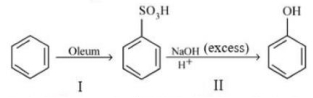
In the following reaction sequence,the $\%$ yield for reaction $I$ is $60 \%$ and that of reaction $II$ is $50 \%$. The overall yield of the complete reaction is $..........\%$ [nearest integer].
A
$31$
B
$32$
C
$33$
D
$30$
Solution
(D) Let the initial moles of benzene be $n$.
For reaction $I$,the yield is $60 \%$,so the moles of benzene sulphonic acid obtained $= 0.6 \times n = 0.6n$.
For reaction $II$,the yield is $50 \%$,so the moles of phenol obtained $= 0.5 \times (0.6n) = 0.3n$.
The overall yield of the complete reaction is calculated as: $\text{Overall yield} = \frac{\text{Final moles of product}}{\text{Initial moles of reactant}} \times 100$.
$\text{Overall yield} = \frac{0.3n}{n} \times 100 = 30 \%$.
For reaction $I$,the yield is $60 \%$,so the moles of benzene sulphonic acid obtained $= 0.6 \times n = 0.6n$.
For reaction $II$,the yield is $50 \%$,so the moles of phenol obtained $= 0.5 \times (0.6n) = 0.3n$.
The overall yield of the complete reaction is calculated as: $\text{Overall yield} = \frac{\text{Final moles of product}}{\text{Initial moles of reactant}} \times 100$.
$\text{Overall yield} = \frac{0.3n}{n} \times 100 = 30 \%$.
0 likesView Solution
255
ChemistryMediumMCQJEE Main · 2022
Identify the incorrect statement from the following.
A
$A$. $A$ circular path around the nucleus in which an electron moves is proposed as Bohr's orbit.
B
$B$. An orbital is the one-electron wave function $(\Psi)$ in an atom.
C
$C$. The existence of Bohr's orbits is supported by hydrogen spectrum.
D
$D$. Atomic orbital is characterised by the quantum numbers $n$ and $l$ only.
Solution
(D) An atomic orbital is a mathematical function $(\Psi)$ that describes the probability of finding an electron in a region of space around the nucleus. It is fully characterized by three quantum numbers: principal quantum number $(n)$,azimuthal quantum number $(l)$,and magnetic quantum number $(m_l)$. Therefore,the statement that an atomic orbital is characterized by $n$ and $l$ only is incorrect.
0 likesView Solution
256
ChemistryMediumMCQJEE Main · 2022
Which of the following relations is not correct?
A
$\Delta H = \Delta U - P \Delta V$
B
$\Delta U = q + W$
C
$\Delta S_{sys} + \Delta S_{surr} \geq 0$
D
$\Delta G = \Delta H - T \Delta S$
Solution
(A) By definition,the enthalpy change is given by $\Delta H = \Delta U + \Delta(PV)$.
At constant pressure,this becomes $\Delta H = \Delta U + P \Delta V$.
Option $A$ is written as $\Delta H = \Delta U - P \Delta V$,which is incorrect because the correct sign is positive.
Option $B$ represents the first law of thermodynamics $(\Delta U = q + W)$.
Option $C$ represents the second law of thermodynamics for a spontaneous process.
Option $D$ is the Gibbs-Helmholtz equation.
At constant pressure,this becomes $\Delta H = \Delta U + P \Delta V$.
Option $A$ is written as $\Delta H = \Delta U - P \Delta V$,which is incorrect because the correct sign is positive.
Option $B$ represents the first law of thermodynamics $(\Delta U = q + W)$.
Option $C$ represents the second law of thermodynamics for a spontaneous process.
Option $D$ is the Gibbs-Helmholtz equation.
0 likesView Solution
257
ChemistryEasyMCQJEE Main · 2022
In which of the following pairs,electron gain enthalpies of constituent elements are nearly the same or identical?
$A$. $Rb$ and $Cs$
$B$. $Na$ and $K$
$C$. $Ar$ and $Kr$
$D$. $I$ and $At$
Choose the correct answer from the options given below.
$A$. $Rb$ and $Cs$
$B$. $Na$ and $K$
$C$. $Ar$ and $Kr$
$D$. $I$ and $At$
Choose the correct answer from the options given below.
A
$A$ and $B$ only
B
$B$ and $C$ only
C
$A$ and $C$ only
D
$C$ and $D$ only
Solution
(C) The electron gain enthalpy $(\Delta_{eg}H)$ values for elements in the same group generally become less negative as we move down the group.
$1$. For $Rb$ and $Cs$ (Group $1$): The values are approximately $-47 \ kJ/mol$ and $-46 \ kJ/mol$ respectively,which are nearly identical.
$2$. For $Ar$ and $Kr$ (Group $18$): Noble gases have positive electron gain enthalpy values due to stable electronic configurations. Both $Ar$ and $Kr$ have values around $+96 \ kJ/mol$ to $+99 \ kJ/mol$,which are considered nearly identical.
Therefore,the pairs $A$ $(Rb, Cs)$ and $C$ $(Ar, Kr)$ have nearly identical electron gain enthalpies.
$1$. For $Rb$ and $Cs$ (Group $1$): The values are approximately $-47 \ kJ/mol$ and $-46 \ kJ/mol$ respectively,which are nearly identical.
$2$. For $Ar$ and $Kr$ (Group $18$): Noble gases have positive electron gain enthalpy values due to stable electronic configurations. Both $Ar$ and $Kr$ have values around $+96 \ kJ/mol$ to $+99 \ kJ/mol$,which are considered nearly identical.
Therefore,the pairs $A$ $(Rb, Cs)$ and $C$ $(Ar, Kr)$ have nearly identical electron gain enthalpies.
0 likesView Solution
258
ChemistryMediumMCQJEE Main · 2022
The metal salts formed during the softening of hard water using $Clark's$ method are:
A
$Ca(OH)_2$ and $Mg(OH)_2$
B
$CaCO_3$ and $Mg(OH)_2$
C
$Ca(OH)_2$ and $MgCO_3$
D
$CaCO_3$ and $MgCO_3$
Solution
(B) $Clark's$ method is used to remove temporary hardness of water by adding calculated amounts of lime,$Ca(OH)_2$.
The chemical reactions involved are:
$Ca(HCO_3)_2 + Ca(OH)_2 \rightarrow 2CaCO_3(s) + 2H_2O(l)$
$Mg(HCO_3)_2 + 2Ca(OH)_2 \rightarrow 2CaCO_3(s) + Mg(OH)_2(s) + 2H_2O(l)$
As seen from the reactions,the insoluble metal salts formed are $CaCO_3$ and $Mg(OH)_2$.
The chemical reactions involved are:
$Ca(HCO_3)_2 + Ca(OH)_2 \rightarrow 2CaCO_3(s) + 2H_2O(l)$
$Mg(HCO_3)_2 + 2Ca(OH)_2 \rightarrow 2CaCO_3(s) + Mg(OH)_2(s) + 2H_2O(l)$
As seen from the reactions,the insoluble metal salts formed are $CaCO_3$ and $Mg(OH)_2$.
0 likesView Solution
259
ChemistryEasyMCQJEE Main · 2022
Which of the following statements is incorrect?
A
Low solubility of $LiF$ in water is due to its small hydration enthalpy.
B
$KO_2$ is paramagnetic.
C
Solution of sodium in liquid ammonia is conducting in nature.
D
Sodium metal has higher density than potassium metal.
Solution
(A) The low solubility of $LiF$ in water is due to its very high lattice enthalpy,which outweighs the hydration enthalpy. Therefore,the statement in option $A$ is incorrect.
0 likesView Solution
260
ChemistryMediumMCQJEE Main · 2022
Given below are two statements.
Statement $I:$ In polluted water,values of both dissolved oxygen and $BOD$ are very low.
Statement $II:$ Eutrophication results in a decrease in the amount of dissolved oxygen.
In the light of the above statements,choose the most appropriate answer from the options given below.
Statement $I:$ In polluted water,values of both dissolved oxygen and $BOD$ are very low.
Statement $II:$ Eutrophication results in a decrease in the amount of dissolved oxygen.
In the light of the above statements,choose the most appropriate answer from the options given below.
A
Both Statement $I$ and Statement $II$ are true
B
Both Statement $I$ and Statement $II$ are false
C
Statement $I$ is true but Statement $II$ is false
D
Statement $I$ is false but Statement $II$ is true
Solution
(D) Statement $I$ is false because in polluted water,the value of dissolved oxygen is low,but the value of $BOD$ (Biological Oxygen Demand) is high due to the presence of organic matter that requires oxygen for decomposition.
Statement $II$ is true because eutrophication leads to the excessive growth of algae and weeds,which consume dissolved oxygen,thereby decreasing its concentration in water bodies.
Therefore,Statement $I$ is false and Statement $II$ is true.
Statement $II$ is true because eutrophication leads to the excessive growth of algae and weeds,which consume dissolved oxygen,thereby decreasing its concentration in water bodies.
Therefore,Statement $I$ is false and Statement $II$ is true.
0 likesView Solution
261
ChemistryMediumMCQJEE Main · 2022
Match List-$I$ with List-$II$.
| List-$I$ | List-$II$ |
| :--- | :--- |
| $(A)$ Tetrahydrofuran | $(I)$ Spiro compound |
| $(B)$ Bicyclo[$1.1$.$0$]butane derivative | $(II)$ Aromatic compound |
| $(C)$ Spiro[$2.2$]pentane derivative | $(III)$ Non-planar heterocyclic compound |
| $(D)$ Furan | $(IV)$ Bicyclo compound |
Choose the correct answer from the options given below.
| List-$I$ | List-$II$ |
| :--- | :--- |
| $(A)$ Tetrahydrofuran | $(I)$ Spiro compound |
| $(B)$ Bicyclo[$1.1$.$0$]butane derivative | $(II)$ Aromatic compound |
| $(C)$ Spiro[$2.2$]pentane derivative | $(III)$ Non-planar heterocyclic compound |
| $(D)$ Furan | $(IV)$ Bicyclo compound |
Choose the correct answer from the options given below.
A
$A-III, B-IV, C-I, D-II$
B
$A-IV, B-III, C-I, D-II$
C
$A-III, B-IV, C-II, D-I$
D
$A-IV, B-III, C-II, D-I$
Solution
(A) Step $1$: Analyze the structures in List-$I$.
$(A)$ is Tetrahydrofuran,which is a non-planar heterocyclic compound $(III)$.
$(B)$ is a bicyclo compound $(IV)$.
$(C)$ is a spiro compound $(I)$.
$(D)$ is Furan,which is an aromatic compound $(II)$.
Step $2$: Match the findings.
$A-III, B-IV, C-I, D-II$.
Therefore,the correct option is $A$.
$(A)$ is Tetrahydrofuran,which is a non-planar heterocyclic compound $(III)$.
$(B)$ is a bicyclo compound $(IV)$.
$(C)$ is a spiro compound $(I)$.
$(D)$ is Furan,which is an aromatic compound $(II)$.
Step $2$: Match the findings.
$A-III, B-IV, C-I, D-II$.
Therefore,the correct option is $A$.
0 likesView Solution
262
ChemistryMediumMCQJEE Main · 2022
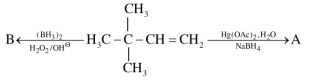
Choose the correct option for the following reactions.
A
$A$ and $B$ are both Markovnikov addition products.
B
$A$ is Markovnikov product and $B$ is anti-Markovnikov product.
C
$A$ and $B$ are both anti-Markovnikov products.
D
$B$ is Markovnikov and $A$ is anti-Markovnikov product.
Solution
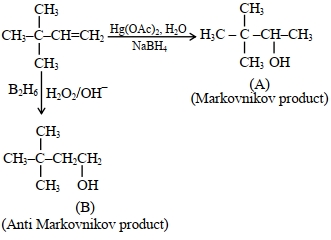
(B) The reaction with $Hg(OAc)_2, H_2O$ followed by $NaBH_4$ is Oxymercuration-Demercuration,which follows Markovnikov's rule to give product $A$ ($3$,$3$-dimethylbutan$-2-$ol).
The reaction with $(BH_3)_2$ followed by $H_2O_2/OH^-$ is Hydroboration-Oxidation,which follows anti-Markovnikov's rule to give product $B$ ($3$,$3$-dimethylbutan$-1-$ol).
Therefore,$A$ is the Markovnikov product and $B$ is the anti-Markovnikov product.
The reaction with $(BH_3)_2$ followed by $H_2O_2/OH^-$ is Hydroboration-Oxidation,which follows anti-Markovnikov's rule to give product $B$ ($3$,$3$-dimethylbutan$-1-$ol).
Therefore,$A$ is the Markovnikov product and $B$ is the anti-Markovnikov product.
0 likesView Solution
263
ChemistryMediumMCQJEE Main · 2022
In the given reaction,$X + Y + 3 Z \rightleftharpoons XYZ_3$. If one mole of each of $X$ and $Y$ with $0.05 \ mol$ of $Z$ reacts to form the compound $XYZ_3$,calculate the yield of $XYZ_3$ in grams. (Given: Atomic masses of $X, Y$ and $Z$ are $10, 20$ and $30 \ amu$,respectively). (Nearest integer)
A
$1$
B
$3$
C
$0$
D
$2$
Solution
(D) The balanced chemical equation is: $X + Y + 3 Z \rightarrow XYZ_3$.
Initial moles: $X = 1 \ mol$,$Y = 1 \ mol$,$Z = 0.05 \ mol$.
To find the Limiting Reagent ($L$.$R$.),divide the moles by their stoichiometric coefficients:
$X: 1/1 = 1$
$Y: 1/1 = 1$
$Z: 0.05/3 \approx 0.0167$
Since $Z$ has the smallest ratio,$Z$ is the Limiting Reagent.
Moles of $XYZ_3$ formed = $\frac{1}{3} \times \text{moles of } Z = \frac{0.05}{3} \ mol$.
Molar mass of $XYZ_3 = 10 + 20 + (3 \times 30) = 120 \ g/mol$.
Yield of $XYZ_3 = \frac{0.05}{3} \times 120 = 0.05 \times 40 = 2 \ g$.
Initial moles: $X = 1 \ mol$,$Y = 1 \ mol$,$Z = 0.05 \ mol$.
To find the Limiting Reagent ($L$.$R$.),divide the moles by their stoichiometric coefficients:
$X: 1/1 = 1$
$Y: 1/1 = 1$
$Z: 0.05/3 \approx 0.0167$
Since $Z$ has the smallest ratio,$Z$ is the Limiting Reagent.
Moles of $XYZ_3$ formed = $\frac{1}{3} \times \text{moles of } Z = \frac{0.05}{3} \ mol$.
Molar mass of $XYZ_3 = 10 + 20 + (3 \times 30) = 120 \ g/mol$.
Yield of $XYZ_3 = \frac{0.05}{3} \times 120 = 0.05 \times 40 = 2 \ g$.
0 likesView Solution
264
ChemistryEasyMCQJEE Main · 2022
The number of paramagnetic species among the following is $......$
$B_{2}, Li_{2}, C_{2}, C_{2}^{-}, O_{2}^{2-}, O_{2}^{+},$ and $He_{2}^{+}$
$B_{2}, Li_{2}, C_{2}, C_{2}^{-}, O_{2}^{2-}, O_{2}^{+},$ and $He_{2}^{+}$
A
$1$
B
$2$
C
$3$
D
$4$
Solution
(D) To determine the paramagnetic nature,we use Molecular Orbital Theory $(MOT)$ to find the number of unpaired electrons:
$1. B_{2} (10 \ e^-): (\sigma 1s)^2 (\sigma^* 1s)^2 (\sigma 2s)^2 (\sigma^* 2s)^2 (\pi 2p_x)^1 (\pi 2p_y)^1$ ($2$ unpaired electrons,paramagnetic)
$2. Li_{2} (6 \ e^-): (\sigma 1s)^2 (\sigma^* 1s)^2 (\sigma 2s)^2$ ($0$ unpaired electrons,diamagnetic)
$3. C_{2} (12 \ e^-): (\sigma 1s)^2 (\sigma^* 1s)^2 (\sigma 2s)^2 (\sigma^* 2s)^2 (\pi 2p_x)^2 (\pi 2p_y)^2$ ($0$ unpaired electrons,diamagnetic)
$4. C_{2}^{-} (13 \ e^-): (\sigma 1s)^2 (\sigma^* 1s)^2 (\sigma 2s)^2 (\sigma^* 2s)^2 (\pi 2p_x)^2 (\pi 2p_y)^2 (\sigma 2p_z)^1$ ($1$ unpaired electron,paramagnetic)
$5. O_{2}^{2-} (18 \ e^-): (\sigma 1s)^2 (\sigma^* 1s)^2 (\sigma 2s)^2 (\sigma^* 2s)^2 (\sigma 2p_z)^2 (\pi 2p_x)^2 (\pi 2p_y)^2 (\pi^* 2p_x)^2 (\pi^* 2p_y)^2$ ($0$ unpaired electrons,diamagnetic)
$6. O_{2}^{+} (15 \ e^-): (\sigma 1s)^2 (\sigma^* 1s)^2 (\sigma 2s)^2 (\sigma^* 2s)^2 (\sigma 2p_z)^2 (\pi 2p_x)^2 (\pi 2p_y)^2 (\pi^* 2p_x)^1$ ($1$ unpaired electron,paramagnetic)
$7. He_{2}^{+} (3 \ e^-): (\sigma 1s)^2 (\sigma^* 1s)^1$ ($1$ unpaired electron,paramagnetic)
Thus,the paramagnetic species are $B_{2}, C_{2}^{-}, O_{2}^{+},$ and $He_{2}^{+}$. The total count is $4$.
$1. B_{2} (10 \ e^-): (\sigma 1s)^2 (\sigma^* 1s)^2 (\sigma 2s)^2 (\sigma^* 2s)^2 (\pi 2p_x)^1 (\pi 2p_y)^1$ ($2$ unpaired electrons,paramagnetic)
$2. Li_{2} (6 \ e^-): (\sigma 1s)^2 (\sigma^* 1s)^2 (\sigma 2s)^2$ ($0$ unpaired electrons,diamagnetic)
$3. C_{2} (12 \ e^-): (\sigma 1s)^2 (\sigma^* 1s)^2 (\sigma 2s)^2 (\sigma^* 2s)^2 (\pi 2p_x)^2 (\pi 2p_y)^2$ ($0$ unpaired electrons,diamagnetic)
$4. C_{2}^{-} (13 \ e^-): (\sigma 1s)^2 (\sigma^* 1s)^2 (\sigma 2s)^2 (\sigma^* 2s)^2 (\pi 2p_x)^2 (\pi 2p_y)^2 (\sigma 2p_z)^1$ ($1$ unpaired electron,paramagnetic)
$5. O_{2}^{2-} (18 \ e^-): (\sigma 1s)^2 (\sigma^* 1s)^2 (\sigma 2s)^2 (\sigma^* 2s)^2 (\sigma 2p_z)^2 (\pi 2p_x)^2 (\pi 2p_y)^2 (\pi^* 2p_x)^2 (\pi^* 2p_y)^2$ ($0$ unpaired electrons,diamagnetic)
$6. O_{2}^{+} (15 \ e^-): (\sigma 1s)^2 (\sigma^* 1s)^2 (\sigma 2s)^2 (\sigma^* 2s)^2 (\sigma 2p_z)^2 (\pi 2p_x)^2 (\pi 2p_y)^2 (\pi^* 2p_x)^1$ ($1$ unpaired electron,paramagnetic)
$7. He_{2}^{+} (3 \ e^-): (\sigma 1s)^2 (\sigma^* 1s)^1$ ($1$ unpaired electron,paramagnetic)
Thus,the paramagnetic species are $B_{2}, C_{2}^{-}, O_{2}^{+},$ and $He_{2}^{+}$. The total count is $4$.
0 likesView Solution
265
ChemistryMediumMCQJEE Main · 2022
$K_{a}$ for butyric acid $(C_{3}H_{7}COOH)$ is $2 \times 10^{-5}$. The $pH$ of $0.2 \ M$ solution of butyric acid is $........... \times 10^{-1}$. (Nearest integer) [Given $\log 2 = 0.30$]
A
$26$
B
$25$
C
$27$
D
$29$
Solution
(C) For a weak acid,the $pH$ is given by the formula: $pH = \frac{1}{2} (pK_{a} - \log C)$.
Given $K_{a} = 2 \times 10^{-5}$,so $pK_{a} = -\log(2 \times 10^{-5}) = 5 - \log 2 = 5 - 0.30 = 4.7$.
Concentration $C = 0.2 \ M = 2 \times 10^{-1} \ M$.
$pH = \frac{1}{2} (4.7 - \log(2 \times 10^{-1}))$.
$pH = \frac{1}{2} (4.7 - (\log 2 + \log 10^{-1}))$.
$pH = \frac{1}{2} (4.7 - (0.30 - 1)) = \frac{1}{2} (4.7 - (-0.7)) = \frac{1}{2} (5.4) = 2.7$.
$pH = 2.7 = 27 \times 10^{-1}$.
Thus,the value is $27$.
Given $K_{a} = 2 \times 10^{-5}$,so $pK_{a} = -\log(2 \times 10^{-5}) = 5 - \log 2 = 5 - 0.30 = 4.7$.
Concentration $C = 0.2 \ M = 2 \times 10^{-1} \ M$.
$pH = \frac{1}{2} (4.7 - \log(2 \times 10^{-1}))$.
$pH = \frac{1}{2} (4.7 - (\log 2 + \log 10^{-1}))$.
$pH = \frac{1}{2} (4.7 - (0.30 - 1)) = \frac{1}{2} (4.7 - (-0.7)) = \frac{1}{2} (5.4) = 2.7$.
$pH = 2.7 = 27 \times 10^{-1}$.
Thus,the value is $27$.
0 likesView Solution
266
ChemistryMediumMCQJEE Main · 2022
The disproportionation of $MnO_{4}^{2-}$ in acidic medium results in the formation of two manganese compounds $A$ and $B$. If the oxidation state of $Mn$ in $B$ is smaller than that of $A$,then the spin-only magnetic moment $(\mu)$ value of $B$ in $BM$ is $.........$ (Nearest integer).
A
$3$
B
$4$
C
$5$
D
$6$
Solution
(B) The disproportionation reaction of manganate ion $(MnO_{4}^{2-})$ in acidic medium is given by:
$3MnO_{4}^{2-} + 4H^{+} \rightarrow 2MnO_{4}^{-} + MnO_{2} + 2H_{2}O$
Here,the manganese compounds formed are $MnO_{4}^{-}$ (where $Mn$ is in $+7$ oxidation state) and $MnO_{2}$ (where $Mn$ is in $+4$ oxidation state).
Given that the oxidation state of $Mn$ in $B$ is smaller than that of $A$,we identify $A$ as $MnO_{4}^{-}$ $(+7)$ and $B$ as $MnO_{2}$ $(+4)$.
In $MnO_{2}$,$Mn$ is in the $+4$ oxidation state,which corresponds to the electronic configuration $[Ar] 3d^{3}$.
The number of unpaired electrons $(n)$ in $Mn^{4+}$ is $3$.
The spin-only magnetic moment $(\mu)$ is calculated as:
$\mu = \sqrt{n(n+2)} = \sqrt{3(3+2)} = \sqrt{15} \approx 3.87 \ BM$.
The nearest integer value is $4$.
$3MnO_{4}^{2-} + 4H^{+} \rightarrow 2MnO_{4}^{-} + MnO_{2} + 2H_{2}O$
Here,the manganese compounds formed are $MnO_{4}^{-}$ (where $Mn$ is in $+7$ oxidation state) and $MnO_{2}$ (where $Mn$ is in $+4$ oxidation state).
Given that the oxidation state of $Mn$ in $B$ is smaller than that of $A$,we identify $A$ as $MnO_{4}^{-}$ $(+7)$ and $B$ as $MnO_{2}$ $(+4)$.
In $MnO_{2}$,$Mn$ is in the $+4$ oxidation state,which corresponds to the electronic configuration $[Ar] 3d^{3}$.
The number of unpaired electrons $(n)$ in $Mn^{4+}$ is $3$.
The spin-only magnetic moment $(\mu)$ is calculated as:
$\mu = \sqrt{n(n+2)} = \sqrt{3(3+2)} = \sqrt{15} \approx 3.87 \ BM$.
The nearest integer value is $4$.
0 likesView Solution
267
ChemistryMediumMCQJEE Main · 2022
On complete combustion of $0.492 \ g$ of an organic compound containing $C, H$ and $O$,$0.7938 \ g$ of $CO_2$ and $0.4428 \ g$ of $H_2O$ were produced. The percentage composition of oxygen in the compound is $........$
A
$46$
B
$44$
C
$43$
D
$42$
Solution
(A) Mass of organic compound $= 0.492 \ g$.
Moles of $CO_2 = \frac{0.7938 \ g}{44 \ g/mol} = 0.01804 \ mol$.
Moles of $C = 0.01804 \ mol$,so mass of $C = 0.01804 \times 12 = 0.2165 \ g$.
Moles of $H_2O = \frac{0.4428 \ g}{18 \ g/mol} = 0.0246 \ mol$.
Moles of $H = 2 \times 0.0246 = 0.0492 \ mol$,so mass of $H = 0.0492 \times 1 = 0.0492 \ g$.
Mass of $O = 0.492 - (0.2165 + 0.0492) = 0.492 - 0.2657 = 0.2263 \ g$.
Percentage of $O = \frac{0.2263}{0.492} \times 100 \approx 46 \%$.
Moles of $CO_2 = \frac{0.7938 \ g}{44 \ g/mol} = 0.01804 \ mol$.
Moles of $C = 0.01804 \ mol$,so mass of $C = 0.01804 \times 12 = 0.2165 \ g$.
Moles of $H_2O = \frac{0.4428 \ g}{18 \ g/mol} = 0.0246 \ mol$.
Moles of $H = 2 \times 0.0246 = 0.0492 \ mol$,so mass of $H = 0.0492 \times 1 = 0.0492 \ g$.
Mass of $O = 0.492 - (0.2165 + 0.0492) = 0.492 - 0.2657 = 0.2263 \ g$.
Percentage of $O = \frac{0.2263}{0.492} \times 100 \approx 46 \%$.
0 likesView Solution
268
ChemistryMediumMCQJEE Main · 2022
Given below are two statements: One is labelled as Assertion $A$ and the other is labelled as Reason $R$.
Assertion $A$: Zero orbital overlap is an out-of-phase overlap.
Reason $R$: It results due to different orientation/direction of approach of orbitals.
In the light of the above statements,choose the correct answer from the options given below.
Assertion $A$: Zero orbital overlap is an out-of-phase overlap.
Reason $R$: It results due to different orientation/direction of approach of orbitals.
In the light of the above statements,choose the correct answer from the options given below.
A
Both $A$ and $R$ are true and $R$ is the correct explanation of $A$.
B
Both $A$ and $R$ are true but $R$ is $NOT$ the correct explanation of $A$.
C
$A$ is true but $R$ is false.
D
$A$ is false but $R$ is true.
Solution
(D) Zero overlap occurs when the orbitals do not have the proper symmetry or orientation to overlap effectively.
Assertion $A$ is false because zero overlap is not necessarily an out-of-phase overlap (which refers to destructive interference of wave functions). Zero overlap often occurs due to improper orientation or symmetry,such as the overlap between $s$ and $p_y$ orbitals along the $x$-axis.
Reason $R$ is true because zero overlap is indeed caused by the different orientation or direction of approach of the orbitals relative to each other,as shown in the provided figure where $p_x$ and $p_y$ orbitals do not overlap effectively.
Therefore,$A$ is false but $R$ is true.
Assertion $A$ is false because zero overlap is not necessarily an out-of-phase overlap (which refers to destructive interference of wave functions). Zero overlap often occurs due to improper orientation or symmetry,such as the overlap between $s$ and $p_y$ orbitals along the $x$-axis.
Reason $R$ is true because zero overlap is indeed caused by the different orientation or direction of approach of the orbitals relative to each other,as shown in the provided figure where $p_x$ and $p_y$ orbitals do not overlap effectively.
Therefore,$A$ is false but $R$ is true.
0 likesView Solution
269
ChemistryEasyMCQJEE Main · 2022
The correct decreasing order for metallic character is:
A
$Na > Mg > Be > Si > P$
B
$P > Si > Be > Mg > Na$
C
$Si > P > Be > Na > Mg$
D
$Be > Na > Mg > Si > P$
Solution
(A) Metallic character is defined by the ease with which an element can lose electrons.
Across a period from left to right,the effective nuclear charge increases and atomic size decreases,making it harder to lose electrons.
Therefore,metallic character decreases across a period.
For the given elements: $Na$ (Group $1$),$Mg$ (Group $2$),$Be$ (Group $2$),$Si$ (Group $14$),and $P$ (Group $15$).
Comparing their positions: $Na$ is the most metallic,followed by $Mg$,then $Be$,then $Si$,and finally $P$ is the least metallic.
The correct decreasing order is $Na > Mg > Be > Si > P$.
Across a period from left to right,the effective nuclear charge increases and atomic size decreases,making it harder to lose electrons.
Therefore,metallic character decreases across a period.
For the given elements: $Na$ (Group $1$),$Mg$ (Group $2$),$Be$ (Group $2$),$Si$ (Group $14$),and $P$ (Group $15$).
Comparing their positions: $Na$ is the most metallic,followed by $Mg$,then $Be$,then $Si$,and finally $P$ is the least metallic.
The correct decreasing order is $Na > Mg > Be > Si > P$.
0 likesView Solution
270
ChemistryMediumMCQJEE Main · 2022
The products obtained during the treatment of hard water using Clark's method are:
A
$CaCO_{3}$ and $MgCO_{3}$
B
$Ca(OH)_{2}$ and $Mg(OH)_{2}$
C
$CaCO_{3}$ and $Mg(OH)_{2}$
D
$Ca(OH)_{2}$ and $MgCO_{3}$
Solution
(C) Clark's method is used to remove temporary hardness of water by adding calculated amounts of lime,$Ca(OH)_{2}$.
The chemical reactions are:
$Ca(HCO_{3})_{2} + Ca(OH)_{2} \rightarrow 2CaCO_{3} \downarrow + 2H_{2}O$
$Mg(HCO_{3})_{2} + 2Ca(OH)_{2} \rightarrow 2CaCO_{3} \downarrow + Mg(OH)_{2} \downarrow + 2H_{2}O$
Thus,the products formed are $CaCO_{3}$ and $Mg(OH)_{2}$.
The chemical reactions are:
$Ca(HCO_{3})_{2} + Ca(OH)_{2} \rightarrow 2CaCO_{3} \downarrow + 2H_{2}O$
$Mg(HCO_{3})_{2} + 2Ca(OH)_{2} \rightarrow 2CaCO_{3} \downarrow + Mg(OH)_{2} \downarrow + 2H_{2}O$
Thus,the products formed are $CaCO_{3}$ and $Mg(OH)_{2}$.
0 likesView Solution
271
ChemistryMediumMCQJEE Main · 2022
Statement $I$: An alloy of lithium and magnesium is used to make aircraft plates.
Statement $II$: The magnesium ions are important for cell-membrane integrity.
In the light of the above statements,choose the correct answer from the options given below.
Statement $II$: The magnesium ions are important for cell-membrane integrity.
In the light of the above statements,choose the correct answer from the options given below.
A
Both Statement $I$ and Statement $II$ are true.
B
Both Statement $I$ and Statement $II$ are false.
C
Statement $I$ is true but Statement $II$ is false.
D
Statement $I$ is false but Statement $II$ is true.
Solution
(B) Statement $I$ is false because an alloy of $Li$ and $Mg$ is used to make armour plates,not aircraft plates.
Statement $II$ is false because calcium ions $(Ca^{2+})$,not magnesium ions,are primarily responsible for cell-membrane integrity and neuromuscular function.
Statement $II$ is false because calcium ions $(Ca^{2+})$,not magnesium ions,are primarily responsible for cell-membrane integrity and neuromuscular function.
0 likesView Solution
272
ChemistryMediumMCQJEE Main · 2022
Arrange the following in increasing order of reactivity towards nitration:
$A$. $p$-xylene
$B$. bromobenzene
$C$. mesitylene
$D$. nitrobenzene
$E$. benzene
Choose the correct answer from the options given below.
$A$. $p$-xylene
$B$. bromobenzene
$C$. mesitylene
$D$. nitrobenzene
$E$. benzene
Choose the correct answer from the options given below.
A
$C < D < E < A < B$
B
$D < B < E < A < C$
C
$D < C < E < A < B$
D
$C < D < E < B < A$
Solution
(B) The reactivity towards electrophilic aromatic substitution (like nitration) depends on the electron density of the benzene ring.
$1$. $-NO_2$ (in $D$) is a strongly electron-withdrawing group (deactivating),making the ring least reactive.
$2$. $-Br$ (in $B$) is an electron-withdrawing group due to the inductive effect (deactivating),but less so than $-NO_2$.
$3$. $E$ (benzene) is the reference point.
$4$. $-CH_3$ groups are electron-donating (activating) due to hyperconjugation and inductive effects.
$5$. $p$-xylene $(A)$ has two $-CH_3$ groups,and mesitylene $(C)$ has three $-CH_3$ groups. More electron-donating groups increase the reactivity further.
Thus,the order of increasing reactivity is: $D < B < E < A < C$.
$1$. $-NO_2$ (in $D$) is a strongly electron-withdrawing group (deactivating),making the ring least reactive.
$2$. $-Br$ (in $B$) is an electron-withdrawing group due to the inductive effect (deactivating),but less so than $-NO_2$.
$3$. $E$ (benzene) is the reference point.
$4$. $-CH_3$ groups are electron-donating (activating) due to hyperconjugation and inductive effects.
$5$. $p$-xylene $(A)$ has two $-CH_3$ groups,and mesitylene $(C)$ has three $-CH_3$ groups. More electron-donating groups increase the reactivity further.
Thus,the order of increasing reactivity is: $D < B < E < A < C$.
0 likesView Solution
273
ChemistryMediumMCQJEE Main · 2022
Given below are two statements: One is labelled as Assertion $A$ and the other is labelled as Reason $R$.
Assertion $A$: Thin layer chromatography is an adsorption chromatography.
Reason $R$: $A$ thin layer of silica gel is spread over a glass plate of suitable size in thin layer chromatography which acts as an adsorbent.
In the light of the above statements,choose the correct answer from the options given below.
Assertion $A$: Thin layer chromatography is an adsorption chromatography.
Reason $R$: $A$ thin layer of silica gel is spread over a glass plate of suitable size in thin layer chromatography which acts as an adsorbent.
In the light of the above statements,choose the correct answer from the options given below.
A
Both $A$ and $R$ are true and $R$ is the correct explanation of $A$.
B
Both $A$ and $R$ are true but $R$ is $NOT$ the correct explanation of $A$.
C
$A$ is true but $R$ is false.
D
$A$ is false but $R$ is true.
Solution
(A) Thin layer chromatography $(TLC)$ is a type of adsorption chromatography.
It involves the separation of substances of a mixture over a thin layer of an adsorbent coated on a glass plate.
$A$ thin layer (about $0.2 \ mm$ thick) of an adsorbent,such as silica gel or alumina,is spread over a glass plate of suitable size.
Since the separation is based on the differential adsorption of the components on the stationary phase (silica gel),both the Assertion $(A)$ and the Reason $(R)$ are true,and $(R)$ is the correct explanation of $(A)$.
It involves the separation of substances of a mixture over a thin layer of an adsorbent coated on a glass plate.
$A$ thin layer (about $0.2 \ mm$ thick) of an adsorbent,such as silica gel or alumina,is spread over a glass plate of suitable size.
Since the separation is based on the differential adsorption of the components on the stationary phase (silica gel),both the Assertion $(A)$ and the Reason $(R)$ are true,and $(R)$ is the correct explanation of $(A)$.
0 likesView Solution
274
ChemistryMediumMCQJEE Main · 2022
Find the major product for the reaction shown below.
A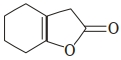
B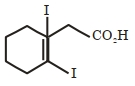
C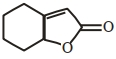
D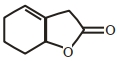
Solution
(A) The reaction is an iodolactonization followed by dehydroiodination.
$1$. Treatment of the unsaturated carboxylic acid with $I_2/NaHCO_3$ leads to the formation of an iodolactone intermediate. The carboxylate oxygen attacks the iodonium ion formed across the double bond,resulting in a bicyclic lactone with an iodine atom at the bridgehead position.
$2$. Subsequent treatment with pyridine and heat $(\Delta)$ promotes an $E2$ elimination reaction,removing the iodine atom and a hydrogen atom from the adjacent carbon to form a double bond.
$3$. The final product is a bicyclic lactone containing a double bond in the six-membered ring,which corresponds to option $A$.
$1$. Treatment of the unsaturated carboxylic acid with $I_2/NaHCO_3$ leads to the formation of an iodolactone intermediate. The carboxylate oxygen attacks the iodonium ion formed across the double bond,resulting in a bicyclic lactone with an iodine atom at the bridgehead position.
$2$. Subsequent treatment with pyridine and heat $(\Delta)$ promotes an $E2$ elimination reaction,removing the iodine atom and a hydrogen atom from the adjacent carbon to form a double bond.
$3$. The final product is a bicyclic lactone containing a double bond in the six-membered ring,which corresponds to option $A$.
0 likesView Solution
275
ChemistryDifficultMCQJEE Main · 2022
$2 \ L$ of $0.2 \ M \ H_2SO_4$ is reacted with $2 \ L$ of $0.1 \ M \ NaOH$ solution. The molarity of the resulting product $Na_2SO_4$ in the solution is $X \ mM$. Find the value of $X$. (Nearest integer).
A
$24$
B
$23$
C
$22$
D
$25$
Solution
(D) The balanced chemical equation is: $H_2SO_4 + 2NaOH \rightarrow Na_2SO_4 + 2H_2O$
Initial moles of $H_2SO_4 = 2 \ L \times 0.2 \ M = 0.4 \ mol$.
Initial moles of $NaOH = 2 \ L \times 0.1 \ M = 0.2 \ mol$.
Since $NaOH$ is the limiting reagent,$0.2 \ mol$ of $NaOH$ will react with $0.1 \ mol$ of $H_2SO_4$ to produce $0.1 \ mol$ of $Na_2SO_4$.
Total volume of the solution = $2 \ L + 2 \ L = 4 \ L$.
Molarity of $Na_2SO_4 = \frac{0.1 \ mol}{4 \ L} = 0.025 \ M$.
$0.025 \ M = 25 \ mM$.
Initial moles of $H_2SO_4 = 2 \ L \times 0.2 \ M = 0.4 \ mol$.
Initial moles of $NaOH = 2 \ L \times 0.1 \ M = 0.2 \ mol$.
Since $NaOH$ is the limiting reagent,$0.2 \ mol$ of $NaOH$ will react with $0.1 \ mol$ of $H_2SO_4$ to produce $0.1 \ mol$ of $Na_2SO_4$.
Total volume of the solution = $2 \ L + 2 \ L = 4 \ L$.
Molarity of $Na_2SO_4 = \frac{0.1 \ mol}{4 \ L} = 0.025 \ M$.
$0.025 \ M = 25 \ mM$.
0 likesView Solution
276
ChemistryDifficultMCQJEE Main · 2022
If the wavelength for an electron emitted from $H$ atom is $3.3 \times 10^{-10} \ m$,then energy absorbed by the electron in its ground state compared to minimum energy required for its escape from the atom,is $.......$ times. (Nearest integer).
[Given $: h = 6.626 \times 10^{-34} \ Js$,Mass of electron $= 9.1 \times 10^{-31} \ kg$ ]
[Given $: h = 6.626 \times 10^{-34} \ Js$,Mass of electron $= 9.1 \times 10^{-31} \ kg$ ]
A
$1$
B
$3$
C
$2$
D
$0$
Solution
(C) The kinetic energy $K$ of the emitted electron is given by the de Broglie wavelength formula: $\lambda = \frac{h}{\sqrt{2mK}}$.
Rearranging for $K$: $K = \frac{h^2}{2m\lambda^2}$.
Substituting the given values: $K = \frac{(6.626 \times 10^{-34})^2}{2 \times 9.1 \times 10^{-31} \times (3.3 \times 10^{-10})^2} \approx 2.215 \times 10^{-18} \ J$.
The minimum energy required to escape from the ground state of $H$ atom is the ionization energy: $E_{req} = 13.6 \ eV = 13.6 \times 1.602 \times 10^{-19} \ J \approx 2.179 \times 10^{-18} \ J$.
The total energy absorbed is $E_{abs} = E_{req} + K$.
The ratio is $\frac{E_{abs}}{E_{req}} = 1 + \frac{K}{E_{req}} = 1 + \frac{2.215 \times 10^{-18}}{2.179 \times 10^{-18}} \approx 1 + 1.016 = 2.016$.
Rounding to the nearest integer,the value is $2$.
Rearranging for $K$: $K = \frac{h^2}{2m\lambda^2}$.
Substituting the given values: $K = \frac{(6.626 \times 10^{-34})^2}{2 \times 9.1 \times 10^{-31} \times (3.3 \times 10^{-10})^2} \approx 2.215 \times 10^{-18} \ J$.
The minimum energy required to escape from the ground state of $H$ atom is the ionization energy: $E_{req} = 13.6 \ eV = 13.6 \times 1.602 \times 10^{-19} \ J \approx 2.179 \times 10^{-18} \ J$.
The total energy absorbed is $E_{abs} = E_{req} + K$.
The ratio is $\frac{E_{abs}}{E_{req}} = 1 + \frac{K}{E_{req}} = 1 + \frac{2.215 \times 10^{-18}}{2.179 \times 10^{-18}} \approx 1 + 1.016 = 2.016$.
Rounding to the nearest integer,the value is $2$.
0 likesView Solution
277
ChemistryMediumMCQJEE Main · 2022
At $600 \ K$,$2 \ mol$ of $NO$ are mixed with $1 \ mol$ of $O_2$.
$2 \ NO_{(g)} + O_{2(g)} \rightleftarrows 2 \ NO_{2(g)}$
The reaction occurring as above comes to equilibrium under a total pressure of $1 \ atm$. Analysis of the system shows that $0.6 \ mol$ of oxygen are present at equilibrium. The equilibrium constant for the reaction is $.........$ (Nearest integer).
$2 \ NO_{(g)} + O_{2(g)} \rightleftarrows 2 \ NO_{2(g)}$
The reaction occurring as above comes to equilibrium under a total pressure of $1 \ atm$. Analysis of the system shows that $0.6 \ mol$ of oxygen are present at equilibrium. The equilibrium constant for the reaction is $.........$ (Nearest integer).
A
$1$
B
$0$
C
$2$
D
$3$
Solution
(C) The reaction is $2 \ NO_{(g)} + O_{2(g)} \rightleftarrows 2 \ NO_{2(g)}$.
Initial moles: $NO = 2, O_2 = 1, NO_2 = 0$.
At equilibrium,moles of $O_2 = 1 - x = 0.6$,so $x = 0.4$.
Equilibrium moles: $NO = 2 - 2(0.4) = 1.2$,$O_2 = 0.6$,$NO_2 = 2(0.4) = 0.8$.
Total moles at equilibrium = $1.2 + 0.6 + 0.8 = 2.6$.
Mole fractions: $X_{NO} = \frac{1.2}{2.6}$,$X_{O_2} = \frac{0.6}{2.6}$,$X_{NO_2} = \frac{0.8}{2.6}$.
Partial pressures $(P_{total} = 1 \ atm)$: $P_{NO} = \frac{1.2}{2.6} \ atm$,$P_{O_2} = \frac{0.6}{2.6} \ atm$,$P_{NO_2} = \frac{0.8}{2.6} \ atm$.
$K_p = \frac{(P_{NO_2})^2}{(P_{NO})^2 \times P_{O_2}} = \frac{(\frac{0.8}{2.6})^2}{(\frac{1.2}{2.6})^2 \times (\frac{0.6}{2.6})} = \frac{0.8^2 \times 2.6}{1.2^2 \times 0.6} = \frac{0.64 \times 2.6}{1.44 \times 0.6} = \frac{1.664}{0.864} \approx 1.926$.
The nearest integer is $2$.
Initial moles: $NO = 2, O_2 = 1, NO_2 = 0$.
At equilibrium,moles of $O_2 = 1 - x = 0.6$,so $x = 0.4$.
Equilibrium moles: $NO = 2 - 2(0.4) = 1.2$,$O_2 = 0.6$,$NO_2 = 2(0.4) = 0.8$.
Total moles at equilibrium = $1.2 + 0.6 + 0.8 = 2.6$.
Mole fractions: $X_{NO} = \frac{1.2}{2.6}$,$X_{O_2} = \frac{0.6}{2.6}$,$X_{NO_2} = \frac{0.8}{2.6}$.
Partial pressures $(P_{total} = 1 \ atm)$: $P_{NO} = \frac{1.2}{2.6} \ atm$,$P_{O_2} = \frac{0.6}{2.6} \ atm$,$P_{NO_2} = \frac{0.8}{2.6} \ atm$.
$K_p = \frac{(P_{NO_2})^2}{(P_{NO})^2 \times P_{O_2}} = \frac{(\frac{0.8}{2.6})^2}{(\frac{1.2}{2.6})^2 \times (\frac{0.6}{2.6})} = \frac{0.8^2 \times 2.6}{1.2^2 \times 0.6} = \frac{0.64 \times 2.6}{1.44 \times 0.6} = \frac{1.664}{0.864} \approx 1.926$.
The nearest integer is $2$.
0 likesView Solution
278
ChemistryMediumMCQJEE Main · 2022
$A$ sample of $0.125 \ g$ of an organic compound when analysed by Duma's method yields $22.78 \ mL$ of nitrogen gas collected over $KOH$ solution at $280 \ K$ and $759 \ mm \ Hg$. The percentage of nitrogen in the given organic compound is (Nearest integer).
$(a)$ The vapour pressure of water at $280 \ K$ is $14.2 \ mm \ Hg$
$(b)$ $R = 0.082 \ L \ atm \ K^{-1} \ mol^{-1}$
$(a)$ The vapour pressure of water at $280 \ K$ is $14.2 \ mm \ Hg$
$(b)$ $R = 0.082 \ L \ atm \ K^{-1} \ mol^{-1}$
A
$22$
B
$23$
C
$21$
D
$20$
Solution
(A) Step $1$: Calculate the pressure of dry $N_2$ gas.
$P_{N_2} = P_{total} - P_{H_2O} = 759 \ mm \ Hg - 14.2 \ mm \ Hg = 744.8 \ mm \ Hg$.
Step $2$: Convert units to standard values.
$P = \frac{744.8}{760} \ atm$,$V = \frac{22.78}{1000} \ L$,$T = 280 \ K$,$R = 0.082 \ L \ atm \ K^{-1} \ mol^{-1}$.
Step $3$: Calculate moles of $N_2$ using the ideal gas equation $PV = nRT$.
$n_{N_2} = \frac{PV}{RT} = \frac{744.8 \times 22.78}{760 \times 0.082 \times 280 \times 1000} \approx 0.000971 \ mol$.
Step $4$: Calculate mass of $N_2$ and percentage.
$Mass_{N_2} = 0.000971 \times 28 \ g/mol = 0.027188 \ g$.
$\%N = \frac{Mass_{N_2}}{Mass_{sample}} \times 100 = \frac{0.027188}{0.125} \times 100 \approx 21.75\%$.
The nearest integer is $22$.
$P_{N_2} = P_{total} - P_{H_2O} = 759 \ mm \ Hg - 14.2 \ mm \ Hg = 744.8 \ mm \ Hg$.
Step $2$: Convert units to standard values.
$P = \frac{744.8}{760} \ atm$,$V = \frac{22.78}{1000} \ L$,$T = 280 \ K$,$R = 0.082 \ L \ atm \ K^{-1} \ mol^{-1}$.
Step $3$: Calculate moles of $N_2$ using the ideal gas equation $PV = nRT$.
$n_{N_2} = \frac{PV}{RT} = \frac{744.8 \times 22.78}{760 \times 0.082 \times 280 \times 1000} \approx 0.000971 \ mol$.
Step $4$: Calculate mass of $N_2$ and percentage.
$Mass_{N_2} = 0.000971 \times 28 \ g/mol = 0.027188 \ g$.
$\%N = \frac{Mass_{N_2}}{Mass_{sample}} \times 100 = \frac{0.027188}{0.125} \times 100 \approx 21.75\%$.
The nearest integer is $22$.
0 likesView Solution
279
ChemistryMediumMCQJEE Main · 2022
On reaction with a stronger oxidizing agent like $KIO_{4}$,hydrogen peroxide is oxidized with the evolution of $O_{2}$. The oxidation number of $I$ in $KIO_{4}$ changes to $..........$
A
$5$
B
$4$
C
$3$
D
$2$
Solution
(A) The reaction is: $IO_{4}^{-} + H_{2}O_{2} \rightarrow IO_{3}^{-} + O_{2} + H_{2}O$.
In $KIO_{4}$,the oxidation state of $I$ is calculated as: $x + 4(-2) = -1$,so $x = +7$.
In the product $IO_{3}^{-}$,the oxidation state of $I$ is: $x + 3(-2) = -1$,so $x = +5$.
Thus,the oxidation number of $I$ changes from $+7$ to $+5$.
In $KIO_{4}$,the oxidation state of $I$ is calculated as: $x + 4(-2) = -1$,so $x = +7$.
In the product $IO_{3}^{-}$,the oxidation state of $I$ is: $x + 3(-2) = -1$,so $x = +5$.
Thus,the oxidation number of $I$ changes from $+7$ to $+5$.
0 likesView Solution
280
ChemistryEasyMCQJEE Main · 2022
Among the following,the number of state variables is $.....$
Internal energy $(U)$; Volume $(V)$; Heat $(q)$; Enthalpy $(H)$
Internal energy $(U)$; Volume $(V)$; Heat $(q)$; Enthalpy $(H)$
A
$2$
B
$3$
C
$4$
D
$6$
Solution
(B) State variables are properties whose values depend only on the state of the system and not on the path taken to reach that state.
In the given list:
$1$. Internal energy $(U)$ is a state function.
$2$. Volume $(V)$ is a state function.
$3$. Enthalpy $(H)$ is a state function.
$4$. Heat $(q)$ is a path function,not a state function.
Therefore,there are $3$ state variables: Internal energy,Volume,and Enthalpy.
In the given list:
$1$. Internal energy $(U)$ is a state function.
$2$. Volume $(V)$ is a state function.
$3$. Enthalpy $(H)$ is a state function.
$4$. Heat $(q)$ is a path function,not a state function.
Therefore,there are $3$ state variables: Internal energy,Volume,and Enthalpy.
0 likesView Solution
281
ChemistryMediumMCQJEE Main · 2022
Which of the following pairs of molecules contains an odd-electron molecule and an expanded octet molecule?
A
$BCl_{3}$ and $SF_{6}$
B
$NO$ and $H_{2}SO_{4}$
C
$SF_{6}$ and $H_{2}SO_{4}$
D
$BCl_{3}$ and $NO$
Solution
(B) An odd-electron molecule is one that has an odd number of valence electrons,such as $NO$ (Nitric oxide,$5+6=11$ valence electrons).
An expanded octet molecule is one where the central atom has more than $8$ electrons in its valence shell,such as $H_{2}SO_{4}$ (Sulfuric acid).
In $H_{2}SO_{4}$,the central sulfur atom is bonded to four oxygen atoms (two double bonds and two single bonds),resulting in $12$ electrons in its valence shell.
Thus,the pair containing an odd-electron molecule $(NO)$ and an expanded octet molecule $(H_{2}SO_{4})$ is $NO$ and $H_{2}SO_{4}$.
An expanded octet molecule is one where the central atom has more than $8$ electrons in its valence shell,such as $H_{2}SO_{4}$ (Sulfuric acid).
In $H_{2}SO_{4}$,the central sulfur atom is bonded to four oxygen atoms (two double bonds and two single bonds),resulting in $12$ electrons in its valence shell.
Thus,the pair containing an odd-electron molecule $(NO)$ and an expanded octet molecule $(H_{2}SO_{4})$ is $NO$ and $H_{2}SO_{4}$.
0 likesView Solution
282
ChemistryDifficultMCQJEE Main · 2022
$N_{2(g)} + 3H_{2(g)} \rightleftharpoons 2NH_{3(g)}$
$20 \ g \quad \quad \quad \quad 5 \ g$
Consider the above reaction. The limiting reagent of the reaction and the number of moles of $NH_{3}$ formed are,respectively:
$20 \ g \quad \quad \quad \quad 5 \ g$
Consider the above reaction. The limiting reagent of the reaction and the number of moles of $NH_{3}$ formed are,respectively:
A
$H_{2}, 1.42 \ moles$
B
$H_{2}, 0.71 \ moles$
C
$N_{2}, 1.42 \ moles$
D
$N_{2}, 0.71 \ moles$
Solution
(C) The balanced chemical equation is: $N_{2(g)} + 3H_{2(g)} \rightleftharpoons 2NH_{3(g)}$
Calculate the number of moles of reactants:
$n(N_{2}) = \frac{20 \ g}{28 \ g/mol} \approx 0.714 \ mol$
$n(H_{2}) = \frac{5 \ g}{2 \ g/mol} = 2.5 \ mol$
Determine the limiting reagent by dividing moles by the stoichiometric coefficient:
For $N_{2}: \frac{0.714}{1} = 0.714$
For $H_{2}: \frac{2.5}{3} \approx 0.833$
Since $0.714 < 0.833$,$N_{2}$ is the limiting reagent.
The amount of $NH_{3}$ produced depends on the limiting reagent:
$n(NH_{3}) = 2 \times n(N_{2}) = 2 \times 0.714 = 1.428 \ mol \approx 1.42 \ mol$.
Calculate the number of moles of reactants:
$n(N_{2}) = \frac{20 \ g}{28 \ g/mol} \approx 0.714 \ mol$
$n(H_{2}) = \frac{5 \ g}{2 \ g/mol} = 2.5 \ mol$
Determine the limiting reagent by dividing moles by the stoichiometric coefficient:
For $N_{2}: \frac{0.714}{1} = 0.714$
For $H_{2}: \frac{2.5}{3} \approx 0.833$
Since $0.714 < 0.833$,$N_{2}$ is the limiting reagent.
The amount of $NH_{3}$ produced depends on the limiting reagent:
$n(NH_{3}) = 2 \times n(N_{2}) = 2 \times 0.714 = 1.428 \ mol \approx 1.42 \ mol$.
0 likesView Solution
283
ChemistryEasyMCQJEE Main · 2022
The first ionization enthalpy of $Na$,$Mg$ and $Si$,respectively,are: $496, 737$ and $786 \ kJ \ mol^{-1}$. The first ionization enthalpy $(kJ \ mol^{-1})$ of $Al$ is
A
$487$
B
$768$
C
$577$
D
$856$
Solution
(C) The general trend for the first ionization enthalpy across the third period is: $Na < Al < Mg < Si$.
Given values are:
$IE(Na) = 496 \ kJ \ mol^{-1}$
$IE(Mg) = 737 \ kJ \ mol^{-1}$
$IE(Si) = 786 \ kJ \ mol^{-1}$
Based on the periodic trend,the ionization enthalpy of $Al$ should be greater than $Na$ but less than $Mg$.
Therefore,$496 < IE(Al) < 737$.
Among the given options,only $577 \ kJ \ mol^{-1}$ falls within this range.
Thus,the correct option is $(C)$.
Given values are:
$IE(Na) = 496 \ kJ \ mol^{-1}$
$IE(Mg) = 737 \ kJ \ mol^{-1}$
$IE(Si) = 786 \ kJ \ mol^{-1}$
Based on the periodic trend,the ionization enthalpy of $Al$ should be greater than $Na$ but less than $Mg$.
Therefore,$496 < IE(Al) < 737$.
Among the given options,only $577 \ kJ \ mol^{-1}$ falls within this range.
Thus,the correct option is $(C)$.
0 likesView Solution
284
ChemistryMediumMCQJEE Main · 2022
The reaction of zinc with an excess of aqueous alkali evolves hydrogen gas and gives:
A
$Zn(OH)_2$
B
$ZnO$
C
$[ZnO_2]^{2-}$
D
$[Zn(OH)_4]^{2-}$
Solution
(D) Zinc reacts with an excess of aqueous alkali (such as $NaOH$) to evolve hydrogen gas and form the soluble tetrahydroxozincate$(II)$ complex ion.
The chemical equation is:
$Zn(s) + 2OH^{-}(aq) + 2H_2O(l) \rightarrow [Zn(OH)_4]^{2-}(aq) + H_2(g) \uparrow$
In this reaction,the zinc metal is oxidized to the $+2$ oxidation state,forming the complex ion $[Zn(OH)_4]^{2-}$,which is the stable species in an aqueous alkaline medium.
The chemical equation is:
$Zn(s) + 2OH^{-}(aq) + 2H_2O(l) \rightarrow [Zn(OH)_4]^{2-}(aq) + H_2(g) \uparrow$
In this reaction,the zinc metal is oxidized to the $+2$ oxidation state,forming the complex ion $[Zn(OH)_4]^{2-}$,which is the stable species in an aqueous alkaline medium.
0 likesView Solution
285
ChemistryMediumMCQJEE Main · 2022
Lithium nitrate and sodium nitrate,when heated separately,respectively,give
A
$LiNO_2$ and $NaNO_2$
B
$Li_2O$ and $Na_2O$
C
$Li_2O$ and $NaNO_2$
D
$LiNO_2$ and $Na_2O$
Solution
(C) When heated,lithium nitrate decomposes to form lithium oxide $(Li_2O)$,nitrogen dioxide $(NO_2)$,and oxygen $(O_2)$:
$4LiNO_3 \longrightarrow 2Li_2O + 4NO_2 + O_2$
In contrast,sodium nitrate decomposes to form sodium nitrite $(NaNO_2)$ and oxygen $(O_2)$:
$2NaNO_3 \longrightarrow 2NaNO_2 + O_2$
Therefore,the products are $Li_2O$ and $NaNO_2$ respectively.
Note: At very high temperatures (above $800 \ ^{\circ}C$),$NaNO_2$ can further decompose to $Na_2O$,but the standard decomposition product for $NaNO_3$ is $NaNO_2$.
$4LiNO_3 \longrightarrow 2Li_2O + 4NO_2 + O_2$
In contrast,sodium nitrate decomposes to form sodium nitrite $(NaNO_2)$ and oxygen $(O_2)$:
$2NaNO_3 \longrightarrow 2NaNO_2 + O_2$
Therefore,the products are $Li_2O$ and $NaNO_2$ respectively.
Note: At very high temperatures (above $800 \ ^{\circ}C$),$NaNO_2$ can further decompose to $Na_2O$,but the standard decomposition product for $NaNO_3$ is $NaNO_2$.
0 likesView Solution
286
ChemistryMediumMCQJEE Main · 2022
The number of lone pairs of electrons on the central atom of $SCl_2$,$O_3$,$ClF_3$,and $SF_6$,respectively,are:
A
$0, 1, 2$ and $2$
B
$2, 1, 2$ and $0$
C
$1, 2, 2$ and $0$
D
$2, 1, 3$ and $0$
Solution
(B) To determine the number of lone pairs on the central atom,we use the formula: $\text{Lone pairs} = \frac{1}{2} (V - N)$,where $V$ is the number of valence electrons of the central atom and $N$ is the number of bonding electrons (or atoms attached).
$1$. For $SCl_2$: Sulfur $(S)$ has $6$ valence electrons. It forms $2$ bonds with $Cl$ atoms. Lone pairs = $\frac{1}{2} (6 - 2) = 2$.
$2$. For $O_3$: The central Oxygen atom has $6$ valence electrons. It forms $2$ bonds with one oxygen atom and $1$ coordinate bond with another. The central atom has $1$ lone pair.
$3$. For $ClF_3$: Chlorine $(Cl)$ has $7$ valence electrons. It forms $3$ bonds with $F$ atoms. Lone pairs = $\frac{1}{2} (7 - 3) = 2$.
$4$. For $SF_6$: Sulfur $(S)$ has $6$ valence electrons. It forms $6$ bonds with $F$ atoms. Lone pairs = $\frac{1}{2} (6 - 6) = 0$.
Thus,the number of lone pairs are $2, 1, 2$ and $0$ respectively. The correct option is $B$.
$1$. For $SCl_2$: Sulfur $(S)$ has $6$ valence electrons. It forms $2$ bonds with $Cl$ atoms. Lone pairs = $\frac{1}{2} (6 - 2) = 2$.
$2$. For $O_3$: The central Oxygen atom has $6$ valence electrons. It forms $2$ bonds with one oxygen atom and $1$ coordinate bond with another. The central atom has $1$ lone pair.
$3$. For $ClF_3$: Chlorine $(Cl)$ has $7$ valence electrons. It forms $3$ bonds with $F$ atoms. Lone pairs = $\frac{1}{2} (7 - 3) = 2$.
$4$. For $SF_6$: Sulfur $(S)$ has $6$ valence electrons. It forms $6$ bonds with $F$ atoms. Lone pairs = $\frac{1}{2} (6 - 6) = 0$.
Thus,the number of lone pairs are $2, 1, 2$ and $0$ respectively. The correct option is $B$.
0 likesView Solution
287
ChemistryMCQJEE Main · 2022
In the following pairs,the one in which both transition metal ions are colourless is
A
$Sc^{3+}, Zn^{2+}$
B
$Ti^{4+}, Cu^{2+}$
C
$V^{2+}, Ti^{3+}$
D
$Zn^{2+}, Mn^{2+}$
Solution
(A) Transition metal ions are colourless if they do not have unpaired electrons to undergo $d-d$ transitions. This occurs in ions with $d^{0}$ or $d^{10}$ electronic configurations.
$A$) $Sc^{3+}$ $(3d^{0})$ and $Zn^{2+}$ $(3d^{10})$: Both have no unpaired electrons,so they are colourless.
$B$) $Ti^{4+}$ $(3d^{0})$ is colourless,but $Cu^{2+}$ $(3d^{9})$ has one unpaired electron and is coloured.
$C$) $V^{2+}$ $(3d^{3})$ and $Ti^{3+}$ $(3d^{1})$: Both have unpaired electrons and are coloured.
$D$) $Zn^{2+}$ $(3d^{10})$ is colourless,but $Mn^{2+}$ $(3d^{5})$ has five unpaired electrons and is coloured.
Therefore,the correct pair is $Sc^{3+}, Zn^{2+}$.
$A$) $Sc^{3+}$ $(3d^{0})$ and $Zn^{2+}$ $(3d^{10})$: Both have no unpaired electrons,so they are colourless.
$B$) $Ti^{4+}$ $(3d^{0})$ is colourless,but $Cu^{2+}$ $(3d^{9})$ has one unpaired electron and is coloured.
$C$) $V^{2+}$ $(3d^{3})$ and $Ti^{3+}$ $(3d^{1})$: Both have unpaired electrons and are coloured.
$D$) $Zn^{2+}$ $(3d^{10})$ is colourless,but $Mn^{2+}$ $(3d^{5})$ has five unpaired electrons and is coloured.
Therefore,the correct pair is $Sc^{3+}, Zn^{2+}$.
0 likesView Solution
288
ChemistryMediumMCQJEE Main · 2022
In neutral or faintly alkaline medium,$KMnO_4$ being a powerful oxidant can oxidize thiosulphate almost quantitatively to sulphate. In this reaction,the overall change in the oxidation state of manganese will be:
A
$5$
B
$1$
C
$0$
D
$3$
Solution
(D) The balanced chemical equation for the reaction in a neutral or faintly alkaline medium is:
$8MnO_4^- + 3S_2O_3^{2-} + H_2O \rightarrow 8MnO_2 + 6SO_4^{2-} + 2OH^-$
In $KMnO_4$,the oxidation state of $Mn$ is $+7$.
In $MnO_2$,the oxidation state of $Mn$ is $+4$.
The change in the oxidation state of $Mn$ is $|(+4) - (+7)| = 3$.
$8MnO_4^- + 3S_2O_3^{2-} + H_2O \rightarrow 8MnO_2 + 6SO_4^{2-} + 2OH^-$
In $KMnO_4$,the oxidation state of $Mn$ is $+7$.
In $MnO_2$,the oxidation state of $Mn$ is $+4$.
The change in the oxidation state of $Mn$ is $|(+4) - (+7)| = 3$.
0 likesView Solution
289
ChemistryEasyMCQJEE Main · 2022
Which among the following pairs consists only of herbicides?
A
Aldrin and Dieldrin
B
Sodium chlorate and Aldrin
C
Sodium arsinate and Dieldrin
D
Sodium chlorate and sodium arsinite
Solution
(D) Herbicides are chemical substances used to destroy unwanted plants. $Sodium \ chlorate$ $(NaClO_3)$ and $sodium \ arsenite$ $(Na_3AsO_3)$ are both well-known examples of herbicides. $Aldrin$ and $Dieldrin$ are classified as insecticides.
0 likesView Solution
290
ChemistryMediumMCQJEE Main · 2022
Which among the following pairs of the structures will give different products on ozonolysis? (Consider the double bonds in the structures are rigid and not delocalized.)
A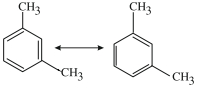
B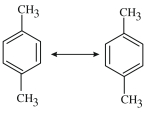
C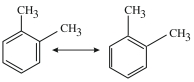
D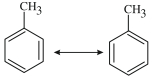
Solution
(C) Ozonolysis of a benzene ring with fixed double bonds involves the cleavage of the $C=C$ bonds to form carbonyl compounds.
For $1,2$-dimethylbenzene ($o$-xylene),the two resonance structures have different positions of the double bonds relative to the methyl groups.
In the first structure,the double bonds are between $C_1-C_2$,$C_3-C_4$,and $C_5-C_6$. Ozonolysis yields $CH_3-CO-CO-CH_3$ and $2 \ CHO-CHO$.
In the second structure,the double bonds are between $C_2-C_3$,$C_4-C_5$,and $C_6-C_1$. Ozonolysis yields $2 \ CH_3-CO-CHO$ and $CHO-CHO$.
Since the products are different,the pair of $o$-xylene structures gives different products upon ozonolysis.
For $1,2$-dimethylbenzene ($o$-xylene),the two resonance structures have different positions of the double bonds relative to the methyl groups.
In the first structure,the double bonds are between $C_1-C_2$,$C_3-C_4$,and $C_5-C_6$. Ozonolysis yields $CH_3-CO-CO-CH_3$ and $2 \ CHO-CHO$.
In the second structure,the double bonds are between $C_2-C_3$,$C_4-C_5$,and $C_6-C_1$. Ozonolysis yields $2 \ CH_3-CO-CHO$ and $CHO-CHO$.
Since the products are different,the pair of $o$-xylene structures gives different products upon ozonolysis.
0 likesView Solution
291
ChemistryDifficultMCQJEE Main · 2022
The minimum uncertainty in the speed of an electron in a one-dimensional region of length $2 a_{0}$ (where $a_{0} = \text{Bohr radius} = 52.9 \ pm$) is $km \ s^{-1}$. (Given: Mass of electron $= 9.1 \times 10^{-31} \ kg$,Planck's constant $h = 6.63 \times 10^{-34} \ J \ s$)
A
$548$
B
$547$
C
$546$
D
$545$
Solution
(A) According to Heisenberg's uncertainty principle:
$\Delta x \times \Delta p_{x} \geq \frac{h}{4 \pi}$
Given $\Delta x = 2 a_{0} = 2 \times 52.9 \times 10^{-12} \ m = 105.8 \times 10^{-12} \ m$.
For minimum uncertainty,$\Delta x \times m \Delta v = \frac{h}{4 \pi}$.
$\Delta v = \frac{h}{4 \pi \times m \times \Delta x}$
Substituting the values:
$\Delta v = \frac{6.63 \times 10^{-34}}{4 \times 3.14159 \times 9.1 \times 10^{-31} \times 105.8 \times 10^{-12}}$
$\Delta v \approx 548273 \ m \ s^{-1} = 548.273 \ km \ s^{-1}$.
Rounding to the nearest integer,the value is $548 \ km \ s^{-1}$.
$\Delta x \times \Delta p_{x} \geq \frac{h}{4 \pi}$
Given $\Delta x = 2 a_{0} = 2 \times 52.9 \times 10^{-12} \ m = 105.8 \times 10^{-12} \ m$.
For minimum uncertainty,$\Delta x \times m \Delta v = \frac{h}{4 \pi}$.
$\Delta v = \frac{h}{4 \pi \times m \times \Delta x}$
Substituting the values:
$\Delta v = \frac{6.63 \times 10^{-34}}{4 \times 3.14159 \times 9.1 \times 10^{-31} \times 105.8 \times 10^{-12}}$
$\Delta v \approx 548273 \ m \ s^{-1} = 548.273 \ km \ s^{-1}$.
Rounding to the nearest integer,the value is $548 \ km \ s^{-1}$.
0 likesView Solution
292
ChemistryAdvancedMCQJEE Main · 2022
When $600 \; mL$ of $0.2 \; M \; HNO_3$ is mixed with $400 \; mL$ of $0.1 \; M \; NaOH$ solution in a flask,the rise in temperature of the flask is $\dots \times 10^{-2} \; ^{\circ}C$. (Enthalpy of neutralisation $= 57 \; kJ \; mol^{-1}$ and Specific heat of water $= 4.2 \; J \; K^{-1} \; g^{-1}$) (Neglect heat capacity of flask)
A
$53$
B
$54$
C
$55$
D
$56$
Solution
(B) The reaction is: $HNO_3 + NaOH \rightarrow NaNO_3 + H_2O$
Initial moles of $HNO_3 = 600 \; mL \times 0.2 \; M = 120 \; m \; mol = 0.12 \; mol$
Initial moles of $NaOH = 400 \; mL \times 0.1 \; M = 40 \; m \; mol = 0.04 \; mol$
Since $NaOH$ is the limiting reagent,the moles of water formed $= 0.04 \; mol$.
Heat released $(q)$ $= \text{moles of water} \times \Delta_{neut}H = 0.04 \; mol \times 57 \times 10^3 \; J \; mol^{-1} = 2280 \; J$.
Total volume of solution $= 600 \; mL + 400 \; mL = 1000 \; mL$.
Assuming density of solution $\approx 1 \; g \; mL^{-1}$,mass of solution $(m)$ $= 1000 \; g$.
Using $q = m \times S \times \Delta T$:
$2280 \; J = 1000 \; g \times 4.2 \; J \; K^{-1} \; g^{-1} \times \Delta T$
$\Delta T = \frac{2280}{4200} \; K = 0.54286 \; K = 0.54286 \; ^{\circ}C$
Expressing in terms of $10^{-2} \; ^{\circ}C$:
$\Delta T = 54.286 \times 10^{-2} \; ^{\circ}C \approx 54 \times 10^{-2} \; ^{\circ}C$.
Initial moles of $HNO_3 = 600 \; mL \times 0.2 \; M = 120 \; m \; mol = 0.12 \; mol$
Initial moles of $NaOH = 400 \; mL \times 0.1 \; M = 40 \; m \; mol = 0.04 \; mol$
Since $NaOH$ is the limiting reagent,the moles of water formed $= 0.04 \; mol$.
Heat released $(q)$ $= \text{moles of water} \times \Delta_{neut}H = 0.04 \; mol \times 57 \times 10^3 \; J \; mol^{-1} = 2280 \; J$.
Total volume of solution $= 600 \; mL + 400 \; mL = 1000 \; mL$.
Assuming density of solution $\approx 1 \; g \; mL^{-1}$,mass of solution $(m)$ $= 1000 \; g$.
Using $q = m \times S \times \Delta T$:
$2280 \; J = 1000 \; g \times 4.2 \; J \; K^{-1} \; g^{-1} \times \Delta T$
$\Delta T = \frac{2280}{4200} \; K = 0.54286 \; K = 0.54286 \; ^{\circ}C$
Expressing in terms of $10^{-2} \; ^{\circ}C$:
$\Delta T = 54.286 \times 10^{-2} \; ^{\circ}C \approx 54 \times 10^{-2} \; ^{\circ}C$.
0 likesView Solution
293
ChemistryMediumMCQJEE Main · 2022
If the solubility product of $PbS$ is $8 \times 10^{-28}$,then the solubility of $PbS$ in pure water at $298 \ K$ is $x \times 10^{-16} \ mol \ L^{-1}$. The value of $x$ is $\dots$.
[Given $\sqrt{2} = 1.41$]
[Given $\sqrt{2} = 1.41$]
A
$281$
B
$282$
C
$283$
D
$284$
Solution
(B) The dissociation of $PbS$ is given by: $PbS(s) \rightleftharpoons Pb^{2+}(aq) + S^{2-}(aq)$.
The solubility product expression is $K_{sp} = [Pb^{2+}][S^{2-}] = S \times S = S^{2}$.
Given $K_{sp} = 8 \times 10^{-28}$.
Therefore,$S = \sqrt{8 \times 10^{-28}} = \sqrt{4 \times 2 \times 10^{-28}} = 2 \sqrt{2} \times 10^{-14} \ mol \ L^{-1}$.
Using the given value $\sqrt{2} = 1.41$,we get $S = 2 \times 1.41 \times 10^{-14} = 2.82 \times 10^{-14} \ mol \ L^{-1}$.
To express this in the form $x \times 10^{-16} \ mol \ L^{-1}$,we write $2.82 \times 10^{-14} = 282 \times 10^{-16}$.
Thus,the value of $x$ is $282$.
The solubility product expression is $K_{sp} = [Pb^{2+}][S^{2-}] = S \times S = S^{2}$.
Given $K_{sp} = 8 \times 10^{-28}$.
Therefore,$S = \sqrt{8 \times 10^{-28}} = \sqrt{4 \times 2 \times 10^{-28}} = 2 \sqrt{2} \times 10^{-14} \ mol \ L^{-1}$.
Using the given value $\sqrt{2} = 1.41$,we get $S = 2 \times 1.41 \times 10^{-14} = 2.82 \times 10^{-14} \ mol \ L^{-1}$.
To express this in the form $x \times 10^{-16} \ mol \ L^{-1}$,we write $2.82 \times 10^{-14} = 282 \times 10^{-16}$.
Thus,the value of $x$ is $282$.
0 likesView Solution
294
ChemistryMediumMCQJEE Main · 2022
In the bromination of propyne,$1,1,2,2-$tetrabromopropane is obtained in $27\%$ yield. The amount of $1,1,2,2-$tetrabromopropane obtained from $1 \; g$ of bromine $(Br_2)$ in this reaction is $\dots \; \times 10^{-1} \; g$. (Nearest integer)
(Molar mass: Bromine $(Br)$ $= 80 \; g/mol$)
(Molar mass: Bromine $(Br)$ $= 80 \; g/mol$)
A
$0$
B
$1$
C
$2$
D
$3$
Solution
(D) The chemical reaction is: $CH_3-C \equiv CH + 2Br_2 \rightarrow CH_3-CBr_2-CHBr_2$
$1$. Molar mass of $Br_2 = 2 \times 80 = 160 \; g/mol$.
$2$. Molar mass of $1,1,2,2-$tetrabromopropane $(C_3H_4Br_4)$ $= (3 \times 12) + (4 \times 1) + (4 \times 80) = 36 + 4 + 320 = 360 \; g/mol$.
$3$. According to the stoichiometry,$2 \; mol$ of $Br_2$ produces $1 \; mol$ of $1,1,2,2-$tetrabromopropane.
$4$. Moles of $Br_2$ used $= \frac{1 \; g}{160 \; g/mol} = 0.00625 \; mol$.
$5$. Theoretical moles of $1,1,2,2-$tetrabromopropane $= \frac{0.00625}{2} = 0.003125 \; mol$.
$6$. Theoretical mass of $1,1,2,2-$tetrabromopropane $= 0.003125 \; mol \times 360 \; g/mol = 1.125 \; g$.
$7$. Actual yield $(27\%)$ $= 1.125 \; g \times 0.27 = 0.30375 \; g$.
$8$. Expressing in $\times 10^{-1} \; g$: $0.30375 = 3.0375 \times 10^{-1} \; g$.
$9$. Nearest integer is $3$.
$1$. Molar mass of $Br_2 = 2 \times 80 = 160 \; g/mol$.
$2$. Molar mass of $1,1,2,2-$tetrabromopropane $(C_3H_4Br_4)$ $= (3 \times 12) + (4 \times 1) + (4 \times 80) = 36 + 4 + 320 = 360 \; g/mol$.
$3$. According to the stoichiometry,$2 \; mol$ of $Br_2$ produces $1 \; mol$ of $1,1,2,2-$tetrabromopropane.
$4$. Moles of $Br_2$ used $= \frac{1 \; g}{160 \; g/mol} = 0.00625 \; mol$.
$5$. Theoretical moles of $1,1,2,2-$tetrabromopropane $= \frac{0.00625}{2} = 0.003125 \; mol$.
$6$. Theoretical mass of $1,1,2,2-$tetrabromopropane $= 0.003125 \; mol \times 360 \; g/mol = 1.125 \; g$.
$7$. Actual yield $(27\%)$ $= 1.125 \; g \times 0.27 = 0.30375 \; g$.
$8$. Expressing in $\times 10^{-1} \; g$: $0.30375 = 3.0375 \times 10^{-1} \; g$.
$9$. Nearest integer is $3$.
0 likesView Solution
295
ChemistryDifficultMCQJEE Main · 2022
Consider the reaction
$4 HNO_{3(\ell)} + 3 KCl_{(s)} \rightarrow Cl_{2(g)} + NOCl_{(g)} + 2 H_{2}O_{(g)} + 3 KNO_{3(s)}$
The amount of $HNO_{3}$ required to produce $110.0 \ g$ of $KNO_{3}$ is $...... \ g$.
(Given: Atomic masses of $H, O, N$ and $K$ are $1, 16, 14$ and $39$ respectively.)
$4 HNO_{3(\ell)} + 3 KCl_{(s)} \rightarrow Cl_{2(g)} + NOCl_{(g)} + 2 H_{2}O_{(g)} + 3 KNO_{3(s)}$
The amount of $HNO_{3}$ required to produce $110.0 \ g$ of $KNO_{3}$ is $...... \ g$.
(Given: Atomic masses of $H, O, N$ and $K$ are $1, 16, 14$ and $39$ respectively.)
A
$32.2$
B
$69.4$
C
$91.5$
D
$162.5$
Solution
(C) The balanced chemical equation is:
$4 HNO_{3} + 3 KCl \rightarrow Cl_{2} + NOCl + 2 H_{2}O + 3 KNO_{3}$
Calculate the molar masses:
$M(HNO_{3}) = 1 + 14 + (3 \times 16) = 63 \ g/mol$
$M(KNO_{3}) = 39 + 14 + (3 \times 16) = 101 \ g/mol$
From the stoichiometry,$3 \ moles$ of $KNO_{3}$ are produced by $4 \ moles$ of $HNO_{3}$.
Number of moles of $KNO_{3}$ produced = $\frac{110.0 \ g}{101 \ g/mol} \approx 1.089 \ mol$.
Moles of $HNO_{3}$ required = $\frac{4}{3} \times (\text{moles of } KNO_{3}) = \frac{4}{3} \times \frac{110}{101} \approx 1.452 \ mol$.
Mass of $HNO_{3}$ required = $1.452 \ mol \times 63 \ g/mol = 91.5 \ g$.
$4 HNO_{3} + 3 KCl \rightarrow Cl_{2} + NOCl + 2 H_{2}O + 3 KNO_{3}$
Calculate the molar masses:
$M(HNO_{3}) = 1 + 14 + (3 \times 16) = 63 \ g/mol$
$M(KNO_{3}) = 39 + 14 + (3 \times 16) = 101 \ g/mol$
From the stoichiometry,$3 \ moles$ of $KNO_{3}$ are produced by $4 \ moles$ of $HNO_{3}$.
Number of moles of $KNO_{3}$ produced = $\frac{110.0 \ g}{101 \ g/mol} \approx 1.089 \ mol$.
Moles of $HNO_{3}$ required = $\frac{4}{3} \times (\text{moles of } KNO_{3}) = \frac{4}{3} \times \frac{110}{101} \approx 1.452 \ mol$.
Mass of $HNO_{3}$ required = $1.452 \ mol \times 63 \ g/mol = 91.5 \ g$.
0 likesView Solution
296
ChemistryMediumMCQJEE Main · 2022
Given below are the quantum numbers for $4$ electrons.
$A. \; n = 3, l = 2, m_l = 1, m_s = +1/2$
$B. \; n = 4, l = 1, m_l = 0, m_s = +1/2$
$C. \; n = 4, l = 2, m_l = -2, m_s = -1/2$
$D. \; n = 3, l = 1, m_l = -1, m_s = +1/2$
The correct order of increasing energy is
$A. \; n = 3, l = 2, m_l = 1, m_s = +1/2$
$B. \; n = 4, l = 1, m_l = 0, m_s = +1/2$
$C. \; n = 4, l = 2, m_l = -2, m_s = -1/2$
$D. \; n = 3, l = 1, m_l = -1, m_s = +1/2$
The correct order of increasing energy is
A
$D < B < A < C$
B
$D < A < B < C$
C
$B < D < A < C$
D
$B < D < C < A$
Solution
(B) The energy of an orbital is determined by the $(n + l)$ rule.
$A$ $\Rightarrow 3d$ $\Rightarrow n + l = 3 + 2 = 5$
$B$ $\Rightarrow 4p$ $\Rightarrow n + l = 4 + 1 = 5$
$C$ $\Rightarrow 4d$ $\Rightarrow n + l = 4 + 2 = 6$
$D$ $\Rightarrow 3p$ $\Rightarrow n + l = 3 + 1 = 4$
According to the $(n + l)$ rule,the energy increases as the $(n + l)$ value increases.
If the $(n + l)$ values are the same,the orbital with the lower $n$ value has lower energy.
Comparing the values:
$D (n+l = 4) < A (n+l = 5, n=3) < B (n+l = 5, n=4) < C (n+l = 6)$
Therefore,the correct order of increasing energy is $D < A < B < C$.
$A$ $\Rightarrow 3d$ $\Rightarrow n + l = 3 + 2 = 5$
$B$ $\Rightarrow 4p$ $\Rightarrow n + l = 4 + 1 = 5$
$C$ $\Rightarrow 4d$ $\Rightarrow n + l = 4 + 2 = 6$
$D$ $\Rightarrow 3p$ $\Rightarrow n + l = 3 + 1 = 4$
According to the $(n + l)$ rule,the energy increases as the $(n + l)$ value increases.
If the $(n + l)$ values are the same,the orbital with the lower $n$ value has lower energy.
Comparing the values:
$D (n+l = 4) < A (n+l = 5, n=3) < B (n+l = 5, n=4) < C (n+l = 6)$
Therefore,the correct order of increasing energy is $D < A < B < C$.
0 likesView Solution
297
ChemistryAdvancedMCQJEE Main · 2022
$C_{(s)} + O_{2(g)} \rightarrow CO_{2(g)} + 400 \; kJ$
$C_{(s)} + \frac{1}{2} O_{2(g)} \rightarrow CO_{(g)} + 100 \; kJ$
When coal of purity $60 \%$ is allowed to burn in the presence of insufficient oxygen,$60 \%$ of carbon is converted into $CO$ and the remaining is converted into $CO_2$.
The heat generated when $0.6 \; kg$ of coal is burnt is (in $; kJ$)
$C_{(s)} + \frac{1}{2} O_{2(g)} \rightarrow CO_{(g)} + 100 \; kJ$
When coal of purity $60 \%$ is allowed to burn in the presence of insufficient oxygen,$60 \%$ of carbon is converted into $CO$ and the remaining is converted into $CO_2$.
The heat generated when $0.6 \; kg$ of coal is burnt is (in $; kJ$)
A
$1600$
B
$3200$
C
$4400$
D
$6600$
Solution
(D) Given equations:
$C_{(s)} + O_{2(g)} \rightarrow CO_{2(g)} + 400 \; kJ \; (I)$
$C_{(s)} + \frac{1}{2} O_{2(g)} \rightarrow CO_{(g)} + 100 \; kJ \; (II)$
Mass of coal $= 0.6 \; kg = 600 \; g$
Pure Carbon $= 600 \times \frac{60}{100} = 360 \; g$
Moles of pure Carbon $= \frac{360 \; g}{12 \; g/mol} = 30 \; mol$
Carbon converted into $CO = 30 \times 0.60 = 18 \; mol$
Carbon converted into $CO_2 = 30 - 18 = 12 \; mol$
Energy from $CO$ formation $= 18 \; mol \times 100 \; kJ/mol = 1800 \; kJ$
Energy from $CO_2$ formation $= 12 \; mol \times 400 \; kJ/mol = 4800 \; kJ$
Total heat generated $= 1800 \; kJ + 4800 \; kJ = 6600 \; kJ$
$C_{(s)} + O_{2(g)} \rightarrow CO_{2(g)} + 400 \; kJ \; (I)$
$C_{(s)} + \frac{1}{2} O_{2(g)} \rightarrow CO_{(g)} + 100 \; kJ \; (II)$
Mass of coal $= 0.6 \; kg = 600 \; g$
Pure Carbon $= 600 \times \frac{60}{100} = 360 \; g$
Moles of pure Carbon $= \frac{360 \; g}{12 \; g/mol} = 30 \; mol$
Carbon converted into $CO = 30 \times 0.60 = 18 \; mol$
Carbon converted into $CO_2 = 30 - 18 = 12 \; mol$
Energy from $CO$ formation $= 18 \; mol \times 100 \; kJ/mol = 1800 \; kJ$
Energy from $CO_2$ formation $= 12 \; mol \times 400 \; kJ/mol = 4800 \; kJ$
Total heat generated $= 1800 \; kJ + 4800 \; kJ = 6600 \; kJ$
0 likesView Solution
298
ChemistryMediumMCQJEE Main · 2022
$200 \ mL$ of $0.01 \ M \ HCl$ is mixed with $400 \ mL$ of $0.01 \ M \ H_{2}SO_{4}$. The $pH$ of the mixture is
A
$1.14$
B
$1.78$
C
$2.34$
D
$3.02$
Solution
(B) The total moles of $H^{+}$ ions from $HCl$ is $n_{1} = M \times V = 0.01 \times 0.2 = 0.002 \ mol$.
The total moles of $H^{+}$ ions from $H_{2}SO_{4}$ is $n_{2} = M \times V \times 2 = 0.01 \times 0.4 \times 2 = 0.008 \ mol$.
Total moles of $H^{+} = 0.002 + 0.008 = 0.01 \ mol$.
Total volume of the mixture = $200 \ mL + 400 \ mL = 600 \ mL = 0.6 \ L$.
Concentration of $[H^{+}] = \frac{0.01 \ mol}{0.6 \ L} = \frac{1}{60} \ M$.
$pH = -\log[H^{+}] = -\log(\frac{1}{60}) = \log(60) = \log(6 \times 10) = \log(6) + \log(10) \approx 0.778 + 1 = 1.778 \approx 1.78$.
The total moles of $H^{+}$ ions from $H_{2}SO_{4}$ is $n_{2} = M \times V \times 2 = 0.01 \times 0.4 \times 2 = 0.008 \ mol$.
Total moles of $H^{+} = 0.002 + 0.008 = 0.01 \ mol$.
Total volume of the mixture = $200 \ mL + 400 \ mL = 600 \ mL = 0.6 \ L$.
Concentration of $[H^{+}] = \frac{0.01 \ mol}{0.6 \ L} = \frac{1}{60} \ M$.
$pH = -\log[H^{+}] = -\log(\frac{1}{60}) = \log(60) = \log(6 \times 10) = \log(6) + \log(10) \approx 0.778 + 1 = 1.778 \approx 1.78$.
0 likesView Solution
299
ChemistryMediumMCQJEE Main · 2022
Given below are two statements.
Statement $I$ : Stannane $(SnH_4)$ is an example of a molecular hydride.
Statement $II$ : Stannane is a planar molecule.
In the light of the above statements,choose the most appropriate answer from the options given below.
Statement $I$ : Stannane $(SnH_4)$ is an example of a molecular hydride.
Statement $II$ : Stannane is a planar molecule.
In the light of the above statements,choose the most appropriate answer from the options given below.
A
Both Statement $I$ and Statement $II$ are true.
B
Both Statement $I$ and Statement $II$ are false.
C
Statement $I$ is true but Statement $II$ is false.
D
Statement $I$ is false but Statement $II$ is true.
Solution
(C) $SnH_4$ (stannane) is a molecular hydride formed by the reaction of $Sn$ with hydrogen,which is true.
$SnH_4$ has a tetrahedral geometry with $sp^3$ hybridization,which means it is a non-planar molecule.
Therefore,Statement $I$ is true and Statement $II$ is false.
$SnH_4$ has a tetrahedral geometry with $sp^3$ hybridization,which means it is a non-planar molecule.
Therefore,Statement $I$ is true and Statement $II$ is false.
0 likesView Solution
300
ChemistryMediumMCQJEE Main · 2022
Portland cement contains '$X$' to enhance the setting time. What is '$X$'?
A
$CaSO_{4} \cdot \frac{1}{2} H_{2}O$
B
$CaSO_{4} \cdot 2 H_{2}O$
C
$CaSO_{4}$
D
$CaCO_{3}$
Solution
(B) Gypsum $(CaSO_{4} \cdot 2 H_{2}O)$ is added to Portland cement to slow down the process of setting,thereby increasing the setting time.
0 likesView Solution
301
ChemistryMediumMCQJEE Main · 2022
Which reactant will give the following alcohol on reaction with one mole of phenyl magnesium bromide $(PhMgBr)$ followed by acidic hydrolysis?
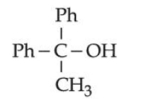
A
$CH_3-C \equiv N$
B
$Ph-C \equiv N$
C
$CH_3-CO-O-Ph$
D
$Ph-CO-CH_3$
Solution
(D) The target alcohol is $1,1-diphenyl-1-ethanol$ (or $1-phenylethanol$ derivative with two phenyl groups attached to the same carbon).
Reaction of a ketone with a Grignard reagent $(RMgX)$ followed by acidic hydrolysis yields a tertiary alcohol.
Specifically,the reaction of acetophenone $(Ph-CO-CH_3)$ with one mole of phenyl magnesium bromide $(PhMgBr)$ followed by acidic hydrolysis $(H^+)$ proceeds as follows:
$Ph-CO-CH_3 + PhMgBr \rightarrow Ph-C(OMgBr)(Ph)-CH_3$
$Ph-C(OMgBr)(Ph)-CH_3 + H_2O/H^+ \rightarrow Ph-C(OH)(Ph)-CH_3 + Mg(OH)Br$
This matches the structure of the product shown in the image. Therefore,the correct reactant is acetophenone $(Ph-CO-CH_3)$.
Reaction of a ketone with a Grignard reagent $(RMgX)$ followed by acidic hydrolysis yields a tertiary alcohol.
Specifically,the reaction of acetophenone $(Ph-CO-CH_3)$ with one mole of phenyl magnesium bromide $(PhMgBr)$ followed by acidic hydrolysis $(H^+)$ proceeds as follows:
$Ph-CO-CH_3 + PhMgBr \rightarrow Ph-C(OMgBr)(Ph)-CH_3$
$Ph-C(OMgBr)(Ph)-CH_3 + H_2O/H^+ \rightarrow Ph-C(OH)(Ph)-CH_3 + Mg(OH)Br$
This matches the structure of the product shown in the image. Therefore,the correct reactant is acetophenone $(Ph-CO-CH_3)$.
0 likesView Solution
302
ChemistryMediumMCQJEE Main · 2022
Stearic acid and polyethylene glycol react to form which one of the following soaps/detergents?
A
Cationic detergent
B
Soap
C
Anionic detergent
D
Non-ionic detergent
Solution
(D) The reaction between stearic acid $(CH_3(CH_2)_{16}COOH)$ and polyethylene glycol $(OH(CH_2CH_2O)_nCH_2CH_2OH)$ involves the elimination of a water molecule to form an ester linkage.
The chemical reaction is:
$CH_3(CH_2)_{16}COOH + OH(CH_2CH_2O)_nCH_2CH_2OH \rightarrow CH_3(CH_2)_{16}CO(OCH_2CH_2)_{n+1}OH + H_2O$
This product does not contain any ionic groups and is therefore classified as a non-ionic detergent.
The chemical reaction is:
$CH_3(CH_2)_{16}COOH + OH(CH_2CH_2O)_nCH_2CH_2OH \rightarrow CH_3(CH_2)_{16}CO(OCH_2CH_2)_{n+1}OH + H_2O$
This product does not contain any ionic groups and is therefore classified as a non-ionic detergent.
0 likesView Solution
303
ChemistryMediumMCQJEE Main · 2022
Which of the following is a reducing sugar?
A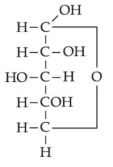
B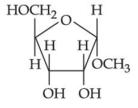
C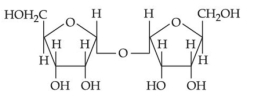
D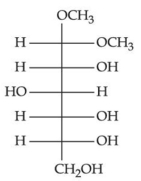
Solution
(A) sugar is considered a reducing sugar if it possesses a free $-OH$ group at the anomeric carbon,which allows it to exist in equilibrium with its open-chain aldehyde or ketone form. This form can then act as a reducing agent.
In the provided options,the structure in option $A$ shows a cyclic monosaccharide with a free $-OH$ group at the anomeric carbon,making it a reducing sugar.
In the provided options,the structure in option $A$ shows a cyclic monosaccharide with a free $-OH$ group at the anomeric carbon,making it a reducing sugar.
0 likesView Solution
304
ChemistryMediumMCQJEE Main · 2022
Given below are two statements: one is labelled as Assertion $(A)$ and the other is labelled as Reason $(R)$.
Assertion $(A)$: Experimental reaction of $CH_{3}Cl$ with aniline and anhydrous $AlCl_{3}$ does not give $o-$ and $p-$methylaniline.
Reason $(R)$: The $-NH_{2}$ group of aniline becomes deactivating because of salt formation with anhydrous $AlCl_{3}$ and hence yields $m-$methylaniline as the product.
In the light of the above statements,choose the most appropriate answer from the options given below.
Assertion $(A)$: Experimental reaction of $CH_{3}Cl$ with aniline and anhydrous $AlCl_{3}$ does not give $o-$ and $p-$methylaniline.
Reason $(R)$: The $-NH_{2}$ group of aniline becomes deactivating because of salt formation with anhydrous $AlCl_{3}$ and hence yields $m-$methylaniline as the product.
In the light of the above statements,choose the most appropriate answer from the options given below.
A
Both $(A)$ and $(R)$ are true and $(R)$ is the correct explanation of $(A)$.
B
Both $(A)$ and $(R)$ are true but $(R)$ is not the correct explanation of $(A)$.
C
$(A)$ is true,but $(R)$ is false.
D
$(A)$ is false,but $(R)$ is true.
Solution
(C) Aniline is a Lewis base and reacts with the Lewis acid $AlCl_{3}$ to form an acid-base adduct (salt),$C_{6}H_{5}NH_{2} \cdot AlCl_{3}$.
In this adduct,the nitrogen atom carries a positive charge,which makes the $-NH_{2}$ group strongly electron-withdrawing (deactivating) and meta-directing.
However,because the ring is so strongly deactivated,it does not undergo Friedel-Crafts alkylation with $CH_{3}Cl$.
Therefore,the reaction does not yield $o-$ or $p-$methylaniline,nor does it yield $m-$methylaniline; it simply does not proceed.
Thus,Assertion $(A)$ is true,but Reason $(R)$ is false because the reaction does not yield $m-$methylaniline.
In this adduct,the nitrogen atom carries a positive charge,which makes the $-NH_{2}$ group strongly electron-withdrawing (deactivating) and meta-directing.
However,because the ring is so strongly deactivated,it does not undergo Friedel-Crafts alkylation with $CH_{3}Cl$.
Therefore,the reaction does not yield $o-$ or $p-$methylaniline,nor does it yield $m-$methylaniline; it simply does not proceed.
Thus,Assertion $(A)$ is true,but Reason $(R)$ is false because the reaction does not yield $m-$methylaniline.
0 likesView Solution
305
ChemistryMediumMCQJEE Main · 2022
At $298 \ K$,the equilibrium constant is $2 \times 10^{15}$ for the reaction:
$Cu_{(s)} + 2 Ag^{+}_{(aq)} \rightleftharpoons Cu^{2+}_{(aq)} + 2 Ag_{(s)}$
The equilibrium constant for the reaction $\frac{1}{2} Cu^{2+}_{(aq)} + Ag_{(s)} \rightleftharpoons \frac{1}{2} Cu_{(s)} + Ag^{+}_{(aq)}$ is $x \times 10^{-8}$. The value of $x$ is (Nearest Integer).
$Cu_{(s)} + 2 Ag^{+}_{(aq)} \rightleftharpoons Cu^{2+}_{(aq)} + 2 Ag_{(s)}$
The equilibrium constant for the reaction $\frac{1}{2} Cu^{2+}_{(aq)} + Ag_{(s)} \rightleftharpoons \frac{1}{2} Cu_{(s)} + Ag^{+}_{(aq)}$ is $x \times 10^{-8}$. The value of $x$ is (Nearest Integer).
A
$3$
B
$0$
C
$1$
D
$2$
Solution
(D) Given reaction: $Cu_{(s)} + 2 Ag^{+}_{(aq)} \rightleftharpoons Cu^{2+}_{(aq)} + 2 Ag_{(s)}$ with $K_{eq} = 2 \times 10^{15}$.
The target reaction is $\frac{1}{2} Cu^{2+}_{(aq)} + Ag_{(s)} \rightleftharpoons \frac{1}{2} Cu_{(s)} + Ag^{+}_{(aq)}$.
This target reaction is the reverse of the original reaction multiplied by a factor of $\frac{1}{2}$.
Therefore,the new equilibrium constant $K_{eq}^{\prime} = (K_{eq})^{-1/2} = \frac{1}{\sqrt{K_{eq}}}$.
$K_{eq}^{\prime} = \frac{1}{\sqrt{2 \times 10^{15}}} = \frac{1}{\sqrt{20 \times 10^{14}}} = \frac{1}{\sqrt{20} \times 10^7} = \frac{1}{4.472 \times 10^7} \approx 0.2236 \times 10^{-7} = 2.236 \times 10^{-8}$.
Comparing this with $x \times 10^{-8}$,we get $x = 2.236$.
The nearest integer value of $x$ is $2$.
The target reaction is $\frac{1}{2} Cu^{2+}_{(aq)} + Ag_{(s)} \rightleftharpoons \frac{1}{2} Cu_{(s)} + Ag^{+}_{(aq)}$.
This target reaction is the reverse of the original reaction multiplied by a factor of $\frac{1}{2}$.
Therefore,the new equilibrium constant $K_{eq}^{\prime} = (K_{eq})^{-1/2} = \frac{1}{\sqrt{K_{eq}}}$.
$K_{eq}^{\prime} = \frac{1}{\sqrt{2 \times 10^{15}}} = \frac{1}{\sqrt{20 \times 10^{14}}} = \frac{1}{\sqrt{20} \times 10^7} = \frac{1}{4.472 \times 10^7} \approx 0.2236 \times 10^{-7} = 2.236 \times 10^{-8}$.
Comparing this with $x \times 10^{-8}$,we get $x = 2.236$.
The nearest integer value of $x$ is $2$.
0 likesView Solution
306
ChemistryEasyMCQJEE Main · 2022
The amount of charge in $F$ (Faraday) required to obtain one mole of iron from $Fe_{3}O_{4}$ is (Nearest Integer).
A
$1$
B
$2$
C
$3$
D
$4$
Solution
(C) The chemical formula for the reduction of $Fe_{3}O_{4}$ to $Fe$ is:
$Fe_{3}O_{4} + 8e^{-} \rightarrow 3Fe + 4O^{2-}$
In this reaction,$8$ moles of electrons are required to produce $3$ moles of iron $(Fe)$.
Therefore,the charge required to produce $1$ mole of iron is $8/3 \, F$.
$8/3 \approx 2.67 \, F$.
Rounding to the nearest integer,we get $3 \, F$.
$Fe_{3}O_{4} + 8e^{-} \rightarrow 3Fe + 4O^{2-}$
In this reaction,$8$ moles of electrons are required to produce $3$ moles of iron $(Fe)$.
Therefore,the charge required to produce $1$ mole of iron is $8/3 \, F$.
$8/3 \approx 2.67 \, F$.
Rounding to the nearest integer,we get $3 \, F$.
0 likesView Solution
307
ChemistryMediumMCQJEE Main · 2022
For a reaction $A \rightarrow 2 B + C$ the half-lives are $100 \ s$ and $50 \ s$ when the concentration of reactant $A$ is $0.5 \ mol \ L^{-1}$ and $1.0 \ mol \ L^{-1}$ respectively. The order of the reaction is (Nearest Integer).
A
$2$
B
$1$
C
$3$
D
$0$
Solution
(A) The half-life of a reaction of order $n$ is related to the initial concentration $[A_0]$ as $t_{\frac{1}{2}} \propto \frac{1}{[A_0]^{n-1}}$.
Given:
$t_{\frac{1}{2}, 1} = 100 \ s$ at $[A_0]_1 = 0.5 \ mol \ L^{-1}$
$t_{\frac{1}{2}, 2} = 50 \ s$ at $[A_0]_2 = 1.0 \ mol \ L^{-1}$
Taking the ratio:
$\frac{t_{\frac{1}{2}, 1}}{t_{\frac{1}{2}, 2}} = \left( \frac{[A_0]_2}{[A_0]_1} \right)^{n-1}$
$\frac{100}{50} = \left( \frac{1.0}{0.5} \right)^{n-1}$
$2 = (2)^{n-1}$
$2^1 = 2^{n-1}$
Comparing the exponents:
$n - 1 = 1$
$n = 2$
The order of the reaction is $2$.
Given:
$t_{\frac{1}{2}, 1} = 100 \ s$ at $[A_0]_1 = 0.5 \ mol \ L^{-1}$
$t_{\frac{1}{2}, 2} = 50 \ s$ at $[A_0]_2 = 1.0 \ mol \ L^{-1}$
Taking the ratio:
$\frac{t_{\frac{1}{2}, 1}}{t_{\frac{1}{2}, 2}} = \left( \frac{[A_0]_2}{[A_0]_1} \right)^{n-1}$
$\frac{100}{50} = \left( \frac{1.0}{0.5} \right)^{n-1}$
$2 = (2)^{n-1}$
$2^1 = 2^{n-1}$
Comparing the exponents:
$n - 1 = 1$
$n = 2$
The order of the reaction is $2$.
0 likesView Solution
308
ChemistryMediumMCQJEE Main · 2022
The difference between spin-only magnetic moment values of $[Co(H_2O)_6]Cl_2$ and $[Cr(H_2O)_6]Cl_3$ is $....$
A
$1$
B
$2$
C
$0$
D
$3$
Solution
(C) For $[Co(H_2O)_6]Cl_2$:
$Co^{2+}$ has a $3d^7$ configuration. In an octahedral field,the electrons are arranged as $t_{2g}^5 e_g^2$,resulting in $3$ unpaired electrons.
The spin-only magnetic moment $\mu = \sqrt{n(n+2)} \ BM = \sqrt{3(3+2)} = \sqrt{15} \ BM$.
For $[Cr(H_2O)_6]Cl_3$:
$Cr^{3+}$ has a $3d^3$ configuration. The electrons are arranged as $t_{2g}^3 e_g^0$,resulting in $3$ unpaired electrons.
The spin-only magnetic moment $\mu = \sqrt{n(n+2)} \ BM = \sqrt{3(3+2)} = \sqrt{15} \ BM$.
Difference in spin-only magnetic moment $= \sqrt{15} - \sqrt{15} = 0$.
$Co^{2+}$ has a $3d^7$ configuration. In an octahedral field,the electrons are arranged as $t_{2g}^5 e_g^2$,resulting in $3$ unpaired electrons.
The spin-only magnetic moment $\mu = \sqrt{n(n+2)} \ BM = \sqrt{3(3+2)} = \sqrt{15} \ BM$.
For $[Cr(H_2O)_6]Cl_3$:
$Cr^{3+}$ has a $3d^3$ configuration. The electrons are arranged as $t_{2g}^3 e_g^0$,resulting in $3$ unpaired electrons.
The spin-only magnetic moment $\mu = \sqrt{n(n+2)} \ BM = \sqrt{3(3+2)} = \sqrt{15} \ BM$.
Difference in spin-only magnetic moment $= \sqrt{15} - \sqrt{15} = 0$.
0 likesView Solution
309
ChemistryMediumMCQJEE Main · 2022
Given below are two statements:
Statement $I$: For $KI$,molar conductivity increases steeply with dilution.
Statement $II$: For carbonic acid,molar conductivity increases slowly with dilution.
In the light of the above statements,choose the correct answer from the options given below:
Statement $I$: For $KI$,molar conductivity increases steeply with dilution.
Statement $II$: For carbonic acid,molar conductivity increases slowly with dilution.
In the light of the above statements,choose the correct answer from the options given below:
A
Both Statement $I$ and Statement $II$ are true
B
Both Statement $I$ and Statement $II$ are false
C
Statement $I$ is true but Statement $II$ is false
D
Statement $I$ is false but Statement $II$ is true
Solution
(B) Statement $I$ is false because $KI$ is a strong electrolyte,and for strong electrolytes,molar conductivity increases only slightly with dilution.
Statement $II$ is false because carbonic acid $(H_2CO_3)$ is a weak electrolyte,and for weak electrolytes,molar conductivity increases sharply with dilution due to an increase in the degree of dissociation.
Therefore,both statements are false.
Statement $II$ is false because carbonic acid $(H_2CO_3)$ is a weak electrolyte,and for weak electrolytes,molar conductivity increases sharply with dilution due to an increase in the degree of dissociation.
Therefore,both statements are false.
0 likesView Solution
310
ChemistryMediumMCQJEE Main · 2022
Given below are two statements: one is labelled as Assertion $(A)$ and the other is labelled as Reason $(R)$.
Assertion $(A)$: Dissolved substances can be removed from a colloidal solution by diffusion through a parchment paper.
Reason $(R)$: Particles in a true solution cannot pass through parchment paper but the colloidal particles can pass through the parchment paper.
In the light of the above statements,choose the correct answer from the options given below.
Assertion $(A)$: Dissolved substances can be removed from a colloidal solution by diffusion through a parchment paper.
Reason $(R)$: Particles in a true solution cannot pass through parchment paper but the colloidal particles can pass through the parchment paper.
In the light of the above statements,choose the correct answer from the options given below.
A
Both $(A)$ and $(R)$ are correct and $(R)$ is the correct explanation of $(A)$.
B
Both $(A)$ and $(R)$ are correct but $(R)$ is not the correct explanation of $(A)$.
C
$(A)$ is correct but $(R)$ is not correct.
D
$(A)$ is not correct but $(R)$ is correct.
Solution
(C) Assertion $(A)$ is correct because dissolved substances (crystalloids) can pass through parchment paper,while colloidal particles cannot,allowing for purification via dialysis.
Reason $(R)$ is incorrect because particles in a true solution (crystalloids) can easily pass through parchment paper,whereas colloidal particles are too large to pass through it.
Therefore,$(A)$ is correct but $(R)$ is incorrect.
Reason $(R)$ is incorrect because particles in a true solution (crystalloids) can easily pass through parchment paper,whereas colloidal particles are too large to pass through it.
Therefore,$(A)$ is correct but $(R)$ is incorrect.
0 likesView Solution
311
ChemistryMediumMCQJEE Main · 2022
Low oxidation states of metals in their complexes are common when ligands:
A
have good $\pi$-accepting character
B
have good $\sigma$-donor character
C
have good $\pi$-donating ability
D
have poor $\sigma$-donating ability
Solution
(A) In complexes where the metal is in a low oxidation state,the metal center is electron-rich. To stabilize this state,the ligands must be able to accept electron density from the metal through back-bonding. Therefore,ligands with good $\pi$-accepting character (such as $CO$,$NO^+$,$CN^-$) are required to form stable complexes with metals in low oxidation states.
0 likesView Solution
312
ChemistryMediumMCQJEE Main · 2022
The structure of $A$ in the given reaction is:
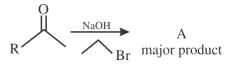
A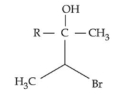
B
C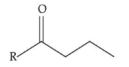
D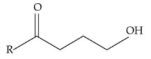
Solution
(D) The reaction involves the treatment of a ketone with a base $(NaOH)$ and an alkyl halide $(CH_3CH_2Br)$. This is an alkylation reaction of the enolate ion formed from the ketone.
$1$. The base $(NaOH)$ abstracts an $\alpha$-hydrogen from the ketone $(R-CO-CH_3)$ to form an enolate ion $(R-CO-CH_2^-)$.
$2$. The enolate ion then acts as a nucleophile and attacks the alkyl halide $(CH_3CH_2Br)$ via an $S_N2$ mechanism.
$3$. The alkyl group $(CH_3CH_2-)$ gets attached to the $\alpha$-carbon of the ketone.
$4$. The resulting product is $R-CO-CH_2-CH_2-CH_3$.
Comparing this with the given options,option $D$ represents the structure $R-CO-CH_2-CH_2-CH_3$.
$1$. The base $(NaOH)$ abstracts an $\alpha$-hydrogen from the ketone $(R-CO-CH_3)$ to form an enolate ion $(R-CO-CH_2^-)$.
$2$. The enolate ion then acts as a nucleophile and attacks the alkyl halide $(CH_3CH_2Br)$ via an $S_N2$ mechanism.
$3$. The alkyl group $(CH_3CH_2-)$ gets attached to the $\alpha$-carbon of the ketone.
$4$. The resulting product is $R-CO-CH_2-CH_2-CH_3$.
Comparing this with the given options,option $D$ represents the structure $R-CO-CH_2-CH_2-CH_3$.
0 likesView Solution
313
ChemistryDifficultMCQJEE Main · 2022
Major product '$B$' of the following reaction sequence is.
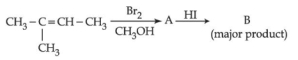
A
$CH_3-C(OH)(CH_3)-CH(Br)-CH_3$
B
$CH_3-C(I)(CH_3)-CH(Br)-CH_3$
C
$CH_3-C(Br)(CH_3)-CH(OH)-CH_3$
D
$CH_3-C(Br)(CH_3)-CH(I)-CH_3$
Solution
(B) The reaction of $2$-methylbut-$2$-ene with $Br_2$ in the presence of $CH_3OH$ (a polar protic solvent) proceeds via the formation of a bromonium ion intermediate.
$CH_3OH$ acts as a nucleophile and attacks the more substituted carbon atom of the bromonium ion to form an ether,$A$ ($3$-bromo-$2$-methoxy-$2$-methylbutane).
Reaction: $CH_3-C(CH_3)=CH-CH_3 + Br_2 + CH_3OH \rightarrow CH_3-C(OCH_3)(CH_3)-CH(Br)-CH_3$ $(A)$.
When $A$ reacts with $HI$,the methoxy group $(-OCH_3)$ is protonated by $H^+$ to form an oxonium ion,which is a good leaving group.
$I^-$ then attacks the tertiary carbon atom,displacing $CH_3OH$ to form the final product $B$ ($3$-bromo-$2$-iodo-$2$-methylbutane).
Therefore,the major product $B$ is $CH_3-C(I)(CH_3)-CH(Br)-CH_3$.
$CH_3OH$ acts as a nucleophile and attacks the more substituted carbon atom of the bromonium ion to form an ether,$A$ ($3$-bromo-$2$-methoxy-$2$-methylbutane).
Reaction: $CH_3-C(CH_3)=CH-CH_3 + Br_2 + CH_3OH \rightarrow CH_3-C(OCH_3)(CH_3)-CH(Br)-CH_3$ $(A)$.
When $A$ reacts with $HI$,the methoxy group $(-OCH_3)$ is protonated by $H^+$ to form an oxonium ion,which is a good leaving group.
$I^-$ then attacks the tertiary carbon atom,displacing $CH_3OH$ to form the final product $B$ ($3$-bromo-$2$-iodo-$2$-methylbutane).
Therefore,the major product $B$ is $CH_3-C(I)(CH_3)-CH(Br)-CH_3$.
0 likesView Solution
314
ChemistryDifficultMCQJEE Main · 2022
Match List-$I$ with List-$II$.
Choose the correct answer from the options given below.
| $A$. $C_6H_5COCl + H_2 \xrightarrow{Pd-BaSO_4} C_6H_5CHO$ | $I$. Gattermann-Koch reaction |
| $B$. $CH_3CN + SnCl_2 + HCl \rightarrow CH_3CHO$ | $II$. Etard reaction |
| $C$. $C_6H_5CH_3 + CrO_2Cl_2 \rightarrow C_6H_5CHO$ | $III$. Stephen reaction |
| $D$. $C_6H_6 + CO + HCl \xrightarrow{AlCl_3} C_6H_5CHO$ | $IV$. Rosenmund reaction |
Choose the correct answer from the options given below.
A
$A-IV, B-III, C-II, D-I$
B
$A-I, B-II, C-III, D-IV$
C
$A-II, B-III, C-IV, D-I$
D
$A-III, B-II, C-I, D-IV$
Solution
(A) The correct matches are as follows:
$A$. $C_6H_5COCl + H_2 \xrightarrow{Pd-BaSO_4} C_6H_5CHO$ is the Rosenmund reaction $(IV)$.
$B$. $CH_3CN + SnCl_2 + HCl \rightarrow CH_3CHO$ is the Stephen reaction $(III)$.
$C$. $C_6H_5CH_3 + CrO_2Cl_2 \rightarrow C_6H_5CHO$ is the Etard reaction $(II)$.
$D$. $C_6H_6 + CO + HCl \xrightarrow{AlCl_3} C_6H_5CHO$ is the Gattermann-Koch reaction $(I)$.
Therefore,the correct sequence is $A-IV, B-III, C-II, D-I$.
$A$. $C_6H_5COCl + H_2 \xrightarrow{Pd-BaSO_4} C_6H_5CHO$ is the Rosenmund reaction $(IV)$.
$B$. $CH_3CN + SnCl_2 + HCl \rightarrow CH_3CHO$ is the Stephen reaction $(III)$.
$C$. $C_6H_5CH_3 + CrO_2Cl_2 \rightarrow C_6H_5CHO$ is the Etard reaction $(II)$.
$D$. $C_6H_6 + CO + HCl \xrightarrow{AlCl_3} C_6H_5CHO$ is the Gattermann-Koch reaction $(I)$.
Therefore,the correct sequence is $A-IV, B-III, C-II, D-I$.
0 likesView Solution
315
ChemistryMediumMCQJEE Main · 2022
Match $List-I$ with $List-II$.
Choose the correct answer from the options given below.
| $List-I$ (Polymer) | $List-II$ (Monomer) |
| $(A)$ Neoprene | $(I)$ Acrylonitrile |
| $(B)$ Teflon | $(II)$ Chloroprene |
| $(C)$ Acrilan | $(III)$ Tetrafluoroethene |
| $(D)$ Natural rubber | $(IV)$ Isoprene |
Choose the correct answer from the options given below.
A
$A-II, B-III, C-I, D-IV$
B
$A-II, B-I, C-III, D-IV$
C
$A-II, B-I, C-IV, D-III$
D
$A-I, B-II, C-III, D-IV$
Solution
(A) The correct matches are as follows:
$(A)$ Neoprene is a polymer of chloroprene $(2-chloro-1,3-butadiene)$. Thus,$A-II$.
$(B)$ Teflon is a polymer of tetrafluoroethene $(CF_2=CF_2)$. Thus,$B-III$.
$(C)$ Acrilan (polyacrylonitrile) is a polymer of acrylonitrile $(CH_2=CH-CN)$. Thus,$C-I$.
$(D)$ Natural rubber is a polymer of isoprene $(2-methyl-1,3-butadiene)$. Thus,$D-IV$.
Therefore,the correct sequence is $A-II, B-III, C-I, D-IV$.
$(A)$ Neoprene is a polymer of chloroprene $(2-chloro-1,3-butadiene)$. Thus,$A-II$.
$(B)$ Teflon is a polymer of tetrafluoroethene $(CF_2=CF_2)$. Thus,$B-III$.
$(C)$ Acrilan (polyacrylonitrile) is a polymer of acrylonitrile $(CH_2=CH-CN)$. Thus,$C-I$.
$(D)$ Natural rubber is a polymer of isoprene $(2-methyl-1,3-butadiene)$. Thus,$D-IV$.
Therefore,the correct sequence is $A-II, B-III, C-I, D-IV$.
0 likesView Solution
316
ChemistryDifficultMCQJEE Main · 2022
An organic compound $A$ contains nitrogen and chlorine. It dissolves readily in water to give a solution that turns litmus red. Titration of compound $A$ with standard base indicates that the molecular weight of $A$ is $131 \pm 2$. When a sample of $A$ is treated with aqueous $NaOH$,a liquid separates which contains $N$ but not $Cl$. Treatment of the obtained liquid with nitrous acid followed by phenol gives an orange precipitate. The compound $A$ is:
A
$C_6H_5NH_3Cl$
B
$C_6H_5CH_2NH_2 \cdot HCl$
C
$o-Cl-C_6H_4NH_2$
D
$p-Cl-C_6H_4NH_3Cl$
Solution
(A) $1$. The compound $A$ contains $N$ and $Cl$ and forms an acidic solution in water,suggesting it is an amine hydrochloride salt $(R-NH_3^+Cl^-)$.
$2$. The molecular weight of $C_6H_5NH_3Cl$ is $77 + 14 + 3 + 35.5 = 129.5$,which matches the given $131 \pm 2$.
$3$. Treatment with $NaOH$ releases the free amine: $C_6H_5NH_3Cl + NaOH \rightarrow C_6H_5NH_2 + NaCl + H_2O$. The liquid $C_6H_5NH_2$ (aniline) contains $N$ but no $Cl$.
$4$. Aniline reacts with nitrous acid $(HNO_2)$ at $0-5^{\circ}C$ to form benzenediazonium chloride,which then couples with phenol in basic medium to form $p$-hydroxyazobenzene,an orange dye.
$5$. Thus,$A$ is $C_6H_5NH_3Cl$ (anilinium chloride).
$2$. The molecular weight of $C_6H_5NH_3Cl$ is $77 + 14 + 3 + 35.5 = 129.5$,which matches the given $131 \pm 2$.
$3$. Treatment with $NaOH$ releases the free amine: $C_6H_5NH_3Cl + NaOH \rightarrow C_6H_5NH_2 + NaCl + H_2O$. The liquid $C_6H_5NH_2$ (aniline) contains $N$ but no $Cl$.
$4$. Aniline reacts with nitrous acid $(HNO_2)$ at $0-5^{\circ}C$ to form benzenediazonium chloride,which then couples with phenol in basic medium to form $p$-hydroxyazobenzene,an orange dye.
$5$. Thus,$A$ is $C_6H_5NH_3Cl$ (anilinium chloride).
0 likesView Solution
317
ChemistryMediumMCQJEE Main · 2022
Match List-$I$ with List-$II$:
Choose the correct answer from the options given below.
| List-$I$ | List-$II$ |
|---|---|
| $A$. Glucose $+ HI$ | $I$. Gluconic acid |
| $B$. Glucose $+ Br_{2}$ water | $II$. Glucose pentacetate |
| $C$. Glucose $+$ acetic anhydride | $III$. Saccharic acid |
| $D$. Glucose $+ HNO_{3}$ | $IV$. Hexane |
Choose the correct answer from the options given below.
A
$A-IV, B-I, C-II, D-III$
B
$A-IV, B-III, C-II, D-I$
C
$A-III, B-I, C-IV, D-II$
D
$A-I, B-III, C-IV, D-II$
Solution
(A) The reactions of glucose are as follows:
$A$. Glucose reacts with $HI$ to form $n$-hexane,which indicates the presence of a straight chain of six carbon atoms. Thus,$A-IV$.
$B$. Glucose reacts with $Br_{2}$ water (a mild oxidizing agent) to form gluconic acid,which indicates the presence of an aldehyde group. Thus,$B-I$.
$C$. Glucose reacts with acetic anhydride to form glucose pentacetate,which indicates the presence of five $-OH$ groups. Thus,$C-II$.
$D$. Glucose reacts with $HNO_{3}$ (a strong oxidizing agent) to form saccharic acid (glucaric acid),which indicates the presence of both a primary alcohol and an aldehyde group. Thus,$D-III$.
Therefore,the correct matching is $A-IV, B-I, C-II, D-III$.
$A$. Glucose reacts with $HI$ to form $n$-hexane,which indicates the presence of a straight chain of six carbon atoms. Thus,$A-IV$.
$B$. Glucose reacts with $Br_{2}$ water (a mild oxidizing agent) to form gluconic acid,which indicates the presence of an aldehyde group. Thus,$B-I$.
$C$. Glucose reacts with acetic anhydride to form glucose pentacetate,which indicates the presence of five $-OH$ groups. Thus,$C-II$.
$D$. Glucose reacts with $HNO_{3}$ (a strong oxidizing agent) to form saccharic acid (glucaric acid),which indicates the presence of both a primary alcohol and an aldehyde group. Thus,$D-III$.
Therefore,the correct matching is $A-IV, B-I, C-II, D-III$.
0 likesView Solution
318
ChemistryEasyMCQJEE Main · 2022
Which of the following enhances the lathering property of soap?
A
Sodium stearate
B
Sodium carbonate
C
Sodium rosinate
D
Trisodium phosphate
Solution
(C) Rosin is added to soaps during manufacturing. It forms sodium rosinate,which is a substance that enhances the lathering property of the soap.
0 likesView Solution
319
ChemistryEasyMCQJEE Main · 2022
$Fe^{3+}$ cation gives a Prussian blue precipitate on addition of potassium ferrocyanide solution due to the formation of:
A
$[Fe(H_2O)_6]_2[Fe(CN)_6]$
B
$Fe_2[Fe(CN)_6]_2$
C
$Fe_3[Fe(OH)_2(CN)_4]_2$
D
$Fe_4[Fe(CN)_6]_3$
Solution
(D) The reaction between $Fe^{3+}$ ions and potassium ferrocyanide,$K_4[Fe(CN)_6]$,leads to the formation of ferric ferrocyanide,which is known as Prussian blue.
The balanced chemical equation is:
$4Fe^{3+} + 3[Fe(CN)_6]^{4-} \longrightarrow Fe_4[Fe(CN)_6]_3$ (Prussian blue).
The balanced chemical equation is:
$4Fe^{3+} + 3[Fe(CN)_6]^{4-} \longrightarrow Fe_4[Fe(CN)_6]_3$ (Prussian blue).
0 likesView Solution
320
ChemistryMediumMCQJEE Main · 2022
When a certain amount of solid $A$ is dissolved in $100 \ g$ of water at $25^{\circ} \ C$ to make a dilute solution,the vapour pressure of the solution is reduced to one-half of that of pure water. The vapour pressure of pure water is $23.76 \ mm \ Hg$. The number of moles of solute $A$ added is $...........$ (Nearest Integer).
A
$2$
B
$3$
C
$4$
D
$6$
Solution
(D) According to Raoult's law for non-volatile solutes,the relative lowering of vapour pressure is given by: $\frac{P^{0} - P_{s}}{P^{0}} = \frac{n_{A}}{n_{A} + n_{solvent}}$.
Given that the vapour pressure of the solution $P_{s}$ is half of the pure water $P^{0}$,so $P_{s} = \frac{P^{0}}{2}$.
Substituting the values: $\frac{P^{0} - P^{0}/2}{P^{0}} = \frac{n_{A}}{n_{A} + n_{solvent}} \implies \frac{1}{2} = \frac{n_{A}}{n_{A} + n_{solvent}}$.
This simplifies to $n_{A} + n_{solvent} = 2n_{A}$,which means $n_{A} = n_{solvent}$.
The number of moles of water $(n_{solvent})$ is $\frac{100 \ g}{18 \ g/mol} = 5.55 \ mol$.
Therefore,$n_{A} = 5.55 \ mol$.
Rounding to the nearest integer,we get $6$.
Given that the vapour pressure of the solution $P_{s}$ is half of the pure water $P^{0}$,so $P_{s} = \frac{P^{0}}{2}$.
Substituting the values: $\frac{P^{0} - P^{0}/2}{P^{0}} = \frac{n_{A}}{n_{A} + n_{solvent}} \implies \frac{1}{2} = \frac{n_{A}}{n_{A} + n_{solvent}}$.
This simplifies to $n_{A} + n_{solvent} = 2n_{A}$,which means $n_{A} = n_{solvent}$.
The number of moles of water $(n_{solvent})$ is $\frac{100 \ g}{18 \ g/mol} = 5.55 \ mol$.
Therefore,$n_{A} = 5.55 \ mol$.
Rounding to the nearest integer,we get $6$.
0 likesView Solution
321
ChemistryMediumMCQJEE Main · 2022
$[A] \rightarrow [B]$. If the formation of compound $[B]$ follows first-order kinetics and after $70 \ min$ the concentration of $[A]$ was found to be half of its initial concentration,then the rate constant of the reaction is $x \times 10^{-6} \ s^{-1}$. The value of $x$ is $......$ (Nearest Integer).
A
$166$
B
$165$
C
$167$
D
$186$
Solution
(B) For a first-order reaction,the half-life $t_{1/2}$ is given as $70 \ min$.
Converting time to seconds: $t_{1/2} = 70 \times 60 \ s = 4200 \ s$.
The rate constant $k$ is calculated as:
$k = \frac{0.693}{t_{1/2}} = \frac{0.693}{4200} \ s^{-1}$.
$k = \frac{693}{4200000} \ s^{-1} = \frac{693}{42} \times 10^{-6} \ s^{-1}$.
$k = 165 \times 10^{-6} \ s^{-1}$.
Thus,the value of $x$ is $165$.
Converting time to seconds: $t_{1/2} = 70 \times 60 \ s = 4200 \ s$.
The rate constant $k$ is calculated as:
$k = \frac{0.693}{t_{1/2}} = \frac{0.693}{4200} \ s^{-1}$.
$k = \frac{693}{4200000} \ s^{-1} = \frac{693}{42} \times 10^{-6} \ s^{-1}$.
$k = 165 \times 10^{-6} \ s^{-1}$.
Thus,the value of $x$ is $165$.
0 likesView Solution
322
ChemistryMediumMCQJEE Main · 2022
Among the following ores: Bauxite,Siderite,Cuprite,Calamine,Haematite,Kaolinite,Malachite,Magnetite,Sphalerite,Limonite,Cryolite,the number of principal ores of iron is $......$
A
$3$
B
$2$
C
$4$
D
$0$
Solution
(C) The principal ores of iron are those from which iron is commercially extracted. From the given list,the iron ores are:
$1$. Siderite $(FeCO_3)$
$2$. Haematite $(Fe_2O_3)$
$3$. Magnetite $(Fe_3O_4)$
$4$. Limonite $(Fe_2O_3 \cdot 3H_2O)$
Thus,there are $4$ principal ores of iron.
$1$. Siderite $(FeCO_3)$
$2$. Haematite $(Fe_2O_3)$
$3$. Magnetite $(Fe_3O_4)$
$4$. Limonite $(Fe_2O_3 \cdot 3H_2O)$
Thus,there are $4$ principal ores of iron.
0 likesView Solution
323
ChemistryMediumMCQJEE Main · 2022
The spin-only magnetic moment of the complex present in Fehling's reagent is $B.M.$ (Nearest integer).
A
$3$
B
$0$
C
$1$
D
$2$
Solution
(D) Fehling's reagent contains a complex of $Cu^{2+}$ ions,specifically copper$(II)$ tartrate.
The electronic configuration of $Cu^{2+}$ is $[Ar] 3d^9$.
In a $3d^9$ configuration,there is $1$ unpaired electron.
The spin-only magnetic moment is calculated using the formula $\mu = \sqrt{n(n+2)} \ B.M.$,where $n$ is the number of unpaired electrons.
$\mu = \sqrt{1(1+2)} = \sqrt{3} \approx 1.73 \ B.M.$
The nearest integer to $1.73$ is $2$.
The electronic configuration of $Cu^{2+}$ is $[Ar] 3d^9$.
In a $3d^9$ configuration,there is $1$ unpaired electron.
The spin-only magnetic moment is calculated using the formula $\mu = \sqrt{n(n+2)} \ B.M.$,where $n$ is the number of unpaired electrons.
$\mu = \sqrt{1(1+2)} = \sqrt{3} \approx 1.73 \ B.M.$
The nearest integer to $1.73$ is $2$.
0 likesView Solution
324
ChemistryDifficultMCQJEE Main · 2022
$250 \ g$ solution of $D$-glucose in water contains $10.8 \ \%$ of carbon by weight. The molality of the solution is nearest to (Given: Atomic weights are $H = 1 \ u, C = 12 \ u, O = 16 \ u$)
A
$1.03$
B
$2.06$
C
$3.09$
D
$5.40$
Solution
(B) The molecular formula of glucose is $C_6H_{12}O_6$. The molar mass of glucose is $6 \times 12 + 12 \times 1 + 6 \times 16 = 180 \ g/mol$.
The mass of carbon in $180 \ g$ of glucose is $6 \times 12 = 72 \ g$.
Given that the solution contains $10.8 \ \%$ carbon by weight,the mass of carbon in $250 \ g$ of solution is $\frac{10.8}{100} \times 250 = 27 \ g$.
Since $72 \ g$ of carbon is present in $180 \ g$ of glucose,the mass of glucose containing $27 \ g$ of carbon is $\frac{180}{72} \times 27 = 67.5 \ g$.
The mass of the solvent (water) is $250 \ g - 67.5 \ g = 182.5 \ g = 0.1825 \ kg$.
The number of moles of glucose is $\frac{67.5 \ g}{180 \ g/mol} = 0.375 \ mol$.
Molality $(m) = \frac{\text{moles of solute}}{\text{mass of solvent in } kg} = \frac{0.375 \ mol}{0.1825 \ kg} \approx 2.055 \ m \approx 2.06 \ m$.
The mass of carbon in $180 \ g$ of glucose is $6 \times 12 = 72 \ g$.
Given that the solution contains $10.8 \ \%$ carbon by weight,the mass of carbon in $250 \ g$ of solution is $\frac{10.8}{100} \times 250 = 27 \ g$.
Since $72 \ g$ of carbon is present in $180 \ g$ of glucose,the mass of glucose containing $27 \ g$ of carbon is $\frac{180}{72} \times 27 = 67.5 \ g$.
The mass of the solvent (water) is $250 \ g - 67.5 \ g = 182.5 \ g = 0.1825 \ kg$.
The number of moles of glucose is $\frac{67.5 \ g}{180 \ g/mol} = 0.375 \ mol$.
Molality $(m) = \frac{\text{moles of solute}}{\text{mass of solvent in } kg} = \frac{0.375 \ mol}{0.1825 \ kg} \approx 2.055 \ m \approx 2.06 \ m$.
2 likesView Solution
325
ChemistryMediumMCQJEE Main · 2022
Given below are two statements.
Statement $I$ : $O_2, Cu^{2+}$ and $Fe^{3+}$ are weakly attracted by magnetic field and are magnetized in the same direction as magnetic field.
Statement $II$ : $NaCl$ and $H_2O$ are weakly magnetized in opposite direction to magnetic field.
In the light of the above statements,choose the most appropriate answer from the options given below:
Statement $I$ : $O_2, Cu^{2+}$ and $Fe^{3+}$ are weakly attracted by magnetic field and are magnetized in the same direction as magnetic field.
Statement $II$ : $NaCl$ and $H_2O$ are weakly magnetized in opposite direction to magnetic field.
In the light of the above statements,choose the most appropriate answer from the options given below:
A
Both Statement $I$ and Statement $II$ are correct.
B
Both Statement $I$ and Statement $II$ are incorrect.
C
Statement $I$ is correct but Statement $II$ is incorrect.
D
Statement $I$ is incorrect but Statement $II$ is correct.
Solution
(A) $O_2, Cu^{2+}$ and $Fe^{3+}$ contain unpaired electrons,hence they are paramagnetic.
Paramagnetic substances are weakly attracted by an external magnetic field and are magnetized in the direction of the field.
$NaCl$ and $H_2O$ have all electrons paired,hence they are diamagnetic.
Diamagnetic substances are weakly repelled by an external magnetic field and are weakly magnetized in the direction opposite to the applied magnetic field.
Therefore,both Statement $I$ and Statement $II$ are correct.
Paramagnetic substances are weakly attracted by an external magnetic field and are magnetized in the direction of the field.
$NaCl$ and $H_2O$ have all electrons paired,hence they are diamagnetic.
Diamagnetic substances are weakly repelled by an external magnetic field and are weakly magnetized in the direction opposite to the applied magnetic field.
Therefore,both Statement $I$ and Statement $II$ are correct.
0 likesView Solution
326
ChemistryMediumMCQJEE Main · 2022
Given below are two statements. One is labelled as Assertion $A$ and the other is labelled as Reason $R$.
Assertion $A :$ Activated charcoal adsorbs $SO_{2}$ more efficiently than $CH_{4}$.
Reason $R$ : Gases with lower critical temperatures are readily adsorbed by activated charcoal.
In the light of the above statements,choose the correct answer from the options given below.
Assertion $A :$ Activated charcoal adsorbs $SO_{2}$ more efficiently than $CH_{4}$.
Reason $R$ : Gases with lower critical temperatures are readily adsorbed by activated charcoal.
In the light of the above statements,choose the correct answer from the options given below.
A
Both $A$ and $R$ are correct and $R$ is the correct explanation of $A$.
B
Both $A$ and $R$ are correct but $R$ is $NOT$ the correct explanation of $A$.
C
$A$ is correct but $R$ is not correct.
D
$A$ is not correct but $R$ is correct.
Solution
(C) The extent of adsorption of a gas on a solid adsorbent depends on its critical temperature $(T_c)$.
Gases with higher critical temperatures are more easily liquefied and thus more readily adsorbed on the surface of activated charcoal.
$SO_{2}$ has a higher critical temperature $(430 K)$ compared to $CH_{4}$ $(190 K)$.
Therefore,$SO_{2}$ is adsorbed more efficiently than $CH_{4}$,making Assertion $A$ correct.
Reason $R$ states that gases with lower critical temperatures are readily adsorbed,which is incorrect.
Thus,$A$ is correct but $R$ is not correct.
Gases with higher critical temperatures are more easily liquefied and thus more readily adsorbed on the surface of activated charcoal.
$SO_{2}$ has a higher critical temperature $(430 K)$ compared to $CH_{4}$ $(190 K)$.
Therefore,$SO_{2}$ is adsorbed more efficiently than $CH_{4}$,making Assertion $A$ correct.
Reason $R$ states that gases with lower critical temperatures are readily adsorbed,which is incorrect.
Thus,$A$ is correct but $R$ is not correct.
0 likesView Solution
327
ChemistryMediumMCQJEE Main · 2022
Boiling point of a $2\%$ aqueous solution of a non-volatile solute $A$ is equal to the boiling point of an $8\%$ aqueous solution of a non-volatile solute $B$. The relation between molecular weights of $A$ and $B$ is:
A
$M_A = 4M_B$
B
$M_B = 4M_A$
C
$M_A = 8M_B$
D
$M_B = 8M_A$
Solution
(B) For a dilute aqueous solution,the elevation in boiling point is given by $\Delta T_B = K_B \times m$,where $m$ is the molality.
Since the boiling points are equal,the elevation in boiling point is the same,so the molalities must be equal: $m_A = m_B$.
For $A$: $2 \ g$ of solute in $98 \ g$ of solvent. Molality $m_A = \frac{2 / M_A}{98 / 1000} = \frac{2000}{98 M_A}$.
For $B$: $8 \ g$ of solute in $92 \ g$ of solvent. Molality $m_B = \frac{8 / M_B}{92 / 1000} = \frac{8000}{92 M_B}$.
Equating $m_A = m_B$: $\frac{2000}{98 M_A} = \frac{8000}{92 M_B}$.
$\frac{1}{98 M_A} = \frac{4}{92 M_B}$.
$M_B = \frac{4 \times 98}{92} M_A = \frac{392}{92} M_A \approx 4.26 M_A$.
Given the standard approximation often used in such problems where the mass of solvent is taken as $100 \ g$ (assuming dilute solution),the ratio becomes $\frac{2/M_A}{100} = \frac{8/M_B}{100}$,which leads to $M_B = 4M_A$.
Since the boiling points are equal,the elevation in boiling point is the same,so the molalities must be equal: $m_A = m_B$.
For $A$: $2 \ g$ of solute in $98 \ g$ of solvent. Molality $m_A = \frac{2 / M_A}{98 / 1000} = \frac{2000}{98 M_A}$.
For $B$: $8 \ g$ of solute in $92 \ g$ of solvent. Molality $m_B = \frac{8 / M_B}{92 / 1000} = \frac{8000}{92 M_B}$.
Equating $m_A = m_B$: $\frac{2000}{98 M_A} = \frac{8000}{92 M_B}$.
$\frac{1}{98 M_A} = \frac{4}{92 M_B}$.
$M_B = \frac{4 \times 98}{92} M_A = \frac{392}{92} M_A \approx 4.26 M_A$.
Given the standard approximation often used in such problems where the mass of solvent is taken as $100 \ g$ (assuming dilute solution),the ratio becomes $\frac{2/M_A}{100} = \frac{8/M_B}{100}$,which leads to $M_B = 4M_A$.
0 likesView Solution
328
ChemistryEasyMCQJEE Main · 2022
Which of the following methods are not used to refine any metal?
$A$. Liquation $B$. Calcination $C$. Electrolysis $D$. Leaching $E$. Distillation
Choose the correct answer from the options given below.
$A$. Liquation $B$. Calcination $C$. Electrolysis $D$. Leaching $E$. Distillation
Choose the correct answer from the options given below.
A
$B$ and $D$ only
B
$A, B, D$ and $E$ only
C
$B, D$ and $E$ only
D
$A, C$ and $E$ only
Solution
(A) Refining is the process of purifying crude metal.
$A$. Liquation is a refining method used for metals with low melting points (e.g.,$Sn$).
$B$. Calcination is a process of concentration of ore (converting carbonate ore to oxide),not refining.
$C$. Electrolysis is a common refining method (e.g.,for $Cu$,$Zn$).
$D$. Leaching is a process of concentration of ore (chemical extraction),not refining.
$E$. Distillation is a refining method used for volatile metals (e.g.,$Zn$,$Hg$).
Therefore,$B$ (Calcination) and $D$ (Leaching) are not used for refining.
$A$. Liquation is a refining method used for metals with low melting points (e.g.,$Sn$).
$B$. Calcination is a process of concentration of ore (converting carbonate ore to oxide),not refining.
$C$. Electrolysis is a common refining method (e.g.,for $Cu$,$Zn$).
$D$. Leaching is a process of concentration of ore (chemical extraction),not refining.
$E$. Distillation is a refining method used for volatile metals (e.g.,$Zn$,$Hg$).
Therefore,$B$ (Calcination) and $D$ (Leaching) are not used for refining.
0 likesView Solution
329
ChemistryMediumMCQJEE Main · 2022
Which oxoacid of phosphorus has the highest number of oxygen atoms present in its chemical formula?
A
Pyrophosphorous acid
B
Hypophosphoric acid
C
Phosphoric acid
D
Pyrophosphoric acid
Solution
(D) The chemical formulas for the given oxoacids of phosphorus are as follows:
$1$. Pyrophosphorous acid: $H_4P_2O_5$ ($5$ oxygen atoms)
$2$. Hypophosphoric acid: $H_4P_2O_6$ ($6$ oxygen atoms)
$3$. Phosphoric acid: $H_3PO_4$ ($4$ oxygen atoms)
$4$. Pyrophosphoric acid: $H_4P_2O_7$ ($7$ oxygen atoms)
Comparing the number of oxygen atoms,Pyrophosphoric acid $(H_4P_2O_7)$ contains the highest number of oxygen atoms $(7)$.
$1$. Pyrophosphorous acid: $H_4P_2O_5$ ($5$ oxygen atoms)
$2$. Hypophosphoric acid: $H_4P_2O_6$ ($6$ oxygen atoms)
$3$. Phosphoric acid: $H_3PO_4$ ($4$ oxygen atoms)
$4$. Pyrophosphoric acid: $H_4P_2O_7$ ($7$ oxygen atoms)
Comparing the number of oxygen atoms,Pyrophosphoric acid $(H_4P_2O_7)$ contains the highest number of oxygen atoms $(7)$.
0 likesView Solution
330
ChemistryMediumMCQJEE Main · 2022
Given below are two statements:
Statement $I$: Iron$(III)$ catalyst,acidified $K_{2}Cr_{2}O_{7}$ and neutral $KMnO_{4}$ have the ability to oxidise $I^{-}$ to $I_{2}$ independently.
Statement $II$: Manganate ion is paramagnetic in nature and involves $p\pi-p\pi$ bonding.
In the light of the above statements,choose the correct answer from the options.
Statement $I$: Iron$(III)$ catalyst,acidified $K_{2}Cr_{2}O_{7}$ and neutral $KMnO_{4}$ have the ability to oxidise $I^{-}$ to $I_{2}$ independently.
Statement $II$: Manganate ion is paramagnetic in nature and involves $p\pi-p\pi$ bonding.
In the light of the above statements,choose the correct answer from the options.
A
Both statement $I$ and Statement $II$ are true
B
Both statement $I$ and Statement $II$ are false
C
Statement $I$ is true but Statement $II$ is false
D
Statement $I$ is false but Statement $II$ is true
Solution
(B) Statement $I$ is false because neutral $KMnO_{4}$ oxidises $I^{-}$ to $IO_{3}^{-}$ (iodate ion),not $I_{2}$.
Statement $II$ is false because the manganate ion $(MnO_{4}^{2-})$ involves $d\pi-p\pi$ bonding,not $p\pi-p\pi$ bonding,although it is paramagnetic due to one unpaired electron.
Statement $II$ is false because the manganate ion $(MnO_{4}^{2-})$ involves $d\pi-p\pi$ bonding,not $p\pi-p\pi$ bonding,although it is paramagnetic due to one unpaired electron.
0 likesView Solution
331
ChemistryMediumMCQJEE Main · 2022
The total number of $Mn=O$ bonds in $Mn_2O_7$ is
A
$4$
B
$5$
C
$6$
D
$3$
Solution
(C) The structure of $Mn_2O_7$ consists of two $MnO_4$ tetrahedra sharing a common oxygen atom at one corner.
In this structure,each $Mn$ atom is bonded to three terminal oxygen atoms via double bonds $(Mn=O)$ and one bridging oxygen atom via a single bond $(Mn-O-Mn)$.
Therefore,there are $3$ $Mn=O$ bonds around each $Mn$ atom.
Total number of $Mn=O$ bonds = $3 + 3 = 6$.
In this structure,each $Mn$ atom is bonded to three terminal oxygen atoms via double bonds $(Mn=O)$ and one bridging oxygen atom via a single bond $(Mn-O-Mn)$.
Therefore,there are $3$ $Mn=O$ bonds around each $Mn$ atom.
Total number of $Mn=O$ bonds = $3 + 3 = 6$.
0 likesView Solution
332
ChemistryMediumMCQJEE Main · 2022
In the above reaction,product $B$ is:
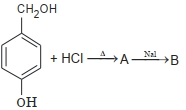
A
$4-$(iodomethyl)phenol
B
$4-$iodophenol
C
$4-$(chloromethyl)phenol
D
$1-$chloro$-4-$iodomethylbenzene
Solution
(A) The reaction proceeds in two steps:
$1$. The reaction of $4$-hydroxybenzyl alcohol with $HCl$ under heating $(\Delta)$ leads to the substitution of the alcoholic $-OH$ group with $-Cl$,forming $4$-(chloromethyl)phenol as product $A$.
$2$. The reaction of $A$ with $NaI$ in acetone (Finkelstein reaction) proceeds via an $S_N2$ mechanism,where the $-Cl$ atom is replaced by an $-I$ atom to form $4$-(iodomethyl)phenol as product $B$.
$1$. The reaction of $4$-hydroxybenzyl alcohol with $HCl$ under heating $(\Delta)$ leads to the substitution of the alcoholic $-OH$ group with $-Cl$,forming $4$-(chloromethyl)phenol as product $A$.
$2$. The reaction of $A$ with $NaI$ in acetone (Finkelstein reaction) proceeds via an $S_N2$ mechanism,where the $-Cl$ atom is replaced by an $-I$ atom to form $4$-(iodomethyl)phenol as product $B$.
0 likesView Solution
333
ChemistryDifficultMCQJEE Main · 2022
Match List-$I$ with List-$II$
Choose the correct answer from the options given below.
| List-$I$ (Polymers) | List-$II$ (Commercial names) |
| $A$. Phenol-formaldehyde resin | $I$. Glyptal |
| $B$. Copolymer of $1,3$-butadiene and styrene | $II$. Novolac |
| $C$. Polyester of glycol and phthalic acid | $III$. Buna-$S$ |
| $D$. Polyester of glycol and terephthalic acid | $IV$. Dacron |
Choose the correct answer from the options given below.
A
$A-II, B-III, C-IV, D-I$
B
$A-II, B-III, C-I, D-IV$
C
$A-II, B-I, C-III, D-IV$
D
$A-III, B-II, C-IV, D-I$
Solution
(B) The correct matches are as follows:
$A$. Phenol-formaldehyde resin (linear) is known as Novolac $(II)$.
$B$. Copolymer of $1,3$-butadiene and styrene is known as Buna-$S$ $(III)$.
$C$. Polyester of glycol and phthalic acid is known as Glyptal $(I)$.
$D$. Polyester of glycol and terephthalic acid is known as Dacron $(IV)$.
Therefore,the correct matching is $A-II, B-III, C-I, D-IV$.
$A$. Phenol-formaldehyde resin (linear) is known as Novolac $(II)$.
$B$. Copolymer of $1,3$-butadiene and styrene is known as Buna-$S$ $(III)$.
$C$. Polyester of glycol and phthalic acid is known as Glyptal $(I)$.
$D$. Polyester of glycol and terephthalic acid is known as Dacron $(IV)$.
Therefore,the correct matching is $A-II, B-III, C-I, D-IV$.
0 likesView Solution
334
ChemistryMediumMCQJEE Main · 2022
$A$ sugar '$X$' dehydrates very slowly under acidic conditions to give furfural,which on further reaction with resorcinol gives a coloured product after some time. Sugar '$X$' is
A
Aldopentose
B
Aldotetrose
C
Oxalic acid
D
Ketotetrose
Solution
(A) The reaction described is the basis of the Bial's test or a variation of Seliwanoff's test conditions.
Aldopentoses,when heated with concentrated acids (like $HCl$),undergo dehydration to form furfural.
Furfural then reacts with resorcinol to produce a coloured condensation product.
While ketoses react rapidly (Seliwanoff's test),aldopentoses react more slowly under these conditions to yield furfural derivatives.
Therefore,the sugar '$X$' is an aldopentose.
Aldopentoses,when heated with concentrated acids (like $HCl$),undergo dehydration to form furfural.
Furfural then reacts with resorcinol to produce a coloured condensation product.
While ketoses react rapidly (Seliwanoff's test),aldopentoses react more slowly under these conditions to yield furfural derivatives.
Therefore,the sugar '$X$' is an aldopentose.
0 likesView Solution
335
ChemistryMediumMCQJEE Main · 2022
Match List-$I$ with List-$II$ and choose the correct answer from the options given below:
| List-$I$ | List-$II$ |
| :--- | :--- |
| $A$. Morphine | $I$. Anti-depressant |
| $B$. Chloroxylenol | $II$. $550$ times sweeter than cane sugar |
| $C$. Phenelzine | $III$. Narcotic analgesic |
| $D$. Saccharin | $IV$. Antiseptic |
| List-$I$ | List-$II$ |
| :--- | :--- |
| $A$. Morphine | $I$. Anti-depressant |
| $B$. Chloroxylenol | $II$. $550$ times sweeter than cane sugar |
| $C$. Phenelzine | $III$. Narcotic analgesic |
| $D$. Saccharin | $IV$. Antiseptic |
A
$A-IV, B-III, C-II, D-I$
B
$A-III, B-I, C-II, D-IV$
C
$A-III, B-IV, C-I, D-II$
D
$A-III, B-I, C-IV, D-II$
Solution
(C) The correct matches are as follows:
$A$. Morphine is a narcotic analgesic,so $A-III$.
$B$. Chloroxylenol is used as an antiseptic,so $B-IV$.
$C$. Phenelzine is an anti-depressant,so $C-I$.
$D$. Saccharin is $550$ times sweeter than cane sugar,so $D-II$.
Therefore,the correct matching is $A-III, B-IV, C-I, D-II$.
$A$. Morphine is a narcotic analgesic,so $A-III$.
$B$. Chloroxylenol is used as an antiseptic,so $B-IV$.
$C$. Phenelzine is an anti-depressant,so $C-I$.
$D$. Saccharin is $550$ times sweeter than cane sugar,so $D-II$.
Therefore,the correct matching is $A-III, B-IV, C-I, D-II$.
0 likesView Solution
336
ChemistryMediumMCQJEE Main · 2022
Match List-$I$ with List-$II$:
Choose the correct answer from the options given below.
| List-$I$ | List-$II$ |
|---|---|
| $A$. Benzenesulphonyl chloride | $I$. Test for primary amines |
| $B$. Hoffmann bromamide reaction | $II$. Anti Saytzeff |
| $C$. Carbylamine reaction | $III$. Hinsberg reagent |
| $D$. Hoffmann orientation | $IV$. Known reaction of isocyanates |
Choose the correct answer from the options given below.
A
$A-IV, B-III, C-II, D-I$
B
$A-IV, B-II, C-I, D-III$
C
$A-III, B-IV, C-I, D-II$
D
$A-IV, B-III, C-I, D-II$
Solution
(C) . Benzenesulphonyl chloride $\rightarrow$ $III$. Hinsberg reagent
$B$. Hoffmann bromamide reaction $\rightarrow$ $IV$. Known reaction of isocyanates
$R-CONH_2 + Br_2 + 4NaOH \rightarrow R-NH_2 + 2NaBr + Na_2CO_3 + 2H_2O$
Intermediate: $R-N=C=O$ (isocyanate)
$C$. Carbylamine reaction $\rightarrow$ $I$. Test for primary amine
$R-NH_2 + CHCl_3 + 3KOH \rightarrow RNC + 3KCl + 3H_2O$
$D$. Hoffmann orientation $\rightarrow$ $II$. Anti Saytzeff (Formation of less substituted alkene as major product)
Therefore,the correct matching is $A-III, B-IV, C-I, D-II$.
$B$. Hoffmann bromamide reaction $\rightarrow$ $IV$. Known reaction of isocyanates
$R-CONH_2 + Br_2 + 4NaOH \rightarrow R-NH_2 + 2NaBr + Na_2CO_3 + 2H_2O$
Intermediate: $R-N=C=O$ (isocyanate)
$C$. Carbylamine reaction $\rightarrow$ $I$. Test for primary amine
$R-NH_2 + CHCl_3 + 3KOH \rightarrow RNC + 3KCl + 3H_2O$
$D$. Hoffmann orientation $\rightarrow$ $II$. Anti Saytzeff (Formation of less substituted alkene as major product)
Therefore,the correct matching is $A-III, B-IV, C-I, D-II$.
0 likesView Solution
337
ChemistryMediumMCQJEE Main · 2022
$2 \ NO + 2 \ H_2 \rightarrow N_2 + 2 \ H_2O$
The above reaction has been studied at $800^{\circ} C$. The related data are given in the table below.
The order of the reaction with respect to $NO$ is $...........$
The above reaction has been studied at $800^{\circ} C$. The related data are given in the table below.
| Reaction serial number | Initial pressure of $H_2$ / $kPa$ | Initial Pressure of $NO$ / $kPa$ | Initial rate $(-\frac{dp}{dt}) / (kPa \ s^{-1})$ |
| $1$ | $65.6$ | $40.0$ | $0.135$ |
| $2$ | $65.6$ | $20.1$ | $0.033$ |
| $3$ | $38.6$ | $65.6$ | $0.214$ |
| $4$ | $19.2$ | $65.6$ | $0.106$ |
The order of the reaction with respect to $NO$ is $...........$
A
$1$
B
$0$
C
$2$
D
$3$
Solution
(C) Let the rate law be $Rate = k[P_{NO}]^x [P_{H_2}]^y$.
Comparing experiments $1$ and $2$ where $[P_{H_2}]$ is constant:
$\frac{Rate_1}{Rate_2} = (\frac{P_{NO,1}}{P_{NO,2}})^x$
$\frac{0.135}{0.033} \approx 4.09 \approx 4$
$(\frac{40.0}{20.1})^x \approx 2^x$
$4 = 2^x \implies x = 2$.
Thus,the order of the reaction with respect to $NO$ is $2$.
Comparing experiments $1$ and $2$ where $[P_{H_2}]$ is constant:
$\frac{Rate_1}{Rate_2} = (\frac{P_{NO,1}}{P_{NO,2}})^x$
$\frac{0.135}{0.033} \approx 4.09 \approx 4$
$(\frac{40.0}{20.1})^x \approx 2^x$
$4 = 2^x \implies x = 2$.
Thus,the order of the reaction with respect to $NO$ is $2$.
0 likesView Solution
338
ChemistryEasyMCQJEE Main · 2022
The conductivity of a solution of a complex with the formula $CoCl_3(NH_3)_4$ corresponds to a $1:1$ electrolyte. What is the primary valency of the central metal ion?
A
$3$
B
$2$
C
$4$
D
$6$
Solution
(A) The complex $CoCl_3(NH_3)_4$ acts as a $1:1$ electrolyte,which means it dissociates into two ions in solution.
This indicates the formula is $[Co(NH_3)_4Cl_2]Cl$.
The primary valency of the central metal ion $(Co)$ corresponds to its oxidation state.
In $[Co(NH_3)_4Cl_2]Cl$,let the oxidation state of $Co$ be $x$.
$x + 4(0) + 2(-1) + 1(-1) = 0$
$x - 3 = 0$
$x = +3$.
Therefore,the primary valency is $3$.
This indicates the formula is $[Co(NH_3)_4Cl_2]Cl$.
The primary valency of the central metal ion $(Co)$ corresponds to its oxidation state.
In $[Co(NH_3)_4Cl_2]Cl$,let the oxidation state of $Co$ be $x$.
$x + 4(0) + 2(-1) + 1(-1) = 0$
$x - 3 = 0$
$x = +3$.
Therefore,the primary valency is $3$.
0 likesView Solution
339
ChemistryMediumMCQJEE Main · 2022
Match List-$I$ with List-$II$.
Choose the correct answer from the options given below.
| List-$I$ | List-$II$ |
| $A$. $Cd_{(s)} + 2 Ni(OH)_{3(s)} \rightarrow CdO_{(s)} + 2 Ni(OH)_{2(s)} + H_2O_{(l)}$ | $I$. Primary battery |
| $B$. $Zn(Hg) + HgO_{(s)} \rightarrow ZnO_{(s)} + Hg_{(l)}$ | $II$. Discharging of secondary battery |
| $C$. $2 PbSO_{4(s)} + 2 H_2O_{(l)} \rightarrow Pb_{(s)} + PbO_{2(s)} + 2 H_2SO_{4(aq)}$ | $III$. Fuel cell |
| $D$. $2 H_{2(g)} + O_{2(g)} \rightarrow 2 H_2O_{(l)}$ | $IV$. Charging of secondary battery |
Choose the correct answer from the options given below.
A
$A-I, B-II, C-III, D-IV$
B
$A-IV, B-I, C-II, D-III$
C
$A-II, B-I, C-IV, D-III$
D
$A-II, B-I, C-III, D-IV$
Solution
(C) . $Cd_{(s)} + 2 Ni(OH)_{3(s)} \rightarrow CdO_{(s)} + 2 Ni(OH)_{2(s)} + H_2O_{(l)}$ represents the discharging of a nickel-cadmium secondary battery $(II)$.
$B$. $Zn(Hg) + HgO_{(s)} \rightarrow ZnO_{(s)} + Hg_{(l)}$ is the reaction in a mercury cell,which is a primary battery $(I)$.
$C$. $2 PbSO_{4(s)} + 2 H_2O_{(l)} \rightarrow Pb_{(s)} + PbO_{2(s)} + 2 H_2SO_{4(aq)}$ represents the charging of a lead storage battery $(IV)$.
$D$. $2 H_{2(g)} + O_{2(g)} \rightarrow 2 H_2O_{(l)}$ is the reaction in a hydrogen-oxygen fuel cell $(III)$.
Therefore,the correct matching is $A-II, B-I, C-IV, D-III$.
$B$. $Zn(Hg) + HgO_{(s)} \rightarrow ZnO_{(s)} + Hg_{(l)}$ is the reaction in a mercury cell,which is a primary battery $(I)$.
$C$. $2 PbSO_{4(s)} + 2 H_2O_{(l)} \rightarrow Pb_{(s)} + PbO_{2(s)} + 2 H_2SO_{4(aq)}$ represents the charging of a lead storage battery $(IV)$.
$D$. $2 H_{2(g)} + O_{2(g)} \rightarrow 2 H_2O_{(l)}$ is the reaction in a hydrogen-oxygen fuel cell $(III)$.
Therefore,the correct matching is $A-II, B-I, C-IV, D-III$.
0 likesView Solution
340
ChemistryMediumMCQJEE Main · 2022
Match List-$I$ with List-$II$.
Choose the correct answer from the options given below.
| List-$I$ | List-$II$ |
| $A$. $4NH_{3(g)} + 5O_{2(g)} \rightarrow 4NO_{(g)} + 6H_2O_{(g)}$ | $I$. $NO_{(g)}$ |
| $B$. $N_{2(g)} + 3H_{2(g)} \rightarrow 2NH_{3(g)}$ | $II$. $H_2SO_{4(l)}$ |
| $C$. $C_{12}H_{22}O_{11(aq)} + H_2O_{(l)} \rightarrow C_6H_{12}O_6 + C_6H_{12}O_6$ | $III$. $Pt_{(s)}$ |
| $D$. $2SO_{2(g)} + O_{2(g)} \rightarrow 2SO_{3(g)}$ | $IV$. $Fe_{(s)}$ |
Choose the correct answer from the options given below.
A
$A-III, B-IV, C-II, D-I$
B
$A-III, B-II, C-I, D-IV$
C
$A-III, B-IV, C-I, D-II$
D
$A-II, B-III, C-IV, D-I$
Solution
(A) . $4NH_{3(g)} + 5O_{2(g)} \xrightarrow{Pt_{(s)}} 4NO_{(g)} + 6H_2O_{(g)}$ (Ostwald process uses $Pt_{(s)}$ as a catalyst).
$B$. $N_{2(g)} + 3H_{2(g)} \xrightarrow{Fe_{(s)}} 2NH_{3(g)}$ (Haber process uses $Fe_{(s)}$ as a catalyst).
$C$. $C_{12}H_{22}O_{11(aq)} + H_2O_{(l)} \xrightarrow{H^+} C_6H_{12}O_6 + C_6H_{12}O_6$ (Inversion of cane sugar uses $H_2SO_{4(l)}$ as a catalyst).
$D$. $2SO_{2(g)} + O_{2(g)} \xrightarrow{NO_{(g)}} 2SO_{3(g)}$ (Lead chamber process uses $NO_{(g)}$ as a catalyst).
Therefore,the correct matching is $A-III, B-IV, C-II, D-I$.
$B$. $N_{2(g)} + 3H_{2(g)} \xrightarrow{Fe_{(s)}} 2NH_{3(g)}$ (Haber process uses $Fe_{(s)}$ as a catalyst).
$C$. $C_{12}H_{22}O_{11(aq)} + H_2O_{(l)} \xrightarrow{H^+} C_6H_{12}O_6 + C_6H_{12}O_6$ (Inversion of cane sugar uses $H_2SO_{4(l)}$ as a catalyst).
$D$. $2SO_{2(g)} + O_{2(g)} \xrightarrow{NO_{(g)}} 2SO_{3(g)}$ (Lead chamber process uses $NO_{(g)}$ as a catalyst).
Therefore,the correct matching is $A-III, B-IV, C-II, D-I$.
0 likesView Solution
341
ChemistryMediumMCQJEE Main · 2022
Which of the following reactions is suitable for concentrating ore by the leaching process?
A
$2Cu_2S + 3O_2 \rightarrow 2Cu_2O + 2SO_2$
B
$Fe_3O_4 + CO \rightarrow 3FeO + CO_2$
C
$Al_2O_3 + 2NaOH + 3H_2O \rightarrow 2Na[Al(OH)_4]$
D
$Al_2O_3 + 6Mg \rightarrow 6MgO + 4Al$
Solution
(C) Leaching is a process of concentrating ore by dissolving it in a suitable solvent in which the ore is soluble but the impurities are not.
The reaction $Al_2O_3 + 2NaOH + 3H_2O \rightarrow 2Na[Al(OH)_4]$ represents the Bayer's process,which is a classic example of leaching bauxite ore $(Al_2O_3)$ using a sodium hydroxide solution.
The reaction $Al_2O_3 + 2NaOH + 3H_2O \rightarrow 2Na[Al(OH)_4]$ represents the Bayer's process,which is a classic example of leaching bauxite ore $(Al_2O_3)$ using a sodium hydroxide solution.
0 likesView Solution
342
ChemistryMediumMCQJEE Main · 2022
Match $List-I$ with $List-II$,match the gas evolved during each reaction.
Choose the correct answer from the options given below.
| $List-I$ | $List-II$ |
| $A$. $(NH_4)_2Cr_2O_7 \xrightarrow{\Delta}$ | $I$. $H_2$ |
| $B$. $KMnO_4 + HCl \rightarrow$ | $II$. $N_2$ |
| $C$. $Al + NaOH + H_2O \rightarrow$ | $III$. $O_2$ |
| $D$. $NaNO_3 \xrightarrow{\Delta}$ | $IV$. $Cl_2$ |
Choose the correct answer from the options given below.
A
$A-II, B-III, C-I, D-IV$
B
$A-III, B-I, C-IV, D-II$
C
$A-II, B-IV, C-I, D-III$
D
$A-III, B-IV, C-I, D-II$
Solution
(C) The reactions are as follows:
$A$. $(NH_4)_2Cr_2O_7 \xrightarrow{\Delta} N_2 + Cr_2O_3 + 4H_2O$. Thus,$A-II$.
$B$. $2KMnO_4 + 16HCl \rightarrow 2KCl + 2MnCl_2 + 5Cl_2 + 8H_2O$. Thus,$B-IV$.
$C$. $2Al + 2NaOH + 6H_2O \rightarrow 2Na[Al(OH)_4] + 3H_2$. Thus,$C-I$.
$D$. $2NaNO_3 \xrightarrow{\Delta} 2NaNO_2 + O_2$. Thus,$D-III$.
Therefore,the correct matching is $A-II, B-IV, C-I, D-III$.
$A$. $(NH_4)_2Cr_2O_7 \xrightarrow{\Delta} N_2 + Cr_2O_3 + 4H_2O$. Thus,$A-II$.
$B$. $2KMnO_4 + 16HCl \rightarrow 2KCl + 2MnCl_2 + 5Cl_2 + 8H_2O$. Thus,$B-IV$.
$C$. $2Al + 2NaOH + 6H_2O \rightarrow 2Na[Al(OH)_4] + 3H_2$. Thus,$C-I$.
$D$. $2NaNO_3 \xrightarrow{\Delta} 2NaNO_2 + O_2$. Thus,$D-III$.
Therefore,the correct matching is $A-II, B-IV, C-I, D-III$.
0 likesView Solution
343
ChemistryEasyMCQJEE Main · 2022
Which of the following has the least tendency to liberate $H_2$ from mineral acids?
A
$Cu$
B
$Mn$
C
$Ni$
D
$Zn$
Solution
(A) The tendency to liberate $H_2$ gas from mineral acids depends on the standard reduction potential of the metal. Metals with a negative reduction potential (above $H$ in the electrochemical series) can displace $H_2$.
Copper $(Cu)$ has a positive standard reduction potential $(E^0 = +0.34 \ V)$,meaning it lies below $H$ in the reactivity series.
Therefore,$Cu$ cannot displace $H_2$ from mineral acids,while $Mn$,$Ni$,and $Zn$ have negative reduction potentials and can liberate $H_2$.
Copper $(Cu)$ has a positive standard reduction potential $(E^0 = +0.34 \ V)$,meaning it lies below $H$ in the reactivity series.
Therefore,$Cu$ cannot displace $H_2$ from mineral acids,while $Mn$,$Ni$,and $Zn$ have negative reduction potentials and can liberate $H_2$.
0 likesView Solution
344
ChemistryDifficultMCQJEE Main · 2022
Among the following,the marked proton of which compound shows the lowest $pK_{a}$ value?
A
$CH_3-CH_2-COOH$ (marked $H$ on $\alpha$-carbon)
B
$CH_3-CO-CH_2-CH_3$ (marked $H$ on $\alpha$-carbon)
C
$C_6H_5-CH_2-CO-CH_3$ (marked $H$ on benzylic carbon)
D
$C_6H_5-CH_2-COOH$ (marked $H$ on benzylic carbon)
Solution
(C) The $pK_{a}$ value is inversely proportional to the acidity of the compound. The acidity depends on the stability of the conjugate base formed after the removal of the proton.
$1$. In $A$,the conjugate base is stabilized by resonance with the carbonyl group,but it also experiences cross-conjugation with the $-OH$ group.
$2$. In $B$,the conjugate base is stabilized by resonance with the carbonyl group.
$3$. In $C$,the conjugate base is stabilized by resonance with the carbonyl group $AND$ the phenyl ring,making it highly stable.
$4$. In $D$,the conjugate base is stabilized by resonance with the carboxylate group,but it is less stable than $C$ due to the nature of the resonance.
Comparing the stability of the conjugate bases,the benzylic proton in $C$ $(C_6H_5-CH_2-CO-CH_3)$ forms the most stable conjugate base due to extended conjugation with both the phenyl ring and the carbonyl group. Therefore,it is the most acidic and has the lowest $pK_{a}$ value.
$1$. In $A$,the conjugate base is stabilized by resonance with the carbonyl group,but it also experiences cross-conjugation with the $-OH$ group.
$2$. In $B$,the conjugate base is stabilized by resonance with the carbonyl group.
$3$. In $C$,the conjugate base is stabilized by resonance with the carbonyl group $AND$ the phenyl ring,making it highly stable.
$4$. In $D$,the conjugate base is stabilized by resonance with the carboxylate group,but it is less stable than $C$ due to the nature of the resonance.
Comparing the stability of the conjugate bases,the benzylic proton in $C$ $(C_6H_5-CH_2-CO-CH_3)$ forms the most stable conjugate base due to extended conjugation with both the phenyl ring and the carbonyl group. Therefore,it is the most acidic and has the lowest $pK_{a}$ value.
1 likesView Solution
345
ChemistryDifficultMCQJEE Main · 2022
Identify the major products $A$ and $B$ for the reaction sequence given below.
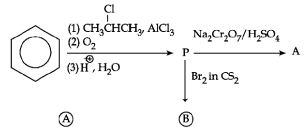
A
Phenol and $p$-bromophenol
B
$p$-benzoquinone and $p$-bromophenol
C
$p$-benzoquinone and $2,4,6$-tribromophenol
D
Phenol and $2,4,6$-tribromophenol
Solution
(B) $1$. The reaction of benzene with isopropyl chloride in the presence of $AlCl_3$ (Friedel-Crafts alkylation) gives cumene (isopropylbenzene).
$2$. Oxidation of cumene with $O_2$ followed by treatment with $H^+/H_2O$ yields phenol $(P)$ and acetone.
$3$. Phenol $(P)$ reacts with $Na_2Cr_2O_7/H_2SO_4$ (strong oxidizing agent) to form $p$-benzoquinone $(A)$.
$4$. Phenol $(P)$ reacts with $Br_2$ in $CS_2$ (a non-polar solvent) to give $p$-bromophenol $(B)$ as the major product due to the low polarity of the medium,which prevents further bromination.
$2$. Oxidation of cumene with $O_2$ followed by treatment with $H^+/H_2O$ yields phenol $(P)$ and acetone.
$3$. Phenol $(P)$ reacts with $Na_2Cr_2O_7/H_2SO_4$ (strong oxidizing agent) to form $p$-benzoquinone $(A)$.
$4$. Phenol $(P)$ reacts with $Br_2$ in $CS_2$ (a non-polar solvent) to give $p$-bromophenol $(B)$ as the major product due to the low polarity of the medium,which prevents further bromination.
0 likesView Solution
346
ChemistryMediumMCQJEE Main · 2022
Identify the correct statement for the below given transformation:
$CH_{3}CH_{2}CH_{2}CH(N^{+}(CH_{3})_{3})CH_{3}$ $\xrightarrow{C_{2}H_{5}ONa / C_{2}H_{5}OH} A (\text{major}) + B (\text{minor})$
$CH_{3}CH_{2}CH_{2}CH(N^{+}(CH_{3})_{3})CH_{3}$ $\xrightarrow{C_{2}H_{5}ONa / C_{2}H_{5}OH} A (\text{major}) + B (\text{minor})$
A
$A = CH_{3}CH_{2}CH_{2}CH=CH_{2}$,$B = CH_{3}CH_{2}CH=CHCH_{3}$,$\text{Saytzeff products}$
B
$A = CH_{3}CH_{2}CH_{2}CH=CH_{2}$,$B = CH_{3}CH_{2}CH=CHCH_{3}$,$\text{Hofmann products}$
C
$A = CH_{3}CH_{2}CH=CHCH_{3}$,$B = CH_{3}CH_{2}CH_{2}CH=CH_{2}$,$\text{Hofmann products}$
D
$A = CH_{3}CH_{2}CH=CHCH_{3}$,$B = CH_{3}CH_{2}CH_{2}CH=CH_{2}$,$\text{Saytzeff products}$
Solution
(B) The given reaction is an elimination reaction of a quaternary ammonium salt $(CH_{3}CH_{2}CH_{2}CH(N^{+}(CH_{3})_{3})CH_{3})$ using a base $(C_{2}H_{5}ONa)$.
This is an example of the Hofmann elimination reaction.
In Hofmann elimination,the less substituted alkene is formed as the major product due to steric hindrance caused by the bulky leaving group $(N^{+}(CH_{3})_{3})$.
Therefore,the terminal alkene $CH_{3}CH_{2}CH_{2}CH=CH_{2}$ is the major product $(A)$,and the internal alkene $CH_{3}CH_{2}CH=CHCH_{3}$ is the minor product $(B)$.
This is an example of the Hofmann elimination reaction.
In Hofmann elimination,the less substituted alkene is formed as the major product due to steric hindrance caused by the bulky leaving group $(N^{+}(CH_{3})_{3})$.
Therefore,the terminal alkene $CH_{3}CH_{2}CH_{2}CH=CH_{2}$ is the major product $(A)$,and the internal alkene $CH_{3}CH_{2}CH=CHCH_{3}$ is the minor product $(B)$.
0 likesView Solution
347
ChemistryMediumMCQJEE Main · 2022
Terylene polymer is obtained by the condensation of:
A
Ethane-$1, 2$-diol and Benzene-$1, 3$-dicarboxylic acid
B
Propane-$1, 2$-diol and Benzene-$1, 4$-dicarboxylic acid
C
Ethane-$1, 2$-diol and Benzene-$1, 4$-dicarboxylic acid
D
Ethane-$1, 2$-diol and Benzene-$1, 2$-dicarboxylic acid
Solution
(C) Terylene,also known as $Dacron$,is a polyester fiber.
It is prepared by the condensation polymerization of Ethane-$1, 2$-diol (ethylene glycol) and Benzene-$1, 4$-dicarboxylic acid (terephthalic acid).
The reaction involves the elimination of water molecules to form an ester linkage between the monomers.
It is prepared by the condensation polymerization of Ethane-$1, 2$-diol (ethylene glycol) and Benzene-$1, 4$-dicarboxylic acid (terephthalic acid).
The reaction involves the elimination of water molecules to form an ester linkage between the monomers.
0 likesView Solution
348
ChemistryMediumMCQJEE Main · 2022
For the below given cyclic hemiacetal $(X)$,the correct pyranose structure is.
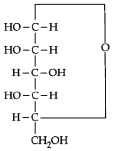
A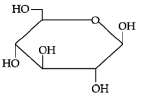
B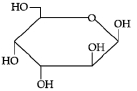
C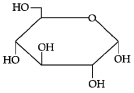
D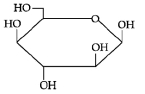
Solution
(A) To convert the cyclic hemiacetal structure into a Haworth projection (pyranose form),we follow these steps:
$1$. Identify the carbon atoms in the chain. The hemiacetal is formed between the $C_1$ (anomeric carbon) and the $C_5$ hydroxyl group.
$2$. In the Haworth projection,the oxygen atom is placed at the top right corner of the ring.
$3$. Groups on the right side of the Fischer projection are placed pointing downwards,and groups on the left side are placed pointing upwards.
$4$. For the given structure,the $C_2-OH$ is on the left (up),$C_3-OH$ is on the right (down),$C_4-OH$ is on the left (up),and $C_5-CH_2OH$ is pointing upwards.
$5$. Comparing this configuration to the given options,the structure in option $(A)$ correctly represents the spatial arrangement of the hydroxyl groups and the hydroxymethyl group.
$1$. Identify the carbon atoms in the chain. The hemiacetal is formed between the $C_1$ (anomeric carbon) and the $C_5$ hydroxyl group.
$2$. In the Haworth projection,the oxygen atom is placed at the top right corner of the ring.
$3$. Groups on the right side of the Fischer projection are placed pointing downwards,and groups on the left side are placed pointing upwards.
$4$. For the given structure,the $C_2-OH$ is on the left (up),$C_3-OH$ is on the right (down),$C_4-OH$ is on the left (up),and $C_5-CH_2OH$ is pointing upwards.
$5$. Comparing this configuration to the given options,the structure in option $(A)$ correctly represents the spatial arrangement of the hydroxyl groups and the hydroxymethyl group.
0 likesView Solution
349
ChemistryMediumMCQJEE Main · 2022
Statements about Enzyme Inhibitor Drugs are given below.
$A$. There are Competitive and Non-competitive inhibitor drugs.
$B$. These can bind at the active sites and allosteric sites.
$C$. Competitive Drugs are allosteric site blocking drugs.
$D$. Non-competitive Drugs are active site blocking drugs.
Choose the correct answer from the options given below.
$A$. There are Competitive and Non-competitive inhibitor drugs.
$B$. These can bind at the active sites and allosteric sites.
$C$. Competitive Drugs are allosteric site blocking drugs.
$D$. Non-competitive Drugs are active site blocking drugs.
Choose the correct answer from the options given below.
A
$A, D$ only
B
$A, C$ only
C
$A, B$ only
D
$A, B, C$ only
Solution
(C) Enzyme inhibitors are classified into two main types:
$1$. Competitive inhibitors: These drugs compete with the natural substrate for the active site of the enzyme.
$2$. Non-competitive inhibitors: These drugs bind to a different site known as the allosteric site,which changes the shape of the active site so that the substrate cannot bind.
Therefore,statement $A$ is correct because it identifies the two types.
Statement $B$ is correct because competitive inhibitors bind to the active site,while non-competitive inhibitors bind to the allosteric site.
Statements $C$ and $D$ are incorrect because they swap the definitions of competitive and non-competitive inhibitors.
Thus,only $A$ and $B$ are correct.
$1$. Competitive inhibitors: These drugs compete with the natural substrate for the active site of the enzyme.
$2$. Non-competitive inhibitors: These drugs bind to a different site known as the allosteric site,which changes the shape of the active site so that the substrate cannot bind.
Therefore,statement $A$ is correct because it identifies the two types.
Statement $B$ is correct because competitive inhibitors bind to the active site,while non-competitive inhibitors bind to the allosteric site.
Statements $C$ and $D$ are incorrect because they swap the definitions of competitive and non-competitive inhibitors.
Thus,only $A$ and $B$ are correct.
0 likesView Solution
350
ChemistryMediumMCQJEE Main · 2022
For the kinetic study of the reaction of iodide ion with $H_{2}O_{2}$ at room temperature, which of the following statements are correct?
$(A)$ Always use freshly prepared starch solution.
$(B)$ Always keep the concentration of sodium thiosulphate solution less than that of $KI$ solution.
$(C)$ Record the time immediately after the appearance of blue colour.
$(D)$ Record the time immediately before the appearance of blue colour.
$(E)$ Always keep the concentration of sodium thiosulphate solution more than that of $KI$ solution.
Choose the correct answer from the options given below:
$(A)$ Always use freshly prepared starch solution.
$(B)$ Always keep the concentration of sodium thiosulphate solution less than that of $KI$ solution.
$(C)$ Record the time immediately after the appearance of blue colour.
$(D)$ Record the time immediately before the appearance of blue colour.
$(E)$ Always keep the concentration of sodium thiosulphate solution more than that of $KI$ solution.
Choose the correct answer from the options given below:
A
$(A)$, $(B)$, $(C)$ only
B
$(A)$, $(D)$, $(E)$ only
C
$(D)$, $(E)$ only
D
$(A)$, $(B)$, $(E)$ only
Solution
$(A)$ In the kinetic study of the reaction between $I^-$ and $H_2O_2$, starch is used as an indicator for $I_2$.
Freshly prepared starch solution is required because old solutions may undergo bacterial degradation.
$Na_2S_2O_3$ is added to react with the produced $I_2$ to prevent the blue colour from appearing until all $Na_2S_2O_3$ is consumed.
Therefore, the concentration of $Na_2S_2O_3$ must be less than that of $KI$ to ensure the reaction proceeds and the blue colour appears.
The time is recorded immediately after the appearance of the blue colour, which indicates the consumption of $Na_2S_2O_3$.
Thus, statements $(A)$, $(B)$, and $(C)$ are correct.
Freshly prepared starch solution is required because old solutions may undergo bacterial degradation.
$Na_2S_2O_3$ is added to react with the produced $I_2$ to prevent the blue colour from appearing until all $Na_2S_2O_3$ is consumed.
Therefore, the concentration of $Na_2S_2O_3$ must be less than that of $KI$ to ensure the reaction proceeds and the blue colour appears.
The time is recorded immediately after the appearance of the blue colour, which indicates the consumption of $Na_2S_2O_3$.
Thus, statements $(A)$, $(B)$, and $(C)$ are correct.
0 likesView Solution
Vedclass Products
For Students
Vedclass Test Series
Mock tests in real JEE Main style covering Chemistry with performance analysis. 5-day free trial.
Start Free TrialFor Teachers
Exam Paper Generator
Generate Set A/B/C/D Chemistry papers from 7.5L+ questions in 2 minutes. 3 chapters free.
Try FreeFor Institutes
Online Exam Module
Run live JEE Main mock exams with unlimited students, 360° analytics & white-label branding.
See DemoFrequently Asked Questions
How many Chemistry questions are in JEE Main 2022?
There are 666 Chemistry questions from the JEE Main 2022 paper on Vedclass, each with a detailed step-by-step solution in English.
Are JEE Main 2022 Chemistry solutions available in English?
Yes. All solutions on this page are in English. You can also switch to English or Hindi using the language buttons above the questions.
Can I practice JEE Main 2022 Chemistry as a timed test?
Yes. Use the Vedclass Test Series to attempt a full JEE Main mock test covering Chemistry with time limits and instant score analysis.
Can teachers create Chemistry papers from JEE Main previous year questions?
Yes. The Vedclass Exam Paper Generator lets teachers mix JEE Main Chemistry questions and generate Set A/B/C/D papers in minutes.
For Teachers & Institutes
Build a Custom Chemistry Paper
Pick JEE Main 2022 Chemistry questions, set difficulty, and generate Set A/B/C/D in 2 minutes.