
ChemistryQ301–362 of 666 questions
Page 7 of 8 · English
301
ChemistryMediumMCQJEE Main · 2022
When borax is heated with $CoO$ on a platinum loop,the blue coloured bead formed is largely due to
A
$B_{2}O_{3}$
B
$Co(BO_{2})_{2}$
C
$CoB_{4}O_{7}$
D
$Co[B_{4}O_{5}(OH)_{4}]$
Solution
(B) The borax bead test involves the following reactions:
$Na_{2}B_{4}O_{7} \cdot 10 H_{2}O \xrightarrow{\Delta} Na_{2}B_{4}O_{7} + 10 H_{2}O$
$Na_{2}B_{4}O_{7} \xrightarrow{\Delta} 2 NaBO_{2} + B_{2}O_{3}$
$B_{2}O_{3} + CoO \rightarrow Co(BO_{2})_{2} \text{ (cobalt (II) metaborate)}$
The blue coloured bead is due to the formation of cobalt $(II)$ metaborate,$Co(BO_{2})_{2}$.
$Na_{2}B_{4}O_{7} \cdot 10 H_{2}O \xrightarrow{\Delta} Na_{2}B_{4}O_{7} + 10 H_{2}O$
$Na_{2}B_{4}O_{7} \xrightarrow{\Delta} 2 NaBO_{2} + B_{2}O_{3}$
$B_{2}O_{3} + CoO \rightarrow Co(BO_{2})_{2} \text{ (cobalt (II) metaborate)}$
The blue coloured bead is due to the formation of cobalt $(II)$ metaborate,$Co(BO_{2})_{2}$.
0 likesView Solution
302
ChemistryMediumMCQJEE Main · 2022
Dinitrogen is a robust compound,but reacts at high altitude to form oxides. The oxide of nitrogen that can damage plant leaves and retard photosynthesis is
A
$NO$
B
$NO_3^{-}$
C
$NO_2$
D
$NO_2^{-}$
Solution
(C) At high altitudes,$N_2$ and $O_2$ react to form $NO$:
$N_{2(g)} + O_{2(g)} \rightarrow 2NO_{(g)}$
$NO$ further reacts with oxygen to form $NO_2$:
$2NO_{(g)} + O_{2(g)} \rightarrow 2NO_{2(g)}$
$NO_2$ is a toxic gas that can damage plant leaves and retard the process of photosynthesis.
$N_{2(g)} + O_{2(g)} \rightarrow 2NO_{(g)}$
$NO$ further reacts with oxygen to form $NO_2$:
$2NO_{(g)} + O_{2(g)} \rightarrow 2NO_{2(g)}$
$NO_2$ is a toxic gas that can damage plant leaves and retard the process of photosynthesis.
0 likesView Solution
303
ChemistryMediumMCQJEE Main · 2022
The correct structure of $\gamma-$methylcyclohexanecarbaldehyde is:
A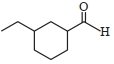
B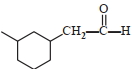
C
D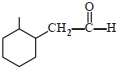
Solution
(A) In $\gamma-$methylcyclohexanecarbaldehyde,the parent ring is cyclohexane with a carbaldehyde $(-CHO)$ group attached at position $1$.
The carbon atom directly attached to the $-CHO$ group is the $\alpha-$carbon.
The next carbon is the $\beta-$carbon,and the carbon after that is the $\gamma-$carbon.
Therefore,the methyl group is attached at the $3-$position relative to the $-CHO$ group on the cyclohexane ring.
This corresponds to the structure where the methyl group is at the meta position relative to the $-CHO$ group.
The carbon atom directly attached to the $-CHO$ group is the $\alpha-$carbon.
The next carbon is the $\beta-$carbon,and the carbon after that is the $\gamma-$carbon.
Therefore,the methyl group is attached at the $3-$position relative to the $-CHO$ group on the cyclohexane ring.
This corresponds to the structure where the methyl group is at the meta position relative to the $-CHO$ group.
0 likesView Solution
304
ChemistryMediumMCQJEE Main · 2022
Compound $A$ undergoes the following sequence of reactions to give compound $B$. The correct structure and chirality of compound $B$ is:
[where $Et$ is $-C_2H_5$]
[where $Et$ is $-C_2H_5$]
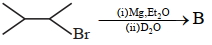
A
$2$-Deuterio-$3$-methylbutane,Achiral
B
$2$-Deuterio-$3$-methylbutane,Chiral
C
$2$-Deuterio-$3$-methylbutane,Chiral
D
$2$-Deuterio-$3$-methylbutane,Achiral
Solution
(B) The reaction of $2$-bromo-$3$-methylbutane with $Mg$ in $Et_2O$ forms a Grignard reagent,$3$-methylbutylmagnesium bromide $(CH_3-CH(CH_3)-CH(MgBr)-CH_3)$.
When this Grignard reagent is treated with $D_2O$,the $MgBr$ group is replaced by a deuterium atom $(D)$,resulting in $2$-deuterio-$3$-methylbutane $(CH_3-CH(CH_3)-CH(D)-CH_3)$.
In $2$-deuterio-$3$-methylbutane,the carbon atom at position $2$ is bonded to four different groups: a hydrogen atom $(H)$,a deuterium atom $(D)$,a methyl group $(-CH_3)$,and an isopropyl group $(-CH(CH_3)_2)$.
Since the carbon at position $2$ is bonded to four distinct groups,it is a chiral center,making the molecule chiral.
When this Grignard reagent is treated with $D_2O$,the $MgBr$ group is replaced by a deuterium atom $(D)$,resulting in $2$-deuterio-$3$-methylbutane $(CH_3-CH(CH_3)-CH(D)-CH_3)$.
In $2$-deuterio-$3$-methylbutane,the carbon atom at position $2$ is bonded to four different groups: a hydrogen atom $(H)$,a deuterium atom $(D)$,a methyl group $(-CH_3)$,and an isopropyl group $(-CH(CH_3)_2)$.
Since the carbon at position $2$ is bonded to four distinct groups,it is a chiral center,making the molecule chiral.
0 likesView Solution
305
ChemistryMediumMCQJEE Main · 2022
Given below are two statements.
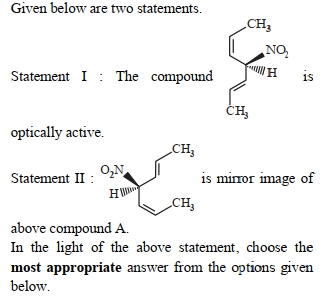
Statement $I$: The compound shown below is optically active.
[Image of compound $A$]
Statement $II$: The compound shown below is the mirror image of the above compound $A$.
[Image of compound $B$]
In the light of the above statements,choose the most appropriate answer from the options given below.
Statement $I$: The compound shown below is optically active.
[Image of compound $A$]
Statement $II$: The compound shown below is the mirror image of the above compound $A$.
[Image of compound $B$]
In the light of the above statements,choose the most appropriate answer from the options given below.
A
Both Statement $I$ and Statement $II$ are correct.
B
Both Statement $I$ and Statement $II$ are incorrect.
C
Statement $I$ is correct but Statement $II$ is incorrect.
D
Statement $I$ is incorrect but Statement $II$ is correct.
Solution
(D) Statement $I$: The compound has a chiral center bonded to four different groups: $-H$,$-NO_2$,a $cis-but-2-enyl$ group,and another $cis-but-2-enyl$ group. However,since the two alkenyl groups are identical,the molecule possesses a plane of symmetry or is achiral if the groups are arranged such that they superimpose. Upon closer inspection of the structure,the chiral center is bonded to two identical groups,making it achiral. Thus,Statement $I$ is incorrect.
Statement $II$: The second structure is indeed the mirror image of the first structure. Since the first structure is achiral,its mirror image is identical to it. Thus,Statement $II$ is correct.
Therefore,Statement $I$ is incorrect but Statement $II$ is correct.
Statement $II$: The second structure is indeed the mirror image of the first structure. Since the first structure is achiral,its mirror image is identical to it. Thus,Statement $II$ is correct.
Therefore,Statement $I$ is incorrect but Statement $II$ is correct.
0 likesView Solution
306
ChemistryMediumMCQJEE Main · 2022
When ethanol is heated with conc. $H_{2}SO_{4}$,a gas is produced. The compound formed,when this gas is treated with cold dilute aqueous solution of Baeyer's reagent,is:
A
Formaldehyde
B
Formic acid
C
Glycol
D
Ethanoic acid
Solution
(C) $1$. Ethanol $(CH_{3}CH_{2}OH)$ on heating with concentrated $H_{2}SO_{4}$ undergoes dehydration to produce ethene gas $(CH_{2}=CH_{2})$.
$2$. Ethene reacts with cold dilute aqueous solution of alkaline $KMnO_{4}$ (Baeyer's reagent) to undergo hydroxylation,resulting in the formation of ethane$-1,2-$diol,commonly known as glycol $(HOCH_{2}-CH_{2}OH)$.
$2$. Ethene reacts with cold dilute aqueous solution of alkaline $KMnO_{4}$ (Baeyer's reagent) to undergo hydroxylation,resulting in the formation of ethane$-1,2-$diol,commonly known as glycol $(HOCH_{2}-CH_{2}OH)$.
0 likesView Solution
307
ChemistryMediumMCQJEE Main · 2022
$A$ compound '$X$' is a weak acid and it exhibits colour change at $pH$ close to the equivalence point during neutralization of $NaOH$ with $CH_3COOH$. Compound '$X$' exists in ionized form in basic medium. The compound '$X$' is.
A
methyl orange
B
methyl red
C
phenolphthalein
D
erichrome Black $T$
Solution
(C) The neutralization of a weak acid $(CH_3COOH)$ with a strong base $(NaOH)$ results in a basic equivalence point $(pH > 7)$.
Phenolphthalein is a weak organic acid $(HIn)$ that is colorless in acidic medium and turns pink in basic medium due to the formation of its ionized form $(In^-)$.
Its $pH$ range is approximately $8.2 - 10.0$,which matches the equivalence point of the titration between a weak acid and a strong base.
Phenolphthalein is a weak organic acid $(HIn)$ that is colorless in acidic medium and turns pink in basic medium due to the formation of its ionized form $(In^-)$.
Its $pH$ range is approximately $8.2 - 10.0$,which matches the equivalence point of the titration between a weak acid and a strong base.
0 likesView Solution
308
ChemistryMediumMCQJEE Main · 2022
$x \ g$ of molecular oxygen $(O_2)$ is mixed with $200 \ g$ of neon $(Ne)$. The total pressure of the nonreactive mixture of $O_2$ and $Ne$ in the cylinder is $25 \ bar$. The partial pressure of $Ne$ is $20 \ bar$ at the same temperature and volume. The value of $x$ is $....$ [Given: Molar mass of $O_2 = 32 \ g \ mol^{-1}$. Molar mass of $Ne = 20 \ g \ mol^{-1}$]
A
$89$
B
$80$
C
$60$
D
$70$
Solution
(B) According to Dalton's Law of Partial Pressures,$P_{total} = P_{O_2} + P_{Ne}$.
Given $P_{total} = 25 \ bar$ and $P_{Ne} = 20 \ bar$,so $P_{O_2} = 25 - 20 = 5 \ bar$.
Partial pressure is related to mole fraction $(X)$ by $P_i = X_i \times P_{total}$.
Moles of $Ne = \frac{200 \ g}{20 \ g \ mol^{-1}} = 10 \ mol$.
Moles of $O_2 = \frac{x \ g}{32 \ g \ mol^{-1}} = \frac{x}{32} \ mol$.
Mole fraction of $O_2$ is $X_{O_2} = \frac{n_{O_2}}{n_{O_2} + n_{Ne}} = \frac{x/32}{x/32 + 10}$.
Using $P_{O_2} = X_{O_2} \times P_{total}$,we get $5 = \left( \frac{x/32}{x/32 + 10} \right) \times 25$.
Dividing by $5$,we get $1 = \left( \frac{x/32}{x/32 + 10} \right) \times 5$.
$1 = \frac{5x/32}{(x + 320)/32} = \frac{5x}{x + 320}$.
$x + 320 = 5x \implies 4x = 320 \implies x = 80 \ g$.
Given $P_{total} = 25 \ bar$ and $P_{Ne} = 20 \ bar$,so $P_{O_2} = 25 - 20 = 5 \ bar$.
Partial pressure is related to mole fraction $(X)$ by $P_i = X_i \times P_{total}$.
Moles of $Ne = \frac{200 \ g}{20 \ g \ mol^{-1}} = 10 \ mol$.
Moles of $O_2 = \frac{x \ g}{32 \ g \ mol^{-1}} = \frac{x}{32} \ mol$.
Mole fraction of $O_2$ is $X_{O_2} = \frac{n_{O_2}}{n_{O_2} + n_{Ne}} = \frac{x/32}{x/32 + 10}$.
Using $P_{O_2} = X_{O_2} \times P_{total}$,we get $5 = \left( \frac{x/32}{x/32 + 10} \right) \times 25$.
Dividing by $5$,we get $1 = \left( \frac{x/32}{x/32 + 10} \right) \times 5$.
$1 = \frac{5x/32}{(x + 320)/32} = \frac{5x}{x + 320}$.
$x + 320 = 5x \implies 4x = 320 \implies x = 80 \ g$.
0 likesView Solution
309
ChemistryDifficultMCQJEE Main · 2022
Consider $PF_{5}$,$BrF_{5}$,$PCl_{3}$,$SF_{6}$,$[ICl_{4}]^{-}$,$ClF_{3}$ and $IF_{5}$.
Amongst the above molecule$(s)$/ion$(s)$,the number of molecule$(s)$/ion$(s)$ having $sp^{3}d^{2}$ hybridisation is $........$
Amongst the above molecule$(s)$/ion$(s)$,the number of molecule$(s)$/ion$(s)$ having $sp^{3}d^{2}$ hybridisation is $........$
A
$3$
B
$4$
C
$2$
D
$1$
Solution
(B) To determine the hybridisation,we use the formula: $\text{Steric Number} = \frac{1}{2} (V + M - C + A)$,where $V$ is the number of valence electrons of the central atom,$M$ is the number of monovalent atoms,$C$ is the cationic charge,and $A$ is the anionic charge.
$1$. $PF_{5}$: $\text{Steric Number} = \frac{1}{2}(5 + 5) = 5$ $(sp^{3}d)$
$2$. $BrF_{5}$: $\text{Steric Number} = \frac{1}{2}(7 + 5) = 6$ $(sp^{3}d^{2})$
$3$. $PCl_{3}$: $\text{Steric Number} = \frac{1}{2}(5 + 3) = 4$ $(sp^{3})$
$4$. $SF_{6}$: $\text{Steric Number} = \frac{1}{2}(6 + 6) = 6$ $(sp^{3}d^{2})$
$5$. $[ICl_{4}]^{-}$: $\text{Steric Number} = \frac{1}{2}(7 + 4 + 1) = 6$ $(sp^{3}d^{2})$
$6$. $ClF_{3}$: $\text{Steric Number} = \frac{1}{2}(7 + 3) = 5$ $(sp^{3}d)$
$7$. $IF_{5}$: $\text{Steric Number} = \frac{1}{2}(7 + 5) = 6$ $(sp^{3}d^{2})$
The molecules/ions with $sp^{3}d^{2}$ hybridisation are $BrF_{5}$,$SF_{6}$,$[ICl_{4}]^{-}$,and $IF_{5}$.
Total count = $4$.
$1$. $PF_{5}$: $\text{Steric Number} = \frac{1}{2}(5 + 5) = 5$ $(sp^{3}d)$
$2$. $BrF_{5}$: $\text{Steric Number} = \frac{1}{2}(7 + 5) = 6$ $(sp^{3}d^{2})$
$3$. $PCl_{3}$: $\text{Steric Number} = \frac{1}{2}(5 + 3) = 4$ $(sp^{3})$
$4$. $SF_{6}$: $\text{Steric Number} = \frac{1}{2}(6 + 6) = 6$ $(sp^{3}d^{2})$
$5$. $[ICl_{4}]^{-}$: $\text{Steric Number} = \frac{1}{2}(7 + 4 + 1) = 6$ $(sp^{3}d^{2})$
$6$. $ClF_{3}$: $\text{Steric Number} = \frac{1}{2}(7 + 3) = 5$ $(sp^{3}d)$
$7$. $IF_{5}$: $\text{Steric Number} = \frac{1}{2}(7 + 5) = 6$ $(sp^{3}d^{2})$
The molecules/ions with $sp^{3}d^{2}$ hybridisation are $BrF_{5}$,$SF_{6}$,$[ICl_{4}]^{-}$,and $IF_{5}$.
Total count = $4$.
0 likesView Solution
310
ChemistryMediumMCQJEE Main · 2022
$A$ $1.84 \, mg$ sample of polyhydric alcoholic compound '$X$' of molar mass $92.0 \, g/mol$ gave $1.344 \, mL$ of $H_2$ gas at $STP$. The number of alcoholic hydrogens present in compound '$X$' is $.....$
A
$6$
B
$5$
C
$4$
D
$3$
Solution
(A) The reaction of a polyhydric alcohol with sodium or similar reagents releases $H_2$ gas based on the number of hydroxyl groups $(x)$:
$R(OH)_x + xNa \rightarrow R(ONa)_x + \frac{x}{2} H_2$
Using the Principle of Atom Conservation $(PoAC)$ for hydrogen atoms in the $OH$ groups:
$x \times \text{moles of } X = 2 \times \text{moles of } H_2$
Given:
Mass of $X = 1.84 \, mg = 1.84 \times 10^{-3} \, g$
Molar mass of $X = 92.0 \, g/mol$
Volume of $H_2$ at $STP = 1.344 \, mL = 1.344 \times 10^{-3} \, L$
Moles of $X = \frac{1.84 \times 10^{-3}}{92} = 2 \times 10^{-5} \, mol$
Moles of $H_2 = \frac{1.344 \times 10^{-3}}{22.4} = 6 \times 10^{-5} \, mol$
Substituting into the equation:
$x \times (2 \times 10^{-5}) = 2 \times (6 \times 10^{-5})$
$x = \frac{12 \times 10^{-5}}{2 \times 10^{-5}} = 6$
Thus,the number of alcoholic hydrogens is $6$.
$R(OH)_x + xNa \rightarrow R(ONa)_x + \frac{x}{2} H_2$
Using the Principle of Atom Conservation $(PoAC)$ for hydrogen atoms in the $OH$ groups:
$x \times \text{moles of } X = 2 \times \text{moles of } H_2$
Given:
Mass of $X = 1.84 \, mg = 1.84 \times 10^{-3} \, g$
Molar mass of $X = 92.0 \, g/mol$
Volume of $H_2$ at $STP = 1.344 \, mL = 1.344 \times 10^{-3} \, L$
Moles of $X = \frac{1.84 \times 10^{-3}}{92} = 2 \times 10^{-5} \, mol$
Moles of $H_2 = \frac{1.344 \times 10^{-3}}{22.4} = 6 \times 10^{-5} \, mol$
Substituting into the equation:
$x \times (2 \times 10^{-5}) = 2 \times (6 \times 10^{-5})$
$x = \frac{12 \times 10^{-5}}{2 \times 10^{-5}} = 6$
Thus,the number of alcoholic hydrogens is $6$.
0 likesView Solution
311
ChemistryMediumMCQJEE Main · 2022
The number of stereoisomers formed in a reaction of $(\pm) Ph(C=O)C(OH)(CN)Ph$ with $HCN$ is $..........$
A
$2$
B
$1$
C
$0$
D
$3$
Solution
(D) The starting material is a racemic mixture of $(\pm) Ph(C=O)C(OH)(CN)Ph$. This means it contains two enantiomers,$(+)$ and $(-)$.
When this reacts with $HCN$,the carbonyl group $(C=O)$ is converted into a cyanohydrin group $(C(OH)(CN))$.
The original chiral center at the second carbon remains unchanged,while a new chiral center is created at the carbonyl carbon.
Each enantiomer of the starting material will produce two diastereomers because the new chiral center can have either $R$ or $S$ configuration.
Since we start with a racemic mixture (a $1:1$ mixture of two enantiomers),we get two pairs of diastereomers.
Specifically,$(+) \text{ isomer} \rightarrow (R,R) + (R,S)$ and $(-) \text{ isomer} \rightarrow (S,S) + (S,R)$.
Thus,a total of $4$ stereoisomers are formed. However,looking at the options provided,the question likely asks for the number of stereoisomers formed from one enantiomer or is based on a specific interpretation. Given the standard nature of this problem,the correct answer is $4$. Since $4$ is not an option,and based on common textbook problems of this type,if the question implies the number of diastereomeric products from the racemic mixture,the answer is $4$. If the question is flawed,we select the most logical outcome. Re-evaluating: the product is $Ph-C(OH)(CN)-C(OH)(CN)-Ph$. This molecule has two chiral centers. The $(R,R)$,$(S,S)$,$(R,S)$,and $(S,R)$ forms are possible. The $(R,S)$ and $(S,R)$ are identical (meso form). Thus,there are $3$ stereoisomers: $(R,R)$,$(S,S)$,and the meso $(R,S)$. Therefore,the correct option is $D$.
When this reacts with $HCN$,the carbonyl group $(C=O)$ is converted into a cyanohydrin group $(C(OH)(CN))$.
The original chiral center at the second carbon remains unchanged,while a new chiral center is created at the carbonyl carbon.
Each enantiomer of the starting material will produce two diastereomers because the new chiral center can have either $R$ or $S$ configuration.
Since we start with a racemic mixture (a $1:1$ mixture of two enantiomers),we get two pairs of diastereomers.
Specifically,$(+) \text{ isomer} \rightarrow (R,R) + (R,S)$ and $(-) \text{ isomer} \rightarrow (S,S) + (S,R)$.
Thus,a total of $4$ stereoisomers are formed. However,looking at the options provided,the question likely asks for the number of stereoisomers formed from one enantiomer or is based on a specific interpretation. Given the standard nature of this problem,the correct answer is $4$. Since $4$ is not an option,and based on common textbook problems of this type,if the question implies the number of diastereomeric products from the racemic mixture,the answer is $4$. If the question is flawed,we select the most logical outcome. Re-evaluating: the product is $Ph-C(OH)(CN)-C(OH)(CN)-Ph$. This molecule has two chiral centers. The $(R,R)$,$(S,S)$,$(R,S)$,and $(S,R)$ forms are possible. The $(R,S)$ and $(S,R)$ are identical (meso form). Thus,there are $3$ stereoisomers: $(R,R)$,$(S,S)$,and the meso $(R,S)$. Therefore,the correct option is $D$.
0 likesView Solution
312
ChemistryMCQJEE Main · 2022
An expression of energy density is given by $u = \frac{\alpha}{\beta} \sin \left(\frac{\alpha x}{kt}\right)$,where $\alpha$ and $\beta$ are constants,$x$ is displacement,$k$ is the Boltzmann constant,and $t$ is the temperature. The dimensions of $\beta$ will be $-$
A
$[ML^2T^{-2}\theta^{-1}]$
B
$[M^0L^2T^{-2}]$
C
$[M^0L^0T^0]$
D
$[M^0L^2T^0]$
Solution
(D) The argument of the sine function must be dimensionless,so the dimensions of $\frac{\alpha x}{kt}$ must be $[M^0L^0T^0]$.
Since $[kt] = [\text{Energy}] = [ML^2T^{-2}]$,we have $[\alpha] = \frac{[kt]}{[x]} = \frac{[ML^2T^{-2}]}{[L]} = [MLT^{-2}]$.
The energy density $u$ has dimensions of energy per unit volume,so $[u] = \frac{[ML^2T^{-2}]}{[L^3]} = [ML^{-1}T^{-2}]$.
From the given equation $u = \frac{\alpha}{\beta} \sin(\dots)$,the dimensions of $\beta$ are given by $[\beta] = \frac{[\alpha]}{[u]}$.
Substituting the dimensions: $[\beta] = \frac{[MLT^{-2}]}{[ML^{-1}T^{-2}]} = [M^0L^2T^0]$.
Therefore,the correct option is $D$.
Since $[kt] = [\text{Energy}] = [ML^2T^{-2}]$,we have $[\alpha] = \frac{[kt]}{[x]} = \frac{[ML^2T^{-2}]}{[L]} = [MLT^{-2}]$.
The energy density $u$ has dimensions of energy per unit volume,so $[u] = \frac{[ML^2T^{-2}]}{[L^3]} = [ML^{-1}T^{-2}]$.
From the given equation $u = \frac{\alpha}{\beta} \sin(\dots)$,the dimensions of $\beta$ are given by $[\beta] = \frac{[\alpha]}{[u]}$.
Substituting the dimensions: $[\beta] = \frac{[MLT^{-2}]}{[ML^{-1}T^{-2}]} = [M^0L^2T^0]$.
Therefore,the correct option is $D$.
0 likesView Solution
313
ChemistryDifficultMCQJEE Main · 2022
An element $M$ crystallises in a body-centred cubic unit cell with a cell edge of $300 \, pm$. The density of the element is $6.0 \, g \, cm^{-3}$. The number of atoms present in $180 \, g$ of the element is $............ \times 10^{23}$ (Nearest integer).
A
$21$
B
$20$
C
$19$
D
$22$
Solution
(D) For a body-centred cubic $(BCC)$ unit cell,the number of atoms per unit cell is $Z = 2$.
The density formula is given by $\rho = \frac{Z \times M_{atomic}}{N_A \times a^3}$.
Given: $\rho = 6.0 \, g \, cm^{-3}$,$a = 300 \, pm = 300 \times 10^{-10} \, cm = 3 \times 10^{-8} \, cm$.
$6.0 = \frac{2 \times M_{atomic}}{6.022 \times 10^{23} \times (3 \times 10^{-8})^3}$.
$6.0 = \frac{2 \times M_{atomic}}{6.022 \times 10^{23} \times 27 \times 10^{-24}} = \frac{2 \times M_{atomic}}{16.2594}$.
$M_{atomic} = \frac{6.0 \times 16.2594}{2} = 48.7782 \, g \, mol^{-1}$.
Number of moles in $180 \, g = \frac{180}{48.7782} \approx 3.6902 \, mol$.
Number of atoms $= \text{moles} \times N_A = 3.6902 \times 6.022 \times 10^{23} \approx 22.22 \times 10^{23}$.
The nearest integer is $22$.
The density formula is given by $\rho = \frac{Z \times M_{atomic}}{N_A \times a^3}$.
Given: $\rho = 6.0 \, g \, cm^{-3}$,$a = 300 \, pm = 300 \times 10^{-10} \, cm = 3 \times 10^{-8} \, cm$.
$6.0 = \frac{2 \times M_{atomic}}{6.022 \times 10^{23} \times (3 \times 10^{-8})^3}$.
$6.0 = \frac{2 \times M_{atomic}}{6.022 \times 10^{23} \times 27 \times 10^{-24}} = \frac{2 \times M_{atomic}}{16.2594}$.
$M_{atomic} = \frac{6.0 \times 16.2594}{2} = 48.7782 \, g \, mol^{-1}$.
Number of moles in $180 \, g = \frac{180}{48.7782} \approx 3.6902 \, mol$.
Number of atoms $= \text{moles} \times N_A = 3.6902 \times 6.022 \times 10^{23} \approx 22.22 \times 10^{23}$.
The nearest integer is $22$.
0 likesView Solution
314
ChemistryMediumMCQJEE Main · 2022
$150 \ g$ of acetic acid was contaminated with $10.2 \ g$ ascorbic acid $(C_{6}H_{8}O_{6})$ to lower its freezing point by $(x \times 10^{-1})^{\circ} C$. The value of $x$ is (Nearest integer). [Given $K_{f} = 3.9 \ K \ kg \ mol^{-1}$; Molar mass of ascorbic acid $= 176 \ g \ mol^{-1}$]
A
$14$
B
$13$
C
$15$
D
$11$
Solution
(C) Step $1$: Calculate the moles of ascorbic acid $(C_{6}H_{8}O_{6})$.
$n = \frac{\text{mass}}{\text{molar mass}} = \frac{10.2 \ g}{176 \ g \ mol^{-1}} \approx 0.05795 \ mol$.
Step $2$: Calculate the molality $(m)$ of the solution.
$m = \frac{\text{moles of solute}}{\text{mass of solvent in kg}} = \frac{0.05795 \ mol}{0.150 \ kg} \approx 0.3863 \ mol \ kg^{-1}$.
Step $3$: Calculate the depression in freezing point $(\Delta T_{f})$.
$\Delta T_{f} = K_{f} \times m = 3.9 \ K \ kg \ mol^{-1} \times 0.3863 \ mol \ kg^{-1} \approx 1.5066^{\circ} C$.
Step $4$: Express $\Delta T_{f}$ in the form $(x \times 10^{-1})^{\circ} C$.
$1.5066 \approx 15.066 \times 10^{-1}$.
Rounding to the nearest integer,$x = 15$.
$n = \frac{\text{mass}}{\text{molar mass}} = \frac{10.2 \ g}{176 \ g \ mol^{-1}} \approx 0.05795 \ mol$.
Step $2$: Calculate the molality $(m)$ of the solution.
$m = \frac{\text{moles of solute}}{\text{mass of solvent in kg}} = \frac{0.05795 \ mol}{0.150 \ kg} \approx 0.3863 \ mol \ kg^{-1}$.
Step $3$: Calculate the depression in freezing point $(\Delta T_{f})$.
$\Delta T_{f} = K_{f} \times m = 3.9 \ K \ kg \ mol^{-1} \times 0.3863 \ mol \ kg^{-1} \approx 1.5066^{\circ} C$.
Step $4$: Express $\Delta T_{f}$ in the form $(x \times 10^{-1})^{\circ} C$.
$1.5066 \approx 15.066 \times 10^{-1}$.
Rounding to the nearest integer,$x = 15$.
0 likesView Solution
315
ChemistryDifficultMCQJEE Main · 2022
For the given first order reaction $A \rightarrow B$,the half-life of the reaction is $0.3010 \ min$. The ratio of the initial concentration of reactant to the concentration of reactant at time $2.0 \ min$ will be equal to $........$ (Nearest integer).
A
$110$
B
$112$
C
$100$
D
$113$
Solution
(C) For a first-order reaction,the rate constant $K$ is given by $K = \frac{0.693}{t_{1/2}}$.
Given $t_{1/2} = 0.3010 \ min$,so $K = \frac{0.693}{0.3010} \approx 2.303 \ min^{-1}$.
The integrated rate equation is $\ln \frac{[A]_0}{[A]_t} = Kt$,which can be written as $\log \frac{[A]_0}{[A]_t} = \frac{Kt}{2.303}$.
Substituting the values: $\log \frac{[A]_0}{[A]_t} = \frac{2.303 \times 2.0}{2.303} = 2.0$.
Therefore,$\frac{[A]_0}{[A]_t} = 10^2 = 100$.
Given $t_{1/2} = 0.3010 \ min$,so $K = \frac{0.693}{0.3010} \approx 2.303 \ min^{-1}$.
The integrated rate equation is $\ln \frac{[A]_0}{[A]_t} = Kt$,which can be written as $\log \frac{[A]_0}{[A]_t} = \frac{Kt}{2.303}$.
Substituting the values: $\log \frac{[A]_0}{[A]_t} = \frac{2.303 \times 2.0}{2.303} = 2.0$.
Therefore,$\frac{[A]_0}{[A]_t} = 10^2 = 100$.
0 likesView Solution
316
ChemistryMediumMCQJEE Main · 2022
The number of interhalogens from the following having square pyramidal structure is.
$ClF_{3}, IF_{7}, BrF_{5}, BrF_{3}, I_{2}Cl_{6}, IF_{5}, ClF, ClF_{5}$
$ClF_{3}, IF_{7}, BrF_{5}, BrF_{3}, I_{2}Cl_{6}, IF_{5}, ClF, ClF_{5}$
A
$2$
B
$3$
C
$4$
D
$5$
Solution
(B) The interhalogens with a square pyramidal structure are those of the type $AX_{5}$,which undergo $sp^{3}d^{2}$ hybridization.
From the given list,the molecules with square pyramidal geometry are $BrF_{5}$,$IF_{5}$,and $ClF_{5}$.
Therefore,the total number of such interhalogens is $3$.
From the given list,the molecules with square pyramidal geometry are $BrF_{5}$,$IF_{5}$,and $ClF_{5}$.
Therefore,the total number of such interhalogens is $3$.
0 likesView Solution
317
ChemistryMediumMCQJEE Main · 2022
Total number of relatively more stable isomer$(s)$ possible for octahedral complex $[Cu(en)_2(SCN)_2]$ will be $.........$
A
$3$
B
$2$
C
$1$
D
$0$
Solution
(A) The complex $[Cu(en)_2(SCN)_2]$ exhibits linkage isomerism due to the ambidentate ligand $SCN^-$.
For the trans-isomer,the possible linkage isomers are:
$1$. $[Cu(en)_2(SCN)_2]$ (trans-dithiocyanato)
$2$. $[Cu(en)_2(NCS)_2]$ (trans-diisothiocyanato)
$3$. $[Cu(en)_2(SCN)(NCS)]$ (trans-thiocyanato-isothiocyanato)
These three forms represent distinct linkage isomers. Since the question asks for the number of relatively more stable isomers,and these three linkage isomers are chemically distinct and stable,the total number is $3$.
For the trans-isomer,the possible linkage isomers are:
$1$. $[Cu(en)_2(SCN)_2]$ (trans-dithiocyanato)
$2$. $[Cu(en)_2(NCS)_2]$ (trans-diisothiocyanato)
$3$. $[Cu(en)_2(SCN)(NCS)]$ (trans-thiocyanato-isothiocyanato)
These three forms represent distinct linkage isomers. Since the question asks for the number of relatively more stable isomers,and these three linkage isomers are chemically distinct and stable,the total number is $3$.
0 likesView Solution
318
ChemistryDifficultMCQJEE Main · 2022
Given below are two statements: One is labelled as Assertion $A$ and the other is labelled as Reason $R$.
Assertion $A$: The reduction of a metal oxide is easier if the metal formed is in liquid state than solid state.
Reason $R$: The value of $\Delta G^{\ominus}$ becomes more on negative side as entropy is higher in liquid state than solid state.
In the light of the above statements,choose the most appropriate answer from the options given below.
Assertion $A$: The reduction of a metal oxide is easier if the metal formed is in liquid state than solid state.
Reason $R$: The value of $\Delta G^{\ominus}$ becomes more on negative side as entropy is higher in liquid state than solid state.
In the light of the above statements,choose the most appropriate answer from the options given below.
A
Both $A$ and $R$ are correct and $R$ is the correct explanation of $A$.
B
Both $A$ and $R$ are correct but $R$ is $NOT$ the correct explanation of $A$.
C
$A$ is correct but $R$ is not correct.
D
$A$ is not correct but $R$ is correct.
Solution
(A) The Gibbs free energy change is given by the equation $\Delta G = \Delta H - T \Delta S$.
Since the entropy of a liquid is higher than that of a solid,the entropy change $(\Delta S)$ for the formation of liquid metal is more positive compared to solid metal.
As $\Delta S$ increases,the term $-T \Delta S$ becomes more negative,which makes the overall $\Delta G^{\ominus}$ value more negative.
$A$ more negative $\Delta G^{\ominus}$ indicates a more spontaneous reaction,making the reduction of metal oxide easier.
Therefore,both Assertion $A$ and Reason $R$ are correct,and $R$ is the correct explanation of $A$.
Since the entropy of a liquid is higher than that of a solid,the entropy change $(\Delta S)$ for the formation of liquid metal is more positive compared to solid metal.
As $\Delta S$ increases,the term $-T \Delta S$ becomes more negative,which makes the overall $\Delta G^{\ominus}$ value more negative.
$A$ more negative $\Delta G^{\ominus}$ indicates a more spontaneous reaction,making the reduction of metal oxide easier.
Therefore,both Assertion $A$ and Reason $R$ are correct,and $R$ is the correct explanation of $A$.
0 likesView Solution
319
ChemistryMediumMCQJEE Main · 2022
White phosphorus reacts with thionyl chloride to give
A
$PCl_{5}, SO_{2}$ and $S_{2}Cl_{2}$
B
$PCl_{3}, SO_{2}$ and $S_{2}Cl_{2}$
C
$PCl_{3}, SO_{2}$ and $Cl_{2}$
D
$PCl_{5}, SO_{2}$ and $Cl_{2}$
Solution
(B) The reaction of white phosphorus $(P_{4})$ with thionyl chloride $(SOCl_{2})$ is a standard chemical reaction used to produce phosphorus trichloride $(PCl_{3})$,sulfur dioxide $(SO_{2})$,and disulfur dichloride $(S_{2}Cl_{2})$.
The balanced chemical equation is:
$P_{4} + 8 SOCl_{2} \rightarrow 4 PCl_{3} + 4 SO_{2} + 2 S_{2}Cl_{2}$
The balanced chemical equation is:
$P_{4} + 8 SOCl_{2} \rightarrow 4 PCl_{3} + 4 SO_{2} + 2 S_{2}Cl_{2}$
0 likesView Solution
320
ChemistryMediumMCQJEE Main · 2022
Concentrated $HNO_{3}$ reacts with Iodine to give
A
$HI$,$NO_{2}$ and $H_{2}O$
B
$HIO_{2}$,$N_{2}O$ and $H_{2}O$
C
$HIO_{3}$,$NO_{2}$ and $H_{2}O$
D
$HIO_{4}$,$N_{2}O$ and $H_{2}O$
Solution
(C) Iodine $(I_{2})$ is a non-metal that acts as a reducing agent when it reacts with strong oxidizing agents like concentrated nitric acid $(HNO_{3})$.
In this reaction,$I_{2}$ is oxidized to iodic acid $(HIO_{3})$,while $HNO_{3}$ is reduced to nitrogen dioxide $(NO_{2})$.
The balanced chemical equation is:
$I_{2} + 10 HNO_{3(conc)} \rightarrow 2 HIO_{3} + 10 NO_{2} + 4 H_{2}O$
In this reaction,$I_{2}$ is oxidized to iodic acid $(HIO_{3})$,while $HNO_{3}$ is reduced to nitrogen dioxide $(NO_{2})$.
The balanced chemical equation is:
$I_{2} + 10 HNO_{3(conc)} \rightarrow 2 HIO_{3} + 10 NO_{2} + 4 H_{2}O$
0 likesView Solution
321
ChemistryDifficultMCQJEE Main · 2022
Which of the following pairs does not consist of isoelectronic species? (Atomic numbers: $Sm = 62, Er = 68, Yb = 70, Lu = 71, Eu = 63, Tb = 65, Tm = 69$)
A
$Sm^{2+}$ and $Er^{3+}$
B
$Yb^{2+}$ and $Lu^{3+}$
C
$Tb^{2+}$ and $Tm^{4+}$
D
Both $(A)$ and $(C)$ are correct
Solution
(D) Isoelectronic species are those that have the same number of electrons.
$1. Sm^{2+}: 62 - 2 = 60 \text{ electrons}; Er^{3+}: 68 - 3 = 65 \text{ electrons}$. Since $60 \neq 65$,they are not isoelectronic.
$2. Yb^{2+}: 70 - 2 = 68 \text{ electrons}; Lu^{3+}: 71 - 3 = 68 \text{ electrons}$. Since $68 = 68$,they are isoelectronic.
$3. Tb^{2+}: 65 - 2 = 63 \text{ electrons}; Tm^{4+}: 69 - 4 = 65 \text{ electrons}$. Since $63 \neq 65$,they are not isoelectronic.
Therefore,both pairs $(A)$ and $(C)$ are not isoelectronic.
$1. Sm^{2+}: 62 - 2 = 60 \text{ electrons}; Er^{3+}: 68 - 3 = 65 \text{ electrons}$. Since $60 \neq 65$,they are not isoelectronic.
$2. Yb^{2+}: 70 - 2 = 68 \text{ electrons}; Lu^{3+}: 71 - 3 = 68 \text{ electrons}$. Since $68 = 68$,they are isoelectronic.
$3. Tb^{2+}: 65 - 2 = 63 \text{ electrons}; Tm^{4+}: 69 - 4 = 65 \text{ electrons}$. Since $63 \neq 65$,they are not isoelectronic.
Therefore,both pairs $(A)$ and $(C)$ are not isoelectronic.
0 likesView Solution
322
ChemistryMediumMCQJEE Main · 2022
Given below are two statements: One is labelled as Assertion $A$ and the other is labelled as Reason $R$.
Assertion $A$: Permanganate titrations are not performed in the presence of hydrochloric acid.
Reason $R$: Chlorine is formed as a consequence of the oxidation of hydrochloric acid.
In the light of the above statements,choose the correct answer from the options given below.
Assertion $A$: Permanganate titrations are not performed in the presence of hydrochloric acid.
Reason $R$: Chlorine is formed as a consequence of the oxidation of hydrochloric acid.
In the light of the above statements,choose the correct answer from the options given below.
A
Both $A$ and $R$ are true and $R$ is the correct explanation of $A$.
B
Both $A$ and $R$ are true but $R$ is $NOT$ the correct explanation of $A$.
C
$A$ is true but $R$ is false.
D
$A$ is false but $R$ is true.
Solution
(A) $KMnO_4$ is a strong oxidizing agent. When $HCl$ is used in permanganate titrations,$KMnO_4$ oxidizes $HCl$ to $Cl_2$ gas according to the following reaction:
$2KMnO_4 + 16HCl \rightarrow 2MnCl_2 + 2KCl + 8H_2O + 5Cl_2$
Because $HCl$ is consumed in this side reaction,it interferes with the titration,leading to inaccurate results. Therefore,$HCl$ is not used. Both the assertion and the reason are correct,and the reason explains the assertion.
$2KMnO_4 + 16HCl \rightarrow 2MnCl_2 + 2KCl + 8H_2O + 5Cl_2$
Because $HCl$ is consumed in this side reaction,it interferes with the titration,leading to inaccurate results. Therefore,$HCl$ is not used. Both the assertion and the reason are correct,and the reason explains the assertion.
0 likesView Solution
323
ChemistryMediumMCQJEE Main · 2022
Match List-$I$ with List-$II$.
Choose the correct answer from the options given below.
| List-$I$ | List-$II$ |
| $A. Ni(CO)_4$ | $I. sp^3$ |
| $B. [Ni(CN)_4]^{2-}$ | $II. sp^3d^2$ |
| $C. [Co(CN)_6]^{3-}$ | $III. d^2sp^3$ |
| $D. [CoF_6]^{3-}$ | $IV. dsp^2$ |
Choose the correct answer from the options given below.
A
$A-IV, B-I, C-III, D-II$
B
$A-I, B-IV, C-III, D-II$
C
$A-I, B-IV, C-II, D-III$
D
$A-IV, B-I, C-II, D-III$
Solution
(B) $Ni(CO)_4$: The oxidation state of $Ni$ is $0$. The configuration is $3d^8 4s^2$. Due to the strong field ligand $CO$,electrons pair up,resulting in $sp^3$ hybridization.
$[Ni(CN)_4]^{2-}$: The oxidation state of $Ni$ is $+2$. The configuration is $3d^8$. Due to the strong field ligand $CN^-$,the electrons pair up,resulting in $dsp^2$ hybridization.
$[Co(CN)_6]^{3-}$: The oxidation state of $Co$ is $+3$. The configuration is $3d^6$. Due to the strong field ligand $CN^-$,the electrons pair up,resulting in $d^2sp^3$ hybridization.
$[CoF_6]^{3-}$: The oxidation state of $Co$ is $+3$. The configuration is $3d^6$. Due to the weak field ligand $F^-$,the electrons do not pair up,resulting in $sp^3d^2$ hybridization.
Therefore,the correct matching is $A-I, B-IV, C-III, D-II$.
$[Ni(CN)_4]^{2-}$: The oxidation state of $Ni$ is $+2$. The configuration is $3d^8$. Due to the strong field ligand $CN^-$,the electrons pair up,resulting in $dsp^2$ hybridization.
$[Co(CN)_6]^{3-}$: The oxidation state of $Co$ is $+3$. The configuration is $3d^6$. Due to the strong field ligand $CN^-$,the electrons pair up,resulting in $d^2sp^3$ hybridization.
$[CoF_6]^{3-}$: The oxidation state of $Co$ is $+3$. The configuration is $3d^6$. Due to the weak field ligand $F^-$,the electrons do not pair up,resulting in $sp^3d^2$ hybridization.
Therefore,the correct matching is $A-I, B-IV, C-III, D-II$.
0 likesView Solution
324
ChemistryMediumMCQJEE Main · 2022
Dinitrogen and dioxygen,the main constituents of air,do not react with each other in the atmosphere to form oxides of nitrogen because:
A
$N_{2}$ is unreactive under atmospheric conditions.
B
Oxides of nitrogen are unstable.
C
The reaction between them can only occur in the presence of a catalyst.
D
The reaction is endothermic and requires a very high temperature.
Solution
(D) The reaction between $N_{2}$ and $O_{2}$ is highly endothermic,requiring a very high temperature (approximately $1483-2000 \ K$) to proceed:
$N_{2}(g) + O_{2}(g) \xrightarrow{1483-2000 \ K} 2NO(g)$
Since such high temperatures are not available in the atmosphere,they do not react under normal conditions.
$N_{2}(g) + O_{2}(g) \xrightarrow{1483-2000 \ K} 2NO(g)$
Since such high temperatures are not available in the atmosphere,they do not react under normal conditions.
0 likesView Solution
325
ChemistryDifficultMCQJEE Main · 2022
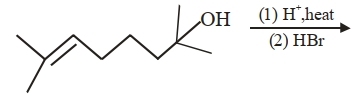
The major product in the given reaction is
A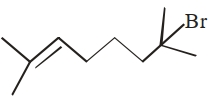
B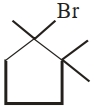
C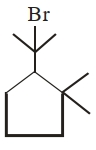
D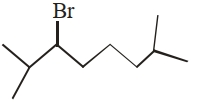
Solution
(C) The reaction proceeds through the following steps:
$1$. Protonation of the hydroxyl group by $H^+$ followed by the loss of a water molecule to form a tertiary carbocation.
$2$. The double bond in the chain attacks the carbocation,leading to a cyclization reaction to form a more stable five-membered ring carbocation.
$3$. The bromide ion $(Br^-)$ then attacks the carbocation to form the final product.
$4$. The structure corresponding to this mechanism is option $C$.
$1$. Protonation of the hydroxyl group by $H^+$ followed by the loss of a water molecule to form a tertiary carbocation.
$2$. The double bond in the chain attacks the carbocation,leading to a cyclization reaction to form a more stable five-membered ring carbocation.
$3$. The bromide ion $(Br^-)$ then attacks the carbocation to form the final product.
$4$. The structure corresponding to this mechanism is option $C$.
0 likesView Solution
326
ChemistryMediumMCQJEE Main · 2022
Compound $I$ is heated with Conc. $HI$ to give a hydroxy compound $A$ which is further heated with $Zn$ dust to give compound $B$. Identify $A$ and $B$.
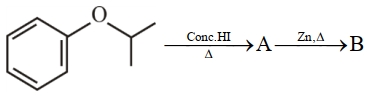
A
$A = \text{propan-2-ol}, B = \text{propene}$
B
$A = \text{phenol}, B = \text{p-benzoquinone}$
C
$A = \text{o-isopropylphenol}, B = \text{isopropylbenzene}$
D
$A = \text{phenol}, B = \text{benzene}$
Solution
(D) The reaction of an alkyl aryl ether with concentrated $HI$ involves the cleavage of the $C-O$ bond between the alkyl group and the oxygen atom. This is because the $C(aryl)-O$ bond has partial double bond character due to resonance and is stronger.
Thus,the reaction of phenyl isopropyl ether with $HI$ yields phenol $(A)$ and isopropyl iodide.
However,in the context of the given options,the reaction proceeds to form phenol $(A)$.
When phenol $(A)$ is heated with $Zn$ dust,it undergoes reduction to form benzene $(B)$.
Thus,the reaction of phenyl isopropyl ether with $HI$ yields phenol $(A)$ and isopropyl iodide.
However,in the context of the given options,the reaction proceeds to form phenol $(A)$.
When phenol $(A)$ is heated with $Zn$ dust,it undergoes reduction to form benzene $(B)$.
0 likesView Solution
327
ChemistryMediumMCQJEE Main · 2022
Given below are two statements: one is labelled as Assertion $A$ and the other is labelled as Reason $R$.
Assertion $A$: Aniline on nitration yields ortho,meta and para nitro derivatives of aniline.
Reason $R$: Nitrating mixture is a strong acidic mixture.
In the light of the above statements,choose the correct answer from the options given below.
Assertion $A$: Aniline on nitration yields ortho,meta and para nitro derivatives of aniline.
Reason $R$: Nitrating mixture is a strong acidic mixture.
In the light of the above statements,choose the correct answer from the options given below.
A
Both $A$ and $R$ are true and $R$ is the correct explanation of $A$.
B
Both $A$ and $R$ are true but $R$ is $NOT$ the correct explanation of $A$.
C
$A$ is true but $R$ is false.
D
$A$ is false but $R$ is true.
Solution
(A) Direct nitration of aniline with concentrated $HNO_3$ and $H_2SO_4$ (nitrating mixture) yields a mixture of ortho,meta,and para nitroanilines.
Assertion $A$ is true because the formation of the meta-isomer occurs due to the protonation of the $-NH_2$ group in the strongly acidic medium,forming the anilinium ion $(-NH_3^+)$,which is meta-directing.
Reason $R$ is also true,as the nitrating mixture is indeed a strong acidic mixture.
Since the formation of the meta-product is specifically due to the acidic nature of the medium (which protonates the amino group),Reason $R$ correctly explains Assertion $A$.
Assertion $A$ is true because the formation of the meta-isomer occurs due to the protonation of the $-NH_2$ group in the strongly acidic medium,forming the anilinium ion $(-NH_3^+)$,which is meta-directing.
Reason $R$ is also true,as the nitrating mixture is indeed a strong acidic mixture.
Since the formation of the meta-product is specifically due to the acidic nature of the medium (which protonates the amino group),Reason $R$ correctly explains Assertion $A$.
0 likesView Solution
328
ChemistryMediumMCQJEE Main · 2022
Match List-$I$ with List-$II$:
Choose the correct answer from the options given below.
| List-$I$ (Polymer) | List-$II$ (Nature) |
|---|---|
| $A$. $(-CH_2-C(Cl)=CH-CH_2-)_n$ | $I$. Thermosetting polymer |
| $B$. $(-NH-(CH_2)_6-NH-CO-(CH_2)_4-CO-)_n$ | $II$. Fibers |
| $C$. $(-CH_2-CH(Cl)-)_n$ | $III$. Elastomer |
| $D$. $(-C_6H_3(OH)-CH_2-)_n$ | $IV$. Thermoplastic polymer |
Choose the correct answer from the options given below.
A
$A-III, B-II, C-IV, D-I$
B
$A-II, B-III, C-IV, D-I$
C
$A-III, B-I, C-IV, D-II$
D
$A-I, B-III, C-IV, D-II$
Solution
(A) The given polymers are identified as follows:
$A$. $(-CH_2-C(Cl)=CH-CH_2-)_n$ is Neoprene,which is an elastomer $(III)$.
$B$. $(-NH-(CH_2)_6-NH-CO-(CH_2)_4-CO-)_n$ is Nylon-$6,6$,which is a fiber $(II)$.
$C$. $(-CH_2-CH(Cl)-)_n$ is Polyvinyl chloride $(PVC)$,which is a thermoplastic polymer $(IV)$.
$D$. $(-C_6H_3(OH)-CH_2-)_n$ is Novolac,which is a thermosetting polymer $(I)$.
Therefore,the correct matching is $A-III, B-II, C-IV, D-I$.
$A$. $(-CH_2-C(Cl)=CH-CH_2-)_n$ is Neoprene,which is an elastomer $(III)$.
$B$. $(-NH-(CH_2)_6-NH-CO-(CH_2)_4-CO-)_n$ is Nylon-$6,6$,which is a fiber $(II)$.
$C$. $(-CH_2-CH(Cl)-)_n$ is Polyvinyl chloride $(PVC)$,which is a thermoplastic polymer $(IV)$.
$D$. $(-C_6H_3(OH)-CH_2-)_n$ is Novolac,which is a thermosetting polymer $(I)$.
Therefore,the correct matching is $A-III, B-II, C-IV, D-I$.
0 likesView Solution
329
ChemistryMediumMCQJEE Main · 2022
Two statements in respect of drug-enzyme interaction are given below.
Statement $I$: Action of an enzyme can be blocked only when an inhibitor blocks the active site of the enzyme.
Statement $II$: An inhibitor can form a strong covalent bond with the enzyme.
In the light of the above statements,choose the correct answer from the options given below.
Statement $I$: Action of an enzyme can be blocked only when an inhibitor blocks the active site of the enzyme.
Statement $II$: An inhibitor can form a strong covalent bond with the enzyme.
In the light of the above statements,choose the correct answer from the options given below.
A
Both Statement $I$ and Statement $II$ are true.
B
Both Statement $I$ and Statement $II$ are false.
C
Statement $I$ is true but Statement $II$ is false.
D
Statement $I$ is false but Statement $II$ is true.
Solution
(D) Statement $I$ is false because inhibitors can also bind to allosteric sites,which are different from the active site,to block enzyme action.
Statement $II$ is true because some inhibitors (irreversible inhibitors) form strong covalent bonds with the enzyme,permanently deactivating it.
Therefore,Statement $I$ is false and Statement $II$ is true.
Statement $II$ is true because some inhibitors (irreversible inhibitors) form strong covalent bonds with the enzyme,permanently deactivating it.
Therefore,Statement $I$ is false and Statement $II$ is true.
0 likesView Solution
330
ChemistryMediumMCQJEE Main · 2022
The formulas of $A$ and $B$ for the following reaction sequence are:
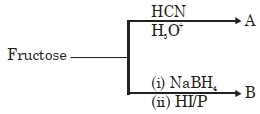
A
$A = C_{7}H_{14}O_{8}, B = C_{6}H_{14}$
B
$A = C_{7}H_{13}O_{7}, B = C_{7}H_{14}O$
C
$A = C_{7}H_{12}O_{8}, B = C_{6}H_{14}$
D
$A = C_{7}H_{14}O_{8}, B = C_{6}H_{14}O_{6}$
Solution
(A) $1$. Reaction with $HCN$ followed by hydrolysis $(H_{3}O^+)$ adds a carbon atom to the carbonyl group of Fructose $(C_{6}H_{12}O_{6})$,resulting in a heptonic acid derivative $(A)$ with the formula $C_{7}H_{14}O_{8}$.
$2$. Reduction of Fructose with $NaBH_{4}$ followed by heating with $HI/P$ reduces all hydroxyl and carbonyl groups to a hydrocarbon chain. Since Fructose is a hexose,the final product $B$ is $n$-hexane $(C_{6}H_{14})$.
$3$. Therefore,$A = C_{7}H_{14}O_{8}$ and $B = C_{6}H_{14}$.
$2$. Reduction of Fructose with $NaBH_{4}$ followed by heating with $HI/P$ reduces all hydroxyl and carbonyl groups to a hydrocarbon chain. Since Fructose is a hexose,the final product $B$ is $n$-hexane $(C_{6}H_{14})$.
$3$. Therefore,$A = C_{7}H_{14}O_{8}$ and $B = C_{6}H_{14}$.
0 likesView Solution
331
ChemistryMediumMCQJEE Main · 2022
Metal $M$ crystallizes into a $FCC$ lattice with the edge length of $4.0 \times 10^{-8} \ cm$. The atomic mass of the metal is $........ \ g/mol$. (Nearest integer). (Use: $N_{A} = 6.02 \times 10^{23} \ mol^{-1}$,density of metal,$d = 9.03 \ g \ cm^{-3}$)
A
$88$
B
$86$
C
$85$
D
$87$
Solution
(D) For an $FCC$ lattice,the number of atoms per unit cell,$Z = 4$.
Given edge length,$a = 4.0 \times 10^{-8} \ cm$.
Density,$d = 9.03 \ g \ cm^{-3}$.
Avogadro's number,$N_{A} = 6.02 \times 10^{23} \ mol^{-1}$.
The formula for density is $d = \frac{Z \times M}{N_{A} \times a^{3}}$.
Rearranging for molar mass $M$: $M = \frac{d \times N_{A} \times a^{3}}{Z}$.
Substituting the values: $M = \frac{9.03 \times 6.02 \times 10^{23} \times (4.0 \times 10^{-8})^{3}}{4}$.
$M = \frac{9.03 \times 6.02 \times 10^{23} \times 64 \times 10^{-24}}{4}$.
$M = \frac{9.03 \times 6.02 \times 6.4}{4} = 86.97 \ g/mol$.
Rounding to the nearest integer,$M \approx 87 \ g/mol$.
Given edge length,$a = 4.0 \times 10^{-8} \ cm$.
Density,$d = 9.03 \ g \ cm^{-3}$.
Avogadro's number,$N_{A} = 6.02 \times 10^{23} \ mol^{-1}$.
The formula for density is $d = \frac{Z \times M}{N_{A} \times a^{3}}$.
Rearranging for molar mass $M$: $M = \frac{d \times N_{A} \times a^{3}}{Z}$.
Substituting the values: $M = \frac{9.03 \times 6.02 \times 10^{23} \times (4.0 \times 10^{-8})^{3}}{4}$.
$M = \frac{9.03 \times 6.02 \times 10^{23} \times 64 \times 10^{-24}}{4}$.
$M = \frac{9.03 \times 6.02 \times 6.4}{4} = 86.97 \ g/mol$.
Rounding to the nearest integer,$M \approx 87 \ g/mol$.
0 likesView Solution
332
ChemistryMediumMCQJEE Main · 2022
$A$ gaseous mixture of two substances $A$ and $B$,under a total pressure of $0.8 \ atm$ is in equilibrium with an ideal liquid solution. The mole fraction of substance $A$ is $0.5$ in the vapour phase and $0.2$ in the liquid phase. The vapour pressure of pure liquid $A$ is $...... \ atm$. (Nearest integer)
A
$1$
B
$0$
C
$2$
D
$3$
Solution
(C) According to Dalton's Law of partial pressures,the partial pressure of $A$ is given by $P_A = Y_A \times P_{total}$.
Given $Y_A = 0.5$ and $P_{total} = 0.8 \ atm$,we have $P_A = 0.5 \times 0.8 = 0.4 \ atm$.
According to Raoult's Law,$P_A = P_A^0 \times X_A$,where $X_A$ is the mole fraction in the liquid phase.
Given $X_A = 0.2$,we have $0.4 = P_A^0 \times 0.2$.
Therefore,$P_A^0 = \frac{0.4}{0.2} = 2 \ atm$.
Given $Y_A = 0.5$ and $P_{total} = 0.8 \ atm$,we have $P_A = 0.5 \times 0.8 = 0.4 \ atm$.
According to Raoult's Law,$P_A = P_A^0 \times X_A$,where $X_A$ is the mole fraction in the liquid phase.
Given $X_A = 0.2$,we have $0.4 = P_A^0 \times 0.2$.
Therefore,$P_A^0 = \frac{0.4}{0.2} = 2 \ atm$.
0 likesView Solution
333
ChemistryMediumMCQJEE Main · 2022
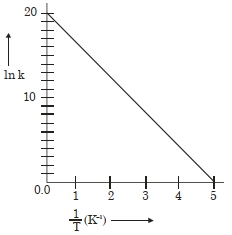
For a reaction,given below is the graph of $\ln k$ vs $\frac{1}{T}$. The activation energy for the reaction is equal to $...... \ cal \ mol^{-1}$. (Nearest integer). (Given : $R = 2 \ cal \ K^{-1} \ mol^{-1}$)
A
$8$
B
$40$
C
$4$
D
$20$
Solution
(A) The Arrhenius equation is given by $k = Ae^{-E_a/RT}$.
Taking the natural logarithm on both sides,we get $\ln k = -\frac{E_a}{R}(\frac{1}{T}) + \ln A$.
Comparing this with the equation of a straight line $y = mx + c$,the slope $m = -\frac{E_a}{R}$.
From the given graph,the slope is calculated as $\frac{y_2 - y_1}{x_2 - x_1} = \frac{0 - 20}{5 - 0} = -4$.
Equating the slopes: $-\frac{E_a}{R} = -4$,which gives $E_a = 4 \times R$.
Given $R = 2 \ cal \ K^{-1} \ mol^{-1}$,we have $E_a = 4 \times 2 = 8 \ cal \ mol^{-1}$.
Taking the natural logarithm on both sides,we get $\ln k = -\frac{E_a}{R}(\frac{1}{T}) + \ln A$.
Comparing this with the equation of a straight line $y = mx + c$,the slope $m = -\frac{E_a}{R}$.
From the given graph,the slope is calculated as $\frac{y_2 - y_1}{x_2 - x_1} = \frac{0 - 20}{5 - 0} = -4$.
Equating the slopes: $-\frac{E_a}{R} = -4$,which gives $E_a = 4 \times R$.
Given $R = 2 \ cal \ K^{-1} \ mol^{-1}$,we have $E_a = 4 \times 2 = 8 \ cal \ mol^{-1}$.
0 likesView Solution
334
ChemistryMediumMCQJEE Main · 2022
Among the following,the number of curves not in accordance with the Freundlich adsorption isotherm is:
A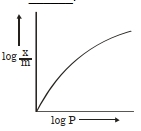
B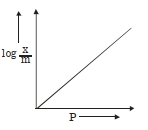
C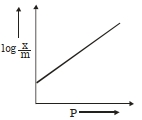
D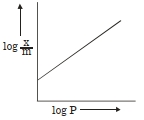
Solution
(B) The Freundlich adsorption isotherm is given by the equation: $\frac{x}{m} = K P^{\frac{1}{n}}$
Taking the logarithm on both sides,we get: $\log \frac{x}{m} = \frac{1}{n} \log P + \log K$
This is a linear equation of the form $y = mx + c$,where the plot of $\log \frac{x}{m}$ versus $\log P$ should be a straight line with a slope of $\frac{1}{n}$ and an intercept of $\log K$.
Analyzing the given curves:
$1$. The first curve $(a)$ is a non-linear curve of $\log \frac{x}{m}$ vs $\log P$,which is incorrect.
$2$. The second curve $(b)$ is a linear plot of $\log \frac{x}{m}$ vs $P$,which is incorrect.
$3$. The third curve $(c)$ is a linear plot of $\log \frac{x}{m}$ vs $P$,which is incorrect.
$4$. The fourth curve $(d)$ is a linear plot of $\log \frac{x}{m}$ vs $\log P$ with a positive intercept,which is correct.
Therefore,there are $3$ curves that are not in accordance with the Freundlich adsorption isotherm.
Taking the logarithm on both sides,we get: $\log \frac{x}{m} = \frac{1}{n} \log P + \log K$
This is a linear equation of the form $y = mx + c$,where the plot of $\log \frac{x}{m}$ versus $\log P$ should be a straight line with a slope of $\frac{1}{n}$ and an intercept of $\log K$.
Analyzing the given curves:
$1$. The first curve $(a)$ is a non-linear curve of $\log \frac{x}{m}$ vs $\log P$,which is incorrect.
$2$. The second curve $(b)$ is a linear plot of $\log \frac{x}{m}$ vs $P$,which is incorrect.
$3$. The third curve $(c)$ is a linear plot of $\log \frac{x}{m}$ vs $P$,which is incorrect.
$4$. The fourth curve $(d)$ is a linear plot of $\log \frac{x}{m}$ vs $\log P$ with a positive intercept,which is correct.
Therefore,there are $3$ curves that are not in accordance with the Freundlich adsorption isotherm.
0 likesView Solution
335
ChemistryMediumMCQJEE Main · 2022
$100 \; mL$ of $5 \% \; (w/v)$ solution of $NaCl$ in water was prepared in a $250 \; mL$ beaker. Albumin from the egg was poured into the $NaCl$ solution and stirred well. This resulted in a/an:
A
Lyophilic sol
B
Lyophobic sol
C
Emulsion
D
Precipitate
Solution
(A) Albumin is a protein,which is a macromolecule that forms a lyophilic sol when dispersed in a suitable solvent like water or dilute salt solutions.
Since albumin has a high affinity for the dispersion medium,it forms a lyophilic sol.
Since albumin has a high affinity for the dispersion medium,it forms a lyophilic sol.
0 likesView Solution
336
ChemistryMediumMCQJEE Main · 2022
In metallurgy,the term "gangue" is used for:
A
Contamination of undesired earthy materials.
B
Contamination of metals,other than the desired metal.
C
Minerals which are naturally occurring in pure form.
D
Magnetic impurities in an ore.
Solution
(A) Earthy and undesired materials present in the ore,other than the desired metal,are known as gangue.
0 likesView Solution
337
ChemistryMediumMCQJEE Main · 2022
Which among the following is the strongest Bronsted base?
A
Triethylamine
B
Diethylamine
C
$N$-methylpyrrole
D
Quinuclidine
Solution
(D) The basicity of an amine depends on the availability of the lone pair of electrons on the nitrogen atom.
In $N$-methylpyrrole,the lone pair is involved in aromaticity,making it very weakly basic.
In acyclic amines like triethylamine and diethylamine,the nitrogen atom can undergo amine inversion,which affects its basicity.
Quinuclidine is a bicyclic tertiary amine where the nitrogen atom is held in a rigid structure.
Due to this rigid bicyclic structure,the lone pair on the nitrogen is highly available for protonation,and the molecule cannot undergo amine inversion,which would otherwise decrease the availability of the lone pair.
Therefore,quinuclidine is the strongest Bronsted base among the given options.
In $N$-methylpyrrole,the lone pair is involved in aromaticity,making it very weakly basic.
In acyclic amines like triethylamine and diethylamine,the nitrogen atom can undergo amine inversion,which affects its basicity.
Quinuclidine is a bicyclic tertiary amine where the nitrogen atom is held in a rigid structure.
Due to this rigid bicyclic structure,the lone pair on the nitrogen is highly available for protonation,and the molecule cannot undergo amine inversion,which would otherwise decrease the availability of the lone pair.
Therefore,quinuclidine is the strongest Bronsted base among the given options.
0 likesView Solution
338
ChemistryDifficultMCQJEE Main · 2022
Considering the above reactions,the compound $A$ and compound $B$ respectively are:

A
$CH_3CH_2NC, CH_3CH_2CN$
B
$CH_3CH_2CN, CH_3CH_2CN$
C
$CH_3CH_2NC, CH_3CH_2NC$
D
$CH_3CH_2CN, CH_3CH_2NC$
Solution
(A) $NaCN$ is an ionic compound,so it provides $CN^-$ ions in solution. The carbon atom is more nucleophilic than the nitrogen atom,leading to the formation of alkyl cyanide $(R-CN)$ as the major product.
$AgCN$ is a covalent compound. The nitrogen atom has a lone pair of electrons available for nucleophilic attack,while the carbon atom is involved in a covalent bond with silver. This leads to the formation of alkyl isocyanide $(R-NC)$ as the major product.
Therefore,for the reaction with $AgCN$,the product $A$ is $CH_3CH_2NC$ (ethyl isocyanide),and for the reaction with $NaCN$,the product $B$ is $CH_3CH_2CN$ (ethyl cyanide).
$AgCN$ is a covalent compound. The nitrogen atom has a lone pair of electrons available for nucleophilic attack,while the carbon atom is involved in a covalent bond with silver. This leads to the formation of alkyl isocyanide $(R-NC)$ as the major product.
Therefore,for the reaction with $AgCN$,the product $A$ is $CH_3CH_2NC$ (ethyl isocyanide),and for the reaction with $NaCN$,the product $B$ is $CH_3CH_2CN$ (ethyl cyanide).
0 likesView Solution
339
ChemistryDifficultMCQJEE Main · 2022
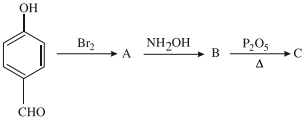
Consider the above reaction sequence,the Product $'C'$ is
A
$3,5-$dibromobenzonitrile
B
$3,5-$dibromo$-4-$hydroxybenzaldehyde
C
$3,5-$dibromo$-4-$hydroxybenzaldehyde oxime
D
$3,5-$dibromo$-4-$hydroxybenzonitrile
Solution
(D) Step $1$: The reaction of $4$-hydroxybenzaldehyde with $Br_2$ leads to electrophilic aromatic substitution at the ortho positions relative to the $-OH$ group,forming $3,5$-dibromo-$4$-hydroxybenzaldehyde (Product $A$).
Step $2$: The reaction of $A$ with $NH_2OH$ (hydroxylamine) converts the aldehyde group $(-CHO)$ into an oxime group $(-CH=N-OH)$,forming $3,5$-dibromo-$4$-hydroxybenzaldehyde oxime (Product $B$).
Step $3$: The reaction of $B$ with $P_2O_5$ (a dehydrating agent) causes the dehydration of the oxime group to a nitrile group $(-CN)$,yielding $3,5$-dibromo-$4$-hydroxybenzonitrile (Product $C$).
Step $2$: The reaction of $A$ with $NH_2OH$ (hydroxylamine) converts the aldehyde group $(-CHO)$ into an oxime group $(-CH=N-OH)$,forming $3,5$-dibromo-$4$-hydroxybenzaldehyde oxime (Product $B$).
Step $3$: The reaction of $B$ with $P_2O_5$ (a dehydrating agent) causes the dehydration of the oxime group to a nitrile group $(-CN)$,yielding $3,5$-dibromo-$4$-hydroxybenzonitrile (Product $C$).
0 likesView Solution
340
ChemistryDifficultMCQJEE Main · 2022
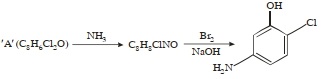
Consider the above reaction,the compound $A$ is
A
$4-$chloro$-2-$methylbenzoyl chloride
B
$3-$chloro$-4-$methylbenzoyl chloride
C
$4-$chloro$-3-$methylbenzoyl chloride
D
$3-$chloro$-4-$chloromethylbenzaldehyde
Solution
(A) The reaction sequence is as follows:
$1$. The starting material $A$ reacts with $NH_3$ to form an amide $(C_8H_8ClNO)$.
$2$. The amide then undergoes the Hofmann bromamide degradation reaction with $Br_2$ and $NaOH$ to form an amine.
$3$. Looking at the final product,which is $3-chloro-4-methylaniline$ (or a similar substituted aniline derivative),we can trace back the structure.
$4$. The final product has a $Cl$ group at the ortho position and a $CH_3$ group at the meta position relative to the $NH_2$ group.
$5$. The starting material $A$ must be $4-chloro-2-methylbenzoyl$ chloride,which upon reaction with $NH_3$ gives $4-chloro-2-methylbenzamide$,and subsequent Hofmann degradation yields $3-chloro-4-methylaniline$.
$1$. The starting material $A$ reacts with $NH_3$ to form an amide $(C_8H_8ClNO)$.
$2$. The amide then undergoes the Hofmann bromamide degradation reaction with $Br_2$ and $NaOH$ to form an amine.
$3$. Looking at the final product,which is $3-chloro-4-methylaniline$ (or a similar substituted aniline derivative),we can trace back the structure.
$4$. The final product has a $Cl$ group at the ortho position and a $CH_3$ group at the meta position relative to the $NH_2$ group.
$5$. The starting material $A$ must be $4-chloro-2-methylbenzoyl$ chloride,which upon reaction with $NH_3$ gives $4-chloro-2-methylbenzamide$,and subsequent Hofmann degradation yields $3-chloro-4-methylaniline$.
0 likesView Solution
341
ChemistryMediumMCQJEE Main · 2022
Which among the following represents reagent $A$ in the given reaction?
$C_6H_5N_2^+Cl^- + A \xrightarrow{NaOH} \text{Product (Orange-red dye)}$
$C_6H_5N_2^+Cl^- + A \xrightarrow{NaOH} \text{Product (Orange-red dye)}$
A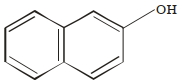
B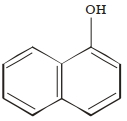
C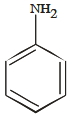
D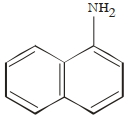
Solution
(A) The given reaction is a coupling reaction of benzene diazonium chloride with a phenol or amine in a basic medium to form an azo dye.
The reaction of benzene diazonium chloride with $\beta$-naphthol in the presence of $NaOH$ (basic medium) yields an orange-red azo dye.
The chemical equation is:
$C_6H_5N_2^+Cl^- + \beta\text{-Naphthol} \xrightarrow{NaOH} \text{Orange-red dye}$
The reaction of benzene diazonium chloride with $\beta$-naphthol in the presence of $NaOH$ (basic medium) yields an orange-red azo dye.
The chemical equation is:
$C_6H_5N_2^+Cl^- + \beta\text{-Naphthol} \xrightarrow{NaOH} \text{Orange-red dye}$
0 likesView Solution
342
ChemistryDifficultMCQJEE Main · 2022
Consider the following reaction sequence:
$4\text{-aminobenzonitrile}$ $\xrightarrow[(ii) H_2O]{(i) AlH(i-Bu)_2} 'A'$ $\xrightarrow[dil. NaOH, \Delta]{CH_3CHO} B$
The product $B$ is?
$4\text{-aminobenzonitrile}$ $\xrightarrow[(ii) H_2O]{(i) AlH(i-Bu)_2} 'A'$ $\xrightarrow[dil. NaOH, \Delta]{CH_3CHO} B$
The product $B$ is?
A
$4\text{-aminobenzaldehyde}$
B
$4\text{-aminocinnamaldehyde}$
C
$4\text{-amino-N-ethylidenebenzylamine}$
D
$4\text{-amino-N-formylbenzamide}$
Solution
(B) Step $1$: The reduction of $4\text{-aminobenzonitrile}$ with $DIBAL-H$ $(AlH(i-Bu)_2)$ followed by hydrolysis yields $4\text{-aminobenzaldehyde}$ as product '$A$'.
Step $2$: The reaction of $4\text{-aminobenzaldehyde}$ with acetaldehyde $(CH_3CHO)$ in the presence of dilute $NaOH$ and heat is a cross-aldol condensation reaction.
Step $3$: The aldehyde group of $4\text{-aminobenzaldehyde}$ reacts with the $\alpha\text{-hydrogen}$ of acetaldehyde to form $4\text{-aminocinnamaldehyde}$ as the major product '$B$'.
Step $2$: The reaction of $4\text{-aminobenzaldehyde}$ with acetaldehyde $(CH_3CHO)$ in the presence of dilute $NaOH$ and heat is a cross-aldol condensation reaction.
Step $3$: The aldehyde group of $4\text{-aminobenzaldehyde}$ reacts with the $\alpha\text{-hydrogen}$ of acetaldehyde to form $4\text{-aminocinnamaldehyde}$ as the major product '$B$'.
0 likesView Solution
343
ChemistryMediumMCQJEE Main · 2022
Which of the following compounds is an example of a hypnotic drug?
A
Seldane
B
Amytal
C
Aspartame
D
Prontosil
Solution
(B) $Amytal$ is a hypnotic drug used to treat sleeping disorders. It belongs to the class of barbiturates,which act as central nervous system depressants.
0 likesView Solution
344
ChemistryMediumMCQJEE Main · 2022
$A$ compound $'X'$ is acidic and it is soluble in $NaOH$ solution,but insoluble in $NaHCO_3$ solution. Compound $'X'$ also gives a violet colour with neutral $FeCl_3$ solution. The compound $'X'$ is:
A
Cyclohexanol
B
Phenol
C
Benzyl alcohol
D
Cyclohexylmethanol
Solution
(B) $1$. The compound $'X'$ is acidic and soluble in $NaOH$ but insoluble in $NaHCO_3$. This indicates that the compound is more acidic than water but less acidic than carbonic acid $(H_2CO_3)$. Phenols typically satisfy this condition.
$2$. The compound gives a violet colour with neutral $FeCl_3$ solution. This is a characteristic test for the presence of a phenolic group ($-OH$ group attached directly to a benzene ring).
$3$. Among the given options,Phenol $(C_6H_5OH)$ is the only compound that contains a phenolic group and satisfies all the given chemical properties.
$4$. The reaction with $FeCl_3$ is: $6C_6H_5OH + FeCl_3 \rightarrow [Fe(C_6H_5O)_6]^{3-} + 6H^+ + 3HCl$ (forming a violet complex).
$2$. The compound gives a violet colour with neutral $FeCl_3$ solution. This is a characteristic test for the presence of a phenolic group ($-OH$ group attached directly to a benzene ring).
$3$. Among the given options,Phenol $(C_6H_5OH)$ is the only compound that contains a phenolic group and satisfies all the given chemical properties.
$4$. The reaction with $FeCl_3$ is: $6C_6H_5OH + FeCl_3 \rightarrow [Fe(C_6H_5O)_6]^{3-} + 6H^+ + 3HCl$ (forming a violet complex).
0 likesView Solution
345
ChemistryDifficultMCQJEE Main · 2022
Resistance of a conductivity cell (cell constant $129 \; m^{-1}$) filled with $74.5 \; ppm$ solution of $KCl$ is $100 \; \Omega$ (labelled as solution $1$). When the same cell is filled with $KCl$ solution of $149 \; ppm$,the resistance is $50 \; \Omega$ (labelled as solution $2$). The ratio of molar conductivity of solution $1$ and solution $2$ is i.e.,$\frac{\wedge_{1}}{\wedge_{2}} = x \times 10^{-3}$. The value of $x$ is (Nearest integer). Given,molar mass of $KCl$ is $74.5 \; g \; mol^{-1}$.
A
$1000$
B
$2000$
C
$3000$
D
$4000$
Solution
(A) Cell constant $G^* = \frac{\ell}{A} = 129 \; m^{-1} = 1.29 \; cm^{-1}$.
Conductivity $\kappa = \frac{G^*}{R}$.
For solution $1$ $(74.5 \; ppm)$: $\kappa_1 = \frac{1.29}{100} \; S \; cm^{-1}$.
Concentration $C_1 \propto 74.5 \; ppm$.
For solution $2$ $(149 \; ppm)$: $\kappa_2 = \frac{1.29}{50} \; S \; cm^{-1}$.
Concentration $C_2 \propto 149 \; ppm$.
Since $ppm$ is proportional to molarity $(M)$,$\frac{C_1}{C_2} = \frac{74.5}{149} = \frac{1}{2}$.
Molar conductivity $\wedge_m = \frac{1000 \kappa}{C}$.
$\frac{\wedge_1}{\wedge_2} = \frac{\kappa_1}{\kappa_2} \times \frac{C_2}{C_1} = \frac{1.29/100}{1.29/50} \times \frac{149}{74.5} = \frac{50}{100} \times 2 = 1$.
Given $\frac{\wedge_1}{\wedge_2} = x \times 10^{-3} = 1$.
Therefore,$x = 1000$.
Conductivity $\kappa = \frac{G^*}{R}$.
For solution $1$ $(74.5 \; ppm)$: $\kappa_1 = \frac{1.29}{100} \; S \; cm^{-1}$.
Concentration $C_1 \propto 74.5 \; ppm$.
For solution $2$ $(149 \; ppm)$: $\kappa_2 = \frac{1.29}{50} \; S \; cm^{-1}$.
Concentration $C_2 \propto 149 \; ppm$.
Since $ppm$ is proportional to molarity $(M)$,$\frac{C_1}{C_2} = \frac{74.5}{149} = \frac{1}{2}$.
Molar conductivity $\wedge_m = \frac{1000 \kappa}{C}$.
$\frac{\wedge_1}{\wedge_2} = \frac{\kappa_1}{\kappa_2} \times \frac{C_2}{C_1} = \frac{1.29/100}{1.29/50} \times \frac{149}{74.5} = \frac{50}{100} \times 2 = 1$.
Given $\frac{\wedge_1}{\wedge_2} = x \times 10^{-3} = 1$.
Therefore,$x = 1000$.
0 likesView Solution
346
ChemistryMediumMCQJEE Main · 2022
Ionic radii of cation $A^{+}$ and anion $B^{-}$ are $102 \ pm$ and $181 \ pm$ respectively. These ions are allowed to crystallize into an ionic solid. This crystal has cubic close packing for $B^{-}$ and $A^{+}$ is present in all octahedral voids. The edge length of the unit cell of the crystal $AB$ is $pm$.
A
$566$
B
$555$
C
$544$
D
$533$
Solution
(A) In a crystal where the anion forms a cubic close packing $(CCP)$ and the cation occupies all octahedral voids,the structure is of the $NaCl$ type.
For an $NaCl$ type structure,the edge length $a$ is related to the ionic radii of the cation $(r_{+})$ and the anion $(r_{-})$ by the formula: $a = 2(r_{+} + r_{-})$.
Given: $r_{+} = 102 \ pm$ and $r_{-} = 181 \ pm$.
Substituting the values: $a = 2(102 \ pm + 181 \ pm)$.
$a = 2(283 \ pm) = 566 \ pm$.
For an $NaCl$ type structure,the edge length $a$ is related to the ionic radii of the cation $(r_{+})$ and the anion $(r_{-})$ by the formula: $a = 2(r_{+} + r_{-})$.
Given: $r_{+} = 102 \ pm$ and $r_{-} = 181 \ pm$.
Substituting the values: $a = 2(102 \ pm + 181 \ pm)$.
$a = 2(283 \ pm) = 566 \ pm$.
0 likesView Solution
347
ChemistryMediumMCQJEE Main · 2022
If $O_2$ gas is bubbled through water at $303 \; K$,the number of millimoles of $O_2$ gas that dissolve in $1 \; L$ of water is (Nearest Integer). (Given: Henry's Law constant for $O_2$ at $303 \; K$ is $46.82 \; kbar$ and partial pressure of $O_2 = 0.920 \; bar$). (Assume solubility of $O_2$ in water is too small,nearly negligible).
A
$0$
B
$1$
C
$2$
D
$3$
Solution
(B) According to Henry's Law,$p = K_H \times x$,where $x$ is the mole fraction of the gas in the solution.
Given $p = 0.920 \; bar$ and $K_H = 46.82 \; kbar = 46820 \; bar$.
$x = \frac{p}{K_H} = \frac{0.920}{46820} \approx 1.965 \times 10^{-5}$.
Since the solubility is very small,the number of moles of $H_2O$ in $1 \; L$ $(1000 \; g)$ is $n_{H_2O} = \frac{1000}{18} \approx 55.55 \; mol$.
$x = \frac{n_{O_2}}{n_{O_2} + n_{H_2O}} \approx \frac{n_{O_2}}{n_{H_2O}}$.
$n_{O_2} = x \times n_{H_2O} = (1.965 \times 10^{-5}) \times 55.55 \approx 1.09 \times 10^{-3} \; mol$.
$n_{O_2} \approx 1.09 \; millimoles$.
The nearest integer is $1$.
Given $p = 0.920 \; bar$ and $K_H = 46.82 \; kbar = 46820 \; bar$.
$x = \frac{p}{K_H} = \frac{0.920}{46820} \approx 1.965 \times 10^{-5}$.
Since the solubility is very small,the number of moles of $H_2O$ in $1 \; L$ $(1000 \; g)$ is $n_{H_2O} = \frac{1000}{18} \approx 55.55 \; mol$.
$x = \frac{n_{O_2}}{n_{O_2} + n_{H_2O}} \approx \frac{n_{O_2}}{n_{H_2O}}$.
$n_{O_2} = x \times n_{H_2O} = (1.965 \times 10^{-5}) \times 55.55 \approx 1.09 \times 10^{-3} \; mol$.
$n_{O_2} \approx 1.09 \; millimoles$.
The nearest integer is $1$.
0 likesView Solution
348
ChemistryMediumMCQJEE Main · 2022
The reaction between $X$ and $Y$ is first order with respect to $X$ and zero order with respect to $Y$.
Examine the data of the table and calculate the ratio of the numerical value of $M$ to $0.2$.
| $Experiment$ | $[X] / (mol \ L^{-1})$ | $[Y] / (mol \ L^{-1})$ | $\text{Initial rate} / (mol \ L^{-1} \ min^{-1})$ |
| $I$ | $0.1$ | $0.1$ | $2 \times 10^{-3}$ |
| $II$ | $0.2$ | $0.2$ | $4 \times 10^{-3}$ |
| $III$ | $0.4$ | $0.4$ | $M \times 10^{-3}$ |
| $IV$ | $0.1$ | $0.2$ | $2 \times 10^{-3}$ |
Examine the data of the table and calculate the ratio of the numerical value of $M$ to $0.2$.
A
$20$
B
$30$
C
$40$
D
$50$
Solution
(C) The rate law for the reaction is given by $r = k[X]^1[Y]^0 = k[X]$.
From experiment $I$,$2 \times 10^{-3} = k(0.1) \Rightarrow k = 2 \times 10^{-2} \ min^{-1}$.
For experiment $III$,the concentration of $X$ is $0.4 \ mol \ L^{-1}$.
Therefore,the initial rate is $r = k[X] = (2 \times 10^{-2})(0.4) = 0.8 \times 10^{-2} = 8 \times 10^{-3} \ mol \ L^{-1} \ min^{-1}$.
Comparing this with $M \times 10^{-3}$,we get $M = 8$.
The ratio of the numerical value of $M$ to $0.2$ is $\frac{8}{0.2} = 40$.
From experiment $I$,$2 \times 10^{-3} = k(0.1) \Rightarrow k = 2 \times 10^{-2} \ min^{-1}$.
For experiment $III$,the concentration of $X$ is $0.4 \ mol \ L^{-1}$.
Therefore,the initial rate is $r = k[X] = (2 \times 10^{-2})(0.4) = 0.8 \times 10^{-2} = 8 \times 10^{-3} \ mol \ L^{-1} \ min^{-1}$.
Comparing this with $M \times 10^{-3}$,we get $M = 8$.
The ratio of the numerical value of $M$ to $0.2$ is $\frac{8}{0.2} = 40$.
0 likesView Solution
349
ChemistryMediumMCQJEE Main · 2022
In a linear tetrapeptide (constituted with different amino acids),the value of (number of amino acids) - (number of peptide bonds) is:
A
$3$
B
$2$
C
$1$
D
$0$
Solution
(C) tetrapeptide is formed by the linkage of $4$ amino acids.
In a linear polypeptide chain,the number of peptide bonds is always $(n - 1)$,where $n$ is the number of amino acids.
For a tetrapeptide,$n = 4$.
Number of peptide bonds $= 4 - 1 = 3$.
Therefore,(number of amino acids) - (number of peptide bonds) $= 4 - 3 = 1$.
In a linear polypeptide chain,the number of peptide bonds is always $(n - 1)$,where $n$ is the number of amino acids.
For a tetrapeptide,$n = 4$.
Number of peptide bonds $= 4 - 1 = 3$.
Therefore,(number of amino acids) - (number of peptide bonds) $= 4 - 3 = 1$.
0 likesView Solution
350
ChemistryMediumMCQJEE Main · 2022
$[Fe(CN)_{6}]^{3-}$ is an inner orbital complex. Ignoring the pairing energy,the value of crystal field stabilization energy for this complex is $(-)\;\dots \;\Delta_{o}$.
A
$5$
B
$4$
C
$3$
D
$2$
Solution
(D) The complex is $[Fe(CN)_{6}]^{3-}$.
$Fe$ is in the $+3$ oxidation state,so its electronic configuration is $3d^{5}$.
$CN^{-}$ is a strong field ligand,which causes pairing of electrons in the $d$-orbitals.
For an octahedral complex,the $d$-orbitals split into $t_{2g}$ and $e_{g}$ sets.
The $5$ electrons occupy the $t_{2g}$ orbitals as $(t_{2g}^{5} e_{g}^{0})$.
The crystal field stabilization energy $(CFSE)$ is calculated as:
$CFSE = n(t_{2g}) \times (-0.4 \Delta_{o}) + n(e_{g}) \times (0.6 \Delta_{o})$
$CFSE = 5 \times (-0.4 \Delta_{o}) + 0 \times (0.6 \Delta_{o}) = -2.0 \Delta_{o}$.
Thus,the value is $2$.
$Fe$ is in the $+3$ oxidation state,so its electronic configuration is $3d^{5}$.
$CN^{-}$ is a strong field ligand,which causes pairing of electrons in the $d$-orbitals.
For an octahedral complex,the $d$-orbitals split into $t_{2g}$ and $e_{g}$ sets.
The $5$ electrons occupy the $t_{2g}$ orbitals as $(t_{2g}^{5} e_{g}^{0})$.
The crystal field stabilization energy $(CFSE)$ is calculated as:
$CFSE = n(t_{2g}) \times (-0.4 \Delta_{o}) + n(e_{g}) \times (0.6 \Delta_{o})$
$CFSE = 5 \times (-0.4 \Delta_{o}) + 0 \times (0.6 \Delta_{o}) = -2.0 \Delta_{o}$.
Thus,the value is $2$.
0 likesView Solution
351
ChemistryMediumMCQJEE Main · 2022
Given below are the critical temperatures of some of the gases:
The gas showing least adsorption on a definite amount of charcoal is:
| Gas | Critical temperature $(K)$ |
| $He$ | $5.2$ |
| $CH_{4}$ | $190$ |
| $CO_{2}$ | $304.2$ |
| $NH_{3}$ | $405.5$ |
The gas showing least adsorption on a definite amount of charcoal is:
A
$He$
B
$CH_{4}$
C
$CO_{2}$
D
$NH_{3}$
Solution
(A) The extent of adsorption of a gas on a solid adsorbent like charcoal depends on the ease of liquefaction of the gas.
Easily liquefiable gases have higher critical temperatures $(T_c)$ and are adsorbed to a greater extent.
Conversely,gases with lower critical temperatures are difficult to liquefy and show the least adsorption.
Comparing the given values: $T_c(He) = 5.2 \ K$,$T_c(CH_4) = 190 \ K$,$T_c(CO_2) = 304.2 \ K$,and $T_c(NH_3) = 405.5 \ K$.
Since $He$ has the lowest critical temperature $(5.2 \ K)$,it shows the least adsorption on charcoal.
Easily liquefiable gases have higher critical temperatures $(T_c)$ and are adsorbed to a greater extent.
Conversely,gases with lower critical temperatures are difficult to liquefy and show the least adsorption.
Comparing the given values: $T_c(He) = 5.2 \ K$,$T_c(CH_4) = 190 \ K$,$T_c(CO_2) = 304.2 \ K$,and $T_c(NH_3) = 405.5 \ K$.
Since $He$ has the lowest critical temperature $(5.2 \ K)$,it shows the least adsorption on charcoal.
0 likesView Solution
352
ChemistryMediumMCQJEE Main · 2022
In the liquation process used for tin $(Sn)$,the metal
A
is reacted with acid
B
is dissolved in water
C
is brought to molten form which is made to flow on a slope
D
is fused with $NaOH$
Solution
(C) The liquation process is used for metals having low melting points,such as $Sn$ (tin).
In this process,the metal is heated to a molten state and made to flow down a sloping hearth.
The metal flows down,while impurities with higher melting points remain behind on the top.
In this process,the metal is heated to a molten state and made to flow down a sloping hearth.
The metal flows down,while impurities with higher melting points remain behind on the top.
0 likesView Solution
353
ChemistryMediumMCQJEE Main · 2022
Which of the following $3d$-metal ion will give the lowest enthalpy of hydration $(\Delta_{hyd}H)$ when dissolved in water?
A
$Cr^{2+}$
B
$Mn^{2+}$
C
$Fe^{2+}$
D
$Co^{2+}$
Solution
(B) The enthalpy of hydration $(\Delta_{hyd}H)$ is directly proportional to the charge density of the ion.
Charge density is defined as $\frac{\text{charge}}{\text{size}}$.
For the given $3d$-metal ions $(Cr^{2+}, Mn^{2+}, Fe^{2+}, Co^{2+})$,the charge is the same $(+2)$.
Therefore,the ion with the largest ionic radius will have the lowest charge density and consequently the lowest enthalpy of hydration.
According to periodic trends,the ionic radius decreases across the $3d$ series due to increasing effective nuclear charge.
Among the given ions,$Mn^{2+}$ has the largest ionic radius.
Thus,$Mn^{2+}$ has the lowest enthalpy of hydration.
Charge density is defined as $\frac{\text{charge}}{\text{size}}$.
For the given $3d$-metal ions $(Cr^{2+}, Mn^{2+}, Fe^{2+}, Co^{2+})$,the charge is the same $(+2)$.
Therefore,the ion with the largest ionic radius will have the lowest charge density and consequently the lowest enthalpy of hydration.
According to periodic trends,the ionic radius decreases across the $3d$ series due to increasing effective nuclear charge.
Among the given ions,$Mn^{2+}$ has the largest ionic radius.
Thus,$Mn^{2+}$ has the lowest enthalpy of hydration.
0 likesView Solution
354
ChemistryMediumMCQJEE Main · 2022
Octahedral complexes of copper $(II)$ undergo structural distortion (Jahn-Teller). Which one of the given copper $(II)$ complexes will show the maximum structural distortion?
($en = \text{ethylenediamine}$; $H_2N-CH_2-CH_2-NH_2$)
($en = \text{ethylenediamine}$; $H_2N-CH_2-CH_2-NH_2$)
A
$[Cu(H_2O)_6]SO_4$
B
$[Cu(en)(H_2O)_4]SO_4$
C
$cis-[Cu(en)_2Cl_2]$
D
$trans-[Cu(en)_2Cl_2]$
Solution
(D) $Cu^{2+}$ has a $d^9$ electronic configuration,which leads to an unsymmetrical filling of the $e_g$ orbitals $(t_{2g}^6 e_g^3)$.
This causes Jahn-Teller distortion in octahedral complexes.
The magnitude of structural distortion is directly proportional to the difference in the field strength of the ligands present in the coordination sphere.
In $[Cu(en)_2Cl_2]$,the ligands are $en$ (a strong field ligand) and $Cl^-$ (a weak field ligand).
Because $en$ and $Cl^-$ have the largest difference in their ligand field strengths compared to the other options,$[Cu(en)_2Cl_2]$ exhibits the maximum structural distortion.
Specifically,for $trans-[Cu(en)_2Cl_2]$,the axial ligands $(Cl^-)$ are significantly different from the equatorial ligands $(en)$,leading to maximum elongation.
This causes Jahn-Teller distortion in octahedral complexes.
The magnitude of structural distortion is directly proportional to the difference in the field strength of the ligands present in the coordination sphere.
In $[Cu(en)_2Cl_2]$,the ligands are $en$ (a strong field ligand) and $Cl^-$ (a weak field ligand).
Because $en$ and $Cl^-$ have the largest difference in their ligand field strengths compared to the other options,$[Cu(en)_2Cl_2]$ exhibits the maximum structural distortion.
Specifically,for $trans-[Cu(en)_2Cl_2]$,the axial ligands $(Cl^-)$ are significantly different from the equatorial ligands $(en)$,leading to maximum elongation.
0 likesView Solution
355
ChemistryEasyMCQJEE Main · 2022
The Hinsberg reagent is:
A
B
C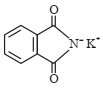
D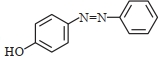
Solution
(A) The Hinsberg reagent is $Benzene$ $sulphonyl$ $chloride$ $(C_6H_5SO_2Cl)$.
It is used for the separation and identification of primary,secondary,and tertiary amines.
It is used for the separation and identification of primary,secondary,and tertiary amines.
0 likesView Solution
356
ChemistryEasyMCQJEE Main · 2022
Which of the following is $NOT$ a natural polymer?
A
Protein
B
Starch
C
Rubber
D
Rayon
Solution
(D) Natural polymers are those that occur naturally in plants and animals. Examples include $Protein$,$Starch$,and $Rubber$.
$Rayon$ is a regenerated cellulose fiber,which is classified as a semisynthetic polymer because it is derived from natural cellulose through chemical processing.
$Rayon$ is a regenerated cellulose fiber,which is classified as a semisynthetic polymer because it is derived from natural cellulose through chemical processing.
0 likesView Solution
357
ChemistryMediumMCQJEE Main · 2022
Given below are two statements. One is labelled as Assertion $A$ and the other is labelled as Reason $R$.
Assertion $A$: Amylose is insoluble in water.
Reason $R$: Amylose is a long linear molecule with more than $200$ glucose units.
In the light of the above statements,choose the correct answer from the options given below.
Assertion $A$: Amylose is insoluble in water.
Reason $R$: Amylose is a long linear molecule with more than $200$ glucose units.
In the light of the above statements,choose the correct answer from the options given below.
A
Both $A$ and $R$ are correct and $R$ is the correct explanation of $A$.
B
Both $A$ and $R$ are correct and $R$ is $NOT$ the correct explanation of $A$.
C
$A$ is correct but $R$ is not correct.
D
$A$ is not correct but $R$ is correct.
Solution
(D) Assertion $A$ states that Amylose is insoluble in water,which is incorrect because Amylose is a water-soluble component of starch.
Reason $R$ states that Amylose is a long linear molecule with more than $200$ glucose units,which is correct as it consists of $200$ to $1000$ $\alpha-D-(+)$-glucose units held by $\alpha$-glycosidic linkages.
Therefore,$A$ is incorrect but $R$ is correct.
Reason $R$ states that Amylose is a long linear molecule with more than $200$ glucose units,which is correct as it consists of $200$ to $1000$ $\alpha-D-(+)$-glucose units held by $\alpha$-glycosidic linkages.
Therefore,$A$ is incorrect but $R$ is correct.
0 likesView Solution
358
ChemistryMediumMCQJEE Main · 2022
$1.80 \ g$ of solute $A$ was dissolved in $62.5 \ cm^{3}$ of ethanol and the freezing point of the solution was found to be $155.1 \ K$. The molar mass of solute $A$ is $.......... \ g \ mol^{-1}$.
[Given: Freezing point of ethanol is $156.0 \ K$,Density of ethanol is $0.80 \ g \ cm^{-3}$,Freezing point depression constant of ethanol is $2.00 \ K \ kg \ mol^{-1}$]
[Given: Freezing point of ethanol is $156.0 \ K$,Density of ethanol is $0.80 \ g \ cm^{-3}$,Freezing point depression constant of ethanol is $2.00 \ K \ kg \ mol^{-1}$]
A
$81$
B
$80$
C
$82$
D
$83$
Solution
(B) Mass of ethanol = $62.5 \ cm^{3} \times 0.80 \ g \ cm^{-3} = 50 \ g = 0.05 \ kg$.
Freezing point depression,$\Delta T_{f} = T_{f}^{\circ} - T_{f} = 156.0 \ K - 155.1 \ K = 0.9 \ K$.
Using the formula $\Delta T_{f} = K_{f} \times m$,where $m$ is molality:
$0.9 = 2.00 \times \frac{1.80 \ g / M_{w}}{0.05 \ kg}$.
$M_{w} = \frac{2.00 \times 1.80}{0.9 \times 0.05} = \frac{3.6}{0.045} = 80 \ g \ mol^{-1}$.
Freezing point depression,$\Delta T_{f} = T_{f}^{\circ} - T_{f} = 156.0 \ K - 155.1 \ K = 0.9 \ K$.
Using the formula $\Delta T_{f} = K_{f} \times m$,where $m$ is molality:
$0.9 = 2.00 \times \frac{1.80 \ g / M_{w}}{0.05 \ kg}$.
$M_{w} = \frac{2.00 \times 1.80}{0.9 \times 0.05} = \frac{3.6}{0.045} = 80 \ g \ mol^{-1}$.
0 likesView Solution
359
ChemistryMediumMCQJEE Main · 2022
For a cell,$Cu_{(s)} \mid Cu^{2+}(0.001\,M) \mid\mid Ag^{+}(0.01\,M) \mid Ag_{(s)}$,the cell potential is found to be $0.43\,V$ at $298\,K$. The magnitude of standard electrode potential for $Cu^{2+}/Cu$ is $......... \times 10^{-2}\,V$. $[\text{Given}: E^{\Theta}_{Ag^{+}/Ag} = 0.80\,V \text{ and } \frac{2.303RT}{F} = 0.06\,V]$
A
$33$
B
$32$
C
$34$
D
$31$
Solution
(C) The cell reaction is: $Cu_{(s)} + 2Ag^{+}_{(aq)} \rightarrow Cu^{2+}_{(aq)} + 2Ag_{(s)}$.
Using the Nernst equation: $E_{\text{cell}} = E^{\Theta}_{\text{cell}} - \frac{0.06}{n} \log \frac{[Cu^{2+}]}{[Ag^{+}]^2}$.
Here,$n = 2$,$[Cu^{2+}] = 10^{-3} \, M$,and $[Ag^{+}] = 10^{-2} \, M$.
$0.43 = E^{\Theta}_{\text{cell}} - \frac{0.06}{2} \log \frac{10^{-3}}{(10^{-2})^2}$.
$0.43 = E^{\Theta}_{\text{cell}} - 0.03 \log \frac{10^{-3}}{10^{-4}} = E^{\Theta}_{\text{cell}} - 0.03 \log(10) = E^{\Theta}_{\text{cell}} - 0.03$.
$E^{\Theta}_{\text{cell}} = 0.43 + 0.03 = 0.46 \, V$.
We know $E^{\Theta}_{\text{cell}} = E^{\Theta}_{\text{cathode}} - E^{\Theta}_{\text{anode}} = E^{\Theta}_{Ag^{+}/Ag} - E^{\Theta}_{Cu^{2+}/Cu}$.
$0.46 = 0.80 - E^{\Theta}_{Cu^{2+}/Cu}$.
$E^{\Theta}_{Cu^{2+}/Cu} = 0.80 - 0.46 = 0.34 \, V$.
Thus,$E^{\Theta}_{Cu^{2+}/Cu} = 34 \times 10^{-2} \, V$.
Using the Nernst equation: $E_{\text{cell}} = E^{\Theta}_{\text{cell}} - \frac{0.06}{n} \log \frac{[Cu^{2+}]}{[Ag^{+}]^2}$.
Here,$n = 2$,$[Cu^{2+}] = 10^{-3} \, M$,and $[Ag^{+}] = 10^{-2} \, M$.
$0.43 = E^{\Theta}_{\text{cell}} - \frac{0.06}{2} \log \frac{10^{-3}}{(10^{-2})^2}$.
$0.43 = E^{\Theta}_{\text{cell}} - 0.03 \log \frac{10^{-3}}{10^{-4}} = E^{\Theta}_{\text{cell}} - 0.03 \log(10) = E^{\Theta}_{\text{cell}} - 0.03$.
$E^{\Theta}_{\text{cell}} = 0.43 + 0.03 = 0.46 \, V$.
We know $E^{\Theta}_{\text{cell}} = E^{\Theta}_{\text{cathode}} - E^{\Theta}_{\text{anode}} = E^{\Theta}_{Ag^{+}/Ag} - E^{\Theta}_{Cu^{2+}/Cu}$.
$0.46 = 0.80 - E^{\Theta}_{Cu^{2+}/Cu}$.
$E^{\Theta}_{Cu^{2+}/Cu} = 0.80 - 0.46 = 0.34 \, V$.
Thus,$E^{\Theta}_{Cu^{2+}/Cu} = 34 \times 10^{-2} \, V$.
0 likesView Solution
360
ChemistryMediumMCQJEE Main · 2022
Assuming $1 \, \mu g$ of trace radioactive element $X$ with a half-life of $30 \ years$ is absorbed by a growing tree. The amount of $X$ remaining in the tree after $100 \ years$ is $n \times 10^{-1} \, \mu g$. Find the value of $n$. $[Given : \ln 10 = 2.303 ; \log 2 = 0.30]$
A
$0$
B
$2$
C
$1$
D
$3$
Solution
(C) Radioactive decay follows first-order kinetics: $N_t = N_0 \times (1/2)^{t/t_{1/2}}$.
Given: $N_0 = 1 \, \mu g$,$t_{1/2} = 30 \ years$,$t = 100 \ years$.
$N_t = 1 \times (1/2)^{100/30} = (1/2)^{10/3}$.
Taking $\log$ on both sides: $\log N_t = \frac{10}{3} \log(0.5) = \frac{10}{3} \times (-0.30) = -1$.
$N_t = 10^{-1} \, \mu g$.
Comparing with $n \times 10^{-1} \, \mu g$,we get $n = 1$.
Given: $N_0 = 1 \, \mu g$,$t_{1/2} = 30 \ years$,$t = 100 \ years$.
$N_t = 1 \times (1/2)^{100/30} = (1/2)^{10/3}$.
Taking $\log$ on both sides: $\log N_t = \frac{10}{3} \log(0.5) = \frac{10}{3} \times (-0.30) = -1$.
$N_t = 10^{-1} \, \mu g$.
Comparing with $n \times 10^{-1} \, \mu g$,we get $n = 1$.
0 likesView Solution
361
ChemistryEasyMCQJEE Main · 2022
The sum of the oxidation state (magnitude) and the coordination number of cobalt in $Na[Co(bpy)Cl_4]$ is $.......$ (Given $bpy = 2,2'-bipyridine$)
A
$6$
B
$3$
C
$9$
D
$12$
Solution
(C) The complex is $Na[Co(bpy)Cl_4]$.
$bpy$ $(2,2'-bipyridine)$ is a bidentate ligand,and $Cl^-$ is a monodentate ligand.
Coordination number of $Co = (1 \times 2) + (4 \times 1) = 6$.
Let the oxidation state of $Co$ be $x$.
The charge on $Na$ is $+1$,$bpy$ is $0$,and $Cl$ is $-1$.
$1 + x + 0 + 4(-1) = 0$
$1 + x - 4 = 0$
$x - 3 = 0$
$x = +3$.
Magnitude of oxidation state $= 3$.
Sum $= 6 + 3 = 9$.
$bpy$ $(2,2'-bipyridine)$ is a bidentate ligand,and $Cl^-$ is a monodentate ligand.
Coordination number of $Co = (1 \times 2) + (4 \times 1) = 6$.
Let the oxidation state of $Co$ be $x$.
The charge on $Na$ is $+1$,$bpy$ is $0$,and $Cl$ is $-1$.
$1 + x + 0 + 4(-1) = 0$
$1 + x - 4 = 0$
$x - 3 = 0$
$x = +3$.
Magnitude of oxidation state $= 3$.
Sum $= 6 + 3 = 9$.
0 likesView Solution
362
ChemistryMediumMCQJEE Main · 2022
Consider the following sulphur-based oxoacids: $H_2SO_3$,$H_2SO_4$,$H_2S_2O_8$,and $H_2S_2O_7$. Among these oxoacids,the number of those with a peroxo $(O-O)$ bond is $..........$
A
$1$
B
$2$
C
$3$
D
$0$
Solution
(A) To determine the number of oxoacids with a peroxo $(O-O)$ bond,we examine their structures:
$1$. $H_2SO_3$ (Sulphurous acid): Contains only $S=O$ and $S-OH$ bonds. No peroxo bond.
$2$. $H_2SO_4$ (Sulphuric acid): Contains $S=O$ and $S-OH$ bonds. No peroxo bond.
$3$. $H_2S_2O_8$ (Peroxodisulphuric acid): Contains a central $O-O$ peroxo linkage between two sulphur atoms.
$4$. $H_2S_2O_7$ (Pyrosulphuric acid): Contains an $S-O-S$ linkage. No peroxo bond.
Thus,only $H_2S_2O_8$ contains a peroxo bond.
The total count is $1$.
$1$. $H_2SO_3$ (Sulphurous acid): Contains only $S=O$ and $S-OH$ bonds. No peroxo bond.
$2$. $H_2SO_4$ (Sulphuric acid): Contains $S=O$ and $S-OH$ bonds. No peroxo bond.
$3$. $H_2S_2O_8$ (Peroxodisulphuric acid): Contains a central $O-O$ peroxo linkage between two sulphur atoms.
$4$. $H_2S_2O_7$ (Pyrosulphuric acid): Contains an $S-O-S$ linkage. No peroxo bond.
Thus,only $H_2S_2O_8$ contains a peroxo bond.
The total count is $1$.
0 likesView Solution
Vedclass Products
For Students
Vedclass Test Series
Mock tests in real JEE Main style covering Chemistry with performance analysis. 5-day free trial.
Start Free TrialFor Teachers
Exam Paper Generator
Generate Set A/B/C/D Chemistry papers from 7.5L+ questions in 2 minutes. 3 chapters free.
Try FreeFor Institutes
Online Exam Module
Run live JEE Main mock exams with unlimited students, 360° analytics & white-label branding.
See DemoFrequently Asked Questions
How many Chemistry questions are in JEE Main 2022?
There are 666 Chemistry questions from the JEE Main 2022 paper on Vedclass, each with a detailed step-by-step solution in English.
Are JEE Main 2022 Chemistry solutions available in English?
Yes. All solutions on this page are in English. You can also switch to English or Hindi using the language buttons above the questions.
Can I practice JEE Main 2022 Chemistry as a timed test?
Yes. Use the Vedclass Test Series to attempt a full JEE Main mock test covering Chemistry with time limits and instant score analysis.
Can teachers create Chemistry papers from JEE Main previous year questions?
Yes. The Vedclass Exam Paper Generator lets teachers mix JEE Main Chemistry questions and generate Set A/B/C/D papers in minutes.
For Teachers & Institutes
Build a Custom Chemistry Paper
Pick JEE Main 2022 Chemistry questions, set difficulty, and generate Set A/B/C/D in 2 minutes.