
ChemistryQ151–250 of 666 questions
Page 4 of 8 · English
151
ChemistryMediumMCQJEE Main · 2022
Match the List-$I$ with List-$II$.
Choose the most appropriate answer from the options given below:
| List-$I$ (Metal) | List-$II$ (Emitted light wavelength $(nm)$) |
| $A. Li$ | $I. 670.8$ |
| $B. Na$ | $II. 589.2$ |
| $C. Rb$ | $III. 780.0$ |
| $D. Cs$ | $IV. 455.5$ |
Choose the most appropriate answer from the options given below:
A
$A-I, B-II, C-III, D-IV$
B
$A-III, B-II, C-I, D-IV$
C
$A-III, B-I, C-II, D-IV$
D
$A-IV, B-II, C-I, D-III$
Solution
(A) The characteristic flame colors and corresponding wavelengths for alkali metals are as follows:
Matching the values:
$A (Li) - I (670.8)$
$B (Na) - II (589.2)$
$C (Rb) - III (780.0)$
$D (Cs) - IV (455.5)$
Therefore,the correct match is $A-I, B-II, C-III, D-IV$.
| Metal | Wavelength $(\lambda / nm)$ |
| $Li$ | $670.8$ |
| $Na$ | $589.2$ |
| $Rb$ | $780.0$ |
| $Cs$ | $455.5$ |
Matching the values:
$A (Li) - I (670.8)$
$B (Na) - II (589.2)$
$C (Rb) - III (780.0)$
$D (Cs) - IV (455.5)$
Therefore,the correct match is $A-I, B-II, C-III, D-IV$.
0 likesView Solution
152
ChemistryMediumMCQJEE Main · 2022
Match the List-$I$ with List-$II$.
Choose the most appropriate answer from the options given below:
| List-$I$ (Element) | List-$II$ (Application) |
|---|---|
| $A$. $Cs$ | $I$. High temperature thermometer |
| $B$. $Ga$ | $II$. Water repellent sprays |
| $C$. $B$ | $III$. Photoelectric cells |
| $D$. $Si$ | $IV$. Bullet proof vest |
Choose the most appropriate answer from the options given below:
A
$A-III, B-I, C-IV, D-II$
B
$A-IV, B-III, C-II, D-I$
C
$A-II, B-III, C-IV, D-I$
D
$A-I, B-IV, C-II, D-III$
Solution
(A) $Cs$ (Caesium) is used in photoelectric cells due to its low ionization energy.
$Ga$ (Gallium) has a high boiling point and is used in high temperature thermometers.
$B$ (Boron) fibres are used in making bullet-proof vests.
$Si$ (Silicon) based silicones are used in water repellent sprays due to their non-polar alkyl groups.
Therefore,the correct matching is $A-III, B-I, C-IV, D-II$.
$Ga$ (Gallium) has a high boiling point and is used in high temperature thermometers.
$B$ (Boron) fibres are used in making bullet-proof vests.
$Si$ (Silicon) based silicones are used in water repellent sprays due to their non-polar alkyl groups.
Therefore,the correct matching is $A-III, B-I, C-IV, D-II$.
0 likesView Solution
153
ChemistryEasyMCQJEE Main · 2022
The acid that is believed to be mainly responsible for the damage of the Taj Mahal is ...
A
Sulfuric acid
B
Hydrofluoric acid
C
Phosphoric acid
D
Hydrochloric acid
Solution
(A) The Taj Mahal is made of marble,which is primarily calcium carbonate $(CaCO_3)$.
Acid rain contains sulfuric acid $(H_2SO_4)$,which reacts with the marble to form calcium sulfate $(CaSO_4)$,water,and carbon dioxide.
This reaction causes the surface of the marble to corrode and lose its luster.
The chemical reaction is: $CaCO_3 + H_2SO_4 \rightarrow CaSO_4 + H_2O + CO_2$.
Acid rain contains sulfuric acid $(H_2SO_4)$,which reacts with the marble to form calcium sulfate $(CaSO_4)$,water,and carbon dioxide.
This reaction causes the surface of the marble to corrode and lose its luster.
The chemical reaction is: $CaCO_3 + H_2SO_4 \rightarrow CaSO_4 + H_2O + CO_2$.
0 likesView Solution
154
ChemistryMediumMCQJEE Main · 2022
Two isomers $A$ and $B$ with molecular formula $C_4H_8$ give different products on oxidation with $KMnO_4$ in acidic medium. Isomer $A$ on reaction with $KMnO_4 / H^{+}$ results in effervescence of a gas and gives a ketone. The compound $A$ is ...... .
A
but$-1-$ene
B
cis-but$-2-$ene
C
trans-but$-2-$ene
D
$2-$methylpropene
Solution
(D) The molecular formula $C_4H_8$ corresponds to alkenes.
Oxidation of alkenes with acidic $KMnO_4$ leads to cleavage of the double bond.
$2-$methylpropene $(CH_3)_2C=CH_2$ on oxidation with acidic $KMnO_4$ gives acetone $(CH_3)_2C=O$ and $CO_2$ gas,which causes effervescence.
The reaction is: $(CH_3)_2C=CH_2 + [O] \xrightarrow{KMnO_4/H^+} (CH_3)_2C=O + CO_2 + H_2O$.
Thus,compound $A$ is $2-$methylpropene.
Oxidation of alkenes with acidic $KMnO_4$ leads to cleavage of the double bond.
$2-$methylpropene $(CH_3)_2C=CH_2$ on oxidation with acidic $KMnO_4$ gives acetone $(CH_3)_2C=O$ and $CO_2$ gas,which causes effervescence.
The reaction is: $(CH_3)_2C=CH_2 + [O] \xrightarrow{KMnO_4/H^+} (CH_3)_2C=O + CO_2 + H_2O$.
Thus,compound $A$ is $2-$methylpropene.
0 likesView Solution
155
ChemistryMediumMCQJEE Main · 2022
Geraniol,a volatile organic compound,is a component of rose oil. The density of the vapour is $0.46 \, g \, L^{-1}$ at $257^{\circ} C$ and $100 \, mm \, Hg$. The molar mass of geraniol is $....$ (Nearest Integer) [Given $R = 0.082 \, L \, atm \, K^{-1} \, mol^{-1}$]
A
$89$
B
$152$
C
$741$
D
$236$
Solution
(B) Using the ideal gas equation $PV = nRT$,where $n = \frac{m}{M}$ and $d = \frac{m}{V}$,we get $P = \frac{dRT}{M}$.
Rearranging for molar mass: $M = \frac{dRT}{P}$.
Given values:
$d = 0.46 \, g \, L^{-1}$
$R = 0.082 \, L \, atm \, K^{-1} \, mol^{-1}$
$T = 257 + 273 = 530 \, K$
$P = \frac{100}{760} \, atm$
Substituting these values:
$M = \frac{0.46 \times 0.082 \times 530 \times 760}{100}$
$M = 151.93 \, g \, mol^{-1}$.
Rounding to the nearest integer,we get $152$.
Rearranging for molar mass: $M = \frac{dRT}{P}$.
Given values:
$d = 0.46 \, g \, L^{-1}$
$R = 0.082 \, L \, atm \, K^{-1} \, mol^{-1}$
$T = 257 + 273 = 530 \, K$
$P = \frac{100}{760} \, atm$
Substituting these values:
$M = \frac{0.46 \times 0.082 \times 530 \times 760}{100}$
$M = 151.93 \, g \, mol^{-1}$.
Rounding to the nearest integer,we get $152$.
0 likesView Solution
156
ChemistryMediumMCQJEE Main · 2022
$17.0 \ g$ of $NH_3$ completely vaporizes at $-33.42^{\circ}C$ and $1 \ bar$ pressure,and the enthalpy change in the process is $23.4 \ kJ \ mol^{-1}$. The enthalpy change for the vaporization of $85 \ g$ of $NH_3$ under the same conditions is $..... \ kJ$.
A
$81$
B
$117$
C
$453$
D
$751$
Solution
(B) The molar mass of $NH_3$ is $14 + (3 \times 1) = 17 \ g \ mol^{-1}$.
Number of moles in $17.0 \ g$ of $NH_3$ is $n = \frac{17.0 \ g}{17 \ g \ mol^{-1}} = 1 \ mol$.
The enthalpy change for $1 \ mol$ is given as $23.4 \ kJ \ mol^{-1}$.
Number of moles in $85 \ g$ of $NH_3$ is $n = \frac{85 \ g}{17 \ g \ mol^{-1}} = 5 \ mol$.
The enthalpy change for $5 \ mol$ is $5 \times 23.4 \ kJ = 117 \ kJ$.
Number of moles in $17.0 \ g$ of $NH_3$ is $n = \frac{17.0 \ g}{17 \ g \ mol^{-1}} = 1 \ mol$.
The enthalpy change for $1 \ mol$ is given as $23.4 \ kJ \ mol^{-1}$.
Number of moles in $85 \ g$ of $NH_3$ is $n = \frac{85 \ g}{17 \ g \ mol^{-1}} = 5 \ mol$.
The enthalpy change for $5 \ mol$ is $5 \times 23.4 \ kJ = 117 \ kJ$.
0 likesView Solution
157
ChemistryEasyMCQJEE Main · 2022
Kjeldahl's method was used for the estimation of nitrogen in an organic compound. The ammonia evolved from $0.55 \ g$ of the compound neutralized $12.5 \ mL$ of $1 \ M \ H_2SO_4$ solution. The percentage of nitrogen in the compound is $.....$ (Nearest integer).
A
$1$
B
$84$
C
$32$
D
$64$
Solution
(D) The reaction for the neutralization of ammonia by sulfuric acid is: $2NH_3 + H_2SO_4 \rightarrow (NH_4)_2SO_4$.
Number of milliequivalents $(meq)$ of $H_2SO_4$ used = $Molarity \times Volume \times n\text{-factor} = 1 \ M \times 12.5 \ mL \times 2 = 25 \ meq$.
Since $1 \ meq$ of $NH_3$ reacts with $1 \ meq$ of $H_2SO_4$,the $meq$ of $NH_3$ evolved = $25 \ meq$.
Mass of nitrogen = $\frac{meq \times 14}{1000} = \frac{25 \times 14}{1000} = 0.35 \ g$.
Percentage of nitrogen = $\frac{\text{Mass of nitrogen}}{\text{Mass of compound}} \times 100 = \frac{0.35}{0.55} \times 100 = 63.63\%$.
Rounding to the nearest integer,we get $64\%$.
Number of milliequivalents $(meq)$ of $H_2SO_4$ used = $Molarity \times Volume \times n\text{-factor} = 1 \ M \times 12.5 \ mL \times 2 = 25 \ meq$.
Since $1 \ meq$ of $NH_3$ reacts with $1 \ meq$ of $H_2SO_4$,the $meq$ of $NH_3$ evolved = $25 \ meq$.
Mass of nitrogen = $\frac{meq \times 14}{1000} = \frac{25 \times 14}{1000} = 0.35 \ g$.
Percentage of nitrogen = $\frac{\text{Mass of nitrogen}}{\text{Mass of compound}} \times 100 = \frac{0.35}{0.55} \times 100 = 63.63\%$.
Rounding to the nearest integer,we get $64\%$.
0 likesView Solution
158
ChemistryMediumMCQJEE Main · 2022
Match List-$I$ with List-$II$.
Choose the correct answer from the options given below.
| List-$I$ (molecule) | List-$II$ (hybridization,shape) |
| $A. XeO_3$ | $I. sp^3$; pyramidal |
| $B. XeF_2$ | $II. sp^3d$; linear |
| $C. XeOF_4$ | $III. sp^3d^2$; square pyramidal |
| $D. XeF_6$ | $IV. sp^3d^3$; distorted octahedral |
A
$A-I, B-II, C-III, D-IV$
B
$A-II, B-IV, C-III, D-I$
C
$A-IV, B-II, C-III, D-I$
D
$A-IV, B-II, C-I, D-III$
Solution
(A) The hybridization and shape of the given molecules are as follows:
$A. XeO_3$: Steric number = $3$ (bond pairs) + $1$ (lone pair) = $4$. Hybridization is $sp^3$ and shape is pyramidal.
$B. XeF_2$: Steric number = $2$ (bond pairs) + $3$ (lone pairs) = $5$. Hybridization is $sp^3d$ and shape is linear.
$C. XeOF_4$: Steric number = $5$ (bond pairs) + $1$ (lone pair) = $6$. Hybridization is $sp^3d^2$ and shape is square pyramidal.
$D. XeF_6$: Steric number = $6$ (bond pairs) + $1$ (lone pair) = $7$. Hybridization is $sp^3d^3$ and shape is distorted octahedral.
Thus,the correct matching is $A-I, B-II, C-III, D-IV$.
$A. XeO_3$: Steric number = $3$ (bond pairs) + $1$ (lone pair) = $4$. Hybridization is $sp^3$ and shape is pyramidal.
$B. XeF_2$: Steric number = $2$ (bond pairs) + $3$ (lone pairs) = $5$. Hybridization is $sp^3d$ and shape is linear.
$C. XeOF_4$: Steric number = $5$ (bond pairs) + $1$ (lone pair) = $6$. Hybridization is $sp^3d^2$ and shape is square pyramidal.
$D. XeF_6$: Steric number = $6$ (bond pairs) + $1$ (lone pair) = $7$. Hybridization is $sp^3d^3$ and shape is distorted octahedral.
Thus,the correct matching is $A-I, B-II, C-III, D-IV$.
0 likesView Solution
159
ChemistryDifficultMCQJEE Main · 2022
$K_{a_1}, K_{a_2}$ and $K_{a_3}$ are the respective ionization constants for the following reactions $(a), (b),$ and $(c)$.
$(a)$ $H_2C_2O_4 \rightleftharpoons H^{+} + HC_2O_4^-$
$(b)$ $HC_2O_4^- \rightleftharpoons H^{+} + C_2O_4^{2-}$
$(c)$ $H_2C_2O_4 \rightleftharpoons 2H^{+} + C_2O_4^{2-}$
The relationship between $K_{a_1}, K_{a_2}$ and $K_{a_3}$ is given as
$(a)$ $H_2C_2O_4 \rightleftharpoons H^{+} + HC_2O_4^-$
$(b)$ $HC_2O_4^- \rightleftharpoons H^{+} + C_2O_4^{2-}$
$(c)$ $H_2C_2O_4 \rightleftharpoons 2H^{+} + C_2O_4^{2-}$
The relationship between $K_{a_1}, K_{a_2}$ and $K_{a_3}$ is given as
A
$K_{a_3} = K_{a_1} + K_{a_2}$
B
$K_{a_3} = K_{a_1} - K_{a_2}$
C
$K_{a_1} = K_{a_3} / K_{a_2}$
D
$K_{a_3} = K_{a_1} \times K_{a_2}$
Solution
(D) The ionization constant for reaction $(a)$ is $K_{a_1} = \frac{[H^{+}][HC_2O_4^-]}{[H_2C_2O_4]}$.
The ionization constant for reaction $(b)$ is $K_{a_2} = \frac{[H^{+}][C_2O_4^{2-}]}{[HC_2O_4^-]}$.
The reaction $(c)$ is the sum of reactions $(a)$ and $(b)$.
For reaction $(c)$,the equilibrium constant $K_{a_3} = \frac{[H^{+}]^2[C_2O_4^{2-}]}{[H_2C_2O_4]}$.
Multiplying $K_{a_1}$ and $K_{a_2}$ gives: $K_{a_1} \times K_{a_2} = \frac{[H^{+}][HC_2O_4^-]}{[H_2C_2O_4]} \times \frac{[H^{+}][C_2O_4^{2-}]}{[HC_2O_4^-]} = \frac{[H^{+}]^2[C_2O_4^{2-}]}{[H_2C_2O_4]} = K_{a_3}$.
Thus,$K_{a_3} = K_{a_1} \times K_{a_2}$.
The ionization constant for reaction $(b)$ is $K_{a_2} = \frac{[H^{+}][C_2O_4^{2-}]}{[HC_2O_4^-]}$.
The reaction $(c)$ is the sum of reactions $(a)$ and $(b)$.
For reaction $(c)$,the equilibrium constant $K_{a_3} = \frac{[H^{+}]^2[C_2O_4^{2-}]}{[H_2C_2O_4]}$.
Multiplying $K_{a_1}$ and $K_{a_2}$ gives: $K_{a_1} \times K_{a_2} = \frac{[H^{+}][HC_2O_4^-]}{[H_2C_2O_4]} \times \frac{[H^{+}][C_2O_4^{2-}]}{[HC_2O_4^-]} = \frac{[H^{+}]^2[C_2O_4^{2-}]}{[H_2C_2O_4]} = K_{a_3}$.
Thus,$K_{a_3} = K_{a_1} \times K_{a_2}$.
0 likesView Solution
160
ChemistryMediumMCQJEE Main · 2022
The first ionization enthalpies of $Be$,$B$,$N$ and $O$ follow the order...
A
$O < N < B < Be$
B
$Be < B < N < O$
C
$B < Be < N < O$
D
$B < Be < O < N$
Solution
(D) The electronic configurations are: $Be (2s^2)$,$B (2s^2 2p^1)$,$N (2s^2 2p^3)$,$O (2s^2 2p^4)$.
Due to the stable fully-filled $2s$ orbital,$Be$ has a higher ionization enthalpy than $B$.
Due to the stable half-filled $2p$ orbital,$N$ has a higher ionization enthalpy than $O$.
The overall order of first ionization enthalpy is $B < Be < O < N$.
Due to the stable fully-filled $2s$ orbital,$Be$ has a higher ionization enthalpy than $B$.
Due to the stable half-filled $2p$ orbital,$N$ has a higher ionization enthalpy than $O$.
The overall order of first ionization enthalpy is $B < Be < O < N$.
0 likesView Solution
161
ChemistryEasyMCQJEE Main · 2022
High purity $(>99.95\,\%)$ dihydrogen is obtained by:
A
reaction of zinc with aqueous alkali
B
electrolysis of acidified water using platinum electrodes
C
electrolysis of warm aqueous barium hydroxide solution between nickel electrodes
D
reaction of zinc with dilute acid
Solution
(C) High purity $(>99.95\,\%)$ dihydrogen is obtained by the electrolysis of warm aqueous $Ba(OH)_2$ solution between nickel electrodes.
0 likesView Solution
162
ChemistryMediumMCQJEE Main · 2022
The correct order of density for the alkaline earth metals is:
A
$Be > Mg > Ca > Sr$
B
$Sr > Ca > Mg > Be$
C
$Sr > Be > Mg > Ca$
D
$Be > Sr > Mg > Ca$
Solution
(C) In the $IIA$ group (alkaline earth metals),the density decreases from $Be$ to $Ca$ and then increases from $Ca$ to $Ba$.
The densities of these elements are: $Be (1.85 \ g/cm^3)$,$Mg (1.74 \ g/cm^3)$,$Ca (1.55 \ g/cm^3)$,and $Sr (2.63 \ g/cm^3)$.
Therefore,the correct order of density is $Sr > Be > Mg > Ca$.
The densities of these elements are: $Be (1.85 \ g/cm^3)$,$Mg (1.74 \ g/cm^3)$,$Ca (1.55 \ g/cm^3)$,and $Sr (2.63 \ g/cm^3)$.
Therefore,the correct order of density is $Sr > Be > Mg > Ca$.
0 likesView Solution
163
ChemistryMediumMCQJEE Main · 2022
The total number of acidic oxides from the following list is: $NO$,$N_2O$,$B_2O_3$,$N_2O_5$,$CO$,$SO_3$,$P_4O_{10}$
A
$3$
B
$4$
C
$5$
D
$6$
Solution
(B) Neutral oxides are: $NO$,$N_2O$,and $CO$.
Acidic oxides are: $B_2O_3$,$N_2O_5$,$SO_3$,and $P_4O_{10}$.
Therefore,the total number of acidic oxides is $4$.
Acidic oxides are: $B_2O_3$,$N_2O_5$,$SO_3$,and $P_4O_{10}$.
Therefore,the total number of acidic oxides is $4$.
0 likesView Solution
164
ChemistryMediumMCQJEE Main · 2022
Match List-$I$ with List-$II$.
Choose the correct answer from the options given below.
| List-$I$ | List-$II$ |
| $A$. Sulphate | $I$. Pesticide |
| $B$. Fluoride | $II$. Bending of bones |
| $C$. Nicotine | $III$. Laxative effect |
| $D$. Sodium arsinite | $IV$. Herbicide |
Choose the correct answer from the options given below.
A
$A-II, B-III, C-IV, D-I$
B
$A-IV, B-III, C-II, D-I$
C
$A-III, B-II, C-I, D-IV$
D
$A-III, B-II, C-IV, D-I$
Solution
(C) . Sulphate - $III$. Laxative effect
$B$. Fluoride - $II$. Bending of bones
$C$. Nicotine - $I$. Pesticide
$D$. Sodium arsinite - $IV$. Herbicide
Therefore,the correct matching is $A-III, B-II, C-I, D-IV$.
$B$. Fluoride - $II$. Bending of bones
$C$. Nicotine - $I$. Pesticide
$D$. Sodium arsinite - $IV$. Herbicide
Therefore,the correct matching is $A-III, B-II, C-I, D-IV$.
0 likesView Solution
165
ChemistryDifficultMCQJEE Main · 2022
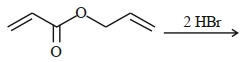
The major product of the following reaction is:
A
$3-$bromopropyl $2-$bromopropanoate
B
$1-$bromopropan$-2-$yl $2-$bromopropanoate
C
$3-$bromopropyl $3-$bromopropanoate
D
$1-$bromopropan$-2-$yl $3-$bromopropanoate
Solution
(D) The reaction involves the electrophilic addition of $HBr$ to the two double bonds present in the molecule,which is allyl acrylate $(CH_2=CH-COO-CH_2-CH=CH_2)$.
$1$. The first $HBr$ molecule adds to the more reactive double bond. The double bond in the allyl group (alkene part) is more electron-rich than the double bond conjugated with the carbonyl group (acrylate part). Thus,$HBr$ adds to the allyl double bond following Markovnikov's rule to form $CH_2=CH-COO-CH_2-CH(Br)-CH_3$.
$2$. The second $HBr$ molecule adds to the remaining double bond in the acrylate part. This addition follows anti-Markovnikov's rule (if peroxide is present,though usually,in the absence of peroxide,it follows Markovnikov's rule,but here the electron-withdrawing carbonyl group directs the addition to the terminal carbon to form the more stable carbocation or via conjugate addition). The addition to the $CH_2=CH-$ group results in the formation of $Br-CH_2-CH_2-COO-CH_2-CH(Br)-CH_3$.
Therefore,the final product is $1-$bromopropan$-2-$yl $3-$bromopropanoate.
$1$. The first $HBr$ molecule adds to the more reactive double bond. The double bond in the allyl group (alkene part) is more electron-rich than the double bond conjugated with the carbonyl group (acrylate part). Thus,$HBr$ adds to the allyl double bond following Markovnikov's rule to form $CH_2=CH-COO-CH_2-CH(Br)-CH_3$.
$2$. The second $HBr$ molecule adds to the remaining double bond in the acrylate part. This addition follows anti-Markovnikov's rule (if peroxide is present,though usually,in the absence of peroxide,it follows Markovnikov's rule,but here the electron-withdrawing carbonyl group directs the addition to the terminal carbon to form the more stable carbocation or via conjugate addition). The addition to the $CH_2=CH-$ group results in the formation of $Br-CH_2-CH_2-COO-CH_2-CH(Br)-CH_3$.
Therefore,the final product is $1-$bromopropan$-2-$yl $3-$bromopropanoate.
0 likesView Solution
166
ChemistryMediumMCQJEE Main · 2022
In base $vs.$ acid titration,at the end point,methyl orange is present as:
A
quinonoid form
B
heterocyclic form
C
phenolic form
D
benzenoid form
Solution
(A) Methyl orange is an acid-base indicator that changes color depending on the $pH$ of the solution.
In an acidic medium (at the end point of a titration involving an acid),methyl orange undergoes protonation.
The structure changes from the benzenoid form (yellow color in basic medium) to the quinonoid form (red/pink color in acidic medium).
As shown in the reaction,the addition of $H^+$ ions leads to the formation of the quinonoid structure,which is responsible for the color change observed at the end point.
In an acidic medium (at the end point of a titration involving an acid),methyl orange undergoes protonation.
The structure changes from the benzenoid form (yellow color in basic medium) to the quinonoid form (red/pink color in acidic medium).
As shown in the reaction,the addition of $H^+$ ions leads to the formation of the quinonoid structure,which is responsible for the color change observed at the end point.
0 likesView Solution
167
ChemistryMediumMCQJEE Main · 2022
$56.0 \ L$ of nitrogen gas is mixed with excess of hydrogen gas and it is found that $20 \ L$ of ammonia gas is produced. The volume of unused nitrogen gas is found to be $L$.
A
$44$
B
$45$
C
$46$
D
$47$
Solution
(C) The balanced chemical equation for the reaction is:
$N_2(g) + 3H_2(g) \rightarrow 2NH_3(g)$
According to the stoichiometry of the reaction,$1 \ volume$ of $N_2$ produces $2 \ volumes$ of $NH_3$.
Therefore,to produce $20 \ L$ of $NH_3$,the volume of $N_2$ required is:
$V_{N_2 \text{ consumed}} = \frac{1}{2} \times 20 \ L = 10 \ L$
The initial volume of $N_2$ is $56.0 \ L$.
The volume of unused $N_2$ is:
$V_{N_2 \text{ unused}} = 56.0 \ L - 10 \ L = 46 \ L$
Thus,the correct option is $C$.
$N_2(g) + 3H_2(g) \rightarrow 2NH_3(g)$
According to the stoichiometry of the reaction,$1 \ volume$ of $N_2$ produces $2 \ volumes$ of $NH_3$.
Therefore,to produce $20 \ L$ of $NH_3$,the volume of $N_2$ required is:
$V_{N_2 \text{ consumed}} = \frac{1}{2} \times 20 \ L = 10 \ L$
The initial volume of $N_2$ is $56.0 \ L$.
The volume of unused $N_2$ is:
$V_{N_2 \text{ unused}} = 56.0 \ L - 10 \ L = 46 \ L$
Thus,the correct option is $C$.
0 likesView Solution
168
ChemistryMediumMCQJEE Main · 2022
$A$ sealed flask with a capacity of $2 \, dm^{3}$ contains $11 \, g$ of propane gas. The flask is so weak that it will burst if the pressure becomes $2 \, MPa$. The minimum temperature at which the flask will burst is $....... \, ^{\circ}C$. [Nearest integer] (Given: $R = 8.3 \, J \, K^{-1} \, mol^{-1}$. Atomic masses of $C$ and $H$ are $12 \, u$ and $1 \, u$ respectively.) (Assume that propane behaves as an ideal gas.)
A
$1666$
B
$1565$
C
$1655$
D
$1654$
Solution
(C) $1$. Calculate the number of moles of propane $(C_{3}H_{8})$:
Molar mass of $C_{3}H_{8} = (3 \times 12) + (8 \times 1) = 44 \, g \, mol^{-1}$.
Moles $(n)$ = $\frac{11 \, g}{44 \, g \, mol^{-1}} = 0.25 \, mol$.
$2$. Use the ideal gas equation $PV = nRT$:
Given $P = 2 \, MPa = 2 \times 10^{6} \, Pa$,$V = 2 \, dm^{3} = 2 \times 10^{-3} \, m^{3}$,$n = 0.25 \, mol$,$R = 8.3 \, J \, K^{-1} \, mol^{-1}$.
$2 \times 10^{6} \times 2 \times 10^{-3} = 0.25 \times 8.3 \times T$.
$4000 = 2.075 \times T$.
$T = \frac{4000}{2.075} \approx 1927.71 \, K$.
$3$. Convert temperature to Celsius:
$T(^{\circ}C) = T(K) - 273.15 = 1927.71 - 273.15 = 1654.56 \, ^{\circ}C$.
Rounding to the nearest integer,we get $1655 \, ^{\circ}C$.
Molar mass of $C_{3}H_{8} = (3 \times 12) + (8 \times 1) = 44 \, g \, mol^{-1}$.
Moles $(n)$ = $\frac{11 \, g}{44 \, g \, mol^{-1}} = 0.25 \, mol$.
$2$. Use the ideal gas equation $PV = nRT$:
Given $P = 2 \, MPa = 2 \times 10^{6} \, Pa$,$V = 2 \, dm^{3} = 2 \times 10^{-3} \, m^{3}$,$n = 0.25 \, mol$,$R = 8.3 \, J \, K^{-1} \, mol^{-1}$.
$2 \times 10^{6} \times 2 \times 10^{-3} = 0.25 \times 8.3 \times T$.
$4000 = 2.075 \times T$.
$T = \frac{4000}{2.075} \approx 1927.71 \, K$.
$3$. Convert temperature to Celsius:
$T(^{\circ}C) = T(K) - 273.15 = 1927.71 - 273.15 = 1654.56 \, ^{\circ}C$.
Rounding to the nearest integer,we get $1655 \, ^{\circ}C$.
0 likesView Solution
169
ChemistryMediumMCQJEE Main · 2022
When the excited electron of a $H$ atom from $n=5$ drops to the ground state,the maximum number of emission lines observed are $.......$
A
$15$
B
$16$
C
$10$
D
$8$
Solution
(C) The maximum number of emission lines produced when an electron drops from an excited state $n$ to the ground state is calculated using the formula:
$\text{Number of lines} = \frac{n(n-1)}{2}$
Given $n = 5$,substituting the value into the formula:
$\text{Number of lines} = \frac{5(5-1)}{2} = \frac{5 \times 4}{2} = \frac{20}{2} = 10 \text{ lines.}$
$\text{Number of lines} = \frac{n(n-1)}{2}$
Given $n = 5$,substituting the value into the formula:
$\text{Number of lines} = \frac{5(5-1)}{2} = \frac{5 \times 4}{2} = \frac{20}{2} = 10 \text{ lines.}$
0 likesView Solution
170
ChemistryEasyMCQJEE Main · 2022
While performing a thermodynamics experiment,a student made the following observations:
$HCl + NaOH \rightarrow NaCl + H_{2}O$ $\Delta H = -57.3 \ kJ \ mol^{-1}$
$CH_{3}COOH + NaOH \rightarrow CH_{3}COONa + H_{2}O$ $\Delta H = -55.3 \ kJ \ mol^{-1}$
The enthalpy of ionization of $CH_{3}COOH$ as calculated by the student is $kJ \ mol^{-1}$. (nearest integer)
$HCl + NaOH \rightarrow NaCl + H_{2}O$ $\Delta H = -57.3 \ kJ \ mol^{-1}$
$CH_{3}COOH + NaOH \rightarrow CH_{3}COONa + H_{2}O$ $\Delta H = -55.3 \ kJ \ mol^{-1}$
The enthalpy of ionization of $CH_{3}COOH$ as calculated by the student is $kJ \ mol^{-1}$. (nearest integer)
A
$5$
B
$2$
C
$4$
D
$3$
Solution
(B) The enthalpy of neutralization of a strong acid with a strong base is $-57.3 \ kJ \ mol^{-1}$.
For the weak acid $CH_{3}COOH$,the enthalpy of neutralization is the sum of the enthalpy of neutralization of $H^+$ and $OH^-$ ions and the enthalpy of ionization of the weak acid.
$\Delta H_{\text{neutralization}} = \Delta H_{\text{ionization}} + \Delta H_{\text{neutralization of strong acid/base}}$
$-55.3 \ kJ \ mol^{-1} = \Delta H_{\text{ionization}} + (-57.3 \ kJ \ mol^{-1})$
$\Delta H_{\text{ionization}} = -55.3 - (-57.3) = 2 \ kJ \ mol^{-1}$.
For the weak acid $CH_{3}COOH$,the enthalpy of neutralization is the sum of the enthalpy of neutralization of $H^+$ and $OH^-$ ions and the enthalpy of ionization of the weak acid.
$\Delta H_{\text{neutralization}} = \Delta H_{\text{ionization}} + \Delta H_{\text{neutralization of strong acid/base}}$
$-55.3 \ kJ \ mol^{-1} = \Delta H_{\text{ionization}} + (-57.3 \ kJ \ mol^{-1})$
$\Delta H_{\text{ionization}} = -55.3 - (-57.3) = 2 \ kJ \ mol^{-1}$.
0 likesView Solution
171
ChemistryMediumMCQJEE Main · 2022
The sum of the number of lone pairs of electrons present on the central atoms of $XeO_3$,$XeOF_4$,and $XeF_6$ is $.......$
A
$5$
B
$3$
C
$2$
D
$1$
Solution
(B) To find the number of lone pairs on the central atom $(Xe)$ in each molecule:
$1$. In $XeO_3$: The $Xe$ atom has $8$ valence electrons. It forms $3$ double bonds with $3$ oxygen atoms (using $6$ electrons). Thus,$8 - 6 = 2$ electrons remain,which form $1$ lone pair.
$2$. In $XeOF_4$: The $Xe$ atom has $8$ valence electrons. It forms $1$ double bond with oxygen ($2$ electrons) and $4$ single bonds with fluorine atoms ($4$ electrons). Total electrons used = $6$. Thus,$8 - 6 = 2$ electrons remain,which form $1$ lone pair.
$3$. In $XeF_6$: The $Xe$ atom has $8$ valence electrons. It forms $6$ single bonds with fluorine atoms ($6$ electrons). Thus,$8 - 6 = 2$ electrons remain,which form $1$ lone pair.
Sum of lone pairs = $1 + 1 + 1 = 3$.
$1$. In $XeO_3$: The $Xe$ atom has $8$ valence electrons. It forms $3$ double bonds with $3$ oxygen atoms (using $6$ electrons). Thus,$8 - 6 = 2$ electrons remain,which form $1$ lone pair.
$2$. In $XeOF_4$: The $Xe$ atom has $8$ valence electrons. It forms $1$ double bond with oxygen ($2$ electrons) and $4$ single bonds with fluorine atoms ($4$ electrons). Total electrons used = $6$. Thus,$8 - 6 = 2$ electrons remain,which form $1$ lone pair.
$3$. In $XeF_6$: The $Xe$ atom has $8$ valence electrons. It forms $6$ single bonds with fluorine atoms ($6$ electrons). Thus,$8 - 6 = 2$ electrons remain,which form $1$ lone pair.
Sum of lone pairs = $1 + 1 + 1 = 3$.
0 likesView Solution
172
ChemistryMediumMCQJEE Main · 2022
The separation of two coloured substances was done by paper chromatography. The distances travelled by solvent front,substance $A$ and substance $B$ from the base line are $3.25 \ cm$,$2.08 \ cm$ and $1.05 \ cm$ respectively. The ratio of $R_{f}$ values of $A$ to $B$ is $.........$
A
$5$
B
$3$
C
$8$
D
$2$
Solution
(D) The $R_{f}$ value is defined as the ratio of the distance travelled by the substance to the distance travelled by the solvent front.
$R_{f(A)} = \frac{2.08}{3.25}$
$R_{f(B)} = \frac{1.05}{3.25}$
The ratio of $R_{f}$ values of $A$ to $B$ is $\frac{R_{f(A)}}{R_{f(B)}} = \frac{2.08 / 3.25}{1.05 / 3.25} = \frac{2.08}{1.05} \approx 1.98 \approx 2$.
$R_{f(A)} = \frac{2.08}{3.25}$
$R_{f(B)} = \frac{1.05}{3.25}$
The ratio of $R_{f}$ values of $A$ to $B$ is $\frac{R_{f(A)}}{R_{f(B)}} = \frac{2.08 / 3.25}{1.05 / 3.25} = \frac{2.08}{1.05} \approx 1.98 \approx 2$.
0 likesView Solution
173
ChemistryMediumMCQJEE Main · 2022
The total number of monobromo derivatives formed by the alkanes with molecular formula $C_{5}H_{12}$ is (excluding stereoisomers) $.....$
A
$7$
B
$6$
C
$5$
D
$8$
Solution
(D) The alkanes with molecular formula $C_{5}H_{12}$ are $n$-pentane,isopentane,and neopentane.
$1$. $n$-Pentane $(CH_{3}CH_{2}CH_{2}CH_{2}CH_{3})$ has $3$ non-equivalent sets of hydrogen atoms,giving $3$ monobromo derivatives.
$2$. Isopentane $((CH_{3})_{2}CHCH_{2}CH_{3})$ has $4$ non-equivalent sets of hydrogen atoms,giving $4$ monobromo derivatives.
$3$. Neopentane $((CH_{3})_{4}C)$ has $1$ set of equivalent hydrogen atoms,giving $1$ monobromo derivative.
Total number of monobromo derivatives = $3 + 4 + 1 = 8$.
$1$. $n$-Pentane $(CH_{3}CH_{2}CH_{2}CH_{2}CH_{3})$ has $3$ non-equivalent sets of hydrogen atoms,giving $3$ monobromo derivatives.
$2$. Isopentane $((CH_{3})_{2}CHCH_{2}CH_{3})$ has $4$ non-equivalent sets of hydrogen atoms,giving $4$ monobromo derivatives.
$3$. Neopentane $((CH_{3})_{4}C)$ has $1$ set of equivalent hydrogen atoms,giving $1$ monobromo derivative.
Total number of monobromo derivatives = $3 + 4 + 1 = 8$.
0 likesView Solution
174
ChemistryDifficultMCQJEE Main · 2022
$SO_{2}Cl_{2}$ on reaction with excess of water results in an acidic mixture: $SO_{2}Cl_{2} + 2H_{2}O \rightarrow H_{2}SO_{4} + 2HCl$. If $16 \, moles$ of $NaOH$ is required for the complete neutralization of the resultant acidic mixture,calculate the number of moles of $SO_{2}Cl_{2}$ used.
A
$16$
B
$8$
C
$4$
D
$2$
Solution
(C) Let the number of moles of $SO_{2}Cl_{2}$ be $x$.
According to the reaction: $SO_{2}Cl_{2} + 2H_{2}O \rightarrow H_{2}SO_{4} + 2HCl$.
From the stoichiometry,$1 \, mole$ of $SO_{2}Cl_{2}$ produces $1 \, mole$ of $H_{2}SO_{4}$ and $2 \, moles$ of $HCl$.
Therefore,$x \, moles$ of $SO_{2}Cl_{2}$ produce $x \, moles$ of $H_{2}SO_{4}$ and $2x \, moles$ of $HCl$.
Total moles of $H^{+}$ ions produced = $(2 \times n(H_{2}SO_{4})) + n(HCl) = (2 \times x) + 2x = 4x$.
For complete neutralization,$n(H^{+}) = n(OH^{-})$.
Given $n(NaOH) = 16 \, moles$,so $n(OH^{-}) = 16$.
$4x = 16 \implies x = 4$.
According to the reaction: $SO_{2}Cl_{2} + 2H_{2}O \rightarrow H_{2}SO_{4} + 2HCl$.
From the stoichiometry,$1 \, mole$ of $SO_{2}Cl_{2}$ produces $1 \, mole$ of $H_{2}SO_{4}$ and $2 \, moles$ of $HCl$.
Therefore,$x \, moles$ of $SO_{2}Cl_{2}$ produce $x \, moles$ of $H_{2}SO_{4}$ and $2x \, moles$ of $HCl$.
Total moles of $H^{+}$ ions produced = $(2 \times n(H_{2}SO_{4})) + n(HCl) = (2 \times x) + 2x = 4x$.
For complete neutralization,$n(H^{+}) = n(OH^{-})$.
Given $n(NaOH) = 16 \, moles$,so $n(OH^{-}) = 16$.
$4x = 16 \implies x = 4$.
0 likesView Solution
175
ChemistryMediumMCQJEE Main · 2022
Which of the following sets of quantum numbers is not allowed?
A
$n=3, l=2, m_l=0, s=+\frac{1}{2}$
B
$n=3, l=2, m_l=-2, s=+\frac{1}{2}$
C
$n=3, l=3, m_l=-3, s=-\frac{1}{2}$
D
$n=3, l=0, m_l=0, s=-\frac{1}{2}$
Solution
(C) The allowed values for the azimuthal quantum number $l$ are $0, 1, 2, \dots, (n-1)$.
For $n=3$,the possible values of $l$ are $0, 1, 2$.
Therefore,$l=3$ is not possible for $n=3$ because $l$ must be less than $n$.
For $n=3$,the possible values of $l$ are $0, 1, 2$.
Therefore,$l=3$ is not possible for $n=3$ because $l$ must be less than $n$.
0 likesView Solution
176
ChemistryMediumMCQJEE Main · 2022
$20\,mL$ of $0.1\,M\,NH_{4}OH$ is mixed with $40\,mL$ of $0.05\,M\,HCl$. The $pH$ of the mixture is nearest to. (Given: $K_{b}(NH_{4}OH) = 1 \times 10^{-5}, \log 2 = 0.30, \log 3 = 0.48, \log 5 = 0.69, \log 7 = 0.84, \log 11 = 1.04$) (in $.2$)
A
$3$
B
$4$
C
$5$
D
$6$
Solution
(C) Step $1$: Calculate millimoles of reactants.
$n(NH_{4}OH) = 20\,mL \times 0.1\,M = 2\,mmol$.
$n(HCl) = 40\,mL \times 0.05\,M = 2\,mmol$.
Step $2$: Reaction stoichiometry.
$NH_{4}OH + HCl \rightarrow NH_{4}Cl + H_{2}O$.
Since both reactants are $2\,mmol$,they react completely to form $2\,mmol$ of $NH_{4}Cl$ (a salt of weak base and strong acid).
Step $3$: Calculate concentration of salt.
Total volume $= 20 + 40 = 60\,mL$.
$[NH_{4}Cl] = C = \frac{2\,mmol}{60\,mL} = \frac{1}{30}\,M$.
Step $4$: Calculate $pH$ of salt solution.
$pH = \frac{1}{2}[pK_{w} - pK_{b} - \log C]$.
$pK_{w} = 14$,$pK_{b} = -\log(10^{-5}) = 5$.
$pH = \frac{1}{2}[14 - 5 - \log(1/30)] = \frac{1}{2}[9 + \log 30] = \frac{1}{2}[9 + \log 3 + \log 10] = \frac{1}{2}[9 + 0.48 + 1] = \frac{10.48}{2} = 5.24$.
The nearest value is $5.2$.
$n(NH_{4}OH) = 20\,mL \times 0.1\,M = 2\,mmol$.
$n(HCl) = 40\,mL \times 0.05\,M = 2\,mmol$.
Step $2$: Reaction stoichiometry.
$NH_{4}OH + HCl \rightarrow NH_{4}Cl + H_{2}O$.
Since both reactants are $2\,mmol$,they react completely to form $2\,mmol$ of $NH_{4}Cl$ (a salt of weak base and strong acid).
Step $3$: Calculate concentration of salt.
Total volume $= 20 + 40 = 60\,mL$.
$[NH_{4}Cl] = C = \frac{2\,mmol}{60\,mL} = \frac{1}{30}\,M$.
Step $4$: Calculate $pH$ of salt solution.
$pH = \frac{1}{2}[pK_{w} - pK_{b} - \log C]$.
$pK_{w} = 14$,$pK_{b} = -\log(10^{-5}) = 5$.
$pH = \frac{1}{2}[14 - 5 - \log(1/30)] = \frac{1}{2}[9 + \log 30] = \frac{1}{2}[9 + \log 3 + \log 10] = \frac{1}{2}[9 + 0.48 + 1] = \frac{10.48}{2} = 5.24$.
The nearest value is $5.2$.
0 likesView Solution
177
ChemistryMediumMCQJEE Main · 2022
The $IUPAC$ nomenclature of an element with electronic configuration $[Rn] 5f^{14} 6d^{1} 7s^{2}$ is.
A
$Unnilbium$
B
$Unnilunium$
C
$Unnilquadium$
D
$Unniltrium$
Solution
(D) The atomic number of $Rn$ (Radon) is $86$.
Adding the electrons from the configuration: $86 + 14 (5f) + 1 (6d) + 2 (7s) = 103$.
The element with atomic number $103$ is $Lawrencium$.
According to $IUPAC$ nomenclature for elements with $Z > 100$:
$1 = un$,$0 = nil$,$3 = tri$.
Therefore,the name is $Unniltrium$.
Adding the electrons from the configuration: $86 + 14 (5f) + 1 (6d) + 2 (7s) = 103$.
The element with atomic number $103$ is $Lawrencium$.
According to $IUPAC$ nomenclature for elements with $Z > 100$:
$1 = un$,$0 = nil$,$3 = tri$.
Therefore,the name is $Unniltrium$.
0 likesView Solution
178
ChemistryMediumMCQJEE Main · 2022
The reaction of $H_{2}O_{2}$ with potassium permanganate in acidic medium leads to the formation of mainly.
A
$Mn^{2+}$
B
$Mn^{4+}$
C
$Mn^{3+}$
D
$Mn^{6+}$
Solution
(A) In an acidic medium,potassium permanganate $(KMnO_{4})$ acts as a strong oxidizing agent.
When it reacts with hydrogen peroxide $(H_{2}O_{2})$,the permanganate ion $(MnO_{4}^{-})$ is reduced to the manganese$(II)$ ion $(Mn^{2+})$.
The balanced chemical equation is:
$2MnO_{4}^{-} + 5H_{2}O_{2} + 6H^{+} \rightarrow 2Mn^{2+} + 5O_{2} + 8H_{2}O$
Therefore,the main product formed from the manganese species is $Mn^{2+}$.
When it reacts with hydrogen peroxide $(H_{2}O_{2})$,the permanganate ion $(MnO_{4}^{-})$ is reduced to the manganese$(II)$ ion $(Mn^{2+})$.
The balanced chemical equation is:
$2MnO_{4}^{-} + 5H_{2}O_{2} + 6H^{+} \rightarrow 2Mn^{2+} + 5O_{2} + 8H_{2}O$
Therefore,the main product formed from the manganese species is $Mn^{2+}$.
0 likesView Solution
179
ChemistryMediumMCQJEE Main · 2022
Choose the correct order of density of the alkali metals.
A
$Li < K < Na < Rb < Cs$
B
$Li < Na < K < Rb < Cs$
C
$Cs < Rb < K < Na < Li$
D
$Li < Na < K < Cs < Rb$
Solution
(A) The density of alkali metals generally increases down the group as the atomic mass increases more significantly than the atomic volume. However,$K$ is an exception because of an unusual increase in its atomic size. The correct order of density is $Li < K < Na < Rb < Cs$.
0 likesView Solution
180
ChemistryMediumMCQJEE Main · 2022
The geometry around boron in the product '$B$' formed from the following reaction is
$BF_{3} + NaH \xrightarrow{450 \ K} A + NaF$
$A + NMe_{3} \rightarrow B$
$BF_{3} + NaH \xrightarrow{450 \ K} A + NaF$
$A + NMe_{3} \rightarrow B$
A
trigonal planar
B
tetrahedral
C
pyramidal
D
square planar
Solution
(B) The given reactions are:
$2BF_{3} + 6NaH \xrightarrow{450 \ K} B_{2}H_{6} + 6NaF$
$B_{2}H_{6} + 2NMe_{3} \rightarrow 2[BH_{3} \leftarrow NMe_{3}]$
Here,$A$ is $B_{2}H_{6}$ (diborane) and $B$ is the adduct $[BH_{3} \leftarrow NMe_{3}]$.
In the adduct $[BH_{3} \leftarrow NMe_{3}]$,the boron atom is bonded to three hydrogen atoms and one nitrogen atom.
The boron atom is $sp^{3}$ hybridized and possesses a tetrahedral geometry.
$2BF_{3} + 6NaH \xrightarrow{450 \ K} B_{2}H_{6} + 6NaF$
$B_{2}H_{6} + 2NMe_{3} \rightarrow 2[BH_{3} \leftarrow NMe_{3}]$
Here,$A$ is $B_{2}H_{6}$ (diborane) and $B$ is the adduct $[BH_{3} \leftarrow NMe_{3}]$.
In the adduct $[BH_{3} \leftarrow NMe_{3}]$,the boron atom is bonded to three hydrogen atoms and one nitrogen atom.
The boron atom is $sp^{3}$ hybridized and possesses a tetrahedral geometry.
0 likesView Solution
181
ChemistryEasyMCQJEE Main · 2022
The photochemical smog does not generally contain.
A
$NO$
B
$NO_2$
C
$SO_2$
D
$HCHO$
Solution
(C) Photochemical smog is formed by the action of sunlight on nitrogen oxides $(NO_x)$ and volatile organic compounds $(VOCs)$ such as formaldehyde $(HCHO)$.
It typically contains ozone $(O_3)$,nitrogen dioxide $(NO_2)$,nitric oxide $(NO)$,formaldehyde $(HCHO)$,acrolein,and peroxyacetyl nitrate $(PAN)$.
Sulfur dioxide $(SO_2)$ is a primary component of classical smog (London smog),not photochemical smog.
It typically contains ozone $(O_3)$,nitrogen dioxide $(NO_2)$,nitric oxide $(NO)$,formaldehyde $(HCHO)$,acrolein,and peroxyacetyl nitrate $(PAN)$.
Sulfur dioxide $(SO_2)$ is a primary component of classical smog (London smog),not photochemical smog.
0 likesView Solution
182
ChemistryMediumMCQJEE Main · 2022
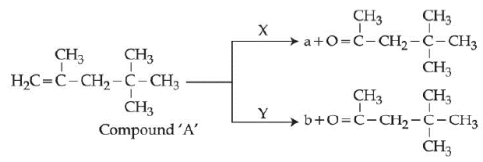
$A$ compound $A$ on reaction with $X$ and $Y$ produces the same major product but different by-products $a$ and $b$. Oxidation of $a$ gives a substance produced by ants.
$X$ and $Y$ respectively are :
$X$ and $Y$ respectively are :
A
$KMnO_4 / H^{+}$ and dil. $KMnO_4, 273 \ K$
B
$KMnO_4$ (dilute),$273 \ K$ and $KMnO_4 / H^{+}$
C
$KMnO_4 / H^{+}$ and $O_3, H_2O / Zn$
D
$O_3, H_2O / Zn$ and $KMnO_4 / H^{+}$
Solution
(D) The compound $A$ is $2,4,4-trimethylpent-1-ene$.
Reaction with $O_3, H_2O / Zn$ (reductive ozonolysis) gives formaldehyde $(HCHO)$ as by-product $a$ and a ketone.
Reaction with $KMnO_4 / H^{+}$ (oxidative cleavage) gives formic acid $(HCOOH)$ as by-product $b$ and a ketone.
Formaldehyde $(a)$ on oxidation gives formic acid,which is found in ants.
Thus,$X$ is $O_3, H_2O / Zn$ and $Y$ is $KMnO_4 / H^{+}$.
Reaction with $O_3, H_2O / Zn$ (reductive ozonolysis) gives formaldehyde $(HCHO)$ as by-product $a$ and a ketone.
Reaction with $KMnO_4 / H^{+}$ (oxidative cleavage) gives formic acid $(HCOOH)$ as by-product $b$ and a ketone.
Formaldehyde $(a)$ on oxidation gives formic acid,which is found in ants.
Thus,$X$ is $O_3, H_2O / Zn$ and $Y$ is $KMnO_4 / H^{+}$.
0 likesView Solution
183
ChemistryMediumMCQJEE Main · 2022
Given below are two statements.
Statement $I$: On heating with $KHSO_4$,glycerol is dehydrated and acrolein is formed.
Statement $II$: Acrolein has fruity odour and can be used to test glycerol's presence.
Choose the correct option.
Statement $I$: On heating with $KHSO_4$,glycerol is dehydrated and acrolein is formed.
Statement $II$: Acrolein has fruity odour and can be used to test glycerol's presence.
Choose the correct option.
A
Both Statement $I$ and Statement $II$ are correct.
B
Both Statement $I$ and Statement $II$ are incorrect.
C
Statement $I$ is correct but Statement $II$ is incorrect.
D
Statement $I$ is incorrect but Statement $II$ is correct.
Solution
(C) Statement $I$ is correct: Glycerol undergoes dehydration when heated with $KHSO_4$ to form acrolein $(CH_2=CH-CHO)$.
Statement $II$ is incorrect: Acrolein has a pungent,suffocating,and irritating odour,not a fruity odour. While it is used to detect the presence of glycerol,the description of its odour is wrong.
Statement $II$ is incorrect: Acrolein has a pungent,suffocating,and irritating odour,not a fruity odour. While it is used to detect the presence of glycerol,the description of its odour is wrong.
0 likesView Solution
184
ChemistryMediumMCQJEE Main · 2022
Among the following species $N_{2}$,$N_{2}^{+}$,$N_{2}^{-}$,$N_{2}^{2-}$,$O_{2}$,$O_{2}^{+}$,$O_{2}^{-}$,$O_{2}^{2-}$,the number of species showing diamagnetism is:
A
$4$
B
$1$
C
$2$
D
$3$
Solution
(C) To determine diamagnetism,we check the number of electrons in each species:
$N_{2}$ ($14$ $e^-$): $\sigma 1s^2, \sigma^* 1s^2, \sigma 2s^2, \sigma^* 2s^2, \pi 2p_x^2 = \pi 2p_y^2, \sigma 2p_z^2$ (All paired,Diamagnetic)
$N_{2}^{+}$ ($13$ $e^-$): Paramagnetic
$N_{2}^{-}$ ($15$ $e^-$): Paramagnetic
$N_{2}^{2-}$ ($16$ $e^-$): Paramagnetic
$O_{2}$ ($16$ $e^-$): Paramagnetic
$O_{2}^{+}$ ($15$ $e^-$): Paramagnetic
$O_{2}^{-}$ ($17$ $e^-$): Paramagnetic
$O_{2}^{2-}$ ($18$ $e^-$): $\sigma 1s^2, \sigma^* 1s^2, \sigma 2s^2, \sigma^* 2s^2, \sigma 2p_z^2, \pi 2p_x^2 = \pi 2p_y^2, \pi^* 2p_x^2 = \pi^* 2p_y^2$ (All paired,Diamagnetic)
Thus,the species showing diamagnetism are $N_{2}$ and $O_{2}^{2-}$.
The total number of diamagnetic species is $2$.
$N_{2}$ ($14$ $e^-$): $\sigma 1s^2, \sigma^* 1s^2, \sigma 2s^2, \sigma^* 2s^2, \pi 2p_x^2 = \pi 2p_y^2, \sigma 2p_z^2$ (All paired,Diamagnetic)
$N_{2}^{+}$ ($13$ $e^-$): Paramagnetic
$N_{2}^{-}$ ($15$ $e^-$): Paramagnetic
$N_{2}^{2-}$ ($16$ $e^-$): Paramagnetic
$O_{2}$ ($16$ $e^-$): Paramagnetic
$O_{2}^{+}$ ($15$ $e^-$): Paramagnetic
$O_{2}^{-}$ ($17$ $e^-$): Paramagnetic
$O_{2}^{2-}$ ($18$ $e^-$): $\sigma 1s^2, \sigma^* 1s^2, \sigma 2s^2, \sigma^* 2s^2, \sigma 2p_z^2, \pi 2p_x^2 = \pi 2p_y^2, \pi^* 2p_x^2 = \pi^* 2p_y^2$ (All paired,Diamagnetic)
Thus,the species showing diamagnetism are $N_{2}$ and $O_{2}^{2-}$.
The total number of diamagnetic species is $2$.
1 likesView Solution
185
ChemistryMediumMCQJEE Main · 2022
The enthalpy of combustion of propane,graphite and dihydrogen at $298 \ K$ are: $-2220.0 \ kJ \ mol^{-1}$,$-393.5 \ kJ \ mol^{-1}$ and $-285.8 \ kJ \ mol^{-1}$ respectively. The magnitude of the enthalpy of formation of propane $(C_{3}H_{8})$ is ......... $kJ \ mol^{-1}$. (Nearest integer)
A
$105$
B
$106$
C
$104$
D
$103$
Solution
(C) The formation reaction for propane is: $3C_{(gr)} + 4H_{2(g)} \rightarrow C_{3}H_{8(g)}$
The enthalpy of formation $\Delta H_f$ is calculated using the formula: $\Delta H_f = \sum \Delta H_{c}(\text{reactants}) - \sum \Delta H_{c}(\text{products})$
$\Delta H_f = [3 \times \Delta H_{c}(C) + 4 \times \Delta H_{c}(H_{2})] - \Delta H_{c}(C_{3}H_{8})$
$\Delta H_f = [3(-393.5) + 4(-285.8)] - (-2220.0)$
$\Delta H_f = [-1180.5 - 1143.2] + 2220.0$
$\Delta H_f = -2323.7 + 2220.0 = -103.7 \ kJ \ mol^{-1}$
The magnitude of the enthalpy of formation is $|-103.7| = 103.7 \ kJ \ mol^{-1}$.
Rounding to the nearest integer,we get $104 \ kJ \ mol^{-1}$.
The enthalpy of formation $\Delta H_f$ is calculated using the formula: $\Delta H_f = \sum \Delta H_{c}(\text{reactants}) - \sum \Delta H_{c}(\text{products})$
$\Delta H_f = [3 \times \Delta H_{c}(C) + 4 \times \Delta H_{c}(H_{2})] - \Delta H_{c}(C_{3}H_{8})$
$\Delta H_f = [3(-393.5) + 4(-285.8)] - (-2220.0)$
$\Delta H_f = [-1180.5 - 1143.2] + 2220.0$
$\Delta H_f = -2323.7 + 2220.0 = -103.7 \ kJ \ mol^{-1}$
The magnitude of the enthalpy of formation is $|-103.7| = 103.7 \ kJ \ mol^{-1}$.
Rounding to the nearest integer,we get $104 \ kJ \ mol^{-1}$.
0 likesView Solution
186
ChemistryMediumMCQJEE Main · 2022
The pressure of a moist gas at $27^{\circ}C$ is $4 \ atm$. The volume of the container is doubled at the same temperature. The new pressure of the moist gas is $x \times 10^{-1} \ atm$. Find the value of $x$. (Nearest integer) (Given: The vapour pressure of water at $27^{\circ}C$ is $0.4 \ atm$)
A
$13$
B
$12$
C
$22$
D
$86$
Solution
(C) The total pressure of a moist gas is the sum of the partial pressure of the dry gas and the vapour pressure of water: $P_{total} = P_{gas} + P_{H_2O}$.
Given $P_{total} = 4 \ atm$ and $P_{H_2O} = 0.4 \ atm$,so $P_{gas} = 4 - 0.4 = 3.6 \ atm$.
According to Boyle's Law,at constant temperature,$P_1V_1 = P_2V_2$. When the volume is doubled $(V_2 = 2V_1)$,the new partial pressure of the dry gas becomes $P_{gas, new} = P_{gas} / 2 = 3.6 / 2 = 1.8 \ atm$.
The vapour pressure of water remains constant at a given temperature,so $P_{H_2O} = 0.4 \ atm$.
The new total pressure is $P_{total, new} = 1.8 + 0.4 = 2.2 \ atm$.
Since $2.2 \ atm = 22 \times 10^{-1} \ atm$,the value of $x$ is $22$.
Given $P_{total} = 4 \ atm$ and $P_{H_2O} = 0.4 \ atm$,so $P_{gas} = 4 - 0.4 = 3.6 \ atm$.
According to Boyle's Law,at constant temperature,$P_1V_1 = P_2V_2$. When the volume is doubled $(V_2 = 2V_1)$,the new partial pressure of the dry gas becomes $P_{gas, new} = P_{gas} / 2 = 3.6 / 2 = 1.8 \ atm$.
The vapour pressure of water remains constant at a given temperature,so $P_{H_2O} = 0.4 \ atm$.
The new total pressure is $P_{total, new} = 1.8 + 0.4 = 2.2 \ atm$.
Since $2.2 \ atm = 22 \times 10^{-1} \ atm$,the value of $x$ is $22$.
0 likesView Solution
187
ChemistryMediumMCQJEE Main · 2022
While estimating the nitrogen present in an organic compound by Kjeldahl's method,the ammonia evolved from $0.25 \ g$ of the compound neutralized $2.5 \ mL$ of $2 \ M \ H_2SO_4$. The percentage of nitrogen present in the organic compound is $......$
A
$55$
B
$56$
C
$54$
D
$53$
Solution
(B) The formula for the percentage of nitrogen in Kjeldahl's method is: $\% \text{N} = \frac{1.4 \times \text{Molarity of acid} \times \text{Basicity of acid} \times \text{Volume of acid in mL}}{\text{Mass of organic compound in g}}$
Here,$\text{Molarity} = 2 \ M$,$\text{Basicity of } H_2SO_4 = 2$,$\text{Volume} = 2.5 \ mL$,and $\text{Mass} = 0.25 \ g$.
Substituting the values:
$\% \text{N} = \frac{1.4 \times 2 \times 2 \times 2.5}{0.25}$
$\% \text{N} = \frac{1.4 \times 10}{0.25} = \frac{14}{0.25} = 56$
Therefore,the percentage of nitrogen is $56\%$.
Here,$\text{Molarity} = 2 \ M$,$\text{Basicity of } H_2SO_4 = 2$,$\text{Volume} = 2.5 \ mL$,and $\text{Mass} = 0.25 \ g$.
Substituting the values:
$\% \text{N} = \frac{1.4 \times 2 \times 2 \times 2.5}{0.25}$
$\% \text{N} = \frac{1.4 \times 10}{0.25} = \frac{14}{0.25} = 56$
Therefore,the percentage of nitrogen is $56\%$.
0 likesView Solution
188
ChemistryMediumMCQJEE Main · 2022
The number of $sp^{3}$ hybridised carbons in an acyclic neutral compound with molecular formula $C_{4}H_{5}N$ is.
A
$0$ or $1$
B
$2$
C
$3$
D
$4$
Solution
(A) The degree of unsaturation $(DU)$ for $C_{4}H_{5}N$ is calculated as:
$DU = C + 1 - \frac{H - N}{2} = 4 + 1 - \frac{5 - 1}{2} = 5 - 2 = 3$.
$A$ possible acyclic structure with $DU = 3$ is $CH_{2}=C=CH-CH=NH$.
In this structure,all carbon atoms are either $sp$ or $sp^{2}$ hybridised.
Specifically,the carbons are $sp^{2}$,$sp$,$sp^{2}$,and $sp^{2}$ hybridised respectively.
Therefore,the number of $sp^{3}$ hybridised carbons is $0$.
$DU = C + 1 - \frac{H - N}{2} = 4 + 1 - \frac{5 - 1}{2} = 5 - 2 = 3$.
$A$ possible acyclic structure with $DU = 3$ is $CH_{2}=C=CH-CH=NH$.
In this structure,all carbon atoms are either $sp$ or $sp^{2}$ hybridised.
Specifically,the carbons are $sp^{2}$,$sp$,$sp^{2}$,and $sp^{2}$ hybridised respectively.
Therefore,the number of $sp^{3}$ hybridised carbons is $0$.
0 likesView Solution
189
ChemistryDifficultMCQJEE Main · 2022
Hemoglobin contains $0.34 \%$ of iron by mass. The number of $Fe$ atoms in $3.3 \ g$ of hemoglobin is. (Given : Atomic mass of $Fe$ is $56 \ u, N_A = 6.022 \times 10^{23} \ mol^{-1}$)
A
$1.21 \times 10^{5}$
B
$12.0 \times 10^{16}$
C
$1.21 \times 10^{20}$
D
$3.4 \times 10^{22}$
Solution
(C) Mass of $Fe$ in $3.3 \ g$ of hemoglobin $= \frac{0.34}{100} \times 3.3 \ g = 0.01122 \ g$.
Number of moles of $Fe = \frac{\text{mass}}{\text{atomic mass}} = \frac{0.01122 \ g}{56 \ g/mol} \approx 2.0036 \times 10^{-4} \ mol$.
Number of $Fe$ atoms $= \text{moles} \times N_A = 2.0036 \times 10^{-4} \times 6.022 \times 10^{23} \approx 1.206 \times 10^{20}$ atoms.
Number of moles of $Fe = \frac{\text{mass}}{\text{atomic mass}} = \frac{0.01122 \ g}{56 \ g/mol} \approx 2.0036 \times 10^{-4} \ mol$.
Number of $Fe$ atoms $= \text{moles} \times N_A = 2.0036 \times 10^{-4} \times 6.022 \times 10^{23} \approx 1.206 \times 10^{20}$ atoms.
0 likesView Solution
190
ChemistryMediumMCQJEE Main · 2022
Arrange the following in increasing order of their covalent character.
$CaF_{2}$,$CaCl_{2}$,$CaBr_{2}$,$CaI_{2}$
Choose the correct answer from the options given below.
$CaF_{2}$,$CaCl_{2}$,$CaBr_{2}$,$CaI_{2}$
Choose the correct answer from the options given below.
A
$CaF_{2} < CaCl_{2} < CaBr_{2} < CaI_{2}$
B
$CaI_{2} < CaBr_{2} < CaCl_{2} < CaF_{2}$
C
$CaF_{2} < CaBr_{2} < CaCl_{2} < CaI_{2}$
D
$CaI_{2} < CaCl_{2} < CaBr_{2} < CaF_{2}$
Solution
(A) According to Fajan's rule,the covalent character of an ionic bond increases as the size of the anion increases.
The order of the size of the anions is $F^- < Cl^- < Br^- < I^-$.
Therefore,the increasing order of covalent character is $CaF_{2} < CaCl_{2} < CaBr_{2} < CaI_{2}$.
The order of the size of the anions is $F^- < Cl^- < Br^- < I^-$.
Therefore,the increasing order of covalent character is $CaF_{2} < CaCl_{2} < CaBr_{2} < CaI_{2}$.
0 likesView Solution
191
ChemistryMediumMCQJEE Main · 2022
Class $XII$ students were asked to prepare one litre of buffer solution of $pH$ $8.26$ by their chemistry teacher. The amount of ammonium chloride to be dissolved by the student in $0.2 \, M$ ammonia solution to make one litre of the buffer is $..... \, g$ (Given $pK_b(NH_3)=4.74$; Molar mass of $NH_3=17 \, g \, mol^{-1}$; Molar mass of $NH_4Cl =53.5 \, g \, mol^{-1}$)
A
$53.5$
B
$72.3$
C
$107$
D
$126$
Solution
(C) For a basic buffer,the $pH$ is related to $pOH$ by the equation: $pH + pOH = 14$.
Given $pH = 8.26$,so $pOH = 14 - 8.26 = 5.74$.
The Henderson-Hasselbalch equation for a basic buffer is: $pOH = pK_b + \log \frac{[Salt]}{[Base]}$.
Substituting the given values: $5.74 = 4.74 + \log \frac{[NH_4^+]}{0.2}$.
$1 = \log \frac{[NH_4^+]}{0.2}$,which implies $\frac{[NH_4^+]}{0.2} = 10^1 = 10$.
Therefore,$[NH_4^+] = 10 \times 0.2 = 2 \, M$.
Since the volume is $1 \, L$,the number of moles of $NH_4Cl$ required is $2 \, mol$.
Mass of $NH_4Cl = \text{moles} \times \text{molar mass} = 2 \, mol \times 53.5 \, g \, mol^{-1} = 107 \, g$.
Given $pH = 8.26$,so $pOH = 14 - 8.26 = 5.74$.
The Henderson-Hasselbalch equation for a basic buffer is: $pOH = pK_b + \log \frac{[Salt]}{[Base]}$.
Substituting the given values: $5.74 = 4.74 + \log \frac{[NH_4^+]}{0.2}$.
$1 = \log \frac{[NH_4^+]}{0.2}$,which implies $\frac{[NH_4^+]}{0.2} = 10^1 = 10$.
Therefore,$[NH_4^+] = 10 \times 0.2 = 2 \, M$.
Since the volume is $1 \, L$,the number of moles of $NH_4Cl$ required is $2 \, mol$.
Mass of $NH_4Cl = \text{moles} \times \text{molar mass} = 2 \, mol \times 53.5 \, g \, mol^{-1} = 107 \, g$.
1 likesView Solution
192
ChemistryMediumMCQJEE Main · 2022
The products obtained from a reaction of hydrogen peroxide and acidified potassium permanganate are
A
$Mn^{4+}, H_{2}O$ only
B
$Mn^{2+}, H_{2}O$ only
C
$Mn^{4+}, H_{2}O, O_{2}$ only
D
$Mn^{2+}, H_{2}O, O_{2}$ only
Solution
(D) In an acidic medium,hydrogen peroxide $(H_{2}O_{2})$ acts as a reducing agent towards potassium permanganate $(KMnO_{4})$.
The balanced chemical equation for the reaction is:
$6H^{+} + 2MnO_{4}^{-} + 5H_{2}O_{2} \longrightarrow 2Mn^{2+} + 8H_{2}O + 5O_{2}$
Thus,the products formed are $Mn^{2+}$,$H_{2}O$,and $O_{2}$.
The balanced chemical equation for the reaction is:
$6H^{+} + 2MnO_{4}^{-} + 5H_{2}O_{2} \longrightarrow 2Mn^{2+} + 8H_{2}O + 5O_{2}$
Thus,the products formed are $Mn^{2+}$,$H_{2}O$,and $O_{2}$.
0 likesView Solution
193
ChemistryMediumMCQJEE Main · 2022
Given below are two statements: one is labelled as Assertion $A$ and the other is labelled as Reason $R$.
Assertion $A$: $LiF$ is sparingly soluble in water.
Reason $R$: The ionic radius of $Li^{+}$ ion is smallest among its group members,hence it has the least hydration enthalpy.
In the light of the above statements,choose the most appropriate answer from the options given below.
Assertion $A$: $LiF$ is sparingly soluble in water.
Reason $R$: The ionic radius of $Li^{+}$ ion is smallest among its group members,hence it has the least hydration enthalpy.
In the light of the above statements,choose the most appropriate answer from the options given below.
A
Both $A$ and $R$ are true and $R$ is the correct explanation of $A$.
B
Both $A$ and $R$ are true but $R$ is $NOT$ the correct explanation of $A$.
C
$A$ is true but $R$ is false.
D
$A$ is false but $R$ is true.
Solution
(C) Assertion $A$ is true: $LiF$ is sparingly soluble in water due to its exceptionally high lattice energy compared to its hydration energy.
Reason $R$ is false: Although the $Li^{+}$ ion has the smallest ionic radius among its group members,it actually possesses the highest hydration enthalpy,not the least,because hydration enthalpy is inversely proportional to the ionic size $(\Delta H_{hyd} \propto 1/r)$.
Reason $R$ is false: Although the $Li^{+}$ ion has the smallest ionic radius among its group members,it actually possesses the highest hydration enthalpy,not the least,because hydration enthalpy is inversely proportional to the ionic size $(\Delta H_{hyd} \propto 1/r)$.
0 likesView Solution
194
ChemistryMediumMCQJEE Main · 2022
Given below are two statements: one is labelled as Assertion $A$ and the other is labelled as Reason $R$.
Assertion $A$ : Boric acid is a weak acid.
Reason $R$ : Boric acid is not able to release $H^{+}$ ion on its own. It receives $OH^{-}$ ion from water and releases $H^{+}$ ion.
In the light of the above statements,choose the most appropriate answer from the options given below.
Assertion $A$ : Boric acid is a weak acid.
Reason $R$ : Boric acid is not able to release $H^{+}$ ion on its own. It receives $OH^{-}$ ion from water and releases $H^{+}$ ion.
In the light of the above statements,choose the most appropriate answer from the options given below.
A
Both $A$ and $R$ are correct and $R$ is the correct explanation of $A$
B
Both $A$ and $R$ are correct but $R$ is $NOT$ the correct explanation of $A$
C
$A$ is correct but $R$ is not correct
D
$A$ is not correct but $R$ is correct
Solution
(A) Boric acid ($H_3BO_3$ or $B(OH)_3$) is a weak monobasic Lewis acid.
It does not act as a proton donor (Brønsted acid) by releasing $H^{+}$ ions directly.
Instead,it acts as a Lewis acid by accepting a lone pair of electrons from the $OH^{-}$ ion of a water molecule.
The reaction is: $B(OH)_3 + 2H_2O \rightleftharpoons [B(OH)_4]^- + H_3O^+$.
This process releases $H^{+}$ ions (as $H_3O^+$) into the solution,which is why it exhibits acidic properties.
Therefore,both Assertion $A$ and Reason $R$ are correct,and $R$ is the correct explanation of $A$.
It does not act as a proton donor (Brønsted acid) by releasing $H^{+}$ ions directly.
Instead,it acts as a Lewis acid by accepting a lone pair of electrons from the $OH^{-}$ ion of a water molecule.
The reaction is: $B(OH)_3 + 2H_2O \rightleftharpoons [B(OH)_4]^- + H_3O^+$.
This process releases $H^{+}$ ions (as $H_3O^+$) into the solution,which is why it exhibits acidic properties.
Therefore,both Assertion $A$ and Reason $R$ are correct,and $R$ is the correct explanation of $A$.
0 likesView Solution
195
ChemistryMediumMCQJEE Main · 2022
Match $List-I$ with $List-II$:
Choose the correct answer from the options given below:
| $List-I$ (Pollutant) | $List-II$ (Source) |
| $A$. Microorganisms | $I$. Strip mining |
| $B$. Plant nutrients | $II$. Domestic sewage |
| $C$. Toxic heavy metals | $III$. Chemical fertilizer |
| $D$. Sediment | $IV$. Chemical factory |
Choose the correct answer from the options given below:
A
$A-II, B-III, C-IV, D-I$
B
$A-II, B-I, C-IV, D-III$
C
$A-I, B-IV, C-II, D-III$
D
$A-I, B-IV, C-III, D-II$
Solution
(A) The correct matching is as follows:
$A$. Microorganisms are primarily found in $II$. Domestic sewage.
$B$. Plant nutrients (like nitrates and phosphates) are commonly found in $III$. Chemical fertilizers.
$C$. Toxic heavy metals are often released by $IV$. Chemical factories.
$D$. Sediment is caused by $I$. Strip mining activities.
Therefore,the correct sequence is $A-II, B-III, C-IV, D-I$.
$A$. Microorganisms are primarily found in $II$. Domestic sewage.
$B$. Plant nutrients (like nitrates and phosphates) are commonly found in $III$. Chemical fertilizers.
$C$. Toxic heavy metals are often released by $IV$. Chemical factories.
$D$. Sediment is caused by $I$. Strip mining activities.
Therefore,the correct sequence is $A-II, B-III, C-IV, D-I$.
0 likesView Solution
196
ChemistryEasyMCQJEE Main · 2022
The correct decreasing order of priority of functional groups in naming an organic compound as per $IUPAC$ system of nomenclature is:
A
$-COOH > -CONH_2 > -COCl > -CHO$
B
$-SO_3H > -COCl > -CONH_2 > -CN$
C
$-COOR > -COCl > -NH_2 > C=O$
D
$-COOH > -COOR > -CONH_2 > -COCl$
Solution
(B) According to the $IUPAC$ priority rules for functional groups,the order of decreasing priority is: $ -COOH > -SO_3H > -COOR > -COCl > -CONH_2 > -CN > -CHO > C=O > -OH > -NH_2 > -OR > -R $.
Comparing the given options with the standard $IUPAC$ priority table:
Option $B$ is $-SO_3H > -COCl > -CONH_2 > -CN$,which follows the correct decreasing order of priority among the groups listed.
Comparing the given options with the standard $IUPAC$ priority table:
Option $B$ is $-SO_3H > -COCl > -CONH_2 > -CN$,which follows the correct decreasing order of priority among the groups listed.
0 likesView Solution
197
ChemistryMediumMCQJEE Main · 2022
Which of the following is not an example of a benzenoid compound?
A
Phenanthrene
B
Cyclooctatetraene
C
Naphthalene
D
Aniline
Solution
(B) Benzenoid compounds are organic compounds that contain at least one benzene ring.
$A$ (Phenanthrene),$C$ (Naphthalene),and $D$ (Aniline) all contain benzene rings in their structures.
$B$ (Cyclooctatetraene) is an eight-membered cyclic polyene $(C_8H_8)$ that does not contain a benzene ring.
Therefore,cyclooctatetraene is not a benzenoid compound.
$A$ (Phenanthrene),$C$ (Naphthalene),and $D$ (Aniline) all contain benzene rings in their structures.
$B$ (Cyclooctatetraene) is an eight-membered cyclic polyene $(C_8H_8)$ that does not contain a benzene ring.
Therefore,cyclooctatetraene is not a benzenoid compound.
0 likesView Solution
198
ChemistryMediumMCQJEE Main · 2022
Given below are two statements: one is labelled as Assertion $A$ and the other is labelled as Reason $R$.
Assertion $A$: Phenolphthalein is a $pH$ dependent indicator,remains colourless in acidic solution and gives pink colour in basic medium.
Reason $R$: Phenolphthalein is a weak acid. It doesn't dissociate in basic medium.
In the light of the above statements,choose the most appropriate answer from the options given below.
Assertion $A$: Phenolphthalein is a $pH$ dependent indicator,remains colourless in acidic solution and gives pink colour in basic medium.
Reason $R$: Phenolphthalein is a weak acid. It doesn't dissociate in basic medium.
In the light of the above statements,choose the most appropriate answer from the options given below.
A
Both $A$ and $R$ are true and $R$ is the correct explanation of $A$.
B
Both $A$ and $R$ are true but $R$ is $NOT$ the correct explanation of $A$.
C
$A$ is false but $R$ is true.
D
$A$ is true but $R$ is false.
Solution
(D) Phenolphthalein $(HPh)$ is a weak organic acid.
In an acidic medium,the equilibrium $HPh \rightleftharpoons H^{+} + Ph^{-}$ shifts to the left due to the common ion effect of $H^{+}$ ions,keeping the concentration of the unionized form $(HPh)$ high,which is colourless.
In a basic medium,the $OH^{-}$ ions react with $H^{+}$ to form water,shifting the equilibrium to the right. This increases the concentration of the ionized form $(Ph^{-})$,which is pink in colour.
Therefore,Assertion $A$ is true,but Reason $R$ is false because phenolphthalein does dissociate in a basic medium.
In an acidic medium,the equilibrium $HPh \rightleftharpoons H^{+} + Ph^{-}$ shifts to the left due to the common ion effect of $H^{+}$ ions,keeping the concentration of the unionized form $(HPh)$ high,which is colourless.
In a basic medium,the $OH^{-}$ ions react with $H^{+}$ to form water,shifting the equilibrium to the right. This increases the concentration of the ionized form $(Ph^{-})$,which is pink in colour.
Therefore,Assertion $A$ is true,but Reason $R$ is false because phenolphthalein does dissociate in a basic medium.
0 likesView Solution
199
ChemistryMediumMCQJEE Main · 2022
$A$ $10 \ g$ mixture of hydrogen and helium is contained in a vessel of capacity $0.0125 \ m^{3}$ at $6 \ bar$ and $27^{\circ}C$. The mass of helium in the mixture is $g$. (nearest integer) Given : $R = 8.3 \ J \ K^{-1} \ mol^{-1}$ (Atomic masses of $H$ and $He$ are $1 \ u$ and $4 \ u$,respectively)
A
$8$
B
$7$
C
$6$
D
$5$
Solution
(A) Given: $P = 6 \ bar = 6 \times 10^{5} \ Pa$,$V = 0.0125 \ m^{3}$,$T = 27 + 273 = 300 \ K$,$R = 8.3 \ J \ K^{-1} \ mol^{-1}$.
Using the ideal gas equation $PV = n_{mix}RT$:
$n_{mix} = \frac{PV}{RT} = \frac{6 \times 10^{5} \times 0.0125}{8.3 \times 300} = \frac{7500}{2490} \approx 3.012 \ mol \approx 3 \ mol$.
Let the moles of $He$ be $x$ and moles of $H_{2}$ be $(3-x)$.
The total mass is $10 \ g$,so: $4x + 2(3-x) = 10$.
$4x + 6 - 2x = 10 \implies 2x = 4 \implies x = 2 \ mol$.
Mass of $He = n \times M = 2 \ mol \times 4 \ g \ mol^{-1} = 8 \ g$.
Using the ideal gas equation $PV = n_{mix}RT$:
$n_{mix} = \frac{PV}{RT} = \frac{6 \times 10^{5} \times 0.0125}{8.3 \times 300} = \frac{7500}{2490} \approx 3.012 \ mol \approx 3 \ mol$.
Let the moles of $He$ be $x$ and moles of $H_{2}$ be $(3-x)$.
The total mass is $10 \ g$,so: $4x + 2(3-x) = 10$.
$4x + 6 - 2x = 10 \implies 2x = 4 \implies x = 2 \ mol$.
Mass of $He = n \times M = 2 \ mol \times 4 \ g \ mol^{-1} = 8 \ g$.
1 likesView Solution
200
ChemistryMediumMCQJEE Main · 2022
Consider an imaginary ion ${}_{22}^{48}X^{3-}$. The nucleus contains '$a$'$\%$ more neutrons than the number of electrons in the ion. The value of '$a$' is $.....$ [nearest integer].
A
$4$
B
$3$
C
$8$
D
$5$
Solution
(A) For the ion ${}_{22}^{48}X^{3-}$:
Atomic number $(Z)$ = $22$.
Mass number $(A)$ = $48$.
Number of neutrons = $A - Z = 48 - 22 = 26$.
Number of electrons = $Z + 3 = 22 + 3 = 25$.
We are given that the nucleus contains '$a$'$\%$ more neutrons than the number of electrons.
Percentage difference = $\frac{\text{Number of neutrons} - \text{Number of electrons}}{\text{Number of electrons}} \times 100$.
Percentage difference = $\frac{26 - 25}{25} \times 100 = \frac{1}{25} \times 100 = 4$.
Thus,the value of '$a$' is $4$.
Atomic number $(Z)$ = $22$.
Mass number $(A)$ = $48$.
Number of neutrons = $A - Z = 48 - 22 = 26$.
Number of electrons = $Z + 3 = 22 + 3 = 25$.
We are given that the nucleus contains '$a$'$\%$ more neutrons than the number of electrons.
Percentage difference = $\frac{\text{Number of neutrons} - \text{Number of electrons}}{\text{Number of electrons}} \times 100$.
Percentage difference = $\frac{26 - 25}{25} \times 100 = \frac{1}{25} \times 100 = 4$.
Thus,the value of '$a$' is $4$.
0 likesView Solution
201
ChemistryEasyMCQJEE Main · 2022
The incorrect statement about the imperfections in solids is .... .
A
Schottky defect decreases the density of the substance.
B
Interstitial defect increases the density of the substance.
C
Frenkel defect does not alter the density of the substance.
D
Vacancy defect increases the density of the substance.
Solution
(D) In a vacancy defect,some of the lattice sites are vacant,which leads to a decrease in the number of atoms per unit volume,thereby decreasing the density of the substance. Therefore,the statement that vacancy defect increases the density is incorrect.
0 likesView Solution
202
ChemistryMediumMCQJEE Main · 2022
The Zeta potential is related to which property of colloids?
A
Colour
B
Tyndall effect
C
Charge on the surface of colloidal particles
D
Brownian movement
Solution
(C) The potential difference between the fixed layer and the diffused layer of charges on the surface of a colloidal particle is known as the Zeta potential or electrokinetic potential.
0 likesView Solution
203
ChemistryMediumMCQJEE Main · 2022
Given are two statements,one is labelled as Assertion $A$ and the other is labelled as Reason $R$.
Assertion $A$: Magnesium can reduce $Al_{2}O_{3}$ at a temperature below $1350^{\circ} C$,while above $1350^{\circ} C$ aluminium can reduce $MgO$.
Reason $R$: The melting and boiling points of magnesium are lower than those of aluminium.
In light of the above statements,choose the most appropriate answer from the options given below:
Assertion $A$: Magnesium can reduce $Al_{2}O_{3}$ at a temperature below $1350^{\circ} C$,while above $1350^{\circ} C$ aluminium can reduce $MgO$.
Reason $R$: The melting and boiling points of magnesium are lower than those of aluminium.
In light of the above statements,choose the most appropriate answer from the options given below:
A
Both $A$ and $R$ are correct,and $R$ is the correct explanation of $A$.
B
Both $A$ and $R$ are correct,but $R$ is $NOT$ the correct explanation of $A$.
C
$A$ is correct,$R$ is not correct.
D
$A$ is not correct,$R$ is correct.
Solution
(B) According to the Ellingham diagram,the line for the formation of $MgO$ $(2Mg O_{2} \rightarrow 2MgO)$ intersects the line for the formation of $Al_{2}O_{3}$ $(4/3 Al O_{2} \rightarrow 2/3 Al_{2}O_{3})$ at $1350^{\circ} C$.
Below $1350^{\circ} C$,the $MgO$ line lies below the $Al_{2}O_{3}$ line,meaning $Mg$ is a better reducing agent and can reduce $Al_{2}O_{3}$.
Above $1350^{\circ} C$,the $Al_{2}O_{3}$ line lies below the $MgO$ line,meaning $Al$ is a better reducing agent and can reduce $MgO$. Thus,Assertion $A$ is correct.
Reason $R$ states that the melting and boiling points of magnesium are lower than those of aluminium. While this is a factual statement,it is not the reason for the intersection of the Ellingham lines,which depends on the standard Gibbs free energy of formation $(\Delta G^{\circ})$ of the oxides. Thus,$R$ is correct but is not the correct explanation of $A$.
Below $1350^{\circ} C$,the $MgO$ line lies below the $Al_{2}O_{3}$ line,meaning $Mg$ is a better reducing agent and can reduce $Al_{2}O_{3}$.
Above $1350^{\circ} C$,the $Al_{2}O_{3}$ line lies below the $MgO$ line,meaning $Al$ is a better reducing agent and can reduce $MgO$. Thus,Assertion $A$ is correct.
Reason $R$ states that the melting and boiling points of magnesium are lower than those of aluminium. While this is a factual statement,it is not the reason for the intersection of the Ellingham lines,which depends on the standard Gibbs free energy of formation $(\Delta G^{\circ})$ of the oxides. Thus,$R$ is correct but is not the correct explanation of $A$.
0 likesView Solution
204
ChemistryEasyMCQJEE Main · 2022
Nitrogen gas is obtained by thermal decomposition of .... .
A
$Ba(NO_3)_2$
B
$Ba(N_3)_2$
C
$NaNO_2$
D
$NaNO_3$
Solution
(B) Pure nitrogen gas is prepared by the thermal decomposition of sodium or barium azide. The reaction for barium azide is:
$Ba(N_3)_2 \xrightarrow{\Delta} Ba + 3N_2(g)$
$Ba(N_3)_2 \xrightarrow{\Delta} Ba + 3N_2(g)$
0 likesView Solution
205
ChemistryMediumMCQJEE Main · 2022
Given below are two statements :
Statement $-I :$ The pentavalent oxide of group $-15$ element,$E_2O_5$,is less acidic than trivalent oxide,$E_2O_3$,of the same element.
Statement $-II :$ The acidic character of trivalent oxide of group $15$ elements,$E_2O_3$,decreases down the group.
In light of the above statements,choose the most appropriate answer from the options given below.
Statement $-I :$ The pentavalent oxide of group $-15$ element,$E_2O_5$,is less acidic than trivalent oxide,$E_2O_3$,of the same element.
Statement $-II :$ The acidic character of trivalent oxide of group $15$ elements,$E_2O_3$,decreases down the group.
In light of the above statements,choose the most appropriate answer from the options given below.
A
Both Statement $I$ and Statement $II$ are true.
B
Both Statement $I$ and Statement $II$ are false.
C
Statement $I$ is true,but Statement $II$ is false.
D
Statement $I$ is false,but Statement $II$ is true.
Solution
(D) The acidic character of an oxide depends on the oxidation state of the central atom. As the oxidation state increases,the electronegativity of the central atom increases,which increases the acidic character of the oxide. Therefore,$E_2O_5$ is more acidic than $E_2O_3$.
Statement $-I$ is false.
Down the group,the metallic character increases and the non-metallic character decreases. Since acidic character is associated with non-metallic oxides,the acidic character of $E_2O_3$ decreases down the group.
Statement $-II$ is true.
Statement $-I$ is false.
Down the group,the metallic character increases and the non-metallic character decreases. Since acidic character is associated with non-metallic oxides,the acidic character of $E_2O_3$ decreases down the group.
Statement $-II$ is true.
0 likesView Solution
206
ChemistryMediumMCQJEE Main · 2022
Which one of the lanthanoids given below is the most stable in divalent form?
A
$Ce$ (Atomic Number $58$)
B
$Sm$ (Atomic Number $62$)
C
$Eu$ (Atomic Number $63$)
D
$Yb$ (Atomic Number $70$)
Solution
(C) The stability of the divalent state in lanthanoids is related to the electronic configuration and the reduction potential $E^0_{M^{3+}/M^{2+}}$.
$Eu^{2+}$ has a stable half-filled $f$-orbital configuration $([Xe] 4f^7)$.
$Yb^{2+}$ has a stable fully-filled $f$-orbital configuration $([Xe] 4f^{14})$.
However,comparing the standard reduction potentials: $E^0_{Eu^{3+}/Eu^{2+}} = -0.35 \ V$ and $E^0_{Yb^{3+}/Yb^{2+}} = -1.05 \ V$.
$A$ less negative reduction potential indicates that $Eu^{3+}$ is more easily reduced to $Eu^{2+}$ than $Yb^{3+}$ is to $Yb^{2+}$,making $Eu^{2+}$ the most stable among the given options.
$Eu^{2+}$ has a stable half-filled $f$-orbital configuration $([Xe] 4f^7)$.
$Yb^{2+}$ has a stable fully-filled $f$-orbital configuration $([Xe] 4f^{14})$.
However,comparing the standard reduction potentials: $E^0_{Eu^{3+}/Eu^{2+}} = -0.35 \ V$ and $E^0_{Yb^{3+}/Yb^{2+}} = -1.05 \ V$.
$A$ less negative reduction potential indicates that $Eu^{3+}$ is more easily reduced to $Eu^{2+}$ than $Yb^{3+}$ is to $Yb^{2+}$,making $Eu^{2+}$ the most stable among the given options.
0 likesView Solution
207
ChemistryDifficultMCQJEE Main · 2022
Given below are two statements :
Statement $I$: $[Ni(CN)_4]^{2-}$ is square planar and diamagnetic complex with $dsp^2$ hybridization for $Ni$ but $[Ni(CO)_4]$ is tetrahedral,diamagnetic and with $sp^3$ hybridization for $Ni$.
Statement $II$: $[NiCl_4]^{2-}$ and $[Ni(CO)_4]$ both have same $d$-electron configuration,have same geometry and are paramagnetic.
In light of the above statements,choose the correct answer from the options given below:
Statement $I$: $[Ni(CN)_4]^{2-}$ is square planar and diamagnetic complex with $dsp^2$ hybridization for $Ni$ but $[Ni(CO)_4]$ is tetrahedral,diamagnetic and with $sp^3$ hybridization for $Ni$.
Statement $II$: $[NiCl_4]^{2-}$ and $[Ni(CO)_4]$ both have same $d$-electron configuration,have same geometry and are paramagnetic.
In light of the above statements,choose the correct answer from the options given below:
A
Both Statement $I$ and Statement $II$ are true.
B
Both Statement $I$ and Statement $II$ are false.
C
Statement $I$ is correct but statement $II$ is false.
D
Statement $I$ is incorrect but statement $II$ is true.
Solution
(C) $[Ni(CN)_4]^{2-}$: $Ni^{2+}$ is $3d^8$. $CN^-$ is a strong field ligand $(SFL)$,causing pairing,resulting in $dsp^2$ hybridization (square planar) and diamagnetic behavior.
$[Ni(CO)_4]$: $Ni$ is $3d^8 4s^2$. $CO$ is a strong field ligand,causing $4s$ electrons to pair into $3d$,resulting in $3d^{10}$ configuration,$sp^3$ hybridization (tetrahedral) and diamagnetic behavior.
$[NiCl_4]^{2-}$: $Ni^{2+}$ is $3d^8$. $Cl^-$ is a weak field ligand $(WFL)$,resulting in $sp^3$ hybridization (tetrahedral) and paramagnetic behavior due to $2$ unpaired electrons.
Thus,Statement $I$ is true and Statement $II$ is false.
$[Ni(CO)_4]$: $Ni$ is $3d^8 4s^2$. $CO$ is a strong field ligand,causing $4s$ electrons to pair into $3d$,resulting in $3d^{10}$ configuration,$sp^3$ hybridization (tetrahedral) and diamagnetic behavior.
$[NiCl_4]^{2-}$: $Ni^{2+}$ is $3d^8$. $Cl^-$ is a weak field ligand $(WFL)$,resulting in $sp^3$ hybridization (tetrahedral) and paramagnetic behavior due to $2$ unpaired electrons.
Thus,Statement $I$ is true and Statement $II$ is false.
0 likesView Solution
208
ChemistryMediumMCQJEE Main · 2022
Which amongst the following is not a pesticide?
A
$DDT$
B
Organophosphates
C
Dieldrin
D
Sodium arsenite
Solution
(D) pesticide is a substance used for destroying insects,fungi,or other organisms harmful to cultivated plants or to animals.
$DDT$ (dichlorodiphenyltrichloroethane) is a well-known organochlorine insecticide.
Organophosphates are a class of chemicals widely used as insecticides.
Dieldrin is an organochlorine insecticide.
Sodium arsenite $(NaAsO_2)$ is primarily used as a wood preservative,a herbicide,or in the manufacturing of glass and pigments,but it is not classified as a pesticide in the context of common agricultural insecticides like the others listed.
$DDT$ (dichlorodiphenyltrichloroethane) is a well-known organochlorine insecticide.
Organophosphates are a class of chemicals widely used as insecticides.
Dieldrin is an organochlorine insecticide.
Sodium arsenite $(NaAsO_2)$ is primarily used as a wood preservative,a herbicide,or in the manufacturing of glass and pigments,but it is not classified as a pesticide in the context of common agricultural insecticides like the others listed.
0 likesView Solution
209
ChemistryMediumMCQJEE Main · 2022
The correct structure of product $A$ formed in the following reaction:
$PhCHO + PhCHO \xrightarrow[in\, D_2O]{NaOD} A + PhCOO^{-}$
($Ph$ is $-C_6H_5$)
$PhCHO + PhCHO \xrightarrow[in\, D_2O]{NaOD} A + PhCOO^{-}$
($Ph$ is $-C_6H_5$)
A
B
C
D
Solution
(A) The given reaction is a Cannizzaro reaction involving benzaldehyde $(PhCHO)$ in the presence of a base $(NaOD)$ and a deuterated solvent $(D_2O)$.
In the mechanism of the Cannizzaro reaction, the hydride ion $(H^-)$ is transferred from the tetrahedral intermediate of one aldehyde molecule to the carbonyl carbon of another aldehyde molecule.
Since the reaction is carried out in $D_2O$, the oxygen atom of the hydroxyl group in the resulting alcohol will exchange its hydrogen with deuterium, leading to the formation of an $-OD$ group.
However, the hydrogen atom attached to the alpha-carbon of the alcohol $(PhCH_2OD)$ comes from the aldehyde carbon $(PhCHO)$, which does not exchange with the solvent during the hydride transfer step.
Therefore, the product formed is benzyl alcohol with a deuterated hydroxyl group, which is $Ph-CH_2-OD$.
In the mechanism of the Cannizzaro reaction, the hydride ion $(H^-)$ is transferred from the tetrahedral intermediate of one aldehyde molecule to the carbonyl carbon of another aldehyde molecule.
Since the reaction is carried out in $D_2O$, the oxygen atom of the hydroxyl group in the resulting alcohol will exchange its hydrogen with deuterium, leading to the formation of an $-OD$ group.
However, the hydrogen atom attached to the alpha-carbon of the alcohol $(PhCH_2OD)$ comes from the aldehyde carbon $(PhCHO)$, which does not exchange with the solvent during the hydride transfer step.
Therefore, the product formed is benzyl alcohol with a deuterated hydroxyl group, which is $Ph-CH_2-OD$.
0 likesView Solution
210
ChemistryMediumMCQJEE Main · 2022
Which one of the following compounds is inactive towards $S_N1$ reaction?
A
$ (CH_3)_3CCl $
B
$ CH_2=CH-CH_2Cl $
C
$1-$Chlorobicyclo[$2.2$.$1$]heptane
D
$ C_6H_5CH(CH_3)Cl $
Solution
(C) $S_N1$ reactions proceed via the formation of a carbocation intermediate. The stability of the carbocation determines the reactivity.
In $1$-chlorobicyclo$[2.2.1]$heptane,the bridgehead carbon atom is involved in the formation of a carbocation. According to Bredt's rule,a double bond or a carbocation cannot exist at the bridgehead position of a small bicyclic system because it would introduce excessive strain and prevent the carbocation from achieving the required planar $sp^2$ hybridization.
Therefore,the formation of the carbocation at the bridgehead position is extremely difficult,making this compound inactive towards $S_N1$ reactions.
In $1$-chlorobicyclo$[2.2.1]$heptane,the bridgehead carbon atom is involved in the formation of a carbocation. According to Bredt's rule,a double bond or a carbocation cannot exist at the bridgehead position of a small bicyclic system because it would introduce excessive strain and prevent the carbocation from achieving the required planar $sp^2$ hybridization.
Therefore,the formation of the carbocation at the bridgehead position is extremely difficult,making this compound inactive towards $S_N1$ reactions.
0 likesView Solution
211
ChemistryDifficultMCQJEE Main · 2022
Identify the major product formed in the following sequence of reactions:
Aniline $\xrightarrow{Br_2/H_2O}$ $2,4,6-$Tribromoaniline $\xrightarrow{NaNO_2/HCl}$ $2,4,6-$Tribromobenzenediazonium chloride $\xrightarrow{H_3PO_2/H_2O}$ Product.
Aniline $\xrightarrow{Br_2/H_2O}$ $2,4,6-$Tribromoaniline $\xrightarrow{NaNO_2/HCl}$ $2,4,6-$Tribromobenzenediazonium chloride $\xrightarrow{H_3PO_2/H_2O}$ Product.
A
Bromobenzene
B
$p-$Bromoaniline
C
$1,3,5-$Tribromobenzene
D
$2,4,6-$Tribromophenol
Solution
(C) The reaction sequence is as follows:
$1$. Aniline reacts with $Br_2$ water to form $2,4,6-$tribromoaniline as a white precipitate.
$2$. $2,4,6-$Tribromoaniline reacts with $NaNO_2/HCl$ at $0-5^{\circ}C$ to form $2,4,6-$tribromobenzenediazonium chloride.
$3$. $2,4,6-$Tribromobenzenediazonium chloride reacts with $H_3PO_2$ (hypophosphorous acid) and water to undergo reduction,replacing the diazonium group with a hydrogen atom,resulting in $1,3,5-$tribromobenzene.
$1$. Aniline reacts with $Br_2$ water to form $2,4,6-$tribromoaniline as a white precipitate.
$2$. $2,4,6-$Tribromoaniline reacts with $NaNO_2/HCl$ at $0-5^{\circ}C$ to form $2,4,6-$tribromobenzenediazonium chloride.
$3$. $2,4,6-$Tribromobenzenediazonium chloride reacts with $H_3PO_2$ (hypophosphorous acid) and water to undergo reduction,replacing the diazonium group with a hydrogen atom,resulting in $1,3,5-$tribromobenzene.
0 likesView Solution
212
ChemistryMediumMCQJEE Main · 2022
$A$ primary aliphatic amine on reaction with nitrous acid in cold $(273 \, K)$ and thereafter raising the temperature of the reaction mixture to room temperature $(298 \, K)$ gives a/an .....
A
nitrile
B
alcohol
C
diazonium salt
D
secondary amine
Solution
(B) Primary aliphatic amines react with nitrous acid $(HNO_2)$ at low temperatures $(273-278 \, K)$ to form unstable aliphatic diazonium salts.
Upon raising the temperature to room temperature $(298 \, K)$,these diazonium salts decompose rapidly by losing nitrogen gas to form carbocations,which then react with water to yield alcohols.
The reaction sequence is: $R-NH_2 + HNO_2$ $\xrightarrow{273 \, K} [R-N_2^+Cl^-]$ $\xrightarrow{298 \, K} R-OH + N_2 + HCl$.
Upon raising the temperature to room temperature $(298 \, K)$,these diazonium salts decompose rapidly by losing nitrogen gas to form carbocations,which then react with water to yield alcohols.
The reaction sequence is: $R-NH_2 + HNO_2$ $\xrightarrow{273 \, K} [R-N_2^+Cl^-]$ $\xrightarrow{298 \, K} R-OH + N_2 + HCl$.
0 likesView Solution
213
ChemistryEasyMCQJEE Main · 2022
Which one of the following is $NOT$ a copolymer?
A
Buna-$S$
B
Neoprene
C
$PHBV$
D
Butadiene-styrene
Solution
(B) copolymer is a polymer formed from two or more different types of monomer units.
Buna-$S$ is a copolymer of $1,3$-butadiene and styrene.
$PHBV$ (poly-$\beta$-hydroxybutyrate-co-$\beta$-hydroxyvalerate) is a copolymer of $3$-hydroxybutanoic acid and $3$-hydroxypentanoic acid.
Butadiene-styrene is another name for Buna-$S$,which is a copolymer.
Neoprene is a homopolymer of chloroprene ($2$-chloro-$1,3$-butadiene).
Therefore,neoprene is not a copolymer.
Buna-$S$ is a copolymer of $1,3$-butadiene and styrene.
$PHBV$ (poly-$\beta$-hydroxybutyrate-co-$\beta$-hydroxyvalerate) is a copolymer of $3$-hydroxybutanoic acid and $3$-hydroxypentanoic acid.
Butadiene-styrene is another name for Buna-$S$,which is a copolymer.
Neoprene is a homopolymer of chloroprene ($2$-chloro-$1,3$-butadiene).
Therefore,neoprene is not a copolymer.
0 likesView Solution
214
ChemistryEasyMCQJEE Main · 2022
Stability of $\alpha$-Helix structure of proteins depends upon:
A
dipolar interaction
B
$H$-bonding interaction
C
van der Waals forces
D
$\pi$-stacking interaction
Solution
(B) The $\alpha$-helix is one of the most common secondary structures of proteins.
It is stabilized by intramolecular hydrogen bonding between the carbonyl oxygen $(C=O)$ of one amino acid residue and the amide hydrogen $(N-H)$ of the fourth amino acid residue along the polypeptide chain.
This regular pattern of $H$-bonding gives the $\alpha$-helix its characteristic stability.
It is stabilized by intramolecular hydrogen bonding between the carbonyl oxygen $(C=O)$ of one amino acid residue and the amide hydrogen $(N-H)$ of the fourth amino acid residue along the polypeptide chain.
This regular pattern of $H$-bonding gives the $\alpha$-helix its characteristic stability.
0 likesView Solution
215
ChemistryDifficultMCQJEE Main · 2022
$A$ $2.0 \, g$ sample containing $MnO_2$ is treated with $HCl$ liberating $Cl_2$. The $Cl_2$ gas is passed into a solution of $KI$ and $60.0 \, mL$ of $0.1 \, M \, Na_2S_2O_3$ is required to titrate the liberated iodine. The percentage of $MnO_2$ in the sample is $.....$ (Nearest integer).
[Atomic masses (in $u$): $Mn = 55, Cl = 35.5, O = 16, I = 127, Na = 23, K = 39, S = 32$]
[Atomic masses (in $u$): $Mn = 55, Cl = 35.5, O = 16, I = 127, Na = 23, K = 39, S = 32$]
A
$13$
B
$130$
C
$65$
D
$70$
Solution
(A) $MnO_2 + 4HCl \longrightarrow MnCl_2 + Cl_2 + 2H_2O$
$Cl_2 + 2KI \longrightarrow 2KCl + I_2$
$I_2 + 2Na_2S_2O_3 \longrightarrow 2NaI + Na_2S_4O_6$
Equivalents of $MnO_2 = \text{Equivalents of } Cl_2 = \text{Equivalents of } I_2 = \text{Equivalents of } Na_2S_2O_3$
Equivalents of $Na_2S_2O_3 = \text{Molarity} \times \text{Volume (L)} \times n\text{-factor} = 0.1 \times 0.060 \times 1 = 6 \times 10^{-3} \, eq$
Since the $n$-factor of $MnO_2$ in the reaction $MnO_2 \longrightarrow Mn^{2+}$ is $2$,moles of $MnO_2 = \frac{6 \times 10^{-3}}{2} = 3 \times 10^{-3} \, mol$
Molar mass of $MnO_2 = 55 + 2 \times 16 = 87 \, g/mol$
Mass of $MnO_2 = 3 \times 10^{-3} \times 87 = 0.261 \, g$
$\% \, MnO_2 = \frac{0.261}{2.0} \times 100 = 13.05 \, \%$
Nearest integer is $13$.
$Cl_2 + 2KI \longrightarrow 2KCl + I_2$
$I_2 + 2Na_2S_2O_3 \longrightarrow 2NaI + Na_2S_4O_6$
Equivalents of $MnO_2 = \text{Equivalents of } Cl_2 = \text{Equivalents of } I_2 = \text{Equivalents of } Na_2S_2O_3$
Equivalents of $Na_2S_2O_3 = \text{Molarity} \times \text{Volume (L)} \times n\text{-factor} = 0.1 \times 0.060 \times 1 = 6 \times 10^{-3} \, eq$
Since the $n$-factor of $MnO_2$ in the reaction $MnO_2 \longrightarrow Mn^{2+}$ is $2$,moles of $MnO_2 = \frac{6 \times 10^{-3}}{2} = 3 \times 10^{-3} \, mol$
Molar mass of $MnO_2 = 55 + 2 \times 16 = 87 \, g/mol$
Mass of $MnO_2 = 3 \times 10^{-3} \times 87 = 0.261 \, g$
$\% \, MnO_2 = \frac{0.261}{2.0} \times 100 = 13.05 \, \%$
Nearest integer is $13$.
0 likesView Solution
216
ChemistryMediumMCQJEE Main · 2022
The vapour pressures of two volatile liquids $A$ and $B$ at $25^{\circ} C$ are $50 \ Torr$ and $100 \ Torr,$ respectively. If the liquid mixture contains $0.3$ mole fraction of $A$,then the mole fraction of liquid $B$ in the vapour phase is $\frac{x}{17}$. The value of $x$ is $...$
A
$140$
B
$89$
C
$14$
D
$54$
Solution
(C) Given: $P_A^{\circ} = 50 \ Torr$,$P_B^{\circ} = 100 \ Torr$,$X_A = 0.3$,$X_B = 1 - 0.3 = 0.7$.
According to Raoult's Law,the partial pressures are:
$P_A = P_A^{\circ} X_A = 50 \times 0.3 = 15 \ Torr$.
$P_B = P_B^{\circ} X_B = 100 \times 0.7 = 70 \ Torr$.
Total pressure $P_{total} = P_A + P_B = 15 + 70 = 85 \ Torr$.
The mole fraction of $B$ in the vapour phase $(y_B)$ is given by:
$y_B = \frac{P_B}{P_{total}} = \frac{70}{85} = \frac{14}{17}$.
Comparing this with $\frac{x}{17}$,we get $x = 14$.
According to Raoult's Law,the partial pressures are:
$P_A = P_A^{\circ} X_A = 50 \times 0.3 = 15 \ Torr$.
$P_B = P_B^{\circ} X_B = 100 \times 0.7 = 70 \ Torr$.
Total pressure $P_{total} = P_A + P_B = 15 + 70 = 85 \ Torr$.
The mole fraction of $B$ in the vapour phase $(y_B)$ is given by:
$y_B = \frac{P_B}{P_{total}} = \frac{70}{85} = \frac{14}{17}$.
Comparing this with $\frac{x}{17}$,we get $x = 14$.
0 likesView Solution
217
ChemistryMediumMCQJEE Main · 2022
The quantity of electricity in Faraday needed to reduce $1 \ mol$ of $Cr_{2}O_{7}^{2-}$ to $Cr^{3+}$ is ....
A
$50$
B
$6$
C
$600$
D
$300$
Solution
(B) The reduction half-reaction for the dichromate ion is:
$Cr_{2}O_{7}^{2-} + 14H^{+} + 6e^{-} \longrightarrow 2Cr^{3+} + 7H_{2}O$
From the balanced equation,$1 \ mol$ of $Cr_{2}O_{7}^{2-}$ requires $6 \ mol$ of electrons for reduction.
Since $1 \ mol$ of electrons carries $1 \ Faraday$ of charge,the quantity of electricity required is $6 \ Faraday$.
$Cr_{2}O_{7}^{2-} + 14H^{+} + 6e^{-} \longrightarrow 2Cr^{3+} + 7H_{2}O$
From the balanced equation,$1 \ mol$ of $Cr_{2}O_{7}^{2-}$ requires $6 \ mol$ of electrons for reduction.
Since $1 \ mol$ of electrons carries $1 \ Faraday$ of charge,the quantity of electricity required is $6 \ Faraday$.
0 likesView Solution
218
ChemistryMediumMCQJEE Main · 2022
For a first order reaction $A \rightarrow B$,the rate constant,$k = 5.5 \times 10^{-14} \, s^{-1}$. The time required for $67 \, \%$ completion of reaction is $x \times 10^{-1}$ times the half life of reaction. The value of $x$ is $....$ (Nearest integer)
A
$160$
B
$16$
C
$35$
D
$90$
Solution
(B) For a first order reaction,the time $t$ required for completion is given by $t = \frac{1}{k} \ln \left(\frac{[A]_0}{[A]_t}\right)$.
For $67 \, \%$ completion,$[A]_t = [A]_0 - 0.67[A]_0 = 0.33[A]_0 \approx \frac{1}{3}[A]_0$.
Thus,$t_{67 \, \%} = \frac{1}{k} \ln \left(\frac{1}{1/3}\right) = \frac{\ln 3}{k}$.
The half-life is $t_{1/2} = \frac{\ln 2}{k}$.
Therefore,$\frac{t_{67 \, \%}}{t_{1/2}} = \frac{\ln 3}{\ln 2} \approx \frac{1.0986}{0.6931} \approx 1.585$.
Given $t_{67 \, \%} = (x \times 10^{-1}) \times t_{1/2}$,we have $x \times 10^{-1} = 1.585$,which implies $x = 15.85$.
Rounding to the nearest integer,$x = 16$.
For $67 \, \%$ completion,$[A]_t = [A]_0 - 0.67[A]_0 = 0.33[A]_0 \approx \frac{1}{3}[A]_0$.
Thus,$t_{67 \, \%} = \frac{1}{k} \ln \left(\frac{1}{1/3}\right) = \frac{\ln 3}{k}$.
The half-life is $t_{1/2} = \frac{\ln 2}{k}$.
Therefore,$\frac{t_{67 \, \%}}{t_{1/2}} = \frac{\ln 3}{\ln 2} \approx \frac{1.0986}{0.6931} \approx 1.585$.
Given $t_{67 \, \%} = (x \times 10^{-1}) \times t_{1/2}$,we have $x \times 10^{-1} = 1.585$,which implies $x = 15.85$.
Rounding to the nearest integer,$x = 16$.
0 likesView Solution
219
ChemistryMediumMCQJEE Main · 2022
Number of complexes which will exhibit synergic bonding amongst $[Cr(CO)_6]$,$[Mn(CO)_5]$ and $[Mn_2(CO)_{10}]$ is ..... .
A
$4$
B
$9$
C
$1$
D
$3$
Solution
(D) Synergic bonding is a characteristic feature of metal carbonyl complexes where the metal-carbon bond has both $\sigma$-donor and $\pi$-acceptor character.
All three complexes,$[Cr(CO)_6]$,$[Mn(CO)_5]$,and $[Mn_2(CO)_{10}]$,contain metal-carbonyl bonds.
Therefore,all $3$ complexes exhibit synergic bonding.
The correct answer is $3$.
All three complexes,$[Cr(CO)_6]$,$[Mn(CO)_5]$,and $[Mn_2(CO)_{10}]$,contain metal-carbonyl bonds.
Therefore,all $3$ complexes exhibit synergic bonding.
The correct answer is $3$.
0 likesView Solution
220
ChemistryDifficultMCQJEE Main · 2022
$A$ $42.12 \% (w/v)$ solution of $NaCl$ causes precipitation of a certain sol in $10 \, hours$. The coagulating value of $NaCl$ for the sol is $.....$
[Given : Molar mass : $Na = 23.0 \, g \, mol^{-1} ; Cl = 35.5 \, g \, mol^{-1}]$
[Given : Molar mass : $Na = 23.0 \, g \, mol^{-1} ; Cl = 35.5 \, g \, mol^{-1}]$
A
$36 \, m\,mol \, L^{-1}$
B
$36 \, mol \, L^{-1}$
C
$1440 \, mol \, L^{-1}$
D
$1440 \, m\,mol \, L^{-1}$
Solution
(A) The coagulating value is defined as the minimum concentration of an electrolyte in $m\,mol \, L^{-1}$ required to cause coagulation of a sol in $2 \, hours$.
$1$. Calculate the molar mass of $NaCl$: $M = 23.0 + 35.5 = 58.5 \, g \, mol^{-1}$.
$2$. Calculate the molarity of the given $42.12 \% (w/v)$ solution:
$42.12 \% (w/v)$ means $42.12 \, g$ of $NaCl$ in $100 \, mL$ of solution.
Concentration in $g \, L^{-1} = 42.12 \times 10 = 421.2 \, g \, L^{-1}$.
Concentration in $mol \, L^{-1} = \frac{421.2}{58.5} = 7.2 \, mol \, L^{-1} = 7200 \, m\,mol \, L^{-1}$.
$3$. The question asks for the coagulating value,which is the concentration required for coagulation. Given the data provided is insufficient to relate the time $(10 \, hours)$ to the standard definition $(2 \, hours)$ without a specific rate law or empirical relationship,the provided options suggest a calculation based on the concentration itself. However,based on standard textbook problems of this type,the answer is derived as $7200 \, m\,mol \, L^{-1}$. Since this is not an option,and the provided solution was 'Data insufficient',we maintain this assessment.
$1$. Calculate the molar mass of $NaCl$: $M = 23.0 + 35.5 = 58.5 \, g \, mol^{-1}$.
$2$. Calculate the molarity of the given $42.12 \% (w/v)$ solution:
$42.12 \% (w/v)$ means $42.12 \, g$ of $NaCl$ in $100 \, mL$ of solution.
Concentration in $g \, L^{-1} = 42.12 \times 10 = 421.2 \, g \, L^{-1}$.
Concentration in $mol \, L^{-1} = \frac{421.2}{58.5} = 7.2 \, mol \, L^{-1} = 7200 \, m\,mol \, L^{-1}$.
$3$. The question asks for the coagulating value,which is the concentration required for coagulation. Given the data provided is insufficient to relate the time $(10 \, hours)$ to the standard definition $(2 \, hours)$ without a specific rate law or empirical relationship,the provided options suggest a calculation based on the concentration itself. However,based on standard textbook problems of this type,the answer is derived as $7200 \, m\,mol \, L^{-1}$. Since this is not an option,and the provided solution was 'Data insufficient',we maintain this assessment.
0 likesView Solution
221
ChemistryMediumMCQJEE Main · 2022
Match List-$I$ with List-$II$.
Choose the correct answer from the options given below:
| List-$I$ | List-$II$ |
|---|---|
| $A$. Siderite | $I$. $FeCO_3$ |
| $B$. Malachite | $II$. $CuCO_3 \cdot Cu(OH)_2$ |
| $C$. Sphalerite | $III$. $ZnS$ |
| $D$. Calamine | $IV$. $ZnCO_3$ |
Choose the correct answer from the options given below:
A
$A-I, B-II, C-III, D-IV$
B
$A-III, B-IV, C-II, D-I$
C
$A-IV, B-III, C-I, D-II$
D
$A-I, B-II, C-IV, D-III$
Solution
(A) The correct matches for the ores are as follows:
$A$. Siderite is $FeCO_3$ $(I)$.
$B$. Malachite is $CuCO_3 \cdot Cu(OH)_2$ $(II)$.
$C$. Sphalerite is $ZnS$ $(III)$.
$D$. Calamine is $ZnCO_3$ $(IV)$.
Therefore,the correct sequence is $A-I, B-II, C-III, D-IV$.
$A$. Siderite is $FeCO_3$ $(I)$.
$B$. Malachite is $CuCO_3 \cdot Cu(OH)_2$ $(II)$.
$C$. Sphalerite is $ZnS$ $(III)$.
$D$. Calamine is $ZnCO_3$ $(IV)$.
Therefore,the correct sequence is $A-I, B-II, C-III, D-IV$.
0 likesView Solution
222
ChemistryMediumMCQJEE Main · 2022
Given below are two statements.
Statement $I$: In $CuSO_{4} \cdot 5H_{2}O$,$Cu-O$ bonds are present.
Statement $II$: In $CuSO_{4} \cdot 5H_{2}O$,ligands coordinating with $Cu(II)$ ion are $O$- and $S$-based ligands.
In the light of the above statements,choose the correct answer from the options given below.
Statement $I$: In $CuSO_{4} \cdot 5H_{2}O$,$Cu-O$ bonds are present.
Statement $II$: In $CuSO_{4} \cdot 5H_{2}O$,ligands coordinating with $Cu(II)$ ion are $O$- and $S$-based ligands.
In the light of the above statements,choose the correct answer from the options given below.
A
Both Statement $I$ and Statement $II$ are correct
B
Both Statement $I$ and Statement $II$ are incorrect
C
Statement $I$ is correct but Statement $II$ is incorrect
D
Statement $I$ is incorrect but Statement $II$ is correct
Solution
(C) The structure of $CuSO_{4} \cdot 5H_{2}O$ is $[Cu(H_{2}O)_{4}]SO_{4} \cdot H_{2}O$.
In this complex,the $Cu(II)$ ion is coordinated by four water molecules through oxygen atoms,forming $Cu-O$ coordinate bonds. Thus,Statement $I$ is correct.
Regarding Statement $II$,the ligands coordinating with the $Cu(II)$ ion are only water molecules,which are $O$-based ligands. The sulfate ion $(SO_{4}^{2-})$ is not directly coordinated to the $Cu(II)$ ion; it is linked via hydrogen bonding. Therefore,Statement $II$ is incorrect.
In this complex,the $Cu(II)$ ion is coordinated by four water molecules through oxygen atoms,forming $Cu-O$ coordinate bonds. Thus,Statement $I$ is correct.
Regarding Statement $II$,the ligands coordinating with the $Cu(II)$ ion are only water molecules,which are $O$-based ligands. The sulfate ion $(SO_{4}^{2-})$ is not directly coordinated to the $Cu(II)$ ion; it is linked via hydrogen bonding. Therefore,Statement $II$ is incorrect.
0 likesView Solution
223
ChemistryDifficultMCQJEE Main · 2022
Two isomers $(A)$ and $(B)$ with molar mass $184 \ g/mol$ and elemental composition $C, 52.2 \ \%; H, 4.9 \ \%$ and $Br, 42.9 \ \%$ give benzoic acid and $p$-bromobenzoic acid,respectively,on oxidation with $KMnO_4$. Isomer '$A$' is optically active and gives a pale yellow precipitate when warmed with alcoholic $AgNO_3$. Isomer '$A$' and '$B$' are,respectively .... .
A
$H_3C-CHBr-C_6H_5$ and $2$-methylbenzyl bromide
B
$2$-methylbenzyl bromide and $p$-bromobenzyl bromide
C
$H_3C-CHBr-C_6H_5$ and $p$-bromobenzyl bromide
D
$p$-bromobenzyl bromide and $H_3C-CHBr-C_6H_5$
Solution
(C) $1$. Empirical formula calculation: Moles of $C = 52.2/12 = 4.35$,$H = 4.9/1 = 4.9$,$Br = 42.9/80 = 0.536$. Ratio: $C:H:Br = 8:9:1$. Empirical formula is $C_8H_9Br$. Molar mass is $184 \ g/mol$,which matches $C_8H_9Br$.
$2$. Oxidation with $KMnO_4$: Isomer $(A)$ gives benzoic acid,implying it has an alkyl group attached to the benzene ring at the alpha position (e.g.,$C_6H_5-CH(Br)-CH_3$). Isomer $(B)$ gives $p$-bromobenzoic acid,implying it has an ethyl group at the para position relative to the bromine atom (e.g.,$p-Br-C_6H_4-CH_2CH_3$).
$3$. Isomer $(A)$ is optically active: $C_6H_5-CH(Br)-CH_3$ has a chiral center.
$4$. Isomer $(A)$ gives a precipitate with $AgNO_3$: The benzylic bromide is reactive.
$5$. Therefore,$(A)$ is $1$-bromo-ethylbenzene $(H_3C-CHBr-C_6H_5)$ and $(B)$ is $1$-bromo$-4-$ethylbenzene ($p$-ethylbromobenzene).
$2$. Oxidation with $KMnO_4$: Isomer $(A)$ gives benzoic acid,implying it has an alkyl group attached to the benzene ring at the alpha position (e.g.,$C_6H_5-CH(Br)-CH_3$). Isomer $(B)$ gives $p$-bromobenzoic acid,implying it has an ethyl group at the para position relative to the bromine atom (e.g.,$p-Br-C_6H_4-CH_2CH_3$).
$3$. Isomer $(A)$ is optically active: $C_6H_5-CH(Br)-CH_3$ has a chiral center.
$4$. Isomer $(A)$ gives a precipitate with $AgNO_3$: The benzylic bromide is reactive.
$5$. Therefore,$(A)$ is $1$-bromo-ethylbenzene $(H_3C-CHBr-C_6H_5)$ and $(B)$ is $1$-bromo$-4-$ethylbenzene ($p$-ethylbromobenzene).
0 likesView Solution
224
ChemistryMediumMCQJEE Main · 2022
In Friedel-Crafts alkylation of aniline,one gets ....
A
alkylated product with ortho and para substitution
B
secondary amine after acidic treatment
C
an amide product.
D
positively charged nitrogen at benzene ring.
Solution
(D) Aniline $(C_6H_5NH_2)$ is a Lewis base due to the lone pair of electrons on the nitrogen atom.
Friedel-Crafts catalysts like anhydrous $AlCl_3$ are Lewis acids.
When aniline reacts with $AlCl_3$,the lone pair on the nitrogen atom coordinates with the $AlCl_3$ to form a salt,resulting in a positively charged nitrogen atom $(C_6H_5NH_2^+-AlCl_3^-)$.
Because of this positive charge,the nitrogen atom becomes strongly electron-withdrawing,which deactivates the benzene ring towards electrophilic substitution.
Therefore,aniline does not undergo Friedel-Crafts alkylation or acylation.
Friedel-Crafts catalysts like anhydrous $AlCl_3$ are Lewis acids.
When aniline reacts with $AlCl_3$,the lone pair on the nitrogen atom coordinates with the $AlCl_3$ to form a salt,resulting in a positively charged nitrogen atom $(C_6H_5NH_2^+-AlCl_3^-)$.
Because of this positive charge,the nitrogen atom becomes strongly electron-withdrawing,which deactivates the benzene ring towards electrophilic substitution.
Therefore,aniline does not undergo Friedel-Crafts alkylation or acylation.
0 likesView Solution
225
ChemistryMediumMCQJEE Main · 2022
Given below are two statements: one is labelled as Assertion $A$ and the other is labelled as Reason $R$.
Assertion $A:$ Dacron is an example of polyester polymer.
Reason $R:$ Dacron is made up of ethylene glycol and terephthalic acid monomers.
In the light of the above statements,choose the most appropriate answer from the options given below.
Assertion $A:$ Dacron is an example of polyester polymer.
Reason $R:$ Dacron is made up of ethylene glycol and terephthalic acid monomers.
In the light of the above statements,choose the most appropriate answer from the options given below.
A
Both $A$ and $R$ are correct and $R$ is the correct explanation of $A$.
B
Both $A$ and $R$ are correct but $R$ is $NOT$ the correct explanation of $A$.
C
$A$ is correct but $R$ is not correct.
D
$A$ is not correct but $R$ is correct.
Solution
(A) Dacron (also known as Terylene) is a condensation polymer formed by the polymerization of ethylene glycol $(HO-CH_2-CH_2-OH)$ and terephthalic acid $(HOOC-C_6H_4-COOH)$.
Since the linkage formed between the monomers is an ester linkage $(-COO-)$,it is classified as a polyester polymer.
Thus,Assertion $A$ is correct because Dacron is indeed a polyester.
Reason $R$ is also correct as it correctly identifies the monomers involved in the synthesis of Dacron.
Furthermore,Reason $R$ provides the correct explanation for Assertion $A$ because the presence of ester linkages resulting from the condensation of these specific monomers defines it as a polyester.
Since the linkage formed between the monomers is an ester linkage $(-COO-)$,it is classified as a polyester polymer.
Thus,Assertion $A$ is correct because Dacron is indeed a polyester.
Reason $R$ is also correct as it correctly identifies the monomers involved in the synthesis of Dacron.
Furthermore,Reason $R$ provides the correct explanation for Assertion $A$ because the presence of ester linkages resulting from the condensation of these specific monomers defines it as a polyester.
0 likesView Solution
226
ChemistryEasyMCQJEE Main · 2022
The structure of protein that is unaffected by heating is ... .
A
secondary structure
B
tertiary structure
C
primary structure
D
quaternary structure
Solution
(C) The primary structure of a protein refers to the specific sequence of amino acids linked by peptide bonds. This sequence is determined by genetic information and is not disrupted by physical changes like heating or chemical changes,which only affect the higher-level folding (secondary,tertiary,and quaternary structures).
0 likesView Solution
227
ChemistryEasyMCQJEE Main · 2022
The mixture of chloroxylenol and terpineol is an example of
A
antiseptic
B
pesticide
C
disinfectant
D
narcotic analgesic
Solution
(A) The mixture of chloroxylenol and terpineol is commonly known as $Dettol$,which acts as an antiseptic.
Antiseptics are chemical substances applied to living tissues to prevent the growth of microorganisms.
Antiseptics are chemical substances applied to living tissues to prevent the growth of microorganisms.
0 likesView Solution
228
ChemistryMediumMCQJEE Main · 2022
$A$ white precipitate was formed when $BaCl_{2}$ was added to the water extract of an inorganic salt. Further,a gas $X$ with a characteristic odour was released when the formed white precipitate was dissolved in dilute $HCl$. The anion present in the inorganic salt is ..... .
A
$I^{-}$
B
$SO_{3}^{2-}$
C
$S^{2-}$
D
$NO_{2}^{-}$
Solution
(B) When $BaCl_{2}$ is added to a salt containing $SO_{3}^{2-}$,a white precipitate of $BaSO_{3}$ is formed: $Ba^{2+} + SO_{3}^{2-} \rightarrow BaSO_{3} \downarrow$.
Upon adding dilute $HCl$,the precipitate dissolves and releases $SO_{2}$ gas,which has a characteristic pungent smell of burning sulphur: $BaSO_{3} + 2HCl \rightarrow BaCl_{2} + H_{2}O + SO_{2} \uparrow$.
Upon adding dilute $HCl$,the precipitate dissolves and releases $SO_{2}$ gas,which has a characteristic pungent smell of burning sulphur: $BaSO_{3} + 2HCl \rightarrow BaCl_{2} + H_{2}O + SO_{2} \uparrow$.
0 likesView Solution
229
ChemistryMediumMCQJEE Main · 2022
Elevation in boiling point for $1.5 \, m$ solution of glucose in water is $4 \, K$. The depression in freezing point for $4.5 \, m$ solution of glucose in water is $4 \, K$. The ratio of molal elevation constant to molal depression constant $(K_{b} / K_{f})$ is $....$
A
$4$
B
$1$
C
$2$
D
$3$
Solution
(D) For glucose,the van't Hoff factor $i = 1$.
The elevation in boiling point is given by $\Delta T_{b} = K_{b} \cdot m_{1} = 4 \, K$,where $m_{1} = 1.5 \, m$.
So,$K_{b} \cdot 1.5 = 4 \implies K_{b} = \frac{4}{1.5}$.
The depression in freezing point is given by $\Delta T_{f} = K_{f} \cdot m_{2} = 4 \, K$,where $m_{2} = 4.5 \, m$.
So,$K_{f} \cdot 4.5 = 4 \implies K_{f} = \frac{4}{4.5}$.
The ratio $\frac{K_{b}}{K_{f}} = \frac{4 / 1.5}{4 / 4.5} = \frac{4.5}{1.5} = 3$.
The elevation in boiling point is given by $\Delta T_{b} = K_{b} \cdot m_{1} = 4 \, K$,where $m_{1} = 1.5 \, m$.
So,$K_{b} \cdot 1.5 = 4 \implies K_{b} = \frac{4}{1.5}$.
The depression in freezing point is given by $\Delta T_{f} = K_{f} \cdot m_{2} = 4 \, K$,where $m_{2} = 4.5 \, m$.
So,$K_{f} \cdot 4.5 = 4 \implies K_{f} = \frac{4}{4.5}$.
The ratio $\frac{K_{b}}{K_{f}} = \frac{4 / 1.5}{4 / 4.5} = \frac{4.5}{1.5} = 3$.
0 likesView Solution
230
ChemistryMediumMCQJEE Main · 2022
The cell potential for the given cell at $298 \, K$ is $Pt \mid H_2 (g, 1 \, bar) \mid H^{+}_{(aq)} \parallel Cu^{2+}_{(aq)} \mid Cu_{(s)}$. The cell potential is $0.31 \, V$. The $pH$ of the acidic solution is $3$,and the concentration of $Cu^{2+}$ is $10^{-x} \, M$. The value of $x$ is $.....$ (Given: $E^{\ominus}_{Cu^{2+}/Cu} = 0.34 \, V$ and $\frac{2.303 RT}{F} = 0.06 \, V$)
A
$70$
B
$7$
C
$75$
D
$90$
Solution
(B) The cell reaction is: $H_{2(g)} + Cu^{2+}_{(aq)} \rightarrow 2 H^{+}_{(aq)} + Cu_{(s)}$
Using the Nernst equation: $E_{cell} = E^{\ominus}_{cell} - \frac{0.06}{n} \log \frac{[H^{+}]^2}{[Cu^{2+}]}$
Here,$n = 2$,$E_{cell} = 0.31 \, V$,$E^{\ominus}_{cell} = E^{\ominus}_{Cu^{2+}/Cu} - E^{\ominus}_{H^{+}/H_2} = 0.34 - 0 = 0.34 \, V$.
Given $pH = 3$,so $[H^{+}] = 10^{-3} \, M$.
Substituting the values: $0.31 = 0.34 - \frac{0.06}{2} \log \frac{(10^{-3})^2}{[Cu^{2+}]}$
$-0.03 = -0.03 \log \frac{10^{-6}}{[Cu^{2+}]}$
$1 = \log \frac{10^{-6}}{[Cu^{2+}]}$
$10^1 = \frac{10^{-6}}{[Cu^{2+}]}$
$[Cu^{2+}] = 10^{-7} \, M$.
Comparing with $10^{-x} \, M$,we get $x = 7$.
Using the Nernst equation: $E_{cell} = E^{\ominus}_{cell} - \frac{0.06}{n} \log \frac{[H^{+}]^2}{[Cu^{2+}]}$
Here,$n = 2$,$E_{cell} = 0.31 \, V$,$E^{\ominus}_{cell} = E^{\ominus}_{Cu^{2+}/Cu} - E^{\ominus}_{H^{+}/H_2} = 0.34 - 0 = 0.34 \, V$.
Given $pH = 3$,so $[H^{+}] = 10^{-3} \, M$.
Substituting the values: $0.31 = 0.34 - \frac{0.06}{2} \log \frac{(10^{-3})^2}{[Cu^{2+}]}$
$-0.03 = -0.03 \log \frac{10^{-6}}{[Cu^{2+}]}$
$1 = \log \frac{10^{-6}}{[Cu^{2+}]}$
$10^1 = \frac{10^{-6}}{[Cu^{2+}]}$
$[Cu^{2+}] = 10^{-7} \, M$.
Comparing with $10^{-x} \, M$,we get $x = 7$.
0 likesView Solution
231
ChemistryEasyMCQJEE Main · 2022
The equation $k = (6.5 \times 10^{12} \, s^{-1}) e^{-26000 \, K / T}$ is followed for the decomposition of compound $A$. The activation energy for the reaction is $..... \, kJ \, mol^{-1}$. [nearest integer] (Given: $R = 8.314 \, J \, K^{-1} \, mol^{-1}$)
A
$216$
B
$2160$
C
$26$
D
$674$
Solution
(A) The Arrhenius equation is given by $k = A e^{-E_a / RT}$.
Comparing this with the given equation $k = (6.5 \times 10^{12} \, s^{-1}) e^{-26000 \, K / T}$,we get $\frac{E_a}{R} = 26000 \, K$.
Substituting $R = 8.314 \, J \, K^{-1} \, mol^{-1}$,we have $E_a = 26000 \times 8.314 \, J \, mol^{-1}$.
$E_a = 216164 \, J \, mol^{-1} = 216.164 \, kJ \, mol^{-1}$.
Rounding to the nearest integer,the activation energy is $216 \, kJ \, mol^{-1}$.
Comparing this with the given equation $k = (6.5 \times 10^{12} \, s^{-1}) e^{-26000 \, K / T}$,we get $\frac{E_a}{R} = 26000 \, K$.
Substituting $R = 8.314 \, J \, K^{-1} \, mol^{-1}$,we have $E_a = 26000 \times 8.314 \, J \, mol^{-1}$.
$E_a = 216164 \, J \, mol^{-1} = 216.164 \, kJ \, mol^{-1}$.
Rounding to the nearest integer,the activation energy is $216 \, kJ \, mol^{-1}$.
0 likesView Solution
232
ChemistryMediumMCQJEE Main · 2022
Spin only magnetic moment of $[MnBr_{6}]^{4-}$ is $..... \ B.M.$ (round off to the closest integer)
A
$5$
B
$6$
C
$4$
D
$3$
Solution
(B) In $[MnBr_{6}]^{4-}$,the oxidation state of $Mn$ is $+2$.
Electronic configuration of $Mn^{2+}$ is $[Ar] 3d^{5}$.
Since $Br^{-}$ is a weak field ligand,the electrons remain unpaired in the $d$-orbitals.
Number of unpaired electrons $(n)$ = $5$.
The spin-only magnetic moment is calculated as $\mu = \sqrt{n(n+2)} \ B.M.$
$\mu = \sqrt{5(5+2)} = \sqrt{35} \approx 5.91 \ B.M.$
Rounding off to the closest integer,we get $6 \ B.M.$
Electronic configuration of $Mn^{2+}$ is $[Ar] 3d^{5}$.
Since $Br^{-}$ is a weak field ligand,the electrons remain unpaired in the $d$-orbitals.
Number of unpaired electrons $(n)$ = $5$.
The spin-only magnetic moment is calculated as $\mu = \sqrt{n(n+2)} \ B.M.$
$\mu = \sqrt{5(5+2)} = \sqrt{35} \approx 5.91 \ B.M.$
Rounding off to the closest integer,we get $6 \ B.M.$
0 likesView Solution
233
ChemistryMediumMCQJEE Main · 2022
For the reaction given below:
$CoCl_{3} \cdot xNH_{3} + AgNO_{3(aq)} \rightarrow$
If two equivalents of $AgCl$ precipitate out,then the value of $x$ will be $....$
$CoCl_{3} \cdot xNH_{3} + AgNO_{3(aq)} \rightarrow$
If two equivalents of $AgCl$ precipitate out,then the value of $x$ will be $....$
A
$3$
B
$4$
C
$5$
D
$6$
Solution
(C) The reaction of coordination compounds with $AgNO_{3}$ depends on the number of chloride ions present outside the coordination sphere (ionizable chlorides).
The reaction is given by: $[Co(NH_{3})_{x}Cl_{3-n}]Cl_{n} + nAgNO_{3} \rightarrow nAgCl \downarrow + [Co(NH_{3})_{x}Cl_{3-n}](NO_{3})_{n}$.
Given that $2$ equivalents of $AgCl$ precipitate,it implies that there are $2$ ionizable chloride ions $(n = 2)$.
Thus,the complex is $[Co(NH_{3})_{5}Cl]Cl_{2}$.
Comparing this with the formula $CoCl_{3} \cdot xNH_{3}$,we find that $x = 5$.
The reaction is given by: $[Co(NH_{3})_{x}Cl_{3-n}]Cl_{n} + nAgNO_{3} \rightarrow nAgCl \downarrow + [Co(NH_{3})_{x}Cl_{3-n}](NO_{3})_{n}$.
Given that $2$ equivalents of $AgCl$ precipitate,it implies that there are $2$ ionizable chloride ions $(n = 2)$.
Thus,the complex is $[Co(NH_{3})_{5}Cl]Cl_{2}$.
Comparing this with the formula $CoCl_{3} \cdot xNH_{3}$,we find that $x = 5$.
0 likesView Solution
234
ChemistryEasyMCQJEE Main · 2022
The number of chiral alcohol$(s)$ with molecular formula $C_{4}H_{10}O$ is $.....$ .
A
$1$
B
$3$
C
$2$
D
$4$
Solution
(A) The isomers of $C_{4}H_{10}O$ that are alcohols are:
$1$. $CH_{3}CH_{2}CH_{2}CH_{2}OH$ (butan-$1$-ol): Achiral.
$2$. $CH_{3}CH(OH)CH_{2}CH_{3}$ (butan-$2$-ol): Chiral,as the $C_{2}$ carbon is bonded to four different groups $(-H, -OH, -CH_{3}, -CH_{2}CH_{3})$.
$3$. $(CH_{3})_{2}CHCH_{2}OH$ ($2$-methylpropan-$1$-ol): Achiral.
$4$. $(CH_{3})_{3}COH$ ($2$-methylpropan-$2$-ol): Achiral.
Thus,there is only $1$ chiral alcohol with the molecular formula $C_{4}H_{10}O$.
$1$. $CH_{3}CH_{2}CH_{2}CH_{2}OH$ (butan-$1$-ol): Achiral.
$2$. $CH_{3}CH(OH)CH_{2}CH_{3}$ (butan-$2$-ol): Chiral,as the $C_{2}$ carbon is bonded to four different groups $(-H, -OH, -CH_{3}, -CH_{2}CH_{3})$.
$3$. $(CH_{3})_{2}CHCH_{2}OH$ ($2$-methylpropan-$1$-ol): Achiral.
$4$. $(CH_{3})_{3}COH$ ($2$-methylpropan-$2$-ol): Achiral.
Thus,there is only $1$ chiral alcohol with the molecular formula $C_{4}H_{10}O$.
0 likesView Solution
235
ChemistryMediumMCQJEE Main · 2022
In the given reaction,
$Cyclohexanone \xrightarrow[(ii) \text{ heat}]{(i) \text{ } OH^-} 'P'$
The number of $\pi$ electrons present in the product $'P'$ is $....$
$Cyclohexanone \xrightarrow[(ii) \text{ heat}]{(i) \text{ } OH^-} 'P'$
The number of $\pi$ electrons present in the product $'P'$ is $....$
A
$4$
B
$3$
C
$2$
D
$1$
Solution
(A) The given reaction is an aldol condensation of cyclohexanone in the presence of a base $(OH^-)$ followed by heating,which leads to the formation of an $\alpha,\beta$-unsaturated ketone.
The product $'P'$ is $2$-cyclohexylidenecyclohexanone.
In this molecule,there is one $C=O$ double bond and one $C=C$ double bond.
Each double bond contains $2$ $\pi$ electrons.
Therefore,the total number of $\pi$ electrons in the product $'P'$ is $2 + 2 = 4$.
The product $'P'$ is $2$-cyclohexylidenecyclohexanone.
In this molecule,there is one $C=O$ double bond and one $C=C$ double bond.
Each double bond contains $2$ $\pi$ electrons.
Therefore,the total number of $\pi$ electrons in the product $'P'$ is $2 + 2 = 4$.
0 likesView Solution
236
ChemistryMediumMCQJEE Main · 2022
Which of the following is a correct statement?
A
Brownian motion destabilises sols.
B
Any amount of dispersed phase can be added to emulsion without destabilising it.
C
Mixing two oppositely charged sols in equal amount neutralises charges and stabilises colloids.
D
Presence of equal and similar charges on colloidal particles provides stability to the colloidal solution.
Solution
(D) Colloidal particles carry an electric charge,which is the primary factor for their stability.
Since all particles in a given colloidal solution carry the same type of charge,they repel each other,preventing them from coming close enough to aggregate or precipitate.
Therefore,the presence of equal and similar charges on colloidal particles provides stability to the colloidal solution.
Since all particles in a given colloidal solution carry the same type of charge,they repel each other,preventing them from coming close enough to aggregate or precipitate.
Therefore,the presence of equal and similar charges on colloidal particles provides stability to the colloidal solution.
0 likesView Solution
237
ChemistryMediumMCQJEE Main · 2022
The electronic configuration of $Pt$ (atomic number $78$) is $...$
A
$[Xe]\, 4f^{14}\, 5d^{9}\, 6s^{1}$
B
$[Kr]\, 4f^{14}\, 5d^{10}$
C
$[Xe]\, 4f^{14}\, 5d^{10}$
D
$[Xe]\, 4f^{14}\, 5d^{8}\, 6s^{2}$
Solution
(A) The atomic number of $Pt$ is $78$.
Following the Aufbau principle,the expected configuration is $[Xe]\, 4f^{14}\, 5d^{8}\, 6s^{2}$.
However,$Pt$ exhibits an exceptional electronic configuration due to the stability of the $d^{9}s^{1}$ arrangement.
Therefore,the correct electronic configuration is $[Xe]\, 4f^{14}\, 5d^{9}\, 6s^{1}$.
Following the Aufbau principle,the expected configuration is $[Xe]\, 4f^{14}\, 5d^{8}\, 6s^{2}$.
However,$Pt$ exhibits an exceptional electronic configuration due to the stability of the $d^{9}s^{1}$ arrangement.
Therefore,the correct electronic configuration is $[Xe]\, 4f^{14}\, 5d^{9}\, 6s^{1}$.
0 likesView Solution
238
ChemistryEasyMCQJEE Main · 2022
In the isolation of which one of the following metals from their ores,is the use of cyanide salt not commonly involved?
A
Zinc
B
Gold
C
Silver
D
Copper
Solution
(D) The cyanide process (leaching) is primarily used for the extraction of $Gold$ $(Au)$ and $Silver$ $(Ag)$ from their ores.
In the froth flotation process for $Zinc$ sulfide $(ZnS)$,$NaCN$ or $KCN$ is used as a depressant to prevent $ZnS$ from forming froth.
However,$Copper$ $(Cu)$ extraction from its ores (like $CuFeS_2$) typically involves roasting and smelting,not a cyanide-based leaching process.
In the froth flotation process for $Zinc$ sulfide $(ZnS)$,$NaCN$ or $KCN$ is used as a depressant to prevent $ZnS$ from forming froth.
However,$Copper$ $(Cu)$ extraction from its ores (like $CuFeS_2$) typically involves roasting and smelting,not a cyanide-based leaching process.
0 likesView Solution
239
ChemistryMediumMCQJEE Main · 2022
The oxoacid of phosphorus that is easily obtained from a reaction of alkali and white phosphorus and has two $P-H$ bonds,is
A
Phosphonic acid
B
Phosphinic acid
C
Pyrophosphorus acid
D
Hypophosphoric acid
Solution
(B) The reaction of white phosphorus $(P_{4})$ with alkali $(NaOH)$ is given by:
$P_{4} + 3 NaOH + 3 H_{2}O \rightarrow PH_{3} + 3 NaH_{2}PO_{2}$
The product $NaH_{2}PO_{2}$ is the salt of hypophosphorous acid,also known as phosphinic acid $(H_{3}PO_{2})$.
In the structure of phosphinic acid $(H_{3}PO_{2})$,there are two $P-H$ bonds,one $P=O$ bond,and one $P-OH$ bond.
Therefore,the correct answer is phosphinic acid.
$P_{4} + 3 NaOH + 3 H_{2}O \rightarrow PH_{3} + 3 NaH_{2}PO_{2}$
The product $NaH_{2}PO_{2}$ is the salt of hypophosphorous acid,also known as phosphinic acid $(H_{3}PO_{2})$.
In the structure of phosphinic acid $(H_{3}PO_{2})$,there are two $P-H$ bonds,one $P=O$ bond,and one $P-OH$ bond.
Therefore,the correct answer is phosphinic acid.
0 likesView Solution
240
ChemistryDifficultMCQJEE Main · 2022
In the given conversion,the compound $A$ is:
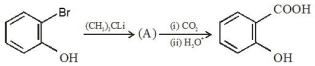
A
$2-$lithiophenol
B
Dilithium salt of $2-$bromophenol
C
$2-$tert-butoxyphenol
D
$2-$tert-butylphenol
Solution
(B) The reaction of $2$-bromophenol with $2$ equivalents of an organolithium reagent (like $n-BuLi$ or $t-BuLi$) involves two steps:
$1$. Acid-base reaction: The phenolic $-OH$ proton is acidic and is deprotonated by the first equivalent of the organolithium reagent to form a lithium phenoxide salt.
$2$. Halogen-metal exchange: The second equivalent of the organolithium reagent reacts with the aryl bromide to form an aryllithium species.
Thus,the intermediate $A$ is the dilithium salt of $2$-bromophenol,which has the structure of a benzene ring with an $-OLi$ group at the ortho position relative to a $-Li$ group. This species then reacts with $CO_2$ followed by acidic workup $(H_3O^+)$ to yield salicylic acid.
$1$. Acid-base reaction: The phenolic $-OH$ proton is acidic and is deprotonated by the first equivalent of the organolithium reagent to form a lithium phenoxide salt.
$2$. Halogen-metal exchange: The second equivalent of the organolithium reagent reacts with the aryl bromide to form an aryllithium species.
Thus,the intermediate $A$ is the dilithium salt of $2$-bromophenol,which has the structure of a benzene ring with an $-OLi$ group at the ortho position relative to a $-Li$ group. This species then reacts with $CO_2$ followed by acidic workup $(H_3O^+)$ to yield salicylic acid.
0 likesView Solution
241
ChemistryMediumMCQJEE Main · 2022
Given below are two statements :
Statement $I :$ The esterification of carboxylic acid with an alcohol is a nucleophilic acyl substitution.
Statement $II :$ Electron withdrawing groups in the carboxylic acid will increase the rate of esterification reaction.
Choose the most appropriate option
Statement $I :$ The esterification of carboxylic acid with an alcohol is a nucleophilic acyl substitution.
Statement $II :$ Electron withdrawing groups in the carboxylic acid will increase the rate of esterification reaction.
Choose the most appropriate option
A
Both Statement $I$ and Statement $II$ are correct.
B
Both Statement $I$ and Statement $II$ are incorrect.
C
Statement $I$ is correct but Statement $II$ is incorrect.
D
Statement $I$ is incorrect but Statement $II$ is correct.
Solution
(A) $R-OH + R'-COOH \longrightarrow R'-COOR + H_2O$
This reaction is a nucleophilic acyl substitution reaction where the alcohol acts as a nucleophile.
Electron withdrawing groups $(EWG)$ on the carboxylic acid increase the electrophilicity of the carbonyl carbon by pulling electron density away,which facilitates the attack of the nucleophile,thereby increasing the rate of esterification.
This reaction is a nucleophilic acyl substitution reaction where the alcohol acts as a nucleophile.
Electron withdrawing groups $(EWG)$ on the carboxylic acid increase the electrophilicity of the carbonyl carbon by pulling electron density away,which facilitates the attack of the nucleophile,thereby increasing the rate of esterification.
0 likesView Solution
242
ChemistryAdvancedMCQJEE Main · 2022
Consider the above reaction,the product $A$ and product $B$ respectively are ...
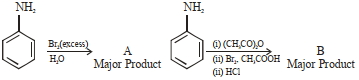
A
$2,4,6$-tribromoaniline and $p$-bromoaniline
B
$p$-bromoaniline and $2,4,6$-tribromoaniline
C
$2,4,6$-tribromoaniline and $2,4,6$-tribromoaniline
D
$p$-bromoaniline and $p$-bromoaniline
Solution
(A) $1$. In the first reaction,aniline reacts with $Br_2$ in water (excess). Due to the strongly activating nature of the $-NH_2$ group,electrophilic substitution occurs at all ortho and para positions,yielding $2,4,6$-tribromoaniline as the major product $A$.
$2$. In the second reaction,aniline is first acetylated using acetic anhydride to form acetanilide. This protects the $-NH_2$ group and reduces its activating effect. Subsequent bromination with $Br_2$ in $CH_3COOH$ occurs primarily at the para position due to steric hindrance at the ortho positions. Finally,hydrolysis with $HCl$ removes the acetyl group to yield $p$-bromoaniline as the major product $B$.
$2$. In the second reaction,aniline is first acetylated using acetic anhydride to form acetanilide. This protects the $-NH_2$ group and reduces its activating effect. Subsequent bromination with $Br_2$ in $CH_3COOH$ occurs primarily at the para position due to steric hindrance at the ortho positions. Finally,hydrolysis with $HCl$ removes the acetyl group to yield $p$-bromoaniline as the major product $B$.
0 likesView Solution
243
ChemistryEasyMCQJEE Main · 2022
The polymer,which can be stretched and retains its original status on releasing the force is ....
A
Bakelite
B
Nylon-$6,6$
C
Buna-$N$
D
Terylene
Solution
(C) Polymers that can be stretched and return to their original shape upon the release of force are known as elastomers.
$Buna-N$ is a synthetic rubber,which is an elastomer.
Therefore,it can be stretched and retains its original status on releasing the force.
$Buna-N$ is a synthetic rubber,which is an elastomer.
Therefore,it can be stretched and retains its original status on releasing the force.
0 likesView Solution
244
ChemistryMediumMCQJEE Main · 2022
The sugar moieties in $DNA$ and $RNA$ molecules respectively are:
A
$\beta-D-2-\text{deoxyribose}, \beta-D-\text{deoxyribose}$
B
$\beta-D-2-\text{deoxyribose}, \beta-D-\text{ribose}$
C
$\beta-D-\text{ribose}, \beta-D-2-\text{deoxyribose}$
D
$\beta-D-\text{deoxyribose}, \beta-D-2-\text{deoxyribose}$
Solution
(B) $DNA$ (Deoxyribonucleic acid) contains the sugar $\beta-D-2-\text{deoxyribose}$.
$RNA$ (Ribonucleic acid) contains the sugar $\beta-D-\text{ribose}$.
$RNA$ (Ribonucleic acid) contains the sugar $\beta-D-\text{ribose}$.
0 likesView Solution
245
ChemistryMediumMCQJEE Main · 2022
Which of the following compounds does not contain a sulphur atom?
A
Cimetidine
B
Ranitidine
C
Histamine
D
Saccharin
Solution
(C) The chemical structures of the given compounds are as follows:
$1$. Cimetidine $(C_{10}H_{16}N_6S)$ contains a sulphur atom.
$2$. Ranitidine $(C_{13}H_{22}N_4O_3S)$ contains a sulphur atom.
$3$. Histamine $(C_5H_9N_3)$ is a nitrogenous compound and does not contain a sulphur atom.
$4$. Saccharin $(C_7H_5NO_3S)$ contains a sulphur atom.
Therefore,Histamine is the correct answer.
$1$. Cimetidine $(C_{10}H_{16}N_6S)$ contains a sulphur atom.
$2$. Ranitidine $(C_{13}H_{22}N_4O_3S)$ contains a sulphur atom.
$3$. Histamine $(C_5H_9N_3)$ is a nitrogenous compound and does not contain a sulphur atom.
$4$. Saccharin $(C_7H_5NO_3S)$ contains a sulphur atom.
Therefore,Histamine is the correct answer.
0 likesView Solution
246
ChemistryMediumMCQJEE Main · 2022
Given below are two statements.
Statement $I$: Phenols are weakly acidic.
Statement $II$: Therefore they are freely soluble in $NaOH$ solution and are weaker acids than alcohols and water.
Choose the most appropriate option.
Statement $I$: Phenols are weakly acidic.
Statement $II$: Therefore they are freely soluble in $NaOH$ solution and are weaker acids than alcohols and water.
Choose the most appropriate option.
A
Both Statement $I$ and Statement $II$ are correct.
B
Both Statement $I$ and Statement $II$ are incorrect.
C
Statement $I$ is correct but Statement $II$ is incorrect.
D
Statement $I$ is incorrect but Statement $II$ is correct.
Solution
(C) Phenols are weakly acidic,so Statement $I$ is correct.
Phenols are more acidic than alcohols and water because the phenoxide ion is resonance-stabilized.
While phenols are soluble in $NaOH$ due to the formation of sodium phenoxide,the claim that they are weaker acids than alcohols and water is false.
Therefore,Statement $II$ is incorrect.
Phenols are more acidic than alcohols and water because the phenoxide ion is resonance-stabilized.
While phenols are soluble in $NaOH$ due to the formation of sodium phenoxide,the claim that they are weaker acids than alcohols and water is false.
Therefore,Statement $II$ is incorrect.
0 likesView Solution
247
ChemistryDifficultMCQJEE Main · 2022
$1.2 \, mL$ of acetic acid is dissolved in water to make $2.0 \, L$ of solution. The depression in freezing point observed for this strength of acid is $0.0198^{\circ} C$. The percentage of dissociation of the acid is $....$ (Nearest integer)
[Given : Density of acetic acid is $1.02 \, g \, mL^{-1}$
Molar mass of acetic acid is $60 \, g \, mol^{-1}$
$K_{f}(H_{2}O) = 1.85 \, K \, kg \, mol^{-1}$]
[Given : Density of acetic acid is $1.02 \, g \, mL^{-1}$
Molar mass of acetic acid is $60 \, g \, mol^{-1}$
$K_{f}(H_{2}O) = 1.85 \, K \, kg \, mol^{-1}$]
A
$50$
B
$5$
C
$45$
D
$24$
Solution
(B) $1$. Calculate the mass of acetic acid: $Mass = Density \times Volume = 1.02 \, g \, mL^{-1} \times 1.2 \, mL = 1.224 \, g$.
$2$. Calculate the moles of acetic acid: $Moles = \frac{1.224 \, g}{60 \, g \, mol^{-1}} = 0.0204 \, mol$.
$3$. Calculate molality $(m)$: Since the solution is dilute,we assume the density of the solution is approximately $1 \, g \, mL^{-1}$,so $2 \, L$ of solution is $2 \, kg$ of water. $m = \frac{0.0204 \, mol}{2 \, kg} = 0.0102 \, mol \, kg^{-1}$.
$4$. Use the depression in freezing point formula: $\Delta T_{f} = i \times K_{f} \times m$.
$5$. For acetic acid dissociation $(CH_{3}COOH \rightleftharpoons CH_{3}COO^{-} + H^{+})$,$i = 1 + \alpha$.
$6$. Substitute values: $0.0198 = (1 + \alpha) \times 1.85 \times 0.0102$.
$7$. Solve for $\alpha$: $1 + \alpha = \frac{0.0198}{1.85 \times 0.0102} \approx 1.04928$.
$8$. $\alpha = 0.04928$,which is $4.928 \% \approx 5 \%$. The nearest integer is $5$.
$2$. Calculate the moles of acetic acid: $Moles = \frac{1.224 \, g}{60 \, g \, mol^{-1}} = 0.0204 \, mol$.
$3$. Calculate molality $(m)$: Since the solution is dilute,we assume the density of the solution is approximately $1 \, g \, mL^{-1}$,so $2 \, L$ of solution is $2 \, kg$ of water. $m = \frac{0.0204 \, mol}{2 \, kg} = 0.0102 \, mol \, kg^{-1}$.
$4$. Use the depression in freezing point formula: $\Delta T_{f} = i \times K_{f} \times m$.
$5$. For acetic acid dissociation $(CH_{3}COOH \rightleftharpoons CH_{3}COO^{-} + H^{+})$,$i = 1 + \alpha$.
$6$. Substitute values: $0.0198 = (1 + \alpha) \times 1.85 \times 0.0102$.
$7$. Solve for $\alpha$: $1 + \alpha = \frac{0.0198}{1.85 \times 0.0102} \approx 1.04928$.
$8$. $\alpha = 0.04928$,which is $4.928 \% \approx 5 \%$. The nearest integer is $5$.
0 likesView Solution
248
ChemistryDifficultMCQJEE Main · 2022
$A$ dilute solution of sulphuric acid is electrolysed using a current of $0.10 \ A$ for $2 \ hours$ to produce hydrogen and oxygen gas. The total volume of gases produced at $STP$ is $...... \ cm^3$. (Nearest integer) $[$ Given : Faraday constant $F = 96500 \ C \ mol^{-1}$ at $STP$,molar volume of an ideal gas is $22.7 \ L \ mol^{-1} ]$
A
$127$
B
$1270$
C
$17$
D
$452$
Solution
(A) The reactions at the electrodes are:
At anode: $2H_2O \rightarrow O_2(g) + 4H^+ + 4e^-$
At cathode: $4H^+ + 4e^- \rightarrow 2H_2(g)$
Total charge passed $Q = i \times t = 0.10 \ A \times 2 \times 3600 \ s = 720 \ C$.
Number of moles of electrons $n_e = \frac{Q}{F} = \frac{720}{96500} \approx 0.00746 \ mol$.
From the stoichiometry,$4 \ mol$ of electrons produce $1 \ mol$ of $O_2$ and $2 \ mol$ of $H_2$ (total $3 \ mol$ of gas).
Total moles of gas produced $n_{total} = \frac{n_e}{4} + \frac{n_e}{2} = \frac{3}{4} n_e = 0.75 \times 0.00746 = 0.005595 \ mol$.
Volume at $STP = n_{total} \times 22.7 \ L \ mol^{-1} = 0.005595 \times 22.7 \approx 0.127 \ L = 127 \ cm^3$.
At anode: $2H_2O \rightarrow O_2(g) + 4H^+ + 4e^-$
At cathode: $4H^+ + 4e^- \rightarrow 2H_2(g)$
Total charge passed $Q = i \times t = 0.10 \ A \times 2 \times 3600 \ s = 720 \ C$.
Number of moles of electrons $n_e = \frac{Q}{F} = \frac{720}{96500} \approx 0.00746 \ mol$.
From the stoichiometry,$4 \ mol$ of electrons produce $1 \ mol$ of $O_2$ and $2 \ mol$ of $H_2$ (total $3 \ mol$ of gas).
Total moles of gas produced $n_{total} = \frac{n_e}{4} + \frac{n_e}{2} = \frac{3}{4} n_e = 0.75 \times 0.00746 = 0.005595 \ mol$.
Volume at $STP = n_{total} \times 22.7 \ L \ mol^{-1} = 0.005595 \times 22.7 \approx 0.127 \ L = 127 \ cm^3$.
0 likesView Solution
249
ChemistryDifficultMCQJEE Main · 2022
The activation energy of one of the reactions in a biochemical process is $532611 \, J \, mol^{-1}$. When the temperature falls from $310 \, K$ to $300 \, K$,the change in rate constant observed is $k_{300} = x \times 10^{-3} \, k_{310}$. The value of $x$ is $.....$ [Given: $\ln 10 = 2.3$,$R = 8.3 \, J \, K^{-1} \, mol^{-1}$]
A
$1$
B
$10$
C
$45$
D
$985$
Solution
(A) Using the Arrhenius equation: $\ln \left(\frac{k_{310}}{k_{300}}\right) = \frac{E_a}{R} \left(\frac{1}{T_{300}} - \frac{1}{T_{310}}\right)$
$\ln \left(\frac{k_{310}}{k_{300}}\right) = \frac{532611}{8.3} \times \left(\frac{310 - 300}{310 \times 300}\right)$
$\ln \left(\frac{k_{310}}{k_{300}}\right) = \frac{532611}{8.3} \times \frac{10}{93000} = 64170 \times \frac{10}{93000} \approx 6.9$
Since $\ln 10 = 2.3$,then $6.9 = 3 \times 2.3 = 3 \times \ln 10 = \ln 10^3$.
Therefore,$\frac{k_{310}}{k_{300}} = 10^3$,which means $k_{300} = 10^{-3} \, k_{310}$.
Comparing this with $k_{300} = x \times 10^{-3} \, k_{310}$,we get $x = 1$.
$\ln \left(\frac{k_{310}}{k_{300}}\right) = \frac{532611}{8.3} \times \left(\frac{310 - 300}{310 \times 300}\right)$
$\ln \left(\frac{k_{310}}{k_{300}}\right) = \frac{532611}{8.3} \times \frac{10}{93000} = 64170 \times \frac{10}{93000} \approx 6.9$
Since $\ln 10 = 2.3$,then $6.9 = 3 \times 2.3 = 3 \times \ln 10 = \ln 10^3$.
Therefore,$\frac{k_{310}}{k_{300}} = 10^3$,which means $k_{300} = 10^{-3} \, k_{310}$.
Comparing this with $k_{300} = x \times 10^{-3} \, k_{310}$,we get $x = 1$.
0 likesView Solution
250
ChemistryMediumMCQJEE Main · 2022
The number of terminal oxygen atoms present in the product $B$ obtained from the following reaction is $....$
$4FeCr_2O_4 + 8Na_2CO_3 + 7O_2 \rightarrow 8Na_2CrO_4 + 2Fe_2O_3 + 8CO_2$
$2Na_2CrO_4 + 2H^{+} \rightarrow B + H_2O + 2Na^{+}$
$4FeCr_2O_4 + 8Na_2CO_3 + 7O_2 \rightarrow 8Na_2CrO_4 + 2Fe_2O_3 + 8CO_2$
$2Na_2CrO_4 + 2H^{+} \rightarrow B + H_2O + 2Na^{+}$
A
$6$
B
$54$
C
$9$
D
$81$
Solution
(A) The reaction $2Na_2CrO_4 + 2H^{+} \rightarrow Na_2Cr_2O_7 + 2Na^{+} + H_2O$ shows that the product $B$ is sodium dichromate $(Na_2Cr_2O_7)$.
The structure of the dichromate ion $(Cr_2O_7^{2-})$ consists of two $CrO_4$ tetrahedra sharing a common oxygen atom at one corner.
In this structure,there are $6$ terminal oxygen atoms (three bonded to each chromium atom) and $1$ bridging oxygen atom.
Therefore,the number of terminal oxygen atoms is $6$.
The structure of the dichromate ion $(Cr_2O_7^{2-})$ consists of two $CrO_4$ tetrahedra sharing a common oxygen atom at one corner.
In this structure,there are $6$ terminal oxygen atoms (three bonded to each chromium atom) and $1$ bridging oxygen atom.
Therefore,the number of terminal oxygen atoms is $6$.
0 likesView Solution
Vedclass Products
For Students
Vedclass Test Series
Mock tests in real JEE Main style covering Chemistry with performance analysis. 5-day free trial.
Start Free TrialFor Teachers
Exam Paper Generator
Generate Set A/B/C/D Chemistry papers from 7.5L+ questions in 2 minutes. 3 chapters free.
Try FreeFor Institutes
Online Exam Module
Run live JEE Main mock exams with unlimited students, 360° analytics & white-label branding.
See DemoFrequently Asked Questions
How many Chemistry questions are in JEE Main 2022?
There are 666 Chemistry questions from the JEE Main 2022 paper on Vedclass, each with a detailed step-by-step solution in English.
Are JEE Main 2022 Chemistry solutions available in English?
Yes. All solutions on this page are in English. You can also switch to English or Hindi using the language buttons above the questions.
Can I practice JEE Main 2022 Chemistry as a timed test?
Yes. Use the Vedclass Test Series to attempt a full JEE Main mock test covering Chemistry with time limits and instant score analysis.
Can teachers create Chemistry papers from JEE Main previous year questions?
Yes. The Vedclass Exam Paper Generator lets teachers mix JEE Main Chemistry questions and generate Set A/B/C/D papers in minutes.
For Teachers & Institutes
Build a Custom Chemistry Paper
Pick JEE Main 2022 Chemistry questions, set difficulty, and generate Set A/B/C/D in 2 minutes.