
ChemistryQ201–300 of 666 questions
Page 5 of 8 · English
201
ChemistryDifficultMCQJEE Main · 2022
For the reaction $H_{2}F_{2(g)} \rightarrow H_{2(g)} + F_{2(g)}$,$\Delta U = -59.6 \ kJ \ mol^{-1}$ at $27^{\circ} C$. The enthalpy change for the above reaction is $(-)$ $kJ \ mol^{-1}$ [nearest integer]. Given: $R = 8.314 \ J \ K^{-1} \ mol^{-1}$.
A
$57$
B
$55$
C
$56$
D
$54$
Solution
(A) The relationship between enthalpy change and internal energy change is given by $\Delta H = \Delta U + \Delta n_{g} RT$.
For the reaction $H_{2}F_{2(g)} \rightarrow H_{2(g)} + F_{2(g)}$,the change in the number of gaseous moles is $\Delta n_{g} = (1 + 1) - 1 = 1$.
The temperature is $T = 27 + 273 = 300 \ K$.
Given $\Delta U = -59.6 \ kJ \ mol^{-1}$ and $R = 8.314 \ J \ K^{-1} \ mol^{-1} = 8.314 \times 10^{-3} \ kJ \ K^{-1} \ mol^{-1}$.
Substituting the values: $\Delta H = -59.6 + (1 \times 8.314 \times 10^{-3} \times 300) = -59.6 + 2.4942 = -57.1058 \ kJ \ mol^{-1}$.
The nearest integer value is $-57 \ kJ \ mol^{-1}$.
For the reaction $H_{2}F_{2(g)} \rightarrow H_{2(g)} + F_{2(g)}$,the change in the number of gaseous moles is $\Delta n_{g} = (1 + 1) - 1 = 1$.
The temperature is $T = 27 + 273 = 300 \ K$.
Given $\Delta U = -59.6 \ kJ \ mol^{-1}$ and $R = 8.314 \ J \ K^{-1} \ mol^{-1} = 8.314 \times 10^{-3} \ kJ \ K^{-1} \ mol^{-1}$.
Substituting the values: $\Delta H = -59.6 + (1 \times 8.314 \times 10^{-3} \times 300) = -59.6 + 2.4942 = -57.1058 \ kJ \ mol^{-1}$.
The nearest integer value is $-57 \ kJ \ mol^{-1}$.
0 likesView Solution
202
ChemistryMediumMCQJEE Main · 2022
The number of non-ionisable protons present in the product $B$ obtained from the following reaction is:
$3C_{2}H_{5}OH + PCl_{3} \rightarrow 3C_{2}H_{5}Cl + H_{3}PO_{3} (A)$
$H_{3}PO_{3} + PCl_{3} \rightarrow H_{4}P_{2}O_{5} (B) + HCl$
$3C_{2}H_{5}OH + PCl_{3} \rightarrow 3C_{2}H_{5}Cl + H_{3}PO_{3} (A)$
$H_{3}PO_{3} + PCl_{3} \rightarrow H_{4}P_{2}O_{5} (B) + HCl$
A
$9$
B
$2$
C
$4$
D
$3$
Solution
(B) The reaction of ethanol with $PCl_{3}$ produces ethyl chloride and phosphorous acid $(H_{3}PO_{3})$,which is compound $A$.
$3C_{2}H_{5}OH + PCl_{3} \rightarrow 3C_{2}H_{5}Cl + H_{3}PO_{3} (A)$
Further reaction of $H_{3}PO_{3}$ with $PCl_{3}$ yields pyrophosphorous acid $(H_{4}P_{2}O_{5})$,which is compound $B$.
$2H_{3}PO_{3} + PCl_{3} \rightarrow H_{4}P_{2}O_{5} (B) + PCl_{3} + ...$ (The reaction stoichiometry leads to $H_{4}P_{2}O_{5}$).
In the structure of pyrophosphorous acid $(H_{4}P_{2}O_{5})$,there are two $P-H$ bonds.
Protons attached directly to the phosphorus atom $(P-H)$ are non-ionisable.
Therefore,there are $2$ non-ionisable protons in $H_{4}P_{2}O_{5}$.
$3C_{2}H_{5}OH + PCl_{3} \rightarrow 3C_{2}H_{5}Cl + H_{3}PO_{3} (A)$
Further reaction of $H_{3}PO_{3}$ with $PCl_{3}$ yields pyrophosphorous acid $(H_{4}P_{2}O_{5})$,which is compound $B$.
$2H_{3}PO_{3} + PCl_{3} \rightarrow H_{4}P_{2}O_{5} (B) + PCl_{3} + ...$ (The reaction stoichiometry leads to $H_{4}P_{2}O_{5}$).
In the structure of pyrophosphorous acid $(H_{4}P_{2}O_{5})$,there are two $P-H$ bonds.
Protons attached directly to the phosphorus atom $(P-H)$ are non-ionisable.
Therefore,there are $2$ non-ionisable protons in $H_{4}P_{2}O_{5}$.
0 likesView Solution
203
ChemistryMediumMCQJEE Main · 2022
Total number of isomers (including stereoisomers) obtained on monochlorination of methylcyclohexane is $........$
A
$11$
B
$13$
C
$14$
D
$12$
Solution
(D) Monochlorination of methylcyclohexane $(C_7H_{14})$ occurs at different positions:
$1$. At the methyl group: $1$ isomer (chloromethylcyclohexane).
$2$. At the $C_1$ position: $1$ isomer ($1$-chloro$-1-$methylcyclohexane).
$3$. At the $C_2$ position: $2$ chiral centers are present,leading to $2^2 = 4$ stereoisomers.
$4$. At the $C_3$ position: $2$ chiral centers are present,leading to $2^2 = 4$ stereoisomers.
$5$. At the $C_4$ position: $2$ stereoisomers (cis and trans$-1-$chloro$-4-$methylcyclohexane).
Total isomers = $1 + 1 + 4 + 4 + 2 = 12$.
$1$. At the methyl group: $1$ isomer (chloromethylcyclohexane).
$2$. At the $C_1$ position: $1$ isomer ($1$-chloro$-1-$methylcyclohexane).
$3$. At the $C_2$ position: $2$ chiral centers are present,leading to $2^2 = 4$ stereoisomers.
$4$. At the $C_3$ position: $2$ chiral centers are present,leading to $2^2 = 4$ stereoisomers.
$5$. At the $C_4$ position: $2$ stereoisomers (cis and trans$-1-$chloro$-4-$methylcyclohexane).
Total isomers = $1 + 1 + 4 + 4 + 2 = 12$.
0 likesView Solution
204
ChemistryMediumMCQJEE Main · 2022
$A$ $100 \ mL$ solution of $CH_3CH_2MgBr$ on treatment with methanol produces $2.24 \ mL$ of a gas at $STP$. The weight of gas produced is $......mg$. [nearest integer]
A
$2$
B
$1$
C
$3$
D
$4$
Solution
(C) The reaction is: $CH_3CH_2MgBr + CH_3OH \rightarrow CH_3CH_3 + Mg(OCH_3)Br$.
The gas produced is ethane $(C_2H_6)$.
At $STP$,$22400 \ mL$ of gas corresponds to $1 \ mol$.
Therefore,$2.24 \ mL$ of gas corresponds to $n = \frac{2.24}{22400} = 10^{-4} \ mol$.
The molar mass of ethane $(C_2H_6)$ is $2 \times 12 + 6 \times 1 = 30 \ g/mol$.
The weight of gas produced is $W = n \times M = 10^{-4} \ mol \times 30 \ g/mol = 30 \times 10^{-4} \ g = 3 \times 10^{-3} \ g$.
Since $1 \ g = 1000 \ mg$,the weight is $3 \times 10^{-3} \times 1000 = 3 \ mg$.
The gas produced is ethane $(C_2H_6)$.
At $STP$,$22400 \ mL$ of gas corresponds to $1 \ mol$.
Therefore,$2.24 \ mL$ of gas corresponds to $n = \frac{2.24}{22400} = 10^{-4} \ mol$.
The molar mass of ethane $(C_2H_6)$ is $2 \times 12 + 6 \times 1 = 30 \ g/mol$.
The weight of gas produced is $W = n \times M = 10^{-4} \ mol \times 30 \ g/mol = 30 \times 10^{-4} \ g = 3 \times 10^{-3} \ g$.
Since $1 \ g = 1000 \ mg$,the weight is $3 \times 10^{-3} \times 1000 = 3 \ mg$.
1 likesView Solution
205
ChemistryMCQJEE Main · 2022
Which of the following statements is a tautology?
A
$((\sim q) \wedge p) \wedge q$
B
$((\sim q) \wedge p) \wedge (p \wedge (\sim p))$
C
$((\sim q) \wedge p) \vee (p \vee (\sim p))$
D
$(p \wedge q) \wedge (\sim (p \wedge q))$
Solution
(C) tautology is a statement that is always true for all possible truth values of its components.
$(A)$ $((\sim q) \wedge p) \wedge q = (\sim q \wedge q) \wedge p = F \wedge p = F$ (Contradiction)
$(B)$ $((\sim q) \wedge p) \wedge (p \wedge (\sim p)) = (\sim q \wedge p) \wedge F = F$ (Contradiction)
$(C)$ $((\sim q) \wedge p) \vee (p \vee (\sim p)) = ((\sim q) \wedge p) \vee T = T$ (Tautology)
$(D)$ $(p \wedge q) \wedge (\sim (p \wedge q)) = F$ (Contradiction)
Thus,option $C$ is a tautology.
$(A)$ $((\sim q) \wedge p) \wedge q = (\sim q \wedge q) \wedge p = F \wedge p = F$ (Contradiction)
$(B)$ $((\sim q) \wedge p) \wedge (p \wedge (\sim p)) = (\sim q \wedge p) \wedge F = F$ (Contradiction)
$(C)$ $((\sim q) \wedge p) \vee (p \vee (\sim p)) = ((\sim q) \wedge p) \vee T = T$ (Tautology)
$(D)$ $(p \wedge q) \wedge (\sim (p \wedge q)) = F$ (Contradiction)
Thus,option $C$ is a tautology.
0 likesView Solution
206
ChemistryMCQJEE Main · 2022
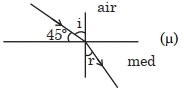
Light enters from air into a given medium at an angle of $45^{\circ}$ with the interface of the air-medium surface. After refraction,the light ray is deviated through an angle of $15^{\circ}$ from its original direction. The refractive index of the medium is:
A
$1.732$
B
$1.333$
C
$1.414$
D
$2.732$
Solution
(C) The angle of incidence $i$ is the angle between the incident ray and the normal. The given angle is with the interface,so $i = 90^{\circ} - 45^{\circ} = 45^{\circ}$.
The angle of deviation $D$ is given by $D = i - r$,where $r$ is the angle of refraction.
Given $D = 15^{\circ}$,we have $15^{\circ} = 45^{\circ} - r$,which gives $r = 30^{\circ}$.
Using Snell's law,$n_1 \sin i = n_2 \sin r$,where $n_1 = 1$ (for air) and $n_2 = \mu$ (refractive index of the medium).
$1 \cdot \sin 45^{\circ} = \mu \cdot \sin 30^{\circ}$
$\frac{1}{\sqrt{2}} = \mu \cdot \frac{1}{2}$
$\mu = \frac{2}{\sqrt{2}} = \sqrt{2} \approx 1.414$.
The angle of deviation $D$ is given by $D = i - r$,where $r$ is the angle of refraction.
Given $D = 15^{\circ}$,we have $15^{\circ} = 45^{\circ} - r$,which gives $r = 30^{\circ}$.
Using Snell's law,$n_1 \sin i = n_2 \sin r$,where $n_1 = 1$ (for air) and $n_2 = \mu$ (refractive index of the medium).
$1 \cdot \sin 45^{\circ} = \mu \cdot \sin 30^{\circ}$
$\frac{1}{\sqrt{2}} = \mu \cdot \frac{1}{2}$
$\mu = \frac{2}{\sqrt{2}} = \sqrt{2} \approx 1.414$.
0 likesView Solution
207
ChemistryMediumMCQJEE Main · 2022
Match $List-I$ with $List-II$.
Choose the correct answer from the options given below.
| $List-I$ (Compound) | $List-II$ (Shape) |
|---|---|
| $A$. $BrF_5$ | $I$. bent |
| $B$. $[CrF_6]^{3-}$ | $II$. square pyramidal |
| $C$. $O_3$ | $III$. trigonal bipyramidal |
| $D$. $PCl_5$ | $IV$. octahedral |
Choose the correct answer from the options given below.
A
$A-I, B-II, C-III, D-IV$
B
$A-IV, B-III, C-II, D-I$
C
$A-II, B-IV, C-I, D-III$
D
$A-III, B-IV, C-II, D-I$
Solution
(C) The shapes of the given compounds are as follows:
$A$. $BrF_5$: It has $5$ bond pairs and $1$ lone pair,resulting in a square pyramidal geometry $(II)$.
$B$. $[CrF_6]^{3-}$: It has $6$ bond pairs and $0$ lone pairs,resulting in an octahedral geometry $(IV)$.
$C$. $O_3$: It has $2$ bond pairs and $1$ lone pair on the central atom,resulting in a bent shape $(I)$.
$D$. $PCl_5$: It has $5$ bond pairs and $0$ lone pairs,resulting in a trigonal bipyramidal geometry $(III)$.
Therefore,the correct matching is $A-II, B-IV, C-I, D-III$.
$A$. $BrF_5$: It has $5$ bond pairs and $1$ lone pair,resulting in a square pyramidal geometry $(II)$.
$B$. $[CrF_6]^{3-}$: It has $6$ bond pairs and $0$ lone pairs,resulting in an octahedral geometry $(IV)$.
$C$. $O_3$: It has $2$ bond pairs and $1$ lone pair on the central atom,resulting in a bent shape $(I)$.
$D$. $PCl_5$: It has $5$ bond pairs and $0$ lone pairs,resulting in a trigonal bipyramidal geometry $(III)$.
Therefore,the correct matching is $A-II, B-IV, C-I, D-III$.
0 likesView Solution
208
ChemistryMediumMCQJEE Main · 2022
Given two statements below :
Statement $I:$ In $Cl_2$ molecule the covalent radius is double of the atomic radius of chlorine.
Statement $II:$ Radius of anionic species is always greater than their parent atomic radius.
Choose the most appropriate answer from options given below :
Statement $I:$ In $Cl_2$ molecule the covalent radius is double of the atomic radius of chlorine.
Statement $II:$ Radius of anionic species is always greater than their parent atomic radius.
Choose the most appropriate answer from options given below :
A
Both Statement $I$ and Statement $II$ are correct.
B
Both Statement $I$ and Statement $II$ are incorrect.
C
Statement $I$ is correct but Statement $II$ is incorrect.
D
Statement $I$ is incorrect but Statement $II$ is correct.
Solution
(D) Statement $I$ is incorrect because the covalent radius is defined as half of the internuclear distance between two bonded atoms in a molecule,not double the atomic radius.
Statement $II$ is correct because in an anion,the number of electrons increases while the nuclear charge remains the same,leading to increased electron-electron repulsion and a decrease in effective nuclear charge,which results in a larger ionic radius compared to the parent atom.
Statement $II$ is correct because in an anion,the number of electrons increases while the nuclear charge remains the same,leading to increased electron-electron repulsion and a decrease in effective nuclear charge,which results in a larger ionic radius compared to the parent atom.
0 likesView Solution
209
ChemistryEasyMCQJEE Main · 2022
Which of the following can be used to prevent the decomposition of $H_{2}O_{2}$?
A
$Urea$
B
$Formaldehyde$
C
$Formic \ acid$
D
$Ethanol$
Solution
(A) $Urea$ acts as a stabilizer for $H_{2}O_{2}$ and prevents its decomposition.
0 likesView Solution
210
ChemistryMediumMCQJEE Main · 2022
Reaction of $BeCl_{2}$ with $LiAlH_{4}$ gives.
$(A)$ $AlCl_{3}$; $(B)$ $BeH_{2}$; $(C)$ $LiH$; $(D)$ $LiCl$; $(E)$ $BeAlH_{4}$
Choose the correct answer from options given below.
$(A)$ $AlCl_{3}$; $(B)$ $BeH_{2}$; $(C)$ $LiH$; $(D)$ $LiCl$; $(E)$ $BeAlH_{4}$
Choose the correct answer from options given below.
A
$(A)$,$(D)$ and $(E)$
B
$(A)$,$(B)$ and $(D)$
C
$(D)$ and $(E)$
D
$(B)$,$(C)$ and $(D)$
Solution
(B) The reaction between $BeCl_{2}$ and $LiAlH_{4}$ is a common method for the preparation of beryllium hydride $(BeH_{2})$.
The balanced chemical equation is:
$2BeCl_{2} + LiAlH_{4} \rightarrow 2BeH_{2} + LiCl + AlCl_{3}$
Thus,the products formed are $BeH_{2}$,$LiCl$,and $AlCl_{3}$,which correspond to options $(B)$,$(D)$,and $(A)$.
The balanced chemical equation is:
$2BeCl_{2} + LiAlH_{4} \rightarrow 2BeH_{2} + LiCl + AlCl_{3}$
Thus,the products formed are $BeH_{2}$,$LiCl$,and $AlCl_{3}$,which correspond to options $(B)$,$(D)$,and $(A)$.
0 likesView Solution
211
ChemistryMediumMCQJEE Main · 2022
Borazine,also known as inorganic benzene,can be prepared by the reaction of $3$ equivalents of "$X$" with $6$ equivalents of "$Y$". "$X$" and "$Y$",respectively,are:
A
$B(OH)_3$ and $NH_3$
B
$B_2H_6$ and $NH_3$
C
$B_2H_6$ and $HN_3$
D
$NH_3$ and $B_2O_3$
Solution
(B) The preparation of borazine $(B_3N_3H_6)$ involves the reaction of diborane $(B_2H_6)$ with ammonia $(NH_3)$ at high temperatures.
The balanced chemical equation is:
$3 B_2H_6 + 6 NH_3 \xrightarrow{\Delta} 2 B_3N_3H_6 + 12 H_2$
Here,$X$ is $B_2H_6$ and $Y$ is $NH_3$.
The balanced chemical equation is:
$3 B_2H_6 + 6 NH_3 \xrightarrow{\Delta} 2 B_3N_3H_6 + 12 H_2$
Here,$X$ is $B_2H_6$ and $Y$ is $NH_3$.
0 likesView Solution
212
ChemistryMediumMCQJEE Main · 2022
Which of the given reactions is not an example of a disproportionation reaction?
A
$2 H_2O_2 \rightarrow 2 H_2O + O_2$
B
$2 NO_2 + H_2O \rightarrow HNO_3 + HNO_2$
C
$MnO_4^- + 4 H^+ + 3 e^- \rightarrow MnO_2 + 2 H_2O$
D
$3 MnO_4^{2-} + 4 H^+ \rightarrow 2 MnO_4^- + MnO_2 + 2 H_2O$
Solution
(C) disproportionation reaction is one in which the same element in a given oxidation state is simultaneously oxidized and reduced.
$A$: $2 H_2O_2 \rightarrow 2 H_2O + O_2$: Oxygen in $H_2O_2$ is in $-1$ state. It goes to $-2$ in $H_2O$ (reduction) and $0$ in $O_2$ (oxidation). This is a disproportionation reaction.
$B$: $2 NO_2 + H_2O \rightarrow HNO_3 + HNO_2$: Nitrogen in $NO_2$ is in $+4$ state. It goes to $+5$ in $HNO_3$ (oxidation) and $+3$ in $HNO_2$ (reduction). This is a disproportionation reaction.
$C$: $MnO_4^- + 4 H^+ + 3 e^- \rightarrow MnO_2 + 2 H_2O$: Manganese in $MnO_4^-$ is in $+7$ state and goes to $+4$ in $MnO_2$. This is a simple reduction reaction,not disproportionation.
$D$: $3 MnO_4^{2-} + 4 H^+ \rightarrow 2 MnO_4^- + MnO_2 + 2 H_2O$: Manganese in $MnO_4^{2-}$ is in $+6$ state. It goes to $+7$ in $MnO_4^-$ (oxidation) and $+4$ in $MnO_2$ (reduction). This is a disproportionation reaction.
$A$: $2 H_2O_2 \rightarrow 2 H_2O + O_2$: Oxygen in $H_2O_2$ is in $-1$ state. It goes to $-2$ in $H_2O$ (reduction) and $0$ in $O_2$ (oxidation). This is a disproportionation reaction.
$B$: $2 NO_2 + H_2O \rightarrow HNO_3 + HNO_2$: Nitrogen in $NO_2$ is in $+4$ state. It goes to $+5$ in $HNO_3$ (oxidation) and $+3$ in $HNO_2$ (reduction). This is a disproportionation reaction.
$C$: $MnO_4^- + 4 H^+ + 3 e^- \rightarrow MnO_2 + 2 H_2O$: Manganese in $MnO_4^-$ is in $+7$ state and goes to $+4$ in $MnO_2$. This is a simple reduction reaction,not disproportionation.
$D$: $3 MnO_4^{2-} + 4 H^+ \rightarrow 2 MnO_4^- + MnO_2 + 2 H_2O$: Manganese in $MnO_4^{2-}$ is in $+6$ state. It goes to $+7$ in $MnO_4^-$ (oxidation) and $+4$ in $MnO_2$ (reduction). This is a disproportionation reaction.
0 likesView Solution
213
ChemistryEasyMCQJEE Main · 2022
The dark purple colour of $KMnO_4$ disappears in the titration with oxalic acid in acidic medium. The overall change in the oxidation number of manganese in the reaction is.
A
$5$
B
$1$
C
$7$
D
$2$
Solution
(A) In acidic medium,the reduction reaction of the permanganate ion is: $MnO_4^- + 8H^+ + 5e^- \rightarrow Mn^{2+} + 4H_2O$.
In $MnO_4^-$,the oxidation state of $Mn$ is $+7$.
In $Mn^{2+}$,the oxidation state of $Mn$ is $+2$.
The change in the oxidation number of manganese is $|(+2) - (+7)| = 5$.
In $MnO_4^-$,the oxidation state of $Mn$ is $+7$.
In $Mn^{2+}$,the oxidation state of $Mn$ is $+2$.
The change in the oxidation number of manganese is $|(+2) - (+7)| = 5$.
0 likesView Solution
214
ChemistryEasyMCQJEE Main · 2022
$\dot{Cl} + CH_4 \rightarrow A + B$
$A$ and $B$ in the above atmospheric reaction step are.
$A$ and $B$ in the above atmospheric reaction step are.
A
$C_2H_6$ and $Cl_2$
B
$\dot{C}HCl_2$ and $H_2$
C
$\dot{CH}_3$ and $HCl$
D
$C_2H_6$ and $HCl$
Solution
(C) The reaction between a chlorine radical $(\dot{Cl})$ and methane $(CH_4)$ is a propagation step in the free radical substitution mechanism.
The chlorine radical abstracts a hydrogen atom from methane to form a methyl radical $(\dot{CH}_3)$ and hydrogen chloride $(HCl)$.
The reaction is: $\dot{Cl} + CH_4 \rightarrow \dot{CH}_3 + HCl$.
Therefore,$A = \dot{CH}_3$ and $B = HCl$.
The chlorine radical abstracts a hydrogen atom from methane to form a methyl radical $(\dot{CH}_3)$ and hydrogen chloride $(HCl)$.
The reaction is: $\dot{Cl} + CH_4 \rightarrow \dot{CH}_3 + HCl$.
Therefore,$A = \dot{CH}_3$ and $B = HCl$.
0 likesView Solution
215
ChemistryMediumMCQJEE Main · 2022
Which technique among the following is most appropriate for the separation of a mixture of $100 \ mg$ of $p-$nitrophenol and picric acid?
A
Steam distillation
B
$2-5 \ ft$ long column of silica gel
C
Sublimation
D
Preparative $TLC$ (Thin Layer Chromatography)
Solution
(D) $p-$nitrophenol exhibits intermolecular hydrogen bonding,while picric acid ($2,4,6-$trinitrophenol) exhibits intramolecular hydrogen bonding.
Due to these differences in hydrogen bonding,they possess different polarities and adsorption characteristics on a stationary phase like silica gel.
For a small quantity like $100 \ mg$,chromatographic techniques are highly effective.
Preparative $TLC$ is a suitable technique for separating small amounts of mixtures based on differences in their $R_f$ values.
Due to these differences in hydrogen bonding,they possess different polarities and adsorption characteristics on a stationary phase like silica gel.
For a small quantity like $100 \ mg$,chromatographic techniques are highly effective.
Preparative $TLC$ is a suitable technique for separating small amounts of mixtures based on differences in their $R_f$ values.
0 likesView Solution
216
ChemistryEasyMCQJEE Main · 2022
Which of the following compounds is not aromatic?
A
Cyclopentadienyl anion
B
Cyclopropenyl cation
C
$[10]$ Annulene
D
Naphthalene
Solution
(C) $[10]$ Annulene,although it follows the $(4n + 2) \pi$ electron rule,is non-aromatic due to its non-planar nature.
It is non-planar because of the steric repulsion between the two $C-H$ bonds present inside the ring.
It is non-planar because of the steric repulsion between the two $C-H$ bonds present inside the ring.
0 likesView Solution
217
ChemistryMCQJEE Main · 2022
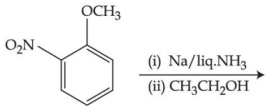
The major product of the following reaction is
A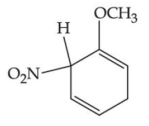
B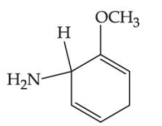
C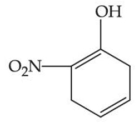
D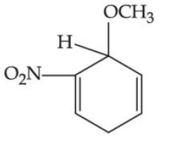
Solution
(A) The given reaction is an example of Birch reduction,which involves the reduction of an aromatic ring to a non-conjugated $1,4-$cyclohexadiene using an alkali metal (like $Na$ or $Li$) in liquid ammonia $(NH_3)$ in the presence of an alcohol (like $CH_3CH_2OH$).
For an aromatic ring substituted with an electron-donating group (like $-OCH_3$),the substituent remains on the double bond of the resulting $1,4-$cyclohexadiene.
For an aromatic ring substituted with an electron-withdrawing group (like $-NO_2$),the substituent is located on the saturated carbon (the $sp^3$ hybridized carbon) of the resulting $1,4-$cyclohexadiene.
In the given reactant,$o$-nitroanisole,the $-NO_2$ group is a strong electron-withdrawing group,while the $-OCH_3$ group is an electron-donating group. The reduction occurs such that the $-NO_2$ group ends up on the saturated carbon atom of the $1,4-$cyclohexadiene ring. Thus,the correct product is the one where the $-NO_2$ group is at the $sp^3$ carbon and the $-OCH_3$ group is on the double bond.
For an aromatic ring substituted with an electron-donating group (like $-OCH_3$),the substituent remains on the double bond of the resulting $1,4-$cyclohexadiene.
For an aromatic ring substituted with an electron-withdrawing group (like $-NO_2$),the substituent is located on the saturated carbon (the $sp^3$ hybridized carbon) of the resulting $1,4-$cyclohexadiene.
In the given reactant,$o$-nitroanisole,the $-NO_2$ group is a strong electron-withdrawing group,while the $-OCH_3$ group is an electron-donating group. The reduction occurs such that the $-NO_2$ group ends up on the saturated carbon atom of the $1,4-$cyclohexadiene ring. Thus,the correct product is the one where the $-NO_2$ group is at the $sp^3$ carbon and the $-OCH_3$ group is on the double bond.
0 likesView Solution
218
ChemistryMCQJEE Main · 2022
The correct stability order of the following diazonium salts is:
A
$(A) > (C) > (D) > (B)$
B
$(A) > (B) > (C) > (D)$
C
$(C) > (A) > (D) > (B)$
D
$(C) > (D) > (B) > (A)$
Solution
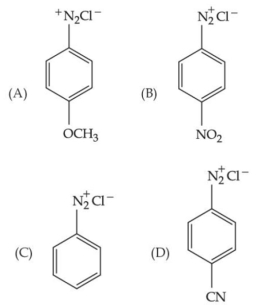
(A) The stability of the diazonium cation is increased by electron-donating groups $(EDG)$ and decreased by electron-withdrawing groups $(EWG)$ attached to the benzene ring.
$(A)$ contains $-OCH_3$,which is an $EDG$ (via resonance),thus it is the most stable.
$(C)$ is the unsubstituted benzene diazonium salt.
$(D)$ contains $-CN$,which is an $EWG$.
$(B)$ contains $-NO_2$,which is a very strong $EWG$.
Therefore,the stability order is $(A) > (C) > (D) > (B)$.
$(A)$ contains $-OCH_3$,which is an $EDG$ (via resonance),thus it is the most stable.
$(C)$ is the unsubstituted benzene diazonium salt.
$(D)$ contains $-CN$,which is an $EWG$.
$(B)$ contains $-NO_2$,which is a very strong $EWG$.
Therefore,the stability order is $(A) > (C) > (D) > (B)$.
0 likesView Solution
219
ChemistryDifficultMCQJEE Main · 2022
Chlorophyll extracted from the crushed green leaves was dissolved in water to make $2 \, L$ solution of $Mg$ of concentration $48 \, ppm$. The number of atoms of $Mg$ in this solution is $x \times 10^{20}$ atoms. The value of $x$ is (Nearest Integer) (Given : Atomic mass of $Mg$ is $24 \, g \, mol^{-1}$,$N_{A} = 6.02 \times 10^{23} \, mol^{-1}$)
A
$22$
B
$24$
C
$23$
D
$20$
Solution
(B) Concentration in $ppm = \frac{\text{Mass of solute (in } g)}{\text{Volume of solution (in } mL)} \times 10^{6}$.
Given $ppm = 48$,Volume $= 2 \, L = 2000 \, mL$.
Mass of $Mg = \frac{48 \times 2000}{10^{6}} = 96 \times 10^{-3} \, g = 0.096 \, g$.
Moles of $Mg = \frac{\text{Mass}}{\text{Atomic mass}} = \frac{0.096}{24} = 0.004 \, mol = 4 \times 10^{-3} \, mol$.
Number of $Mg$ atoms $= \text{Moles} \times N_{A} = 4 \times 10^{-3} \times 6.02 \times 10^{23} = 24.08 \times 10^{20}$.
Comparing with $x \times 10^{20}$,we get $x = 24.08$.
The nearest integer value of $x$ is $24$.
Given $ppm = 48$,Volume $= 2 \, L = 2000 \, mL$.
Mass of $Mg = \frac{48 \times 2000}{10^{6}} = 96 \times 10^{-3} \, g = 0.096 \, g$.
Moles of $Mg = \frac{\text{Mass}}{\text{Atomic mass}} = \frac{0.096}{24} = 0.004 \, mol = 4 \times 10^{-3} \, mol$.
Number of $Mg$ atoms $= \text{Moles} \times N_{A} = 4 \times 10^{-3} \times 6.02 \times 10^{23} = 24.08 \times 10^{20}$.
Comparing with $x \times 10^{20}$,we get $x = 24.08$.
The nearest integer value of $x$ is $24$.
0 likesView Solution
220
ChemistryMediumMCQJEE Main · 2022
$A$ mixture of hydrogen and oxygen contains $40 \%$ hydrogen by mass when the total pressure is $2.2 \, bar$. The partial pressure of hydrogen is $bar$. (Nearest Integer)
A
$1$
B
$2$
C
$3$
D
$4$
Solution
(B) Let the total mass of the mixture be $100 \, g$.
Mass of $H_2 = 40 \, g$,so moles of $H_2$ $(n_{H_2})$ $= \frac{40}{2} = 20 \, mol$.
Mass of $O_2 = 60 \, g$,so moles of $O_2$ $(n_{O_2})$ $= \frac{60}{32} = 1.875 \, mol$.
Mole fraction of $H_2$ $(x_{H_2})$ $= \frac{n_{H_2}}{n_{H_2} + n_{O_2}} = \frac{20}{20 + 1.875} = \frac{20}{21.875} \approx 0.9143$.
Partial pressure of $H_2$ $(P_{H_2})$ $= x_{H_2} \times P_{total} = 0.9143 \times 2.2 \, bar = 2.01146 \, bar$.
The nearest integer is $2 \, bar$.
Mass of $H_2 = 40 \, g$,so moles of $H_2$ $(n_{H_2})$ $= \frac{40}{2} = 20 \, mol$.
Mass of $O_2 = 60 \, g$,so moles of $O_2$ $(n_{O_2})$ $= \frac{60}{32} = 1.875 \, mol$.
Mole fraction of $H_2$ $(x_{H_2})$ $= \frac{n_{H_2}}{n_{H_2} + n_{O_2}} = \frac{20}{20 + 1.875} = \frac{20}{21.875} \approx 0.9143$.
Partial pressure of $H_2$ $(P_{H_2})$ $= x_{H_2} \times P_{total} = 0.9143 \times 2.2 \, bar = 2.01146 \, bar$.
The nearest integer is $2 \, bar$.
0 likesView Solution
221
ChemistryMediumMCQJEE Main · 2022
The wavelength of an electron and a neutron will become equal when the velocity of the electron is $x$ times the velocity of the neutron. The value of $x$ is (Nearest Integer). (Mass of electron is $9.1 \times 10^{-31} \ kg$ and mass of neutron is $1.6 \times 10^{-27} \ kg$)
A
$1757$
B
$1758$
C
$1756$
D
$1755$
Solution
(B) Given that the de Broglie wavelengths are equal: $\lambda_{e} = \lambda_{N}$.
Using the de Broglie relation $\lambda = \frac{h}{mv}$,we have $\frac{h}{m_{e} v_{e}} = \frac{h}{m_{N} v_{N}}$.
This simplifies to $m_{e} v_{e} = m_{N} v_{N}$,or $v_{e} = \frac{m_{N}}{m_{e}} v_{N}$.
Given $v_{e} = x \ v_{N}$,we have $x = \frac{m_{N}}{m_{e}}$.
Substituting the values: $x = \frac{1.6 \times 10^{-27} \ kg}{9.1 \times 10^{-31} \ kg}$.
$x = \frac{1.6}{9.1} \times 10^{4} = 0.175824 \times 10^{4} = 1758.24$.
The nearest integer value of $x$ is $1758$.
Using the de Broglie relation $\lambda = \frac{h}{mv}$,we have $\frac{h}{m_{e} v_{e}} = \frac{h}{m_{N} v_{N}}$.
This simplifies to $m_{e} v_{e} = m_{N} v_{N}$,or $v_{e} = \frac{m_{N}}{m_{e}} v_{N}$.
Given $v_{e} = x \ v_{N}$,we have $x = \frac{m_{N}}{m_{e}}$.
Substituting the values: $x = \frac{1.6 \times 10^{-27} \ kg}{9.1 \times 10^{-31} \ kg}$.
$x = \frac{1.6}{9.1} \times 10^{4} = 0.175824 \times 10^{4} = 1758.24$.
The nearest integer value of $x$ is $1758$.
1 likesView Solution
222
ChemistryDifficultMCQJEE Main · 2022
$2.4 \ g$ coal is burnt in a bomb calorimeter in excess of oxygen at $298 \ K$ and $1 \ atm$ pressure. The temperature of the calorimeter rises from $298 \ K$ to $300 \ K$. The enthalpy change during the combustion of coal is $-x \ kJ \ mol^{-1}$. The value of $x$ is. (Nearest Integer) (Given: Heat capacity of bomb calorimeter $20.0 \ kJ \ K^{-1}$. Assume coal to be pure carbon)
A
$201$
B
$202$
C
$203$
D
$200$
Solution
(D) The combustion reaction is: $C_{(s)} + O_{2(g)} \rightarrow CO_{2(g)}$; $\Delta H = -x \ kJ \ mol^{-1}$.
Heat released $(Q)$ is calculated as: $Q = C \times \Delta T = 20.0 \ kJ \ K^{-1} \times (300 \ K - 298 \ K) = 20.0 \ kJ \ K^{-1} \times 2 \ K = 40 \ kJ$.
This heat is released by $2.4 \ g$ of carbon $(C)$.
For $1 \ mole$ of $C$ $(12 \ g)$:
$Q = \frac{40 \ kJ}{2.4 \ g} \times 12 \ g = 200 \ kJ \ mol^{-1}$.
Since $\Delta n_g = 0$ for the reaction,$\Delta H = \Delta U = -200 \ kJ \ mol^{-1}$.
Therefore,$x = 200$.
Heat released $(Q)$ is calculated as: $Q = C \times \Delta T = 20.0 \ kJ \ K^{-1} \times (300 \ K - 298 \ K) = 20.0 \ kJ \ K^{-1} \times 2 \ K = 40 \ kJ$.
This heat is released by $2.4 \ g$ of carbon $(C)$.
For $1 \ mole$ of $C$ $(12 \ g)$:
$Q = \frac{40 \ kJ}{2.4 \ g} \times 12 \ g = 200 \ kJ \ mol^{-1}$.
Since $\Delta n_g = 0$ for the reaction,$\Delta H = \Delta U = -200 \ kJ \ mol^{-1}$.
Therefore,$x = 200$.
1 likesView Solution
223
ChemistryDifficultMCQJEE Main · 2022
When $800 \ mL$ of $0.5 \ M$ nitric acid is heated in a beaker,its volume is reduced to half and $11.5 \ g$ of nitric acid is evaporated. The molarity of the remaining nitric acid solution is $x \times 10^{-2} \ M$. (Nearest Integer) (Molar mass of nitric acid is $63 \ g \ mol^{-1}$)
A
$51$
B
$52$
C
$53$
D
$54$
Solution
(D) Initial moles of $HNO_3$ = $Molarity \times Volume(L) = 0.5 \times 0.8 = 0.4 \ mol$.
Moles of $HNO_3$ evaporated = $\frac{Mass}{Molar \ mass} = \frac{11.5 \ g}{63 \ g \ mol^{-1}} \approx 0.1825 \ mol$.
Moles of $HNO_3$ remaining = $0.4 - 0.1825 = 0.2175 \ mol$.
New volume of solution = $\frac{800 \ mL}{2} = 400 \ mL = 0.4 \ L$.
New molarity = $\frac{Moles \ remaining}{Volume(L)} = \frac{0.2175}{0.4} = 0.54375 \ M$.
Expressing in $x \times 10^{-2} \ M$,we get $54.375 \times 10^{-2} \ M$.
Rounding to the nearest integer,$x = 54$.
Moles of $HNO_3$ evaporated = $\frac{Mass}{Molar \ mass} = \frac{11.5 \ g}{63 \ g \ mol^{-1}} \approx 0.1825 \ mol$.
Moles of $HNO_3$ remaining = $0.4 - 0.1825 = 0.2175 \ mol$.
New volume of solution = $\frac{800 \ mL}{2} = 400 \ mL = 0.4 \ L$.
New molarity = $\frac{Moles \ remaining}{Volume(L)} = \frac{0.2175}{0.4} = 0.54375 \ M$.
Expressing in $x \times 10^{-2} \ M$,we get $54.375 \times 10^{-2} \ M$.
Rounding to the nearest integer,$x = 54$.
0 likesView Solution
224
ChemistryMediumMCQJEE Main · 2022
In the presence of sunlight,benzene reacts with $Cl_{2}$ to give product $X$. The number of hydrogens in $X$ is $.....$
A
$5$
B
$4$
C
$6$
D
$3$
Solution
(C) When benzene $(C_{6}H_{6})$ reacts with excess chlorine $(Cl_{2})$ in the presence of sunlight ($UV$ light),an addition reaction occurs.
This reaction results in the formation of benzene hexachloride $(C_{6}H_{6}Cl_{6})$,also known as gammaxene or lindane.
The product $X$ is $C_{6}H_{6}Cl_{6}$.
In this molecule,each of the $6$ carbon atoms is bonded to one hydrogen atom and one chlorine atom.
Therefore,the total number of hydrogen atoms in $X$ is $6$.
This reaction results in the formation of benzene hexachloride $(C_{6}H_{6}Cl_{6})$,also known as gammaxene or lindane.
The product $X$ is $C_{6}H_{6}Cl_{6}$.
In this molecule,each of the $6$ carbon atoms is bonded to one hydrogen atom and one chlorine atom.
Therefore,the total number of hydrogen atoms in $X$ is $6$.
0 likesView Solution
225
ChemistryMediumMCQJEE Main · 2022
The correct decreasing order of energy for the orbitals having the following set of quantum numbers:
$A$. $n=3, \ell=0, m=0$
$B$. $n=4, \ell=0, m=0$
$C$. $n=3, \ell=1, m=0$
$D$. $n=3, \ell=2, m=1$
$A$. $n=3, \ell=0, m=0$
$B$. $n=4, \ell=0, m=0$
$C$. $n=3, \ell=1, m=0$
$D$. $n=3, \ell=2, m=1$
A
$D > B > C > A$
B
$B > D > C > A$
C
$C > B > D > A$
D
$B > C > D > A$
Solution
(A) According to the $(n+\ell)$ rule,the energy of an orbital is determined by the sum of its principal quantum number $(n)$ and azimuthal quantum number $(\ell)$.
For $A$: $n+\ell = 3+0 = 3$ ($3s$ orbital)
For $B$: $n+\ell = 4+0 = 4$ ($4s$ orbital)
For $C$: $n+\ell = 3+1 = 4$ ($3p$ orbital)
For $D$: $n+\ell = 3+2 = 5$ ($3d$ orbital)
Rules for energy:
$1$. Higher $(n+\ell)$ value means higher energy.
$2$. If $(n+\ell)$ values are equal,the orbital with the higher $n$ value has higher energy.
Comparing the values:
$D$ $(n+\ell=5)$ has the highest energy.
Between $B$ and $C$,both have $(n+\ell)=4$. Since $B$ has $n=4$ and $C$ has $n=3$,$B$ has higher energy than $C$.
$A$ $(n+\ell=3)$ has the lowest energy.
Therefore,the decreasing order of energy is $D > B > C > A$.
For $A$: $n+\ell = 3+0 = 3$ ($3s$ orbital)
For $B$: $n+\ell = 4+0 = 4$ ($4s$ orbital)
For $C$: $n+\ell = 3+1 = 4$ ($3p$ orbital)
For $D$: $n+\ell = 3+2 = 5$ ($3d$ orbital)
Rules for energy:
$1$. Higher $(n+\ell)$ value means higher energy.
$2$. If $(n+\ell)$ values are equal,the orbital with the higher $n$ value has higher energy.
Comparing the values:
$D$ $(n+\ell=5)$ has the highest energy.
Between $B$ and $C$,both have $(n+\ell)=4$. Since $B$ has $n=4$ and $C$ has $n=3$,$B$ has higher energy than $C$.
$A$ $(n+\ell=3)$ has the lowest energy.
Therefore,the decreasing order of energy is $D > B > C > A$.
0 likesView Solution
226
ChemistryMediumMCQJEE Main · 2022
Match List-$I$ with List-$II$.
| List-$I$ | List-$II$ |
| $A$. $\Psi_{MO} = \Psi_{A} - \Psi_{B}$ | $I$. Dipole moment |
| $B$. $\mu = Q \times r$ | $II$. Bonding molecular orbital |
| $C$. $\frac{N_{b} - N_{a}}{2}$ | $III$. Anti-bonding molecular orbital |
| $D$. $\Psi_{MO} = \Psi_{A} + \Psi_{B}$ | $IV$. Bond order |
A
$A-II, B-I, C-IV, D-III$
B
$A-III, B-IV, C-I, D-II$
C
$A-III, B-I, C-IV, D-II$
D
$A-III, B-IV, C-II, D-I$
Solution
(C) . $\Psi_{MO} = \Psi_{A} - \Psi_{B}$ represents the Anti-bonding molecular orbital $(III)$.
$B$. $\mu = Q \times r$ is the formula for Dipole moment $(I)$.
$C$. $\frac{N_{b} - N_{a}}{2}$ is the formula for Bond order $(IV)$.
$D$. $\Psi_{MO} = \Psi_{A} + \Psi_{B}$ represents the Bonding molecular orbital $(II)$.
Therefore,the correct matching is $A-III, B-I, C-IV, D-II$.
$B$. $\mu = Q \times r$ is the formula for Dipole moment $(I)$.
$C$. $\frac{N_{b} - N_{a}}{2}$ is the formula for Bond order $(IV)$.
$D$. $\Psi_{MO} = \Psi_{A} + \Psi_{B}$ represents the Bonding molecular orbital $(II)$.
Therefore,the correct matching is $A-III, B-I, C-IV, D-II$.
0 likesView Solution
227
ChemistryMediumMCQJEE Main · 2022
The plot of $pH$-metric titration of weak base $NH_4OH$ vs strong acid $HCl$ looks like:
A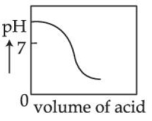
B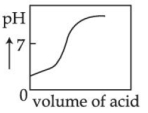
C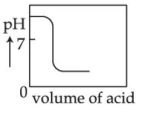
D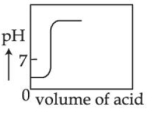
Solution
(A) The titration of a weak base $(NH_4OH)$ with a strong acid $(HCl)$ involves the addition of acid to the base.
Initially,the $pH$ is high (basic).
As the strong acid is added,the $pH$ decreases gradually.
Near the equivalence point,there is a sharp drop in $pH$.
Since the resulting salt $(NH_4Cl)$ is acidic due to the hydrolysis of the $NH_4^+$ ion,the equivalence point $pH$ is less than $7$.
Therefore,the correct plot shows a downward curve starting from a high $pH$ value.
Initially,the $pH$ is high (basic).
As the strong acid is added,the $pH$ decreases gradually.
Near the equivalence point,there is a sharp drop in $pH$.
Since the resulting salt $(NH_4Cl)$ is acidic due to the hydrolysis of the $NH_4^+$ ion,the equivalence point $pH$ is less than $7$.
Therefore,the correct plot shows a downward curve starting from a high $pH$ value.
0 likesView Solution
228
ChemistryMediumMCQJEE Main · 2022
Outermost electronic configurations of four elements $A, B, C, D$ are given below:
$A: 3s^{2}$
$B: 3s^{2} 3p^{1}$
$C: 3s^{2} 3p^{3}$
$D: 3s^{2} 3p^{4}$
The correct order of first ionization enthalpy for them is:
$A: 3s^{2}$
$B: 3s^{2} 3p^{1}$
$C: 3s^{2} 3p^{3}$
$D: 3s^{2} 3p^{4}$
The correct order of first ionization enthalpy for them is:
A
$A < B < C < D$
B
$B < A < D < C$
C
$B < A < C < D$
D
$B < D < A < C$
Solution
(B) The elements are identified as:
$A: 3s^{2} \rightarrow Mg$
$B: 3s^{2} 3p^{1} \rightarrow Al$
$C: 3s^{2} 3p^{3} \rightarrow P$
$D: 3s^{2} 3p^{4} \rightarrow S$
Ionization enthalpy generally increases across a period from left to right.
However,there are exceptions due to stable electronic configurations:
$1$. $Mg$ $(3s^{2})$ has a fully filled $s$-orbital,making it more stable than $Al$ $(3s^{2} 3p^{1})$.
$2$. $P$ $(3s^{2} 3p^{3})$ has a half-filled $p$-orbital,making it more stable than $S$ $(3s^{2} 3p^{4})$.
Comparing the values:
$Al < Mg < S < P$
Substituting the labels:
$B < A < D < C$
$A: 3s^{2} \rightarrow Mg$
$B: 3s^{2} 3p^{1} \rightarrow Al$
$C: 3s^{2} 3p^{3} \rightarrow P$
$D: 3s^{2} 3p^{4} \rightarrow S$
Ionization enthalpy generally increases across a period from left to right.
However,there are exceptions due to stable electronic configurations:
$1$. $Mg$ $(3s^{2})$ has a fully filled $s$-orbital,making it more stable than $Al$ $(3s^{2} 3p^{1})$.
$2$. $P$ $(3s^{2} 3p^{3})$ has a half-filled $p$-orbital,making it more stable than $S$ $(3s^{2} 3p^{4})$.
Comparing the values:
$Al < Mg < S < P$
Substituting the labels:
$B < A < D < C$
0 likesView Solution
229
ChemistryEasyMCQJEE Main · 2022
An element $A$ of group $1$ shows similarity to an element $B$ belonging to group $2$. If $A$ has maximum hydration enthalpy in group $1$,then $B$ is:
A
$Mg$
B
$Be$
C
$Ca$
D
$Sr$
Solution
(A) In group $1$,$Li^{+}$ has the maximum hydration enthalpy due to its smallest ionic size.
$Li$ shows a diagonal relationship with $Mg$ of group $2$.
Therefore,the element $B$ is $Mg$.
$Li$ shows a diagonal relationship with $Mg$ of group $2$.
Therefore,the element $B$ is $Mg$.
0 likesView Solution
230
ChemistryEasyMCQJEE Main · 2022
Given below are two statements: one is labelled as Assertion $A$ and the other is labelled as Reason $R$.
Assertion $A$: Boron is unable to form $BF_{6}^{3-}$.
Reason $R$: Size of $B$ is very small.
In the light of the above statements,choose the correct answer from the options given below.
Assertion $A$: Boron is unable to form $BF_{6}^{3-}$.
Reason $R$: Size of $B$ is very small.
In the light of the above statements,choose the correct answer from the options given below.
A
Both $A$ and $R$ are true and $R$ is the correct explanation of $A$.
B
Both $A$ and $R$ are true but $R$ is not the correct explanation of $A$.
C
$A$ is true but $R$ is false.
D
$A$ is false but $R$ is true.
Solution
(B) Assertion $A$ is true: Boron cannot form $BF_{6}^{3-}$ because it lacks $d$-orbitals in its valence shell,which prevents the expansion of its octet.
Reason $R$ is true: The size of the Boron atom is indeed very small.
Conclusion: While both statements are true,the inability to form $BF_{6}^{3-}$ is primarily due to the absence of $d$-orbitals,not just the small size of the atom. Therefore,$R$ is not the correct explanation for $A$.
Reason $R$ is true: The size of the Boron atom is indeed very small.
Conclusion: While both statements are true,the inability to form $BF_{6}^{3-}$ is primarily due to the absence of $d$-orbitals,not just the small size of the atom. Therefore,$R$ is not the correct explanation for $A$.
0 likesView Solution
231
ChemistryMediumMCQJEE Main · 2022
In neutral or alkaline solution,$MnO_{4}^{-}$ oxidises thiosulphate to.
A
$S_{2}O_{7}^{2-}$
B
$S_{2}O_{8}^{2-}$
C
$SO_{3}^{2-}$
D
$SO_{4}^{2-}$
Solution
(D) In a neutral or weakly alkaline medium,the permanganate ion $(MnO_{4}^{-})$ acts as an oxidizing agent and gets reduced to manganese dioxide $(MnO_{2})$.
Thiosulphate $(S_{2}O_{3}^{2-})$ is oxidized to sulphate $(SO_{4}^{2-})$.
The balanced chemical equation for this reaction is:
$8 MnO_{4}^{-} + 3 S_{2}O_{3}^{2-} + H_{2}O \rightarrow 8 MnO_{2} + 6 SO_{4}^{2-} + 2 OH^{-}$
Thiosulphate $(S_{2}O_{3}^{2-})$ is oxidized to sulphate $(SO_{4}^{2-})$.
The balanced chemical equation for this reaction is:
$8 MnO_{4}^{-} + 3 S_{2}O_{3}^{2-} + H_{2}O \rightarrow 8 MnO_{2} + 6 SO_{4}^{2-} + 2 OH^{-}$
0 likesView Solution
232
ChemistryMediumMCQJEE Main · 2022
Given below are two statements.
Statement $I$: The non-biodegradable fly ash and slag from the steel industry can be used by the cement industry.
Statement $II$: The fuel obtained from plastic waste is lead-free.
In the light of the above statements,choose the most appropriate answer from the options given below:
Statement $I$: The non-biodegradable fly ash and slag from the steel industry can be used by the cement industry.
Statement $II$: The fuel obtained from plastic waste is lead-free.
In the light of the above statements,choose the most appropriate answer from the options given below:
A
Both Statement $I$ and Statement $II$ are correct
B
Both Statement $I$ and Statement $II$ are incorrect
C
Statement $I$ is correct but Statement $II$ is incorrect
D
Statement $I$ is incorrect but Statement $II$ is correct
Solution
(A) Statement $I$: Fly ash and slag generated as waste from the steel industry are effectively utilized by the cement industry as raw materials.
Statement $II$: Fuel derived from plastic waste through processes like pyrolysis has a high octane rating and is lead-free,often referred to as green fuel.
Therefore,both Statement $I$ and Statement $II$ are correct.
Statement $II$: Fuel derived from plastic waste through processes like pyrolysis has a high octane rating and is lead-free,often referred to as green fuel.
Therefore,both Statement $I$ and Statement $II$ are correct.
0 likesView Solution
233
ChemistryMediumMCQJEE Main · 2022
Match List-$I$ with List-$II$:
| List-$I$ | List-$II$ |
| $(A)$ Chloroform and Aniline | $(I)$ Steam distillation |
| $(B)$ Benzoic acid and Naphthalene | $(II)$ Sublimation |
| $(C)$ Water and Aniline | $(III)$ Distillation |
| $(D)$ Naphthalene and Sodium chloride | $(IV)$ Crystallisation |
A
$(A-IV, B-III, C-I, D-II)$
B
$(A-III, B-I, C-IV, D-II)$
C
$(A-III, B-IV, C-II, D-I)$
D
$(A-III, B-IV, C-I, D-II)$
Solution
(D) Chloroform and Aniline are separated by $(III)$ Distillation because they have different boiling points.
$(B)$ Benzoic acid and Naphthalene are separated by $(IV)$ Crystallisation based on differences in their solubilities in a suitable solvent.
$(C)$ Water and Aniline are separated by $(I)$ Steam distillation as Aniline is steam volatile and immiscible with water.
$(D)$ Naphthalene and Sodium chloride are separated by $(II)$ Sublimation because Naphthalene sublimes while Sodium chloride does not.
$(B)$ Benzoic acid and Naphthalene are separated by $(IV)$ Crystallisation based on differences in their solubilities in a suitable solvent.
$(C)$ Water and Aniline are separated by $(I)$ Steam distillation as Aniline is steam volatile and immiscible with water.
$(D)$ Naphthalene and Sodium chloride are separated by $(II)$ Sublimation because Naphthalene sublimes while Sodium chloride does not.
0 likesView Solution
234
ChemistryMediumMCQJEE Main · 2022
The normality of $H_{2}SO_{4}$ in the solution obtained on mixing $100 \ mL$ of $0.1 \ M \ H_{2}SO_{4}$ with $50 \ mL$ of $0.1 \ M \ NaOH$ is $\times 10^{-1} \ N$. (Nearest Integer)
A
$1$
B
$2$
C
$3$
D
$4$
Solution
(A) The reaction is: $H_{2}SO_{4} + 2NaOH \rightarrow Na_{2}SO_{4} + 2H_{2}O$.
Number of milliequivalents of $H_{2}SO_{4} = \text{Molarity} \times \text{n-factor} \times \text{Volume (mL)} = 0.1 \times 2 \times 100 = 20 \ mEq$.
Number of milliequivalents of $NaOH = 0.1 \times 1 \times 50 = 5 \ mEq$.
Since $H_{2}SO_{4}$ is in excess,the remaining milliequivalents of $H_{2}SO_{4} = 20 - 5 = 15 \ mEq$.
Total volume of the solution $= 100 \ mL + 50 \ mL = 150 \ mL$.
Normality of the resulting solution $= \frac{\text{Remaining mEq}}{\text{Total Volume (mL)}} = \frac{15}{150} = 0.1 \ N = 1 \times 10^{-1} \ N$.
Thus,the nearest integer is $1$.
Number of milliequivalents of $H_{2}SO_{4} = \text{Molarity} \times \text{n-factor} \times \text{Volume (mL)} = 0.1 \times 2 \times 100 = 20 \ mEq$.
Number of milliequivalents of $NaOH = 0.1 \times 1 \times 50 = 5 \ mEq$.
Since $H_{2}SO_{4}$ is in excess,the remaining milliequivalents of $H_{2}SO_{4} = 20 - 5 = 15 \ mEq$.
Total volume of the solution $= 100 \ mL + 50 \ mL = 150 \ mL$.
Normality of the resulting solution $= \frac{\text{Remaining mEq}}{\text{Total Volume (mL)}} = \frac{15}{150} = 0.1 \ N = 1 \times 10^{-1} \ N$.
Thus,the nearest integer is $1$.
0 likesView Solution
235
ChemistryEasyMCQJEE Main · 2022
For a real gas at $25^{\circ} C$ temperature and high pressure $(99 \ bar)$,the value of the compressibility factor is $2$. The value of the Van der Waals constant '$b$' is $\times 10^{-2} \ L \ mol^{-1}$. (Nearest integer) (Given $R = 0.083 \ L \ bar \ K^{-1} \ mol^{-1}$)
A
$25$
B
$24$
C
$23$
D
$22$
Solution
(A) For a real gas under high pressure,the compressibility factor $Z$ is given by the equation: $Z = 1 + \frac{Pb}{RT}$.
Given $Z = 2$,$P = 99 \ bar$,$T = 25 + 273 = 298 \ K$,and $R = 0.083 \ L \ bar \ K^{-1} \ mol^{-1}$.
Substituting the values: $2 = 1 + \frac{99 \times b}{0.083 \times 298}$.
$1 = \frac{99 \times b}{24.734}$.
$b = \frac{24.734}{99} \approx 0.2498 \ L \ mol^{-1}$.
$b \approx 0.25 \ L \ mol^{-1} = 25 \times 10^{-2} \ L \ mol^{-1}$.
Thus,the nearest integer value is $25$.
Given $Z = 2$,$P = 99 \ bar$,$T = 25 + 273 = 298 \ K$,and $R = 0.083 \ L \ bar \ K^{-1} \ mol^{-1}$.
Substituting the values: $2 = 1 + \frac{99 \times b}{0.083 \times 298}$.
$1 = \frac{99 \times b}{24.734}$.
$b = \frac{24.734}{99} \approx 0.2498 \ L \ mol^{-1}$.
$b \approx 0.25 \ L \ mol^{-1} = 25 \times 10^{-2} \ L \ mol^{-1}$.
Thus,the nearest integer value is $25$.
0 likesView Solution
236
ChemistryMediumMCQJEE Main · 2022
$A$ gas (Molar mass $= 280 \ g \ mol^{-1}$) was burnt in excess $O_2$ in a constant volume calorimeter and during combustion the temperature of calorimeter increased from $298.0 \ K$ to $298.45 \ K$. If the heat capacity of calorimeter is $2.5 \ kJ \ K^{-1}$ and enthalpy of combustion of gas is $9 \ kJ \ mol^{-1}$,then the amount of gas burnt is $...... \ g$. (Nearest Integer)
A
$35$
B
$34$
C
$33$
D
$32$
Solution
(A) Let $x \ g$ be the mass of the gas burnt.
Moles of gas $= \frac{x}{280} \ mol$.
Heat released by the combustion $= \text{Heat capacity} \times \Delta T = 2.5 \ kJ \ K^{-1} \times (298.45 - 298.0) \ K = 2.5 \times 0.45 \ kJ = 1.125 \ kJ$.
Since the combustion occurs in a constant volume calorimeter,the heat released is equal to the internal energy change,$\Delta U$.
Given the enthalpy of combustion $\Delta H = 9 \ kJ \ mol^{-1}$,and assuming $\Delta H \approx \Delta U$ for this calculation,we have:
$\Delta U \text{ per mole} = 9 \ kJ \ mol^{-1}$.
Total heat released $= \text{moles} \times \Delta U \text{ per mole}$.
$1.125 \ kJ = (\frac{x}{280} \ mol) \times 9 \ kJ \ mol^{-1}$.
$x = \frac{1.125 \times 280}{9} = 35 \ g$.
Moles of gas $= \frac{x}{280} \ mol$.
Heat released by the combustion $= \text{Heat capacity} \times \Delta T = 2.5 \ kJ \ K^{-1} \times (298.45 - 298.0) \ K = 2.5 \times 0.45 \ kJ = 1.125 \ kJ$.
Since the combustion occurs in a constant volume calorimeter,the heat released is equal to the internal energy change,$\Delta U$.
Given the enthalpy of combustion $\Delta H = 9 \ kJ \ mol^{-1}$,and assuming $\Delta H \approx \Delta U$ for this calculation,we have:
$\Delta U \text{ per mole} = 9 \ kJ \ mol^{-1}$.
Total heat released $= \text{moles} \times \Delta U \text{ per mole}$.
$1.125 \ kJ = (\frac{x}{280} \ mol) \times 9 \ kJ \ mol^{-1}$.
$x = \frac{1.125 \times 280}{9} = 35 \ g$.
0 likesView Solution
237
ChemistryEasyMCQJEE Main · 2022
The oxidation state of manganese in the product obtained in a reaction of potassium permanganate and hydrogen peroxide in basic medium is $.....$
A
$3$
B
$2$
C
$4$
D
$1$
Solution
(C) In a basic medium,potassium permanganate $(KMnO_4)$ reacts with hydrogen peroxide $(H_2O_2)$ to produce manganese dioxide $(MnO_2)$,oxygen gas $(O_2)$,water $(H_2O)$,and potassium hydroxide $(KOH)$.
The balanced chemical equation is:
$2KMnO_4 + 3H_2O_2 \longrightarrow 2MnO_2 + 3O_2 + 2H_2O + 2KOH$
In the product $MnO_2$,let the oxidation state of $Mn$ be $x$.
$x + 2(-2) = 0$
$x - 4 = 0$
$x = +4$
Therefore,the oxidation state of manganese in the product is $4$.
The balanced chemical equation is:
$2KMnO_4 + 3H_2O_2 \longrightarrow 2MnO_2 + 3O_2 + 2H_2O + 2KOH$
In the product $MnO_2$,let the oxidation state of $Mn$ be $x$.
$x + 2(-2) = 0$
$x - 4 = 0$
$x = +4$
Therefore,the oxidation state of manganese in the product is $4$.
0 likesView Solution
238
ChemistryMediumMCQJEE Main · 2022
The number of molecule$(s)$ or ion$(s)$ from the following having non-planar structure is
$NO_{3}^{-}, H_{2}O_{2}, BF_{3}, PCl_{3}, XeF_{4}, SF_{4}, XeO_{3}, PH_{4}^{+}, SO_{3}, [Al(OH)_{4}]^{-}$
$NO_{3}^{-}, H_{2}O_{2}, BF_{3}, PCl_{3}, XeF_{4}, SF_{4}, XeO_{3}, PH_{4}^{+}, SO_{3}, [Al(OH)_{4}]^{-}$
A
$5$
B
$4$
C
$6$
D
$3$
Solution
(C) To determine the number of non-planar species,we analyze the geometry of each:
$1$. $NO_{3}^{-}$: $sp^{2}$ hybridization,trigonal planar.
$2$. $H_{2}O_{2}$: Open book structure,non-planar.
$3$. $BF_{3}$: $sp^{2}$ hybridization,trigonal planar.
$4$. $PCl_{3}$: $sp^{3}$ hybridization,trigonal pyramidal,non-planar.
$5$. $XeF_{4}$: $sp^{3}d^{2}$ hybridization,square planar.
$6$. $SF_{4}$: $sp^{3}d$ hybridization,see-saw shape,non-planar.
$7$. $XeO_{3}$: $sp^{3}$ hybridization,trigonal pyramidal,non-planar.
$8$. $PH_{4}^{+}$: $sp^{3}$ hybridization,tetrahedral,non-planar.
$9$. $SO_{3}$: $sp^{2}$ hybridization,trigonal planar.
$10$. $[Al(OH)_{4}]^{-}$: $sp^{3}$ hybridization,tetrahedral,non-planar.
The non-planar species are: $H_{2}O_{2}, PCl_{3}, SF_{4}, XeO_{3}, PH_{4}^{+}, [Al(OH)_{4}]^{-}$.
Counting these,we get a total of $6$ non-planar species.
$1$. $NO_{3}^{-}$: $sp^{2}$ hybridization,trigonal planar.
$2$. $H_{2}O_{2}$: Open book structure,non-planar.
$3$. $BF_{3}$: $sp^{2}$ hybridization,trigonal planar.
$4$. $PCl_{3}$: $sp^{3}$ hybridization,trigonal pyramidal,non-planar.
$5$. $XeF_{4}$: $sp^{3}d^{2}$ hybridization,square planar.
$6$. $SF_{4}$: $sp^{3}d$ hybridization,see-saw shape,non-planar.
$7$. $XeO_{3}$: $sp^{3}$ hybridization,trigonal pyramidal,non-planar.
$8$. $PH_{4}^{+}$: $sp^{3}$ hybridization,tetrahedral,non-planar.
$9$. $SO_{3}$: $sp^{2}$ hybridization,trigonal planar.
$10$. $[Al(OH)_{4}]^{-}$: $sp^{3}$ hybridization,tetrahedral,non-planar.
The non-planar species are: $H_{2}O_{2}, PCl_{3}, SF_{4}, XeO_{3}, PH_{4}^{+}, [Al(OH)_{4}]^{-}$.
Counting these,we get a total of $6$ non-planar species.
0 likesView Solution
239
ChemistryDifficultMCQJEE Main · 2022
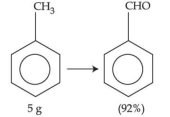
In the reaction shown,$5 \ g$ of toluene is converted into benzaldehyde with $92 \%$ yield. The amount of benzaldehyde produced is $.... \times 10^{-2} \ g$. (Nearest integer)
A
$520$
B
$540$
C
$580$
D
$530$
Solution
(D) The molar mass of toluene $(C_7H_8)$ is $7 \times 12 + 8 \times 1 = 92 \ g/mol$.
Number of moles of toluene = $\frac{5 \ g}{92 \ g/mol} = \frac{5}{92} \ mol$.
Since the reaction stoichiometry is $1:1$,the theoretical moles of benzaldehyde produced would be $\frac{5}{92} \ mol$.
Given the yield is $92 \%$,the actual moles of benzaldehyde produced = $\frac{5}{92} \times \frac{92}{100} = 5 \times 10^{-2} \ mol$.
The molar mass of benzaldehyde $(C_7H_6O)$ is $7 \times 12 + 6 \times 1 + 16 = 106 \ g/mol$.
Mass of benzaldehyde produced = $\text{moles} \times \text{molar mass} = (5 \times 10^{-2} \ mol) \times (106 \ g/mol) = 530 \times 10^{-2} \ g$.
Thus,the value is $530$.
Number of moles of toluene = $\frac{5 \ g}{92 \ g/mol} = \frac{5}{92} \ mol$.
Since the reaction stoichiometry is $1:1$,the theoretical moles of benzaldehyde produced would be $\frac{5}{92} \ mol$.
Given the yield is $92 \%$,the actual moles of benzaldehyde produced = $\frac{5}{92} \times \frac{92}{100} = 5 \times 10^{-2} \ mol$.
The molar mass of benzaldehyde $(C_7H_6O)$ is $7 \times 12 + 6 \times 1 + 16 = 106 \ g/mol$.
Mass of benzaldehyde produced = $\text{moles} \times \text{molar mass} = (5 \times 10^{-2} \ mol) \times (106 \ g/mol) = 530 \times 10^{-2} \ g$.
Thus,the value is $530$.
0 likesView Solution
240
ChemistryMediumMCQJEE Main · 2022
Given below are two statements. One is labelled as Assertion $A$ and the other is labelled as Reason $R$.
Assertion $A$ : Energy of $2s$ orbital of hydrogen atom is greater than that of $2s$ orbital of lithium.
Reason $R$ : Energies of the orbitals in the same subshell decrease with increase in the atomic number.
In the light of the above statements,choose the correct answer from the options given below.
Assertion $A$ : Energy of $2s$ orbital of hydrogen atom is greater than that of $2s$ orbital of lithium.
Reason $R$ : Energies of the orbitals in the same subshell decrease with increase in the atomic number.
In the light of the above statements,choose the correct answer from the options given below.
A
Both $A$ and $R$ are true and $R$ is the correct explanation of $A$.
B
Both $A$ and $R$ are true but $R$ is $NOT$ the correct explanation of $A$.
C
$A$ is true but $R$ is false.
D
$A$ is false but $R$ is true.
Solution
(A) For a hydrogen-like atom or ion,the energy of an orbital depends only on the principal quantum number $n$. However,for multi-electron atoms like lithium $(Z=3)$,the energy of an orbital depends on both $n$ and the effective nuclear charge $(Z_{eff})$.
As the atomic number $(Z)$ increases,the effective nuclear charge increases,which leads to a stronger attraction between the nucleus and the electrons.
Consequently,the energy of the same orbital (e.g.,$2s$) decreases as the atomic number increases.
Therefore,the energy of the $2s$ orbital in hydrogen $(Z=1)$ is higher than that in lithium $(Z=3)$.
Both Assertion $A$ and Reason $R$ are correct,and $R$ correctly explains $A$.
As the atomic number $(Z)$ increases,the effective nuclear charge increases,which leads to a stronger attraction between the nucleus and the electrons.
Consequently,the energy of the same orbital (e.g.,$2s$) decreases as the atomic number increases.
Therefore,the energy of the $2s$ orbital in hydrogen $(Z=1)$ is higher than that in lithium $(Z=3)$.
Both Assertion $A$ and Reason $R$ are correct,and $R$ correctly explains $A$.
0 likesView Solution
241
ChemistryEasyMCQJEE Main · 2022
Which of the following statements is incorrect?
A
The first ionization enthalpy of $K$ is less than that of $Na$ and $Li$.
B
$Xe$ does not have the lowest first ionization enthalpy in its group.
C
The first ionization enthalpy of the element with atomic number $37$ is lower than that of the element with atomic number $38$.
D
The first ionization enthalpy of $Ga$ is higher than that of the $d-$block element with atomic number $30$.
Solution
(D) $1$. Ionization enthalpy decreases down a group. Thus,for alkali metals: $Li > Na > K$. Statement $A$ is correct.
$2$. In noble gases,ionization enthalpy decreases down the group. $Xe$ is below $He, Ne, Ar, Kr$,so it has a lower ionization enthalpy than them. However,$Rn$ is below $Xe$,so $Rn$ has the lowest. Thus,$Xe$ is not the lowest. Statement $B$ is correct.
$3$. Atomic number $37$ is $Rb$ (Group $1$) and atomic number $38$ is $Sr$ (Group $2$). Across a period,ionization enthalpy increases. Thus,$Sr > Rb$. Statement $C$ is correct.
$4$. Atomic number $30$ is $Zn$ $([Ar] 3d^{10} 4s^2)$ and $Ga$ is $([Ar] 3d^{10} 4s^2 4p^1)$. Due to the stable $d^{10}$ configuration and higher effective nuclear charge,$Zn$ has a higher ionization enthalpy than $Ga$. Thus,the statement that $Ga$ is higher than $Zn$ is incorrect.
$2$. In noble gases,ionization enthalpy decreases down the group. $Xe$ is below $He, Ne, Ar, Kr$,so it has a lower ionization enthalpy than them. However,$Rn$ is below $Xe$,so $Rn$ has the lowest. Thus,$Xe$ is not the lowest. Statement $B$ is correct.
$3$. Atomic number $37$ is $Rb$ (Group $1$) and atomic number $38$ is $Sr$ (Group $2$). Across a period,ionization enthalpy increases. Thus,$Sr > Rb$. Statement $C$ is correct.
$4$. Atomic number $30$ is $Zn$ $([Ar] 3d^{10} 4s^2)$ and $Ga$ is $([Ar] 3d^{10} 4s^2 4p^1)$. Due to the stable $d^{10}$ configuration and higher effective nuclear charge,$Zn$ has a higher ionization enthalpy than $Ga$. Thus,the statement that $Ga$ is higher than $Zn$ is incorrect.
0 likesView Solution
242
ChemistryMediumMCQJEE Main · 2022
Given below are two statements:
Statement $I$: Hydrogen peroxide can act as an oxidizing agent in both acidic and basic conditions.
Statement $II$: Density of hydrogen peroxide at $298 \ K$ is lower than that of $D_2O$.
In the light of the above statements,choose the correct answer from the options.
Statement $I$: Hydrogen peroxide can act as an oxidizing agent in both acidic and basic conditions.
Statement $II$: Density of hydrogen peroxide at $298 \ K$ is lower than that of $D_2O$.
In the light of the above statements,choose the correct answer from the options.
A
Both statement $I$ and Statement $II$ are true.
B
Both statement $I$ and Statement $II$ are false.
C
Statement $I$ is true but Statement $II$ is false.
D
Statement $I$ is false but Statement $II$ is true.
Solution
(C) Statement $I$ is true: $H_2O_2$ acts as an oxidizing agent in both acidic and basic media by gaining electrons ($H_2O_2 + 2H^+ + 2e^- \rightarrow 2H_2O$ in acidic and $H_2O_2 + 2e^- \rightarrow 2OH^-$ in basic medium).
Statement $II$ is false: The density of $H_2O_2$ at $298 \ K$ is approximately $1.45 \ g/cm^3$,while the density of $D_2O$ is approximately $1.11 \ g/cm^3$. Therefore,the density of $H_2O_2$ is higher than that of $D_2O$.
Statement $II$ is false: The density of $H_2O_2$ at $298 \ K$ is approximately $1.45 \ g/cm^3$,while the density of $D_2O$ is approximately $1.11 \ g/cm^3$. Therefore,the density of $H_2O_2$ is higher than that of $D_2O$.
0 likesView Solution
243
ChemistryMediumMCQJEE Main · 2022
Given below are two statements:
Statement $I$: The chlorides of $Be$ and $Al$ have $Cl^{-}$-bridged structure. Both are soluble in organic solvents and act as Lewis acids.
Statement $II$: Hydroxides of $Be$ and $Al$ dissolve in excess alkali to give beryllate and aluminate ions.
In the light of the above statements,choose the correct answer from the options given below.
Statement $I$: The chlorides of $Be$ and $Al$ have $Cl^{-}$-bridged structure. Both are soluble in organic solvents and act as Lewis acids.
Statement $II$: Hydroxides of $Be$ and $Al$ dissolve in excess alkali to give beryllate and aluminate ions.
In the light of the above statements,choose the correct answer from the options given below.
A
Both Statement $I$ and Statement $II$ are true.
B
Both Statement $I$ and Statement $II$ are false.
C
Statement $I$ is true but Statement $II$ is false.
D
Statement $I$ is false but Statement $II$ is true.
Solution
(A) $BeCl_2$ (in vapor phase) and $Al_2Cl_6$ exist as $Cl^{-}$-bridged structures. Due to their covalent nature,they are soluble in organic solvents and act as Lewis acids because of their electron-deficient nature.
$Be(OH)_2$ and $Al(OH)_3$ are amphoteric in nature. They react with excess alkali to form soluble beryllate $[Be(OH)_4]^{2-}$ and aluminate $[Al(OH)_4]^{-}$ ions,respectively.
Therefore,both Statement $I$ and Statement $II$ are true.
$Be(OH)_2$ and $Al(OH)_3$ are amphoteric in nature. They react with excess alkali to form soluble beryllate $[Be(OH)_4]^{2-}$ and aluminate $[Al(OH)_4]^{-}$ ions,respectively.
Therefore,both Statement $I$ and Statement $II$ are true.
0 likesView Solution
244
ChemistryMediumMCQJEE Main · 2022
Match List-$I$ with List-$II$.
Choose the correct answer from the options given below.
| List-$I$ | List-$II$ |
| $A$. Sulphate $(> 500 \ ppm)$ | $I$. Methemoglobinemia |
| $B$. Nitrate $(> 50 \ ppm)$ | $II$. Brown mottling of teeth |
| $C$. Lead $(> 50 \ ppb)$ | $III$. Laxative effect |
| $D$. Fluoride $(> 2 \ ppm)$ | $IV$. Kidney damage |
Choose the correct answer from the options given below.
A
$A-IV, B-I, C-II, D-III$
B
$A-III, B-I, C-IV, D-II$
C
$A-II, B-IV, C-I, D-III$
D
$A-II, B-IV, C-III, D-I$
Solution
(B) . Sulphate $(> 500 \ ppm)$ causes a laxative effect.
$B$. Nitrate $(> 50 \ ppm)$ causes methemoglobinemia (blue baby syndrome).
$C$. Lead $(> 50 \ ppb)$ causes kidney damage and affects $RBC$ production.
$D$. Fluoride $(> 2 \ ppm)$ causes brown mottling of teeth.
Therefore,the correct matching is $A-III, B-I, C-IV, D-II$.
$B$. Nitrate $(> 50 \ ppm)$ causes methemoglobinemia (blue baby syndrome).
$C$. Lead $(> 50 \ ppb)$ causes kidney damage and affects $RBC$ production.
$D$. Fluoride $(> 2 \ ppm)$ causes brown mottling of teeth.
Therefore,the correct matching is $A-III, B-I, C-IV, D-II$.
0 likesView Solution
245
ChemistryDifficultMCQJEE Main · 2022
Given below are two statements. One is labelled as Assertion $A$ and the other is labelled as Reason $R$.
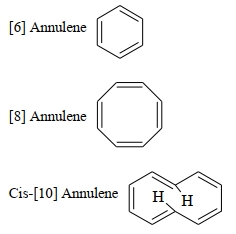
Assertion $A$: $[6]-$Annulene,$[8]-$Annulene and cis$-10-$Annulene are respectively aromatic,non-aromatic and non-aromatic.
Reason $R$: Planarity is one of the requirements of aromatic systems.
In the light of the above statements,choose the most appropriate answer from the options given below.
Assertion $A$: $[6]-$Annulene,$[8]-$Annulene and cis$-10-$Annulene are respectively aromatic,non-aromatic and non-aromatic.
Reason $R$: Planarity is one of the requirements of aromatic systems.
In the light of the above statements,choose the most appropriate answer from the options given below.
A
Both $A$ and $R$ are correct and $R$ is the correct explanation of $A$.
B
Both $A$ and $R$ are correct but $R$ is $NOT$ the correct explanation of $A$.
C
$A$ is correct but $R$ is not correct.
D
$A$ is not correct but $R$ is correct.
Solution
(D) $[6]-$Annulene (benzene) is aromatic as it is planar,cyclic,and has $6\pi$ electrons ($4n+2$ rule,$n=1$).
$[8]-$Annulene is non-aromatic because it is non-planar (tub-shaped) to avoid angle strain,despite having $8\pi$ electrons ($4n$ rule).
Cis$-10-$Annulene is non-aromatic because the internal hydrogen atoms at positions $1$ and $6$ experience steric hindrance,forcing the molecule out of planarity,which prevents continuous conjugation.
Thus,Assertion $A$ is incorrect because it labels cis$-10-$Annulene as aromatic.
Reason $R$ is correct because planarity is indeed a fundamental requirement for a molecule to be aromatic ($H$ückel's rule).
Therefore,$A$ is not correct but $R$ is correct.
$[8]-$Annulene is non-aromatic because it is non-planar (tub-shaped) to avoid angle strain,despite having $8\pi$ electrons ($4n$ rule).
Cis$-10-$Annulene is non-aromatic because the internal hydrogen atoms at positions $1$ and $6$ experience steric hindrance,forcing the molecule out of planarity,which prevents continuous conjugation.
Thus,Assertion $A$ is incorrect because it labels cis$-10-$Annulene as aromatic.
Reason $R$ is correct because planarity is indeed a fundamental requirement for a molecule to be aromatic ($H$ückel's rule).
Therefore,$A$ is not correct but $R$ is correct.
0 likesView Solution
246
ChemistryMediumMCQJEE Main · 2022
In Carius method of estimation of halogen,$0.45 \ g$ of an organic compound gave $0.36 \ g$ of $AgBr$. Find out the percentage of bromine in the compound. (Molar masses : $AgBr = 188 \ g \ mol^{-1}$,$Br = 80 \ g \ mol^{-1}$) (in $\%$)
A
$34.04$
B
$40.04$
C
$36.03$
D
$38.04$
Solution
(A) Mass of organic compound $= 0.45 \ g$
Mass of $AgBr$ obtained $= 0.36 \ g$
Moles of $AgBr = \frac{0.36 \ g}{188 \ g \ mol^{-1}} = 0.001915 \ mol$
Since $1 \ mol$ of $AgBr$ contains $1 \ mol$ of $Br$,moles of $Br = 0.001915 \ mol$
Mass of Bromine $= 0.001915 \ mol \times 80 \ g \ mol^{-1} = 0.1532 \ g$
Percentage of $Br = \frac{\text{Mass of } Br}{\text{Mass of organic compound}} \times 100$
Percentage of $Br = \frac{0.1532 \ g}{0.45 \ g} \times 100 = 34.04 \ \%$
Mass of $AgBr$ obtained $= 0.36 \ g$
Moles of $AgBr = \frac{0.36 \ g}{188 \ g \ mol^{-1}} = 0.001915 \ mol$
Since $1 \ mol$ of $AgBr$ contains $1 \ mol$ of $Br$,moles of $Br = 0.001915 \ mol$
Mass of Bromine $= 0.001915 \ mol \times 80 \ g \ mol^{-1} = 0.1532 \ g$
Percentage of $Br = \frac{\text{Mass of } Br}{\text{Mass of organic compound}} \times 100$
Percentage of $Br = \frac{0.1532 \ g}{0.45 \ g} \times 100 = 34.04 \ \%$
0 likesView Solution
247
ChemistryMediumMCQJEE Main · 2022
$20 \, mL$ of $0.02 \, M \, K_2Cr_2O_7$ solution is used for the titration of $10 \, mL$ of $Fe^{2+}$ solution in the acidic medium. The molarity of $Fe^{2+}$ solution is ........... $\times 10^{-2} \, M$ (Nearest Integer).
A
$22$
B
$23$
C
$24$
D
$25$
Solution
(C) The balanced redox reaction in acidic medium is: $Cr_2O_7^{2-} + 14H^+ + 6Fe^{2+} \rightarrow 2Cr^{3+} + 6Fe^{3+} + 7H_2O$.
According to the law of equivalence,the number of equivalents of $K_2Cr_2O_7$ equals the number of equivalents of $Fe^{2+}$.
$n.f$ of $K_2Cr_2O_7 = 6$ (as $Cr$ changes from $+6$ to $+3$,$2 \times 3 = 6$).
$n.f$ of $Fe^{2+} = 1$ (as $Fe$ changes from $+2$ to $+3$).
Equivalents of $K_2Cr_2O_7 = Molarity \times Volume \times n.f = 0.02 \times 20 \times 6 = 2.4$.
Equivalents of $Fe^{2+} = M \times 10 \times 1 = 10M$.
Equating both: $10M = 2.4$.
$M = 0.24 \, M$.
$M = 24 \times 10^{-2} \, M$.
Therefore,the value is $24$.
According to the law of equivalence,the number of equivalents of $K_2Cr_2O_7$ equals the number of equivalents of $Fe^{2+}$.
$n.f$ of $K_2Cr_2O_7 = 6$ (as $Cr$ changes from $+6$ to $+3$,$2 \times 3 = 6$).
$n.f$ of $Fe^{2+} = 1$ (as $Fe$ changes from $+2$ to $+3$).
Equivalents of $K_2Cr_2O_7 = Molarity \times Volume \times n.f = 0.02 \times 20 \times 6 = 2.4$.
Equivalents of $Fe^{2+} = M \times 10 \times 1 = 10M$.
Equating both: $10M = 2.4$.
$M = 0.24 \, M$.
$M = 24 \times 10^{-2} \, M$.
Therefore,the value is $24$.
0 likesView Solution
248
ChemistryEasyMCQJEE Main · 2022
Amongst the following,the number of oxide$(s)$ which are paramagnetic in nature is $Na_2O$,$KO_2$,$NO_2$,$N_2O$,$ClO_2$,$NO$,$SO_2$,$Cl_2O$.
A
$1$
B
$2$
C
$4$
D
$3$
Solution
(C) To determine the paramagnetism,we check for the presence of unpaired electrons:
$Na_2O$: Diamagnetic (all electrons paired).
$KO_2$: Paramagnetic (contains $O_2^-$ ion with one unpaired electron).
$NO_2$: Paramagnetic (odd number of valence electrons,$17$ valence electrons).
$N_2O$: Diamagnetic (all electrons paired).
$ClO_2$: Paramagnetic (odd number of valence electrons,$19$ valence electrons).
$NO$: Paramagnetic (odd number of valence electrons,$11$ valence electrons).
$SO_2$: Diamagnetic (all electrons paired).
$Cl_2O$: Diamagnetic (all electrons paired).
The paramagnetic oxides are $KO_2$,$NO_2$,$ClO_2$,and $NO$.
Therefore,the total number of paramagnetic oxides is $4$.
$Na_2O$: Diamagnetic (all electrons paired).
$KO_2$: Paramagnetic (contains $O_2^-$ ion with one unpaired electron).
$NO_2$: Paramagnetic (odd number of valence electrons,$17$ valence electrons).
$N_2O$: Diamagnetic (all electrons paired).
$ClO_2$: Paramagnetic (odd number of valence electrons,$19$ valence electrons).
$NO$: Paramagnetic (odd number of valence electrons,$11$ valence electrons).
$SO_2$: Diamagnetic (all electrons paired).
$Cl_2O$: Diamagnetic (all electrons paired).
The paramagnetic oxides are $KO_2$,$NO_2$,$ClO_2$,and $NO$.
Therefore,the total number of paramagnetic oxides is $4$.
0 likesView Solution
249
ChemistryMediumMCQJEE Main · 2022
The molar heat capacity for an ideal gas at constant pressure is $20.785 \ J \ K^{-1} \ mol^{-1}$. The change in internal energy is $5000 \ J$ upon heating it from $300 \ K$ to $500 \ K$. The number of moles of the gas is [Nearest integer] (Given: $R = 8.314 \ J \ K^{-1} \ mol^{-1}$)
A
$1$
B
$2$
C
$3$
D
$4$
Solution
(B) For an ideal gas,the relationship between molar heat capacities is $C_{p,m} - C_{v,m} = R$.
Given $C_{p,m} = 20.785 \ J \ K^{-1} \ mol^{-1}$ and $R = 8.314 \ J \ K^{-1} \ mol^{-1}$,we calculate $C_{v,m}$ as:
$C_{v,m} = 20.785 - 8.314 = 12.471 \ J \ K^{-1} \ mol^{-1}$.
The change in internal energy $\Delta U$ is given by the formula $\Delta U = n C_{v,m} \Delta T$.
Here,$\Delta U = 5000 \ J$ and $\Delta T = 500 \ K - 300 \ K = 200 \ K$.
Substituting the values: $5000 = n \times 12.471 \times 200$.
$n = \frac{5000}{12.471 \times 200} = \frac{25}{12.471} \approx 2.0046$.
The nearest integer is $2$.
Given $C_{p,m} = 20.785 \ J \ K^{-1} \ mol^{-1}$ and $R = 8.314 \ J \ K^{-1} \ mol^{-1}$,we calculate $C_{v,m}$ as:
$C_{v,m} = 20.785 - 8.314 = 12.471 \ J \ K^{-1} \ mol^{-1}$.
The change in internal energy $\Delta U$ is given by the formula $\Delta U = n C_{v,m} \Delta T$.
Here,$\Delta U = 5000 \ J$ and $\Delta T = 500 \ K - 300 \ K = 200 \ K$.
Substituting the values: $5000 = n \times 12.471 \times 200$.
$n = \frac{5000}{12.471 \times 200} = \frac{25}{12.471} \approx 2.0046$.
The nearest integer is $2$.
0 likesView Solution
250
ChemistryMediumMCQJEE Main · 2022
According to $MO$ theory,the number of species/ions from the following having identical bond order is $.........$
$CN^{-}, NO^{+}, O_{2}, O_{2}^{+}, O_{2}^{2+}$
$CN^{-}, NO^{+}, O_{2}, O_{2}^{+}, O_{2}^{2+}$
A
$2$
B
$3$
C
$4$
D
$5$
Solution
(B) The bond order for each species is calculated as follows:
$CN^{-}$ ($14$ electrons): Bond order $= \frac{10-4}{2} = 3$
$NO^{+}$ ($14$ electrons): Bond order $= \frac{10-4}{2} = 3$
$O_{2}$ ($16$ electrons): Bond order $= \frac{10-6}{2} = 2$
$O_{2}^{+}$ ($15$ electrons): Bond order $= \frac{10-5}{2} = 2.5$
$O_{2}^{2+}$ ($14$ electrons): Bond order $= \frac{10-4}{2} = 3$
Thus,$CN^{-}, NO^{+},$ and $O_{2}^{2+}$ have an identical bond order of $3$.
The total number of such species is $3$.
$CN^{-}$ ($14$ electrons): Bond order $= \frac{10-4}{2} = 3$
$NO^{+}$ ($14$ electrons): Bond order $= \frac{10-4}{2} = 3$
$O_{2}$ ($16$ electrons): Bond order $= \frac{10-6}{2} = 2$
$O_{2}^{+}$ ($15$ electrons): Bond order $= \frac{10-5}{2} = 2.5$
$O_{2}^{2+}$ ($14$ electrons): Bond order $= \frac{10-4}{2} = 3$
Thus,$CN^{-}, NO^{+},$ and $O_{2}^{2+}$ have an identical bond order of $3$.
The total number of such species is $3$.
0 likesView Solution
251
ChemistryMediumMCQJEE Main · 2022
An acidified manganate solution undergoes disproportionation reaction. The spin-only magnetic moment value of the product having manganese in higher oxidation state is $....\, B.M.$ (Nearest integer)
A
$2$
B
$56$
C
$10$
D
$0$
Solution
(D) The disproportionation reaction of manganate $(MnO_{4}^{2-})$ in acidic medium is given by:
$3 MnO_{4}^{2-} + 4 H^{+} \longrightarrow 2 MnO_{4}^{-} + MnO_{2} + 2 H_{2}O$
In this reaction,manganese is oxidized to $Mn^{+7}$ (in $MnO_{4}^{-}$) and reduced to $Mn^{+4}$ (in $MnO_{2}$).
The product with the higher oxidation state is $MnO_{4}^{-}$,where the oxidation state of $Mn$ is $+7$.
The electronic configuration of $Mn^{+7}$ is $[Ar] 3d^{0}$.
Since there are no unpaired electrons $(n = 0)$,the spin-only magnetic moment is $\mu = \sqrt{n(n+2)} = \sqrt{0(0+2)} = 0 \, B.M.$
$3 MnO_{4}^{2-} + 4 H^{+} \longrightarrow 2 MnO_{4}^{-} + MnO_{2} + 2 H_{2}O$
In this reaction,manganese is oxidized to $Mn^{+7}$ (in $MnO_{4}^{-}$) and reduced to $Mn^{+4}$ (in $MnO_{2}$).
The product with the higher oxidation state is $MnO_{4}^{-}$,where the oxidation state of $Mn$ is $+7$.
The electronic configuration of $Mn^{+7}$ is $[Ar] 3d^{0}$.
Since there are no unpaired electrons $(n = 0)$,the spin-only magnetic moment is $\mu = \sqrt{n(n+2)} = \sqrt{0(0+2)} = 0 \, B.M.$
0 likesView Solution
252
ChemistryMediumMCQJEE Main · 2022
Observe the structures of the following compounds:
$1$. $2$-chlorobutane
$2$. Glycine $(NH_2CH_2COOH)$
$3$. Alanine $(CH_3CH(NH_2)COOH)$
$4$. Styrene $(C_6H_5CH=CH_2)$
$5$. Menthol
The total number of structures/compounds which possess asymmetric carbon atoms is $....$
$1$. $2$-chlorobutane
$2$. Glycine $(NH_2CH_2COOH)$
$3$. Alanine $(CH_3CH(NH_2)COOH)$
$4$. Styrene $(C_6H_5CH=CH_2)$
$5$. Menthol
The total number of structures/compounds which possess asymmetric carbon atoms is $....$
A
$1$
B
$2$
C
$3$
D
$5$
Solution
(C) An asymmetric carbon atom (chiral center) is a carbon atom bonded to four different groups.
$1$. $2$-chlorobutane $(CH_3-CHCl-CH_2-CH_3)$: The $C_2$ carbon is bonded to $-H, -Cl, -CH_3, -CH_2CH_3$. It is asymmetric.
$2$. Glycine $(NH_2-CH_2-COOH)$: No carbon is bonded to four different groups.
$3$. Alanine $(CH_3-CH(NH_2)-COOH)$: The $C_2$ carbon is bonded to $-H, -NH_2, -CH_3, -COOH$. It is asymmetric.
$4$. Styrene $(C_6H_5-CH=CH_2)$: No $sp^3$ hybridized carbon is bonded to four different groups.
$5$. Menthol: It contains multiple chiral centers (asymmetric carbons).
Thus,compounds $1, 3,$ and $5$ possess asymmetric carbon atoms. The total number is $3$.
$1$. $2$-chlorobutane $(CH_3-CHCl-CH_2-CH_3)$: The $C_2$ carbon is bonded to $-H, -Cl, -CH_3, -CH_2CH_3$. It is asymmetric.
$2$. Glycine $(NH_2-CH_2-COOH)$: No carbon is bonded to four different groups.
$3$. Alanine $(CH_3-CH(NH_2)-COOH)$: The $C_2$ carbon is bonded to $-H, -NH_2, -CH_3, -COOH$. It is asymmetric.
$4$. Styrene $(C_6H_5-CH=CH_2)$: No $sp^3$ hybridized carbon is bonded to four different groups.
$5$. Menthol: It contains multiple chiral centers (asymmetric carbons).
Thus,compounds $1, 3,$ and $5$ possess asymmetric carbon atoms. The total number is $3$.
0 likesView Solution
253
ChemistryMediumMCQJEE Main · 2022
$C_6H_{12}O_6$ $\xrightarrow{\text{Zymase}} A$ $\xrightarrow[\Delta]{NaOI} B + CHI_3$
The number of carbon atoms present in the product $B$ is $.....$
The number of carbon atoms present in the product $B$ is $.....$
A
$4$
B
$3$
C
$1$
D
$2$
Solution
(C) The fermentation of glucose $(C_6H_{12}O_6)$ by the enzyme zymase produces ethanol $(CH_3CH_2OH)$ and carbon dioxide $(CO_2)$.
$C_6H_{12}O_6 \xrightarrow{\text{Zymase}} 2CH_3CH_2OH + 2CO_2$
Here,$A$ is $CH_3CH_2OH$.
Ethanol reacts with $NaOI$ (sodium hypoiodite) in a haloform reaction to produce iodoform $(CHI_3)$ and sodium formate $(HCOONa)$.
$CH_3CH_2OH + 4NaOI \rightarrow CHI_3 + HCOONa + 3NaOH + H_2O$
Here,$B$ is sodium formate $(HCOONa)$.
The product $B$ $(HCOONa)$ contains $1$ carbon atom.
$C_6H_{12}O_6 \xrightarrow{\text{Zymase}} 2CH_3CH_2OH + 2CO_2$
Here,$A$ is $CH_3CH_2OH$.
Ethanol reacts with $NaOI$ (sodium hypoiodite) in a haloform reaction to produce iodoform $(CHI_3)$ and sodium formate $(HCOONa)$.
$CH_3CH_2OH + 4NaOI \rightarrow CHI_3 + HCOONa + 3NaOH + H_2O$
Here,$B$ is sodium formate $(HCOONa)$.
The product $B$ $(HCOONa)$ contains $1$ carbon atom.
0 likesView Solution
254
ChemistryMediumMCQJEE Main · 2022
Two solutions $A$ and $B$ are prepared by dissolving $1 \ g$ of non-volatile solutes $X$ and $Y$ respectively in $1 \ kg$ of water. The ratio of depression in freezing points for $A$ and $B$ is found to be $1: 4$. The ratio of molar masses of $X$ and $Y$ is.
A
$1: 4$
B
$4: 1$
C
$1: 2$
D
$2: 1$
Solution
(B) The depression in freezing point $\Delta T_f$ is given by $\Delta T_f = K_f \cdot m$,where $m$ is the molality.
Since the mass of solvent $(1 \ kg)$ and the mass of solute $(1 \ g)$ are the same for both,the molality $m$ is inversely proportional to the molar mass $M$ $(m = \frac{n}{W_{solvent}} = \frac{mass}{M \cdot W_{solvent}})$.
Therefore,$\frac{\Delta T_x}{\Delta T_y} = \frac{M_y}{M_x}$.
Given $\frac{\Delta T_x}{\Delta T_y} = \frac{1}{4}$,we have $\frac{1}{4} = \frac{M_y}{M_x}$.
This implies $\frac{M_x}{M_y} = \frac{4}{1}$,so $M_x : M_y = 4 : 1$.
Since the mass of solvent $(1 \ kg)$ and the mass of solute $(1 \ g)$ are the same for both,the molality $m$ is inversely proportional to the molar mass $M$ $(m = \frac{n}{W_{solvent}} = \frac{mass}{M \cdot W_{solvent}})$.
Therefore,$\frac{\Delta T_x}{\Delta T_y} = \frac{M_y}{M_x}$.
Given $\frac{\Delta T_x}{\Delta T_y} = \frac{1}{4}$,we have $\frac{1}{4} = \frac{M_y}{M_x}$.
This implies $\frac{M_x}{M_y} = \frac{4}{1}$,so $M_x : M_y = 4 : 1$.
0 likesView Solution
255
ChemistryMediumMCQJEE Main · 2022
The molar conductivity of a conductivity cell filled with $10 \ moles$ of $20 \ mL$ $NaCl$ solution is $\Lambda_{m1}$ and that of another identical cell filled with $20 \ moles$ of $80 \ mL$ $NaCl$ solution is $\Lambda_{m2}$. If the conductivities $(\kappa)$ exhibited by these two cells are the same,the relationship between $\Lambda_{m2}$ and $\Lambda_{m1}$ is $........$
A
$\Lambda_{m2} = 2 \Lambda_{m1}$
B
$\Lambda_{m2} = \Lambda_{m1} / 2$
C
$\Lambda_{m2} = \Lambda_{m1}$
D
$\Lambda_{m2} = 4 \Lambda_{m1}$
Solution
(A) The formula for molar conductivity is $\Lambda_{m} = \kappa \times \frac{1000}{M}$,where $M$ is the molarity of the solution.
Since the conductivities $\kappa$ are the same,$\Lambda_{m} \propto \frac{1}{M}$.
Calculate the molarity for both solutions:
$M_1 = \frac{n_1}{V_1} = \frac{10 \ mol}{20 \ mL} = 0.5 \ mol/mL$.
$M_2 = \frac{n_2}{V_2} = \frac{20 \ mol}{80 \ mL} = 0.25 \ mol/mL$.
Now,find the ratio:
$\frac{\Lambda_{m2}}{\Lambda_{m1}} = \frac{M_1}{M_2} = \frac{0.5}{0.25} = 2$.
Therefore,$\Lambda_{m2} = 2 \Lambda_{m1}$.
Since the conductivities $\kappa$ are the same,$\Lambda_{m} \propto \frac{1}{M}$.
Calculate the molarity for both solutions:
$M_1 = \frac{n_1}{V_1} = \frac{10 \ mol}{20 \ mL} = 0.5 \ mol/mL$.
$M_2 = \frac{n_2}{V_2} = \frac{20 \ mol}{80 \ mL} = 0.25 \ mol/mL$.
Now,find the ratio:
$\frac{\Lambda_{m2}}{\Lambda_{m1}} = \frac{M_1}{M_2} = \frac{0.5}{0.25} = 2$.
Therefore,$\Lambda_{m2} = 2 \Lambda_{m1}$.
1 likesView Solution
256
ChemistryMediumMCQJEE Main · 2022
For micelle formation,which of the following statements are correct?
$A$. Micelle formation is an exothermic process.
$B$. Micelle formation is an endothermic process.
$C$. The entropy change is positive.
$D$. The entropy change is negative.
$A$. Micelle formation is an exothermic process.
$B$. Micelle formation is an endothermic process.
$C$. The entropy change is positive.
$D$. The entropy change is negative.
A
$A$ and $D$ only
B
$A$ and $C$ only
C
$B$ and $C$ only
D
$B$ and $D$ only
Solution
(C) Micelle formation is a spontaneous process driven by the hydrophobic effect.
During micelle formation,the hydrophobic tails of surfactant molecules aggregate,which leads to the release of water molecules previously ordered around the tails into the bulk solvent.
This release of water molecules results in a net increase in the entropy of the system,so $\Delta S > 0$.
Additionally,the process is endothermic,meaning $\Delta H > 0$.
Therefore,statements $B$ and $C$ are correct.
During micelle formation,the hydrophobic tails of surfactant molecules aggregate,which leads to the release of water molecules previously ordered around the tails into the bulk solvent.
This release of water molecules results in a net increase in the entropy of the system,so $\Delta S > 0$.
Additionally,the process is endothermic,meaning $\Delta H > 0$.
Therefore,statements $B$ and $C$ are correct.
0 likesView Solution
257
ChemistryMediumMCQJEE Main · 2022
Given below are two statements.
Statement $I$: Pig iron is obtained by heating cast iron with scrap iron.
Statement $II$: Pig iron has a relatively lower carbon content than that of cast iron.
In the light of the above statements,choose the correct answer from the options given below.
Statement $I$: Pig iron is obtained by heating cast iron with scrap iron.
Statement $II$: Pig iron has a relatively lower carbon content than that of cast iron.
In the light of the above statements,choose the correct answer from the options given below.
A
Both Statement $I$ and Statement $II$ are correct.
B
Both Statement $I$ and Statement $II$ are not correct.
C
Statement $I$ is correct but Statement $II$ is not correct.
D
Statement $I$ is not correct but Statement $II$ is correct.
Solution
(B) Statement $-I$ is incorrect because cast iron is obtained by melting pig iron with scrap iron and coke using a hot air blast.
Statement $-II$ is incorrect because pig iron contains about $4 \%$ carbon,whereas cast iron contains about $3 \%$ carbon. Therefore,pig iron has a higher carbon content than cast iron.
Statement $-II$ is incorrect because pig iron contains about $4 \%$ carbon,whereas cast iron contains about $3 \%$ carbon. Therefore,pig iron has a higher carbon content than cast iron.
0 likesView Solution
258
ChemistryMediumMCQJEE Main · 2022
The correct order of energy of absorption for the following metal complexes is
$A: [Ni(en)_3]^{2+}, B: [Ni(NH_3)_6]^{2+}, C: [Ni(H_2O)_6]^{2+}$
$A: [Ni(en)_3]^{2+}, B: [Ni(NH_3)_6]^{2+}, C: [Ni(H_2O)_6]^{2+}$
A
$C < B < A$
B
$B < C < A$
C
$C < A < B$
D
$A < C < B$
Solution
(A) The energy of absorption is directly proportional to the crystal field splitting energy $(\Delta_o)$.
According to the spectrochemical series,the field strength of the ligands is $H_2O < NH_3 < en$.
Since the metal ion $(Ni^{2+})$ is the same in all complexes,the splitting energy depends on the ligand strength.
Therefore,the order of splitting energy (and thus energy of absorption) is $[Ni(H_2O)_6]^{2+} < [Ni(NH_3)_6]^{2+} < [Ni(en)_3]^{2+}$,which corresponds to $C < B < A$.
According to the spectrochemical series,the field strength of the ligands is $H_2O < NH_3 < en$.
Since the metal ion $(Ni^{2+})$ is the same in all complexes,the splitting energy depends on the ligand strength.
Therefore,the order of splitting energy (and thus energy of absorption) is $[Ni(H_2O)_6]^{2+} < [Ni(NH_3)_6]^{2+} < [Ni(en)_3]^{2+}$,which corresponds to $C < B < A$.
0 likesView Solution
259
ChemistryDifficultMCQJEE Main · 2022
What is the major product of the following reaction?
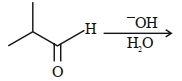
A
$2,4-$dimethylpent$-2-$enal
B
$3-$hydroxy$-2,4-$dimethylpentanal
C
$2,4-$dimethylpentane$-2,3-$dione
D
$2,3-$dimethylpent$-2-$enal
Solution
(B) The reaction involves the self-aldol condensation of isobutyraldehyde ($2$-methylpropanal) in the presence of a dilute base $(\text{OH}^-)$.
$1$. The base abstracts an $\alpha$-hydrogen from isobutyraldehyde to form an enolate ion.
$2$. This enolate ion acts as a nucleophile and attacks the carbonyl carbon of another molecule of isobutyraldehyde.
$3$. The resulting alkoxide is protonated to form the $\beta$-hydroxy aldehyde,which is $3-$hydroxy$-2,4-$dimethylpentanal.
Therefore,the major product is $3-$hydroxy$-2,4-$dimethylpentanal.
$1$. The base abstracts an $\alpha$-hydrogen from isobutyraldehyde to form an enolate ion.
$2$. This enolate ion acts as a nucleophile and attacks the carbonyl carbon of another molecule of isobutyraldehyde.
$3$. The resulting alkoxide is protonated to form the $\beta$-hydroxy aldehyde,which is $3-$hydroxy$-2,4-$dimethylpentanal.
Therefore,the major product is $3-$hydroxy$-2,4-$dimethylpentanal.
0 likesView Solution
260
ChemistryMediumMCQJEE Main · 2022
Arrange the following compounds in decreasing order of their acidic strength:
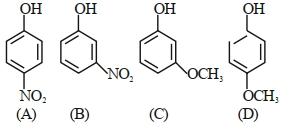
A
$A > B > C > D$
B
$B > A > C > D$
C
$A > C > B > D$
D
$D > C > B > A$
Solution
(A) The acidic strength of phenols depends on the nature of the substituents attached to the benzene ring. Electron-withdrawing groups $(EWG)$ increase acidity,while electron-donating groups $(EDG)$ decrease it.
$A$: $p$-Nitrophenol ($-NO_2$ is a strong $EWG$ at para position,strong $-I$ and $-M$ effect).
$B$: $m$-Nitrophenol ($-NO_2$ is an $EWG$ at meta position,only $-I$ effect).
$C$: $m$-Methoxyphenol ($-OCH_3$ is an $EDG$ by $+M$ effect but acts as an $EWG$ by $-I$ effect at meta position).
$D$: $p$-Methoxyphenol ($-OCH_3$ is a strong $EDG$ by $+M$ effect at para position).
Comparing the effects:
$A$ is the most acidic due to strong $-M$ effect of $-NO_2$ at para position.
$B$ is next,as $-NO_2$ at meta position only shows $-I$ effect.
$C$ is less acidic than $B$ because $-OCH_3$ at meta position acts as an $EWG$ ($-I$ effect) but is less effective than $-NO_2$.
$D$ is the least acidic due to the strong $+M$ electron-donating effect of $-OCH_3$ at para position.
Therefore,the decreasing order of acidic strength is $A > B > C > D$.
$A$: $p$-Nitrophenol ($-NO_2$ is a strong $EWG$ at para position,strong $-I$ and $-M$ effect).
$B$: $m$-Nitrophenol ($-NO_2$ is an $EWG$ at meta position,only $-I$ effect).
$C$: $m$-Methoxyphenol ($-OCH_3$ is an $EDG$ by $+M$ effect but acts as an $EWG$ by $-I$ effect at meta position).
$D$: $p$-Methoxyphenol ($-OCH_3$ is a strong $EDG$ by $+M$ effect at para position).
Comparing the effects:
$A$ is the most acidic due to strong $-M$ effect of $-NO_2$ at para position.
$B$ is next,as $-NO_2$ at meta position only shows $-I$ effect.
$C$ is less acidic than $B$ because $-OCH_3$ at meta position acts as an $EWG$ ($-I$ effect) but is less effective than $-NO_2$.
$D$ is the least acidic due to the strong $+M$ electron-donating effect of $-OCH_3$ at para position.
Therefore,the decreasing order of acidic strength is $A > B > C > D$.
0 likesView Solution
261
ChemistryMediumMCQJEE Main · 2022
$CH_{3}CH_{2}CN$ $\xrightarrow[Ether]{CH_{3}MgBr} A$ $\xrightarrow{H_{3}O^{+}} B$ $\xrightarrow[HCl]{Zn-Hg} C$
The correct structure of $C$ is
The correct structure of $C$ is
A
$CH_{3}CH_{2}CH_{2}CH_{3}$
B
$CH_{3}CH_{2}COCH_{3}$
C
$CH_{3}CH_{2}CH(OH)CH_{3}$
D
$CH_{3}CH_{2}CH=CH_{2}$
Solution
(A) $1$. The reaction of $CH_{3}CH_{2}CN$ (propanenitrile) with $CH_{3}MgBr$ (Grignard reagent) followed by acid hydrolysis $(H_{3}O^{+})$ yields a ketone,$B$,which is butan$-2-$one $(CH_{3}CH_{2}COCH_{3})$.
$2$. The reaction is: $CH_{3}CH_{2}CN + CH_{3}MgBr$ $\rightarrow CH_{3}CH_{2}C(NMgBr)CH_{3}$ $\xrightarrow{H_{3}O^{+}} CH_{3}CH_{2}COCH_{3}$ $(B)$.
$3$. The subsequent step is the Clemmensen reduction,which uses $Zn-Hg/HCl$ to reduce the carbonyl group $(C=O)$ of the ketone to a methylene group $(-CH_{2}-)$.
$4$. Therefore,$CH_{3}CH_{2}COCH_{3} \xrightarrow[HCl]{Zn-Hg} CH_{3}CH_{2}CH_{2}CH_{3}$ ($C$,butane).
$2$. The reaction is: $CH_{3}CH_{2}CN + CH_{3}MgBr$ $\rightarrow CH_{3}CH_{2}C(NMgBr)CH_{3}$ $\xrightarrow{H_{3}O^{+}} CH_{3}CH_{2}COCH_{3}$ $(B)$.
$3$. The subsequent step is the Clemmensen reduction,which uses $Zn-Hg/HCl$ to reduce the carbonyl group $(C=O)$ of the ketone to a methylene group $(-CH_{2}-)$.
$4$. Therefore,$CH_{3}CH_{2}COCH_{3} \xrightarrow[HCl]{Zn-Hg} CH_{3}CH_{2}CH_{2}CH_{3}$ ($C$,butane).
0 likesView Solution
262
ChemistryMediumMCQJEE Main · 2022
Match List-$I$ with List-$II$ :
Choose the correct answer from the options given below.
| List-$I$ (Polymer) | List-$II$ (Used for items) |
| $A$. $Nylon\,6,6$ | $I$. $Bristles\,of\,brushes$ |
| $B$. $Low\,density\,polythene$ | $II$. $Toys$ |
| $C$. $High\,density\,polythene$ | $III$. $Buckets$ |
| $D$. $Teflon$ | $IV$. $Non-stick\,utensils$ |
Choose the correct answer from the options given below.
A
$A-III, B-I, C-IV, D-II$
B
$A-I, B-II, C-III, D-IV$
C
$A-II, B-I, C-IV, D-III$
D
$A-II, B-IV, C-I, D-III$
Solution
(B) $Nylon\,6,6$ is used for $Bristles\,of\,brushes$ $(A-I)$.
$Low\,density\,polythene$ is used for $Toys$ $(B-II)$.
$High\,density\,polythene$ is used for $Buckets$ $(C-III)$.
$Teflon$ is used for $Non-stick\,utensils$ $(D-IV)$.
Therefore,the correct matching is $A-I, B-II, C-III, D-IV$.
$Low\,density\,polythene$ is used for $Toys$ $(B-II)$.
$High\,density\,polythene$ is used for $Buckets$ $(C-III)$.
$Teflon$ is used for $Non-stick\,utensils$ $(D-IV)$.
Therefore,the correct matching is $A-I, B-II, C-III, D-IV$.
0 likesView Solution
263
ChemistryMediumMCQJEE Main · 2022
Glycosidic linkage between $C_{1}$ of $\alpha$-glucose and $C_{2}$ of $\beta$-fructose is found in.
A
maltose
B
sucrose
C
lactose
D
amylose
Solution
(B) Sucrose is a disaccharide composed of $\alpha$-$D$-glucose and $\beta$-$D$-fructose units.
These two monosaccharide units are joined together by a glycosidic linkage between $C_{1}$ of $\alpha$-$D$-glucose and $C_{2}$ of $\beta$-$D$-fructose.
This linkage is known as an $\alpha, \beta-1,2$-glycosidic bond.
These two monosaccharide units are joined together by a glycosidic linkage between $C_{1}$ of $\alpha$-$D$-glucose and $C_{2}$ of $\beta$-$D$-fructose.
This linkage is known as an $\alpha, \beta-1,2$-glycosidic bond.
0 likesView Solution
264
ChemistryEasyMCQJEE Main · 2022
Some drugs bind to a site other than the active site of an enzyme. This site is known as:
A
non-active site
B
allosteric site
C
competitive site
D
therapeutic site
Solution
(B) Enzymes have an active site where the substrate binds to undergo a chemical reaction.
Some drugs do not bind to the active site but instead bind to a different site on the enzyme surface,which is known as the $allosteric \ site$.
Binding at this site changes the shape of the active site,making it difficult for the substrate to bind,thereby inhibiting the enzyme's activity.
Some drugs do not bind to the active site but instead bind to a different site on the enzyme surface,which is known as the $allosteric \ site$.
Binding at this site changes the shape of the active site,making it difficult for the substrate to bind,thereby inhibiting the enzyme's activity.
0 likesView Solution
265
ChemistryMediumMCQJEE Main · 2022
For the decomposition of azomethane,$CH_3N_2CH_{3(g)} \rightarrow CH_3CH_{3(g)} + N_{2(g)}$,a first order reaction,the variation in partial pressure with time at $600 \ K$ is given as shown in the graph. The value of the rate constant $k$ in $s^{-1}$ is $x \times 10^4$. Find the value of $x$.
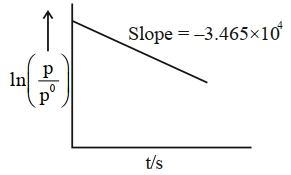
A
$1$
B
$2$
C
$3$
D
$9$
Solution
(C) For a first order reaction,the integrated rate equation is $\ln(P/P_0) = -kt$.
Comparing this with the equation of a straight line $y = mx + c$,where $y = \ln(P/P_0)$ and $x = t$,the slope $m = -k$.
From the given graph,the slope is $-3.465 \times 10^4 \ s^{-1}$.
Therefore,$-k = -3.465 \times 10^4 \ s^{-1}$,which gives $k = 3.465 \times 10^4 \ s^{-1}$.
Given $k = x \times 10^4 \ s^{-1}$,we have $x = 3.465 \approx 3$ (rounding to the nearest integer as per options).
Comparing this with the equation of a straight line $y = mx + c$,where $y = \ln(P/P_0)$ and $x = t$,the slope $m = -k$.
From the given graph,the slope is $-3.465 \times 10^4 \ s^{-1}$.
Therefore,$-k = -3.465 \times 10^4 \ s^{-1}$,which gives $k = 3.465 \times 10^4 \ s^{-1}$.
Given $k = x \times 10^4 \ s^{-1}$,we have $x = 3.465 \approx 3$ (rounding to the nearest integer as per options).
0 likesView Solution
266
ChemistryMediumMCQJEE Main · 2022
The spin-only magnetic moment value of $M^{3+}$ ion (in gaseous state) from the pairs $Cr^{3+}/Cr^{2+}$,$Mn^{3+}/Mn^{2+}$,$Fe^{3+}/Fe^{2+}$,and $Co^{3+}/Co^{2+}$ that has a negative standard electrode potential,is $B.M.$ (Nearest integer).
A
$4$
B
$2$
C
$3$
D
$1$
Solution
(A) The standard electrode potential $E^{0}_{M^{3+}/M^{2+}}$ is negative only for the $Cr^{3+}/Cr^{2+}$ pair $(E^{0} = -0.41 \, V)$.
The electronic configuration of $Cr^{3+}$ is $[Ar] 3d^{3}$.
The number of unpaired electrons $(n)$ in $Cr^{3+}$ is $3$.
The spin-only magnetic moment is calculated as $\mu = \sqrt{n(n+2)} \, B.M.$
$\mu = \sqrt{3(3+2)} = \sqrt{15} \approx 3.87 \, B.M.$
The nearest integer value is $4$.
The electronic configuration of $Cr^{3+}$ is $[Ar] 3d^{3}$.
The number of unpaired electrons $(n)$ in $Cr^{3+}$ is $3$.
The spin-only magnetic moment is calculated as $\mu = \sqrt{n(n+2)} \, B.M.$
$\mu = \sqrt{3(3+2)} = \sqrt{15} \approx 3.87 \, B.M.$
The nearest integer value is $4$.
0 likesView Solution
267
ChemistryDifficultMCQJEE Main · 2022
$A$ sample of $4.5 \ g$ of an unknown monohydric alcohol,$ROH$,was added to methylmagnesium iodide. $A$ gas is evolved,collected,and its volume is measured to be $3.1 \ L$ at $NTP$. The molecular weight of the unknown alcohol is $g/mol$. [Nearest integer]
A
$33$
B
$32$
C
$31$
D
$30$
Solution
(A) The reaction between a monohydric alcohol and methylmagnesium iodide is: $ROH + CH_3MgI \rightarrow ROMgI + CH_4(g)$.
According to the stoichiometry,$1 \ mole$ of $ROH$ produces $1 \ mole$ of $CH_4$ gas.
At $NTP$ conditions,$1 \ mole$ of gas occupies $22.4 \ L$.
Given volume of $CH_4 = 3.1 \ L$.
Moles of $CH_4 = \frac{3.1}{22.4} \approx 0.1384 \ mol$.
Since moles of $ROH = \text{moles of } CH_4$,we have $0.1384 = \frac{\text{mass}}{\text{Molar Mass}} = \frac{4.5}{M.M}$.
$M.M = \frac{4.5}{0.1384} \approx 32.51 \ g/mol$.
The nearest integer is $33$.
According to the stoichiometry,$1 \ mole$ of $ROH$ produces $1 \ mole$ of $CH_4$ gas.
At $NTP$ conditions,$1 \ mole$ of gas occupies $22.4 \ L$.
Given volume of $CH_4 = 3.1 \ L$.
Moles of $CH_4 = \frac{3.1}{22.4} \approx 0.1384 \ mol$.
Since moles of $ROH = \text{moles of } CH_4$,we have $0.1384 = \frac{\text{mass}}{\text{Molar Mass}} = \frac{4.5}{M.M}$.
$M.M = \frac{4.5}{0.1384} \approx 32.51 \ g/mol$.
The nearest integer is $33$.
0 likesView Solution
268
ChemistryMediumMCQJEE Main · 2022
The depression in freezing point observed for a formic acid solution of concentration $0.5 \, mL \, L^{-1}$ is $0.0405^{\circ} \, C$. The density of formic acid is $1.05 \, g \, mL^{-1}$. The Van't Hoff factor of the formic acid solution is nearly: (Given for water $K_{f} = 1.86 \, K \, kg \, mol^{-1}$)
A
$0.8$
B
$1.1$
C
$1.9$
D
$2.4$
Solution
(C) Concentration of $HCOOH = 0.5 \, mL \, L^{-1}$.
Mass of $HCOOH = 0.5 \, mL \times 1.05 \, g \, mL^{-1} = 0.525 \, g \, L^{-1}$.
Molar mass of $HCOOH = 46 \, g \, mol^{-1}$.
Molality $(m) = \frac{0.525 \, g}{46 \, g \, mol^{-1} \times 1 \, kg} \approx 0.01141 \, mol \, kg^{-1}$.
Using the formula $\Delta T_{f} = i K_{f} m$,we have $i = \frac{\Delta T_{f}}{K_{f} m}$.
$i = \frac{0.0405}{1.86 \times 0.01141} \approx \frac{0.0405}{0.02122} \approx 1.908$.
Thus,the Van't Hoff factor is nearly $1.9$.
Mass of $HCOOH = 0.5 \, mL \times 1.05 \, g \, mL^{-1} = 0.525 \, g \, L^{-1}$.
Molar mass of $HCOOH = 46 \, g \, mol^{-1}$.
Molality $(m) = \frac{0.525 \, g}{46 \, g \, mol^{-1} \times 1 \, kg} \approx 0.01141 \, mol \, kg^{-1}$.
Using the formula $\Delta T_{f} = i K_{f} m$,we have $i = \frac{\Delta T_{f}}{K_{f} m}$.
$i = \frac{0.0405}{1.86 \times 0.01141} \approx \frac{0.0405}{0.02122} \approx 1.908$.
Thus,the Van't Hoff factor is nearly $1.9$.
0 likesView Solution
269
ChemistryMediumMCQJEE Main · 2022
Match List-$I$ with List-$II$.
Choose the correct answer from the options given below.
| List-$I$ | List-$II$ |
| $A. N_{2(g)} + 3H_{2(g)} \rightarrow 2NH_{3(g)}$ | $I. Fe_xO_y + K_2O + Al_2O_3$ |
| $B. CO_{(g)} + 3H_{2(g)} \rightarrow CH_{4(g)} + H_2O_{(g)}$ | $II. Ni$ |
| $C. CO_{(g)} + H_{2(g)} \rightarrow HCHO_{(g)}$ | $III. Cu$ |
| $D. CO_{(g)} + 2H_{2(g)} \rightarrow CH_3OH_{(g)}$ | $IV. Cu/ZnO - Cr_2O_3$ |
Choose the correct answer from the options given below.
A
$A-I, B-II, C-III, D-IV$
B
$A-I, B-II, C-IV, D-III$
C
$A-II, B-I, C-III, D-IV$
D
$A-II, B-I, C-IV, D-III$
Solution
(A) The reactions are matched with their respective catalysts as follows:
$A. N_{2(g)} + 3H_{2(g)} \rightarrow 2NH_{3(g)}$ (Haber process) uses $Fe_xO_y + K_2O + Al_2O_3$ as a catalyst $(I)$.
$B. CO_{(g)} + 3H_{2(g)} \rightarrow CH_{4(g)} + H_2O_{(g)}$ uses $Ni$ as a catalyst $(II)$.
$C. CO_{(g)} + H_{2(g)} \rightarrow HCHO_{(g)}$ uses $Cu$ as a catalyst $(III)$.
$D. CO_{(g)} + 2H_{2(g)} \rightarrow CH_3OH_{(g)}$ uses $Cu/ZnO - Cr_2O_3$ as a catalyst $(IV)$.
Therefore,the correct matching is $A-I, B-II, C-III, D-IV$.
$A. N_{2(g)} + 3H_{2(g)} \rightarrow 2NH_{3(g)}$ (Haber process) uses $Fe_xO_y + K_2O + Al_2O_3$ as a catalyst $(I)$.
$B. CO_{(g)} + 3H_{2(g)} \rightarrow CH_{4(g)} + H_2O_{(g)}$ uses $Ni$ as a catalyst $(II)$.
$C. CO_{(g)} + H_{2(g)} \rightarrow HCHO_{(g)}$ uses $Cu$ as a catalyst $(III)$.
$D. CO_{(g)} + 2H_{2(g)} \rightarrow CH_3OH_{(g)}$ uses $Cu/ZnO - Cr_2O_3$ as a catalyst $(IV)$.
Therefore,the correct matching is $A-I, B-II, C-III, D-IV$.
0 likesView Solution
270
ChemistryMediumMCQJEE Main · 2022
The compound$(s)$ that is(are) removed as slag during the extraction of copper is:
$1. CaO$
$2. FeO$
$3. Al_{2}O_{3}$
$4. ZnO$
$5. NiO$
Choose the correct answer from the options given below.
$1. CaO$
$2. FeO$
$3. Al_{2}O_{3}$
$4. ZnO$
$5. NiO$
Choose the correct answer from the options given below.
A
$3, 4$ Only
B
$1, 2, 5$ Only
C
$1, 2$ Only
D
$2$ Only
Solution
(D) During the extraction of copper from copper pyrites $(CuFeS_{2})$,the ore is roasted to remove sulfur as $SO_{2}$ and convert iron and copper into oxides.
In the smelting process,silica $(SiO_{2})$ is added as a flux to remove the iron oxide $(FeO)$ impurity.
$FeO$ reacts with $SiO_{2}$ to form iron silicate $(FeSiO_{3})$,which is removed as slag:
$FeO + SiO_{2} \rightarrow FeSiO_{3}$ (slag).
Therefore,only $FeO$ is removed as slag.
In the smelting process,silica $(SiO_{2})$ is added as a flux to remove the iron oxide $(FeO)$ impurity.
$FeO$ reacts with $SiO_{2}$ to form iron silicate $(FeSiO_{3})$,which is removed as slag:
$FeO + SiO_{2} \rightarrow FeSiO_{3}$ (slag).
Therefore,only $FeO$ is removed as slag.
0 likesView Solution
271
ChemistryEasyMCQJEE Main · 2022
The interhalogen compound formed from the reaction of bromine with an excess of fluorine is:
A
$BrF$
B
$BrF_3$
C
$BrF_5$
D
$BrF_7$
Solution
(C) When bromine reacts with an excess of fluorine,the reaction is as follows:
$Br_2 + 5F_2 (\text{excess}) \longrightarrow 2BrF_5$
Thus,the interhalogen compound formed is $BrF_5$ (bromine pentafluoride).
$Br_2 + 5F_2 (\text{excess}) \longrightarrow 2BrF_5$
Thus,the interhalogen compound formed is $BrF_5$ (bromine pentafluoride).
0 likesView Solution
272
ChemistryMediumMCQJEE Main · 2022
The most stable product of the following reaction is:
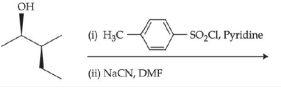
A
B
C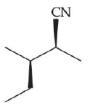
D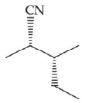
Solution
(C) The reaction proceeds in two steps:
$1$. The reaction of the secondary alcohol with $p$-toluenesulfonyl chloride $(TsCl)$ in the presence of pyridine converts the $-OH$ group into a good leaving group,the tosylate $(-OTs)$ group,with retention of configuration at the chiral center.
$2$. The subsequent reaction with $NaCN$ in $DMF$ is an $S_N2$ reaction. The nucleophile $CN^{-}$ attacks the chiral carbon from the side opposite to the $-OTs$ group,resulting in an inversion of configuration at that center.
Starting with the given stereoisomer,the $-OH$ is on a wedge. After forming the $-OTs$ group (still on a wedge),the $S_N2$ attack by $CN^{-}$ forces it to the dashed position (inversion). Thus,the correct product has the $CN$ group on a dash while the other chiral center remains unchanged.
$1$. The reaction of the secondary alcohol with $p$-toluenesulfonyl chloride $(TsCl)$ in the presence of pyridine converts the $-OH$ group into a good leaving group,the tosylate $(-OTs)$ group,with retention of configuration at the chiral center.
$2$. The subsequent reaction with $NaCN$ in $DMF$ is an $S_N2$ reaction. The nucleophile $CN^{-}$ attacks the chiral carbon from the side opposite to the $-OTs$ group,resulting in an inversion of configuration at that center.
Starting with the given stereoisomer,the $-OH$ is on a wedge. After forming the $-OTs$ group (still on a wedge),the $S_N2$ attack by $CN^{-}$ forces it to the dashed position (inversion). Thus,the correct product has the $CN$ group on a dash while the other chiral center remains unchanged.
0 likesView Solution
273
ChemistryMediumMCQJEE Main · 2022
Which one of the following reactions does not represent the correct combination of substrate and product under the given conditions?
A
$4-$methylbenzoyl chloride $\xrightarrow{H_2, Pd/BaSO_4}$ $4-$methylbenzaldehyde
B
$4-$methylbenzonitrile $\xrightarrow{(i) DIBAL-H, (ii) H_2O}$ $4-$methylbenzaldehyde
C
Ethyl $4-$methylbenzoate $\xrightarrow{(i) AlH(iso-Bu)_2, (ii) H_2O}$ $4-$methylbenzaldehyde
D
$4-$methylbenzyl alcohol $\xrightarrow{(i) Na_2Cr_2O_7, (ii) H_2SO_4, H_2O}$ $4-$methylbenzaldehyde
Solution
(D) Let us analyze each reaction:
$A$. Rosenmund reduction: Acid chloride is reduced to aldehyde using $H_2$ and $Pd/BaSO_4$. This is correct.
$B$. Nitriles are reduced to aldehydes using $DIBAL-H$ followed by hydrolysis. This is correct.
$C$. Esters are reduced to aldehydes using $DIBAL-H$ at low temperature followed by hydrolysis. This is correct.
$D$. Oxidation of primary alcohols with strong oxidizing agents like $Na_2Cr_2O_7/H_2SO_4$ (Jones reagent) typically proceeds further to carboxylic acids. Therefore,$4$-methylbenzyl alcohol will be oxidized to $4$-methylbenzoic acid,not $4$-methylbenzaldehyde. Thus,this reaction does not represent the correct product.
$A$. Rosenmund reduction: Acid chloride is reduced to aldehyde using $H_2$ and $Pd/BaSO_4$. This is correct.
$B$. Nitriles are reduced to aldehydes using $DIBAL-H$ followed by hydrolysis. This is correct.
$C$. Esters are reduced to aldehydes using $DIBAL-H$ at low temperature followed by hydrolysis. This is correct.
$D$. Oxidation of primary alcohols with strong oxidizing agents like $Na_2Cr_2O_7/H_2SO_4$ (Jones reagent) typically proceeds further to carboxylic acids. Therefore,$4$-methylbenzyl alcohol will be oxidized to $4$-methylbenzoic acid,not $4$-methylbenzaldehyde. Thus,this reaction does not represent the correct product.
0 likesView Solution
274
ChemistryDifficultMCQJEE Main · 2022
An organic compound $A$ on reaction with $NH_{3}$ followed by heating gives compound $B$. Which on further strong heating gives compound $C$ $(C_{8}H_{5}NO_{2})$. Compound $C$ on sequential reaction with ethanolic $KOH$,alkyl chloride and hydrolysis with alkali gives a primary amine. The compound $A$ is.
A
Phthalaldehyde
B
Phthalaldehydic acid
C
Phthalic acid
D
Salicylaldehyde
Solution
(C) The reaction sequence described is the Gabriel phthalimide synthesis. \\
$1$. Compound $A$ is phthalic acid $(C_{6}H_{4}(COOH)_{2})$. \\
$2$. Reaction of phthalic acid with $NH_{3}$ followed by heating gives phthalimide $(C_{8}H_{5}NO_{2})$,which is compound $C$. The intermediate $B$ is phthalamide $(C_{6}H_{4}(CONH_{2})_{2})$. \\
$3$. Phthalimide $(C)$ reacts with ethanolic $KOH$ to form potassium phthalimide. \\
$4$. Potassium phthalimide reacts with alkyl chloride $(R-Cl)$ via $S_{N}2$ mechanism to form $N$-alkylphthalimide. \\
$5$. Hydrolysis of $N$-alkylphthalimide with alkali gives a primary amine $(RNH_{2})$ and phthalic acid. \\
Thus,compound $A$ is phthalic acid.
$1$. Compound $A$ is phthalic acid $(C_{6}H_{4}(COOH)_{2})$. \\
$2$. Reaction of phthalic acid with $NH_{3}$ followed by heating gives phthalimide $(C_{8}H_{5}NO_{2})$,which is compound $C$. The intermediate $B$ is phthalamide $(C_{6}H_{4}(CONH_{2})_{2})$. \\
$3$. Phthalimide $(C)$ reacts with ethanolic $KOH$ to form potassium phthalimide. \\
$4$. Potassium phthalimide reacts with alkyl chloride $(R-Cl)$ via $S_{N}2$ mechanism to form $N$-alkylphthalimide. \\
$5$. Hydrolysis of $N$-alkylphthalimide with alkali gives a primary amine $(RNH_{2})$ and phthalic acid. \\
Thus,compound $A$ is phthalic acid.
0 likesView Solution
275
ChemistryMediumMCQJEE Main · 2022
Melamine polymer is formed by the condensation of:
A
Melamine and $HCHO$
B
Melamine and $HCHO$ (with different structure)
C
Benzene derivative and $HCHO$
D
Pyridine derivative and $HCHO$
Solution
(A) Melamine polymer,also known as melamine-formaldehyde resin,is formed by the condensation polymerization of melamine and formaldehyde $(HCHO)$.
The reaction involves the formation of a resinous material through the elimination of water molecules.
The reaction involves the formation of a resinous material through the elimination of water molecules.
0 likesView Solution
276
ChemistryEasyMCQJEE Main · 2022
During the denaturation of proteins,which of these structures will remain intact?
A
Primary
B
Secondary
C
Tertiary
D
Quaternary
Solution
(A) Denaturation of proteins involves the disruption of the $3D$ structure of the protein,such as the $secondary$,$tertiary$,and $quaternary$ structures,due to physical or chemical changes like temperature or $pH$ variations.
However,the $primary$ structure,which refers to the specific sequence of amino acids held together by peptide bonds,remains intact because these covalent bonds are not affected by the denaturation process.
However,the $primary$ structure,which refers to the specific sequence of amino acids held together by peptide bonds,remains intact because these covalent bonds are not affected by the denaturation process.
0 likesView Solution
277
ChemistryEasyMCQJEE Main · 2022
Drugs used to bind to receptors,inhibiting their natural function and blocking a message,are called:
A
Agonists
B
Antagonists
C
Allosterists
D
Antihistamines
Solution
(B) Drugs that bind to the receptor site and inhibit its natural function are known as $Antagonists$. These are useful when blocking a message is required.
0 likesView Solution
278
ChemistryMediumMCQJEE Main · 2022
The cell potential for $Zn | Zn^{2+}_{(aq)} || Sn^{x+}| Sn$ is $0.801 \ V$ at $298 \ K$. The reaction quotient for the above reaction is $10^{-2}$. The number of electrons involved in the given electrochemical cell reaction is .... (Given $E^{0}_{Zn^{2+}|Zn} = -0.763 \ V, E^{0}_{Sn^{x+}|Sn} = +0.008 \ V$ and $\frac{2.303 \ RT}{F} = 0.06 \ V$)
A
$1$
B
$2$
C
$3$
D
$4$
Solution
(D) The Nernst equation is given by: $E_{cell} = E^{0}_{cell} - \frac{0.06}{n} \log Q$
First,calculate the standard cell potential: $E^{0}_{cell} = E^{0}_{cathode} - E^{0}_{anode} = 0.008 \ V - (-0.763 \ V) = 0.771 \ V$
Substitute the given values into the Nernst equation: $0.801 = 0.771 - \frac{0.06}{n} \log(10^{-2})$
$0.801 - 0.771 = -\frac{0.06}{n} \times (-2)$
$0.03 = \frac{0.12}{n}$
$n = \frac{0.12}{0.03} = 4$
Thus,the number of electrons involved in the reaction is $4$.
First,calculate the standard cell potential: $E^{0}_{cell} = E^{0}_{cathode} - E^{0}_{anode} = 0.008 \ V - (-0.763 \ V) = 0.771 \ V$
Substitute the given values into the Nernst equation: $0.801 = 0.771 - \frac{0.06}{n} \log(10^{-2})$
$0.801 - 0.771 = -\frac{0.06}{n} \times (-2)$
$0.03 = \frac{0.12}{n}$
$n = \frac{0.12}{0.03} = 4$
Thus,the number of electrons involved in the reaction is $4$.
0 likesView Solution
279
ChemistryMediumMCQJEE Main · 2022
The half-life for the decomposition of gaseous compound $A$ is $240 \ s$ when the initial gaseous pressure is $500 \ Torr$. When the initial pressure is $250 \ Torr$,the half-life is found to be $4.0 \ min$. The order of the reaction is....... (Nearest integer)
A
$4$
B
$3$
C
$2$
D
$1$
Solution
(D) The half-life for a reaction of order $n$ is given by the relation $t_{1/2} \propto \frac{1}{P_0^{n-1}}$,where $P_0$ is the initial pressure.
Given: $(t_{1/2})_1 = 240 \ s = 4 \ min$ at $P_1 = 500 \ Torr$.
Given: $(t_{1/2})_2 = 4 \ min$ at $P_2 = 250 \ Torr$.
Since the half-life remains constant $(4 \ min)$ despite the change in initial pressure,the half-life is independent of the initial pressure.
For $t_{1/2}$ to be independent of $P_0$,the exponent $(n-1)$ must be $0$.
Therefore,$n-1 = 0$,which implies $n = 1$.
The reaction is of the $1^{st}$ order.
Given: $(t_{1/2})_1 = 240 \ s = 4 \ min$ at $P_1 = 500 \ Torr$.
Given: $(t_{1/2})_2 = 4 \ min$ at $P_2 = 250 \ Torr$.
Since the half-life remains constant $(4 \ min)$ despite the change in initial pressure,the half-life is independent of the initial pressure.
For $t_{1/2}$ to be independent of $P_0$,the exponent $(n-1)$ must be $0$.
Therefore,$n-1 = 0$,which implies $n = 1$.
The reaction is of the $1^{st}$ order.
0 likesView Solution
280
ChemistryMediumMCQJEE Main · 2022
Consider the following metal complexes:
$1. [Co(NH_3)_6]^{3+}$
$2. [CoCl(NH_3)_5]^{2+}$
$3. [Co(CN)_6]^{3-}$
$4. [Co(NH_3)_5(H_2O)]^{3+}$
The spin-only magnetic moment value of the complex that absorbs light with the shortest wavelength is $B.M.$ (Nearest integer).
$1. [Co(NH_3)_6]^{3+}$
$2. [CoCl(NH_3)_5]^{2+}$
$3. [Co(CN)_6]^{3-}$
$4. [Co(NH_3)_5(H_2O)]^{3+}$
The spin-only magnetic moment value of the complex that absorbs light with the shortest wavelength is $B.M.$ (Nearest integer).
A
$3$
B
$0$
C
$2$
D
$1$
Solution
(B) The energy of absorbed light is inversely proportional to the wavelength: $\Delta_0 \propto \frac{1}{\lambda}$.
To absorb light with the shortest wavelength,the complex must have the largest crystal field splitting energy $(\Delta_0)$.
Among the ligands provided $(Cl^- < H_2O < NH_3 < CN^-)$,the cyanide ion $(CN^-)$ is the strongest field ligand $(SFL)$.
Therefore,$[Co(CN)_6]^{3-}$ has the largest $\Delta_0$ and absorbs light of the shortest wavelength.
In $[Co(CN)_6]^{3-}$,the oxidation state of $Co$ is $+3$,which corresponds to a $d^6$ configuration.
Since $CN^-$ is a strong field ligand,it causes pairing of electrons,resulting in a low-spin $t_{2g}^6 e_g^0$ configuration.
The number of unpaired electrons $(n)$ is $0$,so the spin-only magnetic moment $\mu = \sqrt{n(n+2)} = 0 \ B.M.$
To absorb light with the shortest wavelength,the complex must have the largest crystal field splitting energy $(\Delta_0)$.
Among the ligands provided $(Cl^- < H_2O < NH_3 < CN^-)$,the cyanide ion $(CN^-)$ is the strongest field ligand $(SFL)$.
Therefore,$[Co(CN)_6]^{3-}$ has the largest $\Delta_0$ and absorbs light of the shortest wavelength.
In $[Co(CN)_6]^{3-}$,the oxidation state of $Co$ is $+3$,which corresponds to a $d^6$ configuration.
Since $CN^-$ is a strong field ligand,it causes pairing of electrons,resulting in a low-spin $t_{2g}^6 e_g^0$ configuration.
The number of unpaired electrons $(n)$ is $0$,so the spin-only magnetic moment $\mu = \sqrt{n(n+2)} = 0 \ B.M.$
0 likesView Solution
281
ChemistryMediumMCQJEE Main · 2022
Among $Co^{3+}$,$Ti^{2+}$,$V^{2+}$ and $Cr^{2+}$ ions,one if used as a reagent cannot liberate $H_{2}$ from dilute mineral acid solution,its spin-only magnetic moment in gaseous state is $.....$ $B.M.$ (Nearest integer)
A
$6$
B
$5$
C
$3$
D
$4$
Solution
(B) The standard electrode potential $E^{\circ}$ for the reduction of $H^{+}$ to $H_{2}$ is $0.00 \ V$.
$A$ metal ion can liberate $H_{2}$ from a dilute mineral acid if its standard reduction potential $E^{\circ}(M^{n+}/M)$ is negative.
Among the given ions,$Co^{3+}$ has a high positive reduction potential $(E^{\circ}(Co^{3+}/Co^{2+}) = +1.82 \ V)$,meaning it is a strong oxidizing agent and will not liberate $H_{2}$ from acid; instead,it is reduced to $Co^{2+}$.
The electronic configuration of $Co^{3+}$ $(Z=27)$ is $[Ar] 3d^{6}$.
In the $3d^{6}$ configuration,the number of unpaired electrons $(n)$ is $4$.
The spin-only magnetic moment is calculated as $\mu = \sqrt{n(n+2)} \ B.M.$
$\mu = \sqrt{4(4+2)} = \sqrt{24} \approx 4.899 \ B.M.$
The nearest integer value is $5$.
$A$ metal ion can liberate $H_{2}$ from a dilute mineral acid if its standard reduction potential $E^{\circ}(M^{n+}/M)$ is negative.
Among the given ions,$Co^{3+}$ has a high positive reduction potential $(E^{\circ}(Co^{3+}/Co^{2+}) = +1.82 \ V)$,meaning it is a strong oxidizing agent and will not liberate $H_{2}$ from acid; instead,it is reduced to $Co^{2+}$.
The electronic configuration of $Co^{3+}$ $(Z=27)$ is $[Ar] 3d^{6}$.
In the $3d^{6}$ configuration,the number of unpaired electrons $(n)$ is $4$.
The spin-only magnetic moment is calculated as $\mu = \sqrt{n(n+2)} \ B.M.$
$\mu = \sqrt{4(4+2)} = \sqrt{24} \approx 4.899 \ B.M.$
The nearest integer value is $5$.
0 likesView Solution
282
ChemistryDifficultMCQJEE Main · 2022
In the given reaction,the number of chiral carbon$(s)$ in product $A$ is .......
(Where $Et$ is $-C_2H_5$)
(Where $Et$ is $-C_2H_5$)
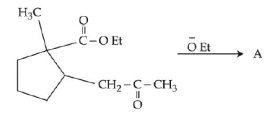
A
$2$
B
$3$
C
$4$
D
$5$
Solution
(A) The reaction is an intramolecular Claisen condensation (Dieckmann condensation).
$1$. The ethoxide ion $(EtO^-)$ abstracts an $\alpha$-hydrogen from the ketone group,forming an enolate.
$2$. This enolate attacks the ester carbonyl carbon,leading to the formation of a bicyclic compound (product $A$).
$3$. The resulting product $A$ is a bicyclo[$4.3$.$0$]nonane derivative with two hydroxyl and ketone groups.
$4$. By examining the structure of the product,we identify two chiral centers (marked with asterisks in the structure),which are the bridgehead carbons where the ring fusion occurs and substituents are attached.
Therefore,the number of chiral carbons in product $A$ is $2$.
$1$. The ethoxide ion $(EtO^-)$ abstracts an $\alpha$-hydrogen from the ketone group,forming an enolate.
$2$. This enolate attacks the ester carbonyl carbon,leading to the formation of a bicyclic compound (product $A$).
$3$. The resulting product $A$ is a bicyclo[$4.3$.$0$]nonane derivative with two hydroxyl and ketone groups.
$4$. By examining the structure of the product,we identify two chiral centers (marked with asterisks in the structure),which are the bridgehead carbons where the ring fusion occurs and substituents are attached.
Therefore,the number of chiral carbons in product $A$ is $2$.
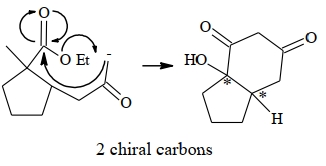
0 likesView Solution
283
ChemistryMediumMCQJEE Main · 2022
At $30^{\circ}C$,the half-life for the decomposition of $AB_{2}$ is $200\,s$ and is independent of the initial concentration of $AB_{2}$. The time required for $80\%$ of the $AB_{2}$ to decompose is $....s$ (Given: $\log 2 = 0.30; \log 5 = 0.70$)
A
$200$
B
$323$
C
$467$
D
$532$
Solution
(C) Since the half-life is independent of the initial concentration,it is a $1^{st}$ order reaction.
$k = \frac{0.693}{T_{1/2}} = \frac{0.693}{200} = 3.465 \times 10^{-3} \, s^{-1}$.
For $80\%$ decomposition,the remaining concentration is $20\%$ of the initial concentration $(A = 0.2 A_{0})$.
The rate equation is $t = \frac{2.303}{k} \log \frac{A_{0}}{A}$.
$t = \frac{2.303}{3.465 \times 10^{-3}} \log \frac{A_{0}}{0.2 A_{0}} = \frac{2.303}{3.465 \times 10^{-3}} \log 5$.
Using $\log 5 = 0.70$ and $\frac{2.303}{k} = \frac{200}{0.693} \approx 288.66$.
$t = 288.66 \times 0.70 \approx 202.06 \times 2.303 \approx 466.67 \, s \approx 467 \, s$.
$k = \frac{0.693}{T_{1/2}} = \frac{0.693}{200} = 3.465 \times 10^{-3} \, s^{-1}$.
For $80\%$ decomposition,the remaining concentration is $20\%$ of the initial concentration $(A = 0.2 A_{0})$.
The rate equation is $t = \frac{2.303}{k} \log \frac{A_{0}}{A}$.
$t = \frac{2.303}{3.465 \times 10^{-3}} \log \frac{A_{0}}{0.2 A_{0}} = \frac{2.303}{3.465 \times 10^{-3}} \log 5$.
Using $\log 5 = 0.70$ and $\frac{2.303}{k} = \frac{200}{0.693} \approx 288.66$.
$t = 288.66 \times 0.70 \approx 202.06 \times 2.303 \approx 466.67 \, s \approx 467 \, s$.
0 likesView Solution
284
ChemistryMediumMCQJEE Main · 2022
Given below are two statements: one is labelled as Assertion $A$ and the other is labelled as Reason $R$.
Assertion $A$: Finest gold is red in colour,as the size of the particles increases,it appears purple then blue and finally gold.
Assertion $R$: The colour of the colloidal solution depends on the wavelength of light scattered by the dispersed particles.
In the light of the above statements,choose the most appropriate answer from the options given below:
Assertion $A$: Finest gold is red in colour,as the size of the particles increases,it appears purple then blue and finally gold.
Assertion $R$: The colour of the colloidal solution depends on the wavelength of light scattered by the dispersed particles.
In the light of the above statements,choose the most appropriate answer from the options given below:
A
Both $A$ and $R$ are true and $R$ is the correct explanation of $A$
B
Both $A$ and $R$ are true but $R$ is $NOT$ the correct explanation of $A$
C
$A$ is true but $R$ is false
D
$A$ is false but $R$ is true
Solution
(A) The colour of a colloidal solution depends on the size and shape of the dispersed particles.
As the particle size of gold sol increases,the wavelength of light scattered by the particles changes,which results in a change in the observed colour (from red to purple to blue and finally to golden).
Therefore,Assertion $A$ is true.
Reason $R$ correctly explains that the colour of a colloidal solution depends on the wavelength of light scattered by the dispersed particles,which is a direct consequence of the particle size.
Thus,both $A$ and $R$ are true,and $R$ is the correct explanation of $A$.
As the particle size of gold sol increases,the wavelength of light scattered by the particles changes,which results in a change in the observed colour (from red to purple to blue and finally to golden).
Therefore,Assertion $A$ is true.
Reason $R$ correctly explains that the colour of a colloidal solution depends on the wavelength of light scattered by the dispersed particles,which is a direct consequence of the particle size.
Thus,both $A$ and $R$ are true,and $R$ is the correct explanation of $A$.
0 likesView Solution
285
ChemistryEasyMCQJEE Main · 2022
The metal that has a very low melting point and whose periodic position is close to a metalloid is:
A
$Al$
B
$Ga$
C
$Se$
D
$In$
Solution
(B) Gallium $(Ga)$ is a metal with an exceptionally low melting point $(29.76^\circ C)$.
In the periodic table,it is located in Group $13$ and is adjacent to the metalloid Germanium $(Ge)$.
In the periodic table,it is located in Group $13$ and is adjacent to the metalloid Germanium $(Ge)$.
0 likesView Solution
286
ChemistryEasyMCQJEE Main · 2022
The metal that is not extracted from its sulphide ore is:
A
Aluminium
B
Iron
C
Lead
D
Zinc
Solution
(A) The metal $Al$ is extracted from its oxide ore,Bauxite $(Al_{2}O_{3} \cdot 2H_{2}O)$.
Iron is typically extracted from haematite $(Fe_{2}O_{3})$ or magnetite $(Fe_{3}O_{4})$,but it is also found as iron pyrites $(FeS_{2})$.
Lead is extracted from galena $(PbS)$.
Zinc is extracted from zinc blende $(ZnS)$.
Therefore,$Al$ is the correct answer as it is not extracted from a sulphide ore.
Iron is typically extracted from haematite $(Fe_{2}O_{3})$ or magnetite $(Fe_{3}O_{4})$,but it is also found as iron pyrites $(FeS_{2})$.
Lead is extracted from galena $(PbS)$.
Zinc is extracted from zinc blende $(ZnS)$.
Therefore,$Al$ is the correct answer as it is not extracted from a sulphide ore.
0 likesView Solution
287
ChemistryEasyMCQJEE Main · 2022
The metal complex that is diamagnetic is (Atomic number: $Fe = 26, Cu = 29$)
A
$K_{3}[Cu(CN)_{4}]$
B
$K_{2}[Cu(CN)_{4}]$
C
$K_{3}[Fe(CN)_{4}]$
D
$K_{4}[FeCl_{6}]$
Solution
(A) In $K_{3}[Cu(CN)_{4}]$,the oxidation state of $Cu$ is $+1$.
$Cu^{+}$ has the electronic configuration $[Ar] 3d^{10}$.
Since all $d$-orbitals are completely filled,there are no unpaired electrons.
Therefore,$K_{3}[Cu(CN)_{4}]$ is diamagnetic.
$Cu^{+}$ has the electronic configuration $[Ar] 3d^{10}$.
Since all $d$-orbitals are completely filled,there are no unpaired electrons.
Therefore,$K_{3}[Cu(CN)_{4}]$ is diamagnetic.
0 likesView Solution
288
ChemistryMediumMCQJEE Main · 2022
Hydrolysis of which compound will give carbolic acid?
A
Cumene
B
Benzenediazonium chloride
C
Benzal chloride
D
Ethylene glycol ketal
Solution
(B) Carbolic acid is the common name for phenol $(C_6H_5OH)$.
When benzenediazonium chloride $(C_6H_5N_2^+Cl^-)$ is treated with water (hydrolysis),it yields phenol,nitrogen gas $(N_2)$,and hydrochloric acid $(HCl)$.
The reaction is as follows:
$C_6H_5N_2^+Cl^- + H_2O \rightarrow C_6H_5OH + N_2 + HCl$
When benzenediazonium chloride $(C_6H_5N_2^+Cl^-)$ is treated with water (hydrolysis),it yields phenol,nitrogen gas $(N_2)$,and hydrochloric acid $(HCl)$.
The reaction is as follows:
$C_6H_5N_2^+Cl^- + H_2O \rightarrow C_6H_5OH + N_2 + HCl$
0 likesView Solution
289
ChemistryDifficultMCQJEE Main · 2022
Consider the above reaction and predict the major product.

A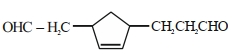
B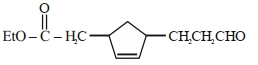
C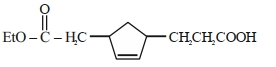
D
Solution
(A) $DiBAL-H$ (Diisobutylaluminium hydride) is a selective reducing agent that reduces esters $(-COOEt)$ and nitriles $(-CN)$ to aldehydes $(-CHO)$ at low temperatures (typically $-78 \ ^{\circ}C$).
In the given reaction,the starting material contains both an ester group $(-COOEt)$ and an aldehyde group $(-CHO)$.
$DiBAL-H$ will selectively reduce the ester group to an aldehyde group while leaving the existing aldehyde group unaffected.
Therefore,the ester group $EtO-CO-CH_2-$ is converted to $OHC-CH_2-$.
The final product is $OHC-CH_2-cyclopent-3-ene-CH_2CH_2CHO$.
In the given reaction,the starting material contains both an ester group $(-COOEt)$ and an aldehyde group $(-CHO)$.
$DiBAL-H$ will selectively reduce the ester group to an aldehyde group while leaving the existing aldehyde group unaffected.
Therefore,the ester group $EtO-CO-CH_2-$ is converted to $OHC-CH_2-$.
The final product is $OHC-CH_2-cyclopent-3-ene-CH_2CH_2CHO$.
0 likesView Solution
290
ChemistryDifficultMCQJEE Main · 2022
The correct sequential order of the reagents for the given reaction is:
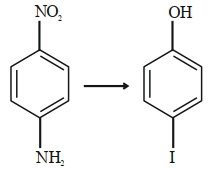
A
$HNO_2, Fe/H^{+}, HNO_2, KI, H_2O/H^{+}$
B
$HNO_2, KI, Fe/H^{+}, HNO_2, H_2O/\text{warm}$
C
$HNO_2, KI, HNO_2, Fe/H^{+}, H_2O/H^{+}$
D
$HNO_2, Fe/H^{+}, KI, HNO_2, H_2O/\text{warm}$
Solution
(B) The starting material is $p$-nitroaniline. The goal is to convert the $-NO_2$ group to $-OH$ and the $-NH_2$ group to $-I$.
$1$. First,treat $p$-nitroaniline with $HNO_2$ ($NaNO_2 + HCl$ at $0-5^{\circ}C$) to form the diazonium salt at the $-NH_2$ position.
$2$. Then,treat with $KI$ to replace the diazonium group with $-I$.
$3$. Next,reduce the $-NO_2$ group to $-NH_2$ using $Fe/H^{+}$.
$4$. Treat with $HNO_2$ again to convert the new $-NH_2$ group into a diazonium salt.
$5$. Finally,heat with $H_2O$ to convert the diazonium group into an $-OH$ group.
This corresponds to the sequence: $HNO_2, KI, Fe/H^{+}, HNO_2, H_2O/\text{warm}$.
$1$. First,treat $p$-nitroaniline with $HNO_2$ ($NaNO_2 + HCl$ at $0-5^{\circ}C$) to form the diazonium salt at the $-NH_2$ position.
$2$. Then,treat with $KI$ to replace the diazonium group with $-I$.
$3$. Next,reduce the $-NO_2$ group to $-NH_2$ using $Fe/H^{+}$.
$4$. Treat with $HNO_2$ again to convert the new $-NH_2$ group into a diazonium salt.
$5$. Finally,heat with $H_2O$ to convert the diazonium group into an $-OH$ group.
This corresponds to the sequence: $HNO_2, KI, Fe/H^{+}, HNO_2, H_2O/\text{warm}$.
0 likesView Solution
291
ChemistryEasyMCQJEE Main · 2022
Vulcanization of rubber is carried out by heating a mixture of.
A
isoprene and styrene
B
neoprene and sulphur
C
isoprene and sulphur
D
neoprene and styrene
Solution
(C) Vulcanization is a process of heating raw rubber with sulphur to improve its physical properties,such as elasticity and strength.
Natural rubber is a polymer of $isoprene$ $(2-methyl-1,3-butadiene)$.
Therefore,vulcanization of rubber is carried out by heating a mixture of $isoprene$ (or natural rubber) and $sulphur$.
Natural rubber is a polymer of $isoprene$ $(2-methyl-1,3-butadiene)$.
Therefore,vulcanization of rubber is carried out by heating a mixture of $isoprene$ (or natural rubber) and $sulphur$.
0 likesView Solution
292
ChemistryEasyMCQJEE Main · 2022
Animal starch is the other name of.
A
amylose
B
maltose
C
glycogen
D
amylopectin
Solution
(C) Glycogen is a polysaccharide of glucose that serves as a form of energy storage in animals,fungi,and bacteria. Because its structure is similar to amylopectin (a component of starch) but more highly branched,it is commonly referred to as $ \text{animal starch} $.
0 likesView Solution
293
ChemistryMediumMCQJEE Main · 2022
The elevation in boiling point for $1 \ m$ solution of non-volatile solute $A$ is $3 \ K$. The depression in freezing point for $2 \ m$ solution of $A$ in the same solvent is $6 \ K$. The ratio of $K_{b}$ and $K_{f}$ i.e.,$K_{b} / K_{f}$ is $1 : X$. The value of $X$ is [nearest integer].
A
$0$
B
$1$
C
$2$
D
$3$
Solution
(B) For elevation in boiling point: $\Delta T_{b} = K_{b} \times m_{1} = 3 \ K$ where $m_{1} = 1 \ m$. So,$K_{b} = 3 \ K \ kg \ mol^{-1}$.
For depression in freezing point: $\Delta T_{f} = K_{f} \times m_{2} = 6 \ K$ where $m_{2} = 2 \ m$. So,$K_{f} = 6 / 2 = 3 \ K \ kg \ mol^{-1}$.
The ratio $K_{b} / K_{f} = 3 / 3 = 1 / 1$.
Comparing this with $1 : X$,we get $X = 1$.
For depression in freezing point: $\Delta T_{f} = K_{f} \times m_{2} = 6 \ K$ where $m_{2} = 2 \ m$. So,$K_{f} = 6 / 2 = 3 \ K \ kg \ mol^{-1}$.
The ratio $K_{b} / K_{f} = 3 / 3 = 1 / 1$.
Comparing this with $1 : X$,we get $X = 1$.
0 likesView Solution
294
ChemistryMediumMCQJEE Main · 2022
$20 \, mL$ of $0.02 \, M$ hypo solution is used for the titration of $10 \, mL$ of copper sulphate solution,in the presence of excess of $KI$ using starch as an indicator. The molarity of $Cu^{2+}$ is found to be $\times 10^{-2} \, M$ [nearest integer]. Given: $2 Cu^{2+} + 4 I^{-} \rightarrow Cu_{2}I_{2} + I_{2}$ and $I_{2} + 2 S_{2}O_{3}^{2-} \rightarrow 2 I^{-} + S_{4}O_{6}^{2-}$.
A
$3$
B
$4$
C
$5$
D
$6$
Solution
(B) From the stoichiometry of the reactions:
$2 Cu^{2+} \equiv I_{2} \equiv 2 S_{2}O_{3}^{2-}$.
Therefore,$n_{\text{eq.}}$ of $Cu^{2+} = n_{\text{eq.}}$ of $S_{2}O_{3}^{2-}$.
$n_{\text{eq.}}$ of $S_{2}O_{3}^{2-} = M \times V \times n_{\text{factor}} = 0.02 \times 20 \times 1 = 0.4 \, \text{mmol}$.
Since $n_{\text{eq.}}$ of $Cu^{2+} = 0.4 \, \text{mmol}$ and $n_{\text{factor}}$ for $Cu^{2+}$ is $1$ (change in oxidation state from $+2$ to $+1$ in $Cu_{2}I_{2}$),we have $n_{\text{mol}}$ of $Cu^{2+} = 0.4 \, \text{mmol}$.
$[Cu^{2+}] = \frac{n_{\text{mol}}}{V_{\text{solution}}} = \frac{0.4 \, \text{mmol}}{10 \, mL} = 0.04 \, M = 4 \times 10^{-2} \, M$.
Thus,the value is $4$.
$2 Cu^{2+} \equiv I_{2} \equiv 2 S_{2}O_{3}^{2-}$.
Therefore,$n_{\text{eq.}}$ of $Cu^{2+} = n_{\text{eq.}}$ of $S_{2}O_{3}^{2-}$.
$n_{\text{eq.}}$ of $S_{2}O_{3}^{2-} = M \times V \times n_{\text{factor}} = 0.02 \times 20 \times 1 = 0.4 \, \text{mmol}$.
Since $n_{\text{eq.}}$ of $Cu^{2+} = 0.4 \, \text{mmol}$ and $n_{\text{factor}}$ for $Cu^{2+}$ is $1$ (change in oxidation state from $+2$ to $+1$ in $Cu_{2}I_{2}$),we have $n_{\text{mol}}$ of $Cu^{2+} = 0.4 \, \text{mmol}$.
$[Cu^{2+}] = \frac{n_{\text{mol}}}{V_{\text{solution}}} = \frac{0.4 \, \text{mmol}}{10 \, mL} = 0.04 \, M = 4 \times 10^{-2} \, M$.
Thus,the value is $4$.
0 likesView Solution
295
ChemistryMediumMCQJEE Main · 2022
The spin-only magnetic moment value of the compound with the strongest oxidizing ability among $MnF_{4}$,$MnF_{3}$,and $MnF_{2}$ is $............$ $B.M.$ [nearest integer]
A
$4$
B
$3$
C
$2$
D
$5$
Solution
(D) The oxidation states of $Mn$ in $MnF_{4}$,$MnF_{3}$,and $MnF_{2}$ are $+4$,$+3$,and $+2$ respectively.
The electronic configurations are:
$MnF_{4} (Mn^{4+}) = [Ar] 3d^{3}$
$MnF_{3} (Mn^{3+}) = [Ar] 3d^{4}$
$MnF_{2} (Mn^{2+}) = [Ar] 3d^{5}$
Among these,$Mn^{3+}$ is the strongest oxidizing agent because it can easily gain an electron to form the stable $d^{5}$ configuration $(Mn^{2+})$.
For $Mn^{3+}$ $(3d^{4})$,the number of unpaired electrons $(n)$ is $4$.
The spin-only magnetic moment is given by $\mu = \sqrt{n(n+2)} \ B.M.$
$\mu = \sqrt{4(4+2)} = \sqrt{24} \approx 4.89 \ B.M.$
The nearest integer value is $5$.
The electronic configurations are:
$MnF_{4} (Mn^{4+}) = [Ar] 3d^{3}$
$MnF_{3} (Mn^{3+}) = [Ar] 3d^{4}$
$MnF_{2} (Mn^{2+}) = [Ar] 3d^{5}$
Among these,$Mn^{3+}$ is the strongest oxidizing agent because it can easily gain an electron to form the stable $d^{5}$ configuration $(Mn^{2+})$.
For $Mn^{3+}$ $(3d^{4})$,the number of unpaired electrons $(n)$ is $4$.
The spin-only magnetic moment is given by $\mu = \sqrt{n(n+2)} \ B.M.$
$\mu = \sqrt{4(4+2)} = \sqrt{24} \approx 4.89 \ B.M.$
The nearest integer value is $5$.
0 likesView Solution
296
ChemistryEasyMCQJEE Main · 2022
How many of the following drugs is/are example$(s)$ of broad spectrum antibiotic? Ofloxacin,Penicillin $G$,Terpineol,Salvarsan
A
$5$
B
$6$
C
$1$
D
$0$
Solution
(C) Broad spectrum antibiotics are those that are effective against a wide range of Gram-positive and Gram-negative bacteria.
$Ofloxacin$ is a well-known broad spectrum antibiotic.
$Penicillin \ G$ is a narrow spectrum antibiotic.
$Terpineol$ is an antiseptic.
$Salvarsan$ is an antibacterial agent used for syphilis,but it is not classified as a broad spectrum antibiotic.
Therefore,only $1$ drug $(Ofloxacin)$ is a broad spectrum antibiotic.
$Ofloxacin$ is a well-known broad spectrum antibiotic.
$Penicillin \ G$ is a narrow spectrum antibiotic.
$Terpineol$ is an antiseptic.
$Salvarsan$ is an antibacterial agent used for syphilis,but it is not classified as a broad spectrum antibiotic.
Therefore,only $1$ drug $(Ofloxacin)$ is a broad spectrum antibiotic.
0 likesView Solution
297
ChemistryDifficultMCQJEE Main · 2022
Match List-$I$ with List-$II$.
Choose the correct answer from the options given below.
| List-$I$ (Processes/Reactions) | List-$II$ (Catalyst) |
|---|---|
| $A. 2 SO_{2(g)} + O_{2(g)} \rightarrow 2 SO_{3(g)}$ | $I. V_{2}O_{5}$ |
| $B. 4 NH_{3(g)} + 5 O_{2(g)} \rightarrow 4 NO_{(g)} + 6 H_{2}O_{(g)}$ | $II. Pt_{(s)}-Rh_{(s)}$ |
| $C. N_{2(g)} + 3 H_{2(g)} \rightarrow 2 NH_{3(g)}$ | $III. Fe_{(s)}$ |
| $D. \text{Vegetable oil}(l) + H_{2} \rightarrow \text{Vegetable ghee}(s)$ | $IV. Ni_{(s)}$ |
Choose the correct answer from the options given below.
A
$A-I, B-II, C-III, D-IV$
B
$A-III, B-II, C-I, D-IV$
C
$A-IV, B-III, C-I, D-II$
D
$A-IV, B-II, C-III, D-I$
Solution
(A) $2 SO_{2(g)} + O_{2(g)} \xrightarrow{V_{2}O_{5}} 2 SO_{3(g)}$: Contact process uses $V_{2}O_{5}$ as a catalyst.
$4 NH_{3(g)} + 5 O_{2(g)} \xrightarrow{Pt_{(s)}-Rh_{(s)}} 4 NO_{(g)} + 6 H_{2}O_{(g)}$: Ostwald's process uses $Pt_{(s)}-Rh_{(s)}$ as a catalyst.
$N_{2(g)} + 3 H_{2(g)} \xrightarrow{Fe_{(s)}} 2 NH_{3(g)}$: Haber's process uses $Fe_{(s)}$ as a catalyst.
$\text{Vegetable oil}(l) + H_{2(g)} \xrightarrow{Ni_{(s)}} \text{Vegetable ghee}(s)$: Hydrogenation uses $Ni_{(s)}$ as a catalyst.
Therefore,the correct matching is $A-I, B-II, C-III, D-IV$.
$4 NH_{3(g)} + 5 O_{2(g)} \xrightarrow{Pt_{(s)}-Rh_{(s)}} 4 NO_{(g)} + 6 H_{2}O_{(g)}$: Ostwald's process uses $Pt_{(s)}-Rh_{(s)}$ as a catalyst.
$N_{2(g)} + 3 H_{2(g)} \xrightarrow{Fe_{(s)}} 2 NH_{3(g)}$: Haber's process uses $Fe_{(s)}$ as a catalyst.
$\text{Vegetable oil}(l) + H_{2(g)} \xrightarrow{Ni_{(s)}} \text{Vegetable ghee}(s)$: Hydrogenation uses $Ni_{(s)}$ as a catalyst.
Therefore,the correct matching is $A-I, B-II, C-III, D-IV$.
0 likesView Solution
298
ChemistryMediumMCQJEE Main · 2022
Refining using the liquation method is the most suitable for metals with:
A
Low melting point
B
High boiling point
C
High electrical conductivity
D
Less tendency to be soluble in melts than impurities
Solution
(A) Liquation is a process used for the purification of metals that have a lower melting point than the impurities present in them.
In this method,the crude metal is placed on the sloping hearth of a furnace and heated.
The metal melts and flows down,leaving the infusible impurities behind.
In this method,the crude metal is placed on the sloping hearth of a furnace and heated.
The metal melts and flows down,leaving the infusible impurities behind.
0 likesView Solution
299
ChemistryMediumMCQJEE Main · 2022
The difference in the reaction of phenol with bromine in chloroform $(CHCl_3)$ and bromine in water medium is due to:
A
Hyperconjugation in substrate
B
Polarity of solvent
C
Free radical formation
D
Electromeric effect of the substrate
Solution
(B) The difference in the reaction products is observed due to the polarity of the solvent:
$(i)$ In a polar solvent like water,phenol ionizes to form the phenoxide ion $(C_6H_5O^-)$,which is much more reactive towards electrophilic aromatic substitution than phenol itself,leading to polybromination ($2$,$4$,$6$-tribromophenol).
$(ii)$ In a non-polar solvent like chloroform $(CHCl_3)$,phenol does not ionize significantly,and the reaction proceeds to form monobrominated products (o-bromophenol and p-bromophenol).
$(i)$ In a polar solvent like water,phenol ionizes to form the phenoxide ion $(C_6H_5O^-)$,which is much more reactive towards electrophilic aromatic substitution than phenol itself,leading to polybromination ($2$,$4$,$6$-tribromophenol).
$(ii)$ In a non-polar solvent like chloroform $(CHCl_3)$,phenol does not ionize significantly,and the reaction proceeds to form monobrominated products (o-bromophenol and p-bromophenol).
0 likesView Solution
300
ChemistryDifficultMCQJEE Main · 2022
The products formed in the following reaction,$A$ and $B$ are
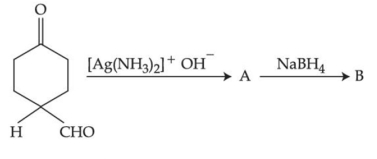
A
$A$ = $4-$oxocyclohexanecarboxylic acid,$B$ = $4-$hydroxycyclohexanecarboxylic acid
B
$A$ = $4-$hydroxycyclohexanecarboxylic acid,$B$ = $4-$hydroxycyclohexanecarboxylic acid
C
$A$ = $4-$oxocyclohexanecarboxylic acid,$B$ = $4-$oxocyclohexanecarboxylic acid
D
$A$ = $4-$oxocyclohexanecarboxylic acid,$B$ = $4-$hydroxycyclohexanecarboxylic acid
Solution
(D) The starting material is $4$-oxocyclohexanecarbaldehyde.
Step $1$: Treatment with Tollens' reagent $[Ag(NH_3)_2]^+ OH^-$ selectively oxidizes the aldehyde group to a carboxylic acid group while leaving the ketone group unaffected. Thus,$A$ is $4$-oxocyclohexanecarboxylic acid.
Step $2$: Treatment with $NaBH_4$ reduces the ketone group to a secondary alcohol but does not reduce the carboxylic acid group. Thus,$B$ is $4$-hydroxycyclohexanecarboxylic acid.
Step $1$: Treatment with Tollens' reagent $[Ag(NH_3)_2]^+ OH^-$ selectively oxidizes the aldehyde group to a carboxylic acid group while leaving the ketone group unaffected. Thus,$A$ is $4$-oxocyclohexanecarboxylic acid.
Step $2$: Treatment with $NaBH_4$ reduces the ketone group to a secondary alcohol but does not reduce the carboxylic acid group. Thus,$B$ is $4$-hydroxycyclohexanecarboxylic acid.
0 likesView Solution
Vedclass Products
For Students
Vedclass Test Series
Mock tests in real JEE Main style covering Chemistry with performance analysis. 5-day free trial.
Start Free TrialFor Teachers
Exam Paper Generator
Generate Set A/B/C/D Chemistry papers from 7.5L+ questions in 2 minutes. 3 chapters free.
Try FreeFor Institutes
Online Exam Module
Run live JEE Main mock exams with unlimited students, 360° analytics & white-label branding.
See DemoFrequently Asked Questions
How many Chemistry questions are in JEE Main 2022?
There are 666 Chemistry questions from the JEE Main 2022 paper on Vedclass, each with a detailed step-by-step solution in English.
Are JEE Main 2022 Chemistry solutions available in English?
Yes. All solutions on this page are in English. You can also switch to English or Hindi using the language buttons above the questions.
Can I practice JEE Main 2022 Chemistry as a timed test?
Yes. Use the Vedclass Test Series to attempt a full JEE Main mock test covering Chemistry with time limits and instant score analysis.
Can teachers create Chemistry papers from JEE Main previous year questions?
Yes. The Vedclass Exam Paper Generator lets teachers mix JEE Main Chemistry questions and generate Set A/B/C/D papers in minutes.
For Teachers & Institutes
Build a Custom Chemistry Paper
Pick JEE Main 2022 Chemistry questions, set difficulty, and generate Set A/B/C/D in 2 minutes.