
PhysicsQ1–100 of 660 questions
Page 1 of 8 · English
1
PhysicsEasyMCQJEE Main · 2022
If the degree of freedom of a gas is $f,$ then the ratio of two specific heats ${C_P}/{C_V}$ is given by
A
$1 + \frac{2}{f}$
B
$1 - \frac{2}{f}$
C
$1 + \frac{1}{f}$
D
$1 - \frac{1}{f}$
Solution
(A) The ratio of specific heats is defined as $\gamma = \frac{C_P}{C_V}$.
According to the kinetic theory of gases,the molar specific heat at constant volume is $C_V = \frac{f}{2}R$.
The molar specific heat at constant pressure is $C_P = C_V + R = \frac{f}{2}R + R = R(1 + \frac{f}{2})$.
Therefore,the ratio $\gamma = \frac{C_P}{C_V} = \frac{R(1 + f/2)}{(f/2)R} = \frac{1 + f/2}{f/2} = \frac{2}{f} + 1 = 1 + \frac{2}{f}$.
According to the kinetic theory of gases,the molar specific heat at constant volume is $C_V = \frac{f}{2}R$.
The molar specific heat at constant pressure is $C_P = C_V + R = \frac{f}{2}R + R = R(1 + \frac{f}{2})$.
Therefore,the ratio $\gamma = \frac{C_P}{C_V} = \frac{R(1 + f/2)}{(f/2)R} = \frac{1 + f/2}{f/2} = \frac{2}{f} + 1 = 1 + \frac{2}{f}$.
0 likesView Solution
2
PhysicsMediumMCQJEE Main · 2022
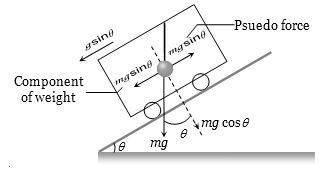
The period of oscillation of a simple pendulum of length $L$ suspended from the roof of a vehicle which moves without friction down an inclined plane of inclination $\alpha$,is given by
A
$2\pi \sqrt {\frac{L}{{g\cos \alpha }}} $
B
$2\pi \sqrt {\frac{L}{{g\sin \alpha }}} $
C
$2\pi \sqrt {\frac{L}{g}} $
D
$2\pi \sqrt {\frac{L}{{g\tan \alpha }}} $
Solution
(A) The vehicle moves down a frictionless inclined plane with an acceleration $a = g\sin \alpha$.
In the frame of the vehicle,a pseudo force $F_p = ma = mg\sin \alpha$ acts on the bob of the pendulum in the upward direction along the incline.
The effective acceleration $g_{eff}$ is the vector sum of the acceleration due to gravity $\vec{g}$ and the negative of the vehicle's acceleration $-\vec{a}$.
Resolving the components,the component of $g$ perpendicular to the incline is $g\cos \alpha$ and the component of $g$ parallel to the incline is $g\sin \alpha$. The pseudo force cancels the component $g\sin \alpha$.
Thus,the effective acceleration is $g_{eff} = g\cos \alpha$.
The time period of the simple pendulum is given by $T = 2\pi \sqrt{\frac{L}{g_{eff}}} = 2\pi \sqrt{\frac{L}{g\cos \alpha}}$.
In the frame of the vehicle,a pseudo force $F_p = ma = mg\sin \alpha$ acts on the bob of the pendulum in the upward direction along the incline.
The effective acceleration $g_{eff}$ is the vector sum of the acceleration due to gravity $\vec{g}$ and the negative of the vehicle's acceleration $-\vec{a}$.
Resolving the components,the component of $g$ perpendicular to the incline is $g\cos \alpha$ and the component of $g$ parallel to the incline is $g\sin \alpha$. The pseudo force cancels the component $g\sin \alpha$.
Thus,the effective acceleration is $g_{eff} = g\cos \alpha$.
The time period of the simple pendulum is given by $T = 2\pi \sqrt{\frac{L}{g_{eff}}} = 2\pi \sqrt{\frac{L}{g\cos \alpha}}$.
0 likesView Solution
3
PhysicsMediumMCQJEE Main · 2022
Two cars $P$ and $Q$ start from a point at the same time in a straight line and their positions are represented by $x_P(t) = at + bt^2$ and $x_Q(t) = ft - t^2$. At what time do the cars have the same velocity?
A
$\frac{a + f}{2(1 + b)}$
B
$\frac{f - a}{2(1 + b)}$
C
$\frac{a + f}{1 + b}$
D
$\frac{a + f}{2(b - 1)}$
Solution
(B) The position of car $P$ at any time $t$ is given by $x_P(t) = at + bt^2$.
The velocity of car $P$ is $v_P(t) = \frac{dx_P(t)}{dt} = a + 2bt$ ... $(i)$.
Similarly,for car $Q$,the position is $x_Q(t) = ft - t^2$.
The velocity of car $Q$ is $v_Q(t) = \frac{dx_Q(t)}{dt} = f - 2t$ ... $(ii)$.
Given that the cars have the same velocity,$v_P(t) = v_Q(t)$.
Therefore,$a + 2bt = f - 2t$.
Rearranging the terms to solve for $t$: $2bt + 2t = f - a$.
$2t(b + 1) = f - a$.
Thus,$t = \frac{f - a}{2(1 + b)}$.
The velocity of car $P$ is $v_P(t) = \frac{dx_P(t)}{dt} = a + 2bt$ ... $(i)$.
Similarly,for car $Q$,the position is $x_Q(t) = ft - t^2$.
The velocity of car $Q$ is $v_Q(t) = \frac{dx_Q(t)}{dt} = f - 2t$ ... $(ii)$.
Given that the cars have the same velocity,$v_P(t) = v_Q(t)$.
Therefore,$a + 2bt = f - 2t$.
Rearranging the terms to solve for $t$: $2bt + 2t = f - a$.
$2t(b + 1) = f - a$.
Thus,$t = \frac{f - a}{2(1 + b)}$.
0 likesView Solution
4
PhysicsMediumMCQJEE Main · 2022
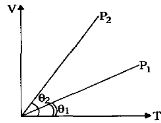
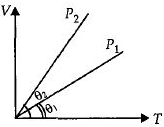
In the given $(V - T)$ diagram,what is the relation between pressures $P_1$ and $P_2 \,?$
A
$P_2 = P_1$
B
$P_2 > P_1$
C
$P_2 < P_1$
D
Cannot be predicted
Solution
(C) According to the ideal gas equation,
$PV = nRT$
Rearranging for $V$ in terms of $T$:
$V = \left( \frac{nR}{P} \right) T$
This represents a straight line passing through the origin,where the slope $m$ is given by:
$m = \frac{V}{T} = \frac{nR}{P}$
Since $n$ and $R$ are constants,the slope is inversely proportional to the pressure $P$ $(m \propto \frac{1}{P})$.
From the given figure,the angle $\theta_2 > \theta_1$,which implies that the slope of the line for $P_2$ is greater than the slope of the line for $P_1$:
$(\text{Slope})_2 > (\text{Slope})_1$
Since slope is inversely proportional to pressure,a higher slope corresponds to a lower pressure:
$P_2 < P_1$
$PV = nRT$
Rearranging for $V$ in terms of $T$:
$V = \left( \frac{nR}{P} \right) T$
This represents a straight line passing through the origin,where the slope $m$ is given by:
$m = \frac{V}{T} = \frac{nR}{P}$
Since $n$ and $R$ are constants,the slope is inversely proportional to the pressure $P$ $(m \propto \frac{1}{P})$.
From the given figure,the angle $\theta_2 > \theta_1$,which implies that the slope of the line for $P_2$ is greater than the slope of the line for $P_1$:
$(\text{Slope})_2 > (\text{Slope})_1$
Since slope is inversely proportional to pressure,a higher slope corresponds to a lower pressure:
$P_2 < P_1$
0 likesView Solution
5
PhysicsMediumMCQJEE Main · 2022
The efficiency of an ideal heat engine working between the freezing point and boiling point of water is ........ $\%$
A
$26.8$
B
$20$
C
$12.5$
D
$6.25$
Solution
(A) The efficiency of an ideal (Carnot) heat engine is given by the formula: $\eta = 1 - \frac{T_2}{T_1}$.
Here,$T_1$ is the temperature of the source (boiling point of water) and $T_2$ is the temperature of the sink (freezing point of water).
Freezing point of water,$T_2 = 0^{\circ}C = 273\,K$.
Boiling point of water,$T_1 = 100^{\circ}C = (100 + 273)\,K = 373\,K$.
Substituting these values into the efficiency formula:
$\eta = 1 - \frac{273}{373} = \frac{373 - 273}{373} = \frac{100}{373}$.
To express this as a percentage:
$\% \eta = \left( \frac{100}{373} \right) \times 100 \approx 26.8\%$.
Here,$T_1$ is the temperature of the source (boiling point of water) and $T_2$ is the temperature of the sink (freezing point of water).
Freezing point of water,$T_2 = 0^{\circ}C = 273\,K$.
Boiling point of water,$T_1 = 100^{\circ}C = (100 + 273)\,K = 373\,K$.
Substituting these values into the efficiency formula:
$\eta = 1 - \frac{273}{373} = \frac{373 - 273}{373} = \frac{100}{373}$.
To express this as a percentage:
$\% \eta = \left( \frac{100}{373} \right) \times 100 \approx 26.8\%$.
0 likesView Solution
6
PhysicsMediumMCQJEE Main · 2022
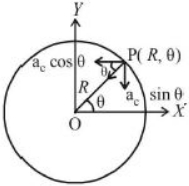
For a particle in uniform circular motion,the acceleration $\vec{a}$ at a point $P(R, \theta)$ on the circle of radius $R$ is (Here $\theta$ is measured from the $x$-axis):
A
$\frac{V^2}{R}\hat{i} + \frac{V^2}{R}\hat{j}$
B
$-\frac{V^2}{R}\cos\theta\hat{i} + \frac{V^2}{R}\sin\theta\hat{j}$
C
$-\frac{V^2}{R}\sin\theta\hat{i} + \frac{V^2}{R}\cos\theta\hat{j}$
D
$-\frac{V^2}{R}\cos\theta\hat{i} - \frac{V^2}{R}\sin\theta\hat{j}$
Solution
(D) In uniform circular motion,the acceleration is the centripetal acceleration $\vec{a}_c$,which is always directed towards the center of the circle.
For a point $P$ at an angle $\theta$ with the $x$-axis,the position vector makes an angle $\theta$ with the $x$-axis.
The centripetal acceleration vector $\vec{a}_c$ points from $P$ towards the origin $O$.
The magnitude of centripetal acceleration is $a_c = \frac{V^2}{R}$.
Resolving this vector into components:
The $x$-component is $a_x = -a_c \cos\theta = -\frac{V^2}{R} \cos\theta$.
The $y$-component is $a_y = -a_c \sin\theta = -\frac{V^2}{R} \sin\theta$.
Thus,the acceleration vector is $\vec{a} = -\frac{V^2}{R} \cos\theta \hat{i} - \frac{V^2}{R} \sin\theta \hat{j}$.
For a point $P$ at an angle $\theta$ with the $x$-axis,the position vector makes an angle $\theta$ with the $x$-axis.
The centripetal acceleration vector $\vec{a}_c$ points from $P$ towards the origin $O$.
The magnitude of centripetal acceleration is $a_c = \frac{V^2}{R}$.
Resolving this vector into components:
The $x$-component is $a_x = -a_c \cos\theta = -\frac{V^2}{R} \cos\theta$.
The $y$-component is $a_y = -a_c \sin\theta = -\frac{V^2}{R} \sin\theta$.
Thus,the acceleration vector is $\vec{a} = -\frac{V^2}{R} \cos\theta \hat{i} - \frac{V^2}{R} \sin\theta \hat{j}$.
0 likesView Solution
7
PhysicsMediumMCQJEE Main · 2022
The variation of acceleration due to gravity $g$ with distance $d$ from the centre of the earth is best represented by ($R =$ Earth's radius)
A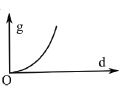
B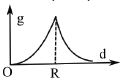
C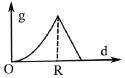
D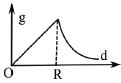
Solution
(D) The variation of acceleration due to gravity $g$ with distance $d$ from the center of the earth is given by:
$1$. Inside the earth $(d < R)$:
$g = \frac{GM}{R^3} d$
Since $G, M,$ and $R$ are constants,$g \propto d$. This represents a straight line passing through the origin.
$2$. At the surface of the earth $(d = R)$:
$g = \frac{GM}{R^2} = g_s$ (maximum value).
$3$. Outside the earth $(d > R)$:
$g = \frac{GM}{d^2}$
Here,$g \propto \frac{1}{d^2}$. This represents a rectangular hyperbola.
Combining these,the graph shows a linear increase from the center to the surface,followed by a hyperbolic decrease as distance increases beyond the surface. This matches the graph in option $D$.
$1$. Inside the earth $(d < R)$:
$g = \frac{GM}{R^3} d$
Since $G, M,$ and $R$ are constants,$g \propto d$. This represents a straight line passing through the origin.
$2$. At the surface of the earth $(d = R)$:
$g = \frac{GM}{R^2} = g_s$ (maximum value).
$3$. Outside the earth $(d > R)$:
$g = \frac{GM}{d^2}$
Here,$g \propto \frac{1}{d^2}$. This represents a rectangular hyperbola.
Combining these,the graph shows a linear increase from the center to the surface,followed by a hyperbolic decrease as distance increases beyond the surface. This matches the graph in option $D$.
0 likesView Solution
8
PhysicsMediumMCQJEE Main · 2022
If a sphere is rolling,the ratio of its rotational energy to the total kinetic energy is given by
A
$7 : 2$
B
$2 : 9$
C
$2 : 5$
D
$2 : 7$
Solution
(D) The total kinetic energy $(K_{total})$ of a rolling sphere is the sum of its linear kinetic energy $(K_{linear})$ and rotational kinetic energy $(K_{rotational})$.
$K_{total} = K_{linear} + K_{rotational} = \frac{1}{2}mv^2 + \frac{1}{2}I\omega^2$
For a solid sphere,the moment of inertia is $I = \frac{2}{5}mr^2$ and the angular velocity is $\omega = \frac{v}{r}$.
Substituting these values into the rotational kinetic energy expression:
$K_{rotational} = \frac{1}{2} \left(\frac{2}{5}mr^2\right) \left(\frac{v}{r}\right)^2 = \frac{1}{5}mv^2$.
Now,calculating the total kinetic energy:
$K_{total} = \frac{1}{2}mv^2 + \frac{1}{5}mv^2 = \left(\frac{5+2}{10}\right)mv^2 = \frac{7}{10}mv^2$.
The ratio of rotational kinetic energy to total kinetic energy is:
$\frac{K_{rotational}}{K_{total}} = \frac{\frac{1}{5}mv^2}{\frac{7}{10}mv^2} = \frac{1}{5} \times \frac{10}{7} = \frac{2}{7}$.
Thus,the ratio is $2:7$.
$K_{total} = K_{linear} + K_{rotational} = \frac{1}{2}mv^2 + \frac{1}{2}I\omega^2$
For a solid sphere,the moment of inertia is $I = \frac{2}{5}mr^2$ and the angular velocity is $\omega = \frac{v}{r}$.
Substituting these values into the rotational kinetic energy expression:
$K_{rotational} = \frac{1}{2} \left(\frac{2}{5}mr^2\right) \left(\frac{v}{r}\right)^2 = \frac{1}{5}mv^2$.
Now,calculating the total kinetic energy:
$K_{total} = \frac{1}{2}mv^2 + \frac{1}{5}mv^2 = \left(\frac{5+2}{10}\right)mv^2 = \frac{7}{10}mv^2$.
The ratio of rotational kinetic energy to total kinetic energy is:
$\frac{K_{rotational}}{K_{total}} = \frac{\frac{1}{5}mv^2}{\frac{7}{10}mv^2} = \frac{1}{5} \times \frac{10}{7} = \frac{2}{7}$.
Thus,the ratio is $2:7$.
0 likesView Solution
9
PhysicsMediumMCQJEE Main · 2022
Identify the pair of physical quantities that have the same dimensions.
A
velocity gradient and decay constant
B
Wien's constant and Stefan constant
C
angular frequency and angular momentum
D
wave number and Avogadro number
Solution
(A) The dimension of velocity gradient is $[T^{-1}]$.
The decay constant $\lambda$ is defined by the relation $N = N_0 e^{-\lambda t}$,which implies that $\lambda t$ is dimensionless. Thus,the dimension of the decay constant is $[T^{-1}]$.
Since both velocity gradient and decay constant have the same dimensions $[T^{-1}]$,option $A$ is correct.
The decay constant $\lambda$ is defined by the relation $N = N_0 e^{-\lambda t}$,which implies that $\lambda t$ is dimensionless. Thus,the dimension of the decay constant is $[T^{-1}]$.
Since both velocity gradient and decay constant have the same dimensions $[T^{-1}]$,option $A$ is correct.
0 likesView Solution
10
PhysicsMediumMCQJEE Main · 2022
The distance between the Sun and the Earth is $R$. What will be the duration of the year if the distance between the Sun and the Earth becomes $3R$?
A
$\sqrt{3} \text{ years}$
B
$3 \text{ years}$
C
$9 \text{ years}$
D
$3\sqrt{3} \text{ years}$
Solution
(D) According to Kepler's third law of planetary motion,the square of the orbital period $T$ is directly proportional to the cube of the semi-major axis $R$ of its orbit: $T^2 \propto R^3$.
Given the initial distance is $R$ and the initial period $T = 1 \text{ year}$.
When the new distance $R' = 3R$,the new period $T'$ is given by the ratio:
$\frac{T'}{T} = \left(\frac{R'}{R}\right)^{3/2}$.
Substituting the values:
$\frac{T'}{1} = \left(\frac{3R}{R}\right)^{3/2} = (3)^{3/2}$.
$T' = 3^{1} \cdot 3^{1/2} = 3\sqrt{3} \text{ years}$.
Given the initial distance is $R$ and the initial period $T = 1 \text{ year}$.
When the new distance $R' = 3R$,the new period $T'$ is given by the ratio:
$\frac{T'}{T} = \left(\frac{R'}{R}\right)^{3/2}$.
Substituting the values:
$\frac{T'}{1} = \left(\frac{3R}{R}\right)^{3/2} = (3)^{3/2}$.
$T' = 3^{1} \cdot 3^{1/2} = 3\sqrt{3} \text{ years}$.
0 likesView Solution
11
PhysicsMediumMCQJEE Main · 2022
$A$ stone of mass $m$,tied to a string,is being whirled in a vertical circle with a uniform speed. The tension in the string is
A
the same throughout the motion
B
minimum at the highest position of the circular path
C
minimum at the lowest position of the circular path
D
minimum when the rope is in the horizontal position
Solution
(B) In a vertical circular motion with uniform speed $v$,the net centripetal force is provided by the tension $T$ and the component of gravity $mg \cos \theta$,where $\theta$ is the angle with the vertical.
At the highest point,the tension $T_{top}$ is given by $T_{top} + mg = \frac{mv^2}{r}$,so $T_{top} = \frac{mv^2}{r} - mg$.
At the lowest point,the tension $T_{bottom}$ is given by $T_{bottom} - mg = \frac{mv^2}{r}$,so $T_{bottom} = \frac{mv^2}{r} + mg$.
Since $T_{top} < T_{bottom}$,the tension is minimum at the highest position of the circular path.
At the highest point,the tension $T_{top}$ is given by $T_{top} + mg = \frac{mv^2}{r}$,so $T_{top} = \frac{mv^2}{r} - mg$.
At the lowest point,the tension $T_{bottom}$ is given by $T_{bottom} - mg = \frac{mv^2}{r}$,so $T_{bottom} = \frac{mv^2}{r} + mg$.
Since $T_{top} < T_{bottom}$,the tension is minimum at the highest position of the circular path.
0 likesView Solution
12
PhysicsMediumMCQJEE Main · 2022
$A$ Carnot engine takes $5000 \, kcal$ of heat from a reservoir at $727 \, ^{\circ}C$ and gives heat to a sink at $127 \, ^{\circ}C$. The work done by the engine is $.......... \times 10^{6} \, J$.
A
$3$
B
$0$
C
$12.6$
D
$8.4$
Solution
(C) The efficiency of a Carnot engine is given by $\eta = 1 - \frac{T_L}{T_H}$.
Given: $Q_H = 5000 \, kcal$,$T_H = 727 + 273 = 1000 \, K$,$T_L = 127 + 273 = 400 \, K$.
Efficiency $\eta = 1 - \frac{400}{1000} = 1 - 0.4 = 0.6$.
Work done $W = \eta \times Q_H = 0.6 \times 5000 \, kcal = 3000 \, kcal$.
Since $1 \, kcal = 4184 \, J$,then $W = 3000 \times 4184 \, J = 12,552,000 \, J$.
Rounding to the nearest value,$W \approx 12.6 \times 10^{6} \, J$.
Given: $Q_H = 5000 \, kcal$,$T_H = 727 + 273 = 1000 \, K$,$T_L = 127 + 273 = 400 \, K$.
Efficiency $\eta = 1 - \frac{400}{1000} = 1 - 0.4 = 0.6$.
Work done $W = \eta \times Q_H = 0.6 \times 5000 \, kcal = 3000 \, kcal$.
Since $1 \, kcal = 4184 \, J$,then $W = 3000 \times 4184 \, J = 12,552,000 \, J$.
Rounding to the nearest value,$W \approx 12.6 \times 10^{6} \, J$.
1 likesView Solution
13
PhysicsMediumMCQJEE Main · 2022
Two massless springs with spring constants $2k$ and $9k$ carry $50\,g$ and $100\,g$ masses at their free ends. These two masses oscillate vertically such that their maximum velocities are equal. Then,the ratio of their respective amplitudes will be
A
$1: 2$
B
$3: 2$
C
$3: 1$
D
$2: 3$
Solution
(B) The maximum velocity of a simple harmonic oscillator is given by $V_{\max} = \omega A$,where $\omega = \sqrt{\frac{k}{m}}$ is the angular frequency and $A$ is the amplitude.
Given $V_{\max,1} = V_{\max,2}$,we have $\omega_1 A_1 = \omega_2 A_2$,which implies $\frac{A_1}{A_2} = \frac{\omega_2}{\omega_1}$.
Substituting $\omega = \sqrt{\frac{k}{m}}$,we get $\frac{A_1}{A_2} = \sqrt{\frac{k_2}{m_2}} \times \sqrt{\frac{m_1}{k_1}} = \sqrt{\frac{k_2}{k_1} \times \frac{m_1}{m_2}}$.
Given $k_1 = 2k$,$k_2 = 9k$,$m_1 = 50\,g$,and $m_2 = 100\,g$.
Thus,$\frac{A_1}{A_2} = \sqrt{\frac{9k}{2k} \times \frac{50}{100}} = \sqrt{\frac{9}{2} \times \frac{1}{2}} = \sqrt{\frac{9}{4}} = \frac{3}{2}$.
Given $V_{\max,1} = V_{\max,2}$,we have $\omega_1 A_1 = \omega_2 A_2$,which implies $\frac{A_1}{A_2} = \frac{\omega_2}{\omega_1}$.
Substituting $\omega = \sqrt{\frac{k}{m}}$,we get $\frac{A_1}{A_2} = \sqrt{\frac{k_2}{m_2}} \times \sqrt{\frac{m_1}{k_1}} = \sqrt{\frac{k_2}{k_1} \times \frac{m_1}{m_2}}$.
Given $k_1 = 2k$,$k_2 = 9k$,$m_1 = 50\,g$,and $m_2 = 100\,g$.
Thus,$\frac{A_1}{A_2} = \sqrt{\frac{9k}{2k} \times \frac{50}{100}} = \sqrt{\frac{9}{2} \times \frac{1}{2}} = \sqrt{\frac{9}{4}} = \frac{3}{2}$.
0 likesView Solution
14
PhysicsMediumMCQJEE Main · 2022
Potential energy as a function of $r$ is given by $U = \frac{A}{r^{10}} - \frac{B}{r^{5}}$,where $r$ is the interatomic distance,and $A$ and $B$ are positive constants. The equilibrium distance between the two atoms will be
A
$\left(\frac{A}{B}\right)^{\frac{1}{5}}$
B
$\left(\frac{B}{A}\right)^{\frac{1}{5}}$
C
$\left(\frac{2A}{B}\right)^{\frac{1}{5}}$
D
$\left(\frac{B}{2A}\right)^{\frac{1}{5}}$
Solution
(C) The equilibrium position occurs where the force $F = -\frac{dU}{dr} = 0$.
Given $U = A r^{-10} - B r^{-5}$.
Differentiating with respect to $r$: $\frac{dU}{dr} = -10 A r^{-11} + 5 B r^{-6}$.
Setting $\frac{dU}{dr} = 0$ for equilibrium:
$-10 A r^{-11} + 5 B r^{-6} = 0$.
$5 B r^{-6} = 10 A r^{-11}$.
$r^5 = \frac{10A}{5B} = \frac{2A}{B}$.
Therefore,the equilibrium distance is $r = \left(\frac{2A}{B}\right)^{\frac{1}{5}}$.
Given $U = A r^{-10} - B r^{-5}$.
Differentiating with respect to $r$: $\frac{dU}{dr} = -10 A r^{-11} + 5 B r^{-6}$.
Setting $\frac{dU}{dr} = 0$ for equilibrium:
$-10 A r^{-11} + 5 B r^{-6} = 0$.
$5 B r^{-6} = 10 A r^{-11}$.
$r^5 = \frac{10A}{5B} = \frac{2A}{B}$.
Therefore,the equilibrium distance is $r = \left(\frac{2A}{B}\right)^{\frac{1}{5}}$.
0 likesView Solution
15
PhysicsDifficultMCQJEE Main · 2022
An object of mass $5 \, kg$ is thrown vertically upwards from the ground. The air resistance produces a constant retarding force of $10 \, N$ throughout the motion. The ratio of time of ascent to the time of descent will be equal to [Use $g = 10 \, ms^{-2}$]
A
$1: 1$
B
$\sqrt{2}: \sqrt{3}$
C
$\sqrt{3}: \sqrt{2}$
D
$2: 3$
Solution
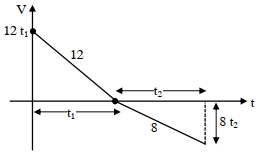
(B) During ascent,both gravity and air resistance act downwards. The net retarding force is $F_{up} = mg + f = (5 \times 10) + 10 = 60 \, N$. The acceleration during ascent is $a_{up} = F_{up} / m = 60 / 5 = 12 \, ms^{-2}$.
During descent,gravity acts downwards and air resistance acts upwards. The net force is $F_{down} = mg - f = (5 \times 10) - 10 = 40 \, N$. The acceleration during descent is $a_{down} = F_{down} / m = 40 / 5 = 8 \, ms^{-2}$.
Let $h$ be the maximum height reached. For ascent,$h = \frac{1}{2} a_{up} t_1^2$,so $h = \frac{1}{2} \times 12 \times t_1^2 = 6 t_1^2$.
For descent,$h = \frac{1}{2} a_{down} t_2^2$,so $h = \frac{1}{2} \times 8 \times t_2^2 = 4 t_2^2$.
Equating the two expressions for $h$: $6 t_1^2 = 4 t_2^2$,which gives $\frac{t_1^2}{t_2^2} = \frac{4}{6} = \frac{2}{3}$.
Therefore,the ratio of time of ascent to the time of descent is $\frac{t_1}{t_2} = \sqrt{\frac{2}{3}} = \frac{\sqrt{2}}{\sqrt{3}}$.
During descent,gravity acts downwards and air resistance acts upwards. The net force is $F_{down} = mg - f = (5 \times 10) - 10 = 40 \, N$. The acceleration during descent is $a_{down} = F_{down} / m = 40 / 5 = 8 \, ms^{-2}$.
Let $h$ be the maximum height reached. For ascent,$h = \frac{1}{2} a_{up} t_1^2$,so $h = \frac{1}{2} \times 12 \times t_1^2 = 6 t_1^2$.
For descent,$h = \frac{1}{2} a_{down} t_2^2$,so $h = \frac{1}{2} \times 8 \times t_2^2 = 4 t_2^2$.
Equating the two expressions for $h$: $6 t_1^2 = 4 t_2^2$,which gives $\frac{t_1^2}{t_2^2} = \frac{4}{6} = \frac{2}{3}$.
Therefore,the ratio of time of ascent to the time of descent is $\frac{t_1}{t_2} = \sqrt{\frac{2}{3}} = \frac{\sqrt{2}}{\sqrt{3}}$.
0 likesView Solution
16
PhysicsEasyMCQJEE Main · 2022
$A$ flywheel is accelerated uniformly from rest and rotates through $5 \, rad$ in the first second. The angle rotated by the flywheel in the next second will be ......... $rad$.
A
$7.5$
B
$15$
C
$20$
D
$30$
Solution
(B) Given that the flywheel starts from rest,the initial angular velocity $\omega_0 = 0$.
Using the equation of rotational motion $\theta = \omega_0 t + \frac{1}{2} \alpha t^2$,where $\alpha$ is the angular acceleration.
For the first second $(t = 1 \, s)$,the angle rotated is $\theta_1 = 5 \, rad$:
$5 = 0(1) + \frac{1}{2} \alpha (1)^2 \implies \alpha = 10 \, rad/s^2$.
Now,we find the total angle rotated in the first two seconds $(t = 2 \, s)$:
$\theta_2 = 0(2) + \frac{1}{2} (10) (2)^2 = 5 \times 4 = 20 \, rad$.
The angle rotated in the next second (from $t = 1$ to $t = 2$) is the difference between the total angle in $2 \, s$ and the angle in $1 \, s$:
$\Delta \theta = \theta_2 - \theta_1 = 20 - 5 = 15 \, rad$.
Using the equation of rotational motion $\theta = \omega_0 t + \frac{1}{2} \alpha t^2$,where $\alpha$ is the angular acceleration.
For the first second $(t = 1 \, s)$,the angle rotated is $\theta_1 = 5 \, rad$:
$5 = 0(1) + \frac{1}{2} \alpha (1)^2 \implies \alpha = 10 \, rad/s^2$.
Now,we find the total angle rotated in the first two seconds $(t = 2 \, s)$:
$\theta_2 = 0(2) + \frac{1}{2} (10) (2)^2 = 5 \times 4 = 20 \, rad$.
The angle rotated in the next second (from $t = 1$ to $t = 2$) is the difference between the total angle in $2 \, s$ and the angle in $1 \, s$:
$\Delta \theta = \theta_2 - \theta_1 = 20 - 5 = 15 \, rad$.
0 likesView Solution
17
PhysicsMediumMCQJEE Main · 2022
$A$ $100 \, g$ of iron nail is hit by a $1.5 \, kg$ hammer striking at a velocity of $60 \, ms^{-1}$. What will be the rise in the temperature of the nail in $^{\circ}C$ if one-fourth of the energy of the hammer goes into heating the nail? [Specific heat capacity of iron $= 0.42 \, Jg^{-1} {}^{\circ}C^{-1}$]
A
$675$
B
$1600$
C
$16.07$
D
$6.75$
Solution
(C) The kinetic energy of the hammer is given by $K.E. = \frac{1}{2} mv^2 = \frac{1}{2} \times 1.5 \times (60)^2 = 0.75 \times 3600 = 2700 \, J$.
According to the problem,one-fourth of this energy is used to heat the iron nail.
Heat energy absorbed by the nail $Q = \frac{1}{4} \times 2700 = 675 \, J$.
The formula for heat absorbed is $Q = mc\Delta T$,where $m = 100 \, g$,$c = 0.42 \, Jg^{-1} {}^{\circ}C^{-1}$,and $\Delta T$ is the rise in temperature.
Substituting the values: $675 = 100 \times 0.42 \times \Delta T$.
$675 = 42 \times \Delta T$.
$\Delta T = \frac{675}{42} \approx 16.07 \, ^{\circ}C$.
According to the problem,one-fourth of this energy is used to heat the iron nail.
Heat energy absorbed by the nail $Q = \frac{1}{4} \times 2700 = 675 \, J$.
The formula for heat absorbed is $Q = mc\Delta T$,where $m = 100 \, g$,$c = 0.42 \, Jg^{-1} {}^{\circ}C^{-1}$,and $\Delta T$ is the rise in temperature.
Substituting the values: $675 = 100 \times 0.42 \times \Delta T$.
$675 = 42 \times \Delta T$.
$\Delta T = \frac{675}{42} \approx 16.07 \, ^{\circ}C$.
0 likesView Solution
18
PhysicsDifficultMCQJEE Main · 2022
$A$ body is projected from the ground at an angle of $45^{\circ}$ with the horizontal. Its velocity after $2 \, s$ is $20 \, m/s$. The maximum height reached by the body during its motion is $m$. (use $g = 10 \, m/s^2$)
A
$20$
B
$25$
C
$29$
D
$200$
Solution
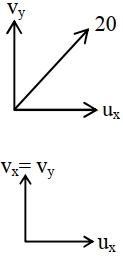
(A) Let the initial velocity be $u$. The horizontal and vertical components of velocity at any time $t$ are given by:
$v_x = u \cos 45^{\circ} = \frac{u}{\sqrt{2}}$
$v_y = u \sin 45^{\circ} - gt = \frac{u}{\sqrt{2}} - 10(2) = \frac{u}{\sqrt{2}} - 20$
Given that the resultant velocity at $t = 2 \, s$ is $20 \, m/s$,we have:
$v^2 = v_x^2 + v_y^2$
$20^2 = \left(\frac{u}{\sqrt{2}}\right)^2 + \left(\frac{u}{\sqrt{2}} - 20\right)^2$
$400 = \frac{u^2}{2} + \frac{u^2}{2} - 20\sqrt{2}u + 400$
$0 = u^2 - 20\sqrt{2}u$
Since $u \neq 0$,we get $u = 20\sqrt{2} \, m/s$.
The maximum height $H$ is given by:
$H = \frac{u^2 \sin^2 45^{\circ}}{2g} = \frac{(20\sqrt{2})^2 \times (1/2)}{2 \times 10} = \frac{800 \times 0.5}{20} = \frac{400}{20} = 20 \, m$.
$v_x = u \cos 45^{\circ} = \frac{u}{\sqrt{2}}$
$v_y = u \sin 45^{\circ} - gt = \frac{u}{\sqrt{2}} - 10(2) = \frac{u}{\sqrt{2}} - 20$
Given that the resultant velocity at $t = 2 \, s$ is $20 \, m/s$,we have:
$v^2 = v_x^2 + v_y^2$
$20^2 = \left(\frac{u}{\sqrt{2}}\right)^2 + \left(\frac{u}{\sqrt{2}} - 20\right)^2$
$400 = \frac{u^2}{2} + \frac{u^2}{2} - 20\sqrt{2}u + 400$
$0 = u^2 - 20\sqrt{2}u$
Since $u \neq 0$,we get $u = 20\sqrt{2} \, m/s$.
The maximum height $H$ is given by:
$H = \frac{u^2 \sin^2 45^{\circ}}{2g} = \frac{(20\sqrt{2})^2 \times (1/2)}{2 \times 10} = \frac{800 \times 0.5}{20} = \frac{400}{20} = 20 \, m$.
0 likesView Solution
19
PhysicsMediumMCQJEE Main · 2022
Two travelling waves of equal amplitudes and equal frequencies move in opposite directions along a string. They interfere to produce a stationary wave whose equation is given by $y = (10 \cos \pi x \sin \frac{2 \pi t}{T}) \, cm$. The amplitude of the particle at $x = \frac{4}{3} \, cm$ will be ........ $cm$.
A
$4$
B
$9$
C
$6$
D
$5$
Solution
(D) The equation of a stationary wave is given by $y = A_{res} \sin \omega t$,where $A_{res}$ is the amplitude of the particle at position $x$.
Comparing the given equation $y = (10 \cos \pi x) \sin \frac{2 \pi t}{T}$ with the standard form,the amplitude at any position $x$ is $A(x) = |10 \cos \pi x|$.
Given $x = \frac{4}{3} \, cm$,we substitute this value into the expression:
$A = |10 \cos(\pi \cdot \frac{4}{3})|$
$A = |10 \cos(\frac{4 \pi}{3})|$
Since $\cos(\frac{4 \pi}{3}) = \cos(\pi + \frac{\pi}{3}) = -\cos(\frac{\pi}{3}) = -\frac{1}{2}$,
$A = |10 \cdot (-0.5)| = |-5| = 5 \, cm$.
Thus,the amplitude is $5 \, cm$.
Comparing the given equation $y = (10 \cos \pi x) \sin \frac{2 \pi t}{T}$ with the standard form,the amplitude at any position $x$ is $A(x) = |10 \cos \pi x|$.
Given $x = \frac{4}{3} \, cm$,we substitute this value into the expression:
$A = |10 \cos(\pi \cdot \frac{4}{3})|$
$A = |10 \cos(\frac{4 \pi}{3})|$
Since $\cos(\frac{4 \pi}{3}) = \cos(\pi + \frac{\pi}{3}) = -\cos(\frac{\pi}{3}) = -\frac{1}{2}$,
$A = |10 \cdot (-0.5)| = |-5| = 5 \, cm$.
Thus,the amplitude is $5 \, cm$.
0 likesView Solution
20
PhysicsMediumMCQJEE Main · 2022
$A$ monoatomic gas performs a work of $\frac{Q}{4}$,where $Q$ is the heat supplied to it. The molar heat capacity of the gas during this transformation will be $xR$,where $R$ is the gas constant. Find the value of $x$.
A
$9$
B
$25$
C
$2$
D
$8$
Solution
(C) According to the first law of thermodynamics,$\Delta Q = \Delta U + W$.
Given,$W = \frac{Q}{4}$.
Therefore,$\Delta U = \Delta Q - W = Q - \frac{Q}{4} = \frac{3Q}{4}$.
For a monoatomic gas,the change in internal energy is $\Delta U = n C_v \Delta T = n (\frac{3}{2}R) \Delta T$.
So,$n (\frac{3}{2}R) \Delta T = \frac{3Q}{4} \Rightarrow n \Delta T = \frac{Q}{2R}$.
The molar heat capacity $C$ is defined as $C = \frac{Q}{n \Delta T}$.
Substituting $n \Delta T$,we get $C = \frac{Q}{Q / (2R)} = 2R$.
Thus,the value of $x$ is $2$.
Given,$W = \frac{Q}{4}$.
Therefore,$\Delta U = \Delta Q - W = Q - \frac{Q}{4} = \frac{3Q}{4}$.
For a monoatomic gas,the change in internal energy is $\Delta U = n C_v \Delta T = n (\frac{3}{2}R) \Delta T$.
So,$n (\frac{3}{2}R) \Delta T = \frac{3Q}{4} \Rightarrow n \Delta T = \frac{Q}{2R}$.
The molar heat capacity $C$ is defined as $C = \frac{Q}{n \Delta T}$.
Substituting $n \Delta T$,we get $C = \frac{Q}{Q / (2R)} = 2R$.
Thus,the value of $x$ is $2$.
0 likesView Solution
21
PhysicsDifficultMCQJEE Main · 2022
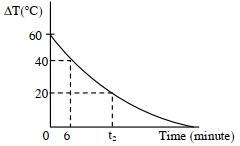
In an experiment to verify Newton's law of cooling,a graph is plotted between the temperature difference $(\Delta T)$ of the water and surroundings and time as shown in the figure. The initial temperature of water is taken as $80^{\circ}C$. The value of $t_{2}$ as mentioned in the graph will be...........
A
$86$
B
$16$
C
$19$
D
$11$
Solution
(B) According to Newton's law of cooling,the temperature difference $\Delta T$ at time $t$ is given by $\Delta T = \Delta T_{0} e^{-\lambda t}$,where $\Delta T_{0}$ is the initial temperature difference.
From the graph,at $t = 0$,$\Delta T_{0} = 60^{\circ}C$.
At $t = 6 \text{ min}$,$\Delta T = 40^{\circ}C$. Substituting these values: $40 = 60 e^{-6\lambda} \Rightarrow e^{-6\lambda} = \frac{40}{60} = \frac{2}{3} \Rightarrow 6\lambda = \ln(1.5)$.
At $t = t_{2}$,$\Delta T = 20^{\circ}C$. Substituting these values: $20 = 60 e^{-t_{2}\lambda} \Rightarrow e^{-t_{2}\lambda} = \frac{20}{60} = \frac{1}{3} \Rightarrow t_{2}\lambda = \ln(3)$.
Dividing the two equations: $\frac{t_{2}\lambda}{6\lambda} = \frac{\ln(3)}{\ln(1.5)} \Rightarrow \frac{t_{2}}{6} = \frac{1.0986}{0.4055} \approx 2.709$.
Therefore,$t_{2} = 6 \times 2.709 \approx 16.25 \text{ min}$.
Rounding to the nearest integer,$t_{2} \approx 16 \text{ min}$.
From the graph,at $t = 0$,$\Delta T_{0} = 60^{\circ}C$.
At $t = 6 \text{ min}$,$\Delta T = 40^{\circ}C$. Substituting these values: $40 = 60 e^{-6\lambda} \Rightarrow e^{-6\lambda} = \frac{40}{60} = \frac{2}{3} \Rightarrow 6\lambda = \ln(1.5)$.
At $t = t_{2}$,$\Delta T = 20^{\circ}C$. Substituting these values: $20 = 60 e^{-t_{2}\lambda} \Rightarrow e^{-t_{2}\lambda} = \frac{20}{60} = \frac{1}{3} \Rightarrow t_{2}\lambda = \ln(3)$.
Dividing the two equations: $\frac{t_{2}\lambda}{6\lambda} = \frac{\ln(3)}{\ln(1.5)} \Rightarrow \frac{t_{2}}{6} = \frac{1.0986}{0.4055} \approx 2.709$.
Therefore,$t_{2} = 6 \times 2.709 \approx 16.25 \text{ min}$.
Rounding to the nearest integer,$t_{2} \approx 16 \text{ min}$.
0 likesView Solution
22
PhysicsMediumMCQJEE Main · 2022
The bulk modulus of a liquid is $3 \times 10^{10} \ Nm^{-2}$. The pressure required to reduce the volume of liquid by $2 \%$ is ........ $\times 10^{8} \ Nm^{-2}$.
A
$3$
B
$9$
C
$6$
D
$12$
Solution
(C) The bulk modulus $B$ is defined as $B = -\frac{\Delta P}{\Delta V / V}$.
Given,$B = 3 \times 10^{10} \ Nm^{-2}$.
The fractional change in volume is $\frac{\Delta V}{V} = -2\% = -0.02$ (negative sign indicates reduction in volume).
Rearranging the formula for pressure change $\Delta P$: $\Delta P = -B \times \left(\frac{\Delta V}{V}\right)$.
Substituting the values: $\Delta P = -(3 \times 10^{10}) \times (-0.02)$.
$\Delta P = 3 \times 10^{10} \times 0.02 = 0.06 \times 10^{10} = 6 \times 10^{8} \ Nm^{-2}$.
Thus,the required pressure is $6 \times 10^{8} \ Nm^{-2}$.
Given,$B = 3 \times 10^{10} \ Nm^{-2}$.
The fractional change in volume is $\frac{\Delta V}{V} = -2\% = -0.02$ (negative sign indicates reduction in volume).
Rearranging the formula for pressure change $\Delta P$: $\Delta P = -B \times \left(\frac{\Delta V}{V}\right)$.
Substituting the values: $\Delta P = -(3 \times 10^{10}) \times (-0.02)$.
$\Delta P = 3 \times 10^{10} \times 0.02 = 0.06 \times 10^{10} = 6 \times 10^{8} \ Nm^{-2}$.
Thus,the required pressure is $6 \times 10^{8} \ Nm^{-2}$.
0 likesView Solution
23
PhysicsMediumMCQJEE Main · 2022
Identify the pair of physical quantities which have different dimensions.
A
Wave number and Rydberg's constant
B
Stress and Coefficient of elasticity
C
Coercivity and Magnetisation
D
Specific heat capacity and Latent heat
Solution
(D) $1$. Wave number $(k = 1/\lambda)$ and Rydberg's constant $(R)$ both have dimensions of $[L^{-1}]$.
$2$. Stress and Coefficient of elasticity (Young's modulus,Bulk modulus,etc.) both have dimensions of $[M L^{-1} T^{-2}]$.
$3$. Coercivity $(H)$ and Magnetisation $(M)$ have different dimensions. Coercivity is the magnetic field strength $(H)$ with dimensions $[A L^{-1}]$,while Magnetisation is magnetic moment per unit volume with dimensions $[A L^{-1}]$. Wait,both are $[A L^{-1}]$. Let us re-evaluate.
$4$. Specific heat capacity $(S)$ has dimensions $[L^2 T^{-2} K^{-1}]$ (from $S = Q / (m \Delta T)$),while Latent heat $(L)$ has dimensions $[L^2 T^{-2}]$ (from $L = Q / m$).
Since $[L^2 T^{-2} K^{-1}] \neq [L^2 T^{-2}]$,the pair with different dimensions is Specific heat capacity and Latent heat.
$2$. Stress and Coefficient of elasticity (Young's modulus,Bulk modulus,etc.) both have dimensions of $[M L^{-1} T^{-2}]$.
$3$. Coercivity $(H)$ and Magnetisation $(M)$ have different dimensions. Coercivity is the magnetic field strength $(H)$ with dimensions $[A L^{-1}]$,while Magnetisation is magnetic moment per unit volume with dimensions $[A L^{-1}]$. Wait,both are $[A L^{-1}]$. Let us re-evaluate.
$4$. Specific heat capacity $(S)$ has dimensions $[L^2 T^{-2} K^{-1}]$ (from $S = Q / (m \Delta T)$),while Latent heat $(L)$ has dimensions $[L^2 T^{-2}]$ (from $L = Q / m$).
Since $[L^2 T^{-2} K^{-1}] \neq [L^2 T^{-2}]$,the pair with different dimensions is Specific heat capacity and Latent heat.
0 likesView Solution
24
PhysicsDifficultMCQJEE Main · 2022
$A$ projectile is projected with a velocity of $25 \, m/s$ at an angle $\theta$ with the horizontal. After $t$ seconds,its inclination with the horizontal becomes zero. If $R$ represents the horizontal range of the projectile,the value of $\theta$ will be: [use $g = 10 \, m/s^2$]
A
$\frac{1}{2} \sin^{-1}\left(\frac{5t^2}{4R}\right)$
B
$\frac{1}{2} \sin^{-1}\left(\frac{4R}{5t^2}\right)$
C
$\tan^{-1}\left(\frac{4t^2}{5R}\right)$
D
$\cot^{-1}\left(\frac{R}{20t^2}\right)$
Solution
(D) The horizontal range $R$ is given by $R = \frac{V^2 \sin(2\theta)}{g} = \frac{2V^2 \sin\theta \cos\theta}{g}$.
The time taken to reach the highest point (where inclination is zero) is $t = \frac{V \sin\theta}{g}$.
From this,$V \sin\theta = gt$,so $V = \frac{gt}{\sin\theta}$.
Substitute $V$ into the range formula: $R = \frac{2(gt/\sin\theta)^2 \sin\theta \cos\theta}{g} = \frac{2g^2 t^2 \sin\theta \cos\theta}{g \sin^2\theta} = \frac{2gt^2 \cos\theta}{\sin\theta} = \frac{2gt^2}{\tan\theta}$.
Given $g = 10 \, m/s^2$,we have $R = \frac{2(10)t^2}{\tan\theta} = \frac{20t^2}{\tan\theta}$.
Rearranging for $\theta$,we get $\tan\theta = \frac{20t^2}{R}$,which implies $\cot\theta = \frac{R}{20t^2}$.
Therefore,$\theta = \cot^{-1}\left(\frac{R}{20t^2}\right)$.
The time taken to reach the highest point (where inclination is zero) is $t = \frac{V \sin\theta}{g}$.
From this,$V \sin\theta = gt$,so $V = \frac{gt}{\sin\theta}$.
Substitute $V$ into the range formula: $R = \frac{2(gt/\sin\theta)^2 \sin\theta \cos\theta}{g} = \frac{2g^2 t^2 \sin\theta \cos\theta}{g \sin^2\theta} = \frac{2gt^2 \cos\theta}{\sin\theta} = \frac{2gt^2}{\tan\theta}$.
Given $g = 10 \, m/s^2$,we have $R = \frac{2(10)t^2}{\tan\theta} = \frac{20t^2}{\tan\theta}$.
Rearranging for $\theta$,we get $\tan\theta = \frac{20t^2}{R}$,which implies $\cot\theta = \frac{R}{20t^2}$.
Therefore,$\theta = \cot^{-1}\left(\frac{R}{20t^2}\right)$.
0 likesView Solution
25
PhysicsMediumMCQJEE Main · 2022
$A$ block of mass $10\, kg$ starts sliding on a surface with an initial velocity of $9.8\, m/s$. The coefficient of friction between the surface and the block is $0.5$. The distance covered by the block before coming to rest is: [use $g = 9.8\, m/s^2$].........$m$
A
$4.9$
B
$9.8$
C
$12.5$
D
$19.6$
Solution
(B) The frictional force acting on the block is $f = \mu N = \mu mg$.
Using Newton's second law,the retardation $a$ is given by $ma = -\mu mg$,so $a = -\mu g$.
Given $\mu = 0.5$ and $g = 9.8\, m/s^2$,the acceleration is $a = -0.5 \times 9.8 = -4.9\, m/s^2$.
Using the kinematic equation $v^2 = u^2 + 2as$,where final velocity $v = 0$ and initial velocity $u = 9.8\, m/s$:
$0 = (9.8)^2 + 2(-4.9)s$
$9.8s = 9.8 \times 9.8$
$s = 9.8\, m$.
Using Newton's second law,the retardation $a$ is given by $ma = -\mu mg$,so $a = -\mu g$.
Given $\mu = 0.5$ and $g = 9.8\, m/s^2$,the acceleration is $a = -0.5 \times 9.8 = -4.9\, m/s^2$.
Using the kinematic equation $v^2 = u^2 + 2as$,where final velocity $v = 0$ and initial velocity $u = 9.8\, m/s$:
$0 = (9.8)^2 + 2(-4.9)s$
$9.8s = 9.8 \times 9.8$
$s = 9.8\, m$.
0 likesView Solution
26
PhysicsMediumMCQJEE Main · 2022
$A$ boy ties a stone of mass $100 \,g$ to the end of a $2 \,m$ long string and whirls it around in a horizontal plane. The string can withstand a maximum tension of $80 \,N$. If the maximum speed with which the stone can revolve is $\frac{K}{\pi} \,rev/min$,find the value of $K$. (Assume the string is massless and unstretchable)
A
$400$
B
$300$
C
$600$
D
$800$
Solution
(C) The centripetal force required for circular motion is provided by the tension in the string: $T = M \omega^{2} R$.
Given: $T = 80 \,N$,$M = 100 \,g = 0.1 \,kg$,$R = 2 \,m$.
Substituting the values: $80 = 0.1 \times \omega^{2} \times 2$.
$80 = 0.2 \omega^{2} \implies \omega^{2} = 400 \implies \omega = 20 \,rad/s$.
Since $\omega = 2 \pi f$,where $f$ is the frequency in $rev/s$: $2 \pi f = 20 \implies f = \frac{10}{\pi} \,rev/s$.
To convert frequency to $rev/min$,multiply by $60$: $f = \frac{10}{\pi} \times 60 = \frac{600}{\pi} \,rev/min$.
Comparing this with $\frac{K}{\pi} \,rev/min$,we get $K = 600$.
Given: $T = 80 \,N$,$M = 100 \,g = 0.1 \,kg$,$R = 2 \,m$.
Substituting the values: $80 = 0.1 \times \omega^{2} \times 2$.
$80 = 0.2 \omega^{2} \implies \omega^{2} = 400 \implies \omega = 20 \,rad/s$.
Since $\omega = 2 \pi f$,where $f$ is the frequency in $rev/s$: $2 \pi f = 20 \implies f = \frac{10}{\pi} \,rev/s$.
To convert frequency to $rev/min$,multiply by $60$: $f = \frac{10}{\pi} \times 60 = \frac{600}{\pi} \,rev/min$.
Comparing this with $\frac{K}{\pi} \,rev/min$,we get $K = 600$.
0 likesView Solution
27
PhysicsMediumMCQJEE Main · 2022
$A$ particle experiences a variable force $\overrightarrow{F} = (4x \hat{i} + 3y^2 \hat{j})$ in a horizontal $x-y$ plane. Assume distance is in meters and force is in newtons. If the particle moves from point $(1, 2)$ to point $(2, 3)$ in the $x-y$ plane,the kinetic energy changes by............$J$.
A
$50.0$
B
$12.5$
C
$25$
D
$0$
Solution
(C) According to the Work-Energy Theorem,the change in kinetic energy $(\Delta KE)$ is equal to the work done $(W)$ by the force on the particle.
The work done is given by the line integral: $W = \int \overrightarrow{F} \cdot d\overrightarrow{r} = \int (4x \hat{i} + 3y^2 \hat{j}) \cdot (dx \hat{i} + dy \hat{j})$.
This simplifies to: $W = \int_{1}^{2} 4x \, dx + \int_{2}^{3} 3y^2 \, dy$.
Evaluating the integrals:
$W = [2x^2]_{1}^{2} + [y^3]_{2}^{3}$.
$W = (2(2)^2 - 2(1)^2) + (3^3 - 2^3)$.
$W = (8 - 2) + (27 - 8)$.
$W = 6 + 19 = 25 \, J$.
Therefore,the kinetic energy changes by $25 \, J$.
The work done is given by the line integral: $W = \int \overrightarrow{F} \cdot d\overrightarrow{r} = \int (4x \hat{i} + 3y^2 \hat{j}) \cdot (dx \hat{i} + dy \hat{j})$.
This simplifies to: $W = \int_{1}^{2} 4x \, dx + \int_{2}^{3} 3y^2 \, dy$.
Evaluating the integrals:
$W = [2x^2]_{1}^{2} + [y^3]_{2}^{3}$.
$W = (2(2)^2 - 2(1)^2) + (3^3 - 2^3)$.
$W = (8 - 2) + (27 - 8)$.
$W = 6 + 19 = 25 \, J$.
Therefore,the kinetic energy changes by $25 \, J$.
0 likesView Solution
28
PhysicsMediumMCQJEE Main · 2022
The approximate height from the surface of earth at which the weight of the body becomes $\frac{1}{3}$ of its weight on the surface of earth is $.......... \, km$ : [Radius of earth $R = 6400 \, km$ and $\sqrt{3} = 1.732$]
A
$3840$
B
$4685$
C
$2133$
D
$4267$
Solution
(B) The weight of a body at height $h$ is given by $W' = m g'$,where $g' = g \left( \frac{R}{R+h} \right)^2$.
Given that the weight at height $h$ is $\frac{1}{3}$ of the weight on the surface,we have $m g' = \frac{1}{3} m g$,which implies $g' = \frac{g}{3}$.
Substituting the expression for $g'$,we get $g \left( \frac{R}{R+h} \right)^2 = \frac{g}{3}$.
Taking the square root on both sides,we get $\frac{R}{R+h} = \frac{1}{\sqrt{3}}$.
Rearranging the equation,$R+h = R\sqrt{3}$,so $h = R(\sqrt{3} - 1)$.
Substituting the values $R = 6400 \, km$ and $\sqrt{3} = 1.732$,we get $h = 6400 \times (1.732 - 1) = 6400 \times 0.732$.
$h = 4684.8 \, km \approx 4685 \, km$.
Given that the weight at height $h$ is $\frac{1}{3}$ of the weight on the surface,we have $m g' = \frac{1}{3} m g$,which implies $g' = \frac{g}{3}$.
Substituting the expression for $g'$,we get $g \left( \frac{R}{R+h} \right)^2 = \frac{g}{3}$.
Taking the square root on both sides,we get $\frac{R}{R+h} = \frac{1}{\sqrt{3}}$.
Rearranging the equation,$R+h = R\sqrt{3}$,so $h = R(\sqrt{3} - 1)$.
Substituting the values $R = 6400 \, km$ and $\sqrt{3} = 1.732$,we get $h = 6400 \times (1.732 - 1) = 6400 \times 0.732$.
$h = 4684.8 \, km \approx 4685 \, km$.
0 likesView Solution
29
PhysicsMediumMCQJEE Main · 2022
The equations of two waves are given by
$y_{1}=5 \sin 2 \pi(x-v t) \, cm$
$y_{2}=3 \sin 2 \pi(x-v t+1.5) \, cm$
These waves are simultaneously passing through a string. The amplitude of the resulting wave is.........$cm$.
$y_{1}=5 \sin 2 \pi(x-v t) \, cm$
$y_{2}=3 \sin 2 \pi(x-v t+1.5) \, cm$
These waves are simultaneously passing through a string. The amplitude of the resulting wave is.........$cm$.
A
$2$
B
$4$
C
$5.8$
D
$8$
Solution
(A) Given amplitudes are $A_{1} = 5 \, cm$ and $A_{2} = 3 \, cm$.
The phase difference $\Delta \phi$ between the two waves is determined by the difference in their arguments:
$\Delta \phi = 2 \pi (x - vt + 1.5) - 2 \pi (x - vt) = 2 \pi (1.5) = 3 \pi$.
The resultant amplitude $A_{net}$ is given by the formula:
$A_{net} = \sqrt{A_{1}^{2} + A_{2}^{2} + 2 A_{1} A_{2} \cos(\Delta \phi)}$.
Substituting the values:
$A_{net} = \sqrt{5^{2} + 3^{2} + 2(5)(3) \cos(3 \pi)}$.
Since $\cos(3 \pi) = -1$:
$A_{net} = \sqrt{25 + 9 + 30(-1)} = \sqrt{34 - 30} = \sqrt{4} = 2 \, cm$.
The phase difference $\Delta \phi$ between the two waves is determined by the difference in their arguments:
$\Delta \phi = 2 \pi (x - vt + 1.5) - 2 \pi (x - vt) = 2 \pi (1.5) = 3 \pi$.
The resultant amplitude $A_{net}$ is given by the formula:
$A_{net} = \sqrt{A_{1}^{2} + A_{2}^{2} + 2 A_{1} A_{2} \cos(\Delta \phi)}$.
Substituting the values:
$A_{net} = \sqrt{5^{2} + 3^{2} + 2(5)(3) \cos(3 \pi)}$.
Since $\cos(3 \pi) = -1$:
$A_{net} = \sqrt{25 + 9 + 30(-1)} = \sqrt{34 - 30} = \sqrt{4} = 2 \, cm$.
0 likesView Solution
30
PhysicsDifficultMCQJEE Main · 2022
$A$ Carnot engine whose heat sink is at $27\,^{\circ} C$ has an efficiency of $25 \%$. By how many degrees should the temperature of the source be changed to increase the efficiency by $100 \%$ of the original efficiency?
A
Increase by $18\,^{\circ} C$
B
Increase by $200\,^{\circ} C$
C
Increase by $120\,^{\circ} C$
D
Increase by $73\,^{\circ} C$
Solution
(B) The efficiency of a Carnot engine is given by $\eta = 1 - \frac{T_L}{T_H}$,where $T_L$ is the sink temperature and $T_H$ is the source temperature.
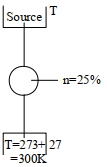
Given $T_L = 27\,^{\circ} C = 300\, K$ and $\eta = 25\% = 0.25$.
Substituting the values: $0.25 = 1 - \frac{300}{T_H} \implies \frac{300}{T_H} = 0.75 \implies T_H = \frac{300}{0.75} = 400\, K$.
If the efficiency is increased by $100\%$ of its original value,the new efficiency $\eta' = \eta + 100\% \text{ of } \eta = 0.25 + 0.25 = 0.50$ or $50\%$.
Let the new source temperature be $T_H'$.
$0.50 = 1 - \frac{300}{T_H'} \implies \frac{300}{T_H'} = 0.50 \implies T_H' = \frac{300}{0.50} = 600\, K$.
The change in temperature is $\Delta T = T_H' - T_H = 600\, K - 400\, K = 200\, K$.
Since a change in temperature of $1\, K$ is equivalent to a change of $1\,^{\circ} C$,the temperature should be increased by $200\,^{\circ} C$.
Given $T_L = 27\,^{\circ} C = 300\, K$ and $\eta = 25\% = 0.25$.
Substituting the values: $0.25 = 1 - \frac{300}{T_H} \implies \frac{300}{T_H} = 0.75 \implies T_H = \frac{300}{0.75} = 400\, K$.
If the efficiency is increased by $100\%$ of its original value,the new efficiency $\eta' = \eta + 100\% \text{ of } \eta = 0.25 + 0.25 = 0.50$ or $50\%$.
Let the new source temperature be $T_H'$.
$0.50 = 1 - \frac{300}{T_H'} \implies \frac{300}{T_H'} = 0.50 \implies T_H' = \frac{300}{0.50} = 600\, K$.
The change in temperature is $\Delta T = T_H' - T_H = 600\, K - 400\, K = 200\, K$.
Since a change in temperature of $1\, K$ is equivalent to a change of $1\,^{\circ} C$,the temperature should be increased by $200\,^{\circ} C$.
0 likesView Solution
31
PhysicsMediumMCQJEE Main · 2022
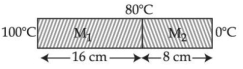
Two metallic blocks $M_{1}$ and $M_{2}$ of the same cross-sectional area are connected to each other as shown in the figure. If the thermal conductivity of $M_{2}$ is $K$,then the thermal conductivity of $M_{1}$ will be $xK$. Find the value of $x$. [Assume steady-state heat conduction]
A
$10$
B
$8$
C
$12.5$
D
$2$
Solution
(B) In steady-state heat conduction,the rate of heat flow $H$ through both blocks is the same.
$H = \frac{K_{1} A \Delta T_{1}}{\ell_{1}} = \frac{K_{2} A \Delta T_{2}}{\ell_{2}}$
Given: $\ell_{1} = 16 \text{ cm}$,$\ell_{2} = 8 \text{ cm}$,$K_{2} = K$,$K_{1} = xK$.
Temperature difference across $M_{1}$ is $\Delta T_{1} = 100^{\circ}C - 80^{\circ}C = 20^{\circ}C$.
Temperature difference across $M_{2}$ is $\Delta T_{2} = 80^{\circ}C - 0^{\circ}C = 80^{\circ}C$.
Since the area $A$ is the same,we have:
$\frac{K_{1} \Delta T_{1}}{\ell_{1}} = \frac{K_{2} \Delta T_{2}}{\ell_{2}}$
$\frac{(xK) \times 20}{16} = \frac{K \times 80}{8}$
$x \times \frac{20}{16} = 10$
$x = 10 \times \frac{16}{20} = 8$.
Thus,the thermal conductivity of $M_{1}$ is $8K$.
$H = \frac{K_{1} A \Delta T_{1}}{\ell_{1}} = \frac{K_{2} A \Delta T_{2}}{\ell_{2}}$
Given: $\ell_{1} = 16 \text{ cm}$,$\ell_{2} = 8 \text{ cm}$,$K_{2} = K$,$K_{1} = xK$.
Temperature difference across $M_{1}$ is $\Delta T_{1} = 100^{\circ}C - 80^{\circ}C = 20^{\circ}C$.
Temperature difference across $M_{2}$ is $\Delta T_{2} = 80^{\circ}C - 0^{\circ}C = 80^{\circ}C$.
Since the area $A$ is the same,we have:
$\frac{K_{1} \Delta T_{1}}{\ell_{1}} = \frac{K_{2} \Delta T_{2}}{\ell_{2}}$
$\frac{(xK) \times 20}{16} = \frac{K \times 80}{8}$
$x \times \frac{20}{16} = 10$
$x = 10 \times \frac{16}{20} = 8$.
Thus,the thermal conductivity of $M_{1}$ is $8K$.
0 likesView Solution
32
PhysicsMediumMCQJEE Main · 2022
$0.056 \, kg$ of Nitrogen is enclosed in a vessel at a temperature of $127 \, ^{\circ}C$. The amount of heat required to double the speed of its molecules is $k \, cal$. (Take $R = 2 \, cal \, mole^{-1} K^{-1}$)
A
$12$
B
$18$
C
$17$
D
$122$
Solution
(A) Given mass of $N_{2} = 0.056 \, kg = 56 \, g$.
Molar mass of $N_{2} = 28 \, g/mol$.
Number of moles $n = \frac{56}{28} = 2 \, moles$.
Initial temperature $T_{1} = 127 + 273 = 400 \, K$.
Since the root mean square speed $v_{rms} \propto \sqrt{T}$,to double the speed,the temperature must increase by a factor of $2^{2} = 4$.
So,$T_{2} = 4 \times T_{1} = 4 \times 400 = 1600 \, K$.
Change in temperature $\Delta T = T_{2} - T_{1} = 1600 - 400 = 1200 \, K$.
Nitrogen is a diatomic gas,so the degree of freedom $f = 5$.
The heat required is given by $Q = \frac{f}{2} n R \Delta T$.
Substituting the values: $Q = \frac{5}{2} \times 2 \times 2 \times 1200 = 5 \times 2400 = 12000 \, cal = 12 \, kcal$.
Molar mass of $N_{2} = 28 \, g/mol$.
Number of moles $n = \frac{56}{28} = 2 \, moles$.
Initial temperature $T_{1} = 127 + 273 = 400 \, K$.
Since the root mean square speed $v_{rms} \propto \sqrt{T}$,to double the speed,the temperature must increase by a factor of $2^{2} = 4$.
So,$T_{2} = 4 \times T_{1} = 4 \times 400 = 1600 \, K$.
Change in temperature $\Delta T = T_{2} - T_{1} = 1600 - 400 = 1200 \, K$.
Nitrogen is a diatomic gas,so the degree of freedom $f = 5$.
The heat required is given by $Q = \frac{f}{2} n R \Delta T$.
Substituting the values: $Q = \frac{5}{2} \times 2 \times 2 \times 1200 = 5 \times 2400 = 12000 \, cal = 12 \, kcal$.
0 likesView Solution
33
PhysicsDifficultMCQJEE Main · 2022
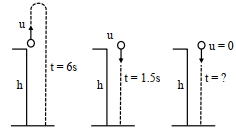
From the top of a tower,a ball is thrown vertically upward which reaches the ground in $6 \, s$. $A$ second ball thrown vertically downward from the same position with the same speed reaches the ground in $1.5 \, s$. $A$ third ball released from rest from the same location will reach the ground in ........ $s$.
A
$3$
B
$7$
C
$8$
D
$38$
Solution
(A) Let the height of the tower be $h$ and the speed of projection in the first two cases be $u$. Taking the downward direction as positive.
For case-$I$ (thrown upward): The displacement is $h$. The initial velocity is $-u$. The acceleration is $g$.
Using the equation $s = ut + \frac{1}{2}at^2$:
$h = -u(6) + \frac{1}{2}g(6)^2$
$h = -6u + 18g$ ... $(i)$
For case-$II$ (thrown downward): The displacement is $h$. The initial velocity is $u$. The acceleration is $g$.
$h = u(1.5) + \frac{1}{2}g(1.5)^2$
$h = 1.5u + 1.125g$ ... $(ii)$
To eliminate $u$,multiply equation $(ii)$ by $4$:
$4h = 6u + 4.5g$ ... $(iii)$
Adding equation $(i)$ and equation $(iii)$:
$h + 4h = (-6u + 18g) + (6u + 4.5g)$
$5h = 22.5g$
$h = 4.5g$ ... $(iv)$
For case-$III$ (released from rest): The initial velocity is $0$. The acceleration is $g$.
$h = 0(t) + \frac{1}{2}gt^2$
$h = \frac{1}{2}gt^2$ ... $(v)$
Substituting equation $(iv)$ into equation $(v)$:
$4.5g = \frac{1}{2}gt^2$
$t^2 = 9$
$t = 3 \, s$.
For case-$I$ (thrown upward): The displacement is $h$. The initial velocity is $-u$. The acceleration is $g$.
Using the equation $s = ut + \frac{1}{2}at^2$:
$h = -u(6) + \frac{1}{2}g(6)^2$
$h = -6u + 18g$ ... $(i)$
For case-$II$ (thrown downward): The displacement is $h$. The initial velocity is $u$. The acceleration is $g$.
$h = u(1.5) + \frac{1}{2}g(1.5)^2$
$h = 1.5u + 1.125g$ ... $(ii)$
To eliminate $u$,multiply equation $(ii)$ by $4$:
$4h = 6u + 4.5g$ ... $(iii)$
Adding equation $(i)$ and equation $(iii)$:
$h + 4h = (-6u + 18g) + (6u + 4.5g)$
$5h = 22.5g$
$h = 4.5g$ ... $(iv)$
For case-$III$ (released from rest): The initial velocity is $0$. The acceleration is $g$.
$h = 0(t) + \frac{1}{2}gt^2$
$h = \frac{1}{2}gt^2$ ... $(v)$
Substituting equation $(iv)$ into equation $(v)$:
$4.5g = \frac{1}{2}gt^2$
$t^2 = 9$
$t = 3 \, s$.
0 likesView Solution
34
PhysicsMediumMCQJEE Main · 2022
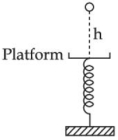
$A$ ball of mass $100 \, g$ is dropped from a height $h = 10 \, cm$ onto a platform fixed at the top of a vertical spring (as shown in the figure). The ball stays on the platform and the platform is depressed by a distance $\frac{h}{2}$. The spring constant is .......... $N \, m^{-1}$. (Use $g = 10 \, m \, s^{-2}$)
A
$122$
B
$129$
C
$127$
D
$120$
Solution
(D) Let the mass of the ball be $m = 100 \, g = 0.1 \, kg$. The height from which it is dropped is $h = 10 \, cm = 0.1 \, m$. The compression in the spring is $x = \frac{h}{2} = 5 \, cm = 0.05 \, m$.
By the principle of conservation of mechanical energy,the loss in gravitational potential energy of the ball equals the gain in elastic potential energy of the spring.
The total vertical displacement of the ball is $h + x = h + \frac{h}{2} = \frac{3h}{2}$.
Therefore,$mg \left( h + \frac{h}{2} \right) = \frac{1}{2} kx^2$.
Substituting the values: $0.1 \times 10 \times \left( 0.1 + 0.05 \right) = \frac{1}{2} \times k \times (0.05)^2$.
$1 \times 0.15 = \frac{1}{2} \times k \times 0.0025$.
$0.15 = k \times 0.00125$.
$k = \frac{0.15}{0.00125} = \frac{150000}{1250} = 120 \, N \, m^{-1}$.
By the principle of conservation of mechanical energy,the loss in gravitational potential energy of the ball equals the gain in elastic potential energy of the spring.
The total vertical displacement of the ball is $h + x = h + \frac{h}{2} = \frac{3h}{2}$.
Therefore,$mg \left( h + \frac{h}{2} \right) = \frac{1}{2} kx^2$.
Substituting the values: $0.1 \times 10 \times \left( 0.1 + 0.05 \right) = \frac{1}{2} \times k \times (0.05)^2$.
$1 \times 0.15 = \frac{1}{2} \times k \times 0.0025$.
$0.15 = k \times 0.00125$.
$k = \frac{0.15}{0.00125} = \frac{150000}{1250} = 120 \, N \, m^{-1}$.
0 likesView Solution
35
PhysicsMediumMCQJEE Main · 2022
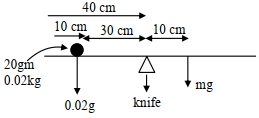
$A$ metre scale is balanced on a knife edge at its centre. When two coins,each of mass $10\, g$,are placed one on top of the other at the $10.0\, cm$ mark,the scale is found to be balanced at the $40.0\, cm$ mark. The mass of the metre scale is found to be $x \times 10^{-2}\, kg$. The value of $x$ is
A
$9$
B
$6$
C
$60$
D
$7$
Solution
(B) Let the mass of the metre scale be $m$. The centre of mass of the uniform metre scale is at the $50.0\, cm$ mark.
When the scale is balanced at the $40.0\, cm$ mark,the torque due to the coins must balance the torque due to the weight of the scale.
The mass of the two coins is $2 \times 10\, g = 20\, g = 0.02\, kg$.
The distance of the coins from the knife edge is $|40.0\, cm - 10.0\, cm| = 30.0\, cm = 0.3\, m$.
The distance of the centre of mass of the scale from the knife edge is $|50.0\, cm - 40.0\, cm| = 10.0\, cm = 0.1\, m$.
Applying the principle of moments (balancing torques about the knife edge):
$(0.02\, kg) \times g \times (0.3\, m) = m \times g \times (0.1\, m)$
$0.006 = 0.1m$
$m = 0.06\, kg = 6 \times 10^{-2}\, kg$.
Comparing this with $x \times 10^{-2}\, kg$,we get $x = 6$.
When the scale is balanced at the $40.0\, cm$ mark,the torque due to the coins must balance the torque due to the weight of the scale.
The mass of the two coins is $2 \times 10\, g = 20\, g = 0.02\, kg$.
The distance of the coins from the knife edge is $|40.0\, cm - 10.0\, cm| = 30.0\, cm = 0.3\, m$.
The distance of the centre of mass of the scale from the knife edge is $|50.0\, cm - 40.0\, cm| = 10.0\, cm = 0.1\, m$.
Applying the principle of moments (balancing torques about the knife edge):
$(0.02\, kg) \times g \times (0.3\, m) = m \times g \times (0.1\, m)$
$0.006 = 0.1m$
$m = 0.06\, kg = 6 \times 10^{-2}\, kg$.
Comparing this with $x \times 10^{-2}\, kg$,we get $x = 6$.
0 likesView Solution
36
PhysicsMediumMCQJEE Main · 2022
Given below are two statements. One is labelled as Assertion $A$ and the other is labelled as Reason $R$.
Assertion $A$: Two identical balls $A$ and $B$ thrown with the same velocity '$u$' at two different angles with the horizontal attain the same range $R$. If $A$ and $B$ reach maximum heights $h_{1}$ and $h_{2}$ respectively,then $R = 4 \sqrt{h_{1} h_{2}}$.
Reason $R$: The product of the said heights is $h_{1} h_{2} = \left(\frac{u^{2} \sin^{2} \theta}{2g}\right) \cdot \left(\frac{u^{2} \cos^{2} \theta}{2g}\right)$.
Choose the $CORRECT$ answer.
Assertion $A$: Two identical balls $A$ and $B$ thrown with the same velocity '$u$' at two different angles with the horizontal attain the same range $R$. If $A$ and $B$ reach maximum heights $h_{1}$ and $h_{2}$ respectively,then $R = 4 \sqrt{h_{1} h_{2}}$.
Reason $R$: The product of the said heights is $h_{1} h_{2} = \left(\frac{u^{2} \sin^{2} \theta}{2g}\right) \cdot \left(\frac{u^{2} \cos^{2} \theta}{2g}\right)$.
Choose the $CORRECT$ answer.
A
Both $A$ and $R$ are true and $R$ is the correct explanation of $A$.
B
Both $A$ and $R$ are true but $R$ is $NOT$ the correct explanation of $A$.
C
$A$ is true but $R$ is false.
D
$A$ is false but $R$ is true.
Solution
(A) For the same range,the angles of projection must satisfy $\theta_{1} + \theta_{2} = 90^{\circ}$,which means $\theta_{2} = 90^{\circ} - \theta_{1}$.
The maximum heights are given by $h_{1} = \frac{u^{2} \sin^{2} \theta_{1}}{2g}$ and $h_{2} = \frac{u^{2} \sin^{2} \theta_{2}}{2g} = \frac{u^{2} \cos^{2} \theta_{1}}{2g}$.
Multiplying these heights,we get $h_{1} h_{2} = \left(\frac{u^{2} \sin^{2} \theta_{1}}{2g}\right) \cdot \left(\frac{u^{2} \cos^{2} \theta_{1}}{2g}\right)$.
This can be rewritten as $h_{1} h_{2} = \frac{u^{4} \sin^{2} \theta_{1} \cos^{2} \theta_{1}}{4g^{2}} = \left(\frac{u^{2} \cdot 2 \sin \theta_{1} \cos \theta_{1}}{4g}\right)^{2} = \left(\frac{u^{2} \sin(2\theta_{1})}{4g}\right)^{2}$.
Since the range $R = \frac{u^{2} \sin(2\theta_{1})}{g}$,we have $h_{1} h_{2} = \left(\frac{R}{4}\right)^{2} = \frac{R^{2}}{16}$.
Therefore,$R^{2} = 16 h_{1} h_{2}$,which implies $R = 4 \sqrt{h_{1} h_{2}}$.
Both Assertion $A$ and Reason $R$ are true,and $R$ provides the correct mathematical derivation for $A$.
The maximum heights are given by $h_{1} = \frac{u^{2} \sin^{2} \theta_{1}}{2g}$ and $h_{2} = \frac{u^{2} \sin^{2} \theta_{2}}{2g} = \frac{u^{2} \cos^{2} \theta_{1}}{2g}$.
Multiplying these heights,we get $h_{1} h_{2} = \left(\frac{u^{2} \sin^{2} \theta_{1}}{2g}\right) \cdot \left(\frac{u^{2} \cos^{2} \theta_{1}}{2g}\right)$.
This can be rewritten as $h_{1} h_{2} = \frac{u^{4} \sin^{2} \theta_{1} \cos^{2} \theta_{1}}{4g^{2}} = \left(\frac{u^{2} \cdot 2 \sin \theta_{1} \cos \theta_{1}}{4g}\right)^{2} = \left(\frac{u^{2} \sin(2\theta_{1})}{4g}\right)^{2}$.
Since the range $R = \frac{u^{2} \sin(2\theta_{1})}{g}$,we have $h_{1} h_{2} = \left(\frac{R}{4}\right)^{2} = \frac{R^{2}}{16}$.
Therefore,$R^{2} = 16 h_{1} h_{2}$,which implies $R = 4 \sqrt{h_{1} h_{2}}$.
Both Assertion $A$ and Reason $R$ are true,and $R$ provides the correct mathematical derivation for $A$.
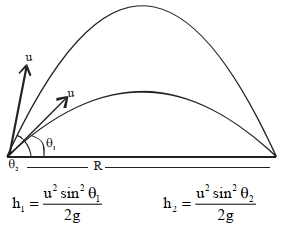
0 likesView Solution
37
PhysicsMediumMCQJEE Main · 2022
$A$ disc with a flat small bottom beaker placed on it at a distance $R$ from its center is revolving about an axis passing through the center and perpendicular to its plane with an angular velocity $\omega$. The coefficient of static friction between the bottom of the beaker and the surface of the disc is $\mu$. The beaker will revolve with the disc if
A
$R \leq \frac{\mu g}{2 \omega^{2}}$
B
$R \leq \frac{\mu g}{\omega^{2}}$
C
$R \geq \frac{\mu g}{2 \omega^{2}}$
D
$R \geq \frac{\mu g}{\omega^{2}}$
Solution
(B) For the beaker to revolve with the disc without slipping,the necessary centripetal force must be provided by the static friction force.
The required centripetal force is $F_{c} = m \omega^{2} R$,where $m$ is the mass of the beaker.
The maximum available static friction force is $f_{s,max} = \mu N = \mu mg$,where $N = mg$ is the normal force.
For the beaker to move in a circular path with the disc,the static friction must be greater than or equal to the required centripetal force:
$f_{s} \leq f_{s,max}$
Substituting the expressions:
$m \omega^{2} R \leq \mu mg$
Dividing both sides by $m \omega^{2}$:
$R \leq \frac{\mu g}{\omega^{2}}$
The required centripetal force is $F_{c} = m \omega^{2} R$,where $m$ is the mass of the beaker.
The maximum available static friction force is $f_{s,max} = \mu N = \mu mg$,where $N = mg$ is the normal force.
For the beaker to move in a circular path with the disc,the static friction must be greater than or equal to the required centripetal force:
$f_{s} \leq f_{s,max}$
Substituting the expressions:
$m \omega^{2} R \leq \mu mg$
Dividing both sides by $m \omega^{2}$:
$R \leq \frac{\mu g}{\omega^{2}}$
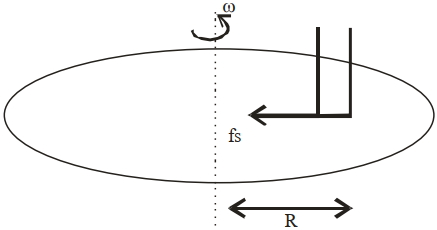
1 likesView Solution
38
PhysicsMediumMCQJEE Main · 2022
$A$ solid metallic cube having a total surface area of $24 \; m^{2}$ is uniformly heated. If its temperature is increased by $10 \; ^{\circ}C$,calculate the increase in volume of the cube. (Given: $\alpha = 5.0 \times 10^{-4} \; ^{\circ}C^{-1}$)
A
$2.4 \times 10^{6} \; cm^{3}$
B
$1.2 \times 10^{5} \; cm^{3}$
C
$6.0 \times 10^{4} \; cm^{3}$
D
$4.8 \times 10^{5} \; cm^{3}$
Solution
(B) The increase in volume is given by $\Delta V = \gamma V_{0} \Delta T$.
Since $\gamma = 3\alpha$,we have $\Delta V = (3\alpha) V_{0} \Delta T$.
The total surface area of a cube is $6a^{2}$,where $a$ is the side length.
Given $6a^{2} = 24 \; m^{2}$,so $a^{2} = 4 \; m^{2}$,which means $a = 2 \; m$.
The initial volume $V_{0} = a^{3} = (2)^{3} = 8 \; m^{3}$.
Substituting the values: $\Delta V = (3 \times 5.0 \times 10^{-4} \; ^{\circ}C^{-1}) \times (8 \; m^{3}) \times (10 \; ^{\circ}C)$.
$\Delta V = 15 \times 10^{-4} \times 80 = 1200 \times 10^{-4} = 0.12 \; m^{3}$.
Since $1 \; m^{3} = 10^{6} \; cm^{3}$,then $\Delta V = 0.12 \times 10^{6} \; cm^{3} = 1.2 \times 10^{5} \; cm^{3}$.
Since $\gamma = 3\alpha$,we have $\Delta V = (3\alpha) V_{0} \Delta T$.
The total surface area of a cube is $6a^{2}$,where $a$ is the side length.
Given $6a^{2} = 24 \; m^{2}$,so $a^{2} = 4 \; m^{2}$,which means $a = 2 \; m$.
The initial volume $V_{0} = a^{3} = (2)^{3} = 8 \; m^{3}$.
Substituting the values: $\Delta V = (3 \times 5.0 \times 10^{-4} \; ^{\circ}C^{-1}) \times (8 \; m^{3}) \times (10 \; ^{\circ}C)$.
$\Delta V = 15 \times 10^{-4} \times 80 = 1200 \times 10^{-4} = 0.12 \; m^{3}$.
Since $1 \; m^{3} = 10^{6} \; cm^{3}$,then $\Delta V = 0.12 \times 10^{6} \; cm^{3} = 1.2 \times 10^{5} \; cm^{3}$.
0 likesView Solution
39
PhysicsMediumMCQJEE Main · 2022
$A$ copper block of mass $5.0 \, kg$ is heated to a temperature of $500^{\circ} C$ and is placed on a large ice block. What is the maximum amount of ice (in $kg$) that can melt? [Specific heat of copper: $0.39 \, J g^{-1} {}^{\circ} C^{-1}$ and latent heat of fusion of water: $335 \, J g^{-1}$]
A
$1.5$
B
$5.8$
C
$2.9$
D
$3.8$
Solution
(C) The heat lost by the copper block as it cools from $500^{\circ} C$ to $0^{\circ} C$ is given by the formula $\Delta Q = mc\Delta T$.
Mass of copper $m = 5.0 \, kg = 5000 \, g$.
Specific heat of copper $c = 0.39 \, J g^{-1} {}^{\circ} C^{-1}$.
Temperature change $\Delta T = 500^{\circ} C - 0^{\circ} C = 500^{\circ} C$.
Heat released $\Delta Q_1 = 5000 \times 0.39 \times 500 = 975,000 \, J$.
Let $m_{ice}$ be the mass of ice that melts. The heat absorbed by the ice to melt at $0^{\circ} C$ is $\Delta Q_2 = m_{ice} \times L_f$,where $L_f = 335 \, J g^{-1}$.
Equating the heat lost and heat gained: $\Delta Q_1 = \Delta Q_2$.
$975,000 = m_{ice} \times 335$.
$m_{ice} = \frac{975,000}{335} \approx 2910.45 \, g$.
Converting to $kg$,$m_{ice} \approx 2.91 \, kg$.
Mass of copper $m = 5.0 \, kg = 5000 \, g$.
Specific heat of copper $c = 0.39 \, J g^{-1} {}^{\circ} C^{-1}$.
Temperature change $\Delta T = 500^{\circ} C - 0^{\circ} C = 500^{\circ} C$.
Heat released $\Delta Q_1 = 5000 \times 0.39 \times 500 = 975,000 \, J$.
Let $m_{ice}$ be the mass of ice that melts. The heat absorbed by the ice to melt at $0^{\circ} C$ is $\Delta Q_2 = m_{ice} \times L_f$,where $L_f = 335 \, J g^{-1}$.
Equating the heat lost and heat gained: $\Delta Q_1 = \Delta Q_2$.
$975,000 = m_{ice} \times 335$.
$m_{ice} = \frac{975,000}{335} \approx 2910.45 \, g$.
Converting to $kg$,$m_{ice} \approx 2.91 \, kg$.
0 likesView Solution
40
PhysicsEasyMCQJEE Main · 2022
For $z = a^{2} x^{3} y^{1/2}$,where $a$ is a constant. If the percentage error in the measurement of $x$ and $y$ are $4\%$ and $12\%$,respectively,then the percentage error for $z$ will be $........... \%$.
A
$18$
B
$188$
C
$78$
D
$15$
Solution
(A) Given the equation: $z = a^{2} x^{3} y^{1/2}$.
Since $a$ is a constant,its relative error $\frac{\Delta a}{a} = 0$.
The relative error in $z$ is given by: $\frac{\Delta z}{z} = 3 \left( \frac{\Delta x}{x} \right) + \frac{1}{2} \left( \frac{\Delta y}{y} \right)$.
To find the percentage error,multiply by $100$:
$\frac{\Delta z}{z} \times 100 = 3 \left( \frac{\Delta x}{x} \times 100 \right) + \frac{1}{2} \left( \frac{\Delta y}{y} \times 100 \right)$.
Given $\frac{\Delta x}{x} \times 100 = 4\%$ and $\frac{\Delta y}{y} \times 100 = 12\%$.
Substituting the values: $\frac{\Delta z}{z} \times 100 = 3(4\%) + \frac{1}{2}(12\%) = 12\% + 6\% = 18\%$.
Since $a$ is a constant,its relative error $\frac{\Delta a}{a} = 0$.
The relative error in $z$ is given by: $\frac{\Delta z}{z} = 3 \left( \frac{\Delta x}{x} \right) + \frac{1}{2} \left( \frac{\Delta y}{y} \right)$.
To find the percentage error,multiply by $100$:
$\frac{\Delta z}{z} \times 100 = 3 \left( \frac{\Delta x}{x} \times 100 \right) + \frac{1}{2} \left( \frac{\Delta y}{y} \times 100 \right)$.
Given $\frac{\Delta x}{x} \times 100 = 4\%$ and $\frac{\Delta y}{y} \times 100 = 12\%$.
Substituting the values: $\frac{\Delta z}{z} \times 100 = 3(4\%) + \frac{1}{2}(12\%) = 12\% + 6\% = 18\%$.
0 likesView Solution
41
PhysicsMediumMCQJEE Main · 2022
$A$ curve on a level road has a radius of $75 \, m$. The maximum speed of a car turning this curved road can be $30 \, m/s$ without skidding. If the radius of the curved road is changed to $48 \, m$ and the coefficient of friction between the tyres and the road remains the same,then the maximum allowed speed would be ......... $m/s$.
A
$24$
B
$22$
C
$26$
D
$28$
Solution
(A) The maximum speed $v$ of a car on a level curved road is given by the formula $v = \sqrt{\mu Rg}$,where $\mu$ is the coefficient of friction,$R$ is the radius of the curve,and $g$ is the acceleration due to gravity.
Since $\mu$ and $g$ are constant,we have $v \propto \sqrt{R}$.
Therefore,the ratio of the speeds is $\frac{v_2}{v_1} = \sqrt{\frac{R_2}{R_1}}$.
Given $v_1 = 30 \, m/s$,$R_1 = 75 \, m$,and $R_2 = 48 \, m$.
Substituting these values: $\frac{v_2}{30} = \sqrt{\frac{48}{75}}$.
Simplifying the fraction inside the square root: $\frac{48}{75} = \frac{16}{25}$.
So,$\frac{v_2}{30} = \sqrt{\frac{16}{25}} = \frac{4}{5}$.
$v_2 = 30 \times \frac{4}{5} = 6 \times 4 = 24 \, m/s$.
Since $\mu$ and $g$ are constant,we have $v \propto \sqrt{R}$.
Therefore,the ratio of the speeds is $\frac{v_2}{v_1} = \sqrt{\frac{R_2}{R_1}}$.
Given $v_1 = 30 \, m/s$,$R_1 = 75 \, m$,and $R_2 = 48 \, m$.
Substituting these values: $\frac{v_2}{30} = \sqrt{\frac{48}{75}}$.
Simplifying the fraction inside the square root: $\frac{48}{75} = \frac{16}{25}$.
So,$\frac{v_2}{30} = \sqrt{\frac{16}{25}} = \frac{4}{5}$.
$v_2 = 30 \times \frac{4}{5} = 6 \times 4 = 24 \, m/s$.
0 likesView Solution
42
PhysicsMediumMCQJEE Main · 2022
$A$ block of mass $200\, g$ is kept stationary on a smooth inclined plane by applying a minimum horizontal force $F = \sqrt{x}\, N$ as shown in the figure. The value of $x = .....$
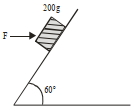
A
$12$
B
$82$
C
$128$
D
$19$
Solution
(A) The mass of the block is $m = 200\, g = 0.2\, kg$. The weight of the block is $W = mg = 0.2 \times 10 = 2\, N$ (taking $g = 10\, m/s^2$).
For the block to remain stationary on the smooth inclined plane,the forces acting along the plane must balance.
The component of the weight acting down the plane is $mg \sin 60^{\circ}$.
The component of the horizontal force $F$ acting up the plane is $F \cos 60^{\circ}$.
Equating these forces for equilibrium: $F \cos 60^{\circ} = mg \sin 60^{\circ}$.
Substituting the values: $F \times \frac{1}{2} = 2 \times \frac{\sqrt{3}}{2}$.
$F = 2\sqrt{3} = \sqrt{4 \times 3} = \sqrt{12}$.
Given $F = \sqrt{x}$,we have $\sqrt{x} = \sqrt{12}$,therefore $x = 12$.
For the block to remain stationary on the smooth inclined plane,the forces acting along the plane must balance.
The component of the weight acting down the plane is $mg \sin 60^{\circ}$.
The component of the horizontal force $F$ acting up the plane is $F \cos 60^{\circ}$.
Equating these forces for equilibrium: $F \cos 60^{\circ} = mg \sin 60^{\circ}$.
Substituting the values: $F \times \frac{1}{2} = 2 \times \frac{\sqrt{3}}{2}$.
$F = 2\sqrt{3} = \sqrt{4 \times 3} = \sqrt{12}$.
Given $F = \sqrt{x}$,we have $\sqrt{x} = \sqrt{12}$,therefore $x = 12$.
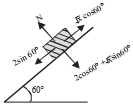
0 likesView Solution
43
PhysicsMediumMCQJEE Main · 2022
Moment of Inertia $(M.I.)$ of four bodies having same mass $M$ and radius $2R$ are as follows:
$I_{1} =$ $M.I.$ of solid sphere about its diameter
$I_{2} =$ $M.I.$ of solid cylinder about its axis
$I_{3} =$ $M.I.$ of solid circular disc about its diameter
$I_{4} =$ $M.I.$ of thin circular ring about its diameter
If $2(I_{2} + I_{3}) + I_{4} = x I_{1}$,then the value of $x$ will be...
$I_{1} =$ $M.I.$ of solid sphere about its diameter
$I_{2} =$ $M.I.$ of solid cylinder about its axis
$I_{3} =$ $M.I.$ of solid circular disc about its diameter
$I_{4} =$ $M.I.$ of thin circular ring about its diameter
If $2(I_{2} + I_{3}) + I_{4} = x I_{1}$,then the value of $x$ will be...
A
$57$
B
$55$
C
$5$
D
$9$
Solution
(C) The radius of all bodies is $2R$ and mass is $M$.
$I_{1} = \frac{2}{5} M (2R)^{2} = \frac{8}{5} MR^{2}$
$I_{2} = \frac{1}{2} M (2R)^{2} = 2 MR^{2}$
$I_{3} = \frac{M (2R)^{2}}{4} = MR^{2}$
$I_{4} = \frac{M (2R)^{2}}{2} = 2 MR^{2}$
Given equation: $2(I_{2} + I_{3}) + I_{4} = x I_{1}$
Substitute the values: $2(2 MR^{2} + MR^{2}) + 2 MR^{2} = x (\frac{8}{5} MR^{2})$
$2(3 MR^{2}) + 2 MR^{2} = x (\frac{8}{5} MR^{2})$
$6 MR^{2} + 2 MR^{2} = x (\frac{8}{5} MR^{2})$
$8 MR^{2} = x (\frac{8}{5} MR^{2})$
$x = 5$
$I_{1} = \frac{2}{5} M (2R)^{2} = \frac{8}{5} MR^{2}$
$I_{2} = \frac{1}{2} M (2R)^{2} = 2 MR^{2}$
$I_{3} = \frac{M (2R)^{2}}{4} = MR^{2}$
$I_{4} = \frac{M (2R)^{2}}{2} = 2 MR^{2}$
Given equation: $2(I_{2} + I_{3}) + I_{4} = x I_{1}$
Substitute the values: $2(2 MR^{2} + MR^{2}) + 2 MR^{2} = x (\frac{8}{5} MR^{2})$
$2(3 MR^{2}) + 2 MR^{2} = x (\frac{8}{5} MR^{2})$
$6 MR^{2} + 2 MR^{2} = x (\frac{8}{5} MR^{2})$
$8 MR^{2} = x (\frac{8}{5} MR^{2})$
$x = 5$
0 likesView Solution
44
PhysicsMediumMCQJEE Main · 2022
Two satellites $S_{1}$ and $S_{2}$ are revolving in circular orbits around a planet with radii $R_{1} = 3200 \, km$ and $R_{2} = 800 \, km$ respectively. The ratio of the speed of satellite $S_{1}$ to the speed of satellite $S_{2}$ in their respective orbits is $\frac{1}{x}$,where $x =$
A
$2$
B
$4$
C
$8$
D
$16$
Solution
(A) The orbital speed $V$ of a satellite revolving around a planet of mass $M$ at a distance $r$ is given by the formula $V = \sqrt{\frac{GM}{r}}$.
Given the radii of the orbits are $R_{1} = 3200 \, km$ and $R_{2} = 800 \, km$.
The ratio of the speeds is $\frac{V_{1}}{V_{2}} = \frac{\sqrt{\frac{GM}{R_{1}}}}{\sqrt{\frac{GM}{R_{2}}}} = \sqrt{\frac{R_{2}}{R_{1}}}$.
Substituting the values: $\frac{V_{1}}{V_{2}} = \sqrt{\frac{800}{3200}} = \sqrt{\frac{1}{4}} = \frac{1}{2}$.
Comparing this with $\frac{1}{x}$,we get $x = 2$.
Given the radii of the orbits are $R_{1} = 3200 \, km$ and $R_{2} = 800 \, km$.
The ratio of the speeds is $\frac{V_{1}}{V_{2}} = \frac{\sqrt{\frac{GM}{R_{1}}}}{\sqrt{\frac{GM}{R_{2}}}} = \sqrt{\frac{R_{2}}{R_{1}}}$.
Substituting the values: $\frac{V_{1}}{V_{2}} = \sqrt{\frac{800}{3200}} = \sqrt{\frac{1}{4}} = \frac{1}{2}$.
Comparing this with $\frac{1}{x}$,we get $x = 2$.
0 likesView Solution
45
PhysicsMediumMCQJEE Main · 2022
When a gas filled in a closed vessel is heated by raising the temperature by $1^{\circ} C$,its pressure increases by $0.4 \%$. The initial temperature of the gas is ..........$K$.
A
$270$
B
$258$
C
$250$
D
$290$
Solution
(C) For a gas in a closed vessel,the volume $V$ remains constant.
According to the ideal gas law,$pV = nRT$.
Since $V$,$n$,and $R$ are constant,we have $p \propto T$,which implies $\frac{\Delta p}{p} = \frac{\Delta T}{T}$.
Given that the pressure increases by $0.4 \%$,we have $\frac{\Delta p}{p} = \frac{0.4}{100}$.
The change in temperature is $\Delta T = 1^{\circ} C = 1 \ K$.
Substituting these values into the equation: $\frac{0.4}{100} = \frac{1}{T}$.
Solving for $T$,we get $T = \frac{100}{0.4} = 250 \ K$.
According to the ideal gas law,$pV = nRT$.
Since $V$,$n$,and $R$ are constant,we have $p \propto T$,which implies $\frac{\Delta p}{p} = \frac{\Delta T}{T}$.
Given that the pressure increases by $0.4 \%$,we have $\frac{\Delta p}{p} = \frac{0.4}{100}$.
The change in temperature is $\Delta T = 1^{\circ} C = 1 \ K$.
Substituting these values into the equation: $\frac{0.4}{100} = \frac{1}{T}$.
Solving for $T$,we get $T = \frac{100}{0.4} = 250 \ K$.
0 likesView Solution
46
PhysicsEasyMCQJEE Main · 2022
If $Z = \frac{A^{2} B^{3}}{C^{4}}$,then the relative error in $Z$ will be
A
$\frac{\Delta A}{A} + \frac{\Delta B}{B} + \frac{\Delta C}{C}$
B
$\frac{2 \Delta A}{A} + \frac{3 \Delta B}{B} - \frac{4 \Delta C}{C}$
C
$\frac{2 \Delta A}{A} + \frac{3 \Delta B}{B} + \frac{4 \Delta C}{C}$
D
$\frac{\Delta A}{A} + \frac{\Delta B}{B} - \frac{\Delta C}{C}$
Solution
(C) Given the expression $Z = \frac{A^{2} B^{3}}{C^{4}}$.
According to the rules of propagation of errors,for a quantity $Z = \frac{A^p B^q}{C^r}$,the relative error is given by $\frac{\Delta Z}{Z} = p \frac{\Delta A}{A} + q \frac{\Delta B}{B} + r \frac{\Delta C}{C}$.
Applying this rule to the given expression,where $p=2$,$q=3$,and $r=4$:
$\frac{\Delta Z}{Z} = 2 \frac{\Delta A}{A} + 3 \frac{\Delta B}{B} + 4 \frac{\Delta C}{C}$.
Therefore,the relative error in $Z$ is $\frac{2 \Delta A}{A} + \frac{3 \Delta B}{B} + \frac{4 \Delta C}{C}$.
According to the rules of propagation of errors,for a quantity $Z = \frac{A^p B^q}{C^r}$,the relative error is given by $\frac{\Delta Z}{Z} = p \frac{\Delta A}{A} + q \frac{\Delta B}{B} + r \frac{\Delta C}{C}$.
Applying this rule to the given expression,where $p=2$,$q=3$,and $r=4$:
$\frac{\Delta Z}{Z} = 2 \frac{\Delta A}{A} + 3 \frac{\Delta B}{B} + 4 \frac{\Delta C}{C}$.
Therefore,the relative error in $Z$ is $\frac{2 \Delta A}{A} + \frac{3 \Delta B}{B} + \frac{4 \Delta C}{C}$.
0 likesView Solution
47
PhysicsEasyMCQJEE Main · 2022
$\vec{A}$ is a vector quantity such that $|\vec{A}| =$ nonzero constant. Which of the following expressions is true for $\vec{A}$?
A
$\vec{A} \cdot \vec{A} = 0$
B
$\vec{A} \times \vec{A} < 0$
C
$\vec{A} \times \vec{A} = 0$
D
$\vec{A} \times \vec{A} > 0$
Solution
(C) Given that $|\vec{A}| = c$,where $c$ is a nonzero constant.
The cross product of any vector with itself is defined as $\vec{A} \times \vec{A} = |\vec{A}| |\vec{A}| \sin(\theta) \hat{n}$,where $\theta$ is the angle between the vector and itself.
Since the angle between a vector and itself is $0^{\circ}$,we have $\theta = 0^{\circ}$.
Substituting this into the formula: $\vec{A} \times \vec{A} = |\vec{A}|^2 \sin(0^{\circ}) \hat{n}$.
Since $\sin(0^{\circ}) = 0$,the expression becomes $\vec{A} \times \vec{A} = 0$.
The cross product of any vector with itself is defined as $\vec{A} \times \vec{A} = |\vec{A}| |\vec{A}| \sin(\theta) \hat{n}$,where $\theta$ is the angle between the vector and itself.
Since the angle between a vector and itself is $0^{\circ}$,we have $\theta = 0^{\circ}$.
Substituting this into the formula: $\vec{A} \times \vec{A} = |\vec{A}|^2 \sin(0^{\circ}) \hat{n}$.
Since $\sin(0^{\circ}) = 0$,the expression becomes $\vec{A} \times \vec{A} = 0$.
0 likesView Solution
48
PhysicsDifficultMCQJEE Main · 2022
Which of the following relations is true for two unit vectors $\hat{A}$ and $\hat{B}$ making an angle $\theta$ to each other?
A
$|\hat{A}+\hat{B}|=|\hat{A}-\hat{B}| \tan \frac{\theta}{2}$
B
$|\hat{A}-\hat{B}|=|\hat{A}+\hat{B}| \tan \frac{\theta}{2}$
C
$|\hat{A}+\hat{B}|=|\hat{A}-\hat{B}| \cos \frac{\theta}{2}$
D
$|\hat{A}-\hat{B}|=|\hat{A}+\hat{B}| \cos \frac{\theta}{2}$
Solution
(B) For two unit vectors $\hat{A}$ and $\hat{B}$ with angle $\theta$ between them:
$|\hat{A}+\hat{B}| = \sqrt{|\hat{A}|^2 + |\hat{B}|^2 + 2|\hat{A}||\hat{B}| \cos \theta} = \sqrt{1+1+2 \cos \theta} = \sqrt{2(1+\cos \theta)} = \sqrt{2(2 \cos^2 \frac{\theta}{2})} = 2 \cos \frac{\theta}{2}$.
$|\hat{A}-\hat{B}| = \sqrt{|\hat{A}|^2 + |\hat{B}|^2 - 2|\hat{A}||\hat{B}| \cos \theta} = \sqrt{1+1-2 \cos \theta} = \sqrt{2(1-\cos \theta)} = \sqrt{2(2 \sin^2 \frac{\theta}{2})} = 2 \sin \frac{\theta}{2}$.
Dividing the two magnitudes:
$\frac{|\hat{A}-\hat{B}|}{|\hat{A}+\hat{B}|} = \frac{2 \sin \frac{\theta}{2}}{2 \cos \frac{\theta}{2}} = \tan \frac{\theta}{2}$.
Therefore,$|\hat{A}-\hat{B}| = |\hat{A}+\hat{B}| \tan \frac{\theta}{2}$.
$|\hat{A}+\hat{B}| = \sqrt{|\hat{A}|^2 + |\hat{B}|^2 + 2|\hat{A}||\hat{B}| \cos \theta} = \sqrt{1+1+2 \cos \theta} = \sqrt{2(1+\cos \theta)} = \sqrt{2(2 \cos^2 \frac{\theta}{2})} = 2 \cos \frac{\theta}{2}$.
$|\hat{A}-\hat{B}| = \sqrt{|\hat{A}|^2 + |\hat{B}|^2 - 2|\hat{A}||\hat{B}| \cos \theta} = \sqrt{1+1-2 \cos \theta} = \sqrt{2(1-\cos \theta)} = \sqrt{2(2 \sin^2 \frac{\theta}{2})} = 2 \sin \frac{\theta}{2}$.
Dividing the two magnitudes:
$\frac{|\hat{A}-\hat{B}|}{|\hat{A}+\hat{B}|} = \frac{2 \sin \frac{\theta}{2}}{2 \cos \frac{\theta}{2}} = \tan \frac{\theta}{2}$.
Therefore,$|\hat{A}-\hat{B}| = |\hat{A}+\hat{B}| \tan \frac{\theta}{2}$.
0 likesView Solution
49
PhysicsEasyMCQJEE Main · 2022
If force $\vec{F} = 3 \hat{i} + 4 \hat{j} - 2 \hat{k}$ acts on a particle having position vector $\vec{r} = 2 \hat{i} + \hat{j} + 2 \hat{k}$,then the torque about the origin will be:
A
$3 \hat{i} + 4 \hat{j} - 2 \hat{k}$
B
$-10 \hat{i} + 10 \hat{j} + 5 \hat{k}$
C
$10 \hat{i} + 5 \hat{j} - 10 \hat{k}$
D
$10 \hat{i} + \hat{j} - 5 \hat{k}$
Solution
(B) The torque $\vec{\tau}$ is given by the cross product of the position vector $\vec{r}$ and the force vector $\vec{F}$:
$\vec{\tau} = \vec{r} \times \vec{F}$
Using the determinant form for the cross product:
$\vec{\tau} = \begin{vmatrix} \hat{i} & \hat{j} & \hat{k} \\ 2 & 1 & 2 \\ 3 & 4 & -2 \end{vmatrix}$
Expanding the determinant:
$\vec{\tau} = \hat{i} [(1)(-2) - (2)(4)] - \hat{j} [(2)(-2) - (2)(3)] + \hat{k} [(2)(4) - (1)(3)]$
$\vec{\tau} = \hat{i} [-2 - 8] - \hat{j} [-4 - 6] + \hat{k} [8 - 3]$
$\vec{\tau} = -10 \hat{i} + 10 \hat{j} + 5 \hat{k}$
$\vec{\tau} = \vec{r} \times \vec{F}$
Using the determinant form for the cross product:
$\vec{\tau} = \begin{vmatrix} \hat{i} & \hat{j} & \hat{k} \\ 2 & 1 & 2 \\ 3 & 4 & -2 \end{vmatrix}$
Expanding the determinant:
$\vec{\tau} = \hat{i} [(1)(-2) - (2)(4)] - \hat{j} [(2)(-2) - (2)(3)] + \hat{k} [(2)(4) - (1)(3)]$
$\vec{\tau} = \hat{i} [-2 - 8] - \hat{j} [-4 - 6] + \hat{k} [8 - 3]$
$\vec{\tau} = -10 \hat{i} + 10 \hat{j} + 5 \hat{k}$
0 likesView Solution
50
PhysicsMediumMCQJEE Main · 2022
The height of any point $P$ above the surface of the Earth is equal to the diameter of the Earth. The value of acceleration due to gravity at point $P$ will be: (Given $g = $ acceleration due to gravity at the surface of the Earth)
A
$g / 2$
B
$g / 4$
C
$g / 3$
D
$g / 9$
Solution
(D) Let $R$ be the radius of the Earth. The diameter of the Earth is $2R$.
Given that the height $h$ of point $P$ above the surface is equal to the diameter of the Earth,so $h = 2R$.
The distance of point $P$ from the center of the Earth is $r = R + h = R + 2R = 3R$.
The acceleration due to gravity at the surface of the Earth is $g = \frac{GM}{R^2}$.
The acceleration due to gravity at point $P$ at a distance $r$ from the center is $g' = \frac{GM}{r^2}$.
Substituting $r = 3R$ into the equation,we get:
$g' = \frac{GM}{(3R)^2} = \frac{GM}{9R^2}$.
Since $g = \frac{GM}{R^2}$,we can write:
$g' = \frac{1}{9} \left( \frac{GM}{R^2} \right) = \frac{g}{9}$.
Given that the height $h$ of point $P$ above the surface is equal to the diameter of the Earth,so $h = 2R$.
The distance of point $P$ from the center of the Earth is $r = R + h = R + 2R = 3R$.
The acceleration due to gravity at the surface of the Earth is $g = \frac{GM}{R^2}$.
The acceleration due to gravity at point $P$ at a distance $r$ from the center is $g' = \frac{GM}{r^2}$.
Substituting $r = 3R$ into the equation,we get:
$g' = \frac{GM}{(3R)^2} = \frac{GM}{9R^2}$.
Since $g = \frac{GM}{R^2}$,we can write:
$g' = \frac{1}{9} \left( \frac{GM}{R^2} \right) = \frac{g}{9}$.
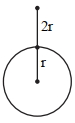
0 likesView Solution
51
PhysicsEasyMCQJEE Main · 2022
$A$ long solenoid carrying a current produces a magnetic field $B$ along its axis. If the current is doubled and the number of turns per cm is halved,the new value of the magnetic field is
A
$B$
B
$2 B$
C
$4 B$
D
$B/2$
Solution
(A) The magnetic field $B$ inside a long solenoid is given by the formula $B = \mu_0 n i$,where $n$ is the number of turns per unit length and $i$ is the current.
Let the initial magnetic field be $B = \mu_0 n i$.
When the current is doubled,the new current $i' = 2i$.
When the number of turns per cm is halved,the new number of turns per unit length $n' = n/2$.
The new magnetic field $B'$ is given by $B' = \mu_0 n' i' = \mu_0 (n/2) (2i) = \mu_0 n i$.
Therefore,$B' = B$.
Let the initial magnetic field be $B = \mu_0 n i$.
When the current is doubled,the new current $i' = 2i$.
When the number of turns per cm is halved,the new number of turns per unit length $n' = n/2$.
The new magnetic field $B'$ is given by $B' = \mu_0 n' i' = \mu_0 (n/2) (2i) = \mu_0 n i$.
Therefore,$B' = B$.
0 likesView Solution
52
PhysicsMediumMCQJEE Main · 2022
Two cells,having the same $e.m.f.$ $E$,are connected in series through an external resistance $R$. The cells have internal resistances $r_1$ and $r_2$ $(r_1 > r_2)$ respectively. When the circuit is closed,the potential difference across the first cell is zero. The value of $R$ is
A
$\sqrt{r_1 r_2}$
B
$r_1 + r_2$
C
$r_1 - r_2$
D
$\frac{r_1 + r_2}{2}$
Solution
(C) The total $e.m.f.$ of the series combination is $E_{eq} = E + E = 2E$.
The total resistance of the circuit is $R_{eq} = R + r_1 + r_2$.
The current $I$ flowing through the circuit is given by $I = \frac{2E}{R + r_1 + r_2}$.
The potential difference $V_1$ across the first cell (with internal resistance $r_1$) is given by $V_1 = E - I r_1$.
Given that $V_1 = 0$,we have $E - I r_1 = 0$,which implies $E = I r_1$.
Substituting the expression for $I$:
$E = \left( \frac{2E}{R + r_1 + r_2} \right) r_1$.
Dividing both sides by $E$ (assuming $E \neq 0$):
$1 = \frac{2r_1}{R + r_1 + r_2}$.
$R + r_1 + r_2 = 2r_1$.
$R = 2r_1 - r_1 - r_2 = r_1 - r_2$.
Thus,the correct option is $C$.
The total resistance of the circuit is $R_{eq} = R + r_1 + r_2$.
The current $I$ flowing through the circuit is given by $I = \frac{2E}{R + r_1 + r_2}$.
The potential difference $V_1$ across the first cell (with internal resistance $r_1$) is given by $V_1 = E - I r_1$.
Given that $V_1 = 0$,we have $E - I r_1 = 0$,which implies $E = I r_1$.
Substituting the expression for $I$:
$E = \left( \frac{2E}{R + r_1 + r_2} \right) r_1$.
Dividing both sides by $E$ (assuming $E \neq 0$):
$1 = \frac{2r_1}{R + r_1 + r_2}$.
$R + r_1 + r_2 = 2r_1$.
$R = 2r_1 - r_1 - r_2 = r_1 - r_2$.
Thus,the correct option is $C$.
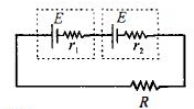
0 likesView Solution
53
PhysicsMediumMCQJEE Main · 2022
Two metal wires of identical dimensions are connected in series. If $\sigma_1$ and $\sigma_2$ are the conductivities of the metal wires respectively,the effective conductivity of the combination is
A
$\frac{{\sigma_1}{\sigma_2}}{{\sigma_1} + {\sigma_2}}$
B
$\frac{2{\sigma_1}{\sigma_2}}{{\sigma_1} + {\sigma_2}}$
C
$\frac{{\sigma_1} + {\sigma_2}}{2{\sigma_1}{\sigma_2}}$
D
$\frac{{\sigma_1} + {\sigma_2}}{{\sigma_1}{\sigma_2}}$
Solution
(B) Since both metal wires are of identical dimensions,their length and area of cross-section are the same. Let them be $l$ and $A$ respectively.
The resistance of the first wire is $R_1 = \frac{l}{\sigma_1 A}$ ...$(i)$
The resistance of the second wire is $R_2 = \frac{l}{\sigma_2 A}$ ...$(ii)$
Since they are connected in series,their effective resistance is $R_s = R_1 + R_2$.
$R_s = \frac{l}{\sigma_1 A} + \frac{l}{\sigma_2 A} = \frac{l}{A} \left( \frac{1}{\sigma_1} + \frac{1}{\sigma_2} \right)$ ...$(iii)$
If $\sigma_{eff}$ is the effective conductivity of the combination,then the total length is $2l$ and the total resistance is $R_s = \frac{2l}{\sigma_{eff} A}$ ...$(iv)$
Equating equations $(iii)$ and $(iv)$,we get:
$\frac{2l}{\sigma_{eff} A} = \frac{l}{A} \left( \frac{\sigma_1 + \sigma_2}{\sigma_1 \sigma_2} \right)$
$\frac{2}{\sigma_{eff}} = \frac{\sigma_1 + \sigma_2}{\sigma_1 \sigma_2}$
$\sigma_{eff} = \frac{2 \sigma_1 \sigma_2}{\sigma_1 + \sigma_2}$
The resistance of the first wire is $R_1 = \frac{l}{\sigma_1 A}$ ...$(i)$
The resistance of the second wire is $R_2 = \frac{l}{\sigma_2 A}$ ...$(ii)$
Since they are connected in series,their effective resistance is $R_s = R_1 + R_2$.
$R_s = \frac{l}{\sigma_1 A} + \frac{l}{\sigma_2 A} = \frac{l}{A} \left( \frac{1}{\sigma_1} + \frac{1}{\sigma_2} \right)$ ...$(iii)$
If $\sigma_{eff}$ is the effective conductivity of the combination,then the total length is $2l$ and the total resistance is $R_s = \frac{2l}{\sigma_{eff} A}$ ...$(iv)$
Equating equations $(iii)$ and $(iv)$,we get:
$\frac{2l}{\sigma_{eff} A} = \frac{l}{A} \left( \frac{\sigma_1 + \sigma_2}{\sigma_1 \sigma_2} \right)$
$\frac{2}{\sigma_{eff}} = \frac{\sigma_1 + \sigma_2}{\sigma_1 \sigma_2}$
$\sigma_{eff} = \frac{2 \sigma_1 \sigma_2}{\sigma_1 + \sigma_2}$

0 likesView Solution
54
PhysicsMediumMCQJEE Main · 2022
The refracting angle of a prism is $A,$ and the refractive index of the material of the prism is $\cot(A/2).$ The angle of minimum deviation is:
A
$180^o-3A$
B
$180^o-2A$
C
$90^o-A$
D
$180^o+2A$
Solution
(B) The formula for the refractive index $\mu$ of a prism in terms of the refracting angle $A$ and the angle of minimum deviation $\delta$ is given by:
$\mu = \frac{\sin((A+\delta)/2)}{\sin(A/2)}$
Given $\mu = \cot(A/2) = \frac{\cos(A/2)}{\sin(A/2)},$ we substitute this into the formula:
$\frac{\cos(A/2)}{\sin(A/2)} = \frac{\sin((A+\delta)/2)}{\sin(A/2)}$
Canceling $\sin(A/2)$ from both sides,we get:
$\cos(A/2) = \sin((A+\delta)/2)$
Using the trigonometric identity $\cos(\theta) = \sin(90^o - \theta)$:
$\sin(90^o - A/2) = \sin((A+\delta)/2)$
Equating the angles:
$90^o - A/2 = (A+\delta)/2$
$180^o - A = A + \delta$
$\delta = 180^o - 2A$
$\mu = \frac{\sin((A+\delta)/2)}{\sin(A/2)}$
Given $\mu = \cot(A/2) = \frac{\cos(A/2)}{\sin(A/2)},$ we substitute this into the formula:
$\frac{\cos(A/2)}{\sin(A/2)} = \frac{\sin((A+\delta)/2)}{\sin(A/2)}$
Canceling $\sin(A/2)$ from both sides,we get:
$\cos(A/2) = \sin((A+\delta)/2)$
Using the trigonometric identity $\cos(\theta) = \sin(90^o - \theta)$:
$\sin(90^o - A/2) = \sin((A+\delta)/2)$
Equating the angles:
$90^o - A/2 = (A+\delta)/2$
$180^o - A = A + \delta$
$\delta = 180^o - 2A$
1 likesView Solution
55
PhysicsDifficultMCQJEE Main · 2022
The wavelength $\lambda_e$ of an electron and $\lambda_p$ of a photon of same energy $E$ are related by
A
$\lambda_p \propto \lambda_e^2$
B
$\lambda_p \propto \lambda_e$
C
$\lambda_p \propto \sqrt{\lambda_e}$
D
$\lambda_p \propto \frac{1}{\sqrt{\lambda_e}}$
Solution
(A) The de Broglie wavelength of an electron with kinetic energy $E$ is given by:
$\lambda_e = \frac{h}{\sqrt{2 m_e E}}$ .... $(i)$
The wavelength of a photon with energy $E$ is given by:
$\lambda_p = \frac{hc}{E}$ or $E = \frac{hc}{\lambda_p}$ .... $(ii)$
From equation $(i)$,squaring both sides:
$\lambda_e^2 = \frac{h^2}{2 m_e E}$ or $E = \frac{h^2}{2 m_e \lambda_e^2}$ .... $(iii)$
Equating the expressions for $E$ from $(ii)$ and $(iii)$:
$\frac{hc}{\lambda_p} = \frac{h^2}{2 m_e \lambda_e^2}$
Rearranging for $\lambda_p$:
$\lambda_p = \left( \frac{2 m_e c}{h} \right) \lambda_e^2$
Since $\frac{2 m_e c}{h}$ is a constant,we have:
$\lambda_p \propto \lambda_e^2$
$\lambda_e = \frac{h}{\sqrt{2 m_e E}}$ .... $(i)$
The wavelength of a photon with energy $E$ is given by:
$\lambda_p = \frac{hc}{E}$ or $E = \frac{hc}{\lambda_p}$ .... $(ii)$
From equation $(i)$,squaring both sides:
$\lambda_e^2 = \frac{h^2}{2 m_e E}$ or $E = \frac{h^2}{2 m_e \lambda_e^2}$ .... $(iii)$
Equating the expressions for $E$ from $(ii)$ and $(iii)$:
$\frac{hc}{\lambda_p} = \frac{h^2}{2 m_e \lambda_e^2}$
Rearranging for $\lambda_p$:
$\lambda_p = \left( \frac{2 m_e c}{h} \right) \lambda_e^2$
Since $\frac{2 m_e c}{h}$ is a constant,we have:
$\lambda_p \propto \lambda_e^2$
0 likesView Solution
56
PhysicsDifficultMCQJEE Main · 2022
An electron of mass $m$ with an initial velocity $\vec{V} = V_0 \hat{i} \,(V_0 > 0)$ enters an electric field $\vec{E} = -E_0 \hat{i} \,(E_0 = \text{constant} > 0)$ at $t = 0$. If $\lambda_0$ is its de-Broglie wavelength initially,then its de-Broglie wavelength at time $t$ is:
A
$\frac{\lambda_0}{\left(1 + \frac{eE_0}{mV_0}t\right)}$
B
$\lambda_0 \left(1 + \frac{eE_0}{mV_0}t\right)$
C
$\lambda_0$
D
$\lambda_0 t$
Solution
(A) The force acting on the electron due to the electric field is $\vec{F} = q\vec{E} = (-e)(-E_0 \hat{i}) = eE_0 \hat{i}$.
The acceleration produced in the electron is $\vec{a} = \frac{\vec{F}}{m} = \frac{eE_0}{m} \hat{i}$.
The velocity of the electron at time $t$ is given by $\vec{v}_t = \vec{v} + \vec{a}t = \left(V_0 + \frac{eE_0}{m}t\right) \hat{i}$.
The magnitude of the velocity is $v_t = V_0 + \frac{eE_0}{m}t = V_0 \left(1 + \frac{eE_0}{mV_0}t\right)$.
The de-Broglie wavelength at time $t$ is $\lambda_t = \frac{h}{mv_t}$.
Substituting $v_t$,we get $\lambda_t = \frac{h}{m V_0 \left(1 + \frac{eE_0}{mV_0}t\right)}$.
Since the initial de-Broglie wavelength is $\lambda_0 = \frac{h}{mV_0}$,we have $\lambda_t = \frac{\lambda_0}{\left(1 + \frac{eE_0}{mV_0}t\right)}$.
The acceleration produced in the electron is $\vec{a} = \frac{\vec{F}}{m} = \frac{eE_0}{m} \hat{i}$.
The velocity of the electron at time $t$ is given by $\vec{v}_t = \vec{v} + \vec{a}t = \left(V_0 + \frac{eE_0}{m}t\right) \hat{i}$.
The magnitude of the velocity is $v_t = V_0 + \frac{eE_0}{m}t = V_0 \left(1 + \frac{eE_0}{mV_0}t\right)$.
The de-Broglie wavelength at time $t$ is $\lambda_t = \frac{h}{mv_t}$.
Substituting $v_t$,we get $\lambda_t = \frac{h}{m V_0 \left(1 + \frac{eE_0}{mV_0}t\right)}$.
Since the initial de-Broglie wavelength is $\lambda_0 = \frac{h}{mV_0}$,we have $\lambda_t = \frac{\lambda_0}{\left(1 + \frac{eE_0}{mV_0}t\right)}$.
0 likesView Solution
57
PhysicsMediumMCQJEE Main · 2022
Two identical charged particles,each having a mass $10 \, g$ and charge $2.0 \times 10^{-7} \, C$,are placed on a horizontal table with a separation of $L$ between them such that they stay in limiting equilibrium. If the coefficient of friction between each particle and the table is $0.25$,find the value of $L$ in $cm$. [Use $g = 10 \, m/s^2$]
A
$12$
B
$10$
C
$8$
D
$5$
Solution
(A) For the particles to be in limiting equilibrium,the electrostatic repulsive force must be equal to the maximum static frictional force.
Electrostatic force $F_e = \frac{kq^2}{L^2}$,where $k = 9 \times 10^9 \, N \cdot m^2/C^2$.
Frictional force $F_f = \mu mg$,where $\mu = 0.25$,$m = 10 \times 10^{-3} \, kg$,and $g = 10 \, m/s^2$.
Equating the two: $\frac{kq^2}{L^2} = \mu mg$.
$L^2 = \frac{kq^2}{\mu mg} = \frac{(9 \times 10^9) \times (2.0 \times 10^{-7})^2}{0.25 \times (10 \times 10^{-3}) \times 10}$.
$L^2 = \frac{9 \times 10^9 \times 4 \times 10^{-14}}{0.25 \times 0.1} = \frac{36 \times 10^{-5}}{0.025} = \frac{36 \times 10^{-5}}{25 \times 10^{-3}} = 1.44 \times 10^{-2} \, m^2$.
$L = \sqrt{1.44 \times 10^{-2}} = 1.2 \times 10^{-1} \, m = 0.12 \, m = 12 \, cm$.
Electrostatic force $F_e = \frac{kq^2}{L^2}$,where $k = 9 \times 10^9 \, N \cdot m^2/C^2$.
Frictional force $F_f = \mu mg$,where $\mu = 0.25$,$m = 10 \times 10^{-3} \, kg$,and $g = 10 \, m/s^2$.
Equating the two: $\frac{kq^2}{L^2} = \mu mg$.
$L^2 = \frac{kq^2}{\mu mg} = \frac{(9 \times 10^9) \times (2.0 \times 10^{-7})^2}{0.25 \times (10 \times 10^{-3}) \times 10}$.
$L^2 = \frac{9 \times 10^9 \times 4 \times 10^{-14}}{0.25 \times 0.1} = \frac{36 \times 10^{-5}}{0.025} = \frac{36 \times 10^{-5}}{25 \times 10^{-3}} = 1.44 \times 10^{-2} \, m^2$.
$L = \sqrt{1.44 \times 10^{-2}} = 1.2 \times 10^{-1} \, m = 0.12 \, m = 12 \, cm$.
0 likesView Solution
58
PhysicsMediumMCQJEE Main · 2022
What will be the most suitable combination of three resistors $A = 2 \, \Omega$,$B = 4 \, \Omega$,$C = 6 \, \Omega$ so that $\frac{22}{3} \, \Omega$ is the equivalent resistance of the combination?
A
Parallel combination of $A$ and $C$ connected in series with $B$.
B
Parallel combination of $A$ and $B$ connected in series with $C$.
C
Series combination of $A$ and $C$ connected in parallel with $B$.
D
Series combination of $B$ and $C$ connected in parallel with $A$.
Solution
(B) To find the equivalent resistance of $\frac{22}{3} \, \Omega$,we test the given options.
For option $A$: Parallel combination of $A$ and $C$ is $R_{p} = \frac{A \times C}{A + C} = \frac{2 \times 6}{2 + 6} = \frac{12}{8} = 1.5 \, \Omega$.
Adding $B$ in series: $R_{eq} = R_{p} + B = 1.5 + 4 = 5.5 \, \Omega$.
For option $B$: Parallel combination of $A$ and $B$ is $R_{p} = \frac{A \times B}{A + B} = \frac{2 \times 4}{2 + 4} = \frac{8}{6} = \frac{4}{3} \, \Omega$.
Adding $C$ in series: $R_{eq} = R_{p} + C = \frac{4}{3} + 6 = \frac{4 + 18}{3} = \frac{22}{3} \, \Omega$.
Thus,the correct combination is the parallel combination of $A$ and $B$ connected in series with $C$.
For option $A$: Parallel combination of $A$ and $C$ is $R_{p} = \frac{A \times C}{A + C} = \frac{2 \times 6}{2 + 6} = \frac{12}{8} = 1.5 \, \Omega$.
Adding $B$ in series: $R_{eq} = R_{p} + B = 1.5 + 4 = 5.5 \, \Omega$.
For option $B$: Parallel combination of $A$ and $B$ is $R_{p} = \frac{A \times B}{A + B} = \frac{2 \times 4}{2 + 4} = \frac{8}{6} = \frac{4}{3} \, \Omega$.
Adding $C$ in series: $R_{eq} = R_{p} + C = \frac{4}{3} + 6 = \frac{4 + 18}{3} = \frac{22}{3} \, \Omega$.
Thus,the correct combination is the parallel combination of $A$ and $B$ connected in series with $C$.
0 likesView Solution
59
PhysicsMediumMCQJEE Main · 2022
The soft-iron is a suitable material for making an electromagnet. This is because soft-iron has
A
low coercivity and high retentivity
B
low coercivity and low permeability
C
high permeability and low retentivity
D
high permeability and high retentivity
Solution
(C) Magnetic retentivity determines the magnetism left in the material after the magnetizing field has been switched off.
Electromagnets are operated in conditions requiring fast reversal of polarity,so high retentivity is undesirable.
Permeability is directly related to susceptibility; high permeability means the material is easily magnetized.
Therefore,electromagnets must be made of materials having high permeability and low retentivity.
Soft iron is such a material,making it ideal for electromagnets.
Electromagnets are operated in conditions requiring fast reversal of polarity,so high retentivity is undesirable.
Permeability is directly related to susceptibility; high permeability means the material is easily magnetized.
Therefore,electromagnets must be made of materials having high permeability and low retentivity.
Soft iron is such a material,making it ideal for electromagnets.
0 likesView Solution
60
PhysicsMediumMCQJEE Main · 2022
$A$ proton, a deuteron, and an $\alpha$-particle with the same kinetic energy enter a uniform magnetic field at a right angle to the magnetic field. The ratio of the radii of their respective circular paths is
A
$1: \sqrt{2}: \sqrt{2}$
B
$1: 1: \sqrt{2}$
C
$\sqrt{2}: 1: 1$
D
$1: \sqrt{2}: 1$
Solution
(D) The radius $R$ of a charged particle moving in a uniform magnetic field is given by $R = \frac{mv}{qB}$.
Since kinetic energy $K = \frac{1}{2}mv^2$, we have $v = \sqrt{\frac{2K}{m}}$.
Substituting $v$ into the radius formula: $R = \frac{m}{qB} \sqrt{\frac{2K}{m}} = \frac{\sqrt{2mK}}{qB}$.
Since $K$ and $B$ are constant for all particles, $R \propto \frac{\sqrt{m}}{q}$.
For a proton $(p)$: mass $= m$, charge $= e$. So, $R_p \propto \frac{\sqrt{m}}{e}$.
For a deuteron $(d)$: mass $= 2m$, charge $= e$. So, $R_d \propto \frac{\sqrt{2m}}{e}$.
For an $\alpha$-particle $(\alpha)$: mass $= 4m$, charge $= 2e$. So, $R_{\alpha} \propto \frac{\sqrt{4m}}{2e} = \frac{2\sqrt{m}}{2e} = \frac{\sqrt{m}}{e}$.
The ratio $R_p : R_d : R_{\alpha} = \frac{\sqrt{m}}{e} : \frac{\sqrt{2m}}{e} : \frac{\sqrt{m}}{e} = 1 : \sqrt{2} : 1$.
Since kinetic energy $K = \frac{1}{2}mv^2$, we have $v = \sqrt{\frac{2K}{m}}$.
Substituting $v$ into the radius formula: $R = \frac{m}{qB} \sqrt{\frac{2K}{m}} = \frac{\sqrt{2mK}}{qB}$.
Since $K$ and $B$ are constant for all particles, $R \propto \frac{\sqrt{m}}{q}$.
For a proton $(p)$: mass $= m$, charge $= e$. So, $R_p \propto \frac{\sqrt{m}}{e}$.
For a deuteron $(d)$: mass $= 2m$, charge $= e$. So, $R_d \propto \frac{\sqrt{2m}}{e}$.
For an $\alpha$-particle $(\alpha)$: mass $= 4m$, charge $= 2e$. So, $R_{\alpha} \propto \frac{\sqrt{4m}}{2e} = \frac{2\sqrt{m}}{2e} = \frac{\sqrt{m}}{e}$.
The ratio $R_p : R_d : R_{\alpha} = \frac{\sqrt{m}}{e} : \frac{\sqrt{2m}}{e} : \frac{\sqrt{m}}{e} = 1 : \sqrt{2} : 1$.
0 likesView Solution
61
PhysicsMediumMCQJEE Main · 2022
Given below are two statements:
Statement-$I$: The reactance of an $ac$ circuit is zero. It is possible that the circuit contains a capacitor and an inductor.
Statement-$II$: In an $ac$ circuit, the average power delivered by the source never becomes zero.
In the light of the above statements, choose the correct answer from the options given below:
Statement-$I$: The reactance of an $ac$ circuit is zero. It is possible that the circuit contains a capacitor and an inductor.
Statement-$II$: In an $ac$ circuit, the average power delivered by the source never becomes zero.
In the light of the above statements, choose the correct answer from the options given below:
A
Both Statement-$I$ and Statement-$II$ are true.
B
Both Statement-$I$ and Statement-$II$ are false.
C
Statement-$I$ is true but Statement-$II$ is false.
D
Statement-$I$ is false but Statement-$II$ is true.
Solution
(C) Statement-$I$ is true. The net reactance $X = X_L - X_C$. If $X_L = X_C$, then $X = 0$. This occurs at resonance in an $LCR$ or $LC$ circuit, which contains both an inductor and a capacitor.
Statement-$II$ is false. The average power in an $ac$ circuit is given by $P_{avg} = V_{rms} I_{rms} \cos \phi$. If the circuit is purely inductive or purely capacitive, the phase angle $\phi = 90^{\circ}$, so $\cos 90^{\circ} = 0$. Thus, the average power delivered by the source becomes zero in such cases.
Statement-$II$ is false. The average power in an $ac$ circuit is given by $P_{avg} = V_{rms} I_{rms} \cos \phi$. If the circuit is purely inductive or purely capacitive, the phase angle $\phi = 90^{\circ}$, so $\cos 90^{\circ} = 0$. Thus, the average power delivered by the source becomes zero in such cases.
0 likesView Solution
62
PhysicsMediumMCQJEE Main · 2022
If the charge on a capacitor is increased by $2 \ C$,the energy stored in it increases by $44 \%$. The original charge on the capacitor is (in $C$):
A
$10$
B
$20$
C
$30$
D
$40$
Solution
(A) The energy stored in a capacitor is given by $U = \frac{q^2}{2C}$,where $q$ is the charge and $C$ is the capacitance.
Since $C$ is constant,$U \propto q^2$.
Let the initial charge be $q$ and the initial energy be $U_i = \frac{q^2}{2C}$.
When the charge is increased by $2 \ C$,the new charge is $q' = q + 2$.
The new energy is $U_f = \frac{(q+2)^2}{2C}$.
Given that the energy increases by $44 \%$,the new energy is $U_f = U_i + 0.44 \, U_i = 1.44 \, U_i$.
Substituting the expressions for $U_f$ and $U_i$:
$\frac{(q+2)^2}{2C} = 1.44 \times \frac{q^2}{2C}$.
$(q+2)^2 = 1.44 \, q^2$.
Taking the square root on both sides:
$q + 2 = \sqrt{1.44} \, q$.
$q + 2 = 1.2 \, q$.
$0.2 \, q = 2$.
$q = \frac{2}{0.2} = 10 \ C$.
Since $C$ is constant,$U \propto q^2$.
Let the initial charge be $q$ and the initial energy be $U_i = \frac{q^2}{2C}$.
When the charge is increased by $2 \ C$,the new charge is $q' = q + 2$.
The new energy is $U_f = \frac{(q+2)^2}{2C}$.
Given that the energy increases by $44 \%$,the new energy is $U_f = U_i + 0.44 \, U_i = 1.44 \, U_i$.
Substituting the expressions for $U_f$ and $U_i$:
$\frac{(q+2)^2}{2C} = 1.44 \times \frac{q^2}{2C}$.
$(q+2)^2 = 1.44 \, q^2$.
Taking the square root on both sides:
$q + 2 = \sqrt{1.44} \, q$.
$q + 2 = 1.2 \, q$.
$0.2 \, q = 2$.
$q = \frac{2}{0.2} = 10 \ C$.
0 likesView Solution
63
PhysicsDifficultMCQJEE Main · 2022
$A$ long cylindrical volume contains a uniformly distributed charge of density $\rho$. The radius of the cylindrical volume is $R$. $A$ charged particle $(q)$ revolves around the cylinder in a circular path at a distance $r$ from the axis. The kinetic energy of the particle is:
A
$\frac{\rho q R^{2}}{4 \varepsilon_{0}}$
B
$\frac{\rho q R^{2}}{2 \varepsilon_{0}}$
C
$\frac{q \rho}{4 \varepsilon_{0} R^{2}}$
D
$\frac{4 \varepsilon_{0} R^{2}}{q \rho}$
Solution
(A) For a point outside the cylinder at a distance $r$ from the axis,we use Gauss's Law: $\oint E \cdot dA = \frac{q_{enclosed}}{\varepsilon_{0}}$.
Considering a Gaussian surface of radius $r$ and length $\ell$,the enclosed charge is $q_{enc} = \rho \cdot \pi R^{2} \ell$.
Thus,$E(2 \pi r \ell) = \frac{\rho \pi R^{2} \ell}{\varepsilon_{0}}$,which gives the electric field $E = \frac{\rho R^{2}}{2 \varepsilon_{0} r}$.
The electrostatic force provides the necessary centripetal force for circular motion: $qE = \frac{mv^{2}}{r}$.
Substituting $E$: $q \left( \frac{\rho R^{2}}{2 \varepsilon_{0} r} \right) = \frac{mv^{2}}{r}$.
Simplifying,we get $mv^{2} = \frac{q \rho R^{2}}{2 \varepsilon_{0}}$.
The kinetic energy $K = \frac{1}{2} mv^{2} = \frac{q \rho R^{2}}{4 \varepsilon_{0}}$.
Considering a Gaussian surface of radius $r$ and length $\ell$,the enclosed charge is $q_{enc} = \rho \cdot \pi R^{2} \ell$.
Thus,$E(2 \pi r \ell) = \frac{\rho \pi R^{2} \ell}{\varepsilon_{0}}$,which gives the electric field $E = \frac{\rho R^{2}}{2 \varepsilon_{0} r}$.
The electrostatic force provides the necessary centripetal force for circular motion: $qE = \frac{mv^{2}}{r}$.
Substituting $E$: $q \left( \frac{\rho R^{2}}{2 \varepsilon_{0} r} \right) = \frac{mv^{2}}{r}$.
Simplifying,we get $mv^{2} = \frac{q \rho R^{2}}{2 \varepsilon_{0}}$.
The kinetic energy $K = \frac{1}{2} mv^{2} = \frac{q \rho R^{2}}{4 \varepsilon_{0}}$.
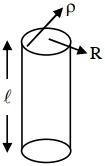
0 likesView Solution
64
PhysicsDifficultMCQJEE Main · 2022
An electric bulb is rated as $200 \, W$. What will be the peak magnetic field $(\times 10^{-8} \, T)$ at $4 \, m$ distance produced by the radiations coming from this bulb? Consider this bulb as a point source with $3.5 \%$ efficiency.
A
$1.19$
B
$1.71$
C
$0.84$
D
$3.36$
Solution
(B) The intensity $I$ of the electromagnetic wave at a distance $r$ from a point source is given by $I = \frac{\eta P}{4 \pi r^2}$,where $\eta = 0.035$ is the efficiency and $P = 200 \, W$ is the power.
Also,the intensity is related to the peak magnetic field $B_0$ by $I = \frac{c B_0^2}{2 \mu_0}$.
Equating the two expressions: $\frac{\eta P}{4 \pi r^2} = \frac{c B_0^2}{2 \mu_0}$.
Rearranging for $B_0$: $B_0 = \sqrt{\frac{\mu_0 \eta P}{2 \pi c r^2}} = \frac{1}{r} \sqrt{\frac{\mu_0 \eta P}{2 \pi c}}$.
Given $\frac{\mu_0}{4 \pi} = 10^{-7} \, T \cdot m/A$,$c = 3 \times 10^8 \, m/s$,$r = 4 \, m$,$\eta = 0.035$,and $P = 200 \, W$.
$B_0 = \frac{1}{4} \sqrt{\frac{2 \times 10^{-7} \times 0.035 \times 200}{3 \times 10^8}} = \frac{1}{4} \sqrt{\frac{14 \times 10^{-7}}{3 \times 10^8}} = \frac{1}{4} \sqrt{4.66 \times 10^{-16}} = \frac{2.16 \times 10^{-8}}{4} \approx 0.54 \times 10^{-8} \, T$.
Re-evaluating the provided formula in the prompt: $B_0 = \frac{1}{r} \sqrt{\frac{\mu_0 \eta P}{2 \pi c}} = \frac{1}{4} \sqrt{\frac{2 \times 10^{-7} \times 0.035 \times 200}{3 \times 10^8}} = 1.71 \times 10^{-8} \, T$ is obtained if the formula used is $B_0 = \sqrt{\frac{\mu_0 \eta P}{2 \pi c r^2}}$. The calculation yields $1.71 \times 10^{-8} \, T$.
Also,the intensity is related to the peak magnetic field $B_0$ by $I = \frac{c B_0^2}{2 \mu_0}$.
Equating the two expressions: $\frac{\eta P}{4 \pi r^2} = \frac{c B_0^2}{2 \mu_0}$.
Rearranging for $B_0$: $B_0 = \sqrt{\frac{\mu_0 \eta P}{2 \pi c r^2}} = \frac{1}{r} \sqrt{\frac{\mu_0 \eta P}{2 \pi c}}$.
Given $\frac{\mu_0}{4 \pi} = 10^{-7} \, T \cdot m/A$,$c = 3 \times 10^8 \, m/s$,$r = 4 \, m$,$\eta = 0.035$,and $P = 200 \, W$.
$B_0 = \frac{1}{4} \sqrt{\frac{2 \times 10^{-7} \times 0.035 \times 200}{3 \times 10^8}} = \frac{1}{4} \sqrt{\frac{14 \times 10^{-7}}{3 \times 10^8}} = \frac{1}{4} \sqrt{4.66 \times 10^{-16}} = \frac{2.16 \times 10^{-8}}{4} \approx 0.54 \times 10^{-8} \, T$.
Re-evaluating the provided formula in the prompt: $B_0 = \frac{1}{r} \sqrt{\frac{\mu_0 \eta P}{2 \pi c}} = \frac{1}{4} \sqrt{\frac{2 \times 10^{-7} \times 0.035 \times 200}{3 \times 10^8}} = 1.71 \times 10^{-8} \, T$ is obtained if the formula used is $B_0 = \sqrt{\frac{\mu_0 \eta P}{2 \pi c r^2}}$. The calculation yields $1.71 \times 10^{-8} \, T$.
0 likesView Solution
65
PhysicsMediumMCQJEE Main · 2022
The light of two different frequencies whose photons have energies $3.8 \, eV$ and $1.4 \, eV$ respectively,illuminate a metallic surface whose work function is $0.6 \, eV$ successively. The ratio of maximum speeds of emitted electrons for the two frequencies respectively will be
A
$1: 1$
B
$2: 1$
C
$4: 1$
D
$1: 4$
Solution
(B) According to Einstein's photoelectric equation,the maximum kinetic energy $K_{max}$ of emitted electrons is given by $K_{max} = E - \Phi$,where $E$ is the photon energy and $\Phi$ is the work function.
For the first photon,$E_1 = 3.8 \, eV$ and $\Phi = 0.6 \, eV$. Thus,$K_{max1} = 3.8 - 0.6 = 3.2 \, eV$.
For the second photon,$E_2 = 1.4 \, eV$ and $\Phi = 0.6 \, eV$. Thus,$K_{max2} = 1.4 - 0.6 = 0.8 \, eV$.
Since $K_{max} = \frac{1}{2} m v_{max}^2$,the ratio of the maximum speeds is $\frac{v_1}{v_2} = \sqrt{\frac{K_{max1}}{K_{max2}}}$.
Substituting the values,$\frac{v_1}{v_2} = \sqrt{\frac{3.2}{0.8}} = \sqrt{4} = 2$.
Therefore,the ratio is $2: 1$.
For the first photon,$E_1 = 3.8 \, eV$ and $\Phi = 0.6 \, eV$. Thus,$K_{max1} = 3.8 - 0.6 = 3.2 \, eV$.
For the second photon,$E_2 = 1.4 \, eV$ and $\Phi = 0.6 \, eV$. Thus,$K_{max2} = 1.4 - 0.6 = 0.8 \, eV$.
Since $K_{max} = \frac{1}{2} m v_{max}^2$,the ratio of the maximum speeds is $\frac{v_1}{v_2} = \sqrt{\frac{K_{max1}}{K_{max2}}}$.
Substituting the values,$\frac{v_1}{v_2} = \sqrt{\frac{3.2}{0.8}} = \sqrt{4} = 2$.
Therefore,the ratio is $2: 1$.
0 likesView Solution
66
PhysicsMediumMCQJEE Main · 2022
Two light beams of intensities in the ratio of $9: 4$ are allowed to interfere. The ratio of the intensity of maxima and minima will be
A
$2: 3$
B
$16: 81$
C
$25: 169$
D
$25: 1$
Solution
(D) Given the ratio of intensities $I_1 : I_2 = 9 : 4$.
Let $I_1 = 9k$ and $I_2 = 4k$.
The amplitudes are proportional to the square root of intensities,so $a_1 = \sqrt{I_1} = 3\sqrt{k}$ and $a_2 = \sqrt{I_2} = 2\sqrt{k}$.
The ratio of maximum intensity to minimum intensity is given by the formula:
$\frac{I_{max}}{I_{min}} = \left( \frac{a_1 + a_2}{a_1 - a_2} \right)^2$.
Substituting the values:
$\frac{I_{max}}{I_{min}} = \left( \frac{3\sqrt{k} + 2\sqrt{k}}{3\sqrt{k} - 2\sqrt{k}} \right)^2 = \left( \frac{5\sqrt{k}}{1\sqrt{k}} \right)^2 = 5^2 = 25$.
Thus,the ratio is $25 : 1$.
Let $I_1 = 9k$ and $I_2 = 4k$.
The amplitudes are proportional to the square root of intensities,so $a_1 = \sqrt{I_1} = 3\sqrt{k}$ and $a_2 = \sqrt{I_2} = 2\sqrt{k}$.
The ratio of maximum intensity to minimum intensity is given by the formula:
$\frac{I_{max}}{I_{min}} = \left( \frac{a_1 + a_2}{a_1 - a_2} \right)^2$.
Substituting the values:
$\frac{I_{max}}{I_{min}} = \left( \frac{3\sqrt{k} + 2\sqrt{k}}{3\sqrt{k} - 2\sqrt{k}} \right)^2 = \left( \frac{5\sqrt{k}}{1\sqrt{k}} \right)^2 = 5^2 = 25$.
Thus,the ratio is $25 : 1$.
0 likesView Solution
67
PhysicsMediumMCQJEE Main · 2022
In Bohr's atomic model of hydrogen,let $K$,$P$ and $E$ be the kinetic energy,potential energy and total energy of the electron,respectively. Choose the correct option when the electron undergoes transitions to a higher level.
A
All $K$,$P$ and $E$ increase.
B
$K$ decreases,$P$ and $E$ increase.
C
$P$ decreases,$K$ and $E$ increase.
D
$K$ increases,$P$ and $E$ decrease.
Solution
(B) In Bohr's model for a hydrogen atom,the energy levels are given by $E_n = -\frac{13.6 \text{ eV}}{n^2}$. As the electron transitions to a higher level ($n$ increases),$E$ increases (becomes less negative).
For a hydrogen-like atom,the kinetic energy is $K = -E = \frac{13.6 \text{ eV}}{n^2}$. As $n$ increases,$K$ decreases.
The potential energy is $P = 2E = -\frac{27.2 \text{ eV}}{n^2}$. As $n$ increases,the magnitude of $P$ decreases,meaning $P$ becomes less negative,so $P$ increases.
Therefore,as the electron moves to a higher energy level,$K$ decreases,while $P$ and $E$ increase.
For a hydrogen-like atom,the kinetic energy is $K = -E = \frac{13.6 \text{ eV}}{n^2}$. As $n$ increases,$K$ decreases.
The potential energy is $P = 2E = -\frac{27.2 \text{ eV}}{n^2}$. As $n$ increases,the magnitude of $P$ decreases,meaning $P$ becomes less negative,so $P$ increases.
Therefore,as the electron moves to a higher energy level,$K$ decreases,while $P$ and $E$ increase.
0 likesView Solution
68
PhysicsMediumMCQJEE Main · 2022
An antenna is placed in a dielectric medium of dielectric constant $6.25$. If the maximum size of the antenna is $5.0 \, mm$,what is the minimum frequency of the signal it can radiate in $GHz$? (Given $\mu_{r} = 1$ for the dielectric medium)
A
$60$
B
$6$
C
$9$
D
$3$
Solution
(B) The speed of light in a dielectric medium is given by $v = \frac{c}{\sqrt{\mu_{r} \varepsilon_{r}}}$.
Given $\mu_{r} = 1$ and $\varepsilon_{r} = 6.25$,the speed $v = \frac{3 \times 10^{8}}{\sqrt{6.25}} = \frac{3 \times 10^{8}}{2.5} = 1.2 \times 10^{8} \, m/s$.
For an antenna to radiate effectively,its length $L$ should be at least $\frac{\lambda}{4}$.
Thus,$\lambda = 4L = 4 \times 5.0 \times 10^{-3} \, m = 20 \times 10^{-3} \, m = 0.02 \, m$.
The frequency $f$ is given by $f = \frac{v}{\lambda} = \frac{1.2 \times 10^{8}}{0.02} = 60 \times 10^{8} \, Hz = 6 \, GHz$.
Given $\mu_{r} = 1$ and $\varepsilon_{r} = 6.25$,the speed $v = \frac{3 \times 10^{8}}{\sqrt{6.25}} = \frac{3 \times 10^{8}}{2.5} = 1.2 \times 10^{8} \, m/s$.
For an antenna to radiate effectively,its length $L$ should be at least $\frac{\lambda}{4}$.
Thus,$\lambda = 4L = 4 \times 5.0 \times 10^{-3} \, m = 20 \times 10^{-3} \, m = 0.02 \, m$.
The frequency $f$ is given by $f = \frac{v}{\lambda} = \frac{1.2 \times 10^{8}}{0.02} = 60 \times 10^{8} \, Hz = 6 \, GHz$.
0 likesView Solution
69
PhysicsMediumMCQJEE Main · 2022
$A$ potentiometer wire of length $10 \,m$ and resistance $20 \,\Omega$ is connected in series with a $25 \,V$ battery and an external resistance $30 \,\Omega$. $A$ cell of emf $E$ in the secondary circuit is balanced by a $250 \,cm$ long potentiometer wire. The value of $E$ (in volt) is $\frac{x}{10}$. The value of $x$ is.......
A
$56$
B
$85$
C
$25$
D
$55$
Solution
(C) The total resistance of the primary circuit is $R_{total} = R_{wire} + R_{external} = 20 \,\Omega + 30 \,\Omega = 50 \,\Omega$.
The current in the primary circuit is $I = \frac{V}{R_{total}} = \frac{25 \,V}{50 \,\Omega} = 0.5 \,A$.
The potential drop across the entire potentiometer wire is $V_{wire} = I \times R_{wire} = 0.5 \,A \times 20 \,\Omega = 10 \,V$.
The potential gradient along the wire is $k = \frac{V_{wire}}{L} = \frac{10 \,V}{10 \,m} = 1 \,V/m$.
The balancing length is $l = 250 \,cm = 2.5 \,m$.
The emf of the cell is $E = k \times l = 1 \,V/m \times 2.5 \,m = 2.5 \,V$.
Given $E = \frac{x}{10}$,we have $2.5 = \frac{x}{10}$,which implies $x = 25$.
The current in the primary circuit is $I = \frac{V}{R_{total}} = \frac{25 \,V}{50 \,\Omega} = 0.5 \,A$.
The potential drop across the entire potentiometer wire is $V_{wire} = I \times R_{wire} = 0.5 \,A \times 20 \,\Omega = 10 \,V$.
The potential gradient along the wire is $k = \frac{V_{wire}}{L} = \frac{10 \,V}{10 \,m} = 1 \,V/m$.
The balancing length is $l = 250 \,cm = 2.5 \,m$.
The emf of the cell is $E = k \times l = 1 \,V/m \times 2.5 \,m = 2.5 \,V$.
Given $E = \frac{x}{10}$,we have $2.5 = \frac{x}{10}$,which implies $x = 25$.
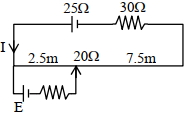
0 likesView Solution
70
PhysicsEasyMCQJEE Main · 2022
In the given circuit,the value of current $I_{L}$ will be in $mA$. (When $R_{L} = 1 \, k\Omega$)
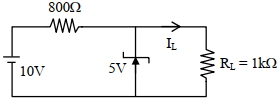
A
$5$
B
$55$
C
$7$
D
$1$
Solution
(A) The Zener diode is connected in parallel with the load resistor $R_{L}$.
Since the Zener diode is in the breakdown region,the voltage across the load resistor $R_{L}$ is equal to the Zener breakdown voltage,which is $V_{Z} = 5 \, V$.
The load current $I_{L}$ is given by Ohm's law:
$I_{L} = \frac{V_{Z}}{R_{L}}$
Given $V_{Z} = 5 \, V$ and $R_{L} = 1 \, k\Omega = 1000 \, \Omega$.
$I_{L} = \frac{5 \, V}{1000 \, \Omega} = 0.005 \, A = 5 \, mA$.
Since the Zener diode is in the breakdown region,the voltage across the load resistor $R_{L}$ is equal to the Zener breakdown voltage,which is $V_{Z} = 5 \, V$.
The load current $I_{L}$ is given by Ohm's law:
$I_{L} = \frac{V_{Z}}{R_{L}}$
Given $V_{Z} = 5 \, V$ and $R_{L} = 1 \, k\Omega = 1000 \, \Omega$.
$I_{L} = \frac{5 \, V}{1000 \, \Omega} = 0.005 \, A = 5 \, mA$.
0 likesView Solution
71
PhysicsMediumMCQJEE Main · 2022
$A$ sample contains $10^{-2} \ kg$ each of two substances $A$ and $B$ with half-lives $4 \ s$ and $8 \ s$ respectively. The ratio of their atomic weights is $1:2$. The ratio of the amounts (number of atoms) of $A$ and $B$ remaining after $16 \ s$ is $\frac{x}{100}$. The value of $x$ is:
A
$55$
B
$50$
C
$90$
D
$150$
Solution
(B) The number of atoms $N$ in a mass $m$ with atomic weight $M$ is given by $N = \frac{m}{M} N_A$,where $N_A$ is Avogadro's number.
Initial number of atoms: $N_{A,0} = \frac{m}{M_A} N_A$ and $N_{B,0} = \frac{m}{M_B} N_A$.
Given $m_A = m_B = 10^{-2} \ kg$ and $\frac{M_A}{M_B} = \frac{1}{2}$,so $M_B = 2M_A$.
Thus,$\frac{N_{A,0}}{N_{B,0}} = \frac{M_B}{M_A} = 2$.
After time $t = 16 \ s$,the number of remaining atoms is $N(t) = N_0 (0.5)^{\frac{t}{T_{1/2}}}$.
For substance $A$: $N_A(16) = N_{A,0} (0.5)^{\frac{16}{4}} = N_{A,0} (0.5)^4 = \frac{N_{A,0}}{16}$.
For substance $B$: $N_B(16) = N_{B,0} (0.5)^{\frac{16}{8}} = N_{B,0} (0.5)^2 = \frac{N_{B,0}}{4}$.
The ratio is $\frac{N_A(16)}{N_B(16)} = \frac{N_{A,0}}{16} \times \frac{4}{N_{B,0}} = \frac{1}{4} \times \frac{N_{A,0}}{N_{B,0}} = \frac{1}{4} \times 2 = \frac{1}{2} = \frac{50}{100}$.
Therefore,$x = 50$.
Initial number of atoms: $N_{A,0} = \frac{m}{M_A} N_A$ and $N_{B,0} = \frac{m}{M_B} N_A$.
Given $m_A = m_B = 10^{-2} \ kg$ and $\frac{M_A}{M_B} = \frac{1}{2}$,so $M_B = 2M_A$.
Thus,$\frac{N_{A,0}}{N_{B,0}} = \frac{M_B}{M_A} = 2$.
After time $t = 16 \ s$,the number of remaining atoms is $N(t) = N_0 (0.5)^{\frac{t}{T_{1/2}}}$.
For substance $A$: $N_A(16) = N_{A,0} (0.5)^{\frac{16}{4}} = N_{A,0} (0.5)^4 = \frac{N_{A,0}}{16}$.
For substance $B$: $N_B(16) = N_{B,0} (0.5)^{\frac{16}{8}} = N_{B,0} (0.5)^2 = \frac{N_{B,0}}{4}$.
The ratio is $\frac{N_A(16)}{N_B(16)} = \frac{N_{A,0}}{16} \times \frac{4}{N_{B,0}} = \frac{1}{4} \times \frac{N_{A,0}}{N_{B,0}} = \frac{1}{4} \times 2 = \frac{1}{2} = \frac{50}{100}$.
Therefore,$x = 50$.
0 likesView Solution
72
PhysicsMediumMCQJEE Main · 2022
$A$ ray of light is incident at an angle of incidence $60^{\circ}$ on a glass slab of refractive index $\sqrt{3}$. After refraction,the light ray emerges out from the other parallel face,and the lateral shift between the incident ray and the emergent ray is $4 \sqrt{3} \, cm$. The thickness of the glass slab is . . . $cm$.
A
$8$
B
$12$
C
$16$
D
$20$
Solution
(B) The formula for lateral shift $d$ is given by: $d = t \frac{\sin(i-r)}{\cos r}$,where $t$ is the thickness,$i$ is the angle of incidence,and $r$ is the angle of refraction.
Using Snell's Law: $\sin i = \mu \sin r \Rightarrow \sin 60^{\circ} = \sqrt{3} \sin r$.
$\frac{\sqrt{3}}{2} = \sqrt{3} \sin r \Rightarrow \sin r = \frac{1}{2} \Rightarrow r = 30^{\circ}$.
Now,substitute the values into the lateral shift formula:
$4\sqrt{3} = t \frac{\sin(60^{\circ}-30^{\circ})}{\cos 30^{\circ}}$.
$4\sqrt{3} = t \frac{\sin 30^{\circ}}{\cos 30^{\circ}} = t \tan 30^{\circ}$.
$4\sqrt{3} = t \left(\frac{1}{\sqrt{3}}\right)$.
$t = 4\sqrt{3} \times \sqrt{3} = 4 \times 3 = 12 \, cm$.
Using Snell's Law: $\sin i = \mu \sin r \Rightarrow \sin 60^{\circ} = \sqrt{3} \sin r$.
$\frac{\sqrt{3}}{2} = \sqrt{3} \sin r \Rightarrow \sin r = \frac{1}{2} \Rightarrow r = 30^{\circ}$.
Now,substitute the values into the lateral shift formula:
$4\sqrt{3} = t \frac{\sin(60^{\circ}-30^{\circ})}{\cos 30^{\circ}}$.
$4\sqrt{3} = t \frac{\sin 30^{\circ}}{\cos 30^{\circ}} = t \tan 30^{\circ}$.
$4\sqrt{3} = t \left(\frac{1}{\sqrt{3}}\right)$.
$t = 4\sqrt{3} \times \sqrt{3} = 4 \times 3 = 12 \, cm$.
0 likesView Solution
73
PhysicsEasyMCQJEE Main · 2022
$A$ circular coil of $1000$ turns, each with an area of $1 \, m^{2}$, is rotated about its vertical diameter at the rate of one revolution per second in a uniform horizontal magnetic field of $0.07 \, T$. The maximum voltage generated will be ......... $V$.
A
$540$
B
$447$
C
$480$
D
$440$
Solution
(D) The maximum induced electromotive force $(EMF)$ in a rotating coil is given by the formula: $\varepsilon_{\max} = BAN\omega$.
Given:
$B = 0.07 \, T$ (Magnetic field)
$A = 1 \, m^{2}$ (Area of the coil)
$N = 1000$ (Number of turns)
$f = 1 \, \text{rev/s}$ (Frequency)
Angular velocity $\omega = 2\pi f = 2\pi(1) = 2\pi \, \text{rad/s}$.
Substituting the values:
$\varepsilon_{\max} = 0.07 \times 1 \times 1000 \times 2\pi$
$\varepsilon_{\max} = 70 \times 2\pi = 140\pi$.
Using $\pi \approx 3.14159$:
$\varepsilon_{\max} = 140 \times 3.14159 \approx 439.82 \, V$.
Rounding to the nearest integer, we get $440 \, V$.
Given:
$B = 0.07 \, T$ (Magnetic field)
$A = 1 \, m^{2}$ (Area of the coil)
$N = 1000$ (Number of turns)
$f = 1 \, \text{rev/s}$ (Frequency)
Angular velocity $\omega = 2\pi f = 2\pi(1) = 2\pi \, \text{rad/s}$.
Substituting the values:
$\varepsilon_{\max} = 0.07 \times 1 \times 1000 \times 2\pi$
$\varepsilon_{\max} = 70 \times 2\pi = 140\pi$.
Using $\pi \approx 3.14159$:
$\varepsilon_{\max} = 140 \times 3.14159 \approx 439.82 \, V$.
Rounding to the nearest integer, we get $440 \, V$.
0 likesView Solution
74
PhysicsMediumMCQJEE Main · 2022
Given below are two statements: One is labelled as Assertion $(A)$ and the other is labelled as Reason $(R)$.
Assertion $(A)$: In a uniform magnetic field,speed and energy remain the same for a moving charged particle.
Reason $(R)$: $A$ moving charged particle experiences a magnetic force perpendicular to its direction of motion.
Assertion $(A)$: In a uniform magnetic field,speed and energy remain the same for a moving charged particle.
Reason $(R)$: $A$ moving charged particle experiences a magnetic force perpendicular to its direction of motion.
A
Both $(A)$ and $(R)$ are true and $(R)$ is the correct explanation of $(A)$.
B
Both $(A)$ and $(R)$ are true but $(R)$ is $NOT$ the correct explanation of $(A)$.
C
$(A)$ is true but $(R)$ is false.
D
$(A)$ is false but $(R)$ is true.
Solution
(A) The magnetic force on a moving charged particle is given by $\overrightarrow{F} = q(\overrightarrow{v} \times \overrightarrow{B})$.
Since the force $\overrightarrow{F}$ is the cross product of velocity $\overrightarrow{v}$ and magnetic field $\overrightarrow{B}$,the force is always perpendicular to the velocity $(\overrightarrow{F} \perp \overrightarrow{v})$.
Work done by the magnetic force is $W = \int \overrightarrow{F} \cdot d\overrightarrow{s} = \int \overrightarrow{F} \cdot \overrightarrow{v} dt$.
Since $\overrightarrow{F} \perp \overrightarrow{v}$,the dot product $\overrightarrow{F} \cdot \overrightarrow{v} = 0$,so the work done is $0$.
According to the work-energy theorem,the change in kinetic energy is equal to the work done. Since work done is $0$,the kinetic energy remains constant.
Since kinetic energy $K = \frac{1}{2}mv^2$ is constant,the speed $v$ of the particle also remains constant.
Thus,both Assertion $(A)$ and Reason $(R)$ are true,and $(R)$ is the correct explanation of $(A)$.
Since the force $\overrightarrow{F}$ is the cross product of velocity $\overrightarrow{v}$ and magnetic field $\overrightarrow{B}$,the force is always perpendicular to the velocity $(\overrightarrow{F} \perp \overrightarrow{v})$.
Work done by the magnetic force is $W = \int \overrightarrow{F} \cdot d\overrightarrow{s} = \int \overrightarrow{F} \cdot \overrightarrow{v} dt$.
Since $\overrightarrow{F} \perp \overrightarrow{v}$,the dot product $\overrightarrow{F} \cdot \overrightarrow{v} = 0$,so the work done is $0$.
According to the work-energy theorem,the change in kinetic energy is equal to the work done. Since work done is $0$,the kinetic energy remains constant.
Since kinetic energy $K = \frac{1}{2}mv^2$ is constant,the speed $v$ of the particle also remains constant.
Thus,both Assertion $(A)$ and Reason $(R)$ are true,and $(R)$ is the correct explanation of $(A)$.
0 likesView Solution
75
PhysicsDifficultMCQJEE Main · 2022
Two identical cells each of emf $1.5 \,V$ are connected in parallel across an external resistance formed by two $20 \,\Omega$ resistors connected in parallel. $A$ voltmeter connected in the circuit measures $1.2 \,V$. The internal resistance of each cell is ................. $\Omega$.
A
$2.5$
B
$4$
C
$5$
D
$10$
Solution
(C) The two $20 \,\Omega$ resistors are connected in parallel,so the equivalent external resistance $R$ is given by $\frac{1}{R} = \frac{1}{20} + \frac{1}{20} = \frac{2}{20} = \frac{1}{10}$,which means $R = 10 \,\Omega$.
The two identical cells of emf $E = 1.5 \,V$ and internal resistance $r$ are connected in parallel. The equivalent emf $E_{eq} = E = 1.5 \,V$ and equivalent internal resistance $r_{eq} = \frac{r}{2}$.
The terminal voltage $V$ across the external resistance is given by $V = E_{eq} - I r_{eq}$,where $I$ is the total current.
Given $V = 1.2 \,V$,we have $1.2 = 1.5 - I \left(\frac{r}{2}\right)$,which implies $I \left(\frac{r}{2}\right) = 0.3$.
Also,the total current $I$ is given by $I = \frac{E_{eq}}{R + r_{eq}} = \frac{1.5}{10 + \frac{r}{2}}$.
Substituting $I$ into the equation $I \left(\frac{r}{2}\right) = 0.3$:
$\left(\frac{1.5}{10 + \frac{r}{2}}\right) \left(\frac{r}{2}\right) = 0.3$
$1.5 \left(\frac{r}{2}\right) = 0.3 \left(10 + \frac{r}{2}\right)$
$0.75r = 3 + 0.15r$
$0.6r = 3$
$r = \frac{3}{0.6} = 5 \,\Omega$.
The two identical cells of emf $E = 1.5 \,V$ and internal resistance $r$ are connected in parallel. The equivalent emf $E_{eq} = E = 1.5 \,V$ and equivalent internal resistance $r_{eq} = \frac{r}{2}$.
The terminal voltage $V$ across the external resistance is given by $V = E_{eq} - I r_{eq}$,where $I$ is the total current.
Given $V = 1.2 \,V$,we have $1.2 = 1.5 - I \left(\frac{r}{2}\right)$,which implies $I \left(\frac{r}{2}\right) = 0.3$.
Also,the total current $I$ is given by $I = \frac{E_{eq}}{R + r_{eq}} = \frac{1.5}{10 + \frac{r}{2}}$.
Substituting $I$ into the equation $I \left(\frac{r}{2}\right) = 0.3$:
$\left(\frac{1.5}{10 + \frac{r}{2}}\right) \left(\frac{r}{2}\right) = 0.3$
$1.5 \left(\frac{r}{2}\right) = 0.3 \left(10 + \frac{r}{2}\right)$
$0.75r = 3 + 0.15r$
$0.6r = 3$
$r = \frac{3}{0.6} = 5 \,\Omega$.
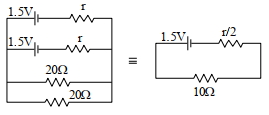
0 likesView Solution
76
PhysicsMediumMCQJEE Main · 2022
$A$ vertical electric field of magnitude $4.9 \times 10^{5} \, N/C$ just prevents a water droplet of mass $0.1 \, g$ from falling. The value of charge on the droplet will be ........ $\times 10^{-9} \, C$ (Given $g = 9.8 \, m/s^{2}$)
A
$1.6 \times 10^{-9} \, C$
B
$2.0 \times 10^{-9} \, C$
C
$3.2 \times 10^{-9} \, C$
D
$0.5 \times 10^{-9} \, C$
Solution
(B) For the water droplet to remain suspended,the upward electric force must balance the downward gravitational force.
$F_{e} = F_{g}$
$qE = mg$
Given:
Mass $m = 0.1 \, g = 0.1 \times 10^{-3} \, kg = 10^{-4} \, kg$
Electric field $E = 4.9 \times 10^{5} \, N/C$
Acceleration due to gravity $g = 9.8 \, m/s^{2}$
Substituting the values:
$q(4.9 \times 10^{5}) = (10^{-4})(9.8)$
$q = \frac{9.8 \times 10^{-4}}{4.9 \times 10^{5}}$
$q = 2 \times 10^{-9} \, C$
Thus,the charge on the droplet is $2.0 \times 10^{-9} \, C$.
$F_{e} = F_{g}$
$qE = mg$
Given:
Mass $m = 0.1 \, g = 0.1 \times 10^{-3} \, kg = 10^{-4} \, kg$
Electric field $E = 4.9 \times 10^{5} \, N/C$
Acceleration due to gravity $g = 9.8 \, m/s^{2}$
Substituting the values:
$q(4.9 \times 10^{5}) = (10^{-4})(9.8)$
$q = \frac{9.8 \times 10^{-4}}{4.9 \times 10^{5}}$
$q = 2 \times 10^{-9} \, C$
Thus,the charge on the droplet is $2.0 \times 10^{-9} \, C$.
0 likesView Solution
77
PhysicsDifficultMCQJEE Main · 2022
$A$ resistance of $40 \,\Omega$ is connected to a source of alternating current rated $220 \,V, 50 \,Hz$. Find the time taken by the current to change from its maximum value to its $rms$ value.
A
$2.5 \,ms$
B
$1.25 \,ms$
C
$2.5 \,s$
D
$0.25 \,s$
Solution
(A) The instantaneous current in an $AC$ circuit is given by $I = I_0 \sin(\omega t)$.
At maximum value,the phase $\omega t_1 = \frac{\pi}{2}$.
At $rms$ value,the current is $I = \frac{I_0}{\sqrt{2}}$,so $\sin(\omega t_2) = \frac{1}{\sqrt{2}}$. The first instance after the peak is $\omega t_2 = \frac{3\pi}{4}$.
The phase difference is $\Delta \phi = \omega t_2 - \omega t_1 = \frac{3\pi}{4} - \frac{\pi}{2} = \frac{\pi}{4}$.
Given frequency $f = 50 \,Hz$,the angular frequency $\omega = 2\pi f = 2\pi \times 50 = 100\pi \,rad/s$.
The time taken is $t = \frac{\Delta \phi}{\omega} = \frac{\pi / 4}{100\pi} = \frac{1}{400} \,s$.
Converting to milliseconds: $t = 0.0025 \,s = 2.5 \,ms$.
At maximum value,the phase $\omega t_1 = \frac{\pi}{2}$.
At $rms$ value,the current is $I = \frac{I_0}{\sqrt{2}}$,so $\sin(\omega t_2) = \frac{1}{\sqrt{2}}$. The first instance after the peak is $\omega t_2 = \frac{3\pi}{4}$.
The phase difference is $\Delta \phi = \omega t_2 - \omega t_1 = \frac{3\pi}{4} - \frac{\pi}{2} = \frac{\pi}{4}$.
Given frequency $f = 50 \,Hz$,the angular frequency $\omega = 2\pi f = 2\pi \times 50 = 100\pi \,rad/s$.
The time taken is $t = \frac{\Delta \phi}{\omega} = \frac{\pi / 4}{100\pi} = \frac{1}{400} \,s$.
Converting to milliseconds: $t = 0.0025 \,s = 2.5 \,ms$.
0 likesView Solution
78
PhysicsMediumMCQJEE Main · 2022
$A$ plane electromagnetic wave travels in a medium of relative permeability $\mu_{r} = 1.61$ and relative permittivity $\epsilon_{r} = 6.44$. If the magnitude of the magnetic intensity $H$ is $4.5 \times 10^{-2} \; A m^{-1}$ at a point,what will be the approximate magnitude of the electric field intensity $E$ at that point? (Given: $\mu_{0} = 4 \pi \times 10^{-7} \; N A^{-2}$,$c = 3 \times 10^{8} \; m s^{-1}$)
A
$16.96 \; V m^{-1}$
B
$2.25 \times 10^{-2} \; V m^{-1}$
C
$8.48 \; V m^{-1}$
D
$6.75 \; V m^{-1}$
Solution
(C) The speed of an electromagnetic wave in a medium is given by $v = \frac{c}{\sqrt{\mu_{r} \epsilon_{r}}}$.
Given $\mu_{r} = 1.61$ and $\epsilon_{r} = 6.44$,the speed $v = \frac{3 \times 10^{8}}{\sqrt{1.61 \times 6.44}} = \frac{3 \times 10^{8}}{\sqrt{10.3684}} = \frac{3 \times 10^{8}}{3.22} \approx 9.317 \times 10^{7} \; m s^{-1}$.
The relationship between electric field $E$ and magnetic field $B$ is $E = vB$.
Since $B = \mu_{0} \mu_{r} H$,we have $E = v \mu_{0} \mu_{r} H$.
$E = (9.317 \times 10^{7}) \times (4 \pi \times 10^{-7}) \times (1.61) \times (4.5 \times 10^{-2})$.
$E = 9.317 \times 4 \times 3.1416 \times 1.61 \times 4.5 \times 10^{-2} \approx 8.48 \; V m^{-1}$.
Given $\mu_{r} = 1.61$ and $\epsilon_{r} = 6.44$,the speed $v = \frac{3 \times 10^{8}}{\sqrt{1.61 \times 6.44}} = \frac{3 \times 10^{8}}{\sqrt{10.3684}} = \frac{3 \times 10^{8}}{3.22} \approx 9.317 \times 10^{7} \; m s^{-1}$.
The relationship between electric field $E$ and magnetic field $B$ is $E = vB$.
Since $B = \mu_{0} \mu_{r} H$,we have $E = v \mu_{0} \mu_{r} H$.
$E = (9.317 \times 10^{7}) \times (4 \pi \times 10^{-7}) \times (1.61) \times (4.5 \times 10^{-2})$.
$E = 9.317 \times 4 \times 3.1416 \times 1.61 \times 4.5 \times 10^{-2} \approx 8.48 \; V m^{-1}$.
0 likesView Solution
79
PhysicsMediumMCQJEE Main · 2022
Choose the correct option from the following options given below.
A
In the ground state of Rutherford's model,electrons are in stable equilibrium,while in Thomson's model,electrons always experience a net force.
B
An atom has a nearly continuous mass distribution in a Rutherford's model but has a highly non-uniform mass distribution in Thomson's model.
C
$A$ classical atom based on Rutherford's model is doomed to collapse.
D
The positively charged part of the atom possesses most of the mass in Rutherford's model but not in Thomson's model.
Solution
(C) According to Rutherford's model,the electron revolves around the nucleus in a circular orbit.
Since the electron is moving in a circular path,it undergoes centripetal acceleration.
According to classical electromagnetic theory,an accelerating charged particle must emit electromagnetic $(EM)$ radiation.
As the electron loses energy through radiation,its orbital radius decreases,and it should eventually spiral into the nucleus.
Therefore,a classical atom based on Rutherford's model is unstable and is doomed to collapse.
Since the electron is moving in a circular path,it undergoes centripetal acceleration.
According to classical electromagnetic theory,an accelerating charged particle must emit electromagnetic $(EM)$ radiation.
As the electron loses energy through radiation,its orbital radius decreases,and it should eventually spiral into the nucleus.
Therefore,a classical atom based on Rutherford's model is unstable and is doomed to collapse.
0 likesView Solution
80
PhysicsMediumMCQJEE Main · 2022
Nucleus $A$ has a mass number of $220$ and its binding energy per nucleon is $5.6 \, MeV$. It splits into two fragments '$B$' and '$C$' with mass numbers $105$ and $115$,respectively. The binding energy per nucleon for both '$B$' and '$C$' is $6.4 \, MeV$. The energy $Q$ released per fission will be............$MeV$.
A
$0.8$
B
$275$
C
$220$
D
$176$
Solution
(D) The energy released in a nuclear fission reaction is given by the difference between the total binding energy of the products and the total binding energy of the reactant.
Total binding energy of the reactant (Nucleus $A$):
$BE_A = 220 \times 5.6 \, MeV = 1232 \, MeV$.
Total binding energy of the products (Nuclei $B$ and $C$):
$BE_{B+C} = (105 \times 6.4) + (115 \times 6.4) \, MeV = (105 + 115) \times 6.4 \, MeV = 220 \times 6.4 \, MeV = 1408 \, MeV$.
The energy $Q$ released is:
$Q = BE_{products} - BE_{reactant}$
$Q = 1408 \, MeV - 1232 \, MeV = 176 \, MeV$.
Total binding energy of the reactant (Nucleus $A$):
$BE_A = 220 \times 5.6 \, MeV = 1232 \, MeV$.
Total binding energy of the products (Nuclei $B$ and $C$):
$BE_{B+C} = (105 \times 6.4) + (115 \times 6.4) \, MeV = (105 + 115) \times 6.4 \, MeV = 220 \times 6.4 \, MeV = 1408 \, MeV$.
The energy $Q$ released is:
$Q = BE_{products} - BE_{reactant}$
$Q = 1408 \, MeV - 1232 \, MeV = 176 \, MeV$.
0 likesView Solution
81
PhysicsDifficultMCQJEE Main · 2022
$A$ baseband signal of $3.5\, MHz$ frequency is modulated with a carrier signal of $3.5\, GHz$ frequency using amplitude modulation. What should be the minimum size of antenna required to transmit the modulated signal?
A
$42.8\, m$
B
$42.8\, mm$
C
$21.4\, mm$
D
$21.4\, m$
Solution
(C) The carrier frequency is $f_{c} = 3.5\, GHz = 3.5 \times 10^{9}\, Hz$.
The wavelength $\lambda$ of the carrier signal is given by $\lambda = \frac{c}{f_{c}}$,where $c = 3 \times 10^{8}\, m/s$ is the speed of light.
$\lambda = \frac{3 \times 10^{8}}{3.5 \times 10^{9}} = \frac{3}{35}\, m \approx 0.0857\, m = 85.7\, mm$.
The minimum length of the antenna required for efficient transmission is $\frac{\lambda}{4}$.
Minimum length $= \frac{85.7\, mm}{4} = 21.425\, mm \approx 21.4\, mm$.
The wavelength $\lambda$ of the carrier signal is given by $\lambda = \frac{c}{f_{c}}$,where $c = 3 \times 10^{8}\, m/s$ is the speed of light.
$\lambda = \frac{3 \times 10^{8}}{3.5 \times 10^{9}} = \frac{3}{35}\, m \approx 0.0857\, m = 85.7\, mm$.
The minimum length of the antenna required for efficient transmission is $\frac{\lambda}{4}$.
Minimum length $= \frac{85.7\, mm}{4} = 21.425\, mm \approx 21.4\, mm$.
0 likesView Solution
82
PhysicsMediumMCQJEE Main · 2022
$A$ parallel plate capacitor is formed by two plates each of area $30 \pi \, cm^{2}$ separated by $1 \, mm$. $A$ material of dielectric strength $3.6 \times 10^{7} \, Vm^{-1}$ is filled between the plates. If the maximum charge that can be stored on the capacitor without causing any dielectric breakdown is $7 \times 10^{-6} \, C$,the value of the dielectric constant of the material is. $\{ \text{Use} : \frac{1}{4 \pi \varepsilon_{0}} = 9 \times 10^{9} \, Nm^{2}C^{-2} \}$
A
$1.66$
B
$1.75$
C
$2.25$
D
$2.33$
Solution
(D) The maximum electric field $E$ that the dielectric can withstand is its dielectric strength,$E = 3.6 \times 10^{7} \, Vm^{-1}$.
The capacitance of a parallel plate capacitor with a dielectric is $C = \frac{K \varepsilon_{0} A}{d}$.
The maximum charge $q$ is given by $q = CV = C(Ed) = \left( \frac{K \varepsilon_{0} A}{d} \right) Ed = K \varepsilon_{0} A E$.
Rearranging for the dielectric constant $K$,we get $K = \frac{q}{\varepsilon_{0} A E}$.
Given $q = 7 \times 10^{-6} \, C$,$A = 30 \pi \times 10^{-4} \, m^{2}$,$E = 3.6 \times 10^{7} \, Vm^{-1}$,and $\frac{1}{4 \pi \varepsilon_{0}} = 9 \times 10^{9} \, Nm^{2}C^{-2}$,which implies $\varepsilon_{0} = \frac{1}{36 \pi \times 10^{9}}$.
Substituting these values: $K = \frac{7 \times 10^{-6}}{\left( \frac{1}{36 \pi \times 10^{9}} \right) \times (30 \pi \times 10^{-4}) \times (3.6 \times 10^{7})}$.
$K = \frac{7 \times 10^{-6} \times 36 \pi \times 10^{9}}{30 \pi \times 10^{-4} \times 3.6 \times 10^{7}} = \frac{7 \times 36 \times 10^{3}}{30 \times 3.6 \times 10^{3}} = \frac{252}{108} = 2.33$.
The capacitance of a parallel plate capacitor with a dielectric is $C = \frac{K \varepsilon_{0} A}{d}$.
The maximum charge $q$ is given by $q = CV = C(Ed) = \left( \frac{K \varepsilon_{0} A}{d} \right) Ed = K \varepsilon_{0} A E$.
Rearranging for the dielectric constant $K$,we get $K = \frac{q}{\varepsilon_{0} A E}$.
Given $q = 7 \times 10^{-6} \, C$,$A = 30 \pi \times 10^{-4} \, m^{2}$,$E = 3.6 \times 10^{7} \, Vm^{-1}$,and $\frac{1}{4 \pi \varepsilon_{0}} = 9 \times 10^{9} \, Nm^{2}C^{-2}$,which implies $\varepsilon_{0} = \frac{1}{36 \pi \times 10^{9}}$.
Substituting these values: $K = \frac{7 \times 10^{-6}}{\left( \frac{1}{36 \pi \times 10^{9}} \right) \times (30 \pi \times 10^{-4}) \times (3.6 \times 10^{7})}$.
$K = \frac{7 \times 10^{-6} \times 36 \pi \times 10^{9}}{30 \pi \times 10^{-4} \times 3.6 \times 10^{7}} = \frac{7 \times 36 \times 10^{3}}{30 \times 3.6 \times 10^{3}} = \frac{252}{108} = 2.33$.
0 likesView Solution
83
PhysicsMediumMCQJEE Main · 2022
The magnetic field at the centre of a circular coil of radius $r$,due to current $I$ flowing through it,is $B$. The magnetic field at a point along the axis at a distance $r/2$ from the centre is
A
$B / 2$
B
$2 B$
C
$\left(\frac{2}{\sqrt{5}}\right)^{3} B$
D
$\left(\frac{2}{\sqrt{3}}\right)^{3} B$
Solution
(C) The magnetic field at the centre of a circular coil is given by $B_{C} = \frac{\mu_{0} I}{2 r}$.
The magnetic field at a point on the axis at a distance $x$ from the centre is given by $B_{a} = \frac{\mu_{0} I r^{2}}{2(x^{2} + r^{2})^{3/2}}$.
Given $x = \frac{r}{2}$,we substitute this into the formula:
$B_{a} = \frac{\mu_{0} I r^{2}}{2((\frac{r}{2})^{2} + r^{2})^{3/2}}$
$B_{a} = \frac{\mu_{0} I r^{2}}{2(\frac{r^{2}}{4} + r^{2})^{3/2}} = \frac{\mu_{0} I r^{2}}{2(\frac{5r^{2}}{4})^{3/2}}$
$B_{a} = \frac{\mu_{0} I r^{2}}{2 \cdot r^{3} \cdot (\frac{5}{4})^{3/2}} = \frac{\mu_{0} I}{2 r} \cdot (\frac{4}{5})^{3/2}$
Since $B = \frac{\mu_{0} I}{2 r}$,we have:
$B_{a} = B \cdot (\frac{2}{\sqrt{5}})^{3}$.
The magnetic field at a point on the axis at a distance $x$ from the centre is given by $B_{a} = \frac{\mu_{0} I r^{2}}{2(x^{2} + r^{2})^{3/2}}$.
Given $x = \frac{r}{2}$,we substitute this into the formula:
$B_{a} = \frac{\mu_{0} I r^{2}}{2((\frac{r}{2})^{2} + r^{2})^{3/2}}$
$B_{a} = \frac{\mu_{0} I r^{2}}{2(\frac{r^{2}}{4} + r^{2})^{3/2}} = \frac{\mu_{0} I r^{2}}{2(\frac{5r^{2}}{4})^{3/2}}$
$B_{a} = \frac{\mu_{0} I r^{2}}{2 \cdot r^{3} \cdot (\frac{5}{4})^{3/2}} = \frac{\mu_{0} I}{2 r} \cdot (\frac{4}{5})^{3/2}$
Since $B = \frac{\mu_{0} I}{2 r}$,we have:
$B_{a} = B \cdot (\frac{2}{\sqrt{5}})^{3}$.
0 likesView Solution
84
PhysicsDifficultMCQJEE Main · 2022
Two identical thin biconvex lenses of focal length $15 \, cm$ and refractive index $1.5$ are in contact with each other. The space between the lenses is filled with a liquid of refractive index $1.25$. The focal length of the combination is $cm$.
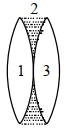
A
$10$
B
$101$
C
$18$
D
$11$
Solution
(A) For a biconvex lens,the lens maker's formula is $\frac{1}{f} = (\mu - 1) \left( \frac{1}{R_1} - \frac{1}{R_2} \right)$.
Given $f = 15 \, cm$ and $\mu = 1.5$,and for a symmetric biconvex lens $R_1 = R$ and $R_2 = -R$,we have:
$\frac{1}{15} = (1.5 - 1) \left( \frac{1}{R} - \frac{1}{-R} \right) = 0.5 \left( \frac{2}{R} \right) = \frac{1}{R}$.
Thus,$R = 15 \, cm$.
The combination consists of two biconvex lenses and a liquid lens in between. The liquid lens has refractive index $\mu_l = 1.25$ and its surfaces have radii of curvature $-R$ and $R$ (concave shape).
The focal length of the liquid lens $f_l$ is given by:
$\frac{1}{f_l} = (\mu_l - 1) \left( \frac{1}{-R} - \frac{1}{R} \right) = (1.25 - 1) \left( -\frac{2}{R} \right) = 0.25 \left( -\frac{2}{15} \right) = -\frac{0.5}{15} = -\frac{1}{30}$.
The equivalent focal length $f_{eq}$ of the combination is:
$\frac{1}{f_{eq}} = \frac{1}{f_1} + \frac{1}{f_l} + \frac{1}{f_2} = \frac{1}{15} - \frac{1}{30} + \frac{1}{15} = \frac{2 - 1 + 2}{30} = \frac{3}{30} = \frac{1}{10}$.
Therefore,$f_{eq} = 10 \, cm$.
Given $f = 15 \, cm$ and $\mu = 1.5$,and for a symmetric biconvex lens $R_1 = R$ and $R_2 = -R$,we have:
$\frac{1}{15} = (1.5 - 1) \left( \frac{1}{R} - \frac{1}{-R} \right) = 0.5 \left( \frac{2}{R} \right) = \frac{1}{R}$.
Thus,$R = 15 \, cm$.
The combination consists of two biconvex lenses and a liquid lens in between. The liquid lens has refractive index $\mu_l = 1.25$ and its surfaces have radii of curvature $-R$ and $R$ (concave shape).
The focal length of the liquid lens $f_l$ is given by:
$\frac{1}{f_l} = (\mu_l - 1) \left( \frac{1}{-R} - \frac{1}{R} \right) = (1.25 - 1) \left( -\frac{2}{R} \right) = 0.25 \left( -\frac{2}{15} \right) = -\frac{0.5}{15} = -\frac{1}{30}$.
The equivalent focal length $f_{eq}$ of the combination is:
$\frac{1}{f_{eq}} = \frac{1}{f_1} + \frac{1}{f_l} + \frac{1}{f_2} = \frac{1}{15} - \frac{1}{30} + \frac{1}{15} = \frac{2 - 1 + 2}{30} = \frac{3}{30} = \frac{1}{10}$.
Therefore,$f_{eq} = 10 \, cm$.
0 likesView Solution
85
PhysicsMediumMCQJEE Main · 2022
$A$ transistor is used in common-emitter mode in an amplifier circuit. When a signal of $10 \, mV$ is added to the base-emitter voltage, the base current changes by $10 \, \mu A$ and the collector current changes by $1.5 \, mA$. The load resistance is $5 \, k\Omega$. The voltage gain of the transistor will be
A
$950$
B
$750$
C
$780$
D
$790$
Solution
(B) The input resistance $r_i$ is calculated as the ratio of the change in base-emitter voltage to the change in base current:
$r_i = \frac{\Delta V_{BE}}{\Delta I_B} = \frac{10 \, mV}{10 \, \mu A} = \frac{10 \times 10^{-3} \, V}{10 \times 10^{-6} \, A} = 1000 \, \Omega = 1 \, k\Omega$.
The current gain $\beta$ is the ratio of the change in collector current to the change in base current:
$\beta = \frac{\Delta I_C}{\Delta I_B} = \frac{1.5 \, mA}{10 \, \mu A} = \frac{1.5 \times 10^{-3} \, A}{10 \times 10^{-6} \, A} = 150$.
The voltage gain $A_V$ for a common-emitter amplifier is given by the product of the current gain and the ratio of load resistance $R_L$ to input resistance $r_i$:
$A_V = \beta \times \frac{R_L}{r_i} = 150 \times \frac{5000 \, \Omega}{1000 \, \Omega} = 150 \times 5 = 750$.
$r_i = \frac{\Delta V_{BE}}{\Delta I_B} = \frac{10 \, mV}{10 \, \mu A} = \frac{10 \times 10^{-3} \, V}{10 \times 10^{-6} \, A} = 1000 \, \Omega = 1 \, k\Omega$.
The current gain $\beta$ is the ratio of the change in collector current to the change in base current:
$\beta = \frac{\Delta I_C}{\Delta I_B} = \frac{1.5 \, mA}{10 \, \mu A} = \frac{1.5 \times 10^{-3} \, A}{10 \times 10^{-6} \, A} = 150$.
The voltage gain $A_V$ for a common-emitter amplifier is given by the product of the current gain and the ratio of load resistance $R_L$ to input resistance $r_i$:
$A_V = \beta \times \frac{R_L}{r_i} = 150 \times \frac{5000 \, \Omega}{1000 \, \Omega} = 150 \times 5 = 750$.
0 likesView Solution
86
PhysicsMediumMCQJEE Main · 2022
As shown in the figure,an inductor of inductance $L = 200 \, mH$ is connected to an $AC$ source of emf $220 \, V$ and frequency $f = 50 \, Hz$. The peak value of current is given by $\frac{\sqrt{a}}{\pi} \, A$. The value of $a$ is..........
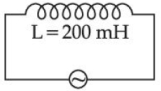
A
$282$
B
$242$
C
$247$
D
$867$
Solution
(B) Given: Inductance $L = 200 \, mH = 0.2 \, H$,$V_{rms} = 220 \, V$,$f = 50 \, Hz$.
The inductive reactance $X_L$ is given by:
$X_L = 2 \pi f L = 2 \pi \times 50 \times 0.2 = 20 \pi \, \Omega$.
The peak voltage $V_0$ is:
$V_0 = V_{rms} \sqrt{2} = 220 \sqrt{2} \, V$.
The peak current $i_0$ is:
$i_0 = \frac{V_0}{X_L} = \frac{220 \sqrt{2}}{20 \pi} = \frac{11 \sqrt{2}}{\pi} \, A$.
We can rewrite this as:
$i_0 = \frac{\sqrt{11^2 \times 2}}{\pi} = \frac{\sqrt{121 \times 2}}{\pi} = \frac{\sqrt{242}}{\pi} \, A$.
Comparing this with the given expression $\frac{\sqrt{a}}{\pi} \, A$,we get:
$a = 242$.
The inductive reactance $X_L$ is given by:
$X_L = 2 \pi f L = 2 \pi \times 50 \times 0.2 = 20 \pi \, \Omega$.
The peak voltage $V_0$ is:
$V_0 = V_{rms} \sqrt{2} = 220 \sqrt{2} \, V$.
The peak current $i_0$ is:
$i_0 = \frac{V_0}{X_L} = \frac{220 \sqrt{2}}{20 \pi} = \frac{11 \sqrt{2}}{\pi} \, A$.
We can rewrite this as:
$i_0 = \frac{\sqrt{11^2 \times 2}}{\pi} = \frac{\sqrt{121 \times 2}}{\pi} = \frac{\sqrt{242}}{\pi} \, A$.
Comparing this with the given expression $\frac{\sqrt{a}}{\pi} \, A$,we get:
$a = 242$.
0 likesView Solution
87
PhysicsMediumMCQJEE Main · 2022
Sodium light of wavelengths $650\, nm$ and $655\, nm$ is used to study diffraction at a single slit of aperture $0.5\, mm$. The distance between the slit and the screen is $2.0\, m$. The separation between the positions of the first maxima of the diffraction pattern obtained in the two cases is $x \times 10^{-5}\, m$. Find the value of $x$.
A
$9$
B
$31$
C
$3$
D
$5$
Solution
(C) For a single slit diffraction,the condition for the $n^{th}$ maxima is given by $a \sin \theta = (n + \frac{1}{2}) \lambda$.
For the first maxima,$n = 1$,so $a \sin \theta = \frac{3 \lambda}{2}$.
Since $\theta$ is very small,$\sin \theta \approx \theta = \frac{y}{L}$,where $y$ is the distance from the central maxima and $L$ is the distance to the screen.
Thus,$y = \frac{3 \lambda L}{2 a}$.
The separation between the first maxima for two wavelengths $\lambda_1 = 650\, nm$ and $\lambda_2 = 655\, nm$ is $\Delta y = y_2 - y_1 = \frac{3 L}{2 a} (\lambda_2 - \lambda_1)$.
Given $L = 2.0\, m$,$a = 0.5\, mm = 0.5 \times 10^{-3}\, m$,$\lambda_1 = 650 \times 10^{-9}\, m$,and $\lambda_2 = 655 \times 10^{-9}\, m$.
$\Delta y = \frac{3 \times 2.0}{2 \times 0.5 \times 10^{-3}} \times (655 - 650) \times 10^{-9}$.
$\Delta y = \frac{6}{10^{-3}} \times 5 \times 10^{-9} = 6 \times 5 \times 10^{-6} = 30 \times 10^{-6} = 3 \times 10^{-5}\, m$.
Comparing with $x \times 10^{-5}\, m$,we get $x = 3$.
For the first maxima,$n = 1$,so $a \sin \theta = \frac{3 \lambda}{2}$.
Since $\theta$ is very small,$\sin \theta \approx \theta = \frac{y}{L}$,where $y$ is the distance from the central maxima and $L$ is the distance to the screen.
Thus,$y = \frac{3 \lambda L}{2 a}$.
The separation between the first maxima for two wavelengths $\lambda_1 = 650\, nm$ and $\lambda_2 = 655\, nm$ is $\Delta y = y_2 - y_1 = \frac{3 L}{2 a} (\lambda_2 - \lambda_1)$.
Given $L = 2.0\, m$,$a = 0.5\, mm = 0.5 \times 10^{-3}\, m$,$\lambda_1 = 650 \times 10^{-9}\, m$,and $\lambda_2 = 655 \times 10^{-9}\, m$.
$\Delta y = \frac{3 \times 2.0}{2 \times 0.5 \times 10^{-3}} \times (655 - 650) \times 10^{-9}$.
$\Delta y = \frac{6}{10^{-3}} \times 5 \times 10^{-9} = 6 \times 5 \times 10^{-6} = 30 \times 10^{-6} = 3 \times 10^{-5}\, m$.
Comparing with $x \times 10^{-5}\, m$,we get $x = 3$.
0 likesView Solution
88
PhysicsMediumMCQJEE Main · 2022
When light of frequency twice the threshold frequency is incident on a metal plate,the maximum velocity of the emitted electron is $v_{1}$. When the frequency of incident radiation is increased to five times the threshold value,the maximum velocity of the emitted electron becomes $v_{2}$. If $v_{2} = x v_{1}$,the value of $x$ will be...........
A
$2$
B
$4$
C
$8$
D
$16$
Solution
(A) According to Einstein's photoelectric equation: $h\nu = h\nu_{0} + K_{\text{max}}$,where $K_{\text{max}} = \frac{1}{2}mv^{2}$.
Case $1$: When $\nu = 2\nu_{0}$:
$h(2\nu_{0}) = h\nu_{0} + \frac{1}{2}mv_{1}^{2}$
$h\nu_{0} = \frac{1}{2}mv_{1}^{2} \dots(1)$
Case $2$: When $\nu = 5\nu_{0}$:
$h(5\nu_{0}) = h\nu_{0} + \frac{1}{2}mv_{2}^{2}$
$4h\nu_{0} = \frac{1}{2}mv_{2}^{2} \dots(2)$
Dividing equation $(2)$ by $(1)$:
$\frac{4h\nu_{0}}{h\nu_{0}} = \frac{\frac{1}{2}mv_{2}^{2}}{\frac{1}{2}mv_{1}^{2}}$
$4 = \left(\frac{v_{2}}{v_{1}}\right)^{2}$
$\frac{v_{2}}{v_{1}} = \sqrt{4} = 2$
$v_{2} = 2v_{1}$
Given $v_{2} = xv_{1}$,therefore $x = 2$.
Case $1$: When $\nu = 2\nu_{0}$:
$h(2\nu_{0}) = h\nu_{0} + \frac{1}{2}mv_{1}^{2}$
$h\nu_{0} = \frac{1}{2}mv_{1}^{2} \dots(1)$
Case $2$: When $\nu = 5\nu_{0}$:
$h(5\nu_{0}) = h\nu_{0} + \frac{1}{2}mv_{2}^{2}$
$4h\nu_{0} = \frac{1}{2}mv_{2}^{2} \dots(2)$
Dividing equation $(2)$ by $(1)$:
$\frac{4h\nu_{0}}{h\nu_{0}} = \frac{\frac{1}{2}mv_{2}^{2}}{\frac{1}{2}mv_{1}^{2}}$
$4 = \left(\frac{v_{2}}{v_{1}}\right)^{2}$
$\frac{v_{2}}{v_{1}} = \sqrt{4} = 2$
$v_{2} = 2v_{1}$
Given $v_{2} = xv_{1}$,therefore $x = 2$.
0 likesView Solution
89
PhysicsMediumMCQJEE Main · 2022
In a potentiometer arrangement,a cell gives a balancing point at $75 \, cm$ length of wire. This cell is now replaced by another cell of unknown emf. If the ratio of the emf's of two cells respectively is $3:2$,the difference in the balancing length of the potentiometer wire in above two cases will be ......... $cm$.
A
$25$
B
$255$
C
$95$
D
$27$
Solution
(A) In a potentiometer,the balancing length $\ell$ is directly proportional to the emf $\varepsilon$ of the cell,given by $\varepsilon \propto \ell$ or $\frac{\varepsilon_1}{\varepsilon_2} = \frac{\ell_1}{\ell_2}$.
Given $\varepsilon_1 : \varepsilon_2 = 3 : 2$ and $\ell_1 = 75 \, cm$.
Substituting the values: $\frac{3}{2} = \frac{75}{\ell_2}$.
Solving for $\ell_2$: $\ell_2 = \frac{75 \times 2}{3} = 50 \, cm$.
The difference in the balancing lengths is $\Delta \ell = |\ell_1 - \ell_2| = |75 - 50| = 25 \, cm$.
Given $\varepsilon_1 : \varepsilon_2 = 3 : 2$ and $\ell_1 = 75 \, cm$.
Substituting the values: $\frac{3}{2} = \frac{75}{\ell_2}$.
Solving for $\ell_2$: $\ell_2 = \frac{75 \times 2}{3} = 50 \, cm$.
The difference in the balancing lengths is $\Delta \ell = |\ell_1 - \ell_2| = |75 - 50| = 25 \, cm$.
0 likesView Solution
90
PhysicsMediumMCQJEE Main · 2022
Two metallic plates form a parallel plate capacitor. The distance between the plates is $d$. $A$ metal sheet of thickness $\frac{d}{2}$ and of area equal to the area of each plate is introduced between the plates. What will be the ratio of the new capacitance to the original capacitance of the capacitor?
A
$2: 1$
B
$1: 2$
C
$1: 4$
D
$4: 1$
Solution
(A) The original capacitance of the parallel plate capacitor is given by $C_1 = \frac{\epsilon_0 A}{d}$.
When a metal sheet of thickness $t = \frac{d}{2}$ is introduced between the plates,the effective distance between the plates decreases.
The new capacitance $C_2$ is given by the formula $C_2 = \frac{\epsilon_0 A}{d - t}$.
Substituting $t = \frac{d}{2}$,we get $C_2 = \frac{\epsilon_0 A}{d - \frac{d}{2}} = \frac{\epsilon_0 A}{d/2} = \frac{2 \epsilon_0 A}{d}$.
Therefore,the ratio of the new capacitance to the original capacitance is $\frac{C_2}{C_1} = \frac{2 \epsilon_0 A / d}{\epsilon_0 A / d} = \frac{2}{1}$ or $2:1$.
When a metal sheet of thickness $t = \frac{d}{2}$ is introduced between the plates,the effective distance between the plates decreases.
The new capacitance $C_2$ is given by the formula $C_2 = \frac{\epsilon_0 A}{d - t}$.
Substituting $t = \frac{d}{2}$,we get $C_2 = \frac{\epsilon_0 A}{d - \frac{d}{2}} = \frac{\epsilon_0 A}{d/2} = \frac{2 \epsilon_0 A}{d}$.
Therefore,the ratio of the new capacitance to the original capacitance is $\frac{C_2}{C_1} = \frac{2 \epsilon_0 A / d}{\epsilon_0 A / d} = \frac{2}{1}$ or $2:1$.
0 likesView Solution
91
PhysicsMediumMCQJEE Main · 2022
Two cells of same emf $E$ but different internal resistances $r_{1}$ and $r_{2}$ are connected in series with a resistance $R$. The value of resistance $R$,for which the potential difference across the second cell is zero,is
A
$r_{2} - r_{1}$
B
$r_{1} - r_{2}$
C
$r_{1}$
D
$r_{2}$
Solution
(A) The total emf of the circuit is $2E$ and the total resistance is $R + r_{1} + r_{2}$.
The current $I$ in the circuit is given by:
$I = \frac{2E}{R + r_{1} + r_{2}} \quad \dots (i)$
The potential difference across the second cell (with emf $E$ and internal resistance $r_{2}$) is given by $V = E - Ir_{2}$.
Given that the potential difference across the second cell is zero:
$E - Ir_{2} = 0 \Rightarrow I = \frac{E}{r_{2}} \quad \dots (ii)$
Comparing the values of $I$ from equations $(i)$ and $(ii)$:
$\frac{E}{r_{2}} = \frac{2E}{R + r_{1} + r_{2}}$
$R + r_{1} + r_{2} = 2r_{2}$
$R = 2r_{2} - r_{2} - r_{1}$
$R = r_{2} - r_{1}$
The current $I$ in the circuit is given by:
$I = \frac{2E}{R + r_{1} + r_{2}} \quad \dots (i)$
The potential difference across the second cell (with emf $E$ and internal resistance $r_{2}$) is given by $V = E - Ir_{2}$.
Given that the potential difference across the second cell is zero:
$E - Ir_{2} = 0 \Rightarrow I = \frac{E}{r_{2}} \quad \dots (ii)$
Comparing the values of $I$ from equations $(i)$ and $(ii)$:
$\frac{E}{r_{2}} = \frac{2E}{R + r_{1} + r_{2}}$
$R + r_{1} + r_{2} = 2r_{2}$
$R = 2r_{2} - r_{2} - r_{1}$
$R = r_{2} - r_{1}$
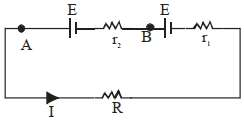
0 likesView Solution
92
PhysicsMediumMCQJEE Main · 2022
Given below are two statements:
Statement-$I$: Susceptibilities of paramagnetic and ferromagnetic substances increase with decrease in temperature.
Statement-$II$: Diamagnetism is a result of orbital motions of electrons developing magnetic moments opposite to the applied magnetic field.
Choose the $CORRECT$ answer from the options given below:
Statement-$I$: Susceptibilities of paramagnetic and ferromagnetic substances increase with decrease in temperature.
Statement-$II$: Diamagnetism is a result of orbital motions of electrons developing magnetic moments opposite to the applied magnetic field.
Choose the $CORRECT$ answer from the options given below:
A
Both statement-$I$ and statement-$II$ are true.
B
Both statement-$I$ and statement-$II$ are false.
C
Statement-$I$ is true but statement-$II$ is false.
D
Statement-$I$ is false but statement-$II$ is true.
Solution
$(A)$ According to Curie's law, the magnetic susceptibility $\chi$ of paramagnetic substances is inversely proportional to the absolute temperature $T$, given by $\chi = \frac{C}{T}$.
For ferromagnetic substances, the susceptibility follows the Curie-Weiss law: $\chi = \frac{C}{T - T_C}$, where $T_C$ is the Curie temperature. As $T$ decreases towards $T_C$, the susceptibility increases. Thus, Statement-$I$ is true.
Diamagnetism arises due to the orbital motion of electrons. When an external magnetic field is applied, it induces a change in the orbital motion, creating a magnetic moment that opposes the applied field (Lenz's law at the atomic level). Thus, Statement-$II$ is true.
Therefore, both statements are true. The correct option is $(A)$.
For ferromagnetic substances, the susceptibility follows the Curie-Weiss law: $\chi = \frac{C}{T - T_C}$, where $T_C$ is the Curie temperature. As $T$ decreases towards $T_C$, the susceptibility increases. Thus, Statement-$I$ is true.
Diamagnetism arises due to the orbital motion of electrons. When an external magnetic field is applied, it induces a change in the orbital motion, creating a magnetic moment that opposes the applied field (Lenz's law at the atomic level). Thus, Statement-$II$ is true.
Therefore, both statements are true. The correct option is $(A)$.
0 likesView Solution
93
PhysicsDifficultMCQJEE Main · 2022
$A$ sinusoidal voltage $V(t) = 210 \sin(3000t) \text{ V}$ is applied to a series $LCR$ circuit in which $L = 10 \text{ mH}$,$C = 25 \mu\text{F}$,and $R = 100 \Omega$. The phase difference $(\Phi)$ between the applied voltage and resultant current will be
A
$\tan^{-1}(0.17)$
B
$\tan^{-1}(9.46)$
C
$\tan^{-1}(0.30)$
D
$\tan^{-1}(13.33)$
Solution
(A) Given: $V(t) = 210 \sin(3000t) \text{ V}$,$L = 10 \text{ mH} = 10^{-2} \text{ H}$,$C = 25 \mu\text{F} = 25 \times 10^{-6} \text{ F}$,$R = 100 \Omega$.
Angular frequency $\omega = 3000 \text{ rad/s}$.
Inductive reactance $X_L = \omega L = 3000 \times 10^{-2} = 30 \Omega$.
Capacitive reactance $X_C = \frac{1}{\omega C} = \frac{1}{3000 \times 25 \times 10^{-6}} = \frac{1}{0.075} = \frac{1000}{75} = \frac{40}{3} \Omega \approx 13.33 \Omega$.
The phase difference $\Phi$ is given by $\tan \Phi = \frac{X_L - X_C}{R}$.
$\tan \Phi = \frac{30 - 13.33}{100} = \frac{16.67}{100} = 0.1667 \approx 0.17$.
Therefore,$\Phi = \tan^{-1}(0.17)$.
Angular frequency $\omega = 3000 \text{ rad/s}$.
Inductive reactance $X_L = \omega L = 3000 \times 10^{-2} = 30 \Omega$.
Capacitive reactance $X_C = \frac{1}{\omega C} = \frac{1}{3000 \times 25 \times 10^{-6}} = \frac{1}{0.075} = \frac{1000}{75} = \frac{40}{3} \Omega \approx 13.33 \Omega$.
The phase difference $\Phi$ is given by $\tan \Phi = \frac{X_L - X_C}{R}$.
$\tan \Phi = \frac{30 - 13.33}{100} = \frac{16.67}{100} = 0.1667 \approx 0.17$.
Therefore,$\Phi = \tan^{-1}(0.17)$.
0 likesView Solution
94
PhysicsMediumMCQJEE Main · 2022
The electromagnetic waves travel in a medium at a speed of $2.0 \times 10^{8} \ m/s$. The relative permeability of the medium is $1.0$. The relative permittivity of the medium will be (in $.25$)
A
$2$
B
$4$
C
$6$
D
$8$
Solution
(A) The speed of electromagnetic waves in a medium is given by $v = \frac{1}{\sqrt{\mu \epsilon}}$.
Since $\mu = \mu_0 \mu_r$ and $\epsilon = \epsilon_0 \epsilon_r$,we have $v = \frac{1}{\sqrt{\mu_0 \mu_r \epsilon_0 \epsilon_r}} = \frac{c}{\sqrt{\mu_r \epsilon_r}}$,where $c = \frac{1}{\sqrt{\mu_0 \epsilon_0}} = 3.0 \times 10^8 \ m/s$.
Given $v = 2.0 \times 10^8 \ m/s$ and $\mu_r = 1.0$.
Substituting these values: $\frac{c}{v} = \sqrt{\mu_r \epsilon_r}$.
$\frac{3.0 \times 10^8}{2.0 \times 10^8} = \sqrt{1.0 \times \epsilon_r}$.
$1.5 = \sqrt{\epsilon_r}$.
Squaring both sides: $\epsilon_r = (1.5)^2 = 2.25$.
Since $\mu = \mu_0 \mu_r$ and $\epsilon = \epsilon_0 \epsilon_r$,we have $v = \frac{1}{\sqrt{\mu_0 \mu_r \epsilon_0 \epsilon_r}} = \frac{c}{\sqrt{\mu_r \epsilon_r}}$,where $c = \frac{1}{\sqrt{\mu_0 \epsilon_0}} = 3.0 \times 10^8 \ m/s$.
Given $v = 2.0 \times 10^8 \ m/s$ and $\mu_r = 1.0$.
Substituting these values: $\frac{c}{v} = \sqrt{\mu_r \epsilon_r}$.
$\frac{3.0 \times 10^8}{2.0 \times 10^8} = \sqrt{1.0 \times \epsilon_r}$.
$1.5 = \sqrt{\epsilon_r}$.
Squaring both sides: $\epsilon_r = (1.5)^2 = 2.25$.
0 likesView Solution
95
PhysicsDifficultMCQJEE Main · 2022
The interference pattern is obtained with two coherent light sources of intensity ratio $4:1$. If the ratio $\frac{I_{\max} + I_{\min}}{I_{\max} - I_{\min}}$ is $\frac{5}{x}$,then the value of $x$ will be equal to:
A
$3$
B
$1$
C
$2$
D
$4$
Solution
(D) Given the intensity ratio $\frac{I_1}{I_2} = 4$,we can write $I_1 = 4I_2$.
The ratio of maximum to minimum intensity in an interference pattern is given by:
$\frac{I_{\max}}{I_{\min}} = \left[ \frac{\sqrt{I_1} + \sqrt{I_2}}{\sqrt{I_1} - \sqrt{I_2}} \right]^2$
Substituting $I_1 = 4I_2$:
$\frac{I_{\max}}{I_{\min}} = \left[ \frac{\sqrt{4I_2} + \sqrt{I_2}}{\sqrt{4I_2} - \sqrt{I_2}} \right]^2 = \left[ \frac{2\sqrt{I_2} + \sqrt{I_2}}{2\sqrt{I_2} - \sqrt{I_2}} \right]^2 = \left( \frac{3}{1} \right)^2 = 9$.
Now,we need to calculate $\frac{I_{\max} + I_{\min}}{I_{\max} - I_{\min}}$:
$\frac{I_{\max} + I_{\min}}{I_{\max} - I_{\min}} = \frac{9 + 1}{9 - 1} = \frac{10}{8} = \frac{5}{4}$.
Comparing this with the given expression $\frac{5}{x}$,we get:
$\frac{5}{x} = \frac{5}{4} \implies x = 4$.
The ratio of maximum to minimum intensity in an interference pattern is given by:
$\frac{I_{\max}}{I_{\min}} = \left[ \frac{\sqrt{I_1} + \sqrt{I_2}}{\sqrt{I_1} - \sqrt{I_2}} \right]^2$
Substituting $I_1 = 4I_2$:
$\frac{I_{\max}}{I_{\min}} = \left[ \frac{\sqrt{4I_2} + \sqrt{I_2}}{\sqrt{4I_2} - \sqrt{I_2}} \right]^2 = \left[ \frac{2\sqrt{I_2} + \sqrt{I_2}}{2\sqrt{I_2} - \sqrt{I_2}} \right]^2 = \left( \frac{3}{1} \right)^2 = 9$.
Now,we need to calculate $\frac{I_{\max} + I_{\min}}{I_{\max} - I_{\min}}$:
$\frac{I_{\max} + I_{\min}}{I_{\max} - I_{\min}} = \frac{9 + 1}{9 - 1} = \frac{10}{8} = \frac{5}{4}$.
Comparing this with the given expression $\frac{5}{x}$,we get:
$\frac{5}{x} = \frac{5}{4} \implies x = 4$.
0 likesView Solution
96
PhysicsDifficultMCQJEE Main · 2022
Light,whose electric field vectors are completely removed in the plane of incidence by using a good Polaroid,is incident on the surface of a prism at Brewster's angle. Choose the most suitable option for the phenomenon related to the prism.
A
Reflected and refracted rays will be perpendicular to each other.
B
Wave will propagate along the surface of the prism.
C
No refraction,and there will be total reflection of light.
D
No reflection and there will be total transmission of light.
Solution
(D) According to Brewster's law,when unpolarized light is incident at Brewster's angle,the reflected light is completely plane-polarized with its electric field vector perpendicular to the plane of incidence.
If the incident light is already polarized such that its electric field vectors are completely removed in the plane of incidence (i.e.,the light is polarized perpendicular to the plane of incidence),then at Brewster's angle,there is no component of the electric field that can be reflected.
Consequently,there is no reflection,and the light is entirely transmitted into the prism.
This is a special case of total transmission as discussed in $NCERT$ Physics Part-$2$,Chapter $10$ (Wave Optics).
Therefore,option $(D)$ is the correct choice.
If the incident light is already polarized such that its electric field vectors are completely removed in the plane of incidence (i.e.,the light is polarized perpendicular to the plane of incidence),then at Brewster's angle,there is no component of the electric field that can be reflected.
Consequently,there is no reflection,and the light is entirely transmitted into the prism.
This is a special case of total transmission as discussed in $NCERT$ Physics Part-$2$,Chapter $10$ (Wave Optics).
Therefore,option $(D)$ is the correct choice.
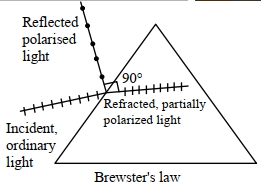
0 likesView Solution
97
PhysicsMediumMCQJEE Main · 2022
$A$ proton,a neutron,an electron,and an $\alpha$-particle have the same energy. If $\lambda_{p}, \lambda_{n}, \lambda_{e},$ and $\lambda_{\alpha}$ are the de Broglie wavelengths of the proton,neutron,electron,and $\alpha$-particle respectively,then choose the correct relation from the following:
A
$\lambda_{p} = \lambda_{n} > \lambda_{e} > \lambda_{\alpha}$
B
$\lambda_{\alpha} < \lambda_{n} < \lambda_{p} < \lambda_{e}$
C
$\lambda_{e} < \lambda_{p} = \lambda_{n} > \lambda_{\alpha}$
D
$\lambda_{e} = \lambda_{p} = \lambda_{n} = \lambda_{\alpha}$
Solution
(B) The de Broglie wavelength $\lambda$ is given by the formula $\lambda = \frac{h}{\sqrt{2Em}}$,where $h$ is Planck's constant,$E$ is the kinetic energy,and $m$ is the mass of the particle.
Since the energy $E$ is the same for all particles,we have $\lambda \propto \frac{1}{\sqrt{m}}$.
The masses of the particles are related as $m_{e} < m_{p} \approx m_{n} < m_{\alpha}$.
Specifically,$m_{p} \approx m_{n}$ and $m_{\alpha} \approx 4m_{p}$.
Since $\lambda$ is inversely proportional to the square root of mass,the particle with the smallest mass will have the largest wavelength.
Therefore,$\lambda_{e} > \lambda_{p} \approx \lambda_{n} > \lambda_{\alpha}$.
Since the energy $E$ is the same for all particles,we have $\lambda \propto \frac{1}{\sqrt{m}}$.
The masses of the particles are related as $m_{e} < m_{p} \approx m_{n} < m_{\alpha}$.
Specifically,$m_{p} \approx m_{n}$ and $m_{\alpha} \approx 4m_{p}$.
Since $\lambda$ is inversely proportional to the square root of mass,the particle with the smallest mass will have the largest wavelength.
Therefore,$\lambda_{e} > \lambda_{p} \approx \lambda_{n} > \lambda_{\alpha}$.
0 likesView Solution
98
PhysicsMediumMCQJEE Main · 2022
Which of the following figures represents the variation of $\ln \left(\frac{R}{R_{0}}\right)$ with $\ln A$ (where $R =$ radius of a nucleus and $A =$ its mass number)?
A
B
C
D
Solution
(B) The radius of a nucleus is given by the relation: $R = R_{0} A^{1/3}$,where $R_{0}$ is a constant and $A$ is the mass number.
Taking the natural logarithm on both sides:
$\ln \left(\frac{R}{R_{0}}\right) = \ln (A^{1/3})$
Using the logarithmic property $\ln(x^n) = n \ln(x)$,we get:
$\ln \left(\frac{R}{R_{0}}\right) = \frac{1}{3} \ln A$
This equation is of the form $y = mx$,which represents a straight line passing through the origin with a slope of $1/3$.
Therefore,the graph of $\ln \left(\frac{R}{R_{0}}\right)$ versus $\ln A$ is a straight line.
Taking the natural logarithm on both sides:
$\ln \left(\frac{R}{R_{0}}\right) = \ln (A^{1/3})$
Using the logarithmic property $\ln(x^n) = n \ln(x)$,we get:
$\ln \left(\frac{R}{R_{0}}\right) = \frac{1}{3} \ln A$
This equation is of the form $y = mx$,which represents a straight line passing through the origin with a slope of $1/3$.
Therefore,the graph of $\ln \left(\frac{R}{R_{0}}\right)$ versus $\ln A$ is a straight line.

0 likesView Solution
99
PhysicsMediumMCQJEE Main · 2022
Identify the logic operation performed by the given circuit.
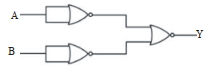
A
$AND$ gate
B
$OR$ gate
C
$NOR$ gate
D
$NAND$ gate
Solution
(A) The circuit consists of two $NOR$ gates whose inputs are shorted,followed by a $NOR$ gate.
$1$. The first two gates are $NOR$ gates with inputs $A$ and $A$,and $B$ and $B$ respectively. Their outputs are $\overline{A+A} = \overline{A}$ and $\overline{B+B} = \overline{B}$.
$2$. These outputs are fed into a final $NOR$ gate.
$3$. The output $Y$ is given by $Y = \overline{\overline{A} + \overline{B}}$.
$4$. Using De Morgan's Law,$\overline{\overline{A} + \overline{B}} = \overline{\overline{A}} \cdot \overline{\overline{B}} = A \cdot B$.
$5$. The expression $Y = A \cdot B$ represents an $AND$ gate.
$1$. The first two gates are $NOR$ gates with inputs $A$ and $A$,and $B$ and $B$ respectively. Their outputs are $\overline{A+A} = \overline{A}$ and $\overline{B+B} = \overline{B}$.
$2$. These outputs are fed into a final $NOR$ gate.
$3$. The output $Y$ is given by $Y = \overline{\overline{A} + \overline{B}}$.
$4$. Using De Morgan's Law,$\overline{\overline{A} + \overline{B}} = \overline{\overline{A}} \cdot \overline{\overline{B}} = A \cdot B$.
$5$. The expression $Y = A \cdot B$ represents an $AND$ gate.
0 likesView Solution
100
PhysicsMediumMCQJEE Main · 2022
| $List-I$ | $List-II$ |
| $A.$ Facsimile | $I.$ Static Document Image |
| $B.$ Guided media Channel | $II.$ Local Broadcast Radio |
| $C.$ Frequency Modulation | $III.$ Rectangular wave |
| $D.$ Digital Signal | $IV.$ Optical Fiber |
A
$A-IV, B-III, C-II, D-I$
B
$A-I, B-IV, C-II, D-III$
C
$A-IV, B-II, C-III, D-I$
D
$A-I, B-II, C-III, D-IV$
Solution
(B) The correct matching is as follows:
$A.$ Facsimile is a method used to transmit a $Static\, Document\, Image$.
$B.$ Guided media channel refers to physical paths like $Optical\, Fiber$ through which signals are transmitted.
$C.$ Frequency Modulation is commonly used in $Local\, Broadcast\, Radio$.
$D.$ Digital Signal is represented by a $Rectangular\, wave$.
Therefore,the correct sequence is $A-I, B-IV, C-II, D-III$.
$A.$ Facsimile is a method used to transmit a $Static\, Document\, Image$.
$B.$ Guided media channel refers to physical paths like $Optical\, Fiber$ through which signals are transmitted.
$C.$ Frequency Modulation is commonly used in $Local\, Broadcast\, Radio$.
$D.$ Digital Signal is represented by a $Rectangular\, wave$.
Therefore,the correct sequence is $A-I, B-IV, C-II, D-III$.
0 likesView Solution
Vedclass Products
For Students
Vedclass Test Series
Mock tests in real JEE Main style covering Physics with performance analysis. 5-day free trial.
Start Free TrialFor Teachers
Exam Paper Generator
Generate Set A/B/C/D Physics papers from 7.5L+ questions in 2 minutes. 3 chapters free.
Try FreeFor Institutes
Online Exam Module
Run live JEE Main mock exams with unlimited students, 360° analytics & white-label branding.
See DemoFrequently Asked Questions
How many Physics questions are in JEE Main 2022?
There are 660 Physics questions from the JEE Main 2022 paper on Vedclass, each with a detailed step-by-step solution in English.
Are JEE Main 2022 Physics solutions available in English?
Yes. All solutions on this page are in English. You can also switch to English or Hindi using the language buttons above the questions.
Can I practice JEE Main 2022 Physics as a timed test?
Yes. Use the Vedclass Test Series to attempt a full JEE Main mock test covering Physics with time limits and instant score analysis.
Can teachers create Physics papers from JEE Main previous year questions?
Yes. The Vedclass Exam Paper Generator lets teachers mix JEE Main Physics questions and generate Set A/B/C/D papers in minutes.
For Teachers & Institutes
Build a Custom Physics Paper
Pick JEE Main 2022 Physics questions, set difficulty, and generate Set A/B/C/D in 2 minutes.