
MathematicsQ51–150 of 401 questions
Page 2 of 5 · English
51
MathematicsDifficultMCQJEE Main · 2020
The length of the minor axis (along $y$-axis) of an ellipse in the standard form is $\frac{4}{\sqrt{3}}$. If this ellipse touches the line $x+6y=8$,then its eccentricity is
A
$\sqrt{\frac{5}{6}}$
B
$\frac{1}{2} \sqrt{\frac{11}{3}}$
C
$\frac{1}{3} \sqrt{\frac{11}{3}}$
D
$\frac{1}{2} \sqrt{\frac{5}{3}}$
Solution
(B) Let the equation of the ellipse be $\frac{x^2}{a^2} + \frac{y^2}{b^2} = 1$ with $a > b$.
Given the length of the minor axis is $2b = \frac{4}{\sqrt{3}}$,so $b = \frac{2}{\sqrt{3}}$ and $b^2 = \frac{4}{3}$.
The line $x + 6y = 8$ can be written as $y = -\frac{1}{6}x + \frac{4}{3}$.
The condition for the line $y = mx + c$ to be a tangent to the ellipse $\frac{x^2}{a^2} + \frac{y^2}{b^2} = 1$ is $c^2 = a^2m^2 + b^2$.
Here $m = -\frac{1}{6}$ and $c = \frac{4}{3}$.
Substituting the values: $(\frac{4}{3})^2 = a^2(-\frac{1}{6})^2 + \frac{4}{3}$.
$\frac{16}{9} = \frac{a^2}{36} + \frac{4}{3}$.
$\frac{a^2}{36} = \frac{16}{9} - \frac{12}{9} = \frac{4}{9}$.
$a^2 = \frac{4 \times 36}{9} = 16$,so $a = 4$.
The eccentricity $e$ is given by $e = \sqrt{1 - \frac{b^2}{a^2}} = \sqrt{1 - \frac{4/3}{16}} = \sqrt{1 - \frac{1}{12}} = \sqrt{\frac{11}{12}} = \sqrt{\frac{11}{4 \times 3}} = \frac{1}{2} \sqrt{\frac{11}{3}}$.
Given the length of the minor axis is $2b = \frac{4}{\sqrt{3}}$,so $b = \frac{2}{\sqrt{3}}$ and $b^2 = \frac{4}{3}$.
The line $x + 6y = 8$ can be written as $y = -\frac{1}{6}x + \frac{4}{3}$.
The condition for the line $y = mx + c$ to be a tangent to the ellipse $\frac{x^2}{a^2} + \frac{y^2}{b^2} = 1$ is $c^2 = a^2m^2 + b^2$.
Here $m = -\frac{1}{6}$ and $c = \frac{4}{3}$.
Substituting the values: $(\frac{4}{3})^2 = a^2(-\frac{1}{6})^2 + \frac{4}{3}$.
$\frac{16}{9} = \frac{a^2}{36} + \frac{4}{3}$.
$\frac{a^2}{36} = \frac{16}{9} - \frac{12}{9} = \frac{4}{9}$.
$a^2 = \frac{4 \times 36}{9} = 16$,so $a = 4$.
The eccentricity $e$ is given by $e = \sqrt{1 - \frac{b^2}{a^2}} = \sqrt{1 - \frac{4/3}{16}} = \sqrt{1 - \frac{1}{12}} = \sqrt{\frac{11}{12}} = \sqrt{\frac{11}{4 \times 3}} = \frac{1}{2} \sqrt{\frac{11}{3}}$.
0 likesView Solution
52
MathematicsDifficultMCQJEE Main · 2020
Let $a, b \in \mathbb{R}, a \neq 0$ be such that the equation $a x^{2}-2 b x+5=0$ has a repeated root $\alpha,$ which is also a root of the equation $x^{2}-2 b x-10=0$. If $\beta$ is the other root of this equation,then $\alpha^{2}+\beta^{2}$ is equal to:
A
$26$
B
$25$
C
$28$
D
$24$
Solution
(B) For the equation $a x^{2}-2 b x+5=0$,the roots are $\alpha, \alpha$.
Thus,the sum of roots $2\alpha = \frac{2b}{a} \Rightarrow \alpha = \frac{b}{a}$ and the product of roots $\alpha^{2} = \frac{5}{a}$.
From these,$b = a\alpha$ and $a = \frac{5}{\alpha^{2}}$. Substituting $a$,we get $b = \frac{5}{\alpha}$.
Since $\alpha$ is also a root of $x^{2}-2 b x-10=0$,we have $\alpha^{2}-2 b \alpha-10=0$.
Substituting $b = \frac{5}{\alpha}$ into this equation: $\alpha^{2}-2(\frac{5}{\alpha})\alpha-10=0$ $\Rightarrow \alpha^{2}-10-10=0$ $\Rightarrow \alpha^{2}=20$.
Now,for the equation $x^{2}-2 b x-10=0$,the product of roots $\alpha \beta = -10$.
Since $\alpha^{2} = 20$,we have $\alpha = \pm \sqrt{20}$.
Then $\beta = \frac{-10}{\alpha}$.
Thus,$\beta^{2} = \frac{100}{\alpha^{2}} = \frac{100}{20} = 5$.
Therefore,$\alpha^{2}+\beta^{2} = 20 + 5 = 25$.
Thus,the sum of roots $2\alpha = \frac{2b}{a} \Rightarrow \alpha = \frac{b}{a}$ and the product of roots $\alpha^{2} = \frac{5}{a}$.
From these,$b = a\alpha$ and $a = \frac{5}{\alpha^{2}}$. Substituting $a$,we get $b = \frac{5}{\alpha}$.
Since $\alpha$ is also a root of $x^{2}-2 b x-10=0$,we have $\alpha^{2}-2 b \alpha-10=0$.
Substituting $b = \frac{5}{\alpha}$ into this equation: $\alpha^{2}-2(\frac{5}{\alpha})\alpha-10=0$ $\Rightarrow \alpha^{2}-10-10=0$ $\Rightarrow \alpha^{2}=20$.
Now,for the equation $x^{2}-2 b x-10=0$,the product of roots $\alpha \beta = -10$.
Since $\alpha^{2} = 20$,we have $\alpha = \pm \sqrt{20}$.
Then $\beta = \frac{-10}{\alpha}$.
Thus,$\beta^{2} = \frac{100}{\alpha^{2}} = \frac{100}{20} = 5$.
Therefore,$\alpha^{2}+\beta^{2} = 20 + 5 = 25$.
0 likesView Solution
53
MathematicsDifficultMCQJEE Main · 2020
If $x = \sum_{n=0}^{\infty} (-1)^{n} \tan^{2n} \theta$ and $y = \sum_{n=0}^{\infty} \cos^{2n} \theta$ for $0 < \theta < \frac{\pi}{4}$,then:
A
$y(1+x)=1$
B
$x(1+y)=1$
C
$y(1-x)=1$
D
$x(1-y)=1$
Solution
(C) The expression for $x$ is a geometric series with first term $a = 1$ and common ratio $r = -\tan^2 \theta$.
Since $0 < \theta < \frac{\pi}{4}$,we have $0 < \tan^2 \theta < 1$,so the series converges to $x = \frac{1}{1 - (-\tan^2 \theta)} = \frac{1}{1 + \tan^2 \theta} = \frac{1}{\sec^2 \theta} = \cos^2 \theta$.
The expression for $y$ is a geometric series with first term $a = 1$ and common ratio $r = \cos^2 \theta$.
Since $0 < \theta < \frac{\pi}{4}$,we have $\frac{1}{2} < \cos^2 \theta < 1$,so the series converges to $y = \frac{1}{1 - \cos^2 \theta} = \frac{1}{\sin^2 \theta}$.
From $x = \cos^2 \theta$,we have $\sin^2 \theta = 1 - x$.
Substituting this into the expression for $y$,we get $y = \frac{1}{1 - x}$.
Therefore,$y(1 - x) = 1$.
Since $0 < \theta < \frac{\pi}{4}$,we have $0 < \tan^2 \theta < 1$,so the series converges to $x = \frac{1}{1 - (-\tan^2 \theta)} = \frac{1}{1 + \tan^2 \theta} = \frac{1}{\sec^2 \theta} = \cos^2 \theta$.
The expression for $y$ is a geometric series with first term $a = 1$ and common ratio $r = \cos^2 \theta$.
Since $0 < \theta < \frac{\pi}{4}$,we have $\frac{1}{2} < \cos^2 \theta < 1$,so the series converges to $y = \frac{1}{1 - \cos^2 \theta} = \frac{1}{\sin^2 \theta}$.
From $x = \cos^2 \theta$,we have $\sin^2 \theta = 1 - x$.
Substituting this into the expression for $y$,we get $y = \frac{1}{1 - x}$.
Therefore,$y(1 - x) = 1$.
0 likesView Solution
54
MathematicsDifficultMCQJEE Main · 2020
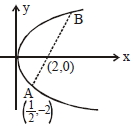
If one end of a focal chord $AB$ of the parabola $y^{2}=8x$ is at $A\left(\frac{1}{2},-2\right)$,then the equation of the tangent to it at $B$ is:
A
$2x+y-24=0$
B
$x-2y+8=0$
C
$2x-y-24=0$
D
$x+2y+8=0$
Solution
(B) The equation of the parabola is $y^{2}=8x$,which is of the form $y^{2}=4ax$,where $4a=8$,so $a=2$.
The coordinates of any point on the parabola are $(at^{2}, 2at) = (2t^{2}, 4t)$.
For point $A\left(\frac{1}{2}, -2\right)$,we have $4t_{1}=-2$,which gives $t_{1}=-\frac{1}{2}$.
For a focal chord,the product of the parameters of the endpoints is $t_{1}t_{2}=-1$.
Substituting $t_{1}=-\frac{1}{2}$,we get $t_{2} = -\frac{1}{t_{1}} = -\frac{1}{-1/2} = 2$.
The coordinates of point $B$ are $(2t_{2}^{2}, 4t_{2}) = (2(2)^{2}, 4(2)) = (8, 8)$.
The equation of the tangent to the parabola $y^{2}=4ax$ at point $(x_{1}, y_{1})$ is $yy_{1}=2a(x+x_{1})$.
For point $B(8, 8)$ and $a=2$,the equation of the tangent is $y(8) = 2(2)(x+8)$.
$8y = 4(x+8)$ $\Rightarrow 2y = x+8$ $\Rightarrow x-2y+8=0$.
The coordinates of any point on the parabola are $(at^{2}, 2at) = (2t^{2}, 4t)$.
For point $A\left(\frac{1}{2}, -2\right)$,we have $4t_{1}=-2$,which gives $t_{1}=-\frac{1}{2}$.
For a focal chord,the product of the parameters of the endpoints is $t_{1}t_{2}=-1$.
Substituting $t_{1}=-\frac{1}{2}$,we get $t_{2} = -\frac{1}{t_{1}} = -\frac{1}{-1/2} = 2$.
The coordinates of point $B$ are $(2t_{2}^{2}, 4t_{2}) = (2(2)^{2}, 4(2)) = (8, 8)$.
The equation of the tangent to the parabola $y^{2}=4ax$ at point $(x_{1}, y_{1})$ is $yy_{1}=2a(x+x_{1})$.
For point $B(8, 8)$ and $a=2$,the equation of the tangent is $y(8) = 2(2)(x+8)$.
$8y = 4(x+8)$ $\Rightarrow 2y = x+8$ $\Rightarrow x-2y+8=0$.
0 likesView Solution
55
MathematicsMediumMCQJEE Main · 2020
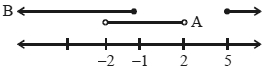
If $A = \{x \in R : |x| < 2\}$ and $B = \{x \in R : |x - 2| \geq 3\}$,then:
A
$A \cup B = R - (2, 5)$
B
$A \cap B = (-2, -1)$
C
$B - A = R - (-2, 5)$
D
$A - B = [-1, 2)$
Solution
(C) Given $A = \{x \in R : |x| < 2\} = (-2, 2)$.
Given $B = \{x \in R : |x - 2| \geq 3\}$.
This implies $x - 2 \geq 3$ or $x - 2 \leq -3$.
So,$x \geq 5$ or $x \leq -1$.
Thus,$B = (-\infty, -1] \cup [5, \infty)$.
Now,$B - A$ is the set of elements in $B$ that are not in $A$.
$B - A = ((-\infty, -1] \cup [5, \infty)) - (-2, 2)$.
Since $(-2, 2)$ overlaps with $(-\infty, -1]$ only on the interval $(-2, -1]$,we remove this part.
$B - A = (-\infty, -2] \cup [5, \infty)$.
This can be written as $R - (-2, 5)$.
Therefore,the correct option is $C$.
Given $B = \{x \in R : |x - 2| \geq 3\}$.
This implies $x - 2 \geq 3$ or $x - 2 \leq -3$.
So,$x \geq 5$ or $x \leq -1$.
Thus,$B = (-\infty, -1] \cup [5, \infty)$.
Now,$B - A$ is the set of elements in $B$ that are not in $A$.
$B - A = ((-\infty, -1] \cup [5, \infty)) - (-2, 2)$.
Since $(-2, 2)$ overlaps with $(-\infty, -1]$ only on the interval $(-2, -1]$,we remove this part.
$B - A = (-\infty, -2] \cup [5, \infty)$.
This can be written as $R - (-2, 5)$.
Therefore,the correct option is $C$.
0 likesView Solution
56
MathematicsDifficultMCQJEE Main · 2020
If $z$ is a complex number satisfying $|\operatorname{Re}(z)|+|\operatorname{Im}(z)|=4,$ then $|z|$ cannot be
A
$\sqrt{\frac{17}{2}}$
B
$\sqrt{10}$
C
$\sqrt{8}$
D
$\sqrt{7}$
Solution
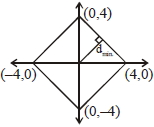
(D) Let $z = x + iy.$ The given equation is $|x| + |y| = 4.$
This represents a square in the complex plane with vertices at $(4, 0), (0, 4), (-4, 0),$ and $(0, -4).$
$|z| = \sqrt{x^2 + y^2}$ represents the distance of a point $(x, y)$ from the origin $(0, 0).$
The minimum distance from the origin to the line segment connecting $(4, 0)$ and $(0, 4)$ is the perpendicular distance from $(0, 0)$ to the line $x + y = 4.$
Using the formula for the distance from a point $(x_0, y_0)$ to the line $Ax + By + C = 0,$ we get $d = \frac{|0 + 0 - 4|}{\sqrt{1^2 + 1^2}} = \frac{4}{\sqrt{2}} = 2\sqrt{2} = \sqrt{8}.$
The maximum distance from the origin to the square occurs at the vertices,which is $4 = \sqrt{16}.$
Thus,$|z|$ must lie in the interval $[\sqrt{8}, \sqrt{16}].$
Since $\sqrt{7} < \sqrt{8},$ $|z|$ cannot be $\sqrt{7}.$
This represents a square in the complex plane with vertices at $(4, 0), (0, 4), (-4, 0),$ and $(0, -4).$
$|z| = \sqrt{x^2 + y^2}$ represents the distance of a point $(x, y)$ from the origin $(0, 0).$
The minimum distance from the origin to the line segment connecting $(4, 0)$ and $(0, 4)$ is the perpendicular distance from $(0, 0)$ to the line $x + y = 4.$
Using the formula for the distance from a point $(x_0, y_0)$ to the line $Ax + By + C = 0,$ we get $d = \frac{|0 + 0 - 4|}{\sqrt{1^2 + 1^2}} = \frac{4}{\sqrt{2}} = 2\sqrt{2} = \sqrt{8}.$
The maximum distance from the origin to the square occurs at the vertices,which is $4 = \sqrt{16}.$
Thus,$|z|$ must lie in the interval $[\sqrt{8}, \sqrt{16}].$
Since $\sqrt{7} < \sqrt{8},$ $|z|$ cannot be $\sqrt{7}.$
0 likesView Solution
57
MathematicsDifficultMCQJEE Main · 2020
If $p \rightarrow (p \wedge \neg q)$ is false,then the truth values of $p$ and $q$ are respectively
A
$F, T$
B
$T, T$
C
$F, F$
D
$T, F$
Solution
(B) The implication $p \rightarrow (p \wedge \neg q)$ is false only when the antecedent $p$ is $T$ and the consequent $(p \wedge \neg q)$ is $F$.
Since $p$ is $T$,the expression $(p \wedge \neg q)$ becomes $(T \wedge \neg q)$.
For $(T \wedge \neg q)$ to be $F$,$\neg q$ must be $F$,which implies $q$ is $T$.
Therefore,the truth values are $p = T$ and $q = T$.
Since $p$ is $T$,the expression $(p \wedge \neg q)$ becomes $(T \wedge \neg q)$.
For $(T \wedge \neg q)$ to be $F$,$\neg q$ must be $F$,which implies $q$ is $T$.
Therefore,the truth values are $p = T$ and $q = T$.
0 likesView Solution
58
MathematicsDifficultMCQJEE Main · 2020
In the expansion of $\left(\frac{x}{\cos \theta}+\frac{1}{x \sin \theta}\right)^{16},$ if $\ell_{1}$ is the least value of the term independent of $x$ when $\frac{\pi}{8} \leq \theta \leq \frac{\pi}{4}$ and $\ell_{2}$ is the least value of the term independent of $x$ when $\frac{\pi}{16} \leq \theta \leq \frac{\pi}{8},$ then the ratio $\ell_{2} : \ell_{1}$ is equal to
A
$1 : 8$
B
$1 : 16$
C
$8 : 1$
D
$16 : 1$
Solution
(D) The general term is given by $T_{r+1} = ^{16}C_{r} \left(\frac{x}{\cos \theta}\right)^{16-r} \left(\frac{1}{x \sin \theta}\right)^{r}$.
Simplifying,$T_{r+1} = ^{16}C_{r} x^{16-2r} \frac{1}{(\cos \theta)^{16-r} (\sin \theta)^{r}}$.
For the term to be independent of $x$,we set $16-2r = 0$,which gives $r = 8$.
Thus,the independent term is $T_{9} = ^{16}C_{8} \frac{1}{\cos^{8} \theta \sin^{8} \theta} = ^{16}C_{8} \frac{2^{8}}{(\sin 2\theta)^{8}}$.
Let $f(\theta) = \frac{^{16}C_{8} \cdot 2^{8}}{(\sin 2\theta)^{8}}$.
For $\theta \in [\frac{\pi}{8}, \frac{\pi}{4}]$,$\sin 2\theta$ is increasing,so $f(\theta)$ is least when $\sin 2\theta$ is maximum,i.e.,at $\theta = \frac{\pi}{4}$. Thus,$\ell_{1} = f(\frac{\pi}{4}) = ^{16}C_{8} \cdot 2^{8}$.
For $\theta \in [\frac{\pi}{16}, \frac{\pi}{8}]$,$f(\theta)$ is least when $\sin 2\theta$ is maximum,i.e.,at $\theta = \frac{\pi}{8}$. Thus,$\ell_{2} = f(\frac{\pi}{8}) = ^{16}C_{8} \frac{2^{8}}{(\sin \frac{\pi}{4})^{8}} = ^{16}C_{8} \frac{2^{8}}{(1/\sqrt{2})^{8}} = ^{16}C_{8} \cdot 2^{8} \cdot 2^{4} = ^{16}C_{8} \cdot 2^{12}$.
The ratio $\frac{\ell_{2}}{\ell_{1}} = \frac{^{16}C_{8} \cdot 2^{12}}{^{16}C_{8} \cdot 2^{8}} = 2^{4} = 16$.
Simplifying,$T_{r+1} = ^{16}C_{r} x^{16-2r} \frac{1}{(\cos \theta)^{16-r} (\sin \theta)^{r}}$.
For the term to be independent of $x$,we set $16-2r = 0$,which gives $r = 8$.
Thus,the independent term is $T_{9} = ^{16}C_{8} \frac{1}{\cos^{8} \theta \sin^{8} \theta} = ^{16}C_{8} \frac{2^{8}}{(\sin 2\theta)^{8}}$.
Let $f(\theta) = \frac{^{16}C_{8} \cdot 2^{8}}{(\sin 2\theta)^{8}}$.
For $\theta \in [\frac{\pi}{8}, \frac{\pi}{4}]$,$\sin 2\theta$ is increasing,so $f(\theta)$ is least when $\sin 2\theta$ is maximum,i.e.,at $\theta = \frac{\pi}{4}$. Thus,$\ell_{1} = f(\frac{\pi}{4}) = ^{16}C_{8} \cdot 2^{8}$.
For $\theta \in [\frac{\pi}{16}, \frac{\pi}{8}]$,$f(\theta)$ is least when $\sin 2\theta$ is maximum,i.e.,at $\theta = \frac{\pi}{8}$. Thus,$\ell_{2} = f(\frac{\pi}{8}) = ^{16}C_{8} \frac{2^{8}}{(\sin \frac{\pi}{4})^{8}} = ^{16}C_{8} \frac{2^{8}}{(1/\sqrt{2})^{8}} = ^{16}C_{8} \cdot 2^{8} \cdot 2^{4} = ^{16}C_{8} \cdot 2^{12}$.
The ratio $\frac{\ell_{2}}{\ell_{1}} = \frac{^{16}C_{8} \cdot 2^{12}}{^{16}C_{8} \cdot 2^{8}} = 2^{4} = 16$.
0 likesView Solution
59
MathematicsDifficultMCQJEE Main · 2020
Let $a_{n}$ be the $n^{\text{th}}$ term of a $G$.$P$. of positive terms. If $\sum_{n=1}^{100} a_{2n+1} = 200$ and $\sum_{n=1}^{100} a_{2n} = 100$,then $\sum_{n=1}^{200} a_{n}$ is equal to:
A
$225$
B
$175$
C
$300$
D
$150$
Solution
(D) Given that $a_n$ is a $G$.$P$. with common ratio $r$.
$\sum_{n=1}^{100} a_{2n+1} = a_3 + a_5 + \dots + a_{201} = 200$
This is a $G$.$P$. with first term $a_3 = ar^2$ and common ratio $r^2$ with $100$ terms.
So,$ar^2 \frac{(r^2)^{100} - 1}{r^2 - 1} = ar^2 \frac{r^{200} - 1}{r^2 - 1} = 200$
$\sum_{n=1}^{100} a_{2n} = a_2 + a_4 + \dots + a_{200} = 100$
This is a $G$.$P$. with first term $a_2 = ar$ and common ratio $r^2$ with $100$ terms.
So,$ar \frac{(r^2)^{100} - 1}{r^2 - 1} = ar \frac{r^{200} - 1}{r^2 - 1} = 100$
Dividing the two equations: $\frac{ar^2 \frac{r^{200} - 1}{r^2 - 1}}{ar \frac{r^{200} - 1}{r^2 - 1}} = \frac{200}{100} \Rightarrow r = 2$
We need to find $S = \sum_{n=1}^{200} a_n = a_1 + a_2 + \dots + a_{200}$.
Note that $\sum_{n=1}^{100} a_{2n+1} + \sum_{n=1}^{100} a_{2n} = a_2 + a_3 + a_4 + \dots + a_{201} = 300$.
Since $a_{k+1} = r a_k$,we have $a_2 + a_3 + \dots + a_{201} = r(a_1 + a_2 + \dots + a_{200}) = 300$.
Substituting $r = 2$: $2 \sum_{n=1}^{200} a_n = 300 \Rightarrow \sum_{n=1}^{200} a_n = 150$.
$\sum_{n=1}^{100} a_{2n+1} = a_3 + a_5 + \dots + a_{201} = 200$
This is a $G$.$P$. with first term $a_3 = ar^2$ and common ratio $r^2$ with $100$ terms.
So,$ar^2 \frac{(r^2)^{100} - 1}{r^2 - 1} = ar^2 \frac{r^{200} - 1}{r^2 - 1} = 200$
$\sum_{n=1}^{100} a_{2n} = a_2 + a_4 + \dots + a_{200} = 100$
This is a $G$.$P$. with first term $a_2 = ar$ and common ratio $r^2$ with $100$ terms.
So,$ar \frac{(r^2)^{100} - 1}{r^2 - 1} = ar \frac{r^{200} - 1}{r^2 - 1} = 100$
Dividing the two equations: $\frac{ar^2 \frac{r^{200} - 1}{r^2 - 1}}{ar \frac{r^{200} - 1}{r^2 - 1}} = \frac{200}{100} \Rightarrow r = 2$
We need to find $S = \sum_{n=1}^{200} a_n = a_1 + a_2 + \dots + a_{200}$.
Note that $\sum_{n=1}^{100} a_{2n+1} + \sum_{n=1}^{100} a_{2n} = a_2 + a_3 + a_4 + \dots + a_{201} = 300$.
Since $a_{k+1} = r a_k$,we have $a_2 + a_3 + \dots + a_{201} = r(a_1 + a_2 + \dots + a_{200}) = 300$.
Substituting $r = 2$: $2 \sum_{n=1}^{200} a_n = 300 \Rightarrow \sum_{n=1}^{200} a_n = 150$.
0 likesView Solution
60
MathematicsDifficultMCQJEE Main · 2020
The number of terms common to the two $A$.$P$.'s $3, 7, 11, \ldots, 407$ and $2, 9, 16, \ldots, 709$ is
A
$20$
B
$17$
C
$11$
D
$14$
Solution
(D) The first $A$.$P$. is $A_1: 3, 7, 11, \ldots, 407$. Here,$a_1 = 3$ and $d_1 = 4$. The general term is $T_n = 3 + (n-1)4 = 4n - 1$.
The second $A$.$P$. is $A_2: 2, 9, 16, \ldots, 709$. Here,$a_2 = 2$ and $d_2 = 7$. The general term is $T_m = 2 + (m-1)7 = 7m - 5$.
For a common term,$4n - 1 = 7m - 5$,which implies $4n = 7m - 4$. This means $7m$ must be a multiple of $4$. Since $7$ is not divisible by $4$,$m$ must be a multiple of $4$. Let $m = 4k$.
Substituting $m = 4k$,we get $4n = 7(4k) - 4$,so $n = 7k - 1$.
The first common term is for $k=1$,which is $m=4$,$T_4 = 7(4)-5 = 23$.
The common difference of the new $A$.$P$. is $\text{lcm}(4, 7) = 28$.
The common terms are $23, 51, 79, \ldots$. The last term must be $\leq 407$.
$23 + (N-1)28 \leq 407$
$(N-1)28 \leq 384$
$N-1 \leq 13.71$
$N \leq 14.71$.
Thus,the number of common terms is $N = 14$.
The second $A$.$P$. is $A_2: 2, 9, 16, \ldots, 709$. Here,$a_2 = 2$ and $d_2 = 7$. The general term is $T_m = 2 + (m-1)7 = 7m - 5$.
For a common term,$4n - 1 = 7m - 5$,which implies $4n = 7m - 4$. This means $7m$ must be a multiple of $4$. Since $7$ is not divisible by $4$,$m$ must be a multiple of $4$. Let $m = 4k$.
Substituting $m = 4k$,we get $4n = 7(4k) - 4$,so $n = 7k - 1$.
The first common term is for $k=1$,which is $m=4$,$T_4 = 7(4)-5 = 23$.
The common difference of the new $A$.$P$. is $\text{lcm}(4, 7) = 28$.
The common terms are $23, 51, 79, \ldots$. The last term must be $\leq 407$.
$23 + (N-1)28 \leq 407$
$(N-1)28 \leq 384$
$N-1 \leq 13.71$
$N \leq 14.71$.
Thus,the number of common terms is $N = 14$.
0 likesView Solution
61
MathematicsDifficultMCQJEE Main · 2020
If $C_{0} + 5 \cdot C_{1} + 9 \cdot C_{2} + \ldots + (101) \cdot C_{25} = 2^{25} \cdot k$,then $k$ is equal to:
A
$42$
B
$45$
C
$51$
D
$48$
Solution
(C) Let $S = \sum_{r=0}^{25} (4r + 1) \cdot ^{25}C_{r}$.
Using the property $^{n}C_{r} = ^{n}C_{n-r}$,we can write:
$S = 1 \cdot ^{25}C_{0} + 5 \cdot ^{25}C_{1} + 9 \cdot ^{25}C_{2} + \ldots + 101 \cdot ^{25}C_{25}$.
Reversing the order:
$S = 101 \cdot ^{25}C_{25} + 97 \cdot ^{25}C_{24} + \ldots + 1 \cdot ^{25}C_{0}$.
Adding the two expressions:
$2S = \sum_{r=0}^{25} (4r + 1 + 101 - 4r) \cdot ^{25}C_{r} = \sum_{r=0}^{25} (102) \cdot ^{25}C_{r}$.
$2S = 102 \sum_{r=0}^{25} {^{25}C_{r}} = 102 \cdot 2^{25}$.
$S = 51 \cdot 2^{25}$.
Comparing with $2^{25} \cdot k$,we get $k = 51$.
Using the property $^{n}C_{r} = ^{n}C_{n-r}$,we can write:
$S = 1 \cdot ^{25}C_{0} + 5 \cdot ^{25}C_{1} + 9 \cdot ^{25}C_{2} + \ldots + 101 \cdot ^{25}C_{25}$.
Reversing the order:
$S = 101 \cdot ^{25}C_{25} + 97 \cdot ^{25}C_{24} + \ldots + 1 \cdot ^{25}C_{0}$.
Adding the two expressions:
$2S = \sum_{r=0}^{25} (4r + 1 + 101 - 4r) \cdot ^{25}C_{r} = \sum_{r=0}^{25} (102) \cdot ^{25}C_{r}$.
$2S = 102 \sum_{r=0}^{25} {^{25}C_{r}} = 102 \cdot 2^{25}$.
$S = 51 \cdot 2^{25}$.
Comparing with $2^{25} \cdot k$,we get $k = 51$.
0 likesView Solution
62
MathematicsDifficultMCQJEE Main · 2020
If the curves $x^{2}-6x+y^{2}+8=0$ and $x^{2}-8y+y^{2}+16-k=0$ $(k>0)$ touch each other at a point,then the largest value of $k$ is
A
$25$
B
$36$
C
$30$
D
$42$
Solution
(B) The given equations of the circles are $S_{1}: x^{2}+y^{2}-6x+8=0$ and $S_{2}: x^{2}+y^{2}-8y+16-k=0$.
For $S_{1}$,the center $C_{1} = (3, 0)$ and radius $r_{1} = \sqrt{3^{2}+0^{2}-8} = \sqrt{1} = 1$.
For $S_{2}$,the center $C_{2} = (0, 4)$ and radius $r_{2} = \sqrt{0^{2}+4^{2}-(16-k)} = \sqrt{k}$.
The distance between the centers is $d = \sqrt{(3-0)^{2}+(0-4)^{2}} = \sqrt{9+16} = 5$.
Since the circles touch each other,the distance between centers must be equal to the sum or difference of the radii: $d = |r_{1} \pm r_{2}|$.
Case $1$: $d = r_{1}+r_{2}$ $\Rightarrow 5 = 1+\sqrt{k}$ $\Rightarrow \sqrt{k} = 4$ $\Rightarrow k = 16$.
Case $2$: $d = |r_{1}-r_{2}| \Rightarrow 5 = |1-\sqrt{k}|$.
This implies $1-\sqrt{k} = 5$ or $1-\sqrt{k} = -5$.
$1-\sqrt{k} = 5 \Rightarrow \sqrt{k} = -4$ (not possible as $k>0$).
$1-\sqrt{k} = -5$ $\Rightarrow \sqrt{k} = 6$ $\Rightarrow k = 36$.
Comparing the values,the largest value of $k$ is $36$.
For $S_{1}$,the center $C_{1} = (3, 0)$ and radius $r_{1} = \sqrt{3^{2}+0^{2}-8} = \sqrt{1} = 1$.
For $S_{2}$,the center $C_{2} = (0, 4)$ and radius $r_{2} = \sqrt{0^{2}+4^{2}-(16-k)} = \sqrt{k}$.
The distance between the centers is $d = \sqrt{(3-0)^{2}+(0-4)^{2}} = \sqrt{9+16} = 5$.
Since the circles touch each other,the distance between centers must be equal to the sum or difference of the radii: $d = |r_{1} \pm r_{2}|$.
Case $1$: $d = r_{1}+r_{2}$ $\Rightarrow 5 = 1+\sqrt{k}$ $\Rightarrow \sqrt{k} = 4$ $\Rightarrow k = 16$.
Case $2$: $d = |r_{1}-r_{2}| \Rightarrow 5 = |1-\sqrt{k}|$.
This implies $1-\sqrt{k} = 5$ or $1-\sqrt{k} = -5$.
$1-\sqrt{k} = 5 \Rightarrow \sqrt{k} = -4$ (not possible as $k>0$).
$1-\sqrt{k} = -5$ $\Rightarrow \sqrt{k} = 6$ $\Rightarrow k = 36$.
Comparing the values,the largest value of $k$ is $36$.
0 likesView Solution
63
MathematicsDifficultMCQJEE Main · 2020
If the number of five-digit numbers with distinct digits and $2$ at the $10^{\text{th}}$ place is $336k$,then $k$ is equal to
A
$8$
B
$6$
C
$4$
D
$2$
Solution
(A) five-digit number is represented as $\_ \;\_\;\_\;\underline{2}\;\_$.
The $10^{\text{th}}$ place is fixed as $2$.
For the $10,000^{\text{th}}$ place,we cannot use $0$ or $2$,so there are $8$ choices $(1, 3, 4, 5, 6, 7, 8, 9)$.
For the $1,000^{\text{th}}$ place,we can use $0$ and any of the remaining $7$ digits,so there are $8$ choices.
For the $100^{\text{th}}$ place,there are $7$ choices remaining.
For the units place,there are $6$ choices remaining.
Total number of such five-digit numbers $= 8 \times 8 \times 7 \times 6 = 2688$.
Given that the number is $336k$,we have $336k = 2688$.
Therefore,$k = \frac{2688}{336} = 8$.
The $10^{\text{th}}$ place is fixed as $2$.
For the $10,000^{\text{th}}$ place,we cannot use $0$ or $2$,so there are $8$ choices $(1, 3, 4, 5, 6, 7, 8, 9)$.
For the $1,000^{\text{th}}$ place,we can use $0$ and any of the remaining $7$ digits,so there are $8$ choices.
For the $100^{\text{th}}$ place,there are $7$ choices remaining.
For the units place,there are $6$ choices remaining.
Total number of such five-digit numbers $= 8 \times 8 \times 7 \times 6 = 2688$.
Given that the number is $336k$,we have $336k = 2688$.
Therefore,$k = \frac{2688}{336} = 8$.
0 likesView Solution
64
MathematicsDifficultMCQJEE Main · 2020
Let $z$ be a complex number such that $\left|\frac{z-i}{z+2i}\right|=1$ and $|z|=\frac{5}{2}$. Then the value of $|z+3i|$ is:
A
$\sqrt{10}$
B
$2\sqrt{3}$
C
$\frac{7}{2}$
D
$\frac{15}{4}$
Solution
(C) Given $\left|\frac{z-i}{z+2i}\right|=1$,which implies $|z-i|=|z+2i|$.
This means $z$ lies on the perpendicular bisector of the points $(0, 1)$ and $(0, -2)$.
The perpendicular bisector is the line $\text{Im}(z) = -\frac{1}{2}$.
Let $z = x - \frac{i}{2}$.
Given $|z| = \frac{5}{2}$,we have $x^2 + (-\frac{1}{2})^2 = (\frac{5}{2})^2$.
$x^2 + \frac{1}{4} = \frac{25}{4} \Rightarrow x^2 = 6$.
Now,$|z+3i| = |x - \frac{i}{2} + 3i| = |x + \frac{5i}{2}|$.
$|z+3i| = \sqrt{x^2 + (\frac{5}{2})^2} = \sqrt{6 + \frac{25}{4}} = \sqrt{\frac{24+25}{4}} = \sqrt{\frac{49}{4}} = \frac{7}{2}$.
This means $z$ lies on the perpendicular bisector of the points $(0, 1)$ and $(0, -2)$.
The perpendicular bisector is the line $\text{Im}(z) = -\frac{1}{2}$.
Let $z = x - \frac{i}{2}$.
Given $|z| = \frac{5}{2}$,we have $x^2 + (-\frac{1}{2})^2 = (\frac{5}{2})^2$.
$x^2 + \frac{1}{4} = \frac{25}{4} \Rightarrow x^2 = 6$.
Now,$|z+3i| = |x - \frac{i}{2} + 3i| = |x + \frac{5i}{2}|$.
$|z+3i| = \sqrt{x^2 + (\frac{5}{2})^2} = \sqrt{6 + \frac{25}{4}} = \sqrt{\frac{24+25}{4}} = \sqrt{\frac{49}{4}} = \frac{7}{2}$.
0 likesView Solution
65
MathematicsDifficultMCQJEE Main · 2020
The number of real roots of the equation $e^{4x} + e^{3x} - 4e^{2x} + e^x + 1 = 0$ is:
A
$4$
B
$2$
C
$3$
D
$1$
Solution
(D) Given equation: $e^{4x} + e^{3x} - 4e^{2x} + e^x + 1 = 0$.
Divide the entire equation by $e^{2x}$ (since $e^{2x} \neq 0$):
$e^{2x} + e^x - 4 + \frac{1}{e^x} + \frac{1}{e^{2x}} = 0$.
Rearrange the terms:
$(e^{2x} + \frac{1}{e^{2x}}) + (e^x + \frac{1}{e^x}) - 4 = 0$.
Using the identity $a^2 + \frac{1}{a^2} = (a + \frac{1}{a})^2 - 2$,we get:
$(e^x + \frac{1}{e^x})^2 - 2 + (e^x + \frac{1}{e^x}) - 4 = 0$.
Let $t = e^x + \frac{1}{e^x}$. Since $e^x > 0$,by $AM$-$GM$ inequality,$t = e^x + \frac{1}{e^x} \geq 2$.
The equation becomes $t^2 + t - 6 = 0$.
Factoring the quadratic: $(t + 3)(t - 2) = 0$.
This gives $t = -3$ or $t = 2$.
Since $t \geq 2$,we must have $t = 2$.
$e^x + \frac{1}{e^x} = 2$ $\Rightarrow e^{2x} - 2e^x + 1 = 0$ $\Rightarrow (e^x - 1)^2 = 0$.
$e^x = 1 \Rightarrow x = 0$.
Thus,there is only $1$ real root.
Divide the entire equation by $e^{2x}$ (since $e^{2x} \neq 0$):
$e^{2x} + e^x - 4 + \frac{1}{e^x} + \frac{1}{e^{2x}} = 0$.
Rearrange the terms:
$(e^{2x} + \frac{1}{e^{2x}}) + (e^x + \frac{1}{e^x}) - 4 = 0$.
Using the identity $a^2 + \frac{1}{a^2} = (a + \frac{1}{a})^2 - 2$,we get:
$(e^x + \frac{1}{e^x})^2 - 2 + (e^x + \frac{1}{e^x}) - 4 = 0$.
Let $t = e^x + \frac{1}{e^x}$. Since $e^x > 0$,by $AM$-$GM$ inequality,$t = e^x + \frac{1}{e^x} \geq 2$.
The equation becomes $t^2 + t - 6 = 0$.
Factoring the quadratic: $(t + 3)(t - 2) = 0$.
This gives $t = -3$ or $t = 2$.
Since $t \geq 2$,we must have $t = 2$.
$e^x + \frac{1}{e^x} = 2$ $\Rightarrow e^{2x} - 2e^x + 1 = 0$ $\Rightarrow (e^x - 1)^2 = 0$.
$e^x = 1 \Rightarrow x = 0$.
Thus,there is only $1$ real root.
0 likesView Solution
66
MathematicsDifficultMCQJEE Main · 2020
Negation of the statement: $\sqrt{5}$ is an integer or $5$ is irrational is
A
$\sqrt{5}$ is an integer or $5$ is irrational
B
$\sqrt{5}$ is not an integer and $5$ is not irrational
C
$\sqrt{5}$ is an integer and $5$ is irrational
D
$\sqrt{5}$ is not an integer or $5$ is not irrational
Solution
(B) Let $p$ be the statement: $\sqrt{5}$ is an integer.
Let $q$ be the statement: $5$ is irrational.
The given statement is $p \vee q$.
The negation of the statement is $\sim(p \vee q)$.
By De Morgan's Law,$\sim(p \vee q) \equiv \sim p \wedge \sim q$.
Thus,the negation is: $\sqrt{5}$ is not an integer $AND$ $5$ is not irrational.
Let $q$ be the statement: $5$ is irrational.
The given statement is $p \vee q$.
The negation of the statement is $\sim(p \vee q)$.
By De Morgan's Law,$\sim(p \vee q) \equiv \sim p \wedge \sim q$.
Thus,the negation is: $\sqrt{5}$ is not an integer $AND$ $5$ is not irrational.
0 likesView Solution
67
MathematicsDifficultMCQJEE Main · 2020
Let the observations $x_{i} (1 \leq i \leq 10)$ satisfy the equations $\sum_{i=1}^{10}(x_{i}-5)=10$ and $\sum_{i=1}^{10}(x_{i}-5)^{2}=40$. If $\mu$ and $\lambda$ are the mean and the variance of the observations $x_{1}-3, x_{2}-3, \dots, x_{10}-3$,then the ordered pair $(\mu, \lambda)$ is equal to:
A
$(6, 6)$
B
$(3, 6)$
C
$(6, 3)$
D
$(3, 3)$
Solution
(D) Let $y_{i} = x_{i} - 5$. Then $\sum_{i=1}^{10} y_{i} = 10$ and $\sum_{i=1}^{10} y_{i}^{2} = 40$.
Mean of $y_{i}$ is $\bar{y} = \frac{1}{10} \sum y_{i} = \frac{10}{10} = 1$.
Variance of $y_{i}$ is $\sigma_{y}^{2} = \frac{1}{10} \sum y_{i}^{2} - (\bar{y})^{2} = \frac{40}{10} - (1)^{2} = 4 - 1 = 3$.
Now,let $z_{i} = x_{i} - 3$. We can write $z_{i} = (x_{i} - 5) + 2 = y_{i} + 2$.
The mean $\mu$ of $z_{i}$ is $\bar{z} = \bar{y} + 2 = 1 + 2 = 3$.
The variance $\lambda$ of $z_{i}$ is $\text{Var}(y_{i} + 2) = \text{Var}(y_{i}) = 3$.
Thus,the ordered pair $(\mu, \lambda) = (3, 3)$.
Mean of $y_{i}$ is $\bar{y} = \frac{1}{10} \sum y_{i} = \frac{10}{10} = 1$.
Variance of $y_{i}$ is $\sigma_{y}^{2} = \frac{1}{10} \sum y_{i}^{2} - (\bar{y})^{2} = \frac{40}{10} - (1)^{2} = 4 - 1 = 3$.
Now,let $z_{i} = x_{i} - 3$. We can write $z_{i} = (x_{i} - 5) + 2 = y_{i} + 2$.
The mean $\mu$ of $z_{i}$ is $\bar{z} = \bar{y} + 2 = 1 + 2 = 3$.
The variance $\lambda$ of $z_{i}$ is $\text{Var}(y_{i} + 2) = \text{Var}(y_{i}) = 3$.
Thus,the ordered pair $(\mu, \lambda) = (3, 3)$.
0 likesView Solution
68
MathematicsDifficultMCQJEE Main · 2020
The product $2^{\frac{1}{4}} \cdot 4^{\frac{1}{16}} \cdot 8^{\frac{1}{48}} \cdot 16^{\frac{1}{128}} \cdot \dots$ to $\infty$ is equal to
A
$2^{\frac{1}{2}}$
B
$2^{\frac{1}{4}}$
C
$2$
D
$1$
Solution
(A) The given expression is $P = 2^{\frac{1}{4}} \cdot 4^{\frac{1}{16}} \cdot 8^{\frac{1}{48}} \cdot 16^{\frac{1}{128}} \cdot \dots \infty$.
Expressing all terms with base $2$:
$P = 2^{\frac{1}{4}} \cdot (2^2)^{\frac{1}{16}} \cdot (2^3)^{\frac{1}{48}} \cdot (2^4)^{\frac{1}{128}} \cdot \dots$
$P = 2^{\frac{1}{4}} \cdot 2^{\frac{2}{16}} \cdot 2^{\frac{3}{48}} \cdot 2^{\frac{4}{128}} \cdot \dots$
$P = 2^{\frac{1}{4}} \cdot 2^{\frac{1}{8}} \cdot 2^{\frac{1}{16}} \cdot 2^{\frac{1}{32}} \cdot \dots$
Using the property $a^m \cdot a^n = a^{m+n}$,we get:
$P = 2^{(\frac{1}{4} + \frac{1}{8} + \frac{1}{16} + \frac{1}{32} + \dots)}$
The exponent is an infinite geometric series with first term $a = \frac{1}{4}$ and common ratio $r = \frac{1}{2}$.
The sum of an infinite geometric series is $S = \frac{a}{1-r}$.
$S = \frac{1/4}{1 - 1/2} = \frac{1/4}{1/2} = \frac{1}{2}$.
Therefore,$P = 2^{\frac{1}{2}}$.
Expressing all terms with base $2$:
$P = 2^{\frac{1}{4}} \cdot (2^2)^{\frac{1}{16}} \cdot (2^3)^{\frac{1}{48}} \cdot (2^4)^{\frac{1}{128}} \cdot \dots$
$P = 2^{\frac{1}{4}} \cdot 2^{\frac{2}{16}} \cdot 2^{\frac{3}{48}} \cdot 2^{\frac{4}{128}} \cdot \dots$
$P = 2^{\frac{1}{4}} \cdot 2^{\frac{1}{8}} \cdot 2^{\frac{1}{16}} \cdot 2^{\frac{1}{32}} \cdot \dots$
Using the property $a^m \cdot a^n = a^{m+n}$,we get:
$P = 2^{(\frac{1}{4} + \frac{1}{8} + \frac{1}{16} + \frac{1}{32} + \dots)}$
The exponent is an infinite geometric series with first term $a = \frac{1}{4}$ and common ratio $r = \frac{1}{2}$.
The sum of an infinite geometric series is $S = \frac{a}{1-r}$.
$S = \frac{1/4}{1 - 1/2} = \frac{1/4}{1/2} = \frac{1}{2}$.
Therefore,$P = 2^{\frac{1}{2}}$.
0 likesView Solution
69
MathematicsDifficultMCQJEE Main · 2020
$A$ circle touches the $y$-axis at the point $(0,4)$ and passes through the point $(2,0)$. Which of the following lines is not a tangent to this circle?
A
$3x - 4y - 24 = 0$
B
$3x + 4y - 6 = 0$
C
$4x + 3y - 8 = 0$
D
$4x - 3y + 17 = 0$
Solution
(C) The equation of a circle touching the $y$-axis at $(0,4)$ is $(x-0)^2 + (y-4)^2 + \lambda x = 0$.
Since it passes through $(2,0)$,we substitute $x=2$ and $y=0$:
$(2-0)^2 + (0-4)^2 + \lambda(2) = 0$ $\Rightarrow 4 + 16 + 2\lambda = 0$ $\Rightarrow 2\lambda = -20$ $\Rightarrow \lambda = -10$.
Thus,the circle equation is $x^2 + (y-4)^2 - 10x = 0$,which simplifies to $x^2 + y^2 - 10x - 8y + 16 = 0$.
The center is $(5,4)$ and the radius $r = \sqrt{5^2 + 4^2 - 16} = \sqrt{25 + 16 - 16} = 5$.
$A$ line $ax + by + c = 0$ is a tangent if the perpendicular distance from the center $(5,4)$ to the line equals the radius $5$.
For $A: |3(5) - 4(4) - 24| / \sqrt{3^2 + (-4)^2} = |15 - 16 - 24| / 5 = |-25| / 5 = 5$ (Tangent).
For $B: |3(5) + 4(4) - 6| / \sqrt{3^2 + 4^2} = |15 + 16 - 6| / 5 = |25| / 5 = 5$ (Tangent).
For $C: |4(5) + 3(4) - 8| / \sqrt{4^2 + 3^2} = |20 + 12 - 8| / 5 = |24| / 5 = 4.8 \neq 5$ (Not a tangent).
For $D: |4(5) - 3(4) + 17| / \sqrt{4^2 + (-3)^2} = |20 - 12 + 17| / 5 = |25| / 5 = 5$ (Tangent).
Since it passes through $(2,0)$,we substitute $x=2$ and $y=0$:
$(2-0)^2 + (0-4)^2 + \lambda(2) = 0$ $\Rightarrow 4 + 16 + 2\lambda = 0$ $\Rightarrow 2\lambda = -20$ $\Rightarrow \lambda = -10$.
Thus,the circle equation is $x^2 + (y-4)^2 - 10x = 0$,which simplifies to $x^2 + y^2 - 10x - 8y + 16 = 0$.
The center is $(5,4)$ and the radius $r = \sqrt{5^2 + 4^2 - 16} = \sqrt{25 + 16 - 16} = 5$.
$A$ line $ax + by + c = 0$ is a tangent if the perpendicular distance from the center $(5,4)$ to the line equals the radius $5$.
For $A: |3(5) - 4(4) - 24| / \sqrt{3^2 + (-4)^2} = |15 - 16 - 24| / 5 = |-25| / 5 = 5$ (Tangent).
For $B: |3(5) + 4(4) - 6| / \sqrt{3^2 + 4^2} = |15 + 16 - 6| / 5 = |25| / 5 = 5$ (Tangent).
For $C: |4(5) + 3(4) - 8| / \sqrt{4^2 + 3^2} = |20 + 12 - 8| / 5 = |24| / 5 = 4.8 \neq 5$ (Not a tangent).
For $D: |4(5) - 3(4) + 17| / \sqrt{4^2 + (-3)^2} = |20 - 12 + 17| / 5 = |25| / 5 = 5$ (Tangent).
0 likesView Solution
70
MathematicsDifficultMCQJEE Main · 2020
If $e_{1}$ and $e_{2}$ are the eccentricities of the ellipse $\frac{x^{2}}{18}+\frac{y^{2}}{4}=1$ and the hyperbola $\frac{x^{2}}{9}-\frac{y^{2}}{4}=1$ respectively,and $(e_{1}, e_{2})$ is a point on the ellipse $15x^{2}+3y^{2}=k$,then $k$ is equal to:
A
$15$
B
$14$
C
$17$
D
$16$
Solution
(D) For the ellipse $\frac{x^{2}}{18}+\frac{y^{2}}{4}=1$,we have $a^{2}=18$ and $b^{2}=4$. The eccentricity $e_{1} = \sqrt{1-\frac{b^{2}}{a^{2}}} = \sqrt{1-\frac{4}{18}} = \sqrt{\frac{14}{18}} = \sqrt{\frac{7}{9}} = \frac{\sqrt{7}}{3}$.
For the hyperbola $\frac{x^{2}}{9}-\frac{y^{2}}{4}=1$,we have $a^{2}=9$ and $b^{2}=4$. The eccentricity $e_{2} = \sqrt{1+\frac{b^{2}}{a^{2}}} = \sqrt{1+\frac{4}{9}} = \sqrt{\frac{13}{9}} = \frac{\sqrt{13}}{3}$.
Since the point $(e_{1}, e_{2})$ lies on the ellipse $15x^{2}+3y^{2}=k$,we substitute the values of $e_{1}$ and $e_{2}$ into the equation:
$15(\frac{\sqrt{7}}{3})^{2} + 3(\frac{\sqrt{13}}{3})^{2} = k$
$15(\frac{7}{9}) + 3(\frac{13}{9}) = k$
$\frac{105}{9} + \frac{39}{9} = k$
$\frac{144}{9} = k$
$k = 16$.
For the hyperbola $\frac{x^{2}}{9}-\frac{y^{2}}{4}=1$,we have $a^{2}=9$ and $b^{2}=4$. The eccentricity $e_{2} = \sqrt{1+\frac{b^{2}}{a^{2}}} = \sqrt{1+\frac{4}{9}} = \sqrt{\frac{13}{9}} = \frac{\sqrt{13}}{3}$.
Since the point $(e_{1}, e_{2})$ lies on the ellipse $15x^{2}+3y^{2}=k$,we substitute the values of $e_{1}$ and $e_{2}$ into the equation:
$15(\frac{\sqrt{7}}{3})^{2} + 3(\frac{\sqrt{13}}{3})^{2} = k$
$15(\frac{7}{9}) + 3(\frac{13}{9}) = k$
$\frac{105}{9} + \frac{39}{9} = k$
$\frac{144}{9} = k$
$k = 16$.
0 likesView Solution
71
MathematicsDifficultMCQJEE Main · 2020
Let $C$ be the centroid of the triangle with vertices $(3, -1), (1, 3),$ and $(2, 4).$ Let $P$ be the point of intersection of the lines $x + 3y - 1 = 0$ and $3x - y + 1 = 0.$ Then the line passing through the points $C$ and $P$ also passes through the point
A
$(7, 6)$
B
$(-9, -6)$
C
$(-9, -7)$
D
$(9, 7)$
Solution
(B) The centroid $C$ of the triangle with vertices $(x_1, y_1), (x_2, y_2),$ and $(x_3, y_3)$ is given by $(\frac{x_1+x_2+x_3}{3}, \frac{y_1+y_2+y_3}{3}).$
For the given vertices $(3, -1), (1, 3),$ and $(2, 4),$ the centroid $C$ is $(\frac{3+1+2}{3}, \frac{-1+3+4}{3}) = (2, 2).$
Next,we find the intersection point $P$ of the lines $x + 3y - 1 = 0$ and $3x - y + 1 = 0.$
Solving the system:
$x + 3y = 1$
$3x - y = -1 \Rightarrow y = 3x + 1$
Substituting $y$ into the first equation: $x + 3(3x + 1) = 1$ $\Rightarrow x + 9x + 3 = 1$ $\Rightarrow 10x = -2$ $\Rightarrow x = -\frac{1}{5}.$
Then $y = 3(-\frac{1}{5}) + 1 = -\frac{3}{5} + 1 = \frac{2}{5}.$
So,$P = (-\frac{1}{5}, \frac{2}{5}).$
The line passing through $C(2, 2)$ and $P(-\frac{1}{5}, \frac{2}{5})$ has slope $m = \frac{\frac{2}{5} - 2}{-\frac{1}{5} - 2} = \frac{-\frac{8}{5}}{-\frac{11}{5}} = \frac{8}{11}.$
The equation of the line is $y - 2 = \frac{8}{11}(x - 2)$ $\Rightarrow 11y - 22 = 8x - 16$ $\Rightarrow 8x - 11y + 6 = 0.$
Checking the options,for $(-9, -6): 8(-9) - 11(-6) + 6 = -72 + 66 + 6 = 0.$
Thus,the line passes through $(-9, -6).$
For the given vertices $(3, -1), (1, 3),$ and $(2, 4),$ the centroid $C$ is $(\frac{3+1+2}{3}, \frac{-1+3+4}{3}) = (2, 2).$
Next,we find the intersection point $P$ of the lines $x + 3y - 1 = 0$ and $3x - y + 1 = 0.$
Solving the system:
$x + 3y = 1$
$3x - y = -1 \Rightarrow y = 3x + 1$
Substituting $y$ into the first equation: $x + 3(3x + 1) = 1$ $\Rightarrow x + 9x + 3 = 1$ $\Rightarrow 10x = -2$ $\Rightarrow x = -\frac{1}{5}.$
Then $y = 3(-\frac{1}{5}) + 1 = -\frac{3}{5} + 1 = \frac{2}{5}.$
So,$P = (-\frac{1}{5}, \frac{2}{5}).$
The line passing through $C(2, 2)$ and $P(-\frac{1}{5}, \frac{2}{5})$ has slope $m = \frac{\frac{2}{5} - 2}{-\frac{1}{5} - 2} = \frac{-\frac{8}{5}}{-\frac{11}{5}} = \frac{8}{11}.$
The equation of the line is $y - 2 = \frac{8}{11}(x - 2)$ $\Rightarrow 11y - 22 = 8x - 16$ $\Rightarrow 8x - 11y + 6 = 0.$
Checking the options,for $(-9, -6): 8(-9) - 11(-6) + 6 = -72 + 66 + 6 = 0.$
Thus,the line passes through $(-9, -6).$
0 likesView Solution
72
MathematicsDifficultMCQJEE Main · 2020
The value of $\cos^{3}\left(\frac{\pi}{8}\right) \cdot \cos\left(\frac{3\pi}{8}\right) + \sin^{3}\left(\frac{\pi}{8}\right) \cdot \sin\left(\frac{3\pi}{8}\right)$ is:
A
$\frac{1}{4}$
B
$\frac{1}{\sqrt{2}}$
C
$\frac{1}{2\sqrt{2}}$
D
$\frac{1}{2}$
Solution
(C) Let $\theta = \frac{\pi}{8}$. Then $\frac{3\pi}{8} = 3\theta$.
Given expression is $\cos^{3}(\theta) \cos(3\theta) + \sin^{3}(\theta) \sin(3\theta)$.
Using the identities $\cos(3\theta) = 4\cos^{3}(\theta) - 3\cos(\theta)$ and $\sin(3\theta) = 3\sin(\theta) - 4\sin^{3}(\theta)$,we can rewrite the expression.
Alternatively,note that $\cos(\frac{3\pi}{8}) = \sin(\frac{\pi}{8})$ and $\sin(\frac{3\pi}{8}) = \cos(\frac{\pi}{8})$.
Substituting these: $\cos^{3}(\frac{\pi}{8}) \sin(\frac{\pi}{8}) + \sin^{3}(\frac{\pi}{8}) \cos(\frac{\pi}{8})$.
Factor out $\sin(\frac{\pi}{8}) \cos(\frac{\pi}{8})$:
$= \sin(\frac{\pi}{8}) \cos(\frac{\pi}{8}) [\cos^{2}(\frac{\pi}{8}) + \sin^{2}(\frac{\pi}{8})]$.
Since $\cos^{2}(\theta) + \sin^{2}(\theta) = 1$,this simplifies to $\sin(\frac{\pi}{8}) \cos(\frac{\pi}{8})$.
Using $\sin(2\theta) = 2\sin(\theta)\cos(\theta)$,we get $\frac{1}{2} \sin(2 \cdot \frac{\pi}{8}) = \frac{1}{2} \sin(\frac{\pi}{4})$.
$= \frac{1}{2} \cdot \frac{1}{\sqrt{2}} = \frac{1}{2\sqrt{2}}$.
Given expression is $\cos^{3}(\theta) \cos(3\theta) + \sin^{3}(\theta) \sin(3\theta)$.
Using the identities $\cos(3\theta) = 4\cos^{3}(\theta) - 3\cos(\theta)$ and $\sin(3\theta) = 3\sin(\theta) - 4\sin^{3}(\theta)$,we can rewrite the expression.
Alternatively,note that $\cos(\frac{3\pi}{8}) = \sin(\frac{\pi}{8})$ and $\sin(\frac{3\pi}{8}) = \cos(\frac{\pi}{8})$.
Substituting these: $\cos^{3}(\frac{\pi}{8}) \sin(\frac{\pi}{8}) + \sin^{3}(\frac{\pi}{8}) \cos(\frac{\pi}{8})$.
Factor out $\sin(\frac{\pi}{8}) \cos(\frac{\pi}{8})$:
$= \sin(\frac{\pi}{8}) \cos(\frac{\pi}{8}) [\cos^{2}(\frac{\pi}{8}) + \sin^{2}(\frac{\pi}{8})]$.
Since $\cos^{2}(\theta) + \sin^{2}(\theta) = 1$,this simplifies to $\sin(\frac{\pi}{8}) \cos(\frac{\pi}{8})$.
Using $\sin(2\theta) = 2\sin(\theta)\cos(\theta)$,we get $\frac{1}{2} \sin(2 \cdot \frac{\pi}{8}) = \frac{1}{2} \sin(\frac{\pi}{4})$.
$= \frac{1}{2} \cdot \frac{1}{\sqrt{2}} = \frac{1}{2\sqrt{2}}$.
0 likesView Solution
73
MathematicsDifficultMCQJEE Main · 2020
The coefficient of $x^{4}$ in the expansion of $(1+x+x^{2})^{10}$ is
A
$615$
B
$625$
C
$595$
D
$575$
Solution
(A) The expression is $(1+x+x^{2})^{10} = (1 + x(1+x))^{10}$.
Using the binomial expansion $(1+y)^{n} = \sum_{k=0}^{n} {}^{n}C_{k} y^{k}$,we get:
$(1+x+x^{2})^{10} = \sum_{k=0}^{10} {}^{10}C_{k} (x(1+x))^{k} = \sum_{k=0}^{10} {}^{10}C_{k} x^{k} (1+x)^{k}$.
To find the coefficient of $x^{4}$,we consider terms where $x^{k} (1+x)^{k}$ contributes to $x^{4}$:
For $k=2$: ${}^{10}C_{2} x^{2} (1+x)^{2} = {}^{10}C_{2} x^{2} (1 + 2x + x^{2}) = {}^{10}C_{2} x^{2} + 2({}^{10}C_{2}) x^{3} + {}^{10}C_{2} x^{4}$. Coefficient is ${}^{10}C_{2} = 45$.
For $k=3$: ${}^{10}C_{3} x^{3} (1+x)^{3} = {}^{10}C_{3} x^{3} (1 + 3x + \dots) = {}^{10}C_{3} x^{3} + 3({}^{10}C_{3}) x^{4} + \dots$. Coefficient is $3 \times {}^{10}C_{3} = 3 \times 120 = 360$.
For $k=4$: ${}^{10}C_{4} x^{4} (1+x)^{4} = {}^{10}C_{4} x^{4} (1 + \dots) = {}^{10}C_{4} x^{4} + \dots$. Coefficient is ${}^{10}C_{4} = 210$.
Total coefficient of $x^{4} = 45 + 360 + 210 = 615$.
Using the binomial expansion $(1+y)^{n} = \sum_{k=0}^{n} {}^{n}C_{k} y^{k}$,we get:
$(1+x+x^{2})^{10} = \sum_{k=0}^{10} {}^{10}C_{k} (x(1+x))^{k} = \sum_{k=0}^{10} {}^{10}C_{k} x^{k} (1+x)^{k}$.
To find the coefficient of $x^{4}$,we consider terms where $x^{k} (1+x)^{k}$ contributes to $x^{4}$:
For $k=2$: ${}^{10}C_{2} x^{2} (1+x)^{2} = {}^{10}C_{2} x^{2} (1 + 2x + x^{2}) = {}^{10}C_{2} x^{2} + 2({}^{10}C_{2}) x^{3} + {}^{10}C_{2} x^{4}$. Coefficient is ${}^{10}C_{2} = 45$.
For $k=3$: ${}^{10}C_{3} x^{3} (1+x)^{3} = {}^{10}C_{3} x^{3} (1 + 3x + \dots) = {}^{10}C_{3} x^{3} + 3({}^{10}C_{3}) x^{4} + \dots$. Coefficient is $3 \times {}^{10}C_{3} = 3 \times 120 = 360$.
For $k=4$: ${}^{10}C_{4} x^{4} (1+x)^{4} = {}^{10}C_{4} x^{4} (1 + \dots) = {}^{10}C_{4} x^{4} + \dots$. Coefficient is ${}^{10}C_{4} = 210$.
Total coefficient of $x^{4} = 45 + 360 + 210 = 615$.
0 likesView Solution
74
MathematicsAdvancedMCQJEE Main · 2020
The number of distinct solutions of the equation $\log _{\frac{1}{2}}|\sin x|=2-\log _{\frac{1}{2}}|\cos x|$ in the interval $[0,2 \pi]$ is
A
$8$
B
$5$
C
$11$
D
$12$
Solution
(A) Given equation: $\log _{1 / 2}|\sin x|=2-\log _{1 / 2}|\cos x|$ for $x \in [0, 2\pi]$.
Rearranging the terms,we get: $\log _{1 / 2}|\sin x| + \log _{1 / 2}|\cos x| = 2$.
Using the property $\log_a m + \log_a n = \log_a (mn)$,we have: $\log _{1 / 2}(|\sin x \cos x|) = 2$.
Converting to exponential form: $|\sin x \cos x| = (1/2)^2 = 1/4$.
Multiplying by $2$ on both sides: $|2 \sin x \cos x| = 2 \times (1/4) = 1/2$.
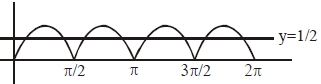
Thus,$|\sin 2x| = 1/2$.
In the interval $x \in [0, 2\pi]$,the angle $2x$ lies in the interval $[0, 4\pi]$.
For $|\sin \theta| = 1/2$,there are $4$ solutions in each interval of length $2\pi$ (i.e.,$[0, 2\pi]$).
Since the interval for $2x$ is $[0, 4\pi]$,which covers two full periods of the sine function,the total number of solutions is $4 \times 2 = 8$.
Rearranging the terms,we get: $\log _{1 / 2}|\sin x| + \log _{1 / 2}|\cos x| = 2$.
Using the property $\log_a m + \log_a n = \log_a (mn)$,we have: $\log _{1 / 2}(|\sin x \cos x|) = 2$.
Converting to exponential form: $|\sin x \cos x| = (1/2)^2 = 1/4$.
Multiplying by $2$ on both sides: $|2 \sin x \cos x| = 2 \times (1/4) = 1/2$.
Thus,$|\sin 2x| = 1/2$.
In the interval $x \in [0, 2\pi]$,the angle $2x$ lies in the interval $[0, 4\pi]$.
For $|\sin \theta| = 1/2$,there are $4$ solutions in each interval of length $2\pi$ (i.e.,$[0, 2\pi]$).
Since the interval for $2x$ is $[0, 4\pi]$,which covers two full periods of the sine function,the total number of solutions is $4 \times 2 = 8$.
0 likesView Solution
75
MathematicsMediumMCQJEE Main · 2020
If $|x| < 1, |y| < 1$ and $x \neq y,$ then the sum to infinity of the following series $(x+y)+(x^{2}+xy+y^{2})+(x^{3}+x^{2}y+xy^{2}+y^{3})+\ldots$ is:
A
$\frac{x+y-xy}{(1-x)(1-y)}$
B
$\frac{x+y-xy}{(1+x)(1+y)}$
C
$\frac{x+y+xy}{(1+x)(1+y)}$
D
$\frac{x+y+xy}{(1-x)(1-y)}$
Solution
(A) Given the series $S = (x+y)+(x^{2}+xy+y^{2})+(x^{3}+x^{2}y+xy^{2}+y^{3})+\ldots$
Multiplying and dividing by $(x-y)$:
$S = \frac{(x-y)(x+y)+(x-y)(x^{2}+xy+y^{2})+(x-y)(x^{3}+x^{2}y+xy^{2}+y^{3})+\ldots}{x-y}$
Using the identity $(x-y)(x^n + x^{n-1}y + \ldots + y^n) = x^{n+1} - y^{n+1}$:
$S = \frac{(x^{2}-y^{2})+(x^{3}-y^{3})+(x^{4}-y^{4})+\ldots}{x-y}$
$S = \frac{(x^{2}+x^{3}+x^{4}+\ldots) - (y^{2}+y^{3}+y^{4}+\ldots)}{x-y}$
Using the sum of an infinite geometric series formula $S_{\infty} = \frac{a}{1-r}$:
$S = \frac{\frac{x^{2}}{1-x} - \frac{y^{2}}{1-y}}{x-y}$
$S = \frac{x^{2}(1-y) - y^{2}(1-x)}{(1-x)(1-y)(x-y)}$
$S = \frac{x^{2} - x^{2}y - y^{2} + xy^{2}}{(1-x)(1-y)(x-y)}$
$S = \frac{(x^{2}-y^{2}) - xy(x-y)}{(1-x)(1-y)(x-y)}$
$S = \frac{(x-y)(x+y) - xy(x-y)}{(1-x)(1-y)(x-y)}$
$S = \frac{(x-y)(x+y-xy)}{(1-x)(1-y)(x-y)}$
$S = \frac{x+y-xy}{(1-x)(1-y)}$
Multiplying and dividing by $(x-y)$:
$S = \frac{(x-y)(x+y)+(x-y)(x^{2}+xy+y^{2})+(x-y)(x^{3}+x^{2}y+xy^{2}+y^{3})+\ldots}{x-y}$
Using the identity $(x-y)(x^n + x^{n-1}y + \ldots + y^n) = x^{n+1} - y^{n+1}$:
$S = \frac{(x^{2}-y^{2})+(x^{3}-y^{3})+(x^{4}-y^{4})+\ldots}{x-y}$
$S = \frac{(x^{2}+x^{3}+x^{4}+\ldots) - (y^{2}+y^{3}+y^{4}+\ldots)}{x-y}$
Using the sum of an infinite geometric series formula $S_{\infty} = \frac{a}{1-r}$:
$S = \frac{\frac{x^{2}}{1-x} - \frac{y^{2}}{1-y}}{x-y}$
$S = \frac{x^{2}(1-y) - y^{2}(1-x)}{(1-x)(1-y)(x-y)}$
$S = \frac{x^{2} - x^{2}y - y^{2} + xy^{2}}{(1-x)(1-y)(x-y)}$
$S = \frac{(x^{2}-y^{2}) - xy(x-y)}{(1-x)(1-y)(x-y)}$
$S = \frac{(x-y)(x+y) - xy(x-y)}{(1-x)(1-y)(x-y)}$
$S = \frac{(x-y)(x+y-xy)}{(1-x)(1-y)(x-y)}$
$S = \frac{x+y-xy}{(1-x)(1-y)}$
0 likesView Solution
76
MathematicsDifficultMCQJEE Main · 2020
Let $\alpha > 0, \beta > 0$ be such that $\alpha^{3} + \beta^{2} = 4$. If the maximum value of the term independent of $x$ in the binomial expansion of $(\alpha x^{\frac{1}{9}} + \beta x^{-\frac{1}{6}})^{10}$ is $10k$,then $k$ is equal to
A
$176$
B
$336$
C
$352$
D
$84$
Solution
(B) The general term $T_{r+1}$ in the expansion of $(\alpha x^{\frac{1}{9}} + \beta x^{-\frac{1}{6}})^{10}$ is given by:
$T_{r+1} = {}^{10}C_{r} (\alpha x^{\frac{1}{9}})^{10-r} (\beta x^{-\frac{1}{6}})^{r} = {}^{10}C_{r} \alpha^{10-r} \beta^{r} x^{\frac{10-r}{9} - \frac{r}{6}}$.
For the term to be independent of $x$,the exponent of $x$ must be zero:
$\frac{10-r}{9} - \frac{r}{6} = 0$ $\Rightarrow 2(10-r) - 3r = 0$ $\Rightarrow 20 - 5r = 0$ $\Rightarrow r = 4$.
The independent term is $T_{5} = {}^{10}C_{4} \alpha^{6} \beta^{4} = 210 \alpha^{6} \beta^{4}$.
We are given $\alpha^{3} + \beta^{2} = 4$. By $AM \geq GM$ inequality for positive numbers:
$\frac{\frac{\alpha^{3}}{2} + \frac{\alpha^{3}}{2} + \frac{\beta^{2}}{2} + \frac{\beta^{2}}{2}}{4} \geq \sqrt[4]{\frac{\alpha^{3}}{2} \cdot \frac{\alpha^{3}}{2} \cdot \frac{\beta^{2}}{2} \cdot \frac{\beta^{2}}{2}}$
$\frac{4}{4} \geq \sqrt[4]{\frac{\alpha^{6} \beta^{4}}{16}}$ $\Rightarrow 1 \geq \frac{\alpha^{6} \beta^{4}}{16}$ $\Rightarrow \alpha^{6} \beta^{4} \leq 16$.
The maximum value of $T_{5}$ is $210 \times 16 = 3360$.
Given $10k = 3360$,we get $k = 336$.
$T_{r+1} = {}^{10}C_{r} (\alpha x^{\frac{1}{9}})^{10-r} (\beta x^{-\frac{1}{6}})^{r} = {}^{10}C_{r} \alpha^{10-r} \beta^{r} x^{\frac{10-r}{9} - \frac{r}{6}}$.
For the term to be independent of $x$,the exponent of $x$ must be zero:
$\frac{10-r}{9} - \frac{r}{6} = 0$ $\Rightarrow 2(10-r) - 3r = 0$ $\Rightarrow 20 - 5r = 0$ $\Rightarrow r = 4$.
The independent term is $T_{5} = {}^{10}C_{4} \alpha^{6} \beta^{4} = 210 \alpha^{6} \beta^{4}$.
We are given $\alpha^{3} + \beta^{2} = 4$. By $AM \geq GM$ inequality for positive numbers:
$\frac{\frac{\alpha^{3}}{2} + \frac{\alpha^{3}}{2} + \frac{\beta^{2}}{2} + \frac{\beta^{2}}{2}}{4} \geq \sqrt[4]{\frac{\alpha^{3}}{2} \cdot \frac{\alpha^{3}}{2} \cdot \frac{\beta^{2}}{2} \cdot \frac{\beta^{2}}{2}}$
$\frac{4}{4} \geq \sqrt[4]{\frac{\alpha^{6} \beta^{4}}{16}}$ $\Rightarrow 1 \geq \frac{\alpha^{6} \beta^{4}}{16}$ $\Rightarrow \alpha^{6} \beta^{4} \leq 16$.
The maximum value of $T_{5}$ is $210 \times 16 = 3360$.
Given $10k = 3360$,we get $k = 336$.
0 likesView Solution
77
MathematicsMediumMCQJEE Main · 2020
The contrapositive of the statement "If $I$ reach the station in time,then $I$ will catch the train" is
A
If $I$ will catch the train,then $I$ reach the station in time.
B
If $I$ do not reach the station in time,then $I$ will not catch the train.
C
If $I$ will not catch the train,then $I$ do not reach the station in time.
D
If $I$ do not reach the station in time,then $I$ will catch the train.
Solution
(C) Let $p$ and $q$ be the statements:
$p: \text{I reach the station in time.}$
$q: \text{I will catch the train.}$
The given statement is of the form $p \rightarrow q$.
The contrapositive of the implication $p \rightarrow q$ is defined as $\sim q \rightarrow \sim p$.
Here,$\sim q$ is "$I$ will not catch the train" and $\sim p$ is "$I$ do not reach the station in time."
Therefore,the contrapositive is: "If $I$ will not catch the train,then $I$ do not reach the station in time."
This matches option $C$.
$p: \text{I reach the station in time.}$
$q: \text{I will catch the train.}$
The given statement is of the form $p \rightarrow q$.
The contrapositive of the implication $p \rightarrow q$ is defined as $\sim q \rightarrow \sim p$.
Here,$\sim q$ is "$I$ will not catch the train" and $\sim p$ is "$I$ do not reach the station in time."
Therefore,the contrapositive is: "If $I$ will not catch the train,then $I$ do not reach the station in time."
This matches option $C$.
0 likesView Solution
78
MathematicsDifficultMCQJEE Main · 2020
Let $X = \{x \in N : 1 \leq x \leq 17\}$ and $Y = \{ax + b : x \in X \text{ and } a, b \in R, a > 0\}$. If the mean and variance of the elements of $Y$ are $17$ and $216$ respectively,then $a + b$ is equal to:
A
$-7$
B
$7$
C
$9$
D
$-27$
Solution
(A) Given $X = \{1, 2, \dots, 17\}$. The mean of $X$ is $\bar{x} = \frac{1+17}{2} = 9$. The variance of $X$ is $\sigma_X^2 = \frac{17^2 - 1}{12} = \frac{288}{12} = 24$.
For $Y = aX + b$,the mean is $\bar{Y} = a\bar{x} + b = 9a + b = 17$ (Equation $1$).
The variance of $Y$ is $\sigma_Y^2 = a^2 \sigma_X^2 = a^2(24) = 216$.
$a^2 = \frac{216}{24} = 9$. Since $a > 0$,we have $a = 3$.
Substituting $a = 3$ into Equation $1$: $9(3) + b = 17$ $\Rightarrow 27 + b = 17$ $\Rightarrow b = -10$.
Thus,$a + b = 3 + (-10) = -7$.
For $Y = aX + b$,the mean is $\bar{Y} = a\bar{x} + b = 9a + b = 17$ (Equation $1$).
The variance of $Y$ is $\sigma_Y^2 = a^2 \sigma_X^2 = a^2(24) = 216$.
$a^2 = \frac{216}{24} = 9$. Since $a > 0$,we have $a = 3$.
Substituting $a = 3$ into Equation $1$: $9(3) + b = 17$ $\Rightarrow 27 + b = 17$ $\Rightarrow b = -10$.
Thus,$a + b = 3 + (-10) = -7$.
0 likesView Solution
79
MathematicsMediumMCQJEE Main · 2020
Let $\alpha$ and $\beta$ be the roots of the equation $5x^{2} + 6x - 2 = 0$. If $S_{n} = \alpha^{n} + \beta^{n}$ for $n = 1, 2, 3, \dots$,then:
A
$5S_{6} + 6S_{5} = 2S_{4}$
B
$5S_{6} + 6S_{5} + 2S_{4} = 0$
C
$6S_{6} + 5S_{5} + 2S_{4} = 0$
D
$6S_{6} + 5S_{5} = 2S_{4}$
Solution
(A) Since $\alpha$ and $\beta$ are roots of $5x^{2} + 6x - 2 = 0$,they satisfy the equation.
$5\alpha^{2} + 6\alpha - 2 = 0 \implies 5\alpha^{n+2} + 6\alpha^{n+1} - 2\alpha^{n} = 0$ (multiplying by $\alpha^{n}$).
Similarly,$5\beta^{n+2} + 6\beta^{n+1} - 2\beta^{n} = 0$.
Adding these two equations,we get $5(\alpha^{n+2} + \beta^{n+2}) + 6(\alpha^{n+1} + \beta^{n+1}) - 2(\alpha^{n} + \beta^{n}) = 0$.
This simplifies to $5S_{n+2} + 6S_{n+1} - 2S_{n} = 0$.
For $n = 4$,we have $5S_{6} + 6S_{5} - 2S_{4} = 0$,which implies $5S_{6} + 6S_{5} = 2S_{4}$.
$5\alpha^{2} + 6\alpha - 2 = 0 \implies 5\alpha^{n+2} + 6\alpha^{n+1} - 2\alpha^{n} = 0$ (multiplying by $\alpha^{n}$).
Similarly,$5\beta^{n+2} + 6\beta^{n+1} - 2\beta^{n} = 0$.
Adding these two equations,we get $5(\alpha^{n+2} + \beta^{n+2}) + 6(\alpha^{n+1} + \beta^{n+1}) - 2(\alpha^{n} + \beta^{n}) = 0$.
This simplifies to $5S_{n+2} + 6S_{n+1} - 2S_{n} = 0$.
For $n = 4$,we have $5S_{6} + 6S_{5} - 2S_{4} = 0$,which implies $5S_{6} + 6S_{5} = 2S_{4}$.
0 likesView Solution
80
MathematicsMediumMCQJEE Main · 2020
If $R=\{(x, y): x, y \in Z, x^{2}+3 y^{2} \leq 8\}$ is a relation on the set of integers $Z,$ then the domain of $R^{-1}$ is
A
$\{-2, -1, 1, 2\}$
B
$\{-1, 0, 1\}$
C
$\{-2, -1, 0, 1, 2\}$
D
$\{0, 1\}$
Solution
(B) The domain of $R^{-1}$ is the range of the relation $R$. The range of $R$ consists of all possible integer values of $y$ such that there exists at least one integer $x$ satisfying $x^{2} + 3y^{2} \leq 8$.
Given the inequality $3y^{2} \leq 8 - x^{2}$,since $x^{2} \geq 0$,we must have $3y^{2} \leq 8$,which implies $y^{2} \leq \frac{8}{3} \approx 2.66$.
Since $y$ must be an integer,the possible values for $y$ are $y \in \{-1, 0, 1\}$.
Let us verify these values:
If $y = 0$,$x^{2} \leq 8 \Rightarrow x \in \{-2, -1, 0, 1, 2\}$.
If $y = 1$,$x^{2} + 3(1)^{2} \leq 8 \Rightarrow x^{2} \leq 5 \Rightarrow x \in \{-2, -1, 0, 1, 2\}$.
If $y = -1$,$x^{2} + 3(-1)^{2} \leq 8 \Rightarrow x^{2} \leq 5 \Rightarrow x \in \{-2, -1, 0, 1, 2\}$.
Thus,the set of all possible values for $y$ is $\{-1, 0, 1\}$.
Therefore,the domain of $R^{-1}$ is $\{-1, 0, 1\}$.
Given the inequality $3y^{2} \leq 8 - x^{2}$,since $x^{2} \geq 0$,we must have $3y^{2} \leq 8$,which implies $y^{2} \leq \frac{8}{3} \approx 2.66$.
Since $y$ must be an integer,the possible values for $y$ are $y \in \{-1, 0, 1\}$.
Let us verify these values:
If $y = 0$,$x^{2} \leq 8 \Rightarrow x \in \{-2, -1, 0, 1, 2\}$.
If $y = 1$,$x^{2} + 3(1)^{2} \leq 8 \Rightarrow x^{2} \leq 5 \Rightarrow x \in \{-2, -1, 0, 1, 2\}$.
If $y = -1$,$x^{2} + 3(-1)^{2} \leq 8 \Rightarrow x^{2} \leq 5 \Rightarrow x \in \{-2, -1, 0, 1, 2\}$.
Thus,the set of all possible values for $y$ is $\{-1, 0, 1\}$.
Therefore,the domain of $R^{-1}$ is $\{-1, 0, 1\}$.
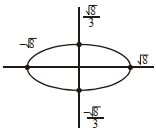
0 likesView Solution
81
MathematicsMediumMCQJEE Main · 2020
The sum of the first three terms of a $G.P.$ is $S$ and their product is $27$. Then all such $S$ lie in
A
$[-3, \infty)$
B
$(-\infty, 9]$
C
$(-\infty, -9] \cup [3, \infty)$
D
$(-\infty, -3] \cup [9, \infty)$
Solution
(D) Let the three terms of the $G.P.$ be $\frac{a}{r}, a, ar$.
Given the product is $27$,so $\frac{a}{r} \times a \times ar = 27$ $\Rightarrow a^3 = 27$ $\Rightarrow a = 3$.
The sum $S = \frac{3}{r} + 3 + 3r = 3(\frac{1}{r} + r + 1)$.
Case $1$: If $r > 0$,by $AM \geq GM$,$\frac{1}{r} + r \geq 2$. Thus,$S = 3(\frac{1}{r} + r + 1) \geq 3(2 + 1) = 9$.
Case $2$: If $r < 0$,let $r = -k$ where $k > 0$. Then $\frac{1}{r} + r = -(\frac{1}{k} + k) \leq -2$. Thus,$S = 3(\frac{1}{r} + r + 1) \leq 3(-2 + 1) = -3$.
Therefore,$S \in (-\infty, -3] \cup [9, \infty)$.
Given the product is $27$,so $\frac{a}{r} \times a \times ar = 27$ $\Rightarrow a^3 = 27$ $\Rightarrow a = 3$.
The sum $S = \frac{3}{r} + 3 + 3r = 3(\frac{1}{r} + r + 1)$.
Case $1$: If $r > 0$,by $AM \geq GM$,$\frac{1}{r} + r \geq 2$. Thus,$S = 3(\frac{1}{r} + r + 1) \geq 3(2 + 1) = 9$.
Case $2$: If $r < 0$,let $r = -k$ where $k > 0$. Then $\frac{1}{r} + r = -(\frac{1}{k} + k) \leq -2$. Thus,$S = 3(\frac{1}{r} + r + 1) \leq 3(-2 + 1) = -3$.
Therefore,$S \in (-\infty, -3] \cup [9, \infty)$.
0 likesView Solution
82
MathematicsDifficultMCQJEE Main · 2020
$A$ line parallel to the straight line $2x - y = 0$ is tangent to the hyperbola $\frac{x^{2}}{4} - \frac{y^{2}}{2} = 1$ at the point $(x_{1}, y_{1})$. Then $x_{1}^{2} + 5y_{1}^{2}$ is equal to:
A
$5$
B
$6$
C
$8$
D
$10$
Solution
(B) The slope of the line $2x - y = 0$ is $2$. Since the tangent is parallel to this line,its slope is $m = 2$.
The equation of the tangent to the hyperbola $\frac{x^{2}}{4} - \frac{y^{2}}{2} = 1$ at the point $(x_{1}, y_{1})$ is given by $\frac{xx_{1}}{4} - \frac{yy_{1}}{2} = 1$.
The slope of this tangent is $\frac{x_{1}/4}{y_{1}/2} = \frac{x_{1}}{2y_{1}}$.
Equating the slopes: $\frac{x_{1}}{2y_{1}} = 2 \Rightarrow x_{1} = 4y_{1} \quad (1)$.
Since $(x_{1}, y_{1})$ lies on the hyperbola,we have $\frac{x_{1}^{2}}{4} - \frac{y_{1}^{2}}{2} = 1 \quad (2)$.
Substituting $(1)$ into $(2)$: $\frac{(4y_{1})^{2}}{4} - \frac{y_{1}^{2}}{2} = 1 \Rightarrow 4y_{1}^{2} - \frac{y_{1}^{2}}{2} = 1$.
$\frac{7y_{1}^{2}}{2} = 1 \Rightarrow y_{1}^{2} = \frac{2}{7}$.
Now,calculate $x_{1}^{2} + 5y_{1}^{2} = (4y_{1})^{2} + 5y_{1}^{2} = 16y_{1}^{2} + 5y_{1}^{2} = 21y_{1}^{2}$.
Substituting $y_{1}^{2} = \frac{2}{7}$: $21 \times \frac{2}{7} = 3 \times 2 = 6$.
The equation of the tangent to the hyperbola $\frac{x^{2}}{4} - \frac{y^{2}}{2} = 1$ at the point $(x_{1}, y_{1})$ is given by $\frac{xx_{1}}{4} - \frac{yy_{1}}{2} = 1$.
The slope of this tangent is $\frac{x_{1}/4}{y_{1}/2} = \frac{x_{1}}{2y_{1}}$.
Equating the slopes: $\frac{x_{1}}{2y_{1}} = 2 \Rightarrow x_{1} = 4y_{1} \quad (1)$.
Since $(x_{1}, y_{1})$ lies on the hyperbola,we have $\frac{x_{1}^{2}}{4} - \frac{y_{1}^{2}}{2} = 1 \quad (2)$.
Substituting $(1)$ into $(2)$: $\frac{(4y_{1})^{2}}{4} - \frac{y_{1}^{2}}{2} = 1 \Rightarrow 4y_{1}^{2} - \frac{y_{1}^{2}}{2} = 1$.
$\frac{7y_{1}^{2}}{2} = 1 \Rightarrow y_{1}^{2} = \frac{2}{7}$.
Now,calculate $x_{1}^{2} + 5y_{1}^{2} = (4y_{1})^{2} + 5y_{1}^{2} = 16y_{1}^{2} + 5y_{1}^{2} = 21y_{1}^{2}$.
Substituting $y_{1}^{2} = \frac{2}{7}$: $21 \times \frac{2}{7} = 3 \times 2 = 6$.
0 likesView Solution
83
MathematicsMediumMCQJEE Main · 2020
If $\lim_{x \rightarrow 1} \frac{x+x^{2}+x^{3}+\ldots+x^{n}-n}{x-1}=820, (n \in N)$ then the value of $n$ is equal to
A
$35$
B
$45$
C
$40$
D
$50$
Solution
(C) Given the limit: $\lim_{x \rightarrow 1} \frac{x+x^{2}+\ldots+x^{n}-n}{x-1}=820$
We can rewrite the numerator by subtracting $1$ from each term: $\lim_{x \rightarrow 1} \left(\frac{x-1}{x-1} + \frac{x^{2}-1}{x-1} + \ldots + \frac{x^{n}-1}{x-1}\right) = 820$
Using the standard limit formula $\lim_{x \rightarrow a} \frac{x^{n}-a^{n}}{x-a} = na^{n-1}$,each term becomes $k$ when $x \rightarrow 1$: $\sum_{k=1}^{n} k = 820$
The sum of the first $n$ natural numbers is given by $\frac{n(n+1)}{2} = 820$
$\Rightarrow n(n+1) = 1640$
$\Rightarrow n^{2}+n-1640 = 0$
Solving the quadratic equation,we find $n(n+1) = 40 \times 41$
Since $n \in N$,we get $n = 40$.
We can rewrite the numerator by subtracting $1$ from each term: $\lim_{x \rightarrow 1} \left(\frac{x-1}{x-1} + \frac{x^{2}-1}{x-1} + \ldots + \frac{x^{n}-1}{x-1}\right) = 820$
Using the standard limit formula $\lim_{x \rightarrow a} \frac{x^{n}-a^{n}}{x-a} = na^{n-1}$,each term becomes $k$ when $x \rightarrow 1$: $\sum_{k=1}^{n} k = 820$
The sum of the first $n$ natural numbers is given by $\frac{n(n+1)}{2} = 820$
$\Rightarrow n(n+1) = 1640$
$\Rightarrow n^{2}+n-1640 = 0$
Solving the quadratic equation,we find $n(n+1) = 40 \times 41$
Since $n \in N$,we get $n = 40$.
0 likesView Solution
84
MathematicsMediumMCQJEE Main · 2020
If the letters of the word $MOTHER$ are permuted and all the words so formed (with or without meaning) are listed as in a dictionary,then the position of the word $MOTHER$ is
A
$307$
B
$308$
C
$310$
D
$309$
Solution
(D) The letters of the word $MOTHER$ are $E, H, M, O, R, T$ in alphabetical order.
Words starting with $E$: $5! = 120$
Words starting with $H$: $5! = 120$
Words starting with $ME$: $4! = 24$
Words starting with $MH$: $4! = 24$
Words starting with $MOE$: $3! = 6$
Words starting with $MOH$: $3! = 6$
Words starting with $MOR$: $3! = 6$
Words starting with $MOT E$: $2! = 2$
Words starting with $MOT H E R$: $1$
Total rank = $120 + 120 + 24 + 24 + 6 + 6 + 6 + 2 + 1 = 309$.
Words starting with $E$: $5! = 120$
Words starting with $H$: $5! = 120$
Words starting with $ME$: $4! = 24$
Words starting with $MH$: $4! = 24$
Words starting with $MOE$: $3! = 6$
Words starting with $MOH$: $3! = 6$
Words starting with $MOR$: $3! = 6$
Words starting with $MOT E$: $2! = 2$
Words starting with $MOT H E R$: $1$
Total rank = $120 + 120 + 24 + 24 + 6 + 6 + 6 + 2 + 1 = 309$.
0 likesView Solution
85
MathematicsDifficultMCQJEE Main · 2020
The number of integral values of $k$ for which the line $3x + 4y = k$ intersects the circle $x^{2} + y^{2} - 2x - 4y + 4 = 0$ at two distinct points is
A
$9$
B
$10$
C
$8$
D
$11$
Solution
(A) The given circle is $x^{2} + y^{2} - 2x - 4y + 4 = 0$.
Completing the square,we get $(x - 1)^{2} + (y - 2)^{2} = 1$.
Thus,the centre is $(1, 2)$ and the radius $r = 1$.
For the line $3x + 4y - k = 0$ to intersect the circle at two distinct points,the perpendicular distance from the centre to the line must be less than the radius.
Distance $d = \frac{|3(1) + 4(2) - k|}{\sqrt{3^{2} + 4^{2}}} < 1$.
$\frac{|11 - k|}{5} < 1$.
$|11 - k| < 5$.
$-5 < 11 - k < 5$.
$-16 < -k < -6$.
$6 < k < 16$.
The integral values of $k$ are $7, 8, 9, 10, 11, 12, 13, 14, 15$.
The total number of such values is $9$.
Completing the square,we get $(x - 1)^{2} + (y - 2)^{2} = 1$.
Thus,the centre is $(1, 2)$ and the radius $r = 1$.
For the line $3x + 4y - k = 0$ to intersect the circle at two distinct points,the perpendicular distance from the centre to the line must be less than the radius.
Distance $d = \frac{|3(1) + 4(2) - k|}{\sqrt{3^{2} + 4^{2}}} < 1$.
$\frac{|11 - k|}{5} < 1$.
$|11 - k| < 5$.
$-5 < 11 - k < 5$.
$-16 < -k < -6$.
$6 < k < 16$.
The integral values of $k$ are $7, 8, 9, 10, 11, 12, 13, 14, 15$.
The total number of such values is $9$.
0 likesView Solution
86
MathematicsMediumMCQJEE Main · 2020
The area (in sq. units) of an equilateral triangle inscribed in the parabola $y^{2}=8x$, with one of its vertices at the vertex of this parabola, is (in $\sqrt{3}$)
A
$64$
B
$256$
C
$192$
D
$128$
Solution
(C) Let the parabola be $y^2 = 8x$. The vertex is at $O(0,0)$.
Let the equilateral triangle be $OAB$, where $A$ and $B$ lie on the parabola.
Let the coordinates of $A$ be $(2t^2, 4t)$ for some $t > 0$.
Since the triangle is equilateral and symmetric about the $x$-axis, the coordinates of $B$ are $(2t^2, -4t)$.
The side length of the triangle is $AB = 4t - (-4t) = 8t$.
The angle $\angle AOx = 30^{\circ}$ because the triangle is equilateral and the $x$-axis bisects the angle at the vertex.
Thus, $\tan 30^{\circ} = \frac{4t}{2t^2} = \frac{2}{t}$.
Since $\tan 30^{\circ} = \frac{1}{\sqrt{3}}$, we have $\frac{1}{\sqrt{3}} = \frac{2}{t}$, which gives $t = 2\sqrt{3}$.
The side length $s = 8t = 8(2\sqrt{3}) = 16\sqrt{3}$.
The area of an equilateral triangle is given by $\frac{\sqrt{3}}{4} s^2$.
Area $= \frac{\sqrt{3}}{4} (16\sqrt{3})^2 = \frac{\sqrt{3}}{4} (256 \times 3) = \frac{\sqrt{3}}{4} (768) = 192\sqrt{3}$ sq. units.
Let the equilateral triangle be $OAB$, where $A$ and $B$ lie on the parabola.
Let the coordinates of $A$ be $(2t^2, 4t)$ for some $t > 0$.
Since the triangle is equilateral and symmetric about the $x$-axis, the coordinates of $B$ are $(2t^2, -4t)$.
The side length of the triangle is $AB = 4t - (-4t) = 8t$.
The angle $\angle AOx = 30^{\circ}$ because the triangle is equilateral and the $x$-axis bisects the angle at the vertex.
Thus, $\tan 30^{\circ} = \frac{4t}{2t^2} = \frac{2}{t}$.
Since $\tan 30^{\circ} = \frac{1}{\sqrt{3}}$, we have $\frac{1}{\sqrt{3}} = \frac{2}{t}$, which gives $t = 2\sqrt{3}$.
The side length $s = 8t = 8(2\sqrt{3}) = 16\sqrt{3}$.
The area of an equilateral triangle is given by $\frac{\sqrt{3}}{4} s^2$.
Area $= \frac{\sqrt{3}}{4} (16\sqrt{3})^2 = \frac{\sqrt{3}}{4} (256 \times 3) = \frac{\sqrt{3}}{4} (768) = 192\sqrt{3}$ sq. units.
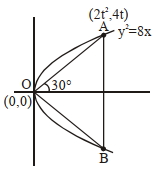
0 likesView Solution
87
MathematicsMediumMCQJEE Main · 2020
Let $n > 2$ be an integer. Suppose that there are $n$ Metro stations in a city located along a circular path. Each pair of stations is connected by a straight track. Further,each pair of nearest stations is connected by a blue line,whereas all remaining pairs of stations are connected by a red line. If the number of red lines is $99$ times the number of blue lines,then the value of $n$ is:
A
$199$
B
$101$
C
$201$
D
$200$
Solution
(C) The number of blue lines corresponds to the number of sides of the polygon formed by the $n$ stations,which is $n$.
The total number of ways to connect any two stations is given by the combination formula ${}^{n}C_{2}$.
The number of red lines is the total number of connections minus the number of blue lines (sides),which is the number of diagonals: ${}^{n}C_{2} - n$.
According to the problem,the number of red lines is $99$ times the number of blue lines:
${}^{n}C_{2} - n = 99n$
Substituting the formula for ${}^{n}C_{2}$:
$\frac{n(n-1)}{2} - n = 99n$
Dividing both sides by $n$ (since $n > 2$):
$\frac{n-1}{2} - 1 = 99$
$\frac{n-1}{2} = 100$
$n - 1 = 200$
$n = 201$
The total number of ways to connect any two stations is given by the combination formula ${}^{n}C_{2}$.
The number of red lines is the total number of connections minus the number of blue lines (sides),which is the number of diagonals: ${}^{n}C_{2} - n$.
According to the problem,the number of red lines is $99$ times the number of blue lines:
${}^{n}C_{2} - n = 99n$
Substituting the formula for ${}^{n}C_{2}$:
$\frac{n(n-1)}{2} - n = 99n$
Dividing both sides by $n$ (since $n > 2$):
$\frac{n-1}{2} - 1 = 99$
$\frac{n-1}{2} = 100$
$n - 1 = 200$
$n = 201$
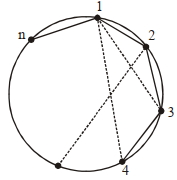
0 likesView Solution
88
MathematicsMediumMCQJEE Main · 2020
Let $f(x)$ be a quadratic polynomial such that $f(-1)+f(2)=0$. If one of the roots of $f(x)=0$ is $3$,then its other root lies in
A
$(-3, -1)$
B
$(1, 3)$
C
$(-1, 0)$
D
$(0, 1)$
Solution
(C) Let the quadratic polynomial be $f(x) = a(x - 3)(x - \alpha)$,where $\alpha$ is the other root.
Given $f(2) = a(2 - 3)(2 - \alpha) = a(-1)(2 - \alpha) = a(\alpha - 2)$.
Given $f(-1) = a(-1 - 3)(-1 - \alpha) = a(-4)(-1 - \alpha) = 4a(1 + \alpha)$.
Since $f(-1) + f(2) = 0$,we have $4a(1 + \alpha) + a(\alpha - 2) = 0$.
Since $a \neq 0$,we can divide by $a$: $4 + 4\alpha + \alpha - 2 = 0$.
$5\alpha + 2 = 0$ $\Rightarrow 5\alpha = -2$ $\Rightarrow \alpha = -\frac{2}{5} = -0.4$.
Thus,the other root $\alpha = -0.4$ lies in the interval $(-1, 0)$.
Given $f(2) = a(2 - 3)(2 - \alpha) = a(-1)(2 - \alpha) = a(\alpha - 2)$.
Given $f(-1) = a(-1 - 3)(-1 - \alpha) = a(-4)(-1 - \alpha) = 4a(1 + \alpha)$.
Since $f(-1) + f(2) = 0$,we have $4a(1 + \alpha) + a(\alpha - 2) = 0$.
Since $a \neq 0$,we can divide by $a$: $4 + 4\alpha + \alpha - 2 = 0$.
$5\alpha + 2 = 0$ $\Rightarrow 5\alpha = -2$ $\Rightarrow \alpha = -\frac{2}{5} = -0.4$.
Thus,the other root $\alpha = -0.4$ lies in the interval $(-1, 0)$.
0 likesView Solution
89
MathematicsDifficultMCQJEE Main · 2020
If the sum of the first $11$ terms of an $A.P.$,$a_{1}, a_{2}, a_{3}, \ldots$ is $0$ $(a_{1} \neq 0)$,then the sum of the $A.P.$,$a_{1}, a_{3}, a_{5}, \ldots, a_{23}$ is $k a_{1}$,where $k$ is equal to
A
$\frac{121}{10}$
B
$-\frac{72}{5}$
C
$\frac{72}{5}$
D
$-\frac{121}{10}$
Solution
(B) Given the sum of the first $11$ terms of the $A.P.$ is $0$:
$S_{11} = \frac{11}{2}(2a_{1} + 10d) = 0$
$11(a_{1} + 5d) = 0 \Rightarrow a_{1} = -5d$ or $d = -\frac{a_{1}}{5}$.
We need to find the sum of the $A.P.$ $a_{1}, a_{3}, a_{5}, \ldots, a_{23}$.
This is an $A.P.$ with $12$ terms,first term $A = a_{1}$ and common difference $D = 2d$.
Sum $= \frac{12}{2}(2A + (12-1)D) = 6(2a_{1} + 11(2d)) = 6(2a_{1} + 22d)$.
Substitute $d = -\frac{a_{1}}{5}$:
Sum $= 6(2a_{1} + 22(-\frac{a_{1}}{5})) = 6(2a_{1} - \frac{22a_{1}}{5}) = 6(\frac{10a_{1} - 22a_{1}}{5}) = 6(-\frac{12a_{1}}{5}) = -\frac{72}{5}a_{1}$.
Thus,$k = -\frac{72}{5}$.
$S_{11} = \frac{11}{2}(2a_{1} + 10d) = 0$
$11(a_{1} + 5d) = 0 \Rightarrow a_{1} = -5d$ or $d = -\frac{a_{1}}{5}$.
We need to find the sum of the $A.P.$ $a_{1}, a_{3}, a_{5}, \ldots, a_{23}$.
This is an $A.P.$ with $12$ terms,first term $A = a_{1}$ and common difference $D = 2d$.
Sum $= \frac{12}{2}(2A + (12-1)D) = 6(2a_{1} + 11(2d)) = 6(2a_{1} + 22d)$.
Substitute $d = -\frac{a_{1}}{5}$:
Sum $= 6(2a_{1} + 22(-\frac{a_{1}}{5})) = 6(2a_{1} - \frac{22a_{1}}{5}) = 6(\frac{10a_{1} - 22a_{1}}{5}) = 6(-\frac{12a_{1}}{5}) = -\frac{72}{5}a_{1}$.
Thus,$k = -\frac{72}{5}$.
0 likesView Solution
90
MathematicsMediumMCQJEE Main · 2020
The imaginary part of $(3+2 \sqrt{-54})^{1/2} - (3-2 \sqrt{-54})^{1/2}$ can be
A
$-2 \sqrt{6}$
B
$6$
C
$\sqrt{6}$
D
$-\sqrt{6}$
Solution
(A) Let $z = (3+2 \sqrt{-54})^{1/2} - (3-2 \sqrt{-54})^{1/2}$.
First,simplify the expression inside the square root: $\sqrt{-54} = \sqrt{54}i = 3\sqrt{6}i$.
So,$3+2\sqrt{-54} = 3 + 2(3\sqrt{6}i) = 3 + 6\sqrt{6}i$. This does not form a perfect square of the form $(a+bi)^2$ easily.
Let $(3+2\sqrt{-54})^{1/2} = x+iy$. Then $x^2-y^2 = 3$ and $2xy = 2\sqrt{54} = 6\sqrt{6}$.
$x^2+y^2 = \sqrt{3^2 + (6\sqrt{6})^2} = \sqrt{9 + 216} = \sqrt{225} = 15$.
Adding the equations: $2x^2 = 18 \implies x^2 = 9 \implies x = \pm 3$.
Subtracting: $2y^2 = 12 \implies y^2 = 6 \implies y = \pm \sqrt{6}$.
Thus,$(3+2\sqrt{-54})^{1/2} = \pm(3+\sqrt{6}i)$ and $(3-2\sqrt{-54})^{1/2} = \pm(3-\sqrt{6}i)$.
Possible values for the expression are:
$1) (3+\sqrt{6}i) - (3-\sqrt{6}i) = 2\sqrt{6}i$
$2) (3+\sqrt{6}i) - (-(3-\sqrt{6}i)) = 6$
$3) -(3+\sqrt{6}i) - (3-\sqrt{6}i) = -6$
$4) -(3+\sqrt{6}i) - (-(3-\sqrt{6}i)) = -2\sqrt{6}i$.
The imaginary parts are $2\sqrt{6}$ and $-2\sqrt{6}$.
Comparing with options,the correct choice is $-2\sqrt{6}$.
First,simplify the expression inside the square root: $\sqrt{-54} = \sqrt{54}i = 3\sqrt{6}i$.
So,$3+2\sqrt{-54} = 3 + 2(3\sqrt{6}i) = 3 + 6\sqrt{6}i$. This does not form a perfect square of the form $(a+bi)^2$ easily.
Let $(3+2\sqrt{-54})^{1/2} = x+iy$. Then $x^2-y^2 = 3$ and $2xy = 2\sqrt{54} = 6\sqrt{6}$.
$x^2+y^2 = \sqrt{3^2 + (6\sqrt{6})^2} = \sqrt{9 + 216} = \sqrt{225} = 15$.
Adding the equations: $2x^2 = 18 \implies x^2 = 9 \implies x = \pm 3$.
Subtracting: $2y^2 = 12 \implies y^2 = 6 \implies y = \pm \sqrt{6}$.
Thus,$(3+2\sqrt{-54})^{1/2} = \pm(3+\sqrt{6}i)$ and $(3-2\sqrt{-54})^{1/2} = \pm(3-\sqrt{6}i)$.
Possible values for the expression are:
$1) (3+\sqrt{6}i) - (3-\sqrt{6}i) = 2\sqrt{6}i$
$2) (3+\sqrt{6}i) - (-(3-\sqrt{6}i)) = 6$
$3) -(3+\sqrt{6}i) - (3-\sqrt{6}i) = -6$
$4) -(3+\sqrt{6}i) - (-(3-\sqrt{6}i)) = -2\sqrt{6}i$.
The imaginary parts are $2\sqrt{6}$ and $-2\sqrt{6}$.
Comparing with options,the correct choice is $-2\sqrt{6}$.
0 likesView Solution
91
MathematicsMediumMCQJEE Main · 2020
$\lim \limits_{x \rightarrow 0} \left(\tan \left(\frac{\pi}{4}+x\right)\right)^{\frac{1}{x}}$ is equal to
A
$2$
B
$e$
C
$1$
D
$e^{2}$
Solution
(D) The given limit is of the form $1^{\infty}$.
We use the formula $\lim \limits_{x \rightarrow a} f(x)^{g(x)} = e^{\lim \limits_{x \rightarrow a} g(x)(f(x)-1)}$.
Here,$f(x) = \tan(\frac{\pi}{4} + x)$ and $g(x) = \frac{1}{x}$.
$\lim \limits_{x \rightarrow 0} \left(\tan \left(\frac{\pi}{4}+x\right)\right)^{\frac{1}{x}} = e^{\lim \limits_{x \rightarrow 0} \frac{1}{x} \left(\tan \left(\frac{\pi}{4}+x\right)-1\right)}$.
Using the identity $\tan(A+B) = \frac{\tan A + \tan B}{1 - \tan A \tan B}$,we have $\tan(\frac{\pi}{4}+x) = \frac{1+\tan x}{1-\tan x}$.
So,$\tan(\frac{\pi}{4}+x)-1 = \frac{1+\tan x - (1-\tan x)}{1-\tan x} = \frac{2\tan x}{1-\tan x}$.
Thus,the exponent becomes $\lim \limits_{x \rightarrow 0} \frac{2\tan x}{x(1-\tan x)} = \lim \limits_{x \rightarrow 0} 2 \cdot \frac{\tan x}{x} \cdot \frac{1}{1-\tan x} = 2 \cdot 1 \cdot 1 = 2$.
Therefore,the limit is $e^{2}$.
We use the formula $\lim \limits_{x \rightarrow a} f(x)^{g(x)} = e^{\lim \limits_{x \rightarrow a} g(x)(f(x)-1)}$.
Here,$f(x) = \tan(\frac{\pi}{4} + x)$ and $g(x) = \frac{1}{x}$.
$\lim \limits_{x \rightarrow 0} \left(\tan \left(\frac{\pi}{4}+x\right)\right)^{\frac{1}{x}} = e^{\lim \limits_{x \rightarrow 0} \frac{1}{x} \left(\tan \left(\frac{\pi}{4}+x\right)-1\right)}$.
Using the identity $\tan(A+B) = \frac{\tan A + \tan B}{1 - \tan A \tan B}$,we have $\tan(\frac{\pi}{4}+x) = \frac{1+\tan x}{1-\tan x}$.
So,$\tan(\frac{\pi}{4}+x)-1 = \frac{1+\tan x - (1-\tan x)}{1-\tan x} = \frac{2\tan x}{1-\tan x}$.
Thus,the exponent becomes $\lim \limits_{x \rightarrow 0} \frac{2\tan x}{x(1-\tan x)} = \lim \limits_{x \rightarrow 0} 2 \cdot \frac{\tan x}{x} \cdot \frac{1}{1-\tan x} = 2 \cdot 1 \cdot 1 = 2$.
Therefore,the limit is $e^{2}$.
0 likesView Solution
92
MathematicsDifficultMCQJEE Main · 2020
For some $\theta \in \left(0, \frac{\pi}{2}\right),$ if the eccentricity of the hyperbola $x^{2} - y^{2} \sec^{2} \theta = 10$ is $\sqrt{5}$ times the eccentricity of the ellipse $x^{2} \sec^{2} \theta + y^{2} = 5,$ then the length of the latus rectum of the ellipse is
A
$\sqrt{30}$
B
$\frac{4 \sqrt{5}}{3}$
C
$2 \sqrt{6}$
D
$\frac{2 \sqrt{5}}{3}$
Solution
(B) Given the hyperbola equation: $x^{2} - y^{2} \sec^{2} \theta = 10 \Rightarrow \frac{x^{2}}{10} - \frac{y^{2}}{10 \cos^{2} \theta} = 1.$
For a hyperbola $\frac{x^{2}}{a^{2}} - \frac{y^{2}}{b^{2}} = 1,$ the eccentricity $e_{H} = \sqrt{1 + \frac{b^{2}}{a^{2}}}.$
Thus,$e_{H} = \sqrt{1 + \frac{10 \cos^{2} \theta}{10}} = \sqrt{1 + \cos^{2} \theta}.$
Given the ellipse equation: $x^{2} \sec^{2} \theta + y^{2} = 5 \Rightarrow \frac{x^{2}}{5 \cos^{2} \theta} + \frac{y^{2}}{5} = 1.$
For an ellipse $\frac{x^{2}}{b^{2}} + \frac{y^{2}}{a^{2}} = 1$ (where $a > b$),$e_{E} = \sqrt{1 - \frac{b^{2}}{a^{2}}}.$
Here $a^{2} = 5$ and $b^{2} = 5 \cos^{2} \theta,$ so $e_{E} = \sqrt{1 - \frac{5 \cos^{2} \theta}{5}} = \sqrt{1 - \cos^{2} \theta} = \sin \theta.$
Given $e_{H} = \sqrt{5} e_{E},$ we have $\sqrt{1 + \cos^{2} \theta} = \sqrt{5} \sin \theta.$
Squaring both sides: $1 + \cos^{2} \theta = 5 \sin^{2} \theta = 5(1 - \cos^{2} \theta).$
$1 + \cos^{2} \theta = 5 - 5 \cos^{2} \theta$ $\Rightarrow 6 \cos^{2} \theta = 4$ $\Rightarrow \cos^{2} \theta = \frac{2}{3}.$
Then $\sin^{2} \theta = 1 - \frac{2}{3} = \frac{1}{3}.$
The length of the latus rectum of the ellipse is $\frac{2b^{2}}{a} = \frac{2(5 \cos^{2} \theta)}{\sqrt{5}} = \frac{10 \times (2/3)}{\sqrt{5}} = \frac{20}{3 \sqrt{5}} = \frac{4 \sqrt{5}}{3}.$
For a hyperbola $\frac{x^{2}}{a^{2}} - \frac{y^{2}}{b^{2}} = 1,$ the eccentricity $e_{H} = \sqrt{1 + \frac{b^{2}}{a^{2}}}.$
Thus,$e_{H} = \sqrt{1 + \frac{10 \cos^{2} \theta}{10}} = \sqrt{1 + \cos^{2} \theta}.$
Given the ellipse equation: $x^{2} \sec^{2} \theta + y^{2} = 5 \Rightarrow \frac{x^{2}}{5 \cos^{2} \theta} + \frac{y^{2}}{5} = 1.$
For an ellipse $\frac{x^{2}}{b^{2}} + \frac{y^{2}}{a^{2}} = 1$ (where $a > b$),$e_{E} = \sqrt{1 - \frac{b^{2}}{a^{2}}}.$
Here $a^{2} = 5$ and $b^{2} = 5 \cos^{2} \theta,$ so $e_{E} = \sqrt{1 - \frac{5 \cos^{2} \theta}{5}} = \sqrt{1 - \cos^{2} \theta} = \sin \theta.$
Given $e_{H} = \sqrt{5} e_{E},$ we have $\sqrt{1 + \cos^{2} \theta} = \sqrt{5} \sin \theta.$
Squaring both sides: $1 + \cos^{2} \theta = 5 \sin^{2} \theta = 5(1 - \cos^{2} \theta).$
$1 + \cos^{2} \theta = 5 - 5 \cos^{2} \theta$ $\Rightarrow 6 \cos^{2} \theta = 4$ $\Rightarrow \cos^{2} \theta = \frac{2}{3}.$
Then $\sin^{2} \theta = 1 - \frac{2}{3} = \frac{1}{3}.$
The length of the latus rectum of the ellipse is $\frac{2b^{2}}{a} = \frac{2(5 \cos^{2} \theta)}{\sqrt{5}} = \frac{10 \times (2/3)}{\sqrt{5}} = \frac{20}{3 \sqrt{5}} = \frac{4 \sqrt{5}}{3}.$
0 likesView Solution
93
MathematicsMediumMCQJEE Main · 2020
Which of the following is a tautology?
A
$(\sim p) \wedge (p \vee q) \rightarrow q$
B
$(q$ $\rightarrow p) \vee \sim (p$ $\rightarrow q)$
C
$(p$ $\rightarrow q) \wedge (q$ $\rightarrow p)$
D
$(\sim q) \vee (p \wedge q) \rightarrow q$
Solution
(A) To determine which expression is a tautology,we evaluate the truth table or simplify the logical expressions.
For option $A$: $(\sim p \wedge (p \vee q)) \rightarrow q$
Using the distributive law: $(\sim p \wedge p) \vee (\sim p \wedge q) \rightarrow q$
Since $(\sim p \wedge p) \equiv F$ (Contradiction),we have: $F \vee (\sim p \wedge q) \rightarrow q$
This simplifies to: $(\sim p \wedge q) \rightarrow q$
Using the implication law $a \rightarrow b \equiv \sim a \vee b$: $\sim (\sim p \wedge q) \vee q$
Applying De Morgan's law: $(p \vee \sim q) \vee q$
By associativity: $p \vee (\sim q \vee q)$
Since $(\sim q \vee q) \equiv T$ (Tautology): $p \vee T \equiv T$
Thus,option $A$ is a tautology.
For option $A$: $(\sim p \wedge (p \vee q)) \rightarrow q$
Using the distributive law: $(\sim p \wedge p) \vee (\sim p \wedge q) \rightarrow q$
Since $(\sim p \wedge p) \equiv F$ (Contradiction),we have: $F \vee (\sim p \wedge q) \rightarrow q$
This simplifies to: $(\sim p \wedge q) \rightarrow q$
Using the implication law $a \rightarrow b \equiv \sim a \vee b$: $\sim (\sim p \wedge q) \vee q$
Applying De Morgan's law: $(p \vee \sim q) \vee q$
By associativity: $p \vee (\sim q \vee q)$
Since $(\sim q \vee q) \equiv T$ (Tautology): $p \vee T \equiv T$
Thus,option $A$ is a tautology.
0 likesView Solution
94
MathematicsDifficultMCQJEE Main · 2020
Let $S$ be the sum of the first $9$ terms of the series: $(x+ka) + (x^2+(k+2)a) + (x^3+(k+4)a) + (x^4+(k+6)a) + \ldots$ where $a \neq 0$ and $x \neq 1$. If $S = \frac{x^{10}-x+45a(x-1)}{x-1}$,then $k$ is equal to:
A
$-5$
B
$1$
C
$-3$
D
$3$
Solution
(C) The series is given by $S = \sum_{n=1}^{9} [x^n + (k + 2(n-1))a]$.
Expanding the sum,we get $S = (x + x^2 + \ldots + x^9) + \sum_{n=1}^{9} (k + 2n - 2)a$.
The sum of the geometric progression is $\sum_{n=1}^{9} x^n = x \frac{x^9 - 1}{x - 1} = \frac{x^{10} - x}{x - 1}$.
The sum of the arithmetic part is $\sum_{n=1}^{9} (k + 2n - 2)a = a [9k + 2 \frac{9 \times 8}{2} - 18] = a [9k + 72 - 18] = a(9k + 54)$.
Wait,recalculating the arithmetic part: $\sum_{n=0}^{8} (k + 2n)a = 9ka + 2a \frac{8 \times 9}{2} = 9ka + 72a = a(9k + 72)$.
Thus,$S = \frac{x^{10} - x}{x - 1} + \frac{a(9k + 72)(x - 1)}{x - 1} = \frac{x^{10} - x + (9k + 72)a(x - 1)}{x - 1}$.
Comparing this with the given $S = \frac{x^{10} - x + 45a(x - 1)}{x - 1}$,we have $9k + 72 = 45$.
$9k = 45 - 72 = -27$.
$k = -3$.
Expanding the sum,we get $S = (x + x^2 + \ldots + x^9) + \sum_{n=1}^{9} (k + 2n - 2)a$.
The sum of the geometric progression is $\sum_{n=1}^{9} x^n = x \frac{x^9 - 1}{x - 1} = \frac{x^{10} - x}{x - 1}$.
The sum of the arithmetic part is $\sum_{n=1}^{9} (k + 2n - 2)a = a [9k + 2 \frac{9 \times 8}{2} - 18] = a [9k + 72 - 18] = a(9k + 54)$.
Wait,recalculating the arithmetic part: $\sum_{n=0}^{8} (k + 2n)a = 9ka + 2a \frac{8 \times 9}{2} = 9ka + 72a = a(9k + 72)$.
Thus,$S = \frac{x^{10} - x}{x - 1} + \frac{a(9k + 72)(x - 1)}{x - 1} = \frac{x^{10} - x + (9k + 72)a(x - 1)}{x - 1}$.
Comparing this with the given $S = \frac{x^{10} - x + 45a(x - 1)}{x - 1}$,we have $9k + 72 = 45$.
$9k = 45 - 72 = -27$.
$k = -3$.
0 likesView Solution
95
MathematicsDifficultMCQJEE Main · 2020
The set of all possible values of $\theta$ in the interval $(0, \pi)$ for which the points $(1, 2)$ and $(\sin \theta, \cos \theta)$ lie on the same side of the line $x+y=1$ is
A
$\left(0, \frac{\pi}{4}\right)$
B
$\left(0, \frac{3 \pi}{4}\right)$
C
$\left(\frac{\pi}{4}, \frac{3 \pi}{4}\right)$
D
$\left(0, \frac{\pi}{2}\right)$
Solution
(D) Two points $(x_1, y_1)$ and $(x_2, y_2)$ lie on the same side of the line $ax+by+c=0$ if the expressions $(ax_1+by_1+c)$ and $(ax_2+by_2+c)$ have the same sign,i.e.,$(ax_1+by_1+c)(ax_2+by_2+c) > 0$.
Given the line $x+y-1=0$ and points $(1, 2)$ and $(\sin \theta, \cos \theta)$.
First,evaluate the expression at $(1, 2)$:
$1+2-1 = 2$,which is positive.
Therefore,for the points to lie on the same side,the expression at $(\sin \theta, \cos \theta)$ must also be positive:
$\sin \theta + \cos \theta - 1 > 0$
$\Rightarrow \sin \theta + \cos \theta > 1$
Divide by $\sqrt{2}$:
$\frac{1}{\sqrt{2}} \sin \theta + \frac{1}{\sqrt{2}} \cos \theta > \frac{1}{\sqrt{2}}$
$\Rightarrow \sin \left(\theta + \frac{\pi}{4}\right) > \sin \left(\frac{\pi}{4}\right)$
Since $\theta \in (0, \pi)$,then $\theta + \frac{\pi}{4} \in \left(\frac{\pi}{4}, \frac{5\pi}{4}\right)$.
In this interval,$\sin \left(\theta + \frac{\pi}{4}\right) > \frac{1}{\sqrt{2}}$ holds when:
$\frac{\pi}{4} < \theta + \frac{\pi}{4} < \frac{3\pi}{4}$
Subtracting $\frac{\pi}{4}$ from all parts:
$0 < \theta < \frac{\pi}{2}$
Given the line $x+y-1=0$ and points $(1, 2)$ and $(\sin \theta, \cos \theta)$.
First,evaluate the expression at $(1, 2)$:
$1+2-1 = 2$,which is positive.
Therefore,for the points to lie on the same side,the expression at $(\sin \theta, \cos \theta)$ must also be positive:
$\sin \theta + \cos \theta - 1 > 0$
$\Rightarrow \sin \theta + \cos \theta > 1$
Divide by $\sqrt{2}$:
$\frac{1}{\sqrt{2}} \sin \theta + \frac{1}{\sqrt{2}} \cos \theta > \frac{1}{\sqrt{2}}$
$\Rightarrow \sin \left(\theta + \frac{\pi}{4}\right) > \sin \left(\frac{\pi}{4}\right)$
Since $\theta \in (0, \pi)$,then $\theta + \frac{\pi}{4} \in \left(\frac{\pi}{4}, \frac{5\pi}{4}\right)$.
In this interval,$\sin \left(\theta + \frac{\pi}{4}\right) > \frac{1}{\sqrt{2}}$ holds when:
$\frac{\pi}{4} < \theta + \frac{\pi}{4} < \frac{3\pi}{4}$
Subtracting $\frac{\pi}{4}$ from all parts:
$0 < \theta < \frac{\pi}{2}$
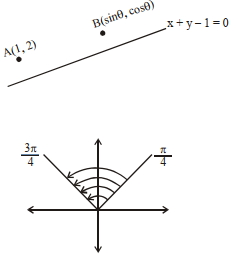
0 likesView Solution
96
MathematicsMediumMCQJEE Main · 2020
If the variance of the terms in an increasing $A.P.$,$b_{1}, b_{2}, b_{3}, \ldots, b_{11}$ is $90$,then the common difference of this $A.P.$ is
A
$3$
B
$9$
C
$-9$
D
$-3$
Solution
(A) Let $a$ be the first term and $d$ be the common difference of the given $A.P.$ Since the $A.P.$ is increasing,$d > 0$.
The terms are $a, a+d, a+2d, \ldots, a+10d$.
The mean $\bar{X} = \frac{1}{11} \sum_{i=0}^{10} (a + id) = a + \frac{d}{11} \times \frac{10 \times 11}{2} = a + 5d$.
The variance is given by $\sigma^2 = \frac{1}{n} \sum (x_i - \bar{X})^2$.
$\sigma^2 = \frac{1}{11} \sum_{i=0}^{10} (a + id - (a + 5d))^2 = \frac{1}{11} \sum_{i=0}^{10} ((i-5)d)^2 = \frac{d^2}{11} \sum_{i=0}^{10} (i-5)^2$.
Calculating the sum: $(-5)^2 + (-4)^2 + (-3)^2 + (-2)^2 + (-1)^2 + 0^2 + 1^2 + 2^2 + 3^2 + 4^2 + 5^2 = 25 + 16 + 9 + 4 + 1 + 0 + 1 + 4 + 9 + 16 + 25 = 110$.
So,$90 = \frac{d^2}{11} \times 110 = 10d^2$.
$d^2 = 9 \Rightarrow d = \pm 3$.
Since the $A.P.$ is increasing,$d = 3$.
The terms are $a, a+d, a+2d, \ldots, a+10d$.
The mean $\bar{X} = \frac{1}{11} \sum_{i=0}^{10} (a + id) = a + \frac{d}{11} \times \frac{10 \times 11}{2} = a + 5d$.
The variance is given by $\sigma^2 = \frac{1}{n} \sum (x_i - \bar{X})^2$.
$\sigma^2 = \frac{1}{11} \sum_{i=0}^{10} (a + id - (a + 5d))^2 = \frac{1}{11} \sum_{i=0}^{10} ((i-5)d)^2 = \frac{d^2}{11} \sum_{i=0}^{10} (i-5)^2$.
Calculating the sum: $(-5)^2 + (-4)^2 + (-3)^2 + (-2)^2 + (-1)^2 + 0^2 + 1^2 + 2^2 + 3^2 + 4^2 + 5^2 = 25 + 16 + 9 + 4 + 1 + 0 + 1 + 4 + 9 + 16 + 25 = 110$.
So,$90 = \frac{d^2}{11} \times 110 = 10d^2$.
$d^2 = 9 \Rightarrow d = \pm 3$.
Since the $A.P.$ is increasing,$d = 3$.
0 likesView Solution
97
MathematicsMediumMCQJEE Main · 2020
For a positive integer $n$,$(1+\frac{1}{x})^n$ is expanded in increasing powers of $x$. If three consecutive coefficients in this expansion are in the ratio $2:5:12$,then $n$ is equal to
A
$115$
B
$128$
C
$138$
D
$118$
Solution
(D) The expansion of $(1+\frac{1}{x})^n$ is $\sum_{k=0}^{n} {}^{n}C_k (\frac{1}{x})^k = \sum_{k=0}^{n} {}^{n}C_k x^{-k}$.
Since the expansion is in increasing powers of $x$,we consider the coefficients of $x^{-r-1}, x^{-r}, x^{-r+1}$ which are ${}^{n}C_{r+1}, {}^{n}C_r, {}^{n}C_{r-1}$.
Given the ratio ${}^{n}C_{r-1} : {}^{n}C_r : {}^{n}C_{r+1} = 2 : 5 : 12$.
From $\frac{{}^{n}C_{r-1}}{{}^{n}C_r} = \frac{2}{5}$,we get $\frac{r}{n-r+1} = \frac{2}{5}$ $\Rightarrow 5r = 2n - 2r + 2$ $\Rightarrow 7r = 2n + 2$ (Equation $1$).
From $\frac{{}^{n}C_r}{{}^{n}C_{r+1}} = \frac{5}{12}$,we get $\frac{r+1}{n-r} = \frac{5}{12}$ $\Rightarrow 12r + 12 = 5n - 5r$ $\Rightarrow 17r = 5n - 12$ (Equation $2$).
Multiplying Equation $1$ by $17$ and Equation $2$ by $7$:
$119r = 34n + 34$
$119r = 35n - 84$
Equating the two: $35n - 84 = 34n + 34 \Rightarrow n = 118$.
Since the expansion is in increasing powers of $x$,we consider the coefficients of $x^{-r-1}, x^{-r}, x^{-r+1}$ which are ${}^{n}C_{r+1}, {}^{n}C_r, {}^{n}C_{r-1}$.
Given the ratio ${}^{n}C_{r-1} : {}^{n}C_r : {}^{n}C_{r+1} = 2 : 5 : 12$.
From $\frac{{}^{n}C_{r-1}}{{}^{n}C_r} = \frac{2}{5}$,we get $\frac{r}{n-r+1} = \frac{2}{5}$ $\Rightarrow 5r = 2n - 2r + 2$ $\Rightarrow 7r = 2n + 2$ (Equation $1$).
From $\frac{{}^{n}C_r}{{}^{n}C_{r+1}} = \frac{5}{12}$,we get $\frac{r+1}{n-r} = \frac{5}{12}$ $\Rightarrow 12r + 12 = 5n - 5r$ $\Rightarrow 17r = 5n - 12$ (Equation $2$).
Multiplying Equation $1$ by $17$ and Equation $2$ by $7$:
$119r = 34n + 34$
$119r = 35n - 84$
Equating the two: $35n - 84 = 34n + 34 \Rightarrow n = 118$.
0 likesView Solution
98
MathematicsMediumMCQJEE Main · 2020
Let the latus rectum of the parabola $y^{2} = 4x$ be the common chord to the circles $C_{1}$ and $C_{2}$,each of them having radius $2\sqrt{5}$. Then,the distance between the centres of the circles $C_{1}$ and $C_{2}$ is
A
$8$
B
$4\sqrt{5}$
C
$12$
D
$8\sqrt{5}$
Solution
(A) The parabola is $y^{2} = 4x$. Comparing with $y^{2} = 4ax$,we get $a = 1$.
The length of the latus rectum is $4a = 4(1) = 4$.
The common chord of the two circles $C_{1}$ and $C_{2}$ is the latus rectum of the parabola,so its length is $4$.
Let $D$ be one endpoint of the latus rectum and $B$ be the midpoint of the common chord. Thus,$DB = \frac{4}{2} = 2$.
Let $r$ be the radius of the circles,$r = 2\sqrt{5}$.
In the right-angled triangle formed by the radius,the distance from the center to the chord,and half the chord length,let $x$ be the distance from the center of a circle to the common chord.
$x^{2} + DB^{2} = r^{2}$
$x^{2} + 2^{2} = (2\sqrt{5})^{2}$
$x^{2} + 4 = 20$
$x^{2} = 16 \implies x = 4$.
The distance between the centers $C_{1}$ and $C_{2}$ is $x + x = 4 + 4 = 8$.
The length of the latus rectum is $4a = 4(1) = 4$.
The common chord of the two circles $C_{1}$ and $C_{2}$ is the latus rectum of the parabola,so its length is $4$.
Let $D$ be one endpoint of the latus rectum and $B$ be the midpoint of the common chord. Thus,$DB = \frac{4}{2} = 2$.
Let $r$ be the radius of the circles,$r = 2\sqrt{5}$.
In the right-angled triangle formed by the radius,the distance from the center to the chord,and half the chord length,let $x$ be the distance from the center of a circle to the common chord.
$x^{2} + DB^{2} = r^{2}$
$x^{2} + 2^{2} = (2\sqrt{5})^{2}$
$x^{2} + 4 = 20$
$x^{2} = 16 \implies x = 4$.
The distance between the centers $C_{1}$ and $C_{2}$ is $x + x = 4 + 4 = 8$.
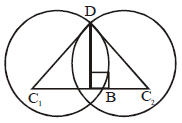
0 likesView Solution
99
MathematicsDifficultMCQJEE Main · 2020
The probability that a randomly chosen $5-digit$ number is made from exactly two digits is
A
$\frac{121}{10^{4}}$
B
$\frac{150}{10^{4}}$
C
$\frac{135}{10^{4}}$
D
$\frac{134}{10^{4}}$
Solution
(C) Total number of $5-digit$ numbers is $9 \times 10^{4}$.
Case $1$: The two digits chosen are both non-zero.
Number of ways to choose $2$ digits from ${1, 2, \dots, 9}$ is $^{9}C_{2} = 36$.
For each selection,the number of $5-digit$ numbers using both digits is $2^{5} - 2 = 30$.
Total for Case $1 = 36 \times 30 = 1080$.
Case $2$: One digit is zero and the other is non-zero.
Number of ways to choose $1$ non-zero digit from ${1, 2, \dots, 9}$ is $^{9}C_{1} = 9$.
The first digit must be non-zero (fixed in $1$ way),and the remaining $4$ positions can be filled by either $0$ or the chosen non-zero digit,excluding the case where all $4$ are non-zero. This gives $2^{4} - 1 = 15$ ways.
Total for Case $2 = 9 \times 15 = 135$.
Total favorable outcomes $= 1080 + 135 = 1215$.
Probability $= \frac{1215}{9 \times 10^{4}} = \frac{135}{10^{4}}$.
Case $1$: The two digits chosen are both non-zero.
Number of ways to choose $2$ digits from ${1, 2, \dots, 9}$ is $^{9}C_{2} = 36$.
For each selection,the number of $5-digit$ numbers using both digits is $2^{5} - 2 = 30$.
Total for Case $1 = 36 \times 30 = 1080$.
Case $2$: One digit is zero and the other is non-zero.
Number of ways to choose $1$ non-zero digit from ${1, 2, \dots, 9}$ is $^{9}C_{1} = 9$.
The first digit must be non-zero (fixed in $1$ way),and the remaining $4$ positions can be filled by either $0$ or the chosen non-zero digit,excluding the case where all $4$ are non-zero. This gives $2^{4} - 1 = 15$ ways.
Total for Case $2 = 9 \times 15 = 135$.
Total favorable outcomes $= 1080 + 135 = 1215$.
Probability $= \frac{1215}{9 \times 10^{4}} = \frac{135}{10^{4}}$.
0 likesView Solution
100
MathematicsDifficultMCQJEE Main · 2020
If a $\triangle ABC$ has vertices $A(-1, 7)$,$B(-7, 1)$ and $C(5, -5)$,then its orthocentre has coordinates
A
$(3, -3)$
B
$\left(-\frac{3}{5}, \frac{3}{5}\right)$
C
$(-3, 3)$
D
$\left(\frac{3}{5}, -\frac{3}{5}\right)$
Solution
(C) Let the orthocentre be $H(x_0, y_0)$.
The slope of $BC$ is $m_{BC} = \frac{-5-1}{5-(-7)} = \frac{-6}{12} = -\frac{1}{2}$.
Since $AH \perp BC$,the slope of $AH$ is $m_{AH} = -\frac{1}{m_{BC}} = 2$.
The equation of altitude $AH$ passing through $A(-1, 7)$ is $y - 7 = 2(x + 1)$,which simplifies to $2x - y + 9 = 0$ ... $(1)$.
The slope of $AC$ is $m_{AC} = \frac{-5-7}{5-(-1)} = \frac{-12}{6} = -2$.
Since $BH \perp AC$,the slope of $BH$ is $m_{BH} = -\frac{1}{m_{AC}} = \frac{1}{2}$.
The equation of altitude $BH$ passing through $B(-7, 1)$ is $y - 1 = \frac{1}{2}(x + 7)$,which simplifies to $x - 2y + 9 = 0$ ... $(2)$.
Solving equations $(1)$ and $(2)$:
From $(1)$,$y = 2x + 9$. Substituting into $(2)$:
$x - 2(2x + 9) + 9 = 0$
$x - 4x - 18 + 9 = 0$
$-3x - 9 = 0 \Rightarrow x = -3$.
Then $y = 2(-3) + 9 = 3$.
Thus,the orthocentre is $(-3, 3)$.
The slope of $BC$ is $m_{BC} = \frac{-5-1}{5-(-7)} = \frac{-6}{12} = -\frac{1}{2}$.
Since $AH \perp BC$,the slope of $AH$ is $m_{AH} = -\frac{1}{m_{BC}} = 2$.
The equation of altitude $AH$ passing through $A(-1, 7)$ is $y - 7 = 2(x + 1)$,which simplifies to $2x - y + 9 = 0$ ... $(1)$.
The slope of $AC$ is $m_{AC} = \frac{-5-7}{5-(-1)} = \frac{-12}{6} = -2$.
Since $BH \perp AC$,the slope of $BH$ is $m_{BH} = -\frac{1}{m_{AC}} = \frac{1}{2}$.
The equation of altitude $BH$ passing through $B(-7, 1)$ is $y - 1 = \frac{1}{2}(x + 7)$,which simplifies to $x - 2y + 9 = 0$ ... $(2)$.
Solving equations $(1)$ and $(2)$:
From $(1)$,$y = 2x + 9$. Substituting into $(2)$:
$x - 2(2x + 9) + 9 = 0$
$x - 4x - 18 + 9 = 0$
$-3x - 9 = 0 \Rightarrow x = -3$.
Then $y = 2(-3) + 9 = 3$.
Thus,the orthocentre is $(-3, 3)$.
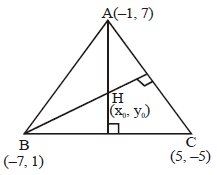
0 likesView Solution
101
MathematicsDifficultMCQJEE Main · 2020
The following system of linear equations $7x + 6y - 2z = 0$; $3x + 4y + 2z = 0$; $x - 2y - 6z = 0$ has:
A
infinitely many solutions,$(x, y, z)$ satisfying $x = 2z$
B
no solution
C
only the trivial solution
D
infinitely many solutions,$(x, y, z)$ satisfying $y = 2z$
Solution
(A) The given system of equations is homogeneous:
$7x + 6y - 2z = 0 \dots (1)$
$3x + 4y + 2z = 0 \dots (2)$
$x - 2y - 6z = 0 \dots (3)$
First,we calculate the determinant of the coefficient matrix $\Delta$:
$\Delta = \begin{vmatrix} 7 & 6 & -2 \\ 3 & 4 & 2 \\ 1 & -2 & -6 \end{vmatrix}$
$= 7(4(-6) - 2(-2)) - 6(3(-6) - 2(1)) - 2(3(-2) - 4(1))$
$= 7(-24 + 4) - 6(-18 - 2) - 2(-6 - 4)$
$= 7(-20) - 6(-20) - 2(-10)$
$= -140 + 120 + 20 = 0$
Since $\Delta = 0$,the system has infinitely many solutions.
Adding equations $(1)$ and $(2)$:
$(7x + 6y - 2z) + (3x + 4y + 2z) = 0 + 0$
$10x + 10y = 0 \Rightarrow y = -x$
Substituting $y = -x$ into equation $(1)$:
$7x + 6(-x) - 2z = 0$
$7x - 6x - 2z = 0$
$x - 2z = 0 \Rightarrow x = 2z$
Thus,the solutions satisfy $x = 2z$.
$7x + 6y - 2z = 0 \dots (1)$
$3x + 4y + 2z = 0 \dots (2)$
$x - 2y - 6z = 0 \dots (3)$
First,we calculate the determinant of the coefficient matrix $\Delta$:
$\Delta = \begin{vmatrix} 7 & 6 & -2 \\ 3 & 4 & 2 \\ 1 & -2 & -6 \end{vmatrix}$
$= 7(4(-6) - 2(-2)) - 6(3(-6) - 2(1)) - 2(3(-2) - 4(1))$
$= 7(-24 + 4) - 6(-18 - 2) - 2(-6 - 4)$
$= 7(-20) - 6(-20) - 2(-10)$
$= -140 + 120 + 20 = 0$
Since $\Delta = 0$,the system has infinitely many solutions.
Adding equations $(1)$ and $(2)$:
$(7x + 6y - 2z) + (3x + 4y + 2z) = 0 + 0$
$10x + 10y = 0 \Rightarrow y = -x$
Substituting $y = -x$ into equation $(1)$:
$7x + 6(-x) - 2z = 0$
$7x - 6x - 2z = 0$
$x - 2z = 0 \Rightarrow x = 2z$
Thus,the solutions satisfy $x = 2z$.
0 likesView Solution
102
MathematicsDifficultMCQJEE Main · 2020
If $x = 2 \sin \theta - \sin 2 \theta$ and $y = 2 \cos \theta - \cos 2 \theta$ where $\theta \in [0, 2 \pi]$,then find the value of $\frac{d^{2} y}{dx^{2}}$ at $\theta = \pi$.
A
$\frac{3}{2}$
B
$-\frac{3}{4}$
C
$\frac{3}{4}$
D
$\frac{3}{8}$
Solution
(D) Given $x = 2 \sin \theta - \sin 2 \theta$ and $y = 2 \cos \theta - \cos 2 \theta$.
First,find the derivatives with respect to $\theta$:
$\frac{dx}{d\theta} = 2 \cos \theta - 2 \cos 2 \theta = 2(\cos \theta - (2 \cos^2 \theta - 1)) = 2(1 + \cos \theta - 2 \cos^2 \theta) = 2(1 - \cos \theta)(1 + 2 \cos \theta)$.
Alternatively,using sum-to-product formulas: $\frac{dx}{d\theta} = 2(\cos \theta - \cos 2 \theta) = 4 \sin \frac{3\theta}{2} \sin \frac{\theta}{2}$.
$\frac{dy}{d\theta} = -2 \sin \theta + 2 \sin 2 \theta = 2(\sin 2 \theta - \sin \theta) = 2(2 \sin \theta \cos \theta - \sin \theta) = 2 \sin \theta (2 \cos \theta - 1)$.
Using sum-to-product: $\frac{dy}{d\theta} = 2(\sin 2 \theta - \sin \theta) = 4 \cos \frac{3\theta}{2} \sin \frac{\theta}{2}$.
Now,$\frac{dy}{dx} = \frac{dy/d\theta}{dx/d\theta} = \frac{4 \cos(3\theta/2) \sin(\theta/2)}{4 \sin(3\theta/2) \sin(\theta/2)} = \cot \frac{3\theta}{2}$.
Now,differentiate $\frac{dy}{dx}$ with respect to $x$:
$\frac{d^2y}{dx^2} = \frac{d}{d\theta} \left( \cot \frac{3\theta}{2} \right) \cdot \frac{d\theta}{dx} = -\frac{3}{2} \csc^2 \frac{3\theta}{2} \cdot \frac{1}{dx/d\theta}$.
At $\theta = \pi$,$\frac{dx}{d\theta} = 2 \cos \pi - 2 \cos 2 \pi = 2(-1) - 2(1) = -4$.
$\frac{d^2y}{dx^2} = -\frac{3}{2} \csc^2 \frac{3\pi}{2} \cdot \frac{1}{-4} = -\frac{3}{2} (-1)^2 \cdot \left( -\frac{1}{4} \right) = \frac{3}{8}$.
First,find the derivatives with respect to $\theta$:
$\frac{dx}{d\theta} = 2 \cos \theta - 2 \cos 2 \theta = 2(\cos \theta - (2 \cos^2 \theta - 1)) = 2(1 + \cos \theta - 2 \cos^2 \theta) = 2(1 - \cos \theta)(1 + 2 \cos \theta)$.
Alternatively,using sum-to-product formulas: $\frac{dx}{d\theta} = 2(\cos \theta - \cos 2 \theta) = 4 \sin \frac{3\theta}{2} \sin \frac{\theta}{2}$.
$\frac{dy}{d\theta} = -2 \sin \theta + 2 \sin 2 \theta = 2(\sin 2 \theta - \sin \theta) = 2(2 \sin \theta \cos \theta - \sin \theta) = 2 \sin \theta (2 \cos \theta - 1)$.
Using sum-to-product: $\frac{dy}{d\theta} = 2(\sin 2 \theta - \sin \theta) = 4 \cos \frac{3\theta}{2} \sin \frac{\theta}{2}$.
Now,$\frac{dy}{dx} = \frac{dy/d\theta}{dx/d\theta} = \frac{4 \cos(3\theta/2) \sin(\theta/2)}{4 \sin(3\theta/2) \sin(\theta/2)} = \cot \frac{3\theta}{2}$.
Now,differentiate $\frac{dy}{dx}$ with respect to $x$:
$\frac{d^2y}{dx^2} = \frac{d}{d\theta} \left( \cot \frac{3\theta}{2} \right) \cdot \frac{d\theta}{dx} = -\frac{3}{2} \csc^2 \frac{3\theta}{2} \cdot \frac{1}{dx/d\theta}$.
At $\theta = \pi$,$\frac{dx}{d\theta} = 2 \cos \pi - 2 \cos 2 \pi = 2(-1) - 2(1) = -4$.
$\frac{d^2y}{dx^2} = -\frac{3}{2} \csc^2 \frac{3\pi}{2} \cdot \frac{1}{-4} = -\frac{3}{2} (-1)^2 \cdot \left( -\frac{1}{4} \right) = \frac{3}{8}$.
0 likesView Solution
103
MathematicsDifficultMCQJEE Main · 2020
Given: $f(x) = \begin{cases} x, & 0 \leq x < \frac{1}{2} \\ \frac{1}{2}, & x = \frac{1}{2} \\ 1-x, & \frac{1}{2} < x \leq 1 \end{cases}$ and $g(x) = (x-\frac{1}{2})^2, x \in R$. Then the area (in sq. units) of the region bounded by the curves $y=f(x)$ and $y=g(x)$ between the lines $2x=1$ and $2x=\sqrt{3}$ is:
A
$\frac{1}{3}+\frac{\sqrt{3}}{4}$
B
$\frac{\sqrt{3}}{4}-\frac{1}{3}$
C
$\frac{1}{2}+\frac{\sqrt{3}}{4}$
D
$\frac{1}{2}-\frac{\sqrt{3}}{4}$
Solution
(B) The region is bounded by $x = \frac{1}{2}$ and $x = \frac{\sqrt{3}}{2}$. In this interval,$f(x) = 1-x$ and $g(x) = (x-\frac{1}{2})^2$.
The area $A$ is given by the integral:
$A = \int_{1/2}^{\sqrt{3}/2} (f(x) - g(x)) dx$
$A = \int_{1/2}^{\sqrt{3}/2} ((1-x) - (x-\frac{1}{2})^2) dx$
Let $u = x - \frac{1}{2}$,then $du = dx$. When $x = 1/2, u = 0$. When $x = \sqrt{3}/2, u = \frac{\sqrt{3}-1}{2}$.
$A = \int_{0}^{(\sqrt{3}-1)/2} (1 - (u + 1/2) - u^2) du = \int_{0}^{(\sqrt{3}-1)/2} (1/2 - u - u^2) du$
$A = [\frac{1}{2}u - \frac{u^2}{2} - \frac{u^3}{3}]_{0}^{(\sqrt{3}-1)/2}$
Substituting the upper limit:
$A = \frac{1}{2}(\frac{\sqrt{3}-1}{2}) - \frac{1}{2}(\frac{3+1-2\sqrt{3}}{4}) - \frac{1}{3}(\frac{3\sqrt{3}-9+3\sqrt{3}-1}{8})$
$A = \frac{\sqrt{3}-1}{4} - \frac{4-2\sqrt{3}}{8} - \frac{6\sqrt{3}-10}{24} = \frac{6\sqrt{3}-6 - 12+6\sqrt{3} - 6\sqrt{3}+10}{24} = \frac{6\sqrt{3}-8}{24} = \frac{\sqrt{3}}{4} - \frac{1}{3}$.
The area $A$ is given by the integral:
$A = \int_{1/2}^{\sqrt{3}/2} (f(x) - g(x)) dx$
$A = \int_{1/2}^{\sqrt{3}/2} ((1-x) - (x-\frac{1}{2})^2) dx$
Let $u = x - \frac{1}{2}$,then $du = dx$. When $x = 1/2, u = 0$. When $x = \sqrt{3}/2, u = \frac{\sqrt{3}-1}{2}$.
$A = \int_{0}^{(\sqrt{3}-1)/2} (1 - (u + 1/2) - u^2) du = \int_{0}^{(\sqrt{3}-1)/2} (1/2 - u - u^2) du$
$A = [\frac{1}{2}u - \frac{u^2}{2} - \frac{u^3}{3}]_{0}^{(\sqrt{3}-1)/2}$
Substituting the upper limit:
$A = \frac{1}{2}(\frac{\sqrt{3}-1}{2}) - \frac{1}{2}(\frac{3+1-2\sqrt{3}}{4}) - \frac{1}{3}(\frac{3\sqrt{3}-9+3\sqrt{3}-1}{8})$
$A = \frac{\sqrt{3}-1}{4} - \frac{4-2\sqrt{3}}{8} - \frac{6\sqrt{3}-10}{24} = \frac{6\sqrt{3}-6 - 12+6\sqrt{3} - 6\sqrt{3}+10}{24} = \frac{6\sqrt{3}-8}{24} = \frac{\sqrt{3}}{4} - \frac{1}{3}$.
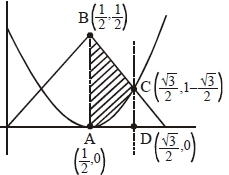
0 likesView Solution
104
MathematicsDifficultMCQJEE Main · 2020
$A$ random variable $X$ has the following probability distribution:
Then $P(X > 2)$ is equal to:
| $X$ | $1, 2, 3, 4, 5$ |
| $P(X)$ | $K^2, 2K, K, 2K, 5K^2$ |
Then $P(X > 2)$ is equal to:
A
$\frac{7}{12}$
B
$\frac{23}{36}$
C
$\frac{1}{36}$
D
$\frac{1}{6}$
Solution
(B) The sum of all probabilities in a probability distribution must be equal to $1$.
$\sum P(X) = 1 \Rightarrow K^2 + 2K + K + 2K + 5K^2 = 1$
$6K^2 + 5K - 1 = 0$
Factoring the quadratic equation: $(6K - 1)(K + 1) = 0$
This gives $K = \frac{1}{6}$ or $K = -1$.
Since the probability $P(X)$ cannot be negative,we reject $K = -1$. Thus,$K = \frac{1}{6}$.
We need to find $P(X > 2) = P(X = 3) + P(X = 4) + P(X = 5)$.
$P(X > 2) = K + 2K + 5K^2 = 3K + 5K^2$.
Substituting $K = \frac{1}{6}$:
$P(X > 2) = 3(\frac{1}{6}) + 5(\frac{1}{6})^2 = \frac{1}{2} + \frac{5}{36} = \frac{18}{36} + \frac{5}{36} = \frac{23}{36}$.
$\sum P(X) = 1 \Rightarrow K^2 + 2K + K + 2K + 5K^2 = 1$
$6K^2 + 5K - 1 = 0$
Factoring the quadratic equation: $(6K - 1)(K + 1) = 0$
This gives $K = \frac{1}{6}$ or $K = -1$.
Since the probability $P(X)$ cannot be negative,we reject $K = -1$. Thus,$K = \frac{1}{6}$.
We need to find $P(X > 2) = P(X = 3) + P(X = 4) + P(X = 5)$.
$P(X > 2) = K + 2K + 5K^2 = 3K + 5K^2$.
Substituting $K = \frac{1}{6}$:
$P(X > 2) = 3(\frac{1}{6}) + 5(\frac{1}{6})^2 = \frac{1}{2} + \frac{5}{36} = \frac{18}{36} + \frac{5}{36} = \frac{23}{36}$.
0 likesView Solution
105
MathematicsDifficultMCQJEE Main · 2020
Let a function $f:[0,5] \rightarrow R$ be continuous. $f(1)=3$ and $F$ be defined as $F(x)=\int_{1}^{x} t^{2} g(t) dt$,where $g(t)=\int_{1}^{t} f(u) du$. Then for the function $F$,the point $x=1$ is
A
a point of local minima
B
not a critical point
C
a point of inflection
D
a point of local maxima
Solution
(A) Given $F(x) = \int_{1}^{x} t^{2} g(t) dt$. By the Fundamental Theorem of Calculus,$F'(x) = x^{2} g(x) = x^{2} \int_{1}^{x} f(u) du$.
At $x=1$,$F'(1) = 1^{2} \int_{1}^{1} f(u) du = 0$. Thus,$x=1$ is a critical point.
Now,find the second derivative: $F''(x) = \frac{d}{dx} [x^{2} g(x)] = x^{2} g'(x) + 2x g(x)$.
Since $g(t) = \int_{1}^{t} f(u) du$,$g'(t) = f(t)$.
So,$F''(x) = x^{2} f(x) + 2x \int_{1}^{x} f(u) du$.
Evaluating at $x=1$: $F''(1) = 1^{2} f(1) + 2(1) \int_{1}^{1} f(u) du = f(1) + 0 = 3$.
Since $F'(1) = 0$ and $F''(1) = 3 > 0$,by the Second Derivative Test,$x=1$ is a point of local minima.
At $x=1$,$F'(1) = 1^{2} \int_{1}^{1} f(u) du = 0$. Thus,$x=1$ is a critical point.
Now,find the second derivative: $F''(x) = \frac{d}{dx} [x^{2} g(x)] = x^{2} g'(x) + 2x g(x)$.
Since $g(t) = \int_{1}^{t} f(u) du$,$g'(t) = f(t)$.
So,$F''(x) = x^{2} f(x) + 2x \int_{1}^{x} f(u) du$.
Evaluating at $x=1$: $F''(1) = 1^{2} f(1) + 2(1) \int_{1}^{1} f(u) du = f(1) + 0 = 3$.
Since $F'(1) = 0$ and $F''(1) = 3 > 0$,by the Second Derivative Test,$x=1$ is a point of local minima.
0 likesView Solution
106
MathematicsDifficultMCQJEE Main · 2020
If $10$ different balls are to be placed in $4$ distinct boxes at random,then the probability that two of these boxes contain exactly $2$ and $3$ balls is
A
$\frac{945}{2^{11}}$
B
$\frac{965}{2^{11}}$
C
$\frac{945}{2^{10}}$
D
$\frac{965}{2^{10}}$
Solution
(C) Total ways to place $10$ distinct balls in $4$ distinct boxes is $4^{10}$.
To find the number of ways such that two boxes contain exactly $2$ and $3$ balls:
$1$. Select $2$ boxes out of $4$ to contain $2$ and $3$ balls respectively: $P(4, 2) = 4 \times 3 = 12$ ways.
$2$. Select $2$ balls for the first box and $3$ balls for the second box from $10$ balls: $\binom{10}{2} \times \binom{8}{3} = 45 \times 56 = 2520$ ways.
$3$. The remaining $5$ balls can be placed in the remaining $2$ boxes in $2^5 = 32$ ways.
Total favorable ways $= 12 \times 2520 \times 32 = 967680$.
Probability $= \frac{967680}{4^{10}} = \frac{967680}{1048576} = \frac{945}{1024} = \frac{945}{2^{10}}$.
To find the number of ways such that two boxes contain exactly $2$ and $3$ balls:
$1$. Select $2$ boxes out of $4$ to contain $2$ and $3$ balls respectively: $P(4, 2) = 4 \times 3 = 12$ ways.
$2$. Select $2$ balls for the first box and $3$ balls for the second box from $10$ balls: $\binom{10}{2} \times \binom{8}{3} = 45 \times 56 = 2520$ ways.
$3$. The remaining $5$ balls can be placed in the remaining $2$ boxes in $2^5 = 32$ ways.
Total favorable ways $= 12 \times 2520 \times 32 = 967680$.
Probability $= \frac{967680}{4^{10}} = \frac{967680}{1048576} = \frac{945}{1024} = \frac{945}{2^{10}}$.
0 likesView Solution
107
MathematicsDifficultMCQJEE Main · 2020
If $\frac{dy}{dx} = \frac{xy}{x^2 + y^2}$ and $y(1) = 1$,then find the value of $x$ that satisfies $y(x) = e$.
A
$\sqrt{2} e$
B
$\frac{e}{\sqrt{2}}$
C
$\frac{1}{2} \sqrt{3} e$
D
$\sqrt{3} e$
Solution
(D) Given the differential equation $\frac{dy}{dx} = \frac{xy}{x^2 + y^2}$.
Substitute $y = vx$,then $\frac{dy}{dx} = v + x \frac{dv}{dx}$.
Substituting into the equation: $v + x \frac{dv}{dx} = \frac{x(vx)}{x^2 + v^2 x^2} = \frac{v}{1 + v^2}$.
$x \frac{dv}{dx} = \frac{v}{1 + v^2} - v = \frac{v - v - v^3}{1 + v^2} = -\frac{v^3}{1 + v^2}$.
Separating variables: $\int \frac{1 + v^2}{v^3} dv = -\int \frac{dx}{x}$.
$\int (v^{-3} + v^{-1}) dv = -\int \frac{dx}{x}$.
Integrating both sides: $-\frac{1}{2v^2} + \ln|v| = -\ln|x| + C$.
Substitute $v = \frac{y}{x}$: $-\frac{x^2}{2y^2} + \ln|\frac{y}{x}| = -\ln|x| + C$.
$-\frac{x^2}{2y^2} + \ln|y| - \ln|x| = -\ln|x| + C \implies -\frac{x^2}{2y^2} + \ln|y| = C$.
Using $y(1) = 1$: $-\frac{1^2}{2(1)^2} + \ln(1) = C \implies C = -\frac{1}{2}$.
The equation is $-\frac{x^2}{2y^2} + \ln|y| = -\frac{1}{2}$.
For $y = e$: $-\frac{x^2}{2e^2} + \ln(e) = -\frac{1}{2} \implies -\frac{x^2}{2e^2} + 1 = -\frac{1}{2}$.
$-\frac{x^2}{2e^2} = -\frac{3}{2} \implies x^2 = 3e^2 \implies x = \sqrt{3}e$.
Substitute $y = vx$,then $\frac{dy}{dx} = v + x \frac{dv}{dx}$.
Substituting into the equation: $v + x \frac{dv}{dx} = \frac{x(vx)}{x^2 + v^2 x^2} = \frac{v}{1 + v^2}$.
$x \frac{dv}{dx} = \frac{v}{1 + v^2} - v = \frac{v - v - v^3}{1 + v^2} = -\frac{v^3}{1 + v^2}$.
Separating variables: $\int \frac{1 + v^2}{v^3} dv = -\int \frac{dx}{x}$.
$\int (v^{-3} + v^{-1}) dv = -\int \frac{dx}{x}$.
Integrating both sides: $-\frac{1}{2v^2} + \ln|v| = -\ln|x| + C$.
Substitute $v = \frac{y}{x}$: $-\frac{x^2}{2y^2} + \ln|\frac{y}{x}| = -\ln|x| + C$.
$-\frac{x^2}{2y^2} + \ln|y| - \ln|x| = -\ln|x| + C \implies -\frac{x^2}{2y^2} + \ln|y| = C$.
Using $y(1) = 1$: $-\frac{1^2}{2(1)^2} + \ln(1) = C \implies C = -\frac{1}{2}$.
The equation is $-\frac{x^2}{2y^2} + \ln|y| = -\frac{1}{2}$.
For $y = e$: $-\frac{x^2}{2e^2} + \ln(e) = -\frac{1}{2} \implies -\frac{x^2}{2e^2} + 1 = -\frac{1}{2}$.
$-\frac{x^2}{2e^2} = -\frac{3}{2} \implies x^2 = 3e^2 \implies x = \sqrt{3}e$.
0 likesView Solution
108
MathematicsDifficultMCQJEE Main · 2020
Let $a-2b+c=1$. If $f(x) = \begin{vmatrix} x+a & x+2 & x+1 \\ x+b & x+3 & x+2 \\ x+c & x+4 & x+3 \end{vmatrix}$,then:
A
$f(-50) = 501$
B
$f(-50) = -1$
C
$f(50) = 1$
D
$f(50) = 501$
Solution
(C) Given the determinant $f(x) = \begin{vmatrix} x+a & x+2 & x+1 \\ x+b & x+3 & x+2 \\ x+c & x+4 & x+3 \end{vmatrix}$.
Applying the row operation $R_1 \rightarrow R_1 + R_3 - 2R_2$:
The first row becomes:
$(x+a) + (x+c) - 2(x+b) = x+a+x+c-2x-2b = a-2b+c = 1$.
$(x+2) + (x+4) - 2(x+3) = 2x+6-2x-6 = 0$.
$(x+1) + (x+3) - 2(x+2) = 2x+4-2x-4 = 0$.
Thus,$f(x) = \begin{vmatrix} 1 & 0 & 0 \\ x+b & x+3 & x+2 \\ x+c & x+4 & x+3 \end{vmatrix}$.
Expanding along the first row:
$f(x) = 1 \cdot ((x+3)(x+3) - (x+2)(x+4)) = (x^2+6x+9) - (x^2+6x+8) = 1$.
Since $f(x) = 1$ for all $x$,$f(50) = 1$.
Applying the row operation $R_1 \rightarrow R_1 + R_3 - 2R_2$:
The first row becomes:
$(x+a) + (x+c) - 2(x+b) = x+a+x+c-2x-2b = a-2b+c = 1$.
$(x+2) + (x+4) - 2(x+3) = 2x+6-2x-6 = 0$.
$(x+1) + (x+3) - 2(x+2) = 2x+4-2x-4 = 0$.
Thus,$f(x) = \begin{vmatrix} 1 & 0 & 0 \\ x+b & x+3 & x+2 \\ x+c & x+4 & x+3 \end{vmatrix}$.
Expanding along the first row:
$f(x) = 1 \cdot ((x+3)(x+3) - (x+2)(x+4)) = (x^2+6x+9) - (x^2+6x+8) = 1$.
Since $f(x) = 1$ for all $x$,$f(50) = 1$.
0 likesView Solution
109
MathematicsDifficultMCQJEE Main · 2020
Let $f$ and $g$ be differentiable functions on $R$ such that $f \circ g$ is the identity function. If for some $a, b \in R$,$g^{\prime}(a) = 5$ and $g(a) = b$,then $f^{\prime}(b)$ is equal to
A
$2/5$
B
$1$
C
$1/5$
D
$5$
Solution
(C) Given that $f \circ g$ is the identity function,we have $f(g(x)) = x$ for all $x \in R$.
Differentiating both sides with respect to $x$ using the chain rule,we get:
$f^{\prime}(g(x)) \cdot g^{\prime}(x) = 1$.
We are given that $g(a) = b$ and $g^{\prime}(a) = 5$.
Substituting $x = a$ into the differentiated equation:
$f^{\prime}(g(a)) \cdot g^{\prime}(a) = 1$.
Substituting the known values $g(a) = b$ and $g^{\prime}(a) = 5$:
$f^{\prime}(b) \cdot 5 = 1$.
Therefore,$f^{\prime}(b) = 1/5$.
Differentiating both sides with respect to $x$ using the chain rule,we get:
$f^{\prime}(g(x)) \cdot g^{\prime}(x) = 1$.
We are given that $g(a) = b$ and $g^{\prime}(a) = 5$.
Substituting $x = a$ into the differentiated equation:
$f^{\prime}(g(a)) \cdot g^{\prime}(a) = 1$.
Substituting the known values $g(a) = b$ and $g^{\prime}(a) = 5$:
$f^{\prime}(b) \cdot 5 = 1$.
Therefore,$f^{\prime}(b) = 1/5$.
0 likesView Solution
110
MathematicsDifficultMCQJEE Main · 2020
Let $\vec{a}, \vec{b}$ and $\vec{c}$ be three vectors such that $|\vec{a}|=\sqrt{3}$,$|\vec{b}|=5$,$\vec{b} \cdot \vec{c}=10$ and the angle between $\vec{b}$ and $\vec{c}$ is $\frac{\pi}{3}$. If $\vec{a}$ is perpendicular to the vector $\vec{b} \times \vec{c}$,then $|\vec{a} \times (\vec{b} \times \vec{c})|$ is equal to:
A
$34$
B
$36$
C
$30$
D
$38$
Solution
(C) Given $\vec{b} \cdot \vec{c} = |\vec{b}| |\vec{c}| \cos(\frac{\pi}{3}) = 10$.
Since $|\vec{b}| = 5$,we have $5 |\vec{c}| (\frac{1}{2}) = 10$,which implies $|\vec{c}| = 4$.
Now,the magnitude of the cross product is $|\vec{b} \times \vec{c}| = |\vec{b}| |\vec{c}| \sin(\frac{\pi}{3}) = 5 \times 4 \times \frac{\sqrt{3}}{2} = 10\sqrt{3}$.
Since $\vec{a}$ is perpendicular to $\vec{b} \times \vec{c}$,the angle between $\vec{a}$ and $\vec{b} \times \vec{c}$ is $\frac{\pi}{2}$.
Thus,$|\vec{a} \times (\vec{b} \times \vec{c})| = |\vec{a}| |\vec{b} \times \vec{c}| \sin(\frac{\pi}{2}) = \sqrt{3} \times 10\sqrt{3} \times 1 = 30$.
Since $|\vec{b}| = 5$,we have $5 |\vec{c}| (\frac{1}{2}) = 10$,which implies $|\vec{c}| = 4$.
Now,the magnitude of the cross product is $|\vec{b} \times \vec{c}| = |\vec{b}| |\vec{c}| \sin(\frac{\pi}{3}) = 5 \times 4 \times \frac{\sqrt{3}}{2} = 10\sqrt{3}$.
Since $\vec{a}$ is perpendicular to $\vec{b} \times \vec{c}$,the angle between $\vec{a}$ and $\vec{b} \times \vec{c}$ is $\frac{\pi}{2}$.
Thus,$|\vec{a} \times (\vec{b} \times \vec{c})| = |\vec{a}| |\vec{b} \times \vec{c}| \sin(\frac{\pi}{2}) = \sqrt{3} \times 10\sqrt{3} \times 1 = 30$.
0 likesView Solution
111
MathematicsDifficultMCQJEE Main · 2020
If the distance between the plane,$23x - 10y - 2z + 48 = 0$ and the plane containing the lines $\frac{x+1}{2} = \frac{y-3}{4} = \frac{z+1}{3}$ and $\frac{x+3}{2} = \frac{y+2}{6} = \frac{z-1}{\lambda}$ $(\lambda \in R)$ is equal to $\frac{k}{\sqrt{633}}$,then $k$ is equal to
A
$2$
B
$3$
C
$6$
D
$5$
Solution
(B) The plane containing the two lines must have a normal vector $\vec{n}$ perpendicular to the direction vectors of the lines $\vec{v_1} = (2, 4, 3)$ and $\vec{v_2} = (2, 6, \lambda)$.
Thus,$\vec{n} = \vec{v_1} \times \vec{v_2} = \begin{vmatrix} \hat{i} & \hat{j} & \hat{k} \\ 2 & 4 & 3 \\ 2 & 6 & \lambda \end{vmatrix} = (4\lambda - 18)\hat{i} - (2\lambda - 6)\hat{j} + (12 - 8)\hat{k} = (4\lambda - 18, 6 - 2\lambda, 4)$.
For the lines to be coplanar,the vector connecting points $(-1, 3, -1)$ and $(-3, -2, 1)$,which is $\vec{a} = (-2, -5, 2)$,must be perpendicular to $\vec{n}$.
So,$\vec{a} \cdot \vec{n} = -2(4\lambda - 18) - 5(6 - 2\lambda) + 2(4) = -8\lambda + 36 - 30 + 10\lambda + 8 = 2\lambda + 14 = 0$,which gives $\lambda = -7$.
Substituting $\lambda = -7$,$\vec{n} = (4(-7) - 18, 6 - 2(-7), 4) = (-46, 20, 4)$.
Dividing by $-2$,we get the normal vector $(23, -10, -2)$,which is parallel to the given plane $23x - 10y - 2z + 48 = 0$.
The plane containing the lines passes through $(-1, 3, -1)$,so its equation is $23(x+1) - 10(y-3) - 2(z+1) = 0 \Rightarrow 23x - 10y - 2z + 51 = 0$.
The distance between $23x - 10y - 2z + 48 = 0$ and $23x - 10y - 2z + 51 = 0$ is $d = \frac{|51 - 48|}{\sqrt{23^2 + (-10)^2 + (-2)^2}} = \frac{3}{\sqrt{529 + 100 + 4}} = \frac{3}{\sqrt{633}}$.
Comparing with $\frac{k}{\sqrt{633}}$,we get $k = 3$.
Thus,$\vec{n} = \vec{v_1} \times \vec{v_2} = \begin{vmatrix} \hat{i} & \hat{j} & \hat{k} \\ 2 & 4 & 3 \\ 2 & 6 & \lambda \end{vmatrix} = (4\lambda - 18)\hat{i} - (2\lambda - 6)\hat{j} + (12 - 8)\hat{k} = (4\lambda - 18, 6 - 2\lambda, 4)$.
For the lines to be coplanar,the vector connecting points $(-1, 3, -1)$ and $(-3, -2, 1)$,which is $\vec{a} = (-2, -5, 2)$,must be perpendicular to $\vec{n}$.
So,$\vec{a} \cdot \vec{n} = -2(4\lambda - 18) - 5(6 - 2\lambda) + 2(4) = -8\lambda + 36 - 30 + 10\lambda + 8 = 2\lambda + 14 = 0$,which gives $\lambda = -7$.
Substituting $\lambda = -7$,$\vec{n} = (4(-7) - 18, 6 - 2(-7), 4) = (-46, 20, 4)$.
Dividing by $-2$,we get the normal vector $(23, -10, -2)$,which is parallel to the given plane $23x - 10y - 2z + 48 = 0$.
The plane containing the lines passes through $(-1, 3, -1)$,so its equation is $23(x+1) - 10(y-3) - 2(z+1) = 0 \Rightarrow 23x - 10y - 2z + 51 = 0$.
The distance between $23x - 10y - 2z + 48 = 0$ and $23x - 10y - 2z + 51 = 0$ is $d = \frac{|51 - 48|}{\sqrt{23^2 + (-10)^2 + (-2)^2}} = \frac{3}{\sqrt{529 + 100 + 4}} = \frac{3}{\sqrt{633}}$.
Comparing with $\frac{k}{\sqrt{633}}$,we get $k = 3$.
0 likesView Solution
112
MathematicsDifficultMCQJEE Main · 2020
In a box,there are $20$ cards,out of which $10$ are labelled as $A$ and the remaining $10$ are labelled as $B$. Cards are drawn at random,one after the other and with replacement,until a second $A$-card is obtained. The probability that the second $A$-card appears before the third $B$-card is
A
$\frac{11}{16}$
B
$\frac{13}{16}$
C
$\frac{9}{16}$
D
$\frac{15}{16}$
Solution
(A) Let $P(A) = \frac{10}{20} = \frac{1}{2}$ and $P(B) = \frac{10}{20} = \frac{1}{2}$.
We want the second $A$ to appear before the third $B$.
This means in the sequence of draws,we must have at most two $B$'s before the second $A$.
The possible favorable sequences are:
$1$. $AA$: Probability $= (\frac{1}{2})^2 = \frac{1}{4}$
$2$. $ABA, BAA$: Probability $= 2 \times (\frac{1}{2})^3 = \frac{2}{8} = \frac{1}{4}$
$3$. $ABBA, BABA, BBAA$: Probability $= 3 \times (\frac{1}{2})^4 = \frac{3}{16}$
Summing these probabilities: $\frac{1}{4} + \frac{1}{4} + \frac{3}{16} = \frac{4}{16} + \frac{4}{16} + \frac{3}{16} = \frac{11}{16}$.
We want the second $A$ to appear before the third $B$.
This means in the sequence of draws,we must have at most two $B$'s before the second $A$.
The possible favorable sequences are:
$1$. $AA$: Probability $= (\frac{1}{2})^2 = \frac{1}{4}$
$2$. $ABA, BAA$: Probability $= 2 \times (\frac{1}{2})^3 = \frac{2}{8} = \frac{1}{4}$
$3$. $ABBA, BABA, BBAA$: Probability $= 3 \times (\frac{1}{2})^4 = \frac{3}{16}$
Summing these probabilities: $\frac{1}{4} + \frac{1}{4} + \frac{3}{16} = \frac{4}{16} + \frac{4}{16} + \frac{3}{16} = \frac{11}{16}$.
0 likesView Solution
113
MathematicsDifficultMCQJEE Main · 2020
The value of $\int_{0}^{2 \pi} \frac{x \sin^{8} x}{\sin^{8} x + \cos^{8} x} dx$ is equal to
A
$2 \pi$
B
$4 \pi$
C
$2 \pi^{2}$
D
$\pi^{2}$
Solution
(D) Let $I = \int_{0}^{2 \pi} \frac{x \sin^{8} x}{\sin^{8} x + \cos^{8} x} dx$.
Using the property $\int_{0}^{a} f(x) dx = \int_{0}^{a} f(a-x) dx$,we have:
$I = \int_{0}^{2 \pi} \frac{(2 \pi - x) \sin^{8}(2 \pi - x)}{\sin^{8}(2 \pi - x) + \cos^{8}(2 \pi - x)} dx = \int_{0}^{2 \pi} \frac{(2 \pi - x) \sin^{8} x}{\sin^{8} x + \cos^{8} x} dx$.
Adding the two expressions for $I$:
$2I = \int_{0}^{2 \pi} \frac{2 \pi \sin^{8} x}{\sin^{8} x + \cos^{8} x} dx = 2 \pi \int_{0}^{2 \pi} \frac{\sin^{8} x}{\sin^{8} x + \cos^{8} x} dx$.
$I = \pi \int_{0}^{2 \pi} \frac{\sin^{8} x}{\sin^{8} x + \cos^{8} x} dx$.
Using the property $\int_{0}^{2a} f(x) dx = 2 \int_{0}^{a} f(x) dx$ if $f(2a-x) = f(x)$:
$I = 2 \pi \int_{0}^{\pi} \frac{\sin^{8} x}{\sin^{8} x + \cos^{8} x} dx = 4 \pi \int_{0}^{\pi/2} \frac{\sin^{8} x}{\sin^{8} x + \cos^{8} x} dx$.
Using $\int_{0}^{a} f(x) dx = \int_{0}^{a} f(a-x) dx$:
$I = 4 \pi \int_{0}^{\pi/2} \frac{\cos^{8} x}{\cos^{8} x + \sin^{8} x} dx$.
Adding these two: $2I = 4 \pi \int_{0}^{\pi/2} 1 dx = 4 \pi \cdot \frac{\pi}{2} = 2 \pi^{2}$.
Thus,$I = \pi^{2}$.
Using the property $\int_{0}^{a} f(x) dx = \int_{0}^{a} f(a-x) dx$,we have:
$I = \int_{0}^{2 \pi} \frac{(2 \pi - x) \sin^{8}(2 \pi - x)}{\sin^{8}(2 \pi - x) + \cos^{8}(2 \pi - x)} dx = \int_{0}^{2 \pi} \frac{(2 \pi - x) \sin^{8} x}{\sin^{8} x + \cos^{8} x} dx$.
Adding the two expressions for $I$:
$2I = \int_{0}^{2 \pi} \frac{2 \pi \sin^{8} x}{\sin^{8} x + \cos^{8} x} dx = 2 \pi \int_{0}^{2 \pi} \frac{\sin^{8} x}{\sin^{8} x + \cos^{8} x} dx$.
$I = \pi \int_{0}^{2 \pi} \frac{\sin^{8} x}{\sin^{8} x + \cos^{8} x} dx$.
Using the property $\int_{0}^{2a} f(x) dx = 2 \int_{0}^{a} f(x) dx$ if $f(2a-x) = f(x)$:
$I = 2 \pi \int_{0}^{\pi} \frac{\sin^{8} x}{\sin^{8} x + \cos^{8} x} dx = 4 \pi \int_{0}^{\pi/2} \frac{\sin^{8} x}{\sin^{8} x + \cos^{8} x} dx$.
Using $\int_{0}^{a} f(x) dx = \int_{0}^{a} f(a-x) dx$:
$I = 4 \pi \int_{0}^{\pi/2} \frac{\cos^{8} x}{\cos^{8} x + \sin^{8} x} dx$.
Adding these two: $2I = 4 \pi \int_{0}^{\pi/2} 1 dx = 4 \pi \cdot \frac{\pi}{2} = 2 \pi^{2}$.
Thus,$I = \pi^{2}$.
0 likesView Solution
114
MathematicsDifficultMCQJEE Main · 2020
If $f^{\prime}(x)=\tan^{-1}(\sec x+\tan x)$ for $-\frac{\pi}{2} < x < \frac{\pi}{2}$ and $f(0)=0$,then $f(1)$ is equal to:
A
$\frac{\pi-1}{4}$
B
$\frac{\pi+2}{4}$
C
$\frac{\pi+1}{4}$
D
$\frac{1}{4}$
Solution
(C) Given $f^{\prime}(x)=\tan^{-1}(\sec x+\tan x)$.
We simplify the expression inside the inverse tangent:
$f^{\prime}(x)=\tan^{-1}\left(\frac{1+\sin x}{\cos x}\right) = \tan^{-1}\left(\frac{(\cos \frac{x}{2} + \sin \frac{x}{2})^2}{\cos^2 \frac{x}{2} - \sin^2 \frac{x}{2}}\right) = \tan^{-1}\left(\frac{\cos \frac{x}{2} + \sin \frac{x}{2}}{\cos \frac{x}{2} - \sin \frac{x}{2}}\right)$
Dividing numerator and denominator by $\cos \frac{x}{2}$:
$f^{\prime}(x)=\tan^{-1}\left(\frac{1+\tan \frac{x}{2}}{1-\tan \frac{x}{2}}\right) = \tan^{-1}\left(\tan(\frac{\pi}{4}+\frac{x}{2})\right)$
Since $-\frac{\pi}{2} < x < \frac{\pi}{2}$,we have $0 < \frac{\pi}{4}+\frac{x}{2} < \frac{\pi}{2}$,so $f^{\prime}(x) = \frac{\pi}{4} + \frac{x}{2}$.
Integrating with respect to $x$:
$f(x) = \int (\frac{\pi}{4} + \frac{x}{2}) dx = \frac{\pi}{4}x + \frac{x^2}{4} + C$.
Given $f(0)=0$,we find $C=0$.
Thus,$f(x) = \frac{\pi x + x^2}{4}$.
For $x=1$,$f(1) = \frac{\pi(1) + (1)^2}{4} = \frac{\pi+1}{4}$.
We simplify the expression inside the inverse tangent:
$f^{\prime}(x)=\tan^{-1}\left(\frac{1+\sin x}{\cos x}\right) = \tan^{-1}\left(\frac{(\cos \frac{x}{2} + \sin \frac{x}{2})^2}{\cos^2 \frac{x}{2} - \sin^2 \frac{x}{2}}\right) = \tan^{-1}\left(\frac{\cos \frac{x}{2} + \sin \frac{x}{2}}{\cos \frac{x}{2} - \sin \frac{x}{2}}\right)$
Dividing numerator and denominator by $\cos \frac{x}{2}$:
$f^{\prime}(x)=\tan^{-1}\left(\frac{1+\tan \frac{x}{2}}{1-\tan \frac{x}{2}}\right) = \tan^{-1}\left(\tan(\frac{\pi}{4}+\frac{x}{2})\right)$
Since $-\frac{\pi}{2} < x < \frac{\pi}{2}$,we have $0 < \frac{\pi}{4}+\frac{x}{2} < \frac{\pi}{2}$,so $f^{\prime}(x) = \frac{\pi}{4} + \frac{x}{2}$.
Integrating with respect to $x$:
$f(x) = \int (\frac{\pi}{4} + \frac{x}{2}) dx = \frac{\pi}{4}x + \frac{x^2}{4} + C$.
Given $f(0)=0$,we find $C=0$.
Thus,$f(x) = \frac{\pi x + x^2}{4}$.
For $x=1$,$f(1) = \frac{\pi(1) + (1)^2}{4} = \frac{\pi+1}{4}$.
0 likesView Solution
115
MathematicsDifficultMCQJEE Main · 2020
If the matrices $A = \begin{bmatrix} 1 & 1 & 2 \\ 1 & 3 & 4 \\ 1 & -1 & 3 \end{bmatrix}$,$B = \operatorname{adj} A$,and $C = 3A$,then $\frac{|\operatorname{adj} B|}{|C|}$ is equal to
A
$72$
B
$2$
C
$8$
D
$16$
Solution
(C) Given $A = \begin{bmatrix} 1 & 1 & 2 \\ 1 & 3 & 4 \\ 1 & -1 & 3 \end{bmatrix}$.
First,calculate the determinant of $A$:
$|A| = 1(3 \times 3 - 4 \times -1) - 1(1 \times 3 - 4 \times 1) + 2(1 \times -1 - 3 \times 1)$
$|A| = 1(9 + 4) - 1(3 - 4) + 2(-1 - 3)$
$|A| = 13 + 1 - 8 = 6$.
We are given $B = \operatorname{adj} A$ and $C = 3A$. We need to find $\frac{|\operatorname{adj} B|}{|C|}$.
Since $B = \operatorname{adj} A$,then $\operatorname{adj} B = \operatorname{adj}(\operatorname{adj} A)$.
Using the property $|\operatorname{adj} M| = |M|^{n-1}$ where $n$ is the order of the matrix:
$|\operatorname{adj} B| = |\operatorname{adj}(\operatorname{adj} A)| = |A|^{(n-1)^2} = |A|^{(3-1)^2} = |A|^4$.
For the denominator,$|C| = |3A| = 3^n |A| = 3^3 |A| = 27 |A|$.
Thus,$\frac{|\operatorname{adj} B|}{|C|} = \frac{|A|^4}{27 |A|} = \frac{|A|^3}{27}$.
Substituting $|A| = 6$:
$\frac{6^3}{27} = \frac{216}{27} = 8$.
First,calculate the determinant of $A$:
$|A| = 1(3 \times 3 - 4 \times -1) - 1(1 \times 3 - 4 \times 1) + 2(1 \times -1 - 3 \times 1)$
$|A| = 1(9 + 4) - 1(3 - 4) + 2(-1 - 3)$
$|A| = 13 + 1 - 8 = 6$.
We are given $B = \operatorname{adj} A$ and $C = 3A$. We need to find $\frac{|\operatorname{adj} B|}{|C|}$.
Since $B = \operatorname{adj} A$,then $\operatorname{adj} B = \operatorname{adj}(\operatorname{adj} A)$.
Using the property $|\operatorname{adj} M| = |M|^{n-1}$ where $n$ is the order of the matrix:
$|\operatorname{adj} B| = |\operatorname{adj}(\operatorname{adj} A)| = |A|^{(n-1)^2} = |A|^{(3-1)^2} = |A|^4$.
For the denominator,$|C| = |3A| = 3^n |A| = 3^3 |A| = 27 |A|$.
Thus,$\frac{|\operatorname{adj} B|}{|C|} = \frac{|A|^4}{27 |A|} = \frac{|A|^3}{27}$.
Substituting $|A| = 6$:
$\frac{6^3}{27} = \frac{216}{27} = 8$.
0 likesView Solution
116
MathematicsDifficultMCQJEE Main · 2020
Let $f$ be any function continuous on $[a, b]$ and twice differentiable on $(a, b)$. If for all $x \in (a, b)$,$f^{\prime}(x) > 0$ and $f^{\prime \prime}(x) < 0$,then for any $c \in (a, b)$,$\frac{f(c)-f(a)}{f(b)-f(c)}$ is greater than
A
$\frac{b+a}{b-a}$
B
$\frac{b-c}{c-a}$
C
$\frac{c-a}{b-c}$
D
$1$
Solution
(C) Given that $f^{\prime}(x) > 0$ and $f^{\prime \prime}(x) < 0$ for all $x \in (a, b)$,the function $f$ is strictly increasing and concave downwards on the interval $[a, b]$.
Let $m_1$ be the slope of the secant line passing through $(a, f(a))$ and $(c, f(c))$,and $m_2$ be the slope of the secant line passing through $(c, f(c))$ and $(b, f(b))$.
$m_1 = \frac{f(c)-f(a)}{c-a}$ and $m_2 = \frac{f(b)-f(c)}{b-c}$.
Since the function is concave downwards,the slope of the secant line decreases as we move to the right. Therefore,$m_1 > m_2$.
Substituting the expressions for $m_1$ and $m_2$,we get:
$\frac{f(c)-f(a)}{c-a} > \frac{f(b)-f(c)}{b-c}$.
Rearranging the terms to isolate the required ratio:
$\frac{f(c)-f(a)}{f(b)-f(c)} > \frac{c-a}{b-c}$.
Let $m_1$ be the slope of the secant line passing through $(a, f(a))$ and $(c, f(c))$,and $m_2$ be the slope of the secant line passing through $(c, f(c))$ and $(b, f(b))$.
$m_1 = \frac{f(c)-f(a)}{c-a}$ and $m_2 = \frac{f(b)-f(c)}{b-c}$.
Since the function is concave downwards,the slope of the secant line decreases as we move to the right. Therefore,$m_1 > m_2$.
Substituting the expressions for $m_1$ and $m_2$,we get:
$\frac{f(c)-f(a)}{c-a} > \frac{f(b)-f(c)}{b-c}$.
Rearranging the terms to isolate the required ratio:
$\frac{f(c)-f(a)}{f(b)-f(c)} > \frac{c-a}{b-c}$.
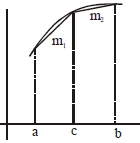
0 likesView Solution
117
MathematicsDifficultMCQJEE Main · 2020
If for some $\alpha$ and $\beta$ in $\mathbb{R},$ the intersection of the following three planes $x+4y-2z=1$,$x+7y-5z=\beta$,and $x+5y+\alpha z=5$ is a line in $\mathbb{R}^{3},$ then $\alpha+\beta$ is equal to
A
$10$
B
$-10$
C
$2$
D
$0$
Solution
(A) For the three planes to intersect in a line,the system of linear equations must have infinitely many solutions. This occurs when the determinant of the coefficient matrix $\Delta = 0$ and the augmented determinants $\Delta_x, \Delta_y, \Delta_z$ are also $0$.
First,we calculate the determinant of the coefficient matrix:
$\Delta = \begin{vmatrix} 1 & 4 & -2 \\ 1 & 7 & -5 \\ 1 & 5 & \alpha \end{vmatrix} = 1(7\alpha + 25) - 4(\alpha + 5) - 2(5 - 7) = 7\alpha + 25 - 4\alpha - 20 + 4 = 3\alpha + 9$.
Setting $\Delta = 0$,we get $3\alpha + 9 = 0$,which implies $\alpha = -3$.
Next,for the system to have infinitely many solutions,we must have $\Delta_z = 0$:
$\Delta_z = \begin{vmatrix} 1 & 4 & 1 \\ 1 & 7 & \beta \\ 1 & 5 & 5 \end{vmatrix} = 1(35 - 5\beta) - 4(5 - \beta) + 1(5 - 7) = 35 - 5\beta - 20 + 4\beta - 2 = 13 - \beta$.
Setting $\Delta_z = 0$,we get $13 - \beta = 0$,which implies $\beta = 13$.
With $\alpha = -3$ and $\beta = 13$,the system is consistent and represents a line. Thus,$\alpha + \beta = -3 + 13 = 10$.
First,we calculate the determinant of the coefficient matrix:
$\Delta = \begin{vmatrix} 1 & 4 & -2 \\ 1 & 7 & -5 \\ 1 & 5 & \alpha \end{vmatrix} = 1(7\alpha + 25) - 4(\alpha + 5) - 2(5 - 7) = 7\alpha + 25 - 4\alpha - 20 + 4 = 3\alpha + 9$.
Setting $\Delta = 0$,we get $3\alpha + 9 = 0$,which implies $\alpha = -3$.
Next,for the system to have infinitely many solutions,we must have $\Delta_z = 0$:
$\Delta_z = \begin{vmatrix} 1 & 4 & 1 \\ 1 & 7 & \beta \\ 1 & 5 & 5 \end{vmatrix} = 1(35 - 5\beta) - 4(5 - \beta) + 1(5 - 7) = 35 - 5\beta - 20 + 4\beta - 2 = 13 - \beta$.
Setting $\Delta_z = 0$,we get $13 - \beta = 0$,which implies $\beta = 13$.
With $\alpha = -3$ and $\beta = 13$,the system is consistent and represents a line. Thus,$\alpha + \beta = -3 + 13 = 10$.
0 likesView Solution
118
MathematicsDifficultMCQJEE Main · 2020
The integral $\int \frac{dx}{(x+4)^{\frac{8}{7}}(x-3)^{\frac{6}{7}}}$ is equal to (where $C$ is a constant of integration).
A
$\left(\frac{x-3}{x+4}\right)^{\frac{1}{7}}+C$
B
$-\left(\frac{x-3}{x+4}\right)^{-\frac{1}{7}}+C$
C
$\frac{1}{2}\left(\frac{x-3}{x+4}\right)^{\frac{3}{7}}+C$
D
$-\frac{1}{13}\left(\frac{x-3}{x+4}\right)^{-\frac{13}{7}}+C$
Solution
(A) Let $I = \int \frac{dx}{(x+4)^{\frac{8}{7}}(x-3)^{\frac{6}{7}}}$.
We can rewrite the integrand as $I = \int \frac{dx}{\left(\frac{x+4}{x-3}\right)^{\frac{8}{7}}(x-3)^{\frac{8}{7}}(x-3)^{\frac{6}{7}}} = \int \frac{dx}{\left(\frac{x+4}{x-3}\right)^{\frac{8}{7}}(x-3)^{2}}$.
Let $t = \frac{x+4}{x-3}$. Then $dt = \frac{(x-3)(1) - (x+4)(1)}{(x-3)^2} dx = \frac{-7}{(x-3)^2} dx$,which implies $\frac{dx}{(x-3)^2} = -\frac{1}{7} dt$.
Substituting these into the integral,we get $I = \int \frac{1}{t^{\frac{8}{7}}} \left(-\frac{1}{7} dt\right) = -\frac{1}{7} \int t^{-\frac{8}{7}} dt$.
Integrating,we get $I = -\frac{1}{7} \left( \frac{t^{-\frac{8}{7} + 1}}{-\frac{8}{7} + 1} \right) + C = -\frac{1}{7} \left( \frac{t^{-\frac{1}{7}}}{-\frac{1}{7}} \right) + C = t^{-\frac{1}{7}} + C$.
Substituting $t = \frac{x+4}{x-3}$ back,we get $I = \left(\frac{x+4}{x-3}\right)^{-\frac{1}{7}} + C = \left(\frac{x-3}{x+4}\right)^{\frac{1}{7}} + C$.
We can rewrite the integrand as $I = \int \frac{dx}{\left(\frac{x+4}{x-3}\right)^{\frac{8}{7}}(x-3)^{\frac{8}{7}}(x-3)^{\frac{6}{7}}} = \int \frac{dx}{\left(\frac{x+4}{x-3}\right)^{\frac{8}{7}}(x-3)^{2}}$.
Let $t = \frac{x+4}{x-3}$. Then $dt = \frac{(x-3)(1) - (x+4)(1)}{(x-3)^2} dx = \frac{-7}{(x-3)^2} dx$,which implies $\frac{dx}{(x-3)^2} = -\frac{1}{7} dt$.
Substituting these into the integral,we get $I = \int \frac{1}{t^{\frac{8}{7}}} \left(-\frac{1}{7} dt\right) = -\frac{1}{7} \int t^{-\frac{8}{7}} dt$.
Integrating,we get $I = -\frac{1}{7} \left( \frac{t^{-\frac{8}{7} + 1}}{-\frac{8}{7} + 1} \right) + C = -\frac{1}{7} \left( \frac{t^{-\frac{1}{7}}}{-\frac{1}{7}} \right) + C = t^{-\frac{1}{7}} + C$.
Substituting $t = \frac{x+4}{x-3}$ back,we get $I = \left(\frac{x+4}{x-3}\right)^{-\frac{1}{7}} + C = \left(\frac{x-3}{x+4}\right)^{\frac{1}{7}} + C$.
0 likesView Solution
119
MathematicsDifficultMCQJEE Main · 2020
If $f(x) = \begin{cases} \frac{\sin(a+2)x + \sin x}{x} & ; x < 0 \\ b & ; x = 0 \\ \frac{(x+3x^2)^{1/3} - x^{1/3}}{x^{4/3}} & ; x > 0 \end{cases}$ is continuous at $x = 0$, then $a+2b$ is equal to
A
$-1$
B
$1$
C
$-2$
D
$0$
Solution
(D) For the function $f(x)$ to be continuous at $x = 0$, the left-hand limit, right-hand limit, and the value of the function at $x = 0$ must be equal.
$1$. Left-hand limit $(LHL)$:
$\lim_{x \to 0^-} f(x) = \lim_{x \to 0} \left( \frac{\sin(a+2)x}{x} + \frac{\sin x}{x} \right) = (a+2) + 1 = a+3$.
$2$. Right-hand limit $(RHL)$:
$\lim_{x \to 0^+} f(x) = \lim_{x \to 0} \frac{(x+3x^2)^{1/3} - x^{1/3}}{x^{4/3}} = \lim_{x \to 0} \frac{x^{1/3}((1+3x)^{1/3} - 1)}{x^{4/3}} = \lim_{x \to 0} \frac{(1+3x)^{1/3} - 1}{x}$.
Using the binomial expansion $(1+u)^n \approx 1 + nu$ for small $u$:
$\lim_{x \to 0} \frac{(1 + \frac{1}{3}(3x)) - 1}{x} = \lim_{x \to 0} \frac{1+x-1}{x} = 1$.
$3$. Value at $x=0$:
$f(0) = b$.
For continuity, $a+3 = b = 1$.
Thus, $a = -2$ and $b = 1$.
Therefore, $a+2b = -2 + 2(1) = 0$.
$1$. Left-hand limit $(LHL)$:
$\lim_{x \to 0^-} f(x) = \lim_{x \to 0} \left( \frac{\sin(a+2)x}{x} + \frac{\sin x}{x} \right) = (a+2) + 1 = a+3$.
$2$. Right-hand limit $(RHL)$:
$\lim_{x \to 0^+} f(x) = \lim_{x \to 0} \frac{(x+3x^2)^{1/3} - x^{1/3}}{x^{4/3}} = \lim_{x \to 0} \frac{x^{1/3}((1+3x)^{1/3} - 1)}{x^{4/3}} = \lim_{x \to 0} \frac{(1+3x)^{1/3} - 1}{x}$.
Using the binomial expansion $(1+u)^n \approx 1 + nu$ for small $u$:
$\lim_{x \to 0} \frac{(1 + \frac{1}{3}(3x)) - 1}{x} = \lim_{x \to 0} \frac{1+x-1}{x} = 1$.
$3$. Value at $x=0$:
$f(0) = b$.
For continuity, $a+3 = b = 1$.
Thus, $a = -2$ and $b = 1$.
Therefore, $a+2b = -2 + 2(1) = 0$.
0 likesView Solution
120
MathematicsDifficultMCQJEE Main · 2020
If for all real triplets $(a, b, c)$,$f(x) = a + bx + cx^2$,then $\int_{0}^{1} f(x) dx$ is equal to:
A
$\frac{1}{2} \{f(1) + 3f(\frac{1}{2})\}$
B
$2 \{3f(1) + 2f(\frac{1}{2})\}$
C
$\frac{1}{6} \{f(0) + f(1) + 4f(\frac{1}{2})\}$
D
$\frac{1}{3} \{f(0) + f(\frac{1}{2})\}$
Solution
(C) Given $f(x) = a + bx + cx^2$.
Calculating the definite integral:
$\int_{0}^{1} (a + bx + cx^2) dx = [ax + \frac{bx^2}{2} + \frac{cx^3}{3}]_{0}^{1} = a + \frac{b}{2} + \frac{c}{3}$.
Simplifying the expression:
$a + \frac{b}{2} + \frac{c}{3} = \frac{6a + 3b + 2c}{6}$.
Now,evaluate the terms in option $C$:
$f(0) = a$.
$f(1) = a + b + c$.
$f(\frac{1}{2}) = a + \frac{b}{2} + \frac{c}{4}$.
Substituting these into $\frac{1}{6} \{f(0) + f(1) + 4f(\frac{1}{2})\}$:
$= \frac{1}{6} \{a + (a + b + c) + 4(a + \frac{b}{2} + \frac{c}{4})\}$
$= \frac{1}{6} \{a + a + b + c + 4a + 2b + c\}$
$= \frac{1}{6} \{6a + 3b + 2c\} = a + \frac{b}{2} + \frac{c}{3}$.
Thus,the correct option is $C$.
Calculating the definite integral:
$\int_{0}^{1} (a + bx + cx^2) dx = [ax + \frac{bx^2}{2} + \frac{cx^3}{3}]_{0}^{1} = a + \frac{b}{2} + \frac{c}{3}$.
Simplifying the expression:
$a + \frac{b}{2} + \frac{c}{3} = \frac{6a + 3b + 2c}{6}$.
Now,evaluate the terms in option $C$:
$f(0) = a$.
$f(1) = a + b + c$.
$f(\frac{1}{2}) = a + \frac{b}{2} + \frac{c}{4}$.
Substituting these into $\frac{1}{6} \{f(0) + f(1) + 4f(\frac{1}{2})\}$:
$= \frac{1}{6} \{a + (a + b + c) + 4(a + \frac{b}{2} + \frac{c}{4})\}$
$= \frac{1}{6} \{a + a + b + c + 4a + 2b + c\}$
$= \frac{1}{6} \{6a + 3b + 2c\} = a + \frac{b}{2} + \frac{c}{3}$.
Thus,the correct option is $C$.
0 likesView Solution
121
MathematicsDifficultMCQJEE Main · 2020
If for $x \geq 0$,$y=y(x)$ is the solution of the differential equation $(x+1) dy = ((x+1)^{2} + y - 3) dx$ with $y(2) = 0$,then $y(3)$ is equal to:
A
$9$
B
$1$
C
$7$
D
$3$
Solution
(D) The given differential equation is $(x+1) dy = ((x+1)^{2} + y - 3) dx$.
Rearranging the terms,we get $(x+1) dy - y dx = ((x+1)^{2} - 3) dx$.
Dividing both sides by $(x+1)^{2}$,we obtain $\frac{(x+1) dy - y dx}{(x+1)^{2}} = \left(1 - \frac{3}{(x+1)^{2}}\right) dx$.
This is equivalent to $d\left(\frac{y}{x+1}\right) = \left(1 - \frac{3}{(x+1)^{2}}\right) dx$.
Integrating both sides,we get $\frac{y}{x+1} = x + \frac{3}{x+1} + C$.
Given $y(2) = 0$,we substitute $x=2$ and $y=0$: $0 = 2 + \frac{3}{3} + C \Rightarrow 0 = 3 + C \Rightarrow C = -3$.
Thus,the solution is $\frac{y}{x+1} = x + \frac{3}{x+1} - 3$.
Multiplying by $(x+1)$,we get $y = x(x+1) + 3 - 3(x+1) = x^{2} + x + 3 - 3x - 3 = x^{2} - 2x$.
For $y(3)$,we substitute $x=3$: $y(3) = 3^{2} - 2(3) = 9 - 6 = 3$.
Rearranging the terms,we get $(x+1) dy - y dx = ((x+1)^{2} - 3) dx$.
Dividing both sides by $(x+1)^{2}$,we obtain $\frac{(x+1) dy - y dx}{(x+1)^{2}} = \left(1 - \frac{3}{(x+1)^{2}}\right) dx$.
This is equivalent to $d\left(\frac{y}{x+1}\right) = \left(1 - \frac{3}{(x+1)^{2}}\right) dx$.
Integrating both sides,we get $\frac{y}{x+1} = x + \frac{3}{x+1} + C$.
Given $y(2) = 0$,we substitute $x=2$ and $y=0$: $0 = 2 + \frac{3}{3} + C \Rightarrow 0 = 3 + C \Rightarrow C = -3$.
Thus,the solution is $\frac{y}{x+1} = x + \frac{3}{x+1} - 3$.
Multiplying by $(x+1)$,we get $y = x(x+1) + 3 - 3(x+1) = x^{2} + x + 3 - 3x - 3 = x^{2} - 2x$.
For $y(3)$,we substitute $x=3$: $y(3) = 3^{2} - 2(3) = 9 - 6 = 3$.
0 likesView Solution
122
MathematicsDifficultMCQJEE Main · 2020
If the vectors $\overrightarrow{p}=(a+1) \hat{i}+a \hat{j}+a \hat{k}$,$\overrightarrow{q}=a \hat{i}+(a+1) \hat{j}+a \hat{k}$,and $\overrightarrow{r}=a \hat{i}+a \hat{j}+(a+1) \hat{k}$ $(a \in R)$ are coplanar and $3(\overrightarrow{p} \cdot \overrightarrow{q})^{2}-\lambda|\overrightarrow{r} \times \overrightarrow{q}|^{2}=0$,then the value of $\lambda$ is:
A
$0.5$
B
$1$
C
$1.5$
D
$2$
Solution
(B) Given vectors are $\overrightarrow{p}=(a+1) \hat{i}+a \hat{j}+a \hat{k}$,$\overrightarrow{q}=a \hat{i}+(a+1) \hat{j}+a \hat{k}$,and $\overrightarrow{r}=a \hat{i}+a \hat{j}+(a+1) \hat{k}$.
Since $\overrightarrow{p}, \overrightarrow{q}, \overrightarrow{r}$ are coplanar,their scalar triple product is zero:
$\left|\begin{array}{ccc} a+1 & a & a \\ a & a+1 & a \\ a & a & a+1 \end{array}\right|=0$
Applying $R_1 \to R_1+R_2+R_3$,we get $(3a+1) \left|\begin{array}{ccc} 1 & 1 & 1 \\ a & a+1 & a \\ a & a & a+1 \end{array}\right|=0$,which simplifies to $(3a+1)(1)=0$,so $a = -\frac{1}{3}$.
Now,$\overrightarrow{p} \cdot \overrightarrow{q} = a^2 + a(a+1) + a^2 = 3a^2+a = 3(-\frac{1}{3})^2 + (-\frac{1}{3}) = \frac{1}{3} - \frac{1}{3} = 0$. Wait,let's recompute: $\overrightarrow{p} \cdot \overrightarrow{q} = a(a+1) + a(a+1) + a^2 = 2a^2+2a+a^2 = 3a^2+2a$. For $a=-1/3$,$\overrightarrow{p} \cdot \overrightarrow{q} = 3(1/9) - 2/3 = 1/3 - 2/3 = -1/3$.
Also,$|\overrightarrow{r}|^2 = |\overrightarrow{q}|^2 = a^2 + a^2 + (a+1)^2 = 3a^2+2a+1 = 3(1/9) - 2/3 + 1 = 1/3 - 2/3 + 1 = 2/3$.
$\overrightarrow{r} \cdot \overrightarrow{q} = a^2 + a(a+1) + a(a+1) = a^2 + 2a^2 + 2a = 3a^2+2a = -1/3$.
Using Lagrange's identity,$|\overrightarrow{r} \times \overrightarrow{q}|^2 = |\overrightarrow{r}|^2 |\overrightarrow{q}|^2 - (\overrightarrow{r} \cdot \overrightarrow{q})^2 = (2/3)(2/3) - (-1/3)^2 = 4/9 - 1/9 = 3/9 = 1/3$.
Given $3(\overrightarrow{p} \cdot \overrightarrow{q})^2 - \lambda |\overrightarrow{r} \times \overrightarrow{q}|^2 = 0$,we have $3(-1/3)^2 - \lambda(1/3) = 0 \Rightarrow 3(1/9) - \lambda/3 = 0 \Rightarrow 1/3 = \lambda/3 \Rightarrow \lambda = 1$.
Since $\overrightarrow{p}, \overrightarrow{q}, \overrightarrow{r}$ are coplanar,their scalar triple product is zero:
$\left|\begin{array}{ccc} a+1 & a & a \\ a & a+1 & a \\ a & a & a+1 \end{array}\right|=0$
Applying $R_1 \to R_1+R_2+R_3$,we get $(3a+1) \left|\begin{array}{ccc} 1 & 1 & 1 \\ a & a+1 & a \\ a & a & a+1 \end{array}\right|=0$,which simplifies to $(3a+1)(1)=0$,so $a = -\frac{1}{3}$.
Now,$\overrightarrow{p} \cdot \overrightarrow{q} = a^2 + a(a+1) + a^2 = 3a^2+a = 3(-\frac{1}{3})^2 + (-\frac{1}{3}) = \frac{1}{3} - \frac{1}{3} = 0$. Wait,let's recompute: $\overrightarrow{p} \cdot \overrightarrow{q} = a(a+1) + a(a+1) + a^2 = 2a^2+2a+a^2 = 3a^2+2a$. For $a=-1/3$,$\overrightarrow{p} \cdot \overrightarrow{q} = 3(1/9) - 2/3 = 1/3 - 2/3 = -1/3$.
Also,$|\overrightarrow{r}|^2 = |\overrightarrow{q}|^2 = a^2 + a^2 + (a+1)^2 = 3a^2+2a+1 = 3(1/9) - 2/3 + 1 = 1/3 - 2/3 + 1 = 2/3$.
$\overrightarrow{r} \cdot \overrightarrow{q} = a^2 + a(a+1) + a(a+1) = a^2 + 2a^2 + 2a = 3a^2+2a = -1/3$.
Using Lagrange's identity,$|\overrightarrow{r} \times \overrightarrow{q}|^2 = |\overrightarrow{r}|^2 |\overrightarrow{q}|^2 - (\overrightarrow{r} \cdot \overrightarrow{q})^2 = (2/3)(2/3) - (-1/3)^2 = 4/9 - 1/9 = 3/9 = 1/3$.
Given $3(\overrightarrow{p} \cdot \overrightarrow{q})^2 - \lambda |\overrightarrow{r} \times \overrightarrow{q}|^2 = 0$,we have $3(-1/3)^2 - \lambda(1/3) = 0 \Rightarrow 3(1/9) - \lambda/3 = 0 \Rightarrow 1/3 = \lambda/3 \Rightarrow \lambda = 1$.
0 likesView Solution
123
MathematicsMediumMCQJEE Main · 2020
The projection of the line segment joining the points $P(1, -1, 3)$ and $Q(2, -4, 11)$ on the line joining the points $A(-1, 2, 3)$ and $B(3, -2, 10)$ is
A
$8$
B
$5$
C
$7$
D
$6$
Solution
(A) Let the points be $P(1, -1, 3)$ and $Q(2, -4, 11)$. The vector $\overrightarrow{PQ} = (2-1)\hat{i} + (-4 - (-1))\hat{j} + (11-3)\hat{k} = \hat{i} - 3\hat{j} + 8\hat{k}$.
Let the points on the line be $A(-1, 2, 3)$ and $B(3, -2, 10)$. The vector $\overrightarrow{AB} = (3 - (-1))\hat{i} + (-2-2)\hat{j} + (10-3)\hat{k} = 4\hat{i} - 4\hat{j} + 7\hat{k}$.
The magnitude of $\overrightarrow{AB}$ is $|\overrightarrow{AB}| = \sqrt{4^2 + (-4)^2 + 7^2} = \sqrt{16 + 16 + 49} = \sqrt{81} = 9$.
The projection of $\overrightarrow{PQ}$ on $\overrightarrow{AB}$ is given by the formula $\left| \frac{\overrightarrow{PQ} \cdot \overrightarrow{AB}}{|\overrightarrow{AB}|} \right|$.
Calculating the dot product: $\overrightarrow{PQ} \cdot \overrightarrow{AB} = (1)(4) + (-3)(-4) + (8)(7) = 4 + 12 + 56 = 72$.
Therefore,the projection is $\left| \frac{72}{9} \right| = 8$.
Let the points on the line be $A(-1, 2, 3)$ and $B(3, -2, 10)$. The vector $\overrightarrow{AB} = (3 - (-1))\hat{i} + (-2-2)\hat{j} + (10-3)\hat{k} = 4\hat{i} - 4\hat{j} + 7\hat{k}$.
The magnitude of $\overrightarrow{AB}$ is $|\overrightarrow{AB}| = \sqrt{4^2 + (-4)^2 + 7^2} = \sqrt{16 + 16 + 49} = \sqrt{81} = 9$.
The projection of $\overrightarrow{PQ}$ on $\overrightarrow{AB}$ is given by the formula $\left| \frac{\overrightarrow{PQ} \cdot \overrightarrow{AB}}{|\overrightarrow{AB}|} \right|$.
Calculating the dot product: $\overrightarrow{PQ} \cdot \overrightarrow{AB} = (1)(4) + (-3)(-4) + (8)(7) = 4 + 12 + 56 = 72$.
Therefore,the projection is $\left| \frac{72}{9} \right| = 8$.
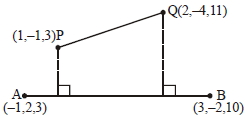
0 likesView Solution
124
MathematicsDifficultMCQJEE Main · 2020
If a function $f(x)$ defined by $f(x)=\begin{cases} a e^{x}+b e^{-x}, & -1 \leq x<1 \\ c x^{2}, & 1 \leq x \leq 3 \\ a x^{2}+2 c x, & 3 < x \leq 4 \end{cases}$ is continuous for some $a, b, c \in R$ and $f'(0)+f'(2)=e$,then the value of $a$ is:
A
$\frac{e}{e^{2}-3 e-13}$
B
$\frac{e}{e^{2}+3 e+13}$
C
$\frac{1}{e^{2}-3 e+13}$
D
$\frac{e}{e^{2}-3 e+13}$
Solution
(D) Given $f(x)$ is continuous at $x=1$ and $x=3$.
For continuity at $x=1$: $\lim_{x \rightarrow 1^{-}} f(x) = \lim_{x \rightarrow 1^{+}} f(x) \Rightarrow a e + b e^{-1} = c(1)^2 \Rightarrow a e + b/e = c \Rightarrow b = c e - a e^2 \quad (1)$.
For continuity at $x=3$: $\lim_{x \rightarrow 3^{-}} f(x) = \lim_{x \rightarrow 3^{+}} f(x) \Rightarrow c(3)^2 = a(3)^2 + 2c(3) \Rightarrow 9c = 9a + 6c \Rightarrow 3c = 9a \Rightarrow c = 3a \quad (2)$.
Substitute $(2)$ into $(1)$: $b = (3a)e - a e^2 = a(3e - e^2) \quad (3)$.
Now,$f^{\prime}(x) = \begin{cases} a e^x - b e^{-x}, & -1 < x < 1 \\ 2cx, & 1 < x < 3 \\ 2ax + 2c, & 3 < x < 4 \end{cases}$.
Given $f^{\prime}(0) + f^{\prime}(2) = e$.
$f^{\prime}(0) = a e^0 - b e^0 = a - b$.
$f^{\prime}(2) = 2c(2) = 4c$.
So,$a - b + 4c = e$.
Substitute $b = 3ae - ae^2$ and $c = 3a$ into the equation:
$a - (3ae - ae^2) + 4(3a) = e$.
$a - 3ae + ae^2 + 12a = e$.
$a(e^2 - 3e + 13) = e$.
Therefore,$a = \frac{e}{e^2 - 3e + 13}$.
For continuity at $x=1$: $\lim_{x \rightarrow 1^{-}} f(x) = \lim_{x \rightarrow 1^{+}} f(x) \Rightarrow a e + b e^{-1} = c(1)^2 \Rightarrow a e + b/e = c \Rightarrow b = c e - a e^2 \quad (1)$.
For continuity at $x=3$: $\lim_{x \rightarrow 3^{-}} f(x) = \lim_{x \rightarrow 3^{+}} f(x) \Rightarrow c(3)^2 = a(3)^2 + 2c(3) \Rightarrow 9c = 9a + 6c \Rightarrow 3c = 9a \Rightarrow c = 3a \quad (2)$.
Substitute $(2)$ into $(1)$: $b = (3a)e - a e^2 = a(3e - e^2) \quad (3)$.
Now,$f^{\prime}(x) = \begin{cases} a e^x - b e^{-x}, & -1 < x < 1 \\ 2cx, & 1 < x < 3 \\ 2ax + 2c, & 3 < x < 4 \end{cases}$.
Given $f^{\prime}(0) + f^{\prime}(2) = e$.
$f^{\prime}(0) = a e^0 - b e^0 = a - b$.
$f^{\prime}(2) = 2c(2) = 4c$.
So,$a - b + 4c = e$.
Substitute $b = 3ae - ae^2$ and $c = 3a$ into the equation:
$a - (3ae - ae^2) + 4(3a) = e$.
$a - 3ae + ae^2 + 12a = e$.
$a(e^2 - 3e + 13) = e$.
Therefore,$a = \frac{e}{e^2 - 3e + 13}$.
0 likesView Solution
125
MathematicsDifficultMCQJEE Main · 2020
Box $I$ contains $30$ cards numbered $1$ to $30$ and Box $II$ contains $20$ cards numbered $31$ to $50$. $A$ box is selected at random and a card is drawn from it. The number on the card is found to be a non-prime number. The probability that the card was drawn from Box $I$ is
A
$\frac{8}{17}$
B
$\frac{2}{3}$
C
$\frac{4}{17}$
D
$\frac{2}{5}$
Solution
(A) Let $B_{1}$ be the event that Box-$I$ is selected and $B_{2}$ be the event that Box-$II$ is selected.
$P(B_{1}) = P(B_{2}) = \frac{1}{2}$.
Let $E$ be the event that the selected card is a non-prime number.
In Box-$I$ (cards $1$ to $30$),the prime numbers are $\{2, 3, 5, 7, 11, 13, 17, 19, 23, 29\}$ ($10$ primes). Thus,there are $30 - 10 = 20$ non-prime numbers. So,$P(E|B_{1}) = \frac{20}{30} = \frac{2}{3}$.
In Box-$II$ (cards $31$ to $50$),the prime numbers are $\{31, 37, 41, 43, 47\}$ ($5$ primes). Thus,there are $20 - 5 = 15$ non-prime numbers. So,$P(E|B_{2}) = \frac{15}{20} = \frac{3}{4}$.
Using Bayes' Theorem,the probability that the card was drawn from Box-$I$ given it is non-prime is:
$P(B_{1}|E) = \frac{P(B_{1})P(E|B_{1})}{P(B_{1})P(E|B_{1}) + P(B_{2})P(E|B_{2})}$
$P(B_{1}|E) = \frac{\frac{1}{2} \times \frac{2}{3}}{\frac{1}{2} \times \frac{2}{3} + \frac{1}{2} \times \frac{3}{4}} = \frac{\frac{1}{3}}{\frac{1}{3} + \frac{3}{8}} = \frac{\frac{1}{3}}{\frac{8+9}{24}} = \frac{1}{3} \times \frac{24}{17} = \frac{8}{17}$.
$P(B_{1}) = P(B_{2}) = \frac{1}{2}$.
Let $E$ be the event that the selected card is a non-prime number.
In Box-$I$ (cards $1$ to $30$),the prime numbers are $\{2, 3, 5, 7, 11, 13, 17, 19, 23, 29\}$ ($10$ primes). Thus,there are $30 - 10 = 20$ non-prime numbers. So,$P(E|B_{1}) = \frac{20}{30} = \frac{2}{3}$.
In Box-$II$ (cards $31$ to $50$),the prime numbers are $\{31, 37, 41, 43, 47\}$ ($5$ primes). Thus,there are $20 - 5 = 15$ non-prime numbers. So,$P(E|B_{2}) = \frac{15}{20} = \frac{3}{4}$.
Using Bayes' Theorem,the probability that the card was drawn from Box-$I$ given it is non-prime is:
$P(B_{1}|E) = \frac{P(B_{1})P(E|B_{1})}{P(B_{1})P(E|B_{1}) + P(B_{2})P(E|B_{2})}$
$P(B_{1}|E) = \frac{\frac{1}{2} \times \frac{2}{3}}{\frac{1}{2} \times \frac{2}{3} + \frac{1}{2} \times \frac{3}{4}} = \frac{\frac{1}{3}}{\frac{1}{3} + \frac{3}{8}} = \frac{\frac{1}{3}}{\frac{8+9}{24}} = \frac{1}{3} \times \frac{24}{17} = \frac{8}{17}$.
0 likesView Solution
126
MathematicsMediumMCQJEE Main · 2020
The area (in sq. units) of the region outside $\frac{|x|}{2}+\frac{|y|}{3}=1$ and inside the ellipse $\frac{x^{2}}{4}+\frac{y^{2}}{9}=1$ is
A
$3(4-\pi)$
B
$6(\pi-2)$
C
$3(\pi-2)$
D
$6(4-\pi)$
Solution
(B) The given equations are $\frac{|x|}{2}+\frac{|y|}{3}=1$ (a rhombus) and $\frac{x^{2}}{4}+\frac{y^{2}}{9}=1$ (an ellipse).
The area of the ellipse is given by $A_{e} = \pi ab = \pi \times 2 \times 3 = 6\pi$.
The region $\frac{|x|}{2}+\frac{|y|}{3}=1$ represents a rhombus with vertices at $(\pm 2, 0)$ and $(0, \pm 3)$.
The area of this rhombus is $A_{r} = \frac{1}{2} \times d_{1} \times d_{2} = \frac{1}{2} \times 4 \times 6 = 12$.
The required area is the area inside the ellipse but outside the rhombus,which is $A = A_{e} - A_{r} = 6\pi - 12 = 6(\pi - 2)$.
The area of the ellipse is given by $A_{e} = \pi ab = \pi \times 2 \times 3 = 6\pi$.
The region $\frac{|x|}{2}+\frac{|y|}{3}=1$ represents a rhombus with vertices at $(\pm 2, 0)$ and $(0, \pm 3)$.
The area of this rhombus is $A_{r} = \frac{1}{2} \times d_{1} \times d_{2} = \frac{1}{2} \times 4 \times 6 = 12$.
The required area is the area inside the ellipse but outside the rhombus,which is $A = A_{e} - A_{r} = 6\pi - 12 = 6(\pi - 2)$.
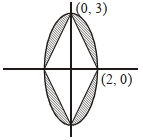
0 likesView Solution
127
MathematicsMediumMCQJEE Main · 2020
Let $S$ be the set of all $\lambda \in \mathbb{R}$ for which the system of linear equations
$2x - y + 2z = 2$
$x - 2y + \lambda z = -4$
$x + \lambda y + z = 4$
has no solution. Then the set $S$
$2x - y + 2z = 2$
$x - 2y + \lambda z = -4$
$x + \lambda y + z = 4$
has no solution. Then the set $S$
A
contains more than two elements.
B
is a singleton.
C
contains exactly two elements.
D
is an empty set.
Solution
(C) For a system of linear equations to have no solution,the determinant of the coefficient matrix $D$ must be $0$,and at least one of the Cramer's determinants $(D_x, D_y, D_z)$ must be non-zero.
The determinant $D$ is given by:
$D = \begin{vmatrix} 2 & -1 & 2 \\ 1 & -2 & \lambda \\ 1 & \lambda & 1 \end{vmatrix} = 2(-2 - \lambda^2) + 1(1 - \lambda) + 2(\lambda + 2) = -4 - 2\lambda^2 + 1 - \lambda + 2\lambda + 4 = -2\lambda^2 + \lambda + 1$
Setting $D = 0$:
$-2\lambda^2 + \lambda + 1 = 0 \Rightarrow 2\lambda^2 - \lambda - 1 = 0 \Rightarrow (2\lambda + 1)(\lambda - 1) = 0$
Thus,$\lambda = 1$ or $\lambda = -\frac{1}{2}$.
Now,check $D_x$ for these values:
$D_x = \begin{vmatrix} 2 & -1 & 2 \\ -4 & -2 & \lambda \\ 4 & \lambda & 1 \end{vmatrix} = 2(-2 - \lambda^2) + 1(-4 - 4\lambda) + 2(-4\lambda + 8) = -4 - 2\lambda^2 - 4 - 4\lambda - 8\lambda + 16 = -2\lambda^2 - 12\lambda + 8$
For $\lambda = 1$,$D_x = -2 - 12 + 8 = -6 \neq 0$.
For $\lambda = -\frac{1}{2}$,$D_x = -2(\frac{1}{4}) - 12(-\frac{1}{2}) + 8 = -0.5 + 6 + 8 = 13.5 \neq 0$.
Since $D=0$ and $D_x \neq 0$ for both values,the system has no solution for both $\lambda = 1$ and $\lambda = -\frac{1}{2}$.
Therefore,$S = \{1, -\frac{1}{2}\}$,which contains exactly two elements.
The determinant $D$ is given by:
$D = \begin{vmatrix} 2 & -1 & 2 \\ 1 & -2 & \lambda \\ 1 & \lambda & 1 \end{vmatrix} = 2(-2 - \lambda^2) + 1(1 - \lambda) + 2(\lambda + 2) = -4 - 2\lambda^2 + 1 - \lambda + 2\lambda + 4 = -2\lambda^2 + \lambda + 1$
Setting $D = 0$:
$-2\lambda^2 + \lambda + 1 = 0 \Rightarrow 2\lambda^2 - \lambda - 1 = 0 \Rightarrow (2\lambda + 1)(\lambda - 1) = 0$
Thus,$\lambda = 1$ or $\lambda = -\frac{1}{2}$.
Now,check $D_x$ for these values:
$D_x = \begin{vmatrix} 2 & -1 & 2 \\ -4 & -2 & \lambda \\ 4 & \lambda & 1 \end{vmatrix} = 2(-2 - \lambda^2) + 1(-4 - 4\lambda) + 2(-4\lambda + 8) = -4 - 2\lambda^2 - 4 - 4\lambda - 8\lambda + 16 = -2\lambda^2 - 12\lambda + 8$
For $\lambda = 1$,$D_x = -2 - 12 + 8 = -6 \neq 0$.
For $\lambda = -\frac{1}{2}$,$D_x = -2(\frac{1}{4}) - 12(-\frac{1}{2}) + 8 = -0.5 + 6 + 8 = 13.5 \neq 0$.
Since $D=0$ and $D_x \neq 0$ for both values,the system has no solution for both $\lambda = 1$ and $\lambda = -\frac{1}{2}$.
Therefore,$S = \{1, -\frac{1}{2}\}$,which contains exactly two elements.
0 likesView Solution
128
MathematicsDifficultMCQJEE Main · 2020
Let $A$ be a $2 \times 2$ real matrix with entries from $\{0, 1\}$ and $|A| \neq 0$. Consider the following two statements:
$(P)$ If $A \neq I_{2}$,then $|A| = -1$
$(Q)$ If $|A| = 1$,then $\operatorname{tr}(A) = 2$
where $I_{2}$ denotes the $2 \times 2$ identity matrix and $\operatorname{tr}(A)$ denotes the sum of the diagonal entries of $A$. Then:
$(P)$ If $A \neq I_{2}$,then $|A| = -1$
$(Q)$ If $|A| = 1$,then $\operatorname{tr}(A) = 2$
where $I_{2}$ denotes the $2 \times 2$ identity matrix and $\operatorname{tr}(A)$ denotes the sum of the diagonal entries of $A$. Then:
A
$(P)$ is true and $(Q)$ is false
B
Both $(P)$ and $(Q)$ are false
C
Both $(P)$ and $(Q)$ are true
D
$(P)$ is false and $(Q)$ is true
Solution
(D) Given $A$ is a $2 \times 2$ matrix with entries from $\{0, 1\}$ and $|A| \neq 0$.
For statement $(P)$: If $A \neq I_{2}$,then $|A| = -1$.
Consider $A = \begin{bmatrix} 1 & 1 \\ 0 & 1 \end{bmatrix}$. Here $A \neq I_{2}$ and $|A| = (1)(1) - (1)(0) = 1$.
Since we found a case where $A \neq I_{2}$ but $|A| = 1$,statement $(P)$ is false.
For statement $(Q)$: If $|A| = 1$,then $\operatorname{tr}(A) = 2$.
The possible $2 \times 2$ matrices with entries from $\{0, 1\}$ such that $|A| = 1$ are:
$A_1 = \begin{bmatrix} 1 & 0 \\ 0 & 1 \end{bmatrix} \implies \operatorname{tr}(A_1) = 1+1 = 2$
$A_2 = \begin{bmatrix} 1 & 1 \\ 0 & 1 \end{bmatrix} \implies \operatorname{tr}(A_2) = 1+1 = 2$
$A_3 = \begin{bmatrix} 1 & 0 \\ 1 & 1 \end{bmatrix} \implies \operatorname{tr}(A_3) = 1+1 = 2$
In all cases where $|A| = 1$,the trace is $2$. Thus,statement $(Q)$ is true.
Therefore,$(P)$ is false and $(Q)$ is true.
For statement $(P)$: If $A \neq I_{2}$,then $|A| = -1$.
Consider $A = \begin{bmatrix} 1 & 1 \\ 0 & 1 \end{bmatrix}$. Here $A \neq I_{2}$ and $|A| = (1)(1) - (1)(0) = 1$.
Since we found a case where $A \neq I_{2}$ but $|A| = 1$,statement $(P)$ is false.
For statement $(Q)$: If $|A| = 1$,then $\operatorname{tr}(A) = 2$.
The possible $2 \times 2$ matrices with entries from $\{0, 1\}$ such that $|A| = 1$ are:
$A_1 = \begin{bmatrix} 1 & 0 \\ 0 & 1 \end{bmatrix} \implies \operatorname{tr}(A_1) = 1+1 = 2$
$A_2 = \begin{bmatrix} 1 & 1 \\ 0 & 1 \end{bmatrix} \implies \operatorname{tr}(A_2) = 1+1 = 2$
$A_3 = \begin{bmatrix} 1 & 0 \\ 1 & 1 \end{bmatrix} \implies \operatorname{tr}(A_3) = 1+1 = 2$
In all cases where $|A| = 1$,the trace is $2$. Thus,statement $(Q)$ is true.
Therefore,$(P)$ is false and $(Q)$ is true.
0 likesView Solution
129
MathematicsDifficultMCQJEE Main · 2020
Let $y=y(x)$ be the solution of the differential equation $\frac{2+\sin x}{y+1} \cdot \frac{dy}{dx} = -\cos x$,where $y > 0$ and $y(0) = 1$. If $y(\pi) = a$ and $\frac{dy}{dx}$ at $x = \pi$ is $b$,then the ordered pair $(a, b)$ is equal to:
A
$(2, 1)$
B
$(2, 3/2)$
C
$(1, -1)$
D
$(1, 1)$
Solution
(D) Given the differential equation: $\frac{2+\sin x}{y+1} \frac{dy}{dx} = -\cos x$.
Separating the variables,we get: $\frac{dy}{y+1} = \frac{-\cos x}{2+\sin x} dx$.
Integrating both sides: $\int \frac{dy}{y+1} = -\int \frac{\cos x}{2+\sin x} dx$.
This gives: $\ln(y+1) = -\ln(2+\sin x) + C$.
Using the initial condition $y(0) = 1$: $\ln(1+1) = -\ln(2+\sin 0) + C \Rightarrow \ln 2 = -\ln 2 + C \Rightarrow C = 2\ln 2 = \ln 4$.
Thus,$\ln(y+1) = \ln\left(\frac{4}{2+\sin x}\right)$,which implies $y+1 = \frac{4}{2+\sin x}$,or $y(x) = \frac{4}{2+\sin x} - 1$.
For $x = \pi$,$a = y(\pi) = \frac{4}{2+\sin \pi} - 1 = \frac{4}{2} - 1 = 1$.
Now,find $b = \frac{dy}{dx}$ at $x = \pi$: $\frac{dy}{dx} = \frac{-\cos x}{2+\sin x} (y+1) = \frac{-\cos x}{2+\sin x} \left(\frac{4}{2+\sin x}\right) = \frac{-4\cos x}{(2+\sin x)^2}$.
At $x = \pi$,$b = \frac{-4\cos \pi}{(2+\sin \pi)^2} = \frac{-4(-1)}{(2+0)^2} = \frac{4}{4} = 1$.
Therefore,the ordered pair $(a, b) = (1, 1)$.
Separating the variables,we get: $\frac{dy}{y+1} = \frac{-\cos x}{2+\sin x} dx$.
Integrating both sides: $\int \frac{dy}{y+1} = -\int \frac{\cos x}{2+\sin x} dx$.
This gives: $\ln(y+1) = -\ln(2+\sin x) + C$.
Using the initial condition $y(0) = 1$: $\ln(1+1) = -\ln(2+\sin 0) + C \Rightarrow \ln 2 = -\ln 2 + C \Rightarrow C = 2\ln 2 = \ln 4$.
Thus,$\ln(y+1) = \ln\left(\frac{4}{2+\sin x}\right)$,which implies $y+1 = \frac{4}{2+\sin x}$,or $y(x) = \frac{4}{2+\sin x} - 1$.
For $x = \pi$,$a = y(\pi) = \frac{4}{2+\sin \pi} - 1 = \frac{4}{2} - 1 = 1$.
Now,find $b = \frac{dy}{dx}$ at $x = \pi$: $\frac{dy}{dx} = \frac{-\cos x}{2+\sin x} (y+1) = \frac{-\cos x}{2+\sin x} \left(\frac{4}{2+\sin x}\right) = \frac{-4\cos x}{(2+\sin x)^2}$.
At $x = \pi$,$b = \frac{-4\cos \pi}{(2+\sin \pi)^2} = \frac{-4(-1)}{(2+0)^2} = \frac{4}{4} = 1$.
Therefore,the ordered pair $(a, b) = (1, 1)$.
0 likesView Solution
130
MathematicsMediumMCQJEE Main · 2020
If the tangent to the curve $y=x+\sin y$ at a point $(a, b)$ is parallel to the line joining $\left(0, \frac{3}{2}\right)$ and $\left(\frac{1}{2}, 2\right),$ then
A
$b=a$
B
$b=\frac{\pi}{2}+a$
C
$|b-a|=1$
D
$|a+b|=1$
Solution
(C) The slope of the line joining $\left(0, \frac{3}{2}\right)$ and $\left(\frac{1}{2}, 2\right)$ is $m = \frac{2 - \frac{3}{2}}{\frac{1}{2} - 0} = \frac{\frac{1}{2}}{\frac{1}{2}} = 1$.
Since the tangent at $(a, b)$ is parallel to this line,the slope of the tangent $\left. \frac{dy}{dx} \right|_{(a, b)} = 1$.
Differentiating the curve $y = x + \sin y$ with respect to $x$,we get $\frac{dy}{dx} = 1 + \cos y \cdot \frac{dy}{dx}$.
Substituting the point $(a, b)$ and the slope $1$,we have $1 = 1 + \cos b \cdot (1)$.
This implies $\cos b = 0$,which means $\sin b = \pm 1$.
Since $(a, b)$ lies on the curve,$b = a + \sin b$.
Therefore,$b - a = \sin b$.
Taking the absolute value on both sides,$|b - a| = |\sin b| = 1$.
Since the tangent at $(a, b)$ is parallel to this line,the slope of the tangent $\left. \frac{dy}{dx} \right|_{(a, b)} = 1$.
Differentiating the curve $y = x + \sin y$ with respect to $x$,we get $\frac{dy}{dx} = 1 + \cos y \cdot \frac{dy}{dx}$.
Substituting the point $(a, b)$ and the slope $1$,we have $1 = 1 + \cos b \cdot (1)$.
This implies $\cos b = 0$,which means $\sin b = \pm 1$.
Since $(a, b)$ lies on the curve,$b = a + \sin b$.
Therefore,$b - a = \sin b$.
Taking the absolute value on both sides,$|b - a| = |\sin b| = 1$.
0 likesView Solution
131
MathematicsMediumMCQJEE Main · 2020
Let $P(h, k)$ be a point on the curve $y=x^{2}+7x+2$ nearest to the line $y=3x-3$. Then the equation of the normal to the curve at $P$ is:
A
$x+3y-62=0$
B
$x-3y-11=0$
C
$x-3y+22=0$
D
$x+3y+26=0$
Solution
(D) The point $P$ on the curve $y=x^{2}+7x+2$ nearest to the line $y=3x-3$ is the point where the tangent to the curve is parallel to the given line.
$1$. Find the slope of the tangent at any point $(x, y)$ on the curve:
$\frac{dy}{dx} = \frac{d}{dx}(x^{2}+7x+2) = 2x+7$
$2$. Since the tangent is parallel to the line $y=3x-3$,its slope must be equal to the slope of the line,which is $3$:
$2x+7 = 3$
$2x = -4$
$x = -2$
$3$. Find the $y$-coordinate of $P$ by substituting $x=-2$ into the curve equation:
$y = (-2)^{2} + 7(-2) + 2 = 4 - 14 + 2 = -8$
So,the point $P$ is $(-2, -8)$.
$4$. The normal at $P$ is perpendicular to the tangent. The slope of the tangent is $3$,so the slope of the normal is $-\frac{1}{3}$.
$5$. The equation of the normal at $P(-2, -8)$ with slope $m = -\frac{1}{3}$ is:
$y - (-8) = -\frac{1}{3}(x - (-2))$
$y + 8 = -\frac{1}{3}(x + 2)$
$3(y + 8) = -(x + 2)$
$3y + 24 = -x - 2$
$x + 3y + 26 = 0$
$1$. Find the slope of the tangent at any point $(x, y)$ on the curve:
$\frac{dy}{dx} = \frac{d}{dx}(x^{2}+7x+2) = 2x+7$
$2$. Since the tangent is parallel to the line $y=3x-3$,its slope must be equal to the slope of the line,which is $3$:
$2x+7 = 3$
$2x = -4$
$x = -2$
$3$. Find the $y$-coordinate of $P$ by substituting $x=-2$ into the curve equation:
$y = (-2)^{2} + 7(-2) + 2 = 4 - 14 + 2 = -8$
So,the point $P$ is $(-2, -8)$.
$4$. The normal at $P$ is perpendicular to the tangent. The slope of the tangent is $3$,so the slope of the normal is $-\frac{1}{3}$.
$5$. The equation of the normal at $P(-2, -8)$ with slope $m = -\frac{1}{3}$ is:
$y - (-8) = -\frac{1}{3}(x - (-2))$
$y + 8 = -\frac{1}{3}(x + 2)$
$3(y + 8) = -(x + 2)$
$3y + 24 = -x - 2$
$x + 3y + 26 = 0$
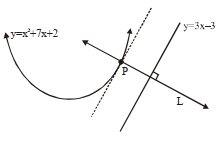
0 likesView Solution
132
MathematicsDifficultMCQJEE Main · 2020
The plane passing through the points $(1, 2, 1), (2, 1, 2)$ and parallel to the line $2x = 3y, z = 1$ also passes through the point:
A
$(0, 6, -2)$
B
$(-2, 0, 1)$
C
$(0, -6, 2)$
D
$(2, 0, -1)$
Solution
(B) The given line is $2x = 3y, z = 1$,which can be written as $\frac{x}{3} = \frac{y}{2}, z = 1$. The direction vector of this line is $\vec{v} = 3\hat{i} + 2\hat{j} + 0\hat{k}$.
The plane passes through points $A(1, 2, 1)$ and $B(2, 1, 2)$. The vector $\vec{AB} = (2-1)\hat{i} + (1-2)\hat{j} + (2-1)\hat{k} = \hat{i} - \hat{j} + \hat{k}$.
The normal vector $\vec{n}$ to the plane is given by the cross product of $\vec{AB}$ and $\vec{v}$:
$\vec{n} = \vec{AB} \times \vec{v} = \begin{vmatrix} \hat{i} & \hat{j} & \hat{k} \\ 1 & -1 & 1 \\ 3 & 2 & 0 \end{vmatrix} = \hat{i}(0-2) - \hat{j}(0-3) + \hat{k}(2+3) = -2\hat{i} + 3\hat{j} + 5\hat{k}$.
The equation of the plane passing through $(1, 2, 1)$ with normal $\vec{n} = -2\hat{i} + 3\hat{j} + 5\hat{k}$ is:
$-2(x-1) + 3(y-2) + 5(z-1) = 0$
$-2x + 2 + 3y - 6 + 5z - 5 = 0$
$-2x + 3y + 5z - 9 = 0$ or $2x - 3y - 5z + 9 = 0$.
Now,check the options:
For $(-2, 0, 1)$: $2(-2) - 3(0) - 5(1) + 9 = -4 - 0 - 5 + 9 = 0$.
Thus,the plane passes through $(-2, 0, 1)$.
The plane passes through points $A(1, 2, 1)$ and $B(2, 1, 2)$. The vector $\vec{AB} = (2-1)\hat{i} + (1-2)\hat{j} + (2-1)\hat{k} = \hat{i} - \hat{j} + \hat{k}$.
The normal vector $\vec{n}$ to the plane is given by the cross product of $\vec{AB}$ and $\vec{v}$:
$\vec{n} = \vec{AB} \times \vec{v} = \begin{vmatrix} \hat{i} & \hat{j} & \hat{k} \\ 1 & -1 & 1 \\ 3 & 2 & 0 \end{vmatrix} = \hat{i}(0-2) - \hat{j}(0-3) + \hat{k}(2+3) = -2\hat{i} + 3\hat{j} + 5\hat{k}$.
The equation of the plane passing through $(1, 2, 1)$ with normal $\vec{n} = -2\hat{i} + 3\hat{j} + 5\hat{k}$ is:
$-2(x-1) + 3(y-2) + 5(z-1) = 0$
$-2x + 2 + 3y - 6 + 5z - 5 = 0$
$-2x + 3y + 5z - 9 = 0$ or $2x - 3y - 5z + 9 = 0$.
Now,check the options:
For $(-2, 0, 1)$: $2(-2) - 3(0) - 5(1) + 9 = -4 - 0 - 5 + 9 = 0$.
Thus,the plane passes through $(-2, 0, 1)$.
0 likesView Solution
133
MathematicsDifficultMCQJEE Main · 2020
The domain of the function $f(x) = \sin^{-1}\left(\frac{|x|+5}{x^2+1}\right)$ is $(-\infty, -a] \cup [a, \infty)$. Then $a$ is equal to
A
$\frac{1+\sqrt{17}}{2}$
B
$\frac{\sqrt{17}-1}{2}$
C
$\frac{\sqrt{17}}{2}+1$
D
$\frac{\sqrt{17}}{2}$
Solution
(A) For the function $f(x) = \sin^{-1}\left(\frac{|x|+5}{x^2+1}\right)$ to be defined,the argument must satisfy $-1 \leq \frac{|x|+5}{x^2+1} \leq 1$.
Since $|x|+5 > 0$ and $x^2+1 > 0$ for all $x \in \mathbb{R}$,the condition $\frac{|x|+5}{x^2+1} \geq -1$ is always satisfied.
Thus,we only need to solve $\frac{|x|+5}{x^2+1} \leq 1$.
Multiplying by $x^2+1$ (which is positive),we get $|x|+5 \leq x^2+1$.
Rearranging the terms,we have $x^2 - |x| - 4 \geq 0$.
Let $t = |x|$,where $t \geq 0$. Then $t^2 - t - 4 \geq 0$.
The roots of $t^2 - t - 4 = 0$ are $t = \frac{1 \pm \sqrt{1 - 4(1)(-4)}}{2} = \frac{1 \pm \sqrt{17}}{2}$.
Since $t = |x| \geq 0$,we must have $t \geq \frac{1+\sqrt{17}}{2}$.
Therefore,$|x| \geq \frac{1+\sqrt{17}}{2}$,which implies $x \in \left(-\infty, -\frac{1+\sqrt{17}}{2}\right] \cup \left[\frac{1+\sqrt{17}}{2}, \infty\right)$.
Comparing this with the given domain $(-\infty, -a] \cup [a, \infty)$,we find $a = \frac{1+\sqrt{17}}{2}$.
Since $|x|+5 > 0$ and $x^2+1 > 0$ for all $x \in \mathbb{R}$,the condition $\frac{|x|+5}{x^2+1} \geq -1$ is always satisfied.
Thus,we only need to solve $\frac{|x|+5}{x^2+1} \leq 1$.
Multiplying by $x^2+1$ (which is positive),we get $|x|+5 \leq x^2+1$.
Rearranging the terms,we have $x^2 - |x| - 4 \geq 0$.
Let $t = |x|$,where $t \geq 0$. Then $t^2 - t - 4 \geq 0$.
The roots of $t^2 - t - 4 = 0$ are $t = \frac{1 \pm \sqrt{1 - 4(1)(-4)}}{2} = \frac{1 \pm \sqrt{17}}{2}$.
Since $t = |x| \geq 0$,we must have $t \geq \frac{1+\sqrt{17}}{2}$.
Therefore,$|x| \geq \frac{1+\sqrt{17}}{2}$,which implies $x \in \left(-\infty, -\frac{1+\sqrt{17}}{2}\right] \cup \left[\frac{1+\sqrt{17}}{2}, \infty\right)$.
Comparing this with the given domain $(-\infty, -a] \cup [a, \infty)$,we find $a = \frac{1+\sqrt{17}}{2}$.
0 likesView Solution
134
MathematicsDifficultMCQJEE Main · 2020
If $p(x)$ is a polynomial of degree three that has a local maximum value $8$ at $x=1$ and a local minimum value $4$ at $x=2$,then $p(0)$ is equal to:
A
$12$
B
$-24$
C
$06$
D
$-12$
Solution
(D) Since $p(x)$ has relative extrema at $x=1$ and $x=2$,we have $p'(x) = 0$ at $x=1$ and $x=2$.
Thus,$p'(x) = A(x-1)(x-2) = A(x^2 - 3x + 2)$.
Integrating $p'(x)$,we get $p(x) = A(\frac{x^3}{3} - \frac{3x^2}{2} + 2x) + C$.
Given $p(1) = 8$,we have $8 = A(\frac{1}{3} - \frac{3}{2} + 2) + C = A(\frac{2-9+12}{6}) + C = \frac{5A}{6} + C$,so $48 = 5A + 6C$ (Equation $1$).
Given $p(2) = 4$,we have $4 = A(\frac{8}{3} - 6 + 4) + C = A(\frac{8-6}{3}) + C = \frac{2A}{3} + C$,so $12 = 2A + 3C$ (Equation $2$).
Multiplying Equation $2$ by $2$,we get $24 = 4A + 6C$.
Subtracting this from Equation $1$,we get $48 - 24 = (5A - 4A) + (6C - 6C)$,which gives $A = 24$.
Substituting $A = 24$ into Equation $2$,we get $12 = 2(24) + 3C$,so $12 = 48 + 3C$,which implies $3C = -36$,so $C = -12$.
Since $p(0) = C$,we have $p(0) = -12$.
Thus,$p'(x) = A(x-1)(x-2) = A(x^2 - 3x + 2)$.
Integrating $p'(x)$,we get $p(x) = A(\frac{x^3}{3} - \frac{3x^2}{2} + 2x) + C$.
Given $p(1) = 8$,we have $8 = A(\frac{1}{3} - \frac{3}{2} + 2) + C = A(\frac{2-9+12}{6}) + C = \frac{5A}{6} + C$,so $48 = 5A + 6C$ (Equation $1$).
Given $p(2) = 4$,we have $4 = A(\frac{8}{3} - 6 + 4) + C = A(\frac{8-6}{3}) + C = \frac{2A}{3} + C$,so $12 = 2A + 3C$ (Equation $2$).
Multiplying Equation $2$ by $2$,we get $24 = 4A + 6C$.
Subtracting this from Equation $1$,we get $48 - 24 = (5A - 4A) + (6C - 6C)$,which gives $A = 24$.
Substituting $A = 24$ into Equation $2$,we get $12 = 2(24) + 3C$,so $12 = 48 + 3C$,which implies $3C = -36$,so $C = -12$.
Since $p(0) = C$,we have $p(0) = -12$.
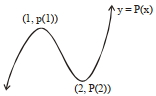
0 likesView Solution
135
MathematicsDifficultMCQJEE Main · 2020
The integral $\int_{0}^{2} ||x-1|-x| dx$ is equal to (in $.5$)
A
$1$
B
$2$
C
$0$
D
$3$
Solution
(A) Let $f(x) = ||x-1|-x|$.
We analyze the expression inside the absolute value:
If $x \geq 1$,then $|x-1| = x-1$,so $f(x) = |(x-1)-x| = |-1| = 1$.
If $x < 1$,then $|x-1| = 1-x$,so $f(x) = |(1-x)-x| = |1-2x|$.
Thus,$f(x) = \begin{cases} |1-2x|, & 0 \leq x < 1 \\ 1, & 1 \leq x \leq 2 \end{cases}$.
Now,we evaluate the integral:
$\int_{0}^{2} f(x) dx = \int_{0}^{1} |1-2x| dx + \int_{1}^{2} 1 dx$.
For the first part,$|1-2x| = 1-2x$ when $x \leq 1/2$ and $2x-1$ when $x > 1/2$:
$\int_{0}^{1} |1-2x| dx = \int_{0}^{1/2} (1-2x) dx + \int_{1/2}^{1} (2x-1) dx$
$= [x-x^2]_{0}^{1/2} + [x^2-x]_{1/2}^{1}$
$= (1/2 - 1/4) - 0 + (1-1) - (1/4 - 1/2) = 1/4 + 1/4 = 1/2$.
For the second part:
$\int_{1}^{2} 1 dx = [x]_{1}^{2} = 2-1 = 1$.
Total integral = $1/2 + 1 = 1.5$.
We analyze the expression inside the absolute value:
If $x \geq 1$,then $|x-1| = x-1$,so $f(x) = |(x-1)-x| = |-1| = 1$.
If $x < 1$,then $|x-1| = 1-x$,so $f(x) = |(1-x)-x| = |1-2x|$.
Thus,$f(x) = \begin{cases} |1-2x|, & 0 \leq x < 1 \\ 1, & 1 \leq x \leq 2 \end{cases}$.
Now,we evaluate the integral:
$\int_{0}^{2} f(x) dx = \int_{0}^{1} |1-2x| dx + \int_{1}^{2} 1 dx$.
For the first part,$|1-2x| = 1-2x$ when $x \leq 1/2$ and $2x-1$ when $x > 1/2$:
$\int_{0}^{1} |1-2x| dx = \int_{0}^{1/2} (1-2x) dx + \int_{1/2}^{1} (2x-1) dx$
$= [x-x^2]_{0}^{1/2} + [x^2-x]_{1/2}^{1}$
$= (1/2 - 1/4) - 0 + (1-1) - (1/4 - 1/2) = 1/4 + 1/4 = 1/2$.
For the second part:
$\int_{1}^{2} 1 dx = [x]_{1}^{2} = 2-1 = 1$.
Total integral = $1/2 + 1 = 1.5$.
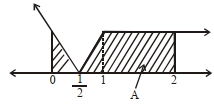
0 likesView Solution
136
MathematicsDifficultMCQJEE Main · 2020
Let $\vec{a}, \vec{b}$ and $\vec{c}$ be three unit vectors such that $|\vec{a}-\vec{b}|^{2}+|\vec{a}-\vec{c}|^{2}=8$. Then $|\vec{a}+2\vec{b}|^{2}+|\vec{a}+2\vec{c}|^{2}$ is equal to
A
$1$
B
$2$
C
$4$
D
$6$
Solution
(B) Given that $\vec{a}, \vec{b}, \vec{c}$ are unit vectors,so $|\vec{a}| = |\vec{b}| = |\vec{c}| = 1$.
Expanding the given equation $|\vec{a}-\vec{b}|^{2}+|\vec{a}-\vec{c}|^{2}=8$:
$(|\vec{a}|^{2} + |\vec{b}|^{2} - 2\vec{a}\cdot\vec{b}) + (|\vec{a}|^{2} + |\vec{c}|^{2} - 2\vec{a}\cdot\vec{c}) = 8$
Since $|\vec{a}|^{2} = |\vec{b}|^{2} = |\vec{c}|^{2} = 1$,we have:
$(1 + 1 - 2\vec{a}\cdot\vec{b}) + (1 + 1 - 2\vec{a}\cdot\vec{c}) = 8$
$4 - 2(\vec{a}\cdot\vec{b} + \vec{a}\cdot\vec{c}) = 8$
$-2(\vec{a}\cdot\vec{b} + \vec{a}\cdot\vec{c}) = 4$
$\vec{a}\cdot\vec{b} + \vec{a}\cdot\vec{c} = -2$
Now,evaluate $|\vec{a}+2\vec{b}|^{2}+|\vec{a}+2\vec{c}|^{2}$:
$= (|\vec{a}|^{2} + 4|\vec{b}|^{2} + 4\vec{a}\cdot\vec{b}) + (|\vec{a}|^{2} + 4|\vec{c}|^{2} + 4\vec{a}\cdot\vec{c})$
$= (1 + 4 + 4\vec{a}\cdot\vec{b}) + (1 + 4 + 4\vec{a}\cdot\vec{c})$
$= 10 + 4(\vec{a}\cdot\vec{b} + \vec{a}\cdot\vec{c})$
Substitute the value $\vec{a}\cdot\vec{b} + \vec{a}\cdot\vec{c} = -2$:
$= 10 + 4(-2) = 10 - 8 = 2$.
Expanding the given equation $|\vec{a}-\vec{b}|^{2}+|\vec{a}-\vec{c}|^{2}=8$:
$(|\vec{a}|^{2} + |\vec{b}|^{2} - 2\vec{a}\cdot\vec{b}) + (|\vec{a}|^{2} + |\vec{c}|^{2} - 2\vec{a}\cdot\vec{c}) = 8$
Since $|\vec{a}|^{2} = |\vec{b}|^{2} = |\vec{c}|^{2} = 1$,we have:
$(1 + 1 - 2\vec{a}\cdot\vec{b}) + (1 + 1 - 2\vec{a}\cdot\vec{c}) = 8$
$4 - 2(\vec{a}\cdot\vec{b} + \vec{a}\cdot\vec{c}) = 8$
$-2(\vec{a}\cdot\vec{b} + \vec{a}\cdot\vec{c}) = 4$
$\vec{a}\cdot\vec{b} + \vec{a}\cdot\vec{c} = -2$
Now,evaluate $|\vec{a}+2\vec{b}|^{2}+|\vec{a}+2\vec{c}|^{2}$:
$= (|\vec{a}|^{2} + 4|\vec{b}|^{2} + 4\vec{a}\cdot\vec{b}) + (|\vec{a}|^{2} + 4|\vec{c}|^{2} + 4\vec{a}\cdot\vec{c})$
$= (1 + 4 + 4\vec{a}\cdot\vec{b}) + (1 + 4 + 4\vec{a}\cdot\vec{c})$
$= 10 + 4(\vec{a}\cdot\vec{b} + \vec{a}\cdot\vec{c})$
Substitute the value $\vec{a}\cdot\vec{b} + \vec{a}\cdot\vec{c} = -2$:
$= 10 + 4(-2) = 10 - 8 = 2$.
0 likesView Solution
137
MathematicsDifficultMCQJEE Main · 2020
Let $f: R \rightarrow R$ be a function which satisfies $f(x+y)=f(x)+f(y)$ for all $x, y \in R$. If $f(1)=2$ and $g(n)=\sum_{k=1}^{n-1} f(k)$ for $n \in N$,then the value of $n$ for which $g(n)=20$ is:
A
$5$
B
$9$
C
$20$
D
$4$
Solution
(A) Given the functional equation $f(x+y)=f(x)+f(y)$,this is Cauchy's functional equation,which implies $f(x)=cx$ for some constant $c$.
Since $f(1)=2$,we have $c(1)=2$,so $c=2$. Thus,$f(x)=2x$.
Now,we calculate $g(n) = \sum_{k=1}^{n-1} f(k) = \sum_{k=1}^{n-1} 2k$.
Using the sum formula $\sum_{k=1}^{m} k = \frac{m(m+1)}{2}$,we get $g(n) = 2 \times \frac{(n-1)n}{2} = n(n-1)$.
We are given $g(n)=20$,so $n(n-1)=20$.
$n^2 - n - 20 = 0$.
$(n-5)(n+4) = 0$.
Since $n \in N$,we must have $n=5$.
Since $f(1)=2$,we have $c(1)=2$,so $c=2$. Thus,$f(x)=2x$.
Now,we calculate $g(n) = \sum_{k=1}^{n-1} f(k) = \sum_{k=1}^{n-1} 2k$.
Using the sum formula $\sum_{k=1}^{m} k = \frac{m(m+1)}{2}$,we get $g(n) = 2 \times \frac{(n-1)n}{2} = n(n-1)$.
We are given $g(n)=20$,so $n(n-1)=20$.
$n^2 - n - 20 = 0$.
$(n-5)(n+4) = 0$.
Since $n \in N$,we must have $n=5$.
0 likesView Solution
138
MathematicsDifficultMCQJEE Main · 2020
Let $a, b, c \in \mathbb{R}$ be all non-zero and satisfy $a^{3}+b^{3}+c^{3}=2$. If the matrix $A=\begin{bmatrix} a & b & c \\ b & c & a \\ c & a & b \end{bmatrix}$ satisfies $A^{T} A=I$,then a value of $abc$ can be
A
$\frac{2}{3}$
B
$-\frac{1}{3}$
C
$3$
D
$\frac{1}{3}$
Solution
(D) Given $A^{T} A = I$,the matrix $A$ is an orthogonal matrix.
For the matrix $A = \begin{bmatrix} a & b & c \\ b & c & a \\ c & a & b \end{bmatrix}$,the condition $A^{T} A = I$ implies:
$a^2 + b^2 + c^2 = 1$
$ab + bc + ca = 0$
We know the identity: $(a+b+c)^2 = a^2 + b^2 + c^2 + 2(ab + bc + ca) = 1 + 2(0) = 1$.
Thus,$a+b+c = \pm 1$.
Using the algebraic identity: $a^3 + b^3 + c^3 - 3abc = (a+b+c)(a^2 + b^2 + c^2 - (ab + bc + ca))$.
Substituting the known values: $2 - 3abc = (\pm 1)(1 - 0) = \pm 1$.
Case $1$: $2 - 3abc = 1 \Rightarrow 3abc = 1 \Rightarrow abc = \frac{1}{3}$.
Case $2$: $2 - 3abc = -1 \Rightarrow 3abc = 3 \Rightarrow abc = 1$.
Comparing with the given options,the possible value is $\frac{1}{3}$.
For the matrix $A = \begin{bmatrix} a & b & c \\ b & c & a \\ c & a & b \end{bmatrix}$,the condition $A^{T} A = I$ implies:
$a^2 + b^2 + c^2 = 1$
$ab + bc + ca = 0$
We know the identity: $(a+b+c)^2 = a^2 + b^2 + c^2 + 2(ab + bc + ca) = 1 + 2(0) = 1$.
Thus,$a+b+c = \pm 1$.
Using the algebraic identity: $a^3 + b^3 + c^3 - 3abc = (a+b+c)(a^2 + b^2 + c^2 - (ab + bc + ca))$.
Substituting the known values: $2 - 3abc = (\pm 1)(1 - 0) = \pm 1$.
Case $1$: $2 - 3abc = 1 \Rightarrow 3abc = 1 \Rightarrow abc = \frac{1}{3}$.
Case $2$: $2 - 3abc = -1 \Rightarrow 3abc = 3 \Rightarrow abc = 1$.
Comparing with the given options,the possible value is $\frac{1}{3}$.
0 likesView Solution
139
MathematicsDifficultMCQJEE Main · 2020
Let $f:(-1, \infty) \rightarrow \mathbb{R}$ be defined by $f(0)=1$ and $f(x)=\frac{1}{x} \ln(1+x), x \neq 0$. Then the function $f$
A
decreases in $(-1, \infty)$
B
decreases in $(-1,0)$ and increases in $(0, \infty)$
C
increases in $(-1, \infty)$
D
increases in $(-1,0)$ and decreases in $(0, \infty)$
Solution
(A) For $x \neq 0$,$f'(x) = \frac{d}{dx} \left( \frac{\ln(1+x)}{x} \right) = \frac{x \cdot \frac{1}{1+x} - \ln(1+x)}{x^2} = \frac{x - (1+x)\ln(1+x)}{x^2(1+x)}$.
Let $h(x) = x - (1+x)\ln(1+x)$.
Then $h'(x) = 1 - [\ln(1+x) + (1+x) \cdot \frac{1}{1+x}] = 1 - \ln(1+x) - 1 = -\ln(1+x)$.
For $x \in (-1, 0)$,$1+x \in (0, 1)$,so $\ln(1+x) < 0$,which implies $h'(x) > 0$.
For $x \in (0, \infty)$,$1+x > 1$,so $\ln(1+x) > 0$,which implies $h'(x) < 0$.
Since $h(0) = 0 - (1)\ln(1) = 0$,$h(x)$ increases on $(-1, 0)$ and decreases on $(0, \infty)$.
Thus,$h(x) < h(0) = 0$ for all $x \in (-1, \infty) \setminus \{0\}$.
Since $x^2(1+x) > 0$ for all $x \in (-1, \infty) \setminus \{0\}$,$f'(x) = \frac{h(x)}{x^2(1+x)} < 0$ for all $x \in (-1, \infty) \setminus \{0\}$.
Therefore,the function $f$ is strictly decreasing on $(-1, \infty)$.
Let $h(x) = x - (1+x)\ln(1+x)$.
Then $h'(x) = 1 - [\ln(1+x) + (1+x) \cdot \frac{1}{1+x}] = 1 - \ln(1+x) - 1 = -\ln(1+x)$.
For $x \in (-1, 0)$,$1+x \in (0, 1)$,so $\ln(1+x) < 0$,which implies $h'(x) > 0$.
For $x \in (0, \infty)$,$1+x > 1$,so $\ln(1+x) > 0$,which implies $h'(x) < 0$.
Since $h(0) = 0 - (1)\ln(1) = 0$,$h(x)$ increases on $(-1, 0)$ and decreases on $(0, \infty)$.
Thus,$h(x) < h(0) = 0$ for all $x \in (-1, \infty) \setminus \{0\}$.
Since $x^2(1+x) > 0$ for all $x \in (-1, \infty) \setminus \{0\}$,$f'(x) = \frac{h(x)}{x^2(1+x)} < 0$ for all $x \in (-1, \infty) \setminus \{0\}$.
Therefore,the function $f$ is strictly decreasing on $(-1, \infty)$.
0 likesView Solution
140
MathematicsDifficultMCQJEE Main · 2020
The equation of the normal to the curve $y=(1+x)^{2y}+\cos^{2}(\sin^{-1} x)$ at $x=0$ is
A
$y=4x+2$
B
$x+4y=8$
C
$y+4x=2$
D
$2y+x=4$
Solution
(B) Given the equation of the curve $y=(1+x)^{2y}+\cos^{2}(\sin^{-1} x)$.
At $x=0$,$y=(1+0)^{2y}+\cos^{2}(\sin^{-1} 0) = 1+1 = 2$.
So,we need to find the normal at the point $(0, 2)$.
Rewrite the equation as $y=e^{2y \ln(1+x)} + (1-x^2)$.
Differentiating with respect to $x$:
$y' = e^{2y \ln(1+x)} \left[ 2y \cdot \frac{1}{1+x} + \ln(1+x) \cdot 2y' \right] - 2x$.
Substituting $x=0$ and $y=2$:
$y' = e^{2(2) \ln(1)} \left[ 2(2) \cdot \frac{1}{1+0} + \ln(1) \cdot 2y' \right] - 2(0)$.
$y' = e^0 [4 + 0] - 0 = 4$.
Thus,the slope of the tangent $m_t = 4$.
The slope of the normal $m_n = -\frac{1}{m_t} = -\frac{1}{4}$.
The equation of the normal at $(0, 2)$ is $y - 2 = -\frac{1}{4}(x - 0)$.
$4y - 8 = -x$,which simplifies to $x + 4y = 8$.
At $x=0$,$y=(1+0)^{2y}+\cos^{2}(\sin^{-1} 0) = 1+1 = 2$.
So,we need to find the normal at the point $(0, 2)$.
Rewrite the equation as $y=e^{2y \ln(1+x)} + (1-x^2)$.
Differentiating with respect to $x$:
$y' = e^{2y \ln(1+x)} \left[ 2y \cdot \frac{1}{1+x} + \ln(1+x) \cdot 2y' \right] - 2x$.
Substituting $x=0$ and $y=2$:
$y' = e^{2(2) \ln(1)} \left[ 2(2) \cdot \frac{1}{1+0} + \ln(1) \cdot 2y' \right] - 2(0)$.
$y' = e^0 [4 + 0] - 0 = 4$.
Thus,the slope of the tangent $m_t = 4$.
The slope of the normal $m_n = -\frac{1}{m_t} = -\frac{1}{4}$.
The equation of the normal at $(0, 2)$ is $y - 2 = -\frac{1}{4}(x - 0)$.
$4y - 8 = -x$,which simplifies to $x + 4y = 8$.
0 likesView Solution
141
MathematicsDifficultMCQJEE Main · 2020
$A$ plane passing through the point $(3,1,1)$ contains two lines whose direction ratios are $1, -2, 2$ and $2, 3, -1$ respectively. If this plane also passes through the point $(\alpha, -3, 5)$,then $\alpha$ is equal to
A
$-10$
B
$5$
C
$10$
D
$-5$
Solution
(B) The normal vector $\overrightarrow{n}$ to the plane is perpendicular to both lines. Thus,$\overrightarrow{n}$ is the cross product of the direction vectors of the two lines:
$\overrightarrow{n} = (\hat{i} - 2\hat{j} + 2\hat{k}) \times (2\hat{i} + 3\hat{j} - \hat{k})$
$\overrightarrow{n} = \begin{vmatrix} \hat{i} & \hat{j} & \hat{k} \\ 1 & -2 & 2 \\ 2 & 3 & -1 \end{vmatrix} = \hat{i}(2 - 6) - \hat{j}(-1 - 4) + \hat{k}(3 + 4) = -4\hat{i} + 5\hat{j} + 7\hat{k}$
The equation of the plane passing through $(3, 1, 1)$ with normal vector $\overrightarrow{n} = -4\hat{i} + 5\hat{j} + 7\hat{k}$ is:
$-4(x - 3) + 5(y - 1) + 7(z - 1) = 0$
$-4x + 12 + 5y - 5 + 7z - 7 = 0$
$-4x + 5y + 7z = 0$
Since the plane passes through $(\alpha, -3, 5)$,we substitute these coordinates into the plane equation:
$-4(\alpha) + 5(-3) + 7(5) = 0$
$-4\alpha - 15 + 35 = 0$
$-4\alpha + 20 = 0$
$4\alpha = 20$
$\alpha = 5$
$\overrightarrow{n} = (\hat{i} - 2\hat{j} + 2\hat{k}) \times (2\hat{i} + 3\hat{j} - \hat{k})$
$\overrightarrow{n} = \begin{vmatrix} \hat{i} & \hat{j} & \hat{k} \\ 1 & -2 & 2 \\ 2 & 3 & -1 \end{vmatrix} = \hat{i}(2 - 6) - \hat{j}(-1 - 4) + \hat{k}(3 + 4) = -4\hat{i} + 5\hat{j} + 7\hat{k}$
The equation of the plane passing through $(3, 1, 1)$ with normal vector $\overrightarrow{n} = -4\hat{i} + 5\hat{j} + 7\hat{k}$ is:
$-4(x - 3) + 5(y - 1) + 7(z - 1) = 0$
$-4x + 12 + 5y - 5 + 7z - 7 = 0$
$-4x + 5y + 7z = 0$
Since the plane passes through $(\alpha, -3, 5)$,we substitute these coordinates into the plane equation:
$-4(\alpha) + 5(-3) + 7(5) = 0$
$-4\alpha - 15 + 35 = 0$
$-4\alpha + 20 = 0$
$4\alpha = 20$
$\alpha = 5$
0 likesView Solution
142
MathematicsDifficultMCQJEE Main · 2020
Let $E^{C}$ denote the complement of an event $E$. Let $E_{1}, E_{2}$ and $E_{3}$ be any pairwise independent events with $P(E_{1}) > 0$ and $P(E_{1} \cap E_{2} \cap E_{3}) = 0$. Then $P(E_{2}^{C} \cap E_{3}^{C} / E_{1})$ is equal to
A
$P(E_{3}^{C}) - P(E_{2})$
B
$P(E_{2}^{C}) + P(E_{3})$
C
$P(E_{3}^{C}) - P(E_{2}^{C})$
D
$P(E_{3}) - P(E_{2}^{C})$
Solution
(A) Given that $E_{1}, E_{2}, E_{3}$ are pairwise independent events,we have $P(E_{1} \cap E_{2}) = P(E_{1})P(E_{2})$,$P(E_{2} \cap E_{3}) = P(E_{2})P(E_{3})$,and $P(E_{3} \cap E_{1}) = P(E_{3})P(E_{1})$.
Also,$P(E_{1} \cap E_{2} \cap E_{3}) = 0$.
We need to find $P(E_{2}^{C} \cap E_{3}^{C} | E_{1})$.
Using the definition of conditional probability,$P(E_{2}^{C} \cap E_{3}^{C} | E_{1}) = \frac{P(E_{1} \cap E_{2}^{C} \cap E_{3}^{C})}{P(E_{1})}$.
By De Morgan's Law,$E_{2}^{C} \cap E_{3}^{C} = (E_{2} \cup E_{3})^{C}$.
Thus,$E_{1} \cap (E_{2} \cup E_{3})^{C} = E_{1} \setminus (E_{1} \cap (E_{2} \cup E_{3})) = E_{1} \setminus ((E_{1} \cap E_{2}) \cup (E_{1} \cap E_{3}))$.
Using the inclusion-exclusion principle for probability,$P(E_{1} \cap (E_{2} \cup E_{3})) = P(E_{1} \cap E_{2}) + P(E_{1} \cap E_{3}) - P(E_{1} \cap E_{2} \cap E_{3})$.
Substituting the given values,$P(E_{1} \cap (E_{2} \cup E_{3})) = P(E_{1})P(E_{2}) + P(E_{1})P(E_{3}) - 0 = P(E_{1})(P(E_{2}) + P(E_{3}))$.
Therefore,$P(E_{1} \cap E_{2}^{C} \cap E_{3}^{C}) = P(E_{1}) - P(E_{1} \cap (E_{2} \cup E_{3})) = P(E_{1}) - P(E_{1})(P(E_{2}) + P(E_{3})) = P(E_{1})(1 - P(E_{2}) - P(E_{3}))$.
Finally,$P(E_{2}^{C} \cap E_{3}^{C} | E_{1}) = \frac{P(E_{1})(1 - P(E_{2}) - P(E_{3}))}{P(E_{1})} = 1 - P(E_{2}) - P(E_{3}) = (1 - P(E_{3})) - P(E_{2}) = P(E_{3}^{C}) - P(E_{2})$.
Also,$P(E_{1} \cap E_{2} \cap E_{3}) = 0$.
We need to find $P(E_{2}^{C} \cap E_{3}^{C} | E_{1})$.
Using the definition of conditional probability,$P(E_{2}^{C} \cap E_{3}^{C} | E_{1}) = \frac{P(E_{1} \cap E_{2}^{C} \cap E_{3}^{C})}{P(E_{1})}$.
By De Morgan's Law,$E_{2}^{C} \cap E_{3}^{C} = (E_{2} \cup E_{3})^{C}$.
Thus,$E_{1} \cap (E_{2} \cup E_{3})^{C} = E_{1} \setminus (E_{1} \cap (E_{2} \cup E_{3})) = E_{1} \setminus ((E_{1} \cap E_{2}) \cup (E_{1} \cap E_{3}))$.
Using the inclusion-exclusion principle for probability,$P(E_{1} \cap (E_{2} \cup E_{3})) = P(E_{1} \cap E_{2}) + P(E_{1} \cap E_{3}) - P(E_{1} \cap E_{2} \cap E_{3})$.
Substituting the given values,$P(E_{1} \cap (E_{2} \cup E_{3})) = P(E_{1})P(E_{2}) + P(E_{1})P(E_{3}) - 0 = P(E_{1})(P(E_{2}) + P(E_{3}))$.
Therefore,$P(E_{1} \cap E_{2}^{C} \cap E_{3}^{C}) = P(E_{1}) - P(E_{1} \cap (E_{2} \cup E_{3})) = P(E_{1}) - P(E_{1})(P(E_{2}) + P(E_{3})) = P(E_{1})(1 - P(E_{2}) - P(E_{3}))$.
Finally,$P(E_{2}^{C} \cap E_{3}^{C} | E_{1}) = \frac{P(E_{1})(1 - P(E_{2}) - P(E_{3}))}{P(E_{1})} = 1 - P(E_{2}) - P(E_{3}) = (1 - P(E_{3})) - P(E_{2}) = P(E_{3}^{C}) - P(E_{2})$.
0 likesView Solution
143
MathematicsDifficultMCQJEE Main · 2020
Let $A = \{X = (x, y, z)^{T} : PX = 0 \text{ and } x^{2} + y^{2} + z^{2} = 1\}$ where $P = \begin{bmatrix} 1 & 2 & 1 \\ -2 & 3 & -4 \\ 1 & 9 & -1 \end{bmatrix}$,then the set $A$:
A
is a singleton
B
contains exactly two elements
C
contains more than two elements
D
is an empty set
Solution
(B) Given $P = \begin{bmatrix} 1 & 2 & 1 \\ -2 & 3 & -4 \\ 1 & 9 & -1 \end{bmatrix}$.
First,we find the determinant of $P$:
$|P| = 1(-3 + 36) - 2(2 + 4) + 1(-18 - 3) = 33 - 12 - 21 = 0$.
Since $|P| = 0$,the system $PX = 0$ has non-trivial solutions.
The equations are:
$x + 2y + z = 0$ $(i)$
$-2x + 3y - 4z = 0$ (ii)
$x + 9y - z = 0$ (iii)
From $(i)$ and (iii),adding them gives $2x + 11y = 0 \Rightarrow x = -\frac{11}{2}y$.
Substituting $x$ into $(i)$: $-\frac{11}{2}y + 2y + z = 0 \Rightarrow z = \frac{7}{2}y$.
Let $y = \lambda$,then $x = -\frac{11}{2}\lambda$ and $z = \frac{7}{2}\lambda$.
Given $x^{2} + y^{2} + z^{2} = 1$,we substitute the values:
$(-\frac{11}{2}\lambda)^{2} + \lambda^{2} + (\frac{7}{2}\lambda)^{2} = 1$
$\frac{121}{4}\lambda^{2} + \lambda^{2} + \frac{49}{4}\lambda^{2} = 1$
$\frac{121 + 4 + 49}{4}\lambda^{2} = 1 \Rightarrow \frac{174}{4}\lambda^{2} = 1 \Rightarrow \lambda^{2} = \frac{4}{174} = \frac{2}{87}$.
Since $\lambda^{2} = \frac{2}{87}$,there are two possible values for $\lambda$ $(\lambda = \pm \sqrt{\frac{2}{87}})$.
Thus,there are exactly two solutions for $(x, y, z)$.
First,we find the determinant of $P$:
$|P| = 1(-3 + 36) - 2(2 + 4) + 1(-18 - 3) = 33 - 12 - 21 = 0$.
Since $|P| = 0$,the system $PX = 0$ has non-trivial solutions.
The equations are:
$x + 2y + z = 0$ $(i)$
$-2x + 3y - 4z = 0$ (ii)
$x + 9y - z = 0$ (iii)
From $(i)$ and (iii),adding them gives $2x + 11y = 0 \Rightarrow x = -\frac{11}{2}y$.
Substituting $x$ into $(i)$: $-\frac{11}{2}y + 2y + z = 0 \Rightarrow z = \frac{7}{2}y$.
Let $y = \lambda$,then $x = -\frac{11}{2}\lambda$ and $z = \frac{7}{2}\lambda$.
Given $x^{2} + y^{2} + z^{2} = 1$,we substitute the values:
$(-\frac{11}{2}\lambda)^{2} + \lambda^{2} + (\frac{7}{2}\lambda)^{2} = 1$
$\frac{121}{4}\lambda^{2} + \lambda^{2} + \frac{49}{4}\lambda^{2} = 1$
$\frac{121 + 4 + 49}{4}\lambda^{2} = 1 \Rightarrow \frac{174}{4}\lambda^{2} = 1 \Rightarrow \lambda^{2} = \frac{4}{174} = \frac{2}{87}$.
Since $\lambda^{2} = \frac{2}{87}$,there are two possible values for $\lambda$ $(\lambda = \pm \sqrt{\frac{2}{87}})$.
Thus,there are exactly two solutions for $(x, y, z)$.
0 likesView Solution
144
MathematicsDifficultMCQJEE Main · 2020
Consider a region $R=\{(x, y) \in \mathbb{R}^{2}: x^{2} \leq y \leq 2 x\}$. If a line $y=\alpha$ divides the area of region $R$ into two equal parts,then which of the following is true?
A
$\alpha^{3}-6 \alpha^{2}+16=0$
B
$3 \alpha^{2}-8 \alpha+8=0$
C
$\alpha^{3}-6 \alpha^{3 / 2}-16=0$
D
$3 \alpha^{2}-8 \alpha^{3 / 2}+8=0$
Solution
(D) The region $R$ is bounded by the parabola $y=x^{2}$ and the line $y=2x$. The intersection points are found by $x^{2}=2x$,which gives $x=0$ and $x=2$. Thus,the points are $(0,0)$ and $(2,4)$.
The total area $A$ of region $R$ is given by:
$A = \int_{0}^{2} (2x - x^{2}) dx = [x^{2} - \frac{x^{3}}{3}]_{0}^{2} = 4 - \frac{8}{3} = \frac{4}{3}$.
Alternatively,integrating with respect to $y$,the region is bounded by $x = \sqrt{y}$ (right) and $x = y/2$ (left) for $y \in [0, 4]$:
$A = \int_{0}^{4} (\sqrt{y} - \frac{y}{2}) dy = [\frac{2}{3}y^{3/2} - \frac{y^{2}}{4}]_{0}^{4} = \frac{2}{3}(8) - \frac{16}{4} = \frac{16}{3} - 4 = \frac{4}{3}$.
The line $y=\alpha$ divides the area into two equal parts. The area of the lower part (from $y=0$ to $y=\alpha$) is half of the total area:
$\int_{0}^{\alpha} (\sqrt{y} - \frac{y}{2}) dy = \frac{1}{2} \times \frac{4}{3} = \frac{2}{3}$.
Evaluating the integral:
$[\frac{2}{3}y^{3/2} - \frac{y^{2}}{4}]_{0}^{\alpha} = \frac{2}{3} \Rightarrow \frac{2}{3}\alpha^{3/2} - \frac{\alpha^{2}}{4} = \frac{2}{3}$.
Multiplying by $12$ to clear the denominators:
$8\alpha^{3/2} - 3\alpha^{2} = 8 \Rightarrow 3\alpha^{2} - 8\alpha^{3/2} + 8 = 0$.
The total area $A$ of region $R$ is given by:
$A = \int_{0}^{2} (2x - x^{2}) dx = [x^{2} - \frac{x^{3}}{3}]_{0}^{2} = 4 - \frac{8}{3} = \frac{4}{3}$.
Alternatively,integrating with respect to $y$,the region is bounded by $x = \sqrt{y}$ (right) and $x = y/2$ (left) for $y \in [0, 4]$:
$A = \int_{0}^{4} (\sqrt{y} - \frac{y}{2}) dy = [\frac{2}{3}y^{3/2} - \frac{y^{2}}{4}]_{0}^{4} = \frac{2}{3}(8) - \frac{16}{4} = \frac{16}{3} - 4 = \frac{4}{3}$.
The line $y=\alpha$ divides the area into two equal parts. The area of the lower part (from $y=0$ to $y=\alpha$) is half of the total area:
$\int_{0}^{\alpha} (\sqrt{y} - \frac{y}{2}) dy = \frac{1}{2} \times \frac{4}{3} = \frac{2}{3}$.
Evaluating the integral:
$[\frac{2}{3}y^{3/2} - \frac{y^{2}}{4}]_{0}^{\alpha} = \frac{2}{3} \Rightarrow \frac{2}{3}\alpha^{3/2} - \frac{\alpha^{2}}{4} = \frac{2}{3}$.
Multiplying by $12$ to clear the denominators:
$8\alpha^{3/2} - 3\alpha^{2} = 8 \Rightarrow 3\alpha^{2} - 8\alpha^{3/2} + 8 = 0$.
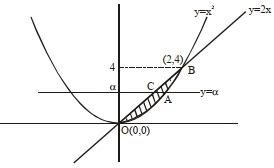
0 likesView Solution
145
MathematicsDifficultMCQJEE Main · 2020
If a curve $y=f(x),$ passing through the point $(1,2),$ is the solution of the differential equation $2 x^{2} dy=\left(2 xy+y^{2}\right) dx,$ then $f\left(\frac{1}{2}\right)$ is equal to
A
$\frac{1}{1-\log _{e} 2}$
B
$\frac{1}{1+\log _{e} 2}$
C
$\frac{-1}{1+\log _{e} 2}$
D
$1+\log _{e} 2$
Solution
(B) Given differential equation: $2 x^{2} dy = (2 xy + y^{2}) dx$
$\frac{dy}{dx} = \frac{2xy + y^{2}}{2x^{2}}$
This is a homogeneous differential equation. Let $y = vx$,then $\frac{dy}{dx} = v + x\frac{dv}{dx}$.
Substituting these into the equation:
$v + x\frac{dv}{dx} = \frac{2x(vx) + (vx)^{2}}{2x^{2}} = \frac{2x^{2}v + x^{2}v^{2}}{2x^{2}} = v + \frac{v^{2}}{2}$
$x\frac{dv}{dx} = \frac{v^{2}}{2}$
Separating variables:
$\frac{2}{v^{2}} dv = \frac{1}{x} dx$
Integrating both sides:
$\int 2v^{-2} dv = \int \frac{1}{x} dx$
$-2v^{-1} = \ln|x| + C$
$-\frac{2}{v} = \ln|x| + C$
Since $v = \frac{y}{x}$,we have $-\frac{2x}{y} = \ln|x| + C$.
The curve passes through $(1, 2)$,so substitute $x=1, y=2$:
$-\frac{2(1)}{2} = \ln(1) + C \Rightarrow -1 = 0 + C \Rightarrow C = -1$.
Thus,$-\frac{2x}{y} = \ln|x| - 1$,which implies $\frac{2x}{y} = 1 - \ln x$.
$y = \frac{2x}{1 - \ln x} \Rightarrow f(x) = \frac{2x}{1 - \ln x}$.
Now,calculate $f\left(\frac{1}{2}\right)$:
$f\left(\frac{1}{2}\right) = \frac{2(\frac{1}{2})}{1 - \ln(\frac{1}{2})} = \frac{1}{1 - (\ln 1 - \ln 2)} = \frac{1}{1 - (0 - \ln 2)} = \frac{1}{1 + \ln 2}$.
$\frac{dy}{dx} = \frac{2xy + y^{2}}{2x^{2}}$
This is a homogeneous differential equation. Let $y = vx$,then $\frac{dy}{dx} = v + x\frac{dv}{dx}$.
Substituting these into the equation:
$v + x\frac{dv}{dx} = \frac{2x(vx) + (vx)^{2}}{2x^{2}} = \frac{2x^{2}v + x^{2}v^{2}}{2x^{2}} = v + \frac{v^{2}}{2}$
$x\frac{dv}{dx} = \frac{v^{2}}{2}$
Separating variables:
$\frac{2}{v^{2}} dv = \frac{1}{x} dx$
Integrating both sides:
$\int 2v^{-2} dv = \int \frac{1}{x} dx$
$-2v^{-1} = \ln|x| + C$
$-\frac{2}{v} = \ln|x| + C$
Since $v = \frac{y}{x}$,we have $-\frac{2x}{y} = \ln|x| + C$.
The curve passes through $(1, 2)$,so substitute $x=1, y=2$:
$-\frac{2(1)}{2} = \ln(1) + C \Rightarrow -1 = 0 + C \Rightarrow C = -1$.
Thus,$-\frac{2x}{y} = \ln|x| - 1$,which implies $\frac{2x}{y} = 1 - \ln x$.
$y = \frac{2x}{1 - \ln x} \Rightarrow f(x) = \frac{2x}{1 - \ln x}$.
Now,calculate $f\left(\frac{1}{2}\right)$:
$f\left(\frac{1}{2}\right) = \frac{2(\frac{1}{2})}{1 - \ln(\frac{1}{2})} = \frac{1}{1 - (\ln 1 - \ln 2)} = \frac{1}{1 - (0 - \ln 2)} = \frac{1}{1 + \ln 2}$.
0 likesView Solution
146
MathematicsMediumMCQJEE Main · 2020
If $y = \sum_{k=1}^{6} k \cos^{-1} \left\{ \frac{3}{5} \cos kx - \frac{4}{5} \sin kx \right\}$,then $\frac{dy}{dx}$ at $x = 0$ is
A
$90$
B
$91$
C
$88$
D
$89$
Solution
(B) Let $\cos \alpha = \frac{3}{5}$ and $\sin \alpha = \frac{4}{5}$,where $0 < \alpha < \frac{\pi}{2}$.
The expression inside the $\cos^{-1}$ function is $\frac{3}{5} \cos kx - \frac{4}{5} \sin kx$.
Using the trigonometric identity $\cos(A+B) = \cos A \cos B - \sin A \sin B$,we get $\cos \alpha \cos kx - \sin \alpha \sin kx = \cos(\alpha + kx)$.
Thus,$y = \sum_{k=1}^{6} k \cos^{-1}(\cos(\alpha + kx))$.
For values of $x$ near $0$,$\cos^{-1}(\cos(\alpha + kx)) = \alpha + kx$.
Therefore,$y = \sum_{k=1}^{6} k(\alpha + kx) = \sum_{k=1}^{6} (k\alpha + k^2 x)$.
Differentiating with respect to $x$,we get $\frac{dy}{dx} = \sum_{k=1}^{6} k^2$.
At $x = 0$,$\frac{dy}{dx} = \sum_{k=1}^{6} k^2 = 1^2 + 2^2 + 3^2 + 4^2 + 5^2 + 6^2$.
Using the sum of squares formula $\sum_{k=1}^{n} k^2 = \frac{n(n+1)(2n+1)}{6}$,for $n=6$:
$\frac{6(7)(13)}{6} = 91$.
The expression inside the $\cos^{-1}$ function is $\frac{3}{5} \cos kx - \frac{4}{5} \sin kx$.
Using the trigonometric identity $\cos(A+B) = \cos A \cos B - \sin A \sin B$,we get $\cos \alpha \cos kx - \sin \alpha \sin kx = \cos(\alpha + kx)$.
Thus,$y = \sum_{k=1}^{6} k \cos^{-1}(\cos(\alpha + kx))$.
For values of $x$ near $0$,$\cos^{-1}(\cos(\alpha + kx)) = \alpha + kx$.
Therefore,$y = \sum_{k=1}^{6} k(\alpha + kx) = \sum_{k=1}^{6} (k\alpha + k^2 x)$.
Differentiating with respect to $x$,we get $\frac{dy}{dx} = \sum_{k=1}^{6} k^2$.
At $x = 0$,$\frac{dy}{dx} = \sum_{k=1}^{6} k^2 = 1^2 + 2^2 + 3^2 + 4^2 + 5^2 + 6^2$.
Using the sum of squares formula $\sum_{k=1}^{n} k^2 = \frac{n(n+1)(2n+1)}{6}$,for $n=6$:
$\frac{6(7)(13)}{6} = 91$.
0 likesView Solution
147
MathematicsDifficultMCQJEE Main · 2020
Let the position vectors of points $A$ and $B$ be $\hat{i}+\hat{j}+\hat{k}$ and $2\hat{i}+\hat{j}+3\hat{k},$ respectively. $A$ point $P$ divides the line segment $AB$ internally in the ratio $\lambda:1$ $(\lambda>0)$. If $O$ is the origin and $\overrightarrow{OB} \cdot \overrightarrow{OP}-3|\overrightarrow{OA} \times \overrightarrow{OP}|^{2}=6,$ then $\lambda$ is equal to
A
$0.6$
B
$0.7$
C
$0.8$
D
$0.5$
Solution
(C) Using the section formula,the position vector of point $P$ is given by:
$\overrightarrow{OP} = \frac{\lambda(2\hat{i}+\hat{j}+3\hat{k}) + 1(\hat{i}+\hat{j}+\hat{k})}{\lambda+1} = \frac{2\lambda+1}{\lambda+1}\hat{i} + \frac{\lambda+1}{\lambda+1}\hat{j} + \frac{3\lambda+1}{\lambda+1}\hat{k}$
Now,calculate $\overrightarrow{OB} \cdot \overrightarrow{OP}$:
$\overrightarrow{OB} \cdot \overrightarrow{OP} = (2\hat{i}+\hat{j}+3\hat{k}) \cdot \left( \frac{2\lambda+1}{\lambda+1}\hat{i} + \hat{j} + \frac{3\lambda+1}{\lambda+1}\hat{k} \right) = \frac{4\lambda+2 + \lambda+1 + 9\lambda+3}{\lambda+1} = \frac{14\lambda+6}{\lambda+1}$
Next,calculate $\overrightarrow{OA} \times \overrightarrow{OP}$:
$\overrightarrow{OA} \times \overrightarrow{OP} = \begin{vmatrix} \hat{i} & \hat{j} & \hat{k} \\ 1 & 1 & 1 \\ \frac{2\lambda+1}{\lambda+1} & 1 & \frac{3\lambda+1}{\lambda+1} \end{vmatrix} = \left( \frac{3\lambda+1}{\lambda+1} - 1 \right)\hat{i} - \left( \frac{3\lambda+1}{\lambda+1} - \frac{2\lambda+1}{\lambda+1} \right)\hat{j} + \left( 1 - \frac{2\lambda+1}{\lambda+1} \right)\hat{k}$
$= \frac{2\lambda}{\lambda+1}\hat{i} - \frac{\lambda}{\lambda+1}\hat{j} - \frac{\lambda}{\lambda+1}\hat{k}$
$|\overrightarrow{OA} \times \overrightarrow{OP}|^{2} = \frac{4\lambda^{2} + \lambda^{2} + \lambda^{2}}{(\lambda+1)^{2}} = \frac{6\lambda^{2}}{(\lambda+1)^{2}}$
Substituting these into the given equation:
$\frac{14\lambda+6}{\lambda+1} - 3 \left( \frac{6\lambda^{2}}{(\lambda+1)^{2}} \right) = 6$
Multiply by $(\lambda+1)^{2}$:
$(14\lambda+6)(\lambda+1) - 18\lambda^{2} = 6(\lambda+1)^{2}$
$14\lambda^{2} + 20\lambda + 6 - 18\lambda^{2} = 6(\lambda^{2} + 2\lambda + 1)$
$-4\lambda^{2} + 20\lambda + 6 = 6\lambda^{2} + 12\lambda + 6$
$10\lambda^{2} - 8\lambda = 0$
Since $\lambda > 0$,we have $10\lambda = 8 \Rightarrow \lambda = 0.8$.
$\overrightarrow{OP} = \frac{\lambda(2\hat{i}+\hat{j}+3\hat{k}) + 1(\hat{i}+\hat{j}+\hat{k})}{\lambda+1} = \frac{2\lambda+1}{\lambda+1}\hat{i} + \frac{\lambda+1}{\lambda+1}\hat{j} + \frac{3\lambda+1}{\lambda+1}\hat{k}$
Now,calculate $\overrightarrow{OB} \cdot \overrightarrow{OP}$:
$\overrightarrow{OB} \cdot \overrightarrow{OP} = (2\hat{i}+\hat{j}+3\hat{k}) \cdot \left( \frac{2\lambda+1}{\lambda+1}\hat{i} + \hat{j} + \frac{3\lambda+1}{\lambda+1}\hat{k} \right) = \frac{4\lambda+2 + \lambda+1 + 9\lambda+3}{\lambda+1} = \frac{14\lambda+6}{\lambda+1}$
Next,calculate $\overrightarrow{OA} \times \overrightarrow{OP}$:
$\overrightarrow{OA} \times \overrightarrow{OP} = \begin{vmatrix} \hat{i} & \hat{j} & \hat{k} \\ 1 & 1 & 1 \\ \frac{2\lambda+1}{\lambda+1} & 1 & \frac{3\lambda+1}{\lambda+1} \end{vmatrix} = \left( \frac{3\lambda+1}{\lambda+1} - 1 \right)\hat{i} - \left( \frac{3\lambda+1}{\lambda+1} - \frac{2\lambda+1}{\lambda+1} \right)\hat{j} + \left( 1 - \frac{2\lambda+1}{\lambda+1} \right)\hat{k}$
$= \frac{2\lambda}{\lambda+1}\hat{i} - \frac{\lambda}{\lambda+1}\hat{j} - \frac{\lambda}{\lambda+1}\hat{k}$
$|\overrightarrow{OA} \times \overrightarrow{OP}|^{2} = \frac{4\lambda^{2} + \lambda^{2} + \lambda^{2}}{(\lambda+1)^{2}} = \frac{6\lambda^{2}}{(\lambda+1)^{2}}$
Substituting these into the given equation:
$\frac{14\lambda+6}{\lambda+1} - 3 \left( \frac{6\lambda^{2}}{(\lambda+1)^{2}} \right) = 6$
Multiply by $(\lambda+1)^{2}$:
$(14\lambda+6)(\lambda+1) - 18\lambda^{2} = 6(\lambda+1)^{2}$
$14\lambda^{2} + 20\lambda + 6 - 18\lambda^{2} = 6(\lambda^{2} + 2\lambda + 1)$
$-4\lambda^{2} + 20\lambda + 6 = 6\lambda^{2} + 12\lambda + 6$
$10\lambda^{2} - 8\lambda = 0$
Since $\lambda > 0$,we have $10\lambda = 8 \Rightarrow \lambda = 0.8$.
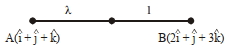
0 likesView Solution
148
MathematicsMediumMCQJEE Main · 2020
Let $[ t ]$ denote the greatest integer less than or equal to $t$. Then the value of $\int_{1}^{2} |2x - [3x]| dx$ is
A
$1$
B
$2$
C
$4$
D
$3$
Solution
(A) Let $I = \int_{1}^{2} |2x - [3x]| dx$. Since $1 \le x \le 2$,we have $3 \le 3x \le 6$.
We divide the interval $[1, 2]$ based on the values of $[3x]$:
Case $1$: $1 \le x < 4/3$,then $3 \le 3x < 4$,so $[3x] = 3$. The integrand is $|2x - 3| = 3 - 2x$.
Case $2$: $4/3 \le x < 5/3$,then $4 \le 3x < 5$,so $[3x] = 4$. The integrand is $|2x - 4| = 4 - 2x$.
Case $3$: $5/3 \le x \le 2$,then $5 \le 3x \le 6$,so $[3x] = 5$. The integrand is $|2x - 5| = 5 - 2x$.
Now,$I = \int_{1}^{4/3} (3 - 2x) dx + \int_{4/3}^{5/3} (4 - 2x) dx + \int_{5/3}^{2} (5 - 2x) dx$.
Evaluating each integral:
$\int_{1}^{4/3} (3 - 2x) dx = [3x - x^2]_{1}^{4/3} = (4 - 16/9) - (3 - 1) = 20/9 - 2 = 2/9$.
$\int_{4/3}^{5/3} (4 - 2x) dx = [4x - x^2]_{4/3}^{5/3} = (20/3 - 25/9) - (16/3 - 16/9) = 35/9 - 32/9 = 3/9 = 1/3$.
$\int_{5/3}^{2} (5 - 2x) dx = [5x - x^2]_{5/3}^{2} = (10 - 4) - (25/3 - 25/9) = 6 - 50/9 = 4/9$.
Summing these: $I = 2/9 + 3/9 + 4/9 = 9/9 = 1$.
We divide the interval $[1, 2]$ based on the values of $[3x]$:
Case $1$: $1 \le x < 4/3$,then $3 \le 3x < 4$,so $[3x] = 3$. The integrand is $|2x - 3| = 3 - 2x$.
Case $2$: $4/3 \le x < 5/3$,then $4 \le 3x < 5$,so $[3x] = 4$. The integrand is $|2x - 4| = 4 - 2x$.
Case $3$: $5/3 \le x \le 2$,then $5 \le 3x \le 6$,so $[3x] = 5$. The integrand is $|2x - 5| = 5 - 2x$.
Now,$I = \int_{1}^{4/3} (3 - 2x) dx + \int_{4/3}^{5/3} (4 - 2x) dx + \int_{5/3}^{2} (5 - 2x) dx$.
Evaluating each integral:
$\int_{1}^{4/3} (3 - 2x) dx = [3x - x^2]_{1}^{4/3} = (4 - 16/9) - (3 - 1) = 20/9 - 2 = 2/9$.
$\int_{4/3}^{5/3} (4 - 2x) dx = [4x - x^2]_{4/3}^{5/3} = (20/3 - 25/9) - (16/3 - 16/9) = 35/9 - 32/9 = 3/9 = 1/3$.
$\int_{5/3}^{2} (5 - 2x) dx = [5x - x^2]_{5/3}^{2} = (10 - 4) - (25/3 - 25/9) = 6 - 50/9 = 4/9$.
Summing these: $I = 2/9 + 3/9 + 4/9 = 9/9 = 1$.
0 likesView Solution
149
MathematicsMediumMCQJEE Main · 2020
If the surface area of a cube is increasing at a rate of $3.6 \text{ cm}^2/\text{sec}$,while maintaining its shape,then the rate of change of its volume (in $\text{cm}^3/\text{sec}$),when the length of a side of the cube is $10 \text{ cm}$,is:
A
$9$
B
$18$
C
$10$
D
$20$
Solution
(A) Let the side length of the cube be $a$. The surface area $S$ of the cube is given by $S = 6a^2$.
Given that $\frac{dS}{dt} = 3.6 \text{ cm}^2/\text{sec}$.
Differentiating $S$ with respect to $t$,we get $\frac{dS}{dt} = 12a \frac{da}{dt}$.
Substituting the given values: $3.6 = 12(10) \frac{da}{dt} \Rightarrow 3.6 = 120 \frac{da}{dt} \Rightarrow \frac{da}{dt} = \frac{3.6}{120} = 0.03 \text{ cm}/\text{sec}$.
The volume $V$ of the cube is $V = a^3$.
Differentiating $V$ with respect to $t$,we get $\frac{dV}{dt} = 3a^2 \frac{da}{dt}$.
Substituting $a = 10$ and $\frac{da}{dt} = 0.03$: $\frac{dV}{dt} = 3(10)^2(0.03) = 3(100)(0.03) = 300 \times 0.03 = 9 \text{ cm}^3/\text{sec}$.
Given that $\frac{dS}{dt} = 3.6 \text{ cm}^2/\text{sec}$.
Differentiating $S$ with respect to $t$,we get $\frac{dS}{dt} = 12a \frac{da}{dt}$.
Substituting the given values: $3.6 = 12(10) \frac{da}{dt} \Rightarrow 3.6 = 120 \frac{da}{dt} \Rightarrow \frac{da}{dt} = \frac{3.6}{120} = 0.03 \text{ cm}/\text{sec}$.
The volume $V$ of the cube is $V = a^3$.
Differentiating $V$ with respect to $t$,we get $\frac{dV}{dt} = 3a^2 \frac{da}{dt}$.
Substituting $a = 10$ and $\frac{da}{dt} = 0.03$: $\frac{dV}{dt} = 3(10)^2(0.03) = 3(100)(0.03) = 300 \times 0.03 = 9 \text{ cm}^3/\text{sec}$.
0 likesView Solution
150
MathematicsMediumMCQJEE Main · 2020
If the value of the integral $\int_{0}^{1/2} \frac{x^{2}}{(1-x^{2})^{3/2}} dx$ is $\frac{k}{6}$,then $k$ is equal to
A
$2\sqrt{3}-\pi$
B
$3\sqrt{2}+\pi$
C
$3\sqrt{2}-\pi$
D
$2\sqrt{3}+\pi$
Solution
(A) Let $I = \int_{0}^{1/2} \frac{x^{2}}{(1-x^{2})^{3/2}} dx$.
We can rewrite the numerator as $x^{2} = (x^{2}-1) + 1$.
Then,$I = \int_{0}^{1/2} \frac{x^{2}-1}{(1-x^{2})^{3/2}} dx + \int_{0}^{1/2} \frac{1}{(1-x^{2})^{3/2}} dx$.
$I = -\int_{0}^{1/2} \frac{1}{(1-x^{2})^{1/2}} dx + \int_{0}^{1/2} \frac{1}{(1-x^{2})^{3/2}} dx$.
For the first integral,$\int \frac{1}{\sqrt{1-x^{2}}} dx = \sin^{-1}(x)$.
Evaluating from $0$ to $1/2$,we get $-[\sin^{-1}(1/2) - \sin^{-1}(0)] = -\pi/6$.
For the second integral,let $x = \sin(\theta)$,then $dx = \cos(\theta) d\theta$.
When $x=0, \theta=0$; when $x=1/2, \theta=\pi/6$.
$\int_{0}^{\pi/6} \frac{\cos(\theta)}{\cos^{3}(\theta)} d\theta = \int_{0}^{\pi/6} \sec^{2}(\theta) d\theta = [\tan(\theta)]_{0}^{\pi/6} = \tan(\pi/6) - \tan(0) = 1/\sqrt{3}$.
Thus,$I = \frac{1}{\sqrt{3}} - \frac{\pi}{6} = \frac{\sqrt{3}}{3} - \frac{\pi}{6} = \frac{2\sqrt{3}-\pi}{6}$.
Comparing this with $\frac{k}{6}$,we get $k = 2\sqrt{3}-\pi$.
We can rewrite the numerator as $x^{2} = (x^{2}-1) + 1$.
Then,$I = \int_{0}^{1/2} \frac{x^{2}-1}{(1-x^{2})^{3/2}} dx + \int_{0}^{1/2} \frac{1}{(1-x^{2})^{3/2}} dx$.
$I = -\int_{0}^{1/2} \frac{1}{(1-x^{2})^{1/2}} dx + \int_{0}^{1/2} \frac{1}{(1-x^{2})^{3/2}} dx$.
For the first integral,$\int \frac{1}{\sqrt{1-x^{2}}} dx = \sin^{-1}(x)$.
Evaluating from $0$ to $1/2$,we get $-[\sin^{-1}(1/2) - \sin^{-1}(0)] = -\pi/6$.
For the second integral,let $x = \sin(\theta)$,then $dx = \cos(\theta) d\theta$.
When $x=0, \theta=0$; when $x=1/2, \theta=\pi/6$.
$\int_{0}^{\pi/6} \frac{\cos(\theta)}{\cos^{3}(\theta)} d\theta = \int_{0}^{\pi/6} \sec^{2}(\theta) d\theta = [\tan(\theta)]_{0}^{\pi/6} = \tan(\pi/6) - \tan(0) = 1/\sqrt{3}$.
Thus,$I = \frac{1}{\sqrt{3}} - \frac{\pi}{6} = \frac{\sqrt{3}}{3} - \frac{\pi}{6} = \frac{2\sqrt{3}-\pi}{6}$.
Comparing this with $\frac{k}{6}$,we get $k = 2\sqrt{3}-\pi$.
0 likesView Solution
Vedclass Products
For Students
Vedclass Test Series
Mock tests in real JEE Main style covering Mathematics with performance analysis. 5-day free trial.
Start Free TrialFor Teachers
Exam Paper Generator
Generate Set A/B/C/D Mathematics papers from 7.5L+ questions in 2 minutes. 3 chapters free.
Try FreeFor Institutes
Online Exam Module
Run live JEE Main mock exams with unlimited students, 360° analytics & white-label branding.
See DemoFrequently Asked Questions
How many Mathematics questions are in JEE Main 2020?
There are 401 Mathematics questions from the JEE Main 2020 paper on Vedclass, each with a detailed step-by-step solution in English.
Are JEE Main 2020 Mathematics solutions available in English?
Yes. All solutions on this page are in English. You can also switch to English or Hindi using the language buttons above the questions.
Can I practice JEE Main 2020 Mathematics as a timed test?
Yes. Use the Vedclass Test Series to attempt a full JEE Main mock test covering Mathematics with time limits and instant score analysis.
Can teachers create Mathematics papers from JEE Main previous year questions?
Yes. The Vedclass Exam Paper Generator lets teachers mix JEE Main Mathematics questions and generate Set A/B/C/D papers in minutes.
For Teachers & Institutes
Build a Custom Mathematics Paper
Pick JEE Main 2020 Mathematics questions, set difficulty, and generate Set A/B/C/D in 2 minutes.