
MathematicsQ1–100 of 121 questions
Page 1 of 2 · English
1
MathematicsDifficultMCQJEE Main · 2018
Let $S = \{ x \in \mathbb{R} : x \ge 0 \text{ and } 2|\sqrt{x} - 3| + \sqrt{x}(\sqrt{x} - 6) + 6 = 0 \}$. Then $S$:
A
contains exactly one element.
B
contains exactly two elements.
C
contains exactly four elements.
D
is an empty set.
Solution
(B) Let $t = \sqrt{x}$,where $t \ge 0$. The equation becomes $2|t - 3| + t(t - 6) + 6 = 0$.
Case $I$: $0 \le t < 3$ (i.e.,$0 \le x < 9$)
$2(3 - t) + t^2 - 6t + 6 = 0$
$6 - 2t + t^2 - 6t + 6 = 0$
$t^2 - 8t + 12 = 0$
$(t - 6)(t - 2) = 0$
$t = 6$ or $t = 2$.
Since $0 \le t < 3$,we have $t = 2$,which implies $x = 4$.
Case $II$: $t \ge 3$ (i.e.,$x \ge 9$)
$2(t - 3) + t^2 - 6t + 6 = 0$
$2t - 6 + t^2 - 6t + 6 = 0$
$t^2 - 4t = 0$
$t(t - 4) = 0$
$t = 0$ or $t = 4$.
Since $t \ge 3$,we have $t = 4$,which implies $x = 16$.
Thus,$S = \{4, 16\}$,which contains exactly two elements.
Case $I$: $0 \le t < 3$ (i.e.,$0 \le x < 9$)
$2(3 - t) + t^2 - 6t + 6 = 0$
$6 - 2t + t^2 - 6t + 6 = 0$
$t^2 - 8t + 12 = 0$
$(t - 6)(t - 2) = 0$
$t = 6$ or $t = 2$.
Since $0 \le t < 3$,we have $t = 2$,which implies $x = 4$.
Case $II$: $t \ge 3$ (i.e.,$x \ge 9$)
$2(t - 3) + t^2 - 6t + 6 = 0$
$2t - 6 + t^2 - 6t + 6 = 0$
$t^2 - 4t = 0$
$t(t - 4) = 0$
$t = 0$ or $t = 4$.
Since $t \ge 3$,we have $t = 4$,which implies $x = 16$.
Thus,$S = \{4, 16\}$,which contains exactly two elements.
0 likesView Solution
2
MathematicsDifficultMCQJEE Main · 2018
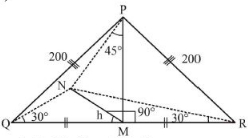
In a triangular park $PQR$,$PQ = PR = 200 \ m$. $A$ $TV$ tower stands at the mid-point $M$ of $QR$. If the angles of elevation of the top of the tower at $P, Q,$ and $R$ are $45^o, 30^o,$ and $30^o$ respectively,then the height of the tower (in $m$) is:
A
$50$
B
$100\sqrt{3}$
C
$50\sqrt{2}$
D
$100$
Solution
(D) Let the height of the tower $MN = h$.
In $\Delta QMN$,we have $\tan 30^o = \frac{MN}{QM}$.
$\therefore QM = \frac{h}{\tan 30^o} = h\sqrt{3}$. Since $M$ is the midpoint of $QR$,$QM = MR = h\sqrt{3}$.
In $\Delta MNP$,the angle of elevation of the top of the tower at $P$ is $45^o$,so $\tan 45^o = \frac{MN}{PM}$.
$\therefore PM = \frac{h}{\tan 45^o} = h$.
In $\Delta PMQ$,since $PM \perp MQ$ (as the tower is vertical to the ground plane),we have $PQ^2 = PM^2 + QM^2$.
Substituting the values: $(200)^2 = h^2 + (h\sqrt{3})^2$.
$40000 = h^2 + 3h^2$.
$40000 = 4h^2$.
$h^2 = 10000$.
$h = 100 \ m$.
In $\Delta QMN$,we have $\tan 30^o = \frac{MN}{QM}$.
$\therefore QM = \frac{h}{\tan 30^o} = h\sqrt{3}$. Since $M$ is the midpoint of $QR$,$QM = MR = h\sqrt{3}$.
In $\Delta MNP$,the angle of elevation of the top of the tower at $P$ is $45^o$,so $\tan 45^o = \frac{MN}{PM}$.
$\therefore PM = \frac{h}{\tan 45^o} = h$.
In $\Delta PMQ$,since $PM \perp MQ$ (as the tower is vertical to the ground plane),we have $PQ^2 = PM^2 + QM^2$.
Substituting the values: $(200)^2 = h^2 + (h\sqrt{3})^2$.
$40000 = h^2 + 3h^2$.
$40000 = 4h^2$.
$h^2 = 10000$.
$h = 100 \ m$.
0 likesView Solution
3
MathematicsDifficultMCQJEE Main · 2018
If the sum of all the solutions of the equation $8 \cos x \cdot \left( \cos \left( \frac{\pi}{6} + x \right) \cdot \cos \left( \frac{\pi}{6} - x \right) - \frac{1}{2} \right) = 1$ in the interval $[0, \pi]$ is $k\pi$,then $k$ is equal to:
A
$\frac{13}{9}$
B
$\frac{8}{9}$
C
$\frac{20}{9}$
D
$\frac{2}{3}$
Solution
(A) Given equation: $8 \cos x \left\{ \cos \left( \frac{\pi}{6} + x \right) \cos \left( \frac{\pi}{6} - x \right) - \frac{1}{2} \right\} = 1$
Using the identity $2 \cos A \cos B = \cos(A+B) + \cos(A-B)$:
$4 \cos x \left\{ \cos \left( \frac{\pi}{3} \right) + \cos(2x) - 1 \right\} = 1$
Since $\cos(\frac{\pi}{3}) = \frac{1}{2}$:
$4 \cos x \left\{ \frac{1}{2} + \cos 2x - 1 \right\} = 1$
$4 \cos x \left\{ \cos 2x - \frac{1}{2} \right\} = 1$
$4 \cos x \left\{ 2 \cos^2 x - 1 - \frac{1}{2} \right\} = 1$
$8 \cos^3 x - 6 \cos x = 1$
$2(4 \cos^3 x - 3 \cos x) = 1$
$2 \cos 3x = 1 \Rightarrow \cos 3x = \frac{1}{2}$
For $x \in [0, \pi]$,$3x \in [0, 3\pi]$.
Solutions for $3x$: $3x = \frac{\pi}{3}, 2\pi - \frac{\pi}{3}, 2\pi + \frac{\pi}{3} = \frac{\pi}{3}, \frac{5\pi}{3}, \frac{7\pi}{3}$.
Thus,$x = \frac{\pi}{9}, \frac{5\pi}{9}, \frac{7\pi}{9}$.
Sum of solutions $= \frac{\pi + 5\pi + 7\pi}{9} = \frac{13\pi}{9}$.
Given sum $= k\pi$,so $k = \frac{13}{9}$.
Using the identity $2 \cos A \cos B = \cos(A+B) + \cos(A-B)$:
$4 \cos x \left\{ \cos \left( \frac{\pi}{3} \right) + \cos(2x) - 1 \right\} = 1$
Since $\cos(\frac{\pi}{3}) = \frac{1}{2}$:
$4 \cos x \left\{ \frac{1}{2} + \cos 2x - 1 \right\} = 1$
$4 \cos x \left\{ \cos 2x - \frac{1}{2} \right\} = 1$
$4 \cos x \left\{ 2 \cos^2 x - 1 - \frac{1}{2} \right\} = 1$
$8 \cos^3 x - 6 \cos x = 1$
$2(4 \cos^3 x - 3 \cos x) = 1$
$2 \cos 3x = 1 \Rightarrow \cos 3x = \frac{1}{2}$
For $x \in [0, \pi]$,$3x \in [0, 3\pi]$.
Solutions for $3x$: $3x = \frac{\pi}{3}, 2\pi - \frac{\pi}{3}, 2\pi + \frac{\pi}{3} = \frac{\pi}{3}, \frac{5\pi}{3}, \frac{7\pi}{3}$.
Thus,$x = \frac{\pi}{9}, \frac{5\pi}{9}, \frac{7\pi}{9}$.
Sum of solutions $= \frac{\pi + 5\pi + 7\pi}{9} = \frac{13\pi}{9}$.
Given sum $= k\pi$,so $k = \frac{13}{9}$.
0 likesView Solution
4
MathematicsMediumMCQJEE Main · 2018
If $\alpha, \beta \in \mathbb{C}$ are distinct roots of the equation $x^2 - x + 1 = 0$,then $\alpha^{101} + \beta^{107}$ is equal to:
A
$0$
B
$1$
C
$2$
D
$-1$
Solution
(B) The roots of the equation $x^2 - x + 1 = 0$ are given by $x = \frac{1 \pm \sqrt{1 - 4}}{2} = \frac{1 \pm i\sqrt{3}}{2}$.
These are $-\omega$ and $-\omega^2$,where $\omega$ is a complex cube root of unity.
Let $\alpha = -\omega$ and $\beta = -\omega^2$.
Then $\alpha^{101} + \beta^{107} = (-\omega)^{101} + (-\omega^2)^{107}$.
$= -\omega^{101} - \omega^{214}$.
Since $\omega^3 = 1$,we have $\omega^{101} = \omega^{3 \times 33 + 2} = \omega^2$ and $\omega^{214} = \omega^{3 \times 71 + 1} = \omega$.
Thus,$\alpha^{101} + \beta^{107} = -(\omega^2 + \omega)$.
Since $1 + \omega + \omega^2 = 0$,we have $\omega + \omega^2 = -1$.
Therefore,$\alpha^{101} + \beta^{107} = -(-1) = 1$.
These are $-\omega$ and $-\omega^2$,where $\omega$ is a complex cube root of unity.
Let $\alpha = -\omega$ and $\beta = -\omega^2$.
Then $\alpha^{101} + \beta^{107} = (-\omega)^{101} + (-\omega^2)^{107}$.
$= -\omega^{101} - \omega^{214}$.
Since $\omega^3 = 1$,we have $\omega^{101} = \omega^{3 \times 33 + 2} = \omega^2$ and $\omega^{214} = \omega^{3 \times 71 + 1} = \omega$.
Thus,$\alpha^{101} + \beta^{107} = -(\omega^2 + \omega)$.
Since $1 + \omega + \omega^2 = 0$,we have $\omega + \omega^2 = -1$.
Therefore,$\alpha^{101} + \beta^{107} = -(-1) = 1$.
0 likesView Solution
5
MathematicsDifficultMCQJEE Main · 2018
From $6$ different novels and $3$ different dictionaries,$4$ novels and $1$ dictionary are to be selected and arranged in a row on a shelf so that the dictionary is always in the middle. The number of such arrangements is :
A
less than $500$
B
at least $500$ but less than $750$
C
at least $1000$
D
at least $750$ but less than $1000$
Solution
(C) Step $1$: Select $4$ novels from $6$ different novels in $^6C_4$ ways.
$^6C_4 = \frac{6 \times 5}{2 \times 1} = 15$ ways.
Step $2$: Select $1$ dictionary from $3$ different dictionaries in $^3C_1$ ways.
$^3C_1 = 3$ ways.
Step $3$: Arrange the $4$ selected novels and $1$ dictionary in a row such that the dictionary is always in the middle.
Since the dictionary is fixed in the middle,we only need to arrange the $4$ novels in the remaining $4$ positions.
The number of ways to arrange $4$ novels is $4! = 24$.
Step $4$: Total number of arrangements = $^6C_4 \times ^3C_1 \times 4! = 15 \times 3 \times 24 = 1080$.
$^6C_4 = \frac{6 \times 5}{2 \times 1} = 15$ ways.
Step $2$: Select $1$ dictionary from $3$ different dictionaries in $^3C_1$ ways.
$^3C_1 = 3$ ways.
Step $3$: Arrange the $4$ selected novels and $1$ dictionary in a row such that the dictionary is always in the middle.
Since the dictionary is fixed in the middle,we only need to arrange the $4$ novels in the remaining $4$ positions.
The number of ways to arrange $4$ novels is $4! = 24$.
Step $4$: Total number of arrangements = $^6C_4 \times ^3C_1 \times 4! = 15 \times 3 \times 24 = 1080$.
1 likesView Solution
6
MathematicsDifficultMCQJEE Main · 2018
The sum of the coefficients of all odd degree terms in the expansion of $(x + \sqrt{x^3 - 1})^5 + (x - \sqrt{x^3 - 1})^5$,where $x > 1$,is:
A
$0$
B
$1$
C
$2$
D
$-1$
Solution
(C) Let $f(x) = (x + \sqrt{x^3 - 1})^5 + (x - \sqrt{x^3 - 1})^5$.
Using the binomial expansion formula $(a+b)^n + (a-b)^n = 2[\binom{n}{0}a^n + \binom{n}{2}a^{n-2}b^2 + \binom{n}{4}a^{n-4}b^4 + \dots]$,we get:
$f(x) = 2[\binom{5}{0}x^5 + \binom{5}{2}x^3(\sqrt{x^3-1})^2 + \binom{5}{4}x(\sqrt{x^3-1})^4]$
$f(x) = 2[x^5 + 10x^3(x^3-1) + 5x(x^3-1)^2]$
$f(x) = 2[x^5 + 10x^6 - 10x^3 + 5x(x^6 - 2x^3 + 1)]$
$f(x) = 2[x^5 + 10x^6 - 10x^3 + 5x^7 - 10x^4 + 5x]$
$f(x) = 10x^7 + 20x^6 + 2x^5 - 20x^4 - 20x^3 + 10x$.
The odd degree terms are $10x^7$,$2x^5$,$-20x^3$,and $10x$.
The sum of the coefficients of these terms is $10 + 2 - 20 + 10 = 2$.
Using the binomial expansion formula $(a+b)^n + (a-b)^n = 2[\binom{n}{0}a^n + \binom{n}{2}a^{n-2}b^2 + \binom{n}{4}a^{n-4}b^4 + \dots]$,we get:
$f(x) = 2[\binom{5}{0}x^5 + \binom{5}{2}x^3(\sqrt{x^3-1})^2 + \binom{5}{4}x(\sqrt{x^3-1})^4]$
$f(x) = 2[x^5 + 10x^3(x^3-1) + 5x(x^3-1)^2]$
$f(x) = 2[x^5 + 10x^6 - 10x^3 + 5x(x^6 - 2x^3 + 1)]$
$f(x) = 2[x^5 + 10x^6 - 10x^3 + 5x^7 - 10x^4 + 5x]$
$f(x) = 10x^7 + 20x^6 + 2x^5 - 20x^4 - 20x^3 + 10x$.
The odd degree terms are $10x^7$,$2x^5$,$-20x^3$,and $10x$.
The sum of the coefficients of these terms is $10 + 2 - 20 + 10 = 2$.
0 likesView Solution
7
MathematicsDifficultMCQJEE Main · 2018
Let $A$ be the sum of the first $20$ terms and $B$ be the sum of the first $40$ terms of the series $1^2 + 2 \cdot 2^2 + 3^2 + 2 \cdot 4^2 + 5^2 + \dots$. If $B - 2A = 100\lambda$,then $\lambda$ is equal to:
A
$248$
B
$464$
C
$496$
D
$232$
Solution
(A) The series is $a_n = n^2$ if $n$ is odd,and $a_n = 2n^2$ if $n$ is even.
$B - 2A = \sum_{n=1}^{40} a_n - 2\sum_{n=1}^{20} a_n = \sum_{n=21}^{40} a_n - \sum_{n=1}^{20} a_n$.
For $n \in [21, 40]$,let $k = n-20$,so $n = k+20$. The terms are $(k+20)^2$ if $k$ is odd,and $2(k+20)^2$ if $k$ is even.
$B - 2A = \sum_{k=1}^{20} (a_{k+20} - a_k)$.
If $k$ is odd,$a_{k+20} - a_k = (k+20)^2 - k^2 = 40k + 400$.
If $k$ is even,$a_{k+20} - a_k = 2(k+20)^2 - 2k^2 = 2(40k + 400) = 80k + 800$.
Summing these for $k=1$ to $20$ ($10$ odd and $10$ even values of $k$):
$B - 2A = \sum_{k \in \text{odd}} (40k + 400) + \sum_{k \in \text{even}} (80k + 800)$.
$= 40 \sum_{k \in \text{odd}} k + 4000 + 80 \sum_{k \in \text{even}} k + 8000$.
$= 40(1+3+\dots+19) + 80(2+4+\dots+20) + 12000$.
$= 40(100) + 80(110) + 12000 = 4000 + 8800 + 12000 = 24800$.
Since $B - 2A = 100\lambda$,$100\lambda = 24800$,so $\lambda = 248$.
$B - 2A = \sum_{n=1}^{40} a_n - 2\sum_{n=1}^{20} a_n = \sum_{n=21}^{40} a_n - \sum_{n=1}^{20} a_n$.
For $n \in [21, 40]$,let $k = n-20$,so $n = k+20$. The terms are $(k+20)^2$ if $k$ is odd,and $2(k+20)^2$ if $k$ is even.
$B - 2A = \sum_{k=1}^{20} (a_{k+20} - a_k)$.
If $k$ is odd,$a_{k+20} - a_k = (k+20)^2 - k^2 = 40k + 400$.
If $k$ is even,$a_{k+20} - a_k = 2(k+20)^2 - 2k^2 = 2(40k + 400) = 80k + 800$.
Summing these for $k=1$ to $20$ ($10$ odd and $10$ even values of $k$):
$B - 2A = \sum_{k \in \text{odd}} (40k + 400) + \sum_{k \in \text{even}} (80k + 800)$.
$= 40 \sum_{k \in \text{odd}} k + 4000 + 80 \sum_{k \in \text{even}} k + 8000$.
$= 40(1+3+\dots+19) + 80(2+4+\dots+20) + 12000$.
$= 40(100) + 80(110) + 12000 = 4000 + 8800 + 12000 = 24800$.
Since $B - 2A = 100\lambda$,$100\lambda = 24800$,so $\lambda = 248$.
0 likesView Solution
8
MathematicsDifficultMCQJEE Main · 2018
Let ${a_1}, {a_2}, \dots, {a_{49}}$ be in $A.P.$ such that $\sum_{k = 0}^{12} {a_{4k + 1}} = 416$ and ${a_9} + {a_{43}} = 66$. If $\sum_{r = 1}^{17} a_r^2 = 140m$,then $m = \dots$
A
$68$
B
$34$
C
$33$
D
$66$
Solution
(B) Given $\sum_{k = 0}^{12} {a_{4k + 1}} = 416$. This is a sum of $13$ terms in $A.P.$ with first term $a_1$ and common difference $4d$.
$\frac{13}{2} [2a_1 + (13-1)4d] = 416$ $\Rightarrow \frac{13}{2} [2a_1 + 48d] = 416$ $\Rightarrow a_1 + 24d = 32 \dots (1)$
Given ${a_9} + {a_{43}} = 66$ $\Rightarrow (a_1 + 8d) + (a_1 + 42d) = 66$ $\Rightarrow 2a_1 + 50d = 66$ $\Rightarrow a_1 + 25d = 33 \dots (2)$
Subtracting $(1)$ from $(2)$,we get $d = 1$. Substituting $d=1$ in $(1)$,$a_1 + 24 = 32 \Rightarrow a_1 = 8$.
Now,$\sum_{r = 1}^{17} a_r^2 = \sum_{r = 1}^{17} [8 + (r-1)1]^2 = \sum_{r = 1}^{17} (r+7)^2 = \sum_{r = 1}^{17} (r^2 + 14r + 49) = 140m$.
Using summation formulas: $\sum_{r=1}^{n} r^2 = \frac{n(n+1)(2n+1)}{6}$,$\sum_{r=1}^{n} r = \frac{n(n+1)}{2}$.
For $n=17$: $\frac{17 \times 18 \times 35}{6} + 14 \times \frac{17 \times 18}{2} + 49 \times 17 = 1785 + 2142 + 833 = 4760$.
$140m = 4760 \Rightarrow m = \frac{4760}{140} = 34$.
$\frac{13}{2} [2a_1 + (13-1)4d] = 416$ $\Rightarrow \frac{13}{2} [2a_1 + 48d] = 416$ $\Rightarrow a_1 + 24d = 32 \dots (1)$
Given ${a_9} + {a_{43}} = 66$ $\Rightarrow (a_1 + 8d) + (a_1 + 42d) = 66$ $\Rightarrow 2a_1 + 50d = 66$ $\Rightarrow a_1 + 25d = 33 \dots (2)$
Subtracting $(1)$ from $(2)$,we get $d = 1$. Substituting $d=1$ in $(1)$,$a_1 + 24 = 32 \Rightarrow a_1 = 8$.
Now,$\sum_{r = 1}^{17} a_r^2 = \sum_{r = 1}^{17} [8 + (r-1)1]^2 = \sum_{r = 1}^{17} (r+7)^2 = \sum_{r = 1}^{17} (r^2 + 14r + 49) = 140m$.
Using summation formulas: $\sum_{r=1}^{n} r^2 = \frac{n(n+1)(2n+1)}{6}$,$\sum_{r=1}^{n} r = \frac{n(n+1)}{2}$.
For $n=17$: $\frac{17 \times 18 \times 35}{6} + 14 \times \frac{17 \times 18}{2} + 49 \times 17 = 1785 + 2142 + 833 = 4760$.
$140m = 4760 \Rightarrow m = \frac{4760}{140} = 34$.
0 likesView Solution
9
MathematicsDifficultMCQJEE Main · 2018
Let the orthocentre and centroid of a triangle be $A(-3, 5)$ and $B(3, 3)$ respectively. If $C$ is the circumcentre of this triangle,then the radius of the circle having line segment $AC$ as diameter is:
A
$2\sqrt{10}$
B
$3\sqrt{\frac{5}{2}}$
C
$\frac{3\sqrt{5}}{2}$
D
$\sqrt{10}$
Solution
(B) Given that the orthocentre $A$ is $(-3, 5)$ and the centroid $B$ is $(3, 3)$.
The distance $AB = \sqrt{(3 - (-3))^2 + (3 - 5)^2} = \sqrt{6^2 + (-2)^2} = \sqrt{36 + 4} = \sqrt{40} = 2\sqrt{10}$.
The centroid $B$ divides the line segment joining the orthocentre $A$ and the circumcentre $C$ in the ratio $2:1$,such that $AB:BC = 2:1$.
This implies $AB = \frac{2}{3}AC$,or $AC = \frac{3}{2}AB$.
Substituting the value of $AB$,we get $AC = \frac{3}{2}(2\sqrt{10}) = 3\sqrt{10}$.
The radius of the circle with $AC$ as diameter is $r = \frac{AC}{2} = \frac{3\sqrt{10}}{2}$.
We can rewrite this as $r = 3\sqrt{\frac{10}{4}} = 3\sqrt{\frac{5}{2}}$.
The distance $AB = \sqrt{(3 - (-3))^2 + (3 - 5)^2} = \sqrt{6^2 + (-2)^2} = \sqrt{36 + 4} = \sqrt{40} = 2\sqrt{10}$.
The centroid $B$ divides the line segment joining the orthocentre $A$ and the circumcentre $C$ in the ratio $2:1$,such that $AB:BC = 2:1$.
This implies $AB = \frac{2}{3}AC$,or $AC = \frac{3}{2}AB$.
Substituting the value of $AB$,we get $AC = \frac{3}{2}(2\sqrt{10}) = 3\sqrt{10}$.
The radius of the circle with $AC$ as diameter is $r = \frac{AC}{2} = \frac{3\sqrt{10}}{2}$.
We can rewrite this as $r = 3\sqrt{\frac{10}{4}} = 3\sqrt{\frac{5}{2}}$.
0 likesView Solution
10
MathematicsDifficultMCQJEE Main · 2018
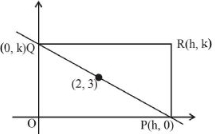
$A$ straight line passing through a fixed point $(2, 3)$ intersects the coordinate axes at distinct points $P$ and $Q$. If $O$ is the origin and the rectangle $OPRQ$ is completed,then the locus of $R$ is:
A
$2x + 3y = xy$
B
$3x + 2y = xy$
C
$3x + 2y = 6xy$
D
$3x + 2y = 6$
Solution
(B) Let the coordinates of $P$ be $(h, 0)$ and $Q$ be $(0, k)$.
Since the rectangle $OPRQ$ is completed,the coordinates of $R$ are $(h, k)$.
The equation of the line passing through $P(h, 0)$ and $Q(0, k)$ is given by the intercept form:
$\frac{x}{h} + \frac{y}{k} = 1$
Since this line passes through the fixed point $(2, 3)$,we have:
$\frac{2}{h} + \frac{3}{k} = 1$
To find the locus of $R(h, k)$,we replace $h$ with $x$ and $k$ with $y$:
$\frac{2}{x} + \frac{3}{y} = 1$
Multiplying both sides by $xy$,we get:
$2y + 3x = xy$
Thus,the locus of $R$ is $3x + 2y = xy$.
Since the rectangle $OPRQ$ is completed,the coordinates of $R$ are $(h, k)$.
The equation of the line passing through $P(h, 0)$ and $Q(0, k)$ is given by the intercept form:
$\frac{x}{h} + \frac{y}{k} = 1$
Since this line passes through the fixed point $(2, 3)$,we have:
$\frac{2}{h} + \frac{3}{k} = 1$
To find the locus of $R(h, k)$,we replace $h$ with $x$ and $k$ with $y$:
$\frac{2}{x} + \frac{3}{y} = 1$
Multiplying both sides by $xy$,we get:
$2y + 3x = xy$
Thus,the locus of $R$ is $3x + 2y = xy$.
0 likesView Solution
11
MathematicsDifficultMCQJEE Main · 2018
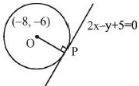
If the tangent at $(1, 7)$ to the curve $x^2 = y - 6$ touches the circle $x^2 + y^2 + 16x + 12y + c = 0$,then the value of $c$ is:
A
$185$
B
$85$
C
$95$
D
$195$
Solution
(C) The equation of the curve is $x^2 = y - 6$,which can be written as $y = x^2 + 6$.
To find the tangent at $(1, 7)$,we differentiate with respect to $x$: $\frac{dy}{dx} = 2x$.
At $(1, 7)$,the slope $m = 2(1) = 2$.
The equation of the tangent is $y - 7 = 2(x - 1)$,which simplifies to $2x - y + 5 = 0$.
For this line to be a tangent to the circle $x^2 + y^2 + 16x + 12y + c = 0$,the perpendicular distance from the center $(-8, -6)$ to the line must equal the radius $r = \sqrt{g^2 + f^2 - c} = \sqrt{(-8)^2 + (-6)^2 - c} = \sqrt{64 + 36 - c} = \sqrt{100 - c}$.
The perpendicular distance is $\frac{|2(-8) - (-6) + 5|}{\sqrt{2^2 + (-1)^2}} = \frac{|-16 + 6 + 5|}{\sqrt{5}} = \frac{|-5|}{\sqrt{5}} = \sqrt{5}$.
Equating the distance to the radius: $\sqrt{5} = \sqrt{100 - c}$.
Squaring both sides: $5 = 100 - c$,which gives $c = 95$.
To find the tangent at $(1, 7)$,we differentiate with respect to $x$: $\frac{dy}{dx} = 2x$.
At $(1, 7)$,the slope $m = 2(1) = 2$.
The equation of the tangent is $y - 7 = 2(x - 1)$,which simplifies to $2x - y + 5 = 0$.
For this line to be a tangent to the circle $x^2 + y^2 + 16x + 12y + c = 0$,the perpendicular distance from the center $(-8, -6)$ to the line must equal the radius $r = \sqrt{g^2 + f^2 - c} = \sqrt{(-8)^2 + (-6)^2 - c} = \sqrt{64 + 36 - c} = \sqrt{100 - c}$.
The perpendicular distance is $\frac{|2(-8) - (-6) + 5|}{\sqrt{2^2 + (-1)^2}} = \frac{|-16 + 6 + 5|}{\sqrt{5}} = \frac{|-5|}{\sqrt{5}} = \sqrt{5}$.
Equating the distance to the radius: $\sqrt{5} = \sqrt{100 - c}$.
Squaring both sides: $5 = 100 - c$,which gives $c = 95$.
0 likesView Solution
12
MathematicsDifficultMCQJEE Main · 2018
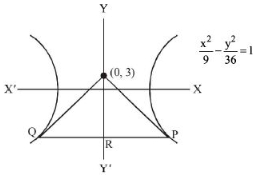
Tangents are drawn to the hyperbola $4x^2 - y^2 = 36$ at the points $P$ and $Q$. If these tangents intersect at the point $T(0, 3)$,then the area (in sq. units) of $\Delta PTQ$ is:
A
$54\sqrt{3}$
B
$60\sqrt{3}$
C
$36\sqrt{5}$
D
$45\sqrt{5}$
Solution
(D) The equation of the hyperbola is $4x^2 - y^2 = 36$,which can be written as $\frac{x^2}{9} - \frac{y^2}{36} = 1$.
The line $PQ$ is the chord of contact of the tangents drawn from $T(0, 3)$.
The equation of the chord of contact from $(x_1, y_1)$ is $\frac{xx_1}{a^2} - \frac{yy_1}{b^2} = 1$.
Substituting $(x_1, y_1) = (0, 3)$,$a^2 = 9$,and $b^2 = 36$,we get:
$\frac{x(0)}{9} - \frac{y(3)}{36} = 1$
$\Rightarrow -\frac{y}{12} = 1$
$\Rightarrow y = -12$.
To find the coordinates of $P$ and $Q$,substitute $y = -12$ into the hyperbola equation:
$4x^2 - (-12)^2 = 36$
$4x^2 - 144 = 36$
$4x^2 = 180$
$x^2 = 45$
$x = \pm 3\sqrt{5}$.
Thus,the points are $P(3\sqrt{5}, -12)$ and $Q(-3\sqrt{5}, -12)$.
The length of the base $PQ = |3\sqrt{5} - (-3\sqrt{5})| = 6\sqrt{5}$.
The height of the triangle $\Delta PTQ$ is the vertical distance from $T(0, 3)$ to the line $y = -12$,which is $h = |3 - (-12)| = 15$.
Area of $\Delta PTQ = \frac{1}{2} \times \text{base} \times \text{height} = \frac{1}{2} \times 6\sqrt{5} \times 15 = 45\sqrt{5}$ sq. units.
The line $PQ$ is the chord of contact of the tangents drawn from $T(0, 3)$.
The equation of the chord of contact from $(x_1, y_1)$ is $\frac{xx_1}{a^2} - \frac{yy_1}{b^2} = 1$.
Substituting $(x_1, y_1) = (0, 3)$,$a^2 = 9$,and $b^2 = 36$,we get:
$\frac{x(0)}{9} - \frac{y(3)}{36} = 1$
$\Rightarrow -\frac{y}{12} = 1$
$\Rightarrow y = -12$.
To find the coordinates of $P$ and $Q$,substitute $y = -12$ into the hyperbola equation:
$4x^2 - (-12)^2 = 36$
$4x^2 - 144 = 36$
$4x^2 = 180$
$x^2 = 45$
$x = \pm 3\sqrt{5}$.
Thus,the points are $P(3\sqrt{5}, -12)$ and $Q(-3\sqrt{5}, -12)$.
The length of the base $PQ = |3\sqrt{5} - (-3\sqrt{5})| = 6\sqrt{5}$.
The height of the triangle $\Delta PTQ$ is the vertical distance from $T(0, 3)$ to the line $y = -12$,which is $h = |3 - (-12)| = 15$.
Area of $\Delta PTQ = \frac{1}{2} \times \text{base} \times \text{height} = \frac{1}{2} \times 6\sqrt{5} \times 15 = 45\sqrt{5}$ sq. units.
0 likesView Solution
13
MathematicsDifficultMCQJEE Main · 2018
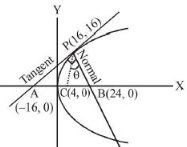
Tangent and normal are drawn at $P(16, 16)$ on the parabola ${y^2} = 16x$,which intersect the axis of the parabola at $A$ and $B$,respectively. If $C$ is the centre of the circle through the points $P, A$ and $B$ and $\angle CPB = \theta$,then a value of $\tan \theta$ is:
A
$2$
B
$3$
C
$\frac{4}{3}$
D
$\frac{1}{2}$
Solution
(A) The equation of the parabola is ${y^2} = 16x$,so $4a = 16$,which implies $a = 4$.
For the point $P(16, 16)$,we have $y_1^2 = 16x_1$,so $16^2 = 16(16)$,which is satisfied.
The tangent at $P(x_1, y_1)$ is $yy_1 = 2a(x + x_1)$,so $16y = 8(x + 16)$,which simplifies to $2y = x + 16$.
Setting $y = 0$ for the intersection with the $x$-axis,we get $x = -16$,so $A = (-16, 0)$.
The normal at $P(x_1, y_1)$ is $y - y_1 = -\frac{y_1}{2a}(x - x_1)$,so $y - 16 = -\frac{16}{8}(x - 16)$,which simplifies to $y - 16 = -2(x - 16)$,or $y = -2x + 48$.
Setting $y = 0$ for the intersection with the $x$-axis,we get $2x = 48$,so $x = 24$,thus $B = (24, 0)$.
The circle passes through $A(-16, 0)$,$B(24, 0)$,and $P(16, 16)$. Since $A$ and $B$ lie on the $x$-axis,the center $C$ must have an $x$-coordinate of $\frac{-16 + 24}{2} = 4$.
Let $C = (4, k)$. Since $CA = CP$,we have $(4 - (-16))^2 + (k - 0)^2 = (4 - 16)^2 + (k - 16)^2$.
$20^2 + k^2 = (-12)^2 + (k - 16)^2 \Rightarrow 400 + k^2 = 144 + k^2 - 32k + 256$.
$400 = 400 - 32k \Rightarrow k = 0$. Thus,$C = (4, 0)$.
Slope of $PC$ $(m_1)$ = $\frac{16 - 0}{16 - 4} = \frac{16}{12} = \frac{4}{3}$.
Slope of $PB$ $(m_2)$ = $\frac{16 - 0}{16 - 24} = \frac{16}{-8} = -2$.
$\tan \theta = \left| \frac{m_1 - m_2}{1 + m_1 m_2} \right| = \left| \frac{\frac{4}{3} - (-2)}{1 + (\frac{4}{3})(-2)} \right| = \left| \frac{\frac{10}{3}}{1 - \frac{8}{3}} \right| = \left| \frac{\frac{10}{3}}{-\frac{5}{3}} \right| = |-2| = 2$.
For the point $P(16, 16)$,we have $y_1^2 = 16x_1$,so $16^2 = 16(16)$,which is satisfied.
The tangent at $P(x_1, y_1)$ is $yy_1 = 2a(x + x_1)$,so $16y = 8(x + 16)$,which simplifies to $2y = x + 16$.
Setting $y = 0$ for the intersection with the $x$-axis,we get $x = -16$,so $A = (-16, 0)$.
The normal at $P(x_1, y_1)$ is $y - y_1 = -\frac{y_1}{2a}(x - x_1)$,so $y - 16 = -\frac{16}{8}(x - 16)$,which simplifies to $y - 16 = -2(x - 16)$,or $y = -2x + 48$.
Setting $y = 0$ for the intersection with the $x$-axis,we get $2x = 48$,so $x = 24$,thus $B = (24, 0)$.
The circle passes through $A(-16, 0)$,$B(24, 0)$,and $P(16, 16)$. Since $A$ and $B$ lie on the $x$-axis,the center $C$ must have an $x$-coordinate of $\frac{-16 + 24}{2} = 4$.
Let $C = (4, k)$. Since $CA = CP$,we have $(4 - (-16))^2 + (k - 0)^2 = (4 - 16)^2 + (k - 16)^2$.
$20^2 + k^2 = (-12)^2 + (k - 16)^2 \Rightarrow 400 + k^2 = 144 + k^2 - 32k + 256$.
$400 = 400 - 32k \Rightarrow k = 0$. Thus,$C = (4, 0)$.
Slope of $PC$ $(m_1)$ = $\frac{16 - 0}{16 - 4} = \frac{16}{12} = \frac{4}{3}$.
Slope of $PB$ $(m_2)$ = $\frac{16 - 0}{16 - 24} = \frac{16}{-8} = -2$.
$\tan \theta = \left| \frac{m_1 - m_2}{1 + m_1 m_2} \right| = \left| \frac{\frac{4}{3} - (-2)}{1 + (\frac{4}{3})(-2)} \right| = \left| \frac{\frac{10}{3}}{1 - \frac{8}{3}} \right| = \left| \frac{\frac{10}{3}}{-\frac{5}{3}} \right| = |-2| = 2$.
0 likesView Solution
14
MathematicsDifficultMCQJEE Main · 2018
Two sets $A$ and $B$ are defined as follows:
$A = \{ (a,b) \in R \times R : |a - 5| < 1 \text{ and } |b - 5| < 1 \}$
$B = \{ (a,b) \in R \times R : 4(a - 6)^2 + 9(b - 5)^2 \le 36 \}$
Then:
$A = \{ (a,b) \in R \times R : |a - 5| < 1 \text{ and } |b - 5| < 1 \}$
$B = \{ (a,b) \in R \times R : 4(a - 6)^2 + 9(b - 5)^2 \le 36 \}$
Then:
A
$A \subset B$
B
$A \cap B = \emptyset$
C
neither $A \subset B$ nor $B \subset A$
D
$B \subset A$
Solution
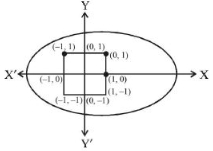
(A) The set $A$ is defined by $|a - 5| < 1$ and $|b - 5| < 1$. Let $x = a - 5$ and $y = b - 5$. Then $A$ represents the interior of a square centered at $(5, 5)$ with side length $2$,specifically $|x| < 1$ and $|y| < 1$.
The set $B$ is defined by $4(a - 6)^2 + 9(b - 5)^2 \le 36$. Substituting $x = a - 5$ and $y = b - 5$,we get $4(x - 1)^2 + 9y^2 \le 36$,which simplifies to $\frac{(x - 1)^2}{9} + \frac{y^2}{4} \le 1$. This represents the interior and boundary of an ellipse centered at $(1, 0)$ in the $(x, y)$ plane.
The vertices of the square $A$ in the $(x, y)$ plane are $(1, 1), (-1, 1), (-1, -1), (1, -1)$.
Checking if these points satisfy the ellipse inequality $\frac{(x - 1)^2}{9} + \frac{y^2}{4} \le 1$:
For $(1, 1): \frac{0}{9} + \frac{1}{4} = 0.25 \le 1$ (True)
For $(-1, 1): \frac{4}{9} + \frac{1}{4} = \frac{16+9}{36} = \frac{25}{36} \le 1$ (True)
For $(-1, -1): \frac{4}{9} + \frac{1}{4} = \frac{25}{36} \le 1$ (True)
For $(1, -1): \frac{0}{9} + \frac{1}{4} = 0.25 \le 1$ (True)
Since all vertices of the square lie within the ellipse,$A \subset B$.
The set $B$ is defined by $4(a - 6)^2 + 9(b - 5)^2 \le 36$. Substituting $x = a - 5$ and $y = b - 5$,we get $4(x - 1)^2 + 9y^2 \le 36$,which simplifies to $\frac{(x - 1)^2}{9} + \frac{y^2}{4} \le 1$. This represents the interior and boundary of an ellipse centered at $(1, 0)$ in the $(x, y)$ plane.
The vertices of the square $A$ in the $(x, y)$ plane are $(1, 1), (-1, 1), (-1, -1), (1, -1)$.
Checking if these points satisfy the ellipse inequality $\frac{(x - 1)^2}{9} + \frac{y^2}{4} \le 1$:
For $(1, 1): \frac{0}{9} + \frac{1}{4} = 0.25 \le 1$ (True)
For $(-1, 1): \frac{4}{9} + \frac{1}{4} = \frac{16+9}{36} = \frac{25}{36} \le 1$ (True)
For $(-1, -1): \frac{4}{9} + \frac{1}{4} = \frac{25}{36} \le 1$ (True)
For $(1, -1): \frac{0}{9} + \frac{1}{4} = 0.25 \le 1$ (True)
Since all vertices of the square lie within the ellipse,$A \subset B$.
0 likesView Solution
15
MathematicsDifficultMCQJEE Main · 2018
For each $t \in R$,let $[t]$ be the greatest integer less than or equal to $t$. Then $\lim_{x \to 0^+} x \left( [\frac{1}{x}] + [\frac{2}{x}] + \dots + [\frac{15}{x}] \right) = $
A
$15$
B
$120$
C
does not exist (in $R$)
D
$0$
Solution
(B) We know that $[t] = t - \{t\}$,where $\{t\}$ is the fractional part of $t$.
Thus,the expression becomes $\lim_{x \to 0^+} x \sum_{r=1}^{15} [\frac{r}{x}] = \lim_{x \to 0^+} x \sum_{r=1}^{15} (\frac{r}{x} - \{\frac{r}{x}\})$.
$= \lim_{x \to 0^+} (\sum_{r=1}^{15} r - x \sum_{r=1}^{15} \{\frac{r}{x}\})$.
Since $0 \le \{\frac{r}{x}\} < 1$,we have $0 \le x \{\frac{r}{x}\} < x$.
As $x \to 0^+$,by the Squeeze Theorem,$x \{\frac{r}{x}\} \to 0$.
Therefore,the limit is $\sum_{r=1}^{15} r = \frac{15 \times 16}{2} = 120$.
Thus,the expression becomes $\lim_{x \to 0^+} x \sum_{r=1}^{15} [\frac{r}{x}] = \lim_{x \to 0^+} x \sum_{r=1}^{15} (\frac{r}{x} - \{\frac{r}{x}\})$.
$= \lim_{x \to 0^+} (\sum_{r=1}^{15} r - x \sum_{r=1}^{15} \{\frac{r}{x}\})$.
Since $0 \le \{\frac{r}{x}\} < 1$,we have $0 \le x \{\frac{r}{x}\} < x$.
As $x \to 0^+$,by the Squeeze Theorem,$x \{\frac{r}{x}\} \to 0$.
Therefore,the limit is $\sum_{r=1}^{15} r = \frac{15 \times 16}{2} = 120$.
0 likesView Solution
16
MathematicsDifficultMCQJEE Main · 2018
If $\sum_{i = 1}^9 (x_i - 5) = 9$ and $\sum_{i = 1}^9 (x_i - 5)^2 = 45$,then the standard deviation of the $9$ items $x_1, x_2, ..., x_9$ is:
A
$4$
B
$2$
C
$3$
D
$9$
Solution
(B) Let $y_i = x_i - 5$. Then $\sum_{i=1}^9 y_i = 9$ and $\sum_{i=1}^9 y_i^2 = 45$.
The variance of a set of observations is invariant under change of origin. Therefore,the standard deviation of $x_i$ is the same as the standard deviation of $y_i$.
Variance $(\sigma^2) = \frac{1}{n} \sum_{i=1}^n y_i^2 - \left( \frac{1}{n} \sum_{i=1}^n y_i \right)^2$
$\sigma^2 = \frac{45}{9} - \left( \frac{9}{9} \right)^2$
$\sigma^2 = 5 - 1 = 4$
Standard deviation $(\sigma) = \sqrt{4} = 2$.
The variance of a set of observations is invariant under change of origin. Therefore,the standard deviation of $x_i$ is the same as the standard deviation of $y_i$.
Variance $(\sigma^2) = \frac{1}{n} \sum_{i=1}^n y_i^2 - \left( \frac{1}{n} \sum_{i=1}^n y_i \right)^2$
$\sigma^2 = \frac{45}{9} - \left( \frac{9}{9} \right)^2$
$\sigma^2 = 5 - 1 = 4$
Standard deviation $(\sigma) = \sqrt{4} = 2$.
0 likesView Solution
17
MathematicsMediumMCQJEE Main · 2018
The Boolean expression $\sim(p \vee q) \vee (\sim p \wedge q)$ is equivalent to:
A
$p$
B
$q$
C
$\sim q$
D
$\sim p$
Solution
(D) Using De Morgan's Law,$\sim(p \vee q) \equiv (\sim p \wedge \sim q)$.
Substituting this into the expression:
$(\sim p \wedge \sim q) \vee (\sim p \wedge q)$
Applying the Distributive Law:
$\sim p \wedge (\sim q \vee q)$
Since $(\sim q \vee q) \equiv T$ (Tautology):
$\sim p \wedge T \equiv \sim p$.
Substituting this into the expression:
$(\sim p \wedge \sim q) \vee (\sim p \wedge q)$
Applying the Distributive Law:
$\sim p \wedge (\sim q \vee q)$
Since $(\sim q \vee q) \equiv T$ (Tautology):
$\sim p \wedge T \equiv \sim p$.
0 likesView Solution
18
MathematicsDifficultMCQJEE Main · 2018
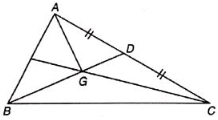
In a triangle $ABC$,the coordinates of $A$ are $(1, 2)$ and the equations of the medians through $B$ and $C$ are $x + y = 5$ and $x = 4$ respectively. Then the area of $\Delta ABC$ (in sq. units) is
A
$5$
B
$9$
C
$12$
D
$4$
Solution
(B) The median through $C$ is $x = 4$. Since $C$ lies on this median,let $C = (4, y)$.
The midpoint $D$ of $AC$ is $D = (\frac{1+4}{2}, \frac{2+y}{2}) = (2.5, \frac{2+y}{2})$.
Since $D$ lies on the median through $B$ $(x + y = 5)$,we have $2.5 + \frac{2+y}{2} = 5$.
$2.5 + 1 + \frac{y}{2} = 5$ $\Rightarrow \frac{y}{2} = 1.5$ $\Rightarrow y = 3$. Thus,$C = (4, 3)$.
The centroid $G$ is the intersection of the medians $x = 4$ and $x + y = 5$. Substituting $x = 4$ into $x + y = 5$,we get $4 + y = 5$,so $y = 1$. Thus,$G = (4, 1)$.
To find $B$,we use the centroid formula $G = (\frac{x_A+x_B+x_C}{3}, \frac{y_A+y_B+y_C}{3})$.
$4 = \frac{1+x_B+4}{3}$ $\Rightarrow 12 = 5 + x_B$ $\Rightarrow x_B = 7$.
$1 = \frac{2+y_B+3}{3}$ $\Rightarrow 3 = 5 + y_B$ $\Rightarrow y_B = -2$. Thus,$B = (7, -2)$.
The area of $\Delta ABC$ with vertices $A(1, 2)$,$B(7, -2)$,and $C(4, 3)$ is given by:
Area $= \frac{1}{2} |x_A(y_B - y_C) + x_B(y_C - y_A) + x_C(y_A - y_B)|$
Area $= \frac{1}{2} |1(-2 - 3) + 7(3 - 2) + 4(2 - (-2))|$
Area $= \frac{1}{2} |-5 + 7 + 16| = \frac{1}{2} |18| = 9$ sq. units.
The midpoint $D$ of $AC$ is $D = (\frac{1+4}{2}, \frac{2+y}{2}) = (2.5, \frac{2+y}{2})$.
Since $D$ lies on the median through $B$ $(x + y = 5)$,we have $2.5 + \frac{2+y}{2} = 5$.
$2.5 + 1 + \frac{y}{2} = 5$ $\Rightarrow \frac{y}{2} = 1.5$ $\Rightarrow y = 3$. Thus,$C = (4, 3)$.
The centroid $G$ is the intersection of the medians $x = 4$ and $x + y = 5$. Substituting $x = 4$ into $x + y = 5$,we get $4 + y = 5$,so $y = 1$. Thus,$G = (4, 1)$.
To find $B$,we use the centroid formula $G = (\frac{x_A+x_B+x_C}{3}, \frac{y_A+y_B+y_C}{3})$.
$4 = \frac{1+x_B+4}{3}$ $\Rightarrow 12 = 5 + x_B$ $\Rightarrow x_B = 7$.
$1 = \frac{2+y_B+3}{3}$ $\Rightarrow 3 = 5 + y_B$ $\Rightarrow y_B = -2$. Thus,$B = (7, -2)$.
The area of $\Delta ABC$ with vertices $A(1, 2)$,$B(7, -2)$,and $C(4, 3)$ is given by:
Area $= \frac{1}{2} |x_A(y_B - y_C) + x_B(y_C - y_A) + x_C(y_A - y_B)|$
Area $= \frac{1}{2} |1(-2 - 3) + 7(3 - 2) + 4(2 - (-2))|$
Area $= \frac{1}{2} |-5 + 7 + 16| = \frac{1}{2} |18| = 9$ sq. units.
0 likesView Solution
19
MathematicsDifficultMCQJEE Main · 2018
If $b$ is the first term of an infinite $G.P.$ whose sum is $5$,then $b$ lies in the interval
A
$(-\infty, -10)$
B
$(10, \infty)$
C
$(0, 10)$
D
$(-10, 0)$
Solution
(C) Let the first term be $b$ and the common ratio be $r$.
For an infinite $G.P.$,the sum $S$ is given by $S = \frac{b}{1 - r}$,where $|r| < 1$.
Given $S = 5$,we have $\frac{b}{1 - r} = 5$.
This implies $b = 5(1 - r)$.
Since $-1 < r < 1$,we can find the range for $b$:
If $r \to 1$,then $b \to 5(1 - 1) = 0$.
If $r \to -1$,then $b \to 5(1 - (-1)) = 5(2) = 10$.
Thus,for $-1 < r < 1$,the value of $b$ lies in the interval $(0, 10)$.
For an infinite $G.P.$,the sum $S$ is given by $S = \frac{b}{1 - r}$,where $|r| < 1$.
Given $S = 5$,we have $\frac{b}{1 - r} = 5$.
This implies $b = 5(1 - r)$.
Since $-1 < r < 1$,we can find the range for $b$:
If $r \to 1$,then $b \to 5(1 - 1) = 0$.
If $r \to -1$,then $b \to 5(1 - (-1)) = 5(2) = 10$.
Thus,for $-1 < r < 1$,the value of $b$ lies in the interval $(0, 10)$.
0 likesView Solution
20
MathematicsDifficultMCQJEE Main · 2018
If $\lambda \in R$ is such that the sum of the cubes of the roots of the equation $x^{2} + (2 - \lambda)x + (10 - \lambda) = 0$ is minimum,then the magnitude of the difference of the roots of this equation is
A
$20$
B
$2\sqrt{5}$
C
$2\sqrt{7}$
D
$4\sqrt{2}$
Solution
(B) Let the roots of the equation $x^{2} + (2 - \lambda)x + (10 - \lambda) = 0$ be $\alpha$ and $\beta$.
From the properties of roots,$\alpha + \beta = \lambda - 2$ and $\alpha\beta = 10 - \lambda$.
The sum of the cubes of the roots is $S = \alpha^{3} + \beta^{3} = (\alpha + \beta)^{3} - 3\alpha\beta(\alpha + \beta)$.
Substituting the values,$S = (\lambda - 2)^{3} - 3(10 - \lambda)(\lambda - 2)$.
$S = (\lambda - 2)[(\lambda - 2)^{2} - 3(10 - \lambda)] = (\lambda - 2)(\lambda^{2} - 4\lambda + 4 - 30 + 3\lambda) = (\lambda - 2)(\lambda^{2} - \lambda - 26)$.
$S = \lambda^{3} - \lambda^{2} - 26\lambda - 2\lambda^{2} + 2\lambda + 52 = \lambda^{3} - 3\lambda^{2} - 24\lambda + 52$.
To find the minimum,set $\frac{dS}{d\lambda} = 3\lambda^{2} - 6\lambda - 24 = 0$.
$3(\lambda^{2} - 2\lambda - 8) = 0 \implies 3(\lambda - 4)(\lambda + 2) = 0$.
For minimum,$\frac{d^{2}S}{d\lambda^{2}} = 6\lambda - 6$. At $\lambda = 4$,$6(4) - 6 = 18 > 0$,so it is a minimum.
The difference of the roots is $|\alpha - \beta| = \sqrt{(\alpha + \beta)^{2} - 4\alpha\beta} = \sqrt{(\lambda - 2)^{2} - 4(10 - \lambda)}$.
For $\lambda = 4$,$|\alpha - \beta| = \sqrt{(4 - 2)^{2} - 4(10 - 4)} = \sqrt{4 - 24} = \sqrt{-20}$.
The magnitude of the difference is $|\sqrt{-20}| = \sqrt{20} = 2\sqrt{5}$.
From the properties of roots,$\alpha + \beta = \lambda - 2$ and $\alpha\beta = 10 - \lambda$.
The sum of the cubes of the roots is $S = \alpha^{3} + \beta^{3} = (\alpha + \beta)^{3} - 3\alpha\beta(\alpha + \beta)$.
Substituting the values,$S = (\lambda - 2)^{3} - 3(10 - \lambda)(\lambda - 2)$.
$S = (\lambda - 2)[(\lambda - 2)^{2} - 3(10 - \lambda)] = (\lambda - 2)(\lambda^{2} - 4\lambda + 4 - 30 + 3\lambda) = (\lambda - 2)(\lambda^{2} - \lambda - 26)$.
$S = \lambda^{3} - \lambda^{2} - 26\lambda - 2\lambda^{2} + 2\lambda + 52 = \lambda^{3} - 3\lambda^{2} - 24\lambda + 52$.
To find the minimum,set $\frac{dS}{d\lambda} = 3\lambda^{2} - 6\lambda - 24 = 0$.
$3(\lambda^{2} - 2\lambda - 8) = 0 \implies 3(\lambda - 4)(\lambda + 2) = 0$.
For minimum,$\frac{d^{2}S}{d\lambda^{2}} = 6\lambda - 6$. At $\lambda = 4$,$6(4) - 6 = 18 > 0$,so it is a minimum.
The difference of the roots is $|\alpha - \beta| = \sqrt{(\alpha + \beta)^{2} - 4\alpha\beta} = \sqrt{(\lambda - 2)^{2} - 4(10 - \lambda)}$.
For $\lambda = 4$,$|\alpha - \beta| = \sqrt{(4 - 2)^{2} - 4(10 - 4)} = \sqrt{4 - 24} = \sqrt{-20}$.
The magnitude of the difference is $|\sqrt{-20}| = \sqrt{20} = 2\sqrt{5}$.
0 likesView Solution
21
MathematicsDifficultMCQJEE Main · 2018
$A$ circle passes through the points $(2, 3)$ and $(4, 5)$. If its centre lies on the line $y - 4x + 3 = 0$,then its radius is equal to
A
$\sqrt{5}$
B
$1$
C
$\sqrt{2}$
D
$2$
Solution
(D) Let the center of the circle be $(h, k)$.
Since the center lies on the line $y - 4x + 3 = 0$,we have $k - 4h + 3 = 0$,or $k = 4h - 3$.
The distance from the center $(h, k)$ to the points $(2, 3)$ and $(4, 5)$ must be equal (radius $r$).
$(h - 2)^2 + (k - 3)^2 = (h - 4)^2 + (k - 5)^2$
$h^2 - 4h + 4 + k^2 - 6k + 9 = h^2 - 8h + 16 + k^2 - 10k + 25$
$-4h - 6k + 13 = -8h - 10k + 41$
$4h + 4k = 28 \Rightarrow h + k = 7$.
Substituting $k = 4h - 3$ into $h + k = 7$:
$h + (4h - 3) = 7$ $\Rightarrow 5h = 10$ $\Rightarrow h = 2$.
Then $k = 4(2) - 3 = 5$.
The center is $(2, 5)$.
The radius $r$ is the distance between $(2, 5)$ and $(2, 3)$:
$r = \sqrt{(2 - 2)^2 + (5 - 3)^2} = \sqrt{0^2 + 2^2} = 2$.
Since the center lies on the line $y - 4x + 3 = 0$,we have $k - 4h + 3 = 0$,or $k = 4h - 3$.
The distance from the center $(h, k)$ to the points $(2, 3)$ and $(4, 5)$ must be equal (radius $r$).
$(h - 2)^2 + (k - 3)^2 = (h - 4)^2 + (k - 5)^2$
$h^2 - 4h + 4 + k^2 - 6k + 9 = h^2 - 8h + 16 + k^2 - 10k + 25$
$-4h - 6k + 13 = -8h - 10k + 41$
$4h + 4k = 28 \Rightarrow h + k = 7$.
Substituting $k = 4h - 3$ into $h + k = 7$:
$h + (4h - 3) = 7$ $\Rightarrow 5h = 10$ $\Rightarrow h = 2$.
Then $k = 4(2) - 3 = 5$.
The center is $(2, 5)$.
The radius $r$ is the distance between $(2, 5)$ and $(2, 3)$:
$r = \sqrt{(2 - 2)^2 + (5 - 3)^2} = \sqrt{0^2 + 2^2} = 2$.
0 likesView Solution
22
MathematicsDifficultMCQJEE Main · 2018
If the tangents drawn to the hyperbola $4y^2 = x^2 + 1$ intersect the coordinate axes at the distinct points $A$ and $B$,then the locus of the midpoint of $AB$ is
A
$x^2 - 4y^2 + 16x^2y^2 = 0$
B
$4x^2 - y^2 + 16x^2y^2 = 0$
C
$4x^2 - y^2 - 16x^2y^2 = 0$
D
$x^2 - 4y^2 - 16x^2y^2 = 0$
Solution
(D) The equation of the hyperbola is $4y^2 - x^2 = 1$.
Let the point of tangency be $P(x_1, y_1)$. The equation of the tangent at $P$ is $4yy_1 - xx_1 = 1$.
This tangent intersects the $x$-axis at $A$ where $y=0$,so $-xx_1 = 1 \Rightarrow x = -1/x_1$. Thus,$A = (-1/x_1, 0)$.
This tangent intersects the $y$-axis at $B$ where $x=0$,so $4yy_1 = 1 \Rightarrow y = 1/(4y_1)$. Thus,$B = (0, 1/(4y_1))$.
Let the midpoint of $AB$ be $(h, k)$.
Then $h = -1/(2x_1) \Rightarrow x_1 = -1/(2h)$ and $k = 1/(8y_1) \Rightarrow y_1 = 1/(8k)$.
Since $(x_1, y_1)$ lies on the hyperbola $4y_1^2 - x_1^2 = 1$,we substitute the values:
$4(1/(8k))^2 - (-1/(2h))^2 = 1$
$4/(64k^2) - 1/(4h^2) = 1$
$1/(16k^2) - 1/(4h^2) = 1$
Multiplying by $16h^2k^2$:
$h^2 - 4k^2 = 16h^2k^2$
Replacing $(h, k)$ with $(x, y)$,the locus is $x^2 - 4y^2 - 16x^2y^2 = 0$.
Let the point of tangency be $P(x_1, y_1)$. The equation of the tangent at $P$ is $4yy_1 - xx_1 = 1$.
This tangent intersects the $x$-axis at $A$ where $y=0$,so $-xx_1 = 1 \Rightarrow x = -1/x_1$. Thus,$A = (-1/x_1, 0)$.
This tangent intersects the $y$-axis at $B$ where $x=0$,so $4yy_1 = 1 \Rightarrow y = 1/(4y_1)$. Thus,$B = (0, 1/(4y_1))$.
Let the midpoint of $AB$ be $(h, k)$.
Then $h = -1/(2x_1) \Rightarrow x_1 = -1/(2h)$ and $k = 1/(8y_1) \Rightarrow y_1 = 1/(8k)$.
Since $(x_1, y_1)$ lies on the hyperbola $4y_1^2 - x_1^2 = 1$,we substitute the values:
$4(1/(8k))^2 - (-1/(2h))^2 = 1$
$4/(64k^2) - 1/(4h^2) = 1$
$1/(16k^2) - 1/(4h^2) = 1$
Multiplying by $16h^2k^2$:
$h^2 - 4k^2 = 16h^2k^2$
Replacing $(h, k)$ with $(x, y)$,the locus is $x^2 - 4y^2 - 16x^2y^2 = 0$.
0 likesView Solution
23
MathematicsDifficultMCQJEE Main · 2018
If $x_1, x_2, \dots, x_n$ and $\frac{1}{h_1}, \frac{1}{h_2}, \dots, \frac{1}{h_n}$ are two $A.P.s$ such that $x_3 = h_2 = 8$ and $x_8 = h_7 = 20$,then $x_5 \cdot h_{10}$ equals
A
$2560$
B
$2650$
C
$3200$
D
$1600$
Solution
(A) Let $d_1$ be the common difference of the $A.P.$ $x_1, x_2, \dots, x_n$.
Since $x_8 - x_3 = 5d_1 = 20 - 8 = 12$,we have $d_1 = \frac{12}{5} = 2.4$.
Then $x_5 = x_3 + 2d_1 = 8 + 2(2.4) = 8 + 4.8 = 12.8$.
Let $d_2$ be the common difference of the $A.P.$ $\frac{1}{h_1}, \frac{1}{h_2}, \dots, \frac{1}{h_n}$.
Since $\frac{1}{h_7} - \frac{1}{h_2} = 5d_2 = \frac{1}{20} - \frac{1}{8} = \frac{2-5}{40} = -\frac{3}{40}$,we have $d_2 = -\frac{3}{200}$.
Now,$\frac{1}{h_{10}} = \frac{1}{h_7} + 3d_2 = \frac{1}{20} + 3\left(-\frac{3}{200}\right) = \frac{10-9}{200} = \frac{1}{200}$.
Thus,$h_{10} = 200$.
Finally,$x_5 \cdot h_{10} = 12.8 \times 200 = 2560$.
Since $x_8 - x_3 = 5d_1 = 20 - 8 = 12$,we have $d_1 = \frac{12}{5} = 2.4$.
Then $x_5 = x_3 + 2d_1 = 8 + 2(2.4) = 8 + 4.8 = 12.8$.
Let $d_2$ be the common difference of the $A.P.$ $\frac{1}{h_1}, \frac{1}{h_2}, \dots, \frac{1}{h_n}$.
Since $\frac{1}{h_7} - \frac{1}{h_2} = 5d_2 = \frac{1}{20} - \frac{1}{8} = \frac{2-5}{40} = -\frac{3}{40}$,we have $d_2 = -\frac{3}{200}$.
Now,$\frac{1}{h_{10}} = \frac{1}{h_7} + 3d_2 = \frac{1}{20} + 3\left(-\frac{3}{200}\right) = \frac{10-9}{200} = \frac{1}{200}$.
Thus,$h_{10} = 200$.
Finally,$x_5 \cdot h_{10} = 12.8 \times 200 = 2560$.
0 likesView Solution
24
MathematicsDifficultMCQJEE Main · 2018
The mean of a set of $30$ observations is $75$. If each observation is multiplied by a non-zero number $\lambda$ and then each of them is decreased by $25$,their mean remains the same. The value of $\lambda$ is equal to
A
$\frac{10}{3}$
B
$\frac{4}{3}$
C
$\frac{1}{3}$
D
$\frac{2}{3}$
Solution
(B) Let the observations be $x_1, x_2, \dots, x_{30}$. The mean is given by $\bar{x} = \frac{1}{30} \sum_{i=1}^{30} x_i = 75$.
When each observation is multiplied by $\lambda$ and decreased by $25$,the new observations are $y_i = \lambda x_i - 25$.
The new mean is $\bar{y} = \frac{1}{30} \sum_{i=1}^{30} (\lambda x_i - 25) = \lambda \left( \frac{1}{30} \sum_{i=1}^{30} x_i \right) - 25 = 75\lambda - 25$.
According to the problem,the mean remains the same,so $\bar{y} = 75$.
Thus,$75\lambda - 25 = 75$.
$75\lambda = 100$.
$\lambda = \frac{100}{75} = \frac{4}{3}$.
When each observation is multiplied by $\lambda$ and decreased by $25$,the new observations are $y_i = \lambda x_i - 25$.
The new mean is $\bar{y} = \frac{1}{30} \sum_{i=1}^{30} (\lambda x_i - 25) = \lambda \left( \frac{1}{30} \sum_{i=1}^{30} x_i \right) - 25 = 75\lambda - 25$.
According to the problem,the mean remains the same,so $\bar{y} = 75$.
Thus,$75\lambda - 25 = 75$.
$75\lambda = 100$.
$\lambda = \frac{100}{75} = \frac{4}{3}$.
0 likesView Solution
25
MathematicsDifficultMCQJEE Main · 2018
If $n$ is the degree of the polynomial,$\left[ {\frac{1}{{\sqrt {5{x^3} + 1} - \sqrt {5{x^3} - 1} }}} \right]^8 + \left[ {\frac{1}{{\sqrt {5{x^3} + 1} + \sqrt {5{x^3} - 1} }}} \right]^8$ and $m$ is the coefficient of $x^{12}$ in it,then the ordered pair $(n, m)$ is equal to
A
$\left( {12,{{\left( {20} \right)}^4}} \right)$
B
$\left( {8,5{{\left( {10} \right)}^4}} \right)$
C
$\left( {24,{{\left( {10} \right)}^8}} \right)$
D
$\left( {12,8{{\left( {10} \right)}^4}} \right)$
Solution
(D) Let $P(x) = \left[\frac{1}{\sqrt{5 x^{3}+1}-\sqrt{5 x^{3}-1}}\right]^{8}+\left[\frac{1}{\sqrt{5 x^{3}+1}+\sqrt{5 x^{3}-1}}\right]^{8}$.
Rationalizing the terms,we get:
$P(x) = \left[\frac{\sqrt{5 x^{3}+1}+\sqrt{5 x^{3}-1}}{2}\right]^{8} + \left[\frac{\sqrt{5 x^{3}+1}-\sqrt{5 x^{3}-1}}{2}\right]^{8}$.
$P(x) = \frac{1}{2^8} \left[ (\sqrt{5x^3+1} + \sqrt{5x^3-1})^8 + (\sqrt{5x^3+1} - \sqrt{5x^3-1})^8 \right]$.
Using the expansion $(a+b)^8 + (a-b)^8 = 2 \sum_{k=0, 2, 4, 6, 8} \binom{8}{k} a^{8-k} b^k$,we have:
$P(x) = \frac{2}{2^8} \left[ \binom{8}{0} (5x^3+1)^4 + \binom{8}{2} (5x^3+1)^3(5x^3-1) + \binom{8}{4} (5x^3+1)^2(5x^3-1)^2 + \binom{8}{6} (5x^3+1)(5x^3-1)^3 + \binom{8}{8} (5x^3-1)^4 \right]$.
The highest power of $x$ is $x^{3 \times 4} = x^{12}$,so $n = 12$.
The coefficient of $x^{12}$ is given by $\frac{2}{2^8} \times 5^4 \times \left[ \binom{8}{0} + \binom{8}{2} + \binom{8}{4} + \binom{8}{6} + \binom{8}{8} \right]$.
Since $\sum_{k \text{ even}} \binom{8}{k} = 2^{8-1} = 2^7$,we have:
$m = \frac{2}{2^8} \times 5^4 \times 2^7 = \frac{2^8}{2^8} \times 5^4 \times 2^3 = 8 \times 10^4$.
Thus,$(n, m) = (12, 8(10)^4)$.
Rationalizing the terms,we get:
$P(x) = \left[\frac{\sqrt{5 x^{3}+1}+\sqrt{5 x^{3}-1}}{2}\right]^{8} + \left[\frac{\sqrt{5 x^{3}+1}-\sqrt{5 x^{3}-1}}{2}\right]^{8}$.
$P(x) = \frac{1}{2^8} \left[ (\sqrt{5x^3+1} + \sqrt{5x^3-1})^8 + (\sqrt{5x^3+1} - \sqrt{5x^3-1})^8 \right]$.
Using the expansion $(a+b)^8 + (a-b)^8 = 2 \sum_{k=0, 2, 4, 6, 8} \binom{8}{k} a^{8-k} b^k$,we have:
$P(x) = \frac{2}{2^8} \left[ \binom{8}{0} (5x^3+1)^4 + \binom{8}{2} (5x^3+1)^3(5x^3-1) + \binom{8}{4} (5x^3+1)^2(5x^3-1)^2 + \binom{8}{6} (5x^3+1)(5x^3-1)^3 + \binom{8}{8} (5x^3-1)^4 \right]$.
The highest power of $x$ is $x^{3 \times 4} = x^{12}$,so $n = 12$.
The coefficient of $x^{12}$ is given by $\frac{2}{2^8} \times 5^4 \times \left[ \binom{8}{0} + \binom{8}{2} + \binom{8}{4} + \binom{8}{6} + \binom{8}{8} \right]$.
Since $\sum_{k \text{ even}} \binom{8}{k} = 2^{8-1} = 2^7$,we have:
$m = \frac{2}{2^8} \times 5^4 \times 2^7 = \frac{2^8}{2^8} \times 5^4 \times 2^3 = 8 \times 10^4$.
Thus,$(n, m) = (12, 8(10)^4)$.
0 likesView Solution
26
MathematicsDifficultMCQJEE Main · 2018
If $\tan A$ and $\tan B$ are the roots of the quadratic equation $3x^2 - 10x - 25 = 0$,then the value of $3 \sin^2 (A + B) - 10 \sin (A + B) \cos (A + B) - 25 \cos^2 (A + B)$ is
A
$25$
B
$0$
C
$-10$
D
$10$
Solution
(NONE) Given the quadratic equation $3x^2 - 10x - 25 = 0$ with roots $\tan A$ and $\tan B$.
From the properties of roots,$\tan A + \tan B = \frac{10}{3}$ and $\tan A \tan B = -\frac{25}{3}$.
Using the formula $\tan (A + B) = \frac{\tan A + \tan B}{1 - \tan A \tan B}$,we get:
$\tan (A + B) = \frac{10/3}{1 - (-25/3)} = \frac{10/3}{28/3} = \frac{10}{28} = \frac{5}{14}$.
Let $S = 3 \sin^2 (A + B) - 10 \sin (A + B) \cos (A + B) - 25 \cos^2 (A + B)$.
Divide the entire expression by $\cos^2 (A + B)$:
$S = \cos^2 (A + B) [3 \tan^2 (A + B) - 10 \tan (A + B) - 25]$.
Since $\tan (A + B) = 5/14$,the term in the bracket is $3(5/14)^2 - 10(5/14) - 25 = 3(25/196) - 50/14 - 25 = 75/196 - 700/196 - 4900/196 = -5525/196$.
Alternatively,note that the expression is of the form $f(\tan(A+B)) \cdot \cos^2(A+B)$ where $f(x) = 3x^2 - 10x - 25$. Since $\tan(A+B) = 5/14$ is a root of $3x^2 - 10x - 25 = 0$,the value of the expression is $0$.
From the properties of roots,$\tan A + \tan B = \frac{10}{3}$ and $\tan A \tan B = -\frac{25}{3}$.
Using the formula $\tan (A + B) = \frac{\tan A + \tan B}{1 - \tan A \tan B}$,we get:
$\tan (A + B) = \frac{10/3}{1 - (-25/3)} = \frac{10/3}{28/3} = \frac{10}{28} = \frac{5}{14}$.
Let $S = 3 \sin^2 (A + B) - 10 \sin (A + B) \cos (A + B) - 25 \cos^2 (A + B)$.
Divide the entire expression by $\cos^2 (A + B)$:
$S = \cos^2 (A + B) [3 \tan^2 (A + B) - 10 \tan (A + B) - 25]$.
Since $\tan (A + B) = 5/14$,the term in the bracket is $3(5/14)^2 - 10(5/14) - 25 = 3(25/196) - 50/14 - 25 = 75/196 - 700/196 - 4900/196 = -5525/196$.
Alternatively,note that the expression is of the form $f(\tan(A+B)) \cdot \cos^2(A+B)$ where $f(x) = 3x^2 - 10x - 25$. Since $\tan(A+B) = 5/14$ is a root of $3x^2 - 10x - 25 = 0$,the value of the expression is $0$.
0 likesView Solution
27
MathematicsDifficultMCQJEE Main · 2018
Two parabolas with a common vertex at the origin and with axes along the $x-$ axis and $y-$ axis,respectively,intersect each other in the first quadrant. If the length of the latus rectum of each parabola is $3$,then the equation of the common tangent to the two parabolas is?
A
$3(x+y)+4 = 0$
B
$8(2x+y)+3 = 0$
C
$4(x+y)+3 = 0$
D
$x+2y+3 = 0$
Solution
(C) Since the origin is the common vertex,let the equations of the two parabolas be $y^2 = 4ax$ and $x^2 = 4by$.
Given the length of the latus rectum is $3$,we have $4a = 3$ and $4b = 3$,so $a = b = \frac{3}{4}$.
The equations are $y^2 = 3x$ and $x^2 = 3y$.
Let the common tangent be $y = mx + c$.
For $y^2 = 3x$,substituting $y = mx + c$ gives $(mx + c)^2 = 3x$,or $m^2x^2 + (2mc - 3)x + c^2 = 0$.
Since it is a tangent,the discriminant is zero: $(2mc - 3)^2 - 4m^2c^2 = 0$,which simplifies to $9 - 12mc = 0$,so $c = \frac{3}{4m}$.
For $x^2 = 3y$,substituting $y = mx + c$ gives $x^2 = 3(mx + c)$,or $x^2 - 3mx - 3c = 0$.
Setting the discriminant to zero: $(-3m)^2 - 4(1)(-3c) = 0$,which gives $9m^2 + 12c = 0$,so $c = -\frac{3m^2}{4}$.
Equating the two expressions for $c$: $\frac{3}{4m} = -\frac{3m^2}{4}$ $\Rightarrow m^3 = -1$ $\Rightarrow m = -1$.
Then $c = \frac{3}{4(-1)} = -\frac{3}{4}$.
The equation of the tangent is $y = -x - \frac{3}{4}$,which simplifies to $4(x + y) + 3 = 0$.
Given the length of the latus rectum is $3$,we have $4a = 3$ and $4b = 3$,so $a = b = \frac{3}{4}$.
The equations are $y^2 = 3x$ and $x^2 = 3y$.
Let the common tangent be $y = mx + c$.
For $y^2 = 3x$,substituting $y = mx + c$ gives $(mx + c)^2 = 3x$,or $m^2x^2 + (2mc - 3)x + c^2 = 0$.
Since it is a tangent,the discriminant is zero: $(2mc - 3)^2 - 4m^2c^2 = 0$,which simplifies to $9 - 12mc = 0$,so $c = \frac{3}{4m}$.
For $x^2 = 3y$,substituting $y = mx + c$ gives $x^2 = 3(mx + c)$,or $x^2 - 3mx - 3c = 0$.
Setting the discriminant to zero: $(-3m)^2 - 4(1)(-3c) = 0$,which gives $9m^2 + 12c = 0$,so $c = -\frac{3m^2}{4}$.
Equating the two expressions for $c$: $\frac{3}{4m} = -\frac{3m^2}{4}$ $\Rightarrow m^3 = -1$ $\Rightarrow m = -1$.
Then $c = \frac{3}{4(-1)} = -\frac{3}{4}$.
The equation of the tangent is $y = -x - \frac{3}{4}$,which simplifies to $4(x + y) + 3 = 0$.
0 likesView Solution
28
MathematicsDifficultMCQJEE Main · 2018
If $\beta$ is one of the angles between the normals to the ellipse $x^2 + 3y^2 = 9$ at the points $(3\cos \theta, \sqrt{3} \sin \theta)$ and $(-3\sin \theta, \sqrt{3} \cos \theta)$,where $\theta \in (0, \pi/2)$,then $\frac{2 \cot \beta}{\sin 2\theta}$ is equal to
A
$\sqrt{2}$
B
$\frac{2}{\sqrt{3}}$
C
$\frac{1}{\sqrt{3}}$
D
$\frac{\sqrt{3}}{4}$
Solution
(B) The equation of the ellipse is $x^2 + 3y^2 = 9$.
Differentiating with respect to $x$,we get $2x + 6y \frac{dy}{dx} = 0$,which implies $\frac{dy}{dx} = -\frac{x}{3y}$.
The slope of the normal at any point $(x, y)$ is $m = -\frac{dx}{dy} = \frac{3y}{x}$.
For the point $P_1 = (3\cos \theta, \sqrt{3} \sin \theta)$,the slope of the normal $m_1 = \frac{3(\sqrt{3} \sin \theta)}{3 \cos \theta} = \sqrt{3} \tan \theta$.
For the point $P_2 = (-3\sin \theta, \sqrt{3} \cos \theta)$,the slope of the normal $m_2 = \frac{3(\sqrt{3} \cos \theta)}{-3 \sin \theta} = -\sqrt{3} \cot \theta$.
The angle $\beta$ between the normals is given by $\tan \beta = \left| \frac{m_1 - m_2}{1 + m_1 m_2} \right|$.
Substituting the values,$\tan \beta = \left| \frac{\sqrt{3} \tan \theta - (-\sqrt{3} \cot \theta)}{1 + (\sqrt{3} \tan \theta)(-\sqrt{3} \cot \theta)} \right| = \left| \frac{\sqrt{3}(\tan \theta + \cot \theta)}{1 - 3} \right| = \left| \frac{\sqrt{3}(\tan \theta + \cot \theta)}{-2} \right| = \frac{\sqrt{3}}{2} (\tan \theta + \cot \theta)$.
Since $\tan \theta + \cot \theta = \frac{\sin \theta}{\cos \theta} + \frac{\cos \theta}{\sin \theta} = \frac{\sin^2 \theta + \cos^2 \theta}{\sin \theta \cos \theta} = \frac{1}{\frac{1}{2} \sin 2\theta} = \frac{2}{\sin 2\theta}$.
Thus,$\tan \beta = \frac{\sqrt{3}}{2} \cdot \frac{2}{\sin 2\theta} = \frac{\sqrt{3}}{\sin 2\theta}$.
Therefore,$\frac{1}{\cot \beta} = \frac{\sqrt{3}}{\sin 2\theta}$,which implies $\frac{\cot \beta}{\sin 2\theta} = \frac{1}{\sqrt{3}}$.
Hence,$\frac{2 \cot \beta}{\sin 2\theta} = \frac{2}{\sqrt{3}}$.
Differentiating with respect to $x$,we get $2x + 6y \frac{dy}{dx} = 0$,which implies $\frac{dy}{dx} = -\frac{x}{3y}$.
The slope of the normal at any point $(x, y)$ is $m = -\frac{dx}{dy} = \frac{3y}{x}$.
For the point $P_1 = (3\cos \theta, \sqrt{3} \sin \theta)$,the slope of the normal $m_1 = \frac{3(\sqrt{3} \sin \theta)}{3 \cos \theta} = \sqrt{3} \tan \theta$.
For the point $P_2 = (-3\sin \theta, \sqrt{3} \cos \theta)$,the slope of the normal $m_2 = \frac{3(\sqrt{3} \cos \theta)}{-3 \sin \theta} = -\sqrt{3} \cot \theta$.
The angle $\beta$ between the normals is given by $\tan \beta = \left| \frac{m_1 - m_2}{1 + m_1 m_2} \right|$.
Substituting the values,$\tan \beta = \left| \frac{\sqrt{3} \tan \theta - (-\sqrt{3} \cot \theta)}{1 + (\sqrt{3} \tan \theta)(-\sqrt{3} \cot \theta)} \right| = \left| \frac{\sqrt{3}(\tan \theta + \cot \theta)}{1 - 3} \right| = \left| \frac{\sqrt{3}(\tan \theta + \cot \theta)}{-2} \right| = \frac{\sqrt{3}}{2} (\tan \theta + \cot \theta)$.
Since $\tan \theta + \cot \theta = \frac{\sin \theta}{\cos \theta} + \frac{\cos \theta}{\sin \theta} = \frac{\sin^2 \theta + \cos^2 \theta}{\sin \theta \cos \theta} = \frac{1}{\frac{1}{2} \sin 2\theta} = \frac{2}{\sin 2\theta}$.
Thus,$\tan \beta = \frac{\sqrt{3}}{2} \cdot \frac{2}{\sin 2\theta} = \frac{\sqrt{3}}{\sin 2\theta}$.
Therefore,$\frac{1}{\cot \beta} = \frac{\sqrt{3}}{\sin 2\theta}$,which implies $\frac{\cot \beta}{\sin 2\theta} = \frac{1}{\sqrt{3}}$.
Hence,$\frac{2 \cot \beta}{\sin 2\theta} = \frac{2}{\sqrt{3}}$.
0 likesView Solution
29
MathematicsDifficultMCQJEE Main · 2018
The set of all $\alpha \in R$,for which $w = \frac{1 + (1 - 8\alpha)z}{1 - z}$ is a purely imaginary number,for all $z \in C$ satisfying $|z| = 1$ and $\text{Re}(z) \neq 1$,is
A
$\left\{ 0 \right\}$
B
an empty set
C
$\left\{ 0, \frac{1}{4}, -\frac{1}{4} \right\}$
D
equal to $R$
Solution
(A) Given $w = \frac{1 + (1 - 8\alpha)z}{1 - z}$. Since $w$ is purely imaginary,$w + \bar{w} = 0$.
$w + \bar{w} = \frac{1 + (1 - 8\alpha)z}{1 - z} + \frac{1 + (1 - 8\alpha)\bar{z}}{1 - \bar{z}} = 0$
$\Rightarrow (1 + (1 - 8\alpha)z)(1 - \bar{z}) + (1 + (1 - 8\alpha)\bar{z})(1 - z) = 0$
$\Rightarrow 1 - \bar{z} + (1 - 8\alpha)z - (1 - 8\alpha)z\bar{z} + 1 - z + (1 - 8\alpha)\bar{z} - (1 - 8\alpha)z\bar{z} = 0$
Since $|z| = 1$,we have $z\bar{z} = 1$.
$\Rightarrow 2 - (z + \bar{z}) + (1 - 8\alpha)(\bar{z} + z) - 2(1 - 8\alpha) = 0$
$\Rightarrow 2 - (z + \bar{z}) + (1 - 8\alpha)(z + \bar{z}) - 2 + 16\alpha = 0$
$\Rightarrow (z + \bar{z})(1 - 8\alpha - 1) + 16\alpha = 0$
$\Rightarrow (z + \bar{z})(-8\alpha) + 16\alpha = 0$
$\Rightarrow -8\alpha(z + \bar{z} - 2) = 0$
Since $\text{Re}(z) \neq 1$,$z + \bar{z} \neq 2$,so $z + \bar{z} - 2 \neq 0$.
Therefore,$-8\alpha = 0$,which implies $\alpha = 0$.
$w + \bar{w} = \frac{1 + (1 - 8\alpha)z}{1 - z} + \frac{1 + (1 - 8\alpha)\bar{z}}{1 - \bar{z}} = 0$
$\Rightarrow (1 + (1 - 8\alpha)z)(1 - \bar{z}) + (1 + (1 - 8\alpha)\bar{z})(1 - z) = 0$
$\Rightarrow 1 - \bar{z} + (1 - 8\alpha)z - (1 - 8\alpha)z\bar{z} + 1 - z + (1 - 8\alpha)\bar{z} - (1 - 8\alpha)z\bar{z} = 0$
Since $|z| = 1$,we have $z\bar{z} = 1$.
$\Rightarrow 2 - (z + \bar{z}) + (1 - 8\alpha)(\bar{z} + z) - 2(1 - 8\alpha) = 0$
$\Rightarrow 2 - (z + \bar{z}) + (1 - 8\alpha)(z + \bar{z}) - 2 + 16\alpha = 0$
$\Rightarrow (z + \bar{z})(1 - 8\alpha - 1) + 16\alpha = 0$
$\Rightarrow (z + \bar{z})(-8\alpha) + 16\alpha = 0$
$\Rightarrow -8\alpha(z + \bar{z} - 2) = 0$
Since $\text{Re}(z) \neq 1$,$z + \bar{z} \neq 2$,so $z + \bar{z} - 2 \neq 0$.
Therefore,$-8\alpha = 0$,which implies $\alpha = 0$.
0 likesView Solution
30
MathematicsDifficultMCQJEE Main · 2018
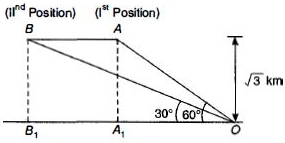
An aeroplane flying at a constant speed,parallel to the horizontal ground,$\sqrt{3} \ km$ above it,is observed at an elevation of $60^\circ$ from a point on the ground. If,after five seconds,its elevation from the same point is $30^\circ$,then the speed (in $km/hr$) of the aeroplane is
A
$1500$
B
$750$
C
$720$
D
$1440$
Solution
(D) Let the height of the aeroplane be $h = \sqrt{3} \ km$. Let $O$ be the point of observation on the ground.
Let $A$ be the first position of the aeroplane and $B$ be the second position after $5 \ seconds$.
In $\Delta OA A_1$,where $A A_1 = \sqrt{3} \ km$ and $\angle A O A_1 = 60^\circ$:
$O A_1 = \frac{A A_1}{\tan 60^\circ} = \frac{\sqrt{3}}{\sqrt{3}} = 1 \ km$.
In $\Delta OB B_1$,where $B B_1 = \sqrt{3} \ km$ and $\angle B O B_1 = 30^\circ$:
$O B_1 = \frac{B B_1}{\tan 30^\circ} = \frac{\sqrt{3}}{1/\sqrt{3}} = 3 \ km$.
The distance covered by the aeroplane is $AB = A_1 B_1 = O B_1 - O A_1 = 3 - 1 = 2 \ km$.
Time taken is $5 \ seconds = \frac{5}{3600} \ hours$.
Speed = $\frac{\text{Distance}}{\text{Time}} = \frac{2}{5/3600} = \frac{2 \times 3600}{5} = 1440 \ km/hr$.
Let $A$ be the first position of the aeroplane and $B$ be the second position after $5 \ seconds$.
In $\Delta OA A_1$,where $A A_1 = \sqrt{3} \ km$ and $\angle A O A_1 = 60^\circ$:
$O A_1 = \frac{A A_1}{\tan 60^\circ} = \frac{\sqrt{3}}{\sqrt{3}} = 1 \ km$.
In $\Delta OB B_1$,where $B B_1 = \sqrt{3} \ km$ and $\angle B O B_1 = 30^\circ$:
$O B_1 = \frac{B B_1}{\tan 30^\circ} = \frac{\sqrt{3}}{1/\sqrt{3}} = 3 \ km$.
The distance covered by the aeroplane is $AB = A_1 B_1 = O B_1 - O A_1 = 3 - 1 = 2 \ km$.
Time taken is $5 \ seconds = \frac{5}{3600} \ hours$.
Speed = $\frac{\text{Distance}}{\text{Time}} = \frac{2}{5/3600} = \frac{2 \times 3600}{5} = 1440 \ km/hr$.
0 likesView Solution
31
MathematicsMediumMCQJEE Main · 2018
$n$-digit numbers are formed using only three digits $2, 5,$ and $7$. The smallest value of $n$ for which $900$ such distinct numbers can be formed is:
A
$6$
B
$8$
C
$9$
D
$7$
Solution
(D) Each of the $n$ places in the $n$-digit number can be filled in $3$ ways (using digits $2, 5,$ or $7$).
Therefore,the total number of distinct $n$-digit numbers that can be formed is $3^n$.
We need to find the smallest integer $n$ such that $3^n \geq 900$.
Calculating powers of $3$:
$3^1 = 3$
$3^2 = 9$
$3^3 = 27$
$3^4 = 81$
$3^5 = 243$
$3^6 = 729$
$3^7 = 2187$
Since $3^6 = 729 < 900$ and $3^7 = 2187 \geq 900$,the smallest value of $n$ is $7$.
Therefore,the total number of distinct $n$-digit numbers that can be formed is $3^n$.
We need to find the smallest integer $n$ such that $3^n \geq 900$.
Calculating powers of $3$:
$3^1 = 3$
$3^2 = 9$
$3^3 = 27$
$3^4 = 81$
$3^5 = 243$
$3^6 = 729$
$3^7 = 2187$
Since $3^6 = 729 < 900$ and $3^7 = 2187 \geq 900$,the smallest value of $n$ is $7$.
0 likesView Solution
32
MathematicsDifficultMCQJEE Main · 2018
The coefficient of $x^{10}$ in the expansion of $(1 + x)^2 (1 + x^2)^3 (1 + x^3)^4$ is equal to
A
$52$
B
$44$
C
$50$
D
$56$
Solution
(A) We have $(1+x)^2 = 1 + 2x + x^2$.
$(1+x^2)^3 = 1 + 3x^2 + 3x^4 + x^6$.
$(1+x^3)^4 = 1 + 4x^3 + 6x^6 + 4x^9 + x^{12}$.
We need to find the coefficient of $x^{10}$ in the product $(1 + 2x + x^2)(1 + 3x^2 + 3x^4 + x^6)(1 + 4x^3 + 6x^6 + 4x^9 + x^{12})$.
Let $P_1 = (1 + 2x + x^2)$,$P_2 = (1 + 3x^2 + 3x^4 + x^6)$,and $P_3 = (1 + 4x^3 + 6x^6 + 4x^9 + x^{12})$.
Possible combinations of terms from $P_1, P_2, P_3$ that result in $x^{10}$ are:
$1$) $(2x) \cdot (x^0) \cdot (4x^9) = 8x^{10} \implies \text{coeff} = 8$.
$2$) $(2x) \cdot (3x^4) \cdot (6x^6) = 36x^{11}$ (Not $x^{10}$).
$3$) $(x^2) \cdot (3x^2) \cdot (6x^6) = 18x^{10} \implies \text{coeff} = 18$.
$4$) $(1) \cdot (3x^4) \cdot (4x^6)$ is not possible as $P_3$ has $x^6$ but not $x^4$.
Let's re-evaluate systematically:
Terms from $P_1$: $1, 2x, x^2$.
Terms from $P_2$: $1, 3x^2, 3x^4, x^6$.
Terms from $P_3$: $1, 4x^3, 6x^6, 4x^9, x^{12}$.
Combinations $(a, b, c)$ where $a \in P_1, b \in P_2, c \in P_3$ such that $a \cdot b \cdot c = x^{10}$:
- $(2x) \cdot (1) \cdot (4x^9) = 8x^{10}$.
- $(2x) \cdot (3x^4) \cdot (6x^6) = 36x^{11}$ (Invalid).
- $(x^2) \cdot (3x^2) \cdot (6x^6) = 18x^{10}$.
- $(1) \cdot (3x^4) \cdot (4x^6)$ is not possible. Wait,$P_2$ has $3x^4$ and $P_3$ has $6x^6$,so $1 \cdot 3x^4 \cdot 6x^6 = 18x^{10}$.
- $(2x) \cdot (3x^2) \cdot (4x^3)$ is not $x^{10}$.
- $(x^2) \cdot (1) \cdot (4x^9)$ is not $x^{10}$.
- $(1) \cdot (x^6) \cdot (4x^3)$ is not $x^{10}$.
- $(2x) \cdot (x^6) \cdot (4x^3) = 8x^{10}$.
Summing the coefficients: $8 + 18 + 18 + 8 = 52$.
$(1+x^2)^3 = 1 + 3x^2 + 3x^4 + x^6$.
$(1+x^3)^4 = 1 + 4x^3 + 6x^6 + 4x^9 + x^{12}$.
We need to find the coefficient of $x^{10}$ in the product $(1 + 2x + x^2)(1 + 3x^2 + 3x^4 + x^6)(1 + 4x^3 + 6x^6 + 4x^9 + x^{12})$.
Let $P_1 = (1 + 2x + x^2)$,$P_2 = (1 + 3x^2 + 3x^4 + x^6)$,and $P_3 = (1 + 4x^3 + 6x^6 + 4x^9 + x^{12})$.
Possible combinations of terms from $P_1, P_2, P_3$ that result in $x^{10}$ are:
$1$) $(2x) \cdot (x^0) \cdot (4x^9) = 8x^{10} \implies \text{coeff} = 8$.
$2$) $(2x) \cdot (3x^4) \cdot (6x^6) = 36x^{11}$ (Not $x^{10}$).
$3$) $(x^2) \cdot (3x^2) \cdot (6x^6) = 18x^{10} \implies \text{coeff} = 18$.
$4$) $(1) \cdot (3x^4) \cdot (4x^6)$ is not possible as $P_3$ has $x^6$ but not $x^4$.
Let's re-evaluate systematically:
Terms from $P_1$: $1, 2x, x^2$.
Terms from $P_2$: $1, 3x^2, 3x^4, x^6$.
Terms from $P_3$: $1, 4x^3, 6x^6, 4x^9, x^{12}$.
Combinations $(a, b, c)$ where $a \in P_1, b \in P_2, c \in P_3$ such that $a \cdot b \cdot c = x^{10}$:
- $(2x) \cdot (1) \cdot (4x^9) = 8x^{10}$.
- $(2x) \cdot (3x^4) \cdot (6x^6) = 36x^{11}$ (Invalid).
- $(x^2) \cdot (3x^2) \cdot (6x^6) = 18x^{10}$.
- $(1) \cdot (3x^4) \cdot (4x^6)$ is not possible. Wait,$P_2$ has $3x^4$ and $P_3$ has $6x^6$,so $1 \cdot 3x^4 \cdot 6x^6 = 18x^{10}$.
- $(2x) \cdot (3x^2) \cdot (4x^3)$ is not $x^{10}$.
- $(x^2) \cdot (1) \cdot (4x^9)$ is not $x^{10}$.
- $(1) \cdot (x^6) \cdot (4x^3)$ is not $x^{10}$.
- $(2x) \cdot (x^6) \cdot (4x^3) = 8x^{10}$.
Summing the coefficients: $8 + 18 + 18 + 8 = 52$.
0 likesView Solution
33
MathematicsDifficultMCQJEE Main · 2018
If $f(x)$ is a quadratic expression such that $f(1) + f(2) = 0$,and $-1$ is a root of $f(x) = 0$,then the other root of $f(x) = 0$ is
A
$-\frac{5}{8}$
B
$-\frac{8}{5}$
C
$\frac{5}{8}$
D
$\frac{8}{5}$
Solution
(D) Let the quadratic expression be $f(x) = k(x - r_1)(x - r_2)$.
Given that $-1$ is a root,let $r_1 = -1$. Let the other root be $a$.
So,$f(x) = k(x + 1)(x - a) = k(x^2 + (1 - a)x - a)$.
We are given $f(1) + f(2) = 0$.
$f(1) = k(1 + 1)(1 - a) = 2k(1 - a) = 2k - 2ka$.
$f(2) = k(2 + 1)(2 - a) = 3k(2 - a) = 6k - 3ka$.
Summing these: $f(1) + f(2) = (2k - 2ka) + (6k - 3ka) = 8k - 5ka$.
Setting the sum to zero: $8k - 5ka = 0$.
Since $f(x)$ is a quadratic expression,$k \neq 0$,so we can divide by $k$.
$8 - 5a = 0 \Rightarrow 5a = 8 \Rightarrow a = \frac{8}{5}$.
Thus,the other root is $\frac{8}{5}$.
Given that $-1$ is a root,let $r_1 = -1$. Let the other root be $a$.
So,$f(x) = k(x + 1)(x - a) = k(x^2 + (1 - a)x - a)$.
We are given $f(1) + f(2) = 0$.
$f(1) = k(1 + 1)(1 - a) = 2k(1 - a) = 2k - 2ka$.
$f(2) = k(2 + 1)(2 - a) = 3k(2 - a) = 6k - 3ka$.
Summing these: $f(1) + f(2) = (2k - 2ka) + (6k - 3ka) = 8k - 5ka$.
Setting the sum to zero: $8k - 5ka = 0$.
Since $f(x)$ is a quadratic expression,$k \neq 0$,so we can divide by $k$.
$8 - 5a = 0 \Rightarrow 5a = 8 \Rightarrow a = \frac{8}{5}$.
Thus,the other root is $\frac{8}{5}$.
0 likesView Solution
34
MathematicsDifficultMCQJEE Main · 2018
The number of four-letter words that can be formed using the letters of the word $BARRACK$ is
A
$144$
B
$120$
C
$264$
D
$270$
Solution
(D) The word $BARRACK$ consists of $7$ letters: $A, A, R, R, B, C, K$. The distinct letters are ${A, R, B, C, K}$.
We need to form $4$-letter words. The cases are:
$(i)$ All $4$ letters are distinct: We choose $4$ letters from ${A, R, B, C, K}$ in $^5C_4 = 5$ ways. Each set can be arranged in $4! = 24$ ways. Total $= 5 \times 24 = 120$.
(ii) $2$ pairs of identical letters: The pairs are ${A, A}$ and ${R, R}$. We choose both pairs in $^2C_2 = 1$ way. The number of arrangements is $\frac{4!}{2!2!} = 6$.
(iii) $2$ identical letters and $2$ distinct letters: We choose $1$ pair from ${A, A}$ or ${R, R}$ in $^2C_1 = 2$ ways. We then choose $2$ distinct letters from the remaining $4$ letters in $^4C_2 = 6$ ways. The number of arrangements for each selection is $\frac{4!}{2!} = 12$. Total $= 2 \times 6 \times 12 = 144$.
Total number of $4$-letter words $= 120 + 6 + 144 = 270$.
We need to form $4$-letter words. The cases are:
$(i)$ All $4$ letters are distinct: We choose $4$ letters from ${A, R, B, C, K}$ in $^5C_4 = 5$ ways. Each set can be arranged in $4! = 24$ ways. Total $= 5 \times 24 = 120$.
(ii) $2$ pairs of identical letters: The pairs are ${A, A}$ and ${R, R}$. We choose both pairs in $^2C_2 = 1$ way. The number of arrangements is $\frac{4!}{2!2!} = 6$.
(iii) $2$ identical letters and $2$ distinct letters: We choose $1$ pair from ${A, A}$ or ${R, R}$ in $^2C_1 = 2$ ways. We then choose $2$ distinct letters from the remaining $4$ letters in $^4C_2 = 6$ ways. The number of arrangements for each selection is $\frac{4!}{2!} = 12$. Total $= 2 \times 6 \times 12 = 144$.
Total number of $4$-letter words $= 120 + 6 + 144 = 270$.
0 likesView Solution
35
MathematicsDifficultMCQJEE Main · 2018
The number of solutions of $\sin 3x = \cos 2x$ in the interval $\left( \frac{\pi}{2}, \pi \right)$ is
A
$3$
B
$4$
C
$2$
D
$1$
Solution
(D) Given $\sin 3x = \cos 2x$.
We can write this as $\sin 3x = \sin \left( \frac{\pi}{2} - 2x \right)$.
The general solution for $\sin A = \sin B$ is $A = n\pi + (-1)^n B$,where $n \in \mathbb{Z}$.
Applying this,$3x = n\pi + (-1)^n \left( \frac{\pi}{2} - 2x \right)$.
Case $1$: If $n$ is even,let $n = 2k$. Then $3x = 2k\pi + \frac{\pi}{2} - 2x$ $\Rightarrow 5x = 2k\pi + \frac{\pi}{2}$ $\Rightarrow x = \frac{2k\pi}{5} + \frac{\pi}{10} = \frac{(4k+1)\pi}{10}$.
For $k=1$,$x = \frac{5\pi}{10} = \frac{\pi}{2}$ (not in interval).
For $k=2$,$x = \frac{9\pi}{10}$ (in interval).
Case $2$: If $n$ is odd,let $n = 2k+1$. Then $3x = (2k+1)\pi - \left( \frac{\pi}{2} - 2x \right) = 2k\pi + \pi - \frac{\pi}{2} + 2x = 2k\pi + \frac{\pi}{2} + 2x$ $\Rightarrow x = 2k\pi + \frac{\pi}{2}$.
For $k=0$,$x = \frac{\pi}{2}$ (not in interval).
For $k=1$,$x = 2\pi + \frac{\pi}{2} = \frac{5\pi}{2}$ (not in interval).
Thus,the only solution in the interval $\left( \frac{\pi}{2}, \pi \right)$ is $x = \frac{9\pi}{10}$.
Therefore,the number of solutions is $1$.
We can write this as $\sin 3x = \sin \left( \frac{\pi}{2} - 2x \right)$.
The general solution for $\sin A = \sin B$ is $A = n\pi + (-1)^n B$,where $n \in \mathbb{Z}$.
Applying this,$3x = n\pi + (-1)^n \left( \frac{\pi}{2} - 2x \right)$.
Case $1$: If $n$ is even,let $n = 2k$. Then $3x = 2k\pi + \frac{\pi}{2} - 2x$ $\Rightarrow 5x = 2k\pi + \frac{\pi}{2}$ $\Rightarrow x = \frac{2k\pi}{5} + \frac{\pi}{10} = \frac{(4k+1)\pi}{10}$.
For $k=1$,$x = \frac{5\pi}{10} = \frac{\pi}{2}$ (not in interval).
For $k=2$,$x = \frac{9\pi}{10}$ (in interval).
Case $2$: If $n$ is odd,let $n = 2k+1$. Then $3x = (2k+1)\pi - \left( \frac{\pi}{2} - 2x \right) = 2k\pi + \pi - \frac{\pi}{2} + 2x = 2k\pi + \frac{\pi}{2} + 2x$ $\Rightarrow x = 2k\pi + \frac{\pi}{2}$.
For $k=0$,$x = \frac{\pi}{2}$ (not in interval).
For $k=1$,$x = 2\pi + \frac{\pi}{2} = \frac{5\pi}{2}$ (not in interval).
Thus,the only solution in the interval $\left( \frac{\pi}{2}, \pi \right)$ is $x = \frac{9\pi}{10}$.
Therefore,the number of solutions is $1$.
0 likesView Solution
36
MathematicsDifficultMCQJEE Main · 2018
Consider the following two statements.
Statement $p$: The value of $\sin 120^\circ$ can be derived by taking $\theta = 240^\circ$ in the equation $2\sin \frac{\theta}{2} = \sqrt{1 + \sin \theta} - \sqrt{1 - \sin \theta}$.
Statement $q$: The angles $A, B, C$ and $D$ of any quadrilateral $ABCD$ satisfy the equation $\cos \left( \frac{1}{2}(A + C) \right) + \cos \left( \frac{1}{2}(B + D) \right) = 0$.
Then the truth values of $p$ and $q$ are respectively:
Statement $p$: The value of $\sin 120^\circ$ can be derived by taking $\theta = 240^\circ$ in the equation $2\sin \frac{\theta}{2} = \sqrt{1 + \sin \theta} - \sqrt{1 - \sin \theta}$.
Statement $q$: The angles $A, B, C$ and $D$ of any quadrilateral $ABCD$ satisfy the equation $\cos \left( \frac{1}{2}(A + C) \right) + \cos \left( \frac{1}{2}(B + D) \right) = 0$.
Then the truth values of $p$ and $q$ are respectively:
A
$F, T$
B
$T, T$
C
$F, F$
D
$T, F$
Solution
(A) For statement $p$: $\sin 120^\circ = \frac{\sqrt{3}}{2}$,so $2\sin 120^\circ = \sqrt{3}$.
Substituting $\theta = 240^\circ$ in the $RHS$: $\sqrt{1 + \sin 240^\circ} - \sqrt{1 - \sin 240^\circ} = \sqrt{1 - \frac{\sqrt{3}}{2}} - \sqrt{1 + \frac{\sqrt{3}}{2}} = \sqrt{\frac{2 - \sqrt{3}}{2}} - \sqrt{\frac{2 + \sqrt{3}}{2}} = \frac{\sqrt{3}-1}{2} - \frac{\sqrt{3}+1}{2} = -1 \neq \sqrt{3}$. Thus,statement $p$ is False.
For statement $q$: In any quadrilateral $ABCD$,$A + B + C + D = 360^\circ$,so $\frac{A+C}{2} + \frac{B+D}{2} = 180^\circ = \pi$.
Let $\alpha = \frac{A+C}{2}$,then $\frac{B+D}{2} = \pi - \alpha$.
Thus,$\cos(\alpha) + \cos(\pi - \alpha) = \cos(\alpha) - \cos(\alpha) = 0$. Thus,statement $q$ is True.
Therefore,the truth values are $F, T$.
Substituting $\theta = 240^\circ$ in the $RHS$: $\sqrt{1 + \sin 240^\circ} - \sqrt{1 - \sin 240^\circ} = \sqrt{1 - \frac{\sqrt{3}}{2}} - \sqrt{1 + \frac{\sqrt{3}}{2}} = \sqrt{\frac{2 - \sqrt{3}}{2}} - \sqrt{\frac{2 + \sqrt{3}}{2}} = \frac{\sqrt{3}-1}{2} - \frac{\sqrt{3}+1}{2} = -1 \neq \sqrt{3}$. Thus,statement $p$ is False.
For statement $q$: In any quadrilateral $ABCD$,$A + B + C + D = 360^\circ$,so $\frac{A+C}{2} + \frac{B+D}{2} = 180^\circ = \pi$.
Let $\alpha = \frac{A+C}{2}$,then $\frac{B+D}{2} = \pi - \alpha$.
Thus,$\cos(\alpha) + \cos(\pi - \alpha) = \cos(\alpha) - \cos(\alpha) = 0$. Thus,statement $q$ is True.
Therefore,the truth values are $F, T$.
0 likesView Solution
37
MathematicsDifficultMCQJEE Main · 2018
If $|z - 3 + 2i| \leq 4$,then the difference between the greatest value and the least value of $|z|$ is
A
$\sqrt{13}$
B
$2\sqrt{13}$
C
$8$
D
$4 + \sqrt{13}$
Solution
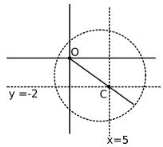
(B) The given equation $|z - (3 - 2i)| \leq 4$ represents a disk with center $C(3, -2)$ and radius $R = 4$.
$|z|$ represents the distance of a point $z$ from the origin $O(0, 0)$.
The greatest and least distances from the origin to the circle occur along the line passing through the origin and the center $C$.
Let $OC$ be the distance from the origin to the center $C(3, -2)$.
$OC = \sqrt{3^2 + (-2)^2} = \sqrt{9 + 4} = \sqrt{13}$.
The least distance of $|z|$ from the origin is $|OC - R| = |\sqrt{13} - 4|$. Since $\sqrt{13} < 4$,the least distance is $4 - \sqrt{13}$.
The greatest distance of $|z|$ from the origin is $OC + R = \sqrt{13} + 4$.
The difference between the greatest and least values is $(4 + \sqrt{13}) - (4 - \sqrt{13}) = 2\sqrt{13}$.
$|z|$ represents the distance of a point $z$ from the origin $O(0, 0)$.
The greatest and least distances from the origin to the circle occur along the line passing through the origin and the center $C$.
Let $OC$ be the distance from the origin to the center $C(3, -2)$.
$OC = \sqrt{3^2 + (-2)^2} = \sqrt{9 + 4} = \sqrt{13}$.
The least distance of $|z|$ from the origin is $|OC - R| = |\sqrt{13} - 4|$. Since $\sqrt{13} < 4$,the least distance is $4 - \sqrt{13}$.
The greatest distance of $|z|$ from the origin is $OC + R = \sqrt{13} + 4$.
The difference between the greatest and least values is $(4 + \sqrt{13}) - (4 - \sqrt{13}) = 2\sqrt{13}$.
0 likesView Solution
38
MathematicsDifficultMCQJEE Main · 2018
The foot of the perpendicular drawn from the origin to the line $3x + y = \lambda \, (\lambda \ne 0)$ is $P$. If the line meets the $x$-axis at $A$ and the $y$-axis at $B$,then the ratio $BP : PA$ is
A
$9 : 1$
B
$1 : 3$
C
$1 : 9$
D
$3 : 1$
Solution
(A) The equation of the line $3x + y = \lambda$ can be written in intercept form as $\frac{x}{\lambda/3} + \frac{y}{\lambda} = 1$.
Thus,the coordinates of $A$ are $(\frac{\lambda}{3}, 0)$ and $B$ are $(0, \lambda)$.
The foot of the perpendicular $P$ from the origin $(0,0)$ to the line $ax + by + c = 0$ is given by $(\frac{-ac}{a^2+b^2}, \frac{-bc}{a^2+b^2})$.
Here,$3x + y - \lambda = 0$,so $a=3, b=1, c=-\lambda$.
$P = (\frac{-3(-\lambda)}{3^2+1^2}, \frac{-1(-\lambda)}{3^2+1^2}) = (\frac{3\lambda}{10}, \frac{\lambda}{10})$.
Now,we calculate the distances $BP$ and $PA$:
$BP^2 = (\frac{3\lambda}{10} - 0)^2 + (\frac{\lambda}{10} - \lambda)^2 = \frac{9\lambda^2}{100} + \frac{81\lambda^2}{100} = \frac{90\lambda^2}{100} = \frac{9\lambda^2}{10}$.
$PA^2 = (\frac{\lambda}{3} - \frac{3\lambda}{10})^2 + (0 - \frac{\lambda}{10})^2 = (\frac{10\lambda - 9\lambda}{30})^2 + \frac{\lambda^2}{100} = \frac{\lambda^2}{900} + \frac{9\lambda^2}{900} = \frac{10\lambda^2}{900} = \frac{\lambda^2}{90}$.
Therefore,$\frac{BP^2}{PA^2} = \frac{9\lambda^2/10}{\lambda^2/90} = \frac{9}{10} \times 90 = 81$.
Thus,$\frac{BP}{PA} = \sqrt{81} = 9$.
So,the ratio $BP : PA$ is $9 : 1$.
Thus,the coordinates of $A$ are $(\frac{\lambda}{3}, 0)$ and $B$ are $(0, \lambda)$.
The foot of the perpendicular $P$ from the origin $(0,0)$ to the line $ax + by + c = 0$ is given by $(\frac{-ac}{a^2+b^2}, \frac{-bc}{a^2+b^2})$.
Here,$3x + y - \lambda = 0$,so $a=3, b=1, c=-\lambda$.
$P = (\frac{-3(-\lambda)}{3^2+1^2}, \frac{-1(-\lambda)}{3^2+1^2}) = (\frac{3\lambda}{10}, \frac{\lambda}{10})$.
Now,we calculate the distances $BP$ and $PA$:
$BP^2 = (\frac{3\lambda}{10} - 0)^2 + (\frac{\lambda}{10} - \lambda)^2 = \frac{9\lambda^2}{100} + \frac{81\lambda^2}{100} = \frac{90\lambda^2}{100} = \frac{9\lambda^2}{10}$.
$PA^2 = (\frac{\lambda}{3} - \frac{3\lambda}{10})^2 + (0 - \frac{\lambda}{10})^2 = (\frac{10\lambda - 9\lambda}{30})^2 + \frac{\lambda^2}{100} = \frac{\lambda^2}{900} + \frac{9\lambda^2}{900} = \frac{10\lambda^2}{900} = \frac{\lambda^2}{90}$.
Therefore,$\frac{BP^2}{PA^2} = \frac{9\lambda^2/10}{\lambda^2/90} = \frac{9}{10} \times 90 = 81$.
Thus,$\frac{BP}{PA} = \sqrt{81} = 9$.
So,the ratio $BP : PA$ is $9 : 1$.
0 likesView Solution
39
MathematicsDifficultMCQJEE Main · 2018
Let $A_n = \left( \frac{3}{4} \right) - \left( \frac{3}{4} \right)^2 + \left( \frac{3}{4} \right)^3 - \dots + (-1)^{n-1} \left( \frac{3}{4} \right)^n$ and $B_n = 1 - A_n$. Then,the least odd natural number $p$ such that $B_n > A_n$ for all $n \geq p$ is:
A
$5$
B
$7$
C
$11$
D
$9$
Solution
(B) $A_n$ is a geometric progression with first term $a = \frac{3}{4}$ and common ratio $r = -\frac{3}{4}$.
The sum of $n$ terms is $A_n = \frac{a(1-r^n)}{1-r} = \frac{\frac{3}{4}(1 - (-\frac{3}{4})^n)}{1 - (-\frac{3}{4})} = \frac{\frac{3}{4}(1 - (-\frac{3}{4})^n)}{\frac{7}{4}} = \frac{3}{7} \left[ 1 - \left( -\frac{3}{4} \right)^n \right]$.
Given $B_n = 1 - A_n$,the condition $B_n > A_n$ implies $1 - A_n > A_n$,which simplifies to $1 > 2A_n$,or $A_n < \frac{1}{2}$.
Substituting $A_n$: $\frac{3}{7} \left[ 1 - \left( -\frac{3}{4} \right)^n \right] < \frac{1}{2} \implies 1 - \left( -\frac{3}{4} \right)^n < \frac{7}{6}$.
This gives $-\left( -\frac{3}{4} \right)^n < \frac{1}{6}$,or $\left( -\frac{3}{4} \right)^n > -\frac{1}{6}$.
For odd $n$,$\left( -\frac{3}{4} \right)^n = -\left( \frac{3}{4} \right)^n$. So,$-\left( \frac{3}{4} \right)^n > -\frac{1}{6}$,which means $\left( \frac{3}{4} \right)^n < \frac{1}{6}$.
Taking logarithms: $n \log(\frac{3}{4}) < \log(\frac{1}{6}) \implies n(\log 3 - \log 4) < -\log 6$.
$n(0.4771 - 0.6020) < -0.7781 \implies n(-0.1249) < -0.7781 \implies n > \frac{0.7781}{0.1249} \approx 6.23$.
The least odd natural number $p$ satisfying $n > 6.23$ is $p = 7$.
The sum of $n$ terms is $A_n = \frac{a(1-r^n)}{1-r} = \frac{\frac{3}{4}(1 - (-\frac{3}{4})^n)}{1 - (-\frac{3}{4})} = \frac{\frac{3}{4}(1 - (-\frac{3}{4})^n)}{\frac{7}{4}} = \frac{3}{7} \left[ 1 - \left( -\frac{3}{4} \right)^n \right]$.
Given $B_n = 1 - A_n$,the condition $B_n > A_n$ implies $1 - A_n > A_n$,which simplifies to $1 > 2A_n$,or $A_n < \frac{1}{2}$.
Substituting $A_n$: $\frac{3}{7} \left[ 1 - \left( -\frac{3}{4} \right)^n \right] < \frac{1}{2} \implies 1 - \left( -\frac{3}{4} \right)^n < \frac{7}{6}$.
This gives $-\left( -\frac{3}{4} \right)^n < \frac{1}{6}$,or $\left( -\frac{3}{4} \right)^n > -\frac{1}{6}$.
For odd $n$,$\left( -\frac{3}{4} \right)^n = -\left( \frac{3}{4} \right)^n$. So,$-\left( \frac{3}{4} \right)^n > -\frac{1}{6}$,which means $\left( \frac{3}{4} \right)^n < \frac{1}{6}$.
Taking logarithms: $n \log(\frac{3}{4}) < \log(\frac{1}{6}) \implies n(\log 3 - \log 4) < -\log 6$.
$n(0.4771 - 0.6020) < -0.7781 \implies n(-0.1249) < -0.7781 \implies n > \frac{0.7781}{0.1249} \approx 6.23$.
The least odd natural number $p$ satisfying $n > 6.23$ is $p = 7$.
0 likesView Solution
40
MathematicsDifficultMCQJEE Main · 2018
$A$ normal to the hyperbola $4x^2 - 9y^2 = 36$ meets the coordinate axes $x$ and $y$ at $A$ and $B$,respectively. If the parallelogram $OABP$ ($O$ being the origin) is formed,then the locus of $P$ is
A
$4x^2 - 9y^2 = 121$
B
$4x^2 + 9y^2 = 121$
C
$9x^2 - 4y^2 = 169$
D
$9x^2 + 4y^2 = 169$
Solution
(C) The equation of the hyperbola is $4x^2 - 9y^2 = 36$,which can be written as $\frac{x^2}{9} - \frac{y^2}{4} = 1$.
Let the point on the hyperbola be $(x_0, y_0)$. The equation of the normal at $(x_0, y_0)$ is $\frac{a^2x}{x_0} + \frac{b^2y}{y_0} = a^2 + b^2$.
Here $a^2 = 9$ and $b^2 = 4$,so the equation is $\frac{9x}{x_0} + \frac{4y}{y_0} = 9 + 4 = 13$.
This normal meets the $x$-axis at $A(\frac{13x_0}{9}, 0)$ and the $y$-axis at $B(0, \frac{13y_0}{4})$.
Since $OABP$ is a parallelogram with $O(0,0)$,the coordinates of $P(x, y)$ are given by $P = A + B = (\frac{13x_0}{9}, \frac{13y_0}{4})$.
Thus,$x = \frac{13x_0}{9} \Rightarrow x_0 = \frac{9x}{13}$ and $y = \frac{13y_0}{4} \Rightarrow y_0 = \frac{4y}{13}$.
Since $(x_0, y_0)$ lies on the hyperbola $4x_0^2 - 9y_0^2 = 36$,we substitute the values:
$4(\frac{9x}{13})^2 - 9(\frac{4y}{13})^2 = 36$
$4 \cdot \frac{81x^2}{169} - 9 \cdot \frac{16y^2}{169} = 36$
$\frac{324x^2 - 144y^2}{169} = 36$
$324x^2 - 144y^2 = 36 \cdot 169$
Dividing by $36$,we get $9x^2 - 4y^2 = 169$.
Let the point on the hyperbola be $(x_0, y_0)$. The equation of the normal at $(x_0, y_0)$ is $\frac{a^2x}{x_0} + \frac{b^2y}{y_0} = a^2 + b^2$.
Here $a^2 = 9$ and $b^2 = 4$,so the equation is $\frac{9x}{x_0} + \frac{4y}{y_0} = 9 + 4 = 13$.
This normal meets the $x$-axis at $A(\frac{13x_0}{9}, 0)$ and the $y$-axis at $B(0, \frac{13y_0}{4})$.
Since $OABP$ is a parallelogram with $O(0,0)$,the coordinates of $P(x, y)$ are given by $P = A + B = (\frac{13x_0}{9}, \frac{13y_0}{4})$.
Thus,$x = \frac{13x_0}{9} \Rightarrow x_0 = \frac{9x}{13}$ and $y = \frac{13y_0}{4} \Rightarrow y_0 = \frac{4y}{13}$.
Since $(x_0, y_0)$ lies on the hyperbola $4x_0^2 - 9y_0^2 = 36$,we substitute the values:
$4(\frac{9x}{13})^2 - 9(\frac{4y}{13})^2 = 36$
$4 \cdot \frac{81x^2}{169} - 9 \cdot \frac{16y^2}{169} = 36$
$\frac{324x^2 - 144y^2}{169} = 36$
$324x^2 - 144y^2 = 36 \cdot 169$
Dividing by $36$,we get $9x^2 - 4y^2 = 169$.
0 likesView Solution
41
MathematicsDifficultMCQJEE Main · 2018
The tangent to the circle $C_1 : x^2 + y^2 - 2x - 1 = 0$ at the point $(2, 1)$ cuts off a chord of length $4$ from a circle $C_2$ whose centre is $(3, -2)$. The radius of $C_2$ is
A
$\sqrt{6}$
B
$2$
C
$\sqrt{2}$
D
$3$
Solution
(A) The equation of the circle $C_1$ is $x^2 + y^2 - 2x - 1 = 0$.
The equation of the tangent at point $(x_1, y_1) = (2, 1)$ is given by $xx_1 + yy_1 - (x + x_1) - 1 = 0$.
Substituting the values,we get $2x + y - (x + 2) - 1 = 0$,which simplifies to $x + y - 3 = 0$.
This line acts as a chord for the circle $C_2$ with center $(3, -2)$.
The perpendicular distance $d$ from the center $(3, -2)$ to the line $x + y - 3 = 0$ is $d = \frac{|3 - 2 - 3|}{\sqrt{1^2 + 1^2}} = \frac{|-2|}{\sqrt{2}} = \sqrt{2}$.
The length of the chord is $l = 4$,so half the length of the chord is $\frac{l}{2} = 2$.
The radius $r$ of the circle $C_2$ is given by $r = \sqrt{(\frac{l}{2})^2 + d^2}$.
Substituting the values,$r = \sqrt{2^2 + (\sqrt{2})^2} = \sqrt{4 + 2} = \sqrt{6}$.
The equation of the tangent at point $(x_1, y_1) = (2, 1)$ is given by $xx_1 + yy_1 - (x + x_1) - 1 = 0$.
Substituting the values,we get $2x + y - (x + 2) - 1 = 0$,which simplifies to $x + y - 3 = 0$.
This line acts as a chord for the circle $C_2$ with center $(3, -2)$.
The perpendicular distance $d$ from the center $(3, -2)$ to the line $x + y - 3 = 0$ is $d = \frac{|3 - 2 - 3|}{\sqrt{1^2 + 1^2}} = \frac{|-2|}{\sqrt{2}} = \sqrt{2}$.
The length of the chord is $l = 4$,so half the length of the chord is $\frac{l}{2} = 2$.
The radius $r$ of the circle $C_2$ is given by $r = \sqrt{(\frac{l}{2})^2 + d^2}$.
Substituting the values,$r = \sqrt{2^2 + (\sqrt{2})^2} = \sqrt{4 + 2} = \sqrt{6}$.
0 likesView Solution
42
MathematicsDifficultMCQJEE Main · 2018
$A$ tower $T_1$ of height $60 \, m$ is located exactly opposite to a tower $T_2$ of height $80 \, m$ on a straight road. From the top of $T_1$,if the angle of depression of the foot of $T_2$ is twice the angle of elevation of the top of $T_2$,then the width (in $m$) of the road between the feet of the towers $T_1$ and $T_2$ is
A
$20\sqrt{2}$
B
$10\sqrt{2}$
C
$10\sqrt{3}$
D
$20\sqrt{3}$
Solution
(D) Let the distance between $T_1$ and $T_2$ be $x$.
From the figure,$EA = 60 \, m$ $(T_1)$ and $DB = 80 \, m$ $(T_2)$.
Let $C$ be a point on $T_2$ such that $EC$ is horizontal. Then $EC = AB = x$.
$DC = DB - CB = 80 - 60 = 20 \, m$.
Given $\angle DEC = \theta$ (angle of elevation of top of $T_2$) and $\angle BEC = 2\theta$ (angle of depression of foot of $T_2$).
In $\Delta DEC$,$\tan \theta = \frac{DC}{EC} = \frac{20}{x}$.
In $\Delta BEC$,$\tan 2\theta = \frac{BC}{EC} = \frac{60}{x}$.
Using the identity $\tan 2\theta = \frac{2 \tan \theta}{1 - \tan^2 \theta}$,we have:
$\frac{60}{x} = \frac{2(\frac{20}{x})}{1 - (\frac{20}{x})^2}$.
$\frac{60}{x} = \frac{40/x}{1 - 400/x^2} = \frac{40x}{x^2 - 400}$.
$60(x^2 - 400) = 40x^2$.
$60x^2 - 24000 = 40x^2$.
$20x^2 = 24000$.
$x^2 = 1200$.
$x = \sqrt{1200} = 20\sqrt{3} \, m$.
From the figure,$EA = 60 \, m$ $(T_1)$ and $DB = 80 \, m$ $(T_2)$.
Let $C$ be a point on $T_2$ such that $EC$ is horizontal. Then $EC = AB = x$.
$DC = DB - CB = 80 - 60 = 20 \, m$.
Given $\angle DEC = \theta$ (angle of elevation of top of $T_2$) and $\angle BEC = 2\theta$ (angle of depression of foot of $T_2$).
In $\Delta DEC$,$\tan \theta = \frac{DC}{EC} = \frac{20}{x}$.
In $\Delta BEC$,$\tan 2\theta = \frac{BC}{EC} = \frac{60}{x}$.
Using the identity $\tan 2\theta = \frac{2 \tan \theta}{1 - \tan^2 \theta}$,we have:
$\frac{60}{x} = \frac{2(\frac{20}{x})}{1 - (\frac{20}{x})^2}$.
$\frac{60}{x} = \frac{40/x}{1 - 400/x^2} = \frac{40x}{x^2 - 400}$.
$60(x^2 - 400) = 40x^2$.
$60x^2 - 24000 = 40x^2$.
$20x^2 = 24000$.
$x^2 = 1200$.
$x = \sqrt{1200} = 20\sqrt{3} \, m$.
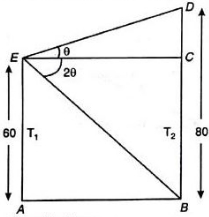
0 likesView Solution
43
MathematicsDifficultMCQJEE Main · 2018
The sides of a rhombus $ABCD$ are parallel to the lines $x - y + 2 = 0$ and $7x - y + 3 = 0$. If the diagonals of the rhombus intersect at $P(1, 2)$ and the vertex $A$ (different from the origin) is on the $y$-axis,then the ordinate of $A$ is
A
$2$
B
$\frac{7}{4}$
C
$\frac{7}{2}$
D
$\frac{5}{2}$
Solution
(D) Let the coordinate of vertex $A$ be $(0, c)$.
The equations of the lines parallel to the sides are $x - y + 2 = 0$ and $7x - y + 3 = 0$.
The diagonals of a rhombus are the angle bisectors of the lines containing the sides.
The equations of the angle bisectors are given by $\frac{x - y + 2}{\sqrt{1^2 + (-1)^2}} = \pm \frac{7x - y + 3}{\sqrt{7^2 + (-1)^2}}$.
$\frac{x - y + 2}{\sqrt{2}} = \pm \frac{7x - y + 3}{5\sqrt{2}}$.
$5x - 5y + 10 = \pm (7x - y + 3)$.
Case $1$: $5x - 5y + 10 = 7x - y + 3 \Rightarrow 2x + 4y - 7 = 0$. The slope is $m_1 = -\frac{1}{2}$.
Case $2$: $5x - 5y + 10 = -7x + y - 3 \Rightarrow 12x - 6y + 13 = 0$. The slope is $m_2 = 2$.
The diagonals pass through $P(1, 2)$ and $A(0, c)$. The slope of the line $AP$ is $\frac{2 - c}{1 - 0} = 2 - c$.
If $2 - c = 2$,then $c = 0$,which corresponds to the origin (not allowed).
If $2 - c = -\frac{1}{2}$,then $c = 2 + \frac{1}{2} = \frac{5}{2}$.
The equations of the lines parallel to the sides are $x - y + 2 = 0$ and $7x - y + 3 = 0$.
The diagonals of a rhombus are the angle bisectors of the lines containing the sides.
The equations of the angle bisectors are given by $\frac{x - y + 2}{\sqrt{1^2 + (-1)^2}} = \pm \frac{7x - y + 3}{\sqrt{7^2 + (-1)^2}}$.
$\frac{x - y + 2}{\sqrt{2}} = \pm \frac{7x - y + 3}{5\sqrt{2}}$.
$5x - 5y + 10 = \pm (7x - y + 3)$.
Case $1$: $5x - 5y + 10 = 7x - y + 3 \Rightarrow 2x + 4y - 7 = 0$. The slope is $m_1 = -\frac{1}{2}$.
Case $2$: $5x - 5y + 10 = -7x + y - 3 \Rightarrow 12x - 6y + 13 = 0$. The slope is $m_2 = 2$.
The diagonals pass through $P(1, 2)$ and $A(0, c)$. The slope of the line $AP$ is $\frac{2 - c}{1 - 0} = 2 - c$.
If $2 - c = 2$,then $c = 0$,which corresponds to the origin (not allowed).
If $2 - c = -\frac{1}{2}$,then $c = 2 + \frac{1}{2} = \frac{5}{2}$.
0 likesView Solution
44
MathematicsDifficultMCQJEE Main · 2018
$\mathop {\lim }\limits_{x \to 0} \frac{{x\tan 2x - 2x\tan x}}{{{{\left( {1 - \cos 2x} \right)}^2}}}$ equals
A
$1$
B
$-\frac{1}{2}$
C
$\frac{1}{4}$
D
$\frac{1}{2}$
Solution
(D) Let $L = \mathop {\lim }\limits_{x \to 0} \frac{{x\tan 2x - 2x\tan x}}{{{{\left( {1 - \cos 2x} \right)}^2}}}$.
Using the identity $\tan 2x = \frac{{2\tan x}}{{1 - {{\tan }^2}x}}$ and $1 - \cos 2x = 2\sin^2 x$,we have:
$L = \mathop {\lim }\limits_{x \to 0} \frac{{x\left( \frac{{2\tan x}}{{1 - {{\tan }^2}x}} \right) - 2x\tan x}}{{{{\left( {2\sin^2 x} \right)}^2}}}$
$L = \mathop {\lim }\limits_{x \to 0} \frac{{2x\tan x - 2x\tan x(1 - {{\tan }^2}x)}}{{(1 - {{\tan }^2}x) \cdot 4\sin^4 x}}$
$L = \mathop {\lim }\limits_{x \to 0} \frac{{2x\tan^3 x}}{{4\sin^4 x(1 - {{\tan }^2}x)}}$
Since $\tan x = \frac{\sin x}{\cos x}$,we get:
$L = \mathop {\lim }\limits_{x \to 0} \frac{{2x \cdot \frac{\sin^3 x}{\cos^3 x}}}{{4\sin^4 x(1 - {{\tan }^2}x)}}$
$L = \mathop {\lim }\limits_{x \to 0} \frac{{2x}}{{4\sin x \cdot \cos^3 x(1 - {{\tan }^2}x)}}$
$L = \mathop {\lim }\limits_{x \to 0} \left( \frac{x}{2\sin x} \right) \cdot \mathop {\lim }\limits_{x \to 0} \frac{1}{{\cos^3 x(1 - {{\tan }^2}x)}}$
$L = \frac{1}{2} \cdot \frac{1}{1(1 - 0)} = \frac{1}{2}$.
Using the identity $\tan 2x = \frac{{2\tan x}}{{1 - {{\tan }^2}x}}$ and $1 - \cos 2x = 2\sin^2 x$,we have:
$L = \mathop {\lim }\limits_{x \to 0} \frac{{x\left( \frac{{2\tan x}}{{1 - {{\tan }^2}x}} \right) - 2x\tan x}}{{{{\left( {2\sin^2 x} \right)}^2}}}$
$L = \mathop {\lim }\limits_{x \to 0} \frac{{2x\tan x - 2x\tan x(1 - {{\tan }^2}x)}}{{(1 - {{\tan }^2}x) \cdot 4\sin^4 x}}$
$L = \mathop {\lim }\limits_{x \to 0} \frac{{2x\tan^3 x}}{{4\sin^4 x(1 - {{\tan }^2}x)}}$
Since $\tan x = \frac{\sin x}{\cos x}$,we get:
$L = \mathop {\lim }\limits_{x \to 0} \frac{{2x \cdot \frac{\sin^3 x}{\cos^3 x}}}{{4\sin^4 x(1 - {{\tan }^2}x)}}$
$L = \mathop {\lim }\limits_{x \to 0} \frac{{2x}}{{4\sin x \cdot \cos^3 x(1 - {{\tan }^2}x)}}$
$L = \mathop {\lim }\limits_{x \to 0} \left( \frac{x}{2\sin x} \right) \cdot \mathop {\lim }\limits_{x \to 0} \frac{1}{{\cos^3 x(1 - {{\tan }^2}x)}}$
$L = \frac{1}{2} \cdot \frac{1}{1(1 - 0)} = \frac{1}{2}$.
0 likesView Solution
45
MathematicsDifficultMCQJEE Main · 2018
If $a, b, c$ are in $A.P.$ and $a^2, b^2, c^2$ are in $G.P.$ such that $a < b < c$ and $a+b+c = \frac{3}{4}$,then the value of $a$ is
A
$\frac{1}{4} - \frac{1}{3\sqrt{2}}$
B
$\frac{1}{4} - \frac{1}{4\sqrt{2}}$
C
$\frac{1}{4} - \frac{1}{\sqrt{2}}$
D
$\frac{1}{4} - \frac{1}{2\sqrt{2}}$
Solution
(D) Given $a, b, c$ are in $A.P.$,so $a+c = 2b$.
Given $a+b+c = \frac{3}{4}$,substituting $a+c=2b$ gives $3b = \frac{3}{4}$,so $b = \frac{1}{4}$.
Given $a^2, b^2, c^2$ are in $G.P.$,so $(b^2)^2 = a^2 c^2$,which implies $ac = \pm b^2 = \pm \frac{1}{16}$.
Since $a < b < c$,$ac$ must be negative,so $ac = -\frac{1}{16}$.
We have $a+c = 2b = \frac{1}{2}$ and $ac = -\frac{1}{16}$.
The quadratic equation for $a$ and $c$ is $x^2 - (a+c)x + ac = 0$,which is $x^2 - \frac{1}{2}x - \frac{1}{16} = 0$.
Multiplying by $16$,we get $16x^2 - 8x - 1 = 0$.
Using the quadratic formula $x = \frac{-b \pm \sqrt{b^2 - 4ac}}{2a}$,we get $x = \frac{8 \pm \sqrt{64 - 4(16)(-1)}}{32} = \frac{8 \pm \sqrt{128}}{32} = \frac{8 \pm 8\sqrt{2}}{32} = \frac{1}{4} \pm \frac{\sqrt{2}}{4} = \frac{1}{4} \pm \frac{1}{2\sqrt{2}}$.
Since $a < b$,we choose the smaller value: $a = \frac{1}{4} - \frac{1}{2\sqrt{2}}$.
Given $a+b+c = \frac{3}{4}$,substituting $a+c=2b$ gives $3b = \frac{3}{4}$,so $b = \frac{1}{4}$.
Given $a^2, b^2, c^2$ are in $G.P.$,so $(b^2)^2 = a^2 c^2$,which implies $ac = \pm b^2 = \pm \frac{1}{16}$.
Since $a < b < c$,$ac$ must be negative,so $ac = -\frac{1}{16}$.
We have $a+c = 2b = \frac{1}{2}$ and $ac = -\frac{1}{16}$.
The quadratic equation for $a$ and $c$ is $x^2 - (a+c)x + ac = 0$,which is $x^2 - \frac{1}{2}x - \frac{1}{16} = 0$.
Multiplying by $16$,we get $16x^2 - 8x - 1 = 0$.
Using the quadratic formula $x = \frac{-b \pm \sqrt{b^2 - 4ac}}{2a}$,we get $x = \frac{8 \pm \sqrt{64 - 4(16)(-1)}}{32} = \frac{8 \pm \sqrt{128}}{32} = \frac{8 \pm 8\sqrt{2}}{32} = \frac{1}{4} \pm \frac{\sqrt{2}}{4} = \frac{1}{4} \pm \frac{1}{2\sqrt{2}}$.
Since $a < b$,we choose the smaller value: $a = \frac{1}{4} - \frac{1}{2\sqrt{2}}$.
0 likesView Solution
46
MathematicsDifficultMCQJEE Main · 2018
Tangents drawn from the point $(-8, 0)$ to the parabola $y^2 = 8x$ touch the parabola at $P$ and $Q$. If $F$ is the focus of the parabola,then the area of the triangle $PFQ$ (in sq. units) is equal to
A
$48$
B
$32$
C
$24$
D
$64$
Solution
(A) The equation of the parabola is $y^2 = 8x$,so $4a = 8$,which implies $a = 2$. The focus $F$ is $(2, 0)$.
The equation of the chord of contact $PQ$ for a point $(x_1, y_1) = (-8, 0)$ is given by $T = 0$,which is $yy_1 = 2a(x + x_1)$.
Substituting the values,we get $y(0) = 2(2)(x - 8)$,which simplifies to $0 = 4(x - 8)$,so $x = 8$.
For $x = 8$,$y^2 = 8(8) = 64$,so $y = \pm 8$. Thus,the points are $P(8, 8)$ and $Q(8, -8)$.
The triangle $PFQ$ has vertices $P(8, 8)$,$F(2, 0)$,and $Q(8, -8)$.
The base $PQ$ is a vertical line segment with length $|8 - (-8)| = 16$.
The height of the triangle from $F(2, 0)$ to the line $x = 8$ is $|8 - 2| = 6$.
Area of $\triangle PFQ = \frac{1}{2} \times \text{base} \times \text{height} = \frac{1}{2} \times 16 \times 6 = 48$ sq. units.
The equation of the chord of contact $PQ$ for a point $(x_1, y_1) = (-8, 0)$ is given by $T = 0$,which is $yy_1 = 2a(x + x_1)$.
Substituting the values,we get $y(0) = 2(2)(x - 8)$,which simplifies to $0 = 4(x - 8)$,so $x = 8$.
For $x = 8$,$y^2 = 8(8) = 64$,so $y = \pm 8$. Thus,the points are $P(8, 8)$ and $Q(8, -8)$.
The triangle $PFQ$ has vertices $P(8, 8)$,$F(2, 0)$,and $Q(8, -8)$.
The base $PQ$ is a vertical line segment with length $|8 - (-8)| = 16$.
The height of the triangle from $F(2, 0)$ to the line $x = 8$ is $|8 - 2| = 6$.
Area of $\triangle PFQ = \frac{1}{2} \times \text{base} \times \text{height} = \frac{1}{2} \times 16 \times 6 = 48$ sq. units.
0 likesView Solution
47
MathematicsDifficultMCQJEE Main · 2018
$A$ man on the top of a vertical tower observes a car moving at a uniform speed towards the tower on a horizontal road. If it takes $18 \text{ min}$ for the angle of depression of the car to change from $30^\circ$ to $45^\circ$,then after this,the time taken (in min) by the car to reach the foot of the tower is:
A
$9(1 + \sqrt{3})$
B
$\frac{9}{2}(\sqrt{3} - 1)$
C
$18(1 + \sqrt{3})$
D
$18(\sqrt{3} - 1)$
Solution
(A) Let the height of the tower be $h$ and the foot of the tower be $D$. Let the positions of the car be $B$ and $A$ at the angles of depression $30^\circ$ and $45^\circ$ respectively.
In $\Delta ODA$,$\angle OAD = 45^\circ$. Thus,$\tan(45^\circ) = \frac{h}{DA} \Rightarrow DA = h$.
In $\Delta ODB$,$\angle OBD = 30^\circ$. Thus,$\tan(30^\circ) = \frac{h}{DB} \Rightarrow DB = h\sqrt{3}$.
The distance covered by the car in $18 \text{ min}$ is $BA = DB - DA = h(\sqrt{3} - 1)$.
Speed of the car $v = \frac{\text{distance}}{\text{time}} = \frac{h(\sqrt{3} - 1)}{18}$.
Time taken to cover distance $DA$ is $t = \frac{DA}{v} = \frac{h}{h(\sqrt{3} - 1) / 18} = \frac{18}{\sqrt{3} - 1}$.
Rationalizing the denominator: $t = \frac{18(\sqrt{3} + 1)}{3 - 1} = \frac{18(\sqrt{3} + 1)}{2} = 9(\sqrt{3} + 1) \text{ min}$.
In $\Delta ODA$,$\angle OAD = 45^\circ$. Thus,$\tan(45^\circ) = \frac{h}{DA} \Rightarrow DA = h$.
In $\Delta ODB$,$\angle OBD = 30^\circ$. Thus,$\tan(30^\circ) = \frac{h}{DB} \Rightarrow DB = h\sqrt{3}$.
The distance covered by the car in $18 \text{ min}$ is $BA = DB - DA = h(\sqrt{3} - 1)$.
Speed of the car $v = \frac{\text{distance}}{\text{time}} = \frac{h(\sqrt{3} - 1)}{18}$.
Time taken to cover distance $DA$ is $t = \frac{DA}{v} = \frac{h}{h(\sqrt{3} - 1) / 18} = \frac{18}{\sqrt{3} - 1}$.
Rationalizing the denominator: $t = \frac{18(\sqrt{3} + 1)}{3 - 1} = \frac{18(\sqrt{3} + 1)}{2} = 9(\sqrt{3} + 1) \text{ min}$.
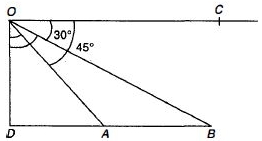
0 likesView Solution
48
MathematicsDifficultMCQJEE Main · 2018
Let $\frac{1}{x_1}, \frac{1}{x_2}, \frac{1}{x_3}, \dots, \frac{1}{x_n}$ ($x_i \neq 0$ for $i = 1, 2, \dots, n$) be in $A.P.$ such that $x_1 = 4$ and $x_{21} = 20$. If $n$ is the least positive integer for which $x_n > 50$,then $\sum_{i=1}^n \left( \frac{1}{x_i} \right)$ is equal to:
A
$3$
B
$\frac{13}{8}$
C
$\frac{13}{4}$
D
$\frac{1}{8}$
Solution
(C) Given that $\frac{1}{x_1}, \frac{1}{x_2}, \dots, \frac{1}{x_n}$ are in $A.P.$
Let $a = \frac{1}{x_1} = \frac{1}{4}$ and $d$ be the common difference.
We have $\frac{1}{x_{21}} = \frac{1}{20}$.
Using the $A.P.$ formula $\frac{1}{x_{21}} = a + 20d$,we get $\frac{1}{20} = \frac{1}{4} + 20d$.
$20d = \frac{1}{20} - \frac{1}{4} = \frac{1-5}{20} = -\frac{4}{20} = -\frac{1}{5}$.
So,$d = -\frac{1}{100}$.
The $n^{th}$ term of the $A.P.$ is $\frac{1}{x_n} = a + (n-1)d = \frac{1}{4} - \frac{n-1}{100} = \frac{25 - n + 1}{100} = \frac{26 - n}{100}$.
Thus,$x_n = \frac{100}{26 - n}$.
Given $x_n > 50$,we have $\frac{100}{26 - n} > 50$.
Since $x_n > 50$,$26 - n$ must be positive and $26 - n < 2$,so $n > 24$.
The least positive integer $n$ is $25$.
We need to find $\sum_{i=1}^{25} \frac{1}{x_i} = \frac{25}{2} \left[ 2a + (25-1)d \right]$.
$= \frac{25}{2} \left[ 2 \left( \frac{1}{4} \right) + 24 \left( -\frac{1}{100} \right) \right] = \frac{25}{2} \left[ \frac{1}{2} - \frac{6}{25} \right] = \frac{25}{2} \left[ \frac{25 - 12}{50} \right] = \frac{25}{2} \times \frac{13}{50} = \frac{13}{4}$.
Let $a = \frac{1}{x_1} = \frac{1}{4}$ and $d$ be the common difference.
We have $\frac{1}{x_{21}} = \frac{1}{20}$.
Using the $A.P.$ formula $\frac{1}{x_{21}} = a + 20d$,we get $\frac{1}{20} = \frac{1}{4} + 20d$.
$20d = \frac{1}{20} - \frac{1}{4} = \frac{1-5}{20} = -\frac{4}{20} = -\frac{1}{5}$.
So,$d = -\frac{1}{100}$.
The $n^{th}$ term of the $A.P.$ is $\frac{1}{x_n} = a + (n-1)d = \frac{1}{4} - \frac{n-1}{100} = \frac{25 - n + 1}{100} = \frac{26 - n}{100}$.
Thus,$x_n = \frac{100}{26 - n}$.
Given $x_n > 50$,we have $\frac{100}{26 - n} > 50$.
Since $x_n > 50$,$26 - n$ must be positive and $26 - n < 2$,so $n > 24$.
The least positive integer $n$ is $25$.
We need to find $\sum_{i=1}^{25} \frac{1}{x_i} = \frac{25}{2} \left[ 2a + (25-1)d \right]$.
$= \frac{25}{2} \left[ 2 \left( \frac{1}{4} \right) + 24 \left( -\frac{1}{100} \right) \right] = \frac{25}{2} \left[ \frac{1}{2} - \frac{6}{25} \right] = \frac{25}{2} \left[ \frac{25 - 12}{50} \right] = \frac{25}{2} \times \frac{13}{50} = \frac{13}{4}$.
0 likesView Solution
49
MathematicsDifficultMCQJEE Main · 2018
The locus of the point of intersection of the lines,$\sqrt{2}x - y + 4\sqrt{2}k = 0$ and $\sqrt{2}kx + ky - 4\sqrt{2} = 0$ (where $k$ is any non-zero real parameter) is
A
$A$ hyperbola with length of its transverse axis $8\sqrt{2}$
B
An ellipse with length of its major axis $8\sqrt{2}$
C
An ellipse whose eccentricity is $\frac{1}{\sqrt{3}}$
D
$A$ hyperbola whose eccentricity is $\sqrt{3}$
Solution
(A) Given lines are:
$L_1: \sqrt{2}x - y + 4\sqrt{2}k = 0 \Rightarrow y = \sqrt{2}x + 4\sqrt{2}k \quad (i)$
$L_2: \sqrt{2}kx + ky - 4\sqrt{2} = 0 \quad (ii)$
Substituting $y$ from $(i)$ into $(ii)$:
$\sqrt{2}kx + k(\sqrt{2}x + 4\sqrt{2}k) - 4\sqrt{2} = 0$
$\sqrt{2}kx + \sqrt{2}kx + 4\sqrt{2}k^2 - 4\sqrt{2} = 0$
$2\sqrt{2}kx = 4\sqrt{2}(1 - k^2)$
$x = \frac{2(1 - k^2)}{k}$
Substituting $x$ back into $(i)$:
$y = \sqrt{2}(\frac{2(1 - k^2)}{k}) + 4\sqrt{2}k = \frac{2\sqrt{2} - 2\sqrt{2}k^2 + 4\sqrt{2}k^2}{k} = \frac{2\sqrt{2}(1 + k^2)}{k}$
From these,we observe the relationship between $x$ and $y$:
$\frac{y}{4\sqrt{2}} = \frac{1+k^2}{2k}$ and $\frac{x}{4} = \frac{1-k^2}{2k}$
$(\frac{y}{4\sqrt{2}})^2 - (\frac{x}{4})^2 = (\frac{1+k^2}{2k})^2 - (\frac{1-k^2}{2k})^2 = \frac{(1+k^2)^2 - (1-k^2)^2}{4k^2} = \frac{4k^2}{4k^2} = 1$
This is the equation of a hyperbola $\frac{y^2}{a^2} - \frac{x^2}{b^2} = 1$ where $a = 4\sqrt{2}$.
The length of the transverse axis is $2a = 2(4\sqrt{2}) = 8\sqrt{2}$.
$L_1: \sqrt{2}x - y + 4\sqrt{2}k = 0 \Rightarrow y = \sqrt{2}x + 4\sqrt{2}k \quad (i)$
$L_2: \sqrt{2}kx + ky - 4\sqrt{2} = 0 \quad (ii)$
Substituting $y$ from $(i)$ into $(ii)$:
$\sqrt{2}kx + k(\sqrt{2}x + 4\sqrt{2}k) - 4\sqrt{2} = 0$
$\sqrt{2}kx + \sqrt{2}kx + 4\sqrt{2}k^2 - 4\sqrt{2} = 0$
$2\sqrt{2}kx = 4\sqrt{2}(1 - k^2)$
$x = \frac{2(1 - k^2)}{k}$
Substituting $x$ back into $(i)$:
$y = \sqrt{2}(\frac{2(1 - k^2)}{k}) + 4\sqrt{2}k = \frac{2\sqrt{2} - 2\sqrt{2}k^2 + 4\sqrt{2}k^2}{k} = \frac{2\sqrt{2}(1 + k^2)}{k}$
From these,we observe the relationship between $x$ and $y$:
$\frac{y}{4\sqrt{2}} = \frac{1+k^2}{2k}$ and $\frac{x}{4} = \frac{1-k^2}{2k}$
$(\frac{y}{4\sqrt{2}})^2 - (\frac{x}{4})^2 = (\frac{1+k^2}{2k})^2 - (\frac{1-k^2}{2k})^2 = \frac{(1+k^2)^2 - (1-k^2)^2}{4k^2} = \frac{4k^2}{4k^2} = 1$
This is the equation of a hyperbola $\frac{y^2}{a^2} - \frac{x^2}{b^2} = 1$ where $a = 4\sqrt{2}$.
The length of the transverse axis is $2a = 2(4\sqrt{2}) = 8\sqrt{2}$.
0 likesView Solution
50
MathematicsDifficultMCQJEE Main · 2018
The number of integers between $2,000$ and $5,000$ that can be formed using the digits $0, 1, 2, 3, 4$ (repetition of digits is not allowed) such that the number is a multiple of $3$ is:
A
$30$
B
$48$
C
$24$
D
$36$
Solution
(A) number is divisible by $3$ if the sum of its digits is divisible by $3$.
The thousands place can be filled with $2, 3,$ or $4$ because the number must be between $2,000$ and $5,000$.
Case $1$: Thousands place is $2$.
Possible sets of remaining $3$ digits from ${0, 1, 3, 4}$ such that the sum is divisible by $3$:
- ${0, 1, 3}$ (sum $= 2+0+1+3 = 6$)
- ${0, 3, 4}$ (sum $= 2+0+3+4 = 9$)
Each set can be arranged in $3! = 6$ ways. Total $= 2 \times 6 = 12$.
Case $2$: Thousands place is $3$.
Possible sets of remaining $3$ digits from ${0, 1, 2, 4}$ such that the sum is divisible by $3$:
- ${0, 1, 2}$ (sum $= 3+0+1+2 = 6$)
- ${0, 2, 4}$ (sum $= 3+0+2+4 = 9$)
Each set can be arranged in $3! = 6$ ways. Total $= 2 \times 6 = 12$.
Case $3$: Thousands place is $4$.
Possible sets of remaining $3$ digits from ${0, 1, 2, 3}$ such that the sum is divisible by $3$:
- ${0, 2, 1}$ (sum $= 4+0+2+1 = 7$ - No)
- ${0, 2, 3}$ (sum $= 4+0+2+3 = 9$)
- ${1, 2, 3}$ (sum $= 4+1+2+3 = 10$ - No)
Only ${0, 2, 3}$ works. Total $= 1 \times 6 = 6$.
Total numbers $= 12 + 12 + 6 = 30$.
The thousands place can be filled with $2, 3,$ or $4$ because the number must be between $2,000$ and $5,000$.
Case $1$: Thousands place is $2$.
Possible sets of remaining $3$ digits from ${0, 1, 3, 4}$ such that the sum is divisible by $3$:
- ${0, 1, 3}$ (sum $= 2+0+1+3 = 6$)
- ${0, 3, 4}$ (sum $= 2+0+3+4 = 9$)
Each set can be arranged in $3! = 6$ ways. Total $= 2 \times 6 = 12$.
Case $2$: Thousands place is $3$.
Possible sets of remaining $3$ digits from ${0, 1, 2, 4}$ such that the sum is divisible by $3$:
- ${0, 1, 2}$ (sum $= 3+0+1+2 = 6$)
- ${0, 2, 4}$ (sum $= 3+0+2+4 = 9$)
Each set can be arranged in $3! = 6$ ways. Total $= 2 \times 6 = 12$.
Case $3$: Thousands place is $4$.
Possible sets of remaining $3$ digits from ${0, 1, 2, 3}$ such that the sum is divisible by $3$:
- ${0, 2, 1}$ (sum $= 4+0+2+1 = 7$ - No)
- ${0, 2, 3}$ (sum $= 4+0+2+3 = 9$)
- ${1, 2, 3}$ (sum $= 4+1+2+3 = 10$ - No)
Only ${0, 2, 3}$ works. Total $= 1 \times 6 = 6$.
Total numbers $= 12 + 12 + 6 = 30$.
0 likesView Solution
51
MathematicsDifficultMCQJEE Main · 2018
If ${L_1}$ is the line of intersection of the planes $2x - 2y + 3z - 2 = 0$ and $x - y + z + 1 = 0$,and ${L_2}$ is the line of intersection of the planes $x + 2y - z - 3 = 0$ and $3x - y + 2z - 1 = 0$,then the distance of the origin from the plane containing the lines ${L_1}$ and ${L_2}$ is:
A
$\frac{1}{3\sqrt{2}}$
B
$\frac{1}{2\sqrt{2}}$
C
$\frac{1}{\sqrt{2}}$
D
$\frac{1}{4\sqrt{2}}$
Solution
(A) The equation of the plane passing through the line of intersection of the planes $2x - 2y + 3z - 2 = 0$ and $x - y + z + 1 = 0$ is given by:
$(2x - 2y + 3z - 2) + \lambda(x - y + z + 1) = 0$
$x(\lambda + 2) - y(\lambda + 2) + z(\lambda + 3) + (\lambda - 2) = 0 \quad \dots(1)$
Since this plane contains the line ${L_2}$ formed by the intersection of $x + 2y - z - 3 = 0$ and $3x - y + 2z - 1 = 0$,the normal vector of the plane must be perpendicular to the direction vectors of the lines forming ${L_2}$. Alternatively,the plane must satisfy the condition that the determinant of the coefficients of the three planes is zero:
$\begin{vmatrix} \lambda + 2 & -(\lambda + 2) & \lambda + 3 \\ 1 & 2 & -1 \\ 3 & -1 & 2 \end{vmatrix} = 0$
Expanding the determinant:
$(\lambda + 2)(4 - 1) + (\lambda + 2)(2 + 3) + (\lambda + 3)(-1 - 6) = 0$
$3(\lambda + 2) + 5(\lambda + 2) - 7(\lambda + 3) = 0$
$8\lambda + 16 - 7\lambda - 21 = 0 \Rightarrow \lambda = 5$
Substituting $\lambda = 5$ into equation $(1)$:
$x(5 + 2) - y(5 + 2) + z(5 + 3) + (5 - 2) = 0$
$7x - 7y + 8z + 3 = 0$
The perpendicular distance from the origin $(0, 0, 0)$ to the plane $Ax + By + Cz + D = 0$ is given by $d = \frac{|D|}{\sqrt{A^2 + B^2 + C^2}}$.
$d = \frac{|3|}{\sqrt{7^2 + (-7)^2 + 8^2}} = \frac{3}{\sqrt{49 + 49 + 64}} = \frac{3}{\sqrt{162}} = \frac{3}{9\sqrt{2}} = \frac{1}{3\sqrt{2}}$.
$(2x - 2y + 3z - 2) + \lambda(x - y + z + 1) = 0$
$x(\lambda + 2) - y(\lambda + 2) + z(\lambda + 3) + (\lambda - 2) = 0 \quad \dots(1)$
Since this plane contains the line ${L_2}$ formed by the intersection of $x + 2y - z - 3 = 0$ and $3x - y + 2z - 1 = 0$,the normal vector of the plane must be perpendicular to the direction vectors of the lines forming ${L_2}$. Alternatively,the plane must satisfy the condition that the determinant of the coefficients of the three planes is zero:
$\begin{vmatrix} \lambda + 2 & -(\lambda + 2) & \lambda + 3 \\ 1 & 2 & -1 \\ 3 & -1 & 2 \end{vmatrix} = 0$
Expanding the determinant:
$(\lambda + 2)(4 - 1) + (\lambda + 2)(2 + 3) + (\lambda + 3)(-1 - 6) = 0$
$3(\lambda + 2) + 5(\lambda + 2) - 7(\lambda + 3) = 0$
$8\lambda + 16 - 7\lambda - 21 = 0 \Rightarrow \lambda = 5$
Substituting $\lambda = 5$ into equation $(1)$:
$x(5 + 2) - y(5 + 2) + z(5 + 3) + (5 - 2) = 0$
$7x - 7y + 8z + 3 = 0$
The perpendicular distance from the origin $(0, 0, 0)$ to the plane $Ax + By + Cz + D = 0$ is given by $d = \frac{|D|}{\sqrt{A^2 + B^2 + C^2}}$.
$d = \frac{|3|}{\sqrt{7^2 + (-7)^2 + 8^2}} = \frac{3}{\sqrt{49 + 49 + 64}} = \frac{3}{\sqrt{162}} = \frac{3}{9\sqrt{2}} = \frac{1}{3\sqrt{2}}$.
0 likesView Solution
52
MathematicsDifficultMCQJEE Main · 2018
The length of the projection of the line segment joining the points $(5, -1, 4)$ and $(4, -1, 3)$ on the plane $x + y + z = 7$ is:
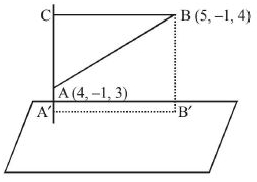
A
$\frac{2}{3}$
B
$\frac{1}{3}$
C
$\sqrt{\frac{2}{3}}$
D
$\frac{2}{\sqrt{3}}$
Solution
(C) Let the points be $A(4, -1, 3)$ and $B(5, -1, 4)$. The vector $\overrightarrow{AB} = (5-4)\hat{i} + (-1 - (-1))\hat{j} + (4-3)\hat{k} = \hat{i} + \hat{k}$.
The normal to the plane $x + y + z = 7$ is $\vec{n} = \hat{i} + \hat{j} + \hat{k}$.
The unit normal vector is $\hat{n} = \frac{\hat{i} + \hat{j} + \hat{k}}{\sqrt{3}}$.
The projection of $\overrightarrow{AB}$ on the normal $\vec{n}$ is $d = |\overrightarrow{AB} \cdot \hat{n}| = |(\hat{i} + \hat{k}) \cdot \frac{(\hat{i} + \hat{j} + \hat{k})}{\sqrt{3}}| = \frac{1+0+1}{\sqrt{3}} = \frac{2}{\sqrt{3}}$.
The length of the projection of the line segment $AB$ on the plane is given by $\sqrt{|\overrightarrow{AB}|^2 - d^2}$.
Here,$|\overrightarrow{AB}|^2 = 1^2 + 0^2 + 1^2 = 2$.
So,the length of the projection $= \sqrt{2 - (\frac{2}{\sqrt{3}})^2} = \sqrt{2 - \frac{4}{3}} = \sqrt{\frac{6-4}{3}} = \sqrt{\frac{2}{3}}$.
The normal to the plane $x + y + z = 7$ is $\vec{n} = \hat{i} + \hat{j} + \hat{k}$.
The unit normal vector is $\hat{n} = \frac{\hat{i} + \hat{j} + \hat{k}}{\sqrt{3}}$.
The projection of $\overrightarrow{AB}$ on the normal $\vec{n}$ is $d = |\overrightarrow{AB} \cdot \hat{n}| = |(\hat{i} + \hat{k}) \cdot \frac{(\hat{i} + \hat{j} + \hat{k})}{\sqrt{3}}| = \frac{1+0+1}{\sqrt{3}} = \frac{2}{\sqrt{3}}$.
The length of the projection of the line segment $AB$ on the plane is given by $\sqrt{|\overrightarrow{AB}|^2 - d^2}$.
Here,$|\overrightarrow{AB}|^2 = 1^2 + 0^2 + 1^2 = 2$.
So,the length of the projection $= \sqrt{2 - (\frac{2}{\sqrt{3}})^2} = \sqrt{2 - \frac{4}{3}} = \sqrt{\frac{6-4}{3}} = \sqrt{\frac{2}{3}}$.
0 likesView Solution
53
MathematicsMediumMCQJEE Main · 2018
$\int_{-\pi/2}^{\pi/2} \frac{\sin^2 x}{1 + 2^x} dx = \dots$
A
$\frac{\pi}{2}$
B
$4\pi$
C
$\frac{\pi}{4}$
D
$\frac{\pi}{8}$
Solution
(C) Let $I = \int_{-\pi/2}^{\pi/2} \frac{\sin^2 x}{1 + 2^x} dx$ $(i)$
Using the property $\int_{a}^{b} f(x) dx = \int_{a}^{b} f(a+b-x) dx$,we get:
$I = \int_{-\pi/2}^{\pi/2} \frac{\sin^2(-x)}{1 + 2^{-x}} dx = \int_{-\pi/2}^{\pi/2} \frac{\sin^2 x}{1 + \frac{1}{2^x}} dx = \int_{-\pi/2}^{\pi/2} \frac{2^x \sin^2 x}{2^x + 1} dx$ $(ii)$
Adding $(i)$ and $(ii)$:
$2I = \int_{-\pi/2}^{\pi/2} \frac{\sin^2 x + 2^x \sin^2 x}{1 + 2^x} dx = \int_{-\pi/2}^{\pi/2} \sin^2 x dx$
Since $\sin^2 x$ is an even function,$2I = 2 \int_{0}^{\pi/2} \sin^2 x dx$
$I = \int_{0}^{\pi/2} \sin^2 x dx = \int_{0}^{\pi/2} \frac{1 - \cos 2x}{2} dx = \left[ \frac{x}{2} - \frac{\sin 2x}{4} \right]_{0}^{\pi/2} = \frac{\pi}{4} - 0 = \frac{\pi}{4}$
Using the property $\int_{a}^{b} f(x) dx = \int_{a}^{b} f(a+b-x) dx$,we get:
$I = \int_{-\pi/2}^{\pi/2} \frac{\sin^2(-x)}{1 + 2^{-x}} dx = \int_{-\pi/2}^{\pi/2} \frac{\sin^2 x}{1 + \frac{1}{2^x}} dx = \int_{-\pi/2}^{\pi/2} \frac{2^x \sin^2 x}{2^x + 1} dx$ $(ii)$
Adding $(i)$ and $(ii)$:
$2I = \int_{-\pi/2}^{\pi/2} \frac{\sin^2 x + 2^x \sin^2 x}{1 + 2^x} dx = \int_{-\pi/2}^{\pi/2} \sin^2 x dx$
Since $\sin^2 x$ is an even function,$2I = 2 \int_{0}^{\pi/2} \sin^2 x dx$
$I = \int_{0}^{\pi/2} \sin^2 x dx = \int_{0}^{\pi/2} \frac{1 - \cos 2x}{2} dx = \left[ \frac{x}{2} - \frac{\sin 2x}{4} \right]_{0}^{\pi/2} = \frac{\pi}{4} - 0 = \frac{\pi}{4}$
0 likesView Solution
54
MathematicsDifficultMCQJEE Main · 2018
Let $g(x) = \cos(x^2)$,$f(x) = \sqrt{x}$,and $\alpha, \beta$ (where $\alpha < \beta$) be the roots of the quadratic equation $18x^2 - 9\pi x + \pi^2 = 0$. Then,the area (in sq. units) bounded by the curve $y = (g \circ f)(x)$ and the lines $x = \alpha$,$x = \beta$,and $y = 0$ is:
A
$\frac{1}{2}(\sqrt{3} + 1)$
B
$\frac{1}{2}(\sqrt{3} - \sqrt{2})$
C
$\frac{1}{2}(\sqrt{2} - 1)$
D
$\frac{1}{2}(\sqrt{3} - 1)$
Solution
(D) Given the quadratic equation $18x^2 - 9\pi x + \pi^2 = 0$.
Factoring the quadratic: $(3x - \pi)(6x - \pi) = 0$.
Thus,the roots are $\alpha = \frac{\pi}{6}$ and $\beta = \frac{\pi}{3}$ (since $\alpha < \beta$).
Next,we find the composite function $(g \circ f)(x) = g(f(x)) = \cos((\sqrt{x})^2) = \cos(x)$.
The area $A$ bounded by $y = \cos(x)$,$x = \frac{\pi}{6}$,$x = \frac{\pi}{3}$,and $y = 0$ is given by the integral:
$A = \int_{\pi/6}^{\pi/3} \cos(x) \, dx$.
Evaluating the integral: $A = [\sin(x)]_{\pi/6}^{\pi/3} = \sin(\frac{\pi}{3}) - \sin(\frac{\pi}{6})$.
Substituting the values: $A = \frac{\sqrt{3}}{2} - \frac{1}{2} = \frac{\sqrt{3} - 1}{2}$ sq. units.
Factoring the quadratic: $(3x - \pi)(6x - \pi) = 0$.
Thus,the roots are $\alpha = \frac{\pi}{6}$ and $\beta = \frac{\pi}{3}$ (since $\alpha < \beta$).
Next,we find the composite function $(g \circ f)(x) = g(f(x)) = \cos((\sqrt{x})^2) = \cos(x)$.
The area $A$ bounded by $y = \cos(x)$,$x = \frac{\pi}{6}$,$x = \frac{\pi}{3}$,and $y = 0$ is given by the integral:
$A = \int_{\pi/6}^{\pi/3} \cos(x) \, dx$.
Evaluating the integral: $A = [\sin(x)]_{\pi/6}^{\pi/3} = \sin(\frac{\pi}{3}) - \sin(\frac{\pi}{6})$.
Substituting the values: $A = \frac{\sqrt{3}}{2} - \frac{1}{2} = \frac{\sqrt{3} - 1}{2}$ sq. units.
0 likesView Solution
55
MathematicsMediumMCQJEE Main · 2018
If $\left| \begin{matrix} x - 4 & 2x & 2x \\ 2x & x - 4 & 2x \\ 2x & 2x & x - 4 \end{matrix} \right| = (A + Bx)(x - A)^2$,then the ordered pair $(A, B) = $ . . . . .
A
$(-4, 3)$
B
$(-4, 5)$
C
$(4, 5)$
D
$(-4, -5)$
Solution
(B) Let $\Delta = \left| \begin{matrix} x - 4 & 2x & 2x \\ 2x & x - 4 & 2x \\ 2x & 2x & x - 4 \end{matrix} \right|$.
Applying the operation $R_1 \to R_1 + R_2 + R_3$,we get:
$\Delta = \left| \begin{matrix} 5x - 4 & 5x - 4 & 5x - 4 \\ 2x & x - 4 & 2x \\ 2x & 2x & x - 4 \end{matrix} \right| = (5x - 4) \left| \begin{matrix} 1 & 1 & 1 \\ 2x & x - 4 & 2x \\ 2x & 2x & x - 4 \end{matrix} \right|$.
Applying $C_2 \to C_2 - C_1$ and $C_3 \to C_3 - C_1$:
$\Delta = (5x - 4) \left| \begin{matrix} 1 & 0 & 0 \\ 2x & -x - 4 & 0 \\ 2x & 0 & -x - 4 \end{matrix} \right| = (5x - 4)(-x - 4)^2 = (5x - 4)(x + 4)^2$.
Comparing this with $(A + Bx)(x - A)^2$,we have $(A + Bx)(x - A)^2 = (5x - 4)(x - (-4))^2$.
Thus,$A = -4$ and $B = 5$.
Therefore,the ordered pair $(A, B) = (-4, 5)$.
Applying the operation $R_1 \to R_1 + R_2 + R_3$,we get:
$\Delta = \left| \begin{matrix} 5x - 4 & 5x - 4 & 5x - 4 \\ 2x & x - 4 & 2x \\ 2x & 2x & x - 4 \end{matrix} \right| = (5x - 4) \left| \begin{matrix} 1 & 1 & 1 \\ 2x & x - 4 & 2x \\ 2x & 2x & x - 4 \end{matrix} \right|$.
Applying $C_2 \to C_2 - C_1$ and $C_3 \to C_3 - C_1$:
$\Delta = (5x - 4) \left| \begin{matrix} 1 & 0 & 0 \\ 2x & -x - 4 & 0 \\ 2x & 0 & -x - 4 \end{matrix} \right| = (5x - 4)(-x - 4)^2 = (5x - 4)(x + 4)^2$.
Comparing this with $(A + Bx)(x - A)^2$,we have $(A + Bx)(x - A)^2 = (5x - 4)(x - (-4))^2$.
Thus,$A = -4$ and $B = 5$.
Therefore,the ordered pair $(A, B) = (-4, 5)$.
0 likesView Solution
56
MathematicsDifficultMCQJEE Main · 2018
If the system of linear equations $x + ky + 3z = 0$,$3x + ky - 2z = 0$,and $2x + 4y - 3z = 0$ has a non-zero solution $(x, y, z)$,then $\frac{xz}{y^2} = \dots$
A
$10$
B
$-30$
C
$30$
D
$-10$
Solution
(A) For a system of homogeneous linear equations to have a non-zero solution,the determinant of the coefficient matrix must be zero:
$\begin{vmatrix} 1 & k & 3 \\ 3 & k & -2 \\ 2 & 4 & -3 \end{vmatrix} = 0$
Expanding along the first row:
$1(-3k + 8) - k(-9 + 4) + 3(12 - 2k) = 0$
$-3k + 8 + 5k + 36 - 6k = 0$
$-4k + 44 = 0 \Rightarrow k = 11$
Substituting $k = 11$ into the equations:
$x + 11y + 3z = 0$ $(1)$
$3x + 11y - 2z = 0$ $(2)$
$2x + 4y - 3z = 0$ $(3)$
Subtracting $(1)$ from $(2)$:
$(3x - x) + (11y - 11y) + (-2z - 3z) = 0 \Rightarrow 2x - 5z = 0 \Rightarrow x = \frac{5}{2}z$
Substituting $x = \frac{5}{2}z$ into $(1)$:
$\frac{5}{2}z + 11y + 3z = 0 \Rightarrow 11y = -\frac{11}{2}z \Rightarrow y = -\frac{1}{2}z$
Now,calculate $\frac{xz}{y^2}$:
$\frac{xz}{y^2} = \frac{(\frac{5}{2}z)(z)}{(-\frac{1}{2}z)^2} = \frac{\frac{5}{2}z^2}{\frac{1}{4}z^2} = \frac{5}{2} \times 4 = 10$
$\begin{vmatrix} 1 & k & 3 \\ 3 & k & -2 \\ 2 & 4 & -3 \end{vmatrix} = 0$
Expanding along the first row:
$1(-3k + 8) - k(-9 + 4) + 3(12 - 2k) = 0$
$-3k + 8 + 5k + 36 - 6k = 0$
$-4k + 44 = 0 \Rightarrow k = 11$
Substituting $k = 11$ into the equations:
$x + 11y + 3z = 0$ $(1)$
$3x + 11y - 2z = 0$ $(2)$
$2x + 4y - 3z = 0$ $(3)$
Subtracting $(1)$ from $(2)$:
$(3x - x) + (11y - 11y) + (-2z - 3z) = 0 \Rightarrow 2x - 5z = 0 \Rightarrow x = \frac{5}{2}z$
Substituting $x = \frac{5}{2}z$ into $(1)$:
$\frac{5}{2}z + 11y + 3z = 0 \Rightarrow 11y = -\frac{11}{2}z \Rightarrow y = -\frac{1}{2}z$
Now,calculate $\frac{xz}{y^2}$:
$\frac{xz}{y^2} = \frac{(\frac{5}{2}z)(z)}{(-\frac{1}{2}z)^2} = \frac{\frac{5}{2}z^2}{\frac{1}{4}z^2} = \frac{5}{2} \times 4 = 10$
0 likesView Solution
57
MathematicsDifficultMCQJEE Main · 2018
Let $f(x) = x^2 + \frac{1}{x^2}$ and $g(x) = x - \frac{1}{x}$,$x \in R - \{-1, 1, 0\}$. If $h(x) = \frac{f(x)}{g(x)}$,then the local minimum value of $h(x)$ is:
A
$-3$
B
$-2\sqrt{2}$
C
$2\sqrt{2}$
D
$3$
Solution
(C) Given $h(x) = \frac{x^2 + \frac{1}{x^2}}{x - \frac{1}{x}}$.
We can rewrite the numerator as $(x - \frac{1}{x})^2 + 2$.
So,$h(x) = \frac{(x - \frac{1}{x})^2 + 2}{x - \frac{1}{x}} = (x - \frac{1}{x}) + \frac{2}{x - \frac{1}{x}}$.
Let $t = x - \frac{1}{x}$. Since $x \in R - \{-1, 1, 0\}$,$t$ can take any real value except $0$.
Then $h(t) = t + \frac{2}{t}$.
For $t > 0$,by the $AM$-$GM$ inequality,$t + \frac{2}{t} \ge 2\sqrt{t \cdot \frac{2}{t}} = 2\sqrt{2}$.
The equality holds when $t = \frac{2}{t}$,i.e.,$t^2 = 2$,so $t = \sqrt{2}$ (since $t > 0$).
For $t < 0$,let $u = -t$,where $u > 0$. Then $h(t) = -u - \frac{2}{u} = -(u + \frac{2}{u}) \le -2\sqrt{2}$.
Thus,the local minimum value of $h(x)$ is $2\sqrt{2}$.
We can rewrite the numerator as $(x - \frac{1}{x})^2 + 2$.
So,$h(x) = \frac{(x - \frac{1}{x})^2 + 2}{x - \frac{1}{x}} = (x - \frac{1}{x}) + \frac{2}{x - \frac{1}{x}}$.
Let $t = x - \frac{1}{x}$. Since $x \in R - \{-1, 1, 0\}$,$t$ can take any real value except $0$.
Then $h(t) = t + \frac{2}{t}$.
For $t > 0$,by the $AM$-$GM$ inequality,$t + \frac{2}{t} \ge 2\sqrt{t \cdot \frac{2}{t}} = 2\sqrt{2}$.
The equality holds when $t = \frac{2}{t}$,i.e.,$t^2 = 2$,so $t = \sqrt{2}$ (since $t > 0$).
For $t < 0$,let $u = -t$,where $u > 0$. Then $h(t) = -u - \frac{2}{u} = -(u + \frac{2}{u}) \le -2\sqrt{2}$.
Thus,the local minimum value of $h(x)$ is $2\sqrt{2}$.
0 likesView Solution
58
MathematicsDifficultMCQJEE Main · 2018
Let $S = \{t \in R : f(x) = |x-\pi|(e^{|x|}-1)\sin|x| \text{ is not differentiable at } t\}$. Then the set $S$ is equal to:
A
$\left\{ 0 \right\}$
B
$\left\{ \pi \right\}$
C
$\left\{ 0, \pi \right\}$
D
$\emptyset$
Solution
(D) The function is given by $f(x) = |x-\pi|(e^{|x|}-1)\sin|x|$.
We check the differentiability of $f(x)$ at the points where the absolute value functions might not be differentiable,namely $x=0$ and $x=\pi$.
At $x=\pi$:
$f(\pi) = 0$.
$RHD = \lim_{h \to 0^+} \frac{|\pi+h-\pi|(e^{|\pi+h|}-1)\sin|\pi+h| - 0}{h} = \lim_{h \to 0^+} \frac{h(e^{\pi+h}-1)\sin(\pi+h)}{h} = (e^{\pi}-1)\sin(\pi) = 0$.
$LHD = \lim_{h \to 0^+} \frac{|\pi-h-\pi|(e^{|\pi-h|}-1)\sin|\pi-h| - 0}{-h} = \lim_{h \to 0^+} \frac{h(e^{\pi-h}-1)\sin(\pi-h)}{-h} = -(e^{\pi}-1)\sin(\pi) = 0$.
Since $RHD = LHD = 0$,$f(x)$ is differentiable at $x=\pi$.
At $x=0$:
$f(0) = 0$.
$RHD = \lim_{h \to 0^+} \frac{|h-\pi|(e^{|h|}-1)\sin|h| - 0}{h} = \lim_{h \to 0^+} \frac{|h-\pi|(e^h-1)\sin(h)}{h} = |-\pi| \cdot (1) \cdot (0) = 0$.
$LHD = \lim_{h \to 0^+} \frac{|-h-\pi|(e^{|-h|}-1)\sin|-h| - 0}{-h} = \lim_{h \to 0^+} \frac{|-h-\pi|(e^h-1)\sin(h)}{-h} = |-\pi| \cdot (1) \cdot (0) = 0$.
Since $RHD = LHD = 0$,$f(x)$ is differentiable at $x=0$.
Since $f(x)$ is differentiable at all points,the set $S$ of points where $f(x)$ is not differentiable is empty,i.e.,$S = \emptyset$.
We check the differentiability of $f(x)$ at the points where the absolute value functions might not be differentiable,namely $x=0$ and $x=\pi$.
At $x=\pi$:
$f(\pi) = 0$.
$RHD = \lim_{h \to 0^+} \frac{|\pi+h-\pi|(e^{|\pi+h|}-1)\sin|\pi+h| - 0}{h} = \lim_{h \to 0^+} \frac{h(e^{\pi+h}-1)\sin(\pi+h)}{h} = (e^{\pi}-1)\sin(\pi) = 0$.
$LHD = \lim_{h \to 0^+} \frac{|\pi-h-\pi|(e^{|\pi-h|}-1)\sin|\pi-h| - 0}{-h} = \lim_{h \to 0^+} \frac{h(e^{\pi-h}-1)\sin(\pi-h)}{-h} = -(e^{\pi}-1)\sin(\pi) = 0$.
Since $RHD = LHD = 0$,$f(x)$ is differentiable at $x=\pi$.
At $x=0$:
$f(0) = 0$.
$RHD = \lim_{h \to 0^+} \frac{|h-\pi|(e^{|h|}-1)\sin|h| - 0}{h} = \lim_{h \to 0^+} \frac{|h-\pi|(e^h-1)\sin(h)}{h} = |-\pi| \cdot (1) \cdot (0) = 0$.
$LHD = \lim_{h \to 0^+} \frac{|-h-\pi|(e^{|-h|}-1)\sin|-h| - 0}{-h} = \lim_{h \to 0^+} \frac{|-h-\pi|(e^h-1)\sin(h)}{-h} = |-\pi| \cdot (1) \cdot (0) = 0$.
Since $RHD = LHD = 0$,$f(x)$ is differentiable at $x=0$.
Since $f(x)$ is differentiable at all points,the set $S$ of points where $f(x)$ is not differentiable is empty,i.e.,$S = \emptyset$.
0 likesView Solution
59
MathematicsDifficultMCQJEE Main · 2018
$\int \frac{\sin^2 x \cos^2 x}{(\sin^5 x + \cos^3 x \sin^2 x + \sin^3 x \cos^2 x + \cos^5 x)^2} dx$
A
$\frac{-1}{3(1 + \tan^3 x)} + C$
B
$\frac{1}{1 + \cot^3 x} + C$
C
$\frac{-1}{1 + \cot^3 x} + C$
D
$\frac{-1}{3(1 + \cot^3 x)} + C$
Solution
(A) Let $I = \int \frac{\sin^2 x \cos^2 x}{(\sin^5 x + \cos^3 x \sin^2 x + \sin^3 x \cos^2 x + \cos^5 x)^2} dx$.
Factor the denominator:
$\sin^5 x + \cos^3 x \sin^2 x + \sin^3 x \cos^2 x + \cos^5 x = \sin^2 x(\sin^3 x + \cos^3 x) + \cos^2 x(\sin^3 x + \cos^3 x) = (\sin^2 x + \cos^2 x)(\sin^3 x + \cos^3 x) = (\sin^3 x + \cos^3 x)$.
Thus,$I = \int \frac{\sin^2 x \cos^2 x}{(\sin^3 x + \cos^3 x)^2} dx$.
Divide numerator and denominator by $\cos^6 x$:
$I = \int \frac{\tan^2 x \sec^2 x}{(\tan^3 x + 1)^2} dx$.
Let $t = 1 + \tan^3 x$,then $dt = 3 \tan^2 x \sec^2 x dx$,so $\tan^2 x \sec^2 x dx = \frac{dt}{3}$.
$I = \frac{1}{3} \int \frac{dt}{t^2} = \frac{1}{3} (-t^{-1}) + C = \frac{-1}{3(1 + \tan^3 x)} + C$.
Factor the denominator:
$\sin^5 x + \cos^3 x \sin^2 x + \sin^3 x \cos^2 x + \cos^5 x = \sin^2 x(\sin^3 x + \cos^3 x) + \cos^2 x(\sin^3 x + \cos^3 x) = (\sin^2 x + \cos^2 x)(\sin^3 x + \cos^3 x) = (\sin^3 x + \cos^3 x)$.
Thus,$I = \int \frac{\sin^2 x \cos^2 x}{(\sin^3 x + \cos^3 x)^2} dx$.
Divide numerator and denominator by $\cos^6 x$:
$I = \int \frac{\tan^2 x \sec^2 x}{(\tan^3 x + 1)^2} dx$.
Let $t = 1 + \tan^3 x$,then $dt = 3 \tan^2 x \sec^2 x dx$,so $\tan^2 x \sec^2 x dx = \frac{dt}{3}$.
$I = \frac{1}{3} \int \frac{dt}{t^2} = \frac{1}{3} (-t^{-1}) + C = \frac{-1}{3(1 + \tan^3 x)} + C$.
0 likesView Solution
60
MathematicsDifficultMCQJEE Main · 2018
$A$ bag contains $4$ red and $6$ black balls. $A$ ball is drawn at random from the bag,its colour is observed,and this ball along with two additional balls of the same colour are returned to the bag. If now a ball is drawn at random from the bag,then the probability that this drawn ball is red,is:
A
$\frac{2}{5}$
B
$\frac{1}{5}$
C
$\frac{3}{4}$
D
$\frac{3}{10}$
Solution
(A) Let $R_1$ be the event of drawing a red ball in the first draw and $B_1$ be the event of drawing a black ball in the first draw.
Let $R_2$ be the event of drawing a red ball in the second draw.
Initially,the bag contains $4$ red and $6$ black balls,total $10$ balls.
$P(R_1) = \frac{4}{10} = \frac{2}{5}$ and $P(B_1) = \frac{6}{10} = \frac{3}{5}$.
If a red ball is drawn first,it is returned along with $2$ additional red balls. The bag now contains $4 + 2 = 6$ red balls and $6$ black balls,total $12$ balls.
So,$P(R_2 | R_1) = \frac{6}{12} = \frac{1}{2}$.
If a black ball is drawn first,it is returned along with $2$ additional black balls. The bag now contains $4$ red balls and $6 + 2 = 8$ black balls,total $12$ balls.
So,$P(R_2 | B_1) = \frac{4}{12} = \frac{1}{3}$.
Using the law of total probability,the probability that the second ball is red is:
$P(R_2) = P(R_1) \times P(R_2 | R_1) + P(B_1) \times P(R_2 | B_1)$
$P(R_2) = (\frac{4}{10} \times \frac{6}{12}) + (\frac{6}{10} \times \frac{4}{12})$
$P(R_2) = \frac{24}{120} + \frac{24}{120} = \frac{48}{120} = \frac{2}{5}$.
Let $R_2$ be the event of drawing a red ball in the second draw.
Initially,the bag contains $4$ red and $6$ black balls,total $10$ balls.
$P(R_1) = \frac{4}{10} = \frac{2}{5}$ and $P(B_1) = \frac{6}{10} = \frac{3}{5}$.
If a red ball is drawn first,it is returned along with $2$ additional red balls. The bag now contains $4 + 2 = 6$ red balls and $6$ black balls,total $12$ balls.
So,$P(R_2 | R_1) = \frac{6}{12} = \frac{1}{2}$.
If a black ball is drawn first,it is returned along with $2$ additional black balls. The bag now contains $4$ red balls and $6 + 2 = 8$ black balls,total $12$ balls.
So,$P(R_2 | B_1) = \frac{4}{12} = \frac{1}{3}$.
Using the law of total probability,the probability that the second ball is red is:
$P(R_2) = P(R_1) \times P(R_2 | R_1) + P(B_1) \times P(R_2 | B_1)$
$P(R_2) = (\frac{4}{10} \times \frac{6}{12}) + (\frac{6}{10} \times \frac{4}{12})$
$P(R_2) = \frac{24}{120} + \frac{24}{120} = \frac{48}{120} = \frac{2}{5}$.
0 likesView Solution
61
MathematicsDifficultMCQJEE Main · 2018
Let $\vec{u}$ be a vector coplanar with the vectors $\vec{a} = 2\hat{i} + 3\hat{j} - \hat{k}$ and $\vec{b} = \hat{j} + \hat{k}$. If $\vec{u}$ is perpendicular to $\vec{a}$ and $\vec{u} \cdot \vec{b} = 24$,then $|\vec{u}|^2 = \dots$
A
$315$
B
$256$
C
$84$
D
$336$
Solution
(D) Since $\vec{u}$ is coplanar with $\vec{a}$ and $\vec{b}$,we can write $\vec{u} = x\vec{a} + y\vec{b}$.
Given $\vec{u} \perp \vec{a}$,so $\vec{u} \cdot \vec{a} = 0$.
$(x\vec{a} + y\vec{b}) \cdot \vec{a} = 0 \implies x|\vec{a}|^2 + y(\vec{a} \cdot \vec{b}) = 0$.
Calculate $|\vec{a}|^2 = 2^2 + 3^2 + (-1)^2 = 4 + 9 + 1 = 14$.
Calculate $\vec{a} \cdot \vec{b} = (2)(0) + (3)(1) + (-1)(1) = 3 - 1 = 2$.
So,$14x + 2y = 0 \implies y = -7x$.
Thus,$\vec{u} = x\vec{a} - 7x\vec{b} = x(\vec{a} - 7\vec{b})$.
$vec{a} - 7\vec{b} = (2\hat{i} + 3\hat{j} - \hat{k}) - 7(\hat{j} + \hat{k}) = 2\hat{i} - 4\hat{j} - 8\hat{k}$.
Given $\vec{u} \cdot \vec{b} = 24$,so $x(\vec{a} - 7\vec{b}) \cdot \vec{b} = 24$.
$(\vec{a} - 7\vec{b}) \cdot \vec{b} = \vec{a} \cdot \vec{b} - 7|\vec{b}|^2 = 2 - 7(1^2 + 1^2) = 2 - 14 = -12$.
So,$x(-12) = 24 \implies x = -2$.
Therefore,$\vec{u} = -2(2\hat{i} - 4\hat{j} - 8\hat{k}) = -4\hat{i} + 8\hat{j} + 16\hat{k}$.
$|\vec{u}|^2 = (-4)^2 + 8^2 + 16^2 = 16 + 64 + 256 = 336$.
Given $\vec{u} \perp \vec{a}$,so $\vec{u} \cdot \vec{a} = 0$.
$(x\vec{a} + y\vec{b}) \cdot \vec{a} = 0 \implies x|\vec{a}|^2 + y(\vec{a} \cdot \vec{b}) = 0$.
Calculate $|\vec{a}|^2 = 2^2 + 3^2 + (-1)^2 = 4 + 9 + 1 = 14$.
Calculate $\vec{a} \cdot \vec{b} = (2)(0) + (3)(1) + (-1)(1) = 3 - 1 = 2$.
So,$14x + 2y = 0 \implies y = -7x$.
Thus,$\vec{u} = x\vec{a} - 7x\vec{b} = x(\vec{a} - 7\vec{b})$.
$vec{a} - 7\vec{b} = (2\hat{i} + 3\hat{j} - \hat{k}) - 7(\hat{j} + \hat{k}) = 2\hat{i} - 4\hat{j} - 8\hat{k}$.
Given $\vec{u} \cdot \vec{b} = 24$,so $x(\vec{a} - 7\vec{b}) \cdot \vec{b} = 24$.
$(\vec{a} - 7\vec{b}) \cdot \vec{b} = \vec{a} \cdot \vec{b} - 7|\vec{b}|^2 = 2 - 7(1^2 + 1^2) = 2 - 14 = -12$.
So,$x(-12) = 24 \implies x = -2$.
Therefore,$\vec{u} = -2(2\hat{i} - 4\hat{j} - 8\hat{k}) = -4\hat{i} + 8\hat{j} + 16\hat{k}$.
$|\vec{u}|^2 = (-4)^2 + 8^2 + 16^2 = 16 + 64 + 256 = 336$.
0 likesView Solution
62
MathematicsDifficultMCQJEE Main · 2018
$A$ variable plane passes through a fixed point $(3, 2, 1)$ and meets the $x, y,$ and $z$ axes at $A, B,$ and $C$ respectively. $A$ plane is drawn parallel to the $yz$-plane through $A$,a second plane is drawn parallel to the $zx$-plane through $B$,and a third plane is drawn parallel to the $xy$-plane through $C$. Then,the locus of the point of intersection of these three planes is:
A
$x + y + z = 6$
B
$\frac{x}{3} + \frac{y}{2} + \frac{z}{1} = 1$
C
$\frac{3}{x} + \frac{2}{y} + \frac{1}{z} = 1$
D
$\frac{1}{x} + \frac{1}{y} + \frac{1}{z} = \frac{11}{6}$
Solution
(C) Let the intercepts of the variable plane on the $x, y,$ and $z$ axes be $a, b,$ and $c$ respectively.
The equation of the plane is $\frac{x}{a} + \frac{y}{b} + \frac{z}{c} = 1$.
Since the plane passes through the fixed point $(3, 2, 1)$,we have $\frac{3}{a} + \frac{2}{b} + \frac{1}{c} = 1$.
The plane through $A(a, 0, 0)$ parallel to the $yz$-plane is $x = a$.
The plane through $B(0, b, 0)$ parallel to the $zx$-plane is $y = b$.
The plane through $C(0, 0, c)$ parallel to the $xy$-plane is $z = c$.
The point of intersection of these three planes is $(a, b, c)$.
Let the point of intersection be $(x, y, z)$. Then $x = a, y = b,$ and $z = c$.
Substituting these into the equation $\frac{3}{a} + \frac{2}{b} + \frac{1}{c} = 1$,we get the locus $\frac{3}{x} + \frac{2}{y} + \frac{1}{z} = 1$.
The equation of the plane is $\frac{x}{a} + \frac{y}{b} + \frac{z}{c} = 1$.
Since the plane passes through the fixed point $(3, 2, 1)$,we have $\frac{3}{a} + \frac{2}{b} + \frac{1}{c} = 1$.
The plane through $A(a, 0, 0)$ parallel to the $yz$-plane is $x = a$.
The plane through $B(0, b, 0)$ parallel to the $zx$-plane is $y = b$.
The plane through $C(0, 0, c)$ parallel to the $xy$-plane is $z = c$.
The point of intersection of these three planes is $(a, b, c)$.
Let the point of intersection be $(x, y, z)$. Then $x = a, y = b,$ and $z = c$.
Substituting these into the equation $\frac{3}{a} + \frac{2}{b} + \frac{1}{c} = 1$,we get the locus $\frac{3}{x} + \frac{2}{y} + \frac{1}{z} = 1$.
0 likesView Solution
63
MathematicsDifficultMCQJEE Main · 2018
If $f\left( \frac{x - 4}{x + 2} \right) = 2x + 1$ for $x \in R \setminus \{ -2 \}$,then $\int f(x) \,dx$ is equal to (where $C$ is a constant of integration)
A
$12 \log_e |1 - x| - 3x + C$
B
$-12 \log_e |1 - x| - 3x + C$
C
$-12 \log_e |1 - x| + 3x + C$
D
$12 \log_e |1 - x| + 3x + C$
Solution
(B) Let $y = \frac{x - 4}{x + 2}$.
Then $x - 4 = y(x + 2) \Rightarrow x - 4 = xy + 2y$.
$x(1 - y) = 2y + 4 \Rightarrow x = \frac{2y + 4}{1 - y}$.
Substituting $x$ into $f(y) = 2x + 1$,we get $f(y) = 2\left( \frac{2y + 4}{1 - y} \right) + 1$.
$f(y) = \frac{4y + 8 + 1 - y}{1 - y} = \frac{3y + 9}{1 - y}$.
Thus,$f(x) = \frac{3x + 9}{1 - x} = \frac{3(x - 1 + 4)}{1 - x} = \frac{3(x - 1)}{1 - x} + \frac{12}{1 - x} = -3 + \frac{12}{1 - x}$.
Now,$\int f(x) \,dx = \int \left( -3 + \frac{12}{1 - x} \right) \,dx$.
$= -3x + 12 \int \frac{1}{1 - x} \,dx$.
$= -3x + 12 \left( \frac{\log_e |1 - x|}{-1} \right) + C$.
$= -12 \log_e |1 - x| - 3x + C$.
Then $x - 4 = y(x + 2) \Rightarrow x - 4 = xy + 2y$.
$x(1 - y) = 2y + 4 \Rightarrow x = \frac{2y + 4}{1 - y}$.
Substituting $x$ into $f(y) = 2x + 1$,we get $f(y) = 2\left( \frac{2y + 4}{1 - y} \right) + 1$.
$f(y) = \frac{4y + 8 + 1 - y}{1 - y} = \frac{3y + 9}{1 - y}$.
Thus,$f(x) = \frac{3x + 9}{1 - x} = \frac{3(x - 1 + 4)}{1 - x} = \frac{3(x - 1)}{1 - x} + \frac{12}{1 - x} = -3 + \frac{12}{1 - x}$.
Now,$\int f(x) \,dx = \int \left( -3 + \frac{12}{1 - x} \right) \,dx$.
$= -3x + 12 \int \frac{1}{1 - x} \,dx$.
$= -3x + 12 \left( \frac{\log_e |1 - x|}{-1} \right) + C$.
$= -12 \log_e |1 - x| - 3x + C$.
0 likesView Solution
64
MathematicsDifficultMCQJEE Main · 2018
Consider the following two binary relations on the set $A = \{a, b, c\}$: $R_1 = \{(c, a), (b, b), (a, c), (c, c), (b, c), (a, a)\}$ and $R_2 = \{(a, b), (b, a), (c, c), (c, a), (a, a), (b, b), (a, c)\}$. Then
A
$R_2$ is symmetric but it is not transitive
B
Both $R_1$ and $R_2$ are transitive
C
Both $R_1$ and $R_2$ are not symmetric
D
$R_1$ is not symmetric but it is transitive
Solution
(A) First,check for symmetry:
For $R_1$: $(c, a) \in R_1$ but $(a, c) \in R_1$. However,$(b, c) \in R_1$ but $(c, b) \notin R_1$. Thus,$R_1$ is not symmetric.
For $R_2$: $(a, b) \in R_2$ and $(b, a) \in R_2$. $(a, c) \in R_2$ but $(c, a) \in R_2$. $(c, a) \in R_2$ but $(a, c) \in R_2$. Thus,$R_2$ is symmetric.
Next,check for transitivity:
For $R_1$: $(b, c) \in R_1$ and $(c, a) \in R_1$,but $(b, a) \notin R_1$. Thus,$R_1$ is not transitive.
For $R_2$: $(b, a) \in R_2$ and $(a, c) \in R_2$,but $(b, c) \notin R_2$. Thus,$R_2$ is not transitive.
Conclusion: $R_2$ is symmetric but not transitive,and $R_1$ is neither symmetric nor transitive.
For $R_1$: $(c, a) \in R_1$ but $(a, c) \in R_1$. However,$(b, c) \in R_1$ but $(c, b) \notin R_1$. Thus,$R_1$ is not symmetric.
For $R_2$: $(a, b) \in R_2$ and $(b, a) \in R_2$. $(a, c) \in R_2$ but $(c, a) \in R_2$. $(c, a) \in R_2$ but $(a, c) \in R_2$. Thus,$R_2$ is symmetric.
Next,check for transitivity:
For $R_1$: $(b, c) \in R_1$ and $(c, a) \in R_1$,but $(b, a) \notin R_1$. Thus,$R_1$ is not transitive.
For $R_2$: $(b, a) \in R_2$ and $(a, c) \in R_2$,but $(b, c) \notin R_2$. Thus,$R_2$ is not transitive.
Conclusion: $R_2$ is symmetric but not transitive,and $R_1$ is neither symmetric nor transitive.
0 likesView Solution
65
MathematicsDifficultMCQJEE Main · 2018
If $x^2 + y^2 + \sin y = 4$,then the value of $\frac{d^2y}{dx^2}$ at the point $(-2, 0)$ is
A
$-34$
B
$-32$
C
$-2$
D
$4$
Solution
(A) Given the equation: $x^2 + y^2 + \sin y = 4$.
Differentiating with respect to $x$:
$2x + 2y \frac{dy}{dx} + \cos y \frac{dy}{dx} = 0$
$2x + (2y + \cos y) \frac{dy}{dx} = 0$
$\frac{dy}{dx} = -\frac{2x}{2y + \cos y}$.
At the point $(-2, 0)$:
$\frac{dy}{dx} = -\frac{2(-2)}{2(0) + \cos 0} = \frac{4}{1} = 4$.
Differentiating $2x + (2y + \cos y) \frac{dy}{dx} = 0$ with respect to $x$:
$2 + (2 \frac{dy}{dx} + \cos y \frac{dy}{dx}) \frac{dy}{dx} + (2y + \cos y) \frac{d^2y}{dx^2} = 0$
$2 + (2 + \cos y) \left(\frac{dy}{dx}\right)^2 + (2y + \cos y) \frac{d^2y}{dx^2} = 0$.
Substituting $x = -2, y = 0$,and $\frac{dy}{dx} = 4$:
$2 + (2 + \cos 0)(4)^2 + (2(0) + \cos 0) \frac{d^2y}{dx^2} = 0$
$2 + (2 + 1)(16) + (1) \frac{d^2y}{dx^2} = 0$
$2 + 3(16) + \frac{d^2y}{dx^2} = 0$
$2 + 48 + \frac{d^2y}{dx^2} = 0$
$\frac{d^2y}{dx^2} = -50$.
Wait,re-evaluating the derivative of the first equation:
$2x + 2y \frac{dy}{dx} + \cos y \frac{dy}{dx} = 0$ is correct.
Second derivative: $2 + 2(\frac{dy}{dx})^2 + 2y \frac{d^2y}{dx^2} - \sin y (\frac{dy}{dx})^2 + \cos y \frac{d^2y}{dx^2} = 0$.
At $(-2, 0)$ with $\frac{dy}{dx} = 4$:
$2 + 2(4)^2 + 2(0) \frac{d^2y}{dx^2} - \sin(0)(4)^2 + \cos(0) \frac{d^2y}{dx^2} = 0$
$2 + 32 + 0 - 0 + 1 \cdot \frac{d^2y}{dx^2} = 0$
$34 + \frac{d^2y}{dx^2} = 0 \Rightarrow \frac{d^2y}{dx^2} = -34$.
Differentiating with respect to $x$:
$2x + 2y \frac{dy}{dx} + \cos y \frac{dy}{dx} = 0$
$2x + (2y + \cos y) \frac{dy}{dx} = 0$
$\frac{dy}{dx} = -\frac{2x}{2y + \cos y}$.
At the point $(-2, 0)$:
$\frac{dy}{dx} = -\frac{2(-2)}{2(0) + \cos 0} = \frac{4}{1} = 4$.
Differentiating $2x + (2y + \cos y) \frac{dy}{dx} = 0$ with respect to $x$:
$2 + (2 \frac{dy}{dx} + \cos y \frac{dy}{dx}) \frac{dy}{dx} + (2y + \cos y) \frac{d^2y}{dx^2} = 0$
$2 + (2 + \cos y) \left(\frac{dy}{dx}\right)^2 + (2y + \cos y) \frac{d^2y}{dx^2} = 0$.
Substituting $x = -2, y = 0$,and $\frac{dy}{dx} = 4$:
$2 + (2 + \cos 0)(4)^2 + (2(0) + \cos 0) \frac{d^2y}{dx^2} = 0$
$2 + (2 + 1)(16) + (1) \frac{d^2y}{dx^2} = 0$
$2 + 3(16) + \frac{d^2y}{dx^2} = 0$
$2 + 48 + \frac{d^2y}{dx^2} = 0$
$\frac{d^2y}{dx^2} = -50$.
Wait,re-evaluating the derivative of the first equation:
$2x + 2y \frac{dy}{dx} + \cos y \frac{dy}{dx} = 0$ is correct.
Second derivative: $2 + 2(\frac{dy}{dx})^2 + 2y \frac{d^2y}{dx^2} - \sin y (\frac{dy}{dx})^2 + \cos y \frac{d^2y}{dx^2} = 0$.
At $(-2, 0)$ with $\frac{dy}{dx} = 4$:
$2 + 2(4)^2 + 2(0) \frac{d^2y}{dx^2} - \sin(0)(4)^2 + \cos(0) \frac{d^2y}{dx^2} = 0$
$2 + 32 + 0 - 0 + 1 \cdot \frac{d^2y}{dx^2} = 0$
$34 + \frac{d^2y}{dx^2} = 0 \Rightarrow \frac{d^2y}{dx^2} = -34$.
0 likesView Solution
66
MathematicsDifficultMCQJEE Main · 2018
Let $A$ be a matrix such that $A \cdot \begin{bmatrix} 1 & 2 \\ 0 & 3 \end{bmatrix}$ is a scalar matrix and $|3A| = 108$. Then $A^2$ equals
A
$\begin{bmatrix} 4 & -32 \\ 0 & 36 \end{bmatrix}$
B
$\begin{bmatrix} 4 & 0 \\ -32 & 36 \end{bmatrix}$
C
$\begin{bmatrix} 36 & 0 \\ -32 & 4 \end{bmatrix}$
D
$\begin{bmatrix} 36 & -32 \\ 0 & 4 \end{bmatrix}$
Solution
(D) Given that $A \cdot \begin{bmatrix} 1 & 2 \\ 0 & 3 \end{bmatrix}$ is a scalar matrix. Let this scalar matrix be $K = \begin{bmatrix} k & 0 \\ 0 & k \end{bmatrix}$.
Then $A = \begin{bmatrix} k & 0 \\ 0 & k \end{bmatrix} \cdot \begin{bmatrix} 1 & 2 \\ 0 & 3 \end{bmatrix}^{-1}$.
The inverse of $\begin{bmatrix} 1 & 2 \\ 0 & 3 \end{bmatrix}$ is $\frac{1}{3} \begin{bmatrix} 3 & -2 \\ 0 & 1 \end{bmatrix} = \begin{bmatrix} 1 & -2/3 \\ 0 & 1/3 \end{bmatrix}$.
Thus,$A = \begin{bmatrix} k & 0 \\ 0 & k \end{bmatrix} \begin{bmatrix} 1 & -2/3 \\ 0 & 1/3 \end{bmatrix} = \begin{bmatrix} k & -2k/3 \\ 0 & k/3 \end{bmatrix}$.
Given $|3A| = 108$. Since $A$ is a $2 \times 2$ matrix,$|3A| = 3^2 |A| = 9|A|$.
So,$9|A| = 108 \Rightarrow |A| = 12$.
Calculating $|A|$ from our expression: $|A| = (k)(k/3) - 0 = k^2/3$.
Equating the two: $k^2/3 = 12 \Rightarrow k^2 = 36 \Rightarrow k = \pm 6$.
For $k = 6$,$A = \begin{bmatrix} 6 & -4 \\ 0 & 2 \end{bmatrix}$,so $A^2 = \begin{bmatrix} 6 & -4 \\ 0 & 2 \end{bmatrix} \begin{bmatrix} 6 & -4 \\ 0 & 2 \end{bmatrix} = \begin{bmatrix} 36 & -32 \\ 0 & 4 \end{bmatrix}$.
For $k = -6$,$A = \begin{bmatrix} -6 & 4 \\ 0 & -2 \end{bmatrix}$,so $A^2 = \begin{bmatrix} -6 & 4 \\ 0 & -2 \end{bmatrix} \begin{bmatrix} -6 & 4 \\ 0 & -2 \end{bmatrix} = \begin{bmatrix} 36 & -32 \\ 0 & 4 \end{bmatrix}$.
In both cases,$A^2 = \begin{bmatrix} 36 & -32 \\ 0 & 4 \end{bmatrix}$.
Then $A = \begin{bmatrix} k & 0 \\ 0 & k \end{bmatrix} \cdot \begin{bmatrix} 1 & 2 \\ 0 & 3 \end{bmatrix}^{-1}$.
The inverse of $\begin{bmatrix} 1 & 2 \\ 0 & 3 \end{bmatrix}$ is $\frac{1}{3} \begin{bmatrix} 3 & -2 \\ 0 & 1 \end{bmatrix} = \begin{bmatrix} 1 & -2/3 \\ 0 & 1/3 \end{bmatrix}$.
Thus,$A = \begin{bmatrix} k & 0 \\ 0 & k \end{bmatrix} \begin{bmatrix} 1 & -2/3 \\ 0 & 1/3 \end{bmatrix} = \begin{bmatrix} k & -2k/3 \\ 0 & k/3 \end{bmatrix}$.
Given $|3A| = 108$. Since $A$ is a $2 \times 2$ matrix,$|3A| = 3^2 |A| = 9|A|$.
So,$9|A| = 108 \Rightarrow |A| = 12$.
Calculating $|A|$ from our expression: $|A| = (k)(k/3) - 0 = k^2/3$.
Equating the two: $k^2/3 = 12 \Rightarrow k^2 = 36 \Rightarrow k = \pm 6$.
For $k = 6$,$A = \begin{bmatrix} 6 & -4 \\ 0 & 2 \end{bmatrix}$,so $A^2 = \begin{bmatrix} 6 & -4 \\ 0 & 2 \end{bmatrix} \begin{bmatrix} 6 & -4 \\ 0 & 2 \end{bmatrix} = \begin{bmatrix} 36 & -32 \\ 0 & 4 \end{bmatrix}$.
For $k = -6$,$A = \begin{bmatrix} -6 & 4 \\ 0 & -2 \end{bmatrix}$,so $A^2 = \begin{bmatrix} -6 & 4 \\ 0 & -2 \end{bmatrix} \begin{bmatrix} -6 & 4 \\ 0 & -2 \end{bmatrix} = \begin{bmatrix} 36 & -32 \\ 0 & 4 \end{bmatrix}$.
In both cases,$A^2 = \begin{bmatrix} 36 & -32 \\ 0 & 4 \end{bmatrix}$.
0 likesView Solution
67
MathematicsDifficultMCQJEE Main · 2018
If $f(x) = \left| \begin{array}{ccc} \cos x & x & 1 \\ 2\sin x & x^2 & 2x \\ \tan x & x & 1 \end{array} \right|$,then find $\lim_{x \to 0} \frac{f'(x)}{x}$.
A
Exists and is equal to $-2$
B
Does not exist
C
Exists and is equal to $0$
D
Exists and is equal to $2$
Solution
(A) Given $f(x) = \left| \begin{array}{ccc} \cos x & x & 1 \\ 2\sin x & x^2 & 2x \\ \tan x & x & 1 \end{array} \right|$.
Expanding the determinant along the first row:
$f(x) = \cos x(x^2 - 2x^2) - x(2\sin x - 2x\tan x) + 1(2x\sin x - x^2\tan x)$
$f(x) = -x^2\cos x - 2x\sin x + 2x^2\tan x + 2x\sin x - x^2\tan x$
$f(x) = x^2\tan x - x^2\cos x = x^2(\tan x - \cos x)$.
Now,differentiate $f(x)$ with respect to $x$:
$f'(x) = 2x(\tan x - \cos x) + x^2(\sec^2 x + \sin x)$.
We need to find $\lim_{x \to 0} \frac{f'(x)}{x}$:
$\lim_{x \to 0} \frac{2x(\tan x - \cos x) + x^2(\sec^2 x + \sin x)}{x}$
$= \lim_{x \to 0} [2(\tan x - \cos x) + x(\sec^2 x + \sin x)]$
$= 2(0 - 1) + 0(1 + 0) = -2$.
Thus,the limit exists and is equal to $-2$.
Expanding the determinant along the first row:
$f(x) = \cos x(x^2 - 2x^2) - x(2\sin x - 2x\tan x) + 1(2x\sin x - x^2\tan x)$
$f(x) = -x^2\cos x - 2x\sin x + 2x^2\tan x + 2x\sin x - x^2\tan x$
$f(x) = x^2\tan x - x^2\cos x = x^2(\tan x - \cos x)$.
Now,differentiate $f(x)$ with respect to $x$:
$f'(x) = 2x(\tan x - \cos x) + x^2(\sec^2 x + \sin x)$.
We need to find $\lim_{x \to 0} \frac{f'(x)}{x}$:
$\lim_{x \to 0} \frac{2x(\tan x - \cos x) + x^2(\sec^2 x + \sin x)}{x}$
$= \lim_{x \to 0} [2(\tan x - \cos x) + x(\sec^2 x + \sin x)]$
$= 2(0 - 1) + 0(1 + 0) = -2$.
Thus,the limit exists and is equal to $-2$.
0 likesView Solution
68
MathematicsDifficultMCQJEE Main · 2018
Let $S$ be the set of all real values of $k$ for which the system of linear equations $x + y + z = 2$,$2x + y - z = 3$,and $3x + 2y + kz = 4$ has a unique solution. Then $S$ is
A
an empty set
B
equal to $R - \{0\}$
C
equal to $\{0\}$
D
equal to $R$
Solution
(B) The given system of linear equations is:
$x + y + z = 2$
$2x + y - z = 3$
$3x + 2y + kz = 4$
$A$ system of linear equations has a unique solution if and only if the determinant of the coefficient matrix is non-zero.
Let $D$ be the determinant of the coefficient matrix:
$D = \begin{vmatrix} 1 & 1 & 1 \\ 2 & 1 & -1 \\ 3 & 2 & k \end{vmatrix}$
Expanding along the first row:
$D = 1(1 \cdot k - (-1) \cdot 2) - 1(2 \cdot k - (-1) \cdot 3) + 1(2 \cdot 2 - 1 \cdot 3)$
$D = 1(k + 2) - 1(2k + 3) + 1(4 - 3)$
$D = k + 2 - 2k - 3 + 1$
$D = -k$
For a unique solution,$D \neq 0$,which implies $-k \neq 0$,or $k \neq 0$.
Therefore,$S = R - \{0\}$.
$x + y + z = 2$
$2x + y - z = 3$
$3x + 2y + kz = 4$
$A$ system of linear equations has a unique solution if and only if the determinant of the coefficient matrix is non-zero.
Let $D$ be the determinant of the coefficient matrix:
$D = \begin{vmatrix} 1 & 1 & 1 \\ 2 & 1 & -1 \\ 3 & 2 & k \end{vmatrix}$
Expanding along the first row:
$D = 1(1 \cdot k - (-1) \cdot 2) - 1(2 \cdot k - (-1) \cdot 3) + 1(2 \cdot 2 - 1 \cdot 3)$
$D = 1(k + 2) - 1(2k + 3) + 1(4 - 3)$
$D = k + 2 - 2k - 3 + 1$
$D = -k$
For a unique solution,$D \neq 0$,which implies $-k \neq 0$,or $k \neq 0$.
Therefore,$S = R - \{0\}$.
0 likesView Solution
69
MathematicsDifficultMCQJEE Main · 2018
The value of the integral $\int_{-\frac{\pi}{2}}^{\frac{\pi}{2}} \sin^4 x \left( 1 + \log \left( \frac{2 + \sin x}{2 - \sin x} \right) \right) dx$ is
A
$\frac{3}{16}\pi$
B
$0$
C
$\frac{3}{8}\pi$
D
$\frac{3}{4}$
Solution
(C) Let $I = \int_{-\frac{\pi}{2}}^{\frac{\pi}{2}} \sin^4 x \left( 1 + \log \left( \frac{2 + \sin x}{2 - \sin x} \right) \right) dx$.
Using the property $\int_{-a}^{a} f(x) dx = \int_{0}^{a} (f(x) + f(-x)) dx$,we have:
$I = \int_{0}^{\frac{\pi}{2}} \left[ \sin^4 x \left( 1 + \log \left( \frac{2 + \sin x}{2 - \sin x} \right) \right) + \sin^4(-x) \left( 1 + \log \left( \frac{2 + \sin(-x)}{2 - \sin(-x)} \right) \right) \right] dx$.
Since $\sin(-x) = -\sin x$,we get:
$I = \int_{0}^{\frac{\pi}{2}} \sin^4 x \left[ 1 + \log \left( \frac{2 + \sin x}{2 - \sin x} \right) + 1 + \log \left( \frac{2 - \sin x}{2 + \sin x} \right) \right] dx$.
$I = \int_{0}^{\frac{\pi}{2}} \sin^4 x \left[ 2 + \log \left( \frac{2 + \sin x}{2 - \sin x} \cdot \frac{2 - \sin x}{2 + \sin x} \right) \right] dx$.
$I = \int_{0}^{\frac{\pi}{2}} \sin^4 x [ 2 + \log(1) ] dx = \int_{0}^{\frac{\pi}{2}} 2 \sin^4 x dx = 2 \int_{0}^{\frac{\pi}{2}} \sin^4 x dx$.
Using Wallis' formula,$\int_{0}^{\frac{\pi}{2}} \sin^n x dx = \frac{(n-1)!!}{n!!} \cdot \frac{\pi}{2}$ for even $n$:
$I = 2 \cdot \left( \frac{3 \cdot 1}{4 \cdot 2} \cdot \frac{\pi}{2} \right) = 2 \cdot \frac{3\pi}{16} = \frac{3\pi}{8}$.
Using the property $\int_{-a}^{a} f(x) dx = \int_{0}^{a} (f(x) + f(-x)) dx$,we have:
$I = \int_{0}^{\frac{\pi}{2}} \left[ \sin^4 x \left( 1 + \log \left( \frac{2 + \sin x}{2 - \sin x} \right) \right) + \sin^4(-x) \left( 1 + \log \left( \frac{2 + \sin(-x)}{2 - \sin(-x)} \right) \right) \right] dx$.
Since $\sin(-x) = -\sin x$,we get:
$I = \int_{0}^{\frac{\pi}{2}} \sin^4 x \left[ 1 + \log \left( \frac{2 + \sin x}{2 - \sin x} \right) + 1 + \log \left( \frac{2 - \sin x}{2 + \sin x} \right) \right] dx$.
$I = \int_{0}^{\frac{\pi}{2}} \sin^4 x \left[ 2 + \log \left( \frac{2 + \sin x}{2 - \sin x} \cdot \frac{2 - \sin x}{2 + \sin x} \right) \right] dx$.
$I = \int_{0}^{\frac{\pi}{2}} \sin^4 x [ 2 + \log(1) ] dx = \int_{0}^{\frac{\pi}{2}} 2 \sin^4 x dx = 2 \int_{0}^{\frac{\pi}{2}} \sin^4 x dx$.
Using Wallis' formula,$\int_{0}^{\frac{\pi}{2}} \sin^n x dx = \frac{(n-1)!!}{n!!} \cdot \frac{\pi}{2}$ for even $n$:
$I = 2 \cdot \left( \frac{3 \cdot 1}{4 \cdot 2} \cdot \frac{\pi}{2} \right) = 2 \cdot \frac{3\pi}{16} = \frac{3\pi}{8}$.
0 likesView Solution
70
MathematicsDifficultMCQJEE Main · 2018
The angle between the plane $x + y + z = 5$ and the line of intersection of the planes $3x + 4y + z - 1 = 0$ and $5x + 8y + 2z + 14 = 0$ is
A
$\cos^{-1}\left(\frac{3}{\sqrt{17}}\right)$
B
$\cos^{-1}\left(\sqrt{\frac{3}{17}}\right)$
C
$\sin^{-1}\left(\frac{3}{\sqrt{17}}\right)$
D
$\sin^{-1}\left(\sqrt{\frac{3}{17}}\right)$
Solution
(D) The direction vector $\vec{v}$ of the line of intersection of the planes $3x + 4y + z - 1 = 0$ and $5x + 8y + 2z + 14 = 0$ is given by the cross product of their normal vectors $\vec{n_1} = (3, 4, 1)$ and $\vec{n_2} = (5, 8, 2)$.
$\vec{v} = \vec{n_1} \times \vec{n_2} = \begin{vmatrix} \hat{i} & \hat{j} & \hat{k} \\ 3 & 4 & 1 \\ 5 & 8 & 2 \end{vmatrix} = \hat{i}(8-8) - \hat{j}(6-5) + \hat{k}(24-20) = 0\hat{i} - 1\hat{j} + 4\hat{k}$.
The normal vector to the plane $x + y + z = 5$ is $\vec{n} = (1, 1, 1)$.
The angle $\theta$ between a line with direction vector $\vec{v}$ and a plane with normal vector $\vec{n}$ is given by $\sin \theta = \frac{|\vec{v} \cdot \vec{n}|}{|\vec{v}| |\vec{n}|}$.
$\vec{v} \cdot \vec{n} = (0)(1) + (-1)(1) + (4)(1) = 3$.
$|\vec{v}| = \sqrt{0^2 + (-1)^2 + 4^2} = \sqrt{17}$.
$|\vec{n}| = \sqrt{1^2 + 1^2 + 1^2} = \sqrt{3}$.
$\sin \theta = \frac{|3|}{\sqrt{17} \cdot \sqrt{3}} = \frac{3}{\sqrt{51}} = \frac{\sqrt{3} \cdot \sqrt{3}}{\sqrt{17} \cdot \sqrt{3}} = \sqrt{\frac{3}{17}}$.
Therefore,$\theta = \sin^{-1}\left(\sqrt{\frac{3}{17}}\right)$.
$\vec{v} = \vec{n_1} \times \vec{n_2} = \begin{vmatrix} \hat{i} & \hat{j} & \hat{k} \\ 3 & 4 & 1 \\ 5 & 8 & 2 \end{vmatrix} = \hat{i}(8-8) - \hat{j}(6-5) + \hat{k}(24-20) = 0\hat{i} - 1\hat{j} + 4\hat{k}$.
The normal vector to the plane $x + y + z = 5$ is $\vec{n} = (1, 1, 1)$.
The angle $\theta$ between a line with direction vector $\vec{v}$ and a plane with normal vector $\vec{n}$ is given by $\sin \theta = \frac{|\vec{v} \cdot \vec{n}|}{|\vec{v}| |\vec{n}|}$.
$\vec{v} \cdot \vec{n} = (0)(1) + (-1)(1) + (4)(1) = 3$.
$|\vec{v}| = \sqrt{0^2 + (-1)^2 + 4^2} = \sqrt{17}$.
$|\vec{n}| = \sqrt{1^2 + 1^2 + 1^2} = \sqrt{3}$.
$\sin \theta = \frac{|3|}{\sqrt{17} \cdot \sqrt{3}} = \frac{3}{\sqrt{51}} = \frac{\sqrt{3} \cdot \sqrt{3}}{\sqrt{17} \cdot \sqrt{3}} = \sqrt{\frac{3}{17}}$.
Therefore,$\theta = \sin^{-1}\left(\sqrt{\frac{3}{17}}\right)$.
0 likesView Solution
71
MathematicsDifficultMCQJEE Main · 2018
If a right circular cone having maximum volume is inscribed in a sphere of radius $3 \, cm$,then the curved surface area (in $cm^2$) of this cone is
A
$8\sqrt{3} \pi$
B
$6\sqrt{2} \pi$
C
$6\sqrt{3} \pi$
D
$8\sqrt{2} \pi$
Solution
(A) Let $R = 3 \, cm$ be the radius of the sphere.
Let $h$ be the height and $b$ be the base radius of the inscribed cone.
From the geometry of the sphere,the relationship between $h, b,$ and $R$ is given by $(h-R)^2 + b^2 = R^2$.
Thus,$b^2 = R^2 - (h-R)^2 = 2hR - h^2$.
The volume of the cone is $V = \frac{1}{3} \pi b^2 h = \frac{1}{3} \pi (2hR - h^2) h = \frac{\pi}{3} (2Rh^2 - h^3)$.
To maximize volume,we find $\frac{dV}{dh} = \frac{\pi}{3} (4Rh - 3h^2) = 0$.
This gives $h(4R - 3h) = 0$. Since $h \neq 0$,we have $h = \frac{4R}{3} = \frac{4(3)}{3} = 4 \, cm$.
Now,$b^2 = 2(4)(3) - (4)^2 = 24 - 16 = 8$,so $b = \sqrt{8} = 2\sqrt{2} \, cm$.
The slant height $l = \sqrt{h^2 + b^2} = \sqrt{4^2 + (2\sqrt{2})^2} = \sqrt{16 + 8} = \sqrt{24} = 2\sqrt{6} \, cm$.
The curved surface area is $A = \pi b l = \pi (2\sqrt{2}) (2\sqrt{6}) = 4\pi \sqrt{12} = 4\pi (2\sqrt{3}) = 8\sqrt{3} \pi \, cm^2$.
Let $h$ be the height and $b$ be the base radius of the inscribed cone.
From the geometry of the sphere,the relationship between $h, b,$ and $R$ is given by $(h-R)^2 + b^2 = R^2$.
Thus,$b^2 = R^2 - (h-R)^2 = 2hR - h^2$.
The volume of the cone is $V = \frac{1}{3} \pi b^2 h = \frac{1}{3} \pi (2hR - h^2) h = \frac{\pi}{3} (2Rh^2 - h^3)$.
To maximize volume,we find $\frac{dV}{dh} = \frac{\pi}{3} (4Rh - 3h^2) = 0$.
This gives $h(4R - 3h) = 0$. Since $h \neq 0$,we have $h = \frac{4R}{3} = \frac{4(3)}{3} = 4 \, cm$.
Now,$b^2 = 2(4)(3) - (4)^2 = 24 - 16 = 8$,so $b = \sqrt{8} = 2\sqrt{2} \, cm$.
The slant height $l = \sqrt{h^2 + b^2} = \sqrt{4^2 + (2\sqrt{2})^2} = \sqrt{16 + 8} = \sqrt{24} = 2\sqrt{6} \, cm$.
The curved surface area is $A = \pi b l = \pi (2\sqrt{2}) (2\sqrt{6}) = 4\pi \sqrt{12} = 4\pi (2\sqrt{3}) = 8\sqrt{3} \pi \, cm^2$.
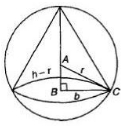
0 likesView Solution
72
MathematicsDifficultMCQJEE Main · 2018
Let $y = y(x)$ be the solution of the differential equation $\frac{dy}{dx} + 2y = f(x)$,where $f(x) = \begin{cases} 1, & x \in [0, 1] \\ 0, & \text{otherwise} \end{cases}$. If $y(0) = 0$,then $y\left(\frac{3}{2}\right)$ is
A
$\frac{e^2 - 1}{2e^3}$
B
$\frac{e^2 - 1}{e^3}$
C
$\frac{1}{2e}$
D
$\frac{e^2 + 1}{2e^4}$
Solution
(A) The given differential equation is a linear differential equation of the form $\frac{dy}{dx} + Py = Q$,where $P = 2$ and $Q = f(x)$.
Case $1$: For $x \in [0, 1]$,$f(x) = 1$.
$\frac{dy}{dx} + 2y = 1$. The integrating factor is $IF = e^{\int 2 dx} = e^{2x}$.
The solution is $y \cdot e^{2x} = \int 1 \cdot e^{2x} dx + C_1 = \frac{1}{2}e^{2x} + C_1$.
So,$y(x) = \frac{1}{2} + C_1 e^{-2x}$.
Given $y(0) = 0$,we have $0 = \frac{1}{2} + C_1 \Rightarrow C_1 = -\frac{1}{2}$.
Thus,$y(x) = \frac{1}{2} - \frac{1}{2}e^{-2x}$ for $x \in [0, 1]$.
At $x = 1$,$y(1) = \frac{1}{2} - \frac{1}{2}e^{-2} = \frac{e^2 - 1}{2e^2}$.
Case $2$: For $x > 1$,$f(x) = 0$.
$\frac{dy}{dx} + 2y = 0 \Rightarrow \frac{dy}{y} = -2 dx$.
Integrating both sides,$\ln|y| = -2x + C_2 \Rightarrow y = C_3 e^{-2x}$.
Using the continuity of $y(x)$ at $x = 1$,$y(1) = C_3 e^{-2} = \frac{e^2 - 1}{2e^2}$.
$C_3 = \frac{e^2 - 1}{2e^2} \cdot e^2 = \frac{e^2 - 1}{2}$.
So,$y(x) = \left(\frac{e^2 - 1}{2}\right) e^{-2x}$ for $x > 1$.
For $x = \frac{3}{2}$,$y\left(\frac{3}{2}\right) = \left(\frac{e^2 - 1}{2}\right) e^{-2(\frac{3}{2})} = \left(\frac{e^2 - 1}{2}\right) e^{-3} = \frac{e^2 - 1}{2e^3}$.
Case $1$: For $x \in [0, 1]$,$f(x) = 1$.
$\frac{dy}{dx} + 2y = 1$. The integrating factor is $IF = e^{\int 2 dx} = e^{2x}$.
The solution is $y \cdot e^{2x} = \int 1 \cdot e^{2x} dx + C_1 = \frac{1}{2}e^{2x} + C_1$.
So,$y(x) = \frac{1}{2} + C_1 e^{-2x}$.
Given $y(0) = 0$,we have $0 = \frac{1}{2} + C_1 \Rightarrow C_1 = -\frac{1}{2}$.
Thus,$y(x) = \frac{1}{2} - \frac{1}{2}e^{-2x}$ for $x \in [0, 1]$.
At $x = 1$,$y(1) = \frac{1}{2} - \frac{1}{2}e^{-2} = \frac{e^2 - 1}{2e^2}$.
Case $2$: For $x > 1$,$f(x) = 0$.
$\frac{dy}{dx} + 2y = 0 \Rightarrow \frac{dy}{y} = -2 dx$.
Integrating both sides,$\ln|y| = -2x + C_2 \Rightarrow y = C_3 e^{-2x}$.
Using the continuity of $y(x)$ at $x = 1$,$y(1) = C_3 e^{-2} = \frac{e^2 - 1}{2e^2}$.
$C_3 = \frac{e^2 - 1}{2e^2} \cdot e^2 = \frac{e^2 - 1}{2}$.
So,$y(x) = \left(\frac{e^2 - 1}{2}\right) e^{-2x}$ for $x > 1$.
For $x = \frac{3}{2}$,$y\left(\frac{3}{2}\right) = \left(\frac{e^2 - 1}{2}\right) e^{-2(\frac{3}{2})} = \left(\frac{e^2 - 1}{2}\right) e^{-3} = \frac{e^2 - 1}{2e^3}$.
0 likesView Solution
73
MathematicsDifficultMCQJEE Main · 2018
The area (in sq. units) of the region $\{x \in R : x \ge 0, y \ge 0, y \ge x - 2, \text{ and } y \le \sqrt{x}\}$ is
A
$\frac{13}{3}$
B
$\frac{10}{3}$
C
$\frac{5}{3}$
D
$\frac{8}{3}$
Solution
(B) The given region is bounded by $y = \sqrt{x}$,$y = x - 2$,$x = 0$,and $y = 0$.
To find the intersection of $y = \sqrt{x}$ and $y = x - 2$,we set $\sqrt{x} = x - 2$.
Squaring both sides,we get $x = (x - 2)^2 = x^2 - 4x + 4$,which simplifies to $x^2 - 5x + 4 = 0$.
Factoring gives $(x - 4)(x - 1) = 0$,so $x = 4$ or $x = 1$.
Since $y = \sqrt{x}$ must be non-negative,at $x = 1$,$y = 1$ but $x - 2 = -1$,which is not equal. Thus,the intersection is at $(4, 2)$.
The area is the integral of the upper curve minus the lower curve.
For $0 \le x \le 2$,the region is bounded by $y = \sqrt{x}$ and $y = 0$. Area $A_1 = \int_{0}^{2} \sqrt{x} \, dx = [\frac{2}{3}x^{3/2}]_{0}^{2} = \frac{2}{3}(2\sqrt{2}) = \frac{4\sqrt{2}}{3}$.
For $2 \le x \le 4$,the region is bounded by $y = \sqrt{x}$ and $y = x - 2$. Area $A_2 = \int_{2}^{4} (\sqrt{x} - (x - 2)) \, dx = [\frac{2}{3}x^{3/2} - \frac{x^2}{2} + 2x]_{2}^{4}$.
$A_2 = (\frac{2}{3}(8) - \frac{16}{2} + 8) - (\frac{2}{3}(2\sqrt{2}) - \frac{4}{2} + 4) = (\frac{16}{3}) - (\frac{4\sqrt{2}}{3} + 2) = \frac{10}{3} - \frac{4\sqrt{2}}{3}$.
Total Area = $A_1 + A_2 = \frac{4\sqrt{2}}{3} + \frac{10}{3} - \frac{4\sqrt{2}}{3} = \frac{10}{3}$ sq. units.
To find the intersection of $y = \sqrt{x}$ and $y = x - 2$,we set $\sqrt{x} = x - 2$.
Squaring both sides,we get $x = (x - 2)^2 = x^2 - 4x + 4$,which simplifies to $x^2 - 5x + 4 = 0$.
Factoring gives $(x - 4)(x - 1) = 0$,so $x = 4$ or $x = 1$.
Since $y = \sqrt{x}$ must be non-negative,at $x = 1$,$y = 1$ but $x - 2 = -1$,which is not equal. Thus,the intersection is at $(4, 2)$.
The area is the integral of the upper curve minus the lower curve.
For $0 \le x \le 2$,the region is bounded by $y = \sqrt{x}$ and $y = 0$. Area $A_1 = \int_{0}^{2} \sqrt{x} \, dx = [\frac{2}{3}x^{3/2}]_{0}^{2} = \frac{2}{3}(2\sqrt{2}) = \frac{4\sqrt{2}}{3}$.
For $2 \le x \le 4$,the region is bounded by $y = \sqrt{x}$ and $y = x - 2$. Area $A_2 = \int_{2}^{4} (\sqrt{x} - (x - 2)) \, dx = [\frac{2}{3}x^{3/2} - \frac{x^2}{2} + 2x]_{2}^{4}$.
$A_2 = (\frac{2}{3}(8) - \frac{16}{2} + 8) - (\frac{2}{3}(2\sqrt{2}) - \frac{4}{2} + 4) = (\frac{16}{3}) - (\frac{4\sqrt{2}}{3} + 2) = \frac{10}{3} - \frac{4\sqrt{2}}{3}$.
Total Area = $A_1 + A_2 = \frac{4\sqrt{2}}{3} + \frac{10}{3} - \frac{4\sqrt{2}}{3} = \frac{10}{3}$ sq. units.
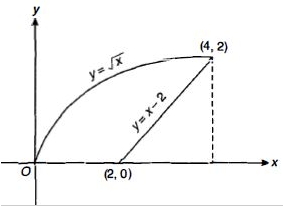
0 likesView Solution
74
MathematicsDifficultMCQJEE Main · 2018
If $\vec{a}, \vec{b}$ and $\vec{c}$ are unit vectors such that $\vec{a} + 2\vec{b} + 2\vec{c} = \vec{0}$,then $|\vec{a} \times \vec{c}|$ is equal to
A
$\frac{1}{4}$
B
$\frac{\sqrt{15}}{4}$
C
$\frac{15}{16}$
D
$\frac{\sqrt{15}}{16}$
Solution
(B) Given: $\vec{a} + 2\vec{b} + 2\vec{c} = \vec{0}$ and $|\vec{a}| = |\vec{b}| = |\vec{c}| = 1$.
Rearranging the equation: $\vec{a} + 2\vec{c} = -2\vec{b}$.
Squaring both sides: $(\vec{a} + 2\vec{c}) \cdot (\vec{a} + 2\vec{c}) = (-2\vec{b}) \cdot (-2\vec{b})$.
$|\vec{a}|^2 + 4|\vec{c}|^2 + 4(\vec{a} \cdot \vec{c}) = 4|\vec{b}|^2$.
Substituting the magnitudes: $1 + 4(1) + 4(\vec{a} \cdot \vec{c}) = 4(1)$.
$5 + 4(\vec{a} \cdot \vec{c}) = 4 \Rightarrow 4(\vec{a} \cdot \vec{c}) = -1 \Rightarrow \vec{a} \cdot \vec{c} = -\frac{1}{4}$.
We know that $|\vec{a} \times \vec{c}|^2 = |\vec{a}|^2 |\vec{c}|^2 - (\vec{a} \cdot \vec{c})^2$.
$|\vec{a} \times \vec{c}|^2 = (1)(1) - (-\frac{1}{4})^2 = 1 - \frac{1}{16} = \frac{15}{16}$.
Therefore,$|\vec{a} \times \vec{c}| = \sqrt{\frac{15}{16}} = \frac{\sqrt{15}}{4}$.
Rearranging the equation: $\vec{a} + 2\vec{c} = -2\vec{b}$.
Squaring both sides: $(\vec{a} + 2\vec{c}) \cdot (\vec{a} + 2\vec{c}) = (-2\vec{b}) \cdot (-2\vec{b})$.
$|\vec{a}|^2 + 4|\vec{c}|^2 + 4(\vec{a} \cdot \vec{c}) = 4|\vec{b}|^2$.
Substituting the magnitudes: $1 + 4(1) + 4(\vec{a} \cdot \vec{c}) = 4(1)$.
$5 + 4(\vec{a} \cdot \vec{c}) = 4 \Rightarrow 4(\vec{a} \cdot \vec{c}) = -1 \Rightarrow \vec{a} \cdot \vec{c} = -\frac{1}{4}$.
We know that $|\vec{a} \times \vec{c}|^2 = |\vec{a}|^2 |\vec{c}|^2 - (\vec{a} \cdot \vec{c})^2$.
$|\vec{a} \times \vec{c}|^2 = (1)(1) - (-\frac{1}{4})^2 = 1 - \frac{1}{16} = \frac{15}{16}$.
Therefore,$|\vec{a} \times \vec{c}| = \sqrt{\frac{15}{16}} = \frac{\sqrt{15}}{4}$.
0 likesView Solution
75
MathematicsDifficultMCQJEE Main · 2018
Let $S = \{(\lambda, \mu) \in R \times R : f(t) = (\|\lambda\|e^{\|t\|} - \mu) \sin(2\|t\|), t \in R\}$ be a differentiable function. Then $S$ is a subset of?
A
$R \times [0, \infty)$
B
$(-\infty, 0) \times R$
C
$[0, \infty) \times R$
D
$R \times (-\infty, 0)$
Solution
(A) Given $f(t) = (\|\lambda\|e^{\|t\|} - \mu) \sin(2\|t\|)$.
Since $\|t\|$ is involved,we analyze $f(t)$ for $t > 0$ and $t < 0$.
For $t > 0$,$f(t) = (\|\lambda\|e^t - \mu) \sin(2t)$.
For $t < 0$,$f(t) = (\|\lambda\|e^{-t} - \mu) \sin(-2t) = -(\|\lambda\|e^{-t} - \mu) \sin(2t)$.
For $f(t)$ to be differentiable at $t=0$,it must be continuous at $t=0$.
$f(0) = (\|\lambda\| - \mu) \sin(0) = 0$.
Now,we check the derivative $f'(t)$ at $t=0$ using $LHD = RHD$.
$RHD = \lim_{t \to 0^+} \frac{f(t) - f(0)}{t} = \lim_{t \to 0^+} (\|\lambda\|e^t - \mu) \frac{\sin(2t)}{t} = (\|\lambda\| - \mu) \times 2 = 2(\|\lambda\| - \mu)$.
$LHD = \lim_{t \to 0^-} \frac{f(t) - f(0)}{t} = \lim_{t \to 0^-} -(\|\lambda\|e^{-t} - \mu) \frac{\sin(2t)}{t} = -(\|\lambda\| - \mu) \times 2 = -2(\|\lambda\| - \mu)$.
For differentiability,$LHD = RHD \implies 2(\|\lambda\| - \mu) = -2(\|\lambda\| - \mu)$.
$4(\|\lambda\| - \mu) = 0 \implies \|\lambda\| = \mu$.
Since $\|\lambda\| \ge 0$,we must have $\mu \ge 0$.
Thus,$S = \{(\lambda, \mu) : \mu = \|\lambda\|, \mu \ge 0, \lambda \in R\}$.
This set $S$ is a subset of $R \times [0, \infty)$.
Since $\|t\|$ is involved,we analyze $f(t)$ for $t > 0$ and $t < 0$.
For $t > 0$,$f(t) = (\|\lambda\|e^t - \mu) \sin(2t)$.
For $t < 0$,$f(t) = (\|\lambda\|e^{-t} - \mu) \sin(-2t) = -(\|\lambda\|e^{-t} - \mu) \sin(2t)$.
For $f(t)$ to be differentiable at $t=0$,it must be continuous at $t=0$.
$f(0) = (\|\lambda\| - \mu) \sin(0) = 0$.
Now,we check the derivative $f'(t)$ at $t=0$ using $LHD = RHD$.
$RHD = \lim_{t \to 0^+} \frac{f(t) - f(0)}{t} = \lim_{t \to 0^+} (\|\lambda\|e^t - \mu) \frac{\sin(2t)}{t} = (\|\lambda\| - \mu) \times 2 = 2(\|\lambda\| - \mu)$.
$LHD = \lim_{t \to 0^-} \frac{f(t) - f(0)}{t} = \lim_{t \to 0^-} -(\|\lambda\|e^{-t} - \mu) \frac{\sin(2t)}{t} = -(\|\lambda\| - \mu) \times 2 = -2(\|\lambda\| - \mu)$.
For differentiability,$LHD = RHD \implies 2(\|\lambda\| - \mu) = -2(\|\lambda\| - \mu)$.
$4(\|\lambda\| - \mu) = 0 \implies \|\lambda\| = \mu$.
Since $\|\lambda\| \ge 0$,we must have $\mu \ge 0$.
Thus,$S = \{(\lambda, \mu) : \mu = \|\lambda\|, \mu \ge 0, \lambda \in R\}$.
This set $S$ is a subset of $R \times [0, \infty)$.
0 likesView Solution
76
MathematicsDifficultMCQJEE Main · 2018
$A$ box $A$ contains $2$ white,$3$ red and $2$ black balls. Another box $B$ contains $4$ white,$2$ red and $3$ black balls. If two balls are drawn at random,without replacement,from a randomly selected box and one ball turns out to be white while the other ball turns out to be red,then the probability that both balls are drawn from box $B$ is
A
$\frac{7}{16}$
B
$\frac{9}{32}$
C
$\frac{7}{8}$
D
$\frac{9}{16}$
Solution
(A) Let $E$ be the event that one white and one red ball are drawn. Let $H_A$ and $H_B$ be the events of selecting box $A$ and box $B$ respectively. $P(H_A) = P(H_B) = \frac{1}{2}$.
The probability of drawing one white and one red ball from box $A$ is $P(E|H_A) = \frac{^2C_1 \times ^3C_1}{^7C_2} = \frac{2 \times 3}{21} = \frac{6}{21} = \frac{2}{7}$.
The probability of drawing one white and one red ball from box $B$ is $P(E|H_B) = \frac{^4C_1 \times ^2C_1}{^9C_2} = \frac{4 \times 2}{36} = \frac{8}{36} = \frac{2}{9}$.
Using Bayes' Theorem,the probability that the balls were drawn from box $B$ given event $E$ is:
$P(H_B|E) = \frac{P(H_B)P(E|H_B)}{P(H_A)P(E|H_A) + P(H_B)P(E|H_B)}$
$P(H_B|E) = \frac{\frac{1}{2} \times \frac{2}{9}}{\frac{1}{2} \times \frac{2}{7} + \frac{1}{2} \times \frac{2}{9}} = \frac{\frac{2}{9}}{\frac{2}{7} + \frac{2}{9}} = \frac{\frac{2}{9}}{\frac{18+14}{63}} = \frac{2}{9} \times \frac{63}{32} = \frac{1}{1} \times \frac{7}{16} = \frac{7}{16}$.
The probability of drawing one white and one red ball from box $A$ is $P(E|H_A) = \frac{^2C_1 \times ^3C_1}{^7C_2} = \frac{2 \times 3}{21} = \frac{6}{21} = \frac{2}{7}$.
The probability of drawing one white and one red ball from box $B$ is $P(E|H_B) = \frac{^4C_1 \times ^2C_1}{^9C_2} = \frac{4 \times 2}{36} = \frac{8}{36} = \frac{2}{9}$.
Using Bayes' Theorem,the probability that the balls were drawn from box $B$ given event $E$ is:
$P(H_B|E) = \frac{P(H_B)P(E|H_B)}{P(H_A)P(E|H_A) + P(H_B)P(E|H_B)}$
$P(H_B|E) = \frac{\frac{1}{2} \times \frac{2}{9}}{\frac{1}{2} \times \frac{2}{7} + \frac{1}{2} \times \frac{2}{9}} = \frac{\frac{2}{9}}{\frac{2}{7} + \frac{2}{9}} = \frac{\frac{2}{9}}{\frac{18+14}{63}} = \frac{2}{9} \times \frac{63}{32} = \frac{1}{1} \times \frac{7}{16} = \frac{7}{16}$.
0 likesView Solution
77
MathematicsDifficultMCQJEE Main · 2018
Let $f : A \to B$ be a function defined as $f(x) = \frac{x - 1}{x - 2}$,where $A = R - \{2\}$ and $B = R - \{1\}$. Then $f$ is
A
invertible and $f^{-1}(y) = \frac{2y + 1}{y - 1}$
B
invertible and $f^{-1}(y) = \frac{3y - 1}{y - 1}$
C
not invertible
D
invertible and $f^{-1}(y) = \frac{2y - 1}{y - 1}$
Solution
(D) To check if the function is invertible,we need to show it is both one-to-one (injective) and onto (surjective).
$1$. One-to-one: Let $f(x_1) = f(x_2)$.
$\frac{x_1 - 1}{x_1 - 2} = \frac{x_2 - 1}{x_2 - 2}$
$(x_1 - 1)(x_2 - 2) = (x_2 - 1)(x_1 - 2)$
$x_1x_2 - 2x_1 - x_2 + 2 = x_1x_2 - 2x_2 - x_1 + 2$
$-2x_1 - x_2 = -2x_2 - x_1$
$x_2 = x_1$. Thus,$f$ is one-to-one.
$2$. Onto: Let $y = \frac{x - 1}{x - 2}$.
$y(x - 2) = x - 1$
$yx - 2y = x - 1$
$yx - x = 2y - 1$
$x(y - 1) = 2y - 1$
$x = \frac{2y - 1}{y - 1}$.
Since for every $y \in R - \{1\}$,there exists an $x \in R - \{2\}$,the function is onto.
Since $f$ is both one-to-one and onto,it is invertible,and $f^{-1}(y) = \frac{2y - 1}{y - 1}$.
$1$. One-to-one: Let $f(x_1) = f(x_2)$.
$\frac{x_1 - 1}{x_1 - 2} = \frac{x_2 - 1}{x_2 - 2}$
$(x_1 - 1)(x_2 - 2) = (x_2 - 1)(x_1 - 2)$
$x_1x_2 - 2x_1 - x_2 + 2 = x_1x_2 - 2x_2 - x_1 + 2$
$-2x_1 - x_2 = -2x_2 - x_1$
$x_2 = x_1$. Thus,$f$ is one-to-one.
$2$. Onto: Let $y = \frac{x - 1}{x - 2}$.
$y(x - 2) = x - 1$
$yx - 2y = x - 1$
$yx - x = 2y - 1$
$x(y - 1) = 2y - 1$
$x = \frac{2y - 1}{y - 1}$.
Since for every $y \in R - \{1\}$,there exists an $x \in R - \{2\}$,the function is onto.
Since $f$ is both one-to-one and onto,it is invertible,and $f^{-1}(y) = \frac{2y - 1}{y - 1}$.
0 likesView Solution
78
MathematicsDifficultMCQJEE Main · 2018
If the system of linear equations $x + ay + z = 3$,$x + 2y + 2z = 6$,and $x + 5y + 3z = b$ has no solution,then:
A
$a = 1, b \neq 9$
B
$a \neq -1, b = 9$
C
$a = -1, b = 9$
D
$a = -1, b \neq 9$
Solution
(D) For a system of linear equations to have no solution,the determinant of the coefficient matrix $\Delta$ must be zero,and at least one of the Cramer's rule determinants $(\Delta_1, \Delta_2, \Delta_3)$ must be non-zero.
First,calculate $\Delta$:
$\Delta = \begin{vmatrix} 1 & a & 1 \\ 1 & 2 & 2 \\ 1 & 5 & 3 \end{vmatrix} = 1(6 - 10) - a(3 - 2) + 1(5 - 2) = -4 - a + 3 = -a - 1$.
Setting $\Delta = 0$,we get $-a - 1 = 0$,which implies $a = -1$.
Next,calculate $\Delta_2$ (replacing the second column with the constants $3, 6, b$):
$\Delta_2 = \begin{vmatrix} 1 & 3 & 1 \\ 1 & 6 & 2 \\ 1 & b & 3 \end{vmatrix} = 1(18 - 2b) - 3(3 - 2) + 1(b - 6) = 18 - 2b - 3 + b - 6 = 9 - b$.
For the system to have no solution,we require $\Delta_2 \neq 0$,so $9 - b \neq 0$,which implies $b \neq 9$.
Thus,the condition is $a = -1$ and $b \neq 9$.
First,calculate $\Delta$:
$\Delta = \begin{vmatrix} 1 & a & 1 \\ 1 & 2 & 2 \\ 1 & 5 & 3 \end{vmatrix} = 1(6 - 10) - a(3 - 2) + 1(5 - 2) = -4 - a + 3 = -a - 1$.
Setting $\Delta = 0$,we get $-a - 1 = 0$,which implies $a = -1$.
Next,calculate $\Delta_2$ (replacing the second column with the constants $3, 6, b$):
$\Delta_2 = \begin{vmatrix} 1 & 3 & 1 \\ 1 & 6 & 2 \\ 1 & b & 3 \end{vmatrix} = 1(18 - 2b) - 3(3 - 2) + 1(b - 6) = 18 - 2b - 3 + b - 6 = 9 - b$.
For the system to have no solution,we require $\Delta_2 \neq 0$,so $9 - b \neq 0$,which implies $b \neq 9$.
Thus,the condition is $a = -1$ and $b \neq 9$.
0 likesView Solution
79
MathematicsDifficultMCQJEE Main · 2018
The curve satisfying the differential equation $(x^2 - y^2) \, dx + 2xy \, dy = 0$ and passing through the point $(1, 1)$ is
A
a circle of radius two
B
a circle of radius one
C
a hyperbola
D
an ellipse
Solution
(B) Given differential equation is $(x^2 - y^2) \, dx + 2xy \, dy = 0$.
This can be written as $\frac{dy}{dx} = \frac{y^2 - x^2}{2xy}$.
Since this is a homogeneous differential equation,we put $y = ux$,which implies $\frac{dy}{dx} = u + x \frac{du}{dx}$.
Substituting these into the equation: $u + x \frac{du}{dx} = \frac{u^2 x^2 - x^2}{2x(ux)} = \frac{u^2 - 1}{2u}$.
$x \frac{du}{dx} = \frac{u^2 - 1}{2u} - u = \frac{u^2 - 1 - 2u^2}{2u} = \frac{-(1 + u^2)}{2u}$.
Separating variables: $\int \frac{2u}{1 + u^2} \, du = - \int \frac{1}{x} \, dx$.
Integrating both sides: $\ln(1 + u^2) = -\ln|x| + \ln|C|$.
$\ln(1 + u^2) = \ln\left(\frac{C}{x}\right) \Rightarrow 1 + u^2 = \frac{C}{x}$.
Substituting $u = \frac{y}{x}$: $1 + \frac{y^2}{x^2} = \frac{C}{x} \Rightarrow \frac{x^2 + y^2}{x^2} = \frac{C}{x} \Rightarrow x^2 + y^2 = Cx$.
Since the curve passes through $(1, 1)$,we have $1^2 + 1^2 = C(1) \Rightarrow C = 2$.
Thus,the equation of the curve is $x^2 + y^2 = 2x$,which can be rewritten as $(x - 1)^2 + y^2 = 1$.
This represents a circle with center $(1, 0)$ and radius $1$.
This can be written as $\frac{dy}{dx} = \frac{y^2 - x^2}{2xy}$.
Since this is a homogeneous differential equation,we put $y = ux$,which implies $\frac{dy}{dx} = u + x \frac{du}{dx}$.
Substituting these into the equation: $u + x \frac{du}{dx} = \frac{u^2 x^2 - x^2}{2x(ux)} = \frac{u^2 - 1}{2u}$.
$x \frac{du}{dx} = \frac{u^2 - 1}{2u} - u = \frac{u^2 - 1 - 2u^2}{2u} = \frac{-(1 + u^2)}{2u}$.
Separating variables: $\int \frac{2u}{1 + u^2} \, du = - \int \frac{1}{x} \, dx$.
Integrating both sides: $\ln(1 + u^2) = -\ln|x| + \ln|C|$.
$\ln(1 + u^2) = \ln\left(\frac{C}{x}\right) \Rightarrow 1 + u^2 = \frac{C}{x}$.
Substituting $u = \frac{y}{x}$: $1 + \frac{y^2}{x^2} = \frac{C}{x} \Rightarrow \frac{x^2 + y^2}{x^2} = \frac{C}{x} \Rightarrow x^2 + y^2 = Cx$.
Since the curve passes through $(1, 1)$,we have $1^2 + 1^2 = C(1) \Rightarrow C = 2$.
Thus,the equation of the curve is $x^2 + y^2 = 2x$,which can be rewritten as $(x - 1)^2 + y^2 = 1$.
This represents a circle with center $(1, 0)$ and radius $1$.
0 likesView Solution
80
MathematicsDifficultMCQJEE Main · 2018
$A$ player $X$ has a biased coin whose probability of showing heads is $p$ and a player $Y$ has a fair coin. They start playing a game with their own coins and play alternately. The player who throws a head first is a winner. If $X$ starts the game,and the probability of winning the game by both the players is equal,then the value of $p$ is
A
$\frac{1}{3}$
B
$\frac{1}{5}$
C
$\frac{1}{4}$
D
$\frac{2}{5}$
Solution
(A) Let $P(X)$ be the probability that player $X$ wins and $P(Y)$ be the probability that player $Y$ wins.
Player $X$ uses a biased coin with $P(H) = p$ and $P(T) = 1-p$. Player $Y$ uses a fair coin with $P(H) = 1/2$ and $P(T) = 1/2$.
$X$ wins if $X$ gets $H$ on the $1^{st}$ throw,or $X$ gets $T$,$Y$ gets $T$,and $X$ gets $H$ on the $3^{rd}$ throw,and so on.
$P(X) = p + (1-p)(1/2)p + (1-p)^2(1/2)^2p + \dots = p \sum_{n=0}^{\infty} (\frac{1-p}{2})^n = \frac{p}{1 - \frac{1-p}{2}} = \frac{2p}{1+p}$.
Since the total probability is $1$,$P(Y) = 1 - P(X) = 1 - \frac{2p}{1+p} = \frac{1-p}{1+p}$.
Given $P(X) = P(Y)$,we have $\frac{2p}{1+p} = \frac{1-p}{1+p}$.
$2p = 1 - p \Rightarrow 3p = 1 \Rightarrow p = \frac{1}{3}$.
Player $X$ uses a biased coin with $P(H) = p$ and $P(T) = 1-p$. Player $Y$ uses a fair coin with $P(H) = 1/2$ and $P(T) = 1/2$.
$X$ wins if $X$ gets $H$ on the $1^{st}$ throw,or $X$ gets $T$,$Y$ gets $T$,and $X$ gets $H$ on the $3^{rd}$ throw,and so on.
$P(X) = p + (1-p)(1/2)p + (1-p)^2(1/2)^2p + \dots = p \sum_{n=0}^{\infty} (\frac{1-p}{2})^n = \frac{p}{1 - \frac{1-p}{2}} = \frac{2p}{1+p}$.
Since the total probability is $1$,$P(Y) = 1 - P(X) = 1 - \frac{2p}{1+p} = \frac{1-p}{1+p}$.
Given $P(X) = P(Y)$,we have $\frac{2p}{1+p} = \frac{1-p}{1+p}$.
$2p = 1 - p \Rightarrow 3p = 1 \Rightarrow p = \frac{1}{3}$.
0 likesView Solution
81
MathematicsDifficultMCQJEE Main · 2018
$\int {\frac{{2x + 5}}{{\sqrt {7 - 6x - {x^2}} }}dx} = A\sqrt {7 - 6x - {x^2}} + B\,{\sin ^{ - 1}}\left( {\frac{{x + 3}}{4}} \right) + C$ (where $C$ is a constant of integration),then the ordered pair $(A, B)$ is equal to
A
$(-2, -1)$
B
$(2, -1)$
C
$(-2, 1)$
D
$(2, 1)$
Solution
(A) To solve the integral $I = \int \frac{2x + 5}{\sqrt{7 - 6x - x^2}} dx$,we express the numerator in terms of the derivative of the quadratic expression inside the square root.
Let $f(x) = 7 - 6x - x^2$. Then $f'(x) = -6 - 2x$.
We write $2x + 5 = -( -2x - 6 ) - 1$.
Thus,$I = \int \frac{-( -2x - 6 ) - 1}{\sqrt{7 - 6x - x^2}} dx = -\int \frac{-2x - 6}{\sqrt{7 - 6x - x^2}} dx - \int \frac{1}{\sqrt{7 - 6x - x^2}} dx$.
For the first integral,let $u = 7 - 6x - x^2$,so $du = (-6 - 2x) dx$. Then $\int \frac{du}{\sqrt{u}} = 2\sqrt{u} = 2\sqrt{7 - 6x - x^2}$.
So,$-\int \frac{-2x - 6}{\sqrt{7 - 6x - x^2}} dx = -2\sqrt{7 - 6x - x^2}$.
For the second integral,complete the square: $7 - 6x - x^2 = 16 - (x^2 + 6x + 9) = 4^2 - (x + 3)^2$.
So,$\int \frac{1}{\sqrt{4^2 - (x + 3)^2}} dx = \sin^{-1}\left(\frac{x + 3}{4}\right)$.
Combining these,$I = -2\sqrt{7 - 6x - x^2} - \sin^{-1}\left(\frac{x + 3}{4}\right) + C$.
Comparing with $A\sqrt{7 - 6x - x^2} + B\sin^{-1}\left(\frac{x + 3}{4}\right) + C$,we get $A = -2$ and $B = -1$.
Let $f(x) = 7 - 6x - x^2$. Then $f'(x) = -6 - 2x$.
We write $2x + 5 = -( -2x - 6 ) - 1$.
Thus,$I = \int \frac{-( -2x - 6 ) - 1}{\sqrt{7 - 6x - x^2}} dx = -\int \frac{-2x - 6}{\sqrt{7 - 6x - x^2}} dx - \int \frac{1}{\sqrt{7 - 6x - x^2}} dx$.
For the first integral,let $u = 7 - 6x - x^2$,so $du = (-6 - 2x) dx$. Then $\int \frac{du}{\sqrt{u}} = 2\sqrt{u} = 2\sqrt{7 - 6x - x^2}$.
So,$-\int \frac{-2x - 6}{\sqrt{7 - 6x - x^2}} dx = -2\sqrt{7 - 6x - x^2}$.
For the second integral,complete the square: $7 - 6x - x^2 = 16 - (x^2 + 6x + 9) = 4^2 - (x + 3)^2$.
So,$\int \frac{1}{\sqrt{4^2 - (x + 3)^2}} dx = \sin^{-1}\left(\frac{x + 3}{4}\right)$.
Combining these,$I = -2\sqrt{7 - 6x - x^2} - \sin^{-1}\left(\frac{x + 3}{4}\right) + C$.
Comparing with $A\sqrt{7 - 6x - x^2} + B\sin^{-1}\left(\frac{x + 3}{4}\right) + C$,we get $A = -2$ and $B = -1$.
0 likesView Solution
82
MathematicsDifficultMCQJEE Main · 2018
$A$ plane bisects the line segment joining the points $(1, 2, 3)$ and $(-3, 4, 5)$ at right angles. Then this plane also passes through the point
A
$(-3, 2, 1)$
B
$(3, 2, 1)$
C
$(1, 2, -3)$
D
$(-1, 2, 3)$
Solution
(A) Let the points be $A(1, 2, 3)$ and $B(-3, 4, 5)$.
Since the plane bisects the line segment $AB$ at right angles,it passes through the midpoint $M$ of $AB$.
$M = \left(\frac{1-3}{2}, \frac{2+4}{2}, \frac{3+5}{2}\right) = (-1, 3, 4)$.
The normal vector $\vec{n}$ to the plane is the vector $\vec{AB} = (-3-1, 4-2, 5-3) = (-4, 2, 2)$.
We can simplify the normal vector to $\vec{n}' = (-2, 1, 1)$.
The equation of the plane is $-2(x - (-1)) + 1(y - 3) + 1(z - 4) = 0$.
$-2x - 2 + y - 3 + z - 4 = 0 \Rightarrow -2x + y + z = 9$.
Now,check the options:
For $(-3, 2, 1)$: $-2(-3) + 2 + 1 = 6 + 2 + 1 = 9$. This satisfies the equation.
Thus,the plane passes through the point $(-3, 2, 1)$.
Since the plane bisects the line segment $AB$ at right angles,it passes through the midpoint $M$ of $AB$.
$M = \left(\frac{1-3}{2}, \frac{2+4}{2}, \frac{3+5}{2}\right) = (-1, 3, 4)$.
The normal vector $\vec{n}$ to the plane is the vector $\vec{AB} = (-3-1, 4-2, 5-3) = (-4, 2, 2)$.
We can simplify the normal vector to $\vec{n}' = (-2, 1, 1)$.
The equation of the plane is $-2(x - (-1)) + 1(y - 3) + 1(z - 4) = 0$.
$-2x - 2 + y - 3 + z - 4 = 0 \Rightarrow -2x + y + z = 9$.
Now,check the options:
For $(-3, 2, 1)$: $-2(-3) + 2 + 1 = 6 + 2 + 1 = 9$. This satisfies the equation.
Thus,the plane passes through the point $(-3, 2, 1)$.
0 likesView Solution
83
MathematicsDifficultMCQJEE Main · 2018
If the position vectors of the vertices $A, B$ and $C$ of a $\Delta ABC$ are respectively $4\hat{i} + 7\hat{j} + 8\hat{k}$,$2\hat{i} + 3\hat{j} + 4\hat{k}$ and $2\hat{i} + 5\hat{j} + 7\hat{k}$,then the position vector of the point,where the bisector of $\angle A$ meets $BC$ is
A
$\frac{1}{2}(4\hat{i} + 8\hat{j} + 11\hat{k})$
B
$\frac{1}{3}(6\hat{i} + 13\hat{j} + 18\hat{k})$
C
$\frac{1}{4}(8\hat{i} + 14\hat{j} + 9\hat{k})$
D
$\frac{1}{3}(6\hat{i} + 11\hat{j} + 15\hat{k})$
Solution
(B) Let the position vectors of vertices $A, B, C$ be $\vec{a} = 4\hat{i} + 7\hat{j} + 8\hat{k}$,$\vec{b} = 2\hat{i} + 3\hat{j} + 4\hat{k}$,and $\vec{c} = 2\hat{i} + 5\hat{j} + 7\hat{k}$.
The angle bisector theorem states that the bisector of $\angle A$ divides the opposite side $BC$ in the ratio of the adjacent sides $AB:AC$.
First,calculate the lengths of sides $AB$ and $AC$:
$\vec{AB} = \vec{b} - \vec{a} = (2-4)\hat{i} + (3-7)\hat{j} + (4-8)\hat{k} = -2\hat{i} - 4\hat{j} - 4\hat{k}$.
$|\vec{AB}| = \sqrt{(-2)^2 + (-4)^2 + (-4)^2} = \sqrt{4 + 16 + 16} = \sqrt{36} = 6$.
$\vec{AC} = \vec{c} - \vec{a} = (2-4)\hat{i} + (5-7)\hat{j} + (7-8)\hat{k} = -2\hat{i} - 2\hat{j} - 1\hat{k}$.
$|\vec{AC}| = \sqrt{(-2)^2 + (-2)^2 + (-1)^2} = \sqrt{4 + 4 + 1} = \sqrt{9} = 3$.
The ratio $AB:AC = 6:3 = 2:1$.
The position vector of point $D$ dividing $BC$ in ratio $m:n$ is $\frac{m\vec{c} + n\vec{b}}{m+n}$.
Here $m=2, n=1$:
$\vec{D} = \frac{2\vec{c} + 1\vec{b}}{2+1} = \frac{2(2\hat{i} + 5\hat{j} + 7\hat{k}) + 1(2\hat{i} + 3\hat{j} + 4\hat{k})}{3}$.
$\vec{D} = \frac{(4+2)\hat{i} + (10+3)\hat{j} + (14+4)\hat{k}}{3} = \frac{6\hat{i} + 13\hat{j} + 18\hat{k}}{3} = \frac{1}{3}(6\hat{i} + 13\hat{j} + 18\hat{k})$.
The angle bisector theorem states that the bisector of $\angle A$ divides the opposite side $BC$ in the ratio of the adjacent sides $AB:AC$.
First,calculate the lengths of sides $AB$ and $AC$:
$\vec{AB} = \vec{b} - \vec{a} = (2-4)\hat{i} + (3-7)\hat{j} + (4-8)\hat{k} = -2\hat{i} - 4\hat{j} - 4\hat{k}$.
$|\vec{AB}| = \sqrt{(-2)^2 + (-4)^2 + (-4)^2} = \sqrt{4 + 16 + 16} = \sqrt{36} = 6$.
$\vec{AC} = \vec{c} - \vec{a} = (2-4)\hat{i} + (5-7)\hat{j} + (7-8)\hat{k} = -2\hat{i} - 2\hat{j} - 1\hat{k}$.
$|\vec{AC}| = \sqrt{(-2)^2 + (-2)^2 + (-1)^2} = \sqrt{4 + 4 + 1} = \sqrt{9} = 3$.
The ratio $AB:AC = 6:3 = 2:1$.
The position vector of point $D$ dividing $BC$ in ratio $m:n$ is $\frac{m\vec{c} + n\vec{b}}{m+n}$.
Here $m=2, n=1$:
$\vec{D} = \frac{2\vec{c} + 1\vec{b}}{2+1} = \frac{2(2\hat{i} + 5\hat{j} + 7\hat{k}) + 1(2\hat{i} + 3\hat{j} + 4\hat{k})}{3}$.
$\vec{D} = \frac{(4+2)\hat{i} + (10+3)\hat{j} + (14+4)\hat{k}}{3} = \frac{6\hat{i} + 13\hat{j} + 18\hat{k}}{3} = \frac{1}{3}(6\hat{i} + 13\hat{j} + 18\hat{k})$.
0 likesView Solution
84
MathematicsDifficultMCQJEE Main · 2018
If $f(x) = \sin^{-1}\left(\frac{2 \cdot 3^x}{1 + 9^x}\right)$,then $f'(-\frac{1}{2})$ equals
A
$\sqrt{3} \ln(\sqrt{3})$
B
$-\sqrt{3} \ln(\sqrt{3})$
C
$-\sqrt{3} \ln(3)$
D
$\sqrt{3} \ln(3)$
Solution
(A) Given $f(x) = \sin^{-1}\left(\frac{2 \cdot 3^x}{1 + (3^x)^2}\right)$.
Let $3^x = \tan \theta$,then $\theta = \tan^{-1}(3^x)$.
$f(x) = \sin^{-1}\left(\frac{2 \tan \theta}{1 + \tan^2 \theta}\right) = \sin^{-1}(\sin 2\theta) = 2\theta = 2 \tan^{-1}(3^x)$.
Differentiating with respect to $x$:
$f'(x) = 2 \cdot \frac{1}{1 + (3^x)^2} \cdot \frac{d}{dx}(3^x) = \frac{2}{1 + 9^x} \cdot 3^x \ln 3$.
Now,evaluate at $x = -\frac{1}{2}$:
$f'(-\frac{1}{2}) = \frac{2 \cdot 3^{-1/2}}{1 + 9^{-1/2}} \ln 3 = \frac{2 / \sqrt{3}}{1 + 1/3} \ln 3 = \frac{2 / \sqrt{3}}{4/3} \ln 3 = \frac{2}{\sqrt{3}} \cdot \frac{3}{4} \ln 3 = \frac{\sqrt{3}}{2} \ln 3$.
Since $\ln 3 = 2 \ln \sqrt{3}$,we have $f'(-\frac{1}{2}) = \frac{\sqrt{3}}{2} \cdot 2 \ln \sqrt{3} = \sqrt{3} \ln \sqrt{3}$.
Let $3^x = \tan \theta$,then $\theta = \tan^{-1}(3^x)$.
$f(x) = \sin^{-1}\left(\frac{2 \tan \theta}{1 + \tan^2 \theta}\right) = \sin^{-1}(\sin 2\theta) = 2\theta = 2 \tan^{-1}(3^x)$.
Differentiating with respect to $x$:
$f'(x) = 2 \cdot \frac{1}{1 + (3^x)^2} \cdot \frac{d}{dx}(3^x) = \frac{2}{1 + 9^x} \cdot 3^x \ln 3$.
Now,evaluate at $x = -\frac{1}{2}$:
$f'(-\frac{1}{2}) = \frac{2 \cdot 3^{-1/2}}{1 + 9^{-1/2}} \ln 3 = \frac{2 / \sqrt{3}}{1 + 1/3} \ln 3 = \frac{2 / \sqrt{3}}{4/3} \ln 3 = \frac{2}{\sqrt{3}} \cdot \frac{3}{4} \ln 3 = \frac{\sqrt{3}}{2} \ln 3$.
Since $\ln 3 = 2 \ln \sqrt{3}$,we have $f'(-\frac{1}{2}) = \frac{\sqrt{3}}{2} \cdot 2 \ln \sqrt{3} = \sqrt{3} \ln \sqrt{3}$.
0 likesView Solution
85
MathematicsDifficultMCQJEE Main · 2018
Let $f(x)$ be a polynomial of degree $4$ having extreme values at $x = 1$ and $x = 2$. If $\mathop {\lim }\limits_{x \to 0} \left( {\frac{{f(x)}}{{{x^2}}} + 1} \right) = 3$,then $f(-1)$ is equal to
A
$\frac{1}{2}$
B
$\frac{3}{2}$
C
$\frac{5}{2}$
D
$\frac{9}{2}$
Solution
(D) Since $f(x)$ is a polynomial of degree $4$,let $f(x) = Ax^4 + Bx^3 + Cx^2 + Dx + E$.
Given $\lim_{x \to 0} \left( \frac{f(x)}{x^2} + 1 \right) = 3$,we have $\lim_{x \to 0} \left( \frac{Ax^4 + Bx^3 + Cx^2 + Dx + E}{x^2} + 1 \right) = 3$.
This implies $\lim_{x \to 0} \left( Ax^2 + Bx + C + \frac{D}{x} + \frac{E}{x^2} + 1 \right) = 3$.
For the limit to exist and be finite,we must have $D = 0$ and $E = 0$. Thus,$C + 1 = 3$,which gives $C = 2$.
Now,$f(x) = Ax^4 + Bx^3 + 2x^2$. The derivative is $f'(x) = 4Ax^3 + 3Bx^2 + 4x$.
Since $f(x)$ has extreme values at $x = 1$ and $x = 2$,$f'(1) = 0$ and $f'(2) = 0$.
$f'(1) = 4A + 3B + 4 = 0 \implies 4A + 3B = -4$ (Equation $1$).
$f'(2) = 4A(8) + 3B(4) + 4(2) = 32A + 12B + 8 = 0 \implies 8A + 3B = -2$ (Equation $2$).
Subtracting Equation $1$ from Equation $2$: $(8A + 3B) - (4A + 3B) = -2 - (-4) \implies 4A = 2 \implies A = \frac{1}{2}$.
Substituting $A = \frac{1}{2}$ into Equation $1$: $4(\frac{1}{2}) + 3B = -4 \implies 2 + 3B = -4 \implies 3B = -6 \implies B = -2$.
Thus,$f(x) = \frac{1}{2}x^4 - 2x^3 + 2x^2$.
Finally,$f(-1) = \frac{1}{2}(-1)^4 - 2(-1)^3 + 2(-1)^2 = \frac{1}{2} + 2 + 2 = \frac{9}{2}$.
Given $\lim_{x \to 0} \left( \frac{f(x)}{x^2} + 1 \right) = 3$,we have $\lim_{x \to 0} \left( \frac{Ax^4 + Bx^3 + Cx^2 + Dx + E}{x^2} + 1 \right) = 3$.
This implies $\lim_{x \to 0} \left( Ax^2 + Bx + C + \frac{D}{x} + \frac{E}{x^2} + 1 \right) = 3$.
For the limit to exist and be finite,we must have $D = 0$ and $E = 0$. Thus,$C + 1 = 3$,which gives $C = 2$.
Now,$f(x) = Ax^4 + Bx^3 + 2x^2$. The derivative is $f'(x) = 4Ax^3 + 3Bx^2 + 4x$.
Since $f(x)$ has extreme values at $x = 1$ and $x = 2$,$f'(1) = 0$ and $f'(2) = 0$.
$f'(1) = 4A + 3B + 4 = 0 \implies 4A + 3B = -4$ (Equation $1$).
$f'(2) = 4A(8) + 3B(4) + 4(2) = 32A + 12B + 8 = 0 \implies 8A + 3B = -2$ (Equation $2$).
Subtracting Equation $1$ from Equation $2$: $(8A + 3B) - (4A + 3B) = -2 - (-4) \implies 4A = 2 \implies A = \frac{1}{2}$.
Substituting $A = \frac{1}{2}$ into Equation $1$: $4(\frac{1}{2}) + 3B = -4 \implies 2 + 3B = -4 \implies 3B = -6 \implies B = -2$.
Thus,$f(x) = \frac{1}{2}x^4 - 2x^3 + 2x^2$.
Finally,$f(-1) = \frac{1}{2}(-1)^4 - 2(-1)^3 + 2(-1)^2 = \frac{1}{2} + 2 + 2 = \frac{9}{2}$.
0 likesView Solution
86
MathematicsDifficultMCQJEE Main · 2018
An angle between the lines whose direction cosines are given by the equations $l + 3m + 5n = 0$ and $5lm - 2mn + 6nl = 0$ is
A
$\cos^{-1}\left(\frac{1}{8}\right)$
B
$\cos^{-1}\left(\frac{1}{6}\right)$
C
$\cos^{-1}\left(\frac{1}{3}\right)$
D
$\cos^{-1}\left(\frac{1}{4}\right)$
Solution
(B) Given equations are:
$l + 3m + 5n = 0$ ....$(1)$
$5lm - 2mn + 6nl = 0$ ....$(2)$
From equation $(1)$,we have $l = -3m - 5n$.
Substituting the value of $l$ in equation $(2)$:
$5(-3m - 5n)m - 2mn + 6n(-3m - 5n) = 0$
$-15m^2 - 25mn - 2mn - 18mn - 30n^2 = 0$
$-15m^2 - 45mn - 30n^2 = 0$
Dividing by $-15$,we get:
$m^2 + 3mn + 2n^2 = 0$
$(m + n)(m + 2n) = 0$
So,$m = -n$ or $m = -2n$.
Case $1$: If $m = -n$,then $l = -3(-n) - 5n = 3n - 5n = -2n$. The direction ratios are $(-2n, -n, n)$,which simplifies to $(-2, -1, 1)$.
Case $2$: If $m = -2n$,then $l = -3(-2n) - 5n = 6n - 5n = n$. The direction ratios are $(n, -2n, n)$,which simplifies to $(1, -2, 1)$.
Let the direction ratios be $\vec{a} = (-2, -1, 1)$ and $\vec{b} = (1, -2, 1)$.
The angle $\theta$ between the lines is given by:
$\cos \theta = \frac{|\vec{a} \cdot \vec{b}|}{|\vec{a}| |\vec{b}|} = \frac{|(-2)(1) + (-1)(-2) + (1)(1)|}{\sqrt{(-2)^2 + (-1)^2 + 1^2} \sqrt{1^2 + (-2)^2 + 1^2}}$
$\cos \theta = \frac{|-2 + 2 + 1|}{\sqrt{6} \sqrt{6}} = \frac{1}{6}$
Therefore,$\theta = \cos^{-1}\left(\frac{1}{6}\right)$.
$l + 3m + 5n = 0$ ....$(1)$
$5lm - 2mn + 6nl = 0$ ....$(2)$
From equation $(1)$,we have $l = -3m - 5n$.
Substituting the value of $l$ in equation $(2)$:
$5(-3m - 5n)m - 2mn + 6n(-3m - 5n) = 0$
$-15m^2 - 25mn - 2mn - 18mn - 30n^2 = 0$
$-15m^2 - 45mn - 30n^2 = 0$
Dividing by $-15$,we get:
$m^2 + 3mn + 2n^2 = 0$
$(m + n)(m + 2n) = 0$
So,$m = -n$ or $m = -2n$.
Case $1$: If $m = -n$,then $l = -3(-n) - 5n = 3n - 5n = -2n$. The direction ratios are $(-2n, -n, n)$,which simplifies to $(-2, -1, 1)$.
Case $2$: If $m = -2n$,then $l = -3(-2n) - 5n = 6n - 5n = n$. The direction ratios are $(n, -2n, n)$,which simplifies to $(1, -2, 1)$.
Let the direction ratios be $\vec{a} = (-2, -1, 1)$ and $\vec{b} = (1, -2, 1)$.
The angle $\theta$ between the lines is given by:
$\cos \theta = \frac{|\vec{a} \cdot \vec{b}|}{|\vec{a}| |\vec{b}|} = \frac{|(-2)(1) + (-1)(-2) + (1)(1)|}{\sqrt{(-2)^2 + (-1)^2 + 1^2} \sqrt{1^2 + (-2)^2 + 1^2}}$
$\cos \theta = \frac{|-2 + 2 + 1|}{\sqrt{6} \sqrt{6}} = \frac{1}{6}$
Therefore,$\theta = \cos^{-1}\left(\frac{1}{6}\right)$.
0 likesView Solution
87
MathematicsDifficultMCQJEE Main · 2018
Suppose $A$ is any $3 \times 3$ non-singular matrix and $(A - 3I)(A - 5I) = O$,where $I = I_3$ and $O = O_3$. If $\alpha A + \beta A^{-1} = 4I$,then $\alpha + \beta$ is equal to
A
$8$
B
$12$
C
$13$
D
$7$
Solution
(A) Given the characteristic equation $(A - 3I)(A - 5I) = O$.
Expanding this,we get $A^2 - 8A + 15I = O$.
Since $A$ is non-singular,we can multiply throughout by $A^{-1}$:
$A^{-1}(A^2 - 8A + 15I) = A^{-1}O$
$A - 8I + 15A^{-1} = O$
$A + 15A^{-1} = 8I$.
To match the form $\alpha A + \beta A^{-1} = 4I$,we divide the entire equation by $2$:
$\frac{1}{2}A + \frac{15}{2}A^{-1} = 4I$.
Comparing this with $\alpha A + \beta A^{-1} = 4I$,we find $\alpha = \frac{1}{2}$ and $\beta = \frac{15}{2}$.
Therefore,$\alpha + \beta = \frac{1}{2} + \frac{15}{2} = \frac{16}{2} = 8$.
Expanding this,we get $A^2 - 8A + 15I = O$.
Since $A$ is non-singular,we can multiply throughout by $A^{-1}$:
$A^{-1}(A^2 - 8A + 15I) = A^{-1}O$
$A - 8I + 15A^{-1} = O$
$A + 15A^{-1} = 8I$.
To match the form $\alpha A + \beta A^{-1} = 4I$,we divide the entire equation by $2$:
$\frac{1}{2}A + \frac{15}{2}A^{-1} = 4I$.
Comparing this with $\alpha A + \beta A^{-1} = 4I$,we find $\alpha = \frac{1}{2}$ and $\beta = \frac{15}{2}$.
Therefore,$\alpha + \beta = \frac{1}{2} + \frac{15}{2} = \frac{16}{2} = 8$.
0 likesView Solution
88
MathematicsDifficultMCQJEE Main · 2018
The value of the integral $\int_{\frac{\pi}{4}}^{\frac{3\pi}{4}} \frac{x}{1+\sin x} dx$ is
A
$\frac{\pi}{2}(\sqrt{2}+1)$
B
$\pi(\sqrt{2}-1)$
C
$2\pi(\sqrt{2}-1)$
D
$\pi\sqrt{2}$
Solution
(B) Let $I = \int_{\frac{\pi}{4}}^{\frac{3\pi}{4}} \frac{x}{1+\sin x} dx$.
Using the property $\int_{a}^{b} f(x) dx = \int_{a}^{b} f(a+b-x) dx$,where $a+b = \frac{\pi}{4} + \frac{3\pi}{4} = \pi$:
$I = \int_{\frac{\pi}{4}}^{\frac{3\pi}{4}} \frac{\pi-x}{1+\sin(\pi-x)} dx = \int_{\frac{\pi}{4}}^{\frac{3\pi}{4}} \frac{\pi-x}{1+\sin x} dx$.
Adding the two expressions for $I$:
$2I = \int_{\frac{\pi}{4}}^{\frac{3\pi}{4}} \frac{x + \pi - x}{1+\sin x} dx = \pi \int_{\frac{\pi}{4}}^{\frac{3\pi}{4}} \frac{1}{1+\sin x} dx$.
Multiply numerator and denominator by $(1-\sin x)$:
$2I = \pi \int_{\frac{\pi}{4}}^{\frac{3\pi}{4}} \frac{1-\sin x}{\cos^2 x} dx = \pi \int_{\frac{\pi}{4}}^{\frac{3\pi}{4}} (\sec^2 x - \sec x \tan x) dx$.
Integrating:
$2I = \pi [\tan x - \sec x]_{\frac{\pi}{4}}^{\frac{3\pi}{4}}$.
Evaluating at the limits:
$2I = \pi [(\tan \frac{3\pi}{4} - \sec \frac{3\pi}{4}) - (\tan \frac{\pi}{4} - \sec \frac{\pi}{4})]$.
$2I = \pi [(-1 - (-\sqrt{2})) - (1 - \sqrt{2})] = \pi [\sqrt{2} - 1 - 1 + \sqrt{2}] = \pi [2\sqrt{2} - 2]$.
$I = \pi(\sqrt{2}-1)$.
Using the property $\int_{a}^{b} f(x) dx = \int_{a}^{b} f(a+b-x) dx$,where $a+b = \frac{\pi}{4} + \frac{3\pi}{4} = \pi$:
$I = \int_{\frac{\pi}{4}}^{\frac{3\pi}{4}} \frac{\pi-x}{1+\sin(\pi-x)} dx = \int_{\frac{\pi}{4}}^{\frac{3\pi}{4}} \frac{\pi-x}{1+\sin x} dx$.
Adding the two expressions for $I$:
$2I = \int_{\frac{\pi}{4}}^{\frac{3\pi}{4}} \frac{x + \pi - x}{1+\sin x} dx = \pi \int_{\frac{\pi}{4}}^{\frac{3\pi}{4}} \frac{1}{1+\sin x} dx$.
Multiply numerator and denominator by $(1-\sin x)$:
$2I = \pi \int_{\frac{\pi}{4}}^{\frac{3\pi}{4}} \frac{1-\sin x}{\cos^2 x} dx = \pi \int_{\frac{\pi}{4}}^{\frac{3\pi}{4}} (\sec^2 x - \sec x \tan x) dx$.
Integrating:
$2I = \pi [\tan x - \sec x]_{\frac{\pi}{4}}^{\frac{3\pi}{4}}$.
Evaluating at the limits:
$2I = \pi [(\tan \frac{3\pi}{4} - \sec \frac{3\pi}{4}) - (\tan \frac{\pi}{4} - \sec \frac{\pi}{4})]$.
$2I = \pi [(-1 - (-\sqrt{2})) - (1 - \sqrt{2})] = \pi [\sqrt{2} - 1 - 1 + \sqrt{2}] = \pi [2\sqrt{2} - 2]$.
$I = \pi(\sqrt{2}-1)$.
0 likesView Solution
89
MathematicsDifficultMCQJEE Main · 2018
If $I_1 = \int\limits_0^1 {{e^{ - x}}} {\cos ^2}x\,dx$,$I_2 = \int\limits_0^1 {{e^{ - {x^2}}}} {\cos ^2}x\,dx$ and $I_3 = \int\limits_0^1 {{e^{ - {x^3}}}} dx$; then
A
$I_2 > I_3 > I_1$
B
$I_3 > I_1 > I_2$
C
$I_2 > I_1 > I_3$
D
$I_3 > I_2 > I_1$
Solution
(D) For $x \in (0, 1)$,we have $x^3 < x^2 < x$.
Multiplying by $-1$,we get $-x^3 > -x^2 > -x$.
Since the exponential function $f(t) = e^t$ is strictly increasing,we have $e^{-x^3} > e^{-x^2} > e^{-x}$.
Now,consider the integrands:
For $I_3$,the integrand is $f_3(x) = e^{-x^3}$.
For $I_2$,the integrand is $f_2(x) = e^{-x^2} \cos^2 x$. Since $0 \le \cos^2 x \le 1$,we have $e^{-x^2} \cos^2 x \le e^{-x^2}$.
For $I_1$,the integrand is $f_1(x) = e^{-x} \cos^2 x$. Since $0 \le \cos^2 x \le 1$,we have $e^{-x} \cos^2 x \le e^{-x}$.
Comparing the functions on $(0, 1)$:
$e^{-x^3} > e^{-x^2} \ge e^{-x^2} \cos^2 x$ implies $I_3 > I_2$.
Also,$e^{-x^2} \cos^2 x > e^{-x} \cos^2 x$ because $e^{-x^2} > e^{-x}$ for $x \in (0, 1)$.
Thus,$I_3 > I_2 > I_1$.
Multiplying by $-1$,we get $-x^3 > -x^2 > -x$.
Since the exponential function $f(t) = e^t$ is strictly increasing,we have $e^{-x^3} > e^{-x^2} > e^{-x}$.
Now,consider the integrands:
For $I_3$,the integrand is $f_3(x) = e^{-x^3}$.
For $I_2$,the integrand is $f_2(x) = e^{-x^2} \cos^2 x$. Since $0 \le \cos^2 x \le 1$,we have $e^{-x^2} \cos^2 x \le e^{-x^2}$.
For $I_1$,the integrand is $f_1(x) = e^{-x} \cos^2 x$. Since $0 \le \cos^2 x \le 1$,we have $e^{-x} \cos^2 x \le e^{-x}$.
Comparing the functions on $(0, 1)$:
$e^{-x^3} > e^{-x^2} \ge e^{-x^2} \cos^2 x$ implies $I_3 > I_2$.
Also,$e^{-x^2} \cos^2 x > e^{-x} \cos^2 x$ because $e^{-x^2} > e^{-x}$ for $x \in (0, 1)$.
Thus,$I_3 > I_2 > I_1$.
0 likesView Solution
90
MathematicsDifficultMCQJEE Main · 2018
Let $f(x) = \begin{cases} (x - 1)^{\frac{1}{2 - x}}, & x > 1, x \neq 2 \\ k, & x = 2 \end{cases}$. The value of $k$ for which $f$ is continuous at $x = 2$ is
A
$e^{-2}$
B
$e$
C
$e^{-1}$
D
$1$
Solution
(C) Since $f(x)$ is continuous at $x = 2$,we have $\lim_{x \to 2} f(x) = f(2)$.
$\lim_{x \to 2} (x - 1)^{\frac{1}{2 - x}} = k$. This is a $1^{\infty}$ form.
Using the formula $\lim_{x \to a} [g(x)]^{h(x)} = e^{\lim_{x \to a} (g(x) - 1)h(x)}$,we get:
$k = e^{\lim_{x \to 2} (x - 1 - 1) \cdot \frac{1}{2 - x}}$
$k = e^{\lim_{x \to 2} \frac{x - 2}{2 - x}}$
$k = e^{\lim_{x \to 2} \frac{-(2 - x)}{2 - x}}$
$k = e^{-1}$.
$\lim_{x \to 2} (x - 1)^{\frac{1}{2 - x}} = k$. This is a $1^{\infty}$ form.
Using the formula $\lim_{x \to a} [g(x)]^{h(x)} = e^{\lim_{x \to a} (g(x) - 1)h(x)}$,we get:
$k = e^{\lim_{x \to 2} (x - 1 - 1) \cdot \frac{1}{2 - x}}$
$k = e^{\lim_{x \to 2} \frac{x - 2}{2 - x}}$
$k = e^{\lim_{x \to 2} \frac{-(2 - x)}{2 - x}}$
$k = e^{-1}$.
0 likesView Solution
91
MathematicsDifficultMCQJEE Main · 2018
Let $A = \begin{bmatrix} 1 & 0 & 0 \\ 1 & 1 & 0 \\ 1 & 1 & 1 \end{bmatrix}$ and $B = A^{20}$. Then the sum of the elements of the first column of $B$ is?
A
$211$
B
$210$
C
$231$
D
$251$
Solution
(C) Given $A = \begin{bmatrix} 1 & 0 & 0 \\ 1 & 1 & 0 \\ 1 & 1 & 1 \end{bmatrix}$.
Calculating powers of $A$:
$A^2 = \begin{bmatrix} 1 & 0 & 0 \\ 2 & 1 & 0 \\ 3 & 2 & 1 \end{bmatrix}$
$A^3 = \begin{bmatrix} 1 & 0 & 0 \\ 3 & 1 & 0 \\ 6 & 3 & 1 \end{bmatrix}$
$A^4 = \begin{bmatrix} 1 & 0 & 0 \\ 4 & 1 & 0 \\ 10 & 4 & 1 \end{bmatrix}$
By observing the pattern,for $A^n$,the first column elements are $1$,$n$,and $\frac{n(n+1)}{2}$.
Thus,$A^n = \begin{bmatrix} 1 & 0 & 0 \\ n & 1 & 0 \\ \frac{n(n+1)}{2} & n & 1 \end{bmatrix}$.
For $n = 20$:
$A^{20} = \begin{bmatrix} 1 & 0 & 0 \\ 20 & 1 & 0 \\ \frac{20(21)}{2} & 20 & 1 \end{bmatrix} = \begin{bmatrix} 1 & 0 & 0 \\ 20 & 1 & 0 \\ 210 & 20 & 1 \end{bmatrix}$.
The sum of the elements of the first column is $1 + 20 + 210 = 231$.
Calculating powers of $A$:
$A^2 = \begin{bmatrix} 1 & 0 & 0 \\ 2 & 1 & 0 \\ 3 & 2 & 1 \end{bmatrix}$
$A^3 = \begin{bmatrix} 1 & 0 & 0 \\ 3 & 1 & 0 \\ 6 & 3 & 1 \end{bmatrix}$
$A^4 = \begin{bmatrix} 1 & 0 & 0 \\ 4 & 1 & 0 \\ 10 & 4 & 1 \end{bmatrix}$
By observing the pattern,for $A^n$,the first column elements are $1$,$n$,and $\frac{n(n+1)}{2}$.
Thus,$A^n = \begin{bmatrix} 1 & 0 & 0 \\ n & 1 & 0 \\ \frac{n(n+1)}{2} & n & 1 \end{bmatrix}$.
For $n = 20$:
$A^{20} = \begin{bmatrix} 1 & 0 & 0 \\ 20 & 1 & 0 \\ \frac{20(21)}{2} & 20 & 1 \end{bmatrix} = \begin{bmatrix} 1 & 0 & 0 \\ 20 & 1 & 0 \\ 210 & 20 & 1 \end{bmatrix}$.
The sum of the elements of the first column is $1 + 20 + 210 = 231$.
0 likesView Solution
92
MathematicsDifficultMCQJEE Main · 2018
If $x = \sqrt{2^{\csc^{-1} t}}$ and $y = \sqrt{2^{\sec^{-1} t}}$ for $|t| \ge 1$,then $\frac{dy}{dx}$ is equal to:
A
$\frac{y}{x}$
B
$-\frac{y}{x}$
C
$-\frac{x}{y}$
D
$\frac{x}{y}$
Solution
(B) Given $x = \sqrt{2^{\csc^{-1} t}}$ and $y = \sqrt{2^{\sec^{-1} t}}$.
Squaring both sides,we get $x^2 = 2^{\csc^{-1} t}$ and $y^2 = 2^{\sec^{-1} t}$.
Taking the product,$x^2 y^2 = 2^{\csc^{-1} t + \sec^{-1} t}$.
Since $\csc^{-1} t + \sec^{-1} t = \frac{\pi}{2}$ for $|t| \ge 1$,we have $x^2 y^2 = 2^{\pi/2}$,which is a constant.
Differentiating both sides with respect to $x$:
$\frac{d}{dx}(x^2 y^2) = \frac{d}{dx}(2^{\pi/2})$
$2x y^2 + x^2 (2y \frac{dy}{dx}) = 0$
$2xy(y + x \frac{dy}{dx}) = 0$
Since $x, y \neq 0$,we have $y + x \frac{dy}{dx} = 0$.
Therefore,$\frac{dy}{dx} = -\frac{y}{x}$.
Squaring both sides,we get $x^2 = 2^{\csc^{-1} t}$ and $y^2 = 2^{\sec^{-1} t}$.
Taking the product,$x^2 y^2 = 2^{\csc^{-1} t + \sec^{-1} t}$.
Since $\csc^{-1} t + \sec^{-1} t = \frac{\pi}{2}$ for $|t| \ge 1$,we have $x^2 y^2 = 2^{\pi/2}$,which is a constant.
Differentiating both sides with respect to $x$:
$\frac{d}{dx}(x^2 y^2) = \frac{d}{dx}(2^{\pi/2})$
$2x y^2 + x^2 (2y \frac{dy}{dx}) = 0$
$2xy(y + x \frac{dy}{dx}) = 0$
Since $x, y \neq 0$,we have $y + x \frac{dy}{dx} = 0$.
Therefore,$\frac{dy}{dx} = -\frac{y}{x}$.
0 likesView Solution
93
MathematicsDifficultMCQJEE Main · 2018
The sum of the intercepts on the coordinate axes of the plane passing through the point $(-2, -2, 2)$ and containing the line joining the points $(1, -1, 2)$ and $(1, 1, 1)$ is
A
$12$
B
$-8$
C
$-4$
D
$4$
Solution
(C) The equation of the plane passing through three points $(x_1, y_1, z_1)$,$(x_2, y_2, z_2)$,and $(x_3, y_3, z_3)$ is given by the determinant equation:
$\begin{vmatrix} x - x_1 & y - y_1 & z - z_1 \\ x_2 - x_1 & y_2 - y_1 & z_2 - z_1 \\ x_3 - x_1 & y_3 - y_1 & z_3 - z_1 \end{vmatrix} = 0$
Substituting the points $(-2, -2, 2)$,$(1, -1, 2)$,and $(1, 1, 1)$:
$\begin{vmatrix} x + 2 & y + 2 & z - 2 \\ 1 - (-2) & -1 - (-2) & 2 - 2 \\ 1 - (-2) & 1 - (-2) & 1 - 2 \end{vmatrix} = 0$
$\Rightarrow \begin{vmatrix} x + 2 & y + 2 & z - 2 \\ 3 & 1 & 0 \\ 3 & 3 & -1 \end{vmatrix} = 0$
Expanding the determinant:
$(x + 2)(-1 - 0) - (y + 2)(-3 - 0) + (z - 2)(9 - 3) = 0$
$-x - 2 + 3y + 6 + 6z - 12 = 0$
$-x + 3y + 6z - 8 = 0$
$x - 3y - 6z = -8$
Dividing by $-8$ to get the intercept form $\frac{x}{a} + \frac{y}{b} + \frac{z}{c} = 1$:
$\frac{x}{-8} + \frac{y}{8/3} + \frac{z}{8/6} = 1$
The intercepts are $a = -8$,$b = 8/3$,and $c = 4/3$.
Sum of intercepts $= -8 + \frac{8}{3} + \frac{4}{3} = -8 + \frac{12}{3} = -8 + 4 = -4$.
$\begin{vmatrix} x - x_1 & y - y_1 & z - z_1 \\ x_2 - x_1 & y_2 - y_1 & z_2 - z_1 \\ x_3 - x_1 & y_3 - y_1 & z_3 - z_1 \end{vmatrix} = 0$
Substituting the points $(-2, -2, 2)$,$(1, -1, 2)$,and $(1, 1, 1)$:
$\begin{vmatrix} x + 2 & y + 2 & z - 2 \\ 1 - (-2) & -1 - (-2) & 2 - 2 \\ 1 - (-2) & 1 - (-2) & 1 - 2 \end{vmatrix} = 0$
$\Rightarrow \begin{vmatrix} x + 2 & y + 2 & z - 2 \\ 3 & 1 & 0 \\ 3 & 3 & -1 \end{vmatrix} = 0$
Expanding the determinant:
$(x + 2)(-1 - 0) - (y + 2)(-3 - 0) + (z - 2)(9 - 3) = 0$
$-x - 2 + 3y + 6 + 6z - 12 = 0$
$-x + 3y + 6z - 8 = 0$
$x - 3y - 6z = -8$
Dividing by $-8$ to get the intercept form $\frac{x}{a} + \frac{y}{b} + \frac{z}{c} = 1$:
$\frac{x}{-8} + \frac{y}{8/3} + \frac{z}{8/6} = 1$
The intercepts are $a = -8$,$b = 8/3$,and $c = 4/3$.
Sum of intercepts $= -8 + \frac{8}{3} + \frac{4}{3} = -8 + \frac{12}{3} = -8 + 4 = -4$.
0 likesView Solution
94
MathematicsDifficultMCQJEE Main · 2018
The differential equation representing the family of ellipses having foci either on the $x$-axis or on the $y$-axis,centered at the origin,and passing through the point $(0,3)$ is:
A
$xyy' + y^2 - 9 = 0$
B
$x + yy'' = 0$
C
$xyy'' + x(y')^2 - yy' = 0$
D
$xyy' - y^2 + 9 = 0$
Solution
(D) The equation of an ellipse centered at the origin is $\frac{x^2}{a^2} + \frac{y^2}{b^2} = 1$.
Since the ellipse passes through $(0,3)$,we have $\frac{0^2}{a^2} + \frac{3^2}{b^2} = 1$,which gives $b^2 = 9$.
Thus,the equation of the ellipse is $\frac{x^2}{a^2} + \frac{y^2}{9} = 1$.
Differentiating with respect to $x$,we get $\frac{2x}{a^2} + \frac{2y}{9} y' = 0$,which simplifies to $\frac{x}{a^2} + \frac{y y'}{9} = 0$,or $\frac{1}{a^2} = -\frac{y y'}{9x}$.
Substituting $\frac{1}{a^2}$ back into the equation $\frac{x^2}{a^2} + \frac{y^2}{9} = 1$,we get $x^2(-\frac{y y'}{9x}) + \frac{y^2}{9} = 1$.
Multiplying by $9$,we get $-x y y' + y^2 = 9$,or $x y y' - y^2 + 9 = 0$.
Since the ellipse passes through $(0,3)$,we have $\frac{0^2}{a^2} + \frac{3^2}{b^2} = 1$,which gives $b^2 = 9$.
Thus,the equation of the ellipse is $\frac{x^2}{a^2} + \frac{y^2}{9} = 1$.
Differentiating with respect to $x$,we get $\frac{2x}{a^2} + \frac{2y}{9} y' = 0$,which simplifies to $\frac{x}{a^2} + \frac{y y'}{9} = 0$,or $\frac{1}{a^2} = -\frac{y y'}{9x}$.
Substituting $\frac{1}{a^2}$ back into the equation $\frac{x^2}{a^2} + \frac{y^2}{9} = 1$,we get $x^2(-\frac{y y'}{9x}) + \frac{y^2}{9} = 1$.
Multiplying by $9$,we get $-x y y' + y^2 = 9$,or $x y y' - y^2 + 9 = 0$.
0 likesView Solution
95
MathematicsDifficultMCQJEE Main · 2018
Let $A, B$ and $C$ be three events,which are pairwise independent and $\bar{E}$ denotes the complement of an event $E$. If $P(A \cap B \cap C) = 0$ and $P(C) > 0$,then $P[(\bar{A} \cap \bar{B})|C]$ is equal to
A
$P(A) + P(\bar{B})$
B
$P(\bar{A}) - P(\bar{B})$
C
$P(\bar{A}) - P(B)$
D
$P(\bar{A}) + P(\bar{B})$
Solution
(C) We need to find $P[(\bar{A} \cap \bar{B})|C]$.
By the definition of conditional probability,$P[(\bar{A} \cap \bar{B})|C] = \frac{P(\bar{A} \cap \bar{B} \cap C)}{P(C)}$.
Using De Morgan's Law,$\bar{A} \cap \bar{B} = \overline{A \cup B}$.
Thus,$\bar{A} \cap \bar{B} \cap C = C \setminus ((A \cap C) \cup (B \cap C))$.
Therefore,$P(\bar{A} \cap \bar{B} \cap C) = P(C) - P((A \cap C) \cup (B \cap C))$.
Using the inclusion-exclusion principle,$P((A \cap C) \cup (B \cap C)) = P(A \cap C) + P(B \cap C) - P(A \cap B \cap C)$.
Since $A, B, C$ are pairwise independent,$P(A \cap C) = P(A)P(C)$ and $P(B \cap C) = P(B)P(C)$.
Given $P(A \cap B \cap C) = 0$,we have $P((A \cap C) \cup (B \cap C)) = P(A)P(C) + P(B)P(C) - 0 = P(C)(P(A) + P(B))$.
Substituting this back,$P(\bar{A} \cap \bar{B} \cap C) = P(C) - P(C)(P(A) + P(B)) = P(C)(1 - P(A) - P(B))$.
Finally,$P[(\bar{A} \cap \bar{B})|C] = \frac{P(C)(1 - P(A) - P(B))}{P(C)} = 1 - P(A) - P(B)$.
Since $1 - P(A) = P(\bar{A})$,the expression becomes $P(\bar{A}) - P(B)$.
By the definition of conditional probability,$P[(\bar{A} \cap \bar{B})|C] = \frac{P(\bar{A} \cap \bar{B} \cap C)}{P(C)}$.
Using De Morgan's Law,$\bar{A} \cap \bar{B} = \overline{A \cup B}$.
Thus,$\bar{A} \cap \bar{B} \cap C = C \setminus ((A \cap C) \cup (B \cap C))$.
Therefore,$P(\bar{A} \cap \bar{B} \cap C) = P(C) - P((A \cap C) \cup (B \cap C))$.
Using the inclusion-exclusion principle,$P((A \cap C) \cup (B \cap C)) = P(A \cap C) + P(B \cap C) - P(A \cap B \cap C)$.
Since $A, B, C$ are pairwise independent,$P(A \cap C) = P(A)P(C)$ and $P(B \cap C) = P(B)P(C)$.
Given $P(A \cap B \cap C) = 0$,we have $P((A \cap C) \cup (B \cap C)) = P(A)P(C) + P(B)P(C) - 0 = P(C)(P(A) + P(B))$.
Substituting this back,$P(\bar{A} \cap \bar{B} \cap C) = P(C) - P(C)(P(A) + P(B)) = P(C)(1 - P(A) - P(B))$.
Finally,$P[(\bar{A} \cap \bar{B})|C] = \frac{P(C)(1 - P(A) - P(B))}{P(C)} = 1 - P(A) - P(B)$.
Since $1 - P(A) = P(\bar{A})$,the expression becomes $P(\bar{A}) - P(B)$.
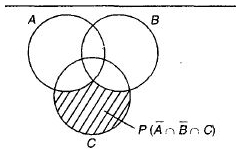
0 likesView Solution
96
MathematicsDifficultMCQJEE Main · 2018
The number of values of $k$ for which the system of linear equations,$(k + 2)x + 10y = k$ and $kx + (k + 3)y = k - 1$ has no solution,is
A
Infinitely many
B
$3$
C
$1$
D
$2$
Solution
(C) The given system of linear equations is:
$(k + 2)x + 10y = k$
$kx + (k + 3)y = k - 1$
For a system of linear equations to have no solution,the determinant of the coefficient matrix must be zero,and the system must be inconsistent.
Let $A = \begin{bmatrix} k + 2 & 10 \\ k & k + 3 \end{bmatrix}$.
Setting $|A| = 0$:
$(k + 2)(k + 3) - 10k = 0$
$k^2 + 5k + 6 - 10k = 0$
$k^2 - 5k + 6 = 0$
$(k - 2)(k - 3) = 0$
So,$k = 2$ or $k = 3$.
Case $1$: If $k = 2$,the equations are $4x + 10y = 2$ and $2x + 5y = 1$. Dividing the first by $2$ gives $2x + 5y = 1$,which is identical to the second equation. Thus,there are infinitely many solutions.
Case $2$: If $k = 3$,the equations are $5x + 10y = 3$ and $3x + 6y = 2$. Multiplying the first by $3$ and the second by $5$ gives $15x + 30y = 9$ and $15x + 30y = 10$. Since $9 \neq 10$,the system is inconsistent and has no solution.
Therefore,there is only $1$ value of $k$ for which the system has no solution.
$(k + 2)x + 10y = k$
$kx + (k + 3)y = k - 1$
For a system of linear equations to have no solution,the determinant of the coefficient matrix must be zero,and the system must be inconsistent.
Let $A = \begin{bmatrix} k + 2 & 10 \\ k & k + 3 \end{bmatrix}$.
Setting $|A| = 0$:
$(k + 2)(k + 3) - 10k = 0$
$k^2 + 5k + 6 - 10k = 0$
$k^2 - 5k + 6 = 0$
$(k - 2)(k - 3) = 0$
So,$k = 2$ or $k = 3$.
Case $1$: If $k = 2$,the equations are $4x + 10y = 2$ and $2x + 5y = 1$. Dividing the first by $2$ gives $2x + 5y = 1$,which is identical to the second equation. Thus,there are infinitely many solutions.
Case $2$: If $k = 3$,the equations are $5x + 10y = 3$ and $3x + 6y = 2$. Multiplying the first by $3$ and the second by $5$ gives $15x + 30y = 9$ and $15x + 30y = 10$. Since $9 \neq 10$,the system is inconsistent and has no solution.
Therefore,there is only $1$ value of $k$ for which the system has no solution.
0 likesView Solution
97
MathematicsMediumMCQJEE Main · 2018
If the angle between the lines,$\frac{x}{2} = \frac{y}{2} = \frac{z}{1}$ and $\frac{5 - x}{- 2} = \frac{7y - 14}{p} = \frac{z - 3}{4}$ is $\cos^{-1} \left( \frac{2}{3} \right)$,then $p$ is equal to
A
$-\frac{7}{4}$
B
$\frac{2}{7}$
C
$-\frac{4}{7}$
D
$\frac{7}{2}$
Solution
(D) The direction ratios of the first line $\frac{x}{2} = \frac{y}{2} = \frac{z}{1}$ are $\vec{v_1} = (2, 2, 1)$.
The second line is $\frac{-(x - 5)}{-2} = \frac{7(y - 2)}{p} = \frac{z - 3}{4}$,which simplifies to $\frac{x - 5}{2} = \frac{y - 2}{p/7} = \frac{z - 3}{4}$.
The direction ratios of the second line are $\vec{v_2} = (2, p/7, 4)$.
The angle $\theta$ between the lines is given by $\cos \theta = \frac{|\vec{v_1} \cdot \vec{v_2}|}{|\vec{v_1}| |\vec{v_2}|}$.
Given $\cos \theta = \frac{2}{3}$,we have $\frac{2}{3} = \frac{|2(2) + 2(p/7) + 1(4)|}{\sqrt{2^2 + 2^2 + 1^2} \sqrt{2^2 + (p/7)^2 + 4^2}}$.
$\frac{2}{3} = \frac{|8 + 2p/7|}{3 \sqrt{4 + p^2/49 + 16}} = \frac{|8 + 2p/7|}{3 \sqrt{20 + p^2/49}}$.
Canceling $3$ from the denominator,we get $\frac{2}{1} = \frac{|8 + 2p/7|}{\sqrt{20 + p^2/49}}$.
Squaring both sides: $4 = \frac{(8 + 2p/7)^2}{20 + p^2/49} = \frac{64 + 32p/7 + 4p^2/49}{20 + p^2/49}$.
$80 + 4p^2/49 = 64 + 32p/7 + 4p^2/49$.
$80 = 64 + 32p/7 \Rightarrow 16 = 32p/7 \Rightarrow p = \frac{16 \times 7}{32} = \frac{7}{2}$.
The second line is $\frac{-(x - 5)}{-2} = \frac{7(y - 2)}{p} = \frac{z - 3}{4}$,which simplifies to $\frac{x - 5}{2} = \frac{y - 2}{p/7} = \frac{z - 3}{4}$.
The direction ratios of the second line are $\vec{v_2} = (2, p/7, 4)$.
The angle $\theta$ between the lines is given by $\cos \theta = \frac{|\vec{v_1} \cdot \vec{v_2}|}{|\vec{v_1}| |\vec{v_2}|}$.
Given $\cos \theta = \frac{2}{3}$,we have $\frac{2}{3} = \frac{|2(2) + 2(p/7) + 1(4)|}{\sqrt{2^2 + 2^2 + 1^2} \sqrt{2^2 + (p/7)^2 + 4^2}}$.
$\frac{2}{3} = \frac{|8 + 2p/7|}{3 \sqrt{4 + p^2/49 + 16}} = \frac{|8 + 2p/7|}{3 \sqrt{20 + p^2/49}}$.
Canceling $3$ from the denominator,we get $\frac{2}{1} = \frac{|8 + 2p/7|}{\sqrt{20 + p^2/49}}$.
Squaring both sides: $4 = \frac{(8 + 2p/7)^2}{20 + p^2/49} = \frac{64 + 32p/7 + 4p^2/49}{20 + p^2/49}$.
$80 + 4p^2/49 = 64 + 32p/7 + 4p^2/49$.
$80 = 64 + 32p/7 \Rightarrow 16 = 32p/7 \Rightarrow p = \frac{16 \times 7}{32} = \frac{7}{2}$.
0 likesView Solution
98
MathematicsDifficultMCQJEE Main · 2018
Let $\vec{a} = \hat{i} + \hat{j} + \hat{k}$,$\vec{c} = \hat{j} - \hat{k}$ and a vector $\vec{b}$ be such that $\vec{a} \times \vec{b} = \vec{c}$ and $\vec{a} \cdot \vec{b} = 3$. Then $|\vec{b}|$ equals?
A
$\sqrt{\frac{11}{3}}$
B
$\frac{\sqrt{11}}{3}$
C
$\frac{11}{\sqrt{3}}$
D
$\frac{11}{3}$
Solution
(A) Given $\vec{a} = \hat{i} + \hat{j} + \hat{k}$,so $|\vec{a}| = \sqrt{1^2 + 1^2 + 1^2} = \sqrt{3}$.
Given $\vec{c} = \hat{j} - \hat{k}$,so $|\vec{c}| = \sqrt{0^2 + 1^2 + (-1)^2} = \sqrt{2}$.
We have $\vec{a} \times \vec{b} = \vec{c}$. Taking the magnitude on both sides,$|\vec{a} \times \vec{b}| = |\vec{c}|$.
$|\vec{a}| |\vec{b}| \sin \theta = |\vec{c}|$,where $\theta$ is the angle between $\vec{a}$ and $\vec{b}$.
$\sqrt{3} |\vec{b}| \sin \theta = \sqrt{2} \quad \dots (1)$
Also,$\vec{a} \cdot \vec{b} = 3$.
$|\vec{a}| |\vec{b}| \cos \theta = 3 \Rightarrow \sqrt{3} |\vec{b}| \cos \theta = 3 \quad \dots (2)$
Squaring and adding $(1)$ and $(2)$:
$(\sqrt{3} |\vec{b}| \sin \theta)^2 + (\sqrt{3} |\vec{b}| \cos \theta)^2 = (\sqrt{2})^2 + 3^2$
$3 |\vec{b}|^2 (\sin^2 \theta + \cos^2 \theta) = 2 + 9$
$3 |\vec{b}|^2 = 11$
$|\vec{b}|^2 = \frac{11}{3} \Rightarrow |\vec{b}| = \sqrt{\frac{11}{3}}$.
Given $\vec{c} = \hat{j} - \hat{k}$,so $|\vec{c}| = \sqrt{0^2 + 1^2 + (-1)^2} = \sqrt{2}$.
We have $\vec{a} \times \vec{b} = \vec{c}$. Taking the magnitude on both sides,$|\vec{a} \times \vec{b}| = |\vec{c}|$.
$|\vec{a}| |\vec{b}| \sin \theta = |\vec{c}|$,where $\theta$ is the angle between $\vec{a}$ and $\vec{b}$.
$\sqrt{3} |\vec{b}| \sin \theta = \sqrt{2} \quad \dots (1)$
Also,$\vec{a} \cdot \vec{b} = 3$.
$|\vec{a}| |\vec{b}| \cos \theta = 3 \Rightarrow \sqrt{3} |\vec{b}| \cos \theta = 3 \quad \dots (2)$
Squaring and adding $(1)$ and $(2)$:
$(\sqrt{3} |\vec{b}| \sin \theta)^2 + (\sqrt{3} |\vec{b}| \cos \theta)^2 = (\sqrt{2})^2 + 3^2$
$3 |\vec{b}|^2 (\sin^2 \theta + \cos^2 \theta) = 2 + 9$
$3 |\vec{b}|^2 = 11$
$|\vec{b}|^2 = \frac{11}{3} \Rightarrow |\vec{b}| = \sqrt{\frac{11}{3}}$.
0 likesView Solution
99
MathematicsDifficultMCQJEE Main · 2018
If $f(x) = \int_0^x {t(\sin x - \sin t) dt}$,then which of the following is true?
A
$f'''(x) + f'(x) = \cos x - 2x \sin x$
B
$f'''(x) + f''(x) - f'(x) = \cos x$
C
$f'''(x) + f'(x) = \cos x$
D
$f'''(x) + f''(x) = \sin x$
Solution
(A) Given $f(x) = \int_0^x t(\sin x - \sin t) dt = \sin x \int_0^x t dt - \int_0^x t \sin t dt$.
Evaluating the integrals:
$\int_0^x t dt = \frac{x^2}{2}$.
Using integration by parts for $\int t \sin t dt = -t \cos t + \sin t$.
So,$f(x) = \sin x (\frac{x^2}{2}) - [-t \cos t + \sin t]_0^x = \frac{x^2}{2} \sin x + x \cos x - \sin x$.
Now,find the derivatives:
$f'(x) = x \sin x + \frac{x^2}{2} \cos x + \cos x - x \sin x - \cos x = \frac{x^2}{2} \cos x$.
$f''(x) = x \cos x - \frac{x^2}{2} \sin x$.
$f'''(x) = \cos x - x \sin x - x \sin x - \frac{x^2}{2} \cos x = \cos x - 2x \sin x - \frac{x^2}{2} \cos x$.
Check $f'''(x) + f'(x)$:
$f'''(x) + f'(x) = (\cos x - 2x \sin x - \frac{x^2}{2} \cos x) + (\frac{x^2}{2} \cos x) = \cos x - 2x \sin x$.
Thus,option $A$ is correct.
Evaluating the integrals:
$\int_0^x t dt = \frac{x^2}{2}$.
Using integration by parts for $\int t \sin t dt = -t \cos t + \sin t$.
So,$f(x) = \sin x (\frac{x^2}{2}) - [-t \cos t + \sin t]_0^x = \frac{x^2}{2} \sin x + x \cos x - \sin x$.
Now,find the derivatives:
$f'(x) = x \sin x + \frac{x^2}{2} \cos x + \cos x - x \sin x - \cos x = \frac{x^2}{2} \cos x$.
$f''(x) = x \cos x - \frac{x^2}{2} \sin x$.
$f'''(x) = \cos x - x \sin x - x \sin x - \frac{x^2}{2} \cos x = \cos x - 2x \sin x - \frac{x^2}{2} \cos x$.
Check $f'''(x) + f'(x)$:
$f'''(x) + f'(x) = (\cos x - 2x \sin x - \frac{x^2}{2} \cos x) + (\frac{x^2}{2} \cos x) = \cos x - 2x \sin x$.
Thus,option $A$ is correct.
0 likesView Solution
100
MathematicsDifficultMCQJEE Main · 2018
Let $M$ and $m$ be respectively the local maximum and the local minimum values of the function $f(x) = 2x^3 - 9x^2 + 12x + 5$ in the interval $[0, 3]$. Then $M - m$ is equal to
A
$1$
B
$5$
C
$4$
D
$9$
Solution
(A) Given function is $f(x) = 2x^3 - 9x^2 + 12x + 5$.
To find local maxima and minima,we find the derivative $f'(x)$:
$f'(x) = 6x^2 - 18x + 12$.
Setting $f'(x) = 0$ for critical points:
$6(x^2 - 3x + 2) = 0 \Rightarrow 6(x - 1)(x - 2) = 0$.
So,the critical points are $x = 1$ and $x = 2$.
Now,we check the second derivative $f''(x) = 12x - 18$.
At $x = 1$,$f''(1) = 12(1) - 18 = -6 < 0$,so $x = 1$ is a local maximum.
$M = f(1) = 2(1)^3 - 9(1)^2 + 12(1) + 5 = 2 - 9 + 12 + 5 = 10$.
At $x = 2$,$f''(2) = 12(2) - 18 = 6 > 0$,so $x = 2$ is a local minimum.
$m = f(2) = 2(2)^3 - 9(2)^2 + 12(2) + 5 = 16 - 36 + 24 + 5 = 9$.
Therefore,$M - m = 10 - 9 = 1$.
To find local maxima and minima,we find the derivative $f'(x)$:
$f'(x) = 6x^2 - 18x + 12$.
Setting $f'(x) = 0$ for critical points:
$6(x^2 - 3x + 2) = 0 \Rightarrow 6(x - 1)(x - 2) = 0$.
So,the critical points are $x = 1$ and $x = 2$.
Now,we check the second derivative $f''(x) = 12x - 18$.
At $x = 1$,$f''(1) = 12(1) - 18 = -6 < 0$,so $x = 1$ is a local maximum.
$M = f(1) = 2(1)^3 - 9(1)^2 + 12(1) + 5 = 2 - 9 + 12 + 5 = 10$.
At $x = 2$,$f''(2) = 12(2) - 18 = 6 > 0$,so $x = 2$ is a local minimum.
$m = f(2) = 2(2)^3 - 9(2)^2 + 12(2) + 5 = 16 - 36 + 24 + 5 = 9$.
Therefore,$M - m = 10 - 9 = 1$.
0 likesView Solution
Vedclass Products
For Students
Vedclass Test Series
Mock tests in real JEE Main style covering Mathematics with performance analysis. 5-day free trial.
Start Free TrialFor Teachers
Exam Paper Generator
Generate Set A/B/C/D Mathematics papers from 7.5L+ questions in 2 minutes. 3 chapters free.
Try FreeFor Institutes
Online Exam Module
Run live JEE Main mock exams with unlimited students, 360° analytics & white-label branding.
See DemoFrequently Asked Questions
How many Mathematics questions are in JEE Main 2018?
There are 121 Mathematics questions from the JEE Main 2018 paper on Vedclass, each with a detailed step-by-step solution in English.
Are JEE Main 2018 Mathematics solutions available in English?
Yes. All solutions on this page are in English. You can also switch to English or Hindi using the language buttons above the questions.
Can I practice JEE Main 2018 Mathematics as a timed test?
Yes. Use the Vedclass Test Series to attempt a full JEE Main mock test covering Mathematics with time limits and instant score analysis.
Can teachers create Mathematics papers from JEE Main previous year questions?
Yes. The Vedclass Exam Paper Generator lets teachers mix JEE Main Mathematics questions and generate Set A/B/C/D papers in minutes.
For Teachers & Institutes
Build a Custom Mathematics Paper
Pick JEE Main 2018 Mathematics questions, set difficulty, and generate Set A/B/C/D in 2 minutes.