
PhysicsQ1–100 of 399 questions
Page 1 of 5 · English
1
PhysicsDifficultMCQJEE Main · 2020
$A$ Carnot engine,having an efficiency of $\eta = 1/10$ as a heat engine,is used as a refrigerator. If the work done on the system is $10 \ J$,the amount of energy absorbed from the reservoir at a lower temperature is ....... $J$.
A
$100$
B
$99$
C
$90$
D
$1$
Solution
(C) The efficiency $(\eta)$ of a Carnot engine and the coefficient of performance $(\beta)$ of a refrigerator are related as:
$\beta = \frac{1 - \eta}{\eta}$
Given $\eta = 1/10$,we calculate the coefficient of performance:
$\beta = \frac{1 - 1/10}{1/10} = \frac{9/10}{1/10} = 9$
The coefficient of performance $(\beta)$ is also defined as the ratio of heat absorbed from the cold reservoir $(Q_2)$ to the work done $(W)$ on the system:
$\beta = \frac{Q_2}{W}$
Given $W = 10 \ J$ and $\beta = 9$,we have:
$9 = \frac{Q_2}{10 \ J}$
$Q_2 = 9 \times 10 \ J = 90 \ J$
Therefore,the energy absorbed from the reservoir at a lower temperature is $90 \ J$.
$\beta = \frac{1 - \eta}{\eta}$
Given $\eta = 1/10$,we calculate the coefficient of performance:
$\beta = \frac{1 - 1/10}{1/10} = \frac{9/10}{1/10} = 9$
The coefficient of performance $(\beta)$ is also defined as the ratio of heat absorbed from the cold reservoir $(Q_2)$ to the work done $(W)$ on the system:
$\beta = \frac{Q_2}{W}$
Given $W = 10 \ J$ and $\beta = 9$,we have:
$9 = \frac{Q_2}{10 \ J}$
$Q_2 = 9 \times 10 \ J = 90 \ J$
Therefore,the energy absorbed from the reservoir at a lower temperature is $90 \ J$.
0 likesView Solution
2
PhysicsDifficultMCQJEE Main · 2020
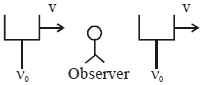
$A$ stationary observer receives sound from two identical tuning forks, one of which approaches and the other one recedes with the same speed $v$ (much less than the speed of sound). The observer hears $2 \; \text{beats/sec}$. The oscillation frequency of each tuning fork is $\nu_{0} = 1400 \; \text{Hz}$ and the velocity of sound in air is $c = 350 \; \text{m/s}$. The speed of each tuning fork is close to:
A
$\frac{1}{8} \; \text{m/s}$
B
$\frac{1}{2} \; \text{m/s}$
C
$1 \; \text{m/s}$
D
$\frac{1}{4} \; \text{m/s}$
Solution
(D) Let $c$ be the speed of sound and $v$ be the speed of the tuning forks.
The frequency heard from the approaching tuning fork is $\nu_{1} = \left(\frac{c}{c-v}\right) \nu_{0}$.
The frequency heard from the receding tuning fork is $\nu_{2} = \left(\frac{c}{c+v}\right) \nu_{0}$.
The beat frequency is given by $\Delta \nu = \nu_{1} - \nu_{2} = 2 \; \text{Hz}$.
Substituting the expressions:
$\Delta \nu = c \nu_{0} \left(\frac{1}{c-v} - \frac{1}{c+v}\right) = c \nu_{0} \left(\frac{c+v - (c-v)}{c^{2}-v^{2}}\right) = \frac{2 c \nu_{0} v}{c^{2}-v^{2}}$.
Since $v \ll c$, we can approximate $c^{2} - v^{2} \approx c^{2}$.
Thus, $\Delta \nu \approx \frac{2 c \nu_{0} v}{c^{2}} = \frac{2 \nu_{0} v}{c} = 2$.
Substituting the given values: $\frac{2 \times 1400 \times v}{350} = 2$.
$8v = 2 \Rightarrow v = \frac{2}{8} = \frac{1}{4} \; \text{m/s}$.
The frequency heard from the approaching tuning fork is $\nu_{1} = \left(\frac{c}{c-v}\right) \nu_{0}$.
The frequency heard from the receding tuning fork is $\nu_{2} = \left(\frac{c}{c+v}\right) \nu_{0}$.
The beat frequency is given by $\Delta \nu = \nu_{1} - \nu_{2} = 2 \; \text{Hz}$.
Substituting the expressions:
$\Delta \nu = c \nu_{0} \left(\frac{1}{c-v} - \frac{1}{c+v}\right) = c \nu_{0} \left(\frac{c+v - (c-v)}{c^{2}-v^{2}}\right) = \frac{2 c \nu_{0} v}{c^{2}-v^{2}}$.
Since $v \ll c$, we can approximate $c^{2} - v^{2} \approx c^{2}$.
Thus, $\Delta \nu \approx \frac{2 c \nu_{0} v}{c^{2}} = \frac{2 \nu_{0} v}{c} = 2$.
Substituting the given values: $\frac{2 \times 1400 \times v}{350} = 2$.
$8v = 2 \Rightarrow v = \frac{2}{8} = \frac{1}{4} \; \text{m/s}$.
0 likesView Solution
3
PhysicsMediumMCQJEE Main · 2020
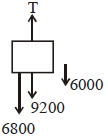
An elevator in a building can carry a maximum of $10$ persons,with the average mass of each person being $68 \; kg$. The mass of the elevator itself is $920 \; kg$ and it moves with a constant speed of $3 \; m/s$. The frictional force opposing the motion is $6000 \; N$. If the elevator is moving up with its full capacity,the power delivered by the motor to the elevator $\left(g = 10 \; m/s^{2}\right)$ must be at least .............. $W$.
A
$56300$
B
$48000$
C
$66000$
D
$62360$
Solution
(C) The total mass of the persons is $M_p = 10 \times 68 \; kg = 680 \; kg$.
The total mass of the elevator system is $M = M_p + M_{elevator} = 680 \; kg + 920 \; kg = 1600 \; kg$.
The total downward force due to gravity is $F_g = M \times g = 1600 \; kg \times 10 \; m/s^{2} = 16000 \; N$.
The frictional force opposing the upward motion is $f = 6000 \; N$.
Since the elevator moves with a constant speed,the acceleration is zero. Therefore,the tension $T$ in the cable must balance the total downward force:
$T = F_g + f = 16000 \; N + 6000 \; N = 22000 \; N$.
The power $P$ delivered by the motor is given by $P = T \times v$,where $v$ is the velocity.
$P = 22000 \; N \times 3 \; m/s = 66000 \; W$.
The total mass of the elevator system is $M = M_p + M_{elevator} = 680 \; kg + 920 \; kg = 1600 \; kg$.
The total downward force due to gravity is $F_g = M \times g = 1600 \; kg \times 10 \; m/s^{2} = 16000 \; N$.
The frictional force opposing the upward motion is $f = 6000 \; N$.
Since the elevator moves with a constant speed,the acceleration is zero. Therefore,the tension $T$ in the cable must balance the total downward force:
$T = F_g + f = 16000 \; N + 6000 \; N = 22000 \; N$.
The power $P$ delivered by the motor is given by $P = T \times v$,where $v$ is the velocity.
$P = 22000 \; N \times 3 \; m/s = 66000 \; W$.
0 likesView Solution
4
PhysicsDifficultMCQJEE Main · 2020
The mass per unit area of a circular disc of radius $a$ depends on the distance $r$ from its centre as $\sigma(r) = A + Br$. The moment of inertia of the disc about the axis perpendicular to the plane and passing through its centre is
A
$2 \pi a^{4} \left( \frac{A}{4} + \frac{aB}{5} \right)$
B
$\pi a^{4} \left( \frac{A}{4} + \frac{aB}{5} \right)$
C
$2 \pi a^{4} \left( \frac{aA}{4} + \frac{B}{5} \right)$
D
$2 \pi a^{4} \left( \frac{A}{4} + \frac{B}{5} \right)$
Solution
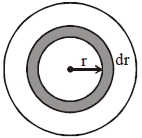
(A) Consider a thin circular ring of radius $r$ and thickness $dr$. The area of this ring is $dA = 2 \pi r dr$.
The mass of this elemental ring is $dm = \sigma(r) dA = (A + Br) (2 \pi r dr)$.
The moment of inertia of this ring about the axis perpendicular to the plane and passing through the centre is $dI = dm r^{2}$.
Substituting the value of $dm$,we get $dI = (A + Br) (2 \pi r dr) r^{2} = 2 \pi (A r^{3} + B r^{4}) dr$.
To find the total moment of inertia $I$,we integrate $dI$ from $r = 0$ to $r = a$:
$I = \int_{0}^{a} 2 \pi (A r^{3} + B r^{4}) dr = 2 \pi \left[ \frac{A r^{4}}{4} + \frac{B r^{5}}{5} \right]_{0}^{a}$.
$I = 2 \pi \left( \frac{A a^{4}}{4} + \frac{B a^{5}}{5} \right) = 2 \pi a^{4} \left( \frac{A}{4} + \frac{aB}{5} \right)$.
The mass of this elemental ring is $dm = \sigma(r) dA = (A + Br) (2 \pi r dr)$.
The moment of inertia of this ring about the axis perpendicular to the plane and passing through the centre is $dI = dm r^{2}$.
Substituting the value of $dm$,we get $dI = (A + Br) (2 \pi r dr) r^{2} = 2 \pi (A r^{3} + B r^{4}) dr$.
To find the total moment of inertia $I$,we integrate $dI$ from $r = 0$ to $r = a$:
$I = \int_{0}^{a} 2 \pi (A r^{3} + B r^{4}) dr = 2 \pi \left[ \frac{A r^{4}}{4} + \frac{B r^{5}}{5} \right]_{0}^{a}$.
$I = 2 \pi \left( \frac{A a^{4}}{4} + \frac{B a^{5}}{5} \right) = 2 \pi a^{4} \left( \frac{A}{4} + \frac{aB}{5} \right)$.
0 likesView Solution
5
PhysicsMediumMCQJEE Main · 2020
The dimension of $\frac{B^{2}}{2 \mu_{0}}$,where $B$ is magnetic field and $\mu_{0}$ is the magnetic permeability of vacuum,is
A
$M L^{-1} T^{-2}$
B
$M L^{2} T^{-1}$
C
$M L T^{-2}$
D
$M L^{2} T^{-2}$
Solution
(A) The expression $\frac{B^{2}}{2 \mu_{0}}$ represents the magnetic energy density,which is the magnetic energy stored per unit volume.
The formula for energy density is $u = \frac{\text{Energy}}{\text{Volume}}$.
The dimension of energy is $[M L^{2} T^{-2}]$ and the dimension of volume is $[L^{3}]$.
Therefore,the dimension of energy density is $\frac{[M L^{2} T^{-2}]}{[L^{3}]} = [M L^{-1} T^{-2}]$.
Thus,the dimension of $\frac{B^{2}}{2 \mu_{0}}$ is $[M L^{-1} T^{-2}]$.
The formula for energy density is $u = \frac{\text{Energy}}{\text{Volume}}$.
The dimension of energy is $[M L^{2} T^{-2}]$ and the dimension of volume is $[L^{3}]$.
Therefore,the dimension of energy density is $\frac{[M L^{2} T^{-2}]}{[L^{3}]} = [M L^{-1} T^{-2}]$.
Thus,the dimension of $\frac{B^{2}}{2 \mu_{0}}$ is $[M L^{-1} T^{-2}]$.
0 likesView Solution
6
PhysicsMediumMCQJEE Main · 2020
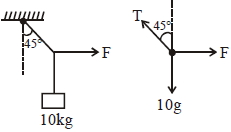
$A$ mass of $10 \; kg$ is suspended by a rope of length $4 \; m$ from the ceiling. $A$ force $F$ is applied horizontally at the mid-point of the rope such that the top half of the rope makes an angle of $45^{\circ}$ with the vertical. Then $F$ equals ........... $N$ (Take $g = 10 \; ms^{-2}$ and the rope to be massless).
A
$100$
B
$90$
C
$75$
D
$70$
Solution
(A) Let $T$ be the tension in the upper half of the rope. The lower half of the rope is vertical and supports the mass of $10 \; kg$,so the tension in the lower half is $T_{lower} = mg = 10 \times 10 = 100 \; N$.
At the mid-point where force $F$ is applied,we consider the equilibrium of forces.
The horizontal component of the tension $T$ in the upper rope must balance the applied force $F$: $T \sin 45^{\circ} = F$.
The vertical component of the tension $T$ in the upper rope must balance the downward tension from the lower rope: $T \cos 45^{\circ} = T_{lower} = 100 \; N$.
Dividing the two equations: $\frac{T \sin 45^{\circ}}{T \cos 45^{\circ}} = \frac{F}{100}$.
$\tan 45^{\circ} = \frac{F}{100}$.
Since $\tan 45^{\circ} = 1$,we get $1 = \frac{F}{100}$,which implies $F = 100 \; N$.
At the mid-point where force $F$ is applied,we consider the equilibrium of forces.
The horizontal component of the tension $T$ in the upper rope must balance the applied force $F$: $T \sin 45^{\circ} = F$.
The vertical component of the tension $T$ in the upper rope must balance the downward tension from the lower rope: $T \cos 45^{\circ} = T_{lower} = 100 \; N$.
Dividing the two equations: $\frac{T \sin 45^{\circ}}{T \cos 45^{\circ}} = \frac{F}{100}$.
$\tan 45^{\circ} = \frac{F}{100}$.
Since $\tan 45^{\circ} = 1$,we get $1 = \frac{F}{100}$,which implies $F = 100 \; N$.
0 likesView Solution
7
PhysicsMediumMCQJEE Main · 2020
Two ideal Carnot engines operate in cascade (all heat given up by one engine is used by the other engine to produce work) between temperatures $T_{1}$ and $T_{2}$. The temperature of the hot reservoir of the first engine is $T_{1}$ and the temperature of the cold reservoir of the second engine is $T_{2}$. $T$ is the temperature of the sink of the first engine,which is also the source for the second engine. How is $T$ related to $T_{1}$ and $T_{2}$,if both engines perform equal amounts of work?
A
$T=\frac{2 T_{1} T_{2}}{T_{1}+T_{2}}$
B
$T=\sqrt{T_{1} T_{2}}$
C
$T=\frac{T_{1}+T_{2}}{2}$
D
$T=0$
Solution
(C) For the first Carnot engine,the efficiency is $\eta_{1} = 1 - \frac{T}{T_{1}}$. The work done is $W_{1} = Q_{H1} \eta_{1} = Q_{H1} \left(1 - \frac{T}{T_{1}}\right)$.
For the second Carnot engine,the efficiency is $\eta_{2} = 1 - \frac{T_{2}}{T}$. The work done is $W_{2} = Q_{H2} \eta_{2} = Q_{L1} \left(1 - \frac{T_{2}}{T}\right)$.
Since the heat rejected by the first engine is the heat absorbed by the second engine,$Q_{L1} = Q_{H2}$.
From the first engine,$Q_{L1} = Q_{H1} \left(\frac{T}{T_{1}}\right)$.
Given $W_{1} = W_{2}$,we have $Q_{H1} \left(1 - \frac{T}{T_{1}}\right) = Q_{H1} \left(\frac{T}{T_{1}}\right) \left(1 - \frac{T_{2}}{T}\right)$.
Simplifying,$1 - \frac{T}{T_{1}} = \frac{T}{T_{1}} - \frac{T_{2}}{T_{1}}$.
$1 + \frac{T_{2}}{T_{1}} = \frac{2T}{T_{1}}$.
Multiplying by $T_{1}$,we get $T_{1} + T_{2} = 2T$,which implies $T = \frac{T_{1} + T_{2}}{2}$.
For the second Carnot engine,the efficiency is $\eta_{2} = 1 - \frac{T_{2}}{T}$. The work done is $W_{2} = Q_{H2} \eta_{2} = Q_{L1} \left(1 - \frac{T_{2}}{T}\right)$.
Since the heat rejected by the first engine is the heat absorbed by the second engine,$Q_{L1} = Q_{H2}$.
From the first engine,$Q_{L1} = Q_{H1} \left(\frac{T}{T_{1}}\right)$.
Given $W_{1} = W_{2}$,we have $Q_{H1} \left(1 - \frac{T}{T_{1}}\right) = Q_{H1} \left(\frac{T}{T_{1}}\right) \left(1 - \frac{T_{2}}{T}\right)$.
Simplifying,$1 - \frac{T}{T_{1}} = \frac{T}{T_{1}} - \frac{T_{2}}{T_{1}}$.
$1 + \frac{T_{2}}{T_{1}} = \frac{2T}{T_{1}}$.
Multiplying by $T_{1}$,we get $T_{1} + T_{2} = 2T$,which implies $T = \frac{T_{1} + T_{2}}{2}$.
0 likesView Solution
8
PhysicsMediumMCQJEE Main · 2020
$A$ box weighs $196 \; N$ on a spring balance at the North Pole. Its weight recorded on the same balance if it is shifted to the equator is close to ....... $N$ (Take $g = 10 \; m/s^2$ at the North Pole and the radius of the Earth $R = 6400 \; km$).
A
$195.66$
B
$194.66$
C
$194.32$
D
$195.32$
Solution
(D) The weight of the box at the North Pole is $W_p = mg = 196 \; N$. Given $g = 10 \; m/s^2$,the mass $m = 196 / 10 = 19.6 \; kg$.
At the equator,the effective acceleration due to gravity is $g' = g - \omega^2 R$,where $\omega$ is the angular velocity of the Earth.
The weight at the equator is $W_e = m(g - \omega^2 R) = mg - m\omega^2 R$.
The angular velocity $\omega = \frac{2\pi}{T}$,where $T = 24 \times 3600 \; s$.
Substituting the values: $W_e = 196 - 19.6 \times \left( \frac{2\pi}{24 \times 3600} \right)^2 \times 6400 \times 10^3$.
Calculating the term $m\omega^2 R = 19.6 \times (7.27 \times 10^{-5})^2 \times 6.4 \times 10^6 \approx 19.6 \times 0.0337 \approx 0.66 \; N$.
Therefore,$W_e = 196 - 0.66 = 195.34 \; N$.
The closest option is $195.32 \; N$.
At the equator,the effective acceleration due to gravity is $g' = g - \omega^2 R$,where $\omega$ is the angular velocity of the Earth.
The weight at the equator is $W_e = m(g - \omega^2 R) = mg - m\omega^2 R$.
The angular velocity $\omega = \frac{2\pi}{T}$,where $T = 24 \times 3600 \; s$.
Substituting the values: $W_e = 196 - 19.6 \times \left( \frac{2\pi}{24 \times 3600} \right)^2 \times 6400 \times 10^3$.
Calculating the term $m\omega^2 R = 19.6 \times (7.27 \times 10^{-5})^2 \times 6.4 \times 10^6 \approx 19.6 \times 0.0337 \approx 0.66 \; N$.
Therefore,$W_e = 196 - 0.66 = 195.34 \; N$.
The closest option is $195.32 \; N$.
0 likesView Solution
9
PhysicsDifficultMCQJEE Main · 2020
Under an adiabatic process,the volume of an ideal gas gets doubled. Consequently,the mean collision time between the gas molecules changes from $\tau_{1}$ to $\tau_{2}$. If $\frac{C_{p}}{C_{v}}=\gamma$ for this gas,then a good estimate for $\frac{\tau_{2}}{\tau_{1}}$ is given by:
A
$\left(\frac{1}{2}\right)^{\frac{\gamma+1}{2}}$
B
$2$
C
$\frac{1}{2}$
D
$\left(\frac{1}{2}\right)^{\gamma}$
Solution
(A) The mean collision time $\tau$ is defined as the ratio of the mean free path $\lambda$ to the root mean square speed $v_{RMS}$.
$\tau = \frac{\lambda}{v_{RMS}}$
We know that the mean free path $\lambda = \frac{V}{\sqrt{2} \pi d^2 N}$,so $\lambda \propto V$.
Also,$v_{RMS} = \sqrt{\frac{3RT}{M}} \propto \sqrt{T}$.
From the ideal gas law $PV = nRT$,we have $T \propto PV$,so $v_{RMS} \propto \sqrt{PV}$.
Substituting these into the expression for $\tau$:
$\tau \propto \frac{V}{\sqrt{PV}} = \sqrt{\frac{V^2}{PV}} = \sqrt{\frac{V}{P}}$.
For an adiabatic process,$PV^{\gamma} = \text{constant}$,which implies $P \propto V^{-\gamma}$.
Substituting this into the proportionality for $\tau$:
$\tau \propto \sqrt{\frac{V}{V^{-\gamma}}} = \sqrt{V^{1+\gamma}} = V^{\frac{1+\gamma}{2}}$.
Given the volume changes from $V_1$ to $V_2 = 2V_1$,the ratio is:
$\frac{\tau_2}{\tau_1} = \left(\frac{V_2}{V_1}\right)^{\frac{1+\gamma}{2}} = (2)^{\frac{1+\gamma}{2}}$.
Since the question asks for the ratio in terms of $\frac{1}{2}$,we have $\frac{\tau_2}{\tau_1} = \left(\frac{1}{2}\right)^{-\frac{\gamma+1}{2}}$.
Note: Based on the provided options,the intended answer is $\left(\frac{1}{2}\right)^{-\frac{\gamma+1}{2}}$,but since the options are formatted as powers of $1/2$,the correct mathematical derivation leads to the inverse of option $A$.
$\tau = \frac{\lambda}{v_{RMS}}$
We know that the mean free path $\lambda = \frac{V}{\sqrt{2} \pi d^2 N}$,so $\lambda \propto V$.
Also,$v_{RMS} = \sqrt{\frac{3RT}{M}} \propto \sqrt{T}$.
From the ideal gas law $PV = nRT$,we have $T \propto PV$,so $v_{RMS} \propto \sqrt{PV}$.
Substituting these into the expression for $\tau$:
$\tau \propto \frac{V}{\sqrt{PV}} = \sqrt{\frac{V^2}{PV}} = \sqrt{\frac{V}{P}}$.
For an adiabatic process,$PV^{\gamma} = \text{constant}$,which implies $P \propto V^{-\gamma}$.
Substituting this into the proportionality for $\tau$:
$\tau \propto \sqrt{\frac{V}{V^{-\gamma}}} = \sqrt{V^{1+\gamma}} = V^{\frac{1+\gamma}{2}}$.
Given the volume changes from $V_1$ to $V_2 = 2V_1$,the ratio is:
$\frac{\tau_2}{\tau_1} = \left(\frac{V_2}{V_1}\right)^{\frac{1+\gamma}{2}} = (2)^{\frac{1+\gamma}{2}}$.
Since the question asks for the ratio in terms of $\frac{1}{2}$,we have $\frac{\tau_2}{\tau_1} = \left(\frac{1}{2}\right)^{-\frac{\gamma+1}{2}}$.
Note: Based on the provided options,the intended answer is $\left(\frac{1}{2}\right)^{-\frac{\gamma+1}{2}}$,but since the options are formatted as powers of $1/2$,the correct mathematical derivation leads to the inverse of option $A$.
0 likesView Solution
10
PhysicsMediumMCQJEE Main · 2020
An ideal fluid flows (laminar flow) through a pipe of non-uniform diameter. The maximum and minimum diameters of the pipe are $6.4 \; cm$ and $4.8 \; cm,$ respectively. The ratio of the minimum and the maximum velocities of the fluid in this pipe is:
A
$\frac{\sqrt{3}}{2}$
B
$\frac{3}{4}$
C
$\frac{81}{256}$
D
$\frac{9}{16}$
Solution
(D) According to the equation of continuity for an ideal fluid,the product of the cross-sectional area and the velocity of the fluid remains constant: $A_1 v_1 = A_2 v_2$.
This implies that the velocity is inversely proportional to the area: $v \propto \frac{1}{A}$.
Since the area $A = \pi r^2 = \pi (d/2)^2$,we have $A \propto d^2$,where $d$ is the diameter.
Therefore,the ratio of the minimum velocity to the maximum velocity is given by the ratio of the minimum area to the maximum area:
$\frac{v_{\min}}{v_{\max}} = \frac{A_{\min}}{A_{\max}} = \left( \frac{d_{\min}}{d_{\max}} \right)^2$.
Substituting the given values $d_{\min} = 4.8 \; cm$ and $d_{\max} = 6.4 \; cm$:
$\frac{v_{\min}}{v_{\max}} = \left( \frac{4.8}{6.4} \right)^2 = \left( \frac{3}{4} \right)^2 = \frac{9}{16}$.
This implies that the velocity is inversely proportional to the area: $v \propto \frac{1}{A}$.
Since the area $A = \pi r^2 = \pi (d/2)^2$,we have $A \propto d^2$,where $d$ is the diameter.
Therefore,the ratio of the minimum velocity to the maximum velocity is given by the ratio of the minimum area to the maximum area:
$\frac{v_{\min}}{v_{\max}} = \frac{A_{\min}}{A_{\max}} = \left( \frac{d_{\min}}{d_{\max}} \right)^2$.
Substituting the given values $d_{\min} = 4.8 \; cm$ and $d_{\max} = 6.4 \; cm$:
$\frac{v_{\min}}{v_{\max}} = \left( \frac{4.8}{6.4} \right)^2 = \left( \frac{3}{4} \right)^2 = \frac{9}{16}$.
1 likesView Solution
11
PhysicsDifficultMCQJEE Main · 2020
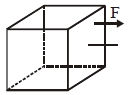
Consider a uniform cubical box of side $a$ on a rough floor that is to be moved by applying a minimum possible force $F$ at a point $b$ above its centre of mass (see figure). If the coefficient of friction is $\mu = 0.4$,the maximum possible value of $100 \times \frac{b}{a}$ for a box not to topple before moving is
A
$80$
B
$75$
C
$85$
D
$82$
Solution
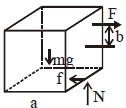
(B) For the box to move,the applied force $F$ must be equal to the limiting friction force:
$F = \mu mg \dots (1)$
For the box not to topple,the torque about the front edge must be zero or balanced. The force $F$ is applied at a height $h = \frac{a}{2} + b$ from the base. The normal force $N$ shifts to the front edge to prevent toppling. Taking torque about the front edge:
$F \left( \frac{a}{2} + b \right) = mg \left( \frac{a}{2} \right) \dots (2)$
Substituting $F = \mu mg$ from equation $(1)$ into equation $(2)$:
$\mu mg \left( \frac{a}{2} + b \right) = mg \left( \frac{a}{2} \right)$
$\mu \left( \frac{a}{2} + b \right) = \frac{a}{2}$
Given $\mu = 0.4 = \frac{2}{5}$,we have:
$\frac{2}{5} \left( \frac{a}{2} + b \right) = \frac{a}{2}$
Multiply by $5$:
$2 \left( \frac{a}{2} + b \right) = 2.5a$
$a + 2b = 2.5a$
$2b = 1.5a$
$\frac{b}{a} = \frac{1.5}{2} = 0.75$
Therefore,$100 \times \frac{b}{a} = 100 \times 0.75 = 75$.
$F = \mu mg \dots (1)$
For the box not to topple,the torque about the front edge must be zero or balanced. The force $F$ is applied at a height $h = \frac{a}{2} + b$ from the base. The normal force $N$ shifts to the front edge to prevent toppling. Taking torque about the front edge:
$F \left( \frac{a}{2} + b \right) = mg \left( \frac{a}{2} \right) \dots (2)$
Substituting $F = \mu mg$ from equation $(1)$ into equation $(2)$:
$\mu mg \left( \frac{a}{2} + b \right) = mg \left( \frac{a}{2} \right)$
$\mu \left( \frac{a}{2} + b \right) = \frac{a}{2}$
Given $\mu = 0.4 = \frac{2}{5}$,we have:
$\frac{2}{5} \left( \frac{a}{2} + b \right) = \frac{a}{2}$
Multiply by $5$:
$2 \left( \frac{a}{2} + b \right) = 2.5a$
$a + 2b = 2.5a$
$2b = 1.5a$
$\frac{b}{a} = \frac{1.5}{2} = 0.75$
Therefore,$100 \times \frac{b}{a} = 100 \times 0.75 = 75$.
1 likesView Solution
12
PhysicsMediumMCQJEE Main · 2020
The sum of two forces $\overrightarrow{P}$ and $\overrightarrow{Q}$ is $\overrightarrow{R}$ such that $|\overrightarrow{R}| = |\overrightarrow{P}|$. The angle $\alpha$ (in degrees) that the resultant of $2\overrightarrow{P}$ and $\overrightarrow{Q}$ will make with $\overrightarrow{Q}$ is
A
$80$
B
$90$
C
$85$
D
$95$
Solution
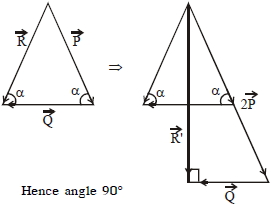
(B) Given that $|\overrightarrow{P} + \overrightarrow{Q}| = |\overrightarrow{P}|$.
Squaring both sides,we get $P^2 + Q^2 + 2PQ \cos \theta = P^2$,where $\theta$ is the angle between $\overrightarrow{P}$ and $\overrightarrow{Q}$.
This simplifies to $Q^2 + 2PQ \cos \theta = 0$,or $Q(Q + 2P \cos \theta) = 0$.
Since $Q \neq 0$,we have $Q + 2P \cos \theta = 0$.
Now,let $\overrightarrow{R'} = 2\overrightarrow{P} + \overrightarrow{Q}$. The angle $\alpha$ that $\overrightarrow{R'}$ makes with $\overrightarrow{Q}$ is given by $\tan \alpha = \frac{|2\overrightarrow{P}| \sin \theta}{|\overrightarrow{Q}| + |2\overrightarrow{P}| \cos \theta} = \frac{2P \sin \theta}{Q + 2P \cos \theta}$.
Substituting $Q + 2P \cos \theta = 0$ into the expression,we get $\tan \alpha = \frac{2P \sin \theta}{0} = \infty$.
Therefore,$\alpha = 90^{\circ}$.
Squaring both sides,we get $P^2 + Q^2 + 2PQ \cos \theta = P^2$,where $\theta$ is the angle between $\overrightarrow{P}$ and $\overrightarrow{Q}$.
This simplifies to $Q^2 + 2PQ \cos \theta = 0$,or $Q(Q + 2P \cos \theta) = 0$.
Since $Q \neq 0$,we have $Q + 2P \cos \theta = 0$.
Now,let $\overrightarrow{R'} = 2\overrightarrow{P} + \overrightarrow{Q}$. The angle $\alpha$ that $\overrightarrow{R'}$ makes with $\overrightarrow{Q}$ is given by $\tan \alpha = \frac{|2\overrightarrow{P}| \sin \theta}{|\overrightarrow{Q}| + |2\overrightarrow{P}| \cos \theta} = \frac{2P \sin \theta}{Q + 2P \cos \theta}$.
Substituting $Q + 2P \cos \theta = 0$ into the expression,we get $\tan \alpha = \frac{2P \sin \theta}{0} = \infty$.
Therefore,$\alpha = 90^{\circ}$.
0 likesView Solution
13
PhysicsMediumMCQJEE Main · 2020
$M$ grams of steam at $100^{\circ} C$ is mixed with $200 \; g$ of ice at its melting point in a thermally insulated container. If it produces liquid water at $40^{\circ} C$ [heat of vaporization of water is $540 \; cal/g$ and heat of fusion of ice is $80 \; cal/g$],the value of $M$ is:
A
$35$
B
$37$
C
$40$
D
$42$
Solution
(C) According to the principle of calorimetry,heat lost by steam = heat gained by ice.
Heat lost by $M$ grams of steam at $100^{\circ} C$ to become water at $40^{\circ} C$:
$Q_{lost} = M \times L_v + M \times c_w \times \Delta T$
$Q_{lost} = M \times 540 + M \times 1 \times (100 - 40) = 540M + 60M = 600M$
Heat gained by $200 \; g$ of ice at $0^{\circ} C$ to become water at $40^{\circ} C$:
$Q_{gained} = m_{ice} \times L_f + m_{ice} \times c_w \times \Delta T$
$Q_{gained} = 200 \times 80 + 200 \times 1 \times (40 - 0) = 16000 + 8000 = 24000 \; cal$
Equating the two:
$600M = 24000$
$M = 24000 / 600 = 40 \; g$.
Heat lost by $M$ grams of steam at $100^{\circ} C$ to become water at $40^{\circ} C$:
$Q_{lost} = M \times L_v + M \times c_w \times \Delta T$
$Q_{lost} = M \times 540 + M \times 1 \times (100 - 40) = 540M + 60M = 600M$
Heat gained by $200 \; g$ of ice at $0^{\circ} C$ to become water at $40^{\circ} C$:
$Q_{gained} = m_{ice} \times L_f + m_{ice} \times c_w \times \Delta T$
$Q_{gained} = 200 \times 80 + 200 \times 1 \times (40 - 0) = 16000 + 8000 = 24000 \; cal$
Equating the two:
$600M = 24000$
$M = 24000 / 600 = 40 \; g$.
0 likesView Solution
14
PhysicsMediumMCQJEE Main · 2020
$A$ $60\; HP$ electric motor lifts an elevator having a maximum total load capacity of $2000\; kg$. If the frictional force on the elevator is $4000\; N$,the speed of the elevator at full load is close to .............. $m/s$.
$(1\; HP = 746\; W, g = 10\; ms^{-2})$
$(1\; HP = 746\; W, g = 10\; ms^{-2})$
A
$1.7$
B
$2$
C
$1.9$
D
$1.5$
Solution
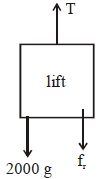
(C) Let the elevator move upward with a constant speed $V$.
The total downward force acting on the elevator is the sum of the gravitational force and the frictional force.
$T = mg + f_r$
Given $m = 2000\; kg$,$g = 10\; ms^{-2}$,and $f_r = 4000\; N$.
$T = (2000 \times 10) + 4000 = 20000 + 4000 = 24000\; N$.
The power $P$ of the motor is given by $P = T \times V$.
Given $P = 60\; HP = 60 \times 746\; W = 44760\; W$.
Equating the power,we get:
$44760 = 24000 \times V$
$V = \frac{44760}{24000} = 1.865\; m/s$.
Rounding to one decimal place,the speed is approximately $1.9\; m/s$.
The total downward force acting on the elevator is the sum of the gravitational force and the frictional force.
$T = mg + f_r$
Given $m = 2000\; kg$,$g = 10\; ms^{-2}$,and $f_r = 4000\; N$.
$T = (2000 \times 10) + 4000 = 20000 + 4000 = 24000\; N$.
The power $P$ of the motor is given by $P = T \times V$.
Given $P = 60\; HP = 60 \times 746\; W = 44760\; W$.
Equating the power,we get:
$44760 = 24000 \times V$
$V = \frac{44760}{24000} = 1.865\; m/s$.
Rounding to one decimal place,the speed is approximately $1.9\; m/s$.
0 likesView Solution
15
PhysicsMediumMCQJEE Main · 2020
$A$ litre of dry air at $STP$ expands adiabatically to a volume of $3$ litres. If $\gamma=1.40,$ the work done by air is $(3^{1.4}=4.6555)$. [Take air to be an ideal gas] (in $; J$)
A
$90.5$
B
$48$
C
$60.7$
D
$100.8$
Solution
(A) For an adiabatic process,the work done is given by $W = \frac{P_1 V_1 - P_2 V_2}{\gamma - 1}$.
At $STP$,$P_1 = 1.013 \times 10^5 \; Pa$ and $V_1 = 1 \; L = 10^{-3} \; m^3$.
Using the adiabatic relation $P_1 V_1^\gamma = P_2 V_2^\gamma$,we find $P_2 = P_1 \left(\frac{V_1}{V_2}\right)^\gamma = P_1 \left(\frac{1}{3}\right)^{1.4}$.
Substituting $P_2$ into the work formula: $W = \frac{P_1 V_1 - P_1 V_1 (1/3)^{1.4} \times 3}{\gamma - 1} = \frac{P_1 V_1 [1 - 3 \times (1/3)^{1.4}]}{0.4}$.
Given $3^{1.4} = 4.6555$,then $(1/3)^{1.4} = 1/4.6555 \approx 0.2148$.
$W = \frac{1.013 \times 10^5 \times 10^{-3} \times [1 - 3 \times 0.2148]}{0.4} = \frac{101.3 \times [1 - 0.6444]}{0.4} = \frac{101.3 \times 0.3556}{0.4} \approx 90.04 \; J$.
Rounding to the nearest provided option,the work done is approximately $90.5 \; J$.
At $STP$,$P_1 = 1.013 \times 10^5 \; Pa$ and $V_1 = 1 \; L = 10^{-3} \; m^3$.
Using the adiabatic relation $P_1 V_1^\gamma = P_2 V_2^\gamma$,we find $P_2 = P_1 \left(\frac{V_1}{V_2}\right)^\gamma = P_1 \left(\frac{1}{3}\right)^{1.4}$.
Substituting $P_2$ into the work formula: $W = \frac{P_1 V_1 - P_1 V_1 (1/3)^{1.4} \times 3}{\gamma - 1} = \frac{P_1 V_1 [1 - 3 \times (1/3)^{1.4}]}{0.4}$.
Given $3^{1.4} = 4.6555$,then $(1/3)^{1.4} = 1/4.6555 \approx 0.2148$.
$W = \frac{1.013 \times 10^5 \times 10^{-3} \times [1 - 3 \times 0.2148]}{0.4} = \frac{101.3 \times [1 - 0.6444]}{0.4} = \frac{101.3 \times 0.3556}{0.4} \approx 90.04 \; J$.
Rounding to the nearest provided option,the work done is approximately $90.5 \; J$.
0 likesView Solution
16
PhysicsMediumMCQJEE Main · 2020
As shown in the figure,a bob of mass $m$ is tied by a massless string whose other end portion is wound on a flywheel (disc) of radius $r$ and mass $m$. When released from rest,the bob starts falling vertically. When it has covered a distance of $h$,the angular speed of the wheel will be
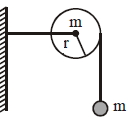
A
$\frac{1}{r} \sqrt{\frac{2 g h}{3}}$
B
$r \sqrt{\frac{3}{4 g h}}$
C
$\frac{1}{r} \sqrt{\frac{4 g h}{3}}$
D
$r \sqrt{\frac{3}{2 g h}}$
Solution
(C) By the law of conservation of energy,the loss in potential energy of the bob is equal to the gain in the total kinetic energy (translational kinetic energy of the bob + rotational kinetic energy of the disc).
Loss in potential energy = $mgh$
Gain in kinetic energy = $\frac{1}{2} mv^2 + \frac{1}{2} I \omega^2$
Since the string is wound on the disc,the linear velocity of the bob $v$ is related to the angular velocity $\omega$ of the disc by $v = r\omega$.
The moment of inertia of the disc is $I = \frac{1}{2} mr^2$.
Equating the energies: $mgh = \frac{1}{2} mv^2 + \frac{1}{2} (\frac{1}{2} mr^2) \omega^2$
Substituting $v = r\omega$: $mgh = \frac{1}{2} m(r\omega)^2 + \frac{1}{4} mr^2 \omega^2$
$mgh = \frac{1}{2} mr^2 \omega^2 + \frac{1}{4} mr^2 \omega^2 = \frac{3}{4} mr^2 \omega^2$
Solving for $\omega$: $\omega^2 = \frac{4gh}{3r^2}$
$\omega = \frac{1}{r} \sqrt{\frac{4gh}{3}}$
Loss in potential energy = $mgh$
Gain in kinetic energy = $\frac{1}{2} mv^2 + \frac{1}{2} I \omega^2$
Since the string is wound on the disc,the linear velocity of the bob $v$ is related to the angular velocity $\omega$ of the disc by $v = r\omega$.
The moment of inertia of the disc is $I = \frac{1}{2} mr^2$.
Equating the energies: $mgh = \frac{1}{2} mv^2 + \frac{1}{2} (\frac{1}{2} mr^2) \omega^2$
Substituting $v = r\omega$: $mgh = \frac{1}{2} m(r\omega)^2 + \frac{1}{4} mr^2 \omega^2$
$mgh = \frac{1}{2} mr^2 \omega^2 + \frac{1}{4} mr^2 \omega^2 = \frac{3}{4} mr^2 \omega^2$
Solving for $\omega$: $\omega^2 = \frac{4gh}{3r^2}$
$\omega = \frac{1}{r} \sqrt{\frac{4gh}{3}}$
0 likesView Solution
17
PhysicsMediumMCQJEE Main · 2020
The radius of gyration of a uniform rod of length $l$ about an axis passing through a point $\frac{l}{4}$ away from the centre of the rod and perpendicular to it is:
A
$\frac{1}{8} l$
B
$\sqrt{\frac{7}{48}} l$
C
$\sqrt{\frac{3}{8}} l$
D
$\frac{1}{4} l$
Solution
(B) The moment of inertia of a uniform rod of mass $m$ and length $l$ about an axis passing through its centre and perpendicular to it is $I_{cm} = \frac{ml^2}{12}$.
According to the parallel axis theorem,the moment of inertia about an axis at a distance $d = \frac{l}{4}$ from the centre is $I = I_{cm} + md^2$.
Substituting the values,we get $I = \frac{ml^2}{12} + m(\frac{l}{4})^2 = \frac{ml^2}{12} + \frac{ml^2}{16}$.
Taking the common denominator,$I = \frac{4ml^2 + 3ml^2}{48} = \frac{7ml^2}{48}$.
The radius of gyration $k$ is defined by $I = mk^2$,so $mk^2 = \frac{7ml^2}{48}$.
Thus,$k^2 = \frac{7l^2}{48}$,which gives $k = \sqrt{\frac{7}{48}} l$.
According to the parallel axis theorem,the moment of inertia about an axis at a distance $d = \frac{l}{4}$ from the centre is $I = I_{cm} + md^2$.
Substituting the values,we get $I = \frac{ml^2}{12} + m(\frac{l}{4})^2 = \frac{ml^2}{12} + \frac{ml^2}{16}$.
Taking the common denominator,$I = \frac{4ml^2 + 3ml^2}{48} = \frac{7ml^2}{48}$.
The radius of gyration $k$ is defined by $I = mk^2$,so $mk^2 = \frac{7ml^2}{48}$.
Thus,$k^2 = \frac{7l^2}{48}$,which gives $k = \sqrt{\frac{7}{48}} l$.
0 likesView Solution
18
PhysicsMediumMCQJEE Main · 2020
Speed of a transverse wave on a straight wire (mass $6.0\; g$,length $60\; cm$,and area of cross-section $1.0\; mm^{2}$) is $90\; ms^{-1}$. If the Young's modulus of the wire is $16 \times 10^{11}\; Nm^{-2}$,the extension of the wire over its natural length is: (in $; mm$)
A
$0.02$
B
$0.04$
C
$0.03$
D
$0.01$
Solution
(C) The speed of a transverse wave on a stretched wire is given by $v = \sqrt{\frac{T}{\mu}}$,where $T$ is the tension and $\mu$ is the linear mass density.
Given: $v = 90\; ms^{-1}$,$m = 6.0 \times 10^{-3}\; kg$,$L = 0.6\; m$,$A = 1.0 \times 10^{-6}\; m^{2}$,$Y = 16 \times 10^{11}\; Nm^{-2}$.
Linear mass density $\mu = \frac{m}{L} = \frac{6.0 \times 10^{-3}}{0.6} = 10^{-2}\; kg/m$.
From $v = \sqrt{\frac{T}{\mu}}$,we have $T = v^{2} \mu = (90)^{2} \times 10^{-2} = 8100 \times 10^{-2} = 81\; N$.
Young's modulus $Y = \frac{T/A}{\Delta L/L}$,so $\Delta L = \frac{T L}{Y A}$.
Substituting the values: $\Delta L = \frac{81 \times 0.6}{16 \times 10^{11} \times 1.0 \times 10^{-6}} = \frac{48.6}{16 \times 10^{5}} = 3.0375 \times 10^{-5}\; m \approx 0.03\; mm$.
Given: $v = 90\; ms^{-1}$,$m = 6.0 \times 10^{-3}\; kg$,$L = 0.6\; m$,$A = 1.0 \times 10^{-6}\; m^{2}$,$Y = 16 \times 10^{11}\; Nm^{-2}$.
Linear mass density $\mu = \frac{m}{L} = \frac{6.0 \times 10^{-3}}{0.6} = 10^{-2}\; kg/m$.
From $v = \sqrt{\frac{T}{\mu}}$,we have $T = v^{2} \mu = (90)^{2} \times 10^{-2} = 8100 \times 10^{-2} = 81\; N$.
Young's modulus $Y = \frac{T/A}{\Delta L/L}$,so $\Delta L = \frac{T L}{Y A}$.
Substituting the values: $\Delta L = \frac{81 \times 0.6}{16 \times 10^{11} \times 1.0 \times 10^{-6}} = \frac{48.6}{16 \times 10^{5}} = 3.0375 \times 10^{-5}\; m \approx 0.03\; mm$.
0 likesView Solution
19
PhysicsDifficultMCQJEE Main · 2020
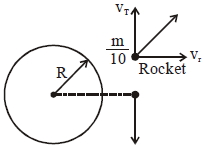
$A$ satellite of mass $m$ is launched vertically upwards with an initial speed $u$ from the surface of the earth. After it reaches height $R$ ($R =$ radius of the earth), it ejects a rocket of mass $\frac{m}{10}$ so that subsequently the satellite moves in a circular orbit. The kinetic energy of the rocket is ($G$ is the gravitational constant, $M$ is the mass of the earth).
A
$\frac{m}{20}\left(u-\sqrt{\frac{2 GM}{3 R}}\right)^{2}$
B
$5 m\left(u^{2}-\frac{119}{200} \frac{GM}{R}\right)$
C
$\frac{3 m}{8}\left(u+\sqrt{\frac{5 G M}{6 R}}\right)^{2}$
D
$\frac{m}{20}\left(u^{2}+\frac{113}{200} \frac{G M}{R}\right)$
Solution
(B) $1$. Apply energy conservation from the surface to height $R$ (distance $2R$ from the center):
$\frac{1}{2}mu^2 - \frac{GMm}{R} = \frac{1}{2}mv^2 - \frac{GMm}{2R}$
$\frac{1}{2}v^2 = \frac{1}{2}u^2 - \frac{GM}{2R} \Rightarrow v = \sqrt{u^2 - \frac{GM}{R}}$
$2$. At height $R$, the satellite (mass $m$) ejects a rocket (mass $m/10$). The remaining satellite (mass $9m/10$) enters a circular orbit at distance $2R$. The orbital velocity is $v_o = \sqrt{\frac{GM}{2R}}$.
$3$. By conservation of linear momentum in the radial and tangential directions:
Radial: $\frac{m}{10} v_r = m v = m \sqrt{u^2 - \frac{GM}{R}} \Rightarrow v_r = 10 \sqrt{u^2 - \frac{GM}{R}}$
Tangential: $\frac{m}{10} v_T = \frac{9m}{10} v_o = \frac{9m}{10} \sqrt{\frac{GM}{2R}} \Rightarrow v_T = 9 \sqrt{\frac{GM}{2R}}$
$4$. Kinetic energy of the rocket $(K_r = \frac{1}{2} (m/10) (v_r^2 + v_T^2))$:
$K_r = \frac{m}{20} \left( 100(u^2 - \frac{GM}{R}) + 81(\frac{GM}{2R}) \right)$
$K_r = \frac{m}{20} \left( 100u^2 - 100\frac{GM}{R} + 40.5\frac{GM}{R} \right) = \frac{m}{20} \left( 100u^2 - 59.5\frac{GM}{R} \right)$
$K_r = 5m \left( u^2 - 0.595 \frac{GM}{R} \right) = 5m \left( u^2 - \frac{119}{200} \frac{GM}{R} \right)$.
$\frac{1}{2}mu^2 - \frac{GMm}{R} = \frac{1}{2}mv^2 - \frac{GMm}{2R}$
$\frac{1}{2}v^2 = \frac{1}{2}u^2 - \frac{GM}{2R} \Rightarrow v = \sqrt{u^2 - \frac{GM}{R}}$
$2$. At height $R$, the satellite (mass $m$) ejects a rocket (mass $m/10$). The remaining satellite (mass $9m/10$) enters a circular orbit at distance $2R$. The orbital velocity is $v_o = \sqrt{\frac{GM}{2R}}$.
$3$. By conservation of linear momentum in the radial and tangential directions:
Radial: $\frac{m}{10} v_r = m v = m \sqrt{u^2 - \frac{GM}{R}} \Rightarrow v_r = 10 \sqrt{u^2 - \frac{GM}{R}}$
Tangential: $\frac{m}{10} v_T = \frac{9m}{10} v_o = \frac{9m}{10} \sqrt{\frac{GM}{2R}} \Rightarrow v_T = 9 \sqrt{\frac{GM}{2R}}$
$4$. Kinetic energy of the rocket $(K_r = \frac{1}{2} (m/10) (v_r^2 + v_T^2))$:
$K_r = \frac{m}{20} \left( 100(u^2 - \frac{GM}{R}) + 81(\frac{GM}{2R}) \right)$
$K_r = \frac{m}{20} \left( 100u^2 - 100\frac{GM}{R} + 40.5\frac{GM}{R} \right) = \frac{m}{20} \left( 100u^2 - 59.5\frac{GM}{R} \right)$
$K_r = 5m \left( u^2 - 0.595 \frac{GM}{R} \right) = 5m \left( u^2 - \frac{119}{200} \frac{GM}{R} \right)$.
0 likesView Solution
20
PhysicsMediumMCQJEE Main · 2020
Three point particles of masses $1.0 \; kg$,$1.5 \; kg$,and $2.5 \; kg$ are placed at three corners of a right-angled triangle of sides $4.0 \; cm$,$3.0 \; cm$,and $5.0 \; cm$ as shown in the figure. The center of mass of the system is at a point:
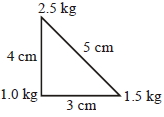
A
$1.5 \; cm$ right and $1.2 \; cm$ above $1 \; kg$ mass
B
$0.9 \; cm$ right and $2.0 \; cm$ above $1 \; kg$ mass
C
$0.6 \; cm$ right and $2.0 \; cm$ above $1 \; kg$ mass
D
$2.0 \; cm$ right and $0.9 \; cm$ above $1 \; kg$ mass
Solution
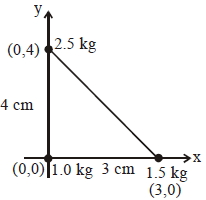
(B) Let the $1.0 \; kg$ mass be at the origin $(0, 0)$.
The coordinates of the three masses are:
$m_1 = 1.0 \; kg$ at $(0, 0) \; cm$
$m_2 = 1.5 \; kg$ at $(3, 0) \; cm$
$m_3 = 2.5 \; kg$ at $(0, 4) \; cm$
The $x$-coordinate of the center of mass is:
$x_{cm} = \frac{m_1x_1 + m_2x_2 + m_3x_3}{m_1 + m_2 + m_3} = \frac{1.0(0) + 1.5(3) + 2.5(0)}{1.0 + 1.5 + 2.5} = \frac{4.5}{5.0} = 0.9 \; cm$
The $y$-coordinate of the center of mass is:
$y_{cm} = \frac{m_1y_1 + m_2y_2 + m_3y_3}{m_1 + m_2 + m_3} = \frac{1.0(0) + 1.5(0) + 2.5(4)}{1.0 + 1.5 + 2.5} = \frac{10.0}{5.0} = 2.0 \; cm$
Thus,the center of mass is at $0.9 \; cm$ to the right and $2.0 \; cm$ above the $1.0 \; kg$ mass.
The coordinates of the three masses are:
$m_1 = 1.0 \; kg$ at $(0, 0) \; cm$
$m_2 = 1.5 \; kg$ at $(3, 0) \; cm$
$m_3 = 2.5 \; kg$ at $(0, 4) \; cm$
The $x$-coordinate of the center of mass is:
$x_{cm} = \frac{m_1x_1 + m_2x_2 + m_3x_3}{m_1 + m_2 + m_3} = \frac{1.0(0) + 1.5(3) + 2.5(0)}{1.0 + 1.5 + 2.5} = \frac{4.5}{5.0} = 0.9 \; cm$
The $y$-coordinate of the center of mass is:
$y_{cm} = \frac{m_1y_1 + m_2y_2 + m_3y_3}{m_1 + m_2 + m_3} = \frac{1.0(0) + 1.5(0) + 2.5(4)}{1.0 + 1.5 + 2.5} = \frac{10.0}{5.0} = 2.0 \; cm$
Thus,the center of mass is at $0.9 \; cm$ to the right and $2.0 \; cm$ above the $1.0 \; kg$ mass.
0 likesView Solution
21
PhysicsDifficultMCQJEE Main · 2020
Two moles of an ideal gas with $\frac{C_{P}}{C_{V}}=\frac{5}{3}$ are mixed with $3$ moles of another ideal gas with $\frac{C_{P}}{C_{V}}=\frac{4}{3}$. The value of $\frac{C_{P}}{C_{V}}$ for the mixture is
A
$1.50$
B
$1.42$
C
$1.45$
D
$1.47$
Solution
(B) For gas $1$: $n_1 = 2$,$\gamma_1 = \frac{5}{3}$. Since $\gamma = 1 + \frac{2}{f}$,$f_1 = 3$. Thus,$C_{V_1} = \frac{3}{2}R$ and $C_{P_1} = \frac{5}{2}R$.
For gas $2$: $n_2 = 3$,$\gamma_2 = \frac{4}{3}$. Since $\gamma = 1 + \frac{2}{f}$,$f_2 = 6$. Thus,$C_{V_2} = \frac{6}{2}R = 3R$ and $C_{P_2} = 4R$.
The molar heat capacity at constant volume for the mixture is $C_{V_{mix}} = \frac{n_1 C_{V_1} + n_2 C_{V_2}}{n_1 + n_2} = \frac{2(\frac{3}{2}R) + 3(3R)}{2+3} = \frac{3R + 9R}{5} = \frac{12R}{5} = 2.4R$.
The molar heat capacity at constant pressure for the mixture is $C_{P_{mix}} = \frac{n_1 C_{P_1} + n_2 C_{P_2}}{n_1 + n_2} = \frac{2(\frac{5}{2}R) + 3(4R)}{2+3} = \frac{5R + 12R}{5} = \frac{17R}{5} = 3.4R$.
The ratio $\gamma_{mix} = \frac{C_{P_{mix}}}{C_{V_{mix}}} = \frac{17R/5}{12R/5} = \frac{17}{12} \approx 1.4167 \approx 1.42$.
For gas $2$: $n_2 = 3$,$\gamma_2 = \frac{4}{3}$. Since $\gamma = 1 + \frac{2}{f}$,$f_2 = 6$. Thus,$C_{V_2} = \frac{6}{2}R = 3R$ and $C_{P_2} = 4R$.
The molar heat capacity at constant volume for the mixture is $C_{V_{mix}} = \frac{n_1 C_{V_1} + n_2 C_{V_2}}{n_1 + n_2} = \frac{2(\frac{3}{2}R) + 3(3R)}{2+3} = \frac{3R + 9R}{5} = \frac{12R}{5} = 2.4R$.
The molar heat capacity at constant pressure for the mixture is $C_{P_{mix}} = \frac{n_1 C_{P_1} + n_2 C_{P_2}}{n_1 + n_2} = \frac{2(\frac{5}{2}R) + 3(4R)}{2+3} = \frac{5R + 12R}{5} = \frac{17R}{5} = 3.4R$.
The ratio $\gamma_{mix} = \frac{C_{P_{mix}}}{C_{V_{mix}}} = \frac{17R/5}{12R/5} = \frac{17}{12} \approx 1.4167 \approx 1.42$.
0 likesView Solution
22
PhysicsMediumMCQJEE Main · 2020
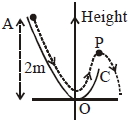
$A$ particle $(m = 1 \; kg)$ slides down a frictionless track $(AOC)$ starting from rest at a point $A$ (height $2 \; m$). After reaching $C$,the particle continues to move freely in air as a projectile. When it reaches its highest point $P$ (height $1 \; m$),the kinetic energy of the particle (in $J$) is: (Figure drawn is schematic and not to scale; take $g = 10 \; ms^{-2}$)
A
$8$
B
$10$
C
$15$
D
$13$
Solution
(B) Since the track is frictionless,the total mechanical energy of the particle is conserved throughout its motion.
Let the potential energy be zero at the ground level.
At point $A$,the particle starts from rest,so its initial kinetic energy $K_A = 0$ and potential energy $U_A = mgh_A = 1 \times 10 \times 2 = 20 \; J$.
At the highest point $P$ of the projectile motion,the particle still has a horizontal velocity component. Let the kinetic energy at $P$ be $K_P$ and potential energy be $U_P = mgh_P = 1 \times 10 \times 1 = 10 \; J$.
By the law of conservation of mechanical energy:
$K_A + U_A = K_P + U_P$
$0 + 20 = K_P + 10$
$K_P = 20 - 10 = 10 \; J$.
Let the potential energy be zero at the ground level.
At point $A$,the particle starts from rest,so its initial kinetic energy $K_A = 0$ and potential energy $U_A = mgh_A = 1 \times 10 \times 2 = 20 \; J$.
At the highest point $P$ of the projectile motion,the particle still has a horizontal velocity component. Let the kinetic energy at $P$ be $K_P$ and potential energy be $U_P = mgh_P = 1 \times 10 \times 1 = 10 \; J$.
By the law of conservation of mechanical energy:
$K_A + U_A = K_P + U_P$
$0 + 20 = K_P + 10$
$K_P = 20 - 10 = 10 \; J$.
0 likesView Solution
23
PhysicsMediumMCQJEE Main · 2020
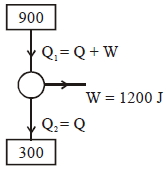
$A$ Carnot engine operates between two reservoirs of temperatures $900 \; K$ and $300 \; K$. The engine performs $1200 \; J$ of work per cycle. The heat energy (in $J$) delivered by the engine to the low-temperature reservoir in a cycle is:
A
$450$
B
$500$
C
$600$
D
$650$
Solution
(C) For a Carnot engine,the ratio of heat exchanged is equal to the ratio of temperatures of the reservoirs:
$\frac{Q_1}{Q_2} = \frac{T_1}{T_2}$
Here,$T_1 = 900 \; K$ (source temperature),$T_2 = 300 \; K$ (sink temperature),and $W = 1200 \; J$.
From the first law of thermodynamics,the work done is $W = Q_1 - Q_2$,so $Q_1 = Q_2 + W$.
Let $Q_2 = Q$. Then $Q_1 = Q + 1200$.
Substituting these values into the efficiency equation:
$\frac{Q + 1200}{Q} = \frac{900}{300}$
$\frac{Q + 1200}{Q} = 3$
$Q + 1200 = 3Q$
$2Q = 1200$
$Q = 600 \; J$.
Thus,the heat energy delivered to the low-temperature reservoir is $600 \; J$.
$\frac{Q_1}{Q_2} = \frac{T_1}{T_2}$
Here,$T_1 = 900 \; K$ (source temperature),$T_2 = 300 \; K$ (sink temperature),and $W = 1200 \; J$.
From the first law of thermodynamics,the work done is $W = Q_1 - Q_2$,so $Q_1 = Q_2 + W$.
Let $Q_2 = Q$. Then $Q_1 = Q + 1200$.
Substituting these values into the efficiency equation:
$\frac{Q + 1200}{Q} = \frac{900}{300}$
$\frac{Q + 1200}{Q} = 3$
$Q + 1200 = 3Q$
$2Q = 1200$
$Q = 600 \; J$.
Thus,the heat energy delivered to the low-temperature reservoir is $600 \; J$.
0 likesView Solution
24
PhysicsMediumMCQJEE Main · 2020
$A$ non-isotropic solid metal cube has coefficients of linear expansion as:
$5 \times 10^{-5} /^{\circ} C$ along the $x$-axis and $5 \times 10^{-6} /^{\circ} C$ along the $y$ and the $z$-axis. If the coefficient of volume expansion of the solid is $C \times 10^{-6} /^{\circ} C$,then the value of $C$ is:
$5 \times 10^{-5} /^{\circ} C$ along the $x$-axis and $5 \times 10^{-6} /^{\circ} C$ along the $y$ and the $z$-axis. If the coefficient of volume expansion of the solid is $C \times 10^{-6} /^{\circ} C$,then the value of $C$ is:
A
$55$
B
$63$
C
$67$
D
$60$
Solution
(D) For a non-isotropic solid,the coefficient of volume expansion $\gamma$ is the sum of the coefficients of linear expansion along the three mutually perpendicular axes:
$\gamma = \alpha_{x} + \alpha_{y} + \alpha_{z}$
Given:
$\alpha_{x} = 5 \times 10^{-5} /^{\circ} C = 50 \times 10^{-6} /^{\circ} C$
$\alpha_{y} = 5 \times 10^{-6} /^{\circ} C$
$\alpha_{z} = 5 \times 10^{-6} /^{\circ} C$
Substituting these values into the formula:
$\gamma = (50 \times 10^{-6} + 5 \times 10^{-6} + 5 \times 10^{-6}) /^{\circ} C$
$\gamma = (50 + 5 + 5) \times 10^{-6} /^{\circ} C$
$\gamma = 60 \times 10^{-6} /^{\circ} C$
Comparing this with the given form $C \times 10^{-6} /^{\circ} C$,we get $C = 60$.
$\gamma = \alpha_{x} + \alpha_{y} + \alpha_{z}$
Given:
$\alpha_{x} = 5 \times 10^{-5} /^{\circ} C = 50 \times 10^{-6} /^{\circ} C$
$\alpha_{y} = 5 \times 10^{-6} /^{\circ} C$
$\alpha_{z} = 5 \times 10^{-6} /^{\circ} C$
Substituting these values into the formula:
$\gamma = (50 \times 10^{-6} + 5 \times 10^{-6} + 5 \times 10^{-6}) /^{\circ} C$
$\gamma = (50 + 5 + 5) \times 10^{-6} /^{\circ} C$
$\gamma = 60 \times 10^{-6} /^{\circ} C$
Comparing this with the given form $C \times 10^{-6} /^{\circ} C$,we get $C = 60$.
1 likesView Solution
25
PhysicsDifficultMCQJEE Main · 2020
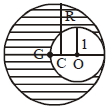
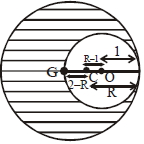
As shown in the figure,when a spherical cavity (centred at $O$) of radius $1$ is cut out of a uniform sphere of radius $R$ (centred at $C$),the centre of mass of the remaining (shaded) part of the sphere is at $G$,i.e.,on the surface of the cavity. $R$ can be determined by the equation:
A
$\left(R^{2}-R+1\right)(2-R)=1$
B
$\left(R^{2}+R-1\right)(2-R)=1$
C
$\left(R^{2}+R+1\right)(2-R)=1$
D
$\left(R^{2}-R-1\right)(2-R)=1$
Solution
(C) Let $\rho$ be the uniform density of the sphere.
Mass of the original sphere of radius $R$ is $M = \frac{4}{3} \pi R^{3} \rho$.
Mass of the spherical cavity of radius $1$ is $m = \frac{4}{3} \pi (1)^{3} \rho = \frac{4}{3} \pi \rho$.
The mass of the remaining part is $M' = M - m = \frac{4}{3} \pi \rho (R^{3} - 1)$.
The centre of mass of the original sphere is at $C$. The centre of mass of the cavity is at $O$. The distance $CO = R - 1$.
The centre of mass of the remaining part is at $G$,which is on the surface of the cavity,so $CG = R - 1$ (distance from $C$ to the edge of the cavity).
Using the principle of moments about the centre of mass $C$:
$M' \times CG = m \times CO$
$\left[\frac{4}{3} \pi \rho (R^{3} - 1)\right] \times (R - 1) = \left[\frac{4}{3} \pi \rho\right] \times (R - 1)$
Since $R \neq 1$,we can divide by $(R - 1)$:
$R^{3} - 1 = 1$
Wait,let's re-evaluate the distance $CG$. From the figure,$G$ is the centre of mass of the remaining part. The distance of $G$ from $C$ is $x$. The distance of $O$ from $C$ is $R-1$. The distance of $G$ from $O$ is $1$. Thus,$CG = CO - OG = (R-1) - 1 = R-2$. Since $G$ is to the left of $C$,we take the magnitude as $2-R$.
Using $M' \times CG = m \times CO$:
$\frac{4}{3} \pi \rho (R^{3} - 1) \times (2 - R) = \frac{4}{3} \pi \rho \times (R - 1)$
$(R^{3} - 1)(2 - R) = R - 1$
$(R - 1)(R^{2} + R + 1)(2 - R) = (R - 1)$
$(R^{2} + R + 1)(2 - R) = 1$
Mass of the original sphere of radius $R$ is $M = \frac{4}{3} \pi R^{3} \rho$.
Mass of the spherical cavity of radius $1$ is $m = \frac{4}{3} \pi (1)^{3} \rho = \frac{4}{3} \pi \rho$.
The mass of the remaining part is $M' = M - m = \frac{4}{3} \pi \rho (R^{3} - 1)$.
The centre of mass of the original sphere is at $C$. The centre of mass of the cavity is at $O$. The distance $CO = R - 1$.
The centre of mass of the remaining part is at $G$,which is on the surface of the cavity,so $CG = R - 1$ (distance from $C$ to the edge of the cavity).
Using the principle of moments about the centre of mass $C$:
$M' \times CG = m \times CO$
$\left[\frac{4}{3} \pi \rho (R^{3} - 1)\right] \times (R - 1) = \left[\frac{4}{3} \pi \rho\right] \times (R - 1)$
Since $R \neq 1$,we can divide by $(R - 1)$:
$R^{3} - 1 = 1$
Wait,let's re-evaluate the distance $CG$. From the figure,$G$ is the centre of mass of the remaining part. The distance of $G$ from $C$ is $x$. The distance of $O$ from $C$ is $R-1$. The distance of $G$ from $O$ is $1$. Thus,$CG = CO - OG = (R-1) - 1 = R-2$. Since $G$ is to the left of $C$,we take the magnitude as $2-R$.
Using $M' \times CG = m \times CO$:
$\frac{4}{3} \pi \rho (R^{3} - 1) \times (2 - R) = \frac{4}{3} \pi \rho \times (R - 1)$
$(R^{3} - 1)(2 - R) = R - 1$
$(R - 1)(R^{2} + R + 1)(2 - R) = (R - 1)$
$(R^{2} + R + 1)(2 - R) = 1$
0 likesView Solution
26
PhysicsMediumMCQJEE Main · 2020
$A$ simple pendulum is being used to determine the value of gravitational acceleration $g$ at a certain place. The length of the pendulum is $25.0 \; cm$ and a stopwatch with $1 \; s$ resolution measures the time taken for $40$ oscillations to be $50 \; s$. The accuracy in $g$ is ....... $\%$ (in $.40$)
A
$3$
B
$5$
C
$4$
D
$2$
Solution
(C) The formula for the time period of a simple pendulum is $T = 2\pi \sqrt{\frac{\ell}{g}}$.
Squaring both sides and rearranging for $g$,we get $g = \frac{4\pi^2 \ell}{T^2}$.
The relative error in $g$ is given by $\frac{\Delta g}{g} = \frac{\Delta \ell}{\ell} + 2 \frac{\Delta T}{T}$.
Given: $\ell = 25.0 \; cm$,so $\Delta \ell = 0.1 \; cm$. The time for $40$ oscillations is $t = 50 \; s$,so the time period $T = \frac{50}{40} = 1.25 \; s$. The resolution of the stopwatch is $\Delta t = 1 \; s$,so $\Delta T = \frac{\Delta t}{40} = \frac{1}{40} \; s$.
Substituting these values: $\frac{\Delta g}{g} = \frac{0.1}{25.0} + 2 \times \frac{1/40}{50/40} = \frac{0.1}{25} + 2 \times \frac{1}{50} = 0.004 + 0.04 = 0.044$.
Therefore,the percentage error is $0.044 \times 100 = 4.4 \%$.
Squaring both sides and rearranging for $g$,we get $g = \frac{4\pi^2 \ell}{T^2}$.
The relative error in $g$ is given by $\frac{\Delta g}{g} = \frac{\Delta \ell}{\ell} + 2 \frac{\Delta T}{T}$.
Given: $\ell = 25.0 \; cm$,so $\Delta \ell = 0.1 \; cm$. The time for $40$ oscillations is $t = 50 \; s$,so the time period $T = \frac{50}{40} = 1.25 \; s$. The resolution of the stopwatch is $\Delta t = 1 \; s$,so $\Delta T = \frac{\Delta t}{40} = \frac{1}{40} \; s$.
Substituting these values: $\frac{\Delta g}{g} = \frac{0.1}{25.0} + 2 \times \frac{1/40}{50/40} = \frac{0.1}{25} + 2 \times \frac{1}{50} = 0.004 + 0.04 = 0.044$.
Therefore,the percentage error is $0.044 \times 100 = 4.4 \%$.
0 likesView Solution
27
PhysicsMediumMCQJEE Main · 2020
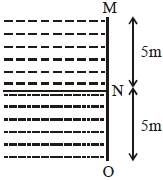
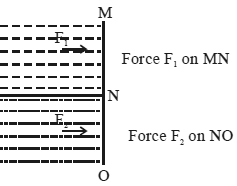
Two liquids of densities $\rho_{1}$ and $\rho_{2}$ (where $\rho_{2} = 2\rho_{1}$) are filled behind a vertical wall of height $10 \; m$ and width $w$,as shown in the figure. Each liquid has a height of $h = 5 \; m$. The ratio of the force exerted by the upper liquid on the part $MN$ to the force exerted by the lower liquid on the part $NO$ is (Assume that the liquids do not mix):
A
$\frac{1}{4}$
B
$\frac{2}{3}$
C
$\frac{1}{3}$
D
$\frac{1}{2}$
Solution
(A) Let the width of the wall be $w$. The area of each section $MN$ and $NO$ is $A = h \times w = 5w$.
For the upper liquid (part $MN$):
The pressure at the top is $0$ and at depth $h$ is $\rho_{1}gh$. The average pressure is $P_{avg1} = \frac{0 + \rho_{1}gh}{2} = \frac{\rho_{1}gh}{2}$.
The force $F_{1} = P_{avg1} \times A = \left(\frac{\rho_{1}gh}{2}\right) (5w) = \frac{5}{2} \rho_{1}ghw$.
For the lower liquid (part $NO$):
The pressure at the top of this section (at depth $h$) is $P_{top} = \rho_{1}gh$. The pressure at the bottom (at depth $2h$) is $P_{bottom} = \rho_{1}gh + \rho_{2}gh = \rho_{1}gh + 2\rho_{1}gh = 3\rho_{1}gh$.
The average pressure is $P_{avg2} = \frac{P_{top} + P_{bottom}}{2} = \frac{\rho_{1}gh + 3\rho_{1}gh}{2} = 2\rho_{1}gh$.
The force $F_{2} = P_{avg2} \times A = (2\rho_{1}gh) (5w) = 10\rho_{1}ghw$.
The ratio is $\frac{F_{1}}{F_{2}} = \frac{\frac{5}{2} \rho_{1}ghw}{10\rho_{1}ghw} = \frac{5}{20} = \frac{1}{4}$.
For the upper liquid (part $MN$):
The pressure at the top is $0$ and at depth $h$ is $\rho_{1}gh$. The average pressure is $P_{avg1} = \frac{0 + \rho_{1}gh}{2} = \frac{\rho_{1}gh}{2}$.
The force $F_{1} = P_{avg1} \times A = \left(\frac{\rho_{1}gh}{2}\right) (5w) = \frac{5}{2} \rho_{1}ghw$.
For the lower liquid (part $NO$):
The pressure at the top of this section (at depth $h$) is $P_{top} = \rho_{1}gh$. The pressure at the bottom (at depth $2h$) is $P_{bottom} = \rho_{1}gh + \rho_{2}gh = \rho_{1}gh + 2\rho_{1}gh = 3\rho_{1}gh$.
The average pressure is $P_{avg2} = \frac{P_{top} + P_{bottom}}{2} = \frac{\rho_{1}gh + 3\rho_{1}gh}{2} = 2\rho_{1}gh$.
The force $F_{2} = P_{avg2} \times A = (2\rho_{1}gh) (5w) = 10\rho_{1}ghw$.
The ratio is $\frac{F_{1}}{F_{2}} = \frac{\frac{5}{2} \rho_{1}ghw}{10\rho_{1}ghw} = \frac{5}{20} = \frac{1}{4}$.
0 likesView Solution
28
PhysicsMediumMCQJEE Main · 2020
$A$ transverse wave travels on a taut steel wire with a velocity of $v$ when the tension in it is $2.06 \times 10^{4} \; N$. When the tension is changed to $T$,the velocity changes to $v/2$. The value of $T$ is close to:
A
$10.2 \times 10^{2} \; N$
B
$5.15 \times 10^{3} \; N$
C
$2.50 \times 10^{4} \; N$
D
$30.5 \times 10^{4} \; N$
Solution
(B) The velocity of a transverse wave on a stretched string is given by $v = \sqrt{\frac{T}{\mu}}$,where $T$ is the tension and $\mu$ is the linear mass density.
From this relation,we see that $v \propto \sqrt{T}$.
Let the initial tension be $T_1 = 2.06 \times 10^{4} \; N$ and the initial velocity be $v_1 = v$.
Let the final tension be $T_2 = T$ and the final velocity be $v_2 = v/2$.
Using the proportionality $v \propto \sqrt{T}$,we can write: $\frac{v_2}{v_1} = \sqrt{\frac{T_2}{T_1}}$.
Substituting the given values: $\frac{v/2}{v} = \sqrt{\frac{T}{2.06 \times 10^{4}}}$.
$\frac{1}{2} = \sqrt{\frac{T}{2.06 \times 10^{4}}}$.
Squaring both sides: $\frac{1}{4} = \frac{T}{2.06 \times 10^{4}}$.
$T = \frac{2.06 \times 10^{4}}{4} = 0.515 \times 10^{4} = 5.15 \times 10^{3} \; N$.
From this relation,we see that $v \propto \sqrt{T}$.
Let the initial tension be $T_1 = 2.06 \times 10^{4} \; N$ and the initial velocity be $v_1 = v$.
Let the final tension be $T_2 = T$ and the final velocity be $v_2 = v/2$.
Using the proportionality $v \propto \sqrt{T}$,we can write: $\frac{v_2}{v_1} = \sqrt{\frac{T_2}{T_1}}$.
Substituting the given values: $\frac{v/2}{v} = \sqrt{\frac{T}{2.06 \times 10^{4}}}$.
$\frac{1}{2} = \sqrt{\frac{T}{2.06 \times 10^{4}}}$.
Squaring both sides: $\frac{1}{4} = \frac{T}{2.06 \times 10^{4}}$.
$T = \frac{2.06 \times 10^{4}}{4} = 0.515 \times 10^{4} = 5.15 \times 10^{3} \; N$.
0 likesView Solution
29
PhysicsDifficultMCQJEE Main · 2020
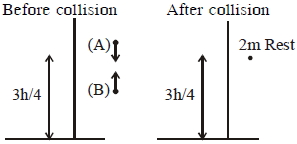
$A$ particle of mass $m$ is dropped from a height $h$ above the ground. At the same time,another particle of the same mass is thrown vertically upwards from the ground with a speed of $\sqrt{2gh}$. If they collide head-on completely inelastically,the time taken for the combined mass to reach the ground,in units of $\sqrt{\frac{h}{g}}$,is
A
$\frac{1}{2}$
B
$\sqrt{\frac{1}{2}}$
C
$\sqrt{\frac{3}{4}}$
D
$\sqrt{\frac{3}{2}}$
Solution
(D) Let the downward direction be positive. The position of particle $A$ (dropped) is $y_A = h - \frac{1}{2}gt^2$. The position of particle $B$ (thrown up) is $y_B = \sqrt{2gh}t - \frac{1}{2}gt^2$.
Collision occurs when $y_A = y_B$: $h - \frac{1}{2}gt^2 = \sqrt{2gh}t - \frac{1}{2}gt^2$,which gives $t = \frac{h}{\sqrt{2gh}} = \sqrt{\frac{h}{2g}}$.
The height of collision is $y = h - \frac{1}{2}g(\frac{h}{2g}) = h - \frac{h}{4} = \frac{3h}{4}$.
At collision,the velocity of $A$ is $v_A = -gt = -g\sqrt{\frac{h}{2g}} = -\sqrt{\frac{gh}{2}}$.
The velocity of $B$ is $v_B = \sqrt{2gh} - gt = \sqrt{2gh} - \sqrt{\frac{gh}{2}} = \sqrt{\frac{gh}{2}}$.
Since the collision is completely inelastic,the combined mass $2m$ moves with velocity $v_{cm} = \frac{m v_A + m v_B}{2m} = \frac{-\sqrt{gh/2} + \sqrt{gh/2}}{2} = 0$.
The combined mass is at rest at height $H = \frac{3h}{4}$.
The time taken to fall from height $H$ is $t' = \sqrt{\frac{2H}{g}} = \sqrt{\frac{2(3h/4)}{g}} = \sqrt{\frac{3h}{2g}} = \sqrt{\frac{3}{2}} \sqrt{\frac{h}{g}}$.
Thus,the time in units of $\sqrt{\frac{h}{g}}$ is $\sqrt{\frac{3}{2}}$.
Collision occurs when $y_A = y_B$: $h - \frac{1}{2}gt^2 = \sqrt{2gh}t - \frac{1}{2}gt^2$,which gives $t = \frac{h}{\sqrt{2gh}} = \sqrt{\frac{h}{2g}}$.
The height of collision is $y = h - \frac{1}{2}g(\frac{h}{2g}) = h - \frac{h}{4} = \frac{3h}{4}$.
At collision,the velocity of $A$ is $v_A = -gt = -g\sqrt{\frac{h}{2g}} = -\sqrt{\frac{gh}{2}}$.
The velocity of $B$ is $v_B = \sqrt{2gh} - gt = \sqrt{2gh} - \sqrt{\frac{gh}{2}} = \sqrt{\frac{gh}{2}}$.
Since the collision is completely inelastic,the combined mass $2m$ moves with velocity $v_{cm} = \frac{m v_A + m v_B}{2m} = \frac{-\sqrt{gh/2} + \sqrt{gh/2}}{2} = 0$.
The combined mass is at rest at height $H = \frac{3h}{4}$.
The time taken to fall from height $H$ is $t' = \sqrt{\frac{2H}{g}} = \sqrt{\frac{2(3h/4)}{g}} = \sqrt{\frac{3h}{2g}} = \sqrt{\frac{3}{2}} \sqrt{\frac{h}{g}}$.
Thus,the time in units of $\sqrt{\frac{h}{g}}$ is $\sqrt{\frac{3}{2}}$.
0 likesView Solution
30
PhysicsMediumMCQJEE Main · 2020
Consider a mixture of $n$ moles of helium gas and $2n$ moles of oxygen gas (molecules taken to be rigid) as an ideal gas. Its $\frac{C_{P}}{C_{V}}$ value will be
A
$\frac{67}{45}$
B
$\frac{19}{13}$
C
$\frac{23}{15}$
D
$\frac{40}{27}$
Solution
(B) For a mixture of gases,the ratio of specific heats is given by $\frac{C_{P, \text{mix}}}{C_{V, \text{mix}}} = \frac{n_1 C_{P1} + n_2 C_{P2}}{n_1 C_{V1} + n_2 C_{V2}}$.
Helium is a monoatomic gas,so $C_{V1} = \frac{3R}{2}$ and $C_{P1} = \frac{5R}{2}$.
Oxygen is a diatomic rigid gas,so $C_{V2} = \frac{5R}{2}$ and $C_{P2} = \frac{7R}{2}$.
Given $n_1 = n$ and $n_2 = 2n$.
Substituting these values:
$\frac{C_{P, \text{mix}}}{C_{V, \text{mix}}} = \frac{n(\frac{5R}{2}) + 2n(\frac{7R}{2})}{n(\frac{3R}{2}) + 2n(\frac{5R}{2})}$
$= \frac{\frac{5nR}{2} + \frac{14nR}{2}}{\frac{3nR}{2} + \frac{10nR}{2}} = \frac{19nR/2}{13nR/2} = \frac{19}{13}$.
Helium is a monoatomic gas,so $C_{V1} = \frac{3R}{2}$ and $C_{P1} = \frac{5R}{2}$.
Oxygen is a diatomic rigid gas,so $C_{V2} = \frac{5R}{2}$ and $C_{P2} = \frac{7R}{2}$.
Given $n_1 = n$ and $n_2 = 2n$.
Substituting these values:
$\frac{C_{P, \text{mix}}}{C_{V, \text{mix}}} = \frac{n(\frac{5R}{2}) + 2n(\frac{7R}{2})}{n(\frac{3R}{2}) + 2n(\frac{5R}{2})}$
$= \frac{\frac{5nR}{2} + \frac{14nR}{2}}{\frac{3nR}{2} + \frac{10nR}{2}} = \frac{19nR/2}{13nR/2} = \frac{19}{13}$.
0 likesView Solution
31
PhysicsMediumMCQJEE Main · 2020
$A$ uniform sphere of mass $500 \; g$ rolls without slipping on a plane horizontal surface with its centre moving at a speed of $5.00 \; cm/s$. Its kinetic energy is
A
$8.75 \times 10^{-4} \; J$
B
$8.75 \times 10^{-3} \; J$
C
$6.25 \times 10^{-4} \; J$
D
$1.13 \times 10^{-3} \; J$
Solution
(A) Given: Mass $m = 500 \; g = 0.5 \; kg$,velocity $v = 5.00 \; cm/s = 0.05 \; m/s$.
For a solid sphere rolling without slipping,the moment of inertia about the center of mass is $I = \frac{2}{5} mR^2$.
The total kinetic energy $KE$ is the sum of translational and rotational kinetic energy:
$KE = \frac{1}{2} mv^2 + \frac{1}{2} I \omega^2$.
Since $v = R\omega$,we have $\omega = v/R$.
$KE = \frac{1}{2} mv^2 + \frac{1}{2} (\frac{2}{5} mR^2) (\frac{v}{R})^2 = \frac{1}{2} mv^2 + \frac{1}{5} mv^2 = \frac{7}{10} mv^2$.
Substituting the values:
$KE = 0.7 \times 0.5 \; kg \times (0.05 \; m/s)^2 = 0.35 \times 0.0025 \; J = 8.75 \times 10^{-4} \; J$.
For a solid sphere rolling without slipping,the moment of inertia about the center of mass is $I = \frac{2}{5} mR^2$.
The total kinetic energy $KE$ is the sum of translational and rotational kinetic energy:
$KE = \frac{1}{2} mv^2 + \frac{1}{2} I \omega^2$.
Since $v = R\omega$,we have $\omega = v/R$.
$KE = \frac{1}{2} mv^2 + \frac{1}{2} (\frac{2}{5} mR^2) (\frac{v}{R})^2 = \frac{1}{2} mv^2 + \frac{1}{5} mv^2 = \frac{7}{10} mv^2$.
Substituting the values:
$KE = 0.7 \times 0.5 \; kg \times (0.05 \; m/s)^2 = 0.35 \times 0.0025 \; J = 8.75 \times 10^{-4} \; J$.
0 likesView Solution
32
PhysicsMediumMCQJEE Main · 2020
$A$ particle moves such that its position vector $\overrightarrow{r}(t) = \cos \omega t \hat{i} + \sin \omega t \hat{j}$,where $\omega$ is a constant and $t$ is time. Which of the following statements is true for the velocity $\overrightarrow{v}(t)$ and acceleration $\overrightarrow{a}(t)$ of the particle?
A
$\overrightarrow{v}$ is perpendicular to $\overrightarrow{r}$ and $\overrightarrow{a}$ is directed towards the origin.
B
$\overrightarrow{v}$ and $\overrightarrow{a}$ both are parallel to $\overrightarrow{r}$.
C
$\overrightarrow{v}$ and $\overrightarrow{a}$ both are perpendicular to $\overrightarrow{r}$.
D
$\overrightarrow{v}$ is perpendicular to $\overrightarrow{r}$ and $\overrightarrow{a}$ is directed away from the origin.
Solution
(A) Given the position vector: $\overrightarrow{r}(t) = \cos \omega t \hat{i} + \sin \omega t \hat{j}$.
To find the velocity $\overrightarrow{v}(t)$,we differentiate $\overrightarrow{r}(t)$ with respect to time $t$:
$\overrightarrow{v}(t) = \frac{d\overrightarrow{r}}{dt} = -\omega \sin \omega t \hat{i} + \omega \cos \omega t \hat{j}$.
To find the acceleration $\overrightarrow{a}(t)$,we differentiate $\overrightarrow{v}(t)$ with respect to time $t$:
$\overrightarrow{a}(t) = \frac{d\overrightarrow{v}}{dt} = -\omega^2 \cos \omega t \hat{i} - \omega^2 \sin \omega t \hat{j} = -\omega^2 (\cos \omega t \hat{i} + \sin \omega t \hat{j}) = -\omega^2 \overrightarrow{r}$.
Now,check the dot product of $\overrightarrow{v}$ and $\overrightarrow{r}$:
$\overrightarrow{v} \cdot \overrightarrow{r} = (-\omega \sin \omega t)(\cos \omega t) + (\omega \cos \omega t)(\sin \omega t) = 0$.
Since the dot product is $0$,$\overrightarrow{v}$ is perpendicular to $\overrightarrow{r}$.
Since $\overrightarrow{a} = -\omega^2 \overrightarrow{r}$,the acceleration vector is in the opposite direction of the position vector $\overrightarrow{r}$,meaning it is directed towards the origin.
To find the velocity $\overrightarrow{v}(t)$,we differentiate $\overrightarrow{r}(t)$ with respect to time $t$:
$\overrightarrow{v}(t) = \frac{d\overrightarrow{r}}{dt} = -\omega \sin \omega t \hat{i} + \omega \cos \omega t \hat{j}$.
To find the acceleration $\overrightarrow{a}(t)$,we differentiate $\overrightarrow{v}(t)$ with respect to time $t$:
$\overrightarrow{a}(t) = \frac{d\overrightarrow{v}}{dt} = -\omega^2 \cos \omega t \hat{i} - \omega^2 \sin \omega t \hat{j} = -\omega^2 (\cos \omega t \hat{i} + \sin \omega t \hat{j}) = -\omega^2 \overrightarrow{r}$.
Now,check the dot product of $\overrightarrow{v}$ and $\overrightarrow{r}$:
$\overrightarrow{v} \cdot \overrightarrow{r} = (-\omega \sin \omega t)(\cos \omega t) + (\omega \cos \omega t)(\sin \omega t) = 0$.
Since the dot product is $0$,$\overrightarrow{v}$ is perpendicular to $\overrightarrow{r}$.
Since $\overrightarrow{a} = -\omega^2 \overrightarrow{r}$,the acceleration vector is in the opposite direction of the position vector $\overrightarrow{r}$,meaning it is directed towards the origin.
0 likesView Solution
33
PhysicsDifficultMCQJEE Main · 2020
Three containers $C_{1}, C_{2}$ and $C_{3}$ have water at different temperatures. The table below shows the final temperature $T$ when different amounts of water (given in litres) are taken from each container and mixed (assume no loss of heat during the process).
The value of $\theta$ (in $^{\circ} C$ to the nearest integer) is
| $C_{1}$ | $C_{2}$ | $C_{3}$ | $T$ |
| $1 \ l$ | $2 \ l$ | $-$ | $60^{\circ} C$ |
| $-$ | $1 \ l$ | $2 \ l$ | $30^{\circ} C$ |
| $2 \ l$ | $-$ | $1 \ l$ | $60^{\circ} C$ |
| $1 \ l$ | $1 \ l$ | $1 \ l$ | $\theta$ |
The value of $\theta$ (in $^{\circ} C$ to the nearest integer) is
A
$45$
B
$48$
C
$55$
D
$50$
Solution
(D) Let the temperatures of water in containers $C_{1}, C_{2}$,and $C_{3}$ be $T_{1}, T_{2}$,and $T_{3}$ respectively.
Using the principle of calorimetry $(m_{1}T_{1} + m_{2}T_{2} = (m_{1}+m_{2})T_{mix})$:
$1$. For the first mixture: $1T_{1} + 2T_{2} = (1+2)60 = 180$ ---$(i)$
$2$. For the second mixture: $1T_{2} + 2T_{3} = (1+2)30 = 90$ ---(ii)
$3$. For the third mixture: $2T_{1} + 1T_{3} = (2+1)60 = 180$ ---(iii)
Adding equations $(i)$,(ii),and (iii):
$(1+2)T_{1} + (2+1)T_{2} + (2+1)T_{3} = 180 + 90 + 180$
$3(T_{1} + T_{2} + T_{3}) = 450$
$T_{1} + T_{2} + T_{3} = 150^{\circ} C$
For the final mixture of $1 \ l$ each:
$1T_{1} + 1T_{2} + 1T_{3} = (1+1+1)\theta$
$150 = 3\theta$
$\theta = 50^{\circ} C$
Using the principle of calorimetry $(m_{1}T_{1} + m_{2}T_{2} = (m_{1}+m_{2})T_{mix})$:
$1$. For the first mixture: $1T_{1} + 2T_{2} = (1+2)60 = 180$ ---$(i)$
$2$. For the second mixture: $1T_{2} + 2T_{3} = (1+2)30 = 90$ ---(ii)
$3$. For the third mixture: $2T_{1} + 1T_{3} = (2+1)60 = 180$ ---(iii)
Adding equations $(i)$,(ii),and (iii):
$(1+2)T_{1} + (2+1)T_{2} + (2+1)T_{3} = 180 + 90 + 180$
$3(T_{1} + T_{2} + T_{3}) = 450$
$T_{1} + T_{2} + T_{3} = 150^{\circ} C$
For the final mixture of $1 \ l$ each:
$1T_{1} + 1T_{2} + 1T_{3} = (1+1+1)\theta$
$150 = 3\theta$
$\theta = 50^{\circ} C$
0 likesView Solution
34
PhysicsMediumMCQJEE Main · 2020
$A$ ball is dropped from the top of a $100\; m$ high tower on a planet. In the last $\frac{1}{2}\; s$ before hitting the ground,it covers a distance of $19\; m$. Acceleration due to gravity (in $m/s^2$) near the surface on that planet is:
A
$6.5$
B
$8$
C
$10.3$
D
$5.4$
Solution
(B) Let the total time taken to reach the ground be $T$ seconds.
Using the equation of motion $s = ut + \frac{1}{2}at^2$,where $u = 0$ (dropped from rest):
For the total distance $100\; m$,we have $100 = \frac{1}{2}aT^2 \implies T = \sqrt{\frac{200}{a}}$.
In the last $\frac{1}{2}\; s$,the ball covers $19\; m$. This means in time $(T - 0.5)\; s$,the ball covers $(100 - 19) = 81\; m$.
So,$81 = \frac{1}{2}a(T - 0.5)^2 \implies T - 0.5 = \sqrt{\frac{162}{a}}$.
Substituting $T = \sqrt{\frac{200}{a}}$ into the equation:
$\sqrt{\frac{200}{a}} - 0.5 = \sqrt{\frac{162}{a}}$
$\frac{10\sqrt{2}}{\sqrt{a}} - \frac{9\sqrt{2}}{\sqrt{a}} = 0.5$
$\frac{\sqrt{2}}{\sqrt{a}} = 0.5$
$\sqrt{\frac{2}{a}} = \frac{1}{2}$
Squaring both sides: $\frac{2}{a} = \frac{1}{4} \implies a = 8\; m/s^2$.
Using the equation of motion $s = ut + \frac{1}{2}at^2$,where $u = 0$ (dropped from rest):
For the total distance $100\; m$,we have $100 = \frac{1}{2}aT^2 \implies T = \sqrt{\frac{200}{a}}$.
In the last $\frac{1}{2}\; s$,the ball covers $19\; m$. This means in time $(T - 0.5)\; s$,the ball covers $(100 - 19) = 81\; m$.
So,$81 = \frac{1}{2}a(T - 0.5)^2 \implies T - 0.5 = \sqrt{\frac{162}{a}}$.
Substituting $T = \sqrt{\frac{200}{a}}$ into the equation:
$\sqrt{\frac{200}{a}} - 0.5 = \sqrt{\frac{162}{a}}$
$\frac{10\sqrt{2}}{\sqrt{a}} - \frac{9\sqrt{2}}{\sqrt{a}} = 0.5$
$\frac{\sqrt{2}}{\sqrt{a}} = 0.5$
$\sqrt{\frac{2}{a}} = \frac{1}{2}$
Squaring both sides: $\frac{2}{a} = \frac{1}{4} \implies a = 8\; m/s^2$.
0 likesView Solution
35
PhysicsDifficultMCQJEE Main · 2020
An asteroid is moving directly towards the centre of the Earth. When at a distance of $10 R$ ($R$ is the radius of the Earth) from the Earth's centre,it has a speed of $12 \; km/s$. Neglecting the effect of Earth's atmosphere,what will be the speed of the asteroid when it hits the surface of the Earth? (Escape velocity from the Earth is $11.2 \; km/s$). Give your answer to the nearest integer in $km/s$.
A
$20$
B
$24$
C
$14$
D
$16$
Solution
(D) Using the principle of conservation of mechanical energy: $U_1 + K_1 = U_2 + K_2$
Here,$U = -\frac{GM_e m}{r}$ and $K = \frac{1}{2}mv^2$. The escape velocity is given by $v_e = \sqrt{\frac{2GM_e}{R}}$,so $\frac{GM_e}{R} = \frac{v_e^2}{2}$.
At distance $r_1 = 10R$,speed $v_1 = 12 \; km/s$. At surface $r_2 = R$,speed is $v_2$.
$-\frac{GM_e m}{10R} + \frac{1}{2}mv_1^2 = -\frac{GM_e m}{R} + \frac{1}{2}mv_2^2$
$\frac{1}{2}v_2^2 = \frac{1}{2}v_1^2 + \frac{GM_e}{R} - \frac{GM_e}{10R} = \frac{1}{2}v_1^2 + \frac{9}{10} \left( \frac{GM_e}{R} \right)$
Substituting $\frac{GM_e}{R} = \frac{v_e^2}{2}$:
$v_2^2 = v_1^2 + \frac{9}{10} v_e^2$
$v_2^2 = (12)^2 + 0.9 \times (11.2)^2 = 144 + 0.9 \times 125.44 = 144 + 112.896 = 256.896$
$v_2 = \sqrt{256.896} \approx 16.028 \; km/s$.
The nearest integer is $16 \; km/s$.
Here,$U = -\frac{GM_e m}{r}$ and $K = \frac{1}{2}mv^2$. The escape velocity is given by $v_e = \sqrt{\frac{2GM_e}{R}}$,so $\frac{GM_e}{R} = \frac{v_e^2}{2}$.
At distance $r_1 = 10R$,speed $v_1 = 12 \; km/s$. At surface $r_2 = R$,speed is $v_2$.
$-\frac{GM_e m}{10R} + \frac{1}{2}mv_1^2 = -\frac{GM_e m}{R} + \frac{1}{2}mv_2^2$
$\frac{1}{2}v_2^2 = \frac{1}{2}v_1^2 + \frac{GM_e}{R} - \frac{GM_e}{10R} = \frac{1}{2}v_1^2 + \frac{9}{10} \left( \frac{GM_e}{R} \right)$
Substituting $\frac{GM_e}{R} = \frac{v_e^2}{2}$:
$v_2^2 = v_1^2 + \frac{9}{10} v_e^2$
$v_2^2 = (12)^2 + 0.9 \times (11.2)^2 = 144 + 0.9 \times 125.44 = 144 + 112.896 = 256.896$
$v_2 = \sqrt{256.896} \approx 16.028 \; km/s$.
The nearest integer is $16 \; km/s$.
0 likesView Solution
36
PhysicsDifficultMCQJEE Main · 2020
Consider a solid sphere of radius $R$ and mass density $\rho(r) = \rho_{0} \left(1 - \frac{r^{2}}{R^{2}}\right)$ for $0 < r \leq R$. The minimum density of a liquid in which it will float is
A
$\frac{\rho_{0}}{5}$
B
$\frac{\rho_{0}}{3}$
C
$\frac{2\rho_{0}}{3}$
D
$\frac{2\rho_{0}}{5}$
Solution
(D) For the sphere to float with minimum liquid density,it must be completely submerged. In this state,the weight of the sphere equals the buoyant force.
Weight $W = mg = \int \rho(r) g dV = \int_{0}^{R} \rho_{0} \left(1 - \frac{r^{2}}{R^{2}}\right) g (4 \pi r^{2} dr)$.
$W = 4 \pi \rho_{0} g \int_{0}^{R} \left(r^{2} - \frac{r^{4}}{R^{2}}\right) dr$.
$W = 4 \pi \rho_{0} g \left[ \frac{r^{3}}{3} - \frac{r^{5}}{5R^{2}} \right]_{0}^{R} = 4 \pi \rho_{0} g \left( \frac{R^{3}}{3} - \frac{R^{3}}{5} \right) = 4 \pi \rho_{0} g \left( \frac{2R^{3}}{15} \right) = \frac{8}{15} \pi R^{3} \rho_{0} g$.
Buoyant force $B = V_{sphere} \rho_{l} g = \frac{4}{3} \pi R^{3} \rho_{l} g$.
Equating $W = B$: $\frac{8}{15} \pi R^{3} \rho_{0} g = \frac{4}{3} \pi R^{3} \rho_{l} g$.
Solving for $\rho_{l}$: $\rho_{l} = \frac{8}{15} \times \frac{3}{4} \rho_{0} = \frac{2}{5} \rho_{0}$.
Weight $W = mg = \int \rho(r) g dV = \int_{0}^{R} \rho_{0} \left(1 - \frac{r^{2}}{R^{2}}\right) g (4 \pi r^{2} dr)$.
$W = 4 \pi \rho_{0} g \int_{0}^{R} \left(r^{2} - \frac{r^{4}}{R^{2}}\right) dr$.
$W = 4 \pi \rho_{0} g \left[ \frac{r^{3}}{3} - \frac{r^{5}}{5R^{2}} \right]_{0}^{R} = 4 \pi \rho_{0} g \left( \frac{R^{3}}{3} - \frac{R^{3}}{5} \right) = 4 \pi \rho_{0} g \left( \frac{2R^{3}}{15} \right) = \frac{8}{15} \pi R^{3} \rho_{0} g$.
Buoyant force $B = V_{sphere} \rho_{l} g = \frac{4}{3} \pi R^{3} \rho_{l} g$.
Equating $W = B$: $\frac{8}{15} \pi R^{3} \rho_{0} g = \frac{4}{3} \pi R^{3} \rho_{l} g$.
Solving for $\rho_{l}$: $\rho_{l} = \frac{8}{15} \times \frac{3}{4} \rho_{0} = \frac{2}{5} \rho_{0}$.
0 likesView Solution
37
PhysicsMediumMCQJEE Main · 2020
The plot that depicts the behavior of the mean free time $t$ (time between two successive collisions) for the molecules of an ideal gas,as a function of temperature $(T)$,qualitatively,is (Graphs are schematic and not drawn to scale)
A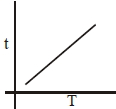
B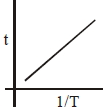
C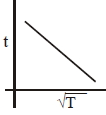
D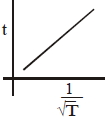
Solution
(D) The mean free time $t$ is defined as the ratio of the mean free path $\lambda$ to the average speed $v_{avg}$ of the gas molecules.
$t = \frac{\lambda}{v_{avg}}$
The mean free path is given by $\lambda = \frac{1}{\sqrt{2} \pi D^{2} n}$,where $D$ is the molecular diameter and $n$ is the number density. For an ideal gas at constant pressure,$n \propto 1/T$.
The average speed is given by $v_{avg} = \sqrt{\frac{8 RT}{\pi M_{w}}}$,which implies $v_{avg} \propto \sqrt{T}$.
Substituting these into the expression for $t$:
$t = \frac{\lambda}{v_{avg}} \propto \frac{1/n}{\sqrt{T}} \propto \frac{T}{\sqrt{T}} = \sqrt{T}$.
However,if we assume the number density $n$ is constant (as is typical for such problems unless specified otherwise),then $\lambda$ is constant.
Then,$t = \frac{\lambda}{v_{avg}} \propto \frac{1}{\sqrt{T}}$.
Thus,the plot of $t$ versus $1/\sqrt{T}$ will be a straight line passing through the origin. Therefore,the correct graph is $t$ versus $1/\sqrt{T}$.
$t = \frac{\lambda}{v_{avg}}$
The mean free path is given by $\lambda = \frac{1}{\sqrt{2} \pi D^{2} n}$,where $D$ is the molecular diameter and $n$ is the number density. For an ideal gas at constant pressure,$n \propto 1/T$.
The average speed is given by $v_{avg} = \sqrt{\frac{8 RT}{\pi M_{w}}}$,which implies $v_{avg} \propto \sqrt{T}$.
Substituting these into the expression for $t$:
$t = \frac{\lambda}{v_{avg}} \propto \frac{1/n}{\sqrt{T}} \propto \frac{T}{\sqrt{T}} = \sqrt{T}$.
However,if we assume the number density $n$ is constant (as is typical for such problems unless specified otherwise),then $\lambda$ is constant.
Then,$t = \frac{\lambda}{v_{avg}} \propto \frac{1}{\sqrt{T}}$.
Thus,the plot of $t$ versus $1/\sqrt{T}$ will be a straight line passing through the origin. Therefore,the correct graph is $t$ versus $1/\sqrt{T}$.
0 likesView Solution
38
PhysicsDifficultMCQJEE Main · 2020
Consider a uniform rod of mass $M=4m$ and length $\ell$ pivoted about its centre. $A$ mass $m$ moving with velocity $v$ making an angle $\theta=\frac{\pi}{4}$ to the rod's long axis collides with one end of the rod and sticks to it. The angular speed of the rod-mass system just after the collision is
A
$\frac{3}{7 \sqrt{2}} \frac{v}{\ell}$
B
$\frac{3 \sqrt{2}}{7} \frac{v}{\ell}$
C
$\frac{4}{7} \frac{v}{\ell}$
D
$\frac{3}{7} \frac{v}{\ell}$
Solution
(B) Let the angular velocity of the system after the collision be $\omega$.
The component of the velocity of mass $m$ perpendicular to the rod is $v_{\perp} = v \sin(\theta) = v \sin(\frac{\pi}{4}) = \frac{v}{\sqrt{2}}$.
By the principle of conservation of angular momentum about the pivot (centre of the rod):
$L_{initial} = L_{final}$
$m v_{\perp} r = I_{total} \omega$
$m \left(\frac{v}{\sqrt{2}}\right) \left(\frac{\ell}{2}\right) = \left( I_{rod} + I_{mass} \right) \omega$
The moment of inertia of the rod about its centre is $I_{rod} = \frac{M \ell^2}{12} = \frac{(4m) \ell^2}{12} = \frac{m \ell^2}{3}$.
The moment of inertia of the mass $m$ at distance $\frac{\ell}{2}$ is $I_{mass} = m \left(\frac{\ell}{2}\right)^2 = \frac{m \ell^2}{4}$.
Substituting these values:
$\frac{m v \ell}{2 \sqrt{2}} = \left( \frac{m \ell^2}{3} + \frac{m \ell^2}{4} \right) \omega$
$\frac{m v \ell}{2 \sqrt{2}} = \left( \frac{4m \ell^2 + 3m \ell^2}{12} \right) \omega$
$\frac{m v \ell}{2 \sqrt{2}} = \frac{7m \ell^2}{12} \omega$
Solving for $\omega$:
$\omega = \left( \frac{m v \ell}{2 \sqrt{2}} \right) \left( \frac{12}{7 m \ell^2} \right) = \frac{6 v}{7 \sqrt{2} \ell} = \frac{6 \sqrt{2} v}{14 \ell} = \frac{3 \sqrt{2}}{7} \frac{v}{\ell}$.
The component of the velocity of mass $m$ perpendicular to the rod is $v_{\perp} = v \sin(\theta) = v \sin(\frac{\pi}{4}) = \frac{v}{\sqrt{2}}$.
By the principle of conservation of angular momentum about the pivot (centre of the rod):
$L_{initial} = L_{final}$
$m v_{\perp} r = I_{total} \omega$
$m \left(\frac{v}{\sqrt{2}}\right) \left(\frac{\ell}{2}\right) = \left( I_{rod} + I_{mass} \right) \omega$
The moment of inertia of the rod about its centre is $I_{rod} = \frac{M \ell^2}{12} = \frac{(4m) \ell^2}{12} = \frac{m \ell^2}{3}$.
The moment of inertia of the mass $m$ at distance $\frac{\ell}{2}$ is $I_{mass} = m \left(\frac{\ell}{2}\right)^2 = \frac{m \ell^2}{4}$.
Substituting these values:
$\frac{m v \ell}{2 \sqrt{2}} = \left( \frac{m \ell^2}{3} + \frac{m \ell^2}{4} \right) \omega$
$\frac{m v \ell}{2 \sqrt{2}} = \left( \frac{4m \ell^2 + 3m \ell^2}{12} \right) \omega$
$\frac{m v \ell}{2 \sqrt{2}} = \frac{7m \ell^2}{12} \omega$
Solving for $\omega$:
$\omega = \left( \frac{m v \ell}{2 \sqrt{2}} \right) \left( \frac{12}{7 m \ell^2} \right) = \frac{6 v}{7 \sqrt{2} \ell} = \frac{6 \sqrt{2} v}{14 \ell} = \frac{3 \sqrt{2}}{7} \frac{v}{\ell}$.
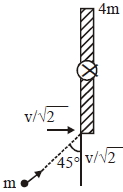
0 likesView Solution
39
PhysicsDifficultMCQJEE Main · 2020
The dimension of stopping potential $V_{0}$ in the photoelectric effect in terms of Planck's constant $h$,speed of light $c$,gravitational constant $G$,and ampere $A$ is:
A
$h^{2} G^{3 / 2} c^{1 / 3} A^{-1}$
B
$h^{-2 / 3} c^{-1 / 3} G^{4 / 3} A^{-1}$
C
$h^{1 / 3} G^{2 / 3} c^{1 / 3} A^{-1}$
D
$h^{0} c^{5} G^{-1} A^{-1}$
Solution
(D) The dimension of stopping potential $V_{0}$ is equivalent to the dimension of potential difference,which is $\frac{\text{Work}}{\text{Charge}} = \frac{ML^{2}T^{-2}}{AT} = ML^{2}T^{-3}A^{-1}$.
Let $V_{0} = h^{x} c^{y} G^{z} A^{w}$.
Substituting the dimensions: $[ML^{2}T^{-3}A^{-1}] = [ML^{2}T^{-1}]^{x} [LT^{-1}]^{y} [M^{-1}L^{3}T^{-2}]^{z} [A]^{w}$.
Equating the powers of $A$: $w = -1$.
Equating the powers of $M$: $x - z = 1$.
Equating the powers of $L$: $2x + y + 3z = 2$.
Equating the powers of $T$: $-x - y - 2z = -3$.
Solving these equations: From $x - z = 1$,we get $x = 1 + z$.
Adding the equations for $L$ and $T$: $(2x + y + 3z) + (-x - y - 2z) = 2 + (-3) \Rightarrow x + z = -1$.
Now we have $x - z = 1$ and $x + z = -1$. Adding them gives $2x = 0 \Rightarrow x = 0$. Then $z = -1$.
Substituting $x=0$ and $z=-1$ into $2x + y + 3z = 2$: $0 + y - 3 = 2 \Rightarrow y = 5$.
Thus,$V_{0} = h^{0} c^{5} G^{-1} A^{-1}$.
Let $V_{0} = h^{x} c^{y} G^{z} A^{w}$.
Substituting the dimensions: $[ML^{2}T^{-3}A^{-1}] = [ML^{2}T^{-1}]^{x} [LT^{-1}]^{y} [M^{-1}L^{3}T^{-2}]^{z} [A]^{w}$.
Equating the powers of $A$: $w = -1$.
Equating the powers of $M$: $x - z = 1$.
Equating the powers of $L$: $2x + y + 3z = 2$.
Equating the powers of $T$: $-x - y - 2z = -3$.
Solving these equations: From $x - z = 1$,we get $x = 1 + z$.
Adding the equations for $L$ and $T$: $(2x + y + 3z) + (-x - y - 2z) = 2 + (-3) \Rightarrow x + z = -1$.
Now we have $x - z = 1$ and $x + z = -1$. Adding them gives $2x = 0 \Rightarrow x = 0$. Then $z = -1$.
Substituting $x=0$ and $z=-1$ into $2x + y + 3z = 2$: $0 + y - 3 = 2 \Rightarrow y = 5$.
Thus,$V_{0} = h^{0} c^{5} G^{-1} A^{-1}$.
0 likesView Solution
40
PhysicsMediumMCQJEE Main · 2020
Consider two solid spheres of radii $R_{1} = 1 \; m$ and $R_{2} = 2 \; m$ and masses $M_{1}$ and $M_{2}$,respectively. The gravitational field due to sphere $(1)$ and $(2)$ are shown in the graph. The value of $\frac{M_{1}}{M_{2}}$ is
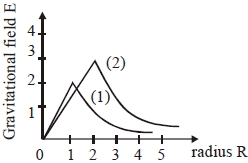
A
$\frac{1}{2}$
B
$\frac{2}{3}$
C
$\frac{1}{3}$
D
$\frac{1}{6}$
Solution
(D) The gravitational field $I_{g}$ on the surface of a solid sphere of mass $M$ and radius $R$ is given by $I_{g} = \frac{GM}{R^{2}}$.
From the given graph,the maximum value of the gravitational field occurs at the surface of the sphere.
For sphere $(1)$,the radius is $R_{1} = 1 \; m$ and the maximum gravitational field is $I_{g1} = 2$.
Thus,$\frac{GM_{1}}{(1)^{2}} = 2 \implies GM_{1} = 2$.
For sphere $(2)$,the radius is $R_{2} = 2 \; m$ and the maximum gravitational field is $I_{g2} = 3$.
Thus,$\frac{GM_{2}}{(2)^{2}} = 3 \implies \frac{GM_{2}}{4} = 3 \implies GM_{2} = 12$.
Dividing the two equations:
$\frac{GM_{1}}{GM_{2}} = \frac{2}{12} = \frac{1}{6}$.
Therefore,$\frac{M_{1}}{M_{2}} = \frac{1}{6}$.
From the given graph,the maximum value of the gravitational field occurs at the surface of the sphere.
For sphere $(1)$,the radius is $R_{1} = 1 \; m$ and the maximum gravitational field is $I_{g1} = 2$.
Thus,$\frac{GM_{1}}{(1)^{2}} = 2 \implies GM_{1} = 2$.
For sphere $(2)$,the radius is $R_{2} = 2 \; m$ and the maximum gravitational field is $I_{g2} = 3$.
Thus,$\frac{GM_{2}}{(2)^{2}} = 3 \implies \frac{GM_{2}}{4} = 3 \implies GM_{2} = 12$.
Dividing the two equations:
$\frac{GM_{1}}{GM_{2}} = \frac{2}{12} = \frac{1}{6}$.
Therefore,$\frac{M_{1}}{M_{2}} = \frac{1}{6}$.
0 likesView Solution
41
PhysicsMediumMCQJEE Main · 2020
$A$ thermodynamic cycle $xyzx$ is shown on a $V-T$ diagram.
The $P-V$ diagram that best describes this cycle is
(Diagrams are schematic and not to scale)
The $P-V$ diagram that best describes this cycle is
(Diagrams are schematic and not to scale)
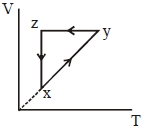
A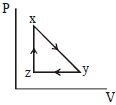
B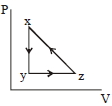
C
D
Solution
(D) In the given $V-T$ diagram:
$1$. Process $x \rightarrow y$: The line passes through the origin,so $V \propto T$. Since $PV = nRT$,this implies $P$ is constant. Thus,$x \rightarrow y$ is an isobaric process.
$2$. Process $y \rightarrow z$: The line is horizontal,meaning $V$ is constant. Thus,$y \rightarrow z$ is an isochoric process.
$3$. Process $z \rightarrow x$: The line is vertical,meaning $T$ is constant. Thus,$z \rightarrow x$ is an isothermal process.
Comparing these with the $P-V$ diagrams:
- $x \rightarrow y$ must be a horizontal line (constant $P$).
- $y \rightarrow z$ must be a vertical line (constant $V$).
- $z \rightarrow x$ must be a hyperbolic curve (isothermal,$P \propto 1/V$).
Looking at the options,Option $D$ correctly represents an isobaric process $(x \rightarrow y)$,an isochoric process $(y \rightarrow z)$,and an isothermal process $(z \rightarrow x)$.
$1$. Process $x \rightarrow y$: The line passes through the origin,so $V \propto T$. Since $PV = nRT$,this implies $P$ is constant. Thus,$x \rightarrow y$ is an isobaric process.
$2$. Process $y \rightarrow z$: The line is horizontal,meaning $V$ is constant. Thus,$y \rightarrow z$ is an isochoric process.
$3$. Process $z \rightarrow x$: The line is vertical,meaning $T$ is constant. Thus,$z \rightarrow x$ is an isothermal process.
Comparing these with the $P-V$ diagrams:
- $x \rightarrow y$ must be a horizontal line (constant $P$).
- $y \rightarrow z$ must be a vertical line (constant $V$).
- $z \rightarrow x$ must be a hyperbolic curve (isothermal,$P \propto 1/V$).
Looking at the options,Option $D$ correctly represents an isobaric process $(x \rightarrow y)$,an isochoric process $(y \rightarrow z)$,and an isothermal process $(z \rightarrow x)$.
0 likesView Solution
42
PhysicsMediumMCQJEE Main · 2020
The coordinates of the center of mass of a uniform flag-shaped lamina (thin flat plate) of mass $4 \; kg$ (the coordinates of the same are shown in the figure) are:
A
$(1.25 \; m, 1.50 \; m)$
B
$(1 \; m, 1.75 \; m)$
C
$(0.75 \; m, 0.75 \; m)$
D
$(0.75 \; m, 1.75 \; m)$
Solution
(D) Divide the lamina into two rectangular plates: Plate-$1$ and Plate-$2$.
Plate-$1$ has dimensions $1 \; m \times 3 \; m$,so its area is $A_{1} = 3 \; m^{2}$.
Plate-$2$ has dimensions $1 \; m \times 1 \; m$,so its area is $A_{2} = 1 \; m^{2}$.
Since the lamina is uniform,the mass is proportional to the area. Total area $A = A_{1} + A_{2} = 4 \; m^{2}$.
Given total mass $M = 4 \; kg$,the mass of each part is $m_{1} = 3 \; kg$ and $m_{2} = 1 \; kg$.
The center of mass of Plate-$1$ is at $(x_{1}, y_{1}) = (0.5 \; m, 1.5 \; m)$.
The center of mass of Plate-$2$ is at $(x_{2}, y_{2}) = (1.5 \; m, 2.5 \; m)$.
The $x$-coordinate of the center of mass is $x_{cm} = \frac{m_{1}x_{1} + m_{2}x_{2}}{m_{1} + m_{2}} = \frac{3 \times 0.5 + 1 \times 1.5}{4} = \frac{1.5 + 1.5}{4} = 0.75 \; m$.
The $y$-coordinate of the center of mass is $y_{cm} = \frac{m_{1}y_{1} + m_{2}y_{2}}{m_{1} + m_{2}} = \frac{3 \times 1.5 + 1 \times 2.5}{4} = \frac{4.5 + 2.5}{4} = \frac{7}{4} = 1.75 \; m$.
Thus,the coordinates are $(0.75 \; m, 1.75 \; m)$.
Plate-$1$ has dimensions $1 \; m \times 3 \; m$,so its area is $A_{1} = 3 \; m^{2}$.
Plate-$2$ has dimensions $1 \; m \times 1 \; m$,so its area is $A_{2} = 1 \; m^{2}$.
Since the lamina is uniform,the mass is proportional to the area. Total area $A = A_{1} + A_{2} = 4 \; m^{2}$.
Given total mass $M = 4 \; kg$,the mass of each part is $m_{1} = 3 \; kg$ and $m_{2} = 1 \; kg$.
The center of mass of Plate-$1$ is at $(x_{1}, y_{1}) = (0.5 \; m, 1.5 \; m)$.
The center of mass of Plate-$2$ is at $(x_{2}, y_{2}) = (1.5 \; m, 2.5 \; m)$.
The $x$-coordinate of the center of mass is $x_{cm} = \frac{m_{1}x_{1} + m_{2}x_{2}}{m_{1} + m_{2}} = \frac{3 \times 0.5 + 1 \times 1.5}{4} = \frac{1.5 + 1.5}{4} = 0.75 \; m$.
The $y$-coordinate of the center of mass is $y_{cm} = \frac{m_{1}y_{1} + m_{2}y_{2}}{m_{1} + m_{2}} = \frac{3 \times 1.5 + 1 \times 2.5}{4} = \frac{4.5 + 2.5}{4} = \frac{7}{4} = 1.75 \; m$.
Thus,the coordinates are $(0.75 \; m, 1.75 \; m)$.
0 likesView Solution
43
PhysicsMediumMCQJEE Main · 2020
$A$ leak-proof cylinder of length $1 \; m,$ made of a metal which has a very low coefficient of expansion,is floating vertically in water at $0^{\circ} C$ such that its height above the water surface is $20 \; cm.$ When the temperature of water is increased to $4^{\circ} C,$ the height of the cylinder above the water surface becomes $21 \; cm.$ The density of water at $T=4^{\circ} C,$ relative to the density at $T=0^{\circ} C,$ is close to
A
$1.01$
B
$1.04$
C
$1.03$
D
$1.26$
Solution
(A) Let $A$ be the cross-sectional area of the cylinder and $\rho_0$ and $\rho_4$ be the densities of water at $0^{\circ} C$ and $4^{\circ} C$ respectively.
At $0^{\circ} C,$ the submerged length of the cylinder is $h_0 = 100 \; cm - 20 \; cm = 80 \; cm.$
By the principle of flotation,the weight of the cylinder equals the weight of the displaced water:
$mg = A \times h_0 \times \rho_0 \times g \implies m = A \times 80 \times \rho_0.$
At $4^{\circ} C,$ the submerged length of the cylinder is $h_4 = 100 \; cm - 21 \; cm = 79 \; cm.$
Since the mass of the cylinder remains constant:
$m = A \times 79 \times \rho_4.$
Equating the two expressions for $m$:
$A \times 80 \times \rho_0 = A \times 79 \times \rho_4.$
Therefore,the ratio of the density at $4^{\circ} C$ to the density at $0^{\circ} C$ is:
$\frac{\rho_4}{\rho_0} = \frac{80}{79} \approx 1.0126.$
Rounding to the nearest given option,the value is close to $1.01$.
At $0^{\circ} C,$ the submerged length of the cylinder is $h_0 = 100 \; cm - 20 \; cm = 80 \; cm.$
By the principle of flotation,the weight of the cylinder equals the weight of the displaced water:
$mg = A \times h_0 \times \rho_0 \times g \implies m = A \times 80 \times \rho_0.$
At $4^{\circ} C,$ the submerged length of the cylinder is $h_4 = 100 \; cm - 21 \; cm = 79 \; cm.$
Since the mass of the cylinder remains constant:
$m = A \times 79 \times \rho_4.$
Equating the two expressions for $m$:
$A \times 80 \times \rho_0 = A \times 79 \times \rho_4.$
Therefore,the ratio of the density at $4^{\circ} C$ to the density at $0^{\circ} C$ is:
$\frac{\rho_4}{\rho_0} = \frac{80}{79} \approx 1.0126.$
Rounding to the nearest given option,the value is close to $1.01$.
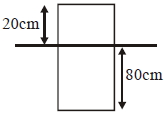
1 likesView Solution
44
PhysicsMediumMCQJEE Main · 2020
$A$ body $A$ of mass $m=0.1 \; kg$ has an initial velocity of $3 \hat{i} \; ms^{-1}$. It collides elastically with another body $B$ of the same mass which has an initial velocity of $5 \hat{j} \; ms^{-1}$. After the collision,$A$ moves with a velocity $\vec{v}_A = 4(\hat{i} + \hat{j}) \; ms^{-1}$. The energy of $B$ after the collision is written as $\frac{x}{10} \; J$. The value of $x$ is:
A
$4$
B
$2$
C
$3$
D
$1$
Solution
(D) By the law of conservation of linear momentum:
$m \vec{u}_A + m \vec{u}_B = m \vec{v}_A + m \vec{v}_B$
Given $m = 0.1 \; kg$,$\vec{u}_A = 3 \hat{i} \; ms^{-1}$,$\vec{u}_B = 5 \hat{j} \; ms^{-1}$,and $\vec{v}_A = 4(\hat{i} + \hat{j}) \; ms^{-1}$.
Substituting the values:
$0.1(3 \hat{i}) + 0.1(5 \hat{j}) = 0.1(4 \hat{i} + 4 \hat{j}) + 0.1 \vec{v}_B$
Dividing by $0.1$:
$3 \hat{i} + 5 \hat{j} = 4 \hat{i} + 4 \hat{j} + \vec{v}_B$
$\vec{v}_B = (3-4) \hat{i} + (5-4) \hat{j} = -\hat{i} + \hat{j} \; ms^{-1}$.
The speed of $B$ after the collision is $|\vec{v}_B| = \sqrt{(-1)^2 + (1)^2} = \sqrt{2} \; ms^{-1}$.
The kinetic energy of $B$ after the collision is $K_B = \frac{1}{2} m |\vec{v}_B|^2$.
$K_B = \frac{1}{2} (0.1) (\sqrt{2})^2 = \frac{1}{2} (0.1) (2) = 0.1 \; J$.
Since $K_B = \frac{x}{10} \; J$,we have $0.1 = \frac{x}{10}$,which implies $x = 1$.
$m \vec{u}_A + m \vec{u}_B = m \vec{v}_A + m \vec{v}_B$
Given $m = 0.1 \; kg$,$\vec{u}_A = 3 \hat{i} \; ms^{-1}$,$\vec{u}_B = 5 \hat{j} \; ms^{-1}$,and $\vec{v}_A = 4(\hat{i} + \hat{j}) \; ms^{-1}$.
Substituting the values:
$0.1(3 \hat{i}) + 0.1(5 \hat{j}) = 0.1(4 \hat{i} + 4 \hat{j}) + 0.1 \vec{v}_B$
Dividing by $0.1$:
$3 \hat{i} + 5 \hat{j} = 4 \hat{i} + 4 \hat{j} + \vec{v}_B$
$\vec{v}_B = (3-4) \hat{i} + (5-4) \hat{j} = -\hat{i} + \hat{j} \; ms^{-1}$.
The speed of $B$ after the collision is $|\vec{v}_B| = \sqrt{(-1)^2 + (1)^2} = \sqrt{2} \; ms^{-1}$.
The kinetic energy of $B$ after the collision is $K_B = \frac{1}{2} m |\vec{v}_B|^2$.
$K_B = \frac{1}{2} (0.1) (\sqrt{2})^2 = \frac{1}{2} (0.1) (2) = 0.1 \; J$.
Since $K_B = \frac{x}{10} \; J$,we have $0.1 = \frac{x}{10}$,which implies $x = 1$.
0 likesView Solution
45
PhysicsMediumMCQJEE Main · 2020
$A$ particle is moving along the $x$-axis with its coordinate with time '$t$' given by $x(t) = 10 + 8t - 3t^2$. Another particle is moving along the $y$-axis with its coordinate as a function of time given by $y(t) = 5 - 8t^3$. At $t = 1 \; s$,the speed of the second particle as measured in the frame of the first particle is given as $\sqrt{v}$. Then $v$ (in $m^2/s^2$) is:
A
$441$
B
$600$
C
$580$
D
$484$
Solution
(C) The velocity of the first particle is given by the derivative of its position with respect to time: $v_x = \frac{dx}{dt} = 8 - 6t$. At $t = 1 \; s$,$v_x = 8 - 6(1) = 2 \; m/s$. Thus,$\vec{v}_1 = 2 \hat{i} \; m/s$.
The velocity of the second particle is given by the derivative of its position with respect to time: $v_y = \frac{dy}{dt} = -24t^2$. At $t = 1 \; s$,$v_y = -24(1)^2 = -24 \; m/s$. Thus,$\vec{v}_2 = -24 \hat{j} \; m/s$.
The velocity of the second particle relative to the first particle is $\vec{v}_{21} = \vec{v}_2 - \vec{v}_1 = -2 \hat{i} - 24 \hat{j}$.
The speed of the second particle in the frame of the first is the magnitude of the relative velocity: $|\vec{v}_{21}| = \sqrt{(-2)^2 + (-24)^2} = \sqrt{4 + 576} = \sqrt{580}$.
Given that the speed is $\sqrt{v}$,we have $\sqrt{v} = \sqrt{580}$,which implies $v = 580$.
The velocity of the second particle is given by the derivative of its position with respect to time: $v_y = \frac{dy}{dt} = -24t^2$. At $t = 1 \; s$,$v_y = -24(1)^2 = -24 \; m/s$. Thus,$\vec{v}_2 = -24 \hat{j} \; m/s$.
The velocity of the second particle relative to the first particle is $\vec{v}_{21} = \vec{v}_2 - \vec{v}_1 = -2 \hat{i} - 24 \hat{j}$.
The speed of the second particle in the frame of the first is the magnitude of the relative velocity: $|\vec{v}_{21}| = \sqrt{(-2)^2 + (-24)^2} = \sqrt{4 + 576} = \sqrt{580}$.
Given that the speed is $\sqrt{v}$,we have $\sqrt{v} = \sqrt{580}$,which implies $v = 580$.
0 likesView Solution
46
PhysicsDifficultMCQJEE Main · 2020
$A$ $1 \; m$ long (both ends open) organ pipe is kept in a gas that has double the density of air at $STP$. Assuming the speed of sound in air at $STP$ is $300 \; m/s$,the frequency difference between the fundamental and second harmonic of this pipe is . . . . . . $Hz$.
A
$92$
B
$106$
C
$125$
D
$136$
Solution
(B) The speed of sound in a gas is given by $v = \sqrt{\frac{\gamma P}{\rho}}$.
Assuming $\gamma$ and $P$ are the same for the gas and air,we have $\frac{v_{gas}}{v_{air}} = \sqrt{\frac{\rho_{air}}{\rho_{gas}}}$.
Given $\rho_{gas} = 2 \rho_{air}$,we get $\frac{v_{gas}}{300} = \sqrt{\frac{1}{2}} = \frac{1}{\sqrt{2}}$.
Thus,$v_{gas} = \frac{300}{\sqrt{2}} = 150 \sqrt{2} \; m/s$.
For an open organ pipe of length $L$,the fundamental frequency is $f_1 = \frac{v}{2L}$ and the second harmonic is $f_2 = \frac{2v}{2L} = \frac{v}{L}$.
The frequency difference is $\Delta f = f_2 - f_1 = \frac{v}{2L}$.
Substituting the values,$\Delta f = \frac{150 \sqrt{2}}{2(1)} = 75 \sqrt{2} \approx 75 \times 1.414 = 106.05 \; Hz$.
Rounding to the nearest integer,the answer is $106 \; Hz$.
Assuming $\gamma$ and $P$ are the same for the gas and air,we have $\frac{v_{gas}}{v_{air}} = \sqrt{\frac{\rho_{air}}{\rho_{gas}}}$.
Given $\rho_{gas} = 2 \rho_{air}$,we get $\frac{v_{gas}}{300} = \sqrt{\frac{1}{2}} = \frac{1}{\sqrt{2}}$.
Thus,$v_{gas} = \frac{300}{\sqrt{2}} = 150 \sqrt{2} \; m/s$.
For an open organ pipe of length $L$,the fundamental frequency is $f_1 = \frac{v}{2L}$ and the second harmonic is $f_2 = \frac{2v}{2L} = \frac{v}{L}$.
The frequency difference is $\Delta f = f_2 - f_1 = \frac{v}{2L}$.
Substituting the values,$\Delta f = \frac{150 \sqrt{2}}{2(1)} = 75 \sqrt{2} \approx 75 \times 1.414 = 106.05 \; Hz$.
Rounding to the nearest integer,the answer is $106 \; Hz$.
0 likesView Solution
47
PhysicsDifficultMCQJEE Main · 2020
$A$ spring-mass system (mass $m$,spring constant $k$,and natural length $\ell_{0}$) rests in equilibrium on a horizontal disc. The free end of the spring is fixed at the center of the disc. If the disc,together with the spring-mass system,rotates about its axis with an angular velocity $\omega$ (where $k >> m \omega^{2}$),the relative change in the length of the spring is best given by which option?
A
$\frac{2 m \omega^{2}}{k}$
B
$\frac{m \omega^{2}}{3 k}$
C
$\sqrt{\frac{2}{3}}\left(\frac{m \omega^{2}}{k}\right)$
D
$\frac{m \omega^{2}}{k}$
Solution
(D) Let $\Delta \ell$ be the extension in the spring due to the rotation of the disc.
The total length of the spring becomes $r = \ell_{0} + \Delta \ell$.
The centripetal force required for the circular motion of the mass $m$ is provided by the spring force.
Thus,$k \Delta \ell = m \omega^{2} r = m \omega^{2} (\ell_{0} + \Delta \ell)$.
Rearranging the equation: $k \Delta \ell - m \omega^{2} \Delta \ell = m \omega^{2} \ell_{0}$.
$\Delta \ell (k - m \omega^{2}) = m \omega^{2} \ell_{0}$.
$\Delta \ell = \frac{m \omega^{2} \ell_{0}}{k - m \omega^{2}}$.
Since it is given that $k >> m \omega^{2}$,we can approximate $k - m \omega^{2} \approx k$.
Therefore,$\Delta \ell \approx \frac{m \omega^{2} \ell_{0}}{k}$.
The relative change in length is $\frac{\Delta \ell}{\ell_{0}} = \frac{m \omega^{2}}{k}$.
The total length of the spring becomes $r = \ell_{0} + \Delta \ell$.
The centripetal force required for the circular motion of the mass $m$ is provided by the spring force.
Thus,$k \Delta \ell = m \omega^{2} r = m \omega^{2} (\ell_{0} + \Delta \ell)$.
Rearranging the equation: $k \Delta \ell - m \omega^{2} \Delta \ell = m \omega^{2} \ell_{0}$.
$\Delta \ell (k - m \omega^{2}) = m \omega^{2} \ell_{0}$.
$\Delta \ell = \frac{m \omega^{2} \ell_{0}}{k - m \omega^{2}}$.
Since it is given that $k >> m \omega^{2}$,we can approximate $k - m \omega^{2} \approx k$.
Therefore,$\Delta \ell \approx \frac{m \omega^{2} \ell_{0}}{k}$.
The relative change in length is $\frac{\Delta \ell}{\ell_{0}} = \frac{m \omega^{2}}{k}$.
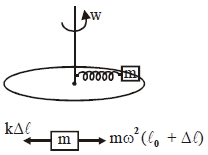
1 likesView Solution
48
PhysicsDifficultMCQJEE Main · 2020
$A$ rod of length $L$ has non-uniform linear mass density given by $\rho(x)=a+b\left(\frac{x}{L}\right)^{2}$,where $a$ and $b$ are constants and $0 \leq x \leq L$. The value of $x$ for the centre of mass of the rod is at
A
$\frac{4}{3}\left(\frac{a+b}{2 a+3 b}\right) L$
B
$\frac{3}{2}\left(\frac{a+b}{2 a+b}\right) L$
C
$\frac{3}{2}\left(\frac{2 a+b}{3 a+b}\right) L$
D
$\frac{3}{4}\left(\frac{2 a+b}{3 a+b}\right) L$
Solution
(D) The centre of mass $x_{cm}$ is given by the formula $x_{cm} = \frac{\int x dm}{\int dm}$.
Given the linear mass density $\rho(x) = \lambda(x) = a + b\left(\frac{x}{L}\right)^2$,the mass element is $dm = \lambda(x) dx = \left(a + \frac{b x^2}{L^2}\right) dx$.
The total mass $M = \int_0^L dm = \int_0^L \left(a + \frac{b x^2}{L^2}\right) dx = \left[ ax + \frac{b x^3}{3 L^2} \right]_0^L = aL + \frac{bL}{3} = L\left(a + \frac{b}{3}\right) = L\left(\frac{3a+b}{3}\right)$.
The moment of mass about the origin is $\int_0^L x dm = \int_0^L x \left(a + \frac{b x^2}{L^2}\right) dx = \int_0^L \left(ax + \frac{b x^3}{L^2}\right) dx = \left[ \frac{a x^2}{2} + \frac{b x^4}{4 L^2} \right]_0^L = \frac{a L^2}{2} + \frac{b L^2}{4} = L^2\left(\frac{2a+b}{4}\right)$.
Therefore,$x_{cm} = \frac{L^2\left(\frac{2a+b}{4}\right)}{L\left(\frac{3a+b}{3}\right)} = \frac{3}{4} \left(\frac{2a+b}{3a+b}\right) L$.
Given the linear mass density $\rho(x) = \lambda(x) = a + b\left(\frac{x}{L}\right)^2$,the mass element is $dm = \lambda(x) dx = \left(a + \frac{b x^2}{L^2}\right) dx$.
The total mass $M = \int_0^L dm = \int_0^L \left(a + \frac{b x^2}{L^2}\right) dx = \left[ ax + \frac{b x^3}{3 L^2} \right]_0^L = aL + \frac{bL}{3} = L\left(a + \frac{b}{3}\right) = L\left(\frac{3a+b}{3}\right)$.
The moment of mass about the origin is $\int_0^L x dm = \int_0^L x \left(a + \frac{b x^2}{L^2}\right) dx = \int_0^L \left(ax + \frac{b x^3}{L^2}\right) dx = \left[ \frac{a x^2}{2} + \frac{b x^4}{4 L^2} \right]_0^L = \frac{a L^2}{2} + \frac{b L^2}{4} = L^2\left(\frac{2a+b}{4}\right)$.
Therefore,$x_{cm} = \frac{L^2\left(\frac{2a+b}{4}\right)}{L\left(\frac{3a+b}{3}\right)} = \frac{3}{4} \left(\frac{2a+b}{3a+b}\right) L$.
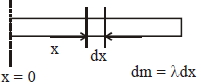
0 likesView Solution
49
PhysicsDifficultMCQJEE Main · 2020
$A$ small spherical droplet of density $d$ is floating exactly half immersed in a liquid of density $\rho$ and surface tension $T$. The radius of the droplet is (take note that the surface tension applies an upward force on the droplet).
A
$r=\sqrt{\frac{2 T}{3(d+\rho) g}}$
B
$r=\sqrt{\frac{3 T}{(2 d-\rho) g}}$
C
$r=\sqrt{\frac{T}{(d-\rho) g}}$
D
$r=\sqrt{\frac{T}{(d+\rho) g}}$
Solution
(B) For the droplet to be in equilibrium,the total upward force must equal the downward force.
The forces acting on the droplet are:
$1$. Buoyant force $(B)$: $B = V_{\text{immersed}} \rho g = (\frac{1}{2} \cdot \frac{4}{3} \pi r^3) \rho g = \frac{2}{3} \pi r^3 \rho g$
$2$. Surface tension force $(F)$: $F = T \cdot (2 \pi r)$
$3$. Weight of the droplet $(mg)$: $mg = (V_{\text{total}} d) g = (\frac{4}{3} \pi r^3) d g$
Equating the forces: $B + F = mg$
$\frac{2}{3} \pi r^3 \rho g + 2 \pi r T = \frac{4}{3} \pi r^3 d g$
Divide by $\pi r$:
$\frac{2}{3} r^2 \rho g + 2 T = \frac{4}{3} r^2 d g$
Rearranging to solve for $r^2$:
$2 T = \frac{4}{3} r^2 d g - \frac{2}{3} r^2 \rho g$
$2 T = \frac{2}{3} r^2 g (2d - \rho)$
$T = \frac{1}{3} r^2 g (2d - \rho)$
$r^2 = \frac{3 T}{(2d - \rho) g}$
$r = \sqrt{\frac{3 T}{(2d - \rho) g}}$
The forces acting on the droplet are:
$1$. Buoyant force $(B)$: $B = V_{\text{immersed}} \rho g = (\frac{1}{2} \cdot \frac{4}{3} \pi r^3) \rho g = \frac{2}{3} \pi r^3 \rho g$
$2$. Surface tension force $(F)$: $F = T \cdot (2 \pi r)$
$3$. Weight of the droplet $(mg)$: $mg = (V_{\text{total}} d) g = (\frac{4}{3} \pi r^3) d g$
Equating the forces: $B + F = mg$
$\frac{2}{3} \pi r^3 \rho g + 2 \pi r T = \frac{4}{3} \pi r^3 d g$
Divide by $\pi r$:
$\frac{2}{3} r^2 \rho g + 2 T = \frac{4}{3} r^2 d g$
Rearranging to solve for $r^2$:
$2 T = \frac{4}{3} r^2 d g - \frac{2}{3} r^2 \rho g$
$2 T = \frac{2}{3} r^2 g (2d - \rho)$
$T = \frac{1}{3} r^2 g (2d - \rho)$
$r^2 = \frac{3 T}{(2d - \rho) g}$
$r = \sqrt{\frac{3 T}{(2d - \rho) g}}$
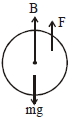
0 likesView Solution
50
PhysicsDifficultMCQJEE Main · 2020
$A$ wire of length $L$ and mass per unit length $6.0 \times 10^{-3} \; kg/m$ is put under a tension of $540 \; N$. Two consecutive frequencies at which it resonates are $420 \; Hz$ and $490 \; Hz$. Then $L$ in meters is: (in $; m$)
A
$8.1$
B
$5.1$
C
$1.1$
D
$2.1$
Solution
(D) The frequency of the $n$-th harmonic for a string fixed at both ends is given by $f_n = \frac{n}{2L} \sqrt{\frac{T}{\mu}}$.
Given consecutive frequencies $f_n = 420 \; Hz$ and $f_{n+1} = 490 \; Hz$.
The difference between consecutive frequencies is the fundamental frequency $f_1 = f_{n+1} - f_n = 490 - 420 = 70 \; Hz$.
We know $f_1 = \frac{1}{2L} \sqrt{\frac{T}{\mu}} = 70 \; Hz$.
Given $T = 540 \; N$ and $\mu = 6.0 \times 10^{-3} \; kg/m$.
Calculate the wave speed $v = \sqrt{\frac{T}{\mu}} = \sqrt{\frac{540}{6.0 \times 10^{-3}}} = \sqrt{90,000} = 300 \; m/s$.
Substitute $v$ into the fundamental frequency equation: $70 = \frac{300}{2L}$.
Solving for $L$: $L = \frac{300}{140} \approx 2.14 \; m$.
Thus,the length $L$ is approximately $2.1 \; m$.
Given consecutive frequencies $f_n = 420 \; Hz$ and $f_{n+1} = 490 \; Hz$.
The difference between consecutive frequencies is the fundamental frequency $f_1 = f_{n+1} - f_n = 490 - 420 = 70 \; Hz$.
We know $f_1 = \frac{1}{2L} \sqrt{\frac{T}{\mu}} = 70 \; Hz$.
Given $T = 540 \; N$ and $\mu = 6.0 \times 10^{-3} \; kg/m$.
Calculate the wave speed $v = \sqrt{\frac{T}{\mu}} = \sqrt{\frac{540}{6.0 \times 10^{-3}}} = \sqrt{90,000} = 300 \; m/s$.
Substitute $v$ into the fundamental frequency equation: $70 = \frac{300}{2L}$.
Solving for $L$: $L = \frac{300}{140} \approx 2.14 \; m$.
Thus,the length $L$ is approximately $2.1 \; m$.
0 likesView Solution
51
PhysicsMediumMCQJEE Main · 2020
The figure shows $P$ and $Q$ as two equally intense coherent sources emitting radiations of wavelength $20 \, m$. The separation $PQ$ is $5.0 \, m$ and the phase of $P$ is ahead of the phase of $Q$ by $90^{\circ}$. $A, B,$ and $C$ are three distant points of observation equidistant from the mid-point of $PQ$. The intensity of radiations at $A, B,$ and $C$ will bear the ratio:
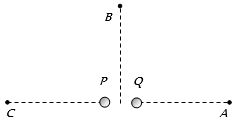
A
$0 : 1 : 4$
B
$4 : 1 : 0$
C
$0 : 1 : 2$
D
$2 : 1 : 0$
Solution
(D) Let the intensity of each source be $I_0$. The resultant intensity is given by $I = I_0 + I_0 + 2I_0 \cos(\phi) = 2I_0(1 + \cos(\phi)) = 4I_0 \cos^2(\phi/2)$,where $\phi$ is the total phase difference.
Given: Wavelength $\lambda = 20 \, m$,separation $d = 5.0 \, m$,and initial phase difference $\Delta\phi_{initial} = 90^{\circ} = \pi/2$ (with $P$ ahead of $Q$).
Path difference $\Delta x = d \sin(\theta)$. Phase difference due to path is $\Delta\phi_{path} = (2\pi/\lambda) \Delta x$.
At point $A$ (along the line $PQ$ towards $Q$): $\theta = 90^{\circ}$,$\Delta x = d = 5 \, m$. $\Delta\phi_{path} = (2\pi/20) \times 5 = \pi/2$. Since $P$ is ahead,the wave from $P$ travels further,so $\phi_A = \Delta\phi_{initial} - \Delta\phi_{path} = \pi/2 - \pi/2 = 0$. Intensity $I_A = 4I_0 \cos^2(0) = 4I_0$.
At point $B$ (perpendicular bisector): $\theta = 0^{\circ}$,$\Delta x = 0$. $\phi_B = \Delta\phi_{initial} = \pi/2$. Intensity $I_B = 4I_0 \cos^2(\pi/4) = 4I_0(1/2) = 2I_0$.
At point $C$ (along the line $PQ$ towards $P$): $\theta = -90^{\circ}$,$\Delta x = -d = -5 \, m$. $\Delta\phi_{path} = -\pi/2$. $\phi_C = \Delta\phi_{initial} - (\Delta\phi_{path}) = \pi/2 - (-\pi/2) = \pi$. Intensity $I_C = 4I_0 \cos^2(\pi/2) = 0$.
Thus,the ratio $I_A : I_B : I_C = 4I_0 : 2I_0 : 0 = 2 : 1 : 0$.
Given: Wavelength $\lambda = 20 \, m$,separation $d = 5.0 \, m$,and initial phase difference $\Delta\phi_{initial} = 90^{\circ} = \pi/2$ (with $P$ ahead of $Q$).
Path difference $\Delta x = d \sin(\theta)$. Phase difference due to path is $\Delta\phi_{path} = (2\pi/\lambda) \Delta x$.
At point $A$ (along the line $PQ$ towards $Q$): $\theta = 90^{\circ}$,$\Delta x = d = 5 \, m$. $\Delta\phi_{path} = (2\pi/20) \times 5 = \pi/2$. Since $P$ is ahead,the wave from $P$ travels further,so $\phi_A = \Delta\phi_{initial} - \Delta\phi_{path} = \pi/2 - \pi/2 = 0$. Intensity $I_A = 4I_0 \cos^2(0) = 4I_0$.
At point $B$ (perpendicular bisector): $\theta = 0^{\circ}$,$\Delta x = 0$. $\phi_B = \Delta\phi_{initial} = \pi/2$. Intensity $I_B = 4I_0 \cos^2(\pi/4) = 4I_0(1/2) = 2I_0$.
At point $C$ (along the line $PQ$ towards $P$): $\theta = -90^{\circ}$,$\Delta x = -d = -5 \, m$. $\Delta\phi_{path} = -\pi/2$. $\phi_C = \Delta\phi_{initial} - (\Delta\phi_{path}) = \pi/2 - (-\pi/2) = \pi$. Intensity $I_C = 4I_0 \cos^2(\pi/2) = 0$.
Thus,the ratio $I_A : I_B : I_C = 4I_0 : 2I_0 : 0 = 2 : 1 : 0$.
0 likesView Solution
52
PhysicsMediumMCQJEE Main · 2020
An electron of mass $m$ and a photon have the same energy $E$. The ratio of the de-Broglie wavelengths associated with them is:
A
$(\frac{E}{2m})^{1/2}$
B
$C(2mE)^{1/2}$
C
$\frac{1}{C}(\frac{2m}{E})^{1/2}$
D
$\frac{1}{C}(\frac{E}{2m})^{1/2}$
Solution
(D) For an electron of energy $E$,the de-Broglie wavelength is given by $\lambda_{e} = \frac{h}{p} = \frac{h}{\sqrt{2mE}}$.
For a photon of energy $E$,the relation is $E = \frac{hc}{\lambda_{p}}$,which implies $\lambda_{p} = \frac{hc}{E}$.
Taking the ratio of the wavelengths:
$\frac{\lambda_{e}}{\lambda_{p}} = \frac{h}{\sqrt{2mE}} \times \frac{E}{hc} = \frac{1}{c} \times \frac{E^{1}}{\sqrt{E}} \times \frac{1}{\sqrt{2m}} = \frac{1}{c} \sqrt{\frac{E}{2m}} = \frac{1}{C}(\frac{E}{2m})^{1/2}$.
For a photon of energy $E$,the relation is $E = \frac{hc}{\lambda_{p}}$,which implies $\lambda_{p} = \frac{hc}{E}$.
Taking the ratio of the wavelengths:
$\frac{\lambda_{e}}{\lambda_{p}} = \frac{h}{\sqrt{2mE}} \times \frac{E}{hc} = \frac{1}{c} \times \frac{E^{1}}{\sqrt{E}} \times \frac{1}{\sqrt{2m}} = \frac{1}{c} \sqrt{\frac{E}{2m}} = \frac{1}{C}(\frac{E}{2m})^{1/2}$.
0 likesView Solution
53
PhysicsDifficultMCQJEE Main · 2020
$A$ charge of total amount $Q$ is distributed over two concentric hollow spheres of radii $r$ and $R$ $(R > r)$ such that the surface charge densities on the two spheres are equal. The electric potential at the common centre is
A
$\frac{1}{4\pi \varepsilon_0} \frac{(R - r)Q}{(R^2 + r^2)}$
B
$\frac{1}{4\pi \varepsilon_0} \frac{(R + r)Q}{2(R^3 + r^3)}$
C
$\frac{1}{4\pi \varepsilon_0} \frac{(R + r)Q}{(R^2 + r^2)}$
D
$\frac{1}{4\pi \varepsilon_0} \frac{(R - r)Q}{2(R^2 + r^2)}$
Solution
(C) Let $q_1$ and $q_2$ be the charges on the spheres of radii $r$ and $R$ respectively.
Given $q_1 + q_2 = Q$.
Since surface charge densities are equal,$\sigma_1 = \sigma_2$.
$\frac{q_1}{4\pi r^2} = \frac{q_2}{4\pi R^2} \implies \frac{q_1}{r^2} = \frac{q_2}{R^2}$.
Using componendo and dividendo,$\frac{q_1}{r^2} = \frac{q_2}{R^2} = \frac{q_1 + q_2}{r^2 + R^2} = \frac{Q}{r^2 + R^2}$.
Thus,$q_1 = \frac{Q r^2}{R^2 + r^2}$ and $q_2 = \frac{Q R^2}{R^2 + r^2}$.
The electric potential at the common centre is $V = \frac{1}{4\pi \varepsilon_0} \left( \frac{q_1}{r} + \frac{q_2}{R} \right)$.
Substituting the values of $q_1$ and $q_2$:
$V = \frac{1}{4\pi \varepsilon_0} \left( \frac{Q r^2}{r(R^2 + r^2)} + \frac{Q R^2}{R(R^2 + r^2)} \right) = \frac{1}{4\pi \varepsilon_0} \left( \frac{Q r + Q R}{R^2 + r^2} \right)$.
$V = \frac{1}{4\pi \varepsilon_0} \frac{(R + r)Q}{R^2 + r^2}$.
Given $q_1 + q_2 = Q$.
Since surface charge densities are equal,$\sigma_1 = \sigma_2$.
$\frac{q_1}{4\pi r^2} = \frac{q_2}{4\pi R^2} \implies \frac{q_1}{r^2} = \frac{q_2}{R^2}$.
Using componendo and dividendo,$\frac{q_1}{r^2} = \frac{q_2}{R^2} = \frac{q_1 + q_2}{r^2 + R^2} = \frac{Q}{r^2 + R^2}$.
Thus,$q_1 = \frac{Q r^2}{R^2 + r^2}$ and $q_2 = \frac{Q R^2}{R^2 + r^2}$.
The electric potential at the common centre is $V = \frac{1}{4\pi \varepsilon_0} \left( \frac{q_1}{r} + \frac{q_2}{R} \right)$.
Substituting the values of $q_1$ and $q_2$:
$V = \frac{1}{4\pi \varepsilon_0} \left( \frac{Q r^2}{r(R^2 + r^2)} + \frac{Q R^2}{R(R^2 + r^2)} \right) = \frac{1}{4\pi \varepsilon_0} \left( \frac{Q r + Q R}{R^2 + r^2} \right)$.
$V = \frac{1}{4\pi \varepsilon_0} \frac{(R + r)Q}{R^2 + r^2}$.
0 likesView Solution
54
PhysicsMediumMCQJEE Main · 2020
The activity of a radioactive sample falls from $700 \; s^{-1}$ to $500 \; s^{-1}$ in $30 \; min$. Its half-life is close to ......... $min$.
A
$66$
B
$52$
C
$72$
D
$62$
Solution
(D) The activity of a radioactive sample at time $t$ is given by the formula $A = A_0 \left( \frac{1}{2} \right)^{\frac{t}{T_{1/2}}}$,where $A_0$ is the initial activity,$A$ is the final activity,$t$ is the time elapsed,and $T_{1/2}$ is the half-life.
Given: $A_0 = 700 \; s^{-1}$,$A = 500 \; s^{-1}$,and $t = 30 \; min$.
Substituting the values: $500 = 700 \left( \frac{1}{2} \right)^{\frac{30}{T_{1/2}}}$.
Dividing both sides by $700$: $\frac{5}{7} = \left( \frac{1}{2} \right)^{\frac{30}{T_{1/2}}}$.
Taking the natural logarithm on both sides: $\ln(5/7) = \frac{30}{T_{1/2}} \ln(1/2)$.
$\ln(0.714) = \frac{30}{T_{1/2}} (-0.693)$.
$-0.337 = \frac{30}{T_{1/2}} (-0.693)$.
$T_{1/2} = \frac{30 \times 0.693}{0.337} \approx 61.69 \; min$.
Rounding to the nearest integer,the half-life is approximately $62 \; min$.
Given: $A_0 = 700 \; s^{-1}$,$A = 500 \; s^{-1}$,and $t = 30 \; min$.
Substituting the values: $500 = 700 \left( \frac{1}{2} \right)^{\frac{30}{T_{1/2}}}$.
Dividing both sides by $700$: $\frac{5}{7} = \left( \frac{1}{2} \right)^{\frac{30}{T_{1/2}}}$.
Taking the natural logarithm on both sides: $\ln(5/7) = \frac{30}{T_{1/2}} \ln(1/2)$.
$\ln(0.714) = \frac{30}{T_{1/2}} (-0.693)$.
$-0.337 = \frac{30}{T_{1/2}} (-0.693)$.
$T_{1/2} = \frac{30 \times 0.693}{0.337} \approx 61.69 \; min$.
Rounding to the nearest integer,the half-life is approximately $62 \; min$.
0 likesView Solution
55
PhysicsDifficultMCQJEE Main · 2020
The electric field of a plane electromagnetic wave is given by $\overrightarrow{E} = E_{0} \frac{\hat{i}+\hat{j}}{\sqrt{2}} \cos (kz+\omega t)$. At $t=0$,a positively charged particle is at the point $(x, y, z) = (0, 0, \frac{\pi}{k})$. If its instantaneous velocity at $t=0$ is $v_{0} \hat{k}$,the force acting on it due to the wave is
A
$0$
B
parallel to $\frac{\hat{i}+\hat{j}}{\sqrt{2}}$
C
antiparallel to $\frac{\hat{i}+\hat{j}}{\sqrt{2}}$
D
parallel to $\hat{k}$
Solution
(C) The Lorentz force on a charged particle is given by $\overrightarrow{F} = q(\overrightarrow{E} + \overrightarrow{v} \times \overrightarrow{B})$.
At $t=0$ and $z = \frac{\pi}{k}$,the electric field is $\overrightarrow{E} = E_{0} \left(\frac{\hat{i}+\hat{j}}{\sqrt{2}}\right) \cos(\pi) = -E_{0} \left(\frac{\hat{i}+\hat{j}}{\sqrt{2}}\right)$.
For an electromagnetic wave,the direction of propagation is $\hat{k}_{prop} = \frac{\overrightarrow{E} \times \overrightarrow{B}}{|E||B|}$. Here,the wave propagates in the $-z$ direction (since the argument is $kz + \omega t$),so $\hat{k}_{prop} = -\hat{k}$.
Thus,$\left(\frac{\hat{i}+\hat{j}}{\sqrt{2}}\right) \times \overrightarrow{B} = -\hat{k} \cdot \frac{E_{0}}{c}$. Solving this,we get $\overrightarrow{B} = -\frac{E_{0}}{c} \left(\frac{\hat{i}-\hat{j}}{\sqrt{2}}\right)$.
The magnetic force is $\overrightarrow{F}_{m} = q(\overrightarrow{v} \times \overrightarrow{B}) = q(v_{0}\hat{k} \times [-\frac{E_{0}}{c} \frac{\hat{i}-\hat{j}}{\sqrt{2}}]) = -q \frac{v_{0}E_{0}}{c} \left(\frac{\hat{j}+\hat{i}}{\sqrt{2}}\right)$.
Since $\frac{v_{0}}{c} \ll 1$,the magnetic force is negligible compared to the electric force.
Therefore,$\overrightarrow{F} \approx q\overrightarrow{E} = -q E_{0} \left(\frac{\hat{i}+\hat{j}}{\sqrt{2}}\right)$,which is antiparallel to $\frac{\hat{i}+\hat{j}}{\sqrt{2}}$.
At $t=0$ and $z = \frac{\pi}{k}$,the electric field is $\overrightarrow{E} = E_{0} \left(\frac{\hat{i}+\hat{j}}{\sqrt{2}}\right) \cos(\pi) = -E_{0} \left(\frac{\hat{i}+\hat{j}}{\sqrt{2}}\right)$.
For an electromagnetic wave,the direction of propagation is $\hat{k}_{prop} = \frac{\overrightarrow{E} \times \overrightarrow{B}}{|E||B|}$. Here,the wave propagates in the $-z$ direction (since the argument is $kz + \omega t$),so $\hat{k}_{prop} = -\hat{k}$.
Thus,$\left(\frac{\hat{i}+\hat{j}}{\sqrt{2}}\right) \times \overrightarrow{B} = -\hat{k} \cdot \frac{E_{0}}{c}$. Solving this,we get $\overrightarrow{B} = -\frac{E_{0}}{c} \left(\frac{\hat{i}-\hat{j}}{\sqrt{2}}\right)$.
The magnetic force is $\overrightarrow{F}_{m} = q(\overrightarrow{v} \times \overrightarrow{B}) = q(v_{0}\hat{k} \times [-\frac{E_{0}}{c} \frac{\hat{i}-\hat{j}}{\sqrt{2}}]) = -q \frac{v_{0}E_{0}}{c} \left(\frac{\hat{j}+\hat{i}}{\sqrt{2}}\right)$.
Since $\frac{v_{0}}{c} \ll 1$,the magnetic force is negligible compared to the electric force.
Therefore,$\overrightarrow{F} \approx q\overrightarrow{E} = -q E_{0} \left(\frac{\hat{i}+\hat{j}}{\sqrt{2}}\right)$,which is antiparallel to $\frac{\hat{i}+\hat{j}}{\sqrt{2}}$.
0 likesView Solution
56
PhysicsMediumMCQJEE Main · 2020
$A$ particle of mass $m$ and charge $q$ has an initial velocity $\vec{v} = v_{0} \hat{j}$. If an electric field $\vec{E} = E_{0} \hat{i}$ and a magnetic field $\vec{B} = B_{0} \hat{i}$ act on the particle,its speed will double after a time:
A
$\frac{2 m v_{0}}{q E_{0}}$
B
$\frac{\sqrt{2} m v_{0}}{q E_{0}}$
C
$\frac{\sqrt{3} m v_{0}}{q E_{0}}$
D
$\frac{3 m v_{0}}{q E_{0}}$
Solution
(C) The particle has an initial velocity $\vec{v}_{i} = v_{0} \hat{j}$.
The electric field $\vec{E} = E_{0} \hat{i}$ exerts a force $\vec{F}_{E} = q E_{0} \hat{i}$,causing acceleration $a_{x} = \frac{q E_{0}}{m}$ along the $x$-axis.
The magnetic field $\vec{B} = B_{0} \hat{i}$ is parallel to the $x$-axis. Since the initial velocity is along the $y$-axis,the magnetic force $\vec{F}_{B} = q(\vec{v} \times \vec{B})$ will act in the $z$-direction. However,the magnetic force does no work,so the kinetic energy changes only due to the electric field.
Let the final speed be $v_{f} = 2 v_{0}$. The final velocity components are $v_{x} = a_{x} t = \frac{q E_{0}}{m} t$ and $v_{y} = v_{0}$.
Using $v_{f}^{2} = v_{x}^{2} + v_{y}^{2} + v_{z}^{2}$,and noting that the speed squared is $v_{f}^{2} = (2 v_{0})^{2} = 4 v_{0}^{2}$,we have:
$4 v_{0}^{2} = v_{x}^{2} + v_{0}^{2} + v_{z}^{2}$.
Since the magnetic force only rotates the velocity vector in the $yz$-plane,the magnitude of the velocity component in the $yz$-plane remains constant at $v_{0}$. Thus,$v_{x}^{2} = 4 v_{0}^{2} - v_{0}^{2} = 3 v_{0}^{2}$.
Therefore,$v_{x} = \sqrt{3} v_{0}$.
Substituting $v_{x} = \frac{q E_{0}}{m} t$,we get $\frac{q E_{0}}{m} t = \sqrt{3} v_{0}$,which simplifies to $t = \frac{\sqrt{3} m v_{0}}{q E_{0}}$.
The electric field $\vec{E} = E_{0} \hat{i}$ exerts a force $\vec{F}_{E} = q E_{0} \hat{i}$,causing acceleration $a_{x} = \frac{q E_{0}}{m}$ along the $x$-axis.
The magnetic field $\vec{B} = B_{0} \hat{i}$ is parallel to the $x$-axis. Since the initial velocity is along the $y$-axis,the magnetic force $\vec{F}_{B} = q(\vec{v} \times \vec{B})$ will act in the $z$-direction. However,the magnetic force does no work,so the kinetic energy changes only due to the electric field.
Let the final speed be $v_{f} = 2 v_{0}$. The final velocity components are $v_{x} = a_{x} t = \frac{q E_{0}}{m} t$ and $v_{y} = v_{0}$.
Using $v_{f}^{2} = v_{x}^{2} + v_{y}^{2} + v_{z}^{2}$,and noting that the speed squared is $v_{f}^{2} = (2 v_{0})^{2} = 4 v_{0}^{2}$,we have:
$4 v_{0}^{2} = v_{x}^{2} + v_{0}^{2} + v_{z}^{2}$.
Since the magnetic force only rotates the velocity vector in the $yz$-plane,the magnitude of the velocity component in the $yz$-plane remains constant at $v_{0}$. Thus,$v_{x}^{2} = 4 v_{0}^{2} - v_{0}^{2} = 3 v_{0}^{2}$.
Therefore,$v_{x} = \sqrt{3} v_{0}$.
Substituting $v_{x} = \frac{q E_{0}}{m} t$,we get $\frac{q E_{0}}{m} t = \sqrt{3} v_{0}$,which simplifies to $t = \frac{\sqrt{3} m v_{0}}{q E_{0}}$.
0 likesView Solution
57
PhysicsMediumMCQJEE Main · 2020
In the figure,the potential difference between $A$ and $B$ is......$V$.
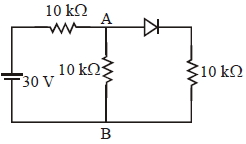
A
$5$
B
$10$
C
$0$
D
$15$
Solution
(B) The diode is forward-biased as the potential at $A$ is higher than the potential at $B$. Assuming an ideal diode,it acts as a short circuit.
Let the potential at $B$ be $0 \ V$. The circuit consists of a $30 \ V$ source connected to a $10 \ k\Omega$ resistor in series with a parallel combination of two $10 \ k\Omega$ resistors (one connected between $A$ and $B$,and the other in series with the diode).
The equivalent resistance of the two parallel $10 \ k\Omega$ resistors is $R_p = \frac{10 \times 10}{10 + 10} = 5 \ k\Omega$.
The total resistance of the circuit is $R_{eq} = 10 \ k\Omega + 5 \ k\Omega = 15 \ k\Omega$.
The current from the battery is $I = \frac{30 \ V}{15 \ k\Omega} = 2 \ mA$.
The potential at $A$ relative to $B$ is the voltage drop across the parallel combination $R_p$:
$V_{AB} = I \times R_p = 2 \ mA \times 5 \ k\Omega = 10 \ V$.
Let the potential at $B$ be $0 \ V$. The circuit consists of a $30 \ V$ source connected to a $10 \ k\Omega$ resistor in series with a parallel combination of two $10 \ k\Omega$ resistors (one connected between $A$ and $B$,and the other in series with the diode).
The equivalent resistance of the two parallel $10 \ k\Omega$ resistors is $R_p = \frac{10 \times 10}{10 + 10} = 5 \ k\Omega$.
The total resistance of the circuit is $R_{eq} = 10 \ k\Omega + 5 \ k\Omega = 15 \ k\Omega$.
The current from the battery is $I = \frac{30 \ V}{15 \ k\Omega} = 2 \ mA$.
The potential at $A$ relative to $B$ is the voltage drop across the parallel combination $R_p$:
$V_{AB} = I \times R_p = 2 \ mA \times 5 \ k\Omega = 10 \ V$.
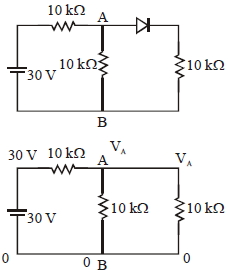
0 likesView Solution
58
PhysicsMediumMCQJEE Main · 2020
In a building,there are $15$ bulbs of $45 \; W$,$15$ bulbs of $100 \; W$,$15$ small fans of $10 \; W$,and $2$ heaters of $1 \; kW$. The voltage of the electric main is $220 \; V$. The minimum fuse capacity (rated value) of the building will be: .......... $A$
A
$10$
B
$25$
C
$15$
D
$20$
Solution
(D) The total power $P$ consumed in the building is the sum of the power of all appliances.
$P = (15 \times 45) + (15 \times 100) + (15 \times 10) + (2 \times 1000)$
$P = 675 + 1500 + 150 + 2000 = 4325 \; W$
Using the formula $P = V \times I$,where $V = 220 \; V$ is the voltage:
$I = \frac{P}{V} = \frac{4325}{220} \approx 19.66 \; A$
Since the fuse must handle the total current,the minimum fuse capacity should be the next standard integer value,which is $20 \; A$.
$P = (15 \times 45) + (15 \times 100) + (15 \times 10) + (2 \times 1000)$
$P = 675 + 1500 + 150 + 2000 = 4325 \; W$
Using the formula $P = V \times I$,where $V = 220 \; V$ is the voltage:
$I = \frac{P}{V} = \frac{4325}{220} \approx 19.66 \; A$
Since the fuse must handle the total current,the minimum fuse capacity should be the next standard integer value,which is $20 \; A$.
0 likesView Solution
59
PhysicsMediumMCQJEE Main · 2020
An emf of $20\; V$ is applied at time $t=0$ to a circuit containing in series $10\; mH$ inductor and $5\; \Omega$ resistor. The ratio of the currents at time $t=\infty$ and at $t=40\; ms$ is close to: (Take $e^{2}=7.389$)
A
$1.06$
B
$1.15$
C
$1.46$
D
$0.84$
Solution
(B) The current in an $RL$ circuit at time $t$ is given by $i(t) = i_0(1 - e^{-Rt/L})$,where $i_0 = V/R$ is the steady-state current at $t = \infty$.
Given $V = 20\; V$,$R = 5\; \Omega$,and $L = 10\; mH = 10 \times 10^{-3}\; H = 0.01\; H$.
The time constant $\tau = L/R = 0.01 / 5 = 0.002\; s = 2\; ms$.
At $t = 40\; ms$,the exponent is $-Rt/L = -t/\tau = -40\; ms / 2\; ms = -20$.
Wait,checking the time provided: if $t = 40\; ms$,then $t/\tau = 20$. If $t = 40\; s$,then $t/\tau = 20000$. Assuming the question implies $t = 4\; ms$ to match the $e^2$ hint: $t/\tau = 4\; ms / 2\; ms = 2$.
Then $i(4\; ms) = i_0(1 - e^{-2})$.
The ratio $i(\infty) / i(4\; ms) = i_0 / [i_0(1 - e^{-2})] = 1 / (1 - 1/e^2) = e^2 / (e^2 - 1)$.
Using $e^2 = 7.389$,the ratio is $7.389 / (7.389 - 1) = 7.389 / 6.389 \approx 1.156$.
Given $V = 20\; V$,$R = 5\; \Omega$,and $L = 10\; mH = 10 \times 10^{-3}\; H = 0.01\; H$.
The time constant $\tau = L/R = 0.01 / 5 = 0.002\; s = 2\; ms$.
At $t = 40\; ms$,the exponent is $-Rt/L = -t/\tau = -40\; ms / 2\; ms = -20$.
Wait,checking the time provided: if $t = 40\; ms$,then $t/\tau = 20$. If $t = 40\; s$,then $t/\tau = 20000$. Assuming the question implies $t = 4\; ms$ to match the $e^2$ hint: $t/\tau = 4\; ms / 2\; ms = 2$.
Then $i(4\; ms) = i_0(1 - e^{-2})$.
The ratio $i(\infty) / i(4\; ms) = i_0 / [i_0(1 - e^{-2})] = 1 / (1 - 1/e^2) = e^2 / (e^2 - 1)$.
Using $e^2 = 7.389$,the ratio is $7.389 / (7.389 - 1) = 7.389 / 6.389 \approx 1.156$.
0 likesView Solution
60
PhysicsMediumMCQJEE Main · 2020
The figure shows the experimentally measured $B$ vs. $H$ variation in a ferromagnetic material. The retentivity,coercivity,and saturation of the material are,respectively:
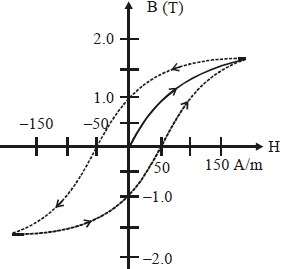
A
$150 \; A/m, 1.0 \; T$ and $1.5 \; T$
B
$1.0 \; T, 50 \; A/m$ and $1.5 \; T$
C
$1.5 \; T, 50 \; A/m$ and $1.0 \; T$
D
$1.5 \; T, 50 \; A/m$ and $1.0 \; T$
Solution
(B) $1$. Retentivity is the value of magnetic induction $B$ when the magnetizing field $H$ is zero. From the graph,at $H = 0$,$B = 1.0 \; T$.
$2$. Coercivity is the value of the reverse magnetizing field $H$ required to reduce the magnetic induction $B$ to zero. From the graph,at $B = 0$,$H = -50 \; A/m$. The magnitude of coercivity is $50 \; A/m$.
$3$. Saturation magnetization is the maximum value of magnetic induction $B$ reached by the material. From the graph,the maximum value of $B$ is $1.5 \; T$.
Therefore,the retentivity,coercivity,and saturation are $1.0 \; T, 50 \; A/m$ and $1.5 \; T$,respectively.
$2$. Coercivity is the value of the reverse magnetizing field $H$ required to reduce the magnetic induction $B$ to zero. From the graph,at $B = 0$,$H = -50 \; A/m$. The magnitude of coercivity is $50 \; A/m$.
$3$. Saturation magnetization is the maximum value of magnetic induction $B$ reached by the material. From the graph,the maximum value of $B$ is $1.5 \; T$.
Therefore,the retentivity,coercivity,and saturation are $1.0 \; T, 50 \; A/m$ and $1.5 \; T$,respectively.
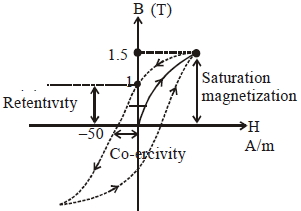
0 likesView Solution
61
PhysicsMediumMCQJEE Main · 2020
In a Young's double slit experiment,the separation between the slits is $0.15 \; mm$. In the experiment,a source of light of wavelength $589 \; nm$ is used and the interference pattern is observed on a screen kept $1.5 \; m$ away. The separation between the successive bright fringes on the screen is $...... \; mm$. (in $.9$)
A
$6$
B
$5$
C
$4$
D
$3$
Solution
(B) The fringe width $\beta$ in a Young's double slit experiment is given by the formula: $\beta = \frac{D \lambda}{d}$.
Here,$D = 1.5 \; m$ is the distance between the slits and the screen.
$\lambda = 589 \; nm = 589 \times 10^{-9} \; m$ is the wavelength of the light source.
$d = 0.15 \; mm = 0.15 \times 10^{-3} \; m$ is the separation between the slits.
Substituting these values into the formula:
$\beta = \frac{1.5 \times 589 \times 10^{-9}}{0.15 \times 10^{-3}}$
$\beta = \frac{1.5}{0.15} \times 589 \times 10^{-6} \; m$
$\beta = 10 \times 589 \times 10^{-6} \; m = 5890 \times 10^{-6} \; m = 5.89 \times 10^{-3} \; m$.
Rounding to one decimal place,$\beta \approx 5.9 \times 10^{-3} \; m = 5.9 \; mm$.
Here,$D = 1.5 \; m$ is the distance between the slits and the screen.
$\lambda = 589 \; nm = 589 \times 10^{-9} \; m$ is the wavelength of the light source.
$d = 0.15 \; mm = 0.15 \times 10^{-3} \; m$ is the separation between the slits.
Substituting these values into the formula:
$\beta = \frac{1.5 \times 589 \times 10^{-9}}{0.15 \times 10^{-3}}$
$\beta = \frac{1.5}{0.15} \times 589 \times 10^{-6} \; m$
$\beta = 10 \times 589 \times 10^{-6} \; m = 5890 \times 10^{-6} \; m = 5.89 \times 10^{-3} \; m$.
Rounding to one decimal place,$\beta \approx 5.9 \times 10^{-3} \; m = 5.9 \; mm$.
0 likesView Solution
62
PhysicsDifficultMCQJEE Main · 2020
$A$ thin lens made of glass (refractive index $= 1.5$) of focal length $f = 16 \; cm$ is immersed in a liquid of refractive index $1.42$. If its focal length in liquid is $f_{l}$,then the ratio $f_{l} / f$ is closest to the integer:
A
$1$
B
$5$
C
$9$
D
$17$
Solution
(C) Using the Lens Maker's Formula: $\frac{1}{f} = (\mu_{g} - 1) \left( \frac{1}{R_{1}} - \frac{1}{R_{2}} \right)$.
For the lens in air $(\mu_{a} = 1)$:
$\frac{1}{f} = (1.5 - 1) \left( \frac{1}{R_{1}} - \frac{1}{R_{2}} \right) = 0.5 \left( \frac{1}{R_{1}} - \frac{1}{R_{2}} \right) \dots (1)$
For the lens in liquid $(\mu_{l} = 1.42)$:
$\frac{1}{f_{l}} = \left( \frac{1.5}{1.42} - 1 \right) \left( \frac{1}{R_{1}} - \frac{1}{R_{2}} \right) = \left( \frac{1.5 - 1.42}{1.42} \right) \left( \frac{1}{R_{1}} - \frac{1}{R_{2}} \right) = \frac{0.08}{1.42} \left( \frac{1}{R_{1}} - \frac{1}{R_{2}} \right) \dots (2)$
Dividing equation $(1)$ by equation $(2)$:
$\frac{f_{l}}{f} = \frac{0.5 \left( \frac{1}{R_{1}} - \frac{1}{R_{2}} \right)}{\frac{0.08}{1.42} \left( \frac{1}{R_{1}} - \frac{1}{R_{2}} \right)} = \frac{0.5 \times 1.42}{0.08} = \frac{0.71}{0.08} = 8.875$.
The value $8.875$ is closest to the integer $9$.
For the lens in air $(\mu_{a} = 1)$:
$\frac{1}{f} = (1.5 - 1) \left( \frac{1}{R_{1}} - \frac{1}{R_{2}} \right) = 0.5 \left( \frac{1}{R_{1}} - \frac{1}{R_{2}} \right) \dots (1)$
For the lens in liquid $(\mu_{l} = 1.42)$:
$\frac{1}{f_{l}} = \left( \frac{1.5}{1.42} - 1 \right) \left( \frac{1}{R_{1}} - \frac{1}{R_{2}} \right) = \left( \frac{1.5 - 1.42}{1.42} \right) \left( \frac{1}{R_{1}} - \frac{1}{R_{2}} \right) = \frac{0.08}{1.42} \left( \frac{1}{R_{1}} - \frac{1}{R_{2}} \right) \dots (2)$
Dividing equation $(1)$ by equation $(2)$:
$\frac{f_{l}}{f} = \frac{0.5 \left( \frac{1}{R_{1}} - \frac{1}{R_{2}} \right)}{\frac{0.08}{1.42} \left( \frac{1}{R_{1}} - \frac{1}{R_{2}} \right)} = \frac{0.5 \times 1.42}{0.08} = \frac{0.71}{0.08} = 8.875$.
The value $8.875$ is closest to the integer $9$.
0 likesView Solution
63
PhysicsDifficultMCQJEE Main · 2020
$A$ planar loop made of wire is rotating in a uniform magnetic field. At time $t=0$,the plane of the loop is perpendicular to the magnetic field. If the loop is rotating about an axis passing through its plane with a period of $10 \; s$,at which of the following times will the induced electromotive force (emf) be maximum and minimum,respectively?
A
$2.5 \; s$ and $7.5 \; s$
B
$5.0 \; s$ and $7.5 \; s$
C
$5.0 \; s$ and $10.0 \; s$
D
$2.5 \; s$ and $5.0 \; s$
Solution
(D) The magnetic flux $\phi$ through the loop is given by $\phi = \vec{B} \cdot \vec{A} = BA \cos \theta = BA \cos(\omega t)$.
The induced emf $e$ is given by Faraday's law: $|e| = |\frac{d\phi}{dt}| = |BA\omega \sin(\omega t)|$.
The induced emf $|e|$ is maximum when $\sin(\omega t) = 1$,which occurs at $\omega t = \frac{\pi}{2}$.
Given the period $T = 10 \; s$,the angular frequency is $\omega = \frac{2\pi}{T} = \frac{2\pi}{10} = \frac{\pi}{5} \; rad/s$.
Substituting $\omega t = \frac{\pi}{2}$ gives $(\frac{\pi}{5})t = \frac{\pi}{2}$,which results in $t = 2.5 \; s$.
The induced emf $|e|$ is minimum when $\sin(\omega t) = 0$,which occurs at $\omega t = \pi$ (or $0, 2\pi, \dots$).
Substituting $\omega t = \pi$ gives $(\frac{\pi}{5})t = \pi$,which results in $t = 5.0 \; s$.
Therefore,the induced emf is maximum at $2.5 \; s$ and minimum at $5.0 \; s$.
The induced emf $e$ is given by Faraday's law: $|e| = |\frac{d\phi}{dt}| = |BA\omega \sin(\omega t)|$.
The induced emf $|e|$ is maximum when $\sin(\omega t) = 1$,which occurs at $\omega t = \frac{\pi}{2}$.
Given the period $T = 10 \; s$,the angular frequency is $\omega = \frac{2\pi}{T} = \frac{2\pi}{10} = \frac{\pi}{5} \; rad/s$.
Substituting $\omega t = \frac{\pi}{2}$ gives $(\frac{\pi}{5})t = \frac{\pi}{2}$,which results in $t = 2.5 \; s$.
The induced emf $|e|$ is minimum when $\sin(\omega t) = 0$,which occurs at $\omega t = \pi$ (or $0, 2\pi, \dots$).
Substituting $\omega t = \pi$ gives $(\frac{\pi}{5})t = \pi$,which results in $t = 5.0 \; s$.
Therefore,the induced emf is maximum at $2.5 \; s$ and minimum at $5.0 \; s$.
0 likesView Solution
64
PhysicsMediumMCQJEE Main · 2020
$A$ $60\; pF$ capacitor is fully charged by a $20\; V$ supply. It is then disconnected from the supply and connected to another uncharged $60\; pF$ capacitor in parallel. The electrostatic energy that is lost in this process by the time the charge is redistributed between them is (in $nJ$):
A
$5$
B
$6$
C
$7$
D
$8$
Solution
(B) Initial charge on the capacitor: $Q = CV = 60 \times 10^{-12} \; F \times 20 \; V = 1200 \times 10^{-12} \; C = 1.2 \times 10^{-9} \; C$.
Initial electrostatic energy stored: $U_i = \frac{1}{2} CV^2 = \frac{1}{2} \times 60 \times 10^{-12} \times (20)^2 = 30 \times 10^{-12} \times 400 = 12000 \times 10^{-12} \; J = 12 \; nJ$.
When connected in parallel,the total capacitance becomes $C_{eq} = C + C = 2C = 120 \; pF$. The total charge $Q$ is conserved and redistributes equally as $Q/2$ on each capacitor.
Final electrostatic energy stored: $U_f = \frac{(Q/2)^2}{2C} + \frac{(Q/2)^2}{2C} = 2 \times \frac{Q^2/4}{2C} = \frac{Q^2}{4C} = \frac{1}{2} \times \frac{Q^2}{2C} = \frac{1}{2} U_i = \frac{1}{2} \times 12 \; nJ = 6 \; nJ$.
Energy lost: $\Delta U = U_i - U_f = 12 \; nJ - 6 \; nJ = 6 \; nJ$.
Initial electrostatic energy stored: $U_i = \frac{1}{2} CV^2 = \frac{1}{2} \times 60 \times 10^{-12} \times (20)^2 = 30 \times 10^{-12} \times 400 = 12000 \times 10^{-12} \; J = 12 \; nJ$.
When connected in parallel,the total capacitance becomes $C_{eq} = C + C = 2C = 120 \; pF$. The total charge $Q$ is conserved and redistributes equally as $Q/2$ on each capacitor.
Final electrostatic energy stored: $U_f = \frac{(Q/2)^2}{2C} + \frac{(Q/2)^2}{2C} = 2 \times \frac{Q^2/4}{2C} = \frac{Q^2}{4C} = \frac{1}{2} \times \frac{Q^2}{2C} = \frac{1}{2} U_i = \frac{1}{2} \times 12 \; nJ = 6 \; nJ$.
Energy lost: $\Delta U = U_i - U_f = 12 \; nJ - 6 \; nJ = 6 \; nJ$.

0 likesView Solution
65
PhysicsMediumMCQJEE Main · 2020
The balancing length for a cell is $560 \; cm$ in a potentiometer experiment. When an external resistance of $10 \; \Omega$ is connected in parallel to the cell,the balancing length changes by $60 \; cm$. If the internal resistance of the cell is $\frac{N}{10} \; \Omega$,where $N$ is an integer,then the value of $N$ is:
A
$12$
B
$10$
C
$8$
D
$14$
Solution
(A) In a potentiometer experiment,the balancing length $l_1$ corresponds to the $EMF$ of the cell,$E = k l_1$,where $k$ is the potential gradient.
When an external resistance $R$ is connected in parallel,the terminal voltage $V$ is given by $V = E - Ir = E - \frac{E}{R+r} r = E \left( \frac{R}{R+r} \right) = k l_2$.
Thus,$\frac{E}{V} = \frac{l_1}{l_2} = \frac{R+r}{R} = 1 + \frac{r}{R}$.
Given $l_1 = 560 \; cm$ and the change in length is $60 \; cm$,the new balancing length $l_2 = 560 - 60 = 500 \; cm$.
Substituting the values: $\frac{560}{500} = 1 + \frac{r}{10}$.
$1.12 = 1 + \frac{r}{10} \implies 0.12 = \frac{r}{10} \implies r = 1.2 \; \Omega$.
Since $r = \frac{N}{10} \; \Omega$,we have $\frac{N}{10} = 1.2$,which gives $N = 12$.
When an external resistance $R$ is connected in parallel,the terminal voltage $V$ is given by $V = E - Ir = E - \frac{E}{R+r} r = E \left( \frac{R}{R+r} \right) = k l_2$.
Thus,$\frac{E}{V} = \frac{l_1}{l_2} = \frac{R+r}{R} = 1 + \frac{r}{R}$.
Given $l_1 = 560 \; cm$ and the change in length is $60 \; cm$,the new balancing length $l_2 = 560 - 60 = 500 \; cm$.
Substituting the values: $\frac{560}{500} = 1 + \frac{r}{10}$.
$1.12 = 1 + \frac{r}{10} \implies 0.12 = \frac{r}{10} \implies r = 1.2 \; \Omega$.
Since $r = \frac{N}{10} \; \Omega$,we have $\frac{N}{10} = 1.2$,which gives $N = 12$.
0 likesView Solution
66
PhysicsAdvancedMCQJEE Main · 2020
$A$ parallel plate capacitor has plates of area $A$ separated by distance $d$ between them. It is filled with a dielectric which has a dielectric constant that varies as $k(x)=K(1+\alpha x)$ where $x$ is the distance measured from one of the plates. If $(\alpha d) << 1$,the total capacitance of the system is best given by the expression:
A
$\frac{AK \varepsilon_{0}}{d}\left(1+\frac{\alpha d}{2}\right)$
B
$\frac{A \varepsilon_{0} K}{d}\left(1+\left(\frac{\alpha d}{2}\right)^{2}\right)$
C
$\frac{A \varepsilon_{0} K}{d}\left(1+\frac{\alpha^{2} d^{2}}{2}\right)$
D
$\frac{AK \varepsilon_{0}}{d}(1+\alpha d)$
Solution
(A) Since the dielectric constant $k(x)$ varies with distance $x$,we consider a thin elemental slice of thickness $dx$ at a distance $x$ from one plate.
The capacitance of this elemental slice is $dC = \frac{\varepsilon_0 k(x) A}{dx} = \frac{\varepsilon_0 K(1+\alpha x) A}{dx}$.
Since these elemental capacitors are connected in series,the equivalent capacitance $C$ is given by:
$\frac{1}{C} = \int_0^d \frac{1}{dC} = \int_0^d \frac{dx}{\varepsilon_0 K A (1+\alpha x)}$.
Integrating this,we get:
$\frac{1}{C} = \frac{1}{\varepsilon_0 K A} \left[ \frac{\ln(1+\alpha x)}{\alpha} \right]_0^d = \frac{1}{\alpha \varepsilon_0 K A} \ln(1+\alpha d)$.
Using the Taylor expansion $\ln(1+u) \approx u - \frac{u^2}{2}$ for $u = \alpha d << 1$:
$\frac{1}{C} \approx \frac{1}{\alpha \varepsilon_0 K A} (\alpha d - \frac{(\alpha d)^2}{2}) = \frac{d}{\varepsilon_0 K A} (1 - \frac{\alpha d}{2})$.
Taking the reciprocal to find $C$ and using the binomial approximation $(1-u)^{-1} \approx 1+u$:
$C \approx \frac{\varepsilon_0 K A}{d} (1 - \frac{\alpha d}{2})^{-1} \approx \frac{\varepsilon_0 K A}{d} (1 + \frac{\alpha d}{2})$.
The capacitance of this elemental slice is $dC = \frac{\varepsilon_0 k(x) A}{dx} = \frac{\varepsilon_0 K(1+\alpha x) A}{dx}$.
Since these elemental capacitors are connected in series,the equivalent capacitance $C$ is given by:
$\frac{1}{C} = \int_0^d \frac{1}{dC} = \int_0^d \frac{dx}{\varepsilon_0 K A (1+\alpha x)}$.
Integrating this,we get:
$\frac{1}{C} = \frac{1}{\varepsilon_0 K A} \left[ \frac{\ln(1+\alpha x)}{\alpha} \right]_0^d = \frac{1}{\alpha \varepsilon_0 K A} \ln(1+\alpha d)$.
Using the Taylor expansion $\ln(1+u) \approx u - \frac{u^2}{2}$ for $u = \alpha d << 1$:
$\frac{1}{C} \approx \frac{1}{\alpha \varepsilon_0 K A} (\alpha d - \frac{(\alpha d)^2}{2}) = \frac{d}{\varepsilon_0 K A} (1 - \frac{\alpha d}{2})$.
Taking the reciprocal to find $C$ and using the binomial approximation $(1-u)^{-1} \approx 1+u$:
$C \approx \frac{\varepsilon_0 K A}{d} (1 - \frac{\alpha d}{2})^{-1} \approx \frac{\varepsilon_0 K A}{d} (1 + \frac{\alpha d}{2})$.
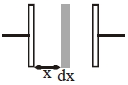
0 likesView Solution
67
PhysicsDifficultMCQJEE Main · 2020
The time period of revolution of an electron in its ground state orbit in a hydrogen atom is $1.6 \times 10^{-16} \; s$. The frequency of revolution of the electron in its first excited state (in $s^{-1}$) is:
A
$6.2 \times 10^{15}$
B
$5.6 \times 10^{12}$
C
$7.8 \times 10^{14}$
D
$1.6 \times 10^{14}$
Solution
(C) The time period of revolution of an electron in the $n^{\text{th}}$ orbit is given by $T \propto \frac{n^3}{Z^2}$.
For a hydrogen atom,$Z = 1$,so $T \propto n^3$.
The ground state corresponds to $n_1 = 1$,and the first excited state corresponds to $n_2 = 2$.
Given $T_1 = 1.6 \times 10^{-16} \; s$.
Using the proportionality,$\frac{T_2}{T_1} = \left(\frac{n_2}{n_1}\right)^3 = \left(\frac{2}{1}\right)^3 = 8$.
Therefore,$T_2 = 8 \times T_1 = 8 \times 1.6 \times 10^{-16} = 12.8 \times 10^{-16} \; s$.
The frequency $f_2$ is the reciprocal of the time period: $f_2 = \frac{1}{T_2} = \frac{1}{12.8 \times 10^{-16}} \approx 0.078125 \times 10^{16} \; s^{-1} = 7.8 \times 10^{14} \; s^{-1}$.
For a hydrogen atom,$Z = 1$,so $T \propto n^3$.
The ground state corresponds to $n_1 = 1$,and the first excited state corresponds to $n_2 = 2$.
Given $T_1 = 1.6 \times 10^{-16} \; s$.
Using the proportionality,$\frac{T_2}{T_1} = \left(\frac{n_2}{n_1}\right)^3 = \left(\frac{2}{1}\right)^3 = 8$.
Therefore,$T_2 = 8 \times T_1 = 8 \times 1.6 \times 10^{-16} = 12.8 \times 10^{-16} \; s$.
The frequency $f_2$ is the reciprocal of the time period: $f_2 = \frac{1}{T_2} = \frac{1}{12.8 \times 10^{-16}} \approx 0.078125 \times 10^{16} \; s^{-1} = 7.8 \times 10^{14} \; s^{-1}$.
0 likesView Solution
68
PhysicsDifficultMCQJEE Main · 2020
$A$ long solenoid of radius $R$ carries a time $(t)$-dependent current $I(t) = I_{0} t(1-t)$. $A$ ring of radius $2R$ is placed coaxially near its middle. During the time interval $0 \leq t \leq 1$,the induced current $(I_{R})$ and the induced $EMF$ $(V_{R})$ in the ring change as
A
At $t = 0.5$,the direction of $I_{R}$ reverses and $V_{R}$ is zero.
B
The direction of $I_{R}$ remains unchanged and $V_{R}$ is zero at $t = 0.25$.
C
The direction of $I_{R}$ remains unchanged and $V_{R}$ is maximum at $t = 0.5$.
D
At $t = 0.25$,the direction of $I_{R}$ reverses and $V_{R}$ is maximum.
Solution
(A) The magnetic field inside the solenoid is $B = \mu_{0} n I(t) = \mu_{0} n I_{0} (t - t^{2})$.
The magnetic flux $\phi$ through the ring of radius $2R$ is limited to the area of the solenoid $(R)$,so $\phi = B \cdot A = B \cdot \pi R^{2}$.
$\phi = \pi R^{2} \mu_{0} n I_{0} (t - t^{2})$.
The induced $EMF$ is $V_{R} = -\frac{d\phi}{dt} = -\pi R^{2} \mu_{0} n I_{0} (1 - 2t) = \pi R^{2} \mu_{0} n I_{0} (2t - 1)$.
The induced current is $I_{R} = \frac{V_{R}}{R_{R}}$,where $R_{R}$ is the resistance of the ring.
At $t = 0.5$,$V_{R} = \pi R^{2} \mu_{0} n I_{0} (2(0.5) - 1) = 0$.
Since the expression $(2t - 1)$ changes sign at $t = 0.5$,the direction of the induced $EMF$ and the induced current reverses at $t = 0.5$.
The magnetic flux $\phi$ through the ring of radius $2R$ is limited to the area of the solenoid $(R)$,so $\phi = B \cdot A = B \cdot \pi R^{2}$.
$\phi = \pi R^{2} \mu_{0} n I_{0} (t - t^{2})$.
The induced $EMF$ is $V_{R} = -\frac{d\phi}{dt} = -\pi R^{2} \mu_{0} n I_{0} (1 - 2t) = \pi R^{2} \mu_{0} n I_{0} (2t - 1)$.
The induced current is $I_{R} = \frac{V_{R}}{R_{R}}$,where $R_{R}$ is the resistance of the ring.
At $t = 0.5$,$V_{R} = \pi R^{2} \mu_{0} n I_{0} (2(0.5) - 1) = 0$.
Since the expression $(2t - 1)$ changes sign at $t = 0.5$,the direction of the induced $EMF$ and the induced current reverses at $t = 0.5$.
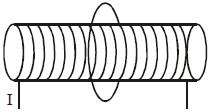
0 likesView Solution
69
PhysicsMediumMCQJEE Main · 2020
The current $I_{1}$ (in $A$) flowing through the $1\; \Omega$ resistor in the following circuit is:
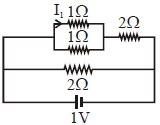
A
$0.5$
B
$0.2$
C
$0.25$
D
$0.4$
Solution
(B) The upper branch consists of two $1\; \Omega$ resistors in parallel,which are in series with a $2\; \Omega$ resistor.
The equivalent resistance of the two $1\; \Omega$ resistors in parallel is $R_{p} = \frac{1 \times 1}{1 + 1} = 0.5\; \Omega$.
The total resistance of the upper branch is $R_{upper} = 0.5\; \Omega + 2\; \Omega = 2.5\; \Omega$.
The voltage across the upper branch is $V = 1\; V$.
The total current $i$ flowing through the upper branch is $i = \frac{V}{R_{upper}} = \frac{1}{2.5} = 0.4\; A$.
This current $i$ splits equally between the two $1\; \Omega$ resistors in parallel.
Therefore,the current $I_{1}$ flowing through one of the $1\; \Omega$ resistors is $I_{1} = \frac{i}{2} = \frac{0.4}{2} = 0.2\; A$.
The equivalent resistance of the two $1\; \Omega$ resistors in parallel is $R_{p} = \frac{1 \times 1}{1 + 1} = 0.5\; \Omega$.
The total resistance of the upper branch is $R_{upper} = 0.5\; \Omega + 2\; \Omega = 2.5\; \Omega$.
The voltage across the upper branch is $V = 1\; V$.
The total current $i$ flowing through the upper branch is $i = \frac{V}{R_{upper}} = \frac{1}{2.5} = 0.4\; A$.
This current $i$ splits equally between the two $1\; \Omega$ resistors in parallel.
Therefore,the current $I_{1}$ flowing through one of the $1\; \Omega$ resistors is $I_{1} = \frac{i}{2} = \frac{0.4}{2} = 0.2\; A$.
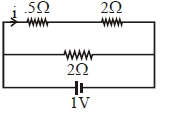
0 likesView Solution
70
PhysicsMediumMCQJEE Main · 2020
Which of the following gives a reversible operation?
A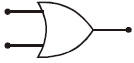
B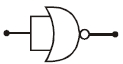
C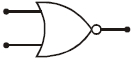
D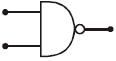
Solution
(B) logic gate is considered reversible if the input data can be uniquely recovered from the output data.
In a $NOT$ gate,the output is the complement of the input $(Y = \bar{A})$. If the output is $0$,the input must have been $1$,and if the output is $1$,the input must have been $0$. Thus,the input can be uniquely determined from the output.
Other gates like $OR$,$NOR$,$AND$,and $NAND$ have two inputs,meaning there are $2^2 = 4$ possible input combinations,but only $2$ possible output states ($0$ or $1$). Since multiple input combinations can produce the same output,these gates are not reversible.
In a $NOT$ gate,the output is the complement of the input $(Y = \bar{A})$. If the output is $0$,the input must have been $1$,and if the output is $1$,the input must have been $0$. Thus,the input can be uniquely determined from the output.
Other gates like $OR$,$NOR$,$AND$,and $NAND$ have two inputs,meaning there are $2^2 = 4$ possible input combinations,but only $2$ possible output states ($0$ or $1$). Since multiple input combinations can produce the same output,these gates are not reversible.
0 likesView Solution
71
PhysicsMediumMCQJEE Main · 2020
If we need a magnification of $375$ from a compound microscope of tube length $150\; mm$ and an objective of focal length $5\; mm$,the focal length of the eye-piece should be close to.....$mm$.
A
$22$
B
$12$
C
$33$
D
$2$
Solution
(A) The magnification $M$ of a compound microscope is given by the formula $M = \frac{L}{f_0} \left(1 + \frac{d}{f_e}\right)$,where $L$ is the tube length,$f_0$ is the focal length of the objective,$f_e$ is the focal length of the eyepiece,and $d$ is the least distance of distinct vision $(d = 250\; mm)$.
Given: $M = 375$,$L = 150\; mm$,$f_0 = 5\; mm$,$d = 250\; mm$.
Substituting the values into the formula:
$375 = \frac{150}{5} \left(1 + \frac{250}{f_e}\right)$
$375 = 30 \left(1 + \frac{250}{f_e}\right)$
$12.5 = 1 + \frac{250}{f_e}$
$11.5 = \frac{250}{f_e}$
$f_e = \frac{250}{11.5} \approx 21.74\; mm$.
Rounding to the nearest integer,$f_e \approx 22\; mm$.
Given: $M = 375$,$L = 150\; mm$,$f_0 = 5\; mm$,$d = 250\; mm$.
Substituting the values into the formula:
$375 = \frac{150}{5} \left(1 + \frac{250}{f_e}\right)$
$375 = 30 \left(1 + \frac{250}{f_e}\right)$
$12.5 = 1 + \frac{250}{f_e}$
$11.5 = \frac{250}{f_e}$
$f_e = \frac{250}{11.5} \approx 21.74\; mm$.
Rounding to the nearest integer,$f_e \approx 22\; mm$.
0 likesView Solution
72
PhysicsEasyMCQJEE Main · 2020
If the magnetic field in a plane electromagnetic wave is given by $\overrightarrow{B} = 3 \times 10^{-8} \sin (1.6 \times 10^{3} x + 48 \times 10^{10} t) \hat{j} \; T$,then what will be the expression for the electric field?
A
$\overrightarrow{E} = 9 \sin (1.6 \times 10^{3} x + 48 \times 10^{10} t) \hat{k} \; V/m$
B
$\overrightarrow{E} = 3 \times 10^{-8} \sin (1.6 \times 10^{3} x + 48 \times 10^{10} t) \hat{i} \; V/m$
C
$\overrightarrow{E} = 60 \sin (1.6 \times 10^{3} x + 48 \times 10^{10} t) \hat{k} \; V/m$
D
$\overrightarrow{E} = 3 \times 10^{-8} \sin (1.6 \times 10^{3} x + 48 \times 10^{10} t) \hat{j} \; V/m$
Solution
(A) The given magnetic field is $\overrightarrow{B} = B_0 \sin (kx + \omega t) \hat{j}$,where $B_0 = 3 \times 10^{-8} \; T$.
Since the wave propagates in the negative $x$-direction (as indicated by $+kx$),the direction of propagation is $-\hat{i}$.
The relationship between the amplitudes of electric and magnetic fields is $E_0 = c B_0$,where $c = 3 \times 10^{8} \; m/s$.
$E_0 = (3 \times 10^{8} \; m/s) \times (3 \times 10^{-8} \; T) = 9 \; V/m$.
In an electromagnetic wave,the direction of propagation is given by the direction of $\overrightarrow{E} \times \overrightarrow{B}$.
Here,$(-\hat{i}) = \hat{E} \times \hat{j}$.
Since $\hat{k} \times \hat{j} = -\hat{i}$,the electric field must be in the $\hat{k}$ direction.
Thus,$\overrightarrow{E} = 9 \sin (1.6 \times 10^{3} x + 48 \times 10^{10} t) \hat{k} \; V/m$.
Since the wave propagates in the negative $x$-direction (as indicated by $+kx$),the direction of propagation is $-\hat{i}$.
The relationship between the amplitudes of electric and magnetic fields is $E_0 = c B_0$,where $c = 3 \times 10^{8} \; m/s$.
$E_0 = (3 \times 10^{8} \; m/s) \times (3 \times 10^{-8} \; T) = 9 \; V/m$.
In an electromagnetic wave,the direction of propagation is given by the direction of $\overrightarrow{E} \times \overrightarrow{B}$.
Here,$(-\hat{i}) = \hat{E} \times \hat{j}$.
Since $\hat{k} \times \hat{j} = -\hat{i}$,the electric field must be in the $\hat{k}$ direction.
Thus,$\overrightarrow{E} = 9 \sin (1.6 \times 10^{3} x + 48 \times 10^{10} t) \hat{k} \; V/m$.
0 likesView Solution
73
PhysicsEasyMCQJEE Main · 2020
Consider a circular coil of wire carrying constant current $I$,forming a magnetic dipole. The magnetic flux through an infinite plane that contains the circular coil and excluding the circular coil area is given by $\phi_{i}$. The magnetic flux through the area of the circular coil area is given by $\phi_{0}$. Which of the following options is correct?
A
$\phi_{i} = -\phi_{0}$
B
$\phi_{i} = \phi_{0}$
C
$\phi_{i} < \phi_{0}$
D
$\phi_{i} > \phi_{0}$
Solution
(A) For a current-carrying circular coil,the magnetic field lines originate from the coil and form closed loops.
By Gauss's law for magnetism,the net magnetic flux through any closed surface is zero,i.e.,$\oint \vec{B} \cdot d\vec{A} = 0$.
Consider the infinite plane containing the coil. The magnetic flux passing through the area of the coil $(\phi_{0})$ is in one direction (e.g.,upward).
The magnetic flux passing through the rest of the infinite plane $(\phi_{i})$ must be in the opposite direction (downward) to ensure that the total flux through the entire infinite plane is zero.
Thus,$\phi_{0} + \phi_{i} = 0$,which implies $\phi_{i} = -\phi_{0}$.
By Gauss's law for magnetism,the net magnetic flux through any closed surface is zero,i.e.,$\oint \vec{B} \cdot d\vec{A} = 0$.
Consider the infinite plane containing the coil. The magnetic flux passing through the area of the coil $(\phi_{0})$ is in one direction (e.g.,upward).
The magnetic flux passing through the rest of the infinite plane $(\phi_{i})$ must be in the opposite direction (downward) to ensure that the total flux through the entire infinite plane is zero.
Thus,$\phi_{0} + \phi_{i} = 0$,which implies $\phi_{i} = -\phi_{0}$.
0 likesView Solution
74
PhysicsMediumMCQJEE Main · 2020
Visible light of wavelength $6000 \times 10^{-8} \; cm$ falls normally on a single slit and produces a diffraction pattern. It is found that the second diffraction minimum is at $60^{\circ}$ from the central maximum. If the first minimum is produced at $\theta_{1}$,then $\theta_{1}$ is close to.....$^{\circ}$
A
$20$
B
$45$
C
$30$
D
$25$
Solution
(D) For a single slit diffraction,the condition for the $n^{th}$ minimum is given by $a \sin \theta = n \lambda$,where $a$ is the slit width,$\lambda$ is the wavelength,and $n = 1, 2, 3, ...$.
For the second minimum $(n = 2)$,the angle is $\theta_2 = 60^{\circ}$.
Thus,$a \sin 60^{\circ} = 2 \lambda$.
$a \left( \frac{\sqrt{3}}{2} \right) = 2 \lambda \implies \frac{\lambda}{a} = \frac{\sqrt{3}}{4}$.
For the first minimum $(n = 1)$,the condition is $a \sin \theta_1 = 1 \lambda$.
$\sin \theta_1 = \frac{\lambda}{a} = \frac{\sqrt{3}}{4}$.
$\sin \theta_1 \approx \frac{1.732}{4} = 0.433$.
$\theta_1 = \arcsin(0.433) \approx 25.6^{\circ}$.
Rounding to the nearest integer,$\theta_1 \approx 25^{\circ}$.
For the second minimum $(n = 2)$,the angle is $\theta_2 = 60^{\circ}$.
Thus,$a \sin 60^{\circ} = 2 \lambda$.
$a \left( \frac{\sqrt{3}}{2} \right) = 2 \lambda \implies \frac{\lambda}{a} = \frac{\sqrt{3}}{4}$.
For the first minimum $(n = 1)$,the condition is $a \sin \theta_1 = 1 \lambda$.
$\sin \theta_1 = \frac{\lambda}{a} = \frac{\sqrt{3}}{4}$.
$\sin \theta_1 \approx \frac{1.732}{4} = 0.433$.
$\theta_1 = \arcsin(0.433) \approx 25.6^{\circ}$.
Rounding to the nearest integer,$\theta_1 \approx 25^{\circ}$.
0 likesView Solution
75
PhysicsMediumMCQJEE Main · 2020
$A$ polarizer-analyser set is adjusted such that the intensity of light coming out of the analyser is $10 \%$ of the original intensity. Assuming that the polarizer-analyser set does not absorb any light,the angle by which the analyser needs to be rotated further to reduce the output intensity to zero is.....$^o$
A
$18.4$
B
$71.6$
C
$90$
D
$45$
Solution
(A) Let $I_0$ be the initial intensity of unpolarized light.
After passing through the polarizer,the intensity becomes $I_p = \frac{I_0}{2}$.
According to Malus' Law,the intensity $I$ emerging from the analyser is $I = I_p \cos^2 \theta$,where $\theta$ is the angle between the transmission axes of the polarizer and the analyser.
Given $I = \frac{I_0}{10}$,we have $\frac{I_0}{10} = \frac{I_0}{2} \cos^2 \theta$.
$\cos^2 \theta = \frac{1}{5} \implies \cos \theta = \frac{1}{\sqrt{5}} \approx 0.447$.
$\theta = \cos^{-1}(0.447) \approx 63.43^o$.
To reduce the output intensity to zero,the analyser must be rotated until the angle between the axes is $90^o$.
The additional angle required is $\Delta \theta = 90^o - 63.43^o = 26.57^o$.
After passing through the polarizer,the intensity becomes $I_p = \frac{I_0}{2}$.
According to Malus' Law,the intensity $I$ emerging from the analyser is $I = I_p \cos^2 \theta$,where $\theta$ is the angle between the transmission axes of the polarizer and the analyser.
Given $I = \frac{I_0}{10}$,we have $\frac{I_0}{10} = \frac{I_0}{2} \cos^2 \theta$.
$\cos^2 \theta = \frac{1}{5} \implies \cos \theta = \frac{1}{\sqrt{5}} \approx 0.447$.
$\theta = \cos^{-1}(0.447) \approx 63.43^o$.
To reduce the output intensity to zero,the analyser must be rotated until the angle between the axes is $90^o$.
The additional angle required is $\Delta \theta = 90^o - 63.43^o = 26.57^o$.
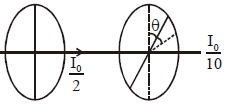
0 likesView Solution
76
PhysicsDifficultMCQJEE Main · 2020
An $LCR$ circuit behaves like a damped harmonic oscillator. Comparing it with a physical spring-mass damped oscillator having a damping constant $b$,the correct equivalence would be:
A
$L \leftrightarrow m, C \leftrightarrow \frac{1}{k}, R \leftrightarrow b$
B
$L \leftrightarrow \frac{1}{b}, C \leftrightarrow \frac{1}{m}, R \leftrightarrow \frac{1}{k}$
C
$L \leftrightarrow m, C \leftrightarrow k, R \leftrightarrow b$
D
$L \leftrightarrow k, C \leftrightarrow b, R \leftrightarrow m$
Solution
(A) For an $LCR$ circuit,applying Kirchhoff's Voltage Law $(KVL)$ to a closed loop with no external source:
$-L \frac{di}{dt} - \frac{q}{C} - iR = 0$
Since $i = \frac{dq}{dt}$,we have:
$L \frac{d^2q}{dt^2} + R \frac{dq}{dt} + \frac{1}{C}q = 0$
For a mechanical damped harmonic oscillator,the equation of motion is given by:
$m \frac{d^2x}{dt^2} + b \frac{dx}{dt} + kx = 0$
Comparing the two differential equations term by term:
$1$. The coefficient of the second derivative: $L$ corresponds to $m$.
$2$. The coefficient of the first derivative: $R$ corresponds to $b$.
$3$. The coefficient of the displacement/charge: $\frac{1}{C}$ corresponds to $k$,which implies $C$ corresponds to $\frac{1}{k}$.
Thus,the correct equivalence is $L \leftrightarrow m, C \leftrightarrow \frac{1}{k}, R \leftrightarrow b$.
$-L \frac{di}{dt} - \frac{q}{C} - iR = 0$
Since $i = \frac{dq}{dt}$,we have:
$L \frac{d^2q}{dt^2} + R \frac{dq}{dt} + \frac{1}{C}q = 0$
For a mechanical damped harmonic oscillator,the equation of motion is given by:
$m \frac{d^2x}{dt^2} + b \frac{dx}{dt} + kx = 0$
Comparing the two differential equations term by term:
$1$. The coefficient of the second derivative: $L$ corresponds to $m$.
$2$. The coefficient of the first derivative: $R$ corresponds to $b$.
$3$. The coefficient of the displacement/charge: $\frac{1}{C}$ corresponds to $k$,which implies $C$ corresponds to $\frac{1}{k}$.
Thus,the correct equivalence is $L \leftrightarrow m, C \leftrightarrow \frac{1}{k}, R \leftrightarrow b$.
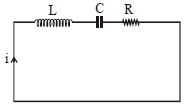
0 likesView Solution
77
PhysicsMediumMCQJEE Main · 2020
Two infinite planes each with uniform surface charge density $+\sigma$ are kept in such a way that the angle between them is $30^{\circ} .$ The electric field in the region shown between them is given by
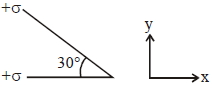
A
$\frac{\sigma}{\varepsilon_{0}}\left[\left(1+\frac{\sqrt{3}}{2}\right) \hat{y}+\frac{\hat{x}}{2}\right]$
B
$\frac{\sigma}{2 \varepsilon_{0}}\left[\left(1-\frac{\sqrt{3}}{2}\right) \hat{y}-\frac{\hat{x}}{2}\right]$
C
$\frac{\sigma}{2 \varepsilon_{0}}\left[(1+\sqrt{3}) \hat{y}+\frac{\hat{x}}{2}\right]$
D
$\frac{\sigma}{2 \varepsilon_{0}}\left[(1+\sqrt{3}) \hat{y}-\frac{\hat{x}}{2}\right]$
Solution
(B) The electric field due to an infinite plane sheet with surface charge density $\sigma$ is $E = \frac{\sigma}{2\varepsilon_{0}}$,directed away from the sheet.
Let the horizontal sheet be along the $x$-axis. Its electric field is $\vec{E}_{1} = \frac{\sigma}{2\varepsilon_{0}} \hat{y}$.
The second sheet is at an angle of $30^{\circ}$ with the $x$-axis. Its normal makes an angle of $30^{\circ} + 90^{\circ} = 120^{\circ}$ with the positive $x$-axis.
The electric field due to the second sheet is $\vec{E}_{2} = \frac{\sigma}{2\varepsilon_{0}} (\cos 120^{\circ} \hat{x} + \sin 120^{\circ} \hat{y}) = \frac{\sigma}{2\varepsilon_{0}} (-\frac{1}{2} \hat{x} + \frac{\sqrt{3}}{2} \hat{y})$.
The net electric field is $\vec{E}_{net} = \vec{E}_{1} + \vec{E}_{2} = \frac{\sigma}{2\varepsilon_{0}} \hat{y} + \frac{\sigma}{2\varepsilon_{0}} (-\frac{1}{2} \hat{x} + \frac{\sqrt{3}}{2} \hat{y})$.
$\vec{E}_{net} = \frac{\sigma}{2\varepsilon_{0}} [-\frac{1}{2} \hat{x} + (1 + \frac{\sqrt{3}}{2}) \hat{y}]$.
Let the horizontal sheet be along the $x$-axis. Its electric field is $\vec{E}_{1} = \frac{\sigma}{2\varepsilon_{0}} \hat{y}$.
The second sheet is at an angle of $30^{\circ}$ with the $x$-axis. Its normal makes an angle of $30^{\circ} + 90^{\circ} = 120^{\circ}$ with the positive $x$-axis.
The electric field due to the second sheet is $\vec{E}_{2} = \frac{\sigma}{2\varepsilon_{0}} (\cos 120^{\circ} \hat{x} + \sin 120^{\circ} \hat{y}) = \frac{\sigma}{2\varepsilon_{0}} (-\frac{1}{2} \hat{x} + \frac{\sqrt{3}}{2} \hat{y})$.
The net electric field is $\vec{E}_{net} = \vec{E}_{1} + \vec{E}_{2} = \frac{\sigma}{2\varepsilon_{0}} \hat{y} + \frac{\sigma}{2\varepsilon_{0}} (-\frac{1}{2} \hat{x} + \frac{\sqrt{3}}{2} \hat{y})$.
$\vec{E}_{net} = \frac{\sigma}{2\varepsilon_{0}} [-\frac{1}{2} \hat{x} + (1 + \frac{\sqrt{3}}{2}) \hat{y}]$.
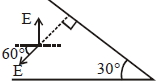
0 likesView Solution
78
PhysicsDifficultMCQJEE Main · 2020
$A$ beam of electromagnetic radiation of intensity $6.4 \times 10^{-5} \; W/cm^{2}$ is comprised of wavelength $\lambda = 310 \; nm$. It falls normally on a metal surface (work function $\varphi = 2 \; eV$) of surface area $1 \; cm^{2}$. If one in $10^{3}$ photons ejects an electron, the total number of electrons ejected in $1 \; s$ is $10^{x}$. Then $x$ is: $(hc = 1240 \; eV \cdot nm, 1 \; eV = 1.6 \times 10^{-19} \; J)$
A
$5$
B
$8$
C
$11$
D
$13$
Solution
(C) The intensity of the radiation is $I = 6.4 \times 10^{-5} \; W/cm^{2}$ and the area is $A = 1 \; cm^{2}$.
The power incident on the surface is $P = I \times A = 6.4 \times 10^{-5} \; W$.
The energy of a single photon is $E_{ph} = \frac{hc}{\lambda} = \frac{1240 \; eV \cdot nm}{310 \; nm} = 4 \; eV$.
Converting this energy to Joules: $E_{ph} = 4 \times 1.6 \times 10^{-19} \; J = 6.4 \times 10^{-19} \; J$.
The number of photons incident per second $(n)$ is given by $n = \frac{P}{E_{ph}} = \frac{6.4 \times 10^{-5} \; J/s}{6.4 \times 10^{-19} \; J} = 10^{14} \; \text{photons/s}$.
Given that one in $10^{3}$ photons ejects an electron, the number of electrons emitted per second is $N_e = n \times 10^{-3} = 10^{14} \times 10^{-3} = 10^{11}$.
Comparing this with $10^{x}$, we get $x = 11$.
The power incident on the surface is $P = I \times A = 6.4 \times 10^{-5} \; W$.
The energy of a single photon is $E_{ph} = \frac{hc}{\lambda} = \frac{1240 \; eV \cdot nm}{310 \; nm} = 4 \; eV$.
Converting this energy to Joules: $E_{ph} = 4 \times 1.6 \times 10^{-19} \; J = 6.4 \times 10^{-19} \; J$.
The number of photons incident per second $(n)$ is given by $n = \frac{P}{E_{ph}} = \frac{6.4 \times 10^{-5} \; J/s}{6.4 \times 10^{-19} \; J} = 10^{14} \; \text{photons/s}$.
Given that one in $10^{3}$ photons ejects an electron, the number of electrons emitted per second is $N_e = n \times 10^{-3} = 10^{14} \times 10^{-3} = 10^{11}$.
Comparing this with $10^{x}$, we get $x = 11$.
0 likesView Solution
79
PhysicsMediumMCQJEE Main · 2020
$A$ loop $ABCDEFA$ of straight edges has six corner points $A(0,0,0), B(5,0,0), C(5,5,0), D(0,5,0), E(0,5,5)$ and $F(0,0,5)$. The magnetic field in this region is $\overrightarrow{B}=(3 \hat{i}+4 \hat{k}) \; T$. The quantity of magnetic flux through the loop $ABCDEFA$ (in $\text{Wb}$) is:
A
$169$
B
$200$
C
$196$
D
$175$
Solution
(D) The loop $ABCDEFA$ consists of two planar surfaces: the rectangle $ABCD$ in the $xy$-plane and the rectangle $ADEF$ in the $yz$-plane.
The area vector for the rectangle $ABCD$ (in the $xy$-plane) is $\overrightarrow{A}_{ABCD} = (5 \times 5) \hat{k} = 25 \hat{k} \; \text{m}^2$.
The area vector for the rectangle $ADEF$ (in the $yz$-plane) is $\overrightarrow{A}_{ADEF} = (5 \times 5) \hat{i} = 25 \hat{i} \; \text{m}^2$.
The net area vector is $\overrightarrow{A}_{net} = \overrightarrow{A}_{ABCD} + \overrightarrow{A}_{ADEF} = 25 \hat{i} + 25 \hat{k} \; \text{m}^2$.
The magnetic field is given as $\overrightarrow{B} = 3 \hat{i} + 4 \hat{k} \; \text{T}$.
The magnetic flux $\phi$ is calculated using the dot product: $\phi = \overrightarrow{B} \cdot \overrightarrow{A}_{net}$.
$\phi = (3 \hat{i} + 4 \hat{k}) \cdot (25 \hat{i} + 25 \hat{k})$
$\phi = (3 \times 25) + (4 \times 25) = 75 + 100 = 175 \; \text{Wb}$.
Thus,the magnetic flux through the loop is $175 \; \text{Wb}$.
The area vector for the rectangle $ABCD$ (in the $xy$-plane) is $\overrightarrow{A}_{ABCD} = (5 \times 5) \hat{k} = 25 \hat{k} \; \text{m}^2$.
The area vector for the rectangle $ADEF$ (in the $yz$-plane) is $\overrightarrow{A}_{ADEF} = (5 \times 5) \hat{i} = 25 \hat{i} \; \text{m}^2$.
The net area vector is $\overrightarrow{A}_{net} = \overrightarrow{A}_{ABCD} + \overrightarrow{A}_{ADEF} = 25 \hat{i} + 25 \hat{k} \; \text{m}^2$.
The magnetic field is given as $\overrightarrow{B} = 3 \hat{i} + 4 \hat{k} \; \text{T}$.
The magnetic flux $\phi$ is calculated using the dot product: $\phi = \overrightarrow{B} \cdot \overrightarrow{A}_{net}$.
$\phi = (3 \hat{i} + 4 \hat{k}) \cdot (25 \hat{i} + 25 \hat{k})$
$\phi = (3 \times 25) + (4 \times 25) = 75 + 100 = 175 \; \text{Wb}$.
Thus,the magnetic flux through the loop is $175 \; \text{Wb}$.
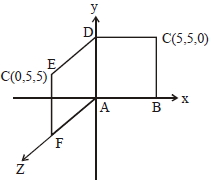
0 likesView Solution
80
PhysicsMediumMCQJEE Main · 2020
In a double slit experiment,at a certain point on the screen,the path difference between the two interfering waves is $\frac{1}{8}$ of a wavelength. The ratio of the intensity of light at that point to that at the centre of a bright fringe is:
A
$0.853$
B
$0.672$
C
$0.760$
D
$0.583$
Solution
(A) The intensity at any point in an interference pattern is given by $I = I_{max} \cos^2 \left( \frac{\Delta \phi}{2} \right)$,where $I_{max}$ is the intensity at the centre of a bright fringe.
The phase difference $\Delta \phi$ is related to the path difference $\Delta x$ by the formula $\Delta \phi = \frac{2 \pi}{\lambda} \Delta x$.
Given the path difference $\Delta x = \frac{\lambda}{8}$,we calculate the phase difference:
$\Delta \phi = \frac{2 \pi}{\lambda} \times \frac{\lambda}{8} = \frac{\pi}{4}$.
Now,substitute this into the intensity formula:
$\frac{I}{I_{max}} = \cos^2 \left( \frac{\pi / 4}{2} \right) = \cos^2 \left( \frac{\pi}{8} \right)$.
Using the value $\cos(\frac{\pi}{8}) \approx 0.9239$,we get:
$\frac{I}{I_{max}} = (0.9239)^2 \approx 0.853$.
The phase difference $\Delta \phi$ is related to the path difference $\Delta x$ by the formula $\Delta \phi = \frac{2 \pi}{\lambda} \Delta x$.
Given the path difference $\Delta x = \frac{\lambda}{8}$,we calculate the phase difference:
$\Delta \phi = \frac{2 \pi}{\lambda} \times \frac{\lambda}{8} = \frac{\pi}{4}$.
Now,substitute this into the intensity formula:
$\frac{I}{I_{max}} = \cos^2 \left( \frac{\pi / 4}{2} \right) = \cos^2 \left( \frac{\pi}{8} \right)$.
Using the value $\cos(\frac{\pi}{8}) \approx 0.9239$,we get:
$\frac{I}{I_{max}} = (0.9239)^2 \approx 0.853$.
0 likesView Solution
81
PhysicsEasyMCQJEE Main · 2020
$A$ plane electromagnetic wave of frequency $25\; GHz$ is propagating in vacuum along the $z$-direction. At a particular point in space and time,the magnetic field is given by $\overrightarrow{B} = 5 \times 10^{-8} \hat{j}\; T$. The corresponding electric field $\overrightarrow{E}$ is (speed of light $c = 3 \times 10^{8}\; m/s$):
A
$1.66 \times 10^{-16} \hat{i}\; V/m$
B
$15 \hat{i}\; V/m$
C
$-1.66 \times 10^{-16} \hat{i}\; V/m$
D
$-15 \hat{i}\; V/m$
Solution
(D) For an electromagnetic wave propagating in vacuum,the relationship between the electric field $\overrightarrow{E}$,the magnetic field $\overrightarrow{B}$,and the velocity vector $\overrightarrow{c}$ is given by $\overrightarrow{E} = \overrightarrow{c} \times \overrightarrow{B}$.
The wave propagates along the $z$-direction,so the velocity vector is $\overrightarrow{c} = c \hat{k} = (3 \times 10^{8}) \hat{k}\; m/s$.
The magnetic field is given as $\overrightarrow{B} = 5 \times 10^{-8} \hat{j}\; T$.
Substituting these values into the formula:
$\overrightarrow{E} = (3 \times 10^{8} \hat{k}) \times (5 \times 10^{-8} \hat{j})$
Using the cross product rules for unit vectors $(\hat{k} \times \hat{j} = -\hat{i})$:
$\overrightarrow{E} = (3 \times 5) \times (10^{8} \times 10^{-8}) \times (\hat{k} \times \hat{j})$
$\overrightarrow{E} = 15 \times 1 \times (-\hat{i})$
$\overrightarrow{E} = -15 \hat{i}\; V/m$.
The wave propagates along the $z$-direction,so the velocity vector is $\overrightarrow{c} = c \hat{k} = (3 \times 10^{8}) \hat{k}\; m/s$.
The magnetic field is given as $\overrightarrow{B} = 5 \times 10^{-8} \hat{j}\; T$.
Substituting these values into the formula:
$\overrightarrow{E} = (3 \times 10^{8} \hat{k}) \times (5 \times 10^{-8} \hat{j})$
Using the cross product rules for unit vectors $(\hat{k} \times \hat{j} = -\hat{i})$:
$\overrightarrow{E} = (3 \times 5) \times (10^{8} \times 10^{-8}) \times (\hat{k} \times \hat{j})$
$\overrightarrow{E} = 15 \times 1 \times (-\hat{i})$
$\overrightarrow{E} = -15 \hat{i}\; V/m$.
0 likesView Solution
82
PhysicsMediumMCQJEE Main · 2020
$A$ galvanometer having a coil resistance $100 \; \Omega$ gives a full-scale deflection when a current of $1 \; mA$ is passed through it. What is the value of the resistance in $k\Omega$ which can convert this galvanometer into a voltmeter giving full-scale deflection for a potential difference of $10 \; V$?
A
$9.9$
B
$8.9$
C
$7.9$
D
$10$
Solution
(A) Given: Galvanometer resistance $R_{g} = 100 \; \Omega$,full-scale deflection current $i_{g} = 1 \; mA = 1 \times 10^{-3} \; A$,and target potential difference $V = 10 \; V$.
To convert a galvanometer into a voltmeter,a high resistance $R$ is connected in series with the galvanometer.
The formula for the potential difference is $V = i_{g}(R + R_{g})$.
Substituting the given values:
$10 = 1 \times 10^{-3} \times (R + 100)$
$10 / (1 \times 10^{-3}) = R + 100$
$10000 = R + 100$
$R = 10000 - 100 = 9900 \; \Omega$.
Converting to $k\Omega$: $R = 9900 / 1000 = 9.9 \; k\Omega$.
To convert a galvanometer into a voltmeter,a high resistance $R$ is connected in series with the galvanometer.
The formula for the potential difference is $V = i_{g}(R + R_{g})$.
Substituting the given values:
$10 = 1 \times 10^{-3} \times (R + 100)$
$10 / (1 \times 10^{-3}) = R + 100$
$10000 = R + 100$
$R = 10000 - 100 = 9900 \; \Omega$.
Converting to $k\Omega$: $R = 9900 / 1000 = 9.9 \; k\Omega$.
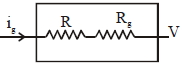
0 likesView Solution
83
PhysicsMediumMCQJEE Main · 2020
$A$ particle of mass $m$ and charge $q$ is released from rest in a uniform electric field. If there is no other force on the particle,the dependence of its speed $v$ on the distance $x$ travelled by it is correctly given by (graphs are schematic and not drawn to scale)
A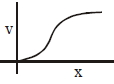
B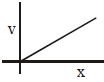
C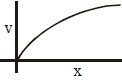
D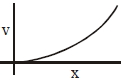
Solution
(C) The force on the particle in a uniform electric field $E$ is given by $F = qE$.
Using Newton's second law,the acceleration $a$ is $a = \frac{F}{m} = \frac{qE}{m}$.
Since the particle is released from rest,its initial velocity $u = 0$.
Using the kinematic equation $v^{2} = u^{2} + 2ax$,we substitute the values:
$v^{2} = 0 + 2 \left( \frac{qE}{m} \right) x$
$v^{2} = \left( \frac{2qE}{m} \right) x$
$v = \sqrt{\frac{2qE}{m}} \sqrt{x}$
This shows that $v \propto \sqrt{x}$.
The graph of $v$ versus $x$ for the relation $v = k \sqrt{x}$ (where $k$ is a constant) is a parabola opening along the $x$-axis,which corresponds to Graph $C$.
Using Newton's second law,the acceleration $a$ is $a = \frac{F}{m} = \frac{qE}{m}$.
Since the particle is released from rest,its initial velocity $u = 0$.
Using the kinematic equation $v^{2} = u^{2} + 2ax$,we substitute the values:
$v^{2} = 0 + 2 \left( \frac{qE}{m} \right) x$
$v^{2} = \left( \frac{2qE}{m} \right) x$
$v = \sqrt{\frac{2qE}{m}} \sqrt{x}$
This shows that $v \propto \sqrt{x}$.
The graph of $v$ versus $x$ for the relation $v = k \sqrt{x}$ (where $k$ is a constant) is a parabola opening along the $x$-axis,which corresponds to Graph $C$.
0 likesView Solution
84
PhysicsDifficultMCQJEE Main · 2020
As shown in the figure,a battery of $emf \; \varepsilon$ is connected to an inductor $L$ and resistance $R$ in series. The switch $S$ is closed at $t=0$. The total charge that flows from the battery between $t=0$ and $t=t_{c}$ ($t_{c}$ is the time constant of the circuit) is
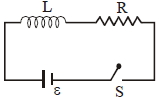
A
$\frac{\varepsilon L}{R^{2}}\left(1-\frac{1}{e}\right)$
B
$\frac{\varepsilon L}{e R^{2}}$
C
$\frac{\varepsilon L}{R^{2}}$
D
$\frac{\varepsilon R}{e L^{2}}$
Solution
(B) The current in an $LR$ circuit at time $t$ is given by $i(t) = \frac{\varepsilon}{R} (1 - e^{-Rt/L})$.
Let $T_c = \frac{L}{R}$ be the time constant. Then $i(t) = \frac{\varepsilon}{R} (1 - e^{-t/T_c})$.
The total charge $q$ flowing from $t=0$ to $t=T_c$ is given by the integral of current with respect to time:
$q = \int_{0}^{T_c} i(t) dt = \int_{0}^{T_c} \frac{\varepsilon}{R} (1 - e^{-t/T_c}) dt$
$q = \frac{\varepsilon}{R} \left[ t - \frac{e^{-t/T_c}}{-1/T_c} \right]_{0}^{T_c} = \frac{\varepsilon}{R} \left[ t + T_c e^{-t/T_c} \right]_{0}^{T_c}$
$q = \frac{\varepsilon}{R} \left[ (T_c + T_c e^{-1}) - (0 + T_c e^{0}) \right]$
$q = \frac{\varepsilon}{R} [T_c + T_c e^{-1} - T_c] = \frac{\varepsilon}{R} T_c e^{-1}$
Substituting $T_c = \frac{L}{R}$:
$q = \frac{\varepsilon}{R} \cdot \frac{L}{R} \cdot \frac{1}{e} = \frac{\varepsilon L}{e R^2}$.
Let $T_c = \frac{L}{R}$ be the time constant. Then $i(t) = \frac{\varepsilon}{R} (1 - e^{-t/T_c})$.
The total charge $q$ flowing from $t=0$ to $t=T_c$ is given by the integral of current with respect to time:
$q = \int_{0}^{T_c} i(t) dt = \int_{0}^{T_c} \frac{\varepsilon}{R} (1 - e^{-t/T_c}) dt$
$q = \frac{\varepsilon}{R} \left[ t - \frac{e^{-t/T_c}}{-1/T_c} \right]_{0}^{T_c} = \frac{\varepsilon}{R} \left[ t + T_c e^{-t/T_c} \right]_{0}^{T_c}$
$q = \frac{\varepsilon}{R} \left[ (T_c + T_c e^{-1}) - (0 + T_c e^{0}) \right]$
$q = \frac{\varepsilon}{R} [T_c + T_c e^{-1} - T_c] = \frac{\varepsilon}{R} T_c e^{-1}$
Substituting $T_c = \frac{L}{R}$:
$q = \frac{\varepsilon}{R} \cdot \frac{L}{R} \cdot \frac{1}{e} = \frac{\varepsilon L}{e R^2}$.
0 likesView Solution
85
PhysicsDifficultMCQJEE Main · 2020
$A$ capacitor is made of two square plates each of side $a$ making a very small angle $\alpha$ between them,as shown in figure. The capacitance will be close to
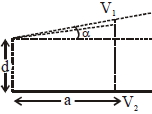
A
$\frac{\varepsilon_{0} a^{2}}{d}\left(1-\frac{3 \alpha a}{2 d}\right)$
B
$\frac{\varepsilon_{0} a^{2}}{d}\left(1-\frac{\alpha a}{4 d}\right)$
C
$\frac{\varepsilon_{0} a^{2}}{d}\left(1+\frac{\alpha a}{d}\right)$
D
$\frac{\varepsilon_{0} a^{2}}{d}\left(1-\frac{\alpha a}{2 d}\right)$
Solution
(D) Consider a small strip of width $dx$ at a distance $x$ from the left end. The separation between the plates at this distance $x$ is $d' = d + x\alpha$.
The capacitance of this small strip is $dC = \frac{\varepsilon_0 a dx}{d + x\alpha}$.
To find the total capacitance $C$,we integrate from $x = 0$ to $x = a$:
$C = \int_{0}^{a} \frac{\varepsilon_0 a dx}{d + x\alpha} = \frac{\varepsilon_0 a}{\alpha} [\ln(d + x\alpha)]_{0}^{a} = \frac{\varepsilon_0 a}{\alpha} \ln\left(\frac{d + a\alpha}{d}\right) = \frac{\varepsilon_0 a}{\alpha} \ln\left(1 + \frac{a\alpha}{d}\right)$.
Using the Taylor series expansion $\ln(1 + y) \approx y - \frac{y^2}{2}$ for small $y = \frac{a\alpha}{d}$:
$C \approx \frac{\varepsilon_0 a}{\alpha} \left(\frac{a\alpha}{d} - \frac{1}{2} \left(\frac{a\alpha}{d}\right)^2\right) = \frac{\varepsilon_0 a^2}{d} \left(1 - \frac{a\alpha}{2d}\right)$.
The capacitance of this small strip is $dC = \frac{\varepsilon_0 a dx}{d + x\alpha}$.
To find the total capacitance $C$,we integrate from $x = 0$ to $x = a$:
$C = \int_{0}^{a} \frac{\varepsilon_0 a dx}{d + x\alpha} = \frac{\varepsilon_0 a}{\alpha} [\ln(d + x\alpha)]_{0}^{a} = \frac{\varepsilon_0 a}{\alpha} \ln\left(\frac{d + a\alpha}{d}\right) = \frac{\varepsilon_0 a}{\alpha} \ln\left(1 + \frac{a\alpha}{d}\right)$.
Using the Taylor series expansion $\ln(1 + y) \approx y - \frac{y^2}{2}$ for small $y = \frac{a\alpha}{d}$:
$C \approx \frac{\varepsilon_0 a}{\alpha} \left(\frac{a\alpha}{d} - \frac{1}{2} \left(\frac{a\alpha}{d}\right)^2\right) = \frac{\varepsilon_0 a^2}{d} \left(1 - \frac{a\alpha}{2d}\right)$.
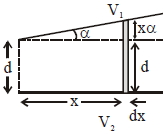
0 likesView Solution
86
PhysicsDifficultMCQJEE Main · 2020
$A$ very long wire $ABDMNDC$ is shown in the figure carrying current $I$. $AB$ and $BC$ parts are straight,long,and at a right angle. At $D$,the wire forms a circular turn $DMND$ of radius $R$. $AB$ and $BC$ parts are tangential to the circular turn at $N$ and $D$. The magnetic field at the centre of the circle is
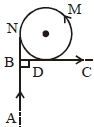
A
$\frac{\mu_{0} I}{2 R}$
B
$\frac{\mu_{0} I}{2 \pi R}(\pi+1)$
C
$\frac{\mu_{0} I}{2 \pi R}\left(\pi+\frac{1}{\sqrt{2}}\right)$
D
$\frac{\mu_{0} I}{2 \pi R}\left(\pi-\frac{1}{\sqrt{2}}\right)$
Solution
(B) The total magnetic field $B$ at the center is the vector sum of the fields produced by the three parts: the straight wire $AB$,the circular loop $DMND$,and the straight wire $BC$.
$1$. The magnetic field due to the straight wire $AB$ at the center of the circle (which is at a perpendicular distance $R$ from the line of $AB$): $B_{AB} = \frac{\mu_{0} I}{4 \pi R} (\sin 90^{\circ} + \sin 0^{\circ}) = \frac{\mu_{0} I}{4 \pi R}$.
$2$. The magnetic field due to the circular loop $DMND$ at its center: $B_{loop} = \frac{\mu_{0} I}{2 R}$.
$3$. The magnetic field due to the straight wire $BC$ at the center of the circle (which is at a perpendicular distance $R$ from the line of $BC$): $B_{BC} = \frac{\mu_{0} I}{4 \pi R} (\sin 90^{\circ} + \sin 0^{\circ}) = \frac{\mu_{0} I}{4 \pi R}$.
Since the current flows in the same sense for all parts,the magnetic fields add up:
$B = B_{AB} + B_{loop} + B_{BC} = \frac{\mu_{0} I}{4 \pi R} + \frac{\mu_{0} I}{2 R} + \frac{\mu_{0} I}{4 \pi R}$
$B = \frac{\mu_{0} I}{2 \pi R} + \frac{\mu_{0} I}{2 R} = \frac{\mu_{0} I}{2 \pi R} (1 + \pi)$.
$1$. The magnetic field due to the straight wire $AB$ at the center of the circle (which is at a perpendicular distance $R$ from the line of $AB$): $B_{AB} = \frac{\mu_{0} I}{4 \pi R} (\sin 90^{\circ} + \sin 0^{\circ}) = \frac{\mu_{0} I}{4 \pi R}$.
$2$. The magnetic field due to the circular loop $DMND$ at its center: $B_{loop} = \frac{\mu_{0} I}{2 R}$.
$3$. The magnetic field due to the straight wire $BC$ at the center of the circle (which is at a perpendicular distance $R$ from the line of $BC$): $B_{BC} = \frac{\mu_{0} I}{4 \pi R} (\sin 90^{\circ} + \sin 0^{\circ}) = \frac{\mu_{0} I}{4 \pi R}$.
Since the current flows in the same sense for all parts,the magnetic fields add up:
$B = B_{AB} + B_{loop} + B_{BC} = \frac{\mu_{0} I}{4 \pi R} + \frac{\mu_{0} I}{2 R} + \frac{\mu_{0} I}{4 \pi R}$
$B = \frac{\mu_{0} I}{2 \pi R} + \frac{\mu_{0} I}{2 R} = \frac{\mu_{0} I}{2 \pi R} (1 + \pi)$.
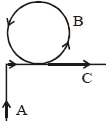
0 likesView Solution
87
PhysicsDifficultMCQJEE Main · 2020
An electron (mass $m$) with initial velocity $\overrightarrow{v} = v_{0} \hat{i} + v_{0} \hat{j}$ is in an electric field $\overrightarrow{E} = -E_{0} \hat{k}$. If $\lambda_{0}$ is the initial de-Broglie wavelength of the electron,its de-Broglie wavelength at time $t$ is given by:
A
$\frac{\lambda_{0} \sqrt{2}}{\sqrt{1 + \frac{e^{2} E_{0}^{2} t^{2}}{m^{2} v_{0}^{2}}}}$
B
$\frac{\lambda_{0}}{\sqrt{2 + \frac{e^{2} E_{0}^{2} t^{2}}{m^{2} v_{0}^{2}}}}$
C
$\frac{\lambda_{0}}{\sqrt{1 + \frac{e^{2} E_{0}^{2} t^{2}}{2 m^{2} v_{0}^{2}}}}$
D
$\frac{\lambda_{0}}{\sqrt{1 + \frac{e^{2} E_{0}^{2} t^{2}}{m^{2} v_{0}^{2}}}}$
Solution
(C) The initial velocity is $\overrightarrow{v} = v_{0} \hat{i} + v_{0} \hat{j}$. The initial speed is $v = \sqrt{v_{0}^{2} + v_{0}^{2}} = v_{0} \sqrt{2}$.
The initial de-Broglie wavelength is $\lambda_{0} = \frac{h}{m v_{0} \sqrt{2}} \implies h = \lambda_{0} m v_{0} \sqrt{2}$.
The electric field is $\overrightarrow{E} = -E_{0} \hat{k}$. The force on the electron is $\overrightarrow{F} = -e \overrightarrow{E} = e E_{0} \hat{k}$.
The acceleration is $\overrightarrow{a} = \frac{e E_{0}}{m} \hat{k}$.
At time $t$,the velocity is $\overrightarrow{v}(t) = v_{0} \hat{i} + v_{0} \hat{j} + \frac{e E_{0} t}{m} \hat{k}$.
The speed at time $t$ is $v(t) = \sqrt{v_{0}^{2} + v_{0}^{2} + \left(\frac{e E_{0} t}{m}\right)^{2}} = \sqrt{2 v_{0}^{2} + \frac{e^{2} E_{0}^{2} t^{2}}{m^{2}}}$.
The de-Broglie wavelength at time $t$ is $\lambda = \frac{h}{m v(t)} = \frac{\lambda_{0} m v_{0} \sqrt{2}}{m \sqrt{2 v_{0}^{2} + \frac{e^{2} E_{0}^{2} t^{2}}{m^{2}}}} = \frac{\lambda_{0} v_{0} \sqrt{2}}{\sqrt{2 v_{0}^{2} + \frac{e^{2} E_{0}^{2} t^{2}}{m^{2}}}} = \frac{\lambda_{0}}{\sqrt{1 + \frac{e^{2} E_{0}^{2} t^{2}}{2 m^{2} v_{0}^{2}}}}$.
The initial de-Broglie wavelength is $\lambda_{0} = \frac{h}{m v_{0} \sqrt{2}} \implies h = \lambda_{0} m v_{0} \sqrt{2}$.
The electric field is $\overrightarrow{E} = -E_{0} \hat{k}$. The force on the electron is $\overrightarrow{F} = -e \overrightarrow{E} = e E_{0} \hat{k}$.
The acceleration is $\overrightarrow{a} = \frac{e E_{0}}{m} \hat{k}$.
At time $t$,the velocity is $\overrightarrow{v}(t) = v_{0} \hat{i} + v_{0} \hat{j} + \frac{e E_{0} t}{m} \hat{k}$.
The speed at time $t$ is $v(t) = \sqrt{v_{0}^{2} + v_{0}^{2} + \left(\frac{e E_{0} t}{m}\right)^{2}} = \sqrt{2 v_{0}^{2} + \frac{e^{2} E_{0}^{2} t^{2}}{m^{2}}}$.
The de-Broglie wavelength at time $t$ is $\lambda = \frac{h}{m v(t)} = \frac{\lambda_{0} m v_{0} \sqrt{2}}{m \sqrt{2 v_{0}^{2} + \frac{e^{2} E_{0}^{2} t^{2}}{m^{2}}}} = \frac{\lambda_{0} v_{0} \sqrt{2}}{\sqrt{2 v_{0}^{2} + \frac{e^{2} E_{0}^{2} t^{2}}{m^{2}}}} = \frac{\lambda_{0}}{\sqrt{1 + \frac{e^{2} E_{0}^{2} t^{2}}{2 m^{2} v_{0}^{2}}}}$.
0 likesView Solution
88
PhysicsMediumMCQJEE Main · 2020
Consider two charged metallic spheres $S_{1}$ and $S_{2}$ of radii $R_{1}$ and $R_{2},$ respectively. The electric fields $E_{1}$ (on $S_{1}$) and $E_{2}$ (on $S_{2}$) on their surfaces are such that $E_{1} / E_{2} = R_{1} / R_{2}.$ Then the ratio $V_{1} / V_{2}$ of the electrostatic potentials on each sphere is:
A
$(R_{2} / R_{1})$
B
$(R_{1} / R_{2})^{3}$
C
$(R_{1} / R_{2})$
D
$(R_{1} / R_{2})^{2}$
Solution
(D) The electric field on the surface of a charged sphere is given by $E = \frac{KQ}{R^{2}}.$
Given $E_{1} = \frac{KQ_{1}}{R_{1}^{2}}$ and $E_{2} = \frac{KQ_{2}}{R_{2}^{2}}.$
According to the problem,$\frac{E_{1}}{E_{2}} = \frac{R_{1}}{R_{2}}.$
Substituting the expressions,we get $\frac{KQ_{1} / R_{1}^{2}}{KQ_{2} / R_{2}^{2}} = \frac{R_{1}}{R_{2}}.$
$\frac{Q_{1}}{Q_{2}} \cdot \frac{R_{2}^{2}}{R_{1}^{2}} = \frac{R_{1}}{R_{2}} \implies \frac{Q_{1}}{Q_{2}} = \frac{R_{1}^{3}}{R_{2}^{3}}.$
The electrostatic potential on the surface of a sphere is $V = \frac{KQ}{R}.$
Therefore,$\frac{V_{1}}{V_{2}} = \frac{KQ_{1} / R_{1}}{KQ_{2} / R_{2}} = \frac{Q_{1}}{Q_{2}} \cdot \frac{R_{2}}{R_{1}}.$
Substituting $\frac{Q_{1}}{Q_{2}} = \frac{R_{1}^{3}}{R_{2}^{3}},$ we get $\frac{V_{1}}{V_{2}} = \frac{R_{1}^{3}}{R_{2}^{3}} \cdot \frac{R_{2}}{R_{1}} = \frac{R_{1}^{2}}{R_{2}^{2}} = (R_{1} / R_{2})^{2}.$
Given $E_{1} = \frac{KQ_{1}}{R_{1}^{2}}$ and $E_{2} = \frac{KQ_{2}}{R_{2}^{2}}.$
According to the problem,$\frac{E_{1}}{E_{2}} = \frac{R_{1}}{R_{2}}.$
Substituting the expressions,we get $\frac{KQ_{1} / R_{1}^{2}}{KQ_{2} / R_{2}^{2}} = \frac{R_{1}}{R_{2}}.$
$\frac{Q_{1}}{Q_{2}} \cdot \frac{R_{2}^{2}}{R_{1}^{2}} = \frac{R_{1}}{R_{2}} \implies \frac{Q_{1}}{Q_{2}} = \frac{R_{1}^{3}}{R_{2}^{3}}.$
The electrostatic potential on the surface of a sphere is $V = \frac{KQ}{R}.$
Therefore,$\frac{V_{1}}{V_{2}} = \frac{KQ_{1} / R_{1}}{KQ_{2} / R_{2}} = \frac{Q_{1}}{Q_{2}} \cdot \frac{R_{2}}{R_{1}}.$
Substituting $\frac{Q_{1}}{Q_{2}} = \frac{R_{1}^{3}}{R_{2}^{3}},$ we get $\frac{V_{1}}{V_{2}} = \frac{R_{1}^{3}}{R_{2}^{3}} \cdot \frac{R_{2}}{R_{1}} = \frac{R_{1}^{2}}{R_{2}^{2}} = (R_{1} / R_{2})^{2}.$
0 likesView Solution
89
PhysicsDifficultMCQJEE Main · 2020
An object is gradually moving away from the focal point of a concave mirror along the axis of the mirror. The graphical representation of the magnitude of linear magnification $(m)$ versus distance of the object from the mirror $(x)$ is correctly given by
(Graphs are drawn schematically and are not to scale)
(Graphs are drawn schematically and are not to scale)
A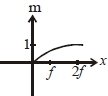
B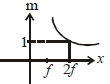
C
D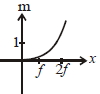
Solution
(C) For a concave mirror,the mirror formula is $\frac{1}{v} + \frac{1}{u} = \frac{1}{f}$.
Using the sign convention,$u = -x$,where $x$ is the distance of the object from the mirror $(x > 0)$.
Thus,$-\frac{1}{v} - \frac{1}{x} = -\frac{1}{f} \implies \frac{1}{v} = \frac{1}{f} - \frac{1}{x} = \frac{x-f}{fx} \implies v = \frac{fx}{x-f}$.
The linear magnification $m$ is given by $m = -\frac{v}{u} = -\frac{fx/(x-f)}{-x} = \frac{f}{x-f}$.
The magnitude of linear magnification is $|m| = \left| \frac{f}{x-f} \right|$.
As the object moves away from the focal point $(x = f)$ towards infinity $(x \to \infty)$:
$1$. At $x = f$,$|m| \to \infty$.
$2$. At $x = 2f$,$|m| = |f / (2f - f)| = 1$.
$3$. As $x \to \infty$,$|m| \to 0$.
Therefore,the graph must show $|m| \to \infty$ at $x = f$,$|m| = 1$ at $x = 2f$,and $|m| \to 0$ as $x \to \infty$. This corresponds to the graph shown in option $C$.
Using the sign convention,$u = -x$,where $x$ is the distance of the object from the mirror $(x > 0)$.
Thus,$-\frac{1}{v} - \frac{1}{x} = -\frac{1}{f} \implies \frac{1}{v} = \frac{1}{f} - \frac{1}{x} = \frac{x-f}{fx} \implies v = \frac{fx}{x-f}$.
The linear magnification $m$ is given by $m = -\frac{v}{u} = -\frac{fx/(x-f)}{-x} = \frac{f}{x-f}$.
The magnitude of linear magnification is $|m| = \left| \frac{f}{x-f} \right|$.
As the object moves away from the focal point $(x = f)$ towards infinity $(x \to \infty)$:
$1$. At $x = f$,$|m| \to \infty$.
$2$. At $x = 2f$,$|m| = |f / (2f - f)| = 1$.
$3$. As $x \to \infty$,$|m| \to 0$.
Therefore,the graph must show $|m| \to \infty$ at $x = f$,$|m| = 1$ at $x = 2f$,and $|m| \to 0$ as $x \to \infty$. This corresponds to the graph shown in option $C$.
0 likesView Solution
90
PhysicsMediumMCQJEE Main · 2020
In the given circuit,find the value of $Y$.
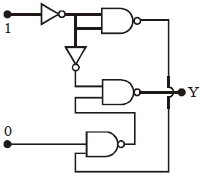
A
will not execute
B
$0$
C
toggles between $0$ and $1$
D
$1$
Solution
(D) Let the inputs be $A=1$ and $B=0$.
$1$. The input $A=1$ passes through a $NOT$ gate,becoming $0$.
$2$. This $0$ is fed into the top $NAND$ gate (both inputs are $0$),so the output of the top $NAND$ gate is $\overline{0 \cdot 0} = 1$.
$3$. The $0$ from the first $NOT$ gate also passes through another $NOT$ gate,becoming $1$.
$4$. This $1$ is fed into the middle $NAND$ gate.
$5$. The bottom $NAND$ gate has inputs $B=0$ and the feedback from $Y$.
$6$. Analyzing the circuit,the output $Y$ is connected to the output of the top and middle $NAND$ gates.
$7$. Given the configuration,the output $Y$ stabilizes at $1$.
$1$. The input $A=1$ passes through a $NOT$ gate,becoming $0$.
$2$. This $0$ is fed into the top $NAND$ gate (both inputs are $0$),so the output of the top $NAND$ gate is $\overline{0 \cdot 0} = 1$.
$3$. The $0$ from the first $NOT$ gate also passes through another $NOT$ gate,becoming $1$.
$4$. This $1$ is fed into the middle $NAND$ gate.
$5$. The bottom $NAND$ gate has inputs $B=0$ and the feedback from $Y$.
$6$. Analyzing the circuit,the output $Y$ is connected to the output of the top and middle $NAND$ gates.
$7$. Given the configuration,the output $Y$ stabilizes at $1$.
0 likesView Solution
91
PhysicsMediumMCQJEE Main · 2020
The first member of the Balmer series of a hydrogen atom has a wavelength of $6561 \; \mathring{A}$. The wavelength of the second member of the Balmer series (in $nm$) is
A
$256$
B
$540$
C
$486$
D
$626$
Solution
(C) For the Balmer series,the Rydberg formula is given by $\frac{1}{\lambda} = R_{H} \left( \frac{1}{2^{2}} - \frac{1}{n^{2}} \right)$,where $n = 3, 4, 5, \dots$
The first member corresponds to $n = 3$: $\frac{1}{\lambda_{1}} = R_{H} \left( \frac{1}{4} - \frac{1}{9} \right) = R_{H} \left( \frac{5}{36} \right)$.
The second member corresponds to $n = 4$: $\frac{1}{\lambda_{2}} = R_{H} \left( \frac{1}{4} - \frac{1}{16} \right) = R_{H} \left( \frac{3}{16} \right)$.
Taking the ratio: $\frac{\lambda_{2}}{\lambda_{1}} = \frac{5/36}{3/16} = \frac{5}{36} \times \frac{16}{3} = \frac{80}{108} = \frac{20}{27}$.
Given $\lambda_{1} = 6561 \; \mathring{A}$,we have $\lambda_{2} = \frac{20}{27} \times 6561 = 4860 \; \mathring{A}$.
Converting to nanometers: $4860 \; \mathring{A} = 486 \; nm$.
The first member corresponds to $n = 3$: $\frac{1}{\lambda_{1}} = R_{H} \left( \frac{1}{4} - \frac{1}{9} \right) = R_{H} \left( \frac{5}{36} \right)$.
The second member corresponds to $n = 4$: $\frac{1}{\lambda_{2}} = R_{H} \left( \frac{1}{4} - \frac{1}{16} \right) = R_{H} \left( \frac{3}{16} \right)$.
Taking the ratio: $\frac{\lambda_{2}}{\lambda_{1}} = \frac{5/36}{3/16} = \frac{5}{36} \times \frac{16}{3} = \frac{80}{108} = \frac{20}{27}$.
Given $\lambda_{1} = 6561 \; \mathring{A}$,we have $\lambda_{2} = \frac{20}{27} \times 6561 = 4860 \; \mathring{A}$.
Converting to nanometers: $4860 \; \mathring{A} = 486 \; nm$.
0 likesView Solution
92
PhysicsDifficultMCQJEE Main · 2020
The series combination of two batteries,both of the same emf $10 \; V,$ but different internal resistances of $20 \; \Omega$ and $5 \; \Omega,$ is connected to the parallel combination of two resistors $30 \; \Omega$ and $R \; \Omega.$ If the voltage difference across the battery of internal resistance $20 \; \Omega$ is zero,the value of $R$ (in $\Omega$) is:
A
$30$
B
$26$
C
$36$
D
$15$
Solution
(A) Let the current in the circuit be $i.$ The batteries are in series,so the total emf is $E_{eq} = 10 + 10 = 20 \; V$ and the total internal resistance is $r_{eq} = 20 + 5 = 25 \; \Omega.$
The voltage across the battery with internal resistance $20 \; \Omega$ is given by $V_1 = E - i r_1 = 10 - i(20).$
Given $V_1 = 0,$ we have $10 - 20i = 0,$ which gives $i = 0.5 \; A.$
The total external resistance $R_{ext}$ is the parallel combination of $30 \; \Omega$ and $R \; \Omega,$ so $R_{ext} = \frac{30R}{30+R}.$
Using Ohm's law for the whole circuit,$E_{eq} = i(R_{ext} + r_{eq}).$
$20 = 0.5 \left( \frac{30R}{30+R} + 25 \right).$
$40 = \frac{30R}{30+R} + 25.$
$15 = \frac{30R}{30+R}.$
$15(30+R) = 30R.$
$450 + 15R = 30R.$
$15R = 450 \implies R = 30 \; \Omega.$
The voltage across the battery with internal resistance $20 \; \Omega$ is given by $V_1 = E - i r_1 = 10 - i(20).$
Given $V_1 = 0,$ we have $10 - 20i = 0,$ which gives $i = 0.5 \; A.$
The total external resistance $R_{ext}$ is the parallel combination of $30 \; \Omega$ and $R \; \Omega,$ so $R_{ext} = \frac{30R}{30+R}.$
Using Ohm's law for the whole circuit,$E_{eq} = i(R_{ext} + r_{eq}).$
$20 = 0.5 \left( \frac{30R}{30+R} + 25 \right).$
$40 = \frac{30R}{30+R} + 25.$
$15 = \frac{30R}{30+R}.$
$15(30+R) = 30R.$
$450 + 15R = 30R.$
$15R = 450 \implies R = 30 \; \Omega.$
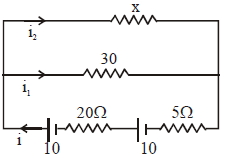
1 likesView Solution
93
PhysicsMediumMCQJEE Main · 2020
When a photon of energy $4.0 \; eV$ strikes the surface of a metal $A$,the ejected photoelectrons have maximum kinetic energy $T_{A} \; eV$ and de-Broglie wavelength $\lambda_{A}$. The maximum kinetic energy of photoelectrons liberated from another metal $B$ by a photon of energy $4.50 \; eV$ is $T_{B} = (T_{A} - 1.5) \; eV$. If the de-Broglie wavelength of these photoelectrons is $\lambda_{B} = 2 \lambda_{A}$,then the work function of metal $B$ is ............. $eV$.
A
$3$
B
$2$
C
$4$
D
$1.5$
Solution
(C) The de-Broglie wavelength is given by $\lambda = \frac{h}{p} = \frac{h}{\sqrt{2mK}}$,where $K$ is the kinetic energy.
Given $\lambda_{B} = 2 \lambda_{A}$,we have $\frac{h}{\sqrt{2m T_{B}}} = 2 \frac{h}{\sqrt{2m T_{A}}}$.
Squaring both sides,we get $\frac{1}{T_{B}} = \frac{4}{T_{A}}$,which implies $T_{A} = 4 T_{B}$.
We are given $T_{B} = T_{A} - 1.5$. Substituting $T_{A} = 4 T_{B}$,we get $T_{B} = 4 T_{B} - 1.5$.
This simplifies to $3 T_{B} = 1.5$,so $T_{B} = 0.5 \; eV$.
Using Einstein's photoelectric equation for metal $B$: $K_{max} = E - \phi_{B}$,where $E = 4.5 \; eV$.
$0.5 = 4.5 - \phi_{B}$.
Therefore,$\phi_{B} = 4.5 - 0.5 = 4.0 \; eV$.
Given $\lambda_{B} = 2 \lambda_{A}$,we have $\frac{h}{\sqrt{2m T_{B}}} = 2 \frac{h}{\sqrt{2m T_{A}}}$.
Squaring both sides,we get $\frac{1}{T_{B}} = \frac{4}{T_{A}}$,which implies $T_{A} = 4 T_{B}$.
We are given $T_{B} = T_{A} - 1.5$. Substituting $T_{A} = 4 T_{B}$,we get $T_{B} = 4 T_{B} - 1.5$.
This simplifies to $3 T_{B} = 1.5$,so $T_{B} = 0.5 \; eV$.
Using Einstein's photoelectric equation for metal $B$: $K_{max} = E - \phi_{B}$,where $E = 4.5 \; eV$.
$0.5 = 4.5 - \phi_{B}$.
Therefore,$\phi_{B} = 4.5 - 0.5 = 4.0 \; eV$.
0 likesView Solution
94
PhysicsMediumMCQJEE Main · 2020
The length of a potentiometer wire is $1200 \; cm$ and it carries a current of $60 \; mA$. For a cell of $emf \; 5 \; V$ and internal resistance of $20 \; \Omega$,the null point on it is found to be at $1000 \; cm$. The resistance of the whole wire is .............. $\Omega$.
A
$120$
B
$60$
C
$80$
D
$100$
Solution
(D) Let $L = 1200 \; cm = 12 \; m$ be the total length of the potentiometer wire.
Let $I = 60 \; mA = 0.06 \; A$ be the current flowing through the wire.
Let $R$ be the total resistance of the wire.
The potential drop across the entire wire is $V_{wire} = I \times R = 0.06 \times R$.
The potential gradient $\lambda$ is given by $\lambda = \frac{V_{wire}}{L} = \frac{0.06 \times R}{12} = 0.005 \times R \; V/cm$.
For a cell of $emf \; E = 5 \; V$,the null point is at $\ell = 1000 \; cm$.
The balance condition is $E = \lambda \times \ell$.
Substituting the values: $5 = (0.005 \times R) \times 1000$.
$5 = 5 \times R$.
Therefore,$R = 1 \; \Omega$ is incorrect based on the calculation; let's re-evaluate: $5 = \frac{0.06 \times R}{1200} \times 1000$.
$5 = \frac{0.06 \times R}{1.2} = 0.05 \times R$.
$R = \frac{5}{0.05} = 100 \; \Omega$.
Let $I = 60 \; mA = 0.06 \; A$ be the current flowing through the wire.
Let $R$ be the total resistance of the wire.
The potential drop across the entire wire is $V_{wire} = I \times R = 0.06 \times R$.
The potential gradient $\lambda$ is given by $\lambda = \frac{V_{wire}}{L} = \frac{0.06 \times R}{12} = 0.005 \times R \; V/cm$.
For a cell of $emf \; E = 5 \; V$,the null point is at $\ell = 1000 \; cm$.
The balance condition is $E = \lambda \times \ell$.
Substituting the values: $5 = (0.005 \times R) \times 1000$.
$5 = 5 \times R$.
Therefore,$R = 1 \; \Omega$ is incorrect based on the calculation; let's re-evaluate: $5 = \frac{0.06 \times R}{1200} \times 1000$.
$5 = \frac{0.06 \times R}{1.2} = 0.05 \times R$.
$R = \frac{5}{0.05} = 100 \; \Omega$.
0 likesView Solution
95
PhysicsMediumMCQJEE Main · 2020
$A$ proton with kinetic energy of $1 \; MeV$ moves from south to north. It experiences an acceleration of $10^{12} \; m/s^2$ due to an applied magnetic field (directed from west to east). The value of the magnetic field is: ....... $mT$ (Rest mass of proton is $1.6 \times 10^{-27} \; kg$)
A
$71$
B
$7.1$
C
$0.071$
D
$0.71$
Solution
(D) The force on a charged particle in a magnetic field is given by $F = qvB$. Since $F = ma$,we have $ma = qvB$,which implies $a = \frac{qvB}{m}$.
Given kinetic energy $K = \frac{1}{2}mv^2$,we find the velocity $v = \sqrt{\frac{2K}{m}}$.
Substituting $v$ into the acceleration formula: $a = \frac{qB}{m} \sqrt{\frac{2K}{m}} = \frac{qB \sqrt{2K}}{m^{3/2}}$.
Rearranging for $B$: $B = \frac{ma}{qv} = \frac{ma}{q \sqrt{2K/m}} = \frac{m^{3/2} a}{q \sqrt{2K}}$.
Given values: $m = 1.6 \times 10^{-27} \; kg$,$a = 10^{12} \; m/s^2$,$q = 1.6 \times 10^{-19} \; C$,$K = 1 \; MeV = 10^6 \times 1.6 \times 10^{-19} \; J = 1.6 \times 10^{-13} \; J$.
$B = \frac{(1.6 \times 10^{-27})^{3/2} \times 10^{12}}{1.6 \times 10^{-19} \times \sqrt{2 \times 1.6 \times 10^{-13}}} = \frac{(1.6 \times 10^{-27}) \times \sqrt{1.6 \times 10^{-27}} \times 10^{12}}{1.6 \times 10^{-19} \times \sqrt{3.2 \times 10^{-13}}} \approx 0.71 \times 10^{-3} \; T = 0.71 \; mT$.
Given kinetic energy $K = \frac{1}{2}mv^2$,we find the velocity $v = \sqrt{\frac{2K}{m}}$.
Substituting $v$ into the acceleration formula: $a = \frac{qB}{m} \sqrt{\frac{2K}{m}} = \frac{qB \sqrt{2K}}{m^{3/2}}$.
Rearranging for $B$: $B = \frac{ma}{qv} = \frac{ma}{q \sqrt{2K/m}} = \frac{m^{3/2} a}{q \sqrt{2K}}$.
Given values: $m = 1.6 \times 10^{-27} \; kg$,$a = 10^{12} \; m/s^2$,$q = 1.6 \times 10^{-19} \; C$,$K = 1 \; MeV = 10^6 \times 1.6 \times 10^{-19} \; J = 1.6 \times 10^{-13} \; J$.
$B = \frac{(1.6 \times 10^{-27})^{3/2} \times 10^{12}}{1.6 \times 10^{-19} \times \sqrt{2 \times 1.6 \times 10^{-13}}} = \frac{(1.6 \times 10^{-27}) \times \sqrt{1.6 \times 10^{-27}} \times 10^{12}}{1.6 \times 10^{-19} \times \sqrt{3.2 \times 10^{-13}}} \approx 0.71 \times 10^{-3} \; T = 0.71 \; mT$.
0 likesView Solution
96
PhysicsMediumMCQJEE Main · 2020
In finding the electric field using Gauss's Law,the formula $|\overrightarrow{E}| = \frac{q_{enc}}{\varepsilon_{0}|A|}$ is applicable. In the formula,$\varepsilon_{0}$ is the permittivity of free space,$A$ is the area of the Gaussian surface,and $q_{enc}$ is the charge enclosed by the Gaussian surface. The equation can be used in which of the following situations?
A
Only when the Gaussian surface is an equipotential surface.
B
Only when $|\overrightarrow{E}|$ is constant on the surface.
C
For any choice of Gaussian surface.
D
Only when the Gaussian surface is an equipotential surface and $|\overrightarrow{E}|$ is constant on the surface.
Solution
(D) Gauss's Law in integral form is given by $\oint \overrightarrow{E} \cdot d\overrightarrow{A} = \frac{q_{enc}}{\varepsilon_{0}}$.
To simplify this to the form $|\overrightarrow{E}| |A| = \frac{q_{enc}}{\varepsilon_{0}}$,we must ensure that the electric field magnitude $|\overrightarrow{E}|$ is constant over the surface and that the electric field vector $\overrightarrow{E}$ is parallel to the area vector $d\overrightarrow{A}$ at every point on the surface.
If $|\overrightarrow{E}|$ is constant and the surface is chosen such that $\overrightarrow{E}$ is always normal to the surface,then the surface is an equipotential surface.
Therefore,both conditions are required to pull $|\overrightarrow{E}|$ out of the integral.
To simplify this to the form $|\overrightarrow{E}| |A| = \frac{q_{enc}}{\varepsilon_{0}}$,we must ensure that the electric field magnitude $|\overrightarrow{E}|$ is constant over the surface and that the electric field vector $\overrightarrow{E}$ is parallel to the area vector $d\overrightarrow{A}$ at every point on the surface.
If $|\overrightarrow{E}|$ is constant and the surface is chosen such that $\overrightarrow{E}$ is always normal to the surface,then the surface is an equipotential surface.
Therefore,both conditions are required to pull $|\overrightarrow{E}|$ out of the integral.
0 likesView Solution
97
PhysicsMediumMCQJEE Main · 2020
The magnifying power of a telescope with tube length $60 \; cm$ is $5$. What is the focal length of its eyepiece in $cm$?
A
$30$
B
$40$
C
$20$
D
$10$
Solution
(D) The length of the telescope tube $L$ is given by the sum of the focal lengths of the objective lens $(f_o)$ and the eyepiece $(f_e)$: $L = f_o + f_e = 60 \; cm$.
The magnifying power $M$ of a telescope is given by the ratio of the focal lengths: $M = \frac{f_o}{f_e} = 5$.
From this,we get $f_o = 5 f_e$.
Substituting this into the tube length equation: $5 f_e + f_e = 60 \; cm$,which simplifies to $6 f_e = 60 \; cm$.
Therefore,the focal length of the eyepiece is $f_e = 10 \; cm$.
The magnifying power $M$ of a telescope is given by the ratio of the focal lengths: $M = \frac{f_o}{f_e} = 5$.
From this,we get $f_o = 5 f_e$.
Substituting this into the tube length equation: $5 f_e + f_e = 60 \; cm$,which simplifies to $6 f_e = 60 \; cm$.
Therefore,the focal length of the eyepiece is $f_e = 10 \; cm$.
0 likesView Solution
98
PhysicsMediumMCQJEE Main · 2020
The graph which depicts the results of the Rutherford gold foil experiment with $\alpha$-particles is:
$\theta$: Scattering angle
$Y$: Number of scattered $\alpha$-particles detected
(Plots are schematic and not to scale)
$\theta$: Scattering angle
$Y$: Number of scattered $\alpha$-particles detected
(Plots are schematic and not to scale)
A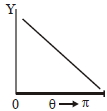
B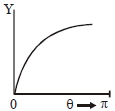
C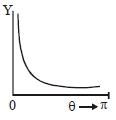
D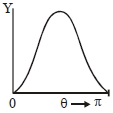
Solution
(C) According to the Rutherford scattering formula,the number of scattered $\alpha$-particles $N(\theta)$ detected at a scattering angle $\theta$ is given by:
$N(\theta) \propto \frac{1}{\sin^4(\theta/2)}$
As the scattering angle $\theta$ increases from $0$ to $\pi$,the value of $\sin(\theta/2)$ increases from $0$ to $1$.
Consequently,the term $\sin^4(\theta/2)$ increases from $0$ to $1$.
Therefore,the number of scattered particles $Y$ decreases very rapidly as $\theta$ increases.
This relationship is best represented by a graph where $Y$ is very large at small angles and drops sharply as $\theta$ increases,which corresponds to the curve shown in option $C$.
$N(\theta) \propto \frac{1}{\sin^4(\theta/2)}$
As the scattering angle $\theta$ increases from $0$ to $\pi$,the value of $\sin(\theta/2)$ increases from $0$ to $1$.
Consequently,the term $\sin^4(\theta/2)$ increases from $0$ to $1$.
Therefore,the number of scattered particles $Y$ decreases very rapidly as $\theta$ increases.
This relationship is best represented by a graph where $Y$ is very large at small angles and drops sharply as $\theta$ increases,which corresponds to the curve shown in option $C$.
0 likesView Solution
99
PhysicsMediumMCQJEE Main · 2020
The critical angle of a medium for a specific wavelength,if the medium has relative permittivity $3$ and relative permeability $\frac{4}{3}$ for this wavelength,will be.....$^o$
A
$60$
B
$15$
C
$45$
D
$30$
Solution
(D) The refractive index $\mu$ of a medium is given by $\mu = \sqrt{\epsilon_r \mu_r}$.
Given relative permittivity $\epsilon_r = 3$ and relative permeability $\mu_r = \frac{4}{3}$.
Therefore,$\mu = \sqrt{3 \times \frac{4}{3}} = \sqrt{4} = 2$.
The critical angle $\theta_C$ is given by $\sin \theta_C = \frac{1}{\mu}$.
Substituting the value of $\mu$,we get $\sin \theta_C = \frac{1}{2}$.
Thus,$\theta_C = 30^{\circ}$.
Given relative permittivity $\epsilon_r = 3$ and relative permeability $\mu_r = \frac{4}{3}$.
Therefore,$\mu = \sqrt{3 \times \frac{4}{3}} = \sqrt{4} = 2$.
The critical angle $\theta_C$ is given by $\sin \theta_C = \frac{1}{\mu}$.
Substituting the value of $\mu$,we get $\sin \theta_C = \frac{1}{2}$.
Thus,$\theta_C = 30^{\circ}$.
0 likesView Solution
100
PhysicsMediumMCQJEE Main · 2020
The Boolean relation at the output stage $Y$ for the following circuit is:
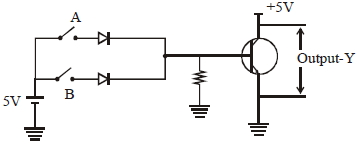
A
$A+B$
B
$\overline{A}+\overline{B}$
C
$\overline{A} \cdot \overline{B}$
D
$A \cdot B$
Solution
(C) The circuit consists of two switches $A$ and $B$ connected to diodes,which act as an $OR$ gate input stage. When either switch $A$ or $B$ is closed (logic $1$),the base of the $NPN$ transistor receives a high voltage,causing it to conduct. When the transistor conducts,the collector voltage drops to near $0 \ V$ (logic $0$). If both switches are open (logic $0$),the base is grounded through the resistor,the transistor is in cutoff $(OFF)$,and the output $Y$ is pulled up to $+5 \ V$ (logic $1$). This behavior corresponds to a $NOR$ gate,where $Y = \overline{A+B}$. According to De Morgan's theorem,$\overline{A+B} = \overline{A} \cdot \overline{B}$.
| $A$ | $B$ | $Y$ |
| $0$ | $0$ | $1$ |
| $1$ | $0$ | $0$ |
| $0$ | $1$ | $0$ |
| $1$ | $1$ | $0$ |
0 likesView Solution
Vedclass Products
For Students
Vedclass Test Series
Mock tests in real JEE Main style covering Physics with performance analysis. 5-day free trial.
Start Free TrialFor Teachers
Exam Paper Generator
Generate Set A/B/C/D Physics papers from 7.5L+ questions in 2 minutes. 3 chapters free.
Try FreeFor Institutes
Online Exam Module
Run live JEE Main mock exams with unlimited students, 360° analytics & white-label branding.
See DemoFrequently Asked Questions
How many Physics questions are in JEE Main 2020?
There are 399 Physics questions from the JEE Main 2020 paper on Vedclass, each with a detailed step-by-step solution in English.
Are JEE Main 2020 Physics solutions available in English?
Yes. All solutions on this page are in English. You can also switch to English or Hindi using the language buttons above the questions.
Can I practice JEE Main 2020 Physics as a timed test?
Yes. Use the Vedclass Test Series to attempt a full JEE Main mock test covering Physics with time limits and instant score analysis.
Can teachers create Physics papers from JEE Main previous year questions?
Yes. The Vedclass Exam Paper Generator lets teachers mix JEE Main Physics questions and generate Set A/B/C/D papers in minutes.
For Teachers & Institutes
Build a Custom Physics Paper
Pick JEE Main 2020 Physics questions, set difficulty, and generate Set A/B/C/D in 2 minutes.