
MathematicsQ1–100 of 781 questions
Page 1 of 9 · English
1
MathematicsDifficultMCQJEE Main · 2021
If $0 \le x \le \pi$ and $81^{\sin^2 x} + 81^{\cos^2 x} = 30$,then $x =$
A
$\pi /6$
B
$\pi /2$
C
$\pi /4$
D
$\pi /3$
Solution
(A) Given the equation: $81^{\sin^2 x} + 81^{\cos^2 x} = 30$.
Let $u = 81^{\sin^2 x}$. Since $\cos^2 x = 1 - \sin^2 x$,the equation becomes $u + 81^{1 - \sin^2 x} = 30$.
This simplifies to $u + \frac{81}{u} = 30$.
Multiplying by $u$,we get $u^2 - 30u + 81 = 0$.
Factoring the quadratic: $(u - 27)(u - 3) = 0$.
So,$u = 27$ or $u = 3$.
Case $1$: $81^{\sin^2 x} = 27 \implies (3^4)^{\sin^2 x} = 3^3 \implies 4 \sin^2 x = 3 \implies \sin^2 x = 3/4 \implies \sin x = \pm \sqrt{3}/2$.
For $0 \le x \le \pi$,$x = \pi/3$ or $x = 2\pi/3$.
Case $2$: $81^{\sin^2 x} = 3 \implies (3^4)^{\sin^2 x} = 3^1 \implies 4 \sin^2 x = 1 \implies \sin^2 x = 1/4 \implies \sin x = \pm 1/2$.
For $0 \le x \le \pi$,$x = \pi/6$ or $x = 5\pi/6$.
Checking the options,$\pi/6$ is the correct value.
Let $u = 81^{\sin^2 x}$. Since $\cos^2 x = 1 - \sin^2 x$,the equation becomes $u + 81^{1 - \sin^2 x} = 30$.
This simplifies to $u + \frac{81}{u} = 30$.
Multiplying by $u$,we get $u^2 - 30u + 81 = 0$.
Factoring the quadratic: $(u - 27)(u - 3) = 0$.
So,$u = 27$ or $u = 3$.
Case $1$: $81^{\sin^2 x} = 27 \implies (3^4)^{\sin^2 x} = 3^3 \implies 4 \sin^2 x = 3 \implies \sin^2 x = 3/4 \implies \sin x = \pm \sqrt{3}/2$.
For $0 \le x \le \pi$,$x = \pi/3$ or $x = 2\pi/3$.
Case $2$: $81^{\sin^2 x} = 3 \implies (3^4)^{\sin^2 x} = 3^1 \implies 4 \sin^2 x = 1 \implies \sin^2 x = 1/4 \implies \sin x = \pm 1/2$.
For $0 \le x \le \pi$,$x = \pi/6$ or $x = 5\pi/6$.
Checking the options,$\pi/6$ is the correct value.
0 likesView Solution
2
MathematicsDifficultMCQJEE Main · 2021
The number of elements in the set $\{x \in R : (|x|-3)|x+4|=6\}$ is equal to
A
$3$
B
$2$
C
$4$
D
$1$
Solution
(B) To find the number of elements in the set,we solve the equation $(|x|-3)|x+4|=6$.
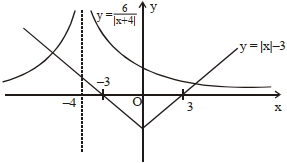
Let $f(x) = |x|-3$ and $g(x) = \frac{6}{|x+4|}$.
We look for the number of intersection points of the graphs of $y = |x|-3$ and $y = \frac{6}{|x+4|}$.
The graph of $y = |x|-3$ is a $V$-shaped curve with its vertex at $(0, -3)$ and x-intercepts at $x = 3$ and $x = -3$.
The graph of $y = \frac{6}{|x+4|}$ is a hyperbola-like curve with a vertical asymptote at $x = -4$ and it is always positive.
By observing the graphs,the curve $y = |x|-3$ intersects $y = \frac{6}{|x+4|}$ at two distinct points: one in the interval $(3, \infty)$ and one in the interval $(-\infty, -4)$.
Therefore,the number of elements in the set is $2$.
Let $f(x) = |x|-3$ and $g(x) = \frac{6}{|x+4|}$.
We look for the number of intersection points of the graphs of $y = |x|-3$ and $y = \frac{6}{|x+4|}$.
The graph of $y = |x|-3$ is a $V$-shaped curve with its vertex at $(0, -3)$ and x-intercepts at $x = 3$ and $x = -3$.
The graph of $y = \frac{6}{|x+4|}$ is a hyperbola-like curve with a vertical asymptote at $x = -4$ and it is always positive.
By observing the graphs,the curve $y = |x|-3$ intersects $y = \frac{6}{|x+4|}$ at two distinct points: one in the interval $(3, \infty)$ and one in the interval $(-\infty, -4)$.
Therefore,the number of elements in the set is $2$.
0 likesView Solution
3
MathematicsDifficultMCQJEE Main · 2021
If for $x \in \left(0, \frac{\pi}{2}\right)$,$\log_{10} \sin x + \log_{10} \cos x = -1$ and $\log_{10}(\sin x + \cos x) = \frac{1}{2}(\log_{10} n - 1)$,$n > 0$,then the value of $n$ is equal to
A
$20$
B
$12$
C
$9$
D
$16$
Solution
(B) Given $x \in \left(0, \frac{\pi}{2}\right)$.
From the first equation: $\log_{10} \sin x + \log_{10} \cos x = -1$
$\Rightarrow \log_{10}(\sin x \cos x) = -1$
$\Rightarrow \sin x \cos x = 10^{-1} = \frac{1}{10} \quad ....(1)$
From the second equation: $\log_{10}(\sin x + \cos x) = \frac{1}{2}(\log_{10} n - \log_{10} 10) = \frac{1}{2} \log_{10} \left(\frac{n}{10}\right) = \log_{10} \sqrt{\frac{n}{10}}$
$\Rightarrow \sin x + \cos x = \sqrt{\frac{n}{10}}$
Squaring both sides:
$(\sin x + \cos x)^2 = \frac{n}{10}$
$\sin^2 x + \cos^2 x + 2 \sin x \cos x = \frac{n}{10}$
$1 + 2 \left(\frac{1}{10}\right) = \frac{n}{10}$
$1 + \frac{1}{5} = \frac{n}{10}$
$\frac{6}{5} = \frac{n}{10}$
$n = \frac{6 \times 10}{5} = 12$.
From the first equation: $\log_{10} \sin x + \log_{10} \cos x = -1$
$\Rightarrow \log_{10}(\sin x \cos x) = -1$
$\Rightarrow \sin x \cos x = 10^{-1} = \frac{1}{10} \quad ....(1)$
From the second equation: $\log_{10}(\sin x + \cos x) = \frac{1}{2}(\log_{10} n - \log_{10} 10) = \frac{1}{2} \log_{10} \left(\frac{n}{10}\right) = \log_{10} \sqrt{\frac{n}{10}}$
$\Rightarrow \sin x + \cos x = \sqrt{\frac{n}{10}}$
Squaring both sides:
$(\sin x + \cos x)^2 = \frac{n}{10}$
$\sin^2 x + \cos^2 x + 2 \sin x \cos x = \frac{n}{10}$
$1 + 2 \left(\frac{1}{10}\right) = \frac{n}{10}$
$1 + \frac{1}{5} = \frac{n}{10}$
$\frac{6}{5} = \frac{n}{10}$
$n = \frac{6 \times 10}{5} = 12$.
0 likesView Solution
4
MathematicsDifficultMCQJEE Main · 2021
If the three normals drawn to the parabola $y^{2} = 2x$ pass through the point $(a, 0)$ where $a \neq 0$,then $a$ must be greater than:
A
$1/2$
B
$-1/2$
C
$-1$
D
$1$
Solution
(D) The equation of the parabola is $y^{2} = 2x$. Comparing this with $y^{2} = 4Ax$,we get $4A = 2$,so $A = 1/2$.
For a parabola $y^{2} = 4Ax$,the normal at any point $(x_{1}, y_{1})$ passes through $(a, 0)$ if $a > 2A$.
Substituting the value of $A$:
$a > 2 \times (1/2)$
$a > 1$.
Thus,for three distinct normals to pass through the point $(a, 0)$,$a$ must be greater than $1$.
For a parabola $y^{2} = 4Ax$,the normal at any point $(x_{1}, y_{1})$ passes through $(a, 0)$ if $a > 2A$.
Substituting the value of $A$:
$a > 2 \times (1/2)$
$a > 1$.
Thus,for three distinct normals to pass through the point $(a, 0)$,$a$ must be greater than $1$.
0 likesView Solution
5
MathematicsMediumMCQJEE Main · 2021
Which of the following Boolean expressions is a tautology?
A
$(p \wedge q) \vee (p \vee q)$
B
$(p \wedge q) \vee (p \rightarrow q)$
C
$(p \wedge q) \wedge (p \rightarrow q)$
D
$(p \wedge q)$ $\rightarrow (p$ $\rightarrow q)$
Solution
(D) tautology is a statement that is true for all possible truth values of its components. We evaluate the truth table for the expression $(p \wedge q)$ $\rightarrow (p$ $\rightarrow q)$:
Since the final column contains only $T$ (True),the expression $(p \wedge q)$ $\rightarrow (p$ $\rightarrow q)$ is a tautology.
| $p$ | $q$ | $p \wedge q$ | $p \rightarrow q$ | $(p \wedge q)$ $\rightarrow (p$ $\rightarrow q)$ |
|---|---|---|---|---|
| $T$ | $T$ | $T$ | $T$ | $T$ |
| $T$ | $F$ | $F$ | $F$ | $T$ |
| $F$ | $T$ | $F$ | $T$ | $T$ |
| $F$ | $F$ | $F$ | $T$ | $T$ |
Since the final column contains only $T$ (True),the expression $(p \wedge q)$ $\rightarrow (p$ $\rightarrow q)$ is a tautology.
0 likesView Solution
6
MathematicsDifficultMCQJEE Main · 2021
Let a complex number $z$,$|z| \neq 1$,satisfy $\log_{\frac{1}{\sqrt{2}}} \left( \frac{|z|+11}{(|z|-1)^2} \right) \leq 2$. Then,the largest value of $|z|$ is equal to ............
A
$8$
B
$7$
C
$6$
D
$5$
Solution
(B) Given the inequality: $\log_{\frac{1}{\sqrt{2}}} \left( \frac{|z|+11}{(|z|-1)^2} \right) \leq 2$.
Since the base $\frac{1}{\sqrt{2}} < 1$,the inequality sign reverses when removing the logarithm:
$\frac{|z|+11}{(|z|-1)^2} \geq \left( \frac{1}{\sqrt{2}} \right)^2 = \frac{1}{2}$.
Cross-multiplying (since $(|z|-1)^2 > 0$ for $|z| \neq 1$):
$2(|z|+11) \geq (|z|-1)^2$.
$2|z| + 22 \geq |z|^2 - 2|z| + 1$.
Rearranging the terms:
$|z|^2 - 4|z| - 21 \leq 0$.
Factoring the quadratic expression:
$(|z|-7)(|z|+3) \leq 0$.
Since $|z| \geq 0$,we have $|z|+3 > 0$,so $|z|-7 \leq 0$,which implies $|z| \leq 7$.
Given $|z| \neq 1$,the largest value of $|z|$ is $7$.
Since the base $\frac{1}{\sqrt{2}} < 1$,the inequality sign reverses when removing the logarithm:
$\frac{|z|+11}{(|z|-1)^2} \geq \left( \frac{1}{\sqrt{2}} \right)^2 = \frac{1}{2}$.
Cross-multiplying (since $(|z|-1)^2 > 0$ for $|z| \neq 1$):
$2(|z|+11) \geq (|z|-1)^2$.
$2|z| + 22 \geq |z|^2 - 2|z| + 1$.
Rearranging the terms:
$|z|^2 - 4|z| - 21 \leq 0$.
Factoring the quadratic expression:
$(|z|-7)(|z|+3) \leq 0$.
Since $|z| \geq 0$,we have $|z|+3 > 0$,so $|z|-7 \leq 0$,which implies $|z| \leq 7$.
Given $|z| \neq 1$,the largest value of $|z|$ is $7$.
0 likesView Solution
7
MathematicsDifficultMCQJEE Main · 2021
If $n$ is the number of irrational terms in the expansion of $(3^{1/4} + 5^{1/8})^{60}$,then $(n - 1)$ is divisible by
A
$26$
B
$30$
C
$8$
D
$7$
Solution
(A) The general term in the expansion of $(3^{1/4} + 5^{1/8})^{60}$ is given by $T_{r+1} = {}^{60}C_r (3^{1/4})^{60-r} (5^{1/8})^r = {}^{60}C_r (3)^{(60-r)/4} (5)^{r/8}$.
For the term to be rational,the exponents of $3$ and $5$ must be integers.
Thus,$r$ must be a multiple of $8$ such that $0 \leq r \leq 60$.
The possible values for $r$ are $0, 8, 16, 24, 32, 40, 48, 56$.
There are $8$ rational terms.
The total number of terms in the expansion is $60 + 1 = 61$.
Therefore,the number of irrational terms $n = 61 - 8 = 53$.
We need to check divisibility for $(n - 1) = 53 - 1 = 52$.
Since $52 = 26 \times 2$,$(n - 1)$ is divisible by $26$.
For the term to be rational,the exponents of $3$ and $5$ must be integers.
Thus,$r$ must be a multiple of $8$ such that $0 \leq r \leq 60$.
The possible values for $r$ are $0, 8, 16, 24, 32, 40, 48, 56$.
There are $8$ rational terms.
The total number of terms in the expansion is $60 + 1 = 61$.
Therefore,the number of irrational terms $n = 61 - 8 = 53$.
We need to check divisibility for $(n - 1) = 53 - 1 = 52$.
Since $52 = 26 \times 2$,$(n - 1)$ is divisible by $26$.
0 likesView Solution
8
MathematicsAdvancedMCQJEE Main · 2021
Let $[x]$ denote the greatest integer less than or equal to $x$. If for $n \in N$,$(1-x+x^3)^n = \sum_{j=0}^{3n} a_j x^j$,then $\sum_{j=0}^{[\frac{3n}{2}]} a_{2j} + 4 \sum_{j=0}^{[\frac{3n-1}{2}]} a_{2j+1}$ is equal to
A
$2$
B
$2^{n-1}$
C
$1$
D
$n$
0 likesView Solution
9
MathematicsDifficultMCQJEE Main · 2021
The locus of the midpoints of the chord of the circle $x^{2}+y^{2}=25$ which is tangent to the hyperbola $\frac{x^{2}}{9}-\frac{y^{2}}{16}=1$ is
A
$\left(x^{2}+y^{2}\right)^{2}-16x^{2}+9y^{2}=0$
B
$\left(x^{2}+y^{2}\right)^{2}-9x^{2}+144y^{2}=0$
C
$\left(x^{2}+y^{2}\right)^{2}-9x^{2}-16y^{2}=0$
D
$\left(x^{2}+y^{2}\right)^{2}-9x^{2}+16y^{2}=0$
Solution
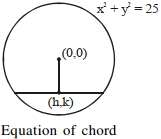
(D) Let the midpoint of the chord be $(h, k)$.
The equation of the chord of the circle $x^{2}+y^{2}=25$ with midpoint $(h, k)$ is given by $T=S_1$,which is $xh+yk=h^{2}+k^{2}$.
This can be rewritten as $y = -\frac{h}{k}x + \frac{h^{2}+k^{2}}{k}$.
This line is tangent to the hyperbola $\frac{x^{2}}{9}-\frac{y^{2}}{16}=1$.
The condition for the line $y=mx+c$ to be a tangent to the hyperbola $\frac{x^{2}}{a^{2}}-\frac{y^{2}}{b^{2}}=1$ is $c^{2}=a^{2}m^{2}-b^{2}$.
Here,$m=-\frac{h}{k}$ and $c=\frac{h^{2}+k^{2}}{k}$,$a^{2}=9$,$b^{2}=16$.
Substituting these values into the condition: $\left(\frac{h^{2}+k^{2}}{k}\right)^{2} = 9\left(-\frac{h}{k}\right)^{2} - 16$.
$\frac{(h^{2}+k^{2})^{2}}{k^{2}} = \frac{9h^{2}}{k^{2}} - 16$.
$(h^{2}+k^{2})^{2} = 9h^{2} - 16k^{2}$.
Replacing $(h, k)$ with $(x, y)$,the locus is $(x^{2}+y^{2})^{2} = 9x^{2}-16y^{2}$,or $(x^{2}+y^{2})^{2}-9x^{2}+16y^{2}=0$.
The equation of the chord of the circle $x^{2}+y^{2}=25$ with midpoint $(h, k)$ is given by $T=S_1$,which is $xh+yk=h^{2}+k^{2}$.
This can be rewritten as $y = -\frac{h}{k}x + \frac{h^{2}+k^{2}}{k}$.
This line is tangent to the hyperbola $\frac{x^{2}}{9}-\frac{y^{2}}{16}=1$.
The condition for the line $y=mx+c$ to be a tangent to the hyperbola $\frac{x^{2}}{a^{2}}-\frac{y^{2}}{b^{2}}=1$ is $c^{2}=a^{2}m^{2}-b^{2}$.
Here,$m=-\frac{h}{k}$ and $c=\frac{h^{2}+k^{2}}{k}$,$a^{2}=9$,$b^{2}=16$.
Substituting these values into the condition: $\left(\frac{h^{2}+k^{2}}{k}\right)^{2} = 9\left(-\frac{h}{k}\right)^{2} - 16$.
$\frac{(h^{2}+k^{2})^{2}}{k^{2}} = \frac{9h^{2}}{k^{2}} - 16$.
$(h^{2}+k^{2})^{2} = 9h^{2} - 16k^{2}$.
Replacing $(h, k)$ with $(x, y)$,the locus is $(x^{2}+y^{2})^{2} = 9x^{2}-16y^{2}$,or $(x^{2}+y^{2})^{2}-9x^{2}+16y^{2}=0$.
0 likesView Solution
10
MathematicsMediumMCQJEE Main · 2021
The number of roots of the equation $(81)^{\sin ^{2} x} + (81)^{\cos ^{2} x} = 30$ in the interval $[0, \pi]$ is equal to
A
$3$
B
$4$
C
$8$
D
$2$
Solution
(B) Given equation: $(81)^{\sin ^{2} x} + (81)^{\cos ^{2} x} = 30$.
Since $\cos ^{2} x = 1 - \sin ^{2} x$,we have $(81)^{\sin ^{2} x} + (81)^{1 - \sin ^{2} x} = 30$.
$(81)^{\sin ^{2} x} + \frac{81}{(81)^{\sin ^{2} x}} = 30$.
Let $t = (81)^{\sin ^{2} x}$. Then $t + \frac{81}{t} = 30$,which implies $t^{2} - 30t + 81 = 0$.
$(t - 3)(t - 27) = 0$,so $t = 3$ or $t = 27$.
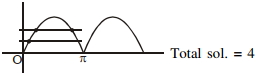
Case $1$: $(81)^{\sin ^{2} x} = 3 \implies 3^{4 \sin ^{2} x} = 3^{1} \implies 4 \sin ^{2} x = 1 \implies \sin ^{2} x = \frac{1}{4}$.
In $[0, \pi]$,$\sin x = \frac{1}{2}$ or $\sin x = -\frac{1}{2}$. Since $\sin x \ge 0$ in $[0, \pi]$,$\sin x = \frac{1}{2}$ gives $x = \frac{\pi}{6}, \frac{5\pi}{6}$ ($2$ solutions).
Case $2$: $(81)^{\sin ^{2} x} = 27 \implies 3^{4 \sin ^{2} x} = 3^{3} \implies 4 \sin ^{2} x = 3 \implies \sin ^{2} x = \frac{3}{4}$.
In $[0, \pi]$,$\sin x = \frac{\sqrt{3}}{2}$ or $\sin x = -\frac{\sqrt{3}}{2}$. Since $\sin x \ge 0$ in $[0, \pi]$,$\sin x = \frac{\sqrt{3}}{2}$ gives $x = \frac{\pi}{3}, \frac{2\pi}{3}$ ($2$ solutions).
Total number of solutions = $2 + 2 = 4$.
Since $\cos ^{2} x = 1 - \sin ^{2} x$,we have $(81)^{\sin ^{2} x} + (81)^{1 - \sin ^{2} x} = 30$.
$(81)^{\sin ^{2} x} + \frac{81}{(81)^{\sin ^{2} x}} = 30$.
Let $t = (81)^{\sin ^{2} x}$. Then $t + \frac{81}{t} = 30$,which implies $t^{2} - 30t + 81 = 0$.
$(t - 3)(t - 27) = 0$,so $t = 3$ or $t = 27$.
Case $1$: $(81)^{\sin ^{2} x} = 3 \implies 3^{4 \sin ^{2} x} = 3^{1} \implies 4 \sin ^{2} x = 1 \implies \sin ^{2} x = \frac{1}{4}$.
In $[0, \pi]$,$\sin x = \frac{1}{2}$ or $\sin x = -\frac{1}{2}$. Since $\sin x \ge 0$ in $[0, \pi]$,$\sin x = \frac{1}{2}$ gives $x = \frac{\pi}{6}, \frac{5\pi}{6}$ ($2$ solutions).
Case $2$: $(81)^{\sin ^{2} x} = 27 \implies 3^{4 \sin ^{2} x} = 3^{3} \implies 4 \sin ^{2} x = 3 \implies \sin ^{2} x = \frac{3}{4}$.
In $[0, \pi]$,$\sin x = \frac{\sqrt{3}}{2}$ or $\sin x = -\frac{\sqrt{3}}{2}$. Since $\sin x \ge 0$ in $[0, \pi]$,$\sin x = \frac{\sqrt{3}}{2}$ gives $x = \frac{\pi}{3}, \frac{2\pi}{3}$ ($2$ solutions).
Total number of solutions = $2 + 2 = 4$.
0 likesView Solution
11
MathematicsMediumMCQJEE Main · 2021
Consider an arithmetic series and a geometric series having four initial terms from the set $\{11, 8, 21, 16, 26, 32, 4\}$. If the last terms of these series are the maximum possible four-digit numbers,then the number of common terms in these two series is equal to .......
A
$3$
B
$1$
C
$2$
D
$4$
Solution
(A) The geometric series $(GP)$ must start with $4$ and have a common ratio $r = 2$,so the terms are $4, 8, 16, 32, 64, 128, 256, 512, 1024, 2048, 4096, 8192$. The next term $16384$ is a five-digit number.
The arithmetic series $(AP)$ must start with $11$ and have a common difference $d = 5$ (since $16-11=5, 21-16=5, 26-21=5$),so the terms are $11, 16, 21, 26, 31, \dots, a_n = 11 + (n-1)5$.
We look for terms in the $GP$ that are also in the $AP$. $A$ term $x$ is in the $AP$ if $x \equiv 11 \pmod{5}$,which is equivalent to $x \equiv 1 \pmod{5}$.
Checking the $GP$ terms:
$4 \equiv 4 \pmod{5}$
$8 \equiv 3 \pmod{5}$
$16 \equiv 1 \pmod{5}$ (Common)
$32 \equiv 2 \pmod{5}$
$64 \equiv 4 \pmod{5}$
$128 \equiv 3 \pmod{5}$
$256 \equiv 1 \pmod{5}$ (Common)
$512 \equiv 2 \pmod{5}$
$1024 \equiv 4 \pmod{5}$
$2048 \equiv 3 \pmod{5}$
$4096 \equiv 1 \pmod{5}$ (Common)
$8192 \equiv 2 \pmod{5}$
The common terms are $16, 256, 4096$. There are $3$ such terms.
The arithmetic series $(AP)$ must start with $11$ and have a common difference $d = 5$ (since $16-11=5, 21-16=5, 26-21=5$),so the terms are $11, 16, 21, 26, 31, \dots, a_n = 11 + (n-1)5$.
We look for terms in the $GP$ that are also in the $AP$. $A$ term $x$ is in the $AP$ if $x \equiv 11 \pmod{5}$,which is equivalent to $x \equiv 1 \pmod{5}$.
Checking the $GP$ terms:
$4 \equiv 4 \pmod{5}$
$8 \equiv 3 \pmod{5}$
$16 \equiv 1 \pmod{5}$ (Common)
$32 \equiv 2 \pmod{5}$
$64 \equiv 4 \pmod{5}$
$128 \equiv 3 \pmod{5}$
$256 \equiv 1 \pmod{5}$ (Common)
$512 \equiv 2 \pmod{5}$
$1024 \equiv 4 \pmod{5}$
$2048 \equiv 3 \pmod{5}$
$4096 \equiv 1 \pmod{5}$ (Common)
$8192 \equiv 2 \pmod{5}$
The common terms are $16, 256, 4096$. There are $3$ such terms.
0 likesView Solution
12
MathematicsDifficultMCQJEE Main · 2021
Let $ABCD$ be a square of side length $1$. $A$ circle $C_{1}$ centered at $A$ with unit radius is drawn. Another circle $C_{2}$ which touches $C_{1}$ and is tangent to the lines $AD$ and $AB$ is also drawn. Let a tangent line from the point $C$ to the circle $C_{2}$ meet the side $AB$ at $E$. If the length of $EB$ is $\alpha+\sqrt{3} \beta,$ where $\alpha, \beta$ are integers,then $\alpha+\beta$ is equal to.........
A
$2$
B
$3$
C
$1$
D
$5$
Solution
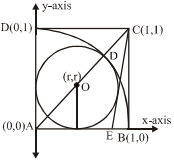
(C) Let the square $ABCD$ have vertices $A(0,0)$,$B(1,0)$,$C(1,1)$,and $D(0,1)$.
The circle $C_{1}$ is centered at $A(0,0)$ with radius $1$,so its equation is $x^2 + y^2 = 1$.
Let the circle $C_{2}$ have center $(r,r)$ and radius $r$ because it is tangent to $AD$ $(x=0)$ and $AB$ $(y=0)$.
Since $C_{2}$ touches $C_{1}$ externally,the distance between their centers is the sum of their radii: $\sqrt{r^2 + r^2} = 1 + r$.
$\sqrt{2}r = 1 + r \Rightarrow r(\sqrt{2}-1) = 1 \Rightarrow r = \frac{1}{\sqrt{2}-1} = \sqrt{2}+1$. However,the circle is inside the square,so $r = \sqrt{2}-1$.
The equation of $C_{2}$ is $(x-r)^2 + (y-r)^2 = r^2$ with $r = \sqrt{2}-1$.
$A$ line passing through $C(1,1)$ with slope $m$ is $y-1 = m(x-1)$,or $mx - y + (1-m) = 0$.
Since this line is tangent to $C_{2}$,the perpendicular distance from $(r,r)$ to the line equals $r$:
$\frac{|mr - r + 1 - m|}{\sqrt{m^2+1}} = r \Rightarrow |(m-1)(r-1) + 1| = r\sqrt{m^2+1}$.
Substituting $r = \sqrt{2}-1$,we have $r-1 = \sqrt{2}-2$.
$|(m-1)(\sqrt{2}-2) + 1| = (\sqrt{2}-1)\sqrt{m^2+1}$.
Squaring both sides and solving for $m$ gives $m = 2 \pm \sqrt{3}$.
For the tangent to meet $AB$ at $E$ between $A$ and $B$,we choose $m = -(2+\sqrt{3})$ or similar based on geometry. Using $y-1 = m(x-1)$ and setting $y=0$,we get $x = 1 - \frac{1}{m}$.
For $m = -(2+\sqrt{3})$,$x = 1 - \frac{1}{-(2+\sqrt{3})} = 1 + (2-\sqrt{3}) = 3-\sqrt{3}$.
$EB = 1 - x = 1 - (3-\sqrt{3}) = \sqrt{3}-2$ (not matching form). Using the other tangent,$EB = 2-\sqrt{3}$.
Thus $\alpha = 2, \beta = -1$. $\alpha+\beta = 2-1 = 1$.
The circle $C_{1}$ is centered at $A(0,0)$ with radius $1$,so its equation is $x^2 + y^2 = 1$.
Let the circle $C_{2}$ have center $(r,r)$ and radius $r$ because it is tangent to $AD$ $(x=0)$ and $AB$ $(y=0)$.
Since $C_{2}$ touches $C_{1}$ externally,the distance between their centers is the sum of their radii: $\sqrt{r^2 + r^2} = 1 + r$.
$\sqrt{2}r = 1 + r \Rightarrow r(\sqrt{2}-1) = 1 \Rightarrow r = \frac{1}{\sqrt{2}-1} = \sqrt{2}+1$. However,the circle is inside the square,so $r = \sqrt{2}-1$.
The equation of $C_{2}$ is $(x-r)^2 + (y-r)^2 = r^2$ with $r = \sqrt{2}-1$.
$A$ line passing through $C(1,1)$ with slope $m$ is $y-1 = m(x-1)$,or $mx - y + (1-m) = 0$.
Since this line is tangent to $C_{2}$,the perpendicular distance from $(r,r)$ to the line equals $r$:
$\frac{|mr - r + 1 - m|}{\sqrt{m^2+1}} = r \Rightarrow |(m-1)(r-1) + 1| = r\sqrt{m^2+1}$.
Substituting $r = \sqrt{2}-1$,we have $r-1 = \sqrt{2}-2$.
$|(m-1)(\sqrt{2}-2) + 1| = (\sqrt{2}-1)\sqrt{m^2+1}$.
Squaring both sides and solving for $m$ gives $m = 2 \pm \sqrt{3}$.
For the tangent to meet $AB$ at $E$ between $A$ and $B$,we choose $m = -(2+\sqrt{3})$ or similar based on geometry. Using $y-1 = m(x-1)$ and setting $y=0$,we get $x = 1 - \frac{1}{m}$.
For $m = -(2+\sqrt{3})$,$x = 1 - \frac{1}{-(2+\sqrt{3})} = 1 + (2-\sqrt{3}) = 3-\sqrt{3}$.
$EB = 1 - x = 1 - (3-\sqrt{3}) = \sqrt{3}-2$ (not matching form). Using the other tangent,$EB = 2-\sqrt{3}$.
Thus $\alpha = 2, \beta = -1$. $\alpha+\beta = 2-1 = 1$.
0 likesView Solution
13
MathematicsDifficultMCQJEE Main · 2021
If $\lim _{x \rightarrow 0} \frac{ae^{x}-b \cos x + ce^{-x}}{x \sin x} = 2,$ then $a + b + c$ is equal to ...........
A
$2$
B
$5$
C
$6$
D
$4$
Solution
(D) Given $\lim _{x \rightarrow 0} \frac{ae^{x}-b \cos x + ce^{-x}}{x \sin x} = 2.$
Since the denominator $x \sin x \approx x^2$ as $x \rightarrow 0$,the numerator must also approach $0$ at a rate of at least $x^2$ for the limit to exist.
Using Taylor series expansions:
$e^x = 1 + x + \frac{x^2}{2} + \dots$
$\cos x = 1 - \frac{x^2}{2} + \dots$
$e^{-x} = 1 - x + \frac{x^2}{2} + \dots$
Substituting these into the numerator:
$a(1 + x + \frac{x^2}{2}) - b(1 - \frac{x^2}{2}) + c(1 - x + \frac{x^2}{2}) = (a - b + c) + (a - c)x + (\frac{a+b+c}{2})x^2 + \dots$
For the limit to be finite,the coefficients of $x^0$ and $x^1$ must be $0$:
$a - b + c = 0$ and $a - c = 0 \Rightarrow a = c$.
Substituting $a = c$ into the first equation: $a - b + a = 0 \Rightarrow b = 2a$.
The limit becomes $\lim _{x \rightarrow 0} \frac{(\frac{a+b+c}{2})x^2}{x^2} = \frac{a+b+c}{2} = 2$.
Thus,$a + b + c = 4$.
Since the denominator $x \sin x \approx x^2$ as $x \rightarrow 0$,the numerator must also approach $0$ at a rate of at least $x^2$ for the limit to exist.
Using Taylor series expansions:
$e^x = 1 + x + \frac{x^2}{2} + \dots$
$\cos x = 1 - \frac{x^2}{2} + \dots$
$e^{-x} = 1 - x + \frac{x^2}{2} + \dots$
Substituting these into the numerator:
$a(1 + x + \frac{x^2}{2}) - b(1 - \frac{x^2}{2}) + c(1 - x + \frac{x^2}{2}) = (a - b + c) + (a - c)x + (\frac{a+b+c}{2})x^2 + \dots$
For the limit to be finite,the coefficients of $x^0$ and $x^1$ must be $0$:
$a - b + c = 0$ and $a - c = 0 \Rightarrow a = c$.
Substituting $a = c$ into the first equation: $a - b + a = 0 \Rightarrow b = 2a$.
The limit becomes $\lim _{x \rightarrow 0} \frac{(\frac{a+b+c}{2})x^2}{x^2} = \frac{a+b+c}{2} = 2$.
Thus,$a + b + c = 4$.
0 likesView Solution
14
MathematicsDifficultMCQJEE Main · 2021
Let $z$ and $w$ be two complex numbers such that $w = z \bar{z} - 2z + 2$, $\left| \frac{z+i}{z-3i} \right| = 1$ and $\operatorname{Re}(w)$ has a minimum value. Then, the minimum value of $n \in N$ for which $w^n$ is real, is equal to..........
A
$5$
B
$2$
C
$4$
D
$6$
Solution
(C) Given $\left| \frac{z+i}{z-3i} \right| = 1$, we have $|z+i| = |z-3i|$.
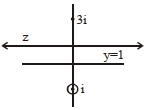
This represents the perpendicular bisector of the segment joining $-i$ and $3i$ on the complex plane, which is the line $\operatorname{Im}(z) = 1$.
Let $z = x + i$, where $x \in \mathbb{R}$.
Given $w = z \bar{z} - 2z + 2$, substituting $z = x + i$:
$w = (x+i)(x-i) - 2(x+i) + 2$
$w = (x^2 + 1) - 2x - 2i + 2$
$w = (x^2 - 2x + 3) - 2i$.
Thus, $\operatorname{Re}(w) = x^2 - 2x + 3$.
To find the minimum value of $\operatorname{Re}(w)$, we differentiate with respect to $x$ or use the vertex formula $x = -b/(2a) = 2/2 = 1$.
At $x = 1$, $\operatorname{Re}(w) = 1 - 2 + 3 = 2$.
Then $w = 2 - 2i = 2(1 - i) = 2\sqrt{2} e^{-i\pi/4}$.
For $w^n$ to be real, the argument of $w^n$ must be a multiple of $\pi$.
$\operatorname{arg}(w^n) = n \times (-\pi/4) = -n\pi/4$.
For this to be $k\pi$, we need $n/4$ to be an integer.
The minimum $n \in N$ is $4$.
This represents the perpendicular bisector of the segment joining $-i$ and $3i$ on the complex plane, which is the line $\operatorname{Im}(z) = 1$.
Let $z = x + i$, where $x \in \mathbb{R}$.
Given $w = z \bar{z} - 2z + 2$, substituting $z = x + i$:
$w = (x+i)(x-i) - 2(x+i) + 2$
$w = (x^2 + 1) - 2x - 2i + 2$
$w = (x^2 - 2x + 3) - 2i$.
Thus, $\operatorname{Re}(w) = x^2 - 2x + 3$.
To find the minimum value of $\operatorname{Re}(w)$, we differentiate with respect to $x$ or use the vertex formula $x = -b/(2a) = 2/2 = 1$.
At $x = 1$, $\operatorname{Re}(w) = 1 - 2 + 3 = 2$.
Then $w = 2 - 2i = 2(1 - i) = 2\sqrt{2} e^{-i\pi/4}$.
For $w^n$ to be real, the argument of $w^n$ must be a multiple of $\pi$.
$\operatorname{arg}(w^n) = n \times (-\pi/4) = -n\pi/4$.
For this to be $k\pi$, we need $n/4$ to be an integer.
The minimum $n \in N$ is $4$.
0 likesView Solution
15
MathematicsMediumMCQJEE Main · 2021
In a triangle $PQR$,the coordinates of the points $P$ and $Q$ are $(-2, 4)$ and $(4, -2)$ respectively. If the equation of the perpendicular bisector of $PR$ is $2x - y + 2 = 0$,then the centre of the circumcircle of the $\Delta PQR$ is
A
$(-1, 0)$
B
$(-2, -2)$
C
$(0, 2)$
D
$(1, 4)$
Solution
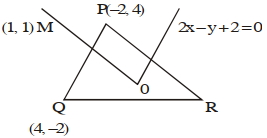
(B) The circumcentre $O$ is the intersection of the perpendicular bisectors of the sides of the triangle.
We are given the perpendicular bisector of $PR$ as $L_1: 2x - y + 2 = 0$.
Next,we find the perpendicular bisector of $PQ$.
The midpoint of $PQ$ is $M = (\frac{-2+4}{2}, \frac{4-2}{2}) = (1, 1)$.
The slope of $PQ$ is $m_{PQ} = \frac{-2-4}{4-(-2)} = \frac{-6}{6} = -1$.
The slope of the perpendicular bisector of $PQ$ is $m_{\perp} = -\frac{1}{m_{PQ}} = 1$.
The equation of the perpendicular bisector of $PQ$ is $y - 1 = 1(x - 1)$,which simplifies to $y = x$ or $x - y = 0$.
The circumcentre $O$ is the intersection of $2x - y + 2 = 0$ and $x - y = 0$.
Substituting $y = x$ into the first equation: $2x - x + 2 = 0 \implies x = -2$.
Since $y = x$,we have $y = -2$.
Thus,the circumcentre is $(-2, -2)$.
We are given the perpendicular bisector of $PR$ as $L_1: 2x - y + 2 = 0$.
Next,we find the perpendicular bisector of $PQ$.
The midpoint of $PQ$ is $M = (\frac{-2+4}{2}, \frac{4-2}{2}) = (1, 1)$.
The slope of $PQ$ is $m_{PQ} = \frac{-2-4}{4-(-2)} = \frac{-6}{6} = -1$.
The slope of the perpendicular bisector of $PQ$ is $m_{\perp} = -\frac{1}{m_{PQ}} = 1$.
The equation of the perpendicular bisector of $PQ$ is $y - 1 = 1(x - 1)$,which simplifies to $y = x$ or $x - y = 0$.
The circumcentre $O$ is the intersection of $2x - y + 2 = 0$ and $x - y = 0$.
Substituting $y = x$ into the first equation: $2x - x + 2 = 0 \implies x = -2$.
Since $y = x$,we have $y = -2$.
Thus,the circumcentre is $(-2, -2)$.
0 likesView Solution
16
MathematicsMediumMCQJEE Main · 2021
If the Boolean expression $(p \Rightarrow q) \Leftrightarrow (q * (\sim p))$ is a tautology,then the Boolean expression $p * (\sim q)$ is equivalent to
A
$q \Rightarrow p$
B
$\sim q \Rightarrow p$
C
$p \Rightarrow \sim q$
D
$p \Rightarrow q$
Solution
(A) Given the expression $(p \Rightarrow q) \Leftrightarrow (q * (\sim p))$ is a tautology.
We know that $p \Rightarrow q \equiv \sim p \vee q$.
Comparing $(p \Rightarrow q)$ with $(q * (\sim p))$,we observe that the operator $*$ corresponds to the disjunction operator $\vee$.
Thus,$p * (\sim q) \equiv p \vee (\sim q)$.
Using the implication rule $\sim a \vee b \equiv a \Rightarrow b$,we get $p \vee (\sim q) \equiv \sim (\sim p) \vee (\sim q) \equiv \sim p \Rightarrow \sim q$,which is not directly listed.
Alternatively,$p \vee (\sim q) \equiv \sim q \vee p \equiv q \Rightarrow p$.
Therefore,$p * (\sim q) \equiv q \Rightarrow p$.
We know that $p \Rightarrow q \equiv \sim p \vee q$.
Comparing $(p \Rightarrow q)$ with $(q * (\sim p))$,we observe that the operator $*$ corresponds to the disjunction operator $\vee$.
Thus,$p * (\sim q) \equiv p \vee (\sim q)$.
Using the implication rule $\sim a \vee b \equiv a \Rightarrow b$,we get $p \vee (\sim q) \equiv \sim (\sim p) \vee (\sim q) \equiv \sim p \Rightarrow \sim q$,which is not directly listed.
Alternatively,$p \vee (\sim q) \equiv \sim q \vee p \equiv q \Rightarrow p$.
Therefore,$p * (\sim q) \equiv q \Rightarrow p$.
0 likesView Solution
17
MathematicsMediumMCQJEE Main · 2021
Two dice are rolled. If both dice have six faces numbered $1, 2, 3, 5, 7,$ and $11,$ then the probability that the sum of the numbers on the top faces is less than or equal to $8$ is
A
$\frac{4}{9}$
B
$\frac{17}{36}$
C
$\frac{5}{12}$
D
$\frac{1}{2}$
Solution
(B) The total number of outcomes when two dice are rolled is $6 \times 6 = 36$.
Let the outcomes be $(x, y)$ where $x, y \in \{1, 2, 3, 5, 7, 11\}$.
We need the sum $x + y \leq 8$.
The possible pairs $(x, y)$ are:
If $x=1$,$y \in \{1, 2, 3, 5, 7\}$ ($5$ outcomes).
If $x=2$,$y \in \{1, 2, 3, 5\}$ ($4$ outcomes).
If $x=3$,$y \in \{1, 2, 3, 5\}$ ($4$ outcomes).
If $x=5$,$y \in \{1, 2, 3\}$ ($3$ outcomes).
If $x=7$,$y \in \{1\}$ ($1$ outcome).
If $x=11$,no $y$ satisfies the condition.
Total favorable outcomes $n(E) = 5 + 4 + 4 + 3 + 1 = 17$.
Therefore,the probability $P(E) = \frac{n(E)}{n(S)} = \frac{17}{36}$.
Let the outcomes be $(x, y)$ where $x, y \in \{1, 2, 3, 5, 7, 11\}$.
We need the sum $x + y \leq 8$.
The possible pairs $(x, y)$ are:
If $x=1$,$y \in \{1, 2, 3, 5, 7\}$ ($5$ outcomes).
If $x=2$,$y \in \{1, 2, 3, 5\}$ ($4$ outcomes).
If $x=3$,$y \in \{1, 2, 3, 5\}$ ($4$ outcomes).
If $x=5$,$y \in \{1, 2, 3\}$ ($3$ outcomes).
If $x=7$,$y \in \{1\}$ ($1$ outcome).
If $x=11$,no $y$ satisfies the condition.
Total favorable outcomes $n(E) = 5 + 4 + 4 + 3 + 1 = 17$.
Therefore,the probability $P(E) = \frac{n(E)}{n(S)} = \frac{17}{36}$.
0 likesView Solution
18
MathematicsDifficultMCQJEE Main · 2021
If the fourth term in the expansion of $(x+x^{\log _{2} x})^{7}$ is $4480$,then the value of $x$ where $x \in N$ is equal to
A
$2$
B
$4$
C
$3$
D
$1$
Solution
(A) The general term $T_{r+1}$ in the expansion of $(a+b)^n$ is given by $T_{r+1} = {}^{n}C_{r} a^{n-r} b^{r}$.
For the fourth term $(T_4)$,we set $r=3$:
$T_4 = {}^{7}C_{3} (x)^{7-3} (x^{\log_{2} x})^{3} = 4480$.
Since ${}^{7}C_{3} = \frac{7 \times 6 \times 5}{3 \times 2 \times 1} = 35$,we have:
$35 \cdot x^{4} \cdot x^{3 \log_{2} x} = 4480$.
Dividing by $35$:
$x^{4 + 3 \log_{2} x} = \frac{4480}{35} = 128 = 2^{7}$.
Let $t = \log_{2} x$,then $x = 2^t$. Substituting this into the equation:
$(2^t)^{4 + 3t} = 2^{7} \Rightarrow t(4 + 3t) = 7$.
$3t^{2} + 4t - 7 = 0$.
$(3t + 7)(t - 1) = 0$.
Thus,$t = 1$ or $t = -7/3$.
If $t = 1$,then $\log_{2} x = 1 \Rightarrow x = 2^1 = 2$.
Since $x \in N$,the value is $2$.
For the fourth term $(T_4)$,we set $r=3$:
$T_4 = {}^{7}C_{3} (x)^{7-3} (x^{\log_{2} x})^{3} = 4480$.
Since ${}^{7}C_{3} = \frac{7 \times 6 \times 5}{3 \times 2 \times 1} = 35$,we have:
$35 \cdot x^{4} \cdot x^{3 \log_{2} x} = 4480$.
Dividing by $35$:
$x^{4 + 3 \log_{2} x} = \frac{4480}{35} = 128 = 2^{7}$.
Let $t = \log_{2} x$,then $x = 2^t$. Substituting this into the equation:
$(2^t)^{4 + 3t} = 2^{7} \Rightarrow t(4 + 3t) = 7$.
$3t^{2} + 4t - 7 = 0$.
$(3t + 7)(t - 1) = 0$.
Thus,$t = 1$ or $t = -7/3$.
If $t = 1$,then $\log_{2} x = 1 \Rightarrow x = 2^1 = 2$.
Since $x \in N$,the value is $2$.
0 likesView Solution
19
MathematicsEasyMCQJEE Main · 2021
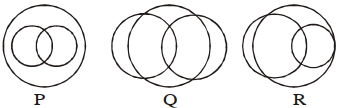
In a school,there are three types of games to be played. Some students play two types of games,but none play all three games. Which Venn diagram$(s)$ can justify the above statement?
A
$P$ and $Q$
B
$P$ and $R$
C
None of these
D
$Q$ and $R$
Solution
(C) Let the three sets of students playing the three games be $A$,$B$,and $C$.
According to the problem,some students play two games,which means the intersection of any two sets is non-empty (i.e.,$A \cap B \neq \emptyset$,$B \cap C \neq \emptyset$,$A \cap C \neq \emptyset$).
However,no student plays all three games,which means the intersection of all three sets must be empty (i.e.,$A \cap B \cap C = \emptyset$).
In diagram $P$,there are only two sets,so it does not represent three games.
In diagram $Q$,the three circles are arranged such that there is a central region where all three overlap,meaning $A \cap B \cap C \neq \emptyset$.
In diagram $R$,the three circles are arranged such that there is no common region shared by all three circles,meaning $A \cap B \cap C = \emptyset$,while pairs of circles still overlap.
Therefore,only diagram $R$ justifies the statement. Since $R$ is not present in any of the options $A$,$B$,or $D$,the correct option is $C$.
According to the problem,some students play two games,which means the intersection of any two sets is non-empty (i.e.,$A \cap B \neq \emptyset$,$B \cap C \neq \emptyset$,$A \cap C \neq \emptyset$).
However,no student plays all three games,which means the intersection of all three sets must be empty (i.e.,$A \cap B \cap C = \emptyset$).
In diagram $P$,there are only two sets,so it does not represent three games.
In diagram $Q$,the three circles are arranged such that there is a central region where all three overlap,meaning $A \cap B \cap C \neq \emptyset$.
In diagram $R$,the three circles are arranged such that there is no common region shared by all three circles,meaning $A \cap B \cap C = \emptyset$,while pairs of circles still overlap.
Therefore,only diagram $R$ justifies the statement. Since $R$ is not present in any of the options $A$,$B$,or $D$,the correct option is $C$.
0 likesView Solution
20
MathematicsMediumMCQJEE Main · 2021
The area of the triangle with vertices $A(z)$,$B(iz)$,and $C(z+iz)$ is
A
$1$
B
$\frac{1}{2}|z|^{2}$
C
$\frac{1}{2}$
D
$\frac{1}{2}|z+iz|^{2}$
Solution
(B) Let the vertices of the triangle be $A(z)$,$B(iz)$,and $C(z+iz)$.
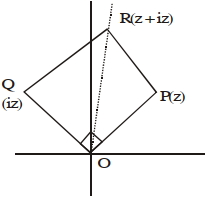
This triangle is formed by the origin $O(0)$,the point $P(z)$,and the point $Q(iz)$.
Since $iz$ is obtained by rotating $z$ by $90^{\circ}$ about the origin,the vectors $\vec{OP}$ and $\vec{OQ}$ are perpendicular and have the same magnitude $|z|$.
The point $C(z+iz)$ represents the fourth vertex of the square formed by $O, P, C, Q$.
The triangle $ABC$ is the same as the triangle $OPQ$ if we consider the vertices as vectors from the origin,but specifically,the triangle with vertices $O(0)$,$P(z)$,and $Q(iz)$ is a right-angled triangle with area $\frac{1}{2} \times |z| \times |iz| = \frac{1}{2}|z|^2$.
The triangle with vertices $A(z)$,$B(iz)$,and $C(z+iz)$ is congruent to the triangle $OPQ$ because it is a translation of the triangle $OPQ$ by the vector $z+iz$ is not correct; rather,the triangle with vertices $0, z, iz$ has area $\frac{1}{2}|z|^2$. The triangle with vertices $z, iz, z+iz$ is simply a shifted version of the triangle with vertices $0, z, iz$.
Thus,the area is $\frac{1}{2}|z||iz| = \frac{1}{2}|z|^2$.
This triangle is formed by the origin $O(0)$,the point $P(z)$,and the point $Q(iz)$.
Since $iz$ is obtained by rotating $z$ by $90^{\circ}$ about the origin,the vectors $\vec{OP}$ and $\vec{OQ}$ are perpendicular and have the same magnitude $|z|$.
The point $C(z+iz)$ represents the fourth vertex of the square formed by $O, P, C, Q$.
The triangle $ABC$ is the same as the triangle $OPQ$ if we consider the vertices as vectors from the origin,but specifically,the triangle with vertices $O(0)$,$P(z)$,and $Q(iz)$ is a right-angled triangle with area $\frac{1}{2} \times |z| \times |iz| = \frac{1}{2}|z|^2$.
The triangle with vertices $A(z)$,$B(iz)$,and $C(z+iz)$ is congruent to the triangle $OPQ$ because it is a translation of the triangle $OPQ$ by the vector $z+iz$ is not correct; rather,the triangle with vertices $0, z, iz$ has area $\frac{1}{2}|z|^2$. The triangle with vertices $z, iz, z+iz$ is simply a shifted version of the triangle with vertices $0, z, iz$.
Thus,the area is $\frac{1}{2}|z||iz| = \frac{1}{2}|z|^2$.
0 likesView Solution
21
MathematicsDifficultMCQJEE Main · 2021
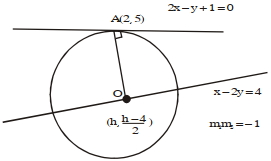
The line $2x - y + 1 = 0$ is a tangent to the circle at the point $(2, 5)$ and the centre of the circle lies on the line $x - 2y = 4$. Then,the radius of the circle is
A
$3 \sqrt{5}$
B
$5 \sqrt{3}$
C
$5 \sqrt{4}$
D
$4 \sqrt{5}$
Solution
(A) Let the centre of the circle be $O(h, k)$.
Since the centre lies on the line $x - 2y = 4$,we have $h - 2k = 4$,which implies $k = \frac{h - 4}{2}$.
So,the centre is $O(h, \frac{h - 4}{2})$.
The line $2x - y + 1 = 0$ is a tangent at $A(2, 5)$. The radius $OA$ is perpendicular to the tangent.
The slope of the tangent is $m_1 = 2$.
The slope of the radius $OA$ is $m_2 = \frac{\frac{h - 4}{2} - 5}{h - 2} = \frac{h - 4 - 10}{2(h - 2)} = \frac{h - 14}{2(h - 2)}$.
Since $m_1 \times m_2 = -1$,we have $2 \times \frac{h - 14}{2(h - 2)} = -1$.
$\frac{h - 14}{h - 2} = -1 \implies h - 14 = -h + 2 \implies 2h = 16 \implies h = 8$.
Then $k = \frac{8 - 4}{2} = 2$.
The centre is $(8, 2)$.
The radius $r$ is the distance between $(8, 2)$ and $(2, 5)$:
$r = \sqrt{(8 - 2)^2 + (2 - 5)^2} = \sqrt{6^2 + (-3)^2} = \sqrt{36 + 9} = \sqrt{45} = 3 \sqrt{5}$.
Since the centre lies on the line $x - 2y = 4$,we have $h - 2k = 4$,which implies $k = \frac{h - 4}{2}$.
So,the centre is $O(h, \frac{h - 4}{2})$.
The line $2x - y + 1 = 0$ is a tangent at $A(2, 5)$. The radius $OA$ is perpendicular to the tangent.
The slope of the tangent is $m_1 = 2$.
The slope of the radius $OA$ is $m_2 = \frac{\frac{h - 4}{2} - 5}{h - 2} = \frac{h - 4 - 10}{2(h - 2)} = \frac{h - 14}{2(h - 2)}$.
Since $m_1 \times m_2 = -1$,we have $2 \times \frac{h - 14}{2(h - 2)} = -1$.
$\frac{h - 14}{h - 2} = -1 \implies h - 14 = -h + 2 \implies 2h = 16 \implies h = 8$.
Then $k = \frac{8 - 4}{2} = 2$.
The centre is $(8, 2)$.
The radius $r$ is the distance between $(8, 2)$ and $(2, 5)$:
$r = \sqrt{(8 - 2)^2 + (2 - 5)^2} = \sqrt{6^2 + (-3)^2} = \sqrt{36 + 9} = \sqrt{45} = 3 \sqrt{5}$.
0 likesView Solution
22
MathematicsDifficultMCQJEE Main · 2021
Team $A$ consists of $7$ boys and $n$ girls and Team $B$ has $4$ boys and $6$ girls. If a total of $52$ single matches can be arranged between these two teams when a boy plays against a boy and a girl plays against a girl,then $n$ is equal to
A
$5$
B
$2$
C
$4$
D
$6$
Solution
(C) The number of matches between boys of Team $A$ and Team $B$ is given by the product of the number of boys in each team:
$7 \times 4 = 28$
The number of matches between girls of Team $A$ and Team $B$ is given by the product of the number of girls in each team:
$n \times 6 = 6n$
The total number of matches is the sum of these two values:
$28 + 6n = 52$
Subtracting $28$ from both sides:
$6n = 52 - 28$
$6n = 24$
Dividing by $6$:
$n = 4$
$7 \times 4 = 28$
The number of matches between girls of Team $A$ and Team $B$ is given by the product of the number of girls in each team:
$n \times 6 = 6n$
The total number of matches is the sum of these two values:
$28 + 6n = 52$
Subtracting $28$ from both sides:
$6n = 52 - 28$
$6n = 24$
Dividing by $6$:
$n = 4$
0 likesView Solution
23
MathematicsMediumMCQJEE Main · 2021
The value of $4+\frac{1}{5+\frac{1}{4+\frac{1}{5+\frac{1}{4+\ldots \ldots \infty}}}}$ is
A
$2+\frac{2}{5} \sqrt{30}$
B
$2+\frac{4}{\sqrt{5}} \sqrt{30}$
C
$4+\frac{4}{\sqrt{5}} \sqrt{30}$
D
$5+\frac{2}{5} \sqrt{30}$
Solution
(A) Let $y = 4+\frac{1}{5+\frac{1}{4+\frac{1}{5+\ldots}}}$.
Observe that the expression repeats after the first two terms: $y = 4+\frac{1}{5+\frac{1}{y}}$.
Simplify the equation: $y - 4 = \frac{1}{\frac{5y+1}{y}} = \frac{y}{5y+1}$.
Cross-multiply: $(y-4)(5y+1) = y$.
$5y^2 + y - 20y - 4 = y$.
$5y^2 - 20y - 4 = 0$.
Using the quadratic formula $y = \frac{-b \pm \sqrt{b^2-4ac}}{2a}$:
$y = \frac{20 \pm \sqrt{(-20)^2 - 4(5)(-4)}}{2(5)} = \frac{20 \pm \sqrt{400 + 80}}{10} = \frac{20 \pm \sqrt{480}}{10}$.
Since $y > 0$,we take the positive root: $y = \frac{20 + \sqrt{480}}{10} = 2 + \frac{\sqrt{16 \times 30}}{10} = 2 + \frac{4\sqrt{30}}{10} = 2 + \frac{2\sqrt{30}}{5} = 2 + \frac{2}{5}\sqrt{30}$.
Observe that the expression repeats after the first two terms: $y = 4+\frac{1}{5+\frac{1}{y}}$.
Simplify the equation: $y - 4 = \frac{1}{\frac{5y+1}{y}} = \frac{y}{5y+1}$.
Cross-multiply: $(y-4)(5y+1) = y$.
$5y^2 + y - 20y - 4 = y$.
$5y^2 - 20y - 4 = 0$.
Using the quadratic formula $y = \frac{-b \pm \sqrt{b^2-4ac}}{2a}$:
$y = \frac{20 \pm \sqrt{(-20)^2 - 4(5)(-4)}}{2(5)} = \frac{20 \pm \sqrt{400 + 80}}{10} = \frac{20 \pm \sqrt{480}}{10}$.
Since $y > 0$,we take the positive root: $y = \frac{20 + \sqrt{480}}{10} = 2 + \frac{\sqrt{16 \times 30}}{10} = 2 + \frac{4\sqrt{30}}{10} = 2 + \frac{2\sqrt{30}}{5} = 2 + \frac{2}{5}\sqrt{30}$.
0 likesView Solution
24
MathematicsMediumMCQJEE Main · 2021
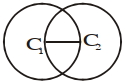
Choose the incorrect statement about the two circles whose equations are given below:
$x^{2}+y^{2}-10x-10y+41=0$ and $x^{2}+y^{2}-16x-10y+80=0$
$x^{2}+y^{2}-10x-10y+41=0$ and $x^{2}+y^{2}-16x-10y+80=0$
A
Distance between two centres is the average of radii of both the circles.
B
Both circles' centres lie inside the region of one another.
C
Both circles pass through the centre of each other.
D
Circles have two intersection points.
Solution
(B) For the first circle $x^{2}+y^{2}-10x-10y+41=0$:
Centre $C_{1} = (5, 5)$,Radius $r_{1} = \sqrt{5^{2}+5^{2}-41} = \sqrt{25+25-41} = \sqrt{9} = 3$.
For the second circle $x^{2}+y^{2}-16x-10y+80=0$:
Centre $C_{2} = (8, 5)$,Radius $r_{2} = \sqrt{8^{2}+5^{2}-80} = \sqrt{64+25-80} = \sqrt{9} = 3$.
The distance between the centres is $d = \sqrt{(8-5)^{2}+(5-5)^{2}} = \sqrt{3^{2}+0^{2}} = 3$.
Since $d = r_{1} = r_{2} = 3$,the distance between the centres is equal to the radius of each circle.
This implies that each circle passes through the centre of the other circle.
Statement $A$ is incorrect because the distance between the centres is $3$,while the average of the radii is $(3+3)/2 = 3$. Wait,$3=3$,so $A$ is actually correct.
Let's re-evaluate: $C_{1}(5,5), C_{2}(8,5), r_{1}=3, r_{2}=3, d=3$.
$A$: $d=3$,average radius $= 3$. Correct.
$B$: $C_{2}$ is at distance $3$ from $C_{1}$,so $C_{2}$ is on the circumference of circle $1$,not inside. Thus,$B$ is incorrect.
$C$: $d=r_{1}=r_{2}$,so each passes through the other's centre. Correct.
$D$: Since $|r_{1}-r_{2}| < d < r_{1}+r_{2}$ is $0 < 3 < 6$,they intersect at two points. Correct.
Therefore,the incorrect statement is $B$.
Centre $C_{1} = (5, 5)$,Radius $r_{1} = \sqrt{5^{2}+5^{2}-41} = \sqrt{25+25-41} = \sqrt{9} = 3$.
For the second circle $x^{2}+y^{2}-16x-10y+80=0$:
Centre $C_{2} = (8, 5)$,Radius $r_{2} = \sqrt{8^{2}+5^{2}-80} = \sqrt{64+25-80} = \sqrt{9} = 3$.
The distance between the centres is $d = \sqrt{(8-5)^{2}+(5-5)^{2}} = \sqrt{3^{2}+0^{2}} = 3$.
Since $d = r_{1} = r_{2} = 3$,the distance between the centres is equal to the radius of each circle.
This implies that each circle passes through the centre of the other circle.
Statement $A$ is incorrect because the distance between the centres is $3$,while the average of the radii is $(3+3)/2 = 3$. Wait,$3=3$,so $A$ is actually correct.
Let's re-evaluate: $C_{1}(5,5), C_{2}(8,5), r_{1}=3, r_{2}=3, d=3$.
$A$: $d=3$,average radius $= 3$. Correct.
$B$: $C_{2}$ is at distance $3$ from $C_{1}$,so $C_{2}$ is on the circumference of circle $1$,not inside. Thus,$B$ is incorrect.
$C$: $d=r_{1}=r_{2}$,so each passes through the other's centre. Correct.
$D$: Since $|r_{1}-r_{2}| < d < r_{1}+r_{2}$ is $0 < 3 < 6$,they intersect at two points. Correct.
Therefore,the incorrect statement is $B$.
0 likesView Solution
25
MathematicsDifficultMCQJEE Main · 2021
The value of $\lim _{x \rightarrow 0^{+}} \frac{\cos ^{-1}\left(x-[x]^{2}\right) \cdot \sin ^{-1}\left(x-[x]^{2}\right)}{x-x^{3}},$ where $[x]$ denotes the greatest integer $\leq x$ is
A
$\pi$
B
$0$
C
$\frac{\pi}{4}$
D
$\frac{\pi}{2}$
Solution
(D) For $x \in (0, 1)$,the greatest integer function $[x] = 0$.
Substituting this into the expression,we get:
$\lim _{x \rightarrow 0^{+}} \frac{\cos ^{-1}(x-0) \cdot \sin ^{-1}(x-0)}{x(1-x^2)}$
$= \lim _{x \rightarrow 0^{+}} \left( \frac{\cos ^{-1} x}{1-x^2} \cdot \frac{\sin ^{-1} x}{x} \right)$
As $x \rightarrow 0^{+}$,$\cos ^{-1} x \rightarrow \frac{\pi}{2}$,$1-x^2 \rightarrow 1$,and $\frac{\sin ^{-1} x}{x} \rightarrow 1$.
Therefore,the limit is $\frac{\pi}{2} \cdot 1 \cdot 1 = \frac{\pi}{2}$.
Substituting this into the expression,we get:
$\lim _{x \rightarrow 0^{+}} \frac{\cos ^{-1}(x-0) \cdot \sin ^{-1}(x-0)}{x(1-x^2)}$
$= \lim _{x \rightarrow 0^{+}} \left( \frac{\cos ^{-1} x}{1-x^2} \cdot \frac{\sin ^{-1} x}{x} \right)$
As $x \rightarrow 0^{+}$,$\cos ^{-1} x \rightarrow \frac{\pi}{2}$,$1-x^2 \rightarrow 1$,and $\frac{\sin ^{-1} x}{x} \rightarrow 1$.
Therefore,the limit is $\frac{\pi}{2} \cdot 1 \cdot 1 = \frac{\pi}{2}$.
0 likesView Solution
26
MathematicsDifficultMCQJEE Main · 2021
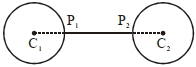
The minimum distance between any two points $P_{1}$ and $P_{2}$,where $P_{1}$ lies on the first circle and $P_{2}$ lies on the second circle,for the given equations:
$x^{2}+y^{2}-10x-10y+41=0$
$x^{2}+y^{2}-24x-10y+160=0$
is .........
$x^{2}+y^{2}-10x-10y+41=0$
$x^{2}+y^{2}-24x-10y+160=0$
is .........
A
$4$
B
$3$
C
$2$
D
$1$
Solution
(D) For the first circle $x^{2}+y^{2}-10x-10y+41=0$:
Center $C_{1} = (5, 5)$,Radius $r_{1} = \sqrt{5^{2}+5^{2}-41} = \sqrt{25+25-41} = \sqrt{9} = 3$.
For the second circle $x^{2}+y^{2}-24x-10y+160=0$:
Center $C_{2} = (12, 5)$,Radius $r_{2} = \sqrt{12^{2}+5^{2}-160} = \sqrt{144+25-160} = \sqrt{9} = 3$.
The distance between the centers $C_{1}$ and $C_{2}$ is $d = \sqrt{(12-5)^{2}+(5-5)^{2}} = \sqrt{7^{2}+0^{2}} = 7$.
The minimum distance between the two circles is given by $d - (r_{1} + r_{2}) = 7 - (3 + 3) = 7 - 6 = 1$.
Center $C_{1} = (5, 5)$,Radius $r_{1} = \sqrt{5^{2}+5^{2}-41} = \sqrt{25+25-41} = \sqrt{9} = 3$.
For the second circle $x^{2}+y^{2}-24x-10y+160=0$:
Center $C_{2} = (12, 5)$,Radius $r_{2} = \sqrt{12^{2}+5^{2}-160} = \sqrt{144+25-160} = \sqrt{9} = 3$.
The distance between the centers $C_{1}$ and $C_{2}$ is $d = \sqrt{(12-5)^{2}+(5-5)^{2}} = \sqrt{7^{2}+0^{2}} = 7$.
The minimum distance between the two circles is given by $d - (r_{1} + r_{2}) = 7 - (3 + 3) = 7 - 6 = 1$.
0 likesView Solution
27
MathematicsDifficultMCQJEE Main · 2021
If $(2021)^{3762}$ is divided by $17$,then the remainder is ........
A
$9$
B
$12$
C
$4$
D
$8$
Solution
(C) We need to find the remainder when $(2021)^{3762}$ is divided by $17$.
First,note that $2021 = 17 \times 118 + 15$,or more conveniently,$2021 = 17 \times 119 - 2 = 2023 - 2$.
So,$(2021)^{3762} = (2023 - 2)^{3762}$.
Using the Binomial Theorem,$(2023 - 2)^{3762} = \sum_{k=0}^{3762} \binom{3762}{k} (2023)^{3762-k} (-2)^k$.
Since $2023 = 17 \times 119$,all terms containing $2023$ are divisible by $17$.
Thus,$(2021)^{3762} \equiv (-2)^{3762} \pmod{17}$.
$(-2)^{3762} = 2^{3762} = (2^4)^{940} \times 2^2 = 16^{940} \times 4$.
Since $16 \equiv -1 \pmod{17}$,we have $16^{940} \equiv (-1)^{940} \equiv 1 \pmod{17}$.
Therefore,$2^{3762} \equiv 1 \times 4 \equiv 4 \pmod{17}$.
The remainder is $4$.
First,note that $2021 = 17 \times 118 + 15$,or more conveniently,$2021 = 17 \times 119 - 2 = 2023 - 2$.
So,$(2021)^{3762} = (2023 - 2)^{3762}$.
Using the Binomial Theorem,$(2023 - 2)^{3762} = \sum_{k=0}^{3762} \binom{3762}{k} (2023)^{3762-k} (-2)^k$.
Since $2023 = 17 \times 119$,all terms containing $2023$ are divisible by $17$.
Thus,$(2021)^{3762} \equiv (-2)^{3762} \pmod{17}$.
$(-2)^{3762} = 2^{3762} = (2^4)^{940} \times 2^2 = 16^{940} \times 4$.
Since $16 \equiv -1 \pmod{17}$,we have $16^{940} \equiv (-1)^{940} \equiv 1 \pmod{17}$.
Therefore,$2^{3762} \equiv 1 \times 4 \equiv 4 \pmod{17}$.
The remainder is $4$.
0 likesView Solution
28
MathematicsDifficultMCQJEE Main · 2021
The number of integral values of $m$ such that the abscissa of the point of intersection of the lines $3x + 4y = 9$ and $y = mx + 1$ is also an integer,is
A
$1$
B
$2$
C
$3$
D
$0$
Solution
(B) Given the lines $3x + 4y = 9$ and $y = mx + 1$.
Substitute $y$ from the second equation into the first:
$3x + 4(mx + 1) = 9$
$3x + 4mx + 4 = 9$
$(3 + 4m)x = 5$
$x = \frac{5}{3 + 4m}$
For $x$ to be an integer,$(3 + 4m)$ must be a divisor of $5$. The divisors of $5$ are $\{1, -1, 5, -5\}$.
Case $1$: $3 + 4m = 1$ $\Rightarrow 4m = -2$ $\Rightarrow m = -0.5$ (Not an integer)
Case $2$: $3 + 4m = -1$ $\Rightarrow 4m = -4$ $\Rightarrow m = -1$ (Integer)
Case $3$: $3 + 4m = 5$ $\Rightarrow 4m = 2$ $\Rightarrow m = 0.5$ (Not an integer)
Case $4$: $3 + 4m = -5$ $\Rightarrow 4m = -8$ $\Rightarrow m = -2$ (Integer)
The integral values of $m$ are $\{-1, -2\}$.
Thus,the number of integral values of $m$ is $2$.
Substitute $y$ from the second equation into the first:
$3x + 4(mx + 1) = 9$
$3x + 4mx + 4 = 9$
$(3 + 4m)x = 5$
$x = \frac{5}{3 + 4m}$
For $x$ to be an integer,$(3 + 4m)$ must be a divisor of $5$. The divisors of $5$ are $\{1, -1, 5, -5\}$.
Case $1$: $3 + 4m = 1$ $\Rightarrow 4m = -2$ $\Rightarrow m = -0.5$ (Not an integer)
Case $2$: $3 + 4m = -1$ $\Rightarrow 4m = -4$ $\Rightarrow m = -1$ (Integer)
Case $3$: $3 + 4m = 5$ $\Rightarrow 4m = 2$ $\Rightarrow m = 0.5$ (Not an integer)
Case $4$: $3 + 4m = -5$ $\Rightarrow 4m = -8$ $\Rightarrow m = -2$ (Integer)
The integral values of $m$ are $\{-1, -2\}$.
Thus,the number of integral values of $m$ is $2$.
0 likesView Solution
29
MathematicsDifficultMCQJEE Main · 2021
Let $(1+x+2x^2)^{20} = a_0 + a_1x + a_2x^2 + \ldots + a_{40}x^{40}$,then $a_1 + a_3 + a_5 + \ldots + a_{37}$ is equal to
A
$2^{20}(2^{20}-21)$
B
$2^{19}(2^{20}-21)$
C
$2^{19}(2^{20}+21)$
D
$2^{20}(2^{20}+21)$
Solution
(B) Given $(1+x+2x^2)^{20} = \sum_{k=0}^{40} a_k x^k$.
Let $f(x) = (1+x+2x^2)^{20}$.
$f(1) = a_0 + a_1 + a_2 + \ldots + a_{40} = (1+1+2)^{20} = 4^{20} = 2^{40}$.
$f(-1) = a_0 - a_1 + a_2 - \ldots + a_{40} = (1-1+2)^{20} = 2^{20}$.
Subtracting the two equations: $f(1) - f(-1) = 2(a_1 + a_3 + \ldots + a_{39}) = 2^{40} - 2^{20}$.
So,$a_1 + a_3 + \ldots + a_{39} = \frac{2^{40} - 2^{20}}{2} = 2^{39} - 2^{19}$.
We need $a_1 + a_3 + \ldots + a_{37} = (a_1 + a_3 + \ldots + a_{39}) - a_{39}$.
To find $a_{39}$,we look at the coefficient of $x^{39}$ in $(1+x+2x^2)^{20}$.
Using the multinomial expansion,the term $x^{39}$ is obtained from $\frac{20!}{n_1! n_2! n_3!} (1)^{n_1} (x)^{n_2} (2x^2)^{n_3}$ where $n_1+n_2+n_3=20$ and $n_2+2n_3=39$.
If $n_3=20$,$n_2=-1$ (impossible). If $n_3=19$,$n_2=1$,then $n_1=0$.
Coefficient $a_{39} = \frac{20!}{0! 1! 19!} (1)^0 (1)^1 (2)^{19} = 20 \times 2^{19}$.
Thus,$a_1 + a_3 + \ldots + a_{37} = 2^{39} - 2^{19} - 20 \times 2^{19} = 2^{39} - 21 \times 2^{19} = 2^{19}(2^{20} - 21)$.
Let $f(x) = (1+x+2x^2)^{20}$.
$f(1) = a_0 + a_1 + a_2 + \ldots + a_{40} = (1+1+2)^{20} = 4^{20} = 2^{40}$.
$f(-1) = a_0 - a_1 + a_2 - \ldots + a_{40} = (1-1+2)^{20} = 2^{20}$.
Subtracting the two equations: $f(1) - f(-1) = 2(a_1 + a_3 + \ldots + a_{39}) = 2^{40} - 2^{20}$.
So,$a_1 + a_3 + \ldots + a_{39} = \frac{2^{40} - 2^{20}}{2} = 2^{39} - 2^{19}$.
We need $a_1 + a_3 + \ldots + a_{37} = (a_1 + a_3 + \ldots + a_{39}) - a_{39}$.
To find $a_{39}$,we look at the coefficient of $x^{39}$ in $(1+x+2x^2)^{20}$.
Using the multinomial expansion,the term $x^{39}$ is obtained from $\frac{20!}{n_1! n_2! n_3!} (1)^{n_1} (x)^{n_2} (2x^2)^{n_3}$ where $n_1+n_2+n_3=20$ and $n_2+2n_3=39$.
If $n_3=20$,$n_2=-1$ (impossible). If $n_3=19$,$n_2=1$,then $n_1=0$.
Coefficient $a_{39} = \frac{20!}{0! 1! 19!} (1)^0 (1)^1 (2)^{19} = 20 \times 2^{19}$.
Thus,$a_1 + a_3 + \ldots + a_{37} = 2^{39} - 2^{19} - 20 \times 2^{19} = 2^{39} - 21 \times 2^{19} = 2^{19}(2^{20} - 21)$.
0 likesView Solution
30
MathematicsMediumMCQJEE Main · 2021
Choose the correct statement about two circles whose equations are given below:
$x^{2}+y^{2}-10x-10y+41=0$
$x^{2}+y^{2}-22x-10y+137=0$
$x^{2}+y^{2}-10x-10y+41=0$
$x^{2}+y^{2}-22x-10y+137=0$
A
Circles have the same centre
B
Circles have no meeting point
C
Circles have only one meeting point
D
Circles have two meeting points
Solution
(C) For the first circle $x^{2}+y^{2}-10x-10y+41=0$:
Centre $A = (5, 5)$,Radius $R_{1} = \sqrt{5^{2}+5^{2}-41} = \sqrt{50-41} = \sqrt{9} = 3$.
For the second circle $x^{2}+y^{2}-22x-10y+137=0$:
Centre $B = (11, 5)$,Radius $R_{2} = \sqrt{11^{2}+5^{2}-137} = \sqrt{121+25-137} = \sqrt{146-137} = \sqrt{9} = 3$.
The distance between the centres $AB = \sqrt{(11-5)^{2}+(5-5)^{2}} = \sqrt{6^{2}+0^{2}} = 6$.
Since $AB = R_{1} + R_{2} = 3 + 3 = 6$,the circles touch each other externally.
Therefore,the circles have only one meeting point.
Centre $A = (5, 5)$,Radius $R_{1} = \sqrt{5^{2}+5^{2}-41} = \sqrt{50-41} = \sqrt{9} = 3$.
For the second circle $x^{2}+y^{2}-22x-10y+137=0$:
Centre $B = (11, 5)$,Radius $R_{2} = \sqrt{11^{2}+5^{2}-137} = \sqrt{121+25-137} = \sqrt{146-137} = \sqrt{9} = 3$.
The distance between the centres $AB = \sqrt{(11-5)^{2}+(5-5)^{2}} = \sqrt{6^{2}+0^{2}} = 6$.
Since $AB = R_{1} + R_{2} = 3 + 3 = 6$,the circles touch each other externally.
Therefore,the circles have only one meeting point.
0 likesView Solution
31
MathematicsDifficultMCQJEE Main · 2021
The equation of one of the straight lines which passes through the point $(1, 3)$ and makes an angle of $\tan^{-1}(\sqrt{2})$ with the straight line $y + 1 = 3\sqrt{2}x$ is:
A
$4\sqrt{2}x + 5y - (15 + 4\sqrt{2}) = 0$
B
$5\sqrt{2}x + 4y - (15 + 4\sqrt{2}) = 0$
C
$4\sqrt{2}x + 5y - 4\sqrt{2} = 0$
D
$4\sqrt{2}x - 5y - (5 + 4\sqrt{2}) = 0$
Solution
(A) Let the slope of the required line be $m$. The line passes through $(1, 3)$,so its equation is $y - 3 = m(x - 1)$,or $y = mx + (3 - m)$.
The given line is $y = 3\sqrt{2}x - 1$,which has a slope $m_1 = 3\sqrt{2}$.
The angle $\theta$ between the two lines is given by $\tan \theta = \left| \frac{m - m_1}{1 + m \cdot m_1} \right|$.
Given $\tan \theta = \sqrt{2}$,we have $\sqrt{2} = \left| \frac{m - 3\sqrt{2}}{1 + 3\sqrt{2}m} \right|$.
Case $1$: $\frac{m - 3\sqrt{2}}{1 + 3\sqrt{2}m} = \sqrt{2}$
$m - 3\sqrt{2} = \sqrt{2} + 6m$
$-5m = 4\sqrt{2} \implies m = -\frac{4\sqrt{2}}{5}$.
Case $2$: $\frac{m - 3\sqrt{2}}{1 + 3\sqrt{2}m} = -\sqrt{2}$
$m - 3\sqrt{2} = -\sqrt{2} - 6m$
$7m = 2\sqrt{2} \implies m = \frac{2\sqrt{2}}{7}$.
Using $m = -\frac{4\sqrt{2}}{5}$ in $y - 3 = m(x - 1)$:
$y - 3 = -\frac{4\sqrt{2}}{5}(x - 1)$
$5y - 15 = -4\sqrt{2}x + 4\sqrt{2}$
$4\sqrt{2}x + 5y - (15 + 4\sqrt{2}) = 0$.
The given line is $y = 3\sqrt{2}x - 1$,which has a slope $m_1 = 3\sqrt{2}$.
The angle $\theta$ between the two lines is given by $\tan \theta = \left| \frac{m - m_1}{1 + m \cdot m_1} \right|$.
Given $\tan \theta = \sqrt{2}$,we have $\sqrt{2} = \left| \frac{m - 3\sqrt{2}}{1 + 3\sqrt{2}m} \right|$.
Case $1$: $\frac{m - 3\sqrt{2}}{1 + 3\sqrt{2}m} = \sqrt{2}$
$m - 3\sqrt{2} = \sqrt{2} + 6m$
$-5m = 4\sqrt{2} \implies m = -\frac{4\sqrt{2}}{5}$.
Case $2$: $\frac{m - 3\sqrt{2}}{1 + 3\sqrt{2}m} = -\sqrt{2}$
$m - 3\sqrt{2} = -\sqrt{2} - 6m$
$7m = 2\sqrt{2} \implies m = \frac{2\sqrt{2}}{7}$.
Using $m = -\frac{4\sqrt{2}}{5}$ in $y - 3 = m(x - 1)$:
$y - 3 = -\frac{4\sqrt{2}}{5}(x - 1)$
$5y - 15 = -4\sqrt{2}x + 4\sqrt{2}$
$4\sqrt{2}x + 5y - (15 + 4\sqrt{2}) = 0$.
0 likesView Solution
32
MathematicsDifficultMCQJEE Main · 2021
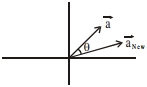
$A$ vector $\vec{a}$ has components $3p$ and $1$ with respect to a rectangular Cartesian system. This system is rotated through a certain angle about the origin in the counter-clockwise sense. If,with respect to the new system,$\vec{a}$ has components $p+1$ and $\sqrt{10}$,then a value of $p$ is equal to
A
$1$
B
$-\frac{5}{4}$
C
$\frac{4}{5}$
D
$-1$
Solution
(D) The magnitude of a vector remains invariant under the rotation of the coordinate axes.
Given $\vec{a}_{Old} = (3p, 1)$ and $\vec{a}_{New} = (p+1, \sqrt{10})$.
Equating the squares of the magnitudes:
$|\vec{a}_{Old}|^2 = |\vec{a}_{New}|^2$
$(3p)^2 + 1^2 = (p+1)^2 + (\sqrt{10})^2$
$9p^2 + 1 = p^2 + 2p + 1 + 10$
$8p^2 - 2p - 10 = 0$
$4p^2 - p - 5 = 0$
$(4p - 5)(p + 1) = 0$
Thus,$p = \frac{5}{4}$ or $p = -1$.
Comparing with the given options,the correct value is $-1$.
Given $\vec{a}_{Old} = (3p, 1)$ and $\vec{a}_{New} = (p+1, \sqrt{10})$.
Equating the squares of the magnitudes:
$|\vec{a}_{Old}|^2 = |\vec{a}_{New}|^2$
$(3p)^2 + 1^2 = (p+1)^2 + (\sqrt{10})^2$
$9p^2 + 1 = p^2 + 2p + 1 + 10$
$8p^2 - 2p - 10 = 0$
$4p^2 - p - 5 = 0$
$(4p - 5)(p + 1) = 0$
Thus,$p = \frac{5}{4}$ or $p = -1$.
Comparing with the given options,the correct value is $-1$.
0 likesView Solution
33
MathematicsDifficultMCQJEE Main · 2021
If the equation $a|z|^2 + \overline{\bar{\alpha}z + \alpha\bar{z}} + d = 0$ represents a circle where $a, d$ are real constants,then which of the following conditions is correct?
A
$|\alpha|^2 - ad \neq 0$
B
$|\alpha|^2 - ad > 0$ and $a \in \mathbb{R} - \{0\}$
C
$|\alpha|^2 - ad \geq 0$ and $a \in \mathbb{R}$
D
$\alpha = 0, a, d \in \mathbb{R}^+$
Solution
(B) The given equation is $a|z|^2 + \overline{\bar{\alpha}z + \alpha\bar{z}} + d = 0$.
Since $\overline{\bar{\alpha}z + \alpha\bar{z}} = \alpha\bar{z} + \bar{\alpha}z$,the equation becomes $az\bar{z} + \bar{\alpha}z + \alpha\bar{z} + d = 0$.
Dividing by $a$ (assuming $a \neq 0$),we get $z\bar{z} + \frac{\bar{\alpha}}{a}z + \frac{\alpha}{a}\bar{z} + \frac{d}{a} = 0$.
This is the standard form of a circle $z\bar{z} + \bar{\beta}z + \beta\bar{z} + c = 0$ where $\beta = \frac{\alpha}{a}$.
The radius $r$ is given by $r = \sqrt{|\beta|^2 - c} = \sqrt{\left|\frac{\alpha}{a}\right|^2 - \frac{d}{a}} = \sqrt{\frac{|\alpha|^2 - ad}{a^2}}$.
For the equation to represent a circle,the radius must be real and positive,so $|\alpha|^2 - ad > 0$ and $a \neq 0$.
Since $\overline{\bar{\alpha}z + \alpha\bar{z}} = \alpha\bar{z} + \bar{\alpha}z$,the equation becomes $az\bar{z} + \bar{\alpha}z + \alpha\bar{z} + d = 0$.
Dividing by $a$ (assuming $a \neq 0$),we get $z\bar{z} + \frac{\bar{\alpha}}{a}z + \frac{\alpha}{a}\bar{z} + \frac{d}{a} = 0$.
This is the standard form of a circle $z\bar{z} + \bar{\beta}z + \beta\bar{z} + c = 0$ where $\beta = \frac{\alpha}{a}$.
The radius $r$ is given by $r = \sqrt{|\beta|^2 - c} = \sqrt{\left|\frac{\alpha}{a}\right|^2 - \frac{d}{a}} = \sqrt{\frac{|\alpha|^2 - ad}{a^2}}$.
For the equation to represent a circle,the radius must be real and positive,so $|\alpha|^2 - ad > 0$ and $a \neq 0$.
0 likesView Solution
34
MathematicsMediumMCQJEE Main · 2021
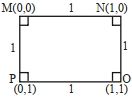
For the four circles $M, N, O$ and $P$,the following four equations are given:
Circle $M: x^2 + y^2 = 1$
Circle $N: x^2 + y^2 - 2x = 0$
Circle $O: x^2 + y^2 - 2x - 2y + 1 = 0$
Circle $P: x^2 + y^2 - 2y = 0$
If the centre of circle $M$ is joined with the centre of circle $N$,the centre of circle $N$ is joined with the centre of circle $O$,the centre of circle $O$ is joined with the centre of circle $P$,and lastly,the centre of circle $P$ is joined with the centre of circle $M$,then these lines form the sides of a:
Circle $M: x^2 + y^2 = 1$
Circle $N: x^2 + y^2 - 2x = 0$
Circle $O: x^2 + y^2 - 2x - 2y + 1 = 0$
Circle $P: x^2 + y^2 - 2y = 0$
If the centre of circle $M$ is joined with the centre of circle $N$,the centre of circle $N$ is joined with the centre of circle $O$,the centre of circle $O$ is joined with the centre of circle $P$,and lastly,the centre of circle $P$ is joined with the centre of circle $M$,then these lines form the sides of a:
A
Rhombus
B
Square
C
Rectangle
D
Parallelogram
Solution
(B) The centres of the circles are found by completing the square or using the formula $(-g, -f)$ for $x^2 + y^2 + 2gx + 2fy + c = 0$:
Circle $M: x^2 + y^2 = 1$,centre $M = (0, 0)$
Circle $N: x^2 + y^2 - 2x = 0$,centre $N = (1, 0)$
Circle $O: x^2 + y^2 - 2x - 2y + 1 = 0$,centre $O = (1, 1)$
Circle $P: x^2 + y^2 - 2y = 0$,centre $P = (0, 1)$
Now,calculate the lengths of the sides:
$MN = \sqrt{(1-0)^2 + (0-0)^2} = 1$
$NO = \sqrt{(1-1)^2 + (1-0)^2} = 1$
$OP = \sqrt{(0-1)^2 + (1-1)^2} = 1$
$PM = \sqrt{(0-0)^2 + (0-1)^2} = 1$
Since all sides are equal to $1$ and the adjacent sides are perpendicular (slopes of $MN$ is $0$ and $NO$ is undefined),the figure is a square.
Circle $M: x^2 + y^2 = 1$,centre $M = (0, 0)$
Circle $N: x^2 + y^2 - 2x = 0$,centre $N = (1, 0)$
Circle $O: x^2 + y^2 - 2x - 2y + 1 = 0$,centre $O = (1, 1)$
Circle $P: x^2 + y^2 - 2y = 0$,centre $P = (0, 1)$
Now,calculate the lengths of the sides:
$MN = \sqrt{(1-0)^2 + (0-0)^2} = 1$
$NO = \sqrt{(1-1)^2 + (1-0)^2} = 1$
$OP = \sqrt{(0-1)^2 + (1-1)^2} = 1$
$PM = \sqrt{(0-0)^2 + (0-1)^2} = 1$
Since all sides are equal to $1$ and the adjacent sides are perpendicular (slopes of $MN$ is $0$ and $NO$ is undefined),the figure is a square.
0 likesView Solution
35
MathematicsDifficultMCQJEE Main · 2021
If $\alpha, \beta$ are natural numbers such that $100^{\alpha} - 199\beta = (100)(100) + (99)(101) + (98)(102) + \ldots + (1)(199)$,then the slope of the line passing through $(\alpha, \beta)$ and the origin is:
A
$540$
B
$550$
C
$530$
D
$510$
Solution
(B) Let the sum be $S = \sum_{k=0}^{99} (100-k)(100+k)$.
$S = \sum_{k=0}^{99} (100^2 - k^2) = \sum_{k=0}^{99} 100^2 - \sum_{k=0}^{99} k^2$.
Since there are $100$ terms (from $k=0$ to $99$):
$S = 100(100^2) - \frac{99(99+1)(2 \times 99 + 1)}{6} = 100^3 - \frac{99 \times 100 \times 199}{6}$.
$S = 1000000 - 33 \times 50 \times 199 = 1000000 - 328350 = 671650$.
Given $100^{\alpha} - 199\beta = 671650$.
If $\alpha = 3$,then $100^3 - 199\beta = 671650 \implies 1000000 - 671650 = 199\beta$.
$328350 = 199\beta \implies \beta = \frac{328350}{199} = 1650$.
Thus,the point is $(3, 1650)$.
The slope of the line passing through $(3, 1650)$ and $(0, 0)$ is $m = \frac{1650 - 0}{3 - 0} = 550$.
$S = \sum_{k=0}^{99} (100^2 - k^2) = \sum_{k=0}^{99} 100^2 - \sum_{k=0}^{99} k^2$.
Since there are $100$ terms (from $k=0$ to $99$):
$S = 100(100^2) - \frac{99(99+1)(2 \times 99 + 1)}{6} = 100^3 - \frac{99 \times 100 \times 199}{6}$.
$S = 1000000 - 33 \times 50 \times 199 = 1000000 - 328350 = 671650$.
Given $100^{\alpha} - 199\beta = 671650$.
If $\alpha = 3$,then $100^3 - 199\beta = 671650 \implies 1000000 - 671650 = 199\beta$.
$328350 = 199\beta \implies \beta = \frac{328350}{199} = 1650$.
Thus,the point is $(3, 1650)$.
The slope of the line passing through $(3, 1650)$ and $(0, 0)$ is $m = \frac{1650 - 0}{3 - 0} = 550$.
0 likesView Solution
36
MathematicsDifficultMCQJEE Main · 2021
$\frac{1}{3^{2}-1}+\frac{1}{5^{2}-1}+\frac{1}{7^{2}-1}+\ldots+\frac{1}{(201)^{2}-1}$ is equal to
A
$\frac{101}{404}$
B
$\frac{25}{101}$
C
$\frac{101}{408}$
D
$\frac{99}{400}$
Solution
(B) The general term of the series is $T_n = \frac{1}{(2n+1)^2 - 1}$ for $n = 1, 2, \ldots, 100$.
Simplifying the denominator: $(2n+1)^2 - 1 = (2n+1-1)(2n+1+1) = (2n)(2n+2) = 4n(n+1)$.
Thus,$T_n = \frac{1}{4n(n+1)} = \frac{1}{4} \left( \frac{1}{n} - \frac{1}{n+1} \right)$.
The sum $S = \sum_{n=1}^{100} T_n = \frac{1}{4} \sum_{n=1}^{100} \left( \frac{1}{n} - \frac{1}{n+1} \right)$.
This is a telescoping series: $S = \frac{1}{4} \left( (1 - \frac{1}{2}) + (\frac{1}{2} - \frac{1}{3}) + \ldots + (\frac{1}{100} - \frac{1}{101}) \right)$.
$S = \frac{1}{4} \left( 1 - \frac{1}{101} \right) = \frac{1}{4} \left( \frac{100}{101} \right) = \frac{25}{101}$.
Simplifying the denominator: $(2n+1)^2 - 1 = (2n+1-1)(2n+1+1) = (2n)(2n+2) = 4n(n+1)$.
Thus,$T_n = \frac{1}{4n(n+1)} = \frac{1}{4} \left( \frac{1}{n} - \frac{1}{n+1} \right)$.
The sum $S = \sum_{n=1}^{100} T_n = \frac{1}{4} \sum_{n=1}^{100} \left( \frac{1}{n} - \frac{1}{n+1} \right)$.
This is a telescoping series: $S = \frac{1}{4} \left( (1 - \frac{1}{2}) + (\frac{1}{2} - \frac{1}{3}) + \ldots + (\frac{1}{100} - \frac{1}{101}) \right)$.
$S = \frac{1}{4} \left( 1 - \frac{1}{101} \right) = \frac{1}{4} \left( \frac{100}{101} \right) = \frac{25}{101}$.
0 likesView Solution
37
MathematicsMediumMCQJEE Main · 2021
The sum of all the $4$-digit distinct numbers that can be formed with the digits $1, 2, 2,$ and $3$ is:
A
$26664$
B
$122664$
C
$122234$
D
$22264$
Solution
(A) The given digits are $1, 2, 2, 3$. The total number of distinct $4$-digit numbers is $\frac{4!}{2!} = 12$.
To find the sum,we calculate the frequency of each digit at each place (units,tens,hundreds,thousands).
For any position,the number of times a digit appears is:
- Digit $1$: $\frac{3!}{2!} = 3$ times.
- Digit $2$: $\frac{3!}{1!} = 6$ times.
- Digit $3$: $\frac{3!}{2!} = 3$ times.
Sum of digits at any position $= (1 \times 3) + (2 \times 6) + (3 \times 3) = 3 + 12 + 9 = 24$.
Since there are $4$ positions,the total sum is $24 \times (1000 + 100 + 10 + 1) = 24 \times 1111 = 26664$.
To find the sum,we calculate the frequency of each digit at each place (units,tens,hundreds,thousands).
For any position,the number of times a digit appears is:
- Digit $1$: $\frac{3!}{2!} = 3$ times.
- Digit $2$: $\frac{3!}{1!} = 6$ times.
- Digit $3$: $\frac{3!}{2!} = 3$ times.
Sum of digits at any position $= (1 \times 3) + (2 \times 6) + (3 \times 3) = 3 + 12 + 9 = 24$.
Since there are $4$ positions,the total sum is $24 \times (1000 + 100 + 10 + 1) = 24 \times 1111 = 26664$.
0 likesView Solution
38
MathematicsMediumMCQJEE Main · 2021
The value of $3+\frac{1}{4+\frac{1}{3+\frac{1}{4+\frac{1}{3+\ldots \infty}}}}$ is equal to
A
$1.5+\sqrt{3}$
B
$2+\sqrt{3}$
C
$3+2 \sqrt{3}$
D
$4+\sqrt{3}$
Solution
(A) Let $x=3+\frac{1}{4+\frac{1}{3+\frac{1}{4+\frac{1}{3+\ldots \infty}}}}$
So,$x=3+\frac{1}{4+\frac{1}{x}}=3+\frac{x}{4x+1}$
$\Rightarrow x-3=\frac{x}{4x+1}$
$\Rightarrow (x-3)(4x+1)=x$
$\Rightarrow 4x^2+x-12x-3=x$
$\Rightarrow 4x^2-12x-3=0$
Using the quadratic formula $x=\frac{-b \pm \sqrt{b^2-4ac}}{2a}$:
$x=\frac{12 \pm \sqrt{(-12)^2-4(4)(-3)}}{2(4)}$
$x=\frac{12 \pm \sqrt{144+48}}{8}=\frac{12 \pm \sqrt{192}}{8}$
$x=\frac{12 \pm 8\sqrt{3}}{8} = \frac{3}{2} \pm \sqrt{3} = 1.5 \pm \sqrt{3}$
Since $x > 0$,we take $x=1.5+\sqrt{3}$.
So,$x=3+\frac{1}{4+\frac{1}{x}}=3+\frac{x}{4x+1}$
$\Rightarrow x-3=\frac{x}{4x+1}$
$\Rightarrow (x-3)(4x+1)=x$
$\Rightarrow 4x^2+x-12x-3=x$
$\Rightarrow 4x^2-12x-3=0$
Using the quadratic formula $x=\frac{-b \pm \sqrt{b^2-4ac}}{2a}$:
$x=\frac{12 \pm \sqrt{(-12)^2-4(4)(-3)}}{2(4)}$
$x=\frac{12 \pm \sqrt{144+48}}{8}=\frac{12 \pm \sqrt{192}}{8}$
$x=\frac{12 \pm 8\sqrt{3}}{8} = \frac{3}{2} \pm \sqrt{3} = 1.5 \pm \sqrt{3}$
Since $x > 0$,we take $x=1.5+\sqrt{3}$.
0 likesView Solution
39
MathematicsMediumMCQJEE Main · 2021
The number of times the digit $3$ will be written when listing the integers from $1$ to $1000$ is
A
$200$
B
$300$
C
$400$
D
$500$
Solution
(B) To find the number of times the digit $3$ appears in integers from $1$ to $1000$,we consider all numbers as $3$-digit numbers (treating $1$ to $999$ as $001$ to $999$ and adding $1000$ separately).
For any position (units,tens,or hundreds),if we fix the digit $3$,the other two positions can each be filled by any of the $10$ digits $(0-9)$.
Number of times $3$ appears in the units place: $10 \times 10 = 100$.
Number of times $3$ appears in the tens place: $10 \times 10 = 100$.
Number of times $3$ appears in the hundreds place: $10 \times 10 = 100$.
Total occurrences = $100 + 100 + 100 = 300$.
The number $1000$ does not contain the digit $3$,so the total count remains $300$.
For any position (units,tens,or hundreds),if we fix the digit $3$,the other two positions can each be filled by any of the $10$ digits $(0-9)$.
Number of times $3$ appears in the units place: $10 \times 10 = 100$.
Number of times $3$ appears in the tens place: $10 \times 10 = 100$.
Number of times $3$ appears in the hundreds place: $10 \times 10 = 100$.
Total occurrences = $100 + 100 + 100 = 300$.
The number $1000$ does not contain the digit $3$,so the total count remains $300$.
0 likesView Solution
40
MathematicsMediumMCQJEE Main · 2021
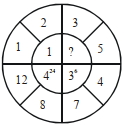
The missing value in the following figure is
A
$2$
B
$9$
C
$4$
D
$6$
Solution
(C) Let the outer numbers in each quadrant be $(a, b)$ and the inner number be $k$. The pattern is $k = (a - b)^{n!}$,where $n$ is the number of digits or a specific index related to the quadrant.
For the first quadrant: $(2 - 1)^{1!} = 1^{1} = 1$.
For the second quadrant: $(12 - 8)^{4!} = 4^{24}$.
For the third quadrant: $(7 - 4)^{3!} = 3^{6}$.
For the fourth quadrant: $(5 - 3)^{2!} = 2^{2} = 4$.
Thus,the missing value is $4$.
For the first quadrant: $(2 - 1)^{1!} = 1^{1} = 1$.
For the second quadrant: $(12 - 8)^{4!} = 4^{24}$.
For the third quadrant: $(7 - 4)^{3!} = 3^{6}$.
For the fourth quadrant: $(5 - 3)^{2!} = 2^{2} = 4$.
Thus,the missing value is $4$.
0 likesView Solution
41
MathematicsDifficultMCQJEE Main · 2021
Let $z_{1}$ and $z_{2}$ be the roots of the equation $z^{2} + az + 12 = 0$. If $z_{1}$,$z_{2}$,and the origin form an equilateral triangle in the complex plane,then the value of $|a|$ is:
A
$4$
B
$6$
C
$12$
D
$3$
Solution
(B) The condition for the origin $(0)$,$z_{1}$,and $z_{2}$ to form an equilateral triangle is given by the relation:
$z_{1}^{2} + z_{2}^{2} = z_{1}z_{2}$
Adding $2z_{1}z_{2}$ to both sides,we get:
$(z_{1} + z_{2})^{2} = 3z_{1}z_{2}$
From the given quadratic equation $z^{2} + az + 12 = 0$,we have the sum of roots $z_{1} + z_{2} = -a$ and the product of roots $z_{1}z_{2} = 12$.
Substituting these values into the condition:
$(-a)^{2} = 3(12)$
$a^{2} = 36$
$|a| = 6$
$z_{1}^{2} + z_{2}^{2} = z_{1}z_{2}$
Adding $2z_{1}z_{2}$ to both sides,we get:
$(z_{1} + z_{2})^{2} = 3z_{1}z_{2}$
From the given quadratic equation $z^{2} + az + 12 = 0$,we have the sum of roots $z_{1} + z_{2} = -a$ and the product of roots $z_{1}z_{2} = 12$.
Substituting these values into the condition:
$(-a)^{2} = 3(12)$
$a^{2} = 36$
$|a| = 6$
0 likesView Solution
42
MathematicsMediumMCQJEE Main · 2021
The mean age of $25$ teachers in a school is $40$ years. $A$ teacher retires at the age of $60$ years and a new teacher is appointed in his place. If the mean age of the teachers in this school now is $39$ years,then the age (in years) of the newly appointed teacher is..........
A
$40$
B
$35$
C
$48$
D
$56$
Solution
(B) Let the sum of the ages of the $25$ teachers be $\sum x_i$.
Given,$\frac{\sum x_i}{25} = 40$,so $\sum x_i = 1000$.
Let the age of the newly appointed teacher be $N$.
After the retirement of the $60$-year-old teacher and the appointment of the new teacher,the new sum of ages is $\sum x_i - 60 + N$.
The new mean age is $39$ years for $25$ teachers.
$\frac{1000 - 60 + N}{25} = 39$
$940 + N = 39 \times 25$
$940 + N = 975$
$N = 975 - 940 = 35$.
Thus,the age of the newly appointed teacher is $35$ years.
Given,$\frac{\sum x_i}{25} = 40$,so $\sum x_i = 1000$.
Let the age of the newly appointed teacher be $N$.
After the retirement of the $60$-year-old teacher and the appointment of the new teacher,the new sum of ages is $\sum x_i - 60 + N$.
The new mean age is $39$ years for $25$ teachers.
$\frac{1000 - 60 + N}{25} = 39$
$940 + N = 39 \times 25$
$940 + N = 975$
$N = 975 - 940 = 35$.
Thus,the age of the newly appointed teacher is $35$ years.
0 likesView Solution
43
MathematicsDifficultMCQJEE Main · 2021
$A$ square $ABCD$ has all its vertices on the curve $x^{2}y^{2}=1$. The midpoints of its sides also lie on the same curve. Then,the square of the area of $ABCD$ is
A
$70$
B
$96$
C
$75$
D
$80$
Solution
(D) The curve is $x^{2}y^{2}=1$,which implies $xy=1$ or $xy=-1$. Let the vertices be $A(t_1, 1/t_1)$,$B(t_2, -1/t_2)$,$C(-t_1, -1/t_1)$,and $D(-t_2, 1/t_2)$.
Since $ABCD$ is a square,the midpoint of $AB$ must lie on the curve $xy=1$ or $xy=-1$. The midpoint of $AB$ is $M = (\frac{t_1+t_2}{2}, \frac{1/t_1 - 1/t_2}{2})$.
For $M$ to lie on $xy=1$,we have $(\frac{t_1+t_2}{2})(\frac{t_2-t_1}{2t_1t_2}) = 1$,which simplifies to $t_2^2 - t_1^2 = 4t_1t_2$.
Also,the slope of $AB$ must be $-1$ (since $ABCD$ is a square and the vertices are symmetric about the origin). The slope of $AB$ is $\frac{-1/t_2 - 1/t_1}{t_2 - t_1} = \frac{-(t_1+t_2)}{t_1t_2(t_2-t_1)} = -1$,which implies $t_1+t_2 = t_1t_2(t_2-t_1)$.
Solving these equations,we find $t_1t_2 = 1$ and $t_2^2 - t_1^2 = 4$. Thus $t_2^2 + t_1^2 = \sqrt{4^2 + 4(1)^2} = \sqrt{20} = 2\sqrt{5}$.
The side length squared is $AB^2 = (t_2-t_1)^2 + (-1/t_2 - 1/t_1)^2 = (t_2-t_1)^2 + (\frac{t_1+t_2}{t_1t_2})^2 = (t_2^2+t_1^2 - 2t_1t_2) + (t_1+t_2)^2 = (2\sqrt{5}-2) + (2\sqrt{5}+2) = 4\sqrt{5}$.
Area of $ABCD = AB^2 = 4\sqrt{5}$.
Therefore,the square of the area is $(4\sqrt{5})^2 = 16 \times 5 = 80$.
Since $ABCD$ is a square,the midpoint of $AB$ must lie on the curve $xy=1$ or $xy=-1$. The midpoint of $AB$ is $M = (\frac{t_1+t_2}{2}, \frac{1/t_1 - 1/t_2}{2})$.
For $M$ to lie on $xy=1$,we have $(\frac{t_1+t_2}{2})(\frac{t_2-t_1}{2t_1t_2}) = 1$,which simplifies to $t_2^2 - t_1^2 = 4t_1t_2$.
Also,the slope of $AB$ must be $-1$ (since $ABCD$ is a square and the vertices are symmetric about the origin). The slope of $AB$ is $\frac{-1/t_2 - 1/t_1}{t_2 - t_1} = \frac{-(t_1+t_2)}{t_1t_2(t_2-t_1)} = -1$,which implies $t_1+t_2 = t_1t_2(t_2-t_1)$.
Solving these equations,we find $t_1t_2 = 1$ and $t_2^2 - t_1^2 = 4$. Thus $t_2^2 + t_1^2 = \sqrt{4^2 + 4(1)^2} = \sqrt{20} = 2\sqrt{5}$.
The side length squared is $AB^2 = (t_2-t_1)^2 + (-1/t_2 - 1/t_1)^2 = (t_2-t_1)^2 + (\frac{t_1+t_2}{t_1t_2})^2 = (t_2^2+t_1^2 - 2t_1t_2) + (t_1+t_2)^2 = (2\sqrt{5}-2) + (2\sqrt{5}+2) = 4\sqrt{5}$.
Area of $ABCD = AB^2 = 4\sqrt{5}$.
Therefore,the square of the area is $(4\sqrt{5})^2 = 16 \times 5 = 80$.
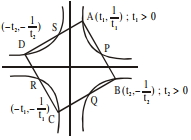
0 likesView Solution
44
MathematicsDifficultMCQJEE Main · 2021
The number of solutions of the equation $|\cot x|=\cot x+\frac{1}{\sin x}$ in the interval $[0, 2\pi]$ is
A
$1$
B
$2$
C
$3$
D
$4$
Solution
(A) The given equation is $|\cot x| = \cot x + \frac{1}{\sin x}$.
Case $1$: If $\cot x \ge 0$,then $|\cot x| = \cot x$. The equation becomes $\cot x = \cot x + \frac{1}{\sin x}$,which implies $\frac{1}{\sin x} = 0$. This has no solution.
Case $2$: If $\cot x < 0$,then $|\cot x| = -\cot x$. The equation becomes $-\cot x = \cot x + \frac{1}{\sin x}$,which simplifies to $2\cot x + \frac{1}{\sin x} = 0$.
Substituting $\cot x = \frac{\cos x}{\sin x}$,we get $2\frac{\cos x}{\sin x} + \frac{1}{\sin x} = 0$,so $\frac{2\cos x + 1}{\sin x} = 0$.
This implies $2\cos x + 1 = 0$,so $\cos x = -\frac{1}{2}$.
In the interval $[0, 2\pi]$,$\cos x = -\frac{1}{2}$ at $x = \frac{2\pi}{3}$ and $x = \frac{4\pi}{3}$.
Check the condition $\cot x < 0$: For $x = \frac{2\pi}{3}$,$\cot(\frac{2\pi}{3}) = -\frac{1}{\sqrt{3}} < 0$ (Valid).
For $x = \frac{4\pi}{3}$,$\cot(\frac{4\pi}{3}) = \frac{1}{\sqrt{3}} > 0$ (Invalid,as it contradicts $\cot x < 0$).
Thus,there is only $1$ solution.
Case $1$: If $\cot x \ge 0$,then $|\cot x| = \cot x$. The equation becomes $\cot x = \cot x + \frac{1}{\sin x}$,which implies $\frac{1}{\sin x} = 0$. This has no solution.
Case $2$: If $\cot x < 0$,then $|\cot x| = -\cot x$. The equation becomes $-\cot x = \cot x + \frac{1}{\sin x}$,which simplifies to $2\cot x + \frac{1}{\sin x} = 0$.
Substituting $\cot x = \frac{\cos x}{\sin x}$,we get $2\frac{\cos x}{\sin x} + \frac{1}{\sin x} = 0$,so $\frac{2\cos x + 1}{\sin x} = 0$.
This implies $2\cos x + 1 = 0$,so $\cos x = -\frac{1}{2}$.
In the interval $[0, 2\pi]$,$\cos x = -\frac{1}{2}$ at $x = \frac{2\pi}{3}$ and $x = \frac{4\pi}{3}$.
Check the condition $\cot x < 0$: For $x = \frac{2\pi}{3}$,$\cot(\frac{2\pi}{3}) = -\frac{1}{\sqrt{3}} < 0$ (Valid).
For $x = \frac{4\pi}{3}$,$\cot(\frac{4\pi}{3}) = \frac{1}{\sqrt{3}} > 0$ (Invalid,as it contradicts $\cot x < 0$).
Thus,there is only $1$ solution.
0 likesView Solution
45
MathematicsDifficultMCQJEE Main · 2021
Let $A$ denote the event that a $6$-digit integer formed by $0, 1, 2, 3, 4, 5, 6$ without repetitions is divisible by $3$. Then the probability of event $A$ is equal to:
A
$\frac{9}{56}$
B
$\frac{4}{9}$
C
$\frac{3}{7}$
D
$\frac{11}{27}$
Solution
(B) The total number of $6$-digit integers formed using the digits ${0, 1, 2, 3, 4, 5, 6}$ without repetition is given by choosing the first digit in $6$ ways (excluding $0$) and the remaining $5$ digits in $P(6, 5)$ ways.
$n(S) = 6 \times 6! = 4320$.
For a number to be divisible by $3$,the sum of its digits must be divisible by $3$. The sum of all digits ${0, 1, 2, 3, 4, 5, 6}$ is $21$. To form a $6$-digit number,we exclude one digit such that the sum of the remaining $6$ digits is divisible by $3$. The excluded digit must be $0, 3,$ or $6$.
Case $I$: Exclude $0$. The digits are ${1, 2, 3, 4, 5, 6}$. Number of ways $= 6! = 720$.
Case $II$: Exclude $3$. The digits are ${0, 1, 2, 4, 5, 6}$. The first digit cannot be $0$,so there are $5 \times 5! = 600$ ways.
Case $III$: Exclude $6$. The digits are ${0, 1, 2, 3, 4, 5}$. The first digit cannot be $0$,so there are $5 \times 5! = 600$ ways.
Total favourable cases $n(A) = 720 + 600 + 600 = 1920$.
Probability $P(A) = \frac{n(A)}{n(S)} = \frac{1920}{4320} = \frac{192}{432} = \frac{4}{9}$.
$n(S) = 6 \times 6! = 4320$.
For a number to be divisible by $3$,the sum of its digits must be divisible by $3$. The sum of all digits ${0, 1, 2, 3, 4, 5, 6}$ is $21$. To form a $6$-digit number,we exclude one digit such that the sum of the remaining $6$ digits is divisible by $3$. The excluded digit must be $0, 3,$ or $6$.
Case $I$: Exclude $0$. The digits are ${1, 2, 3, 4, 5, 6}$. Number of ways $= 6! = 720$.
Case $II$: Exclude $3$. The digits are ${0, 1, 2, 4, 5, 6}$. The first digit cannot be $0$,so there are $5 \times 5! = 600$ ways.
Case $III$: Exclude $6$. The digits are ${0, 1, 2, 3, 4, 5}$. The first digit cannot be $0$,so there are $5 \times 5! = 600$ ways.
Total favourable cases $n(A) = 720 + 600 + 600 = 1920$.
Probability $P(A) = \frac{n(A)}{n(S)} = \frac{1920}{4320} = \frac{192}{432} = \frac{4}{9}$.
0 likesView Solution
46
MathematicsMediumMCQJEE Main · 2021
Let $C$ be the locus of the mirror image of a point on the parabola $y^{2}=4x$ with respect to the line $y=x$. Then the equation of the tangent to $C$ at $P(2,1)$ is:
A
$x-y=1$
B
$2x+y=5$
C
$x+3y=5$
D
$x+2y=4$
Solution
(A) The given parabola is $y^{2}=4x$.
The mirror image of a point $(x, y)$ with respect to the line $y=x$ is $(y, x)$.
Substituting $x$ with $y$ and $y$ with $x$ in the equation $y^{2}=4x$,we get the locus $C$ as $x^{2}=4y$.
Differentiating $x^{2}=4y$ with respect to $x$,we get $2x = 4 \frac{dy}{dx}$,which implies $\frac{dy}{dx} = \frac{x}{2}$.
At the point $P(2, 1)$,the slope of the tangent is $m = \left. \frac{dy}{dx} \right|_{(2,1)} = \frac{2}{2} = 1$.
The equation of the tangent at $P(2, 1)$ is $y - 1 = 1(x - 2)$,which simplifies to $y - 1 = x - 2$,or $x - y = 1$.
The mirror image of a point $(x, y)$ with respect to the line $y=x$ is $(y, x)$.
Substituting $x$ with $y$ and $y$ with $x$ in the equation $y^{2}=4x$,we get the locus $C$ as $x^{2}=4y$.
Differentiating $x^{2}=4y$ with respect to $x$,we get $2x = 4 \frac{dy}{dx}$,which implies $\frac{dy}{dx} = \frac{x}{2}$.
At the point $P(2, 1)$,the slope of the tangent is $m = \left. \frac{dy}{dx} \right|_{(2,1)} = \frac{2}{2} = 1$.
The equation of the tangent at $P(2, 1)$ is $y - 1 = 1(x - 2)$,which simplifies to $y - 1 = x - 2$,or $x - y = 1$.
0 likesView Solution
47
MathematicsDifficultMCQJEE Main · 2021
Let the lengths of intercepts on the $x$-axis and $y$-axis made by the circle $x^{2}+y^{2}+ax+2ay+c=0$ $(a < 0)$ be $2\sqrt{2}$ and $2\sqrt{5}$,respectively. Then the shortest distance from the origin to a tangent to this circle which is perpendicular to the line $x+2y=0$ is equal to:
A
$\sqrt{11}$
B
$\sqrt{7}$
C
$\sqrt{6}$
D
$\sqrt{10}$
Solution
(C) The equation of the circle is $x^{2}+y^{2}+ax+2ay+c=0$.
The length of the $x$-intercept is $2\sqrt{g^{2}-c} = 2\sqrt{\frac{a^{2}}{4}-c} = 2\sqrt{2}$.
$\Rightarrow \frac{a^{2}}{4}-c = 2 \quad \dots(1)$
The length of the $y$-intercept is $2\sqrt{f^{2}-c} = 2\sqrt{a^{2}-c} = 2\sqrt{5}$.
$\Rightarrow a^{2}-c = 5 \quad \dots(2)$
Subtracting $(1)$ from $(2)$:
$(a^{2}-c) - (\frac{a^{2}}{4}-c) = 5-2$ $\Rightarrow \frac{3a^{2}}{4} = 3$ $\Rightarrow a^{2} = 4$.
Since $a < 0$,we have $a = -2$.
Substituting $a = -2$ into $(2)$: $(-2)^{2}-c = 5$ $\Rightarrow 4-c = 5$ $\Rightarrow c = -1$.
The circle equation is $x^{2}+y^{2}-2x-4y-1 = 0$,which is $(x-1)^{2}+(y-2)^{2} = 6$.
The center is $(1, 2)$ and the radius $r = \sqrt{6}$.
The tangent is perpendicular to $x+2y=0$,so its slope $m = 2$.
The equation of the tangent is $(y-2) = 2(x-1) \pm \sqrt{6}\sqrt{1+2^{2}}$.
$y-2 = 2x-2 \pm \sqrt{30} \Rightarrow 2x-y \pm \sqrt{30} = 0$.
The distance from the origin $(0,0)$ to the tangent $2x-y \pm \sqrt{30} = 0$ is $d = \frac{|\pm \sqrt{30}|}{\sqrt{2^{2}+(-1)^{2}}} = \frac{\sqrt{30}}{\sqrt{5}} = \sqrt{6}$.
The length of the $x$-intercept is $2\sqrt{g^{2}-c} = 2\sqrt{\frac{a^{2}}{4}-c} = 2\sqrt{2}$.
$\Rightarrow \frac{a^{2}}{4}-c = 2 \quad \dots(1)$
The length of the $y$-intercept is $2\sqrt{f^{2}-c} = 2\sqrt{a^{2}-c} = 2\sqrt{5}$.
$\Rightarrow a^{2}-c = 5 \quad \dots(2)$
Subtracting $(1)$ from $(2)$:
$(a^{2}-c) - (\frac{a^{2}}{4}-c) = 5-2$ $\Rightarrow \frac{3a^{2}}{4} = 3$ $\Rightarrow a^{2} = 4$.
Since $a < 0$,we have $a = -2$.
Substituting $a = -2$ into $(2)$: $(-2)^{2}-c = 5$ $\Rightarrow 4-c = 5$ $\Rightarrow c = -1$.
The circle equation is $x^{2}+y^{2}-2x-4y-1 = 0$,which is $(x-1)^{2}+(y-2)^{2} = 6$.
The center is $(1, 2)$ and the radius $r = \sqrt{6}$.
The tangent is perpendicular to $x+2y=0$,so its slope $m = 2$.
The equation of the tangent is $(y-2) = 2(x-1) \pm \sqrt{6}\sqrt{1+2^{2}}$.
$y-2 = 2x-2 \pm \sqrt{30} \Rightarrow 2x-y \pm \sqrt{30} = 0$.
The distance from the origin $(0,0)$ to the tangent $2x-y \pm \sqrt{30} = 0$ is $d = \frac{|\pm \sqrt{30}|}{\sqrt{2^{2}+(-1)^{2}}} = \frac{\sqrt{30}}{\sqrt{5}} = \sqrt{6}$.
0 likesView Solution
48
MathematicsDifficultMCQJEE Main · 2021
The least value of $|z|$ where $z$ is a complex number satisfying the inequality $\exp \left(\frac{(|z|+3)(|z|-1)}{|z|+1} \log _{ e } 2\right) \geq \log _{\sqrt{2}}|5 \sqrt{7}+9 i |$,where $i=\sqrt{-1}$,is equal to:
A
$3$
B
$\sqrt{5}$
C
$2$
D
$8$
Solution
(A) Given the inequality: $\exp \left(\frac{(|z|+3)(|z|-1)}{|z|+1} \ln 2\right) \geq \log _{\sqrt{2}}|5 \sqrt{7}+9 i |$
First,simplify the right side: $|5 \sqrt{7}+9 i| = \sqrt{(5 \sqrt{7})^2 + 9^2} = \sqrt{175 + 81} = \sqrt{256} = 16$.
So,$\log _{\sqrt{2}}(16) = \log _{2^{1/2}}(2^4) = 8 \log _{2}(2) = 8$.
Now,the inequality becomes: $2^{\frac{(|z|+3)(|z|-1)}{|z|+1}} \geq 8$.
Since $8 = 2^3$,we have: $\frac{(|z|+3)(|z|-1)}{|z|+1} \geq 3$.
Let $x = |z|$,where $x \geq 0$. Then $\frac{(x+3)(x-1)}{x+1} \geq 3$.
$(x^2 + 2x - 3) \geq 3(x+1)$.
$x^2 + 2x - 3 \geq 3x + 3$.
$x^2 - x - 6 \geq 0$.
$(x-3)(x+2) \geq 0$.
Since $x = |z| \geq 0$,$x+2$ is always positive,so $x-3 \geq 0$,which means $|z| \geq 3$.
Thus,the least value of $|z|$ is $3$.
First,simplify the right side: $|5 \sqrt{7}+9 i| = \sqrt{(5 \sqrt{7})^2 + 9^2} = \sqrt{175 + 81} = \sqrt{256} = 16$.
So,$\log _{\sqrt{2}}(16) = \log _{2^{1/2}}(2^4) = 8 \log _{2}(2) = 8$.
Now,the inequality becomes: $2^{\frac{(|z|+3)(|z|-1)}{|z|+1}} \geq 8$.
Since $8 = 2^3$,we have: $\frac{(|z|+3)(|z|-1)}{|z|+1} \geq 3$.
Let $x = |z|$,where $x \geq 0$. Then $\frac{(x+3)(x-1)}{x+1} \geq 3$.
$(x^2 + 2x - 3) \geq 3(x+1)$.
$x^2 + 2x - 3 \geq 3x + 3$.
$x^2 - x - 6 \geq 0$.
$(x-3)(x+2) \geq 0$.
Since $x = |z| \geq 0$,$x+2$ is always positive,so $x-3 \geq 0$,which means $|z| \geq 3$.
Thus,the least value of $|z|$ is $3$.
0 likesView Solution
49
MathematicsMediumMCQJEE Main · 2021
Consider a rectangle $ABCD$ having $5, 6, 7, 9$ points in the interior of the line segments $AB, BC, CD, DA$ respectively. Let $\alpha$ be the number of triangles having these points from different sides as vertices and $\beta$ be the number of quadrilaterals having these points from different sides as vertices. Then $(\beta-\alpha)$ is equal to:
A
$795$
B
$1173$
C
$1890$
D
$717$
Solution
(D) Let the number of points on sides $AB, BC, CD, DA$ be $n_1=5, n_2=6, n_3=7, n_4=9$ respectively.
$\alpha$ is the number of triangles formed by choosing $3$ points from different sides.
To form a triangle,we select $3$ sides out of $4$ and then $1$ point from each selected side.
$\alpha = (n_1 n_2 n_3) + (n_1 n_2 n_4) + (n_1 n_3 n_4) + (n_2 n_3 n_4)$
$\alpha = (5 \cdot 6 \cdot 7) + (5 \cdot 6 \cdot 9) + (5 \cdot 7 \cdot 9) + (6 \cdot 7 \cdot 9)$
$\alpha = 210 + 270 + 315 + 378 = 1173$
$\beta$ is the number of quadrilaterals formed by choosing $4$ points from different sides.
To form a quadrilateral,we select $1$ point from each of the $4$ sides.
$\beta = n_1 \cdot n_2 \cdot n_3 \cdot n_4$
$\beta = 5 \cdot 6 \cdot 7 \cdot 9 = 1890$
Therefore,$(\beta-\alpha) = 1890 - 1173 = 717$.
$\alpha$ is the number of triangles formed by choosing $3$ points from different sides.
To form a triangle,we select $3$ sides out of $4$ and then $1$ point from each selected side.
$\alpha = (n_1 n_2 n_3) + (n_1 n_2 n_4) + (n_1 n_3 n_4) + (n_2 n_3 n_4)$
$\alpha = (5 \cdot 6 \cdot 7) + (5 \cdot 6 \cdot 9) + (5 \cdot 7 \cdot 9) + (6 \cdot 7 \cdot 9)$
$\alpha = 210 + 270 + 315 + 378 = 1173$
$\beta$ is the number of quadrilaterals formed by choosing $4$ points from different sides.
To form a quadrilateral,we select $1$ point from each of the $4$ sides.
$\beta = n_1 \cdot n_2 \cdot n_3 \cdot n_4$
$\beta = 5 \cdot 6 \cdot 7 \cdot 9 = 1890$
Therefore,$(\beta-\alpha) = 1890 - 1173 = 717$.
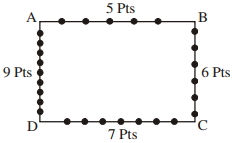
0 likesView Solution
50
MathematicsDifficultMCQJEE Main · 2021
If the points of intersection of the ellipse $\frac{x^{2}}{16}+\frac{y^{2}}{b^{2}}=1$ and the circle $x^{2}+y^{2}=4b$ (where $b > 4$) lie on the curve $y^{2}=3x^{2}$,then $b$ is equal to:
A
$12$
B
$5$
C
$6$
D
$10$
Solution
(A) Given the curve $y^{2}=3x^{2}$ and the circle $x^{2}+y^{2}=4b$.
Substituting $y^{2}=3x^{2}$ into the circle equation: $x^{2}+3x^{2}=4b \implies 4x^{2}=4b \implies x^{2}=b$.
Then $y^{2}=3b$.
Now,substitute $x^{2}=b$ and $y^{2}=3b$ into the ellipse equation $\frac{x^{2}}{16}+\frac{y^{2}}{b^{2}}=1$:
$\frac{b}{16}+\frac{3b}{b^{2}}=1$
$\frac{b}{16}+\frac{3}{b}=1$
Multiply by $16b$: $b^{2}+48=16b$
$b^{2}-16b+48=0$
$(b-12)(b-4)=0$
Since $b > 4$,we have $b=12$.
Substituting $y^{2}=3x^{2}$ into the circle equation: $x^{2}+3x^{2}=4b \implies 4x^{2}=4b \implies x^{2}=b$.
Then $y^{2}=3b$.
Now,substitute $x^{2}=b$ and $y^{2}=3b$ into the ellipse equation $\frac{x^{2}}{16}+\frac{y^{2}}{b^{2}}=1$:
$\frac{b}{16}+\frac{3b}{b^{2}}=1$
$\frac{b}{16}+\frac{3}{b}=1$
Multiply by $16b$: $b^{2}+48=16b$
$b^{2}-16b+48=0$
$(b-12)(b-4)=0$
Since $b > 4$,we have $b=12$.
0 likesView Solution
51
MathematicsDifficultMCQJEE Main · 2021
Let a vector $\alpha \hat{i}+\beta \hat{j}$ be obtained by rotating the vector $\sqrt{3} \hat{i}+\hat{j}$ by an angle $45^{\circ}$ about the origin in the counterclockwise direction in the first quadrant. Then the area of the triangle having vertices $(\alpha, \beta), (0, \beta)$ and $(0,0)$ is equal to
A
$\frac{1}{2}$
B
$1$
C
$\frac{1}{\sqrt{2}}$
D
$2 \sqrt{2}$
Solution
(A) The initial vector is $\vec{v} = \sqrt{3} \hat{i} + \hat{j}$. Its magnitude is $|\vec{v}| = \sqrt{(\sqrt{3})^2 + 1^2} = \sqrt{3+1} = 2$.
The angle of the initial vector with the positive $x$-axis is $\theta = \tan^{-1}(\frac{1}{\sqrt{3}}) = 30^{\circ}$.
Rotating this vector by $45^{\circ}$ counterclockwise gives a new vector with angle $\theta' = 30^{\circ} + 45^{\circ} = 75^{\circ}$.
The new vector is $\vec{v}' = |\vec{v}|(\cos 75^{\circ} \hat{i} + \sin 75^{\circ} \hat{j}) = 2(\cos 75^{\circ} \hat{i} + \sin 75^{\circ} \hat{j})$.
Thus,$\alpha = 2 \cos 75^{\circ}$ and $\beta = 2 \sin 75^{\circ}$.
The vertices of the triangle are $(\alpha, \beta), (0, \beta)$,and $(0,0)$. This is a right-angled triangle with base length $|\alpha| = \alpha$ and height $|\beta| = \beta$.
Area $= \frac{1}{2} \times \text{base} \times \text{height} = \frac{1}{2} \alpha \beta = \frac{1}{2} (2 \cos 75^{\circ}) (2 \sin 75^{\circ}) = 2 \sin 75^{\circ} \cos 75^{\circ} = \sin(2 \times 75^{\circ}) = \sin 150^{\circ} = \sin(180^{\circ} - 30^{\circ}) = \sin 30^{\circ} = \frac{1}{2}$.
The angle of the initial vector with the positive $x$-axis is $\theta = \tan^{-1}(\frac{1}{\sqrt{3}}) = 30^{\circ}$.
Rotating this vector by $45^{\circ}$ counterclockwise gives a new vector with angle $\theta' = 30^{\circ} + 45^{\circ} = 75^{\circ}$.
The new vector is $\vec{v}' = |\vec{v}|(\cos 75^{\circ} \hat{i} + \sin 75^{\circ} \hat{j}) = 2(\cos 75^{\circ} \hat{i} + \sin 75^{\circ} \hat{j})$.
Thus,$\alpha = 2 \cos 75^{\circ}$ and $\beta = 2 \sin 75^{\circ}$.
The vertices of the triangle are $(\alpha, \beta), (0, \beta)$,and $(0,0)$. This is a right-angled triangle with base length $|\alpha| = \alpha$ and height $|\beta| = \beta$.
Area $= \frac{1}{2} \times \text{base} \times \text{height} = \frac{1}{2} \alpha \beta = \frac{1}{2} (2 \cos 75^{\circ}) (2 \sin 75^{\circ}) = 2 \sin 75^{\circ} \cos 75^{\circ} = \sin(2 \times 75^{\circ}) = \sin 150^{\circ} = \sin(180^{\circ} - 30^{\circ}) = \sin 30^{\circ} = \frac{1}{2}$.
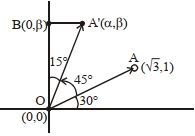
0 likesView Solution
52
MathematicsDifficultMCQJEE Main · 2021
If for $a > 0,$ the feet of perpendiculars from the points $A(a, -2a, 3)$ and $B(0, 4, 5)$ on the plane $lx + my + nz = 0$ are points $C(0, -a, -1)$ and $D$ respectively,then the length of line segment $CD$ is equal to
A
$\sqrt{31}$
B
$\sqrt{41}$
C
$\sqrt{55}$
D
$\sqrt{66}$
Solution
(D) Since $C(0, -a, -1)$ lies on the plane $lx + my + nz = 0,$ we have $l(0) + m(-a) + n(-1) = 0,$ which implies $-ma - n = 0,$ or $\frac{m}{n} = -\frac{1}{a} \quad \dots(1)$
The vector $\vec{CA} = (a - 0, -2a - (-a), 3 - (-1)) = (a, -a, 4)$ is parallel to the normal vector of the plane $\vec{n} = (l, m, n).$
Thus,$\frac{a}{l} = \frac{-a}{m} = \frac{4}{n}.$ From $\frac{-a}{m} = \frac{4}{n},$ we get $\frac{m}{n} = -\frac{a}{4} \quad \dots(2)$
Equating $(1)$ and $(2),$ we have $-\frac{1}{a} = -\frac{a}{4} \Rightarrow a^2 = 4.$ Since $a > 0,$ we have $a = 2.$
Substituting $a = 2$ into $(1),$ we get $\frac{m}{n} = -\frac{1}{2}.$ Let $m = -t$ and $n = 2t.$ Then $\frac{2}{l} = \frac{-2}{-t} \Rightarrow l = t.$
The equation of the plane is $t(x - y + 2z) = 0,$ or $x - y + 2z = 0.$
The point $D$ is the foot of the perpendicular from $B(0, 4, 5)$ to the plane $x - y + 2z = 0.$ The line $BD$ is given by $\frac{x-0}{1} = \frac{y-4}{-1} = \frac{z-5}{2} = k.$
So,$D = (k, 4-k, 5+2k).$ Since $D$ lies on the plane,$k - (4-k) + 2(5+2k) = 0 \Rightarrow k - 4 + k + 10 + 4k = 0 \Rightarrow 6k + 6 = 0 \Rightarrow k = -1.$
Thus,$D = (-1, 4-(-1), 5+2(-1)) = (-1, 5, 3).$
With $C = (0, -2, -1)$ and $D = (-1, 5, 3),$ the length $CD = \sqrt{(-1-0)^2 + (5-(-2))^2 + (3-(-1))^2} = \sqrt{(-1)^2 + 7^2 + 4^2} = \sqrt{1 + 49 + 16} = \sqrt{66}.$
The vector $\vec{CA} = (a - 0, -2a - (-a), 3 - (-1)) = (a, -a, 4)$ is parallel to the normal vector of the plane $\vec{n} = (l, m, n).$
Thus,$\frac{a}{l} = \frac{-a}{m} = \frac{4}{n}.$ From $\frac{-a}{m} = \frac{4}{n},$ we get $\frac{m}{n} = -\frac{a}{4} \quad \dots(2)$
Equating $(1)$ and $(2),$ we have $-\frac{1}{a} = -\frac{a}{4} \Rightarrow a^2 = 4.$ Since $a > 0,$ we have $a = 2.$
Substituting $a = 2$ into $(1),$ we get $\frac{m}{n} = -\frac{1}{2}.$ Let $m = -t$ and $n = 2t.$ Then $\frac{2}{l} = \frac{-2}{-t} \Rightarrow l = t.$
The equation of the plane is $t(x - y + 2z) = 0,$ or $x - y + 2z = 0.$
The point $D$ is the foot of the perpendicular from $B(0, 4, 5)$ to the plane $x - y + 2z = 0.$ The line $BD$ is given by $\frac{x-0}{1} = \frac{y-4}{-1} = \frac{z-5}{2} = k.$
So,$D = (k, 4-k, 5+2k).$ Since $D$ lies on the plane,$k - (4-k) + 2(5+2k) = 0 \Rightarrow k - 4 + k + 10 + 4k = 0 \Rightarrow 6k + 6 = 0 \Rightarrow k = -1.$
Thus,$D = (-1, 4-(-1), 5+2(-1)) = (-1, 5, 3).$
With $C = (0, -2, -1)$ and $D = (-1, 5, 3),$ the length $CD = \sqrt{(-1-0)^2 + (5-(-2))^2 + (3-(-1))^2} = \sqrt{(-1)^2 + 7^2 + 4^2} = \sqrt{1 + 49 + 16} = \sqrt{66}.$
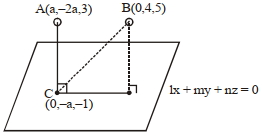
0 likesView Solution
53
MathematicsDifficultMCQJEE Main · 2021
Let $A = \begin{bmatrix} i & -i \\ -i & i \end{bmatrix}$,where $i = \sqrt{-1}$. Then,the system of linear equations $A^{8} \begin{bmatrix} x \\ y \end{bmatrix} = \begin{bmatrix} 8 \\ 64 \end{bmatrix}$ has :
A
$A$ unique solution
B
Infinitely many solutions
C
No solution
D
Exactly two solutions
Solution
(C) Given $A = \begin{bmatrix} i & -i \\ -i & i \end{bmatrix}$.
First,calculate $A^{2}$:
$A^{2} = \begin{bmatrix} i & -i \\ -i & i \end{bmatrix} \begin{bmatrix} i & -i \\ -i & i \end{bmatrix} = \begin{bmatrix} i^{2} + (-i)(-i) & -i^{2} - i^{2} \\ -i^{2} - i^{2} & (-i)(-i) + i^{2} \end{bmatrix} = \begin{bmatrix} -1 - 1 & 1 + 1 \\ 1 + 1 & -1 - 1 \end{bmatrix} = \begin{bmatrix} -2 & 2 \\ 2 & -2 \end{bmatrix} = 2 \begin{bmatrix} -1 & 1 \\ 1 & -1 \end{bmatrix}$.
Next,calculate $A^{4} = (A^{2})^{2}$:
$A^{4} = \left( 2 \begin{bmatrix} -1 & 1 \\ 1 & -1 \end{bmatrix} \right)^{2} = 4 \begin{bmatrix} -1 & 1 \\ 1 & -1 \end{bmatrix} \begin{bmatrix} -1 & 1 \\ 1 & -1 \end{bmatrix} = 4 \begin{bmatrix} 1+1 & -1-1 \\ -1-1 & 1+1 \end{bmatrix} = 4 \begin{bmatrix} 2 & -2 \\ -2 & 2 \end{bmatrix} = 8 \begin{bmatrix} 1 & -1 \\ -1 & 1 \end{bmatrix}$.
Then,calculate $A^{8} = (A^{4})^{2}$:
$A^{8} = \left( 8 \begin{bmatrix} 1 & -1 \\ -1 & 1 \end{bmatrix} \right)^{2} = 64 \begin{bmatrix} 1 & -1 \\ -1 & 1 \end{bmatrix} \begin{bmatrix} 1 & -1 \\ -1 & 1 \end{bmatrix} = 64 \begin{bmatrix} 1+1 & -1-1 \\ -1-1 & 1+1 \end{bmatrix} = 64 \begin{bmatrix} 2 & -2 \\ -2 & 2 \end{bmatrix} = 128 \begin{bmatrix} 1 & -1 \\ -1 & 1 \end{bmatrix}$.
The system is $128 \begin{bmatrix} 1 & -1 \\ -1 & 1 \end{bmatrix} \begin{bmatrix} x \\ y \end{bmatrix} = \begin{bmatrix} 8 \\ 64 \end{bmatrix}$.
This implies $128(x - y) = 8 \Rightarrow x - y = \frac{8}{128} = \frac{1}{16}$ and $128(-x + y) = 64 \Rightarrow -x + y = \frac{64}{128} = \frac{1}{2}$.
From the first equation,$x - y = \frac{1}{16}$,and from the second,$x - y = -\frac{1}{2}$.
Since $\frac{1}{16} \neq -\frac{1}{2}$,the system has no solution.
First,calculate $A^{2}$:
$A^{2} = \begin{bmatrix} i & -i \\ -i & i \end{bmatrix} \begin{bmatrix} i & -i \\ -i & i \end{bmatrix} = \begin{bmatrix} i^{2} + (-i)(-i) & -i^{2} - i^{2} \\ -i^{2} - i^{2} & (-i)(-i) + i^{2} \end{bmatrix} = \begin{bmatrix} -1 - 1 & 1 + 1 \\ 1 + 1 & -1 - 1 \end{bmatrix} = \begin{bmatrix} -2 & 2 \\ 2 & -2 \end{bmatrix} = 2 \begin{bmatrix} -1 & 1 \\ 1 & -1 \end{bmatrix}$.
Next,calculate $A^{4} = (A^{2})^{2}$:
$A^{4} = \left( 2 \begin{bmatrix} -1 & 1 \\ 1 & -1 \end{bmatrix} \right)^{2} = 4 \begin{bmatrix} -1 & 1 \\ 1 & -1 \end{bmatrix} \begin{bmatrix} -1 & 1 \\ 1 & -1 \end{bmatrix} = 4 \begin{bmatrix} 1+1 & -1-1 \\ -1-1 & 1+1 \end{bmatrix} = 4 \begin{bmatrix} 2 & -2 \\ -2 & 2 \end{bmatrix} = 8 \begin{bmatrix} 1 & -1 \\ -1 & 1 \end{bmatrix}$.
Then,calculate $A^{8} = (A^{4})^{2}$:
$A^{8} = \left( 8 \begin{bmatrix} 1 & -1 \\ -1 & 1 \end{bmatrix} \right)^{2} = 64 \begin{bmatrix} 1 & -1 \\ -1 & 1 \end{bmatrix} \begin{bmatrix} 1 & -1 \\ -1 & 1 \end{bmatrix} = 64 \begin{bmatrix} 1+1 & -1-1 \\ -1-1 & 1+1 \end{bmatrix} = 64 \begin{bmatrix} 2 & -2 \\ -2 & 2 \end{bmatrix} = 128 \begin{bmatrix} 1 & -1 \\ -1 & 1 \end{bmatrix}$.
The system is $128 \begin{bmatrix} 1 & -1 \\ -1 & 1 \end{bmatrix} \begin{bmatrix} x \\ y \end{bmatrix} = \begin{bmatrix} 8 \\ 64 \end{bmatrix}$.
This implies $128(x - y) = 8 \Rightarrow x - y = \frac{8}{128} = \frac{1}{16}$ and $128(-x + y) = 64 \Rightarrow -x + y = \frac{64}{128} = \frac{1}{2}$.
From the first equation,$x - y = \frac{1}{16}$,and from the second,$x - y = -\frac{1}{2}$.
Since $\frac{1}{16} \neq -\frac{1}{2}$,the system has no solution.
0 likesView Solution
54
MathematicsDifficultMCQJEE Main · 2021
Let the position vectors of two points $P$ and $Q$ be $3 \hat{i} - \hat{j} + 2 \hat{k}$ and $\hat{i} + 2 \hat{j} - 4 \hat{k}$ respectively. Let $R$ and $S$ be two points such that the direction ratios of lines $PR$ and $QS$ are $(4, -1, 2)$ and $(-2, 1, -2)$ respectively. Let lines $PR$ and $QS$ intersect at $T$. If the vector $\vec{TA}$ is perpendicular to both $\vec{PR}$ and $\vec{QS}$ and the length of vector $\vec{TA}$ is $\sqrt{5}$ units,then the modulus of a position vector of $A$ is
A
$\sqrt{482}$
B
$\sqrt{171}$
C
$\sqrt{5}$
D
$\sqrt{227}$
Solution
(B) Given points $P(3, -1, 2)$ and $Q(1, 2, -4)$.
Direction vectors of lines $PR$ and $QS$ are $\vec{v_1} = 4\hat{i} - \hat{j} + 2\hat{k}$ and $\vec{v_2} = -2\hat{i} + \hat{j} - 2\hat{k}$.
The normal vector $\vec{n}$ to the plane containing $P, T, Q$ is $\vec{v_1} \times \vec{v_2} = \begin{vmatrix} \hat{i} & \hat{j} & \hat{k} \\ 4 & -1 & 2 \\ -2 & 1 & -2 \end{vmatrix} = \hat{i}(2-2) - \hat{j}(-8+4) + \hat{k}(4-2) = 0\hat{i} + 4\hat{j} + 2\hat{k}$.
Unit normal vector $\hat{n} = \frac{4\hat{j} + 2\hat{k}}{\sqrt{0^2 + 4^2 + 2^2}} = \frac{4\hat{j} + 2\hat{k}}{\sqrt{20}} = \frac{2\hat{j} + \hat{k}}{\sqrt{5}}$.
For intersection point $T$,line $PT: \vec{r} = (3\hat{i} - \hat{j} + 2\hat{k}) + \lambda(4\hat{i} - \hat{j} + 2\hat{k})$ and line $QT: \vec{r} = (\hat{i} + 2\hat{j} - 4\hat{k}) + \mu(-2\hat{i} + \hat{j} - 2\hat{k})$.
Equating coordinates: $3+4\lambda = 1-2\mu \Rightarrow 4\lambda + 2\mu = -2 \Rightarrow 2\lambda + \mu = -1$.
$-1-\lambda = 2+\mu \Rightarrow \lambda + \mu = -3$.
Subtracting equations: $\lambda = 2$,then $\mu = -5$.
Point $T = (3+4(2), -1-(2), 2+2(2)) = (11, -3, 6)$.
Vector $\vec{OA} = \vec{OT} \pm |\vec{TA}|\hat{n} = (11\hat{i} - 3\hat{j} + 6\hat{k}) \pm \sqrt{5} \left(\frac{2\hat{j} + \hat{k}}{\sqrt{5}}\right) = (11\hat{i} - 3\hat{j} + 6\hat{k}) \pm (2\hat{j} + \hat{k})$.
Case $1$: $\vec{OA} = 11\hat{i} - \hat{j} + 7\hat{k} \Rightarrow |\vec{OA}| = \sqrt{121 + 1 + 49} = \sqrt{171}$.
Case $2$: $\vec{OA} = 11\hat{i} - 5\hat{j} + 5\hat{k} \Rightarrow |\vec{OA}| = \sqrt{121 + 25 + 25} = \sqrt{171}$.
Direction vectors of lines $PR$ and $QS$ are $\vec{v_1} = 4\hat{i} - \hat{j} + 2\hat{k}$ and $\vec{v_2} = -2\hat{i} + \hat{j} - 2\hat{k}$.
The normal vector $\vec{n}$ to the plane containing $P, T, Q$ is $\vec{v_1} \times \vec{v_2} = \begin{vmatrix} \hat{i} & \hat{j} & \hat{k} \\ 4 & -1 & 2 \\ -2 & 1 & -2 \end{vmatrix} = \hat{i}(2-2) - \hat{j}(-8+4) + \hat{k}(4-2) = 0\hat{i} + 4\hat{j} + 2\hat{k}$.
Unit normal vector $\hat{n} = \frac{4\hat{j} + 2\hat{k}}{\sqrt{0^2 + 4^2 + 2^2}} = \frac{4\hat{j} + 2\hat{k}}{\sqrt{20}} = \frac{2\hat{j} + \hat{k}}{\sqrt{5}}$.
For intersection point $T$,line $PT: \vec{r} = (3\hat{i} - \hat{j} + 2\hat{k}) + \lambda(4\hat{i} - \hat{j} + 2\hat{k})$ and line $QT: \vec{r} = (\hat{i} + 2\hat{j} - 4\hat{k}) + \mu(-2\hat{i} + \hat{j} - 2\hat{k})$.
Equating coordinates: $3+4\lambda = 1-2\mu \Rightarrow 4\lambda + 2\mu = -2 \Rightarrow 2\lambda + \mu = -1$.
$-1-\lambda = 2+\mu \Rightarrow \lambda + \mu = -3$.
Subtracting equations: $\lambda = 2$,then $\mu = -5$.
Point $T = (3+4(2), -1-(2), 2+2(2)) = (11, -3, 6)$.
Vector $\vec{OA} = \vec{OT} \pm |\vec{TA}|\hat{n} = (11\hat{i} - 3\hat{j} + 6\hat{k}) \pm \sqrt{5} \left(\frac{2\hat{j} + \hat{k}}{\sqrt{5}}\right) = (11\hat{i} - 3\hat{j} + 6\hat{k}) \pm (2\hat{j} + \hat{k})$.
Case $1$: $\vec{OA} = 11\hat{i} - \hat{j} + 7\hat{k} \Rightarrow |\vec{OA}| = \sqrt{121 + 1 + 49} = \sqrt{171}$.
Case $2$: $\vec{OA} = 11\hat{i} - 5\hat{j} + 5\hat{k} \Rightarrow |\vec{OA}| = \sqrt{121 + 25 + 25} = \sqrt{171}$.
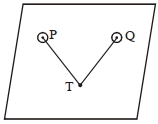
0 likesView Solution
55
MathematicsDifficultMCQJEE Main · 2021
Let the functions $f: R \rightarrow R$ and $g: R \rightarrow R$ be defined as $f(x) = \begin{cases} x+2, & x < 0 \\ x^2, & x \geq 0 \end{cases}$ and $g(x) = \begin{cases} x^3, & x < 1 \\ 3x-2, & x \geq 1 \end{cases}$. Then,the number of points in $R$ where $(f \circ g)(x)$ is $NOT$ differentiable is equal to
A
$3$
B
$1$
C
$0$
D
$2$
Solution
(B) First,we find the composite function $(f \circ g)(x) = f(g(x))$.
Given $g(x) < 0$ when $x < 0$ (since $x^3 < 0$ for $x < 0$),and $g(x) \geq 0$ when $x \geq 0$ (since $x^3 \geq 0$ for $x \in [0, 1)$ and $3x-2 \geq 1$ for $x \geq 1$).
Thus,$(f \circ g)(x) = \begin{cases} g(x)+2, & g(x) < 0 \\ (g(x))^2, & g(x) \geq 0 \end{cases} = \begin{cases} x^3+2, & x < 0 \\ (x^3)^2, & 0 \leq x < 1 \\ (3x-2)^2, & x \geq 1 \end{cases} = \begin{cases} x^3+2, & x < 0 \\ x^6, & 0 \leq x < 1 \\ (3x-2)^2, & x \geq 1 \end{cases}$.
Now,check for continuity and differentiability at the transition points $x=0$ and $x=1$.
At $x=0$: $\lim_{x \to 0^-} (x^3+2) = 2$ and $\lim_{x \to 0^+} (x^6) = 0$. Since $2 \neq 0$,the function is discontinuous at $x=0$,hence not differentiable at $x=0$.
At $x=1$: $\lim_{x \to 1^-} (x^6) = 1$ and $\lim_{x \to 1^+} (3x-2)^2 = (3(1)-2)^2 = 1$. The function is continuous at $x=1$.
Check derivatives at $x=1$: $LHD = \frac{d}{dx}(x^6)|_{x=1} = 6(1)^5 = 6$. $RHD = \frac{d}{dx}(3x-2)^2|_{x=1} = 2(3x-2) \cdot 3|_{x=1} = 6(3-2) = 6$.
Since $LHD = RHD$,the function is differentiable at $x=1$.
Therefore,the only point where $(f \circ g)(x)$ is not differentiable is $x=0$. The number of such points is $1$.
Given $g(x) < 0$ when $x < 0$ (since $x^3 < 0$ for $x < 0$),and $g(x) \geq 0$ when $x \geq 0$ (since $x^3 \geq 0$ for $x \in [0, 1)$ and $3x-2 \geq 1$ for $x \geq 1$).
Thus,$(f \circ g)(x) = \begin{cases} g(x)+2, & g(x) < 0 \\ (g(x))^2, & g(x) \geq 0 \end{cases} = \begin{cases} x^3+2, & x < 0 \\ (x^3)^2, & 0 \leq x < 1 \\ (3x-2)^2, & x \geq 1 \end{cases} = \begin{cases} x^3+2, & x < 0 \\ x^6, & 0 \leq x < 1 \\ (3x-2)^2, & x \geq 1 \end{cases}$.
Now,check for continuity and differentiability at the transition points $x=0$ and $x=1$.
At $x=0$: $\lim_{x \to 0^-} (x^3+2) = 2$ and $\lim_{x \to 0^+} (x^6) = 0$. Since $2 \neq 0$,the function is discontinuous at $x=0$,hence not differentiable at $x=0$.
At $x=1$: $\lim_{x \to 1^-} (x^6) = 1$ and $\lim_{x \to 1^+} (3x-2)^2 = (3(1)-2)^2 = 1$. The function is continuous at $x=1$.
Check derivatives at $x=1$: $LHD = \frac{d}{dx}(x^6)|_{x=1} = 6(1)^5 = 6$. $RHD = \frac{d}{dx}(3x-2)^2|_{x=1} = 2(3x-2) \cdot 3|_{x=1} = 6(3-2) = 6$.
Since $LHD = RHD$,the function is differentiable at $x=1$.
Therefore,the only point where $(f \circ g)(x)$ is not differentiable is $x=0$. The number of such points is $1$.
0 likesView Solution
56
MathematicsDifficultMCQJEE Main · 2021
Let $P$ be a plane $lx + my + nz = 0$ containing the line $\frac{1-x}{1} = \frac{y+4}{2} = \frac{z+2}{3}$. If plane $P$ divides the line segment $AB$ joining points $A(-3, -6, 1)$ and $B(2, 4, -3)$ in the ratio $k : 1$,then the value of $k$ is equal to
A
$1.5$
B
$3$
C
$2$
D
$4$
Solution
(C) The line is given by $\frac{x-1}{-1} = \frac{y+4}{2} = \frac{z+2}{3}$.
Since the plane $lx + my + nz = 0$ contains this line,it passes through the point $(1, -4, -2)$ and its normal vector $(l, m, n)$ is perpendicular to the direction vector $(-1, 2, 3)$ of the line.
Thus,$l(1) + m(-4) + n(-2) = 0 \implies l - 4m - 2n = 0$ (Equation $1$).
And $-l + 2m + 3n = 0$ (Equation $2$).
Adding $(1)$ and $(2)$,we get $-2m + n = 0 \implies n = 2m$.
Substituting $n = 2m$ into $(2)$,we get $-l + 2m + 3(2m) = 0 \implies l = 8m$.
Thus,the plane equation is $8x + y + 2z = 0$.
The point $C$ dividing $AB$ in ratio $k:1$ is $\left(\frac{2k-3}{k+1}, \frac{4k-6}{k+1}, \frac{-3k+1}{k+1}\right)$.
Since $C$ lies on the plane,$8\left(\frac{2k-3}{k+1}\right) + \left(\frac{4k-6}{k+1}\right) + 2\left(\frac{-3k+1}{k+1}\right) = 0$.
$16k - 24 + 4k - 6 - 6k + 2 = 0$.
$14k - 28 = 0 \implies k = 2$.
Since the plane $lx + my + nz = 0$ contains this line,it passes through the point $(1, -4, -2)$ and its normal vector $(l, m, n)$ is perpendicular to the direction vector $(-1, 2, 3)$ of the line.
Thus,$l(1) + m(-4) + n(-2) = 0 \implies l - 4m - 2n = 0$ (Equation $1$).
And $-l + 2m + 3n = 0$ (Equation $2$).
Adding $(1)$ and $(2)$,we get $-2m + n = 0 \implies n = 2m$.
Substituting $n = 2m$ into $(2)$,we get $-l + 2m + 3(2m) = 0 \implies l = 8m$.
Thus,the plane equation is $8x + y + 2z = 0$.
The point $C$ dividing $AB$ in ratio $k:1$ is $\left(\frac{2k-3}{k+1}, \frac{4k-6}{k+1}, \frac{-3k+1}{k+1}\right)$.
Since $C$ lies on the plane,$8\left(\frac{2k-3}{k+1}\right) + \left(\frac{4k-6}{k+1}\right) + 2\left(\frac{-3k+1}{k+1}\right) = 0$.
$16k - 24 + 4k - 6 - 6k + 2 = 0$.
$14k - 28 = 0 \implies k = 2$.
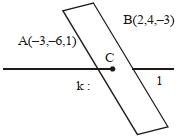
0 likesView Solution
57
MathematicsDifficultMCQJEE Main · 2021
The range of $a \in R$ for which the function $f(x)=(4 a-3)\left(x+\log _{e} 5\right)+2(a-7) \cot \left(\frac{x}{2}\right) \sin ^{2}\left(\frac{x}{2}\right)$ where $x \neq 2 n \pi, n \in N$,has critical points,is
A
$(-3,1)$
B
$[-\frac{4}{3}, 2]$
C
$[1, \infty)$
D
$(-\infty,-1]$
Solution
(B) Given $f(x)=(4 a-3)\left(x+\log _{e} 5\right)+2(a-7) \cot \left(\frac{x}{2}\right) \sin ^{2}\left(\frac{x}{2}\right)$.
Since $\cot \left(\frac{x}{2}\right) \sin ^{2}\left(\frac{x}{2}\right) = \frac{\cos(x/2)}{\sin(x/2)} \cdot \sin^2(x/2) = \sin(x/2)\cos(x/2) = \frac{1}{2} \sin x$,the function simplifies to:
$f(x)=(4 a-3)\left(x+\log _{e} 5\right)+(a-7) \sin x$.
For critical points,we set $f'(x) = 0$:
$f'(x)=(4 a-3)(1)+(a-7) \cos x = 0$.
This implies $\cos x = \frac{3-4 a}{a-7}$.
Since $-1 \leq \cos x \leq 1$ and $x \neq 2n\pi$ (which means $\cos x \neq 1$),we have:
$-1 \leq \frac{3-4 a}{a-7} < 1$.
Case $1$: $\frac{3-4 a}{a-7} \geq -1 \Rightarrow \frac{3-4 a + a - 7}{a-7} \geq 0 \Rightarrow \frac{-3 a - 4}{a-7} \geq 0 \Rightarrow \frac{3 a + 4}{a-7} \leq 0$.
This gives $a \in [-\frac{4}{3}, 7)$.
Case $2$: $\frac{3-4 a}{a-7} < 1 \Rightarrow \frac{3-4 a - a + 7}{a-7} < 0 \Rightarrow \frac{-5 a + 10}{a-7} < 0 \Rightarrow \frac{5(a-2)}{a-7} > 0$.
This gives $a \in (-\infty, 2) \cup (7, \infty)$.
Taking the intersection of Case $1$ and Case $2$,we get $a \in [-\frac{4}{3}, 2)$.
However,checking the boundary $a=2$,$\cos x = \frac{3-8}{2-7} = \frac{-5}{-5} = 1$,which is excluded as $x \neq 2n\pi$. Thus,the range is $[-\frac{4}{3}, 2)$.
Since $\cot \left(\frac{x}{2}\right) \sin ^{2}\left(\frac{x}{2}\right) = \frac{\cos(x/2)}{\sin(x/2)} \cdot \sin^2(x/2) = \sin(x/2)\cos(x/2) = \frac{1}{2} \sin x$,the function simplifies to:
$f(x)=(4 a-3)\left(x+\log _{e} 5\right)+(a-7) \sin x$.
For critical points,we set $f'(x) = 0$:
$f'(x)=(4 a-3)(1)+(a-7) \cos x = 0$.
This implies $\cos x = \frac{3-4 a}{a-7}$.
Since $-1 \leq \cos x \leq 1$ and $x \neq 2n\pi$ (which means $\cos x \neq 1$),we have:
$-1 \leq \frac{3-4 a}{a-7} < 1$.
Case $1$: $\frac{3-4 a}{a-7} \geq -1 \Rightarrow \frac{3-4 a + a - 7}{a-7} \geq 0 \Rightarrow \frac{-3 a - 4}{a-7} \geq 0 \Rightarrow \frac{3 a + 4}{a-7} \leq 0$.
This gives $a \in [-\frac{4}{3}, 7)$.
Case $2$: $\frac{3-4 a}{a-7} < 1 \Rightarrow \frac{3-4 a - a + 7}{a-7} < 0 \Rightarrow \frac{-5 a + 10}{a-7} < 0 \Rightarrow \frac{5(a-2)}{a-7} > 0$.
This gives $a \in (-\infty, 2) \cup (7, \infty)$.
Taking the intersection of Case $1$ and Case $2$,we get $a \in [-\frac{4}{3}, 2)$.
However,checking the boundary $a=2$,$\cos x = \frac{3-8}{2-7} = \frac{-5}{-5} = 1$,which is excluded as $x \neq 2n\pi$. Thus,the range is $[-\frac{4}{3}, 2)$.

0 likesView Solution
58
MathematicsMediumMCQJEE Main · 2021
$A$ pack of cards has one card missing. Two cards are drawn randomly and are found to be spades. The probability that the missing card is not a spade is:
A
$\frac{3}{4}$
B
$\frac{52}{867}$
C
$\frac{39}{50}$
D
$\frac{22}{425}$
Solution
(C) Let $E_1$ be the event that the missing card is a spade,and $E_2$ be the event that the missing card is not a spade.
$P(E_1) = \frac{13}{52} = \frac{1}{4}$ and $P(E_2) = \frac{39}{52} = \frac{3}{4}$.
Let $A$ be the event that two cards drawn from the remaining $51$ cards are spades.
If $E_1$ occurs,there are $12$ spades left in $51$ cards. Thus,$P(A|E_1) = \frac{^{12}C_2}{^{51}C_2} = \frac{12 \times 11}{51 \times 50} = \frac{132}{2550}$.
If $E_2$ occurs,there are $13$ spades left in $51$ cards. Thus,$P(A|E_2) = \frac{^{13}C_2}{^{51}C_2} = \frac{13 \times 12}{51 \times 50} = \frac{156}{2550}$.
We need to find $P(E_2|A)$. By Bayes' Theorem:
$P(E_2|A) = \frac{P(E_2)P(A|E_2)}{P(E_1)P(A|E_1) + P(E_2)P(A|E_2)}$
$P(E_2|A) = \frac{\frac{3}{4} \times \frac{156}{2550}}{\frac{1}{4} \times \frac{132}{2550} + \frac{3}{4} \times \frac{156}{2550}} = \frac{3 \times 156}{132 + 3 \times 156} = \frac{468}{132 + 468} = \frac{468}{600} = \frac{39}{50}$.
$P(E_1) = \frac{13}{52} = \frac{1}{4}$ and $P(E_2) = \frac{39}{52} = \frac{3}{4}$.
Let $A$ be the event that two cards drawn from the remaining $51$ cards are spades.
If $E_1$ occurs,there are $12$ spades left in $51$ cards. Thus,$P(A|E_1) = \frac{^{12}C_2}{^{51}C_2} = \frac{12 \times 11}{51 \times 50} = \frac{132}{2550}$.
If $E_2$ occurs,there are $13$ spades left in $51$ cards. Thus,$P(A|E_2) = \frac{^{13}C_2}{^{51}C_2} = \frac{13 \times 12}{51 \times 50} = \frac{156}{2550}$.
We need to find $P(E_2|A)$. By Bayes' Theorem:
$P(E_2|A) = \frac{P(E_2)P(A|E_2)}{P(E_1)P(A|E_1) + P(E_2)P(A|E_2)}$
$P(E_2|A) = \frac{\frac{3}{4} \times \frac{156}{2550}}{\frac{1}{4} \times \frac{132}{2550} + \frac{3}{4} \times \frac{156}{2550}} = \frac{3 \times 156}{132 + 3 \times 156} = \frac{468}{132 + 468} = \frac{468}{600} = \frac{39}{50}$.
0 likesView Solution
59
MathematicsDifficultMCQJEE Main · 2021
If $y=y(x)$ is the solution of the differential equation $\frac{dy}{dx} + 2y \tan x = \sin x$ with the condition $y(\frac{\pi}{3}) = 0$,then the maximum value of the function $y(x)$ over $\mathbb{R}$ is equal to:
A
$8$
B
$\frac{1}{2}$
C
$-\frac{15}{4}$
D
$\frac{1}{8}$
Solution
(D) The given differential equation is $\frac{dy}{dx} + 2y \tan x = \sin x$. This is a linear differential equation of the form $\frac{dy}{dx} + Py = Q$,where $P = 2 \tan x$ and $Q = \sin x$.
The integrating factor $(I.F.)$ is given by $I.F. = e^{\int P dx} = e^{\int 2 \tan x dx} = e^{2 \ln |\sec x|} = \sec^2 x$.
The general solution is $y \cdot (I.F.) = \int Q \cdot (I.F.) dx + C$.
$y \sec^2 x = \int \sin x \cdot \sec^2 x dx = \int \sec x \tan x dx = \sec x + C$.
Given $y(\frac{\pi}{3}) = 0$,we substitute $x = \frac{\pi}{3}$ and $y = 0$:
$0 \cdot \sec^2(\frac{\pi}{3}) = \sec(\frac{\pi}{3}) + C \implies 0 = 2 + C \implies C = -2$.
Thus,$y \sec^2 x = \sec x - 2$,which simplifies to $y = \frac{\sec x - 2}{\sec^2 x} = \cos x - 2 \cos^2 x$.
Let $t = \cos x$. Since $-1 \le \cos x \le 1$,we have $y = t - 2t^2$. To find the maximum,we differentiate with respect to $t$:
$\frac{dy}{dt} = 1 - 4t = 0 \implies t = \frac{1}{4}$.
Since $t = \frac{1}{4}$ is within the range $[-1, 1]$,the maximum value is $y = \frac{1}{4} - 2(\frac{1}{4})^2 = \frac{1}{4} - \frac{2}{16} = \frac{1}{4} - \frac{1}{8} = \frac{1}{8}$.
The integrating factor $(I.F.)$ is given by $I.F. = e^{\int P dx} = e^{\int 2 \tan x dx} = e^{2 \ln |\sec x|} = \sec^2 x$.
The general solution is $y \cdot (I.F.) = \int Q \cdot (I.F.) dx + C$.
$y \sec^2 x = \int \sin x \cdot \sec^2 x dx = \int \sec x \tan x dx = \sec x + C$.
Given $y(\frac{\pi}{3}) = 0$,we substitute $x = \frac{\pi}{3}$ and $y = 0$:
$0 \cdot \sec^2(\frac{\pi}{3}) = \sec(\frac{\pi}{3}) + C \implies 0 = 2 + C \implies C = -2$.
Thus,$y \sec^2 x = \sec x - 2$,which simplifies to $y = \frac{\sec x - 2}{\sec^2 x} = \cos x - 2 \cos^2 x$.
Let $t = \cos x$. Since $-1 \le \cos x \le 1$,we have $y = t - 2t^2$. To find the maximum,we differentiate with respect to $t$:
$\frac{dy}{dt} = 1 - 4t = 0 \implies t = \frac{1}{4}$.
Since $t = \frac{1}{4}$ is within the range $[-1, 1]$,the maximum value is $y = \frac{1}{4} - 2(\frac{1}{4})^2 = \frac{1}{4} - \frac{2}{16} = \frac{1}{4} - \frac{1}{8} = \frac{1}{8}$.
0 likesView Solution
60
MathematicsAdvancedMCQJEE Main · 2021
Let $S_{k} = \sum_{r=1}^{k} \tan^{-1}\left(\frac{6^{r}}{2^{2r+1} + 3^{2r+1}}\right)$. Then $\lim_{k \rightarrow \infty} S_{k}$ is equal to
A
$\tan^{-1}\left(\frac{3}{2}\right)$
B
$\frac{\pi}{2}$
C
$\cot^{-1}\left(\frac{3}{2}\right)$
D
$\tan^{-1}(3)$
Solution
(C) We have $S_{k} = \sum_{r=1}^{k} \tan^{-1}\left(\frac{6^{r}}{2 \cdot 2^{2r} + 3 \cdot 3^{2r}}\right)$.
Dividing the numerator and denominator by $3^{2r}$,we get:
$S_{k} = \sum_{r=1}^{k} \tan^{-1}\left(\frac{\frac{2^r}{3^r} \cdot 3^r}{2 \cdot \frac{2^{2r}}{3^{2r}} + 3}\right) = \sum_{r=1}^{k} \tan^{-1}\left(\frac{3^r \cdot (2/3)^r}{2 \cdot (2/3)^{2r} + 3}\right)$.
Actually,rewrite the term inside $\tan^{-1}$ as:
$\frac{6^r}{2 \cdot 4^r + 3 \cdot 9^r} = \frac{6^r / 9^r}{2 \cdot (4/9)^r + 3} = \frac{(2/3)^r}{2 \cdot (2/3)^{2r} + 3}$.
This can be written as $\frac{(2/3)^r / 3}{1 + \frac{2}{3} (2/3)^{2r}} = \frac{(2/3)^r - (2/3)^{r+1}}{1 + (2/3)^r \cdot (2/3)^{r+1}}$.
Thus,the sum is a telescoping series:
$S_{k} = \sum_{r=1}^{k} \left( \tan^{-1}((2/3)^r) - \tan^{-1}((2/3)^{r+1}) \right)$.
$S_{k} = \left( \tan^{-1}(2/3) - \tan^{-1}((2/3)^2) \right) + \left( \tan^{-1}((2/3)^2) - \tan^{-1}((2/3)^3) \right) + \dots + \left( \tan^{-1}((2/3)^k) - \tan^{-1}((2/3)^{k+1}) \right)$.
$S_{k} = \tan^{-1}(2/3) - \tan^{-1}((2/3)^{k+1})$.
Taking the limit as $k \rightarrow \infty$,$(2/3)^{k+1} \rightarrow 0$.
$S_{\infty} = \tan^{-1}(2/3) - \tan^{-1}(0) = \tan^{-1}(2/3) = \cot^{-1}(3/2)$.
Dividing the numerator and denominator by $3^{2r}$,we get:
$S_{k} = \sum_{r=1}^{k} \tan^{-1}\left(\frac{\frac{2^r}{3^r} \cdot 3^r}{2 \cdot \frac{2^{2r}}{3^{2r}} + 3}\right) = \sum_{r=1}^{k} \tan^{-1}\left(\frac{3^r \cdot (2/3)^r}{2 \cdot (2/3)^{2r} + 3}\right)$.
Actually,rewrite the term inside $\tan^{-1}$ as:
$\frac{6^r}{2 \cdot 4^r + 3 \cdot 9^r} = \frac{6^r / 9^r}{2 \cdot (4/9)^r + 3} = \frac{(2/3)^r}{2 \cdot (2/3)^{2r} + 3}$.
This can be written as $\frac{(2/3)^r / 3}{1 + \frac{2}{3} (2/3)^{2r}} = \frac{(2/3)^r - (2/3)^{r+1}}{1 + (2/3)^r \cdot (2/3)^{r+1}}$.
Thus,the sum is a telescoping series:
$S_{k} = \sum_{r=1}^{k} \left( \tan^{-1}((2/3)^r) - \tan^{-1}((2/3)^{r+1}) \right)$.
$S_{k} = \left( \tan^{-1}(2/3) - \tan^{-1}((2/3)^2) \right) + \left( \tan^{-1}((2/3)^2) - \tan^{-1}((2/3)^3) \right) + \dots + \left( \tan^{-1}((2/3)^k) - \tan^{-1}((2/3)^{k+1}) \right)$.
$S_{k} = \tan^{-1}(2/3) - \tan^{-1}((2/3)^{k+1})$.
Taking the limit as $k \rightarrow \infty$,$(2/3)^{k+1} \rightarrow 0$.
$S_{\infty} = \tan^{-1}(2/3) - \tan^{-1}(0) = \tan^{-1}(2/3) = \cot^{-1}(3/2)$.
0 likesView Solution
61
MathematicsDifficultMCQJEE Main · 2021
Let $f:(0,2) \rightarrow R$ be defined as $f(x) = \log_{2}\left(1+\tan\left(\frac{\pi x}{4}\right)\right)$. Then,$\lim_{n \rightarrow \infty} \frac{2}{n}\left(f\left(\frac{1}{n}\right)+f\left(\frac{2}{n}\right)+\ldots+f(1)\right)$ is equal to
A
$2$
B
$1$
C
$4$
D
$5$
Solution
(B) The given limit is $E = 2 \lim_{n \rightarrow \infty} \frac{1}{n} \sum_{r=1}^{n} f\left(\frac{r}{n}\right)$.
This is a Riemann sum,which can be written as the definite integral $E = 2 \int_{0}^{1} f(x) dx$.
Substituting $f(x) = \log_{2}\left(1+\tan\left(\frac{\pi x}{4}\right)\right) = \frac{\ln(1+\tan(\pi x/4))}{\ln 2}$,we get:
$E = \frac{2}{\ln 2} \int_{0}^{1} \ln\left(1+\tan\frac{\pi x}{4}\right) dx \quad \dots(i)$
Using the property $\int_{0}^{a} g(x) dx = \int_{0}^{a} g(a-x) dx$,we replace $x$ with $1-x$:
$E = \frac{2}{\ln 2} \int_{0}^{1} \ln\left(1+\tan\left(\frac{\pi}{4}(1-x)\right)\right) dx$
$E = \frac{2}{\ln 2} \int_{0}^{1} \ln\left(1+\frac{1-\tan(\pi x/4)}{1+\tan(\pi x/4)}\right) dx$
$E = \frac{2}{\ln 2} \int_{0}^{1} \ln\left(\frac{2}{1+\tan(\pi x/4)}\right) dx$
$E = \frac{2}{\ln 2} \int_{0}^{1} (\ln 2 - \ln(1+\tan(\pi x/4))) dx \quad \dots(ii)$
Adding $(i)$ and $(ii)$:
$2E = \frac{2}{\ln 2} \int_{0}^{1} \ln 2 dx = \frac{2}{\ln 2} \cdot \ln 2 = 2$
Therefore,$E = 1$.
This is a Riemann sum,which can be written as the definite integral $E = 2 \int_{0}^{1} f(x) dx$.
Substituting $f(x) = \log_{2}\left(1+\tan\left(\frac{\pi x}{4}\right)\right) = \frac{\ln(1+\tan(\pi x/4))}{\ln 2}$,we get:
$E = \frac{2}{\ln 2} \int_{0}^{1} \ln\left(1+\tan\frac{\pi x}{4}\right) dx \quad \dots(i)$
Using the property $\int_{0}^{a} g(x) dx = \int_{0}^{a} g(a-x) dx$,we replace $x$ with $1-x$:
$E = \frac{2}{\ln 2} \int_{0}^{1} \ln\left(1+\tan\left(\frac{\pi}{4}(1-x)\right)\right) dx$
$E = \frac{2}{\ln 2} \int_{0}^{1} \ln\left(1+\frac{1-\tan(\pi x/4)}{1+\tan(\pi x/4)}\right) dx$
$E = \frac{2}{\ln 2} \int_{0}^{1} \ln\left(\frac{2}{1+\tan(\pi x/4)}\right) dx$
$E = \frac{2}{\ln 2} \int_{0}^{1} (\ln 2 - \ln(1+\tan(\pi x/4))) dx \quad \dots(ii)$
Adding $(i)$ and $(ii)$:
$2E = \frac{2}{\ln 2} \int_{0}^{1} \ln 2 dx = \frac{2}{\ln 2} \cdot \ln 2 = 2$
Therefore,$E = 1$.
0 likesView Solution
62
MathematicsDifficultMCQJEE Main · 2021
The total number of $3 \times 3$ matrices $A$ having entries from the set $\{0, 1, 2, 3\}$ such that the sum of all the diagonal entries of $AA^{T}$ is $9$,is equal to........
A
$728$
B
$712$
C
$824$
D
$766$
Solution
(D) Let $A = \begin{bmatrix} a & b & c \\ d & e & f \\ g & h & i \end{bmatrix}$.
The diagonal entries of $AA^{T}$ are given by the sum of squares of the elements in each row of $A$.
Specifically,the diagonal entries are $(a^{2}+b^{2}+c^{2})$,$(d^{2}+e^{2}+f^{2})$,and $(g^{2}+h^{2}+i^{2})$.
The sum of all diagonal entries is $a^{2}+b^{2}+c^{2}+d^{2}+e^{2}+f^{2}+g^{2}+h^{2}+i^{2} = 9$,where $a, b, c, d, e, f, g, h, i \in \{0, 1, 2, 3\}$.
We need to find the number of ways to choose these $9$ elements such that their squares sum to $9$.
Recalculating based on partitions of $9$ into $9$ squares from $\{0, 1, 4, 9\}$:
$1$. Nine $1$s: $\frac{9!}{9!} = 1$
$2$. One $3$ $(3^2=9)$: $\frac{9!}{1!8!} = 9$
$3$. One $2$ $(2^2=4)$ and five $1$s $(1^2=1)$: $\frac{9!}{1!5!3!} = 504$
$4$. Two $2$s $(2^2=4)$ and one $1$ $(1^2=1)$: $\frac{9!}{2!1!6!} = 252$
Total $= 1 + 9 + 504 + 252 = 766$.
The diagonal entries of $AA^{T}$ are given by the sum of squares of the elements in each row of $A$.
Specifically,the diagonal entries are $(a^{2}+b^{2}+c^{2})$,$(d^{2}+e^{2}+f^{2})$,and $(g^{2}+h^{2}+i^{2})$.
The sum of all diagonal entries is $a^{2}+b^{2}+c^{2}+d^{2}+e^{2}+f^{2}+g^{2}+h^{2}+i^{2} = 9$,where $a, b, c, d, e, f, g, h, i \in \{0, 1, 2, 3\}$.
We need to find the number of ways to choose these $9$ elements such that their squares sum to $9$.
| Case | Description | Number of Matrices |
| $1$. All $1$s | $9$ ones,$0$ zeros | $\frac{9!}{9!} = 1$ |
| $2$. One $3$ | One $3$,$8$ zeros | $\frac{9!}{1! \times 8!} = 9$ |
| $3$. One $2$,one $1$ | One $2$,one $1$,$7$ zeros | $\frac{9!}{1! \times 1! \times 7!} = 72$ |
| $4$. Two $2$s,one $1$ | Two $2$s,one $1$,$6$ zeros | $\frac{9!}{2! \times 1! \times 6!} = 252$ |
| $5$. Three $1$s,two $2$s | Wait,let us re-evaluate combinations: $x_1^2 + ... + x_9^2 = 9$. Possible sets of squares: $\{1,1,1,1,1,1,1,1,1\}$,$\{9,0,0,0,0,0,0,0,0\}$,$\{4,4,1,0,0,0,0,0,0\}$,$\{4,1,1,1,1,1,0,0,0\}$. |
Recalculating based on partitions of $9$ into $9$ squares from $\{0, 1, 4, 9\}$:
$1$. Nine $1$s: $\frac{9!}{9!} = 1$
$2$. One $3$ $(3^2=9)$: $\frac{9!}{1!8!} = 9$
$3$. One $2$ $(2^2=4)$ and five $1$s $(1^2=1)$: $\frac{9!}{1!5!3!} = 504$
$4$. Two $2$s $(2^2=4)$ and one $1$ $(1^2=1)$: $\frac{9!}{2!1!6!} = 252$
Total $= 1 + 9 + 504 + 252 = 766$.
0 likesView Solution
63
MathematicsDifficultMCQJEE Main · 2021
Let $P=\begin{bmatrix} -30 & 20 & 56 \\ 90 & 140 & 112 \\ 120 & 60 & 14 \end{bmatrix}$ and $A=\begin{bmatrix} 2 & 7 & \omega^{2} \\ -1 & -\omega & 1 \\ 0 & -\omega & -\omega+1 \end{bmatrix}$,where $\omega=\frac{-1+ i \sqrt{3}}{2}$,and $I_{3}$ is the identity matrix of order $3$. If the determinant of the matrix $(P^{-1}AP - I_{3})^{2}$ is $\alpha \omega^{2}$,then the value of $\alpha$ is equal to:
A
$25$
B
$49$
C
$36$
D
$30$
Solution
(C) Let $M = (P^{-1}AP - I)^{2}$.
We know that $\det(P^{-1}AP - I) = \det(P^{-1}(A - I)P) = \det(P^{-1}) \det(A - I) \det(P) = \det(A - I)$.
Therefore,$\det(M) = (\det(A - I))^{2}$.
Now,calculate $A - I$:
$A - I = \begin{bmatrix} 2-1 & 7 & \omega^{2} \\ -1 & -\omega-1 & 1 \\ 0 & -\omega & -\omega+1-1 \end{bmatrix} = \begin{bmatrix} 1 & 7 & \omega^{2} \\ -1 & -\omega-1 & 1 \\ 0 & -\omega & -\omega \end{bmatrix}$.
Using the property $1 + \omega + \omega^{2} = 0$,we have $-\omega - 1 = \omega^{2}$.
$A - I = \begin{bmatrix} 1 & 7 & \omega^{2} \\ -1 & \omega^{2} & 1 \\ 0 & -\omega & -\omega \end{bmatrix}$.
Calculating the determinant:
$\det(A - I) = 1(\omega^{2}(-\omega) - (1)(-\omega)) - 7((-1)(-\omega) - (1)(0)) + \omega^{2}((-1)(-\omega) - (\omega^{2})(0))$
$= 1(-\omega^{3} + \omega) - 7(\omega) + \omega^{2}(\omega)$
$= -1 + \omega - 7\omega + \omega^{3} = -1 - 6\omega + 1 = -6\omega$.
Thus,$\det(M) = (-6\omega)^{2} = 36\omega^{2}$.
Given $\det(M) = \alpha \omega^{2}$,we get $\alpha = 36$.
We know that $\det(P^{-1}AP - I) = \det(P^{-1}(A - I)P) = \det(P^{-1}) \det(A - I) \det(P) = \det(A - I)$.
Therefore,$\det(M) = (\det(A - I))^{2}$.
Now,calculate $A - I$:
$A - I = \begin{bmatrix} 2-1 & 7 & \omega^{2} \\ -1 & -\omega-1 & 1 \\ 0 & -\omega & -\omega+1-1 \end{bmatrix} = \begin{bmatrix} 1 & 7 & \omega^{2} \\ -1 & -\omega-1 & 1 \\ 0 & -\omega & -\omega \end{bmatrix}$.
Using the property $1 + \omega + \omega^{2} = 0$,we have $-\omega - 1 = \omega^{2}$.
$A - I = \begin{bmatrix} 1 & 7 & \omega^{2} \\ -1 & \omega^{2} & 1 \\ 0 & -\omega & -\omega \end{bmatrix}$.
Calculating the determinant:
$\det(A - I) = 1(\omega^{2}(-\omega) - (1)(-\omega)) - 7((-1)(-\omega) - (1)(0)) + \omega^{2}((-1)(-\omega) - (\omega^{2})(0))$
$= 1(-\omega^{3} + \omega) - 7(\omega) + \omega^{2}(\omega)$
$= -1 + \omega - 7\omega + \omega^{3} = -1 - 6\omega + 1 = -6\omega$.
Thus,$\det(M) = (-6\omega)^{2} = 36\omega^{2}$.
Given $\det(M) = \alpha \omega^{2}$,we get $\alpha = 36$.
0 likesView Solution
64
MathematicsDifficultMCQJEE Main · 2021
If the normal to the curve $y(x)=\int_{0}^{x}(2t^{2}-15t+10)dt$ at a point $(a, b)$ is parallel to the line $x+3y=-5$,where $a>1$,then the value of $|a+6b|$ is equal to..........
A
$324$
B
$406$
C
$512$
D
$376$
Solution
(B) Given the curve $y(x)=\int_{0}^{x}(2t^{2}-15t+10)dt$.
By the Fundamental Theorem of Calculus,the slope of the tangent at $x=a$ is $y'(a) = 2a^{2}-15a+10$.
The slope of the normal at $(a, b)$ is $-\frac{1}{y'(a)} = -\frac{1}{2a^{2}-15a+10}$.
The given line is $x+3y=-5$,which can be written as $y=-\frac{1}{3}x-\frac{5}{3}$. The slope of this line is $-\frac{1}{3}$.
Since the normal is parallel to the line,their slopes are equal:
$-\frac{1}{2a^{2}-15a+10} = -\frac{1}{3} \Rightarrow 2a^{2}-15a+10 = 3$.
$2a^{2}-15a+7 = 0 \Rightarrow (2a-1)(a-7) = 0$.
Since $a>1$,we have $a=7$.
Now,calculate $b = y(7) = \int_{0}^{7}(2t^{2}-15t+10)dt = [\frac{2}{3}t^{3} - \frac{15}{2}t^{2} + 10t]_{0}^{7}$.
$b = \frac{2}{3}(343) - \frac{15}{2}(49) + 10(7) = \frac{686}{3} - \frac{735}{2} + 70 = \frac{1372 - 2205 + 420}{6} = -\frac{413}{6}$.
Thus,$6b = -413$.
$|a+6b| = |7 - 413| = |-406| = 406$.
By the Fundamental Theorem of Calculus,the slope of the tangent at $x=a$ is $y'(a) = 2a^{2}-15a+10$.
The slope of the normal at $(a, b)$ is $-\frac{1}{y'(a)} = -\frac{1}{2a^{2}-15a+10}$.
The given line is $x+3y=-5$,which can be written as $y=-\frac{1}{3}x-\frac{5}{3}$. The slope of this line is $-\frac{1}{3}$.
Since the normal is parallel to the line,their slopes are equal:
$-\frac{1}{2a^{2}-15a+10} = -\frac{1}{3} \Rightarrow 2a^{2}-15a+10 = 3$.
$2a^{2}-15a+7 = 0 \Rightarrow (2a-1)(a-7) = 0$.
Since $a>1$,we have $a=7$.
Now,calculate $b = y(7) = \int_{0}^{7}(2t^{2}-15t+10)dt = [\frac{2}{3}t^{3} - \frac{15}{2}t^{2} + 10t]_{0}^{7}$.
$b = \frac{2}{3}(343) - \frac{15}{2}(49) + 10(7) = \frac{686}{3} - \frac{735}{2} + 70 = \frac{1372 - 2205 + 420}{6} = -\frac{413}{6}$.
Thus,$6b = -413$.
$|a+6b| = |7 - 413| = |-406| = 406$.
0 likesView Solution
65
MathematicsDifficultMCQJEE Main · 2021
Let the curve $y = y(x)$ be the solution of the differential equation,$\frac{dy}{dx} = 2(x + 1)$. If the numerical value of the area bounded by the curve $y = y(x)$ and the $x-$axis is $\frac{4\sqrt{8}}{3}$,then the value of $y(1)$ is equal to
A
$2$
B
$3$
C
$5$
D
$6$
Solution
(A) Given the differential equation $\frac{dy}{dx} = 2(x + 1)$.
Integrating both sides with respect to $x$,we get:
$y(x) = \int 2(x + 1) dx = (x + 1)^2 + C = x^2 + 2x + 1 + C$.
Let $K = 1 + C$,so $y(x) = (x + 1)^2 + C$.
The curve is a parabola opening upwards with vertex at $(-1, C)$. For the curve to bound an area with the $x-$axis,it must lie below the $x-$axis,so $C < 0$. Let $C = -k^2$ where $k > 0$.
The roots of $y(x) = 0$ are $(x + 1)^2 = -C$,so $x = -1 \pm \sqrt{-C}$.
The area bounded by the curve and the $x-$axis is given by:
$A = \int_{-1-\sqrt{-C}}^{-1+\sqrt{-C}} (0 - ((x + 1)^2 + C)) dx = -\int_{-1-\sqrt{-C}}^{-1+\sqrt{-C}} ((x + 1)^2 + C) dx$.
Let $u = x + 1$,then $du = dx$. The limits change to $-\sqrt{-C}$ to $\sqrt{-C}$.
$A = -\int_{-\sqrt{-C}}^{\sqrt{-C}} (u^2 + C) du = -[\frac{u^3}{3} + Cu]_{-\sqrt{-C}}^{\sqrt{-C}} = -[(\frac{(-C)^{3/2}}{3} + C\sqrt{-C}) - (\frac{-(-C)^{3/2}}{3} - C\sqrt{-C})]$.
$A = -[\frac{2}{3}(-C)^{3/2} + 2C\sqrt{-C}] = -[\frac{2}{3}(-C)\sqrt{-C} - 2(-C)\sqrt{-C}] = -[-\frac{4}{3}(-C)^{3/2}] = \frac{4}{3}(-C)^{3/2}$.
Given $A = \frac{4\sqrt{8}}{3} = \frac{4(2\sqrt{2})}{3} = \frac{8\sqrt{2}}{3}$.
So,$\frac{4}{3}(-C)^{3/2} = \frac{8\sqrt{2}}{3} \Rightarrow (-C)^{3/2} = 2\sqrt{2} = (\sqrt{2})^3$.
Thus,$-C = 2$,which means $C = -2$.
The function is $y(x) = (x + 1)^2 - 2 = x^2 + 2x - 1$.
Therefore,$y(1) = (1)^2 + 2(1) - 1 = 1 + 2 - 1 = 2$.
Integrating both sides with respect to $x$,we get:
$y(x) = \int 2(x + 1) dx = (x + 1)^2 + C = x^2 + 2x + 1 + C$.
Let $K = 1 + C$,so $y(x) = (x + 1)^2 + C$.
The curve is a parabola opening upwards with vertex at $(-1, C)$. For the curve to bound an area with the $x-$axis,it must lie below the $x-$axis,so $C < 0$. Let $C = -k^2$ where $k > 0$.
The roots of $y(x) = 0$ are $(x + 1)^2 = -C$,so $x = -1 \pm \sqrt{-C}$.
The area bounded by the curve and the $x-$axis is given by:
$A = \int_{-1-\sqrt{-C}}^{-1+\sqrt{-C}} (0 - ((x + 1)^2 + C)) dx = -\int_{-1-\sqrt{-C}}^{-1+\sqrt{-C}} ((x + 1)^2 + C) dx$.
Let $u = x + 1$,then $du = dx$. The limits change to $-\sqrt{-C}$ to $\sqrt{-C}$.
$A = -\int_{-\sqrt{-C}}^{\sqrt{-C}} (u^2 + C) du = -[\frac{u^3}{3} + Cu]_{-\sqrt{-C}}^{\sqrt{-C}} = -[(\frac{(-C)^{3/2}}{3} + C\sqrt{-C}) - (\frac{-(-C)^{3/2}}{3} - C\sqrt{-C})]$.
$A = -[\frac{2}{3}(-C)^{3/2} + 2C\sqrt{-C}] = -[\frac{2}{3}(-C)\sqrt{-C} - 2(-C)\sqrt{-C}] = -[-\frac{4}{3}(-C)^{3/2}] = \frac{4}{3}(-C)^{3/2}$.
Given $A = \frac{4\sqrt{8}}{3} = \frac{4(2\sqrt{2})}{3} = \frac{8\sqrt{2}}{3}$.
So,$\frac{4}{3}(-C)^{3/2} = \frac{8\sqrt{2}}{3} \Rightarrow (-C)^{3/2} = 2\sqrt{2} = (\sqrt{2})^3$.
Thus,$-C = 2$,which means $C = -2$.
The function is $y(x) = (x + 1)^2 - 2 = x^2 + 2x - 1$.
Therefore,$y(1) = (1)^2 + 2(1) - 1 = 1 + 2 - 1 = 2$.
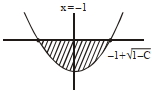
0 likesView Solution
66
MathematicsDifficultMCQJEE Main · 2021
Let $f: R \rightarrow R$ be a continuous function such that $f(x)+f(x+1)=2$ for all $x \in R$. If $I_{1}=\int_{0}^{8} f(x) d x$ and $I_{2}=\int_{-1}^{3} f(x) d x$,then the value of $I_{1}+2 I_{2}$ is equal to:
A
$25$
B
$16$
C
$32$
D
$40$
Solution
(B) Given $f(x)+f(x+1)=2$.
Integrating both sides from $0$ to $1$,we get $\int_{0}^{1} f(x) d x + \int_{0}^{1} f(x+1) d x = \int_{0}^{1} 2 d x$.
Using the substitution $t=x+1$ in the second integral,we have $\int_{0}^{1} f(x) d x + \int_{1}^{2} f(t) d t = 2$,which implies $\int_{0}^{2} f(x) d x = 2$.
Since $f(x)+f(x+1)=2$,$f(x+2) = 2-f(x+1) = 2-(2-f(x)) = f(x)$,so $f(x)$ is periodic with period $T=2$.
$I_{1} = \int_{0}^{8} f(x) d x = \frac{8}{2} \int_{0}^{2} f(x) d x = 4 \times 2 = 8$.
$I_{2} = \int_{-1}^{3} f(x) d x$. Since $f(x)$ has period $2$,$\int_{a}^{a+T} f(x) d x$ is independent of $a$.
Thus,$I_{2} = \int_{0}^{4} f(x) d x = \frac{4}{2} \int_{0}^{2} f(x) d x = 2 \times 2 = 4$.
Therefore,$I_{1}+2 I_{2} = 8 + 2(4) = 8 + 8 = 16$.
Integrating both sides from $0$ to $1$,we get $\int_{0}^{1} f(x) d x + \int_{0}^{1} f(x+1) d x = \int_{0}^{1} 2 d x$.
Using the substitution $t=x+1$ in the second integral,we have $\int_{0}^{1} f(x) d x + \int_{1}^{2} f(t) d t = 2$,which implies $\int_{0}^{2} f(x) d x = 2$.
Since $f(x)+f(x+1)=2$,$f(x+2) = 2-f(x+1) = 2-(2-f(x)) = f(x)$,so $f(x)$ is periodic with period $T=2$.
$I_{1} = \int_{0}^{8} f(x) d x = \frac{8}{2} \int_{0}^{2} f(x) d x = 4 \times 2 = 8$.
$I_{2} = \int_{-1}^{3} f(x) d x$. Since $f(x)$ has period $2$,$\int_{a}^{a+T} f(x) d x$ is independent of $a$.
Thus,$I_{2} = \int_{0}^{4} f(x) d x = \frac{4}{2} \int_{0}^{2} f(x) d x = 2 \times 2 = 4$.
Therefore,$I_{1}+2 I_{2} = 8 + 2(4) = 8 + 8 = 16$.
0 likesView Solution
67
MathematicsMediumMCQJEE Main · 2021
The inverse of $y = 5^{\log x}$ is
A
$x = 5^{\log y}$
B
$x = y^{\log 5}$
C
$x = y^{\frac{1}{\log 5}}$
D
$x = 5^{\frac{1}{\log y}}$
Solution
(B) Given the function $y = 5^{\log x}$.
To find the inverse,we interchange $x$ and $y$:
$x = 5^{\log y}$.
Using the property of logarithms $a^{\log b} = b^{\log a}$,we can rewrite the expression:
$x = y^{\log 5}$.
Thus,the inverse function is $f^{-1}(y) = y^{\log 5}$.
To find the inverse,we interchange $x$ and $y$:
$x = 5^{\log y}$.
Using the property of logarithms $a^{\log b} = b^{\log a}$,we can rewrite the expression:
$x = y^{\log 5}$.
Thus,the inverse function is $f^{-1}(y) = y^{\log 5}$.
0 likesView Solution
68
MathematicsDifficultMCQJEE Main · 2021
Let $\overrightarrow{a} = 2\hat{i} - 3\hat{j} + 4\hat{k}$ and $\overrightarrow{b} = 7\hat{i} + \hat{j} - 6\hat{k}$. If $\overrightarrow{r} \times \overrightarrow{a} = \overrightarrow{r} \times \overrightarrow{b}$ and $\overrightarrow{r} \cdot (\hat{i} + 2\hat{j} + \hat{k}) = -3$,then $\overrightarrow{r} \cdot (2\hat{i} - 3\hat{j} + \hat{k})$ is equal to:
A
$12$
B
$8$
C
$13$
D
$10$
Solution
(A) Given $\overrightarrow{r} \times \overrightarrow{a} = \overrightarrow{r} \times \overrightarrow{b}$,we have $\overrightarrow{r} \times (\overrightarrow{a} - \overrightarrow{b}) = 0$.
This implies $\overrightarrow{r}$ is parallel to $(\overrightarrow{a} - \overrightarrow{b})$.
Calculate $\overrightarrow{a} - \overrightarrow{b} = (2-7)\hat{i} + (-3-1)\hat{j} + (4 - (-6))\hat{k} = -5\hat{i} - 4\hat{j} + 10\hat{k}$.
So,$\overrightarrow{r} = \lambda(-5\hat{i} - 4\hat{j} + 10\hat{k})$.
Given $\overrightarrow{r} \cdot (\hat{i} + 2\hat{j} + \hat{k}) = -3$,substitute $\overrightarrow{r}$:
$\lambda(-5\hat{i} - 4\hat{j} + 10\hat{k}) \cdot (\hat{i} + 2\hat{j} + \hat{k}) = -3$.
$\lambda(-5 - 8 + 10) = -3 \Rightarrow -3\lambda = -3 \Rightarrow \lambda = 1$.
Thus,$\overrightarrow{r} = -5\hat{i} - 4\hat{j} + 10\hat{k}$.
Finally,calculate $\overrightarrow{r} \cdot (2\hat{i} - 3\hat{j} + \hat{k}) = (-5)(2) + (-4)(-3) + (10)(1) = -10 + 12 + 10 = 12$.
This implies $\overrightarrow{r}$ is parallel to $(\overrightarrow{a} - \overrightarrow{b})$.
Calculate $\overrightarrow{a} - \overrightarrow{b} = (2-7)\hat{i} + (-3-1)\hat{j} + (4 - (-6))\hat{k} = -5\hat{i} - 4\hat{j} + 10\hat{k}$.
So,$\overrightarrow{r} = \lambda(-5\hat{i} - 4\hat{j} + 10\hat{k})$.
Given $\overrightarrow{r} \cdot (\hat{i} + 2\hat{j} + \hat{k}) = -3$,substitute $\overrightarrow{r}$:
$\lambda(-5\hat{i} - 4\hat{j} + 10\hat{k}) \cdot (\hat{i} + 2\hat{j} + \hat{k}) = -3$.
$\lambda(-5 - 8 + 10) = -3 \Rightarrow -3\lambda = -3 \Rightarrow \lambda = 1$.
Thus,$\overrightarrow{r} = -5\hat{i} - 4\hat{j} + 10\hat{k}$.
Finally,calculate $\overrightarrow{r} \cdot (2\hat{i} - 3\hat{j} + \hat{k}) = (-5)(2) + (-4)(-3) + (10)(1) = -10 + 12 + 10 = 12$.
0 likesView Solution
69
MathematicsMediumMCQJEE Main · 2021
The system of equations $kx + y + z = 1$,$x + ky + z = k$,and $x + y + kz = k^2$ has no solution if $k$ is equal to
A
$0$
B
$1$
C
$-1$
D
$-2$
Solution
(D) The given system of equations is:
$kx + y + z = 1$
$x + ky + z = k$
$x + y + kz = k^2$
First,we calculate the determinant $\Delta$ of the coefficient matrix:
$\Delta = \begin{vmatrix} k & 1 & 1 \\ 1 & k & 1 \\ 1 & 1 & k \end{vmatrix}$
$= k(k^2 - 1) - 1(k - 1) + 1(1 - k)$
$= k(k - 1)(k + 1) - (k - 1) - (k - 1)$
$= (k - 1)[k(k + 1) - 1 - 1]$
$= (k - 1)(k^2 + k - 2)$
$= (k - 1)(k + 2)(k - 1) = (k - 1)^2(k + 2)$
For the system to have no solution,we require $\Delta = 0$ and at least one of the Cramer's determinants $(\Delta_1, \Delta_2, \Delta_3)$ to be non-zero.
If $k = 1$,the equations become $x + y + z = 1$,$x + y + z = 1$,and $x + y + z = 1$. This represents the same plane,so there are infinitely many solutions.
If $k = -2$,$\Delta = 0$. Let us check $\Delta_1$:
$\Delta_1 = \begin{vmatrix} 1 & 1 & 1 \\ -2 & -2 & 1 \\ 4 & 1 & -2 \end{vmatrix} = 1(4 - 1) - 1(4 - 4) + 1(-2 + 8) = 3 - 0 + 6 = 9 \neq 0$.
Since $\Delta = 0$ and $\Delta_1 \neq 0$,the system has no solution when $k = -2$.
$kx + y + z = 1$
$x + ky + z = k$
$x + y + kz = k^2$
First,we calculate the determinant $\Delta$ of the coefficient matrix:
$\Delta = \begin{vmatrix} k & 1 & 1 \\ 1 & k & 1 \\ 1 & 1 & k \end{vmatrix}$
$= k(k^2 - 1) - 1(k - 1) + 1(1 - k)$
$= k(k - 1)(k + 1) - (k - 1) - (k - 1)$
$= (k - 1)[k(k + 1) - 1 - 1]$
$= (k - 1)(k^2 + k - 2)$
$= (k - 1)(k + 2)(k - 1) = (k - 1)^2(k + 2)$
For the system to have no solution,we require $\Delta = 0$ and at least one of the Cramer's determinants $(\Delta_1, \Delta_2, \Delta_3)$ to be non-zero.
If $k = 1$,the equations become $x + y + z = 1$,$x + y + z = 1$,and $x + y + z = 1$. This represents the same plane,so there are infinitely many solutions.
If $k = -2$,$\Delta = 0$. Let us check $\Delta_1$:
$\Delta_1 = \begin{vmatrix} 1 & 1 & 1 \\ -2 & -2 & 1 \\ 4 & 1 & -2 \end{vmatrix} = 1(4 - 1) - 1(4 - 4) + 1(-2 + 8) = 3 - 0 + 6 = 9 \neq 0$.
Since $\Delta = 0$ and $\Delta_1 \neq 0$,the system has no solution when $k = -2$.
0 likesView Solution
70
MathematicsAdvancedMCQJEE Main · 2021
If $\cot ^{-1}(\alpha)=\cot ^{-1} 2+\cot ^{-1} 8+\cot ^{-1} 18+\cot ^{-1} 32+\ldots$ up to $100$ terms,then $\alpha$ is
A
$1.01$
B
$1.00$
C
$1.02$
D
$1.03$
Solution
(A) The given series is $\sum_{n=1}^{100} \cot^{-1}(2n^2)$.
Using the identity $\cot^{-1}(x) = \tan^{-1}(\frac{1}{x})$,we have $\sum_{n=1}^{100} \tan^{-1}(\frac{1}{2n^2})$.
Multiplying numerator and denominator by $2$,we get $\sum_{n=1}^{100} \tan^{-1}(\frac{2}{4n^2})$.
This can be written as $\sum_{n=1}^{100} \tan^{-1}(\frac{(2n+1)-(2n-1)}{1+(2n+1)(2n-1)})$.
Using the formula $\tan^{-1}(x) - \tan^{-1}(y) = \tan^{-1}(\frac{x-y}{1+xy})$,the sum becomes $\sum_{n=1}^{100} (\tan^{-1}(2n+1) - \tan^{-1}(2n-1))$.
This is a telescoping series: $(\tan^{-1} 3 - \tan^{-1} 1) + (\tan^{-1} 5 - \tan^{-1} 3) + \dots + (\tan^{-1} 201 - \tan^{-1} 199)$.
After cancellation,we are left with $\tan^{-1} 201 - \tan^{-1} 1$.
Using the formula again,$\tan^{-1}(\frac{201-1}{1+201 \times 1}) = \tan^{-1}(\frac{200}{202}) = \tan^{-1}(\frac{100}{101})$.
Since $\cot^{-1}(\alpha) = \tan^{-1}(\frac{101}{100})$,we have $\alpha = \frac{101}{100} = 1.01$.
Using the identity $\cot^{-1}(x) = \tan^{-1}(\frac{1}{x})$,we have $\sum_{n=1}^{100} \tan^{-1}(\frac{1}{2n^2})$.
Multiplying numerator and denominator by $2$,we get $\sum_{n=1}^{100} \tan^{-1}(\frac{2}{4n^2})$.
This can be written as $\sum_{n=1}^{100} \tan^{-1}(\frac{(2n+1)-(2n-1)}{1+(2n+1)(2n-1)})$.
Using the formula $\tan^{-1}(x) - \tan^{-1}(y) = \tan^{-1}(\frac{x-y}{1+xy})$,the sum becomes $\sum_{n=1}^{100} (\tan^{-1}(2n+1) - \tan^{-1}(2n-1))$.
This is a telescoping series: $(\tan^{-1} 3 - \tan^{-1} 1) + (\tan^{-1} 5 - \tan^{-1} 3) + \dots + (\tan^{-1} 201 - \tan^{-1} 199)$.
After cancellation,we are left with $\tan^{-1} 201 - \tan^{-1} 1$.
Using the formula again,$\tan^{-1}(\frac{201-1}{1+201 \times 1}) = \tan^{-1}(\frac{200}{202}) = \tan^{-1}(\frac{100}{101})$.
Since $\cot^{-1}(\alpha) = \tan^{-1}(\frac{101}{100})$,we have $\alpha = \frac{101}{100} = 1.01$.
0 likesView Solution
71
MathematicsMediumMCQJEE Main · 2021
The equation of the plane which contains the $y$-axis and passes through the point $(1, 2, 3)$ is:
A
$x + 3z = 10$
B
$x + 3z = 0$
C
$3x + z = 6$
D
$3x - z = 0$
Solution
(D) The equation of a plane passing through the origin $(0, 0, 0)$ and containing the $y$-axis (which has direction vector $\hat{j}$) and passing through the point $P(1, 2, 3)$ can be found using the normal vector $\vec{n}$.
The plane contains the vector $\vec{v} = \hat{j} = (0, 1, 0)$ and the vector $\vec{OP} = \hat{i} + 2\hat{j} + 3\hat{k} = (1, 2, 3)$.
The normal vector $\vec{n}$ is given by the cross product:
$\vec{n} = \vec{v} \times \vec{OP} = \begin{vmatrix} \hat{i} & \hat{j} & \hat{k} \\ 0 & 1 & 0 \\ 1 & 2 & 3 \end{vmatrix}$
$\vec{n} = \hat{i}(3 - 0) - \hat{j}(0 - 0) + \hat{k}(0 - 1) = 3\hat{i} - \hat{k}$.
The equation of the plane passing through $(0, 0, 0)$ with normal $\vec{n} = (3, 0, -1)$ is:
$3(x - 0) + 0(y - 0) - 1(z - 0) = 0$
$3x - z = 0$.
The plane contains the vector $\vec{v} = \hat{j} = (0, 1, 0)$ and the vector $\vec{OP} = \hat{i} + 2\hat{j} + 3\hat{k} = (1, 2, 3)$.
The normal vector $\vec{n}$ is given by the cross product:
$\vec{n} = \vec{v} \times \vec{OP} = \begin{vmatrix} \hat{i} & \hat{j} & \hat{k} \\ 0 & 1 & 0 \\ 1 & 2 & 3 \end{vmatrix}$
$\vec{n} = \hat{i}(3 - 0) - \hat{j}(0 - 0) + \hat{k}(0 - 1) = 3\hat{i} - \hat{k}$.
The equation of the plane passing through $(0, 0, 0)$ with normal $\vec{n} = (3, 0, -1)$ is:
$3(x - 0) + 0(y - 0) - 1(z - 0) = 0$
$3x - z = 0$.
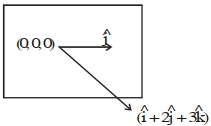
0 likesView Solution
72
MathematicsMediumMCQJEE Main · 2021
If $A = \begin{bmatrix} 0 & \sin \alpha \\ \sin \alpha & 0 \end{bmatrix}$ and $\det\left(A^{2} - \frac{1}{2} I\right) = 0$,then a possible value of $\alpha$ is
A
$\frac{\pi}{2}$
B
$\frac{\pi}{3}$
C
$\frac{\pi}{4}$
D
$\frac{\pi}{6}$
Solution
(C) Given $A = \begin{bmatrix} 0 & \sin \alpha \\ \sin \alpha & 0 \end{bmatrix}$.
First,calculate $A^{2}$:
$A^{2} = \begin{bmatrix} 0 & \sin \alpha \\ \sin \alpha & 0 \end{bmatrix} \begin{bmatrix} 0 & \sin \alpha \\ \sin \alpha & 0 \end{bmatrix} = \begin{bmatrix} \sin^{2} \alpha & 0 \\ 0 & \sin^{2} \alpha \end{bmatrix} = \sin^{2} \alpha I$.
Now,substitute this into the determinant equation:
$\det\left(A^{2} - \frac{1}{2} I\right) = \det\left(\sin^{2} \alpha I - \frac{1}{2} I\right) = \det\left(\left(\sin^{2} \alpha - \frac{1}{2}\right) I\right) = 0$.
Since $I$ is a $2 \times 2$ identity matrix,$\det(kI) = k^{2} \det(I) = k^{2}$.
Thus,$\left(\sin^{2} \alpha - \frac{1}{2}\right)^{2} = 0$.
This implies $\sin^{2} \alpha = \frac{1}{2}$,so $\sin \alpha = \pm \frac{1}{\sqrt{2}}$.
For $\sin \alpha = \frac{1}{\sqrt{2}}$,a possible value is $\alpha = \frac{\pi}{4}$.
First,calculate $A^{2}$:
$A^{2} = \begin{bmatrix} 0 & \sin \alpha \\ \sin \alpha & 0 \end{bmatrix} \begin{bmatrix} 0 & \sin \alpha \\ \sin \alpha & 0 \end{bmatrix} = \begin{bmatrix} \sin^{2} \alpha & 0 \\ 0 & \sin^{2} \alpha \end{bmatrix} = \sin^{2} \alpha I$.
Now,substitute this into the determinant equation:
$\det\left(A^{2} - \frac{1}{2} I\right) = \det\left(\sin^{2} \alpha I - \frac{1}{2} I\right) = \det\left(\left(\sin^{2} \alpha - \frac{1}{2}\right) I\right) = 0$.
Since $I$ is a $2 \times 2$ identity matrix,$\det(kI) = k^{2} \det(I) = k^{2}$.
Thus,$\left(\sin^{2} \alpha - \frac{1}{2}\right)^{2} = 0$.
This implies $\sin^{2} \alpha = \frac{1}{2}$,so $\sin \alpha = \pm \frac{1}{\sqrt{2}}$.
For $\sin \alpha = \frac{1}{\sqrt{2}}$,a possible value is $\alpha = \frac{\pi}{4}$.
0 likesView Solution
73
MathematicsDifficultMCQJEE Main · 2021
The sum of possible values of $x$ for $\tan ^{-1}(x+1)+\cot ^{-1}\left(\frac{1}{x-1}\right)=\tan ^{-1}\left(\frac{8}{31}\right)$ is
A
$-\frac{32}{4}$
B
$-\frac{31}{4}$
C
$-\frac{30}{4}$
D
$-\frac{33}{4}$
Solution
(B) Given equation: $\tan ^{-1}(x+1)+\cot ^{-1}\left(\frac{1}{x-1}\right)=\tan ^{-1}\left(\frac{8}{31}\right)$.
Using the property $\cot ^{-1}(u) = \tan ^{-1}\left(\frac{1}{u}\right)$ for $u > 0$,we have $\cot ^{-1}\left(\frac{1}{x-1}\right) = \tan ^{-1}(x-1)$ if $x-1 > 0$,i.e.,$x > 1$.
If $x > 1$,then $\tan ^{-1}(x+1) + \tan ^{-1}(x-1) = \tan ^{-1}\left(\frac{8}{31}\right)$.
Applying $\tan(A+B)$ formula: $\frac{(x+1)+(x-1)}{1-(x+1)(x-1)} = \frac{8}{31} \Rightarrow \frac{2x}{1-(x^2-1)} = \frac{8}{31} \Rightarrow \frac{2x}{2-x^2} = \frac{8}{31}$.
$62x = 16 - 8x^2 \Rightarrow 8x^2 + 62x - 16 = 0 \Rightarrow 4x^2 + 31x - 8 = 0$.
Solving for $x$: $(4x-1)(x+8) = 0$,so $x = \frac{1}{4}$ or $x = -8$. Both values are $\leq 1$,so the assumption $x > 1$ is invalid.
If $x < 1$,then $\cot ^{-1}\left(\frac{1}{x-1}\right) = \pi + \tan ^{-1}(x-1)$.
Then $\tan ^{-1}(x+1) + \pi + \tan ^{-1}(x-1) = \tan ^{-1}\left(\frac{8}{31}\right)$.
$\tan ^{-1}\left(\frac{2x}{2-x^2}\right) = \tan ^{-1}\left(\frac{8}{31}\right) - \pi$.
Taking $\tan$ on both sides: $\frac{2x}{2-x^2} = \tan(\tan ^{-1}(\frac{8}{31}) - \pi) = \frac{8}{31}$.
This leads to $4x^2 + 31x - 8 = 0$,giving $x = \frac{1}{4}$ or $x = -8$. Since $x < 1$,both are candidates. Checking $x = \frac{1}{4}$: $\tan^{-1}(1.25) + \cot^{-1}(1/(-0.75)) = \tan^{-1}(1.25) + \cot^{-1}(-1.33) \approx 0.89 + 2.21 > \pi/2$. Thus $x = 1/4$ is rejected.
For $x = -8$: $\tan^{-1}(-7) + \cot^{-1}(-1/9) = -1.42 + 1.68 = 0.26 = \tan^{-1}(8/31)$.
Thus,the only solution is $x = -8$.
Using the property $\cot ^{-1}(u) = \tan ^{-1}\left(\frac{1}{u}\right)$ for $u > 0$,we have $\cot ^{-1}\left(\frac{1}{x-1}\right) = \tan ^{-1}(x-1)$ if $x-1 > 0$,i.e.,$x > 1$.
If $x > 1$,then $\tan ^{-1}(x+1) + \tan ^{-1}(x-1) = \tan ^{-1}\left(\frac{8}{31}\right)$.
Applying $\tan(A+B)$ formula: $\frac{(x+1)+(x-1)}{1-(x+1)(x-1)} = \frac{8}{31} \Rightarrow \frac{2x}{1-(x^2-1)} = \frac{8}{31} \Rightarrow \frac{2x}{2-x^2} = \frac{8}{31}$.
$62x = 16 - 8x^2 \Rightarrow 8x^2 + 62x - 16 = 0 \Rightarrow 4x^2 + 31x - 8 = 0$.
Solving for $x$: $(4x-1)(x+8) = 0$,so $x = \frac{1}{4}$ or $x = -8$. Both values are $\leq 1$,so the assumption $x > 1$ is invalid.
If $x < 1$,then $\cot ^{-1}\left(\frac{1}{x-1}\right) = \pi + \tan ^{-1}(x-1)$.
Then $\tan ^{-1}(x+1) + \pi + \tan ^{-1}(x-1) = \tan ^{-1}\left(\frac{8}{31}\right)$.
$\tan ^{-1}\left(\frac{2x}{2-x^2}\right) = \tan ^{-1}\left(\frac{8}{31}\right) - \pi$.
Taking $\tan$ on both sides: $\frac{2x}{2-x^2} = \tan(\tan ^{-1}(\frac{8}{31}) - \pi) = \frac{8}{31}$.
This leads to $4x^2 + 31x - 8 = 0$,giving $x = \frac{1}{4}$ or $x = -8$. Since $x < 1$,both are candidates. Checking $x = \frac{1}{4}$: $\tan^{-1}(1.25) + \cot^{-1}(1/(-0.75)) = \tan^{-1}(1.25) + \cot^{-1}(-1.33) \approx 0.89 + 2.21 > \pi/2$. Thus $x = 1/4$ is rejected.
For $x = -8$: $\tan^{-1}(-7) + \cot^{-1}(-1/9) = -1.42 + 1.68 = 0.26 = \tan^{-1}(8/31)$.
Thus,the only solution is $x = -8$.
0 likesView Solution
74
MathematicsDifficultMCQJEE Main · 2021
Which of the following statements is incorrect for the function $g(\alpha)$ for $\alpha \in R$ such that $g(\alpha)=\int_{\frac{\pi}{6}}^{\frac{\pi}{3}} \frac{\sin^{\alpha} x}{\cos^{\alpha} x+\sin^{\alpha} x} dx$?
A
$g(\alpha)$ is a strictly increasing function
B
$g(\alpha)$ has an inflection point at $\alpha=-\frac{1}{2}$
C
$g(\alpha)$ is a strictly decreasing function
D
$g(\alpha)$ is an even function
Solution
(A) Let $I = \int_{a}^{b} f(x) dx = \int_{a}^{b} f(a+b-x) dx$.
Here,$a = \frac{\pi}{6}$ and $b = \frac{\pi}{3}$,so $a+b = \frac{\pi}{2}$.
$g(\alpha) = \int_{\frac{\pi}{6}}^{\frac{\pi}{3}} \frac{\sin^{\alpha} x}{\sin^{\alpha} x + \cos^{\alpha} x} dx$ ... $(i)$
Using the property,$g(\alpha) = \int_{\frac{\pi}{6}}^{\frac{\pi}{3}} \frac{\sin^{\alpha}(\frac{\pi}{2}-x)}{\sin^{\alpha}(\frac{\pi}{2}-x) + \cos^{\alpha}(\frac{\pi}{2}-x)} dx = \int_{\frac{\pi}{6}}^{\frac{\pi}{3}} \frac{\cos^{\alpha} x}{\cos^{\alpha} x + \sin^{\alpha} x} dx$ ... $(ii)$
Adding $(i)$ and $(ii)$:
$2g(\alpha) = \int_{\frac{\pi}{6}}^{\frac{\pi}{3}} \frac{\sin^{\alpha} x + \cos^{\alpha} x}{\sin^{\alpha} x + \cos^{\alpha} x} dx = \int_{\frac{\pi}{6}}^{\frac{\pi}{3}} 1 dx = \frac{\pi}{3} - \frac{\pi}{6} = \frac{\pi}{6}$.
Thus,$g(\alpha) = \frac{\pi}{12}$,which is a constant function.
$A$ constant function is neither strictly increasing nor strictly decreasing.
Therefore,statements $A$,$B$,and $C$ are all incorrect.
Here,$a = \frac{\pi}{6}$ and $b = \frac{\pi}{3}$,so $a+b = \frac{\pi}{2}$.
$g(\alpha) = \int_{\frac{\pi}{6}}^{\frac{\pi}{3}} \frac{\sin^{\alpha} x}{\sin^{\alpha} x + \cos^{\alpha} x} dx$ ... $(i)$
Using the property,$g(\alpha) = \int_{\frac{\pi}{6}}^{\frac{\pi}{3}} \frac{\sin^{\alpha}(\frac{\pi}{2}-x)}{\sin^{\alpha}(\frac{\pi}{2}-x) + \cos^{\alpha}(\frac{\pi}{2}-x)} dx = \int_{\frac{\pi}{6}}^{\frac{\pi}{3}} \frac{\cos^{\alpha} x}{\cos^{\alpha} x + \sin^{\alpha} x} dx$ ... $(ii)$
Adding $(i)$ and $(ii)$:
$2g(\alpha) = \int_{\frac{\pi}{6}}^{\frac{\pi}{3}} \frac{\sin^{\alpha} x + \cos^{\alpha} x}{\sin^{\alpha} x + \cos^{\alpha} x} dx = \int_{\frac{\pi}{6}}^{\frac{\pi}{3}} 1 dx = \frac{\pi}{3} - \frac{\pi}{6} = \frac{\pi}{6}$.
Thus,$g(\alpha) = \frac{\pi}{12}$,which is a constant function.
$A$ constant function is neither strictly increasing nor strictly decreasing.
Therefore,statements $A$,$B$,and $C$ are all incorrect.
0 likesView Solution
75
MathematicsMediumMCQJEE Main · 2021
Which of the following is true for $y(x)$ that satisfies the differential equation $\frac{dy}{dx} = xy - 1 + x - y$ with the initial condition $y(0) = 0$?
A
$y(1) = e^{-\frac{1}{2}} - 1$
B
$y(1) = e^{\frac{1}{2}} - e^{-\frac{1}{2}}$
C
$y(1) = 1$
D
$y(1) = e^{\frac{1}{2}} - 1$
Solution
(A) Given the differential equation: $\frac{dy}{dx} = xy - 1 + x - y$.
Rearranging the terms: $\frac{dy}{dx} = x(y + 1) - 1(y + 1) = (x - 1)(y + 1)$.
This is a variable separable differential equation: $\frac{dy}{y + 1} = (x - 1) dx$.
Integrating both sides: $\int \frac{dy}{y + 1} = \int (x - 1) dx$.
$\ln|y + 1| = \frac{x^2}{2} - x + C$.
Using the initial condition $y(0) = 0$: $\ln|0 + 1| = \frac{0^2}{2} - 0 + C \Rightarrow \ln(1) = C \Rightarrow C = 0$.
Thus,$\ln|y + 1| = \frac{x^2}{2} - x$,which implies $y + 1 = e^{\frac{x^2}{2} - x}$.
So,$y(x) = e^{\frac{x^2}{2} - x} - 1$.
To find $y(1)$,substitute $x = 1$: $y(1) = e^{\frac{1^2}{2} - 1} - 1 = e^{\frac{1}{2} - 1} - 1 = e^{-\frac{1}{2}} - 1$.
Rearranging the terms: $\frac{dy}{dx} = x(y + 1) - 1(y + 1) = (x - 1)(y + 1)$.
This is a variable separable differential equation: $\frac{dy}{y + 1} = (x - 1) dx$.
Integrating both sides: $\int \frac{dy}{y + 1} = \int (x - 1) dx$.
$\ln|y + 1| = \frac{x^2}{2} - x + C$.
Using the initial condition $y(0) = 0$: $\ln|0 + 1| = \frac{0^2}{2} - 0 + C \Rightarrow \ln(1) = C \Rightarrow C = 0$.
Thus,$\ln|y + 1| = \frac{x^2}{2} - x$,which implies $y + 1 = e^{\frac{x^2}{2} - x}$.
So,$y(x) = e^{\frac{x^2}{2} - x} - 1$.
To find $y(1)$,substitute $x = 1$: $y(1) = e^{\frac{1^2}{2} - 1} - 1 = e^{\frac{1}{2} - 1} - 1 = e^{-\frac{1}{2}} - 1$.
0 likesView Solution
76
MathematicsDifficultMCQJEE Main · 2021
The maximum value of $z$ in the following equation $z=6xy+y^2$,subject to the constraints $3x+4y \leq 100$,$4x+3y \leq 75$,$x \geq 0$,and $y \geq 0$ is:
A
$904$
B
$846$
C
$952$
D
$882$
Solution
(A) The objective function is $z = 6xy + y^2$. The constraints are $3x + 4y \leq 100$,$4x + 3y \leq 75$,$x \geq 0$,and $y \geq 0$.
From the constraints,the feasible region is a polygon with vertices $(0, 0)$,$(18.75, 0)$,and $(0, 25)$.
Evaluating $z$ at the vertices:
At $(0, 0)$,$z = 6(0)(0) + 0^2 = 0$.
At $(18.75, 0)$,$z = 6(18.75)(0) + 0^2 = 0$.
At $(0, 25)$,$z = 6(0)(25) + 25^2 = 625$.
However,since $z$ is not a linear function,we check the boundary $4x + 3y = 75$,which implies $x = \frac{75-3y}{4}$.
Substituting this into $z$: $z = 6y(\frac{75-3y}{4}) + y^2 = \frac{3y(75-3y)}{2} + y^2 = \frac{225y - 9y^2 + 2y^2}{2} = \frac{225y - 7y^2}{2}$.
To find the maximum,take the derivative with respect to $y$ and set to $0$: $\frac{dz}{dy} = \frac{225 - 14y}{2} = 0 \implies y = \frac{225}{14} \approx 16.07$.
Then $x = \frac{75 - 3(225/14)}{4} = \frac{1050 - 675}{56} = \frac{375}{56} \approx 6.7$.
Substituting these values into $z$: $z = \frac{225(225/14) - 7(225/14)^2}{2} = \frac{50625/14 - 354375/196}{2} = \frac{708750 - 354375}{392} = \frac{354375}{392} \approx 904.0178$.
The maximum value is approximately $904$.
From the constraints,the feasible region is a polygon with vertices $(0, 0)$,$(18.75, 0)$,and $(0, 25)$.
Evaluating $z$ at the vertices:
At $(0, 0)$,$z = 6(0)(0) + 0^2 = 0$.
At $(18.75, 0)$,$z = 6(18.75)(0) + 0^2 = 0$.
At $(0, 25)$,$z = 6(0)(25) + 25^2 = 625$.
However,since $z$ is not a linear function,we check the boundary $4x + 3y = 75$,which implies $x = \frac{75-3y}{4}$.
Substituting this into $z$: $z = 6y(\frac{75-3y}{4}) + y^2 = \frac{3y(75-3y)}{2} + y^2 = \frac{225y - 9y^2 + 2y^2}{2} = \frac{225y - 7y^2}{2}$.
To find the maximum,take the derivative with respect to $y$ and set to $0$: $\frac{dz}{dy} = \frac{225 - 14y}{2} = 0 \implies y = \frac{225}{14} \approx 16.07$.
Then $x = \frac{75 - 3(225/14)}{4} = \frac{1050 - 675}{56} = \frac{375}{56} \approx 6.7$.
Substituting these values into $z$: $z = \frac{225(225/14) - 7(225/14)^2}{2} = \frac{50625/14 - 354375/196}{2} = \frac{708750 - 354375}{392} = \frac{354375}{392} \approx 904.0178$.
The maximum value is approximately $904$.
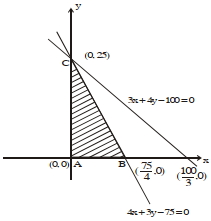
0 likesView Solution
77
MathematicsDifficultMCQJEE Main · 2021
If the function $f(x) = \frac{\cos(\sin x) - \cos x}{x^4}$ is continuous at each point in its domain and $f(0) = \frac{1}{k}$,then $k$ is ........
A
$6$
B
$8$
C
$10$
D
$4$
Solution
(A) For the function to be continuous at $x = 0$,we must have $f(0) = \lim_{x \to 0} f(x)$.
Using the formula $\cos A - \cos B = -2 \sin(\frac{A+B}{2}) \sin(\frac{A-B}{2})$,we get:
$\lim_{x \to 0} \frac{-2 \sin(\frac{\sin x + x}{2}) \sin(\frac{\sin x - x}{2})}{x^4} = \frac{1}{k}$
$\lim_{x \to 0} \frac{2 \sin(\frac{\sin x + x}{2}) \sin(\frac{x - \sin x}{2})}{x^4} = \frac{1}{k}$
Using $\sin \theta \approx \theta$ as $\theta \to 0$ and the Taylor series expansion $\sin x = x - \frac{x^3}{6} + \dots$,we have:
$\lim_{x \to 0} 2 \left( \frac{\sin x + x}{2x} \right) \left( \frac{x - \sin x}{2x^3} \right) = \frac{1}{k}$
$\lim_{x \to 0} 2 \left( \frac{x + x}{2x} \right) \left( \frac{x - (x - \frac{x^3}{6})}{2x^3} \right) = \frac{1}{k}$
$2 \times (1) \times \frac{x^3/6}{2x^3} = \frac{1}{k}$
$2 \times 1 \times \frac{1}{12} = \frac{1}{k}$
$\frac{1}{6} = \frac{1}{k} \Rightarrow k = 6$.
Using the formula $\cos A - \cos B = -2 \sin(\frac{A+B}{2}) \sin(\frac{A-B}{2})$,we get:
$\lim_{x \to 0} \frac{-2 \sin(\frac{\sin x + x}{2}) \sin(\frac{\sin x - x}{2})}{x^4} = \frac{1}{k}$
$\lim_{x \to 0} \frac{2 \sin(\frac{\sin x + x}{2}) \sin(\frac{x - \sin x}{2})}{x^4} = \frac{1}{k}$
Using $\sin \theta \approx \theta$ as $\theta \to 0$ and the Taylor series expansion $\sin x = x - \frac{x^3}{6} + \dots$,we have:
$\lim_{x \to 0} 2 \left( \frac{\sin x + x}{2x} \right) \left( \frac{x - \sin x}{2x^3} \right) = \frac{1}{k}$
$\lim_{x \to 0} 2 \left( \frac{x + x}{2x} \right) \left( \frac{x - (x - \frac{x^3}{6})}{2x^3} \right) = \frac{1}{k}$
$2 \times (1) \times \frac{x^3/6}{2x^3} = \frac{1}{k}$
$2 \times 1 \times \frac{1}{12} = \frac{1}{k}$
$\frac{1}{6} = \frac{1}{k} \Rightarrow k = 6$.
0 likesView Solution
78
MathematicsDifficultMCQJEE Main · 2021
If $f(x)=\sin \left(\cos ^{-1}\left(\frac{1-2^{2 x}}{1+2^{2 x}}\right)\right)$ and its first derivative with respect to $x$ is $-\frac{ b }{ a } \log _{ e } 2$ when $x =1,$ where $a$ and $b$ are integers,then the minimum value of $\left| a ^{2}- b ^{2}\right|$ is.........
A
$373$
B
$481$
C
$426$
D
$524$
Solution
(B) Given $f(x) = \sin \left(\cos ^{-1}\left(\frac{1-2^{2x}}{1+2^{2x}}\right)\right)$.
Let $2^x = t$. Then $f(x) = \sin(\cos^{-1}(\frac{1-t^2}{1+t^2}))$.
We know that $\cos^{-1}(\frac{1-t^2}{1+t^2}) = 2\tan^{-1}(t)$ for $t \ge 0$.
So,$f(x) = \sin(2\tan^{-1}(2^x))$.
Using the identity $\sin(2\theta) = \frac{2\tan\theta}{1+\tan^2\theta}$,where $\theta = \tan^{-1}(2^x)$,we get $\tan\theta = 2^x$.
Thus,$f(x) = \frac{2(2^x)}{1+(2^x)^2} = \frac{2 \cdot 2^x}{1+2^{2x}}$.
Now,differentiate $f(x)$ with respect to $x$ using the quotient rule:
$f'(x) = \frac{(1+2^{2x}) \cdot \frac{d}{dx}(2 \cdot 2^x) - (2 \cdot 2^x) \cdot \frac{d}{dx}(1+2^{2x})}{(1+2^{2x})^2}$.
$f'(x) = \frac{(1+2^{2x})(2 \cdot 2^x \ln 2) - (2 \cdot 2^x)(2^{2x} \ln 2 \cdot 2)}{(1+2^{2x})^2}$.
At $x=1$,$2^x = 2$ and $2^{2x} = 4$.
$f'(1) = \frac{(1+4)(2 \cdot 2 \ln 2) - (2 \cdot 2)(4 \ln 2 \cdot 2)}{(1+4)^2} = \frac{5(4 \ln 2) - 4(8 \ln 2)}{25} = \frac{20 \ln 2 - 32 \ln 2}{25} = -\frac{12}{25} \ln 2$.
Comparing with $-\frac{b}{a} \ln 2$,we get $b=12$ and $a=25$.
Therefore,$|a^2 - b^2| = |25^2 - 12^2| = |625 - 144| = 481$.
Let $2^x = t$. Then $f(x) = \sin(\cos^{-1}(\frac{1-t^2}{1+t^2}))$.
We know that $\cos^{-1}(\frac{1-t^2}{1+t^2}) = 2\tan^{-1}(t)$ for $t \ge 0$.
So,$f(x) = \sin(2\tan^{-1}(2^x))$.
Using the identity $\sin(2\theta) = \frac{2\tan\theta}{1+\tan^2\theta}$,where $\theta = \tan^{-1}(2^x)$,we get $\tan\theta = 2^x$.
Thus,$f(x) = \frac{2(2^x)}{1+(2^x)^2} = \frac{2 \cdot 2^x}{1+2^{2x}}$.
Now,differentiate $f(x)$ with respect to $x$ using the quotient rule:
$f'(x) = \frac{(1+2^{2x}) \cdot \frac{d}{dx}(2 \cdot 2^x) - (2 \cdot 2^x) \cdot \frac{d}{dx}(1+2^{2x})}{(1+2^{2x})^2}$.
$f'(x) = \frac{(1+2^{2x})(2 \cdot 2^x \ln 2) - (2 \cdot 2^x)(2^{2x} \ln 2 \cdot 2)}{(1+2^{2x})^2}$.
At $x=1$,$2^x = 2$ and $2^{2x} = 4$.
$f'(1) = \frac{(1+4)(2 \cdot 2 \ln 2) - (2 \cdot 2)(4 \ln 2 \cdot 2)}{(1+4)^2} = \frac{5(4 \ln 2) - 4(8 \ln 2)}{25} = \frac{20 \ln 2 - 32 \ln 2}{25} = -\frac{12}{25} \ln 2$.
Comparing with $-\frac{b}{a} \ln 2$,we get $b=12$ and $a=25$.
Therefore,$|a^2 - b^2| = |25^2 - 12^2| = |625 - 144| = 481$.
0 likesView Solution
79
MathematicsDifficultMCQJEE Main · 2021
Let there be three independent events $E_{1}, E_{2}$ and $E_{3}$. The probability that only $E_{1}$ occurs is $\alpha$,only $E_{2}$ occurs is $\beta$ and only $E_{3}$ occurs is $\gamma$. Let $p$ denote the probability that none of the events occur,which satisfies the equations $(\alpha - 2\beta)p = \alpha\beta$ and $(\beta - 3\gamma)p = 2\beta\gamma$. All the given probabilities are assumed to lie in the interval $(0, 1)$. Then,$\frac{\text{Probability of occurrence of } E_{1}}{\text{Probability of occurrence of } E_{3}}$ is equal to ..........
A
$8$
B
$6$
C
$3$
D
$9$
Solution
(B) Let $P(E_{1}) = P_{1}$,$P(E_{2}) = P_{2}$,and $P(E_{3}) = P_{3}$.
Since the events are independent,the probability that only $E_{1}$ occurs is $\alpha = P_{1}(1 - P_{2})(1 - P_{3})$.
The probability that only $E_{2}$ occurs is $\beta = (1 - P_{1})P_{2}(1 - P_{3})$.
The probability that only $E_{3}$ occurs is $\gamma = (1 - P_{1})(1 - P_{2})P_{3}$.
The probability that none of the events occur is $p = (1 - P_{1})(1 - P_{2})(1 - P_{3})$.
Given $(\alpha - 2\beta)p = \alpha\beta$,we substitute the expressions:
$\left(P_{1}(1 - P_{2})(1 - P_{3}) - 2(1 - P_{1})P_{2}(1 - P_{3})\right)p = P_{1}(1 - P_{2})(1 - P_{3}) \cdot (1 - P_{1})P_{2}(1 - P_{3})$.
Dividing both sides by $(1 - P_{1})(1 - P_{2})(1 - P_{3})^2$,we get:
$\frac{P_{1}}{1 - P_{1}} - \frac{2P_{2}}{1 - P_{2}} = \frac{P_{1}P_{2}}{(1 - P_{1})(1 - P_{2})}$.
This simplifies to $P_{1} = 2P_{2}$.
Similarly,from $(\beta - 3\gamma)p = 2\beta\gamma$,we get $P_{2} = 3P_{3}$.
Therefore,$P_{1} = 2(3P_{3}) = 6P_{3}$.
Thus,$\frac{P_{1}}{P_{3}} = 6$.
Since the events are independent,the probability that only $E_{1}$ occurs is $\alpha = P_{1}(1 - P_{2})(1 - P_{3})$.
The probability that only $E_{2}$ occurs is $\beta = (1 - P_{1})P_{2}(1 - P_{3})$.
The probability that only $E_{3}$ occurs is $\gamma = (1 - P_{1})(1 - P_{2})P_{3}$.
The probability that none of the events occur is $p = (1 - P_{1})(1 - P_{2})(1 - P_{3})$.
Given $(\alpha - 2\beta)p = \alpha\beta$,we substitute the expressions:
$\left(P_{1}(1 - P_{2})(1 - P_{3}) - 2(1 - P_{1})P_{2}(1 - P_{3})\right)p = P_{1}(1 - P_{2})(1 - P_{3}) \cdot (1 - P_{1})P_{2}(1 - P_{3})$.
Dividing both sides by $(1 - P_{1})(1 - P_{2})(1 - P_{3})^2$,we get:
$\frac{P_{1}}{1 - P_{1}} - \frac{2P_{2}}{1 - P_{2}} = \frac{P_{1}P_{2}}{(1 - P_{1})(1 - P_{2})}$.
This simplifies to $P_{1} = 2P_{2}$.
Similarly,from $(\beta - 3\gamma)p = 2\beta\gamma$,we get $P_{2} = 3P_{3}$.
Therefore,$P_{1} = 2(3P_{3}) = 6P_{3}$.
Thus,$\frac{P_{1}}{P_{3}} = 6$.
0 likesView Solution
80
MathematicsDifficultMCQJEE Main · 2021
If $\overrightarrow{a} = \alpha \hat{i} + \beta \hat{j} + 3 \hat{k}$,$\overrightarrow{b} = -\beta \hat{i} - \alpha \hat{j} - \hat{k}$,and $\overrightarrow{c} = \hat{i} - 2 \hat{j} - \hat{k}$ such that $\overrightarrow{a} \cdot \overrightarrow{b} = 1$ and $\overrightarrow{b} \cdot \overrightarrow{c} = -3$,then $\frac{1}{3}((\vec{a} \times \vec{b}) \cdot \vec{c})$ is equal to ............
A
$1$
B
$4$
C
$2$
D
$6$
Solution
(C) Given $\vec{a} \cdot \vec{b} = 1 \Rightarrow (\alpha \hat{i} + \beta \hat{j} + 3 \hat{k}) \cdot (-\beta \hat{i} - \alpha \hat{j} - \hat{k}) = 1$.
This simplifies to $-\alpha \beta - \alpha \beta - 3 = 1 \Rightarrow -2 \alpha \beta = 4 \Rightarrow \alpha \beta = -2$ $(1)$.
Given $\vec{b} \cdot \vec{c} = -3 \Rightarrow (-\beta \hat{i} - \alpha \hat{j} - \hat{k}) \cdot (\hat{i} - 2 \hat{j} - \hat{k}) = -3$.
This simplifies to $-\beta + 2 \alpha + 1 = -3 \Rightarrow 2 \alpha - \beta = -4$ $(2)$.
From $(1)$,$\beta = -2/\alpha$. Substituting into $(2)$: $2 \alpha - (-2/\alpha) = -4 \Rightarrow 2 \alpha^2 + 2 = -4 \alpha \Rightarrow \alpha^2 + 2 \alpha + 1 = 0 \Rightarrow (\alpha + 1)^2 = 0 \Rightarrow \alpha = -1$.
Then $\beta = -2/(-1) = 2$.
Now,the scalar triple product is $\frac{1}{3}[\vec{a} \vec{b} \vec{c}] = \frac{1}{3} \begin{vmatrix} \alpha & \beta & 3 \\ -\beta & -\alpha & -1 \\ 1 & -2 & -1 \end{vmatrix} = \frac{1}{3} \begin{vmatrix} -1 & 2 & 3 \\ -2 & 1 & -1 \\ 1 & -2 & -1 \end{vmatrix}$.
Performing row operations $R_1 \to R_1 + R_3$: $\frac{1}{3} \begin{vmatrix} 0 & 0 & 2 \\ -2 & 1 & -1 \\ 1 & -2 & -1 \end{vmatrix} = \frac{1}{3} [2(4 - 1)] = \frac{1}{3} \times 6 = 2$.
This simplifies to $-\alpha \beta - \alpha \beta - 3 = 1 \Rightarrow -2 \alpha \beta = 4 \Rightarrow \alpha \beta = -2$ $(1)$.
Given $\vec{b} \cdot \vec{c} = -3 \Rightarrow (-\beta \hat{i} - \alpha \hat{j} - \hat{k}) \cdot (\hat{i} - 2 \hat{j} - \hat{k}) = -3$.
This simplifies to $-\beta + 2 \alpha + 1 = -3 \Rightarrow 2 \alpha - \beta = -4$ $(2)$.
From $(1)$,$\beta = -2/\alpha$. Substituting into $(2)$: $2 \alpha - (-2/\alpha) = -4 \Rightarrow 2 \alpha^2 + 2 = -4 \alpha \Rightarrow \alpha^2 + 2 \alpha + 1 = 0 \Rightarrow (\alpha + 1)^2 = 0 \Rightarrow \alpha = -1$.
Then $\beta = -2/(-1) = 2$.
Now,the scalar triple product is $\frac{1}{3}[\vec{a} \vec{b} \vec{c}] = \frac{1}{3} \begin{vmatrix} \alpha & \beta & 3 \\ -\beta & -\alpha & -1 \\ 1 & -2 & -1 \end{vmatrix} = \frac{1}{3} \begin{vmatrix} -1 & 2 & 3 \\ -2 & 1 & -1 \\ 1 & -2 & -1 \end{vmatrix}$.
Performing row operations $R_1 \to R_1 + R_3$: $\frac{1}{3} \begin{vmatrix} 0 & 0 & 2 \\ -2 & 1 & -1 \\ 1 & -2 & -1 \end{vmatrix} = \frac{1}{3} [2(4 - 1)] = \frac{1}{3} \times 6 = 2$.
0 likesView Solution
81
MathematicsDifficultMCQJEE Main · 2021
If $A = \begin{bmatrix} 2 & 3 \\ 0 & -1 \end{bmatrix}$,then the value of $\det(A^4) + \det(A^{10} - (\operatorname{adj}(2A))^{10})$ is equal to ........
A
$9$
B
$25$
C
$16$
D
$12$
Solution
(C) Given $A = \begin{bmatrix} 2 & 3 \\ 0 & -1 \end{bmatrix}$. The determinant $|A| = (2)(-1) - (3)(0) = -2$.
First,we calculate $\det(A^4) = |A|^4 = (-2)^4 = 16$.
Next,consider $\operatorname{adj}(2A)$. Since $2A = \begin{bmatrix} 4 & 6 \\ 0 & -2 \end{bmatrix}$,its determinant is $|2A| = 2^2 |A| = 4(-2) = -8$.
The adjoint of a $2 \times 2$ matrix $M = \begin{bmatrix} a & b \\ c & d \end{bmatrix}$ is $\begin{bmatrix} d & -b \\ -c & a \end{bmatrix}$.
Thus,$\operatorname{adj}(2A) = \begin{bmatrix} -2 & -6 \\ 0 & 4 \end{bmatrix}$.
Note that $\operatorname{adj}(2A) = -2 \begin{bmatrix} 1 & 3 \\ 0 & -2 \end{bmatrix}$.
Alternatively,using the property $\operatorname{adj}(kA) = k^{n-1} \operatorname{adj}(A)$,for $n=2$,$\operatorname{adj}(2A) = 2 \operatorname{adj}(A) = 2 \begin{bmatrix} -1 & -3 \\ 0 & 2 \end{bmatrix} = \begin{bmatrix} -2 & -6 \\ 0 & 4 \end{bmatrix}$.
The eigenvalues of $A$ are $\lambda_1 = 2$ and $\lambda_2 = -1$. The eigenvalues of $A^{10}$ are $2^{10}$ and $(-1)^{10} = 1$.
The eigenvalues of $\operatorname{adj}(2A)$ are $2 \times (-1) = -2$ and $2 \times 2 = 4$. Thus,the eigenvalues of $(\operatorname{adj}(2A))^{10}$ are $(-2)^{10} = 2^{10}$ and $4^{10} = 2^{20}$.
Since $A^{10}$ and $(\operatorname{adj}(2A))^{10}$ share the eigenvalue $2^{10}$,the matrix $A^{10} - (\operatorname{adj}(2A))^{10}$ has at least one eigenvalue equal to $2^{10} - 2^{10} = 0$.
Therefore,$\det(A^{10} - (\operatorname{adj}(2A))^{10}) = 0$.
Finally,the required value is $16 + 0 = 16$.
First,we calculate $\det(A^4) = |A|^4 = (-2)^4 = 16$.
Next,consider $\operatorname{adj}(2A)$. Since $2A = \begin{bmatrix} 4 & 6 \\ 0 & -2 \end{bmatrix}$,its determinant is $|2A| = 2^2 |A| = 4(-2) = -8$.
The adjoint of a $2 \times 2$ matrix $M = \begin{bmatrix} a & b \\ c & d \end{bmatrix}$ is $\begin{bmatrix} d & -b \\ -c & a \end{bmatrix}$.
Thus,$\operatorname{adj}(2A) = \begin{bmatrix} -2 & -6 \\ 0 & 4 \end{bmatrix}$.
Note that $\operatorname{adj}(2A) = -2 \begin{bmatrix} 1 & 3 \\ 0 & -2 \end{bmatrix}$.
Alternatively,using the property $\operatorname{adj}(kA) = k^{n-1} \operatorname{adj}(A)$,for $n=2$,$\operatorname{adj}(2A) = 2 \operatorname{adj}(A) = 2 \begin{bmatrix} -1 & -3 \\ 0 & 2 \end{bmatrix} = \begin{bmatrix} -2 & -6 \\ 0 & 4 \end{bmatrix}$.
The eigenvalues of $A$ are $\lambda_1 = 2$ and $\lambda_2 = -1$. The eigenvalues of $A^{10}$ are $2^{10}$ and $(-1)^{10} = 1$.
The eigenvalues of $\operatorname{adj}(2A)$ are $2 \times (-1) = -2$ and $2 \times 2 = 4$. Thus,the eigenvalues of $(\operatorname{adj}(2A))^{10}$ are $(-2)^{10} = 2^{10}$ and $4^{10} = 2^{20}$.
Since $A^{10}$ and $(\operatorname{adj}(2A))^{10}$ share the eigenvalue $2^{10}$,the matrix $A^{10} - (\operatorname{adj}(2A))^{10}$ has at least one eigenvalue equal to $2^{10} - 2^{10} = 0$.
Therefore,$\det(A^{10} - (\operatorname{adj}(2A))^{10}) = 0$.
Finally,the required value is $16 + 0 = 16$.
0 likesView Solution
82
MathematicsDifficultMCQJEE Main · 2021
If $[.]$ represents the greatest integer function,then the value of $\int_{0}^{\sqrt{\pi / 2}}\left(\left[ x ^{2}\right]+[-\cos x ]\right) d x$ is.............
A
$0$
B
$1$
C
$-1$
D
$-1 - \sqrt{\frac{\pi}{2}}$
Solution
(C) Let $I = \int_{0}^{\sqrt{\pi / 2}} ([x^2] + [-\cos x]) dx$.
Since $0 \le x \le \sqrt{\pi / 2} \approx 1.25$,we have $0 \le x^2 \le \pi / 2 \approx 1.57$.
Thus,$[x^2] = 0$ for $0 \le x < 1$ and $[x^2] = 1$ for $1 \le x \le \sqrt{\pi / 2}$.
For $0 \le x \le \sqrt{\pi / 2}$,we have $0 \le \cos x \le 1$.
Specifically,for $x \in (0, \sqrt{\pi / 2}]$,$0 \le \cos x < 1$,so $-\cos x \in [-1, 0)$.
Thus,$[-\cos x] = -1$ for $x \in (0, \sqrt{\pi / 2}]$ and $[-\cos x] = 0$ at $x = 0$.
$I = \int_{0}^{1} (0 - 1) dx + \int_{1}^{\sqrt{\pi / 2}} (1 - 1) dx = \int_{0}^{1} (-1) dx + 0 = -1$.
Since $0 \le x \le \sqrt{\pi / 2} \approx 1.25$,we have $0 \le x^2 \le \pi / 2 \approx 1.57$.
Thus,$[x^2] = 0$ for $0 \le x < 1$ and $[x^2] = 1$ for $1 \le x \le \sqrt{\pi / 2}$.
For $0 \le x \le \sqrt{\pi / 2}$,we have $0 \le \cos x \le 1$.
Specifically,for $x \in (0, \sqrt{\pi / 2}]$,$0 \le \cos x < 1$,so $-\cos x \in [-1, 0)$.
Thus,$[-\cos x] = -1$ for $x \in (0, \sqrt{\pi / 2}]$ and $[-\cos x] = 0$ at $x = 0$.
$I = \int_{0}^{1} (0 - 1) dx + \int_{1}^{\sqrt{\pi / 2}} (1 - 1) dx = \int_{0}^{1} (-1) dx + 0 = -1$.
0 likesView Solution
83
MathematicsDifficultMCQJEE Main · 2021
If the equation of the plane passing through the line of intersection of the planes $2x - 7y + 4z - 3 = 0$ and $3x - 5y + 4z + 11 = 0$ and the point $(-2, 1, 3)$ is $ax + by + cz - 7 = 0$,then the value of $2a + b + c - 7$ is
A
$9$
B
$12$
C
$4$
D
$8$
Solution
(C) The equation of a plane passing through the intersection of two planes $P_1 = 0$ and $P_2 = 0$ is given by $P_1 + \lambda P_2 = 0$.
Here,$(2x - 7y + 4z - 3) + \lambda(3x - 5y + 4z + 11) = 0$.
Grouping the terms,we get $(2 + 3\lambda)x - (7 + 5\lambda)y + (4 + 4\lambda)z + (-3 + 11\lambda) = 0$.
Since the plane passes through the point $(-2, 1, 3)$,we substitute these coordinates into the equation:
$(2 + 3\lambda)(-2) - (7 + 5\lambda)(1) + (4 + 4\lambda)(3) - 3 + 11\lambda = 0$.
$-4 - 6\lambda - 7 - 5\lambda + 12 + 12\lambda - 3 + 11\lambda = 0$.
Combining the $\lambda$ terms and constants: $(-6 - 5 + 12 + 11)\lambda + (-4 - 7 + 12 - 3) = 0$.
$12\lambda - 2 = 0$,which gives $\lambda = \frac{1}{6}$.
Substituting $\lambda = \frac{1}{6}$ back into the plane equation:
$(2 + 3(\frac{1}{6}))x - (7 + 5(\frac{1}{6}))y + (4 + 4(\frac{1}{6}))z + (-3 + 11(\frac{1}{6})) = 0$.
$(\frac{15}{6})x - (\frac{47}{6})y + (\frac{28}{6})z - (\frac{7}{6}) = 0$.
Multiplying by $6$,we get $15x - 47y + 28z - 7 = 0$.
Comparing this with $ax + by + cz - 7 = 0$,we have $a = 15, b = -47, c = 28$.
Now,calculate $2a + b + c - 7 = 2(15) + (-47) + 28 - 7 = 30 - 47 + 28 - 7 = 4$.
Here,$(2x - 7y + 4z - 3) + \lambda(3x - 5y + 4z + 11) = 0$.
Grouping the terms,we get $(2 + 3\lambda)x - (7 + 5\lambda)y + (4 + 4\lambda)z + (-3 + 11\lambda) = 0$.
Since the plane passes through the point $(-2, 1, 3)$,we substitute these coordinates into the equation:
$(2 + 3\lambda)(-2) - (7 + 5\lambda)(1) + (4 + 4\lambda)(3) - 3 + 11\lambda = 0$.
$-4 - 6\lambda - 7 - 5\lambda + 12 + 12\lambda - 3 + 11\lambda = 0$.
Combining the $\lambda$ terms and constants: $(-6 - 5 + 12 + 11)\lambda + (-4 - 7 + 12 - 3) = 0$.
$12\lambda - 2 = 0$,which gives $\lambda = \frac{1}{6}$.
Substituting $\lambda = \frac{1}{6}$ back into the plane equation:
$(2 + 3(\frac{1}{6}))x - (7 + 5(\frac{1}{6}))y + (4 + 4(\frac{1}{6}))z + (-3 + 11(\frac{1}{6})) = 0$.
$(\frac{15}{6})x - (\frac{47}{6})y + (\frac{28}{6})z - (\frac{7}{6}) = 0$.
Multiplying by $6$,we get $15x - 47y + 28z - 7 = 0$.
Comparing this with $ax + by + cz - 7 = 0$,we have $a = 15, b = -47, c = 28$.
Now,calculate $2a + b + c - 7 = 2(15) + (-47) + 28 - 7 = 30 - 47 + 28 - 7 = 4$.
0 likesView Solution
84
MathematicsDifficultMCQJEE Main · 2021
The differential equation satisfied by the system of parabolas $y^{2} = 4a(x + a)$ is
A
$y\left(\frac{dy}{dx}\right)^{2} - 2x\left(\frac{dy}{dx}\right) - y = 0$
B
$y\left(\frac{dy}{dx}\right)^{2} - 2x\left(\frac{dy}{dx}\right) + y = 0$
C
$y\left(\frac{dy}{dx}\right)^{2} + 2x\left(\frac{dy}{dx}\right) - y = 0$
D
$y\left(\frac{dy}{dx}\right) + 2x\left(\frac{dy}{dx}\right) - y = 0$
Solution
(C) Given the equation of the parabola: $y^{2} = 4ax + 4a^{2}$.
Differentiating both sides with respect to $x$:
$2y \frac{dy}{dx} = 4a$
$\Rightarrow a = \frac{y}{2} \frac{dy}{dx}$.
Substitute the value of $a$ back into the original equation:
$y^{2} = 4\left(\frac{y}{2} \frac{dy}{dx}\right)x + 4\left(\frac{y}{2} \frac{dy}{dx}\right)^{2}$.
Simplify the equation:
$y^{2} = 2xy \frac{dy}{dx} + 4 \cdot \frac{y^{2}}{4} \left(\frac{dy}{dx}\right)^{2}$.
$y^{2} = 2xy \frac{dy}{dx} + y^{2} \left(\frac{dy}{dx}\right)^{2}$.
Dividing by $y$ (assuming $y \neq 0$):
$y = 2x \frac{dy}{dx} + y \left(\frac{dy}{dx}\right)^{2}$.
Rearranging the terms,we get:
$y \left(\frac{dy}{dx}\right)^{2} + 2x \frac{dy}{dx} - y = 0$.
Differentiating both sides with respect to $x$:
$2y \frac{dy}{dx} = 4a$
$\Rightarrow a = \frac{y}{2} \frac{dy}{dx}$.
Substitute the value of $a$ back into the original equation:
$y^{2} = 4\left(\frac{y}{2} \frac{dy}{dx}\right)x + 4\left(\frac{y}{2} \frac{dy}{dx}\right)^{2}$.
Simplify the equation:
$y^{2} = 2xy \frac{dy}{dx} + 4 \cdot \frac{y^{2}}{4} \left(\frac{dy}{dx}\right)^{2}$.
$y^{2} = 2xy \frac{dy}{dx} + y^{2} \left(\frac{dy}{dx}\right)^{2}$.
Dividing by $y$ (assuming $y \neq 0$):
$y = 2x \frac{dy}{dx} + y \left(\frac{dy}{dx}\right)^{2}$.
Rearranging the terms,we get:
$y \left(\frac{dy}{dx}\right)^{2} + 2x \frac{dy}{dx} - y = 0$.
0 likesView Solution
85
MathematicsDifficultMCQJEE Main · 2021
The solutions of the equation $\left|\begin{array}{ccc}1+\sin ^{2} x & \sin ^{2} x & \sin ^{2} x \\ \cos ^{2} x & 1+\cos ^{2} x & \cos ^{2} x \\ 4 \sin 2 x & 4 \sin 2 x & 1+4 \sin 2 x\end{array}\right|=0$ for $(0 < x < \pi)$ are:
A
$\frac{\pi}{12}, \frac{5\pi}{12}$
B
$\frac{\pi}{6}, \frac{5\pi}{6}$
C
$\frac{5\pi}{12}, \frac{7\pi}{12}$
D
$\frac{7\pi}{12}, \frac{11\pi}{12}$
Solution
(D) Given the determinant equation: $\left|\begin{array}{ccc}1+\sin ^{2} x & \sin ^{2} x & \sin ^{2} x \\ \cos ^{2} x & 1+\cos ^{2} x & \cos ^{2} x \\ 4 \sin 2 x & 4 \sin 2 x & 1+4 \sin 2 x\end{array}\right|=0$.
Apply the row operation $R_{1} \rightarrow R_{1} + R_{2} + R_{3}$:
Since $\sin^{2} x + \cos^{2} x = 1$,the sum of each column in the first row becomes $1 + \sin^{2} x + \cos^{2} x + 4 \sin 2x = 2 + 4 \sin 2x$.
Factoring out $(2 + 4 \sin 2x)$,we get:
$(2 + 4 \sin 2x) \left|\begin{array}{ccc}1 & 1 & 1 \\ \cos ^{2} x & 1+\cos ^{2} x & \cos ^{2} x \\ 4 \sin 2 x & 4 \sin 2 x & 1+4 \sin 2 x \end{array}\right| = 0$.
Applying $C_{2} \rightarrow C_{2} - C_{1}$ and $C_{3} \rightarrow C_{3} - C_{1}$:
$(2 + 4 \sin 2x) \left|\begin{array}{ccc}1 & 0 & 0 \\ \cos ^{2} x & 1 & 0 \\ 4 \sin 2 x & 0 & 1 \end{array}\right| = 0$.
This simplifies to $(2 + 4 \sin 2x)(1) = 0$,so $2 + 4 \sin 2x = 0$,which means $\sin 2x = -\frac{1}{2}$.
For $0 < x < \pi$,we have $0 < 2x < 2\pi$.
The values of $2x$ where $\sin 2x = -\frac{1}{2}$ in the interval $(0, 2\pi)$ are $2x = \pi + \frac{\pi}{6} = \frac{7\pi}{6}$ and $2x = 2\pi - \frac{\pi}{6} = \frac{11\pi}{6}$.
Thus,$x = \frac{7\pi}{12}$ and $x = \frac{11\pi}{12}$.
Apply the row operation $R_{1} \rightarrow R_{1} + R_{2} + R_{3}$:
Since $\sin^{2} x + \cos^{2} x = 1$,the sum of each column in the first row becomes $1 + \sin^{2} x + \cos^{2} x + 4 \sin 2x = 2 + 4 \sin 2x$.
Factoring out $(2 + 4 \sin 2x)$,we get:
$(2 + 4 \sin 2x) \left|\begin{array}{ccc}1 & 1 & 1 \\ \cos ^{2} x & 1+\cos ^{2} x & \cos ^{2} x \\ 4 \sin 2 x & 4 \sin 2 x & 1+4 \sin 2 x \end{array}\right| = 0$.
Applying $C_{2} \rightarrow C_{2} - C_{1}$ and $C_{3} \rightarrow C_{3} - C_{1}$:
$(2 + 4 \sin 2x) \left|\begin{array}{ccc}1 & 0 & 0 \\ \cos ^{2} x & 1 & 0 \\ 4 \sin 2 x & 0 & 1 \end{array}\right| = 0$.
This simplifies to $(2 + 4 \sin 2x)(1) = 0$,so $2 + 4 \sin 2x = 0$,which means $\sin 2x = -\frac{1}{2}$.
For $0 < x < \pi$,we have $0 < 2x < 2\pi$.
The values of $2x$ where $\sin 2x = -\frac{1}{2}$ in the interval $(0, 2\pi)$ are $2x = \pi + \frac{\pi}{6} = \frac{7\pi}{6}$ and $2x = 2\pi - \frac{\pi}{6} = \frac{11\pi}{6}$.
Thus,$x = \frac{7\pi}{12}$ and $x = \frac{11\pi}{12}$.
0 likesView Solution
86
MathematicsDifficultMCQJEE Main · 2021
Let $\alpha, \beta, \gamma$ be the real roots of the equation $x^{3} + ax^{2} + bx + c = 0$,where $a, b, c \in R$ and $a, b \neq 0$. If the system of equations in $u, v, w$ given by $\alpha u + \beta v + \gamma w = 0$,$\beta u + \gamma v + \alpha w = 0$,and $\gamma u + \alpha v + \beta w = 0$ has a non-trivial solution,then the value of $\frac{a^{2}}{b}$ is:
A
$5$
B
$3$
C
$1$
D
$0$
Solution
(B) For the system of linear equations to have a non-trivial solution,the determinant of the coefficient matrix must be zero:
$\begin{vmatrix} \alpha & \beta & \gamma \\ \beta & \gamma & \alpha \\ \gamma & \alpha & \beta \end{vmatrix} = 0$
Expanding the determinant:
$\alpha(\gamma\beta - \alpha^{2}) - \beta(\beta^{2} - \alpha\gamma) + \gamma(\beta\alpha - \gamma^{2}) = 0$
$\alpha\beta\gamma - \alpha^{3} - \beta^{3} + \alpha\beta\gamma + \alpha\beta\gamma - \gamma^{3} = 0$
$3\alpha\beta\gamma - (\alpha^{3} + \beta^{3} + \gamma^{3}) = 0$
Using the identity $\alpha^{3} + \beta^{3} + \gamma^{3} - 3\alpha\beta\gamma = (\alpha + \beta + \gamma)(\alpha^{2} + \beta^{2} + \gamma^{2} - (\alpha\beta + \beta\gamma + \gamma\alpha))$,we have:
$-(\alpha + \beta + \gamma)(\alpha^{2} + \beta^{2} + \gamma^{2} - (\alpha\beta + \beta\gamma + \gamma\alpha)) = 0$
From Vieta's formulas,$\alpha + \beta + \gamma = -a$ and $\alpha\beta + \beta\gamma + \gamma\alpha = b$. Also,$\alpha^{2} + \beta^{2} + \gamma^{2} = (\alpha + \beta + \gamma)^{2} - 2(\alpha\beta + \beta\gamma + \gamma\alpha) = a^{2} - 2b$.
Substituting these values:
$-(-a)(a^{2} - 2b - b) = 0$
$a(a^{2} - 3b) = 0$
Since $a \neq 0$,we must have $a^{2} - 3b = 0$,which implies $a^{2} = 3b$.
Therefore,$\frac{a^{2}}{b} = 3$.
$\begin{vmatrix} \alpha & \beta & \gamma \\ \beta & \gamma & \alpha \\ \gamma & \alpha & \beta \end{vmatrix} = 0$
Expanding the determinant:
$\alpha(\gamma\beta - \alpha^{2}) - \beta(\beta^{2} - \alpha\gamma) + \gamma(\beta\alpha - \gamma^{2}) = 0$
$\alpha\beta\gamma - \alpha^{3} - \beta^{3} + \alpha\beta\gamma + \alpha\beta\gamma - \gamma^{3} = 0$
$3\alpha\beta\gamma - (\alpha^{3} + \beta^{3} + \gamma^{3}) = 0$
Using the identity $\alpha^{3} + \beta^{3} + \gamma^{3} - 3\alpha\beta\gamma = (\alpha + \beta + \gamma)(\alpha^{2} + \beta^{2} + \gamma^{2} - (\alpha\beta + \beta\gamma + \gamma\alpha))$,we have:
$-(\alpha + \beta + \gamma)(\alpha^{2} + \beta^{2} + \gamma^{2} - (\alpha\beta + \beta\gamma + \gamma\alpha)) = 0$
From Vieta's formulas,$\alpha + \beta + \gamma = -a$ and $\alpha\beta + \beta\gamma + \gamma\alpha = b$. Also,$\alpha^{2} + \beta^{2} + \gamma^{2} = (\alpha + \beta + \gamma)^{2} - 2(\alpha\beta + \beta\gamma + \gamma\alpha) = a^{2} - 2b$.
Substituting these values:
$-(-a)(a^{2} - 2b - b) = 0$
$a(a^{2} - 3b) = 0$
Since $a \neq 0$,we must have $a^{2} - 3b = 0$,which implies $a^{2} = 3b$.
Therefore,$\frac{a^{2}}{b} = 3$.
0 likesView Solution
87
MathematicsDifficultMCQJEE Main · 2021
The integral $\int \frac{(2 x-1) \cos \sqrt{(2 x-1)^{2}+5}}{\sqrt{4 x^{2}-4 x+6}} d x$ is equal to (where $c$ is a constant of integration)
A
$\frac{1}{2} \sin \sqrt{(2 x-1)^{2}+5}+c$
B
$\frac{1}{2} \cos \sqrt{(2 x+1)^{2}+5}+c$
C
$\frac{1}{2} \cos \sqrt{(2 x-1)^{2}+5}+c$
D
$\frac{1}{2} \sin \sqrt{(2 x+1)^{2}+5}+c$
Solution
(A) Let $I = \int \frac{(2 x-1) \cos \sqrt{(2 x-1)^{2}+5}}{\sqrt{4 x^{2}-4 x+6}} d x$.
Note that $4x^2 - 4x + 6 = (2x-1)^2 + 5$.
So,$I = \int \frac{(2 x-1) \cos \sqrt{(2 x-1)^{2}+5}}{\sqrt{(2 x-1)^{2}+5}} d x$.
Let $u = \sqrt{(2 x-1)^{2}+5}$.
Then $u^2 = (2x-1)^2 + 5$.
Differentiating both sides with respect to $x$,we get $2u \frac{du}{dx} = 2(2x-1) \cdot 2 = 4(2x-1)$.
Thus,$(2x-1) dx = \frac{u}{2} du$.
Substituting these into the integral:
$I = \int \frac{\cos u}{u} \cdot \frac{u}{2} du = \frac{1}{2} \int \cos u du$.
$I = \frac{1}{2} \sin u + c$.
Substituting back $u = \sqrt{(2 x-1)^{2}+5}$,we get $I = \frac{1}{2} \sin \sqrt{(2 x-1)^{2}+5} + c$.
Note that $4x^2 - 4x + 6 = (2x-1)^2 + 5$.
So,$I = \int \frac{(2 x-1) \cos \sqrt{(2 x-1)^{2}+5}}{\sqrt{(2 x-1)^{2}+5}} d x$.
Let $u = \sqrt{(2 x-1)^{2}+5}$.
Then $u^2 = (2x-1)^2 + 5$.
Differentiating both sides with respect to $x$,we get $2u \frac{du}{dx} = 2(2x-1) \cdot 2 = 4(2x-1)$.
Thus,$(2x-1) dx = \frac{u}{2} du$.
Substituting these into the integral:
$I = \int \frac{\cos u}{u} \cdot \frac{u}{2} du = \frac{1}{2} \int \cos u du$.
$I = \frac{1}{2} \sin u + c$.
Substituting back $u = \sqrt{(2 x-1)^{2}+5}$,we get $I = \frac{1}{2} \sin \sqrt{(2 x-1)^{2}+5} + c$.
0 likesView Solution
88
MathematicsDifficultMCQJEE Main · 2021
If $\lim _{x \rightarrow 0} \frac{\sin ^{-1} x - \tan ^{-1} x}{3 x^{3}}$ is equal to $L$,then the value of $(6L + 1)$ is
A
$1/6$
B
$1/2$
C
$6$
D
$2$
Solution
(D) We use the Taylor series expansions for $\sin^{-1} x$ and $\tan^{-1} x$ near $x = 0$:
$\sin^{-1} x = x + \frac{x^3}{6} + O(x^5)$
$\tan^{-1} x = x - \frac{x^3}{3} + O(x^5)$
Substituting these into the limit expression:
$L = \lim_{x \rightarrow 0} \frac{(x + \frac{x^3}{6}) - (x - \frac{x^3}{3})}{3x^3}$
$L = \lim_{x \rightarrow 0} \frac{\frac{x^3}{6} + \frac{x^3}{3}}{3x^3} = \lim_{x \rightarrow 0} \frac{\frac{1}{6} + \frac{1}{3}}{3} = \frac{\frac{1+2}{6}}{3} = \frac{3/6}{3} = \frac{1/2}{3} = \frac{1}{6}$
Given $L = 1/6$,we calculate $6L + 1$:
$6(1/6) + 1 = 1 + 1 = 2$
$\sin^{-1} x = x + \frac{x^3}{6} + O(x^5)$
$\tan^{-1} x = x - \frac{x^3}{3} + O(x^5)$
Substituting these into the limit expression:
$L = \lim_{x \rightarrow 0} \frac{(x + \frac{x^3}{6}) - (x - \frac{x^3}{3})}{3x^3}$
$L = \lim_{x \rightarrow 0} \frac{\frac{x^3}{6} + \frac{x^3}{3}}{3x^3} = \lim_{x \rightarrow 0} \frac{\frac{1}{6} + \frac{1}{3}}{3} = \frac{\frac{1+2}{6}}{3} = \frac{3/6}{3} = \frac{1/2}{3} = \frac{1}{6}$
Given $L = 1/6$,we calculate $6L + 1$:
$6(1/6) + 1 = 1 + 1 = 2$
0 likesView Solution
89
MathematicsDifficultMCQJEE Main · 2021
The real-valued function $f(x) = \frac{\operatorname{cosec}^{-1} x}{\sqrt{x - [x]}}$,where $[x]$ denotes the greatest integer less than or equal to $x$,is defined for all $x$ belonging to:
A
all reals except integers
B
all non-integers except the interval $[-1, 1]$
C
all integers except $0, -1, 1$
D
all reals except the interval $[-1, 1]$
Solution
(B) For the function $f(x) = \frac{\operatorname{cosec}^{-1} x}{\sqrt{x - [x]}}$ to be defined,two conditions must be satisfied:
$1$. The domain of $\operatorname{cosec}^{-1} x$ is $(-\infty, -1] \cup [1, \infty)$.
$2$. The denominator $\sqrt{x - [x]}$ must be non-zero and real. Since $x - [x] = \{x\}$ (the fractional part of $x$),we require $\{x\} > 0$,which means $x$ cannot be an integer.
Combining these conditions,$x$ must be in $(-\infty, -1] \cup [1, \infty)$ and $x \notin \mathbb{Z}$.
This corresponds to all non-integers in the set $(-\infty, -1] \cup [1, \infty)$,which is equivalent to all non-integers except the interval $(-1, 1)$.
$1$. The domain of $\operatorname{cosec}^{-1} x$ is $(-\infty, -1] \cup [1, \infty)$.
$2$. The denominator $\sqrt{x - [x]}$ must be non-zero and real. Since $x - [x] = \{x\}$ (the fractional part of $x$),we require $\{x\} > 0$,which means $x$ cannot be an integer.
Combining these conditions,$x$ must be in $(-\infty, -1] \cup [1, \infty)$ and $x \notin \mathbb{Z}$.
This corresponds to all non-integers in the set $(-\infty, -1] \cup [1, \infty)$,which is equivalent to all non-integers except the interval $(-1, 1)$.
0 likesView Solution
90
MathematicsMediumMCQJEE Main · 2021
If the functions are defined as $f(x) = \sqrt{x}$ and $g(x) = \sqrt{1-x}$,then what is the common domain of the following functions: $f+g, f-g, f/g, g/f, g-f$ where $(f \pm g)(x) = f(x) \pm g(x)$ and $(f/g)(x) = \frac{f(x)}{g(x)}$?
A
$0 \leq x \leq 1$
B
$0 \leq x < 1$
C
$0 < x < 1$
D
$0 < x \leq 1$
Solution
(C) For $f(x) = \sqrt{x}$,the domain is $[0, \infty)$.
For $g(x) = \sqrt{1-x}$,the domain is $(-\infty, 1]$.
The domain of $f+g, f-g,$ and $g-f$ is the intersection of the domains of $f$ and $g$,which is $[0, 1]$.
For $f/g$,we require $g(x) \neq 0$,so $1-x \neq 0 \implies x \neq 1$. The domain is $[0, 1)$.
For $g/f$,we require $f(x) \neq 0$,so $x \neq 0$. The domain is $(0, 1]$.
The common domain for all these functions is the intersection of $[0, 1], [0, 1),$ and $(0, 1]$,which is $(0, 1)$.
For $g(x) = \sqrt{1-x}$,the domain is $(-\infty, 1]$.
The domain of $f+g, f-g,$ and $g-f$ is the intersection of the domains of $f$ and $g$,which is $[0, 1]$.
For $f/g$,we require $g(x) \neq 0$,so $1-x \neq 0 \implies x \neq 1$. The domain is $[0, 1)$.
For $g/f$,we require $f(x) \neq 0$,so $x \neq 0$. The domain is $(0, 1]$.
The common domain for all these functions is the intersection of $[0, 1], [0, 1),$ and $(0, 1]$,which is $(0, 1)$.
0 likesView Solution
91
MathematicsDifficultMCQJEE Main · 2021
If $f(x) = \begin{cases} \frac{1}{|x|} & ; |x| \geq 1 \\ ax^2 + b & ; |x| < 1 \end{cases}$ is differentiable at every point of the domain,then the values of $a$ and $b$ are respectively
A
$1/2, 1/2$
B
$1/2, -3/2$
C
$5/2, -3/2$
D
$-1/2, 3/2$
Solution
(D) Given $f(x) = \begin{cases} \frac{1}{|x|} & ; |x| \geq 1 \\ ax^2 + b & ; |x| < 1 \end{cases}$.
For $x \geq 1$,$f(x) = \frac{1}{x}$. For $x \leq -1$,$f(x) = -\frac{1}{x}$.
Since $f(x)$ is differentiable at every point,it must be continuous at $x = 1$.
$\lim_{x \to 1^-} f(x) = \lim_{x \to 1^+} f(x) \implies a(1)^2 + b = \frac{1}{1} \implies a + b = 1 \quad \dots(1)$.
Also,$f(x)$ must be differentiable at $x = 1$.
$f'(x) = \begin{cases} -\frac{1}{x^2} & ; x > 1 \\ 2ax & ; -1 < x < 1 \end{cases}$.
Equating the derivatives at $x = 1$:
$\lim_{x \to 1^-} f'(x) = \lim_{x \to 1^+} f'(x) \implies 2a(1) = -\frac{1}{(1)^2} \implies 2a = -1 \implies a = -\frac{1}{2}$.
Substituting $a = -\frac{1}{2}$ into equation $(1)$:
$-\frac{1}{2} + b = 1 \implies b = 1 + \frac{1}{2} = \frac{3}{2}$.
Thus,the values are $a = -\frac{1}{2}$ and $b = \frac{3}{2}$.
For $x \geq 1$,$f(x) = \frac{1}{x}$. For $x \leq -1$,$f(x) = -\frac{1}{x}$.
Since $f(x)$ is differentiable at every point,it must be continuous at $x = 1$.
$\lim_{x \to 1^-} f(x) = \lim_{x \to 1^+} f(x) \implies a(1)^2 + b = \frac{1}{1} \implies a + b = 1 \quad \dots(1)$.
Also,$f(x)$ must be differentiable at $x = 1$.
$f'(x) = \begin{cases} -\frac{1}{x^2} & ; x > 1 \\ 2ax & ; -1 < x < 1 \end{cases}$.
Equating the derivatives at $x = 1$:
$\lim_{x \to 1^-} f'(x) = \lim_{x \to 1^+} f'(x) \implies 2a(1) = -\frac{1}{(1)^2} \implies 2a = -1 \implies a = -\frac{1}{2}$.
Substituting $a = -\frac{1}{2}$ into equation $(1)$:
$-\frac{1}{2} + b = 1 \implies b = 1 + \frac{1}{2} = \frac{3}{2}$.
Thus,the values are $a = -\frac{1}{2}$ and $b = \frac{3}{2}$.
0 likesView Solution
92
MathematicsMediumMCQJEE Main · 2021
Let $A+2 B=\left[\begin{array}{ccc}1 & 2 & 0 \\ 6 & -3 & 3 \\ -5 & 3 & 1\end{array}\right]$ and $2 A - B =\left[\begin{array}{ccc}2 & -1 & 5 \\ 2 & -1 & 6 \\ 0 & 1 & 2\end{array}\right] .$ If $\operatorname{Tr}( A )$ denotes the sum of all diagonal elements of the matrix $A ,$ then $\operatorname{Tr}( A )-\operatorname{Tr}( B )$ has value equal to
A
$1$
B
$2$
C
$0$
D
$3$
Solution
(B) Given equations are:
$A + 2B = \begin{bmatrix} 1 & 2 & 0 \\ 6 & -3 & 3 \\ -5 & 3 & 1 \end{bmatrix} \quad \dots(1)$
$2A - B = \begin{bmatrix} 2 & -1 & 5 \\ 2 & -1 & 6 \\ 0 & 1 & 2 \end{bmatrix} \quad \dots(2)$
Multiply equation $(2)$ by $2$:
$4A - 2B = \begin{bmatrix} 4 & -2 & 10 \\ 4 & -2 & 12 \\ 0 & 2 & 4 \end{bmatrix} \quad \dots(3)$
Adding $(1)$ and $(3)$:
$5A = \begin{bmatrix} 1+4 & 2-2 & 0+10 \\ 6+4 & -3-2 & 3+12 \\ -5+0 & 3+2 & 1+4 \end{bmatrix} = \begin{bmatrix} 5 & 0 & 10 \\ 10 & -5 & 15 \\ -5 & 5 & 5 \end{bmatrix}$
$A = \begin{bmatrix} 1 & 0 & 2 \\ 2 & -1 & 3 \\ -1 & 1 & 1 \end{bmatrix}$
Now,from $(2)$,$B = 2A - \begin{bmatrix} 2 & -1 & 5 \\ 2 & -1 & 6 \\ 0 & 1 & 2 \end{bmatrix}$:
$B = \begin{bmatrix} 2 & 0 & 4 \\ 4 & -2 & 6 \\ -2 & 2 & 2 \end{bmatrix} - \begin{bmatrix} 2 & -1 & 5 \\ 2 & -1 & 6 \\ 0 & 1 & 2 \end{bmatrix} = \begin{bmatrix} 0 & 1 & -1 \\ 2 & -1 & 0 \\ -2 & 1 & 0 \end{bmatrix}$
$\operatorname{Tr}(A) = 1 + (-1) + 1 = 1$
$\operatorname{Tr}(B) = 0 + (-1) + 0 = -1$
$\operatorname{Tr}(A) - \operatorname{Tr}(B) = 1 - (-1) = 2$
$A + 2B = \begin{bmatrix} 1 & 2 & 0 \\ 6 & -3 & 3 \\ -5 & 3 & 1 \end{bmatrix} \quad \dots(1)$
$2A - B = \begin{bmatrix} 2 & -1 & 5 \\ 2 & -1 & 6 \\ 0 & 1 & 2 \end{bmatrix} \quad \dots(2)$
Multiply equation $(2)$ by $2$:
$4A - 2B = \begin{bmatrix} 4 & -2 & 10 \\ 4 & -2 & 12 \\ 0 & 2 & 4 \end{bmatrix} \quad \dots(3)$
Adding $(1)$ and $(3)$:
$5A = \begin{bmatrix} 1+4 & 2-2 & 0+10 \\ 6+4 & -3-2 & 3+12 \\ -5+0 & 3+2 & 1+4 \end{bmatrix} = \begin{bmatrix} 5 & 0 & 10 \\ 10 & -5 & 15 \\ -5 & 5 & 5 \end{bmatrix}$
$A = \begin{bmatrix} 1 & 0 & 2 \\ 2 & -1 & 3 \\ -1 & 1 & 1 \end{bmatrix}$
Now,from $(2)$,$B = 2A - \begin{bmatrix} 2 & -1 & 5 \\ 2 & -1 & 6 \\ 0 & 1 & 2 \end{bmatrix}$:
$B = \begin{bmatrix} 2 & 0 & 4 \\ 4 & -2 & 6 \\ -2 & 2 & 2 \end{bmatrix} - \begin{bmatrix} 2 & -1 & 5 \\ 2 & -1 & 6 \\ 0 & 1 & 2 \end{bmatrix} = \begin{bmatrix} 0 & 1 & -1 \\ 2 & -1 & 0 \\ -2 & 1 & 0 \end{bmatrix}$
$\operatorname{Tr}(A) = 1 + (-1) + 1 = 1$
$\operatorname{Tr}(B) = 0 + (-1) + 0 = -1$
$\operatorname{Tr}(A) - \operatorname{Tr}(B) = 1 - (-1) = 2$
0 likesView Solution
93
MathematicsDifficultMCQJEE Main · 2021
Let the plane $ax+by+cz+d=0$ bisect the line segment joining the points $P(4,-3,1)$ and $Q(2,3,-5)$ at right angles. If $a, b, c, d$ are integers,then the minimum value of $(a^{2}+b^{2}+c^{2}+d^{2})$ is
A
$32$
B
$24$
C
$28$
D
$36$
Solution
(C) The midpoint $M$ of the line segment $PQ$ is given by $M = \left(\frac{4+2}{2}, \frac{-3+3}{2}, \frac{1-5}{2}\right) = (3, 0, -2)$.
Since the plane bisects the line segment $PQ$ at right angles,the normal vector to the plane is parallel to the vector $\vec{PQ} = (2-4, 3-(-3), -5-1) = (-2, 6, -6)$.
We can take the normal vector as $\vec{n} = (1, -3, 3)$ by dividing by $-2$.
The equation of the plane passing through $M(3, 0, -2)$ with normal vector $\vec{n} = (1, -3, 3)$ is:
$1(x-3) - 3(y-0) + 3(z+2) = 0$
$x - 3y + 3z - 3 + 6 = 0$
$x - 3y + 3z + 3 = 0$
Comparing this with $ax+by+cz+d=0$,we get $a=1, b=-3, c=3, d=3$.
The value of $(a^{2}+b^{2}+c^{2}+d^{2})$ is $1^{2} + (-3)^{2} + 3^{2} + 3^{2} = 1 + 9 + 9 + 9 = 28$.
Since $a, b, c, d$ are integers and the plane equation is unique up to a scalar multiple,the minimum value for integer coefficients is $28$.
Since the plane bisects the line segment $PQ$ at right angles,the normal vector to the plane is parallel to the vector $\vec{PQ} = (2-4, 3-(-3), -5-1) = (-2, 6, -6)$.
We can take the normal vector as $\vec{n} = (1, -3, 3)$ by dividing by $-2$.
The equation of the plane passing through $M(3, 0, -2)$ with normal vector $\vec{n} = (1, -3, 3)$ is:
$1(x-3) - 3(y-0) + 3(z+2) = 0$
$x - 3y + 3z - 3 + 6 = 0$
$x - 3y + 3z + 3 = 0$
Comparing this with $ax+by+cz+d=0$,we get $a=1, b=-3, c=3, d=3$.
The value of $(a^{2}+b^{2}+c^{2}+d^{2})$ is $1^{2} + (-3)^{2} + 3^{2} + 3^{2} = 1 + 9 + 9 + 9 = 28$.
Since $a, b, c, d$ are integers and the plane equation is unique up to a scalar multiple,the minimum value for integer coefficients is $28$.

0 likesView Solution
94
MathematicsDifficultMCQJEE Main · 2021
Let $f(x)$ and $g(x)$ be two functions satisfying $f(x^{2}) + g(4-x) = 4x^{3}$ and $g(4-x) + g(x) = 0$. Then the value of $\int_{-4}^{4} f(x) dx$ is
A
$373$
B
$496$
C
$584$
D
$512$
Solution
(D) Given $f(x^{2}) + g(4-x) = 4x^{3}$ and $g(4-x) = -g(x)$.
Substituting $g(4-x) = -g(x)$ into the first equation,we get $f(x^{2}) - g(x) = 4x^{3}$,so $f(x^{2}) = 4x^{3} + g(x)$.
We want to evaluate $I = \int_{-4}^{4} f(x) dx$. Let $x = t^{2}$,then $dx = 2t dt$. However,since $f(x)$ is defined via $f(x^{2})$,we consider the integral $\int_{-4}^{4} f(x^{2}) dx$.
Since $f(x^{2}) = 4x^{3} + g(x)$,we have $\int_{-4}^{4} f(x^{2}) dx = \int_{-4}^{4} (4x^{3} + g(x)) dx$.
$= \int_{-4}^{4} 4x^{3} dx + \int_{-4}^{4} g(x) dx$.
Since $4x^{3}$ is an odd function,$\int_{-4}^{4} 4x^{3} dx = 0$.
Given $g(4-x) = -g(x)$,let $u = 4-x$,then $du = -dx$. The integral $\int_{-4}^{4} g(x) dx$ becomes $\int_{8}^{0} g(4-u) (-du) = \int_{0}^{8} g(4-u) du = \int_{0}^{8} -g(u) du$. This implies the integral of $g(x)$ over symmetric intervals is $0$.
Thus,the integral evaluates to $0$.
Substituting $g(4-x) = -g(x)$ into the first equation,we get $f(x^{2}) - g(x) = 4x^{3}$,so $f(x^{2}) = 4x^{3} + g(x)$.
We want to evaluate $I = \int_{-4}^{4} f(x) dx$. Let $x = t^{2}$,then $dx = 2t dt$. However,since $f(x)$ is defined via $f(x^{2})$,we consider the integral $\int_{-4}^{4} f(x^{2}) dx$.
Since $f(x^{2}) = 4x^{3} + g(x)$,we have $\int_{-4}^{4} f(x^{2}) dx = \int_{-4}^{4} (4x^{3} + g(x)) dx$.
$= \int_{-4}^{4} 4x^{3} dx + \int_{-4}^{4} g(x) dx$.
Since $4x^{3}$ is an odd function,$\int_{-4}^{4} 4x^{3} dx = 0$.
Given $g(4-x) = -g(x)$,let $u = 4-x$,then $du = -dx$. The integral $\int_{-4}^{4} g(x) dx$ becomes $\int_{8}^{0} g(4-u) (-du) = \int_{0}^{8} g(4-u) du = \int_{0}^{8} -g(u) du$. This implies the integral of $g(x)$ over symmetric intervals is $0$.
Thus,the integral evaluates to $0$.
0 likesView Solution
95
MathematicsMediumMCQJEE Main · 2021
The equation of the planes parallel to the plane $x - 2y + 2z - 3 = 0$ which are at a unit distance from the point $(1, 2, 3)$ is $ax + by + cz + d = 0$. If $(b - d) = K(c - a)$,then the positive value of $K$ is
A
$4$
B
$6$
C
$2$
D
$1$
Solution
(A) The equation of any plane parallel to $x - 2y + 2z - 3 = 0$ is of the form $x - 2y + 2z + \lambda = 0$.
The distance from the point $(1, 2, 3)$ to the plane $x - 2y + 2z + \lambda = 0$ is given by $\frac{|1 - 2(2) + 2(3) + \lambda|}{\sqrt{1^2 + (-2)^2 + 2^2}} = 1$.
Simplifying the expression: $\frac{|1 - 4 + 6 + \lambda|}{\sqrt{9}} = 1 \Rightarrow \frac{|\lambda + 3|}{3} = 1$.
This gives $|\lambda + 3| = 3$,so $\lambda + 3 = 3$ or $\lambda + 3 = -3$.
Thus,$\lambda = 0$ or $\lambda = -6$.
The two possible planes are $x - 2y + 2z = 0$ and $x - 2y + 2z - 6 = 0$.
Case $1$: $a=1, b=-2, c=2, d=0$. Then $(b - d) = -2 - 0 = -2$ and $(c - a) = 2 - 1 = 1$. So,$-2 = K(1) \Rightarrow K = -2$.
Case $2$: $a=1, b=-2, c=2, d=-6$. Then $(b - d) = -2 - (-6) = 4$ and $(c - a) = 2 - 1 = 1$. So,$4 = K(1) \Rightarrow K = 4$.
The positive value of $K$ is $4$.
The distance from the point $(1, 2, 3)$ to the plane $x - 2y + 2z + \lambda = 0$ is given by $\frac{|1 - 2(2) + 2(3) + \lambda|}{\sqrt{1^2 + (-2)^2 + 2^2}} = 1$.
Simplifying the expression: $\frac{|1 - 4 + 6 + \lambda|}{\sqrt{9}} = 1 \Rightarrow \frac{|\lambda + 3|}{3} = 1$.
This gives $|\lambda + 3| = 3$,so $\lambda + 3 = 3$ or $\lambda + 3 = -3$.
Thus,$\lambda = 0$ or $\lambda = -6$.
The two possible planes are $x - 2y + 2z = 0$ and $x - 2y + 2z - 6 = 0$.
Case $1$: $a=1, b=-2, c=2, d=0$. Then $(b - d) = -2 - 0 = -2$ and $(c - a) = 2 - 1 = 1$. So,$-2 = K(1) \Rightarrow K = -2$.
Case $2$: $a=1, b=-2, c=2, d=-6$. Then $(b - d) = -2 - (-6) = 4$ and $(c - a) = 2 - 1 = 1$. So,$4 = K(1) \Rightarrow K = 4$.
The positive value of $K$ is $4$.
0 likesView Solution
96
MathematicsDifficultMCQJEE Main · 2021
If $f(x) = \int \frac{5x^{8} + 7x^{6}}{(x^{2} + 1 + 2x^{7})^{2}} dx$,$(x \geq 0)$,$f(0) = 0$ and $f(1) = \frac{1}{K}$,then the value of $K$ is
A
$1$
B
$2$
C
$4$
D
$6$
Solution
(C) Given $f(x) = \int \frac{5x^{8} + 7x^{6}}{(x^{2} + 1 + 2x^{7})^{2}} dx$.
Divide the numerator and denominator by $x^{14}$ inside the integral:
$f(x) = \int \frac{5x^{-6} + 7x^{-8}}{(x^{-5} + x^{-7} + 2)^{2}} dx$.
Let $t = x^{-5} + x^{-7} + 2$.
Then $dt = (-5x^{-6} - 7x^{-8}) dx$,which implies $-(5x^{-6} + 7x^{-8}) dx = dt$.
Substituting this into the integral:
$f(x) = \int -\frac{dt}{t^{2}} = \frac{1}{t} + C = \frac{1}{x^{-5} + x^{-7} + 2} + C = \frac{x^{7}}{1 + x^{2} + 2x^{7}} + C$.
Given $f(0) = 0$,we find $C = 0$.
Thus,$f(x) = \frac{x^{7}}{x^{2} + 1 + 2x^{7}}$.
Evaluating at $x = 1$:
$f(1) = \frac{1^{7}}{1^{2} + 1 + 2(1)^{7}} = \frac{1}{1 + 1 + 2} = \frac{1}{4}$.
Since $f(1) = \frac{1}{K}$,we have $K = 4$.
Divide the numerator and denominator by $x^{14}$ inside the integral:
$f(x) = \int \frac{5x^{-6} + 7x^{-8}}{(x^{-5} + x^{-7} + 2)^{2}} dx$.
Let $t = x^{-5} + x^{-7} + 2$.
Then $dt = (-5x^{-6} - 7x^{-8}) dx$,which implies $-(5x^{-6} + 7x^{-8}) dx = dt$.
Substituting this into the integral:
$f(x) = \int -\frac{dt}{t^{2}} = \frac{1}{t} + C = \frac{1}{x^{-5} + x^{-7} + 2} + C = \frac{x^{7}}{1 + x^{2} + 2x^{7}} + C$.
Given $f(0) = 0$,we find $C = 0$.
Thus,$f(x) = \frac{x^{7}}{x^{2} + 1 + 2x^{7}}$.
Evaluating at $x = 1$:
$f(1) = \frac{1^{7}}{1^{2} + 1 + 2(1)^{7}} = \frac{1}{1 + 1 + 2} = \frac{1}{4}$.
Since $f(1) = \frac{1}{K}$,we have $K = 4$.
0 likesView Solution
97
MathematicsMediumMCQJEE Main · 2021
The maximum value of $f(x) = \left|\begin{array}{ccc} \sin^{2} x & 1+\cos^{2} x & \cos 2x \\ 1+\sin^{2} x & \cos^{2} x & \cos 2x \\ \sin^{2} x & \cos^{2} x & \sin 2x \end{array}\right|, x \in R$ is:
A
$\sqrt{7}$
B
$\frac{3}{4}$
C
$\sqrt{5}$
D
$5$
Solution
(C) Given $f(x) = \left|\begin{array}{ccc} \sin^{2} x & 1+\cos^{2} x & \cos 2x \\ 1+\sin^{2} x & \cos^{2} x & \cos 2x \\ \sin^{2} x & \cos^{2} x & \sin 2x \end{array}\right|$.
Apply the column operation $C_{1} \rightarrow C_{1} + C_{2}$:
$f(x) = \left|\begin{array}{ccc} \sin^{2} x + 1 + \cos^{2} x & 1+\cos^{2} x & \cos 2x \\ 1+\sin^{2} x + \cos^{2} x & \cos^{2} x & \cos 2x \\ \sin^{2} x + \cos^{2} x & \cos^{2} x & \sin 2x \end{array}\right| = \left|\begin{array}{ccc} 2 & 1+\cos^{2} x & \cos 2x \\ 2 & \cos^{2} x & \cos 2x \\ 1 & \cos^{2} x & \sin 2x \end{array}\right|$.
Apply the row operation $R_{1} \rightarrow R_{1} - R_{2}$:
$f(x) = \left|\begin{array}{ccc} 0 & 1 & 0 \\ 2 & \cos^{2} x & \cos 2x \\ 1 & \cos^{2} x & \sin 2x \end{array}\right|$.
Expanding along $R_{1}$:
$f(x) = -1 \times (2 \sin 2x - \cos 2x) = \cos 2x - 2 \sin 2x$.
The maximum value of $a \cos \theta + b \sin \theta$ is $\sqrt{a^{2} + b^{2}}$.
Here $a = 1$ and $b = -2$.
So,$f(x)_{\max} = \sqrt{1^{2} + (-2)^{2}} = \sqrt{1+4} = \sqrt{5}$.
Apply the column operation $C_{1} \rightarrow C_{1} + C_{2}$:
$f(x) = \left|\begin{array}{ccc} \sin^{2} x + 1 + \cos^{2} x & 1+\cos^{2} x & \cos 2x \\ 1+\sin^{2} x + \cos^{2} x & \cos^{2} x & \cos 2x \\ \sin^{2} x + \cos^{2} x & \cos^{2} x & \sin 2x \end{array}\right| = \left|\begin{array}{ccc} 2 & 1+\cos^{2} x & \cos 2x \\ 2 & \cos^{2} x & \cos 2x \\ 1 & \cos^{2} x & \sin 2x \end{array}\right|$.
Apply the row operation $R_{1} \rightarrow R_{1} - R_{2}$:
$f(x) = \left|\begin{array}{ccc} 0 & 1 & 0 \\ 2 & \cos^{2} x & \cos 2x \\ 1 & \cos^{2} x & \sin 2x \end{array}\right|$.
Expanding along $R_{1}$:
$f(x) = -1 \times (2 \sin 2x - \cos 2x) = \cos 2x - 2 \sin 2x$.
The maximum value of $a \cos \theta + b \sin \theta$ is $\sqrt{a^{2} + b^{2}}$.
Here $a = 1$ and $b = -2$.
So,$f(x)_{\max} = \sqrt{1^{2} + (-2)^{2}} = \sqrt{1+4} = \sqrt{5}$.
0 likesView Solution
98
MathematicsDifficultMCQJEE Main · 2021
Let $\alpha \in R$ be such that the function $f(x) = \begin{cases} \frac{\cos^{-1}(1-\{x\}^2) \sin^{-1}(1-\{x\})}{\{x\}-\{x\}^3}, & x \neq 0 \\ \alpha, & x=0 \end{cases}$ is continuous at $x=0$,where $\{x\} = x - [x]$ and $[x]$ is the greatest integer less than or equal to $x$. Then:
A
$\alpha = \frac{\pi}{\sqrt{2}}$
B
$\alpha = 0$
C
no such $\alpha$ exists
D
$\alpha = \frac{\pi}{4}$
Solution
(C) For the function to be continuous at $x=0$,we must have $\operatorname{Lim}_{x \rightarrow 0^{+}} f(x) = \operatorname{Lim}_{x \rightarrow 0^{-}} f(x) = f(0) = \alpha$.
First,consider the Right Hand Limit $(RHL)$ as $x \rightarrow 0^{+}$:
$\operatorname{Lim}_{x \rightarrow 0^{+}} \frac{\cos^{-1}(1-x^2) \sin^{-1}(1-x)}{x(1-x)(1+x)} = \operatorname{Lim}_{x \rightarrow 0^{+}} \frac{\cos^{-1}(1-x^2)}{x} \cdot \frac{\sin^{-1}(1-x)}{1-x^2} = \frac{\pi}{2} \cdot \operatorname{Lim}_{x \rightarrow 0^{+}} \frac{\cos^{-1}(1-x^2)}{x}$.
Let $1-x^2 = \cos \theta$,then as $x \rightarrow 0^{+}$,$\theta \rightarrow 0^{+}$.
$\operatorname{Lim}_{\theta \rightarrow 0^{+}} \frac{\theta}{\sqrt{1-\cos \theta}} = \operatorname{Lim}_{\theta \rightarrow 0^{+}} \frac{\theta}{\sqrt{2} \sin(\theta/2)} = \frac{1}{\sqrt{2}} \cdot 2 = \sqrt{2}$.
So,$RHL = \frac{\pi}{2} \cdot \sqrt{2} = \frac{\pi}{\sqrt{2}}$.
Now,consider the Left Hand Limit $(LHL)$ as $x \rightarrow 0^{-}$:
For $x \in (-1, 0)$,$\{x\} = x+1$.
$\operatorname{Lim}_{x \rightarrow 0^{-}} \frac{\cos^{-1}(1-(x+1)^2) \sin^{-1}(1-(x+1))}{(x+1)-(x+1)^3} = \operatorname{Lim}_{x \rightarrow 0^{-}} \frac{\cos^{-1}(1-(x+1)^2) \sin^{-1}(-x)}{(x+1)(1-(x+1)^2)} = \operatorname{Lim}_{x \rightarrow 0^{-}} \frac{\cos^{-1}(1-(x+1)^2) \cdot (-x)}{(x+1)(-x)(2+x)} = \frac{\cos^{-1}(0)}{1 \cdot 2} = \frac{\pi/2}{2} = \frac{\pi}{4}$.
Since $RHL = \frac{\pi}{\sqrt{2}}$ and $LHL = \frac{\pi}{4}$,the limits are not equal.
Therefore,the function is not continuous at $x=0$ for any value of $\alpha$.
First,consider the Right Hand Limit $(RHL)$ as $x \rightarrow 0^{+}$:
$\operatorname{Lim}_{x \rightarrow 0^{+}} \frac{\cos^{-1}(1-x^2) \sin^{-1}(1-x)}{x(1-x)(1+x)} = \operatorname{Lim}_{x \rightarrow 0^{+}} \frac{\cos^{-1}(1-x^2)}{x} \cdot \frac{\sin^{-1}(1-x)}{1-x^2} = \frac{\pi}{2} \cdot \operatorname{Lim}_{x \rightarrow 0^{+}} \frac{\cos^{-1}(1-x^2)}{x}$.
Let $1-x^2 = \cos \theta$,then as $x \rightarrow 0^{+}$,$\theta \rightarrow 0^{+}$.
$\operatorname{Lim}_{\theta \rightarrow 0^{+}} \frac{\theta}{\sqrt{1-\cos \theta}} = \operatorname{Lim}_{\theta \rightarrow 0^{+}} \frac{\theta}{\sqrt{2} \sin(\theta/2)} = \frac{1}{\sqrt{2}} \cdot 2 = \sqrt{2}$.
So,$RHL = \frac{\pi}{2} \cdot \sqrt{2} = \frac{\pi}{\sqrt{2}}$.
Now,consider the Left Hand Limit $(LHL)$ as $x \rightarrow 0^{-}$:
For $x \in (-1, 0)$,$\{x\} = x+1$.
$\operatorname{Lim}_{x \rightarrow 0^{-}} \frac{\cos^{-1}(1-(x+1)^2) \sin^{-1}(1-(x+1))}{(x+1)-(x+1)^3} = \operatorname{Lim}_{x \rightarrow 0^{-}} \frac{\cos^{-1}(1-(x+1)^2) \sin^{-1}(-x)}{(x+1)(1-(x+1)^2)} = \operatorname{Lim}_{x \rightarrow 0^{-}} \frac{\cos^{-1}(1-(x+1)^2) \cdot (-x)}{(x+1)(-x)(2+x)} = \frac{\cos^{-1}(0)}{1 \cdot 2} = \frac{\pi/2}{2} = \frac{\pi}{4}$.
Since $RHL = \frac{\pi}{\sqrt{2}}$ and $LHL = \frac{\pi}{4}$,the limits are not equal.
Therefore,the function is not continuous at $x=0$ for any value of $\alpha$.
0 likesView Solution
99
MathematicsAdvancedMCQJEE Main · 2021
If $(x, y, z)$ is an arbitrary point lying on a plane $P$ which passes through the points $(42, 0, 0)$,$(0, 42, 0)$,and $(0, 0, 42)$,then the value of the expression $3 + \frac{x-11}{(y-19)^{2}(z-12)^{2}} + \frac{y-19}{(x-11)^{2}(z-12)^{2}} + \frac{z-12}{(x-11)^{2}(y-19)^{2}} - \frac{x+y+z}{14(x-11)(y-19)(z-12)}$ is:
A
$0$
B
$3$
C
$39$
D
$-45$
Solution
(B) The equation of a plane passing through $(42, 0, 0)$,$(0, 42, 0)$,and $(0, 0, 42)$ in intercept form is $\frac{x}{42} + \frac{y}{42} + \frac{z}{42} = 1$,which simplifies to $x + y + z = 42$.
We can rewrite this as $(x-11) + (y-19) + (z-12) = 42 - 11 - 19 - 12 = 0$.
Let $a = x-11$,$b = y-19$,and $c = z-12$. Then $a + b + c = 0$.
The given expression is $3 + \frac{a}{b^2 c^2} + \frac{b}{a^2 c^2} + \frac{c}{a^2 b^2} - \frac{42}{14abc}$.
Since $a+b+c=0$,we have $x+y+z=42$. Substituting this into the last term,we get $\frac{42}{14abc} = \frac{3}{abc}$.
The expression becomes $3 + \frac{a^3 + b^3 + c^3}{a^2 b^2 c^2} - \frac{3}{abc} = 3 + \frac{a^3 + b^3 + c^3 - 3abc}{a^2 b^2 c^2}$.
Since $a+b+c=0$,the identity $a^3 + b^3 + c^3 = 3abc$ holds.
Therefore,the expression simplifies to $3 + \frac{3abc - 3abc}{a^2 b^2 c^2} = 3 + 0 = 3$.
We can rewrite this as $(x-11) + (y-19) + (z-12) = 42 - 11 - 19 - 12 = 0$.
Let $a = x-11$,$b = y-19$,and $c = z-12$. Then $a + b + c = 0$.
The given expression is $3 + \frac{a}{b^2 c^2} + \frac{b}{a^2 c^2} + \frac{c}{a^2 b^2} - \frac{42}{14abc}$.
Since $a+b+c=0$,we have $x+y+z=42$. Substituting this into the last term,we get $\frac{42}{14abc} = \frac{3}{abc}$.
The expression becomes $3 + \frac{a^3 + b^3 + c^3}{a^2 b^2 c^2} - \frac{3}{abc} = 3 + \frac{a^3 + b^3 + c^3 - 3abc}{a^2 b^2 c^2}$.
Since $a+b+c=0$,the identity $a^3 + b^3 + c^3 = 3abc$ holds.
Therefore,the expression simplifies to $3 + \frac{3abc - 3abc}{a^2 b^2 c^2} = 3 + 0 = 3$.
0 likesView Solution
100
MathematicsDifficultMCQJEE Main · 2021
Consider the integral $I = \int_{0}^{10} \frac{[x] e^{[x]}}{e^{x-1}} dx$,where $[x]$ denotes the greatest integer less than or equal to $x$. Then the value of $I$ is equal to:
A
$9(e-1)$
B
$45(e+1)$
C
$45(e-1)$
D
$9(e+1)$
Solution
(C) The integral is given by $I = \int_{0}^{10} [x] e^{[x]-x+1} dx$.
Since $[x] = n$ for $x \in [n, n+1)$,we can split the integral as:
$I = \sum_{n=0}^{9} \int_{n}^{n+1} n \cdot e^{n-x+1} dx$.
Evaluating the integral for each term:
$I = \sum_{n=0}^{9} n \left[ -e^{n-x+1} \right]_{n}^{n+1} = \sum_{n=0}^{9} n \left( -e^{0} + e^{1} \right) = (e-1) \sum_{n=0}^{9} n$.
Using the sum formula $\sum_{n=0}^{9} n = \frac{9 \times 10}{2} = 45$,we get:
$I = 45(e-1)$.
Since $[x] = n$ for $x \in [n, n+1)$,we can split the integral as:
$I = \sum_{n=0}^{9} \int_{n}^{n+1} n \cdot e^{n-x+1} dx$.
Evaluating the integral for each term:
$I = \sum_{n=0}^{9} n \left[ -e^{n-x+1} \right]_{n}^{n+1} = \sum_{n=0}^{9} n \left( -e^{0} + e^{1} \right) = (e-1) \sum_{n=0}^{9} n$.
Using the sum formula $\sum_{n=0}^{9} n = \frac{9 \times 10}{2} = 45$,we get:
$I = 45(e-1)$.
0 likesView Solution
Vedclass Products
For Students
Vedclass Test Series
Mock tests in real JEE Main style covering Mathematics with performance analysis. 5-day free trial.
Start Free TrialFor Teachers
Exam Paper Generator
Generate Set A/B/C/D Mathematics papers from 7.5L+ questions in 2 minutes. 3 chapters free.
Try FreeFor Institutes
Online Exam Module
Run live JEE Main mock exams with unlimited students, 360° analytics & white-label branding.
See DemoFrequently Asked Questions
How many Mathematics questions are in JEE Main 2021?
There are 781 Mathematics questions from the JEE Main 2021 paper on Vedclass, each with a detailed step-by-step solution in English.
Are JEE Main 2021 Mathematics solutions available in English?
Yes. All solutions on this page are in English. You can also switch to English or Hindi using the language buttons above the questions.
Can I practice JEE Main 2021 Mathematics as a timed test?
Yes. Use the Vedclass Test Series to attempt a full JEE Main mock test covering Mathematics with time limits and instant score analysis.
Can teachers create Mathematics papers from JEE Main previous year questions?
Yes. The Vedclass Exam Paper Generator lets teachers mix JEE Main Mathematics questions and generate Set A/B/C/D papers in minutes.
For Teachers & Institutes
Build a Custom Mathematics Paper
Pick JEE Main 2021 Mathematics questions, set difficulty, and generate Set A/B/C/D in 2 minutes.