
ChemistryQ1–92 of 132 questions
Page 1 of 2 · English
1
ChemistryMCQAIEEE · 2004
If $g$ is the acceleration due to gravity on the earth's surface,the gain in the potential energy of an object of mass $m$ raised from the surface of earth to a height equal to the radius of the earth $R$,is
A
$\frac{1}{2}mgR$
B
$2mgR$
C
$mgR$
D
$\frac{1}{4}mgR$
Solution
(A) The gravitational potential energy $U$ at a distance $r$ from the center of the Earth is given by $U = -\frac{GMm}{r}$.
At the surface of the Earth,$r = R$,so $U_{surface} = -\frac{GMm}{R}$.
At a height $h = R$ above the surface,the distance from the center is $r = R + h = R + R = 2R$.
Thus,the potential energy at height $h$ is $U_{height} = -\frac{GMm}{2R}$.
The gain in potential energy is $\Delta U = U_{height} - U_{surface} = -\frac{GMm}{2R} - (-\frac{GMm}{R}) = \frac{GMm}{R} - \frac{GMm}{2R} = \frac{GMm}{2R}$.
Since the acceleration due to gravity $g = \frac{GM}{R^2}$,we have $GM = gR^2$.
Substituting this into the expression for $\Delta U$,we get $\Delta U = \frac{(gR^2)m}{2R} = \frac{1}{2}mgR$.
At the surface of the Earth,$r = R$,so $U_{surface} = -\frac{GMm}{R}$.
At a height $h = R$ above the surface,the distance from the center is $r = R + h = R + R = 2R$.
Thus,the potential energy at height $h$ is $U_{height} = -\frac{GMm}{2R}$.
The gain in potential energy is $\Delta U = U_{height} - U_{surface} = -\frac{GMm}{2R} - (-\frac{GMm}{R}) = \frac{GMm}{R} - \frac{GMm}{2R} = \frac{GMm}{2R}$.
Since the acceleration due to gravity $g = \frac{GM}{R^2}$,we have $GM = gR^2$.
Substituting this into the expression for $\Delta U$,we get $\Delta U = \frac{(gR^2)m}{2R} = \frac{1}{2}mgR$.
0 likesView Solution
2
ChemistryMCQAIEEE · 2004
If $g$ is the acceleration due to gravity on the earth's surface,the gain in the potential energy of an object of mass $m$ raised from the surface of the earth to a height equal to the radius $R$ of the earth is
A
$mgR$
B
$\frac{1}{2}mgR$
C
$2mgR$
D
$\frac{1}{4}mgR$
Solution
(B) The gravitational potential energy $U$ at a distance $r$ from the center of the earth is given by $U = -\frac{GMm}{r}$.
At the surface of the earth,$r = R$,so $U_i = -\frac{GMm}{R}$.
At a height $h = R$ above the surface,the distance from the center is $r = R + h = R + R = 2R$.
Thus,the potential energy at height $h$ is $U_f = -\frac{GMm}{2R}$.
The gain in potential energy is $\Delta U = U_f - U_i = -\frac{GMm}{2R} - (-\frac{GMm}{R}) = \frac{GMm}{R} - \frac{GMm}{2R} = \frac{GMm}{2R}$.
Since $g = \frac{GM}{R^2}$,we have $GM = gR^2$.
Substituting this into the expression for $\Delta U$,we get $\Delta U = \frac{(gR^2)m}{2R} = \frac{1}{2}mgR$.
At the surface of the earth,$r = R$,so $U_i = -\frac{GMm}{R}$.
At a height $h = R$ above the surface,the distance from the center is $r = R + h = R + R = 2R$.
Thus,the potential energy at height $h$ is $U_f = -\frac{GMm}{2R}$.
The gain in potential energy is $\Delta U = U_f - U_i = -\frac{GMm}{2R} - (-\frac{GMm}{R}) = \frac{GMm}{R} - \frac{GMm}{2R} = \frac{GMm}{2R}$.
Since $g = \frac{GM}{R^2}$,we have $GM = gR^2$.
Substituting this into the expression for $\Delta U$,we get $\Delta U = \frac{(gR^2)m}{2R} = \frac{1}{2}mgR$.
0 likesView Solution
3
ChemistryMCQAIEEE · 2004
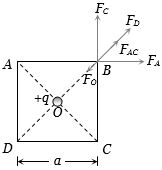
Four charges equal to $-Q$ are placed at the four corners of a square and a charge $q$ is at its centre. If the system is in equilibrium,the value of $q$ is:
A
$ - \frac{Q}{4}(1 + 2\sqrt 2 )$
B
$\frac{Q}{4}(1 + 2\sqrt 2 )$
C
$ - \frac{Q}{2}(1 + 2\sqrt 2 )$
D
$\frac{Q}{2}(1 + 2\sqrt 2 )$
Solution
(B) For the system to be in equilibrium,the net force on every charge must be zero.
Consider a charge $-Q$ at corner $B$ of the square with side length $a$.
The forces acting on this charge due to the other three charges at the corners are:
$1$. Force due to charge at $A$: $F_A = \frac{kQ^2}{a^2}$ (along $AB$)
$2$. Force due to charge at $C$: $F_C = \frac{kQ^2}{a^2}$ (along $CB$)
$3$. Force due to charge at $D$: $F_D = \frac{kQ^2}{(a\sqrt{2})^2} = \frac{kQ^2}{2a^2}$ (along $DB$)
The resultant force of $F_A$ and $F_C$ is $F_{AC} = \sqrt{F_A^2 + F_C^2} = \sqrt{2} \frac{kQ^2}{a^2}$.
The total force away from the center is $F_{net} = F_{AC} + F_D = \sqrt{2} \frac{kQ^2}{a^2} + \frac{kQ^2}{2a^2} = \frac{kQ^2}{a^2} (\sqrt{2} + 0.5)$.
For equilibrium,the force due to the central charge $q$ must balance this force:
$F_O = \frac{k |Q| |q|}{(a/\sqrt{2})^2} = \frac{2kQq}{a^2}$.
Equating the forces: $\frac{2kQq}{a^2} = \frac{kQ^2}{a^2} (\sqrt{2} + 0.5)$.
$2q = Q (\frac{2\sqrt{2} + 1}{2})$.
$q = \frac{Q}{4} (1 + 2\sqrt{2})$.
Since the corner charges are negative,the central charge $q$ must be positive to provide an attractive force.
Consider a charge $-Q$ at corner $B$ of the square with side length $a$.
The forces acting on this charge due to the other three charges at the corners are:
$1$. Force due to charge at $A$: $F_A = \frac{kQ^2}{a^2}$ (along $AB$)
$2$. Force due to charge at $C$: $F_C = \frac{kQ^2}{a^2}$ (along $CB$)
$3$. Force due to charge at $D$: $F_D = \frac{kQ^2}{(a\sqrt{2})^2} = \frac{kQ^2}{2a^2}$ (along $DB$)
The resultant force of $F_A$ and $F_C$ is $F_{AC} = \sqrt{F_A^2 + F_C^2} = \sqrt{2} \frac{kQ^2}{a^2}$.
The total force away from the center is $F_{net} = F_{AC} + F_D = \sqrt{2} \frac{kQ^2}{a^2} + \frac{kQ^2}{2a^2} = \frac{kQ^2}{a^2} (\sqrt{2} + 0.5)$.
For equilibrium,the force due to the central charge $q$ must balance this force:
$F_O = \frac{k |Q| |q|}{(a/\sqrt{2})^2} = \frac{2kQq}{a^2}$.
Equating the forces: $\frac{2kQq}{a^2} = \frac{kQ^2}{a^2} (\sqrt{2} + 0.5)$.
$2q = Q (\frac{2\sqrt{2} + 1}{2})$.
$q = \frac{Q}{4} (1 + 2\sqrt{2})$.
Since the corner charges are negative,the central charge $q$ must be positive to provide an attractive force.
0 likesView Solution
4
ChemistryMCQAIEEE · 2004
$A$ long wire carries a steady current. It is bent into a circle of one turn and the magnetic field at the centre of the coil is $B$. It is then bent into a circular loop of $n$ turns. The magnetic field at the centre of the coil will be
A
$nB$
B
$n^2B$
C
$2nB$
D
$2n^2B$
Solution
(B) Let the length of the wire be $L$ and the current be $i$.
For a single turn loop of radius $r$,the circumference is $2\pi r = L$,so $r = \frac{L}{2\pi}$.
The magnetic field at the center is $B = \frac{\mu_0 i}{2r} = \frac{\mu_0 i}{2(L/2\pi)} = \frac{\mu_0 i \pi}{L}$.
When the wire is bent into $n$ turns,the new radius $r'$ satisfies $n(2\pi r') = L$,so $r' = \frac{L}{2\pi n} = \frac{r}{n}$.
The magnetic field at the center for $n$ turns is $B_n = n \times \frac{\mu_0 i}{2r'} = n \times \frac{\mu_0 i}{2(r/n)} = n^2 \times \frac{\mu_0 i}{2r}$.
Since $B = \frac{\mu_0 i}{2r}$,we have $B_n = n^2 B$.
For a single turn loop of radius $r$,the circumference is $2\pi r = L$,so $r = \frac{L}{2\pi}$.
The magnetic field at the center is $B = \frac{\mu_0 i}{2r} = \frac{\mu_0 i}{2(L/2\pi)} = \frac{\mu_0 i \pi}{L}$.
When the wire is bent into $n$ turns,the new radius $r'$ satisfies $n(2\pi r') = L$,so $r' = \frac{L}{2\pi n} = \frac{r}{n}$.
The magnetic field at the center for $n$ turns is $B_n = n \times \frac{\mu_0 i}{2r'} = n \times \frac{\mu_0 i}{2(r/n)} = n^2 \times \frac{\mu_0 i}{2r}$.
Since $B = \frac{\mu_0 i}{2r}$,we have $B_n = n^2 B$.
0 likesView Solution
5
ChemistryMediumMCQAIEEE · 2004
The wavelength of the radiation emitted,when in a hydrogen atom an electron falls from infinity to stationary state $n=1$,would be ............... $nm$ (Rydberg constant $= 1.097 \times 10^7 \ m^{-1}$)
A
$406$
B
$192$
C
$91$
D
$9.1 \times 10^{-8}$
Solution
(C) The Rydberg formula for the hydrogen atom is given by: $\frac{1}{\lambda} = R \left[ \frac{1}{n_1^2} - \frac{1}{n_2^2} \right]$
Here,$n_1 = 1$ (stationary state) and $n_2 = \infty$ (infinity).
Substituting the values: $\frac{1}{\lambda} = 1.097 \times 10^7 \ m^{-1} \left[ \frac{1}{1^2} - \frac{1}{\infty^2} \right]$
Since $\frac{1}{\infty} = 0$,we have: $\frac{1}{\lambda} = 1.097 \times 10^7 \ m^{-1} \times 1$
$\lambda = \frac{1}{1.097 \times 10^7} \ m \approx 9.115 \times 10^{-8} \ m$
Converting to nanometers $(nm)$: $\lambda = 9.115 \times 10^{-8} \times 10^9 \ nm = 91.15 \ nm \approx 91 \ nm$.
Here,$n_1 = 1$ (stationary state) and $n_2 = \infty$ (infinity).
Substituting the values: $\frac{1}{\lambda} = 1.097 \times 10^7 \ m^{-1} \left[ \frac{1}{1^2} - \frac{1}{\infty^2} \right]$
Since $\frac{1}{\infty} = 0$,we have: $\frac{1}{\lambda} = 1.097 \times 10^7 \ m^{-1} \times 1$
$\lambda = \frac{1}{1.097 \times 10^7} \ m \approx 9.115 \times 10^{-8} \ m$
Converting to nanometers $(nm)$: $\lambda = 9.115 \times 10^{-8} \times 10^9 \ nm = 91.15 \ nm \approx 91 \ nm$.
0 likesView Solution
6
ChemistryMediumMCQAIEEE · 2004
Which of the following sets of quantum numbers is correct for an electron in a $4f$ orbital?
A
$n = 4, l = 3, m = +1, s = +\frac{1}{2}$
B
$n = 4, l = 4, m = -4, s = -\frac{1}{2}$
C
$n = 4, l = 3, m = +4, s = +\frac{1}{2}$
D
$n = 3, l = 2, m = -2, s = +\frac{1}{2}$
Solution
(A) For a $4f$ orbital,the principal quantum number $n = 4$.
The azimuthal quantum number $l$ for an $f$ orbital is $3$ (since $l = 0, 1, 2, 3$ correspond to $s, p, d, f$ orbitals respectively).
The magnetic quantum number $m$ can take values from $-l$ to $+l$,i.e.,$m = \{-3, -2, -1, 0, +1, +2, +3\}$.
The spin quantum number $s$ can be either $+\frac{1}{2}$ or $-\frac{1}{2}$.
Comparing these with the given options,option $A$ $(n = 4, l = 3, m = +1, s = +\frac{1}{2})$ satisfies all conditions.
The azimuthal quantum number $l$ for an $f$ orbital is $3$ (since $l = 0, 1, 2, 3$ correspond to $s, p, d, f$ orbitals respectively).
The magnetic quantum number $m$ can take values from $-l$ to $+l$,i.e.,$m = \{-3, -2, -1, 0, +1, +2, +3\}$.
The spin quantum number $s$ can be either $+\frac{1}{2}$ or $-\frac{1}{2}$.
Comparing these with the given options,option $A$ $(n = 4, l = 3, m = +1, s = +\frac{1}{2})$ satisfies all conditions.
0 likesView Solution
7
ChemistryMediumMCQAIEEE · 2004
Consider the ground state of $Cr$ $(Z = 24)$. The numbers of electrons with the azimuthal quantum numbers,$l = 1$ and $l = 2$ are,respectively:
A
$16$ and $4$
B
$12$ and $5$
C
$12$ and $4$
D
$16$ and $5$
Solution
(B) The electronic configuration of $Cr$ $(Z = 24)$ is $1s^2, 2s^2, 2p^6, 3s^2, 3p^6, 3d^5, 4s^1$.
For $l = 1$ (which corresponds to $p$-orbitals),the electrons are in $2p^6$ and $3p^6$. Total electrons $= 6 + 6 = 12$.
For $l = 2$ (which corresponds to $d$-orbitals),the electrons are in $3d^5$. Total electrons $= 5$.
Therefore,the numbers of electrons with $l = 1$ and $l = 2$ are $12$ and $5$ respectively.
For $l = 1$ (which corresponds to $p$-orbitals),the electrons are in $2p^6$ and $3p^6$. Total electrons $= 6 + 6 = 12$.
For $l = 2$ (which corresponds to $d$-orbitals),the electrons are in $3d^5$. Total electrons $= 5$.
Therefore,the numbers of electrons with $l = 1$ and $l = 2$ are $12$ and $5$ respectively.
0 likesView Solution
8
ChemistryMediumMCQAIEEE · 2004
The correct order of bond angles (smallest first) in $H_2S, NH_3, BF_3$ and $SiH_4$ is
A
$H_2S < SiH_4 < NH_3 < BF_3$
B
$NH_3 < H_2S < SiH_4 < BF_3$
C
$H_2S < NH_3 < SiH_4 < BF_3$
D
$H_2S < NH_3 < BF_3 < SiH_4$
Solution
(C) To determine the bond angles,we analyze the hybridization and molecular geometry of each molecule:
$1$. $H_2S$: The central atom $S$ has two bond pairs and two lone pairs. Due to the presence of lone pairs,the bond angle is significantly reduced from the tetrahedral angle,approximately $92.6^o$.
$2$. $NH_3$: The central atom $N$ has three bond pairs and one lone pair. The lone pair-bond pair repulsion reduces the bond angle to approximately $107^o$.
$3$. $SiH_4$: The central atom $Si$ is $sp^3$ hybridized with four bond pairs and no lone pairs,resulting in a perfect tetrahedral geometry with a bond angle of $109^o 28'$.
$4$. $BF_3$: The central atom $B$ is $sp^2$ hybridized with three bond pairs and no lone pairs,resulting in a trigonal planar geometry with a bond angle of $120^o$.
Thus,the correct order of bond angles (smallest first) is $H_2S < NH_3 < SiH_4 < BF_3$ $(92.6^o < 107^o < 109^o 28' < 120^o)$.
$1$. $H_2S$: The central atom $S$ has two bond pairs and two lone pairs. Due to the presence of lone pairs,the bond angle is significantly reduced from the tetrahedral angle,approximately $92.6^o$.
$2$. $NH_3$: The central atom $N$ has three bond pairs and one lone pair. The lone pair-bond pair repulsion reduces the bond angle to approximately $107^o$.
$3$. $SiH_4$: The central atom $Si$ is $sp^3$ hybridized with four bond pairs and no lone pairs,resulting in a perfect tetrahedral geometry with a bond angle of $109^o 28'$.
$4$. $BF_3$: The central atom $B$ is $sp^2$ hybridized with three bond pairs and no lone pairs,resulting in a trigonal planar geometry with a bond angle of $120^o$.
Thus,the correct order of bond angles (smallest first) is $H_2S < NH_3 < SiH_4 < BF_3$ $(92.6^o < 107^o < 109^o 28' < 120^o)$.
0 likesView Solution
9
ChemistryDifficultMCQAIEEE · 2004
Which one of the following has the regular tetrahedral structure?
(Atomic no. : $B = 5, S = 16, Ni = 28, Xe = 54$)
(Atomic no. : $B = 5, S = 16, Ni = 28, Xe = 54$)
A
$BF_4^-$
B
$SF_4$
C
$XeF_4$
D
$[Ni(CN)_4]^{2-}$
Solution
(A) To determine the structure,we calculate the hybridization and number of lone pairs for each species:
$1$. $BF_4^-$: Boron has $3$ valence electrons. It forms $4$ bonds with $F$ atoms and gains $1$ electron from the negative charge. Total electron pairs = $(3+4+1)/2 = 4$. Hybridization is $sp^3$,which corresponds to a regular tetrahedral geometry.
$2$. $SF_4$: Sulfur has $6$ valence electrons. It forms $4$ bonds with $F$ atoms,leaving $1$ lone pair. Total electron pairs = $5$ ($sp^3d$ hybridization). Due to the lone pair,it has a see-saw shape.
$3$. $XeF_4$: Xenon has $8$ valence electrons. It forms $4$ bonds with $F$ atoms,leaving $2$ lone pairs. Total electron pairs = $6$ ($sp^3d^2$ hybridization). Due to the two lone pairs,it has a square planar geometry.
$4$. $[Ni(CN)_4]^{2-}$: $Ni^{2+}$ has a $d^8$ configuration. $CN^-$ is a strong field ligand,causing pairing of electrons. Hybridization is $dsp^2$,resulting in a square planar geometry.
Thus,only $BF_4^-$ has a regular tetrahedral structure.
$1$. $BF_4^-$: Boron has $3$ valence electrons. It forms $4$ bonds with $F$ atoms and gains $1$ electron from the negative charge. Total electron pairs = $(3+4+1)/2 = 4$. Hybridization is $sp^3$,which corresponds to a regular tetrahedral geometry.
$2$. $SF_4$: Sulfur has $6$ valence electrons. It forms $4$ bonds with $F$ atoms,leaving $1$ lone pair. Total electron pairs = $5$ ($sp^3d$ hybridization). Due to the lone pair,it has a see-saw shape.
$3$. $XeF_4$: Xenon has $8$ valence electrons. It forms $4$ bonds with $F$ atoms,leaving $2$ lone pairs. Total electron pairs = $6$ ($sp^3d^2$ hybridization). Due to the two lone pairs,it has a square planar geometry.
$4$. $[Ni(CN)_4]^{2-}$: $Ni^{2+}$ has a $d^8$ configuration. $CN^-$ is a strong field ligand,causing pairing of electrons. Hybridization is $dsp^2$,resulting in a square planar geometry.
Thus,only $BF_4^-$ has a regular tetrahedral structure.
0 likesView Solution
10
ChemistryDifficultMCQAIEEE · 2004
The states of hybridization of boron and oxygen atoms in boric acid $(H_3BO_3)$ are respectively
A
$sp^2$ and $sp^3$
B
$sp^3$ and $sp^2$
C
$sp^2$ and $sp^2$
D
$sp^3$ and $sp^3$
Solution
(A) In boric acid $(H_3BO_3)$,the boron atom is bonded to three oxygen atoms via single bonds. Boron has $3$ valence electrons,all of which are involved in bonding,resulting in a trigonal planar geometry with $sp^2$ hybridization.
Each oxygen atom is bonded to one boron atom and one hydrogen atom,and it also possesses two lone pairs of electrons. Thus,each oxygen atom has $4$ electron domains (two bond pairs and two lone pairs),resulting in $sp^3$ hybridization.
Each oxygen atom is bonded to one boron atom and one hydrogen atom,and it also possesses two lone pairs of electrons. Thus,each oxygen atom has $4$ electron domains (two bond pairs and two lone pairs),resulting in $sp^3$ hybridization.
0 likesView Solution
11
ChemistryMediumMCQAIEEE · 2004
The maximum number of $90^{\circ}$ angles between bond pair-bond pair of electrons is observed in
A
$dsp^2$ hybridization
B
$sp^3d$ hybridization
C
$dsp^3$ hybridization
D
$sp^3d^2$ hybridization
Solution
(D) The number of $90^{\circ}$ bond pair-bond pair angles for different geometries are as follows:
$1$. $dsp^2$ hybridization (Square planar): There are $4$ angles of $90^{\circ}$ between adjacent bond pairs.
$2$. $sp^3d$ hybridization (Trigonal bipyramidal): There are $6$ angles of $90^{\circ}$ (three between equatorial and axial bonds,and three more between the other equatorial and axial bonds).
$3$. $sp^3d^2$ hybridization (Octahedral): There are $12$ angles of $90^{\circ}$ between adjacent bond pairs.
Comparing these,$sp^3d^2$ hybridization has the maximum number of $90^{\circ}$ angles. Therefore,the correct option is $D$.
$1$. $dsp^2$ hybridization (Square planar): There are $4$ angles of $90^{\circ}$ between adjacent bond pairs.
$2$. $sp^3d$ hybridization (Trigonal bipyramidal): There are $6$ angles of $90^{\circ}$ (three between equatorial and axial bonds,and three more between the other equatorial and axial bonds).
$3$. $sp^3d^2$ hybridization (Octahedral): There are $12$ angles of $90^{\circ}$ between adjacent bond pairs.
Comparing these,$sp^3d^2$ hybridization has the maximum number of $90^{\circ}$ angles. Therefore,the correct option is $D$.
0 likesView Solution
12
ChemistryEasyMCQAIEEE · 2004
The bond order in $NO$ is $2.5$ while that in $NO^{+}$ is $3$. Which of the following statements is true for these two species?
A
Bond length in $NO^{+}$ is equal to that in $NO$
B
Bond length in $NO$ is greater than in $NO^{+}$
C
Bond length in $NO^{+}$ is greater than in $NO$
D
Bond length is unpredictable
Solution
(B) The bond length is inversely proportional to the bond order.
Since the bond order of $NO^{+}$ $(3)$ is greater than the bond order of $NO$ $(2.5)$,the bond length of $NO^{+}$ will be shorter than that of $NO$.
Therefore,the bond length in $NO$ is greater than in $NO^{+}$.
Since the bond order of $NO^{+}$ $(3)$ is greater than the bond order of $NO$ $(2.5)$,the bond length of $NO^{+}$ will be shorter than that of $NO$.
Therefore,the bond length in $NO$ is greater than in $NO^{+}$.
0 likesView Solution
13
ChemistryMediumMCQAIEEE · 2004
In $Vander$ $Waal$'s equation of state for gases,the constant '$b$' is a measure of
A
Volume occupied by the molecules
B
Intermolecular attraction
C
Intermolecular repulsions
D
Intermolecular collisions per unit volume
Solution
(A) The correct option is $A$. In $Vander$ $Waal$'s equation,$(P + \frac{an^2}{V^2})(V - nb) = nRT$,the constant '$b$' is known as the co-volume or excluded volume. It represents the effective volume occupied by the gas molecules themselves.
0 likesView Solution
14
ChemistryMediumMCQAIEEE · 2004
As the temperature is raised from $20\,^{\circ}C$ to $40\,^{\circ}C$,the average kinetic energy of neon atoms changes by a factor of which of the following?
A
$313/293$
B
$\sqrt{313/293}$
C
$1/2$
D
$2$
Solution
(A) The average kinetic energy $(K.E.)$ of an ideal gas is directly proportional to its absolute temperature $(T)$ in Kelvin: $K.E. \propto T$.
Given temperatures:
$T_1 = 20 + 273 = 293 \ K$
$T_2 = 40 + 273 = 313 \ K$
The factor by which the kinetic energy changes is the ratio of the final kinetic energy to the initial kinetic energy:
$\frac{K.E._2}{K.E._1} = \frac{T_2}{T_1} = \frac{313}{293}$.
Given temperatures:
$T_1 = 20 + 273 = 293 \ K$
$T_2 = 40 + 273 = 313 \ K$
The factor by which the kinetic energy changes is the ratio of the final kinetic energy to the initial kinetic energy:
$\frac{K.E._2}{K.E._1} = \frac{T_2}{T_1} = \frac{313}{293}$.
0 likesView Solution
15
ChemistryDifficultMCQAIEEE · 2004
The equilibrium constant for the reaction $N_{2(g)} + O_{2(g)} \rightleftharpoons 2NO_{(g)}$ at temperature $T$ is $4 \times 10^{-4}$. The value of $K_c$ for the reaction $NO_{(g)} \rightleftharpoons \frac{1}{2}N_{2(g)} + \frac{1}{2}O_{2(g)}$ at the same temperature is
A
$4 \times 10^{-4}$
B
$50$
C
$2.5 \times 10^{2}$
D
$0.02$
Solution
(B) For the reaction $N_{2(g)} + O_{2(g)} \rightleftharpoons 2NO_{(g)}$,the equilibrium constant is $K_c = \frac{[NO]^2}{[N_2][O_2]} = 4 \times 10^{-4}$.
For the reaction $NO_{(g)} \rightleftharpoons \frac{1}{2}N_{2(g)} + \frac{1}{2}O_{2(g)}$,the equilibrium constant $K'_c$ is given by $K'_c = \frac{[N_2]^{1/2}[O_2]^{1/2}}{[NO]}$.
Comparing the two expressions,we see that $K'_c = \frac{1}{\sqrt{K_c}}$.
Substituting the value of $K_c$,we get $K'_c = \frac{1}{\sqrt{4 \times 10^{-4}}} = \frac{1}{2 \times 10^{-2}} = \frac{100}{2} = 50$.
For the reaction $NO_{(g)} \rightleftharpoons \frac{1}{2}N_{2(g)} + \frac{1}{2}O_{2(g)}$,the equilibrium constant $K'_c$ is given by $K'_c = \frac{[N_2]^{1/2}[O_2]^{1/2}}{[NO]}$.
Comparing the two expressions,we see that $K'_c = \frac{1}{\sqrt{K_c}}$.
Substituting the value of $K_c$,we get $K'_c = \frac{1}{\sqrt{4 \times 10^{-4}}} = \frac{1}{2 \times 10^{-2}} = \frac{100}{2} = 50$.
0 likesView Solution
16
ChemistryMediumMCQAIEEE · 2004
What is the equilibrium expression for the reaction $P_{4(s)} + 5O_{2(g)} \rightleftharpoons P_4O_{10(s)}$?
A
$K_c = 1/[O_2]^5$
B
$K_c = [P_4O_{10}]/5[P_4][O_2]$
C
$K_c = [P_4O_{10}]/[P_4][O_2]^5$
D
$K_c = [O_2]^5$
Solution
(A) For the reaction $P_{4(s)} + 5O_{2(g)} \rightleftharpoons P_4O_{10(s)}$,the equilibrium constant expression is given by the ratio of the product of concentrations of products to the reactants,each raised to the power of their stoichiometric coefficients.
$K_c = \frac{[P_4O_{10(s)}]}{[P_{4(s)}][O_{2(g)}]^5}$
Since $P_{4(s)}$ and $P_4O_{10(s)}$ are pure solids,their concentrations are taken as unity $(1)$.
Therefore,$K_c = \frac{1}{[O_2]^5}$.
$K_c = \frac{[P_4O_{10(s)}]}{[P_{4(s)}][O_{2(g)}]^5}$
Since $P_{4(s)}$ and $P_4O_{10(s)}$ are pure solids,their concentrations are taken as unity $(1)$.
Therefore,$K_c = \frac{1}{[O_2]^5}$.
0 likesView Solution
17
ChemistryMediumMCQAIEEE · 2004
For the reaction,$CO_{(g)} + Cl_{2(g)} \rightleftharpoons COCl_{2(g)}$,the ratio $K_p/K_c$ is equal to:
A
$\sqrt{RT}$
B
$RT$
C
$1/RT$
D
$1.0$
Solution
(C) The relationship between $K_p$ and $K_c$ is given by the equation: $K_p = K_c(RT)^{\Delta n}$.
For the reaction $CO_{(g)} + Cl_{2(g)} \rightleftharpoons COCl_{2(g)}$,the change in the number of moles of gaseous products and reactants is $\Delta n = n_p - n_r = 1 - (1 + 1) = 1 - 2 = -1$.
Substituting $\Delta n = -1$ into the equation,we get: $K_p = K_c(RT)^{-1}$.
Therefore,the ratio $\frac{K_p}{K_c} = (RT)^{-1} = \frac{1}{RT}$.
For the reaction $CO_{(g)} + Cl_{2(g)} \rightleftharpoons COCl_{2(g)}$,the change in the number of moles of gaseous products and reactants is $\Delta n = n_p - n_r = 1 - (1 + 1) = 1 - 2 = -1$.
Substituting $\Delta n = -1$ into the equation,we get: $K_p = K_c(RT)^{-1}$.
Therefore,the ratio $\frac{K_p}{K_c} = (RT)^{-1} = \frac{1}{RT}$.
0 likesView Solution
18
ChemistryMediumMCQAIEEE · 2004
The conjugate base of $H_2PO_4^-$ is
A
$H_3PO_4$
B
$P_2O_5$
C
$PO_4^{3-}$
D
$HPO_4^{2-}$
Solution
(D) . The conjugate base of an acid is formed by the removal of one proton $(H^+)$ from the acid molecule.
For the acid $H_2PO_4^-$,the reaction is:
$H_2PO_4^- \to H^+ + HPO_4^{2-}$
Thus,the conjugate base of $H_2PO_4^-$ is $HPO_4^{2-}$.
For the acid $H_2PO_4^-$,the reaction is:
$H_2PO_4^- \to H^+ + HPO_4^{2-}$
Thus,the conjugate base of $H_2PO_4^-$ is $HPO_4^{2-}$.
0 likesView Solution
19
ChemistryMediumMCQAIEEE · 2004
The molar solubility $(mol \ L^{-1})$ of a sparingly soluble salt $MX_4$ is $s$. The corresponding solubility product is $K_{sp}$. $s$ is given in terms of $K_{sp}$ by the relation:
A
$s = (256K_{sp})^{1/5}$
B
$s = (128K_{sp})^{1/4}$
C
$s = (K_{sp} / 128)^{1/4}$
D
$s = (K_{sp} / 256)^{1/5}$
Solution
(D) For a sparingly soluble salt $MX_4$,the dissociation equilibrium is:
$MX_4(s) \rightleftharpoons M^{4+}(aq) + 4X^-(aq)$
Let the molar solubility be $s$.
At equilibrium,$[M^{4+}] = s$ and $[X^-] = 4s$.
The solubility product $K_{sp}$ is defined as:
$K_{sp} = [M^{4+}][X^-]^4$
$K_{sp} = (s)(4s)^4$
$K_{sp} = s \times 256s^4 = 256s^5$
Solving for $s$:
$s^5 = K_{sp} / 256$
$s = (K_{sp} / 256)^{1/5}$
Therefore,the correct option is $D$.
$MX_4(s) \rightleftharpoons M^{4+}(aq) + 4X^-(aq)$
Let the molar solubility be $s$.
At equilibrium,$[M^{4+}] = s$ and $[X^-] = 4s$.
The solubility product $K_{sp}$ is defined as:
$K_{sp} = [M^{4+}][X^-]^4$
$K_{sp} = (s)(4s)^4$
$K_{sp} = s \times 256s^4 = 256s^5$
Solving for $s$:
$s^5 = K_{sp} / 256$
$s = (K_{sp} / 256)^{1/5}$
Therefore,the correct option is $D$.
0 likesView Solution
20
ChemistryMediumMCQAIEEE · 2004
An ideal gas expands in volume from $1 \times 10^{-3} \ m^3$ to $1 \times 10^{-2} \ m^3$ at $300 \ K$ against a constant pressure of $1 \times 10^5 \ N \ m^{-2}$. The work done is
A
$270 \ kJ$
B
$-900 \ kJ$
C
$-900 \ J$
D
$900 \ kJ$
Solution
(C) The work done during expansion against a constant external pressure is given by the formula: $W = -P_{ext} \Delta V$.
Here,$P_{ext} = 1 \times 10^5 \ N \ m^{-2}$,$V_1 = 1 \times 10^{-3} \ m^3$,and $V_2 = 1 \times 10^{-2} \ m^3$.
$\Delta V = V_2 - V_1 = (1 \times 10^{-2} - 1 \times 10^{-3}) \ m^3 = (10 \times 10^{-3} - 1 \times 10^{-3}) \ m^3 = 9 \times 10^{-3} \ m^3$.
Substituting the values: $W = -(1 \times 10^5 \ N \ m^{-2}) \times (9 \times 10^{-3} \ m^3) = -900 \ J$.
Thus,the work done is $-900 \ J$.
Here,$P_{ext} = 1 \times 10^5 \ N \ m^{-2}$,$V_1 = 1 \times 10^{-3} \ m^3$,and $V_2 = 1 \times 10^{-2} \ m^3$.
$\Delta V = V_2 - V_1 = (1 \times 10^{-2} - 1 \times 10^{-3}) \ m^3 = (10 \times 10^{-3} - 1 \times 10^{-3}) \ m^3 = 9 \times 10^{-3} \ m^3$.
Substituting the values: $W = -(1 \times 10^5 \ N \ m^{-2}) \times (9 \times 10^{-3} \ m^3) = -900 \ J$.
Thus,the work done is $-900 \ J$.
0 likesView Solution
21
ChemistryMediumMCQAIEEE · 2004
The enthalpies of combustion of carbon and carbon monoxide are $-393.5 \, kJ \, mol^{-1}$ and $-283 \, kJ \, mol^{-1}$ respectively. The enthalpy of formation of carbon monoxide per mole is $....... \, kJ \, mol^{-1}$. (in $.5$)
A
$-676$
B
$676$
C
$110$
D
$-110$
Solution
(D) $C_{(s)} + O_{2(g)} \to CO_{2(g)}$; $\Delta H = -393.5 \, kJ \, mol^{-1}$ ..... $(I)$
$CO_{(g)} + 1/2 O_{2(g)} \to CO_{2(g)}$; $\Delta H = -283 \, kJ \, mol^{-1}$ ..... $(II)$
Subtracting equation $(II)$ from equation $(I)$:
$(C_{(s)} + O_{2(g)}) - (CO_{(g)} + 1/2 O_{2(g)}) = CO_{2(g)} - CO_{2(g)}$
$C_{(s)} + 1/2 O_{2(g)} \to CO_{(g)}$
$\Delta H_f = (-393.5) - (-283) = -110.5 \, kJ \, mol^{-1}$
$CO_{(g)} + 1/2 O_{2(g)} \to CO_{2(g)}$; $\Delta H = -283 \, kJ \, mol^{-1}$ ..... $(II)$
Subtracting equation $(II)$ from equation $(I)$:
$(C_{(s)} + O_{2(g)}) - (CO_{(g)} + 1/2 O_{2(g)}) = CO_{2(g)} - CO_{2(g)}$
$C_{(s)} + 1/2 O_{2(g)} \to CO_{(g)}$
$\Delta H_f = (-393.5) - (-283) = -110.5 \, kJ \, mol^{-1}$
0 likesView Solution
22
ChemistryDifficultMCQAIEEE · 2004
Which one of the following ions has the highest value of ionic radius?
A
$O^{2-}$
B
$B^{3+}$
C
$Li^{+}$
D
$F^{-}$
Solution
(A) The ionic radius is inversely proportional to the $Z/e$ ratio (where $Z$ is the nuclear charge and $e$ is the number of electrons).
For the given ions:
$O^{2-}$: $Z=8, e=10$,$Z/e = 0.8$
$F^{-}$: $Z=9, e=10$,$Z/e = 0.9$
$Li^{+}$: $Z=3, e=2$,$Z/e = 1.5$
$B^{3+}$: $Z=5, e=2$,$Z/e = 2.5$
Since $O^{2-}$ has the lowest $Z/e$ ratio,it has the largest ionic radius.
For the given ions:
$O^{2-}$: $Z=8, e=10$,$Z/e = 0.8$
$F^{-}$: $Z=9, e=10$,$Z/e = 0.9$
$Li^{+}$: $Z=3, e=2$,$Z/e = 1.5$
$B^{3+}$: $Z=5, e=2$,$Z/e = 2.5$
Since $O^{2-}$ has the lowest $Z/e$ ratio,it has the largest ionic radius.
0 likesView Solution
23
ChemistryMediumMCQAIEEE · 2004
The formation of the oxide ion $O_{(g)}^{2-}$ requires first an exothermic and then an endothermic step as shown below. This is because
$O_{(g)} + e^{-} \rightarrow O_{(g)}^{-}; \Delta H^{o} = -142 \ kJ \ mol^{-1}$
$O_{(g)}^{-} + e^{-} \rightarrow O_{(g)}^{2-}; \Delta H^{o} = 844 \ kJ \ mol^{-1}$
$O_{(g)} + e^{-} \rightarrow O_{(g)}^{-}; \Delta H^{o} = -142 \ kJ \ mol^{-1}$
$O_{(g)}^{-} + e^{-} \rightarrow O_{(g)}^{2-}; \Delta H^{o} = 844 \ kJ \ mol^{-1}$
A
$O^{-}$ ion will tend to resist the addition of another electron
B
Oxygen has high electron affinity
C
Oxygen is more electronegative
D
$O^{-}$ ion has comparatively larger size than oxygen atom
Solution
(A) The formation of $O_{(g)}^{2-}$ involves the addition of an electron to a negatively charged $O_{(g)}^{-}$ ion.
Since both the incoming electron and the $O_{(g)}^{-}$ ion are negatively charged,there is a strong electrostatic repulsion between them.
To overcome this repulsion and force the electron into the $O_{(g)}^{-}$ ion,energy must be supplied to the system,making the process endothermic.
Therefore,the $O^{-}$ ion resists the addition of another electron.
Since both the incoming electron and the $O_{(g)}^{-}$ ion are negatively charged,there is a strong electrostatic repulsion between them.
To overcome this repulsion and force the electron into the $O_{(g)}^{-}$ ion,energy must be supplied to the system,making the process endothermic.
Therefore,the $O^{-}$ ion resists the addition of another electron.
0 likesView Solution
24
ChemistryEasyMCQAIEEE · 2004
Which one of the following sets of ions represents the collection of isoelectronic species?
A
$K^{+}, Cl^{-}, Mg^{2+}, Sc^{3+}$
B
$Na^{+}, Ca^{2+}, Sc^{3+}, F^{-}$
C
$K^{+}, Ca^{2+}, Sc^{3+}, Cl^{-}$
D
$Na^{+}, Mg^{2+}, Al^{3+}, Cl^{-}$
Solution
(C) Isoelectronic species are those which have the same number of electrons.
For option $C$:
$K^{+} = 19 - 1 = 18 \text{ electrons}$
$Ca^{2+} = 20 - 2 = 18 \text{ electrons}$
$Sc^{3+} = 21 - 3 = 18 \text{ electrons}$
$Cl^{-} = 17 + 1 = 18 \text{ electrons}$
Since all these ions have $18$ electrons,they are isoelectronic.
For option $C$:
$K^{+} = 19 - 1 = 18 \text{ electrons}$
$Ca^{2+} = 20 - 2 = 18 \text{ electrons}$
$Sc^{3+} = 21 - 3 = 18 \text{ electrons}$
$Cl^{-} = 17 + 1 = 18 \text{ electrons}$
Since all these ions have $18$ electrons,they are isoelectronic.
0 likesView Solution
25
ChemistryMediumMCQAIEEE · 2004
Among $Al_2O_3$,$SiO_2$,$P_2O_3$,and $SO_2$,the correct order of acidic strength is:
A
$Al_2O_3 < SiO_2 < SO_2 < P_2O_3$
B
$SiO_2 < SO_2 < Al_2O_3 < P_2O_3$
C
$SO_2 < P_2O_3 < SiO_2 < Al_2O_3$
D
$Al_2O_3 < SiO_2 < P_2O_3 < SO_2$
Solution
(D) The acidic strength of oxides increases as we move from left to right across a period in the periodic table due to the increase in electronegativity and decrease in metallic character.
$Al_2O_3$ is amphoteric.
$SiO_2$ is weakly acidic.
$P_2O_3$ is acidic (anhydride of $H_3PO_3$).
$SO_2$ is more acidic (anhydride of $H_2SO_3$).
Therefore,the correct order of acidic strength is $Al_2O_3 < SiO_2 < P_2O_3 < SO_2$.
$Al_2O_3$ is amphoteric.
$SiO_2$ is weakly acidic.
$P_2O_3$ is acidic (anhydride of $H_3PO_3$).
$SO_2$ is more acidic (anhydride of $H_2SO_3$).
Therefore,the correct order of acidic strength is $Al_2O_3 < SiO_2 < P_2O_3 < SO_2$.
0 likesView Solution
26
ChemistryMediumMCQAIEEE · 2004
Beryllium and aluminium exhibit many properties which are similar. But,the two elements differ in
A
Forming covalent halides
B
Forming polymeric hydrides
C
Exhibiting maximum covalency in compounds
D
Exhibiting amphoteric nature in their oxides
Solution
(C) Beryllium $(Be)$ and aluminium $(Al)$ show a diagonal relationship due to similar ionic potential.
However,they differ in their maximum covalency.
Beryllium has a maximum covalency of $4$ because it has only $2s$ and $2p$ orbitals available for bonding.
Aluminium has a maximum covalency of $6$ because it has vacant $3d$ orbitals available for bonding.
However,they differ in their maximum covalency.
Beryllium has a maximum covalency of $4$ because it has only $2s$ and $2p$ orbitals available for bonding.
Aluminium has a maximum covalency of $6$ because it has vacant $3d$ orbitals available for bonding.
0 likesView Solution
27
ChemistryMediumMCQAIEEE · 2004
Aluminium chloride exists as a dimer,$Al_2Cl_6$,in the solid state as well as in solutions of non-polar solvents such as benzene. When dissolved in water,it gives:
A
$[Al(H_2O)_6]^{3+} + 3Cl^{-}$
B
$[Al(H_2O)_6]^{3+} + 3Cl^{-}$
C
$Al^{3+} + 3Cl^{-}$
D
$Al_2O_3 + 6HCl$
Solution
(A) Aluminium chloride $(Al_2Cl_6)$ is a covalent dimer in non-polar solvents.
When it dissolves in water,it undergoes hydration to form the stable octahedral complex ion,$[Al(H_2O)_6]^{3+}$,and releases chloride ions.
The reaction is: $Al_2Cl_6 + 12H_2O \rightarrow 2[Al(H_2O)_6]^{3+} + 6Cl^-$.
Therefore,the correct species formed are $[Al(H_2O)_6]^{3+}$ and $Cl^-$ ions.
When it dissolves in water,it undergoes hydration to form the stable octahedral complex ion,$[Al(H_2O)_6]^{3+}$,and releases chloride ions.
The reaction is: $Al_2Cl_6 + 12H_2O \rightarrow 2[Al(H_2O)_6]^{3+} + 6Cl^-$.
Therefore,the correct species formed are $[Al(H_2O)_6]^{3+}$ and $Cl^-$ ions.
0 likesView Solution
28
ChemistryMediumMCQAIEEE · 2004
The smog is essentially caused by the presence of
A
Oxides of sulphur and nitrogen
B
$O_2$ and $N_2$
C
$O_2$ and $O_3$
D
$O_3$ and $N_2$
Solution
(A) Smog is a type of air pollution. Photochemical smog is primarily caused by the presence of oxides of nitrogen $(NO_x)$ and volatile organic compounds $(VOCs)$ in the atmosphere,which react in the presence of sunlight. Classical smog (London smog) is caused by a mixture of smoke,fog,and sulphur dioxide $(SO_2)$. Therefore,the presence of oxides of sulphur and nitrogen is the primary cause of smog.
0 likesView Solution
29
ChemistryMCQAIEEE · 2004
Which one of the following statements regarding helium is incorrect?
A
It is used to produce and sustain powerful superconducting magnets.
B
It is used as a cryogenic agent for carrying out experiments at low temperatures.
C
It is used to fill gas balloons instead of hydrogen because it is lighter and non-inflammable.
D
It is used in gas-cooled nuclear reactors.
Solution
(C) The correct answer is $(C)$.
Helium is actually twice as heavy as hydrogen,not lighter. While it is non-inflammable,the statement that it is lighter than hydrogen is scientifically incorrect.
Helium has the lowest melting and boiling points of any element,making liquid helium an ideal coolant for superconducting magnets and cryogenic research.
It is also used in gas-cooled nuclear reactors as a heat transfer medium.
Helium is actually twice as heavy as hydrogen,not lighter. While it is non-inflammable,the statement that it is lighter than hydrogen is scientifically incorrect.
Helium has the lowest melting and boiling points of any element,making liquid helium an ideal coolant for superconducting magnets and cryogenic research.
It is also used in gas-cooled nuclear reactors as a heat transfer medium.
0 likesView Solution
30
ChemistryMediumMCQAIEEE · 2004
One mole of magnesium nitride on the reaction with an excess of water gives
A
Two moles of ammonia
B
One mole of nitric acid
C
One mole of ammonia
D
Two moles of nitric acid
Solution
(A) The balanced chemical equation for the reaction of magnesium nitride with water is:
$Mg_3N_2 + 6H_2O \to 3Mg(OH)_2 + 2NH_3$
From the stoichiometry of the reaction,$1 \text{ mole}$ of $Mg_3N_2$ reacts with $6 \text{ moles}$ of $H_2O$ to produce $3 \text{ moles}$ of $Mg(OH)_2$ and $2 \text{ moles}$ of $NH_3$ (ammonia).
Therefore,the correct option is $A$.
$Mg_3N_2 + 6H_2O \to 3Mg(OH)_2 + 2NH_3$
From the stoichiometry of the reaction,$1 \text{ mole}$ of $Mg_3N_2$ reacts with $6 \text{ moles}$ of $H_2O$ to produce $3 \text{ moles}$ of $Mg(OH)_2$ and $2 \text{ moles}$ of $NH_3$ (ammonia).
Therefore,the correct option is $A$.
0 likesView Solution
31
ChemistryMediumMCQAIEEE · 2004
The compound formed in the positive test for nitrogen with the Lassaigne solution of an organic compound is
A
$Fe(CN)_3$
B
$Na_3[Fe(CN)_6]$
C
$Fe_4[Fe(CN)_6]_3$
D
$Na_4[Fe(CN)_5NOS]$
Solution
(C) In the Lassaigne test for nitrogen,the organic compound is fused with sodium metal to form sodium cyanide $(NaCN)$.
This $NaCN$ is then treated with ferrous sulfate $(FeSO_4)$ and ferric chloride $(FeCl_3)$.
The final product formed is ferric ferrocyanide,which is $Fe_4[Fe(CN)_6]_3$,also known as Prussian blue.
This $NaCN$ is then treated with ferrous sulfate $(FeSO_4)$ and ferric chloride $(FeCl_3)$.
The final product formed is ferric ferrocyanide,which is $Fe_4[Fe(CN)_6]_3$,also known as Prussian blue.
0 likesView Solution
32
ChemistryDifficultMCQAIEEE · 2004
Which of the following compounds is not chiral?
A
$1-$chloropentane
B
$2-$chloropentane
C
$1-$chloro$-2-$methylpentane
D
$3-$chloro$-2-$methylpentane
Solution
(A) compound is chiral if it contains at least one chiral carbon atom (a carbon atom bonded to four different groups).
$1-$chloropentane: $CH_2(Cl)-CH_2-CH_2-CH_2-CH_3$. The carbon atom bonded to chlorine is attached to two identical hydrogen atoms,so it is achiral.
$2-$chloropentane: $CH_3-CH(Cl)-CH_2-CH_2-CH_3$. The $C-2$ atom is bonded to $-H, -Cl, -CH_3, \text{ and } -CH_2CH_2CH_3$. Since all four groups are different,it is chiral.
$1-$chloro$-2-$methylpentane: $CH_2(Cl)-CH(CH_3)-CH_2-CH_2-CH_3$. The $C-2$ atom is bonded to $-H, -CH_3, -CH_2Cl, \text{ and } -CH_2CH_2CH_3$. Since all four groups are different,it is chiral.
$3-$chloro$-2-$methylpentane: $CH_3-CH(CH_3)-CH(Cl)-CH_2-CH_3$. The $C-3$ atom is bonded to $-H, -Cl, -CH(CH_3)_2, \text{ and } -CH_2CH_3$. Since all four groups are different,it is chiral.
Therefore,$1-$chloropentane is the only achiral compound.
$1-$chloropentane: $CH_2(Cl)-CH_2-CH_2-CH_2-CH_3$. The carbon atom bonded to chlorine is attached to two identical hydrogen atoms,so it is achiral.
$2-$chloropentane: $CH_3-CH(Cl)-CH_2-CH_2-CH_3$. The $C-2$ atom is bonded to $-H, -Cl, -CH_3, \text{ and } -CH_2CH_2CH_3$. Since all four groups are different,it is chiral.
$1-$chloro$-2-$methylpentane: $CH_2(Cl)-CH(CH_3)-CH_2-CH_2-CH_3$. The $C-2$ atom is bonded to $-H, -CH_3, -CH_2Cl, \text{ and } -CH_2CH_2CH_3$. Since all four groups are different,it is chiral.
$3-$chloro$-2-$methylpentane: $CH_3-CH(CH_3)-CH(Cl)-CH_2-CH_3$. The $C-3$ atom is bonded to $-H, -Cl, -CH(CH_3)_2, \text{ and } -CH_2CH_3$. Since all four groups are different,it is chiral.
Therefore,$1-$chloropentane is the only achiral compound.
0 likesView Solution
33
ChemistryMediumMCQAIEEE · 2004
The $IUPAC$ name of the compound is:

A
$1, 1-$dimethyl$-3-$hydroxycyclohexane
B
$3, 3-$dimethylcyclohexan$-1-$ol
C
$3, 3-$dimethyl$-1-$hydroxycyclohexane
D
$1, 1-$dimethyl$-3-$cyclohexanol
Solution
(B) In the given compound,the hydroxyl group $(-OH)$ is the principal functional group and has higher priority than the methyl groups $(-CH_3)$.
Therefore,the carbon atom attached to the $-OH$ group is assigned number $1$.
Numbering the cyclohexane ring to give the substituents (methyl groups) the lowest possible locants results in them being at position $3$.
Thus,the $IUPAC$ name is $3, 3-$dimethylcyclohexan$-1-$ol.
Therefore,the carbon atom attached to the $-OH$ group is assigned number $1$.
Numbering the cyclohexane ring to give the substituents (methyl groups) the lowest possible locants results in them being at position $3$.
Thus,the $IUPAC$ name is $3, 3-$dimethylcyclohexan$-1-$ol.

0 likesView Solution
34
ChemistryMediumMCQAIEEE · 2004
Which one of the following does not have $sp^2$ hybridised carbon?
A
Acetonitrile
B
Acetic acid
C
Acetone
D
Acetamide
Solution
(A) The hybridization of carbon atoms in the given compounds is as follows:
$1$. $\text{Acetonitrile} (CH_3CN)$: The structure is $CH_3-C \equiv N$. The methyl carbon is $sp^3$ and the nitrile carbon is $sp$ hybridized.
$2$. $\text{Acetic acid} (CH_3COOH)$: The structure is $CH_3-C(=O)OH$. The carbonyl carbon is $sp^2$ hybridized.
$3$. $\text{Acetone} (CH_3COCH_3)$: The structure is $CH_3-C(=O)-CH_3$. The carbonyl carbon is $sp^2$ hybridized.
$4$. $\text{Acetamide} (CH_3CONH_2)$: The structure is $CH_3-C(=O)NH_2$. The carbonyl carbon is $sp^2$ hybridized.
Therefore,$\text{Acetonitrile}$ does not contain any $sp^2$ hybridized carbon.
$1$. $\text{Acetonitrile} (CH_3CN)$: The structure is $CH_3-C \equiv N$. The methyl carbon is $sp^3$ and the nitrile carbon is $sp$ hybridized.
$2$. $\text{Acetic acid} (CH_3COOH)$: The structure is $CH_3-C(=O)OH$. The carbonyl carbon is $sp^2$ hybridized.
$3$. $\text{Acetone} (CH_3COCH_3)$: The structure is $CH_3-C(=O)-CH_3$. The carbonyl carbon is $sp^2$ hybridized.
$4$. $\text{Acetamide} (CH_3CONH_2)$: The structure is $CH_3-C(=O)NH_2$. The carbonyl carbon is $sp^2$ hybridized.
Therefore,$\text{Acetonitrile}$ does not contain any $sp^2$ hybridized carbon.
0 likesView Solution
35
ChemistryDifficultMCQAIEEE · 2004
Which of the following will have a meso isomer?
A
$2, 3-$Dichloropentane
B
$2, 3-$Dichlorobutane
C
$2-$Chlorobutane
D
$2-$Hydroxypropanoic acid
Solution
(B) meso compound is an optically inactive molecule that contains chiral centers but also possesses an internal plane of symmetry or a center of inversion.
$2, 3-$Dichlorobutane $(CH_3-CHCl-CHCl-CH_3)$ has two identical chiral centers at $C2$ and $C3$.
In its eclipsed conformation,it possesses a plane of symmetry,making it a meso isomer.
Therefore,the correct option is $(B)$.
$2, 3-$Dichlorobutane $(CH_3-CHCl-CHCl-CH_3)$ has two identical chiral centers at $C2$ and $C3$.
In its eclipsed conformation,it possesses a plane of symmetry,making it a meso isomer.
Therefore,the correct option is $(B)$.
0 likesView Solution
36
ChemistryMediumMCQAIEEE · 2004
For which of the following parameters would the structural isomers $C_2H_5OH$ and $CH_3OCH_3$ be expected to have the same values? (Assume ideal behavior)
A
Boiling points
B
Vapour pressure at the same temperature
C
Heat of vaporization
D
Gaseous densities at the same temperature and pressure
Solution
(D) The structural isomers $C_2H_5OH$ (ethanol) and $CH_3OCH_3$ (dimethyl ether) have the same molecular formula,$C_2H_6O$,and therefore the same molar mass $(M = 46.07 \ g/mol)$.
According to the ideal gas law,$PV = nRT = (m/M)RT$,which can be rearranged to $d = (PM)/(RT)$,where $d$ is the density.
Since both compounds have the same molar mass $(M)$,they will have the same gaseous density $(d)$ at the same temperature $(T)$ and pressure $(P)$.
Properties like boiling point,vapour pressure,and heat of vaporization depend on intermolecular forces.
Ethanol exhibits strong hydrogen bonding,whereas dimethyl ether does not,leading to significant differences in these physical properties.
According to the ideal gas law,$PV = nRT = (m/M)RT$,which can be rearranged to $d = (PM)/(RT)$,where $d$ is the density.
Since both compounds have the same molar mass $(M)$,they will have the same gaseous density $(d)$ at the same temperature $(T)$ and pressure $(P)$.
Properties like boiling point,vapour pressure,and heat of vaporization depend on intermolecular forces.
Ethanol exhibits strong hydrogen bonding,whereas dimethyl ether does not,leading to significant differences in these physical properties.
0 likesView Solution
37
ChemistryMediumMCQAIEEE · 2004
Which of these does not follow Anti-Markownikoff's rule?
A
$2-$butene
B
$1-$butene
C
$2-$pentene
D
$2-$hexene
Solution
(A) The Anti-Markownikoff's rule (also known as the peroxide effect or Kharasch effect) is applicable only to unsymmetrical alkenes.
$2-$butene is a symmetrical alkene because the double bond is located between the $2^{nd}$ and $3^{rd}$ carbon atoms,resulting in identical groups on both sides of the double bond $(CH_3-CH=CH-CH_3)$.
Therefore,$2-$butene does not show Anti-Markownikoff's addition.
$1-$butene,$2-$pentene,and $2-$hexene are unsymmetrical alkenes and can follow the rule.
$2-$butene is a symmetrical alkene because the double bond is located between the $2^{nd}$ and $3^{rd}$ carbon atoms,resulting in identical groups on both sides of the double bond $(CH_3-CH=CH-CH_3)$.
Therefore,$2-$butene does not show Anti-Markownikoff's addition.
$1-$butene,$2-$pentene,and $2-$hexene are unsymmetrical alkenes and can follow the rule.
0 likesView Solution
38
ChemistryEasyMCQAIEEE · 2004
$6.02 \times 10^{20}$ molecules of urea are present in $100 \ mL$ of its solution. The concentration of urea solution is ......... $M$.
A
$0.02$
B
$0.01$
C
$0.001$
D
$0.1$
Solution
(B) The number of moles of urea is calculated as: $n = \frac{6.02 \times 10^{20}}{6.02 \times 10^{23}} = 10^{-3} \ mol$.
The volume of the solution is $100 \ mL = 0.1 \ L$.
The molarity $(M)$ is defined as the number of moles of solute per liter of solution: $M = \frac{n}{V(L)} = \frac{10^{-3} \ mol}{0.1 \ L} = 0.01 \ M$.
The volume of the solution is $100 \ mL = 0.1 \ L$.
The molarity $(M)$ is defined as the number of moles of solute per liter of solution: $M = \frac{n}{V(L)} = \frac{10^{-3} \ mol}{0.1 \ L} = 0.01 \ M$.
0 likesView Solution
39
ChemistryEasyMCQAIEEE · 2004
To neutralize completely $20 \ mL$ of $0.1 \ M$ aqueous solution of phosphorous acid $(H_3PO_3)$,the volume of $0.1 \ M$ aqueous $KOH$ solution required is .......... $mL$.
A
$40$
B
$20$
C
$10$
D
$60$
Solution
(A) $H_3PO_3$ is a dibasic acid,meaning it provides $2$ moles of $H^+$ ions per mole of acid.
Using the principle of equivalence: $n_{acid} \times \text{basicity} = n_{base} \times \text{acidity}$.
$M_1 \times V_1 \times \text{basicity} = M_2 \times V_2 \times \text{acidity}$.
$0.1 \times 20 \times 2 = 0.1 \times V_2 \times 1$.
$4 = 0.1 \times V_2$.
$V_2 = \frac{4}{0.1} = 40 \ mL$.
Using the principle of equivalence: $n_{acid} \times \text{basicity} = n_{base} \times \text{acidity}$.
$M_1 \times V_1 \times \text{basicity} = M_2 \times V_2 \times \text{acidity}$.
$0.1 \times 20 \times 2 = 0.1 \times V_2 \times 1$.
$4 = 0.1 \times V_2$.
$V_2 = \frac{4}{0.1} = 40 \ mL$.
0 likesView Solution
40
ChemistryMCQAIEEE · 2004
Coordination compounds have great importance in biological systems. In this context,which of the following statements is incorrect?
A
Cyanocobalamin is $B_{12}$ and contains cobalt.
B
Haemoglobin is the red pigment of blood and contains iron.
C
Chlorophylls are green pigments in plants and contain calcium.
D
Carboxypeptidase-$A$ is an enzyme and contains zinc.
Solution
(C) The correct answer is $(C)$. Chlorophyll is a green pigment in plants and contains magnesium $(Mg^{2+})$ instead of calcium.
0 likesView Solution
41
ChemistryMCQAIEEE · 2004
In order to calculate the map distance of genes on a chromosome,one must know the
A
Number of mutant genes
B
Recombination frequency of each gene locus
C
Cross over percentage
D
Non-cross over percentage
Solution
(C) The map distance between two genes on a chromosome is measured in centimorgans $(cM)$ or map units. This distance is directly proportional to the frequency of recombination between the genes. The percentage of crossing over is equivalent to the recombination frequency,which is calculated as the number of recombinant offspring divided by the total number of offspring,multiplied by $100$. Therefore,to determine the map distance,one must know the cross over percentage.
0 likesView Solution
42
ChemistryMCQAIEEE · 2004
The conjugate base of $H_2PO_4^-$ is......
A
$PO_4^{3-}$
B
$P_2O_5$
C
$H_3PO_4$
D
$HPO_4^{2-}$
Solution
(D) The conjugate base of an acid is formed by the removal of one proton $(H^+)$ from the acid molecule.
For the species $H_2PO_4^-$,the removal of one $H^+$ ion results in the formation of $HPO_4^{2-}$.
The reaction is: $H_2PO_4^- \rightarrow H^+ + HPO_4^{2-}$.
For the species $H_2PO_4^-$,the removal of one $H^+$ ion results in the formation of $HPO_4^{2-}$.
The reaction is: $H_2PO_4^- \rightarrow H^+ + HPO_4^{2-}$.
0 likesView Solution
43
ChemistryMCQAIEEE · 2004
In a series of $2n$ observations,half of the observations are equal to $a$ and the remaining are equal to $-a$. If the standard deviation of the observations is $2$,then what is the value of $|a|$?
A
$2$
B
$\sqrt{2}$
C
$\frac{1}{n}$
D
$\frac{\sqrt{2}}{n}$
Solution
(A) The total number of observations is $2n$.
There are $n$ observations equal to $a$ and $n$ observations equal to $-a$.
The mean $\bar{x} = \frac{n(a) + n(-a)}{2n} = \frac{0}{2n} = 0$.
The standard deviation $\sigma$ is given by $\sigma = \sqrt{\frac{\sum (x_i - \bar{x})^2}{2n}}$.
Since $\bar{x} = 0$,$\sigma = \sqrt{\frac{\sum x_i^2}{2n}}$.
Here,$\sum x_i^2 = n(a^2) + n(-a)^2 = 2na^2$.
Substituting the values,$2 = \sqrt{\frac{2na^2}{2n}} = \sqrt{a^2} = |a|$.
Therefore,$|a| = 2$.
There are $n$ observations equal to $a$ and $n$ observations equal to $-a$.
The mean $\bar{x} = \frac{n(a) + n(-a)}{2n} = \frac{0}{2n} = 0$.
The standard deviation $\sigma$ is given by $\sigma = \sqrt{\frac{\sum (x_i - \bar{x})^2}{2n}}$.
Since $\bar{x} = 0$,$\sigma = \sqrt{\frac{\sum x_i^2}{2n}}$.
Here,$\sum x_i^2 = n(a^2) + n(-a)^2 = 2na^2$.
Substituting the values,$2 = \sqrt{\frac{2na^2}{2n}} = \sqrt{a^2} = |a|$.
Therefore,$|a| = 2$.
0 likesView Solution
44
ChemistryEasyMCQAIEEE · 2004
In the van der Waals equation for gases,what does the constant $b$ represent?
A
Intermolecular repulsions
B
Intermolecular collisions per unit volume
C
Volume occupied by the molecules
D
Intermolecular attractions
Solution
(C) The van der Waals equation is $(P + \frac{an^2}{V^2})(V - nb) = nRT$.
In this equation,the constant $a$ represents the magnitude of intermolecular forces of attraction,while the constant $b$ represents the excluded volume or the volume occupied by the gas molecules themselves.
In this equation,the constant $a$ represents the magnitude of intermolecular forces of attraction,while the constant $b$ represents the excluded volume or the volume occupied by the gas molecules themselves.
0 likesView Solution
45
ChemistryMediumMCQAIEEE · 2004
What is the correct order of bond angles (from smallest to largest) in $H_2S, NH_3, BF_3,$ and $SiH_4$?
A
$H_2S < SiH_4 < NH_3 < BF_3$
B
$H_2S < NH_3 < BF_3 < SiH_4$
C
$H_2S < NH_3 < SiH_4 < BF_3$
D
$NH_3 < H_2S < SiH_4 < BF_3$
Solution
(C) To determine the bond angles,we analyze the hybridization and the number of lone pairs on the central atom:
As the number of lone pairs increases,the bond angle decreases due to increased lone pair-bond pair repulsion.
Therefore,the correct order is $H_2S < NH_3 < SiH_4 < BF_3$.
| Compound | Hybridization | Lone Pairs | Bond Angle |
| $H_2S$ | $sp^3$ | $2$ | $\approx 92.2^o$ |
| $NH_3$ | $sp^3$ | $1$ | $\approx 107^o$ |
| $SiH_4$ | $sp^3$ | $0$ | $109.5^o$ |
| $BF_3$ | $sp^2$ | $0$ | $120^o$ |
As the number of lone pairs increases,the bond angle decreases due to increased lone pair-bond pair repulsion.
Therefore,the correct order is $H_2S < NH_3 < SiH_4 < BF_3$.
0 likesView Solution
46
ChemistryMediumMCQAIEEE · 2004
The bond order of $NO$ is $2.5$ while the bond order of $NO^+$ is $3$. Which of the following statements is true for these two species?
A
The bond length of $NO^+$ is greater than the bond length of $NO$.
B
It is difficult to predict the bond length.
C
The bond lengths of $NO^+$ and $NO$ are equal.
D
The bond length of $NO$ is greater than the bond length of $NO^+$.
Solution
(D) The bond order is inversely proportional to the bond length,i.e.,$\text{Bond Order} \propto \frac{1}{\text{Bond Length}}$.
Since the bond order of $NO$ $(2.5)$ is less than the bond order of $NO^+$ $(3.0)$,the bond length of $NO$ must be greater than the bond length of $NO^+$.
Therefore,the bond length of $NO > NO^+$.
Since the bond order of $NO$ $(2.5)$ is less than the bond order of $NO^+$ $(3.0)$,the bond length of $NO$ must be greater than the bond length of $NO^+$.
Therefore,the bond length of $NO > NO^+$.
0 likesView Solution
47
ChemistryMCQAIEEE · 2004
Cerium $(Z = 58)$ is an important member of the lanthanoids. Which of the following statements is $NOT$ correct for Cerium?
A
Cerium $(IV)$ acts as an oxidizing agent.
B
The $+3$ oxidation state of Cerium is more stable than the $+4$ oxidation state.
C
The $+4$ oxidation state of Cerium is not known in solution.
D
The common oxidation states of Cerium are $+3$ and $+4$.
Solution
(C) Cerium $(Z = 58)$ has the electronic configuration $[Xe] 4f^1 5d^1 6s^2$.
It exhibits $+3$ and $+4$ oxidation states.
The $+4$ oxidation state is achieved by losing all four valence electrons,resulting in a stable $[Xe]$ configuration.
However,in aqueous solution,$Ce^{4+}$ is a strong oxidizing agent because it tends to revert to the more stable $Ce^{3+}$ state.
Therefore,the statement that the $+4$ oxidation state is not known in solution is incorrect,as $Ce^{4+}$ compounds are well-known in analytical chemistry.
It exhibits $+3$ and $+4$ oxidation states.
The $+4$ oxidation state is achieved by losing all four valence electrons,resulting in a stable $[Xe]$ configuration.
However,in aqueous solution,$Ce^{4+}$ is a strong oxidizing agent because it tends to revert to the more stable $Ce^{3+}$ state.
Therefore,the statement that the $+4$ oxidation state is not known in solution is incorrect,as $Ce^{4+}$ compounds are well-known in analytical chemistry.
0 likesView Solution
48
ChemistryMCQAIEEE · 2004
If $a \neq 0$ and the line $2bx + 3cy + 4d = 0$ passes through the points of intersection of the parabolas $y^2 = 4ax$ and $x^2 = 4ay$,then:
A
$d^2 + (2b + 3c)^2 = 0$
B
$d^2 + (3b + 2c)^2 = 0$
C
$d^2 + (2b - 3c)^2 = 0$
D
$d^2 + (3b - 2c)^2 = 0$
Solution
(A) The given parabolas are $y^2 = 4ax$ $(i)$ and $x^2 = 4ay$ $(ii)$.
Substituting $y = \frac{x^2}{4a}$ from $(ii)$ into $(i)$,we get $(\frac{x^2}{4a})^2 = 4ax$,which simplifies to $x^4 = 64a^3x$.
This gives $x(x^3 - 64a^3) = 0$,so $x = 0$ or $x = 4a$.
For $x = 0$,$y = 0$. For $x = 4a$,$y = 4a$. The intersection points are $A(0, 0)$ and $B(4a, 4a)$.
The line $2bx + 3cy + 4d = 0$ passes through $A(0, 0)$,so $2b(0) + 3c(0) + 4d = 0$,which implies $d = 0$.
The line also passes through $B(4a, 4a)$,so $2b(4a) + 3c(4a) + 4d = 0$.
Since $d = 0$,this becomes $8ab + 12ac = 0$. Dividing by $4a$ (given $a \neq 0$),we get $2b + 3c = 0$.
Thus,$d = 0$ and $2b + 3c = 0$,which implies $d^2 + (2b + 3c)^2 = 0$.
Substituting $y = \frac{x^2}{4a}$ from $(ii)$ into $(i)$,we get $(\frac{x^2}{4a})^2 = 4ax$,which simplifies to $x^4 = 64a^3x$.
This gives $x(x^3 - 64a^3) = 0$,so $x = 0$ or $x = 4a$.
For $x = 0$,$y = 0$. For $x = 4a$,$y = 4a$. The intersection points are $A(0, 0)$ and $B(4a, 4a)$.
The line $2bx + 3cy + 4d = 0$ passes through $A(0, 0)$,so $2b(0) + 3c(0) + 4d = 0$,which implies $d = 0$.
The line also passes through $B(4a, 4a)$,so $2b(4a) + 3c(4a) + 4d = 0$.
Since $d = 0$,this becomes $8ab + 12ac = 0$. Dividing by $4a$ (given $a \neq 0$),we get $2b + 3c = 0$.
Thus,$d = 0$ and $2b + 3c = 0$,which implies $d^2 + (2b + 3c)^2 = 0$.
0 likesView Solution
49
ChemistryMCQAIEEE · 2004
Let $A = \begin{bmatrix} 1 & -1 & 1 \\ 2 & 1 & -3 \\ 1 & 1 & 1 \end{bmatrix}$ and $10B = \begin{bmatrix} 4 & 2 & 2 \\ -5 & 0 & \alpha \\ 1 & -2 & 3 \end{bmatrix}$. If $B$ is the inverse of matrix $A$,then $\alpha$ is:
A
$-2$
B
$-1$
C
$2$
D
$5$
Solution
(D) Given $B = A^{-1}$,we have $AB = I$,where $I$ is the identity matrix.
$B = \frac{1}{10} \begin{bmatrix} 4 & 2 & 2 \\ -5 & 0 & \alpha \\ 1 & -2 & 3 \end{bmatrix} = \begin{bmatrix} 0.4 & 0.2 & 0.2 \\ -0.5 & 0 & \alpha/10 \\ 0.1 & -0.2 & 0.3 \end{bmatrix}$.
For $AB = I$,the product of the second row of $A$ and the third column of $B$ must be $0$ (since it is the element at position $(2,3)$ of the identity matrix).
The second row of $A$ is $(2, 1, -3)$ and the third column of $B$ is $\begin{bmatrix} 0.2 \\ \alpha/10 \\ 0.3 \end{bmatrix}$.
Thus,$(2)(0.2) + (1)(\alpha/10) + (-3)(0.3) = 0$.
$0.4 + \frac{\alpha}{10} - 0.9 = 0$.
$\frac{\alpha}{10} - 0.5 = 0$.
$\frac{\alpha}{10} = 0.5$.
$\alpha = 5$.
$B = \frac{1}{10} \begin{bmatrix} 4 & 2 & 2 \\ -5 & 0 & \alpha \\ 1 & -2 & 3 \end{bmatrix} = \begin{bmatrix} 0.4 & 0.2 & 0.2 \\ -0.5 & 0 & \alpha/10 \\ 0.1 & -0.2 & 0.3 \end{bmatrix}$.
For $AB = I$,the product of the second row of $A$ and the third column of $B$ must be $0$ (since it is the element at position $(2,3)$ of the identity matrix).
The second row of $A$ is $(2, 1, -3)$ and the third column of $B$ is $\begin{bmatrix} 0.2 \\ \alpha/10 \\ 0.3 \end{bmatrix}$.
Thus,$(2)(0.2) + (1)(\alpha/10) + (-3)(0.3) = 0$.
$0.4 + \frac{\alpha}{10} - 0.9 = 0$.
$\frac{\alpha}{10} - 0.5 = 0$.
$\frac{\alpha}{10} = 0.5$.
$\alpha = 5$.
0 likesView Solution
50
ChemistryMCQAIEEE · 2004
Suppose the gravitational force varies inversely as the $n^{th}$ power of distance. Then the time period of a planet in circular orbit of radius $R$ around the sun will be proportional to
A
$R^{\left( \frac{n+1}{2} \right)}$
B
$R^{\left( \frac{n-1}{2} \right)}$
C
$R^n$
D
$R^{\left( \frac{n-2}{2} \right)}$
Solution
(A) The gravitational force is given by $F \propto \frac{1}{R^n} = R^{-n}$.
For a planet in a circular orbit of radius $R$,the gravitational force provides the necessary centripetal force:
$F = \frac{M v^2}{R} = M R \omega^2$,where $\omega = \frac{2\pi}{T}$.
Equating the forces: $M R \omega^2 \propto R^{-n}$.
$\omega^2 \propto R^{-n-1} \Rightarrow \omega \propto R^{-\frac{n+1}{2}}$.
Since $\omega = \frac{2\pi}{T}$,we have $\frac{1}{T} \propto R^{-\frac{n+1}{2}}$.
Therefore,$T \propto R^{\frac{n+1}{2}}$.
For a planet in a circular orbit of radius $R$,the gravitational force provides the necessary centripetal force:
$F = \frac{M v^2}{R} = M R \omega^2$,where $\omega = \frac{2\pi}{T}$.
Equating the forces: $M R \omega^2 \propto R^{-n}$.
$\omega^2 \propto R^{-n-1} \Rightarrow \omega \propto R^{-\frac{n+1}{2}}$.
Since $\omega = \frac{2\pi}{T}$,we have $\frac{1}{T} \propto R^{-\frac{n+1}{2}}$.
Therefore,$T \propto R^{\frac{n+1}{2}}$.
0 likesView Solution
51
ChemistryMediumMCQAIEEE · 2004
The electrochemical equivalent of a metal is $3.3 \times 10^{-7} \ kg/C$. The mass of the metal liberated at the cathode when a $3 \ A$ current is passed for $2 \ s$ will be:
A
$19.8 \times 10^{-7} \ kg$
B
$9.39 \times 10^{-7} \ kg$
C
$6.6 \times 10^{-7} \ kg$
D
$1.1 \times 10^{-7} \ kg$
Solution
(A) According to Faraday's first law of electrolysis,the mass $(m)$ of the substance liberated is given by the formula:
$m = Z \times I \times t$
Where:
$Z$ (electrochemical equivalent) = $3.3 \times 10^{-7} \ kg/C$
$I$ (current) = $3 \ A$
$t$ (time) = $2 \ s$
Substituting the values:
$m = 3.3 \times 10^{-7} \times 3 \times 2$
$m = 19.8 \times 10^{-7} \ kg$
$m = Z \times I \times t$
Where:
$Z$ (electrochemical equivalent) = $3.3 \times 10^{-7} \ kg/C$
$I$ (current) = $3 \ A$
$t$ (time) = $2 \ s$
Substituting the values:
$m = 3.3 \times 10^{-7} \times 3 \times 2$
$m = 19.8 \times 10^{-7} \ kg$
0 likesView Solution
52
ChemistryMediumMCQAIEEE · 2004
Which among the following factors is the most important in making fluorine the strongest oxidizing halogen?
A
Hydration enthalpy
B
Ionization enthalpy
C
Electron affinity
D
Bond dissociation energy
Solution
(D) The correct answer is $D$. The standard electrode potential of a halogen depends on three factors: enthalpy of dissociation,ionization enthalpy,and hydration enthalpy.
Fluorine has a very low $F-F$ bond dissociation energy due to the high inter-electronic repulsion between the lone pairs of the small $F$ atoms.
This low bond dissociation energy,combined with high hydration enthalpy,makes fluorine the strongest oxidizing agent among the halogens.
Fluorine has a very low $F-F$ bond dissociation energy due to the high inter-electronic repulsion between the lone pairs of the small $F$ atoms.
This low bond dissociation energy,combined with high hydration enthalpy,makes fluorine the strongest oxidizing agent among the halogens.
0 likesView Solution
53
ChemistryMediumMCQAIEEE · 2004
Soldiers of Napoleon's army while at the Alps during a freezing winter suffered a serious problem regarding the tin buttons of their uniforms. White metallic tin buttons got converted to grey powder. This transformation is related to
A
$A$ change in the partial pressure of oxygen in the air
B
$A$ change in the crystalline structure of tin
C
An interaction with nitrogen of the air at very low temperatures
D
An interaction with water vapour contained in the humid air
Solution
(B) The correct answer is $B$.
Grey tin ($\alpha$-tin) is very brittle and easily crumbles into a powder in very cold climates.
The transformation is: $\text{Grey tin (Cubic)} \rightleftharpoons \text{White tin (Tetragonal)}$.
The change of white tin to grey tin is accompanied by an increase in volume,which causes the buttons to crumble. This phenomenon is known as $\text{tin disease}$ or $\text{tin plague}$.
Grey tin ($\alpha$-tin) is very brittle and easily crumbles into a powder in very cold climates.
The transformation is: $\text{Grey tin (Cubic)} \rightleftharpoons \text{White tin (Tetragonal)}$.
The change of white tin to grey tin is accompanied by an increase in volume,which causes the buttons to crumble. This phenomenon is known as $\text{tin disease}$ or $\text{tin plague}$.
0 likesView Solution
54
ChemistryDifficultMCQAIEEE · 2004
The ammonia evolved from the treatment of $0.30 \, g$ of an organic compound for the estimation of nitrogen was passed in $100 \, mL$ of $0.1 \, M$ sulphuric acid. The excess of acid required $20 \, mL$ of $0.5 \, M$ sodium hydroxide solution for complete neutralization. The organic compound is:
A
Urea
B
Benzamide
C
Acetamide
D
Thiourea
Solution
(A) $1$. Calculate the milliequivalents of $H_2SO_4$ taken: $100 \, mL \times 0.1 \, M \times 2 \, (\text{basicity}) = 20 \, meq$.
$2$. Calculate the milliequivalents of $NaOH$ used for back titration: $20 \, mL \times 0.5 \, M \times 1 \, (\text{acidity}) = 10 \, meq$.
$3$. Milliequivalents of $NH_3$ evolved = $20 - 10 = 10 \, meq = 0.01 \, eq$.
$4$. Percentage of nitrogen = $\frac{1.4 \times \text{meq of } NH_3}{\text{mass of compound}} = \frac{1.4 \times 10}{0.30} = 46.66 \%$.
$5$. Nitrogen percentage in Urea $(NH_2)_2CO$: $\frac{28}{60} \times 100 = 46.66 \%$.
$6$. Since the percentage matches,the compound is Urea.
$2$. Calculate the milliequivalents of $NaOH$ used for back titration: $20 \, mL \times 0.5 \, M \times 1 \, (\text{acidity}) = 10 \, meq$.
$3$. Milliequivalents of $NH_3$ evolved = $20 - 10 = 10 \, meq = 0.01 \, eq$.
$4$. Percentage of nitrogen = $\frac{1.4 \times \text{meq of } NH_3}{\text{mass of compound}} = \frac{1.4 \times 10}{0.30} = 46.66 \%$.
$5$. Nitrogen percentage in Urea $(NH_2)_2CO$: $\frac{28}{60} \times 100 = 46.66 \%$.
$6$. Since the percentage matches,the compound is Urea.
0 likesView Solution
55
ChemistryMediumMCQAIEEE · 2004
Elimination of bromine from $2-$bromobutane results in the formation of
A
Equimolar mixture of $1-$butene and $2-$butene
B
Predominantly $2-$butene
C
Predominantly $1-$butene
D
Predominantly $2-$butyne
Solution
(B) The dehydrohalogenation of $2-$bromobutane follows Saytzeff's rule.
According to this rule,the more substituted alkene is the major product.
$2-$butene $(CH_3-CH=CH-CH_3)$ is a disubstituted alkene,while $1-$butene $(CH_2=CH-CH_2-CH_3)$ is a monosubstituted alkene.
Therefore,$2-$butene is formed as the major product.
According to this rule,the more substituted alkene is the major product.
$2-$butene $(CH_3-CH=CH-CH_3)$ is a disubstituted alkene,while $1-$butene $(CH_2=CH-CH_2-CH_3)$ is a monosubstituted alkene.
Therefore,$2-$butene is formed as the major product.
0 likesView Solution
56
ChemistryDifficultMCQAIEEE · 2004
Among the following compounds,which one can be dehydrated very easily?
A
$CH_3-CH_2-C(OH)(CH_3)-CH_2-CH_3$
B
$CH_3-CH_2-CH_2-CH(OH)-CH_3$
C
$CH_3-CH_2-CH_2-CH_2-CH_2-OH$
D
$CH_3-CH_2-CH(CH_3)-CH_2-CH_2-OH$
Solution
(A) The dehydration of alcohols follows the order: $3^\circ > 2^\circ > 1^\circ$ alcohol,because the rate-determining step involves the formation of a carbocation intermediate.
$CH_3-CH_2-C(OH)(CH_3)-CH_2-CH_3$ is a $3^\circ$ alcohol,which forms a stable $3^\circ$ carbocation upon dehydration.
$CH_3-CH_2-CH_2-CH(OH)-CH_3$ is a $2^\circ$ alcohol.
$CH_3-CH_2-CH_2-CH_2-CH_2-OH$ and $CH_3-CH_2-CH(CH_3)-CH_2-CH_2-OH$ are $1^\circ$ alcohols.
Since the $3^\circ$ carbocation is the most stable,the $3^\circ$ alcohol undergoes dehydration most easily.
$CH_3-CH_2-C(OH)(CH_3)-CH_2-CH_3$ is a $3^\circ$ alcohol,which forms a stable $3^\circ$ carbocation upon dehydration.
$CH_3-CH_2-CH_2-CH(OH)-CH_3$ is a $2^\circ$ alcohol.
$CH_3-CH_2-CH_2-CH_2-CH_2-OH$ and $CH_3-CH_2-CH(CH_3)-CH_2-CH_2-OH$ are $1^\circ$ alcohols.
Since the $3^\circ$ carbocation is the most stable,the $3^\circ$ alcohol undergoes dehydration most easily.
0 likesView Solution
57
ChemistryMediumMCQAIEEE · 2004
Which of the following liquid pairs shows a positive deviation from Raoult's law?
A
Water-nitric acid $(H_2O - HNO_3)$
B
Benzene-methanol $(C_6H_6 - CH_3OH)$
C
Water-hydrochloric acid $(H_2O - HCl)$
D
Acetone-chloroform $(CH_3COCH_3 - CHCl_3)$
Solution
(B) The correct answer is $(b)$.
In a mixture of benzene and methanol,methanol molecules are initially held together by strong hydrogen bonds.
When benzene is added,it disrupts these hydrogen bonds,resulting in weaker intermolecular forces in the mixture compared to the pure components.
This reduction in intermolecular attraction leads to a higher vapor pressure than predicted by Raoult's law,which is defined as a positive deviation.
In a mixture of benzene and methanol,methanol molecules are initially held together by strong hydrogen bonds.
When benzene is added,it disrupts these hydrogen bonds,resulting in weaker intermolecular forces in the mixture compared to the pure components.
This reduction in intermolecular attraction leads to a higher vapor pressure than predicted by Raoult's law,which is defined as a positive deviation.
0 likesView Solution
58
ChemistryMediumMCQAIEEE · 2004
Which one of the following statements is $FALSE$?
A
The correct order of osmotic pressure for $0.01 \ M$ aqueous solution of each compound is $BaCl_2 > KCl > CH_3COOH >$ sucrose.
B
The osmotic pressure $(\pi)$ of a solution is given by the equation $\pi = MRT$ where $M$ is the molarity of the solution.
C
Raoult's law states that the vapour pressure of a component over a solution is proportional to its mole fraction.
D
Two sucrose solutions of same molality prepared in different solvents will have the same freezing point depression.
Solution
(D) The correct answer is $(d)$.
Freezing point depression $(\Delta T_f)$ is a colligative property given by $\Delta T_f = K_f \times m$,where $K_f$ is the cryoscopic constant of the solvent and $m$ is the molality.
Since $K_f$ is a characteristic property of the solvent,it varies from one solvent to another.
Therefore,even if the molality $(m)$ is the same,the freezing point depression will differ if the solvents are different.
Freezing point depression $(\Delta T_f)$ is a colligative property given by $\Delta T_f = K_f \times m$,where $K_f$ is the cryoscopic constant of the solvent and $m$ is the molality.
Since $K_f$ is a characteristic property of the solvent,it varies from one solvent to another.
Therefore,even if the molality $(m)$ is the same,the freezing point depression will differ if the solvents are different.
0 likesView Solution
59
ChemistryMediumMCQAIEEE · 2004
Which one of the following aqueous solutions will exhibit the highest boiling point?
A
$0.015 \ M$ urea
B
$0.01 \ M \ KNO_3$
C
$0.01 \ M \ Na_2SO_4$
D
$0.015 \ M$ glucose
Solution
(C) The elevation in boiling point $(\Delta T_b)$ is a colligative property,which is directly proportional to the van't Hoff factor $(i)$ and the molarity $(M)$ of the solution: $\Delta T_b = i \times K_b \times M$.
For non-electrolytes like urea and glucose,$i = 1$.
For $KNO_3$,$i = 2$ $(K^{+} + NO_3^{-})$.
For $Na_2SO_4$,$i = 3$ $(2Na^{+} + SO_4^{2-})$.
Calculating the effective concentration $(i \times M)$:
$A: 1 \times 0.015 = 0.015 \ M$
$B: 2 \times 0.01 = 0.02 \ M$
$C: 3 \times 0.01 = 0.03 \ M$
$D: 1 \times 0.015 = 0.015 \ M$
Since $0.01 \ M \ Na_2SO_4$ has the highest effective concentration of solute particles,it will exhibit the highest boiling point.
For non-electrolytes like urea and glucose,$i = 1$.
For $KNO_3$,$i = 2$ $(K^{+} + NO_3^{-})$.
For $Na_2SO_4$,$i = 3$ $(2Na^{+} + SO_4^{2-})$.
Calculating the effective concentration $(i \times M)$:
$A: 1 \times 0.015 = 0.015 \ M$
$B: 2 \times 0.01 = 0.02 \ M$
$C: 3 \times 0.01 = 0.03 \ M$
$D: 1 \times 0.015 = 0.015 \ M$
Since $0.01 \ M \ Na_2SO_4$ has the highest effective concentration of solute particles,it will exhibit the highest boiling point.
0 likesView Solution
60
ChemistryMediumMCQAIEEE · 2004
What type of crystal defect is indicated in the diagram below?
$Na^{+} \, Cl^{-} \, Na^{+} \, Cl^{-} \, Na^{+} \, Cl^{-}$
$Cl^{-} \, \Box \, Cl^{-} \, Na^{+} \, \Box \, Na^{+}$
$Na^{+} \, Cl^{-} \, \Box \, Cl^{-} \, Na^{+} \, Cl^{-}$
$Cl^{-} \, Na^{+} \, Cl^{-} \, Na^{+} \, \Box \, Na^{+}$
$Na^{+} \, Cl^{-} \, Na^{+} \, Cl^{-} \, Na^{+} \, Cl^{-}$
$Cl^{-} \, \Box \, Cl^{-} \, Na^{+} \, \Box \, Na^{+}$
$Na^{+} \, Cl^{-} \, \Box \, Cl^{-} \, Na^{+} \, Cl^{-}$
$Cl^{-} \, Na^{+} \, Cl^{-} \, Na^{+} \, \Box \, Na^{+}$
A
Interstitial defect
B
Schottky defect
C
Frenkel defect
D
Frenkel and Schottky defects
Solution
(B) In the provided diagram,an equal number of cations $(Na^{+})$ and anions $(Cl^{-})$ are missing from their respective lattice sites,creating vacancies $(Box)$.
This is the characteristic feature of a Schottky defect,which is a type of stoichiometric point defect in ionic crystals.
This is the characteristic feature of a Schottky defect,which is a type of stoichiometric point defect in ionic crystals.
0 likesView Solution
61
ChemistryMediumMCQAIEEE · 2004
Consider the following nuclear reactions:
$_{92}^{238}M \to _{y}^{x}N + 2_{2}^{4}He$
$_{y}^{x}N \to _{B}^{A}L + 2\beta^{+}$
The number of neutrons in the element $L$ is:
$_{92}^{238}M \to _{y}^{x}N + 2_{2}^{4}He$
$_{y}^{x}N \to _{B}^{A}L + 2\beta^{+}$
The number of neutrons in the element $L$ is:
A
$140$
B
$144$
C
$142$
D
$146$
Solution
(B) In the first reaction:
$_{92}^{238}M \to _{y}^{x}N + 2_{2}^{4}He$
Applying conservation of mass number: $x = 238 - (2 \times 4) = 230$
Applying conservation of atomic number: $y = 92 - (2 \times 2) = 88$
So,the element is $_{88}^{230}N$.
In the second reaction:
$_{88}^{230}N \to _{B}^{A}L + 2\beta^{+}$
For $\beta^{+}$ decay (positron emission),the mass number $A$ remains the same and the atomic number decreases by $1$ per particle.
$A = 230$
$B = 88 - (2 \times 1) = 86$
So,the element is $_{86}^{230}L$.
Number of neutrons in $_{86}^{230}L = A - B = 230 - 86 = 144$.
$_{92}^{238}M \to _{y}^{x}N + 2_{2}^{4}He$
Applying conservation of mass number: $x = 238 - (2 \times 4) = 230$
Applying conservation of atomic number: $y = 92 - (2 \times 2) = 88$
So,the element is $_{88}^{230}N$.
In the second reaction:
$_{88}^{230}N \to _{B}^{A}L + 2\beta^{+}$
For $\beta^{+}$ decay (positron emission),the mass number $A$ remains the same and the atomic number decreases by $1$ per particle.
$A = 230$
$B = 88 - (2 \times 1) = 86$
So,the element is $_{86}^{230}L$.
Number of neutrons in $_{86}^{230}L = A - B = 230 - 86 = 144$.
0 likesView Solution
62
ChemistryMediumMCQAIEEE · 2004
The half-life of a radioisotope is $4 \ h$. If the initial mass of the isotope was $200 \ g$,the mass remaining after $24 \ h$ undecayed is ........... $g$.
A
$3.125$
B
$2.084$
C
$1.042$
D
$4.167$
Solution
(A) The formula for radioactive decay is $N = N_0 \times (\frac{1}{2})^n$,where $n$ is the number of half-lives.
Number of half-lives $n = \frac{\text{Total time}}{\text{Half-life}} = \frac{24 \ h}{4 \ h} = 6$.
Initial mass $N_0 = 200 \ g$.
Remaining mass $N = 200 \times (\frac{1}{2})^6$.
$N = 200 \times \frac{1}{64} = 3.125 \ g$.
Number of half-lives $n = \frac{\text{Total time}}{\text{Half-life}} = \frac{24 \ h}{4 \ h} = 6$.
Initial mass $N_0 = 200 \ g$.
Remaining mass $N = 200 \times (\frac{1}{2})^6$.
$N = 200 \times \frac{1}{64} = 3.125 \ g$.
0 likesView Solution
63
ChemistryMediumMCQAIEEE · 2004
The rate equation for the reaction $2A + B \to C$ is found to be: $\text{rate} = k[A][B]$. The correct statement in relation to this reaction is that the
A
Rate of formation of $C$ is twice the rate of disappearance of $A$
B
$t_{1/2}$ is a constant
C
Unit of $k$ must be $s^{-1}$
D
Value of $k$ is independent of the initial concentrations of $A$ and $B$
Solution
(D) For the reaction $2A + B \to C$,the rate law is given as $\text{rate} = k[A][B]$.
According to the Arrhenius equation,$k = Ae^{-E_a/RT}$.
This shows that the rate constant $k$ depends only on temperature and the activation energy $(E_a)$,not on the initial concentrations of the reactants $A$ and $B$.
Therefore,the value of $k$ is independent of the initial concentrations of $A$ and $B$.
According to the Arrhenius equation,$k = Ae^{-E_a/RT}$.
This shows that the rate constant $k$ depends only on temperature and the activation energy $(E_a)$,not on the initial concentrations of the reactants $A$ and $B$.
Therefore,the value of $k$ is independent of the initial concentrations of $A$ and $B$.
0 likesView Solution
64
ChemistryMediumMCQAIEEE · 2004
In a first order reaction,the concentration of the reactant decreases from $0.8 \ M$ to $0.4 \ M$ in $15 \ min$. The time taken for the concentration to change from $0.1 \ M$ to $0.025 \ M$ is .......... $min$.
A
$7.5$
B
$15$
C
$30$
D
$60$
Solution
(C) For a first order reaction,the half-life period $(T_{1/2})$ is the time required for the concentration to become half of its initial value.
Given that the concentration decreases from $0.8 \ M$ to $0.4 \ M$ in $15 \ min$,this represents one half-life,so $T_{1/2} = 15 \ min$.
To find the time taken for the concentration to change from $0.1 \ M$ to $0.025 \ M$,we observe the number of half-lives:
$0.1 \ M$ $\xrightarrow{T_{1/2}} 0.05 \ M$ $\xrightarrow{T_{1/2}} 0.025 \ M$.
This process involves $2$ half-lives.
Therefore,the total time taken $= 2 \times T_{1/2} = 2 \times 15 \ min = 30 \ min$.
Given that the concentration decreases from $0.8 \ M$ to $0.4 \ M$ in $15 \ min$,this represents one half-life,so $T_{1/2} = 15 \ min$.
To find the time taken for the concentration to change from $0.1 \ M$ to $0.025 \ M$,we observe the number of half-lives:
$0.1 \ M$ $\xrightarrow{T_{1/2}} 0.05 \ M$ $\xrightarrow{T_{1/2}} 0.025 \ M$.
This process involves $2$ half-lives.
Therefore,the total time taken $= 2 \times T_{1/2} = 2 \times 15 \ min = 30 \ min$.
0 likesView Solution
65
ChemistryMediumMCQAIEEE · 2004
In a hydrogen-oxygen fuel cell,the combustion of hydrogen occurs to:
A
Produce high purity water
B
Create potential difference between the two electrodes
C
Generate heat
D
Remove adsorbed oxygen from electrode surfaces
Solution
(B) In a hydrogen-oxygen fuel cell,the following reactions take place to create a potential difference between the two electrodes:
Anode: $2H_{2(g)} + 4OH^{-}_{(aq)} \to 4H_2O_{(l)} + 4e^{-}$
Cathode: $O_{2(g)} + 2H_2O_{(l)} + 4e^{-} \to 4OH^{-}_{(aq)}$
Overall reaction: $2H_{2(g)} + O_{2(g)} \to 2H_2O_{(l)}$
The net reaction is equivalent to the combustion of hydrogen to form water,which facilitates the flow of electrons and creates a potential difference.
Anode: $2H_{2(g)} + 4OH^{-}_{(aq)} \to 4H_2O_{(l)} + 4e^{-}$
Cathode: $O_{2(g)} + 2H_2O_{(l)} + 4e^{-} \to 4OH^{-}_{(aq)}$
Overall reaction: $2H_{2(g)} + O_{2(g)} \to 2H_2O_{(l)}$
The net reaction is equivalent to the combustion of hydrogen to form water,which facilitates the flow of electrons and creates a potential difference.
0 likesView Solution
66
ChemistryMediumMCQAIEEE · 2004
In a cell that utilises the reaction $Zn_{(s)} + 2H^{+}_{(aq)} \to Zn^{2+}_{(aq)} + H_{2_{(g)}}$,addition of $H_2SO_4$ to the cathode compartment will:
A
Increase the $E_{cell}$ and shift equilibrium to the right
B
Lower the $E_{cell}$ and shift equilibrium to the right
C
Lower the $E_{cell}$ and shift equilibrium to the left
D
Increase the $E_{cell}$ and shift equilibrium to the left
Solution
(A) The cell reaction is $Zn_{(s)} + 2H^{+}_{(aq)} \rightleftharpoons Zn^{2+}_{(aq)} + H_{2_{(g)}}$.
According to the Nernst equation: $E_{cell} = E^0_{cell} - \frac{0.059}{2} \log \frac{[Zn^{2+}]}{[H^{+}]^2}$.
When $H_2SO_4$ is added to the cathode compartment,the concentration of $H^{+}$ ions increases.
As $[H^{+}]$ increases,the term $\log \frac{[Zn^{2+}]}{[H^{+}]^2}$ decreases,which causes the $E_{cell}$ to increase.
According to Le Chatelier's principle,an increase in the concentration of reactants $(H^{+})$ shifts the equilibrium to the right.
According to the Nernst equation: $E_{cell} = E^0_{cell} - \frac{0.059}{2} \log \frac{[Zn^{2+}]}{[H^{+}]^2}$.
When $H_2SO_4$ is added to the cathode compartment,the concentration of $H^{+}$ ions increases.
As $[H^{+}]$ increases,the term $\log \frac{[Zn^{2+}]}{[H^{+}]^2}$ decreases,which causes the $E_{cell}$ to increase.
According to Le Chatelier's principle,an increase in the concentration of reactants $(H^{+})$ shifts the equilibrium to the right.
0 likesView Solution
67
ChemistryMediumMCQAIEEE · 2004
The standard e.m.f. of a cell,involving one electron change,is found to be $0.591 \ V$ at $25 \ ^oC$. The equilibrium constant of the reaction is: $(F = 96,500 \ C \ mol^{-1}; R = 8.314 \ J \ K^{-1} \ mol^{-1})$
A
$1.0 \times 10^{10}$
B
$1.0 \times 10^{5}$
C
$1.0 \times 10^{1}$
D
$1.0 \times 10^{30}$
Solution
(A) The relationship between standard cell potential $(E_{cell}^0)$ and the equilibrium constant $(K_c)$ is given by the Nernst equation at equilibrium: $E_{cell}^0 = \frac{0.0591}{n} \log K_c$ at $298 \ K$.
Given: $E_{cell}^0 = 0.591 \ V$,$n = 1$.
Substituting the values: $0.591 = \frac{0.0591}{1} \log K_c$.
$\log K_c = \frac{0.591}{0.0591} = 10$.
$K_c = 10^{10} = 1.0 \times 10^{10}$.
Given: $E_{cell}^0 = 0.591 \ V$,$n = 1$.
Substituting the values: $0.591 = \frac{0.0591}{1} \log K_c$.
$\log K_c = \frac{0.591}{0.0591} = 10$.
$K_c = 10^{10} = 1.0 \times 10^{10}$.
0 likesView Solution
68
ChemistryMediumMCQAIEEE · 2004
The standard electrode potential of the cell $H_2 | H^{+} || Ag^{+} | Ag$ is .......... $V$.
A
$0.80$
B
$-0.80$
C
$-1.20$
D
$1.20$
Solution
(A) The cell reaction is represented as: $\frac{1}{2} H_2 | H^{+} || Ag^{+} | Ag$.
The standard cell potential is calculated using the formula: $E_{Cell}^{0} = E_{Cathode}^{0} - E_{Anode}^{0}$.
Here,the cathode is the $Ag^{+}/Ag$ electrode $(E^{0} = 0.80 \ V)$ and the anode is the standard hydrogen electrode $(E^{0} = 0.00 \ V)$.
Therefore,$E_{Cell}^{0} = 0.80 \ V - 0.00 \ V = 0.80 \ V$.
The standard cell potential is calculated using the formula: $E_{Cell}^{0} = E_{Cathode}^{0} - E_{Anode}^{0}$.
Here,the cathode is the $Ag^{+}/Ag$ electrode $(E^{0} = 0.80 \ V)$ and the anode is the standard hydrogen electrode $(E^{0} = 0.00 \ V)$.
Therefore,$E_{Cell}^{0} = 0.80 \ V - 0.00 \ V = 0.80 \ V$.
0 likesView Solution
69
ChemistryMediumMCQAIEEE · 2004
Consider the following ${E^0}$ values:
${E^0}_{Fe^{3+}/Fe^{2+}} = + 0.77 \ V$
${E^0}_{Sn^{2+}/Sn} = - 0.14 \ V$
Under standard conditions,the potential for the reaction $Sn_{(s)} + 2Fe^{3+}_{(aq)} \to 2Fe^{2+}_{(aq)} + Sn^{2+}_{(aq)}$ is ............ $V$.
${E^0}_{Fe^{3+}/Fe^{2+}} = + 0.77 \ V$
${E^0}_{Sn^{2+}/Sn} = - 0.14 \ V$
Under standard conditions,the potential for the reaction $Sn_{(s)} + 2Fe^{3+}_{(aq)} \to 2Fe^{2+}_{(aq)} + Sn^{2+}_{(aq)}$ is ............ $V$.
A
$0.91$
B
$1.40$
C
$1.68$
D
$0.63$
Solution
(A) The given reaction is: $Sn_{(s)} + 2Fe^{3+}_{(aq)} \to 2Fe^{2+}_{(aq)} + Sn^{2+}_{(aq)}$
Here,$Sn$ is oxidized to $Sn^{2+}$ (anode) and $Fe^{3+}$ is reduced to $Fe^{2+}$ (cathode).
$E^0_{cell} = E^0_{cathode} - E^0_{anode}$
$E^0_{cell} = E^0_{Fe^{3+}/Fe^{2+}} - E^0_{Sn^{2+}/Sn}$
$E^0_{cell} = (+0.77 \ V) - (-0.14 \ V)$
$E^0_{cell} = 0.77 \ V + 0.14 \ V = 0.91 \ V$
Here,$Sn$ is oxidized to $Sn^{2+}$ (anode) and $Fe^{3+}$ is reduced to $Fe^{2+}$ (cathode).
$E^0_{cell} = E^0_{cathode} - E^0_{anode}$
$E^0_{cell} = E^0_{Fe^{3+}/Fe^{2+}} - E^0_{Sn^{2+}/Sn}$
$E^0_{cell} = (+0.77 \ V) - (-0.14 \ V)$
$E^0_{cell} = 0.77 \ V + 0.14 \ V = 0.91 \ V$
0 likesView Solution
70
ChemistryMediumMCQAIEEE · 2004
The ${E^0}_{M^{3+}/M^{2+}}$ values for $Cr, Mn, Fe$ and $Co$ are $-0.41, +1.57, +0.77$ and $+1.97 \ V$ respectively. For which one of these metals is the change in oxidation state from $+2$ to $+3$ the easiest?
A
$Fe$
B
$Mn$
C
$Cr$
D
$Co$
Solution
(C) The ease of oxidation $(M^{2+} \to M^{3+} + e^-)$ is determined by the oxidation potential,which is the negative of the reduction potential $({E^0}_{M^{2+}/M^{3+}} = -{E^0}_{M^{3+}/M^{2+}})$. $A$ higher (more positive) oxidation potential indicates that the oxidation process is easier.
Since $Cr$ has the highest oxidation potential $(+0.41 \ V)$,the change in oxidation state from $+2$ to $+3$ is easiest for $Cr$.
| Metal | Oxidation Potential $({E^0}_{M^{2+}/M^{3+}})$ |
| $Cr$ | $+0.41 \ V$ |
| $Mn$ | $-1.57 \ V$ |
| $Fe$ | $-0.77 \ V$ |
| $Co$ | $-1.97 \ V$ |
Since $Cr$ has the highest oxidation potential $(+0.41 \ V)$,the change in oxidation state from $+2$ to $+3$ is easiest for $Cr$.
0 likesView Solution
71
ChemistryMediumMCQAIEEE · 2004
The limiting molar conductivities $\wedge ^0$ for $NaCl$,$KBr$,and $KCl$ are $126$,$152$,and $150 \ S \ cm^2 \ mol^{-1}$ respectively. The $\wedge ^0$ for $NaBr$ is ............ $S \ cm^2 \ mol^{-1}$.
A
$278$
B
$176$
C
$128$
D
$302$
Solution
(C) According to Kohlrausch's law of independent migration of ions:
$\wedge _{NaCl}^0 = \lambda _{Na^{+}}^0 + \lambda _{Cl^{-}}^0 = 126 \ S \ cm^2 \ mol^{-1}$ $(1)$
$\wedge _{KBr}^0 = \lambda _{K^{+}}^0 + \lambda _{Br^{-}}^0 = 152 \ S \ cm^2 \ mol^{-1}$ $(2)$
$\wedge _{KCl}^0 = \lambda _{K^{+}}^0 + \lambda _{Cl^{-}}^0 = 150 \ S \ cm^2 \ mol^{-1}$ $(3)$
To find $\wedge _{NaBr}^0 = \lambda _{Na^{+}}^0 + \lambda _{Br^{-}}^0$,we perform the operation: $(1)$ + $(2)$ - $(3)$
$\wedge _{NaBr}^0 = (\lambda _{Na^{+}}^0 + \lambda _{Cl^{-}}^0) + (\lambda _{K^{+}}^0 + \lambda _{Br^{-}}^0) - (\lambda _{K^{+}}^0 + \lambda _{Cl^{-}}^0)$
$\wedge _{NaBr}^0 = 126 + 152 - 150 = 128 \ S \ cm^2 \ mol^{-1}$
$\wedge _{NaCl}^0 = \lambda _{Na^{+}}^0 + \lambda _{Cl^{-}}^0 = 126 \ S \ cm^2 \ mol^{-1}$ $(1)$
$\wedge _{KBr}^0 = \lambda _{K^{+}}^0 + \lambda _{Br^{-}}^0 = 152 \ S \ cm^2 \ mol^{-1}$ $(2)$
$\wedge _{KCl}^0 = \lambda _{K^{+}}^0 + \lambda _{Cl^{-}}^0 = 150 \ S \ cm^2 \ mol^{-1}$ $(3)$
To find $\wedge _{NaBr}^0 = \lambda _{Na^{+}}^0 + \lambda _{Br^{-}}^0$,we perform the operation: $(1)$ + $(2)$ - $(3)$
$\wedge _{NaBr}^0 = (\lambda _{Na^{+}}^0 + \lambda _{Cl^{-}}^0) + (\lambda _{K^{+}}^0 + \lambda _{Br^{-}}^0) - (\lambda _{K^{+}}^0 + \lambda _{Cl^{-}}^0)$
$\wedge _{NaBr}^0 = 126 + 152 - 150 = 128 \ S \ cm^2 \ mol^{-1}$
0 likesView Solution
72
ChemistryDifficultMCQAIEEE · 2004
Which of the following ores is best concentrated by the froth-flotation method?
A
Galena
B
Cassiterite
C
Magnetite
D
Malachite
Solution
(A) The correct answer is $(A)$.
Froth-flotation is a process specifically used for the concentration of sulphide ores.
Galena $(PbS)$ is a sulphide ore.
Cassiterite $(SnO_2)$ is an oxide ore.
Magnetite $(Fe_3O_4)$ is an oxide ore.
Malachite $(Cu(OH)_2 \cdot CuCO_3)$ is a carbonate ore.
Therefore,only Galena is concentrated by the froth-flotation method,which relies on the preferential wetting of sulphide particles by oil (frothing agent) and gangue particles by water.
Froth-flotation is a process specifically used for the concentration of sulphide ores.
Galena $(PbS)$ is a sulphide ore.
Cassiterite $(SnO_2)$ is an oxide ore.
Magnetite $(Fe_3O_4)$ is an oxide ore.
Malachite $(Cu(OH)_2 \cdot CuCO_3)$ is a carbonate ore.
Therefore,only Galena is concentrated by the froth-flotation method,which relies on the preferential wetting of sulphide particles by oil (frothing agent) and gangue particles by water.
0 likesView Solution
73
ChemistryDifficultMCQAIEEE · 2004
Cerium $(Z = 58)$ is an important member of the lanthanoids. Which of the following statements about cerium is incorrect?
A
The $+4$ oxidation state of cerium is not known in solutions
B
The $+3$ oxidation state of cerium is more stable than the $+4$ oxidation state
C
The common oxidation states of cerium are $+3$ and $+4$
D
Cerium $(IV)$ acts as an oxidizing agent
Solution
(A) Cerium $(Z = 58)$ has an electronic configuration of $[Xe] 4f^1 5d^1 6s^2$.
It exhibits both $+3$ and $+4$ oxidation states.
The $+4$ oxidation state of cerium is well-known and stable in aqueous solutions,where it acts as a strong oxidizing agent.
Therefore,the statement that the $+4$ oxidation state is not known in solutions is incorrect.
It exhibits both $+3$ and $+4$ oxidation states.
The $+4$ oxidation state of cerium is well-known and stable in aqueous solutions,where it acts as a strong oxidizing agent.
Therefore,the statement that the $+4$ oxidation state is not known in solutions is incorrect.
0 likesView Solution
74
ChemistryMediumMCQAIEEE · 2004
Of the following outer electronic configurations of atoms,the highest oxidation state is achieved by which one of them?
A
$(n - 1)d^3ns^2$
B
$(n - 1)d^5ns^1$
C
$(n - 1)d^8ns^2$
D
$(n - 1)d^5ns^2$
Solution
(D) The maximum oxidation state of a transition metal is determined by the total number of electrons in the $(n-1)d$ and $ns$ orbitals.
For $(n-1)d^3ns^2$,the total number of valence electrons is $3 + 2 = 5$.
For $(n-1)d^5ns^1$,the total number of valence electrons is $5 + 1 = 6$.
For $(n-1)d^8ns^2$,the total number of valence electrons is $8 + 2 = 10$,but only the unpaired electrons or those in the outer shell are typically involved in bonding,limiting the oxidation state.
For $(n-1)d^5ns^2$,the total number of valence electrons is $5 + 2 = 7$.
Therefore,the configuration $(n - 1)d^5ns^2$ can achieve the maximum oxidation state of $+7$ (e.g.,in $Mn$).
For $(n-1)d^3ns^2$,the total number of valence electrons is $3 + 2 = 5$.
For $(n-1)d^5ns^1$,the total number of valence electrons is $5 + 1 = 6$.
For $(n-1)d^8ns^2$,the total number of valence electrons is $8 + 2 = 10$,but only the unpaired electrons or those in the outer shell are typically involved in bonding,limiting the oxidation state.
For $(n-1)d^5ns^2$,the total number of valence electrons is $5 + 2 = 7$.
Therefore,the configuration $(n - 1)d^5ns^2$ can achieve the maximum oxidation state of $+7$ (e.g.,in $Mn$).
0 likesView Solution
75
ChemistryDifficultMCQAIEEE · 2004
The correct order of magnetic moments (spin-only values in $B.M.$) among the following is:
(Atomic numbers: $Mn = 25, Fe = 26, Co = 27$)
(Atomic numbers: $Mn = 25, Fe = 26, Co = 27$)
A
$[Fe(CN)_6]^{4-} > [MnCl_4]^{2-} > [CoCl_4]^{2-}$
B
$[MnCl_4]^{2-} > [Fe(CN)_6]^{4-} > [CoCl_4]^{2-}$
C
$[MnCl_4]^{2-} > [CoCl_4]^{2-} > [Fe(CN)_6]^{4-}$
D
$[Fe(CN)_6]^{4-} > [CoCl_4]^{2-} > [MnCl_4]^{2-}$
Solution
(C) The magnetic moment is calculated using the formula $\mu = \sqrt{n(n+2)} \ B.M.$,where $n$ is the number of unpaired electrons.
$1$. For $[MnCl_4]^{2-}$: $Mn^{2+}$ is $3d^5$. Since $Cl^-$ is a weak field ligand,electrons do not pair up. $n = 5$.
$2$. For $[CoCl_4]^{2-}$: $Co^{2+}$ is $3d^7$. Since $Cl^-$ is a weak field ligand,electrons do not pair up. $n = 3$.
$3$. For $[Fe(CN)_6]^{4-}$: $Fe^{2+}$ is $3d^6$. Since $CN^-$ is a strong field ligand,electrons pair up. $n = 0$.
Comparing the number of unpaired electrons: $5 > 3 > 0$.
Therefore,the order of magnetic moments is $[MnCl_4]^{2-} > [CoCl_4]^{2-} > [Fe(CN)_6]^{4-}$.
$1$. For $[MnCl_4]^{2-}$: $Mn^{2+}$ is $3d^5$. Since $Cl^-$ is a weak field ligand,electrons do not pair up. $n = 5$.
$2$. For $[CoCl_4]^{2-}$: $Co^{2+}$ is $3d^7$. Since $Cl^-$ is a weak field ligand,electrons do not pair up. $n = 3$.
$3$. For $[Fe(CN)_6]^{4-}$: $Fe^{2+}$ is $3d^6$. Since $CN^-$ is a strong field ligand,electrons pair up. $n = 0$.
Comparing the number of unpaired electrons: $5 > 3 > 0$.
Therefore,the order of magnetic moments is $[MnCl_4]^{2-} > [CoCl_4]^{2-} > [Fe(CN)_6]^{4-}$.
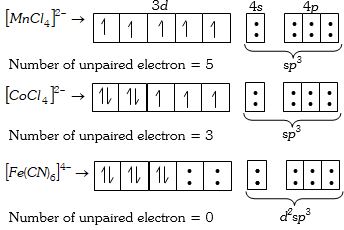
0 likesView Solution
76
ChemistryMediumMCQAIEEE · 2004
Excess of $KI$ reacts with $CuSO_4$ solution and then $Na_2S_2O_3$ solution is added to it. Which of the statements is incorrect for this reaction?
A
$Na_2S_2O_3$ is oxidised
B
$CuI_2$ is formed
C
$Cu_2I_2$ is formed
D
Evolved $I_2$ is reduced
Solution
(B) The reaction between $KI$ and $CuSO_4$ is: $2CuSO_4 + 4KI \to Cu_2I_2 + I_2 + 2K_2SO_4$.
In this reaction,$Cu^{2+}$ is reduced to $Cu^+$ (forming $Cu_2I_2$) and $I^-$ is oxidized to $I_2$.
Then,$I_2$ reacts with $Na_2S_2O_3$: $I_2 + 2Na_2S_2O_3 \to Na_2S_4O_6 + 2NaI$.
Here,$Na_2S_2O_3$ is oxidized to $Na_2S_4O_6$ and $I_2$ is reduced to $I^-$.
$CuI_2$ is not formed because $Cu^{2+}$ oxidizes $I^-$ to $I_2$ immediately,resulting in the formation of $Cu_2I_2$ (cuprous iodide).
In this reaction,$Cu^{2+}$ is reduced to $Cu^+$ (forming $Cu_2I_2$) and $I^-$ is oxidized to $I_2$.
Then,$I_2$ reacts with $Na_2S_2O_3$: $I_2 + 2Na_2S_2O_3 \to Na_2S_4O_6 + 2NaI$.
Here,$Na_2S_2O_3$ is oxidized to $Na_2S_4O_6$ and $I_2$ is reduced to $I^-$.
$CuI_2$ is not formed because $Cu^{2+}$ oxidizes $I^-$ to $I_2$ immediately,resulting in the formation of $Cu_2I_2$ (cuprous iodide).
0 likesView Solution
77
ChemistryMediumMCQAIEEE · 2004
The coordination number of a central metal atom in a complex is determined by:
A
The number of ligands around a metal ion bonded by sigma and pi-bonds both.
B
The number around a metal ion bonded by pi-bonds.
C
The number of ligands around a metal ion bonded by sigma bonds.
D
The number of only anionic ligands bonded to the metal ion.
Solution
(C) The coordination number of a central metal atom or ion in a complex is defined as the total number of ligand donor atoms that are directly bonded to the central metal atom or ion through coordinate covalent bonds (which are essentially $\sigma$-bonds).
Therefore,the coordination number of a metal = number of $\sigma$-bonds formed by the metal with the ligands.
Therefore,the coordination number of a metal = number of $\sigma$-bonds formed by the metal with the ligands.
0 likesView Solution
78
ChemistryDifficultMCQAIEEE · 2004
Among the properties $(a)$ reducing,$(b)$ oxidising,$(c)$ complexing,the set of properties shown by $CN^{-}$ ion towards metal species is
A
$a, c$
B
$b, c$
C
$a, b$
D
$a, b, c$
Solution
(A) $CN^{-}$ ion acts as a reducing agent because it can be oxidised to $(CN)_2$.
It also acts as a strong complexing agent due to the presence of a lone pair on the carbon atom,which allows it to form stable coordinate bonds with metal ions.
Therefore,the properties shown by $CN^{-}$ are $(a)$ reducing and $(c)$ complexing.
It also acts as a strong complexing agent due to the presence of a lone pair on the carbon atom,which allows it to form stable coordinate bonds with metal ions.
Therefore,the properties shown by $CN^{-}$ are $(a)$ reducing and $(c)$ complexing.
0 likesView Solution
79
ChemistryDifficultMCQAIEEE · 2004
Which one of the following complexes is an outer orbital complex?
Atomic no.: $Mn = 25, Fe = 26, Co = 27, Ni = 28$
Atomic no.: $Mn = 25, Fe = 26, Co = 27, Ni = 28$
A
$[Co(NH_3)_6]^{3+}$
B
$[Mn(CN)_6]^{4-}$
C
$[Fe(CN)_6]^{4-}$
D
$[Ni(NH_3)_6]^{2+}$
Solution
(D) An outer orbital complex uses the outer $d$-orbitals (e.g.,$4d$) for hybridization,typically $sp^3d^2$.
$1$. $[Fe(CN)_6]^{4-}$: $Fe^{2+}$ is $3d^6$. $CN^-$ is a strong field ligand,causing pairing. Hybridization is $d^2sp^3$ (inner orbital).
$2$. $[Mn(CN)_6]^{4-}$: $Mn^{2+}$ is $3d^5$. $CN^-$ is a strong field ligand,causing pairing. Hybridization is $d^2sp^3$ (inner orbital).
$3$. $[Co(NH_3)_6]^{3+}$: $Co^{3+}$ is $3d^6$. $NH_3$ is a strong field ligand for $Co^{3+}$,causing pairing. Hybridization is $d^2sp^3$ (inner orbital).
$4$. $[Ni(NH_3)_6]^{2+}$: $Ni^{2+}$ is $3d^8$. $NH_3$ is a weak field ligand relative to $Ni^{2+}$. Hybridization is $sp^3d^2$ (outer orbital).
Thus,$[Ni(NH_3)_6]^{2+}$ is an outer orbital complex.
$1$. $[Fe(CN)_6]^{4-}$: $Fe^{2+}$ is $3d^6$. $CN^-$ is a strong field ligand,causing pairing. Hybridization is $d^2sp^3$ (inner orbital).
$2$. $[Mn(CN)_6]^{4-}$: $Mn^{2+}$ is $3d^5$. $CN^-$ is a strong field ligand,causing pairing. Hybridization is $d^2sp^3$ (inner orbital).
$3$. $[Co(NH_3)_6]^{3+}$: $Co^{3+}$ is $3d^6$. $NH_3$ is a strong field ligand for $Co^{3+}$,causing pairing. Hybridization is $d^2sp^3$ (inner orbital).
$4$. $[Ni(NH_3)_6]^{2+}$: $Ni^{2+}$ is $3d^8$. $NH_3$ is a weak field ligand relative to $Ni^{2+}$. Hybridization is $sp^3d^2$ (outer orbital).
Thus,$[Ni(NH_3)_6]^{2+}$ is an outer orbital complex.
0 likesView Solution
80
ChemistryDifficultMCQAIEEE · 2004
Which one of the following has the largest number of isomers?
($R$ = alkyl group; $en$ = ethylenediamine)
($R$ = alkyl group; $en$ = ethylenediamine)
A
$[Ir(PPh_3)_2H(CO)]^{2+}$
B
$[Co(NH_3)_5Cl]^{2+}$
C
$[Ru(NH_3)_4Cl_2]^+$
D
$[Co(en)_2Cl_2]^+$
Solution
(D) $[Co(en)_2Cl_2]^+$ has the largest number of isomers.
It exhibits geometrical isomerism (cis and trans forms).
The cis-isomer is optically active and exists as two enantiomers ($d$ and $l$ forms).
Thus,it shows both geometrical and optical isomerism,resulting in a total of $3$ isomers.
It exhibits geometrical isomerism (cis and trans forms).
The cis-isomer is optically active and exists as two enantiomers ($d$ and $l$ forms).
Thus,it shows both geometrical and optical isomerism,resulting in a total of $3$ isomers.
0 likesView Solution
81
ChemistryAdvancedMCQAIEEE · 2004
The compound formed on heating chlorobenzene with chloral in the presence of concentrated sulphuric acid is:
A
Freon
B
$DDT$
C
Gammexene
D
Hexachloroethane
Solution
(B) The reaction between chlorobenzene and chloral $(CCl_3CHO)$ in the presence of concentrated $H_2SO_4$ leads to the formation of $DDT$ ($1,1,1$-trichloro-$2,2$-bis($p$-chlorophenyl)ethane).
The chemical reaction is:
$2C_6H_5Cl + CCl_3CHO \xrightarrow{conc. H_2SO_4} (ClC_6H_4)_2CHCCl_3 + H_2O$
The chemical reaction is:
$2C_6H_5Cl + CCl_3CHO \xrightarrow{conc. H_2SO_4} (ClC_6H_4)_2CHCCl_3 + H_2O$
0 likesView Solution
82
ChemistryDifficultMCQAIEEE · 2004
Acetyl bromide reacts with excess of $CH_3MgI$ followed by treatment with a saturated solution of $NH_4Cl$ gives:
A
$2$-methyl-$2$-propanol
B
Acetamide
C
Acetone
D
Acetyl iodide
Solution
(A) Acetyl bromide $(CH_3COBr)$ reacts with the first equivalent of $CH_3MgI$ to form acetone $(CH_3COCH_3)$.
Since $CH_3MgI$ is in excess,it further reacts with the formed acetone to produce a tertiary alkoxide intermediate $(CH_3-C(CH_3)_2-OMgI)$.
Finally,hydrolysis of this intermediate with a saturated solution of $NH_4Cl$ yields $2$-methyl-$2$-propanol $(CH_3-C(CH_3)_2-OH)$.
Reaction: $CH_3COBr + 2CH_3MgI$ $\rightarrow CH_3-C(CH_3)_2-OMgI$ $\xrightarrow{NH_4Cl} CH_3-C(CH_3)_2-OH$.
Since $CH_3MgI$ is in excess,it further reacts with the formed acetone to produce a tertiary alkoxide intermediate $(CH_3-C(CH_3)_2-OMgI)$.
Finally,hydrolysis of this intermediate with a saturated solution of $NH_4Cl$ yields $2$-methyl-$2$-propanol $(CH_3-C(CH_3)_2-OH)$.
Reaction: $CH_3COBr + 2CH_3MgI$ $\rightarrow CH_3-C(CH_3)_2-OMgI$ $\xrightarrow{NH_4Cl} CH_3-C(CH_3)_2-OH$.
0 likesView Solution
83
ChemistryDifficultMCQAIEEE · 2004
Which one of the following undergoes reaction with $50\% \, NaOH$ solution to give the corresponding alcohol and acid?
A
Butanal
B
Benzaldehyde
C
Phenol
D
Benzoic acid
Solution
(B) The reaction of an aldehyde with no $\alpha$-hydrogen with concentrated alkali $(50\% \, NaOH)$ is known as the Cannizzaro reaction.
In this reaction,one molecule of the aldehyde is oxidized to the corresponding carboxylic acid (as a salt),and another molecule is reduced to the corresponding alcohol.
Benzaldehyde $(C_6H_5CHO)$ does not contain any $\alpha$-hydrogen atom.
Therefore,it undergoes the Cannizzaro reaction to produce benzyl alcohol $(C_6H_5CH_2OH)$ and sodium benzoate $(C_6H_5COONa)$.
The reaction is:
$2C_6H_5CHO + NaOH (50\%) \rightarrow C_6H_5CH_2OH + C_6H_5COONa$
Thus,the correct option is $(B)$.
In this reaction,one molecule of the aldehyde is oxidized to the corresponding carboxylic acid (as a salt),and another molecule is reduced to the corresponding alcohol.
Benzaldehyde $(C_6H_5CHO)$ does not contain any $\alpha$-hydrogen atom.
Therefore,it undergoes the Cannizzaro reaction to produce benzyl alcohol $(C_6H_5CH_2OH)$ and sodium benzoate $(C_6H_5COONa)$.
The reaction is:
$2C_6H_5CHO + NaOH (50\%) \rightarrow C_6H_5CH_2OH + C_6H_5COONa$
Thus,the correct option is $(B)$.
0 likesView Solution
84
ChemistryMediumMCQAIEEE · 2004
Which one of the following is reduced with zinc and hydrochloric acid to give the corresponding hydrocarbon?
A
Acetamide
B
Acetic acid
C
Ethyl acetate
D
Butan-$2$-one
Solution
(D) Butan-$2$-one is a ketone. It undergoes Clemmensen reduction when treated with zinc amalgam and hydrochloric acid $(Zn-Hg/HCl)$ to give the corresponding hydrocarbon,butane.
$CH_3-CO-CH_2-CH_3 \xrightarrow{Zn-Hg/HCl} CH_3-CH_2-CH_2-CH_3$
Amides,carboxylic acids,and esters are not reduced to hydrocarbons by this reagent.
$CH_3-CO-CH_2-CH_3 \xrightarrow{Zn-Hg/HCl} CH_3-CH_2-CH_2-CH_3$
Amides,carboxylic acids,and esters are not reduced to hydrocarbons by this reagent.
0 likesView Solution
85
ChemistryMediumMCQAIEEE · 2004
Consider the acidity of the following carboxylic acids. Which of the following orders is correct?
$A$. $PhCOOH$
$B$. $o-NO_2C_6H_4COOH$
$C$. $p-NO_2C_6H_4COOH$
$D$. $m-NO_2C_6H_4COOH$
$A$. $PhCOOH$
$B$. $o-NO_2C_6H_4COOH$
$C$. $p-NO_2C_6H_4COOH$
$D$. $m-NO_2C_6H_4COOH$
A
$B > D > A > C$
B
$B > C > D > A$
C
$A > B > C > D$
D
$B > D > C > A$
Solution
(B) The acidity of substituted benzoic acids depends on the electronic effects of the substituents.
$1$. The $-NO_2$ group is a strong electron-withdrawing group ($-I$ and $-M$ effects),which increases the acidity of benzoic acid compared to $PhCOOH$ $(A)$.
$2$. Due to the ortho effect,the ortho-substituted isomer $(B)$ is the most acidic among the nitrobenzoic acids.
$3$. For the meta and para isomers,the $-NO_2$ group at the para position $(C)$ exerts both $-I$ and $-M$ effects,whereas at the meta position $(D)$,it exerts only the $-I$ effect. However,the $-M$ effect is stronger at the para position,making $p-NO_2C_6H_4COOH$ more acidic than $m-NO_2C_6H_4COOH$.
$4$. Therefore,the correct order of acidity is: $o-NO_2C_6H_4COOH (B) > p-NO_2C_6H_4COOH (C) > m-NO_2C_6H_4COOH (D) > PhCOOH (A)$.
Thus,the correct option is $B$.
$1$. The $-NO_2$ group is a strong electron-withdrawing group ($-I$ and $-M$ effects),which increases the acidity of benzoic acid compared to $PhCOOH$ $(A)$.
$2$. Due to the ortho effect,the ortho-substituted isomer $(B)$ is the most acidic among the nitrobenzoic acids.
$3$. For the meta and para isomers,the $-NO_2$ group at the para position $(C)$ exerts both $-I$ and $-M$ effects,whereas at the meta position $(D)$,it exerts only the $-I$ effect. However,the $-M$ effect is stronger at the para position,making $p-NO_2C_6H_4COOH$ more acidic than $m-NO_2C_6H_4COOH$.
$4$. Therefore,the correct order of acidity is: $o-NO_2C_6H_4COOH (B) > p-NO_2C_6H_4COOH (C) > m-NO_2C_6H_4COOH (D) > PhCOOH (A)$.
Thus,the correct option is $B$.
0 likesView Solution
86
ChemistryDifficultMCQAIEEE · 2004
On mixing ethyl acetate with aqueous sodium chloride,the composition of the resultant solution is
A
$CH_3COCl + C_2H_5OH + NaOH$
B
$CH_3COONa + C_2H_5OH$
C
$CH_3COOC_2H_5 + NaCl$
D
$CH_3Cl + C_2H_5COONa$
Solution
(C) . Ethyl acetate $(CH_3COOC_2H_5)$ is an ester. Sodium chloride $(NaCl)$ is a salt that dissociates into $Na^+$ and $Cl^-$ ions in water.
There is no chemical reaction between an ester and a neutral salt like $NaCl$ in an aqueous medium.
Therefore,the composition of the resultant solution remains the same as the mixture of the two reactants: $CH_3COOC_2H_5 + NaCl$.
There is no chemical reaction between an ester and a neutral salt like $NaCl$ in an aqueous medium.
Therefore,the composition of the resultant solution remains the same as the mixture of the two reactants: $CH_3COOC_2H_5 + NaCl$.
0 likesView Solution
87
ChemistryMediumMCQAIEEE · 2004
Which of the following is the strongest base?
A
o-Toluidine ($2$-methylaniline)
B
$N$-Methylaniline
C
Aniline
D
Benzylamine
Solution
(D) The basicity of amines depends on the availability of the lone pair of electrons on the nitrogen atom for protonation.
In aniline $(C_6H_5NH_2)$,$N$-methylaniline $(C_6H_5NHCH_3)$,and $o$-toluidine $(2-CH_3C_6H_4NH_2)$,the lone pair on the nitrogen atom is in conjugation with the benzene ring,which decreases its availability for protonation.
In benzylamine $(C_6H_5CH_2NH_2)$,the nitrogen atom is attached to a $CH_2$ group,not directly to the benzene ring. Therefore,the lone pair on the nitrogen atom is not involved in resonance with the benzene ring,making it more available for protonation.
Thus,benzylamine is the strongest base among the given options.
In aniline $(C_6H_5NH_2)$,$N$-methylaniline $(C_6H_5NHCH_3)$,and $o$-toluidine $(2-CH_3C_6H_4NH_2)$,the lone pair on the nitrogen atom is in conjugation with the benzene ring,which decreases its availability for protonation.
In benzylamine $(C_6H_5CH_2NH_2)$,the nitrogen atom is attached to a $CH_2$ group,not directly to the benzene ring. Therefore,the lone pair on the nitrogen atom is not involved in resonance with the benzene ring,making it more available for protonation.
Thus,benzylamine is the strongest base among the given options.
0 likesView Solution
88
ChemistryDifficultMCQAIEEE · 2004
Identify the correct statement regarding enzymes.
A
Enzymes are specific biological catalysts that cannot be poisoned.
B
Enzymes are normally heterogeneous catalysts that are very specific in their action.
C
Enzymes are specific biological catalysts that can normally function at very high temperature $(T \sim 1000 \ K)$.
D
Enzymes are specific biological catalysts that possess well-defined active sites.
Solution
(D) . Enzymes are shape-selective,specific biological catalysts that possess well-defined active sites and function optimally at physiological temperatures.
0 likesView Solution
89
ChemistryMediumMCQAIEEE · 2004
$RNA$ is different from $DNA$ because $RNA$ contains
A
Ribose sugar and thymine
B
Ribose sugar and uracil
C
Deoxyribose sugar and thymine
D
Deoxyribose sugar and uracil
Solution
(B) $DNA$ contains $2$-deoxyribose sugar and the nitrogenous base thymine $(T)$.
$RNA$ contains ribose sugar and the nitrogenous base uracil $(U)$ instead of thymine.
Therefore,$RNA$ is characterized by the presence of ribose sugar and uracil.
$RNA$ contains ribose sugar and the nitrogenous base uracil $(U)$ instead of thymine.
Therefore,$RNA$ is characterized by the presence of ribose sugar and uracil.
0 likesView Solution
90
ChemistryMediumMCQAIEEE · 2004
Insulin production and its action in the human body are responsible for the level of diabetes. This compound belongs to which of the following categories?
A
An enzyme
B
$A$ hormone
C
$A$ co-enzyme
D
An antibiotic
Solution
(B) Insulin is a proteinaceous hormone secreted by $\beta$-cells of the Islets of Langerhans in the pancreas of our body.
0 likesView Solution
91
ChemistryMediumMCQAIEEE · 2004
Which one of the following statements regarding helium is incorrect?
A
It is used to produce and sustain powerful superconducting magnets.
B
It is used as a cryogenic agent for carrying out experiments at low temperatures.
C
It is used to fill gas balloons instead of hydrogen because it is lighter and non-inflammable.
D
It is used in gas-cooled nuclear reactors.
Solution
(C) Helium $(He)$ is twice as heavy as hydrogen $(H_2)$. While it is non-inflammable,it is not lighter than hydrogen. Therefore,the statement that it is lighter than hydrogen is incorrect.
Helium has the lowest melting and boiling point of any element,which makes liquid helium an ideal coolant for many extremely low-temperature applications,such as superconducting magnets and cryogenic research where temperatures close to absolute zero are needed.
$He$ is also used in gas-cooled nuclear reactors as a heat transfer agent.
Helium has the lowest melting and boiling point of any element,which makes liquid helium an ideal coolant for many extremely low-temperature applications,such as superconducting magnets and cryogenic research where temperatures close to absolute zero are needed.
$He$ is also used in gas-cooled nuclear reactors as a heat transfer agent.
0 likesView Solution
92
ChemistryEasyMCQAIEEE · 2004
Coordination compounds have great importance in biological systems. In this context,which of the following statements is incorrect?
A
Cyanocobalamin is $B_{12}$ and contains cobalt.
B
Haemoglobin is the red pigment of blood and contains iron.
C
Chlorophylls are green pigments in plants and contain calcium.
D
Carboxypeptidase-$A$ is an enzyme and contains zinc.
Solution
(C) Chlorophyll is a green pigment found in plants that plays a crucial role in photosynthesis. It contains a porphyrin ring with a central magnesium $(Mg^{2+})$ ion,not calcium $(Ca^{2+})$. Therefore,the statement that chlorophyll contains calcium is incorrect.
0 likesView Solution
Vedclass Products
For Students
Vedclass Test Series
Mock tests in real AIEEE style covering Chemistry with performance analysis. 5-day free trial.
Start Free TrialFor Teachers
Exam Paper Generator
Generate Set A/B/C/D Chemistry papers from 7.5L+ questions in 2 minutes. 3 chapters free.
Try FreeFor Institutes
Online Exam Module
Run live AIEEE mock exams with unlimited students, 360° analytics & white-label branding.
See DemoFrequently Asked Questions
How many Chemistry questions are in AIEEE 2004?
There are 132 Chemistry questions from the AIEEE 2004 paper on Vedclass, each with a detailed step-by-step solution in English.
Are AIEEE 2004 Chemistry solutions available in English?
Yes. All solutions on this page are in English. You can also switch to English or Hindi using the language buttons above the questions.
Can I practice AIEEE 2004 Chemistry as a timed test?
Yes. Use the Vedclass Test Series to attempt a full AIEEE mock test covering Chemistry with time limits and instant score analysis.
Can teachers create Chemistry papers from AIEEE previous year questions?
Yes. The Vedclass Exam Paper Generator lets teachers mix AIEEE Chemistry questions and generate Set A/B/C/D papers in minutes.
For Teachers & Institutes
Build a Custom Chemistry Paper
Pick AIEEE 2004 Chemistry questions, set difficulty, and generate Set A/B/C/D in 2 minutes.