
PhysicsQ1–55 of 55 questions
Page 1 of 1 · English
1
PhysicsMediumMCQAIEEE · 2006
$A$ thin circular ring of mass $M$ and radius $r$ is rotating about its axis with a constant angular velocity $\omega$. Two objects,each of mass $m$,are attached gently to the opposite ends of a diameter of the ring. The ring will now rotate with an angular velocity:
A
$\frac{\omega (M - 2m)}{M + 2m}$
B
$\frac{\omega M}{M + 2m}$
C
$\frac{\omega M}{M + m}$
D
$\frac{\omega (M + 2m)}{M}$
Solution
(B) The initial moment of inertia of the ring about its axis is $I = Mr^2$.
The initial angular momentum is $L = I\omega = Mr^2\omega$.
When two objects of mass $m$ are attached to the opposite ends of a diameter,the new moment of inertia $I'$ becomes the sum of the ring's moment of inertia and the moment of inertia of the two point masses: $I' = Mr^2 + m(r)^2 + m(r)^2 = (M + 2m)r^2$.
According to the principle of conservation of angular momentum,the external torque is zero,so $L_{initial} = L_{final}$.
$Mr^2\omega = (M + 2m)r^2\omega'$
Solving for the new angular velocity $\omega'$:
$\omega' = \frac{Mr^2\omega}{(M + 2m)r^2} = \frac{M\omega}{M + 2m}$.
The initial angular momentum is $L = I\omega = Mr^2\omega$.
When two objects of mass $m$ are attached to the opposite ends of a diameter,the new moment of inertia $I'$ becomes the sum of the ring's moment of inertia and the moment of inertia of the two point masses: $I' = Mr^2 + m(r)^2 + m(r)^2 = (M + 2m)r^2$.
According to the principle of conservation of angular momentum,the external torque is zero,so $L_{initial} = L_{final}$.
$Mr^2\omega = (M + 2m)r^2\omega'$
Solving for the new angular velocity $\omega'$:
$\omega' = \frac{Mr^2\omega}{(M + 2m)r^2} = \frac{M\omega}{M + 2m}$.
1 likesView Solution
2
PhysicsMediumMCQAIEEE · 2006
$A$ particle located at $x= 0$ at time $t= 0$ starts moving along the positive $x-$direction with a velocity $v$ that varies as $v = \alpha \sqrt{x}$. The displacement of the particle varies with time as:
A
$t^3$
B
$t^2$
C
$t$
D
$t^{1/2}$
Solution
(B) Given the velocity $v = \frac{dx}{dt} = \alpha \sqrt{x}$.
Rearranging the terms to separate the variables,we get:
$\frac{dx}{\sqrt{x}} = \alpha dt$.
Integrating both sides with the initial condition $x=0$ at $t=0$:
$\int_{0}^{x} x^{-1/2} dx = \int_{0}^{t} \alpha dt$.
Solving the integral:
$[2x^{1/2}]_{0}^{x} = \alpha [t]_{0}^{t}$.
This simplifies to:
$2\sqrt{x} = \alpha t$.
Squaring both sides:
$4x = \alpha^2 t^2$.
Therefore,the displacement $x$ is proportional to $t^2$:
$x \propto t^2$.
Rearranging the terms to separate the variables,we get:
$\frac{dx}{\sqrt{x}} = \alpha dt$.
Integrating both sides with the initial condition $x=0$ at $t=0$:
$\int_{0}^{x} x^{-1/2} dx = \int_{0}^{t} \alpha dt$.
Solving the integral:
$[2x^{1/2}]_{0}^{x} = \alpha [t]_{0}^{t}$.
This simplifies to:
$2\sqrt{x} = \alpha t$.
Squaring both sides:
$4x = \alpha^2 t^2$.
Therefore,the displacement $x$ is proportional to $t^2$:
$x \propto t^2$.
0 likesView Solution
3
PhysicsMediumMCQAIEEE · 2006
$A$ ball of mass $0.2 \ kg$ is thrown vertically upwards by applying a force by hand. If the hand moves $0.2 \ m$ while applying the force and the ball goes up to $2 \ m$ height further,find the magnitude of the force $F$ in $N$. (Consider $g = 10 \ m/s^2$)
A
$4$
B
$16$
C
$20$
D
$22$
Solution
(D) Let the velocity of the ball just when it leaves the hand be $v$. For the motion of the ball after leaving the hand,using $v_f^2 - v_i^2 = 2as$:
$0^2 - v^2 = 2(-10)(2)$
$v^2 = 40 \ m^2/s^2$
Now,consider the motion of the ball while in the hand. Let the acceleration be $a'$. Using $v^2 - u^2 = 2a's'$ where $u=0$ and $s'=0.2 \ m$:
$40 - 0 = 2(a')(0.2)$
$40 = 0.4a'$
$a' = 100 \ m/s^2$
Applying Newton's Second Law for the ball while in the hand:
$F - mg = ma'$
$F - (0.2)(10) = (0.2)(100)$
$F - 2 = 20$
$F = 22 \ N$
$0^2 - v^2 = 2(-10)(2)$
$v^2 = 40 \ m^2/s^2$
Now,consider the motion of the ball while in the hand. Let the acceleration be $a'$. Using $v^2 - u^2 = 2a's'$ where $u=0$ and $s'=0.2 \ m$:
$40 - 0 = 2(a')(0.2)$
$40 = 0.4a'$
$a' = 100 \ m/s^2$
Applying Newton's Second Law for the ball while in the hand:
$F - mg = ma'$
$F - (0.2)(10) = (0.2)(100)$
$F - 2 = 20$
$F = 22 \ N$
1 likesView Solution
4
PhysicsDifficultMCQAIEEE · 2006
$A$ mass of $M \ kg$ is suspended by a weightless string of length $\ell$. The horizontal force required to displace it until the string makes an angle of $45^\circ$ with the initial vertical direction is:
A
$Mg(\sqrt{2} + 1)$
B
$Mg\sqrt{2}$
C
$\frac{Mg}{\sqrt{2}}$
D
$Mg(\sqrt{2} - 1)$
Solution
(D) Let the length of the string be $\ell$. When the mass is displaced by an angle $\theta = 45^\circ$,the vertical height gained by the mass is $h = \ell - \ell \cos 45^\circ = \ell(1 - \frac{1}{\sqrt{2}})$.
The horizontal displacement of the mass is $x = \ell \sin 45^\circ = \frac{\ell}{\sqrt{2}}$.
Using the work-energy theorem,the work done by the external horizontal force $F$ must equal the change in potential energy of the mass (assuming it starts and ends at rest,so $\Delta K = 0$):
$W_F + W_g = 0$
$F \cdot x - Mg \cdot h = 0$
$F \cdot (\frac{\ell}{\sqrt{2}}) = Mg \cdot \ell(1 - \frac{1}{\sqrt{2}})$
$F = Mg \cdot \sqrt{2}(1 - \frac{1}{\sqrt{2}})$
$F = Mg(\sqrt{2} - 1)$
The horizontal displacement of the mass is $x = \ell \sin 45^\circ = \frac{\ell}{\sqrt{2}}$.
Using the work-energy theorem,the work done by the external horizontal force $F$ must equal the change in potential energy of the mass (assuming it starts and ends at rest,so $\Delta K = 0$):
$W_F + W_g = 0$
$F \cdot x - Mg \cdot h = 0$
$F \cdot (\frac{\ell}{\sqrt{2}}) = Mg \cdot \ell(1 - \frac{1}{\sqrt{2}})$
$F = Mg \cdot \sqrt{2}(1 - \frac{1}{\sqrt{2}})$
$F = Mg(\sqrt{2} - 1)$
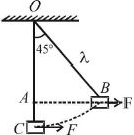
0 likesView Solution
5
PhysicsMediumMCQAIEEE · 2006
$A$ bomb of mass $16 \ kg$ at rest explodes into two pieces of masses $4 \ kg$ and $12 \ kg.$ The velocity of the $12 \ kg$ mass is $4 \ m s^{-1}.$ The kinetic energy of the other mass is .............. $J$.
A
$96$
B
$144$
C
$288$
D
$192$
Solution
(C) Let the mass and velocity of the first piece be $m_1 = 4 \ kg$ and $v_1,$ and the mass and velocity of the second piece be $m_2 = 12 \ kg$ and $v_2 = 4 \ m s^{-1}.$
Since the bomb is initially at rest,the initial momentum is $0.$
By the law of conservation of linear momentum,the final momentum must also be $0.$
$m_1 v_1 + m_2 v_2 = 0$
$4 v_1 + 12 \times 4 = 0$
$4 v_1 = -48$
$v_1 = -12 \ m s^{-1}$
The magnitude of the velocity is $12 \ m s^{-1}.$
The kinetic energy of the $4 \ kg$ mass is:
$K.E. = \frac{1}{2} m_1 v_1^2$
$K.E. = \frac{1}{2} \times 4 \times (12)^2$
$K.E. = 2 \times 144 = 288 \ J.$
Since the bomb is initially at rest,the initial momentum is $0.$
By the law of conservation of linear momentum,the final momentum must also be $0.$
$m_1 v_1 + m_2 v_2 = 0$
$4 v_1 + 12 \times 4 = 0$
$4 v_1 = -48$
$v_1 = -12 \ m s^{-1}$
The magnitude of the velocity is $12 \ m s^{-1}.$
The kinetic energy of the $4 \ kg$ mass is:
$K.E. = \frac{1}{2} m_1 v_1^2$
$K.E. = \frac{1}{2} \times 4 \times (12)^2$
$K.E. = 2 \times 144 = 288 \ J.$
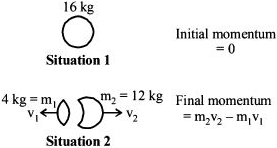
0 likesView Solution
6
PhysicsEasyMCQAIEEE · 2006
$A$ particle of mass $100 \ g$ is thrown vertically upwards with a speed of $5 \ m/s$. The work done by the force of gravity during the time the particle goes up is.....$J$
A
$-1.25$
B
$1.25$
C
$0.5$
D
$-0.5$
Solution
(A) The mass of the particle is $m = 100 \ g = 0.1 \ kg$.
The initial velocity is $u = 5 \ m/s$.
At the highest point,the final velocity is $v = 0 \ m/s$.
According to the work-energy theorem,the work done by all forces is equal to the change in kinetic energy: $W_{total} = \Delta K.E$.
Here,the only force acting during the upward motion is gravity $(W_g)$.
$W_g = K.E_{final} - K.E_{initial} = 0 - \frac{1}{2} m u^2$.
$W_g = -\frac{1}{2} \times 0.1 \times (5)^2 = -0.5 \times 0.1 \times 25 = -1.25 \ J$.
The initial velocity is $u = 5 \ m/s$.
At the highest point,the final velocity is $v = 0 \ m/s$.
According to the work-energy theorem,the work done by all forces is equal to the change in kinetic energy: $W_{total} = \Delta K.E$.
Here,the only force acting during the upward motion is gravity $(W_g)$.
$W_g = K.E_{final} - K.E_{initial} = 0 - \frac{1}{2} m u^2$.
$W_g = -\frac{1}{2} \times 0.1 \times (5)^2 = -0.5 \times 0.1 \times 25 = -1.25 \ J$.
0 likesView Solution
7
PhysicsMediumMCQAIEEE · 2006
The potential energy of a $1 \ kg$ particle free to move along the $x-$axis is given by: $U(x) = (\frac{x^4}{4} - \frac{x^2}{2}) \ J$. The total mechanical energy of the particle is $2 \ J$. Then,the maximum speed (in $m/s$) is:
A
$\frac{3}{\sqrt{2}}$
B
$\sqrt{2}$
C
$\frac{1}{\sqrt{2}}$
D
$2$
Solution
(A) The total mechanical energy $E$ is the sum of kinetic energy $K$ and potential energy $U$: $E = K + U = 2 \ J$.
To find the maximum speed,we need to maximize the kinetic energy $K = E - U$.
This occurs when the potential energy $U(x)$ is at its minimum.
To find the minimum of $U(x)$,we set the derivative $\frac{dU}{dx} = 0$:
$\frac{dU}{dx} = \frac{4x^3}{4} - \frac{2x}{2} = x^3 - x = 0$.
$x(x^2 - 1) = 0$,which gives $x = 0, 1, -1$.
Evaluating $U(x)$ at these points:
$U(0) = 0 \ J$.
$U(1) = \frac{1}{4} - \frac{1}{2} = -\frac{1}{4} \ J$.
$U(-1) = \frac{1}{4} - \frac{1}{2} = -\frac{1}{4} \ J$.
The minimum potential energy is $U_{\min} = -\frac{1}{4} \ J$.
Thus,$K_{\max} = E - U_{\min} = 2 - (-0.25) = 2.25 \ J = \frac{9}{4} \ J$.
Using $K_{\max} = \frac{1}{2}mv_{\max}^2$ with $m = 1 \ kg$:
$\frac{1}{2} \times 1 \times v_{\max}^2 = \frac{9}{4}$.
$v_{\max}^2 = \frac{9}{2}$.
$v_{\max} = \frac{3}{\sqrt{2}} \ m/s$.
To find the maximum speed,we need to maximize the kinetic energy $K = E - U$.
This occurs when the potential energy $U(x)$ is at its minimum.
To find the minimum of $U(x)$,we set the derivative $\frac{dU}{dx} = 0$:
$\frac{dU}{dx} = \frac{4x^3}{4} - \frac{2x}{2} = x^3 - x = 0$.
$x(x^2 - 1) = 0$,which gives $x = 0, 1, -1$.
Evaluating $U(x)$ at these points:
$U(0) = 0 \ J$.
$U(1) = \frac{1}{4} - \frac{1}{2} = -\frac{1}{4} \ J$.
$U(-1) = \frac{1}{4} - \frac{1}{2} = -\frac{1}{4} \ J$.
The minimum potential energy is $U_{\min} = -\frac{1}{4} \ J$.
Thus,$K_{\max} = E - U_{\min} = 2 - (-0.25) = 2.25 \ J = \frac{9}{4} \ J$.
Using $K_{\max} = \frac{1}{2}mv_{\max}^2$ with $m = 1 \ kg$:
$\frac{1}{2} \times 1 \times v_{\max}^2 = \frac{9}{4}$.
$v_{\max}^2 = \frac{9}{2}$.
$v_{\max} = \frac{3}{\sqrt{2}} \ m/s$.
0 likesView Solution
8
PhysicsMediumMCQAIEEE · 2006
Assuming the Sun to be a spherical body of radius $R$ at a temperature of $T \ K$,evaluate the total radiant power incident on Earth at a distance $r$ from the Sun. Where $r_0$ is the radius of the Earth and $\sigma$ is Stefan's constant.
A
$\frac{R^2 \sigma T^4}{r^2}$
B
$\frac{4\pi r_0^2 R^2 \sigma T^4}{r^2}$
C
$\frac{\pi r_0^2 R^2 \sigma T^4}{r^2}$
D
$\frac{r_0^2 R^2 \sigma T^4}{4\pi r^2}$
Solution
(C) The total power radiated by the Sun is given by the Stefan-Boltzmann law: $P_{sun} = \sigma T^4 \times (4\pi R^2)$.
The intensity $I$ of the radiation at a distance $r$ from the Sun is the power per unit area: $I = \frac{P_{sun}}{4\pi r^2} = \frac{\sigma T^4 \times 4\pi R^2}{4\pi r^2} = \frac{\sigma T^4 R^2}{r^2}$.
The Earth intercepts this radiation over its cross-sectional area,which is $\pi r_0^2$.
Therefore,the total radiant power incident on Earth is $P_{earth} = I \times \pi r_0^2 = \frac{\sigma T^4 R^2}{r^2} \times \pi r_0^2 = \frac{\pi r_0^2 R^2 \sigma T^4}{r^2}$.
The intensity $I$ of the radiation at a distance $r$ from the Sun is the power per unit area: $I = \frac{P_{sun}}{4\pi r^2} = \frac{\sigma T^4 \times 4\pi R^2}{4\pi r^2} = \frac{\sigma T^4 R^2}{r^2}$.
The Earth intercepts this radiation over its cross-sectional area,which is $\pi r_0^2$.
Therefore,the total radiant power incident on Earth is $P_{earth} = I \times \pi r_0^2 = \frac{\sigma T^4 R^2}{r^2} \times \pi r_0^2 = \frac{\pi r_0^2 R^2 \sigma T^4}{r^2}$.
0 likesView Solution
9
PhysicsMediumMCQAIEEE · 2006
Consider a two-particle system with particles having masses $m_1$ and $m_2$. If the first particle is pushed towards the center of mass through a distance $d$,by what distance should the second particle be moved so as to keep the center of mass at the same position?
A
$d$
B
$\frac{m_2}{m_1} d$
C
$\frac{m_1}{m_1 + m_2} d$
D
$\frac{m_1}{m_2} d$
Solution
(D) Let the center of mass be at the origin. Initially,the positions of the particles are $-x_1$ and $x_2$ such that $m_1(-x_1) + m_2(x_2) = 0$,which implies $m_1 x_1 = m_2 x_2$ (Equation $1$).
When the first particle is moved by distance $d$ towards the center of mass,its new position becomes $-(x_1 - d)$. Let the second particle be moved by distance $d'$ towards the center of mass,so its new position becomes $(x_2 - d')$.
To keep the center of mass at the origin,the new condition is:
$m_1(-(x_1 - d)) + m_2(x_2 - d') = 0$
$-m_1 x_1 + m_1 d + m_2 x_2 - m_2 d' = 0$
Since $m_1 x_1 = m_2 x_2$ from Equation $1$,the terms $m_1 x_1$ and $m_2 x_2$ cancel out:
$m_1 d - m_2 d' = 0$
$m_2 d' = m_1 d$
$d' = \frac{m_1}{m_2} d$
When the first particle is moved by distance $d$ towards the center of mass,its new position becomes $-(x_1 - d)$. Let the second particle be moved by distance $d'$ towards the center of mass,so its new position becomes $(x_2 - d')$.
To keep the center of mass at the origin,the new condition is:
$m_1(-(x_1 - d)) + m_2(x_2 - d') = 0$
$-m_1 x_1 + m_1 d + m_2 x_2 - m_2 d' = 0$
Since $m_1 x_1 = m_2 x_2$ from Equation $1$,the terms $m_1 x_1$ and $m_2 x_2$ cancel out:
$m_1 d - m_2 d' = 0$
$m_2 d' = m_1 d$
$d' = \frac{m_1}{m_2} d$
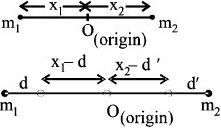
0 likesView Solution
10
PhysicsEasyMCQAIEEE · 2006
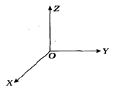
$A$ force of $-F \hat{k}$ acts on $O$,the origin of the coordinate system. The torque about the point $(1, -1)$ is
A
$-F(\hat{i}-\hat{j})$
B
$F(\hat{i}-\hat{j})$
C
$F(\hat{i}+\hat{j})$
D
$-F(\hat{i}+\hat{j})$
Solution
(D) The position vector $\vec{r}$ of the origin $O(0, 0)$ with respect to the point $P(1, -1)$ is given by $\vec{r} = (0 - 1)\hat{i} + (0 - (-1))\hat{j} = -\hat{i} + \hat{j}$.
The force acting at the origin is $\vec{F} = -F\hat{k}$.
The torque $\vec{\tau}$ about the point $P$ is defined as $\vec{\tau} = \vec{r} \times \vec{F}$.
Substituting the values,we get $\vec{\tau} = (-\hat{i} + \hat{j}) \times (-F\hat{k})$.
Using the cross product rules $\hat{i} \times \hat{k} = -\hat{j}$ and $\hat{j} \times \hat{k} = \hat{i}$,we have:
$\vec{\tau} = F(\hat{i} \times \hat{k}) - F(\hat{j} \times \hat{k})$
$\vec{\tau} = F(-\hat{j}) - F(\hat{i})$
$\vec{\tau} = -F(\hat{i} + \hat{j})$.
The force acting at the origin is $\vec{F} = -F\hat{k}$.
The torque $\vec{\tau}$ about the point $P$ is defined as $\vec{\tau} = \vec{r} \times \vec{F}$.
Substituting the values,we get $\vec{\tau} = (-\hat{i} + \hat{j}) \times (-F\hat{k})$.
Using the cross product rules $\hat{i} \times \hat{k} = -\hat{j}$ and $\hat{j} \times \hat{k} = \hat{i}$,we have:
$\vec{\tau} = F(\hat{i} \times \hat{k}) - F(\hat{j} \times \hat{k})$
$\vec{\tau} = F(-\hat{j}) - F(\hat{i})$
$\vec{\tau} = -F(\hat{i} + \hat{j})$.
0 likesView Solution
11
PhysicsMediumMCQAIEEE · 2006
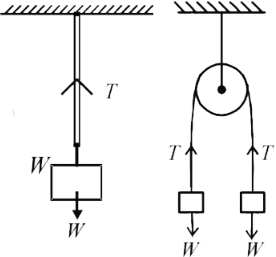
$A$ wire elongates by $l \ mm$ when a load $W$ is hanged from it. If the wire goes over a pulley and two weights $W$ each are hung at the two ends,the elongation of the wire will be (in $mm$)
A
$l/2$
B
$l$
C
$2l$
D
Zero
Solution
(B) Case $(i)$: When a load $W$ is hung from a wire of length $L$ and cross-sectional area $A$,the tension in the wire is $T = W$. The elongation $l$ is given by Young's modulus formula: $Y = \frac{W/A}{l/L} \Rightarrow l = \frac{WL}{AY}$.
Case $(ii)$: When the wire passes over a pulley and two weights $W$ each are hung at the two ends,the tension in the wire remains $T = W$ throughout. The total length of the wire is still $L$ and the cross-sectional area is $A$. Therefore,the elongation $l'$ is given by $l' = \frac{TL}{AY} = \frac{WL}{AY}$.
Comparing the two cases,the elongation remains the same,which is $l$.
Case $(ii)$: When the wire passes over a pulley and two weights $W$ each are hung at the two ends,the tension in the wire remains $T = W$ throughout. The total length of the wire is still $L$ and the cross-sectional area is $A$. Therefore,the elongation $l'$ is given by $l' = \frac{TL}{AY} = \frac{WL}{AY}$.
Comparing the two cases,the elongation remains the same,which is $l$.
0 likesView Solution
12
PhysicsMediumMCQAIEEE · 2006
If the terminal speed of a sphere of gold (density $= 19.5 \times 10^3 \ kg/m^3$) is $0.2 \ m/s$ in a viscous liquid (density $= 1.5 \times 10^3 \ kg/m^3$), find the terminal speed (in $m/s$) of a sphere of silver (density $= 10.5 \times 10^3 \ kg/m^3$) of the same size in the same liquid.
A
$0.2$
B
$0.4$
C
$0.133$
D
$0.1$
Solution
(D) The terminal velocity $v_T$ of a sphere of radius $r$ and density $\rho$ falling through a liquid of density $\sigma$ and viscosity $\eta$ is given by the formula: $v_T = \frac{2r^2(\rho - \sigma)g}{9\eta}$.
Since the radius $r$, the liquid density $\sigma$, the viscosity $\eta$, and the acceleration due to gravity $g$ are constant for both spheres, we have $v_T \propto (\rho - \sigma)$.
Therefore, $\frac{v_{T, \text{silver}}}{v_{T, \text{gold}}} = \frac{\rho_{\text{silver}} - \sigma}{\rho_{\text{gold}} - \sigma}$.
Given $\rho_{\text{gold}} = 19.5 \times 10^3 \ kg/m^3$, $\rho_{\text{silver}} = 10.5 \times 10^3 \ kg/m^3$, $\sigma = 1.5 \times 10^3 \ kg/m^3$, and $v_{T, \text{gold}} = 0.2 \ m/s$.
Substituting the values: $\frac{v_{T, \text{silver}}}{0.2} = \frac{10.5 - 1.5}{19.5 - 1.5} = \frac{9}{18} = 0.5$.
Thus, $v_{T, \text{silver}} = 0.2 \times 0.5 = 0.1 \ m/s$.
Since the radius $r$, the liquid density $\sigma$, the viscosity $\eta$, and the acceleration due to gravity $g$ are constant for both spheres, we have $v_T \propto (\rho - \sigma)$.
Therefore, $\frac{v_{T, \text{silver}}}{v_{T, \text{gold}}} = \frac{\rho_{\text{silver}} - \sigma}{\rho_{\text{gold}} - \sigma}$.
Given $\rho_{\text{gold}} = 19.5 \times 10^3 \ kg/m^3$, $\rho_{\text{silver}} = 10.5 \times 10^3 \ kg/m^3$, $\sigma = 1.5 \times 10^3 \ kg/m^3$, and $v_{T, \text{gold}} = 0.2 \ m/s$.
Substituting the values: $\frac{v_{T, \text{silver}}}{0.2} = \frac{10.5 - 1.5}{19.5 - 1.5} = \frac{9}{18} = 0.5$.
Thus, $v_{T, \text{silver}} = 0.2 \times 0.5 = 0.1 \ m/s$.
0 likesView Solution
13
PhysicsMediumMCQAIEEE · 2006
The work of $146 \ kJ$ is performed in order to compress one kilo mole of gas adiabatically,and in this process,the temperature of the gas increases by $7 ^\circ C$. The gas is $(R = 8.3 \ J \ mol^{-1} K^{-1})$.
A
monoatomic
B
diatomic
C
triatomic
D
a mixture of monoatomic and diatomic
Solution
(B) For an adiabatic process,the work done $W$ on the gas is given by $W = \frac{nR\Delta T}{1 - \gamma}$.
Here,$n = 1 \text{ kilo mole} = 1000 \text{ moles}$,$R = 8.3 \ J \ mol^{-1} K^{-1}$,$\Delta T = 7 \ K$,and $W = -146 \ kJ = -146000 \ J$ (work is done on the gas).
Substituting the values: $-146000 = \frac{1000 \times 8.3 \times 7}{1 - \gamma}$.
$1 - \gamma = -\frac{58100}{146000} \approx -0.3979 \approx -0.4$.
$1 - \gamma = -0.4 \Rightarrow \gamma = 1.4$.
Since $\gamma = 1.4$ for a diatomic gas,the gas is diatomic.
Here,$n = 1 \text{ kilo mole} = 1000 \text{ moles}$,$R = 8.3 \ J \ mol^{-1} K^{-1}$,$\Delta T = 7 \ K$,and $W = -146 \ kJ = -146000 \ J$ (work is done on the gas).
Substituting the values: $-146000 = \frac{1000 \times 8.3 \times 7}{1 - \gamma}$.
$1 - \gamma = -\frac{58100}{146000} \approx -0.3979 \approx -0.4$.
$1 - \gamma = -0.4 \Rightarrow \gamma = 1.4$.
Since $\gamma = 1.4$ for a diatomic gas,the gas is diatomic.
0 likesView Solution
14
PhysicsMediumMCQAIEEE · 2006
Two rigid boxes containing different ideal gases are placed on a table. Box $A$ contains one mole of nitrogen at temperature $T_0$,while Box $B$ contains one mole of helium at temperature $(7/3)T_0$. The boxes are then put into thermal contact with each other,and heat flows between them until the gases reach a common final temperature (ignore the heat capacity of the boxes). The final temperature of the gases,$T_f$,in terms of $T_0$ is:
A
$T_f = \frac{5}{2}T_0$
B
$T_f = \frac{3}{7}T_0$
C
$T_f = \frac{7}{3}T_0$
D
$T_f = \frac{3}{2}T_0$
Solution
(D) Since the boxes are in thermal contact and isolated from the surroundings,the heat lost by the helium gas equals the heat gained by the nitrogen gas.
For helium (monatomic gas),$C_v = \frac{3}{2}R$. For nitrogen (diatomic gas),$C_v = \frac{5}{2}R$.
Let $n_1 = 1$ mole of He and $n_2 = 1$ mole of $N_2$.
Heat lost by He = $n_1 C_{v,He} (T_{initial,He} - T_f) = 1 \cdot \frac{3}{2}R \cdot (\frac{7}{3}T_0 - T_f)$.
Heat gained by $N_2$ = $n_2 C_{v,N_2} (T_f - T_{initial,N_2}) = 1 \cdot \frac{5}{2}R \cdot (T_f - T_0)$.
Equating the two: $\frac{3}{2}R (\frac{7}{3}T_0 - T_f) = \frac{5}{2}R (T_f - T_0)$.
Dividing by $R/2$: $3(\frac{7}{3}T_0 - T_f) = 5(T_f - T_0)$.
$7T_0 - 3T_f = 5T_f - 5T_0$.
$12T_0 = 8T_f$.
$T_f = \frac{12}{8}T_0 = \frac{3}{2}T_0$.
For helium (monatomic gas),$C_v = \frac{3}{2}R$. For nitrogen (diatomic gas),$C_v = \frac{5}{2}R$.
Let $n_1 = 1$ mole of He and $n_2 = 1$ mole of $N_2$.
Heat lost by He = $n_1 C_{v,He} (T_{initial,He} - T_f) = 1 \cdot \frac{3}{2}R \cdot (\frac{7}{3}T_0 - T_f)$.
Heat gained by $N_2$ = $n_2 C_{v,N_2} (T_f - T_{initial,N_2}) = 1 \cdot \frac{5}{2}R \cdot (T_f - T_0)$.
Equating the two: $\frac{3}{2}R (\frac{7}{3}T_0 - T_f) = \frac{5}{2}R (T_f - T_0)$.
Dividing by $R/2$: $3(\frac{7}{3}T_0 - T_f) = 5(T_f - T_0)$.
$7T_0 - 3T_f = 5T_f - 5T_0$.
$12T_0 = 8T_f$.
$T_f = \frac{12}{8}T_0 = \frac{3}{2}T_0$.
0 likesView Solution
15
PhysicsDifficultMCQAIEEE · 2006
Starting from the origin,a body oscillates simple harmonically with a period of $2 \ s$. After what time will its kinetic energy be $75\%$ of the total energy?
A
$\frac{1}{12} \ s$
B
$\frac{1}{6} \ s$
C
$\frac{1}{4} \ s$
D
$\frac{1}{3} \ s$
Solution
(B) The displacement of a body starting from the origin in $SHM$ is given by $x = A \sin(\omega t)$.
Velocity is $v = \frac{dx}{dt} = A \omega \cos(\omega t)$.
Kinetic Energy $(K.E.)$ is given by $K.E. = \frac{1}{2} m v^2 = \frac{1}{2} m A^2 \omega^2 \cos^2(\omega t)$.
Total Energy $(T.E.)$ is given by $T.E. = \frac{1}{2} m A^2 \omega^2$.
Given that $K.E. = 75\% \text{ of } T.E. = 0.75 \ T.E.$
Substituting the expressions: $\frac{1}{2} m A^2 \omega^2 \cos^2(\omega t) = 0.75 \times \frac{1}{2} m A^2 \omega^2$.
$\cos^2(\omega t) = 0.75 = \frac{3}{4}$.
Taking the square root,$\cos(\omega t) = \frac{\sqrt{3}}{2}$.
This implies $\omega t = \frac{\pi}{6}$.
Since $\omega = \frac{2\pi}{T}$ and $T = 2 \ s$,we have $\omega = \frac{2\pi}{2} = \pi \ rad/s$.
Substituting $\omega$: $\pi t = \frac{\pi}{6}$.
Therefore,$t = \frac{1}{6} \ s$.
Velocity is $v = \frac{dx}{dt} = A \omega \cos(\omega t)$.
Kinetic Energy $(K.E.)$ is given by $K.E. = \frac{1}{2} m v^2 = \frac{1}{2} m A^2 \omega^2 \cos^2(\omega t)$.
Total Energy $(T.E.)$ is given by $T.E. = \frac{1}{2} m A^2 \omega^2$.
Given that $K.E. = 75\% \text{ of } T.E. = 0.75 \ T.E.$
Substituting the expressions: $\frac{1}{2} m A^2 \omega^2 \cos^2(\omega t) = 0.75 \times \frac{1}{2} m A^2 \omega^2$.
$\cos^2(\omega t) = 0.75 = \frac{3}{4}$.
Taking the square root,$\cos(\omega t) = \frac{\sqrt{3}}{2}$.
This implies $\omega t = \frac{\pi}{6}$.
Since $\omega = \frac{2\pi}{T}$ and $T = 2 \ s$,we have $\omega = \frac{2\pi}{2} = \pi \ rad/s$.
Substituting $\omega$: $\pi t = \frac{\pi}{6}$.
Therefore,$t = \frac{1}{6} \ s$.
0 likesView Solution
16
PhysicsMediumMCQAIEEE · 2006
The maximum velocity of a particle,executing simple harmonic motion with an amplitude $7 \ mm$,is $4.4 \ m/s$. The period of oscillation is .... $sec$
A
$100$
B
$0.01$
C
$10$
D
$0.1$
Solution
(B) The maximum velocity of a particle in simple harmonic motion is given by $v_{\max} = a \omega$,where $a$ is the amplitude and $\omega$ is the angular frequency.
Since $\omega = \frac{2 \pi}{T}$,we have $v_{\max} = a \times \frac{2 \pi}{T}$.
Rearranging for the period $T$,we get $T = \frac{2 \pi a}{v_{\max}}$.
Given $a = 7 \ mm = 7 \times 10^{-3} \ m$ and $v_{\max} = 4.4 \ m/s$.
Substituting the values: $T = \frac{2 \times 3.14 \times 7 \times 10^{-3}}{4.4}$.
$T = \frac{43.96 \times 10^{-3}}{4.4} \approx 9.99 \times 10^{-3} \ s \approx 0.01 \ s$.
Since $\omega = \frac{2 \pi}{T}$,we have $v_{\max} = a \times \frac{2 \pi}{T}$.
Rearranging for the period $T$,we get $T = \frac{2 \pi a}{v_{\max}}$.
Given $a = 7 \ mm = 7 \times 10^{-3} \ m$ and $v_{\max} = 4.4 \ m/s$.
Substituting the values: $T = \frac{2 \times 3.14 \times 7 \times 10^{-3}}{4.4}$.
$T = \frac{43.96 \times 10^{-3}}{4.4} \approx 9.99 \times 10^{-3} \ s \approx 0.01 \ s$.
0 likesView Solution
17
PhysicsMediumMCQAIEEE · 2006
$A$ whistle producing sound waves of frequencies $9500 \ Hz$ and above is approaching a stationary person with speed $v \ ms^{-1}$. The velocity of sound in air is $300 \ ms^{-1}$. If the person can hear frequencies up to a maximum of $10,000 \ Hz$,the maximum value of $v$ up to which he can hear the whistle is ... $ms^{-1}$.
A
$30$
B
$15\sqrt{2}$
C
$\frac{15}{\sqrt{2}}$
D
$15$
Solution
(D) The apparent frequency $f'$ heard by a stationary observer when the source approaches with velocity $v_s$ is given by the Doppler effect formula: $f' = f \left( \frac{v}{v - v_s} \right)$.
Given: source frequency $f = 9500 \ Hz$,speed of sound $v = 300 \ ms^{-1}$,and maximum audible frequency $f' = 10000 \ Hz$.
Substituting the values: $10000 = 9500 \left( \frac{300}{300 - v} \right)$.
Simplifying the equation: $\frac{10000}{9500} = \frac{300}{300 - v} \Rightarrow \frac{20}{19} = \frac{300}{300 - v}$.
Cross-multiplying: $20(300 - v) = 19 \times 300 \Rightarrow 6000 - 20v = 5700$.
$20v = 300 \Rightarrow v = 15 \ ms^{-1}$.
Thus,the maximum value of $v$ is $15 \ ms^{-1}$.
Given: source frequency $f = 9500 \ Hz$,speed of sound $v = 300 \ ms^{-1}$,and maximum audible frequency $f' = 10000 \ Hz$.
Substituting the values: $10000 = 9500 \left( \frac{300}{300 - v} \right)$.
Simplifying the equation: $\frac{10000}{9500} = \frac{300}{300 - v} \Rightarrow \frac{20}{19} = \frac{300}{300 - v}$.
Cross-multiplying: $20(300 - v) = 19 \times 300 \Rightarrow 6000 - 20v = 5700$.
$20v = 300 \Rightarrow v = 15 \ ms^{-1}$.
Thus,the maximum value of $v$ is $15 \ ms^{-1}$.
0 likesView Solution
18
PhysicsMediumMCQAIEEE · 2006
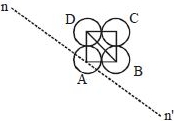
Four point masses,each of value $m$,are placed at the corners of a square $ABCD$ of side $l$. The moment of inertia of this system about an axis passing through $A$ and parallel to $BD$ is
A
$2ml^2$
B
$\sqrt{3}ml^2$
C
$3ml^2$
D
$ml^2$
Solution
(C) Let the square be $ABCD$ with side length $l$. The masses are at $A, B, C, D$.
The axis passes through $A$ and is parallel to the diagonal $BD$.
The distance of point $A$ from the axis is $0$.
The distance of point $B$ from the axis is $d_B = \frac{l}{\sqrt{2}}$.
The distance of point $D$ from the axis is $d_D = \frac{l}{\sqrt{2}}$.
The distance of point $C$ from the axis is $d_C = \sqrt{l^2 + (l/\sqrt{2})^2} = \sqrt{l^2 + l^2/2} = \sqrt{3l^2/2} = l\sqrt{3/2}$.
Alternatively,the distance of $C$ from the diagonal $BD$ is $l\sqrt{2}$.
The moment of inertia $I$ is given by $\sum m_i r_i^2$.
$I = m(0)^2 + m(l/\sqrt{2})^2 + m(l\sqrt{2})^2 + m(l/\sqrt{2})^2$
$I = 0 + m(l^2/2) + 2ml^2 + m(l^2/2)$
$I = ml^2 + 2ml^2 = 3ml^2$.
The axis passes through $A$ and is parallel to the diagonal $BD$.
The distance of point $A$ from the axis is $0$.
The distance of point $B$ from the axis is $d_B = \frac{l}{\sqrt{2}}$.
The distance of point $D$ from the axis is $d_D = \frac{l}{\sqrt{2}}$.
The distance of point $C$ from the axis is $d_C = \sqrt{l^2 + (l/\sqrt{2})^2} = \sqrt{l^2 + l^2/2} = \sqrt{3l^2/2} = l\sqrt{3/2}$.
Alternatively,the distance of $C$ from the diagonal $BD$ is $l\sqrt{2}$.
The moment of inertia $I$ is given by $\sum m_i r_i^2$.
$I = m(0)^2 + m(l/\sqrt{2})^2 + m(l\sqrt{2})^2 + m(l/\sqrt{2})^2$
$I = 0 + m(l^2/2) + 2ml^2 + m(l^2/2)$
$I = ml^2 + 2ml^2 = 3ml^2$.
0 likesView Solution
19
PhysicsMediumMCQAIEEE · 2006
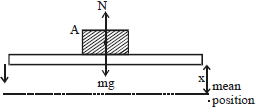
$A$ coin is placed on a horizontal platform which undergoes vertical simple harmonic motion of angular frequency $\omega$. The amplitude of oscillation is gradually increased. The coin will leave contact with the platform for the first time
A
at the mean position of the platform
B
for an amplitude of $\frac{g}{\omega^2}$
C
for an amplitude of $\frac{g^2}{\omega^2}$
D
at the highest position of the platform
Solution
(B) Let $m$ be the mass of the coin and $N$ be the normal reaction force exerted by the platform on the coin.
The equation of motion for the coin in the vertical direction is given by:
$mg - N = m a$
where $a$ is the acceleration of the platform. For simple harmonic motion,the acceleration is $a = -\omega^2 x$,where $x$ is the displacement from the mean position.
Substituting this into the equation of motion:
$mg - N = m(-\omega^2 x)$
$N = m(g + \omega^2 x)$
However,when the platform moves upwards,the acceleration is directed downwards,so $a = -\omega^2 x$ (where $x$ is positive upwards). When the platform is at the highest point,$x = A$ (amplitude),and the acceleration is $a = -\omega^2 A$.
The equation becomes $mg - N = m(-\omega^2 A)$,which implies $N = m(g + \omega^2 A)$. This does not lead to $N=0$.
When the platform moves downwards,the acceleration is directed upwards. At the highest point of the oscillation,the platform's acceleration is directed downwards. The coin loses contact when the normal force $N$ becomes zero.
This happens when the downward acceleration of the platform exceeds the acceleration due to gravity $g$.
The maximum downward acceleration is $\omega^2 A$. Thus,the coin leaves contact when $\omega^2 A \ge g$,or $A \ge \frac{g}{\omega^2}$.
Therefore,the coin will leave contact for the first time when the amplitude reaches $\frac{g}{\omega^2}$ at the highest position of the platform.
The equation of motion for the coin in the vertical direction is given by:
$mg - N = m a$
where $a$ is the acceleration of the platform. For simple harmonic motion,the acceleration is $a = -\omega^2 x$,where $x$ is the displacement from the mean position.
Substituting this into the equation of motion:
$mg - N = m(-\omega^2 x)$
$N = m(g + \omega^2 x)$
However,when the platform moves upwards,the acceleration is directed downwards,so $a = -\omega^2 x$ (where $x$ is positive upwards). When the platform is at the highest point,$x = A$ (amplitude),and the acceleration is $a = -\omega^2 A$.
The equation becomes $mg - N = m(-\omega^2 A)$,which implies $N = m(g + \omega^2 A)$. This does not lead to $N=0$.
When the platform moves downwards,the acceleration is directed upwards. At the highest point of the oscillation,the platform's acceleration is directed downwards. The coin loses contact when the normal force $N$ becomes zero.
This happens when the downward acceleration of the platform exceeds the acceleration due to gravity $g$.
The maximum downward acceleration is $\omega^2 A$. Thus,the coin leaves contact when $\omega^2 A \ge g$,or $A \ge \frac{g}{\omega^2}$.
Therefore,the coin will leave contact for the first time when the amplitude reaches $\frac{g}{\omega^2}$ at the highest position of the platform.
0 likesView Solution
20
PhysicsMediumMCQAIEEE · 2006
$A$ string is stretched between fixed points separated by $75.0\, cm$. It is observed to have resonant frequencies of $420\, Hz$ and $315\, Hz$. There are no other resonant frequencies between these two. Then,the lowest resonant frequency for this string is .... $Hz$
A
$105$
B
$1.05$
C
$1050$
D
$10.5$
Solution
(A) The resonant frequencies of a string fixed at both ends are given by $f_n = n \times f_1$,where $f_1 = \frac{v}{2L}$ is the fundamental frequency and $n = 1, 2, 3, \dots$ is an integer.
Given two consecutive resonant frequencies $f_n = 315\, Hz$ and $f_{n+1} = 420\, Hz$.
We know that the difference between two consecutive resonant frequencies is equal to the fundamental frequency $f_1$.
$f_1 = f_{n+1} - f_n = 420\, Hz - 315\, Hz = 105\, Hz$.
Alternatively,$\frac{f_{n+1}}{f_n} = \frac{n+1}{n} = \frac{420}{315} = \frac{4}{3}$.
This implies $n = 3$,so $f_3 = 315\, Hz$ and $f_4 = 420\, Hz$.
Since $f_3 = 3 \times f_1 = 315\, Hz$,we get $f_1 = \frac{315}{3} = 105\, Hz$.
The lowest resonant frequency is the fundamental frequency $f_1 = 105\, Hz$.
Given two consecutive resonant frequencies $f_n = 315\, Hz$ and $f_{n+1} = 420\, Hz$.
We know that the difference between two consecutive resonant frequencies is equal to the fundamental frequency $f_1$.
$f_1 = f_{n+1} - f_n = 420\, Hz - 315\, Hz = 105\, Hz$.
Alternatively,$\frac{f_{n+1}}{f_n} = \frac{n+1}{n} = \frac{420}{315} = \frac{4}{3}$.
This implies $n = 3$,so $f_3 = 315\, Hz$ and $f_4 = 420\, Hz$.
Since $f_3 = 3 \times f_1 = 315\, Hz$,we get $f_1 = \frac{315}{3} = 105\, Hz$.
The lowest resonant frequency is the fundamental frequency $f_1 = 105\, Hz$.
0 likesView Solution
21
PhysicsMediumMCQAIEEE · 2006
$A$ player caught a cricket ball of mass $150 \ g$ moving at a speed of $20 \ m/s$. If the catching process is completed in $0.1 \ s$,the magnitude of the force exerted by the ball on the hand of the player is .......... $N$.
A
$150$
B
$3$
C
$30$
D
$300$
Solution
(C) Given: Mass $m = 150 \ g = 0.15 \ kg$,Initial velocity $u = 20 \ m/s$,Final velocity $v = 0 \ m/s$,Time interval $\Delta t = 0.1 \ s$.
According to Newton's second law of motion,the force $F$ exerted is equal to the rate of change of momentum:
$F = \frac{\Delta p}{\Delta t} = \frac{m(v - u)}{\Delta t}$
$F = \frac{0.15 \times (0 - 20)}{0.1}$
$F = \frac{0.15 \times (-20)}{0.1} = \frac{-3}{0.1} = -30 \ N$
The magnitude of the force is $|F| = 30 \ N$.
According to Newton's second law of motion,the force $F$ exerted is equal to the rate of change of momentum:
$F = \frac{\Delta p}{\Delta t} = \frac{m(v - u)}{\Delta t}$
$F = \frac{0.15 \times (0 - 20)}{0.1}$
$F = \frac{0.15 \times (-20)}{0.1} = \frac{-3}{0.1} = -30 \ N$
The magnitude of the force is $|F| = 30 \ N$.
0 likesView Solution
22
PhysicsMediumMCQAIEEE · 2006
An electric bulb is rated $220\, V$ and $100\, W$. Power consumed by it when operated on $110\, V$ is ............. $W$.
A
$50$
B
$75$
C
$40$
D
$25$
Solution
(D) The resistance $R$ of the bulb is constant and is calculated using the rated values: $R = \frac{V_{rated}^2}{P_{rated}} = \frac{220^2}{100} = \frac{48400}{100} = 484\,\Omega$.
When the bulb is operated at a new voltage $V' = 110\, V$,the power consumed $P'$ is given by: $P' = \frac{(V')^2}{R} = \frac{110^2}{484} = \frac{12100}{484} = 25\, W$.
When the bulb is operated at a new voltage $V' = 110\, V$,the power consumed $P'$ is given by: $P' = \frac{(V')^2}{R} = \frac{110^2}{484} = \frac{12100}{484} = 25\, W$.
0 likesView Solution
23
PhysicsEasyMCQAIEEE · 2006
The time taken by a photoelectron to come out after the photon strikes is approximately
A
$10^{-4} \ s$
B
$10^{-10} \ s$
C
$10^{-16} \ s$
D
$10^{-1} \ s$
Solution
(B) According to the experimental observations of the photoelectric effect,the emission of photoelectrons from a metal surface is an instantaneous process. The time lag between the incidence of a photon and the emission of a photoelectron is approximately $10^{-10} \ s$.
0 likesView Solution
24
PhysicsEasyMCQAIEEE · 2006
Kirchhoff's first law $(\sum i = 0)$ and second law $(\sum iR = \sum E)$,where the symbols have their usual meanings,are respectively based on:
A
conservation of electric charge and energy respectively
B
conservation of charge,conservation of momentum
C
conservation of energy,conservation of charge
D
conservation of momentum,conservation of charge
Solution
(A) Kirchhoff's first law,also known as the Junction Rule,states that the algebraic sum of currents meeting at a junction is zero. This is a direct consequence of the law of conservation of charge,as charge cannot accumulate at a junction.
Kirchhoff's second law,also known as the Loop Rule,states that the algebraic sum of potential differences in any closed loop is zero. This is a direct consequence of the law of conservation of energy,as the work done in moving a unit charge around a closed loop in an electrostatic field is zero.
Kirchhoff's second law,also known as the Loop Rule,states that the algebraic sum of potential differences in any closed loop is zero. This is a direct consequence of the law of conservation of energy,as the work done in moving a unit charge around a closed loop in an electrostatic field is zero.
0 likesView Solution
25
PhysicsMediumMCQAIEEE · 2006
The work function of a surface of a photosensitive material is $6.2\, eV$. The wavelength of the incident radiation for which the stopping potential is $5\, V$ lies in the
A
Infrared region
B
$X-ray$ region
C
Ultraviolet region
D
Visible region
Solution
(C) The work function is given by $\Phi = 6.2\, eV$.
The stopping potential is $V_s = 5\, V$,so the maximum kinetic energy is $K_{\max} = e V_s = 5\, eV$.
According to Einstein's photoelectric equation,the energy of the incident photon is $E = \Phi + K_{\max} = 6.2\, eV + 5\, eV = 11.2\, eV$.
The wavelength $\lambda$ is given by $\lambda = \frac{hc}{E}$. Using $hc \approx 12400\, eV\cdot\mathring{A}$,we get $\lambda = \frac{12400}{11.2} \approx 1107\, \mathring{A}$.
Since the wavelength $1107\, \mathring{A}$ falls in the range of $100\, \mathring{A}$ to $4000\, \mathring{A}$,it lies in the ultraviolet region.
The stopping potential is $V_s = 5\, V$,so the maximum kinetic energy is $K_{\max} = e V_s = 5\, eV$.
According to Einstein's photoelectric equation,the energy of the incident photon is $E = \Phi + K_{\max} = 6.2\, eV + 5\, eV = 11.2\, eV$.
The wavelength $\lambda$ is given by $\lambda = \frac{hc}{E}$. Using $hc \approx 12400\, eV\cdot\mathring{A}$,we get $\lambda = \frac{12400}{11.2} \approx 1107\, \mathring{A}$.
Since the wavelength $1107\, \mathring{A}$ falls in the range of $100\, \mathring{A}$ to $4000\, \mathring{A}$,it lies in the ultraviolet region.
0 likesView Solution
26
PhysicsMediumMCQAIEEE · 2006
An alpha nucleus of energy $\frac{1}{2}mv^2$ bombards a heavy nuclear target of charge $Ze$. Then the distance of closest approach for the alpha nucleus will be proportional to
A
$v^2$
B
$\frac{1}{Ze}$
C
$\frac{1}{m}$
D
$\frac{1}{v^4}$
Solution
(C) At the distance of closest approach $(r_0)$,the entire initial kinetic energy of the alpha particle is converted into electrostatic potential energy.
The kinetic energy is given by $K = \frac{1}{2}mv^2$.
The potential energy at distance $r_0$ is $U = \frac{1}{4\pi\varepsilon_0} \cdot \frac{(Ze)(2e)}{r_0}$,where $2e$ is the charge of the alpha particle.
Equating kinetic energy to potential energy:
$\frac{1}{2}mv^2 = \frac{1}{4\pi\varepsilon_0} \cdot \frac{2Ze^2}{r_0}$
Solving for $r_0$:
$r_0 = \frac{4Ze^2}{4\pi\varepsilon_0 mv^2} = \frac{Ze^2}{\pi\varepsilon_0 m v^2}$
From this expression,we can see that $r_0 \propto \frac{1}{m}$.
Therefore,the distance of closest approach is proportional to $\frac{1}{m}$.
The kinetic energy is given by $K = \frac{1}{2}mv^2$.
The potential energy at distance $r_0$ is $U = \frac{1}{4\pi\varepsilon_0} \cdot \frac{(Ze)(2e)}{r_0}$,where $2e$ is the charge of the alpha particle.
Equating kinetic energy to potential energy:
$\frac{1}{2}mv^2 = \frac{1}{4\pi\varepsilon_0} \cdot \frac{2Ze^2}{r_0}$
Solving for $r_0$:
$r_0 = \frac{4Ze^2}{4\pi\varepsilon_0 mv^2} = \frac{Ze^2}{\pi\varepsilon_0 m v^2}$
From this expression,we can see that $r_0 \propto \frac{1}{m}$.
Therefore,the distance of closest approach is proportional to $\frac{1}{m}$.
0 likesView Solution
27
PhysicsEasyMCQAIEEE · 2006
An electric dipole is placed at an angle of $30^o$ to a non-uniform electric field. The dipole will experience:
A
a torque only
B
a translational force only in the direction of the field
C
a translational force only in a direction normal to the direction of the field
D
a torque as well as a translational force
Solution
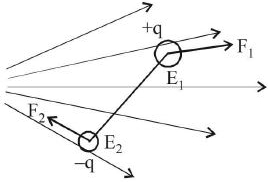
(D) In a non-uniform electric field,the electric field intensity at the positions of the two charges $+q$ and $-q$ of the dipole is different.
Let the electric field at the position of $+q$ be $E_1$ and at the position of $-q$ be $E_2$.
The force on the positive charge is $F_1 = qE_1$ and the force on the negative charge is $F_2 = -qE_2$.
Since $E_1 \neq E_2$,the magnitudes of the forces are unequal $(|F_1| \neq |F_2|)$.
Because the forces are unequal and act at different points,they do not cancel each other out,resulting in a net translational force.
Additionally,since the forces are not collinear,they exert a torque on the dipole.
Therefore,the dipole experiences both a torque and a translational force.
Let the electric field at the position of $+q$ be $E_1$ and at the position of $-q$ be $E_2$.
The force on the positive charge is $F_1 = qE_1$ and the force on the negative charge is $F_2 = -qE_2$.
Since $E_1 \neq E_2$,the magnitudes of the forces are unequal $(|F_1| \neq |F_2|)$.
Because the forces are unequal and act at different points,they do not cancel each other out,resulting in a net translational force.
Additionally,since the forces are not collinear,they exert a torque on the dipole.
Therefore,the dipole experiences both a torque and a translational force.
0 likesView Solution
28
PhysicsMediumMCQAIEEE · 2006
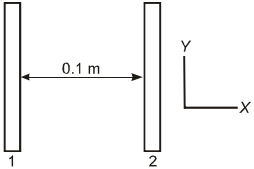
Two insulating plates are both uniformly charged in such a way that the potential difference between them is $V_2 - V_1 = 20\ V$ (i.e.,plate $2$ is at a higher potential). The plates are separated by $d = 0.1\ m$ and can be treated as infinitely large. An electron is released from rest on the inner surface of plate $1$. What is its speed when it hits plate $2$? $(e = 1.6 \times 10^{-19}\ C, m_e = 9.11 \times 10^{-31}\ kg)$
A
$32 \times 10^{-19} \ m/s$
B
$2.65 \times 10^6 \ m/s$
C
$7.02 \times 10^{12} \ m/s$
D
$1.87 \times 10^6 \ m/s$
Solution
(B) The work done by the electric field on the electron is equal to its change in kinetic energy.
$W = \Delta K$
$e V = \frac{1}{2} m_e v^2 - 0$
Here,$V = 20\ V$,$e = 1.6 \times 10^{-19}\ C$,and $m_e = 9.11 \times 10^{-31}\ kg$.
$v = \sqrt{\frac{2 e V}{m_e}}$
$v = \sqrt{\frac{2 \times 1.6 \times 10^{-19} \times 20}{9.11 \times 10^{-31}}}$
$v = \sqrt{\frac{64 \times 10^{-19}}{9.11 \times 10^{-31}}}$
$v = \sqrt{7.025 \times 10^{12}}$
$v \approx 2.65 \times 10^6 \ m/s$
$W = \Delta K$
$e V = \frac{1}{2} m_e v^2 - 0$
Here,$V = 20\ V$,$e = 1.6 \times 10^{-19}\ C$,and $m_e = 9.11 \times 10^{-31}\ kg$.
$v = \sqrt{\frac{2 e V}{m_e}}$
$v = \sqrt{\frac{2 \times 1.6 \times 10^{-19} \times 20}{9.11 \times 10^{-31}}}$
$v = \sqrt{\frac{64 \times 10^{-19}}{9.11 \times 10^{-31}}}$
$v = \sqrt{7.025 \times 10^{12}}$
$v \approx 2.65 \times 10^6 \ m/s$
0 likesView Solution
29
PhysicsMediumMCQAIEEE · 2006
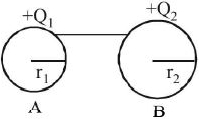
Two spherical conductors $A$ and $B$ of radii $1 \ mm$ and $2 \ mm$ are separated by a distance of $5 \ cm$ and are uniformly charged. If the spheres are connected by a conducting wire,then in the equilibrium condition,the ratio of the magnitude of the electric fields at the surfaces of spheres $A$ and $B$ is:
A
$4 : 1$
B
$1 : 2$
C
$2 : 1$
D
$1 : 4$
Solution
(C) When two conductors are connected by a conducting wire,charge flows until their potentials become equal. Thus,$V_A = V_B$.
Using the formula for potential $V = \frac{KQ}{r}$,we have:
$\frac{KQ_A}{r_A} = \frac{KQ_B}{r_B}$
$\Rightarrow \frac{Q_A}{r_A} = \frac{Q_B}{r_B} \Rightarrow \frac{Q_A}{Q_B} = \frac{r_A}{r_B}$
The electric field at the surface of a spherical conductor is given by $E = \frac{KQ}{r^2}$.
Therefore,the ratio of the electric fields $E_A$ and $E_B$ is:
$\frac{E_A}{E_B} = \frac{K Q_A / r_A^2}{K Q_B / r_B^2} = \frac{Q_A}{Q_B} \times \left( \frac{r_B}{r_A} \right)^2$
Substituting $\frac{Q_A}{Q_B} = \frac{r_A}{r_B}$ into the equation:
$\frac{E_A}{E_B} = \left( \frac{r_A}{r_B} \right) \times \left( \frac{r_B}{r_A} \right)^2 = \frac{r_B}{r_A}$
Given $r_A = 1 \ mm$ and $r_B = 2 \ mm$:
$\frac{E_A}{E_B} = \frac{2 \ mm}{1 \ mm} = \frac{2}{1} = 2 : 1$
Since the distance between the spheres is large compared to their diameters,the induced effects may be ignored.
Using the formula for potential $V = \frac{KQ}{r}$,we have:
$\frac{KQ_A}{r_A} = \frac{KQ_B}{r_B}$
$\Rightarrow \frac{Q_A}{r_A} = \frac{Q_B}{r_B} \Rightarrow \frac{Q_A}{Q_B} = \frac{r_A}{r_B}$
The electric field at the surface of a spherical conductor is given by $E = \frac{KQ}{r^2}$.
Therefore,the ratio of the electric fields $E_A$ and $E_B$ is:
$\frac{E_A}{E_B} = \frac{K Q_A / r_A^2}{K Q_B / r_B^2} = \frac{Q_A}{Q_B} \times \left( \frac{r_B}{r_A} \right)^2$
Substituting $\frac{Q_A}{Q_B} = \frac{r_A}{r_B}$ into the equation:
$\frac{E_A}{E_B} = \left( \frac{r_A}{r_B} \right) \times \left( \frac{r_B}{r_A} \right)^2 = \frac{r_B}{r_A}$
Given $r_A = 1 \ mm$ and $r_B = 2 \ mm$:
$\frac{E_A}{E_B} = \frac{2 \ mm}{1 \ mm} = \frac{2}{1} = 2 : 1$
Since the distance between the spheres is large compared to their diameters,the induced effects may be ignored.
0 likesView Solution
30
PhysicsMediumMCQAIEEE · 2006
$A$ thermocouple is made from two metals,Antimony and Bismuth. If one junction of the couple is kept hot and the other is kept cold,then,an electric current will
A
flow from Antimony to Bismuth at the cold junction
B
flow from Antimony to Bismuth at the hot junction
C
flow from Bismuth to Antimony at the cold junction
D
no flow through the thermocouple
Solution
(A) In a thermoelectric series,the direction of current flow at the cold junction is from the metal that appears later in the series to the metal that appears earlier.
For an Antimony-Bismuth thermocouple,the thermoelectric series order is Bismuth followed by Antimony.
Therefore,at the cold junction,the current flows from Antimony to Bismuth.
This creates a continuous loop where the current flows from Bismuth to Antimony at the hot junction.
For an Antimony-Bismuth thermocouple,the thermoelectric series order is Bismuth followed by Antimony.
Therefore,at the cold junction,the current flows from Antimony to Bismuth.
This creates a continuous loop where the current flows from Bismuth to Antimony at the hot junction.
0 likesView Solution
31
PhysicsMediumMCQAIEEE · 2006
In a Wheatstone's bridge,three resistances $P, Q$ and $R$ are connected in the three arms,and the fourth arm is formed by two resistances $S_1$ and $S_2$ connected in parallel. The condition for the bridge to be balanced will be
A
$\frac{P}{Q} = \frac{R}{S_1 + S_2}$
B
$\frac{P}{Q} = \frac{2R}{S_1 + S_2}$
C
$\frac{P}{Q} = \frac{R(S_1 + S_2)}{S_1 S_2}$
D
$\frac{P}{Q} = \frac{R(S_1 + S_2)}{2S_1 S_2}$
Solution
(C) The balanced condition for a Wheatstone bridge is given by $\frac{P}{Q} = \frac{R}{S}$,where $S$ is the equivalent resistance of the fourth arm.
Since $S_1$ and $S_2$ are connected in parallel in the fourth arm,their equivalent resistance $S$ is given by $\frac{1}{S} = \frac{1}{S_1} + \frac{1}{S_2} = \frac{S_1 + S_2}{S_1 S_2}$.
Therefore,$S = \frac{S_1 S_2}{S_1 + S_2}$.
Substituting this value into the bridge balance condition,we get $\frac{P}{Q} = \frac{R}{\left( \frac{S_1 S_2}{S_1 + S_2} \right)}$.
This simplifies to $\frac{P}{Q} = \frac{R(S_1 + S_2)}{S_1 S_2}$.
Since $S_1$ and $S_2$ are connected in parallel in the fourth arm,their equivalent resistance $S$ is given by $\frac{1}{S} = \frac{1}{S_1} + \frac{1}{S_2} = \frac{S_1 + S_2}{S_1 S_2}$.
Therefore,$S = \frac{S_1 S_2}{S_1 + S_2}$.
Substituting this value into the bridge balance condition,we get $\frac{P}{Q} = \frac{R}{\left( \frac{S_1 S_2}{S_1 + S_2} \right)}$.
This simplifies to $\frac{P}{Q} = \frac{R(S_1 + S_2)}{S_1 S_2}$.
0 likesView Solution
32
PhysicsMediumMCQAIEEE · 2006
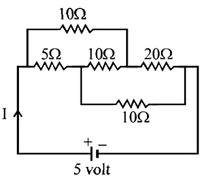
The current $I$ drawn from the $5 \text{ V}$ source will be ............... $A$.
A
$0.17$
B
$0.33$
C
$0.5$
D
$0.67$
Solution
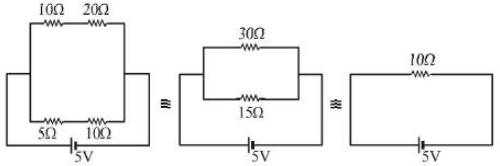
(C) The circuit can be simplified by identifying series and parallel combinations.
Looking at the circuit,the $10 \Omega$ and $20 \Omega$ resistors are in series,giving a total of $30 \Omega$.
The $5 \Omega$ and $10 \Omega$ resistors are also in series,giving a total of $15 \Omega$.
These two branches ($30 \Omega$ and $15 \Omega$) are in parallel with each other.
The equivalent resistance $R_{eq}$ is given by:
$R_{eq} = \frac{30 \times 15}{30 + 15} = \frac{450}{45} = 10 \Omega$.
Using Ohm's law,the current $I$ drawn from the $5 \text{ V}$ source is:
$I = \frac{V}{R_{eq}} = \frac{5}{10} = 0.5 \text{ A}$.
Looking at the circuit,the $10 \Omega$ and $20 \Omega$ resistors are in series,giving a total of $30 \Omega$.
The $5 \Omega$ and $10 \Omega$ resistors are also in series,giving a total of $15 \Omega$.
These two branches ($30 \Omega$ and $15 \Omega$) are in parallel with each other.
The equivalent resistance $R_{eq}$ is given by:
$R_{eq} = \frac{30 \times 15}{30 + 15} = \frac{450}{45} = 10 \Omega$.
Using Ohm's law,the current $I$ drawn from the $5 \text{ V}$ source is:
$I = \frac{V}{R_{eq}} = \frac{5}{10} = 0.5 \text{ A}$.
0 likesView Solution
33
PhysicsMediumMCQAIEEE · 2006
The resistance of a bulb filament is $100\,\Omega$ at a temperature of $100\,^{\circ}C$. If its temperature coefficient of resistance is $0.005\,^{\circ}C^{-1}$,at what temperature will its resistance become $200\,\Omega$?
A
$200$
B
$300$
C
$400$
D
$500$
Solution
(C) The resistance at temperature $T$ is given by $R_T = R_0(1 + \alpha \Delta T)$,where $R_0$ is the resistance at $0\,^{\circ}C$.
Given:
$R_1 = 100\,\Omega$ at $T_1 = 100\,^{\circ}C$
$R_2 = 200\,\Omega$ at $T_2 = T$
$\alpha = 0.005\,^{\circ}C^{-1}$
Using the formula $R = R_0(1 + \alpha T)$:
$100 = R_0(1 + 0.005 \times 100) = R_0(1 + 0.5) = 1.5 R_0$
$R_0 = \frac{100}{1.5} = \frac{200}{3}\,\Omega$
Now,for $R_2 = 200\,\Omega$:
$200 = R_0(1 + 0.005 \times T)$
$200 = \frac{200}{3}(1 + 0.005 T)$
$3 = 1 + 0.005 T$
$2 = 0.005 T$
$T = \frac{2}{0.005} = 400\,^{\circ}C$.
Given:
$R_1 = 100\,\Omega$ at $T_1 = 100\,^{\circ}C$
$R_2 = 200\,\Omega$ at $T_2 = T$
$\alpha = 0.005\,^{\circ}C^{-1}$
Using the formula $R = R_0(1 + \alpha T)$:
$100 = R_0(1 + 0.005 \times 100) = R_0(1 + 0.5) = 1.5 R_0$
$R_0 = \frac{100}{1.5} = \frac{200}{3}\,\Omega$
Now,for $R_2 = 200\,\Omega$:
$200 = R_0(1 + 0.005 \times T)$
$200 = \frac{200}{3}(1 + 0.005 T)$
$3 = 1 + 0.005 T$
$2 = 0.005 T$
$T = \frac{2}{0.005} = 400\,^{\circ}C$.
0 likesView Solution
34
PhysicsMediumMCQAIEEE · 2006
$A$ material '$B$' has twice the specific resistance of '$A$'. $A$ circular wire made of '$B$' has twice the diameter of a wire made of '$A$'. Then,for the two wires to have the same resistance,the ratio $\frac{l_B}{l_A}$ of their respective lengths must be
A
$2$
B
$1$
C
$\frac{1}{2}$
D
$\frac{1}{4}$
Solution
(A) Given: $\rho_B = 2\rho_A$ and $d_B = 2d_A$.
Since the wires are circular,the area of cross-section is $A = \pi r^2 = \pi (d/2)^2 = \frac{\pi d^2}{4}$.
For the resistances to be equal,$R_B = R_A$.
Using the formula $R = \frac{\rho l}{A}$,we have $\frac{\rho_B l_B}{A_B} = \frac{\rho_A l_A}{A_A}$.
Substituting the values: $\frac{2\rho_A l_B}{\frac{\pi (2d_A)^2}{4}} = \frac{\rho_A l_A}{\frac{\pi d_A^2}{4}}$.
Simplifying the equation: $\frac{2\rho_A l_B}{4 A_A} = \frac{\rho_A l_A}{A_A} \Rightarrow \frac{2 l_B}{4} = l_A$.
Therefore,$\frac{l_B}{l_A} = \frac{4}{2} = 2$.
Since the wires are circular,the area of cross-section is $A = \pi r^2 = \pi (d/2)^2 = \frac{\pi d^2}{4}$.
For the resistances to be equal,$R_B = R_A$.
Using the formula $R = \frac{\rho l}{A}$,we have $\frac{\rho_B l_B}{A_B} = \frac{\rho_A l_A}{A_A}$.
Substituting the values: $\frac{2\rho_A l_B}{\frac{\pi (2d_A)^2}{4}} = \frac{\rho_A l_A}{\frac{\pi d_A^2}{4}}$.
Simplifying the equation: $\frac{2\rho_A l_B}{4 A_A} = \frac{\rho_A l_A}{A_A} \Rightarrow \frac{2 l_B}{4} = l_A$.
Therefore,$\frac{l_B}{l_A} = \frac{4}{2} = 2$.
0 likesView Solution
35
PhysicsEasyMCQAIEEE · 2006
In a region,steady and uniform electric and magnetic fields are present. These two fields are parallel to each other. $A$ charged particle is released from rest in this region. The path of the particle will be a
A
Circle
B
Helix
C
Straight line
D
Ellipse
Solution
(C) The charged particle is released from rest,so its initial velocity $v = 0$.
Since the magnetic force is given by $F_m = q(v \times B)$,if $v = 0$,then $F_m = 0$.
The electric force is given by $F_e = qE$.
Since the particle is released from rest,it will be accelerated by the electric field $E$ in the direction of the field (if $q > 0$) or opposite to it (if $q < 0$).
Because the electric and magnetic fields are parallel,the particle moves along the direction of the electric field lines.
Since the magnetic field exerts no force on a particle moving parallel to it,the particle continues to move in a straight line.
Since the magnetic force is given by $F_m = q(v \times B)$,if $v = 0$,then $F_m = 0$.
The electric force is given by $F_e = qE$.
Since the particle is released from rest,it will be accelerated by the electric field $E$ in the direction of the field (if $q > 0$) or opposite to it (if $q < 0$).
Because the electric and magnetic fields are parallel,the particle moves along the direction of the electric field lines.
Since the magnetic field exerts no force on a particle moving parallel to it,the particle continues to move in a straight line.
0 likesView Solution
36
PhysicsMediumMCQAIEEE · 2006
$A$ long solenoid has $200$ turns per $cm$ and carries a current $i$. The magnetic field at its centre is $6.28 \times 10^{-2} \ Wb/m^2$. Another long solenoid has $100$ turns per $cm$ and it carries a current $i/3$. The value of the magnetic field at its centre is:
A
$1.05 \times 10^{-4} \ Wb/m^2$
B
$1.05 \times 10^{-2} \ Wb/m^2$
C
$1.05 \times 10^{-5} \ Wb/m^2$
D
$1.05 \times 10^{-3} \ Wb/m^2$
Solution
(B) The magnetic field at the centre of a long solenoid is given by $B = \mu_0 n i$,where $n$ is the number of turns per unit length and $i$ is the current.
For the first solenoid: $B_1 = \mu_0 n_1 i_1 = 6.28 \times 10^{-2} \ Wb/m^2$,where $n_1 = 200 \ turns/cm$ and $i_1 = i$.
For the second solenoid: $n_2 = 100 \ turns/cm$ and $i_2 = i/3$.
Taking the ratio: $\frac{B_2}{B_1} = \frac{\mu_0 n_2 i_2}{\mu_0 n_1 i_1} = \frac{n_2 i_2}{n_1 i_1}$.
Substituting the values: $\frac{B_2}{6.28 \times 10^{-2}} = \frac{100 \times (i/3)}{200 \times i} = \frac{100}{200 \times 3} = \frac{1}{6}$.
Therefore,$B_2 = \frac{6.28 \times 10^{-2}}{6} \approx 1.05 \times 10^{-2} \ Wb/m^2$.
For the first solenoid: $B_1 = \mu_0 n_1 i_1 = 6.28 \times 10^{-2} \ Wb/m^2$,where $n_1 = 200 \ turns/cm$ and $i_1 = i$.
For the second solenoid: $n_2 = 100 \ turns/cm$ and $i_2 = i/3$.
Taking the ratio: $\frac{B_2}{B_1} = \frac{\mu_0 n_2 i_2}{\mu_0 n_1 i_1} = \frac{n_2 i_2}{n_1 i_1}$.
Substituting the values: $\frac{B_2}{6.28 \times 10^{-2}} = \frac{100 \times (i/3)}{200 \times i} = \frac{100}{200 \times 3} = \frac{1}{6}$.
Therefore,$B_2 = \frac{6.28 \times 10^{-2}}{6} \approx 1.05 \times 10^{-2} \ Wb/m^2$.
0 likesView Solution
37
PhysicsEasyMCQAIEEE · 2006
Needles $N_1, N_2$ and $N_3$ are made of a ferromagnetic,a paramagnetic and a diamagnetic substance respectively. $A$ magnet when brought close to them will
A
attract $N_1$ strongly,$N_2$ weakly and repel $N_3$ weakly
B
attract $N_1$ strongly,but repel $N_2$ and $N_3$ weakly
C
attract $N_1$ and $N_2$ strongly but repel $N_3$
D
attract all three of them
Solution
(A) Ferromagnetic substances are strongly attracted by a magnetic field because they possess permanent magnetic domains that align easily with the external field.
Paramagnetic substances are weakly attracted by a magnetic field because they possess permanent magnetic dipoles that align weakly with the external field.
Diamagnetic substances are weakly repelled by a magnetic field because they develop an induced magnetic moment in a direction opposite to the applied field due to the orbital motion of electrons.
Therefore,the magnet will attract $N_1$ strongly,$N_2$ weakly,and repel $N_3$ weakly.
Paramagnetic substances are weakly attracted by a magnetic field because they possess permanent magnetic dipoles that align weakly with the external field.
Diamagnetic substances are weakly repelled by a magnetic field because they develop an induced magnetic moment in a direction opposite to the applied field due to the orbital motion of electrons.
Therefore,the magnet will attract $N_1$ strongly,$N_2$ weakly,and repel $N_3$ weakly.
0 likesView Solution
38
PhysicsMediumMCQAIEEE · 2006
The refractive index of a glass is $1.520$ for red light and $1.525$ for blue light. Let $D_1$ and $D_2$ be the angles of minimum deviation for red and blue light,respectively,in a prism of this glass. Then,
A
$D_1 > D_2$
B
$D_1 < D_2$
C
$D_1 = D_2$
D
The relationship between $D_1$ and $D_2$ depends on the prism angle of the prism.
Solution
(B) The angle of minimum deviation $D$ for a prism is given by the formula $D = (\mu - 1)A$,where $\mu$ is the refractive index and $A$ is the prism angle.
Given that the refractive index for red light is $\mu_r = 1.520$ and for blue light is $\mu_b = 1.525$.
Since $\mu_b > \mu_r$,it follows that $(\mu_b - 1) > (\mu_r - 1)$.
Therefore,$D_2 > D_1$,which can also be written as $D_1 < D_2$.
Given that the refractive index for red light is $\mu_r = 1.520$ and for blue light is $\mu_b = 1.525$.
Since $\mu_b > \mu_r$,it follows that $(\mu_b - 1) > (\mu_r - 1)$.
Therefore,$D_2 > D_1$,which can also be written as $D_1 < D_2$.
0 likesView Solution
39
PhysicsMediumMCQAIEEE · 2006
The anode voltage of a photocell is kept fixed. The wavelength $\lambda$ of the light falling on the cathode is gradually changed. The plate current $I$ of the photocell varies as follows:
A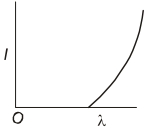
B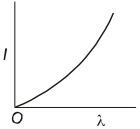
C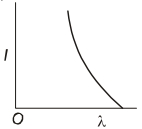
D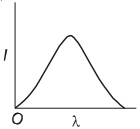
Solution
(C) The photoelectric current $I$ depends on the number of photoelectrons emitted per unit time,which is proportional to the intensity of the incident light,provided the frequency is above the threshold frequency. However,if the anode voltage is fixed and not high enough to collect all emitted electrons,the current depends on the kinetic energy of the photoelectrons. As the wavelength $\lambda$ decreases,the energy of the incident photons $(E = hc/\lambda)$ increases. This results in an increase in the maximum kinetic energy of the emitted photoelectrons. With higher kinetic energy,a greater number of photoelectrons are able to overcome the potential barrier and reach the anode,thereby increasing the plate current $I$. Therefore,as $\lambda$ decreases,$I$ increases. This relationship is represented by a curve where $I$ decreases as $\lambda$ increases,which corresponds to Graph $C$.
0 likesView Solution
40
PhysicsDifficultMCQAIEEE · 2006
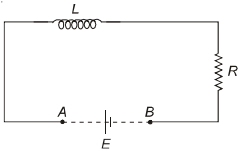
An inductor $(L = 100 \ mH)$,a resistor $(R = 100 \ \Omega)$ and a battery $(E = 100 \ V)$ are initially connected in series as shown in the figure. After a long time,the battery is disconnected by short-circuiting the points $A$ and $B$. The current in the circuit $1 \ ms$ after the short circuit is
A
$\frac{1}{e} \ A$
B
$e \ A$
C
$0.1 \ A$
D
$1 \ A$
Solution
(A) Initially,when steady state is achieved,the current in the circuit is $i_0 = \frac{E}{R} = \frac{100 \ V}{100 \ \Omega} = 1 \ A$.
When the battery is disconnected and points $A$ and $B$ are short-circuited,the circuit becomes an $LR$ decay circuit.
The equation for the decay of current is given by $i(t) = i_0 e^{-\frac{R}{L}t}$.
Given $R = 100 \ \Omega$,$L = 100 \ mH = 0.1 \ H$,and $t = 1 \ ms = 10^{-3} \ s$.
The time constant of the circuit is $\tau = \frac{L}{R} = \frac{0.1 \ H}{100 \ \Omega} = 10^{-3} \ s$.
Substituting the values into the decay equation:
$i(t) = 1 \times e^{-\frac{10^{-3}}{10^{-3}}} = 1 \times e^{-1} = \frac{1}{e} \ A$.
When the battery is disconnected and points $A$ and $B$ are short-circuited,the circuit becomes an $LR$ decay circuit.
The equation for the decay of current is given by $i(t) = i_0 e^{-\frac{R}{L}t}$.
Given $R = 100 \ \Omega$,$L = 100 \ mH = 0.1 \ H$,and $t = 1 \ ms = 10^{-3} \ s$.
The time constant of the circuit is $\tau = \frac{L}{R} = \frac{0.1 \ H}{100 \ \Omega} = 10^{-3} \ s$.
Substituting the values into the decay equation:
$i(t) = 1 \times e^{-\frac{10^{-3}}{10^{-3}}} = 1 \times e^{-1} = \frac{1}{e} \ A$.
0 likesView Solution
41
PhysicsMediumMCQAIEEE · 2006
In an $AC$ generator,a coil with $N$ turns,all of the same area $A$ and total resistance $R$,rotates with frequency $\omega$ in a magnetic field $B$. The maximum value of emf generated in the coil is
A
$NAB\omega$
B
$NABR\omega$
C
$NAB$
D
$NABR$
Solution
(A) The magnetic flux $\phi$ linked with the coil at any time $t$ is given by $\phi = N B A \cos(\omega t)$.
According to Faraday's law of electromagnetic induction,the induced emf $e$ is given by $e = -\frac{d\phi}{dt}$.
Substituting the expression for $\phi$: $e = -\frac{d}{dt}(N B A \cos(\omega t))$.
$e = -N B A \frac{d}{dt}(\cos(\omega t)) = -N B A (-\omega \sin(\omega t)) = N B A \omega \sin(\omega t)$.
The maximum value of emf $(e_{\max})$ occurs when $\sin(\omega t) = 1$.
Therefore,$e_{\max} = N B A \omega$.
According to Faraday's law of electromagnetic induction,the induced emf $e$ is given by $e = -\frac{d\phi}{dt}$.
Substituting the expression for $\phi$: $e = -\frac{d}{dt}(N B A \cos(\omega t))$.
$e = -N B A \frac{d}{dt}(\cos(\omega t)) = -N B A (-\omega \sin(\omega t)) = N B A \omega \sin(\omega t)$.
The maximum value of emf $(e_{\max})$ occurs when $\sin(\omega t) = 1$.
Therefore,$e_{\max} = N B A \omega$.
0 likesView Solution
42
PhysicsEasyMCQAIEEE · 2006
Which of the following units denotes the dimension $\frac{M L^2}{Q^2}$,where $Q$ denotes the electric charge?
A
$Weber$ $(Wb)$
B
$Wb / m^2$
C
$Henry$ $(H)$
D
$H / m^2$
Solution
(C) The dimension of inductance $L$ is given by the formula $L = \frac{\phi}{I}$,where $\phi$ is the magnetic flux and $I$ is the current.
Magnetic flux $\phi$ has the dimension of $[M L^2 T^{-1} Q^{-1}]$.
Current $I$ has the dimension of $[Q T^{-1}]$.
Therefore,the dimension of inductance is $[L] = \frac{[M L^2 T^{-1} Q^{-1}]}{[Q T^{-1}]} = [M L^2 Q^{-2}]$.
The unit of inductance is $Henry$ $(H)$.
Thus,the dimension $\frac{M L^2}{Q^2}$ corresponds to the unit $Henry$ $(H)$.
Magnetic flux $\phi$ has the dimension of $[M L^2 T^{-1} Q^{-1}]$.
Current $I$ has the dimension of $[Q T^{-1}]$.
Therefore,the dimension of inductance is $[L] = \frac{[M L^2 T^{-1} Q^{-1}]}{[Q T^{-1}]} = [M L^2 Q^{-2}]$.
The unit of inductance is $Henry$ $(H)$.
Thus,the dimension $\frac{M L^2}{Q^2}$ corresponds to the unit $Henry$ $(H)$.
0 likesView Solution
43
PhysicsMediumMCQAIEEE · 2006
In a series resonant $LCR$ circuit,the voltage across $R$ is $100 \ V$ and $R = 1 \ k\Omega$ with $C = 2 \ \mu F$. The resonant frequency $\omega$ is $200 \ rad/s$. At resonance,the voltage across $L$ is:
A
$4 \ mV$
B
$2.5 \times 10^{-2} \ V$
C
$40 \ V$
D
$250 \ V$
Solution
(D) In a series $LCR$ circuit,the current $I$ flowing through the circuit is given by $I = \frac{V_R}{R}$.
Given $V_R = 100 \ V$ and $R = 1 \ k\Omega = 1000 \ \Omega$,we have $I = \frac{100}{1000} = 0.1 \ A$.
At resonance,the inductive reactance $X_L$ is equal to the capacitive reactance $X_C$,where $X_C = \frac{1}{\omega C}$.
Given $\omega = 200 \ rad/s$ and $C = 2 \ \mu F = 2 \times 10^{-6} \ F$,we calculate $X_L = X_C = \frac{1}{200 \times 2 \times 10^{-6}} = \frac{1}{400 \times 10^{-6}} = \frac{10^6}{400} = 2500 \ \Omega$.
The voltage across the inductor $L$ is given by $V_L = I X_L$.
Substituting the values,$V_L = 0.1 \times 2500 = 250 \ V$.
Given $V_R = 100 \ V$ and $R = 1 \ k\Omega = 1000 \ \Omega$,we have $I = \frac{100}{1000} = 0.1 \ A$.
At resonance,the inductive reactance $X_L$ is equal to the capacitive reactance $X_C$,where $X_C = \frac{1}{\omega C}$.
Given $\omega = 200 \ rad/s$ and $C = 2 \ \mu F = 2 \times 10^{-6} \ F$,we calculate $X_L = X_C = \frac{1}{200 \times 2 \times 10^{-6}} = \frac{1}{400 \times 10^{-6}} = \frac{10^6}{400} = 2500 \ \Omega$.
The voltage across the inductor $L$ is given by $V_L = I X_L$.
Substituting the values,$V_L = 0.1 \times 2500 = 250 \ V$.
0 likesView Solution
44
PhysicsMediumMCQAIEEE · 2006
The $rms$ value of the electric field of the light coming from the Sun is $720 \; N/C$. The average total energy density of the electromagnetic wave is
A
$4.58 \times 10^{-6} \; J/m^3$
B
$6.37 \times 10^{-9} \; J/m^3$
C
$81.35 \times 10^{-12} \; J/m^3$
D
$3.3 \times 10^{-3} \; J/m^3$
Solution
(A) The average total energy density $u$ of an electromagnetic wave is the sum of the electric energy density and the magnetic energy density.
$u = u_E + u_B = \frac{1}{2} \varepsilon_0 E_{rms}^2 + \frac{1}{2\mu_0} B_{rms}^2$
Since $B_{rms} = \frac{E_{rms}}{c}$,we have $u_B = \frac{1}{2\mu_0} \left(\frac{E_{rms}}{c}\right)^2 = \frac{1}{2\mu_0} (E_{rms}^2 \varepsilon_0 \mu_0) = \frac{1}{2} \varepsilon_0 E_{rms}^2$.
Thus,the total energy density is $u = \frac{1}{2} \varepsilon_0 E_{rms}^2 + \frac{1}{2} \varepsilon_0 E_{rms}^2 = \varepsilon_0 E_{rms}^2$.
Given $\varepsilon_0 = 8.85 \times 10^{-12} \; F/m$ and $E_{rms} = 720 \; N/C$:
$u = (8.85 \times 10^{-12}) \times (720)^2$
$u = 8.85 \times 10^{-12} \times 518400$
$u = 4.58784 \times 10^{-6} \; J/m^3 \approx 4.58 \times 10^{-6} \; J/m^3$.
$u = u_E + u_B = \frac{1}{2} \varepsilon_0 E_{rms}^2 + \frac{1}{2\mu_0} B_{rms}^2$
Since $B_{rms} = \frac{E_{rms}}{c}$,we have $u_B = \frac{1}{2\mu_0} \left(\frac{E_{rms}}{c}\right)^2 = \frac{1}{2\mu_0} (E_{rms}^2 \varepsilon_0 \mu_0) = \frac{1}{2} \varepsilon_0 E_{rms}^2$.
Thus,the total energy density is $u = \frac{1}{2} \varepsilon_0 E_{rms}^2 + \frac{1}{2} \varepsilon_0 E_{rms}^2 = \varepsilon_0 E_{rms}^2$.
Given $\varepsilon_0 = 8.85 \times 10^{-12} \; F/m$ and $E_{rms} = 720 \; N/C$:
$u = (8.85 \times 10^{-12}) \times (720)^2$
$u = 8.85 \times 10^{-12} \times 518400$
$u = 4.58784 \times 10^{-6} \; J/m^3 \approx 4.58 \times 10^{-6} \; J/m^3$.
0 likesView Solution
45
PhysicsEasyMCQAIEEE · 2006
The energy spectrum of $\beta$-particles [number $N(E)$ as a function of $\beta$-energy $E$] emitted from a radioactive source is
A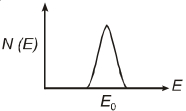
B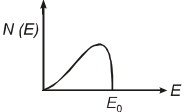
C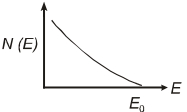
D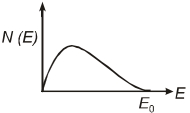
Solution
(D) In $\beta$-decay,the energy released is shared between the $\beta$-particle and the antineutrino (or neutrino). Because the energy is shared in a continuous manner,the $\beta$-particles are emitted with a continuous range of kinetic energies,from zero up to a maximum value $E_0$. The distribution curve $N(E)$ versus $E$ starts from zero at $E=0$,reaches a peak at an intermediate energy,and drops to zero at the maximum energy $E_0$. This corresponds to the graph shown in option $D$.
0 likesView Solution
46
PhysicsEasyMCQAIEEE · 2006
When $_3^7Li$ nuclei are bombarded by protons, and the resultant nuclei are $_4^8Be$, the emitted particles will be
A
Neutrons
B
$\alpha$-particles
C
$\beta$-particles
D
$\gamma$-particles
Solution
(D) The nuclear reaction is given by: $_3^7Li + _1^1p \to _4^8Be + X$.
Applying the law of conservation of mass number: $7 + 1 = 8 + A \implies A = 0$.
Applying the law of conservation of atomic number: $3 + 1 = 4 + Z \implies Z = 0$.
The particle with mass number $0$ and atomic number $0$ is a gamma photon ($\gamma$).
Therefore, the emitted particle is a $\gamma$-particle.
Applying the law of conservation of mass number: $7 + 1 = 8 + A \implies A = 0$.
Applying the law of conservation of atomic number: $3 + 1 = 4 + Z \implies Z = 0$.
The particle with mass number $0$ and atomic number $0$ is a gamma photon ($\gamma$).
Therefore, the emitted particle is a $\gamma$-particle.
0 likesView Solution
47
PhysicsMediumMCQAIEEE · 2006
If the binding energy per nucleon in $_3^7Li$ and $_2^4He$ nuclei are $5.60 \, MeV$ and $7.06 \, MeV$ respectively,then in the reaction $p + {}_3^7Li \to 2 {}_2^4He$,the energy of the proton must be ........... $MeV$.
A
$39.2$
B
$28.24$
C
$17.28$
D
$1.46$
Solution
(C) The binding energy of a nucleus is given by the product of the number of nucleons and the binding energy per nucleon.
For $_3^7Li$,the total binding energy is $7 \times 5.60 \, MeV = 39.20 \, MeV$.
For $_2^4He$,the total binding energy of one nucleus is $4 \times 7.06 \, MeV = 28.24 \, MeV$.
In the reaction $p + {}_3^7Li \to 2 {}_2^4He$,the total energy must be conserved.
The energy of the proton $(E_p)$ plus the binding energy of the reactant nucleus must equal the total binding energy of the product nuclei.
$E_p + 39.20 \, MeV = 2 \times (28.24 \, MeV)$.
$E_p + 39.20 = 56.48$.
$E_p = 56.48 - 39.20 = 17.28 \, MeV$.
For $_3^7Li$,the total binding energy is $7 \times 5.60 \, MeV = 39.20 \, MeV$.
For $_2^4He$,the total binding energy of one nucleus is $4 \times 7.06 \, MeV = 28.24 \, MeV$.
In the reaction $p + {}_3^7Li \to 2 {}_2^4He$,the total energy must be conserved.
The energy of the proton $(E_p)$ plus the binding energy of the reactant nucleus must equal the total binding energy of the product nuclei.
$E_p + 39.20 \, MeV = 2 \times (28.24 \, MeV)$.
$E_p + 39.20 = 56.48$.
$E_p = 56.48 - 39.20 = 17.28 \, MeV$.
0 likesView Solution
48
PhysicsEasyMCQAIEEE · 2006
The '$rad$' is the correct unit used to report the measurement of
A
the rate of decay of a radioactive source
B
the ability of a beam of gamma ray photons to produce ions in a target
C
the energy delivered by radiation to a target
D
the biological effect of radiation
Solution
(C) The '$rad$' (radiation absorbed dose) is a unit of absorbed radiation dose.
It is defined as the absorption of $100 \ erg$ of energy per gram of matter (usually tissue).
Therefore,it measures the energy delivered by radiation to a target material.
One '$rad$' is equivalent to $0.01 \ J/kg$ or $0.01 \ Gray$ $(Gy)$.
It is defined as the absorption of $100 \ erg$ of energy per gram of matter (usually tissue).
Therefore,it measures the energy delivered by radiation to a target material.
One '$rad$' is equivalent to $0.01 \ J/kg$ or $0.01 \ Gray$ $(Gy)$.
0 likesView Solution
49
PhysicsEasyMCQAIEEE · 2006
$A$ solid which is not transparent to visible light and whose conductivity increases with temperature is formed by
A
Metallic bonding
B
Ionic bonding
C
Covalent bonding
D
Van der Waals bonding
Solution
(C) The property of increasing conductivity with an increase in temperature is a characteristic feature of semiconductors.
Semiconductors are typically formed by covalent bonding (e.g.,Silicon,Germanium).
Metals (metallic bonding) show a decrease in conductivity with an increase in temperature.
Ionic solids are generally transparent to visible light and are insulators.
Therefore,the solid described is formed by covalent bonding.
Semiconductors are typically formed by covalent bonding (e.g.,Silicon,Germanium).
Metals (metallic bonding) show a decrease in conductivity with an increase in temperature.
Ionic solids are generally transparent to visible light and are insulators.
Therefore,the solid described is formed by covalent bonding.
0 likesView Solution
50
PhysicsEasyMCQAIEEE · 2006
If the ratio of the concentration of electrons to that of holes in a semiconductor is $\frac{7}{5}$ and the ratio of currents is $\frac{7}{4}$,then what is the ratio of their drift velocities?
A
$\frac{4}{7}$
B
$\frac{5}{8}$
C
$\frac{4}{5}$
D
$\frac{5}{4}$
Solution
(D) The current in a semiconductor is given by $I = n e A v_d$,where $n$ is the concentration,$e$ is the charge,$A$ is the cross-sectional area,and $v_d$ is the drift velocity.
For electrons and holes,the ratio of currents is given by:
$\frac{I_e}{I_h} = \frac{n_e e A v_e}{n_h e A v_h} = \frac{n_e}{n_h} \times \frac{v_e}{v_h}$
Given $\frac{n_e}{n_h} = \frac{7}{5}$ and $\frac{I_e}{I_h} = \frac{7}{4}$.
Substituting these values:
$\frac{7}{4} = \frac{7}{5} \times \frac{v_e}{v_h}$
$\frac{v_e}{v_h} = \frac{7}{4} \times \frac{5}{7} = \frac{5}{4}$.
For electrons and holes,the ratio of currents is given by:
$\frac{I_e}{I_h} = \frac{n_e e A v_e}{n_h e A v_h} = \frac{n_e}{n_h} \times \frac{v_e}{v_h}$
Given $\frac{n_e}{n_h} = \frac{7}{5}$ and $\frac{I_e}{I_h} = \frac{7}{4}$.
Substituting these values:
$\frac{7}{4} = \frac{7}{5} \times \frac{v_e}{v_h}$
$\frac{v_e}{v_h} = \frac{7}{4} \times \frac{5}{7} = \frac{5}{4}$.
0 likesView Solution
51
PhysicsEasyMCQAIEEE · 2006
In a common base mode of a transistor,the collector current is $5.488 \ mA$ for an emitter current of $5.60 \ mA$. The value of the base current amplification factor $(\beta)$ will be
A
$48$
B
$49$
C
$50$
D
$51$
Solution
(B) Given: Collector current $I_C = 5.488 \ mA$ and Emitter current $I_E = 5.60 \ mA$.
First,calculate the base current $I_B$ using the relation $I_B = I_E - I_C$.
$I_B = 5.60 \ mA - 5.488 \ mA = 0.112 \ mA$.
The base current amplification factor $\beta$ is defined as the ratio of collector current to base current: $\beta = \frac{I_C}{I_B}$.
Substituting the values: $\beta = \frac{5.488}{0.112} = 49$.
Thus,the value of $\beta$ is $49$.
First,calculate the base current $I_B$ using the relation $I_B = I_E - I_C$.
$I_B = 5.60 \ mA - 5.488 \ mA = 0.112 \ mA$.
The base current amplification factor $\beta$ is defined as the ratio of collector current to base current: $\beta = \frac{I_C}{I_B}$.
Substituting the values: $\beta = \frac{5.488}{0.112} = 49$.
Thus,the value of $\beta$ is $49$.
0 likesView Solution
52
PhysicsEasyMCQAIEEE · 2006
If the lattice constant of this semiconductor is decreased,then which of the following is correct?
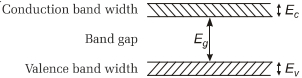
A
All $E_c, E_g, E_v$ decrease
B
All $E_c, E_g$ and $E_v$ increase
C
$E_c$ and $E_v$ increase,but $E_g$ decreases
D
$E_c$ and $E_v$ decrease,but $E_g$ increases
Solution
(C) In a semiconductor crystal,the lattice constant represents the spacing between atoms.
When the lattice constant decreases,the atoms are brought closer together,which increases the overlap of atomic orbitals.
This increased overlap leads to a broadening of the energy bands,meaning the widths of the conduction band $(E_c)$ and the valence band $(E_v)$ increase.
Simultaneously,the increased interaction between atoms results in a decrease in the band gap $(E_g)$.
Therefore,$E_c$ and $E_v$ increase,while $E_g$ decreases.
When the lattice constant decreases,the atoms are brought closer together,which increases the overlap of atomic orbitals.
This increased overlap leads to a broadening of the energy bands,meaning the widths of the conduction band $(E_c)$ and the valence band $(E_v)$ increase.
Simultaneously,the increased interaction between atoms results in a decrease in the band gap $(E_g)$.
Therefore,$E_c$ and $E_v$ increase,while $E_g$ decreases.
0 likesView Solution
53
PhysicsEasyMCQAIEEE · 2006
In the following circuits,which one of the diodes is reverse biased?
A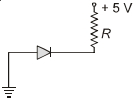
B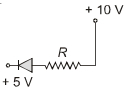
C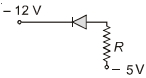
D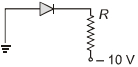
Solution
(A) diode is reverse biased when its $p$-side is connected to a lower potential and its $n$-side is connected to a higher potential.
Let us analyze the options:
$A$: The $p$-side is at $0 \ V$ (ground) and the $n$-side is at $+5 \ V$. Since $0 \ V < +5 \ V$,this is reverse biased.
$B$: The $p$-side is at $+5 \ V$ and the $n$-side is at $+10 \ V$. Since $5 \ V < 10 \ V$,this is also reverse biased.
$C$: The $p$-side is at $-12 \ V$ and the $n$-side is at $-5 \ V$. Since $-12 \ V < -5 \ V$,this is also reverse biased.
$D$: The $p$-side is at $0 \ V$ (ground) and the $n$-side is at $-10 \ V$. Since $0 \ V > -10 \ V$,this is forward biased.
Note: In standard multiple-choice questions of this type,usually only one option is intended to be correct. However,based on the provided diagrams,options $A$,$B$,and $C$ all represent reverse-biased configurations. Given the typical structure,$A$ is the most standard representation of a reverse-biased diode.
Let us analyze the options:
$A$: The $p$-side is at $0 \ V$ (ground) and the $n$-side is at $+5 \ V$. Since $0 \ V < +5 \ V$,this is reverse biased.
$B$: The $p$-side is at $+5 \ V$ and the $n$-side is at $+10 \ V$. Since $5 \ V < 10 \ V$,this is also reverse biased.
$C$: The $p$-side is at $-12 \ V$ and the $n$-side is at $-5 \ V$. Since $-12 \ V < -5 \ V$,this is also reverse biased.
$D$: The $p$-side is at $0 \ V$ (ground) and the $n$-side is at $-10 \ V$. Since $0 \ V > -10 \ V$,this is forward biased.
Note: In standard multiple-choice questions of this type,usually only one option is intended to be correct. However,based on the provided diagrams,options $A$,$B$,and $C$ all represent reverse-biased configurations. Given the typical structure,$A$ is the most standard representation of a reverse-biased diode.
0 likesView Solution
54
PhysicsMediumMCQAIEEE · 2006
The circuit has two oppositely connected ideal diodes in parallel. What is the current flowing in the circuit (in $A$)?
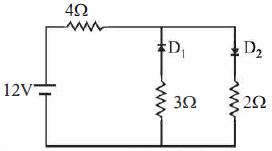
A
$1.33$
B
$1.71$
C
$2$
D
$2.31$
Solution
(C) In the given circuit,the positive terminal of the $12 \ V$ battery is connected such that diode $D_2$ is forward-biased and diode $D_1$ is reverse-biased.
Since $D_1$ is reverse-biased,it acts as an open circuit and no current flows through the $3 \ \Omega$ resistor branch.
Since $D_2$ is forward-biased and ideal,it acts as a short circuit. The current flows through the $4 \ \Omega$ resistor and the $2 \ \Omega$ resistor branch.
The total resistance of the circuit is $R = 4 \ \Omega + 2 \ \Omega = 6 \ \Omega$.
Using Ohm's law,the current $i$ in the circuit is given by:
$i = \frac{V}{R} = \frac{12 \ V}{6 \ \Omega} = 2 \ A$.
Since $D_1$ is reverse-biased,it acts as an open circuit and no current flows through the $3 \ \Omega$ resistor branch.
Since $D_2$ is forward-biased and ideal,it acts as a short circuit. The current flows through the $4 \ \Omega$ resistor and the $2 \ \Omega$ resistor branch.
The total resistance of the circuit is $R = 4 \ \Omega + 2 \ \Omega = 6 \ \Omega$.
Using Ohm's law,the current $i$ in the circuit is given by:
$i = \frac{V}{R} = \frac{12 \ V}{6 \ \Omega} = 2 \ A$.
0 likesView Solution
55
PhysicsMediumMCQAIEEE · 2006
The flux linked with a coil at any instant $t$ is given by $\phi = 10t^2 - 50t + 250$. The induced $emf$ at $t = 3 \ s$ is ....... $V$.
A
$-190$
B
$-10$
C
$10$
D
$190$
Solution
(B) The magnetic flux linked with the coil is given by $\phi = 10t^2 - 50t + 250$.
According to Faraday's law of electromagnetic induction,the induced $emf$ $(e)$ is given by $e = -\frac{d\phi}{dt}$.
Differentiating the flux with respect to time $t$:
$\frac{d\phi}{dt} = \frac{d}{dt}(10t^2 - 50t + 250) = 20t - 50$.
Therefore,the induced $emf$ is $e = -(20t - 50) = 50 - 20t$.
At $t = 3 \ s$,the induced $emf$ is:
$e = 50 - 20(3) = 50 - 60 = -10 \ V$.
According to Faraday's law of electromagnetic induction,the induced $emf$ $(e)$ is given by $e = -\frac{d\phi}{dt}$.
Differentiating the flux with respect to time $t$:
$\frac{d\phi}{dt} = \frac{d}{dt}(10t^2 - 50t + 250) = 20t - 50$.
Therefore,the induced $emf$ is $e = -(20t - 50) = 50 - 20t$.
At $t = 3 \ s$,the induced $emf$ is:
$e = 50 - 20(3) = 50 - 60 = -10 \ V$.
0 likesView Solution
Vedclass Products
For Students
Vedclass Test Series
Mock tests in real AIEEE style covering Physics with performance analysis. 5-day free trial.
Start Free TrialFor Teachers
Exam Paper Generator
Generate Set A/B/C/D Physics papers from 7.5L+ questions in 2 minutes. 3 chapters free.
Try FreeFor Institutes
Online Exam Module
Run live AIEEE mock exams with unlimited students, 360° analytics & white-label branding.
See DemoFrequently Asked Questions
How many Physics questions are in AIEEE 2006?
There are 55 Physics questions from the AIEEE 2006 paper on Vedclass, each with a detailed step-by-step solution in English.
Are AIEEE 2006 Physics solutions available in English?
Yes. All solutions on this page are in English. You can also switch to English or Hindi using the language buttons above the questions.
Can I practice AIEEE 2006 Physics as a timed test?
Yes. Use the Vedclass Test Series to attempt a full AIEEE mock test covering Physics with time limits and instant score analysis.
Can teachers create Physics papers from AIEEE previous year questions?
Yes. The Vedclass Exam Paper Generator lets teachers mix AIEEE Physics questions and generate Set A/B/C/D papers in minutes.
For Teachers & Institutes
Build a Custom Physics Paper
Pick AIEEE 2006 Physics questions, set difficulty, and generate Set A/B/C/D in 2 minutes.