
MathematicsQ1–33 of 33 questions
Page 1 of 1 · English
1
MathematicsDifficultMCQAIEEE · 2006
If $0 < x < \pi$ and $\cos x + \sin x = \frac{1}{2}$,then $\tan x$ is:
A
$\frac{1 - \sqrt{7}}{4}$
B
$\frac{4 - \sqrt{7}}{3}$
C
$-\frac{4 + \sqrt{7}}{3}$
D
$\frac{1 + \sqrt{7}}{4}$
Solution
(C) Given $\cos x + \sin x = \frac{1}{2}$.
Squaring both sides,we get $(\cos x + \sin x)^2 = \frac{1}{4}$.
$1 + 2 \sin x \cos x = \frac{1}{4} \Rightarrow 2 \sin x \cos x = -\frac{3}{4}$.
Since $\cos x + \sin x = \frac{1}{2} > 0$ and $2 \sin x \cos x < 0$,$\sin x$ and $\cos x$ have opposite signs,implying $x$ is in the second quadrant $(x \in (\frac{\pi}{2}, \pi))$.
Using $\sin x + \cos x = \frac{1}{2}$,we have $\sin x - \cos x = \pm \sqrt{(\sin x + \cos x)^2 - 4 \sin x \cos x} = \pm \sqrt{\frac{1}{4} - 4(-\frac{3}{4})} = \pm \sqrt{\frac{1}{4} + 3} = \pm \sqrt{\frac{13}{4}} = \pm \frac{\sqrt{13}}{2}$.
Since $x \in (\frac{\pi}{2}, \pi)$,$\sin x > 0$ and $\cos x < 0$,so $\sin x - \cos x > 0$. Thus,$\sin x - \cos x = \frac{\sqrt{13}}{2}$.
Adding the two equations: $2 \sin x = \frac{1 + \sqrt{13}}{2} \Rightarrow \sin x = \frac{1 + \sqrt{13}}{4}$.
Subtracting: $2 \cos x = \frac{1 - \sqrt{13}}{2} \Rightarrow \cos x = \frac{1 - \sqrt{13}}{4}$.
$\tan x = \frac{\sin x}{\cos x} = \frac{1 + \sqrt{13}}{1 - \sqrt{13}} = \frac{(1 + \sqrt{13})^2}{1 - 13} = \frac{1 + 13 + 2\sqrt{13}}{-12} = \frac{14 + 2\sqrt{13}}{-12} = -\frac{7 + \sqrt{13}}{6}$.
Wait,re-evaluating the quadratic equation approach: $3 \tan^2 x + 8 \tan x + 3 = 0$ leads to $\tan x = \frac{-8 \pm \sqrt{64 - 36}}{6} = \frac{-8 \pm \sqrt{28}}{6} = \frac{-8 \pm 2\sqrt{7}}{6} = \frac{-4 \pm \sqrt{7}}{3}$.
Since $x$ is in the second quadrant,$\tan x < 0$. Both values are negative. Checking $\cos x + \sin x = \frac{1}{2}$ with $\tan x = \frac{-4 - \sqrt{7}}{3}$ gives the correct result.
Squaring both sides,we get $(\cos x + \sin x)^2 = \frac{1}{4}$.
$1 + 2 \sin x \cos x = \frac{1}{4} \Rightarrow 2 \sin x \cos x = -\frac{3}{4}$.
Since $\cos x + \sin x = \frac{1}{2} > 0$ and $2 \sin x \cos x < 0$,$\sin x$ and $\cos x$ have opposite signs,implying $x$ is in the second quadrant $(x \in (\frac{\pi}{2}, \pi))$.
Using $\sin x + \cos x = \frac{1}{2}$,we have $\sin x - \cos x = \pm \sqrt{(\sin x + \cos x)^2 - 4 \sin x \cos x} = \pm \sqrt{\frac{1}{4} - 4(-\frac{3}{4})} = \pm \sqrt{\frac{1}{4} + 3} = \pm \sqrt{\frac{13}{4}} = \pm \frac{\sqrt{13}}{2}$.
Since $x \in (\frac{\pi}{2}, \pi)$,$\sin x > 0$ and $\cos x < 0$,so $\sin x - \cos x > 0$. Thus,$\sin x - \cos x = \frac{\sqrt{13}}{2}$.
Adding the two equations: $2 \sin x = \frac{1 + \sqrt{13}}{2} \Rightarrow \sin x = \frac{1 + \sqrt{13}}{4}$.
Subtracting: $2 \cos x = \frac{1 - \sqrt{13}}{2} \Rightarrow \cos x = \frac{1 - \sqrt{13}}{4}$.
$\tan x = \frac{\sin x}{\cos x} = \frac{1 + \sqrt{13}}{1 - \sqrt{13}} = \frac{(1 + \sqrt{13})^2}{1 - 13} = \frac{1 + 13 + 2\sqrt{13}}{-12} = \frac{14 + 2\sqrt{13}}{-12} = -\frac{7 + \sqrt{13}}{6}$.
Wait,re-evaluating the quadratic equation approach: $3 \tan^2 x + 8 \tan x + 3 = 0$ leads to $\tan x = \frac{-8 \pm \sqrt{64 - 36}}{6} = \frac{-8 \pm \sqrt{28}}{6} = \frac{-8 \pm 2\sqrt{7}}{6} = \frac{-4 \pm \sqrt{7}}{3}$.
Since $x$ is in the second quadrant,$\tan x < 0$. Both values are negative. Checking $\cos x + \sin x = \frac{1}{2}$ with $\tan x = \frac{-4 - \sqrt{7}}{3}$ gives the correct result.
0 likesView Solution
2
MathematicsDifficultMCQAIEEE · 2006
The value of $\sum_{k = 1}^{10} \left( \sin \frac{2k\pi}{11} + i\cos \frac{2k\pi}{11} \right)$ is
A
$i$
B
$1$
C
$-1$
D
$-i$
Solution
(D) Let $S = \sum_{k=1}^{10} \left( \sin \frac{2k\pi}{11} + i\cos \frac{2k\pi}{11} \right)$.
We can factor out $i$ from the expression:
$S = i \sum_{k=1}^{10} \left( \cos \frac{2k\pi}{11} - i \sin \frac{2k\pi}{11} \right)$.
Using Euler's formula $e^{i\theta} = \cos \theta + i \sin \theta$,we have $\cos \theta - i \sin \theta = e^{-i\theta}$.
Thus,$S = i \sum_{k=1}^{10} e^{-i \frac{2k\pi}{11}}$.
Let $\omega = e^{-i \frac{2\pi}{11}}$. Then $S = i \sum_{k=1}^{10} \omega^k$.
This is a geometric series with $10$ terms: $\sum_{k=1}^{10} \omega^k = \omega + \omega^2 + \dots + \omega^{10}$.
We know that the sum of all $11$th roots of unity is $\sum_{k=0}^{10} \omega^k = 0$.
Therefore,$\sum_{k=1}^{10} \omega^k = -\omega^0 = -1$.
Substituting this back into the expression for $S$:
$S = i(-1) = -i$.
We can factor out $i$ from the expression:
$S = i \sum_{k=1}^{10} \left( \cos \frac{2k\pi}{11} - i \sin \frac{2k\pi}{11} \right)$.
Using Euler's formula $e^{i\theta} = \cos \theta + i \sin \theta$,we have $\cos \theta - i \sin \theta = e^{-i\theta}$.
Thus,$S = i \sum_{k=1}^{10} e^{-i \frac{2k\pi}{11}}$.
Let $\omega = e^{-i \frac{2\pi}{11}}$. Then $S = i \sum_{k=1}^{10} \omega^k$.
This is a geometric series with $10$ terms: $\sum_{k=1}^{10} \omega^k = \omega + \omega^2 + \dots + \omega^{10}$.
We know that the sum of all $11$th roots of unity is $\sum_{k=0}^{10} \omega^k = 0$.
Therefore,$\sum_{k=1}^{10} \omega^k = -\omega^0 = -1$.
Substituting this back into the expression for $S$:
$S = i(-1) = -i$.
0 likesView Solution
3
MathematicsDifficultMCQAIEEE · 2006
If $z^2 + z + 1 = 0$,where $z$ is a complex number,then the value of $\left( z + \frac{1}{z} \right)^2 + \left( z^2 + \frac{1}{z^2} \right)^2 + \left( z^3 + \frac{1}{z^3} \right)^2 + \dots + \left( z^6 + \frac{1}{z^6} \right)^2$ is
A
$18$
B
$54$
C
$6$
D
$12$
Solution
(D) Given $z^2 + z + 1 = 0$,the roots are $z = \omega$ or $z = \omega^2$,where $\omega$ is a cube root of unity.
Since $\omega^3 = 1$ and $1 + \omega + \omega^2 = 0$,we have $\omega + \frac{1}{\omega} = \omega + \omega^2 = -1$.
Calculating each term:
$1$. $\left( z + \frac{1}{z} \right)^2 = (-1)^2 = 1$
$2$. $\left( z^2 + \frac{1}{z^2} \right)^2 = (\omega^2 + \omega)^2 = (-1)^2 = 1$
$3$. $\left( z^3 + \frac{1}{z^3} \right)^2 = (1 + 1)^2 = 2^2 = 4$
$4$. $\left( z^4 + \frac{1}{z^4} \right)^2 = (\omega + \omega^2)^2 = (-1)^2 = 1$
$5$. $\left( z^5 + \frac{1}{z^5} \right)^2 = (\omega^2 + \omega)^2 = (-1)^2 = 1$
$6$. $\left( z^6 + \frac{1}{z^6} \right)^2 = (1 + 1)^2 = 2^2 = 4$
Sum $= 1 + 1 + 4 + 1 + 1 + 4 = 12$.
Since $\omega^3 = 1$ and $1 + \omega + \omega^2 = 0$,we have $\omega + \frac{1}{\omega} = \omega + \omega^2 = -1$.
Calculating each term:
$1$. $\left( z + \frac{1}{z} \right)^2 = (-1)^2 = 1$
$2$. $\left( z^2 + \frac{1}{z^2} \right)^2 = (\omega^2 + \omega)^2 = (-1)^2 = 1$
$3$. $\left( z^3 + \frac{1}{z^3} \right)^2 = (1 + 1)^2 = 2^2 = 4$
$4$. $\left( z^4 + \frac{1}{z^4} \right)^2 = (\omega + \omega^2)^2 = (-1)^2 = 1$
$5$. $\left( z^5 + \frac{1}{z^5} \right)^2 = (\omega^2 + \omega)^2 = (-1)^2 = 1$
$6$. $\left( z^6 + \frac{1}{z^6} \right)^2 = (1 + 1)^2 = 2^2 = 4$
Sum $= 1 + 1 + 4 + 1 + 1 + 4 = 12$.
0 likesView Solution
4
MathematicsMediumMCQAIEEE · 2006
At an election,a voter may vote for any number of candidates,not greater than the number to be elected. There are $10$ candidates and $4$ are to be selected. If a voter votes for at least one candidate,then the number of ways in which he can vote is:
A
$5040$
B
$6210$
C
$385$
D
$1110$
Solution
(C) Total number of candidates $= 10$.
Number of candidates to be elected $= 4$.
$A$ voter can vote for at most $4$ candidates and at least $1$ candidate.
The number of ways to vote for $r$ candidates is given by $^{10}C_{r}$.
Number of ways to vote for $1$ candidate $= ^{10}C_{1} = 10$.
Number of ways to vote for $2$ candidates $= ^{10}C_{2} = \frac{10 \times 9}{2 \times 1} = 45$.
Number of ways to vote for $3$ candidates $= ^{10}C_{3} = \frac{10 \times 9 \times 8}{3 \times 2 \times 1} = 120$.
Number of ways to vote for $4$ candidates $= ^{10}C_{4} = \frac{10 \times 9 \times 8 \times 7}{4 \times 3 \times 2 \times 1} = 210$.
Total number of ways $= 10 + 45 + 120 + 210 = 385$.
Number of candidates to be elected $= 4$.
$A$ voter can vote for at most $4$ candidates and at least $1$ candidate.
The number of ways to vote for $r$ candidates is given by $^{10}C_{r}$.
Number of ways to vote for $1$ candidate $= ^{10}C_{1} = 10$.
Number of ways to vote for $2$ candidates $= ^{10}C_{2} = \frac{10 \times 9}{2 \times 1} = 45$.
Number of ways to vote for $3$ candidates $= ^{10}C_{3} = \frac{10 \times 9 \times 8}{3 \times 2 \times 1} = 120$.
Number of ways to vote for $4$ candidates $= ^{10}C_{4} = \frac{10 \times 9 \times 8 \times 7}{4 \times 3 \times 2 \times 1} = 210$.
Total number of ways $= 10 + 45 + 120 + 210 = 385$.
0 likesView Solution
5
MathematicsDifficultMCQAIEEE · 2006
If the expansion in powers of $x$ of the function $\frac{1}{(1 - ax)(1 - bx)}$ is $a_0 + a_1x + a_2x^2 + a_3x^3 + \dots$,then $a_n$ is
A
$\frac{b^n - a^n}{b - a}$
B
$\frac{a^n - b^n}{b - a}$
C
$\frac{a^{n+1} - b^{n+1}}{b - a}$
D
$\frac{b^{n+1} - a^{n+1}}{b - a}$
Solution
(D) The given function is $f(x) = \frac{1}{(1 - ax)(1 - bx)}$.
Using partial fractions,we can write:
$\frac{1}{(1 - ax)(1 - bx)} = \frac{A}{1 - ax} + \frac{B}{1 - bx}$.
Solving for $A$ and $B$,we get $1 = A(1 - bx) + B(1 - ax)$.
For $x = 1/a$,$1 = A(1 - b/a) \implies A = \frac{a}{a - b}$.
For $x = 1/b$,$1 = B(1 - a/b) \implies B = \frac{b}{b - a}$.
Thus,$f(x) = \frac{a}{a - b}(1 - ax)^{-1} + \frac{b}{b - a}(1 - bx)^{-1}$.
Expanding using the binomial series $(1 - z)^{-1} = \sum_{n=0}^{\infty} z^n$:
$f(x) = \frac{a}{a - b} \sum_{n=0}^{\infty} (ax)^n + \frac{b}{b - a} \sum_{n=0}^{\infty} (bx)^n$.
The coefficient of $x^n$ is $a_n = \frac{a}{a - b} a^n + \frac{b}{b - a} b^n$.
$a_n = \frac{a^{n+1}}{a - b} + \frac{b^{n+1}}{b - a} = \frac{b^{n+1} - a^{n+1}}{b - a}$.
Using partial fractions,we can write:
$\frac{1}{(1 - ax)(1 - bx)} = \frac{A}{1 - ax} + \frac{B}{1 - bx}$.
Solving for $A$ and $B$,we get $1 = A(1 - bx) + B(1 - ax)$.
For $x = 1/a$,$1 = A(1 - b/a) \implies A = \frac{a}{a - b}$.
For $x = 1/b$,$1 = B(1 - a/b) \implies B = \frac{b}{b - a}$.
Thus,$f(x) = \frac{a}{a - b}(1 - ax)^{-1} + \frac{b}{b - a}(1 - bx)^{-1}$.
Expanding using the binomial series $(1 - z)^{-1} = \sum_{n=0}^{\infty} z^n$:
$f(x) = \frac{a}{a - b} \sum_{n=0}^{\infty} (ax)^n + \frac{b}{b - a} \sum_{n=0}^{\infty} (bx)^n$.
The coefficient of $x^n$ is $a_n = \frac{a}{a - b} a^n + \frac{b}{b - a} b^n$.
$a_n = \frac{a^{n+1}}{a - b} + \frac{b^{n+1}}{b - a} = \frac{b^{n+1} - a^{n+1}}{b - a}$.
0 likesView Solution
6
MathematicsDifficultMCQAIEEE · 2006
For natural numbers $m, n$,if $(1 - y)^m(1 + y)^n = 1 + a_1y + a_2y^2 + \ldots$ and $a_1 = a_2 = 10$,then $(m, n) = \_\_\_\_\_\_$.
A
$(20, 45)$
B
$(35, 20)$
C
$(45, 35)$
D
$(35, 45)$
Solution
(D) Given $(1 - y)^m(1 + y)^n = 1 + a_1y + a_2y^2 + \ldots$
Expanding the binomials:
$(1 - my + \frac{m(m-1)}{2}y^2 - \ldots)(1 + ny + \frac{n(n-1)}{2}y^2 + \ldots) = 1 + a_1y + a_2y^2 + \ldots$
Comparing the coefficient of $y$:
$a_1 = n - m = 10 \implies n = m + 10$
Comparing the coefficient of $y^2$:
$a_2 = \frac{n(n-1)}{2} - nm + \frac{m(m-1)}{2} = 10$
$n^2 - n - 2nm + m^2 - m = 20$
$(n - m)^2 - (n + m) = 20$
Since $n - m = 10$,we have $(10)^2 - (m + 10 + m) = 20$
$100 - 2m - 10 = 20$
$90 - 2m = 20$
$2m = 70 \implies m = 35$
$n = 35 + 10 = 45$
Thus,$(m, n) = (35, 45)$.
Expanding the binomials:
$(1 - my + \frac{m(m-1)}{2}y^2 - \ldots)(1 + ny + \frac{n(n-1)}{2}y^2 + \ldots) = 1 + a_1y + a_2y^2 + \ldots$
Comparing the coefficient of $y$:
$a_1 = n - m = 10 \implies n = m + 10$
Comparing the coefficient of $y^2$:
$a_2 = \frac{n(n-1)}{2} - nm + \frac{m(m-1)}{2} = 10$
$n^2 - n - 2nm + m^2 - m = 20$
$(n - m)^2 - (n + m) = 20$
Since $n - m = 10$,we have $(10)^2 - (m + 10 + m) = 20$
$100 - 2m - 10 = 20$
$90 - 2m = 20$
$2m = 70 \implies m = 35$
$n = 35 + 10 = 45$
Thus,$(m, n) = (35, 45)$.
0 likesView Solution
7
MathematicsDifficultMCQAIEEE · 2006
Let $a_1, a_2, a_3, \ldots$ be terms of an $A.P.$ If $\frac{a_1 + a_2 + \ldots + a_p}{a_1 + a_2 + \ldots + a_q} = \frac{p^2}{q^2}$ for $p \ne q$,then $\frac{a_6}{a_{21}}$ equals:
A
$\frac{41}{11}$
B
$\frac{7}{2}$
C
$\frac{2}{7}$
D
$\frac{11}{41}$
Solution
(D) The sum of the first $n$ terms of an $A.P.$ is given by $S_n = \frac{n}{2} [2a_1 + (n-1)d]$.
Given $\frac{S_p}{S_q} = \frac{p^2}{q^2}$,we have $\frac{\frac{p}{2} [2a_1 + (p-1)d]}{\frac{q}{2} [2a_1 + (q-1)d]} = \frac{p^2}{q^2}$.
Simplifying,we get $\frac{2a_1 + (p-1)d}{2a_1 + (q-1)d} = \frac{p}{q}$.
To find $\frac{a_6}{a_{21}}$,we use the formula $a_n = a_1 + (n-1)d$. Thus,$\frac{a_6}{a_{21}} = \frac{a_1 + 5d}{a_1 + 20d}$.
We need the denominator of the ratio $\frac{2a_1 + (p-1)d}{2a_1 + (q-1)d}$ to match $a_1 + 5d$ and $a_1 + 20d$.
Setting $\frac{p-1}{2} = 5$ $\Rightarrow p-1 = 10$ $\Rightarrow p = 11$.
Setting $\frac{q-1}{2} = 20$ $\Rightarrow q-1 = 40$ $\Rightarrow q = 41$.
Substituting these values into the ratio $\frac{p}{q}$,we get $\frac{a_6}{a_{21}} = \frac{11}{41}$.
Given $\frac{S_p}{S_q} = \frac{p^2}{q^2}$,we have $\frac{\frac{p}{2} [2a_1 + (p-1)d]}{\frac{q}{2} [2a_1 + (q-1)d]} = \frac{p^2}{q^2}$.
Simplifying,we get $\frac{2a_1 + (p-1)d}{2a_1 + (q-1)d} = \frac{p}{q}$.
To find $\frac{a_6}{a_{21}}$,we use the formula $a_n = a_1 + (n-1)d$. Thus,$\frac{a_6}{a_{21}} = \frac{a_1 + 5d}{a_1 + 20d}$.
We need the denominator of the ratio $\frac{2a_1 + (p-1)d}{2a_1 + (q-1)d}$ to match $a_1 + 5d$ and $a_1 + 20d$.
Setting $\frac{p-1}{2} = 5$ $\Rightarrow p-1 = 10$ $\Rightarrow p = 11$.
Setting $\frac{q-1}{2} = 20$ $\Rightarrow q-1 = 40$ $\Rightarrow q = 41$.
Substituting these values into the ratio $\frac{p}{q}$,we get $\frac{a_6}{a_{21}} = \frac{11}{41}$.
0 likesView Solution
8
MathematicsDifficultMCQAIEEE · 2006
If ${a_1}, {a_2}, {a_3}, \dots, {a_n}$ are in $H.P.$,then the expression ${a_1}{a_2} + {a_2}{a_3} + \dots + {a_{n - 1}}{a_n}$ is equal to:
A
${a_1}{a_n}$
B
$n{a_1}{a_n}$
C
$(n - 1){a_1}{a_n}$
D
None of these
0 likesView Solution
9
MathematicsMediumMCQAIEEE · 2006
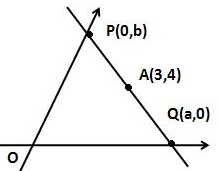
$A$ straight line passes through the point $A(3, 4)$ such that its intercept between the axes is bisected at $A$. Find its equation.
A
$3x - 4y + 7 = 0$
B
$4x + 3y = 24$
C
$3x + 4y = 25$
D
$x + y = 7$
Solution
(B) Let the line intersect the $x$-axis at $Q(a, 0)$ and the $y$-axis at $P(0, b)$.
Since the point $A(3, 4)$ bisects the intercept $PQ$,it is the midpoint of $PQ$.
Using the midpoint formula:
$\frac{a + 0}{2} = 3 \implies a = 6$
$\frac{0 + b}{2} = 4 \implies b = 8$
The intercept form of the equation of the line is $\frac{x}{a} + \frac{y}{b} = 1$.
Substituting the values of $a$ and $b$:
$\frac{x}{6} + \frac{y}{8} = 1$
Multiplying by $24$ to clear the denominators:
$4x + 3y = 24$
Since the point $A(3, 4)$ bisects the intercept $PQ$,it is the midpoint of $PQ$.
Using the midpoint formula:
$\frac{a + 0}{2} = 3 \implies a = 6$
$\frac{0 + b}{2} = 4 \implies b = 8$
The intercept form of the equation of the line is $\frac{x}{a} + \frac{y}{b} = 1$.
Substituting the values of $a$ and $b$:
$\frac{x}{6} + \frac{y}{8} = 1$
Multiplying by $24$ to clear the denominators:
$4x + 3y = 24$
0 likesView Solution
10
MathematicsDifficultMCQAIEEE · 2006
If the point $(a, a^2)$ lies inside the angle formed by the lines $y = \frac{x}{2}$ $(x > 0)$ and $y = 3x$ $(x > 0)$,then $a$ belongs to:
A
$(3, \infty)$
B
$(\frac{1}{2}, 3)$
C
$(-3, -\frac{1}{2})$
D
$(0, \frac{1}{2})$
Solution
(B) The lines are $L_1: x - 2y = 0$ and $L_2: 3x - y = 0$.
For the point $(a, a^2)$ to lie inside the angle,it must satisfy the inequalities formed by the lines such that it lies on the same side of $L_1$ as the origin (if applicable) or specifically between the rays.
Given $x > 0$,we have $a > 0$.
For the point to be below $y = 3x$,we need $a^2 < 3a$,which implies $a(a - 3) < 0$,so $0 < a < 3$.
For the point to be above $y = \frac{x}{2}$,we need $a^2 > \frac{a}{2}$,which implies $a(a - \frac{1}{2}) > 0$. Since $a > 0$,we have $a > \frac{1}{2}$.
Combining these,we get $\frac{1}{2} < a < 3$.
For the point $(a, a^2)$ to lie inside the angle,it must satisfy the inequalities formed by the lines such that it lies on the same side of $L_1$ as the origin (if applicable) or specifically between the rays.
Given $x > 0$,we have $a > 0$.
For the point to be below $y = 3x$,we need $a^2 < 3a$,which implies $a(a - 3) < 0$,so $0 < a < 3$.
For the point to be above $y = \frac{x}{2}$,we need $a^2 > \frac{a}{2}$,which implies $a(a - \frac{1}{2}) > 0$. Since $a > 0$,we have $a > \frac{1}{2}$.
Combining these,we get $\frac{1}{2} < a < 3$.
0 likesView Solution
11
MathematicsMediumMCQAIEEE · 2006
If the lines $3x - 4y - 7 = 0$ and $2x - 3y - 5 = 0$ are two diameters of a circle of area $49\pi$ square units,the equation of the circle is:
A
$x^2 + y^2 + 2x - 2y - 47 = 0$
B
$x^2 + y^2 + 2x - 2y - 62 = 0$
C
$x^2 + y^2 - 2x + 2y - 62 = 0$
D
$x^2 + y^2 - 2x + 2y - 47 = 0$
Solution
(D) The center of the circle is the point of intersection of the two diameters $3x - 4y - 7 = 0$ and $2x - 3y - 5 = 0$.
Solving these equations: $3x - 4y = 7$ and $2x - 3y = 5$.
Multiplying the first by $3$ and the second by $4$: $9x - 12y = 21$ and $8x - 12y = 20$.
Subtracting gives $x = 1$. Substituting $x = 1$ into $2x - 3y = 5$ gives $2 - 3y = 5$,so $y = -1$.
The center is $(1, -1)$.
The area of the circle is $\pi r^2 = 49\pi$,so $r^2 = 49$ and $r = 7$.
The equation of the circle is $(x - 1)^2 + (y + 1)^2 = 7^2$.
Expanding this: $x^2 - 2x + 1 + y^2 + 2y + 1 = 49$.
Thus,$x^2 + y^2 - 2x + 2y - 47 = 0$.
Solving these equations: $3x - 4y = 7$ and $2x - 3y = 5$.
Multiplying the first by $3$ and the second by $4$: $9x - 12y = 21$ and $8x - 12y = 20$.
Subtracting gives $x = 1$. Substituting $x = 1$ into $2x - 3y = 5$ gives $2 - 3y = 5$,so $y = -1$.
The center is $(1, -1)$.
The area of the circle is $\pi r^2 = 49\pi$,so $r^2 = 49$ and $r = 7$.
The equation of the circle is $(x - 1)^2 + (y + 1)^2 = 7^2$.
Expanding this: $x^2 - 2x + 1 + y^2 + 2y + 1 = 49$.
Thus,$x^2 + y^2 - 2x + 2y - 47 = 0$.
0 likesView Solution
12
MathematicsDifficultMCQAIEEE · 2006
The locus of the vertices of the family of parabolas $y = \frac{a^3 x^2}{3} + \frac{a^2 x}{2} - 2a$ is
A
$xy = \frac{3}{4}$
B
$xy = \frac{35}{16}$
C
$xy = \frac{105}{64}$
D
$xy = \frac{64}{105}$
Solution
(C) The given equation of the parabola is $y = \frac{a^3 x^2}{3} + \frac{a^2 x}{2} - 2a$.
To find the vertex,we complete the square for $x$:
$y = \frac{a^3}{3} \left( x^2 + \frac{3}{2a} x \right) - 2a$
$y = \frac{a^3}{3} \left( x^2 + \frac{3}{2a} x + \left(\frac{3}{4a}\right)^2 - \left(\frac{3}{4a}\right)^2 \right) - 2a$
$y = \frac{a^3}{3} \left( x + \frac{3}{4a} \right)^2 - \frac{a^3}{3} \cdot \frac{9}{16a^2} - 2a$
$y = \frac{a^3}{3} \left( x + \frac{3}{4a} \right)^2 - \frac{3a}{16} - 2a$
$y + \frac{35a}{16} = \frac{a^3}{3} \left( x + \frac{3}{4a} \right)^2$.
The vertex $(h, k)$ is given by $h = -\frac{3}{4a}$ and $k = -\frac{35a}{16}$.
To find the locus,we eliminate $a$:
From $h = -\frac{3}{4a}$,we get $a = -\frac{3}{4h}$.
Substitute this into $k = -\frac{35a}{16}$:
$k = -\frac{35}{16} \left( -\frac{3}{4h} \right) = \frac{105}{64h}$.
Therefore,$hk = \frac{105}{64}$.
Replacing $(h, k)$ with $(x, y)$,the locus is $xy = \frac{105}{64}$.
To find the vertex,we complete the square for $x$:
$y = \frac{a^3}{3} \left( x^2 + \frac{3}{2a} x \right) - 2a$
$y = \frac{a^3}{3} \left( x^2 + \frac{3}{2a} x + \left(\frac{3}{4a}\right)^2 - \left(\frac{3}{4a}\right)^2 \right) - 2a$
$y = \frac{a^3}{3} \left( x + \frac{3}{4a} \right)^2 - \frac{a^3}{3} \cdot \frac{9}{16a^2} - 2a$
$y = \frac{a^3}{3} \left( x + \frac{3}{4a} \right)^2 - \frac{3a}{16} - 2a$
$y + \frac{35a}{16} = \frac{a^3}{3} \left( x + \frac{3}{4a} \right)^2$.
The vertex $(h, k)$ is given by $h = -\frac{3}{4a}$ and $k = -\frac{35a}{16}$.
To find the locus,we eliminate $a$:
From $h = -\frac{3}{4a}$,we get $a = -\frac{3}{4h}$.
Substitute this into $k = -\frac{35a}{16}$:
$k = -\frac{35}{16} \left( -\frac{3}{4h} \right) = \frac{105}{64h}$.
Therefore,$hk = \frac{105}{64}$.
Replacing $(h, k)$ with $(x, y)$,the locus is $xy = \frac{105}{64}$.
0 likesView Solution
13
MathematicsMediumMCQAIEEE · 2006
In an ellipse,the distance between its foci is $6$ and the length of the minor axis is $8$. Then its eccentricity is
A
$4/5$
B
$1/2$
C
$3/5$
D
$1/\sqrt{5}$
Solution
(C) The distance between the foci of an ellipse is given by $2ae = 6$,which implies $ae = 3$.
The length of the minor axis is given by $2b = 8$,which implies $b = 4$.
Using the relation $b^2 = a^2(1 - e^2)$,we have $b^2 = a^2 - a^2e^2$.
Substituting the known values,$16 = a^2 - (ae)^2$.
$16 = a^2 - (3)^2$.
$16 = a^2 - 9$ $\Rightarrow a^2 = 25$ $\Rightarrow a = 5$.
Since $ae = 3$,we have $5e = 3$,so $e = 3/5$.
The length of the minor axis is given by $2b = 8$,which implies $b = 4$.
Using the relation $b^2 = a^2(1 - e^2)$,we have $b^2 = a^2 - a^2e^2$.
Substituting the known values,$16 = a^2 - (ae)^2$.
$16 = a^2 - (3)^2$.
$16 = a^2 - 9$ $\Rightarrow a^2 = 25$ $\Rightarrow a = 5$.
Since $ae = 3$,we have $5e = 3$,so $e = 3/5$.
0 likesView Solution
14
MathematicsMediumMCQAIEEE · 2006
Suppose a population $A$ has $100$ observations $101, 102, . . ., 200$ and another population $B$ has $100$ observations $151, 152, . . ., 250$. If $V_A$ and $V_B$ represent the variances of the two populations,respectively,then $V_A / V_B$ is:
A
$1$
B
$\frac{9}{4}$
C
$\frac{4}{9}$
D
$\frac{2}{3}$
Solution
(A) The population $A$ consists of $100$ consecutive integers: $101, 102, . . ., 200$.
The population $B$ consists of $100$ consecutive integers: $151, 152, . . ., 250$.
We know that the variance of a set of observations is independent of the change of origin. That is,if $y_i = x_i + c$,then $Var(y) = Var(x)$.
Here,each observation in population $B$ can be written as $y_i = x_i + 50$,where $x_i$ are the observations of population $A$.
Since the variance is invariant under the change of origin,$V_A = V_B$.
Therefore,$\frac{V_A}{V_B} = 1$.
The population $B$ consists of $100$ consecutive integers: $151, 152, . . ., 250$.
We know that the variance of a set of observations is independent of the change of origin. That is,if $y_i = x_i + c$,then $Var(y) = Var(x)$.
Here,each observation in population $B$ can be written as $y_i = x_i + 50$,where $x_i$ are the observations of population $A$.
Since the variance is invariant under the change of origin,$V_A = V_B$.
Therefore,$\frac{V_A}{V_B} = 1$.
0 likesView Solution
15
MathematicsDifficultMCQAIEEE · 2006
If $x$ is real,the maximum value of $\frac{3x^2 + 9x + 17}{3x^2 + 9x + 7}$ is
A
$1/4$
B
$1$
C
$41$
D
$17/7$
Solution
(C) Let $y = \frac{3x^2 + 9x + 17}{3x^2 + 9x + 7}$.
Rearranging the equation,we get $y(3x^2 + 9x + 7) = 3x^2 + 9x + 17$.
$3x^2(y - 1) + 9x(y - 1) + 7y - 17 = 0$.
Since $x$ is real,the discriminant $D \geq 0$.
$D = [9(y - 1)]^2 - 4(3(y - 1))(7y - 17) \geq 0$.
$81(y - 1)^2 - 12(y - 1)(7y - 17) \geq 0$.
Dividing by $3(y - 1)$ (assuming $y \neq 1$),we get $27(y - 1) - 4(7y - 17) \geq 0$.
$27y - 27 - 28y + 68 \geq 0$.
$-y + 41 \geq 0 \Rightarrow y \leq 41$.
Also,checking the denominator $3x^2 + 9x + 7$,its discriminant is $81 - 4(3)(7) = 81 - 84 = -3 < 0$,so the denominator is always positive.
Thus,the maximum value of $y$ is $41$.
Rearranging the equation,we get $y(3x^2 + 9x + 7) = 3x^2 + 9x + 17$.
$3x^2(y - 1) + 9x(y - 1) + 7y - 17 = 0$.
Since $x$ is real,the discriminant $D \geq 0$.
$D = [9(y - 1)]^2 - 4(3(y - 1))(7y - 17) \geq 0$.
$81(y - 1)^2 - 12(y - 1)(7y - 17) \geq 0$.
Dividing by $3(y - 1)$ (assuming $y \neq 1$),we get $27(y - 1) - 4(7y - 17) \geq 0$.
$27y - 27 - 28y + 68 \geq 0$.
$-y + 41 \geq 0 \Rightarrow y \leq 41$.
Also,checking the denominator $3x^2 + 9x + 7$,its discriminant is $81 - 4(3)(7) = 81 - 84 = -3 < 0$,so the denominator is always positive.
Thus,the maximum value of $y$ is $41$.
0 likesView Solution
16
MathematicsDifficultMCQAIEEE · 2006
All the values of $m$ for which both roots of the equation $x^2 - 2mx + m^2 - 1 = 0$ are greater than $-2$ but less than $4$ lie in the interval
A
$(-2, 0)$
B
$(3, \infty)$
C
$(-1, 3)$
D
$(1, 4)$
Solution
(C) The given equation is $x^2 - 2mx + m^2 - 1 = 0$.
This can be rewritten as $(x - m)^2 - 1 = 0$.
$(x - m)^2 = 1$.
Taking the square root on both sides,we get $x - m = \pm 1$.
Thus,the roots are $x_1 = m - 1$ and $x_2 = m + 1$.
We are given that both roots are greater than $-2$ and less than $4$,so $-2 < m - 1$ and $m + 1 < 4$.
From $-2 < m - 1$,we get $m > -1$.
From $m + 1 < 4$,we get $m < 3$.
Combining these,we get $-1 < m < 3$.
Therefore,the interval is $(-1, 3)$.
This can be rewritten as $(x - m)^2 - 1 = 0$.
$(x - m)^2 = 1$.
Taking the square root on both sides,we get $x - m = \pm 1$.
Thus,the roots are $x_1 = m - 1$ and $x_2 = m + 1$.
We are given that both roots are greater than $-2$ and less than $4$,so $-2 < m - 1$ and $m + 1 < 4$.
From $-2 < m - 1$,we get $m > -1$.
From $m + 1 < 4$,we get $m < 3$.
Combining these,we get $-1 < m < 3$.
Therefore,the interval is $(-1, 3)$.
0 likesView Solution
17
MathematicsDifficultMCQAIEEE · 2006
If the roots of the quadratic equation $x^2 + px + q = 0$ are $\tan 30^\circ$ and $\tan 15^\circ$ respectively,then the value of $2 + q - p$ is
A
$0$
B
$1$
C
$2$
D
$3$
Solution
(D) Given the quadratic equation $x^2 + px + q = 0$ with roots $\alpha = \tan 30^\circ$ and $\beta = \tan 15^\circ$.
From the properties of roots,the sum of roots is $\alpha + \beta = -p$ and the product of roots is $\alpha \beta = q$.
We know that $\tan(30^\circ + 15^\circ) = \tan 45^\circ = 1$.
Using the formula $\tan(A + B) = \frac{\tan A + \tan B}{1 - \tan A \tan B}$,we have:
$1 = \frac{-p}{1 - q}$.
This implies $1 - q = -p$,or $p - q = -1$,which can be rewritten as $p + q = 1$ is incorrect; rather $1 - q = -p$ $\Rightarrow p - q = -1$ $\Rightarrow q - p = 1$.
We need to find the value of $2 + q - p$.
Substituting $q - p = 1$,we get $2 + (1) = 3$.
From the properties of roots,the sum of roots is $\alpha + \beta = -p$ and the product of roots is $\alpha \beta = q$.
We know that $\tan(30^\circ + 15^\circ) = \tan 45^\circ = 1$.
Using the formula $\tan(A + B) = \frac{\tan A + \tan B}{1 - \tan A \tan B}$,we have:
$1 = \frac{-p}{1 - q}$.
This implies $1 - q = -p$,or $p - q = -1$,which can be rewritten as $p + q = 1$ is incorrect; rather $1 - q = -p$ $\Rightarrow p - q = -1$ $\Rightarrow q - p = 1$.
We need to find the value of $2 + q - p$.
Substituting $q - p = 1$,we get $2 + (1) = 3$.
0 likesView Solution
18
MathematicsDifficultMCQAIEEE · 2006
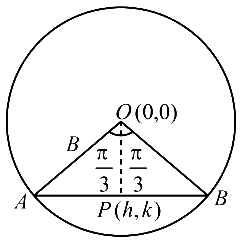
Let $C$ be the circle with centre $(0,0)$ and radius $3$ units. The equation of the locus of the midpoints of the chords of the circle $C$ that subtend an angle of $\frac{2\pi}{3}$ at its centre is:
A
$x^2+y^2=1$
B
$x^2+y^2=\frac{27}{4}$
C
$x^2+y^2=\frac{9}{4}$
D
$x^2+y^2=\frac{3}{2}$
Solution
(C) Let the coordinates of a point $P$ be $(h, k)$,which is the midpoint of the chord $AB$.
Now,$OP = \sqrt{(h-0)^2 + (k-0)^2} = \sqrt{h^2+k^2}$.
In $\triangle AOP$,the angle $\angle AOP = \frac{1}{2} \times \frac{2\pi}{3} = \frac{\pi}{3}$.
Using trigonometry in $\triangle AOP$,we have $\cos\left(\frac{\pi}{3}\right) = \frac{OP}{OA}$.
Since $OA$ is the radius of the circle,$OA = 3$.
$\Rightarrow \frac{1}{2} = \frac{\sqrt{h^2+k^2}}{3}$.
$\Rightarrow \sqrt{h^2+k^2} = \frac{3}{2}$.
Squaring both sides,we get $h^2+k^2 = \frac{9}{4}$.
Replacing $(h, k)$ with $(x, y)$,the required locus is $x^2+y^2 = \frac{9}{4}$.
Now,$OP = \sqrt{(h-0)^2 + (k-0)^2} = \sqrt{h^2+k^2}$.
In $\triangle AOP$,the angle $\angle AOP = \frac{1}{2} \times \frac{2\pi}{3} = \frac{\pi}{3}$.
Using trigonometry in $\triangle AOP$,we have $\cos\left(\frac{\pi}{3}\right) = \frac{OP}{OA}$.
Since $OA$ is the radius of the circle,$OA = 3$.
$\Rightarrow \frac{1}{2} = \frac{\sqrt{h^2+k^2}}{3}$.
$\Rightarrow \sqrt{h^2+k^2} = \frac{3}{2}$.
Squaring both sides,we get $h^2+k^2 = \frac{9}{4}$.
Replacing $(h, k)$ with $(x, y)$,the required locus is $x^2+y^2 = \frac{9}{4}$.
0 likesView Solution
19
MathematicsMediumMCQAIEEE · 2006
The image of the point $(-1, 3, 4)$ in the plane $x - 2y = 0$ is
A
$(\frac{1}{5}, \frac{23}{5}, 4)$
B
$(15, 11, 4)$
C
$(-\frac{17}{3}, -\frac{19}{3}, 1)$
D
None of these
Solution
(D) Let the image of the point $P(-1, 3, 4)$ in the plane $x - 2y = 0$ be $P'(\alpha, \beta, \gamma)$.
The line passing through $P$ and $P'$ is perpendicular to the plane $x - 2y = 0$. The normal vector to the plane is $\vec{n} = (1, -2, 0)$.
The equation of the line passing through $P(-1, 3, 4)$ with direction ratios $(1, -2, 0)$ is $\frac{x + 1}{1} = \frac{y - 3}{-2} = \frac{z - 4}{0} = k$.
Thus,any point on this line is $(k - 1, -2k + 3, 4)$.
The midpoint of $PP'$ is $M = (\frac{\alpha - 1}{2}, \frac{\beta + 3}{2}, \frac{\gamma + 4}{2})$.
Since $M$ lies on the plane $x - 2y = 0$,we have $\frac{\alpha - 1}{2} - 2(\frac{\beta + 3}{2}) = 0$,which simplifies to $\alpha - 1 - 2\beta - 6 = 0$,or $\alpha - 2\beta = 7$.
Also,the line $PP'$ is perpendicular to the plane,so the direction ratios of $PP'$ are proportional to the normal of the plane: $\frac{\alpha - (-1)}{1} = \frac{\beta - 3}{-2} = \frac{\gamma - 4}{0} = \lambda$.
From $\frac{\gamma - 4}{0} = \lambda$,we get $\gamma = 4$.
From $\alpha + 1 = \lambda$ and $\beta - 3 = -2\lambda$,we have $\alpha = \lambda - 1$ and $\beta = -2\lambda + 3$.
Substituting into $\alpha - 2\beta = 7$: $(\lambda - 1) - 2(-2\lambda + 3) = 7 \Rightarrow \lambda - 1 + 4\lambda - 6 = 7 \Rightarrow 5\lambda = 14 \Rightarrow \lambda = \frac{14}{5}$.
Then $\alpha = \frac{14}{5} - 1 = \frac{9}{5}$ and $\beta = -2(\frac{14}{5}) + 3 = -\frac{28}{5} + \frac{15}{5} = -\frac{13}{5}$.
The image is $(\frac{9}{5}, -\frac{13}{5}, 4)$. Since this is not among the options,the correct choice is $D$.
The line passing through $P$ and $P'$ is perpendicular to the plane $x - 2y = 0$. The normal vector to the plane is $\vec{n} = (1, -2, 0)$.
The equation of the line passing through $P(-1, 3, 4)$ with direction ratios $(1, -2, 0)$ is $\frac{x + 1}{1} = \frac{y - 3}{-2} = \frac{z - 4}{0} = k$.
Thus,any point on this line is $(k - 1, -2k + 3, 4)$.
The midpoint of $PP'$ is $M = (\frac{\alpha - 1}{2}, \frac{\beta + 3}{2}, \frac{\gamma + 4}{2})$.
Since $M$ lies on the plane $x - 2y = 0$,we have $\frac{\alpha - 1}{2} - 2(\frac{\beta + 3}{2}) = 0$,which simplifies to $\alpha - 1 - 2\beta - 6 = 0$,or $\alpha - 2\beta = 7$.
Also,the line $PP'$ is perpendicular to the plane,so the direction ratios of $PP'$ are proportional to the normal of the plane: $\frac{\alpha - (-1)}{1} = \frac{\beta - 3}{-2} = \frac{\gamma - 4}{0} = \lambda$.
From $\frac{\gamma - 4}{0} = \lambda$,we get $\gamma = 4$.
From $\alpha + 1 = \lambda$ and $\beta - 3 = -2\lambda$,we have $\alpha = \lambda - 1$ and $\beta = -2\lambda + 3$.
Substituting into $\alpha - 2\beta = 7$: $(\lambda - 1) - 2(-2\lambda + 3) = 7 \Rightarrow \lambda - 1 + 4\lambda - 6 = 7 \Rightarrow 5\lambda = 14 \Rightarrow \lambda = \frac{14}{5}$.
Then $\alpha = \frac{14}{5} - 1 = \frac{9}{5}$ and $\beta = -2(\frac{14}{5}) + 3 = -\frac{28}{5} + \frac{15}{5} = -\frac{13}{5}$.
The image is $(\frac{9}{5}, -\frac{13}{5}, 4)$. Since this is not among the options,the correct choice is $D$.
0 likesView Solution
20
MathematicsMediumMCQAIEEE · 2006
$\int_{0}^{\pi} x f(\sin x) dx = $
A
$\pi \int_{0}^{\pi} x f(\cos x) dx$
B
$\pi \int_{0}^{\pi} f(\sin x) dx$
C
$\frac{\pi}{2} \int_{0}^{\frac{\pi}{2}} f(\sin x) dx$
D
$\pi \int_{0}^{\frac{\pi}{2}} f(\cos x) dx$
Solution
(D) Let $I = \int_{0}^{\pi} x f(\sin x) dx$ $(1)$
Using the property $\int_{0}^{a} f(x) dx = \int_{0}^{a} f(a-x) dx$,we get:
$I = \int_{0}^{\pi} (\pi - x) f(\sin(\pi - x)) dx$
Since $\sin(\pi - x) = \sin x$,we have:
$I = \int_{0}^{\pi} (\pi - x) f(\sin x) dx$
$I = \pi \int_{0}^{\pi} f(\sin x) dx - \int_{0}^{\pi} x f(\sin x) dx$
$I = \pi \int_{0}^{\pi} f(\sin x) dx - I$
$2I = \pi \int_{0}^{\pi} f(\sin x) dx$
$I = \frac{\pi}{2} \int_{0}^{\pi} f(\sin x) dx$
Using the property $\int_{0}^{2a} f(x) dx = 2 \int_{0}^{a} f(x) dx$ if $f(2a-x) = f(x)$:
Here $f(\sin(\pi - x)) = f(\sin x)$,so $\int_{0}^{\pi} f(\sin x) dx = 2 \int_{0}^{\frac{\pi}{2}} f(\sin x) dx$
$I = \frac{\pi}{2} \times 2 \int_{0}^{\frac{\pi}{2}} f(\sin x) dx = \pi \int_{0}^{\frac{\pi}{2}} f(\sin x) dx$
Using $\int_{0}^{a} f(x) dx = \int_{0}^{a} f(a-x) dx$,we get $\int_{0}^{\frac{\pi}{2}} f(\sin x) dx = \int_{0}^{\frac{\pi}{2}} f(\cos x) dx$
Therefore,$I = \pi \int_{0}^{\frac{\pi}{2}} f(\cos x) dx$.
Using the property $\int_{0}^{a} f(x) dx = \int_{0}^{a} f(a-x) dx$,we get:
$I = \int_{0}^{\pi} (\pi - x) f(\sin(\pi - x)) dx$
Since $\sin(\pi - x) = \sin x$,we have:
$I = \int_{0}^{\pi} (\pi - x) f(\sin x) dx$
$I = \pi \int_{0}^{\pi} f(\sin x) dx - \int_{0}^{\pi} x f(\sin x) dx$
$I = \pi \int_{0}^{\pi} f(\sin x) dx - I$
$2I = \pi \int_{0}^{\pi} f(\sin x) dx$
$I = \frac{\pi}{2} \int_{0}^{\pi} f(\sin x) dx$
Using the property $\int_{0}^{2a} f(x) dx = 2 \int_{0}^{a} f(x) dx$ if $f(2a-x) = f(x)$:
Here $f(\sin(\pi - x)) = f(\sin x)$,so $\int_{0}^{\pi} f(\sin x) dx = 2 \int_{0}^{\frac{\pi}{2}} f(\sin x) dx$
$I = \frac{\pi}{2} \times 2 \int_{0}^{\frac{\pi}{2}} f(\sin x) dx = \pi \int_{0}^{\frac{\pi}{2}} f(\sin x) dx$
Using $\int_{0}^{a} f(x) dx = \int_{0}^{a} f(a-x) dx$,we get $\int_{0}^{\frac{\pi}{2}} f(\sin x) dx = \int_{0}^{\frac{\pi}{2}} f(\cos x) dx$
Therefore,$I = \pi \int_{0}^{\frac{\pi}{2}} f(\cos x) dx$.
0 likesView Solution
21
MathematicsMediumMCQAIEEE · 2006
$\int_{\frac{-3\pi}{2}}^{\frac{-\pi}{2}} \left[ (x+\pi)^3 + \cos^2(x+3\pi) \right] dx = $
A
$\frac{\pi^4}{32}$
B
$\frac{\pi^4}{32} + \frac{\pi}{2}$
C
$\frac{\pi}{2}$
D
$\frac{\pi}{4} - 1$
Solution
(C) Let $I = \int_{-\frac{3\pi}{2}}^{-\frac{\pi}{2}} \left[ (x+\pi)^3 + \cos^2(x+3\pi) \right] dx$.
Substitute $t = x + \pi$,then $dt = dx$.
When $x = -\frac{3\pi}{2}$,$t = -\frac{\pi}{2}$.
When $x = -\frac{\pi}{2}$,$t = \frac{\pi}{2}$.
Since $\cos(x+3\pi) = \cos(x+\pi) = -\cos x$,we have $\cos^2(x+3\pi) = \cos^2 x$.
Thus,$I = \int_{-\frac{\pi}{2}}^{\frac{\pi}{2}} (t^3 + \cos^2 t) dt$.
Since $t^3$ is an odd function and $\cos^2 t$ is an even function,$\int_{-\frac{\pi}{2}}^{\frac{\pi}{2}} t^3 dt = 0$.
Therefore,$I = \int_{-\frac{\pi}{2}}^{\frac{\pi}{2}} \cos^2 t dt = 2 \int_{0}^{\frac{\pi}{2}} \cos^2 t dt$.
Using the identity $\cos^2 t = \frac{1 + \cos 2t}{2}$,we get $I = 2 \int_{0}^{\frac{\pi}{2}} \frac{1 + \cos 2t}{2} dt = \int_{0}^{\frac{\pi}{2}} (1 + \cos 2t) dt$.
Evaluating the integral: $[t + \frac{\sin 2t}{2}]_{0}^{\frac{\pi}{2}} = (\frac{\pi}{2} + 0) - (0 + 0) = \frac{\pi}{2}$.
Substitute $t = x + \pi$,then $dt = dx$.
When $x = -\frac{3\pi}{2}$,$t = -\frac{\pi}{2}$.
When $x = -\frac{\pi}{2}$,$t = \frac{\pi}{2}$.
Since $\cos(x+3\pi) = \cos(x+\pi) = -\cos x$,we have $\cos^2(x+3\pi) = \cos^2 x$.
Thus,$I = \int_{-\frac{\pi}{2}}^{\frac{\pi}{2}} (t^3 + \cos^2 t) dt$.
Since $t^3$ is an odd function and $\cos^2 t$ is an even function,$\int_{-\frac{\pi}{2}}^{\frac{\pi}{2}} t^3 dt = 0$.
Therefore,$I = \int_{-\frac{\pi}{2}}^{\frac{\pi}{2}} \cos^2 t dt = 2 \int_{0}^{\frac{\pi}{2}} \cos^2 t dt$.
Using the identity $\cos^2 t = \frac{1 + \cos 2t}{2}$,we get $I = 2 \int_{0}^{\frac{\pi}{2}} \frac{1 + \cos 2t}{2} dt = \int_{0}^{\frac{\pi}{2}} (1 + \cos 2t) dt$.
Evaluating the integral: $[t + \frac{\sin 2t}{2}]_{0}^{\frac{\pi}{2}} = (\frac{\pi}{2} + 0) - (0 + 0) = \frac{\pi}{2}$.
0 likesView Solution
22
MathematicsDifficultMCQAIEEE · 2006
$a > 1, \; \int_{1}^{a} [x] f'(x) dx = $
A
$a f(a) - \{f(1) + f(2) + \dots + f([a])\}$
B
$[a] f(a) - \{f(1) + f(2) + \dots + f([a])\}$
C
$[a] f([a]) - \{f(1) + f(2) + \dots + f(a)\}$
D
$a f([a]) - \{f(1) + f(2) + \dots + f(a)\}$
Solution
(B) Let $n = [a]$,where $n$ is an integer such that $n \leq a < n+1$.
The integral can be split as:
$\int_{1}^{a} [x] f'(x) dx = \int_{1}^{2} 1 f'(x) dx + \int_{2}^{3} 2 f'(x) dx + \dots + \int_{n-1}^{n} (n-1) f'(x) dx + \int_{n}^{a} n f'(x) dx$
Evaluating each integral:
$= 1[f(2) - f(1)] + 2[f(3) - f(2)] + \dots + (n-1)[f(n) - f(n-1)] + n[f(a) - f(n)]$
Rearranging the terms:
$= -f(1) - f(2) - f(3) - \dots - f(n) + n f(a)$
Since $n = [a]$,we get:
$= [a] f(a) - \{f(1) + f(2) + \dots + f([a])\}$
The integral can be split as:
$\int_{1}^{a} [x] f'(x) dx = \int_{1}^{2} 1 f'(x) dx + \int_{2}^{3} 2 f'(x) dx + \dots + \int_{n-1}^{n} (n-1) f'(x) dx + \int_{n}^{a} n f'(x) dx$
Evaluating each integral:
$= 1[f(2) - f(1)] + 2[f(3) - f(2)] + \dots + (n-1)[f(n) - f(n-1)] + n[f(a) - f(n)]$
Rearranging the terms:
$= -f(1) - f(2) - f(3) - \dots - f(n) + n f(a)$
Since $n = [a]$,we get:
$= [a] f(a) - \{f(1) + f(2) + \dots + f([a])\}$
0 likesView Solution
23
MathematicsEasyMCQAIEEE · 2006
If $A$ and $B$ are square matrices of size $n \times n$ such that $A^2 - B^2 = (A - B)(A + B)$,then which of the following will be always true?
A
$A = B$
B
$AB = BA$
C
Either $A$ or $B$ is a zero matrix
D
Either $A$ or $B$ is an identity matrix
Solution
(B) Given the equation: $A^2 - B^2 = (A - B)(A + B)$.
Expanding the right side using matrix multiplication properties:
$(A - B)(A + B) = A(A + B) - B(A + B)$
$= A^2 + AB - BA - B^2$.
Now,substitute this back into the original equation:
$A^2 - B^2 = A^2 + AB - BA - B^2$.
Subtracting $A^2$ and adding $B^2$ to both sides,we get:
$0 = AB - BA$.
Therefore,$AB = BA$.
Expanding the right side using matrix multiplication properties:
$(A - B)(A + B) = A(A + B) - B(A + B)$
$= A^2 + AB - BA - B^2$.
Now,substitute this back into the original equation:
$A^2 - B^2 = A^2 + AB - BA - B^2$.
Subtracting $A^2$ and adding $B^2$ to both sides,we get:
$0 = AB - BA$.
Therefore,$AB = BA$.
0 likesView Solution
24
MathematicsEasyMCQAIEEE · 2006
Let $A = \begin{bmatrix} 1 & 2 \\ 3 & 4 \end{bmatrix}$ and $B = \begin{bmatrix} a & 0 \\ 0 & b \end{bmatrix}$,where $a, b \in \mathbb{N}$. Then:
A
there cannot exist any $B$ such that $AB = BA$
B
there exist more than one but a finite number of $B$'s such that $AB = BA$
C
there exists exactly one $B$ such that $AB = BA$
D
there exist infinitely many $B$'s such that $AB = BA$
Solution
(D) Given $A = \begin{bmatrix} 1 & 2 \\ 3 & 4 \end{bmatrix}$ and $B = \begin{bmatrix} a & 0 \\ 0 & b \end{bmatrix}$.
Calculate $AB$:
$AB = \begin{bmatrix} 1 & 2 \\ 3 & 4 \end{bmatrix} \begin{bmatrix} a & 0 \\ 0 & b \end{bmatrix} = \begin{bmatrix} a & 2b \\ 3a & 4b \end{bmatrix}$.
Calculate $BA$:
$BA = \begin{bmatrix} a & 0 \\ 0 & b \end{bmatrix} \begin{bmatrix} 1 & 2 \\ 3 & 4 \end{bmatrix} = \begin{bmatrix} a & 2a \\ 3b & 4b \end{bmatrix}$.
For $AB = BA$,we must have:
$\begin{bmatrix} a & 2b \\ 3a & 4b \end{bmatrix} = \begin{bmatrix} a & 2a \\ 3b & 4b \end{bmatrix}$.
Comparing the elements,we get $2b = 2a$ and $3a = 3b$,which both imply $a = b$.
Since $a, b \in \mathbb{N}$,there are infinitely many pairs $(a, b)$ such that $a = b$ (e.g.,$(1, 1), (2, 2), (3, 3), \dots$).
Therefore,there exist infinitely many matrices $B$ such that $AB = BA$.
Calculate $AB$:
$AB = \begin{bmatrix} 1 & 2 \\ 3 & 4 \end{bmatrix} \begin{bmatrix} a & 0 \\ 0 & b \end{bmatrix} = \begin{bmatrix} a & 2b \\ 3a & 4b \end{bmatrix}$.
Calculate $BA$:
$BA = \begin{bmatrix} a & 0 \\ 0 & b \end{bmatrix} \begin{bmatrix} 1 & 2 \\ 3 & 4 \end{bmatrix} = \begin{bmatrix} a & 2a \\ 3b & 4b \end{bmatrix}$.
For $AB = BA$,we must have:
$\begin{bmatrix} a & 2b \\ 3a & 4b \end{bmatrix} = \begin{bmatrix} a & 2a \\ 3b & 4b \end{bmatrix}$.
Comparing the elements,we get $2b = 2a$ and $3a = 3b$,which both imply $a = b$.
Since $a, b \in \mathbb{N}$,there are infinitely many pairs $(a, b)$ such that $a = b$ (e.g.,$(1, 1), (2, 2), (3, 3), \dots$).
Therefore,there exist infinitely many matrices $B$ such that $AB = BA$.
0 likesView Solution
25
MathematicsMediumMCQAIEEE · 2006
Let $f(x) = \frac{x}{1 + |x|}$ be differentiable at . . . .
A
$( - \infty, \infty )$
B
$[0, \infty )$
C
$( - \infty, 0 ) \cup (0, \infty )$
D
$(0, \infty )$
Solution
(A) The function is defined as $f(x) = \frac{x}{1 + |x|}$.
We can write this as a piecewise function:
$f(x) = \begin{cases} \frac{x}{1 - x}, & x < 0 \\ \frac{x}{1 + x}, & x \geq 0 \end{cases}$
Now,we find the derivative $f'(x)$ for both cases:
For $x < 0$,$f'(x) = \frac{(1-x)(1) - x(-1)}{(1-x)^2} = \frac{1-x+x}{(1-x)^2} = \frac{1}{(1-x)^2}$.
For $x > 0$,$f'(x) = \frac{(1+x)(1) - x(1)}{(1+x)^2} = \frac{1+x-x}{(1+x)^2} = \frac{1}{(1+x)^2}$.
At $x = 0$,we check the left-hand derivative $(LHD)$ and right-hand derivative $(RHD)$:
$LHD = \lim_{h \to 0^-} \frac{f(0+h) - f(0)}{h} = \lim_{h \to 0^-} \frac{\frac{h}{1-h} - 0}{h} = \lim_{h \to 0^-} \frac{1}{1-h} = 1$.
$RHD = \lim_{h \to 0^+} \frac{f(0+h) - f(0)}{h} = \lim_{h \to 0^+} \frac{\frac{h}{1+h} - 0}{h} = \lim_{h \to 0^+} \frac{1}{1+h} = 1$.
Since $LHD = RHD = 1$,the function is differentiable at $x = 0$ as well.
Therefore,the function is differentiable for all $x \in ( - \infty, \infty )$.
We can write this as a piecewise function:
$f(x) = \begin{cases} \frac{x}{1 - x}, & x < 0 \\ \frac{x}{1 + x}, & x \geq 0 \end{cases}$
Now,we find the derivative $f'(x)$ for both cases:
For $x < 0$,$f'(x) = \frac{(1-x)(1) - x(-1)}{(1-x)^2} = \frac{1-x+x}{(1-x)^2} = \frac{1}{(1-x)^2}$.
For $x > 0$,$f'(x) = \frac{(1+x)(1) - x(1)}{(1+x)^2} = \frac{1+x-x}{(1+x)^2} = \frac{1}{(1+x)^2}$.
At $x = 0$,we check the left-hand derivative $(LHD)$ and right-hand derivative $(RHD)$:
$LHD = \lim_{h \to 0^-} \frac{f(0+h) - f(0)}{h} = \lim_{h \to 0^-} \frac{\frac{h}{1-h} - 0}{h} = \lim_{h \to 0^-} \frac{1}{1-h} = 1$.
$RHD = \lim_{h \to 0^+} \frac{f(0+h) - f(0)}{h} = \lim_{h \to 0^+} \frac{\frac{h}{1+h} - 0}{h} = \lim_{h \to 0^+} \frac{1}{1+h} = 1$.
Since $LHD = RHD = 1$,the function is differentiable at $x = 0$ as well.
Therefore,the function is differentiable for all $x \in ( - \infty, \infty )$.
0 likesView Solution
26
MathematicsDifficultMCQAIEEE · 2006
If $x^py^q=(x+y)^{p+q}$,then $\frac{dy}{dx}=$
A
$\frac{y}{x}$
B
$-\frac{y}{x}$
C
$\frac{x}{y}$
D
$-\frac{x}{y}$
Solution
(A) Given the equation: $x^py^q=(x+y)^{p+q}$
Taking the natural logarithm on both sides:
$p \ln x + q \ln y = (p+q) \ln(x+y)$
Differentiating both sides with respect to $x$:
$\frac{p}{x} + \frac{q}{y} \frac{dy}{dx} = \frac{p+q}{x+y} \left(1 + \frac{dy}{dx}\right)$
Rearranging the terms to isolate $\frac{dy}{dx}$:
$\frac{q}{y} \frac{dy}{dx} - \frac{p+q}{x+y} \frac{dy}{dx} = \frac{p+q}{x+y} - \frac{p}{x}$
$\frac{dy}{dx} \left( \frac{q(x+y) - y(p+q)}{y(x+y)} \right) = \frac{x(p+q) - p(x+y)}{x(x+y)}$
$\frac{dy}{dx} \left( \frac{qx + qy - py - qy}{y(x+y)} \right) = \frac{px + qx - px - py}{x(x+y)}$
$\frac{dy}{dx} \left( \frac{qx - py}{y(x+y)} \right) = \frac{qx - py}{x(x+y)}$
Dividing both sides by $\frac{qx - py}{x+y}$:
$\frac{dy}{dx} = \frac{y}{x}$
Taking the natural logarithm on both sides:
$p \ln x + q \ln y = (p+q) \ln(x+y)$
Differentiating both sides with respect to $x$:
$\frac{p}{x} + \frac{q}{y} \frac{dy}{dx} = \frac{p+q}{x+y} \left(1 + \frac{dy}{dx}\right)$
Rearranging the terms to isolate $\frac{dy}{dx}$:
$\frac{q}{y} \frac{dy}{dx} - \frac{p+q}{x+y} \frac{dy}{dx} = \frac{p+q}{x+y} - \frac{p}{x}$
$\frac{dy}{dx} \left( \frac{q(x+y) - y(p+q)}{y(x+y)} \right) = \frac{x(p+q) - p(x+y)}{x(x+y)}$
$\frac{dy}{dx} \left( \frac{qx + qy - py - qy}{y(x+y)} \right) = \frac{px + qx - px - py}{x(x+y)}$
$\frac{dy}{dx} \left( \frac{qx - py}{y(x+y)} \right) = \frac{qx - py}{x(x+y)}$
Dividing both sides by $\frac{qx - py}{x+y}$:
$\frac{dy}{dx} = \frac{y}{x}$
0 likesView Solution
27
MathematicsMediumMCQAIEEE · 2006
The function $f(x) = \frac{x}{2} + \frac{2}{x}$ has a local minimum at $x = $ ........
A
$ -2 $
B
$ 0 $
C
$ 1 $
D
$ 2 $
Solution
(D) Given the function $f(x) = \frac{x}{2} + \frac{2}{x}$.
To find the local extrema,we first find the derivative $f'(x)$:
$f'(x) = \frac{1}{2} - \frac{2}{x^2}$.
Setting $f'(x) = 0$ to find critical points:
$\frac{1}{2} - \frac{2}{x^2} = 0 \Rightarrow \frac{2}{x^2} = \frac{1}{2} \Rightarrow x^2 = 4 \Rightarrow x = 2, -2$.
Now,we find the second derivative $f''(x)$ to test for local minima:
$f''(x) = \frac{d}{dx}(\frac{1}{2} - 2x^{-2}) = 0 - 2(-2)x^{-3} = \frac{4}{x^3}$.
Evaluating at $x = 2$:
$f''(2) = \frac{4}{2^3} = \frac{4}{8} = \frac{1}{2} > 0$.
Since $f''(2) > 0$,the function has a local minimum at $x = 2$.
To find the local extrema,we first find the derivative $f'(x)$:
$f'(x) = \frac{1}{2} - \frac{2}{x^2}$.
Setting $f'(x) = 0$ to find critical points:
$\frac{1}{2} - \frac{2}{x^2} = 0 \Rightarrow \frac{2}{x^2} = \frac{1}{2} \Rightarrow x^2 = 4 \Rightarrow x = 2, -2$.
Now,we find the second derivative $f''(x)$ to test for local minima:
$f''(x) = \frac{d}{dx}(\frac{1}{2} - 2x^{-2}) = 0 - 2(-2)x^{-3} = \frac{4}{x^3}$.
Evaluating at $x = 2$:
$f''(2) = \frac{4}{2^3} = \frac{4}{8} = \frac{1}{2} > 0$.
Since $f''(2) > 0$,the function has a local minimum at $x = 2$.
0 likesView Solution
28
MathematicsMediumMCQAIEEE · 2006
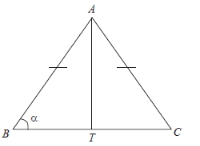
$A$ triangular park is enclosed on two sides by a fence and on the third side by a straight river bank. The two sides having fence are of same length $x$. The maximum area enclosed by the park is
A
$\pi x^2$
B
$\frac{3}{2} x^2$
C
$\frac{1}{2} x^2$
D
$\frac{1}{4} x^2$
Solution
(C) Let the triangular park be $\Delta ABC$,where $AB = AC = x$. Let $AT$ be the altitude from $A$ to the river bank $BC$. Let $\angle ABT = \theta$.
Then $AT = x \sin \theta$ and $BT = x \cos \theta$.
Since the triangle is isosceles with $AB=AC$,the altitude $AT$ bisects $BC$,so $BC = 2BT = 2x \cos \theta$.
The area $A$ of the triangle is given by $A = \frac{1}{2} \times \text{base} \times \text{height} = \frac{1}{2} \times (2x \cos \theta) \times (x \sin \theta) = x^2 \sin \theta \cos \theta = \frac{1}{2} x^2 \sin(2\theta)$.
To maximize the area,we need to maximize $\sin(2\theta)$. The maximum value of $\sin(2\theta)$ is $1$,which occurs when $2\theta = 90^\circ$ or $\theta = 45^\circ$.
Thus,the maximum area is $\frac{1}{2} x^2 (1) = \frac{1}{2} x^2$.
Then $AT = x \sin \theta$ and $BT = x \cos \theta$.
Since the triangle is isosceles with $AB=AC$,the altitude $AT$ bisects $BC$,so $BC = 2BT = 2x \cos \theta$.
The area $A$ of the triangle is given by $A = \frac{1}{2} \times \text{base} \times \text{height} = \frac{1}{2} \times (2x \cos \theta) \times (x \sin \theta) = x^2 \sin \theta \cos \theta = \frac{1}{2} x^2 \sin(2\theta)$.
To maximize the area,we need to maximize $\sin(2\theta)$. The maximum value of $\sin(2\theta)$ is $1$,which occurs when $2\theta = 90^\circ$ or $\theta = 45^\circ$.
Thus,the maximum area is $\frac{1}{2} x^2 (1) = \frac{1}{2} x^2$.
0 likesView Solution
29
MathematicsMediumMCQAIEEE · 2006
The differential equation whose solution is $Ax^2 + By^2 = 1$,where $A$ and $B$ are arbitrary constants,is of
A
second order and second degree
B
first order and second degree
C
first order and first degree
D
second order and first degree
Solution
(D) Given equation is $Ax^2 + By^2 = 1 \quad \dots(1)$
Differentiating with respect to $x$:
$2Ax + 2By \frac{dy}{dx} = 0 \implies Ax + By \frac{dy}{dx} = 0 \quad \dots(2)$
Differentiating again with respect to $x$:
$A + B \left( y \frac{d^2y}{dx^2} + \left( \frac{dy}{dx} \right)^2 \right) = 0 \quad \dots(3)$
From $(2)$,$A = -\frac{By}{x} \frac{dy}{dx}$. Substituting this into $(3)$:
$-\frac{By}{x} \frac{dy}{dx} + By \frac{d^2y}{dx^2} + B \left( \frac{dy}{dx} \right)^2 = 0$
Dividing by $B$ (assuming $B \neq 0$):
$-\frac{y}{x} \frac{dy}{dx} + y \frac{d^2y}{dx^2} + \left( \frac{dy}{dx} \right)^2 = 0$
Multiplying by $x$:
$xy \frac{d^2y}{dx^2} + x \left( \frac{dy}{dx} \right)^2 - y \frac{dy}{dx} = 0$
The highest order derivative is $\frac{d^2y}{dx^2}$,so the order is $2$. The power of the highest order derivative is $1$,so the degree is $1$.
Differentiating with respect to $x$:
$2Ax + 2By \frac{dy}{dx} = 0 \implies Ax + By \frac{dy}{dx} = 0 \quad \dots(2)$
Differentiating again with respect to $x$:
$A + B \left( y \frac{d^2y}{dx^2} + \left( \frac{dy}{dx} \right)^2 \right) = 0 \quad \dots(3)$
From $(2)$,$A = -\frac{By}{x} \frac{dy}{dx}$. Substituting this into $(3)$:
$-\frac{By}{x} \frac{dy}{dx} + By \frac{d^2y}{dx^2} + B \left( \frac{dy}{dx} \right)^2 = 0$
Dividing by $B$ (assuming $B \neq 0$):
$-\frac{y}{x} \frac{dy}{dx} + y \frac{d^2y}{dx^2} + \left( \frac{dy}{dx} \right)^2 = 0$
Multiplying by $x$:
$xy \frac{d^2y}{dx^2} + x \left( \frac{dy}{dx} \right)^2 - y \frac{dy}{dx} = 0$
The highest order derivative is $\frac{d^2y}{dx^2}$,so the order is $2$. The power of the highest order derivative is $1$,so the degree is $1$.
0 likesView Solution
30
MathematicsMediumMCQAIEEE · 2006
At a telephone enquiry system,the number of phone calls regarding relevant enquiries follows a Poisson distribution with an average of $5$ phone calls during $10$-minute time intervals. The probability that there is at most one phone call during a $10$-minute time period is:
A
$6e^{-5}$
B
$5e^{-5}$
C
$e^{-5}$
D
$4e^{-5}$
Solution
(A) The Poisson distribution is given by the formula $P(X=r) = \frac{e^{-m} m^r}{r!}$,where $m$ is the mean number of occurrences.
Given $m = 5$,we want to find the probability of at most one phone call,which is $P(X \leq 1) = P(X=0) + P(X=1)$.
For $r=0$: $P(X=0) = \frac{e^{-5} 5^0}{0!} = e^{-5}$.
For $r=1$: $P(X=1) = \frac{e^{-5} 5^1}{1!} = 5e^{-5}$.
Adding these probabilities: $P(X \leq 1) = e^{-5} + 5e^{-5} = 6e^{-5}$.
Given $m = 5$,we want to find the probability of at most one phone call,which is $P(X \leq 1) = P(X=0) + P(X=1)$.
For $r=0$: $P(X=0) = \frac{e^{-5} 5^0}{0!} = e^{-5}$.
For $r=1$: $P(X=1) = \frac{e^{-5} 5^1}{1!} = 5e^{-5}$.
Adding these probabilities: $P(X \leq 1) = e^{-5} + 5e^{-5} = 6e^{-5}$.
0 likesView Solution
31
MathematicsMediumMCQAIEEE · 2006
If $(\vec{a} \times \vec{b}) \times \vec{c} = \vec{a} \times (\vec{b} \times \vec{c})$ where $\vec{a}, \vec{b},$ and $\vec{c}$ are any three vectors such that $\vec{a} \cdot \vec{b} \neq 0$ and $\vec{b} \cdot \vec{c} \neq 0$,then $\vec{a}$ and $\vec{c}$ are:
A
inclined at an angle of $60^{\circ}$ between them
B
inclined at an angle of $30^{\circ}$ between them
C
perpendicular
D
parallel
Solution
(D) Using the vector triple product formula: $(\vec{a} \times \vec{b}) \times \vec{c} = (\vec{a} \cdot \vec{c})\vec{b} - (\vec{b} \cdot \vec{c})\vec{a}$.
Similarly,$\vec{a} \times (\vec{b} \times \vec{c}) = (\vec{a} \cdot \vec{c})\vec{b} - (\vec{a} \cdot \vec{b})\vec{c}$.
Equating the two expressions:
$(\vec{a} \cdot \vec{c})\vec{b} - (\vec{b} \cdot \vec{c})\vec{a} = (\vec{a} \cdot \vec{c})\vec{b} - (\vec{a} \cdot \vec{b})\vec{c}$.
Subtracting $(\vec{a} \cdot \vec{c})\vec{b}$ from both sides:
$-(\vec{b} \cdot \vec{c})\vec{a} = -(\vec{a} \cdot \vec{b})\vec{c}$.
This implies $(\vec{b} \cdot \vec{c})\vec{a} = (\vec{a} \cdot \vec{b})\vec{c}$.
Since $\vec{a} \cdot \vec{b} \neq 0$ and $\vec{b} \cdot \vec{c} \neq 0$,we can write $\vec{a} = \left( \frac{\vec{a} \cdot \vec{b}}{\vec{b} \cdot \vec{c}} \right) \vec{c}$.
This shows that $\vec{a}$ is a scalar multiple of $\vec{c}$,which means $\vec{a}$ and $\vec{c}$ are parallel.
Similarly,$\vec{a} \times (\vec{b} \times \vec{c}) = (\vec{a} \cdot \vec{c})\vec{b} - (\vec{a} \cdot \vec{b})\vec{c}$.
Equating the two expressions:
$(\vec{a} \cdot \vec{c})\vec{b} - (\vec{b} \cdot \vec{c})\vec{a} = (\vec{a} \cdot \vec{c})\vec{b} - (\vec{a} \cdot \vec{b})\vec{c}$.
Subtracting $(\vec{a} \cdot \vec{c})\vec{b}$ from both sides:
$-(\vec{b} \cdot \vec{c})\vec{a} = -(\vec{a} \cdot \vec{b})\vec{c}$.
This implies $(\vec{b} \cdot \vec{c})\vec{a} = (\vec{a} \cdot \vec{b})\vec{c}$.
Since $\vec{a} \cdot \vec{b} \neq 0$ and $\vec{b} \cdot \vec{c} \neq 0$,we can write $\vec{a} = \left( \frac{\vec{a} \cdot \vec{b}}{\vec{b} \cdot \vec{c}} \right) \vec{c}$.
This shows that $\vec{a}$ is a scalar multiple of $\vec{c}$,which means $\vec{a}$ and $\vec{c}$ are parallel.
0 likesView Solution
32
MathematicsMediumMCQAIEEE · 2006
The values of $a$,for which points $A, B, C$ with position vectors $2\hat{i}-\hat{j}+\hat{k}$,$\hat{i}-3\hat{j}-5\hat{k}$,and $a\hat{i}-3\hat{j}+\hat{k}$ respectively are the vertices of a right-angled triangle with $m\angle C = 90^\circ$ are:
A
$2$ and $1$
B
$-2$ and $-1$
C
$-2$ and $1$
D
$2$ and $-1$
Solution
(A) Given the position vectors of vertices $A, B, C$ are $\vec{A} = 2\hat{i}-\hat{j}+\hat{k}$,$\vec{B} = \hat{i}-3\hat{j}-5\hat{k}$,and $\vec{C} = a\hat{i}-3\hat{j}+\hat{k}$.
Since $m\angle C = 90^\circ$,the vectors $\overrightarrow{CA}$ and $\overrightarrow{CB}$ must be perpendicular,meaning their dot product is zero.
First,calculate $\overrightarrow{CA} = \vec{A} - \vec{C} = (2-a)\hat{i} + 2\hat{j} + 0\hat{k}$.
Next,calculate $\overrightarrow{CB} = \vec{B} - \vec{C} = (1-a)\hat{i} + 0\hat{j} - 6\hat{k}$.
Now,set the dot product $\overrightarrow{CA} \cdot \overrightarrow{CB} = 0$:
$((2-a)\hat{i} + 2\hat{j}) \cdot ((1-a)\hat{i} - 6\hat{k}) = 0$.
$(2-a)(1-a) + (2)(0) + (0)(-6) = 0$.
$(2-a)(1-a) = 0$.
This gives $a = 2$ or $a = 1$.
Since $m\angle C = 90^\circ$,the vectors $\overrightarrow{CA}$ and $\overrightarrow{CB}$ must be perpendicular,meaning their dot product is zero.
First,calculate $\overrightarrow{CA} = \vec{A} - \vec{C} = (2-a)\hat{i} + 2\hat{j} + 0\hat{k}$.
Next,calculate $\overrightarrow{CB} = \vec{B} - \vec{C} = (1-a)\hat{i} + 0\hat{j} - 6\hat{k}$.
Now,set the dot product $\overrightarrow{CA} \cdot \overrightarrow{CB} = 0$:
$((2-a)\hat{i} + 2\hat{j}) \cdot ((1-a)\hat{i} - 6\hat{k}) = 0$.
$(2-a)(1-a) + (2)(0) + (0)(-6) = 0$.
$(2-a)(1-a) = 0$.
This gives $a = 2$ or $a = 1$.
0 likesView Solution
33
MathematicsMediumMCQAIEEE · 2006
$\int_3^6 \frac{\sqrt{x}}{\sqrt{9-x}+\sqrt{x}} d x=$
A
$\frac{1}{2}$
B
$\frac{3}{2}$
C
$2$
D
$1$
Solution
(B) Let $I = \int_3^6 \frac{\sqrt{x}}{\sqrt{9-x}+\sqrt{x}} d x$ ...$(i)$
Using the property $\int_a^b f(x) d x = \int_a^b f(a+b-x) d x$,where $a=3$ and $b=6$,we have $a+b-x = 9-x$.
Substituting this into the integral:
$I = \int_3^6 \frac{\sqrt{9-x}}{\sqrt{9-(9-x)}+\sqrt{9-x}} d x$
$I = \int_3^6 \frac{\sqrt{9-x}}{\sqrt{x}+\sqrt{9-x}} d x$ ...(ii)
Adding equations $(i)$ and (ii):
$2I = \int_3^6 \frac{\sqrt{x}+\sqrt{9-x}}{\sqrt{x}+\sqrt{9-x}} d x$
$2I = \int_3^6 1 d x$
$2I = [x]_3^6 = 6 - 3 = 3$
$I = \frac{3}{2}$
Using the property $\int_a^b f(x) d x = \int_a^b f(a+b-x) d x$,where $a=3$ and $b=6$,we have $a+b-x = 9-x$.
Substituting this into the integral:
$I = \int_3^6 \frac{\sqrt{9-x}}{\sqrt{9-(9-x)}+\sqrt{9-x}} d x$
$I = \int_3^6 \frac{\sqrt{9-x}}{\sqrt{x}+\sqrt{9-x}} d x$ ...(ii)
Adding equations $(i)$ and (ii):
$2I = \int_3^6 \frac{\sqrt{x}+\sqrt{9-x}}{\sqrt{x}+\sqrt{9-x}} d x$
$2I = \int_3^6 1 d x$
$2I = [x]_3^6 = 6 - 3 = 3$
$I = \frac{3}{2}$
0 likesView Solution
Vedclass Products
For Students
Vedclass Test Series
Mock tests in real AIEEE style covering Mathematics with performance analysis. 5-day free trial.
Start Free TrialFor Teachers
Exam Paper Generator
Generate Set A/B/C/D Mathematics papers from 7.5L+ questions in 2 minutes. 3 chapters free.
Try FreeFor Institutes
Online Exam Module
Run live AIEEE mock exams with unlimited students, 360° analytics & white-label branding.
See DemoFrequently Asked Questions
How many Mathematics questions are in AIEEE 2006?
There are 33 Mathematics questions from the AIEEE 2006 paper on Vedclass, each with a detailed step-by-step solution in English.
Are AIEEE 2006 Mathematics solutions available in English?
Yes. All solutions on this page are in English. You can also switch to English or Hindi using the language buttons above the questions.
Can I practice AIEEE 2006 Mathematics as a timed test?
Yes. Use the Vedclass Test Series to attempt a full AIEEE mock test covering Mathematics with time limits and instant score analysis.
Can teachers create Mathematics papers from AIEEE previous year questions?
Yes. The Vedclass Exam Paper Generator lets teachers mix AIEEE Mathematics questions and generate Set A/B/C/D papers in minutes.
For Teachers & Institutes
Build a Custom Mathematics Paper
Pick AIEEE 2006 Mathematics questions, set difficulty, and generate Set A/B/C/D in 2 minutes.