
ChemistryQ51–59 of 90 questions
Page 2 of 2 · English
51
ChemistryMCQAIEEE · 2006
$A$ wire elongates by $l \, mm$ when a load $W$ is hanged from it. If the wire goes over a pulley and two weights $W$ each are hung at the two ends,the elongation of the wire will be (in $mm$):
A
Zero
B
$l/2$
C
$l$
D
$2l$
Solution
(C) From Hooke's Law,the elongation $\Delta L$ of a wire of length $L$,cross-sectional area $A$,and Young's modulus $Y$ under a tension $T$ is given by $\Delta L = \frac{TL}{AY}$.
In the first case,a load $W$ is hung from the wire. The tension in the wire is $T_1 = W$. Therefore,the elongation is $\Delta L_1 = \frac{WL}{AY} = l$.
In the second case,the wire passes over a pulley and a weight $W$ is hung at each end. The tension $T_2$ in the wire is equal to the weight $W$ because the system is in equilibrium. Thus,$T_2 = W$.
The elongation in the second case is $\Delta L_2 = \frac{T_2 L}{AY} = \frac{WL}{AY} = l$.
Therefore,the elongation remains $l \, mm$.
In the first case,a load $W$ is hung from the wire. The tension in the wire is $T_1 = W$. Therefore,the elongation is $\Delta L_1 = \frac{WL}{AY} = l$.
In the second case,the wire passes over a pulley and a weight $W$ is hung at each end. The tension $T_2$ in the wire is equal to the weight $W$ because the system is in equilibrium. Thus,$T_2 = W$.
The elongation in the second case is $\Delta L_2 = \frac{T_2 L}{AY} = \frac{WL}{AY} = l$.
Therefore,the elongation remains $l \, mm$.
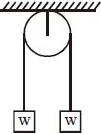
0 likesView Solution
52
ChemistryMCQAIEEE · 2006
The $rms$ value of the electric field of light coming from the Sun is $720\, N/C$. The average total energy density of the electromagnetic wave is
A
$4.58\times10^{-6}\, J/m^3$
B
$6.37\times10^{-9}\, J/m^3$
C
$81.35\times10^{-12}\, J/m^3$
D
$3.3\times10^{-3}\, J/m^3$
Solution
(A) The average total energy density $u_{av}$ of an electromagnetic wave is given by the sum of the average electric energy density and average magnetic energy density.
$u_{av} = u_{E} + u_{B} = \frac{1}{2} \epsilon_{0} E_{rms}^{2} + \frac{1}{2} \frac{B_{rms}^{2}}{\mu_{0}}$
Since $E_{rms} = c B_{rms}$,we have $u_{E} = u_{B}$,so $u_{av} = \epsilon_{0} E_{rms}^{2}$.
Given $E_{rms} = 720\, N/C$ and $\epsilon_{0} = 8.854 \times 10^{-12}\, C^2/(N \cdot m^2)$.
$u_{av} = (8.854 \times 10^{-12}) \times (720)^2$
$u_{av} = 8.854 \times 10^{-12} \times 518400$
$u_{av} \approx 4.589 \times 10^{-6}\, J/m^3$.
$u_{av} = u_{E} + u_{B} = \frac{1}{2} \epsilon_{0} E_{rms}^{2} + \frac{1}{2} \frac{B_{rms}^{2}}{\mu_{0}}$
Since $E_{rms} = c B_{rms}$,we have $u_{E} = u_{B}$,so $u_{av} = \epsilon_{0} E_{rms}^{2}$.
Given $E_{rms} = 720\, N/C$ and $\epsilon_{0} = 8.854 \times 10^{-12}\, C^2/(N \cdot m^2)$.
$u_{av} = (8.854 \times 10^{-12}) \times (720)^2$
$u_{av} = 8.854 \times 10^{-12} \times 518400$
$u_{av} \approx 4.589 \times 10^{-6}\, J/m^3$.
0 likesView Solution
53
ChemistryMCQAIEEE · 2006
$A$ wire elongates by $l \, mm$ when a load $W$ is hung from it. If the wire goes over a pulley and two weights $W$ each are hung at the two ends,the elongation of the wire will be (in $mm$)
A
$l$
B
$2l$
C
Zero
D
$l/2$
Solution
(A) In the first case,a load $W$ is hung from the wire. The tension in the wire is $T = W$. The elongation is given by $\Delta l = \frac{Tl}{AY} = \frac{Wl}{AY} = l$.
In the second case,the wire passes over a pulley and two weights $W$ each are hung at the two ends. The tension in the wire remains $T = W$ throughout the wire.
Since the tension $T$ is the same in both cases,the elongation $\Delta l$ remains the same.
Therefore,the elongation is $l \, mm$.
In the second case,the wire passes over a pulley and two weights $W$ each are hung at the two ends. The tension in the wire remains $T = W$ throughout the wire.
Since the tension $T$ is the same in both cases,the elongation $\Delta l$ remains the same.
Therefore,the elongation is $l \, mm$.
0 likesView Solution
54
ChemistryMCQAIEEE · 2006
If the terminal speed of a sphere of gold (density $= 19.5 \times 10^3 \, kg/m^3$) is $0.2 \, m/s$ in a viscous liquid (density $= 1.5 \times 10^3 \, kg/m^3$),find the terminal speed of a sphere of silver (density $= 10.5 \times 10^3 \, kg/m^3$) of the same size in the same liquid.
A
$0.4$
B
$0.133$
C
$0.1$
D
$0.2$
Solution
(C) The terminal velocity $V_T$ of a sphere of radius $r$ and density $\rho$ falling through a liquid of density $\sigma$ and viscosity $\eta$ is given by $V_T = \frac{2r^2}{9\eta}(\rho - \sigma)g$.
Since $r$,$\eta$,and $\sigma$ are the same for both spheres,$V_T \propto (\rho - \sigma)$.
For gold: $V_{T1} = 0.2 \, m/s$,$\rho_1 = 19.5 \times 10^3 \, kg/m^3$,$\sigma = 1.5 \times 10^3 \, kg/m^3$.
$V_{T1} \propto (19.5 - 1.5) = 18$.
For silver: $V_{T2} = ?$,$\rho_2 = 10.5 \times 10^3 \, kg/m^3$.
$V_{T2} \propto (10.5 - 1.5) = 9$.
Taking the ratio: $\frac{V_{T2}}{V_{T1}} = \frac{9}{18} = 0.5$.
$V_{T2} = 0.5 \times V_{T1} = 0.5 \times 0.2 = 0.1 \, m/s$.
Since $r$,$\eta$,and $\sigma$ are the same for both spheres,$V_T \propto (\rho - \sigma)$.
For gold: $V_{T1} = 0.2 \, m/s$,$\rho_1 = 19.5 \times 10^3 \, kg/m^3$,$\sigma = 1.5 \times 10^3 \, kg/m^3$.
$V_{T1} \propto (19.5 - 1.5) = 18$.
For silver: $V_{T2} = ?$,$\rho_2 = 10.5 \times 10^3 \, kg/m^3$.
$V_{T2} \propto (10.5 - 1.5) = 9$.
Taking the ratio: $\frac{V_{T2}}{V_{T1}} = \frac{9}{18} = 0.5$.
$V_{T2} = 0.5 \times V_{T1} = 0.5 \times 0.2 = 0.1 \, m/s$.
0 likesView Solution
55
ChemistryMCQAIEEE · 2006
If the terminal speed of a sphere of gold (density $= 19.5 \times 10^3 \, kg/m^3$) is $0.2 \, m/s$ in a viscous liquid (density $= 1.5 \times 10^3 \, kg/m^3$),find the terminal speed of a sphere of silver (density $= 10.5 \times 10^3 \, kg/m^3$) of the same size in the same liquid.
A
$0.4$
B
$0.133$
C
$0.1$
D
$0.2$
Solution
(C) The formula for terminal velocity $V_T$ of a sphere falling through a viscous liquid is given by:
$V_T = \frac{2r^2(\rho - \sigma)g}{9\eta}$
where $\rho$ is the density of the sphere,$\sigma$ is the density of the liquid,$r$ is the radius,and $\eta$ is the coefficient of viscosity.
Since the radius $r$,the liquid density $\sigma$,and the viscosity $\eta$ are the same for both spheres,the terminal velocity is proportional to the difference in densities: $V_T \propto (\rho - \sigma)$.
For gold: $V_{T1} = 0.2 \, m/s$,$\rho_1 = 19.5 \times 10^3 \, kg/m^3$,$\sigma = 1.5 \times 10^3 \, kg/m^3$.
For silver: $V_{T2} = ?$,$\rho_2 = 10.5 \times 10^3 \, kg/m^3$.
Using the ratio: $\frac{V_{T2}}{V_{T1}} = \frac{\rho_2 - \sigma}{\rho_1 - \sigma}$
$\frac{V_{T2}}{0.2} = \frac{10.5 - 1.5}{19.5 - 1.5} = \frac{9}{18} = 0.5$
$V_{T2} = 0.2 \times 0.5 = 0.1 \, m/s$.
$V_T = \frac{2r^2(\rho - \sigma)g}{9\eta}$
where $\rho$ is the density of the sphere,$\sigma$ is the density of the liquid,$r$ is the radius,and $\eta$ is the coefficient of viscosity.
Since the radius $r$,the liquid density $\sigma$,and the viscosity $\eta$ are the same for both spheres,the terminal velocity is proportional to the difference in densities: $V_T \propto (\rho - \sigma)$.
For gold: $V_{T1} = 0.2 \, m/s$,$\rho_1 = 19.5 \times 10^3 \, kg/m^3$,$\sigma = 1.5 \times 10^3 \, kg/m^3$.
For silver: $V_{T2} = ?$,$\rho_2 = 10.5 \times 10^3 \, kg/m^3$.
Using the ratio: $\frac{V_{T2}}{V_{T1}} = \frac{\rho_2 - \sigma}{\rho_1 - \sigma}$
$\frac{V_{T2}}{0.2} = \frac{10.5 - 1.5}{19.5 - 1.5} = \frac{9}{18} = 0.5$
$V_{T2} = 0.2 \times 0.5 = 0.1 \, m/s$.
0 likesView Solution
56
ChemistryMCQAIEEE · 2006
Two rigid boxes containing different ideal gases are placed on a table. Box $A$ contains one mole of nitrogen at temperature $T_0$,while box $B$ contains one mole of helium at temperature $\left( \frac{7}{3} \right) T_0$. The boxes are then put into thermal contact with each other,and heat flows between them until the gases reach a common final temperature (ignore the heat capacity of the boxes). The final temperature of the gases,$T_f$,in terms of $T_0$ is:
A
$T_f = \frac{3}{7} T_0$
B
$T_f = \frac{7}{3} T_0$
C
$T_f = \frac{3}{2} T_0$
D
$T_f = \frac{5}{2} T_0$
Solution
(C) For an ideal gas in a rigid box,the heat exchange is given by $Q = n C_v \Delta T$. Since the boxes are in thermal contact and isolated from the surroundings,the heat lost by the hotter gas equals the heat gained by the colder gas.
Nitrogen $(N_2)$ is a diatomic gas,so its molar heat capacity at constant volume is $C_{v1} = \frac{5}{2} R$.
Helium $(He)$ is a monatomic gas,so its molar heat capacity at constant volume is $C_{v2} = \frac{3}{2} R$.
Let $n_1 = 1$ mole $(N_2)$ and $n_2 = 1$ mole $(He)$.
Heat lost by $He$ = Heat gained by $N_2$:
$n_2 C_{v2} (T_{initial, He} - T_f) = n_1 C_{v1} (T_f - T_{initial, N2})$
$1 \cdot \frac{3}{2} R \left( \frac{7}{3} T_0 - T_f \right) = 1 \cdot \frac{5}{2} R (T_f - T_0)$
Multiplying both sides by $\frac{2}{R}$:
$3 \left( \frac{7}{3} T_0 - T_f \right) = 5 (T_f - T_0)$
$7 T_0 - 3 T_f = 5 T_f - 5 T_0$
$12 T_0 = 8 T_f$
$T_f = \frac{12}{8} T_0 = \frac{3}{2} T_0$.
Nitrogen $(N_2)$ is a diatomic gas,so its molar heat capacity at constant volume is $C_{v1} = \frac{5}{2} R$.
Helium $(He)$ is a monatomic gas,so its molar heat capacity at constant volume is $C_{v2} = \frac{3}{2} R$.
Let $n_1 = 1$ mole $(N_2)$ and $n_2 = 1$ mole $(He)$.
Heat lost by $He$ = Heat gained by $N_2$:
$n_2 C_{v2} (T_{initial, He} - T_f) = n_1 C_{v1} (T_f - T_{initial, N2})$
$1 \cdot \frac{3}{2} R \left( \frac{7}{3} T_0 - T_f \right) = 1 \cdot \frac{5}{2} R (T_f - T_0)$
Multiplying both sides by $\frac{2}{R}$:
$3 \left( \frac{7}{3} T_0 - T_f \right) = 5 (T_f - T_0)$
$7 T_0 - 3 T_f = 5 T_f - 5 T_0$
$12 T_0 = 8 T_f$
$T_f = \frac{12}{8} T_0 = \frac{3}{2} T_0$.
0 likesView Solution
57
ChemistryMCQAIEEE · 2006
In an $AC$ generator,a coil with $N$ turns,all of the same area $A$ and total resistance $R$,rotates with frequency $\omega$ in a magnetic field $B$. The maximum value of $emf$ generated in the coil is
A
$N.A.B.R.\omega$
B
$N.A.B.$
C
$N.A.B.R.$
D
$N.A.B.\omega$
Solution
(D) The magnetic flux $\phi$ linked with the coil at any time $t$ is given by $\phi = N B A \cos(\omega t)$.
According to Faraday's law of electromagnetic induction,the induced $emf$ is $e = -\frac{d\phi}{dt}$.
Substituting the expression for $\phi$,we get $e = -\frac{d}{dt}(N B A \cos(\omega t))$.
$e = -N B A \frac{d}{dt}(\cos(\omega t)) = -N B A (-\omega \sin(\omega t))$.
$e = N B A \omega \sin(\omega t)$.
The maximum value of $emf$ $(e_{\max})$ occurs when $\sin(\omega t) = 1$.
Therefore,$e_{\max} = N B A \omega$.
According to Faraday's law of electromagnetic induction,the induced $emf$ is $e = -\frac{d\phi}{dt}$.
Substituting the expression for $\phi$,we get $e = -\frac{d}{dt}(N B A \cos(\omega t))$.
$e = -N B A \frac{d}{dt}(\cos(\omega t)) = -N B A (-\omega \sin(\omega t))$.
$e = N B A \omega \sin(\omega t)$.
The maximum value of $emf$ $(e_{\max})$ occurs when $\sin(\omega t) = 1$.
Therefore,$e_{\max} = N B A \omega$.
0 likesView Solution
58
ChemistryDifficultMCQAIEEE · 2006
The increasing order of stability of the following free radicals is:
A
$(C_6H_5)_2\dot{C}H < (C_6H_5)_3\dot{C} < (CH_3)_3\dot{C} < (CH_3)_2\dot{C}H$
B
$(CH_3)_2\dot{C}H < (CH_3)_3\dot{C} < (C_6H_5)_2\dot{C}H < (C_6H_5)_3\dot{C}$
C
$(CH_3)_3\dot{C} < (CH_3)_2\dot{C}H < (C_6H_5)_2\dot{C}H < (C_6H_5)_3\dot{C}$
D
$(C_6H_5)_3\dot{C} < (C_6H_5)_2\dot{C}H < (CH_3)_3\dot{C} < (CH_3)_2\dot{C}H$
Solution
(B) The stability of free radicals is governed by resonance and inductive effects.
$1$. Resonance stabilization: The triphenylmethyl radical $(C_6H_5)_3\dot{C}$ is more stable than the diphenylmethyl radical $(C_6H_5)_2\dot{C}H$ because it has more phenyl groups to delocalize the unpaired electron.
$2$. Inductive effect: Alkyl radicals are stabilized by the $+I$ effect of alkyl groups. The tertiary butyl radical $(CH_3)_3\dot{C}$ is more stable than the isopropyl radical $(CH_3)_2\dot{C}H$.
$3$. Overall order: Resonance-stabilized radicals are significantly more stable than alkyl radicals.
Therefore,the increasing order of stability is: $(CH_3)_2\dot{C}H < (CH_3)_3\dot{C} < (C_6H_5)_2\dot{C}H < (C_6H_5)_3\dot{C}$.
$1$. Resonance stabilization: The triphenylmethyl radical $(C_6H_5)_3\dot{C}$ is more stable than the diphenylmethyl radical $(C_6H_5)_2\dot{C}H$ because it has more phenyl groups to delocalize the unpaired electron.
$2$. Inductive effect: Alkyl radicals are stabilized by the $+I$ effect of alkyl groups. The tertiary butyl radical $(CH_3)_3\dot{C}$ is more stable than the isopropyl radical $(CH_3)_2\dot{C}H$.
$3$. Overall order: Resonance-stabilized radicals are significantly more stable than alkyl radicals.
Therefore,the increasing order of stability is: $(CH_3)_2\dot{C}H < (CH_3)_3\dot{C} < (C_6H_5)_2\dot{C}H < (C_6H_5)_3\dot{C}$.
0 likesView Solution
59
ChemistryMCQAIEEE · 2006
If the terminal speed of a sphere of gold (density $= 19.5 \,kg/m^3$) is $0.2 \,m/s$ in a viscous liquid (density $= 1.5 \,kg/m^3$),find the terminal speed of a sphere of silver (density $= 10.5 \,kg/m^3$) of the same size in the same liquid.
A
$0.2$
B
$0.4$
C
$0.1$
D
$0.133$
Solution
(C) The terminal velocity $V_T$ of a sphere of radius $a$ falling through a viscous liquid is given by the formula:
$V_T = \frac{2 a^2}{9 \eta} (\rho - \sigma) g$
Where $\rho$ is the density of the sphere,$\sigma$ is the density of the liquid,$\eta$ is the coefficient of viscosity,and $g$ is the acceleration due to gravity.
Since the size of the spheres and the liquid are the same,$a$,$\eta$,and $g$ are constant.
Therefore,$V_T \propto (\rho - \sigma)$.
For gold: $V_{T1} = 0.2 \,m/s$,$\rho_1 = 19.5 \,kg/m^3$,$\sigma = 1.5 \,kg/m^3$.
For silver: $V_{T2} = V$,$\rho_2 = 10.5 \,kg/m^3$,$\sigma = 1.5 \,kg/m^3$.
Using the ratio: $\frac{V_{T1}}{V_{T2}} = \frac{\rho_1 - \sigma}{\rho_2 - \sigma}$
$\frac{0.2}{V} = \frac{19.5 - 1.5}{10.5 - 1.5} = \frac{18}{9} = 2$
$V = \frac{0.2}{2} = 0.1 \,m/s$.
$V_T = \frac{2 a^2}{9 \eta} (\rho - \sigma) g$
Where $\rho$ is the density of the sphere,$\sigma$ is the density of the liquid,$\eta$ is the coefficient of viscosity,and $g$ is the acceleration due to gravity.
Since the size of the spheres and the liquid are the same,$a$,$\eta$,and $g$ are constant.
Therefore,$V_T \propto (\rho - \sigma)$.
For gold: $V_{T1} = 0.2 \,m/s$,$\rho_1 = 19.5 \,kg/m^3$,$\sigma = 1.5 \,kg/m^3$.
For silver: $V_{T2} = V$,$\rho_2 = 10.5 \,kg/m^3$,$\sigma = 1.5 \,kg/m^3$.
Using the ratio: $\frac{V_{T1}}{V_{T2}} = \frac{\rho_1 - \sigma}{\rho_2 - \sigma}$
$\frac{0.2}{V} = \frac{19.5 - 1.5}{10.5 - 1.5} = \frac{18}{9} = 2$
$V = \frac{0.2}{2} = 0.1 \,m/s$.
0 likesView Solution
Vedclass Products
For Students
Vedclass Test Series
Mock tests in real AIEEE style covering Chemistry with performance analysis. 5-day free trial.
Start Free TrialFor Teachers
Exam Paper Generator
Generate Set A/B/C/D Chemistry papers from 7.5L+ questions in 2 minutes. 3 chapters free.
Try FreeFor Institutes
Online Exam Module
Run live AIEEE mock exams with unlimited students, 360° analytics & white-label branding.
See DemoFrequently Asked Questions
How many Chemistry questions are in AIEEE 2006?
There are 90 Chemistry questions from the AIEEE 2006 paper on Vedclass, each with a detailed step-by-step solution in English.
Are AIEEE 2006 Chemistry solutions available in English?
Yes. All solutions on this page are in English. You can also switch to English or Hindi using the language buttons above the questions.
Can I practice AIEEE 2006 Chemistry as a timed test?
Yes. Use the Vedclass Test Series to attempt a full AIEEE mock test covering Chemistry with time limits and instant score analysis.
Can teachers create Chemistry papers from AIEEE previous year questions?
Yes. The Vedclass Exam Paper Generator lets teachers mix AIEEE Chemistry questions and generate Set A/B/C/D papers in minutes.
For Teachers & Institutes
Build a Custom Chemistry Paper
Pick AIEEE 2006 Chemistry questions, set difficulty, and generate Set A/B/C/D in 2 minutes.