
A English
Electrostatic Force and Coulombs Law Questions in English
Class 12 Physics · Electric Charges and Fields · Electrostatic Force and Coulombs Law
322+
Questions
English
Language
100%
With Solutions
Showing 46 of 322 questions in English
1
EasyMCQ
The law governing the force between electric charges is known as
A
Ampere's law
B
Ohm's law
C
Faraday's law
D
Coulomb's law
Solution
(D) The force between two point electric charges is given by Coulomb's law.
According to Coulomb's law,the magnitude of the electrostatic force $F$ between two point charges $q_1$ and $q_2$ separated by a distance $r$ is directly proportional to the product of the magnitudes of the charges and inversely proportional to the square of the distance between them.
The mathematical expression is $F = k \frac{|q_1 q_2|}{r^2}$,where $k$ is Coulomb's constant.
Therefore,the correct option is $D$.
According to Coulomb's law,the magnitude of the electrostatic force $F$ between two point charges $q_1$ and $q_2$ separated by a distance $r$ is directly proportional to the product of the magnitudes of the charges and inversely proportional to the square of the distance between them.
The mathematical expression is $F = k \frac{|q_1 q_2|}{r^2}$,where $k$ is Coulomb's constant.
Therefore,the correct option is $D$.
0 likes
View Solution2
EasyMCQ
When the distance between the charged particles is halved,the force between them becomes
A
One-fourth
B
Half
C
Double
D
Four times
Solution
(D) According to Coulomb's Law,the electrostatic force $F$ between two point charges is inversely proportional to the square of the distance $r$ between them: $F \propto \frac{1}{r^2}$.
If the initial distance is $r$,the initial force is $F = k \frac{q_1 q_2}{r^2}$.
When the distance is halved,the new distance becomes $r' = \frac{r}{2}$.
The new force $F'$ is given by $F' = k \frac{q_1 q_2}{(r/2)^2} = k \frac{q_1 q_2}{r^2 / 4} = 4 \left( k \frac{q_1 q_2}{r^2} \right) = 4F$.
Therefore,the force becomes four times the original force.
If the initial distance is $r$,the initial force is $F = k \frac{q_1 q_2}{r^2}$.
When the distance is halved,the new distance becomes $r' = \frac{r}{2}$.
The new force $F'$ is given by $F' = k \frac{q_1 q_2}{(r/2)^2} = k \frac{q_1 q_2}{r^2 / 4} = 4 \left( k \frac{q_1 q_2}{r^2} \right) = 4F$.
Therefore,the force becomes four times the original force.
0 likes
View Solution3
EasyMCQ
There are two charges $+1 \ \mu C$ and $+5 \ \mu C$. The ratio of the forces acting on them will be
A
$1:5$
B
$1:1$
C
$5:1$
D
$1:25$
Solution
(B) According to Coulomb's Law,the force exerted by charge $q_1$ on $q_2$ is equal in magnitude and opposite in direction to the force exerted by $q_2$ on $q_1$ (Newton's Third Law of Motion).
Therefore,the magnitude of the force on both charges is the same.
The ratio of the forces acting on them is $1:1$.
Therefore,the magnitude of the force on both charges is the same.
The ratio of the forces acting on them is $1:1$.
0 likes
View Solution4
EasyMCQ
$A$ charge $q_1$ exerts some force on a second charge $q_2$. If a third charge $q_3$ is brought near,the force of $q_1$ exerted on $q_2$:
A
Decreases
B
Increases
C
Remains unchanged
D
Increases if $q_3$ is of the same sign as $q_1$ and decreases if $q_3$ is of opposite sign
Solution
(C) According to the principle of superposition,the force exerted by one charge on another is independent of the presence of other charges in the vicinity.
The force between $q_1$ and $q_2$ is given by Coulomb's Law: $F = \frac{1}{4\pi \varepsilon_0} \frac{q_1 q_2}{r^2}$.
This force depends only on the magnitudes of $q_1$ and $q_2$ and the distance $r$ between them. The presence of a third charge $q_3$ introduces a new force on $q_2$ (due to $q_3$),but it does not alter the force exerted by $q_1$ on $q_2$.
Therefore,the force of $q_1$ exerted on $q_2$ remains unchanged.
The force between $q_1$ and $q_2$ is given by Coulomb's Law: $F = \frac{1}{4\pi \varepsilon_0} \frac{q_1 q_2}{r^2}$.
This force depends only on the magnitudes of $q_1$ and $q_2$ and the distance $r$ between them. The presence of a third charge $q_3$ introduces a new force on $q_2$ (due to $q_3$),but it does not alter the force exerted by $q_1$ on $q_2$.
Therefore,the force of $q_1$ exerted on $q_2$ remains unchanged.
0 likes
View Solution5
EasyMCQ
The ratio of the forces between two small spheres with constant charge $(a)$ in air and $(b)$ in a medium of dielectric constant $K$ is:
A
$1 : K$
B
$K : 1$
C
$1 : K^2$
D
$K^2 : 1$
Solution
(B) According to Coulomb's Law,the force between two charges $q_1$ and $q_2$ separated by a distance $r$ in air is given by $F_a = \frac{1}{4\pi\varepsilon_0} \frac{q_1 q_2}{r^2}$.
In a medium with dielectric constant $K$,the force is given by $F_m = \frac{1}{4\pi\varepsilon_0 K} \frac{q_1 q_2}{r^2}$.
Therefore,the ratio of the forces is $\frac{F_a}{F_m} = \frac{\frac{1}{4\pi\varepsilon_0} \frac{q_1 q_2}{r^2}}{\frac{1}{4\pi\varepsilon_0 K} \frac{q_1 q_2}{r^2}} = K$.
Thus,the ratio $F_a : F_m = K : 1$.
In a medium with dielectric constant $K$,the force is given by $F_m = \frac{1}{4\pi\varepsilon_0 K} \frac{q_1 q_2}{r^2}$.
Therefore,the ratio of the forces is $\frac{F_a}{F_m} = \frac{\frac{1}{4\pi\varepsilon_0} \frac{q_1 q_2}{r^2}}{\frac{1}{4\pi\varepsilon_0 K} \frac{q_1 q_2}{r^2}} = K$.
Thus,the ratio $F_a : F_m = K : 1$.
0 likes
View Solution6
MediumMCQ
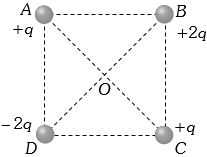
Four charges are arranged at the corners of a square $ABCD$,as shown in the adjoining figure. The force on the charge kept at the centre $O$ is
A
Zero
B
Along the diagonal $AC$
C
Along the diagonal $BD$
D
Perpendicular to side $AB$
Solution
(C) Let a test charge $q_0$ be placed at the centre $O$.
$1$. The charges at $A$ $(+q)$ and $C$ $(+q)$ are equal and equidistant from $O$. The force due to $A$ is repulsive and directed towards $C$,while the force due to $C$ is repulsive and directed towards $A$. Since these forces are equal in magnitude and opposite in direction,they cancel each other out.
$2$. The charges at $B$ $(+2q)$ and $D$ $(-2q)$ are equidistant from $O$. The force due to $B$ $(+2q)$ on $q_0$ is repulsive (directed away from $B$ towards $D$). The force due to $D$ $(-2q)$ on $q_0$ is attractive (directed towards $D$).
$3$. Since both forces are directed towards $D$,the resultant force is non-zero and directed along the diagonal $BD$ towards $D$.
$1$. The charges at $A$ $(+q)$ and $C$ $(+q)$ are equal and equidistant from $O$. The force due to $A$ is repulsive and directed towards $C$,while the force due to $C$ is repulsive and directed towards $A$. Since these forces are equal in magnitude and opposite in direction,they cancel each other out.
$2$. The charges at $B$ $(+2q)$ and $D$ $(-2q)$ are equidistant from $O$. The force due to $B$ $(+2q)$ on $q_0$ is repulsive (directed away from $B$ towards $D$). The force due to $D$ $(-2q)$ on $q_0$ is attractive (directed towards $D$).
$3$. Since both forces are directed towards $D$,the resultant force is non-zero and directed along the diagonal $BD$ towards $D$.
0 likes
View Solution7
DifficultMCQ
Three charges $4q$,$Q$,and $q$ are placed in a straight line at positions $0$,$l/2$,and $l$ respectively. The resultant force on $q$ will be zero if $Q = $
A
$-q$
B
$-2q$
C
$-\frac{q}{2}$
D
$4q$
Solution
(A) Let the positions of the charges be $x_1 = 0$,$x_2 = l/2$,and $x_3 = l$.
The force on charge $q$ at $x = l$ due to charge $4q$ at $x = 0$ is given by Coulomb's Law:
$F_1 = \frac{1}{4\pi\varepsilon_0} \cdot \frac{(4q)(q)}{l^2} = \frac{4q^2}{4\pi\varepsilon_0 l^2}$
The force on charge $q$ at $x = l$ due to charge $Q$ at $x = l/2$ is:
$F_2 = \frac{1}{4\pi\varepsilon_0} \cdot \frac{(Q)(q)}{(l/2)^2} = \frac{4Qq}{4\pi\varepsilon_0 l^2}$
For the resultant force on $q$ to be zero,the sum of forces must be zero:
$F_1 + F_2 = 0$
$\frac{4q^2}{4\pi\varepsilon_0 l^2} + \frac{4Qq}{4\pi\varepsilon_0 l^2} = 0$
$4q^2 + 4Qq = 0$
$4Qq = -4q^2$
$Q = -q$
The force on charge $q$ at $x = l$ due to charge $4q$ at $x = 0$ is given by Coulomb's Law:
$F_1 = \frac{1}{4\pi\varepsilon_0} \cdot \frac{(4q)(q)}{l^2} = \frac{4q^2}{4\pi\varepsilon_0 l^2}$
The force on charge $q$ at $x = l$ due to charge $Q$ at $x = l/2$ is:
$F_2 = \frac{1}{4\pi\varepsilon_0} \cdot \frac{(Q)(q)}{(l/2)^2} = \frac{4Qq}{4\pi\varepsilon_0 l^2}$
For the resultant force on $q$ to be zero,the sum of forces must be zero:
$F_1 + F_2 = 0$
$\frac{4q^2}{4\pi\varepsilon_0 l^2} + \frac{4Qq}{4\pi\varepsilon_0 l^2} = 0$
$4q^2 + 4Qq = 0$
$4Qq = -4q^2$
$Q = -q$
0 likes
View Solution8
MediumMCQ
Two small spheres each having the charge $+Q$ are suspended by insulating threads of length $L$ from a hook. This arrangement is taken into space where there is no gravitational effect. Then the angle between the two suspensions and the tension in each will be:
A
$180^\circ, \frac{1}{4\pi \varepsilon_0} \frac{Q^2}{(2L)^2}$
B
$90^\circ, \frac{1}{4\pi \varepsilon_0} \frac{Q^2}{L^2}$
C
$180^\circ, \frac{1}{4\pi \varepsilon_0} \frac{Q^2}{2L^2}$
D
$180^\circ, \frac{1}{4\pi \varepsilon_0} \frac{Q^2}{L^2}$
Solution
(A) In the absence of gravity,the only force acting on the spheres is the electrostatic repulsive force between them.
Since both spheres have the same charge $+Q$,they repel each other.
To maximize the distance between them and reach an equilibrium position,the threads will stretch out in opposite directions,forming a straight line.
Thus,the angle between the two threads is $180^\circ$.
The distance between the two charges is $r = L + L = 2L$.
According to Coulomb's law,the electrostatic force $F$ between them is $F = \frac{1}{4\pi \varepsilon_0} \frac{Q \cdot Q}{(2L)^2} = \frac{1}{4\pi \varepsilon_0} \frac{Q^2}{(2L)^2}$.
This force is equal to the tension $T$ in each thread.
Since both spheres have the same charge $+Q$,they repel each other.
To maximize the distance between them and reach an equilibrium position,the threads will stretch out in opposite directions,forming a straight line.
Thus,the angle between the two threads is $180^\circ$.
The distance between the two charges is $r = L + L = 2L$.
According to Coulomb's law,the electrostatic force $F$ between them is $F = \frac{1}{4\pi \varepsilon_0} \frac{Q \cdot Q}{(2L)^2} = \frac{1}{4\pi \varepsilon_0} \frac{Q^2}{(2L)^2}$.
This force is equal to the tension $T$ in each thread.

0 likes
View Solution9
EasyMCQ
Two charges,each of $1\;C$,are at a distance of $1\;km$ apart. The force between them is:
A
$9 \times 10^3\;N$
B
$9 \times 10^{-3}\;N$
C
$1.1 \times 10^{-4}\;N$
D
$10^4\;N$
Solution
(A) According to Coulomb's Law,the electrostatic force $F$ between two point charges $q_1$ and $q_2$ separated by a distance $r$ is given by:
$F = \frac{k q_1 q_2}{r^2}$
Given:
$q_1 = q_2 = 1\;C$
$r = 1\;km = 1000\;m = 10^3\;m$
$k = 9 \times 10^9\;N\cdot m^2/C^2$
Substituting the values:
$F = \frac{(9 \times 10^9) \times (1) \times (1)}{(10^3)^2}$
$F = \frac{9 \times 10^9}{10^6}$
$F = 9 \times 10^3\;N$
$F = \frac{k q_1 q_2}{r^2}$
Given:
$q_1 = q_2 = 1\;C$
$r = 1\;km = 1000\;m = 10^3\;m$
$k = 9 \times 10^9\;N\cdot m^2/C^2$
Substituting the values:
$F = \frac{(9 \times 10^9) \times (1) \times (1)}{(10^3)^2}$
$F = \frac{9 \times 10^9}{10^6}$
$F = 9 \times 10^3\;N$
0 likes
View Solution10
EasyMCQ
Two charges of $+2\,C$ and $+6\,C$ repel each other with a force of $12\,N$. If each charge is given an additional charge of $-2\,C$,what will be the new force between them?
A
$4\,N$ (Attractive)
B
$4\,N$ (Repulsive)
C
$8\,N$ (Repulsive)
D
Zero
Solution
(D) According to Coulomb's Law,the force between two charges $Q_1$ and $Q_2$ separated by a distance $r$ is given by $F = \frac{k Q_1 Q_2}{r^2}$.
Initially,$F = 12\,N$,so $12 = \frac{k(2)(6)}{r^2} = \frac{12k}{r^2}$,which implies $\frac{k}{r^2} = 1$.
After adding $-2\,C$ to each charge,the new charges are $Q_1' = 2 - 2 = 0\,C$ and $Q_2' = 6 - 2 = 4\,C$.
The new force $F'$ is $F' = \frac{k Q_1' Q_2'}{r^2} = \frac{k(0)(4)}{r^2} = 0\,N$.
Initially,$F = 12\,N$,so $12 = \frac{k(2)(6)}{r^2} = \frac{12k}{r^2}$,which implies $\frac{k}{r^2} = 1$.
After adding $-2\,C$ to each charge,the new charges are $Q_1' = 2 - 2 = 0\,C$ and $Q_2' = 6 - 2 = 4\,C$.
The new force $F'$ is $F' = \frac{k Q_1' Q_2'}{r^2} = \frac{k(0)(4)}{r^2} = 0\,N$.
0 likes
View Solution11
EasyMCQ
Three equal charges are placed on the three corners of a square. If the force between $q_1$ and $q_2$ is $F_{12}$ and that between $q_1$ and $q_3$ is $F_{13}$,the ratio of magnitudes $\frac{F_{12}}{F_{13}}$ is
A
$0.5$
B
$2$
C
$1/\sqrt{2}$
D
$\sqrt{2}$
Solution
(B) Let the side length of the square be $a$. The charges are equal,so let $q_1 = q_2 = q_3 = q$.
$F_{12}$ is the force between two adjacent corners,so the distance between them is $a$. Thus,$F_{12} = \frac{1}{4\pi\varepsilon_0} \cdot \frac{q^2}{a^2}$.
$F_{13}$ is the force between two opposite corners (diagonal),so the distance between them is $a\sqrt{2}$. Thus,$F_{13} = \frac{1}{4\pi\varepsilon_0} \cdot \frac{q^2}{(a\sqrt{2})^2} = \frac{1}{4\pi\varepsilon_0} \cdot \frac{q^2}{2a^2}$.
Taking the ratio: $\frac{F_{12}}{F_{13}} = \frac{\frac{1}{4\pi\varepsilon_0} \cdot \frac{q^2}{a^2}}{\frac{1}{4\pi\varepsilon_0} \cdot \frac{q^2}{2a^2}} = \frac{1/a^2}{1/2a^2} = 2$.
$F_{12}$ is the force between two adjacent corners,so the distance between them is $a$. Thus,$F_{12} = \frac{1}{4\pi\varepsilon_0} \cdot \frac{q^2}{a^2}$.
$F_{13}$ is the force between two opposite corners (diagonal),so the distance between them is $a\sqrt{2}$. Thus,$F_{13} = \frac{1}{4\pi\varepsilon_0} \cdot \frac{q^2}{(a\sqrt{2})^2} = \frac{1}{4\pi\varepsilon_0} \cdot \frac{q^2}{2a^2}$.
Taking the ratio: $\frac{F_{12}}{F_{13}} = \frac{\frac{1}{4\pi\varepsilon_0} \cdot \frac{q^2}{a^2}}{\frac{1}{4\pi\varepsilon_0} \cdot \frac{q^2}{2a^2}} = \frac{1/a^2}{1/2a^2} = 2$.
0 likes
View Solution12
DifficultMCQ
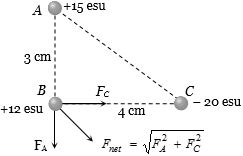
$ABC$ is a right-angled triangle in which $AB = 3\,cm$ and $BC = 4\,cm$. And $\angle ABC = \pi / 2$. The three charges $+15\,e.s.u.$,$+12\,e.s.u.$,and $-20\,e.s.u.$ are placed respectively on $A$,$B$,and $C$. The force acting on $B$ is.......$dynes$.
A
$125$
B
$35$
C
$25$
D
$0$
Solution
(C) In the $CGS$ system,Coulomb's law is given by $F = \frac{q_1 q_2}{r^2}$.
The force on charge $B$ $(+12\,e.s.u.)$ due to charge $A$ $(+15\,e.s.u.)$ is repulsive and acts along $BA$ (downwards in the diagram). Its magnitude is:
$F_A = \frac{15 \times 12}{3^2} = \frac{180}{9} = 20\,dyne$.
The force on charge $B$ $(+12\,e.s.u.)$ due to charge $C$ $(-20\,e.s.u.)$ is attractive and acts along $BC$ (towards $C$). Its magnitude is:
$F_C = \frac{|12 \times (-20)|}{4^2} = \frac{240}{16} = 15\,dyne$.
Since the angle between $BA$ and $BC$ is $90^\circ$,the net force on $B$ is:
$F_{net} = \sqrt{F_A^2 + F_C^2} = \sqrt{20^2 + 15^2} = \sqrt{400 + 225} = \sqrt{625} = 25\,dyne$.
The force on charge $B$ $(+12\,e.s.u.)$ due to charge $A$ $(+15\,e.s.u.)$ is repulsive and acts along $BA$ (downwards in the diagram). Its magnitude is:
$F_A = \frac{15 \times 12}{3^2} = \frac{180}{9} = 20\,dyne$.
The force on charge $B$ $(+12\,e.s.u.)$ due to charge $C$ $(-20\,e.s.u.)$ is attractive and acts along $BC$ (towards $C$). Its magnitude is:
$F_C = \frac{|12 \times (-20)|}{4^2} = \frac{240}{16} = 15\,dyne$.
Since the angle between $BA$ and $BC$ is $90^\circ$,the net force on $B$ is:
$F_{net} = \sqrt{F_A^2 + F_C^2} = \sqrt{20^2 + 15^2} = \sqrt{400 + 225} = \sqrt{625} = 25\,dyne$.
0 likes
View Solution13
EasyMCQ
Two charges $q_1$ and $q_2$ are placed in vacuum at a distance $d$ and the force acting between them is $F$. If a medium of dielectric constant $4$ is introduced around them,the force now will be
A
$4F$
B
$2F$
C
$F/2$
D
$F/4$
Solution
(D) The electrostatic force between two charges in a vacuum is given by $F = \frac{1}{4\pi\epsilon_0} \frac{q_1 q_2}{d^2}$.
When a medium with dielectric constant $K$ is introduced,the force becomes $F' = \frac{1}{4\pi\epsilon_0 K} \frac{q_1 q_2}{d^2}$.
Therefore,the new force is $F' = \frac{F}{K}$.
Given $K = 4$,the new force is $F' = \frac{F}{4}$.
When a medium with dielectric constant $K$ is introduced,the force becomes $F' = \frac{1}{4\pi\epsilon_0 K} \frac{q_1 q_2}{d^2}$.
Therefore,the new force is $F' = \frac{F}{K}$.
Given $K = 4$,the new force is $F' = \frac{F}{4}$.
0 likes
View Solution14
EasyMCQ
Force of attraction between two point charges $Q$ and $-Q$ separated by $d \, \text{m}$ is $F_e$. When these charges are placed on two identical spheres of radius $R = 0.3 \, d$ whose centres are $d \, \text{m}$ apart,the force of attraction between them is
A
Greater than $F_e$
B
Equal to $F_e$
C
Less than $F_e$
D
None of these
Solution
(A) For point charges,the force is given by Coulomb's law: $F_e = \frac{k Q^2}{d^2}$.
When the charges are placed on spheres of radius $R = 0.3 \, d$,the distance between the centers is $d$.
Since the spheres are close to each other ($R$ is a significant fraction of $d$),the electrostatic induction effect causes the charges to redistribute on the surfaces of the spheres.
Specifically,the positive charge on one sphere is attracted towards the negative charge on the other sphere,causing the charges to shift closer to each other on the inner faces of the spheres.
Because the effective distance between the centers of charge becomes less than $d$,the force of attraction increases.
Therefore,the new force is greater than $F_e$.
When the charges are placed on spheres of radius $R = 0.3 \, d$,the distance between the centers is $d$.
Since the spheres are close to each other ($R$ is a significant fraction of $d$),the electrostatic induction effect causes the charges to redistribute on the surfaces of the spheres.
Specifically,the positive charge on one sphere is attracted towards the negative charge on the other sphere,causing the charges to shift closer to each other on the inner faces of the spheres.
Because the effective distance between the centers of charge becomes less than $d$,the force of attraction increases.
Therefore,the new force is greater than $F_e$.
0 likes
View Solution15
EasyMCQ
$A$ force $F$ acts between sodium and chlorine ions of salt (sodium chloride) when placed $1 \ cm$ apart in air. The permittivity of air is $\varepsilon_0$ and the dielectric constant of water is $K$. When a piece of salt is placed in water,the electrical force acting between sodium and chlorine ions $1 \ cm$ apart is:
A
$\frac{F}{K}$
B
$\frac{FK}{\varepsilon_0}$
C
$\frac{F}{K\varepsilon_0}$
D
$\frac{F\varepsilon_0}{K}$
Solution
(A) The electrostatic force between two charges $q_1$ and $q_2$ separated by a distance $r$ in a medium with dielectric constant $K$ is given by $F_m = \frac{1}{4\pi\varepsilon_0 K} \frac{q_1 q_2}{r^2}$.
In air,the dielectric constant $K_{air} \approx 1$,so the force is $F = \frac{1}{4\pi\varepsilon_0} \frac{q_1 q_2}{r^2}$.
When the ions are placed in water,the new force $F'$ is given by $F' = \frac{1}{4\pi\varepsilon_0 K} \frac{q_1 q_2}{r^2}$.
Comparing the two expressions,we get $F' = \frac{F}{K}$.
In air,the dielectric constant $K_{air} \approx 1$,so the force is $F = \frac{1}{4\pi\varepsilon_0} \frac{q_1 q_2}{r^2}$.
When the ions are placed in water,the new force $F'$ is given by $F' = \frac{1}{4\pi\varepsilon_0 K} \frac{q_1 q_2}{r^2}$.
Comparing the two expressions,we get $F' = \frac{F}{K}$.
0 likes
View Solution16
EasyMCQ
The value of electric permittivity of free space is
A
$9 \times 10^9 \, N \cdot m^2 / C^2$
B
$8.85 \times 10^{-12} \, N \cdot m^2 / C^2$
C
$8.85 \times 10^{-12} \, C^2 / (N \cdot m^2)$
D
$9 \times 10^9 \, C^2 / (N \cdot m^2)$
Solution
(C) According to Coulomb's Law,the force between two charges is given by $F = \frac{1}{4 \pi \varepsilon_0} \frac{q_1 q_2}{r^2}$.
Rearranging for the permittivity of free space $\varepsilon_0$,we get $\varepsilon_0 = \frac{q_1 q_2}{4 \pi F r^2}$.
The value of the constant $\frac{1}{4 \pi \varepsilon_0}$ is approximately $9 \times 10^9 \, N \cdot m^2 / C^2$.
Therefore,$\varepsilon_0 = \frac{1}{4 \pi \times 9 \times 10^9} \approx 8.854 \times 10^{-12} \, C^2 / (N \cdot m^2)$.
Rearranging for the permittivity of free space $\varepsilon_0$,we get $\varepsilon_0 = \frac{q_1 q_2}{4 \pi F r^2}$.
The value of the constant $\frac{1}{4 \pi \varepsilon_0}$ is approximately $9 \times 10^9 \, N \cdot m^2 / C^2$.
Therefore,$\varepsilon_0 = \frac{1}{4 \pi \times 9 \times 10^9} \approx 8.854 \times 10^{-12} \, C^2 / (N \cdot m^2)$.
0 likes
View Solution17
MediumMCQ
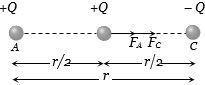
Two similar spheres having $+q$ and $-q$ charge are kept at a certain distance $r$. $A$ force $F$ acts between them. If another similar sphere having $+q$ charge is kept in the middle of the two spheres, then it experiences a force in magnitude and direction as:
A
Zero having no direction
B
$8F$ towards $+q$ charge
C
$8F$ towards $-q$ charge
D
$4F$ towards $+q$ charge
Solution
(C) Initially, the force between the two spheres with charges $+q$ and $-q$ separated by distance $r$ is given by Coulomb's Law: $F = k\frac{q^2}{r^2}$.
When a third sphere with charge $+q$ is placed at the midpoint (distance $r/2$ from both), it experiences two forces:
$1$. Force due to the $+q$ charge at $A$: $F_A = k\frac{q \cdot q}{(r/2)^2} = 4k\frac{q^2}{r^2} = 4F$ (directed away from $A$, towards $C$).
$2$. Force due to the $-q$ charge at $C$: $F_C = k\frac{q \cdot q}{(r/2)^2} = 4k\frac{q^2}{r^2} = 4F$ (directed towards $C$).
The net force on the middle sphere is $F_{net} = F_A + F_C = 4F + 4F = 8F$.
Since both forces are directed towards the $-q$ charge, the net force is $8F$ towards the $-q$ charge.
When a third sphere with charge $+q$ is placed at the midpoint (distance $r/2$ from both), it experiences two forces:
$1$. Force due to the $+q$ charge at $A$: $F_A = k\frac{q \cdot q}{(r/2)^2} = 4k\frac{q^2}{r^2} = 4F$ (directed away from $A$, towards $C$).
$2$. Force due to the $-q$ charge at $C$: $F_C = k\frac{q \cdot q}{(r/2)^2} = 4k\frac{q^2}{r^2} = 4F$ (directed towards $C$).
The net force on the middle sphere is $F_{net} = F_A + F_C = 4F + 4F = 8F$.
Since both forces are directed towards the $-q$ charge, the net force is $8F$ towards the $-q$ charge.
0 likes
View Solution18
DifficultMCQ
$A$ charge $Q$ is divided into two parts $q$ and $Q - q$. If the Coulomb repulsion between them when they are separated by a distance $r$ is to be maximum,the ratio of $\frac{Q}{q}$ should be:
A
$2$
B
$0.5$
C
$4$
D
$0.25$
Solution
(A) The Coulomb force between two charges $q$ and $Q-q$ separated by a distance $r$ is given by:
$F = \frac{k q (Q - q)}{r^2}$
To find the condition for maximum force,we differentiate $F$ with respect to $q$ and set it to zero:
$\frac{dF}{dq} = \frac{k}{r^2} \frac{d}{dq} (Qq - q^2) = 0$
$Q - 2q = 0$
$Q = 2q$
Therefore,the ratio $\frac{Q}{q} = 2$.
$F = \frac{k q (Q - q)}{r^2}$
To find the condition for maximum force,we differentiate $F$ with respect to $q$ and set it to zero:
$\frac{dF}{dq} = \frac{k}{r^2} \frac{d}{dq} (Qq - q^2) = 0$
$Q - 2q = 0$
$Q = 2q$
Therefore,the ratio $\frac{Q}{q} = 2$.
0 likes
View Solution19
EasyMCQ
When air is replaced by a dielectric medium of constant $k$,the maximum force of attraction between two charges separated by a distance $r$:
A
becomes $k^{-1}$ times
B
remains unchanged
C
increases $k$ times
D
becomes $k$ times
Solution
(A) The force between two charges $q_1$ and $q_2$ separated by a distance $r$ in air is given by $F = \frac{1}{4\pi \varepsilon_0} \frac{q_1 q_2}{r^2}$.
When the medium is replaced by a dielectric of constant $k$,the permittivity of the medium becomes $\varepsilon = k \varepsilon_0$.
The new force $F'$ is given by $F' = \frac{1}{4\pi \varepsilon} \frac{q_1 q_2}{r^2} = \frac{1}{4\pi k \varepsilon_0} \frac{q_1 q_2}{r^2}$.
Therefore,$F' = \frac{F}{k} = k^{-1} F$.
Since $k > 1$ for any dielectric medium,the force decreases and becomes $k^{-1}$ times the original force.
When the medium is replaced by a dielectric of constant $k$,the permittivity of the medium becomes $\varepsilon = k \varepsilon_0$.
The new force $F'$ is given by $F' = \frac{1}{4\pi \varepsilon} \frac{q_1 q_2}{r^2} = \frac{1}{4\pi k \varepsilon_0} \frac{q_1 q_2}{r^2}$.
Therefore,$F' = \frac{F}{k} = k^{-1} F$.
Since $k > 1$ for any dielectric medium,the force decreases and becomes $k^{-1}$ times the original force.
1 likes
View Solution20
EasyMCQ
The force between two charges $0.06\,m$ apart is $5\,N$. If each charge is moved towards the other by $0.01\,m$,then the force between them will become.........$N$
A
$7.20$
B
$11.25$
C
$22.50$
D
$45$
Solution
(B) According to Coulomb's Law,the electrostatic force $F$ between two point charges is inversely proportional to the square of the distance $r$ between them: $F \propto \frac{1}{r^2}$.
Given initial distance $r_1 = 0.06\,m$ and initial force $F_1 = 5\,N$.
When each charge is moved towards the other by $0.01\,m$,the new distance $r_2 = 0.06\,m - 0.01\,m - 0.01\,m = 0.04\,m$.
Using the ratio formula: $\frac{F_1}{F_2} = \left( \frac{r_2}{r_1} \right)^2$.
Substituting the values: $\frac{5}{F_2} = \left( \frac{0.04}{0.06} \right)^2 = \left( \frac{2}{3} \right)^2 = \frac{4}{9}$.
Therefore,$F_2 = 5 \times \frac{9}{4} = \frac{45}{4} = 11.25\,N$.
Given initial distance $r_1 = 0.06\,m$ and initial force $F_1 = 5\,N$.
When each charge is moved towards the other by $0.01\,m$,the new distance $r_2 = 0.06\,m - 0.01\,m - 0.01\,m = 0.04\,m$.
Using the ratio formula: $\frac{F_1}{F_2} = \left( \frac{r_2}{r_1} \right)^2$.
Substituting the values: $\frac{5}{F_2} = \left( \frac{0.04}{0.06} \right)^2 = \left( \frac{2}{3} \right)^2 = \frac{4}{9}$.
Therefore,$F_2 = 5 \times \frac{9}{4} = \frac{45}{4} = 11.25\,N$.
0 likes
View Solution21
EasyMCQ
Two charged spheres separated at a distance $d$ exert a force $F$ on each other. If they are immersed in a liquid of dielectric constant $2$,then what is the force (if all conditions are same)?
A
$F/2$
B
$F$
C
$2F$
D
$4F$
Solution
(A) According to Coulomb's Law,the force between two charges in a vacuum or air is given by $F = \frac{1}{4\pi\epsilon_0} \frac{q_1 q_2}{d^2}$.
When the charges are immersed in a medium with dielectric constant $K$,the force becomes $F_m = \frac{1}{4\pi\epsilon_0 K} \frac{q_1 q_2}{d^2}$.
Therefore,the relationship between the force in the medium and the force in air is $F_m = \frac{F}{K}$.
Given that $K = 2$,the new force is $F_m = \frac{F}{2}$.
When the charges are immersed in a medium with dielectric constant $K$,the force becomes $F_m = \frac{1}{4\pi\epsilon_0 K} \frac{q_1 q_2}{d^2}$.
Therefore,the relationship between the force in the medium and the force in air is $F_m = \frac{F}{K}$.
Given that $K = 2$,the new force is $F_m = \frac{F}{2}$.
0 likes
View Solution22
MediumMCQ
Two point charges $+3\,\mu C$ and $+8\,\mu C$ repel each other with a force of $40\,N$. If a charge of $-5\,\mu C$ is added to each of them,then the force between them will become....$N$
A
$-10$
B
$+10$
C
$+20$
D
$-20$
Solution
(A) According to Coulomb's Law,the force between two point charges is given by $F = k \frac{Q_1 Q_2}{r^2}$.
Initially,$Q_1 = +3\,\mu C$ and $Q_2 = +8\,\mu C$,with force $F = 40\,N$.
After adding $-5\,\mu C$ to each charge,the new charges are:
$Q_1' = 3\,\mu C - 5\,\mu C = -2\,\mu C$
$Q_2' = 8\,\mu C - 5\,\mu C = +3\,\mu C$
Since the distance $r$ remains the same,the ratio of the forces is $\frac{F'}{F} = \frac{Q_1' Q_2'}{Q_1 Q_2}$.
Substituting the values: $\frac{F'}{40} = \frac{(-2) \times (3)}{3 \times 8} = \frac{-6}{24} = -\frac{1}{4}$.
Thus,$F' = 40 \times (-1/4) = -10\,N$.
The negative sign indicates that the force is now attractive.
Initially,$Q_1 = +3\,\mu C$ and $Q_2 = +8\,\mu C$,with force $F = 40\,N$.
After adding $-5\,\mu C$ to each charge,the new charges are:
$Q_1' = 3\,\mu C - 5\,\mu C = -2\,\mu C$
$Q_2' = 8\,\mu C - 5\,\mu C = +3\,\mu C$
Since the distance $r$ remains the same,the ratio of the forces is $\frac{F'}{F} = \frac{Q_1' Q_2'}{Q_1 Q_2}$.
Substituting the values: $\frac{F'}{40} = \frac{(-2) \times (3)}{3 \times 8} = \frac{-6}{24} = -\frac{1}{4}$.
Thus,$F' = 40 \times (-1/4) = -10\,N$.
The negative sign indicates that the force is now attractive.
0 likes
View Solution23
DifficultMCQ
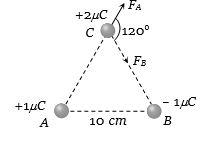
Electric charges of $1\,\mu C$, $-1\,\mu C$, and $2\,\mu C$ are placed in air at the corners $A$, $B$, and $C$ respectively of an equilateral triangle $ABC$ having a side length of $10\,cm$. The resultant force on the charge at $C$ is......$N$
A
$0.9$
B
$1.8$
C
$2.7$
D
$3.6$
Solution
(B) The side length $r = 10\,cm = 0.1\,m$. The charges are $q_A = 1 \times 10^{-6}\,C$, $q_B = -1 \times 10^{-6}\,C$, and $q_C = 2 \times 10^{-6}\,C$.
The force $F_A$ on $C$ due to charge at $A$ is repulsive:
$F_A = \frac{k |q_A q_C|}{r^2} = \frac{9 \times 10^9 \times 10^{-6} \times 2 \times 10^{-6}}{(0.1)^2} = 1.8\,N$.
The force $F_B$ on $C$ due to charge at $B$ is attractive:
$F_B = \frac{k |q_B q_C|}{r^2} = \frac{9 \times 10^9 \times 10^{-6} \times 2 \times 10^{-6}}{(0.1)^2} = 1.8\,N$.
The angle between the force vectors $F_A$ and $F_B$ is $120^\circ$ because the internal angle of the equilateral triangle is $60^\circ$ and the vectors are oriented such that the angle between them is $180^\circ - 60^\circ = 120^\circ$.
The resultant force $F_{net}$ is given by:
$F_{net} = \sqrt{F_A^2 + F_B^2 + 2 F_A F_B \cos(120^\circ)}$
$F_{net} = \sqrt{(1.8)^2 + (1.8)^2 + 2(1.8)(1.8)(-0.5)}$
$F_{net} = \sqrt{1.8^2 + 1.8^2 - 1.8^2} = 1.8\,N$.
The force $F_A$ on $C$ due to charge at $A$ is repulsive:
$F_A = \frac{k |q_A q_C|}{r^2} = \frac{9 \times 10^9 \times 10^{-6} \times 2 \times 10^{-6}}{(0.1)^2} = 1.8\,N$.
The force $F_B$ on $C$ due to charge at $B$ is attractive:
$F_B = \frac{k |q_B q_C|}{r^2} = \frac{9 \times 10^9 \times 10^{-6} \times 2 \times 10^{-6}}{(0.1)^2} = 1.8\,N$.
The angle between the force vectors $F_A$ and $F_B$ is $120^\circ$ because the internal angle of the equilateral triangle is $60^\circ$ and the vectors are oriented such that the angle between them is $180^\circ - 60^\circ = 120^\circ$.
The resultant force $F_{net}$ is given by:
$F_{net} = \sqrt{F_A^2 + F_B^2 + 2 F_A F_B \cos(120^\circ)}$
$F_{net} = \sqrt{(1.8)^2 + (1.8)^2 + 2(1.8)(1.8)(-0.5)}$
$F_{net} = \sqrt{1.8^2 + 1.8^2 - 1.8^2} = 1.8\,N$.
0 likes
View Solution24
EasyMCQ
Two small conducting spheres of equal radius have charges $+10\,\mu C$ and $-20\,\mu C$ respectively and are placed at a distance $R$ from each other,experiencing a force $F_1$. If they are brought into contact and then separated to the same distance $R$,they experience a force $F_2$. The ratio of $F_1$ to $F_2$ is:
A
$1:8$
B
$-8:1$
C
$1:2$
D
$-2:1$
Solution
(B) According to Coulomb's Law,the force between two point charges is given by $F = k \frac{Q_1 Q_2}{R^2}$.
Initially,the charges are $Q_1 = +10\,\mu C$ and $Q_2 = -20\,\mu C$. The force is $F_1 = k \frac{(10)(-20)}{R^2} = -200 \frac{k}{R^2}$.
When the spheres are brought into contact,the total charge is redistributed equally because the spheres have equal radii. The new charge on each sphere is $Q' = \frac{Q_1 + Q_2}{2} = \frac{10 - 20}{2} = -5\,\mu C$.
After separation to the same distance $R$,the new force is $F_2 = k \frac{(-5)(-5)}{R^2} = 25 \frac{k}{R^2}$.
The ratio of the forces is $\frac{F_1}{F_2} = \frac{-200 \frac{k}{R^2}}{25 \frac{k}{R^2}} = \frac{-200}{25} = -8$.
Thus,the ratio $F_1 : F_2$ is $-8:1$.
Initially,the charges are $Q_1 = +10\,\mu C$ and $Q_2 = -20\,\mu C$. The force is $F_1 = k \frac{(10)(-20)}{R^2} = -200 \frac{k}{R^2}$.
When the spheres are brought into contact,the total charge is redistributed equally because the spheres have equal radii. The new charge on each sphere is $Q' = \frac{Q_1 + Q_2}{2} = \frac{10 - 20}{2} = -5\,\mu C$.
After separation to the same distance $R$,the new force is $F_2 = k \frac{(-5)(-5)}{R^2} = 25 \frac{k}{R^2}$.
The ratio of the forces is $\frac{F_1}{F_2} = \frac{-200 \frac{k}{R^2}}{25 \frac{k}{R^2}} = \frac{-200}{25} = -8$.
Thus,the ratio $F_1 : F_2$ is $-8:1$.
0 likes
View Solution25
EasyMCQ
Two charges each equal to $2\,\mu C$ are $0.5\,m$ apart. If both of them exist inside vacuum,then the force between them is.......$N$
A
$0.144$
B
$0.288$
C
$0.072$
D
$0.036$
Solution
(A) According to Coulomb's Law,the electrostatic force $F$ between two point charges $q_1$ and $q_2$ separated by a distance $r$ in a vacuum is given by:
$F = k \cdot \frac{q_1 q_2}{r^2}$
Where $k = 9 \times 10^9 \, N \cdot m^2/C^2$.
Given: $q_1 = q_2 = 2 \times 10^{-6} \, C$ and $r = 0.5 \, m$.
Substituting the values:
$F = 9 \times 10^9 \times \frac{(2 \times 10^{-6}) \times (2 \times 10^{-6})}{(0.5)^2}$
$F = 9 \times 10^9 \times \frac{4 \times 10^{-12}}{0.25}$
$F = 9 \times 10^9 \times 16 \times 10^{-12}$
$F = 144 \times 10^{-3} = 0.144 \, N$.
$F = k \cdot \frac{q_1 q_2}{r^2}$
Where $k = 9 \times 10^9 \, N \cdot m^2/C^2$.
Given: $q_1 = q_2 = 2 \times 10^{-6} \, C$ and $r = 0.5 \, m$.
Substituting the values:
$F = 9 \times 10^9 \times \frac{(2 \times 10^{-6}) \times (2 \times 10^{-6})}{(0.5)^2}$
$F = 9 \times 10^9 \times \frac{4 \times 10^{-12}}{0.25}$
$F = 9 \times 10^9 \times 16 \times 10^{-12}$
$F = 144 \times 10^{-3} = 0.144 \, N$.
0 likes
View Solution26
EasyMCQ
Two charges are at a distance $d$ apart. If a copper plate (conducting medium) of thickness $d/2$ is placed between them,the effective force will be
A
$2F$
B
$F/2$
C
$0$
D
$\sqrt{2}F$
Solution
(C) The force between two point charges $q_1$ and $q_2$ separated by a distance $d$ in a vacuum is given by $F = \frac{1}{4\pi\epsilon_0} \frac{q_1 q_2}{d^2}$.
When a conducting plate (like copper) of thickness $t$ is placed between the charges,the effective distance between the charges is reduced. The effective distance $d_{eff}$ is given by $d_{eff} = (d - t) + t\sqrt{K}$,where $K$ is the dielectric constant.
For a conductor,the dielectric constant $K = \infty$.
Therefore,$d_{eff} = (d - t) + t\sqrt{\infty} = \infty$.
Since the force $F \propto \frac{1}{d_{eff}^2}$,as $d_{eff} \to \infty$,the force $F \to 0$.
When a conducting plate (like copper) of thickness $t$ is placed between the charges,the effective distance between the charges is reduced. The effective distance $d_{eff}$ is given by $d_{eff} = (d - t) + t\sqrt{K}$,where $K$ is the dielectric constant.
For a conductor,the dielectric constant $K = \infty$.
Therefore,$d_{eff} = (d - t) + t\sqrt{\infty} = \infty$.
Since the force $F \propto \frac{1}{d_{eff}^2}$,as $d_{eff} \to \infty$,the force $F \to 0$.
0 likes
View Solution27
MediumMCQ
Two electrons are separated by a distance of $1\,\mathring{A}$. What is the Coulomb force between them?
A
$2.3 \times 10^{-8} \, N$
B
$4.6 \times 10^{-8} \, N$
C
$1.5 \times 10^{-8} \, N$
D
None of these
Solution
(A) The Coulomb force between two charges is given by $F = k \frac{|q_1 q_2|}{r^2}$.
Here,$k = 9 \times 10^9 \, N \cdot m^2/C^2$,$q_1 = q_2 = e = 1.6 \times 10^{-19} \, C$,and $r = 1 \, \mathring{A} = 10^{-10} \, m$.
Substituting the values:
$F = 9 \times 10^9 \times \frac{(1.6 \times 10^{-19})^2}{(10^{-10})^2}$
$F = 9 \times 10^9 \times \frac{2.56 \times 10^{-38}}{10^{-20}}$
$F = 9 \times 2.56 \times 10^{9 - 38 + 20}$
$F = 23.04 \times 10^{-9} = 2.304 \times 10^{-8} \, N$.
Thus,the correct option is $A$.
Here,$k = 9 \times 10^9 \, N \cdot m^2/C^2$,$q_1 = q_2 = e = 1.6 \times 10^{-19} \, C$,and $r = 1 \, \mathring{A} = 10^{-10} \, m$.
Substituting the values:
$F = 9 \times 10^9 \times \frac{(1.6 \times 10^{-19})^2}{(10^{-10})^2}$
$F = 9 \times 10^9 \times \frac{2.56 \times 10^{-38}}{10^{-20}}$
$F = 9 \times 2.56 \times 10^{9 - 38 + 20}$
$F = 23.04 \times 10^{-9} = 2.304 \times 10^{-8} \, N$.
Thus,the correct option is $A$.
0 likes
View Solution28
MediumMCQ
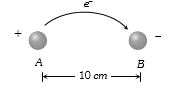
Two copper balls,each weighing $10\,g$,are kept in air $10\,cm$ apart. If one electron from every $10^6$ atoms is transferred from one ball to the other,the Coulomb force between them is (atomic weight of copper is $63.5$).
A
$2.0 \times 10^{10}\,N$
B
$2.0 \times 10^4\,N$
C
$2.0 \times 10^8\,N$
D
$2.0 \times 10^6\,N$
Solution
(C) $1$. Calculate the number of atoms in $10\,g$ of copper: $N = \frac{\text{mass}}{\text{atomic weight}} \times N_A = \frac{10}{63.5} \times 6.022 \times 10^{23} \approx 9.48 \times 10^{22}$ atoms.
$2$. Calculate the number of electrons transferred: $n = \frac{N}{10^6} = \frac{9.48 \times 10^{22}}{10^6} = 9.48 \times 10^{16}$ electrons.
$3$. Calculate the charge on each ball: $Q = n \times e = 9.48 \times 10^{16} \times 1.6 \times 10^{-19} \approx 0.015\,C$.
$4$. Calculate the Coulomb force using $F = k \frac{Q_1 Q_2}{r^2}$,where $k = 9 \times 10^9\,N\cdot m^2/C^2$,$Q_1 = Q_2 = 0.015\,C$,and $r = 0.1\,m$: $F = 9 \times 10^9 \times \frac{(0.015)^2}{(0.1)^2} = 9 \times 10^9 \times \frac{2.25 \times 10^{-4}}{0.01} = 9 \times 10^9 \times 2.25 \times 10^{-2} = 20.25 \times 10^7 \approx 2.0 \times 10^8\,N$.
$2$. Calculate the number of electrons transferred: $n = \frac{N}{10^6} = \frac{9.48 \times 10^{22}}{10^6} = 9.48 \times 10^{16}$ electrons.
$3$. Calculate the charge on each ball: $Q = n \times e = 9.48 \times 10^{16} \times 1.6 \times 10^{-19} \approx 0.015\,C$.
$4$. Calculate the Coulomb force using $F = k \frac{Q_1 Q_2}{r^2}$,where $k = 9 \times 10^9\,N\cdot m^2/C^2$,$Q_1 = Q_2 = 0.015\,C$,and $r = 0.1\,m$: $F = 9 \times 10^9 \times \frac{(0.015)^2}{(0.1)^2} = 9 \times 10^9 \times \frac{2.25 \times 10^{-4}}{0.01} = 9 \times 10^9 \times 2.25 \times 10^{-2} = 20.25 \times 10^7 \approx 2.0 \times 10^8\,N$.
0 likes
View Solution29
EasyMCQ
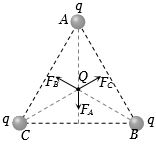
Three charges each of magnitude $q$ are placed at the corners of an equilateral triangle. The electrostatic force on the charge $Q$ placed at the center is (each side of the triangle is $L$):
A
Zero
B
$\frac{1}{4\pi \varepsilon _0}\frac{q^2}{L^2}$
C
$\frac{1}{4\pi \varepsilon _0}\frac{3q^2}{L^2}$
D
$\frac{1}{12\pi \varepsilon _0}\frac{q^2}{L^2}$
Solution
(A) Let the three charges $q$ be placed at vertices $A, B,$ and $C$ of an equilateral triangle of side $L$. Let a charge $Q$ be placed at the centroid $O$ of the triangle.
The distance from each vertex to the centroid $O$ is $r = \frac{L}{\sqrt{3}}$.
The electrostatic force exerted by each charge $q$ on the charge $Q$ at the center is given by Coulomb's Law: $F = \frac{1}{4\pi \varepsilon _0} \frac{qQ}{r^2} = \frac{1}{4\pi \varepsilon _0} \frac{qQ}{(L/\sqrt{3})^2} = \frac{3}{4\pi \varepsilon _0} \frac{qQ}{L^2}$.
Since the charges are identical and placed symmetrically at the vertices of an equilateral triangle,the three force vectors $\overrightarrow{F_A}, \overrightarrow{F_B},$ and $\overrightarrow{F_C}$ acting on $Q$ have equal magnitudes and are directed away from (or towards) the vertices at angles of $120^\circ$ to each other.
The vector sum of three equal forces acting at $120^\circ$ to each other is zero. Therefore,the net electrostatic force on the charge $Q$ at the center is zero.
The distance from each vertex to the centroid $O$ is $r = \frac{L}{\sqrt{3}}$.
The electrostatic force exerted by each charge $q$ on the charge $Q$ at the center is given by Coulomb's Law: $F = \frac{1}{4\pi \varepsilon _0} \frac{qQ}{r^2} = \frac{1}{4\pi \varepsilon _0} \frac{qQ}{(L/\sqrt{3})^2} = \frac{3}{4\pi \varepsilon _0} \frac{qQ}{L^2}$.
Since the charges are identical and placed symmetrically at the vertices of an equilateral triangle,the three force vectors $\overrightarrow{F_A}, \overrightarrow{F_B},$ and $\overrightarrow{F_C}$ acting on $Q$ have equal magnitudes and are directed away from (or towards) the vertices at angles of $120^\circ$ to each other.
The vector sum of three equal forces acting at $120^\circ$ to each other is zero. Therefore,the net electrostatic force on the charge $Q$ at the center is zero.
0 likes
View Solution30
MediumMCQ
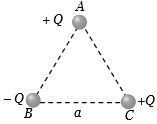
Three charges are placed at the vertices of an equilateral triangle of side '$a$' as shown in the figure. The force experienced by the charge placed at the vertex $A$ in a direction normal to $BC$ is
A
$Q^2 / (4\pi \varepsilon_0 a^2)$
B
$-Q^2 / (4\pi \varepsilon_0 a^2)$
C
Zero
D
$Q^2 / (2\pi \varepsilon_0 a^2)$
Solution
(C) Let the charges at $A, B,$ and $C$ be $+Q, -Q,$ and $+Q$ respectively. The distance between any two vertices is $a$.
The force on charge at $A$ due to charge at $B$ is $F_B = \frac{1}{4\pi \varepsilon_0} \frac{Q^2}{a^2}$ (attractive,directed towards $B$).
The force on charge at $A$ due to charge at $C$ is $F_C = \frac{1}{4\pi \varepsilon_0} \frac{Q^2}{a^2}$ (repulsive,directed away from $C$).
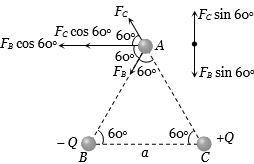
Resolving these forces into components parallel and normal to $BC$:
$1$. The components of $F_B$ and $F_C$ parallel to $BC$ are $F_B \cos 60^\circ$ and $F_C \cos 60^\circ$ respectively,both directed towards the left.
$2$. The components of $F_B$ and $F_C$ normal to $BC$ are $F_B \sin 60^\circ$ (downwards) and $F_C \sin 60^\circ$ (upwards) respectively.
Since $|F_B| = |F_C|$,the net force in the direction normal to $BC$ is $F_C \sin 60^\circ - F_B \sin 60^\circ = 0$.
The force on charge at $A$ due to charge at $B$ is $F_B = \frac{1}{4\pi \varepsilon_0} \frac{Q^2}{a^2}$ (attractive,directed towards $B$).
The force on charge at $A$ due to charge at $C$ is $F_C = \frac{1}{4\pi \varepsilon_0} \frac{Q^2}{a^2}$ (repulsive,directed away from $C$).
Resolving these forces into components parallel and normal to $BC$:
$1$. The components of $F_B$ and $F_C$ parallel to $BC$ are $F_B \cos 60^\circ$ and $F_C \cos 60^\circ$ respectively,both directed towards the left.
$2$. The components of $F_B$ and $F_C$ normal to $BC$ are $F_B \sin 60^\circ$ (downwards) and $F_C \sin 60^\circ$ (upwards) respectively.
Since $|F_B| = |F_C|$,the net force in the direction normal to $BC$ is $F_C \sin 60^\circ - F_B \sin 60^\circ = 0$.
0 likes
View Solution31
MediumMCQ
Two particles of equal mass $m$ and charge $q$ are placed at a distance of $16 \, cm$. They do not experience any net force. The value of $\frac{q}{m}$ is
A
Zero
B
$\sqrt{\frac{\pi \varepsilon_0}{G}}$
C
$\sqrt{\frac{G}{4\pi \varepsilon_0}}$
D
$\sqrt{4\pi \varepsilon_0 G}$
Solution
(D) For the particles to experience no net force,the gravitational force of attraction must be balanced by the electrostatic force of repulsion.
$|\vec{F_G}| = |\vec{F_e}|$
$G \frac{m^2}{r^2} = \frac{1}{4\pi \varepsilon_0} \cdot \frac{q^2}{r^2}$
Canceling $r^2$ from both sides,we get:
$G m^2 = \frac{1}{4\pi \varepsilon_0} q^2$
Rearranging the terms to find $\frac{q}{m}$:
$\frac{q^2}{m^2} = 4\pi \varepsilon_0 G$
$\frac{q}{m} = \sqrt{4\pi \varepsilon_0 G}$
$|\vec{F_G}| = |\vec{F_e}|$
$G \frac{m^2}{r^2} = \frac{1}{4\pi \varepsilon_0} \cdot \frac{q^2}{r^2}$
Canceling $r^2$ from both sides,we get:
$G m^2 = \frac{1}{4\pi \varepsilon_0} q^2$
Rearranging the terms to find $\frac{q}{m}$:
$\frac{q^2}{m^2} = 4\pi \varepsilon_0 G$
$\frac{q}{m} = \sqrt{4\pi \varepsilon_0 G}$
0 likes
View Solution32
MediumMCQ
An electron is moving around the nucleus of a hydrogen atom in a circular orbit of radius $r$. The Coulomb force $\overrightarrow{F}$ between the two is (where $K = \frac{1}{4\pi\varepsilon_0}$):
A
$ - K\frac{e^2}{r^3}\hat{r}$
B
$K\frac{e^2}{r^3}\vec{r}$
C
$ - K\frac{e^2}{r^3}\vec{r}$
D
$K\frac{e^2}{r^2}\hat{r}$
Solution
(C) The Coulomb force between the nucleus (charge $+e$) and the electron (charge $-e$) is given by Coulomb's Law: $\overrightarrow{F} = K \frac{q_1 q_2}{r^2} \hat{r}$.
Substituting $q_1 = +e$ and $q_2 = -e$,we get $\overrightarrow{F} = K \frac{(+e)(-e)}{r^2} \hat{r} = -K \frac{e^2}{r^2} \hat{r}$.
Since the unit vector $\hat{r} = \frac{\vec{r}}{r}$,we can substitute this into the expression:
$\overrightarrow{F} = -K \frac{e^2}{r^2} \left( \frac{\vec{r}}{r} \right) = -K \frac{e^2}{r^3} \vec{r}$.
Substituting $q_1 = +e$ and $q_2 = -e$,we get $\overrightarrow{F} = K \frac{(+e)(-e)}{r^2} \hat{r} = -K \frac{e^2}{r^2} \hat{r}$.
Since the unit vector $\hat{r} = \frac{\vec{r}}{r}$,we can substitute this into the expression:
$\overrightarrow{F} = -K \frac{e^2}{r^2} \left( \frac{\vec{r}}{r} \right) = -K \frac{e^2}{r^3} \vec{r}$.
0 likes
View Solution33
MediumMCQ
Two point charges placed at a certain distance $r$ in air exert a force $F$ on each other. Then the distance $r'$ at which these charges will exert the same force in a medium of dielectric constant $k$ is given by
A
$r$
B
$r/k$
C
$r/\sqrt{k}$
D
$r\sqrt{k}$
Solution
(C) The force between two point charges $Q_1$ and $Q_2$ in air at a distance $r$ is given by $F = \frac{1}{4\pi\varepsilon_0} \frac{Q_1 Q_2}{r^2}$.
When the same charges are placed in a medium of dielectric constant $k$ at a distance $r'$,the force $F'$ is given by $F' = \frac{1}{4\pi\varepsilon_0 k} \frac{Q_1 Q_2}{r'^2}$.
Given that the force remains the same,$F = F'$,so $\frac{1}{4\pi\varepsilon_0} \frac{Q_1 Q_2}{r^2} = \frac{1}{4\pi\varepsilon_0 k} \frac{Q_1 Q_2}{r'^2}$.
Simplifying the equation,we get $\frac{1}{r^2} = \frac{1}{k r'^2}$.
Rearranging for $r'$,we get $r'^2 = \frac{r^2}{k}$,which implies $r' = \frac{r}{\sqrt{k}}$.
When the same charges are placed in a medium of dielectric constant $k$ at a distance $r'$,the force $F'$ is given by $F' = \frac{1}{4\pi\varepsilon_0 k} \frac{Q_1 Q_2}{r'^2}$.
Given that the force remains the same,$F = F'$,so $\frac{1}{4\pi\varepsilon_0} \frac{Q_1 Q_2}{r^2} = \frac{1}{4\pi\varepsilon_0 k} \frac{Q_1 Q_2}{r'^2}$.
Simplifying the equation,we get $\frac{1}{r^2} = \frac{1}{k r'^2}$.
Rearranging for $r'$,we get $r'^2 = \frac{r^2}{k}$,which implies $r' = \frac{r}{\sqrt{k}}$.
0 likes
View Solution34
DifficultMCQ
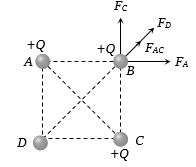
Equal charges $q$ are placed at the four corners $A, B, C, D$ of a square of side length $a$. The magnitude of the net electrostatic force on the charge at $B$ is:
A
$\frac{3q^2}{4\pi \varepsilon_0 a^2}$
B
$\frac{4q^2}{4\pi \varepsilon_0 a^2}$
C
$\left( \frac{1 + 2\sqrt{2}}{2} \right) \frac{q^2}{4\pi \varepsilon_0 a^2}$
D
$\left( 2 + \frac{1}{\sqrt{2}} \right) \frac{q^2}{4\pi \varepsilon_0 a^2}$
Solution
(C) Let $k = \frac{1}{4\pi \varepsilon_0}$. The charge at $B$ experiences forces from charges at $A, C,$ and $D$.
$1$. Force due to charge at $A$: $F_A = \frac{kq^2}{a^2}$ (directed along $AB$ extended).
$2$. Force due to charge at $C$: $F_C = \frac{kq^2}{a^2}$ (directed along $CB$ extended).
$3$. Force due to charge at $D$: $F_D = \frac{kq^2}{(a\sqrt{2})^2} = \frac{kq^2}{2a^2}$ (directed along $DB$ extended).
Since $F_A$ and $F_C$ are perpendicular,their resultant $F_{AC} = \sqrt{F_A^2 + F_C^2} = \sqrt{\left(\frac{kq^2}{a^2}\right)^2 + \left(\frac{kq^2}{a^2}\right)^2} = \sqrt{2} \frac{kq^2}{a^2}$.
This resultant $F_{AC}$ acts in the same direction as $F_D$ (along the diagonal $DB$).
Therefore,the net force $F_{net} = F_{AC} + F_D = \sqrt{2} \frac{kq^2}{a^2} + \frac{kq^2}{2a^2} = \frac{kq^2}{a^2} \left( \sqrt{2} + \frac{1}{2} \right) = \frac{kq^2}{a^2} \left( \frac{2\sqrt{2} + 1}{2} \right)$.
Substituting $k = \frac{1}{4\pi \varepsilon_0}$,we get $F_{net} = \left( \frac{1 + 2\sqrt{2}}{2} \right) \frac{q^2}{4\pi \varepsilon_0 a^2}$.
$1$. Force due to charge at $A$: $F_A = \frac{kq^2}{a^2}$ (directed along $AB$ extended).
$2$. Force due to charge at $C$: $F_C = \frac{kq^2}{a^2}$ (directed along $CB$ extended).
$3$. Force due to charge at $D$: $F_D = \frac{kq^2}{(a\sqrt{2})^2} = \frac{kq^2}{2a^2}$ (directed along $DB$ extended).
Since $F_A$ and $F_C$ are perpendicular,their resultant $F_{AC} = \sqrt{F_A^2 + F_C^2} = \sqrt{\left(\frac{kq^2}{a^2}\right)^2 + \left(\frac{kq^2}{a^2}\right)^2} = \sqrt{2} \frac{kq^2}{a^2}$.
This resultant $F_{AC}$ acts in the same direction as $F_D$ (along the diagonal $DB$).
Therefore,the net force $F_{net} = F_{AC} + F_D = \sqrt{2} \frac{kq^2}{a^2} + \frac{kq^2}{2a^2} = \frac{kq^2}{a^2} \left( \sqrt{2} + \frac{1}{2} \right) = \frac{kq^2}{a^2} \left( \frac{2\sqrt{2} + 1}{2} \right)$.
Substituting $k = \frac{1}{4\pi \varepsilon_0}$,we get $F_{net} = \left( \frac{1 + 2\sqrt{2}}{2} \right) \frac{q^2}{4\pi \varepsilon_0 a^2}$.
0 likes
View Solution35
DifficultMCQ
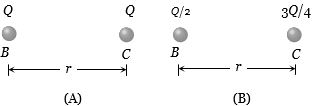
Two spherical conductors $B$ and $C$ having equal radii and carrying equal charges $Q$ repel each other with a force $F$ when kept apart at a distance $r$. $A$ third spherical conductor having the same radius as that of $B$ but uncharged is brought in contact with $B$,then brought in contact with $C$,and finally removed away from both. The new force of repulsion between $B$ and $C$ is
A
$F/4$
B
$3F/4$
C
$F/8$
D
$3F/8$
Solution
(D) Initially,the force between $B$ and $C$ is given by Coulomb's law: $F = k \frac{Q^2}{r^2}$.
When the uncharged conductor (let's call it $D$) is brought in contact with $B$,the charge $Q$ is shared equally between them because they have equal radii. Thus,the charge on $B$ becomes $Q_B = Q/2$.
Next,the conductor $D$ (now carrying charge $Q/2$) is brought in contact with $C$ (which has charge $Q$). The total charge $(Q/2 + Q) = 3Q/2$ is shared equally between $C$ and $D$. Thus,the new charge on $C$ becomes $Q_C = (3Q/2) / 2 = 3Q/4$.
The new force of repulsion between $B$ and $C$ is $F' = k \frac{Q_B \cdot Q_C}{r^2} = k \frac{(Q/2) \cdot (3Q/4)}{r^2} = \frac{3}{8} \left( k \frac{Q^2}{r^2} \right) = \frac{3}{8} F$.
When the uncharged conductor (let's call it $D$) is brought in contact with $B$,the charge $Q$ is shared equally between them because they have equal radii. Thus,the charge on $B$ becomes $Q_B = Q/2$.
Next,the conductor $D$ (now carrying charge $Q/2$) is brought in contact with $C$ (which has charge $Q$). The total charge $(Q/2 + Q) = 3Q/2$ is shared equally between $C$ and $D$. Thus,the new charge on $C$ becomes $Q_C = (3Q/2) / 2 = 3Q/4$.
The new force of repulsion between $B$ and $C$ is $F' = k \frac{Q_B \cdot Q_C}{r^2} = k \frac{(Q/2) \cdot (3Q/4)}{r^2} = \frac{3}{8} \left( k \frac{Q^2}{r^2} \right) = \frac{3}{8} F$.
0 likes
View Solution36
MediumMCQ
The charges on two spheres are $+7\,\mu C$ and $-5\,\mu C$ respectively. They experience a force $F$. If each of them is given an additional charge of $-2\,\mu C$,the new force of attraction will be
A
$F$
B
$F / 2$
C
$F / \sqrt{3}$
D
$2F$
Solution
(A) According to Coulomb's Law,the force between two point charges is given by $F = k \frac{q_1 q_2}{r^2}$.
Initially,the charges are $q_1 = +7\,\mu C$ and $q_2 = -5\,\mu C$. The magnitude of the force is $F = k \frac{(7)(5)}{r^2} = k \frac{35}{r^2}$.
When an additional charge of $-2\,\mu C$ is added to each sphere,the new charges become:
$q_1' = +7\,\mu C - 2\,\mu C = +5\,\mu C$
$q_2' = -5\,\mu C - 2\,\mu C = -7\,\mu C$
The new force $F'$ is given by $F' = k \frac{|q_1' q_2'|}{r^2} = k \frac{|(5)(-7)|}{r^2} = k \frac{35}{r^2}$.
Comparing the two expressions,we find that $F' = F$.
Initially,the charges are $q_1 = +7\,\mu C$ and $q_2 = -5\,\mu C$. The magnitude of the force is $F = k \frac{(7)(5)}{r^2} = k \frac{35}{r^2}$.
When an additional charge of $-2\,\mu C$ is added to each sphere,the new charges become:
$q_1' = +7\,\mu C - 2\,\mu C = +5\,\mu C$
$q_2' = -5\,\mu C - 2\,\mu C = -7\,\mu C$
The new force $F'$ is given by $F' = k \frac{|q_1' q_2'|}{r^2} = k \frac{|(5)(-7)|}{r^2} = k \frac{35}{r^2}$.
Comparing the two expressions,we find that $F' = F$.
0 likes
View Solution37
DifficultMCQ
The ratio of electrostatic and gravitational forces acting between an electron and a proton separated by a distance $5 \times 10^{-11} \, m$ will be (Charge on electron $= 1.6 \times 10^{-19} \, C$,mass of electron $= 9.1 \times 10^{-31} \, kg$,mass of proton $= 1.6 \times 10^{-27} \, kg$,$G = 6.7 \times 10^{-11} \, N m^2/kg^2$).
A
$2.36 \times 10^{39}$
B
$2.36 \times 10^{40}$
C
$2.34 \times 10^{41}$
D
$2.34 \times 10^{42}$
Solution
(A) The gravitational force between an electron and a proton is given by $F_G = \frac{G m_e m_p}{r^2}$.
Substituting the values: $F_G = \frac{6.7 \times 10^{-11} \times 9.1 \times 10^{-31} \times 1.6 \times 10^{-27}}{(5 \times 10^{-11})^2} \approx 3.9 \times 10^{-47} \, N$.
The electrostatic force between an electron and a proton is given by $F_e = \frac{1}{4\pi \epsilon_0} \frac{e^2}{r^2}$.
Substituting the values: $F_e = \frac{9 \times 10^9 \times (1.6 \times 10^{-19})^2}{(5 \times 10^{-11})^2} \approx 9.22 \times 10^{-8} \, N$.
The ratio of electrostatic to gravitational force is $\frac{F_e}{F_G} = \frac{9.22 \times 10^{-8}}{3.9 \times 10^{-47}} \approx 2.36 \times 10^{39}$.
Substituting the values: $F_G = \frac{6.7 \times 10^{-11} \times 9.1 \times 10^{-31} \times 1.6 \times 10^{-27}}{(5 \times 10^{-11})^2} \approx 3.9 \times 10^{-47} \, N$.
The electrostatic force between an electron and a proton is given by $F_e = \frac{1}{4\pi \epsilon_0} \frac{e^2}{r^2}$.
Substituting the values: $F_e = \frac{9 \times 10^9 \times (1.6 \times 10^{-19})^2}{(5 \times 10^{-11})^2} \approx 9.22 \times 10^{-8} \, N$.
The ratio of electrostatic to gravitational force is $\frac{F_e}{F_G} = \frac{9.22 \times 10^{-8}}{3.9 \times 10^{-47}} \approx 2.36 \times 10^{39}$.
0 likes
View Solution38
EasyMCQ
Two point charges $3 \times 10^{-6} \, C$ and $8 \times 10^{-6} \, C$ repel each other by a force of $6 \times 10^{-3} \, N$. If each of them is given an additional charge $-6 \times 10^{-6} \, C$,the force between them will be
A
$2.4 \times 10^{-3} \, N$ (attractive)
B
$2.4 \times 10^{-9} \, N$ (attractive)
C
$1.5 \times 10^{-3} \, N$ (repulsive)
D
$1.5 \times 10^{-3} \, N$ (attractive)
Solution
(D) According to Coulomb's Law,the force between two point charges is $F = k \frac{Q_1 Q_2}{r^2}$. Since the distance $r$ remains constant,$F \propto Q_1 Q_2$.
Initial charges: $Q_1 = 3 \times 10^{-6} \, C$,$Q_2 = 8 \times 10^{-6} \, C$.
Initial force: $F_1 = 6 \times 10^{-3} \, N$.
New charges after adding $-6 \times 10^{-6} \, C$ to each:
$Q_1' = 3 \times 10^{-6} - 6 \times 10^{-6} = -3 \times 10^{-6} \, C$
$Q_2' = 8 \times 10^{-6} - 6 \times 10^{-6} = 2 \times 10^{-6} \, C$
Using the ratio: $\frac{F_2}{F_1} = \frac{Q_1' Q_2'}{Q_1 Q_2}$
$\frac{F_2}{6 \times 10^{-3}} = \frac{(-3 \times 10^{-6}) \times (2 \times 10^{-6})}{(3 \times 10^{-6}) \times (8 \times 10^{-6})}$
$\frac{F_2}{6 \times 10^{-3}} = \frac{-6}{24} = -\frac{1}{4}$
$F_2 = -\frac{6 \times 10^{-3}}{4} = -1.5 \times 10^{-3} \, N$.
The negative sign indicates that the force is attractive.
Initial charges: $Q_1 = 3 \times 10^{-6} \, C$,$Q_2 = 8 \times 10^{-6} \, C$.
Initial force: $F_1 = 6 \times 10^{-3} \, N$.
New charges after adding $-6 \times 10^{-6} \, C$ to each:
$Q_1' = 3 \times 10^{-6} - 6 \times 10^{-6} = -3 \times 10^{-6} \, C$
$Q_2' = 8 \times 10^{-6} - 6 \times 10^{-6} = 2 \times 10^{-6} \, C$
Using the ratio: $\frac{F_2}{F_1} = \frac{Q_1' Q_2'}{Q_1 Q_2}$
$\frac{F_2}{6 \times 10^{-3}} = \frac{(-3 \times 10^{-6}) \times (2 \times 10^{-6})}{(3 \times 10^{-6}) \times (8 \times 10^{-6})}$
$\frac{F_2}{6 \times 10^{-3}} = \frac{-6}{24} = -\frac{1}{4}$
$F_2 = -\frac{6 \times 10^{-3}}{4} = -1.5 \times 10^{-3} \, N$.
The negative sign indicates that the force is attractive.
0 likes
View Solution39
DifficultMCQ
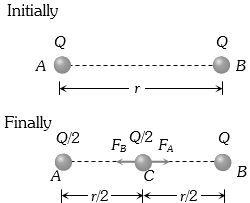
Two equally charged,identical metal spheres $A$ and $B$ repel each other with a force '$F$'. The spheres are kept fixed with a distance '$r$' between them. $A$ third identical,but uncharged sphere $C$ is brought in contact with $A$ and then placed at the mid-point of the line joining $A$ and $B$. The magnitude of the net electric force on $C$ is
A
$F$
B
$3F/4$
C
$F/2$
D
$F/4$
Solution
(A) Initially,the force between spheres $A$ and $B$ is given by Coulomb's law: $F = k\frac{Q^2}{r^2}$.
When sphere $C$ (uncharged) is brought in contact with sphere $A$ (charge $Q$),the charge redistributes equally between them. Thus,the new charge on $A$ is $Q_A = Q/2$ and on $C$ is $Q_C = Q/2$. Sphere $B$ remains with charge $Q_B = Q$.
Sphere $C$ is placed at the midpoint,so the distance from $A$ is $r/2$ and from $B$ is $r/2$.
The force on $C$ due to $A$ is $F_A = k\frac{(Q/2)(Q/2)}{(r/2)^2} = k\frac{Q^2/4}{r^2/4} = k\frac{Q^2}{r^2} = F$. This force acts away from $A$ (repulsive).
The force on $C$ due to $B$ is $F_B = k\frac{(Q)(Q/2)}{(r/2)^2} = k\frac{Q^2/2}{r^2/4} = 2k\frac{Q^2}{r^2} = 2F$. This force acts away from $B$ (repulsive).
Since $F_A$ and $F_B$ act in opposite directions,the net force on $C$ is $F_{net} = |F_B - F_A| = |2F - F| = F$.
When sphere $C$ (uncharged) is brought in contact with sphere $A$ (charge $Q$),the charge redistributes equally between them. Thus,the new charge on $A$ is $Q_A = Q/2$ and on $C$ is $Q_C = Q/2$. Sphere $B$ remains with charge $Q_B = Q$.
Sphere $C$ is placed at the midpoint,so the distance from $A$ is $r/2$ and from $B$ is $r/2$.
The force on $C$ due to $A$ is $F_A = k\frac{(Q/2)(Q/2)}{(r/2)^2} = k\frac{Q^2/4}{r^2/4} = k\frac{Q^2}{r^2} = F$. This force acts away from $A$ (repulsive).
The force on $C$ due to $B$ is $F_B = k\frac{(Q)(Q/2)}{(r/2)^2} = k\frac{Q^2/2}{r^2/4} = 2k\frac{Q^2}{r^2} = 2F$. This force acts away from $B$ (repulsive).
Since $F_A$ and $F_B$ act in opposite directions,the net force on $C$ is $F_{net} = |F_B - F_A| = |2F - F| = F$.
0 likes
View Solution40
EasyMCQ
Two charges of equal magnitudes and at a distance $r$ exert a force $F$ on each other. If the charges are halved and the distance between them is doubled,then the new force acting on each charge is
A
$F / 8$
B
$F / 4$
C
$4 F$
D
$F / 16$
Solution
(D) According to Coulomb's Law,the force between two charges $Q_1$ and $Q_2$ separated by a distance $r$ is given by $F = k \frac{Q_1 Q_2}{r^2}$.
Given that the charges are equal in magnitude,let $Q_1 = Q_2 = Q$. Thus,the initial force is $F = k \frac{Q^2}{r^2}$.
When the charges are halved,the new charges become $Q' = Q/2$. When the distance is doubled,the new distance becomes $r' = 2r$.
The new force $F'$ is given by $F' = k \frac{(Q/2)(Q/2)}{(2r)^2}$.
$F' = k \frac{Q^2 / 4}{4r^2} = \frac{1}{16} \left( k \frac{Q^2}{r^2} \right)$.
Since $F = k \frac{Q^2}{r^2}$,we have $F' = F / 16$.
Given that the charges are equal in magnitude,let $Q_1 = Q_2 = Q$. Thus,the initial force is $F = k \frac{Q^2}{r^2}$.
When the charges are halved,the new charges become $Q' = Q/2$. When the distance is doubled,the new distance becomes $r' = 2r$.
The new force $F'$ is given by $F' = k \frac{(Q/2)(Q/2)}{(2r)^2}$.
$F' = k \frac{Q^2 / 4}{4r^2} = \frac{1}{16} \left( k \frac{Q^2}{r^2} \right)$.
Since $F = k \frac{Q^2}{r^2}$,we have $F' = F / 16$.
0 likes
View Solution41
DifficultMCQ
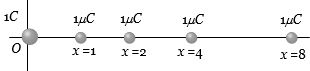
An infinite number of charges,each of charge $1 \,\mu C$,are placed on the $x$-axis at coordinates $x = 1, 2, 4, 8, ... \infty$. If a charge of $1 \, C$ is kept at the origin,what is the net force acting on the $1 \, C$ charge in Newtons?
A
$9000$
B
$12000$
C
$24000$
D
$36000$
Solution
(B) The total force $F$ acting on the $1 \, C$ charge at the origin due to the infinite series of charges is given by Coulomb's Law:
$F = \sum_{i=0}^{\infty} \frac{k q_1 q_2}{r_i^2} = \frac{1}{4\pi \varepsilon_0} \left( \frac{1 \times 10^{-6} \times 1}{1^2} + \frac{1 \times 10^{-6} \times 1}{2^2} + \frac{1 \times 10^{-6} \times 1}{4^2} + \frac{1 \times 10^{-6} \times 1}{8^2} + ... \infty \right)$
$F = (9 \times 10^9) \times 10^{-6} \left( 1 + \frac{1}{4} + \frac{1}{16} + \frac{1}{64} + ... \infty \right)$
The term in the bracket is an infinite geometric progression with first term $a = 1$ and common ratio $r = 1/4$. The sum is $S = \frac{a}{1-r} = \frac{1}{1 - 1/4} = \frac{1}{3/4} = \frac{4}{3}$.
$F = 9 \times 10^3 \times \frac{4}{3} = 3 \times 10^3 \times 4 = 12000 \, N$.
$F = \sum_{i=0}^{\infty} \frac{k q_1 q_2}{r_i^2} = \frac{1}{4\pi \varepsilon_0} \left( \frac{1 \times 10^{-6} \times 1}{1^2} + \frac{1 \times 10^{-6} \times 1}{2^2} + \frac{1 \times 10^{-6} \times 1}{4^2} + \frac{1 \times 10^{-6} \times 1}{8^2} + ... \infty \right)$
$F = (9 \times 10^9) \times 10^{-6} \left( 1 + \frac{1}{4} + \frac{1}{16} + \frac{1}{64} + ... \infty \right)$
The term in the bracket is an infinite geometric progression with first term $a = 1$ and common ratio $r = 1/4$. The sum is $S = \frac{a}{1-r} = \frac{1}{1 - 1/4} = \frac{1}{3/4} = \frac{4}{3}$.
$F = 9 \times 10^3 \times \frac{4}{3} = 3 \times 10^3 \times 4 = 12000 \, N$.
0 likes
View Solution42
EasyMCQ
Identify the wrong statement in the following. Coulomb's law correctly describes the electric force that
A
Binds the electrons of an atom to its nucleus
B
Binds the protons and neutrons in the nucleus of an atom
C
Binds atoms together to form molecules
D
Binds atoms and molecules together to form solids
Solution
(B) Coulomb's law describes the electrostatic force between charged particles.
$A$,$C$,and $D$ involve electrostatic interactions (attraction between electrons and nuclei,or between atoms/molecules).
However,the force that binds protons and neutrons (nucleons) within the nucleus is the strong nuclear force,which is not an electric force.
Therefore,the statement in option $B$ is incorrect.
$A$,$C$,and $D$ involve electrostatic interactions (attraction between electrons and nuclei,or between atoms/molecules).
However,the force that binds protons and neutrons (nucleons) within the nucleus is the strong nuclear force,which is not an electric force.
Therefore,the statement in option $B$ is incorrect.
0 likes
View Solution43
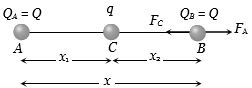
MediumMCQ
$A$ charge $q$ is placed at the centre of the line joining two equal charges $Q$. The system of the three charges will be in equilibrium if $q$ is equal to:
A
$ - \frac{Q}{2} $
B
$ - \frac{Q}{4} $
C
$ + \frac{Q}{4} $
D
$ + \frac{Q}{2} $
Solution
(B) For the system of three charges to be in equilibrium,the net force on each charge must be zero.
Let the two charges $Q$ be placed at points $A$ and $B$ separated by a distance $x$. The charge $q$ is placed at the midpoint $C$ (distance $x/2$ from both $A$ and $B$).
Consider the equilibrium of charge $Q$ at point $B$. The force exerted by charge $Q$ at $A$ on charge $Q$ at $B$ must be balanced by the force exerted by charge $q$ at $C$ on charge $Q$ at $B$.
$F_{AB} + F_{CB} = 0$
$\frac{1}{4\pi\varepsilon_0} \frac{Q^2}{x^2} + \frac{1}{4\pi\varepsilon_0} \frac{qQ}{(x/2)^2} = 0$
$\frac{Q^2}{x^2} + \frac{4qQ}{x^2} = 0$
$Q^2 + 4qQ = 0$
$4qQ = -Q^2$
$q = -\frac{Q}{4}$
Let the two charges $Q$ be placed at points $A$ and $B$ separated by a distance $x$. The charge $q$ is placed at the midpoint $C$ (distance $x/2$ from both $A$ and $B$).
Consider the equilibrium of charge $Q$ at point $B$. The force exerted by charge $Q$ at $A$ on charge $Q$ at $B$ must be balanced by the force exerted by charge $q$ at $C$ on charge $Q$ at $B$.
$F_{AB} + F_{CB} = 0$
$\frac{1}{4\pi\varepsilon_0} \frac{Q^2}{x^2} + \frac{1}{4\pi\varepsilon_0} \frac{qQ}{(x/2)^2} = 0$
$\frac{Q^2}{x^2} + \frac{4qQ}{x^2} = 0$
$Q^2 + 4qQ = 0$
$4qQ = -Q^2$
$q = -\frac{Q}{4}$
0 likes
View Solution44
EasyMCQ
Two positive charges of $20 \, C$ and $Q \, C$ are situated at a distance of $60 \, cm$. The neutral point between them is at a distance of $20 \, cm$ from the $20 \, C$ charge. The value of charge $Q$ is: (in $, C$)
A
$30$
B
$40$
C
$60$
D
$80$
Solution
(D) At the neutral point,the electric field due to both charges must be equal in magnitude and opposite in direction.
Let the distance of the neutral point from the $20 \, C$ charge be $r_1 = 20 \, cm = 0.2 \, m$.
The total distance is $60 \, cm = 0.6 \, m$.
Therefore,the distance of the neutral point from charge $Q$ is $r_2 = 60 \, cm - 20 \, cm = 40 \, cm = 0.4 \, m$.
Equating the electric field magnitudes:
$E_1 = E_2$
$\frac{k \cdot 20}{r_1^2} = \frac{k \cdot Q}{r_2^2}$
$\frac{20}{(0.2)^2} = \frac{Q}{(0.4)^2}$
$\frac{20}{0.04} = \frac{Q}{0.16}$
$Q = 20 \times \frac{0.16}{0.04}$
$Q = 20 \times 4 = 80 \, C$.
Let the distance of the neutral point from the $20 \, C$ charge be $r_1 = 20 \, cm = 0.2 \, m$.
The total distance is $60 \, cm = 0.6 \, m$.
Therefore,the distance of the neutral point from charge $Q$ is $r_2 = 60 \, cm - 20 \, cm = 40 \, cm = 0.4 \, m$.
Equating the electric field magnitudes:
$E_1 = E_2$
$\frac{k \cdot 20}{r_1^2} = \frac{k \cdot Q}{r_2^2}$
$\frac{20}{(0.2)^2} = \frac{Q}{(0.4)^2}$
$\frac{20}{0.04} = \frac{Q}{0.16}$
$Q = 20 \times \frac{0.16}{0.04}$
$Q = 20 \times 4 = 80 \, C$.
0 likes
View Solution45
MediumMCQ
In Millikan's oil drop experiment,an oil drop carrying a charge $Q$ is held stationary by a potential difference of $2400\,V$ between the plates. To keep a drop of half the radius stationary,the potential difference had to be made $600\,V$. What is the charge on the second drop?
A
$\frac{Q}{4}$
B
$\frac{Q}{2}$
C
$Q$
D
$\frac{3Q}{2}$
Solution
(B) In the balance condition,the electric force equals the gravitational force:
$QE = mg$
Since $E = \frac{V}{d}$ and $m = \frac{4}{3}\pi r^3 \rho$,we have:
$Q \frac{V}{d} = \frac{4}{3}\pi r^3 \rho g$
This implies $Q \propto \frac{r^3}{V}$.
For the two drops,we can write:
$\frac{Q_1}{Q_2} = \left( \frac{r_1}{r_2} \right)^3 \times \frac{V_2}{V_1}$
Given $Q_1 = Q$,$r_1 = r$,$V_1 = 2400\,V$,$r_2 = \frac{r}{2}$,and $V_2 = 600\,V$:
$\frac{Q}{Q_2} = \left( \frac{r}{r/2} \right)^3 \times \frac{600}{2400}$
$\frac{Q}{Q_2} = (2)^3 \times \frac{1}{4} = 8 \times \frac{1}{4} = 2$
Therefore,$Q_2 = \frac{Q}{2}$.
$QE = mg$
Since $E = \frac{V}{d}$ and $m = \frac{4}{3}\pi r^3 \rho$,we have:
$Q \frac{V}{d} = \frac{4}{3}\pi r^3 \rho g$
This implies $Q \propto \frac{r^3}{V}$.
For the two drops,we can write:
$\frac{Q_1}{Q_2} = \left( \frac{r_1}{r_2} \right)^3 \times \frac{V_2}{V_1}$
Given $Q_1 = Q$,$r_1 = r$,$V_1 = 2400\,V$,$r_2 = \frac{r}{2}$,and $V_2 = 600\,V$:
$\frac{Q}{Q_2} = \left( \frac{r}{r/2} \right)^3 \times \frac{600}{2400}$
$\frac{Q}{Q_2} = (2)^3 \times \frac{1}{4} = 8 \times \frac{1}{4} = 2$
Therefore,$Q_2 = \frac{Q}{2}$.
0 likes
View Solution46
EasyMCQ
Point charges $+4q, -q$ and $+4q$ are kept on the $x$-axis at points $x = 0, x = a$ and $x = 2a$ respectively. Then:
A
Only $q$ is in stable equilibrium
B
None of the charges are in equilibrium
C
All the charges are in unstable equilibrium
D
All the charges are in stable equilibrium
Solution
(C) First, we calculate the net force on each charge:
$1$. For the charge at $x=0$ $(+4q)$: The force due to $-q$ at $x=a$ is attractive, and the force due to $+4q$ at $x=2a$ is repulsive. The net force is $F = k \frac{(4q)(q)}{a^2} - k \frac{(4q)(4q)}{(2a)^2} = \frac{4kq^2}{a^2} - \frac{4kq^2}{a^2} = 0$.
$2$. For the charge at $x=a$ $(-q)$: The force due to $+4q$ at $x=0$ is attractive, and the force due to $+4q$ at $x=2a$ is also attractive. The net force is $F = k \frac{(4q)(q)}{a^2} - k \frac{(4q)(q)}{a^2} = 0$.
$3$. For the charge at $x=2a$ $(+4q)$: By symmetry, the net force is $0$.
Since the net force on all charges is zero, they are in equilibrium. However, if any charge is displaced slightly, the restoring force does not act to return it to its original position; instead, the net force increases, pushing it further away. Thus, all charges are in unstable equilibrium.
$1$. For the charge at $x=0$ $(+4q)$: The force due to $-q$ at $x=a$ is attractive, and the force due to $+4q$ at $x=2a$ is repulsive. The net force is $F = k \frac{(4q)(q)}{a^2} - k \frac{(4q)(4q)}{(2a)^2} = \frac{4kq^2}{a^2} - \frac{4kq^2}{a^2} = 0$.
$2$. For the charge at $x=a$ $(-q)$: The force due to $+4q$ at $x=0$ is attractive, and the force due to $+4q$ at $x=2a$ is also attractive. The net force is $F = k \frac{(4q)(q)}{a^2} - k \frac{(4q)(q)}{a^2} = 0$.
$3$. For the charge at $x=2a$ $(+4q)$: By symmetry, the net force is $0$.
Since the net force on all charges is zero, they are in equilibrium. However, if any charge is displaced slightly, the restoring force does not act to return it to its original position; instead, the net force increases, pushing it further away. Thus, all charges are in unstable equilibrium.
0 likes
View SolutionElectric Charges and Fields — Electrostatic Force and Coulombs Law · Frequently Asked Questions
1Are these Electric Charges and Fields questions useful for JEE and NEET?
Yes. All questions in this section are mapped to JEE Main and NEET exam patterns. Previous year questions from JEE Main, NEET, GUJCET and state-level exams are included with full solutions.
2Can I switch to Hindi or Gujarati for these questions?
Yes. Use the language tabs in the hero section or the sidebar to view the same questions and solutions in English, Hindi or Gujarati.
3How do I generate a question paper from this subtopic?
Use the Vedclass Exam Paper Generator — select the chapter and subtopic, set difficulty, and generate Sets A, B, C, D automatically. First 3 chapters of every subject are free.
Vedclass Products
For Students
Vedclass Test Series
Mock tests in real JEE/NEET style with performance analysis. 5-day free trial.
Start Free TrialFor Teachers
Exam Paper Generator
Generate Set A/B/C/D papers from this chapter in 2 minutes. 3 chapters free.
Try FreeFor Institutes
Online Exam Module
Live online exams with unlimited students, 360° analytics & white-label branding.
See DemoFor Teachers & Institutes
Generate a Electric Charges and Fields Exam Paper in 2 Minutes
Select subtopic & difficulty — Sets A, B, C, D auto-generated with No Repeat logic.
First 3 chapters of every subject are free — no payment required.