
A English
Motion of Charge particle in Electric filed Questions in English
Class 12 Physics · Electric Charges and Fields · Motion of Charge particle in Electric filed
208+
Questions
English
Language
100%
With Solutions
Showing 47 of 208 questions in English
1
EasyMCQ
An electron and a proton are in a uniform electric field. The ratio of their accelerations will be
A
Zero
B
Unity
C
The ratio of the masses of proton and electron
D
The ratio of the masses of electron and proton
Solution
(C) The force experienced by a charged particle in a uniform electric field $E$ is given by $F = qE$.
According to Newton's second law,$F = ma$,so the acceleration is $a = \frac{qE}{m}$.
Since both the electron and the proton have the same magnitude of charge $e$,the acceleration is inversely proportional to the mass $(a \propto \frac{1}{m})$.
Therefore,the ratio of the acceleration of the electron $(a_e)$ to the acceleration of the proton $(a_p)$ is $\frac{a_e}{a_p} = \frac{m_p}{m_e}$.
Thus,the ratio of their accelerations is the ratio of the mass of the proton to the mass of the electron.
According to Newton's second law,$F = ma$,so the acceleration is $a = \frac{qE}{m}$.
Since both the electron and the proton have the same magnitude of charge $e$,the acceleration is inversely proportional to the mass $(a \propto \frac{1}{m})$.
Therefore,the ratio of the acceleration of the electron $(a_e)$ to the acceleration of the proton $(a_p)$ is $\frac{a_e}{a_p} = \frac{m_p}{m_e}$.
Thus,the ratio of their accelerations is the ratio of the mass of the proton to the mass of the electron.
0 likes
View Solution2
EasyMCQ
$A$ charged particle is free to move in an electric field. It will travel
A
Always along a line of force
B
Along a line of force,if its initial velocity is zero
C
Along a line of force,if it has some initial velocity in the direction of an acute angle with the line of force
D
None of the above
Solution
(B) The electric field $E$ at any point is directed along the tangent to the electric field line at that point.
If a charged particle is placed in an electric field with an initial velocity of $v = 0$,the force $F = qE$ acts on it in the direction of the electric field.
Since the force is tangent to the field line,the particle will accelerate along the field line.
If the particle has an initial velocity at an angle to the field line,the trajectory will generally be curved and not follow the field line.
Therefore,the particle travels along a line of force only if its initial velocity is zero.
If a charged particle is placed in an electric field with an initial velocity of $v = 0$,the force $F = qE$ acts on it in the direction of the electric field.
Since the force is tangent to the field line,the particle will accelerate along the field line.
If the particle has an initial velocity at an angle to the field line,the trajectory will generally be curved and not follow the field line.
Therefore,the particle travels along a line of force only if its initial velocity is zero.
0 likes
View Solution3
MediumMCQ
The intensity of the electric field required to balance a proton of mass $1.7 \times 10^{-27} \ kg$ and charge $1.6 \times 10^{-19} \ C$ is nearly:
A
$1 \times 10^{-7} \ V/m$
B
$1 \times 10^{-5} \ V/m$
C
$1 \times 10^{7} \ V/m$
D
$1 \times 10^{5} \ V/m$
Solution
(A) To balance the proton,the upward electric force must equal the downward gravitational force.
$qE = mg$
$E = \frac{mg}{q}$
Given:
$m = 1.7 \times 10^{-27} \ kg$
$q = 1.6 \times 10^{-19} \ C$
$g = 9.8 \ m/s^2$
Substituting the values:
$E = \frac{1.7 \times 10^{-27} \times 9.8}{1.6 \times 10^{-19}}$
$E \approx \frac{1.666 \times 10^{-26}}{1.6 \times 10^{-19}}$
$E \approx 1.04 \times 10^{-7} \ V/m$
Thus,the intensity is nearly $1 \times 10^{-7} \ V/m$.
$qE = mg$
$E = \frac{mg}{q}$
Given:
$m = 1.7 \times 10^{-27} \ kg$
$q = 1.6 \times 10^{-19} \ C$
$g = 9.8 \ m/s^2$
Substituting the values:
$E = \frac{1.7 \times 10^{-27} \times 9.8}{1.6 \times 10^{-19}}$
$E \approx \frac{1.666 \times 10^{-26}}{1.6 \times 10^{-19}}$
$E \approx 1.04 \times 10^{-7} \ V/m$
Thus,the intensity is nearly $1 \times 10^{-7} \ V/m$.
0 likes
View Solution4
MediumMCQ
$A$ mass $m = 20\,g$ has a charge $q = 3.0\,mC$. It moves with a velocity of $20\,m/s$ and enters a region of electric field of $80\,N/C$ in the same direction as the velocity of the mass. The velocity of the mass after $3\,s$ in this region is.......$m/s$.
A
$80$
B
$56$
C
$44$
D
$40$
Solution
(B) Given: Mass $m = 20\,g = 20 \times 10^{-3}\,kg$,Charge $q = 3.0\,mC = 3.0 \times 10^{-3}\,C$,Initial velocity $u = 20\,m/s$,Electric field $E = 80\,N/C$,Time $t = 3\,s$.
The force acting on the charge is $F = qE$.
According to Newton's second law,$F = ma$,so $a = \frac{qE}{m}$.
Substituting the values: $a = \frac{3.0 \times 10^{-3} \times 80}{20 \times 10^{-3}} = \frac{240 \times 10^{-3}}{20 \times 10^{-3}} = 12\,m/s^2$.
Using the first equation of motion: $v = u + at$.
$v = 20 + (12 \times 3) = 20 + 36 = 56\,m/s$.
The force acting on the charge is $F = qE$.
According to Newton's second law,$F = ma$,so $a = \frac{qE}{m}$.
Substituting the values: $a = \frac{3.0 \times 10^{-3} \times 80}{20 \times 10^{-3}} = \frac{240 \times 10^{-3}}{20 \times 10^{-3}} = 12\,m/s^2$.
Using the first equation of motion: $v = u + at$.
$v = 20 + (12 \times 3) = 20 + 36 = 56\,m/s$.
0 likes
View Solution5
MediumMCQ
Two metal plates having a potential difference of $800 \; V$ are $0.02 \; m$ apart horizontally. $A$ particle of mass $1.96 \times 10^{-15} \; kg$ is suspended in equilibrium between the plates. If $e$ is the elementary charge,then the charge on the particle is:
A
$e$
B
$3e$
C
$6e$
D
$8e$
Solution
(B) For the particle to be in equilibrium,the upward electric force must balance the downward gravitational force.
$QE = Mg$
Since $E = \frac{V}{d}$,we have $Q \left( \frac{V}{d} \right) = Mg$.
Given $Q = Ne$,where $N$ is the number of elementary charges:
$Ne \left( \frac{V}{d} \right) = Mg$
$N = \frac{Mgd}{eV}$
Substituting the given values ($M = 1.96 \times 10^{-15} \; kg$,$g = 9.8 \; m/s^2$,$d = 0.02 \; m$,$V = 800 \; V$,$e = 1.6 \times 10^{-19} \; C$):
$N = \frac{1.96 \times 10^{-15} \times 9.8 \times 0.02}{1.6 \times 10^{-19} \times 800}$
$N = \frac{3.8416 \times 10^{-16}}{1.28 \times 10^{-16}} = 3$
Therefore,the charge on the particle is $Q = 3e$.
$QE = Mg$
Since $E = \frac{V}{d}$,we have $Q \left( \frac{V}{d} \right) = Mg$.
Given $Q = Ne$,where $N$ is the number of elementary charges:
$Ne \left( \frac{V}{d} \right) = Mg$
$N = \frac{Mgd}{eV}$
Substituting the given values ($M = 1.96 \times 10^{-15} \; kg$,$g = 9.8 \; m/s^2$,$d = 0.02 \; m$,$V = 800 \; V$,$e = 1.6 \times 10^{-19} \; C$):
$N = \frac{1.96 \times 10^{-15} \times 9.8 \times 0.02}{1.6 \times 10^{-19} \times 800}$
$N = \frac{3.8416 \times 10^{-16}}{1.28 \times 10^{-16}} = 3$
Therefore,the charge on the particle is $Q = 3e$.
0 likes
View Solution6
EasyMCQ
$A$ particle of mass $m$ and charge $q$ is placed at rest in a uniform electric field $E$ and then released. The kinetic energy attained by the particle after moving a distance $y$ is
A
$qE{y^2}$
B
$q{E^2}y$
C
$qEy$
D
${q^2}Ey$
Solution
(C) The force experienced by a charge $q$ in a uniform electric field $E$ is given by $F = qE$.
Since the particle starts from rest and moves a distance $y$ in the direction of the force,the work done by the electric field on the particle is $W = F \times y = (qE) \times y = qEy$.
According to the work-energy theorem,the work done by the electric field is equal to the change in kinetic energy of the particle.
Since the initial kinetic energy is $0$,the final kinetic energy attained by the particle is $K = qEy$.
Since the particle starts from rest and moves a distance $y$ in the direction of the force,the work done by the electric field on the particle is $W = F \times y = (qE) \times y = qEy$.
According to the work-energy theorem,the work done by the electric field is equal to the change in kinetic energy of the particle.
Since the initial kinetic energy is $0$,the final kinetic energy attained by the particle is $K = qEy$.
0 likes
View Solution7
MediumMCQ
An electron of mass $m_e$ initially at rest moves through a certain distance in a uniform electric field in time $t_1$. $A$ proton of mass $m_p$ also initially at rest takes time $t_2$ to move through an equal distance in this uniform electric field. Neglecting the effect of gravity,the ratio of $t_2/t_1$ is nearly equal to
A
$1$
B
$(m_p/m_e)^{1/2}$
C
$(m_e/m_p)^{1/2}$
D
$1836$
Solution
(B) The force on a charged particle in a uniform electric field $E$ is given by $F = qE$. According to Newton's second law,$F = ma$,so the acceleration is $a = qE/m$.
Using the equation of motion $s = ut + (1/2)at^2$,and since the particles start from rest $(u = 0)$,the distance $s$ covered in time $t$ is $s = (1/2)(qE/m)t^2$.
For the electron: $s = (1/2)(eE/m_e)t_1^2$.
For the proton: $s = (1/2)(eE/m_p)t_2^2$.
Since the distance $s$ is the same for both,we equate the two expressions:
$(1/2)(eE/m_e)t_1^2 = (1/2)(eE/m_p)t_2^2$.
Simplifying this,we get $t_1^2/m_e = t_2^2/m_p$.
Therefore,$t_2^2/t_1^2 = m_p/m_e$.
Taking the square root of both sides,we find the ratio $t_2/t_1 = (m_p/m_e)^{1/2}$.
Using the equation of motion $s = ut + (1/2)at^2$,and since the particles start from rest $(u = 0)$,the distance $s$ covered in time $t$ is $s = (1/2)(qE/m)t^2$.
For the electron: $s = (1/2)(eE/m_e)t_1^2$.
For the proton: $s = (1/2)(eE/m_p)t_2^2$.
Since the distance $s$ is the same for both,we equate the two expressions:
$(1/2)(eE/m_e)t_1^2 = (1/2)(eE/m_p)t_2^2$.
Simplifying this,we get $t_1^2/m_e = t_2^2/m_p$.
Therefore,$t_2^2/t_1^2 = m_p/m_e$.
Taking the square root of both sides,we find the ratio $t_2/t_1 = (m_p/m_e)^{1/2}$.
0 likes
View Solution8
MediumMCQ
$A$ charged water drop whose radius is $0.1\,\mu m$ is in equilibrium in an electric field. If the charge on it is equal to the charge of an electron,then the intensity of the electric field will be.......$N/C$ $(g = 10\,m/s^2)$
A
$1.61$
B
$26.2$
C
$262$
D
$1610$
Solution
(C) For the water drop to be in equilibrium,the electric force must balance the gravitational force.
$QE = mg$
Here,$Q = e = 1.6 \times 10^{-19}\,C$,$r = 0.1\,\mu m = 10^{-7}\,m$,$\rho = 10^3\,kg/m^3$ (density of water),and $g = 10\,m/s^2$.
The mass $m$ is given by $m = \text{Volume} \times \text{Density} = \frac{4}{3}\pi r^3 \rho$.
Substituting the values:
$E = \frac{mg}{Q} = \frac{\frac{4}{3} \times 3.14 \times (10^{-7})^3 \times 10^3 \times 10}{1.6 \times 10^{-19}}$
$E = \frac{4 \times 3.14 \times 10^{-21} \times 10^4}{3 \times 1.6 \times 10^{-19}}$
$E = \frac{12.56 \times 10^{-17}}{4.8 \times 10^{-19}} = 2.616 \times 10^2 \approx 262\,N/C$.
$QE = mg$
Here,$Q = e = 1.6 \times 10^{-19}\,C$,$r = 0.1\,\mu m = 10^{-7}\,m$,$\rho = 10^3\,kg/m^3$ (density of water),and $g = 10\,m/s^2$.
The mass $m$ is given by $m = \text{Volume} \times \text{Density} = \frac{4}{3}\pi r^3 \rho$.
Substituting the values:
$E = \frac{mg}{Q} = \frac{\frac{4}{3} \times 3.14 \times (10^{-7})^3 \times 10^3 \times 10}{1.6 \times 10^{-19}}$
$E = \frac{4 \times 3.14 \times 10^{-21} \times 10^4}{3 \times 1.6 \times 10^{-19}}$
$E = \frac{12.56 \times 10^{-17}}{4.8 \times 10^{-19}} = 2.616 \times 10^2 \approx 262\,N/C$.
0 likes
View Solution9
MediumMCQ
An oil drop having charge $2e$ is kept stationary between two parallel horizontal plates $2.0 \, cm$ apart when a potential difference of $12000 \, V$ is applied between them. If the density of oil is $900 \, kg/m^3$,the radius of the drop will be
A
$2.0 \times 10^{-6} \, m$
B
$1.7 \times 10^{-6} \, m$
C
$1.4 \times 10^{-6} \, m$
D
$1.1 \times 10^{-6} \, m$
Solution
(B) For the oil drop to be stationary,the electric force must balance the gravitational force.
$F_e = F_g$
$qE = mg$
Since $E = \frac{V}{d}$ and $m = \text{Volume} \times \text{Density} = \frac{4}{3} \pi r^3 \rho$,we have:
$q \left( \frac{V}{d} \right) = \left( \frac{4}{3} \pi r^3 \rho \right) g$
Given: $q = 2e = 2 \times 1.6 \times 10^{-19} \, C$,$V = 12000 \, V$,$d = 2.0 \times 10^{-2} \, m$,$\rho = 900 \, kg/m^3$,$g = 10 \, m/s^2$.
Substituting the values:
$2 \times 1.6 \times 10^{-19} \times \frac{12000}{2 \times 10^{-2}} = \frac{4}{3} \times 3.14 \times r^3 \times 900 \times 10$
$1.92 \times 10^{-13} = 37680 \times r^3$
$r^3 = \frac{1.92 \times 10^{-13}}{37680} \approx 0.509 \times 10^{-17} = 5.09 \times 10^{-18} \, m^3$
$r = \sqrt[3]{5.09 \times 10^{-18}} \approx 1.72 \times 10^{-6} \, m$.
$F_e = F_g$
$qE = mg$
Since $E = \frac{V}{d}$ and $m = \text{Volume} \times \text{Density} = \frac{4}{3} \pi r^3 \rho$,we have:
$q \left( \frac{V}{d} \right) = \left( \frac{4}{3} \pi r^3 \rho \right) g$
Given: $q = 2e = 2 \times 1.6 \times 10^{-19} \, C$,$V = 12000 \, V$,$d = 2.0 \times 10^{-2} \, m$,$\rho = 900 \, kg/m^3$,$g = 10 \, m/s^2$.
Substituting the values:
$2 \times 1.6 \times 10^{-19} \times \frac{12000}{2 \times 10^{-2}} = \frac{4}{3} \times 3.14 \times r^3 \times 900 \times 10$
$1.92 \times 10^{-13} = 37680 \times r^3$
$r^3 = \frac{1.92 \times 10^{-13}}{37680} \approx 0.509 \times 10^{-17} = 5.09 \times 10^{-18} \, m^3$
$r = \sqrt[3]{5.09 \times 10^{-18}} \approx 1.72 \times 10^{-6} \, m$.
0 likes
View Solution10
EasyMCQ
When a proton is accelerated through $1\,V$,then its kinetic energy will be.....$eV$.
A
$1840$
B
$13.6$
C
$1$
D
$0.54$
Solution
(C) The kinetic energy gained by a charged particle accelerated through a potential difference $V$ is given by the formula $\Delta KE = qV$.
For a proton,the charge $q = e$.
Given the potential difference $V = 1\,V$.
Substituting these values,we get $\Delta KE = e \times 1\,V = 1\,eV$.
Therefore,the kinetic energy of the proton is $1\,eV$.
For a proton,the charge $q = e$.
Given the potential difference $V = 1\,V$.
Substituting these values,we get $\Delta KE = e \times 1\,V = 1\,eV$.
Therefore,the kinetic energy of the proton is $1\,eV$.
0 likes
View Solution11
EasyMCQ
An electron enters between two horizontal plates separated by $2\,mm$ and having a potential difference of $1000\,V$. The force on the electron is:
A
$8 \times 10^{-12}\,N$
B
$8 \times 10^{-14}\,N$
C
$8 \times 10^{9}\,N$
D
$8 \times 10^{14}\,N$
Solution
(B) The force $F$ on an electron in an electric field $E$ is given by $F = qE$.
The electric field between two parallel plates is $E = \frac{V}{d}$,where $V$ is the potential difference and $d$ is the separation distance.
Given: $q = 1.6 \times 10^{-19}\,C$,$V = 1000\,V$,and $d = 2\,mm = 2 \times 10^{-3}\,m$.
Substituting these values into the formula:
$F = q \left( \frac{V}{d} \right) = (1.6 \times 10^{-19}) \left( \frac{1000}{2 \times 10^{-3}} \right)$
$F = (1.6 \times 10^{-19}) \times (0.5 \times 10^{6})$
$F = 0.8 \times 10^{-13}\,N = 8 \times 10^{-14}\,N$.
The electric field between two parallel plates is $E = \frac{V}{d}$,where $V$ is the potential difference and $d$ is the separation distance.
Given: $q = 1.6 \times 10^{-19}\,C$,$V = 1000\,V$,and $d = 2\,mm = 2 \times 10^{-3}\,m$.
Substituting these values into the formula:
$F = q \left( \frac{V}{d} \right) = (1.6 \times 10^{-19}) \left( \frac{1000}{2 \times 10^{-3}} \right)$
$F = (1.6 \times 10^{-19}) \times (0.5 \times 10^{6})$
$F = 0.8 \times 10^{-13}\,N = 8 \times 10^{-14}\,N$.
0 likes
View Solution12
EasyMCQ
$A$ charged particle of mass $5 \times 10^{-5} \ kg$ is held stationary in space by placing it in an electric field of strength $10^7 \ N C^{-1}$ directed vertically downwards. The charge on the particle is
A
$ - 20 \times 10^{-5} \ \mu C$
B
$ - 5 \times 10^{-5} \ \mu C$
C
$5 \times 10^{-5} \ \mu C$
D
$20 \times 10^{-5} \ \mu C$
Solution
(B) For the particle to be held stationary,the upward electric force must balance the downward gravitational force.
$F_e = F_g$
$|q|E = mg$
$|q| = \frac{mg}{E}$
Given: $m = 5 \times 10^{-5} \ kg$,$g = 10 \ m/s^2$,$E = 10^7 \ N/C$.
$|q| = \frac{5 \times 10^{-5} \times 10}{10^7} = 5 \times 10^{-11} \ C$.
Since $1 \ C = 10^6 \ \mu C$,we have $|q| = 5 \times 10^{-11} \times 10^6 \ \mu C = 5 \times 10^{-5} \ \mu C$.
Since the electric field is directed downwards and the gravitational force acts downwards,the electric force must act upwards to balance it. For a downward electric field,a negative charge experiences an upward force. Therefore,the charge is $-5 \times 10^{-5} \ \mu C$.
$F_e = F_g$
$|q|E = mg$
$|q| = \frac{mg}{E}$
Given: $m = 5 \times 10^{-5} \ kg$,$g = 10 \ m/s^2$,$E = 10^7 \ N/C$.
$|q| = \frac{5 \times 10^{-5} \times 10}{10^7} = 5 \times 10^{-11} \ C$.
Since $1 \ C = 10^6 \ \mu C$,we have $|q| = 5 \times 10^{-11} \times 10^6 \ \mu C = 5 \times 10^{-5} \ \mu C$.
Since the electric field is directed downwards and the gravitational force acts downwards,the electric force must act upwards to balance it. For a downward electric field,a negative charge experiences an upward force. Therefore,the charge is $-5 \times 10^{-5} \ \mu C$.
0 likes
View Solution13
EasyMCQ
An electron is moving towards the $x$-axis. If an electric field is applied along the $y$-direction,what is the path of the electron?
A
Circular
B
Elliptical
C
Parabolic
D
None of these
Solution
(C) When a charged particle like an electron enters a uniform electric field perpendicularly to the direction of the field,it experiences a constant force in the direction of the field (or opposite to it).
Since the velocity along the $x$-axis remains constant and the acceleration along the $y$-axis is constant,the equation of motion follows the form $y = kx^2$.
This is the equation of a parabola. Therefore,the path of the electron is parabolic.
Since the velocity along the $x$-axis remains constant and the acceleration along the $y$-axis is constant,the equation of motion follows the form $y = kx^2$.
This is the equation of a parabola. Therefore,the path of the electron is parabolic.
0 likes
View Solution14
EasyMCQ
An electron enters an electric field with its velocity in the direction of the electric lines of force. Then:
A
The path of the electron will be a circle
B
The path of the electron will be a parabola
C
The velocity of the electron will decrease
D
The velocity of the electron will increase
Solution
(C) The electric field $E$ exerts a force $F = qE$ on a charged particle. For an electron,the charge $q = -e$,so the force $F = -eE$ acts in the direction opposite to the electric field lines.
Since the electron enters the field with its velocity in the direction of the electric lines of force,the force acting on it is directed opposite to its velocity.
This force acts as a retarding force,causing the electron to decelerate.
Therefore,the velocity of the electron will decrease.
Since the electron enters the field with its velocity in the direction of the electric lines of force,the force acting on it is directed opposite to its velocity.
This force acts as a retarding force,causing the electron to decelerate.
Therefore,the velocity of the electron will decrease.
0 likes
View Solution15
EasyMCQ
An electron of mass $m$ and charge $e$ is accelerated from rest through a potential difference $V$ in vacuum. The final speed of the electron will be
A
$V\sqrt{e/m}$
B
$\sqrt{eV/m}$
C
$\sqrt{2eV/m}$
D
$2eV/m$
Solution
(C) When an electron of charge $e$ is accelerated through a potential difference $V$,the work done on the electron is $W = eV$.
This work done is converted into the kinetic energy of the electron.
According to the work-energy theorem,$K = \frac{1}{2}mv^2 = eV$.
Solving for the final speed $v$,we get $v^2 = \frac{2eV}{m}$.
Therefore,the final speed is $v = \sqrt{\frac{2eV}{m}}$.
This work done is converted into the kinetic energy of the electron.
According to the work-energy theorem,$K = \frac{1}{2}mv^2 = eV$.
Solving for the final speed $v$,we get $v^2 = \frac{2eV}{m}$.
Therefore,the final speed is $v = \sqrt{\frac{2eV}{m}}$.
0 likes
View Solution16
EasyMCQ
The acceleration of an electron in an electric field of magnitude $50\, V/cm$ is (given that the $e/m$ ratio of the electron is $1.76 \times 10^{11}\, C/kg$):
A
$8.8 \times 10^{14}\, m/s^2$
B
$6.2 \times 10^{13}\, m/s^2$
C
$5.4 \times 10^{12}\, m/s^2$
D
Zero
Solution
(A) The force on an electron in an electric field is given by $F = eE$.
According to Newton's second law,$F = ma$,so $ma = eE$.
Therefore,the acceleration $a$ is given by $a = (e/m) \times E$.
Given:
$e/m = 1.76 \times 10^{11}\, C/kg$
$E = 50\, V/cm = 50 \times 10^2\, V/m = 5000\, V/m$.
Substituting the values:
$a = (1.76 \times 10^{11}) \times (5000) = 1.76 \times 10^{11} \times 5 \times 10^3 = 8.8 \times 10^{14}\, m/s^2$.
According to Newton's second law,$F = ma$,so $ma = eE$.
Therefore,the acceleration $a$ is given by $a = (e/m) \times E$.
Given:
$e/m = 1.76 \times 10^{11}\, C/kg$
$E = 50\, V/cm = 50 \times 10^2\, V/m = 5000\, V/m$.
Substituting the values:
$a = (1.76 \times 10^{11}) \times (5000) = 1.76 \times 10^{11} \times 5 \times 10^3 = 8.8 \times 10^{14}\, m/s^2$.
0 likes
View Solution17
EasyMCQ
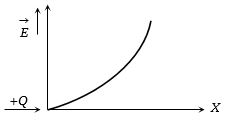
$A$ positively charged particle moving along the $x$-axis with a certain velocity enters a uniform electric field directed along the positive $y$-axis. Its
A
Vertical velocity changes but horizontal velocity remains constant
B
Horizontal velocity changes but vertical velocity remains constant
C
Both vertical and horizontal velocities change
D
Neither vertical nor horizontal velocity changes
Solution
(A) When a charged particle enters a uniform electric field $\vec{E}$ directed along the $y$-axis,it experiences an electric force $\vec{F} = q\vec{E}$ in the direction of the $y$-axis.
According to Newton's second law,this force causes an acceleration $a_y = \frac{qE}{m}$ in the $y$-direction,which changes the vertical component of the velocity.
Since there is no electric field component along the $x$-axis,there is no force acting in the $x$-direction $(F_x = 0)$.
Therefore,the horizontal component of the velocity remains constant throughout the motion.
Thus,the vertical velocity changes while the horizontal velocity remains constant.
According to Newton's second law,this force causes an acceleration $a_y = \frac{qE}{m}$ in the $y$-direction,which changes the vertical component of the velocity.
Since there is no electric field component along the $x$-axis,there is no force acting in the $x$-direction $(F_x = 0)$.
Therefore,the horizontal component of the velocity remains constant throughout the motion.
Thus,the vertical velocity changes while the horizontal velocity remains constant.
0 likes
View Solution18
EasyMCQ
Kinetic energy of an electron accelerated in a potential difference of $100 \, V$ is
A
$1.6 \times 10^{-17} \, J$
B
$1.6 \times 10^{21} \, J$
C
$1.6 \times 10^{-29} \, J$
D
$1.6 \times 10^{-34} \, J$
Solution
(A) The kinetic energy $(KE)$ gained by a charged particle accelerated through a potential difference $(V)$ is given by the formula: $KE = qV$.
Here,the charge of an electron is $q = 1.6 \times 10^{-19} \, C$ and the potential difference is $V = 100 \, V$.
Substituting these values into the formula:
$KE = (1.6 \times 10^{-19} \, C) \times (100 \, V)$
$KE = 1.6 \times 10^{-19} \times 10^2 \, J$
$KE = 1.6 \times 10^{-17} \, J$.
Therefore,the correct option is $A$.
Here,the charge of an electron is $q = 1.6 \times 10^{-19} \, C$ and the potential difference is $V = 100 \, V$.
Substituting these values into the formula:
$KE = (1.6 \times 10^{-19} \, C) \times (100 \, V)$
$KE = 1.6 \times 10^{-19} \times 10^2 \, J$
$KE = 1.6 \times 10^{-17} \, J$.
Therefore,the correct option is $A$.
0 likes
View Solution19
EasyMCQ
$A$ drop of $10^{-6} \ kg$ water carries $10^{-6} \ C$ charge. What electric field should be applied to balance its weight? (Assume $g = 10 \ m/s^2$)
A
$10 \ V/m$ upward
B
$10 \ V/m$ downward
C
$0.1 \ V/m$ downward
D
$0.1 \ V/m$ upward
Solution
(A) To balance the weight of the water drop,the electric force must act in the upward direction to counteract the gravitational force acting downward.
Given:
Mass $m = 10^{-6} \ kg$
Charge $q = 10^{-6} \ C$
Acceleration due to gravity $g = 10 \ m/s^2$
The condition for equilibrium is:
$F_e = W$
$qE = mg$
$E = \frac{mg}{q}$
Substituting the values:
$E = \frac{10^{-6} \times 10}{10^{-6}} = 10 \ V/m$
Since the charge is positive,the electric force is in the direction of the electric field. To balance the downward weight,the electric field must be applied in the upward direction.
Given:
Mass $m = 10^{-6} \ kg$
Charge $q = 10^{-6} \ C$
Acceleration due to gravity $g = 10 \ m/s^2$
The condition for equilibrium is:
$F_e = W$
$qE = mg$
$E = \frac{mg}{q}$
Substituting the values:
$E = \frac{10^{-6} \times 10}{10^{-6}} = 10 \ V/m$
Since the charge is positive,the electric force is in the direction of the electric field. To balance the downward weight,the electric field must be applied in the upward direction.
0 likes
View Solution20
MediumMCQ
$A$ charged particle of mass $0.003 \, g$ is held stationary in space by placing it in a downward electric field of $6 \times 10^4 \, N/C$. The magnitude of the charge is:
A
$5 \times 10^{-4} \, C$
B
$5 \times 10^{-10} \, C$
C
$-18 \times 10^{-6} \, C$
D
$-5 \times 10^{-9} \, C$
Solution
(B) For the particle to be held stationary,the upward electric force must balance the downward gravitational force.
$F_e = F_g$
$QE = mg$
Given:
Mass $m = 0.003 \, g = 0.003 \times 10^{-3} \, kg = 3 \times 10^{-6} \, kg$
Electric field $E = 6 \times 10^4 \, N/C$
Acceleration due to gravity $g = 10 \, m/s^2$
$Q = \frac{mg}{E} = \frac{3 \times 10^{-6} \times 10}{6 \times 10^4}$
$Q = \frac{3 \times 10^{-5}}{6 \times 10^4} = 0.5 \times 10^{-9} \, C = 5 \times 10^{-10} \, C$
$F_e = F_g$
$QE = mg$
Given:
Mass $m = 0.003 \, g = 0.003 \times 10^{-3} \, kg = 3 \times 10^{-6} \, kg$
Electric field $E = 6 \times 10^4 \, N/C$
Acceleration due to gravity $g = 10 \, m/s^2$
$Q = \frac{mg}{E} = \frac{3 \times 10^{-6} \times 10}{6 \times 10^4}$
$Q = \frac{3 \times 10^{-5}}{6 \times 10^4} = 0.5 \times 10^{-9} \, C = 5 \times 10^{-10} \, C$
0 likes
View Solution21
EasyMCQ
An electron having charge '$e$' and mass '$m$' is moving in a uniform electric field $E$. Its acceleration will be
A
$\frac{e^2}{m}$
B
$\frac{E^2e}{m}$
C
$\frac{eE}{m}$
D
$\frac{mE}{e}$
Solution
(C) The force $F$ experienced by a charge $q$ in an electric field $E$ is given by $F = qE$.
For an electron,the charge is $q = e$,so the force is $F = eE$.
According to Newton's second law of motion,the force is also given by $F = ma$,where $m$ is the mass and $a$ is the acceleration.
Equating the two expressions for force: $ma = eE$.
Therefore,the acceleration $a$ is given by $a = \frac{eE}{m}$.
For an electron,the charge is $q = e$,so the force is $F = eE$.
According to Newton's second law of motion,the force is also given by $F = ma$,where $m$ is the mass and $a$ is the acceleration.
Equating the two expressions for force: $ma = eE$.
Therefore,the acceleration $a$ is given by $a = \frac{eE}{m}$.
0 likes
View Solution22
EasyMCQ
An $\alpha$-particle is accelerated through a potential difference of $200\,V$. The increase in its kinetic energy is.......$eV$.
A
$100$
B
$200$
C
$400$
D
$800$
Solution
(C) The kinetic energy $(KE)$ gained by a charged particle accelerated through a potential difference $(V)$ is given by the formula $KE = qV$.
For an $\alpha$-particle,the charge is $q = +2e$,where $e$ is the elementary charge.
Given the potential difference $V = 200\,V$.
Substituting these values into the formula:
$KE = (2e) \times 200\,V = 400\,eV$.
Therefore,the increase in its kinetic energy is $400\,eV$.
For an $\alpha$-particle,the charge is $q = +2e$,where $e$ is the elementary charge.
Given the potential difference $V = 200\,V$.
Substituting these values into the formula:
$KE = (2e) \times 200\,V = 400\,eV$.
Therefore,the increase in its kinetic energy is $400\,eV$.
0 likes
View Solution23
MediumMCQ
An electron moving with a speed of $5 \times 10^6 \, m/s$ is shot parallel to an electric field of intensity $1 \times 10^3 \, N/C$. The field causes retardation of the electron's motion. Evaluate the distance traveled by the electron before coming to rest for an instant (mass of $e = 9 \times 10^{-31} \, kg$,charge $q = 1.6 \times 10^{-19} \, C$).
A
$7 \, m$
B
$0.7 \, mm$
C
$7 \, cm$
D
$0.7 \, cm$
Solution
(C) The electric force acting on the electron is $F = qE = ma$.
Thus,the retardation $a = \frac{qE}{m}$.
Substituting the given values:
$a = \frac{1.6 \times 10^{-19} \times 1 \times 10^3}{9 \times 10^{-31}} = \frac{1.6}{9} \times 10^{15} \, m/s^2$.
Given initial velocity $u = 5 \times 10^6 \, m/s$ and final velocity $v = 0$.
Using the kinematic equation $v^2 = u^2 - 2as$,we find the distance $s = \frac{u^2}{2a}$.
$s = \frac{(5 \times 10^6)^2}{2 \times (\frac{1.6}{9} \times 10^{15})} = \frac{25 \times 10^{12} \times 9}{3.2 \times 10^{15}} = \frac{225}{3.2} \times 10^{-3} \approx 70.3 \times 10^{-3} \, m = 7.03 \times 10^{-2} \, m \approx 7 \, cm$.
Thus,the retardation $a = \frac{qE}{m}$.
Substituting the given values:
$a = \frac{1.6 \times 10^{-19} \times 1 \times 10^3}{9 \times 10^{-31}} = \frac{1.6}{9} \times 10^{15} \, m/s^2$.
Given initial velocity $u = 5 \times 10^6 \, m/s$ and final velocity $v = 0$.
Using the kinematic equation $v^2 = u^2 - 2as$,we find the distance $s = \frac{u^2}{2a}$.
$s = \frac{(5 \times 10^6)^2}{2 \times (\frac{1.6}{9} \times 10^{15})} = \frac{25 \times 10^{12} \times 9}{3.2 \times 10^{15}} = \frac{225}{3.2} \times 10^{-3} \approx 70.3 \times 10^{-3} \, m = 7.03 \times 10^{-2} \, m \approx 7 \, cm$.
0 likes
View Solution24
MediumMCQ
$A$ charged particle is suspended in equilibrium in a uniform vertical electric field of intensity $20,000\, V/m$. If the mass of the particle is $9.6 \times 10^{-16}\, kg$,the charge on it and the excess number of electrons on the particle are respectively $(g = 10\, m/s^2)$.
A
$4.8 \times 10^{-19}\, C, 3$
B
$5.8 \times 10^{-19}\, C, 4$
C
$3.8 \times 10^{-19}\, C, 2$
D
$2.8 \times 10^{-19}\, C, 1$
Solution
(A) For a charged particle to be in equilibrium in a vertical electric field,the upward electric force must balance the downward gravitational force.
$F_e = F_g$
$qE = mg$
$q = \frac{mg}{E} = \frac{9.6 \times 10^{-16} \times 10}{20,000} = \frac{9.6 \times 10^{-15}}{2 \times 10^4} = 4.8 \times 10^{-19}\, C$.
Since $q = ne$,the number of excess electrons $n$ is:
$n = \frac{q}{e} = \frac{4.8 \times 10^{-19}}{1.6 \times 10^{-19}} = 3$.
Thus,the charge is $4.8 \times 10^{-19}\, C$ and the number of electrons is $3$.
$F_e = F_g$
$qE = mg$
$q = \frac{mg}{E} = \frac{9.6 \times 10^{-16} \times 10}{20,000} = \frac{9.6 \times 10^{-15}}{2 \times 10^4} = 4.8 \times 10^{-19}\, C$.
Since $q = ne$,the number of excess electrons $n$ is:
$n = \frac{q}{e} = \frac{4.8 \times 10^{-19}}{1.6 \times 10^{-19}} = 3$.
Thus,the charge is $4.8 \times 10^{-19}\, C$ and the number of electrons is $3$.
0 likes
View Solution25
EasyMCQ
An electron experiences a force equal to its weight when placed in an electric field. The intensity of the field will be
A
$1.7 \times 10^{-11} \ N/C$
B
$5.0 \times 10^{-11} \ N/C$
C
$5.5 \times 10^{-11} \ N/C$
D
$56 \ N/C$
Solution
(C) The force experienced by an electron in an electric field is given by $F = qE$,where $q = e$ is the charge of the electron and $E$ is the electric field intensity.
Given that the force is equal to the weight of the electron,we have $F = mg$,where $m$ is the mass of the electron $(m \approx 9.1 \times 10^{-31} \ kg)$ and $g$ is the acceleration due to gravity $(g \approx 9.8 \ m/s^2)$.
Equating the two,we get $eE = mg$,which implies $E = \frac{mg}{e}$.
Substituting the values: $E = \frac{9.1 \times 10^{-31} \ kg \times 9.8 \ m/s^2}{1.6 \times 10^{-19} \ C}$.
$E \approx \frac{89.18 \times 10^{-31}}{1.6 \times 10^{-19}} \ N/C \approx 5.57 \times 10^{-11} \ N/C$.
Rounding to the nearest given option,the intensity of the field is $5.5 \times 10^{-11} \ N/C$.
Given that the force is equal to the weight of the electron,we have $F = mg$,where $m$ is the mass of the electron $(m \approx 9.1 \times 10^{-31} \ kg)$ and $g$ is the acceleration due to gravity $(g \approx 9.8 \ m/s^2)$.
Equating the two,we get $eE = mg$,which implies $E = \frac{mg}{e}$.
Substituting the values: $E = \frac{9.1 \times 10^{-31} \ kg \times 9.8 \ m/s^2}{1.6 \times 10^{-19} \ C}$.
$E \approx \frac{89.18 \times 10^{-31}}{1.6 \times 10^{-19}} \ N/C \approx 5.57 \times 10^{-11} \ N/C$.
Rounding to the nearest given option,the intensity of the field is $5.5 \times 10^{-11} \ N/C$.
0 likes
View Solution26
MediumMCQ
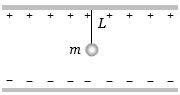
$A$ small sphere carrying a charge $q$ is hanging in between two parallel plates by a string of length $L$. The time period of the pendulum is $T_0$. When the parallel plates are charged,the time period changes to $T$. The ratio $T/T_0$ is equal to
A
${\left( {\frac{{g + \frac{{qE}}{m}}}{g}} \right)^{1/2}}$
B
${\left( {\frac{g}{{g + \frac{{qE}}{m}}}} \right)^{3/2}}$
C
${\left( {\frac{g}{{g + \frac{{qE}}{m}}}} \right)^{1/2}}$
D
None of these
Solution
(C) The initial time period of the pendulum is $T_0 = 2\pi \sqrt{\frac{L}{g}}$.
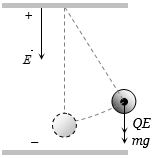
When the plates are charged,an electric field $E$ is created. The force on the charge $q$ is $F_e = qE$ acting downwards.
The net downward force on the sphere is $F_{net} = mg + qE$.
The effective acceleration $g'$ is given by $g' = \frac{F_{net}}{m} = g + \frac{qE}{m}$.
The new time period is $T = 2\pi \sqrt{\frac{L}{g'}} = 2\pi \sqrt{\frac{L}{g + \frac{qE}{m}}}$.
Taking the ratio $T/T_0$,we get:
$\frac{T}{T_0} = \frac{2\pi \sqrt{\frac{L}{g + \frac{qE}{m}}}}{2\pi \sqrt{\frac{L}{g}}} = \sqrt{\frac{g}{g + \frac{qE}{m}}} = \left( \frac{g}{g + \frac{qE}{m}} \right)^{1/2}$.
Thus,the correct option is $(c)$.
When the plates are charged,an electric field $E$ is created. The force on the charge $q$ is $F_e = qE$ acting downwards.
The net downward force on the sphere is $F_{net} = mg + qE$.
The effective acceleration $g'$ is given by $g' = \frac{F_{net}}{m} = g + \frac{qE}{m}$.
The new time period is $T = 2\pi \sqrt{\frac{L}{g'}} = 2\pi \sqrt{\frac{L}{g + \frac{qE}{m}}}$.
Taking the ratio $T/T_0$,we get:
$\frac{T}{T_0} = \frac{2\pi \sqrt{\frac{L}{g + \frac{qE}{m}}}}{2\pi \sqrt{\frac{L}{g}}} = \sqrt{\frac{g}{g + \frac{qE}{m}}} = \left( \frac{g}{g + \frac{qE}{m}} \right)^{1/2}$.
Thus,the correct option is $(c)$.
0 likes
View Solution27
MediumMCQ
$A$ charged particle $q$ is shot towards another charged particle $Q$ which is fixed,with a speed $v$. It approaches $Q$ up to a closest distance $r$ and then returns. If $q$ were given a speed $2v$,the closest distance of approach would be

A
$r$
B
$2r$
C
$r/2$
D
$r/4$
Solution
(D) By the law of conservation of energy,the initial kinetic energy of the particle $q$ is converted into electrostatic potential energy at the point of closest approach,where the particle momentarily comes to rest.
Initial kinetic energy = $\frac{1}{2}mv^2$
Electrostatic potential energy at distance $r$ = $\frac{1}{4\pi\varepsilon_0} \cdot \frac{qQ}{r}$
Equating the two: $\frac{1}{2}mv^2 = \frac{1}{4\pi\varepsilon_0} \cdot \frac{qQ}{r}$
From this,we can see that $r = \frac{qQ}{2\pi\varepsilon_0 mv^2}$,which implies $r \propto \frac{1}{v^2}$.
If the speed is doubled $(v' = 2v)$,the new distance of closest approach $r'$ will be:
$r' = r \cdot \left(\frac{v}{v'}\right)^2 = r \cdot \left(\frac{v}{2v}\right)^2 = r \cdot \frac{1}{4} = \frac{r}{4}$.
Thus,the closest distance of approach becomes $r/4$.
Initial kinetic energy = $\frac{1}{2}mv^2$
Electrostatic potential energy at distance $r$ = $\frac{1}{4\pi\varepsilon_0} \cdot \frac{qQ}{r}$
Equating the two: $\frac{1}{2}mv^2 = \frac{1}{4\pi\varepsilon_0} \cdot \frac{qQ}{r}$
From this,we can see that $r = \frac{qQ}{2\pi\varepsilon_0 mv^2}$,which implies $r \propto \frac{1}{v^2}$.
If the speed is doubled $(v' = 2v)$,the new distance of closest approach $r'$ will be:
$r' = r \cdot \left(\frac{v}{v'}\right)^2 = r \cdot \left(\frac{v}{2v}\right)^2 = r \cdot \frac{1}{4} = \frac{r}{4}$.
Thus,the closest distance of approach becomes $r/4$.
0 likes
View Solution28
EasyMCQ
$A$ moving charge will gain energy due to the application of
A
Electric field
B
Magnetic field
C
Both of these
D
None of these
Solution
(A) The work done by an electric field on a moving charge is given by $W = qEd$,which results in a change in kinetic energy.
In contrast,the magnetic force acting on a moving charge is given by $\vec{F}_m = q(\vec{v} \times \vec{B})$.
Since the magnetic force is always perpendicular to the velocity of the charge,the power delivered by the magnetic field is $P = \vec{F}_m \cdot \vec{v} = 0$.
Therefore,a magnetic field cannot change the kinetic energy of a moving charge.
Thus,only an electric field can cause a moving charge to gain energy.
In contrast,the magnetic force acting on a moving charge is given by $\vec{F}_m = q(\vec{v} \times \vec{B})$.
Since the magnetic force is always perpendicular to the velocity of the charge,the power delivered by the magnetic field is $P = \vec{F}_m \cdot \vec{v} = 0$.
Therefore,a magnetic field cannot change the kinetic energy of a moving charge.
Thus,only an electric field can cause a moving charge to gain energy.
0 likes
View Solution29
MediumMCQ
An electron is accelerated through a potential difference of $1000 \ V$. Its velocity is nearly
A
$3.8 \times 10^7 \ m/s$
B
$1.9 \times 10^6 \ m/s$
C
$1.9 \times 10^7 \ m/s$
D
$5.7 \times 10^7 \ m/s$
Solution
(C) The kinetic energy gained by an electron accelerated through a potential difference $V$ is given by $\frac{1}{2}mv^2 = eV$.
Here,$e = 1.6 \times 10^{-19} \ C$,$m = 9.1 \times 10^{-31} \ kg$,and $V = 1000 \ V$.
Rearranging for velocity $v$,we get $v = \sqrt{\frac{2eV}{m}}$.
Substituting the values: $v = \sqrt{\frac{2 \times 1.6 \times 10^{-19} \times 1000}{9.1 \times 10^{-31}}}$.
$v = \sqrt{\frac{3.2 \times 10^{-16}}{9.1 \times 10^{-31}}} = \sqrt{0.3516 \times 10^{15}} = \sqrt{3.516 \times 10^{14}}$.
$v \approx 1.875 \times 10^7 \ m/s \approx 1.9 \times 10^7 \ m/s$.
Here,$e = 1.6 \times 10^{-19} \ C$,$m = 9.1 \times 10^{-31} \ kg$,and $V = 1000 \ V$.
Rearranging for velocity $v$,we get $v = \sqrt{\frac{2eV}{m}}$.
Substituting the values: $v = \sqrt{\frac{2 \times 1.6 \times 10^{-19} \times 1000}{9.1 \times 10^{-31}}}$.
$v = \sqrt{\frac{3.2 \times 10^{-16}}{9.1 \times 10^{-31}}} = \sqrt{0.3516 \times 10^{15}} = \sqrt{3.516 \times 10^{14}}$.
$v \approx 1.875 \times 10^7 \ m/s \approx 1.9 \times 10^7 \ m/s$.
0 likes
View Solution30
MediumMCQ
In a Millikan oil drop experiment,a charged drop of mass $1.8 \times 10^{-14} \ kg$ is stationary between its plates. The distance between the plates is $0.90 \ cm$ and the potential difference is $2.0 \ kV$. The number of electrons on the drop is:
A
$500$
B
$50$
C
$5$
D
$0$
Solution
(C) For the drop to be stationary,the electric force must balance the gravitational force.
$QE = mg$
Since $E = V/d$,we have $Q(V/d) = mg$,where $Q = ne$.
$n e (V/d) = mg$
$n = \frac{mgd}{Ve}$
Given:
$m = 1.8 \times 10^{-14} \ kg$
$g = 10 \ m/s^2$
$d = 0.90 \ cm = 0.90 \times 10^{-2} \ m$
$V = 2.0 \ kV = 2.0 \times 10^3 \ V$
$e = 1.6 \times 10^{-19} \ C$
Substituting the values:
$n = \frac{1.8 \times 10^{-14} \times 10 \times 0.90 \times 10^{-2}}{2.0 \times 10^3 \times 1.6 \times 10^{-19}}$
$n = \frac{1.62 \times 10^{-14}}{3.2 \times 10^{-16}} = \frac{162}{32} = 5.0625 \approx 5$
Thus,the number of electrons is $5$.
$QE = mg$
Since $E = V/d$,we have $Q(V/d) = mg$,where $Q = ne$.
$n e (V/d) = mg$
$n = \frac{mgd}{Ve}$
Given:
$m = 1.8 \times 10^{-14} \ kg$
$g = 10 \ m/s^2$
$d = 0.90 \ cm = 0.90 \times 10^{-2} \ m$
$V = 2.0 \ kV = 2.0 \times 10^3 \ V$
$e = 1.6 \times 10^{-19} \ C$
Substituting the values:
$n = \frac{1.8 \times 10^{-14} \times 10 \times 0.90 \times 10^{-2}}{2.0 \times 10^3 \times 1.6 \times 10^{-19}}$
$n = \frac{1.62 \times 10^{-14}}{3.2 \times 10^{-16}} = \frac{162}{32} = 5.0625 \approx 5$
Thus,the number of electrons is $5$.
0 likes
View Solution31
EasyMCQ
An electron is moving with constant velocity along the $x$-axis. If a uniform electric field is applied along the $y$-axis,then its path in the $x-y$ plane will be:
A
$A$ straight line
B
$A$ circle
C
$A$ parabola
D
An ellipse
Solution
(C) The electron moves with a constant velocity $v_x$ along the $x$-axis.
When a uniform electric field $E$ is applied along the $y$-axis,the electron experiences a constant force $F_y = -eE$ in the negative $y$-direction.
This results in a constant acceleration $a_y = -eE/m$ in the $y$-direction,while the velocity in the $x$-direction remains constant.
Since the motion is uniform in the $x$-direction $(x = v_x t)$ and uniformly accelerated in the $y$-direction $(y = 1/2 a_y t^2)$,the equation of the path is $y = 1/2 (-eE/m) (x/v_x)^2$.
This equation is of the form $y = kx^2$,which represents a parabola.
When a uniform electric field $E$ is applied along the $y$-axis,the electron experiences a constant force $F_y = -eE$ in the negative $y$-direction.
This results in a constant acceleration $a_y = -eE/m$ in the $y$-direction,while the velocity in the $x$-direction remains constant.
Since the motion is uniform in the $x$-direction $(x = v_x t)$ and uniformly accelerated in the $y$-direction $(y = 1/2 a_y t^2)$,the equation of the path is $y = 1/2 (-eE/m) (x/v_x)^2$.
This equation is of the form $y = kx^2$,which represents a parabola.
0 likes
View Solution32
EasyMCQ
The kinetic energy of an electron which is accelerated through a potential of $100 \, V$ is:
A
$1.602 \times 10^{-17} \, J$
B
$418.6 \, \text{calories}$
C
$1.16 \times 10^{4} \, J$
D
$6.626 \times 10^{-34} \, W \cdot s$
Solution
(A) The kinetic energy $(K)$ gained by an electron accelerated through a potential difference $(V)$ is given by the formula $K = e \cdot V$.
Here,the charge of an electron $e = 1.602 \times 10^{-19} \, C$ and the potential difference $V = 100 \, V$.
Substituting these values into the formula:
$K = (1.602 \times 10^{-19} \, C) \times (100 \, V)$
$K = 1.602 \times 10^{-17} \, J$.
Therefore,the correct option is $A$.
Here,the charge of an electron $e = 1.602 \times 10^{-19} \, C$ and the potential difference $V = 100 \, V$.
Substituting these values into the formula:
$K = (1.602 \times 10^{-19} \, C) \times (100 \, V)$
$K = 1.602 \times 10^{-17} \, J$.
Therefore,the correct option is $A$.
0 likes
View Solution33
MediumMCQ
An electron is accelerated through a potential difference of $200 \ V$. If $e/m$ for the electron is $1.6 \times 10^{11} \ C/kg$,the velocity acquired by the electron will be:
A
$8 \times 10^6 \ m/s$
B
$8 \times 10^5 \ m/s$
C
$5.9 \times 10^6 \ m/s$
D
$5.9 \times 10^5 \ m/s$
Solution
(A) The kinetic energy gained by an electron accelerated through a potential difference $V$ is given by the equation: $\frac{1}{2}mv^2 = eV$.
Rearranging for velocity $v$,we get: $v = \sqrt{\frac{2eV}{m}} = \sqrt{2 \left(\frac{e}{m}\right) V}$.
Given values are $V = 200 \ V$ and $\frac{e}{m} = 1.6 \times 10^{11} \ C/kg$.
Substituting these values into the formula:
$v = \sqrt{2 \times (1.6 \times 10^{11}) \times 200}$
$v = \sqrt{6.4 \times 10^{13} \times 10^1} = \sqrt{64 \times 10^{12}}$
$v = 8 \times 10^6 \ m/s$.
Rearranging for velocity $v$,we get: $v = \sqrt{\frac{2eV}{m}} = \sqrt{2 \left(\frac{e}{m}\right) V}$.
Given values are $V = 200 \ V$ and $\frac{e}{m} = 1.6 \times 10^{11} \ C/kg$.
Substituting these values into the formula:
$v = \sqrt{2 \times (1.6 \times 10^{11}) \times 200}$
$v = \sqrt{6.4 \times 10^{13} \times 10^1} = \sqrt{64 \times 10^{12}}$
$v = 8 \times 10^6 \ m/s$.
0 likes
View Solution34
MediumMCQ
An electron is accelerated through a potential difference $(p.d.)$ of $45.5 \ V$. The velocity acquired by it is (in $m \ s^{-1}$)
A
$4 \times 10^6$
B
$4 \times 10^4$
C
$10^6$
D
$0$
Solution
(A) The kinetic energy gained by an electron accelerated through a potential difference $V$ is given by $K.E. = eV = \frac{1}{2}mv^2$.
Solving for velocity $v$,we get $v = \sqrt{\frac{2eV}{m}}$.
Given: $e = 1.6 \times 10^{-19} \ C$,$V = 45.5 \ V$,and $m = 9.1 \times 10^{-31} \ kg$.
Substituting the values: $v = \sqrt{\frac{2 \times 1.6 \times 10^{-19} \times 45.5}{9.1 \times 10^{-31}}}$.
$v = \sqrt{\frac{145.6 \times 10^{-19}}{9.1 \times 10^{-31}}} = \sqrt{16 \times 10^{12}}$.
$v = 4 \times 10^6 \ m \ s^{-1}$.
Solving for velocity $v$,we get $v = \sqrt{\frac{2eV}{m}}$.
Given: $e = 1.6 \times 10^{-19} \ C$,$V = 45.5 \ V$,and $m = 9.1 \times 10^{-31} \ kg$.
Substituting the values: $v = \sqrt{\frac{2 \times 1.6 \times 10^{-19} \times 45.5}{9.1 \times 10^{-31}}}$.
$v = \sqrt{\frac{145.6 \times 10^{-19}}{9.1 \times 10^{-31}}} = \sqrt{16 \times 10^{12}}$.
$v = 4 \times 10^6 \ m \ s^{-1}$.
0 likes
View Solution35
EasyMCQ
$A$ charge of magnitude $3e$ and mass $2m$ is moving in an electric field $\overrightarrow{E}$. The acceleration imparted to the charge is:
A
$2Ee/3m$
B
$3Ee/2m$
C
$2m/3Ee$
D
$3m/2Ee$
Solution
(B) The force $F$ acting on a charge $q$ in an electric field $\overrightarrow{E}$ is given by $F = qE$.
According to Newton's second law of motion,$F = ma$,where $m$ is the mass and $a$ is the acceleration.
Equating the two expressions for force: $ma = qE$.
Therefore,the acceleration $a$ is given by $a = \frac{qE}{m}$.
Given the charge $q = 3e$ and mass $m' = 2m$,we substitute these values into the formula:
$a = \frac{(3e)E}{2m} = \frac{3Ee}{2m}$.
Thus,the correct option is $B$.
According to Newton's second law of motion,$F = ma$,where $m$ is the mass and $a$ is the acceleration.
Equating the two expressions for force: $ma = qE$.
Therefore,the acceleration $a$ is given by $a = \frac{qE}{m}$.
Given the charge $q = 3e$ and mass $m' = 2m$,we substitute these values into the formula:
$a = \frac{(3e)E}{2m} = \frac{3Ee}{2m}$.
Thus,the correct option is $B$.
0 likes
View Solution36
MediumMCQ
An electron,initially at rest,is accelerated through a potential difference of $200 \ V$,so that it acquires a velocity of $8.4 \times 10^6 \ m/s$. The value of $e/m$ for the electron will be:
A
$2.76 \times 10^{12} \ C/kg$
B
$1.76 \times 10^{11} \ C/kg$
C
$0.76 \times 10^{12} \ C/kg$
D
None of these
Solution
(B) The kinetic energy gained by the electron is equal to the work done by the electric field: $\frac{1}{2}mv^2 = eV$.
Rearranging for the specific charge $e/m$,we get: $\frac{e}{m} = \frac{v^2}{2V}$.
Substituting the given values $v = 8.4 \times 10^6 \ m/s$ and $V = 200 \ V$:
$\frac{e}{m} = \frac{(8.4 \times 10^6)^2}{2 \times 200} = \frac{70.56 \times 10^{12}}{400} = 0.1764 \times 10^{12} = 1.764 \times 10^{11} \ C/kg$.
Thus,the correct option is $B$.
Rearranging for the specific charge $e/m$,we get: $\frac{e}{m} = \frac{v^2}{2V}$.
Substituting the given values $v = 8.4 \times 10^6 \ m/s$ and $V = 200 \ V$:
$\frac{e}{m} = \frac{(8.4 \times 10^6)^2}{2 \times 200} = \frac{70.56 \times 10^{12}}{400} = 0.1764 \times 10^{12} = 1.764 \times 10^{11} \ C/kg$.
Thus,the correct option is $B$.
0 likes
View Solution37
EasyMCQ
An electron is moving in an electric field and a magnetic field. It will gain energy from:
A
Electric field
B
Magnetic field
C
Both of these
D
None of these
Solution
(A) The force exerted by an electric field on a charged particle is given by $F = qE$. This force can do work on the particle,thereby changing its kinetic energy.
In contrast,the force exerted by a magnetic field on a moving charged particle is given by the Lorentz force $F = q(v \times B)$. Since this force is always perpendicular to the velocity vector $v$ of the particle,the work done by the magnetic field on the particle is always zero $(W = F \cdot d = 0)$.
Therefore,a magnetic field cannot change the kinetic energy of a charged particle. Only the electric field can change the energy of the electron.
Thus,the correct option is $A$.
In contrast,the force exerted by a magnetic field on a moving charged particle is given by the Lorentz force $F = q(v \times B)$. Since this force is always perpendicular to the velocity vector $v$ of the particle,the work done by the magnetic field on the particle is always zero $(W = F \cdot d = 0)$.
Therefore,a magnetic field cannot change the kinetic energy of a charged particle. Only the electric field can change the energy of the electron.
Thus,the correct option is $A$.
0 likes
View Solution38
MediumMCQ
In an electron gun,the electrons are accelerated by the potential $V$. If $e$ is the charge and $m$ is the mass of an electron,then the maximum velocity of these electrons will be
A
$\frac{2eV}{m}$
B
$\sqrt{\frac{2eV}{m}}$
C
$\sqrt{\frac{2m}{eV}}$
D
$\frac{V^2}{2em}$
Solution
(B) When an electron is accelerated through a potential difference $V$,the work done by the electric field is equal to the kinetic energy gained by the electron.
The work done is given by $W = eV$.
The kinetic energy gained is $K = \frac{1}{2}mv^2$.
Equating the two,we get $eV = \frac{1}{2}mv^2$.
Rearranging for velocity $v$,we get $v^2 = \frac{2eV}{m}$.
Therefore,the maximum velocity is $v = \sqrt{\frac{2eV}{m}}$.
The work done is given by $W = eV$.
The kinetic energy gained is $K = \frac{1}{2}mv^2$.
Equating the two,we get $eV = \frac{1}{2}mv^2$.
Rearranging for velocity $v$,we get $v^2 = \frac{2eV}{m}$.
Therefore,the maximum velocity is $v = \sqrt{\frac{2eV}{m}}$.
0 likes
View Solution39
EasyMCQ
In Millikan's oil drop experiment,an oil drop of mass $16 \times 10^{-6} \ kg$ is balanced by an electric field of $10^6 \ V/m$. The charge in coulomb on the drop,assuming $g = 10 \ m/s^2$,is:
A
$6.2 \times 10^{-11}$
B
$16 \times 10^{-9}$
C
$16 \times 10^{-11}$
D
$16 \times 10^{-13}$
Solution
(C) For the oil drop to be balanced,the electric force must equal the gravitational force acting on it.
$qE = mg$
Given:
Mass $m = 16 \times 10^{-6} \ kg$
Electric field $E = 10^6 \ V/m$
Acceleration due to gravity $g = 10 \ m/s^2$
Rearranging the formula to solve for charge $q$:
$q = \frac{mg}{E}$
Substituting the values:
$q = \frac{16 \times 10^{-6} \times 10}{10^6}$
$q = \frac{16 \times 10^{-5}}{10^6}$
$q = 16 \times 10^{-11} \ C$
$qE = mg$
Given:
Mass $m = 16 \times 10^{-6} \ kg$
Electric field $E = 10^6 \ V/m$
Acceleration due to gravity $g = 10 \ m/s^2$
Rearranging the formula to solve for charge $q$:
$q = \frac{mg}{E}$
Substituting the values:
$q = \frac{16 \times 10^{-6} \times 10}{10^6}$
$q = \frac{16 \times 10^{-5}}{10^6}$
$q = 16 \times 10^{-11} \ C$
0 likes
View Solution40
EasyMCQ
The kinetic energy of an electron accelerated through a potential difference of $100 \ V$ is ........
A
$1.602 \times 10^{-17} \ J$
B
$418.6 \ \text{calories}$
C
$1.16 \times 10^4 \ K$
D
$6.626 \times 10^{-34} \ \text{W-s}$
Solution
(A) The kinetic energy $(K)$ of a charged particle accelerated through a potential difference $(V)$ is given by the formula: $K = qV$.
Here,the charge of an electron is $q = e = 1.602 \times 10^{-19} \ C$ and the potential difference is $V = 100 \ V$.
Therefore,$K = 100 \ eV$.
Converting this to Joules: $K = 100 \times 1.602 \times 10^{-19} \ J = 1.602 \times 10^{-17} \ J$.
Here,the charge of an electron is $q = e = 1.602 \times 10^{-19} \ C$ and the potential difference is $V = 100 \ V$.
Therefore,$K = 100 \ eV$.
Converting this to Joules: $K = 100 \times 1.602 \times 10^{-19} \ J = 1.602 \times 10^{-17} \ J$.
0 likes
View Solution41
DifficultMCQ
$A$ particle with charge $q$ approaches a fixed particle with charge $Q$ with an initial velocity $v$. It comes to a stop at a closest distance $r$ from $Q$. If the particle $q$ is given an initial velocity $2v$,the closest distance will be:

A
$r$
B
$2r$
C
$r/2$
D
$r/4$
Solution
(D) Initially,the particle $q$ is at an infinite distance from $Q$,so the initial potential energy $P.E._i = 0$.
Case $1$: Initial velocity is $v$ and the closest distance is $r$.
Applying the law of conservation of energy: $P.E._i + K.E._i = P.E._f + K.E._f$
$0 + \frac{1}{2}mv^2 = \frac{kQq}{r} + 0$
$\frac{1}{2}mv^2 = \frac{kQq}{r} \quad \dots (1)$
Case $2$: Initial velocity is $2v$ and let the new closest distance be $r'$.
Applying the law of conservation of energy: $P.E._i + K.E._i = P.E._f + K.E._f$
$0 + \frac{1}{2}m(2v)^2 = \frac{kQq}{r'} + 0$
$\frac{1}{2}m(4v^2) = \frac{kQq}{r'} \quad \dots (2)$
Dividing equation $(1)$ by equation $(2)$:
$\frac{\frac{1}{2}mv^2}{\frac{1}{2}m(4v^2)} = \frac{\frac{kQq}{r}}{\frac{kQq}{r'}}$
$\frac{1}{4} = \frac{r'}{r}$
$r' = \frac{r}{4}$
Case $1$: Initial velocity is $v$ and the closest distance is $r$.
Applying the law of conservation of energy: $P.E._i + K.E._i = P.E._f + K.E._f$
$0 + \frac{1}{2}mv^2 = \frac{kQq}{r} + 0$
$\frac{1}{2}mv^2 = \frac{kQq}{r} \quad \dots (1)$
Case $2$: Initial velocity is $2v$ and let the new closest distance be $r'$.
Applying the law of conservation of energy: $P.E._i + K.E._i = P.E._f + K.E._f$
$0 + \frac{1}{2}m(2v)^2 = \frac{kQq}{r'} + 0$
$\frac{1}{2}m(4v^2) = \frac{kQq}{r'} \quad \dots (2)$
Dividing equation $(1)$ by equation $(2)$:
$\frac{\frac{1}{2}mv^2}{\frac{1}{2}m(4v^2)} = \frac{\frac{kQq}{r}}{\frac{kQq}{r'}}$
$\frac{1}{4} = \frac{r'}{r}$
$r' = \frac{r}{4}$
0 likes
View Solution42
EasyMCQ
When an electron enters an electric field with a velocity in the direction of the electric field lines,then.......
A
The path of the electron will be circular.
B
The path of the electron will be parabolic.
C
The velocity of the electron will decrease.
D
The velocity of the electron will increase.
Solution
(C) An electron carries a negative charge $(q = -e)$.
When it enters an electric field $\vec{E}$ with a velocity $\vec{v}$ parallel to the field lines,the electric force acting on it is given by $\vec{F} = q\vec{E} = -e\vec{E}$.
Since the force is in the opposite direction to the electric field lines,the force acts in the direction opposite to the electron's velocity.
This force causes a retardation (deceleration) in the electron's motion.
Therefore,the velocity of the electron will decrease as it moves through the field.
When it enters an electric field $\vec{E}$ with a velocity $\vec{v}$ parallel to the field lines,the electric force acting on it is given by $\vec{F} = q\vec{E} = -e\vec{E}$.
Since the force is in the opposite direction to the electric field lines,the force acts in the direction opposite to the electron's velocity.
This force causes a retardation (deceleration) in the electron's motion.
Therefore,the velocity of the electron will decrease as it moves through the field.
0 likes
View Solution43
EasyMCQ
An electron enters an electric field of $9.1 \times 10^6 \ N/C$. The acceleration produced is ..... $m/s^2$.
A
$1.6$
B
$1.6 \times 10^{18}$
C
$3.2 \times 10^{18}$
D
$0.8 \times 10^{18}$
Solution
(B) The force $F$ acting on an electron in an electric field $E$ is given by $F = eE$.
According to Newton's second law,$F = ma$,where $m$ is the mass of the electron.
Equating the two,we get $ma = eE$,which implies $a = \frac{eE}{m}$.
Given: $E = 9.1 \times 10^6 \ N/C$,$e = 1.6 \times 10^{-19} \ C$,and $m = 9.1 \times 10^{-31} \ kg$.
Substituting the values: $a = \frac{(1.6 \times 10^{-19}) \times (9.1 \times 10^6)}{9.1 \times 10^{-31}}$.
$a = 1.6 \times 10^{-19+6+31} = 1.6 \times 10^{18} \ m/s^2$.
According to Newton's second law,$F = ma$,where $m$ is the mass of the electron.
Equating the two,we get $ma = eE$,which implies $a = \frac{eE}{m}$.
Given: $E = 9.1 \times 10^6 \ N/C$,$e = 1.6 \times 10^{-19} \ C$,and $m = 9.1 \times 10^{-31} \ kg$.
Substituting the values: $a = \frac{(1.6 \times 10^{-19}) \times (9.1 \times 10^6)}{9.1 \times 10^{-31}}$.
$a = 1.6 \times 10^{-19+6+31} = 1.6 \times 10^{18} \ m/s^2$.
0 likes
View Solution44
DifficultMCQ
The intensity of the electric field required to keep a water drop of radius $10^{-5} \, cm$ and carrying a charge of $1$ electron suspended in air is:
A
$260 \, V/cm$
B
$260 \, N/C$
C
$130 \, V/cm$
D
$130 \, N/C$
Solution
(B) For the water drop to remain suspended in air,the electric force must balance the gravitational force.
$F_e = mg$
$eE = mg$
$E = \frac{mg}{e}$
Here,$m = \text{volume} \times \text{density} = \frac{4}{3} \pi r^3 \rho$.
Given: $r = 10^{-5} \, cm = 10^{-7} \, m$,$\rho = 1000 \, kg/m^3$,$e = 1.6 \times 10^{-19} \, C$,$g = 10 \, m/s^2$.
$m = \frac{4}{3} \times 3.14 \times (10^{-7})^3 \times 1000 = \frac{4}{3} \times 3.14 \times 10^{-18} \, kg$.
$E = \frac{\frac{4}{3} \times 3.14 \times 10^{-18} \times 10}{1.6 \times 10^{-19}} \approx 261.6 \, N/C$.
Rounding to the nearest provided option,the correct value is $260 \, N/C$.
$F_e = mg$
$eE = mg$
$E = \frac{mg}{e}$
Here,$m = \text{volume} \times \text{density} = \frac{4}{3} \pi r^3 \rho$.
Given: $r = 10^{-5} \, cm = 10^{-7} \, m$,$\rho = 1000 \, kg/m^3$,$e = 1.6 \times 10^{-19} \, C$,$g = 10 \, m/s^2$.
$m = \frac{4}{3} \times 3.14 \times (10^{-7})^3 \times 1000 = \frac{4}{3} \times 3.14 \times 10^{-18} \, kg$.
$E = \frac{\frac{4}{3} \times 3.14 \times 10^{-18} \times 10}{1.6 \times 10^{-19}} \approx 261.6 \, N/C$.
Rounding to the nearest provided option,the correct value is $260 \, N/C$.
0 likes
View Solution45
MediumMCQ
An electron and a proton are placed in the same electric field. The ratio of their accelerations is ......
A
$1$
B
$0$
C
$m_p/m_e$
D
$m_e/m_p$
Solution
(C) The force on an electron in an electric field $E$ is given by $F_e = eE$. According to Newton's second law,$m_e a_e = eE$,so $a_e = \frac{eE}{m_e}$.
The force on a proton in the same electric field $E$ is $F_p = eE$. According to Newton's second law,$m_p a_p = eE$,so $a_p = \frac{eE}{m_p}$.
Taking the ratio of the acceleration of the electron to the acceleration of the proton:
$\frac{a_e}{a_p} = \frac{eE/m_e}{eE/m_p} = \frac{m_p}{m_e}$.
The force on a proton in the same electric field $E$ is $F_p = eE$. According to Newton's second law,$m_p a_p = eE$,so $a_p = \frac{eE}{m_p}$.
Taking the ratio of the acceleration of the electron to the acceleration of the proton:
$\frac{a_e}{a_p} = \frac{eE/m_e}{eE/m_p} = \frac{m_p}{m_e}$.
0 likes
View Solution46
MediumMCQ
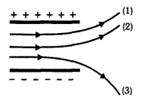
The figure shows the paths of three charged particles in a uniform electric field. Which particle has the highest charge-to-mass ratio?
A
Particle $(1)$
B
Particle $(2)$
C
Particle $(3)$
D
Particle $(1)$ and Particle $(2)$
Solution
(C) When a charged particle enters a uniform electric field $E$ perpendicular to its direction of motion,it experiences a force $F = qE$,resulting in an acceleration $a = \frac{qE}{m}$.
Assuming the particle enters with velocity $v$ and travels a horizontal distance $x$,the time taken is $t = \frac{x}{v}$.
The vertical deflection $y$ is given by $y = \frac{1}{2}at^2 = \frac{1}{2} \left( \frac{qE}{m} \right) \left( \frac{x}{v} \right)^2$.
Since $y \propto \frac{q}{m}$,the particle with the greatest vertical deflection has the highest charge-to-mass ratio.
In the figure,particle $(3)$ shows the maximum deflection,therefore,particle $(3)$ has the highest charge-to-mass ratio.
Assuming the particle enters with velocity $v$ and travels a horizontal distance $x$,the time taken is $t = \frac{x}{v}$.
The vertical deflection $y$ is given by $y = \frac{1}{2}at^2 = \frac{1}{2} \left( \frac{qE}{m} \right) \left( \frac{x}{v} \right)^2$.
Since $y \propto \frac{q}{m}$,the particle with the greatest vertical deflection has the highest charge-to-mass ratio.
In the figure,particle $(3)$ shows the maximum deflection,therefore,particle $(3)$ has the highest charge-to-mass ratio.
0 likes
View Solution47
DifficultMCQ
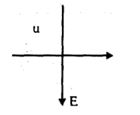
An electron enters an electric field of intensity $3200 \ V/m$ perpendicular to the field with a velocity of $4 \times 10^7 \ m/s$. If it travels a horizontal distance of $0.10 \ m$,then its deflection from its path is ........ $mm$.
A
$1.76$
B
$17.6$
C
$176$
D
$0.176$
Solution
(A) The electron enters the electric field perpendicular to the field lines. The horizontal velocity $u$ remains constant as there is no force in the horizontal direction.
The time taken to travel a horizontal distance $x$ is $t = \frac{x}{u}$.
The vertical force on the electron is $F = qE$,so the vertical acceleration is $a = \frac{qE}{m}$.
The vertical deflection $y$ is given by $y = \frac{1}{2}at^2 = \frac{1}{2} \left( \frac{qE}{m} \right) \left( \frac{x}{u} \right)^2$.
Given: $E = 3200 \ V/m$,$x = 0.10 \ m$,$u = 4 \times 10^7 \ m/s$,$q = 1.6 \times 10^{-19} \ C$,$m = 9.1 \times 10^{-31} \ kg$.
Substituting the values:
$y = \frac{1}{2} \times \frac{1.6 \times 10^{-19} \times 3200}{9.1 \times 10^{-31}} \times \frac{(0.1)^2}{(4 \times 10^7)^2}$
$y = \frac{1}{2} \times \frac{5.12 \times 10^{-16}}{9.1 \times 10^{-31}} \times \frac{0.01}{16 \times 10^{14}}$
$y = \frac{5.12 \times 10^{-16} \times 10^{-2}}{2 \times 9.1 \times 10^{-31} \times 16 \times 10^{14}}$
$y \approx 0.001758 \ m \approx 1.76 \ mm$.
The time taken to travel a horizontal distance $x$ is $t = \frac{x}{u}$.
The vertical force on the electron is $F = qE$,so the vertical acceleration is $a = \frac{qE}{m}$.
The vertical deflection $y$ is given by $y = \frac{1}{2}at^2 = \frac{1}{2} \left( \frac{qE}{m} \right) \left( \frac{x}{u} \right)^2$.
Given: $E = 3200 \ V/m$,$x = 0.10 \ m$,$u = 4 \times 10^7 \ m/s$,$q = 1.6 \times 10^{-19} \ C$,$m = 9.1 \times 10^{-31} \ kg$.
Substituting the values:
$y = \frac{1}{2} \times \frac{1.6 \times 10^{-19} \times 3200}{9.1 \times 10^{-31}} \times \frac{(0.1)^2}{(4 \times 10^7)^2}$
$y = \frac{1}{2} \times \frac{5.12 \times 10^{-16}}{9.1 \times 10^{-31}} \times \frac{0.01}{16 \times 10^{14}}$
$y = \frac{5.12 \times 10^{-16} \times 10^{-2}}{2 \times 9.1 \times 10^{-31} \times 16 \times 10^{14}}$
$y \approx 0.001758 \ m \approx 1.76 \ mm$.
0 likes
View SolutionElectric Charges and Fields — Motion of Charge particle in Electric filed · Frequently Asked Questions
1Are these Electric Charges and Fields questions useful for JEE and NEET?
Yes. All questions in this section are mapped to JEE Main and NEET exam patterns. Previous year questions from JEE Main, NEET, GUJCET and state-level exams are included with full solutions.
2Can I switch to Hindi or Gujarati for these questions?
Yes. Use the language tabs in the hero section or the sidebar to view the same questions and solutions in English, Hindi or Gujarati.
3How do I generate a question paper from this subtopic?
Use the Vedclass Exam Paper Generator — select the chapter and subtopic, set difficulty, and generate Sets A, B, C, D automatically. First 3 chapters of every subject are free.
Vedclass Products
For Students
Vedclass Test Series
Mock tests in real JEE/NEET style with performance analysis. 5-day free trial.
Start Free TrialFor Teachers
Exam Paper Generator
Generate Set A/B/C/D papers from this chapter in 2 minutes. 3 chapters free.
Try FreeFor Institutes
Online Exam Module
Live online exams with unlimited students, 360° analytics & white-label branding.
See DemoFor Teachers & Institutes
Generate a Electric Charges and Fields Exam Paper in 2 Minutes
Select subtopic & difficulty — Sets A, B, C, D auto-generated with No Repeat logic.
First 3 chapters of every subject are free — no payment required.