
A English
Electric Field Lines, Electric Flux and Gauss's Law Questions in English
Class 12 Physics · Electric Charges and Fields · Electric Field Lines, Electric Flux and Gauss's Law
312+
Questions
English
Language
100%
With Solutions
Showing 50 of 312 questions in English
1
EasyMCQ
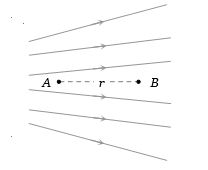
The figure shows the electric lines of force emerging from a charged body. If the electric field at $A$ and $B$ are $E_A$ and $E_B$ respectively,and if the distance between $A$ and $B$ is $r$,then:
A
$E_A > E_B$
B
$E_A < E_B$
C
$E_A = \frac{E_B}{r}$
D
$E_A = \frac{E_B}{r^2}$
Solution
(A) The strength of an electric field is represented by the density of electric field lines.
In the given figure,the electric field lines are closer together (denser) at point $A$ compared to point $B$.
Since the density of field lines is higher at $A$,the magnitude of the electric field at $A$ $(E_A)$ must be greater than the magnitude of the electric field at $B$ $(E_B)$.
Therefore,$E_A > E_B$.
In the given figure,the electric field lines are closer together (denser) at point $A$ compared to point $B$.
Since the density of field lines is higher at $A$,the magnitude of the electric field at $A$ $(E_A)$ must be greater than the magnitude of the electric field at $B$ $(E_B)$.
Therefore,$E_A > E_B$.
0 likes
View Solution2
EasyMCQ
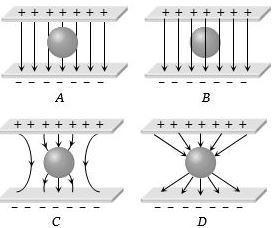
An uncharged metal sphere is placed between two charged plates as shown. The electric field lines look like:
A
$A$
B
$B$
C
$C$
D
$D$
Solution
(C) When a conductor is placed in an external electric field,the charges redistribute themselves such that the net electric field inside the conductor becomes zero.
Electric field lines must be perpendicular to the surface of a conductor at every point.
They cannot enter the conductor because the electric field inside a conductor in electrostatic equilibrium is zero.
Therefore,the field lines bend around the sphere and terminate perpendicularly on its surface,as shown in option $C$.
Electric field lines must be perpendicular to the surface of a conductor at every point.
They cannot enter the conductor because the electric field inside a conductor in electrostatic equilibrium is zero.
Therefore,the field lines bend around the sphere and terminate perpendicularly on its surface,as shown in option $C$.
0 likes
View Solution3
EasyMCQ
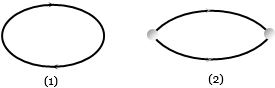
The figures $(1)$ and $(2)$ below represent lines of force. Which statement is correct?
A
Figure $(1)$ represents magnetic lines of force.
B
Figure $(2)$ represents magnetic lines of force.
C
Figure $(1)$ represents electric lines of force.
D
Both figure $(1)$ and figure $(2)$ represent magnetic lines of force.
Solution
(A) Magnetic lines of force always form continuous closed loops,as shown in figure $(1)$.
Electric lines of force originate from a positive charge and terminate at a negative charge,meaning they do not form closed loops,as shown in figure $(2)$.
Therefore,figure $(1)$ represents magnetic lines of force,and figure $(2)$ represents electric lines of force.
Thus,the correct statement is that figure $(1)$ represents magnetic lines of force.
Electric lines of force originate from a positive charge and terminate at a negative charge,meaning they do not form closed loops,as shown in figure $(2)$.
Therefore,figure $(1)$ represents magnetic lines of force,and figure $(2)$ represents electric lines of force.
Thus,the correct statement is that figure $(1)$ represents magnetic lines of force.
0 likes
View Solution4
EasyMCQ
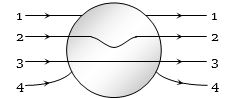
$A$ metallic solid sphere is placed in a uniform electric field. The lines of force follow the path$(s)$ shown in the figure as:
A
$1$
B
$2$
C
$3$
D
$4$
Solution
(D) The electric field lines must be perpendicular to the surface of a conductor at every point. Inside a metallic conductor,the electric field is zero. Therefore,the field lines cannot pass through the sphere; they must terminate on the surface and emerge from the other side,always maintaining a perpendicular orientation to the surface. Path $4$ correctly depicts this behavior,where the lines bend to meet the surface of the sphere normally.
0 likes
View Solution5
EasyMCQ
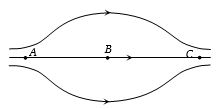
The figure shows some of the electric field lines corresponding to an electric field. The figure suggests
A
${E_A} > {E_B} > {E_C}$
B
${E_A} = {E_B} = {E_C}$
C
${E_A} = {E_C} > {E_B}$
D
${E_A} = {E_C} < {E_B}$
Solution
(C) The strength of an electric field is represented by the density of electric field lines.
Greater the density of field lines,stronger is the electric field.
In the given figure,the field lines are closer together at points $A$ and $C$ compared to point $B$.
Therefore,the electric field intensity is higher at $A$ and $C$ than at $B$.
Thus,${E_A} = {E_C} > {E_B}$.
Greater the density of field lines,stronger is the electric field.
In the given figure,the field lines are closer together at points $A$ and $C$ compared to point $B$.
Therefore,the electric field intensity is higher at $A$ and $C$ than at $B$.
Thus,${E_A} = {E_C} > {E_B}$.
0 likes
View Solution6
EasyMCQ
The wrong statement about electric lines of force is:
A
These originate from positive charge and end on negative charge.
B
They do not intersect each other at a point.
C
They have the same form for a point charge and a sphere.
D
They have physical existence.
Solution
(D) Electric lines of force are imaginary lines used to visualize the electric field in a region.
They originate from a positive charge and terminate on a negative charge.
They never intersect each other because if they did,there would be two directions of the electric field at the point of intersection,which is impossible.
For a point charge and a uniformly charged sphere,the electric field lines outside the sphere are identical.
However,electric lines of force do not have any physical existence; they are a mathematical construct used to represent the electric field.
Therefore,the statement that they have physical existence is incorrect.
They originate from a positive charge and terminate on a negative charge.
They never intersect each other because if they did,there would be two directions of the electric field at the point of intersection,which is impossible.
For a point charge and a uniformly charged sphere,the electric field lines outside the sphere are identical.
However,electric lines of force do not have any physical existence; they are a mathematical construct used to represent the electric field.
Therefore,the statement that they have physical existence is incorrect.
0 likes
View Solution7
EasyMCQ
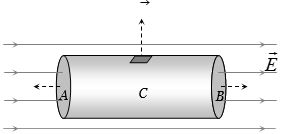
$A$ cylinder of radius $R$ and length $L$ is placed in a uniform electric field $E$ parallel to the cylinder axis. The total flux for the surface of the cylinder is given by
A
$2\pi R^2 E$
B
$\pi R^2 / E$
C
$(\pi R^2 - \pi R) / E$
D
Zero
Solution
(D) The cylinder has three surfaces: two circular end faces ($A$ and $B$) and one curved surface $(C)$.
For the circular face $A$,the area vector points outwards (opposite to the electric field),so the flux is $\phi_A = \vec{E} \cdot \vec{A} = E(\pi R^2) \cos(180^\circ) = -E\pi R^2$.
For the circular face $B$,the area vector points outwards (in the direction of the electric field),so the flux is $\phi_B = \vec{E} \cdot \vec{A} = E(\pi R^2) \cos(0^\circ) = +E\pi R^2$.
For the curved surface $C$,the area vector at every point is perpendicular to the electric field,so the flux is $\phi_C = \int \vec{E} \cdot d\vec{s} = \int E ds \cos(90^\circ) = 0$.
The total flux through the cylinder is $\phi_{total} = \phi_A + \phi_B + \phi_C = -E\pi R^2 + E\pi R^2 + 0 = 0$.
For the circular face $A$,the area vector points outwards (opposite to the electric field),so the flux is $\phi_A = \vec{E} \cdot \vec{A} = E(\pi R^2) \cos(180^\circ) = -E\pi R^2$.
For the circular face $B$,the area vector points outwards (in the direction of the electric field),so the flux is $\phi_B = \vec{E} \cdot \vec{A} = E(\pi R^2) \cos(0^\circ) = +E\pi R^2$.
For the curved surface $C$,the area vector at every point is perpendicular to the electric field,so the flux is $\phi_C = \int \vec{E} \cdot d\vec{s} = \int E ds \cos(90^\circ) = 0$.
The total flux through the cylinder is $\phi_{total} = \phi_A + \phi_B + \phi_C = -E\pi R^2 + E\pi R^2 + 0 = 0$.
0 likes
View Solution8
EasyMCQ
An electric charge $q$ is placed at the centre of a cube of side $a$. The electric flux through one of its faces will be
A
$\frac{q}{6\varepsilon_0}$
B
$\frac{q}{\varepsilon_0 a^2}$
C
$\frac{q}{4\pi \varepsilon_0 a^2}$
D
$\frac{q}{\varepsilon_0}$
Solution
(A) According to Gauss's theorem,the total electric flux $\phi_{net}$ through a closed surface is given by $\phi_{net} = \frac{q}{\varepsilon_0}$.
Since the charge $q$ is placed at the centre of the cube,the flux is distributed symmetrically through all $6$ faces of the cube.
Therefore,the electric flux through one face of the cube is $\phi_{face} = \frac{\phi_{net}}{6} = \frac{q}{6\varepsilon_0}$.
Since the charge $q$ is placed at the centre of the cube,the flux is distributed symmetrically through all $6$ faces of the cube.
Therefore,the electric flux through one face of the cube is $\phi_{face} = \frac{\phi_{net}}{6} = \frac{q}{6\varepsilon_0}$.
0 likes
View Solution9
EasyMCQ
Total electric flux coming out of a unit positive charge placed in air is
A
$\varepsilon_0$
B
$\varepsilon_0^{-1}$
C
$(4\pi\varepsilon_0)^{-1}$
D
$4\pi\varepsilon_0$
Solution
(B) According to Gauss's Law,the total electric flux $\phi$ through a closed surface is given by $\phi = \frac{q_{enclosed}}{\varepsilon_0}$.
For a unit positive charge,$q_{enclosed} = 1 \text{ unit}$.
Therefore,the total electric flux $\phi = \frac{1}{\varepsilon_0} = \varepsilon_0^{-1}$.
For a unit positive charge,$q_{enclosed} = 1 \text{ unit}$.
Therefore,the total electric flux $\phi = \frac{1}{\varepsilon_0} = \varepsilon_0^{-1}$.
0 likes
View Solution10
EasyMCQ
For a given surface,the Gauss's law is stated as $\oint {E \cdot ds} = 0$. From this,we can conclude that:
A
$E$ is necessarily zero on the surface
B
$E$ is perpendicular to the surface at every point
C
The total flux through the surface is zero
D
The flux is only going out of the surface
Solution
(C) Gauss's law states that the total electric flux $\phi_E$ through a closed surface is given by $\phi_E = \oint {E \cdot ds} = \frac{q_{enclosed}}{\epsilon_0}$.
Given the equation $\oint {E \cdot ds} = 0$,it directly implies that the net electric flux through the surface is zero.
This means that the total charge enclosed by the surface is zero $(q_{enclosed} = 0)$.
Therefore,option $(c)$ is the correct conclusion.
Given the equation $\oint {E \cdot ds} = 0$,it directly implies that the net electric flux through the surface is zero.
This means that the total charge enclosed by the surface is zero $(q_{enclosed} = 0)$.
Therefore,option $(c)$ is the correct conclusion.
0 likes
View Solution11
EasyMCQ
$A$ cube of side $l$ is placed in a uniform electric field $E$,where $E = E\hat{i}$. The net electric flux through the cube is:
A
Zero
B
$l^2E$
C
$4l^2E$
D
$6l^2E$
Solution
(A) According to Gauss's Law,the net electric flux $\phi$ through a closed surface is given by $\phi = \frac{q_{enclosed}}{\epsilon_0}$.
Since the cube is placed in a uniform electric field and there is no charge enclosed within the cube $(q_{enclosed} = 0)$,the net electric flux through the cube is zero.
Alternatively,the flux entering the left face is $-El^2$ and the flux leaving the right face is $+El^2$. The flux through all other four faces is zero because the electric field lines are parallel to these faces. Thus,the total flux is $-El^2 + El^2 = 0$.
Since the cube is placed in a uniform electric field and there is no charge enclosed within the cube $(q_{enclosed} = 0)$,the net electric flux through the cube is zero.
Alternatively,the flux entering the left face is $-El^2$ and the flux leaving the right face is $+El^2$. The flux through all other four faces is zero because the electric field lines are parallel to these faces. Thus,the total flux is $-El^2 + El^2 = 0$.
0 likes
View Solution12
EasyMCQ
Eight dipoles of charges of magnitude $e$ are placed inside a cube. The total electric flux coming out of the cube will be
A
$\frac{8e}{\varepsilon_0}$
B
$\frac{16e}{\varepsilon_0}$
C
$\frac{e}{\varepsilon_0}$
D
Zero
Solution
(D) According to Gauss's Law,the total electric flux $\phi$ through a closed surface is given by $\phi = \frac{q_{\text{net}}}{\varepsilon_0}$,where $q_{\text{net}}$ is the total charge enclosed within the surface.
An electric dipole consists of two equal and opposite charges,$+e$ and $-e$. The net charge of a single dipole is $q_{\text{dipole}} = (+e) + (-e) = 0$.
Since there are eight such dipoles inside the cube,the total net charge enclosed is $q_{\text{net}} = 8 \times 0 = 0$.
Therefore,the total electric flux coming out of the cube is $\phi = \frac{0}{\varepsilon_0} = 0$.
An electric dipole consists of two equal and opposite charges,$+e$ and $-e$. The net charge of a single dipole is $q_{\text{dipole}} = (+e) + (-e) = 0$.
Since there are eight such dipoles inside the cube,the total net charge enclosed is $q_{\text{net}} = 8 \times 0 = 0$.
Therefore,the total electric flux coming out of the cube is $\phi = \frac{0}{\varepsilon_0} = 0$.
0 likes
View Solution13
EasyMCQ
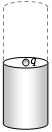
$A$ charge $q$ is placed at the centre of the open end of a cylindrical vessel. The flux of the electric field through the surface of the vessel is
A
Zero
B
$\frac{q}{\varepsilon_0}$
C
$\frac{q}{2\varepsilon_0}$
D
$\frac{2q}{\varepsilon_0}$
Solution
(C) To apply Gauss's theorem,it is essential that the charge should be placed inside a closed surface.
Imagine another similar cylindrical vessel placed inverted on top of the existing vessel to form a closed Gaussian surface (a larger cylinder).
According to Gauss's law,the total electric flux $\phi_{total}$ through this closed surface is $\frac{q}{\varepsilon_0}$.
Since the charge $q$ is placed at the interface of the two identical cylinders,by symmetry,the flux through each cylinder is equal.
Therefore,the flux through the surface of the original vessel is $\phi = \frac{\phi_{total}}{2} = \frac{q}{2\varepsilon_0}$.
Imagine another similar cylindrical vessel placed inverted on top of the existing vessel to form a closed Gaussian surface (a larger cylinder).
According to Gauss's law,the total electric flux $\phi_{total}$ through this closed surface is $\frac{q}{\varepsilon_0}$.
Since the charge $q$ is placed at the interface of the two identical cylinders,by symmetry,the flux through each cylinder is equal.
Therefore,the flux through the surface of the original vessel is $\phi = \frac{\phi_{total}}{2} = \frac{q}{2\varepsilon_0}$.
0 likes
View Solution14
EasyMCQ
It is not convenient to use a spherical Gaussian surface to find the electric field due to an electric dipole using Gauss's theorem because
A
Gauss's law fails in this case
B
This problem does not have spherical symmetry
C
Coulomb's law is more fundamental than Gauss's law
D
Spherical Gaussian surface will alter the dipole moment
Solution
(B) Gauss's law is most effective when the charge distribution possesses high degrees of symmetry (such as spherical,cylindrical,or planar symmetry).
For an electric dipole,the electric field does not possess spherical symmetry because the field depends on the orientation relative to the dipole axis.
Since the electric field magnitude is not constant over a spherical surface centered at the dipole,the integral $\oint \vec{E} \cdot d\vec{A}$ cannot be simplified to $E \oint dA$.
Therefore,it is not convenient to use a spherical Gaussian surface for this calculation.
For an electric dipole,the electric field does not possess spherical symmetry because the field depends on the orientation relative to the dipole axis.
Since the electric field magnitude is not constant over a spherical surface centered at the dipole,the integral $\oint \vec{E} \cdot d\vec{A}$ cannot be simplified to $E \oint dA$.
Therefore,it is not convenient to use a spherical Gaussian surface for this calculation.
0 likes
View Solution15
MediumMCQ
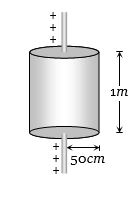
Electric charge is uniformly distributed along a long straight wire of radius $1\, mm$. The charge per $cm$ length of the wire is $Q$ $coulomb$. Another cylindrical surface of radius $50\, cm$ and length $1\, m$ symmetrically encloses the wire as shown in the figure. The total electric flux passing through the cylindrical surface is
A
$\frac{Q}{\varepsilon_0}$
B
$\frac{100Q}{\varepsilon_0}$
C
$\frac{10Q}{\pi \varepsilon_0}$
D
$\frac{100Q}{\pi \varepsilon_0}$
Solution
(B) The charge per unit length of the wire is given as $Q\, C/cm$.
The length of the cylindrical surface is $L = 1\, m = 100\, cm$.
The total charge enclosed by the cylindrical surface is $Q_{enc} = (\text{charge per unit length}) \times (\text{length of the cylinder}) = Q \times 100 = 100Q\, C$.
According to Gauss's law,the total electric flux $\phi$ passing through a closed surface is given by $\phi = \frac{Q_{enc}}{\varepsilon_0}$.
Substituting the value of $Q_{enc}$,we get $\phi = \frac{100Q}{\varepsilon_0}$.
The length of the cylindrical surface is $L = 1\, m = 100\, cm$.
The total charge enclosed by the cylindrical surface is $Q_{enc} = (\text{charge per unit length}) \times (\text{length of the cylinder}) = Q \times 100 = 100Q\, C$.
According to Gauss's law,the total electric flux $\phi$ passing through a closed surface is given by $\phi = \frac{Q_{enc}}{\varepsilon_0}$.
Substituting the value of $Q_{enc}$,we get $\phi = \frac{100Q}{\varepsilon_0}$.
0 likes
View Solution16
EasyMCQ
The $S.I.$ unit of electric flux is
A
Weber
B
Newton per coulomb
C
Volt $\times$ metre
D
Joule per coulomb
Solution
(C) The electric flux $\Phi_E$ is defined as the product of the electric field $E$ and the area $A$ through which it passes,given by $\Phi_E = E \cdot A$.
The $S.I.$ unit of electric field $E$ is $\text{Newton per coulomb}$ $(N/C)$ or $\text{Volt per metre}$ $(V/m)$.
The $S.I.$ unit of area $A$ is $\text{square metre}$ $(m^2)$.
Therefore,the $S.I.$ unit of electric flux is $\frac{N}{C} \times m^2 = \frac{N \cdot m^2}{C}$.
Since $1 \text{ Joule} = 1 \text{ Newton} \times 1 \text{ metre}$,we can write $\frac{N \cdot m^2}{C} = \frac{J \cdot m}{C}$.
Since $1 \text{ Volt} = 1 \text{ Joule per coulomb}$ $(J/C)$,the unit becomes $\text{Volt} \times \text{metre}$ $(V \cdot m)$.
The $S.I.$ unit of electric field $E$ is $\text{Newton per coulomb}$ $(N/C)$ or $\text{Volt per metre}$ $(V/m)$.
The $S.I.$ unit of area $A$ is $\text{square metre}$ $(m^2)$.
Therefore,the $S.I.$ unit of electric flux is $\frac{N}{C} \times m^2 = \frac{N \cdot m^2}{C}$.
Since $1 \text{ Joule} = 1 \text{ Newton} \times 1 \text{ metre}$,we can write $\frac{N \cdot m^2}{C} = \frac{J \cdot m}{C}$.
Since $1 \text{ Volt} = 1 \text{ Joule per coulomb}$ $(J/C)$,the unit becomes $\text{Volt} \times \text{metre}$ $(V \cdot m)$.
0 likes
View Solution17
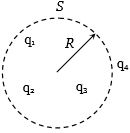
EasyMCQ
$q_1, q_2, q_3$ and $q_4$ are point charges located at points as shown in the figure and $S$ is a spherical Gaussian surface of radius $R$. Which of the following is true according to Gauss's law?
A
$\oint_S (\vec{E}_1 + \vec{E}_2 + \vec{E}_3) \cdot d\vec{A} = \frac{q_1 + q_2 + q_3}{2\varepsilon_0}$
B
$\oint_S (\vec{E}_1 + \vec{E}_2 + \vec{E}_3) \cdot d\vec{A} = \frac{q_1 + q_2 + q_3}{\varepsilon_0}$
C
$\oint_S (\vec{E}_1 + \vec{E}_2 + \vec{E}_3) \cdot d\vec{A} = \frac{q_1 + q_2 + q_3 + q_4}{\varepsilon_0}$
D
None of the above
Solution
(B) According to Gauss's law,the total electric flux $\Phi_E$ through a closed surface is equal to the total enclosed charge divided by the permittivity of free space $\varepsilon_0$.
$\Phi_E = \oint_S \vec{E}_{net} \cdot d\vec{A} = \frac{Q_{enc}}{\varepsilon_0}$
In the given figure,the charges enclosed by the Gaussian surface $S$ are $q_1, q_2$ and $q_3$. The charge $q_4$ is outside the surface.
Therefore,the net electric field $\vec{E}_{net}$ at any point on the surface is the vector sum of the electric fields produced by all charges (both inside and outside the surface),i.e.,$\vec{E}_{net} = \vec{E}_1 + \vec{E}_2 + \vec{E}_3 + \vec{E}_4$.
However,the flux through the surface depends only on the enclosed charge $Q_{enc} = q_1 + q_2 + q_3$.
Thus,$\oint_S (\vec{E}_1 + \vec{E}_2 + \vec{E}_3 + \vec{E}_4) \cdot d\vec{A} = \frac{q_1 + q_2 + q_3}{\varepsilon_0}$.
Since the expression in option $(b)$ represents the flux due to the enclosed charges,and the integral of the net field over the surface is equal to the flux,option $(b)$ is the correct representation of the law applied to this system.
$\Phi_E = \oint_S \vec{E}_{net} \cdot d\vec{A} = \frac{Q_{enc}}{\varepsilon_0}$
In the given figure,the charges enclosed by the Gaussian surface $S$ are $q_1, q_2$ and $q_3$. The charge $q_4$ is outside the surface.
Therefore,the net electric field $\vec{E}_{net}$ at any point on the surface is the vector sum of the electric fields produced by all charges (both inside and outside the surface),i.e.,$\vec{E}_{net} = \vec{E}_1 + \vec{E}_2 + \vec{E}_3 + \vec{E}_4$.
However,the flux through the surface depends only on the enclosed charge $Q_{enc} = q_1 + q_2 + q_3$.
Thus,$\oint_S (\vec{E}_1 + \vec{E}_2 + \vec{E}_3 + \vec{E}_4) \cdot d\vec{A} = \frac{q_1 + q_2 + q_3}{\varepsilon_0}$.
Since the expression in option $(b)$ represents the flux due to the enclosed charges,and the integral of the net field over the surface is equal to the flux,option $(b)$ is the correct representation of the law applied to this system.
0 likes
View Solution18
EasyMCQ
Gauss's law should be invalid if
A
There were magnetic monopoles
B
The inverse square law were not exactly true
C
The velocity of light were not a universal constant
D
None of these
Solution
(B) Gauss's law is derived directly from Coulomb's law, which states that the electric force between two point charges is proportional to $1/r^2$.
If the inverse square law were not exactly true, the flux through a closed surface would not be directly proportional to the enclosed charge in the manner described by Gauss's law $(\Phi_E = q_{enclosed} / \epsilon_0)$.
Therefore, the validity of Gauss's law is fundamentally dependent on the inverse square nature of the electric field.
If the inverse square law were not exactly true, the flux through a closed surface would not be directly proportional to the enclosed charge in the manner described by Gauss's law $(\Phi_E = q_{enclosed} / \epsilon_0)$.
Therefore, the validity of Gauss's law is fundamentally dependent on the inverse square nature of the electric field.
0 likes
View Solution19
MediumMCQ
The inward and outward electric flux for a closed surface in units of $N \cdot m^2/C$ are respectively $8 \times 10^3$ and $4 \times 10^3$. Then the total charge inside the surface is [where $\varepsilon_0$ = permittivity constant].
A
$4 \times 10^3 \text{ C}$
B
$-4 \times 10^3 \text{ C}$
C
$\frac{-4 \times 10^3}{\varepsilon_0} \text{ C}$
D
$-4 \times 10^3 \varepsilon_0 \text{ C}$
Solution
(D) According to Gauss's law, the net electric flux $\phi_{net}$ through a closed surface is given by $\phi_{net} = \frac{Q_{enclosed}}{\varepsilon_0}$.
Inward flux is taken as negative and outward flux is taken as positive.
Given: Inward flux $\phi_{in} = -8 \times 10^3 \text{ N} \cdot m^2/C$ and outward flux $\phi_{out} = 4 \times 10^3 \text{ N} \cdot m^2/C$.
The net flux $\phi_{net} = \phi_{in} + \phi_{out} = -8 \times 10^3 + 4 \times 10^3 = -4 \times 10^3 \text{ N} \cdot m^2/C$.
Using Gauss's law: $Q_{enclosed} = \phi_{net} \times \varepsilon_0$.
Therefore, $Q_{enclosed} = (-4 \times 10^3) \varepsilon_0 \text{ C}$.
Inward flux is taken as negative and outward flux is taken as positive.
Given: Inward flux $\phi_{in} = -8 \times 10^3 \text{ N} \cdot m^2/C$ and outward flux $\phi_{out} = 4 \times 10^3 \text{ N} \cdot m^2/C$.
The net flux $\phi_{net} = \phi_{in} + \phi_{out} = -8 \times 10^3 + 4 \times 10^3 = -4 \times 10^3 \text{ N} \cdot m^2/C$.
Using Gauss's law: $Q_{enclosed} = \phi_{net} \times \varepsilon_0$.
Therefore, $Q_{enclosed} = (-4 \times 10^3) \varepsilon_0 \text{ C}$.
0 likes
View Solution20
MediumMCQ
$A$ charge $Q \; \mu C$ is placed at the centre of a cube. The flux coming out from any one of its faces will be:
A
$\frac{Q}{8 \varepsilon_{0}}$
B
$\frac{Q}{24 \varepsilon_{0}}$
C
$\frac{Q}{6 \varepsilon_{0}} \times 10^{-3}$
D
$\frac{Q}{6 \varepsilon_{0}} \times 10^{-6}$
Solution
(D) According to Gauss's Law,the total electric flux $\varphi_{net}$ through a closed surface is equal to the total charge enclosed divided by the permittivity of free space $\varepsilon_{0}$.
For a cube with a charge $Q \; \mu C$ placed at its centre,the total flux is $\varphi_{net} = \frac{Q \times 10^{-6}}{\varepsilon_{0}}$.
Since a cube has $6$ identical faces and the charge is at the centre,the flux is distributed equally among all faces.
Therefore,the flux through any one face is $\varphi_{face} = \frac{\varphi_{net}}{6} = \frac{Q \times 10^{-6}}{6 \varepsilon_{0}} = \frac{Q}{6 \varepsilon_{0}} \times 10^{-6}$.
For a cube with a charge $Q \; \mu C$ placed at its centre,the total flux is $\varphi_{net} = \frac{Q \times 10^{-6}}{\varepsilon_{0}}$.
Since a cube has $6$ identical faces and the charge is at the centre,the flux is distributed equally among all faces.
Therefore,the flux through any one face is $\varphi_{face} = \frac{\varphi_{net}}{6} = \frac{Q \times 10^{-6}}{6 \varepsilon_{0}} = \frac{Q}{6 \varepsilon_{0}} \times 10^{-6}$.
0 likes
View Solution21
EasyMCQ
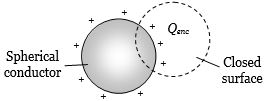
If a spherical conductor partially enters a closed surface as shown in the figure,then the total electric flux emitted from the closed surface will be:
A
$\frac{1}{\varepsilon_0} \times (\text{charge enclosed by surface})$
B
$\varepsilon_0 \times (\text{charge enclosed by surface})$
C
$\frac{1}{4\pi\varepsilon_0} \times (\text{charge enclosed by surface})$
D
$0$
Solution
(A) According to Gauss's Law,the total electric flux $\phi$ through any closed surface is equal to the net charge enclosed by that surface divided by the permittivity of free space $\varepsilon_0$.
Mathematically,$\phi = \frac{Q_{\text{enclosed}}}{\varepsilon_0}$.
In the given figure,$Q_{\text{enclosed}}$ is the portion of the charge on the spherical conductor that lies inside the dashed closed surface.
Therefore,the total flux emitted from the surface is $\phi = \frac{1}{\varepsilon_0} \times Q_{\text{enclosed}}$.
Mathematically,$\phi = \frac{Q_{\text{enclosed}}}{\varepsilon_0}$.
In the given figure,$Q_{\text{enclosed}}$ is the portion of the charge on the spherical conductor that lies inside the dashed closed surface.
Therefore,the total flux emitted from the surface is $\phi = \frac{1}{\varepsilon_0} \times Q_{\text{enclosed}}$.
0 likes
View Solution22
EasyMCQ
If the electric flux entering and leaving an enclosed surface respectively is ${\varphi _1}$ and ${\varphi _2}$,the electric charge inside the surface will be:
A
$(\varphi _1 + \varphi _2)\varepsilon _0$
B
$(\varphi _2 - \varphi _1)\varepsilon _0$
C
$(\varphi _1 + \varphi _2)/\varepsilon _0$
D
$(\varphi _2 - \varphi _1)/\varepsilon _0$
Solution
(B) According to Gauss's Law,the net electric flux through a closed surface is equal to the total charge enclosed divided by the permittivity of free space: $\Phi_{net} = \frac{Q_{enc}}{\varepsilon_0}$.
Here,the flux entering the surface is $\varphi_1$ (negative flux) and the flux leaving the surface is $\varphi_2$ (positive flux).
Therefore,the net flux is $\Phi_{net} = \varphi_2 - \varphi_1$.
Substituting this into Gauss's Law: $\varphi_2 - \varphi_1 = \frac{Q_{enc}}{\varepsilon_0}$.
Thus,the charge enclosed is $Q_{enc} = (\varphi_2 - \varphi_1)\varepsilon_0$.
Here,the flux entering the surface is $\varphi_1$ (negative flux) and the flux leaving the surface is $\varphi_2$ (positive flux).
Therefore,the net flux is $\Phi_{net} = \varphi_2 - \varphi_1$.
Substituting this into Gauss's Law: $\varphi_2 - \varphi_1 = \frac{Q_{enc}}{\varepsilon_0}$.
Thus,the charge enclosed is $Q_{enc} = (\varphi_2 - \varphi_1)\varepsilon_0$.
0 likes
View Solution23
MediumMCQ
$A$ charge $q$ is located at the centre of a cube. The electric flux through any face is
A
$\frac{4\pi q}{6(4\pi \varepsilon_0)}$
B
$\frac{\pi q}{6(4\pi \varepsilon_0)}$
C
$\frac{q}{6(4\pi \varepsilon_0)}$
D
$\frac{2\pi q}{6(4\pi \varepsilon_0)}$
Solution
(A) According to Gauss's Law,the total electric flux $\phi_{total}$ through a closed surface is given by $\phi_{total} = \frac{q}{\varepsilon_0}$.
Since the charge $q$ is placed at the centre of a cube,the flux is distributed equally through all $6$ faces of the cube.
Therefore,the electric flux through any one face is $\phi_{face} = \frac{\phi_{total}}{6} = \frac{q}{6\varepsilon_0}$.
To match the given options,we multiply the numerator and denominator by $4\pi$:
$\phi_{face} = \frac{q \times 4\pi}{6 \times \varepsilon_0 \times 4\pi} = \frac{4\pi q}{6(4\pi \varepsilon_0)}$.
Since the charge $q$ is placed at the centre of a cube,the flux is distributed equally through all $6$ faces of the cube.
Therefore,the electric flux through any one face is $\phi_{face} = \frac{\phi_{total}}{6} = \frac{q}{6\varepsilon_0}$.
To match the given options,we multiply the numerator and denominator by $4\pi$:
$\phi_{face} = \frac{q \times 4\pi}{6 \times \varepsilon_0 \times 4\pi} = \frac{4\pi q}{6(4\pi \varepsilon_0)}$.
0 likes
View Solution24
EasyMCQ
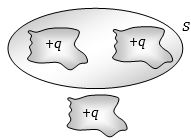
Shown below is a distribution of charges. The flux of electric field due to these charges through the surface $S$ is
A
$3q/{\varepsilon _0}$
B
$2q/{\varepsilon _0}$
C
$q/{\varepsilon _0}$
D
Zero
Solution
(B) According to Gauss's Law,the electric flux $\phi$ through any closed surface is equal to the total charge enclosed by the surface divided by the permittivity of free space $\varepsilon_0$.
Mathematically,$\phi = \frac{Q_{enc}}{\varepsilon_0}$.
In the given figure,the surface $S$ encloses two charges,each of magnitude $+q$.
Therefore,the total enclosed charge $Q_{enc} = +q + q = 2q$.
Substituting this into Gauss's Law,we get $\phi = \frac{2q}{\varepsilon_0}$.
Mathematically,$\phi = \frac{Q_{enc}}{\varepsilon_0}$.
In the given figure,the surface $S$ encloses two charges,each of magnitude $+q$.
Therefore,the total enclosed charge $Q_{enc} = +q + q = 2q$.
Substituting this into Gauss's Law,we get $\phi = \frac{2q}{\varepsilon_0}$.
0 likes
View Solution25
EasyMCQ
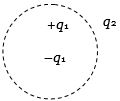
Consider the charge configuration and spherical Gaussian surface as shown in the figure. When calculating the flux of the electric field over the spherical surface,the electric field will be due to:
A
$q_2$
B
Only the positive charges
C
All the charges
D
$+q_1$ and $-q_1$
Solution
(C) According to Gauss's Law,the electric flux $\Phi_E$ through a closed surface is given by $\Phi_E = \frac{q_{\text{enclosed}}}{\epsilon_0}$.
However,the electric field $\vec{E}$ at any point on the Gaussian surface is the resultant electric field due to all charges present in the vicinity,whether they are inside or outside the Gaussian surface.
Therefore,the electric field at the surface is due to all the charges ($+q_1, -q_1$,and $q_2$).
However,the electric field $\vec{E}$ at any point on the Gaussian surface is the resultant electric field due to all charges present in the vicinity,whether they are inside or outside the Gaussian surface.
Therefore,the electric field at the surface is due to all the charges ($+q_1, -q_1$,and $q_2$).
0 likes
View Solution26
EasyMCQ
Gauss's law is true only if the force due to a charge varies as:
A
$r^{-1}$
B
$r^{-2}$
C
$r^{-3}$
D
$r^{-4}$
Solution
(B) Gauss's law is a consequence of the inverse square law of electrostatics.
According to Gauss's law,the total electric flux $\phi$ through a closed surface is given by $\phi = \frac{q}{\epsilon_0}$.
For a point charge $q$,the electric field $E$ at a distance $r$ is $E = \frac{1}{4 \pi \epsilon_0} \frac{q}{r^2}$.
The electric flux $\phi$ is defined as $\phi = \oint E \cdot dA = E \cdot A$,where $A$ is the surface area of a sphere of radius $r$,which is $4 \pi r^2$.
Substituting $E$ and $A$,we get $\phi = (\frac{1}{4 \pi \epsilon_0} \frac{q}{r^2}) \times (4 \pi r^2) = \frac{q}{\epsilon_0}$.
Since the force $F$ between two charges is given by Coulomb's law as $F = \frac{1}{4 \pi \epsilon_0} \frac{q_1 q_2}{r^2}$,it is clear that $F \propto r^{-2}$.
Thus,Gauss's law holds true only if the force varies as $r^{-2}$.
According to Gauss's law,the total electric flux $\phi$ through a closed surface is given by $\phi = \frac{q}{\epsilon_0}$.
For a point charge $q$,the electric field $E$ at a distance $r$ is $E = \frac{1}{4 \pi \epsilon_0} \frac{q}{r^2}$.
The electric flux $\phi$ is defined as $\phi = \oint E \cdot dA = E \cdot A$,where $A$ is the surface area of a sphere of radius $r$,which is $4 \pi r^2$.
Substituting $E$ and $A$,we get $\phi = (\frac{1}{4 \pi \epsilon_0} \frac{q}{r^2}) \times (4 \pi r^2) = \frac{q}{\epsilon_0}$.
Since the force $F$ between two charges is given by Coulomb's law as $F = \frac{1}{4 \pi \epsilon_0} \frac{q_1 q_2}{r^2}$,it is clear that $F \propto r^{-2}$.
Thus,Gauss's law holds true only if the force varies as $r^{-2}$.
0 likes
View Solution27
EasyMCQ
An electric dipole is placed in the north-south direction inside a sphere filled with water. Which statement is correct?
A
Electric flux is coming towards the sphere.
B
Electric flux is coming out of the sphere.
C
Electric flux entering the sphere and leaving the sphere are the same.
D
Water does not permit electric flux to enter the sphere.
Solution
(C) An electric dipole consists of two equal and opposite charges,$+q$ and $-q$.
According to Gauss's Law,the total electric flux $\phi$ through a closed surface is given by $\phi = \frac{q_{enclosed}}{\epsilon}$.
Since the total charge enclosed by the sphere is $q_{net} = (+q) + (-q) = 0$,the net electric flux passing through the sphere is zero.
This implies that the amount of electric flux entering the sphere is exactly equal to the amount of electric flux leaving the sphere.
Therefore,option $C$ is correct.
According to Gauss's Law,the total electric flux $\phi$ through a closed surface is given by $\phi = \frac{q_{enclosed}}{\epsilon}$.
Since the total charge enclosed by the sphere is $q_{net} = (+q) + (-q) = 0$,the net electric flux passing through the sphere is zero.
This implies that the amount of electric flux entering the sphere is exactly equal to the amount of electric flux leaving the sphere.
Therefore,option $C$ is correct.
0 likes
View Solution28
MediumMCQ
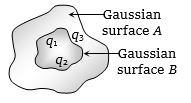
The electric flux for Gaussian surface $A$ that encloses the charged particles in free space is (given $q_1 = -14\, nC$,$q_2 = 78.85\, nC$,$q_3 = -56\, nC$):
A
$10^3\, N m^2 C^{-1}$
B
$10^3\, C N^{-1} m^{-2}$
C
$6.32 \times 10^3\, N m^2 C^{-1}$
D
$6.32 \times 10^3\, C N^{-1} m^{-2}$
Solution
(A) According to Gauss's Law,the electric flux $\phi$ through a closed surface is given by $\phi = \frac{q_{enclosed}}{\varepsilon_0}$.
Here,the Gaussian surface $A$ encloses all three charges $q_1$,$q_2$,and $q_3$.
Total enclosed charge $q_{enclosed} = q_1 + q_2 + q_3 = (-14 + 78.85 - 56)\, nC = 8.85\, nC = 8.85 \times 10^{-9}\, C$.
The value of permittivity of free space is $\varepsilon_0 \approx 8.85 \times 10^{-12}\, C^2 N^{-1} m^{-2}$.
Therefore,the electric flux $\phi = \frac{8.85 \times 10^{-9}}{8.85 \times 10^{-12}} = 10^3\, N m^2 C^{-1}$.
Here,the Gaussian surface $A$ encloses all three charges $q_1$,$q_2$,and $q_3$.
Total enclosed charge $q_{enclosed} = q_1 + q_2 + q_3 = (-14 + 78.85 - 56)\, nC = 8.85\, nC = 8.85 \times 10^{-9}\, C$.
The value of permittivity of free space is $\varepsilon_0 \approx 8.85 \times 10^{-12}\, C^2 N^{-1} m^{-2}$.
Therefore,the electric flux $\phi = \frac{8.85 \times 10^{-9}}{8.85 \times 10^{-12}} = 10^3\, N m^2 C^{-1}$.
0 likes
View Solution29
MediumMCQ
$A$ point source of $3000 \ lumen$ is located at the centre of a cube of side length $2 \ m$. The flux through one side is......$lumen$.
A
$500$
B
$600$
C
$750$
D
$1500$
Solution
(A) The total luminous flux emitted by the point source is $\Phi_{total} = 3000 \ lumen$.
$A$ cube has $6$ identical faces.
Since the point source is located at the exact centre of the cube,the total flux is distributed equally among all $6$ faces due to symmetry.
Therefore,the flux through one side (face) of the cube is given by:
$\Phi_{face} = \frac{\Phi_{total}}{6} = \frac{3000}{6} = 500 \ lumen$.
$A$ cube has $6$ identical faces.
Since the point source is located at the exact centre of the cube,the total flux is distributed equally among all $6$ faces due to symmetry.
Therefore,the flux through one side (face) of the cube is given by:
$\Phi_{face} = \frac{\Phi_{total}}{6} = \frac{3000}{6} = 500 \ lumen$.
0 likes
View Solution30
MediumMCQ
$A$ charge $Q$ is placed at the center of a closed cube. The flux passing through any one face of the cube will be .......
A
$Q / (6 \varepsilon_0)$
B
$Q / (3 \varepsilon_0)$
C
$Q / \varepsilon_0$
D
$Q / (4 \varepsilon_0)$
Solution
(A) According to Gauss's Law,the total electric flux $\phi_{total}$ through a closed surface is given by $\phi_{total} = \frac{Q_{enclosed}}{\varepsilon_0}$.
Since the charge $Q$ is placed at the center of the cube,the flux is distributed symmetrically through all $6$ faces of the cube.
Therefore,the flux $\phi_{face}$ passing through any one face is $\phi_{face} = \frac{\phi_{total}}{6}$.
Substituting the value of $\phi_{total}$,we get $\phi_{face} = \frac{Q}{6 \varepsilon_0}$.
Since the charge $Q$ is placed at the center of the cube,the flux is distributed symmetrically through all $6$ faces of the cube.
Therefore,the flux $\phi_{face}$ passing through any one face is $\phi_{face} = \frac{\phi_{total}}{6}$.
Substituting the value of $\phi_{total}$,we get $\phi_{face} = \frac{Q}{6 \varepsilon_0}$.
0 likes
View Solution31
MediumMCQ
$A$ point charge $q$ is placed at a distance $a/2$ directly above the center of a square of side $a$. The electric flux through the square is:
A
$\frac{q}{\epsilon_0}$
B
$\frac{q}{\pi \epsilon_0}$
C
$\frac{q}{4 \epsilon_0}$
D
$\frac{q}{6 \epsilon_0}$
Solution
(D) Consider the square of side $a$ as one face of a cube of side $a$.
Since the charge $q$ is placed at a distance $a/2$ from the center of the square,it is located at the geometric center of this imaginary cube.
According to Gauss's Law,the total electric flux $\Phi_{\text{total}}$ through the closed surface of the cube is given by $\Phi_{\text{total}} = \frac{q}{\epsilon_0}$.
Since the cube has $6$ identical faces and the charge is placed symmetrically at the center,the flux through each face is equal.
Therefore,the electric flux $\Phi$ through the square face is $\Phi = \frac{\Phi_{\text{total}}}{6} = \frac{q}{6 \epsilon_0}$.
Since the charge $q$ is placed at a distance $a/2$ from the center of the square,it is located at the geometric center of this imaginary cube.
According to Gauss's Law,the total electric flux $\Phi_{\text{total}}$ through the closed surface of the cube is given by $\Phi_{\text{total}} = \frac{q}{\epsilon_0}$.
Since the cube has $6$ identical faces and the charge is placed symmetrically at the center,the flux through each face is equal.
Therefore,the electric flux $\Phi$ through the square face is $\Phi = \frac{\Phi_{\text{total}}}{6} = \frac{q}{6 \epsilon_0}$.
0 likes
View Solution32
MediumMCQ
Select the correct statement$(s)$:
$(1)$ The density of electric field lines is independent of the magnitude of the electric field vector $E$ at a given point.
$(2)$ The density of electric field lines is proportional to the magnitude of the electric field vector $E$ at a given point.
$(3)$ Electric field lines do not exist in reality. They are only a graphical representation of the electric field.
$(4)$ Electric field lines exist in reality.
$(1)$ The density of electric field lines is independent of the magnitude of the electric field vector $E$ at a given point.
$(2)$ The density of electric field lines is proportional to the magnitude of the electric field vector $E$ at a given point.
$(3)$ Electric field lines do not exist in reality. They are only a graphical representation of the electric field.
$(4)$ Electric field lines exist in reality.
A
$1, 3$
B
$2, 4$
C
$1, 4$
D
$2, 3$
Solution
(D) The density of electric field lines is directly proportional to the magnitude of the electric field vector $E$ at a given point. Therefore,statement $(2)$ is correct and statement $(1)$ is incorrect.
Electric field lines are a conceptual tool used to visualize the electric field. They do not have a physical existence in space. Therefore,statement $(3)$ is correct and statement $(4)$ is incorrect.
Thus,the correct statements are $(2)$ and $(3)$.
Electric field lines are a conceptual tool used to visualize the electric field. They do not have a physical existence in space. Therefore,statement $(3)$ is correct and statement $(4)$ is incorrect.
Thus,the correct statements are $(2)$ and $(3)$.
0 likes
View Solution33
EasyMCQ
$A$ sphere of radius $R$ has a charge $Q$. $A$ concentric spherical Gaussian surface of radius $2R$ is drawn. The electric flux associated with the Gaussian surface is ........
A
$\frac{Q}{\epsilon_0}$
B
$\frac{Q}{2\epsilon_0}$
C
$\frac{4Q}{\epsilon_0}$
D
$\frac{2Q}{\epsilon_0}$
Solution
(A) According to Gauss's Law,the total electric flux $\phi$ through any closed surface is equal to the net charge $Q_{enclosed}$ enclosed by the surface divided by the permittivity of free space $\epsilon_0$.
Mathematically,$\phi = \frac{Q_{enclosed}}{\epsilon_0}$.
In this problem,the Gaussian surface is a sphere of radius $2R$,which encloses the entire charge $Q$ present on the inner sphere of radius $R$.
Therefore,$Q_{enclosed} = Q$.
Substituting this into Gauss's Law,we get $\phi = \frac{Q}{\epsilon_0}$.
Mathematically,$\phi = \frac{Q_{enclosed}}{\epsilon_0}$.
In this problem,the Gaussian surface is a sphere of radius $2R$,which encloses the entire charge $Q$ present on the inner sphere of radius $R$.
Therefore,$Q_{enclosed} = Q$.
Substituting this into Gauss's Law,we get $\phi = \frac{Q}{\epsilon_0}$.
0 likes
View Solution34
EasyMCQ
Consider a cylinder of length $L$ and radius $R$ placed in a uniform electric field $E$ such that its axis is parallel to the electric field. The total electric flux associated with the cylinder is .......
A
$2\pi R^2E$
B
$\pi R^2L/E$
C
$\pi R^2LE$
D
$0$
Solution
(D) Let the cylinder be placed with its axis along the $x$-axis in a uniform electric field $\vec{E} = E\hat{i}$.
$1$. Flux through the left circular face (Area $A = \pi R^2$): The area vector points outward,so $\vec{A}_1 = -\pi R^2\hat{i}$. The flux is $\phi_1 = \vec{E} \cdot \vec{A}_1 = (E\hat{i}) \cdot (-\pi R^2\hat{i}) = -E\pi R^2$.
$2$. Flux through the right circular face: The area vector points outward,so $\vec{A}_2 = \pi R^2\hat{i}$. The flux is $\phi_2 = \vec{E} \cdot \vec{A}_2 = (E\hat{i}) \cdot (\pi R^2\hat{i}) = +E\pi R^2$.
$3$. Flux through the curved surface: At every point on the curved surface,the area vector $d\vec{A}$ is perpendicular to the electric field $\vec{E}$ (i.e.,$\theta = 90^{\circ}$). Therefore,$d\phi = \vec{E} \cdot d\vec{A} = E dA \cos 90^{\circ} = 0$. Thus,the total flux through the curved surface is $0$.
$4$. Total flux $\phi_{total} = \phi_1 + \phi_2 + \phi_{curved} = -E\pi R^2 + E\pi R^2 + 0 = 0$.
$1$. Flux through the left circular face (Area $A = \pi R^2$): The area vector points outward,so $\vec{A}_1 = -\pi R^2\hat{i}$. The flux is $\phi_1 = \vec{E} \cdot \vec{A}_1 = (E\hat{i}) \cdot (-\pi R^2\hat{i}) = -E\pi R^2$.
$2$. Flux through the right circular face: The area vector points outward,so $\vec{A}_2 = \pi R^2\hat{i}$. The flux is $\phi_2 = \vec{E} \cdot \vec{A}_2 = (E\hat{i}) \cdot (\pi R^2\hat{i}) = +E\pi R^2$.
$3$. Flux through the curved surface: At every point on the curved surface,the area vector $d\vec{A}$ is perpendicular to the electric field $\vec{E}$ (i.e.,$\theta = 90^{\circ}$). Therefore,$d\phi = \vec{E} \cdot d\vec{A} = E dA \cos 90^{\circ} = 0$. Thus,the total flux through the curved surface is $0$.
$4$. Total flux $\phi_{total} = \phi_1 + \phi_2 + \phi_{curved} = -E\pi R^2 + E\pi R^2 + 0 = 0$.
0 likes
View Solution35
AdvancedMCQ
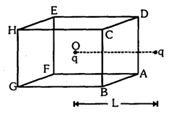
$A$ point charge $q$ is placed at the center $O$ of a cube of side length $L$. Another identical charge $q$ is placed at a distance $L$ from $O$ as shown in the figure. The electric flux through the face $ABCD$ is:
A
$q / (24\varepsilon_0)$
B
$zero$
C
$q / (12\varepsilon_0)$
D
$q / (8\varepsilon_0)$
Solution
(D) Let the cube be centered at the origin $(0,0,0)$. The charge $q$ at the center $O$ produces a total flux of $\Phi_{total} = q / \varepsilon_0$ through the entire cube. By symmetry,the flux through each of the $6$ faces due to the charge at the center is $\Phi_{center} = (1/6) \times (q / \varepsilon_0) = q / (6\varepsilon_0)$.
Now consider the second charge $q$ placed at a distance $L$ from the center $O$,outside the cube,along the axis perpendicular to the face $ABCD$. The electric field lines from this external charge enter the cube through face $ABCD$ and exit through the opposite face $EFGH$. According to Gauss's Law,for any charge outside a closed surface,the net flux through that surface is zero. Therefore,the flux through the face $ABCD$ due to the external charge is equal in magnitude but opposite in sign to the flux through the opposite face. Specifically,the flux through face $ABCD$ due to the external charge is negative because the field lines enter the cube through this face.
However,for a point charge placed at a distance $L$ from the center of a cube of side $L$ (which means it is at a distance $L/2$ from the face $ABCD$),the solid angle subtended by the face $ABCD$ at the location of the external charge is not trivial. But,by symmetry and the property of flux,the flux through the face $ABCD$ due to the external charge is $-q / (24\varepsilon_0)$.
Adding the two contributions: $\Phi_{net} = \Phi_{center} + \Phi_{external} = q / (6\varepsilon_0) - q / (24\varepsilon_0) = (4q - q) / (24\varepsilon_0) = 3q / (24\varepsilon_0) = q / (8\varepsilon_0)$.
Now consider the second charge $q$ placed at a distance $L$ from the center $O$,outside the cube,along the axis perpendicular to the face $ABCD$. The electric field lines from this external charge enter the cube through face $ABCD$ and exit through the opposite face $EFGH$. According to Gauss's Law,for any charge outside a closed surface,the net flux through that surface is zero. Therefore,the flux through the face $ABCD$ due to the external charge is equal in magnitude but opposite in sign to the flux through the opposite face. Specifically,the flux through face $ABCD$ due to the external charge is negative because the field lines enter the cube through this face.
However,for a point charge placed at a distance $L$ from the center of a cube of side $L$ (which means it is at a distance $L/2$ from the face $ABCD$),the solid angle subtended by the face $ABCD$ at the location of the external charge is not trivial. But,by symmetry and the property of flux,the flux through the face $ABCD$ due to the external charge is $-q / (24\varepsilon_0)$.
Adding the two contributions: $\Phi_{net} = \Phi_{center} + \Phi_{external} = q / (6\varepsilon_0) - q / (24\varepsilon_0) = (4q - q) / (24\varepsilon_0) = 3q / (24\varepsilon_0) = q / (8\varepsilon_0)$.
0 likes
View Solution36
MediumMCQ
Gauss's law states that
A
the total electric flux through a closed surface is $\frac{1}{\varepsilon_0}$ times the total charge placed near the closed surface.
B
the total electric flux through a closed surface is $\frac{1}{\varepsilon_0}$ times the total charge enclosed by the closed surface.
C
the total electric flux through an open surface is $\frac{1}{\varepsilon_0}$ times the total charge placed near the open surface.
D
the line integral of electric field around the boundary of an open surface is $\frac{1}{\varepsilon_0}$ times the total charge placed near the open surface.
Solution
(B) Gauss's law states that the total electric flux $\phi_E$ through any closed surface (a Gaussian surface) is equal to $\frac{1}{\varepsilon_0}$ times the net charge $Q_{enclosed}$ enclosed by the surface.
Mathematically,it is expressed as $\phi_E = \oint_S \vec{E} \cdot d\vec{A} = \frac{Q_{enclosed}}{\varepsilon_0}$.
Therefore,option $B$ is the correct statement.
Mathematically,it is expressed as $\phi_E = \oint_S \vec{E} \cdot d\vec{A} = \frac{Q_{enclosed}}{\varepsilon_0}$.
Therefore,option $B$ is the correct statement.
0 likes
View Solution37
MediumMCQ
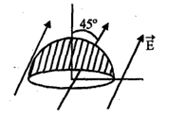
$A$ hemispherical surface of radius $a$ is placed in a uniform electric field $E$ such that the flat surface makes an angle of $\pi /4$ with the vertical. There is no charge inside the hemisphere. The electric flux passing through the curved surface of the hemisphere is:
A
$\frac{{\pi {a^2}E}}{{(2\sqrt 2 )}}$
B
$\frac{{\pi {a^2}E}}{{\sqrt 2 }}$
C
$\frac{{(\pi + 2)\pi {a^2}E}}{{(2\sqrt 2 )}}$
D
$\pi a^2E$
Solution
(B) According to Gauss's Law,for a closed surface with no net charge enclosed,the total electric flux is zero.
$\phi_{\text{total}} = \phi_{\text{curved}} + \phi_{\text{flat}} = 0$
Therefore,$\phi_{\text{curved}} = -\phi_{\text{flat}}$.
The flux through the flat circular surface is given by $\phi_{\text{flat}} = \vec{E} \cdot \vec{A} = EA \cos(\theta)$,where $\theta$ is the angle between the electric field and the area vector.
The area vector of the flat surface is vertical. The electric field makes an angle of $45^{\circ}$ with the vertical. Thus,the angle between the electric field and the area vector is $45^{\circ}$.
$\phi_{\text{flat}} = E(\pi a^2) \cos(45^{\circ}) = E(\pi a^2) \frac{1}{\sqrt{2}}$.
Since the field lines enter through the flat surface and exit through the curved surface,the magnitude of the flux through the curved surface is equal to the magnitude of the flux through the flat surface.
$\phi_{\text{curved}} = \frac{\pi a^2 E}{\sqrt{2}}$.
$\phi_{\text{total}} = \phi_{\text{curved}} + \phi_{\text{flat}} = 0$
Therefore,$\phi_{\text{curved}} = -\phi_{\text{flat}}$.
The flux through the flat circular surface is given by $\phi_{\text{flat}} = \vec{E} \cdot \vec{A} = EA \cos(\theta)$,where $\theta$ is the angle between the electric field and the area vector.
The area vector of the flat surface is vertical. The electric field makes an angle of $45^{\circ}$ with the vertical. Thus,the angle between the electric field and the area vector is $45^{\circ}$.
$\phi_{\text{flat}} = E(\pi a^2) \cos(45^{\circ}) = E(\pi a^2) \frac{1}{\sqrt{2}}$.
Since the field lines enter through the flat surface and exit through the curved surface,the magnitude of the flux through the curved surface is equal to the magnitude of the flux through the flat surface.
$\phi_{\text{curved}} = \frac{\pi a^2 E}{\sqrt{2}}$.
0 likes
View Solution38
MediumMCQ
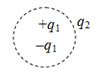
Consider the charges and the Gaussian surface shown in the figure. When calculating the electric flux through the spherical surface,the electric field is due to which of the following?
A
$q_2$
B
Only due to positive charges
C
Due to all charges
D
$+q_1$ and $-q_1$
Solution
(C) According to Gauss's Law,the electric flux through a closed surface is given by $\Phi_E = \frac{q_{enclosed}}{\epsilon_0}$.
However,the electric field $\vec{E}$ at any point on the Gaussian surface is the resultant electric field due to all charges present in the system,both inside and outside the Gaussian surface.
Therefore,the electric field at the surface is due to all charges $(+q_1, -q_1, q_2)$.
However,the electric field $\vec{E}$ at any point on the Gaussian surface is the resultant electric field due to all charges present in the system,both inside and outside the Gaussian surface.
Therefore,the electric field at the surface is due to all charges $(+q_1, -q_1, q_2)$.
0 likes
View Solution39
EasyMCQ
Select the correct statement$(s)$.
$(1)$ The tangent drawn at any point on an electric field line gives the direction of the force acting on a positive charge at that point.
$(2)$ The normal drawn at any point on an electric field line gives the direction of the force acting on a positive charge at that point.
$(3)$ Electric field lines start from a negative charge and end on a positive charge.
$(4)$ Electric field lines start from a positive charge and end on a negative charge.
$(1)$ The tangent drawn at any point on an electric field line gives the direction of the force acting on a positive charge at that point.
$(2)$ The normal drawn at any point on an electric field line gives the direction of the force acting on a positive charge at that point.
$(3)$ Electric field lines start from a negative charge and end on a positive charge.
$(4)$ Electric field lines start from a positive charge and end on a negative charge.
A
$1, 3$
B
$2, 4$
C
$1, 4$
D
$2, 3$
Solution
(C) By definition,an electric field line is a curve such that the tangent at any point on it gives the direction of the electric field $\vec{E}$ at that point. Since the force on a positive charge $q$ is given by $\vec{F} = q\vec{E}$,the direction of the force is the same as the direction of the electric field. Thus,statement $(1)$ is correct.
Electric field lines originate from a positive charge and terminate on a negative charge. Thus,statement $(4)$ is correct.
Statements $(2)$ and $(3)$ are incorrect based on the fundamental properties of electric field lines.
Therefore,the correct statements are $(1)$ and $(4)$.
Electric field lines originate from a positive charge and terminate on a negative charge. Thus,statement $(4)$ is correct.
Statements $(2)$ and $(3)$ are incorrect based on the fundamental properties of electric field lines.
Therefore,the correct statements are $(1)$ and $(4)$.
0 likes
View Solution40
EasyMCQ
Gauss's law is given by ${\epsilon _0}\oint {\vec E \cdot d\vec s} = q$. If the net charge enclosed by a Gaussian surface is zero,then .......
A
$E$ must be zero on the surface.
B
The number of electric field lines entering the surface must be equal to the number of electric field lines leaving it.
C
There is a net influx of electric field lines.
D
None of the above.
Solution
(B) According to Gauss's Law,the total electric flux $\Phi_E$ through a closed surface is given by $\Phi_E = \oint {\vec E \cdot d\vec s} = \frac{q_{enclosed}}{\epsilon_0}$.
If the net charge enclosed $q_{enclosed} = 0$,then the total electric flux $\Phi_E = 0$.
Electric flux represents the net number of electric field lines passing through the surface.
$A$ flux of zero implies that the number of electric field lines entering the surface is exactly equal to the number of electric field lines leaving the surface.
Therefore,option $B$ is correct.
If the net charge enclosed $q_{enclosed} = 0$,then the total electric flux $\Phi_E = 0$.
Electric flux represents the net number of electric field lines passing through the surface.
$A$ flux of zero implies that the number of electric field lines entering the surface is exactly equal to the number of electric field lines leaving the surface.
Therefore,option $B$ is correct.
0 likes
View Solution41
EasyMCQ
If electric flux is coming out of a Gaussian surface,what is associated with the surface?
A
Negative charge
B
Positive charge
C
Equal positive and negative charge
D
Zero charge
Solution
(B) According to Gauss's Law,the electric flux $\phi$ through a closed surface is given by $\phi = \frac{Q_{\text{enc}}}{\varepsilon_0}$,where $Q_{\text{enc}}$ is the net charge enclosed by the surface.
If the electric flux is coming out of the surface (outward flux),the value of $\phi$ is positive.
Since $\varepsilon_0$ is always positive,for $\phi$ to be positive,the net enclosed charge $Q_{\text{enc}}$ must be positive.
Therefore,a positive charge is associated with the surface.
If the electric flux is coming out of the surface (outward flux),the value of $\phi$ is positive.
Since $\varepsilon_0$ is always positive,for $\phi$ to be positive,the net enclosed charge $Q_{\text{enc}}$ must be positive.
Therefore,a positive charge is associated with the surface.
0 likes
View Solution42
MediumMCQ
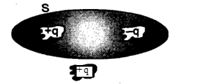
The charge distribution is shown in the figure below. The electric flux through the surface $S$ due to these charges is .........
A
$3q/\varepsilon_0$
B
$2q/\varepsilon_0$
C
$q/\varepsilon_0$
D
$0$
Solution
(D) According to Gauss's Law,the total electric flux $\phi$ through a closed surface is given by $\phi = \frac{q_{\text{enclosed}}}{\varepsilon_0}$,where $q_{\text{enclosed}}$ is the net charge enclosed by the surface.
In the given figure,the charges enclosed by the surface $S$ are $+q$ and $-q$.
Therefore,the net enclosed charge $q_{\text{enclosed}} = (+q) + (-q) = 0$.
Substituting this into Gauss's Law,we get $\phi = \frac{0}{\varepsilon_0} = 0$.
In the given figure,the charges enclosed by the surface $S$ are $+q$ and $-q$.
Therefore,the net enclosed charge $q_{\text{enclosed}} = (+q) + (-q) = 0$.
Substituting this into Gauss's Law,we get $\phi = \frac{0}{\varepsilon_0} = 0$.
0 likes
View Solution43
EasyMCQ
Consider a cube of side length '$a$' centered at the origin. It is enclosed by three fixed point charges: $(-q)$ at $(0, -a/4, 0)$,$(+3q)$ at $(0, 0, 0)$,and $(-q)$ at $(0, a/4, 0)$. Choose the correct option.
A
The net electric flux crossing the plane $x = +a/2$ is equal to the net flux crossing the plane $x = -a/2$.
B
The net electric flux crossing the plane $y = +a/2$ is greater than the net flux crossing the plane $y = -a/2$.
C
The net electric flux crossing the entire region is $\varepsilon_0$.
D
The net electric flux crossing the plane $z = a/2$ is equal to the net electric flux crossing the plane $x = +a/2$.
Solution
(A) The total charge enclosed by the cube is $Q_{enclosed} = -q + 3q - q = q$.
According to Gauss's Law,the total flux through the cube is $\Phi_{total} = \frac{q}{\epsilon_0}$.
Since the charges are placed on the $y$-axis,the configuration is symmetric with respect to the $x$ and $z$ coordinates.
The planes $x = +a/2$ and $x = -a/2$ are equidistant from the $y$-axis,and the charge distribution is symmetric relative to these planes,so the flux through them is equal.
Similarly,the planes $z = +a/2$ and $z = -a/2$ are symmetric,and the flux through them is equal.
Thus,the flux through $x = +a/2$ is equal to the flux through $x = -a/2$.
According to Gauss's Law,the total flux through the cube is $\Phi_{total} = \frac{q}{\epsilon_0}$.
Since the charges are placed on the $y$-axis,the configuration is symmetric with respect to the $x$ and $z$ coordinates.
The planes $x = +a/2$ and $x = -a/2$ are equidistant from the $y$-axis,and the charge distribution is symmetric relative to these planes,so the flux through them is equal.
Similarly,the planes $z = +a/2$ and $z = -a/2$ are symmetric,and the flux through them is equal.
Thus,the flux through $x = +a/2$ is equal to the flux through $x = -a/2$.
0 likes
View Solution44
MediumMCQ
$A$ Gaussian surface of radius $R$ encloses a charge $Q$. If the radius is doubled,the outward electric flux will...
A
become double.
B
increase by $4$ times.
C
become half.
D
remain the same.
Solution
(D) According to Gauss's Law,the total electric flux $\phi_E$ through a closed surface is given by $\phi_E = \frac{Q_{enclosed}}{\varepsilon_0}$.
Since the charge $Q$ enclosed by the Gaussian surface remains constant regardless of the radius $R$ of the surface,the electric flux $\phi_E$ does not change.
Therefore,if the radius is doubled,the outward electric flux remains the same.
Since the charge $Q$ enclosed by the Gaussian surface remains constant regardless of the radius $R$ of the surface,the electric flux $\phi_E$ does not change.
Therefore,if the radius is doubled,the outward electric flux remains the same.
0 likes
View Solution45
MediumMCQ
$A$ charge $Q$ is placed at the center of a cube. The total electric flux passing through all six faces of the cube is ..........
A
$\frac{Q}{6\epsilon_0}$
B
$\frac{Q}{8\epsilon_0}$
C
$\frac{Q}{\epsilon_0}$
D
$\frac{Q}{2\epsilon_0}$
Solution
(C) According to Gauss's Law,the total electric flux $\phi$ through any closed surface is equal to the net charge $Q$ enclosed by the surface divided by the permittivity of free space $\epsilon_0$.
Mathematically,$\phi = \frac{Q}{\epsilon_0}$.
Since the charge $Q$ is placed at the center of the cube,the cube acts as a closed Gaussian surface enclosing the charge $Q$. Therefore,the total flux passing through all six faces of the cube is $\frac{Q}{\epsilon_0}$.
Mathematically,$\phi = \frac{Q}{\epsilon_0}$.
Since the charge $Q$ is placed at the center of the cube,the cube acts as a closed Gaussian surface enclosing the charge $Q$. Therefore,the total flux passing through all six faces of the cube is $\frac{Q}{\epsilon_0}$.
0 likes
View Solution46
EasyMCQ
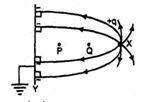
$A$ point charge $+q$ is placed in front of a grounded metal plate. Points $P$ and $Q$ are between the charge $X$ and the plate $Y$ as shown in the figure. Let $E_P$ and $E_Q$ be the magnitudes of the electric fields at points $P$ and $Q$ respectively. Which of the following statements is true?
A
$E_P = E_Q$
B
$E_P > E_Q$
C
$E_P < E_Q$
D
$E_P = 0 = E_Q$
Solution
(B) The electric field lines originate from the positive point charge $+q$ and terminate on the grounded metal plate.
As we move from the point charge $X$ towards the plate $Y$,the density of electric field lines increases because the field lines are converging towards the plate.
The magnitude of the electric field is directly proportional to the density of the electric field lines.
In the figure,point $Q$ is closer to the charge $X$ and point $P$ is closer to the plate $Y$.
Since the field lines are more concentrated near the plate $Y$ compared to the region near the charge $X$ (due to the induced negative charge on the plate),the density of field lines at $P$ is greater than at $Q$.
Therefore,the magnitude of the electric field at $P$ is greater than at $Q$,i.e.,$E_P > E_Q$.
As we move from the point charge $X$ towards the plate $Y$,the density of electric field lines increases because the field lines are converging towards the plate.
The magnitude of the electric field is directly proportional to the density of the electric field lines.
In the figure,point $Q$ is closer to the charge $X$ and point $P$ is closer to the plate $Y$.
Since the field lines are more concentrated near the plate $Y$ compared to the region near the charge $X$ (due to the induced negative charge on the plate),the density of field lines at $P$ is greater than at $Q$.
Therefore,the magnitude of the electric field at $P$ is greater than at $Q$,i.e.,$E_P > E_Q$.
0 likes
View Solution47
EasyMCQ
Select the correct statement regarding electric field lines.
A
They originate from negative charges and terminate at positive charges.
B
Where the density of electric field lines is high,the electric field in that region is weak.
C
They are radial for a point charge.
D
They have physical existence.
Solution
(C) The properties of electric field lines are as follows:
$1$. Electric field lines originate from positive charges and terminate at negative charges.
$2$. The density of electric field lines represents the strength of the electric field. Higher density means a stronger electric field.
$3$. For a point charge,the electric field lines are radial (pointing outward for positive charges and inward for negative charges).
$4$. Electric field lines are a mathematical representation or a conceptual tool; they do not have any physical existence.
Therefore,statement $C$ is correct.
$1$. Electric field lines originate from positive charges and terminate at negative charges.
$2$. The density of electric field lines represents the strength of the electric field. Higher density means a stronger electric field.
$3$. For a point charge,the electric field lines are radial (pointing outward for positive charges and inward for negative charges).
$4$. Electric field lines are a mathematical representation or a conceptual tool; they do not have any physical existence.
Therefore,statement $C$ is correct.
0 likes
View Solution48
EasyMCQ
Consider an electric field $\vec{E} = 3 \times 10^3 \hat{i} \text{ N/C}$. What is the flux through a square of side $10 \text{ cm}$ in $Nm^2/C$ if the normal to its plane makes a $60^\circ$ angle with the $X$-axis?
A
$15$
B
$1.5$
C
$10$
D
$12$
Solution
(A) The electric flux $\phi$ is given by the formula $\phi = \vec{E} \cdot \vec{A} = EA \cos \theta$.
Given:
Electric field $E = 3 \times 10^3 \text{ N/C}$.
Side of the square $s = 10 \text{ cm} = 0.1 \text{ m}$.
Area $A = s^2 = (0.1)^2 = 0.01 \text{ m}^2 = 10^{-2} \text{ m}^2$.
Angle $\theta = 60^\circ$ between the normal to the surface and the electric field direction ($X$-axis).
Substituting the values:
$\phi = (3 \times 10^3) \times (10^{-2}) \times \cos(60^\circ)$.
Since $\cos(60^\circ) = 0.5$,
$\phi = 30 \times 0.5 = 15 \text{ Nm}^2/\text{C}$.
Given:
Electric field $E = 3 \times 10^3 \text{ N/C}$.
Side of the square $s = 10 \text{ cm} = 0.1 \text{ m}$.
Area $A = s^2 = (0.1)^2 = 0.01 \text{ m}^2 = 10^{-2} \text{ m}^2$.
Angle $\theta = 60^\circ$ between the normal to the surface and the electric field direction ($X$-axis).
Substituting the values:
$\phi = (3 \times 10^3) \times (10^{-2}) \times \cos(60^\circ)$.
Since $\cos(60^\circ) = 0.5$,
$\phi = 30 \times 0.5 = 15 \text{ Nm}^2/\text{C}$.
0 likes
View Solution49
EasyMCQ
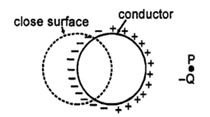
$A$ closed surface passes through a spherical conductor as shown in the figure. If a negative charge $-Q$ is placed at point $P$,what will be the nature of the electric flux coming out of the closed surface?
A
Positive
B
Negative
C
Zero
D
Information is incomplete
Solution
(B) According to Gauss's Law,the electric flux $\Phi_E$ through a closed surface is given by $\Phi_E = \frac{q_{enclosed}}{\epsilon_0}$.
In the given figure,the negative charge $-Q$ placed at point $P$ induces a positive charge on the side of the conductor near $P$ and a negative charge on the side of the conductor away from $P$ (inside the closed surface).
The closed surface encloses a portion of the conductor that has a net negative induced charge.
Since the net charge enclosed by the closed surface is negative $(q_{enclosed} < 0)$,the electric flux coming out of the closed surface will be negative.
In the given figure,the negative charge $-Q$ placed at point $P$ induces a positive charge on the side of the conductor near $P$ and a negative charge on the side of the conductor away from $P$ (inside the closed surface).
The closed surface encloses a portion of the conductor that has a net negative induced charge.
Since the net charge enclosed by the closed surface is negative $(q_{enclosed} < 0)$,the electric flux coming out of the closed surface will be negative.
0 likes
View Solution50
MediumMCQ
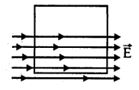
$A$ square surface of side $L$ meters is in the plane of the paper. $A$ uniform electric field $\vec{E} \text{ (V/m)}$ is also in the plane of the paper,limited only to the lower half of the square surface. The electric flux associated with the surface in $SI$ units is:
A
$0$
B
$EL^2$
C
$EL^2 / (2\varepsilon_0)$
D
$EL^2 / 2$
Solution
(A) The electric flux $\phi$ through a surface is given by the dot product of the electric field vector $\vec{E}$ and the area vector $\vec{S}$.
$\phi = \vec{E} \cdot \vec{S} = ES \cos \theta$
Here,the electric field $\vec{E}$ lies in the plane of the paper,and the area vector $\vec{S}$ (which is perpendicular to the surface) is also in the plane of the paper (or perpendicular to it depending on orientation,but since the surface is in the plane of the paper,the area vector is perpendicular to the plane of the paper).
Since the electric field $\vec{E}$ is in the plane of the paper and the area vector $\vec{S}$ is perpendicular to the plane of the paper,the angle $\theta$ between $\vec{E}$ and $\vec{S}$ is $90^\circ$.
Therefore,$\phi = ES \cos 90^\circ = ES(0) = 0$.
Thus,the electric flux associated with the surface is $0$.
$\phi = \vec{E} \cdot \vec{S} = ES \cos \theta$
Here,the electric field $\vec{E}$ lies in the plane of the paper,and the area vector $\vec{S}$ (which is perpendicular to the surface) is also in the plane of the paper (or perpendicular to it depending on orientation,but since the surface is in the plane of the paper,the area vector is perpendicular to the plane of the paper).
Since the electric field $\vec{E}$ is in the plane of the paper and the area vector $\vec{S}$ is perpendicular to the plane of the paper,the angle $\theta$ between $\vec{E}$ and $\vec{S}$ is $90^\circ$.
Therefore,$\phi = ES \cos 90^\circ = ES(0) = 0$.
Thus,the electric flux associated with the surface is $0$.
0 likes
View SolutionElectric Charges and Fields — Electric Field Lines, Electric Flux and Gauss's Law · Frequently Asked Questions
1Are these Electric Charges and Fields questions useful for JEE and NEET?
Yes. All questions in this section are mapped to JEE Main and NEET exam patterns. Previous year questions from JEE Main, NEET, GUJCET and state-level exams are included with full solutions.
2Can I switch to Hindi or Gujarati for these questions?
Yes. Use the language tabs in the hero section or the sidebar to view the same questions and solutions in English, Hindi or Gujarati.
3How do I generate a question paper from this subtopic?
Use the Vedclass Exam Paper Generator — select the chapter and subtopic, set difficulty, and generate Sets A, B, C, D automatically. First 3 chapters of every subject are free.
Vedclass Products
For Students
Vedclass Test Series
Mock tests in real JEE/NEET style with performance analysis. 5-day free trial.
Start Free TrialFor Teachers
Exam Paper Generator
Generate Set A/B/C/D papers from this chapter in 2 minutes. 3 chapters free.
Try FreeFor Institutes
Online Exam Module
Live online exams with unlimited students, 360° analytics & white-label branding.
See DemoFor Teachers & Institutes
Generate a Electric Charges and Fields Exam Paper in 2 Minutes
Select subtopic & difficulty — Sets A, B, C, D auto-generated with No Repeat logic.
First 3 chapters of every subject are free — no payment required.