
A English
Electrostatic Force and Coulombs Law Questions in English
Class 12 Physics · Electric Charges and Fields · Electrostatic Force and Coulombs Law
322+
Questions
English
Language
100%
With Solutions
Showing 50 of 322 questions in English
51
DifficultMCQ
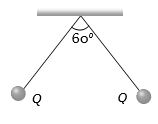
Two small spherical balls,each carrying a charge $Q = 10\,\mu C$ ($10$ micro-coulomb),are suspended by two insulating threads of equal lengths $1\,m$ each,from a point fixed in the ceiling. It is found that in equilibrium,the threads are separated by an angle of $60^o$ between them,as shown in the figure. What is the tension in the threads in $N$? (Given: $\frac{1}{4\pi \varepsilon_0} = 9 \times 10^9\,Nm^2/C^2$)
A
$18$
B
$1.8$
C
$0.18$
D
None of the above
Solution
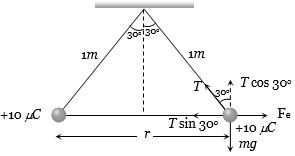
(B) In equilibrium,the forces acting on one of the spherical balls are the tension $T$ in the thread,the electrostatic force $F_e$,and the gravitational force $mg$.
Let the length of the thread be $L = 1\,m$ and the angle with the vertical be $\theta = 30^o$.
The distance $r$ between the two charges is $r = 2L \sin(30^o) = 2 \times 1 \times 0.5 = 1\,m$.
The electrostatic force is $F_e = \frac{1}{4\pi \varepsilon_0} \frac{Q^2}{r^2} = 9 \times 10^9 \times \frac{(10 \times 10^{-6})^2}{1^2} = 9 \times 10^9 \times 10^{-10} = 0.9\,N$.
For equilibrium in the horizontal direction: $T \sin(30^o) = F_e$.
$T \times 0.5 = 0.9$.
$T = 1.8\,N$.
Let the length of the thread be $L = 1\,m$ and the angle with the vertical be $\theta = 30^o$.
The distance $r$ between the two charges is $r = 2L \sin(30^o) = 2 \times 1 \times 0.5 = 1\,m$.
The electrostatic force is $F_e = \frac{1}{4\pi \varepsilon_0} \frac{Q^2}{r^2} = 9 \times 10^9 \times \frac{(10 \times 10^{-6})^2}{1^2} = 9 \times 10^9 \times 10^{-10} = 0.9\,N$.
For equilibrium in the horizontal direction: $T \sin(30^o) = F_e$.
$T \times 0.5 = 0.9$.
$T = 1.8\,N$.
0 likes
View Solution52
MediumMCQ
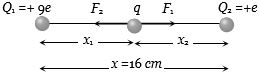
Two point charges $+9e$ and $+e$ are at $16\, cm$ away from each other. Where should another charge $q$ be placed between them so that the system remains in equilibrium?
A
$24\, cm$ from $+9e$
B
$12\, cm$ from $+9e$
C
$24\, cm$ from $+e$
D
$12\, cm$ from $+e$
Solution
(B) Let the charge $q$ be placed at a distance $x$ from the charge $+9e$. For the system to be in equilibrium,the net force on charge $q$ must be zero.
Let $F_1$ be the force due to charge $+e$ and $F_2$ be the force due to charge $+9e$.
For equilibrium,$|F_1| = |F_2|$.
Using Coulomb's law: $\frac{kqe}{(16-x)^2} = \frac{kq(9e)}{x^2}$.
Taking the square root on both sides: $\frac{1}{16-x} = \frac{3}{x}$.
Solving for $x$: $x = 3(16-x) \implies x = 48 - 3x \implies 4x = 48 \implies x = 12\, cm$.
Thus,the charge $q$ should be placed at $12\, cm$ from the $+9e$ charge.
Let $F_1$ be the force due to charge $+e$ and $F_2$ be the force due to charge $+9e$.
For equilibrium,$|F_1| = |F_2|$.
Using Coulomb's law: $\frac{kqe}{(16-x)^2} = \frac{kq(9e)}{x^2}$.
Taking the square root on both sides: $\frac{1}{16-x} = \frac{3}{x}$.
Solving for $x$: $x = 3(16-x) \implies x = 48 - 3x \implies 4x = 48 \implies x = 12\, cm$.
Thus,the charge $q$ should be placed at $12\, cm$ from the $+9e$ charge.
0 likes
View Solution53
MediumMCQ
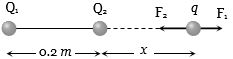
The distance between charges $5 \times 10^{-11} \, C$ and $-2.7 \times 10^{-11} \, C$ is $0.2 \, m$. The distance at which a third charge should be placed in order that it will not experience any force along the line joining the two charges is . . . . . . $m$.
A
$0.44$
B
$0.65$
C
$0.556$
D
$0.350$
Solution
(C) For a third charge $q$ to experience no net force,the forces exerted by the two charges $Q_1$ and $Q_2$ must be equal in magnitude and opposite in direction. Since the charges have opposite signs,the equilibrium point must lie outside the line segment joining them,closer to the charge with the smaller magnitude $(-2.7 \times 10^{-11} \, C)$.
Let the third charge $q$ be placed at a distance $x$ from the charge $Q_2 = -2.7 \times 10^{-11} \, C$. The distance from $Q_1 = 5 \times 10^{-11} \, C$ is $(x + 0.2) \, m$.
Equating the magnitudes of the forces: $\frac{k |Q_1| |q|}{(x + 0.2)^2} = \frac{k |Q_2| |q|}{x^2}$.
Substituting the values: $\frac{5 \times 10^{-11}}{(x + 0.2)^2} = \frac{2.7 \times 10^{-11}}{x^2}$.
$\frac{5}{(x + 0.2)^2} = \frac{2.7}{x^2} \implies \frac{\sqrt{5}}{x + 0.2} = \frac{\sqrt{2.7}}{x}$.
$2.236 x = 1.643 (x + 0.2) \implies 2.236 x = 1.643 x + 0.3286$.
$0.593 x = 0.3286 \implies x \approx 0.554 \, m$. Given the options,the closest value is $0.556 \, m$.
Let the third charge $q$ be placed at a distance $x$ from the charge $Q_2 = -2.7 \times 10^{-11} \, C$. The distance from $Q_1 = 5 \times 10^{-11} \, C$ is $(x + 0.2) \, m$.
Equating the magnitudes of the forces: $\frac{k |Q_1| |q|}{(x + 0.2)^2} = \frac{k |Q_2| |q|}{x^2}$.
Substituting the values: $\frac{5 \times 10^{-11}}{(x + 0.2)^2} = \frac{2.7 \times 10^{-11}}{x^2}$.
$\frac{5}{(x + 0.2)^2} = \frac{2.7}{x^2} \implies \frac{\sqrt{5}}{x + 0.2} = \frac{\sqrt{2.7}}{x}$.
$2.236 x = 1.643 (x + 0.2) \implies 2.236 x = 1.643 x + 0.3286$.
$0.593 x = 0.3286 \implies x \approx 0.554 \, m$. Given the options,the closest value is $0.556 \, m$.
0 likes
View Solution54
DifficultMCQ
Charges $4Q$,$q$,and $Q$ are placed along the $x$-axis at positions $x = 0$,$x = l/2$,and $x = l$,respectively. Find the value of $q$ such that the net force on charge $Q$ is zero.
A
$Q$
B
$Q/2$
C
$-Q/2$
D
$-Q$
Solution
(D) The force on charge $Q$ at $x = l$ is due to the charges $4Q$ at $x = 0$ and $q$ at $x = l/2$.
Using Coulomb's Law,the force exerted by $4Q$ on $Q$ is $F_1 = \frac{1}{4\pi\varepsilon_0} \frac{(4Q)(Q)}{l^2}$.
The force exerted by $q$ on $Q$ is $F_2 = \frac{1}{4\pi\varepsilon_0} \frac{qQ}{(l/2)^2}$.
For the net force on $Q$ to be zero,$F_1 + F_2 = 0$.
$\frac{1}{4\pi\varepsilon_0} \frac{4Q^2}{l^2} + \frac{1}{4\pi\varepsilon_0} \frac{qQ}{l^2/4} = 0$.
$\frac{4Q^2}{l^2} + \frac{4qQ}{l^2} = 0$.
Dividing by $\frac{4Q}{l^2}$ (assuming $Q \neq 0$ and $l \neq 0$),we get $Q + q = 0$.
Therefore,$q = -Q$.
Using Coulomb's Law,the force exerted by $4Q$ on $Q$ is $F_1 = \frac{1}{4\pi\varepsilon_0} \frac{(4Q)(Q)}{l^2}$.
The force exerted by $q$ on $Q$ is $F_2 = \frac{1}{4\pi\varepsilon_0} \frac{qQ}{(l/2)^2}$.
For the net force on $Q$ to be zero,$F_1 + F_2 = 0$.
$\frac{1}{4\pi\varepsilon_0} \frac{4Q^2}{l^2} + \frac{1}{4\pi\varepsilon_0} \frac{qQ}{l^2/4} = 0$.
$\frac{4Q^2}{l^2} + \frac{4qQ}{l^2} = 0$.
Dividing by $\frac{4Q}{l^2}$ (assuming $Q \neq 0$ and $l \neq 0$),we get $Q + q = 0$.
Therefore,$q = -Q$.
0 likes
View Solution55
DifficultMCQ
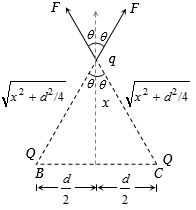
Two equal charges are separated by a distance $d$. $A$ third charge placed on a perpendicular bisector at $x$ distance will experience maximum Coulomb force when
A
$x = \frac{d}{\sqrt{2}}$
B
$x = \frac{d}{2}$
C
$x = \frac{d}{2\sqrt{2}}$
D
$x = \frac{d}{2\sqrt{3}}$
Solution
(C) Let the two equal charges be $Q$ and the third charge be $q$. The distance between the two charges $Q$ is $d$. The third charge $q$ is placed at a distance $x$ on the perpendicular bisector.
The force exerted by each charge $Q$ on $q$ is $F = \frac{1}{4\pi\varepsilon_0} \cdot \frac{Qq}{x^2 + (d/2)^2}$.
The net force $F_{net}$ on $q$ is the sum of the components of these forces along the perpendicular bisector:
$F_{net} = 2F \cos \theta$,where $\cos \theta = \frac{x}{\sqrt{x^2 + (d/2)^2}}$.
Substituting the values:
$F_{net} = 2 \cdot \frac{1}{4\pi\varepsilon_0} \cdot \frac{Qq}{x^2 + d^2/4} \cdot \frac{x}{(x^2 + d^2/4)^{1/2}} = \frac{2Qqx}{4\pi\varepsilon_0 (x^2 + d^2/4)^{3/2}}$.
For $F_{net}$ to be maximum,$\frac{dF_{net}}{dx} = 0$.
Using the quotient rule or differentiating $f(x) = x(x^2 + a^2)^{-3/2}$ where $a = d/2$:
$f'(x) = (x^2 + a^2)^{-3/2} + x \cdot (-3/2)(x^2 + a^2)^{-5/2} \cdot 2x = 0$.
$(x^2 + a^2)^{-5/2} [ (x^2 + a^2) - 3x^2 ] = 0$.
$a^2 - 2x^2 = 0 \implies x^2 = a^2/2 \implies x = a/\sqrt{2}$.
Since $a = d/2$,we get $x = \frac{d/2}{\sqrt{2}} = \frac{d}{2\sqrt{2}}$.
The force exerted by each charge $Q$ on $q$ is $F = \frac{1}{4\pi\varepsilon_0} \cdot \frac{Qq}{x^2 + (d/2)^2}$.
The net force $F_{net}$ on $q$ is the sum of the components of these forces along the perpendicular bisector:
$F_{net} = 2F \cos \theta$,where $\cos \theta = \frac{x}{\sqrt{x^2 + (d/2)^2}}$.
Substituting the values:
$F_{net} = 2 \cdot \frac{1}{4\pi\varepsilon_0} \cdot \frac{Qq}{x^2 + d^2/4} \cdot \frac{x}{(x^2 + d^2/4)^{1/2}} = \frac{2Qqx}{4\pi\varepsilon_0 (x^2 + d^2/4)^{3/2}}$.
For $F_{net}$ to be maximum,$\frac{dF_{net}}{dx} = 0$.
Using the quotient rule or differentiating $f(x) = x(x^2 + a^2)^{-3/2}$ where $a = d/2$:
$f'(x) = (x^2 + a^2)^{-3/2} + x \cdot (-3/2)(x^2 + a^2)^{-5/2} \cdot 2x = 0$.
$(x^2 + a^2)^{-5/2} [ (x^2 + a^2) - 3x^2 ] = 0$.
$a^2 - 2x^2 = 0 \implies x^2 = a^2/2 \implies x = a/\sqrt{2}$.
Since $a = d/2$,we get $x = \frac{d/2}{\sqrt{2}} = \frac{d}{2\sqrt{2}}$.
0 likes
View Solution56
DifficultMCQ
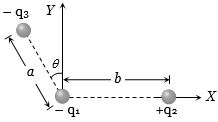
Three charges $-q_1$,$+q_2$,and $-q_3$ are placed as shown in the figure. The $x$-component of the force on $-q_1$ is proportional to
A
$\frac{q_2}{b^2} - \frac{q_3}{a^2} \sin \theta$
B
$\frac{q_2}{b^2} - \frac{q_3}{a^2} \cos \theta$
C
$\frac{q_2}{b^2} + \frac{q_3}{a^2} \sin \theta$
D
$\frac{q_2}{b^2} + \frac{q_3}{a^2} \cos \theta$
Solution
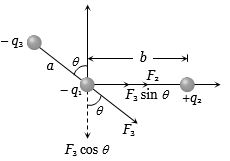
(C) Let $F_2$ be the force applied by $+q_2$ on $-q_1$. Since they have opposite signs,the force is attractive and acts along the positive $x$-axis. Thus,$F_2 = k \frac{q_1 q_2}{b^2}$.
Let $F_3$ be the force applied by $-q_3$ on $-q_1$. Since they have the same sign,the force is repulsive. The force $F_3$ acts along the line joining them,making an angle $\theta$ with the negative $y$-axis. The magnitude is $F_3 = k \frac{q_1 q_3}{a^2}$.
The $x$-component of $F_3$ is $F_{3x} = F_3 \sin \theta = k \frac{q_1 q_3}{a^2} \sin \theta$,acting in the positive $x$-direction.
The net $x$-component of the force on $-q_1$ is $F_x = F_2 + F_{3x} = k \frac{q_1 q_2}{b^2} + k \frac{q_1 q_3}{a^2} \sin \theta$.
Therefore,$F_x = k q_1 \left( \frac{q_2}{b^2} + \frac{q_3}{a^2} \sin \theta \right)$.
Thus,$F_x \propto \left( \frac{q_2}{b^2} + \frac{q_3}{a^2} \sin \theta \right)$.
Let $F_3$ be the force applied by $-q_3$ on $-q_1$. Since they have the same sign,the force is repulsive. The force $F_3$ acts along the line joining them,making an angle $\theta$ with the negative $y$-axis. The magnitude is $F_3 = k \frac{q_1 q_3}{a^2}$.
The $x$-component of $F_3$ is $F_{3x} = F_3 \sin \theta = k \frac{q_1 q_3}{a^2} \sin \theta$,acting in the positive $x$-direction.
The net $x$-component of the force on $-q_1$ is $F_x = F_2 + F_{3x} = k \frac{q_1 q_2}{b^2} + k \frac{q_1 q_3}{a^2} \sin \theta$.
Therefore,$F_x = k q_1 \left( \frac{q_2}{b^2} + \frac{q_3}{a^2} \sin \theta \right)$.
Thus,$F_x \propto \left( \frac{q_2}{b^2} + \frac{q_3}{a^2} \sin \theta \right)$.
0 likes
View Solution57
MediumMCQ
$A$ point charge of $40 \ statC$ is placed $2 \ cm$ in front of an earthed metallic plane plate of large size. The force of attraction on the point charge is.....$dynes$.
A
$100$
B
$160$
C
$1600$
D
$400$
Solution
(A) According to the method of electrical images,an earthed conducting plane acts like an image charge of equal magnitude but opposite sign placed at an equal distance behind the plane.
Here,the charge $q = 40 \ statC$ is at a distance $d = 2 \ cm$ from the plate.
The image charge $q' = -40 \ statC$ is at a distance $d = 2 \ cm$ behind the plate.
The total distance between the charge and its image is $r = 2d = 4 \ cm$.
Using Coulomb's law in the $CGS$ system,the force $F$ is given by:
$F = \frac{|q \cdot q'|}{r^2} = \frac{40 \times 40}{4^2} = \frac{1600}{16} = 100 \ dynes$.
Here,the charge $q = 40 \ statC$ is at a distance $d = 2 \ cm$ from the plate.
The image charge $q' = -40 \ statC$ is at a distance $d = 2 \ cm$ behind the plate.
The total distance between the charge and its image is $r = 2d = 4 \ cm$.
Using Coulomb's law in the $CGS$ system,the force $F$ is given by:
$F = \frac{|q \cdot q'|}{r^2} = \frac{40 \times 40}{4^2} = \frac{1600}{16} = 100 \ dynes$.
0 likes
View Solution58
EasyMCQ
In a hydrogen atom,the distance between the electron and proton is $2.5 \times 10^{-11} \ m$. The electrical force of attraction between them will be
A
$2.8 \times 10^{-7} \ N$
B
$3.7 \times 10^{-7} \ N$
C
$6.2 \times 10^{-7} \ N$
D
$9.1 \times 10^{-7} \ N$
Solution
(B) The electrical force of attraction between the electron and proton is given by Coulomb's Law: $F = k \frac{|q_1 q_2|}{r^2}$.
Here,$k = 9 \times 10^9 \ N \cdot m^2/C^2$,$q_1 = q_2 = 1.6 \times 10^{-19} \ C$,and $r = 2.5 \times 10^{-11} \ m$.
Substituting the values:
$F = \frac{9 \times 10^9 \times (1.6 \times 10^{-19}) \times (1.6 \times 10^{-19})}{(2.5 \times 10^{-11})^2}$
$F = \frac{9 \times 2.56 \times 10^{9 - 19 - 19}}{6.25 \times 10^{-22}}$
$F = \frac{23.04 \times 10^{-29}}{6.25 \times 10^{-22}}$
$F = 3.6864 \times 10^{-7} \ N \approx 3.7 \times 10^{-7} \ N$.
Here,$k = 9 \times 10^9 \ N \cdot m^2/C^2$,$q_1 = q_2 = 1.6 \times 10^{-19} \ C$,and $r = 2.5 \times 10^{-11} \ m$.
Substituting the values:
$F = \frac{9 \times 10^9 \times (1.6 \times 10^{-19}) \times (1.6 \times 10^{-19})}{(2.5 \times 10^{-11})^2}$
$F = \frac{9 \times 2.56 \times 10^{9 - 19 - 19}}{6.25 \times 10^{-22}}$
$F = \frac{23.04 \times 10^{-29}}{6.25 \times 10^{-22}}$
$F = 3.6864 \times 10^{-7} \ N \approx 3.7 \times 10^{-7} \ N$.
0 likes
View Solution59
EasyMCQ
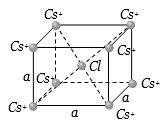
What is the net force on a $Cl^{-}$ ion placed at the centre of the $bcc$ structure of $CsCl$?
A
Zero
B
$k{e^2}/{a^2}$
C
$k{e^2}{a^2}$
D
Data is incomplete
Solution
(A) In a $CsCl$ crystal,the $Cs^{+}$ ions are located at the eight corners of a cube of side length $a$.
The $Cl^{-}$ ion is placed at the exact centre of this cube.
Due to the symmetry of the $bcc$ structure,each $Cs^{+}$ ion at a corner exerts an electrostatic force on the central $Cl^{-}$ ion.
For every $Cs^{+}$ ion,there is an identical $Cs^{+}$ ion located diametrically opposite to it with respect to the centre.
The forces exerted by these pairs of $Cs^{+}$ ions on the central $Cl^{-}$ ion are equal in magnitude and opposite in direction.
According to the principle of superposition,the vector sum of all these forces is zero.
Therefore,the net electrostatic force on the $Cl^{-}$ ion is zero.
The $Cl^{-}$ ion is placed at the exact centre of this cube.
Due to the symmetry of the $bcc$ structure,each $Cs^{+}$ ion at a corner exerts an electrostatic force on the central $Cl^{-}$ ion.
For every $Cs^{+}$ ion,there is an identical $Cs^{+}$ ion located diametrically opposite to it with respect to the centre.
The forces exerted by these pairs of $Cs^{+}$ ions on the central $Cl^{-}$ ion are equal in magnitude and opposite in direction.
According to the principle of superposition,the vector sum of all these forces is zero.
Therefore,the net electrostatic force on the $Cl^{-}$ ion is zero.
0 likes
View Solution60
MediumMCQ
An electron is moving around the nucleus of a hydrogen atom in a circular orbit of radius $r$. The Coulomb force $\vec{F}$ between the two is
A
$k \frac{e^2}{r^2} \hat{r}$
B
$-k \frac{e^2}{r^3} \vec{r}$
C
$k \frac{e^2}{r^3} \hat{r}$
D
$-k \frac{e^2}{r^2} \hat{r}$
Solution
(B) The charge of the nucleus of a hydrogen atom is $q_1 = +e$.
The charge of the electron is $q_2 = -e$.
The Coulomb force $\vec{F}$ is given by the formula $\vec{F} = \frac{k q_1 q_2}{r^2} \hat{r}$,where $\hat{r}$ is the unit vector pointing from the nucleus to the electron.
Substituting the values,we get $\vec{F} = \frac{k(e)(-e)}{r^2} \hat{r} = -\frac{k e^2}{r^2} \hat{r}$.
Since $\hat{r} = \frac{\vec{r}}{r}$,we can rewrite the expression as $\vec{F} = -\frac{k e^2}{r^2} \left( \frac{\vec{r}}{r} \right) = -k \frac{e^2}{r^3} \vec{r}$.
The charge of the electron is $q_2 = -e$.
The Coulomb force $\vec{F}$ is given by the formula $\vec{F} = \frac{k q_1 q_2}{r^2} \hat{r}$,where $\hat{r}$ is the unit vector pointing from the nucleus to the electron.
Substituting the values,we get $\vec{F} = \frac{k(e)(-e)}{r^2} \hat{r} = -\frac{k e^2}{r^2} \hat{r}$.
Since $\hat{r} = \frac{\vec{r}}{r}$,we can rewrite the expression as $\vec{F} = -\frac{k e^2}{r^2} \left( \frac{\vec{r}}{r} \right) = -k \frac{e^2}{r^3} \vec{r}$.
0 likes
View Solution61
MediumMCQ
Two identical spheres have charges $+q$ and $-q$ and are placed at a certain distance. The force between them is $F$. If a third identical sphere with charge $+q$ is placed exactly between the two spheres, what is the magnitude and direction of the force experienced by it?
A
Zero, no direction
B
$8F$, towards the $+q$ charge
C
$8F$, towards the $-q$ charge
D
$4F$, towards the $+q$ charge
Solution
(C) Let the distance between two spheres $A$ $(+q)$ and $B$ $(-q)$ be $r$. The initial force between them is $F = \frac{1}{4 \pi \varepsilon_0} \frac{q^2}{r^2}$.
When a third sphere $O$ with charge $+q$ is placed at their midpoint (at distance $r/2$):
Repulsive force exerted by sphere $A$ $(+q)$ on sphere $O$ $(+q)$: $F_{AO} = \frac{1}{4 \pi \varepsilon_0} \frac{q \cdot q}{(r/2)^2} = 4 \left( \frac{1}{4 \pi \varepsilon_0} \frac{q^2}{r^2} \right) = 4F$ (towards $-q$).
Attractive force exerted by sphere $B$ $(-q)$ on sphere $O$ $(+q)$: $F_{OB} = \frac{1}{4 \pi \varepsilon_0} \frac{|-q| \cdot q}{(r/2)^2} = 4 \left( \frac{1}{4 \pi \varepsilon_0} \frac{q^2}{r^2} \right) = 4F$ (towards $-q$).
Total force $F' = F_{AO} + F_{OB} = 4F + 4F = 8F$. This force will act in the direction of the $-q$ charge.
When a third sphere $O$ with charge $+q$ is placed at their midpoint (at distance $r/2$):
Repulsive force exerted by sphere $A$ $(+q)$ on sphere $O$ $(+q)$: $F_{AO} = \frac{1}{4 \pi \varepsilon_0} \frac{q \cdot q}{(r/2)^2} = 4 \left( \frac{1}{4 \pi \varepsilon_0} \frac{q^2}{r^2} \right) = 4F$ (towards $-q$).
Attractive force exerted by sphere $B$ $(-q)$ on sphere $O$ $(+q)$: $F_{OB} = \frac{1}{4 \pi \varepsilon_0} \frac{|-q| \cdot q}{(r/2)^2} = 4 \left( \frac{1}{4 \pi \varepsilon_0} \frac{q^2}{r^2} \right) = 4F$ (towards $-q$).
Total force $F' = F_{AO} + F_{OB} = 4F + 4F = 8F$. This force will act in the direction of the $-q$ charge.
0 likes
View Solution62
MediumMCQ
Two point charges of $+2 \, \mu \text{C}$ and $+6 \, \mu \text{C}$ repel each other with a force of $12 \, \text{N}$. If a charge of $-4 \, \mu \text{C}$ is added to each,the force will be:
A
$4 \, \text{N}$ (attractive)
B
$60 \, \text{N}$ (attractive)
C
$4 \, \text{N}$ (repulsive)
D
$12 \, \text{N}$ (attractive)
Solution
(A) According to Coulomb's Law,the force between two charges is given by $F = \frac{k q_1 q_2}{r^2}$.
Initially,$q_1 = 2 \, \mu \text{C}$ and $q_2 = 6 \, \mu \text{C}$,and $F = 12 \, \text{N}$.
So,$12 = \frac{k (2 \times 10^{-6}) (6 \times 10^{-6})}{r^2} \implies \frac{k}{r^2} = \frac{12}{12 \times 10^{-12}} = 10^{12} \, \text{N} \cdot \text{m}^2/\text{C}^2$.
After adding $-4 \, \mu \text{C}$ to each charge:
$q_1' = 2 - 4 = -2 \, \mu \text{C}$
$q_2' = 6 - 4 = +2 \, \mu \text{C}$
The new force $F'$ is $F' = \frac{k q_1' q_2'}{r^2} = \frac{k (-2 \times 10^{-6}) (2 \times 10^{-6})}{r^2}$.
Substituting $\frac{k}{r^2} = 10^{12}$,we get $F' = 10^{12} \times (-4 \times 10^{-12}) = -4 \, \text{N}$.
The negative sign indicates that the force is attractive. Thus,the magnitude is $4 \, \text{N}$ and the nature is attractive.
Initially,$q_1 = 2 \, \mu \text{C}$ and $q_2 = 6 \, \mu \text{C}$,and $F = 12 \, \text{N}$.
So,$12 = \frac{k (2 \times 10^{-6}) (6 \times 10^{-6})}{r^2} \implies \frac{k}{r^2} = \frac{12}{12 \times 10^{-12}} = 10^{12} \, \text{N} \cdot \text{m}^2/\text{C}^2$.
After adding $-4 \, \mu \text{C}$ to each charge:
$q_1' = 2 - 4 = -2 \, \mu \text{C}$
$q_2' = 6 - 4 = +2 \, \mu \text{C}$
The new force $F'$ is $F' = \frac{k q_1' q_2'}{r^2} = \frac{k (-2 \times 10^{-6}) (2 \times 10^{-6})}{r^2}$.
Substituting $\frac{k}{r^2} = 10^{12}$,we get $F' = 10^{12} \times (-4 \times 10^{-12}) = -4 \, \text{N}$.
The negative sign indicates that the force is attractive. Thus,the magnitude is $4 \, \text{N}$ and the nature is attractive.
0 likes
View Solution63
MediumMCQ
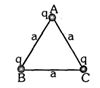
In the figure,the force on the charge at $A$ in the direction perpendicular to $BC$ is ...... .
A
$-\frac{kq}{a^2}$
B
$-\frac{kq^2}{2a^2}$
C
$\frac{kq^2}{2a^2}$
D
$\frac{\sqrt{3}kq^2}{a^2}$
Solution
(D) The charges at $B$ and $C$ are both $q$ and the distance between them and $A$ is $a$. The force exerted by charge $B$ on $A$ is $F_{AB} = \frac{kq^2}{a^2}$ along the line $BA$ extended. The force exerted by charge $C$ on $A$ is $F_{AC} = \frac{kq^2}{a^2}$ along the line $CA$ extended. Since the triangle is equilateral,the angle of these forces with the vertical (perpendicular to $BC$) is $30^\circ$. The horizontal components of these forces cancel each other out. The vertical components add up: $F_{net} = F_{AB} \cos(30^\circ) + F_{AC} \cos(30^\circ) = 2 \times \frac{kq^2}{a^2} \times \frac{\sqrt{3}}{2} = \frac{\sqrt{3}kq^2}{a^2}$.
0 likes
View Solution64
DifficultMCQ
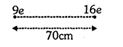
Two electric charges are arranged as shown in the figure. Where should a third charge be placed so that it remains in equilibrium?
A
At a distance of $30 \ cm$ from $9 \ e$
B
At a distance of $40 \ cm$ from $16 \ e$
C
At a distance of $40 \ cm$ from $9 \ e$
D
Both $(a)$ and $(b)$
Solution
(D) Let the third charge $q$ be placed at a distance $x$ from the charge $9e$. Then,its distance from the charge $16e$ is $(70 - x) \ cm$.
For the third charge to be in equilibrium,the net electrostatic force on it must be zero. Therefore,the magnitude of the force exerted by $9e$ must equal the magnitude of the force exerted by $16e$:
$F_1 = F_2$
$\frac{k \cdot (9e) \cdot q}{x^2} = \frac{k \cdot (16e) \cdot q}{(70 - x)^2}$
$\frac{9}{x^2} = \frac{16}{(70 - x)^2}$
Taking the square root on both sides:
$\frac{3}{x} = \frac{4}{70 - x}$
$3(70 - x) = 4x$
$210 - 3x = 4x$
$7x = 210$
$x = 30 \ cm$
Thus,the charge should be placed at a distance of $30 \ cm$ from $9e$. The distance from $16e$ is $70 - 30 = 40 \ cm$. Therefore,both options $(a)$ and $(b)$ are correct.
For the third charge to be in equilibrium,the net electrostatic force on it must be zero. Therefore,the magnitude of the force exerted by $9e$ must equal the magnitude of the force exerted by $16e$:
$F_1 = F_2$
$\frac{k \cdot (9e) \cdot q}{x^2} = \frac{k \cdot (16e) \cdot q}{(70 - x)^2}$
$\frac{9}{x^2} = \frac{16}{(70 - x)^2}$
Taking the square root on both sides:
$\frac{3}{x} = \frac{4}{70 - x}$
$3(70 - x) = 4x$
$210 - 3x = 4x$
$7x = 210$
$x = 30 \ cm$
Thus,the charge should be placed at a distance of $30 \ cm$ from $9e$. The distance from $16e$ is $70 - 30 = 40 \ cm$. Therefore,both options $(a)$ and $(b)$ are correct.
0 likes
View Solution65
DifficultMCQ
Four charges of magnitude $-Q$ are placed at the four corners of a square,and a charge $q$ is placed at the center. If the system is in equilibrium,the value of $q$ is ......
A
$ - \frac{Q}{4}(1 + 2\sqrt{2}) $
B
$ \frac{Q}{4}(1 + 2\sqrt{2}) $
C
$ - \frac{Q}{2}(1 + 2\sqrt{2}) $
D
$ \frac{Q}{2}(1 + 2\sqrt{2}) $
Solution
(B) Step $1$: Calculate the distances between the charges. Let the side length of the square be $a$. The diagonal length is $AC = \sqrt{a^2 + a^2} = \sqrt{2}a$. The distance from the center $O$ to any corner is $OC = \frac{AC}{2} = \frac{a}{\sqrt{2}}$.
Step $2$: Equilibrium condition. For the system to be in equilibrium,the net force on every charge must be zero. By symmetry,the net force on the central charge $q$ is zero regardless of its value. Thus,we must ensure the net force on any one of the corner charges (e.g.,at point $C$) is zero.
Step $3$: Forces acting on the charge at corner $C$. Let the charges at corners $A, B, C, D$ be $-Q$. The force due to $B$ is $F_1 = \frac{KQ^2}{a^2}$ (repulsive),the force due to $D$ is $F_2 = \frac{KQ^2}{a^2}$ (repulsive),and the force due to $A$ is $F_4 = \frac{KQ^2}{(\sqrt{2}a)^2} = \frac{KQ^2}{2a^2}$ (repulsive). The force due to central charge $q$ is $F_3 = \frac{K|q|Q}{(a/\sqrt{2})^2} = \frac{2K|q|Q}{a^2}$ (attractive,so $q$ must be positive).
Step $4$: Summing the forces along the diagonal $OC$. The resultant of $F_1$ and $F_2$ is $\sqrt{F_1^2 + F_2^2} = \sqrt{2} \frac{KQ^2}{a^2}$. For equilibrium: $F_3 + F_4 + \sqrt{2}F_1 = 0$. Since $F_3$ is attractive (towards center) and others are repulsive (away from center),we set: $\frac{2KqQ}{a^2} + \frac{KQ^2}{2a^2} + \sqrt{2}\frac{KQ^2}{a^2} = 0$.
Step $5$: Solving for $q$: $2q + \frac{Q}{2} + \sqrt{2}Q = 0 \Rightarrow 2q = -Q(\frac{1}{2} + \sqrt{2}) \Rightarrow q = -\frac{Q}{4}(1 + 2\sqrt{2})$. However,checking the force direction,for the corner charge to be in equilibrium,$q$ must be positive to attract the corner charge. Re-evaluating the sign convention,the correct magnitude is $q = \frac{Q}{4}(1 + 2\sqrt{2})$.
Step $2$: Equilibrium condition. For the system to be in equilibrium,the net force on every charge must be zero. By symmetry,the net force on the central charge $q$ is zero regardless of its value. Thus,we must ensure the net force on any one of the corner charges (e.g.,at point $C$) is zero.
Step $3$: Forces acting on the charge at corner $C$. Let the charges at corners $A, B, C, D$ be $-Q$. The force due to $B$ is $F_1 = \frac{KQ^2}{a^2}$ (repulsive),the force due to $D$ is $F_2 = \frac{KQ^2}{a^2}$ (repulsive),and the force due to $A$ is $F_4 = \frac{KQ^2}{(\sqrt{2}a)^2} = \frac{KQ^2}{2a^2}$ (repulsive). The force due to central charge $q$ is $F_3 = \frac{K|q|Q}{(a/\sqrt{2})^2} = \frac{2K|q|Q}{a^2}$ (attractive,so $q$ must be positive).
Step $4$: Summing the forces along the diagonal $OC$. The resultant of $F_1$ and $F_2$ is $\sqrt{F_1^2 + F_2^2} = \sqrt{2} \frac{KQ^2}{a^2}$. For equilibrium: $F_3 + F_4 + \sqrt{2}F_1 = 0$. Since $F_3$ is attractive (towards center) and others are repulsive (away from center),we set: $\frac{2KqQ}{a^2} + \frac{KQ^2}{2a^2} + \sqrt{2}\frac{KQ^2}{a^2} = 0$.
Step $5$: Solving for $q$: $2q + \frac{Q}{2} + \sqrt{2}Q = 0 \Rightarrow 2q = -Q(\frac{1}{2} + \sqrt{2}) \Rightarrow q = -\frac{Q}{4}(1 + 2\sqrt{2})$. However,checking the force direction,for the corner charge to be in equilibrium,$q$ must be positive to attract the corner charge. Re-evaluating the sign convention,the correct magnitude is $q = \frac{Q}{4}(1 + 2\sqrt{2})$.
0 likes
View Solution66
EasyMCQ
$A$ point charge $q_1$ exerts a force $F$ on a point charge $q_2$. If a third charge $q_3$ is brought near the charge $q_2$,then the force exerted by $q_1$ on $q_2$ will be:
A
$F$
B
$> F$
C
$< F$
D
Zero
Solution
(A) According to the principle of superposition in electrostatics,the force exerted by one point charge on another is independent of the presence of other charges in the vicinity.
The force $F$ between two point charges $q_1$ and $q_2$ is given by Coulomb's Law: $F = k \frac{|q_1 q_2|}{r^2}$,where $r$ is the distance between them.
Since the force $F$ depends only on the magnitudes of $q_1$ and $q_2$ and the distance $r$ between them,the introduction of a third charge $q_3$ does not alter the individual force exerted by $q_1$ on $q_2$.
Although the net force on $q_2$ will change due to the additional force exerted by $q_3$,the specific force exerted by $q_1$ on $q_2$ remains $F$.
The force $F$ between two point charges $q_1$ and $q_2$ is given by Coulomb's Law: $F = k \frac{|q_1 q_2|}{r^2}$,where $r$ is the distance between them.
Since the force $F$ depends only on the magnitudes of $q_1$ and $q_2$ and the distance $r$ between them,the introduction of a third charge $q_3$ does not alter the individual force exerted by $q_1$ on $q_2$.
Although the net force on $q_2$ will change due to the additional force exerted by $q_3$,the specific force exerted by $q_1$ on $q_2$ remains $F$.
0 likes
View Solution67
EasyMCQ
Two point charges of $1 \, \mu\text{C}$ and $5 \, \mu\text{C}$ are placed at a distance of $4 \, \text{cm}$ apart. The ratio of the forces exerted by them on each other will be:
A
$1 : 1$
B
$1 : 5$
C
$5 : 1$
D
$25 : 1$
Solution
(A) According to Coulomb's Law,the electrostatic force between two point charges $Q_1$ and $Q_2$ separated by a distance $r$ is given by $F = k \frac{|Q_1 Q_2|}{r^2}$.
Newton's third law of motion states that for every action,there is an equal and opposite reaction.
Therefore,the force exerted by charge $Q_1$ on $Q_2$ is equal in magnitude and opposite in direction to the force exerted by charge $Q_2$ on $Q_1$.
Since the magnitudes of the forces are equal,the ratio of the forces exerted by them on each other is $1 : 1$.
Newton's third law of motion states that for every action,there is an equal and opposite reaction.
Therefore,the force exerted by charge $Q_1$ on $Q_2$ is equal in magnitude and opposite in direction to the force exerted by charge $Q_2$ on $Q_1$.
Since the magnitudes of the forces are equal,the ratio of the forces exerted by them on each other is $1 : 1$.
0 likes
View Solution68
EasyMCQ
Two electric charges $+q$ and $+q$ are placed at a distance $r$. The force between them is $F$. If one charge is fixed and the other moves in a circle of radius $r$,the work done will be .......
A
$F \times r$
B
$F \times 2\pi r$
C
$F / 2\pi r$
D
Zero
Solution
(D) The force between two charges is a central force,which is conservative in nature.
Work done by a conservative force in a closed path is zero.
Alternatively,the work done $W$ is given by the integral $W = \int \vec{F} \cdot d\vec{r}$.
In this case,the force $\vec{F}$ is directed radially outward (along the line joining the charges),and the displacement $d\vec{r}$ is along the tangent to the circle.
Since the force is always perpendicular to the displacement (angle $\theta = 90^\circ$),the dot product $\vec{F} \cdot d\vec{r} = F \cdot dr \cdot \cos(90^\circ) = 0$.
Therefore,the total work done is $0$.
Work done by a conservative force in a closed path is zero.
Alternatively,the work done $W$ is given by the integral $W = \int \vec{F} \cdot d\vec{r}$.
In this case,the force $\vec{F}$ is directed radially outward (along the line joining the charges),and the displacement $d\vec{r}$ is along the tangent to the circle.
Since the force is always perpendicular to the displacement (angle $\theta = 90^\circ$),the dot product $\vec{F} \cdot d\vec{r} = F \cdot dr \cdot \cos(90^\circ) = 0$.
Therefore,the total work done is $0$.
0 likes
View Solution69
EasyMCQ
The value of the electric permittivity of free space $(\varepsilon_0)$ is ........
A
$9 \times 10^9 \, N \cdot C^2/m^2$
B
$8.9 \times 10^{-12} \, N \cdot m^2/C^2$
C
$8.854 \times 10^{-12} \, C^2/(N \cdot m^2)$
D
$8.9 \times 10^9 \, C^2/(N \cdot m^2)$
Solution
(C) The electric permittivity of free space, denoted by $\varepsilon_0$, is a fundamental physical constant.
From Coulomb's Law, the force between two charges is given by $F = \frac{1}{4 \pi \varepsilon_0} \frac{q_1 q_2}{r^2}$.
Rearranging for $\varepsilon_0$, we get $\varepsilon_0 = \frac{q_1 q_2}{4 \pi F r^2}$.
The $SI$ unit of $\varepsilon_0$ is $C^2/(N \cdot m^2)$ or $F/m$.
The experimentally determined value is approximately $8.854 \times 10^{-12} \, C^2/(N \cdot m^2)$.
From Coulomb's Law, the force between two charges is given by $F = \frac{1}{4 \pi \varepsilon_0} \frac{q_1 q_2}{r^2}$.
Rearranging for $\varepsilon_0$, we get $\varepsilon_0 = \frac{q_1 q_2}{4 \pi F r^2}$.
The $SI$ unit of $\varepsilon_0$ is $C^2/(N \cdot m^2)$ or $F/m$.
The experimentally determined value is approximately $8.854 \times 10^{-12} \, C^2/(N \cdot m^2)$.
0 likes
View Solution70
MediumMCQ
Two small balls,each having a negative charge $Q$,are suspended from a fixed point by two identical insulating strings of length $L$. This entire arrangement is placed inside a satellite in a region where there is no gravity (weightless condition). The angle between the strings is ......... and the tension in each string is ......... Newtons.
A
$180^{\circ}, \frac{kQ^2}{4L^2}$
B
$90^{\circ}, \frac{kQ}{4L^2}$
C
$120^{\circ}, \frac{kQ^2}{4L}$
D
$60^{\circ}, \frac{kQ}{4L}$
Solution
(A) In a satellite,the condition is one of weightlessness,meaning the effective gravitational force $mg = 0$.
Due to the electrostatic force of repulsion between the two identical negative charges $Q$,the balls will push each other away until the strings are fully extended in opposite directions.
Since the strings are of length $L$,the distance between the two balls becomes $2L$.
The angle between the two strings is $180^{\circ}$.
The tension $T$ in each string is balanced by the electrostatic force of repulsion $F_e$ between the two charges.
Using Coulomb's Law: $F_e = \frac{k |Q_1 Q_2|}{r^2} = \frac{k Q^2}{(2L)^2} = \frac{k Q^2}{4L^2}$.
Therefore,the tension $T = F_e = \frac{k Q^2}{4L^2} \text{ N}$.
Due to the electrostatic force of repulsion between the two identical negative charges $Q$,the balls will push each other away until the strings are fully extended in opposite directions.
Since the strings are of length $L$,the distance between the two balls becomes $2L$.
The angle between the two strings is $180^{\circ}$.
The tension $T$ in each string is balanced by the electrostatic force of repulsion $F_e$ between the two charges.
Using Coulomb's Law: $F_e = \frac{k |Q_1 Q_2|}{r^2} = \frac{k Q^2}{(2L)^2} = \frac{k Q^2}{4L^2}$.
Therefore,the tension $T = F_e = \frac{k Q^2}{4L^2} \text{ N}$.
0 likes
View Solution71
EasyMCQ
If the distance between two point charges $+Q$ and $-Q$ is doubled,what will be the magnitude of the electrostatic force between them?
A
Half
B
Double
C
Four times
D
One-fourth
Solution
(D) According to Coulomb's Law,the electrostatic force $F$ between two point charges is inversely proportional to the square of the distance $r$ between them:
$F = k \frac{|q_1 q_2|}{r^2}$
Given that the initial distance is $r$ and the new distance is $r' = 2r$.
The new force $F'$ is given by:
$F' = k \frac{|q_1 q_2|}{(r')^2} = k \frac{|q_1 q_2|}{(2r)^2}$
$F' = k \frac{|q_1 q_2|}{4r^2} = \frac{1}{4} \left( k \frac{|q_1 q_2|}{r^2} \right)$
$F' = \frac{F}{4}$
Therefore,the electrostatic force becomes one-fourth of its original value.
$F = k \frac{|q_1 q_2|}{r^2}$
Given that the initial distance is $r$ and the new distance is $r' = 2r$.
The new force $F'$ is given by:
$F' = k \frac{|q_1 q_2|}{(r')^2} = k \frac{|q_1 q_2|}{(2r)^2}$
$F' = k \frac{|q_1 q_2|}{4r^2} = \frac{1}{4} \left( k \frac{|q_1 q_2|}{r^2} \right)$
$F' = \frac{F}{4}$
Therefore,the electrostatic force becomes one-fourth of its original value.
0 likes
View Solution72
DifficultMCQ
$A$ charge $Q$ is placed at the midpoint of the line joining two identical point charges $q$. For what value of $q$ will the system be in equilibrium?
A
$-Q/3$
B
$-Q/4$
C
$Q/2$
D
$-Q/2$
Solution
(B) Step $1$: Equilibrium of the central charge $Q$.
For the system to be in equilibrium,the net force on each charge must be zero.
By symmetry,the two outer charges $q$ exert equal and opposite forces on $Q$,which cancel each other out. Thus,the net force on $Q$ is zero regardless of the value of $q$.
Step $2$: Equilibrium of the outer charge $q$.
Let the distance between the two charges $q$ be $2x$. The distance from $q$ to $Q$ is $x$.
The net force on the charge $q$ at the right must be zero:
$F = \frac{kQq}{x^2} + \frac{kq^2}{(2x)^2} = 0$
Dividing by $k/x^2$ (assuming $x \neq 0$):
$Qq + \frac{q^2}{4} = 0$
$Qq = -\frac{q^2}{4}$
$Q = -\frac{q}{4}$
Therefore,$q = -4Q$.
For the system to be in equilibrium,the net force on each charge must be zero.
By symmetry,the two outer charges $q$ exert equal and opposite forces on $Q$,which cancel each other out. Thus,the net force on $Q$ is zero regardless of the value of $q$.
Step $2$: Equilibrium of the outer charge $q$.
Let the distance between the two charges $q$ be $2x$. The distance from $q$ to $Q$ is $x$.
The net force on the charge $q$ at the right must be zero:
$F = \frac{kQq}{x^2} + \frac{kq^2}{(2x)^2} = 0$
Dividing by $k/x^2$ (assuming $x \neq 0$):
$Qq + \frac{q^2}{4} = 0$
$Qq = -\frac{q^2}{4}$
$Q = -\frac{q}{4}$
Therefore,$q = -4Q$.
0 likes
View Solution73
EasyMCQ
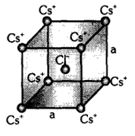
In the common crystal structure of $CsCl$,$Cs^+$ and $Cl^-$ ions are arranged in a $bcc$ structure as shown in the figure. The net electrostatic force on the $Cl^-$ ion due to the eight $Cs^+$ ions is .......
A
$zero$
B
$\frac{1}{4\pi \epsilon_0} \cdot \frac{16e^2}{3a^2}$
C
$\frac{1}{4\pi \epsilon_0} \cdot \frac{32e^2}{3a^2}$
D
$\frac{1}{4\pi \epsilon_0} \cdot \frac{4e^2}{3a^2}$
Solution
(A) Step $1$: Analyze the symmetry of the $CsCl$ crystal structure.
In the $bcc$ structure of $CsCl$,the $Cl^-$ ion is located at the exact center of the cube,while the eight $Cs^+$ ions are located at the eight corners of the cube.
Step $2$: Calculate the net force.
Due to the cubic symmetry,each $Cs^+$ ion at a corner exerts an electrostatic force on the central $Cl^-$ ion. Since the $Cl^-$ ion is at the geometric center,for every $Cs^+$ ion at one corner,there is an identical $Cs^+$ ion at the diagonally opposite corner.
Step $3$: Conclusion.
The forces exerted by these pairs of diagonally opposite $Cs^+$ ions on the central $Cl^-$ ion are equal in magnitude and opposite in direction. Consequently,these forces cancel each other out completely.
Therefore,the net electrostatic force on the $Cl^-$ ion is $zero$.
In the $bcc$ structure of $CsCl$,the $Cl^-$ ion is located at the exact center of the cube,while the eight $Cs^+$ ions are located at the eight corners of the cube.
Step $2$: Calculate the net force.
Due to the cubic symmetry,each $Cs^+$ ion at a corner exerts an electrostatic force on the central $Cl^-$ ion. Since the $Cl^-$ ion is at the geometric center,for every $Cs^+$ ion at one corner,there is an identical $Cs^+$ ion at the diagonally opposite corner.
Step $3$: Conclusion.
The forces exerted by these pairs of diagonally opposite $Cs^+$ ions on the central $Cl^-$ ion are equal in magnitude and opposite in direction. Consequently,these forces cancel each other out completely.
Therefore,the net electrostatic force on the $Cl^-$ ion is $zero$.
0 likes
View Solution74
DifficultMCQ
Two charges $Q$ are placed at opposite corners of a square. Two charges $q$ are placed at the other two corners. If the net electric force on $Q$ is zero,then $Q/q$ is equal to:
A
$1$
B
$-\frac{1}{\sqrt{2}}$
C
$-2\sqrt{2}$
D
$-1$
Solution
(C) Let the side of the square be $a$. Place the charges $Q$ at $(0, a)$ and $(a, 0)$,and charges $q$ at $(0, 0)$ and $(a, a)$.
Consider the force on charge $Q$ at $(a, 0)$.
The forces acting on $Q$ are:
$1$. Force due to $q$ at $(0, 0)$: $\vec{F}_1 = \frac{kQq}{a^2} \hat{i}$
$2$. Force due to $q$ at $(a, a)$: $\vec{F}_2 = \frac{kQq}{a^2} \hat{j}$
$3$. Force due to $Q$ at $(0, a)$: $\vec{F}_3 = \frac{kQ^2}{(\sqrt{2}a)^2} \left( \frac{1}{\sqrt{2}} \hat{i} + \frac{1}{\sqrt{2}} \hat{j} \right)$
For the net force to be zero,the sum of components must be zero:
$F_x = \frac{kQq}{a^2} + \frac{kQ^2}{2a^2} \cdot \frac{1}{\sqrt{2}} = 0$
$\frac{kQq}{a^2} = -\frac{kQ^2}{2\sqrt{2}a^2}$
$q = -\frac{Q}{2\sqrt{2}}$
Therefore,$\frac{Q}{q} = -2\sqrt{2}$.
Consider the force on charge $Q$ at $(a, 0)$.
The forces acting on $Q$ are:
$1$. Force due to $q$ at $(0, 0)$: $\vec{F}_1 = \frac{kQq}{a^2} \hat{i}$
$2$. Force due to $q$ at $(a, a)$: $\vec{F}_2 = \frac{kQq}{a^2} \hat{j}$
$3$. Force due to $Q$ at $(0, a)$: $\vec{F}_3 = \frac{kQ^2}{(\sqrt{2}a)^2} \left( \frac{1}{\sqrt{2}} \hat{i} + \frac{1}{\sqrt{2}} \hat{j} \right)$
For the net force to be zero,the sum of components must be zero:
$F_x = \frac{kQq}{a^2} + \frac{kQ^2}{2a^2} \cdot \frac{1}{\sqrt{2}} = 0$
$\frac{kQq}{a^2} = -\frac{kQ^2}{2\sqrt{2}a^2}$
$q = -\frac{Q}{2\sqrt{2}}$
Therefore,$\frac{Q}{q} = -2\sqrt{2}$.
0 likes
View Solution75
MediumMCQ
$A$ negatively charged oil drop is prevented from falling under gravity by applying a vertical electric field of $100 \ V m^{-1}$. If the mass of the drop is $1.6 \times 10^{-3} \ g$,the number of electrons contained in the drop is:
A
$10^{18}$
B
$10^{15}$
C
$10^6$
D
$10^{12}$
Solution
(D) For the drop to remain stationary,the upward electric force must balance the downward gravitational force.
$qE = mg$
Given:
$E = 100 \ V m^{-1}$
$m = 1.6 \times 10^{-3} \ g = 1.6 \times 10^{-6} \ kg$
$g \approx 10 \ m s^{-2}$
$q = \frac{mg}{E} = \frac{1.6 \times 10^{-6} \times 10}{100} = 1.6 \times 10^{-7} \ C$
The number of electrons $n$ is given by $n = \frac{q}{e}$,where $e = 1.6 \times 10^{-19} \ C$.
$n = \frac{1.6 \times 10^{-7}}{1.6 \times 10^{-19}} = 10^{12}$.
$qE = mg$
Given:
$E = 100 \ V m^{-1}$
$m = 1.6 \times 10^{-3} \ g = 1.6 \times 10^{-6} \ kg$
$g \approx 10 \ m s^{-2}$
$q = \frac{mg}{E} = \frac{1.6 \times 10^{-6} \times 10}{100} = 1.6 \times 10^{-7} \ C$
The number of electrons $n$ is given by $n = \frac{q}{e}$,where $e = 1.6 \times 10^{-19} \ C$.
$n = \frac{1.6 \times 10^{-7}}{1.6 \times 10^{-19}} = 10^{12}$.
0 likes
View Solution76
EasyMCQ
When two identical point charges are placed at a distance of $5 \, cm$, they experience a repulsive force of $0.144 \, N$. The value of each charge in microcoulombs $(\mu C)$ is:
A
$0.2$
B
$2$
C
$20$
D
$12$
Solution
(A) Given: Force $F = 0.144 \, N$, distance $r = 5 \, cm = 5 \times 10^{-2} \, m$, and charges are identical $(q_1 = q_2 = q)$.
According to Coulomb's Law: $F = \frac{k q^2}{r^2}$.
Substituting the values: $0.144 = \frac{(9 \times 10^9) \times q^2}{(5 \times 10^{-2})^2}$.
$0.144 = \frac{9 \times 10^9 \times q^2}{25 \times 10^{-4}}$.
$q^2 = \frac{0.144 \times 25 \times 10^{-4}}{9 \times 10^9}$.
$q^2 = 0.016 \times 25 \times 10^{-13} = 0.4 \times 10^{-13} = 4 \times 10^{-14}$.
$q = \sqrt{4 \times 10^{-14}} = 2 \times 10^{-7} \, C = 0.2 \times 10^{-6} \, C = 0.2 \, \mu C$.
According to Coulomb's Law: $F = \frac{k q^2}{r^2}$.
Substituting the values: $0.144 = \frac{(9 \times 10^9) \times q^2}{(5 \times 10^{-2})^2}$.
$0.144 = \frac{9 \times 10^9 \times q^2}{25 \times 10^{-4}}$.
$q^2 = \frac{0.144 \times 25 \times 10^{-4}}{9 \times 10^9}$.
$q^2 = 0.016 \times 25 \times 10^{-13} = 0.4 \times 10^{-13} = 4 \times 10^{-14}$.
$q = \sqrt{4 \times 10^{-14}} = 2 \times 10^{-7} \, C = 0.2 \times 10^{-6} \, C = 0.2 \, \mu C$.
0 likes
View Solution77
DifficultMCQ
Two identical charged spheres are suspended by strings of equal length. The strings make an angle of $30^{\circ}$ with each other. When they are immersed in a liquid of density $0.8 \, g \cdot cm^{-3}$,the angle remains the same. If the density of the material of the spheres is $1.6 \, g \cdot cm^{-3}$,find the dielectric constant of the liquid.
A
$1$
B
$4$
C
$3$
D
$2$
Solution
(D) Let $\rho$ be the density of the sphere and $\sigma$ be the density of the liquid. When the spheres are in air,the equilibrium condition is $\tan \theta = \frac{F_e}{mg}$.
When immersed in a liquid,the effective weight becomes $mg' = V(\rho - \sigma)g$ and the electrostatic force becomes $F_e' = \frac{F_e}{K}$,where $K$ is the dielectric constant.
The equilibrium condition in the liquid is $\tan \theta = \frac{F_e'}{m'g} = \frac{F_e / K}{V(\rho - \sigma)g}$.
Since the angle $\theta$ remains the same,we equate the two expressions for $\tan \theta$:
$\frac{F_e}{V\rho g} = \frac{F_e}{K V(\rho - \sigma)g}$.
This simplifies to $K = \frac{\rho}{\rho - \sigma}$.
Given $\rho = 1.6 \, g \cdot cm^{-3}$ and $\sigma = 0.8 \, g \cdot cm^{-3}$,we get $K = \frac{1.6}{1.6 - 0.8} = \frac{1.6}{0.8} = 2$.
When immersed in a liquid,the effective weight becomes $mg' = V(\rho - \sigma)g$ and the electrostatic force becomes $F_e' = \frac{F_e}{K}$,where $K$ is the dielectric constant.
The equilibrium condition in the liquid is $\tan \theta = \frac{F_e'}{m'g} = \frac{F_e / K}{V(\rho - \sigma)g}$.
Since the angle $\theta$ remains the same,we equate the two expressions for $\tan \theta$:
$\frac{F_e}{V\rho g} = \frac{F_e}{K V(\rho - \sigma)g}$.
This simplifies to $K = \frac{\rho}{\rho - \sigma}$.
Given $\rho = 1.6 \, g \cdot cm^{-3}$ and $\sigma = 0.8 \, g \cdot cm^{-3}$,we get $K = \frac{1.6}{1.6 - 0.8} = \frac{1.6}{0.8} = 2$.
0 likes
View Solution78
MediumMCQ
Two point charges $q_1$ and $q_2$ are placed at a distance of $50 \ cm$ from each other in air and interact with a certain force. Now,these charges are placed in an oil with a relative permittivity of $5$. If the force between them remains the same,the distance between them in the oil is ........ $cm$.
A
$16.6$
B
$22.3$
C
$35$
D
$28.4$
Solution
(B) According to Coulomb's Law,the force in air is given by $F_{air} = \frac{1}{4\pi \epsilon_0} \frac{q_1 q_2}{r^2}$.
The force in a medium (oil) is given by $F_{medium} = \frac{1}{4\pi \epsilon_0 \epsilon_r} \frac{q_1 q_2}{d^2}$,where $\epsilon_r$ is the relative permittivity.
Given that the force remains the same $(F_{air} = F_{medium})$,we have:
$\frac{1}{4\pi \epsilon_0} \frac{q_1 q_2}{r^2} = \frac{1}{4\pi \epsilon_0 \epsilon_r} \frac{q_1 q_2}{d^2}$.
Simplifying the equation,we get $r^2 = \epsilon_r d^2$,which implies $d = \frac{r}{\sqrt{\epsilon_r}}$.
Given $r = 50 \ cm$ and $\epsilon_r = 5$,we calculate:
$d = \frac{50}{\sqrt{5}} = \frac{50}{2.236} \approx 22.36 \ cm$.
Thus,the distance in oil is approximately $22.3 \ cm$.
The force in a medium (oil) is given by $F_{medium} = \frac{1}{4\pi \epsilon_0 \epsilon_r} \frac{q_1 q_2}{d^2}$,where $\epsilon_r$ is the relative permittivity.
Given that the force remains the same $(F_{air} = F_{medium})$,we have:
$\frac{1}{4\pi \epsilon_0} \frac{q_1 q_2}{r^2} = \frac{1}{4\pi \epsilon_0 \epsilon_r} \frac{q_1 q_2}{d^2}$.
Simplifying the equation,we get $r^2 = \epsilon_r d^2$,which implies $d = \frac{r}{\sqrt{\epsilon_r}}$.
Given $r = 50 \ cm$ and $\epsilon_r = 5$,we calculate:
$d = \frac{50}{\sqrt{5}} = \frac{50}{2.236} \approx 22.36 \ cm$.
Thus,the distance in oil is approximately $22.3 \ cm$.
0 likes
View Solution79
EasyMCQ
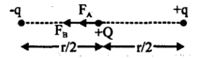
In the given figure,if $O$ is the midpoint of $AB$,calculate the net force on charge $Q$.
A
$\frac{8kQ^2q^2}{r^2}$
B
$\frac{7kQq}{r^3}$
C
$\frac{8kQq}{r^2}$
D
$\frac{8kQq}{r}$
Solution
(C) The charge $Q$ is at the midpoint between $-q$ and $+q$. The distance from each charge to $Q$ is $r/2$.
The force exerted by $-q$ on $Q$ is $F_A = \frac{kQq}{(r/2)^2} = \frac{4kQq}{r^2}$ (attractive force towards $-q$).
The force exerted by $+q$ on $Q$ is $F_B = \frac{kQq}{(r/2)^2} = \frac{4kQq}{r^2}$ (repulsive force away from $+q$).
Since both forces act in the same direction (towards the left,towards $-q$),the net force is:
$F_{net} = F_A + F_B = \frac{4kQq}{r^2} + \frac{4kQq}{r^2} = \frac{8kQq}{r^2}$.
The force exerted by $-q$ on $Q$ is $F_A = \frac{kQq}{(r/2)^2} = \frac{4kQq}{r^2}$ (attractive force towards $-q$).
The force exerted by $+q$ on $Q$ is $F_B = \frac{kQq}{(r/2)^2} = \frac{4kQq}{r^2}$ (repulsive force away from $+q$).
Since both forces act in the same direction (towards the left,towards $-q$),the net force is:
$F_{net} = F_A + F_B = \frac{4kQq}{r^2} + \frac{4kQq}{r^2} = \frac{8kQq}{r^2}$.
0 likes
View Solution80
MediumMCQ
Two identical spheres are charged with equal charges and the force between them is $F$. If $50\%$ of the charge from one sphere is transferred to the other sphere,then the new force will be ........ $F$.
A
$0.75$
B
$0.37$
C
$1.5$
D
None of these
Solution
(A) Initially,the force between the two spheres with charges $q$ and $q$ separated by distance $r$ is given by Coulomb's Law:
$F = \frac{kq^2}{r^2}$
When $50\%$ of the charge from one sphere is transferred to the other,the new charges become:
$q_1 = q - 0.5q = 0.5q = \frac{q}{2}$
$q_2 = q + 0.5q = 1.5q = \frac{3q}{2}$
The new force $F'$ is:
$F' = \frac{k q_1 q_2}{r^2} = \frac{k (q/2) (3q/2)}{r^2}$
$F' = \frac{3}{4} \frac{kq^2}{r^2}$
Since $F = \frac{kq^2}{r^2}$,we get:
$F' = \frac{3}{4} F = 0.75 F$
$F = \frac{kq^2}{r^2}$
When $50\%$ of the charge from one sphere is transferred to the other,the new charges become:
$q_1 = q - 0.5q = 0.5q = \frac{q}{2}$
$q_2 = q + 0.5q = 1.5q = \frac{3q}{2}$
The new force $F'$ is:
$F' = \frac{k q_1 q_2}{r^2} = \frac{k (q/2) (3q/2)}{r^2}$
$F' = \frac{3}{4} \frac{kq^2}{r^2}$
Since $F = \frac{kq^2}{r^2}$,we get:
$F' = \frac{3}{4} F = 0.75 F$
0 likes
View Solution81
MediumMCQ
Two point charges $+9e$ and $+e$ are placed at a distance of $16\, cm$ from each other. Where should a third charge $q$ be placed between them so that the system remains in equilibrium?
A
$12\, cm$ from $+9e$
B
$24\, cm$ from $+9e$
C
$12\, cm$ from $+e$
D
$24\, cm$ from $+e$
Solution
(A) Let the charge $q$ be placed at a distance $x$ from the charge $+9e$. For the system to be in equilibrium,the net force on the charge $q$ must be zero.
Let $F_1$ be the force due to charge $+e$ and $F_2$ be the force due to charge $+9e$.
For equilibrium,$|F_1| = |F_2|$.
$\frac{kqe}{(16-x)^2} = \frac{kq(9e)}{x^2}$
$\frac{1}{(16-x)^2} = \frac{9}{x^2}$
Taking the square root on both sides:
$\frac{1}{16-x} = \frac{3}{x}$
$x = 3(16-x)$
$x = 48 - 3x$
$4x = 48$
$x = 12\, cm$ from $+9e$.
Let $F_1$ be the force due to charge $+e$ and $F_2$ be the force due to charge $+9e$.
For equilibrium,$|F_1| = |F_2|$.
$\frac{kqe}{(16-x)^2} = \frac{kq(9e)}{x^2}$
$\frac{1}{(16-x)^2} = \frac{9}{x^2}$
Taking the square root on both sides:
$\frac{1}{16-x} = \frac{3}{x}$
$x = 3(16-x)$
$x = 48 - 3x$
$4x = 48$
$x = 12\, cm$ from $+9e$.
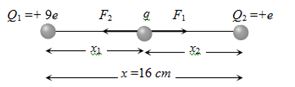
0 likes
View Solution82
MediumMCQ
Two small spheres,each carrying a charge of $+q$,are connected by an insulating string of length $2a$. What is the tension in the string?
A
$\frac{q^2}{4\pi \varepsilon_0 a^2}$
B
$\frac{q^2}{8\pi \varepsilon_0 a^2}$
C
$\frac{q^2}{16\pi \varepsilon_0 a^2}$
D
$\frac{q^2}{32\pi \varepsilon_0 a^2}$
Solution
(C) The two spheres are each charged with $+q$ and are separated by a distance $r = 2a$.
According to Coulomb's Law,the electrostatic repulsive force $F$ between the two charges is given by:
$F = \frac{1}{4\pi \varepsilon_0} \cdot \frac{q_1 q_2}{r^2}$
Substituting the given values $q_1 = q$,$q_2 = q$,and $r = 2a$:
$F = \frac{1}{4\pi \varepsilon_0} \cdot \frac{q \cdot q}{(2a)^2}$
$F = \frac{1}{4\pi \varepsilon_0} \cdot \frac{q^2}{4a^2}$
$F = \frac{q^2}{16\pi \varepsilon_0 a^2}$
Since the spheres are in equilibrium,the tension $T$ in the string must balance the electrostatic repulsive force.
Therefore,$T = F = \frac{q^2}{16\pi \varepsilon_0 a^2}$.
According to Coulomb's Law,the electrostatic repulsive force $F$ between the two charges is given by:
$F = \frac{1}{4\pi \varepsilon_0} \cdot \frac{q_1 q_2}{r^2}$
Substituting the given values $q_1 = q$,$q_2 = q$,and $r = 2a$:
$F = \frac{1}{4\pi \varepsilon_0} \cdot \frac{q \cdot q}{(2a)^2}$
$F = \frac{1}{4\pi \varepsilon_0} \cdot \frac{q^2}{4a^2}$
$F = \frac{q^2}{16\pi \varepsilon_0 a^2}$
Since the spheres are in equilibrium,the tension $T$ in the string must balance the electrostatic repulsive force.
Therefore,$T = F = \frac{q^2}{16\pi \varepsilon_0 a^2}$.
0 likes
View Solution83
MediumMCQ
Two electric charges $4q$ and $q$ are placed at a distance $l$ apart. $A$ third charge $Q$ is placed between them at the midpoint. If the resultant force on charge $q$ is zero,then the value of $Q$ is:
A
$q$
B
$-q$
C
$2q$
D
$-q/4$
Solution
(B) Let the charge $4q$ be at position $x=0$ and charge $q$ be at position $x=l$. The charge $Q$ is placed at $x=l/2$.
For the net force on charge $q$ to be zero,the force exerted by $4q$ on $q$ must be equal and opposite to the force exerted by $Q$ on $q$.
The force exerted by $4q$ on $q$ is $F_1 = \frac{k(4q)(q)}{l^2}$.
The force exerted by $Q$ on $q$ is $F_2 = \frac{k(Q)(q)}{(l/2)^2}$.
For the net force to be zero,$F_1 + F_2 = 0$,which implies $F_1 = -F_2$.
$\frac{k(4q)(q)}{l^2} = -\frac{k(Q)(q)}{(l/2)^2}$.
$\frac{4q}{l^2} = -\frac{Q}{l^2/4}$.
$4q = -4Q$.
Therefore,$Q = -q$.
For the net force on charge $q$ to be zero,the force exerted by $4q$ on $q$ must be equal and opposite to the force exerted by $Q$ on $q$.
The force exerted by $4q$ on $q$ is $F_1 = \frac{k(4q)(q)}{l^2}$.
The force exerted by $Q$ on $q$ is $F_2 = \frac{k(Q)(q)}{(l/2)^2}$.
For the net force to be zero,$F_1 + F_2 = 0$,which implies $F_1 = -F_2$.
$\frac{k(4q)(q)}{l^2} = -\frac{k(Q)(q)}{(l/2)^2}$.
$\frac{4q}{l^2} = -\frac{Q}{l^2/4}$.
$4q = -4Q$.
Therefore,$Q = -q$.
0 likes
View Solution84
MediumMCQ
Three charges of equal magnitude are placed at three corners of a square of side $a$. If $F_{12}$ is the force between the charges at corners $1$ and $2$,and $F_{13}$ is the force between the charges at corners $1$ and $3$,what is the ratio $F_{12}/F_{13}$?
A
$1/2$
B
$2$
C
$1/\sqrt{2}$
D
$\sqrt{2}$
Solution
(B) Let the charges be $q_1 = q_2 = q_3 = q$.
Let the side of the square be $a$.
The distance between adjacent corners (e.g.,$1$ and $2$) is $r_{12} = a$.
The distance between opposite corners (e.g.,$1$ and $3$) is $r_{13} = \sqrt{a^2 + a^2} = a\sqrt{2}$.
Using Coulomb's Law,the force $F_{12} = \frac{k q_1 q_2}{r_{12}^2} = \frac{k q^2}{a^2}$.
The force $F_{13} = \frac{k q_1 q_3}{r_{13}^2} = \frac{k q^2}{(a\sqrt{2})^2} = \frac{k q^2}{2a^2}$.
Therefore,the ratio $\frac{F_{12}}{F_{13}} = \frac{k q^2 / a^2}{k q^2 / 2a^2} = 2$.
Let the side of the square be $a$.
The distance between adjacent corners (e.g.,$1$ and $2$) is $r_{12} = a$.
The distance between opposite corners (e.g.,$1$ and $3$) is $r_{13} = \sqrt{a^2 + a^2} = a\sqrt{2}$.
Using Coulomb's Law,the force $F_{12} = \frac{k q_1 q_2}{r_{12}^2} = \frac{k q^2}{a^2}$.
The force $F_{13} = \frac{k q_1 q_3}{r_{13}^2} = \frac{k q^2}{(a\sqrt{2})^2} = \frac{k q^2}{2a^2}$.
Therefore,the ratio $\frac{F_{12}}{F_{13}} = \frac{k q^2 / a^2}{k q^2 / 2a^2} = 2$.
0 likes
View Solution85
MediumMCQ
Two identical spheres,each of mass $1 \, g$,carry an identical charge of $10^{-9} \, C$. They are suspended by strings of equal length. If the distance between the centers of the spheres is $0.3 \, cm$,what is the angle made by the string with the vertical?
A
$tan^{-1}(0.1)$
B
$tan^{-1}(2)$
C
$tan^{-1}(1.5)$
D
$tan^{-1}(0.6)$
Solution
(A) Given: Mass $m = 1 \, g = 10^{-3} \, kg$,Charge $q = 10^{-9} \, C$,Distance $x = 0.3 \, cm = 3 \times 10^{-3} \, m$,$g \approx 10 \, m/s^2$.
Electrostatic force $F_e = \frac{k q^2}{x^2} = \frac{9 \times 10^9 \times (10^{-9})^2}{(3 \times 10^{-3})^2} = \frac{9 \times 10^{-9}}{9 \times 10^{-6}} = 10^{-3} \, N$.
Gravitational force $mg = 10^{-3} \times 10 = 10^{-2} \, N$.
For equilibrium,$\tan \theta = \frac{F_e}{mg} = \frac{10^{-3}}{10^{-2}} = 0.1$.
Therefore,$\theta = \tan^{-1}(0.1)$.
Electrostatic force $F_e = \frac{k q^2}{x^2} = \frac{9 \times 10^9 \times (10^{-9})^2}{(3 \times 10^{-3})^2} = \frac{9 \times 10^{-9}}{9 \times 10^{-6}} = 10^{-3} \, N$.
Gravitational force $mg = 10^{-3} \times 10 = 10^{-2} \, N$.
For equilibrium,$\tan \theta = \frac{F_e}{mg} = \frac{10^{-3}}{10^{-2}} = 0.1$.
Therefore,$\theta = \tan^{-1}(0.1)$.
0 likes
View Solution86
MediumMCQ
Assume that you have $10^{23}$ carbon atoms. All the nuclei are placed at the North Pole of the Earth and all the electrons are placed at the South Pole of the Earth. (Radius of Earth = $6400 \ km$). The force between the charges is approximately:
A
$5 \times 10^5 \ N$
B
$2 \times 10^6 \ N$
C
$13.6 \times 10^3 \ N$
D
$2 \times 10^5 \ N$
Solution
(A) Each carbon atom has $6$ electrons and $6$ protons. Total number of electrons (and protons) = $6 \times 10^{23}$.
The total charge $q$ at each pole is $q = (6 \times 10^{23}) \times (1.6 \times 10^{-19} \ C) = 9.6 \times 10^4 \ C$.
The distance between the North Pole and the South Pole is the diameter of the Earth,$d = 2R = 2 \times 6400 \ km = 1.28 \times 10^7 \ m$.
Using Coulomb's Law: $F = \frac{k q_1 q_2}{d^2} = \frac{(9 \times 10^9) \times (9.6 \times 10^4)^2}{(1.28 \times 10^7)^2}$.
$F = \frac{9 \times 10^9 \times 92.16 \times 10^8}{1.6384 \times 10^{14}} = \frac{829.44 \times 10^{17}}{1.6384 \times 10^{14}} \approx 506 \times 10^3 \ N = 5.06 \times 10^5 \ N$.
Thus,the force is approximately $5 \times 10^5 \ N$.
The total charge $q$ at each pole is $q = (6 \times 10^{23}) \times (1.6 \times 10^{-19} \ C) = 9.6 \times 10^4 \ C$.
The distance between the North Pole and the South Pole is the diameter of the Earth,$d = 2R = 2 \times 6400 \ km = 1.28 \times 10^7 \ m$.
Using Coulomb's Law: $F = \frac{k q_1 q_2}{d^2} = \frac{(9 \times 10^9) \times (9.6 \times 10^4)^2}{(1.28 \times 10^7)^2}$.
$F = \frac{9 \times 10^9 \times 92.16 \times 10^8}{1.6384 \times 10^{14}} = \frac{829.44 \times 10^{17}}{1.6384 \times 10^{14}} \approx 506 \times 10^3 \ N = 5.06 \times 10^5 \ N$.
Thus,the force is approximately $5 \times 10^5 \ N$.
0 likes
View Solution87
MediumMCQ
Two spheres of radii $3 \ cm$ and $1 \ cm$ are placed at a distance of $10 \ cm$ from each other in a vacuum. If each sphere is charged to a potential of $10 \ V$,the force of repulsion between them is:
A
$\left( \frac{1}{3} \right) \times 10^{-9} \ N$
B
$\left( \frac{2}{9} \right) \times 10^{-9} \ N$
C
$\left( \frac{1}{9} \right) \times 10^{-9} \ N$
D
$\left( \frac{4}{3} \right) \times 10^{-9} \ N$
Solution
(A) Let the radii of the spheres be $R_1 = 3 \ cm = 3 \times 10^{-2} \ m$ and $R_2 = 1 \ cm = 1 \times 10^{-2} \ m$. The potential $V$ of each sphere is $10 \ V$.
The charge $Q$ on a sphere of radius $R$ at potential $V$ is given by $V = \frac{1}{4\pi\epsilon_0} \frac{Q}{R}$,so $Q = 4\pi\epsilon_0 R V$.
For the first sphere: $Q_1 = \frac{R_1 V}{k} = \frac{3 \times 10^{-2} \times 10}{9 \times 10^9} = \frac{1}{3} \times 10^{-10} \ C$.
For the second sphere: $Q_2 = \frac{R_2 V}{k} = \frac{1 \times 10^{-2} \times 10}{9 \times 10^9} = \frac{1}{9} \times 10^{-10} \ C$.
The distance between the centers is $d = 10 \ cm = 0.1 \ m$.
The electrostatic force $F$ is given by Coulomb's Law: $F = k \frac{Q_1 Q_2}{d^2}$.
$F = (9 \times 10^9) \times \frac{(\frac{1}{3} \times 10^{-10}) \times (\frac{1}{9} \times 10^{-10})}{(0.1)^2} = (9 \times 10^9) \times \frac{\frac{1}{27} \times 10^{-20}}{10^{-2}} = \frac{9}{27} \times 10^9 \times 10^{-18} = \frac{1}{3} \times 10^{-9} \ N$.
The charge $Q$ on a sphere of radius $R$ at potential $V$ is given by $V = \frac{1}{4\pi\epsilon_0} \frac{Q}{R}$,so $Q = 4\pi\epsilon_0 R V$.
For the first sphere: $Q_1 = \frac{R_1 V}{k} = \frac{3 \times 10^{-2} \times 10}{9 \times 10^9} = \frac{1}{3} \times 10^{-10} \ C$.
For the second sphere: $Q_2 = \frac{R_2 V}{k} = \frac{1 \times 10^{-2} \times 10}{9 \times 10^9} = \frac{1}{9} \times 10^{-10} \ C$.
The distance between the centers is $d = 10 \ cm = 0.1 \ m$.
The electrostatic force $F$ is given by Coulomb's Law: $F = k \frac{Q_1 Q_2}{d^2}$.
$F = (9 \times 10^9) \times \frac{(\frac{1}{3} \times 10^{-10}) \times (\frac{1}{9} \times 10^{-10})}{(0.1)^2} = (9 \times 10^9) \times \frac{\frac{1}{27} \times 10^{-20}}{10^{-2}} = \frac{9}{27} \times 10^9 \times 10^{-18} = \frac{1}{3} \times 10^{-9} \ N$.
0 likes
View Solution88
MediumMCQ
Two point charges $q_2 = 3 \times 10^{-6} \ C$ and $q_1 = 5 \times 10^{-6} \ C$ are located at $B(3, 5, 1) \ m$ and $A(1, 3, 2) \ m$ respectively. Find the magnitude of the force on $q_1$ due to $q_2$.
A
$15 \times 10^{-2} \ N$
B
$1.5 \times 10^{-2} \ N$
C
$1.5 \times 10^{-6} \ N$
D
$0.50 \times 10^{-2} \ N$
Solution
(B) The position vectors are $\vec{r}_A = (\hat{i} + 3\hat{j} + 2\hat{k}) \ m$ and $\vec{r}_B = (3\hat{i} + 5\hat{j} + \hat{k}) \ m$.
The displacement vector from $B$ to $A$ is $\vec{r} = \vec{r}_A - \vec{r}_B = (1-3)\hat{i} + (3-5)\hat{j} + (2-1)\hat{k} = -2\hat{i} - 2\hat{j} + \hat{k} \ m$.
The distance $r$ between the charges is $r = |\vec{r}| = \sqrt{(-2)^2 + (-2)^2 + (1)^2} = \sqrt{4 + 4 + 1} = \sqrt{9} = 3 \ m$.
Using Coulomb's law,the magnitude of the force is $F = \frac{k |q_1 q_2|}{r^2}$.
Substituting the values: $F = \frac{9 \times 10^9 \times (5 \times 10^{-6}) \times (3 \times 10^{-6})}{3^2}$.
$F = \frac{9 \times 10^9 \times 15 \times 10^{-12}}{9} = 15 \times 10^{-3} \ N = 1.5 \times 10^{-2} \ N$.
The displacement vector from $B$ to $A$ is $\vec{r} = \vec{r}_A - \vec{r}_B = (1-3)\hat{i} + (3-5)\hat{j} + (2-1)\hat{k} = -2\hat{i} - 2\hat{j} + \hat{k} \ m$.
The distance $r$ between the charges is $r = |\vec{r}| = \sqrt{(-2)^2 + (-2)^2 + (1)^2} = \sqrt{4 + 4 + 1} = \sqrt{9} = 3 \ m$.
Using Coulomb's law,the magnitude of the force is $F = \frac{k |q_1 q_2|}{r^2}$.
Substituting the values: $F = \frac{9 \times 10^9 \times (5 \times 10^{-6}) \times (3 \times 10^{-6})}{3^2}$.
$F = \frac{9 \times 10^9 \times 15 \times 10^{-12}}{9} = 15 \times 10^{-3} \ N = 1.5 \times 10^{-2} \ N$.
0 likes
View Solution89
MediumMCQ
$A$ charge $Q$ is divided into two parts $Q_1$ and $Q_2$. These charges are placed at a distance $R$. What will be the values of $Q_1$ and $Q_2$ for the maximum repulsive force between them?
A
$Q_1 = Q - \frac{Q}{R}, Q_2 = \frac{Q}{R}$
B
$Q_1 = \frac{2Q}{3}, Q_2 = \frac{Q}{3}$
C
$Q_1 = \frac{3Q}{4}, Q_2 = \frac{Q}{4}$
D
$Q_1 = Q_2 = \frac{Q}{2}$
Solution
(D) Given $Q = Q_1 + Q_2$,so $Q_2 = Q - Q_1$.
The electrostatic force between them is given by Coulomb's Law: $F = \frac{k Q_1 Q_2}{R^2} = \frac{k Q_1 (Q - Q_1)}{R^2} = \frac{k}{R^2} (Q Q_1 - Q_1^2)$.
For the force to be maximum,the derivative of $F$ with respect to $Q_1$ must be zero: $\frac{dF}{dQ_1} = 0$.
$\frac{d}{dQ_1} [\frac{k}{R^2} (Q Q_1 - Q_1^2)] = \frac{k}{R^2} (Q - 2Q_1) = 0$.
Since $\frac{k}{R^2} \neq 0$,we have $Q - 2Q_1 = 0$,which implies $Q_1 = \frac{Q}{2}$.
Substituting this back,$Q_2 = Q - Q_1 = Q - \frac{Q}{2} = \frac{Q}{2}$.
Thus,the force is maximum when $Q_1 = Q_2 = \frac{Q}{2}$.
The electrostatic force between them is given by Coulomb's Law: $F = \frac{k Q_1 Q_2}{R^2} = \frac{k Q_1 (Q - Q_1)}{R^2} = \frac{k}{R^2} (Q Q_1 - Q_1^2)$.
For the force to be maximum,the derivative of $F$ with respect to $Q_1$ must be zero: $\frac{dF}{dQ_1} = 0$.
$\frac{d}{dQ_1} [\frac{k}{R^2} (Q Q_1 - Q_1^2)] = \frac{k}{R^2} (Q - 2Q_1) = 0$.
Since $\frac{k}{R^2} \neq 0$,we have $Q - 2Q_1 = 0$,which implies $Q_1 = \frac{Q}{2}$.
Substituting this back,$Q_2 = Q - Q_1 = Q - \frac{Q}{2} = \frac{Q}{2}$.
Thus,the force is maximum when $Q_1 = Q_2 = \frac{Q}{2}$.
0 likes
View Solution90
MediumMCQ
Two small balls,each having mass $m$ and charge $q$,are suspended from a common point by insulating strings of length $L$ as shown in the figure. Assuming $\theta$ is very small such that $\tan \theta \approx \sin \theta$,find the value of $x$ at equilibrium.
A
${\left( {\frac{{{q^2}L}}{{2\pi {\varepsilon _0}mg}}} \right)^{\frac{1}{3}}}$
B
${\left( {\frac{{q{L^2}}}{{2\pi {\varepsilon _0}mg}}} \right)^{\frac{1}{3}}}$
C
${\left( {\frac{{{q^2}{L^2}}}{{4\pi {\varepsilon _0}mg}}} \right)^{\frac{1}{3}}}$
D
${\left( {\frac{{{q^2}L}}{{4\pi {\varepsilon _0}mg}}} \right)^{\frac{1}{3}}}$
Solution
(A) At equilibrium,the forces acting on each ball are tension $T$,electrostatic force $F_e$,and weight $mg$.
Resolving forces: $F_e = T \sin \theta$ $(i)$ and $mg = T \cos \theta$ (ii).
Dividing $(i)$ by (ii),we get $\tan \theta = \frac{F_e}{mg} = \frac{q^2}{4\pi \varepsilon_0 x^2 mg}$.
Given $\tan \theta \approx \sin \theta = \frac{x/2}{L} = \frac{x}{2L}$.
Equating the two expressions for $\tan \theta$: $\frac{x}{2L} = \frac{q^2}{4\pi \varepsilon_0 x^2 mg}$.
Rearranging for $x$: $x^3 = \frac{2q^2 L}{4\pi \varepsilon_0 mg} = \frac{q^2 L}{2\pi \varepsilon_0 mg}$.
Therefore,$x = {\left( {\frac{{{q^2}L}}{{2\pi {\varepsilon _0}mg}}} \right)^{1/3}}$.
Resolving forces: $F_e = T \sin \theta$ $(i)$ and $mg = T \cos \theta$ (ii).
Dividing $(i)$ by (ii),we get $\tan \theta = \frac{F_e}{mg} = \frac{q^2}{4\pi \varepsilon_0 x^2 mg}$.
Given $\tan \theta \approx \sin \theta = \frac{x/2}{L} = \frac{x}{2L}$.
Equating the two expressions for $\tan \theta$: $\frac{x}{2L} = \frac{q^2}{4\pi \varepsilon_0 x^2 mg}$.
Rearranging for $x$: $x^3 = \frac{2q^2 L}{4\pi \varepsilon_0 mg} = \frac{q^2 L}{2\pi \varepsilon_0 mg}$.
Therefore,$x = {\left( {\frac{{{q^2}L}}{{2\pi {\varepsilon _0}mg}}} \right)^{1/3}}$.
0 likes
View Solution91
DifficultMCQ
Two small spheres of masses $M_1$ and $M_2$ are suspended by weightless insulating threads of lengths $L_1$ and $L_2$ respectively. The charges on the spheres are $Q_1$ and $Q_2$ respectively. The spheres are suspended such that they lie in a horizontal line and the threads make angles $\theta_1$ and $\theta_2$ with the vertical as shown in the figure. Which of the following conditions is necessary for $\theta_1 = \theta_2$?
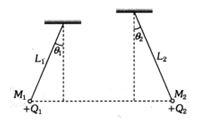
A
$M_1 \neq M_2$ but $Q_1 = Q_2$
B
$M_1 = M_2$
C
$Q_1 = Q_2$
D
$L_1 = L_2$
Solution
(B) For each sphere,three forces are acting: $(1)$ Tension force $(T)$,$(2)$ Gravitational force $(Mg)$,and $(3)$ Electrostatic repulsive force $(F)$.
For the first sphere at equilibrium:
$T_1 \cos \theta_1 = M_1 g$ and $T_1 \sin \theta_1 = F$
Dividing these,we get: $\tan \theta_1 = \frac{F}{M_1 g}$
For the second sphere at equilibrium:
$T_2 \cos \theta_2 = M_2 g$ and $T_2 \sin \theta_2 = F$
Dividing these,we get: $\tan \theta_2 = \frac{F}{M_2 g}$
Since the electrostatic force $F$ between the two spheres is the same (by Newton's third law),for $\theta_1 = \theta_2$,we must have $\tan \theta_1 = \tan \theta_2$.
Therefore,$\frac{F}{M_1 g} = \frac{F}{M_2 g}$,which implies $M_1 = M_2$.
For the first sphere at equilibrium:
$T_1 \cos \theta_1 = M_1 g$ and $T_1 \sin \theta_1 = F$
Dividing these,we get: $\tan \theta_1 = \frac{F}{M_1 g}$
For the second sphere at equilibrium:
$T_2 \cos \theta_2 = M_2 g$ and $T_2 \sin \theta_2 = F$
Dividing these,we get: $\tan \theta_2 = \frac{F}{M_2 g}$
Since the electrostatic force $F$ between the two spheres is the same (by Newton's third law),for $\theta_1 = \theta_2$,we must have $\tan \theta_1 = \tan \theta_2$.
Therefore,$\frac{F}{M_1 g} = \frac{F}{M_2 g}$,which implies $M_1 = M_2$.
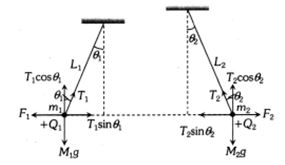
0 likes
View Solution92
DifficultMCQ
Two equal charges $q$ are placed at $x = -a$ and $x = a$ on the $x$-axis. $A$ particle of mass $m$ and charge $q_0 = q/2$ is placed at the origin. If the charge $q_0$ is given a small displacement $(y << a)$ along the $y$-axis,the net force acting on the particle is proportional to .......
A
$y$
B
$-y$
C
$1/y$
D
$-1/y$
Solution
(A) The net force on the charge $q_0$ at a distance $y$ from the origin along the $y$-axis is due to the two charges $q$ at $(-a, 0)$ and $(a, 0)$.
By symmetry,the horizontal components of the forces cancel out,and the vertical components add up.
The force from each charge $q$ on $q_0$ is $F = \frac{k q q_0}{r^2}$,where $r^2 = a^2 + y^2$.
The net force is $F_{net} = 2F \sin\theta$,where $\sin\theta = \frac{y}{r} = \frac{y}{\sqrt{a^2 + y^2}}$.
Substituting the values,we get $F_{net} = 2 \left[ \frac{k q q_0}{a^2 + y^2} \right] \cdot \frac{y}{(a^2 + y^2)^{1/2}} = \frac{2 k q q_0 y}{(a^2 + y^2)^{3/2}}$.
For a small displacement $(y << a)$,we can approximate $a^2 + y^2 \approx a^2$.
Thus,$F_{net} \approx \frac{2 k q q_0 y}{a^3}$.
Since $k, q, q_0,$ and $a$ are constants,the net force is proportional to $y$.
By symmetry,the horizontal components of the forces cancel out,and the vertical components add up.
The force from each charge $q$ on $q_0$ is $F = \frac{k q q_0}{r^2}$,where $r^2 = a^2 + y^2$.
The net force is $F_{net} = 2F \sin\theta$,where $\sin\theta = \frac{y}{r} = \frac{y}{\sqrt{a^2 + y^2}}$.
Substituting the values,we get $F_{net} = 2 \left[ \frac{k q q_0}{a^2 + y^2} \right] \cdot \frac{y}{(a^2 + y^2)^{1/2}} = \frac{2 k q q_0 y}{(a^2 + y^2)^{3/2}}$.
For a small displacement $(y << a)$,we can approximate $a^2 + y^2 \approx a^2$.
Thus,$F_{net} \approx \frac{2 k q q_0 y}{a^3}$.
Since $k, q, q_0,$ and $a$ are constants,the net force is proportional to $y$.
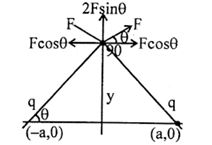
0 likes
View Solution93
DifficultMCQ
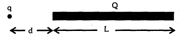
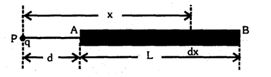
$A$ point charge $q$ is placed at a distance $d$ from one end of a thin non-conducting rod of length $L$ having a charge $Q$ uniformly distributed along its length,as shown in the figure. Find the magnitude of the electric force between them.
A
$\frac{1}{2\pi \epsilon_0} \frac{qQ}{(d + L)}$
B
$\frac{d - L}{4\pi \epsilon_0} \frac{qQ}{d(d - L)}$
C
$\frac{1}{4\pi \epsilon_0} \frac{qQ}{d(d + L)}$
D
$\frac{d(d + L)}{4\pi \epsilon_0} \frac{qQ}{d(d + L)}$
Solution
(C) Consider a small element of the rod of length $dx$ at a distance $x$ from the point charge $q$,as shown in the figure. Treat this element as a point charge.
The force $dF$ between the charge $q$ and the charge element $dQ$ is given by Coulomb's law:
$dF = \frac{1}{4\pi \epsilon_0} \frac{q \cdot dQ}{x^2}$
Since the charge $Q$ is uniformly distributed over length $L$,the charge per unit length is $\lambda = \frac{Q}{L}$. Therefore,$dQ = \lambda dx = \frac{Q}{L} dx$.
Substituting $dQ$ into the force equation:
$dF = \frac{1}{4\pi \epsilon_0} \frac{q (Q/L) dx}{x^2} = \frac{qQ}{4\pi \epsilon_0 L} \frac{dx}{x^2}$
To find the total force $F$,integrate $dF$ from $x = d$ to $x = d + L$:
$F = \int_{d}^{d+L} \frac{qQ}{4\pi \epsilon_0 L} \frac{dx}{x^2} = \frac{qQ}{4\pi \epsilon_0 L} \left[ -\frac{1}{x} \right]_{d}^{d+L}$
$F = \frac{qQ}{4\pi \epsilon_0 L} \left( -\frac{1}{d+L} - (-\frac{1}{d}) \right) = \frac{qQ}{4\pi \epsilon_0 L} \left( \frac{1}{d} - \frac{1}{d+L} \right)$
$F = \frac{qQ}{4\pi \epsilon_0 L} \left( \frac{(d+L) - d}{d(d+L)} \right) = \frac{qQ}{4\pi \epsilon_0 L} \left( \frac{L}{d(d+L)} \right)$
$F = \frac{1}{4\pi \epsilon_0} \frac{qQ}{d(d+L)}$
The force $dF$ between the charge $q$ and the charge element $dQ$ is given by Coulomb's law:
$dF = \frac{1}{4\pi \epsilon_0} \frac{q \cdot dQ}{x^2}$
Since the charge $Q$ is uniformly distributed over length $L$,the charge per unit length is $\lambda = \frac{Q}{L}$. Therefore,$dQ = \lambda dx = \frac{Q}{L} dx$.
Substituting $dQ$ into the force equation:
$dF = \frac{1}{4\pi \epsilon_0} \frac{q (Q/L) dx}{x^2} = \frac{qQ}{4\pi \epsilon_0 L} \frac{dx}{x^2}$
To find the total force $F$,integrate $dF$ from $x = d$ to $x = d + L$:
$F = \int_{d}^{d+L} \frac{qQ}{4\pi \epsilon_0 L} \frac{dx}{x^2} = \frac{qQ}{4\pi \epsilon_0 L} \left[ -\frac{1}{x} \right]_{d}^{d+L}$
$F = \frac{qQ}{4\pi \epsilon_0 L} \left( -\frac{1}{d+L} - (-\frac{1}{d}) \right) = \frac{qQ}{4\pi \epsilon_0 L} \left( \frac{1}{d} - \frac{1}{d+L} \right)$
$F = \frac{qQ}{4\pi \epsilon_0 L} \left( \frac{(d+L) - d}{d(d+L)} \right) = \frac{qQ}{4\pi \epsilon_0 L} \left( \frac{L}{d(d+L)} \right)$
$F = \frac{1}{4\pi \epsilon_0} \frac{qQ}{d(d+L)}$
0 likes
View Solution94
MediumMCQ
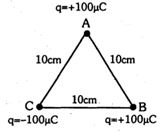
Three point charges are placed at the corners of an equilateral triangle with sides of $10 \ cm$ as shown in the figure. The resultant force on the charge at $B$ will be:
A
$9 \times 10^3 \ N$
B
$9 \times 10^{-2} \ N$
C
$9 \times 10^{-5} \ N$
D
$9 \times 10^{-4} \ N$
Solution
(A) The charges are $q_A = +100 \ \mu C$,$q_B = +100 \ \mu C$,and $q_C = -100 \ \mu C$. The side length $r = 10 \ cm = 0.1 \ m$.
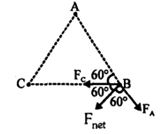
The force on $B$ due to $A$ $(F_A)$ is repulsive and acts along the line $AB$ away from $A$: $F_A = \frac{k |q_A q_B|}{r^2} = \frac{9 \times 10^9 \times (100 \times 10^{-6}) \times (100 \times 10^{-6})}{(0.1)^2} = 9 \times 10^3 \ N$.
The force on $B$ due to $C$ $(F_C)$ is attractive and acts along the line $BC$ towards $C$: $F_C = \frac{k |q_C q_B|}{r^2} = \frac{9 \times 10^9 \times (100 \times 10^{-6}) \times (100 \times 10^{-6})}{(0.1)^2} = 9 \times 10^3 \ N$.
The angle between $F_A$ and $F_C$ is $120^\circ$ because the angle between the lines $AB$ and $BC$ is $60^\circ$,and the force $F_C$ is directed towards $C$ (making an angle of $180^\circ - 60^\circ = 120^\circ$ with $F_A$).
The resultant force $F_{net} = \sqrt{F_A^2 + F_C^2 + 2 F_A F_C \cos(120^\circ)}$.
Since $F_A = F_C = F = 9 \times 10^3 \ N$,$F_{net} = \sqrt{F^2 + F^2 + 2F^2(-0.5)} = \sqrt{F^2} = F = 9 \times 10^3 \ N$.
The force on $B$ due to $A$ $(F_A)$ is repulsive and acts along the line $AB$ away from $A$: $F_A = \frac{k |q_A q_B|}{r^2} = \frac{9 \times 10^9 \times (100 \times 10^{-6}) \times (100 \times 10^{-6})}{(0.1)^2} = 9 \times 10^3 \ N$.
The force on $B$ due to $C$ $(F_C)$ is attractive and acts along the line $BC$ towards $C$: $F_C = \frac{k |q_C q_B|}{r^2} = \frac{9 \times 10^9 \times (100 \times 10^{-6}) \times (100 \times 10^{-6})}{(0.1)^2} = 9 \times 10^3 \ N$.
The angle between $F_A$ and $F_C$ is $120^\circ$ because the angle between the lines $AB$ and $BC$ is $60^\circ$,and the force $F_C$ is directed towards $C$ (making an angle of $180^\circ - 60^\circ = 120^\circ$ with $F_A$).
The resultant force $F_{net} = \sqrt{F_A^2 + F_C^2 + 2 F_A F_C \cos(120^\circ)}$.
Since $F_A = F_C = F = 9 \times 10^3 \ N$,$F_{net} = \sqrt{F^2 + F^2 + 2F^2(-0.5)} = \sqrt{F^2} = F = 9 \times 10^3 \ N$.
0 likes
View Solution95
DifficultMCQ
For the system shown in the figure,find $Q$ such that the resultant force on $q$ is zero.
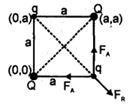
A
$\sqrt{2} Q$
B
$2\sqrt{2} Q$
C
$-2\sqrt{2} Q$
D
$2Q$
Solution
(C) Let the charges be placed at the corners of a square of side $a$. The charge $q$ at $(a, 0)$ experiences forces from the other three charges.
Let the charges at $(0, 0)$ and $(a, a)$ be $Q$,and the charge at $(0, a)$ be $q$.
The force on $q$ at $(a, 0)$ due to the two $Q$ charges is $F_Q = \sqrt{2} \frac{kQq}{a^2}$ directed towards the origin.
The force on $q$ at $(a, 0)$ due to the charge $q$ at $(0, a)$ is $F_q = \frac{kq^2}{(\sqrt{2}a)^2} = \frac{kq^2}{2a^2}$ directed away from $(0, a)$.
For the net force to be zero,these two forces must be equal in magnitude and opposite in direction:
$\sqrt{2} \frac{kQq}{a^2} + \frac{kq^2}{2a^2} = 0$
$\sqrt{2} Q + \frac{q}{2} = 0$
$q = -2\sqrt{2} Q$.
Let the charges at $(0, 0)$ and $(a, a)$ be $Q$,and the charge at $(0, a)$ be $q$.
The force on $q$ at $(a, 0)$ due to the two $Q$ charges is $F_Q = \sqrt{2} \frac{kQq}{a^2}$ directed towards the origin.
The force on $q$ at $(a, 0)$ due to the charge $q$ at $(0, a)$ is $F_q = \frac{kq^2}{(\sqrt{2}a)^2} = \frac{kq^2}{2a^2}$ directed away from $(0, a)$.
For the net force to be zero,these two forces must be equal in magnitude and opposite in direction:
$\sqrt{2} \frac{kQq}{a^2} + \frac{kq^2}{2a^2} = 0$
$\sqrt{2} Q + \frac{q}{2} = 0$
$q = -2\sqrt{2} Q$.
0 likes
View Solution96
EasyMCQ
Two balls with charges $+7 \ \mu C$ and $-5 \ \mu C$ attract each other with a force $F$. If $-2 \ \mu C$ charge is added to both,what will be the force between them?
A
$F$
B
$F/2$
C
$2F$
D
Zero
Solution
(A) Initially,the charges are $q_1 = +7 \ \mu C$ and $q_2 = -5 \ \mu C$. The force between them is given by Coulomb's Law: $F = k \frac{|q_1 q_2|}{r^2} = k \frac{|(7 \times 10^{-6})(-5 \times 10^{-6})|}{r^2} = k \frac{35 \times 10^{-12}}{r^2}$.
After adding $-2 \ \mu C$ to both,the new charges are:
$q_1' = 7 \ \mu C - 2 \ \mu C = +5 \ \mu C$
$q_2' = -5 \ \mu C - 2 \ \mu C = -7 \ \mu C$.
The new force $F'$ is:
$F' = k \frac{|q_1' q_2'|}{r^2} = k \frac{|(5 \times 10^{-6})(-7 \times 10^{-6})|}{r^2} = k \frac{35 \times 10^{-12}}{r^2}$.
Comparing the two expressions,we see that $F' = F$.
After adding $-2 \ \mu C$ to both,the new charges are:
$q_1' = 7 \ \mu C - 2 \ \mu C = +5 \ \mu C$
$q_2' = -5 \ \mu C - 2 \ \mu C = -7 \ \mu C$.
The new force $F'$ is:
$F' = k \frac{|q_1' q_2'|}{r^2} = k \frac{|(5 \times 10^{-6})(-7 \times 10^{-6})|}{r^2} = k \frac{35 \times 10^{-12}}{r^2}$.
Comparing the two expressions,we see that $F' = F$.
0 likes
View Solution97
DifficultMCQ
Two identical charges are separated by a distance $d$. $A$ third charge is placed on their perpendicular bisector at a distance $x$. For the third charge to experience maximum force,the value of $x$ is:
A
$x = \frac{d}{\sqrt{2}}$
B
$x = \frac{d}{2}$
C
$x = \frac{d}{2\sqrt{2}}$
D
$x = \frac{d}{2\sqrt{3}}$
Solution
(C) Let the two identical charges be $Q$ and the third charge be $q$. The distance between the two charges is $d$. The distance of the third charge from the midpoint of the line joining the two charges is $x$.
The force exerted by each charge $Q$ on $q$ is $F = \frac{1}{4\pi\epsilon_0} \frac{Qq}{x^2 + (d/2)^2}$.
The resultant force $F_{res}$ on $q$ along the perpendicular bisector is $F_{res} = 2F \cos\theta$,where $\cos\theta = \frac{x}{\sqrt{x^2 + (d/2)^2}}$.
Substituting $F$ and $\cos\theta$,we get $F_{res} = \frac{2Qqx}{4\pi\epsilon_0 (x^2 + d^2/4)^{3/2}}$.
To find the maximum force,we differentiate $F_{res}$ with respect to $x$ and set it to zero: $\frac{dF_{res}}{dx} = 0$.
Using the quotient rule or product rule,we get $(x^2 + d^2/4)^{3/2} - x \cdot \frac{3}{2}(x^2 + d^2/4)^{1/2} \cdot 2x = 0$.
$(x^2 + d^2/4) - 3x^2 = 0 \implies 2x^2 = d^2/4 \implies x^2 = d^2/8$.
Therefore,$x = \frac{d}{\sqrt{8}} = \frac{d}{2\sqrt{2}}$.
The force exerted by each charge $Q$ on $q$ is $F = \frac{1}{4\pi\epsilon_0} \frac{Qq}{x^2 + (d/2)^2}$.
The resultant force $F_{res}$ on $q$ along the perpendicular bisector is $F_{res} = 2F \cos\theta$,where $\cos\theta = \frac{x}{\sqrt{x^2 + (d/2)^2}}$.
Substituting $F$ and $\cos\theta$,we get $F_{res} = \frac{2Qqx}{4\pi\epsilon_0 (x^2 + d^2/4)^{3/2}}$.
To find the maximum force,we differentiate $F_{res}$ with respect to $x$ and set it to zero: $\frac{dF_{res}}{dx} = 0$.
Using the quotient rule or product rule,we get $(x^2 + d^2/4)^{3/2} - x \cdot \frac{3}{2}(x^2 + d^2/4)^{1/2} \cdot 2x = 0$.
$(x^2 + d^2/4) - 3x^2 = 0 \implies 2x^2 = d^2/4 \implies x^2 = d^2/8$.
Therefore,$x = \frac{d}{\sqrt{8}} = \frac{d}{2\sqrt{2}}$.
0 likes
View Solution98
MediumMCQ
The force between two charges of $+3 \ \mu C$ and $+8 \ \mu C$ is $40 \ N$. If a charge of $-5 \ \mu C$ is added to both,what will be the new force in $N$?
A
$-10$
B
$+10$
C
$+20$
D
$-20$
Solution
(A) According to Coulomb's Law,the initial force $F$ is given by: $F = k \frac{q_1 q_2}{r^2} = k \frac{(3 \times 10^{-6})(8 \times 10^{-6})}{r^2} = 40 \ N$.
After adding $-5 \ \mu C$ to both charges,the new charges are: $q_1' = 3 - 5 = -2 \ \mu C$ and $q_2' = 8 - 5 = 3 \ \mu C$.
The new force $F'$ is: $F' = k \frac{q_1' q_2'}{r^2} = k \frac{(-2 \times 10^{-6})(3 \times 10^{-6})}{r^2}$.
Taking the ratio: $\frac{F'}{F} = \frac{(-2)(3)}{(3)(8)} = \frac{-6}{24} = -\frac{1}{4}$.
Therefore,$F' = -\frac{1}{4} \times 40 = -10 \ N$.
After adding $-5 \ \mu C$ to both charges,the new charges are: $q_1' = 3 - 5 = -2 \ \mu C$ and $q_2' = 8 - 5 = 3 \ \mu C$.
The new force $F'$ is: $F' = k \frac{q_1' q_2'}{r^2} = k \frac{(-2 \times 10^{-6})(3 \times 10^{-6})}{r^2}$.
Taking the ratio: $\frac{F'}{F} = \frac{(-2)(3)}{(3)(8)} = \frac{-6}{24} = -\frac{1}{4}$.
Therefore,$F' = -\frac{1}{4} \times 40 = -10 \ N$.
0 likes
View Solution99
MediumMCQ
$A$ charge $Q$ is divided into two parts $Q_1$ and $Q_2$. For a given distance $R$,the force between them is maximum when:
A
$Q_2 = \frac{Q}{R}, Q_1 = Q - \frac{Q}{R}$
B
$Q_2 = \frac{Q}{4}, Q_1 = Q - \frac{2Q}{3}$
C
$Q_2 = \frac{Q}{4}, Q_1 = \frac{3Q}{4}$
D
$Q_1 = \frac{Q}{2}, Q_2 = \frac{Q}{2}$
Solution
(D) The electrostatic force between two charges $Q_1$ and $Q_2$ separated by distance $R$ is given by $F = k \frac{Q_1 Q_2}{R^2}$.
Since $Q_1 + Q_2 = Q$,we can write $Q_2 = Q - Q_1$.
Substituting this into the force equation: $F = \frac{k}{R^2} (Q_1 Q - Q_1^2)$.
To find the maximum force,we differentiate $F$ with respect to $Q_1$ and set it to zero: $\frac{dF}{dQ_1} = \frac{k}{R^2} (Q - 2Q_1) = 0$.
Solving for $Q_1$,we get $Q - 2Q_1 = 0$,which implies $Q_1 = \frac{Q}{2}$.
Since $Q_2 = Q - Q_1$,we find $Q_2 = Q - \frac{Q}{2} = \frac{Q}{2}$.
Thus,the force is maximum when $Q_1 = Q_2 = \frac{Q}{2}$.
Since $Q_1 + Q_2 = Q$,we can write $Q_2 = Q - Q_1$.
Substituting this into the force equation: $F = \frac{k}{R^2} (Q_1 Q - Q_1^2)$.
To find the maximum force,we differentiate $F$ with respect to $Q_1$ and set it to zero: $\frac{dF}{dQ_1} = \frac{k}{R^2} (Q - 2Q_1) = 0$.
Solving for $Q_1$,we get $Q - 2Q_1 = 0$,which implies $Q_1 = \frac{Q}{2}$.
Since $Q_2 = Q - Q_1$,we find $Q_2 = Q - \frac{Q}{2} = \frac{Q}{2}$.
Thus,the force is maximum when $Q_1 = Q_2 = \frac{Q}{2}$.
0 likes
View Solution100
EasyMCQ
Two point charges of equal magnitude but opposite sign are placed at a certain distance. The force between them is $F$. If $75\%$ of the charge from one is transferred to the other,what will be the new force between them?
A
$\frac{F}{16}$
B
$\frac{9F}{16}$
C
$F$
D
$\frac{15F}{16}$
Solution
(A) Initially,the charges are $+Q$ and $-Q$ separated by distance $r$. The electrostatic force is $F = k\frac{|(+Q)(-Q)|}{r^2} = k\frac{Q^2}{r^2}$.
When $75\%$ of the charge from the first sphere $(+Q)$ is transferred to the second sphere $(-Q)$,the new charge on the first sphere is $Q' = Q - 0.75Q = 0.25Q = \frac{Q}{4}$.
The new charge on the second sphere is $Q'' = -Q + 0.75Q = -0.25Q = -\frac{Q}{4}$.
The new force $F'$ is $F' = k\frac{|(Q/4)(-Q/4)|}{r^2} = k\frac{Q^2/16}{r^2} = \frac{1}{16} \left( k\frac{Q^2}{r^2} \right) = \frac{F}{16}$.
When $75\%$ of the charge from the first sphere $(+Q)$ is transferred to the second sphere $(-Q)$,the new charge on the first sphere is $Q' = Q - 0.75Q = 0.25Q = \frac{Q}{4}$.
The new charge on the second sphere is $Q'' = -Q + 0.75Q = -0.25Q = -\frac{Q}{4}$.
The new force $F'$ is $F' = k\frac{|(Q/4)(-Q/4)|}{r^2} = k\frac{Q^2/16}{r^2} = \frac{1}{16} \left( k\frac{Q^2}{r^2} \right) = \frac{F}{16}$.

0 likes
View SolutionElectric Charges and Fields — Electrostatic Force and Coulombs Law · Frequently Asked Questions
1Are these Electric Charges and Fields questions useful for JEE and NEET?
Yes. All questions in this section are mapped to JEE Main and NEET exam patterns. Previous year questions from JEE Main, NEET, GUJCET and state-level exams are included with full solutions.
2Can I switch to Hindi or Gujarati for these questions?
Yes. Use the language tabs in the hero section or the sidebar to view the same questions and solutions in English, Hindi or Gujarati.
3How do I generate a question paper from this subtopic?
Use the Vedclass Exam Paper Generator — select the chapter and subtopic, set difficulty, and generate Sets A, B, C, D automatically. First 3 chapters of every subject are free.
Vedclass Products
For Students
Vedclass Test Series
Mock tests in real JEE/NEET style with performance analysis. 5-day free trial.
Start Free TrialFor Teachers
Exam Paper Generator
Generate Set A/B/C/D papers from this chapter in 2 minutes. 3 chapters free.
Try FreeFor Institutes
Online Exam Module
Live online exams with unlimited students, 360° analytics & white-label branding.
See DemoFor Teachers & Institutes
Generate a Electric Charges and Fields Exam Paper in 2 Minutes
Select subtopic & difficulty — Sets A, B, C, D auto-generated with No Repeat logic.
First 3 chapters of every subject are free — no payment required.