
A English
Charge and Charge Density (Distribution of Charges) Questions in English
Class 12 Physics · Electric Charges and Fields · Charge and Charge Density (Distribution of Charges)
40+
Questions
English
Language
100%
With Solutions
Showing 40 of 40 questions in English
1
EasyMCQ
In the absence of other conductors,the surface charge density is:
A
Proportional to the charge on the conductor and its surface area
B
Inversely proportional to the charge and directly proportional to the surface area
C
Directly proportional to the charge and inversely proportional to the surface area
D
Inversely proportional to the charge and the surface area
Solution
(C) The surface charge density $\sigma$ is defined as the charge $q$ per unit area $A$ of the surface.
Mathematically,it is expressed as $\sigma = \frac{q}{A}$.
From this relation,it is clear that $\sigma$ is directly proportional to the charge $q$ and inversely proportional to the surface area $A$.
Mathematically,it is expressed as $\sigma = \frac{q}{A}$.
From this relation,it is clear that $\sigma$ is directly proportional to the charge $q$ and inversely proportional to the surface area $A$.
1 likes
View Solution2
MediumMCQ
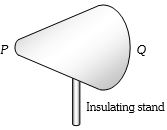
The figure shows a charged conductor resting on an insulating stand. If at point $P$ the charge density is $\sigma$,the potential is $V$,and the electric field strength is $E$,what are the values of these quantities at point $Q$?
A
$< \sigma, V, < E$
B
$< \sigma, V, > E$
C
$> \sigma, V, < E$
D
$> \sigma, V, > E$
Solution
(A) The surface of a charged conductor is an equipotential surface because there is no potential difference between any two points on it. Therefore,the potential at point $Q$ is the same as at point $P$,i.e.,$V_Q = V_P = V$.
The surface charge density $\sigma$ is inversely proportional to the radius of curvature $r$ $(\sigma \propto 1/r)$. Since the radius of curvature at $Q$ is larger than at $P$,the charge density at $Q$ is less than at $P$ $(\sigma_Q < \sigma_P = \sigma)$.
The electric field strength $E$ at the surface of a conductor is given by $E = \sigma / \epsilon_0$. Since $\sigma_Q < \sigma_P$,the electric field at $Q$ is less than at $P$ $(E_Q < E_P = E)$.
Thus,at point $Q$,the values are: charge density $< \sigma$,potential $= V$,and electric field $< E$.
The surface charge density $\sigma$ is inversely proportional to the radius of curvature $r$ $(\sigma \propto 1/r)$. Since the radius of curvature at $Q$ is larger than at $P$,the charge density at $Q$ is less than at $P$ $(\sigma_Q < \sigma_P = \sigma)$.
The electric field strength $E$ at the surface of a conductor is given by $E = \sigma / \epsilon_0$. Since $\sigma_Q < \sigma_P$,the electric field at $Q$ is less than at $P$ $(E_Q < E_P = E)$.
Thus,at point $Q$,the values are: charge density $< \sigma$,potential $= V$,and electric field $< E$.
0 likes
View Solution3
MediumMCQ
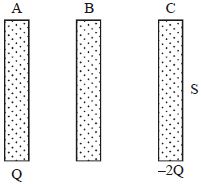
Three identical metal plates with large surface areas are kept parallel to each other as shown in the figure. The leftmost plate $A$ is given a charge $Q$ and the rightmost plate $C$ is given a charge $-2Q$. The middle plate $B$ is neutral. Then the charge appearing on the outer surface $S$ of the plate $C$ is:
A
$-Q/2$
B
$-Q$
C
$+Q$
D
$+2Q$
Solution
(A) For a system of parallel conducting plates,the charge on the outermost surfaces is equal to half the sum of the total charges on all plates.
Let the total charge on the system be $Q_{total} = Q_A + Q_B + Q_C = Q + 0 + (-2Q) = -Q$.
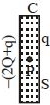
The charge on the outermost surfaces (left surface of $A$ and right surface $S$ of $C$) is given by $q_{outer} = Q_{total} / 2 = -Q / 2$.
Thus,the charge appearing on the outer surface $S$ of plate $C$ is $-Q / 2$.
Let the total charge on the system be $Q_{total} = Q_A + Q_B + Q_C = Q + 0 + (-2Q) = -Q$.
The charge on the outermost surfaces (left surface of $A$ and right surface $S$ of $C$) is given by $q_{outer} = Q_{total} / 2 = -Q / 2$.
Thus,the charge appearing on the outer surface $S$ of plate $C$ is $-Q / 2$.
0 likes
View Solution4
MediumMCQ
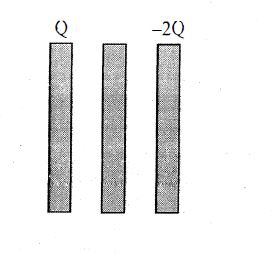
Three identical metal plates with large surface areas are kept parallel to each other as shown in the figure. The leftmost plate is given a charge $Q$,the rightmost a charge $-2Q$,and the middle one remains neutral. Find the charge appearing on the outer surface of the rightmost plate.
A
$-Q/4$
B
$-2Q$
C
$-Q$
D
$-Q/2$
Solution
(D) For a system of parallel conducting plates,the charge on the outermost surfaces is equal to half the sum of the total charges on all plates.
Let the total charge on the plates be $Q_{total} = Q + 0 + (-2Q) = -Q$.
The charge on the outermost surfaces (leftmost surface of the first plate and rightmost surface of the third plate) is given by $q_{outer} = Q_{total} / 2 = -Q/2$.
Thus,the charge on the outer surface of the rightmost plate is $-Q/2$.
Let the total charge on the plates be $Q_{total} = Q + 0 + (-2Q) = -Q$.
The charge on the outermost surfaces (leftmost surface of the first plate and rightmost surface of the third plate) is given by $q_{outer} = Q_{total} / 2 = -Q/2$.
Thus,the charge on the outer surface of the rightmost plate is $-Q/2$.
0 likes
View Solution5
MediumMCQ
The linear charge density on the upper half of a segment of a ring is $\lambda$ and on the lower half,it is $-\lambda$. The direction of the electric field at the centre $O$ of the ring is:
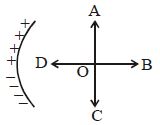
A
along $OA$
B
along $OB$
C
along $OC$
D
along $OD$
Solution
(B) The upper half of the ring has a positive linear charge density $\lambda$. The electric field at the centre $O$ due to this positive charge will be directed away from the arc,i.e.,towards the bottom-right direction.
The lower half of the ring has a negative linear charge density $-\lambda$. The electric field at the centre $O$ due to this negative charge will be directed towards the arc,i.e.,also towards the bottom-right direction.
By symmetry,the horizontal components of the electric fields from both halves cancel out,while the vertical components add up in the downward direction. However,looking at the geometry of the arc placed on the left of the centre $O$,the net electric field vector points towards the right,specifically along the direction $OB$.
The lower half of the ring has a negative linear charge density $-\lambda$. The electric field at the centre $O$ due to this negative charge will be directed towards the arc,i.e.,also towards the bottom-right direction.
By symmetry,the horizontal components of the electric fields from both halves cancel out,while the vertical components add up in the downward direction. However,looking at the geometry of the arc placed on the left of the centre $O$,the net electric field vector points towards the right,specifically along the direction $OB$.
0 likes
View Solution6
DifficultMCQ
Charge is distributed within a sphere of radius $R$ with a volume charge density $\rho (r) = \frac{A}{r^2} e^{-2r/a}$,where $A$ and $a$ are constants. If $Q$ is the total charge of this charge distribution,the radius $R$ is:
A
$a \log \left( 1 - \frac{Q}{2\pi aA} \right)$
B
$\frac{a}{2} \log \left( \frac{1}{1 - \frac{Q}{2\pi aA}} \right)$
C
$a \log \left( \frac{1}{1 - \frac{Q}{2\pi aA}} \right)$
D
$\frac{a}{2} \log \left( 1 - \frac{1}{2\pi aA} \right)$
Solution
(B) The total charge $Q$ is given by the integral of the volume charge density over the volume of the sphere:
$Q = \int_0^R \rho(r) \cdot 4\pi r^2 dr$
Substituting $\rho(r) = \frac{A}{r^2} e^{-2r/a}$:
$Q = \int_0^R \left( \frac{A}{r^2} e^{-2r/a} \right) (4\pi r^2) dr = 4\pi A \int_0^R e^{-2r/a} dr$
Evaluating the integral:
$Q = 4\pi A \left[ \frac{e^{-2r/a}}{-2/a} \right]_0^R = 4\pi A \left( -\frac{a}{2} \right) (e^{-2R/a} - e^0)$
$Q = -2\pi aA (e^{-2R/a} - 1) = 2\pi aA (1 - e^{-2R/a})$
Rearranging to solve for $R$:
$1 - e^{-2R/a} = \frac{Q}{2\pi aA}$
$e^{-2R/a} = 1 - \frac{Q}{2\pi aA}$
Taking the natural logarithm on both sides:
$-\frac{2R}{a} = \log \left( 1 - \frac{Q}{2\pi aA} \right)$
$R = -\frac{a}{2} \log \left( 1 - \frac{Q}{2\pi aA} \right) = \frac{a}{2} \log \left( \frac{1}{1 - \frac{Q}{2\pi aA}} \right)$
$Q = \int_0^R \rho(r) \cdot 4\pi r^2 dr$
Substituting $\rho(r) = \frac{A}{r^2} e^{-2r/a}$:
$Q = \int_0^R \left( \frac{A}{r^2} e^{-2r/a} \right) (4\pi r^2) dr = 4\pi A \int_0^R e^{-2r/a} dr$
Evaluating the integral:
$Q = 4\pi A \left[ \frac{e^{-2r/a}}{-2/a} \right]_0^R = 4\pi A \left( -\frac{a}{2} \right) (e^{-2R/a} - e^0)$
$Q = -2\pi aA (e^{-2R/a} - 1) = 2\pi aA (1 - e^{-2R/a})$
Rearranging to solve for $R$:
$1 - e^{-2R/a} = \frac{Q}{2\pi aA}$
$e^{-2R/a} = 1 - \frac{Q}{2\pi aA}$
Taking the natural logarithm on both sides:
$-\frac{2R}{a} = \log \left( 1 - \frac{Q}{2\pi aA} \right)$
$R = -\frac{a}{2} \log \left( 1 - \frac{Q}{2\pi aA} \right) = \frac{a}{2} \log \left( \frac{1}{1 - \frac{Q}{2\pi aA}} \right)$
0 likes
View Solution7
DifficultMCQ
$A$ solid sphere of radius $R_1$ and volume charge density $\rho = \frac{\rho_0}{r}$ is enclosed by a hollow sphere of radius $R_2$ with negative surface charge density $\sigma$, such that the total charge in the system is zero. $\rho_0$ is a positive constant and $r$ is the distance from the centre of the sphere. The ratio $R_2/R_1$ is
A
$\frac{\sigma}{\rho_0}$
B
$\sqrt{\frac{2\sigma}{\rho_0}}$
C
$\sqrt{\frac{\rho_0}{2\sigma}}$
D
$\frac{\rho_0}{\sigma}$
Solution
(C) The total positive charge $Q_{in}$ on the inner solid sphere is calculated by integrating the volume charge density over the volume of the sphere:
$Q_{in} = \int_{0}^{R_1} \rho(r) \cdot 4\pi r^2 dr = \int_{0}^{R_1} \frac{\rho_0}{r} \cdot 4\pi r^2 dr = 4\pi \rho_0 \int_{0}^{R_1} r dr = 4\pi \rho_0 \left[ \frac{r^2}{2} \right]_0^{R_1} = 2\pi \rho_0 R_1^2$.
The total negative charge $Q_{out}$ on the outer hollow sphere is given by the surface charge density multiplied by its surface area:
$Q_{out} = -\sigma \cdot 4\pi R_2^2 = -4\pi \sigma R_2^2$.
Given that the total charge in the system is zero, we have $Q_{in} + Q_{out} = 0$, which implies $Q_{in} = |Q_{out}|$.
$2\pi \rho_0 R_1^2 = 4\pi \sigma R_2^2$.
Rearranging for the ratio $\frac{R_2^2}{R_1^2}$:
$\frac{R_2^2}{R_1^2} = \frac{2\pi \rho_0}{4\pi \sigma} = \frac{\rho_0}{2\sigma}$.
Taking the square root of both sides, we get:
$\frac{R_2}{R_1} = \sqrt{\frac{\rho_0}{2\sigma}}$.
$Q_{in} = \int_{0}^{R_1} \rho(r) \cdot 4\pi r^2 dr = \int_{0}^{R_1} \frac{\rho_0}{r} \cdot 4\pi r^2 dr = 4\pi \rho_0 \int_{0}^{R_1} r dr = 4\pi \rho_0 \left[ \frac{r^2}{2} \right]_0^{R_1} = 2\pi \rho_0 R_1^2$.
The total negative charge $Q_{out}$ on the outer hollow sphere is given by the surface charge density multiplied by its surface area:
$Q_{out} = -\sigma \cdot 4\pi R_2^2 = -4\pi \sigma R_2^2$.
Given that the total charge in the system is zero, we have $Q_{in} + Q_{out} = 0$, which implies $Q_{in} = |Q_{out}|$.
$2\pi \rho_0 R_1^2 = 4\pi \sigma R_2^2$.
Rearranging for the ratio $\frac{R_2^2}{R_1^2}$:
$\frac{R_2^2}{R_1^2} = \frac{2\pi \rho_0}{4\pi \sigma} = \frac{\rho_0}{2\sigma}$.
Taking the square root of both sides, we get:
$\frac{R_2}{R_1} = \sqrt{\frac{\rho_0}{2\sigma}}$.
0 likes
View Solution8
EasyMCQ
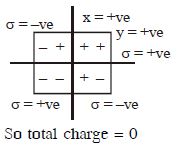
$A$ square plate of side $a$ is placed in the $xy$-plane with its center at the origin. If the surface charge density of the square plate is given by $\sigma = xy$,then the total charge on the plate will be:
A
$0$
B
$a^2$
C
$3a^2$
D
$\frac{1}{2}a^2$
Solution
(A) The square plate has side length $a$ and is centered at the origin $(0,0)$. The limits for $x$ and $y$ are from $-a/2$ to $a/2$.
The total charge $Q$ is given by the surface integral of the charge density $\sigma$ over the area of the plate:
$Q = \int \sigma dA = \int_{-a/2}^{a/2} \int_{-a/2}^{a/2} (xy) dx dy$
This can be separated into two independent integrals:
$Q = \left( \int_{-a/2}^{a/2} x dx \right) \left( \int_{-a/2}^{a/2} y dy \right)$
Since the integrand $x$ is an odd function and the limits are symmetric about the origin,$\int_{-a/2}^{a/2} x dx = 0$.
Similarly,$\int_{-a/2}^{a/2} y dy = 0$.
Therefore,$Q = 0 \times 0 = 0$.
The total charge on the plate is zero.
The total charge $Q$ is given by the surface integral of the charge density $\sigma$ over the area of the plate:
$Q = \int \sigma dA = \int_{-a/2}^{a/2} \int_{-a/2}^{a/2} (xy) dx dy$
This can be separated into two independent integrals:
$Q = \left( \int_{-a/2}^{a/2} x dx \right) \left( \int_{-a/2}^{a/2} y dy \right)$
Since the integrand $x$ is an odd function and the limits are symmetric about the origin,$\int_{-a/2}^{a/2} x dx = 0$.
Similarly,$\int_{-a/2}^{a/2} y dy = 0$.
Therefore,$Q = 0 \times 0 = 0$.
The total charge on the plate is zero.
0 likes
View Solution9
MediumMCQ
Charges $Q, 2Q$ and $-Q$ are given to three concentric conducting shells $A, B$ and $C$ respectively as shown. The ratio of charges on the inner and outer surfaces of shell $C$ will be:
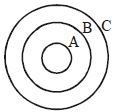
A
$+\frac{3}{4}$
B
$-\frac{3}{4}$
C
$+\frac{3}{2}$
D
$-\frac{3}{2}$
Solution
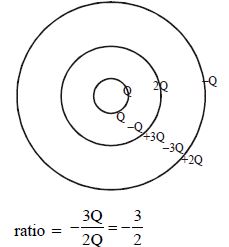
(D) Let the charges on the shells be $Q_A = Q$,$Q_B = 2Q$,and $Q_C = -Q$.
$1$. The inner surface of shell $A$ has $0$ charge,so the outer surface of $A$ has $Q$.
$2$. The inner surface of shell $B$ must have a charge of $-Q$ to cancel the effect of the charge on shell $A$. Since the total charge on shell $B$ is $2Q$,the outer surface of $B$ has $2Q - (-Q) = 3Q$.
$3$. The inner surface of shell $C$ must have a charge of $-3Q$ to cancel the effect of the charge on the outer surface of $B$. Since the total charge on shell $C$ is $-Q$,let the charge on the outer surface of $C$ be $q_{out}$.
$4$. Thus,$-3Q + q_{out} = -Q$,which gives $q_{out} = 2Q$.
$5$. The ratio of the charge on the inner surface to the charge on the outer surface of shell $C$ is $\frac{-3Q}{2Q} = -\frac{3}{2}$.
$1$. The inner surface of shell $A$ has $0$ charge,so the outer surface of $A$ has $Q$.
$2$. The inner surface of shell $B$ must have a charge of $-Q$ to cancel the effect of the charge on shell $A$. Since the total charge on shell $B$ is $2Q$,the outer surface of $B$ has $2Q - (-Q) = 3Q$.
$3$. The inner surface of shell $C$ must have a charge of $-3Q$ to cancel the effect of the charge on the outer surface of $B$. Since the total charge on shell $C$ is $-Q$,let the charge on the outer surface of $C$ be $q_{out}$.
$4$. Thus,$-3Q + q_{out} = -Q$,which gives $q_{out} = 2Q$.
$5$. The ratio of the charge on the inner surface to the charge on the outer surface of shell $C$ is $\frac{-3Q}{2Q} = -\frac{3}{2}$.
0 likes
View Solution10
EasyMCQ
If a metal cube of side $5 \, cm$ has a charge of $6 \, \mu C$,then the surface charge density is
A
$4 \times 10^2 \, \mu C/m^2$
B
$4 \times 10^2 \, C/m^2$
C
$4 \times 10^3 \, \mu C/m^2$
D
$4 \times 10^3 \, C/m^2$
Solution
(A) The surface charge density $\sigma$ is defined as the total charge $Q$ divided by the total surface area $A$ of the object.
For a cube with side length $a = 5 \, cm = 0.05 \, m$,the total surface area is $A = 6a^2$.
$A = 6 \times (0.05 \, m)^2 = 6 \times 25 \times 10^{-4} \, m^2 = 150 \times 10^{-4} \, m^2 = 0.015 \, m^2$.
The total charge is $Q = 6 \, \mu C = 6 \times 10^{-6} \, C$.
The surface charge density is $\sigma = \frac{Q}{A} = \frac{6 \times 10^{-6}}{6 \times 25 \times 10^{-4}} \, C/m^2$.
$\sigma = \frac{10^{-6}}{25 \times 10^{-4}} \, C/m^2 = \frac{1}{25} \times 10^{-2} \, C/m^2 = 0.04 \times 10^{-2} \, C/m^2 = 4 \times 10^{-4} \, C/m^2$.
Converting to $\mu C/m^2$: $\sigma = 4 \times 10^{-4} \times 10^6 \, \mu C/m^2 = 4 \times 10^2 \, \mu C/m^2$.
For a cube with side length $a = 5 \, cm = 0.05 \, m$,the total surface area is $A = 6a^2$.
$A = 6 \times (0.05 \, m)^2 = 6 \times 25 \times 10^{-4} \, m^2 = 150 \times 10^{-4} \, m^2 = 0.015 \, m^2$.
The total charge is $Q = 6 \, \mu C = 6 \times 10^{-6} \, C$.
The surface charge density is $\sigma = \frac{Q}{A} = \frac{6 \times 10^{-6}}{6 \times 25 \times 10^{-4}} \, C/m^2$.
$\sigma = \frac{10^{-6}}{25 \times 10^{-4}} \, C/m^2 = \frac{1}{25} \times 10^{-2} \, C/m^2 = 0.04 \times 10^{-2} \, C/m^2 = 4 \times 10^{-4} \, C/m^2$.
Converting to $\mu C/m^2$: $\sigma = 4 \times 10^{-4} \times 10^6 \, \mu C/m^2 = 4 \times 10^2 \, \mu C/m^2$.
0 likes
View Solution11
DifficultMCQ
If on two concentric hollow spheres of radii $r$ and $R$ $(R > r)$,the total charge $Q$ is distributed such that their surface charge densities are equal,then the potential at their common centre is:
A
$\frac{Q(R^2 + r^2)}{4\pi \varepsilon_0(R + r)}$
B
$\frac{QR}{R + r}$
C
Zero
D
$\frac{Q(R + r)}{4\pi \varepsilon_0(R^2 + r^2)}$
Solution
(D) Let $q_1$ and $q_2$ be the charges on the spheres of radii $r$ and $R$ respectively. Given $q_1 + q_2 = Q$.
Since surface charge densities $\sigma$ are equal,$\sigma = \frac{q_1}{4\pi r^2} = \frac{q_2}{4\pi R^2}$.
This implies $\frac{q_1}{q_2} = \frac{r^2}{R^2}$.
Using the ratio,we find $q_1 = \frac{Qr^2}{R^2 + r^2}$ and $q_2 = \frac{QR^2}{R^2 + r^2}$.
The potential at the common centre is $V = \frac{1}{4\pi\varepsilon_0} \left( \frac{q_1}{r} + \frac{q_2}{R} \right)$.
Substituting the values of $q_1$ and $q_2$,we get $V = \frac{1}{4\pi\varepsilon_0} \left( \frac{Qr}{R^2 + r^2} + \frac{QR}{R^2 + r^2} \right) = \frac{Q(R + r)}{4\pi\varepsilon_0(R^2 + r^2)}$.
Since surface charge densities $\sigma$ are equal,$\sigma = \frac{q_1}{4\pi r^2} = \frac{q_2}{4\pi R^2}$.
This implies $\frac{q_1}{q_2} = \frac{r^2}{R^2}$.
Using the ratio,we find $q_1 = \frac{Qr^2}{R^2 + r^2}$ and $q_2 = \frac{QR^2}{R^2 + r^2}$.
The potential at the common centre is $V = \frac{1}{4\pi\varepsilon_0} \left( \frac{q_1}{r} + \frac{q_2}{R} \right)$.
Substituting the values of $q_1$ and $q_2$,we get $V = \frac{1}{4\pi\varepsilon_0} \left( \frac{Qr}{R^2 + r^2} + \frac{QR}{R^2 + r^2} \right) = \frac{Q(R + r)}{4\pi\varepsilon_0(R^2 + r^2)}$.
0 likes
View Solution12
MediumMCQ
The radius of a charged metal sphere $(R)$ is $10 \, cm$ and its potential is $300 \, V$. Find the charge density on the surface of the sphere.
A
$2 \times 10^{-3} \, CGS \, esu$
B
$4 \times 10^{-3} \, CGS \, esu$
C
$6 \times 10^{-3} \, CGS \, esu$
D
$8 \times 10^{-3} \, CGS \, esu$
Solution
(D) Given: Radius $(R) = 10 \, cm$,Potential $(V) = 300 \, V$.
In $CGS$ units,$1 \, statvolt = 300 \, V$. Therefore,the potential $V = 1 \, statvolt$.
The potential of a charged sphere is given by $V = \frac{Q}{R}$.
Substituting the values: $1 = \frac{Q}{10}$,which gives $Q = 10 \, statcoulomb$.
The surface charge density $(\sigma)$ is given by $\sigma = \frac{Q}{4 \pi R^2}$.
Substituting the values: $\sigma = \frac{10}{4 \pi (10)^2} = \frac{10}{400 \pi} = \frac{1}{40 \pi} \approx 0.00796 \approx 8 \times 10^{-3} \, CGS \, esu/cm^2$.
In $CGS$ units,$1 \, statvolt = 300 \, V$. Therefore,the potential $V = 1 \, statvolt$.
The potential of a charged sphere is given by $V = \frac{Q}{R}$.
Substituting the values: $1 = \frac{Q}{10}$,which gives $Q = 10 \, statcoulomb$.
The surface charge density $(\sigma)$ is given by $\sigma = \frac{Q}{4 \pi R^2}$.
Substituting the values: $\sigma = \frac{10}{4 \pi (10)^2} = \frac{10}{400 \pi} = \frac{1}{40 \pi} \approx 0.00796 \approx 8 \times 10^{-3} \, CGS \, esu/cm^2$.
0 likes
View Solution13
DifficultMCQ
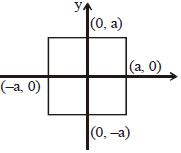
$A$ thin square plate is placed in the $x-y$ plane as shown in the figure,such that its center coincides with the origin. Its charge density at point $(x, y)$ is $\sigma = \sigma_0 xy$ (where $\sigma_0$ is a constant). Find the total charge on the plate.
A
$\sigma_0 a^2$
B
$-\sigma_0 a^2$
C
$\frac{\sigma_0}{a^2}$
D
Zero
Solution
(D) The total charge $Q$ on the plate is given by the surface integral of the charge density $\sigma$ over the area of the plate:
$Q = \int_{-a}^{a} \int_{-a}^{a} \sigma_0 xy \, dx \, dy$
$Q = \sigma_0 \left( \int_{-a}^{a} x \, dx \right) \left( \int_{-a}^{a} y \, dy \right)$
Since the integral of an odd function over a symmetric interval $[-a, a]$ is zero:
$\int_{-a}^{a} x \, dx = 0$ and $\int_{-a}^{a} y \, dy = 0$
Therefore,$Q = \sigma_0 \times 0 \times 0 = 0$.
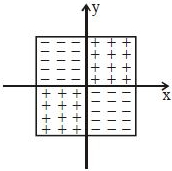
Alternatively,by symmetry,the charge in the first quadrant is positive,the second is negative,the third is positive,and the fourth is negative. Due to the symmetry of the function $\sigma = \sigma_0 xy$ about the axes,the total charge sums to zero.
$Q = \int_{-a}^{a} \int_{-a}^{a} \sigma_0 xy \, dx \, dy$
$Q = \sigma_0 \left( \int_{-a}^{a} x \, dx \right) \left( \int_{-a}^{a} y \, dy \right)$
Since the integral of an odd function over a symmetric interval $[-a, a]$ is zero:
$\int_{-a}^{a} x \, dx = 0$ and $\int_{-a}^{a} y \, dy = 0$
Therefore,$Q = \sigma_0 \times 0 \times 0 = 0$.
Alternatively,by symmetry,the charge in the first quadrant is positive,the second is negative,the third is positive,and the fourth is negative. Due to the symmetry of the function $\sigma = \sigma_0 xy$ about the axes,the total charge sums to zero.
0 likes
View Solution14
MediumMCQ
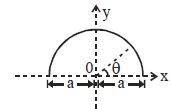
$A$ semicircular ring of radius $a$ has a charge density $\lambda = {\lambda _0} \cos \theta$,where ${\lambda _0}$ is a constant and $\theta$ is the angle shown in the figure. Then,the total charge on the ring is:
A
$2{\lambda _0}a$
B
$4{\lambda _0}a$
C
$\frac{{{\lambda _0}a}}{3}$
D
Zero
Solution
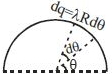
(D) The charge on a small element of the ring of angular width $d\theta$ is given by $dq = \lambda \cdot dl$,where $dl = a \, d\theta$.
Given $\lambda = {\lambda _0} \cos \theta$,we have $dq = (\lambda _0 \cos \theta) (a \, d\theta)$.
The semicircular ring spans from $\theta = 0$ to $\theta = \pi$.
Therefore,the total charge $Q$ is:
$Q = \int_{0}^{\pi} \lambda _0 a \cos \theta \, d\theta$
$Q = \lambda _0 a \int_{0}^{\pi} \cos \theta \, d\theta$
$Q = \lambda _0 a [\sin \theta]_{0}^{\pi}$
$Q = \lambda _0 a (\sin \pi - \sin 0)$
$Q = \lambda _0 a (0 - 0) = 0$.
Thus,the total charge on the ring is zero.
Given $\lambda = {\lambda _0} \cos \theta$,we have $dq = (\lambda _0 \cos \theta) (a \, d\theta)$.
The semicircular ring spans from $\theta = 0$ to $\theta = \pi$.
Therefore,the total charge $Q$ is:
$Q = \int_{0}^{\pi} \lambda _0 a \cos \theta \, d\theta$
$Q = \lambda _0 a \int_{0}^{\pi} \cos \theta \, d\theta$
$Q = \lambda _0 a [\sin \theta]_{0}^{\pi}$
$Q = \lambda _0 a (\sin \pi - \sin 0)$
$Q = \lambda _0 a (0 - 0) = 0$.
Thus,the total charge on the ring is zero.
0 likes
View Solution15
EasyMCQ
$A$ non-uniformly shaped conductor is charged. Then,at its sharpest point:
A
Electric potential will be maximum
B
Electric field will be maximum
C
Charge density will be minimum
D
Electric potential will be minimum
Solution
(B) For a charged conductor in electrostatic equilibrium,the entire conductor is an equipotential surface,meaning the electric potential is the same at every point.
However,the surface charge density $\sigma$ is inversely proportional to the radius of curvature $R$ $(\sigma \propto 1/R)$.
At the sharpest point,the radius of curvature is minimum,which makes the surface charge density maximum.
Since the electric field near the surface is given by $E = \sigma / \epsilon_0$,the electric field is also maximum at the sharpest point.
However,the surface charge density $\sigma$ is inversely proportional to the radius of curvature $R$ $(\sigma \propto 1/R)$.
At the sharpest point,the radius of curvature is minimum,which makes the surface charge density maximum.
Since the electric field near the surface is given by $E = \sigma / \epsilon_0$,the electric field is also maximum at the sharpest point.
0 likes
View Solution16
DifficultMCQ
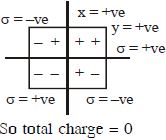
$A$ square plate of side $a$ is placed in the $xy$-plane with its center at the origin. If the surface charge density of the square plate is given by $\sigma = xy$,then the total charge on the plate will be:
A
$\frac{1}{2} a^2$
B
$a^2$
C
$3a^2$
D
Zero
Solution
(D) The square plate has side length $a$ and is centered at the origin $(0,0)$ in the $xy$-plane. The limits for $x$ and $y$ are from $-\frac{a}{2}$ to $+\frac{a}{2}$.
The total charge $Q$ is given by the surface integral of the charge density $\sigma$ over the area of the plate:
$Q = \iint \sigma \, dA = \int_{-\frac{a}{2}}^{\frac{a}{2}} \int_{-\frac{a}{2}}^{\frac{a}{2}} (xy) \, dx \, dy$
This can be separated into two independent integrals:
$Q = \left( \int_{-\frac{a}{2}}^{\frac{a}{2}} x \, dx \right) \left( \int_{-\frac{a}{2}}^{\frac{a}{2}} y \, dy \right)$
Since the integrand $x$ is an odd function and the limits are symmetric about the origin,$\int_{-\frac{a}{2}}^{\frac{a}{2}} x \, dx = 0$.
Similarly,$\int_{-\frac{a}{2}}^{\frac{a}{2}} y \, dy = 0$.
Therefore,$Q = 0 \times 0 = 0$.
The total charge on the plate is zero.
The total charge $Q$ is given by the surface integral of the charge density $\sigma$ over the area of the plate:
$Q = \iint \sigma \, dA = \int_{-\frac{a}{2}}^{\frac{a}{2}} \int_{-\frac{a}{2}}^{\frac{a}{2}} (xy) \, dx \, dy$
This can be separated into two independent integrals:
$Q = \left( \int_{-\frac{a}{2}}^{\frac{a}{2}} x \, dx \right) \left( \int_{-\frac{a}{2}}^{\frac{a}{2}} y \, dy \right)$
Since the integrand $x$ is an odd function and the limits are symmetric about the origin,$\int_{-\frac{a}{2}}^{\frac{a}{2}} x \, dx = 0$.
Similarly,$\int_{-\frac{a}{2}}^{\frac{a}{2}} y \, dy = 0$.
Therefore,$Q = 0 \times 0 = 0$.
The total charge on the plate is zero.
0 likes
View Solution17
Difficult
Obtain the formula for the electric field due to a long thin wire of uniform linear charge density $\lambda$ without using Gauss's law.
Solution
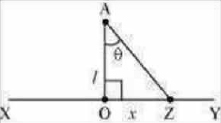
(N/A) Consider a long thin wire $XY$ of uniform linear charge density $\lambda$.
Consider a point $A$ at a perpendicular distance $l$ from the mid-point $O$ of the wire.
Let $E$ be the electric field at point $A$ due to the wire $XY$.
Consider a small length element $dx$ on the wire section at a distance $x$ from $O$ (i.e.,$OZ = x$).
The charge on this element is $dq = \lambda dx$.
The electric field due to this element at point $A$ is:
$dE = \frac{1}{4 \pi \epsilon_{0}} \cdot \frac{\lambda dx}{(AZ)^{2}}$
Since $AZ = \sqrt{l^{2} + x^{2}}$,we have:
$dE = \frac{1}{4 \pi \epsilon_{0}} \cdot \frac{\lambda dx}{l^{2} + x^{2}}$
The electric field is resolved into two rectangular components. $dE \cos \theta$ is the perpendicular component and $dE \sin \theta$ is the parallel component. When the whole wire is considered,the parallel components $dE \sin \theta$ cancel out due to symmetry. Only the perpendicular component $dE \cos \theta$ contributes to the net electric field at point $A$.
Thus,the effective electric field $dE_{1}$ is:
$dE_{1} = dE \cos \theta = \frac{1}{4 \pi \epsilon_{0}} \cdot \frac{\lambda dx \cos \theta}{l^{2} + x^{2}} \dots (1)$
In $\Delta AZO$,$\tan \theta = \frac{x}{l} \Rightarrow x = l \tan \theta$. Differentiating,$dx = l \sec^{2} \theta d\theta \dots (2)$
Also,$l^{2} + x^{2} = l^{2} + l^{2} \tan^{2} \theta = l^{2} \sec^{2} \theta \dots (3)$
Substituting $(2)$ and $(3)$ into $(1)$:
$dE_{1} = \frac{1}{4 \pi \epsilon_{0}} \cdot \frac{\lambda (l \sec^{2} \theta d\theta) \cos \theta}{l^{2} \sec^{2} \theta} = \frac{\lambda}{4 \pi \epsilon_{0} l} \cos \theta d\theta$
For an infinitely long wire,$\theta$ ranges from $-\frac{\pi}{2}$ to $\frac{\pi}{2}$. Integrating:
$E = \int_{-\pi/2}^{\pi/2} \frac{\lambda}{4 \pi \epsilon_{0} l} \cos \theta d\theta = \frac{\lambda}{4 \pi \epsilon_{0} l} [\sin \theta]_{-\pi/2}^{\pi/2}$
$E = \frac{\lambda}{4 \pi \epsilon_{0} l} [1 - (-1)] = \frac{2\lambda}{4 \pi \epsilon_{0} l} = \frac{\lambda}{2 \pi \epsilon_{0} l}$
Consider a point $A$ at a perpendicular distance $l$ from the mid-point $O$ of the wire.
Let $E$ be the electric field at point $A$ due to the wire $XY$.
Consider a small length element $dx$ on the wire section at a distance $x$ from $O$ (i.e.,$OZ = x$).
The charge on this element is $dq = \lambda dx$.
The electric field due to this element at point $A$ is:
$dE = \frac{1}{4 \pi \epsilon_{0}} \cdot \frac{\lambda dx}{(AZ)^{2}}$
Since $AZ = \sqrt{l^{2} + x^{2}}$,we have:
$dE = \frac{1}{4 \pi \epsilon_{0}} \cdot \frac{\lambda dx}{l^{2} + x^{2}}$
The electric field is resolved into two rectangular components. $dE \cos \theta$ is the perpendicular component and $dE \sin \theta$ is the parallel component. When the whole wire is considered,the parallel components $dE \sin \theta$ cancel out due to symmetry. Only the perpendicular component $dE \cos \theta$ contributes to the net electric field at point $A$.
Thus,the effective electric field $dE_{1}$ is:
$dE_{1} = dE \cos \theta = \frac{1}{4 \pi \epsilon_{0}} \cdot \frac{\lambda dx \cos \theta}{l^{2} + x^{2}} \dots (1)$
In $\Delta AZO$,$\tan \theta = \frac{x}{l} \Rightarrow x = l \tan \theta$. Differentiating,$dx = l \sec^{2} \theta d\theta \dots (2)$
Also,$l^{2} + x^{2} = l^{2} + l^{2} \tan^{2} \theta = l^{2} \sec^{2} \theta \dots (3)$
Substituting $(2)$ and $(3)$ into $(1)$:
$dE_{1} = \frac{1}{4 \pi \epsilon_{0}} \cdot \frac{\lambda (l \sec^{2} \theta d\theta) \cos \theta}{l^{2} \sec^{2} \theta} = \frac{\lambda}{4 \pi \epsilon_{0} l} \cos \theta d\theta$
For an infinitely long wire,$\theta$ ranges from $-\frac{\pi}{2}$ to $\frac{\pi}{2}$. Integrating:
$E = \int_{-\pi/2}^{\pi/2} \frac{\lambda}{4 \pi \epsilon_{0} l} \cos \theta d\theta = \frac{\lambda}{4 \pi \epsilon_{0} l} [\sin \theta]_{-\pi/2}^{\pi/2}$
$E = \frac{\lambda}{4 \pi \epsilon_{0} l} [1 - (-1)] = \frac{2\lambda}{4 \pi \epsilon_{0} l} = \frac{\lambda}{2 \pi \epsilon_{0} l}$
0 likes
View Solution18
Medium
Write an equation for the electric potential due to a linear charge distribution.
Solution
(N/A) The electric potential $V$ at a point $P$ due to a continuous linear charge distribution with linear charge density $\lambda$ along a line element $dl$ is given by the integral:
$V = \frac{1}{4\pi\epsilon_0} \int \frac{\lambda dl}{r}$
where:
$1. \epsilon_0$ is the permittivity of free space.
$2. \lambda$ is the linear charge density (charge per unit length).
$3. dl$ is the infinitesimal length element of the distribution.
$4. r$ is the distance from the charge element $dl$ to the point $P$ where the potential is being calculated.
$V = \frac{1}{4\pi\epsilon_0} \int \frac{\lambda dl}{r}$
where:
$1. \epsilon_0$ is the permittivity of free space.
$2. \lambda$ is the linear charge density (charge per unit length).
$3. dl$ is the infinitesimal length element of the distribution.
$4. r$ is the distance from the charge element $dl$ to the point $P$ where the potential is being calculated.
0 likes
View Solution19
Medium
Explain linear charge density,surface charge density,and volume charge density for uniform charge distribution.
Solution
Linear charge density $(\lambda):$ The amount of charge per unit length is called linear charge density $(\lambda)$. $\lambda = \frac{Q}{l}$,where $Q$ is the total charge and $l$ is the length.
Unit: $C/m$. Dimensional formula: $[M^0 L^{-1} T^1 A^1]$.
Surface charge density $(\sigma):$ The amount of charge per unit area is called surface charge density $(\sigma)$. $\sigma = \frac{Q}{A}$,where $Q$ is the total charge and $A$ is the area.
Unit: $C/m^2$. Dimensional formula: $[M^0 L^{-2} T^1 A^1]$.
Volume charge density $(\rho):$ The amount of charge per unit volume is called volume charge density $(\rho)$. $\rho = \frac{Q}{V}$,where $Q$ is the total charge and $V$ is the volume.
Unit: $C/m^3$. Dimensional formula: $[M^0 L^{-3} T^1 A^1]$.
Unit: $C/m$. Dimensional formula: $[M^0 L^{-1} T^1 A^1]$.
Surface charge density $(\sigma):$ The amount of charge per unit area is called surface charge density $(\sigma)$. $\sigma = \frac{Q}{A}$,where $Q$ is the total charge and $A$ is the area.
Unit: $C/m^2$. Dimensional formula: $[M^0 L^{-2} T^1 A^1]$.
Volume charge density $(\rho):$ The amount of charge per unit volume is called volume charge density $(\rho)$. $\rho = \frac{Q}{V}$,where $Q$ is the total charge and $V$ is the volume.
Unit: $C/m^3$. Dimensional formula: $[M^0 L^{-3} T^1 A^1]$.
0 likes
View Solution20
Difficult
Obtain the expression for the electric field at any point due to a continuous distribution of charge on a $(i)$ line,$(ii)$ surface,and $(iii)$ volume.
Solution
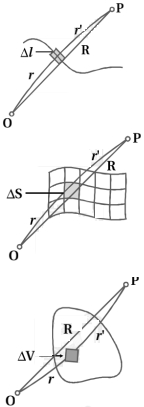
(N/A) $(1)$ Line charge distribution: Suppose a line is divided into smaller elements of length $dl$. Let $\vec{r}$ be the position vector of a small element with linear charge density $\lambda$,so its charge is $dq = \lambda dl$.
Consider a point $P$ with position vector $\vec{R}$. Let $r^{\prime}$ be the distance from the element $dl$ to $P$,and $\hat{r}^{\prime}$ be the unit vector pointing from the element to $P$. The electric field at $P$ due to the element is:
$\vec{dE} = \frac{k \lambda dl}{(r^{\prime})^{2}} \hat{r}^{\prime}$
By the superposition principle,the total electric field at $P$ is:
$\vec{E} = \int_{l} \frac{k \lambda dl}{(r^{\prime})^{2}} \hat{r}^{\prime}$
$(2)$ Surface charge distribution: Suppose a surface $S$ is divided into small elements $\Delta S$. Let $\sigma$ be the surface charge density,so the charge on an element is $dq = \sigma dS$.
The electric field at point $P$ due to the surface element is:
$\vec{dE} = \frac{k \sigma dS}{(r^{\prime})^{2}} \hat{r}^{\prime}$
By the superposition principle,the total electric field at $P$ is:
$\vec{E} = \int_{S} \frac{k \sigma dS}{(r^{\prime})^{2}} \hat{r}^{\prime}$
$(3)$ Volume charge distribution: Suppose a volume $V$ has a charge density $\rho$. The charge in a small volume element $dV$ is $dq = \rho dV$.
The electric field at point $P$ due to the volume element is:
$\vec{dE} = \frac{k \rho dV}{(r^{\prime})^{2}} \hat{r}^{\prime}$
By the superposition principle,the total electric field at $P$ is:
$\vec{E} = \int_{V} \frac{k \rho dV}{(r^{\prime})^{2}} \hat{r}^{\prime}$
Consider a point $P$ with position vector $\vec{R}$. Let $r^{\prime}$ be the distance from the element $dl$ to $P$,and $\hat{r}^{\prime}$ be the unit vector pointing from the element to $P$. The electric field at $P$ due to the element is:
$\vec{dE} = \frac{k \lambda dl}{(r^{\prime})^{2}} \hat{r}^{\prime}$
By the superposition principle,the total electric field at $P$ is:
$\vec{E} = \int_{l} \frac{k \lambda dl}{(r^{\prime})^{2}} \hat{r}^{\prime}$
$(2)$ Surface charge distribution: Suppose a surface $S$ is divided into small elements $\Delta S$. Let $\sigma$ be the surface charge density,so the charge on an element is $dq = \sigma dS$.
The electric field at point $P$ due to the surface element is:
$\vec{dE} = \frac{k \sigma dS}{(r^{\prime})^{2}} \hat{r}^{\prime}$
By the superposition principle,the total electric field at $P$ is:
$\vec{E} = \int_{S} \frac{k \sigma dS}{(r^{\prime})^{2}} \hat{r}^{\prime}$
$(3)$ Volume charge distribution: Suppose a volume $V$ has a charge density $\rho$. The charge in a small volume element $dV$ is $dq = \rho dV$.
The electric field at point $P$ due to the volume element is:
$\vec{dE} = \frac{k \rho dV}{(r^{\prime})^{2}} \hat{r}^{\prime}$
By the superposition principle,the total electric field at $P$ is:
$\vec{E} = \int_{V} \frac{k \rho dV}{(r^{\prime})^{2}} \hat{r}^{\prime}$
0 likes
View Solution21
Easy
What are linear,surface and volume distribution of charge?
Solution
(N/A) Charge distribution is the way electric charge is spread over a region. It is classified into three types:
$1$. Linear Charge Distribution: When charge is distributed uniformly along a line (like a thin wire or ring),it is called linear charge distribution. The linear charge density $\lambda$ is defined as $\lambda = \frac{dq}{dl}$,where $dq$ is the charge on an element of length $dl$. Its $SI$ unit is $C/m$.
$2$. Surface Charge Distribution: When charge is distributed uniformly over a surface (like a thin sheet or shell),it is called surface charge distribution. The surface charge density $\sigma$ is defined as $\sigma = \frac{dq}{dA}$,where $dq$ is the charge on an area element $dA$. Its $SI$ unit is $C/m^2$.
$3$. Volume Charge Distribution: When charge is distributed uniformly throughout the volume of an object,it is called volume charge distribution. The volume charge density $\rho$ is defined as $\rho = \frac{dq}{dV}$,where $dq$ is the charge in a volume element $dV$. Its $SI$ unit is $C/m^3$.
$1$. Linear Charge Distribution: When charge is distributed uniformly along a line (like a thin wire or ring),it is called linear charge distribution. The linear charge density $\lambda$ is defined as $\lambda = \frac{dq}{dl}$,where $dq$ is the charge on an element of length $dl$. Its $SI$ unit is $C/m$.
$2$. Surface Charge Distribution: When charge is distributed uniformly over a surface (like a thin sheet or shell),it is called surface charge distribution. The surface charge density $\sigma$ is defined as $\sigma = \frac{dq}{dA}$,where $dq$ is the charge on an area element $dA$. Its $SI$ unit is $C/m^2$.
$3$. Volume Charge Distribution: When charge is distributed uniformly throughout the volume of an object,it is called volume charge distribution. The volume charge density $\rho$ is defined as $\rho = \frac{dq}{dV}$,where $dq$ is the charge in a volume element $dV$. Its $SI$ unit is $C/m^3$.
0 likes
View Solution22
Medium
Give definitions of linear,surface,and volume charge densities and write their $SI$ units.
Solution
(N/A) $1$. Linear Charge Density $(\lambda)$: It is defined as the charge per unit length of a conductor. $\lambda = \frac{dq}{dl}$. Its $SI$ unit is $C/m$.
$2$. Surface Charge Density $(\sigma)$: It is defined as the charge per unit surface area of a conductor. $\sigma = \frac{dq}{dA}$. Its $SI$ unit is $C/m^2$.
$3$. Volume Charge Density $(\rho)$: It is defined as the charge per unit volume of a conductor. $\rho = \frac{dq}{dV}$. Its $SI$ unit is $C/m^3$.
$2$. Surface Charge Density $(\sigma)$: It is defined as the charge per unit surface area of a conductor. $\sigma = \frac{dq}{dA}$. Its $SI$ unit is $C/m^2$.
$3$. Volume Charge Density $(\rho)$: It is defined as the charge per unit volume of a conductor. $\rho = \frac{dq}{dV}$. Its $SI$ unit is $C/m^3$.
0 likes
View Solution23
MediumMCQ
If volume charge density is $\rho$,then what will be the charge on $\Delta V$ volume?
A
$q = \rho \Delta V$
B
$q = \frac{\rho}{\Delta V}$
C
$q = \frac{\Delta V}{\rho}$
D
$q = \rho^2 \Delta V$
Solution
(A) Volume charge density $\rho$ is defined as the charge per unit volume.
Mathematically,$\rho = \frac{dq}{dV}$.
For a small volume element $\Delta V$,the charge $\Delta q$ contained within it is given by the product of the volume charge density and the volume element.
Therefore,$\Delta q = \rho \Delta V$.
Mathematically,$\rho = \frac{dq}{dV}$.
For a small volume element $\Delta V$,the charge $\Delta q$ contained within it is given by the product of the volume charge density and the volume element.
Therefore,$\Delta q = \rho \Delta V$.
0 likes
View Solution24
DifficultMCQ
Find the surface charge density at the intersection of the plane $x = 3 \, m$ and the $x$-axis,given a uniform line charge of $8 \, nC/m$ lying along the $z$-axis in free space.
A
$0.424 \, nC/m^2$
B
$47.88 \, C/m^2$
C
$0.07 \, nC/m^2$
D
$4.0 \, nC/m^2$
Solution
(A) The electric field $E$ due to an infinite line charge with linear charge density $\lambda$ at a radial distance $r$ is given by $E = \frac{\lambda}{2 \pi \varepsilon_0 r}$.
Given $\lambda = 8 \times 10^{-9} \, C/m$ and $r = x = 3 \, m$.
The electric field at $x = 3 \, m$ is $E = \frac{8 \times 10^{-9}}{2 \pi \varepsilon_0 (3)}$.
Using the boundary condition for the surface charge density $\sigma$ at a conductor surface,$E = \frac{\sigma}{\varepsilon_0}$,we have $\sigma = E \varepsilon_0$.
Substituting $E$,we get $\sigma = \frac{\lambda}{2 \pi r} = \frac{8 \times 10^{-9}}{2 \pi (3)}$.
$\sigma = \frac{8 \times 10^{-9}}{6 \pi} \approx 0.424 \times 10^{-9} \, C/m^2 = 0.424 \, nC/m^2$.
Given $\lambda = 8 \times 10^{-9} \, C/m$ and $r = x = 3 \, m$.
The electric field at $x = 3 \, m$ is $E = \frac{8 \times 10^{-9}}{2 \pi \varepsilon_0 (3)}$.
Using the boundary condition for the surface charge density $\sigma$ at a conductor surface,$E = \frac{\sigma}{\varepsilon_0}$,we have $\sigma = E \varepsilon_0$.
Substituting $E$,we get $\sigma = \frac{\lambda}{2 \pi r} = \frac{8 \times 10^{-9}}{2 \pi (3)}$.
$\sigma = \frac{8 \times 10^{-9}}{6 \pi} \approx 0.424 \times 10^{-9} \, C/m^2 = 0.424 \, nC/m^2$.
0 likes
View Solution25
MediumMCQ
$A$ charge is spread non-uniformly on the surface of a hollow sphere of radius $R$,such that the charge density is given by $\sigma = \sigma_0(1 - \sin \theta)$,where $\theta$ is the usual polar angle. The potential at the centre of the sphere is
A
$\frac{Q}{2 \pi \varepsilon_0 R}$
B
$\frac{Q}{\pi \varepsilon_0 R}$
C
$\frac{Q}{8 \pi \varepsilon_0 R}$
D
$\frac{Q}{4 \pi \varepsilon_0 R}$
Solution
(D) The potential $V$ at the center of a spherical shell due to a surface charge distribution is given by the integral $V = \oint \frac{k dq}{R}$.
Since the radius $R$ is constant for all points on the surface of the sphere,we can take $\frac{k}{R}$ outside the integral.
$V = \frac{k}{R} \oint dq$.
The integral $\oint dq$ represents the total charge $Q$ on the sphere.
Therefore,$V = \frac{kQ}{R}$.
Substituting $k = \frac{1}{4 \pi \varepsilon_0}$,we get $V = \frac{Q}{4 \pi \varepsilon_0 R}$.
Note that the potential at the center of a charged spherical shell depends only on the total charge $Q$ and the radius $R$,and is independent of the distribution of the charge on the surface.
Since the radius $R$ is constant for all points on the surface of the sphere,we can take $\frac{k}{R}$ outside the integral.
$V = \frac{k}{R} \oint dq$.
The integral $\oint dq$ represents the total charge $Q$ on the sphere.
Therefore,$V = \frac{kQ}{R}$.
Substituting $k = \frac{1}{4 \pi \varepsilon_0}$,we get $V = \frac{Q}{4 \pi \varepsilon_0 R}$.
Note that the potential at the center of a charged spherical shell depends only on the total charge $Q$ and the radius $R$,and is independent of the distribution of the charge on the surface.
0 likes
View Solution26
EasyMCQ
If a solid and a hollow conducting sphere have the same radius, then:
A
Hollow sphere will hold more maximum charge
B
Solid sphere will hold more maximum charge
C
Both the spheres will hold the same maximum charge
D
Both the spheres cannot hold charge
Solution
(C) For a conducting sphere, any excess charge given to it resides entirely on its outer surface due to the electrostatic property of conductors.
Since both the solid and hollow conducting spheres have the same radius $R$, their surface areas are identical $(A = 4\pi R^2)$.
Because the charge distribution is restricted to the surface in both cases, the maximum charge that can be held before dielectric breakdown of the surrounding medium occurs is the same for both spheres.
Since both the solid and hollow conducting spheres have the same radius $R$, their surface areas are identical $(A = 4\pi R^2)$.
Because the charge distribution is restricted to the surface in both cases, the maximum charge that can be held before dielectric breakdown of the surrounding medium occurs is the same for both spheres.
0 likes
View Solution27
EasyMCQ
Two isolated metallic spheres of radii $2 \,cm$ and $4 \,cm$ are given equal charge,then the ratio of charge density on the surfaces of the spheres will be
A
$1: 2$
B
$4: 1$
C
$8: 1$
D
$1: 4$
Solution
(B) The surface charge density $\sigma$ is defined as the charge per unit area,given by $\sigma = \frac{Q}{A} = \frac{Q}{4 \pi r^2}$.
Since the charges $Q$ on both spheres are equal,we have $\sigma \propto \frac{1}{r^2}$.
Given radii are $r_1 = 2 \,cm$ and $r_2 = 4 \,cm$.
The ratio of charge densities is $\frac{\sigma_1}{\sigma_2} = \frac{r_2^2}{r_1^2}$.
Substituting the values,$\frac{\sigma_1}{\sigma_2} = \frac{(4)^2}{(2)^2} = \frac{16}{4} = \frac{4}{1}$.
Thus,the ratio is $4: 1$.
Since the charges $Q$ on both spheres are equal,we have $\sigma \propto \frac{1}{r^2}$.
Given radii are $r_1 = 2 \,cm$ and $r_2 = 4 \,cm$.
The ratio of charge densities is $\frac{\sigma_1}{\sigma_2} = \frac{r_2^2}{r_1^2}$.
Substituting the values,$\frac{\sigma_1}{\sigma_2} = \frac{(4)^2}{(2)^2} = \frac{16}{4} = \frac{4}{1}$.
Thus,the ratio is $4: 1$.
0 likes
View Solution28
MediumMCQ
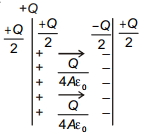
Each of two large conducting parallel plates has one-sided surface area $A$. If one of the plates is given a charge $Q$ whereas the other is neutral,then the electric field at a point in between the plates is given by
A
$\frac{Q}{A \varepsilon_0}$
B
$\frac{Q}{2 A \varepsilon_0}$
C
$\frac{Q}{4 A \varepsilon_0}$
D
Zero
Solution
(B) When a charge $Q$ is given to one of two large parallel conducting plates,the charge redistributes itself on both sides of each plate such that the electric field inside the conducting material is zero.
Let the charges on the four surfaces (from left to right) be $q_1, q_2, q_3,$ and $q_4$.
For the first plate: $q_1 + q_2 = Q$ and for the second plate: $q_3 + q_4 = 0$.
Since the plates are large,the electric field due to a surface with charge density $\sigma$ is $E = \frac{\sigma}{2 \varepsilon_0} = \frac{q}{2 A \varepsilon_0}$.
Inside the conducting material of the plates,the net electric field must be zero.
Applying this condition,we find that the charges on the inner surfaces are $q_2 = \frac{Q}{2}$ and $q_3 = -\frac{Q}{2}$,while the outer surfaces have $q_1 = \frac{Q}{2}$ and $q_4 = \frac{Q}{2}$.
The electric field at a point between the plates is due to the inner surface charges $q_2$ and $q_3$.
$E_{\text{net}} = E_2 + E_3 = \frac{q_2}{2 A \varepsilon_0} + \frac{|q_3|}{2 A \varepsilon_0} = \frac{Q/2}{2 A \varepsilon_0} + \frac{Q/2}{2 A \varepsilon_0} = \frac{Q}{4 A \varepsilon_0} + \frac{Q}{4 A \varepsilon_0} = \frac{Q}{2 A \varepsilon_0}$.
Let the charges on the four surfaces (from left to right) be $q_1, q_2, q_3,$ and $q_4$.
For the first plate: $q_1 + q_2 = Q$ and for the second plate: $q_3 + q_4 = 0$.
Since the plates are large,the electric field due to a surface with charge density $\sigma$ is $E = \frac{\sigma}{2 \varepsilon_0} = \frac{q}{2 A \varepsilon_0}$.
Inside the conducting material of the plates,the net electric field must be zero.
Applying this condition,we find that the charges on the inner surfaces are $q_2 = \frac{Q}{2}$ and $q_3 = -\frac{Q}{2}$,while the outer surfaces have $q_1 = \frac{Q}{2}$ and $q_4 = \frac{Q}{2}$.
The electric field at a point between the plates is due to the inner surface charges $q_2$ and $q_3$.
$E_{\text{net}} = E_2 + E_3 = \frac{q_2}{2 A \varepsilon_0} + \frac{|q_3|}{2 A \varepsilon_0} = \frac{Q/2}{2 A \varepsilon_0} + \frac{Q/2}{2 A \varepsilon_0} = \frac{Q}{4 A \varepsilon_0} + \frac{Q}{4 A \varepsilon_0} = \frac{Q}{2 A \varepsilon_0}$.
0 likes
View Solution29
MediumMCQ
Three concentric metallic spherical shells of radii $R, 2R, 3R$ are given charges $Q_1, Q_2, Q_3$ respectively. It is found that the surface charge densities on the outer surfaces of the shells are equal. Then,the ratio of the charges given to the shells,$Q_1 : Q_2 : Q_3$,is
A
$1 : 2 : 3$
B
$1 : 4 : 9$
C
$1 : 3 : 5$
D
$1 : 8 : 18$
Solution
(B) Let the surface charge densities on the shells be $\sigma_1, \sigma_2, \sigma_3$ respectively.
Given that $\sigma_1 = \sigma_2 = \sigma_3 = \sigma$.
The surface charge density is defined as $\sigma = \frac{Q}{A}$,where $A = 4\pi r^2$ is the surface area of the sphere.
For the first shell: $Q_1 = \sigma \cdot 4\pi R^2$.
For the second shell: $Q_2 = \sigma \cdot 4\pi (2R)^2 = \sigma \cdot 16\pi R^2$.
For the third shell: $Q_3 = \sigma \cdot 4\pi (3R)^2 = \sigma \cdot 36\pi R^2$.
Now,the ratio $Q_1 : Q_2 : Q_3$ is:
$Q_1 : Q_2 : Q_3 = (\sigma \cdot 4\pi R^2) : (\sigma \cdot 16\pi R^2) : (\sigma \cdot 36\pi R^2)$.
Dividing by $4\pi R^2$,we get:
$Q_1 : Q_2 : Q_3 = 1 : 4 : 9$.
Given that $\sigma_1 = \sigma_2 = \sigma_3 = \sigma$.
The surface charge density is defined as $\sigma = \frac{Q}{A}$,where $A = 4\pi r^2$ is the surface area of the sphere.
For the first shell: $Q_1 = \sigma \cdot 4\pi R^2$.
For the second shell: $Q_2 = \sigma \cdot 4\pi (2R)^2 = \sigma \cdot 16\pi R^2$.
For the third shell: $Q_3 = \sigma \cdot 4\pi (3R)^2 = \sigma \cdot 36\pi R^2$.
Now,the ratio $Q_1 : Q_2 : Q_3$ is:
$Q_1 : Q_2 : Q_3 = (\sigma \cdot 4\pi R^2) : (\sigma \cdot 16\pi R^2) : (\sigma \cdot 36\pi R^2)$.
Dividing by $4\pi R^2$,we get:
$Q_1 : Q_2 : Q_3 = 1 : 4 : 9$.
0 likes
View Solution30
DifficultMCQ
The electric flux is $\phi = \alpha \sigma + \beta \lambda$,where $\lambda$ and $\sigma$ are linear and surface charge density,respectively. The ratio $\left(\frac{\alpha}{\beta}\right)$ represents:
A
charge
B
electric field
C
displacement
D
area
Solution
(C) Given the equation for electric flux: $\phi = \alpha \sigma + \beta \lambda$.
By the principle of homogeneity of dimensions,the dimensions of each term must be equal: $[\phi] = [\alpha \sigma] = [\beta \lambda]$.
From $[\phi] = [\alpha \sigma]$,we get $[\alpha] = \frac{[\phi]}{[\sigma]}$.
From $[\phi] = [\beta \lambda]$,we get $[\beta] = \frac{[\phi]}{[\lambda]}$.
Now,consider the ratio $\frac{\alpha}{\beta}$: $\left[\frac{\alpha}{\beta}\right] = \frac{[\phi]/[\sigma]}{[\phi]/[\lambda]} = \frac{[\lambda]}{[\sigma]}$.
The dimensions of linear charge density $\lambda$ are $[Q/L]$ and surface charge density $\sigma$ are $[Q/L^2]$.
Substituting these: $\left[\frac{\alpha}{\beta}\right] = \frac{[Q/L]}{[Q/L^2]} = \frac{L^2}{L} = [L]$.
Since the dimension is $[L]$,the ratio $\left(\frac{\alpha}{\beta}\right)$ represents length,which is a unit of displacement.
By the principle of homogeneity of dimensions,the dimensions of each term must be equal: $[\phi] = [\alpha \sigma] = [\beta \lambda]$.
From $[\phi] = [\alpha \sigma]$,we get $[\alpha] = \frac{[\phi]}{[\sigma]}$.
From $[\phi] = [\beta \lambda]$,we get $[\beta] = \frac{[\phi]}{[\lambda]}$.
Now,consider the ratio $\frac{\alpha}{\beta}$: $\left[\frac{\alpha}{\beta}\right] = \frac{[\phi]/[\sigma]}{[\phi]/[\lambda]} = \frac{[\lambda]}{[\sigma]}$.
The dimensions of linear charge density $\lambda$ are $[Q/L]$ and surface charge density $\sigma$ are $[Q/L^2]$.
Substituting these: $\left[\frac{\alpha}{\beta}\right] = \frac{[Q/L]}{[Q/L^2]} = \frac{L^2}{L} = [L]$.
Since the dimension is $[L]$,the ratio $\left(\frac{\alpha}{\beta}\right)$ represents length,which is a unit of displacement.
0 likes
View Solution31
MediumMCQ
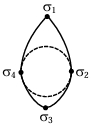
Electric charge is transferred to an irregular metallic disk as shown in the figure. If $\sigma_1, \sigma_2, \sigma_3$ and $\sigma_4$ are surface charge densities at the given points,then choose the correct answer from the options given below:
A
$\sigma_1 > \sigma_3 ; \sigma_2 = \sigma_4$
B
$\sigma_1 > \sigma_2 ; \sigma_3 > \sigma_4$
C
$\sigma_1 > \sigma_3 > \sigma_2 = \sigma_4$
D
$\sigma_1 < \sigma_3 < \sigma_2 = \sigma_4$
Solution
(C) For a charged conductor,the surface charge density $\sigma$ is inversely proportional to the radius of curvature $(ROC)$ at that point,i.e.,$\sigma \propto \frac{1}{ROC}$.
From the figure,the radius of curvature at the sharpest point (top) is the smallest,and it increases as we move towards the flatter sides.
Comparing the points:
$1$. The point at $\sigma_1$ has the smallest radius of curvature.
$2$. The point at $\sigma_3$ has a larger radius of curvature than $\sigma_1$ but smaller than the sides.
$3$. The points at $\sigma_2$ and $\sigma_4$ are on the flatter sides,where the radius of curvature is the largest and equal.
Thus,the order of radius of curvature is $(ROC)_1 < (ROC)_3 < (ROC)_2 = (ROC)_4$.
Since $\sigma \propto \frac{1}{ROC}$,the order of surface charge densities is $\sigma_1 > \sigma_3 > \sigma_2 = \sigma_4$.
Therefore,the correct option is $(C)$.
From the figure,the radius of curvature at the sharpest point (top) is the smallest,and it increases as we move towards the flatter sides.
Comparing the points:
$1$. The point at $\sigma_1$ has the smallest radius of curvature.
$2$. The point at $\sigma_3$ has a larger radius of curvature than $\sigma_1$ but smaller than the sides.
$3$. The points at $\sigma_2$ and $\sigma_4$ are on the flatter sides,where the radius of curvature is the largest and equal.
Thus,the order of radius of curvature is $(ROC)_1 < (ROC)_3 < (ROC)_2 = (ROC)_4$.
Since $\sigma \propto \frac{1}{ROC}$,the order of surface charge densities is $\sigma_1 > \sigma_3 > \sigma_2 = \sigma_4$.
Therefore,the correct option is $(C)$.
0 likes
View Solution32
MediumMCQ
$A$ disc of radius $R$ is charged on its surface with surface charge density $\sigma = \sigma_0 r^3$. Here $\sigma_0$ is a constant and $r$ is the distance from its centre. The total charge on the disc is:
A
$\frac{2 \pi \sigma_0 R^5}{5}$
B
$2 \pi \sigma_0 R^5$
C
$\frac{\pi \sigma_0 R^4}{2}$
D
$\frac{\sigma_0 R^4}{4}$
Solution
(A) The total charge $q_{\text{total}}$ on the disc is calculated by integrating the surface charge density over the area of the disc.
Consider a small elemental ring of radius $r$ and width $dr$. The area of this ring is $ds = 2 \pi r dr$.
The total charge is given by:
$q_{\text{total}} = \int_0^R \sigma ds$
Substituting $\sigma = \sigma_0 r^3$ and $ds = 2 \pi r dr$:
$q_{\text{total}} = \int_0^R (\sigma_0 r^3)(2 \pi r dr)$
$q_{\text{total}} = 2 \pi \sigma_0 \int_0^R r^4 dr$
Performing the integration:
$q_{\text{total}} = 2 \pi \sigma_0 \left[ \frac{r^5}{5} \right]_0^R$
$q_{\text{total}} = \frac{2 \pi \sigma_0 R^5}{5}$
Consider a small elemental ring of radius $r$ and width $dr$. The area of this ring is $ds = 2 \pi r dr$.
The total charge is given by:
$q_{\text{total}} = \int_0^R \sigma ds$
Substituting $\sigma = \sigma_0 r^3$ and $ds = 2 \pi r dr$:
$q_{\text{total}} = \int_0^R (\sigma_0 r^3)(2 \pi r dr)$
$q_{\text{total}} = 2 \pi \sigma_0 \int_0^R r^4 dr$
Performing the integration:
$q_{\text{total}} = 2 \pi \sigma_0 \left[ \frac{r^5}{5} \right]_0^R$
$q_{\text{total}} = \frac{2 \pi \sigma_0 R^5}{5}$
0 likes
View Solution33
EasyMCQ
The surface charge density $\sigma$ on a charged conducting sphere of radius $R$ in terms of the electric field intensity $E$ at a distance $r$ $(r > R)$ in free space is (where $\varepsilon_{0}$ is the permittivity of free space):
A
$\varepsilon_{0} E \frac{R}{r}$
B
$\varepsilon_{0} E \left(\frac{r}{R}\right)^{2}$
C
$\varepsilon_{0} E \frac{r}{R}$
D
$\varepsilon_{0} E \left(\frac{R}{r}\right)^{2}$
Solution
(B) The electric field $E$ at a distance $r$ from the center of a charged conducting sphere of radius $R$ is given by Gauss's Law as $E = \frac{1}{4 \pi \varepsilon_{0}} \frac{Q}{r^{2}}$.
Since the total charge $Q$ on the sphere is related to the surface charge density $\sigma$ by $Q = \sigma \cdot (4 \pi R^{2})$,we substitute this into the electric field equation.
$E = \frac{1}{4 \pi \varepsilon_{0}} \frac{\sigma (4 \pi R^{2})}{r^{2}}$.
Simplifying the expression,we get $E = \frac{\sigma R^{2}}{\varepsilon_{0} r^{2}}$.
Rearranging the formula to solve for $\sigma$,we get $\sigma = E \varepsilon_{0} \left(\frac{r}{R}\right)^{2}$.
Since the total charge $Q$ on the sphere is related to the surface charge density $\sigma$ by $Q = \sigma \cdot (4 \pi R^{2})$,we substitute this into the electric field equation.
$E = \frac{1}{4 \pi \varepsilon_{0}} \frac{\sigma (4 \pi R^{2})}{r^{2}}$.
Simplifying the expression,we get $E = \frac{\sigma R^{2}}{\varepsilon_{0} r^{2}}$.
Rearranging the formula to solve for $\sigma$,we get $\sigma = E \varepsilon_{0} \left(\frac{r}{R}\right)^{2}$.
0 likes
View Solution34
EasyMCQ
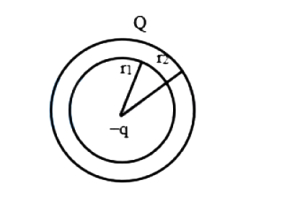
$A$ spherical conducting shell of inner radius $r_1$ and outer radius $r_2$ has a net charge $Q$. $A$ point charge $-q$ is placed at the center of the shell. Determine the surface charge density on the inner and outer surfaces of the shell.
A
$\frac{q}{4 \pi r_1^2}$ and $\frac{Q-q}{4 \pi r_2^2}$
B
$\frac{q}{4 \pi r_1^2}$ and $\frac{Q}{4 \pi r_2^2}$
C
$\frac{-q}{4 \pi r_1^2}$ and $\frac{Q+q}{4 \pi r_2^2}$
D
zero and $\frac{Q-q}{4 \pi r_2^2}$
Solution
(A) $1$. According to the principle of electrostatic induction,when a charge $-q$ is placed at the center of a conducting shell,an equal and opposite charge $+q$ is induced on the inner surface of the shell to ensure the electric field inside the conductor is zero.
$2$. The inner surface of the shell now has a charge of $+q$. The surface charge density on the inner surface is given by $\sigma_{inner} = \frac{q}{4 \pi r_1^2}$.
$3$. Since the shell has a total charge $Q$ and the inner surface has a charge $+q$,the charge on the outer surface must be $Q_{outer} = Q - q$ to conserve the total charge.
$4$. The surface charge density on the outer surface is given by $\sigma_{outer} = \frac{Q-q}{4 \pi r_2^2}$.
$5$. Therefore,the surface charge densities are $\frac{q}{4 \pi r_1^2}$ and $\frac{Q-q}{4 \pi r_2^2}$.
$2$. The inner surface of the shell now has a charge of $+q$. The surface charge density on the inner surface is given by $\sigma_{inner} = \frac{q}{4 \pi r_1^2}$.
$3$. Since the shell has a total charge $Q$ and the inner surface has a charge $+q$,the charge on the outer surface must be $Q_{outer} = Q - q$ to conserve the total charge.
$4$. The surface charge density on the outer surface is given by $\sigma_{outer} = \frac{Q-q}{4 \pi r_2^2}$.
$5$. Therefore,the surface charge densities are $\frac{q}{4 \pi r_1^2}$ and $\frac{Q-q}{4 \pi r_2^2}$.
0 likes
View Solution35
EasyMCQ
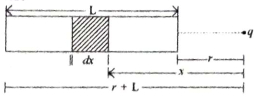
$A$ point charge $q$ is situated at a distance $r$ on the axis from one end of a thin conducting rod of length $L$ having a charge $Q$ (uniformly distributed along its length). The magnitude of the electric force between the two is . . . . . . .
A
$\frac{2 k Q q}{r(r+ L )}$
B
$\frac{k Q q}{r^2}$
C
$\frac{k Q q}{r(r- L )}$
D
$\frac{k Q q}{r(r+ L )}$
Solution
(D) As shown in the figure,consider an elementary charge $dq$ having length $dx$ at a distance $x$ from the point charge $q$. The linear charge density is $\lambda = \frac{Q}{L}$.
Then,$dq = \lambda dx = \frac{Q}{L} dx$.
By Coulomb's law,the force $dF$ between the elementary charge $dq$ and the point charge $q$ is:
$dF = \frac{k q dq}{x^2} = \frac{k q Q dx}{L x^2}$.
To find the total force $F$,integrate $dF$ from $x = r$ to $x = r + L$:
$F = \int_r^{r+L} \frac{k Q q}{L x^2} dx = \frac{k Q q}{L} \int_r^{r+L} x^{-2} dx$.
$F = \frac{k Q q}{L} \left[ -\frac{1}{x} \right]_r^{r+L} = \frac{k Q q}{L} \left( -\frac{1}{r+L} - (-\frac{1}{r}) \right)$.
$F = \frac{k Q q}{L} \left( \frac{1}{r} - \frac{1}{r+L} \right) = \frac{k Q q}{L} \left( \frac{r+L-r}{r(r+L)} \right)$.
$F = \frac{k Q q}{L} \left( \frac{L}{r(r+L)} \right) = \frac{k Q q}{r(r+L)}$.
Then,$dq = \lambda dx = \frac{Q}{L} dx$.
By Coulomb's law,the force $dF$ between the elementary charge $dq$ and the point charge $q$ is:
$dF = \frac{k q dq}{x^2} = \frac{k q Q dx}{L x^2}$.
To find the total force $F$,integrate $dF$ from $x = r$ to $x = r + L$:
$F = \int_r^{r+L} \frac{k Q q}{L x^2} dx = \frac{k Q q}{L} \int_r^{r+L} x^{-2} dx$.
$F = \frac{k Q q}{L} \left[ -\frac{1}{x} \right]_r^{r+L} = \frac{k Q q}{L} \left( -\frac{1}{r+L} - (-\frac{1}{r}) \right)$.
$F = \frac{k Q q}{L} \left( \frac{1}{r} - \frac{1}{r+L} \right) = \frac{k Q q}{L} \left( \frac{r+L-r}{r(r+L)} \right)$.
$F = \frac{k Q q}{L} \left( \frac{L}{r(r+L)} \right) = \frac{k Q q}{r(r+L)}$.
0 likes
View Solution36
EasyMCQ
$A$ circle of radius $a$ has a linear charge density given by $\lambda = \lambda_0 \cos^2 \theta$ on its circumference. What will be the total charge on the circle?
A
$\pi a \lambda_0$
B
zero
C
$2 \pi a$
D
None of these.
Solution
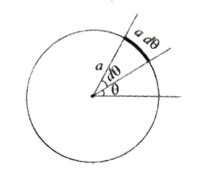
(A) As shown in the figure,let us consider an element of angular width $d \theta$ at an angle $\theta$.
The length of this element is $dl = a d \theta$.
The charge on this element is $dq = \lambda dl = (\lambda_0 \cos^2 \theta) (a d \theta)$.
The total charge $Q$ on the circle is obtained by integrating $dq$ over the entire circumference from $0$ to $2 \pi$:
$Q = \int_{0}^{2 \pi} \lambda_0 \cos^2 \theta a d \theta$
$Q = a \lambda_0 \int_{0}^{2 \pi} \cos^2 \theta d \theta$
Using the identity $\cos^2 \theta = \frac{1 + \cos 2 \theta}{2}$:
$Q = a \lambda_0 \int_{0}^{2 \pi} \frac{1 + \cos 2 \theta}{2} d \theta$
$Q = \frac{a \lambda_0}{2} [\theta + \frac{\sin 2 \theta}{2}]_{0}^{2 \pi}$
$Q = \frac{a \lambda_0}{2} [(2 \pi + 0) - (0 + 0)]$
$Q = \frac{a \lambda_0}{2} (2 \pi) = \pi a \lambda_0$
Thus,the total charge is $\pi a \lambda_0$.
The length of this element is $dl = a d \theta$.
The charge on this element is $dq = \lambda dl = (\lambda_0 \cos^2 \theta) (a d \theta)$.
The total charge $Q$ on the circle is obtained by integrating $dq$ over the entire circumference from $0$ to $2 \pi$:
$Q = \int_{0}^{2 \pi} \lambda_0 \cos^2 \theta a d \theta$
$Q = a \lambda_0 \int_{0}^{2 \pi} \cos^2 \theta d \theta$
Using the identity $\cos^2 \theta = \frac{1 + \cos 2 \theta}{2}$:
$Q = a \lambda_0 \int_{0}^{2 \pi} \frac{1 + \cos 2 \theta}{2} d \theta$
$Q = \frac{a \lambda_0}{2} [\theta + \frac{\sin 2 \theta}{2}]_{0}^{2 \pi}$
$Q = \frac{a \lambda_0}{2} [(2 \pi + 0) - (0 + 0)]$
$Q = \frac{a \lambda_0}{2} (2 \pi) = \pi a \lambda_0$
Thus,the total charge is $\pi a \lambda_0$.
0 likes
View Solution37
EasyMCQ
How much charge should be placed on a spherical shell of radius $25 \ cm$ to have a surface charge density of $\frac{3}{\pi} \mu C/m^2$ (in $\mu C$)?
A
$0.57$
B
$0.75$
C
$0.25$
D
$0.5$
Solution
(B) The surface charge density $\sigma$ is defined as the charge $Q$ per unit area $A$ of the surface.
Given: Radius $r = 25 \ cm = 0.25 \ m = \frac{1}{4} \ m$.
Surface charge density $\sigma = \frac{3}{\pi} \ \mu C/m^2$.
The surface area of a spherical shell is $A = 4 \pi r^2$.
Using the formula $\sigma = \frac{Q}{A}$,we get $Q = \sigma \times A = \sigma \times 4 \pi r^2$.
Substituting the values:
$Q = \left( \frac{3}{\pi} \ \mu C/m^2 \right) \times 4 \pi \times (0.25 \ m)^2$
$Q = 3 \times 4 \times (0.0625) \ \mu C$
$Q = 12 \times 0.0625 \ \mu C = 0.75 \ \mu C$.
Therefore,the charge required is $0.75 \ \mu C$.
Given: Radius $r = 25 \ cm = 0.25 \ m = \frac{1}{4} \ m$.
Surface charge density $\sigma = \frac{3}{\pi} \ \mu C/m^2$.
The surface area of a spherical shell is $A = 4 \pi r^2$.
Using the formula $\sigma = \frac{Q}{A}$,we get $Q = \sigma \times A = \sigma \times 4 \pi r^2$.
Substituting the values:
$Q = \left( \frac{3}{\pi} \ \mu C/m^2 \right) \times 4 \pi \times (0.25 \ m)^2$
$Q = 3 \times 4 \times (0.0625) \ \mu C$
$Q = 12 \times 0.0625 \ \mu C = 0.75 \ \mu C$.
Therefore,the charge required is $0.75 \ \mu C$.
0 likes
View Solution38
EasyMCQ
$A$ uniformly charged conducting sphere of $2.4 \, m$ diameter has a surface charge density of $80.0 \, \mu C m^{-2}$. The charge on the sphere is nearly
A
$2.5 \times 10^{-3} \, C$
B
$1.45 \times 10^{-3} \, C$
C
$6.5 \times 10^{-3} \, C$
D
$0.15 \times 10^{-3} \, C$
Solution
(B) Given: Diameter of the sphere $d = 2.4 \, m$.
Radius of the sphere $r = \frac{d}{2} = 1.2 \, m$.
Surface charge density $\sigma = 80.0 \, \mu C m^{-2} = 80 \times 10^{-6} \, C m^{-2}$.
The total charge $Q$ on the surface of the sphere is given by the product of surface charge density and surface area $A$.
$Q = \sigma \times A = \sigma \times (4 \pi r^2)$.
Substituting the values:
$Q = 80 \times 10^{-6} \times 4 \times 3.14159 \times (1.2)^2$.
$Q = 80 \times 10^{-6} \times 4 \times 3.14159 \times 1.44$.
$Q \approx 1.4476 \times 10^{-3} \, C$.
Rounding to the nearest value, $Q \approx 1.45 \times 10^{-3} \, C$.
Radius of the sphere $r = \frac{d}{2} = 1.2 \, m$.
Surface charge density $\sigma = 80.0 \, \mu C m^{-2} = 80 \times 10^{-6} \, C m^{-2}$.
The total charge $Q$ on the surface of the sphere is given by the product of surface charge density and surface area $A$.
$Q = \sigma \times A = \sigma \times (4 \pi r^2)$.
Substituting the values:
$Q = 80 \times 10^{-6} \times 4 \times 3.14159 \times (1.2)^2$.
$Q = 80 \times 10^{-6} \times 4 \times 3.14159 \times 1.44$.
$Q \approx 1.4476 \times 10^{-3} \, C$.
Rounding to the nearest value, $Q \approx 1.45 \times 10^{-3} \, C$.
0 likes
View Solution39
DifficultMCQ
$A$ particle of mass $2 \times 10^{-6} \ kg$ with a charge $5 \times 10^{-6} \ C$ is hanging in air above a similarly charged conducting surface. The charge density of the surface is (Assume $\epsilon_0 = 8.85 \times 10^{-12} \ C^2 N^{-1} m^{-2}$ and $g = 10 \ m \ s^{-2}$)
A
$35.4 \times 10^{-12} \ C \ m^{-2}$
B
$23.6 \times 10^{-12} \ C \ m^{-2}$
C
$53.1 \times 10^{-12} \ C \ m^{-2}$
D
$17.7 \times 10^{-12} \ C \ m^{-2}$
Solution
(A) Given: Mass of the particle $m = 2 \times 10^{-6} \ kg$,charge on the particle $q = 5 \times 10^{-6} \ C$.
The electric field $E$ due to a charged conducting surface is given by $E = \frac{\sigma}{\epsilon_0}$,where $\sigma$ is the surface charge density.
For the particle to hang in the air,the electric force must balance the gravitational force acting on it.
$F_e = F_g \Rightarrow qE = mg$
Substituting $E = \frac{\sigma}{\epsilon_0}$ into the equation:
$q \left( \frac{\sigma}{\epsilon_0} \right) = mg$
$\sigma = \frac{mg \epsilon_0}{q}$
Substituting the given values:
$\sigma = \frac{(2 \times 10^{-6} \ kg) \times (10 \ m \ s^{-2}) \times (8.85 \times 10^{-12} \ C^2 N^{-1} m^{-2})}{5 \times 10^{-6} \ C}$
$\sigma = \frac{20 \times 8.85 \times 10^{-18}}{5 \times 10^{-6}}$
$\sigma = 4 \times 8.85 \times 10^{-12} \ C \ m^{-2}$
$\sigma = 35.4 \times 10^{-12} \ C \ m^{-2}$
The electric field $E$ due to a charged conducting surface is given by $E = \frac{\sigma}{\epsilon_0}$,where $\sigma$ is the surface charge density.
For the particle to hang in the air,the electric force must balance the gravitational force acting on it.
$F_e = F_g \Rightarrow qE = mg$
Substituting $E = \frac{\sigma}{\epsilon_0}$ into the equation:
$q \left( \frac{\sigma}{\epsilon_0} \right) = mg$
$\sigma = \frac{mg \epsilon_0}{q}$
Substituting the given values:
$\sigma = \frac{(2 \times 10^{-6} \ kg) \times (10 \ m \ s^{-2}) \times (8.85 \times 10^{-12} \ C^2 N^{-1} m^{-2})}{5 \times 10^{-6} \ C}$
$\sigma = \frac{20 \times 8.85 \times 10^{-18}}{5 \times 10^{-6}}$
$\sigma = 4 \times 8.85 \times 10^{-12} \ C \ m^{-2}$
$\sigma = 35.4 \times 10^{-12} \ C \ m^{-2}$
0 likes
View Solution40
DifficultMCQ
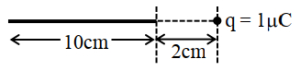
$A$ point charge $q = 1 \mu C$ is located at a distance $2 \text{ cm}$ from one end of a thin insulating wire of length $L = 10 \text{ cm}$ having a charge $Q = 24 \mu C$,distributed uniformly along its length,as shown in the figure. The force between $q$ and the wire is . . . . . . $N$. (Use $\frac{1}{4 \pi \epsilon_0} = 9 \times 10^9 \text{ N} \cdot \text{m}^2 / \text{C}^2$)
A
$45$
B
$90$
C
$180$
D
$60$
Solution
(B) Let the point charge $q$ be at the origin $x=0$. The wire extends from $x = 2 \text{ cm}$ to $x = 12 \text{ cm}$.
The linear charge density of the wire is $\lambda = \frac{Q}{L} = \frac{24 \times 10^{-6} \text{ C}}{0.1 \text{ m}} = 2.4 \times 10^{-4} \text{ C/m}$.
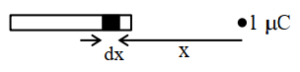
Consider a small element $dx$ of the wire at a distance $x$ from the point charge $q$. The charge on this element is $dq = \lambda dx$.
The force between the point charge $q$ and the element $dq$ is $dF = \frac{k q dq}{x^2} = \frac{k q \lambda dx}{x^2}$,where $k = 9 \times 10^9 \text{ N} \cdot \text{m}^2 / \text{C}^2$.
The total force $F$ is the integral of $dF$ from $x = 2 \text{ cm} = 0.02 \text{ m}$ to $x = 12 \text{ cm} = 0.12 \text{ m}$:
$F = \int_{0.02}^{0.12} \frac{k q \lambda}{x^2} dx = k q \lambda \left[ -\frac{1}{x} \right]_{0.02}^{0.12} = k q \lambda \left( \frac{1}{0.02} - \frac{1}{0.12} \right)$
$F = (9 \times 10^9) \times (1 \times 10^{-6}) \times (2.4 \times 10^{-4}) \times \left( 50 - 8.333 \right) = 9000 \times 2.4 \times 10^{-4} \times \left( \frac{6-1}{0.12} \right) = 9000 \times 2.4 \times 10^{-4} \times \frac{5}{0.12} = 90 \text{ N}$.
The linear charge density of the wire is $\lambda = \frac{Q}{L} = \frac{24 \times 10^{-6} \text{ C}}{0.1 \text{ m}} = 2.4 \times 10^{-4} \text{ C/m}$.
Consider a small element $dx$ of the wire at a distance $x$ from the point charge $q$. The charge on this element is $dq = \lambda dx$.
The force between the point charge $q$ and the element $dq$ is $dF = \frac{k q dq}{x^2} = \frac{k q \lambda dx}{x^2}$,where $k = 9 \times 10^9 \text{ N} \cdot \text{m}^2 / \text{C}^2$.
The total force $F$ is the integral of $dF$ from $x = 2 \text{ cm} = 0.02 \text{ m}$ to $x = 12 \text{ cm} = 0.12 \text{ m}$:
$F = \int_{0.02}^{0.12} \frac{k q \lambda}{x^2} dx = k q \lambda \left[ -\frac{1}{x} \right]_{0.02}^{0.12} = k q \lambda \left( \frac{1}{0.02} - \frac{1}{0.12} \right)$
$F = (9 \times 10^9) \times (1 \times 10^{-6}) \times (2.4 \times 10^{-4}) \times \left( 50 - 8.333 \right) = 9000 \times 2.4 \times 10^{-4} \times \left( \frac{6-1}{0.12} \right) = 9000 \times 2.4 \times 10^{-4} \times \frac{5}{0.12} = 90 \text{ N}$.
0 likes
View SolutionElectric Charges and Fields — Charge and Charge Density (Distribution of Charges) · Frequently Asked Questions
1Are these Electric Charges and Fields questions useful for JEE and NEET?
Yes. All questions in this section are mapped to JEE Main and NEET exam patterns. Previous year questions from JEE Main, NEET, GUJCET and state-level exams are included with full solutions.
2Can I switch to Hindi or Gujarati for these questions?
Yes. Use the language tabs in the hero section or the sidebar to view the same questions and solutions in English, Hindi or Gujarati.
3How do I generate a question paper from this subtopic?
Use the Vedclass Exam Paper Generator — select the chapter and subtopic, set difficulty, and generate Sets A, B, C, D automatically. First 3 chapters of every subject are free.
Vedclass Products
For Students
Vedclass Test Series
Mock tests in real JEE/NEET style with performance analysis. 5-day free trial.
Start Free TrialFor Teachers
Exam Paper Generator
Generate Set A/B/C/D papers from this chapter in 2 minutes. 3 chapters free.
Try FreeFor Institutes
Online Exam Module
Live online exams with unlimited students, 360° analytics & white-label branding.
See DemoFor Teachers & Institutes
Generate a Electric Charges and Fields Exam Paper in 2 Minutes
Select subtopic & difficulty — Sets A, B, C, D auto-generated with No Repeat logic.
First 3 chapters of every subject are free — no payment required.