
A English
Electric Field and usage of Gauss's Law Questions in English
Class 12 Physics · Electric Charges and Fields · Electric Field and usage of Gauss's Law
235+
Questions
English
Language
100%
With Solutions
Showing 50 of 235 questions in English
1
EasyMCQ
The electric field inside a spherical shell of uniform surface charge density is
A
Zero
B
Constant,less than zero
C
Directly proportional to the distance from the centre
D
None of the above
Solution
(A) According to Gauss's Law,the electric flux through a closed surface is given by $\oint E \cdot dA = \frac{q_{enclosed}}{\epsilon_0}$.
For a spherical shell with uniform surface charge density,all the charge resides on the outer surface.
Therefore,for any point inside the shell,the enclosed charge $q_{enclosed} = 0$.
Consequently,the electric field $E$ inside the spherical shell is $0$.
For a spherical shell with uniform surface charge density,all the charge resides on the outer surface.
Therefore,for any point inside the shell,the enclosed charge $q_{enclosed} = 0$.
Consequently,the electric field $E$ inside the spherical shell is $0$.
0 likes
View Solution2
EasyMCQ
The electric field near a conducting surface having a uniform surface charge density $\sigma$ is given by:
A
$\frac{\sigma}{\varepsilon_0}$ and is parallel to the surface
B
$\frac{2\sigma}{\varepsilon_0}$ and is parallel to the surface
C
$\frac{\sigma}{\varepsilon_0}$ and is normal to the surface
D
$\frac{2\sigma}{\varepsilon_0}$ and is normal to the surface
Solution
(C) According to Gauss's Law,for a charged conductor,the electric field just outside the surface is perpendicular to the surface.
By applying Gauss's Law to a small cylindrical Gaussian surface enclosing a charge $\sigma A$ on the conductor,we have $\oint E \cdot dA = \frac{q_{enclosed}}{\varepsilon_0}$.
Since the electric field inside the conductor is zero and the field is perpendicular to the surface,the flux through the curved surface is zero,and the flux through the inner flat face is zero.
Thus,$E \cdot A = \frac{\sigma A}{\varepsilon_0}$,which simplifies to $E = \frac{\sigma}{\varepsilon_0}$.
Therefore,the electric field is $\frac{\sigma}{\varepsilon_0}$ and is directed normal to the surface.
By applying Gauss's Law to a small cylindrical Gaussian surface enclosing a charge $\sigma A$ on the conductor,we have $\oint E \cdot dA = \frac{q_{enclosed}}{\varepsilon_0}$.
Since the electric field inside the conductor is zero and the field is perpendicular to the surface,the flux through the curved surface is zero,and the flux through the inner flat face is zero.
Thus,$E \cdot A = \frac{\sigma A}{\varepsilon_0}$,which simplifies to $E = \frac{\sigma}{\varepsilon_0}$.
Therefore,the electric field is $\frac{\sigma}{\varepsilon_0}$ and is directed normal to the surface.
0 likes
View Solution3
EasyMCQ
$A$ hollow insulated conducting sphere is given a positive charge of $10\,\mu C$. What will be the electric field at the centre of the sphere if its radius is $2\,m$?
A
$0$
B
$5$
C
$20$
D
$8$
Solution
(A) For a hollow conducting sphere,the charge resides entirely on its outer surface.
According to Gauss's Law,the electric field inside a closed conducting shell is always zero because there is no enclosed charge within any Gaussian surface drawn inside the sphere.
Therefore,the electric field at the centre of the sphere is $0\,N/C$.
According to Gauss's Law,the electric field inside a closed conducting shell is always zero because there is no enclosed charge within any Gaussian surface drawn inside the sphere.
Therefore,the electric field at the centre of the sphere is $0\,N/C$.
0 likes
View Solution4
EasyMCQ
There is a solid sphere of radius $R$ having uniformly distributed charge throughout it. What is the relation between electric field $E$ and distance $r$ from the centre (where $r < R$)?
A
$E \propto r^{-2}$
B
$E \propto r^{-1}$
C
$E \propto r$
D
$E \propto r^2$
Solution
(C) For a solid sphere of radius $R$ with a total charge $Q$ uniformly distributed throughout its volume,the charge density is $\rho = \frac{Q}{\frac{4}{3}\pi R^3}$.
Using Gauss's Law for a Gaussian surface of radius $r < R$,the enclosed charge is $q_{enc} = \rho \cdot (\frac{4}{3}\pi r^3) = Q \cdot \frac{r^3}{R^3}$.
The electric field $E$ at a distance $r$ is given by $\oint E \cdot dA = \frac{q_{enc}}{\varepsilon_0}$.
$E(4\pi r^2) = \frac{Q r^3}{\varepsilon_0 R^3}$.
Solving for $E$,we get $E = \frac{Q r}{4\pi \varepsilon_0 R^3}$.
Since $Q$,$\varepsilon_0$,and $R$ are constants,it follows that $E \propto r$.
Using Gauss's Law for a Gaussian surface of radius $r < R$,the enclosed charge is $q_{enc} = \rho \cdot (\frac{4}{3}\pi r^3) = Q \cdot \frac{r^3}{R^3}$.
The electric field $E$ at a distance $r$ is given by $\oint E \cdot dA = \frac{q_{enc}}{\varepsilon_0}$.
$E(4\pi r^2) = \frac{Q r^3}{\varepsilon_0 R^3}$.
Solving for $E$,we get $E = \frac{Q r}{4\pi \varepsilon_0 R^3}$.
Since $Q$,$\varepsilon_0$,and $R$ are constants,it follows that $E \propto r$.
0 likes
View Solution5
EasyMCQ
If $q$ is the charge per unit area on the surface of a conductor,then the electric field intensity at a point on the surface is
A
$\frac{q}{\varepsilon_0}$ normal to surface
B
$\frac{q}{2\varepsilon_0}$ normal to surface
C
$\frac{q}{\varepsilon_0}$ tangential to surface
D
$\frac{q}{2\varepsilon_0}$ tangential to surface
Solution
(A) For a charged conductor,the electric field just outside the surface is given by Gauss's Law.
Consider a small Gaussian pillbox surface enclosing a small area $A$ on the conductor's surface.
The electric field inside the conductor is $0$.
The electric field just outside the surface is perpendicular to the surface.
Applying Gauss's Law: $\oint E \cdot dA = \frac{q_{enclosed}}{\varepsilon_0}$.
Since the field is perpendicular to the surface,$E \cdot A = \frac{\sigma A}{\varepsilon_0}$,where $\sigma$ is the surface charge density (given as $q$ in the question).
Thus,$E = \frac{q}{\varepsilon_0}$ directed normally to the surface.
Consider a small Gaussian pillbox surface enclosing a small area $A$ on the conductor's surface.
The electric field inside the conductor is $0$.
The electric field just outside the surface is perpendicular to the surface.
Applying Gauss's Law: $\oint E \cdot dA = \frac{q_{enclosed}}{\varepsilon_0}$.
Since the field is perpendicular to the surface,$E \cdot A = \frac{\sigma A}{\varepsilon_0}$,where $\sigma$ is the surface charge density (given as $q$ in the question).
Thus,$E = \frac{q}{\varepsilon_0}$ directed normally to the surface.
0 likes
View Solution6
EasyMCQ
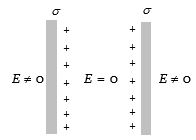
The electric field intensity at a point between two parallel sheets with like charges of the same surface charge density $(\sigma)$ is:
A
$\frac{\sigma}{2\varepsilon_0}$
B
$\frac{\sigma}{\varepsilon_0}$
C
Zero
D
$\frac{2\sigma}{\varepsilon_0}$
Solution
(C) The electric field due to a single infinite sheet with surface charge density $\sigma$ is given by $E = \frac{\sigma}{2\varepsilon_0}$.
For two parallel sheets with the same surface charge density $\sigma$ and like charges,the electric fields produced by each sheet at a point between them point in opposite directions.
Let the first sheet be on the left and the second on the right. The field from the left sheet points to the right $(E_1 = \frac{\sigma}{2\varepsilon_0})$,and the field from the right sheet points to the left $(E_2 = \frac{\sigma}{2\varepsilon_0})$.
The net electric field $E_{net} = E_1 - E_2 = \frac{\sigma}{2\varepsilon_0} - \frac{\sigma}{2\varepsilon_0} = 0$.
For two parallel sheets with the same surface charge density $\sigma$ and like charges,the electric fields produced by each sheet at a point between them point in opposite directions.
Let the first sheet be on the left and the second on the right. The field from the left sheet points to the right $(E_1 = \frac{\sigma}{2\varepsilon_0})$,and the field from the right sheet points to the left $(E_2 = \frac{\sigma}{2\varepsilon_0})$.
The net electric field $E_{net} = E_1 - E_2 = \frac{\sigma}{2\varepsilon_0} - \frac{\sigma}{2\varepsilon_0} = 0$.
0 likes
View Solution7
EasyMCQ
$A$ hollow sphere of charge does not produce an electric field at any
A
Point beyond $2 \ m$
B
Point beyond $10 \ m$
C
Interior point
D
Outer point
Solution
(C) According to Gauss's Law,for a hollow charged spherical conductor,the charge resides only on the outer surface.
For any point inside the hollow sphere,the Gaussian surface encloses zero net charge $(q_{enclosed} = 0)$.
Therefore,the electric field $E$ at any interior point is given by $E = \frac{1}{4\pi\epsilon_0} \frac{q_{enclosed}}{r^2} = 0$.
For any point inside the hollow sphere,the Gaussian surface encloses zero net charge $(q_{enclosed} = 0)$.
Therefore,the electric field $E$ at any interior point is given by $E = \frac{1}{4\pi\epsilon_0} \frac{q_{enclosed}}{r^2} = 0$.
0 likes
View Solution8
EasyMCQ
$A$ conducting sphere of radius $R = 20 \ cm$ is given a charge $Q = 16 \ \mu C$. What is the electric field $\overrightarrow{E}$ at the centre?
A
$3.6 \times 10^6 \ N/C$
B
$1.8 \times 10^6 \ N/C$
C
Zero
D
$0.9 \times 10^6 \ N/C$
Solution
(C) For a conducting sphere,the charge $Q$ resides entirely on its outer surface.
According to Gauss's Law,for any point inside a closed conducting surface,the net electric field is zero.
Since the centre of the sphere is inside the conductor,the electric field $\overrightarrow{E}$ at the centre is $0 \ N/C$.
According to Gauss's Law,for any point inside a closed conducting surface,the net electric field is zero.
Since the centre of the sphere is inside the conductor,the electric field $\overrightarrow{E}$ at the centre is $0 \ N/C$.
4 likes
View Solution9
MediumMCQ
If an insulated non-conducting sphere of radius $R$ has charge density $\rho$,the electric field at a distance $r$ from the centre of the sphere $(r < R)$ will be
A
$\frac{\rho R}{3\varepsilon_0}$
B
$\frac{\rho r}{\varepsilon_0}$
C
$\frac{\rho r}{3\varepsilon_0}$
D
$\frac{3\rho R}{\varepsilon_0}$
Solution
(C) According to Gauss's Law,the electric flux through a Gaussian surface is given by $\oint E \cdot dA = \frac{q_{enc}}{\varepsilon_0}$.
For a non-conducting sphere with uniform charge density $\rho$,the charge enclosed $q_{enc}$ within a sphere of radius $r$ $(r < R)$ is $q_{enc} = \rho \times V = \rho \times (\frac{4}{3} \pi r^3)$.
Applying Gauss's Law for a spherical Gaussian surface of radius $r$:
$E \times (4 \pi r^2) = \frac{\rho \times (\frac{4}{3} \pi r^3)}{\varepsilon_0}$.
Simplifying the equation:
$E = \frac{\rho \times \frac{4}{3} \pi r^3}{4 \pi r^2 \varepsilon_0}$.
$E = \frac{\rho r}{3\varepsilon_0}$.
For a non-conducting sphere with uniform charge density $\rho$,the charge enclosed $q_{enc}$ within a sphere of radius $r$ $(r < R)$ is $q_{enc} = \rho \times V = \rho \times (\frac{4}{3} \pi r^3)$.
Applying Gauss's Law for a spherical Gaussian surface of radius $r$:
$E \times (4 \pi r^2) = \frac{\rho \times (\frac{4}{3} \pi r^3)}{\varepsilon_0}$.
Simplifying the equation:
$E = \frac{\rho \times \frac{4}{3} \pi r^3}{4 \pi r^2 \varepsilon_0}$.
$E = \frac{\rho r}{3\varepsilon_0}$.
0 likes
View Solution10
EasyMCQ
An infinite line charge produces a field of $7.182 \times 10^8 \, N/C$ at a distance of $2 \, cm$. The linear charge density is
A
$7.27 \times 10^{-4} \, C/m$
B
$7.98 \times 10^{-4} \, C/m$
C
$7.11 \times 10^{-4} \, C/m$
D
$7.04 \times 10^{-4} \, C/m$
Solution
(B) The electric field $E$ due to an infinite line charge is given by the formula: $E = \frac{\lambda}{2\pi\varepsilon_0 r}$.
Given values are: $E = 7.182 \times 10^8 \, N/C$ and $r = 2 \, cm = 2 \times 10^{-2} \, m$.
We know that $\frac{1}{4\pi\varepsilon_0} = 9 \times 10^9 \, N \cdot m^2/C^2$,so $\frac{1}{2\pi\varepsilon_0} = 2 \times 9 \times 10^9 = 18 \times 10^9$.
Rearranging the formula for linear charge density $\lambda$: $\lambda = E \cdot r \cdot (2\pi\varepsilon_0) = \frac{E \cdot r}{2 \cdot (1 / 4\pi\varepsilon_0)}$.
Substituting the values: $\lambda = \frac{7.182 \times 10^8 \times 2 \times 10^{-2}}{2 \times 9 \times 10^9}$.
$\lambda = \frac{7.182 \times 10^6}{18 \times 10^9} = 0.399 \times 10^{-3} \, C/m = 3.99 \times 10^{-4} \, C/m$.
Wait,recalculating: $\lambda = \frac{7.182 \times 10^8 \times 2 \times 10^{-2}}{18 \times 10^9} = \frac{14.364 \times 10^6}{18 \times 10^9} = 0.798 \times 10^{-3} = 7.98 \times 10^{-4} \, C/m$.
Given values are: $E = 7.182 \times 10^8 \, N/C$ and $r = 2 \, cm = 2 \times 10^{-2} \, m$.
We know that $\frac{1}{4\pi\varepsilon_0} = 9 \times 10^9 \, N \cdot m^2/C^2$,so $\frac{1}{2\pi\varepsilon_0} = 2 \times 9 \times 10^9 = 18 \times 10^9$.
Rearranging the formula for linear charge density $\lambda$: $\lambda = E \cdot r \cdot (2\pi\varepsilon_0) = \frac{E \cdot r}{2 \cdot (1 / 4\pi\varepsilon_0)}$.
Substituting the values: $\lambda = \frac{7.182 \times 10^8 \times 2 \times 10^{-2}}{2 \times 9 \times 10^9}$.
$\lambda = \frac{7.182 \times 10^6}{18 \times 10^9} = 0.399 \times 10^{-3} \, C/m = 3.99 \times 10^{-4} \, C/m$.
Wait,recalculating: $\lambda = \frac{7.182 \times 10^8 \times 2 \times 10^{-2}}{18 \times 10^9} = \frac{14.364 \times 10^6}{18 \times 10^9} = 0.798 \times 10^{-3} = 7.98 \times 10^{-4} \, C/m$.
0 likes
View Solution11
MediumMCQ
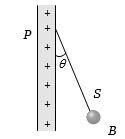
$A$ charged ball $B$ hangs from a silk thread $S$,which makes an angle $\theta$ with a large charged conducting sheet $P$,as shown in the figure. The surface charge density $\sigma$ of the sheet is proportional to
A
$\sin \theta$
B
$\tan \theta$
C
$\cos \theta$
D
$\cot \theta$
Solution
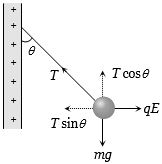
(B) Let $T$ be the tension in the silk thread,$q$ be the charge on the ball,$m$ be the mass of the ball,and $E$ be the electric field produced by the large charged sheet.
At equilibrium,the forces acting on the ball are:
$1$. Tension $T$ along the thread.
$2$. Gravitational force $mg$ acting downwards.
$3$. Electric force $qE$ acting horizontally away from the sheet.
Resolving the tension $T$ into components:
$T \sin \theta = qE$ (horizontal component)
$T \cos \theta = mg$ (vertical component)
Dividing the two equations:
$\frac{T \sin \theta}{T \cos \theta} = \frac{qE}{mg}$
$\tan \theta = \frac{qE}{mg}$
The electric field $E$ due to a large charged conducting sheet is given by $E = \frac{\sigma}{\varepsilon_0}$.
Substituting this into the equation:
$\tan \theta = \frac{q}{mg} \left( \frac{\sigma}{\varepsilon_0} \right)$
Since $q, m, g,$ and $\varepsilon_0$ are constants,we have:
$\tan \theta \propto \sigma$ or $\sigma \propto \tan \theta$.
Therefore,the correct option is $(b)$.
At equilibrium,the forces acting on the ball are:
$1$. Tension $T$ along the thread.
$2$. Gravitational force $mg$ acting downwards.
$3$. Electric force $qE$ acting horizontally away from the sheet.
Resolving the tension $T$ into components:
$T \sin \theta = qE$ (horizontal component)
$T \cos \theta = mg$ (vertical component)
Dividing the two equations:
$\frac{T \sin \theta}{T \cos \theta} = \frac{qE}{mg}$
$\tan \theta = \frac{qE}{mg}$
The electric field $E$ due to a large charged conducting sheet is given by $E = \frac{\sigma}{\varepsilon_0}$.
Substituting this into the equation:
$\tan \theta = \frac{q}{mg} \left( \frac{\sigma}{\varepsilon_0} \right)$
Since $q, m, g,$ and $\varepsilon_0$ are constants,we have:
$\tan \theta \propto \sigma$ or $\sigma \propto \tan \theta$.
Therefore,the correct option is $(b)$.
0 likes
View Solution12
MediumMCQ
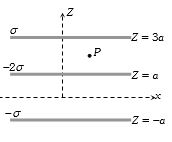
Three infinitely long charge sheets are placed as shown in the figure. The electric field at point $P$ is
A
$\frac{2\sigma}{\varepsilon_0} \hat{k}$
B
$-\frac{2\sigma}{\varepsilon_0} \hat{k}$
C
$\frac{4\sigma}{\varepsilon_0} \hat{k}$
D
$-\frac{4\sigma}{\varepsilon_0} \hat{k}$
Solution
(B) The electric field due to an infinitely long charged sheet with surface charge density $\sigma$ is given by $\vec{E} = \frac{\sigma}{2\varepsilon_0} \hat{n}$,where $\hat{n}$ is the unit vector normal to the sheet pointing away from it.
Point $P$ is located between the sheets at $Z = a$ and $Z = 3a$.
$1$. For the sheet at $Z = 3a$ with charge density $\sigma$,the field at $P$ points downwards (negative $Z$-direction): $\vec{E}_1 = -\frac{\sigma}{2\varepsilon_0} \hat{k}$.
$2$. For the sheet at $Z = a$ with charge density $-2\sigma$,the field at $P$ points towards the sheet (downwards,negative $Z$-direction): $\vec{E}_2 = -\frac{2\sigma}{2\varepsilon_0} \hat{k}$.
$3$. For the sheet at $Z = -a$ with charge density $-\sigma$,the field at $P$ points towards the sheet (downwards,negative $Z$-direction): $\vec{E}_3 = -\frac{\sigma}{2\varepsilon_0} \hat{k}$.
The net electric field at $P$ is the vector sum: $\vec{E} = \vec{E}_1 + \vec{E}_2 + \vec{E}_3 = -\frac{\sigma}{2\varepsilon_0} \hat{k} - \frac{2\sigma}{2\varepsilon_0} \hat{k} - \frac{\sigma}{2\varepsilon_0} \hat{k} = -\frac{4\sigma}{2\varepsilon_0} \hat{k} = -\frac{2\sigma}{\varepsilon_0} \hat{k}$.
Point $P$ is located between the sheets at $Z = a$ and $Z = 3a$.
$1$. For the sheet at $Z = 3a$ with charge density $\sigma$,the field at $P$ points downwards (negative $Z$-direction): $\vec{E}_1 = -\frac{\sigma}{2\varepsilon_0} \hat{k}$.
$2$. For the sheet at $Z = a$ with charge density $-2\sigma$,the field at $P$ points towards the sheet (downwards,negative $Z$-direction): $\vec{E}_2 = -\frac{2\sigma}{2\varepsilon_0} \hat{k}$.
$3$. For the sheet at $Z = -a$ with charge density $-\sigma$,the field at $P$ points towards the sheet (downwards,negative $Z$-direction): $\vec{E}_3 = -\frac{\sigma}{2\varepsilon_0} \hat{k}$.
The net electric field at $P$ is the vector sum: $\vec{E} = \vec{E}_1 + \vec{E}_2 + \vec{E}_3 = -\frac{\sigma}{2\varepsilon_0} \hat{k} - \frac{2\sigma}{2\varepsilon_0} \hat{k} - \frac{\sigma}{2\varepsilon_0} \hat{k} = -\frac{4\sigma}{2\varepsilon_0} \hat{k} = -\frac{2\sigma}{\varepsilon_0} \hat{k}$.
0 likes
View Solution13
EasyMCQ
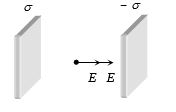
Two infinitely long parallel conducting plates having surface charge densities $+\sigma$ and $-\sigma$ respectively,are separated by a small distance. The medium between the plates is vacuum. If $\varepsilon_0$ is the dielectric permittivity of vacuum,then the electric field in the region between the plates is
A
$0 \text{ V/m}$
B
$\frac{\sigma}{2\varepsilon_0} \text{ V/m}$
C
$\frac{\sigma}{\varepsilon_0} \text{ V/m}$
D
$\frac{2\sigma}{\varepsilon_0} \text{ V/m}$
Solution
(C) The electric field due to an infinitely large thin sheet of charge with surface charge density $\sigma$ is given by $E = \frac{\sigma}{2\varepsilon_0}$.
For two parallel plates with charge densities $+\sigma$ and $-\sigma$,the electric field from the positively charged plate points away from it,and the electric field from the negatively charged plate points towards it.
In the region between the plates,both electric fields point in the same direction (from the positive plate to the negative plate).
Therefore,the net electric field $E_{net}$ is the sum of the magnitudes of the individual fields:
$E_{net} = E_1 + E_2 = \frac{\sigma}{2\varepsilon_0} + \frac{|-\sigma|}{2\varepsilon_0} = \frac{\sigma}{2\varepsilon_0} + \frac{\sigma}{2\varepsilon_0} = \frac{\sigma}{\varepsilon_0} \text{ V/m}$.
For two parallel plates with charge densities $+\sigma$ and $-\sigma$,the electric field from the positively charged plate points away from it,and the electric field from the negatively charged plate points towards it.
In the region between the plates,both electric fields point in the same direction (from the positive plate to the negative plate).
Therefore,the net electric field $E_{net}$ is the sum of the magnitudes of the individual fields:
$E_{net} = E_1 + E_2 = \frac{\sigma}{2\varepsilon_0} + \frac{|-\sigma|}{2\varepsilon_0} = \frac{\sigma}{2\varepsilon_0} + \frac{\sigma}{2\varepsilon_0} = \frac{\sigma}{\varepsilon_0} \text{ V/m}$.
0 likes
View Solution14
DifficultMCQ
At a point $20\, cm$ from the centre of a uniformly charged dielectric sphere of radius $10\, cm$, the electric field is $100\, V/m$. The electric field at $3\, cm$ from the centre of the sphere will be.......$V/m$.
A
$150$
B
$125$
C
$120$
D
$0$
Solution
(C) The electric field outside a uniformly charged dielectric sphere at a distance $r$ $(r > R)$ is given by $E_{out} = \frac{kQ}{r^2}$.
Given $r = 20\, cm = 0.2\, m$ and $E_{out} = 100\, V/m$, we have $100 = \frac{kQ}{(0.2)^2}$, so $kQ = 100 \times 0.04 = 4$.
The electric field inside a uniformly charged dielectric sphere at a distance $x$ $(x < R)$ is given by $E_{in} = \frac{kQx}{R^3}$.
Given $R = 10\, cm = 0.1\, m$ and $x = 3\, cm = 0.03\, m$, we substitute the values:
$E_{in} = \frac{4 \times 0.03}{(0.1)^3} = \frac{0.12}{0.001} = 120\, V/m$.
Given $r = 20\, cm = 0.2\, m$ and $E_{out} = 100\, V/m$, we have $100 = \frac{kQ}{(0.2)^2}$, so $kQ = 100 \times 0.04 = 4$.
The electric field inside a uniformly charged dielectric sphere at a distance $x$ $(x < R)$ is given by $E_{in} = \frac{kQx}{R^3}$.
Given $R = 10\, cm = 0.1\, m$ and $x = 3\, cm = 0.03\, m$, we substitute the values:
$E_{in} = \frac{4 \times 0.03}{(0.1)^3} = \frac{0.12}{0.001} = 120\, V/m$.
0 likes
View Solution15
EasyMCQ
Electric field at a point varies as $r^0$ for
A
An electric dipole
B
$A$ point charge
C
$A$ plane infinite sheet of charge
D
$A$ line charge of infinite length
Solution
(C) The electric field $E$ for different charge distributions is given by:
$1$. For a point charge: $E \propto 1/r^2$.
$2$. For an electric dipole: $E \propto 1/r^3$.
$3$. For an infinite line charge: $E \propto 1/r$.
$4$. For an infinite plane sheet of charge: $E = \sigma / (2\varepsilon_0)$,which is independent of the distance $r$. This can be written as $E \propto r^0$.
Therefore,the correct option is $C$.
$1$. For a point charge: $E \propto 1/r^2$.
$2$. For an electric dipole: $E \propto 1/r^3$.
$3$. For an infinite line charge: $E \propto 1/r$.
$4$. For an infinite plane sheet of charge: $E = \sigma / (2\varepsilon_0)$,which is independent of the distance $r$. This can be written as $E \propto r^0$.
Therefore,the correct option is $C$.
0 likes
View Solution16
EasyMCQ
According to Gauss's Theorem,the electric field of an infinitely long straight wire is proportional to
A
$r$
B
$1/r^2$
C
$1/r^3$
D
$1/r$
Solution
(D) According to Gauss's Law,the electric field $E$ at a distance $r$ from an infinitely long straight wire with linear charge density $\lambda$ is given by the formula:
$E = \frac{\lambda}{2\pi\varepsilon_0 r}$
From this expression,it is clear that the electric field $E$ is inversely proportional to the distance $r$.
Therefore,$E \propto 1/r$.
Thus,the correct option is $D$.
$E = \frac{\lambda}{2\pi\varepsilon_0 r}$
From this expression,it is clear that the electric field $E$ is inversely proportional to the distance $r$.
Therefore,$E \propto 1/r$.
Thus,the correct option is $D$.
0 likes
View Solution17
EasyMCQ
Two infinite plane parallel sheets separated by a distance $d$ have equal and opposite uniform charge densities $\sigma$ and $-\sigma$. The electric field at a point between the sheets is
A
Zero
B
$\frac{\sigma}{\varepsilon_0}$
C
$\frac{\sigma}{2\varepsilon_0}$
D
Depends upon the location of the point
Solution
(B) The electric field due to an infinite plane sheet of charge with surface charge density $\sigma$ is given by $E = \frac{\sigma}{2\varepsilon_0}$.
For two parallel sheets with charge densities $+\sigma$ and $-\sigma$,the electric field vectors from both sheets point in the same direction (from the positive plate to the negative plate) at any point between them.
Therefore,the total electric field $E_{total} = E_1 + E_2 = \frac{\sigma}{2\varepsilon_0} + \frac{\sigma}{2\varepsilon_0} = \frac{\sigma}{\varepsilon_0}$.
This field is uniform and independent of the distance from the sheets.
For two parallel sheets with charge densities $+\sigma$ and $-\sigma$,the electric field vectors from both sheets point in the same direction (from the positive plate to the negative plate) at any point between them.
Therefore,the total electric field $E_{total} = E_1 + E_2 = \frac{\sigma}{2\varepsilon_0} + \frac{\sigma}{2\varepsilon_0} = \frac{\sigma}{\varepsilon_0}$.
This field is uniform and independent of the distance from the sheets.
0 likes
View Solution18
EasyMCQ
The electric intensity due to an infinite cylinder of radius $R$ and having charge $q$ per unit length at a distance $r(r > R)$ from its axis is
A
Directly proportional to $r^2$
B
Directly proportional to $r^3$
C
Inversely proportional to $r$
D
Inversely proportional to $r^2$
Solution
(C) According to Gauss's law,the flux through a Gaussian surface is given by $\oint E \cdot ds = \frac{q_{enclosed}}{\varepsilon_0}$.
For an infinite cylinder of length $l$ and charge per unit length $q$,the enclosed charge is $q_{enclosed} = ql$.
The Gaussian surface is a cylinder of radius $r$ and length $l$,so the surface area is $2\pi rl$.
Thus,$E(2\pi rl) = \frac{ql}{\varepsilon_0}$.
Solving for $E$,we get $E = \frac{q}{2\pi \varepsilon_0 r}$.
Therefore,the electric intensity $E$ is inversely proportional to $r$,i.e.,$E \propto \frac{1}{r}$.
For an infinite cylinder of length $l$ and charge per unit length $q$,the enclosed charge is $q_{enclosed} = ql$.
The Gaussian surface is a cylinder of radius $r$ and length $l$,so the surface area is $2\pi rl$.
Thus,$E(2\pi rl) = \frac{ql}{\varepsilon_0}$.
Solving for $E$,we get $E = \frac{q}{2\pi \varepsilon_0 r}$.
Therefore,the electric intensity $E$ is inversely proportional to $r$,i.e.,$E \propto \frac{1}{r}$.
0 likes
View Solution19
MediumMCQ
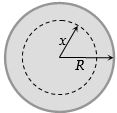
$A$ sphere of radius $R$ has a uniform distribution of electric charge in its volume. At a distance $x$ from its centre,for $x < R$,the electric field is directly proportional to
A
$\frac{1}{x^2}$
B
$\frac{1}{x}$
C
$x$
D
$x^2$
Solution
(C) Let the sphere have a uniform charge density $\rho = \frac{3Q}{4\pi R^3}$,and let $E$ be the electric field at a distance $x$ from the centre of the sphere,where $x < R$.
Applying Gauss's law to a Gaussian surface of radius $x$:
$E \cdot 4\pi x^2 = \frac{q_{enclosed}}{\varepsilon_0} = \frac{\rho V'}{\varepsilon_0} = \frac{\rho}{\varepsilon_0} \cdot \frac{4}{3}\pi x^3$
Here,$V' = \frac{4}{3}\pi x^3$ is the volume of the sphere of radius $x$.
Simplifying the equation:
$E = \frac{\rho}{3\varepsilon_0} x$
Since $\rho$,$3$,and $\varepsilon_0$ are constants,we have $E \propto x$.
Therefore,the electric field is directly proportional to $x$.
Applying Gauss's law to a Gaussian surface of radius $x$:
$E \cdot 4\pi x^2 = \frac{q_{enclosed}}{\varepsilon_0} = \frac{\rho V'}{\varepsilon_0} = \frac{\rho}{\varepsilon_0} \cdot \frac{4}{3}\pi x^3$
Here,$V' = \frac{4}{3}\pi x^3$ is the volume of the sphere of radius $x$.
Simplifying the equation:
$E = \frac{\rho}{3\varepsilon_0} x$
Since $\rho$,$3$,and $\varepsilon_0$ are constants,we have $E \propto x$.
Therefore,the electric field is directly proportional to $x$.
0 likes
View Solution20
MediumMCQ
$A$ solid metallic sphere has a charge $+3Q$. Concentric with this sphere is a conducting spherical shell having charge $-Q$. The radius of the sphere is $a$ and that of the spherical shell is $b$ $(b > a)$. What is the electric field at a distance $R$ $(a < R < b)$ from the centre?
A
$\frac{Q}{2\pi \varepsilon_0 R}$
B
$\frac{3Q}{2\pi \varepsilon_0 R}$
C
$\frac{3Q}{4\pi \varepsilon_0 R^2}$
D
$\frac{4Q}{4\pi \varepsilon_0 R^2}$
Solution
(C) According to Gauss's Law,the electric field at a distance $R$ from the centre is determined only by the charge enclosed within a Gaussian surface of radius $R$.
For $a < R < b$,the Gaussian surface encloses only the solid metallic sphere with charge $+3Q$.
The electric field due to the conducting spherical shell at any point inside it (i.e.,$R < b$) is zero.
Therefore,the electric field $E$ is given by:
$E = \frac{1}{4\pi \varepsilon_0} \cdot \frac{3Q}{R^2}$
For $a < R < b$,the Gaussian surface encloses only the solid metallic sphere with charge $+3Q$.
The electric field due to the conducting spherical shell at any point inside it (i.e.,$R < b$) is zero.
Therefore,the electric field $E$ is given by:
$E = \frac{1}{4\pi \varepsilon_0} \cdot \frac{3Q}{R^2}$
0 likes
View Solution21
MediumMCQ
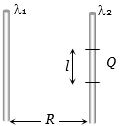
Two infinitely long parallel wires having linear charge densities $\lambda_1$ and $\lambda_2$ respectively are placed at a distance of $R$ meters. The force per unit length on either wire will be $(K = \frac{1}{4\pi\varepsilon_0})$.
A
$K\frac{2\lambda_1\lambda_2}{R^2}$
B
$K\frac{2\lambda_1\lambda_2}{R}$
C
$K\frac{\lambda_1\lambda_2}{R^2}$
D
$K\frac{\lambda_1\lambda_2}{R}$
Solution
(B) The electric field produced by an infinitely long wire with linear charge density $\lambda_1$ at a distance $R$ is given by $E_1 = \frac{2K\lambda_1}{R}$.
Consider a segment of length $l$ on the second wire having linear charge density $\lambda_2$. The charge on this segment is $Q = \lambda_2 l$.
The force $F_2$ exerted on this segment by the electric field $E_1$ is $F_2 = Q E_1 = (\lambda_2 l) \frac{2K\lambda_1}{R}$.
Therefore,the force per unit length is $\frac{F_2}{l} = \frac{2K\lambda_1\lambda_2}{R}$.
By Newton's third law,the force per unit length on the first wire is the same in magnitude.
Consider a segment of length $l$ on the second wire having linear charge density $\lambda_2$. The charge on this segment is $Q = \lambda_2 l$.
The force $F_2$ exerted on this segment by the electric field $E_1$ is $F_2 = Q E_1 = (\lambda_2 l) \frac{2K\lambda_1}{R}$.
Therefore,the force per unit length is $\frac{F_2}{l} = \frac{2K\lambda_1\lambda_2}{R}$.
By Newton's third law,the force per unit length on the first wire is the same in magnitude.
0 likes
View Solution22
MediumMCQ
$A$ non-conducting solid sphere of radius $R$ is uniformly charged. The magnitude of the electric field due to the sphere at a distance $r$ from its centre:
A
Increases as $r$ increases for $r < R$
B
Decreases as $r$ increases for $0 < r < \infty$
C
Decreases as $r$ increases for $R < r < \infty$
D
Both $(a)$ and $(c)$
Solution
(D) For a non-conducting solid sphere,the electric field $E$ is given by:
Inside the sphere $(r < R)$: $E = \frac{kQr}{R^3}$,which means $E \propto r$. Thus,as $r$ increases,$E$ increases.
Outside the sphere $(r > R)$: $E = \frac{kQ}{r^2}$,which means $E \propto \frac{1}{r^2}$. Thus,as $r$ increases,$E$ decreases.
Therefore,both statements $(a)$ and $(c)$ are correct.
Inside the sphere $(r < R)$: $E = \frac{kQr}{R^3}$,which means $E \propto r$. Thus,as $r$ increases,$E$ increases.
Outside the sphere $(r > R)$: $E = \frac{kQ}{r^2}$,which means $E \propto \frac{1}{r^2}$. Thus,as $r$ increases,$E$ decreases.
Therefore,both statements $(a)$ and $(c)$ are correct.
0 likes
View Solution23
MediumMCQ
The electric field in a region is radially outward with magnitude $E = A r_0$. The charge contained in a sphere of radius $r_0$ centered at the origin is
A
$4\pi \varepsilon_0 A r_0^3$
B
$4\pi \varepsilon_0 A r_0^3$
C
$\frac{4\pi \varepsilon_0 A}{r_0}$
D
$\frac{1}{4\pi \varepsilon_0} \frac{A}{r_0^3}$
Solution
(B) According to Gauss's Law,the total electric flux $\phi$ through a closed surface is given by $\phi = \frac{Q_{enclosed}}{\varepsilon_0}$.
Here,the electric field $E = A r_0$ is radially outward and uniform over the surface of a sphere of radius $r_0$.
The surface area of the sphere is $S = 4\pi r_0^2$.
The total electric flux $\phi$ through the sphere is $\phi = E \times S = (A r_0) \times (4\pi r_0^2) = 4\pi A r_0^3$.
Equating the flux to Gauss's Law: $\frac{Q}{\varepsilon_0} = 4\pi A r_0^3$.
Therefore,the enclosed charge is $Q = 4\pi \varepsilon_0 A r_0^3$.
Here,the electric field $E = A r_0$ is radially outward and uniform over the surface of a sphere of radius $r_0$.
The surface area of the sphere is $S = 4\pi r_0^2$.
The total electric flux $\phi$ through the sphere is $\phi = E \times S = (A r_0) \times (4\pi r_0^2) = 4\pi A r_0^3$.
Equating the flux to Gauss's Law: $\frac{Q}{\varepsilon_0} = 4\pi A r_0^3$.
Therefore,the enclosed charge is $Q = 4\pi \varepsilon_0 A r_0^3$.
0 likes
View Solution24
EasyMCQ
Which of the following graphs shows the variation of electric field $E$ due to a hollow spherical conductor of radius $R$ as a function of distance $r$ from the centre of the sphere?
A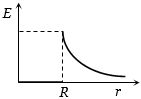
B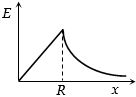
C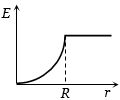
D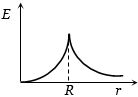
Solution
(A) The electric field $E$ due to a hollow spherical conductor of radius $R$ is given by:
$1$. For $r < R$ (inside the conductor),the electric field is $E = 0$.
$2$. For $r \ge R$ (outside the conductor),the electric field is $E = \frac{Q}{4\pi \varepsilon_0 r^2}$,which implies $E \propto \frac{1}{r^2}$.
Thus,the graph shows zero field for $r < R$ and a hyperbolic decrease for $r \ge R$. This corresponds to the graph shown in option $A$.
$1$. For $r < R$ (inside the conductor),the electric field is $E = 0$.
$2$. For $r \ge R$ (outside the conductor),the electric field is $E = \frac{Q}{4\pi \varepsilon_0 r^2}$,which implies $E \propto \frac{1}{r^2}$.
Thus,the graph shows zero field for $r < R$ and a hyperbolic decrease for $r \ge R$. This corresponds to the graph shown in option $A$.
0 likes
View Solution25
MediumMCQ
The electric field due to a uniformly charged sphere of radius $R$ as a function of the distance $r$ from its centre is represented graphically by
A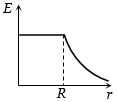
B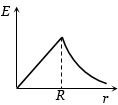
C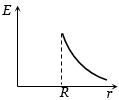
D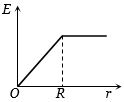
Solution
(B) For a uniformly charged sphere of radius $R$ with volume charge density $\rho$:
$1$. Inside the sphere $(r < R)$,the electric field is given by $E_{inside} = \frac{\rho r}{3\varepsilon_0}$. This shows that $E \propto r$,which is a linear relationship passing through the origin.
$2$. Outside the sphere $(r \ge R)$,the electric field is given by $E_{outside} = \frac{\rho R^3}{3\varepsilon_0 r^2}$. This shows that $E \propto \frac{1}{r^2}$,which is an inverse-square relationship.
$3$. Combining these,the graph starts from the origin,increases linearly until $r = R$,and then decreases following an inverse-square curve for $r > R$. This corresponds to the graph shown in option $B$.
$1$. Inside the sphere $(r < R)$,the electric field is given by $E_{inside} = \frac{\rho r}{3\varepsilon_0}$. This shows that $E \propto r$,which is a linear relationship passing through the origin.
$2$. Outside the sphere $(r \ge R)$,the electric field is given by $E_{outside} = \frac{\rho R^3}{3\varepsilon_0 r^2}$. This shows that $E \propto \frac{1}{r^2}$,which is an inverse-square relationship.
$3$. Combining these,the graph starts from the origin,increases linearly until $r = R$,and then decreases following an inverse-square curve for $r > R$. This corresponds to the graph shown in option $B$.
0 likes
View Solution26
DifficultMCQ
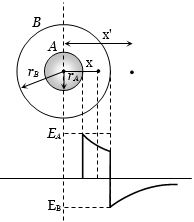
Two concentric conducting thin spherical shells $A$ and $B$ having radii $r_A$ and $r_B$ $(r_B > r_A)$ are charged to $Q_A$ and $-Q_B$ $(|Q_B| > |Q_A|)$. The electric field along a line passing through the centre is:
A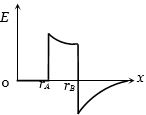
B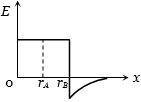
C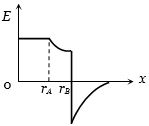
D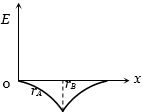
Solution
(A) The electric field $E$ at a distance $x$ from the common centre is determined using Gauss's Law:
$1$. For $x < r_A$: The interior of a conducting shell has no electric field. Thus,$E = 0$.
$2$. For $r_A < x < r_B$: Only the charge $Q_A$ on shell $A$ contributes to the field. Thus,$E = \frac{k Q_A}{x^2}$. This is a positive value that decreases as $x$ increases.
$3$. For $x > r_B$: Both charges $Q_A$ and $-Q_B$ contribute to the field. The net charge is $(Q_A - Q_B)$. Since $|Q_B| > |Q_A|$,the net charge is negative. Thus,$E = \frac{k(Q_A - Q_B)}{x^2}$. This is a negative value that approaches zero as $x \to \infty$.
Comparing these characteristics with the given options,the graph shows $E=0$ for $x < r_A$,a positive $1/x^2$ curve for $r_A < x < r_B$,and a negative $1/x^2$ curve for $x > r_B$.
$1$. For $x < r_A$: The interior of a conducting shell has no electric field. Thus,$E = 0$.
$2$. For $r_A < x < r_B$: Only the charge $Q_A$ on shell $A$ contributes to the field. Thus,$E = \frac{k Q_A}{x^2}$. This is a positive value that decreases as $x$ increases.
$3$. For $x > r_B$: Both charges $Q_A$ and $-Q_B$ contribute to the field. The net charge is $(Q_A - Q_B)$. Since $|Q_B| > |Q_A|$,the net charge is negative. Thus,$E = \frac{k(Q_A - Q_B)}{x^2}$. This is a negative value that approaches zero as $x \to \infty$.
Comparing these characteristics with the given options,the graph shows $E=0$ for $x < r_A$,a positive $1/x^2$ curve for $r_A < x < r_B$,and a negative $1/x^2$ curve for $x > r_B$.
0 likes
View Solution27
DifficultMCQ
$A$ spherically symmetric charge distribution is characterized by a charge density $\rho(r) = \rho_0 \left( \frac{5}{4} - \frac{r}{R} \right)$ for $r \le R$ and $\rho(r) = 0$ for $r > R$,where $r$ is the distance from the origin. The electric field at a distance $r$ from the origin $(r < R)$ is given by:
A
$\frac{\rho_0 r}{3\varepsilon_0} \left( \frac{5}{4} - \frac{r}{R} \right)$
B
$\frac{\rho_0 r}{3\varepsilon_0} \left( \frac{5}{4} - \frac{3r}{4R} \right)$
C
$\frac{\rho_0 r}{4\varepsilon_0} \left( \frac{5}{3} - \frac{r}{R} \right)$
D
$\frac{4\rho_0 r}{3\varepsilon_0} \left( \frac{5}{4} - \frac{r}{R} \right)$
Solution
(B) According to Gauss's Law,the electric field $E$ at a distance $r$ from the center of a spherically symmetric charge distribution is given by $\oint E \cdot dA = \frac{q_{enclosed}}{\varepsilon_0}$.
For a sphere,$E(4\pi r^2) = \frac{1}{\varepsilon_0} \int_0^r \rho(r') 4\pi r'^2 dr'$.
Thus,$E = \frac{1}{\varepsilon_0 r^2} \int_0^r \rho_0 \left( \frac{5}{4} - \frac{r'}{R} \right) r'^2 dr'$.
$E = \frac{\rho_0}{\varepsilon_0 r^2} \int_0^r \left( \frac{5}{4}r'^2 - \frac{r'^3}{R} \right) dr'$.
$E = \frac{\rho_0}{\varepsilon_0 r^2} \left[ \frac{5}{4} \cdot \frac{r^3}{3} - \frac{r^4}{4R} \right]$.
$E = \frac{\rho_0}{\varepsilon_0 r^2} \left[ \frac{5r^3}{12} - \frac{r^4}{4R} \right]$.
$E = \frac{\rho_0 r}{\varepsilon_0} \left( \frac{5}{12} - \frac{r}{4R} \right) = \frac{\rho_0 r}{3\varepsilon_0} \left( \frac{5}{4} - \frac{3r}{4R} \right)$.
For a sphere,$E(4\pi r^2) = \frac{1}{\varepsilon_0} \int_0^r \rho(r') 4\pi r'^2 dr'$.
Thus,$E = \frac{1}{\varepsilon_0 r^2} \int_0^r \rho_0 \left( \frac{5}{4} - \frac{r'}{R} \right) r'^2 dr'$.
$E = \frac{\rho_0}{\varepsilon_0 r^2} \int_0^r \left( \frac{5}{4}r'^2 - \frac{r'^3}{R} \right) dr'$.
$E = \frac{\rho_0}{\varepsilon_0 r^2} \left[ \frac{5}{4} \cdot \frac{r^3}{3} - \frac{r^4}{4R} \right]$.
$E = \frac{\rho_0}{\varepsilon_0 r^2} \left[ \frac{5r^3}{12} - \frac{r^4}{4R} \right]$.
$E = \frac{\rho_0 r}{\varepsilon_0} \left( \frac{5}{12} - \frac{r}{4R} \right) = \frac{\rho_0 r}{3\varepsilon_0} \left( \frac{5}{4} - \frac{3r}{4R} \right)$.
0 likes
View Solution28
MediumMCQ
$A$ non-conducting solid sphere of radius $R$ is uniformly charged. The magnitude of the electric field due to the sphere at a distance $r$ from its center is:
$(1) \text{ Increases with increase in } r \text{ for } r < R$
$(2) \text{ Decreases with increase in } r \text{ for } 0 < r < \infty$
$(3) \text{ Decreases with increase in } r \text{ for } R < r < \infty$
$(4) \text{ Is continuous at } r = R$
$(1) \text{ Increases with increase in } r \text{ for } r < R$
$(2) \text{ Decreases with increase in } r \text{ for } 0 < r < \infty$
$(3) \text{ Decreases with increase in } r \text{ for } R < r < \infty$
$(4) \text{ Is continuous at } r = R$
A
$1, 3$
B
$3, 4$
C
$1, 2$
D
$2, 4$
Solution
(A) For a uniformly charged non-conducting solid sphere of radius $R$ and total charge $Q$:
$1$. Inside the sphere $(r < R)$: The electric field is given by $E = \frac{kQr}{R^3}$. Here, $E \propto r$, so the electric field increases linearly as $r$ increases.
$2$. Outside the sphere $(r \ge R)$: The electric field is given by $E = \frac{kQ}{r^2}$. Here, $E \propto \frac{1}{r^2}$, so the electric field decreases as $r$ increases.
$3$. Continuity at $r = R$: At $r = R$, $E_{in} = \frac{kQ}{R^2}$ and $E_{out} = \frac{kQ}{R^2}$. Since $E_{in} = E_{out}$, the electric field is continuous at the surface.
Thus, statements $(1)$, $(3)$, and $(4)$ are correct. Given the options provided, the combination $(1, 3)$ is the most appropriate choice.
$1$. Inside the sphere $(r < R)$: The electric field is given by $E = \frac{kQr}{R^3}$. Here, $E \propto r$, so the electric field increases linearly as $r$ increases.
$2$. Outside the sphere $(r \ge R)$: The electric field is given by $E = \frac{kQ}{r^2}$. Here, $E \propto \frac{1}{r^2}$, so the electric field decreases as $r$ increases.
$3$. Continuity at $r = R$: At $r = R$, $E_{in} = \frac{kQ}{R^2}$ and $E_{out} = \frac{kQ}{R^2}$. Since $E_{in} = E_{out}$, the electric field is continuous at the surface.
Thus, statements $(1)$, $(3)$, and $(4)$ are correct. Given the options provided, the combination $(1, 3)$ is the most appropriate choice.
0 likes
View Solution29
EasyMCQ
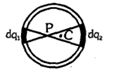
The net electric field at point $P$ due to the segments $dq_1$ and $dq_2$ of a uniformly charged spherical shell is ...... ($C$ is the center of the shell.)
A
towards the right
B
towards the left
C
zero
D
upwards
Solution
(C) According to the shell theorem,the electric field inside a uniformly charged spherical shell is zero everywhere.
This is because the electric field contributions from different parts of the shell cancel each other out at any interior point $P$.
Specifically,for any two small segments $dq_1$ and $dq_2$ subtending the same solid angle at an interior point $P$,the electric fields produced by them at $P$ are equal in magnitude but opposite in direction.
Therefore,the net electric field at point $P$ due to these segments is zero.
This is because the electric field contributions from different parts of the shell cancel each other out at any interior point $P$.
Specifically,for any two small segments $dq_1$ and $dq_2$ subtending the same solid angle at an interior point $P$,the electric fields produced by them at $P$ are equal in magnitude but opposite in direction.
Therefore,the net electric field at point $P$ due to these segments is zero.
0 likes
View Solution30
EasyMCQ
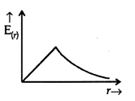
The figure shows the graph of electric field $E(r)$ versus distance $(r)$ from the center of an object. Therefore,...
A
The object must be a charged conducting solid.
B
The object must be a solid sphere with uniform volume charge density.
C
The object must be a solid cube with uniform volume charge density.
D
The object must be a charged conducting sphere.
Solution
(B) For a solid sphere of radius $R$ with uniform volume charge density $\rho$,the electric field $E$ is given by:
$1$. Inside the sphere $(r < R)$: $E = \frac{\rho r}{3\epsilon_0}$,which implies $E \propto r$.
$2$. Outside the sphere $(r \geq R)$: $E = \frac{Q}{4\pi\epsilon_0 r^2}$,which implies $E \propto \frac{1}{r^2}$.
The given graph shows $E$ increasing linearly with $r$ until a maximum value at the surface,and then decreasing as $1/r^2$ for $r > R$. This behavior is characteristic of a uniformly charged solid sphere.
$1$. Inside the sphere $(r < R)$: $E = \frac{\rho r}{3\epsilon_0}$,which implies $E \propto r$.
$2$. Outside the sphere $(r \geq R)$: $E = \frac{Q}{4\pi\epsilon_0 r^2}$,which implies $E \propto \frac{1}{r^2}$.
The given graph shows $E$ increasing linearly with $r$ until a maximum value at the surface,and then decreasing as $1/r^2$ for $r > R$. This behavior is characteristic of a uniformly charged solid sphere.
0 likes
View Solution31
DifficultMCQ
The electric potential in a region around the origin is given by $V(x) = 4x^2$. The total charge enclosed in a cube of side $1 \ m$ centered at the origin is (in Coulombs) ...
A
$8 \varepsilon_0$
B
$0$
C
$-8 \varepsilon_0$
D
$-4 \varepsilon_0$
Solution
(B) The electric potential is given by $V(x) = 4x^2$.
The electric field $E$ is related to potential $V$ by the relation $E = -\frac{dV}{dx}$.
$E(x) = -\frac{d}{dx}(4x^2) = -8x$.
According to Gauss's Law,the total flux $\phi$ through a closed surface is $\phi = \oint E \cdot dA = \frac{q_{enclosed}}{\varepsilon_0}$.
For a cube centered at the origin with side length $L = 1 \ m$,the faces are at $x = 0.5 \ m$ and $x = -0.5 \ m$.
At $x = 0.5 \ m$,$E = -8(0.5) = -4 \ V/m$. The area vector points outward,so $\phi_1 = E \cdot A = (-4)(1^2) = -4 \ V \cdot m$.
At $x = -0.5 \ m$,$E = -8(-0.5) = 4 \ V/m$. The area vector points outward,so $\phi_2 = E \cdot A = (4)(1^2) = 4 \ V \cdot m$.
The net flux $\phi_{net} = \phi_1 + \phi_2 = -4 + 4 = 0$.
Since $\phi_{net} = \frac{q_{enclosed}}{\varepsilon_0}$,we have $0 = \frac{q_{enclosed}}{\varepsilon_0}$,which implies $q_{enclosed} = 0$.
The electric field $E$ is related to potential $V$ by the relation $E = -\frac{dV}{dx}$.
$E(x) = -\frac{d}{dx}(4x^2) = -8x$.
According to Gauss's Law,the total flux $\phi$ through a closed surface is $\phi = \oint E \cdot dA = \frac{q_{enclosed}}{\varepsilon_0}$.
For a cube centered at the origin with side length $L = 1 \ m$,the faces are at $x = 0.5 \ m$ and $x = -0.5 \ m$.
At $x = 0.5 \ m$,$E = -8(0.5) = -4 \ V/m$. The area vector points outward,so $\phi_1 = E \cdot A = (-4)(1^2) = -4 \ V \cdot m$.
At $x = -0.5 \ m$,$E = -8(-0.5) = 4 \ V/m$. The area vector points outward,so $\phi_2 = E \cdot A = (4)(1^2) = 4 \ V \cdot m$.
The net flux $\phi_{net} = \phi_1 + \phi_2 = -4 + 4 = 0$.
Since $\phi_{net} = \frac{q_{enclosed}}{\varepsilon_0}$,we have $0 = \frac{q_{enclosed}}{\varepsilon_0}$,which implies $q_{enclosed} = 0$.
0 likes
View Solution32
EasyMCQ
The charge density of a solid sphere of radius $R$ and total charge $Q$ is given by $\rho(r) = \frac{Q}{\pi R^4} r$. The value of the electric field at a point $P$ inside the sphere at a distance $r_1$ from the center is .......
A
$\frac{Qr_1^2}{4\pi \epsilon_0 R^4}$
B
$\frac{Qr_1^2}{3\pi \epsilon_0 R^4}$
C
$0$
D
$\frac{Q}{4\pi \epsilon_0 r_1^2}$
Solution
(A) To find the electric field at a distance $r_1$ from the center,we use Gauss's Law: $\oint E \cdot dA = \frac{q_{enclosed}}{\epsilon_0}$.
The charge enclosed $q_{enclosed}$ in a sphere of radius $r_1$ is given by the integral of the charge density $\rho(r)$ over the volume:
$q_{enclosed} = \int_0^{r_1} \rho(r) \cdot 4\pi r^2 dr$
Substitute $\rho(r) = \frac{Q}{\pi R^4} r$:
$q_{enclosed} = \int_0^{r_1} \left( \frac{Q}{\pi R^4} r \right) 4\pi r^2 dr = \frac{4Q}{R^4} \int_0^{r_1} r^3 dr$
$q_{enclosed} = \frac{4Q}{R^4} \left[ \frac{r^4}{4} \right]_0^{r_1} = \frac{Q r_1^4}{R^4}$.
Now,applying Gauss's Law for a spherical surface of radius $r_1$:
$E(4\pi r_1^2) = \frac{q_{enclosed}}{\epsilon_0} = \frac{Q r_1^4}{\epsilon_0 R^4}$.
Solving for $E$:
$E = \frac{Q r_1^4}{4\pi \epsilon_0 r_1^2 R^4} = \frac{Q r_1^2}{4\pi \epsilon_0 R^4}$.
The charge enclosed $q_{enclosed}$ in a sphere of radius $r_1$ is given by the integral of the charge density $\rho(r)$ over the volume:
$q_{enclosed} = \int_0^{r_1} \rho(r) \cdot 4\pi r^2 dr$
Substitute $\rho(r) = \frac{Q}{\pi R^4} r$:
$q_{enclosed} = \int_0^{r_1} \left( \frac{Q}{\pi R^4} r \right) 4\pi r^2 dr = \frac{4Q}{R^4} \int_0^{r_1} r^3 dr$
$q_{enclosed} = \frac{4Q}{R^4} \left[ \frac{r^4}{4} \right]_0^{r_1} = \frac{Q r_1^4}{R^4}$.
Now,applying Gauss's Law for a spherical surface of radius $r_1$:
$E(4\pi r_1^2) = \frac{q_{enclosed}}{\epsilon_0} = \frac{Q r_1^4}{\epsilon_0 R^4}$.
Solving for $E$:
$E = \frac{Q r_1^4}{4\pi \epsilon_0 r_1^2 R^4} = \frac{Q r_1^2}{4\pi \epsilon_0 R^4}$.
0 likes
View Solution33
DifficultMCQ
$A$ non-conducting solid sphere of radius $R$ has a uniform volume charge density $\rho$. The electric potential at the center of the sphere is related to the potential at the surface and outside the sphere due to this uniform charge distribution.
Statement-$1$: When a charge $q$ is moved from the surface to the center of the sphere,the change in its potential energy is $q\rho R^2 / 6\varepsilon_0$.
Statement-$2$: The electric field at a distance $r$ $(r < R)$ from the center of the sphere is $\rho r / 3\varepsilon_0$.
Statement-$1$: When a charge $q$ is moved from the surface to the center of the sphere,the change in its potential energy is $q\rho R^2 / 6\varepsilon_0$.
Statement-$2$: The electric field at a distance $r$ $(r < R)$ from the center of the sphere is $\rho r / 3\varepsilon_0$.
A
Statement-$1$ is true,Statement-$2$ is true,and Statement-$2$ is the correct explanation for Statement-$1$.
B
Statement-$1$ is true,Statement-$2$ is true,and Statement-$2$ is not the correct explanation for Statement-$1$.
C
Statement-$1$ is true,Statement-$2$ is false.
D
Statement-$1$ is false,Statement-$2$ is true.
Solution
(A) For a non-conducting sphere with uniform charge density $\rho$,the electric field at distance $r < R$ is given by Gauss's Law: $E(4\pi r^2) = \frac{\rho (4/3 \pi r^3)}{\varepsilon_0} \implies E = \frac{\rho r}{3\varepsilon_0}$. Thus,Statement-$2$ is true.
The potential at the surface is $V_s = \frac{kQ}{R} = \frac{\rho (4/3 \pi R^3)}{4\pi \varepsilon_0 R} = \frac{\rho R^2}{3\varepsilon_0}$.
The potential at the center is $V_c = \frac{3}{2} \frac{kQ}{R} = \frac{\rho R^2}{2\varepsilon_0}$.
The change in potential energy when moving charge $q$ from surface to center is $\Delta U = q(V_c - V_s) = q(\frac{\rho R^2}{2\varepsilon_0} - \frac{\rho R^2}{3\varepsilon_0}) = q \frac{\rho R^2}{6\varepsilon_0}$.
Since the calculated value in Statement-$1$ matches this result,Statement-$1$ is true and Statement-$2$ provides the basis for calculating the potential difference. Therefore,Statement-$2$ is the correct explanation for Statement-$1$.
The potential at the surface is $V_s = \frac{kQ}{R} = \frac{\rho (4/3 \pi R^3)}{4\pi \varepsilon_0 R} = \frac{\rho R^2}{3\varepsilon_0}$.
The potential at the center is $V_c = \frac{3}{2} \frac{kQ}{R} = \frac{\rho R^2}{2\varepsilon_0}$.
The change in potential energy when moving charge $q$ from surface to center is $\Delta U = q(V_c - V_s) = q(\frac{\rho R^2}{2\varepsilon_0} - \frac{\rho R^2}{3\varepsilon_0}) = q \frac{\rho R^2}{6\varepsilon_0}$.
Since the calculated value in Statement-$1$ matches this result,Statement-$1$ is true and Statement-$2$ provides the basis for calculating the potential difference. Therefore,Statement-$2$ is the correct explanation for Statement-$1$.
0 likes
View Solution34
EasyMCQ
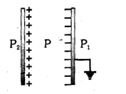
$A$ parallel plate capacitor consists of two metal plates. One plate is given a charge of $+q$,while the other is connected to the ground. Points $P, P_1$,and $P_2$ are taken as shown in the figure. At which point is the electric field $NOT$ zero?
A
Only $P$
B
Only $P_1$
C
Only $P_2$
D
$P, P_1$,and $P_2$
Solution
(A) For a parallel plate capacitor where one plate has a charge $+q$ and the other is grounded,the charge distribution results in a charge of $+q$ on the inner surface of the first plate and a charge of $-q$ on the inner surface of the second plate. The outer surfaces have zero charge.
$1$. At point $P$ (between the plates): The electric field due to the positively charged plate is directed away from it,and the electric field due to the negatively charged plate is directed towards it. Both fields add up,so the net electric field is non-zero.
$2$. At point $P_1$ (outside the grounded plate): The electric field due to the positive plate and the negative plate cancel each other out because the net charge of the system is zero,resulting in a net electric field of zero.
$3$. At point $P_2$ (outside the positive plate): Similarly,the electric fields from the positive and negative charges cancel each other out,resulting in a net electric field of zero.
Therefore,the electric field is non-zero only at point $P$.
$1$. At point $P$ (between the plates): The electric field due to the positively charged plate is directed away from it,and the electric field due to the negatively charged plate is directed towards it. Both fields add up,so the net electric field is non-zero.
$2$. At point $P_1$ (outside the grounded plate): The electric field due to the positive plate and the negative plate cancel each other out because the net charge of the system is zero,resulting in a net electric field of zero.
$3$. At point $P_2$ (outside the positive plate): Similarly,the electric fields from the positive and negative charges cancel each other out,resulting in a net electric field of zero.
Therefore,the electric field is non-zero only at point $P$.
0 likes
View Solution35
MediumMCQ
The electric field intensity at a point at a distance $r$ from the axis of an infinitely long pipe having a linear charge density $q$ is proportional to:
A
Directly proportional to $r^2$
B
Directly proportional to $r^3$
C
Inversely proportional to $r$
D
Inversely proportional to $r^2$
Solution
(C) For an infinitely long charged wire or pipe with linear charge density $\lambda$ (given as $q$ per unit length),we use Gauss's Law.
Consider a cylindrical Gaussian surface of radius $r$ and length $L$ coaxial with the pipe.
The total electric flux $\Phi_E$ through the Gaussian surface is given by $\Phi_E = E \cdot (2\pi r L)$.
According to Gauss's Law,$\Phi_E = \frac{q_{enclosed}}{\epsilon_0} = \frac{\lambda L}{\epsilon_0}$.
Equating the two expressions: $E(2\pi r L) = \frac{\lambda L}{\epsilon_0}$.
Solving for $E$,we get $E = \frac{\lambda}{2\pi \epsilon_0 r}$.
Therefore,$E \propto \frac{1}{r}$,which means the electric field is inversely proportional to the distance $r$.
Consider a cylindrical Gaussian surface of radius $r$ and length $L$ coaxial with the pipe.
The total electric flux $\Phi_E$ through the Gaussian surface is given by $\Phi_E = E \cdot (2\pi r L)$.
According to Gauss's Law,$\Phi_E = \frac{q_{enclosed}}{\epsilon_0} = \frac{\lambda L}{\epsilon_0}$.
Equating the two expressions: $E(2\pi r L) = \frac{\lambda L}{\epsilon_0}$.
Solving for $E$,we get $E = \frac{\lambda}{2\pi \epsilon_0 r}$.
Therefore,$E \propto \frac{1}{r}$,which means the electric field is inversely proportional to the distance $r$.
0 likes
View Solution36
EasyMCQ
What is the electric field intensity at a point at a distance $r$ $(r < R)$ from the center of a charged spherical conductor of radius $R$ carrying a charge $Q$?
A
$kQR/r^3$
B
$kQr/R^3$
C
$kQ/r^3$
D
Zero
Solution
(D) For a charged spherical conductor,the charge $Q$ resides entirely on its outer surface.
According to Gauss's Law,for any point inside the conductor $(r < R)$,the enclosed charge $q_{enc} = 0$.
Therefore,the electric field $E$ inside the conductor is given by $E = \frac{q_{enc}}{4\pi\epsilon_0 r^2} = 0$.
Thus,the electric field intensity at any point inside a charged spherical conductor is zero.
According to Gauss's Law,for any point inside the conductor $(r < R)$,the enclosed charge $q_{enc} = 0$.
Therefore,the electric field $E$ inside the conductor is given by $E = \frac{q_{enc}}{4\pi\epsilon_0 r^2} = 0$.
Thus,the electric field intensity at any point inside a charged spherical conductor is zero.
0 likes
View Solution37
EasyMCQ
$A$ solid metal sphere has a charge of $+3Q$. It is concentric with a conducting spherical shell having a charge of $-Q$. The radius of the sphere is $a$ and the radius of the shell is $b$ $(b > a)$. The electric field at a distance $R$ from the center $(a < R < b)$ is .......
A
$\frac{4Q}{2\pi \varepsilon_0 R^2}$
B
$\frac{3Q}{4\pi \varepsilon_0 R^2}$
C
$\frac{3Q}{2\pi \varepsilon_0 R^2}$
D
$\frac{Q}{2\pi \varepsilon_0 R}$
Solution
(B) According to Gauss's Law,the electric field at a distance $R$ from the center of a spherical charge distribution is given by $E = \frac{k q_{enclosed}}{R^2}$.
For the region $a < R < b$,the Gaussian surface is a sphere of radius $R$ centered at the origin.
The charge enclosed by this Gaussian surface is only the charge on the solid metal sphere,which is $+3Q$.
The conducting shell (charge $-Q$) is outside the Gaussian surface,so it contributes zero to the electric field at distance $R$ inside the shell.
Therefore,the electric field $E$ is given by:
$E = \frac{1}{4\pi \varepsilon_0} \cdot \frac{3Q}{R^2} = \frac{3Q}{4\pi \varepsilon_0 R^2}$.
For the region $a < R < b$,the Gaussian surface is a sphere of radius $R$ centered at the origin.
The charge enclosed by this Gaussian surface is only the charge on the solid metal sphere,which is $+3Q$.
The conducting shell (charge $-Q$) is outside the Gaussian surface,so it contributes zero to the electric field at distance $R$ inside the shell.
Therefore,the electric field $E$ is given by:
$E = \frac{1}{4\pi \varepsilon_0} \cdot \frac{3Q}{R^2} = \frac{3Q}{4\pi \varepsilon_0 R^2}$.
0 likes
View Solution38
MediumMCQ
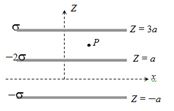
Three infinite sheets are placed as shown in the figure. Find the electric field at point $P$.
A
$\frac{2\sigma}{\varepsilon_0} \hat{k}$
B
$-\frac{2\sigma}{\varepsilon_0} \hat{k}$
C
$\frac{4\sigma}{\varepsilon_0} \hat{k}$
D
$-\frac{4\sigma}{\varepsilon_0} \hat{k}$
Solution
(B) The electric field due to an infinite sheet with surface charge density $\sigma$ is given by $\vec{E} = \frac{\sigma}{2\varepsilon_0} \hat{n}$,where $\hat{n}$ is the unit vector normal to the sheet pointing away from it.
Point $P$ is located between $Z = a$ and $Z = 3a$.
$1$. For the sheet at $Z = 3a$ with charge density $\sigma$: Point $P$ is below it,so the field is directed downwards: $\vec{E}_1 = -\frac{\sigma}{2\varepsilon_0} \hat{k}$.
$2$. For the sheet at $Z = a$ with charge density $-2\sigma$: Point $P$ is above it,so the field is directed towards the sheet (downwards): $\vec{E}_2 = \frac{-2\sigma}{2\varepsilon_0} \hat{k} = -\frac{\sigma}{\varepsilon_0} \hat{k}$.
$3$. For the sheet at $Z = -a$ with charge density $-\sigma$: Point $P$ is above it,so the field is directed towards the sheet (downwards): $\vec{E}_3 = \frac{-\sigma}{2\varepsilon_0} \hat{k}$.
The net electric field at $P$ is $\vec{E}_{net} = \vec{E}_1 + \vec{E}_2 + \vec{E}_3 = -\frac{\sigma}{2\varepsilon_0} \hat{k} - \frac{\sigma}{\varepsilon_0} \hat{k} - \frac{\sigma}{2\varepsilon_0} \hat{k} = -\frac{2\sigma}{\varepsilon_0} \hat{k}$.
Point $P$ is located between $Z = a$ and $Z = 3a$.
$1$. For the sheet at $Z = 3a$ with charge density $\sigma$: Point $P$ is below it,so the field is directed downwards: $\vec{E}_1 = -\frac{\sigma}{2\varepsilon_0} \hat{k}$.
$2$. For the sheet at $Z = a$ with charge density $-2\sigma$: Point $P$ is above it,so the field is directed towards the sheet (downwards): $\vec{E}_2 = \frac{-2\sigma}{2\varepsilon_0} \hat{k} = -\frac{\sigma}{\varepsilon_0} \hat{k}$.
$3$. For the sheet at $Z = -a$ with charge density $-\sigma$: Point $P$ is above it,so the field is directed towards the sheet (downwards): $\vec{E}_3 = \frac{-\sigma}{2\varepsilon_0} \hat{k}$.
The net electric field at $P$ is $\vec{E}_{net} = \vec{E}_1 + \vec{E}_2 + \vec{E}_3 = -\frac{\sigma}{2\varepsilon_0} \hat{k} - \frac{\sigma}{\varepsilon_0} \hat{k} - \frac{\sigma}{2\varepsilon_0} \hat{k} = -\frac{2\sigma}{\varepsilon_0} \hat{k}$.
0 likes
View Solution39
MediumMCQ
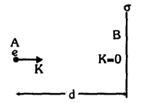
The surface charge density of a conducting plate is $-2 \times 10^{-6} \ C/m^2$. An electron with energy $100 \ eV$ moves towards the plate and strikes it. What is the initial distance of the electron from the plate?
A
$4.42 \times 10^{-4} \ m$
B
$3.51 \ \text{mm}$
C
$1.77 \ \text{cm}$
D
$3.51 \ \text{cm}$
Solution
(A) The electric field $E$ near a conducting plate is given by $E = \frac{|\sigma|}{\epsilon_0}$.
Since the electron moves towards the plate and stops at the surface,the work done by the electric field equals the change in kinetic energy.
$W = \Delta K = K_f - K_i = 0 - K = -K$.
The potential difference between the initial position at distance $d$ and the plate is $\Delta V = -E \cdot d = -\frac{|\sigma|}{\epsilon_0} d$.
The work done on the electron is $W = q \Delta V = (-e) \left( -\frac{|\sigma|}{\epsilon_0} d \right) = \frac{e |\sigma| d}{\epsilon_0}$.
Equating the work done to the change in kinetic energy: $K = \frac{e |\sigma| d}{\epsilon_0}$.
Given $K = 100 \ \text{eV} = 100 \times 1.6 \times 10^{-19} \ \text{J}$,$|\sigma| = 2 \times 10^{-6} \ \text{C/m}^2$,and $\epsilon_0 = 8.85 \times 10^{-12} \ \text{C}^2/(\text{N} \cdot \text{m}^2)$.
$100 \times 1.6 \times 10^{-19} = \frac{(1.6 \times 10^{-19}) \times (2 \times 10^{-6}) \times d}{8.85 \times 10^{-12}}$.
$100 = \frac{2 \times 10^{-6} \times d}{8.85 \times 10^{-12}} \Rightarrow 100 = \frac{2 \times 10^6 \times d}{8.85}$.
$d = \frac{100 \times 8.85}{2 \times 10^6} = 4.425 \times 10^{-4} \ \text{m}$.
Since the electron moves towards the plate and stops at the surface,the work done by the electric field equals the change in kinetic energy.
$W = \Delta K = K_f - K_i = 0 - K = -K$.
The potential difference between the initial position at distance $d$ and the plate is $\Delta V = -E \cdot d = -\frac{|\sigma|}{\epsilon_0} d$.
The work done on the electron is $W = q \Delta V = (-e) \left( -\frac{|\sigma|}{\epsilon_0} d \right) = \frac{e |\sigma| d}{\epsilon_0}$.
Equating the work done to the change in kinetic energy: $K = \frac{e |\sigma| d}{\epsilon_0}$.
Given $K = 100 \ \text{eV} = 100 \times 1.6 \times 10^{-19} \ \text{J}$,$|\sigma| = 2 \times 10^{-6} \ \text{C/m}^2$,and $\epsilon_0 = 8.85 \times 10^{-12} \ \text{C}^2/(\text{N} \cdot \text{m}^2)$.
$100 \times 1.6 \times 10^{-19} = \frac{(1.6 \times 10^{-19}) \times (2 \times 10^{-6}) \times d}{8.85 \times 10^{-12}}$.
$100 = \frac{2 \times 10^{-6} \times d}{8.85 \times 10^{-12}} \Rightarrow 100 = \frac{2 \times 10^6 \times d}{8.85}$.
$d = \frac{100 \times 8.85}{2 \times 10^6} = 4.425 \times 10^{-4} \ \text{m}$.
0 likes
View Solution40
EasyMCQ
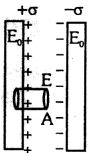
Two large parallel plates have uniform surface charge densities $+\sigma$ and $-\sigma$. The electric field between the plates is:
A
Zero
B
$\sigma/\epsilon_0$
C
$\sigma/2\epsilon_0$
D
Depends on the position of the point
Solution
(B) The electric field due to a single infinite charged sheet with surface charge density $\sigma$ is given by $E = \sigma / (2\epsilon_0)$.
For two parallel plates with charge densities $+\sigma$ and $-\sigma$,the electric fields produced by both plates point in the same direction (from the positive plate to the negative plate) in the region between them.
Therefore,the net electric field $E_{net}$ is the sum of the fields from both plates:
$E_{net} = E_+ + E_- = \frac{\sigma}{2\epsilon_0} + \frac{\sigma}{2\epsilon_0} = \frac{\sigma}{\epsilon_0}$.
Thus,the electric field between the plates is $\sigma/\epsilon_0$.
For two parallel plates with charge densities $+\sigma$ and $-\sigma$,the electric fields produced by both plates point in the same direction (from the positive plate to the negative plate) in the region between them.
Therefore,the net electric field $E_{net}$ is the sum of the fields from both plates:
$E_{net} = E_+ + E_- = \frac{\sigma}{2\epsilon_0} + \frac{\sigma}{2\epsilon_0} = \frac{\sigma}{\epsilon_0}$.
Thus,the electric field between the plates is $\sigma/\epsilon_0$.
0 likes
View Solution41
MediumMCQ
Find the electric field due to an infinitely long charged cylinder of radius $R$ having a linear charge density $\lambda$ at a distance of $R/2$ from its axis.
A
$\frac{\lambda}{\pi \epsilon_0 R}$
B
$\frac{\lambda}{4\pi R}$
C
$\frac{\lambda}{4\pi \epsilon_0 R}$
D
$\frac{\lambda}{4\pi \epsilon_0}$
Solution
(C) For a point inside a uniformly charged cylinder (where $r < R$),the electric field is given by $E = \frac{\rho r}{2\epsilon_0}$.
Since the linear charge density is $\lambda = \rho (\pi R^2)$,we have $\rho = \frac{\lambda}{\pi R^2}$.
Substituting this into the electric field formula: $E = \frac{\lambda r}{2\epsilon_0 \pi R^2}$.
Given $r = R/2$,we substitute the value: $E = \frac{\lambda (R/2)}{2\epsilon_0 \pi R^2} = \frac{\lambda R}{4\epsilon_0 \pi R^2} = \frac{\lambda}{4\pi \epsilon_0 R}$.
Since the linear charge density is $\lambda = \rho (\pi R^2)$,we have $\rho = \frac{\lambda}{\pi R^2}$.
Substituting this into the electric field formula: $E = \frac{\lambda r}{2\epsilon_0 \pi R^2}$.
Given $r = R/2$,we substitute the value: $E = \frac{\lambda (R/2)}{2\epsilon_0 \pi R^2} = \frac{\lambda R}{4\epsilon_0 \pi R^2} = \frac{\lambda}{4\pi \epsilon_0 R}$.
0 likes
View Solution42
EasyMCQ
Two large thin parallel metal plates have surface charge densities of equal magnitude but opposite signs $(\sigma = 26.4 \times 10^{-12} \ C/m^2)$. The electric field between these plates is ........ $N/C$.
A
$1.5$
B
$1.5 \times 10^{-10}$
C
$3$
D
$3 \times 10^{-10}$
Solution
(C) For two large parallel plates with surface charge densities $+\sigma$ and $-\sigma$, the electric field between them is given by $E = \frac{\sigma}{\epsilon_0}$.
Given $\sigma = 26.4 \times 10^{-12} \ C/m^2$ and $\epsilon_0 = 8.854 \times 10^{-12} \ C^2/N \cdot m^2$.
Substituting the values:
$E = \frac{26.4 \times 10^{-12}}{8.854 \times 10^{-12}} \approx 2.98 \approx 3 \ N/C$.
Thus, the electric field between the plates is $3 \ N/C$.
Given $\sigma = 26.4 \times 10^{-12} \ C/m^2$ and $\epsilon_0 = 8.854 \times 10^{-12} \ C^2/N \cdot m^2$.
Substituting the values:
$E = \frac{26.4 \times 10^{-12}}{8.854 \times 10^{-12}} \approx 2.98 \approx 3 \ N/C$.
Thus, the electric field between the plates is $3 \ N/C$.
0 likes
View Solution43
DifficultMCQ
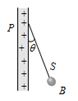
As shown in the figure,a ball $B$ is suspended by a string $S$ from a large charged plate $P$ such that it makes an angle $\theta$ with the plate. The surface charge density of the plate is proportional to which of the following?
A
$\sin \theta$
B
$\tan \theta$
C
$\cos \theta$
D
$\cot \theta$
Solution
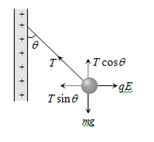
(B) The forces acting on the ball $B$ are the gravitational force $mg$ downwards,the electric force $qE$ horizontally away from the plate,and the tension $T$ in the string.
At equilibrium,resolving the forces:
$T \sin \theta = qE$
$T \cos \theta = mg$
Dividing the two equations:
$\tan \theta = \frac{qE}{mg}$
The electric field $E$ due to a large charged plate is given by $E = \frac{\sigma}{2\varepsilon_0}$,where $\sigma$ is the surface charge density.
Substituting $E$ in the equation:
$\tan \theta = \frac{q}{mg} \left( \frac{\sigma}{2\varepsilon_0} \right)$
Since $q, m, g, \varepsilon_0$ are constants,we have:
$\sigma \propto \tan \theta$
At equilibrium,resolving the forces:
$T \sin \theta = qE$
$T \cos \theta = mg$
Dividing the two equations:
$\tan \theta = \frac{qE}{mg}$
The electric field $E$ due to a large charged plate is given by $E = \frac{\sigma}{2\varepsilon_0}$,where $\sigma$ is the surface charge density.
Substituting $E$ in the equation:
$\tan \theta = \frac{q}{mg} \left( \frac{\sigma}{2\varepsilon_0} \right)$
Since $q, m, g, \varepsilon_0$ are constants,we have:
$\sigma \propto \tan \theta$
0 likes
View Solution44
MediumMCQ
The electric field at a distance of $20 \ cm$ from the center of a uniformly charged dielectric sphere of radius $R = 10 \ cm$ is $100 \ V/m$. What will be the electric field $E$ at a distance of $3 \ cm$ from the center of the sphere (in $V/m$)?
A
$100$
B
$125$
C
$120$
D
$0$
Solution
(C) Given: Radius of the sphere $R = 10 \ cm$,distance $r_1 = 20 \ cm$,electric field $E_1 = 100 \ V/m$,and distance $r_2 = 3 \ cm$.
For a uniformly charged dielectric sphere:
Outside the sphere $(r > R)$,the electric field is $E_1 = \frac{kQ}{r_1^2}$.
Inside the sphere $(r < R)$,the electric field is $E_2 = \frac{kQr_2}{R^3}$.
From the first equation,$kQ = E_1 \cdot r_1^2 = 100 \times (20 \times 10^{-2})^2 = 100 \times 0.04 = 4 \ V \cdot m$.
Substituting $kQ$ into the second equation:
$E_2 = \frac{(kQ) \cdot r_2}{R^3} = \frac{4 \times (3 \times 10^{-2})}{(10 \times 10^{-2})^3} = \frac{0.12}{0.001} = 120 \ V/m$.
For a uniformly charged dielectric sphere:
Outside the sphere $(r > R)$,the electric field is $E_1 = \frac{kQ}{r_1^2}$.
Inside the sphere $(r < R)$,the electric field is $E_2 = \frac{kQr_2}{R^3}$.
From the first equation,$kQ = E_1 \cdot r_1^2 = 100 \times (20 \times 10^{-2})^2 = 100 \times 0.04 = 4 \ V \cdot m$.
Substituting $kQ$ into the second equation:
$E_2 = \frac{(kQ) \cdot r_2}{R^3} = \frac{4 \times (3 \times 10^{-2})}{(10 \times 10^{-2})^3} = \frac{0.12}{0.001} = 120 \ V/m$.
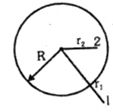
0 likes
View Solution45
DifficultMCQ
As shown in the figure,a charged ball $B$ is suspended from a large charged conducting plate by a silk thread $S$ making an angle $\theta$ with the plate. The surface charge density $\sigma$ of the plate is proportional to ........
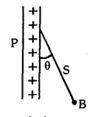
A
$cos \theta$
B
$cot \theta$
C
$sin \theta$
D
$tan \theta$
Solution
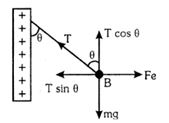
(D) At equilibrium,the forces acting on the ball $B$ are:
$1$. Tension $T$ in the thread.
$2$. Gravitational force $mg$ acting downwards.
$3$. Electrostatic force $F_e = qE$ acting horizontally away from the plate.
Resolving the tension $T$ into components:
$T \sin \theta = F_e = qE$ $(1)$
$T \cos \theta = mg$ $(2)$
Dividing $(1)$ by $(2)$:
$\frac{T \sin \theta}{T \cos \theta} = \frac{qE}{mg}$
$\tan \theta = \frac{qE}{mg}$
The electric field $E$ due to a large charged conducting plate is given by $E = \frac{\sigma}{\epsilon_0}$.
Substituting this into the equation:
$\tan \theta = \frac{q \sigma}{mg \epsilon_0}$
$\sigma = \frac{mg \epsilon_0}{q} \tan \theta$
Since $m, g, \epsilon_0,$ and $q$ are constants,we have:
$\sigma \propto \tan \theta$
$1$. Tension $T$ in the thread.
$2$. Gravitational force $mg$ acting downwards.
$3$. Electrostatic force $F_e = qE$ acting horizontally away from the plate.
Resolving the tension $T$ into components:
$T \sin \theta = F_e = qE$ $(1)$
$T \cos \theta = mg$ $(2)$
Dividing $(1)$ by $(2)$:
$\frac{T \sin \theta}{T \cos \theta} = \frac{qE}{mg}$
$\tan \theta = \frac{qE}{mg}$
The electric field $E$ due to a large charged conducting plate is given by $E = \frac{\sigma}{\epsilon_0}$.
Substituting this into the equation:
$\tan \theta = \frac{q \sigma}{mg \epsilon_0}$
$\sigma = \frac{mg \epsilon_0}{q} \tan \theta$
Since $m, g, \epsilon_0,$ and $q$ are constants,we have:
$\sigma \propto \tan \theta$
0 likes
View Solution46
DifficultMCQ
An electron is projected towards a metal plate with a surface charge density $\sigma = -2 \times 10^{-6} \ C/m^2$. If the electron strikes the plate with zero velocity,calculate the distance $d$ between the electron gun and the plate in terms of its initial kinetic energy $E_k$.
A
$\frac{E_k \in_0}{2e\sigma}$
B
$\frac{E_k}{3e\sigma}$
C
$\frac{E_k}{ \in_0 e\sigma}$
D
$\frac{E_k \in_0}{e\sigma}$
Solution
(D) The electric field $E$ near a charged conducting plate is given by $E = \frac{|\sigma|}{\in_0}$.
The force on the electron is $F = eE = e \frac{|\sigma|}{\in_0}$.
Since the electron is moving against the electric field (repelled by the negative plate),the work done by the electric field is negative,or the work done by the external kinetic energy to reach the plate is equal to the change in potential energy.
Using the work-energy theorem,the initial kinetic energy $E_k$ is completely converted into work done against the electric force over distance $d$:
$E_k = F \cdot d = (eE) \cdot d$
Substituting $E = \frac{|\sigma|}{\in_0}$:
$E_k = e \left( \frac{|\sigma|}{\in_0} \right) d$
Solving for $d$:
$d = \frac{E_k \in_0}{e|\sigma|}$
Given the magnitude of charge density is $|\sigma|$,the expression matches option $D$.
The force on the electron is $F = eE = e \frac{|\sigma|}{\in_0}$.
Since the electron is moving against the electric field (repelled by the negative plate),the work done by the electric field is negative,or the work done by the external kinetic energy to reach the plate is equal to the change in potential energy.
Using the work-energy theorem,the initial kinetic energy $E_k$ is completely converted into work done against the electric force over distance $d$:
$E_k = F \cdot d = (eE) \cdot d$
Substituting $E = \frac{|\sigma|}{\in_0}$:
$E_k = e \left( \frac{|\sigma|}{\in_0} \right) d$
Solving for $d$:
$d = \frac{E_k \in_0}{e|\sigma|}$
Given the magnitude of charge density is $|\sigma|$,the expression matches option $D$.
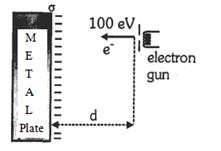
0 likes
View Solution47
MediumMCQ
$A$ negatively charged plate has a surface charge density of $\sigma = 2 \times 10^{-6} \ C/m^2$. An electron with kinetic energy $KE = 200 \ eV$ is projected towards the plate. If the electron does not strike the plate,find the minimum initial distance $r$ in $mm$ from the plate.
A
$1.77$
B
$3.51$
C
$2.52$
D
$4.76$
Solution
(A) The electric field $E$ produced by a large charged plate is given by $E = \frac{\sigma}{2\varepsilon_0}$.
The work done by the electric field on the electron as it moves towards the plate is $W = F \cdot r = eE \cdot r$,where $e$ is the charge of the electron.
For the electron not to strike the plate,its initial kinetic energy must be completely converted into potential energy before it reaches the plate. Thus,$KE = eEr$.
Substituting $E = \frac{\sigma}{2\varepsilon_0}$,we get $KE = e \left( \frac{\sigma}{2\varepsilon_0} \right) r$.
Rearranging for $r$: $r = \frac{2 \cdot KE \cdot \varepsilon_0}{e \cdot \sigma}$.
Given $KE = 200 \ eV = 200 \times 1.6 \times 10^{-19} \ J$,$\sigma = 2 \times 10^{-6} \ C/m^2$,and $\varepsilon_0 = 8.854 \times 10^{-12} \ C^2/(N \cdot m^2)$.
$r = \frac{2 \times 200 \times 1.6 \times 10^{-19} \times 8.854 \times 10^{-12}}{1.6 \times 10^{-19} \times 2 \times 10^{-6}} = \frac{400 \times 8.854 \times 10^{-12}}{2 \times 10^{-6}} = 200 \times 8.854 \times 10^{-6} \ m = 1770.8 \times 10^{-6} \ m \approx 1.77 \times 10^{-3} \ m = 1.77 \ mm$.
The work done by the electric field on the electron as it moves towards the plate is $W = F \cdot r = eE \cdot r$,where $e$ is the charge of the electron.
For the electron not to strike the plate,its initial kinetic energy must be completely converted into potential energy before it reaches the plate. Thus,$KE = eEr$.
Substituting $E = \frac{\sigma}{2\varepsilon_0}$,we get $KE = e \left( \frac{\sigma}{2\varepsilon_0} \right) r$.
Rearranging for $r$: $r = \frac{2 \cdot KE \cdot \varepsilon_0}{e \cdot \sigma}$.
Given $KE = 200 \ eV = 200 \times 1.6 \times 10^{-19} \ J$,$\sigma = 2 \times 10^{-6} \ C/m^2$,and $\varepsilon_0 = 8.854 \times 10^{-12} \ C^2/(N \cdot m^2)$.
$r = \frac{2 \times 200 \times 1.6 \times 10^{-19} \times 8.854 \times 10^{-12}}{1.6 \times 10^{-19} \times 2 \times 10^{-6}} = \frac{400 \times 8.854 \times 10^{-12}}{2 \times 10^{-6}} = 200 \times 8.854 \times 10^{-6} \ m = 1770.8 \times 10^{-6} \ m \approx 1.77 \times 10^{-3} \ m = 1.77 \ mm$.
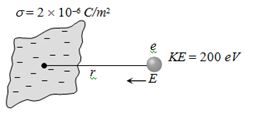
0 likes
View Solution48
MediumMCQ
The electric field at a distance of $20 \ cm$ from the center of a charged spherical shell of radius $10 \ cm$ is $100 \ V/m$. What is the electric field at a distance of $3 \ cm$ from the center?
A
$100$
B
$125$
C
$120$
D
$0$
Solution
(D) For a charged spherical shell, the electric field outside $(r > R)$ is given by $E_{out} = \frac{kQ}{r^2}$.
Given $E_{out} = 100 \ V/m$ at $r = 20 \ cm = 0.2 \ m$, we have $100 = \frac{kQ}{(0.2)^2}$, which implies $kQ = 100 \times 0.04 = 4 \ V \cdot m$.
For a charged spherical shell, the electric field inside $(r < R)$ is always zero because there is no enclosed charge, i.e., $E_{in} = 0 \ V/m$.
Since $3 \ cm < 10 \ cm$, the point lies inside the shell.
Therefore, the electric field at $3 \ cm$ is $0 \ V/m$.
Given $E_{out} = 100 \ V/m$ at $r = 20 \ cm = 0.2 \ m$, we have $100 = \frac{kQ}{(0.2)^2}$, which implies $kQ = 100 \times 0.04 = 4 \ V \cdot m$.
For a charged spherical shell, the electric field inside $(r < R)$ is always zero because there is no enclosed charge, i.e., $E_{in} = 0 \ V/m$.
Since $3 \ cm < 10 \ cm$, the point lies inside the shell.
Therefore, the electric field at $3 \ cm$ is $0 \ V/m$.
0 likes
View Solution49
DifficultMCQ
$A$ cube of side $a$ is placed in an electric field $\vec{E} = E_0 x \hat{i}$. What is the total charge enclosed by the cube?
A
Zero
B
$\varepsilon_0 E_0 a^3$
C
$\frac{1}{\varepsilon_0} E_0 a^3$
D
$\frac{1}{6} \varepsilon_0 E_0 a^2$
Solution
(B) The electric flux $\phi$ through a surface is given by $\phi = \oint \vec{E} \cdot d\vec{A}$.
For the cube,the electric field is $\vec{E} = E_0 x \hat{i}$.
The flux through the left face (at $x = x_0$) is $\phi_L = \vec{E} \cdot \vec{A}_L = (E_0 x_0 \hat{i}) \cdot (-a^2 \hat{i}) = -E_0 x_0 a^2$.
The flux through the right face (at $x = x_0 + a$) is $\phi_R = \vec{E} \cdot \vec{A}_R = (E_0 (x_0 + a) \hat{i}) \cdot (a^2 \hat{i}) = E_0 (x_0 + a) a^2$.
The flux through all other faces is zero because the electric field is perpendicular to the area vector.
The net flux $\phi_{net} = \phi_L + \phi_R = -E_0 x_0 a^2 + E_0 x_0 a^2 + E_0 a^3 = E_0 a^3$.
By Gauss's Law,$\phi_{net} = \frac{q_{enclosed}}{\varepsilon_0}$.
Therefore,$q_{enclosed} = \varepsilon_0 \phi_{net} = \varepsilon_0 E_0 a^3$.
For the cube,the electric field is $\vec{E} = E_0 x \hat{i}$.
The flux through the left face (at $x = x_0$) is $\phi_L = \vec{E} \cdot \vec{A}_L = (E_0 x_0 \hat{i}) \cdot (-a^2 \hat{i}) = -E_0 x_0 a^2$.
The flux through the right face (at $x = x_0 + a$) is $\phi_R = \vec{E} \cdot \vec{A}_R = (E_0 (x_0 + a) \hat{i}) \cdot (a^2 \hat{i}) = E_0 (x_0 + a) a^2$.
The flux through all other faces is zero because the electric field is perpendicular to the area vector.
The net flux $\phi_{net} = \phi_L + \phi_R = -E_0 x_0 a^2 + E_0 x_0 a^2 + E_0 a^3 = E_0 a^3$.
By Gauss's Law,$\phi_{net} = \frac{q_{enclosed}}{\varepsilon_0}$.
Therefore,$q_{enclosed} = \varepsilon_0 \phi_{net} = \varepsilon_0 E_0 a^3$.
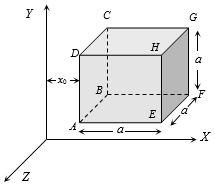
0 likes
View Solution50
MediumMCQ
$A$ hollow cylinder has a charge $q$ within it. If $\phi$ is the electric flux in units of $V-m$ associated with the curved surface $B,$ the flux linked with the plane surface $A$ in units of $V-m$ will be
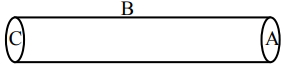
A
$\frac{q}{2\varepsilon_0}$
B
$\frac{\phi}{3}$
C
$\frac{q}{\varepsilon_0} - \phi$
D
$\frac{1}{2}\left(\frac{q}{\varepsilon_0} - \phi\right)$
Solution
(D) Let $\phi_A, \phi_B,$ and $\phi_C$ be the electric flux linked with the surfaces $A, B,$ and $C$ respectively.
According to Gauss's Law,the total electric flux through the closed surface is $\phi_{total} = \phi_A + \phi_B + \phi_C = \frac{q}{\varepsilon_0}$.
Due to the symmetry of the cylinder,the flux linked with the two plane surfaces $A$ and $C$ is equal,so $\phi_A = \phi_C$.
Substituting this into the Gauss's Law equation,we get $2\phi_A + \phi_B = \frac{q}{\varepsilon_0}$.
Given that the flux through the curved surface $B$ is $\phi_B = \phi$,we have $2\phi_A + \phi = \frac{q}{\varepsilon_0}$.
Rearranging for $\phi_A$,we get $2\phi_A = \frac{q}{\varepsilon_0} - \phi$.
Therefore,$\phi_A = \frac{1}{2}\left(\frac{q}{\varepsilon_0} - \phi\right)$.
According to Gauss's Law,the total electric flux through the closed surface is $\phi_{total} = \phi_A + \phi_B + \phi_C = \frac{q}{\varepsilon_0}$.
Due to the symmetry of the cylinder,the flux linked with the two plane surfaces $A$ and $C$ is equal,so $\phi_A = \phi_C$.
Substituting this into the Gauss's Law equation,we get $2\phi_A + \phi_B = \frac{q}{\varepsilon_0}$.
Given that the flux through the curved surface $B$ is $\phi_B = \phi$,we have $2\phi_A + \phi = \frac{q}{\varepsilon_0}$.
Rearranging for $\phi_A$,we get $2\phi_A = \frac{q}{\varepsilon_0} - \phi$.
Therefore,$\phi_A = \frac{1}{2}\left(\frac{q}{\varepsilon_0} - \phi\right)$.
0 likes
View SolutionElectric Charges and Fields — Electric Field and usage of Gauss's Law · Frequently Asked Questions
1Are these Electric Charges and Fields questions useful for JEE and NEET?
Yes. All questions in this section are mapped to JEE Main and NEET exam patterns. Previous year questions from JEE Main, NEET, GUJCET and state-level exams are included with full solutions.
2Can I switch to Hindi or Gujarati for these questions?
Yes. Use the language tabs in the hero section or the sidebar to view the same questions and solutions in English, Hindi or Gujarati.
3How do I generate a question paper from this subtopic?
Use the Vedclass Exam Paper Generator — select the chapter and subtopic, set difficulty, and generate Sets A, B, C, D automatically. First 3 chapters of every subject are free.
Vedclass Products
For Students
Vedclass Test Series
Mock tests in real JEE/NEET style with performance analysis. 5-day free trial.
Start Free TrialFor Teachers
Exam Paper Generator
Generate Set A/B/C/D papers from this chapter in 2 minutes. 3 chapters free.
Try FreeFor Institutes
Online Exam Module
Live online exams with unlimited students, 360° analytics & white-label branding.
See DemoFor Teachers & Institutes
Generate a Electric Charges and Fields Exam Paper in 2 Minutes
Select subtopic & difficulty — Sets A, B, C, D auto-generated with No Repeat logic.
First 3 chapters of every subject are free — no payment required.