
A English
Multiplication of Vectors Questions in English
Class 11 Physics · 3-1.Vectors · Multiplication of Vectors
191+
Questions
English
Language
100%
With Solutions
Showing 50 of 191 questions in English
101
MediumMCQ
If diagonals of a parallelogram are $(5\hat i - 4\hat j + 3\hat k)$ and $(3\hat i + 2\hat j - \hat k)$,then its area is
A
$\sqrt{171} \text{ unit}^2$
B
$\sqrt{72} \text{ unit}^2$
C
$171 \text{ unit}^2$
D
$\frac{\sqrt{171}}{2} \text{ unit}^2$
Solution
(A) The area of a parallelogram with diagonals $\vec{d_1}$ and $\vec{d_2}$ is given by the formula: $\text{Area} = \frac{1}{2} |\vec{d_1} \times \vec{d_2}|$.
Given $\vec{d_1} = 5\hat{i} - 4\hat{j} + 3\hat{k}$ and $\vec{d_2} = 3\hat{i} + 2\hat{j} - \hat{k}$.
First,calculate the cross product $\vec{d_1} \times \vec{d_2}$:
$\vec{d_1} \times \vec{d_2} = \begin{vmatrix} \hat{i} & \hat{j} & \hat{k} \\ 5 & -4 & 3 \\ 3 & 2 & -1 \end{vmatrix} = \hat{i}(4 - 6) - \hat{j}(-5 - 9) + \hat{k}(10 - (-12)) = -2\hat{i} + 14\hat{j} + 22\hat{k}$.
Now,find the magnitude of the cross product:
$|\vec{d_1} \times \vec{d_2}| = \sqrt{(-2)^2 + 14^2 + 22^2} = \sqrt{4 + 196 + 484} = \sqrt{684}$.
Simplify the square root: $\sqrt{684} = \sqrt{36 \times 19} = 6\sqrt{19}$.
Finally,the area is $\frac{1}{2} \times 6\sqrt{19} = 3\sqrt{19} = \sqrt{9 \times 19} = \sqrt{171} \text{ unit}^2$.
Given $\vec{d_1} = 5\hat{i} - 4\hat{j} + 3\hat{k}$ and $\vec{d_2} = 3\hat{i} + 2\hat{j} - \hat{k}$.
First,calculate the cross product $\vec{d_1} \times \vec{d_2}$:
$\vec{d_1} \times \vec{d_2} = \begin{vmatrix} \hat{i} & \hat{j} & \hat{k} \\ 5 & -4 & 3 \\ 3 & 2 & -1 \end{vmatrix} = \hat{i}(4 - 6) - \hat{j}(-5 - 9) + \hat{k}(10 - (-12)) = -2\hat{i} + 14\hat{j} + 22\hat{k}$.
Now,find the magnitude of the cross product:
$|\vec{d_1} \times \vec{d_2}| = \sqrt{(-2)^2 + 14^2 + 22^2} = \sqrt{4 + 196 + 484} = \sqrt{684}$.
Simplify the square root: $\sqrt{684} = \sqrt{36 \times 19} = 6\sqrt{19}$.
Finally,the area is $\frac{1}{2} \times 6\sqrt{19} = 3\sqrt{19} = \sqrt{9 \times 19} = \sqrt{171} \text{ unit}^2$.
0 likes
View Solution102
EasyMCQ
The projection of vector $\vec A$ on vector $\vec B$ is:
A
$\vec A \cdot \vec B$
B
$\vec A \cdot \hat B$
C
$\vec B \times \vec A$
D
$\hat B \cdot \hat A$
Solution
(B) The projection of a vector $\vec A$ onto a vector $\vec B$ is defined as the scalar component of $\vec A$ in the direction of $\vec B$.
Mathematically,this is given by the dot product of $\vec A$ with the unit vector of $\vec B$.
Projection $= |\vec A| \cos \theta$.
Since $\vec A \cdot \vec B = |\vec A| |\vec B| \cos \theta$,we have $|\vec A| \cos \theta = \frac{\vec A \cdot \vec B}{|\vec B|}$.
Since the unit vector $\hat B = \frac{\vec B}{|\vec B|}$,the projection is $\vec A \cdot \hat B$.
Mathematically,this is given by the dot product of $\vec A$ with the unit vector of $\vec B$.
Projection $= |\vec A| \cos \theta$.
Since $\vec A \cdot \vec B = |\vec A| |\vec B| \cos \theta$,we have $|\vec A| \cos \theta = \frac{\vec A \cdot \vec B}{|\vec B|}$.
Since the unit vector $\hat B = \frac{\vec B}{|\vec B|}$,the projection is $\vec A \cdot \hat B$.
0 likes
View Solution103
EasyMCQ
If $\hat{A}$ is a unit vector in a given direction,then the value of $\hat{A} \cdot \frac{d\hat{A}}{dt}$ is
A
$0$
B
$1$
C
$\frac{1}{2}$
D
$2$
Solution
(A) Given that $\hat{A}$ is a unit vector,its magnitude is constant,i.e.,$|\hat{A}| = 1$.
Squaring both sides,we get $|\hat{A}|^2 = \hat{A} \cdot \hat{A} = 1$.
Differentiating both sides with respect to time $t$,we get $\frac{d}{dt}(\hat{A} \cdot \hat{A}) = \frac{d}{dt}(1)$.
Using the product rule for the dot product,we have $\frac{d\hat{A}}{dt} \cdot \hat{A} + \hat{A} \cdot \frac{d\hat{A}}{dt} = 0$.
Since the dot product is commutative,this simplifies to $2(\hat{A} \cdot \frac{d\hat{A}}{dt}) = 0$.
Therefore,$\hat{A} \cdot \frac{d\hat{A}}{dt} = 0$.
Squaring both sides,we get $|\hat{A}|^2 = \hat{A} \cdot \hat{A} = 1$.
Differentiating both sides with respect to time $t$,we get $\frac{d}{dt}(\hat{A} \cdot \hat{A}) = \frac{d}{dt}(1)$.
Using the product rule for the dot product,we have $\frac{d\hat{A}}{dt} \cdot \hat{A} + \hat{A} \cdot \frac{d\hat{A}}{dt} = 0$.
Since the dot product is commutative,this simplifies to $2(\hat{A} \cdot \frac{d\hat{A}}{dt}) = 0$.
Therefore,$\hat{A} \cdot \frac{d\hat{A}}{dt} = 0$.
0 likes
View Solution104
MediumMCQ
If $F_1$ and $F_2$ are two vectors of equal magnitudes $F$ such that $|F_1 \cdot F_2| = |F_1 \times F_2|$,then $|F_1 + F_2|$ is equal to
A
$\sqrt{2+\sqrt{2}} F$
B
$2 F$
C
$F \sqrt{2}$
D
None of these
Solution
(A) Given that $|F_1| = |F_2| = F$ and $|F_1 \cdot F_2| = |F_1 \times F_2|$.
Using the definitions of dot and cross products: $F^2 \cos \theta = F^2 \sin \theta$.
This implies $\tan \theta = 1$,so $\theta = 45^{\circ}$.
The magnitude of the resultant vector is given by $|F_1 + F_2| = \sqrt{F_1^2 + F_2^2 + 2F_1F_2 \cos \theta}$.
Substituting the values: $|F_1 + F_2| = \sqrt{F^2 + F^2 + 2F^2 \cos 45^{\circ}}$.
$|F_1 + F_2| = \sqrt{2F^2 + 2F^2 \left(\frac{1}{\sqrt{2}}\right)} = \sqrt{2F^2 + F^2 \sqrt{2}}$.
$|F_1 + F_2| = F \sqrt{2 + \sqrt{2}}$.
Using the definitions of dot and cross products: $F^2 \cos \theta = F^2 \sin \theta$.
This implies $\tan \theta = 1$,so $\theta = 45^{\circ}$.
The magnitude of the resultant vector is given by $|F_1 + F_2| = \sqrt{F_1^2 + F_2^2 + 2F_1F_2 \cos \theta}$.
Substituting the values: $|F_1 + F_2| = \sqrt{F^2 + F^2 + 2F^2 \cos 45^{\circ}}$.
$|F_1 + F_2| = \sqrt{2F^2 + 2F^2 \left(\frac{1}{\sqrt{2}}\right)} = \sqrt{2F^2 + F^2 \sqrt{2}}$.
$|F_1 + F_2| = F \sqrt{2 + \sqrt{2}}$.
0 likes
View Solution105
DifficultMCQ
If the vectors $\vec P = a\hat i + a\hat j + 3\hat k$ and $\vec Q = a\hat i - 2\hat j - \hat k$ are perpendicular to each other,then the positive value of $a$ is
A
$0$
B
$1$
C
$2$
D
$3$
Solution
(D) Two vectors are perpendicular if their dot product is zero,i.e.,$\vec P \cdot \vec Q = 0$.
Given $\vec P = a\hat i + a\hat j + 3\hat k$ and $\vec Q = a\hat i - 2\hat j - \hat k$.
$(a\hat i + a\hat j + 3\hat k) \cdot (a\hat i - 2\hat j - \hat k) = 0$.
Calculating the dot product: $(a)(a) + (a)(-2) + (3)(-1) = 0$.
$a^2 - 2a - 3 = 0$.
Factoring the quadratic equation: $a^2 - 3a + a - 3 = 0$.
$a(a - 3) + 1(a - 3) = 0$.
$(a - 3)(a + 1) = 0$.
This gives $a = 3$ or $a = -1$.
Since the question asks for the positive value of $a$,we have $a = 3$.
Given $\vec P = a\hat i + a\hat j + 3\hat k$ and $\vec Q = a\hat i - 2\hat j - \hat k$.
$(a\hat i + a\hat j + 3\hat k) \cdot (a\hat i - 2\hat j - \hat k) = 0$.
Calculating the dot product: $(a)(a) + (a)(-2) + (3)(-1) = 0$.
$a^2 - 2a - 3 = 0$.
Factoring the quadratic equation: $a^2 - 3a + a - 3 = 0$.
$a(a - 3) + 1(a - 3) = 0$.
$(a - 3)(a + 1) = 0$.
This gives $a = 3$ or $a = -1$.
Since the question asks for the positive value of $a$,we have $a = 3$.
0 likes
View Solution106
MediumMCQ
The value of $\hat{i} \times (\hat{i} \times \vec{a}) + \hat{j} \times (\hat{j} \times \vec{a}) + \hat{k} \times (\hat{k} \times \vec{a})$ is
A
$\vec{a}$
B
$\vec{a} \times \hat{k}$
C
$-2\vec{a}$
D
$-\vec{a}$
Solution
(C) Using the vector triple product identity $\vec{A} \times (\vec{B} \times \vec{C}) = \vec{B}(\vec{A} \cdot \vec{C}) - \vec{C}(\vec{A} \cdot \vec{B})$:
$\hat{i} \times (\hat{i} \times \vec{a}) = \hat{i}(\hat{i} \cdot \vec{a}) - \vec{a}(\hat{i} \cdot \hat{i}) = \hat{i}a_x - \vec{a}$
$\hat{j} \times (\hat{j} \times \vec{a}) = \hat{j}(\hat{j} \cdot \vec{a}) - \vec{a}(\hat{j} \cdot \hat{j}) = \hat{j}a_y - \vec{a}$
$\hat{k} \times (\hat{k} \times \vec{a}) = \hat{k}(\hat{k} \cdot \vec{a}) - \vec{a}(\hat{k} \cdot \hat{k}) = \hat{k}a_z - \vec{a}$
Summing these expressions:
$(\hat{i}a_x + \hat{j}a_y + \hat{k}a_z) - 3\vec{a}$
Since $\vec{a} = \hat{i}a_x + \hat{j}a_y + \hat{k}a_z$,the expression becomes:
$\vec{a} - 3\vec{a} = -2\vec{a}$.
$\hat{i} \times (\hat{i} \times \vec{a}) = \hat{i}(\hat{i} \cdot \vec{a}) - \vec{a}(\hat{i} \cdot \hat{i}) = \hat{i}a_x - \vec{a}$
$\hat{j} \times (\hat{j} \times \vec{a}) = \hat{j}(\hat{j} \cdot \vec{a}) - \vec{a}(\hat{j} \cdot \hat{j}) = \hat{j}a_y - \vec{a}$
$\hat{k} \times (\hat{k} \times \vec{a}) = \hat{k}(\hat{k} \cdot \vec{a}) - \vec{a}(\hat{k} \cdot \hat{k}) = \hat{k}a_z - \vec{a}$
Summing these expressions:
$(\hat{i}a_x + \hat{j}a_y + \hat{k}a_z) - 3\vec{a}$
Since $\vec{a} = \hat{i}a_x + \hat{j}a_y + \hat{k}a_z$,the expression becomes:
$\vec{a} - 3\vec{a} = -2\vec{a}$.
0 likes
View Solution107
MediumMCQ
Find the angle between two vectors $\vec A = 2\hat i + \hat j - \hat k$ and $\vec B = \hat i - \hat k$ in degrees.
A
$40$
B
$30$
C
$20$
D
$10$
Solution
(B) The angle $\theta$ between two vectors $\vec A$ and $\vec B$ is given by the formula $\cos \theta = \frac{\vec A \cdot \vec B}{|\vec A| |\vec B|}$.
First,calculate the dot product: $\vec A \cdot \vec B = (2)(1) + (1)(0) + (-1)(-1) = 2 + 0 + 1 = 3$.
Next,calculate the magnitudes: $|\vec A| = \sqrt{2^2 + 1^2 + (-1)^2} = \sqrt{4 + 1 + 1} = \sqrt{6}$ and $|\vec B| = \sqrt{1^2 + 0^2 + (-1)^2} = \sqrt{1 + 0 + 1} = \sqrt{2}$.
Now,substitute these values into the formula: $\cos \theta = \frac{3}{\sqrt{6} \cdot \sqrt{2}} = \frac{3}{\sqrt{12}} = \frac{3}{2\sqrt{3}} = \frac{\sqrt{3}}{2}$.
Since $\cos \theta = \frac{\sqrt{3}}{2}$,the angle $\theta = 30^o$.
First,calculate the dot product: $\vec A \cdot \vec B = (2)(1) + (1)(0) + (-1)(-1) = 2 + 0 + 1 = 3$.
Next,calculate the magnitudes: $|\vec A| = \sqrt{2^2 + 1^2 + (-1)^2} = \sqrt{4 + 1 + 1} = \sqrt{6}$ and $|\vec B| = \sqrt{1^2 + 0^2 + (-1)^2} = \sqrt{1 + 0 + 1} = \sqrt{2}$.
Now,substitute these values into the formula: $\cos \theta = \frac{3}{\sqrt{6} \cdot \sqrt{2}} = \frac{3}{\sqrt{12}} = \frac{3}{2\sqrt{3}} = \frac{\sqrt{3}}{2}$.
Since $\cos \theta = \frac{\sqrt{3}}{2}$,the angle $\theta = 30^o$.
0 likes
View Solution108
MediumMCQ
Vector $A$ is pointing eastwards and vector $B$ is pointing northwards. Match the following two columns:
| Column $I$ | Column $II$ |
|---|---|
| $(A) (A+B)$ | $(p)$ North-east |
| $(B) (A-B)$ | $(q)$ Vertically upwards |
| $(C) (A \times B)$ | $(r)$ Vertically downwards |
| $(D) (A \times B) \times (A \times B)$ | $(s)$ None |
A
$(A \rightarrow p, B \rightarrow s, C \rightarrow q, D \rightarrow s)$
B
$(A \rightarrow p, B \rightarrow s, C \rightarrow r, D \rightarrow s)$
C
$(A \rightarrow p, B \rightarrow s, C \rightarrow q, D \rightarrow r)$
D
$(A \rightarrow s, B \rightarrow p, C \rightarrow q, D \rightarrow s)$
Solution
(A) Let the unit vectors be $\hat{i}$ (East) and $\hat{j}$ (North). So,$A = A\hat{i}$ and $B = B\hat{j}$.
$(A) (A+B) = A\hat{i} + B\hat{j}$,which points in the North-east direction. Thus,$(A) \rightarrow (p)$.
$(B) (A-B) = A\hat{i} - B\hat{j}$,which points in the South-east direction. This is not listed in Column $II$,so $(B) \rightarrow (s)$.
$(C) (A \times B) = (A\hat{i}) \times (B\hat{j}) = AB(\hat{i} \times \hat{j}) = AB\hat{k}$,which points Vertically upwards. Thus,$(C) \rightarrow (q)$.
$(D) (A \times B) \times (A \times B) = 0$,because the cross product of any vector with itself is zero. This is not listed in Column $II$,so $(D) \rightarrow (s)$.
Therefore,the correct matching is $(A \rightarrow p, B \rightarrow s, C \rightarrow q, D \rightarrow s)$.
$(A) (A+B) = A\hat{i} + B\hat{j}$,which points in the North-east direction. Thus,$(A) \rightarrow (p)$.
$(B) (A-B) = A\hat{i} - B\hat{j}$,which points in the South-east direction. This is not listed in Column $II$,so $(B) \rightarrow (s)$.
$(C) (A \times B) = (A\hat{i}) \times (B\hat{j}) = AB(\hat{i} \times \hat{j}) = AB\hat{k}$,which points Vertically upwards. Thus,$(C) \rightarrow (q)$.
$(D) (A \times B) \times (A \times B) = 0$,because the cross product of any vector with itself is zero. This is not listed in Column $II$,so $(D) \rightarrow (s)$.
Therefore,the correct matching is $(A \rightarrow p, B \rightarrow s, C \rightarrow q, D \rightarrow s)$.
0 likes
View Solution109
EasyMCQ
The resultant of $\vec{A} \times 0$ will be equal to
A
Zero
B
Zero vector
C
$A$
D
Unit vector
Solution
(B) The cross product of any vector $\vec{A}$ with a zero vector $\vec{0}$ is defined as $\vec{A} \times \vec{0} = \vec{0}$.
Since the cross product of two vectors results in another vector,the result of $\vec{A} \times 0$ is a zero vector,which is denoted as $\vec{0}$.
Therefore,the correct option is the zero vector.
Since the cross product of two vectors results in another vector,the result of $\vec{A} \times 0$ is a zero vector,which is denoted as $\vec{0}$.
Therefore,the correct option is the zero vector.
0 likes
View Solution110
Medium
Find the angle between force $F = (3 \hat{i} + 4 \hat{j} - 5 \hat{k})$ units and displacement $d = (5 \hat{i} + 4 \hat{j} + 3 \hat{k})$ units. Also,find the projection of $F$ on $d$.
Solution
(N/A) The dot product of $F$ and $d$ is given by $F \cdot d = F_x d_x + F_y d_y + F_z d_z$.
$F \cdot d = (3)(5) + (4)(4) + (-5)(3) = 15 + 16 - 15 = 16$ units.
The magnitudes are $F = \sqrt{3^2 + 4^2 + (-5)^2} = \sqrt{9 + 16 + 25} = \sqrt{50}$ units and $d = \sqrt{5^2 + 4^2 + 3^2} = \sqrt{25 + 16 + 9} = \sqrt{50}$ units.
Using $F \cdot d = F d \cos \theta$,we have $16 = \sqrt{50} \cdot \sqrt{50} \cdot \cos \theta$.
$16 = 50 \cos \theta \implies \cos \theta = \frac{16}{50} = 0.32$.
Therefore,$\theta = \cos^{-1}(0.32)$.
The projection of $F$ on $d$ is given by $\frac{F \cdot d}{|d|} = \frac{16}{\sqrt{50}} = \frac{16}{5\sqrt{2}} = \frac{16\sqrt{2}}{10} = 1.6\sqrt{2}$ units.
$F \cdot d = (3)(5) + (4)(4) + (-5)(3) = 15 + 16 - 15 = 16$ units.
The magnitudes are $F = \sqrt{3^2 + 4^2 + (-5)^2} = \sqrt{9 + 16 + 25} = \sqrt{50}$ units and $d = \sqrt{5^2 + 4^2 + 3^2} = \sqrt{25 + 16 + 9} = \sqrt{50}$ units.
Using $F \cdot d = F d \cos \theta$,we have $16 = \sqrt{50} \cdot \sqrt{50} \cdot \cos \theta$.
$16 = 50 \cos \theta \implies \cos \theta = \frac{16}{50} = 0.32$.
Therefore,$\theta = \cos^{-1}(0.32)$.
The projection of $F$ on $d$ is given by $\frac{F \cdot d}{|d|} = \frac{16}{\sqrt{50}} = \frac{16}{5\sqrt{2}} = \frac{16\sqrt{2}}{10} = 1.6\sqrt{2}$ units.
1 likes
View Solution111
Medium
Explain the kinds of multiplication operations for vectors.
Solution
(N/A) There are two kinds of multiplication of vectors:
$(i)$ Scalar product (Dot product):
If the product of two vector quantities results in a scalar,then the product is called a scalar product. This product is also known as the dot product.
The scalar product of two vectors $\vec{A}$ and $\vec{B}$ is denoted by $\vec{A} \cdot \vec{B} = |\vec{A}| |\vec{B}| \cos \theta = AB \cos \theta$,where $A$ and $B$ are the magnitudes of $\vec{A}$ and $\vec{B}$ respectively,and $\theta$ is the angle between them.
$(ii)$ Vector product (Cross product):
If the product of two vector quantities results in a vector,then the product is called a vector product.
$A$ vector product is represented by placing a cross sign $(\times)$ between two vectors; hence,it is also called the cross product of vectors.
If $\theta$ is the angle between $\vec{A}$ and $\vec{B}$,then its vector product is $\vec{A} \times \vec{B} = |\vec{A}| |\vec{B}| \sin \theta \hat{n} = AB \sin \theta \hat{n}$,where $\hat{n}$ is the unit vector perpendicular to the plane formed by $\vec{A}$ and $\vec{B}$.
$(i)$ Scalar product (Dot product):
If the product of two vector quantities results in a scalar,then the product is called a scalar product. This product is also known as the dot product.
The scalar product of two vectors $\vec{A}$ and $\vec{B}$ is denoted by $\vec{A} \cdot \vec{B} = |\vec{A}| |\vec{B}| \cos \theta = AB \cos \theta$,where $A$ and $B$ are the magnitudes of $\vec{A}$ and $\vec{B}$ respectively,and $\theta$ is the angle between them.
$(ii)$ Vector product (Cross product):
If the product of two vector quantities results in a vector,then the product is called a vector product.
$A$ vector product is represented by placing a cross sign $(\times)$ between two vectors; hence,it is also called the cross product of vectors.
If $\theta$ is the angle between $\vec{A}$ and $\vec{B}$,then its vector product is $\vec{A} \times \vec{B} = |\vec{A}| |\vec{B}| \sin \theta \hat{n} = AB \sin \theta \hat{n}$,where $\hat{n}$ is the unit vector perpendicular to the plane formed by $\vec{A}$ and $\vec{B}$.
0 likes
View Solution112
Medium
Explain the geometrical interpretation of the scalar product of two vectors.
Solution
(N/A) The scalar product of two vectors $\vec{A}$ and $\vec{B}$ is defined as:
$\vec{A} \cdot \vec{B} = |\vec{A}| |\vec{B}| \cos \theta = AB \cos \theta$ ... $(1)$
where $\theta$ is the angle between $\vec{A}$ and $\vec{B}$.
Geometrically,this product represents the product of the magnitude of one vector and the projection of the other vector onto the first.
Consider the projection of $\vec{B}$ onto $\vec{A}$:
$1$. Draw a perpendicular from the head of $\vec{B}$ onto the line containing $\vec{A}$,meeting at point $M$ as shown in the figure.
$2$. The length $OM$ represents the projection of $\vec{B}$ onto $\vec{A}$,which is given by $B \cos \theta$.
$3$. Substituting this into the scalar product formula:
$\vec{A} \cdot \vec{B} = A (B \cos \theta) = A (OM)$
Thus,the scalar product is the magnitude of $\vec{A}$ multiplied by the component (projection) of $\vec{B}$ along $\vec{A}$.
Similarly,it can be interpreted as the magnitude of $\vec{B}$ multiplied by the component of $\vec{A}$ along $\vec{B}$ $(B \times A \cos \theta)$.
$\vec{A} \cdot \vec{B} = |\vec{A}| |\vec{B}| \cos \theta = AB \cos \theta$ ... $(1)$
where $\theta$ is the angle between $\vec{A}$ and $\vec{B}$.
Geometrically,this product represents the product of the magnitude of one vector and the projection of the other vector onto the first.
Consider the projection of $\vec{B}$ onto $\vec{A}$:
$1$. Draw a perpendicular from the head of $\vec{B}$ onto the line containing $\vec{A}$,meeting at point $M$ as shown in the figure.
$2$. The length $OM$ represents the projection of $\vec{B}$ onto $\vec{A}$,which is given by $B \cos \theta$.
$3$. Substituting this into the scalar product formula:
$\vec{A} \cdot \vec{B} = A (B \cos \theta) = A (OM)$
Thus,the scalar product is the magnitude of $\vec{A}$ multiplied by the component (projection) of $\vec{B}$ along $\vec{A}$.
Similarly,it can be interpreted as the magnitude of $\vec{B}$ multiplied by the component of $\vec{A}$ along $\vec{B}$ $(B \times A \cos \theta)$.
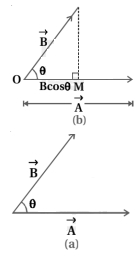
0 likes
View Solution113
Medium
Show that the scalar product of two vectors obeys the commutative law.
Solution
(N/A) Let $\vec{A}$ and $\vec{B}$ be two vectors with an angle $\theta$ between them.
The scalar product (dot product) of $\vec{A}$ and $\vec{B}$ is defined as:
$\vec{A} \cdot \vec{B} = AB \cos \theta$
Since the product of scalar magnitudes $A$ and $B$ is commutative $(AB = BA)$,we can write:
$AB \cos \theta = BA \cos \theta$
By definition,$BA \cos \theta$ is the scalar product of $\vec{B}$ and $\vec{A}$:
$BA \cos \theta = \vec{B} \cdot \vec{A}$
Therefore,$\vec{A} \cdot \vec{B} = \vec{B} \cdot \vec{A}$.
This proves that the scalar product of two vectors obeys the commutative law.
The scalar product (dot product) of $\vec{A}$ and $\vec{B}$ is defined as:
$\vec{A} \cdot \vec{B} = AB \cos \theta$
Since the product of scalar magnitudes $A$ and $B$ is commutative $(AB = BA)$,we can write:
$AB \cos \theta = BA \cos \theta$
By definition,$BA \cos \theta$ is the scalar product of $\vec{B}$ and $\vec{A}$:
$BA \cos \theta = \vec{B} \cdot \vec{A}$
Therefore,$\vec{A} \cdot \vec{B} = \vec{B} \cdot \vec{A}$.
This proves that the scalar product of two vectors obeys the commutative law.
0 likes
View Solution114
Easy
Show that the scalar product of two vectors obeys the distributive law.
Solution
(N/A) According to the figure,let $\overrightarrow{OP} = \vec{A}$,$\overrightarrow{OQ} = \vec{B}$,and $\overrightarrow{QR} = \vec{C}$.
Then,$\overrightarrow{OR} = \overrightarrow{OQ} + \overrightarrow{QR} = \vec{B} + \vec{C}$.
The scalar product $\vec{A} \cdot (\vec{B} + \vec{C})$ is defined as the product of the magnitude of $\vec{A}$ and the projection of $(\vec{B} + \vec{C})$ onto the direction of $\vec{A}$.
From the figure,the projection of $\vec{B}$ on $\vec{A}$ is $OM$,and the projection of $\vec{C}$ on $\vec{A}$ is $MN$.
Therefore,the projection of $(\vec{B} + \vec{C})$ on $\vec{A}$ is $ON = OM + MN$.
Now,$\vec{A} \cdot (\vec{B} + \vec{C}) = |\vec{A}| (ON) = |\vec{A}| (OM + MN)$.
$= |\vec{A}| (OM) + |\vec{A}| (MN)$.
Since $|\vec{A}| (OM) = \vec{A} \cdot \vec{B}$ and $|\vec{A}| (MN) = \vec{A} \cdot \vec{C}$,we have:
$\vec{A} \cdot (\vec{B} + \vec{C}) = \vec{A} \cdot \vec{B} + \vec{A} \cdot \vec{C}$.
This proves that the scalar product obeys the distributive law.
Then,$\overrightarrow{OR} = \overrightarrow{OQ} + \overrightarrow{QR} = \vec{B} + \vec{C}$.
The scalar product $\vec{A} \cdot (\vec{B} + \vec{C})$ is defined as the product of the magnitude of $\vec{A}$ and the projection of $(\vec{B} + \vec{C})$ onto the direction of $\vec{A}$.
From the figure,the projection of $\vec{B}$ on $\vec{A}$ is $OM$,and the projection of $\vec{C}$ on $\vec{A}$ is $MN$.
Therefore,the projection of $(\vec{B} + \vec{C})$ on $\vec{A}$ is $ON = OM + MN$.
Now,$\vec{A} \cdot (\vec{B} + \vec{C}) = |\vec{A}| (ON) = |\vec{A}| (OM + MN)$.
$= |\vec{A}| (OM) + |\vec{A}| (MN)$.
Since $|\vec{A}| (OM) = \vec{A} \cdot \vec{B}$ and $|\vec{A}| (MN) = \vec{A} \cdot \vec{C}$,we have:
$\vec{A} \cdot (\vec{B} + \vec{C}) = \vec{A} \cdot \vec{B} + \vec{A} \cdot \vec{C}$.
This proves that the scalar product obeys the distributive law.
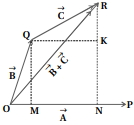
0 likes
View Solution115
Medium
Show that the magnitude of a vector is equal to the square root of the scalar product of the vector with itself.
Solution
(N/A) Let $\overrightarrow{A}$ be a vector. The scalar product (dot product) of the vector $\overrightarrow{A}$ with itself is defined as $\overrightarrow{A} \cdot \overrightarrow{A} = |\overrightarrow{A}| |\overrightarrow{A}| \cos \theta$.
Since the angle $\theta$ between a vector and itself is $0^{\circ}$,we have $\cos 0^{\circ} = 1$.
Therefore,$\overrightarrow{A} \cdot \overrightarrow{A} = |\overrightarrow{A}| |\overrightarrow{A}| (1) = |\overrightarrow{A}|^2$.
Taking the square root on both sides,we get $|\overrightarrow{A}| = \sqrt{\overrightarrow{A} \cdot \overrightarrow{A}}$.
Thus,the magnitude of a vector is equal to the square root of the scalar product of the vector with itself.
Since the angle $\theta$ between a vector and itself is $0^{\circ}$,we have $\cos 0^{\circ} = 1$.
Therefore,$\overrightarrow{A} \cdot \overrightarrow{A} = |\overrightarrow{A}| |\overrightarrow{A}| (1) = |\overrightarrow{A}|^2$.
Taking the square root on both sides,we get $|\overrightarrow{A}| = \sqrt{\overrightarrow{A} \cdot \overrightarrow{A}}$.
Thus,the magnitude of a vector is equal to the square root of the scalar product of the vector with itself.
0 likes
View Solution116
EasyMCQ
Obtain the scalar product of two mutually perpendicular vectors.
A
$0$
B
$1$
C
-$1$
D
Undefined
Solution
(A) If two vectors $\vec{A}$ and $\vec{B}$ are mutually perpendicular,the angle $\theta$ between them is $90^{\circ}$.
The scalar product (dot product) of two vectors is given by the formula $\vec{A} \cdot \vec{B} = AB \cos \theta$.
Substituting $\theta = 90^{\circ}$ into the formula,we get $\vec{A} \cdot \vec{B} = AB \cos 90^{\circ}$.
Since $\cos 90^{\circ} = 0$,the scalar product becomes $\vec{A} \cdot \vec{B} = AB \times 0 = 0$.
Therefore,the scalar product of two mutually perpendicular vectors is $0$.
The scalar product (dot product) of two vectors is given by the formula $\vec{A} \cdot \vec{B} = AB \cos \theta$.
Substituting $\theta = 90^{\circ}$ into the formula,we get $\vec{A} \cdot \vec{B} = AB \cos 90^{\circ}$.
Since $\cos 90^{\circ} = 0$,the scalar product becomes $\vec{A} \cdot \vec{B} = AB \times 0 = 0$.
Therefore,the scalar product of two mutually perpendicular vectors is $0$.
0 likes
View Solution117
Medium
Find the scalar and vector products of two vectors $\vec{a} = (3 \hat{i} - 4 \hat{j} + 5 \hat{k})$ and $\vec{b} = (-2 \hat{i} + \hat{j} - 3 \hat{k})$.
Solution
The scalar product (dot product) is calculated as:
$\vec{a} \cdot \vec{b} = (3 \hat{i} - 4 \hat{j} + 5 \hat{k}) \cdot (-2 \hat{i} + \hat{j} - 3 \hat{k})$
$= (3)(-2) + (-4)(1) + (5)(-3)$
$= -6 - 4 - 15 = -25$
The vector product (cross product) is calculated using the determinant:
$\vec{a} \times \vec{b} = \begin{vmatrix} \hat{i} & \hat{j} & \hat{k} \\ 3 & -4 & 5 \\ -2 & 1 & -3 \end{vmatrix}$
$= \hat{i}((-4)(-3) - (5)(1)) - \hat{j}((3)(-3) - (5)(-2)) + \hat{k}((3)(1) - (-4)(-2))$
$= \hat{i}(12 - 5) - \hat{j}(-9 + 10) + \hat{k}(3 - 8)$
$= 7 \hat{i} - \hat{j} - 5 \hat{k}$
$\vec{a} \cdot \vec{b} = (3 \hat{i} - 4 \hat{j} + 5 \hat{k}) \cdot (-2 \hat{i} + \hat{j} - 3 \hat{k})$
$= (3)(-2) + (-4)(1) + (5)(-3)$
$= -6 - 4 - 15 = -25$
The vector product (cross product) is calculated using the determinant:
$\vec{a} \times \vec{b} = \begin{vmatrix} \hat{i} & \hat{j} & \hat{k} \\ 3 & -4 & 5 \\ -2 & 1 & -3 \end{vmatrix}$
$= \hat{i}((-4)(-3) - (5)(1)) - \hat{j}((3)(-3) - (5)(-2)) + \hat{k}((3)(1) - (-4)(-2))$
$= \hat{i}(12 - 5) - \hat{j}(-9 + 10) + \hat{k}(3 - 8)$
$= 7 \hat{i} - \hat{j} - 5 \hat{k}$
0 likes
View Solution118
Medium
Show that the area of the triangle formed by the vectors $\vec{a}$ and $\vec{b}$ is one-half of the magnitude of $\vec{a} \times \vec{b}$.
Solution
(N/A) Let two vectors $\vec{a}$ and $\vec{b}$ be represented by the sides $\vec{OK}$ and $\vec{OM}$ of a triangle,inclined at an angle $\theta$.
In $\Delta OMN$,where $MN$ is the perpendicular from $M$ to $OK$,we have:
$\sin \theta = \frac{MN}{OM} = \frac{MN}{|\vec{b}|}$
$MN = |\vec{b}| \sin \theta$
The area of $\Delta OMK$ is given by:
Area $= \frac{1}{2} \times \text{base} \times \text{height} = \frac{1}{2} \times OK \times MN$
Area $= \frac{1}{2} |\vec{a}| |\vec{b}| \sin \theta$
Since the magnitude of the cross product is defined as $|\vec{a} \times \vec{b}| = |\vec{a}| |\vec{b}| \sin \theta$,we substitute this into the area formula:
Area $= \frac{1}{2} |\vec{a} \times \vec{b}|$
Thus,the area of the triangle is one-half the magnitude of the cross product of the two vectors.
In $\Delta OMN$,where $MN$ is the perpendicular from $M$ to $OK$,we have:
$\sin \theta = \frac{MN}{OM} = \frac{MN}{|\vec{b}|}$
$MN = |\vec{b}| \sin \theta$
The area of $\Delta OMK$ is given by:
Area $= \frac{1}{2} \times \text{base} \times \text{height} = \frac{1}{2} \times OK \times MN$
Area $= \frac{1}{2} |\vec{a}| |\vec{b}| \sin \theta$
Since the magnitude of the cross product is defined as $|\vec{a} \times \vec{b}| = |\vec{a}| |\vec{b}| \sin \theta$,we substitute this into the area formula:
Area $= \frac{1}{2} |\vec{a} \times \vec{b}|$
Thus,the area of the triangle is one-half the magnitude of the cross product of the two vectors.
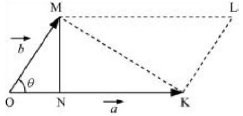
0 likes
View Solution119
Medium
Show that $\vec{a} \cdot(\vec{b} \times \vec{c})$ is equal in magnitude to the volume of the parallelepiped formed by the three vectors $\vec{a}, \vec{b}$ and $\vec{c}$.
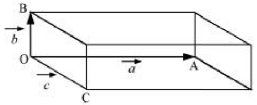
Solution
(N/A) The volume of a parallelepiped is defined as the product of the area of its base and its height.
Let the vectors representing the three adjacent edges of the parallelepiped be $\vec{a}, \vec{b}$,and $\vec{c}$.
The base of the parallelepiped is formed by vectors $\vec{b}$ and $\vec{c}$. The area of this base is given by the magnitude of the cross product: $Area = |\vec{b} \times \vec{c}|$.
The direction of the vector $\vec{b} \times \vec{c}$ is perpendicular to the base,i.e.,normal to the plane containing $\vec{b}$ and $\vec{c}$.
The height $h$ of the parallelepiped is the projection of vector $\vec{a}$ onto the direction of the normal vector $\vec{n} = \frac{\vec{b} \times \vec{c}}{|\vec{b} \times \vec{c}|}$.
Thus,$h = |\vec{a} \cdot \hat{n}| = \left| \vec{a} \cdot \frac{\vec{b} \times \vec{c}}{|\vec{b} \times \vec{c}|} \right|$.
The volume $V$ is given by $V = Area \times h = |\vec{b} \times \vec{c}| \times \left| \vec{a} \cdot \frac{\vec{b} \times \vec{c}}{|\vec{b} \times \vec{c}|} \right| = |\vec{a} \cdot (\vec{b} \times \vec{c})|$.
Therefore,the scalar triple product $\vec{a} \cdot (\vec{b} \times \vec{c})$ represents the volume of the parallelepiped.
Let the vectors representing the three adjacent edges of the parallelepiped be $\vec{a}, \vec{b}$,and $\vec{c}$.
The base of the parallelepiped is formed by vectors $\vec{b}$ and $\vec{c}$. The area of this base is given by the magnitude of the cross product: $Area = |\vec{b} \times \vec{c}|$.
The direction of the vector $\vec{b} \times \vec{c}$ is perpendicular to the base,i.e.,normal to the plane containing $\vec{b}$ and $\vec{c}$.
The height $h$ of the parallelepiped is the projection of vector $\vec{a}$ onto the direction of the normal vector $\vec{n} = \frac{\vec{b} \times \vec{c}}{|\vec{b} \times \vec{c}|}$.
Thus,$h = |\vec{a} \cdot \hat{n}| = \left| \vec{a} \cdot \frac{\vec{b} \times \vec{c}}{|\vec{b} \times \vec{c}|} \right|$.
The volume $V$ is given by $V = Area \times h = |\vec{b} \times \vec{c}| \times \left| \vec{a} \cdot \frac{\vec{b} \times \vec{c}}{|\vec{b} \times \vec{c}|} \right| = |\vec{a} \cdot (\vec{b} \times \vec{c})|$.
Therefore,the scalar triple product $\vec{a} \cdot (\vec{b} \times \vec{c})$ represents the volume of the parallelepiped.
0 likes
View Solution120
Easy
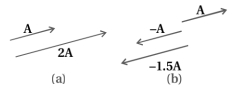
Explain the meaning of multiplication of vectors by real numbers with an example.
Solution
(N/A) Multiplying a vector $\vec{A}$ with a positive real number $\lambda$ results in a new vector $\lambda \vec{A}$ whose magnitude is $\lambda$ times the magnitude of $\vec{A}$,and its direction remains the same as that of $\vec{A}$.
$|\lambda \vec{A}| = \lambda |\vec{A}|$ (for $\lambda > 0$)
For example,if $\vec{A}$ is multiplied by $2$,the resultant vector $2\vec{A}$ points in the same direction as $\vec{A}$ and has a magnitude twice that of $|\vec{A}|$,as shown in figure $(a)$.
Multiplying a vector $\vec{A}$ by a negative real number $\lambda$ results in a vector $\lambda \vec{A}$ whose direction is opposite to that of $\vec{A}$ and whose magnitude is $|\lambda|$ times the magnitude of $\vec{A}$.
For example,multiplying $\vec{A}$ by $-1$ and $-1.5$ gives vectors as shown in figure $(b)$.
The factor $\lambda$ can also be a scalar with physical dimensions. In such cases,the dimension of the resulting vector $\lambda \vec{A}$ is the product of the dimensions of $\lambda$ and $\vec{A}$. For instance,multiplying a constant velocity vector $\vec{v}$ by a time interval $t$ gives a displacement vector $\vec{d} = \vec{v}t$.
Dimensions of $\vec{v} = [LT^{-1}] = m/s$
Dimensions of $\vec{v}t = [LT^{-1}] \cdot [T] = [L] = m$
$|\lambda \vec{A}| = \lambda |\vec{A}|$ (for $\lambda > 0$)
For example,if $\vec{A}$ is multiplied by $2$,the resultant vector $2\vec{A}$ points in the same direction as $\vec{A}$ and has a magnitude twice that of $|\vec{A}|$,as shown in figure $(a)$.
Multiplying a vector $\vec{A}$ by a negative real number $\lambda$ results in a vector $\lambda \vec{A}$ whose direction is opposite to that of $\vec{A}$ and whose magnitude is $|\lambda|$ times the magnitude of $\vec{A}$.
For example,multiplying $\vec{A}$ by $-1$ and $-1.5$ gives vectors as shown in figure $(b)$.
The factor $\lambda$ can also be a scalar with physical dimensions. In such cases,the dimension of the resulting vector $\lambda \vec{A}$ is the product of the dimensions of $\lambda$ and $\vec{A}$. For instance,multiplying a constant velocity vector $\vec{v}$ by a time interval $t$ gives a displacement vector $\vec{d} = \vec{v}t$.
Dimensions of $\vec{v} = [LT^{-1}] = m/s$
Dimensions of $\vec{v}t = [LT^{-1}] \cdot [T] = [L] = m$
0 likes
View Solution121
EasyMCQ
What happens to the direction and magnitude of a vector when it is multiplied by a positive and a negative scalar $\lambda$?
A
Positive $\lambda$: Same direction,magnitude scaled by $\lambda$; Negative $\lambda$: Opposite direction,magnitude scaled by $|\lambda|$.
B
Positive $\lambda$: Opposite direction,magnitude scaled by $\lambda$; Negative $\lambda$: Same direction,magnitude scaled by $|\lambda|$.
C
Positive $\lambda$: Same direction,magnitude remains same; Negative $\lambda$: Opposite direction,magnitude remains same.
D
Positive $\lambda$: Opposite direction,magnitude scaled by $\lambda$; Negative $\lambda$: Opposite direction,magnitude scaled by $|\lambda|$.
Solution
(A) When a vector $\vec{A}$ is multiplied by a scalar $\lambda$,the resulting vector is $\vec{B} = \lambda \vec{A}$.
If $\lambda > 0$,the magnitude of the new vector becomes $|\lambda| |\vec{A}|$ and the direction remains the same as $\vec{A}$.
If $\lambda < 0$,the magnitude of the new vector becomes $|\lambda| |\vec{A}|$ and the direction becomes opposite to that of $\vec{A}$.
If $\lambda > 0$,the magnitude of the new vector becomes $|\lambda| |\vec{A}|$ and the direction remains the same as $\vec{A}$.
If $\lambda < 0$,the magnitude of the new vector becomes $|\lambda| |\vec{A}|$ and the direction becomes opposite to that of $\vec{A}$.
0 likes
View Solution122
MediumMCQ
$\vec{A}$,$\vec{B}$,and $\vec{C}$ are three non-collinear,non-coplanar vectors. What can you say about the direction of $\vec{A} \times (\vec{B} \times \vec{C})$?
A
It is perpendicular to $\vec{A}$ and lies in the plane of $\vec{B}$ and $\vec{C}$.
B
It is perpendicular to $\vec{B}$ and lies in the plane of $\vec{A}$ and $\vec{C}$.
C
It is perpendicular to $\vec{C}$ and lies in the plane of $\vec{A}$ and $\vec{B}$.
D
It is perpendicular to the plane of $\vec{A}$,$\vec{B}$,and $\vec{C}$.
Solution
(A) The vector product $\vec{V} = \vec{B} \times \vec{C}$ results in a vector that is perpendicular to the plane containing $\vec{B}$ and $\vec{C}$.
Next,the vector product $\vec{A} \times \vec{V}$ results in a vector that is perpendicular to both $\vec{A}$ and $\vec{V}$.
Since $\vec{V}$ is perpendicular to the plane of $\vec{B}$ and $\vec{C}$,any vector perpendicular to $\vec{V}$ must lie within the plane of $\vec{B}$ and $\vec{C}$.
Therefore,$\vec{A} \times (\vec{B} \times \vec{C})$ lies in the plane of $\vec{B}$ and $\vec{C}$ and is perpendicular to $\vec{A}$.
Next,the vector product $\vec{A} \times \vec{V}$ results in a vector that is perpendicular to both $\vec{A}$ and $\vec{V}$.
Since $\vec{V}$ is perpendicular to the plane of $\vec{B}$ and $\vec{C}$,any vector perpendicular to $\vec{V}$ must lie within the plane of $\vec{B}$ and $\vec{C}$.
Therefore,$\vec{A} \times (\vec{B} \times \vec{C})$ lies in the plane of $\vec{B}$ and $\vec{C}$ and is perpendicular to $\vec{A}$.
0 likes
View Solution123
Medium
Obtain the scalar product of unit vectors in the Cartesian coordinate system.
Solution
(N/A) In the Cartesian coordinate system,$\hat{i}, \hat{j}$,and $\hat{k}$ are unit vectors along the $X, Y$,and $Z$ axes,respectively.
$(i)$ For parallel unit vectors:
$\hat{i} \cdot \hat{i} = |\hat{i}| |\hat{i}| \cos 0^{\circ} = (1)(1)(1) = 1$
Similarly,$\hat{j} \cdot \hat{j} = 1$ and $\hat{k} \cdot \hat{k} = 1$.
$(ii)$ For orthogonal unit vectors:
$\hat{i} \cdot \hat{j} = |\hat{i}| |\hat{j}| \cos 90^{\circ} = (1)(1)(0) = 0$
Similarly,$\hat{j} \cdot \hat{k} = 0$ and $\hat{k} \cdot \hat{i} = 0$.
Thus,the scalar products are:
$\hat{i} \cdot \hat{i} = \hat{j} \cdot \hat{j} = \hat{k} \cdot \hat{k} = 1$
$\hat{i} \cdot \hat{j} = \hat{j} \cdot \hat{k} = \hat{k} \cdot \hat{i} = 0$
$(i)$ For parallel unit vectors:
$\hat{i} \cdot \hat{i} = |\hat{i}| |\hat{i}| \cos 0^{\circ} = (1)(1)(1) = 1$
Similarly,$\hat{j} \cdot \hat{j} = 1$ and $\hat{k} \cdot \hat{k} = 1$.
$(ii)$ For orthogonal unit vectors:
$\hat{i} \cdot \hat{j} = |\hat{i}| |\hat{j}| \cos 90^{\circ} = (1)(1)(0) = 0$
Similarly,$\hat{j} \cdot \hat{k} = 0$ and $\hat{k} \cdot \hat{i} = 0$.
Thus,the scalar products are:
$\hat{i} \cdot \hat{i} = \hat{j} \cdot \hat{j} = \hat{k} \cdot \hat{k} = 1$
$\hat{i} \cdot \hat{j} = \hat{j} \cdot \hat{k} = \hat{k} \cdot \hat{i} = 0$
0 likes
View Solution124
Easy
Obtain the scalar product of two vectors in terms of their Cartesian components.
Solution
(N/A) Let two vectors $\overrightarrow{A}$ and $\overrightarrow{B}$ be represented in Cartesian components as follows:
$\overrightarrow{A} = A_{x} \hat{i} + A_{y} \hat{j} + A_{z} \hat{k}$
$\overrightarrow{B} = B_{x} \hat{i} + B_{y} \hat{j} + B_{z} \hat{k}$
Then,the scalar product is given by:
$\overrightarrow{A} \cdot \overrightarrow{B} = (A_{x} \hat{i} + A_{y} \hat{j} + A_{z} \hat{k}) \cdot (B_{x} \hat{i} + B_{y} \hat{j} + B_{z} \hat{k})$
Expanding the dot product using the distributive property:
$= A_{x} B_{x}(\hat{i} \cdot \hat{i}) + A_{x} B_{y}(\hat{i} \cdot \hat{j}) + A_{x} B_{z}(\hat{i} \cdot \hat{k}) + A_{y} B_{x}(\hat{j} \cdot \hat{i}) + A_{y} B_{y}(\hat{j} \cdot \hat{j}) + A_{y} B_{z}(\hat{j} \cdot \hat{k}) + A_{z} B_{x}(\hat{k} \cdot \hat{i}) + A_{z} B_{y}(\hat{k} \cdot \hat{j}) + A_{z} B_{z}(\hat{k} \cdot \hat{k})$
Using the properties of unit vectors: $\hat{i} \cdot \hat{i} = \hat{j} \cdot \hat{j} = \hat{k} \cdot \hat{k} = 1$ and $\hat{i} \cdot \hat{j} = \hat{j} \cdot \hat{i} = \hat{j} \cdot \hat{k} = \hat{k} \cdot \hat{j} = \hat{k} \cdot \hat{i} = \hat{i} \cdot \hat{k} = 0$.
Substituting these values,we get:
$\overrightarrow{A} \cdot \overrightarrow{B} = A_{x} B_{x} + A_{y} B_{y} + A_{z} B_{z}$
$\overrightarrow{A} = A_{x} \hat{i} + A_{y} \hat{j} + A_{z} \hat{k}$
$\overrightarrow{B} = B_{x} \hat{i} + B_{y} \hat{j} + B_{z} \hat{k}$
Then,the scalar product is given by:
$\overrightarrow{A} \cdot \overrightarrow{B} = (A_{x} \hat{i} + A_{y} \hat{j} + A_{z} \hat{k}) \cdot (B_{x} \hat{i} + B_{y} \hat{j} + B_{z} \hat{k})$
Expanding the dot product using the distributive property:
$= A_{x} B_{x}(\hat{i} \cdot \hat{i}) + A_{x} B_{y}(\hat{i} \cdot \hat{j}) + A_{x} B_{z}(\hat{i} \cdot \hat{k}) + A_{y} B_{x}(\hat{j} \cdot \hat{i}) + A_{y} B_{y}(\hat{j} \cdot \hat{j}) + A_{y} B_{z}(\hat{j} \cdot \hat{k}) + A_{z} B_{x}(\hat{k} \cdot \hat{i}) + A_{z} B_{y}(\hat{k} \cdot \hat{j}) + A_{z} B_{z}(\hat{k} \cdot \hat{k})$
Using the properties of unit vectors: $\hat{i} \cdot \hat{i} = \hat{j} \cdot \hat{j} = \hat{k} \cdot \hat{k} = 1$ and $\hat{i} \cdot \hat{j} = \hat{j} \cdot \hat{i} = \hat{j} \cdot \hat{k} = \hat{k} \cdot \hat{j} = \hat{k} \cdot \hat{i} = \hat{i} \cdot \hat{k} = 0$.
Substituting these values,we get:
$\overrightarrow{A} \cdot \overrightarrow{B} = A_{x} B_{x} + A_{y} B_{y} + A_{z} B_{z}$
0 likes
View Solution125
Medium
Find the angle between two vectors with the help of the scalar product.
Solution
If $\theta$ is the angle between vectors $\overrightarrow{A}$ and $\overrightarrow{B}$,then by the definition of the scalar product:
$\overrightarrow{A} \cdot \overrightarrow{B} = AB \cos \theta$
Rearranging the formula to solve for $\cos \theta$:
$\cos \theta = \frac{\overrightarrow{A} \cdot \overrightarrow{B}}{|\overrightarrow{A}| |\overrightarrow{B}|} = \frac{\overrightarrow{A} \cdot \overrightarrow{B}}{AB}$
Therefore,the angle $\theta$ is given by:
$\theta = \cos^{-1} \left( \frac{\overrightarrow{A} \cdot \overrightarrow{B}}{AB} \right)$
In a Cartesian coordinate system,where $\overrightarrow{A} = A_x \hat{i} + A_y \hat{j} + A_z \hat{k}$ and $\overrightarrow{B} = B_x \hat{i} + B_y \hat{j} + B_z \hat{k}$,the expression becomes:
$\cos \theta = \frac{A_x B_x + A_y B_y + A_z B_z}{\sqrt{A_x^2 + A_y^2 + A_z^2} \sqrt{B_x^2 + B_y^2 + B_z^2}}$
$\overrightarrow{A} \cdot \overrightarrow{B} = AB \cos \theta$
Rearranging the formula to solve for $\cos \theta$:
$\cos \theta = \frac{\overrightarrow{A} \cdot \overrightarrow{B}}{|\overrightarrow{A}| |\overrightarrow{B}|} = \frac{\overrightarrow{A} \cdot \overrightarrow{B}}{AB}$
Therefore,the angle $\theta$ is given by:
$\theta = \cos^{-1} \left( \frac{\overrightarrow{A} \cdot \overrightarrow{B}}{AB} \right)$
In a Cartesian coordinate system,where $\overrightarrow{A} = A_x \hat{i} + A_y \hat{j} + A_z \hat{k}$ and $\overrightarrow{B} = B_x \hat{i} + B_y \hat{j} + B_z \hat{k}$,the expression becomes:
$\cos \theta = \frac{A_x B_x + A_y B_y + A_z B_z}{\sqrt{A_x^2 + A_y^2 + A_z^2} \sqrt{B_x^2 + B_y^2 + B_z^2}}$
0 likes
View Solution126
Easy
Define the scalar product of two vectors.
Solution
(N/A) The scalar product (or dot product) of two vectors $\vec{A}$ and $\vec{B}$ is defined as the product of the magnitudes of the two vectors and the cosine of the angle $\theta$ between them.
Mathematically,it is expressed as: $\vec{A} \cdot \vec{B} = AB \cos \theta$,where $A$ and $B$ are the magnitudes of vectors $\vec{A}$ and $\vec{B}$ respectively,and $\theta$ is the angle between them $(0 \le \theta \le \pi)$.
The result of the scalar product is a scalar quantity.
Mathematically,it is expressed as: $\vec{A} \cdot \vec{B} = AB \cos \theta$,where $A$ and $B$ are the magnitudes of vectors $\vec{A}$ and $\vec{B}$ respectively,and $\theta$ is the angle between them $(0 \le \theta \le \pi)$.
The result of the scalar product is a scalar quantity.
0 likes
View Solution127
Medium
Define the scalar product and obtain the magnitude of a vector from it. Mention the direction of scalar product.
Solution
(N/A) The scalar product (or dot product) of two vectors $\vec{A}$ and $\vec{B}$ is defined as the product of their magnitudes and the cosine of the angle $\theta$ between them: $\vec{A} \cdot \vec{B} = AB \cos \theta$.
To obtain the magnitude of a vector $\vec{A}$ from the scalar product,we take the dot product of the vector with itself: $\vec{A} \cdot \vec{A} = A A \cos(0^\circ) = A^2$. Thus,the magnitude $A = \sqrt{\vec{A} \cdot \vec{A}}$.
The scalar product is a scalar quantity,meaning it has magnitude but no direction. Therefore,it does not have a direction.
To obtain the magnitude of a vector $\vec{A}$ from the scalar product,we take the dot product of the vector with itself: $\vec{A} \cdot \vec{A} = A A \cos(0^\circ) = A^2$. Thus,the magnitude $A = \sqrt{\vec{A} \cdot \vec{A}}$.
The scalar product is a scalar quantity,meaning it has magnitude but no direction. Therefore,it does not have a direction.
0 likes
View Solution128
Medium
Write the necessary condition for the scalar product of two mutually perpendicular vectors.
Solution
(N/A) The scalar product (dot product) of two vectors $\vec{A}$ and $\vec{B}$ is defined as $\vec{A} \cdot \vec{B} = |A||B| \cos \theta$,where $\theta$ is the angle between the two vectors.
For two vectors to be mutually perpendicular,the angle between them must be $\theta = 90^{\circ}$.
Substituting this into the formula,we get $\vec{A} \cdot \vec{B} = |A||B| \cos(90^{\circ})$.
Since $\cos(90^{\circ}) = 0$,the scalar product becomes $\vec{A} \cdot \vec{B} = 0$.
Therefore,the necessary condition for two non-zero vectors to be mutually perpendicular is that their scalar product must be zero.
For two vectors to be mutually perpendicular,the angle between them must be $\theta = 90^{\circ}$.
Substituting this into the formula,we get $\vec{A} \cdot \vec{B} = |A||B| \cos(90^{\circ})$.
Since $\cos(90^{\circ}) = 0$,the scalar product becomes $\vec{A} \cdot \vec{B} = 0$.
Therefore,the necessary condition for two non-zero vectors to be mutually perpendicular is that their scalar product must be zero.
0 likes
View Solution129
EasyMCQ
If $\overrightarrow{A} = 2\widehat{i} - 2\widehat{j}$ and $\overrightarrow{B} = 2\widehat{k}$,then find the dot product $\overrightarrow{A} \cdot \overrightarrow{B}$.
A
$0$
B
$2$
C
$4$
D
$-4$
Solution
(A) The dot product of two vectors $\overrightarrow{A} = A_x\widehat{i} + A_y\widehat{j} + A_z\widehat{k}$ and $\overrightarrow{B} = B_x\widehat{i} + B_y\widehat{j} + B_z\widehat{k}$ is given by $\overrightarrow{A} \cdot \overrightarrow{B} = A_x B_x + A_y B_y + A_z B_z$.
Given $\overrightarrow{A} = 2\widehat{i} - 2\widehat{j} + 0\widehat{k}$ and $\overrightarrow{B} = 0\widehat{i} + 0\widehat{j} + 2\widehat{k}$.
Substituting the components: $\overrightarrow{A} \cdot \overrightarrow{B} = (2)(0) + (-2)(0) + (0)(2)$.
$\overrightarrow{A} \cdot \overrightarrow{B} = 0 + 0 + 0 = 0$.
Given $\overrightarrow{A} = 2\widehat{i} - 2\widehat{j} + 0\widehat{k}$ and $\overrightarrow{B} = 0\widehat{i} + 0\widehat{j} + 2\widehat{k}$.
Substituting the components: $\overrightarrow{A} \cdot \overrightarrow{B} = (2)(0) + (-2)(0) + (0)(2)$.
$\overrightarrow{A} \cdot \overrightarrow{B} = 0 + 0 + 0 = 0$.
0 likes
View Solution130
EasyMCQ
If vectors $\vec{A} = (2, -3, 1)$ and $\vec{B} = (3, 4, n)$ are perpendicular to each other,find the value of $n$.
A
$6$
B
$4$
C
$3$
D
$2$
Solution
(A) Two vectors are perpendicular if their dot product is zero,i.e.,$\vec{A} \cdot \vec{B} = 0$.
Given $\vec{A} = (2, -3, 1)$ and $\vec{B} = (3, 4, n)$.
Calculating the dot product: $(2)(3) + (-3)(4) + (1)(n) = 0$.
$6 - 12 + n = 0$.
$-6 + n = 0$.
Therefore,$n = 6$.
Given $\vec{A} = (2, -3, 1)$ and $\vec{B} = (3, 4, n)$.
Calculating the dot product: $(2)(3) + (-3)(4) + (1)(n) = 0$.
$6 - 12 + n = 0$.
$-6 + n = 0$.
Therefore,$n = 6$.
0 likes
View Solution131
EasyMCQ
If $\vec{P} = (k, 2, 3)$ and $\vec{Q} = (0, 3, k)$ and $\vec{P} \perp \vec{Q}$,then what is the value of $k$?
A
$2$
B
$-2$
C
$4$
D
$-6$
Solution
(B) Given that $\vec{P} \perp \vec{Q}$,the dot product of the two vectors must be zero,i.e.,$\vec{P} \cdot \vec{Q} = 0$.
Substituting the given components: $(k, 2, 3) \cdot (0, 3, k) = 0$.
Calculating the dot product: $(k \times 0) + (2 \times 3) + (3 \times k) = 0$.
This simplifies to: $0 + 6 + 3k = 0$.
Solving for $k$: $3k = -6$,which gives $k = -2$.
Substituting the given components: $(k, 2, 3) \cdot (0, 3, k) = 0$.
Calculating the dot product: $(k \times 0) + (2 \times 3) + (3 \times k) = 0$.
This simplifies to: $0 + 6 + 3k = 0$.
Solving for $k$: $3k = -6$,which gives $k = -2$.
0 likes
View Solution132
Medium
Explain the cross product of two vectors.
Solution
(N/A) Definition: The vector product or cross product of two vectors $\vec{a}$ and $\vec{b}$ is another vector $\vec{c}$,whose magnitude is equal to the product of the magnitudes of the two vectors and the sine of the smaller angle between them.
If the product of two vectors results in a vector quantity,then this product is called a vector product. Suppose there are two vectors $\vec{a}$ and $\vec{b}$ and the angle between them is $\theta$.
Therefore,the vector product is defined as $\vec{a} \times \vec{b} = |\vec{a}| |\vec{b}| \sin \theta \hat{n} = ab \sin \theta \hat{n}$,where $|\vec{a}| = a$ and $|\vec{b}| = b$.
Here,$\hat{n}$ is a unit vector perpendicular to the plane formed by $\vec{a}$ and $\vec{b}$.
This product is also known as the cross product $(\times)$.
If $\vec{a} \times \vec{b}$ is denoted by $\vec{c}$,then $\vec{c} = ab \sin \theta \hat{n}$.
The magnitude of the resulting vector is $c = ab \sin \theta$.
The direction of $\vec{c}$ is perpendicular to the plane containing $\vec{a}$ and $\vec{b}$,and its direction is determined by the right-hand screw rule.
If the product of two vectors results in a vector quantity,then this product is called a vector product. Suppose there are two vectors $\vec{a}$ and $\vec{b}$ and the angle between them is $\theta$.
Therefore,the vector product is defined as $\vec{a} \times \vec{b} = |\vec{a}| |\vec{b}| \sin \theta \hat{n} = ab \sin \theta \hat{n}$,where $|\vec{a}| = a$ and $|\vec{b}| = b$.
Here,$\hat{n}$ is a unit vector perpendicular to the plane formed by $\vec{a}$ and $\vec{b}$.
This product is also known as the cross product $(\times)$.
If $\vec{a} \times \vec{b}$ is denoted by $\vec{c}$,then $\vec{c} = ab \sin \theta \hat{n}$.
The magnitude of the resulting vector is $c = ab \sin \theta$.
The direction of $\vec{c}$ is perpendicular to the plane containing $\vec{a}$ and $\vec{b}$,and its direction is determined by the right-hand screw rule.
0 likes
View Solution133
Medium
State and explain the characteristics of the vector product of two vectors.
Solution
(N/A) $(1)$ The vector product is anticommutative: $\vec{a} \times \vec{b} = -(\vec{b} \times \vec{a})$. It does not follow the commutative law.
$(2)$ The vector product is distributive over addition: $\vec{a} \times (\vec{b} + \vec{c}) = (\vec{a} \times \vec{b}) + (\vec{a} \times \vec{c})$.
$(3)$ For two parallel or anti-parallel vectors,the vector product is zero: $\vec{a} \times \vec{a} = |a||a| \sin(0^{\circ}) \hat{n} = \vec{0}$.
$(4)$ For two perpendicular vectors,the magnitude of the vector product is maximum: $|\vec{a} \times \vec{b}| = |a||b| \sin(90^{\circ}) = |a||b|$.
$(5)$ The vector product of two vectors is a pseudovector (axial vector). Under reflection,the sign of the vector product does not change because both vectors change sign: $(-\vec{a}) \times (-\vec{b}) = \vec{a} \times \vec{b}$.
$(6)$ For unit vectors in a Cartesian coordinate system: $\hat{i} \times \hat{i} = \hat{j} \times \hat{j} = \hat{k} \times \hat{k} = \vec{0}$ and $\hat{i} \times \hat{j} = \hat{k}$,$\hat{j} \times \hat{k} = \hat{i}$,$\hat{k} \times \hat{i} = \hat{j}$.
$(2)$ The vector product is distributive over addition: $\vec{a} \times (\vec{b} + \vec{c}) = (\vec{a} \times \vec{b}) + (\vec{a} \times \vec{c})$.
$(3)$ For two parallel or anti-parallel vectors,the vector product is zero: $\vec{a} \times \vec{a} = |a||a| \sin(0^{\circ}) \hat{n} = \vec{0}$.
$(4)$ For two perpendicular vectors,the magnitude of the vector product is maximum: $|\vec{a} \times \vec{b}| = |a||b| \sin(90^{\circ}) = |a||b|$.
$(5)$ The vector product of two vectors is a pseudovector (axial vector). Under reflection,the sign of the vector product does not change because both vectors change sign: $(-\vec{a}) \times (-\vec{b}) = \vec{a} \times \vec{b}$.
$(6)$ For unit vectors in a Cartesian coordinate system: $\hat{i} \times \hat{i} = \hat{j} \times \hat{j} = \hat{k} \times \hat{k} = \vec{0}$ and $\hat{i} \times \hat{j} = \hat{k}$,$\hat{j} \times \hat{k} = \hat{i}$,$\hat{k} \times \hat{i} = \hat{j}$.
0 likes
View Solution134
Medium
Define the vector product of two vectors.
Solution
(N/A) The vector product (or cross product) of two vectors $\vec{A}$ and $\vec{B}$ is defined as a vector $\vec{C}$ such that $\vec{C} = \vec{A} \times \vec{B} = AB \sin \theta \hat{n}$.
Here,$A$ and $B$ are the magnitudes of vectors $\vec{A}$ and $\vec{B}$ respectively,$\theta$ is the angle between the two vectors $(0^\circ \le \theta \le 180^\circ)$,and $\hat{n}$ is a unit vector perpendicular to the plane containing both $\vec{A}$ and $\vec{B}$.
The direction of $\hat{n}$ is determined by the right-hand rule.
Here,$A$ and $B$ are the magnitudes of vectors $\vec{A}$ and $\vec{B}$ respectively,$\theta$ is the angle between the two vectors $(0^\circ \le \theta \le 180^\circ)$,and $\hat{n}$ is a unit vector perpendicular to the plane containing both $\vec{A}$ and $\vec{B}$.
The direction of $\hat{n}$ is determined by the right-hand rule.
0 likes
View Solution135
Difficult
Explain the Right-Hand Screw Law.
Solution
(N/A) The Right-Hand Screw Law is a rule used to determine the direction of the vector product (cross product) of two vectors,$\vec{A}$ and $\vec{B}$.
$1$. Imagine a right-handed screw placed at the point of intersection of vectors $\vec{A}$ and $\vec{B}$,with its axis perpendicular to the plane containing both vectors.
$2$. Rotate the screw from the direction of the first vector $\vec{A}$ towards the second vector $\vec{B}$ through the smaller angle between them.
$3$. The direction in which the screw advances (moves forward) represents the direction of the resultant vector $\vec{C} = \vec{A} \times \vec{B}$.
$4$. If the screw moves forward,the direction is outward from the plane; if it moves backward,the direction is into the plane.
$1$. Imagine a right-handed screw placed at the point of intersection of vectors $\vec{A}$ and $\vec{B}$,with its axis perpendicular to the plane containing both vectors.
$2$. Rotate the screw from the direction of the first vector $\vec{A}$ towards the second vector $\vec{B}$ through the smaller angle between them.
$3$. The direction in which the screw advances (moves forward) represents the direction of the resultant vector $\vec{C} = \vec{A} \times \vec{B}$.
$4$. If the screw moves forward,the direction is outward from the plane; if it moves backward,the direction is into the plane.
0 likes
View Solution136
EasyMCQ
What is the product of two vectors if they are parallel or antiparallel?
A
The cross product is zero.
B
The dot product is zero.
C
The cross product is maximum.
D
The dot product is maximum.
Solution
(A) The cross product of two vectors $\vec{A}$ and $\vec{B}$ is given by $\vec{A} \times \vec{B} = AB \sin \theta \hat{n}$,where $\theta$ is the angle between the vectors.
If the vectors are parallel,$\theta = 0^\circ$,so $\sin 0^\circ = 0$.
If the vectors are antiparallel,$\theta = 180^\circ$,so $\sin 180^\circ = 0$.
In both cases,the cross product $\vec{A} \times \vec{B} = 0$.
If the vectors are parallel,$\theta = 0^\circ$,so $\sin 0^\circ = 0$.
If the vectors are antiparallel,$\theta = 180^\circ$,so $\sin 180^\circ = 0$.
In both cases,the cross product $\vec{A} \times \vec{B} = 0$.
0 likes
View Solution137
Medium
Why is the product of two vectors not commutative?
Solution
The product of two vectors can be defined in two ways: the scalar product (dot product) and the vector product (cross product).
$1$. The scalar product is defined as $\vec{A} \cdot \vec{B} = AB \cos \theta$. Since $\cos \theta = \cos(-\theta)$,the scalar product is commutative,i.e.,$\vec{A} \cdot \vec{B} = \vec{B} \cdot \vec{A}$.
$2$. The vector product is defined as $\vec{A} \times \vec{B} = AB \sin \theta \hat{n}$,where $\hat{n}$ is a unit vector perpendicular to the plane containing $\vec{A}$ and $\vec{B}$ determined by the right-hand rule.
$3$. According to the right-hand rule,the direction of $\vec{A} \times \vec{B}$ is opposite to the direction of $\vec{B} \times \vec{A}$.
$4$. Therefore,$\vec{A} \times \vec{B} = -(\vec{B} \times \vec{A})$.
$5$. Because the direction changes,the vector product is anti-commutative,not commutative.
$1$. The scalar product is defined as $\vec{A} \cdot \vec{B} = AB \cos \theta$. Since $\cos \theta = \cos(-\theta)$,the scalar product is commutative,i.e.,$\vec{A} \cdot \vec{B} = \vec{B} \cdot \vec{A}$.
$2$. The vector product is defined as $\vec{A} \times \vec{B} = AB \sin \theta \hat{n}$,where $\hat{n}$ is a unit vector perpendicular to the plane containing $\vec{A}$ and $\vec{B}$ determined by the right-hand rule.
$3$. According to the right-hand rule,the direction of $\vec{A} \times \vec{B}$ is opposite to the direction of $\vec{B} \times \vec{A}$.
$4$. Therefore,$\vec{A} \times \vec{B} = -(\vec{B} \times \vec{A})$.
$5$. Because the direction changes,the vector product is anti-commutative,not commutative.
0 likes
View Solution138
EasyMCQ
Why is $\vec{v} \times \vec{p} = 0$ for a particle moving in a straight line,and how does this relate to the angular momentum of a rotating particle?
A
Because velocity and momentum are always parallel.
B
Because the cross product of two parallel vectors is zero.
C
Because the particle is at rest.
D
Because the force acting on the particle is zero.
Solution
(B) The linear momentum $\vec{p}$ of a particle is defined as $\vec{p} = m\vec{v}$,where $m$ is the mass and $\vec{v}$ is the velocity vector.
Since $m$ is a scalar,$\vec{p}$ is always in the same direction as $\vec{v}$.
Two vectors are parallel if the angle between them is $0^\circ$.
The cross product of two vectors $\vec{A}$ and $\vec{B}$ is given by $\vec{A} \times \vec{B} = |A||B| \sin(\theta) \hat{n}$.
For $\vec{v}$ and $\vec{p}$,the angle $\theta = 0^\circ$,so $\sin(0^\circ) = 0$.
Therefore,$\vec{v} \times \vec{p} = |v||p| \sin(0^\circ) \hat{n} = 0$.
This confirms that for any particle,the cross product of its velocity and momentum is zero because they are collinear.
Since $m$ is a scalar,$\vec{p}$ is always in the same direction as $\vec{v}$.
Two vectors are parallel if the angle between them is $0^\circ$.
The cross product of two vectors $\vec{A}$ and $\vec{B}$ is given by $\vec{A} \times \vec{B} = |A||B| \sin(\theta) \hat{n}$.
For $\vec{v}$ and $\vec{p}$,the angle $\theta = 0^\circ$,so $\sin(0^\circ) = 0$.
Therefore,$\vec{v} \times \vec{p} = |v||p| \sin(0^\circ) \hat{n} = 0$.
This confirms that for any particle,the cross product of its velocity and momentum is zero because they are collinear.
0 likes
View Solution139
Medium
If $|\vec A| = 2$ and $|\vec B| = 4$,then match the relation in Column $-I$ with the angle $\theta$ between $\vec A$ and $\vec B$ in Column $-II$.
| Column $-I$ | Column $-II$ |
| $(a) \vec A \cdot \vec B = 0$ | $(i) \theta = 0^\circ$ |
| $(b) \vec A \cdot \vec B = +8$ | $(ii) \theta = 90^\circ$ |
| $(c) \vec A \cdot \vec B = 4$ | $(iii) \theta = 180^\circ$ |
| $(d) \vec A \cdot \vec B = -8$ | $(iv) \theta = 60^\circ$ |
Solution
(A) Given $|A| = 2$ and $|B| = 4$. The dot product is defined as $\vec A \cdot \vec B = |A||B| \cos \theta = 8 \cos \theta$.
$(a) \vec A \cdot \vec B = 0 \implies 8 \cos \theta = 0 \implies \cos \theta = 0 \implies \theta = 90^\circ$. Matches $(ii)$.
$(b) \vec A \cdot \vec B = 8 \implies 8 \cos \theta = 8 \implies \cos \theta = 1 \implies \theta = 0^\circ$. Matches $(i)$.
$(c) \vec A \cdot \vec B = 4 \implies 8 \cos \theta = 4 \implies \cos \theta = 1/2 \implies \theta = 60^\circ$. Matches $(iv)$.
$(d) \vec A \cdot \vec B = -8 \implies 8 \cos \theta = -8 \implies \cos \theta = -1 \implies \theta = 180^\circ$. Matches $(iii)$.
$(a) \vec A \cdot \vec B = 0 \implies 8 \cos \theta = 0 \implies \cos \theta = 0 \implies \theta = 90^\circ$. Matches $(ii)$.
$(b) \vec A \cdot \vec B = 8 \implies 8 \cos \theta = 8 \implies \cos \theta = 1 \implies \theta = 0^\circ$. Matches $(i)$.
$(c) \vec A \cdot \vec B = 4 \implies 8 \cos \theta = 4 \implies \cos \theta = 1/2 \implies \theta = 60^\circ$. Matches $(iv)$.
$(d) \vec A \cdot \vec B = -8 \implies 8 \cos \theta = -8 \implies \cos \theta = -1 \implies \theta = 180^\circ$. Matches $(iii)$.
0 likes
View Solution140
Medium
If $|\vec{A}| = 2$ and $|\vec{B}| = 4$,then match the relation in Column-$I$ with the angle $\theta$ between $\vec{A}$ and $\vec{B}$ in Column-$II$.
| Column-$I$ | Column-$II$ |
| $(a) |\vec{A} \times \vec{B}| = 0$ | $(i) \theta = 30^{\circ}$ |
| $(b) |\vec{A} \times \vec{B}| = 8$ | $(ii) \theta = 45^{\circ}$ |
| $(c) |\vec{A} \times \vec{B}| = 4$ | $(iii) \theta = 90^{\circ}$ |
| $(d) |\vec{A} \times \vec{B}| = 4\sqrt{2}$ | $(iv) \theta = 0^{\circ}$ |
Solution
(A-IV, B-III, C-I, D-II) Given $|\vec{A}| = 2$ and $|\vec{B}| = 4$. The magnitude of the cross product is given by $|\vec{A} \times \vec{B}| = |\vec{A}| |\vec{B}| \sin \theta = 8 \sin \theta$.
$(a) |\vec{A} \times \vec{B}| = 8 \sin \theta = 0 \implies \sin \theta = 0 \implies \theta = 0^{\circ}$. Matches with $(iv)$.
$(b) |\vec{A} \times \vec{B}| = 8 \sin \theta = 8 \implies \sin \theta = 1 \implies \theta = 90^{\circ}$. Matches with $(iii)$.
$(c) |\vec{A} \times \vec{B}| = 8 \sin \theta = 4 \implies \sin \theta = 1/2 \implies \theta = 30^{\circ}$. Matches with $(i)$.
$(d) |\vec{A} \times \vec{B}| = 8 \sin \theta = 4\sqrt{2} \implies \sin \theta = 1/\sqrt{2} \implies \theta = 45^{\circ}$. Matches with $(ii)$.
$(a) |\vec{A} \times \vec{B}| = 8 \sin \theta = 0 \implies \sin \theta = 0 \implies \theta = 0^{\circ}$. Matches with $(iv)$.
$(b) |\vec{A} \times \vec{B}| = 8 \sin \theta = 8 \implies \sin \theta = 1 \implies \theta = 90^{\circ}$. Matches with $(iii)$.
$(c) |\vec{A} \times \vec{B}| = 8 \sin \theta = 4 \implies \sin \theta = 1/2 \implies \theta = 30^{\circ}$. Matches with $(i)$.
$(d) |\vec{A} \times \vec{B}| = 8 \sin \theta = 4\sqrt{2} \implies \sin \theta = 1/\sqrt{2} \implies \theta = 45^{\circ}$. Matches with $(ii)$.
0 likes
View Solution141
MediumMCQ
If $\overrightarrow{ P } \times \overrightarrow{ Q } = \overrightarrow{ Q } \times \overrightarrow{ P }$,the angle between $\overrightarrow{ P }$ and $\overrightarrow{ Q }$ is $\theta$ $(0^{\circ} < \theta < 360^{\circ})$. The value of $\theta$ will be ........ (in $^{\circ}$)
A
$90$
B
$135$
C
$180$
D
$45$
Solution
(C) The cross product of two vectors is anti-commutative,meaning $\overrightarrow{ P } \times \overrightarrow{ Q } = -(\overrightarrow{ Q } \times \overrightarrow{ P })$.
Given the condition $\overrightarrow{ P } \times \overrightarrow{ Q } = \overrightarrow{ Q } \times \overrightarrow{ P }$,we can substitute the anti-commutative property:
$-(\overrightarrow{ Q } \times \overrightarrow{ P }) = \overrightarrow{ Q } \times \overrightarrow{ P }$.
This implies $2(\overrightarrow{ Q } \times \overrightarrow{ P }) = 0$,so $\overrightarrow{ Q } \times \overrightarrow{ P } = 0$.
The magnitude of the cross product is given by $|\overrightarrow{ Q } \times \overrightarrow{ P }| = PQ \sin \theta = 0$.
Since $P$ and $Q$ are non-zero vectors,$\sin \theta = 0$.
In the range $0^{\circ} < \theta < 360^{\circ}$,$\sin \theta = 0$ at $\theta = 180^{\circ}$ (since $0^{\circ}$ and $360^{\circ}$ are excluded).
Therefore,the value of $\theta$ is $180^{\circ}$.
Given the condition $\overrightarrow{ P } \times \overrightarrow{ Q } = \overrightarrow{ Q } \times \overrightarrow{ P }$,we can substitute the anti-commutative property:
$-(\overrightarrow{ Q } \times \overrightarrow{ P }) = \overrightarrow{ Q } \times \overrightarrow{ P }$.
This implies $2(\overrightarrow{ Q } \times \overrightarrow{ P }) = 0$,so $\overrightarrow{ Q } \times \overrightarrow{ P } = 0$.
The magnitude of the cross product is given by $|\overrightarrow{ Q } \times \overrightarrow{ P }| = PQ \sin \theta = 0$.
Since $P$ and $Q$ are non-zero vectors,$\sin \theta = 0$.
In the range $0^{\circ} < \theta < 360^{\circ}$,$\sin \theta = 0$ at $\theta = 180^{\circ}$ (since $0^{\circ}$ and $360^{\circ}$ are excluded).
Therefore,the value of $\theta$ is $180^{\circ}$.
0 likes
View Solution142
MediumMCQ
If $\vec{A}$ and $\vec{B}$ are two vectors satisfying the relation $\vec{A} \cdot \vec{B} = |\vec{A} \times \vec{B}|$,then the value of $|\vec{A} - \vec{B}|$ will be:
A
$\sqrt{A^{2} + B^{2} - \sqrt{2}AB}$
B
$\sqrt{A^{2} + B^{2}}$
C
$\sqrt{A^{2} + B^{2} + 2AB}$
D
$\sqrt{A^{2} + B^{2} + \sqrt{2}AB}$
Solution
(A) Given the relation $\vec{A} \cdot \vec{B} = |\vec{A} \times \vec{B}|$.
Using the definitions of dot and cross product: $AB \cos \theta = AB \sin \theta$.
Dividing both sides by $AB$ (assuming $A, B \neq 0$),we get $\cos \theta = \sin \theta$,which implies $\tan \theta = 1$,so $\theta = 45^{\circ}$.
The magnitude of the vector difference $|\vec{A} - \vec{B}|$ is given by the formula $\sqrt{A^{2} + B^{2} - 2AB \cos \theta}$.
Substituting $\theta = 45^{\circ}$,we get $\sqrt{A^{2} + B^{2} - 2AB \cos 45^{\circ}}$.
Since $\cos 45^{\circ} = \frac{1}{\sqrt{2}}$,the expression becomes $\sqrt{A^{2} + B^{2} - 2AB \cdot \frac{1}{\sqrt{2}}} = \sqrt{A^{2} + B^{2} - \sqrt{2}AB}$.
Using the definitions of dot and cross product: $AB \cos \theta = AB \sin \theta$.
Dividing both sides by $AB$ (assuming $A, B \neq 0$),we get $\cos \theta = \sin \theta$,which implies $\tan \theta = 1$,so $\theta = 45^{\circ}$.
The magnitude of the vector difference $|\vec{A} - \vec{B}|$ is given by the formula $\sqrt{A^{2} + B^{2} - 2AB \cos \theta}$.
Substituting $\theta = 45^{\circ}$,we get $\sqrt{A^{2} + B^{2} - 2AB \cos 45^{\circ}}$.
Since $\cos 45^{\circ} = \frac{1}{\sqrt{2}}$,the expression becomes $\sqrt{A^{2} + B^{2} - 2AB \cdot \frac{1}{\sqrt{2}}} = \sqrt{A^{2} + B^{2} - \sqrt{2}AB}$.
0 likes
View Solution143
DifficultMCQ
Consider three vectors $A = \hat{i} + \hat{j} - 2\hat{k}$,$B = \hat{i} - \hat{j} + \hat{k}$,and $C = 2\hat{i} - 3\hat{j} + 4\hat{k}$. $A$ vector $X$ of the form $X = \alpha A + \beta B$ (where $\alpha$ and $\beta$ are scalars) is perpendicular to $C$. The ratio of $\alpha$ to $\beta$ is: (in $: 1$)
A
$1$
B
$2$
C
$-1$
D
$3$
Solution
(A) Given vectors are $A = \hat{i} + \hat{j} - 2\hat{k}$,$B = \hat{i} - \hat{j} + \hat{k}$,and $C = 2\hat{i} - 3\hat{j} + 4\hat{k}$.
Vector $X = \alpha A + \beta B = \alpha(\hat{i} + \hat{j} - 2\hat{k}) + \beta(\hat{i} - \hat{j} + \hat{k})$.
Simplifying $X$,we get $X = (\alpha + \beta)\hat{i} + (\alpha - \beta)\hat{j} + (-2\alpha + \beta)\hat{k}$.
Since $X$ is perpendicular to $C$,their dot product must be zero: $X \cdot C = 0$.
$(\alpha + \beta)(2) + (\alpha - \beta)(-3) + (-2\alpha + \beta)(4) = 0$.
Expanding the terms: $2\alpha + 2\beta - 3\alpha + 3\beta - 8\alpha + 4\beta = 0$.
Combining like terms: $(2 - 3 - 8)\alpha + (2 + 3 + 4)\beta = 0$.
$-9\alpha + 9\beta = 0$.
$-9\alpha = -9\beta$,which implies $\alpha = \beta$.
Therefore,the ratio $\alpha : \beta = 1 : 1$.
Vector $X = \alpha A + \beta B = \alpha(\hat{i} + \hat{j} - 2\hat{k}) + \beta(\hat{i} - \hat{j} + \hat{k})$.
Simplifying $X$,we get $X = (\alpha + \beta)\hat{i} + (\alpha - \beta)\hat{j} + (-2\alpha + \beta)\hat{k}$.
Since $X$ is perpendicular to $C$,their dot product must be zero: $X \cdot C = 0$.
$(\alpha + \beta)(2) + (\alpha - \beta)(-3) + (-2\alpha + \beta)(4) = 0$.
Expanding the terms: $2\alpha + 2\beta - 3\alpha + 3\beta - 8\alpha + 4\beta = 0$.
Combining like terms: $(2 - 3 - 8)\alpha + (2 + 3 + 4)\beta = 0$.
$-9\alpha + 9\beta = 0$.
$-9\alpha = -9\beta$,which implies $\alpha = \beta$.
Therefore,the ratio $\alpha : \beta = 1 : 1$.
0 likes
View Solution144
MediumMCQ
What will be the projection of vector $\vec{A} = \hat{i} + \hat{j} + \hat{k}$ on vector $\vec{B} = \hat{i} + \hat{j}$?
A
$\sqrt{2}(\hat{i} + \hat{j})$
B
$(\hat{i} + \hat{j})$
C
$\sqrt{2}(\hat{i} + \hat{j} + \hat{k})$
D
$2(\hat{i} + \hat{j} + \hat{k})$
Solution
(B) The projection of vector $\vec{A}$ on vector $\vec{B}$ is given by the formula: $\text{Proj}_{\vec{B}} \vec{A} = \left( \frac{\vec{A} \cdot \vec{B}}{|\vec{B}|} \right) \hat{B}$,where $\hat{B}$ is the unit vector along $\vec{B}$.
First,calculate the dot product: $\vec{A} \cdot \vec{B} = (1)(1) + (1)(1) + (1)(0) = 1 + 1 = 2$.
Next,calculate the magnitude of $\vec{B}$: $|\vec{B}| = \sqrt{1^2 + 1^2} = \sqrt{2}$.
Then,the unit vector $\hat{B} = \frac{\vec{B}}{|\vec{B}|} = \frac{\hat{i} + \hat{j}}{\sqrt{2}}$.
Finally,substitute these values into the projection formula:
$\text{Proj}_{\vec{B}} \vec{A} = \left( \frac{2}{\sqrt{2}} \right) \left( \frac{\hat{i} + \hat{j}}{\sqrt{2}} \right) = \sqrt{2} \cdot \frac{\hat{i} + \hat{j}}{\sqrt{2}} = \hat{i} + \hat{j}$.
First,calculate the dot product: $\vec{A} \cdot \vec{B} = (1)(1) + (1)(1) + (1)(0) = 1 + 1 = 2$.
Next,calculate the magnitude of $\vec{B}$: $|\vec{B}| = \sqrt{1^2 + 1^2} = \sqrt{2}$.
Then,the unit vector $\hat{B} = \frac{\vec{B}}{|\vec{B}|} = \frac{\hat{i} + \hat{j}}{\sqrt{2}}$.
Finally,substitute these values into the projection formula:
$\text{Proj}_{\vec{B}} \vec{A} = \left( \frac{2}{\sqrt{2}} \right) \left( \frac{\hat{i} + \hat{j}}{\sqrt{2}} \right) = \sqrt{2} \cdot \frac{\hat{i} + \hat{j}}{\sqrt{2}} = \hat{i} + \hat{j}$.
0 likes
View Solution145
DifficultMCQ
Three particles $P, Q$ and $R$ are moving along the vectors $\vec{A}=\hat{i}+\hat{j}, \vec{B}=\hat{j}+\hat{k}$ and $\vec{C}=-\hat{i}+\hat{j}$ respectively. They strike a point and start to move in different directions. Now,particle $P$ is moving normal to the plane containing vectors $\vec{A}$ and $\vec{B}$. Similarly,particle $Q$ is moving normal to the plane containing vectors $\vec{A}$ and $\vec{C}$. The angle between the directions of motion of $P$ and $Q$ is $\cos^{-1}\left(\frac{1}{\sqrt{x}}\right)$. Then the value of $x$ is ...... .
A
$11$
B
$47$
C
$5$
D
$3$
Solution
(D) The direction of motion of particle $P$ is normal to the plane containing $\vec{A}$ and $\vec{B}$. Thus,the unit vector $\hat{v}_1$ is given by $\hat{v}_1 = \pm \frac{\vec{A} \times \vec{B}}{|\vec{A} \times \vec{B}|}$.
Calculating the cross product: $\vec{A} \times \vec{B} = (\hat{i} + \hat{j}) \times (\hat{j} + \hat{k}) = \hat{i} \times \hat{j} + \hat{i} \times \hat{k} + \hat{j} \times \hat{j} + \hat{j} \times \hat{k} = \hat{k} - \hat{j} + 0 + \hat{i} = \hat{i} - \hat{j} + \hat{k}$.
The magnitude is $|\vec{A} \times \vec{B}| = \sqrt{1^2 + (-1)^2 + 1^2} = \sqrt{3}$.
So,$\hat{v}_1 = \pm \frac{\hat{i} - \hat{j} + \hat{k}}{\sqrt{3}}$.
The direction of motion of particle $Q$ is normal to the plane containing $\vec{A}$ and $\vec{C}$. Thus,$\hat{v}_2 = \pm \frac{\vec{A} \times \vec{C}}{|\vec{A} \times \vec{C}|}$.
Calculating the cross product: $\vec{A} \times \vec{C} = (\hat{i} + \hat{j}) \times (-\hat{i} + \hat{j}) = \hat{i} \times (-\hat{i}) + \hat{i} \times \hat{j} + \hat{j} \times (-\hat{i}) + \hat{j} \times \hat{j} = 0 + \hat{k} + \hat{k} + 0 = 2\hat{k}$.
The magnitude is $|\vec{A} \times \vec{C}| = 2$.
So,$\hat{v}_2 = \pm \frac{2\hat{k}}{2} = \pm \hat{k}$.
The angle $\theta$ between $\hat{v}_1$ and $\hat{v}_2$ is given by $\cos \theta = |\hat{v}_1 \cdot \hat{v}_2| = |\pm \frac{1}{\sqrt{3}} \hat{k} \cdot \hat{k}| = \frac{1}{\sqrt{3}}$.
Comparing this with $\cos \theta = \frac{1}{\sqrt{x}}$,we get $x = 3$.
Calculating the cross product: $\vec{A} \times \vec{B} = (\hat{i} + \hat{j}) \times (\hat{j} + \hat{k}) = \hat{i} \times \hat{j} + \hat{i} \times \hat{k} + \hat{j} \times \hat{j} + \hat{j} \times \hat{k} = \hat{k} - \hat{j} + 0 + \hat{i} = \hat{i} - \hat{j} + \hat{k}$.
The magnitude is $|\vec{A} \times \vec{B}| = \sqrt{1^2 + (-1)^2 + 1^2} = \sqrt{3}$.
So,$\hat{v}_1 = \pm \frac{\hat{i} - \hat{j} + \hat{k}}{\sqrt{3}}$.
The direction of motion of particle $Q$ is normal to the plane containing $\vec{A}$ and $\vec{C}$. Thus,$\hat{v}_2 = \pm \frac{\vec{A} \times \vec{C}}{|\vec{A} \times \vec{C}|}$.
Calculating the cross product: $\vec{A} \times \vec{C} = (\hat{i} + \hat{j}) \times (-\hat{i} + \hat{j}) = \hat{i} \times (-\hat{i}) + \hat{i} \times \hat{j} + \hat{j} \times (-\hat{i}) + \hat{j} \times \hat{j} = 0 + \hat{k} + \hat{k} + 0 = 2\hat{k}$.
The magnitude is $|\vec{A} \times \vec{C}| = 2$.
So,$\hat{v}_2 = \pm \frac{2\hat{k}}{2} = \pm \hat{k}$.
The angle $\theta$ between $\hat{v}_1$ and $\hat{v}_2$ is given by $\cos \theta = |\hat{v}_1 \cdot \hat{v}_2| = |\pm \frac{1}{\sqrt{3}} \hat{k} \cdot \hat{k}| = \frac{1}{\sqrt{3}}$.
Comparing this with $\cos \theta = \frac{1}{\sqrt{x}}$,we get $x = 3$.
0 likes
View Solution146
EasyMCQ
$\vec{A}$ is a vector quantity such that $|\vec{A}| =$ nonzero constant. Which of the following expressions is true for $\vec{A}$?
A
$\vec{A} \cdot \vec{A} = 0$
B
$\vec{A} \times \vec{A} < 0$
C
$\vec{A} \times \vec{A} = 0$
D
$\vec{A} \times \vec{A} > 0$
Solution
(C) Given that $|\vec{A}| = c$,where $c$ is a nonzero constant.
The cross product of any vector with itself is defined as $\vec{A} \times \vec{A} = |\vec{A}| |\vec{A}| \sin(\theta) \hat{n}$,where $\theta$ is the angle between the vector and itself.
Since the angle between a vector and itself is $0^{\circ}$,we have $\theta = 0^{\circ}$.
Substituting this into the formula: $\vec{A} \times \vec{A} = |\vec{A}|^2 \sin(0^{\circ}) \hat{n}$.
Since $\sin(0^{\circ}) = 0$,the expression becomes $\vec{A} \times \vec{A} = 0$.
The cross product of any vector with itself is defined as $\vec{A} \times \vec{A} = |\vec{A}| |\vec{A}| \sin(\theta) \hat{n}$,where $\theta$ is the angle between the vector and itself.
Since the angle between a vector and itself is $0^{\circ}$,we have $\theta = 0^{\circ}$.
Substituting this into the formula: $\vec{A} \times \vec{A} = |\vec{A}|^2 \sin(0^{\circ}) \hat{n}$.
Since $\sin(0^{\circ}) = 0$,the expression becomes $\vec{A} \times \vec{A} = 0$.
0 likes
View Solution147
MediumMCQ
If $\overrightarrow{A} = (2\hat{i} + 3\hat{j} - \hat{k}) \; m$ and $\overrightarrow{B} = (\hat{i} + 2\hat{j} + 2\hat{k}) \; m$,the magnitude of the component of vector $\overrightarrow{A}$ along vector $\overrightarrow{B}$ will be $...... \; m$.
A
$2$
B
$1$
C
$3$
D
$4$
Solution
(A) Given vectors are $\overrightarrow{A} = (2\hat{i} + 3\hat{j} - \hat{k}) \; m$ and $\overrightarrow{B} = (\hat{i} + 2\hat{j} + 2\hat{k}) \; m$.
The component of vector $\overrightarrow{A}$ along vector $\overrightarrow{B}$ is given by the projection formula: $\text{Component} = \overrightarrow{A} \cdot \hat{B} = \frac{\overrightarrow{A} \cdot \overrightarrow{B}}{|\overrightarrow{B}|}$.
First,calculate the dot product $\overrightarrow{A} \cdot \overrightarrow{B}$:
$\overrightarrow{A} \cdot \overrightarrow{B} = (2)(1) + (3)(2) + (-1)(2) = 2 + 6 - 2 = 6$.
Next,calculate the magnitude of vector $\overrightarrow{B}$:
$|\overrightarrow{B}| = \sqrt{1^2 + 2^2 + 2^2} = \sqrt{1 + 4 + 4} = \sqrt{9} = 3$.
Finally,calculate the component:
$\text{Component} = \frac{6}{3} = 2 \; m$.
The component of vector $\overrightarrow{A}$ along vector $\overrightarrow{B}$ is given by the projection formula: $\text{Component} = \overrightarrow{A} \cdot \hat{B} = \frac{\overrightarrow{A} \cdot \overrightarrow{B}}{|\overrightarrow{B}|}$.
First,calculate the dot product $\overrightarrow{A} \cdot \overrightarrow{B}$:
$\overrightarrow{A} \cdot \overrightarrow{B} = (2)(1) + (3)(2) + (-1)(2) = 2 + 6 - 2 = 6$.
Next,calculate the magnitude of vector $\overrightarrow{B}$:
$|\overrightarrow{B}| = \sqrt{1^2 + 2^2 + 2^2} = \sqrt{1 + 4 + 4} = \sqrt{9} = 3$.
Finally,calculate the component:
$\text{Component} = \frac{6}{3} = 2 \; m$.
0 likes
View Solution148
DifficultMCQ
If the projection of $2 \hat{i} + 4 \hat{j} - 2 \hat{k}$ on $\hat{i} + 2 \hat{j} + \alpha \hat{k}$ is zero,then the value of $\alpha$ will be.
A
$2$
B
$3$
C
$5$
D
$4$
Solution
(C) The projection of vector $\vec{A}$ on vector $\vec{B}$ is given by $\frac{\vec{A} \cdot \vec{B}}{|\vec{B}|}$.
Given that the projection is zero,we have $\frac{\vec{A} \cdot \vec{B}}{|\vec{B}|} = 0$,which implies $\vec{A} \cdot \vec{B} = 0$.
Let $\vec{A} = 2 \hat{i} + 4 \hat{j} - 2 \hat{k}$ and $\vec{B} = \hat{i} + 2 \hat{j} + \alpha \hat{k}$.
Taking the dot product: $(2 \hat{i} + 4 \hat{j} - 2 \hat{k}) \cdot (\hat{i} + 2 \hat{j} + \alpha \hat{k}) = 0$.
$(2)(1) + (4)(2) + (-2)(\alpha) = 0$.
$2 + 8 - 2\alpha = 0$.
$10 - 2\alpha = 0$.
$2\alpha = 10$.
$\alpha = 5$.
Given that the projection is zero,we have $\frac{\vec{A} \cdot \vec{B}}{|\vec{B}|} = 0$,which implies $\vec{A} \cdot \vec{B} = 0$.
Let $\vec{A} = 2 \hat{i} + 4 \hat{j} - 2 \hat{k}$ and $\vec{B} = \hat{i} + 2 \hat{j} + \alpha \hat{k}$.
Taking the dot product: $(2 \hat{i} + 4 \hat{j} - 2 \hat{k}) \cdot (\hat{i} + 2 \hat{j} + \alpha \hat{k}) = 0$.
$(2)(1) + (4)(2) + (-2)(\alpha) = 0$.
$2 + 8 - 2\alpha = 0$.
$10 - 2\alpha = 0$.
$2\alpha = 10$.
$\alpha = 5$.
0 likes
View Solution149
AdvancedMCQ
$A$ force $F$ applied on a body is written as $F = (\hat{n} \cdot F) \hat{n} + G$,where $\hat{n}$ is a unit vector. The vector $G$ is equal to
A
$\hat{n} \times F$
B
$\hat{n} \times (\hat{n} \times F)$
C
$(\hat{n} \times F) \times F / |F|$
D
$(\hat{n} \times F) \times \hat{n}$
Solution
(D) Given the expression $F = (\hat{n} \cdot F) \hat{n} + G$,we can isolate $G$ as $G = F - (\hat{n} \cdot F) \hat{n}$.
Using the vector triple product identity $A \times (B \times C) = B(A \cdot C) - C(A \cdot B)$,we evaluate $(\hat{n} \times F) \times \hat{n}$.
Note that $(\hat{n} \times F) \times \hat{n} = -\hat{n} \times (\hat{n} \times F)$.
Applying the identity: $-\hat{n} \times (\hat{n} \times F) = -[\hat{n}(\hat{n} \cdot F) - F(\hat{n} \cdot \hat{n})]$.
Since $\hat{n}$ is a unit vector,$\hat{n} \cdot \hat{n} = 1$.
Thus,$-\hat{n}(\hat{n} \cdot F) + F(1) = F - (\hat{n} \cdot F) \hat{n}$.
Comparing this with our expression for $G$,we find $G = (\hat{n} \times F) \times \hat{n}$.
Using the vector triple product identity $A \times (B \times C) = B(A \cdot C) - C(A \cdot B)$,we evaluate $(\hat{n} \times F) \times \hat{n}$.
Note that $(\hat{n} \times F) \times \hat{n} = -\hat{n} \times (\hat{n} \times F)$.
Applying the identity: $-\hat{n} \times (\hat{n} \times F) = -[\hat{n}(\hat{n} \cdot F) - F(\hat{n} \cdot \hat{n})]$.
Since $\hat{n}$ is a unit vector,$\hat{n} \cdot \hat{n} = 1$.
Thus,$-\hat{n}(\hat{n} \cdot F) + F(1) = F - (\hat{n} \cdot F) \hat{n}$.
Comparing this with our expression for $G$,we find $G = (\hat{n} \times F) \times \hat{n}$.
0 likes
View Solution150
EasyMCQ
The angle between vectors $(\vec{M} \times \vec{N})$ and $(\vec{N} \times \vec{M})$ is ................ (in $^{\circ}$)
A
$0$
B
$60$
C
$90$
D
$180$
Solution
(D) The cross product of two vectors is anticommutative,which means $\vec{M} \times \vec{N} = -(\vec{N} \times \vec{M})$.
This implies that the vector $(\vec{M} \times \vec{N})$ and the vector $(\vec{N} \times \vec{M})$ point in exactly opposite directions.
Since the vectors are antiparallel (pointing in opposite directions),the angle between them is $180^{\circ}$.
This implies that the vector $(\vec{M} \times \vec{N})$ and the vector $(\vec{N} \times \vec{M})$ point in exactly opposite directions.
Since the vectors are antiparallel (pointing in opposite directions),the angle between them is $180^{\circ}$.
0 likes
View Solution3-1.Vectors — Multiplication of Vectors · Frequently Asked Questions
1Are these 3-1.Vectors questions useful for JEE and NEET?
Yes. All questions in this section are mapped to JEE Main and NEET exam patterns. Previous year questions from JEE Main, NEET, GUJCET and state-level exams are included with full solutions.
2Can I switch to Hindi or Gujarati for these questions?
Yes. Use the language tabs in the hero section or the sidebar to view the same questions and solutions in English, Hindi or Gujarati.
3How do I generate a question paper from this subtopic?
Use the Vedclass Exam Paper Generator — select the chapter and subtopic, set difficulty, and generate Sets A, B, C, D automatically. First 3 chapters of every subject are free.
Vedclass Products
For Students
Vedclass Test Series
Mock tests in real JEE/NEET style with performance analysis. 5-day free trial.
Start Free TrialFor Teachers
Exam Paper Generator
Generate Set A/B/C/D papers from this chapter in 2 minutes. 3 chapters free.
Try FreeFor Institutes
Online Exam Module
Live online exams with unlimited students, 360° analytics & white-label branding.
See DemoFor Teachers & Institutes
Generate a 3-1.Vectors Exam Paper in 2 Minutes
Select subtopic & difficulty — Sets A, B, C, D auto-generated with No Repeat logic.
First 3 chapters of every subject are free — no payment required.