
A English
Addition and Subtraction of Vectors Questions in English
Class 11 Physics · 3-1.Vectors · Addition and Subtraction of Vectors
221+
Questions
English
Language
100%
With Solutions
Showing 50 of 221 questions in English
1
MediumMCQ
The vector that must be added to the vectors $\hat{i} - 3\hat{j} + 2\hat{k}$ and $3\hat{i} + 6\hat{j} - 7\hat{k}$ so that the resultant vector is a unit vector along the $y$-axis is
A
$4\hat{i} + 2\hat{j} + 5\hat{k}$
B
$-4\hat{i} - 2\hat{j} + 5\hat{k}$
C
$3\hat{i} + 4\hat{j} + 5\hat{k}$
D
Null vector
Solution
(B) Let the required vector be $\vec{R}$.
Given vectors are $\vec{A} = \hat{i} - 3\hat{j} + 2\hat{k}$ and $\vec{B} = 3\hat{i} + 6\hat{j} - 7\hat{k}$.
The resultant vector is a unit vector along the $y$-axis,which is $\hat{j}$.
According to the problem,$\vec{A} + \vec{B} + \vec{R} = \hat{j}$.
First,calculate the sum of $\vec{A}$ and $\vec{B}$:
$\vec{A} + \vec{B} = (1+3)\hat{i} + (-3+6)\hat{j} + (2-7)\hat{k} = 4\hat{i} + 3\hat{j} - 5\hat{k}$.
Now,substitute this into the equation:
$4\hat{i} + 3\hat{j} - 5\hat{k} + \vec{R} = \hat{j}$.
$\vec{R} = \hat{j} - (4\hat{i} + 3\hat{j} - 5\hat{k})$.
$\vec{R} = -4\hat{i} + (1-3)\hat{j} + 5\hat{k}$.
$\vec{R} = -4\hat{i} - 2\hat{j} + 5\hat{k}$.
Given vectors are $\vec{A} = \hat{i} - 3\hat{j} + 2\hat{k}$ and $\vec{B} = 3\hat{i} + 6\hat{j} - 7\hat{k}$.
The resultant vector is a unit vector along the $y$-axis,which is $\hat{j}$.
According to the problem,$\vec{A} + \vec{B} + \vec{R} = \hat{j}$.
First,calculate the sum of $\vec{A}$ and $\vec{B}$:
$\vec{A} + \vec{B} = (1+3)\hat{i} + (-3+6)\hat{j} + (2-7)\hat{k} = 4\hat{i} + 3\hat{j} - 5\hat{k}$.
Now,substitute this into the equation:
$4\hat{i} + 3\hat{j} - 5\hat{k} + \vec{R} = \hat{j}$.
$\vec{R} = \hat{j} - (4\hat{i} + 3\hat{j} - 5\hat{k})$.
$\vec{R} = -4\hat{i} + (1-3)\hat{j} + 5\hat{k}$.
$\vec{R} = -4\hat{i} - 2\hat{j} + 5\hat{k}$.
0 likes
View Solution2
EasyMCQ
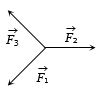
What is the minimum number of coplanar vectors having different magnitudes that can be added to give a zero resultant?
A
$2$
B
$3$
C
$4$
D
$5$
Solution
(B) For the resultant of a set of vectors to be zero,the vectors must form a closed polygon when placed head-to-tail.
If we have two vectors with different magnitudes,their resultant can never be zero because they cannot form a closed shape (they would form a line segment if they are collinear or a triangle with an open side if they are not).
With three coplanar vectors of different magnitudes,we can form a triangle such that the sum of the vectors is zero (e.g.,$\vec{A} + \vec{B} + \vec{C} = 0$).
Therefore,the minimum number of coplanar vectors with different magnitudes required to obtain a zero resultant is $3$.
If we have two vectors with different magnitudes,their resultant can never be zero because they cannot form a closed shape (they would form a line segment if they are collinear or a triangle with an open side if they are not).
With three coplanar vectors of different magnitudes,we can form a triangle such that the sum of the vectors is zero (e.g.,$\vec{A} + \vec{B} + \vec{C} = 0$).
Therefore,the minimum number of coplanar vectors with different magnitudes required to obtain a zero resultant is $3$.
0 likes
View Solution3
MediumMCQ
The unit vector parallel to the resultant of the vectors $\vec A = 4\hat i + 3\hat j + 6\hat k$ and $\vec B = - \hat i + 3\hat j - 8\hat k$ is
A
$\frac{1}{7}(3\hat i + 6\hat j - 2\hat k)$
B
$\frac{1}{7}(3\hat i + 6\hat j + 2\hat k)$
C
$\frac{1}{49}(3\hat i + 6\hat j - 2\hat k)$
D
$\frac{1}{49}(3\hat i - 6\hat j + 2\hat k)$
Solution
(A) First,find the resultant vector $\vec R$ by adding vectors $\vec A$ and $\vec B$:
$\vec R = \vec A + \vec B = (4\hat i + 3\hat j + 6\hat k) + (- \hat i + 3\hat j - 8\hat k)$
$\vec R = (4 - 1)\hat i + (3 + 3)\hat j + (6 - 8)\hat k = 3\hat i + 6\hat j - 2\hat k$
Next,calculate the magnitude of the resultant vector $|\vec R|$:
$|\vec R| = \sqrt{3^2 + 6^2 + (-2)^2} = \sqrt{9 + 36 + 4} = \sqrt{49} = 7$
Finally,the unit vector $\hat R$ is given by $\hat R = \frac{\vec R}{|\vec R|}$:
$\hat R = \frac{3\hat i + 6\hat j - 2\hat k}{7} = \frac{1}{7}(3\hat i + 6\hat j - 2\hat k)$
$\vec R = \vec A + \vec B = (4\hat i + 3\hat j + 6\hat k) + (- \hat i + 3\hat j - 8\hat k)$
$\vec R = (4 - 1)\hat i + (3 + 3)\hat j + (6 - 8)\hat k = 3\hat i + 6\hat j - 2\hat k$
Next,calculate the magnitude of the resultant vector $|\vec R|$:
$|\vec R| = \sqrt{3^2 + 6^2 + (-2)^2} = \sqrt{9 + 36 + 4} = \sqrt{49} = 7$
Finally,the unit vector $\hat R$ is given by $\hat R = \frac{\vec R}{|\vec R|}$:
$\hat R = \frac{3\hat i + 6\hat j - 2\hat k}{7} = \frac{1}{7}(3\hat i + 6\hat j - 2\hat k)$
0 likes
View Solution4
MediumMCQ
With respect to a rectangular cartesian coordinate system,three vectors are expressed as $\vec a = 4\hat i - \hat j$,$\vec b = -3\hat i + 2\hat j$,and $\vec c = -\hat k$,where $\hat i, \hat j, \hat k$ are unit vectors along the $X, Y,$ and $Z$-axis respectively. The unit vector $\hat r$ along the direction of the sum of these vectors is:
A
$\hat r = \frac{1}{\sqrt{3}}(\hat i + \hat j - \hat k)$
B
$\hat r = \frac{1}{\sqrt{2}}(\hat i + \hat j - \hat k)$
C
$\hat r = \frac{1}{3}(\hat i - \hat j + \hat k)$
D
$\hat r = \frac{1}{\sqrt{2}}(\hat i + \hat j + \hat k)$
Solution
(A) Given vectors are $\vec a = 4\hat i - \hat j$,$\vec b = -3\hat i + 2\hat j$,and $\vec c = -\hat k$.
Let the sum of these vectors be $\vec r = \vec a + \vec b + \vec c$.
$\vec r = (4\hat i - \hat j) + (-3\hat i + 2\hat j) + (-\hat k)$.
Grouping the components,we get $\vec r = (4 - 3)\hat i + (-1 + 2)\hat j - \hat k = \hat i + \hat j - \hat k$.
The magnitude of vector $\vec r$ is $|\vec r| = \sqrt{(1)^2 + (1)^2 + (-1)^2} = \sqrt{1 + 1 + 1} = \sqrt{3}$.
The unit vector $\hat r$ in the direction of $\vec r$ is given by $\hat r = \frac{\vec r}{|\vec r|}$.
Therefore,$\hat r = \frac{\hat i + \hat j - \hat k}{\sqrt{3}} = \frac{1}{\sqrt{3}}(\hat i + \hat j - \hat k)$.
Let the sum of these vectors be $\vec r = \vec a + \vec b + \vec c$.
$\vec r = (4\hat i - \hat j) + (-3\hat i + 2\hat j) + (-\hat k)$.
Grouping the components,we get $\vec r = (4 - 3)\hat i + (-1 + 2)\hat j - \hat k = \hat i + \hat j - \hat k$.
The magnitude of vector $\vec r$ is $|\vec r| = \sqrt{(1)^2 + (1)^2 + (-1)^2} = \sqrt{1 + 1 + 1} = \sqrt{3}$.
The unit vector $\hat r$ in the direction of $\vec r$ is given by $\hat r = \frac{\vec r}{|\vec r|}$.
Therefore,$\hat r = \frac{\hat i + \hat j - \hat k}{\sqrt{3}} = \frac{1}{\sqrt{3}}(\hat i + \hat j - \hat k)$.
0 likes
View Solution5
MediumMCQ
The unit vector parallel to the resultant of vectors $\vec{A} = 4\hat{i} - 3\hat{j}$ and $\vec{B} = 8\hat{i} + 8\hat{j}$ is:
A
$\frac{24\hat{i} + 5\hat{j}}{13}$
B
$\frac{12\hat{i} + 5\hat{j}}{13}$
C
$\frac{6\hat{i} + 5\hat{j}}{13}$
D
None of these
Solution
(B) The resultant vector $\vec{R}$ is given by the sum of vectors $\vec{A}$ and $\vec{B}$:
$\vec{R} = \vec{A} + \vec{B} = (4\hat{i} - 3\hat{j}) + (8\hat{i} + 8\hat{j})$
$\vec{R} = (4 + 8)\hat{i} + (-3 + 8)\hat{j} = 12\hat{i} + 5\hat{j}$
The magnitude of the resultant vector is:
$|\vec{R}| = \sqrt{12^2 + 5^2} = \sqrt{144 + 25} = \sqrt{169} = 13$
The unit vector $\hat{R}$ parallel to the resultant is given by:
$\hat{R} = \frac{\vec{R}}{|\vec{R}|} = \frac{12\hat{i} + 5\hat{j}}{13}$
$\vec{R} = \vec{A} + \vec{B} = (4\hat{i} - 3\hat{j}) + (8\hat{i} + 8\hat{j})$
$\vec{R} = (4 + 8)\hat{i} + (-3 + 8)\hat{j} = 12\hat{i} + 5\hat{j}$
The magnitude of the resultant vector is:
$|\vec{R}| = \sqrt{12^2 + 5^2} = \sqrt{144 + 25} = \sqrt{169} = 13$
The unit vector $\hat{R}$ parallel to the resultant is given by:
$\hat{R} = \frac{\vec{R}}{|\vec{R}|} = \frac{12\hat{i} + 5\hat{j}}{13}$
0 likes
View Solution6
MediumMCQ
There are two force vectors,one of $5\, N$ and the other of $12\, N$. At what angle should the two vectors be added to get a resultant vector of $17\, N$,$7\, N$,and $13\, N$ respectively?
A
$0^o, 180^o$ and $90^o$
B
$0^o, 90^o$ and $180^o$
C
$0^o, 90^o$ and $90^o$
D
$180^o, 0^o$ and $90^o$
Solution
(A) The resultant $R$ of two vectors $A$ and $B$ is given by $R = \sqrt{A^2 + B^2 + 2AB \cos \theta}$.
$1$. For $R = 17\, N$: Since $17 = 5 + 12$,the vectors must be in the same direction. Thus,$\theta = 0^o$.
$2$. For $R = 7\, N$: Since $7 = 12 - 5$,the vectors must be in opposite directions. Thus,$\theta = 180^o$.
$3$. For $R = 13\, N$: Using the Pythagorean theorem,$\sqrt{5^2 + 12^2} = \sqrt{25 + 144} = \sqrt{169} = 13\, N$. This occurs when the vectors are perpendicular,so $\theta = 90^o$.
$1$. For $R = 17\, N$: Since $17 = 5 + 12$,the vectors must be in the same direction. Thus,$\theta = 0^o$.
$2$. For $R = 7\, N$: Since $7 = 12 - 5$,the vectors must be in opposite directions. Thus,$\theta = 180^o$.
$3$. For $R = 13\, N$: Using the Pythagorean theorem,$\sqrt{5^2 + 12^2} = \sqrt{25 + 144} = \sqrt{169} = 13\, N$. This occurs when the vectors are perpendicular,so $\theta = 90^o$.
0 likes
View Solution7
MediumMCQ
If $\overrightarrow A = 4\hat i - 3\hat j$ and $\overrightarrow B = 6\hat i + 8\hat j$,then the magnitude and direction of $\overrightarrow A + \overrightarrow B$ will be:
A
$5, \tan^{-1}(3/4)$
B
$5\sqrt{5}, \tan^{-1}(1/2)$
C
$10, \tan^{-1}(5)$
D
$25, \tan^{-1}(3/4)$
Solution
(B) Given vectors are $\overrightarrow A = 4\hat i - 3\hat j$ and $\overrightarrow B = 6\hat i + 8\hat j$.
First,find the resultant vector $\overrightarrow R = \overrightarrow A + \overrightarrow B$:
$\overrightarrow R = (4\hat i - 3\hat j) + (6\hat i + 8\hat j) = (4+6)\hat i + (-3+8)\hat j = 10\hat i + 5\hat j$.
The magnitude of the resultant vector is given by:
$|\overrightarrow R| = \sqrt{(10)^2 + (5)^2} = \sqrt{100 + 25} = \sqrt{125} = 5\sqrt{5}$.
The direction $\theta$ with respect to the $x$-axis is given by:
$\tan \theta = \frac{R_y}{R_x} = \frac{5}{10} = \frac{1}{2}$.
Therefore,$\theta = \tan^{-1}(1/2)$.
First,find the resultant vector $\overrightarrow R = \overrightarrow A + \overrightarrow B$:
$\overrightarrow R = (4\hat i - 3\hat j) + (6\hat i + 8\hat j) = (4+6)\hat i + (-3+8)\hat j = 10\hat i + 5\hat j$.
The magnitude of the resultant vector is given by:
$|\overrightarrow R| = \sqrt{(10)^2 + (5)^2} = \sqrt{100 + 25} = \sqrt{125} = 5\sqrt{5}$.
The direction $\theta$ with respect to the $x$-axis is given by:
$\tan \theta = \frac{R_y}{R_x} = \frac{5}{10} = \frac{1}{2}$.
Therefore,$\theta = \tan^{-1}(1/2)$.
0 likes
View Solution8
MediumMCQ
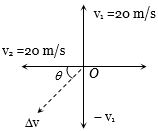
$A$ truck travelling due north at $20 \, m/s$ turns west and travels at the same speed. The change in its velocity is
A
$40 \, m/s \, N-W$
B
$20\sqrt{2} \, m/s \, N-W$
C
$40 \, m/s \, S-W$
D
$20\sqrt{2} \, m/s \, S-W$
Solution
(D) Let the initial velocity be $\vec{v}_1 = 20\hat{j} \, m/s$ (towards North).
After turning west,the final velocity is $\vec{v}_2 = -20\hat{i} \, m/s$ (towards West).
The change in velocity is given by $\Delta\vec{v} = \vec{v}_2 - \vec{v}_1$.
Substituting the values,$\Delta\vec{v} = -20\hat{i} - 20\hat{j} = -20(\hat{i} + \hat{j}) \, m/s$.
The magnitude of the change in velocity is $|\Delta\vec{v}| = \sqrt{(-20)^2 + (-20)^2} = \sqrt{400 + 400} = \sqrt{800} = 20\sqrt{2} \, m/s$.
The direction is given by $\tan\theta = \frac{|\Delta v_y|}{|\Delta v_x|} = \frac{20}{20} = 1$,so $\theta = 45^\circ$.
Since both components are negative,the direction is South-West $(S-W)$.
Thus,the correct option is $(d)$.
After turning west,the final velocity is $\vec{v}_2 = -20\hat{i} \, m/s$ (towards West).
The change in velocity is given by $\Delta\vec{v} = \vec{v}_2 - \vec{v}_1$.
Substituting the values,$\Delta\vec{v} = -20\hat{i} - 20\hat{j} = -20(\hat{i} + \hat{j}) \, m/s$.
The magnitude of the change in velocity is $|\Delta\vec{v}| = \sqrt{(-20)^2 + (-20)^2} = \sqrt{400 + 400} = \sqrt{800} = 20\sqrt{2} \, m/s$.
The direction is given by $\tan\theta = \frac{|\Delta v_y|}{|\Delta v_x|} = \frac{20}{20} = 1$,so $\theta = 45^\circ$.
Since both components are negative,the direction is South-West $(S-W)$.
Thus,the correct option is $(d)$.
0 likes
View Solution9
DifficultMCQ
If the sum of two unit vectors is a unit vector,then the magnitude of their difference is
A
$\sqrt{2}$
B
$\sqrt{3}$
C
$1/\sqrt{2}$
D
$\sqrt{5}$
Solution
(B) Let $\hat{n}_1$ and $\hat{n}_2$ be two unit vectors. The magnitude of their sum is given by $|\hat{n}_1 + \hat{n}_2|^2 = |\hat{n}_1|^2 + |\hat{n}_2|^2 + 2|\hat{n}_1||\hat{n}_2|\cos\theta$.
Since the sum is a unit vector,$|\hat{n}_1 + \hat{n}_2| = 1$. Substituting the magnitudes $|\hat{n}_1| = 1$ and $|\hat{n}_2| = 1$,we get $1^2 = 1^2 + 1^2 + 2(1)(1)\cos\theta$.
$1 = 2 + 2\cos\theta \implies 2\cos\theta = -1 \implies \cos\theta = -1/2$.
This implies $\theta = 120^\circ$.
The magnitude of the difference vector is given by $|\hat{n}_1 - \hat{n}_2| = \sqrt{|\hat{n}_1|^2 + |\hat{n}_2|^2 - 2|\hat{n}_1||\hat{n}_2|\cos\theta}$.
Substituting the values,$|\hat{n}_1 - \hat{n}_2| = \sqrt{1^2 + 1^2 - 2(1)(1)(-1/2)} = \sqrt{1 + 1 + 1} = \sqrt{3}$.
Since the sum is a unit vector,$|\hat{n}_1 + \hat{n}_2| = 1$. Substituting the magnitudes $|\hat{n}_1| = 1$ and $|\hat{n}_2| = 1$,we get $1^2 = 1^2 + 1^2 + 2(1)(1)\cos\theta$.
$1 = 2 + 2\cos\theta \implies 2\cos\theta = -1 \implies \cos\theta = -1/2$.
This implies $\theta = 120^\circ$.
The magnitude of the difference vector is given by $|\hat{n}_1 - \hat{n}_2| = \sqrt{|\hat{n}_1|^2 + |\hat{n}_2|^2 - 2|\hat{n}_1||\hat{n}_2|\cos\theta}$.
Substituting the values,$|\hat{n}_1 - \hat{n}_2| = \sqrt{1^2 + 1^2 - 2(1)(1)(-1/2)} = \sqrt{1 + 1 + 1} = \sqrt{3}$.
0 likes
View Solution10
MediumMCQ
If $\overrightarrow A = 2\hat i + \hat j$,$\overrightarrow B = 3\hat j - \hat k$,and $\overrightarrow C = 6\hat i - 2\hat k$,then the value of $\overrightarrow A - 2\overrightarrow B + 3\overrightarrow C$ is:
A
$20\hat i + 5\hat j + 4\hat k$
B
$20\hat i - 5\hat j - 4\hat k$
C
$4\hat i + 5\hat j + 20\hat k$
D
$5\hat i + 4\hat j + 10\hat k$
Solution
(B) Given vectors are $\overrightarrow A = 2\hat i + \hat j$,$\overrightarrow B = 3\hat j - \hat k$,and $\overrightarrow C = 6\hat i - 2\hat k$.
We need to calculate $\overrightarrow A - 2\overrightarrow B + 3\overrightarrow C$.
Substituting the given vectors:
$\overrightarrow A - 2\overrightarrow B + 3\overrightarrow C = (2\hat i + \hat j) - 2(3\hat j - \hat k) + 3(6\hat i - 2\hat k)$
$= 2\hat i + \hat j - 6\hat j + 2\hat k + 18\hat i - 6\hat k$
Grouping the components of $\hat i$,$\hat j$,and $\hat k$:
$= (2 + 18)\hat i + (1 - 6)\hat j + (2 - 6)\hat k$
$= 20\hat i - 5\hat j - 4\hat k$
Thus,the correct option is $B$.
We need to calculate $\overrightarrow A - 2\overrightarrow B + 3\overrightarrow C$.
Substituting the given vectors:
$\overrightarrow A - 2\overrightarrow B + 3\overrightarrow C = (2\hat i + \hat j) - 2(3\hat j - \hat k) + 3(6\hat i - 2\hat k)$
$= 2\hat i + \hat j - 6\hat j + 2\hat k + 18\hat i - 6\hat k$
Grouping the components of $\hat i$,$\hat j$,and $\hat k$:
$= (2 + 18)\hat i + (1 - 6)\hat j + (2 - 6)\hat k$
$= 20\hat i - 5\hat j - 4\hat k$
Thus,the correct option is $B$.
0 likes
View Solution11
MediumMCQ
Two forces,each of magnitude $F$,have a resultant of the same magnitude $F$. The angle between the two forces is....... $^o$
A
$45$
B
$120$
C
$150$
D
$60$
Solution
(B) The resultant $R$ of two vectors $A$ and $B$ with an angle $\theta$ between them is given by the formula: $R = \sqrt{A^2 + B^2 + 2AB \cos \theta}$.
Given that the magnitudes of the two forces are $A = F$ and $B = F$,and their resultant magnitude is $R = F$.
Substituting these values into the formula: $F = \sqrt{F^2 + F^2 + 2(F)(F) \cos \theta}$.
Squaring both sides: $F^2 = F^2 + F^2 + 2F^2 \cos \theta$.
$F^2 = 2F^2 + 2F^2 \cos \theta$.
Dividing by $F^2$: $1 = 2 + 2 \cos \theta$.
$-1 = 2 \cos \theta$.
$\cos \theta = -\frac{1}{2}$.
Since $\cos \theta = -\frac{1}{2}$,the angle $\theta = 120^\circ$.
Given that the magnitudes of the two forces are $A = F$ and $B = F$,and their resultant magnitude is $R = F$.
Substituting these values into the formula: $F = \sqrt{F^2 + F^2 + 2(F)(F) \cos \theta}$.
Squaring both sides: $F^2 = F^2 + F^2 + 2F^2 \cos \theta$.
$F^2 = 2F^2 + 2F^2 \cos \theta$.
Dividing by $F^2$: $1 = 2 + 2 \cos \theta$.
$-1 = 2 \cos \theta$.
$\cos \theta = -\frac{1}{2}$.
Since $\cos \theta = -\frac{1}{2}$,the angle $\theta = 120^\circ$.
0 likes
View Solution12
EasyMCQ
$A$ particle is simultaneously acted upon by two forces equal to $4\, N$ and $3\, N$. The net force on the particle is
A
$7\, N$
B
$5\, N$
C
$1\, N$
D
Between $1\, N$ and $7\, N$
Solution
(D) When two forces $\vec{F}_1$ and $\vec{F}_2$ act on a particle,the magnitude of the resultant force $R$ depends on the angle $\theta$ between them.
The maximum resultant force occurs when the forces are in the same direction $(\theta = 0^\circ)$:
$R_{\text{max}} = F_1 + F_2 = 4\, N + 3\, N = 7\, N$.
The minimum resultant force occurs when the forces are in opposite directions $(\theta = 180^\circ)$:
$R_{\text{min}} = |F_1 - F_2| = |4\, N - 3\, N| = 1\, N$.
Therefore,the net force on the particle can take any value in the range between $1\, N$ and $7\, N$ inclusive,depending on the angle between the forces.
The maximum resultant force occurs when the forces are in the same direction $(\theta = 0^\circ)$:
$R_{\text{max}} = F_1 + F_2 = 4\, N + 3\, N = 7\, N$.
The minimum resultant force occurs when the forces are in opposite directions $(\theta = 180^\circ)$:
$R_{\text{min}} = |F_1 - F_2| = |4\, N - 3\, N| = 1\, N$.
Therefore,the net force on the particle can take any value in the range between $1\, N$ and $7\, N$ inclusive,depending on the angle between the forces.
0 likes
View Solution13
EasyMCQ
If the resultant of two forces has a magnitude smaller than the magnitude of the larger force,the two forces must be
A
Different both in magnitude and direction
B
Mutually perpendicular to one another
C
Possess extremely small magnitude
D
Point in opposite directions
Solution
(D) Let the two forces be $\vec{F_1}$ and $\vec{F_2}$ with magnitudes $F_1$ and $F_2$,where $F_1 > F_2$.
The magnitude of the resultant force $R$ is given by $R = \sqrt{F_1^2 + F_2^2 + 2F_1F_2 \cos \theta}$,where $\theta$ is the angle between the forces.
We are given that $R < F_1$.
Squaring both sides,we get $F_1^2 + F_2^2 + 2F_1F_2 \cos \theta < F_1^2$.
This simplifies to $F_2^2 + 2F_1F_2 \cos \theta < 0$.
Dividing by $F_2$ (since $F_2 > 0$),we get $F_2 + 2F_1 \cos \theta < 0$,which implies $\cos \theta < -\frac{F_2}{2F_1}$.
Since $F_1 > F_2$,the value of $\frac{F_2}{2F_1}$ is between $0$ and $0.5$.
Thus,$\cos \theta$ must be negative,meaning the angle $\theta$ is obtuse $(90^\circ < \theta \le 180^\circ)$.
Among the given options,the condition that the forces point in opposite directions (or generally have an obtuse angle between them) is the only one that satisfies the requirement for the resultant to be smaller than the larger force.
The magnitude of the resultant force $R$ is given by $R = \sqrt{F_1^2 + F_2^2 + 2F_1F_2 \cos \theta}$,where $\theta$ is the angle between the forces.
We are given that $R < F_1$.
Squaring both sides,we get $F_1^2 + F_2^2 + 2F_1F_2 \cos \theta < F_1^2$.
This simplifies to $F_2^2 + 2F_1F_2 \cos \theta < 0$.
Dividing by $F_2$ (since $F_2 > 0$),we get $F_2 + 2F_1 \cos \theta < 0$,which implies $\cos \theta < -\frac{F_2}{2F_1}$.
Since $F_1 > F_2$,the value of $\frac{F_2}{2F_1}$ is between $0$ and $0.5$.
Thus,$\cos \theta$ must be negative,meaning the angle $\theta$ is obtuse $(90^\circ < \theta \le 180^\circ)$.
Among the given options,the condition that the forces point in opposite directions (or generally have an obtuse angle between them) is the only one that satisfies the requirement for the resultant to be smaller than the larger force.
0 likes
View Solution14
EasyMCQ
Forces $F_1$ and $F_2$ act on a point mass in two mutually perpendicular directions. The resultant force on the point mass will be
A
$F_1 + F_2$
B
$F_1 - F_2$
C
$\sqrt{F_1^2 + F_2^2}$
D
$F_1^2 + F_2^2$
Solution
(C) When two vectors act at an angle $\theta$ to each other,their resultant magnitude is given by the formula $R = \sqrt{F_1^2 + F_2^2 + 2F_1F_2 \cos \theta}$.
Since the forces are mutually perpendicular,the angle between them is $\theta = 90^\circ$.
Substituting $\cos 90^\circ = 0$ into the formula:
$R = \sqrt{F_1^2 + F_2^2 + 2F_1F_2(0)}$
$R = \sqrt{F_1^2 + F_2^2}$.
Therefore,the correct option is $C$.
Since the forces are mutually perpendicular,the angle between them is $\theta = 90^\circ$.
Substituting $\cos 90^\circ = 0$ into the formula:
$R = \sqrt{F_1^2 + F_2^2 + 2F_1F_2(0)}$
$R = \sqrt{F_1^2 + F_2^2}$.
Therefore,the correct option is $C$.
0 likes
View Solution15
MediumMCQ
Let the angle between two nonzero vectors $\overrightarrow{A}$ and $\overrightarrow{B}$ be $120^{\circ}$ and their resultant be $\overrightarrow{C}$. Which of the following is true?
A
$\overrightarrow{C}$ must be equal to $|\overrightarrow{A} - \overrightarrow{B}|$
B
$\overrightarrow{C}$ must be greater than $|\overrightarrow{A} - \overrightarrow{B}|$
C
$\overrightarrow{C}$ must be less than $|\overrightarrow{A} - \overrightarrow{B}|$
D
$\overrightarrow{C}$ may be equal to $|\overrightarrow{A} - \overrightarrow{B}|$
Solution
(C) Given that the angle between $\overrightarrow{A}$ and $\overrightarrow{B}$ is $\theta = 120^{\circ}$.
The magnitude of the resultant $\overrightarrow{C} = \overrightarrow{A} + \overrightarrow{B}$ is given by:
$|\overrightarrow{C}| = \sqrt{A^{2} + B^{2} + 2AB \cos 120^{\circ}} = \sqrt{A^{2} + B^{2} - AB}$.
The magnitude of the difference vector $|\overrightarrow{A} - \overrightarrow{B}|$ is given by:
$|\overrightarrow{A} - \overrightarrow{B}| = \sqrt{A^{2} + B^{2} - 2AB \cos 120^{\circ}} = \sqrt{A^{2} + B^{2} - 2AB (-1/2)} = \sqrt{A^{2} + B^{2} + AB}$.
Comparing the two expressions,since $A$ and $B$ are nonzero magnitudes,$\sqrt{A^{2} + B^{2} - AB} < \sqrt{A^{2} + B^{2} + AB}$.
Therefore,$|\overrightarrow{C}| < |\overrightarrow{A} - \overrightarrow{B}|$.
The magnitude of the resultant $\overrightarrow{C} = \overrightarrow{A} + \overrightarrow{B}$ is given by:
$|\overrightarrow{C}| = \sqrt{A^{2} + B^{2} + 2AB \cos 120^{\circ}} = \sqrt{A^{2} + B^{2} - AB}$.
The magnitude of the difference vector $|\overrightarrow{A} - \overrightarrow{B}|$ is given by:
$|\overrightarrow{A} - \overrightarrow{B}| = \sqrt{A^{2} + B^{2} - 2AB \cos 120^{\circ}} = \sqrt{A^{2} + B^{2} - 2AB (-1/2)} = \sqrt{A^{2} + B^{2} + AB}$.
Comparing the two expressions,since $A$ and $B$ are nonzero magnitudes,$\sqrt{A^{2} + B^{2} - AB} < \sqrt{A^{2} + B^{2} + AB}$.
Therefore,$|\overrightarrow{C}| < |\overrightarrow{A} - \overrightarrow{B}|$.
0 likes
View Solution16
MediumMCQ
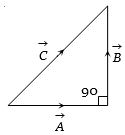
The magnitudes of vectors $\overrightarrow{A}$,$\overrightarrow{B}$,and $\overrightarrow{C}$ are $12$,$5$,and $13$ units respectively,and $\overrightarrow{A} + \overrightarrow{B} = \overrightarrow{C}$. Then the angle between $\overrightarrow{A}$ and $\overrightarrow{B}$ is:
A
$0$
B
$\pi$
C
$\pi / 2$
D
$\pi / 4$
Solution
(C) Given that the magnitudes are $|\overrightarrow{A}| = 12$,$|\overrightarrow{B}| = 5$,and $|\overrightarrow{C}| = 13$.
Since $\overrightarrow{A} + \overrightarrow{B} = \overrightarrow{C}$,we can check if the magnitudes satisfy the Pythagorean theorem: $|\overrightarrow{A}|^2 + |\overrightarrow{B}|^2 = 12^2 + 5^2 = 144 + 25 = 169 = 13^2 = |\overrightarrow{C}|^2$.
Since $|\overrightarrow{A}|^2 + |\overrightarrow{B}|^2 = |\overrightarrow{C}|^2$,the vectors $\overrightarrow{A}$ and $\overrightarrow{B}$ must be perpendicular to each other.
Therefore,the angle between $\overrightarrow{A}$ and $\overrightarrow{B}$ is $\pi / 2$ radians (or $90^{\circ}$).
Since $\overrightarrow{A} + \overrightarrow{B} = \overrightarrow{C}$,we can check if the magnitudes satisfy the Pythagorean theorem: $|\overrightarrow{A}|^2 + |\overrightarrow{B}|^2 = 12^2 + 5^2 = 144 + 25 = 169 = 13^2 = |\overrightarrow{C}|^2$.
Since $|\overrightarrow{A}|^2 + |\overrightarrow{B}|^2 = |\overrightarrow{C}|^2$,the vectors $\overrightarrow{A}$ and $\overrightarrow{B}$ must be perpendicular to each other.
Therefore,the angle between $\overrightarrow{A}$ and $\overrightarrow{B}$ is $\pi / 2$ radians (or $90^{\circ}$).
0 likes
View Solution17
EasyMCQ
The magnitude of the vector resulting from the addition of two vectors,$6\hat{i} + 7\hat{j}$ and $3\hat{i} + 4\hat{j}$,is:
A
$\sqrt{136}$
B
$\sqrt{13.2}$
C
$\sqrt{202}$
D
$\sqrt{160}$
Solution
(C) Let the two vectors be $\vec{A} = 6\hat{i} + 7\hat{j}$ and $\vec{B} = 3\hat{i} + 4\hat{j}$.
The resultant vector $\vec{R}$ is the sum of $\vec{A}$ and $\vec{B}$:
$\vec{R} = \vec{A} + \vec{B} = (6\hat{i} + 7\hat{j}) + (3\hat{i} + 4\hat{j})$
$\vec{R} = (6 + 3)\hat{i} + (7 + 4)\hat{j} = 9\hat{i} + 11\hat{j}$
The magnitude of the resultant vector $\vec{R}$ is given by:
$|\vec{R}| = \sqrt{R_x^2 + R_y^2}$
$|\vec{R}| = \sqrt{9^2 + 11^2}$
$|\vec{R}| = \sqrt{81 + 121}$
$|\vec{R}| = \sqrt{202}$
The resultant vector $\vec{R}$ is the sum of $\vec{A}$ and $\vec{B}$:
$\vec{R} = \vec{A} + \vec{B} = (6\hat{i} + 7\hat{j}) + (3\hat{i} + 4\hat{j})$
$\vec{R} = (6 + 3)\hat{i} + (7 + 4)\hat{j} = 9\hat{i} + 11\hat{j}$
The magnitude of the resultant vector $\vec{R}$ is given by:
$|\vec{R}| = \sqrt{R_x^2 + R_y^2}$
$|\vec{R}| = \sqrt{9^2 + 11^2}$
$|\vec{R}| = \sqrt{81 + 121}$
$|\vec{R}| = \sqrt{202}$
0 likes
View Solution18
MediumMCQ
The three vectors $\vec A = 3\hat i - 2\hat j + \hat k$,$\vec B = \hat i - 3\hat j + 5\hat k$,and $\vec C = 2\hat i + \hat j - 4\hat k$ form:
A
An equilateral triangle
B
An isosceles triangle
C
$A$ right-angled triangle
D
No triangle
Solution
(C) First,check if the vectors form a triangle by checking if their sum is zero. $\vec A + \vec B + \vec C = (3+1+2)\hat i + (-2-3+1)\hat j + (1+5-4)\hat k = 6\hat i - 4\hat j + 2\hat k \neq 0$. Since the sum is not zero,these vectors do not form a closed triangle in the standard sense of vector addition. However,if we treat the magnitudes of these vectors as the sides of a triangle,we calculate the magnitudes:
$|\vec A| = \sqrt{3^2 + (-2)^2 + 1^2} = \sqrt{9 + 4 + 1} = \sqrt{14}$
$|\vec B| = \sqrt{1^2 + (-3)^2 + 5^2} = \sqrt{1 + 9 + 25} = \sqrt{35}$
$|\vec C| = \sqrt{2^2 + 1^2 + (-4)^2} = \sqrt{4 + 1 + 16} = \sqrt{21}$
Observe that $|\vec A|^2 + |\vec C|^2 = 14 + 21 = 35 = |\vec B|^2$. Since the square of one side equals the sum of the squares of the other two sides,these lengths satisfy the Pythagorean theorem,forming a right-angled triangle.
$|\vec A| = \sqrt{3^2 + (-2)^2 + 1^2} = \sqrt{9 + 4 + 1} = \sqrt{14}$
$|\vec B| = \sqrt{1^2 + (-3)^2 + 5^2} = \sqrt{1 + 9 + 25} = \sqrt{35}$
$|\vec C| = \sqrt{2^2 + 1^2 + (-4)^2} = \sqrt{4 + 1 + 16} = \sqrt{21}$
Observe that $|\vec A|^2 + |\vec C|^2 = 14 + 21 = 35 = |\vec B|^2$. Since the square of one side equals the sum of the squares of the other two sides,these lengths satisfy the Pythagorean theorem,forming a right-angled triangle.
0 likes
View Solution19
EasyMCQ
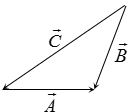
For the given figure,which of the following relations is correct?
A
$\overrightarrow A + \overrightarrow B = \overrightarrow C $
B
$\overrightarrow B + \overrightarrow C = \overrightarrow A $
C
$\overrightarrow C + \overrightarrow A = \overrightarrow B $
D
$\overrightarrow A + \overrightarrow B + \overrightarrow C = 0$
Solution
(C) According to the triangle law of vector addition,if two vectors are represented by two sides of a triangle in sequence,their sum is represented by the third side taken in the opposite order.
In the given figure,vectors $\overrightarrow C$ and $\overrightarrow A$ are arranged in sequence (head-to-tail).
The resultant vector is $\overrightarrow B$,which connects the tail of $\overrightarrow C$ to the head of $\overrightarrow A$.
Therefore,by the triangle law of vector addition,we have: $\overrightarrow C + \overrightarrow A = \overrightarrow B$.
In the given figure,vectors $\overrightarrow C$ and $\overrightarrow A$ are arranged in sequence (head-to-tail).
The resultant vector is $\overrightarrow B$,which connects the tail of $\overrightarrow C$ to the head of $\overrightarrow A$.
Therefore,by the triangle law of vector addition,we have: $\overrightarrow C + \overrightarrow A = \overrightarrow B$.
0 likes
View Solution20
MediumMCQ
Let $\vec{C} = \vec{A} + \vec{B}$,then:
A
$|\vec{C}|$ is always greater than $|\vec{A}|$.
B
It is possible to have $|\vec{C}| < |\vec{A}|$ and $|\vec{C}| < |\vec{B}|$.
C
$C$ is always equal to $A + B$.
D
$C$ is never equal to $A + B$.
Solution
(B) The magnitude of the resultant vector $\vec{C} = \vec{A} + \vec{B}$ is given by $|\vec{C}| = \sqrt{A^2 + B^2 + 2AB \cos \theta}$,where $\theta$ is the angle between $\vec{A}$ and $\vec{B}$.
The range of the magnitude of the resultant vector is $|A - B| \le |\vec{C}| \le A + B$.
If the angle $\theta$ between $\vec{A}$ and $\vec{B}$ is obtuse (i.e.,$90^\circ < \theta \le 180^\circ$),the resultant vector $\vec{C}$ can have a magnitude smaller than either $|\vec{A}|$ or $|\vec{B}|$. For example,if $\vec{A}$ and $\vec{B}$ are vectors of equal magnitude $A=B$ and the angle between them is $120^\circ$,then $|\vec{C}| = \sqrt{A^2 + A^2 + 2A^2 \cos(120^\circ)} = \sqrt{2A^2 - A^2} = A$. If the angle is greater than $120^\circ$,$|\vec{C}|$ will be less than $A$ and $B$. Thus,option $(b)$ is correct.
The range of the magnitude of the resultant vector is $|A - B| \le |\vec{C}| \le A + B$.
If the angle $\theta$ between $\vec{A}$ and $\vec{B}$ is obtuse (i.e.,$90^\circ < \theta \le 180^\circ$),the resultant vector $\vec{C}$ can have a magnitude smaller than either $|\vec{A}|$ or $|\vec{B}|$. For example,if $\vec{A}$ and $\vec{B}$ are vectors of equal magnitude $A=B$ and the angle between them is $120^\circ$,then $|\vec{C}| = \sqrt{A^2 + A^2 + 2A^2 \cos(120^\circ)} = \sqrt{2A^2 - A^2} = A$. If the angle is greater than $120^\circ$,$|\vec{C}|$ will be less than $A$ and $B$. Thus,option $(b)$ is correct.
0 likes
View Solution21
EasyMCQ
The magnitude of the sum of two vectors $\vec{A}$ and $\vec{B}$ with $\theta$ as the angle between them is:
A
$\sqrt{A^2 + B^2 + 2AB \cos \theta}$
B
$\sqrt{A^2 - B^2 + 2AB \cos \theta}$
C
$\sqrt{A^2 + B^2 - 2AB \sin \theta}$
D
$\sqrt{A^2 + B^2 + 2AB \sin \theta}$
Solution
(A) The resultant vector $\vec{R}$ of two vectors $\vec{A}$ and $\vec{B}$ is given by the vector addition rule: $\vec{R} = \vec{A} + \vec{B}$.
The magnitude of the resultant vector is calculated using the parallelogram law of vector addition.
The formula for the magnitude $R$ is given by:
$R = |\vec{A} + \vec{B}| = \sqrt{A^2 + B^2 + 2AB \cos \theta}$,where $A$ and $B$ are the magnitudes of vectors $\vec{A}$ and $\vec{B}$ respectively,and $\theta$ is the angle between them.
The magnitude of the resultant vector is calculated using the parallelogram law of vector addition.
The formula for the magnitude $R$ is given by:
$R = |\vec{A} + \vec{B}| = \sqrt{A^2 + B^2 + 2AB \cos \theta}$,where $A$ and $B$ are the magnitudes of vectors $\vec{A}$ and $\vec{B}$ respectively,and $\theta$ is the angle between them.
0 likes
View Solution22
DifficultMCQ
The sum of two forces acting at a point is $16\, N.$ If the resultant force is $8\, N$ and its direction is perpendicular to the minimum force,then the forces are:
A
$6\, N$ and $10\, N$
B
$8\, N$ and $8\, N$
C
$4\, N$ and $12\, N$
D
$2\, N$ and $14\, N$
Solution
(A) Let the two forces be $A$ and $B$,where $A < B$. Given $A + B = 16$ (equation $i$).
Since the resultant $R = 8\, N$ is perpendicular to the smaller force $A$,the angle $\alpha$ between $R$ and $A$ is $90^\circ$.
The formula for the direction of the resultant is $\tan \alpha = \frac{B \sin \theta}{A + B \cos \theta} = \tan 90^\circ$.
This implies $A + B \cos \theta = 0$,so $\cos \theta = -A/B$ (equation $ii$).
The magnitude of the resultant is $R^2 = A^2 + B^2 + 2AB \cos \theta$.
Substituting $\cos \theta = -A/B$ into the resultant formula: $8^2 = A^2 + B^2 + 2AB(-A/B) = A^2 + B^2 - 2A^2 = B^2 - A^2$.
Thus,$B^2 - A^2 = 64$,which factors to $(B - A)(B + A) = 64$.
Since $B + A = 16$,we have $(B - A)(16) = 64$,so $B - A = 4$.
Solving $A + B = 16$ and $B - A = 4$ gives $2B = 20$,so $B = 10\, N$ and $A = 6\, N$.
Since the resultant $R = 8\, N$ is perpendicular to the smaller force $A$,the angle $\alpha$ between $R$ and $A$ is $90^\circ$.
The formula for the direction of the resultant is $\tan \alpha = \frac{B \sin \theta}{A + B \cos \theta} = \tan 90^\circ$.
This implies $A + B \cos \theta = 0$,so $\cos \theta = -A/B$ (equation $ii$).
The magnitude of the resultant is $R^2 = A^2 + B^2 + 2AB \cos \theta$.
Substituting $\cos \theta = -A/B$ into the resultant formula: $8^2 = A^2 + B^2 + 2AB(-A/B) = A^2 + B^2 - 2A^2 = B^2 - A^2$.
Thus,$B^2 - A^2 = 64$,which factors to $(B - A)(B + A) = 64$.
Since $B + A = 16$,we have $(B - A)(16) = 64$,so $B - A = 4$.
Solving $A + B = 16$ and $B - A = 4$ gives $2B = 20$,so $B = 10\, N$ and $A = 6\, N$.
0 likes
View Solution23
MediumMCQ
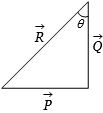
If vectors $\overrightarrow P, \overrightarrow Q$ and $\overrightarrow R$ have magnitudes $5, 12$ and $13$ units respectively and $\overrightarrow P + \overrightarrow Q = \overrightarrow R$,then the angle between $\overrightarrow Q$ and $\overrightarrow R$ is
A
$\cos^{-1}(\frac{5}{12})$
B
$\cos^{-1}(\frac{5}{13})$
C
$\cos^{-1}(\frac{12}{13})$
D
$\cos^{-1}(\frac{7}{13})$
Solution
(C) Given magnitudes are $|\overrightarrow P| = 5$,$|\overrightarrow Q| = 12$,and $|\overrightarrow R| = 13$.
Since $\overrightarrow P + \overrightarrow Q = \overrightarrow R$,these vectors form a right-angled triangle because $5^2 + 12^2 = 25 + 144 = 169 = 13^2$.
In the triangle formed by these vectors,$\overrightarrow Q$ and $\overrightarrow R$ meet at an angle $\theta$.
Using trigonometry in the right-angled triangle,the cosine of the angle $\theta$ between $\overrightarrow Q$ and $\overrightarrow R$ is given by the ratio of the adjacent side to the hypotenuse.
$\cos \theta = \frac{|\overrightarrow Q|}{|\overrightarrow R|} = \frac{12}{13}$.
Therefore,$\theta = \cos^{-1}(\frac{12}{13})$.
Since $\overrightarrow P + \overrightarrow Q = \overrightarrow R$,these vectors form a right-angled triangle because $5^2 + 12^2 = 25 + 144 = 169 = 13^2$.
In the triangle formed by these vectors,$\overrightarrow Q$ and $\overrightarrow R$ meet at an angle $\theta$.
Using trigonometry in the right-angled triangle,the cosine of the angle $\theta$ between $\overrightarrow Q$ and $\overrightarrow R$ is given by the ratio of the adjacent side to the hypotenuse.
$\cos \theta = \frac{|\overrightarrow Q|}{|\overrightarrow R|} = \frac{12}{13}$.
Therefore,$\theta = \cos^{-1}(\frac{12}{13})$.
0 likes
View Solution24
MediumMCQ
What vector must be added to the two vectors $\hat{i} - 2\hat{j} + 2\hat{k}$ and $2\hat{i} + \hat{j} - \hat{k}$ so that the resultant may be a unit vector along the $X$-axis?
A
$2\hat{i} + \hat{j} - \hat{k}$
B
$-2\hat{i} + \hat{j} - \hat{k}$
C
$2\hat{i} - \hat{j} + \hat{k}$
D
$-2\hat{i} - \hat{j} - \hat{k}$
Solution
(B) Let the required vector be $\vec{R}$.
According to the problem,the sum of the given vectors and $\vec{R}$ is equal to the unit vector along the $X$-axis,which is $\hat{i}$.
$(\hat{i} - 2\hat{j} + 2\hat{k}) + (2\hat{i} + \hat{j} - \hat{k}) + \vec{R} = \hat{i}$
Combine the given vectors:
$(1+2)\hat{i} + (-2+1)\hat{j} + (2-1)\hat{k} + \vec{R} = \hat{i}$
$3\hat{i} - \hat{j} + \hat{k} + \vec{R} = \hat{i}$
Now,solve for $\vec{R}$:
$\vec{R} = \hat{i} - (3\hat{i} - \hat{j} + \hat{k})$
$\vec{R} = \hat{i} - 3\hat{i} + \hat{j} - \hat{k}$
$\vec{R} = -2\hat{i} + \hat{j} - \hat{k}$
According to the problem,the sum of the given vectors and $\vec{R}$ is equal to the unit vector along the $X$-axis,which is $\hat{i}$.
$(\hat{i} - 2\hat{j} + 2\hat{k}) + (2\hat{i} + \hat{j} - \hat{k}) + \vec{R} = \hat{i}$
Combine the given vectors:
$(1+2)\hat{i} + (-2+1)\hat{j} + (2-1)\hat{k} + \vec{R} = \hat{i}$
$3\hat{i} - \hat{j} + \hat{k} + \vec{R} = \hat{i}$
Now,solve for $\vec{R}$:
$\vec{R} = \hat{i} - (3\hat{i} - \hat{j} + \hat{k})$
$\vec{R} = \hat{i} - 3\hat{i} + \hat{j} - \hat{k}$
$\vec{R} = -2\hat{i} + \hat{j} - \hat{k}$
0 likes
View Solution25
EasyMCQ
What is the angle between $\overrightarrow P$ and the resultant of $(\overrightarrow P + \overrightarrow Q)$ and $(\overrightarrow P - \overrightarrow Q)$?
A
Zero
B
$\tan^{-1}(P/Q)$
C
$\tan^{-1}(Q/P)$
D
$\tan^{-1}((P - Q)/(P + Q))$
Solution
(A) Let the resultant vector be $\vec R$.
Given vectors are $\vec A = \vec P + \vec Q$ and $\vec B = \vec P - \vec Q$.
The resultant $\vec R$ is the sum of these two vectors:
$\vec R = \vec A + \vec B = (\vec P + \vec Q) + (\vec P - \vec Q) = 2\vec P$.
Since $\vec R = 2\vec P$,the resultant vector is in the same direction as $\vec P$.
Therefore,the angle between $\vec P$ and the resultant $\vec R$ is $0$ degrees.
Given vectors are $\vec A = \vec P + \vec Q$ and $\vec B = \vec P - \vec Q$.
The resultant $\vec R$ is the sum of these two vectors:
$\vec R = \vec A + \vec B = (\vec P + \vec Q) + (\vec P - \vec Q) = 2\vec P$.
Since $\vec R = 2\vec P$,the resultant vector is in the same direction as $\vec P$.
Therefore,the angle between $\vec P$ and the resultant $\vec R$ is $0$ degrees.
0 likes
View Solution26
MediumMCQ
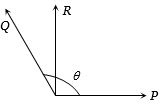
The resultant of $\overrightarrow P$ and $\overrightarrow Q$ is perpendicular to $\overrightarrow P$. What is the angle between $\overrightarrow P$ and $\overrightarrow Q$?
A
$\cos^{-1}(P/Q)$
B
$\cos^{-1}(-P/Q)$
C
$\sin^{-1}(P/Q)$
D
$\sin^{-1}(-P/Q)$
Solution
(B) Let $\theta$ be the angle between vectors $\overrightarrow P$ and $\overrightarrow Q$.
The resultant vector $\overrightarrow R = \overrightarrow P + \overrightarrow Q$ makes an angle $\alpha$ with $\overrightarrow P$,given by $\tan \alpha = \frac{Q \sin \theta}{P + Q \cos \theta}$.
Since the resultant is perpendicular to $\overrightarrow P$,the angle $\alpha = 90^\circ$.
Therefore,$\tan 90^\circ = \frac{Q \sin \theta}{P + Q \cos \theta}$.
Since $\tan 90^\circ$ is undefined,the denominator must be zero:
$P + Q \cos \theta = 0$
$Q \cos \theta = -P$
$\cos \theta = -\frac{P}{Q}$
$\theta = \cos^{-1}\left(-\frac{P}{Q}\right)$.
The resultant vector $\overrightarrow R = \overrightarrow P + \overrightarrow Q$ makes an angle $\alpha$ with $\overrightarrow P$,given by $\tan \alpha = \frac{Q \sin \theta}{P + Q \cos \theta}$.
Since the resultant is perpendicular to $\overrightarrow P$,the angle $\alpha = 90^\circ$.
Therefore,$\tan 90^\circ = \frac{Q \sin \theta}{P + Q \cos \theta}$.
Since $\tan 90^\circ$ is undefined,the denominator must be zero:
$P + Q \cos \theta = 0$
$Q \cos \theta = -P$
$\cos \theta = -\frac{P}{Q}$
$\theta = \cos^{-1}\left(-\frac{P}{Q}\right)$.
0 likes
View Solution27
MediumMCQ
Maximum and minimum magnitudes of the resultant of two vectors of magnitudes $P$ and $Q$ are in the ratio $3:1.$ Which of the following relations is true?
A
$P = 2Q$
B
$P = Q$
C
$PQ = 1$
D
None of these
Solution
(A) The maximum magnitude of the resultant of two vectors $P$ and $Q$ is given by $R_{max} = P + Q$.
The minimum magnitude of the resultant of two vectors $P$ and $Q$ is given by $R_{min} = |P - Q|$.
According to the problem,the ratio of the maximum to the minimum magnitude is $3:1$,so $\frac{P + Q}{P - Q} = \frac{3}{1}$.
By cross-multiplying,we get $P + Q = 3(P - Q)$.
Expanding the equation,we have $P + Q = 3P - 3Q$.
Rearranging the terms,we get $4Q = 2P$,which simplifies to $P = 2Q$.
The minimum magnitude of the resultant of two vectors $P$ and $Q$ is given by $R_{min} = |P - Q|$.
According to the problem,the ratio of the maximum to the minimum magnitude is $3:1$,so $\frac{P + Q}{P - Q} = \frac{3}{1}$.
By cross-multiplying,we get $P + Q = 3(P - Q)$.
Expanding the equation,we have $P + Q = 3P - 3Q$.
Rearranging the terms,we get $4Q = 2P$,which simplifies to $P = 2Q$.
0 likes
View Solution28
MediumMCQ
Two forces,$F_1$ and $F_2$,are acting on a body. One force is double that of the other force and the resultant is equal to the greater force. Then the angle between the two forces is
A
$\cos^{-1}(1/2)$
B
$\cos^{-1}(-1/2)$
C
$\cos^{-1}(-1/4)$
D
$\cos^{-1}(1/4)$
Solution
(C) Let the smaller force be $F_1 = F$ and the greater force be $F_2 = 2F$.
Given that the resultant force $R$ is equal to the greater force,so $R = 2F$.
The formula for the resultant of two vectors is $R = \sqrt{F_1^2 + F_2^2 + 2F_1F_2 \cos \theta}$.
Substituting the given values: $2F = \sqrt{F^2 + (2F)^2 + 2(F)(2F) \cos \theta}$.
Squaring both sides: $(2F)^2 = F^2 + 4F^2 + 4F^2 \cos \theta$.
$4F^2 = 5F^2 + 4F^2 \cos \theta$.
Subtracting $5F^2$ from both sides: $-F^2 = 4F^2 \cos \theta$.
Dividing by $4F^2$: $\cos \theta = -1/4$.
Therefore,the angle $\theta = \cos^{-1}(-1/4)$.
Given that the resultant force $R$ is equal to the greater force,so $R = 2F$.
The formula for the resultant of two vectors is $R = \sqrt{F_1^2 + F_2^2 + 2F_1F_2 \cos \theta}$.
Substituting the given values: $2F = \sqrt{F^2 + (2F)^2 + 2(F)(2F) \cos \theta}$.
Squaring both sides: $(2F)^2 = F^2 + 4F^2 + 4F^2 \cos \theta$.
$4F^2 = 5F^2 + 4F^2 \cos \theta$.
Subtracting $5F^2$ from both sides: $-F^2 = 4F^2 \cos \theta$.
Dividing by $4F^2$: $\cos \theta = -1/4$.
Therefore,the angle $\theta = \cos^{-1}(-1/4)$.
0 likes
View Solution29
MediumMCQ
What displacement must be added to the displacement $25\hat{i} - 6\hat{j} \text{ m}$ to give a resultant displacement of $7.0 \text{ m}$ pointing in the $X$-direction?
A
$18\hat{i} - 6\hat{j}$
B
$32\hat{i} - 13\hat{j}$
C
$-18\hat{i} + 6\hat{j}$
D
$-25\hat{i} + 13\hat{j}$
Solution
(C) Let the initial displacement be $\vec{d_1} = 25\hat{i} - 6\hat{j} \text{ m}$.
Let the required displacement to be added be $\vec{d_x}$.
The resultant displacement is given as $\vec{d_R} = 7.0\hat{i} \text{ m}$.
According to the vector addition rule: $\vec{d_1} + \vec{d_x} = \vec{d_R}$.
Therefore,$\vec{d_x} = \vec{d_R} - \vec{d_1}$.
Substituting the values: $\vec{d_x} = (7.0\hat{i}) - (25\hat{i} - 6\hat{j})$.
$\vec{d_x} = 7.0\hat{i} - 25\hat{i} + 6\hat{j}$.
$\vec{d_x} = -18\hat{i} + 6\hat{j} \text{ m}$.
Let the required displacement to be added be $\vec{d_x}$.
The resultant displacement is given as $\vec{d_R} = 7.0\hat{i} \text{ m}$.
According to the vector addition rule: $\vec{d_1} + \vec{d_x} = \vec{d_R}$.
Therefore,$\vec{d_x} = \vec{d_R} - \vec{d_1}$.
Substituting the values: $\vec{d_x} = (7.0\hat{i}) - (25\hat{i} - 6\hat{j})$.
$\vec{d_x} = 7.0\hat{i} - 25\hat{i} + 6\hat{j}$.
$\vec{d_x} = -18\hat{i} + 6\hat{j} \text{ m}$.
0 likes
View Solution30
EasyMCQ
$A$ body moves due East with a velocity of $20 \, km/h$ and then due North with a velocity of $15 \, km/h$. The resultant velocity is .......... $km/h$.
A
$5$
B
$15$
C
$20$
D
$25$
Solution
(D) The body moves in two perpendicular directions: East and North.
Let the velocity towards the East be $\vec{v}_1 = 20 \, km/h$ (along the $x$-axis) and the velocity towards the North be $\vec{v}_2 = 15 \, km/h$ (along the $y$-axis).
The resultant velocity $\vec{v}_R$ is given by the vector sum: $\vec{v}_R = \vec{v}_1 + \vec{v}_2$.
Since the vectors are perpendicular,the magnitude of the resultant velocity is calculated using the Pythagorean theorem:
$v_R = \sqrt{v_1^2 + v_2^2}$
$v_R = \sqrt{20^2 + 15^2}$
$v_R = \sqrt{400 + 225}$
$v_R = \sqrt{625}$
$v_R = 25 \, km/h$.
Therefore,the correct option is $D$.
Let the velocity towards the East be $\vec{v}_1 = 20 \, km/h$ (along the $x$-axis) and the velocity towards the North be $\vec{v}_2 = 15 \, km/h$ (along the $y$-axis).
The resultant velocity $\vec{v}_R$ is given by the vector sum: $\vec{v}_R = \vec{v}_1 + \vec{v}_2$.
Since the vectors are perpendicular,the magnitude of the resultant velocity is calculated using the Pythagorean theorem:
$v_R = \sqrt{v_1^2 + v_2^2}$
$v_R = \sqrt{20^2 + 15^2}$
$v_R = \sqrt{400 + 225}$
$v_R = \sqrt{625}$
$v_R = 25 \, km/h$.
Therefore,the correct option is $D$.
0 likes
View Solution31
EasyMCQ
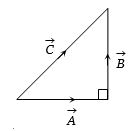
The magnitudes of vectors $\vec A, \vec B$ and $\vec C$ are $3, 4$ and $5$ units respectively. If $\vec A + \vec B = \vec C$,the angle between $\vec A$ and $\vec B$ is
A
$\frac{\pi}{2}$
B
$\cos^{-1}(0.6)$
C
$\tan^{-1}\left(\frac{7}{5}\right)$
D
$\frac{\pi}{4}$
Solution
(A) Given that the magnitudes are $|vec A| = 3$,$|vec B| = 4$,and $|vec C| = 5$.
Since $\vec A + \vec B = \vec C$,we can check if the magnitudes satisfy the Pythagorean theorem: $|vec A|^2 + |\vec B|^2 = 3^2 + 4^2 = 9 + 16 = 25 = 5^2 = |\vec C|^2$.
Since $|vec A|^2 + |\vec B|^2 = |\vec C|^2$,the vectors $\vec A$ and $\vec B$ must be perpendicular to each other.
Therefore,the angle between $\vec A$ and $\vec B$ is $\frac{\pi}{2}$.
Since $\vec A + \vec B = \vec C$,we can check if the magnitudes satisfy the Pythagorean theorem: $|vec A|^2 + |\vec B|^2 = 3^2 + 4^2 = 9 + 16 = 25 = 5^2 = |\vec C|^2$.
Since $|vec A|^2 + |\vec B|^2 = |\vec C|^2$,the vectors $\vec A$ and $\vec B$ must be perpendicular to each other.
Therefore,the angle between $\vec A$ and $\vec B$ is $\frac{\pi}{2}$.
0 likes
View Solution32
MediumMCQ
While travelling from one station to another,a car travels $75 \, km$ North,$60 \, km$ North-east,and $20 \, km$ East. The minimum distance between the two stations is.......$km$
A
$72$
B
$112$
C
$132$
D
$155$
Solution
(C) Let the starting point be the origin $(0, 0)$.
First displacement: $75 \, km$ North $\rightarrow \vec{d_1} = 75 \hat{j}$.
Second displacement: $60 \, km$ North-east $\rightarrow \vec{d_2} = 60 \cos 45^{\circ} \hat{i} + 60 \sin 45^{\circ} \hat{j} = 30\sqrt{2} \hat{i} + 30\sqrt{2} \hat{j}$.
Third displacement: $20 \, km$ East $\rightarrow \vec{d_3} = 20 \hat{i}$.
The total displacement vector $\vec{R} = \vec{d_1} + \vec{d_2} + \vec{d_3} = (30\sqrt{2} + 20) \hat{i} + (75 + 30\sqrt{2}) \hat{j}$.
Using $\sqrt{2} \approx 1.414$,$x = 30(1.414) + 20 = 42.42 + 20 = 62.42 \, km$.
$y = 75 + 30(1.414) = 75 + 42.42 = 117.42 \, km$.
The minimum distance (magnitude of displacement) is $S = \sqrt{x^2 + y^2} = \sqrt{(62.42)^2 + (117.42)^2} \approx \sqrt{3896 + 13787} = \sqrt{17683} \approx 132.97 \, km$.
Rounding to the nearest integer,the distance is $132 \, km$.
First displacement: $75 \, km$ North $\rightarrow \vec{d_1} = 75 \hat{j}$.
Second displacement: $60 \, km$ North-east $\rightarrow \vec{d_2} = 60 \cos 45^{\circ} \hat{i} + 60 \sin 45^{\circ} \hat{j} = 30\sqrt{2} \hat{i} + 30\sqrt{2} \hat{j}$.
Third displacement: $20 \, km$ East $\rightarrow \vec{d_3} = 20 \hat{i}$.
The total displacement vector $\vec{R} = \vec{d_1} + \vec{d_2} + \vec{d_3} = (30\sqrt{2} + 20) \hat{i} + (75 + 30\sqrt{2}) \hat{j}$.
Using $\sqrt{2} \approx 1.414$,$x = 30(1.414) + 20 = 42.42 + 20 = 62.42 \, km$.
$y = 75 + 30(1.414) = 75 + 42.42 = 117.42 \, km$.
The minimum distance (magnitude of displacement) is $S = \sqrt{x^2 + y^2} = \sqrt{(62.42)^2 + (117.42)^2} \approx \sqrt{3896 + 13787} = \sqrt{17683} \approx 132.97 \, km$.
Rounding to the nearest integer,the distance is $132 \, km$.
0 likes
View Solution33
EasyMCQ
Which pair of the following forces will never give a resultant force of $2 \, N$?
A
$2 \, N$ and $2 \, N$
B
$1 \, N$ and $1 \, N$
C
$1 \, N$ and $3 \, N$
D
$1 \, N$ and $4 \, N$
Solution
(D) The resultant $R$ of two forces $A$ and $B$ lies in the range $(A - B) \le R \le (A + B)$.
For option $A$: $2 \, N$ and $2 \, N$,the range is $(2 - 2) \le R \le (2 + 2)$,i.e.,$0 \le R \le 4 \, N$. Since $2 \, N$ is in this range,it is possible.
For option $B$: $1 \, N$ and $1 \, N$,the range is $(1 - 1) \le R \le (1 + 1)$,i.e.,$0 \le R \le 2 \, N$. Since $2 \, N$ is in this range,it is possible.
For option $C$: $1 \, N$ and $3 \, N$,the range is $(3 - 1) \le R \le (3 + 1)$,i.e.,$2 \le R \le 4 \, N$. Since $2 \, N$ is in this range,it is possible.
For option $D$: $1 \, N$ and $4 \, N$,the range is $(4 - 1) \le R \le (4 + 1)$,i.e.,$3 \le R \le 5 \, N$. Since $2 \, N$ is not in this range,it is impossible to obtain a resultant of $2 \, N$.
For option $A$: $2 \, N$ and $2 \, N$,the range is $(2 - 2) \le R \le (2 + 2)$,i.e.,$0 \le R \le 4 \, N$. Since $2 \, N$ is in this range,it is possible.
For option $B$: $1 \, N$ and $1 \, N$,the range is $(1 - 1) \le R \le (1 + 1)$,i.e.,$0 \le R \le 2 \, N$. Since $2 \, N$ is in this range,it is possible.
For option $C$: $1 \, N$ and $3 \, N$,the range is $(3 - 1) \le R \le (3 + 1)$,i.e.,$2 \le R \le 4 \, N$. Since $2 \, N$ is in this range,it is possible.
For option $D$: $1 \, N$ and $4 \, N$,the range is $(4 - 1) \le R \le (4 + 1)$,i.e.,$3 \le R \le 5 \, N$. Since $2 \, N$ is not in this range,it is impossible to obtain a resultant of $2 \, N$.
0 likes
View Solution34
DifficultMCQ
Two forces $3\,N$ and $2\,N$ are at an angle $\theta$ such that the resultant is $R$. The first force is now increased to $6\,N$ and the resultant becomes $2R$. The value of $\theta$ is ....... $^\circ$.
A
$30$
B
$60$
C
$90$
D
$120$
Solution
(D) Let the two forces be $F_1 = 3\,N$ and $F_2 = 2\,N$. The resultant $R$ is given by the formula $R = \sqrt{F_1^2 + F_2^2 + 2F_1F_2 \cos \theta}$.
Substituting the values,we get $R = \sqrt{3^2 + 2^2 + 2(3)(2) \cos \theta} = \sqrt{9 + 4 + 12 \cos \theta} = \sqrt{13 + 12 \cos \theta}$ ... $(i)$.
When the first force is increased to $F_1' = 6\,N$,the new resultant is $2R$. Thus,$(2R)^2 = (F_1')^2 + F_2^2 + 2F_1'F_2 \cos \theta$.
$4R^2 = 6^2 + 2^2 + 2(6)(2) \cos \theta = 36 + 4 + 24 \cos \theta = 40 + 24 \cos \theta$.
From $(i)$,$R^2 = 13 + 12 \cos \theta$. Substituting this into the equation for $4R^2$:
$4(13 + 12 \cos \theta) = 40 + 24 \cos \theta$.
$52 + 48 \cos \theta = 40 + 24 \cos \theta$.
$24 \cos \theta = -12$.
$\cos \theta = -\frac{12}{24} = -\frac{1}{2}$.
Therefore,$\theta = 120^\circ$.
Substituting the values,we get $R = \sqrt{3^2 + 2^2 + 2(3)(2) \cos \theta} = \sqrt{9 + 4 + 12 \cos \theta} = \sqrt{13 + 12 \cos \theta}$ ... $(i)$.
When the first force is increased to $F_1' = 6\,N$,the new resultant is $2R$. Thus,$(2R)^2 = (F_1')^2 + F_2^2 + 2F_1'F_2 \cos \theta$.
$4R^2 = 6^2 + 2^2 + 2(6)(2) \cos \theta = 36 + 4 + 24 \cos \theta = 40 + 24 \cos \theta$.
From $(i)$,$R^2 = 13 + 12 \cos \theta$. Substituting this into the equation for $4R^2$:
$4(13 + 12 \cos \theta) = 40 + 24 \cos \theta$.
$52 + 48 \cos \theta = 40 + 24 \cos \theta$.
$24 \cos \theta = -12$.
$\cos \theta = -\frac{12}{24} = -\frac{1}{2}$.
Therefore,$\theta = 120^\circ$.
0 likes
View Solution35
EasyMCQ
Two forces of $12 \, N$ and $8 \, N$ act upon a body. The resultant force on the body has a maximum value of ........ $N$.
A
$4$
B
$0$
C
$20$
D
$8$
Solution
(C) The resultant force $R$ of two vectors $A$ and $B$ is given by $R = \sqrt{A^2 + B^2 + 2AB \cos \theta}$.
For the resultant force to be maximum,the angle $\theta$ between the two forces must be $0^\circ$.
Thus,$R_{\max} = A + B$.
Given $A = 12 \, N$ and $B = 8 \, N$.
Therefore,$R_{\max} = 12 + 8 = 20 \, N$.
For the resultant force to be maximum,the angle $\theta$ between the two forces must be $0^\circ$.
Thus,$R_{\max} = A + B$.
Given $A = 12 \, N$ and $B = 8 \, N$.
Therefore,$R_{\max} = 12 + 8 = 20 \, N$.
0 likes
View Solution36
MediumMCQ
Two equal forces ($P$ each) act at a point inclined to each other at an angle of $120^\circ$. The magnitude of their resultant is
A
$P/2$
B
$P/4$
C
$P$
D
$2P$
Solution
(C) The magnitude of the resultant $R$ of two vectors $A$ and $B$ inclined at an angle $\theta$ is given by the formula:
$R = \sqrt{A^2 + B^2 + 2AB \cos \theta}$
Given that the two forces are equal,$A = B = P$,and the angle between them is $\theta = 120^\circ$.
Substituting these values into the formula:
$R = \sqrt{P^2 + P^2 + 2(P)(P) \cos(120^\circ)}$
Since $\cos(120^\circ) = -1/2$:
$R = \sqrt{2P^2 + 2P^2(-1/2)}$
$R = \sqrt{2P^2 - P^2}$
$R = \sqrt{P^2} = P$
Therefore,the magnitude of the resultant force is $P$.
$R = \sqrt{A^2 + B^2 + 2AB \cos \theta}$
Given that the two forces are equal,$A = B = P$,and the angle between them is $\theta = 120^\circ$.
Substituting these values into the formula:
$R = \sqrt{P^2 + P^2 + 2(P)(P) \cos(120^\circ)}$
Since $\cos(120^\circ) = -1/2$:
$R = \sqrt{2P^2 + 2P^2(-1/2)}$
$R = \sqrt{2P^2 - P^2}$
$R = \sqrt{P^2} = P$
Therefore,the magnitude of the resultant force is $P$.
0 likes
View Solution37
MediumMCQ
The vectors $5\hat{i} + 8\hat{j}$ and $2\hat{i} + 7\hat{j}$ are added. The magnitude of the sum of these vectors is
A
$\sqrt{274}$
B
$38$
C
$238$
D
$560$
Solution
(A) Let the two vectors be $\vec{A} = 5\hat{i} + 8\hat{j}$ and $\vec{B} = 2\hat{i} + 7\hat{j}$.
Adding these vectors,we get the resultant vector $\vec{R} = \vec{A} + \vec{B} = (5+2)\hat{i} + (8+7)\hat{j} = 7\hat{i} + 15\hat{j}$.
The magnitude of the resultant vector $\vec{R}$ is given by $|\vec{R}| = \sqrt{R_x^2 + R_y^2}$.
Substituting the values,$|\vec{R}| = \sqrt{7^2 + 15^2} = \sqrt{49 + 225} = \sqrt{274}$.
Adding these vectors,we get the resultant vector $\vec{R} = \vec{A} + \vec{B} = (5+2)\hat{i} + (8+7)\hat{j} = 7\hat{i} + 15\hat{j}$.
The magnitude of the resultant vector $\vec{R}$ is given by $|\vec{R}| = \sqrt{R_x^2 + R_y^2}$.
Substituting the values,$|\vec{R}| = \sqrt{7^2 + 15^2} = \sqrt{49 + 225} = \sqrt{274}$.
0 likes
View Solution38
MediumMCQ
Two vectors $\vec{A}$ and $\vec{B}$ are such that $\vec{A} + \vec{B} = \vec{A} - \vec{B}$. Then:
A
$\vec{A} \cdot \vec{B} = 0$
B
$\vec{A} \times \vec{B} = 0$
C
$\vec{A} = 0$
D
$\vec{B} = 0$
Solution
(D) Given the equation: $\vec{A} + \vec{B} = \vec{A} - \vec{B}$.
Subtract $\vec{A}$ from both sides of the equation:
$(\vec{A} - \vec{A}) + \vec{B} = -\vec{B}$.
This simplifies to: $0 + \vec{B} = -\vec{B}$.
Add $\vec{B}$ to both sides:
$\vec{B} + \vec{B} = 0$.
$2\vec{B} = 0$.
Therefore,$\vec{B} = 0$.
Subtract $\vec{A}$ from both sides of the equation:
$(\vec{A} - \vec{A}) + \vec{B} = -\vec{B}$.
This simplifies to: $0 + \vec{B} = -\vec{B}$.
Add $\vec{B}$ to both sides:
$\vec{B} + \vec{B} = 0$.
$2\vec{B} = 0$.
Therefore,$\vec{B} = 0$.
0 likes
View Solution39
DifficultMCQ
If for two vectors $\overrightarrow{A}$ and $\overrightarrow{B}$,the sum $(\overrightarrow{A} + \overrightarrow{B})$ is perpendicular to the difference $(\overrightarrow{A} - \overrightarrow{B})$,then the ratio of their magnitudes is:
A
$1$
B
$2$
C
$3$
D
None of these
Solution
(A) Given that $(\overrightarrow{A} + \overrightarrow{B})$ is perpendicular to $(\overrightarrow{A} - \overrightarrow{B})$.
Since the dot product of two perpendicular vectors is zero,we have:
$(\overrightarrow{A} + \overrightarrow{B}) \cdot (\overrightarrow{A} - \overrightarrow{B}) = 0$
Expanding the dot product:
$\overrightarrow{A} \cdot \overrightarrow{A} - \overrightarrow{A} \cdot \overrightarrow{B} + \overrightarrow{B} \cdot \overrightarrow{A} - \overrightarrow{B} \cdot \overrightarrow{B} = 0$
Using the commutative property of the dot product,$\overrightarrow{A} \cdot \overrightarrow{B} = \overrightarrow{B} \cdot \overrightarrow{A}$,the middle terms cancel out:
$|\overrightarrow{A}|^2 - |\overrightarrow{B}|^2 = 0$
$|\overrightarrow{A}|^2 = |\overrightarrow{B}|^2$
$|\overrightarrow{A}| = |\overrightarrow{B}|$
Therefore,the ratio of their magnitudes is $\frac{|\overrightarrow{A}|}{|\overrightarrow{B}|} = 1$.
Since the dot product of two perpendicular vectors is zero,we have:
$(\overrightarrow{A} + \overrightarrow{B}) \cdot (\overrightarrow{A} - \overrightarrow{B}) = 0$
Expanding the dot product:
$\overrightarrow{A} \cdot \overrightarrow{A} - \overrightarrow{A} \cdot \overrightarrow{B} + \overrightarrow{B} \cdot \overrightarrow{A} - \overrightarrow{B} \cdot \overrightarrow{B} = 0$
Using the commutative property of the dot product,$\overrightarrow{A} \cdot \overrightarrow{B} = \overrightarrow{B} \cdot \overrightarrow{A}$,the middle terms cancel out:
$|\overrightarrow{A}|^2 - |\overrightarrow{B}|^2 = 0$
$|\overrightarrow{A}|^2 = |\overrightarrow{B}|^2$
$|\overrightarrow{A}| = |\overrightarrow{B}|$
Therefore,the ratio of their magnitudes is $\frac{|\overrightarrow{A}|}{|\overrightarrow{B}|} = 1$.
0 likes
View Solution40
MediumMCQ
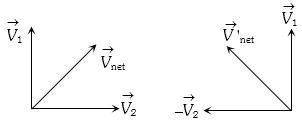
If $|{\overrightarrow V _1} + {\overrightarrow V _2}| = |{\overrightarrow V _1} - {\overrightarrow V _2}|$ and ${V_2}$ is finite,then
A
${V_1}$ is parallel to ${V_2}$
B
${\overrightarrow V _1} = {\overrightarrow V _2}$
C
${V_1}$ and ${V_2}$ are mutually perpendicular
D
$|{\overrightarrow V _1}| = |{\overrightarrow V _2}|$
Solution
(C) Given: $|{\vec V_1} + {\vec V_2}| = |{\vec V_1} - {\vec V_2}|$
Squaring both sides:
$|{\vec V_1} + {\vec V_2}|^2 = |{\vec V_1} - {\vec V_2}|^2$
Using the property $|\vec A \pm \vec B|^2 = |\vec A|^2 + |\vec B|^2 \pm 2(\vec A \cdot \vec B)$:
$|{\vec V_1}|^2 + |{\vec V_2}|^2 + 2(\vec V_1 \cdot \vec V_2) = |{\vec V_1}|^2 + |{\vec V_2}|^2 - 2(\vec V_1 \cdot \vec V_2)$
$2(\vec V_1 \cdot \vec V_2) = -2(\vec V_1 \cdot \vec V_2)$
$4(\vec V_1 \cdot \vec V_2) = 0$
$\vec V_1 \cdot \vec V_2 = 0$
This implies that the vectors ${\vec V_1}$ and ${\vec V_2}$ are mutually perpendicular.
Squaring both sides:
$|{\vec V_1} + {\vec V_2}|^2 = |{\vec V_1} - {\vec V_2}|^2$
Using the property $|\vec A \pm \vec B|^2 = |\vec A|^2 + |\vec B|^2 \pm 2(\vec A \cdot \vec B)$:
$|{\vec V_1}|^2 + |{\vec V_2}|^2 + 2(\vec V_1 \cdot \vec V_2) = |{\vec V_1}|^2 + |{\vec V_2}|^2 - 2(\vec V_1 \cdot \vec V_2)$
$2(\vec V_1 \cdot \vec V_2) = -2(\vec V_1 \cdot \vec V_2)$
$4(\vec V_1 \cdot \vec V_2) = 0$
$\vec V_1 \cdot \vec V_2 = 0$
This implies that the vectors ${\vec V_1}$ and ${\vec V_2}$ are mutually perpendicular.
0 likes
View Solution41
EasyMCQ
Two vectors $\vec{A}$ and $\vec{B}$ have equal magnitudes. Then the vector $\vec{A} + \vec{B}$ is perpendicular to:
A
$\vec{A} - \vec{B}$
B
$\vec{A} \times \vec{B}$
C
$\vec{A} \cdot \vec{B}$
D
None of these
Solution
(A) Given that $|\vec{A}| = |\vec{B}|$.
Let $\vec{R} = \vec{A} + \vec{B}$ and $\vec{D} = \vec{A} - \vec{B}$.
Consider the dot product $\vec{R} \cdot \vec{D} = (\vec{A} + \vec{B}) \cdot (\vec{A} - \vec{B})$.
$= \vec{A} \cdot \vec{A} - \vec{A} \cdot \vec{B} + \vec{B} \cdot \vec{A} - \vec{B} \cdot \vec{B}$.
$= |\vec{A}|^2 - |\vec{B}|^2$.
Since $|\vec{A}| = |\vec{B}|$,the dot product is $0$.
Therefore,$\vec{A} + \vec{B}$ is perpendicular to $\vec{A} - \vec{B}$.
Let $\vec{R} = \vec{A} + \vec{B}$ and $\vec{D} = \vec{A} - \vec{B}$.
Consider the dot product $\vec{R} \cdot \vec{D} = (\vec{A} + \vec{B}) \cdot (\vec{A} - \vec{B})$.
$= \vec{A} \cdot \vec{A} - \vec{A} \cdot \vec{B} + \vec{B} \cdot \vec{A} - \vec{B} \cdot \vec{B}$.
$= |\vec{A}|^2 - |\vec{B}|^2$.
Since $|\vec{A}| = |\vec{B}|$,the dot product is $0$.
Therefore,$\vec{A} + \vec{B}$ is perpendicular to $\vec{A} - \vec{B}$.
0 likes
View Solution42
EasyMCQ
Can the resultant of $2$ vectors be zero?
A
Yes,when the $2$ vectors are same in magnitude and direction.
B
No.
C
Yes,when the $2$ vectors are same in magnitude but opposite in sense.
D
Yes,when the $2$ vectors are same in magnitude making an angle of $\frac{2\pi}{3}$ with each other.
Solution
(C) The resultant of $2$ vectors $\vec{A}$ and $\vec{B}$ is given by $\vec{R} = \vec{A} + \vec{B}$.
For the resultant to be zero,$\vec{A} + \vec{B} = 0$,which implies $\vec{A} = -\vec{B}$.
This means the two vectors must have the same magnitude $(|A| = |B|)$ but must be directed in opposite directions (an angle of $180^{\circ}$ or $\pi$ radians between them).
Therefore,the correct condition is that the $2$ vectors are same in magnitude but opposite in sense.
For the resultant to be zero,$\vec{A} + \vec{B} = 0$,which implies $\vec{A} = -\vec{B}$.
This means the two vectors must have the same magnitude $(|A| = |B|)$ but must be directed in opposite directions (an angle of $180^{\circ}$ or $\pi$ radians between them).
Therefore,the correct condition is that the $2$ vectors are same in magnitude but opposite in sense.
0 likes
View Solution43
MediumMCQ
Two forces are such that the sum of their magnitudes is $18 \; N$ and their resultant is $12 \; N$,which is perpendicular to the smaller force. Then the magnitudes of the forces are:
A
$12 \; N, 6 \; N$
B
$14 \; N, 4 \; N$
C
$5 \; N, 13 \; N$
D
$10 \; N, 8 \; N$
Solution
(C) Let $P$ be the smaller force and $Q$ be the greater force. According to the problem:
$P + Q = 18$......$(i)$
Given that the resultant $R = 12 \; N$ is perpendicular to the smaller force $P$,the angle between $R$ and $P$ is $90^{\circ}$.
Using the formula for the direction of the resultant: $\tan \alpha = \frac{Q \sin \theta}{P + Q \cos \theta}$.
Since $\alpha = 90^{\circ}$,$\tan 90^{\circ} = \infty$,which implies $P + Q \cos \theta = 0$,so $Q \cos \theta = -P$......$(ii)$
The magnitude of the resultant is given by $R^2 = P^2 + Q^2 + 2PQ \cos \theta$.
Substituting $R = 12$ and $Q \cos \theta = -P$ into the equation:
$12^2 = P^2 + Q^2 + 2P(-P)$
$144 = P^2 + Q^2 - 2P^2$
$144 = Q^2 - P^2$
$144 = (Q - P)(Q + P)$
Since $Q + P = 18$,we have $144 = (Q - P)(18)$,which gives $Q - P = 8$......$(iii)$
Adding $(i)$ and $(iii)$: $2Q = 26 \implies Q = 13 \; N$.
Subtracting $(iii)$ from $(i)$: $2P = 10 \implies P = 5 \; N$.
Thus,the magnitudes of the forces are $5 \; N$ and $13 \; N$.
$P + Q = 18$......$(i)$
Given that the resultant $R = 12 \; N$ is perpendicular to the smaller force $P$,the angle between $R$ and $P$ is $90^{\circ}$.
Using the formula for the direction of the resultant: $\tan \alpha = \frac{Q \sin \theta}{P + Q \cos \theta}$.
Since $\alpha = 90^{\circ}$,$\tan 90^{\circ} = \infty$,which implies $P + Q \cos \theta = 0$,so $Q \cos \theta = -P$......$(ii)$
The magnitude of the resultant is given by $R^2 = P^2 + Q^2 + 2PQ \cos \theta$.
Substituting $R = 12$ and $Q \cos \theta = -P$ into the equation:
$12^2 = P^2 + Q^2 + 2P(-P)$
$144 = P^2 + Q^2 - 2P^2$
$144 = Q^2 - P^2$
$144 = (Q - P)(Q + P)$
Since $Q + P = 18$,we have $144 = (Q - P)(18)$,which gives $Q - P = 8$......$(iii)$
Adding $(i)$ and $(iii)$: $2Q = 26 \implies Q = 13 \; N$.
Subtracting $(iii)$ from $(i)$: $2P = 10 \implies P = 5 \; N$.
Thus,the magnitudes of the forces are $5 \; N$ and $13 \; N$.
0 likes
View Solution44
DifficultMCQ
Find the resultant of three vectors $\overrightarrow{OA}$,$\overrightarrow{OB}$,and $\overrightarrow{OC}$ as shown in the figure. The radius of the circle is $R$.
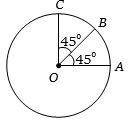
A
$2R$
B
$R(1 + \sqrt{2})$
C
$R\sqrt{2}$
D
$R(\sqrt{2} - 1)$
Solution
(B) Let the vectors be represented in a Cartesian coordinate system with $O$ at the origin $(0,0)$.
Vector $\overrightarrow{OA}$ is along the positive $x$-axis: $\overrightarrow{OA} = R\hat{i}$.
Vector $\overrightarrow{OC}$ is along the positive $y$-axis: $\overrightarrow{OC} = R\hat{j}$.
Vector $\overrightarrow{OB}$ makes an angle of $45^{\circ}$ with the $x$-axis: $\overrightarrow{OB} = R\cos(45^{\circ})\hat{i} + R\sin(45^{\circ})\hat{j} = \frac{R}{\sqrt{2}}\hat{i} + \frac{R}{\sqrt{2}}\hat{j}$.
The resultant vector $\vec{R}_{net} = \overrightarrow{OA} + \overrightarrow{OB} + \overrightarrow{OC} = (R + \frac{R}{\sqrt{2}})\hat{i} + (R + \frac{R}{\sqrt{2}})\hat{j}$.
The magnitude is $|\vec{R}_{net}| = \sqrt{(R + \frac{R}{\sqrt{2}})^2 + (R + \frac{R}{\sqrt{2}})^2} = \sqrt{2(R + \frac{R}{\sqrt{2}})^2} = \sqrt{2}(R + \frac{R}{\sqrt{2}}) = R\sqrt{2} + R = R(\sqrt{2} + 1)$.
Vector $\overrightarrow{OA}$ is along the positive $x$-axis: $\overrightarrow{OA} = R\hat{i}$.
Vector $\overrightarrow{OC}$ is along the positive $y$-axis: $\overrightarrow{OC} = R\hat{j}$.
Vector $\overrightarrow{OB}$ makes an angle of $45^{\circ}$ with the $x$-axis: $\overrightarrow{OB} = R\cos(45^{\circ})\hat{i} + R\sin(45^{\circ})\hat{j} = \frac{R}{\sqrt{2}}\hat{i} + \frac{R}{\sqrt{2}}\hat{j}$.
The resultant vector $\vec{R}_{net} = \overrightarrow{OA} + \overrightarrow{OB} + \overrightarrow{OC} = (R + \frac{R}{\sqrt{2}})\hat{i} + (R + \frac{R}{\sqrt{2}})\hat{j}$.
The magnitude is $|\vec{R}_{net}| = \sqrt{(R + \frac{R}{\sqrt{2}})^2 + (R + \frac{R}{\sqrt{2}})^2} = \sqrt{2(R + \frac{R}{\sqrt{2}})^2} = \sqrt{2}(R + \frac{R}{\sqrt{2}}) = R\sqrt{2} + R = R(\sqrt{2} + 1)$.
0 likes
View Solution45
MediumMCQ
Two forces of magnitude $F$ have a resultant of the same magnitude $F$. The angle between the two forces is ........ $^o$
A
$45$
B
$120$
C
$150$
D
$60$
Solution
(B) The resultant $R$ of two forces $F_1$ and $F_2$ with an angle $\theta$ between them is given by the formula: $R = \sqrt{F_1^2 + F_2^2 + 2F_1F_2 \cos \theta}$.
Given $F_1 = F$,$F_2 = F$,and the resultant $R = F$.
Substituting these values into the formula: $F = \sqrt{F^2 + F^2 + 2F^2 \cos \theta}$.
Squaring both sides: $F^2 = 2F^2 + 2F^2 \cos \theta$.
Dividing by $F^2$: $1 = 2 + 2 \cos \theta$.
Rearranging the terms: $2 \cos \theta = 1 - 2 = -1$.
Thus,$\cos \theta = -1/2$.
Since $\cos(120^\circ) = -1/2$,the angle between the two forces is $\theta = 120^\circ$.
Given $F_1 = F$,$F_2 = F$,and the resultant $R = F$.
Substituting these values into the formula: $F = \sqrt{F^2 + F^2 + 2F^2 \cos \theta}$.
Squaring both sides: $F^2 = 2F^2 + 2F^2 \cos \theta$.
Dividing by $F^2$: $1 = 2 + 2 \cos \theta$.
Rearranging the terms: $2 \cos \theta = 1 - 2 = -1$.
Thus,$\cos \theta = -1/2$.
Since $\cos(120^\circ) = -1/2$,the angle between the two forces is $\theta = 120^\circ$.
0 likes
View Solution46
MediumMCQ
Two forces with equal magnitudes $F$ act on a body and the magnitude of the resultant force is $F/3$. The angle between the two forces is
A
$\cos^{-1}\left(-\frac{17}{18}\right)$
B
$\cos^{-1}\left(-\frac{1}{3}\right)$
C
$\cos^{-1}\left(\frac{2}{3}\right)$
D
$\cos^{-1}\left(\frac{8}{9}\right)$
Solution
(A) The magnitude of the resultant force $R$ of two vectors $F_1$ and $F_2$ with an angle $\theta$ between them is given by the formula: $R^2 = F_1^2 + F_2^2 + 2F_1F_2\cos\theta$.
Given that $F_1 = F_2 = F$ and $R = F/3$,we substitute these values into the equation:
$(F/3)^2 = F^2 + F^2 + 2(F)(F)\cos\theta$.
$F^2/9 = 2F^2 + 2F^2\cos\theta$.
Dividing both sides by $F^2$:
$1/9 = 2 + 2\cos\theta$.
$1/9 - 2 = 2\cos\theta$.
$-17/9 = 2\cos\theta$.
$\cos\theta = -17/18$.
Therefore,$\theta = \cos^{-1}(-17/18)$.
Given that $F_1 = F_2 = F$ and $R = F/3$,we substitute these values into the equation:
$(F/3)^2 = F^2 + F^2 + 2(F)(F)\cos\theta$.
$F^2/9 = 2F^2 + 2F^2\cos\theta$.
Dividing both sides by $F^2$:
$1/9 = 2 + 2\cos\theta$.
$1/9 - 2 = 2\cos\theta$.
$-17/9 = 2\cos\theta$.
$\cos\theta = -17/18$.
Therefore,$\theta = \cos^{-1}(-17/18)$.
0 likes
View Solution47
EasyMCQ
The resultant force of $5 \, N$ and $10 \, N$ cannot be ........ $N$.
A
$12$
B
$8$
C
$4$
D
$5$
Solution
(C) The resultant force $R$ of two vectors $A$ and $B$ lies in the range $|A - B| \le R \le |A + B|$.
Given $A = 5 \, N$ and $B = 10 \, N$.
The maximum resultant force is $F_{\max} = 10 + 5 = 15 \, N$.
The minimum resultant force is $F_{\min} = 10 - 5 = 5 \, N$.
Therefore,the resultant force must be in the range $5 \, N \le R \le 15 \, N$.
Since $4 \, N$ is less than the minimum possible resultant force of $5 \, N$,the resultant cannot be $4 \, N$.
Given $A = 5 \, N$ and $B = 10 \, N$.
The maximum resultant force is $F_{\max} = 10 + 5 = 15 \, N$.
The minimum resultant force is $F_{\min} = 10 - 5 = 5 \, N$.
Therefore,the resultant force must be in the range $5 \, N \le R \le 15 \, N$.
Since $4 \, N$ is less than the minimum possible resultant force of $5 \, N$,the resultant cannot be $4 \, N$.
0 likes
View Solution48
MediumMCQ
The resultant of two forces $3P$ and $2P$ is $R$. If the first force is doubled,then the resultant is also doubled. The angle between the two forces is ........... $^o$.
A
$60$
B
$120$
C
$70$
D
$180$
Solution
(B) Let the angle between the two forces be $\theta$.
Using the law of parallelogram of vectors,the resultant $R$ is given by:
$R^2 = (3P)^2 + (2P)^2 + 2(3P)(2P) \cos \theta$
$R^2 = 9P^2 + 4P^2 + 12P^2 \cos \theta = 13P^2 + 12P^2 \cos \theta$ ... $(i)$
When the first force is doubled,it becomes $6P$. The new resultant is $2R$:
$(2R)^2 = (6P)^2 + (2P)^2 + 2(6P)(2P) \cos \theta$
$4R^2 = 36P^2 + 4P^2 + 24P^2 \cos \theta = 40P^2 + 24P^2 \cos \theta$ ... (ii)
Divide equation (ii) by $4$:
$R^2 = 10P^2 + 6P^2 \cos \theta$ ... (iii)
Equating $(i)$ and (iii):
$13P^2 + 12P^2 \cos \theta = 10P^2 + 6P^2 \cos \theta$
$3P^2 = -6P^2 \cos \theta$
$\cos \theta = -3/6 = -1/2$
Therefore,$\theta = 120^\circ$.
Using the law of parallelogram of vectors,the resultant $R$ is given by:
$R^2 = (3P)^2 + (2P)^2 + 2(3P)(2P) \cos \theta$
$R^2 = 9P^2 + 4P^2 + 12P^2 \cos \theta = 13P^2 + 12P^2 \cos \theta$ ... $(i)$
When the first force is doubled,it becomes $6P$. The new resultant is $2R$:
$(2R)^2 = (6P)^2 + (2P)^2 + 2(6P)(2P) \cos \theta$
$4R^2 = 36P^2 + 4P^2 + 24P^2 \cos \theta = 40P^2 + 24P^2 \cos \theta$ ... (ii)
Divide equation (ii) by $4$:
$R^2 = 10P^2 + 6P^2 \cos \theta$ ... (iii)
Equating $(i)$ and (iii):
$13P^2 + 12P^2 \cos \theta = 10P^2 + 6P^2 \cos \theta$
$3P^2 = -6P^2 \cos \theta$
$\cos \theta = -3/6 = -1/2$
Therefore,$\theta = 120^\circ$.
1 likes
View Solution49
MediumMCQ
Two forces are such that the sum of their magnitudes is $18 \,N$ and their resultant is perpendicular to the smaller force and the magnitude of the resultant is $12 \,N$. Then the magnitudes of the forces are:
A
$12 \,N, 6 \,N$
B
$13 \,N, 5 \,N$
C
$10 \,N, 8 \,N$
D
$16 \,N, 2 \,N$
Solution
(B) Let the two forces be $F_1$ and $F_2$,where $F_1$ is the larger force and $F_2$ is the smaller force.
Given: $F_1 + F_2 = 18 \,N$ $(i)$
Let the resultant $R = 12 \,N$ be perpendicular to the smaller force $F_2$.
The angle $\alpha$ between the resultant $R$ and the force $F_2$ is $90^\circ$.
The formula for the direction of the resultant is $\tan \alpha = \frac{F_1 \sin \theta}{F_2 + F_1 \cos \theta} = \tan 90^\circ$.
This implies the denominator $F_2 + F_1 \cos \theta = 0$,so $\cos \theta = -\frac{F_2}{F_1}$.
The magnitude of the resultant is $R^2 = F_1^2 + F_2^2 + 2F_1 F_2 \cos \theta$.
Substituting $\cos \theta = -\frac{F_2}{F_1}$,we get $R^2 = F_1^2 + F_2^2 + 2F_1 F_2 (-F_2/F_1) = F_1^2 - F_2^2$.
Given $R = 12$,so $144 = F_1^2 - F_2^2 = (F_1 + F_2)(F_1 - F_2)$.
Using $(i)$,$144 = 18(F_1 - F_2)$,which gives $F_1 - F_2 = 8 \,N$ (ii).
Adding $(i)$ and (ii): $2F_1 = 26 \,N \implies F_1 = 13 \,N$.
Subtracting (ii) from $(i)$: $2F_2 = 10 \,N \implies F_2 = 5 \,N$.
Thus,the magnitudes are $13 \,N$ and $5 \,N$.
Given: $F_1 + F_2 = 18 \,N$ $(i)$
Let the resultant $R = 12 \,N$ be perpendicular to the smaller force $F_2$.
The angle $\alpha$ between the resultant $R$ and the force $F_2$ is $90^\circ$.
The formula for the direction of the resultant is $\tan \alpha = \frac{F_1 \sin \theta}{F_2 + F_1 \cos \theta} = \tan 90^\circ$.
This implies the denominator $F_2 + F_1 \cos \theta = 0$,so $\cos \theta = -\frac{F_2}{F_1}$.
The magnitude of the resultant is $R^2 = F_1^2 + F_2^2 + 2F_1 F_2 \cos \theta$.
Substituting $\cos \theta = -\frac{F_2}{F_1}$,we get $R^2 = F_1^2 + F_2^2 + 2F_1 F_2 (-F_2/F_1) = F_1^2 - F_2^2$.
Given $R = 12$,so $144 = F_1^2 - F_2^2 = (F_1 + F_2)(F_1 - F_2)$.
Using $(i)$,$144 = 18(F_1 - F_2)$,which gives $F_1 - F_2 = 8 \,N$ (ii).
Adding $(i)$ and (ii): $2F_1 = 26 \,N \implies F_1 = 13 \,N$.
Subtracting (ii) from $(i)$: $2F_2 = 10 \,N \implies F_2 = 5 \,N$.
Thus,the magnitudes are $13 \,N$ and $5 \,N$.
0 likes
View Solution50
MediumMCQ
Which of the four arrangements in the figure correctly shows the vector addition of two forces $\overrightarrow {{F_1}} $ and $\overrightarrow {{F_2}} $ to yield the third force $\overrightarrow {{F_3}} $?
A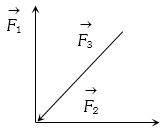
B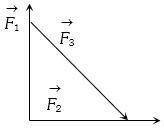
C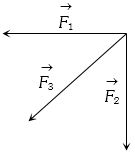
D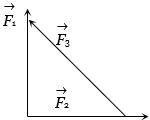
Solution
(D) According to the triangle law of vector addition,if two vectors are represented by two sides of a triangle in sequence (head-to-tail),then their sum (resultant) is represented by the third side of the triangle taken in the opposite order (from the tail of the first to the head of the second).
In option $D$,the vector $\overrightarrow {{F_2}} $ is placed such that its tail is at the head of $\overrightarrow {{F_1}} $. The resultant vector $\overrightarrow {{F_3}} $ starts from the tail of $\overrightarrow {{F_1}} $ and ends at the head of $\overrightarrow {{F_2}} $. This correctly represents $\overrightarrow {{F_3}} = \overrightarrow {{F_1}} + \overrightarrow {{F_2}} $.
Therefore,the correct arrangement is $D$.
In option $D$,the vector $\overrightarrow {{F_2}} $ is placed such that its tail is at the head of $\overrightarrow {{F_1}} $. The resultant vector $\overrightarrow {{F_3}} $ starts from the tail of $\overrightarrow {{F_1}} $ and ends at the head of $\overrightarrow {{F_2}} $. This correctly represents $\overrightarrow {{F_3}} = \overrightarrow {{F_1}} + \overrightarrow {{F_2}} $.
Therefore,the correct arrangement is $D$.
1 likes
View Solution3-1.Vectors — Addition and Subtraction of Vectors · Frequently Asked Questions
1Are these 3-1.Vectors questions useful for JEE and NEET?
Yes. All questions in this section are mapped to JEE Main and NEET exam patterns. Previous year questions from JEE Main, NEET, GUJCET and state-level exams are included with full solutions.
2Can I switch to Hindi or Gujarati for these questions?
Yes. Use the language tabs in the hero section or the sidebar to view the same questions and solutions in English, Hindi or Gujarati.
3How do I generate a question paper from this subtopic?
Use the Vedclass Exam Paper Generator — select the chapter and subtopic, set difficulty, and generate Sets A, B, C, D automatically. First 3 chapters of every subject are free.
Vedclass Products
For Students
Vedclass Test Series
Mock tests in real JEE/NEET style with performance analysis. 5-day free trial.
Start Free TrialFor Teachers
Exam Paper Generator
Generate Set A/B/C/D papers from this chapter in 2 minutes. 3 chapters free.
Try FreeFor Institutes
Online Exam Module
Live online exams with unlimited students, 360° analytics & white-label branding.
See DemoFor Teachers & Institutes
Generate a 3-1.Vectors Exam Paper in 2 Minutes
Select subtopic & difficulty — Sets A, B, C, D auto-generated with No Repeat logic.
First 3 chapters of every subject are free — no payment required.