
A English
Resolution of a Vector into Rectangular Components Questions in English
Class 11 Physics · 3-1.Vectors · Resolution of a Vector into Rectangular Components
57+
Questions
English
Language
100%
With Solutions
Showing 50 of 57 questions in English
1
EasyMCQ
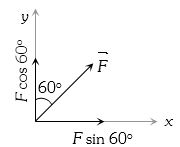
$A$ force of $5\, N$ acts on a particle along a direction making an angle of $60^\circ$ with the vertical. Its vertical component is.......$N$.
A
$10$
B
$3$
C
$4$
D
$2.5$
Solution
(D) The component of a vector $\vec{F}$ making an angle $\theta$ with a specific axis is given by $F \cos \theta$ along that axis.
Here,the force $F = 5\, N$ makes an angle $\theta = 60^\circ$ with the vertical axis.
Therefore,the vertical component of the force is $F_v = F \cos 60^\circ$.
Substituting the values,we get $F_v = 5 \times \frac{1}{2} = 2.5\, N$.
Thus,the vertical component is $2.5\, N$.
Here,the force $F = 5\, N$ makes an angle $\theta = 60^\circ$ with the vertical axis.
Therefore,the vertical component of the force is $F_v = F \cos 60^\circ$.
Substituting the values,we get $F_v = 5 \times \frac{1}{2} = 2.5\, N$.
Thus,the vertical component is $2.5\, N$.
0 likes
View Solution2
MediumMCQ
Given vector $\vec{A} = 2\hat{i} + 3\hat{j}$,the angle between $\vec{A}$ and the $y$-axis is:
A
$\tan^{-1}(3/2)$
B
$\tan^{-1}(2/3)$
C
$\sin^{-1}(2/3)$
D
$\cos^{-1}(2/3)$
Solution
(B) The vector is given by $\vec{A} = 2\hat{i} + 3\hat{j}$.
Here,the $x$-component is $A_x = 2$ and the $y$-component is $A_y = 3$.
The angle $\theta$ between the vector $\vec{A}$ and the $y$-axis is defined by the relation $\tan \theta = \frac{A_x}{A_y}$.
Substituting the values,we get $\tan \theta = \frac{2}{3}$.
Therefore,the angle $\theta = \tan^{-1}(2/3)$.
Here,the $x$-component is $A_x = 2$ and the $y$-component is $A_y = 3$.
The angle $\theta$ between the vector $\vec{A}$ and the $y$-axis is defined by the relation $\tan \theta = \frac{A_x}{A_y}$.
Substituting the values,we get $\tan \theta = \frac{2}{3}$.
Therefore,the angle $\theta = \tan^{-1}(2/3)$.
0 likes
View Solution3
EasyMCQ
$A$ vector is represented by $3\,\hat i + \hat j + 2\,\hat k$. Its length in the $XY$ plane is
A
$2$
B
$\sqrt{14}$
C
$\sqrt{10}$
D
$\sqrt{5}$
Solution
(C) Given vector $\vec{R} = 3\hat{i} + \hat{j} + 2\hat{k}$.
To find the length of the vector in the $XY$ plane,we consider only the $x$ and $y$ components of the vector.
The $x$-component is $R_x = 3$ and the $y$-component is $R_y = 1$.
The length in the $XY$ plane is given by the formula $\sqrt{R_x^2 + R_y^2}$.
Substituting the values: $\sqrt{3^2 + 1^2} = \sqrt{9 + 1} = \sqrt{10}$.
To find the length of the vector in the $XY$ plane,we consider only the $x$ and $y$ components of the vector.
The $x$-component is $R_x = 3$ and the $y$-component is $R_y = 1$.
The length in the $XY$ plane is given by the formula $\sqrt{R_x^2 + R_y^2}$.
Substituting the values: $\sqrt{3^2 + 1^2} = \sqrt{9 + 1} = \sqrt{10}$.
0 likes
View Solution4
MediumMCQ
The angle made by the vector $\vec{A} = \hat{i} + \hat{j}$ with the $x$-axis is ....... $^\circ$.
A
$90$
B
$45$
C
$22.5$
D
$30$
Solution
(B) Given vector $\vec{A} = \hat{i} + \hat{j}$.
Comparing this with $\vec{A} = A_x \hat{i} + A_y \hat{j}$,we get $A_x = 1$ and $A_y = 1$.
The angle $\theta$ made by the vector with the $x$-axis is given by $\tan \theta = \frac{A_y}{A_x}$.
Substituting the values,$\tan \theta = \frac{1}{1} = 1$.
Since $\tan 45^\circ = 1$,the angle $\theta = 45^\circ$.
Comparing this with $\vec{A} = A_x \hat{i} + A_y \hat{j}$,we get $A_x = 1$ and $A_y = 1$.
The angle $\theta$ made by the vector with the $x$-axis is given by $\tan \theta = \frac{A_y}{A_x}$.
Substituting the values,$\tan \theta = \frac{1}{1} = 1$.
Since $\tan 45^\circ = 1$,the angle $\theta = 45^\circ$.
1 likes
View Solution5
MediumMCQ
Any vector in an arbitrary direction can always be replaced by two (or three)
A
Parallel vectors which have the original vector as their resultant
B
Mutually perpendicular vectors which have the original vector as their resultant
C
Arbitrary vectors which have the original vector as their resultant
D
It is not possible to resolve a vector
Solution
(C) The process of splitting a single vector into two or more vectors such that their vector sum is equal to the original vector is known as the resolution of a vector.
Any vector $\vec{A}$ can be expressed as the sum of any number of vectors $\vec{A_1}, \vec{A_2}, \dots, \vec{A_n}$ such that $\vec{A} = \vec{A_1} + \vec{A_2} + \dots + \vec{A_n}$.
These component vectors do not necessarily have to be perpendicular or parallel to each other.
Therefore,any vector can be replaced by two or three arbitrary vectors that have the original vector as their resultant.
Any vector $\vec{A}$ can be expressed as the sum of any number of vectors $\vec{A_1}, \vec{A_2}, \dots, \vec{A_n}$ such that $\vec{A} = \vec{A_1} + \vec{A_2} + \dots + \vec{A_n}$.
These component vectors do not necessarily have to be perpendicular or parallel to each other.
Therefore,any vector can be replaced by two or three arbitrary vectors that have the original vector as their resultant.
1 likes
View Solution6
MediumMCQ
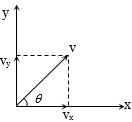
The $Y$-component of velocity is $20$ and the $X$-component of velocity is $10$. The direction of motion of the body with the horizontal at this instant is
A
$\tan^{-1}(2)$
B
$\tan^{-1}(1/2)$
C
$45^\circ$
D
$0^\circ$
Solution
(A) Given: $v_y = 20$ and $v_x = 10$.
The velocity vector is given by $\vec{v} = v_x \hat{i} + v_y \hat{j} = 10 \hat{i} + 20 \hat{j}$.
The direction of motion $\theta$ with the horizontal ($X$-axis) is given by the formula:
$\tan \theta = \frac{v_y}{v_x}$
Substituting the given values:
$\tan \theta = \frac{20}{10} = 2$
Therefore,the angle $\theta$ is:
$\theta = \tan^{-1}(2)$.
The velocity vector is given by $\vec{v} = v_x \hat{i} + v_y \hat{j} = 10 \hat{i} + 20 \hat{j}$.
The direction of motion $\theta$ with the horizontal ($X$-axis) is given by the formula:
$\tan \theta = \frac{v_y}{v_x}$
Substituting the given values:
$\tan \theta = \frac{20}{10} = 2$
Therefore,the angle $\theta$ is:
$\theta = \tan^{-1}(2)$.
0 likes
View Solution7
MediumMCQ
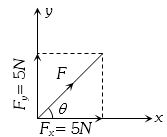
If two forces of $5 \, N$ each are acting along $X$ and $Y$ axes,then the magnitude and direction of the resultant is
A
$5\sqrt{2}, \pi/3$
B
$5\sqrt{2}, \pi/4$
C
$-5\sqrt{2}, \pi/3$
D
$-5\sqrt{2}, \pi/4$
Solution
(B) Given,$F_x = 5 \, N$ and $F_y = 5 \, N$.
The magnitude of the resultant force $F$ is given by:
$|\vec{F}| = \sqrt{F_x^2 + F_y^2} = \sqrt{5^2 + 5^2} = \sqrt{25 + 25} = \sqrt{50} = 5\sqrt{2} \, N$.
The direction $\theta$ with the $X$-axis is given by:
$\tan \theta = \frac{F_y}{F_x} = \frac{5}{5} = 1$.
Since $\tan \theta = 1$,we have $\theta = \pi/4$ radians (or $45^\circ$).
Thus,the magnitude is $5\sqrt{2} \, N$ and the direction is $\pi/4$.
The magnitude of the resultant force $F$ is given by:
$|\vec{F}| = \sqrt{F_x^2 + F_y^2} = \sqrt{5^2 + 5^2} = \sqrt{25 + 25} = \sqrt{50} = 5\sqrt{2} \, N$.
The direction $\theta$ with the $X$-axis is given by:
$\tan \theta = \frac{F_y}{F_x} = \frac{5}{5} = 1$.
Since $\tan \theta = 1$,we have $\theta = \pi/4$ radians (or $45^\circ$).
Thus,the magnitude is $5\sqrt{2} \, N$ and the direction is $\pi/4$.
0 likes
View Solution8
MediumMCQ
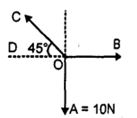
The sum of three vectors is zero as shown in the figure. What will be the magnitudes of vectors $\vec{OB}$ and $\vec{OC}$?
A
$10 \, N, \, 10 \sqrt{2} \, N$
B
$12 \, N, \, 12 \sqrt{2} \, N$
C
$10 \, N, \, 11 \sqrt{3} \, N$
D
$13 \, N, \, 10 \sqrt{5} \, N$
Solution
(A) Given that the sum of the three vectors is zero,i.e.,$\vec{OA} + \vec{OB} + \vec{OC} = 0$.
From the figure,$\vec{OA}$ is acting downwards with a magnitude of $10 \, N$.
To balance the vertical component of $\vec{OC}$,the vertical component of $\vec{OC}$ must be equal to the magnitude of $\vec{OA}$.
Let $\theta = 45^\circ$ be the angle $\vec{OC}$ makes with the horizontal axis $OD$.
The vertical component of $\vec{OC}$ is $OC \sin(45^\circ) = OA = 10 \, N$.
Therefore,$OC = \frac{10}{\sin(45^\circ)} = \frac{10}{1/\sqrt{2}} = 10\sqrt{2} \, N$.
The horizontal component of $\vec{OC}$ is $OC \cos(45^\circ) = (10\sqrt{2}) \times (1/\sqrt{2}) = 10 \, N$.
Since the sum of vectors is zero,the horizontal component of $\vec{OC}$ must be balanced by $\vec{OB}$.
Thus,$OB = 10 \, N$.
So,the magnitudes are $OB = 10 \, N$ and $OC = 10\sqrt{2} \, N$.
From the figure,$\vec{OA}$ is acting downwards with a magnitude of $10 \, N$.
To balance the vertical component of $\vec{OC}$,the vertical component of $\vec{OC}$ must be equal to the magnitude of $\vec{OA}$.
Let $\theta = 45^\circ$ be the angle $\vec{OC}$ makes with the horizontal axis $OD$.
The vertical component of $\vec{OC}$ is $OC \sin(45^\circ) = OA = 10 \, N$.
Therefore,$OC = \frac{10}{\sin(45^\circ)} = \frac{10}{1/\sqrt{2}} = 10\sqrt{2} \, N$.
The horizontal component of $\vec{OC}$ is $OC \cos(45^\circ) = (10\sqrt{2}) \times (1/\sqrt{2}) = 10 \, N$.
Since the sum of vectors is zero,the horizontal component of $\vec{OC}$ must be balanced by $\vec{OB}$.
Thus,$OB = 10 \, N$.
So,the magnitudes are $OB = 10 \, N$ and $OC = 10\sqrt{2} \, N$.
0 likes
View Solution9
EasyMCQ
What is the maximum number of components a vector can have when resolved in a plane?
A
$2$
B
$3$
C
$4$
D
Infinite
Solution
(A) vector in a two-dimensional plane can be resolved into two mutually perpendicular components,typically along the $x$ and $y$ axes.
While a vector can be resolved into any number of components in different directions,the standard resolution in a plane involves exactly $2$ rectangular components.
Therefore,the maximum number of rectangular components in a plane is $2$.
While a vector can be resolved into any number of components in different directions,the standard resolution in a plane involves exactly $2$ rectangular components.
Therefore,the maximum number of rectangular components in a plane is $2$.
0 likes
View Solution10
MediumMCQ
If $\vec{A} = \hat{i} A \cos \theta + \hat{j} A \sin \theta$ is a vector,then another vector $\vec{B}$ which is perpendicular to $\vec{A}$ is given by:
A
$\hat{i} B \cos \theta + \hat{j} B \sin \theta$
B
$\hat{i} B \sin \theta + \hat{j} B \cos \theta$
C
$\hat{i} B \sin \theta - \hat{j} B \cos \theta$
D
$\hat{i} A \cos \theta - \hat{j} A \sin \theta$
Solution
(C) Two vectors are perpendicular if their dot product is zero.
Let $\vec{B} = B_x \hat{i} + B_y \hat{j}$.
For $\vec{A} \cdot \vec{B} = 0$,we have $(A \cos \theta)(B_x) + (A \sin \theta)(B_y) = 0$.
This implies $B_x \cos \theta = -B_y \sin \theta$,or $\frac{B_x}{B_y} = -\frac{\sin \theta}{\cos \theta}$.
Thus,we can choose $B_x = B \sin \theta$ and $B_y = -B \cos \theta$.
Therefore,$\vec{B} = \hat{i} B \sin \theta - \hat{j} B \cos \theta$.
Let $\vec{B} = B_x \hat{i} + B_y \hat{j}$.
For $\vec{A} \cdot \vec{B} = 0$,we have $(A \cos \theta)(B_x) + (A \sin \theta)(B_y) = 0$.
This implies $B_x \cos \theta = -B_y \sin \theta$,or $\frac{B_x}{B_y} = -\frac{\sin \theta}{\cos \theta}$.
Thus,we can choose $B_x = B \sin \theta$ and $B_y = -B \cos \theta$.
Therefore,$\vec{B} = \hat{i} B \sin \theta - \hat{j} B \cos \theta$.
0 likes
View Solution11
MediumMCQ
$A$ force is applied at an angle of $60^\circ$ with the horizontal. If its horizontal component is $40 \ N$,then the vertical component is calculated to be ...... $N$.
A
$69.28$
B
$57.34$
C
$73.57$
D
$63.71$
Solution
(A) Given: Horizontal component $F_x = 40 \ N$,Angle $\theta = 60^\circ$.
The horizontal component is given by $F_x = F \cos \theta$.
Substituting the values: $40 = F \cos 60^\circ = F \times (1/2)$.
Therefore,the magnitude of the force $F = 40 \times 2 = 80 \ N$.
The vertical component is given by $F_y = F \sin \theta$.
Substituting the values: $F_y = 80 \sin 60^\circ = 80 \times (\sqrt{3}/2) = 40\sqrt{3} \ N$.
Using $\sqrt{3} \approx 1.732$,we get $F_y = 40 \times 1.732 = 69.28 \ N$.
The horizontal component is given by $F_x = F \cos \theta$.
Substituting the values: $40 = F \cos 60^\circ = F \times (1/2)$.
Therefore,the magnitude of the force $F = 40 \times 2 = 80 \ N$.
The vertical component is given by $F_y = F \sin \theta$.
Substituting the values: $F_y = 80 \sin 60^\circ = 80 \times (\sqrt{3}/2) = 40\sqrt{3} \ N$.
Using $\sqrt{3} \approx 1.732$,we get $F_y = 40 \times 1.732 = 69.28 \ N$.
0 likes
View Solution12
EasyMCQ
Find the angle in degrees between the vector $\vec{A} = \hat{i} + \hat{j} + \sqrt{2} \hat{k}$ and the $Z$-axis.
A
$0$
B
$45$
C
$60$
D
$90$
Solution
(B) Given vector $\vec{A} = \hat{i} + \hat{j} + \sqrt{2} \hat{k}$.
The unit vector along the $Z$-axis is $\hat{k}$,so $\vec{B} = 0\hat{i} + 0\hat{j} + 1\hat{k}$.
The angle $\theta$ between two vectors is given by the dot product formula: $\cos \theta = \frac{\vec{A} \cdot \vec{B}}{|\vec{A}| |\vec{B}|}$.
First,calculate the dot product: $\vec{A} \cdot \vec{B} = (1)(0) + (1)(0) + (\sqrt{2})(1) = \sqrt{2}$.
Next,calculate the magnitude of $\vec{A}$: $|\vec{A}| = \sqrt{1^2 + 1^2 + (\sqrt{2})^2} = \sqrt{1 + 1 + 2} = \sqrt{4} = 2$.
The magnitude of $\vec{B}$ is $|\vec{B}| = \sqrt{0^2 + 0^2 + 1^2} = 1$.
Substitute these values into the formula: $\cos \theta = \frac{\sqrt{2}}{2 \times 1} = \frac{\sqrt{2}}{2} = \frac{1}{\sqrt{2}}$.
Therefore,$\theta = \cos^{-1}(\frac{1}{\sqrt{2}}) = 45^{\circ}$.
The unit vector along the $Z$-axis is $\hat{k}$,so $\vec{B} = 0\hat{i} + 0\hat{j} + 1\hat{k}$.
The angle $\theta$ between two vectors is given by the dot product formula: $\cos \theta = \frac{\vec{A} \cdot \vec{B}}{|\vec{A}| |\vec{B}|}$.
First,calculate the dot product: $\vec{A} \cdot \vec{B} = (1)(0) + (1)(0) + (\sqrt{2})(1) = \sqrt{2}$.
Next,calculate the magnitude of $\vec{A}$: $|\vec{A}| = \sqrt{1^2 + 1^2 + (\sqrt{2})^2} = \sqrt{1 + 1 + 2} = \sqrt{4} = 2$.
The magnitude of $\vec{B}$ is $|\vec{B}| = \sqrt{0^2 + 0^2 + 1^2} = 1$.
Substitute these values into the formula: $\cos \theta = \frac{\sqrt{2}}{2 \times 1} = \frac{\sqrt{2}}{2} = \frac{1}{\sqrt{2}}$.
Therefore,$\theta = \cos^{-1}(\frac{1}{\sqrt{2}}) = 45^{\circ}$.
0 likes
View Solution13
MediumMCQ
The $x$-component of the resultant of several vectors is:
A
$(a), (c), (d)$
B
$(a), (b), (c)$
C
$(a), (b), (d)$
D
$(b), (c), (d)$
Solution
(B) Let the vectors be $\vec{A}, \vec{B}, \vec{C}, \dots$ with $x$-components $A_x, B_x, C_x, \dots$ and magnitudes $A, B, C, \dots$.
The resultant vector is $\vec{R} = \vec{A} + \vec{B} + \vec{C} + \dots$.
The $x$-component of the resultant is $R_x = A_x + B_x + C_x + \dots$.
Thus,statement $(a)$ is correct.
Since the $x$-component of any vector is always less than or equal to its magnitude $(A_x \le A)$,the sum of $x$-components is $R_x = \sum A_x \le \sum A$.
This means $R_x$ is always less than or equal to the sum of the magnitudes of the vectors.
Therefore,$R_x$ can be less than the sum of magnitudes (statement $(b)$ is correct).
However,$R_x$ cannot be greater than the sum of magnitudes,so statement $(c)$ is incorrect.
$R_x$ is not necessarily equal to the sum of magnitudes (statement $(d)$ is incorrect).
Thus,statements $(a)$ and $(b)$ are correct.
The resultant vector is $\vec{R} = \vec{A} + \vec{B} + \vec{C} + \dots$.
The $x$-component of the resultant is $R_x = A_x + B_x + C_x + \dots$.
Thus,statement $(a)$ is correct.
Since the $x$-component of any vector is always less than or equal to its magnitude $(A_x \le A)$,the sum of $x$-components is $R_x = \sum A_x \le \sum A$.
This means $R_x$ is always less than or equal to the sum of the magnitudes of the vectors.
Therefore,$R_x$ can be less than the sum of magnitudes (statement $(b)$ is correct).
However,$R_x$ cannot be greater than the sum of magnitudes,so statement $(c)$ is incorrect.
$R_x$ is not necessarily equal to the sum of magnitudes (statement $(d)$ is incorrect).
Thus,statements $(a)$ and $(b)$ are correct.
0 likes
View Solution14
MediumMCQ
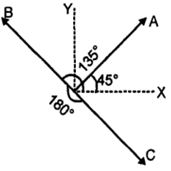
Add vectors $\vec{A}$,$\vec{B}$,and $\vec{C}$,each having a magnitude of $50 \text{ units}$ and inclined to the $X$-axis at angles $45^{\circ}$,$135^{\circ}$,and $315^{\circ}$ respectively.
A
$50$
B
$55$
C
$70$
D
$85$
Solution
(A) The vectors are given by:
$\vec{A} = 50(\cos 45^{\circ} \hat{i} + \sin 45^{\circ} \hat{j}) = 50(\frac{1}{\sqrt{2}} \hat{i} + \frac{1}{\sqrt{2}} \hat{j})$
$\vec{B} = 50(\cos 135^{\circ} \hat{i} + \sin 135^{\circ} \hat{j}) = 50(-\frac{1}{\sqrt{2}} \hat{i} + \frac{1}{\sqrt{2}} \hat{j})$
$\vec{C} = 50(\cos 315^{\circ} \hat{i} + \sin 315^{\circ} \hat{j}) = 50(\frac{1}{\sqrt{2}} \hat{i} - \frac{1}{\sqrt{2}} \hat{j})$
Summing the vectors:
$\vec{R} = \vec{A} + \vec{B} + \vec{C} = 50(\frac{1}{\sqrt{2}} - \frac{1}{\sqrt{2}} + \frac{1}{\sqrt{2}}) \hat{i} + 50(\frac{1}{\sqrt{2}} + \frac{1}{\sqrt{2}} - \frac{1}{\sqrt{2}}) \hat{j}$
$\vec{R} = 50(\frac{1}{\sqrt{2}} \hat{i} + \frac{1}{\sqrt{2}} \hat{j})$
The magnitude of the resultant vector is:
$|\vec{R}| = \sqrt{(50/\sqrt{2})^2 + (50/\sqrt{2})^2} = \sqrt{1250 + 1250} = \sqrt{2500} = 50 \text{ units}$.
$\vec{A} = 50(\cos 45^{\circ} \hat{i} + \sin 45^{\circ} \hat{j}) = 50(\frac{1}{\sqrt{2}} \hat{i} + \frac{1}{\sqrt{2}} \hat{j})$
$\vec{B} = 50(\cos 135^{\circ} \hat{i} + \sin 135^{\circ} \hat{j}) = 50(-\frac{1}{\sqrt{2}} \hat{i} + \frac{1}{\sqrt{2}} \hat{j})$
$\vec{C} = 50(\cos 315^{\circ} \hat{i} + \sin 315^{\circ} \hat{j}) = 50(\frac{1}{\sqrt{2}} \hat{i} - \frac{1}{\sqrt{2}} \hat{j})$
Summing the vectors:
$\vec{R} = \vec{A} + \vec{B} + \vec{C} = 50(\frac{1}{\sqrt{2}} - \frac{1}{\sqrt{2}} + \frac{1}{\sqrt{2}}) \hat{i} + 50(\frac{1}{\sqrt{2}} + \frac{1}{\sqrt{2}} - \frac{1}{\sqrt{2}}) \hat{j}$
$\vec{R} = 50(\frac{1}{\sqrt{2}} \hat{i} + \frac{1}{\sqrt{2}} \hat{j})$
The magnitude of the resultant vector is:
$|\vec{R}| = \sqrt{(50/\sqrt{2})^2 + (50/\sqrt{2})^2} = \sqrt{1250 + 1250} = \sqrt{2500} = 50 \text{ units}$.
0 likes
View Solution15
EasyMCQ
What is the maximum number of rectangular components into which a vector can be split in space?
A
$2$
B
$3$
C
$4$
D
Infinite
Solution
(B) vector in three-dimensional space can be resolved into components along the three mutually perpendicular axes: the $x$-axis,$y$-axis,and $z$-axis.
These components are known as rectangular components.
Since our physical space is three-dimensional,a vector can have at most $3$ rectangular components.
These components are known as rectangular components.
Since our physical space is three-dimensional,a vector can have at most $3$ rectangular components.
1 likes
View Solution16
EasyMCQ
What is the maximum number of components into which a vector can be resolved?
A
$2$
B
$3$
C
$4$
D
Infinite
Solution
(D) vector can be resolved into an infinite number of components in different directions.
While we typically resolve a vector into $3$ mutually perpendicular (orthogonal) components in a $3D$ Cartesian coordinate system,mathematically,a vector can be decomposed into any number of components along arbitrary directions.
While we typically resolve a vector into $3$ mutually perpendicular (orthogonal) components in a $3D$ Cartesian coordinate system,mathematically,a vector can be decomposed into any number of components along arbitrary directions.
0 likes
View Solution17
EasyMCQ
$A$ displacement vector has a $Y$-axis component of $10$ units. If it makes an angle of $30^{\circ}$ with the $X$-axis,find the magnitude of the vector.
A
$5$
B
$10$
C
$11.5$
D
$20$
Solution
(D) Let the vector be $\vec{r}$ and its magnitude be $r$.
Given that the component along the $Y$-axis is $r_y = 10$ units.
The angle made with the $X$-axis is $\theta = 30^{\circ}$.
The component along the $Y$-axis is given by $r_y = r \sin(\theta)$.
Substituting the values: $10 = r \sin(30^{\circ})$.
Since $\sin(30^{\circ}) = 0.5$,we have $10 = r \times 0.5$.
Therefore,$r = \frac{10}{0.5} = 20$ units.
Given that the component along the $Y$-axis is $r_y = 10$ units.
The angle made with the $X$-axis is $\theta = 30^{\circ}$.
The component along the $Y$-axis is given by $r_y = r \sin(\theta)$.
Substituting the values: $10 = r \sin(30^{\circ})$.
Since $\sin(30^{\circ}) = 0.5$,we have $10 = r \times 0.5$.
Therefore,$r = \frac{10}{0.5} = 20$ units.
0 likes
View Solution18
MediumMCQ
What is the component of $3\hat{i} + 4\hat{j}$ along $\hat{i} + \hat{j}$?
A
$\frac{1}{2}(\hat{i} + \hat{j})$
B
$\frac{3}{2}(\hat{i} + \hat{j})$
C
$\frac{5}{2}(\hat{i} + \hat{j})$
D
$\frac{7}{2}(\hat{i} + \hat{j})$
Solution
(D) Let $\vec{a} = 3\hat{i} + 4\hat{j}$ and $\vec{b} = \hat{i} + \hat{j}$.
The component of $\vec{a}$ along $\vec{b}$ is given by the formula: $\vec{a}_{\text{parallel}} = \left( \frac{\vec{a} \cdot \vec{b}}{|\vec{b}|^2} \right) \vec{b}$.
First,calculate the dot product: $\vec{a} \cdot \vec{b} = (3)(1) + (4)(1) = 3 + 4 = 7$.
Next,calculate the square of the magnitude of $\vec{b}$: $|\vec{b}|^2 = (1)^2 + (1)^2 = 1 + 1 = 2$.
Substitute these values into the formula: $\vec{a}_{\text{parallel}} = \left( \frac{7}{2} \right) (\hat{i} + \hat{j})$.
Thus,the component is $\frac{7}{2}(\hat{i} + \hat{j})$.
The component of $\vec{a}$ along $\vec{b}$ is given by the formula: $\vec{a}_{\text{parallel}} = \left( \frac{\vec{a} \cdot \vec{b}}{|\vec{b}|^2} \right) \vec{b}$.
First,calculate the dot product: $\vec{a} \cdot \vec{b} = (3)(1) + (4)(1) = 3 + 4 = 7$.
Next,calculate the square of the magnitude of $\vec{b}$: $|\vec{b}|^2 = (1)^2 + (1)^2 = 1 + 1 = 2$.
Substitute these values into the formula: $\vec{a}_{\text{parallel}} = \left( \frac{7}{2} \right) (\hat{i} + \hat{j})$.
Thus,the component is $\frac{7}{2}(\hat{i} + \hat{j})$.
0 likes
View Solution19
EasyMCQ
The projection of a vector $\vec{r} = 3\hat{i} + \hat{j} + 2\hat{k}$ on the $xy$-plane has magnitude:
A
$3$
B
$4$
C
$\sqrt{14}$
D
$\sqrt{10}$
Solution
(D) The projection of a vector $\vec{r} = x\hat{i} + y\hat{j} + z\hat{k}$ on the $xy$-plane is given by the vector $\vec{r}_{xy} = x\hat{i} + y\hat{j}$.
Given $\vec{r} = 3\hat{i} + 1\hat{j} + 2\hat{k}$,the projection on the $xy$-plane is $\vec{r}_{xy} = 3\hat{i} + 1\hat{j}$.
The magnitude of this projection is $|\vec{r}_{xy}| = \sqrt{3^2 + 1^2} = \sqrt{9 + 1} = \sqrt{10}$.
Given $\vec{r} = 3\hat{i} + 1\hat{j} + 2\hat{k}$,the projection on the $xy$-plane is $\vec{r}_{xy} = 3\hat{i} + 1\hat{j}$.
The magnitude of this projection is $|\vec{r}_{xy}| = \sqrt{3^2 + 1^2} = \sqrt{9 + 1} = \sqrt{10}$.
0 likes
View Solution20
MediumMCQ
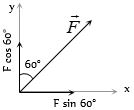
$A$ force of $5 \, N$ acts at an angle of $60^\circ$ with the vertical. Find the vertical component of the force in $N$.
A
$10$
B
$3$
C
$4$
D
$2.5$
Solution
(D) The vertical component of a force $\vec{F}$ making an angle $\theta$ with the vertical axis is given by $F_y = F \cos \theta$.
Given,$F = 5 \, N$ and $\theta = 60^\circ$.
Therefore,the vertical component is $F_y = 5 \cos 60^\circ$.
Since $\cos 60^\circ = 0.5$,we have $F_y = 5 \times 0.5 = 2.5 \, N$.
Given,$F = 5 \, N$ and $\theta = 60^\circ$.
Therefore,the vertical component is $F_y = 5 \cos 60^\circ$.
Since $\cos 60^\circ = 0.5$,we have $F_y = 5 \times 0.5 = 2.5 \, N$.
0 likes
View Solution21
MediumMCQ
$A$ vector $\overrightarrow{A}$ makes equal angles with the $x$,$y$,and $z$ axes. Find the magnitude of its components.
A
$\frac{A}{\sqrt{3}}$
B
$\frac{A}{\sqrt{2}}$
C
$\sqrt{3} A$
D
$\frac{\sqrt{3}}{A}$
Solution
(A) Let the angles made by the vector $\overrightarrow{A}$ with the $x$,$y$,and $z$ axes be $\alpha$,$\beta$,and $\gamma$ respectively.
Given that the vector makes equal angles with the axes,we have $\alpha = \beta = \gamma$.
The direction cosines of the vector satisfy the relation $\cos^2 \alpha + \cos^2 \beta + \cos^2 \gamma = 1$.
Substituting $\alpha = \beta = \gamma$,we get $3 \cos^2 \alpha = 1$,which implies $\cos \alpha = \frac{1}{\sqrt{3}}$.
The components of the vector $\overrightarrow{A}$ are given by $A_x = A \cos \alpha$,$A_y = A \cos \beta$,and $A_z = A \cos \gamma$.
Therefore,$A_x = A_y = A_z = A \left( \frac{1}{\sqrt{3}} \right) = \frac{A}{\sqrt{3}}$.
Given that the vector makes equal angles with the axes,we have $\alpha = \beta = \gamma$.
The direction cosines of the vector satisfy the relation $\cos^2 \alpha + \cos^2 \beta + \cos^2 \gamma = 1$.
Substituting $\alpha = \beta = \gamma$,we get $3 \cos^2 \alpha = 1$,which implies $\cos \alpha = \frac{1}{\sqrt{3}}$.
The components of the vector $\overrightarrow{A}$ are given by $A_x = A \cos \alpha$,$A_y = A \cos \beta$,and $A_z = A \cos \gamma$.
Therefore,$A_x = A_y = A_z = A \left( \frac{1}{\sqrt{3}} \right) = \frac{A}{\sqrt{3}}$.
0 likes
View Solution22
MediumMCQ
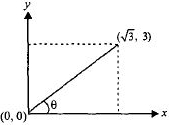
$A$ particle starting from the origin $(0, 0)$ moves in a straight line in the $(x, y)$ plane. Its coordinates at a later time are $(\sqrt{3}, 3)$. The path of the particle makes an angle of ......... $^o$ with the $x$-axis.
A
$45$
B
$60$
C
$0$
D
$30$
Solution
(B) Let $\theta$ be the angle that the particle's path makes with the $x$-axis.
From the given coordinates $(x, y) = (\sqrt{3}, 3)$,the slope of the line is given by $\tan \theta = \frac{y}{x}$.
Substituting the values,we get $\tan \theta = \frac{3}{\sqrt{3}}$.
Simplifying this,$\tan \theta = \sqrt{3}$.
Therefore,$\theta = \tan^{-1}(\sqrt{3}) = 60^o$.
From the given coordinates $(x, y) = (\sqrt{3}, 3)$,the slope of the line is given by $\tan \theta = \frac{y}{x}$.
Substituting the values,we get $\tan \theta = \frac{3}{\sqrt{3}}$.
Simplifying this,$\tan \theta = \sqrt{3}$.
Therefore,$\theta = \tan^{-1}(\sqrt{3}) = 60^o$.
0 likes
View Solution23
DifficultMCQ
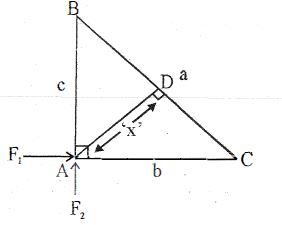
Two forces act on point $A$ along the sides $AC$ and $AB$ of a right-angled triangle $ABC$ (where $\angle A = 90^{\circ}$). The magnitudes of these forces are inversely proportional to the lengths of the sides $AC$ and $AB$ respectively. If $F_1 = 1/AC$ and $F_2 = 1/AB$,then the resultant of these forces is proportional to:
A
$\frac{1}{BC}$
B
$\frac{1}{AD}$
C
$\frac{1}{BD}$
D
$\frac{1}{CD}$
Solution
(B) Let $AC = b$ and $AB = c$. The forces are $F_1 = 1/b$ acting along $AC$ and $F_2 = 1/c$ acting along $AB$.
Since $\angle A = 90^{\circ}$,the resultant force $F_{\text{net}}$ is given by:
$F_{\text{net}} = \sqrt{F_1^2 + F_2^2} = \sqrt{\frac{1}{b^2} + \frac{1}{c^2}} = \sqrt{\frac{b^2 + c^2}{b^2 c^2}}$
In $\Delta ABC$,$BC^2 = b^2 + c^2$,so $F_{\text{net}} = \frac{\sqrt{BC^2}}{bc} = \frac{BC}{bc}$.
The area of $\Delta ABC$ can be expressed as $\text{Area} = \frac{1}{2} \times b \times c = \frac{1}{2} \times BC \times AD$,where $AD$ is the altitude to the hypotenuse $BC$.
Therefore,$bc = BC \times AD$,which implies $\frac{BC}{bc} = \frac{1}{AD}$.
Thus,$F_{\text{net}} = \frac{1}{AD}$.
Since $\angle A = 90^{\circ}$,the resultant force $F_{\text{net}}$ is given by:
$F_{\text{net}} = \sqrt{F_1^2 + F_2^2} = \sqrt{\frac{1}{b^2} + \frac{1}{c^2}} = \sqrt{\frac{b^2 + c^2}{b^2 c^2}}$
In $\Delta ABC$,$BC^2 = b^2 + c^2$,so $F_{\text{net}} = \frac{\sqrt{BC^2}}{bc} = \frac{BC}{bc}$.
The area of $\Delta ABC$ can be expressed as $\text{Area} = \frac{1}{2} \times b \times c = \frac{1}{2} \times BC \times AD$,where $AD$ is the altitude to the hypotenuse $BC$.
Therefore,$bc = BC \times AD$,which implies $\frac{BC}{bc} = \frac{1}{AD}$.
Thus,$F_{\text{net}} = \frac{1}{AD}$.
0 likes
View Solution24
DifficultMCQ
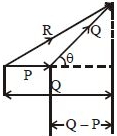
Two forces of magnitude $P$ and $Q$ acting at a point have a resultant $R$. The resolved part of $R$ in the direction of $P$ is of magnitude $Q$. The angle between the forces is:
A
$2{\sin ^{ - 1}}\left( {\frac{P}{{2Q}}} \right)$
B
$2{\sin ^{ - 1}}\left( {\frac{P}{{2Q}}} \right)^{\frac{1}{2}}$
C
$2{\cos ^{ - 1}}\left( {\frac{P}{{2Q}}} \right)$
D
$2{\cos ^{ - 1}}\left( {\frac{P}{{2Q}}} \right)^{\frac{1}{2}}$
Solution
(B) Let the angle between the forces $P$ and $Q$ be $\theta$.
The resultant $R$ is given by the vector sum $\vec{R} = \vec{P} + \vec{Q}$.
The resolved part of $R$ in the direction of $P$ is given by $P + Q \cos \theta$.
According to the problem,this resolved part is equal to $Q$.
Therefore,$P + Q \cos \theta = Q$.
Rearranging the terms,we get $Q \cos \theta = Q - P$.
Thus,$\cos \theta = \frac{Q - P}{Q} = 1 - \frac{P}{Q}$.
Using the trigonometric identity $\cos \theta = 1 - 2 \sin^2 \left(\frac{\theta}{2}\right)$,we have:
$1 - 2 \sin^2 \left(\frac{\theta}{2}\right) = 1 - \frac{P}{Q}$.
Subtracting $1$ from both sides,we get $-2 \sin^2 \left(\frac{\theta}{2}\right) = -\frac{P}{Q}$.
Therefore,$\sin^2 \left(\frac{\theta}{2}\right) = \frac{P}{2Q}$.
Taking the square root,we get $\sin \left(\frac{\theta}{2}\right) = \left(\frac{P}{2Q}\right)^{1/2}$.
Finally,the angle $\theta = 2 \sin^{-1} \left(\frac{P}{2Q}\right)^{1/2}$.
The resultant $R$ is given by the vector sum $\vec{R} = \vec{P} + \vec{Q}$.
The resolved part of $R$ in the direction of $P$ is given by $P + Q \cos \theta$.
According to the problem,this resolved part is equal to $Q$.
Therefore,$P + Q \cos \theta = Q$.
Rearranging the terms,we get $Q \cos \theta = Q - P$.
Thus,$\cos \theta = \frac{Q - P}{Q} = 1 - \frac{P}{Q}$.
Using the trigonometric identity $\cos \theta = 1 - 2 \sin^2 \left(\frac{\theta}{2}\right)$,we have:
$1 - 2 \sin^2 \left(\frac{\theta}{2}\right) = 1 - \frac{P}{Q}$.
Subtracting $1$ from both sides,we get $-2 \sin^2 \left(\frac{\theta}{2}\right) = -\frac{P}{Q}$.
Therefore,$\sin^2 \left(\frac{\theta}{2}\right) = \frac{P}{2Q}$.
Taking the square root,we get $\sin \left(\frac{\theta}{2}\right) = \left(\frac{P}{2Q}\right)^{1/2}$.
Finally,the angle $\theta = 2 \sin^{-1} \left(\frac{P}{2Q}\right)^{1/2}$.
0 likes
View Solution25
MediumMCQ
For the given vector $\vec{A} = 3\hat{i} - 4\hat{j} + 10\hat{k}$,the ratio of the magnitude of its component on the $x-y$ plane to the component on the $z$-axis is:
A
$2$
B
$0.5$
C
$1$
D
None of these
Solution
(B) The vector is given by $\vec{A} = 3\hat{i} - 4\hat{j} + 10\hat{k}$.
The component of the vector in the $x-y$ plane is the resultant of its $x$ and $y$ components,given by $\sqrt{A_x^2 + A_y^2}$.
Substituting the values,we get $\sqrt{(3)^2 + (-4)^2} = \sqrt{9 + 16} = \sqrt{25} = 5$.
The component of the vector along the $z$-axis is $A_z = 10$.
The ratio of the magnitude of the component in the $x-y$ plane to the component along the $z$-axis is $\frac{5}{10} = 0.5$.
The component of the vector in the $x-y$ plane is the resultant of its $x$ and $y$ components,given by $\sqrt{A_x^2 + A_y^2}$.
Substituting the values,we get $\sqrt{(3)^2 + (-4)^2} = \sqrt{9 + 16} = \sqrt{25} = 5$.
The component of the vector along the $z$-axis is $A_z = 10$.
The ratio of the magnitude of the component in the $x-y$ plane to the component along the $z$-axis is $\frac{5}{10} = 0.5$.
0 likes
View Solution26
MediumMCQ
Vector $P = 6 \hat{i} + 4 \sqrt{2} \hat{j} + 4 \sqrt{2} \hat{k}$ makes an angle with the $z$-axis equal to:
A
$\cos^{-1}\left(\frac{\sqrt{2}}{5}\right)$
B
$\cos^{-1}(2 \sqrt{2})$
C
$\cos^{-1}\left(\frac{2 \sqrt{2}}{5}\right)$
D
None of these
Solution
(C) The angle $\gamma$ that a vector $P = P_x \hat{i} + P_y \hat{j} + P_z \hat{k}$ makes with the $z$-axis is given by $\cos \gamma = \frac{P_z}{|P|}$.
Given $P = 6 \hat{i} + 4 \sqrt{2} \hat{j} + 4 \sqrt{2} \hat{k}$.
The magnitude of the vector $P$ is $|P| = \sqrt{(6)^2 + (4 \sqrt{2})^2 + (4 \sqrt{2})^2}$.
$|P| = \sqrt{36 + (16 \times 2) + (16 \times 2)} = \sqrt{36 + 32 + 32} = \sqrt{100} = 10$.
The $z$-component is $P_z = 4 \sqrt{2}$.
Therefore,$\cos \gamma = \frac{4 \sqrt{2}}{10} = \frac{2 \sqrt{2}}{5}$.
Thus,$\gamma = \cos^{-1}\left(\frac{2 \sqrt{2}}{5}\right)$.
Given $P = 6 \hat{i} + 4 \sqrt{2} \hat{j} + 4 \sqrt{2} \hat{k}$.
The magnitude of the vector $P$ is $|P| = \sqrt{(6)^2 + (4 \sqrt{2})^2 + (4 \sqrt{2})^2}$.
$|P| = \sqrt{36 + (16 \times 2) + (16 \times 2)} = \sqrt{36 + 32 + 32} = \sqrt{100} = 10$.
The $z$-component is $P_z = 4 \sqrt{2}$.
Therefore,$\cos \gamma = \frac{4 \sqrt{2}}{10} = \frac{2 \sqrt{2}}{5}$.
Thus,$\gamma = \cos^{-1}\left(\frac{2 \sqrt{2}}{5}\right)$.
0 likes
View Solution27
MediumMCQ
$A$ force of $5 \ N$ acts on a particle along a direction making an angle of $60^{\circ}$ with the vertical. Its vertical component will be $......... \ N$.
A
$10$
B
$3$
C
$4$
D
$2.5$
Solution
(D) The force $F = 5 \ N$ makes an angle $\theta = 60^{\circ}$ with the vertical direction.
The vertical component of a vector $F$ making an angle $\theta$ with the vertical axis is given by $F_V = F \cos \theta$.
Substituting the given values:
$F_V = 5 \times \cos 60^{\circ}$
Since $\cos 60^{\circ} = 0.5$,we get:
$F_V = 5 \times 0.5 = 2.5 \ N$.
Therefore,the vertical component is $2.5 \ N$.
The vertical component of a vector $F$ making an angle $\theta$ with the vertical axis is given by $F_V = F \cos \theta$.
Substituting the given values:
$F_V = 5 \times \cos 60^{\circ}$
Since $\cos 60^{\circ} = 0.5$,we get:
$F_V = 5 \times 0.5 = 2.5 \ N$.
Therefore,the vertical component is $2.5 \ N$.
0 likes
View Solution28
EasyMCQ
$A$ man walks $20\,m$ at an angle $60^{\circ}$ north of east. How far towards the east has he travelled?
A
$10$
B
$20$
C
$20 \sqrt{3}$
D
$10 \sqrt{3}$
Solution
(A) The man walks a distance $d = 20\,m$ at an angle $\theta = 60^{\circ}$ north of east.
To find the distance travelled towards the east,we calculate the horizontal component of the displacement vector.
The horizontal component is given by $d_x = d \cos(\theta)$.
Substituting the given values: $d_x = 20 \cos(60^{\circ})$.
Since $\cos(60^{\circ}) = 0.5$,we get $d_x = 20 \times 0.5 = 10\,m$.
Therefore,the man has travelled $10\,m$ towards the east.
To find the distance travelled towards the east,we calculate the horizontal component of the displacement vector.
The horizontal component is given by $d_x = d \cos(\theta)$.
Substituting the given values: $d_x = 20 \cos(60^{\circ})$.
Since $\cos(60^{\circ}) = 0.5$,we get $d_x = 20 \times 0.5 = 10\,m$.
Therefore,the man has travelled $10\,m$ towards the east.
0 likes
View Solution29
MediumMCQ
The angles which the vector $\vec{A} = 3\hat{i} + 6\hat{j} + 2\hat{k}$ makes with the coordinate axes are
A
$\cos^{-1} \frac{3}{7}, \cos^{-1} \frac{6}{7}, \text{ and } \cos^{-1} \frac{2}{7}$
B
$\cos^{-1} \frac{4}{7}, \cos^{-1} \frac{5}{7}, \text{ and } \cos^{-1} \frac{3}{7}$
C
$\cos^{-1} \frac{3}{7}, \cos^{-1} \frac{4}{7}, \text{ and } \cos^{-1} \frac{1}{7}$
D
None of the above
Solution
(A) The magnitude of the vector $\vec{A} = 3\hat{i} + 6\hat{j} + 2\hat{k}$ is given by $|\vec{A}| = \sqrt{3^2 + 6^2 + 2^2} = \sqrt{9 + 36 + 4} = \sqrt{49} = 7$.
Let $\alpha, \beta, \text{ and } \gamma$ be the angles that the vector makes with the $x, y, \text{ and } z$ axes respectively.
The direction cosines are given by $\cos \alpha = \frac{A_x}{|\vec{A}|}, \cos \beta = \frac{A_y}{|\vec{A}|}, \text{ and } \cos \gamma = \frac{A_z}{|\vec{A}|}$.
Substituting the values: $\cos \alpha = \frac{3}{7}, \cos \beta = \frac{6}{7}, \text{ and } \cos \gamma = \frac{2}{7}$.
Therefore,the angles are $\alpha = \cos^{-1}(\frac{3}{7}), \beta = \cos^{-1}(\frac{6}{7}), \text{ and } \gamma = \cos^{-1}(\frac{2}{7})$.
Let $\alpha, \beta, \text{ and } \gamma$ be the angles that the vector makes with the $x, y, \text{ and } z$ axes respectively.
The direction cosines are given by $\cos \alpha = \frac{A_x}{|\vec{A}|}, \cos \beta = \frac{A_y}{|\vec{A}|}, \text{ and } \cos \gamma = \frac{A_z}{|\vec{A}|}$.
Substituting the values: $\cos \alpha = \frac{3}{7}, \cos \beta = \frac{6}{7}, \text{ and } \cos \gamma = \frac{2}{7}$.
Therefore,the angles are $\alpha = \cos^{-1}(\frac{3}{7}), \beta = \cos^{-1}(\frac{6}{7}), \text{ and } \gamma = \cos^{-1}(\frac{2}{7})$.
0 likes
View Solution30
MediumMCQ
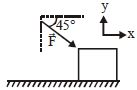
$A$ person pushes a box kept on a horizontal surface with a force of $100\,N$ as shown in the figure. In unit vector notation,the force $\vec{F}$ can be expressed as?
A
$100\,(\hat{i} + \hat{j})$
B
$100\,(\hat{i} - \hat{j})$
C
$50\sqrt{2}\,(\hat{i} - \hat{j})$
D
$50\sqrt{2}\,(\hat{i} + \hat{j})$
Solution
(C) From the figure,the force $\vec{F}$ makes an angle of $45^{\circ}$ with the positive $x$-axis in the fourth quadrant.
Therefore,the angle with the positive $x$-axis is $\theta = -45^{\circ}$.
The components of the force are:
$F_x = F \cos(-45^{\circ}) = 100 \times \frac{1}{\sqrt{2}} = 50\sqrt{2}$
$F_y = F \sin(-45^{\circ}) = 100 \times \left(-\frac{1}{\sqrt{2}}\right) = -50\sqrt{2}$
Thus,the force in unit vector notation is:
$\vec{F} = F_x \hat{i} + F_y \hat{j} = 50\sqrt{2} \hat{i} - 50\sqrt{2} \hat{j} = 50\sqrt{2}(\hat{i} - \hat{j})$
Therefore,the angle with the positive $x$-axis is $\theta = -45^{\circ}$.
The components of the force are:
$F_x = F \cos(-45^{\circ}) = 100 \times \frac{1}{\sqrt{2}} = 50\sqrt{2}$
$F_y = F \sin(-45^{\circ}) = 100 \times \left(-\frac{1}{\sqrt{2}}\right) = -50\sqrt{2}$
Thus,the force in unit vector notation is:
$\vec{F} = F_x \hat{i} + F_y \hat{j} = 50\sqrt{2} \hat{i} - 50\sqrt{2} \hat{j} = 50\sqrt{2}(\hat{i} - \hat{j})$
0 likes
View Solution31
Difficult
Find the magnitude and direction of the vectors $\hat{i}+\hat{j}$ and $\hat{i}-\hat{j}$. What are the components of a vector $\vec{A}=2\hat{i}+3\hat{j}$ along the directions of $\hat{i}+\hat{j}$ and $\hat{i}-\hat{j}$?
Solution
(N/A) Let $\vec{P} = \hat{i} + \hat{j}$. The magnitude is $|\vec{P}| = \sqrt{1^2 + 1^2} = \sqrt{2}$. The direction is $\theta = \tan^{-1}(1/1) = 45^{\circ}$ with the $x$-axis.
Let $\vec{Q} = \hat{i} - \hat{j}$. The magnitude is $|\vec{Q}| = \sqrt{1^2 + (-1)^2} = \sqrt{2}$. The direction is $\theta = \tan^{-1}(-1/1) = -45^{\circ}$ with the $x$-axis.
To find the component of $\vec{A} = 2\hat{i} + 3\hat{j}$ along a vector $\vec{V}$,we use the formula $\text{Component} = \left( \frac{\vec{A} \cdot \vec{V}}{|\vec{V}|} \right) \hat{V}$.
For $\vec{V}_1 = \hat{i} + \hat{j}$,$|\vec{V}_1| = \sqrt{2}$. The unit vector is $\hat{u}_1 = \frac{\hat{i} + \hat{j}}{\sqrt{2}}$.
Component $= (\vec{A} \cdot \hat{u}_1) \hat{u}_1 = \left( \frac{(2\hat{i} + 3\hat{j}) \cdot (\hat{i} + \hat{j})}{\sqrt{2}} \right) \frac{\hat{i} + \hat{j}}{\sqrt{2}} = \left( \frac{2+3}{2} \right) (\hat{i} + \hat{j}) = 2.5(\hat{i} + \hat{j})$.
For $\vec{V}_2 = \hat{i} - \hat{j}$,$|\vec{V}_2| = \sqrt{2}$. The unit vector is $\hat{u}_2 = \frac{\hat{i} - \hat{j}}{\sqrt{2}}$.
Component $= (\vec{A} \cdot \hat{u}_2) \hat{u}_2 = \left( \frac{(2\hat{i} + 3\hat{j}) \cdot (\hat{i} - \hat{j})}{\sqrt{2}} \right) \frac{\hat{i} - \hat{j}}{\sqrt{2}} = \left( \frac{2-3}{2} \right) (\hat{i} - \hat{j}) = -0.5(\hat{i} - \hat{j})$.
Let $\vec{Q} = \hat{i} - \hat{j}$. The magnitude is $|\vec{Q}| = \sqrt{1^2 + (-1)^2} = \sqrt{2}$. The direction is $\theta = \tan^{-1}(-1/1) = -45^{\circ}$ with the $x$-axis.
To find the component of $\vec{A} = 2\hat{i} + 3\hat{j}$ along a vector $\vec{V}$,we use the formula $\text{Component} = \left( \frac{\vec{A} \cdot \vec{V}}{|\vec{V}|} \right) \hat{V}$.
For $\vec{V}_1 = \hat{i} + \hat{j}$,$|\vec{V}_1| = \sqrt{2}$. The unit vector is $\hat{u}_1 = \frac{\hat{i} + \hat{j}}{\sqrt{2}}$.
Component $= (\vec{A} \cdot \hat{u}_1) \hat{u}_1 = \left( \frac{(2\hat{i} + 3\hat{j}) \cdot (\hat{i} + \hat{j})}{\sqrt{2}} \right) \frac{\hat{i} + \hat{j}}{\sqrt{2}} = \left( \frac{2+3}{2} \right) (\hat{i} + \hat{j}) = 2.5(\hat{i} + \hat{j})$.
For $\vec{V}_2 = \hat{i} - \hat{j}$,$|\vec{V}_2| = \sqrt{2}$. The unit vector is $\hat{u}_2 = \frac{\hat{i} - \hat{j}}{\sqrt{2}}$.
Component $= (\vec{A} \cdot \hat{u}_2) \hat{u}_2 = \left( \frac{(2\hat{i} + 3\hat{j}) \cdot (\hat{i} - \hat{j})}{\sqrt{2}} \right) \frac{\hat{i} - \hat{j}}{\sqrt{2}} = \left( \frac{2-3}{2} \right) (\hat{i} - \hat{j}) = -0.5(\hat{i} - \hat{j})$.
0 likes
View Solution32
Medium
Explain the resolution of vectors.
Solution
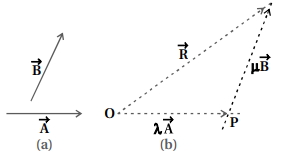
(N/A) In figure $(a)$,$\vec{A}$ and $\vec{B}$ are coplanar and non-parallel vectors.
We want to resolve vector $\vec{R}$ into components along $\vec{A}$ and $\vec{B}$.
Suppose $\vec{OQ}$ represents $\vec{R}$.
In figure $(b)$,draw a line through $O$ parallel to $\vec{A}$ and another line through $Q$ parallel to $\vec{B}$. These two lines intersect at point $P$.
According to the triangle law of vector addition:
$\vec{OQ} = \vec{OP} + \vec{PQ}$
Since $\vec{OP} \parallel \vec{A}$,we can write $\vec{OP} = \lambda \vec{A}$.
Since $\vec{PQ} \parallel \vec{B}$,we can write $\vec{PQ} = \mu \vec{B}$.
(Here,$\lambda$ and $\mu$ are scalar constants).
Therefore,$\vec{R} = \lambda \vec{A} + \mu \vec{B}$.
This means $\vec{R}$ is expressed as the sum of its components in the directions of $\vec{A}$ and $\vec{B}$.
We want to resolve vector $\vec{R}$ into components along $\vec{A}$ and $\vec{B}$.
Suppose $\vec{OQ}$ represents $\vec{R}$.
In figure $(b)$,draw a line through $O$ parallel to $\vec{A}$ and another line through $Q$ parallel to $\vec{B}$. These two lines intersect at point $P$.
According to the triangle law of vector addition:
$\vec{OQ} = \vec{OP} + \vec{PQ}$
Since $\vec{OP} \parallel \vec{A}$,we can write $\vec{OP} = \lambda \vec{A}$.
Since $\vec{PQ} \parallel \vec{B}$,we can write $\vec{PQ} = \mu \vec{B}$.
(Here,$\lambda$ and $\mu$ are scalar constants).
Therefore,$\vec{R} = \lambda \vec{A} + \mu \vec{B}$.
This means $\vec{R}$ is expressed as the sum of its components in the directions of $\vec{A}$ and $\vec{B}$.
0 likes
View Solution33
Medium
Explain the resolution of a vector in two dimensions. Explain the resolution of a vector into its perpendicular components.
Solution
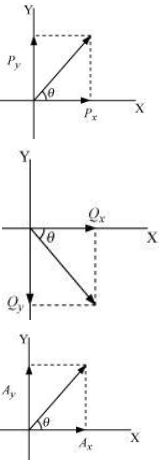
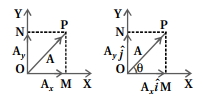
(N/A) Consider an $O$-$XY$ two-dimensional Cartesian coordinate system as shown in the figure.
Let the position vector of point $P$ be $\vec{A}$.
By drawing a projection from $P$ to the $X$-axis,we obtain $OM$,where $\vec{OM} = \vec{A}_x = A_x \hat{i}$ is the $X$-component of $\vec{A}$.
By drawing a projection from $P$ to the $Y$-axis,we obtain $ON$,where $\vec{ON} = \vec{A}_y = A_y \hat{j}$ is the $Y$-component of $\vec{A}$,where $A_x$ and $A_y$ are real numbers.
From the figure,by the parallelogram law of vector addition:
$\vec{A} = \vec{A}_x + \vec{A}_y$
$\vec{A} = A_x \hat{i} + A_y \hat{j}$
Suppose $\vec{A}$ makes an angle $\theta$ with the $X$-axis.
In the right-angled triangle $\Delta OMP$:
$\cos \theta = \frac{A_x}{A} \implies A_x = A \cos \theta$
$\sin \theta = \frac{A_y}{A} \implies A_y = A \sin \theta$
From these equations,it is evident that the components can be positive,negative,or zero depending on the angle $\theta$.
Vectors can be represented in a plane in two ways:
$(i)$ By their magnitude and direction.
$(ii)$ By their components ($X$ and $Y$ components).
Let the position vector of point $P$ be $\vec{A}$.
By drawing a projection from $P$ to the $X$-axis,we obtain $OM$,where $\vec{OM} = \vec{A}_x = A_x \hat{i}$ is the $X$-component of $\vec{A}$.
By drawing a projection from $P$ to the $Y$-axis,we obtain $ON$,where $\vec{ON} = \vec{A}_y = A_y \hat{j}$ is the $Y$-component of $\vec{A}$,where $A_x$ and $A_y$ are real numbers.
From the figure,by the parallelogram law of vector addition:
$\vec{A} = \vec{A}_x + \vec{A}_y$
$\vec{A} = A_x \hat{i} + A_y \hat{j}$
Suppose $\vec{A}$ makes an angle $\theta$ with the $X$-axis.
In the right-angled triangle $\Delta OMP$:
$\cos \theta = \frac{A_x}{A} \implies A_x = A \cos \theta$
$\sin \theta = \frac{A_y}{A} \implies A_y = A \sin \theta$
From these equations,it is evident that the components can be positive,negative,or zero depending on the angle $\theta$.
Vectors can be represented in a plane in two ways:
$(i)$ By their magnitude and direction.
$(ii)$ By their components ($X$ and $Y$ components).
0 likes
View Solution34
MediumMCQ
When is the resolution of a vector required?
A
To find the magnitude of a vector.
B
To simplify the addition and subtraction of vectors.
C
To determine the direction of a vector.
D
To calculate the cross product of two vectors.
Solution
(B) The resolution of a vector is the process of splitting a single vector into two or more components along specific directions (usually perpendicular axes like $x$ and $y$).
This technique is primarily required to simplify the addition and subtraction of vectors.
By resolving vectors into their rectangular components,we can add or subtract them algebraically by simply summing or subtracting their respective $x$ and $y$ components,which is much easier than using the parallelogram law or triangle law for every operation.
This technique is primarily required to simplify the addition and subtraction of vectors.
By resolving vectors into their rectangular components,we can add or subtract them algebraically by simply summing or subtracting their respective $x$ and $y$ components,which is much easier than using the parallelogram law or triangle law for every operation.
0 likes
View Solution35
MediumMCQ
$A$ plane covers $500 \,m$ in a direction $60^o$ with the runway while starting the flight. Find the distance covered by the plane in the horizontal and vertical directions.
A
Horizontal: $250 \,m$,Vertical: $250 \sqrt{3} \,m$
B
Horizontal: $250 \sqrt{3} \,m$,Vertical: $250 \,m$
C
Horizontal: $500 \,m$,Vertical: $0 \,m$
D
Horizontal: $0 \,m$,Vertical: $500 \,m$
Solution
(A) Let the total distance covered be $d = 500 \,m$ at an angle $\theta = 60^o$ with the horizontal runway.
The horizontal component of the distance is given by $d_x = d \cos(\theta)$.
$d_x = 500 \cos(60^o) = 500 \times (1/2) = 250 \,m$.
The vertical component of the distance is given by $d_y = d \sin(\theta)$.
$d_y = 500 \sin(60^o) = 500 \times (\sqrt{3}/2) = 250 \sqrt{3} \,m$.
Therefore,the horizontal distance is $250 \,m$ and the vertical distance is $250 \sqrt{3} \,m$.
The horizontal component of the distance is given by $d_x = d \cos(\theta)$.
$d_x = 500 \cos(60^o) = 500 \times (1/2) = 250 \,m$.
The vertical component of the distance is given by $d_y = d \sin(\theta)$.
$d_y = 500 \sin(60^o) = 500 \times (\sqrt{3}/2) = 250 \sqrt{3} \,m$.
Therefore,the horizontal distance is $250 \,m$ and the vertical distance is $250 \sqrt{3} \,m$.
1 likes
View Solution36
Easy
Can the magnitude of the rectangular components of a vector be greater than the magnitude of the vector itself? Explain.
Solution
(N/A) No. Let a vector $\vec{A}$ have rectangular components $A_x$ and $A_y$ in a two-dimensional plane.
These components are given by:
$A_x = A \cos \theta$
$A_y = A \sin \theta$
where $A$ is the magnitude of the vector and $\theta$ is the angle it makes with the $x$-axis.
Since the maximum value of both $\sin \theta$ and $\cos \theta$ is $1$,the maximum value of the components $A_x$ and $A_y$ can only be equal to $A$ (when $\theta = 0^\circ$ or $90^\circ$).
Mathematically,since $|\cos \theta| \le 1$ and $|\sin \theta| \le 1$,it follows that $|A_x| \le |A|$ and $|A_y| \le |A|$.
Therefore,the magnitude of a rectangular component can never exceed the magnitude of the original vector.
These components are given by:
$A_x = A \cos \theta$
$A_y = A \sin \theta$
where $A$ is the magnitude of the vector and $\theta$ is the angle it makes with the $x$-axis.
Since the maximum value of both $\sin \theta$ and $\cos \theta$ is $1$,the maximum value of the components $A_x$ and $A_y$ can only be equal to $A$ (when $\theta = 0^\circ$ or $90^\circ$).
Mathematically,since $|\cos \theta| \le 1$ and $|\sin \theta| \le 1$,it follows that $|A_x| \le |A|$ and $|A_y| \le |A|$.
Therefore,the magnitude of a rectangular component can never exceed the magnitude of the original vector.
0 likes
View Solution37
Medium
Explain the resolution of a vector in three dimensions.
Solution
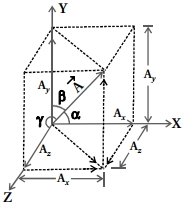
(N/A) Let $\alpha, \beta,$ and $\gamma$ be the angles between the vector $\overrightarrow{A}$ and the $x, y,$ and $z$-axes,respectively.
The components of the vector $\overrightarrow{A}$ along the $x, y,$ and $z$-axes are given by:
$A_{x} = A \cos \alpha$
$A_{y} = A \cos \beta$
$A_{z} = A \cos \gamma$
In general,the vector $\overrightarrow{A}$ can be expressed in terms of its components as:
$\overrightarrow{A} = A_{x} \hat{i} + A_{y} \hat{j} + A_{z} \hat{k}$
The magnitude of the vector $\overrightarrow{A}$ is given by:
$|\overrightarrow{A}| = A = \sqrt{A_{x}^{2} + A_{y}^{2} + A_{z}^{2}}$
Similarly,a position vector $\vec{r}$ can be expressed as:
$\vec{r} = x \hat{i} + y \hat{j} + z \hat{k}$
where $x, y,$ and $z$ are the components of $\vec{r}$ along the $x, y,$ and $z$-axes,respectively.
The magnitude of the position vector $\vec{r}$ is:
$|\vec{r}| = \sqrt{x^{2} + y^{2} + z^{2}}$
The components of the vector $\overrightarrow{A}$ along the $x, y,$ and $z$-axes are given by:
$A_{x} = A \cos \alpha$
$A_{y} = A \cos \beta$
$A_{z} = A \cos \gamma$
In general,the vector $\overrightarrow{A}$ can be expressed in terms of its components as:
$\overrightarrow{A} = A_{x} \hat{i} + A_{y} \hat{j} + A_{z} \hat{k}$
The magnitude of the vector $\overrightarrow{A}$ is given by:
$|\overrightarrow{A}| = A = \sqrt{A_{x}^{2} + A_{y}^{2} + A_{z}^{2}}$
Similarly,a position vector $\vec{r}$ can be expressed as:
$\vec{r} = x \hat{i} + y \hat{j} + z \hat{k}$
where $x, y,$ and $z$ are the components of $\vec{r}$ along the $x, y,$ and $z$-axes,respectively.
The magnitude of the position vector $\vec{r}$ is:
$|\vec{r}| = \sqrt{x^{2} + y^{2} + z^{2}}$
0 likes
View Solution38
MediumMCQ
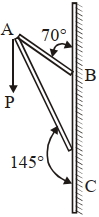
Consider a frame made up of two thin massless rods $AB$ and $AC$ as shown in the figure. $A$ vertical force $\overrightarrow{P}$ of magnitude $100 \; N$ is applied at point $A$ of the frame. Suppose the force $\overrightarrow{P}$ is resolved into components parallel to the arms $AB$ and $AC$ of the frame. The magnitude of the resolved component along the arm $AC$ is $x \; N$. The value of $x$,to the nearest integer,is ............
A
$82$
B
$72$
C
$87$
D
$78$
Solution
(A) Let the force $\overrightarrow{P}$ be applied at point $A$ in the downward vertical direction. We need to resolve this force along the directions of the rods $AB$ and $AC$.
Let $\overrightarrow{F_{AB}}$ and $\overrightarrow{F_{AC}}$ be the components of force $\overrightarrow{P}$ along $AB$ and $AC$ respectively.
According to the parallelogram law of vector addition,$\overrightarrow{P} = \overrightarrow{F_{AB}} + \overrightarrow{F_{AC}}$.
Using the Lami's theorem or the sine rule in the triangle formed by the force vectors:
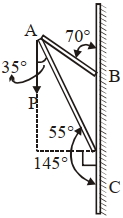
The angle between the vertical force $\overrightarrow{P}$ and rod $AB$ is $35^{\circ}$ (as the angle between the vertical and the wall is $90^{\circ}$,and the angle between $AB$ and the wall is $70^{\circ}$,so the angle between $AB$ and the vertical is $90^{\circ} - 70^{\circ} = 20^{\circ}$ is incorrect based on the provided image geometry; let's use the provided diagram).
From the diagram,the angle between the vertical force $\overrightarrow{P}$ and rod $AC$ is $35^{\circ}$.
The component of force $\overrightarrow{P}$ along the direction of rod $AC$ is given by $P \cos(\theta)$,where $\theta$ is the angle between the force vector and the rod.
Thus,the magnitude of the component along $AC$ is $x = 100 \cos(35^{\circ}) \; N$.
Given $\cos(35^{\circ}) = 0.819$.
$x = 100 \times 0.819 = 81.9 \; N$.
Rounding to the nearest integer,we get $x = 82$.
Let $\overrightarrow{F_{AB}}$ and $\overrightarrow{F_{AC}}$ be the components of force $\overrightarrow{P}$ along $AB$ and $AC$ respectively.
According to the parallelogram law of vector addition,$\overrightarrow{P} = \overrightarrow{F_{AB}} + \overrightarrow{F_{AC}}$.
Using the Lami's theorem or the sine rule in the triangle formed by the force vectors:
The angle between the vertical force $\overrightarrow{P}$ and rod $AB$ is $35^{\circ}$ (as the angle between the vertical and the wall is $90^{\circ}$,and the angle between $AB$ and the wall is $70^{\circ}$,so the angle between $AB$ and the vertical is $90^{\circ} - 70^{\circ} = 20^{\circ}$ is incorrect based on the provided image geometry; let's use the provided diagram).
From the diagram,the angle between the vertical force $\overrightarrow{P}$ and rod $AC$ is $35^{\circ}$.
The component of force $\overrightarrow{P}$ along the direction of rod $AC$ is given by $P \cos(\theta)$,where $\theta$ is the angle between the force vector and the rod.
Thus,the magnitude of the component along $AC$ is $x = 100 \cos(35^{\circ}) \; N$.
Given $\cos(35^{\circ}) = 0.819$.
$x = 100 \times 0.819 = 81.9 \; N$.
Rounding to the nearest integer,we get $x = 82$.
0 likes
View Solution39
DifficultMCQ
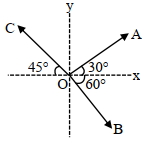
The magnitude of vectors $\overrightarrow{ OA }, \overrightarrow{ OB }$ and $\overrightarrow{ OC }$ in the given figure are equal. The direction of $\overrightarrow{ OA }+\overrightarrow{ OB }-\overrightarrow{ OC }$ with the $x$-axis will be
A
$\tan ^{-1} \frac{(1-\sqrt{3}-\sqrt{2})}{(1+\sqrt{3}+\sqrt{2})}$
B
$\tan ^{-1} \frac{(\sqrt{3}-1+\sqrt{2})}{(1+\sqrt{3}-\sqrt{2})}$
C
$\tan ^{-1} \frac{(\sqrt{3}-1+\sqrt{2})}{(1-\sqrt{3}+\sqrt{2})}$
D
$\tan ^{-1} \frac{(1+\sqrt{3}-\sqrt{2})}{(1-\sqrt{3}-\sqrt{2})}$
Solution
(A) Let the magnitude of each vector be $\lambda$.
$\overrightarrow{ OA } = \lambda (\cos 30^{\circ} \hat{i} + \sin 30^{\circ} \hat{j}) = \lambda (\frac{\sqrt{3}}{2} \hat{i} + \frac{1}{2} \hat{j})$
$\overrightarrow{ OB } = \lambda (\cos 60^{\circ} \hat{i} - \sin 60^{\circ} \hat{j}) = \lambda (\frac{1}{2} \hat{i} - \frac{\sqrt{3}}{2} \hat{j})$
$\overrightarrow{ OC } = \lambda (\cos 45^{\circ} (-\hat{i}) + \sin 45^{\circ} \hat{j}) = \lambda (-\frac{1}{\sqrt{2}} \hat{i} + \frac{1}{\sqrt{2}} \hat{j})$
Now,calculate $\overrightarrow{ R } = \overrightarrow{ OA } + \overrightarrow{ OB } - \overrightarrow{ OC }$.
$\overrightarrow{ R } = \lambda [(\frac{\sqrt{3}}{2} + \frac{1}{2} - (-\frac{1}{\sqrt{2}})) \hat{i} + (\frac{1}{2} - \frac{\sqrt{3}}{2} - \frac{1}{\sqrt{2}}) \hat{j}]$
$\overrightarrow{ R } = \lambda [(\frac{\sqrt{3}+1+\sqrt{2}}{2}) \hat{i} + (\frac{1-\sqrt{3}-\sqrt{2}}{2}) \hat{j}]$
The angle $\theta$ with the $x$-axis is given by $\tan \theta = \frac{R_y}{R_x}$.
$\tan \theta = \frac{\frac{1-\sqrt{3}-\sqrt{2}}{2}}{\frac{\sqrt{3}+1+\sqrt{2}}{2}} = \frac{1-\sqrt{3}-\sqrt{2}}{1+\sqrt{3}+\sqrt{2}}$
Therefore,$\theta = \tan ^{-1} \frac{1-\sqrt{3}-\sqrt{2}}{1+\sqrt{3}+\sqrt{2}}$.
$\overrightarrow{ OA } = \lambda (\cos 30^{\circ} \hat{i} + \sin 30^{\circ} \hat{j}) = \lambda (\frac{\sqrt{3}}{2} \hat{i} + \frac{1}{2} \hat{j})$
$\overrightarrow{ OB } = \lambda (\cos 60^{\circ} \hat{i} - \sin 60^{\circ} \hat{j}) = \lambda (\frac{1}{2} \hat{i} - \frac{\sqrt{3}}{2} \hat{j})$
$\overrightarrow{ OC } = \lambda (\cos 45^{\circ} (-\hat{i}) + \sin 45^{\circ} \hat{j}) = \lambda (-\frac{1}{\sqrt{2}} \hat{i} + \frac{1}{\sqrt{2}} \hat{j})$
Now,calculate $\overrightarrow{ R } = \overrightarrow{ OA } + \overrightarrow{ OB } - \overrightarrow{ OC }$.
$\overrightarrow{ R } = \lambda [(\frac{\sqrt{3}}{2} + \frac{1}{2} - (-\frac{1}{\sqrt{2}})) \hat{i} + (\frac{1}{2} - \frac{\sqrt{3}}{2} - \frac{1}{\sqrt{2}}) \hat{j}]$
$\overrightarrow{ R } = \lambda [(\frac{\sqrt{3}+1+\sqrt{2}}{2}) \hat{i} + (\frac{1-\sqrt{3}-\sqrt{2}}{2}) \hat{j}]$
The angle $\theta$ with the $x$-axis is given by $\tan \theta = \frac{R_y}{R_x}$.
$\tan \theta = \frac{\frac{1-\sqrt{3}-\sqrt{2}}{2}}{\frac{\sqrt{3}+1+\sqrt{2}}{2}} = \frac{1-\sqrt{3}-\sqrt{2}}{1+\sqrt{3}+\sqrt{2}}$
Therefore,$\theta = \tan ^{-1} \frac{1-\sqrt{3}-\sqrt{2}}{1+\sqrt{3}+\sqrt{2}}$.
0 likes
View Solution40
MediumMCQ
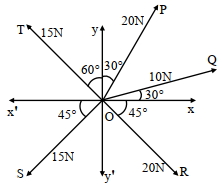
The resultant of these forces $\overrightarrow{OP}, \overrightarrow{OQ}, \overrightarrow{OR}, \overrightarrow{OS}$ and $\overrightarrow{OT}$ is approximately $\ldots \ldots \text{N}$.
[Take $\sqrt{3}=1.7, \sqrt{2}=1.4$. Given $\hat{i}$ and $\hat{j}$ are unit vectors along $x, y$ axes.]
[Take $\sqrt{3}=1.7, \sqrt{2}=1.4$. Given $\hat{i}$ and $\hat{j}$ are unit vectors along $x, y$ axes.]
A
$9.25 \hat{i} + 5 \hat{j}$
B
$3 \hat{i} + 15 \hat{j}$
C
$2.5 \hat{i} - 14.5 \hat{j}$
D
$-1.5 \hat{i} - 15.5 \hat{j}$
Solution
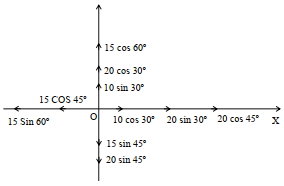
(A) To find the resultant force,we resolve each force into its $x$ and $y$ components:
$F_x = 10 \cos 30^\circ + 20 \sin 30^\circ + 20 \cos 45^\circ - 15 \cos 45^\circ - 15 \sin 60^\circ$
$F_x = 10(0.85) + 20(0.5) + 20(0.7) - 15(0.7) - 15(0.85) = 8.5 + 10 + 14 - 10.5 - 12.75 = 9.25 \text{ N}$
$F_y = 10 \sin 30^\circ + 20 \cos 30^\circ + 15 \cos 60^\circ - 20 \sin 45^\circ - 15 \sin 45^\circ$
$F_y = 10(0.5) + 20(0.85) + 15(0.5) - 20(0.7) - 15(0.7) = 5 + 17 + 7.5 - 14 - 10.5 = 5 \text{ N}$
Thus,the resultant force is $9.25 \hat{i} + 5 \hat{j} \text{ N}$.
$F_x = 10 \cos 30^\circ + 20 \sin 30^\circ + 20 \cos 45^\circ - 15 \cos 45^\circ - 15 \sin 60^\circ$
$F_x = 10(0.85) + 20(0.5) + 20(0.7) - 15(0.7) - 15(0.85) = 8.5 + 10 + 14 - 10.5 - 12.75 = 9.25 \text{ N}$
$F_y = 10 \sin 30^\circ + 20 \cos 30^\circ + 15 \cos 60^\circ - 20 \sin 45^\circ - 15 \sin 45^\circ$
$F_y = 10(0.5) + 20(0.85) + 15(0.5) - 20(0.7) - 15(0.7) = 5 + 17 + 7.5 - 14 - 10.5 = 5 \text{ N}$
Thus,the resultant force is $9.25 \hat{i} + 5 \hat{j} \text{ N}$.
0 likes
View Solution41
AdvancedMCQ
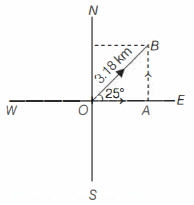
$A$ person walks $25.0^{\circ}$ north of east for $3.18 \,km$. How far would she have to walk due north and then due east to arrive at the same location?
A
Towards north $2.88 \,km$ and towards east $1.34 \,km$
B
Towards north $2.11 \,km$ and towards east $2.11 \,km$
C
Towards north $1.25 \,km$ and towards east $1.93 \,km$
D
Towards north $1.34 \,km$ and towards east $2.88 \,km$
Solution
(D) The person walks a displacement vector of magnitude $r = 3.18 \,km$ at an angle $\theta = 25.0^{\circ}$ north of east.
To find the equivalent path by walking due north and then due east,we resolve the displacement vector into its rectangular components.
The component along the east direction (x-axis) is given by $x = r \cos \theta = 3.18 \times \cos 25.0^{\circ} \approx 3.18 \times 0.9063 = 2.88 \,km$.
The component along the north direction (y-axis) is given by $y = r \sin \theta = 3.18 \times \sin 25.0^{\circ} \approx 3.18 \times 0.4226 = 1.34 \,km$.
Therefore,the person must walk $1.34 \,km$ due north and $2.88 \,km$ due east to reach the same location.
Thus,the correct option is $(d)$.
To find the equivalent path by walking due north and then due east,we resolve the displacement vector into its rectangular components.
The component along the east direction (x-axis) is given by $x = r \cos \theta = 3.18 \times \cos 25.0^{\circ} \approx 3.18 \times 0.9063 = 2.88 \,km$.
The component along the north direction (y-axis) is given by $y = r \sin \theta = 3.18 \times \sin 25.0^{\circ} \approx 3.18 \times 0.4226 = 1.34 \,km$.
Therefore,the person must walk $1.34 \,km$ due north and $2.88 \,km$ due east to reach the same location.
Thus,the correct option is $(d)$.
0 likes
View Solution42
EasyMCQ
$A$ displacement vector of magnitude $4$ makes an angle $30^{\circ}$ with the $x$-axis. Its rectangular components in the $x-y$ plane are .........
A
$2 \sqrt{3}, 2$
B
$4 \sqrt{3}, 4$
C
$\frac{2}{\sqrt{3}}, 2$
D
$\frac{4}{\sqrt{3}}, 4$
Solution
(A) Given,magnitude of displacement vector $|\vec{d}| = 4$ and angle $\theta = 30^{\circ}$ with the $x$-axis.
The rectangular components of a vector $\vec{d}$ are given by:
$d_x = |\vec{d}| \cos \theta$
$d_y = |\vec{d}| \sin \theta$
Substituting the values:
$d_x = 4 \cos 30^{\circ} = 4 \times \frac{\sqrt{3}}{2} = 2\sqrt{3}$
$d_y = 4 \sin 30^{\circ} = 4 \times \frac{1}{2} = 2$
Thus,the rectangular components are $2\sqrt{3}$ and $2$.
The rectangular components of a vector $\vec{d}$ are given by:
$d_x = |\vec{d}| \cos \theta$
$d_y = |\vec{d}| \sin \theta$
Substituting the values:
$d_x = 4 \cos 30^{\circ} = 4 \times \frac{\sqrt{3}}{2} = 2\sqrt{3}$
$d_y = 4 \sin 30^{\circ} = 4 \times \frac{1}{2} = 2$
Thus,the rectangular components are $2\sqrt{3}$ and $2$.
0 likes
View Solution43
EasyMCQ
Which one of the following pairs cannot be the rectangular components of a force vector of $10 \, N$?
A
$6 \, N$ and $8 \, N$
B
$7 \, N$ and $\sqrt{51} \, N$
C
$6 \sqrt{2} \, N$ and $2 \sqrt{7} \, N$
D
$9 \, N$ and $1 \, N$
Solution
(D) For a vector of magnitude $F = 10 \, N$ to have rectangular components $F_x$ and $F_y$,it must satisfy the condition $F = \sqrt{F_x^2 + F_y^2}$,which implies $F^2 = F_x^2 + F_y^2 = 10^2 = 100$.
Checking each option:
$A$: $6^2 + 8^2 = 36 + 64 = 100$. (Possible)
$B$: $7^2 + (\sqrt{51})^2 = 49 + 51 = 100$. (Possible)
$C$: $(6\sqrt{2})^2 + (2\sqrt{7})^2 = (36 \times 2) + (4 \times 7) = 72 + 28 = 100$. (Possible)
$D$: $9^2 + 1^2 = 81 + 1 = 82 \neq 100$. (Not possible)
Therefore,the pair $9 \, N$ and $1 \, N$ cannot be the rectangular components.
Checking each option:
$A$: $6^2 + 8^2 = 36 + 64 = 100$. (Possible)
$B$: $7^2 + (\sqrt{51})^2 = 49 + 51 = 100$. (Possible)
$C$: $(6\sqrt{2})^2 + (2\sqrt{7})^2 = (36 \times 2) + (4 \times 7) = 72 + 28 = 100$. (Possible)
$D$: $9^2 + 1^2 = 81 + 1 = 82 \neq 100$. (Not possible)
Therefore,the pair $9 \, N$ and $1 \, N$ cannot be the rectangular components.
0 likes
View Solution44
MediumMCQ
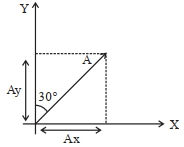
$A$ vector in the $x-y$ plane makes an angle of $30^{\circ}$ with the $y$-axis. The magnitude of the $y$-component of the vector is $2 \sqrt{3}$. The magnitude of the $x$-component of the vector will be:
A
$\frac{1}{\sqrt{3}}$
B
$6$
C
$\sqrt{3}$
D
$2$
Solution
(D) Let the vector be $\vec{A}$. The $y$-component is given by $A_y = A \cos 30^{\circ}$.
Given $A_y = 2 \sqrt{3}$,we have:
$A \cos 30^{\circ} = 2 \sqrt{3}$
$A \left( \frac{\sqrt{3}}{2} \right) = 2 \sqrt{3}$
$A = 4$
Now,the $x$-component is given by $A_x = A \sin 30^{\circ}$.
$A_x = 4 \times \sin 30^{\circ} = 4 \times \frac{1}{2} = 2$.
Thus,the magnitude of the $x$-component is $2$.
Given $A_y = 2 \sqrt{3}$,we have:
$A \cos 30^{\circ} = 2 \sqrt{3}$
$A \left( \frac{\sqrt{3}}{2} \right) = 2 \sqrt{3}$
$A = 4$
Now,the $x$-component is given by $A_x = A \sin 30^{\circ}$.
$A_x = 4 \times \sin 30^{\circ} = 4 \times \frac{1}{2} = 2$.
Thus,the magnitude of the $x$-component is $2$.
1 likes
View Solution45
DifficultMCQ
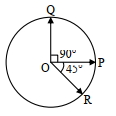
Three vectors $\overrightarrow{OP}, \overrightarrow{OQ}$ and $\overrightarrow{OR}$ each of magnitude $A$ are acting as shown in the figure. The resultant of the three vectors is $A \sqrt{x}$. The value of $x$ is:
A
$5$
B
$4$
C
$2$
D
$3$
Solution
(D) Let the vector $\overrightarrow{OP}$ be along the $x$-axis,$\overrightarrow{OP} = A \hat{i}$.
Vector $\overrightarrow{OQ}$ is at $90^\circ$ to $\overrightarrow{OP}$,so $\overrightarrow{OQ} = A \hat{j}$.
Vector $\overrightarrow{OR}$ is at $45^\circ$ below the $x$-axis,so $\overrightarrow{OR} = A \cos(45^\circ) \hat{i} - A \sin(45^\circ) \hat{j} = \frac{A}{\sqrt{2}} \hat{i} - \frac{A}{\sqrt{2}} \hat{j}$.
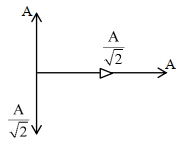
The resultant vector $\vec{R} = \overrightarrow{OP} + \overrightarrow{OQ} + \overrightarrow{OR} = (A + \frac{A}{\sqrt{2}}) \hat{i} + (A - \frac{A}{\sqrt{2}}) \hat{j}$.
The magnitude of the resultant is $|\vec{R}| = \sqrt{(A + \frac{A}{\sqrt{2}})^2 + (A - \frac{A}{\sqrt{2}})^2}$.
$|\vec{R}| = \sqrt{A^2(1 + \frac{1}{\sqrt{2}})^2 + A^2(1 - \frac{1}{\sqrt{2}})^2} = A \sqrt{(1 + \frac{1}{2} + \sqrt{2}) + (1 + \frac{1}{2} - \sqrt{2})} = A \sqrt{1 + 0.5 + 1 + 0.5} = A \sqrt{3}$.
Comparing $A \sqrt{3}$ with $A \sqrt{x}$,we get $x = 3$.
Vector $\overrightarrow{OQ}$ is at $90^\circ$ to $\overrightarrow{OP}$,so $\overrightarrow{OQ} = A \hat{j}$.
Vector $\overrightarrow{OR}$ is at $45^\circ$ below the $x$-axis,so $\overrightarrow{OR} = A \cos(45^\circ) \hat{i} - A \sin(45^\circ) \hat{j} = \frac{A}{\sqrt{2}} \hat{i} - \frac{A}{\sqrt{2}} \hat{j}$.
The resultant vector $\vec{R} = \overrightarrow{OP} + \overrightarrow{OQ} + \overrightarrow{OR} = (A + \frac{A}{\sqrt{2}}) \hat{i} + (A - \frac{A}{\sqrt{2}}) \hat{j}$.
The magnitude of the resultant is $|\vec{R}| = \sqrt{(A + \frac{A}{\sqrt{2}})^2 + (A - \frac{A}{\sqrt{2}})^2}$.
$|\vec{R}| = \sqrt{A^2(1 + \frac{1}{\sqrt{2}})^2 + A^2(1 - \frac{1}{\sqrt{2}})^2} = A \sqrt{(1 + \frac{1}{2} + \sqrt{2}) + (1 + \frac{1}{2} - \sqrt{2})} = A \sqrt{1 + 0.5 + 1 + 0.5} = A \sqrt{3}$.
Comparing $A \sqrt{3}$ with $A \sqrt{x}$,we get $x = 3$.
0 likes
View Solution46
MediumMCQ
Find the angle the vector $\sqrt{3} \hat{i} - \hat{j}$ makes with the positive $x$-axis. (in $^{\circ}$)
A
$15$
B
$-30$
C
$60$
D
$45$
Solution
(B) The vector is given by $\vec{A} = \sqrt{3} \hat{i} - \hat{j}$.
Comparing this with $\vec{A} = A_x \hat{i} + A_y \hat{j}$,we get $A_x = \sqrt{3}$ and $A_y = -1$.
The angle $\theta$ that the vector makes with the positive $x$-axis is given by $\tan \theta = \frac{A_y}{A_x}$.
Substituting the values,we have $\tan \theta = \frac{-1}{\sqrt{3}}$.
Since $\tan(30^{\circ}) = \frac{1}{\sqrt{3}}$,$\tan(-30^{\circ}) = -\frac{1}{\sqrt{3}}$.
Therefore,$\theta = -30^{\circ}$.
Comparing this with $\vec{A} = A_x \hat{i} + A_y \hat{j}$,we get $A_x = \sqrt{3}$ and $A_y = -1$.
The angle $\theta$ that the vector makes with the positive $x$-axis is given by $\tan \theta = \frac{A_y}{A_x}$.
Substituting the values,we have $\tan \theta = \frac{-1}{\sqrt{3}}$.
Since $\tan(30^{\circ}) = \frac{1}{\sqrt{3}}$,$\tan(-30^{\circ}) = -\frac{1}{\sqrt{3}}$.
Therefore,$\theta = -30^{\circ}$.
0 likes
View Solution47
EasyMCQ
The $X$ and $Y$ components of a force $F$ acting at $30^{\circ}$ to the $x$-axis are respectively:
A
$F, \frac{F}{\sqrt{2}}$
B
$\frac{F}{\sqrt{2}}, F$
C
$\frac{F}{2}, \frac{\sqrt{3}}{2} F$
D
$\frac{\sqrt{3}}{2} F, \frac{1}{2} F$
Solution
(D) The components of a force $F$ acting at an angle $\theta$ with the $x$-axis are given by $F_{x} = F \cos \theta$ and $F_{y} = F \sin \theta$.
Given $\theta = 30^{\circ}$,we have:
$F_{x} = F \cos 30^{\circ} = F \times \frac{\sqrt{3}}{2} = \frac{\sqrt{3}}{2} F$.
$F_{y} = F \sin 30^{\circ} = F \times \frac{1}{2} = \frac{1}{2} F$.
Therefore,the $X$ and $Y$ components are $\frac{\sqrt{3}}{2} F$ and $\frac{1}{2} F$ respectively.
Given $\theta = 30^{\circ}$,we have:
$F_{x} = F \cos 30^{\circ} = F \times \frac{\sqrt{3}}{2} = \frac{\sqrt{3}}{2} F$.
$F_{y} = F \sin 30^{\circ} = F \times \frac{1}{2} = \frac{1}{2} F$.
Therefore,the $X$ and $Y$ components are $\frac{\sqrt{3}}{2} F$ and $\frac{1}{2} F$ respectively.
0 likes
View Solution48
EasyMCQ
The component of a vector $\vec{r}$ along the $x$-axis will have a maximum value if
A
$\vec{r}$ is along the $+x$-axis
B
$\vec{r}$ is along the $+y$-axis
C
$\vec{r}$ is along the $-y$-axis
D
$\vec{r}$ makes an angle of $45^{\circ}$ with the $x$-axis
Solution
(A) The component of a vector $\vec{r}$ along the $x$-axis is given by $r_x = r \cos \theta$,where $\theta$ is the angle between the vector $\vec{r}$ and the $x$-axis.
For the component $r_x$ to have a maximum value,the term $\cos \theta$ must be maximum.
The maximum value of $\cos \theta$ is $1$,which occurs when $\theta = 0^{\circ}$.
Therefore,the component of the vector $\vec{r}$ along the $x$-axis is maximum when the vector $\vec{r}$ is directed along the positive $x$-axis.
For the component $r_x$ to have a maximum value,the term $\cos \theta$ must be maximum.
The maximum value of $\cos \theta$ is $1$,which occurs when $\theta = 0^{\circ}$.
Therefore,the component of the vector $\vec{r}$ along the $x$-axis is maximum when the vector $\vec{r}$ is directed along the positive $x$-axis.
0 likes
View Solution49
EasyMCQ
One of the rectangular components of a force of $40 \ N$ is $20 \sqrt{3} \ N$. What is the other rectangular component (in $N$)?
A
$10$
B
$20$
C
$30$
D
$25$
Solution
(B) For a force $F$ with rectangular components $F_x$ and $F_y$,the relationship is given by $F^2 = F_x^2 + F_y^2$.
Given that the resultant force $F = 40 \ N$ and one component $F_x = 20 \sqrt{3} \ N$.
Substituting these values into the equation:
$(40)^2 = (20 \sqrt{3})^2 + F_y^2$
$1600 = (400 \times 3) + F_y^2$
$1600 = 1200 + F_y^2$
$F_y^2 = 1600 - 1200 = 400$
$F_y = \sqrt{400} = 20 \ N$.
Thus,the other rectangular component is $20 \ N$.
Given that the resultant force $F = 40 \ N$ and one component $F_x = 20 \sqrt{3} \ N$.
Substituting these values into the equation:
$(40)^2 = (20 \sqrt{3})^2 + F_y^2$
$1600 = (400 \times 3) + F_y^2$
$1600 = 1200 + F_y^2$
$F_y^2 = 1600 - 1200 = 400$
$F_y = \sqrt{400} = 20 \ N$.
Thus,the other rectangular component is $20 \ N$.
0 likes
View Solution50
DifficultMCQ
$A$ certain vector in the $xy$-plane has an $x$-component of $4 \,m$ and a $y$-component of $10 \,m$. It is then rotated in the $xy$-plane so that its $x$-component is doubled. Then its new $y$-component is (approximately) (in $\,m$)
A
$20$
B
$7.2$
C
$5.0$
D
$4.5$
Solution
(B) The initial vector is $\vec{A} = 4\hat{i} + 10\hat{j}$.
The magnitude of the vector is $|\vec{A}| = \sqrt{(4)^2 + (10)^2} = \sqrt{16 + 100} = \sqrt{116} \,m$.
When the vector is rotated, its magnitude remains constant.
Let the new vector be $\vec{A}' = 8\hat{i} + n\hat{j}$, where the $x$-component is doubled $(4 \times 2 = 8)$.
Since the magnitude is conserved, $|\vec{A}'| = |\vec{A}|$.
$\sqrt{8^2 + n^2} = \sqrt{116}$.
Squaring both sides, we get $64 + n^2 = 116$.
$n^2 = 116 - 64 = 52$.
$n = \sqrt{52} \approx 7.21 \,m$.
Thus, the new $y$-component is approximately $7.2 \,m$.
The magnitude of the vector is $|\vec{A}| = \sqrt{(4)^2 + (10)^2} = \sqrt{16 + 100} = \sqrt{116} \,m$.
When the vector is rotated, its magnitude remains constant.
Let the new vector be $\vec{A}' = 8\hat{i} + n\hat{j}$, where the $x$-component is doubled $(4 \times 2 = 8)$.
Since the magnitude is conserved, $|\vec{A}'| = |\vec{A}|$.
$\sqrt{8^2 + n^2} = \sqrt{116}$.
Squaring both sides, we get $64 + n^2 = 116$.
$n^2 = 116 - 64 = 52$.
$n = \sqrt{52} \approx 7.21 \,m$.
Thus, the new $y$-component is approximately $7.2 \,m$.
0 likes
View Solution3-1.Vectors — Resolution of a Vector into Rectangular Components · Frequently Asked Questions
1Are these 3-1.Vectors questions useful for JEE and NEET?
Yes. All questions in this section are mapped to JEE Main and NEET exam patterns. Previous year questions from JEE Main, NEET, GUJCET and state-level exams are included with full solutions.
2Can I switch to Hindi or Gujarati for these questions?
Yes. Use the language tabs in the hero section or the sidebar to view the same questions and solutions in English, Hindi or Gujarati.
3How do I generate a question paper from this subtopic?
Use the Vedclass Exam Paper Generator — select the chapter and subtopic, set difficulty, and generate Sets A, B, C, D automatically. First 3 chapters of every subject are free.
Vedclass Products
For Students
Vedclass Test Series
Mock tests in real JEE/NEET style with performance analysis. 5-day free trial.
Start Free TrialFor Teachers
Exam Paper Generator
Generate Set A/B/C/D papers from this chapter in 2 minutes. 3 chapters free.
Try FreeFor Institutes
Online Exam Module
Live online exams with unlimited students, 360° analytics & white-label branding.
See DemoFor Teachers & Institutes
Generate a 3-1.Vectors Exam Paper in 2 Minutes
Select subtopic & difficulty — Sets A, B, C, D auto-generated with No Repeat logic.
First 3 chapters of every subject are free — no payment required.