
ChemistryQ101–200 of 843 questions
Page 3 of 11 · English
101
ChemistryEasyMCQMHT CET · 2025
Identify the name of the method used for the three-dimensional representation of the molecule as follows:
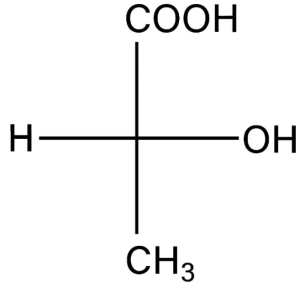
A
Wedge formula
B
Fischer projection formula
C
Newman projection formula
D
Sawhorse formula
Solution
(B) The given structure represents a molecule using a cross-like projection where the vertical lines represent bonds going away from the observer and horizontal lines represent bonds coming towards the observer. This method of representing a three-dimensional molecule in two dimensions is known as the $Fischer$ projection formula.
0 likesView Solution
102
ChemistryEasyMCQMHT CET · 2025
What is the number of chiral carbon atoms present in $3,4-$Dibromohexane?
A
$5$
B
$4$
C
$3$
D
$2$
Solution
(D) The structure of $3,4-$Dibromohexane is $CH_3-CH_2-CH(Br)-CH(Br)-CH_2-CH_3$.
In this molecule,the carbon atoms at positions $3$ and $4$ are bonded to four different groups: a hydrogen atom,a bromine atom,an ethyl group $(-CH_2CH_3)$,and the other chiral carbon atom.
Since both $C-3$ and $C-4$ are bonded to four distinct groups,they are chiral centers.
Therefore,there are $2$ chiral carbon atoms in $3,4-$Dibromohexane.
In this molecule,the carbon atoms at positions $3$ and $4$ are bonded to four different groups: a hydrogen atom,a bromine atom,an ethyl group $(-CH_2CH_3)$,and the other chiral carbon atom.
Since both $C-3$ and $C-4$ are bonded to four distinct groups,they are chiral centers.
Therefore,there are $2$ chiral carbon atoms in $3,4-$Dibromohexane.
0 likesView Solution
103
ChemistryMediumMCQMHT CET · 2025
What is the number of structural isomers possible for alkene with molecular formula $C_5H_{10}$?
A
$2$
B
$3$
C
$4$
D
$5$
Solution
(D) The molecular formula $C_5H_{10}$ corresponds to the general formula $C_nH_{2n}$,which represents an alkene.
To find the structural isomers,we consider the position of the double bond and the carbon chain branching:
$1$. $Pent-1-ene$ $(CH_2=CH-CH_2-CH_2-CH_3)$
$2$. $Pent-2-ene$ $(CH_3-CH=CH-CH_2-CH_3)$
$3$. $2-Methylbut-1-ene$ $(CH_2=C(CH_3)-CH_2-CH_3)$
$4$. $3-Methylbut-1-ene$ $(CH_2=CH-CH(CH_3)_2)$
$5$. $2-Methylbut-2-ene$ $(CH_3-C(CH_3)=CH-CH_3)$
Thus,there are $5$ possible structural isomers for $C_5H_{10}$.
To find the structural isomers,we consider the position of the double bond and the carbon chain branching:
$1$. $Pent-1-ene$ $(CH_2=CH-CH_2-CH_2-CH_3)$
$2$. $Pent-2-ene$ $(CH_3-CH=CH-CH_2-CH_3)$
$3$. $2-Methylbut-1-ene$ $(CH_2=C(CH_3)-CH_2-CH_3)$
$4$. $3-Methylbut-1-ene$ $(CH_2=CH-CH(CH_3)_2)$
$5$. $2-Methylbut-2-ene$ $(CH_3-C(CH_3)=CH-CH_3)$
Thus,there are $5$ possible structural isomers for $C_5H_{10}$.
0 likesView Solution
104
ChemistryMCQMHT CET · 2025
Which of the following alkenes does $NOT$ exhibit $cis-trans$ isomerism?
A
$But-1-ene$
B
$But-2-ene$
C
$3,4-Dimethylhex-3-ene$
D
$Pent-2-ene$
Solution
(A) For an alkene to exhibit $cis-trans$ isomerism,each carbon atom of the double bond must be attached to two different groups.
In $But-1-ene$ $(CH_2=CH-CH_2-CH_3)$,the first carbon atom is attached to two identical hydrogen atoms.
Therefore,it cannot show $cis-trans$ isomerism.
$But-2-ene$,$3,4-Dimethylhex-3-ene$,and $Pent-2-ene$ all have different groups attached to each carbon of the double bond,allowing them to exhibit $cis-trans$ isomerism.
In $But-1-ene$ $(CH_2=CH-CH_2-CH_3)$,the first carbon atom is attached to two identical hydrogen atoms.
Therefore,it cannot show $cis-trans$ isomerism.
$But-2-ene$,$3,4-Dimethylhex-3-ene$,and $Pent-2-ene$ all have different groups attached to each carbon of the double bond,allowing them to exhibit $cis-trans$ isomerism.
0 likesView Solution
105
ChemistryMediumMCQMHT CET · 2025
How many chiral carbon atoms are present in $2-$chloro$-3,4,5-$trimethylhexane?
A
$4$
B
$3$
C
$2$
D
$1$
Solution
(B) The structure of $2-$chloro$-3,4,5-$trimethylhexane is $CH_3-CHCl-CH(CH_3)-CH(CH_3)-CH(CH_3)-CH_3$.
Let us analyze each carbon atom for chirality (a carbon atom bonded to four different groups):
$C2$: Bonded to $-H, -Cl, -CH_3, -CH(CH_3)CH(CH_3)CH_2CH_3$. This is chiral.
$C3$: Bonded to $-H, -CH_3, -CH(CH_3)CH_2CH_3, -CHClCH_3$. This is chiral.
$C4$: Bonded to $-H, -CH_3, -CH(CH_3)CH_3, -CH(CH_3)CHClCH_3$. This is chiral.
$C5$: Bonded to $-H, -CH_3, -CH_3, -CH(CH_3)CH(CH_3)CHClCH_3$. This is not chiral because it is bonded to two identical $-CH_3$ groups.
Thus,there are $3$ chiral carbon atoms $(C2, C3, C4)$.
Let us analyze each carbon atom for chirality (a carbon atom bonded to four different groups):
$C2$: Bonded to $-H, -Cl, -CH_3, -CH(CH_3)CH(CH_3)CH_2CH_3$. This is chiral.
$C3$: Bonded to $-H, -CH_3, -CH(CH_3)CH_2CH_3, -CHClCH_3$. This is chiral.
$C4$: Bonded to $-H, -CH_3, -CH(CH_3)CH_3, -CH(CH_3)CHClCH_3$. This is chiral.
$C5$: Bonded to $-H, -CH_3, -CH_3, -CH(CH_3)CH(CH_3)CHClCH_3$. This is not chiral because it is bonded to two identical $-CH_3$ groups.
Thus,there are $3$ chiral carbon atoms $(C2, C3, C4)$.
0 likesView Solution
106
ChemistryMCQMHT CET · 2025
Which of the following compounds is an optically inactive compound?
A
$3-$chlorohexane
B
$2-$chloro$-2-$methylbutane
C
$2-$chloropentane
D
$2-$chloro$-3-$methylbutane
Solution
(B) compound is optically inactive if it does not contain a chiral center (an asymmetric carbon atom bonded to four different groups).
$1$. $3$-chlorohexane: $CH_3CH_2CH(Cl)CH_2CH_2CH_3$ has a chiral center at $C3$.
$2$. $2$-chloro-$2$-methylbutane: $CH_3C(Cl)(CH_3)CH_2CH_3$. The $C2$ atom is bonded to two identical methyl groups $(-CH_3)$,so it is achiral and optically inactive.
$3$. $2$-chloropentane: $CH_3CH(Cl)CH_2CH_2CH_3$ has a chiral center at $C2$.
$4$. $2$-chloro-$3$-methylbutane: $CH_3CH(Cl)CH(CH_3)_2$ has a chiral center at $C2$.
Therefore,$2$-chloro-$2$-methylbutane is the optically inactive compound.
$1$. $3$-chlorohexane: $CH_3CH_2CH(Cl)CH_2CH_2CH_3$ has a chiral center at $C3$.
$2$. $2$-chloro-$2$-methylbutane: $CH_3C(Cl)(CH_3)CH_2CH_3$. The $C2$ atom is bonded to two identical methyl groups $(-CH_3)$,so it is achiral and optically inactive.
$3$. $2$-chloropentane: $CH_3CH(Cl)CH_2CH_2CH_3$ has a chiral center at $C2$.
$4$. $2$-chloro-$3$-methylbutane: $CH_3CH(Cl)CH(CH_3)_2$ has a chiral center at $C2$.
Therefore,$2$-chloro-$2$-methylbutane is the optically inactive compound.
0 likesView Solution
107
ChemistryMCQMHT CET · 2025
Which of the following alkenes does $NOT$ exhibit cis-trans isomerism?
A
But$-1-$ene
B
But$-2-$ene
C
$3,4-$Dimethylhex$-3-$ene
D
Pent$-2-$ene
Solution
(A) For an alkene to exhibit $cis-trans$ isomerism,each carbon atom of the double bond must be attached to two different groups.
In $But-1-ene$ $(CH_3-CH_2-CH=CH_2)$,the terminal carbon atom is attached to two identical hydrogen atoms.
Therefore,it cannot show $cis-trans$ isomerism.
In contrast,$But-2-ene$,$3,4-Dimethylhex-3-ene$,and $Pent-2-ene$ all have different groups attached to each carbon of the double bond,allowing for $cis-trans$ isomerism.
In $But-1-ene$ $(CH_3-CH_2-CH=CH_2)$,the terminal carbon atom is attached to two identical hydrogen atoms.
Therefore,it cannot show $cis-trans$ isomerism.
In contrast,$But-2-ene$,$3,4-Dimethylhex-3-ene$,and $Pent-2-ene$ all have different groups attached to each carbon of the double bond,allowing for $cis-trans$ isomerism.
0 likesView Solution
108
ChemistryEasyMCQMHT CET · 2025
Which of the following alkenes does $\underline{NOT}$ exhibit cis-trans isomerism?
A
but$-1-$ene
B
but$-2-$ene
C
$3,4-$Dimethylhex$-3-$ene
D
pent$-2-$ene
Solution
(A) For an alkene to exhibit cis-trans isomerism,each carbon atom of the double bond must be attached to two different groups.
In but$-1-$ene $(CH_3-CH_2-CH=CH_2)$,the terminal carbon atom $(C_1)$ is bonded to two identical hydrogen atoms.
Therefore,it cannot exhibit cis-trans isomerism.
In but$-1-$ene $(CH_3-CH_2-CH=CH_2)$,the terminal carbon atom $(C_1)$ is bonded to two identical hydrogen atoms.
Therefore,it cannot exhibit cis-trans isomerism.
0 likesView Solution
109
ChemistryMediumMCQMHT CET · 2025
Which of the following alkenes is most easily formed by dehydrohalogenation of alkyl halides?
A
$R_2C=CH_2$
B
$RCH=CHR$
C
$R_2C=CHR$
D
$R_2C=CR_2$
Solution
(D) The ease of formation of an alkene by dehydrohalogenation follows the stability of the resulting alkene. According to $Saytzeff$ rule,the more substituted alkene is more stable due to hyperconjugation and inductive effects. The stability order of alkenes is: $R_2C=CR_2 > R_2C=CHR > RCH=CHR > R_2C=CH_2$. Therefore,the most substituted alkene,$R_2C=CR_2$,is formed most easily.
0 likesView Solution
110
ChemistryMCQMHT CET · 2025
Which among the following is a benzylic halide?
A
Bromo$phenyl$methane
B
$4-$Bromotoluene
C
$1-$Bromo$-2-$phenylethane
D
Bromobenzene
Solution
(A) benzylic halide is a compound in which the halogen atom is bonded to an $sp^3$ hybridized carbon atom that is directly attached to an aromatic ring.
In $Bromo$phenyl$methane$ $(C_6H_5CH_2Br)$,the bromine atom is attached to a carbon atom which is directly bonded to the benzene ring.
Therefore,$Bromo$phenyl$methane$ is a benzylic halide.
In $Bromo$phenyl$methane$ $(C_6H_5CH_2Br)$,the bromine atom is attached to a carbon atom which is directly bonded to the benzene ring.
Therefore,$Bromo$phenyl$methane$ is a benzylic halide.
0 likesView Solution
111
ChemistryMediumMCQMHT CET · 2025
Calculate percentage atom economy when $46 \ g$ ethanol is obtained from $64.5 \ g$ chloroethane and $56 \ g$ $KOH_{(aq)}$. (in $\%$)
A
$25.25$
B
$38.17$
C
$50.25$
D
$64.17$
Solution
(B) The chemical reaction for the preparation of ethanol from chloroethane is: $C_2H_5Cl + KOH \rightarrow C_2H_5OH + KCl$.
The molar mass of $C_2H_5Cl$ is $64.5 \ g/mol$,$KOH$ is $56 \ g/mol$,$C_2H_5OH$ is $46 \ g/mol$,and $KCl$ is $74.5 \ g/mol$.
The formula for percentage atom economy is: $\text{Atom Economy} = \frac{\text{Molar mass of desired product}}{\text{Total molar mass of all reactants}} \times 100$.
Total molar mass of reactants = $64.5 + 56 = 120.5 \ g/mol$.
Molar mass of desired product (ethanol) = $46 \ g/mol$.
Atom Economy = $(46 / 120.5) \times 100 \approx 38.17 \%$.
Thus,the correct option is $B$.
The molar mass of $C_2H_5Cl$ is $64.5 \ g/mol$,$KOH$ is $56 \ g/mol$,$C_2H_5OH$ is $46 \ g/mol$,and $KCl$ is $74.5 \ g/mol$.
The formula for percentage atom economy is: $\text{Atom Economy} = \frac{\text{Molar mass of desired product}}{\text{Total molar mass of all reactants}} \times 100$.
Total molar mass of reactants = $64.5 + 56 = 120.5 \ g/mol$.
Molar mass of desired product (ethanol) = $46 \ g/mol$.
Atom Economy = $(46 / 120.5) \times 100 \approx 38.17 \%$.
Thus,the correct option is $B$.
0 likesView Solution
112
ChemistryMediumMCQMHT CET · 2025
Which of the following is $NOT$ obtained when a mixture of methyl bromide and ethyl bromide is treated with sodium metal in the presence of dry ether?
A
$Ethane$
B
$Propane$
C
$Butane$
D
$Pentane$
Solution
(D) The reaction of a mixture of alkyl halides with sodium metal in the presence of dry ether is known as the Wurtz reaction.
When a mixture of methyl bromide $(CH_3Br)$ and ethyl bromide $(C_2H_5Br)$ is treated with sodium metal,the following coupling reactions occur:
$1$. $CH_3Br + 2Na + BrCH_3 \rightarrow CH_3-CH_3$ $(Ethane)$
$2$. $C_2H_5Br + 2Na + BrC_2H_5 \rightarrow C_2H_5-C_2H_5$ $(n-Butane)$
$3$. $CH_3Br + 2Na + BrC_2H_5 \rightarrow CH_3-C_2H_5$ $(Propane)$
Since $Pentane$ $(C_5H_{12})$ cannot be formed from the coupling of methyl $(C_1)$ and ethyl $(C_2)$ radicals,it is not obtained in the product mixture.
When a mixture of methyl bromide $(CH_3Br)$ and ethyl bromide $(C_2H_5Br)$ is treated with sodium metal,the following coupling reactions occur:
$1$. $CH_3Br + 2Na + BrCH_3 \rightarrow CH_3-CH_3$ $(Ethane)$
$2$. $C_2H_5Br + 2Na + BrC_2H_5 \rightarrow C_2H_5-C_2H_5$ $(n-Butane)$
$3$. $CH_3Br + 2Na + BrC_2H_5 \rightarrow CH_3-C_2H_5$ $(Propane)$
Since $Pentane$ $(C_5H_{12})$ cannot be formed from the coupling of methyl $(C_1)$ and ethyl $(C_2)$ radicals,it is not obtained in the product mixture.
0 likesView Solution
113
ChemistryMediumMCQMHT CET · 2025
Which of the following compounds does not exhibit optical isomerism?
A
$3-$Iodohexane
B
$2-$Iodopentane
C
$2-$Iodo$-2-$methylbutane
D
$2-$Iodo$-3-$methylbutane
Solution
(C) Optical isomerism is exhibited by compounds that contain at least one chiral carbon atom (a carbon atom bonded to four different groups).
$A$. $3-$Iodohexane: $CH_3-CH_2-CH(I)-CH_2-CH_2-CH_3$. The $C3$ atom is bonded to $-H, -I, -CH_2CH_3, -CH_2CH_2CH_3$. It is chiral.
$B$. $2-$Iodopentane: $CH_3-CH(I)-CH_2-CH_2-CH_3$. The $C2$ atom is bonded to $-H, -I, -CH_3, -CH_2CH_2CH_3$. It is chiral.
$C$. $2-$Iodo$-2-$methylbutane: $CH_3-C(I)(CH_3)-CH_2-CH_3$. The $C2$ atom is bonded to two identical $-CH_3$ groups. It is achiral.
$D$. $2-$Iodo$-3-$methylbutane: $CH_3-CH(I)-CH(CH_3)_2$. The $C2$ atom is bonded to $-H, -I, -CH_3, -CH(CH_3)_2$. It is chiral.
Therefore,$2-$Iodo$-2-$methylbutane does not exhibit optical isomerism.
$A$. $3-$Iodohexane: $CH_3-CH_2-CH(I)-CH_2-CH_2-CH_3$. The $C3$ atom is bonded to $-H, -I, -CH_2CH_3, -CH_2CH_2CH_3$. It is chiral.
$B$. $2-$Iodopentane: $CH_3-CH(I)-CH_2-CH_2-CH_3$. The $C2$ atom is bonded to $-H, -I, -CH_3, -CH_2CH_2CH_3$. It is chiral.
$C$. $2-$Iodo$-2-$methylbutane: $CH_3-C(I)(CH_3)-CH_2-CH_3$. The $C2$ atom is bonded to two identical $-CH_3$ groups. It is achiral.
$D$. $2-$Iodo$-3-$methylbutane: $CH_3-CH(I)-CH(CH_3)_2$. The $C2$ atom is bonded to $-H, -I, -CH_3, -CH(CH_3)_2$. It is chiral.
Therefore,$2-$Iodo$-2-$methylbutane does not exhibit optical isomerism.
0 likesView Solution
114
ChemistryEasyMCQMHT CET · 2025
Which of the following is obtained as the major product when an excess of methane is treated with a limited amount of chlorine in the presence of $UV$ light?
A
Chloromethane
B
Dichloromethane
C
Trichloromethane
D
Tetrachloromethane
Solution
(A) The reaction between methane $(CH_4)$ and chlorine $(Cl_2)$ in the presence of $UV$ light is a free radical substitution reaction.
When methane is in excess and chlorine is limited,the probability of a chlorine radical colliding with a methane molecule is much higher than colliding with a chloromethane molecule.
Therefore,the reaction stops primarily at the first substitution step:
$CH_4 + Cl_2 \xrightarrow{UV \text{ light}} CH_3Cl + HCl$
Thus,chloromethane $(CH_3Cl)$ is obtained as the major product.
When methane is in excess and chlorine is limited,the probability of a chlorine radical colliding with a methane molecule is much higher than colliding with a chloromethane molecule.
Therefore,the reaction stops primarily at the first substitution step:
$CH_4 + Cl_2 \xrightarrow{UV \text{ light}} CH_3Cl + HCl$
Thus,chloromethane $(CH_3Cl)$ is obtained as the major product.
0 likesView Solution
115
ChemistryMediumMCQMHT CET · 2025
Identify the product '$B$' in the following reaction sequence.
Alkyl halide $\xrightarrow{Mg / \text{Dry ether}}$ $A$ $\xrightarrow{NH_3}$ $B$
Alkyl halide $\xrightarrow{Mg / \text{Dry ether}}$ $A$ $\xrightarrow{NH_3}$ $B$
A
Alkyl magnesium halide
B
Alkyl amine
C
Hydrocarbon
D
Alkyl nitrile
Solution
(C) The reaction sequence is as follows:
$1$. Alkyl halide $(R-X)$ reacts with $Mg$ in the presence of dry ether to form a Grignard reagent,$A$,which is $R-MgX$.
$2$. Grignard reagents $(R-MgX)$ react with $NH_3$ (ammonia) to undergo an acid-base reaction. Since $NH_3$ is a proton donor,it protonates the alkyl group $(R^-)$ of the Grignard reagent to form an alkane $(R-H)$.
$3$. Therefore,the product $B$ is a hydrocarbon $(R-H)$.
$1$. Alkyl halide $(R-X)$ reacts with $Mg$ in the presence of dry ether to form a Grignard reagent,$A$,which is $R-MgX$.
$2$. Grignard reagents $(R-MgX)$ react with $NH_3$ (ammonia) to undergo an acid-base reaction. Since $NH_3$ is a proton donor,it protonates the alkyl group $(R^-)$ of the Grignard reagent to form an alkane $(R-H)$.
$3$. Therefore,the product $B$ is a hydrocarbon $(R-H)$.
0 likesView Solution
116
ChemistryMCQMHT CET · 2025
Identify the product '$Z$' in the following series of reactions.
$CH_3CH_2OH$ $\xrightarrow[\Delta]{SOCl_2} X$ $\xrightarrow[\text{Dry ether}]{Mg} Y$ $\xrightarrow{NH_3} Z$
$CH_3CH_2OH$ $\xrightarrow[\Delta]{SOCl_2} X$ $\xrightarrow[\text{Dry ether}]{Mg} Y$ $\xrightarrow{NH_3} Z$
A
Ethyl chloride
B
Ethyl magnesium chloride
C
Ethyl amine
D
Ethane
Solution
(D) Step $1$: Ethanol reacts with $SOCl_2$ to form ethyl chloride $(X)$.
$CH_3CH_2OH + SOCl_2 \xrightarrow{\Delta} CH_3CH_2Cl + SO_2 + HCl$
Step $2$: Ethyl chloride reacts with $Mg$ in dry ether to form ethyl magnesium chloride $(Y)$,which is a Grignard reagent.
$CH_3CH_2Cl + Mg \xrightarrow{\text{Dry ether}} CH_3CH_2MgCl$
Step $3$: Grignard reagents react with $NH_3$ (an active hydrogen source) to form the corresponding alkane $(Z)$.
$CH_3CH_2MgCl + NH_3 \rightarrow CH_3CH_3 + Mg(Cl)NH_2$
Thus,the product '$Z$' is ethane.
$CH_3CH_2OH + SOCl_2 \xrightarrow{\Delta} CH_3CH_2Cl + SO_2 + HCl$
Step $2$: Ethyl chloride reacts with $Mg$ in dry ether to form ethyl magnesium chloride $(Y)$,which is a Grignard reagent.
$CH_3CH_2Cl + Mg \xrightarrow{\text{Dry ether}} CH_3CH_2MgCl$
Step $3$: Grignard reagents react with $NH_3$ (an active hydrogen source) to form the corresponding alkane $(Z)$.
$CH_3CH_2MgCl + NH_3 \rightarrow CH_3CH_3 + Mg(Cl)NH_2$
Thus,the product '$Z$' is ethane.
0 likesView Solution
117
ChemistryEasyMCQMHT CET · 2025
Which of the following compounds has the highest boiling point?
A
$n-$Hexane
B
$2-$Methylpentane
C
$3-$Methylpentane
D
$2,2-$Dimethylbutane
Solution
(A) The boiling point of alkanes depends on the surface area of the molecule.
As the branching in the alkane increases,the surface area decreases,which leads to weaker van der Waals forces of attraction.
Therefore,the boiling point decreases as the number of branches increases.
Comparing the given isomers of $C_6H_{14}$:
$1$. $n-$Hexane (straight chain) has the largest surface area.
$2$. $2-$Methylpentane and $3-$Methylpentane have one branch.
$3$. $2,2-$Dimethylbutane has two branches (most compact).
Thus,$n-$Hexane has the highest boiling point.
As the branching in the alkane increases,the surface area decreases,which leads to weaker van der Waals forces of attraction.
Therefore,the boiling point decreases as the number of branches increases.
Comparing the given isomers of $C_6H_{14}$:
$1$. $n-$Hexane (straight chain) has the largest surface area.
$2$. $2-$Methylpentane and $3-$Methylpentane have one branch.
$3$. $2,2-$Dimethylbutane has two branches (most compact).
Thus,$n-$Hexane has the highest boiling point.
0 likesView Solution
118
ChemistryEasyMCQMHT CET · 2025
Which of the following alkanes is used for road surfacing?
A
Alkanes with less than $10$ carbon atoms
B
Alkanes having $20$ to $25$ carbon atoms
C
Alkanes having $25$ to $30$ carbon atoms
D
Alkanes having more than $35$ carbon atoms
Solution
(D) Road surfacing is typically done using bitumen or asphalt,which are mixtures of high molecular weight hydrocarbons.
Alkanes with more than $35$ carbon atoms are generally solid at room temperature and are used in the production of asphalt and bitumen for road surfacing.
Alkanes with more than $35$ carbon atoms are generally solid at room temperature and are used in the production of asphalt and bitumen for road surfacing.
0 likesView Solution
119
ChemistryEasyMCQMHT CET · 2025
What is the molar mass of the third homologue of the alkane series?
A
$40 \ g \ mol^{-1}$
B
$58 \ g \ mol^{-1}$
C
$44 \ g \ mol^{-1}$
D
$46 \ g \ mol^{-1}$
Solution
(C) The general formula for the alkane series is $C_nH_{2n+2}$.
For the first homologue $(n=1)$,the formula is $CH_4$ (methane).
For the second homologue $(n=2)$,the formula is $C_2H_6$ (ethane).
For the third homologue $(n=3)$,the formula is $C_3H_8$ (propane).
The molar mass of $C_3H_8$ is calculated as:
$M = (3 \times 12.01) + (8 \times 1.008) \approx 36 + 8 = 44 \ g \ mol^{-1}$.
For the first homologue $(n=1)$,the formula is $CH_4$ (methane).
For the second homologue $(n=2)$,the formula is $C_2H_6$ (ethane).
For the third homologue $(n=3)$,the formula is $C_3H_8$ (propane).
The molar mass of $C_3H_8$ is calculated as:
$M = (3 \times 12.01) + (8 \times 1.008) \approx 36 + 8 = 44 \ g \ mol^{-1}$.
0 likesView Solution
120
ChemistryEasyMCQMHT CET · 2025
What is the difference in molar masses of the third and fourth homologues of the alkane series?
A
$28 \ g \ mol^{-1}$
B
$14 \ g \ mol^{-1}$
C
$15 \ g \ mol^{-1}$
D
$16 \ g \ mol^{-1}$
Solution
(B) The general formula for the alkane series is $C_nH_{2n+2}$.
For the third homologue $(n=3)$,the formula is $C_3H_8$,and its molar mass is $(3 \times 12) + (8 \times 1) = 44 \ g \ mol^{-1}$.
For the fourth homologue $(n=4)$,the formula is $C_4H_{10}$,and its molar mass is $(4 \times 12) + (10 \times 1) = 58 \ g \ mol^{-1}$.
Any two successive homologues in an alkane series differ by a $-CH_2-$ group.
The molar mass of a $-CH_2-$ group is $12 + (2 \times 1) = 14 \ g \ mol^{-1}$.
Therefore,the difference in molar masses is $58 - 44 = 14 \ g \ mol^{-1}$.
For the third homologue $(n=3)$,the formula is $C_3H_8$,and its molar mass is $(3 \times 12) + (8 \times 1) = 44 \ g \ mol^{-1}$.
For the fourth homologue $(n=4)$,the formula is $C_4H_{10}$,and its molar mass is $(4 \times 12) + (10 \times 1) = 58 \ g \ mol^{-1}$.
Any two successive homologues in an alkane series differ by a $-CH_2-$ group.
The molar mass of a $-CH_2-$ group is $12 + (2 \times 1) = 14 \ g \ mol^{-1}$.
Therefore,the difference in molar masses is $58 - 44 = 14 \ g \ mol^{-1}$.
0 likesView Solution
121
ChemistryMediumMCQMHT CET · 2025
The reaction of propane with bromine in the presence of $UV$ light predominantly forms
A
$1-$Bromopropane
B
$2-$Bromopropane
C
$1,2-$dibromopropane
D
$1,3-$dibromopropane
Solution
(B) The reaction of propane $(CH_3-CH_2-CH_3)$ with bromine $(Br_2)$ in the presence of $UV$ light is a free radical substitution reaction.
Bromination is highly selective compared to chlorination.
The stability of the intermediate free radical determines the major product.
Secondary $(2^{\circ})$ free radicals are more stable than primary $(1^{\circ})$ free radicals.
Propane has two primary carbons and one secondary carbon.
Abstraction of a hydrogen atom from the secondary carbon leads to the formation of a $2^{\circ}$ propyl radical $(CH_3-dot{C}H-CH_3)$,which is more stable.
Therefore,the reaction predominantly forms $2-$bromopropane $(CH_3-CH(Br)-CH_3)$.
Bromination is highly selective compared to chlorination.
The stability of the intermediate free radical determines the major product.
Secondary $(2^{\circ})$ free radicals are more stable than primary $(1^{\circ})$ free radicals.
Propane has two primary carbons and one secondary carbon.
Abstraction of a hydrogen atom from the secondary carbon leads to the formation of a $2^{\circ}$ propyl radical $(CH_3-dot{C}H-CH_3)$,which is more stable.
Therefore,the reaction predominantly forms $2-$bromopropane $(CH_3-CH(Br)-CH_3)$.
0 likesView Solution
122
ChemistryEasyMCQMHT CET · 2025
Which major product is formed when excess of methane is treated with chlorine in the presence of $UV$ light?
A
Chloromethane
B
Dichloromethane
C
Trichloromethane
D
Tetrachloromethane
Solution
(A) When methane $(CH_4)$ is treated with chlorine $(Cl_2)$ in the presence of $UV$ light,a free radical substitution reaction occurs.
Since methane is taken in excess,the reaction is limited to the first step of substitution.
The reaction is: $CH_4 + Cl_2 \xrightarrow{UV \ light} CH_3Cl + HCl$.
Therefore,the major product formed is chloromethane $(CH_3Cl)$.
Since methane is taken in excess,the reaction is limited to the first step of substitution.
The reaction is: $CH_4 + Cl_2 \xrightarrow{UV \ light} CH_3Cl + HCl$.
Therefore,the major product formed is chloromethane $(CH_3Cl)$.
0 likesView Solution
123
ChemistryEasyMCQMHT CET · 2025
Which of the following reagents is used to convert a $C \equiv C$ triple bond to a $C=C$ double bond to give the $Cis$ isomer of an alkene?
A
$ZnCl_2 / HCl$
B
$Pd-C / \text{quinoline}$
C
$Na / \text{liquid } NH_3$
D
$Na / Hg \text{ in } H_2O$
Solution
(B) The reduction of an alkyne to a $Cis$-alkene is achieved by catalytic hydrogenation using Lindlar's catalyst.
Lindlar's catalyst consists of palladium deposited on calcium carbonate $(Pd-CaCO_3)$ or barium sulfate $(Pd-BaSO_4)$,which is partially poisoned with quinoline or lead acetate.
This specific reagent prevents the complete hydrogenation of the alkyne to an alkane and stereoselectively yields the $Cis$ isomer.
Therefore,the correct reagent is $Pd-C / \text{quinoline}$ (often referred to as Lindlar's catalyst).
Lindlar's catalyst consists of palladium deposited on calcium carbonate $(Pd-CaCO_3)$ or barium sulfate $(Pd-BaSO_4)$,which is partially poisoned with quinoline or lead acetate.
This specific reagent prevents the complete hydrogenation of the alkyne to an alkane and stereoselectively yields the $Cis$ isomer.
Therefore,the correct reagent is $Pd-C / \text{quinoline}$ (often referred to as Lindlar's catalyst).
0 likesView Solution
124
ChemistryEasyMCQMHT CET · 2025
Cyclohexene on oxidation with $KMnO_4$ in dil. $H_2SO_4$ forms.
A
Cyclohexanol
B
Cyclohexanone
C
Hexanoic acid
D
Adipic acid
Solution
(D) The oxidation of cyclohexene with $KMnO_4$ in the presence of dilute $H_2SO_4$ is a vigorous reaction that causes the cleavage of the double bond.
Initially,the double bond is broken to form an intermediate,which is further oxidized to a dicarboxylic acid.
Specifically,cyclohexene undergoes oxidative cleavage to yield $Hexanedioic \ acid$,commonly known as $Adipic \ acid$ $(HOOC-(CH_2)_4-COOH)$.
Initially,the double bond is broken to form an intermediate,which is further oxidized to a dicarboxylic acid.
Specifically,cyclohexene undergoes oxidative cleavage to yield $Hexanedioic \ acid$,commonly known as $Adipic \ acid$ $(HOOC-(CH_2)_4-COOH)$.
0 likesView Solution
125
ChemistryEasyMCQMHT CET · 2025
Propene on hydroboration followed by oxidation with alkaline peroxide forms.
A
Tri-$n$-propylborane
B
Tri-isopropylborane
C
Propan-$1$-ol
D
Propan-$2$-ol
Solution
(C) Hydroboration-oxidation of propene $(CH_3-CH=CH_2)$ involves the addition of borane $(BH_3)$ to the double bond,followed by oxidation with alkaline hydrogen peroxide $(H_2O_2/OH^-)$.
This reaction follows anti-Markovnikov addition,where the hydroxyl group $(-OH)$ attaches to the less substituted carbon atom.
Therefore,propene yields propan-$1$-ol $(CH_3-CH_2-CH_2OH)$ as the final product.
This reaction follows anti-Markovnikov addition,where the hydroxyl group $(-OH)$ attaches to the less substituted carbon atom.
Therefore,propene yields propan-$1$-ol $(CH_3-CH_2-CH_2OH)$ as the final product.
0 likesView Solution
126
ChemistryEasyMCQMHT CET · 2025
Identify the product obtained when alkenes are oxidised with $KMnO_4$ in dil. $H_2SO_4$.
A
Alkanol
B
Alkanal
C
Alkanone
D
Alkanoic acid
Solution
(D) When alkenes are oxidized with strong oxidizing agents like $KMnO_4$ in the presence of dilute $H_2SO_4$ (acidic medium),the double bond undergoes oxidative cleavage.
Depending on the structure of the alkene,the products formed are ketones $(Alkanones)$,carboxylic acids $(Alkanoic \text{ } acids)$,or carbon dioxide and water.
Specifically,if the alkene has a $R_2C=CR_2$ structure,it yields ketones $(Alkanones)$.
If it has $RCH=CR_2$ or $RCH=CHR$ structures,it yields carboxylic acids $(Alkanoic \text{ } acids)$.
However,in the context of general oxidative cleavage of alkenes by $KMnO_4/H^+$,the formation of $Alkanoic \text{ } acids$ is the most common outcome for terminal and internal alkenes that are not fully substituted.
Given the options provided,$Alkanoic \text{ } acid$ is the most appropriate product for general oxidative cleavage.
Depending on the structure of the alkene,the products formed are ketones $(Alkanones)$,carboxylic acids $(Alkanoic \text{ } acids)$,or carbon dioxide and water.
Specifically,if the alkene has a $R_2C=CR_2$ structure,it yields ketones $(Alkanones)$.
If it has $RCH=CR_2$ or $RCH=CHR$ structures,it yields carboxylic acids $(Alkanoic \text{ } acids)$.
However,in the context of general oxidative cleavage of alkenes by $KMnO_4/H^+$,the formation of $Alkanoic \text{ } acids$ is the most common outcome for terminal and internal alkenes that are not fully substituted.
Given the options provided,$Alkanoic \text{ } acid$ is the most appropriate product for general oxidative cleavage.
0 likesView Solution
127
ChemistryMediumMCQMHT CET · 2025
Which of the following compounds is formed as the major product in the following reaction?
$2-\text{methylbut-}2-\text{ene} \xrightarrow[\text{Peroxide}]{HBr} \text{Product}$
$2-\text{methylbut-}2-\text{ene} \xrightarrow[\text{Peroxide}]{HBr} \text{Product}$
A
$3-\text{Bromo-}2-\text{methylbutane}$
B
$2-\text{Bromo-}2-\text{methylbutane}$
C
$2-\text{Bromo-}3-\text{methylbutane}$
D
$1-\text{Bromo-}2-\text{methylbutane}$
Solution
(C) The reaction of $2-\text{methylbut-}2-\text{ene}$ with $HBr$ in the presence of peroxide follows the anti-Markovnikov addition mechanism (Kharasch effect).
In this mechanism,the $Br^\bullet$ radical attacks the double bond to form the more stable free radical intermediate.
For $CH_3-C(CH_3)=CH-CH_3$,the $Br$ radical adds to the $CH$ carbon to form a tertiary radical intermediate $(CH_3-C^\bullet(CH_3)-CH(Br)-CH_3)$,which is more stable than the secondary radical.
However,in the presence of peroxide,the addition of $HBr$ to alkenes typically follows anti-Markovnikov's rule,where the $Br$ atom attaches to the carbon with more hydrogen atoms.
For $2-\text{methylbut-}2-\text{ene}$,the structure is $CH_3-C(CH_3)=CH-CH_3$. The carbon atoms of the double bond are $C_2$ (which has no $H$) and $C_3$ (which has one $H$).
According to the anti-Markovnikov rule,the $Br$ atom adds to the $C_3$ position,resulting in $2-\text{bromo-}3-\text{methylbutane}$ as the major product.
In this mechanism,the $Br^\bullet$ radical attacks the double bond to form the more stable free radical intermediate.
For $CH_3-C(CH_3)=CH-CH_3$,the $Br$ radical adds to the $CH$ carbon to form a tertiary radical intermediate $(CH_3-C^\bullet(CH_3)-CH(Br)-CH_3)$,which is more stable than the secondary radical.
However,in the presence of peroxide,the addition of $HBr$ to alkenes typically follows anti-Markovnikov's rule,where the $Br$ atom attaches to the carbon with more hydrogen atoms.
For $2-\text{methylbut-}2-\text{ene}$,the structure is $CH_3-C(CH_3)=CH-CH_3$. The carbon atoms of the double bond are $C_2$ (which has no $H$) and $C_3$ (which has one $H$).
According to the anti-Markovnikov rule,the $Br$ atom adds to the $C_3$ position,resulting in $2-\text{bromo-}3-\text{methylbutane}$ as the major product.
0 likesView Solution
128
ChemistryMediumMCQMHT CET · 2025
Which of the following compounds forms $1-$bromo$-1-$methylcyclohexane when treated with $HBr$?
A
$1-$methylcyclohexene
B
$3-$methylcyclohexene
C
$4-$methylcyclohexene
D
$1-$methyl$-1,3-$cyclohexadiene
Solution
(A) The reaction of alkenes with $HBr$ follows Markovnikov's rule,where the electrophile $(H^+)$ adds to the carbon with more hydrogen atoms,and the nucleophile $(Br^-)$ adds to the more substituted carbon to form the most stable carbocation intermediate.
For $1-$methylcyclohexene,the double bond is between $C1$ and $C2$. Adding $H^+$ to $C2$ creates a stable tertiary carbocation at $C1$. Then,$Br^-$ attacks the $C1$ carbocation to form $1-$bromo$-1-$methylcyclohexane.
Therefore,$1-$methylcyclohexene is the correct reactant.
For $1-$methylcyclohexene,the double bond is between $C1$ and $C2$. Adding $H^+$ to $C2$ creates a stable tertiary carbocation at $C1$. Then,$Br^-$ attacks the $C1$ carbocation to form $1-$bromo$-1-$methylcyclohexane.
Therefore,$1-$methylcyclohexene is the correct reactant.
0 likesView Solution
129
ChemistryMediumMCQMHT CET · 2025
Which of the following alkenes,on oxidation by $KMnO_4$ in dil. $H_2SO_4$,forms adipic acid?
A
Hex$-1-$ene
B
Hex$-2-$ene
C
Hex$-3-$ene
D
Cyclohexene
Solution
(D) Adipic acid is a dicarboxylic acid with the formula $HOOC-(CH_2)_4-COOH$.
Oxidation of cyclic alkenes with strong oxidizing agents like $KMnO_4$ in acidic medium leads to the cleavage of the double bond and the formation of dicarboxylic acids.
Cyclohexene $(C_6H_{10})$ undergoes oxidative cleavage of the $C=C$ bond to form hexanedioic acid,which is commonly known as adipic acid.
The reaction is: $Cyclohexene + [O] \xrightarrow{KMnO_4/H^+} HOOC-(CH_2)_4-COOH$.
Oxidation of cyclic alkenes with strong oxidizing agents like $KMnO_4$ in acidic medium leads to the cleavage of the double bond and the formation of dicarboxylic acids.
Cyclohexene $(C_6H_{10})$ undergoes oxidative cleavage of the $C=C$ bond to form hexanedioic acid,which is commonly known as adipic acid.
The reaction is: $Cyclohexene + [O] \xrightarrow{KMnO_4/H^+} HOOC-(CH_2)_4-COOH$.
0 likesView Solution
130
ChemistryMediumMCQMHT CET · 2025
When $2-$Methylbut$-2-$ene is treated with hydrogen chloride,the major product formed is
A
$3-$chloro$-2-$methylbutane
B
$2-$chloro$-2-$methylbutane
C
$2-$chloro$-3-$methylbutane
D
$2-$chlorobutane
Solution
(B) The reaction of $2-$methylbut$-2-$ene $(CH_3-C(CH_3)=CH-CH_3)$ with $HCl$ follows Markovnikov's rule.
The electrophilic addition of $H^+$ to the double bond forms the most stable carbocation.
The protonation of the double bond leads to the formation of a $3^{\circ}$ carbocation,$(CH_3)_2C^+-CH_2-CH_3$,which is more stable than a $2^{\circ}$ carbocation.
The chloride ion $(Cl^-)$ then attacks the $3^{\circ}$ carbocation to form $2-$chloro$-2-$methylbutane as the major product.
The electrophilic addition of $H^+$ to the double bond forms the most stable carbocation.
The protonation of the double bond leads to the formation of a $3^{\circ}$ carbocation,$(CH_3)_2C^+-CH_2-CH_3$,which is more stable than a $2^{\circ}$ carbocation.
The chloride ion $(Cl^-)$ then attacks the $3^{\circ}$ carbocation to form $2-$chloro$-2-$methylbutane as the major product.
0 likesView Solution
131
ChemistryEasyMCQMHT CET · 2025
Identify the product '$A$' formed in the following reaction: $2-$methylbut$-2-$ene $+ Br_2 \rightarrow A$
A
$2,3-$Dibromo$-2-$methylbutane
B
$2-$Bromo$-3-$methylbutane
C
$3-$Bromo$-2-$methylbutane
D
$2,3-$dibromopentane
Solution
(A) The reaction is the electrophilic addition of bromine $(Br_2)$ to an alkene,specifically $2-$methylbut$-2-$ene.
In this reaction,the double bond breaks,and one bromine atom attaches to each of the two carbon atoms that were previously part of the double bond.
The starting material is $CH_3-C(CH_3)=CH-CH_3$.
Upon addition of $Br_2$,the product formed is $CH_3-C(Br)(CH_3)-CH(Br)-CH_3$.
This compound is named $2,3-$dibromo$-2-$methylbutane.
In this reaction,the double bond breaks,and one bromine atom attaches to each of the two carbon atoms that were previously part of the double bond.
The starting material is $CH_3-C(CH_3)=CH-CH_3$.
Upon addition of $Br_2$,the product formed is $CH_3-C(Br)(CH_3)-CH(Br)-CH_3$.
This compound is named $2,3-$dibromo$-2-$methylbutane.
0 likesView Solution
132
ChemistryEasyMCQMHT CET · 2025
What is the product obtained when an alkene is reacted with cold and dilute alkaline potassium permanganate $(KMnO_4)$?
A
Alkanol
B
Glycol
C
Glycerol
D
Alkanoic acid
Solution
(B) The reaction of an alkene with cold and dilute alkaline $KMnO_4$ (also known as Baeyer's reagent) is an oxidation reaction.
In this reaction,the double bond of the alkene is cleaved,and two hydroxyl $(-OH)$ groups are added to the adjacent carbon atoms,resulting in the formation of a vicinal diol,commonly known as a glycol.
For example,ethene $(CH_2=CH_2)$ reacts with cold dilute alkaline $KMnO_4$ to form ethane$-1,2-$diol $(HO-CH_2-CH_2-OH)$.
In this reaction,the double bond of the alkene is cleaved,and two hydroxyl $(-OH)$ groups are added to the adjacent carbon atoms,resulting in the formation of a vicinal diol,commonly known as a glycol.
For example,ethene $(CH_2=CH_2)$ reacts with cold dilute alkaline $KMnO_4$ to form ethane$-1,2-$diol $(HO-CH_2-CH_2-OH)$.
0 likesView Solution
133
ChemistryMediumMCQMHT CET · 2025
Identify product $B$ in the following sequence of reactions.
$1,2-\text{Dibromoethane}$ $\xrightarrow[\text{alc. } KOH]{\Delta} A$ $\xrightarrow{NaNH_2} B$
$1,2-\text{Dibromoethane}$ $\xrightarrow[\text{alc. } KOH]{\Delta} A$ $\xrightarrow{NaNH_2} B$
A
Bromoethane
B
Bromoethene
C
Ethene
D
Ethyne
Solution
(D) Step $1$: $1,2-\text{Dibromoethane}$ $(BrCH_2-CH_2Br)$ reacts with alcoholic $KOH$ (dehydrohalogenation) to form $A$,which is $Bromoethene$ $(CH_2=CHBr)$.
Step $2$: $Bromoethene$ $(CH_2=CHBr)$ reacts with $NaNH_2$ (sodamide),a strong base,to undergo further dehydrohalogenation to form $B$,which is $Ethyne$ $(HC \equiv CH)$.
Step $2$: $Bromoethene$ $(CH_2=CHBr)$ reacts with $NaNH_2$ (sodamide),a strong base,to undergo further dehydrohalogenation to form $B$,which is $Ethyne$ $(HC \equiv CH)$.
0 likesView Solution
134
ChemistryMediumMCQMHT CET · 2025
Identify $A$ in the following reaction.
$A$ $\xrightarrow{\text{Lithium amide}} \text{Ethynyl lithium}$ $\xrightarrow{\text{Bromoethane}} \text{but-}1\text{-yne}$
$A$ $\xrightarrow{\text{Lithium amide}} \text{Ethynyl lithium}$ $\xrightarrow{\text{Bromoethane}} \text{but-}1\text{-yne}$
A
Ethene
B
Ethyne
C
but-$1$-ene
D
but-$2$-ene
Solution
(B) The reaction sequence is as follows:
$1$. $A$ reacts with lithium amide $(LiNH_2)$ to form ethynyl lithium $(HC \equiv CLi)$. This indicates that $A$ must be ethyne $(HC \equiv CH)$,as terminal alkynes react with strong bases like lithium amide to form acetylides.
$2$. Ethynyl lithium $(HC \equiv CLi)$ then reacts with bromoethane $(CH_3CH_2Br)$ via an $S_N2$ reaction to form but-$1$-yne $(HC \equiv C-CH_2CH_3)$.
Therefore,$A$ is ethyne.
$1$. $A$ reacts with lithium amide $(LiNH_2)$ to form ethynyl lithium $(HC \equiv CLi)$. This indicates that $A$ must be ethyne $(HC \equiv CH)$,as terminal alkynes react with strong bases like lithium amide to form acetylides.
$2$. Ethynyl lithium $(HC \equiv CLi)$ then reacts with bromoethane $(CH_3CH_2Br)$ via an $S_N2$ reaction to form but-$1$-yne $(HC \equiv C-CH_2CH_3)$.
Therefore,$A$ is ethyne.
0 likesView Solution
135
ChemistryEasyMCQMHT CET · 2025
Identify the alkyne formed by the reaction of calcium carbide with water.
A
Ethyne
B
Propyne
C
But-$1$-yne
D
But-$2$-yne
Solution
(A) The reaction of calcium carbide $(CaC_2)$ with water $(H_2O)$ is a standard laboratory method for the preparation of ethyne $(C_2H_2)$.
The chemical equation for this reaction is:
$CaC_2 + 2H_2O \rightarrow Ca(OH)_2 + C_2H_2$
Thus,the alkyne formed is ethyne.
The chemical equation for this reaction is:
$CaC_2 + 2H_2O \rightarrow Ca(OH)_2 + C_2H_2$
Thus,the alkyne formed is ethyne.
0 likesView Solution
136
ChemistryEasyMCQMHT CET · 2025
Which of the following methods is used to prepare dihydrogen with purity greater than $99.95 \%$?
A
Electrolysis of pure water
B
Action of $NaOH$ on Zinc
C
From hydrocarbons
D
Electrolysis of warm $Ba(OH)_2$ solution
Solution
(D) The electrolysis of warm aqueous $Ba(OH)_2$ solution between nickel electrodes is a standard laboratory method used to produce high-purity dihydrogen $(H_2)$.
This process yields dihydrogen with a purity greater than $99.95 \%$.
This process yields dihydrogen with a purity greater than $99.95 \%$.
0 likesView Solution
137
ChemistryEasyMCQMHT CET · 2025
Which of the following is used in the preparation of hydrogen peroxide by the Merck process?
A
$CaCO_{3(s)}$
B
$BaO_2 \cdot 8H_2O$
C
$CaCl_{2(s)}$
D
$Na_2O_{2(aq)}$
Solution
(B) The Merck process for the preparation of hydrogen peroxide involves the reaction of hydrated barium peroxide $(BaO_2 \cdot 8H_2O)$ with dilute phosphoric acid $(H_3PO_4)$ or dilute sulfuric acid $(H_2SO_4)$.
The reaction with phosphoric acid is as follows:
$3BaO_2 \cdot 8H_2O + 2H_3PO_4 \rightarrow Ba_3(PO_4)_2 + 3H_2O_2 + 24H_2O$
This method is preferred because the barium phosphate formed is insoluble and can be easily removed by filtration.
The reaction with phosphoric acid is as follows:
$3BaO_2 \cdot 8H_2O + 2H_3PO_4 \rightarrow Ba_3(PO_4)_2 + 3H_2O_2 + 24H_2O$
This method is preferred because the barium phosphate formed is insoluble and can be easily removed by filtration.
0 likesView Solution
138
ChemistryMediumMCQMHT CET · 2025
Calculate the percentage by mass of a $H_2O_2$ solution that is $67.2$ volume strength.
A
$13.60 \%$ by mass
B
$20.40 \%$ by mass
C
$22.44 \%$ by mass
D
$17.60 \%$ by mass
Solution
(B) The volume strength of $H_2O_2$ is related to its molarity $(M)$ and percentage by mass $(w/w \%)$.
The relation is: $\text{Volume strength} = 11.2 \times M$.
Given volume strength = $67.2$.
So,$M = \frac{67.2}{11.2} = 6 \ M$.
The relation between molarity $(M)$ and percentage by mass $(w/w \%)$ is: $M = \frac{w/w \% \times d \times 10}{M_w}$,where $d$ is density and $M_w$ is molar mass of $H_2O_2$ $(34 \ g/mol)$.
Assuming density $d \approx 1 \ g/mL$ for dilute solutions,$6 = \frac{w/w \% \times 1 \times 10}{34}$.
$w/w \% = \frac{6 \times 34}{10} = 20.40 \%$.
The relation is: $\text{Volume strength} = 11.2 \times M$.
Given volume strength = $67.2$.
So,$M = \frac{67.2}{11.2} = 6 \ M$.
The relation between molarity $(M)$ and percentage by mass $(w/w \%)$ is: $M = \frac{w/w \% \times d \times 10}{M_w}$,where $d$ is density and $M_w$ is molar mass of $H_2O_2$ $(34 \ g/mol)$.
Assuming density $d \approx 1 \ g/mL$ for dilute solutions,$6 = \frac{w/w \% \times 1 \times 10}{34}$.
$w/w \% = \frac{6 \times 34}{10} = 20.40 \%$.
0 likesView Solution
139
ChemistryEasyMCQMHT CET · 2025
Identify the conjugate acid-base pair respectively from the following equilibrium reaction.
$HPO_{4(aq)}^{2-} + H_2O_{(\ell)} \rightleftharpoons PO_{4(aq)}^{3-} + H_3O_{(aq)}^{+}$
$HPO_{4(aq)}^{2-} + H_2O_{(\ell)} \rightleftharpoons PO_{4(aq)}^{3-} + H_3O_{(aq)}^{+}$
A
$H_3O^{+}$ and $H_2O$
B
$H_2O$ and $HPO_4^{2-}$
C
$PO_4^{3-}$ and $H_3O^{+}$
D
$H_3O^{+}$ and $HPO_4^{2-}$
Solution
(A) conjugate acid-base pair differs by only one proton $(H^{+})$.
In the reaction: $HPO_4^{2-} + H_2O \rightleftharpoons PO_4^{3-} + H_3O^{+}$
$1$. $HPO_4^{2-}$ acts as an acid and loses a proton to form its conjugate base,$PO_4^{3-}$. Thus,$(HPO_4^{2-}, PO_4^{3-})$ is a conjugate acid-base pair.
$2$. $H_2O$ acts as a base and gains a proton to form its conjugate acid,$H_3O^{+}$. Thus,$(H_3O^{+}, H_2O)$ is a conjugate acid-base pair.
Comparing this with the given options,$H_3O^{+}$ and $H_2O$ represent a conjugate acid-base pair.
In the reaction: $HPO_4^{2-} + H_2O \rightleftharpoons PO_4^{3-} + H_3O^{+}$
$1$. $HPO_4^{2-}$ acts as an acid and loses a proton to form its conjugate base,$PO_4^{3-}$. Thus,$(HPO_4^{2-}, PO_4^{3-})$ is a conjugate acid-base pair.
$2$. $H_2O$ acts as a base and gains a proton to form its conjugate acid,$H_3O^{+}$. Thus,$(H_3O^{+}, H_2O)$ is a conjugate acid-base pair.
Comparing this with the given options,$H_3O^{+}$ and $H_2O$ represent a conjugate acid-base pair.
0 likesView Solution
140
ChemistryEasyMCQMHT CET · 2025
Identify the conjugate acid-base pair from the following equilibrium reaction.
$HSO_{3(aq)}^{-} + H_3O_{(aq)}^{+} \rightleftharpoons H_2SO_3 + H_2O$
$HSO_{3(aq)}^{-} + H_3O_{(aq)}^{+} \rightleftharpoons H_2SO_3 + H_2O$
A
$H_2SO_3$ and $HSO_3^{-}$
B
$HSO_3^{-}$ and $H_3O^{+}$
C
$H_2SO_3$ and $H_2O$
D
$H_3O^{+}$ and $H_2SO_3$
Solution
(A) conjugate acid-base pair differs by only one proton $(H^+)$.
In the reaction $HSO_{3(aq)}^{-} + H_3O_{(aq)}^{+} \rightleftharpoons H_2SO_3 + H_2O$,we can identify the pairs as follows:
$1$. $H_2SO_3$ is the conjugate acid of the base $HSO_3^-$.
$2$. $H_3O^+$ is the conjugate acid of the base $H_2O$.
Therefore,$H_2SO_3$ and $HSO_3^-$ form a conjugate acid-base pair.
In the reaction $HSO_{3(aq)}^{-} + H_3O_{(aq)}^{+} \rightleftharpoons H_2SO_3 + H_2O$,we can identify the pairs as follows:
$1$. $H_2SO_3$ is the conjugate acid of the base $HSO_3^-$.
$2$. $H_3O^+$ is the conjugate acid of the base $H_2O$.
Therefore,$H_2SO_3$ and $HSO_3^-$ form a conjugate acid-base pair.
0 likesView Solution
141
ChemistryEasyMCQMHT CET · 2025
Which of the following is a strong electrolyte?
A
$CH_3COOH$
B
$NH_4OH$
C
$NH_4Cl$
D
$H_2CO_3$
Solution
(C) strong electrolyte is a substance that dissociates completely into ions in an aqueous solution.
$CH_3COOH$ (acetic acid) is a weak acid and a weak electrolyte.
$NH_4OH$ (ammonium hydroxide) is a weak base and a weak electrolyte.
$H_2CO_3$ (carbonic acid) is a weak acid and a weak electrolyte.
$NH_4Cl$ (ammonium chloride) is a salt formed from a strong acid $(HCl)$ and a weak base $(NH_4OH)$,and it dissociates completely into $NH_4^+$ and $Cl^-$ ions in water,making it a strong electrolyte.
$CH_3COOH$ (acetic acid) is a weak acid and a weak electrolyte.
$NH_4OH$ (ammonium hydroxide) is a weak base and a weak electrolyte.
$H_2CO_3$ (carbonic acid) is a weak acid and a weak electrolyte.
$NH_4Cl$ (ammonium chloride) is a salt formed from a strong acid $(HCl)$ and a weak base $(NH_4OH)$,and it dissociates completely into $NH_4^+$ and $Cl^-$ ions in water,making it a strong electrolyte.
0 likesView Solution
142
ChemistryMediumMCQMHT CET · 2025
What is the degree of dissociation of $CH_3COOH$ if $\wedge^{\circ}(CH_3COO^{-}) = 50 \ S \ cm^2 \ mol^{-1}$,$\wedge^{\circ}(H^{+}) = 350 \ S \ cm^2 \ mol^{-1}$ and the molar conductivity of $5 \times 10^{-2} \ M \ CH_3COOH$ is $20 \ S \ cm^2 \ mol^{-1}$?
A
$1.25 \times 10^{-4}$
B
$1.25 \times 10^{-2}$
C
$5 \times 10^{-2}$
D
$5 \times 10^{-4}$
Solution
(C) The degree of dissociation $(\alpha)$ is given by the formula: $\alpha = \frac{\wedge_m^c}{\wedge_m^{\circ}}$.
First,calculate the molar conductivity at infinite dilution $(\wedge_m^{\circ})$ for $CH_3COOH$ using Kohlrausch's law:
$\wedge_m^{\circ}(CH_3COOH) = \wedge^{\circ}(CH_3COO^{-}) + \wedge^{\circ}(H^{+}) = 50 + 350 = 400 \ S \ cm^2 \ mol^{-1}$.
Given the molar conductivity at concentration $c$ $(\wedge_m^c)$ is $20 \ S \ cm^2 \ mol^{-1}$.
Now,calculate $\alpha$:
$\alpha = \frac{20}{400} = \frac{1}{20} = 0.05 = 5 \times 10^{-2}$.
First,calculate the molar conductivity at infinite dilution $(\wedge_m^{\circ})$ for $CH_3COOH$ using Kohlrausch's law:
$\wedge_m^{\circ}(CH_3COOH) = \wedge^{\circ}(CH_3COO^{-}) + \wedge^{\circ}(H^{+}) = 50 + 350 = 400 \ S \ cm^2 \ mol^{-1}$.
Given the molar conductivity at concentration $c$ $(\wedge_m^c)$ is $20 \ S \ cm^2 \ mol^{-1}$.
Now,calculate $\alpha$:
$\alpha = \frac{20}{400} = \frac{1}{20} = 0.05 = 5 \times 10^{-2}$.
0 likesView Solution
143
ChemistryEasyMCQMHT CET · 2025
Identify the conjugate acid and conjugate base for the $HCO_3{ }^{-}$ ion,respectively.
A
$CO_3{ }^{2-}$ and $H_2CO_3$
B
$H_2CO_3$ and $CO_2$
C
$CO_2$ and $H_2CO_3$
D
$H_2CO_3$ and $CO_3{ }^{2-}$
Solution
(D) conjugate acid is formed by adding a proton $(H^+)$ to the species. For $HCO_3{ }^{-}$,the conjugate acid is $HCO_3{ }^{-} + H^+ \rightarrow H_2CO_3$.
$A$ conjugate base is formed by removing a proton $(H^+)$ from the species. For $HCO_3{ }^{-}$,the conjugate base is $HCO_3{ }^{-} - H^+ \rightarrow CO_3{ }^{2-}$.
Therefore,the conjugate acid is $H_2CO_3$ and the conjugate base is $CO_3{ }^{2-}$.
$A$ conjugate base is formed by removing a proton $(H^+)$ from the species. For $HCO_3{ }^{-}$,the conjugate base is $HCO_3{ }^{-} - H^+ \rightarrow CO_3{ }^{2-}$.
Therefore,the conjugate acid is $H_2CO_3$ and the conjugate base is $CO_3{ }^{2-}$.
0 likesView Solution
144
ChemistryMediumMCQMHT CET · 2025
$A$ monobasic weak acid dissociates to $1.2 \%$ in its $0.01 \ M$ solution at $298 \ K$. Calculate the dissociation constant of it.
A
$1.04 \times 10^{-8}$
B
$1.44 \times 10^{-6}$
C
$1.30 \times 10^{-6}$
D
$1.18 \times 10^{-5}$
Solution
(B) For a weak acid,the dissociation constant $K_a$ is given by the formula $K_a = C \alpha^2$,where $C$ is the concentration and $\alpha$ is the degree of dissociation.
Given: $C = 0.01 \ M$,$\alpha = 1.2 \% = 0.012$.
Substituting the values: $K_a = 0.01 \times (0.012)^2$.
$K_a = 0.01 \times 0.000144$.
$K_a = 1.44 \times 10^{-6}$.
Given: $C = 0.01 \ M$,$\alpha = 1.2 \% = 0.012$.
Substituting the values: $K_a = 0.01 \times (0.012)^2$.
$K_a = 0.01 \times 0.000144$.
$K_a = 1.44 \times 10^{-6}$.
0 likesView Solution
145
ChemistryMediumMCQMHT CET · 2025
Calculate the value of the dissociation constant $(K_a)$ of a weak acid,which dissociates to $0.01 \%$ in its $0.1 \ M$ solution.
A
$10^{-3}$
B
$10^{-4}$
C
$10^{-5}$
D
$10^{-9}$
Solution
(D) For a weak acid,the dissociation constant $K_a$ is given by the formula $K_a = C \alpha^2$,where $C$ is the concentration and $\alpha$ is the degree of dissociation.
Given: Concentration $C = 0.1 \ M = 10^{-1} \ M$.
Degree of dissociation $\alpha = 0.01 \% = \frac{0.01}{100} = 10^{-4}$.
Substituting the values into the formula:
$K_a = (10^{-1}) \times (10^{-4})^2$
$K_a = 10^{-1} \times 10^{-8}$
$K_a = 10^{-9}$.
Given: Concentration $C = 0.1 \ M = 10^{-1} \ M$.
Degree of dissociation $\alpha = 0.01 \% = \frac{0.01}{100} = 10^{-4}$.
Substituting the values into the formula:
$K_a = (10^{-1}) \times (10^{-4})^2$
$K_a = 10^{-1} \times 10^{-8}$
$K_a = 10^{-9}$.
0 likesView Solution
146
ChemistryMediumMCQMHT CET · 2025
$A$ monobasic weak acid dissociates $2 \%$ in its $0.002 \ M$ solution. Calculate the dissociation constant of the weak acid.
A
$2 \times 10^{-9}$
B
$8 \times 10^{-7}$
C
$6 \times 10^{-7}$
D
$4 \times 10^{-6}$
Solution
(B) For a weak acid,the dissociation constant $K_a$ is given by the formula $K_a = C \alpha^2$,where $C$ is the concentration and $\alpha$ is the degree of dissociation.
Given: $C = 0.002 \ M = 2 \times 10^{-3} \ M$.
Degree of dissociation $\alpha = 2 \% = 0.02 = 2 \times 10^{-2}$.
Substituting the values into the formula:
$K_a = (2 \times 10^{-3}) \times (2 \times 10^{-2})^2$
$K_a = (2 \times 10^{-3}) \times (4 \times 10^{-4})$
$K_a = 8 \times 10^{-7}$.
Given: $C = 0.002 \ M = 2 \times 10^{-3} \ M$.
Degree of dissociation $\alpha = 2 \% = 0.02 = 2 \times 10^{-2}$.
Substituting the values into the formula:
$K_a = (2 \times 10^{-3}) \times (2 \times 10^{-2})^2$
$K_a = (2 \times 10^{-3}) \times (4 \times 10^{-4})$
$K_a = 8 \times 10^{-7}$.
0 likesView Solution
147
ChemistryEasyMCQMHT CET · 2025
The $pH$ of a sample of vinegar is $3.76$. Calculate the concentration of hydrogen ion in it in $mol \ dm^{-3}$?
A
$1.97 \times 10^{-4}$
B
$1.738 \times 10^{-4}$
C
$1.84 \times 10^{-4}$
D
$1.283 \times 10^{-4}$
Solution
(B) The relationship between $pH$ and hydrogen ion concentration $[H^+]$ is given by the formula: $pH = -\log[H^+]$.
Given $pH = 3.76$,we have $3.76 = -\log[H^+]$.
Therefore,$\log[H^+] = -3.76$.
To find $[H^+]$,we take the antilog of $-3.76$: $[H^+] = 10^{-3.76}$.
$[H^+] = 10^{0.24} \times 10^{-4}$.
Since $10^{0.24} \approx 1.738$,the concentration is $[H^+] = 1.738 \times 10^{-4} \ mol \ dm^{-3}$.
Given $pH = 3.76$,we have $3.76 = -\log[H^+]$.
Therefore,$\log[H^+] = -3.76$.
To find $[H^+]$,we take the antilog of $-3.76$: $[H^+] = 10^{-3.76}$.
$[H^+] = 10^{0.24} \times 10^{-4}$.
Since $10^{0.24} \approx 1.738$,the concentration is $[H^+] = 1.738 \times 10^{-4} \ mol \ dm^{-3}$.
0 likesView Solution
148
ChemistryEasyMCQMHT CET · 2025
If $pH$ of a solution changes from $4$ to $5$,then the $[H_3O^+]$ ion concentration of the solution:
A
decreases by $1$ time
B
increases by $1$ time
C
increases by $10$ times
D
decreases by $10$ times
Solution
(D) The $pH$ of a solution is defined as $pH = -\log[H_3O^+]$.
For $pH = 4$,$[H_3O^+]_1 = 10^{-4} \ M$.
For $pH = 5$,$[H_3O^+]_2 = 10^{-5} \ M$.
The change in concentration is $\frac{[H_3O^+]_1}{[H_3O^+]_2} = \frac{10^{-4}}{10^{-5}} = 10$.
Thus,the concentration decreases by $10$ times.
For $pH = 4$,$[H_3O^+]_1 = 10^{-4} \ M$.
For $pH = 5$,$[H_3O^+]_2 = 10^{-5} \ M$.
The change in concentration is $\frac{[H_3O^+]_1}{[H_3O^+]_2} = \frac{10^{-4}}{10^{-5}} = 10$.
Thus,the concentration decreases by $10$ times.
0 likesView Solution
149
ChemistryEasyMCQMHT CET · 2025
$4 \ g$ of $NaOH$ is added in water to form $500 \ mL$ solution at $298 \ K$. What is the $pH$ of the solution? (Molar mass of $NaOH = 40 \ g \ mol^{-1}$)
A
$8.6990$
B
$10.3010$
C
$10.6990$
D
$13.3010$
Solution
(D) Step $1$: Calculate the number of moles of $NaOH$. $n = \frac{\text{mass}}{\text{molar mass}} = \frac{4 \ g}{40 \ g \ mol^{-1}} = 0.1 \ mol$.
Step $2$: Calculate the molarity $(M)$ of the solution. $M = \frac{n}{V(L)} = \frac{0.1 \ mol}{0.5 \ L} = 0.2 \ M$.
Step $3$: Since $NaOH$ is a strong base,$[OH^-] = [NaOH] = 0.2 \ M$.
Step $4$: Calculate $pOH$. $pOH = -\log[OH^-] = -\log(0.2) = -(\log 2 - \log 10) = -(0.3010 - 1) = 0.6990$.
Step $5$: Calculate $pH$. $pH = 14 - pOH = 14 - 0.6990 = 13.3010$.
Step $2$: Calculate the molarity $(M)$ of the solution. $M = \frac{n}{V(L)} = \frac{0.1 \ mol}{0.5 \ L} = 0.2 \ M$.
Step $3$: Since $NaOH$ is a strong base,$[OH^-] = [NaOH] = 0.2 \ M$.
Step $4$: Calculate $pOH$. $pOH = -\log[OH^-] = -\log(0.2) = -(\log 2 - \log 10) = -(0.3010 - 1) = 0.6990$.
Step $5$: Calculate $pH$. $pH = 14 - pOH = 14 - 0.6990 = 13.3010$.
0 likesView Solution
150
ChemistryMediumMCQMHT CET · 2025
What is the value of $pH$ of a $NaOH$ solution that dissociates $2 \%$ in its $0.01 \ M$ solution?
A
$9.704$
B
$10.301$
C
$8.621$
D
$8.750$
Solution
(B) $NaOH$ is a strong base,but the problem specifies a degree of dissociation $\alpha = 2 \% = 0.02$.
Concentration of $OH^-$ ions $[OH^-] = C \times \alpha = 0.01 \ M \times 0.02 = 2 \times 10^{-4} \ M$.
$pOH = -\log[OH^-] = -\log(2 \times 10^{-4}) = 4 - \log 2 = 4 - 0.301 = 3.699$.
$pH = 14 - pOH = 14 - 3.699 = 10.301$.
Concentration of $OH^-$ ions $[OH^-] = C \times \alpha = 0.01 \ M \times 0.02 = 2 \times 10^{-4} \ M$.
$pOH = -\log[OH^-] = -\log(2 \times 10^{-4}) = 4 - \log 2 = 4 - 0.301 = 3.699$.
$pH = 14 - pOH = 14 - 3.699 = 10.301$.
0 likesView Solution
151
ChemistryEasyMCQMHT CET · 2025
Which of the following amino acids contains '$S$' in its side chain $(R)$?
A
Methionine
B
Lysine
C
Glutamic acid
D
Glycine
Solution
(A) The amino acids that contain sulfur in their side chain $(R)$ are Methionine and Cysteine.
Methionine has the side chain structure: $-CH_2-CH_2-S-CH_3$.
Cysteine has the side chain structure: $-CH_2-SH$.
Among the given options,Methionine is the correct answer.
Methionine has the side chain structure: $-CH_2-CH_2-S-CH_3$.
Cysteine has the side chain structure: $-CH_2-SH$.
Among the given options,Methionine is the correct answer.
0 likesView Solution
152
ChemistryEasyMCQMHT CET · 2025
Which of the following amino acids contains a heterocyclic ring in its side chain $(R)$ group?
A
Threonine
B
Cysteine
C
Histidine
D
Valine
Solution
(C) The amino acid $Histidine$ contains an imidazole ring,which is a five-membered heterocyclic ring containing two nitrogen atoms in its side chain $(R)$ group.
Threonine contains a hydroxyl group $(-OH)$.
Cysteine contains a thiol group $(-SH)$.
Valine contains an isopropyl group $(-CH(CH_3)_2)$.
Therefore,the correct answer is $Histidine$.
Threonine contains a hydroxyl group $(-OH)$.
Cysteine contains a thiol group $(-SH)$.
Valine contains an isopropyl group $(-CH(CH_3)_2)$.
Therefore,the correct answer is $Histidine$.
0 likesView Solution
153
ChemistryEasyMCQMHT CET · 2025
Which amino acid from the following contains $-CH_3$ as a side chain?
A
Leucine
B
Alanine
C
Serine
D
Valine
Solution
(B) The general structure of an amino acid is $R-CH(NH_2)-COOH$.
For Alanine,the side chain $R$ is a methyl group $(-CH_3)$.
Therefore,the structure of Alanine is $CH_3-CH(NH_2)-COOH$.
For Alanine,the side chain $R$ is a methyl group $(-CH_3)$.
Therefore,the structure of Alanine is $CH_3-CH(NH_2)-COOH$.
0 likesView Solution
154
ChemistryEasyMCQMHT CET · 2025
Identify the acidic amino acid from the following list represented by three-letter symbols.
A
$Thr$
B
$Trp$
C
$His$
D
$Glu$
Solution
(D) Amino acids are classified as acidic,basic,or neutral based on the number of amino and carboxyl groups present in their structure.
An acidic amino acid contains more carboxyl $(-COOH)$ groups than amino $(-NH_2)$ groups.
Among the given options:
$Thr$ (Threonine) is a neutral amino acid.
$Trp$ (Tryptophan) is a neutral amino acid.
$His$ (Histidine) is a basic amino acid.
$Glu$ (Glutamic acid) contains two carboxyl groups and one amino group,making it an acidic amino acid.
Therefore,the correct option is $D$.
An acidic amino acid contains more carboxyl $(-COOH)$ groups than amino $(-NH_2)$ groups.
Among the given options:
$Thr$ (Threonine) is a neutral amino acid.
$Trp$ (Tryptophan) is a neutral amino acid.
$His$ (Histidine) is a basic amino acid.
$Glu$ (Glutamic acid) contains two carboxyl groups and one amino group,making it an acidic amino acid.
Therefore,the correct option is $D$.
0 likesView Solution
155
ChemistryEasyMCQMHT CET · 2025
Identify the neutral amino acid from the following list represented by three-letter symbols.
A
$Arg$
B
$Asp$
C
$Leu$
D
$His$
Solution
(C) Amino acids are classified as acidic,basic,or neutral based on the number of amino $(-NH_2)$ and carboxyl $(-COOH)$ groups present in their structure.
$1$. $Arg$ $(Arginine)$ is a basic amino acid due to the presence of an extra amino group in its side chain.
$2$. $Asp$ $(Aspartic \ acid)$ is an acidic amino acid due to the presence of an extra carboxyl group in its side chain.
$3$. $Leu$ $(Leucine)$ is a neutral amino acid because it contains one amino group and one carboxyl group,and its side chain is non-polar and non-ionizable.
$4$. $His$ $(Histidine)$ is a basic amino acid.
Therefore,$Leu$ is the correct neutral amino acid.
$1$. $Arg$ $(Arginine)$ is a basic amino acid due to the presence of an extra amino group in its side chain.
$2$. $Asp$ $(Aspartic \ acid)$ is an acidic amino acid due to the presence of an extra carboxyl group in its side chain.
$3$. $Leu$ $(Leucine)$ is a neutral amino acid because it contains one amino group and one carboxyl group,and its side chain is non-polar and non-ionizable.
$4$. $His$ $(Histidine)$ is a basic amino acid.
Therefore,$Leu$ is the correct neutral amino acid.
0 likesView Solution
156
ChemistryEasyMCQMHT CET · 2025
Identify the acidic amino acid from the following list represented by three-letter symbols.
A
$Arg$
B
$Lys$
C
$Met$
D
$Asp$
Solution
(D) Amino acids are classified as acidic,basic,or neutral based on the number of amino and carboxyl groups present in their structure.
An acidic amino acid contains more carboxyl groups $(-COOH)$ than amino groups $(-NH_2)$.
Among the given options:
$Arg$ $(Arginine)$ is a basic amino acid.
$Lys$ $(Lysine)$ is a basic amino acid.
$Met$ $(Methionine)$ is a neutral amino acid.
$Asp$ $(Aspartic \ acid)$ contains two carboxyl groups and one amino group,making it an acidic amino acid.
Therefore,the correct option is $D$.
An acidic amino acid contains more carboxyl groups $(-COOH)$ than amino groups $(-NH_2)$.
Among the given options:
$Arg$ $(Arginine)$ is a basic amino acid.
$Lys$ $(Lysine)$ is a basic amino acid.
$Met$ $(Methionine)$ is a neutral amino acid.
$Asp$ $(Aspartic \ acid)$ contains two carboxyl groups and one amino group,making it an acidic amino acid.
Therefore,the correct option is $D$.
0 likesView Solution
157
ChemistryEasyMCQMHT CET · 2025
Identify the side chain $(R)$ group present in Leucine,an amino acid.
A
$H-$
B
$-CH_3$
C
$Me_2CH-$
D
$Me_2CH-CH_2-$
Solution
(D) The general structure of an amino acid is $R-CH(NH_2)-COOH$.
For Leucine,the side chain $(R)$ is an isobutyl group.
The structure of the isobutyl group is $(CH_3)_2CH-CH_2-$.
Therefore,the correct side chain for Leucine is $Me_2CH-CH_2-$.
For Leucine,the side chain $(R)$ is an isobutyl group.
The structure of the isobutyl group is $(CH_3)_2CH-CH_2-$.
Therefore,the correct side chain for Leucine is $Me_2CH-CH_2-$.
0 likesView Solution
158
ChemistryEasyMCQMHT CET · 2025
Which of the following is $NOT$ a globular protein?
A
Legumelin
B
Egg albumin
C
Myosin
D
Insulin
Solution
(C) Proteins are classified into two types based on their molecular shape: fibrous proteins and globular proteins.
$1$. Fibrous proteins: These have a thread-like structure and are generally insoluble in water. Examples include keratin (hair,wool) and myosin (muscles).
$2$. Globular proteins: These result from the folding of the polypeptide chain around itself to give a spherical shape. They are usually soluble in water. Examples include insulin,egg albumin,and legumelin.
Since myosin is a fibrous protein,it is not a globular protein.
$1$. Fibrous proteins: These have a thread-like structure and are generally insoluble in water. Examples include keratin (hair,wool) and myosin (muscles).
$2$. Globular proteins: These result from the folding of the polypeptide chain around itself to give a spherical shape. They are usually soluble in water. Examples include insulin,egg albumin,and legumelin.
Since myosin is a fibrous protein,it is not a globular protein.
0 likesView Solution
159
ChemistryMediumMCQMHT CET · 2025
What are the positions of $N$ atoms present in the pyrimidine ring of nucleic acids?
A
$1$ and $5$
B
$1$ and $3$
C
$1, 3$ and $5$
D
$3$ and $5$
Solution
(B) The pyrimidine ring is a six-membered heterocyclic aromatic ring containing two nitrogen atoms at positions $1$ and $3$ and four carbon atoms at positions $2, 4, 5,$ and $6$.
Therefore,the nitrogen atoms are located at positions $1$ and $3$.
Therefore,the nitrogen atoms are located at positions $1$ and $3$.
0 likesView Solution
160
ChemistryEasyMCQMHT CET · 2025
Which of the following nitrogen bases,either of purine or pyrimidine,does $NOT$ contain an $-NH_2$ group attached to its ring?
A
Adenine
B
Guanine
C
Thymine
D
Cytosine
Solution
(C) The structures of the nitrogen bases are as follows:
$1$. Adenine (purine) contains an $-NH_2$ group at the $C-6$ position.
$2$. Guanine (purine) contains an $-NH_2$ group at the $C-2$ position.
$3$. Cytosine (pyrimidine) contains an $-NH_2$ group at the $C-4$ position.
$4$. Thymine (pyrimidine) is $5$-methyluracil and does not contain an $-NH_2$ group attached to its ring.
Therefore,the correct answer is Thymine.
$1$. Adenine (purine) contains an $-NH_2$ group at the $C-6$ position.
$2$. Guanine (purine) contains an $-NH_2$ group at the $C-2$ position.
$3$. Cytosine (pyrimidine) contains an $-NH_2$ group at the $C-4$ position.
$4$. Thymine (pyrimidine) is $5$-methyluracil and does not contain an $-NH_2$ group attached to its ring.
Therefore,the correct answer is Thymine.
0 likesView Solution
161
ChemistryEasyMCQMHT CET · 2025
What is the total number of $-OH$ groups present in a nucleoside involved in the formation of $DNA$?
A
$5$
B
$4$
C
$3$
D
$2$
Solution
(D) nucleoside is formed by the combination of a pentose sugar and a nitrogenous base.
In $DNA$,the sugar involved is $2$-deoxy-$D$-ribose.
In $2$-deoxy-$D$-ribose,the $-OH$ group at the $C-2$ position is replaced by a hydrogen atom.
Therefore,the sugar has $-OH$ groups at the $C-3$ and $C-5$ positions.
When the nitrogenous base attaches to the $C-1$ position of the sugar,the $-OH$ group at $C-1$ is removed.
Thus,the resulting nucleoside (deoxyribonucleoside) contains two $-OH$ groups,one at the $C-3$ position and one at the $C-5$ position.
In $DNA$,the sugar involved is $2$-deoxy-$D$-ribose.
In $2$-deoxy-$D$-ribose,the $-OH$ group at the $C-2$ position is replaced by a hydrogen atom.
Therefore,the sugar has $-OH$ groups at the $C-3$ and $C-5$ positions.
When the nitrogenous base attaches to the $C-1$ position of the sugar,the $-OH$ group at $C-1$ is removed.
Thus,the resulting nucleoside (deoxyribonucleoside) contains two $-OH$ groups,one at the $C-3$ position and one at the $C-5$ position.
0 likesView Solution
162
ChemistryEasyMCQMHT CET · 2025
What are the positions of $N$ atoms present in the purine ring of nucleic acids?
A
$1, 3$ and $5$
B
$1, 3$ and $9$
C
$1, 5, 7$ and $9$
D
$1, 3, 7$ and $9$
Solution
(D) The purine ring system is a heterocyclic aromatic organic compound consisting of a pyrimidine ring fused to an imidazole ring.
In the standard numbering system for the purine ring,the nitrogen atoms are located at positions $1, 3, 7,$ and $9$.
In the standard numbering system for the purine ring,the nitrogen atoms are located at positions $1, 3, 7,$ and $9$.
0 likesView Solution
163
ChemistryEasyMCQMHT CET · 2025
Identify the carbon atom numbered from $C_1^{\prime}$ to $C_5^{\prime}$ of the monosaccharide unit of a $DNA$ nucleotide that lacks an oxygen atom from the $-OH$ group.
A
$C_1^{\prime}$
B
$C_2^{\prime}$
C
$C_3^{\prime}$
D
$C_4^{\prime}$
Solution
(B) The monosaccharide unit in $DNA$ is $2$-deoxy-$D$-ribose.
In ribose (found in $RNA$),there is an $-OH$ group attached to both the $C_2^{\prime}$ and $C_3^{\prime}$ carbon atoms.
In $2$-deoxy-$D$-ribose (found in $DNA$),the oxygen atom is missing from the $-OH$ group at the $C_2^{\prime}$ position,leaving only a hydrogen atom attached to $C_2^{\prime}$.
Therefore,the carbon atom that lacks the oxygen atom is $C_2^{\prime}$.
In ribose (found in $RNA$),there is an $-OH$ group attached to both the $C_2^{\prime}$ and $C_3^{\prime}$ carbon atoms.
In $2$-deoxy-$D$-ribose (found in $DNA$),the oxygen atom is missing from the $-OH$ group at the $C_2^{\prime}$ position,leaving only a hydrogen atom attached to $C_2^{\prime}$.
Therefore,the carbon atom that lacks the oxygen atom is $C_2^{\prime}$.
0 likesView Solution
164
ChemistryEasyMCQMHT CET · 2025
Which from the following nitrogen bases of nucleic acids is derived from purine?
A
Thymine
B
Cytosine
C
Uracil
D
Adenine
Solution
(D) Nitrogen bases in nucleic acids are classified into two types: purines and pyrimidines.
Purines are bicyclic structures,which include $Adenine$ $(A)$ and $Guanine$ $(G)$.
Pyrimidines are monocyclic structures,which include $Cytosine$ $(C)$,$Thymine$ $(T)$,and $Uracil$ $(U)$.
Therefore,$Adenine$ is the only purine base among the given options.
Purines are bicyclic structures,which include $Adenine$ $(A)$ and $Guanine$ $(G)$.
Pyrimidines are monocyclic structures,which include $Cytosine$ $(C)$,$Thymine$ $(T)$,and $Uracil$ $(U)$.
Therefore,$Adenine$ is the only purine base among the given options.
0 likesView Solution
165
ChemistryEasyMCQMHT CET · 2025
What is the number of moles of water molecules required for the complete hydrolysis of $n$ moles of a triglyceride?
A
$4n$
B
$3n$
C
$2n$
D
$n$
Solution
(B) triglyceride is an ester formed from one molecule of glycerol and three molecules of fatty acids.
During the process of hydrolysis,the ester bonds are broken by the addition of water molecules.
Since a triglyceride contains $3$ ester linkages,$3$ moles of water are required to hydrolyze $1$ mole of triglyceride into $1$ mole of glycerol and $3$ moles of fatty acids.
Therefore,for the complete hydrolysis of $n$ moles of triglyceride,$3n$ moles of water molecules are required.
During the process of hydrolysis,the ester bonds are broken by the addition of water molecules.
Since a triglyceride contains $3$ ester linkages,$3$ moles of water are required to hydrolyze $1$ mole of triglyceride into $1$ mole of glycerol and $3$ moles of fatty acids.
Therefore,for the complete hydrolysis of $n$ moles of triglyceride,$3n$ moles of water molecules are required.
0 likesView Solution
166
ChemistryEasyMCQMHT CET · 2025
What is the number of $>C=C<$ bonds present in a linolenic acid molecule?
A
Zero
B
One
C
Two
D
Three
Solution
(D) $Linolenic$ acid is a polyunsaturated fatty acid with the chemical formula $C_{18}H_{30}O_2$.
It contains $18$ carbon atoms and $3$ carbon-carbon double bonds $( > C=C < )$.
The structure is $CH_3CH_2CH=CHCH_2CH=CHCH_2CH=CH(CH_2)_7COOH$.
Therefore,the number of $ > C=C < $ bonds present in a linolenic acid molecule is $3$.
It contains $18$ carbon atoms and $3$ carbon-carbon double bonds $( > C=C < )$.
The structure is $CH_3CH_2CH=CHCH_2CH=CHCH_2CH=CH(CH_2)_7COOH$.
Therefore,the number of $ > C=C < $ bonds present in a linolenic acid molecule is $3$.
0 likesView Solution
167
ChemistryEasyMCQMHT CET · 2025
Which among the following is $NOT$ a dicarboxylic acid?
A
Adipic acid
B
Glutaric acid
C
Valeric acid
D
Malonic acid
Solution
(C) dicarboxylic acid contains two carboxylic acid groups $(-COOH)$.
$1$. Adipic acid is $HOOC-(CH_2)_4-COOH$ (hexanedioic acid).
$2$. Glutaric acid is $HOOC-(CH_2)_3-COOH$ (pentanedioic acid).
$3$. Malonic acid is $HOOC-CH_2-COOH$ (propanedioic acid).
$4$. Valeric acid is $CH_3-(CH_2)_3-COOH$ (pentanoic acid),which is a monocarboxylic acid.
Therefore,Valeric acid is not a dicarboxylic acid.
$1$. Adipic acid is $HOOC-(CH_2)_4-COOH$ (hexanedioic acid).
$2$. Glutaric acid is $HOOC-(CH_2)_3-COOH$ (pentanedioic acid).
$3$. Malonic acid is $HOOC-CH_2-COOH$ (propanedioic acid).
$4$. Valeric acid is $CH_3-(CH_2)_3-COOH$ (pentanoic acid),which is a monocarboxylic acid.
Therefore,Valeric acid is not a dicarboxylic acid.
0 likesView Solution
168
ChemistryMediumMCQMHT CET · 2025
Which among the following functional groups is reduced by diborane $(B_2H_6)$?
A
$-COOR$
B
$-COOH$
C
$-NO_2$
D
$-X$
Solution
(B) Diborane $(B_2H_6)$ is a selective reducing agent.
It is known to reduce carboxylic acids $(-COOH)$ to primary alcohols $(R-CH_2OH)$ rapidly at room temperature.
It does not reduce other functional groups like esters $(-COOR)$,nitro groups $(-NO_2)$,or halides $(-X)$ under these conditions.
Therefore,the correct answer is $-COOH$.
It is known to reduce carboxylic acids $(-COOH)$ to primary alcohols $(R-CH_2OH)$ rapidly at room temperature.
It does not reduce other functional groups like esters $(-COOR)$,nitro groups $(-NO_2)$,or halides $(-X)$ under these conditions.
Therefore,the correct answer is $-COOH$.
0 likesView Solution
169
ChemistryMediumMCQMHT CET · 2025
Identify the product $B$ in the following reaction.
Dry ice $\xrightarrow[\text{dry ether}]{CH_3MgBr} A$ $\xrightarrow{H_3O^{+}} B$
Dry ice $\xrightarrow[\text{dry ether}]{CH_3MgBr} A$ $\xrightarrow{H_3O^{+}} B$
A
Methanoic acid
B
Ethanoic acid
C
Methanol
D
Ethanol
Solution
(B) The reaction of Grignard reagent $(CH_3MgBr)$ with dry ice $(CO_2)$ in the presence of dry ether forms an intermediate magnesium salt,$CH_3COOMgBr$ $(A)$.
The reaction is: $CH_3MgBr + CO_2 \xrightarrow{\text{dry ether}} CH_3COOMgBr$.
Upon acidic hydrolysis $(H_3O^{+})$,the intermediate $A$ yields ethanoic acid $(B)$.
The reaction is: $CH_3COOMgBr + H_3O^{+} \rightarrow CH_3COOH + Mg(OH)Br$.
The reaction is: $CH_3MgBr + CO_2 \xrightarrow{\text{dry ether}} CH_3COOMgBr$.
Upon acidic hydrolysis $(H_3O^{+})$,the intermediate $A$ yields ethanoic acid $(B)$.
The reaction is: $CH_3COOMgBr + H_3O^{+} \rightarrow CH_3COOH + Mg(OH)Br$.
0 likesView Solution
170
ChemistryMediumMCQMHT CET · 2025
In a reaction,$(CH_3)_2CHMgBr + CO_2$ $\xrightarrow[\text{dry ether}]{} A$ $\xrightarrow[dil. HCl]{H_2O} B$. Find the product '$B$' of the above reaction.
A
Propanoic acid
B
$2-$Methylpropanoic acid
C
Butanoic acid
D
$2,2-$Dimethylethanoic acid
Solution
(B) The reaction of a Grignard reagent with carbon dioxide is a standard method for the preparation of carboxylic acids.
Step $1$: $(CH_3)_2CHMgBr + CO_2 \rightarrow (CH_3)_2CH-COO-MgBr$ (Intermediate $A$).
Step $2$: $(CH_3)_2CH-COO-MgBr + H_2O / H^+ \rightarrow (CH_3)_2CH-COOH + Mg(OH)Br$.
The product $B$ is $(CH_3)_2CH-COOH$,which is named $2-$methylpropanoic acid (also known as isobutyric acid).
Step $1$: $(CH_3)_2CHMgBr + CO_2 \rightarrow (CH_3)_2CH-COO-MgBr$ (Intermediate $A$).
Step $2$: $(CH_3)_2CH-COO-MgBr + H_2O / H^+ \rightarrow (CH_3)_2CH-COOH + Mg(OH)Br$.
The product $B$ is $(CH_3)_2CH-COOH$,which is named $2-$methylpropanoic acid (also known as isobutyric acid).
0 likesView Solution
171
ChemistryEasyMCQMHT CET · 2025
Which among the following has the highest boiling point?
A
Butyric acid
B
Valeric acid
C
Acetic acid
D
Formic acid
Solution
(B) The boiling point of carboxylic acids increases with an increase in the molecular mass due to the increase in the magnitude of van der Waals forces of attraction.
$Valeric \ acid$ $(C_4H_9COOH)$ has the highest molecular mass among the given options ($Formic \ acid$: $HCOOH$,$Acetic \ acid$: $CH_3COOH$,$Butyric \ acid$: $C_3H_7COOH$).
Therefore,$Valeric \ acid$ has the highest boiling point.
$Valeric \ acid$ $(C_4H_9COOH)$ has the highest molecular mass among the given options ($Formic \ acid$: $HCOOH$,$Acetic \ acid$: $CH_3COOH$,$Butyric \ acid$: $C_3H_7COOH$).
Therefore,$Valeric \ acid$ has the highest boiling point.
0 likesView Solution
172
ChemistryMediumMCQMHT CET · 2025
Identify the product formed in the following reaction.
$CH_3CH_2MgBr \xrightarrow[\text{ii) dil. } HCl]{\text{i) Dry ice / dry ether}} \text{Product}$
$CH_3CH_2MgBr \xrightarrow[\text{ii) dil. } HCl]{\text{i) Dry ice / dry ether}} \text{Product}$
A
Ethanoic acid
B
Propanoic acid
C
$2-$Methylpropanoic acid
D
Butanoic acid
Solution
(B) The reaction of a Grignard reagent $(RMgX)$ with dry ice $(CO_2)$ followed by acidic hydrolysis is a standard method for the preparation of carboxylic acids.
In this reaction,the nucleophilic alkyl group $(CH_3CH_2^-)$ of the Grignard reagent attacks the electrophilic carbon atom of $CO_2$ to form a magnesium carboxylate salt $(CH_3CH_2COO^-Mg^+Br^-)$.
Subsequent hydrolysis with dilute $HCl$ converts the salt into the corresponding carboxylic acid.
$CH_3CH_2MgBr + CO_2 \rightarrow CH_3CH_2COOMgBr$
$CH_3CH_2COOMgBr + H_2O/H^+ \rightarrow CH_3CH_2COOH + Mg(OH)Br$
The product formed is $CH_3CH_2COOH$,which is Propanoic acid.
In this reaction,the nucleophilic alkyl group $(CH_3CH_2^-)$ of the Grignard reagent attacks the electrophilic carbon atom of $CO_2$ to form a magnesium carboxylate salt $(CH_3CH_2COO^-Mg^+Br^-)$.
Subsequent hydrolysis with dilute $HCl$ converts the salt into the corresponding carboxylic acid.
$CH_3CH_2MgBr + CO_2 \rightarrow CH_3CH_2COOMgBr$
$CH_3CH_2COOMgBr + H_2O/H^+ \rightarrow CH_3CH_2COOH + Mg(OH)Br$
The product formed is $CH_3CH_2COOH$,which is Propanoic acid.
0 likesView Solution
173
ChemistryEasyMCQMHT CET · 2025
Which among the following is a dicarboxylic acid?
A
Valeric acid
B
Caproic acid
C
Glutaric acid
D
Butyric acid
Solution
(C) dicarboxylic acid contains two carboxylic acid $(-COOH)$ functional groups.
Valeric acid $(CH_3(CH_2)_3COOH)$,Caproic acid $(CH_3(CH_2)_4COOH)$,and Butyric acid $(CH_3(CH_2)_2COOH)$ are monocarboxylic acids.
Glutaric acid has the structure $HOOC-(CH_2)_3-COOH$,which contains two $-COOH$ groups,making it a dicarboxylic acid.
Valeric acid $(CH_3(CH_2)_3COOH)$,Caproic acid $(CH_3(CH_2)_4COOH)$,and Butyric acid $(CH_3(CH_2)_2COOH)$ are monocarboxylic acids.
Glutaric acid has the structure $HOOC-(CH_2)_3-COOH$,which contains two $-COOH$ groups,making it a dicarboxylic acid.
0 likesView Solution
174
ChemistryEasyMCQMHT CET · 2025
Which among the following is $NOT$ a dicarboxylic acid?
A
Malonic acid
B
Caproic acid
C
Glutaric acid
D
Succinic acid
Solution
(B) dicarboxylic acid contains two carboxyl $(-COOH)$ groups.
Malonic acid is $HOOC-CH_2-COOH$.
Glutaric acid is $HOOC-(CH_2)_3-COOH$.
Succinic acid is $HOOC-(CH_2)_2-COOH$.
Caproic acid is a monocarboxylic acid with the formula $CH_3(CH_2)_4COOH$,containing only one $-COOH$ group.
Therefore,the correct answer is $B$.
Malonic acid is $HOOC-CH_2-COOH$.
Glutaric acid is $HOOC-(CH_2)_3-COOH$.
Succinic acid is $HOOC-(CH_2)_2-COOH$.
Caproic acid is a monocarboxylic acid with the formula $CH_3(CH_2)_4COOH$,containing only one $-COOH$ group.
Therefore,the correct answer is $B$.
0 likesView Solution
175
ChemistryEasyMCQMHT CET · 2025
Identify the reagent used in the following reaction.
Benzoic acid $\xrightarrow{\text{Reagent}}$ Benzoyl chloride $+$ Phosphorus oxychloride $+$ Hydrogen chloride
Benzoic acid $\xrightarrow{\text{Reagent}}$ Benzoyl chloride $+$ Phosphorus oxychloride $+$ Hydrogen chloride
A
$PCl_3$
B
$HCl$
C
$PCl_5$
D
$SOCl_2$
Solution
(C) The reaction of benzoic acid with phosphorus pentachloride $(PCl_5)$ is a standard method for the preparation of acid chlorides. The chemical equation is:
$C_6H_5COOH + PCl_5 \rightarrow C_6H_5COCl + POCl_3 + HCl$
Here,$C_6H_5COCl$ is benzoyl chloride,$POCl_3$ is phosphorus oxychloride,and $HCl$ is hydrogen chloride. Thus,the reagent is $PCl_5$.
$C_6H_5COOH + PCl_5 \rightarrow C_6H_5COCl + POCl_3 + HCl$
Here,$C_6H_5COCl$ is benzoyl chloride,$POCl_3$ is phosphorus oxychloride,and $HCl$ is hydrogen chloride. Thus,the reagent is $PCl_5$.
0 likesView Solution
176
ChemistryEasyMCQMHT CET · 2025
Identify the reagent $R$ necessary to bring about the following conversion: $C_6H_5COCl \xrightarrow{R} C_6H_5COOH$.
A
$H_2O$
B
$CrO_3$
C
dil. $NaOH$
D
$KMnO_4$
Solution
(A) The conversion of an acid chloride $(C_6H_5COCl)$ to a carboxylic acid $(C_6H_5COOH)$ is a hydrolysis reaction.
Acid chlorides are highly reactive towards nucleophilic acyl substitution.
When treated with water $(H_2O)$,the chloride ion $(Cl^-)$ is replaced by a hydroxyl group $(-OH)$ to form the corresponding carboxylic acid and hydrochloric acid $(HCl)$.
Acid chlorides are highly reactive towards nucleophilic acyl substitution.
When treated with water $(H_2O)$,the chloride ion $(Cl^-)$ is replaced by a hydroxyl group $(-OH)$ to form the corresponding carboxylic acid and hydrochloric acid $(HCl)$.
0 likesView Solution
177
ChemistryEasyMCQMHT CET · 2025
Identify the product formed in the following reaction: $(CH_3CO)_2O \xrightarrow{H_2O} \text{Product}$
A
$CH_3COCH_3$
B
$CH_3-CHO$
C
$CH_3-OH$
D
$CH_3COOH$
Solution
(D) The reaction of acetic anhydride $(CH_3CO)_2O$ with water $(H_2O)$ is a hydrolysis reaction.
In this reaction,the anhydride molecule is cleaved by water to form two molecules of acetic acid.
The chemical equation is: $(CH_3CO)_2O + H_2O \rightarrow 2CH_3COOH$.
In this reaction,the anhydride molecule is cleaved by water to form two molecules of acetic acid.
The chemical equation is: $(CH_3CO)_2O + H_2O \rightarrow 2CH_3COOH$.
0 likesView Solution
178
ChemistryEasyMCQMHT CET · 2025
Identify $B$ in the following sequence of reactions.
Acetic acid $\xrightarrow[\Delta]{\text{Thionyl chloride}} A$ $\xrightarrow{\text{Ammonia}} B$
Acetic acid $\xrightarrow[\Delta]{\text{Thionyl chloride}} A$ $\xrightarrow{\text{Ammonia}} B$
A
Ethyl amine
B
Ammonium acetate
C
Acetyl chloride
D
Acetamide
Solution
(D) Step $1$: Acetic acid $(CH_3COOH)$ reacts with thionyl chloride $(SOCl_2)$ to form acetyl chloride $(CH_3COCl)$ as product $A$.
$CH_3COOH + SOCl_2 \rightarrow CH_3COCl + SO_2 + HCl$
Step $2$: Acetyl chloride $(CH_3COCl)$ reacts with ammonia $(NH_3)$ to form acetamide $(CH_3CONH_2)$ as product $B$.
$CH_3COCl + 2NH_3 \rightarrow CH_3CONH_2 + NH_4Cl$
Therefore,$B$ is acetamide.
$CH_3COOH + SOCl_2 \rightarrow CH_3COCl + SO_2 + HCl$
Step $2$: Acetyl chloride $(CH_3COCl)$ reacts with ammonia $(NH_3)$ to form acetamide $(CH_3CONH_2)$ as product $B$.
$CH_3COCl + 2NH_3 \rightarrow CH_3CONH_2 + NH_4Cl$
Therefore,$B$ is acetamide.
0 likesView Solution
179
ChemistryEasyMCQMHT CET · 2025
Identify the product obtained when an acyl chloride undergoes hydrolysis.
A
Alcohols
B
Aldehydes
C
Carboxylic acids
D
Esters
Solution
(C) Acyl chlorides $(RCOCl)$ react with water (hydrolysis) to produce carboxylic acids $(RCOOH)$ and hydrogen chloride $(HCl)$.
The reaction is as follows:
$RCOCl + H_2O \rightarrow RCOOH + HCl$
Therefore,the correct product is a carboxylic acid.
The reaction is as follows:
$RCOCl + H_2O \rightarrow RCOOH + HCl$
Therefore,the correct product is a carboxylic acid.
0 likesView Solution
180
ChemistryEasyMCQMHT CET · 2025
Identify $A$ in the following reaction: $A + \text{Acetic anhydride} \xrightarrow{H^{+}} \text{Aspirin} + \text{Acetic acid}$
A
Acrylic acid
B
Oxalic acid
C
Salicylic acid
D
Phthalic acid
Solution
(C) The reaction of $2-\text{hydroxybenzoic acid}$ (Salicylic acid) with acetic anhydride in the presence of an acid catalyst $(H^{+})$ is an acetylation reaction.
In this reaction,the phenolic $-OH$ group of salicylic acid is acetylated to form $2-\text{acetoxybenzoic acid}$,which is commonly known as Aspirin,along with the byproduct acetic acid.
Therefore,$A$ is Salicylic acid.
In this reaction,the phenolic $-OH$ group of salicylic acid is acetylated to form $2-\text{acetoxybenzoic acid}$,which is commonly known as Aspirin,along with the byproduct acetic acid.
Therefore,$A$ is Salicylic acid.
0 likesView Solution
181
ChemistryMediumMCQMHT CET · 2025
Identify the product '$B$' in the following sequence of reactions.
$CH_3CH_2COOCH_3$ $\xrightarrow[\Delta]{dil. \ NaOH} A$ $\xrightarrow{H^+, \ Conc. \ HCl} B$
$CH_3CH_2COOCH_3$ $\xrightarrow[\Delta]{dil. \ NaOH} A$ $\xrightarrow{H^+, \ Conc. \ HCl} B$
A
sodium propanoate
B
propanone
C
propanal
D
propanoic acid
Solution
(D) $1$. The reaction of methyl propanoate $(CH_3CH_2COOCH_3)$ with dilute $NaOH$ followed by heating $(\Delta)$ is a base-catalyzed hydrolysis (saponification) reaction.
$2$. This reaction produces sodium propanoate $(CH_3CH_2COONa)$ and methanol $(CH_3OH)$. Thus,$A$ is $CH_3CH_2COONa$.
$3$. In the second step,the treatment of sodium propanoate $(A)$ with concentrated $HCl$ $(H^+)$ results in the protonation of the carboxylate ion to form the corresponding carboxylic acid.
$4$. The reaction is: $CH_3CH_2COONa + HCl \rightarrow CH_3CH_2COOH + NaCl$.
$5$. Therefore,the product $B$ is propanoic acid $(CH_3CH_2COOH)$.
$2$. This reaction produces sodium propanoate $(CH_3CH_2COONa)$ and methanol $(CH_3OH)$. Thus,$A$ is $CH_3CH_2COONa$.
$3$. In the second step,the treatment of sodium propanoate $(A)$ with concentrated $HCl$ $(H^+)$ results in the protonation of the carboxylate ion to form the corresponding carboxylic acid.
$4$. The reaction is: $CH_3CH_2COONa + HCl \rightarrow CH_3CH_2COOH + NaCl$.
$5$. Therefore,the product $B$ is propanoic acid $(CH_3CH_2COOH)$.
0 likesView Solution
182
ChemistryEasyMCQMHT CET · 2025
Find the number of moles of glycerol produced when $n$ mole of triglyceride undergoes saponification.
A
$n$
B
$2n$
C
$3n$
D
$\frac{3}{2} n$
Solution
(A) Saponification is the alkaline hydrolysis of a triglyceride (a triester of glycerol and fatty acids).
The general reaction is: $\text{Triglyceride} + 3NaOH \rightarrow \text{Glycerol} + 3 \times \text{Soap (Fatty acid salt)}$.
According to the stoichiometry of the reaction,$1$ mole of triglyceride produces $1$ mole of glycerol.
Therefore,$n$ moles of triglyceride will produce $n$ moles of glycerol.
The general reaction is: $\text{Triglyceride} + 3NaOH \rightarrow \text{Glycerol} + 3 \times \text{Soap (Fatty acid salt)}$.
According to the stoichiometry of the reaction,$1$ mole of triglyceride produces $1$ mole of glycerol.
Therefore,$n$ moles of triglyceride will produce $n$ moles of glycerol.
0 likesView Solution
183
ChemistryEasyMCQMHT CET · 2025
Which of the following pairs of compounds exhibits isomorphism?
A
Calcite and aragonite
B
$ \alpha $-quartz and cristobalite
C
Sodium nitrate and calcium carbonate
D
Diamond and fullerene
Solution
(C) Isomorphism is the phenomenon where different substances crystallize in the same crystalline form and have similar chemical formulas.
Sodium nitrate $(NaNO_3)$ and calcium carbonate $(CaCO_3)$ are classic examples of isomorphism.
Both crystallize in the rhombohedral system and have similar structural arrangements of their constituent ions.
Calcite and aragonite are polymorphs of $CaCO_3$,not isomorphs.
$ \alpha $-quartz and cristobalite are polymorphs of $SiO_2$.
Diamond and fullerene are allotropes of carbon.
Sodium nitrate $(NaNO_3)$ and calcium carbonate $(CaCO_3)$ are classic examples of isomorphism.
Both crystallize in the rhombohedral system and have similar structural arrangements of their constituent ions.
Calcite and aragonite are polymorphs of $CaCO_3$,not isomorphs.
$ \alpha $-quartz and cristobalite are polymorphs of $SiO_2$.
Diamond and fullerene are allotropes of carbon.
0 likesView Solution
184
ChemistryEasyMCQMHT CET · 2025
Identify from the following salts the one whose solubility in water decreases with an increase in temperature.
A
$NaBr$
B
$NaCl$
C
$NaNO_3$
D
$Na_2SO_4$
Solution
(D) The solubility of most salts increases with an increase in temperature because the dissolution process is endothermic.
However,for some salts like $Na_2SO_4$,the solubility decreases with an increase in temperature above $32.4 \ ^\circ C$ due to the transition from the decahydrate form to the anhydrous form,which is an exothermic process.
According to Le Chatelier's principle,for an exothermic dissolution process,an increase in temperature shifts the equilibrium in the backward direction,thereby decreasing the solubility.
However,for some salts like $Na_2SO_4$,the solubility decreases with an increase in temperature above $32.4 \ ^\circ C$ due to the transition from the decahydrate form to the anhydrous form,which is an exothermic process.
According to Le Chatelier's principle,for an exothermic dissolution process,an increase in temperature shifts the equilibrium in the backward direction,thereby decreasing the solubility.
0 likesView Solution
185
ChemistryMediumMCQMHT CET · 2025
For the reaction,$NO_{2(g)} + CO_{(g)} \rightarrow NO_{(g)} + CO_{2(g)}$,the rate of formation of $NO_{(g)}$ is $Y$ (in $mol \ dm^{-3} \ s^{-1}$). Find the rate of disappearance of $CO_{(g)}$ (in $mol \ dm^{-3} \ s^{-1}$)?
A
$Y$
B
$2 Y$
C
$\frac{Y}{2}$
D
$\frac{3}{2} Y$
Solution
(A) The given chemical reaction is: $NO_{2(g)} + CO_{(g)} \rightarrow NO_{(g)} + CO_{2(g)}$.
The rate of reaction can be expressed as: $Rate = -\frac{d[NO_2]}{dt} = -\frac{d[CO]}{dt} = \frac{d[NO]}{dt} = \frac{d[CO_2]}{dt}$.
Given that the rate of formation of $NO_{(g)}$ is $\frac{d[NO]}{dt} = Y \ mol \ dm^{-3} \ s^{-1}$.
Since the stoichiometric coefficients of $NO$ and $CO$ are both $1$,the rate of disappearance of $CO_{(g)}$ is equal to the rate of formation of $NO_{(g)}$.
Therefore,$-\frac{d[CO]}{dt} = Y \ mol \ dm^{-3} \ s^{-1}$.
The rate of reaction can be expressed as: $Rate = -\frac{d[NO_2]}{dt} = -\frac{d[CO]}{dt} = \frac{d[NO]}{dt} = \frac{d[CO_2]}{dt}$.
Given that the rate of formation of $NO_{(g)}$ is $\frac{d[NO]}{dt} = Y \ mol \ dm^{-3} \ s^{-1}$.
Since the stoichiometric coefficients of $NO$ and $CO$ are both $1$,the rate of disappearance of $CO_{(g)}$ is equal to the rate of formation of $NO_{(g)}$.
Therefore,$-\frac{d[CO]}{dt} = Y \ mol \ dm^{-3} \ s^{-1}$.
0 likesView Solution
186
ChemistryEasyMCQMHT CET · 2025
Which of the following is a correct representation of the reaction rate for the reaction stated below?
$N_{2(g)} + 3H_{2(g)} \rightleftharpoons 2NH_{3(g)}$
$N_{2(g)} + 3H_{2(g)} \rightleftharpoons 2NH_{3(g)}$
A
$-\frac{d[N_2]}{dt} = -\frac{1}{3} \frac{d[H_2]}{dt} = \frac{1}{2} \frac{d[NH_3]}{dt}$
B
$-\frac{d[N_2]}{dt} = -\frac{1}{3} \frac{d[H_2]}{dt} = -\frac{1}{2} \frac{d[NH_3]}{dt}$
C
$-\frac{d[N_2]}{dt} = \frac{1}{3} \frac{d[H_2]}{dt} = \frac{1}{2} \frac{d[NH_3]}{dt}$
D
$\frac{d[N_2]}{dt} = \frac{1}{3} \frac{d[H_2]}{dt} = \frac{1}{2} \frac{d[NH_3]}{dt}$
Solution
(A) For a general reaction $aA + bB \rightarrow cC + dD$,the rate of reaction is given by:
$Rate = -\frac{1}{a} \frac{d[A]}{dt} = -\frac{1}{b} \frac{d[B]}{dt} = \frac{1}{c} \frac{d[C]}{dt} = \frac{1}{d} \frac{d[D]}{dt}$
For the reaction $N_{2(g)} + 3H_{2(g)} \rightleftharpoons 2NH_{3(g)}$,the rate expression is:
$Rate = -\frac{d[N_2]}{dt} = -\frac{1}{3} \frac{d[H_2]}{dt} = \frac{1}{2} \frac{d[NH_3]}{dt}$
Thus,option $A$ is the correct representation.
$Rate = -\frac{1}{a} \frac{d[A]}{dt} = -\frac{1}{b} \frac{d[B]}{dt} = \frac{1}{c} \frac{d[C]}{dt} = \frac{1}{d} \frac{d[D]}{dt}$
For the reaction $N_{2(g)} + 3H_{2(g)} \rightleftharpoons 2NH_{3(g)}$,the rate expression is:
$Rate = -\frac{d[N_2]}{dt} = -\frac{1}{3} \frac{d[H_2]}{dt} = \frac{1}{2} \frac{d[NH_3]}{dt}$
Thus,option $A$ is the correct representation.
0 likesView Solution
187
ChemistryEasyMCQMHT CET · 2025
Which of the following equations is correct regarding the rate of disappearance of reactant and appearance of product for the reaction $N_{2(g)} + 3H_{2(g)} \rightarrow 2NH_{3(g)}$?
A
$-\frac{d[N_2]}{dt} = -\frac{1}{3} \frac{d[H_2]}{dt}$
B
$-\frac{d[N_2]}{dt} = \frac{1}{2} \frac{d[NH_3]}{dt}$
C
$\frac{d[NH_3]}{dt} = \frac{1}{3} \frac{d[H_2]}{dt}$
D
$3 \frac{d[NH_3]}{dt} = -2 \frac{d[H_2]}{dt}$
Solution
(B) For the reaction $N_{2(g)} + 3H_{2(g)} \rightarrow 2NH_{3(g)}$,the rate of reaction is expressed as:
Rate $= -\frac{d[N_2]}{dt} = -\frac{1}{3} \frac{d[H_2]}{dt} = \frac{1}{2} \frac{d[NH_3]}{dt}$.
From this,we can equate the rate of disappearance of $N_2$ and the rate of appearance of $NH_3$:
$-\frac{d[N_2]}{dt} = \frac{1}{2} \frac{d[NH_3]}{dt}$.
Thus,option $B$ is correct.
Rate $= -\frac{d[N_2]}{dt} = -\frac{1}{3} \frac{d[H_2]}{dt} = \frac{1}{2} \frac{d[NH_3]}{dt}$.
From this,we can equate the rate of disappearance of $N_2$ and the rate of appearance of $NH_3$:
$-\frac{d[N_2]}{dt} = \frac{1}{2} \frac{d[NH_3]}{dt}$.
Thus,option $B$ is correct.
0 likesView Solution
188
ChemistryEasyMCQMHT CET · 2025
Nitric oxide reacts with $H_2$ according to the reaction,$2 NO_{(g)} + 2 H_{2(g)} \rightarrow N_{2(g)} + 2 H_2O_{(g)}$. Identify the correct relationship among the following.
A
$-\frac{1}{2} \frac{d[NO]}{dt} = \frac{d[H_2O]}{dt}$
B
$-\frac{d[NO]}{dt} = \frac{d[H_2O]}{dt}$
C
$-\frac{3}{2} \frac{d[NO]}{dt} = \frac{d[H_2O]}{dt}$
D
$2 \frac{d[H_2]}{dt} = \frac{d[N_2]}{dt}$
Solution
(B) For a general reaction $aA + bB \rightarrow cC + dD$,the rate of reaction is given by:
Rate $= -\frac{1}{a} \frac{d[A]}{dt} = -\frac{1}{b} \frac{d[B]}{dt} = \frac{1}{c} \frac{d[C]}{dt} = \frac{1}{d} \frac{d[D]}{dt}$.
For the given reaction $2 NO_{(g)} + 2 H_{2(g)} \rightarrow N_{2(g)} + 2 H_2O_{(g)}$,the rate expression is:
Rate $= -\frac{1}{2} \frac{d[NO]}{dt} = -\frac{1}{2} \frac{d[H_2]}{dt} = \frac{d[N_2]}{dt} = \frac{1}{2} \frac{d[H_2O]}{dt}$.
Comparing the terms for $NO$ and $H_2O$:
$-\frac{1}{2} \frac{d[NO]}{dt} = \frac{1}{2} \frac{d[H_2O]}{dt}$.
Multiplying both sides by $2$,we get:
$-\frac{d[NO]}{dt} = \frac{d[H_2O]}{dt}$.
Rate $= -\frac{1}{a} \frac{d[A]}{dt} = -\frac{1}{b} \frac{d[B]}{dt} = \frac{1}{c} \frac{d[C]}{dt} = \frac{1}{d} \frac{d[D]}{dt}$.
For the given reaction $2 NO_{(g)} + 2 H_{2(g)} \rightarrow N_{2(g)} + 2 H_2O_{(g)}$,the rate expression is:
Rate $= -\frac{1}{2} \frac{d[NO]}{dt} = -\frac{1}{2} \frac{d[H_2]}{dt} = \frac{d[N_2]}{dt} = \frac{1}{2} \frac{d[H_2O]}{dt}$.
Comparing the terms for $NO$ and $H_2O$:
$-\frac{1}{2} \frac{d[NO]}{dt} = \frac{1}{2} \frac{d[H_2O]}{dt}$.
Multiplying both sides by $2$,we get:
$-\frac{d[NO]}{dt} = \frac{d[H_2O]}{dt}$.
0 likesView Solution
189
ChemistryEasyMCQMHT CET · 2025
Nitric oxide reacts with $H_2$ according to the reaction: $2 NO_{(g)} + 2 H_{2(g)} \rightarrow N_{2(g)} + 2 H_2 O_{(g)}$. Identify the correct relation for the rate of disappearance of reactants and the rate of appearance of products.
A
$-\frac{1}{2} \frac{d[NO]}{dt} = -\frac{1}{2} \frac{d[H_2]}{dt} = \frac{d[N_2]}{dt} = \frac{1}{2} \frac{d[H_2 O]}{dt}$
B
$\frac{d[N_2]}{dt} = \frac{1}{2} \frac{d[H_2 O]}{dt}$
C
$-\frac{d[N_2]}{dt} = \frac{1}{2} \frac{d[H_2 O]}{dt}$
D
$\frac{d[H_2]}{dt} = -\frac{1}{2} \frac{d[N_2]}{dt}$
Solution
(A) For a general reaction $aA + bB \rightarrow cC + dD$,the rate of reaction is given by: $Rate = -\frac{1}{a} \frac{d[A]}{dt} = -\frac{1}{b} \frac{d[B]}{dt} = \frac{1}{c} \frac{d[C]}{dt} = \frac{1}{d} \frac{d[D]}{dt}$.
Applying this to the given reaction $2 NO_{(g)} + 2 H_{2(g)} \rightarrow N_{2(g)} + 2 H_2 O_{(g)}$,we get:
$Rate = -\frac{1}{2} \frac{d[NO]}{dt} = -\frac{1}{2} \frac{d[H_2]}{dt} = \frac{d[N_2]}{dt} = \frac{1}{2} \frac{d[H_2 O]}{dt}$.
Comparing this with the given options,option $A$ represents the correct stoichiometric relationship.
Applying this to the given reaction $2 NO_{(g)} + 2 H_{2(g)} \rightarrow N_{2(g)} + 2 H_2 O_{(g)}$,we get:
$Rate = -\frac{1}{2} \frac{d[NO]}{dt} = -\frac{1}{2} \frac{d[H_2]}{dt} = \frac{d[N_2]}{dt} = \frac{1}{2} \frac{d[H_2 O]}{dt}$.
Comparing this with the given options,option $A$ represents the correct stoichiometric relationship.
0 likesView Solution
190
ChemistryEasyMCQMHT CET · 2025
Nitric oxide reacts with $H_2$ according to the reaction:
$2 NO_{(g)} + 2 H_{2(g)} \rightarrow N_{2(g)} + 2 H_{2}O_{(g)}$
Identify the correct relationship for the rate of consumption of reactants and the rate of formation of products.
$2 NO_{(g)} + 2 H_{2(g)} \rightarrow N_{2(g)} + 2 H_{2}O_{(g)}$
Identify the correct relationship for the rate of consumption of reactants and the rate of formation of products.
A
$-\frac{1}{2} \frac{d[NO]}{dt} = -\frac{1}{2} \frac{d[H_2]}{dt} = \frac{d[N_2]}{dt} = \frac{1}{2} \frac{d[H_2O]}{dt}$
B
$\frac{d[N_2]}{dt} = -\frac{1}{2} \frac{d[H_2]}{dt}$
C
$\frac{d[H_2O]}{dt} = \frac{d[N_2]}{dt}$
D
$\frac{d[H_2O]}{dt} = \frac{1}{2} \frac{d[N_2]}{dt}$
Solution
(B) For a general reaction $aA + bB \rightarrow cC + dD$,the rate of reaction is given by:
Rate $= -\frac{1}{a} \frac{d[A]}{dt} = -\frac{1}{b} \frac{d[B]}{dt} = \frac{1}{c} \frac{d[C]}{dt} = \frac{1}{d} \frac{d[D]}{dt}$
For the given reaction $2 NO_{(g)} + 2 H_{2(g)} \rightarrow N_{2(g)} + 2 H_{2}O_{(g)}$,the rate expression is:
Rate $= -\frac{1}{2} \frac{d[NO]}{dt} = -\frac{1}{2} \frac{d[H_2]}{dt} = \frac{d[N_2]}{dt} = \frac{1}{2} \frac{d[H_2O]}{dt}$
Comparing the terms for $N_2$ and $H_2O$:
$\frac{d[N_2]}{dt} = \frac{1}{2} \frac{d[H_2O]}{dt}$
This implies $\frac{d[H_2O]}{dt} = 2 \frac{d[N_2]}{dt}$.
Comparing the terms for $N_2$ and $H_2$:
$\frac{d[N_2]}{dt} = -\frac{1}{2} \frac{d[H_2]}{dt}$.
Thus,option $B$ is the correct relationship.
Rate $= -\frac{1}{a} \frac{d[A]}{dt} = -\frac{1}{b} \frac{d[B]}{dt} = \frac{1}{c} \frac{d[C]}{dt} = \frac{1}{d} \frac{d[D]}{dt}$
For the given reaction $2 NO_{(g)} + 2 H_{2(g)} \rightarrow N_{2(g)} + 2 H_{2}O_{(g)}$,the rate expression is:
Rate $= -\frac{1}{2} \frac{d[NO]}{dt} = -\frac{1}{2} \frac{d[H_2]}{dt} = \frac{d[N_2]}{dt} = \frac{1}{2} \frac{d[H_2O]}{dt}$
Comparing the terms for $N_2$ and $H_2O$:
$\frac{d[N_2]}{dt} = \frac{1}{2} \frac{d[H_2O]}{dt}$
This implies $\frac{d[H_2O]}{dt} = 2 \frac{d[N_2]}{dt}$.
Comparing the terms for $N_2$ and $H_2$:
$\frac{d[N_2]}{dt} = -\frac{1}{2} \frac{d[H_2]}{dt}$.
Thus,option $B$ is the correct relationship.
0 likesView Solution
191
ChemistryMediumMCQMHT CET · 2025
Find the rate of the following reaction: $2 \ N_2O_{5(g)} \rightarrow 4 \ NO_{2(g)} + O_{2(g)}$ if the concentration of $NO_2$ increases to $5.2 \times 10^{-3} \ M$ in $100 \ s$.
A
$1.3 \times 10^{-5} \ mol \ dm^{-3} \ s^{-1}$
B
$1.3 \times 10^{-3} \ mol \ dm^{-3} \ s^{-1}$
C
$4.0 \times 10^{-5} \ mol \ dm^{-3} \ s^{-1}$
D
$5.2 \times 10^{-5} \ mol \ dm^{-3} \ s^{-1}$
Solution
(A) The rate of reaction is given by the expression: $\text{Rate} = -\frac{1}{2} \frac{d[N_2O_5]}{dt} = \frac{1}{4} \frac{d[NO_2]}{dt} = \frac{d[O_2]}{dt}$.
Given that the concentration of $NO_2$ increases by $\Delta[NO_2] = 5.2 \times 10^{-3} \ M$ in $\Delta t = 100 \ s$.
The rate of formation of $NO_2$ is $\frac{d[NO_2]}{dt} = \frac{5.2 \times 10^{-3} \ M}{100 \ s} = 5.2 \times 10^{-5} \ M \ s^{-1}$.
Therefore,the rate of the reaction is $\text{Rate} = \frac{1}{4} \times (5.2 \times 10^{-5} \ M \ s^{-1}) = 1.3 \times 10^{-5} \ mol \ dm^{-3} \ s^{-1}$.
Given that the concentration of $NO_2$ increases by $\Delta[NO_2] = 5.2 \times 10^{-3} \ M$ in $\Delta t = 100 \ s$.
The rate of formation of $NO_2$ is $\frac{d[NO_2]}{dt} = \frac{5.2 \times 10^{-3} \ M}{100 \ s} = 5.2 \times 10^{-5} \ M \ s^{-1}$.
Therefore,the rate of the reaction is $\text{Rate} = \frac{1}{4} \times (5.2 \times 10^{-5} \ M \ s^{-1}) = 1.3 \times 10^{-5} \ mol \ dm^{-3} \ s^{-1}$.
0 likesView Solution
192
ChemistryMediumMCQMHT CET · 2025
If the instantaneous rate of reaction is stated as $-\frac{1}{2} \frac{d[x]}{dt} = -\frac{d[y]}{dt} = \frac{1}{2} \frac{d[z]}{dt}$,identify the reaction.
A
$x + 2y \rightarrow 2z$
B
$2x + y \rightarrow 2z$
C
$x + y \rightarrow z$
D
$2x + 2y \rightarrow z$
Solution
(B) For a general reaction $aA + bB \rightarrow cC + dD$,the rate of reaction is given by: $\text{Rate} = -\frac{1}{a} \frac{d[A]}{dt} = -\frac{1}{b} \frac{d[B]}{dt} = \frac{1}{c} \frac{d[C]}{dt} = \frac{1}{d} \frac{d[D]}{dt}$.
Comparing this with the given expression $-\frac{1}{2} \frac{d[x]}{dt} = -\frac{d[y]}{dt} = \frac{1}{2} \frac{d[z]}{dt}$,we can identify the stoichiometric coefficients:
For reactant $x$,the coefficient is $2$.
For reactant $y$,the coefficient is $1$.
For product $z$,the coefficient is $2$.
Thus,the balanced chemical equation is $2x + y \rightarrow 2z$.
Comparing this with the given expression $-\frac{1}{2} \frac{d[x]}{dt} = -\frac{d[y]}{dt} = \frac{1}{2} \frac{d[z]}{dt}$,we can identify the stoichiometric coefficients:
For reactant $x$,the coefficient is $2$.
For reactant $y$,the coefficient is $1$.
For product $z$,the coefficient is $2$.
Thus,the balanced chemical equation is $2x + y \rightarrow 2z$.
0 likesView Solution
193
ChemistryEasyMCQMHT CET · 2025
What is the average rate of reaction when the change in concentration of product is $0.05 \ M$ in $20 \ s$ (in $M \ s^{-1}$)?
A
$0.0025$
B
$0.05$
C
$1.0$
D
$4.0$
Solution
(A) The average rate of reaction is defined as the change in concentration of the product divided by the time interval.
Formula: $\text{Average Rate} = \frac{\Delta [\text{Product}]}{\Delta t}$
Given: $\Delta [\text{Product}] = 0.05 \ M$ and $\Delta t = 20 \ s$.
Calculation: $\text{Average Rate} = \frac{0.05 \ M}{20 \ s} = 0.0025 \ M \ s^{-1}$.
Therefore,the correct option is $A$.
Formula: $\text{Average Rate} = \frac{\Delta [\text{Product}]}{\Delta t}$
Given: $\Delta [\text{Product}] = 0.05 \ M$ and $\Delta t = 20 \ s$.
Calculation: $\text{Average Rate} = \frac{0.05 \ M}{20 \ s} = 0.0025 \ M \ s^{-1}$.
Therefore,the correct option is $A$.
0 likesView Solution
194
ChemistryEasyMCQMHT CET · 2025
For the reaction,$A + 3 B \rightarrow 2 C$,the rate of consumption of $A$ is $1.4 \ mol \ dm^{-3} \ minute^{-1}$. Calculate the rate of consumption of $B$.
A
$0.7 \ mol \ dm^{-3} \ minute^{-1}$
B
$4.2 \ mol \ dm^{-3} \ minute^{-1}$
C
$2.1 \ mol \ dm^{-3} \ minute^{-1}$
D
$2.8 \ mol \ dm^{-3} \ minute^{-1}$
Solution
(B) For the reaction $A + 3 B \rightarrow 2 C$,the rate of reaction is given by:
$-\frac{d[A]}{dt} = -\frac{1}{3} \frac{d[B]}{dt} = \frac{1}{2} \frac{d[C]}{dt}$
Given that the rate of consumption of $A$ is $-\frac{d[A]}{dt} = 1.4 \ mol \ dm^{-3} \ minute^{-1}$.
We need to find the rate of consumption of $B$,which is $-\frac{d[B]}{dt}$.
From the rate expression: $-\frac{d[A]}{dt} = -\frac{1}{3} \frac{d[B]}{dt}$
Therefore,$-\frac{d[B]}{dt} = 3 \times (-\frac{d[A]}{dt}) = 3 \times 1.4 \ mol \ dm^{-3} \ minute^{-1} = 4.2 \ mol \ dm^{-3} \ minute^{-1}$.
$-\frac{d[A]}{dt} = -\frac{1}{3} \frac{d[B]}{dt} = \frac{1}{2} \frac{d[C]}{dt}$
Given that the rate of consumption of $A$ is $-\frac{d[A]}{dt} = 1.4 \ mol \ dm^{-3} \ minute^{-1}$.
We need to find the rate of consumption of $B$,which is $-\frac{d[B]}{dt}$.
From the rate expression: $-\frac{d[A]}{dt} = -\frac{1}{3} \frac{d[B]}{dt}$
Therefore,$-\frac{d[B]}{dt} = 3 \times (-\frac{d[A]}{dt}) = 3 \times 1.4 \ mol \ dm^{-3} \ minute^{-1} = 4.2 \ mol \ dm^{-3} \ minute^{-1}$.
0 likesView Solution
195
ChemistryEasyMCQMHT CET · 2025
For the reaction,$2 N_2O_{5(g)} \rightarrow 4 NO_{2(g)} + O_{2(g)}$,$N_2O_5$ disappears at a rate of $x \ mol \ dm^{-3} \ s^{-1}$. Find the rate of formation of $O_2$?
A
$x \ mol \ dm^{-3} \ s^{-1}$
B
$2x \ mol \ dm^{-3} \ s^{-1}$
C
$\frac{x}{2} \ mol \ dm^{-3} \ s^{-1}$
D
$\frac{3x}{2} \ mol \ dm^{-3} \ s^{-1}$
Solution
(C) The rate of reaction is given by the expression: $Rate = -\frac{1}{2} \frac{d[N_2O_5]}{dt} = \frac{d[O_2]}{dt}$.
Given that the rate of disappearance of $N_2O_5$ is $-\frac{d[N_2O_5]}{dt} = x \ mol \ dm^{-3} \ s^{-1}$.
Substituting this into the rate expression: $Rate = \frac{1}{2} \times x = \frac{d[O_2]}{dt}$.
Therefore,the rate of formation of $O_2$ is $\frac{x}{2} \ mol \ dm^{-3} \ s^{-1}$.
Given that the rate of disappearance of $N_2O_5$ is $-\frac{d[N_2O_5]}{dt} = x \ mol \ dm^{-3} \ s^{-1}$.
Substituting this into the rate expression: $Rate = \frac{1}{2} \times x = \frac{d[O_2]}{dt}$.
Therefore,the rate of formation of $O_2$ is $\frac{x}{2} \ mol \ dm^{-3} \ s^{-1}$.
0 likesView Solution
196
ChemistryEasyMCQMHT CET · 2025
Rate law for the reaction,$C_2H_5I_{(g)} \rightarrow C_2H_{4_{(g)}} + HI_{(g)}$ is $r = k[C_2H_5I]$. What is the order and molecularity of this reaction?
A
order and molecularity both are $1$
B
order is $1$ and molecularity is $2$
C
order and molecularity both are $2$
D
order is $2$ and molecularity is $1$
Solution
(A) The rate law is given as $r = k[C_2H_5I]^1$. The exponent of the concentration term in the rate law is $1$,so the order of the reaction is $1$.
Since the reaction involves the decomposition of a single molecule of $C_2H_5I$ in the elementary step,the molecularity is $1$.
Therefore,both the order and molecularity of this reaction are $1$.
Since the reaction involves the decomposition of a single molecule of $C_2H_5I$ in the elementary step,the molecularity is $1$.
Therefore,both the order and molecularity of this reaction are $1$.
0 likesView Solution
197
ChemistryMediumMCQMHT CET · 2025
What is the order and molecularity of the following reaction?
$NO_{2(g)} + NO_{2(g)} \longrightarrow 2NO_{(g)} + O_{2(g)}$
$NO_{2(g)} + NO_{2(g)} \longrightarrow 2NO_{(g)} + O_{2(g)}$
A
order $1$,molecularity $2$
B
order $2$,molecularity $2$
C
order $2$,molecularity $3$
D
order zero,molecularity $2$
Solution
(B) The given reaction is $2NO_{2(g)} \longrightarrow 2NO_{(g)} + O_{2(g)}$.
Molecularity is the number of reacting species taking part in an elementary reaction,which must collide simultaneously in order to bring about a chemical reaction.
Here,$2$ molecules of $NO_2$ are involved in the elementary step,so the molecularity is $2$.
The rate law for this elementary reaction is $Rate = k[NO_2]^2$.
Since the power of the concentration term in the rate law is $2$,the order of the reaction is $2$.
Therefore,the order is $2$ and the molecularity is $2$.
Molecularity is the number of reacting species taking part in an elementary reaction,which must collide simultaneously in order to bring about a chemical reaction.
Here,$2$ molecules of $NO_2$ are involved in the elementary step,so the molecularity is $2$.
The rate law for this elementary reaction is $Rate = k[NO_2]^2$.
Since the power of the concentration term in the rate law is $2$,the order of the reaction is $2$.
Therefore,the order is $2$ and the molecularity is $2$.
0 likesView Solution
198
ChemistryMediumMCQMHT CET · 2025
If the concentration of reactant $A$ is increased by $10$ times,the rate of reaction increases $100$ times. What is the order of reaction if the rate law is $r = k[A]^x$?
A
$1$
B
$1.5$
C
$2$
D
$3$
Solution
(C) Given the rate law: $r_1 = k[A]^x$ and $r_2 = k[10A]^x$.
According to the problem,$r_2 = 100r_1$.
Substituting the expressions: $k[10A]^x = 100 \times k[A]^x$.
This simplifies to: $10^x = 100$.
Since $100 = 10^2$,we have $10^x = 10^2$.
Therefore,$x = 2$.
The order of the reaction is $2$.
According to the problem,$r_2 = 100r_1$.
Substituting the expressions: $k[10A]^x = 100 \times k[A]^x$.
This simplifies to: $10^x = 100$.
Since $100 = 10^2$,we have $10^x = 10^2$.
Therefore,$x = 2$.
The order of the reaction is $2$.
0 likesView Solution
199
ChemistryMediumMCQMHT CET · 2025
What is the order and molecularity respectively for the elementary reaction given below?
$O_{3(g)} + O_{(g)} \rightarrow 2O_{2(g)}$ if $r = k[O_3][O]$
$O_{3(g)} + O_{(g)} \rightarrow 2O_{2(g)}$ if $r = k[O_3][O]$
A
$2^{nd}$ and $1$
B
$1^{st}$ and $2$
C
$2^{nd}$ and $2$
D
$1^{st}$ and $1$
Solution
(C) For an elementary reaction,the order is equal to the sum of the stoichiometric coefficients of the reactants in the rate law expression.
Given rate law: $r = k[O_3]^1[O]^1$.
Order = $1 + 1 = 2$.
Molecularity is the number of reacting species (atoms,ions,or molecules) taking part in an elementary reaction.
In the reaction $O_{3(g)} + O_{(g)} \rightarrow 2O_{2(g)}$,there are two reactant species ($O_3$ and $O$).
Therefore,molecularity = $2$.
Thus,the order is $2^{nd}$ and the molecularity is $2$.
Given rate law: $r = k[O_3]^1[O]^1$.
Order = $1 + 1 = 2$.
Molecularity is the number of reacting species (atoms,ions,or molecules) taking part in an elementary reaction.
In the reaction $O_{3(g)} + O_{(g)} \rightarrow 2O_{2(g)}$,there are two reactant species ($O_3$ and $O$).
Therefore,molecularity = $2$.
Thus,the order is $2^{nd}$ and the molecularity is $2$.
0 likesView Solution
200
ChemistryEasyMCQMHT CET · 2025
Rate law for the reaction $aA + bB \rightarrow cC + dD$ is $r = k[A][B]$. Which of the following conditions does $NOT$ affect the rate of reaction?
A
Concentration of $A$ is doubled and concentration of $B$ is kept constant.
B
Concentration of $B$ is doubled and concentration of $A$ is kept constant.
C
Concentration of $B$ is doubled and concentration of $A$ is halved.
D
Concentration of $A$ is kept constant and concentration of $B$ is halved.
Solution
(C) The rate law is given by $r = k[A][B]$.
For option $A$: $r' = k[2A][B] = 2r$ (Rate changes).
For option $B$: $r' = k[A][2B] = 2r$ (Rate changes).
For option $C$: $r' = k[A/2][2B] = k[A][B] = r$ (Rate remains unchanged).
For option $D$: $r' = k[A][B/2] = 0.5r$ (Rate changes).
Therefore,the condition that does not affect the rate of reaction is $C$.
For option $A$: $r' = k[2A][B] = 2r$ (Rate changes).
For option $B$: $r' = k[A][2B] = 2r$ (Rate changes).
For option $C$: $r' = k[A/2][2B] = k[A][B] = r$ (Rate remains unchanged).
For option $D$: $r' = k[A][B/2] = 0.5r$ (Rate changes).
Therefore,the condition that does not affect the rate of reaction is $C$.
0 likesView Solution
Vedclass Products
For Students
Vedclass Test Series
Mock tests in real MHT CET style covering Chemistry with performance analysis. 5-day free trial.
Start Free TrialFor Teachers
Exam Paper Generator
Generate Set A/B/C/D Chemistry papers from 7.5L+ questions in 2 minutes. 3 chapters free.
Try FreeFor Institutes
Online Exam Module
Run live MHT CET mock exams with unlimited students, 360° analytics & white-label branding.
See DemoFrequently Asked Questions
How many Chemistry questions are in MHT CET 2025?
There are 843 Chemistry questions from the MHT CET 2025 paper on Vedclass, each with a detailed step-by-step solution in English.
Are MHT CET 2025 Chemistry solutions available in English?
Yes. All solutions on this page are in English. You can also switch to English or Hindi using the language buttons above the questions.
Can I practice MHT CET 2025 Chemistry as a timed test?
Yes. Use the Vedclass Test Series to attempt a full MHT CET mock test covering Chemistry with time limits and instant score analysis.
Can teachers create Chemistry papers from MHT CET previous year questions?
Yes. The Vedclass Exam Paper Generator lets teachers mix MHT CET Chemistry questions and generate Set A/B/C/D papers in minutes.
For Teachers & Institutes
Build a Custom Chemistry Paper
Pick MHT CET 2025 Chemistry questions, set difficulty, and generate Set A/B/C/D in 2 minutes.