
ChemistryQ151–250 of 843 questions
Page 4 of 11 · English
151
ChemistryEasyMCQMHT CET · 2025
Which of the following formulae is used to find the $[OH^{-}]$ ion concentration of a weak monoacidic base?
A
$K_{b} \cdot c$
B
$\sqrt{K_{b} \cdot c}$
C
$\sqrt{\frac{K_b}{c}}$
D
$\sqrt{K_b}$
Solution
(B) For a weak monoacidic base $BOH$,the dissociation equilibrium is represented as: $BOH \rightleftharpoons B^{+} + OH^{-}$.
Let the initial concentration be $c$ and the degree of dissociation be $\alpha$.
The equilibrium concentrations are: $[BOH] = c(1-\alpha)$,$[B^{+}] = c\alpha$,and $[OH^{-}] = c\alpha$.
The dissociation constant $K_b$ is given by: $K_b = \frac{[B^{+}][OH^{-}]}{[BOH]} = \frac{(c\alpha)(c\alpha)}{c(1-\alpha)} = \frac{c\alpha^2}{1-\alpha}$.
Since the base is weak,$\alpha \ll 1$,so $1-\alpha \approx 1$.
Thus,$K_b \approx c\alpha^2$,which gives $\alpha = \sqrt{\frac{K_b}{c}}$.
The concentration of $[OH^{-}]$ is $c\alpha = c \cdot \sqrt{\frac{K_b}{c}} = \sqrt{K_b \cdot c}$.
Let the initial concentration be $c$ and the degree of dissociation be $\alpha$.
The equilibrium concentrations are: $[BOH] = c(1-\alpha)$,$[B^{+}] = c\alpha$,and $[OH^{-}] = c\alpha$.
The dissociation constant $K_b$ is given by: $K_b = \frac{[B^{+}][OH^{-}]}{[BOH]} = \frac{(c\alpha)(c\alpha)}{c(1-\alpha)} = \frac{c\alpha^2}{1-\alpha}$.
Since the base is weak,$\alpha \ll 1$,so $1-\alpha \approx 1$.
Thus,$K_b \approx c\alpha^2$,which gives $\alpha = \sqrt{\frac{K_b}{c}}$.
The concentration of $[OH^{-}]$ is $c\alpha = c \cdot \sqrt{\frac{K_b}{c}} = \sqrt{K_b \cdot c}$.
0 likesView Solution
152
ChemistryMediumMCQMHT CET · 2025
Calculate the value of the dissociation constant $(K_b)$ of a weak monoacidic base if it dissociates to $2 \%$ in a $0.1 \ M$ solution.
A
$6 \times 10^{-5}$
B
$4 \times 10^{-5}$
C
$2 \times 10^{-5}$
D
$1 \times 10^{-5}$
Solution
(B) For a weak base,the dissociation constant $K_b$ is given by the formula $K_b = C \alpha^2$,where $C$ is the concentration and $\alpha$ is the degree of dissociation.
Given: Concentration $C = 0.1 \ M$ and degree of dissociation $\alpha = 2 \% = 0.02$.
Substituting the values into the formula:
$K_b = 0.1 \times (0.02)^2$
$K_b = 0.1 \times 0.0004$
$K_b = 4 \times 10^{-5}$.
Given: Concentration $C = 0.1 \ M$ and degree of dissociation $\alpha = 2 \% = 0.02$.
Substituting the values into the formula:
$K_b = 0.1 \times (0.02)^2$
$K_b = 0.1 \times 0.0004$
$K_b = 4 \times 10^{-5}$.
0 likesView Solution
153
ChemistryMediumMCQMHT CET · 2025
$A$ weak monoacidic base dissociates to $1.5 \%$ in $0.001 \ M$ solution at $298 \ K$. Calculate the dissociation constant of the weak base.
A
$2.25 \times 10^{-7}$
B
$3.05 \times 10^{-7}$
C
$2.5 \times 10^{-5}$
D
$3.725 \times 10^{-6}$
Solution
(A) For a weak monoacidic base,the dissociation constant $K_b$ is given by the formula $K_b = C \alpha^2 / (1 - \alpha)$.
Given concentration $C = 0.001 \ M = 10^{-3} \ M$.
Degree of dissociation $\alpha = 1.5 \% = 0.015 = 1.5 \times 10^{-2}$.
Since $\alpha$ is very small,$(1 - \alpha) \approx 1$.
Therefore,$K_b \approx C \alpha^2$.
$K_b = (10^{-3}) \times (1.5 \times 10^{-2})^2$.
$K_b = 10^{-3} \times 2.25 \times 10^{-4} = 2.25 \times 10^{-7}$.
Given concentration $C = 0.001 \ M = 10^{-3} \ M$.
Degree of dissociation $\alpha = 1.5 \% = 0.015 = 1.5 \times 10^{-2}$.
Since $\alpha$ is very small,$(1 - \alpha) \approx 1$.
Therefore,$K_b \approx C \alpha^2$.
$K_b = (10^{-3}) \times (1.5 \times 10^{-2})^2$.
$K_b = 10^{-3} \times 2.25 \times 10^{-4} = 2.25 \times 10^{-7}$.
0 likesView Solution
154
ChemistryEasyMCQMHT CET · 2025
$A$ weak base is $5 \%$ dissociated in its $0.01 \ M$ solution. Calculate the dissociation constant.
A
$3.5 \times 10^{-6}$
B
$2.0 \times 10^{-5}$
C
$2.3 \times 10^{-4}$
D
$2.5 \times 10^{-5}$
Solution
(D) For a weak base,the dissociation constant $K_b$ is given by the formula $K_b = \frac{c \alpha^2}{1 - \alpha}$.
Given: Concentration $c = 0.01 \ M$,degree of dissociation $\alpha = 5 \% = 0.05$.
Since $\alpha$ is very small,we can approximate $1 - \alpha \approx 1$.
Thus,$K_b \approx c \alpha^2$.
Substituting the values: $K_b = (0.01) \times (0.05)^2$.
$K_b = 10^{-2} \times (2.5 \times 10^{-3}) = 2.5 \times 10^{-5}$.
Given: Concentration $c = 0.01 \ M$,degree of dissociation $\alpha = 5 \% = 0.05$.
Since $\alpha$ is very small,we can approximate $1 - \alpha \approx 1$.
Thus,$K_b \approx c \alpha^2$.
Substituting the values: $K_b = (0.01) \times (0.05)^2$.
$K_b = 10^{-2} \times (2.5 \times 10^{-3}) = 2.5 \times 10^{-5}$.
0 likesView Solution
155
ChemistryMediumMCQMHT CET · 2025
The $pH$ of a monoacidic base is $10$. Calculate its percentage dissociation in $0.01 \ M$ solution at $298 \ K$. (in $\%$)
A
$10$
B
$5$
C
$2$
D
$1$
Solution
(D) For a monoacidic base $BOH$,the $pH = 10$.
Since $pH + pOH = 14$,we have $pOH = 14 - 10 = 4$.
Therefore,$[OH^-] = 10^{-pOH} = 10^{-4} \ M$.
The concentration of the base $C = 0.01 \ M = 10^{-2} \ M$.
For a weak base,$[OH^-] = C \times \alpha$,where $\alpha$ is the degree of dissociation.
$10^{-4} = 10^{-2} \times \alpha$.
$\alpha = \frac{10^{-4}}{10^{-2}} = 10^{-2} = 0.01$.
Percentage dissociation $= \alpha \times 100 = 0.01 \times 100 = 1 \%$.
Since $pH + pOH = 14$,we have $pOH = 14 - 10 = 4$.
Therefore,$[OH^-] = 10^{-pOH} = 10^{-4} \ M$.
The concentration of the base $C = 0.01 \ M = 10^{-2} \ M$.
For a weak base,$[OH^-] = C \times \alpha$,where $\alpha$ is the degree of dissociation.
$10^{-4} = 10^{-2} \times \alpha$.
$\alpha = \frac{10^{-4}}{10^{-2}} = 10^{-2} = 0.01$.
Percentage dissociation $= \alpha \times 100 = 0.01 \times 100 = 1 \%$.
0 likesView Solution
156
ChemistryMediumMCQMHT CET · 2025
Calculate the pH of a centimolar solution of a monoacidic weak base which is $10 \%$ dissociated in its aqueous solution.
A
$9$
B
$10$
C
$11$
D
$12$
Solution
(C) For a monoacidic weak base $BOH$,the concentration $C = 0.01 \ M$ (centimolar).
The degree of dissociation $\alpha = 10 \% = 0.1$.
The concentration of $OH^-$ ions is given by $[OH^-] = C \times \alpha = 0.01 \times 0.1 = 0.001 \ M = 10^{-3} \ M$.
Now,$pOH = -\log[OH^-] = -\log(10^{-3}) = 3$.
Since $pH + pOH = 14$ at $25^{\circ}C$,we have $pH = 14 - pOH = 14 - 3 = 11$.
Therefore,the correct option is $C$.
The degree of dissociation $\alpha = 10 \% = 0.1$.
The concentration of $OH^-$ ions is given by $[OH^-] = C \times \alpha = 0.01 \times 0.1 = 0.001 \ M = 10^{-3} \ M$.
Now,$pOH = -\log[OH^-] = -\log(10^{-3}) = 3$.
Since $pH + pOH = 14$ at $25^{\circ}C$,we have $pH = 14 - pOH = 14 - 3 = 11$.
Therefore,the correct option is $C$.
0 likesView Solution
157
ChemistryMediumMCQMHT CET · 2025
Dissociation constant of $0.01 \ M$ weak acid is $10^{-4}$. What is percent dissociation of acid (in $\%$)?
A
$2$
B
$6$
C
$10$
D
$1.5$
Solution
(C) For a weak acid,the dissociation constant $K_a$ is related to the degree of dissociation $\alpha$ and concentration $C$ by the formula: $K_a = C \alpha^2$.
Given: $C = 0.01 \ M = 10^{-2} \ M$ and $K_a = 10^{-4}$.
Substituting the values: $10^{-4} = 10^{-2} \times \alpha^2$.
$\alpha^2 = \frac{10^{-4}}{10^{-2}} = 10^{-2}$.
$\alpha = \sqrt{10^{-2}} = 0.1$.
Percent dissociation = $\alpha \times 100 = 0.1 \times 100 = 10 \%$.
Given: $C = 0.01 \ M = 10^{-2} \ M$ and $K_a = 10^{-4}$.
Substituting the values: $10^{-4} = 10^{-2} \times \alpha^2$.
$\alpha^2 = \frac{10^{-4}}{10^{-2}} = 10^{-2}$.
$\alpha = \sqrt{10^{-2}} = 0.1$.
Percent dissociation = $\alpha \times 100 = 0.1 \times 100 = 10 \%$.
0 likesView Solution
158
ChemistryMediumMCQMHT CET · 2025
What is the $pH$ of a weak dibasic acid,that is $2 \%$ dissociated in its $M/100$ solution at $298 \ K$?
A
$1.699$
B
$2.3979$
C
$3.397$
D
$4.699$
Solution
(C) For a dibasic acid $H_2A$,the dissociation is $H_2A \rightleftharpoons 2H^+ + A^{2-}$.
Given concentration $C = M/100 = 0.01 \ M$.
Degree of dissociation $\alpha = 2 \% = 0.02$.
Since the acid is dibasic,the concentration of $H^+$ ions is $[H^+] = 2 \times C \times \alpha$.
$[H^+] = 2 \times 0.01 \times 0.02 = 0.0004 \ M = 4 \times 10^{-4} \ M$.
$pH = -\log[H^+] = -\log(4 \times 10^{-4}) = 4 - \log(4) = 4 - 0.602 = 3.398$.
Thus,the $pH$ is approximately $3.397$.
Given concentration $C = M/100 = 0.01 \ M$.
Degree of dissociation $\alpha = 2 \% = 0.02$.
Since the acid is dibasic,the concentration of $H^+$ ions is $[H^+] = 2 \times C \times \alpha$.
$[H^+] = 2 \times 0.01 \times 0.02 = 0.0004 \ M = 4 \times 10^{-4} \ M$.
$pH = -\log[H^+] = -\log(4 \times 10^{-4}) = 4 - \log(4) = 4 - 0.602 = 3.398$.
Thus,the $pH$ is approximately $3.397$.
0 likesView Solution
159
ChemistryEasyMCQMHT CET · 2025
Calculate the concentration of $H_3O^{+}$ ion if the $pH$ of the solution is $2.8$.
A
$1.585 \times 10^{-3} \ mol \ dm^{-3}$
B
$1.012 \times 10^{-3} \ mol \ dm^{-3}$
C
$2.678 \times 10^{-3} \ mol \ dm^{-3}$
D
$3.027 \times 10^{-3} \ mol \ dm^{-3}$
Solution
(A) The relationship between $pH$ and the concentration of hydronium ions is given by the formula: $pH = -\log[H_3O^{+}]$.
Given $pH = 2.8$,we have $2.8 = -\log[H_3O^{+}]$,which implies $\log[H_3O^{+}] = -2.8$.
To find $[H_3O^{+}]$,we take the antilog of $-2.8$: $[H_3O^{+}] = 10^{-2.8}$.
$[H_3O^{+}] = 10^{0.2} \times 10^{-3}$.
Since $10^{0.2} \approx 1.585$,the concentration is $[H_3O^{+}] = 1.585 \times 10^{-3} \ mol \ dm^{-3}$.
Given $pH = 2.8$,we have $2.8 = -\log[H_3O^{+}]$,which implies $\log[H_3O^{+}] = -2.8$.
To find $[H_3O^{+}]$,we take the antilog of $-2.8$: $[H_3O^{+}] = 10^{-2.8}$.
$[H_3O^{+}] = 10^{0.2} \times 10^{-3}$.
Since $10^{0.2} \approx 1.585$,the concentration is $[H_3O^{+}] = 1.585 \times 10^{-3} \ mol \ dm^{-3}$.
0 likesView Solution
160
ChemistryMediumMCQMHT CET · 2025
Calculate the ionisation constant of $0.08 \ mol \ dm^{-3}$ of a monobasic acid having $pH = 2$.
A
$3.531 \times 10^{-7}$
B
$2.081 \times 10^{-6}$
C
$3.456 \times 10^{-8}$
D
$1.25 \times 10^{-3}$
Solution
(D) For a monobasic acid $HA$,the dissociation is $HA \rightleftharpoons H^+ + A^-$.
Given concentration $C = 0.08 \ mol \ dm^{-3}$ and $pH = 2$.
We know that $[H^+] = 10^{-pH} = 10^{-2} = 0.01 \ mol \ dm^{-3}$.
The degree of dissociation $\alpha$ is given by $\alpha = \frac{[H^+]}{C} = \frac{0.01}{0.08} = 0.125$.
The ionisation constant $K_a$ is given by the formula $K_a = \frac{C\alpha^2}{1-\alpha}$.
Substituting the values: $K_a = \frac{0.08 \times (0.125)^2}{1 - 0.125} = \frac{0.08 \times 0.015625}{0.875} = \frac{0.00125}{0.875} \approx 1.428 \times 10^{-3}$.
Re-evaluating the approximation for $K_a \approx C\alpha^2$ (if $\alpha$ is small) or using the exact formula,the closest provided option is $D$.
Given concentration $C = 0.08 \ mol \ dm^{-3}$ and $pH = 2$.
We know that $[H^+] = 10^{-pH} = 10^{-2} = 0.01 \ mol \ dm^{-3}$.
The degree of dissociation $\alpha$ is given by $\alpha = \frac{[H^+]}{C} = \frac{0.01}{0.08} = 0.125$.
The ionisation constant $K_a$ is given by the formula $K_a = \frac{C\alpha^2}{1-\alpha}$.
Substituting the values: $K_a = \frac{0.08 \times (0.125)^2}{1 - 0.125} = \frac{0.08 \times 0.015625}{0.875} = \frac{0.00125}{0.875} \approx 1.428 \times 10^{-3}$.
Re-evaluating the approximation for $K_a \approx C\alpha^2$ (if $\alpha$ is small) or using the exact formula,the closest provided option is $D$.
0 likesView Solution
161
ChemistryEasyMCQMHT CET · 2025
Which among the following salts is $NOT$ hydrolysed in water?
A
$Na_2CO_3$
B
$NH_4CN$
C
$KNO_3$
D
$KCN$
Solution
(C) Salt hydrolysis occurs when a salt is formed from a weak acid and a weak base,a weak acid and a strong base,or a strong acid and a weak base.
Salts formed from a strong acid and a strong base do not undergo hydrolysis in water because their constituent ions do not react with water to change the $pH$ of the solution.
$KNO_3$ is a salt of a strong acid $(HNO_3)$ and a strong base $(KOH)$.
Therefore,$KNO_3$ does not undergo hydrolysis in water.
Salts formed from a strong acid and a strong base do not undergo hydrolysis in water because their constituent ions do not react with water to change the $pH$ of the solution.
$KNO_3$ is a salt of a strong acid $(HNO_3)$ and a strong base $(KOH)$.
Therefore,$KNO_3$ does not undergo hydrolysis in water.
0 likesView Solution
162
ChemistryEasyMCQMHT CET · 2025
Which among the following salts turns red litmus blue in its aqueous solution?
A
$KCN$
B
$NaNO_3$
C
$NaCl$
D
$KCl$
Solution
(A) salt that turns red litmus blue in an aqueous solution must be basic in nature. This occurs due to the hydrolysis of a salt formed from a strong base and a weak acid.
$KCN$ is a salt of a strong base $(KOH)$ and a weak acid $(HCN)$.
In water,$KCN$ undergoes hydrolysis as follows:
$CN^- + H_2O \rightleftharpoons HCN + OH^-$
Since $OH^-$ ions are produced,the solution becomes basic,which turns red litmus blue.
$NaNO_3$,$NaCl$,and $KCl$ are salts of strong acids and strong bases,resulting in neutral aqueous solutions.
$KCN$ is a salt of a strong base $(KOH)$ and a weak acid $(HCN)$.
In water,$KCN$ undergoes hydrolysis as follows:
$CN^- + H_2O \rightleftharpoons HCN + OH^-$
Since $OH^-$ ions are produced,the solution becomes basic,which turns red litmus blue.
$NaNO_3$,$NaCl$,and $KCl$ are salts of strong acids and strong bases,resulting in neutral aqueous solutions.
0 likesView Solution
163
ChemistryMediumMCQMHT CET · 2025
Which among the following salts forms a basic solution in water?
A
$NH_4NO_3$
B
$Na_2CO_3$
C
$NH_4Cl$
D
$Na_2SO_4$
Solution
(B) salt formed from a strong base and a weak acid undergoes anionic hydrolysis to form a basic solution.
$Na_2CO_3$ is a salt of a strong base $(NaOH)$ and a weak acid $(H_2CO_3)$.
When dissolved in water,the carbonate ion $(CO_3^{2-})$ reacts with water:
$CO_3^{2-} + H_2O \rightleftharpoons HCO_3^- + OH^-$.
The production of $OH^-$ ions makes the solution basic.
$NH_4NO_3$ and $NH_4Cl$ are salts of a weak base and a strong acid,forming acidic solutions.
$Na_2SO_4$ is a salt of a strong base and a strong acid,forming a neutral solution.
$Na_2CO_3$ is a salt of a strong base $(NaOH)$ and a weak acid $(H_2CO_3)$.
When dissolved in water,the carbonate ion $(CO_3^{2-})$ reacts with water:
$CO_3^{2-} + H_2O \rightleftharpoons HCO_3^- + OH^-$.
The production of $OH^-$ ions makes the solution basic.
$NH_4NO_3$ and $NH_4Cl$ are salts of a weak base and a strong acid,forming acidic solutions.
$Na_2SO_4$ is a salt of a strong base and a strong acid,forming a neutral solution.
0 likesView Solution
164
ChemistryEasyMCQMHT CET · 2025
Which among the following salts forms a basic solution when dissolved in water?
A
$NH_4NO_3$
B
$Na_2CO_3$
C
$NaNO_3$
D
$CuSO_4$
Solution
(B) salt formed from a strong base and a weak acid undergoes anionic hydrolysis to produce a basic solution.
$Na_2CO_3$ is a salt of a strong base $(NaOH)$ and a weak acid $(H_2CO_3)$.
When dissolved in water,the carbonate ion $(CO_3^{2-})$ reacts with water:
$CO_3^{2-} + H_2O \rightleftharpoons HCO_3^- + OH^-$.
The production of $OH^-$ ions makes the solution basic.
$NH_4NO_3$ is a salt of a weak base and a strong acid (acidic).
$NaNO_3$ is a salt of a strong base and a strong acid (neutral).
$CuSO_4$ is a salt of a weak base and a strong acid (acidic).
$Na_2CO_3$ is a salt of a strong base $(NaOH)$ and a weak acid $(H_2CO_3)$.
When dissolved in water,the carbonate ion $(CO_3^{2-})$ reacts with water:
$CO_3^{2-} + H_2O \rightleftharpoons HCO_3^- + OH^-$.
The production of $OH^-$ ions makes the solution basic.
$NH_4NO_3$ is a salt of a weak base and a strong acid (acidic).
$NaNO_3$ is a salt of a strong base and a strong acid (neutral).
$CuSO_4$ is a salt of a weak base and a strong acid (acidic).
0 likesView Solution
165
ChemistryEasyMCQMHT CET · 2025
Which among the following salts turns blue litmus red in its aqueous solution?
A
$KCN$
B
$Na_2CO_3$
C
$NaNO_3$
D
$CuCl_2$
Solution
(D) salt that turns blue litmus red in an aqueous solution must be acidic in nature.
This occurs when a salt is formed from a strong acid and a weak base.
$KCN$ is a salt of a strong base $(KOH)$ and a weak acid $(HCN)$,making it basic.
$Na_2CO_3$ is a salt of a strong base $(NaOH)$ and a weak acid $(H_2CO_3)$,making it basic.
$NaNO_3$ is a salt of a strong base $(NaOH)$ and a strong acid $(HNO_3)$,making it neutral.
$CuCl_2$ is a salt of a weak base $(Cu(OH)_2)$ and a strong acid $(HCl)$.
Due to the hydrolysis of $Cu^{2+}$ ions,the solution becomes acidic,turning blue litmus red.
This occurs when a salt is formed from a strong acid and a weak base.
$KCN$ is a salt of a strong base $(KOH)$ and a weak acid $(HCN)$,making it basic.
$Na_2CO_3$ is a salt of a strong base $(NaOH)$ and a weak acid $(H_2CO_3)$,making it basic.
$NaNO_3$ is a salt of a strong base $(NaOH)$ and a strong acid $(HNO_3)$,making it neutral.
$CuCl_2$ is a salt of a weak base $(Cu(OH)_2)$ and a strong acid $(HCl)$.
Due to the hydrolysis of $Cu^{2+}$ ions,the solution becomes acidic,turning blue litmus red.
0 likesView Solution
166
ChemistryMediumMCQMHT CET · 2025
Which among the following salts forms a basic solution when dissolved in water?
A
$NaNO_3$
B
$CH_3COONH_4$
C
$KCN$
D
$NH_4F$
Solution
(C) salt formed from a strong base and a weak acid undergoes anionic hydrolysis to form a basic solution.
$KCN$ is a salt of a strong base $(KOH)$ and a weak acid $(HCN)$.
When dissolved in water,the $CN^-$ ion reacts with water:
$CN^- + H_2O \rightleftharpoons HCN + OH^-$.
The production of $OH^-$ ions makes the solution basic.
$NaNO_3$ is a salt of a strong acid and a strong base (neutral).
$CH_3COONH_4$ is a salt of a weak acid and a weak base (nearly neutral).
$NH_4F$ is a salt of a weak base and a weak acid (nearly neutral).
$KCN$ is a salt of a strong base $(KOH)$ and a weak acid $(HCN)$.
When dissolved in water,the $CN^-$ ion reacts with water:
$CN^- + H_2O \rightleftharpoons HCN + OH^-$.
The production of $OH^-$ ions makes the solution basic.
$NaNO_3$ is a salt of a strong acid and a strong base (neutral).
$CH_3COONH_4$ is a salt of a weak acid and a weak base (nearly neutral).
$NH_4F$ is a salt of a weak base and a weak acid (nearly neutral).
0 likesView Solution
167
ChemistryEasyMCQMHT CET · 2025
Which among the following salts turns blue litmus red in its aqueous solution?
A
$CuSO_4$
B
$Na_2CO_3$
C
$Na_2SO_4$
D
$NaNO_3$
Solution
(A) salt that turns blue litmus red in an aqueous solution must be acidic in nature.
$CuSO_4$ is a salt of a strong acid $(H_2SO_4)$ and a weak base $(Cu(OH)_2)$.
In aqueous solution,$Cu^{2+}$ ions undergo hydrolysis: $Cu^{2+} + 2H_2O \rightleftharpoons Cu(OH)_2 + 2H^+$.
The release of $H^+$ ions makes the solution acidic,which turns blue litmus red.
$Na_2CO_3$ is a salt of a weak acid $(H_2CO_3)$ and a strong base $(NaOH)$,making it basic.
$Na_2SO_4$ and $NaNO_3$ are salts of strong acids and strong bases,making them neutral.
$CuSO_4$ is a salt of a strong acid $(H_2SO_4)$ and a weak base $(Cu(OH)_2)$.
In aqueous solution,$Cu^{2+}$ ions undergo hydrolysis: $Cu^{2+} + 2H_2O \rightleftharpoons Cu(OH)_2 + 2H^+$.
The release of $H^+$ ions makes the solution acidic,which turns blue litmus red.
$Na_2CO_3$ is a salt of a weak acid $(H_2CO_3)$ and a strong base $(NaOH)$,making it basic.
$Na_2SO_4$ and $NaNO_3$ are salts of strong acids and strong bases,making them neutral.
0 likesView Solution
168
ChemistryEasyMCQMHT CET · 2025
Which among the following salts turns red litmus blue in its aqueous solution?
A
$CH_3COONa$
B
$CuCl_2$
C
$KCl$
D
$NH_4Cl$
Solution
(A) salt that turns red litmus blue in an aqueous solution must be basic in nature.
$CH_3COONa$ is a salt of a weak acid $(CH_3COOH)$ and a strong base $(NaOH)$.
In water,it undergoes anionic hydrolysis: $CH_3COO^- + H_2O \rightleftharpoons CH_3COOH + OH^-$.
The production of $OH^-$ ions makes the solution basic,which turns red litmus blue.
$CuCl_2$ and $NH_4Cl$ are salts of strong acids and weak bases,making them acidic.
$KCl$ is a salt of a strong acid and a strong base,making it neutral.
$CH_3COONa$ is a salt of a weak acid $(CH_3COOH)$ and a strong base $(NaOH)$.
In water,it undergoes anionic hydrolysis: $CH_3COO^- + H_2O \rightleftharpoons CH_3COOH + OH^-$.
The production of $OH^-$ ions makes the solution basic,which turns red litmus blue.
$CuCl_2$ and $NH_4Cl$ are salts of strong acids and weak bases,making them acidic.
$KCl$ is a salt of a strong acid and a strong base,making it neutral.
0 likesView Solution
169
ChemistryEasyMCQMHT CET · 2025
What is the $pH$ of a buffer solution prepared by mixing $0.01 \ M$ weak acid and $0.02 \ M$ salt of weak acid with a strong base? $(pK_{a} = 4.680)$
A
$4.379$
B
$2.379$
C
$4.981$
D
$2.981$
Solution
(C) The $pH$ of an acidic buffer is calculated using the Henderson-Hasselbalch equation: $pH = pK_{a} + \log \frac{[Salt]}{[Acid]}$.
Given: $pK_{a} = 4.680$,$[Salt] = 0.02 \ M$,$[Acid] = 0.01 \ M$.
Substituting the values: $pH = 4.680 + \log \frac{0.02}{0.01}$.
$pH = 4.680 + \log(2)$.
Since $\log(2) \approx 0.301$,we get $pH = 4.680 + 0.301 = 4.981$.
Given: $pK_{a} = 4.680$,$[Salt] = 0.02 \ M$,$[Acid] = 0.01 \ M$.
Substituting the values: $pH = 4.680 + \log \frac{0.02}{0.01}$.
$pH = 4.680 + \log(2)$.
Since $\log(2) \approx 0.301$,we get $pH = 4.680 + 0.301 = 4.981$.
0 likesView Solution
170
ChemistryEasyMCQMHT CET · 2025
What is the $pH$ of a buffer solution formed by mixing $0.01 \ M$ acetic acid and $0.05 \ M$ sodium acetate $(pK_a = 4.7447)$?
A
$2.80$
B
$3.00$
C
$5.44$
D
$6.50$
Solution
(C) The $pH$ of an acidic buffer is calculated using the Henderson-Hasselbalch equation:
$pH = pK_a + \log \left( \frac{[\text{Salt}]}{[\text{Acid}]} \right)$
Given:
$pK_a = 4.7447$
$[\text{Salt}] = 0.05 \ M$
$[\text{Acid}] = 0.01 \ M$
Substituting the values:
$pH = 4.7447 + \log \left( \frac{0.05}{0.01} \right)$
$pH = 4.7447 + \log(5)$
Since $\log(5) \approx 0.6990$:
$pH = 4.7447 + 0.6990 = 5.4437$
Rounding to two decimal places,the $pH$ is $5.44$.
$pH = pK_a + \log \left( \frac{[\text{Salt}]}{[\text{Acid}]} \right)$
Given:
$pK_a = 4.7447$
$[\text{Salt}] = 0.05 \ M$
$[\text{Acid}] = 0.01 \ M$
Substituting the values:
$pH = 4.7447 + \log \left( \frac{0.05}{0.01} \right)$
$pH = 4.7447 + \log(5)$
Since $\log(5) \approx 0.6990$:
$pH = 4.7447 + 0.6990 = 5.4437$
Rounding to two decimal places,the $pH$ is $5.44$.
0 likesView Solution
171
ChemistryMediumMCQMHT CET · 2025
Find the concentration of sodium acetate when added to $0.1 \ M$ solution of acetic acid to form a buffer solution of $pH = 5.5$ (in $M$)? $(pK_{a} \text{ of } CH_{3}COOH = 4.5)$
A
$0.1$
B
$0.01$
C
$1.0$
D
$10.0$
Solution
(C) For an acidic buffer,the Henderson-Hasselbalch equation is given by:
$pH = pK_{a} + \log \frac{[Salt]}{[Acid]}$
Given:
$pH = 5.5$
$pK_{a} = 4.5$
$[Acid] = 0.1 \ M$
Substituting the values:
$5.5 = 4.5 + \log \frac{[Salt]}{0.1}$
$5.5 - 4.5 = \log \frac{[Salt]}{0.1}$
$1 = \log \frac{[Salt]}{0.1}$
Taking antilog on both sides:
$10^{1} = \frac{[Salt]}{0.1}$
$[Salt] = 10 \times 0.1 = 1.0 \ M$
$pH = pK_{a} + \log \frac{[Salt]}{[Acid]}$
Given:
$pH = 5.5$
$pK_{a} = 4.5$
$[Acid] = 0.1 \ M$
Substituting the values:
$5.5 = 4.5 + \log \frac{[Salt]}{0.1}$
$5.5 - 4.5 = \log \frac{[Salt]}{0.1}$
$1 = \log \frac{[Salt]}{0.1}$
Taking antilog on both sides:
$10^{1} = \frac{[Salt]}{0.1}$
$[Salt] = 10 \times 0.1 = 1.0 \ M$
0 likesView Solution
172
ChemistryEasyMCQMHT CET · 2025
The solubility product of a sparingly soluble salt $AX$ is $4.9 \times 10^{-13}$. What is its solubility in $mol \ dm^{-3}$?
A
$2.4 \times 10^{-13}$
B
$4.9 \times 10^{-7}$
C
$7.0 \times 10^{-7}$
D
$7.0 \times 10^{-13}$
Solution
(C) For a sparingly soluble salt of the type $AX$,the dissociation is given by: $AX(s) \rightleftharpoons A^+(aq) + X^-(aq)$.
Let the solubility of the salt be $S \ mol \ dm^{-3}$.
Then,$[A^+] = S$ and $[X^-] = S$.
The solubility product constant $(K_{sp})$ is given by: $K_{sp} = [A^+][X^-] = S \times S = S^2$.
Given $K_{sp} = 4.9 \times 10^{-13}$.
Therefore,$S^2 = 4.9 \times 10^{-13} = 49 \times 10^{-14}$.
Taking the square root on both sides: $S = \sqrt{49 \times 10^{-14}} = 7.0 \times 10^{-7} \ mol \ dm^{-3}$.
Let the solubility of the salt be $S \ mol \ dm^{-3}$.
Then,$[A^+] = S$ and $[X^-] = S$.
The solubility product constant $(K_{sp})$ is given by: $K_{sp} = [A^+][X^-] = S \times S = S^2$.
Given $K_{sp} = 4.9 \times 10^{-13}$.
Therefore,$S^2 = 4.9 \times 10^{-13} = 49 \times 10^{-14}$.
Taking the square root on both sides: $S = \sqrt{49 \times 10^{-14}} = 7.0 \times 10^{-7} \ mol \ dm^{-3}$.
0 likesView Solution
173
ChemistryMediumMCQMHT CET · 2025
What is the value of $K_{sp}$ for a saturated solution of $Ba(OH)_2$ having $pH = 12$?
A
$4 \times 10^{-4}$
B
$4 \times 10^{-6}$
C
$5 \times 10^{-6}$
D
$5 \times 10^{-7}$
Solution
(D) For a saturated solution of $Ba(OH)_2$,the dissociation is $Ba(OH)_2 \rightleftharpoons Ba^{2+} + 2OH^-$.
Given $pH = 12$,then $pOH = 14 - 12 = 2$.
Therefore,$[OH^-] = 10^{-pOH} = 10^{-2} \ M$.
From the stoichiometry,$[Ba^{2+}] = \frac{1}{2} [OH^-] = \frac{1}{2} \times 10^{-2} = 0.5 \times 10^{-2} \ M$.
The solubility product constant $K_{sp}$ is given by $K_{sp} = [Ba^{2+}][OH^-]^2$.
Substituting the values: $K_{sp} = (0.5 \times 10^{-2}) \times (10^{-2})^2 = 0.5 \times 10^{-2} \times 10^{-4} = 0.5 \times 10^{-6} = 5 \times 10^{-7}$.
Thus,the correct option is $D$.
Given $pH = 12$,then $pOH = 14 - 12 = 2$.
Therefore,$[OH^-] = 10^{-pOH} = 10^{-2} \ M$.
From the stoichiometry,$[Ba^{2+}] = \frac{1}{2} [OH^-] = \frac{1}{2} \times 10^{-2} = 0.5 \times 10^{-2} \ M$.
The solubility product constant $K_{sp}$ is given by $K_{sp} = [Ba^{2+}][OH^-]^2$.
Substituting the values: $K_{sp} = (0.5 \times 10^{-2}) \times (10^{-2})^2 = 0.5 \times 10^{-2} \times 10^{-4} = 0.5 \times 10^{-6} = 5 \times 10^{-7}$.
Thus,the correct option is $D$.
0 likesView Solution
174
ChemistryEasyMCQMHT CET · 2025
The solubility of $AgBr$ is $7.1 \times 10^{-7} \ mol \ dm^{-3}$. Calculate its solubility product at the same temperature.
A
$5.04 \times 10^{-13}$
B
$3.67 \times 10^{-13}$
C
$5.89 \times 10^{-13}$
D
$7.08 \times 10^{-13}$
Solution
(A) The dissociation of $AgBr$ is given by: $AgBr(s) \rightleftharpoons Ag^+(aq) + Br^-(aq)$.
Let the solubility be $s = 7.1 \times 10^{-7} \ mol \ dm^{-3}$.
The solubility product constant $K_{sp}$ is given by: $K_{sp} = [Ag^+][Br^-] = s \times s = s^2$.
Substituting the value of $s$: $K_{sp} = (7.1 \times 10^{-7})^2$.
$K_{sp} = 50.41 \times 10^{-14} = 5.041 \times 10^{-13}$.
Let the solubility be $s = 7.1 \times 10^{-7} \ mol \ dm^{-3}$.
The solubility product constant $K_{sp}$ is given by: $K_{sp} = [Ag^+][Br^-] = s \times s = s^2$.
Substituting the value of $s$: $K_{sp} = (7.1 \times 10^{-7})^2$.
$K_{sp} = 50.41 \times 10^{-14} = 5.041 \times 10^{-13}$.
0 likesView Solution
175
ChemistryMediumMCQMHT CET · 2025
Solubility of $Ca_{3}(PO_{4})_{2}$ is $S \ mol \ dm^{-3}$. Find the solubility product $(K_{sp})$.
A
$S^{5}$
B
$108 \ S^{5}$
C
$54 \ S^{5}$
D
$12 \ S^{5}$
Solution
(B) The dissociation of $Ca_{3}(PO_{4})_{2}$ is represented as:
$Ca_{3}(PO_{4})_{2}(s) \rightleftharpoons 3Ca^{2+}(aq) + 2PO_{4}^{3-}(aq)$
If the solubility is $S \ mol \ dm^{-3}$,then the concentration of ions at equilibrium is:
$[Ca^{2+}] = 3S$
$[PO_{4}^{3-}] = 2S$
The solubility product expression is:
$K_{sp} = [Ca^{2+}]^{3} [PO_{4}^{3-}]^{2}$
Substituting the values:
$K_{sp} = (3S)^{3} (2S)^{2}$
$K_{sp} = (27S^{3}) (4S^{2})$
$K_{sp} = 108S^{5}$
$Ca_{3}(PO_{4})_{2}(s) \rightleftharpoons 3Ca^{2+}(aq) + 2PO_{4}^{3-}(aq)$
If the solubility is $S \ mol \ dm^{-3}$,then the concentration of ions at equilibrium is:
$[Ca^{2+}] = 3S$
$[PO_{4}^{3-}] = 2S$
The solubility product expression is:
$K_{sp} = [Ca^{2+}]^{3} [PO_{4}^{3-}]^{2}$
Substituting the values:
$K_{sp} = (3S)^{3} (2S)^{2}$
$K_{sp} = (27S^{3}) (4S^{2})$
$K_{sp} = 108S^{5}$
0 likesView Solution
176
ChemistryEasyMCQMHT CET · 2025
The solubility of salt $BA_2$ is $4 \times 10^{-4} \ mol \ dm^{-3}$. What is the solubility product of the salt?
A
$1.55 \times 10^{-8}$
B
$2.56 \times 10^{-10}$
C
$3.60 \times 10^{-8}$
D
$6.41 \times 10^{-10}$
Solution
(B) The dissociation of the salt $BA_2$ is given by: $BA_2 (s) \rightleftharpoons B^{2+} (aq) + 2A^- (aq)$.
Let the solubility of the salt be $s = 4 \times 10^{-4} \ mol \ dm^{-3}$.
Then,$[B^{2+}] = s$ and $[A^-] = 2s$.
The solubility product constant $K_{sp}$ is defined as: $K_{sp} = [B^{2+}][A^-]^2$.
Substituting the values: $K_{sp} = (s)(2s)^2 = 4s^3$.
Now,substitute $s = 4 \times 10^{-4}$:
$K_{sp} = 4 \times (4 \times 10^{-4})^3 = 4 \times (64 \times 10^{-12}) = 256 \times 10^{-12} = 2.56 \times 10^{-10}$.
Let the solubility of the salt be $s = 4 \times 10^{-4} \ mol \ dm^{-3}$.
Then,$[B^{2+}] = s$ and $[A^-] = 2s$.
The solubility product constant $K_{sp}$ is defined as: $K_{sp} = [B^{2+}][A^-]^2$.
Substituting the values: $K_{sp} = (s)(2s)^2 = 4s^3$.
Now,substitute $s = 4 \times 10^{-4}$:
$K_{sp} = 4 \times (4 \times 10^{-4})^3 = 4 \times (64 \times 10^{-12}) = 256 \times 10^{-12} = 2.56 \times 10^{-10}$.
0 likesView Solution
177
ChemistryMediumMCQMHT CET · 2025
The solubility product of $PbI_2$ is $1.08 \times 10^{-7}$. Calculate its solubility in $mol \ dm^{-3}$ at $298 \ K$?
A
$2.018 \times 10^{-3}$
B
$2.011 \times 10^{-9}$
C
$1.259 \times 10^{-9}$
D
$3.0 \times 10^{-3}$
Solution
(D) The dissociation of $PbI_2$ is given by: $PbI_2(s) \rightleftharpoons Pb^{2+}(aq) + 2I^-(aq)$.
Let the solubility of $PbI_2$ be $s \ mol \ dm^{-3}$.
Then,$[Pb^{2+}] = s$ and $[I^-] = 2s$.
The solubility product expression is $K_{sp} = [Pb^{2+}][I^-]^2$.
Substituting the values: $1.08 \times 10^{-7} = (s)(2s)^2 = 4s^3$.
Solving for $s$: $s^3 = \frac{1.08 \times 10^{-7}}{4} = 0.27 \times 10^{-7} = 27 \times 10^{-9}$.
Taking the cube root: $s = \sqrt[3]{27 \times 10^{-9}} = 3 \times 10^{-3} \ mol \ dm^{-3}$.
Let the solubility of $PbI_2$ be $s \ mol \ dm^{-3}$.
Then,$[Pb^{2+}] = s$ and $[I^-] = 2s$.
The solubility product expression is $K_{sp} = [Pb^{2+}][I^-]^2$.
Substituting the values: $1.08 \times 10^{-7} = (s)(2s)^2 = 4s^3$.
Solving for $s$: $s^3 = \frac{1.08 \times 10^{-7}}{4} = 0.27 \times 10^{-7} = 27 \times 10^{-9}$.
Taking the cube root: $s = \sqrt[3]{27 \times 10^{-9}} = 3 \times 10^{-3} \ mol \ dm^{-3}$.
0 likesView Solution
178
ChemistryEasyMCQMHT CET · 2025
The solubility of calcium carbonate $(CaCO_3)$ at $298 \ K$ is $6.4 \times 10^{-5} \ mol \ dm^{-3}$. Calculate the value of solubility product $(K_{sp})$ at the same temperature.
A
$5.06 \times 10^{-10}$
B
$4.096 \times 10^{-9}$
C
$3.05 \times 10^{-10}$
D
$2.8 \times 10^{-9}$
Solution
(B) The dissociation of calcium carbonate is given by: $CaCO_3(s) \rightleftharpoons Ca^{2+}(aq) + CO_3^{2-}(aq)$.
Let the solubility be $s = 6.4 \times 10^{-5} \ mol \ dm^{-3}$.
The solubility product constant is given by: $K_{sp} = [Ca^{2+}][CO_3^{2-}] = s \times s = s^2$.
Substituting the value of $s$: $K_{sp} = (6.4 \times 10^{-5})^2$.
$K_{sp} = 40.96 \times 10^{-10} = 4.096 \times 10^{-9}$.
Let the solubility be $s = 6.4 \times 10^{-5} \ mol \ dm^{-3}$.
The solubility product constant is given by: $K_{sp} = [Ca^{2+}][CO_3^{2-}] = s \times s = s^2$.
Substituting the value of $s$: $K_{sp} = (6.4 \times 10^{-5})^2$.
$K_{sp} = 40.96 \times 10^{-10} = 4.096 \times 10^{-9}$.
0 likesView Solution
179
ChemistryEasyMCQMHT CET · 2025
The solubility of a sparingly soluble salt $AX_2$ is $1 \times 10^{-4} \ mol \ dm^{-3}$ at $298 \ K$. Calculate its solubility product $(K_{sp})$?
A
$2 \times 10^{-12}$
B
$4 \times 10^{-12}$
C
$2 \times 10^{-10}$
D
$4 \times 10^{-10}$
Solution
(B) For a sparingly soluble salt of the type $AX_2$,the dissociation equilibrium is given by:
$AX_2(s) \rightleftharpoons A^{2+}(aq) + 2X^-(aq)$
If $s$ is the solubility of the salt in $mol \ dm^{-3}$,then the concentration of $A^{2+}$ is $s$ and the concentration of $X^-$ is $2s$.
The solubility product expression is:
$K_{sp} = [A^{2+}][X^-]^2 = (s)(2s)^2 = 4s^3$
Given $s = 1 \times 10^{-4} \ mol \ dm^{-3}$.
Substituting the value of $s$:
$K_{sp} = 4 \times (1 \times 10^{-4})^3 = 4 \times 10^{-12}$
Therefore,the correct option is $B$.
$AX_2(s) \rightleftharpoons A^{2+}(aq) + 2X^-(aq)$
If $s$ is the solubility of the salt in $mol \ dm^{-3}$,then the concentration of $A^{2+}$ is $s$ and the concentration of $X^-$ is $2s$.
The solubility product expression is:
$K_{sp} = [A^{2+}][X^-]^2 = (s)(2s)^2 = 4s^3$
Given $s = 1 \times 10^{-4} \ mol \ dm^{-3}$.
Substituting the value of $s$:
$K_{sp} = 4 \times (1 \times 10^{-4})^3 = 4 \times 10^{-12}$
Therefore,the correct option is $B$.
0 likesView Solution
180
ChemistryEasyMCQMHT CET · 2025
The solubility product of $NiS$ is $4.9 \times 10^{-5}$ at $298 \ K$. Calculate its solubility in $mol \ dm^{-3}$ at the same temperature?
A
$1.69 \times 10^{-3}$
B
$7.0 \times 10^{-3}$
C
$2.45 \times 10^{-3}$
D
$6.18 \times 10^{-3}$
Solution
(B) For a sparingly soluble salt like $NiS$,the dissociation equilibrium is given by:
$NiS(s) \rightleftharpoons Ni^{2+}(aq) + S^{2-}(aq)$
Let the solubility of $NiS$ be $s \ mol \ dm^{-3}$.
Then,$[Ni^{2+}] = s$ and $[S^{2-}] = s$.
The solubility product constant $(K_{sp})$ is given by:
$K_{sp} = [Ni^{2+}][S^{2-}] = s \times s = s^2$
Given $K_{sp} = 4.9 \times 10^{-5}$.
$s^2 = 4.9 \times 10^{-5} = 49 \times 10^{-6}$
$s = \sqrt{49 \times 10^{-6}} = 7.0 \times 10^{-3} \ mol \ dm^{-3}$
Therefore,the correct option is $B$.
$NiS(s) \rightleftharpoons Ni^{2+}(aq) + S^{2-}(aq)$
Let the solubility of $NiS$ be $s \ mol \ dm^{-3}$.
Then,$[Ni^{2+}] = s$ and $[S^{2-}] = s$.
The solubility product constant $(K_{sp})$ is given by:
$K_{sp} = [Ni^{2+}][S^{2-}] = s \times s = s^2$
Given $K_{sp} = 4.9 \times 10^{-5}$.
$s^2 = 4.9 \times 10^{-5} = 49 \times 10^{-6}$
$s = \sqrt{49 \times 10^{-6}} = 7.0 \times 10^{-3} \ mol \ dm^{-3}$
Therefore,the correct option is $B$.
0 likesView Solution
181
ChemistryMediumMCQMHT CET · 2025
Solubility of a binary sparingly soluble salt is $1.12 \times 10^{-4} \ g \ dm^{-3}$. Calculate its solubility product $(K_{sp})$ if the molar mass of the salt is $112 \ g \ mol^{-1}$.
A
$1 \times 10^{-12}$
B
$1 \times 10^{-18}$
C
$1 \times 10^{-6}$
D
$1 \times 10^{-9}$
Solution
(A) $1$. Convert solubility from $g \ dm^{-3}$ to $mol \ dm^{-3}$ (molarity,$S$):
$S = \frac{1.12 \times 10^{-4} \ g \ dm^{-3}}{112 \ g \ mol^{-1}} = 1.0 \times 10^{-6} \ mol \ dm^{-3}$.
$2$. For a binary salt $(AB)$,the dissociation is $AB \rightleftharpoons A^+ + B^-$.
$3$. The solubility product expression is $K_{sp} = [A^+][B^-] = S \times S = S^2$.
$4$. Substitute the value of $S$: $K_{sp} = (1.0 \times 10^{-6})^2 = 1.0 \times 10^{-12} \ mol^2 \ dm^{-6}$.
$S = \frac{1.12 \times 10^{-4} \ g \ dm^{-3}}{112 \ g \ mol^{-1}} = 1.0 \times 10^{-6} \ mol \ dm^{-3}$.
$2$. For a binary salt $(AB)$,the dissociation is $AB \rightleftharpoons A^+ + B^-$.
$3$. The solubility product expression is $K_{sp} = [A^+][B^-] = S \times S = S^2$.
$4$. Substitute the value of $S$: $K_{sp} = (1.0 \times 10^{-6})^2 = 1.0 \times 10^{-12} \ mol^2 \ dm^{-6}$.
0 likesView Solution
182
ChemistryEasyMCQMHT CET · 2025
Calculate the equilibrium concentration of $Pb^{2+}$ ions in a solution of $PbS$ containing $1 \times 10^{-11} \ mol \ dm^{-3}$ of sulphide ions. (Given $K_{sp}$ for $PbS = 8.0 \times 10^{-28}$)
A
$8 \times 10^{-17} \ mol \ dm^{-3}$
B
$4 \times 10^{-17} \ mol \ dm^{-3}$
C
$8 \times 10^{-18} \ mol \ dm^{-3}$
D
$8 \times 10^{-11} \ mol \ dm^{-3}$
Solution
(A) The solubility product expression for $PbS$ is given by: $K_{sp} = [Pb^{2+}][S^{2-}]$.
Given $K_{sp} = 8.0 \times 10^{-28}$ and $[S^{2-}] = 1 \times 10^{-11} \ mol \ dm^{-3}$.
Substituting the values into the equation: $8.0 \times 10^{-28} = [Pb^{2+}] \times (1 \times 10^{-11})$.
Therefore,$[Pb^{2+}] = \frac{8.0 \times 10^{-28}}{1 \times 10^{-11}} = 8.0 \times 10^{-17} \ mol \ dm^{-3}$.
Given $K_{sp} = 8.0 \times 10^{-28}$ and $[S^{2-}] = 1 \times 10^{-11} \ mol \ dm^{-3}$.
Substituting the values into the equation: $8.0 \times 10^{-28} = [Pb^{2+}] \times (1 \times 10^{-11})$.
Therefore,$[Pb^{2+}] = \frac{8.0 \times 10^{-28}}{1 \times 10^{-11}} = 8.0 \times 10^{-17} \ mol \ dm^{-3}$.
0 likesView Solution
183
ChemistryMediumMCQMHT CET · 2025
The solubility product of the sparingly soluble salt $AB_2$ is $2.56 \times 10^{-10}$ at $298 \ K$. Calculate its solubility in $mol \ dm^{-3}$ at the same temperature?
A
$1 \times 10^{-4}$
B
$2 \times 10^{-2}$
C
$4 \times 10^{-4}$
D
$3 \times 10^{-2}$
Solution
(C) The dissociation of the salt $AB_2$ is given by: $AB_2(s) \rightleftharpoons A^{2+}(aq) + 2B^-(aq)$.
Let the solubility of $AB_2$ be $s \ mol \ dm^{-3}$.
Then,$[A^{2+}] = s$ and $[B^-] = 2s$.
The solubility product expression is $K_{sp} = [A^{2+}][B^-]^2$.
Substituting the values: $K_{sp} = (s)(2s)^2 = 4s^3$.
Given $K_{sp} = 2.56 \times 10^{-10}$.
So,$4s^3 = 2.56 \times 10^{-10}$.
$s^3 = 0.64 \times 10^{-10} = 64 \times 10^{-12}$.
$s = \sqrt[3]{64 \times 10^{-12}} = 4 \times 10^{-4} \ mol \ dm^{-3}$.
Let the solubility of $AB_2$ be $s \ mol \ dm^{-3}$.
Then,$[A^{2+}] = s$ and $[B^-] = 2s$.
The solubility product expression is $K_{sp} = [A^{2+}][B^-]^2$.
Substituting the values: $K_{sp} = (s)(2s)^2 = 4s^3$.
Given $K_{sp} = 2.56 \times 10^{-10}$.
So,$4s^3 = 2.56 \times 10^{-10}$.
$s^3 = 0.64 \times 10^{-10} = 64 \times 10^{-12}$.
$s = \sqrt[3]{64 \times 10^{-12}} = 4 \times 10^{-4} \ mol \ dm^{-3}$.
0 likesView Solution
184
ChemistryEasyMCQMHT CET · 2025
The solubility product of $AgBr$ is $4.9 \times 10^{-13}$ at a certain temperature. Calculate the solubility.
A
$4 \times 10^{-6} \ mol \ dm^{-3}$
B
$4 \times 10^{-7} \ mol \ dm^{-3}$
C
$7 \times 10^{-7} \ mol \ dm^{-3}$
D
$3 \times 10^{-8} \ mol \ dm^{-3}$
Solution
(C) For a salt of the type $AB$,the solubility product $K_{sp}$ is related to solubility $S$ by the equation: $K_{sp} = S^2$.
Given $K_{sp} = 4.9 \times 10^{-13}$.
Therefore,$S = \sqrt{K_{sp}} = \sqrt{4.9 \times 10^{-13}}$.
$S = \sqrt{49 \times 10^{-14}} = 7 \times 10^{-7} \ mol \ dm^{-3}$.
Thus,the correct option is $C$.
Given $K_{sp} = 4.9 \times 10^{-13}$.
Therefore,$S = \sqrt{K_{sp}} = \sqrt{4.9 \times 10^{-13}}$.
$S = \sqrt{49 \times 10^{-14}} = 7 \times 10^{-7} \ mol \ dm^{-3}$.
Thus,the correct option is $C$.
0 likesView Solution
185
ChemistryMediumMCQMHT CET · 2025
The solubility product of salt $B_2A$ is $3.2 \times 10^{-11}$ at $298 \ K$. What is the solubility of the salt at the same temperature?
A
$5.52 \times 10^{-5} \ mol \ dm^{-3}$
B
$4.92 \times 10^{-4} \ mol \ dm^{-3}$
C
$2.00 \times 10^{-4} \ mol \ dm^{-3}$
D
$3.52 \times 10^{-5} \ mol \ dm^{-3}$
Solution
(C) The dissociation of salt $B_2A$ is given by: $B_2A(s) \rightleftharpoons 2B^+(aq) + A^{2-}(aq)$.
Let the solubility of $B_2A$ be $s \ mol \ dm^{-3}$.
Then,$[B^+] = 2s$ and $[A^{2-}] = s$.
The solubility product expression is: $K_{sp} = [B^+]^2 [A^{2-}] = (2s)^2 (s) = 4s^3$.
Given $K_{sp} = 3.2 \times 10^{-11}$.
So,$4s^3 = 3.2 \times 10^{-11}$.
$s^3 = 0.8 \times 10^{-11} = 8 \times 10^{-12}$.
$s = \sqrt[3]{8 \times 10^{-12}} = 2 \times 10^{-4} \ mol \ dm^{-3}$.
Let the solubility of $B_2A$ be $s \ mol \ dm^{-3}$.
Then,$[B^+] = 2s$ and $[A^{2-}] = s$.
The solubility product expression is: $K_{sp} = [B^+]^2 [A^{2-}] = (2s)^2 (s) = 4s^3$.
Given $K_{sp} = 3.2 \times 10^{-11}$.
So,$4s^3 = 3.2 \times 10^{-11}$.
$s^3 = 0.8 \times 10^{-11} = 8 \times 10^{-12}$.
$s = \sqrt[3]{8 \times 10^{-12}} = 2 \times 10^{-4} \ mol \ dm^{-3}$.
0 likesView Solution
186
ChemistryEasyMCQMHT CET · 2025
Calculate the ionic concentration of a sparingly soluble salt $BA$ in $mol \ dm^{-3}$ at $300 \ K$ when equilibrium is attained,if the solubility product of the salt is $2.7 \times 10^{-10}$ at the same temperature.
A
$1.643 \times 10^{-5}$
B
$2.051 \times 10^{-5}$
C
$1.643 \times 10^{-5}$
D
$1.643 \times 10^{-5}$
Solution
(A) For a sparingly soluble salt of the type $BA$,the dissociation equilibrium is given by: $BA(s) \rightleftharpoons B^+(aq) + A^-(aq)$.
Let the solubility of the salt be $s \ mol \ dm^{-3}$.
Then,$[B^+] = s$ and $[A^-] = s$.
The solubility product constant $(K_{sp})$ is given by: $K_{sp} = [B^+][A^-] = s \times s = s^2$.
Given $K_{sp} = 2.7 \times 10^{-10}$.
Therefore,$s^2 = 2.7 \times 10^{-10}$.
$s = \sqrt{2.7 \times 10^{-10}} = \sqrt{27 \times 10^{-11}} = \sqrt{2.7} \times 10^{-5} \approx 1.643 \times 10^{-5} \ mol \ dm^{-3}$.
Thus,the ionic concentration of each ion is $1.643 \times 10^{-5} \ mol \ dm^{-3}$.
Let the solubility of the salt be $s \ mol \ dm^{-3}$.
Then,$[B^+] = s$ and $[A^-] = s$.
The solubility product constant $(K_{sp})$ is given by: $K_{sp} = [B^+][A^-] = s \times s = s^2$.
Given $K_{sp} = 2.7 \times 10^{-10}$.
Therefore,$s^2 = 2.7 \times 10^{-10}$.
$s = \sqrt{2.7 \times 10^{-10}} = \sqrt{27 \times 10^{-11}} = \sqrt{2.7} \times 10^{-5} \approx 1.643 \times 10^{-5} \ mol \ dm^{-3}$.
Thus,the ionic concentration of each ion is $1.643 \times 10^{-5} \ mol \ dm^{-3}$.
0 likesView Solution
187
ChemistryEasyMCQMHT CET · 2025
Identify the catalyst used in the following reaction at $500^{\circ} C$:
$CO + H_2O \rightleftharpoons CO_2 + H_2$
$CO + H_2O \rightleftharpoons CO_2 + H_2$
A
$Fe-Cr$ oxides
B
$Ni$
C
$Co-Th$
D
Platinised asbestos
Solution
(A) The reaction $CO + H_2O \rightleftharpoons CO_2 + H_2$ is known as the water-gas shift reaction.
In industrial processes,this reaction is carried out at approximately $500^{\circ} C$ using iron chromite $(Fe_2O_3-Cr_2O_3)$ as a catalyst to increase the yield of hydrogen.
In industrial processes,this reaction is carried out at approximately $500^{\circ} C$ using iron chromite $(Fe_2O_3-Cr_2O_3)$ as a catalyst to increase the yield of hydrogen.
0 likesView Solution
188
ChemistryEasyMCQMHT CET · 2025
Which of the following compounds is $NOT$ acidic in nature?
A
$SO_2$
B
$CO_2$
C
$N_2O_5$
D
$N_2O$
Solution
(D) $SO_2$,$CO_2$,and $N_2O_5$ are acidic oxides because they react with water to form acids ($H_2SO_3$,$H_2CO_3$,and $HNO_3$ respectively).
$N_2O$ (nitrous oxide) is a neutral oxide.
Therefore,$N_2O$ is not acidic in nature.
$N_2O$ (nitrous oxide) is a neutral oxide.
Therefore,$N_2O$ is not acidic in nature.
0 likesView Solution
189
ChemistryEasyMCQMHT CET · 2025
What are the different types of bonds formed by sulphur with oxygen in thiosulfuric acid $(H_2S_2O_3)$?
A
One double bond and two single bonds
B
One double bond and one single bond
C
Two double bonds and two single bonds
D
Two double bonds and one single bond
Solution
(C) The chemical formula for thiosulfuric acid is $H_2S_2O_3$.
In its structure,the central sulfur atom is bonded to another sulfur atom via a double bond $(S=S)$.
The central sulfur atom is also bonded to two hydroxyl groups $(-OH)$ via single bonds and one oxygen atom via a double bond $(S=O)$.
Thus,the bonds formed by the central sulfur with oxygen atoms are two $S=O$ double bonds and two $S-OH$ single bonds.
However,considering the standard representation of $H_2S_2O_3$ as $O=S(OH)_2=S$,the central sulfur atom forms two double bonds with oxygen/sulfur and two single bonds with oxygen atoms.
Therefore,the correct description is two double bonds and two single bonds.
In its structure,the central sulfur atom is bonded to another sulfur atom via a double bond $(S=S)$.
The central sulfur atom is also bonded to two hydroxyl groups $(-OH)$ via single bonds and one oxygen atom via a double bond $(S=O)$.
Thus,the bonds formed by the central sulfur with oxygen atoms are two $S=O$ double bonds and two $S-OH$ single bonds.
However,considering the standard representation of $H_2S_2O_3$ as $O=S(OH)_2=S$,the central sulfur atom forms two double bonds with oxygen/sulfur and two single bonds with oxygen atoms.
Therefore,the correct description is two double bonds and two single bonds.
0 likesView Solution
190
ChemistryMediumMCQMHT CET · 2025
Identify the correct statement for the reaction: $I_2 + KClO_3 \xrightarrow{\Delta} ICl + KIO_3$
A
$I_2$ is an oxidising agent
B
$KClO_3$ is a reducing agent
C
Oxidation number of $Cl$ decreases by $6$
D
Oxidation number of $I$ increases by $2$
Solution
(C) First,assign oxidation numbers to the elements in the reaction: $I_2^0 + K^{+1}Cl^{+5}O_3^{-2} \rightarrow I^{+1}Cl^{-1} + K^{+1}I^{+5}O_3^{-2}$.
In this reaction,$I_2$ (oxidation number $0$) is oxidized to $I^{+1}$ (in $ICl$) and $I^{+5}$ (in $KIO_3$).
Since $I_2$ is being oxidized,it acts as a reducing agent.
$Cl$ in $KClO_3$ changes from $+5$ to $-1$ (in $ICl$).
The change in oxidation number of $Cl$ is $|-1 - 5| = 6$. Thus,the oxidation number of $Cl$ decreases by $6$.
Therefore,the statement 'Oxidation number of $Cl$ decreases by $6$' is correct.
In this reaction,$I_2$ (oxidation number $0$) is oxidized to $I^{+1}$ (in $ICl$) and $I^{+5}$ (in $KIO_3$).
Since $I_2$ is being oxidized,it acts as a reducing agent.
$Cl$ in $KClO_3$ changes from $+5$ to $-1$ (in $ICl$).
The change in oxidation number of $Cl$ is $|-1 - 5| = 6$. Thus,the oxidation number of $Cl$ decreases by $6$.
Therefore,the statement 'Oxidation number of $Cl$ decreases by $6$' is correct.
0 likesView Solution
191
ChemistryEasyMCQMHT CET · 2025
Which of the following species acts as the strongest oxidising agent?
A
$Li$
B
$Li^{+}$
C
$F_2$
D
$F^{-}$
Solution
(C) An oxidising agent is a species that gains electrons and gets reduced. The strength of an oxidising agent is determined by its standard reduction potential $(E^{\circ}_{red})$. Higher positive values of $E^{\circ}_{red}$ indicate a stronger tendency to gain electrons,making the species a stronger oxidising agent.
Among the given options:
$1$. $Li$ is a strong reducing agent (it loses electrons easily).
$2$. $Li^{+}$ has a very negative reduction potential and is a very weak oxidising agent.
$3$. $F_2$ has the highest standard reduction potential $(+2.87 \ V)$,making it the strongest oxidising agent among the options.
$4$. $F^{-}$ is the reduced form of fluorine and cannot be further reduced,so it acts as a reducing agent.
Therefore,$F_2$ is the strongest oxidising agent.
Among the given options:
$1$. $Li$ is a strong reducing agent (it loses electrons easily).
$2$. $Li^{+}$ has a very negative reduction potential and is a very weak oxidising agent.
$3$. $F_2$ has the highest standard reduction potential $(+2.87 \ V)$,making it the strongest oxidising agent among the options.
$4$. $F^{-}$ is the reduced form of fluorine and cannot be further reduced,so it acts as a reducing agent.
Therefore,$F_2$ is the strongest oxidising agent.
0 likesView Solution
192
ChemistryEasyMCQMHT CET · 2025
For the reaction,$NH_4NO_2 \rightarrow N_2 + 2H_2O$,which of the following phenomena is true regarding nitrogen?
A
Oxidised
B
Reduced
C
Oxidised as well as reduced
D
Neither oxidised nor reduced
Solution
(C) In the reactant $NH_4NO_2$,the nitrogen atoms are present in two different oxidation states:
$1$. In the ammonium ion $(NH_4^+)$,the oxidation state of $N$ is $x + 4(+1) = +1$,so $x = -3$.
$2$. In the nitrite ion $(NO_2^-)$,the oxidation state of $N$ is $x + 2(-2) = -1$,so $x = +3$.
In the product $N_2$,the oxidation state of $N$ is $0$.
Since the nitrogen atom in $NH_4^+$ $(-3)$ increases its oxidation state to $0$ in $N_2$,it undergoes oxidation.
Since the nitrogen atom in $NO_2^-$ $(+3)$ decreases its oxidation state to $0$ in $N_2$,it undergoes reduction.
Therefore,nitrogen is both oxidised and reduced in this reaction.
$1$. In the ammonium ion $(NH_4^+)$,the oxidation state of $N$ is $x + 4(+1) = +1$,so $x = -3$.
$2$. In the nitrite ion $(NO_2^-)$,the oxidation state of $N$ is $x + 2(-2) = -1$,so $x = +3$.
In the product $N_2$,the oxidation state of $N$ is $0$.
Since the nitrogen atom in $NH_4^+$ $(-3)$ increases its oxidation state to $0$ in $N_2$,it undergoes oxidation.
Since the nitrogen atom in $NO_2^-$ $(+3)$ decreases its oxidation state to $0$ in $N_2$,it undergoes reduction.
Therefore,nitrogen is both oxidised and reduced in this reaction.
0 likesView Solution
193
ChemistryMediumMCQMHT CET · 2025
Which of the following species acts as the weakest reducing agent?
A
$Li$
B
$Li^{+}$
C
$F_2$
D
$F^{-}$
Solution
(B) reducing agent is a species that donates electrons and gets oxidized itself.
For a species to act as a reducing agent,it must be able to lose electrons.
$Li$ is a strong reducing agent because it easily loses an electron to form $Li^+$.
$F_2$ is a strong oxidizing agent as it easily gains electrons.
$F^-$ has a complete octet and a very high electronegativity,making it extremely difficult to remove an electron from it.
$Li^+$ has a stable noble gas configuration $(1s^2)$ and cannot lose further electrons easily to act as a reducing agent.
However,comparing $Li^+$ and $F^-$,$Li^+$ is a cation and cannot be oxidized further,making it the weakest reducing agent among the given options.
For a species to act as a reducing agent,it must be able to lose electrons.
$Li$ is a strong reducing agent because it easily loses an electron to form $Li^+$.
$F_2$ is a strong oxidizing agent as it easily gains electrons.
$F^-$ has a complete octet and a very high electronegativity,making it extremely difficult to remove an electron from it.
$Li^+$ has a stable noble gas configuration $(1s^2)$ and cannot lose further electrons easily to act as a reducing agent.
However,comparing $Li^+$ and $F^-$,$Li^+$ is a cation and cannot be oxidized further,making it the weakest reducing agent among the given options.
0 likesView Solution
194
ChemistryMediumMCQMHT CET · 2025
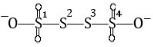
What are the respective oxidation states of sulphur atoms numbered $1$ to $4$ in the tetrathionate ion $(S_4O_6^{2-})$ shown below?
A
$0, +5, +5, 0$
B
$+5, 0, 0, +5$
C
$+2, 0, 0, +2$
D
$+2, -1, -1, +2$
Solution
(B) In the tetrathionate ion $(S_4O_6^{2-})$,the structure consists of a chain of four sulfur atoms.
For the terminal sulfur atoms (numbered $1$ and $4$): Each is bonded to three oxygen atoms (two double-bonded and one single-bonded) and one sulfur atom. The oxidation state is calculated as: $x + 2(-2) + 1(-2) + 1(-1) = -1$ (considering the charge contribution). More simply,using electronegativity: $S$ bonded to $O$ gains $+2$ for each double bond and $+1$ for the single bond,totaling $+5$.
For the central sulfur atoms (numbered $2$ and $3$): Each is bonded to two other sulfur atoms. Since the atoms are identical,the bond between them contributes $0$ to the oxidation state. Thus,the oxidation state of the central sulfur atoms is $0$.
Therefore,the oxidation states for sulfur atoms $1, 2, 3, 4$ are $+5, 0, 0, +5$ respectively.
For the terminal sulfur atoms (numbered $1$ and $4$): Each is bonded to three oxygen atoms (two double-bonded and one single-bonded) and one sulfur atom. The oxidation state is calculated as: $x + 2(-2) + 1(-2) + 1(-1) = -1$ (considering the charge contribution). More simply,using electronegativity: $S$ bonded to $O$ gains $+2$ for each double bond and $+1$ for the single bond,totaling $+5$.
For the central sulfur atoms (numbered $2$ and $3$): Each is bonded to two other sulfur atoms. Since the atoms are identical,the bond between them contributes $0$ to the oxidation state. Thus,the oxidation state of the central sulfur atoms is $0$.
Therefore,the oxidation states for sulfur atoms $1, 2, 3, 4$ are $+5, 0, 0, +5$ respectively.
0 likesView Solution
195
ChemistryMCQMHT CET · 2025
Which of the following is a redox reaction?
A
$NaCl + KNO_3 \longrightarrow NaNO_3 + KCl$
B
$Mg(OH)_2 + 2 NH_4Cl \longrightarrow MgCl_2 + 2 NH_4OH$
C
$CaC_2O_4 + 2 HCl \longrightarrow CaCl_2 + H_2C_2O_4$
D
$Zn + 2 AgCN \longrightarrow 2 Ag + Zn(CN)_2$
Solution
(D) redox reaction is one in which there is a change in the oxidation state of the elements involved.
In option $D$,the reaction is $Zn + 2 AgCN \longrightarrow 2 Ag + Zn(CN)_2$.
The oxidation state of $Zn$ changes from $0$ (in elemental form) to $+2$ (in $Zn(CN)_2$),which is oxidation.
The oxidation state of $Ag$ changes from $+1$ (in $AgCN$) to $0$ (in elemental form),which is reduction.
Since both oxidation and reduction occur,this is a redox reaction.
Options $A$,$B$,and $C$ are double displacement reactions where no change in oxidation state occurs.
In option $D$,the reaction is $Zn + 2 AgCN \longrightarrow 2 Ag + Zn(CN)_2$.
The oxidation state of $Zn$ changes from $0$ (in elemental form) to $+2$ (in $Zn(CN)_2$),which is oxidation.
The oxidation state of $Ag$ changes from $+1$ (in $AgCN$) to $0$ (in elemental form),which is reduction.
Since both oxidation and reduction occur,this is a redox reaction.
Options $A$,$B$,and $C$ are double displacement reactions where no change in oxidation state occurs.
0 likesView Solution
196
ChemistryMediumMCQMHT CET · 2025
Which metal in the following compounds is not present in a fractional oxidation state?
A
$Fe_3O_4$
B
$Mn_3O_4$
C
$Pb_3O_4$
D
$Na_2S_4O_6$
Solution
(D) The oxidation state of a metal in a compound is considered fractional if it represents the average oxidation state of multiple atoms of the same element in different oxidation environments within the same molecule.
$Fe_3O_4$ is a mixed oxide of $FeO$ and $Fe_2O_3$,where $Fe$ exists in $+2$ and $+3$ states. The average oxidation state is $+8/3$.
$Mn_3O_4$ is a mixed oxide of $MnO$ and $Mn_2O_3$,where $Mn$ exists in $+2$ and $+3$ states. The average oxidation state is $+8/3$.
$Pb_3O_4$ is a mixed oxide of $2PbO$ and $PbO_2$,where $Pb$ exists in $+2$ and $+4$ states. The average oxidation state is $+8/3$.
In $Na_2S_4O_6$ (sodium tetrathionate),the sulfur atoms are not metals. The question asks for a metal. However,if we evaluate the oxidation states of the metals provided in the options,all $Fe$,$Mn$,and $Pb$ in these specific mixed oxides show fractional average oxidation states. Given the options,$Na_2S_4O_6$ is the only compound where the central element $(S)$ is a non-metal,and the metal $(Na)$ is in a fixed $+1$ oxidation state.
$Fe_3O_4$ is a mixed oxide of $FeO$ and $Fe_2O_3$,where $Fe$ exists in $+2$ and $+3$ states. The average oxidation state is $+8/3$.
$Mn_3O_4$ is a mixed oxide of $MnO$ and $Mn_2O_3$,where $Mn$ exists in $+2$ and $+3$ states. The average oxidation state is $+8/3$.
$Pb_3O_4$ is a mixed oxide of $2PbO$ and $PbO_2$,where $Pb$ exists in $+2$ and $+4$ states. The average oxidation state is $+8/3$.
In $Na_2S_4O_6$ (sodium tetrathionate),the sulfur atoms are not metals. The question asks for a metal. However,if we evaluate the oxidation states of the metals provided in the options,all $Fe$,$Mn$,and $Pb$ in these specific mixed oxides show fractional average oxidation states. Given the options,$Na_2S_4O_6$ is the only compound where the central element $(S)$ is a non-metal,and the metal $(Na)$ is in a fixed $+1$ oxidation state.
0 likesView Solution
197
ChemistryEasyMCQMHT CET · 2025
$A$ compound contains atoms of $x, y$ and $z$ elements. Oxidation numbers of $x, y$ and $z$ are $+3, +5$ and $-2$ respectively. Identify the possible formula of this compound?
A
$XYZ_2$
B
$Y_2(XZ_3)_2$
C
$X_3(YZ_4)_3$
D
$X_3(Y_4Z)_2$
Solution
(C) For a compound to be electrically neutral,the sum of the oxidation numbers of all atoms must be zero.
Let the formula be $X_a(Y_bZ_c)_d$.
Checking option $C$: $X_3(YZ_4)_3$.
Oxidation state of $X = +3$,$Y = +5$,$Z = -2$.
Total charge $= 3(+3) + 3(+5 + 4(-2)) = 9 + 3(5 - 8) = 9 + 3(-3) = 9 - 9 = 0$.
Since the sum of oxidation numbers is zero,$X_3(YZ_4)_3$ is a possible formula.
Let the formula be $X_a(Y_bZ_c)_d$.
Checking option $C$: $X_3(YZ_4)_3$.
Oxidation state of $X = +3$,$Y = +5$,$Z = -2$.
Total charge $= 3(+3) + 3(+5 + 4(-2)) = 9 + 3(5 - 8) = 9 + 3(-3) = 9 - 9 = 0$.
Since the sum of oxidation numbers is zero,$X_3(YZ_4)_3$ is a possible formula.
0 likesView Solution
198
ChemistryMediumMCQMHT CET · 2025
Which is $NOT$ correct regarding stock notation?
A
$Hg_2Cl_2$ is the reduced form of $HgCl_2$
B
$HgCl_2$ is the oxidised form of $Hg_2Cl_2$
C
It helps to identify whether a species is present in an oxidised or reduced form
D
Aurous chloride is written as $Au(III)Cl_3$
Solution
(D) Stock notation represents the oxidation state of a metal in a compound using Roman numerals in parentheses.
In $Hg_2Cl_2$,the oxidation state of $Hg$ is $+1$,so it is $Hg(I)Cl$. In $HgCl_2$,the oxidation state of $Hg$ is $+2$,so it is $Hg(II)Cl_2$.
Option $A$ and $B$ are correct because $Hg(I)$ is the reduced form of $Hg(II)$.
Option $C$ is correct as stock notation explicitly states the oxidation state.
Option $D$ is incorrect because 'Aurous' refers to $Au(I)$,whereas $Au(III)Cl_3$ is 'Auric chloride'. Therefore,$Au(III)Cl_3$ is not Aurous chloride.
In $Hg_2Cl_2$,the oxidation state of $Hg$ is $+1$,so it is $Hg(I)Cl$. In $HgCl_2$,the oxidation state of $Hg$ is $+2$,so it is $Hg(II)Cl_2$.
Option $A$ and $B$ are correct because $Hg(I)$ is the reduced form of $Hg(II)$.
Option $C$ is correct as stock notation explicitly states the oxidation state.
Option $D$ is incorrect because 'Aurous' refers to $Au(I)$,whereas $Au(III)Cl_3$ is 'Auric chloride'. Therefore,$Au(III)Cl_3$ is not Aurous chloride.
0 likesView Solution
199
ChemistryMediumMCQMHT CET · 2025
What is the number of electrons transferred considering $Mn$ when $KMnO_4$ is converted into $Mn_2O_3$?
A
$1$
B
$3$
C
$4$
D
$5$
Solution
(C) In $KMnO_4$,the oxidation state of $Mn$ is calculated as: $1 + x + 4(-2) = 0$,so $x = +7$.
In $Mn_2O_3$,the oxidation state of $Mn$ is calculated as: $2x + 3(-2) = 0$,so $2x = +6$,which means $x = +3$.
The change in oxidation state per $Mn$ atom is $|7 - 3| = 4$.
Since there are $2$ $Mn$ atoms in $Mn_2O_3$,the total number of electrons transferred is $2 \times 4 = 8$.
However,the question asks for the number of electrons transferred per $Mn$ atom involved in the reduction process from $KMnO_4$ to $Mn_2O_3$.
Considering the stoichiometry $2KMnO_4 \rightarrow Mn_2O_3$,the total change is $2 \times (7 - 3) = 8$ electrons.
Given the options provided,the change per $Mn$ atom is $4$.
In $Mn_2O_3$,the oxidation state of $Mn$ is calculated as: $2x + 3(-2) = 0$,so $2x = +6$,which means $x = +3$.
The change in oxidation state per $Mn$ atom is $|7 - 3| = 4$.
Since there are $2$ $Mn$ atoms in $Mn_2O_3$,the total number of electrons transferred is $2 \times 4 = 8$.
However,the question asks for the number of electrons transferred per $Mn$ atom involved in the reduction process from $KMnO_4$ to $Mn_2O_3$.
Considering the stoichiometry $2KMnO_4 \rightarrow Mn_2O_3$,the total change is $2 \times (7 - 3) = 8$ electrons.
Given the options provided,the change per $Mn$ atom is $4$.
0 likesView Solution
200
ChemistryEasyMCQMHT CET · 2025
What is the difference in oxidation number of $Mn$ in $KMnO_4$ and $MnO_2$?
A
$1$
B
$3$
C
$4$
D
$5$
Solution
(B) In $KMnO_4$,let the oxidation number of $Mn$ be $x$. The sum of oxidation numbers is $1 + x + 4(-2) = 0$,so $x - 7 = 0$,which gives $x = +7$.
In $MnO_2$,let the oxidation number of $Mn$ be $y$. The sum of oxidation numbers is $y + 2(-2) = 0$,so $y - 4 = 0$,which gives $y = +4$.
The difference in oxidation number is $|7 - 4| = 3$.
In $MnO_2$,let the oxidation number of $Mn$ be $y$. The sum of oxidation numbers is $y + 2(-2) = 0$,so $y - 4 = 0$,which gives $y = +4$.
The difference in oxidation number is $|7 - 4| = 3$.
0 likesView Solution
201
ChemistryEasyMCQMHT CET · 2025
Rate law for the reaction $aA + bB \rightarrow cC + dD$ is $r = k[A][B]$. The rate of reaction doubles if:
A
Concentration of both $A$ and $B$ are doubled.
B
Concentration of $A$ is doubled and concentration of $B$ is kept constant.
C
Concentration of $B$ is doubled and concentration of $A$ is halved.
D
Concentration of $A$ is kept constant and concentration of $B$ is halved.
Solution
(B) The given rate law is $r = k[A][B]$.
Let the initial rate be $r_1 = k[A][B]$.
For option $A$: $r_2 = k(2[A])(2[B]) = 4k[A][B] = 4r_1$.
For option $B$: $r_2 = k(2[A])[B] = 2k[A][B] = 2r_1$.
For option $C$: $r_2 = k(0.5[A])(2[B]) = k[A][B] = r_1$.
For option $D$: $r_2 = k[A](0.5[B]) = 0.5k[A][B] = 0.5r_1$.
Thus,the rate of reaction doubles when the concentration of $A$ is doubled and the concentration of $B$ is kept constant.
Let the initial rate be $r_1 = k[A][B]$.
For option $A$: $r_2 = k(2[A])(2[B]) = 4k[A][B] = 4r_1$.
For option $B$: $r_2 = k(2[A])[B] = 2k[A][B] = 2r_1$.
For option $C$: $r_2 = k(0.5[A])(2[B]) = k[A][B] = r_1$.
For option $D$: $r_2 = k[A](0.5[B]) = 0.5k[A][B] = 0.5r_1$.
Thus,the rate of reaction doubles when the concentration of $A$ is doubled and the concentration of $B$ is kept constant.
0 likesView Solution
202
ChemistryEasyMCQMHT CET · 2025
For a reaction,$A + B \longrightarrow \text{product}$,it is found that the rate law is $r = k[A]^{1.5}[B]^{2.5}$. What is the order of reaction?
A
$1.5$
B
$2.5$
C
$1$
D
$4$
Solution
(D) The order of a reaction is defined as the sum of the powers of the concentration terms in the rate law expression.
Given the rate law: $r = k[A]^{1.5}[B]^{2.5}$.
Order of reaction = $1.5 + 2.5 = 4$.
Therefore,the correct option is $D$.
Given the rate law: $r = k[A]^{1.5}[B]^{2.5}$.
Order of reaction = $1.5 + 2.5 = 4$.
Therefore,the correct option is $D$.
0 likesView Solution
203
ChemistryMediumMCQMHT CET · 2025
Rate of reaction is $r_1 = k[A]^a[B]^b$. If the concentration of $A$ is doubled and $B$ is halved,the new rate is $r_2$. What is the value of $\frac{r_2}{r_1}$?
A
$2^{a-b}$
B
$2^{a+b}$
C
$2^{b-a}$
D
$2^{-(a+b)}$
Solution
(A) The initial rate is given by $r_1 = k[A]^a[B]^b$.
When the concentration of $A$ is doubled $([A]' = 2[A])$ and $B$ is halved $([B]' = \frac{1}{2}[B])$,the new rate $r_2$ is:
$r_2 = k(2[A])^a(\frac{1}{2}[B])^b$
$r_2 = k \cdot 2^a \cdot [A]^a \cdot (2^{-1})^b \cdot [B]^b$
$r_2 = 2^a \cdot 2^{-b} \cdot k[A]^a[B]^b$
$r_2 = 2^{a-b} \cdot r_1$
Therefore,the ratio $\frac{r_2}{r_1} = 2^{a-b}$.
When the concentration of $A$ is doubled $([A]' = 2[A])$ and $B$ is halved $([B]' = \frac{1}{2}[B])$,the new rate $r_2$ is:
$r_2 = k(2[A])^a(\frac{1}{2}[B])^b$
$r_2 = k \cdot 2^a \cdot [A]^a \cdot (2^{-1})^b \cdot [B]^b$
$r_2 = 2^a \cdot 2^{-b} \cdot k[A]^a[B]^b$
$r_2 = 2^{a-b} \cdot r_1$
Therefore,the ratio $\frac{r_2}{r_1} = 2^{a-b}$.
0 likesView Solution
204
ChemistryEasyMCQMHT CET · 2025
The rate law for the reaction,$NO_{2(g)} + CO_{(g)} \rightarrow NO_{(g)} + CO_{2(g)}$ is given as $R = k[NO_2]^2$. What is the order of reaction with respect to $CO$?
A
Zero
B
$1$
C
$1.5$
D
$2$
Solution
(A) The rate law is given by the expression $R = k[NO_2]^2[CO]^0$.
Comparing this with the general rate law $R = k[A]^x[B]^y$,we can see that the exponent of the concentration of $CO$ is $0$.
Therefore,the order of the reaction with respect to $CO$ is $0$.
Comparing this with the general rate law $R = k[A]^x[B]^y$,we can see that the exponent of the concentration of $CO$ is $0$.
Therefore,the order of the reaction with respect to $CO$ is $0$.
0 likesView Solution
205
ChemistryEasyMCQMHT CET · 2025
If $r = k[A]^2[B]$ is the rate law equation for the reaction $A + B \rightarrow C$,at $[A] = 1 \ M$ and $[B] = 0.2 \ M$,calculate the rate of reaction if the rate constant is $6.25 \ M^{-2} \ s^{-1}$. (in $M \ s^{-1}$)
A
$1.25$
B
$3.40$
C
$5.88$
D
$8.58$
Solution
(A) The given rate law is $r = k[A]^2[B]$.
Given values are $k = 6.25 \ M^{-2} \ s^{-1}$,$[A] = 1 \ M$,and $[B] = 0.2 \ M$.
Substituting these values into the rate equation:
$r = 6.25 \times (1)^2 \times (0.2)$
$r = 6.25 \times 1 \times 0.2$
$r = 1.25 \ M \ s^{-1}$.
Therefore,the correct option is $A$.
Given values are $k = 6.25 \ M^{-2} \ s^{-1}$,$[A] = 1 \ M$,and $[B] = 0.2 \ M$.
Substituting these values into the rate equation:
$r = 6.25 \times (1)^2 \times (0.2)$
$r = 6.25 \times 1 \times 0.2$
$r = 1.25 \ M \ s^{-1}$.
Therefore,the correct option is $A$.
0 likesView Solution
206
ChemistryEasyMCQMHT CET · 2025
For a reaction $A \rightarrow \text{Product}$,the rate constant is $6.93 \times 10^{-3} \ hour^{-1}$. What is the order of the reaction?
A
Zero
B
$1$
C
$1.5$
D
$2$
Solution
(B) The unit of the rate constant for a reaction of order $n$ is given by $(\text{concentration})^{1-n} \times (\text{time})^{-1}$.
For a first-order reaction $(n=1)$,the unit is $(\text{time})^{-1}$.
Given the unit of the rate constant is $hour^{-1}$,which matches the unit for a first-order reaction.
Therefore,the order of the reaction is $1$.
For a first-order reaction $(n=1)$,the unit is $(\text{time})^{-1}$.
Given the unit of the rate constant is $hour^{-1}$,which matches the unit for a first-order reaction.
Therefore,the order of the reaction is $1$.
0 likesView Solution
207
ChemistryMediumMCQMHT CET · 2025
Which of the following is an example of a second-order reaction?
A
$2 H_2 O_{2(g)} \longrightarrow 2 H_2 O_{(l)} + O_{2(g)}$
B
$H_{2(g)} + I_{2(g)} \longrightarrow 2 HI_{(g)}$
C
$CH_3 CHO_{(g)} \longrightarrow CH_{4(g)} + CO_{(g)}$
D
$2 NO_{(g)} + 2 H_{2(g)} \longrightarrow N_{2(g)} + 2 H_2 O_{(g)}$
Solution
(B) The rate law for the reaction $H_{2(g)} + I_{2(g)} \longrightarrow 2 HI_{(g)}$ is given by $Rate = k[H_2][I_2]$.
Since the sum of the powers of the concentration terms in the rate law is $1 + 1 = 2$,this reaction is a second-order reaction.
Option $B$ is the correct answer.
Since the sum of the powers of the concentration terms in the rate law is $1 + 1 = 2$,this reaction is a second-order reaction.
Option $B$ is the correct answer.
0 likesView Solution
208
ChemistryEasyMCQMHT CET · 2025
Rate of the reaction $A + B \rightarrow \text{product}$ is $3.6 \times 10^{-2} \ mol \ dm^{-3} \ s^{-1}$ and rate law is $r = k[A][B]^2$. What is the rate constant of the reaction if $[A] = 0.2 \ M$ and $[B] = 0.1 \ M$?
A
$10 \ mol^{-2} \ dm^6 \ s^{-1}$
B
$18 \ mol^{-2} \ dm^6 \ s^{-1}$
C
$24 \ mol^{-2} \ dm^6 \ s^{-1}$
D
$4.8 \ mol^{-2} \ dm^6 \ s^{-1}$
Solution
(B) Given rate of reaction $r = 3.6 \times 10^{-2} \ mol \ dm^{-3} \ s^{-1}$.
Rate law is $r = k[A][B]^2$.
Given concentrations are $[A] = 0.2 \ M$ and $[B] = 0.1 \ M$.
Substituting the values in the rate law:
$3.6 \times 10^{-2} = k \times (0.2) \times (0.1)^2$
$3.6 \times 10^{-2} = k \times (0.2) \times (0.01)$
$3.6 \times 10^{-2} = k \times (0.002)$
$k = \frac{3.6 \times 10^{-2}}{2 \times 10^{-3}}$
$k = 1.8 \times 10^1 = 18 \ mol^{-2} \ dm^6 \ s^{-1}$.
Thus,the correct option is $B$.
Rate law is $r = k[A][B]^2$.
Given concentrations are $[A] = 0.2 \ M$ and $[B] = 0.1 \ M$.
Substituting the values in the rate law:
$3.6 \times 10^{-2} = k \times (0.2) \times (0.1)^2$
$3.6 \times 10^{-2} = k \times (0.2) \times (0.01)$
$3.6 \times 10^{-2} = k \times (0.002)$
$k = \frac{3.6 \times 10^{-2}}{2 \times 10^{-3}}$
$k = 1.8 \times 10^1 = 18 \ mol^{-2} \ dm^6 \ s^{-1}$.
Thus,the correct option is $B$.
0 likesView Solution
209
ChemistryEasyMCQMHT CET · 2025
Identify the order of the following reaction: $2 NO_{2(g)} \longrightarrow 2 NO_{(g)} + O_{2(g)}$
A
$1$
B
$1.5$
C
$2$
D
$3$
Solution
(C) The given reaction is $2 NO_{2(g)} \longrightarrow 2 NO_{(g)} + O_{2(g)}$.
This reaction is a well-known example of a second-order reaction at temperatures below $500 \ K$.
The rate law for this reaction is expressed as: $\text{Rate} = k[NO_2]^2$.
Since the exponent of the concentration term $[NO_2]$ is $2$,the order of the reaction is $2$.
This reaction is a well-known example of a second-order reaction at temperatures below $500 \ K$.
The rate law for this reaction is expressed as: $\text{Rate} = k[NO_2]^2$.
Since the exponent of the concentration term $[NO_2]$ is $2$,the order of the reaction is $2$.
0 likesView Solution
210
ChemistryEasyMCQMHT CET · 2025
$A$ complex reaction takes place in the following steps:
$NO_2Cl_{(g)} \longrightarrow NO_{2(g)} + Cl_{(g)}$ (slow)
$NO_2Cl_{(g)} + Cl_{(g)} \longrightarrow NO_{2(g)} + Cl_{2(g)}$ (fast)
Identify the rate law equation for this reaction.
$NO_2Cl_{(g)} \longrightarrow NO_{2(g)} + Cl_{(g)}$ (slow)
$NO_2Cl_{(g)} + Cl_{(g)} \longrightarrow NO_{2(g)} + Cl_{2(g)}$ (fast)
Identify the rate law equation for this reaction.
A
$r = k[NO_2Cl]$
B
$r = k[NO_2][Cl]$
C
$r = k[NO_2]^2$
D
$r = k[NO_2Cl]^2$
Solution
(A) For a complex reaction,the rate of the overall reaction is determined by the slowest step,which is known as the rate-determining step.
In the given mechanism,the first step is the slow step:
$NO_2Cl_{(g)} \longrightarrow NO_{2(g)} + Cl_{(g)}$ (slow)
Therefore,the rate of the reaction depends only on the concentration of the reactant involved in this slow step.
The rate law is given by: $r = k[NO_2Cl]$.
In the given mechanism,the first step is the slow step:
$NO_2Cl_{(g)} \longrightarrow NO_{2(g)} + Cl_{(g)}$ (slow)
Therefore,the rate of the reaction depends only on the concentration of the reactant involved in this slow step.
The rate law is given by: $r = k[NO_2Cl]$.
0 likesView Solution
211
ChemistryEasyMCQMHT CET · 2025
The rate constant for the reaction, $2 \,N_2O_{5(g)} \rightarrow 2 \,N_2O_{4(g)} + O_{2(g)}$ is $4.98 \times 10^{-4} \,s^{-1}$. What is the order of the reaction?
A
$2$
B
$0$
C
$1$
D
$3$
Solution
(C) The unit of the rate constant $(k)$ for a reaction of order $n$ is given by $(mol \ L^{-1})^{1-n} \,s^{-1}$.
For a first-order reaction $(n=1)$, the unit is $(mol \ L^{-1})^{1-1} \,s^{-1} = s^{-1}$.
Since the given unit of the rate constant is $s^{-1}$, the reaction is a first-order reaction.
For a first-order reaction $(n=1)$, the unit is $(mol \ L^{-1})^{1-1} \,s^{-1} = s^{-1}$.
Since the given unit of the rate constant is $s^{-1}$, the reaction is a first-order reaction.
0 likesView Solution
212
ChemistryEasyMCQMHT CET · 2025
Which of the following statements is $NOT$ correct regarding the order of reaction?
A
It is determined experimentally.
B
It is not influenced by stoichiometric coefficient of reactants.
C
It is the sum of powers of the concentration terms of reactants in the rate law equation.
D
It is always a whole number.
Solution
(D) The order of a reaction is defined as the sum of the powers of the concentration terms of the reactants in the rate law expression.
It is an experimental quantity and is not necessarily related to the stoichiometric coefficients of the balanced chemical equation.
Crucially,the order of a reaction can be zero,a fraction,or a whole number.
Therefore,the statement that it is always a whole number is incorrect.
It is an experimental quantity and is not necessarily related to the stoichiometric coefficients of the balanced chemical equation.
Crucially,the order of a reaction can be zero,a fraction,or a whole number.
Therefore,the statement that it is always a whole number is incorrect.
0 likesView Solution
213
ChemistryEasyMCQMHT CET · 2025
Which of the following is correct regarding $t_{1/2}$ of a reaction if we double the initial concentration of a reactant in a first-order reaction?
A
$t_{1/2}$ will increase by two times
B
$t_{1/2}$ will decrease by four times
C
$t_{1/2}$ remains the same
D
$t_{1/2}$ will decrease by two times
Solution
(C) For a first-order reaction,the half-life $(t_{1/2})$ is given by the formula: $t_{1/2} = \frac{0.693}{k}$.
Here,$k$ is the rate constant of the reaction.
As seen in the formula,$t_{1/2}$ is independent of the initial concentration of the reactant.
Therefore,if the initial concentration is doubled,the half-life remains unchanged.
Here,$k$ is the rate constant of the reaction.
As seen in the formula,$t_{1/2}$ is independent of the initial concentration of the reactant.
Therefore,if the initial concentration is doubled,the half-life remains unchanged.
0 likesView Solution
214
ChemistryMediumMCQMHT CET · 2025
In a first order reaction,the concentration of the reactant decreases from $20 \ mmol \ dm^{-3}$ to $8 \ mmol \ dm^{-3}$ in $40 \ minute$. Find the rate constant of the reaction.
A
$0.011 \ minute^{-1}$
B
$0.023 \ minute^{-1}$
C
$0.032 \ minute^{-1}$
D
$0.041 \ minute^{-1}$
Solution
(B) For a first order reaction,the rate constant $k$ is given by the formula: $k = \frac{2.303}{t} \log \frac{[A]_0}{[A]_t}$
Given:
Initial concentration $[A]_0 = 20 \ mmol \ dm^{-3}$
Final concentration $[A]_t = 8 \ mmol \ dm^{-3}$
Time $t = 40 \ minute$
Substituting the values:
$k = \frac{2.303}{40} \log \frac{20}{8}$
$k = \frac{2.303}{40} \log(2.5)$
Since $\log(2.5) \approx 0.3979$:
$k = \frac{2.303 \times 0.3979}{40} \approx 0.0229 \ minute^{-1}$
Rounding off,we get $k \approx 0.023 \ minute^{-1}$.
Given:
Initial concentration $[A]_0 = 20 \ mmol \ dm^{-3}$
Final concentration $[A]_t = 8 \ mmol \ dm^{-3}$
Time $t = 40 \ minute$
Substituting the values:
$k = \frac{2.303}{40} \log \frac{20}{8}$
$k = \frac{2.303}{40} \log(2.5)$
Since $\log(2.5) \approx 0.3979$:
$k = \frac{2.303 \times 0.3979}{40} \approx 0.0229 \ minute^{-1}$
Rounding off,we get $k \approx 0.023 \ minute^{-1}$.
0 likesView Solution
215
ChemistryMediumMCQMHT CET · 2025
Half life of a first order reaction is $900 \ \text{min}$ at $400 \ K$. Find its half life at $300 \ K$. Given: $\frac{E_a}{2.303 \ R} = 1.3056 \times 10^3 \ K$. (in $\text{min}$)
A
$5512.5$
B
$11025.0$
C
$8314.3$
D
$2303.1$
Solution
(B) For a first order reaction,the rate constant $k$ is related to half-life $t_{1/2}$ by $k = \frac{0.693}{t_{1/2}}$.
Using the Arrhenius equation: $\log \frac{k_2}{k_1} = \frac{E_a}{2.303 \ R} \left( \frac{1}{T_1} - \frac{1}{T_2} \right)$.
Substituting $k = \frac{0.693}{t_{1/2}}$,we get $\log \frac{t_{1/2, 1}}{t_{1/2, 2}} = \frac{E_a}{2.303 \ R} \left( \frac{1}{T_1} - \frac{1}{T_2} \right)$.
Given $T_1 = 400 \ K$,$t_{1/2, 1} = 900 \ \text{min}$,$T_2 = 300 \ K$,and $\frac{E_a}{2.303 \ R} = 1305.6 \ K$.
$\log \frac{900}{t_{1/2, 2}} = 1305.6 \left( \frac{1}{400} - \frac{1}{300} \right) = 1305.6 \left( \frac{3 - 4}{1200} \right) = 1305.6 \left( -\frac{1}{1200} \right) = -1.088$.
$\frac{900}{t_{1/2, 2}} = 10^{-1.088} \approx 0.08166$.
$t_{1/2, 2} = \frac{900}{0.08166} \approx 11021 \ \text{min}$.
The closest option is $11025.0 \ \text{min}$.
Using the Arrhenius equation: $\log \frac{k_2}{k_1} = \frac{E_a}{2.303 \ R} \left( \frac{1}{T_1} - \frac{1}{T_2} \right)$.
Substituting $k = \frac{0.693}{t_{1/2}}$,we get $\log \frac{t_{1/2, 1}}{t_{1/2, 2}} = \frac{E_a}{2.303 \ R} \left( \frac{1}{T_1} - \frac{1}{T_2} \right)$.
Given $T_1 = 400 \ K$,$t_{1/2, 1} = 900 \ \text{min}$,$T_2 = 300 \ K$,and $\frac{E_a}{2.303 \ R} = 1305.6 \ K$.
$\log \frac{900}{t_{1/2, 2}} = 1305.6 \left( \frac{1}{400} - \frac{1}{300} \right) = 1305.6 \left( \frac{3 - 4}{1200} \right) = 1305.6 \left( -\frac{1}{1200} \right) = -1.088$.
$\frac{900}{t_{1/2, 2}} = 10^{-1.088} \approx 0.08166$.
$t_{1/2, 2} = \frac{900}{0.08166} \approx 11021 \ \text{min}$.
The closest option is $11025.0 \ \text{min}$.
0 likesView Solution
216
ChemistryMediumMCQMHT CET · 2025
Half life of a first order reaction is $3 \ minute$. What is the time required to reduce the concentration of reactant by $90 \%$ of its initial concentration?
A
$4.12 \ minute$
B
$7.32 \ minute$
C
$9.97 \ minute$
D
$12.05 \ minute$
Solution
(C) For a first order reaction,the rate constant $k$ is given by $k = \frac{0.693}{t_{1/2}}$.
Given $t_{1/2} = 3 \ minute$,so $k = \frac{0.693}{3} = 0.231 \ minute^{-1}$.
The time $t$ required for a first order reaction is given by $t = \frac{2.303}{k} \log \frac{[A]_0}{[A]_t}$.
If the concentration is reduced by $90 \%$,then $[A]_t = [A]_0 - 0.90[A]_0 = 0.10[A]_0$.
Substituting the values: $t = \frac{2.303}{0.231} \log \frac{[A]_0}{0.10[A]_0} = \frac{2.303}{0.231} \log(10)$.
Since $\log(10) = 1$,$t = \frac{2.303}{0.231} \approx 9.97 \ minute$.
Given $t_{1/2} = 3 \ minute$,so $k = \frac{0.693}{3} = 0.231 \ minute^{-1}$.
The time $t$ required for a first order reaction is given by $t = \frac{2.303}{k} \log \frac{[A]_0}{[A]_t}$.
If the concentration is reduced by $90 \%$,then $[A]_t = [A]_0 - 0.90[A]_0 = 0.10[A]_0$.
Substituting the values: $t = \frac{2.303}{0.231} \log \frac{[A]_0}{0.10[A]_0} = \frac{2.303}{0.231} \log(10)$.
Since $\log(10) = 1$,$t = \frac{2.303}{0.231} \approx 9.97 \ minute$.
0 likesView Solution
217
ChemistryEasyMCQMHT CET · 2025
Calculate the time in seconds required to reduce the concentration of reactant to half of initial concentration for a first order reaction if the rate constant is $1.386 \times 10^{-3} \ s^{-1}$. (in $s$)
A
$500$
B
$290$
C
$390$
D
$500$
Solution
(A) For a first order reaction,the half-life $(t_{1/2})$ is given by the formula: $t_{1/2} = \frac{0.693}{k}$.
Given the rate constant $k = 1.386 \times 10^{-3} \ s^{-1}$.
Substituting the value of $k$ into the formula:
$t_{1/2} = \frac{0.693}{1.386 \times 10^{-3} \ s^{-1}}$.
$t_{1/2} = \frac{0.693}{1.386} \times 10^{3} \ s$.
$t_{1/2} = 0.5 \times 1000 \ s = 500 \ s$.
Given the rate constant $k = 1.386 \times 10^{-3} \ s^{-1}$.
Substituting the value of $k$ into the formula:
$t_{1/2} = \frac{0.693}{1.386 \times 10^{-3} \ s^{-1}}$.
$t_{1/2} = \frac{0.693}{1.386} \times 10^{3} \ s$.
$t_{1/2} = 0.5 \times 1000 \ s = 500 \ s$.
0 likesView Solution
218
ChemistryEasyMCQMHT CET · 2025
For a reaction,$A \rightarrow B$,the rate equation is $r = K[A]^0$. If the initial concentration of the reactant is $a \ mol \ dm^{-3}$,find the half-life time of the reaction.
A
$\frac{a}{4k}$
B
$\frac{a}{k}$
C
$\frac{5a}{2k}$
D
$\frac{a}{2k}$
Solution
(D) For a zero-order reaction,the rate law is given by $r = K[A]^0 = K$.
Integrating the rate equation,we get $[A]_t = [A]_0 - Kt$.
At half-life $(t = t_{1/2})$,the concentration of the reactant $[A]_t = \frac{[A]_0}{2} = \frac{a}{2}$.
Substituting these values into the integrated rate equation: $\frac{a}{2} = a - K t_{1/2}$.
Rearranging for $t_{1/2}$: $K t_{1/2} = a - \frac{a}{2} = \frac{a}{2}$.
Therefore,$t_{1/2} = \frac{a}{2K}$.
Integrating the rate equation,we get $[A]_t = [A]_0 - Kt$.
At half-life $(t = t_{1/2})$,the concentration of the reactant $[A]_t = \frac{[A]_0}{2} = \frac{a}{2}$.
Substituting these values into the integrated rate equation: $\frac{a}{2} = a - K t_{1/2}$.
Rearranging for $t_{1/2}$: $K t_{1/2} = a - \frac{a}{2} = \frac{a}{2}$.
Therefore,$t_{1/2} = \frac{a}{2K}$.
0 likesView Solution
219
ChemistryMediumMCQMHT CET · 2025
Half life of a first order reaction is $20 \ min$. The time taken to reduce the initial concentration of reactant to $(1/10)^{th}$ is $\qquad$ (in $min$)
A
$66.46$
B
$72.50$
C
$79.68$
D
$88.00$
Solution
(A) For a first order reaction,the rate constant $k$ is given by $k = \frac{0.693}{t_{1/2}}$.
Given $t_{1/2} = 20 \ min$,so $k = \frac{0.693}{20} = 0.03465 \ min^{-1}$.
The time $t$ required for the concentration to become $(1/10)^{th}$ of the initial concentration is given by the formula $t = \frac{2.303}{k} \log(\frac{[A]_0}{[A]_t})$.
Here,$[A]_t = \frac{[A]_0}{10}$,so $\frac{[A]_0}{[A]_t} = 10$.
Substituting the values: $t = \frac{2.303}{0.03465} \times \log(10)$.
Since $\log(10) = 1$,$t = \frac{2.303}{0.03465} \approx 66.46 \ min$.
Given $t_{1/2} = 20 \ min$,so $k = \frac{0.693}{20} = 0.03465 \ min^{-1}$.
The time $t$ required for the concentration to become $(1/10)^{th}$ of the initial concentration is given by the formula $t = \frac{2.303}{k} \log(\frac{[A]_0}{[A]_t})$.
Here,$[A]_t = \frac{[A]_0}{10}$,so $\frac{[A]_0}{[A]_t} = 10$.
Substituting the values: $t = \frac{2.303}{0.03465} \times \log(10)$.
Since $\log(10) = 1$,$t = \frac{2.303}{0.03465} \approx 66.46 \ min$.
0 likesView Solution
220
ChemistryMediumMCQMHT CET · 2025
The half-life values for two different first-order reactions $A$ and $B$ are $75 \ min$ and $2.5 \ h$ respectively. What is the ratio of their rate constants $\frac{k_A}{k_B}$?
A
$2.0$
B
$4.5$
C
$14.2$
D
$22.0$
Solution
(A) For a first-order reaction,the rate constant $k$ is related to the half-life $t_{1/2}$ by the formula $k = \frac{0.693}{t_{1/2}}$.
Given for reaction $A$: $t_{1/2, A} = 75 \ min$.
Given for reaction $B$: $t_{1/2, B} = 2.5 \ h = 2.5 \times 60 \ min = 150 \ min$.
The rate constant for $A$ is $k_A = \frac{0.693}{75}$.
The rate constant for $B$ is $k_B = \frac{0.693}{150}$.
The ratio of rate constants is $\frac{k_A}{k_B} = \frac{0.693 / 75}{0.693 / 150} = \frac{150}{75} = 2.0$.
Thus,the ratio is $2.0$.
Given for reaction $A$: $t_{1/2, A} = 75 \ min$.
Given for reaction $B$: $t_{1/2, B} = 2.5 \ h = 2.5 \times 60 \ min = 150 \ min$.
The rate constant for $A$ is $k_A = \frac{0.693}{75}$.
The rate constant for $B$ is $k_B = \frac{0.693}{150}$.
The ratio of rate constants is $\frac{k_A}{k_B} = \frac{0.693 / 75}{0.693 / 150} = \frac{150}{75} = 2.0$.
Thus,the ratio is $2.0$.
0 likesView Solution
221
ChemistryMediumMCQMHT CET · 2025
Which of the following is an example of a first-order reaction?
A
$CH_3CHO_{(g)} \rightarrow CH_{4_{(g)}} + CO_{(g)}$
B
$2NO_{2_{(g)}} + F_{2_{(g)}} \rightarrow 2NO_2F_{(g)}$
C
$2NO_{(g)} + 2H_{2_{(g)}} \rightarrow N_{2_{(g)}} + 2H_2O_{(g)}$
D
$2H_2O_{2_{(aq)}} \rightarrow 2H_2O_{(l)} + O_{2_{(g)}}$
Solution
(D) The decomposition of hydrogen peroxide $(2H_2O_{2_{(aq)}} \rightarrow 2H_2O_{(l)} + O_{2_{(g)}})$ is a well-known example of a first-order reaction.
In this reaction,the rate of decomposition depends on the concentration of $H_2O_2$ raised to the power of $1$,i.e.,$\text{Rate} = k[H_2O_2]^1$.
In this reaction,the rate of decomposition depends on the concentration of $H_2O_2$ raised to the power of $1$,i.e.,$\text{Rate} = k[H_2O_2]^1$.
0 likesView Solution
222
ChemistryMediumMCQMHT CET · 2025
The rate constant of a first order reaction is $1.15 \times 10^{-3} \ s^{-1}$. How long will $5 \ g$ of reactant take to reduce to $3 \ g$ (in $s$)?
A
$314$
B
$240$
C
$404$
D
$444$
Solution
(D) For a first order reaction,the integrated rate equation is given by: $k = \frac{2.303}{t} \log \frac{[A]_0}{[A]_t}$
Given: $k = 1.15 \times 10^{-3} \ s^{-1}$,$[A]_0 = 5 \ g$,$[A]_t = 3 \ g$
Substituting the values: $1.15 \times 10^{-3} = \frac{2.303}{t} \log \frac{5}{3}$
$t = \frac{2.303}{1.15 \times 10^{-3}} \log(1.666)$
$t = \frac{2.303}{1.15 \times 10^{-3}} \times 0.2218$
$t \approx 444 \ s$
Therefore,the correct option is $D$.
Given: $k = 1.15 \times 10^{-3} \ s^{-1}$,$[A]_0 = 5 \ g$,$[A]_t = 3 \ g$
Substituting the values: $1.15 \times 10^{-3} = \frac{2.303}{t} \log \frac{5}{3}$
$t = \frac{2.303}{1.15 \times 10^{-3}} \log(1.666)$
$t = \frac{2.303}{1.15 \times 10^{-3}} \times 0.2218$
$t \approx 444 \ s$
Therefore,the correct option is $D$.
0 likesView Solution
223
ChemistryMediumMCQMHT CET · 2025
$A$ first order reaction is $50 \%$ completed in $16 \ minutes$. Find the percentage of reactant reacting in $32 \ minutes$. (in $\%$)
A
$25$
B
$40$
C
$50$
D
$75$
Solution
(D) For a first order reaction,the half-life $(t_{1/2})$ is the time taken for $50 \%$ completion. Given $t_{1/2} = 16 \ minutes$.
In $32 \ minutes$,the number of half-lives elapsed is $n = \frac{32}{16} = 2$.
The fraction of reactant remaining after $n$ half-lives is given by $(\frac{1}{2})^n$.
Remaining fraction = $(\frac{1}{2})^2 = \frac{1}{4} = 0.25$ or $25 \%$.
The percentage of reactant reacted = $100 \% - 25 \% = 75 \%$.
In $32 \ minutes$,the number of half-lives elapsed is $n = \frac{32}{16} = 2$.
The fraction of reactant remaining after $n$ half-lives is given by $(\frac{1}{2})^n$.
Remaining fraction = $(\frac{1}{2})^2 = \frac{1}{4} = 0.25$ or $25 \%$.
The percentage of reactant reacted = $100 \% - 25 \% = 75 \%$.
0 likesView Solution
224
ChemistryMediumMCQMHT CET · 2025
What is the time required for $99 \%$ completion of a first order reaction if the rate constant is $23.03 \ min^{-1}$?
A
$0.2 \ minute$
B
$0.4 \ minute$
C
$6.2 \ minute$
D
$8.1 \ minute$
Solution
(A) For a first order reaction,the rate constant $k$ is given by the formula: $k = \frac{2.303}{t} \log \frac{[A]_0}{[A]_t}$.
Here,$[A]_0 = 100$ and $[A]_t = 100 - 99 = 1$.
Given $k = 23.03 \ min^{-1}$.
Substituting the values: $23.03 = \frac{2.303}{t} \log \frac{100}{1}$.
$23.03 = \frac{2.303}{t} \log(10^2)$.
$23.03 = \frac{2.303 \times 2}{t}$.
$t = \frac{4.606}{23.03} = 0.2 \ min$.
Here,$[A]_0 = 100$ and $[A]_t = 100 - 99 = 1$.
Given $k = 23.03 \ min^{-1}$.
Substituting the values: $23.03 = \frac{2.303}{t} \log \frac{100}{1}$.
$23.03 = \frac{2.303}{t} \log(10^2)$.
$23.03 = \frac{2.303 \times 2}{t}$.
$t = \frac{4.606}{23.03} = 0.2 \ min$.
0 likesView Solution
225
ChemistryEasyMCQMHT CET · 2025
The slope of a graph $\log [A]_t$ versus '$t$' for a first-order reaction is $-2.5 \times 10^{-3} \,s^{-1}$. Find the rate constant of the reaction.
A
$1.263 \times 10^{-3} \,s^{-1}$
B
$3.471 \times 10^{-3} \,s^{-1}$
C
$5.757 \times 10^{-3} \,s^{-1}$
D
$8.125 \times 10^{-3} \,s^{-1}$
Solution
(C) For a first-order reaction, the integrated rate equation is $\ln [A]_t = -kt + \ln [A]_0$.
Converting this to base $10$ logarithm: $\log [A]_t = -\frac{k}{2.303}t + \log [A]_0$.
The slope of the graph $\log [A]_t$ versus '$t$' is given by $m = -\frac{k}{2.303}$.
Given slope $m = -2.5 \times 10^{-3} \,s^{-1}$.
Therefore, $-\frac{k}{2.303} = -2.5 \times 10^{-3} \,s^{-1}$.
$k = 2.5 \times 10^{-3} \times 2.303 \,s^{-1} = 5.7575 \times 10^{-3} \,s^{-1}$.
Thus, the rate constant is $5.757 \times 10^{-3} \,s^{-1}$.
Converting this to base $10$ logarithm: $\log [A]_t = -\frac{k}{2.303}t + \log [A]_0$.
The slope of the graph $\log [A]_t$ versus '$t$' is given by $m = -\frac{k}{2.303}$.
Given slope $m = -2.5 \times 10^{-3} \,s^{-1}$.
Therefore, $-\frac{k}{2.303} = -2.5 \times 10^{-3} \,s^{-1}$.
$k = 2.5 \times 10^{-3} \times 2.303 \,s^{-1} = 5.7575 \times 10^{-3} \,s^{-1}$.
Thus, the rate constant is $5.757 \times 10^{-3} \,s^{-1}$.
0 likesView Solution
226
ChemistryMediumMCQMHT CET · 2025
What is the numerical value of the rate constant of a first-order reaction that is $20 \%$ completed in $10 \ min$ (in $min^{-1}$)?
A
$0.0223$
B
$0.0322$
C
$0.223$
D
$0.322$
Solution
(A) For a first-order reaction,the rate constant $k$ is given by the formula: $k = \frac{2.303}{t} \log \frac{[A]_0}{[A]_t}$
Given that the reaction is $20 \%$ completed,the remaining concentration $[A]_t$ is $80 \%$ of the initial concentration $[A]_0$.
So,$[A]_t = 0.80 [A]_0$ and $t = 10 \ min$.
Substituting these values: $k = \frac{2.303}{10} \log \frac{1}{0.8} = \frac{2.303}{10} \log(1.25)$.
Since $\log(1.25) \approx 0.0969$,we get $k = \frac{2.303 \times 0.0969}{10} \approx 0.0223 \ min^{-1}$.
Given that the reaction is $20 \%$ completed,the remaining concentration $[A]_t$ is $80 \%$ of the initial concentration $[A]_0$.
So,$[A]_t = 0.80 [A]_0$ and $t = 10 \ min$.
Substituting these values: $k = \frac{2.303}{10} \log \frac{1}{0.8} = \frac{2.303}{10} \log(1.25)$.
Since $\log(1.25) \approx 0.0969$,we get $k = \frac{2.303 \times 0.0969}{10} \approx 0.0223 \ min^{-1}$.
0 likesView Solution
227
ChemistryMediumMCQMHT CET · 2025
What is the half-life of a first-order reaction if the time required to decrease the concentration of the reactant from $0.4 \ M$ to $0.1 \ M$ is $x \ \text{hours}$?
A
$x \ \text{hours}$
B
$2 \ x \ \text{hours}$
C
$\frac{x}{2} \ \text{hours}$
D
$\frac{x}{3} \ \text{hours}$
Solution
(C) For a first-order reaction,the rate constant $k$ is given by the formula: $k = \frac{2.303}{t} \log \frac{[A]_0}{[A]_t}$.
Given,$[A]_0 = 0.4 \ M$,$[A]_t = 0.1 \ M$,and $t = x \ \text{hours}$.
Substituting these values: $k = \frac{2.303}{x} \log \frac{0.4}{0.1} = \frac{2.303}{x} \log 4 = \frac{2.303}{x} \times 2 \log 2$.
Since $\log 2 \approx 0.3010$,$k = \frac{2.303 \times 2 \times 0.3010}{x} = \frac{1.386}{x}$.
The half-life $t_{1/2}$ is given by: $t_{1/2} = \frac{0.693}{k}$.
Substituting $k$: $t_{1/2} = \frac{0.693}{1.386 / x} = \frac{0.693 \times x}{1.386} = \frac{x}{2} \ \text{hours}$.
Given,$[A]_0 = 0.4 \ M$,$[A]_t = 0.1 \ M$,and $t = x \ \text{hours}$.
Substituting these values: $k = \frac{2.303}{x} \log \frac{0.4}{0.1} = \frac{2.303}{x} \log 4 = \frac{2.303}{x} \times 2 \log 2$.
Since $\log 2 \approx 0.3010$,$k = \frac{2.303 \times 2 \times 0.3010}{x} = \frac{1.386}{x}$.
The half-life $t_{1/2}$ is given by: $t_{1/2} = \frac{0.693}{k}$.
Substituting $k$: $t_{1/2} = \frac{0.693}{1.386 / x} = \frac{0.693 \times x}{1.386} = \frac{x}{2} \ \text{hours}$.
0 likesView Solution
228
ChemistryEasyMCQMHT CET · 2025
If a reaction occurs in the following two steps:
$i) \ 2 ClO^{-} \rightarrow ClO_2^{-} + Cl^{-}$
$ii) \ ClO_2^{-} + ClO^{-} \rightarrow ClO_3^{-} + Cl^{-}$
Find the reaction intermediate.
$i) \ 2 ClO^{-} \rightarrow ClO_2^{-} + Cl^{-}$
$ii) \ ClO_2^{-} + ClO^{-} \rightarrow ClO_3^{-} + Cl^{-}$
Find the reaction intermediate.
A
$ClO^{-}$
B
$ClO_3^{-}$
C
$Cl^{-}$
D
$ClO_2^{-}$
Solution
(D) reaction intermediate is a substance that is produced in one step of a reaction mechanism and consumed in a subsequent step.
In the given mechanism:
Step $i$: $2 ClO^{-} \rightarrow ClO_2^{-} + Cl^{-}$
Step $ii$: $ClO_2^{-} + ClO^{-} \rightarrow ClO_3^{-} + Cl^{-}$
The species $ClO_2^{-}$ is produced in step $i$ and consumed in step $ii$.
Therefore,$ClO_2^{-}$ is the reaction intermediate.
In the given mechanism:
Step $i$: $2 ClO^{-} \rightarrow ClO_2^{-} + Cl^{-}$
Step $ii$: $ClO_2^{-} + ClO^{-} \rightarrow ClO_3^{-} + Cl^{-}$
The species $ClO_2^{-}$ is produced in step $i$ and consumed in step $ii$.
Therefore,$ClO_2^{-}$ is the reaction intermediate.
0 likesView Solution
229
ChemistryMediumMCQMHT CET · 2025
The rate constant for a first order reaction is $0.58 \ s^{-1}$ at $300 \ K$ and $0.026 \ s^{-1}$ at $290 \ K$. What is the energy of activation? $(R=8.314 \ J \ K^{-1} \ mol^{-1})$
A
$124.48 \ kJ \ mol^{-1}$
B
$224.55 \ kJ \ mol^{-1}$
C
$348.18 \ kJ \ mol^{-1}$
D
$513.21 \ kJ \ mol^{-1}$
Solution
(B) The Arrhenius equation is given by: $\ln(\frac{k_2}{k_1}) = \frac{E_a}{R} [\frac{T_2 - T_1}{T_1 T_2}]$.
Given: $k_1 = 0.026 \ s^{-1}$ at $T_1 = 290 \ K$,$k_2 = 0.58 \ s^{-1}$ at $T_2 = 300 \ K$,and $R = 8.314 \ J \ K^{-1} \ mol^{-1}$.
Substituting the values: $\ln(\frac{0.58}{0.026}) = \frac{E_a}{8.314} [\frac{300 - 290}{300 \times 290}]$.
$\ln(22.307) = \frac{E_a}{8.314} [\frac{10}{87000}]$.
$3.1048 = \frac{E_a}{8.314} \times 1.1494 \times 10^{-4}$.
$E_a = \frac{3.1048 \times 8.314}{1.1494 \times 10^{-4}} \approx 224600 \ J \ mol^{-1} = 224.6 \ kJ \ mol^{-1}$.
The closest option is $224.55 \ kJ \ mol^{-1}$.
Given: $k_1 = 0.026 \ s^{-1}$ at $T_1 = 290 \ K$,$k_2 = 0.58 \ s^{-1}$ at $T_2 = 300 \ K$,and $R = 8.314 \ J \ K^{-1} \ mol^{-1}$.
Substituting the values: $\ln(\frac{0.58}{0.026}) = \frac{E_a}{8.314} [\frac{300 - 290}{300 \times 290}]$.
$\ln(22.307) = \frac{E_a}{8.314} [\frac{10}{87000}]$.
$3.1048 = \frac{E_a}{8.314} \times 1.1494 \times 10^{-4}$.
$E_a = \frac{3.1048 \times 8.314}{1.1494 \times 10^{-4}} \approx 224600 \ J \ mol^{-1} = 224.6 \ kJ \ mol^{-1}$.
The closest option is $224.55 \ kJ \ mol^{-1}$.
0 likesView Solution
230
ChemistryMediumMCQMHT CET · 2025
The rate constant is doubled when temperature increases from $27^{\circ} C$ to $37^{\circ} C$. What is the activation energy in $kJ \ mol^{-1}$?
A
$21.32$
B
$34.12$
C
$53.6$
D
$43.54$
Solution
(C) Given: $T_1 = 27^{\circ} C = 300 \ K$,$T_2 = 37^{\circ} C = 310 \ K$.
The rate constant doubles,so $k_2 = 2k_1$.
Using the Arrhenius equation: $\log(\frac{k_2}{k_1}) = \frac{E_a}{2.303R} \times (\frac{T_2 - T_1}{T_1 T_2})$.
Substituting the values: $\log(2) = \frac{E_a}{2.303 \times 8.314} \times (\frac{310 - 300}{300 \times 310})$.
$0.3010 = \frac{E_a}{19.147} \times (\frac{10}{93000})$.
$E_a = \frac{0.3010 \times 19.147 \times 93000}{10} \approx 53598 \ J \ mol^{-1} \approx 53.6 \ kJ \ mol^{-1}$.
The rate constant doubles,so $k_2 = 2k_1$.
Using the Arrhenius equation: $\log(\frac{k_2}{k_1}) = \frac{E_a}{2.303R} \times (\frac{T_2 - T_1}{T_1 T_2})$.
Substituting the values: $\log(2) = \frac{E_a}{2.303 \times 8.314} \times (\frac{310 - 300}{300 \times 310})$.
$0.3010 = \frac{E_a}{19.147} \times (\frac{10}{93000})$.
$E_a = \frac{0.3010 \times 19.147 \times 93000}{10} \approx 53598 \ J \ mol^{-1} \approx 53.6 \ kJ \ mol^{-1}$.
0 likesView Solution
231
ChemistryMediumMCQMHT CET · 2025
Calculate the rate constant of a first-order reaction having a pre-exponential factor $A = 1.6 \times 10^{13} \ s^{-1}$ and $\frac{E_a}{2.303 RT} = 21$.
A
$1.6 \times 10^{-13} \ s^{-1}$
B
$3.2 \times 10^{-13} \ s^{-1}$
C
$3.2 \times 10^{-8} \ s^{-1}$
D
$1.6 \times 10^{-8} \ s^{-1}$
Solution
(D) The Arrhenius equation is given by $k = A \cdot e^{-E_a / RT}$.
Taking the logarithm on both sides,we get $\log k = \log A - \frac{E_a}{2.303 RT}$.
Given values are $A = 1.6 \times 10^{13} \ s^{-1}$ and $\frac{E_a}{2.303 RT} = 21$.
Substituting these values into the equation: $\log k = \log(1.6 \times 10^{13}) - 21$.
$\log k = \log(1.6) + \log(10^{13}) - 21$.
$\log k = 0.204 + 13 - 21$.
$\log k = 13.204 - 21 = -7.796$.
$k = \text{antilog}(-7.796) = \text{antilog}(-8 + 0.204) = 1.6 \times 10^{-8} \ s^{-1}$.
Taking the logarithm on both sides,we get $\log k = \log A - \frac{E_a}{2.303 RT}$.
Given values are $A = 1.6 \times 10^{13} \ s^{-1}$ and $\frac{E_a}{2.303 RT} = 21$.
Substituting these values into the equation: $\log k = \log(1.6 \times 10^{13}) - 21$.
$\log k = \log(1.6) + \log(10^{13}) - 21$.
$\log k = 0.204 + 13 - 21$.
$\log k = 13.204 - 21 = -7.796$.
$k = \text{antilog}(-7.796) = \text{antilog}(-8 + 0.204) = 1.6 \times 10^{-8} \ s^{-1}$.
0 likesView Solution
232
ChemistryEasyMCQMHT CET · 2025
Identify the false statement regarding aspirin.
A
It contains an amide linkage.
B
It is obtained from salicylic acid.
C
It has fewer side effects than salicylic acid.
D
It has stomach irritating side effects.
Solution
(A) Aspirin is chemically known as $2$-acetoxybenzoic acid.
It is prepared by the acetylation of salicylic acid.
It contains an ester linkage $(-COO-)$ and a carboxylic acid group $(-COOH)$,not an amide linkage.
Therefore,the statement that it contains an amide linkage is false.
Additionally,aspirin is known to cause stomach irritation as a side effect,although it is generally safer than salicylic acid.
It is prepared by the acetylation of salicylic acid.
It contains an ester linkage $(-COO-)$ and a carboxylic acid group $(-COOH)$,not an amide linkage.
Therefore,the statement that it contains an amide linkage is false.
Additionally,aspirin is known to cause stomach irritation as a side effect,although it is generally safer than salicylic acid.
0 likesView Solution
233
ChemistryEasyMCQMHT CET · 2025
Identify an antiseptic compound from the following.
A
Salvarsan
B
Thymol
C
Sulphanilamide
D
Chloramphenicol
Solution
(B) Antiseptics are chemical substances that prevent the growth of microorganisms or kill them and are applied to living tissues such as wounds,cuts,ulcers,and diseased skin surfaces.
$Thymol$ is a well-known antiseptic compound.
$Salvarsan$ is an antibiotic (specifically an anti-syphilitic drug).
$Sulphanilamide$ is a sulpha drug (antibacterial).
$Chloramphenicol$ is a broad-spectrum antibiotic.
Therefore,the correct option is $B$.
$Thymol$ is a well-known antiseptic compound.
$Salvarsan$ is an antibiotic (specifically an anti-syphilitic drug).
$Sulphanilamide$ is a sulpha drug (antibacterial).
$Chloramphenicol$ is a broad-spectrum antibiotic.
Therefore,the correct option is $B$.
0 likesView Solution
234
ChemistryEasyMCQMHT CET · 2025
Identify the source of gallic acid from the following.
A
Clove
B
Wintergreen
C
Citrus fruits
D
Indian gooseberry
Solution
(D) Gallic acid is a naturally occurring phenolic acid found in various plants. Among the given options,$Indian \ gooseberry$ (also known as $Amla$) is a rich source of gallic acid.
0 likesView Solution
235
ChemistryEasyMCQMHT CET · 2025
What is the chemical formula of mustard gas?
A
$COCl_2$
B
$ClCH_2CH_2SCH_2CH_2Cl$
C
$CCl_3NO_2$
D
$CCl_2F_2$
Solution
(B) Mustard gas is a chemical warfare agent known as $2,2'$-dichlorodiethyl sulfide.
Its chemical formula is $ClCH_2CH_2SCH_2CH_2Cl$.
Its chemical formula is $ClCH_2CH_2SCH_2CH_2Cl$.
0 likesView Solution
236
ChemistryEasyMCQMHT CET · 2025
Which of the following medicinal properties is exhibited by curcumin?
A
Analgesic
B
Antiseptic
C
Antioxidant
D
Antimicrobial
Solution
(C) Curcumin is a bright yellow chemical produced by some plants. It is the principal curcuminoid of turmeric $(Curcuma \ longa)$.
It is well-known for its potent $Antioxidant$ and $Anti-inflammatory$ properties.
Therefore,among the given options,$Antioxidant$ is the correct property exhibited by curcumin.
It is well-known for its potent $Antioxidant$ and $Anti-inflammatory$ properties.
Therefore,among the given options,$Antioxidant$ is the correct property exhibited by curcumin.
0 likesView Solution
237
ChemistryEasyMCQMHT CET · 2025
Which of the following metal nanoparticles is used for coating the filter material that acts as an effective bacterial disinfectant?
A
Nickel
B
Silver
C
Gold
D
Copper
Solution
(B) Silver nanoparticles $(AgNPs)$ are widely known for their potent antimicrobial properties. They are frequently used to coat filter materials in water purification systems because they effectively kill bacteria and prevent biofilm formation,acting as an efficient bacterial disinfectant.
0 likesView Solution
238
ChemistryEasyMCQMHT CET · 2025
Identify the source of Eugenol from the following.
A
$A$. Clove
B
$B$. Indian gooseberry
C
$C$. Wintergreen
D
$D$. Citrus fruits
Solution
(A) Eugenol is a chemical compound that is the primary component of clove oil. It is responsible for the characteristic aroma and flavor of cloves. Therefore,the correct source of Eugenol is $A$. Clove.
0 likesView Solution
239
ChemistryEasyMCQMHT CET · 2025
Which of the following is useful to extract analgesic and antimicrobial compounds?
A
Turmeric
B
Cinnamon
C
Citrus fruit
D
Clove
Solution
(D) Clove contains eugenol,which is a well-known compound used for its analgesic (pain-relieving) and antimicrobial properties. It is commonly used in dentistry to relieve toothache.
0 likesView Solution
240
ChemistryEasyMCQMHT CET · 2025
Identify a medicinal compound having amide linkage.
A
Aspirin
B
Methyl salicylate
C
Curcumin
D
Paracetamol
Solution
(D) The structure of $Paracetamol$ is $N-(4-hydroxyphenyl)acetamide$.
It contains an amide functional group $(-NH-CO-)$ in its structure.
$Aspirin$ and $Methyl \ salicylate$ are esters.
$Curcumin$ contains phenolic and enolic groups but not an amide linkage.
It contains an amide functional group $(-NH-CO-)$ in its structure.
$Aspirin$ and $Methyl \ salicylate$ are esters.
$Curcumin$ contains phenolic and enolic groups but not an amide linkage.
0 likesView Solution
241
ChemistryEasyMCQMHT CET · 2025
Which of the following statements is correct regarding the detergent $Sodium \ lauryl \ sulphate$?
A
It is an anionic detergent and is used in toothpaste.
B
It is a cationic detergent and is used as a household detergent.
C
It is a cationic detergent and is used as a hair conditioner.
D
It is an ether and is used as a liquid detergent.
Solution
(A) $Sodium \ lauryl \ sulphate$ $(CH_3(CH_2)_{11}SO_4^-Na^+)$ is a classic example of an anionic detergent.
In anionic detergents,the anionic part of the molecule is involved in the cleansing action.
These detergents are commonly used in toothpaste and household cleaning products.
Therefore,the correct statement is that it is an anionic detergent used in toothpaste.
In anionic detergents,the anionic part of the molecule is involved in the cleansing action.
These detergents are commonly used in toothpaste and household cleaning products.
Therefore,the correct statement is that it is an anionic detergent used in toothpaste.
0 likesView Solution
242
ChemistryEasyMCQMHT CET · 2025
Which of the following coordination complexes contains the ligand $en$?
A
Tetraamminecopper$(II)$ ion
B
Bis(ethylenediamine)dithiocyanatoplatinum$(IV)$
C
Pentacarbonyliron$(0)$
D
Tetracyanonickelate$(II)$
Solution
(B) The ligand $en$ stands for ethylenediamine,which is a bidentate ligand.
In the given options,$Bis(ethylenediamine)dithiocyanatoplatinum(IV)$ contains the ligand $en$ as indicated by the name 'ethylenediamine'.
The formula for this complex is $[Pt(en)_2(SCN)_2]^{2+}$.
Therefore,the correct option is $B$.
In the given options,$Bis(ethylenediamine)dithiocyanatoplatinum(IV)$ contains the ligand $en$ as indicated by the name 'ethylenediamine'.
The formula for this complex is $[Pt(en)_2(SCN)_2]^{2+}$.
Therefore,the correct option is $B$.
0 likesView Solution
243
ChemistryEasyMCQMHT CET · 2025
What is the total number of donor atoms present in the Tetracyanonickelate$(II)$ ion?
A
$2$
B
$4$
C
$6$
D
$1$
Solution
(B) The chemical formula for the Tetracyanonickelate$(II)$ ion is $[Ni(CN)_4]^{2-}$.
In this complex,the ligand is the cyanide ion $(CN^-)$.
Each cyanide ion acts as a monodentate ligand,meaning it donates one electron pair through the carbon atom.
Since there are $4$ cyanide ligands,the total number of donor atoms is $4 \times 1 = 4$.
In this complex,the ligand is the cyanide ion $(CN^-)$.
Each cyanide ion acts as a monodentate ligand,meaning it donates one electron pair through the carbon atom.
Since there are $4$ cyanide ligands,the total number of donor atoms is $4 \times 1 = 4$.
0 likesView Solution
244
ChemistryEasyMCQMHT CET · 2025
Identify the ligands present in cisplatin.
A
$Cl^{-}$ and $CN^{-}$
B
$NH_{3}$ and $Cl^{-}$
C
$NH_{3}$ and $H_{2}O$
D
$Cl^{-}$ and $H_{2}O$
Solution
(B) The chemical formula of cisplatin is $[Pt(NH_{3})_{2}Cl_{2}]$.
In this coordination complex,the central metal ion is platinum $(Pt^{2+})$.
The ligands attached to the central metal ion are two ammonia $(NH_{3})$ molecules and two chloride $(Cl^{-})$ ions.
Therefore,the correct option is $B$.
In this coordination complex,the central metal ion is platinum $(Pt^{2+})$.
The ligands attached to the central metal ion are two ammonia $(NH_{3})$ molecules and two chloride $(Cl^{-})$ ions.
Therefore,the correct option is $B$.
0 likesView Solution
245
ChemistryMediumMCQMHT CET · 2025
Which of the following is a strong field ligand?
A
$CN^{-}$
B
$SCN^{-}$
C
$I^{-}$
D
$C_2O_4^{2-}$
Solution
(A) According to the spectrochemical series,ligands are arranged in increasing order of their field strength.
Among the given options,$CN^{-}$ is a strong field ligand because it is capable of causing pairing of electrons in the $d$-orbitals of the central metal ion.
$I^{-}$ is a weak field ligand,while $SCN^{-}$ and $C_2O_4^{2-}$ are intermediate or weak field ligands compared to $CN^{-}$.
Among the given options,$CN^{-}$ is a strong field ligand because it is capable of causing pairing of electrons in the $d$-orbitals of the central metal ion.
$I^{-}$ is a weak field ligand,while $SCN^{-}$ and $C_2O_4^{2-}$ are intermediate or weak field ligands compared to $CN^{-}$.
0 likesView Solution
246
ChemistryEasyMCQMHT CET · 2025
What is the coordination number of $Pt$ in cisplatin?
A
$4$
B
$2$
C
$6$
D
$12$
Solution
(A) Cisplatin is a coordination complex with the chemical formula $[Pt(NH_3)_2Cl_2]$.
In this complex,the central metal atom is $Pt$ (Platinum).
It is bonded to two $NH_3$ ligands and two $Cl^-$ ligands.
Since each ligand is monodentate,the total number of coordinate bonds formed by the central metal atom is $2 + 2 = 4$.
Therefore,the coordination number of $Pt$ in cisplatin is $4$.
In this complex,the central metal atom is $Pt$ (Platinum).
It is bonded to two $NH_3$ ligands and two $Cl^-$ ligands.
Since each ligand is monodentate,the total number of coordinate bonds formed by the central metal atom is $2 + 2 = 4$.
Therefore,the coordination number of $Pt$ in cisplatin is $4$.
0 likesView Solution
247
ChemistryEasyMCQMHT CET · 2025
What is the number of moles of silver chloride precipitated when excess silver nitrate is treated with one mole of pentaamminecarbonatocobalt$(III)$ chloride?
A
$4$
B
$3$
C
$2$
D
$1$
Solution
(D) The chemical formula for pentaamminecarbonatocobalt$(III)$ chloride is $[Co(NH_3)_5(CO_3)]Cl$.
In this coordination compound,the chloride ion $(Cl^-)$ is present outside the coordination sphere as a counter ion.
When this compound reacts with excess silver nitrate $(AgNO_3)$,the chloride ion outside the coordination sphere reacts to form silver chloride $(AgCl)$ precipitate:
$[Co(NH_3)_5(CO_3)]Cl + AgNO_3 \rightarrow [Co(NH_3)_5(CO_3)]NO_3 + AgCl(s)$.
Since there is only $1$ mole of ionizable $Cl^-$ per mole of the complex,$1$ mole of $AgCl$ will be precipitated.
In this coordination compound,the chloride ion $(Cl^-)$ is present outside the coordination sphere as a counter ion.
When this compound reacts with excess silver nitrate $(AgNO_3)$,the chloride ion outside the coordination sphere reacts to form silver chloride $(AgCl)$ precipitate:
$[Co(NH_3)_5(CO_3)]Cl + AgNO_3 \rightarrow [Co(NH_3)_5(CO_3)]NO_3 + AgCl(s)$.
Since there is only $1$ mole of ionizable $Cl^-$ per mole of the complex,$1$ mole of $AgCl$ will be precipitated.
0 likesView Solution
248
ChemistryEasyMCQMHT CET · 2025
Identify the neutral ligand from the following.
A
Nitrato
B
Cyano
C
Aqua
D
Iodo
Solution
(C) neutral ligand is a ligand that carries no net electrical charge.
Among the given options:
$1$. Nitrato $(NO_3^-)$ is an anionic ligand with a charge of $-1$.
$2$. Cyano $(CN^-)$ is an anionic ligand with a charge of $-1$.
$3$. Aqua $(H_2O)$ is a neutral ligand with a net charge of $0$.
$4$. Iodo $(I^-)$ is an anionic ligand with a charge of $-1$.
Therefore,the correct option is $C$.
Among the given options:
$1$. Nitrato $(NO_3^-)$ is an anionic ligand with a charge of $-1$.
$2$. Cyano $(CN^-)$ is an anionic ligand with a charge of $-1$.
$3$. Aqua $(H_2O)$ is a neutral ligand with a net charge of $0$.
$4$. Iodo $(I^-)$ is an anionic ligand with a charge of $-1$.
Therefore,the correct option is $C$.
0 likesView Solution
249
ChemistryEasyMCQMHT CET · 2025
Identify the neutral ligand from the following:
A
Carbonyl
B
Sulphato
C
Oxalato
D
Bromo
Solution
(A) neutral ligand is a ligand that carries no net electrical charge.
$1$. Carbonyl $(CO)$ is a neutral ligand.
$2$. Sulphato $(SO_4^{2-})$ carries a charge of $-2$.
$3$. Oxalato $(C_2O_4^{2-})$ carries a charge of $-2$.
$4$. Bromo $(Br^-)$ carries a charge of $-1$.
Therefore,the correct option is $A$.
$1$. Carbonyl $(CO)$ is a neutral ligand.
$2$. Sulphato $(SO_4^{2-})$ carries a charge of $-2$.
$3$. Oxalato $(C_2O_4^{2-})$ carries a charge of $-2$.
$4$. Bromo $(Br^-)$ carries a charge of $-1$.
Therefore,the correct option is $A$.
0 likesView Solution
250
ChemistryEasyMCQMHT CET · 2025
What is the coordination number of the central metal ion if it forms an octahedral complex?
A
$4$
B
$6$
C
$8$
D
$12$
Solution
(B) An octahedral complex is formed when the central metal ion is surrounded by $6$ ligands in an octahedral geometry. Therefore,the coordination number of the central metal ion in an octahedral complex is $6$.
0 likesView Solution
Vedclass Products
For Students
Vedclass Test Series
Mock tests in real MHT CET style covering Chemistry with performance analysis. 5-day free trial.
Start Free TrialFor Teachers
Exam Paper Generator
Generate Set A/B/C/D Chemistry papers from 7.5L+ questions in 2 minutes. 3 chapters free.
Try FreeFor Institutes
Online Exam Module
Run live MHT CET mock exams with unlimited students, 360° analytics & white-label branding.
See DemoFrequently Asked Questions
How many Chemistry questions are in MHT CET 2025?
There are 843 Chemistry questions from the MHT CET 2025 paper on Vedclass, each with a detailed step-by-step solution in English.
Are MHT CET 2025 Chemistry solutions available in English?
Yes. All solutions on this page are in English. You can also switch to English or Hindi using the language buttons above the questions.
Can I practice MHT CET 2025 Chemistry as a timed test?
Yes. Use the Vedclass Test Series to attempt a full MHT CET mock test covering Chemistry with time limits and instant score analysis.
Can teachers create Chemistry papers from MHT CET previous year questions?
Yes. The Vedclass Exam Paper Generator lets teachers mix MHT CET Chemistry questions and generate Set A/B/C/D papers in minutes.
For Teachers & Institutes
Build a Custom Chemistry Paper
Pick MHT CET 2025 Chemistry questions, set difficulty, and generate Set A/B/C/D in 2 minutes.