
ChemistryQ51–150 of 843 questions
Page 2 of 11 · English
51
ChemistryMediumMCQMHT CET · 2025
What type of overlap is involved in the formation of $C-H$ bonds in acetylene molecules?
A
$sp^3-s$
B
$sp^2-s$
C
$sp-s$
D
$sp-sp$
Solution
(C) In an acetylene molecule $(HC \equiv CH)$,each carbon atom undergoes $sp$ hybridization.
Each carbon atom forms one $sp-sp$ sigma bond with the other carbon atom.
Each carbon atom also forms one $sp-s$ sigma bond with a hydrogen atom.
Therefore,the $C-H$ bond is formed by the overlap of an $sp$ hybridized orbital of carbon and an $s$ orbital of hydrogen.
Each carbon atom forms one $sp-sp$ sigma bond with the other carbon atom.
Each carbon atom also forms one $sp-s$ sigma bond with a hydrogen atom.
Therefore,the $C-H$ bond is formed by the overlap of an $sp$ hybridized orbital of carbon and an $s$ orbital of hydrogen.
0 likesView Solution
52
ChemistryMediumMCQMHT CET · 2025
Identify a pair of molecules having similar shapes of both members.
A
$NH_3, \,\, SO_2$
B
$XeF_4, \,\, SF_4$
C
$H_2O, \,\, SCl_2$
D
$PCl_5, \,\, BrF_5$
Solution
(C) To determine the shapes of the molecules, we use the $VSEPR$ theory:
$1$. $H_2O$: The central oxygen atom has $2$ bond pairs and $2$ lone pairs, resulting in a bent ($V$-shaped) geometry.
$2$. $SCl_2$: The central sulfur atom has $2$ bond pairs and $2$ lone pairs, resulting in a bent ($V$-shaped) geometry.
Both $H_2O$ and $SCl_2$ have a bent shape.
$3$. $NH_3$ is trigonal pyramidal, while $SO_2$ is bent.
$4$. $XeF_4$ is square planar, while $SF_4$ is see-saw.
$5$. $PCl_5$ is trigonal bipyramidal, while $BrF_5$ is square pyramidal.
Therefore, the correct pair is $H_2O$ and $SCl_2$.
$1$. $H_2O$: The central oxygen atom has $2$ bond pairs and $2$ lone pairs, resulting in a bent ($V$-shaped) geometry.
$2$. $SCl_2$: The central sulfur atom has $2$ bond pairs and $2$ lone pairs, resulting in a bent ($V$-shaped) geometry.
Both $H_2O$ and $SCl_2$ have a bent shape.
$3$. $NH_3$ is trigonal pyramidal, while $SO_2$ is bent.
$4$. $XeF_4$ is square planar, while $SF_4$ is see-saw.
$5$. $PCl_5$ is trigonal bipyramidal, while $BrF_5$ is square pyramidal.
Therefore, the correct pair is $H_2O$ and $SCl_2$.
0 likesView Solution
53
ChemistryMediumMCQMHT CET · 2025
Which of the following molecules has a square pyramidal geometry?
A
$XeF_4$
B
$XeF_6$
C
$XeOF_4$
D
$XeO_3$
Solution
(C) To determine the geometry,we calculate the steric number using the formula: $Steric \ Number = \frac{1}{2} (V + M - C + A)$,where $V$ is the number of valence electrons of the central atom,$M$ is the number of monovalent atoms,$C$ is the cationic charge,and $A$ is the anionic charge.
For $XeOF_4$:
$V = 8$ (for $Xe$),$M = 4$ (for $F$),$O$ is divalent (not counted in $M$).
$Steric \ Number = \frac{1}{2} (8 + 4) = 6$.
$A$ steric number of $6$ corresponds to $sp^3d^2$ hybridization,which has an octahedral electron geometry.
With $5$ bonding pairs ($4$ $Xe-F$ and $1$ $Xe=O$) and $1$ lone pair,the molecular geometry is square pyramidal.
For $XeOF_4$:
$V = 8$ (for $Xe$),$M = 4$ (for $F$),$O$ is divalent (not counted in $M$).
$Steric \ Number = \frac{1}{2} (8 + 4) = 6$.
$A$ steric number of $6$ corresponds to $sp^3d^2$ hybridization,which has an octahedral electron geometry.
With $5$ bonding pairs ($4$ $Xe-F$ and $1$ $Xe=O$) and $1$ lone pair,the molecular geometry is square pyramidal.
0 likesView Solution
54
ChemistryMediumMCQMHT CET · 2025
Select the incorrect statement about $N_2$ molecule.
A
It is more stable than $O_2$ molecule.
B
It consists of more electrons in bonding molecular orbitals than $O_2$.
C
Its bond order is $3$.
D
It is diamagnetic.
Solution
(D) The electronic configuration of $N_2$ ($14$ electrons) is $\sigma 1s^2, \sigma^* 1s^2, \sigma 2s^2, \sigma^* 2s^2, \pi 2p_x^2 = \pi 2p_y^2, \sigma 2p_z^2$.
Bond order = $\frac{1}{2}(N_b - N_a) = \frac{1}{2}(10 - 4) = 3$.
Since all electrons are paired,$N_2$ is diamagnetic.
$O_2$ ($16$ electrons) has a bond order of $2$ and is paramagnetic due to two unpaired electrons in $\pi^* 2p$ orbitals.
$N_2$ has $10$ bonding electrons,while $O_2$ has $8$ bonding electrons.
Therefore,the statement '$N_2$ is diamagnetic' is correct,and the statement '$N_2$ is paramagnetic' would be incorrect.
Given the options,the statement '$N_2$ is diamagnetic' is correct,but if the option was written as 'It is dimagnetic' (a typo for diamagnetic),it is still the intended correct property.
However,all statements $A$,$B$,$C$,and $D$ are actually correct descriptions of $N_2$.
If we assume the question asks for the incorrect statement,there might be a typo in the provided options.
Based on standard chemistry,$N_2$ is diamagnetic,so option $D$ is a correct statement.
Bond order = $\frac{1}{2}(N_b - N_a) = \frac{1}{2}(10 - 4) = 3$.
Since all electrons are paired,$N_2$ is diamagnetic.
$O_2$ ($16$ electrons) has a bond order of $2$ and is paramagnetic due to two unpaired electrons in $\pi^* 2p$ orbitals.
$N_2$ has $10$ bonding electrons,while $O_2$ has $8$ bonding electrons.
Therefore,the statement '$N_2$ is diamagnetic' is correct,and the statement '$N_2$ is paramagnetic' would be incorrect.
Given the options,the statement '$N_2$ is diamagnetic' is correct,but if the option was written as 'It is dimagnetic' (a typo for diamagnetic),it is still the intended correct property.
However,all statements $A$,$B$,$C$,and $D$ are actually correct descriptions of $N_2$.
If we assume the question asks for the incorrect statement,there might be a typo in the provided options.
Based on standard chemistry,$N_2$ is diamagnetic,so option $D$ is a correct statement.
0 likesView Solution
55
ChemistryEasyMCQMHT CET · 2025
Identify the isoelectronic pair from the following.
A
$Ne$ and $O^{2-}$
B
$Cl^{-}$ and $Ca$
C
$Ar$ and $F^{-}$
D
$K^{+}$ and $Al^{3+}$
Solution
(A) Isoelectronic species are those that have the same number of electrons.
$1$. For $Ne$ $(Z=10)$: Electrons = $10$. For $O^{2-}$ $(Z=8)$: Electrons = $8 + 2 = 10$. Both have $10$ electrons,so they are isoelectronic.
$2$. For $Cl^{-}$ $(Z=17)$: Electrons = $17 + 1 = 18$. For $Ca$ $(Z=20)$: Electrons = $20$. Not isoelectronic.
$3$. For $Ar$ $(Z=18)$: Electrons = $18$. For $F^{-}$ $(Z=9)$: Electrons = $9 + 1 = 10$. Not isoelectronic.
$4$. For $K^{+}$ $(Z=19)$: Electrons = $19 - 1 = 18$. For $Al^{3+}$ $(Z=13)$: Electrons = $13 - 3 = 10$. Not isoelectronic.
Therefore,the correct pair is $Ne$ and $O^{2-}$.
$1$. For $Ne$ $(Z=10)$: Electrons = $10$. For $O^{2-}$ $(Z=8)$: Electrons = $8 + 2 = 10$. Both have $10$ electrons,so they are isoelectronic.
$2$. For $Cl^{-}$ $(Z=17)$: Electrons = $17 + 1 = 18$. For $Ca$ $(Z=20)$: Electrons = $20$. Not isoelectronic.
$3$. For $Ar$ $(Z=18)$: Electrons = $18$. For $F^{-}$ $(Z=9)$: Electrons = $9 + 1 = 10$. Not isoelectronic.
$4$. For $K^{+}$ $(Z=19)$: Electrons = $19 - 1 = 18$. For $Al^{3+}$ $(Z=13)$: Electrons = $13 - 3 = 10$. Not isoelectronic.
Therefore,the correct pair is $Ne$ and $O^{2-}$.
0 likesView Solution
56
ChemistryMediumMCQMHT CET · 2025
Which of the following molecules contains the maximum number of electrons in antibonding molecular orbitals?
A
$Li_2$
B
$N_2$
C
$O_2$
D
$F_2$
Solution
(D) To determine the number of electrons in antibonding molecular orbitals,we write the molecular orbital configuration for each molecule:
$1$. $Li_2$ ($6$ electrons): $\sigma 1s^2, \sigma^* 1s^2, \sigma 2s^2$. Antibonding electrons = $2$ (in $\sigma^* 1s$).
$2$. $N_2$ ($14$ electrons): $\sigma 1s^2, \sigma^* 1s^2, \sigma 2s^2, \sigma^* 2s^2, \pi 2p_x^2 = \pi 2p_y^2, \sigma 2p_z^2$. Antibonding electrons = $2+2 = 4$.
$3$. $O_2$ ($16$ electrons): $\sigma 1s^2, \sigma^* 1s^2, \sigma 2s^2, \sigma^* 2s^2, \sigma 2p_z^2, \pi 2p_x^2 = \pi 2p_y^2, \pi^* 2p_x^1 = \pi^* 2p_y^1$. Antibonding electrons = $2+2+2 = 6$.
$4$. $F_2$ ($18$ electrons): $\sigma 1s^2, \sigma^* 1s^2, \sigma 2s^2, \sigma^* 2s^2, \sigma 2p_z^2, \pi 2p_x^2 = \pi 2p_y^2, \pi^* 2p_x^2 = \pi^* 2p_y^2$. Antibonding electrons = $2+2+4 = 8$.
Thus,$F_2$ contains the maximum number of electrons in antibonding molecular orbitals.
$1$. $Li_2$ ($6$ electrons): $\sigma 1s^2, \sigma^* 1s^2, \sigma 2s^2$. Antibonding electrons = $2$ (in $\sigma^* 1s$).
$2$. $N_2$ ($14$ electrons): $\sigma 1s^2, \sigma^* 1s^2, \sigma 2s^2, \sigma^* 2s^2, \pi 2p_x^2 = \pi 2p_y^2, \sigma 2p_z^2$. Antibonding electrons = $2+2 = 4$.
$3$. $O_2$ ($16$ electrons): $\sigma 1s^2, \sigma^* 1s^2, \sigma 2s^2, \sigma^* 2s^2, \sigma 2p_z^2, \pi 2p_x^2 = \pi 2p_y^2, \pi^* 2p_x^1 = \pi^* 2p_y^1$. Antibonding electrons = $2+2+2 = 6$.
$4$. $F_2$ ($18$ electrons): $\sigma 1s^2, \sigma^* 1s^2, \sigma 2s^2, \sigma^* 2s^2, \sigma 2p_z^2, \pi 2p_x^2 = \pi 2p_y^2, \pi^* 2p_x^2 = \pi^* 2p_y^2$. Antibonding electrons = $2+2+4 = 8$.
Thus,$F_2$ contains the maximum number of electrons in antibonding molecular orbitals.
0 likesView Solution
57
ChemistryMediumMCQMHT CET · 2025
What is the number of electrons in bonding molecular orbitals and antibonding molecular orbitals respectively in $F_2$ molecule?
A
$12$ and $6$
B
$10$ and $8$
C
$8$ and $10$
D
$6$ and $12$
Solution
(B) The total number of electrons in an $F_2$ molecule is $18$ $(9 + 9)$.
The molecular orbital configuration for $F_2$ is: $\sigma 1s^2, \sigma^* 1s^2, \sigma 2s^2, \sigma^* 2s^2, \sigma 2p_z^2, \pi 2p_x^2 = \pi 2p_y^2, \pi^* 2p_x^2 = \pi^* 2p_y^2$.
Counting the electrons in bonding molecular orbitals (those without an asterisk): $2 (\sigma 1s) + 2 (\sigma 2s) + 2 (\sigma 2p_z) + 4 (\pi 2p_x, \pi 2p_y) = 10$.
Counting the electrons in antibonding molecular orbitals (those with an asterisk): $2 (\sigma^* 1s) + 2 (\sigma^* 2s) + 4 (\pi^* 2p_x, \pi^* 2p_y) = 8$.
Therefore,the number of electrons in bonding and antibonding molecular orbitals are $10$ and $8$ respectively.
The molecular orbital configuration for $F_2$ is: $\sigma 1s^2, \sigma^* 1s^2, \sigma 2s^2, \sigma^* 2s^2, \sigma 2p_z^2, \pi 2p_x^2 = \pi 2p_y^2, \pi^* 2p_x^2 = \pi^* 2p_y^2$.
Counting the electrons in bonding molecular orbitals (those without an asterisk): $2 (\sigma 1s) + 2 (\sigma 2s) + 2 (\sigma 2p_z) + 4 (\pi 2p_x, \pi 2p_y) = 10$.
Counting the electrons in antibonding molecular orbitals (those with an asterisk): $2 (\sigma^* 1s) + 2 (\sigma^* 2s) + 4 (\pi^* 2p_x, \pi^* 2p_y) = 8$.
Therefore,the number of electrons in bonding and antibonding molecular orbitals are $10$ and $8$ respectively.
0 likesView Solution
58
ChemistryEasyMCQMHT CET · 2025
Which of the following is the correct decreasing order of bond length for $N_2$, $O_2$, and $Cl_2$?
A
$Cl_2 > O_2 > N_2$
B
$Cl_2 > N_2 > O_2$
C
$O_2 > N_2 > Cl_2$
D
$N_2 > O_2 > Cl_2$
Solution
$(A)$ To determine the bond length, we look at the bond order and the atomic radii of the atoms involved.
$1$. The bond orders are: $N_2$ $(3)$, $O_2$ $(2)$, and $Cl_2$ $(1)$.
$2$. Bond length is inversely proportional to bond order for similar atoms, but here we must also consider atomic size.
$3$. The atomic radius of $Cl$ $(99 \text{ pm})$ is significantly larger than that of $N$ $(75 \text{ pm})$ and $O$ $(73 \text{ pm})$.
$4$. Due to the large atomic size of $Cl$, the $Cl-Cl$ bond length $(199 \text{ pm})$ is much greater than the $O=O$ bond length $(121 \text{ pm})$ and the $N \equiv N$ bond length $(110 \text{ pm})$.
$5$. Comparing $O_2$ and $N_2$, $N_2$ has a higher bond order $(3)$ than $O_2$ $(2)$, so $N_2$ has a shorter bond length.
$6$. Therefore, the decreasing order of bond length is $Cl_2 > O_2 > N_2$.
$1$. The bond orders are: $N_2$ $(3)$, $O_2$ $(2)$, and $Cl_2$ $(1)$.
$2$. Bond length is inversely proportional to bond order for similar atoms, but here we must also consider atomic size.
$3$. The atomic radius of $Cl$ $(99 \text{ pm})$ is significantly larger than that of $N$ $(75 \text{ pm})$ and $O$ $(73 \text{ pm})$.
$4$. Due to the large atomic size of $Cl$, the $Cl-Cl$ bond length $(199 \text{ pm})$ is much greater than the $O=O$ bond length $(121 \text{ pm})$ and the $N \equiv N$ bond length $(110 \text{ pm})$.
$5$. Comparing $O_2$ and $N_2$, $N_2$ has a higher bond order $(3)$ than $O_2$ $(2)$, so $N_2$ has a shorter bond length.
$6$. Therefore, the decreasing order of bond length is $Cl_2 > O_2 > N_2$.
0 likesView Solution
59
ChemistryEasyMCQMHT CET · 2025
Identify the bond order of $NO^{+}$ ion.
A
$1$
B
$2$
C
$3$
D
$4$
Solution
(C) The total number of electrons in $NO^{+}$ is $7 (N) + 8 (O) - 1 = 14$ electrons.
According to Molecular Orbital Theory,the electronic configuration of $NO^{+}$ is: $\sigma 1s^2, \sigma^* 1s^2, \sigma 2s^2, \sigma^* 2s^2, \sigma 2p_z^2, \pi 2p_x^2 = \pi 2p_y^2$.
The bond order is calculated as: $\text{Bond Order} = \frac{N_b - N_a}{2} = \frac{10 - 4}{2} = \frac{6}{2} = 3$.
According to Molecular Orbital Theory,the electronic configuration of $NO^{+}$ is: $\sigma 1s^2, \sigma^* 1s^2, \sigma 2s^2, \sigma^* 2s^2, \sigma 2p_z^2, \pi 2p_x^2 = \pi 2p_y^2$.
The bond order is calculated as: $\text{Bond Order} = \frac{N_b - N_a}{2} = \frac{10 - 4}{2} = \frac{6}{2} = 3$.
0 likesView Solution
60
ChemistryMediumMCQMHT CET · 2025
Which of the following compounds has the highest lattice enthalpy?
A
$LiCl$
B
$NaCl$
C
$BeF_2$
D
$CaCl_2$
Solution
(C) Lattice enthalpy is directly proportional to the product of the charges of the ions and inversely proportional to the inter-ionic distance (sum of ionic radii).
$Lattice \ Enthalpy \propto \frac{|q_+ q_-|}{r_+ + r_-}$.
Comparing the given compounds:
$LiCl$: $Li^+$ $(+1)$,$Cl^-$ $(-1)$
$NaCl$: $Na^+$ $(+1)$,$Cl^-$ $(-1)$
$BeF_2$: $Be^{2+}$ $(+2)$,$F^-$ $(-1)$
$CaCl_2$: $Ca^{2+}$ $(+2)$,$Cl^-$ $(-1)$
$BeF_2$ has the highest charge product $(|(+2) \times (-1)| = 2)$ and the smallest ionic radii sum ($Be^{2+}$ and $F^-$ are smaller than $Ca^{2+}$ and $Cl^-$). Therefore,$BeF_2$ has the highest lattice enthalpy.
$Lattice \ Enthalpy \propto \frac{|q_+ q_-|}{r_+ + r_-}$.
Comparing the given compounds:
$LiCl$: $Li^+$ $(+1)$,$Cl^-$ $(-1)$
$NaCl$: $Na^+$ $(+1)$,$Cl^-$ $(-1)$
$BeF_2$: $Be^{2+}$ $(+2)$,$F^-$ $(-1)$
$CaCl_2$: $Ca^{2+}$ $(+2)$,$Cl^-$ $(-1)$
$BeF_2$ has the highest charge product $(|(+2) \times (-1)| = 2)$ and the smallest ionic radii sum ($Be^{2+}$ and $F^-$ are smaller than $Ca^{2+}$ and $Cl^-$). Therefore,$BeF_2$ has the highest lattice enthalpy.
0 likesView Solution
61
ChemistryMediumMCQMHT CET · 2025
Which of the following compounds has maximum covalent character?
A
$LiCl$
B
$LiI$
C
$NaCl$
D
$NaI$
Solution
(B) According to Fajan's rule,covalent character increases with:
$1$. Smaller size of the cation.
$2$. Larger size of the anion.
Comparing the given compounds:
- The cations are $Li^+$ and $Na^+$. Since $Li^+$ is smaller than $Na^+$,$Li^+$ compounds have more covalent character.
- The anions are $Cl^-$ and $I^-$. Since $I^-$ is larger than $Cl^-$,$I^-$ compounds have more covalent character.
Therefore,$LiI$ has the smallest cation and the largest anion,resulting in the maximum covalent character.
$1$. Smaller size of the cation.
$2$. Larger size of the anion.
Comparing the given compounds:
- The cations are $Li^+$ and $Na^+$. Since $Li^+$ is smaller than $Na^+$,$Li^+$ compounds have more covalent character.
- The anions are $Cl^-$ and $I^-$. Since $I^-$ is larger than $Cl^-$,$I^-$ compounds have more covalent character.
Therefore,$LiI$ has the smallest cation and the largest anion,resulting in the maximum covalent character.
0 likesView Solution
62
ChemistryMediumMCQMHT CET · 2025
Which of the following molecules is more polar?
A
$H_2S$
B
$NH_3$
C
$NF_3$
D
$CHCl_3$
Solution
(B) The polarity of a molecule is determined by its net dipole moment $(\mu)$.
$1$. $H_2S$ has a bent geometry with a dipole moment of approximately $0.95 \ D$.
$2$. $NH_3$ has a trigonal pyramidal geometry with a dipole moment of approximately $1.47 \ D$.
$3$. $NF_3$ has a trigonal pyramidal geometry,but the electronegativity difference between $N$ and $F$ results in bond dipoles that partially cancel out,leading to a lower dipole moment of approximately $0.24 \ D$.
$4$. $CHCl_3$ has a tetrahedral geometry with a dipole moment of approximately $1.01 \ D$.
Comparing these values,$NH_3$ has the highest net dipole moment among the given options,making it the most polar molecule.
$1$. $H_2S$ has a bent geometry with a dipole moment of approximately $0.95 \ D$.
$2$. $NH_3$ has a trigonal pyramidal geometry with a dipole moment of approximately $1.47 \ D$.
$3$. $NF_3$ has a trigonal pyramidal geometry,but the electronegativity difference between $N$ and $F$ results in bond dipoles that partially cancel out,leading to a lower dipole moment of approximately $0.24 \ D$.
$4$. $CHCl_3$ has a tetrahedral geometry with a dipole moment of approximately $1.01 \ D$.
Comparing these values,$NH_3$ has the highest net dipole moment among the given options,making it the most polar molecule.
0 likesView Solution
63
ChemistryEasyMCQMHT CET · 2025
The attractive interactions between cations and mobile electrons in metallic solid is called
A
ionic bond
B
covalent bond
C
weak dipole-dipole interactions
D
metallic bond
Solution
(D) In a metallic solid,the metal atoms lose their valence electrons to form a sea of mobile electrons. The electrostatic force of attraction between these positively charged metal ions (cations) and the surrounding sea of delocalized electrons is known as a metallic bond.
0 likesView Solution
64
ChemistryEasyMCQMHT CET · 2025
Which of the following molecules does not develop intermolecular hydrogen bonding?
A
$H_2O$
B
$NH_3$
C
$Br_2$
D
$HF$
Solution
(C) Intermolecular hydrogen bonding occurs in molecules where a hydrogen atom is covalently bonded to a highly electronegative atom like $F$,$O$,or $N$.
In $H_2O$,$NH_3$,and $HF$,the hydrogen atom is bonded to $O$,$N$,and $F$ respectively,allowing for hydrogen bonding.
In $Br_2$,the molecule consists of two bromine atoms bonded together. Since there is no hydrogen atom bonded to a highly electronegative atom,$Br_2$ cannot form intermolecular hydrogen bonding.
Therefore,the correct option is $C$.
In $H_2O$,$NH_3$,and $HF$,the hydrogen atom is bonded to $O$,$N$,and $F$ respectively,allowing for hydrogen bonding.
In $Br_2$,the molecule consists of two bromine atoms bonded together. Since there is no hydrogen atom bonded to a highly electronegative atom,$Br_2$ cannot form intermolecular hydrogen bonding.
Therefore,the correct option is $C$.
0 likesView Solution
65
ChemistryEasyMCQMHT CET · 2025
Which of the following forces is involved in dinitrogen $(N_2)$?
A
Dipole $-$ dipole interaction
B
Dipole $-$ induced dipole interaction
C
London dispersion force
D
Hydrogen bonding
Solution
(C) Dinitrogen $(N_2)$ is a non-polar homonuclear diatomic molecule.
In non-polar molecules,the only intermolecular forces present are London dispersion forces (also known as induced dipole $-$ induced dipole interactions).
Therefore,the correct option is $C$.
In non-polar molecules,the only intermolecular forces present are London dispersion forces (also known as induced dipole $-$ induced dipole interactions).
Therefore,the correct option is $C$.
0 likesView Solution
66
ChemistryMCQMHT CET · 2025
The rate constant for the reaction,$2 \ N_2O_{5(g)} \longrightarrow 2 \ N_2O_{4(g)} + O_{2(g)}$ is $4.98 \times 10^{-4} \ s^{-1}$. What is the order of reaction?
A
$2$
B
$1$
C
$0$
D
$3$
Solution
(B) The unit of the rate constant $(k)$ is $s^{-1}$.
For a reaction of order $n$,the unit of the rate constant is $(mol \ L^{-1})^{1-n} \ s^{-1}$.
Given the unit is $s^{-1}$,we have $1-n = 0$,which implies $n = 1$.
Therefore,the reaction is a first-order reaction.
For a reaction of order $n$,the unit of the rate constant is $(mol \ L^{-1})^{1-n} \ s^{-1}$.
Given the unit is $s^{-1}$,we have $1-n = 0$,which implies $n = 1$.
Therefore,the reaction is a first-order reaction.
0 likesView Solution
67
ChemistryEasyMCQMHT CET · 2025
Which is the correct increasing order of atomic radii of $Na, K, Mg, Rb$?
A
$Mg < Na < K < Rb$
B
$Mg < K < Na < Rb$
C
$Mg < Na < Rb < K$
D
$Na < K < Rb < Mg$
Solution
(A) Atomic radius decreases across a period (from left to right) and increases down a group.
$Na$ $(Z=11)$ and $Mg$ $(Z=12)$ belong to the $3^{rd}$ period,where $Mg$ is to the right of $Na$,so $Mg < Na$.
$Na$,$K$,and $Rb$ belong to Group $1$. The order of atomic radii down the group is $Na < K < Rb$.
Combining these,we compare the periods: $Mg$ ($3^{rd}$ period) is smaller than $Na$ ($3^{rd}$ period),and $Na$ is smaller than $K$ ($4^{th}$ period),which is smaller than $Rb$ ($5^{th}$ period).
Thus,the correct increasing order is $Mg < Na < K < Rb$.
$Na$ $(Z=11)$ and $Mg$ $(Z=12)$ belong to the $3^{rd}$ period,where $Mg$ is to the right of $Na$,so $Mg < Na$.
$Na$,$K$,and $Rb$ belong to Group $1$. The order of atomic radii down the group is $Na < K < Rb$.
Combining these,we compare the periods: $Mg$ ($3^{rd}$ period) is smaller than $Na$ ($3^{rd}$ period),and $Na$ is smaller than $K$ ($4^{th}$ period),which is smaller than $Rb$ ($5^{th}$ period).
Thus,the correct increasing order is $Mg < Na < K < Rb$.
0 likesView Solution
68
ChemistryEasyMCQMHT CET · 2025
Which of the following elements has the highest electronegativity?
A
$Sr$
B
$Ca$
C
$Mg$
D
$Be$
Solution
(D) Electronegativity generally increases as we move up a group in the periodic table due to a decrease in atomic size and an increase in effective nuclear charge.
All the given elements ($Be$,$Mg$,$Ca$,$Sr$) belong to Group $2$ (Alkaline Earth Metals).
The order of elements from top to bottom in Group $2$ is $Be$,$Mg$,$Ca$,$Sr$.
Since $Be$ is at the top of this group,it has the smallest atomic size and the highest electronegativity among the given options.
All the given elements ($Be$,$Mg$,$Ca$,$Sr$) belong to Group $2$ (Alkaline Earth Metals).
The order of elements from top to bottom in Group $2$ is $Be$,$Mg$,$Ca$,$Sr$.
Since $Be$ is at the top of this group,it has the smallest atomic size and the highest electronegativity among the given options.
0 likesView Solution
69
ChemistryEasyMCQMHT CET · 2025
Which of the following elements has the highest electronegativity?
A
$Li$
B
$Na$
C
$K$
D
$Rb$
Solution
(A) Electronegativity is the tendency of an atom to attract a shared pair of electrons towards itself.
In the periodic table,electronegativity generally decreases down a group as the atomic size increases and the effective nuclear charge decreases.
All the given elements ($Li$,$Na$,$K$,$Rb$) belong to Group $1$ (alkali metals).
Since $Li$ is at the top of the group,it has the smallest atomic size and the highest effective nuclear charge among the given options.
Therefore,$Li$ has the highest electronegativity.
In the periodic table,electronegativity generally decreases down a group as the atomic size increases and the effective nuclear charge decreases.
All the given elements ($Li$,$Na$,$K$,$Rb$) belong to Group $1$ (alkali metals).
Since $Li$ is at the top of the group,it has the smallest atomic size and the highest effective nuclear charge among the given options.
Therefore,$Li$ has the highest electronegativity.
0 likesView Solution
70
ChemistryMediumMCQMHT CET · 2025
What is the charge required to convert $2 \ mol$ of $KMnO_4$ to $MnSO_4$ (in $F$)?
A
$2$
B
$4$
C
$5$
D
$10$
Solution
(D) In $KMnO_4$,the oxidation state of $Mn$ is $+7$.
In $MnSO_4$,the oxidation state of $Mn$ is $+2$.
The reduction half-reaction is: $MnO_4^- + 8H^+ + 5e^- \rightarrow Mn^{2+} + 4H_2O$.
This shows that $1 \ mol$ of $KMnO_4$ requires $5 \ mol$ of electrons ($5 \ F$ of charge) to be reduced to $Mn^{2+}$.
Therefore,for $2 \ mol$ of $KMnO_4$,the total charge required is $2 \times 5 \ F = 10 \ F$.
In $MnSO_4$,the oxidation state of $Mn$ is $+2$.
The reduction half-reaction is: $MnO_4^- + 8H^+ + 5e^- \rightarrow Mn^{2+} + 4H_2O$.
This shows that $1 \ mol$ of $KMnO_4$ requires $5 \ mol$ of electrons ($5 \ F$ of charge) to be reduced to $Mn^{2+}$.
Therefore,for $2 \ mol$ of $KMnO_4$,the total charge required is $2 \times 5 \ F = 10 \ F$.
0 likesView Solution
71
ChemistryMediumMCQMHT CET · 2025
What product is obtained by electrolysis of $50 \%$ solution of sulfuric acid on further hydrolysis?
A
$H_{2(g)}$
B
$SO_{2(g)}$
C
$H_{2}S_{2}O_{8}$
D
$H_{2}O_{2}$
Solution
(D) The electrolysis of $50 \%$ sulfuric acid $(H_{2}SO_{4})$ at high current density yields peroxydisulfuric acid $(H_{2}S_{2}O_{8})$,also known as Marshall's acid,at the anode.
$2H_{2}SO_{4} \rightarrow H_{2}S_{2}O_{8} + H_{2(g)}$
Upon further hydrolysis of peroxydisulfuric acid,it reacts with water to produce hydrogen peroxide $(H_{2}O_{2})$ and sulfuric acid.
$H_{2}S_{2}O_{8} + 2H_{2}O \rightarrow 2H_{2}SO_{4} + H_{2}O_{2}$
Thus,the final product obtained after hydrolysis is hydrogen peroxide $(H_{2}O_{2})$.
$2H_{2}SO_{4} \rightarrow H_{2}S_{2}O_{8} + H_{2(g)}$
Upon further hydrolysis of peroxydisulfuric acid,it reacts with water to produce hydrogen peroxide $(H_{2}O_{2})$ and sulfuric acid.
$H_{2}S_{2}O_{8} + 2H_{2}O \rightarrow 2H_{2}SO_{4} + H_{2}O_{2}$
Thus,the final product obtained after hydrolysis is hydrogen peroxide $(H_{2}O_{2})$.
0 likesView Solution
72
ChemistryMediumMCQMHT CET · 2025
What is the percent dissociation of $NH_4OH$ if the molar conductance at zero concentration for $NH_4Cl, NaCl$,and $NaOH$ are $130, 109$,and $213 \ S \ cm^2 \ mol^{-1}$ respectively,and the molar conductivity of $0.01 \ M \ NH_4OH$ is $9.0 \ S \ cm^2 \ mol^{-1}$?
A
$\frac{100}{40}$
B
$\frac{100}{35}$
C
$\frac{100}{32}$
D
$\frac{100}{26}$
Solution
(D) According to Kohlrausch's law,the molar conductivity at infinite dilution for $NH_4OH$ is given by: $\Lambda^0_{m}(NH_4OH) = \Lambda^0_{m}(NH_4Cl) + \Lambda^0_{m}(NaOH) - \Lambda^0_{m}(NaCl)$.
Substituting the given values: $\Lambda^0_{m}(NH_4OH) = 130 + 213 - 109 = 234 \ S \ cm^2 \ mol^{-1}$.
The degree of dissociation $(\alpha)$ is calculated as: $\alpha = \frac{\Lambda^m_c}{\Lambda^0_m} = \frac{9.0}{234}$.
The percent dissociation is: $\alpha \times 100 = \frac{9.0 \times 100}{234} = \frac{900}{234} = \frac{100}{26} \%$.
Substituting the given values: $\Lambda^0_{m}(NH_4OH) = 130 + 213 - 109 = 234 \ S \ cm^2 \ mol^{-1}$.
The degree of dissociation $(\alpha)$ is calculated as: $\alpha = \frac{\Lambda^m_c}{\Lambda^0_m} = \frac{9.0}{234}$.
The percent dissociation is: $\alpha \times 100 = \frac{9.0 \times 100}{234} = \frac{900}{234} = \frac{100}{26} \%$.
0 likesView Solution
73
ChemistryEasyMCQMHT CET · 2025
Which of the following is one of the products of the ozonolysis of CFCs in the ozone layer in the atmosphere?
A
alcohol
B
acid
C
aldehyde
D
chlorine radicals
Solution
(D) The depletion of the ozone layer is primarily caused by chlorofluorocarbons $(CFCs)$.
In the stratosphere,$CFCs$ absorb ultraviolet $(UV)$ radiation and undergo photolysis to release chlorine radicals $(Cl^{\bullet})$.
These chlorine radicals then react with ozone $(O_3)$ to break it down into oxygen $(O_2)$ and chlorine monoxide $(ClO^{\bullet})$.
Therefore,the reactive species produced during the process of ozone depletion involving $CFCs$ are chlorine radicals.
In the stratosphere,$CFCs$ absorb ultraviolet $(UV)$ radiation and undergo photolysis to release chlorine radicals $(Cl^{\bullet})$.
These chlorine radicals then react with ozone $(O_3)$ to break it down into oxygen $(O_2)$ and chlorine monoxide $(ClO^{\bullet})$.
Therefore,the reactive species produced during the process of ozone depletion involving $CFCs$ are chlorine radicals.
0 likesView Solution
74
ChemistryEasyMCQMHT CET · 2025
Which of the following gases causes depletion in the ozone layer?
A
$He$
B
$NO$
C
$CO_2$
D
$H_2$
Solution
(B) Nitric oxide $(NO)$ reacts with ozone $(O_3)$ in the stratosphere to form nitrogen dioxide $(NO_2)$ and oxygen $(O_2)$.
This reaction is represented as: $NO(g) + O_3(g) \rightarrow NO_2(g) + O_2(g)$.
This process contributes to the depletion of the ozone layer.
This reaction is represented as: $NO(g) + O_3(g) \rightarrow NO_2(g) + O_2(g)$.
This process contributes to the depletion of the ozone layer.
0 likesView Solution
75
ChemistryEasyMCQMHT CET · 2025
Which of the following gases causes the depletion of the ozone layer in the upper atmosphere?
A
$NO$
B
$NO_2$
C
$N_2O$
D
$N_2O_5$
Solution
(A) Nitrogen oxides,particularly nitric oxide $(NO)$,are released from the exhaust systems of supersonic jet aeroplanes flying in the lower stratosphere.
These gases react with ozone $(O_3)$ to form nitrogen dioxide $(NO_2)$ and oxygen $(O_2)$,leading to the depletion of the ozone layer.
The reaction is: $NO(g) + O_3(g) \rightarrow NO_2(g) + O_2(g)$.
These gases react with ozone $(O_3)$ to form nitrogen dioxide $(NO_2)$ and oxygen $(O_2)$,leading to the depletion of the ozone layer.
The reaction is: $NO(g) + O_3(g) \rightarrow NO_2(g) + O_2(g)$.
0 likesView Solution
76
ChemistryEasyMCQMHT CET · 2025
Which solvent from the following is used in order to avoid the creation of waste and the pollution of air?
A
$CH_2Cl_2$
B
$CHCl_3$
C
$CCl_4$
D
$H_2O$
Solution
(D) In the context of Green Chemistry,$H_2O$ is considered an environmentally friendly solvent. It is non-toxic,non-flammable,and does not contribute to air pollution or the generation of hazardous waste compared to organic solvents like $CH_2Cl_2$,$CHCl_3$,or $CCl_4$.
0 likesView Solution
77
ChemistryEasyMCQMHT CET · 2025
Which of the following principles of green chemistry suggests the use of chemicals made from plant-based sources?
A
Minimisation of steps in process
B
Design for degradation
C
Use of renewable feedstocks
D
Reduce number of derivatives
Solution
(C) The principle of green chemistry that advocates for the use of chemicals derived from plant-based or biological sources is known as the $Use \ of \ renewable \ feedstocks$. This principle aims to reduce reliance on depleting fossil fuel resources by utilizing sustainable materials.
0 likesView Solution
78
ChemistryEasyMCQMHT CET · 2025
Which of the following is used as a green solvent?
A
Supercritical $CO_2$
B
$CHCl_3$
C
$CH_2Cl_2$
D
$CCl_4$
Solution
(A) green solvent is a solvent that is environmentally friendly and minimizes the impact on human health and the environment.
Supercritical $CO_2$ is widely used as a green solvent in various industrial processes,such as decaffeination and dry cleaning,because it is non-toxic,non-flammable,and easily recyclable.
$CHCl_3$,$CH_2Cl_2$,and $CCl_4$ are chlorinated solvents that are toxic and harmful to the environment.
Supercritical $CO_2$ is widely used as a green solvent in various industrial processes,such as decaffeination and dry cleaning,because it is non-toxic,non-flammable,and easily recyclable.
$CHCl_3$,$CH_2Cl_2$,and $CCl_4$ are chlorinated solvents that are toxic and harmful to the environment.
0 likesView Solution
79
ChemistryEasyMCQMHT CET · 2025
Which principle of green chemistry highlights that the protection of a selective group is not advantageous?
A
Use of renewable feedstocks
B
Reduce derivatives
C
Use of catalysis
D
Design for degradation
Solution
(B) The principle of 'Reduce derivatives' in green chemistry states that unnecessary derivatization (such as the use of blocking groups,protection/deprotection,or temporary modification of physical/chemical processes) should be minimized or avoided if possible. This is because such steps require additional reagents and generate waste,making the process less efficient and less environmentally friendly.
0 likesView Solution
80
ChemistryEasyMCQMHT CET · 2025
Identify the bond line formula of Neopentane.
A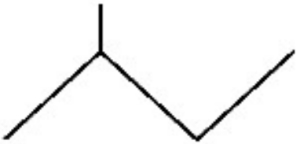
B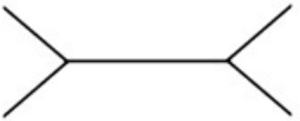
C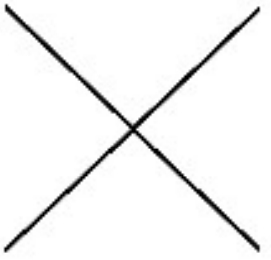
D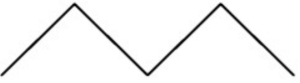
Solution
(C) Neopentane is $2,2$-dimethylpropane,which has the molecular formula $C_5H_{12}$.
Its structural formula is $CH_3-C(CH_3)_2-CH_3$.
In a bond line formula,the central carbon atom is bonded to four methyl groups,forming a cross-like shape where the central point represents the quaternary carbon atom and the four lines represent the methyl groups.
This corresponds to the structure shown in image $232310-$c.
Its structural formula is $CH_3-C(CH_3)_2-CH_3$.
In a bond line formula,the central carbon atom is bonded to four methyl groups,forming a cross-like shape where the central point represents the quaternary carbon atom and the four lines represent the methyl groups.
This corresponds to the structure shown in image $232310-$c.
0 likesView Solution
81
ChemistryMediumMCQMHT CET · 2025
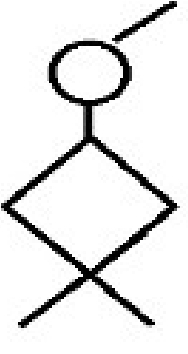
What is the $IUPAC$ name of the following compound?
A
$1-$Methoxy$-3,3-$dimethylcyclobutane
B
$3-$Methoxy$-1,1-$dimethylcyclobutane
C
$3,3-$dimethylcyclobutoxymethane
D
$1-$methoxy$-3-$isopropyl butane
Solution
(B) $1$. Identify the principal functional group: The compound is an ether,where the methoxy group $(-OCH_3)$ is attached to a cyclobutane ring.
$2$. Number the ring: The ring is a cyclobutane. We must assign the lowest possible locants to the substituents.
$3$. If we assign position $1$ to the carbon attached to the methoxy group,the methyl groups are at position $3$. This gives the locants $1, 3, 3$.
$4$. If we assign position $1$ to the carbon attached to the methyl groups,the methoxy group is at position $3$. This gives the locants $1, 1, 3$.
$5$. Comparing the sets $(1, 3, 3)$ and $(1, 1, 3)$,the set $(1, 1, 3)$ is lower.
$6$. Therefore,the methoxy group is at position $3$ and the two methyl groups are at position $1$.
$7$. The $IUPAC$ name is $3-$methoxy$-1,1-$dimethylcyclobutane.
$2$. Number the ring: The ring is a cyclobutane. We must assign the lowest possible locants to the substituents.
$3$. If we assign position $1$ to the carbon attached to the methoxy group,the methyl groups are at position $3$. This gives the locants $1, 3, 3$.
$4$. If we assign position $1$ to the carbon attached to the methyl groups,the methoxy group is at position $3$. This gives the locants $1, 1, 3$.
$5$. Comparing the sets $(1, 3, 3)$ and $(1, 1, 3)$,the set $(1, 1, 3)$ is lower.
$6$. Therefore,the methoxy group is at position $3$ and the two methyl groups are at position $1$.
$7$. The $IUPAC$ name is $3-$methoxy$-1,1-$dimethylcyclobutane.
0 likesView Solution
82
ChemistryEasyMCQMHT CET · 2025
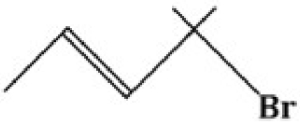
What is the $IUPAC$ name of the following compound?
A
$4-$Bromo$-4-$methylpent$-2-$ene
B
$2-$Bromo$-2-$methylpent$-3-$ene
C
$2-$Bromo$-4-$methylpent$-2-$ene
D
$4-$Bromo$-2-$methylpent$-2-$ene
Solution
(A) $1$. Identify the longest carbon chain containing the double bond: The chain has $5$ carbons,so the parent alkane is pentene.
$2$. Number the chain to give the double bond the lowest possible locant: Numbering from the right gives the double bond position $2$ (between $C2$ and $C3$).
$3$. Identify substituents: There is a bromo group $(-Br)$ at position $4$ and a methyl group $(-CH_3)$ at position $4$.
$4$. Combine the parts: $4-$Bromo$-4-$methylpent$-2-$ene.
$2$. Number the chain to give the double bond the lowest possible locant: Numbering from the right gives the double bond position $2$ (between $C2$ and $C3$).
$3$. Identify substituents: There is a bromo group $(-Br)$ at position $4$ and a methyl group $(-CH_3)$ at position $4$.
$4$. Combine the parts: $4-$Bromo$-4-$methylpent$-2-$ene.
0 likesView Solution
83
ChemistryEasyMCQMHT CET · 2025
Which of the following functional groups has the highest priority order for naming a polyfunctional compound?
A
$-CN$
B
$-CONH_2$
C
$-C \equiv C-$
D
$-NH_2$
Solution
(B) According to the $IUPAC$ priority order for functional groups,the priority is as follows:
$1$. Carboxylic acids $(-COOH)$
$2$. Esters $(-COOR)$
$3$. Acid halides $(-COX)$
$4$. Amides $(-CONH_2)$
$5$. Nitriles $(-CN)$
$6$. Aldehydes $(-CHO)$
$7$. Ketones $(-CO-)$
$8$. Alcohols $(-OH)$
$9$. Amines $(-NH_2)$
$10$. Alkenes/Alkynes $(-C=C-, -C \equiv C-)$
Comparing the given options:
$-CONH_2$ (Amide) has a higher priority than $-CN$ (Nitrile),$-NH_2$ (Amine),and $-C \equiv C-$ (Alkyne).
Therefore,the correct option is $B$.
$1$. Carboxylic acids $(-COOH)$
$2$. Esters $(-COOR)$
$3$. Acid halides $(-COX)$
$4$. Amides $(-CONH_2)$
$5$. Nitriles $(-CN)$
$6$. Aldehydes $(-CHO)$
$7$. Ketones $(-CO-)$
$8$. Alcohols $(-OH)$
$9$. Amines $(-NH_2)$
$10$. Alkenes/Alkynes $(-C=C-, -C \equiv C-)$
Comparing the given options:
$-CONH_2$ (Amide) has a higher priority than $-CN$ (Nitrile),$-NH_2$ (Amine),and $-C \equiv C-$ (Alkyne).
Therefore,the correct option is $B$.
0 likesView Solution
84
ChemistryMediumMCQMHT CET · 2025
What is the $IUPAC$ name of the following compound?

A
$2,5-$Dimethylpentan$-1-$ol
B
$1,3-$Dimethylpentan$-2-$ol
C
$2,5-$Dimethylcyclopentanol
D
$2,5-$Dimethylcyclopentan$-1-$ol
Solution
(C) $1$. Identify the principal functional group: The $-OH$ group is the principal functional group,so the parent chain is a cyclopentane ring,making it a cyclopentanol.
$2$. Number the ring: The carbon attached to the $-OH$ group is assigned position $1$.
$3$. Number the substituents: To give the lowest possible locants to the methyl groups,we number the ring in a way that the methyl groups are at positions $2$ and $5$. Thus,the name is $2,5-$dimethylcyclopentan$-1-$ol (or simply $2,5-$dimethylcyclopentanol).
$2$. Number the ring: The carbon attached to the $-OH$ group is assigned position $1$.
$3$. Number the substituents: To give the lowest possible locants to the methyl groups,we number the ring in a way that the methyl groups are at positions $2$ and $5$. Thus,the name is $2,5-$dimethylcyclopentan$-1-$ol (or simply $2,5-$dimethylcyclopentanol).
0 likesView Solution
85
ChemistryMediumMCQMHT CET · 2025
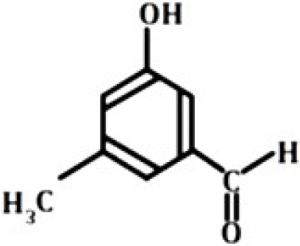
What is the $IUPAC$ name of the following compound?
A
$3-$Formyl$-5-$methylphenol
B
$5-$Formyl$-3-$methylphenol
C
$3-$Hydroxy$-5-$methylbenzaldehyde
D
$5-$Hydroxy$-3-$methylbenzaldehyde
Solution
(C) $1$. Identify the principal functional group: The compound contains a benzene ring with $-OH$,$-CHO$,and $-CH_3$ groups. According to $IUPAC$ priority rules,the aldehyde $(-CHO)$ group has higher priority than the hydroxyl $(-OH)$ group. Therefore,the parent compound is benzaldehyde.
$2$. Numbering the ring: The carbon atom attached to the $-CHO$ group is assigned position $1$. We then number the ring to give the lowest possible locants to the substituents. If we start from the $-CHO$ group as $1$,the $-OH$ group is at position $3$ and the $-CH_3$ group is at position $5$. Thus,the name is $3-$hydroxy$-5-$methylbenzaldehyde.
$2$. Numbering the ring: The carbon atom attached to the $-CHO$ group is assigned position $1$. We then number the ring to give the lowest possible locants to the substituents. If we start from the $-CHO$ group as $1$,the $-OH$ group is at position $3$ and the $-CH_3$ group is at position $5$. Thus,the name is $3-$hydroxy$-5-$methylbenzaldehyde.
0 likesView Solution
86
ChemistryMediumMCQMHT CET · 2025
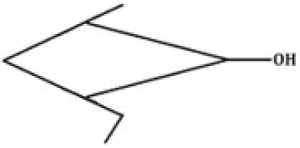
What is the $IUPAC$ name of the following compound?
A
$2-$Ethyl$-4-$methylcyclobutanol
B
$4-$Ethyl$-2-$methylcyclobutanol
C
$1-$Ethyl$-2-$hydroxy$-3-$methylcyclobutane
D
$2-$Ethyl$-1-$hydroxy$-4-$methylcyclobutane
Solution
(A) $1$. Identify the principal functional group: The $-OH$ group is the principal functional group,so the parent chain is a cyclobutanol. The carbon attached to the $-OH$ group is assigned position $1$.
$2$. Number the ring: To give the substituents the lowest possible locants,we number the ring starting from the carbon with the $-OH$ group $(C-1)$. Moving towards the ethyl group gives the substituents positions $2$ and $4$ (ethyl at $2$,methyl at $4$). Moving the other way would give positions $2$ and $4$ as well (methyl at $2$,ethyl at $4$).
$3$. Apply alphabetical order: According to $IUPAC$ rules,substituents are listed alphabetically. Ethyl $(E)$ comes before methyl $(M)$. Therefore,we choose the numbering that assigns $2$ to the ethyl group and $4$ to the methyl group.
$4$. Final Name: The compound is $2-$ethyl$-4-$methylcyclobutanol.
$2$. Number the ring: To give the substituents the lowest possible locants,we number the ring starting from the carbon with the $-OH$ group $(C-1)$. Moving towards the ethyl group gives the substituents positions $2$ and $4$ (ethyl at $2$,methyl at $4$). Moving the other way would give positions $2$ and $4$ as well (methyl at $2$,ethyl at $4$).
$3$. Apply alphabetical order: According to $IUPAC$ rules,substituents are listed alphabetically. Ethyl $(E)$ comes before methyl $(M)$. Therefore,we choose the numbering that assigns $2$ to the ethyl group and $4$ to the methyl group.
$4$. Final Name: The compound is $2-$ethyl$-4-$methylcyclobutanol.
0 likesView Solution
87
ChemistryMediumMCQMHT CET · 2025
Which of the following functional groups has the highest priority order for naming polyfunctional organic compounds?
A
$-COCl$
B
$-SO_3H$
C
$-CHO$
D
$-OH$
Solution
(B) According to the $IUPAC$ priority order for functional groups,the priority sequence is: $-COOH > -SO_3H > -COOR > -COCl > -CONH_2 > -CN > -CHO > -CO > -OH > -NH_2 > -OR > -R > -X$.
Comparing the given options:
$1$. $-SO_3H$ (Sulfonic acid)
$2$. $-COCl$ (Acid chloride)
$3$. $-CHO$ (Aldehyde)
$4$. $-OH$ (Alcohol)
Among the given choices,$-SO_3H$ appears earliest in the priority list,thus it has the highest priority.
Comparing the given options:
$1$. $-SO_3H$ (Sulfonic acid)
$2$. $-COCl$ (Acid chloride)
$3$. $-CHO$ (Aldehyde)
$4$. $-OH$ (Alcohol)
Among the given choices,$-SO_3H$ appears earliest in the priority list,thus it has the highest priority.
0 likesView Solution
88
ChemistryMediumMCQMHT CET · 2025
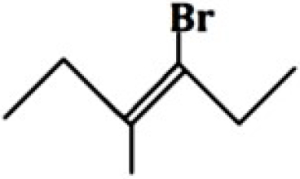
What is the $IUPAC$ name of the following compound?
A
$3-$Bromo$-4-$ethylbut$-3-$ene
B
$3-$Bromo$-4-$methylhex$-3-$ene
C
$4-$Bromo$-3-$methylhex$-3-$ene
D
$4-$Bromo$-4-$ethyl$-3-$methylbut$-3-$ene
Solution
(C) $1$. Identify the longest carbon chain containing the double bond. The longest chain has $6$ carbons,so the parent alkane is hexane,and the alkene is hex$-3-$ene.
$2$. Number the chain from the end that gives the double bond the lowest locant. Numbering from left to right gives the double bond at position $3$.
$3$. Identify the substituents: $A$ bromine atom $(-Br)$ is at position $4$ and a methyl group $(-CH_3)$ is at position $3$.
$4$. Combine the parts alphabetically: $4-$Bromo$-3-$methylhex$-3-$ene.
$2$. Number the chain from the end that gives the double bond the lowest locant. Numbering from left to right gives the double bond at position $3$.
$3$. Identify the substituents: $A$ bromine atom $(-Br)$ is at position $4$ and a methyl group $(-CH_3)$ is at position $3$.
$4$. Combine the parts alphabetically: $4-$Bromo$-3-$methylhex$-3-$ene.
0 likesView Solution
89
ChemistryMediumMCQMHT CET · 2025
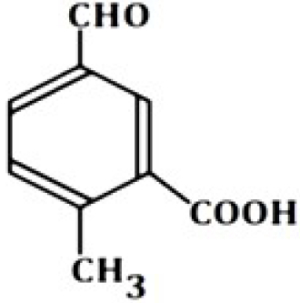
What is the $IUPAC$ name of the following compound?
A
$3-$Carboxy$-4-$methylbenzaldehyde
B
$5-$Carboxy$-4-$methylbenzaldehyde
C
$3-$Formyl$-6-$methylbenzoic acid
D
$5-$Formyl$-2-$methylbenzoic acid
Solution
(D) $1$. Identify the principal functional group: The $-COOH$ group (carboxylic acid) has higher priority than the $-CHO$ (aldehyde) and $-CH_3$ (methyl) groups. Therefore,the parent chain is a benzoic acid derivative.
$2$. Number the ring: Assign position $1$ to the carbon attached to the $-COOH$ group. Number the ring to give the lowest possible locants to the substituents. Moving towards the $-CH_3$ group gives it position $2$,and the $-CHO$ group gets position $5$.
$3$. Name the substituents: The $-CHO$ group at position $5$ is named as 'formyl',and the $-CH_3$ group at position $2$ is named as 'methyl'.
$4$. Combine the parts: The name is $5-$formyl$-2-$methylbenzoic acid.
$2$. Number the ring: Assign position $1$ to the carbon attached to the $-COOH$ group. Number the ring to give the lowest possible locants to the substituents. Moving towards the $-CH_3$ group gives it position $2$,and the $-CHO$ group gets position $5$.
$3$. Name the substituents: The $-CHO$ group at position $5$ is named as 'formyl',and the $-CH_3$ group at position $2$ is named as 'methyl'.
$4$. Combine the parts: The name is $5-$formyl$-2-$methylbenzoic acid.
0 likesView Solution
90
ChemistryMediumMCQMHT CET · 2025
Which among the following is a pair of functional isomers?
A
Butan-$2$-ol and $2$-Methylpropan-$1$-ol
B
Butan-$1$-ol and $1$-Methoxypropane
C
$1$-Methoxypropane and Ethoxyethane
D
$2$-Methoxypropane and $1$-Methoxypropane
Solution
(B) Functional isomers are compounds that have the same molecular formula but different functional groups.
In option $B$,Butan-$1$-ol $(C_4H_{10}O)$ is an alcohol,while $1$-Methoxypropane $(C_4H_{10}O)$ is an ether.
Since they have the same molecular formula but different functional groups ($-OH$ vs $-O-$),they are functional isomers.
In option $B$,Butan-$1$-ol $(C_4H_{10}O)$ is an alcohol,while $1$-Methoxypropane $(C_4H_{10}O)$ is an ether.
Since they have the same molecular formula but different functional groups ($-OH$ vs $-O-$),they are functional isomers.
0 likesView Solution
91
ChemistryEasyMCQMHT CET · 2025
Which of the following compounds does $NOT$ contain oxygen as a heteroatom?
A
Furan
B
$THF$
C
$4H$-Pyran
D
Pyrrole
Solution
(D) heteroatom is any atom other than carbon or hydrogen in an organic molecule.
$Furan$ $(C_4H_4O)$ contains an oxygen atom in its ring.
$THF$ (Tetrahydrofuran,$C_4H_8O$) contains an oxygen atom in its ring.
$4H$-Pyran $(C_5H_6O)$ contains an oxygen atom in its ring.
$Pyrrole$ $(C_4H_5N)$ contains a nitrogen atom as the heteroatom,not oxygen.
Therefore,the correct answer is $D$.
$Furan$ $(C_4H_4O)$ contains an oxygen atom in its ring.
$THF$ (Tetrahydrofuran,$C_4H_8O$) contains an oxygen atom in its ring.
$4H$-Pyran $(C_5H_6O)$ contains an oxygen atom in its ring.
$Pyrrole$ $(C_4H_5N)$ contains a nitrogen atom as the heteroatom,not oxygen.
Therefore,the correct answer is $D$.
0 likesView Solution
92
ChemistryEasyMCQMHT CET · 2025
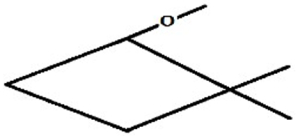
What is the $IUPAC$ name of the following compound?
A
$1-$Methoxy-$2,2-$dimethylbutane
B
$2-$Methoxy-$1,1-$dimethylbutane
C
$1-$Methoxy-$2,2-$dimethylcyclobutane
D
$2-$Methoxy-$1,1-$dimethylcyclobutane
Solution
(C) The given structure is a cyclobutane ring with a methoxy group $(-OCH_3)$ at position $1$ and two methyl groups $(-CH_3)$ at position $2$.
According to $IUPAC$ nomenclature rules for cyclic ethers:
$1$. The ring is numbered starting from the carbon attached to the methoxy group as $1$.
$2$. The next carbon is numbered $2$ to give the lowest possible locants to the substituents.
$3$. Thus,the methoxy group is at position $1$ and two methyl groups are at position $2$.
$4$. The name is $1-$Methoxy-$2,2-$dimethylcyclobutane.
According to $IUPAC$ nomenclature rules for cyclic ethers:
$1$. The ring is numbered starting from the carbon attached to the methoxy group as $1$.
$2$. The next carbon is numbered $2$ to give the lowest possible locants to the substituents.
$3$. Thus,the methoxy group is at position $1$ and two methyl groups are at position $2$.
$4$. The name is $1-$Methoxy-$2,2-$dimethylcyclobutane.
0 likesView Solution
93
ChemistryEasyMCQMHT CET · 2025
Which of the following compounds does $NOT$ contain nitrogen in it?
A
Thiophene
B
Pyridine
C
Pyrrole
D
Piperidine
Solution
(A) The chemical formulas for the given compounds are as follows:
$1$. Thiophene: $C_4H_4S$ (contains sulfur,no nitrogen).
$2$. Pyridine: $C_5H_5N$ (contains nitrogen).
$3$. Pyrrole: $C_4H_5N$ (contains nitrogen).
$4$. Piperidine: $C_5H_{11}N$ (contains nitrogen).
Therefore,Thiophene is the compound that does not contain nitrogen.
$1$. Thiophene: $C_4H_4S$ (contains sulfur,no nitrogen).
$2$. Pyridine: $C_5H_5N$ (contains nitrogen).
$3$. Pyrrole: $C_4H_5N$ (contains nitrogen).
$4$. Piperidine: $C_5H_{11}N$ (contains nitrogen).
Therefore,Thiophene is the compound that does not contain nitrogen.
0 likesView Solution
94
ChemistryEasyMCQMHT CET · 2025
What is the difference in molar mass of Undecane and Dodecane?
A
$10 \ g \ mol^{-1}$
B
$20 \ g \ mol^{-1}$
C
$140 \ g \ mol^{-1}$
D
$14 \ g \ mol^{-1}$
Solution
(D) Undecane is an alkane with the molecular formula $C_{11}H_{24}$.
Dodecane is an alkane with the molecular formula $C_{12}H_{26}$.
The difference between these two consecutive members of the homologous series is a $CH_2$ group.
The molar mass of a $CH_2$ group is $(1 \times 12.01) + (2 \times 1.008) \approx 14.02 \ g \ mol^{-1}$,which is approximately $14 \ g \ mol^{-1}$.
Dodecane is an alkane with the molecular formula $C_{12}H_{26}$.
The difference between these two consecutive members of the homologous series is a $CH_2$ group.
The molar mass of a $CH_2$ group is $(1 \times 12.01) + (2 \times 1.008) \approx 14.02 \ g \ mol^{-1}$,which is approximately $14 \ g \ mol^{-1}$.
0 likesView Solution
95
ChemistryEasyMCQMHT CET · 2025
Select from the following a correct $IUPAC$ name of pyrogallol.
A
Benzene-$1,3$-diol
B
Benzene-$1,4$-diol
C
Benzene-$1,2,3$-triol
D
Benzene-$1,3,5$-triol
Solution
(C) Pyrogallol is a common name for $1,2,3$-trihydroxybenzene.
According to $IUPAC$ nomenclature rules,when three hydroxyl $(-OH)$ groups are attached to a benzene ring,the compound is named as a benzene derivative with the suffix $-triol$.
The positions of the $-OH$ groups are $1, 2,$ and $3$.
Therefore,the correct $IUPAC$ name is Benzene-$1,2,3$-triol.
According to $IUPAC$ nomenclature rules,when three hydroxyl $(-OH)$ groups are attached to a benzene ring,the compound is named as a benzene derivative with the suffix $-triol$.
The positions of the $-OH$ groups are $1, 2,$ and $3$.
Therefore,the correct $IUPAC$ name is Benzene-$1,2,3$-triol.
0 likesView Solution
96
ChemistryEasyMCQMHT CET · 2025
According to the carbinol system,$tert-butyl$ alcohol is named as:
A
Methyl carbinol
B
Ethyl carbinol
C
Propyl carbinol
D
Trimethyl carbinol
Solution
(D) In the carbinol system,methyl alcohol $(CH_3OH)$ is considered the parent compound and is called $carbinol$.
Other alcohols are named as derivatives of $carbinol$ by replacing the hydrogen atoms of the $CH_3$ group with alkyl groups.
$tert-butyl$ alcohol has the structure $(CH_3)_3C-OH$.
Here,all three hydrogen atoms of the $CH_3$ group in $carbinol$ are replaced by three methyl groups.
Therefore,it is named as $trimethyl$ $carbinol$.
Other alcohols are named as derivatives of $carbinol$ by replacing the hydrogen atoms of the $CH_3$ group with alkyl groups.
$tert-butyl$ alcohol has the structure $(CH_3)_3C-OH$.
Here,all three hydrogen atoms of the $CH_3$ group in $carbinol$ are replaced by three methyl groups.
Therefore,it is named as $trimethyl$ $carbinol$.
0 likesView Solution
97
ChemistryEasyMCQMHT CET · 2025
What is the difference of molar masses expressed in $g$ of two neighbouring members of a homologous series (in $g$)?
A
$10$
B
$14$
C
$18$
D
$20$
Solution
(B) homologous series is a group of organic compounds having the same functional group and similar chemical properties,where each successive member differs by a $CH_2$ group.
The molar mass of a $CH_2$ group is calculated as:
$M(CH_2) = M(C) + 2 \times M(H) = 12 \ g/mol + 2 \times 1 \ g/mol = 14 \ g/mol$.
Therefore,the difference in molar masses of two neighbouring members of a homologous series is $14 \ g$.
The molar mass of a $CH_2$ group is calculated as:
$M(CH_2) = M(C) + 2 \times M(H) = 12 \ g/mol + 2 \times 1 \ g/mol = 14 \ g/mol$.
Therefore,the difference in molar masses of two neighbouring members of a homologous series is $14 \ g$.
0 likesView Solution
98
ChemistryEasyMCQMHT CET · 2025
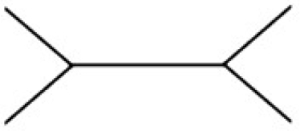
What is the total number of moles of $C$ atoms and $H$ atoms respectively present in $n$ moles of the following molecule?
A
$4 n$ and $2 n$
B
$4 n$ and $4 n$
C
$6 n$ and $14 n$
D
$6 n$ and $6 n$
Solution
(C) The given structure is $2,3$-dimethylbutane.
Its molecular formula is $C_6H_{14}$.
In one molecule,there are $6$ carbon atoms and $14$ hydrogen atoms.
Therefore,in $n$ moles of the molecule,the number of moles of $C$ atoms is $6 n$ and the number of moles of $H$ atoms is $14 n$.
Its molecular formula is $C_6H_{14}$.
In one molecule,there are $6$ carbon atoms and $14$ hydrogen atoms.
Therefore,in $n$ moles of the molecule,the number of moles of $C$ atoms is $6 n$ and the number of moles of $H$ atoms is $14 n$.
0 likesView Solution
99
ChemistryEasyMCQMHT CET · 2025
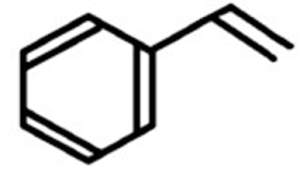
What is the number of moles of '$C$' and '$H$' atoms respectively present in $n$ mole of the molecule represented by the following structure?
A
$8n$ and $8n$
B
$6n$ and $8n$
C
$8n$ and $6n$
D
$7n$ and $9n$
Solution
(A) The given structure is styrene $(C_6H_5-CH=CH_2)$.
Counting the atoms in one molecule:
Carbon $(C)$ atoms: $6$ (in benzene ring) $+ 2$ (in vinyl group) $= 8$ atoms.
Hydrogen $(H)$ atoms: $5$ (in benzene ring) $+ 3$ (in vinyl group) $= 8$ atoms.
Therefore,the molecular formula is $C_8H_8$.
For $n$ moles of the molecule,the number of moles of $C$ atoms $= 8 \times n = 8n$.
The number of moles of $H$ atoms $= 8 \times n = 8n$.
Thus,the correct option is $A$.
Counting the atoms in one molecule:
Carbon $(C)$ atoms: $6$ (in benzene ring) $+ 2$ (in vinyl group) $= 8$ atoms.
Hydrogen $(H)$ atoms: $5$ (in benzene ring) $+ 3$ (in vinyl group) $= 8$ atoms.
Therefore,the molecular formula is $C_8H_8$.
For $n$ moles of the molecule,the number of moles of $C$ atoms $= 8 \times n = 8n$.
The number of moles of $H$ atoms $= 8 \times n = 8n$.
Thus,the correct option is $A$.
0 likesView Solution
100
ChemistryMediumMCQMHT CET · 2025
Which of the following is a non-benzenoid aromatic compound?
A
Aniline
B
Tropone
C
Naphthalene
D
Phenol
Solution
(B) Aromatic compounds are classified into two types: benzenoid and non-benzenoid.
Benzenoid compounds contain at least one benzene ring, such as $Aniline$, $Naphthalene$, and $Phenol$.
Non-benzenoid aromatic compounds possess aromaticity but do not contain a benzene ring.
$Tropone$ (cycloheptatrienone) is a classic example of a non-benzenoid aromatic compound because it follows Hückel's rule ($4n+2$ $\pi$ electrons) and has a cyclic, planar, conjugated structure without a benzene ring.
Benzenoid compounds contain at least one benzene ring, such as $Aniline$, $Naphthalene$, and $Phenol$.
Non-benzenoid aromatic compounds possess aromaticity but do not contain a benzene ring.
$Tropone$ (cycloheptatrienone) is a classic example of a non-benzenoid aromatic compound because it follows Hückel's rule ($4n+2$ $\pi$ electrons) and has a cyclic, planar, conjugated structure without a benzene ring.
0 likesView Solution
101
ChemistryMediumMCQMHT CET · 2025
Identify the products of the following reaction: $HCHO + C_6H_5CHO \xrightarrow[ii) H_3O^{+}]{i) conc. NaOH} \text{Products}$
A
Phenylmethanol and methanol
B
Methanol and benzoic acid
C
Methanoic acid and phenylmethanol
D
Methanoic acid and benzoic acid
Solution
(C) The given reaction is a $Cross-Cannizzaro$ reaction between formaldehyde $(HCHO)$ and benzaldehyde $(C_6H_5CHO)$ in the presence of concentrated $NaOH$.
In a $Cross-Cannizzaro$ reaction,the more reactive aldehyde (formaldehyde) undergoes oxidation to form a salt of the carboxylic acid,while the less reactive aldehyde (benzaldehyde) undergoes reduction to form an alcohol.
$1$. Formaldehyde $(HCHO)$ is more reactive towards nucleophilic attack,so it gets oxidized to sodium formate $(HCOONa)$,which upon acidification $(H_3O^+)$ gives methanoic acid $(HCOOH)$.
$2$. Benzaldehyde $(C_6H_5CHO)$ gets reduced to phenylmethanol $(C_6H_5CH_2OH)$.
Therefore,the products are methanoic acid and phenylmethanol.
In a $Cross-Cannizzaro$ reaction,the more reactive aldehyde (formaldehyde) undergoes oxidation to form a salt of the carboxylic acid,while the less reactive aldehyde (benzaldehyde) undergoes reduction to form an alcohol.
$1$. Formaldehyde $(HCHO)$ is more reactive towards nucleophilic attack,so it gets oxidized to sodium formate $(HCOONa)$,which upon acidification $(H_3O^+)$ gives methanoic acid $(HCOOH)$.
$2$. Benzaldehyde $(C_6H_5CHO)$ gets reduced to phenylmethanol $(C_6H_5CH_2OH)$.
Therefore,the products are methanoic acid and phenylmethanol.
0 likesView Solution
102
ChemistryMediumMCQMHT CET · 2025
Identify the product formed when $Hex-3-enenitrile$ is reduced with diisobutylaluminium hydride $(DIBAL-H)$ followed by acid hydrolysis?
A
$Hexanal$
B
$Hexan-3-one$
C
$Hex-3-enal$
D
$Hexanoic acid$
Solution
(C) The reduction of nitriles with diisobutylaluminium hydride $(DIBAL-H)$ followed by acid hydrolysis is a standard method to prepare aldehydes.
$DIBAL-H$ selectively reduces the nitrile group $(-CN)$ to an imine intermediate,which upon hydrolysis yields the corresponding aldehyde.
In the case of $Hex-3-enenitrile$ $(CH_3CH_2CH=CHCH_2CN)$,the nitrile group is reduced to an aldehyde group $(-CHO)$ while the carbon-carbon double bond $(C=C)$ remains unaffected.
Therefore,the product formed is $Hex-3-enal$ $(CH_3CH_2CH=CHCH_2CHO)$.
$DIBAL-H$ selectively reduces the nitrile group $(-CN)$ to an imine intermediate,which upon hydrolysis yields the corresponding aldehyde.
In the case of $Hex-3-enenitrile$ $(CH_3CH_2CH=CHCH_2CN)$,the nitrile group is reduced to an aldehyde group $(-CHO)$ while the carbon-carbon double bond $(C=C)$ remains unaffected.
Therefore,the product formed is $Hex-3-enal$ $(CH_3CH_2CH=CHCH_2CHO)$.
0 likesView Solution
103
ChemistryEasyMCQMHT CET · 2025
Which among the following has the highest boiling point?
A
Ethanal
B
Propanal
C
Pentanal
D
Hexanal
Solution
(D) The boiling point of aldehydes and ketones increases with an increase in the molecular mass due to the increase in the magnitude of intermolecular van der Waals forces of attraction.
Among the given options,$Hexanal$ $(C_6H_{12}O)$ has the highest molecular mass compared to $Ethanal$ $(C_2H_4O)$,$Propanal$ $(C_3H_6O)$,and $Pentanal$ $(C_5H_{10}O)$.
Therefore,$Hexanal$ has the highest boiling point.
Among the given options,$Hexanal$ $(C_6H_{12}O)$ has the highest molecular mass compared to $Ethanal$ $(C_2H_4O)$,$Propanal$ $(C_3H_6O)$,and $Pentanal$ $(C_5H_{10}O)$.
Therefore,$Hexanal$ has the highest boiling point.
0 likesView Solution
104
ChemistryEasyMCQMHT CET · 2025
Identify the reaction in which the carbonyl group of aldehydes and ketones is reduced to a methylene group upon treatment with zinc-amalgam and concentrated hydrochloric acid.
A
Wolff-Kishner reduction.
B
Stephen reaction.
C
Clemmensen reduction.
D
Etard reaction.
Solution
(C) The reduction of the carbonyl group $(>C=O)$ of aldehydes and ketones to a methylene group $(-CH_2-)$ using zinc-amalgam $(Zn-Hg)$ and concentrated hydrochloric acid $(HCl)$ is known as the $Clemmensen \ reduction$.
The general reaction is: $R-CO-R' + 4[H] \xrightarrow{Zn-Hg/HCl} R-CH_2-R' + H_2O$.
The general reaction is: $R-CO-R' + 4[H] \xrightarrow{Zn-Hg/HCl} R-CH_2-R' + H_2O$.
0 likesView Solution
105
ChemistryEasyMCQMHT CET · 2025
Which among the following compounds forms pink colouration on addition of Schiff's reagent?
A
Propanol
B
Propanone
C
Propanal
D
Propanoic acid
Solution
(C) Schiff's reagent is a specific test used to detect the presence of aldehydes.
Aldehydes react with Schiff's reagent to produce a characteristic pink or magenta colouration.
Among the given options,$Propanal$ $(CH_3CH_2CHO)$ is an aldehyde.
Propanol is an alcohol,Propanone is a ketone,and Propanoic acid is a carboxylic acid; none of these react with Schiff's reagent to give the pink colouration.
Therefore,the correct option is $C$.
Aldehydes react with Schiff's reagent to produce a characteristic pink or magenta colouration.
Among the given options,$Propanal$ $(CH_3CH_2CHO)$ is an aldehyde.
Propanol is an alcohol,Propanone is a ketone,and Propanoic acid is a carboxylic acid; none of these react with Schiff's reagent to give the pink colouration.
Therefore,the correct option is $C$.
0 likesView Solution
106
ChemistryMediumMCQMHT CET · 2025
Which of the following does $NOT$ exhibit haloform reaction?
A
Ethanal
B
Propanal
C
Propanone
D
Butanone
Solution
(B) The haloform reaction is given by compounds containing the $CH_3CO-$ group or compounds that can be oxidized to this group (like $CH_3CH(OH)-$ group).
$1$. Ethanal $(CH_3CHO)$ contains the $CH_3CO-$ group and gives a positive haloform test.
$2$. Propanal $(CH_3CH_2CHO)$ does not contain the $CH_3CO-$ group and cannot be oxidized to it,so it does not give a positive haloform test.
$3$. Propanone $(CH_3COCH_3)$ contains the $CH_3CO-$ group and gives a positive haloform test.
$4$. Butanone $(CH_3COCH_2CH_3)$ contains the $CH_3CO-$ group and gives a positive haloform test.
Therefore,Propanal does not exhibit the haloform reaction.
$1$. Ethanal $(CH_3CHO)$ contains the $CH_3CO-$ group and gives a positive haloform test.
$2$. Propanal $(CH_3CH_2CHO)$ does not contain the $CH_3CO-$ group and cannot be oxidized to it,so it does not give a positive haloform test.
$3$. Propanone $(CH_3COCH_3)$ contains the $CH_3CO-$ group and gives a positive haloform test.
$4$. Butanone $(CH_3COCH_2CH_3)$ contains the $CH_3CO-$ group and gives a positive haloform test.
Therefore,Propanal does not exhibit the haloform reaction.
0 likesView Solution
107
ChemistryEasyMCQMHT CET · 2025
Which of the following reagents is used in the Gatterman-Koch formylation of an arene?
A
$AlH(i-Bu)_2$
B
$CO, HCl$ (anhyd. $AlCl_3$)
C
$CrO_2Cl_2$ in $CS_2$
D
$DIBAL-H$
Solution
(B) The Gatterman-Koch reaction is a specific formylation reaction used to introduce a formyl group $(-CHO)$ onto an aromatic ring.
In this reaction,the arene is treated with carbon monoxide $(CO)$ and hydrogen chloride $(HCl)$ in the presence of anhydrous aluminum chloride $(AlCl_3)$ and cuprous chloride $(CuCl)$ as a catalyst.
This combination generates the reactive electrophile $HCO^+$,which performs electrophilic aromatic substitution on the arene to yield an aromatic aldehyde.
Therefore,the correct reagent system is $CO, HCl$ (anhyd. $AlCl_3$).
In this reaction,the arene is treated with carbon monoxide $(CO)$ and hydrogen chloride $(HCl)$ in the presence of anhydrous aluminum chloride $(AlCl_3)$ and cuprous chloride $(CuCl)$ as a catalyst.
This combination generates the reactive electrophile $HCO^+$,which performs electrophilic aromatic substitution on the arene to yield an aromatic aldehyde.
Therefore,the correct reagent system is $CO, HCl$ (anhyd. $AlCl_3$).
0 likesView Solution
108
ChemistryEasyMCQMHT CET · 2025
Which of the following is the correct decreasing order of water solubility for the given organic compounds?
A
Alcohols > Amines > Alkanes
B
Alkanes > Alcohols > Amines
C
Amines > Alcohols > Alkanes
D
Alcohols > Alkanes > Amines
Solution
(A) The solubility of organic compounds in water depends on their ability to form hydrogen bonds with water molecules.
$1$. Alcohols $(R-OH)$ can form strong hydrogen bonds with water due to the highly electronegative oxygen atom.
$2$. Amines $(R-NH_2)$ can also form hydrogen bonds with water, but the $N-H \cdots O$ hydrogen bond is weaker than the $O-H \cdots O$ hydrogen bond because nitrogen is less electronegative than oxygen.
$3$. Alkanes are non-polar hydrocarbons and cannot form hydrogen bonds with water, making them essentially insoluble.
Therefore, the correct decreasing order of solubility is $Alcohols > Amines > Alkanes$.
$1$. Alcohols $(R-OH)$ can form strong hydrogen bonds with water due to the highly electronegative oxygen atom.
$2$. Amines $(R-NH_2)$ can also form hydrogen bonds with water, but the $N-H \cdots O$ hydrogen bond is weaker than the $O-H \cdots O$ hydrogen bond because nitrogen is less electronegative than oxygen.
$3$. Alkanes are non-polar hydrocarbons and cannot form hydrogen bonds with water, making them essentially insoluble.
Therefore, the correct decreasing order of solubility is $Alcohols > Amines > Alkanes$.
0 likesView Solution
109
ChemistryMediumMCQMHT CET · 2025
Which of the following compounds has the lowest $pK_{b}$ value?
A
$N$-Ethylethanamine
B
Propan-$2$-amine
C
$NH_3$
D
Benzenamine
Solution
(A) The $pK_{b}$ value is inversely proportional to the basic strength of the compound. $A$ lower $pK_{b}$ value indicates a stronger base.
$N$-Ethylethanamine is a secondary aliphatic amine,$(C_2H_5)_2NH$.
Propan-$2$-amine is a primary aliphatic amine,$CH_3CH(NH_2)CH_3$.
$NH_3$ is ammonia.
Benzenamine (aniline) is an aromatic amine where the lone pair on nitrogen is involved in resonance with the benzene ring,making it the least basic.
Among aliphatic amines,secondary amines are generally more basic than primary amines due to the inductive effect of alkyl groups and solvation factors.
Therefore,$N$-Ethylethanamine is the strongest base among the given options and has the lowest $pK_{b}$ value.
$N$-Ethylethanamine is a secondary aliphatic amine,$(C_2H_5)_2NH$.
Propan-$2$-amine is a primary aliphatic amine,$CH_3CH(NH_2)CH_3$.
$NH_3$ is ammonia.
Benzenamine (aniline) is an aromatic amine where the lone pair on nitrogen is involved in resonance with the benzene ring,making it the least basic.
Among aliphatic amines,secondary amines are generally more basic than primary amines due to the inductive effect of alkyl groups and solvation factors.
Therefore,$N$-Ethylethanamine is the strongest base among the given options and has the lowest $pK_{b}$ value.
0 likesView Solution
110
ChemistryMediumMCQMHT CET · 2025
Which of the following compounds is an example of a secondary amine?
A
Ethane-$1,2$-diamine
B
Propan-$2$-amine
C
$N$-Methylmethanamine
D
$N,N$-Dimethylmethanamine
Solution
(C) secondary amine is an amine where the nitrogen atom is bonded to two carbon atoms (alkyl or aryl groups) and one hydrogen atom,represented by the general formula $R_2NH$.
$1$. Ethane-$1,2$-diamine $(NH_2-CH_2-CH_2-NH_2)$ is a primary diamine.
$2$. Propan-$2$-amine $(CH_3-CH(NH_2)-CH_3)$ is a primary amine.
$3$. $N$-Methylmethanamine $(CH_3-NH-CH_3)$ has two methyl groups attached to the nitrogen atom,making it a secondary amine.
$4$. $N,N$-Dimethylmethanamine $(CH_3-N(CH_3)_2)$ is a tertiary amine.
Therefore,the correct option is $C$.
$1$. Ethane-$1,2$-diamine $(NH_2-CH_2-CH_2-NH_2)$ is a primary diamine.
$2$. Propan-$2$-amine $(CH_3-CH(NH_2)-CH_3)$ is a primary amine.
$3$. $N$-Methylmethanamine $(CH_3-NH-CH_3)$ has two methyl groups attached to the nitrogen atom,making it a secondary amine.
$4$. $N,N$-Dimethylmethanamine $(CH_3-N(CH_3)_2)$ is a tertiary amine.
Therefore,the correct option is $C$.
0 likesView Solution
111
ChemistryMediumMCQMHT CET · 2025
Which of the following is the most stable species?
A
$NH_4^{+}$
B
$R-NH_3^{+}$
C
$R_2NH_2^{+}$
D
$R_3NH^{+}$
Solution
(D) The stability of substituted ammonium ions in the gas phase is determined by the inductive effect of the alkyl groups.
Alkyl groups are electron-donating ($+I$ effect).
As the number of alkyl groups attached to the nitrogen atom increases,the positive charge on the nitrogen is dispersed more effectively due to the electron-donating nature of the alkyl groups.
Therefore,the stability order is $R_3NH^{+} > R_2NH_2^{+} > R-NH_3^{+} > NH_4^{+}$.
Thus,$R_3NH^{+}$ is the most stable species.
Alkyl groups are electron-donating ($+I$ effect).
As the number of alkyl groups attached to the nitrogen atom increases,the positive charge on the nitrogen is dispersed more effectively due to the electron-donating nature of the alkyl groups.
Therefore,the stability order is $R_3NH^{+} > R_2NH_2^{+} > R-NH_3^{+} > NH_4^{+}$.
Thus,$R_3NH^{+}$ is the most stable species.
0 likesView Solution
112
ChemistryMediumMCQMHT CET · 2025
Identify product $A$ in the following reaction:
$C_6H_5N_2^+Cl^- \xrightarrow{C_2H_5OH} A + N_2 + CH_3CHO + HCl$
$C_6H_5N_2^+Cl^- \xrightarrow{C_2H_5OH} A + N_2 + CH_3CHO + HCl$
A
$C_6H_6$
B
$C_6H_5NH_2$
C
$C_6H_5COOH$
D
$C_6H_5Cl$
Solution
(A) The reaction of benzene diazonium chloride $(C_6H_5N_2^+Cl^-)$ with ethanol $(C_2H_5OH)$ is a reduction reaction.
In this reaction,the diazonium group is replaced by a hydrogen atom,and ethanol is oxidized to acetaldehyde $(CH_3CHO)$.
The reaction is: $C_6H_5N_2^+Cl^- + C_2H_5OH \rightarrow C_6H_6 + N_2 + CH_3CHO + HCl$.
Thus,product $A$ is benzene $(C_6H_6)$.
In this reaction,the diazonium group is replaced by a hydrogen atom,and ethanol is oxidized to acetaldehyde $(CH_3CHO)$.
The reaction is: $C_6H_5N_2^+Cl^- + C_2H_5OH \rightarrow C_6H_6 + N_2 + CH_3CHO + HCl$.
Thus,product $A$ is benzene $(C_6H_6)$.
0 likesView Solution
113
ChemistryEasyMCQMHT CET · 2025
Which of the following compounds is obtained when acetamide is warmed with bromine and excess conc. $KOH_{(aq)}$ solution?
A
$CH_4$
B
$CH_3COOH$
C
$CH_3CH_2NH_2$
D
$CH_3NH_2$
Solution
(D) The reaction of an amide with bromine and an aqueous or alcoholic solution of potassium hydroxide is known as the $Hofmann$ bromamide degradation reaction.
In this reaction,acetamide $(CH_3CONH_2)$ reacts with $Br_2$ and excess $KOH$ to form methylamine $(CH_3NH_2)$.
The chemical equation is:
$CH_3CONH_2 + Br_2 + 4KOH \rightarrow CH_3NH_2 + K_2CO_3 + 2KBr + 2H_2O$.
Thus,the product obtained is methylamine $(CH_3NH_2)$.
In this reaction,acetamide $(CH_3CONH_2)$ reacts with $Br_2$ and excess $KOH$ to form methylamine $(CH_3NH_2)$.
The chemical equation is:
$CH_3CONH_2 + Br_2 + 4KOH \rightarrow CH_3NH_2 + K_2CO_3 + 2KBr + 2H_2O$.
Thus,the product obtained is methylamine $(CH_3NH_2)$.
0 likesView Solution
114
ChemistryEasyMCQMHT CET · 2025
Which of the following reactions results in azo coupling?
A
$C_6H_5NH_2 \xrightarrow{HNO_2}$
B
$C_6H_5N_2Cl + C_6H_5OH \xrightarrow{OH^-}$
C
$C_6H_5N_2Cl \xrightarrow{HBF_4}$
D
$C_6H_5N_2Cl \xrightarrow[HCl]{Cu \text{ (Powder)}}$
Solution
(B) Azo coupling is an electrophilic aromatic substitution reaction where a diazonium salt reacts with an electron-rich aromatic compound (like phenol or aniline) to form an azo compound $(R-N=N-R')$.
In option $B$,$C_6H_5N_2Cl$ (benzenediazonium chloride) reacts with $C_6H_5OH$ (phenol) in a basic medium $(OH^-)$ to produce $p$-hydroxyazobenzene,which is a classic example of an azo coupling reaction.
Option $A$ represents the diazotization of aniline.
Option $C$ represents the Balz-Schiemann reaction.
Option $D$ represents the Gattermann reaction.
In option $B$,$C_6H_5N_2Cl$ (benzenediazonium chloride) reacts with $C_6H_5OH$ (phenol) in a basic medium $(OH^-)$ to produce $p$-hydroxyazobenzene,which is a classic example of an azo coupling reaction.
Option $A$ represents the diazotization of aniline.
Option $C$ represents the Balz-Schiemann reaction.
Option $D$ represents the Gattermann reaction.
0 likesView Solution
115
ChemistryEasyMCQMHT CET · 2025
Identify the strongest base from the following.
A
$NH_3$
B
$CH_3NH_2$
C
$(CH_3)_2NH$
D
$(CH_3)_3N$
Solution
(C) The basicity of amines in an aqueous solution depends on the combined effect of the inductive effect $(+I)$,solvation effect,and steric hindrance.
For methyl-substituted amines in an aqueous medium,the order of basicity is $(CH_3)_2NH > CH_3NH_2 > (CH_3)_3N > NH_3$.
$(CH_3)_2NH$ (dimethylamine) is the strongest base because it provides the optimal balance between the electron-donating inductive effect of two methyl groups and the stability provided by solvation in water,while minimizing steric hindrance compared to trimethylamine.
For methyl-substituted amines in an aqueous medium,the order of basicity is $(CH_3)_2NH > CH_3NH_2 > (CH_3)_3N > NH_3$.
$(CH_3)_2NH$ (dimethylamine) is the strongest base because it provides the optimal balance between the electron-donating inductive effect of two methyl groups and the stability provided by solvation in water,while minimizing steric hindrance compared to trimethylamine.
0 likesView Solution
116
ChemistryMediumMCQMHT CET · 2025
Identify the amine having the highest $pK_{b}$ value.
A
$(CH_3)_3N$
B
$C_6H_5CH_2NH_2$
C
$C_6H_5NH_2$
D
$(CH_3)_2NH$
Solution
(C) The $pK_{b}$ value is inversely proportional to the basic strength of the amine. $A$ higher $pK_{b}$ value indicates a weaker base.
$1$. $(CH_3)_2NH$ is a secondary aliphatic amine,which is a strong base due to the electron-donating inductive effect of two methyl groups.
$2$. $(CH_3)_3N$ is a tertiary aliphatic amine,which is also a strong base.
$3$. $C_6H_5CH_2NH_2$ is a primary amine where the lone pair is not in conjugation with the benzene ring,making it more basic than aniline.
$4$. $C_6H_5NH_2$ (aniline) is the weakest base among the given options because the lone pair on the nitrogen atom is involved in resonance with the benzene ring,reducing its availability for protonation.
Since $C_6H_5NH_2$ is the weakest base,it has the highest $pK_{b}$ value.
$1$. $(CH_3)_2NH$ is a secondary aliphatic amine,which is a strong base due to the electron-donating inductive effect of two methyl groups.
$2$. $(CH_3)_3N$ is a tertiary aliphatic amine,which is also a strong base.
$3$. $C_6H_5CH_2NH_2$ is a primary amine where the lone pair is not in conjugation with the benzene ring,making it more basic than aniline.
$4$. $C_6H_5NH_2$ (aniline) is the weakest base among the given options because the lone pair on the nitrogen atom is involved in resonance with the benzene ring,reducing its availability for protonation.
Since $C_6H_5NH_2$ is the weakest base,it has the highest $pK_{b}$ value.
0 likesView Solution
117
ChemistryMediumMCQMHT CET · 2025
Identify product $B$ in the following sequence of reaction:
Aniline $\xrightarrow[273 \ K]{NaNO_2+HCl} A$ $\xrightarrow[\Delta]{H_2O} B + N_2 \uparrow$
Aniline $\xrightarrow[273 \ K]{NaNO_2+HCl} A$ $\xrightarrow[\Delta]{H_2O} B + N_2 \uparrow$
A
Sodium phenoxide
B
Nitrobenzene
C
Benzenediazonium chloride
D
Phenol
Solution
(D) Step $1$: Aniline reacts with $NaNO_2 + HCl$ at $273-278 \ K$ to form $A$,which is Benzenediazonium chloride $(C_6H_5N_2^+Cl^-)$.
Step $2$: When Benzenediazonium chloride is heated with water $(\Delta, H_2O)$,it undergoes hydrolysis to form $B$,which is Phenol $(C_6H_5OH)$,along with the evolution of Nitrogen gas $(N_2 \uparrow)$ and Hydrochloric acid $(HCl)$.
Therefore,product $B$ is Phenol.
Step $2$: When Benzenediazonium chloride is heated with water $(\Delta, H_2O)$,it undergoes hydrolysis to form $B$,which is Phenol $(C_6H_5OH)$,along with the evolution of Nitrogen gas $(N_2 \uparrow)$ and Hydrochloric acid $(HCl)$.
Therefore,product $B$ is Phenol.
0 likesView Solution
118
ChemistryMediumMCQMHT CET · 2025
Which of the following is the correct increasing order of basic strength of the given compounds in aqueous solution?
A
$NH_3 < (CH_3)_3N < CH_3NH_2 < (CH_3)_2NH$
B
$NH_3 < (CH_3)_2NH < CH_3NH_2 < (CH_3)_3N$
C
$CH_3NH_2 < (CH_3)_2NH < (CH_3)_3N < NH_3$
D
$NH_3 < (CH_3)_3N < CH_3NH_2 < (CH_3)_2NH$
Solution
(A) In aqueous solution,the basic strength of methyl-substituted amines depends on the combined effect of inductive effect,solvation effect,and steric hindrance.
For methyl amines,the order of basicity is $(CH_3)_2NH > CH_3NH_2 > (CH_3)_3N > NH_3$.
However,looking at the provided options,option $A$ represents the correct increasing order: $NH_3 < (CH_3)_3N < CH_3NH_2 < (CH_3)_2NH$.
For methyl amines,the order of basicity is $(CH_3)_2NH > CH_3NH_2 > (CH_3)_3N > NH_3$.
However,looking at the provided options,option $A$ represents the correct increasing order: $NH_3 < (CH_3)_3N < CH_3NH_2 < (CH_3)_2NH$.
0 likesView Solution
119
ChemistryMediumMCQMHT CET · 2025
What is the number of moles of hydrogen atoms required to reduce one mole of nitroethane completely using $Sn$ and $HCl$?
A
$2$
B
$3$
C
$4$
D
$6$
Solution
(D) The reduction of nitroethane $(CH_3CH_2NO_2)$ to ethylamine $(CH_3CH_2NH_2)$ using $Sn$ and $HCl$ involves the replacement of two oxygen atoms with two hydrogen atoms and the addition of two more hydrogen atoms to the nitrogen atom.
The balanced chemical equation is:
$CH_3CH_2NO_2 + 6[H] \xrightarrow{Sn/HCl} CH_3CH_2NH_2 + 2H_2O$.
From the stoichiometry of the reaction,$1 \ mole$ of nitroethane requires $6 \ moles$ of nascent hydrogen atoms for complete reduction to ethylamine.
The balanced chemical equation is:
$CH_3CH_2NO_2 + 6[H] \xrightarrow{Sn/HCl} CH_3CH_2NH_2 + 2H_2O$.
From the stoichiometry of the reaction,$1 \ mole$ of nitroethane requires $6 \ moles$ of nascent hydrogen atoms for complete reduction to ethylamine.
0 likesView Solution
120
ChemistryEasyMCQMHT CET · 2025
Identify the secondary amine from the following.
A
Phenylmethanamine
B
$N$-Methylethanamine
C
$N,N$-Dimethylethanamine
D
Prop-$2$-en-$1$-amine
Solution
(B) primary amine has the general formula $R-NH_2$.
$A$ secondary amine has the general formula $R_2NH$.
$A$ tertiary amine has the general formula $R_3N$.
$1$. Phenylmethanamine $(C_6H_5CH_2NH_2)$ is a primary amine.
$2$. $N$-Methylethanamine $(CH_3CH_2NHCH_3)$ is a secondary amine.
$3$. $N,N$-Dimethylethanamine $(CH_3CH_2N(CH_3)_2)$ is a tertiary amine.
$4$. Prop-$2$-en-$1$-amine $(CH_2=CHCH_2NH_2)$ is a primary amine.
Therefore,the correct option is $B$.
$A$ secondary amine has the general formula $R_2NH$.
$A$ tertiary amine has the general formula $R_3N$.
$1$. Phenylmethanamine $(C_6H_5CH_2NH_2)$ is a primary amine.
$2$. $N$-Methylethanamine $(CH_3CH_2NHCH_3)$ is a secondary amine.
$3$. $N,N$-Dimethylethanamine $(CH_3CH_2N(CH_3)_2)$ is a tertiary amine.
$4$. Prop-$2$-en-$1$-amine $(CH_2=CHCH_2NH_2)$ is a primary amine.
Therefore,the correct option is $B$.
0 likesView Solution
121
ChemistryMediumMCQMHT CET · 2025
Identify the product '$B$' in the following sequence of reactions.
$CH_3CN$ $\xrightarrow{SnCl_2, HCl} A$ $\xrightarrow{H_3O^{+}} B + NH_4Cl$
$CH_3CN$ $\xrightarrow{SnCl_2, HCl} A$ $\xrightarrow{H_3O^{+}} B + NH_4Cl$
A
Ethylamine
B
Ethanamide
C
Ethanol
D
Ethanal
Solution
(D) The given reaction sequence is the Stephen reduction followed by hydrolysis.
$1$. Ethanenitrile $(CH_3CN)$ reacts with $SnCl_2$ and $HCl$ to form an imine intermediate $(CH_3CH=NH)$,which is compound '$A$'.
$2$. The imine intermediate '$A$' upon acid hydrolysis $(H_3O^{+})$ yields Ethanal $(CH_3CHO)$ as the final product '$B$' along with ammonium chloride $(NH_4Cl)$.
$3$. The reaction is: $CH_3CN$ $\xrightarrow{SnCl_2, HCl} CH_3CH=NH$ $\xrightarrow{H_3O^{+}} CH_3CHO + NH_4Cl$.
Therefore,the product '$B$' is Ethanal.
$1$. Ethanenitrile $(CH_3CN)$ reacts with $SnCl_2$ and $HCl$ to form an imine intermediate $(CH_3CH=NH)$,which is compound '$A$'.
$2$. The imine intermediate '$A$' upon acid hydrolysis $(H_3O^{+})$ yields Ethanal $(CH_3CHO)$ as the final product '$B$' along with ammonium chloride $(NH_4Cl)$.
$3$. The reaction is: $CH_3CN$ $\xrightarrow{SnCl_2, HCl} CH_3CH=NH$ $\xrightarrow{H_3O^{+}} CH_3CHO + NH_4Cl$.
Therefore,the product '$B$' is Ethanal.
0 likesView Solution
122
ChemistryMediumMCQMHT CET · 2025
Identify the correct decreasing order of basic strength of methyl-substituted amines in an aqueous solution.
A
$(CH_3)_3N > (CH_3)_2NH > CH_3NH_2$
B
$(CH_3)_2NH > CH_3NH_2 > (CH_3)_3N$
C
$(CH_3)_2NH > (CH_3)_3N > CH_3NH_2$
D
$CH_3NH_2 > (CH_3)_2NH > (CH_3)_3N$
Solution
(B) In an aqueous solution,the basic strength of amines is determined by a combination of inductive effect,solvation effect (hydrogen bonding),and steric hindrance.
For methyl-substituted amines,the order of basicity is $(CH_3)_2NH > CH_3NH_2 > (CH_3)_3N$.
$1.$ $(CH_3)_2NH$ (secondary amine) is the most basic due to the combined effect of the electron-donating $+I$ effect of two methyl groups and sufficient solvation of the conjugate acid.
$2.$ $CH_3NH_2$ (primary amine) is less basic than the secondary amine but more basic than the tertiary amine in aqueous media.
$3.$ $(CH_3)_3N$ (tertiary amine) is the least basic among these because the steric hindrance of the three methyl groups prevents effective solvation of the protonated amine by water molecules,which outweighs the inductive effect.
For methyl-substituted amines,the order of basicity is $(CH_3)_2NH > CH_3NH_2 > (CH_3)_3N$.
$1.$ $(CH_3)_2NH$ (secondary amine) is the most basic due to the combined effect of the electron-donating $+I$ effect of two methyl groups and sufficient solvation of the conjugate acid.
$2.$ $CH_3NH_2$ (primary amine) is less basic than the secondary amine but more basic than the tertiary amine in aqueous media.
$3.$ $(CH_3)_3N$ (tertiary amine) is the least basic among these because the steric hindrance of the three methyl groups prevents effective solvation of the protonated amine by water molecules,which outweighs the inductive effect.
0 likesView Solution
123
ChemistryMediumMCQMHT CET · 2025
Which of the following amines has the lowest $pK_{b}$ value?
A
$C_2H_5NH_2$
B
$(CH_3)_3N$
C
$C_6H_5NH_2$
D
$C_6H_5CH_2NH_2$
Solution
(A) The $pK_{b}$ value is inversely proportional to the basic strength of the amine. $A$ lower $pK_{b}$ value indicates a stronger base.
$1$. $C_6H_5NH_2$ (Aniline) is a weak base due to the resonance of the lone pair on nitrogen with the benzene ring.
$2$. $(CH_3)_3N$ is a tertiary amine,which is less basic than secondary amines due to steric hindrance.
$3$. $C_6H_5CH_2NH_2$ (Benzylamine) is more basic than aniline because the lone pair is not in conjugation with the benzene ring.
$4$. $C_2H_5NH_2$ (Ethylamine) is a primary aliphatic amine. In the gas phase,basicity increases with the number of alkyl groups,but in aqueous solution,$C_2H_5NH_2$ is a strong base due to the inductive effect and solvation.
Comparing these,$C_2H_5NH_2$ is the strongest base among the given options,hence it has the lowest $pK_{b}$ value.
$1$. $C_6H_5NH_2$ (Aniline) is a weak base due to the resonance of the lone pair on nitrogen with the benzene ring.
$2$. $(CH_3)_3N$ is a tertiary amine,which is less basic than secondary amines due to steric hindrance.
$3$. $C_6H_5CH_2NH_2$ (Benzylamine) is more basic than aniline because the lone pair is not in conjugation with the benzene ring.
$4$. $C_2H_5NH_2$ (Ethylamine) is a primary aliphatic amine. In the gas phase,basicity increases with the number of alkyl groups,but in aqueous solution,$C_2H_5NH_2$ is a strong base due to the inductive effect and solvation.
Comparing these,$C_2H_5NH_2$ is the strongest base among the given options,hence it has the lowest $pK_{b}$ value.
0 likesView Solution
124
ChemistryEasyMCQMHT CET · 2025
Identify the medium required for the formation of $p$-Hydroxyazobenzene from benzene diazonium chloride and phenol.
A
Strong acidic
B
Mild alkaline
C
Alcoholic
D
Ether
Solution
(B) The reaction between benzene diazonium chloride and phenol is an electrophilic substitution reaction known as coupling reaction.
This reaction occurs in a mild alkaline medium (pH $9-10$).
In this medium,phenol is converted into phenoxide ion,which is more reactive towards the electrophilic attack by the diazonium cation,leading to the formation of $p$-hydroxyazobenzene.
This reaction occurs in a mild alkaline medium (pH $9-10$).
In this medium,phenol is converted into phenoxide ion,which is more reactive towards the electrophilic attack by the diazonium cation,leading to the formation of $p$-hydroxyazobenzene.
0 likesView Solution
125
ChemistryMediumMCQMHT CET · 2025
Which of the following amines,on heating with chloroform and ethanolic potassium hydroxide,produces a foul smell?
A
$ (CH_3)_3N $
B
$ (CH_3)_2NH $
C
$ (CH_3CH_2)_2NH $
D
$ CH_3CH_2NH_2 $
Solution
(D) The reaction of primary amines with chloroform $(CHCl_3)$ and ethanolic potassium hydroxide $(KOH)$ is known as the Carbylamine reaction.
This reaction produces isocyanides (carbylamines),which have a characteristic foul smell.
Secondary and tertiary amines do not undergo the Carbylamine reaction.
Among the given options,$CH_3CH_2NH_2$ is a primary amine,while $(CH_3)_3N$ is a tertiary amine and $(CH_3)_2NH$ and $(CH_3CH_2)_2NH$ are secondary amines.
Therefore,$CH_3CH_2NH_2$ will produce a foul smell.
This reaction produces isocyanides (carbylamines),which have a characteristic foul smell.
Secondary and tertiary amines do not undergo the Carbylamine reaction.
Among the given options,$CH_3CH_2NH_2$ is a primary amine,while $(CH_3)_3N$ is a tertiary amine and $(CH_3)_2NH$ and $(CH_3CH_2)_2NH$ are secondary amines.
Therefore,$CH_3CH_2NH_2$ will produce a foul smell.
0 likesView Solution
126
ChemistryEasyMCQMHT CET · 2025
Which of the following compounds is an example of a primary amine?
A
$N$-Methylmethanamine
B
$4$-Bromobenzenamine
C
$N$-Phenylbenzenamine
D
$N$-Ethyl-$N$-methylpropan-$2$-amine
Solution
(B) primary amine is an amine where the nitrogen atom is attached to only one carbon atom $(R-NH_2)$.
$A$: $N$-Methylmethanamine is $(CH_3)_2NH$,which is a secondary amine.
$B$: $4$-Bromobenzenamine is $Br-C_6H_4-NH_2$,where the nitrogen is attached to one aromatic ring carbon,making it a primary amine.
$C$: $N$-Phenylbenzenamine is $(C_6H_5)_2NH$,which is a secondary amine.
$D$: $N$-Ethyl-$N$-methylpropan-$2$-amine is a tertiary amine because the nitrogen is bonded to three different alkyl groups.
Therefore,the correct option is $B$.
$A$: $N$-Methylmethanamine is $(CH_3)_2NH$,which is a secondary amine.
$B$: $4$-Bromobenzenamine is $Br-C_6H_4-NH_2$,where the nitrogen is attached to one aromatic ring carbon,making it a primary amine.
$C$: $N$-Phenylbenzenamine is $(C_6H_5)_2NH$,which is a secondary amine.
$D$: $N$-Ethyl-$N$-methylpropan-$2$-amine is a tertiary amine because the nitrogen is bonded to three different alkyl groups.
Therefore,the correct option is $B$.
0 likesView Solution
127
ChemistryMediumMCQMHT CET · 2025
What is the expected order of basic strength of different compounds from the following in the aqueous phase?
A
$NH_3 < RNH_2 < R_2NH < R_3N$
B
$NH_3 < R_3N < R_2NH < RNH_2$
C
$NH_3 < RNH_2 < R_3N < R_2NH$
D
$R_3N < R_2NH < RNH_2 < NH_3$
Solution
(C) In the aqueous phase,the basic strength of amines depends on three factors: inductive effect,solvation effect,and steric hindrance.
For alkyl amines (where $R = CH_3$ or $C_2H_5$),the combined effect of these factors results in the order:
$R_2NH > RNH_2 > R_3N > NH_3$ (for $R = CH_3$) or $R_2NH > R_3N > RNH_2 > NH_3$ (for $R = C_2H_5$).
However,considering the general trend often taught for alkyl amines in aqueous solution,the secondary amine is the most basic.
Given the options provided,the correct order reflecting the higher basicity of secondary amines is $NH_3 < RNH_2 < R_3N < R_2NH$.
For alkyl amines (where $R = CH_3$ or $C_2H_5$),the combined effect of these factors results in the order:
$R_2NH > RNH_2 > R_3N > NH_3$ (for $R = CH_3$) or $R_2NH > R_3N > RNH_2 > NH_3$ (for $R = C_2H_5$).
However,considering the general trend often taught for alkyl amines in aqueous solution,the secondary amine is the most basic.
Given the options provided,the correct order reflecting the higher basicity of secondary amines is $NH_3 < RNH_2 < R_3N < R_2NH$.
0 likesView Solution
128
ChemistryMediumMCQMHT CET · 2025
Identify the least stable species from the following.
A
$NH_4^{+}$
B
$R-NH_3^{+}$
C
$R_2NH_2^{+}$
D
$R_3NH^{+}$
Solution
(A) The stability of substituted ammonium ions depends on the number of alkyl groups attached to the nitrogen atom.
Alkyl groups are electron-donating ($+I$ effect),which increases the electron density on the nitrogen atom and stabilizes the positive charge.
As the number of alkyl groups increases,the positive charge on the nitrogen is better dispersed,leading to greater stability.
$NH_4^{+}$ has no alkyl groups,$R-NH_3^{+}$ has one,$R_2NH_2^{+}$ has two,and $R_3NH^{+}$ has three.
Therefore,$NH_4^{+}$ is the least stable species among the given options because it lacks the stabilizing effect of electron-donating alkyl groups.
Alkyl groups are electron-donating ($+I$ effect),which increases the electron density on the nitrogen atom and stabilizes the positive charge.
As the number of alkyl groups increases,the positive charge on the nitrogen is better dispersed,leading to greater stability.
$NH_4^{+}$ has no alkyl groups,$R-NH_3^{+}$ has one,$R_2NH_2^{+}$ has two,and $R_3NH^{+}$ has three.
Therefore,$NH_4^{+}$ is the least stable species among the given options because it lacks the stabilizing effect of electron-donating alkyl groups.
0 likesView Solution
129
ChemistryEasyMCQMHT CET · 2025
Identify the tertiary amine from the following.
A
Cyclohexanamine
B
Ethane-$1,2$-diamine
C
$N$-Phenylbenzeneamine
D
$N$-Ethyl-$N$-methylpropan-$2$-amine
Solution
(D) tertiary amine is an amine where the nitrogen atom is bonded to three carbon atoms $(R_3N)$.
$1$. Cyclohexanamine is a primary amine $(R-NH_2)$.
$2$. Ethane-$1,2$-diamine is a primary diamine $(H_2N-CH_2-CH_2-NH_2)$.
$3$. $N$-Phenylbenzeneamine (Diphenylamine) is a secondary amine $(Ph-NH-Ph)$.
$4$. $N$-Ethyl-$N$-methylpropan-$2$-amine has the nitrogen atom bonded to an ethyl group,a methyl group,and a propan-$2$-yl group. Since the nitrogen is bonded to three carbon atoms,it is a tertiary amine.
$1$. Cyclohexanamine is a primary amine $(R-NH_2)$.
$2$. Ethane-$1,2$-diamine is a primary diamine $(H_2N-CH_2-CH_2-NH_2)$.
$3$. $N$-Phenylbenzeneamine (Diphenylamine) is a secondary amine $(Ph-NH-Ph)$.
$4$. $N$-Ethyl-$N$-methylpropan-$2$-amine has the nitrogen atom bonded to an ethyl group,a methyl group,and a propan-$2$-yl group. Since the nitrogen is bonded to three carbon atoms,it is a tertiary amine.
0 likesView Solution
130
ChemistryMediumMCQMHT CET · 2025
Which of the following reactions represents Hofmann's exhaustive alkylation?
A
$RCONH_2 \xrightarrow[\Delta]{Br_2, KOH_{(aq)}} RNH_2$
B
$RNH_2 \xrightarrow[\text{excess}]{RX} R_4N^{+} X^{-}$
C
$R_4N^{+} X^{-} \xrightarrow[\Delta]{\text{moist } Ag_2O} \text{Alkene} + R_3N$
D
$RCN \xrightarrow{Na / C_2H_5OH} RCH_2NH_2$
Solution
(B) Hofmann's exhaustive alkylation is a process where a primary amine $(RNH_2)$ reacts with an excess of an alkyl halide $(RX)$ to form a quaternary ammonium salt $(R_4N^{+} X^{-})$.
Option $B$ correctly represents this reaction: $RNH_2 + 3RX \rightarrow R_4N^{+} X^{-} + 3HX$.
Option $B$ correctly represents this reaction: $RNH_2 + 3RX \rightarrow R_4N^{+} X^{-} + 3HX$.
0 likesView Solution
131
ChemistryEasyMCQMHT CET · 2025
Identify the product obtained when nitroethane is treated with $Sn/HCl$ under ideal conditions.
A
Ethanamine
B
Acetamide
C
Formamide
D
Methanamine
Solution
(A) The reduction of nitroalkanes with $Sn/HCl$ (or $Fe/HCl$) is a standard method for the preparation of primary amines.
The reaction for nitroethane is:
$CH_3CH_2NO_2 + 6[H] \xrightarrow{Sn/HCl} CH_3CH_2NH_2 + 2H_2O$.
Thus,the product obtained is ethanamine.
The reaction for nitroethane is:
$CH_3CH_2NO_2 + 6[H] \xrightarrow{Sn/HCl} CH_3CH_2NH_2 + 2H_2O$.
Thus,the product obtained is ethanamine.
0 likesView Solution
132
ChemistryEasyMCQMHT CET · 2025
What is the loss in molar mass when a primary amine is obtained by Hofmann degradation of amide?
A
$32 \ g \ mol^{-1}$
B
$14 \ g \ mol^{-1}$
C
$28 \ g \ mol^{-1}$
D
$30 \ g \ mol^{-1}$
Solution
(C) The Hofmann bromamide degradation reaction is represented as: $R-CONH_2 + Br_2 + 4KOH \rightarrow R-NH_2 + K_2CO_3 + 2KBr + 2H_2O$.
In this reaction,the amide group $(-CONH_2)$ is converted into an amine group $(-NH_2)$.
The carbon atom of the carbonyl group is lost as potassium carbonate $(K_2CO_3)$.
The loss in molar mass corresponds to the mass of the carbonyl group $(CO)$ that is removed from the amide to form the amine.
The molar mass of $CO$ is $12 + 16 = 28 \ g \ mol^{-1}$.
Therefore,the loss in molar mass is $28 \ g \ mol^{-1}$.
In this reaction,the amide group $(-CONH_2)$ is converted into an amine group $(-NH_2)$.
The carbon atom of the carbonyl group is lost as potassium carbonate $(K_2CO_3)$.
The loss in molar mass corresponds to the mass of the carbonyl group $(CO)$ that is removed from the amide to form the amine.
The molar mass of $CO$ is $12 + 16 = 28 \ g \ mol^{-1}$.
Therefore,the loss in molar mass is $28 \ g \ mol^{-1}$.
0 likesView Solution
133
ChemistryEasyMCQMHT CET · 2025
Which carbon atom of glucopyranose numbered from $C-1$ to $C-6$ is anomeric?
A
$C-5$
B
$C-6$
C
$C-2$
D
$C-1$
Solution
(D) In the cyclic structure of glucopyranose,the carbon atom that is part of the hemiacetal group is known as the anomeric carbon. This carbon is the one that was the carbonyl carbon (aldehyde group) in the open-chain form of glucose. In glucopyranose,this is the $C-1$ carbon,which is bonded to both an oxygen atom in the ring and a hydroxyl group $(-OH)$.
0 likesView Solution
134
ChemistryEasyMCQMHT CET · 2025
What is the total number of $-OH$ groups present in a ribonucleoside?
A
$5$
B
$4$
C
$3$
D
$2$
Solution
(C) ribonucleoside consists of a ribose sugar molecule attached to a nitrogenous base.
In a ribose sugar $(C_5H_{10}O_5)$,there are $-OH$ groups at the $C_2$,$C_3$,and $C_5$ positions.
When the ribose sugar forms a nucleoside,the $-OH$ group at the $C_1$ position is replaced by the nitrogenous base.
Therefore,the remaining $-OH$ groups are at the $C_2$,$C_3$,and $C_5$ positions.
Thus,the total number of $-OH$ groups in a ribonucleoside is $3$.
In a ribose sugar $(C_5H_{10}O_5)$,there are $-OH$ groups at the $C_2$,$C_3$,and $C_5$ positions.
When the ribose sugar forms a nucleoside,the $-OH$ group at the $C_1$ position is replaced by the nitrogenous base.
Therefore,the remaining $-OH$ groups are at the $C_2$,$C_3$,and $C_5$ positions.
Thus,the total number of $-OH$ groups in a ribonucleoside is $3$.
0 likesView Solution
135
ChemistryEasyMCQMHT CET · 2025
What is the total number of carbon atoms present in a sugar molecule of $RNA$ nucleotide?
A
$6$
B
$5$
C
$4$
D
$12$
Solution
(B) The sugar molecule present in an $RNA$ nucleotide is $\beta-D-ribose$.
This is a pentose sugar,which means it contains $5$ carbon atoms in its structure.
Therefore,the total number of carbon atoms in the sugar molecule of an $RNA$ nucleotide is $5$.
This is a pentose sugar,which means it contains $5$ carbon atoms in its structure.
Therefore,the total number of carbon atoms in the sugar molecule of an $RNA$ nucleotide is $5$.
0 likesView Solution
136
ChemistryEasyMCQMHT CET · 2025
Which of the following carbohydrates produces glucose,galactose,and fructose on hydrolysis?
A
Maltose
B
Raffinose
C
Cellulose
D
Lactose
Solution
(B) Raffinose is a trisaccharide with the formula $C_{18}H_{32}O_{16}$.
On complete hydrolysis,it yields one molecule each of glucose,galactose,and fructose.
The reaction is: $C_{18}H_{32}O_{16} + 2H_2O$ $\rightarrow C_6H_{12}O_6 (\text{glucose}) + C_6H_{12}O_6 (\text{galactose}) + C_6H_{12}O_6 (\text{fructose})$.
On complete hydrolysis,it yields one molecule each of glucose,galactose,and fructose.
The reaction is: $C_{18}H_{32}O_{16} + 2H_2O$ $\rightarrow C_6H_{12}O_6 (\text{glucose}) + C_6H_{12}O_6 (\text{galactose}) + C_6H_{12}O_6 (\text{fructose})$.
0 likesView Solution
137
ChemistryMediumMCQMHT CET · 2025
Which of the following tests confirms the presence of an aldehydic group in glucose?
A
Formation of oxime when reacted with $NH_2OH$.
B
Formation of gluconic acid when reacted with $Br_2$ water.
C
Formation of saccharic acid when glucose and gluconic acid are treated with dilute $HNO_3$.
D
Formation of penta-acetate when treated with acetic anhydride.
Solution
(B) The reaction of glucose with $Br_2$ water (bromine water) is a mild oxidation reaction.
$Br_2$ water acts as a mild oxidizing agent that specifically oxidizes the aldehydic group $(-CHO)$ of glucose to a carboxylic acid group $(-COOH)$,resulting in the formation of gluconic acid.
This specific oxidation confirms the presence of an aldehydic group in the glucose molecule.
$Br_2$ water acts as a mild oxidizing agent that specifically oxidizes the aldehydic group $(-CHO)$ of glucose to a carboxylic acid group $(-COOH)$,resulting in the formation of gluconic acid.
This specific oxidation confirms the presence of an aldehydic group in the glucose molecule.
0 likesView Solution
138
ChemistryEasyMCQMHT CET · 2025
Identify the pair of carbohydrates containing galactose as one of the constituents in both of them.
A
Sucrose and Stachyose
B
Maltose and Raffinose
C
Raffinose and Stachyose
D
Lactose and Maltose
Solution
(C) The constituents of the given carbohydrates are as follows:
$1$. Sucrose: Glucose + Fructose
$2$. Maltose: Glucose + Glucose
$3$. Lactose: Glucose + Galactose
$4$. Raffinose: Glucose + Fructose + Galactose
$5$. Stachyose: Glucose + Fructose + $2$ Galactose
Therefore,both $Raffinose$ and $Stachyose$ contain $Galactose$ as one of their constituent units.
$1$. Sucrose: Glucose + Fructose
$2$. Maltose: Glucose + Glucose
$3$. Lactose: Glucose + Galactose
$4$. Raffinose: Glucose + Fructose + Galactose
$5$. Stachyose: Glucose + Fructose + $2$ Galactose
Therefore,both $Raffinose$ and $Stachyose$ contain $Galactose$ as one of their constituent units.
0 likesView Solution
139
ChemistryMediumMCQMHT CET · 2025
Which of the following carbohydrates produces double the quantity of glucose on hydrolysis per mole as compared with sucrose?
A
Lactose
B
Raffinose
C
Stachyose
D
Maltose
Solution
(D) Sucrose $(C_{12}H_{22}O_{11})$ on hydrolysis produces $1$ mole of glucose and $1$ mole of fructose.
$C_{12}H_{22}O_{11} + H_2O \rightarrow \text{Glucose} + \text{Fructose}$.
Maltose $(C_{12}H_{22}O_{11})$ produces $2$ moles of glucose on hydrolysis.
$C_{12}H_{22}O_{11} + H_2O \rightarrow 2 \text{Glucose}$.
Therefore,maltose produces double the quantity of glucose compared to sucrose.
$C_{12}H_{22}O_{11} + H_2O \rightarrow \text{Glucose} + \text{Fructose}$.
Maltose $(C_{12}H_{22}O_{11})$ produces $2$ moles of glucose on hydrolysis.
$C_{12}H_{22}O_{11} + H_2O \rightarrow 2 \text{Glucose}$.
Therefore,maltose produces double the quantity of glucose compared to sucrose.
0 likesView Solution
140
ChemistryMediumMCQMHT CET · 2025
Which of the following pairs of carbohydrates produce an equal quantity of glucose on hydrolysis per mole?
A
Sucrose and Lactose
B
Lactose and Maltose
C
Sucrose and Maltose
D
Raffinose and Maltose
Solution
(A) $1$. Hydrolysis of $1 \ mole$ of $Sucrose$ $(C_{12}H_{22}O_{11})$ yields $1 \ mole$ of $Glucose$ and $1 \ mole$ of $Fructose$.
$2$. Hydrolysis of $1 \ mole$ of $Lactose$ $(C_{12}H_{22}O_{11})$ yields $1 \ mole$ of $Glucose$ and $1 \ mole$ of $Galactose$.
$3$. Hydrolysis of $1 \ mole$ of $Maltose$ $(C_{12}H_{22}O_{11})$ yields $2 \ moles$ of $Glucose$.
$4$. Comparing the glucose yield: $Sucrose$ gives $1 \ mole$,$Lactose$ gives $1 \ mole$,and $Maltose$ gives $2 \ moles$.
$5$. Therefore,$Sucrose$ and $Lactose$ both produce $1 \ mole$ of glucose per mole of carbohydrate.
$2$. Hydrolysis of $1 \ mole$ of $Lactose$ $(C_{12}H_{22}O_{11})$ yields $1 \ mole$ of $Glucose$ and $1 \ mole$ of $Galactose$.
$3$. Hydrolysis of $1 \ mole$ of $Maltose$ $(C_{12}H_{22}O_{11})$ yields $2 \ moles$ of $Glucose$.
$4$. Comparing the glucose yield: $Sucrose$ gives $1 \ mole$,$Lactose$ gives $1 \ mole$,and $Maltose$ gives $2 \ moles$.
$5$. Therefore,$Sucrose$ and $Lactose$ both produce $1 \ mole$ of glucose per mole of carbohydrate.
0 likesView Solution
141
ChemistryEasyMCQMHT CET · 2025
Which of the following on hydrolysis forms invert sugar?
A
Sucrose
B
Maltose
C
Starch
D
Lactose
Solution
(A) Hydrolysis of sucrose $(C_{12}H_{22}O_{11})$ in the presence of an acid or the enzyme invertase yields an equimolar mixture of glucose and fructose.
This mixture is known as invert sugar because the sign of optical rotation changes from dextrorotatory $(+)$ to levorotatory $(-)$ during the process.
Therefore,sucrose is the correct answer.
This mixture is known as invert sugar because the sign of optical rotation changes from dextrorotatory $(+)$ to levorotatory $(-)$ during the process.
Therefore,sucrose is the correct answer.
0 likesView Solution
142
ChemistryEasyMCQMHT CET · 2025
Which carbon atoms of $\alpha-D$-glucose and $\beta-D$-fructose respectively form the glycosidic linkage in sucrose?
A
$C-1$ and $C-2$
B
$C-2$ and $C-1$
C
$C-2$ and $C-6$
D
$C-1$ and $C-5$
Solution
(A) Sucrose is a disaccharide formed by the condensation of one molecule of $\alpha-D$-glucose and one molecule of $\beta-D$-fructose.
The glycosidic linkage is formed between the $C-1$ of $\alpha-D$-glucose and the $C-2$ of $\beta-D$-fructose.
This is a non-reducing sugar because both the anomeric carbons are involved in the linkage.
The glycosidic linkage is formed between the $C-1$ of $\alpha-D$-glucose and the $C-2$ of $\beta-D$-fructose.
This is a non-reducing sugar because both the anomeric carbons are involved in the linkage.
0 likesView Solution
143
ChemistryEasyMCQMHT CET · 2025
What type of glycosidic linkages are present in cellulose?
A
$\alpha-1,4$
B
$\beta-1,4$
C
$\alpha-1,6$
D
$\beta-1,6$
Solution
(B) Cellulose is a linear polysaccharide consisting of a long chain of $D$-glucose units joined by $\beta-1,4$-glycosidic linkages.
These linkages are formed between the $C1$ carbon of one glucose unit and the $C4$ carbon of the adjacent glucose unit in the $\beta$-configuration.
These linkages are formed between the $C1$ carbon of one glucose unit and the $C4$ carbon of the adjacent glucose unit in the $\beta$-configuration.
0 likesView Solution
144
ChemistryEasyMCQMHT CET · 2025
Identify the glycosidic linkage present in maltose.
A
$ \alpha-1,4 $
B
$ \alpha-1,6 $
C
$ \alpha-2,4 $
D
$ \beta-1,4 $
Solution
(A) Maltose is a disaccharide composed of two $ \alpha-D-glucose $ units.
These two glucose units are linked together by an $ \alpha-1,4-glycosidic $ linkage.
In this linkage,the $ C1 $ of one glucose molecule is connected to the $ C4 $ of the other glucose molecule.
These two glucose units are linked together by an $ \alpha-1,4-glycosidic $ linkage.
In this linkage,the $ C1 $ of one glucose molecule is connected to the $ C4 $ of the other glucose molecule.
0 likesView Solution
145
ChemistryEasyMCQMHT CET · 2025
What type of glycosidic linkages are present in amylose?
A
$\alpha-1,4$
B
$\alpha-1,6$
C
$\alpha-1,4$ and $\alpha-1,6$
D
$\beta-1,4$ and $\alpha-1,6$
Solution
(A) Amylose is a linear polymer of $\alpha-D$-glucose units.
These glucose units are linked together by $\alpha-1,4$-glycosidic linkages.
Amylopectin,on the other hand,contains both $\alpha-1,4$ and $\alpha-1,6$-glycosidic linkages due to its branched structure.
These glucose units are linked together by $\alpha-1,4$-glycosidic linkages.
Amylopectin,on the other hand,contains both $\alpha-1,4$ and $\alpha-1,6$-glycosidic linkages due to its branched structure.
0 likesView Solution
146
ChemistryEasyMCQMHT CET · 2025
Which of the following molecules serves as fibrous content of food only and is useful for bowel movement in humans?
A
Amylopectin
B
Amylose
C
Cellulose
D
Glycogen
Solution
(C) Cellulose is a polysaccharide consisting of a linear chain of several hundred to many thousands of $\beta(1 \rightarrow 4)$ linked $D$-glucose units.
Humans lack the necessary enzymes (cellulases) to hydrolyze the $\beta$-glycosidic linkages in cellulose.
Therefore,it cannot be digested and acts as dietary fiber (roughage),which adds bulk to the food and facilitates bowel movement in the human digestive system.
Humans lack the necessary enzymes (cellulases) to hydrolyze the $\beta$-glycosidic linkages in cellulose.
Therefore,it cannot be digested and acts as dietary fiber (roughage),which adds bulk to the food and facilitates bowel movement in the human digestive system.
0 likesView Solution
147
ChemistryEasyMCQMHT CET · 2025
Identify a side chain $(R)$ group present in serine,an amino acid.
A
$CH_3-$
B
$H_3C-CH(OH)-$
C
$Me_2CH-$
D
$HO-CH_2-$
Solution
(D) The general structure of an $\alpha$-amino acid is $R-CH(NH_2)-COOH$.
For serine,the side chain $(R)$ is a hydroxymethyl group,which is represented as $HO-CH_2-$.
Therefore,the correct option is $D$.
For serine,the side chain $(R)$ is a hydroxymethyl group,which is represented as $HO-CH_2-$.
Therefore,the correct option is $D$.
0 likesView Solution
148
ChemistryDifficultMCQMHT CET · 2025
Which from the following is an essential amino acid?
A
Tyrosine
B
Serine
C
Histidine
D
Glycine
Solution
(C) Essential amino acids are those that cannot be synthesized by the human body and must be obtained through the diet.
Among the given options,$Histidine$ is an essential amino acid.
$Tyrosine$,$Serine$,and $Glycine$ are non-essential amino acids as they can be synthesized by the body.
Among the given options,$Histidine$ is an essential amino acid.
$Tyrosine$,$Serine$,and $Glycine$ are non-essential amino acids as they can be synthesized by the body.
0 likesView Solution
149
ChemistryEasyMCQMHT CET · 2025
Identify the neutral amino acid from the following list represented by three-letter symbols.
A
$Trp$
B
$Arg$
C
$Lys$
D
$Glu$
Solution
(A) Amino acids are classified as acidic,basic,or neutral based on the number of amino $(-NH_2)$ and carboxyl $(-COOH)$ groups present in their structure.
$1$. $Glu$ $(Glutamic \ acid)$ contains two $-COOH$ groups and one $-NH_2$ group,making it an acidic amino acid.
$2$. $Arg$ $(Arginine)$ and $Lys$ $(Lysine)$ contain more amino groups than carboxyl groups,making them basic amino acids.
$3$. $Trp$ $(Tryptophan)$ contains one $-NH_2$ group and one $-COOH$ group in its structure,making it a neutral amino acid.
Therefore,the correct option is $A$.
$1$. $Glu$ $(Glutamic \ acid)$ contains two $-COOH$ groups and one $-NH_2$ group,making it an acidic amino acid.
$2$. $Arg$ $(Arginine)$ and $Lys$ $(Lysine)$ contain more amino groups than carboxyl groups,making them basic amino acids.
$3$. $Trp$ $(Tryptophan)$ contains one $-NH_2$ group and one $-COOH$ group in its structure,making it a neutral amino acid.
Therefore,the correct option is $A$.
0 likesView Solution
150
ChemistryEasyMCQMHT CET · 2025
Which amino acid from the following is $NOT$ synthesized in our body?
A
Tyrosine
B
Tryptophan
C
Glutamine
D
Glycine
Solution
(B) Amino acids that cannot be synthesized by the human body and must be obtained through the diet are called essential amino acids.
Among the given options,$Tryptophan$ is an essential amino acid.
Tyrosine,Glutamine,and Glycine are non-essential amino acids,meaning they can be synthesized by the human body.
Among the given options,$Tryptophan$ is an essential amino acid.
Tyrosine,Glutamine,and Glycine are non-essential amino acids,meaning they can be synthesized by the human body.
0 likesView Solution
Vedclass Products
For Students
Vedclass Test Series
Mock tests in real MHT CET style covering Chemistry with performance analysis. 5-day free trial.
Start Free TrialFor Teachers
Exam Paper Generator
Generate Set A/B/C/D Chemistry papers from 7.5L+ questions in 2 minutes. 3 chapters free.
Try FreeFor Institutes
Online Exam Module
Run live MHT CET mock exams with unlimited students, 360° analytics & white-label branding.
See DemoFrequently Asked Questions
How many Chemistry questions are in MHT CET 2025?
There are 843 Chemistry questions from the MHT CET 2025 paper on Vedclass, each with a detailed step-by-step solution in English.
Are MHT CET 2025 Chemistry solutions available in English?
Yes. All solutions on this page are in English. You can also switch to English or Hindi using the language buttons above the questions.
Can I practice MHT CET 2025 Chemistry as a timed test?
Yes. Use the Vedclass Test Series to attempt a full MHT CET mock test covering Chemistry with time limits and instant score analysis.
Can teachers create Chemistry papers from MHT CET previous year questions?
Yes. The Vedclass Exam Paper Generator lets teachers mix MHT CET Chemistry questions and generate Set A/B/C/D papers in minutes.
For Teachers & Institutes
Build a Custom Chemistry Paper
Pick MHT CET 2025 Chemistry questions, set difficulty, and generate Set A/B/C/D in 2 minutes.