
ChemistryQ301–377 of 843 questions
Page 7 of 11 · English
301
ChemistryMediumMCQMHT CET · 2025
Calculate $\Delta S_{\text{total}}$ for a certain reaction if $\Delta H = -150 \ kJ$ and $\Delta S = 32 \ JK^{-1}$ at $300 \ K$. (in $JK^{-1}$)
A
$266.00$
B
$532.00$
C
$798.00$
D
$468.00$
Solution
(B) The total entropy change is given by the formula: $\Delta S_{\text{total}} = \Delta S_{\text{sys}} + \Delta S_{\text{surr}}$.
Given $\Delta S_{\text{sys}} = 32 \ JK^{-1}$.
The entropy change of the surroundings is given by $\Delta S_{\text{surr}} = -\frac{\Delta H}{T}$.
Given $\Delta H = -150 \ kJ = -150000 \ J$ and $T = 300 \ K$.
$\Delta S_{\text{surr}} = -\frac{-150000 \ J}{300 \ K} = 500 \ JK^{-1}$.
Therefore,$\Delta S_{\text{total}} = 32 \ JK^{-1} + 500 \ JK^{-1} = 532 \ JK^{-1}$.
Given $\Delta S_{\text{sys}} = 32 \ JK^{-1}$.
The entropy change of the surroundings is given by $\Delta S_{\text{surr}} = -\frac{\Delta H}{T}$.
Given $\Delta H = -150 \ kJ = -150000 \ J$ and $T = 300 \ K$.
$\Delta S_{\text{surr}} = -\frac{-150000 \ J}{300 \ K} = 500 \ JK^{-1}$.
Therefore,$\Delta S_{\text{total}} = 32 \ JK^{-1} + 500 \ JK^{-1} = 532 \ JK^{-1}$.
0 likesView Solution
302
ChemistryMediumMCQMHT CET · 2025
In a reversible expansion,one mole of gas is expanded isothermally at $200 \ K$ till its volume increases $10$ times. Calculate $\Delta S_{total}$ at equilibrium (in $J \ K^{-1}$)?
A
$19.14$
B
$38.9$
C
$0$
D
$-19.14$
Solution
(C) For any reversible process,the system is always in equilibrium with its surroundings.
By definition,the total entropy change of the universe $(\Delta S_{total})$ for any reversible process is zero.
$\Delta S_{total} = \Delta S_{sys} + \Delta S_{surr} = 0$.
By definition,the total entropy change of the universe $(\Delta S_{total})$ for any reversible process is zero.
$\Delta S_{total} = \Delta S_{sys} + \Delta S_{surr} = 0$.
0 likesView Solution
303
ChemistryEasyMCQMHT CET · 2025
Which of the following set of thermodynamic conditions is true for the reaction to be spontaneous at high temperature?
A
$\Delta H < 0$ and $\Delta S < 0$
B
$\Delta H > 0$ and $\Delta S > 0$
C
$\Delta H < 0$ and $\Delta S > 0$
D
$\Delta H > 0$ and $\Delta S < 0$
Solution
(B) For a reaction to be spontaneous,the Gibbs free energy change $\Delta G$ must be negative,where $\Delta G = \Delta H - T\Delta S$.
For the reaction to be spontaneous at high temperature,the term $T\Delta S$ must be large and positive to make $\Delta G$ negative,even if $\Delta H$ is positive.
This requires $\Delta S > 0$ and $\Delta H > 0$.
Thus,when $\Delta H > 0$ and $\Delta S > 0$,the reaction becomes spontaneous at high temperatures where $T\Delta S > \Delta H$.
For the reaction to be spontaneous at high temperature,the term $T\Delta S$ must be large and positive to make $\Delta G$ negative,even if $\Delta H$ is positive.
This requires $\Delta S > 0$ and $\Delta H > 0$.
Thus,when $\Delta H > 0$ and $\Delta S > 0$,the reaction becomes spontaneous at high temperatures where $T\Delta S > \Delta H$.
0 likesView Solution
304
ChemistryMediumMCQMHT CET · 2025
Identify from the following the correct set of thermodynamic conditions for the reaction to be spontaneous below equilibrium temperature.
A
$\Delta H < 0$ and $\Delta S < 0$
B
$\Delta H > 0$ and $\Delta S > 0$
C
$\Delta H < 0$ and $\Delta S > 0$
D
$\Delta H > 0$ and $\Delta S < 0$
Solution
(A) For a reaction to be spontaneous,the Gibbs free energy change must be negative,i.e.,$\Delta G = \Delta H - T\Delta S < 0$.
Given that the reaction is spontaneous below equilibrium temperature $(T < T_{eq})$,we analyze the condition $\Delta H - T\Delta S < 0$.
If $\Delta H < 0$ and $\Delta S < 0$,then $\Delta G = \Delta H - T\Delta S$.
For $\Delta G < 0$,we require $|\Delta H| > |T\Delta S|$,which implies $T < \frac{\Delta H}{\Delta S}$.
Since both $\Delta H$ and $\Delta S$ are negative,the ratio $\frac{\Delta H}{\Delta S}$ is positive,representing the equilibrium temperature.
Thus,the reaction is spontaneous when $T$ is less than this equilibrium temperature.
Given that the reaction is spontaneous below equilibrium temperature $(T < T_{eq})$,we analyze the condition $\Delta H - T\Delta S < 0$.
If $\Delta H < 0$ and $\Delta S < 0$,then $\Delta G = \Delta H - T\Delta S$.
For $\Delta G < 0$,we require $|\Delta H| > |T\Delta S|$,which implies $T < \frac{\Delta H}{\Delta S}$.
Since both $\Delta H$ and $\Delta S$ are negative,the ratio $\frac{\Delta H}{\Delta S}$ is positive,representing the equilibrium temperature.
Thus,the reaction is spontaneous when $T$ is less than this equilibrium temperature.
0 likesView Solution
305
ChemistryMediumMCQMHT CET · 2025
Calculate $\Delta H^{\circ}$ for a reaction at $298 \ K$ if $\Delta S^{\circ} = 120 \ J \ K^{-1}$ and $\Delta G^{\circ} = 28000 \ J$. (in $kJ$)
A
$63.76$
B
$31.83$
C
$94.12$
D
$15.94$
Solution
(A) The relationship between Gibbs free energy,enthalpy,and entropy is given by the equation: $\Delta G^{\circ} = \Delta H^{\circ} - T\Delta S^{\circ}$.
Given values are: $\Delta G^{\circ} = 28000 \ J$,$\Delta S^{\circ} = 120 \ J \ K^{-1}$,and $T = 298 \ K$.
Rearranging the formula to solve for $\Delta H^{\circ}$: $\Delta H^{\circ} = \Delta G^{\circ} + T\Delta S^{\circ}$.
Substituting the values: $\Delta H^{\circ} = 28000 \ J + (298 \ K \times 120 \ J \ K^{-1})$.
$\Delta H^{\circ} = 28000 \ J + 35760 \ J = 63760 \ J$.
Converting to $kJ$: $\Delta H^{\circ} = 63.76 \ kJ$.
Given values are: $\Delta G^{\circ} = 28000 \ J$,$\Delta S^{\circ} = 120 \ J \ K^{-1}$,and $T = 298 \ K$.
Rearranging the formula to solve for $\Delta H^{\circ}$: $\Delta H^{\circ} = \Delta G^{\circ} + T\Delta S^{\circ}$.
Substituting the values: $\Delta H^{\circ} = 28000 \ J + (298 \ K \times 120 \ J \ K^{-1})$.
$\Delta H^{\circ} = 28000 \ J + 35760 \ J = 63760 \ J$.
Converting to $kJ$: $\Delta H^{\circ} = 63.76 \ kJ$.
0 likesView Solution
306
ChemistryMediumMCQMHT CET · 2025
For a certain reaction,$\Delta H = -210 \ kJ$ and $\Delta S = -150 \ J \ K^{-1}$. Find the temperature so that $\Delta G = 0$. (in $K$)
A
$1100$
B
$1200$
C
$1400$
D
$1300$
Solution
(C) The Gibbs free energy equation is given by $\Delta G = \Delta H - T \Delta S$.
For $\Delta G = 0$,the equation becomes $\Delta H = T \Delta S$.
Given: $\Delta H = -210 \ kJ = -210000 \ J$ and $\Delta S = -150 \ J \ K^{-1}$.
Substituting the values: $-210000 \ J = T \times (-150 \ J \ K^{-1})$.
$T = \frac{-210000}{-150} \ K = 1400 \ K$.
Therefore,the temperature is $1400 \ K$.
For $\Delta G = 0$,the equation becomes $\Delta H = T \Delta S$.
Given: $\Delta H = -210 \ kJ = -210000 \ J$ and $\Delta S = -150 \ J \ K^{-1}$.
Substituting the values: $-210000 \ J = T \times (-150 \ J \ K^{-1})$.
$T = \frac{-210000}{-150} \ K = 1400 \ K$.
Therefore,the temperature is $1400 \ K$.
0 likesView Solution
307
ChemistryEasyMCQMHT CET · 2025
Identify from the following the correct set of thermodynamic conditions for the reaction to be non-spontaneous at all temperatures.
A
$\Delta H < 0$ and $\Delta S < 0$
B
$\Delta H > 0$ and $\Delta S > 0$
C
$\Delta H < 0$ and $\Delta S > 0$
D
$\Delta H > 0$ and $\Delta S < 0$
Solution
(D) The spontaneity of a reaction is determined by the Gibbs free energy equation: $\Delta G = \Delta H - T\Delta S$.
For a reaction to be non-spontaneous,$\Delta G$ must be greater than $0$ $(\Delta G > 0)$.
If $\Delta H > 0$ (endothermic) and $\Delta S < 0$ (decrease in entropy),then $\Delta G = (\text{positive value}) - T(\text{negative value}) = \text{positive value} + T(\text{positive value})$.
Since $T$ is always positive in Kelvin,$\Delta G$ will always be positive regardless of the temperature.
Therefore,the reaction is non-spontaneous at all temperatures when $\Delta H > 0$ and $\Delta S < 0$.
For a reaction to be non-spontaneous,$\Delta G$ must be greater than $0$ $(\Delta G > 0)$.
If $\Delta H > 0$ (endothermic) and $\Delta S < 0$ (decrease in entropy),then $\Delta G = (\text{positive value}) - T(\text{negative value}) = \text{positive value} + T(\text{positive value})$.
Since $T$ is always positive in Kelvin,$\Delta G$ will always be positive regardless of the temperature.
Therefore,the reaction is non-spontaneous at all temperatures when $\Delta H > 0$ and $\Delta S < 0$.
0 likesView Solution
308
ChemistryEasyMCQMHT CET · 2025
Identify from the following the correct set of thermodynamic conditions for the reaction to be spontaneous at all temperatures.
A
$\Delta H > 0$ and $\Delta S > 0$
B
$\Delta H < 0$ and $\Delta S < 0$
C
$\Delta H < 0$ and $\Delta S > 0$
D
$\Delta H > 0$ and $\Delta S < 0$
Solution
(C) The spontaneity of a reaction is determined by the Gibbs free energy change,given by the equation: $\Delta G = \Delta H - T\Delta S$.
For a reaction to be spontaneous at all temperatures,$\Delta G$ must be negative $(\Delta G < 0)$ for all values of $T$.
If $\Delta H < 0$ (exothermic) and $\Delta S > 0$ (increase in entropy),then $\Delta G$ will always be negative regardless of the temperature $T$,because both terms ($\Delta H$ and $-T\Delta S$) will contribute to a negative value.
Therefore,the correct condition is $\Delta H < 0$ and $\Delta S > 0$.
For a reaction to be spontaneous at all temperatures,$\Delta G$ must be negative $(\Delta G < 0)$ for all values of $T$.
If $\Delta H < 0$ (exothermic) and $\Delta S > 0$ (increase in entropy),then $\Delta G$ will always be negative regardless of the temperature $T$,because both terms ($\Delta H$ and $-T\Delta S$) will contribute to a negative value.
Therefore,the correct condition is $\Delta H < 0$ and $\Delta S > 0$.
0 likesView Solution
309
ChemistryMediumMCQMHT CET · 2025
For a certain reaction,$\Delta H = -225 \ kJ \ mol^{-1}$ and $\Delta S = -150 \ J \ K^{-1} \ mol^{-1}$. Find the temperature at which $\Delta G$ is zero. (in $K$)
A
$1500$
B
$1450$
C
$1340$
D
$1300$
Solution
(A) The relationship between Gibbs free energy change $(\Delta G)$,enthalpy change $(\Delta H)$,and entropy change $(\Delta S)$ is given by the equation: $\Delta G = \Delta H - T \Delta S$.
For $\Delta G = 0$,the equation becomes: $0 = \Delta H - T \Delta S$,which implies $T = \frac{\Delta H}{\Delta S}$.
Given: $\Delta H = -225 \ kJ \ mol^{-1} = -225000 \ J \ mol^{-1}$ and $\Delta S = -150 \ J \ K^{-1} \ mol^{-1}$.
Substituting the values: $T = \frac{-225000 \ J \ mol^{-1}}{-150 \ J \ K^{-1} \ mol^{-1}} = 1500 \ K$.
Therefore,the temperature at which $\Delta G$ is zero is $1500 \ K$.
For $\Delta G = 0$,the equation becomes: $0 = \Delta H - T \Delta S$,which implies $T = \frac{\Delta H}{\Delta S}$.
Given: $\Delta H = -225 \ kJ \ mol^{-1} = -225000 \ J \ mol^{-1}$ and $\Delta S = -150 \ J \ K^{-1} \ mol^{-1}$.
Substituting the values: $T = \frac{-225000 \ J \ mol^{-1}}{-150 \ J \ K^{-1} \ mol^{-1}} = 1500 \ K$.
Therefore,the temperature at which $\Delta G$ is zero is $1500 \ K$.
0 likesView Solution
310
ChemistryMCQMHT CET · 2025
The shortest distance between the line $y-x=1$ and the curve $x=y^2$ is
A
$\frac{3 \sqrt{2}}{8}$
B
$\frac{2 \sqrt{3}}{8}$
C
$\frac{3 \sqrt{2}}{5}$
D
$\frac{\sqrt{3}}{4}$
Solution
(A) The given line is $x-y+1=0$. The curve is $x=y^2$.
Let a point on the curve be $P(y^2, y)$.
The slope of the tangent to the curve at $P$ must be equal to the slope of the given line for the shortest distance.
The slope of the line $x-y+1=0$ is $m=1$.
Differentiating $x=y^2$ with respect to $y$,we get $\frac{dx}{dy} = 2y$.
Thus,$\frac{dy}{dx} = \frac{1}{2y}$.
Setting $\frac{1}{2y} = 1$,we find $y = \frac{1}{2}$.
Then $x = y^2 = (\frac{1}{2})^2 = \frac{1}{4}$.
The point on the curve is $P(\frac{1}{4}, \frac{1}{2})$.
The shortest distance $d$ from point $(x_0, y_0)$ to the line $Ax+By+C=0$ is given by $d = \frac{|Ax_0+By_0+C|}{\sqrt{A^2+B^2}}$.
Here,$A=1, B=-1, C=1, x_0=\frac{1}{4}, y_0=\frac{1}{2}$.
$d = \frac{|1(\frac{1}{4}) - 1(\frac{1}{2}) + 1|}{\sqrt{1^2+(-1)^2}} = \frac{|\frac{1}{4} - \frac{2}{4} + \frac{4}{4}|}{\sqrt{2}} = \frac{3/4}{\sqrt{2}} = \frac{3}{4\sqrt{2}} = \frac{3\sqrt{2}}{8}$.
Let a point on the curve be $P(y^2, y)$.
The slope of the tangent to the curve at $P$ must be equal to the slope of the given line for the shortest distance.
The slope of the line $x-y+1=0$ is $m=1$.
Differentiating $x=y^2$ with respect to $y$,we get $\frac{dx}{dy} = 2y$.
Thus,$\frac{dy}{dx} = \frac{1}{2y}$.
Setting $\frac{1}{2y} = 1$,we find $y = \frac{1}{2}$.
Then $x = y^2 = (\frac{1}{2})^2 = \frac{1}{4}$.
The point on the curve is $P(\frac{1}{4}, \frac{1}{2})$.
The shortest distance $d$ from point $(x_0, y_0)$ to the line $Ax+By+C=0$ is given by $d = \frac{|Ax_0+By_0+C|}{\sqrt{A^2+B^2}}$.
Here,$A=1, B=-1, C=1, x_0=\frac{1}{4}, y_0=\frac{1}{2}$.
$d = \frac{|1(\frac{1}{4}) - 1(\frac{1}{2}) + 1|}{\sqrt{1^2+(-1)^2}} = \frac{|\frac{1}{4} - \frac{2}{4} + \frac{4}{4}|}{\sqrt{2}} = \frac{3/4}{\sqrt{2}} = \frac{3}{4\sqrt{2}} = \frac{3\sqrt{2}}{8}$.
0 likesView Solution
311
ChemistryMCQMHT CET · 2025
The number of common tangents to the circles $x^2+y^2-4x-6y-12=0$ and $x^2+y^2+6x+18y+26=0$ is:
A
$1$
B
$2$
C
$3$
D
$4$
Solution
(C) For the circle $x^2+y^2-4x-6y-12=0$,the center $C_1 = (2, 3)$ and radius $r_1 = \sqrt{2^2+3^2-(-12)} = \sqrt{4+9+12} = \sqrt{25} = 5$.
For the circle $x^2+y^2+6x+18y+26=0$,the center $C_2 = (-3, -9)$ and radius $r_2 = \sqrt{(-3)^2+(-9)^2-26} = \sqrt{9+81-26} = \sqrt{64} = 8$.
The distance between the centers $d = C_1C_2 = \sqrt{(2-(-3))^2 + (3-(-9))^2} = \sqrt{5^2 + 12^2} = \sqrt{25+144} = \sqrt{169} = 13$.
Since $r_1 + r_2 = 5 + 8 = 13$,we have $d = r_1 + r_2$.
Because the distance between the centers is equal to the sum of the radii,the two circles touch each other externally.
When two circles touch each other externally,there are exactly $3$ common tangents.
For the circle $x^2+y^2+6x+18y+26=0$,the center $C_2 = (-3, -9)$ and radius $r_2 = \sqrt{(-3)^2+(-9)^2-26} = \sqrt{9+81-26} = \sqrt{64} = 8$.
The distance between the centers $d = C_1C_2 = \sqrt{(2-(-3))^2 + (3-(-9))^2} = \sqrt{5^2 + 12^2} = \sqrt{25+144} = \sqrt{169} = 13$.
Since $r_1 + r_2 = 5 + 8 = 13$,we have $d = r_1 + r_2$.
Because the distance between the centers is equal to the sum of the radii,the two circles touch each other externally.
When two circles touch each other externally,there are exactly $3$ common tangents.
0 likesView Solution
312
ChemistryMCQMHT CET · 2025
In a triangle $ABC$,with usual notations,if $\frac{2 \cos A}{a} + \frac{\cos B}{b} + \frac{2 \cos C}{c} = \frac{a}{bc} + \frac{b}{ca}$,then $\angle A = $
A
$\frac{\pi}{2}$
B
$\frac{\pi}{4}$
C
$\frac{\pi}{3}$
D
$\frac{\pi}{6}$
Solution
(A) Using the Sine Rule,$a = 2R \sin A$,$b = 2R \sin B$,and $c = 2R \sin C$.
Substituting these into the given equation:
$\frac{2 \cos A}{2R \sin A} + \frac{\cos B}{2R \sin B} + \frac{2 \cos C}{2R \sin C} = \frac{2R \sin A}{(2R \sin B)(2R \sin C)} + \frac{2R \sin B}{(2R \sin C)(2R \sin A)}$
$\frac{\cot A}{R} + \frac{\cot B}{2R} + \frac{\cot C}{R} = \frac{\sin A}{2R \sin B \sin C} + \frac{\sin B}{2R \sin C \sin A}$
Multiply by $2R$:
$2 \cot A + \cot B + 2 \cot C = \frac{\sin A}{\sin B \sin C} + \frac{\sin B}{\sin C \sin A}$
Using $\sin A = \sin(B+C) = \sin B \cos C + \cos B \sin C$ and $\sin B = \sin(A+C) = \sin A \cos C + \cos A \sin C$:
$2 \cot A + \cot B + 2 \cot C = \frac{\sin B \cos C + \cos B \sin C}{\sin B \sin C} + \frac{\sin A \cos C + \cos A \sin C}{\sin C \sin A}$
$2 \cot A + \cot B + 2 \cot C = \cot C + \cot B + \cot C + \cot A$
$2 \cot A + \cot B + 2 \cot C = \cot A + \cot B + 2 \cot C$
$2 \cot A = \cot A$
$\cot A = 0$
Since $A$ is an angle of a triangle,$A = \frac{\pi}{2}$.
Substituting these into the given equation:
$\frac{2 \cos A}{2R \sin A} + \frac{\cos B}{2R \sin B} + \frac{2 \cos C}{2R \sin C} = \frac{2R \sin A}{(2R \sin B)(2R \sin C)} + \frac{2R \sin B}{(2R \sin C)(2R \sin A)}$
$\frac{\cot A}{R} + \frac{\cot B}{2R} + \frac{\cot C}{R} = \frac{\sin A}{2R \sin B \sin C} + \frac{\sin B}{2R \sin C \sin A}$
Multiply by $2R$:
$2 \cot A + \cot B + 2 \cot C = \frac{\sin A}{\sin B \sin C} + \frac{\sin B}{\sin C \sin A}$
Using $\sin A = \sin(B+C) = \sin B \cos C + \cos B \sin C$ and $\sin B = \sin(A+C) = \sin A \cos C + \cos A \sin C$:
$2 \cot A + \cot B + 2 \cot C = \frac{\sin B \cos C + \cos B \sin C}{\sin B \sin C} + \frac{\sin A \cos C + \cos A \sin C}{\sin C \sin A}$
$2 \cot A + \cot B + 2 \cot C = \cot C + \cot B + \cot C + \cot A$
$2 \cot A + \cot B + 2 \cot C = \cot A + \cot B + 2 \cot C$
$2 \cot A = \cot A$
$\cot A = 0$
Since $A$ is an angle of a triangle,$A = \frac{\pi}{2}$.
0 likesView Solution
313
ChemistryMCQMHT CET · 2025
If the lines $\frac{x-1}{2}=\frac{y+1}{3}=\frac{z-1}{4}$ and $\frac{x-3}{1}=\frac{y-k}{2}=\frac{z}{1}$ intersect,then the value of $k$ is
A
$\frac{3}{2}$
B
$-\frac{3}{2}$
C
$\frac{9}{2}$
D
$-\frac{2}{9}$
Solution
(C) Let the first line be $\frac{x-1}{2}=\frac{y+1}{3}=\frac{z-1}{4} = \lambda$. Then any point on this line is $(2\lambda+1, 3\lambda-1, 4\lambda+1)$.
Let the second line be $\frac{x-3}{1}=\frac{y-k}{2}=\frac{z}{1} = \mu$. Then any point on this line is $(\mu+3, 2\mu+k, \mu)$.
If the lines intersect,there exist $\lambda$ and $\mu$ such that:
$2\lambda+1 = \mu+3 \implies 2\lambda - \mu = 2$ (Equation $1$)
$4\lambda+1 = \mu \implies 4\lambda - \mu = -1$ (Equation $2$)
Subtracting Equation $1$ from Equation $2$: $(4\lambda - \mu) - (2\lambda - \mu) = -1 - 2 \implies 2\lambda = -3 \implies \lambda = -\frac{3}{2}$.
Substituting $\lambda = -\frac{3}{2}$ into Equation $1$: $2(-\frac{3}{2}) - \mu = 2 \implies -3 - \mu = 2 \implies \mu = -5$.
Now,equate the $y$-coordinates: $3\lambda - 1 = 2\mu + k$.
Substitute $\lambda = -\frac{3}{2}$ and $\mu = -5$: $3(-\frac{3}{2}) - 1 = 2(-5) + k$.
$-\frac{9}{2} - 1 = -10 + k \implies -\frac{11}{2} = -10 + k$.
$k = 10 - \frac{11}{2} = \frac{20-11}{2} = \frac{9}{2}$.
Let the second line be $\frac{x-3}{1}=\frac{y-k}{2}=\frac{z}{1} = \mu$. Then any point on this line is $(\mu+3, 2\mu+k, \mu)$.
If the lines intersect,there exist $\lambda$ and $\mu$ such that:
$2\lambda+1 = \mu+3 \implies 2\lambda - \mu = 2$ (Equation $1$)
$4\lambda+1 = \mu \implies 4\lambda - \mu = -1$ (Equation $2$)
Subtracting Equation $1$ from Equation $2$: $(4\lambda - \mu) - (2\lambda - \mu) = -1 - 2 \implies 2\lambda = -3 \implies \lambda = -\frac{3}{2}$.
Substituting $\lambda = -\frac{3}{2}$ into Equation $1$: $2(-\frac{3}{2}) - \mu = 2 \implies -3 - \mu = 2 \implies \mu = -5$.
Now,equate the $y$-coordinates: $3\lambda - 1 = 2\mu + k$.
Substitute $\lambda = -\frac{3}{2}$ and $\mu = -5$: $3(-\frac{3}{2}) - 1 = 2(-5) + k$.
$-\frac{9}{2} - 1 = -10 + k \implies -\frac{11}{2} = -10 + k$.
$k = 10 - \frac{11}{2} = \frac{20-11}{2} = \frac{9}{2}$.
0 likesView Solution
314
ChemistryMCQMHT CET · 2025
The number of values of $x$ in the interval $[0, 3\pi]$ satisfying the equation $2 \sin^2 x + 5 \sin x - 3 = 0$ is
A
$4$
B
$6$
C
$2$
D
$3$
Solution
(D) Given the equation $2 \sin^2 x + 5 \sin x - 3 = 0$.
Let $u = \sin x$. Then the equation becomes $2u^2 + 5u - 3 = 0$.
Factoring the quadratic: $2u^2 + 6u - u - 3 = 0 \implies 2u(u + 3) - 1(u + 3) = 0 \implies (2u - 1)(u + 3) = 0$.
This gives $u = \frac{1}{2}$ or $u = -3$.
Since the range of $\sin x$ is $[-1, 1]$,$u = -3$ is rejected.
Thus,$\sin x = \frac{1}{2}$.
In the interval $[0, 3\pi]$,we look for solutions for $\sin x = \frac{1}{2}$.
In $[0, 2\pi]$,the solutions are $x = \frac{\pi}{6}$ and $x = \frac{5\pi}{6}$.
In the interval $(2\pi, 3\pi]$,we add $2\pi$ to the first solution: $x = 2\pi + \frac{\pi}{6} = \frac{13\pi}{6}$.
So,the values are $\frac{\pi}{6}, \frac{5\pi}{6}, \frac{13\pi}{6}$.
The total number of values is $3$.
Let $u = \sin x$. Then the equation becomes $2u^2 + 5u - 3 = 0$.
Factoring the quadratic: $2u^2 + 6u - u - 3 = 0 \implies 2u(u + 3) - 1(u + 3) = 0 \implies (2u - 1)(u + 3) = 0$.
This gives $u = \frac{1}{2}$ or $u = -3$.
Since the range of $\sin x$ is $[-1, 1]$,$u = -3$ is rejected.
Thus,$\sin x = \frac{1}{2}$.
In the interval $[0, 3\pi]$,we look for solutions for $\sin x = \frac{1}{2}$.
In $[0, 2\pi]$,the solutions are $x = \frac{\pi}{6}$ and $x = \frac{5\pi}{6}$.
In the interval $(2\pi, 3\pi]$,we add $2\pi$ to the first solution: $x = 2\pi + \frac{\pi}{6} = \frac{13\pi}{6}$.
So,the values are $\frac{\pi}{6}, \frac{5\pi}{6}, \frac{13\pi}{6}$.
The total number of values is $3$.
0 likesView Solution
315
ChemistryMCQMHT CET · 2025
If $\bar{a}=\frac{1}{\sqrt{10}}(3 \hat{i}+\hat{k})$ and $\bar{b}=\frac{1}{7}(2 \hat{i}+3 \hat{j}-6 \hat{k})$,then the value of $(2 \bar{a}-\bar{b}) \cdot ((\bar{a} \times \bar{b}) \times (\bar{a}+2 \bar{b})) = $
A
$3$
B
$-3$
C
$5$
D
$-5$
Solution
(D) Let the given expression be $E = (2 \bar{a}-\bar{b}) \cdot ((\bar{a} \times \bar{b}) \times (\bar{a}+2 \bar{b}))$.
Using the vector triple product identity $(\vec{u} \times \vec{v}) \times \vec{w} = (\vec{u} \cdot \vec{w}) \vec{v} - (\vec{v} \cdot \vec{w}) \vec{u}$,we have:
$(\bar{a} \times \bar{b}) \times (\bar{a}+2 \bar{b}) = (\bar{a} \cdot (\bar{a}+2 \bar{b})) \bar{b} - (\bar{b} \cdot (\bar{a}+2 \bar{b})) \bar{a}$.
Since $\bar{a}$ and $\bar{b}$ are unit vectors,$\bar{a} \cdot \bar{a} = 1$ and $\bar{b} \cdot \bar{b} = 1$.
Also,$\bar{a} \cdot \bar{b} = \frac{1}{7\sqrt{10}} (3 \times 2 + 0 \times 3 + 1 \times (-6)) = 0$.
Thus,$(\bar{a} \cdot (\bar{a}+2 \bar{b})) = \bar{a} \cdot \bar{a} + 2(\bar{a} \cdot \bar{b}) = 1 + 0 = 1$.
And $(\bar{b} \cdot (\bar{a}+2 \bar{b})) = \bar{b} \cdot \bar{a} + 2(\bar{b} \cdot \bar{b}) = 0 + 2(1) = 2$.
So,$(\bar{a} \times \bar{b}) \times (\bar{a}+2 \bar{b}) = 1 \bar{b} - 2 \bar{a} = - (2 \bar{a} - \bar{b})$.
Now,$E = (2 \bar{a}-\bar{b}) \cdot (-(2 \bar{a}-\bar{b})) = - |2 \bar{a}-\bar{b}|^2$.
$|2 \bar{a}-\bar{b}|^2 = (2 \bar{a}-\bar{b}) \cdot (2 \bar{a}-\bar{b}) = 4|\bar{a}|^2 + |\bar{b}|^2 - 4(\bar{a} \cdot \bar{b}) = 4(1) + 1 - 4(0) = 5$.
Therefore,$E = -5$.
Using the vector triple product identity $(\vec{u} \times \vec{v}) \times \vec{w} = (\vec{u} \cdot \vec{w}) \vec{v} - (\vec{v} \cdot \vec{w}) \vec{u}$,we have:
$(\bar{a} \times \bar{b}) \times (\bar{a}+2 \bar{b}) = (\bar{a} \cdot (\bar{a}+2 \bar{b})) \bar{b} - (\bar{b} \cdot (\bar{a}+2 \bar{b})) \bar{a}$.
Since $\bar{a}$ and $\bar{b}$ are unit vectors,$\bar{a} \cdot \bar{a} = 1$ and $\bar{b} \cdot \bar{b} = 1$.
Also,$\bar{a} \cdot \bar{b} = \frac{1}{7\sqrt{10}} (3 \times 2 + 0 \times 3 + 1 \times (-6)) = 0$.
Thus,$(\bar{a} \cdot (\bar{a}+2 \bar{b})) = \bar{a} \cdot \bar{a} + 2(\bar{a} \cdot \bar{b}) = 1 + 0 = 1$.
And $(\bar{b} \cdot (\bar{a}+2 \bar{b})) = \bar{b} \cdot \bar{a} + 2(\bar{b} \cdot \bar{b}) = 0 + 2(1) = 2$.
So,$(\bar{a} \times \bar{b}) \times (\bar{a}+2 \bar{b}) = 1 \bar{b} - 2 \bar{a} = - (2 \bar{a} - \bar{b})$.
Now,$E = (2 \bar{a}-\bar{b}) \cdot (-(2 \bar{a}-\bar{b})) = - |2 \bar{a}-\bar{b}|^2$.
$|2 \bar{a}-\bar{b}|^2 = (2 \bar{a}-\bar{b}) \cdot (2 \bar{a}-\bar{b}) = 4|\bar{a}|^2 + |\bar{b}|^2 - 4(\bar{a} \cdot \bar{b}) = 4(1) + 1 - 4(0) = 5$.
Therefore,$E = -5$.
0 likesView Solution
316
ChemistryMCQMHT CET · 2025
The ratio of the total energy of the $2^{\text{nd}}$ orbit electron for the hydrogen atom $1H^1$ to that of the helium ion $(He^{+})$ $2He^4$ is:
A
$4$
B
$2$
C
$\frac{1}{2}$
D
$\frac{1}{4}$
Solution
(D) The total energy of an electron in the $n^{\text{th}}$ orbit of a hydrogen-like atom is given by the formula: $E_n = -13.6 \times \frac{Z^2}{n^2} \text{ eV}$.
For the hydrogen atom $(1H^1)$,the atomic number $Z_H = 1$. For the $2^{\text{nd}}$ orbit,$n = 2$. Thus,$E_{H} = -13.6 \times \frac{1^2}{2^2} = -13.6 \times \frac{1}{4} \text{ eV}$.
For the helium ion $(He^{+})$,the atomic number $Z_{He} = 2$. For the $2^{\text{nd}}$ orbit,$n = 2$. Thus,$E_{He} = -13.6 \times \frac{2^2}{2^2} = -13.6 \times 1 \text{ eV}$.
The ratio of the total energy of the hydrogen atom to that of the helium ion is: $\frac{E_H}{E_{He}} = \frac{-13.6 \times (1/4)}{-13.6 \times 1} = \frac{1}{4}$.
For the hydrogen atom $(1H^1)$,the atomic number $Z_H = 1$. For the $2^{\text{nd}}$ orbit,$n = 2$. Thus,$E_{H} = -13.6 \times \frac{1^2}{2^2} = -13.6 \times \frac{1}{4} \text{ eV}$.
For the helium ion $(He^{+})$,the atomic number $Z_{He} = 2$. For the $2^{\text{nd}}$ orbit,$n = 2$. Thus,$E_{He} = -13.6 \times \frac{2^2}{2^2} = -13.6 \times 1 \text{ eV}$.
The ratio of the total energy of the hydrogen atom to that of the helium ion is: $\frac{E_H}{E_{He}} = \frac{-13.6 \times (1/4)}{-13.6 \times 1} = \frac{1}{4}$.
0 likesView Solution
317
ChemistryMCQMHT CET · 2025
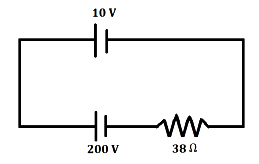
In the given circuit, the current flowing through it is: (in $ A$)
A
$5$
B
$4$
C
$2$
D
$3$
Solution
(A) The circuit consists of two batteries connected in opposition and a resistor in series.
The net electromotive force $(EMF)$ of the circuit is $E_{net} = 200 \, V - 10 \, V = 190 \, V$.
The total resistance of the circuit is $R = 38 \, \Omega$.
According to Ohm's law, the current $i$ flowing through the circuit is given by:
$i = \frac{E_{net}}{R} = \frac{190 \, V}{38 \, \Omega} = 5 \, A$.
The net electromotive force $(EMF)$ of the circuit is $E_{net} = 200 \, V - 10 \, V = 190 \, V$.
The total resistance of the circuit is $R = 38 \, \Omega$.
According to Ohm's law, the current $i$ flowing through the circuit is given by:
$i = \frac{E_{net}}{R} = \frac{190 \, V}{38 \, \Omega} = 5 \, A$.
0 likesView Solution
318
ChemistryMCQMHT CET · 2025
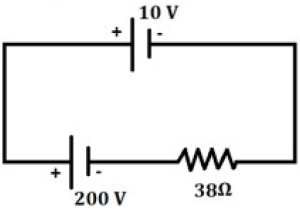
In the given circuit,the current flowing through the circuit is: (in $A$)
A
$2$
B
$2.5$
C
$5$
D
$4$
Solution
(C) The circuit consists of two batteries connected in series with a resistor of $38 \ \Omega$.
Looking at the polarities,the $10 \ V$ battery and the $200 \ V$ battery are connected in opposition (positive terminals facing each other).
Therefore,the net electromotive force $(EMF)$ in the circuit is $E_{net} = 200 \ V - 10 \ V = 190 \ V$.
The total resistance in the circuit is $R = 38 \ \Omega$.
According to Ohm's law,the current $I$ flowing through the circuit is given by $I = \frac{E_{net}}{R}$.
Substituting the values,we get $I = \frac{190 \ V}{38 \ \Omega} = 5 \ A$.
Thus,the current flowing through the circuit is $5 \ A$.
Looking at the polarities,the $10 \ V$ battery and the $200 \ V$ battery are connected in opposition (positive terminals facing each other).
Therefore,the net electromotive force $(EMF)$ in the circuit is $E_{net} = 200 \ V - 10 \ V = 190 \ V$.
The total resistance in the circuit is $R = 38 \ \Omega$.
According to Ohm's law,the current $I$ flowing through the circuit is given by $I = \frac{E_{net}}{R}$.
Substituting the values,we get $I = \frac{190 \ V}{38 \ \Omega} = 5 \ A$.
Thus,the current flowing through the circuit is $5 \ A$.
0 likesView Solution
319
ChemistryMCQMHT CET · 2025
Two cells $E_1$ and $E_2$ having equal e.m.f '$E$' and internal resistances $r_1$ and $r_2$ $(r_1 > r_2)$ respectively are connected in series. This combination is connected to an external resistance '$R$'. It is observed that the potential difference across the cell $E_1$ becomes zero. The value of $R$ will be
A
$r_1 - r_2$
B
$r_1 + r_2$
C
$\frac{r_1 - r_2}{2}$
D
$\frac{r_1 + r_2}{2}$
Solution
(A) The total e.m.f of the series combination is $E_{eq} = E + E = 2E$.
The total resistance of the circuit is $R_{total} = R + r_1 + r_2$.
The current flowing through the circuit is $I = \frac{2E}{R + r_1 + r_2}$.
The potential difference across cell $E_1$ is given by $V_1 = E - I r_1$.
Given that $V_1 = 0$,we have $E = I r_1$.
Substituting the value of $I$,we get $E = \left( \frac{2E}{R + r_1 + r_2} \right) r_1$.
Dividing both sides by $E$,we get $1 = \frac{2r_1}{R + r_1 + r_2}$.
Thus,$R + r_1 + r_2 = 2r_1$.
Solving for $R$,we get $R = 2r_1 - r_1 - r_2 = r_1 - r_2$.
The total resistance of the circuit is $R_{total} = R + r_1 + r_2$.
The current flowing through the circuit is $I = \frac{2E}{R + r_1 + r_2}$.
The potential difference across cell $E_1$ is given by $V_1 = E - I r_1$.
Given that $V_1 = 0$,we have $E = I r_1$.
Substituting the value of $I$,we get $E = \left( \frac{2E}{R + r_1 + r_2} \right) r_1$.
Dividing both sides by $E$,we get $1 = \frac{2r_1}{R + r_1 + r_2}$.
Thus,$R + r_1 + r_2 = 2r_1$.
Solving for $R$,we get $R = 2r_1 - r_1 - r_2 = r_1 - r_2$.
0 likesView Solution
320
ChemistryMCQMHT CET · 2025
Sodium and copper have work functions $2.3 \ eV$ and $4.5 \ eV$ respectively. The ratio of the threshold wavelength of sodium to that of copper is nearest to:
A
$1: 2$
B
$2: 1$
C
$1: 4$
D
$4: 1$
Solution
(B) The work function $\Phi$ is related to the threshold wavelength $\lambda_0$ by the equation: $\Phi = \frac{hc}{\lambda_0}$.
This implies that $\lambda_0 = \frac{hc}{\Phi}$.
Let $\Phi_{Na} = 2.3 \ eV$ and $\Phi_{Cu} = 4.5 \ eV$.
The ratio of the threshold wavelengths is given by: $\frac{\lambda_{Na}}{\lambda_{Cu}} = \frac{hc / \Phi_{Na}}{hc / \Phi_{Cu}} = \frac{\Phi_{Cu}}{\Phi_{Na}}$.
Substituting the given values: $\frac{\lambda_{Na}}{\lambda_{Cu}} = \frac{4.5}{2.3} \approx 1.956$.
Rounding this value to the nearest option,we get $2: 1$.
This implies that $\lambda_0 = \frac{hc}{\Phi}$.
Let $\Phi_{Na} = 2.3 \ eV$ and $\Phi_{Cu} = 4.5 \ eV$.
The ratio of the threshold wavelengths is given by: $\frac{\lambda_{Na}}{\lambda_{Cu}} = \frac{hc / \Phi_{Na}}{hc / \Phi_{Cu}} = \frac{\Phi_{Cu}}{\Phi_{Na}}$.
Substituting the given values: $\frac{\lambda_{Na}}{\lambda_{Cu}} = \frac{4.5}{2.3} \approx 1.956$.
Rounding this value to the nearest option,we get $2: 1$.
0 likesView Solution
321
ChemistryMCQMHT CET · 2025
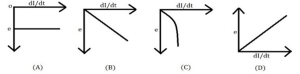
The current flowing through an inductor of self-inductance $L$ is continuously increasing at a constant rate. The variation of induced e.m.f. $(e)$ versus $dI/dt$ is shown graphically by which graph?
A
$A$
B
$B$
C
$C$
D
$D$
Solution
(D) The induced e.m.f. $(e)$ in an inductor of self-inductance $L$ is given by the formula: $e = -L \frac{dI}{dt}$.
Here,the negative sign indicates Lenz's Law,which states that the induced e.m.f. opposes the change in current.
If we consider the magnitude of the induced e.m.f. $|e| = L \frac{dI}{dt}$,we can see that $|e|$ is directly proportional to $\frac{dI}{dt}$.
Since $L$ is a constant,the graph of $|e|$ versus $\frac{dI}{dt}$ will be a straight line passing through the origin with a slope equal to $L$.
Looking at the given options,graph $(D)$ represents a linear relationship between $e$ and $dI/dt$ passing through the origin.
Therefore,the correct graph is $(D)$.
Here,the negative sign indicates Lenz's Law,which states that the induced e.m.f. opposes the change in current.
If we consider the magnitude of the induced e.m.f. $|e| = L \frac{dI}{dt}$,we can see that $|e|$ is directly proportional to $\frac{dI}{dt}$.
Since $L$ is a constant,the graph of $|e|$ versus $\frac{dI}{dt}$ will be a straight line passing through the origin with a slope equal to $L$.
Looking at the given options,graph $(D)$ represents a linear relationship between $e$ and $dI/dt$ passing through the origin.
Therefore,the correct graph is $(D)$.
0 likesView Solution
322
ChemistryMCQMHT CET · 2025
Two conducting circular loops of radii $R_1$ and $R_2$ are placed in the same plane with their centres coinciding. If $R_1$ > $R_2$, the mutual inductance $M$ between them will be directly proportional to
A
$\frac{R_1}{R_2}$
B
$\frac{R_2}{R_1}$
C
$\frac{R_1^2}{R_2}$
D
$\frac{R_2^2}{R_1}$
Solution
(D) The magnetic field $B$ at the center of a circular loop of radius $R_1$ carrying current $I_1$ is given by $B = \frac{\mu_0 I_1}{2 R_1}$.
Since $R_1$ > $R_2$, we assume the smaller loop of radius $R_2$ is placed within the magnetic field of the larger loop.
The magnetic flux $\phi_2$ linked with the smaller loop is $\phi_2 = B \cdot A_2$, where $A_2 = \pi R_2^2$ is the area of the smaller loop.
Substituting the values, we get $\phi_2 = \left( \frac{\mu_0 I_1}{2 R_1} \right) (\pi R_2^2) = \left( \frac{\mu_0 \pi R_2^2}{2 R_1} \right) I_1$.
By definition, the mutual inductance $M$ is given by $\phi_2 = M I_1$, so $M = \frac{\mu_0 \pi R_2^2}{2 R_1}$.
Thus, $M$ is directly proportional to $\frac{R_2^2}{R_1}$.
Since $R_1$ > $R_2$, we assume the smaller loop of radius $R_2$ is placed within the magnetic field of the larger loop.
The magnetic flux $\phi_2$ linked with the smaller loop is $\phi_2 = B \cdot A_2$, where $A_2 = \pi R_2^2$ is the area of the smaller loop.
Substituting the values, we get $\phi_2 = \left( \frac{\mu_0 I_1}{2 R_1} \right) (\pi R_2^2) = \left( \frac{\mu_0 \pi R_2^2}{2 R_1} \right) I_1$.
By definition, the mutual inductance $M$ is given by $\phi_2 = M I_1$, so $M = \frac{\mu_0 \pi R_2^2}{2 R_1}$.
Thus, $M$ is directly proportional to $\frac{R_2^2}{R_1}$.
0 likesView Solution
323
ChemistryMCQMHT CET · 2025
$A$ coil of wire of radius $r$ has $600$ turns and a self-inductance of $108 \ mH$. The self-inductance of a coil with the same radius and $500$ turns is: (in $mH$)
A
$80$
B
$75$
C
$108$
D
$90$
Solution
(B) The self-inductance $L$ of a solenoid or a coil is given by the formula $L = \frac{\mu_0 N^2 A}{l}$,where $N$ is the number of turns,$A$ is the area,and $l$ is the length. For a coil of a fixed radius and length,$L \propto N^2$.
Given $L_1 = 108 \ mH$ for $N_1 = 600$ turns.
We need to find $L_2$ for $N_2 = 500$ turns.
Using the ratio: $\frac{L_2}{L_1} = \left( \frac{N_2}{N_1} \right)^2$.
$\frac{L_2}{108} = \left( \frac{500}{600} \right)^2 = \left( \frac{5}{6} \right)^2 = \frac{25}{36}$.
$L_2 = 108 \times \frac{25}{36} = 3 \times 25 = 75 \ mH$.
Given $L_1 = 108 \ mH$ for $N_1 = 600$ turns.
We need to find $L_2$ for $N_2 = 500$ turns.
Using the ratio: $\frac{L_2}{L_1} = \left( \frac{N_2}{N_1} \right)^2$.
$\frac{L_2}{108} = \left( \frac{500}{600} \right)^2 = \left( \frac{5}{6} \right)^2 = \frac{25}{36}$.
$L_2 = 108 \times \frac{25}{36} = 3 \times 25 = 75 \ mH$.
0 likesView Solution
324
ChemistryMCQMHT CET · 2025
Two stones of masses $m$ and $3m$ are whirled in horizontal circles,the heavier one in a radius $\left(\frac{r}{3}\right)$ and the lighter one in a radius $r$. The tangential speed of the lighter stone is '$n$' times the value of the heavier stone. When the magnitude of the centripetal force becomes equal,the value of $n$ is:
A
$4$
B
$3$
C
$2$
D
$1$
Solution
(B) Let the mass of the lighter stone be $m_1 = m$ and its radius be $r_1 = r$. Let its tangential speed be $v_1$.
Let the mass of the heavier stone be $m_2 = 3m$ and its radius be $r_2 = \frac{r}{3}$. Let its tangential speed be $v_2$.
Given that $v_1 = n v_2$.
The centripetal force is given by $F = \frac{mv^2}{r}$.
Equating the centripetal forces for both stones: $F_1 = F_2$.
$\frac{m_1 v_1^2}{r_1} = \frac{m_2 v_2^2}{r_2}$.
Substituting the given values: $\frac{m (n v_2)^2}{r} = \frac{3m v_2^2}{r/3}$.
$\frac{m n^2 v_2^2}{r} = \frac{9m v_2^2}{r}$.
Canceling common terms $m, v_2^2,$ and $r$ from both sides,we get $n^2 = 9$.
Therefore,$n = 3$.
Let the mass of the heavier stone be $m_2 = 3m$ and its radius be $r_2 = \frac{r}{3}$. Let its tangential speed be $v_2$.
Given that $v_1 = n v_2$.
The centripetal force is given by $F = \frac{mv^2}{r}$.
Equating the centripetal forces for both stones: $F_1 = F_2$.
$\frac{m_1 v_1^2}{r_1} = \frac{m_2 v_2^2}{r_2}$.
Substituting the given values: $\frac{m (n v_2)^2}{r} = \frac{3m v_2^2}{r/3}$.
$\frac{m n^2 v_2^2}{r} = \frac{9m v_2^2}{r}$.
Canceling common terms $m, v_2^2,$ and $r$ from both sides,we get $n^2 = 9$.
Therefore,$n = 3$.
0 likesView Solution
325
ChemistryMCQMHT CET · 2025
$A$ mass $M$ attached to a horizontal spring executes $S.H.M.$ of amplitude $A_1$. When the mass $M$ passes through its mean position,a smaller mass $m$ is placed over it and both of them move together with amplitude $A_2$. The ratio $\left(\frac{A_1}{A_2}\right)$ is
A
$\frac{M+m}{M}$
B
$\frac{M}{M+m}$
C
$\left(\frac{M+m}{M}\right)^{\frac{1}{2}}$
D
$\left(\frac{M}{M+m}\right)^{\frac{1}{2}}$
Solution
(C) At the mean position,the velocity of the mass $M$ is maximum,given by $v_{max} = \omega_1 A_1 = \sqrt{\frac{k}{M}} A_1$.
When mass $m$ is placed on $M$,the total mass becomes $(M+m)$.
Since the collision is perfectly inelastic and occurs at the mean position,the momentum is conserved.
$M v_{max} = (M+m) v'_{max}$.
So,$v'_{max} = \frac{M}{M+m} v_{max}$.
The new angular frequency is $\omega_2 = \sqrt{\frac{k}{M+m}}$.
Since $v'_{max} = \omega_2 A_2$,we have $\frac{M}{M+m} (\omega_1 A_1) = \omega_2 A_2$.
Substituting the values: $\frac{M}{M+m} \sqrt{\frac{k}{M}} A_1 = \sqrt{\frac{k}{M+m}} A_2$.
$\frac{A_1}{A_2} = \frac{M+m}{M} \sqrt{\frac{k}{M+m}} \sqrt{\frac{M}{k}} = \frac{M+m}{M} \sqrt{\frac{M}{M+m}} = \sqrt{\frac{M+m}{M}} = \left(\frac{M+m}{M}\right)^{\frac{1}{2}}$.
When mass $m$ is placed on $M$,the total mass becomes $(M+m)$.
Since the collision is perfectly inelastic and occurs at the mean position,the momentum is conserved.
$M v_{max} = (M+m) v'_{max}$.
So,$v'_{max} = \frac{M}{M+m} v_{max}$.
The new angular frequency is $\omega_2 = \sqrt{\frac{k}{M+m}}$.
Since $v'_{max} = \omega_2 A_2$,we have $\frac{M}{M+m} (\omega_1 A_1) = \omega_2 A_2$.
Substituting the values: $\frac{M}{M+m} \sqrt{\frac{k}{M}} A_1 = \sqrt{\frac{k}{M+m}} A_2$.
$\frac{A_1}{A_2} = \frac{M+m}{M} \sqrt{\frac{k}{M+m}} \sqrt{\frac{M}{k}} = \frac{M+m}{M} \sqrt{\frac{M}{M+m}} = \sqrt{\frac{M+m}{M}} = \left(\frac{M+m}{M}\right)^{\frac{1}{2}}$.
0 likesView Solution
326
ChemistryMCQMHT CET · 2025
Four particles,each of mass $M$,are placed at the corners of a square of side $L$. The radius of gyration of the system about an axis perpendicular to the square and passing through its centre is:
A
$L$
B
$\frac{L}{2}$
C
$\frac{L}{4}$
D
$\frac{L}{\sqrt{2}}$
Solution
(D) The moment of inertia $I$ of a system of particles about an axis is given by $I = \sum m_i r_i^2$,where $r_i$ is the perpendicular distance of the $i$-th particle from the axis.
For a square of side $L$,the distance of each corner from the centre is $r = \frac{\text{diagonal}}{2} = \frac{\sqrt{2}L}{2} = \frac{L}{\sqrt{2}}$.
Since there are four particles each of mass $M$,the total moment of inertia $I$ about the axis passing through the centre and perpendicular to the plane is:
$I = 4 \times M \times r^2 = 4 \times M \times (\frac{L}{\sqrt{2}})^2 = 4 \times M \times \frac{L^2}{2} = 2ML^2$.
The radius of gyration $k$ is defined by the relation $I = Mk_{total} k^2$,where $M_{total} = 4M$.
So,$2ML^2 = (4M)k^2$.
$k^2 = \frac{2ML^2}{4M} = \frac{L^2}{2}$.
$k = \frac{L}{\sqrt{2}}$.
For a square of side $L$,the distance of each corner from the centre is $r = \frac{\text{diagonal}}{2} = \frac{\sqrt{2}L}{2} = \frac{L}{\sqrt{2}}$.
Since there are four particles each of mass $M$,the total moment of inertia $I$ about the axis passing through the centre and perpendicular to the plane is:
$I = 4 \times M \times r^2 = 4 \times M \times (\frac{L}{\sqrt{2}})^2 = 4 \times M \times \frac{L^2}{2} = 2ML^2$.
The radius of gyration $k$ is defined by the relation $I = Mk_{total} k^2$,where $M_{total} = 4M$.
So,$2ML^2 = (4M)k^2$.
$k^2 = \frac{2ML^2}{4M} = \frac{L^2}{2}$.
$k = \frac{L}{\sqrt{2}}$.
0 likesView Solution
327
ChemistryMCQMHT CET · 2025
Two cylinders $A$ and $B$ fitted with pistons contain equal amounts of an ideal diatomic gas at temperature $T \ K$. The piston of cylinder $A$ is free to move,while that of cylinder $B$ is held fixed. The same amount of heat $dQ$ is given to the gas in each cylinder. If the rise in temperature of the gas in $A$ is $dT_{A}$,then the rise in temperature of the gas in $B$ is (where $\gamma = \frac{C_{p}}{C_{v}}$):
A
$\frac{dT_{A}}{2}$
B
$\frac{dT_{A}}{\gamma}$
C
$\gamma dT_{A}$
D
$2 dT_{A}$
Solution
(C) For cylinder $A$ (isobaric process,piston is free to move): The heat supplied is $dQ = n C_{p} dT_{A}$.
For cylinder $B$ (isochoric process,piston is fixed): The heat supplied is $dQ = n C_{v} dT_{B}$.
Since the heat supplied is the same in both cases,we have $n C_{p} dT_{A} = n C_{v} dT_{B}$.
Dividing both sides by $n C_{v}$,we get $\frac{C_{p}}{C_{v}} dT_{A} = dT_{B}$.
Given $\gamma = \frac{C_{p}}{C_{v}}$,we substitute this into the equation to get $dT_{B} = \gamma dT_{A}$.
For cylinder $B$ (isochoric process,piston is fixed): The heat supplied is $dQ = n C_{v} dT_{B}$.
Since the heat supplied is the same in both cases,we have $n C_{p} dT_{A} = n C_{v} dT_{B}$.
Dividing both sides by $n C_{v}$,we get $\frac{C_{p}}{C_{v}} dT_{A} = dT_{B}$.
Given $\gamma = \frac{C_{p}}{C_{v}}$,we substitute this into the equation to get $dT_{B} = \gamma dT_{A}$.
0 likesView Solution
328
ChemistryEasyMCQMHT CET · 2025
What is the common name of $Benzene-1,3-diol$?
A
Catechol
B
Resorcinol
C
Quinol
D
Pyrogallol
Solution
(B) The structure of $Benzene-1,3-diol$ consists of a benzene ring with two hydroxyl $(-OH)$ groups attached at the $1$ and $3$ positions.
This compound is commonly known as $Resorcinol$.
$Catechol$ is $Benzene-1,2-diol$.
$Quinol$ (or $Hydroquinone$) is $Benzene-1,4-diol$.
$Pyrogallol$ is $Benzene-1,2,3-triol$.
This compound is commonly known as $Resorcinol$.
$Catechol$ is $Benzene-1,2-diol$.
$Quinol$ (or $Hydroquinone$) is $Benzene-1,4-diol$.
$Pyrogallol$ is $Benzene-1,2,3-triol$.
0 likesView Solution
329
ChemistryEasyMCQMHT CET · 2025
The common name of $Benzene-1,2-diol$ is
A
Catechol
B
Resorcinol
C
Quinol
D
Pyrogallol
Solution
(A) The structure of $Benzene-1,2-diol$ consists of a benzene ring with two hydroxyl $(-OH)$ groups attached at adjacent positions ($1$ and $2$).
This compound is commonly known as $Catechol$ (or $Pyrocatechol$).
This compound is commonly known as $Catechol$ (or $Pyrocatechol$).
0 likesView Solution
330
ChemistryEasyMCQMHT CET · 2025
Which of the following is a trihydric phenol?
A
Catechol
B
Pyrogallol
C
Resorcinol
D
Quinol
Solution
(B) trihydric phenol contains three hydroxyl $(-OH)$ groups attached to the benzene ring.
$1$. Catechol is $1,2$-dihydroxybenzene (dihydric).
$2$. Pyrogallol is $1,2,3$-trihydroxybenzene (trihydric).
$3$. Resorcinol is $1,3$-dihydroxybenzene (dihydric).
$4$. Quinol (Hydroquinone) is $1,4$-dihydroxybenzene (dihydric).
Therefore,Pyrogallol is the correct answer.
$1$. Catechol is $1,2$-dihydroxybenzene (dihydric).
$2$. Pyrogallol is $1,2,3$-trihydroxybenzene (trihydric).
$3$. Resorcinol is $1,3$-dihydroxybenzene (dihydric).
$4$. Quinol (Hydroquinone) is $1,4$-dihydroxybenzene (dihydric).
Therefore,Pyrogallol is the correct answer.
0 likesView Solution
331
ChemistryEasyMCQMHT CET · 2025
Which of the following is the structural formula of mesityl oxide?
A
$(CH_3)_2CH-CH=CH-CO-CH_3$
B
$(CH_3)_2C=CH-CO-CH_3$
C
$(CH_3)_3C-CH=CH-CO-CH_3$
D
$(CH_3)_2CH-CH=CH-CO-CH(CH_3)_2$
Solution
(B) Mesityl oxide is an $\alpha,\beta$-unsaturated ketone with the chemical formula $(CH_3)_2C=CHCOCH_3$.
It is formed by the aldol condensation of two molecules of acetone followed by dehydration.
The structure consists of an isopropylidene group attached to an acetyl group.
It is formed by the aldol condensation of two molecules of acetone followed by dehydration.
The structure consists of an isopropylidene group attached to an acetyl group.
0 likesView Solution
332
ChemistryEasyMCQMHT CET · 2025
Which of the following compounds is optically inactive?
A
$2-$Chloro-$2-$methylbutane
B
$3-$Chlorohexane
C
$2-$Chloro-$3-$methylbutane
D
$2-$Chloropentane
Solution
(A) compound is optically inactive if it does not contain a chiral center (an asymmetric carbon atom bonded to four different groups).
$1.$ $2-$Chloro-$2-$methylbutane: The $C-2$ carbon is bonded to two identical methyl groups,so it is not chiral. Thus,it is optically inactive.
$2.$ $3-$Chlorohexane: The $C-3$ carbon is bonded to $-H$,$-Cl$,$-CH_2CH_3$,and $-CH_2CH_2CH_3$. Since all four groups are different,it is chiral and optically active.
$3.$ $2-$Chloro-$3-$methylbutane: The $C-2$ carbon is bonded to $-H$,$-Cl$,$-CH_3$,and $-CH(CH_3)_2$. Since all four groups are different,it is chiral and optically active.
$4.$ $2-$Chloropentane: The $C-2$ carbon is bonded to $-H$,$-Cl$,$-CH_3$,and $-CH_2CH_2CH_3$. Since all four groups are different,it is chiral and optically active.
Therefore,$2-$Chloro-$2-$methylbutane is the optically inactive compound.
$1.$ $2-$Chloro-$2-$methylbutane: The $C-2$ carbon is bonded to two identical methyl groups,so it is not chiral. Thus,it is optically inactive.
$2.$ $3-$Chlorohexane: The $C-3$ carbon is bonded to $-H$,$-Cl$,$-CH_2CH_3$,and $-CH_2CH_2CH_3$. Since all four groups are different,it is chiral and optically active.
$3.$ $2-$Chloro-$3-$methylbutane: The $C-2$ carbon is bonded to $-H$,$-Cl$,$-CH_3$,and $-CH(CH_3)_2$. Since all four groups are different,it is chiral and optically active.
$4.$ $2-$Chloropentane: The $C-2$ carbon is bonded to $-H$,$-Cl$,$-CH_3$,and $-CH_2CH_2CH_3$. Since all four groups are different,it is chiral and optically active.
Therefore,$2-$Chloro-$2-$methylbutane is the optically inactive compound.
0 likesView Solution
333
ChemistryEasyMCQMHT CET · 2025
When $tert$-butyl bromide is heated with silver fluoride,the major product obtained is:
A
$1$-Fluoro-$2$-methylpropane
B
$2$-Fluoro-$2$-methylpropane
C
$1$-Fluorobutane
D
$2$-Fluorobutane
Solution
(B) The reaction of $tert$-butyl bromide $((CH_3)_3CBr)$ with silver fluoride $(AgF)$ is a Swarts reaction,which is used for the synthesis of alkyl fluorides.
However,$tert$-butyl bromide is a tertiary alkyl halide. When heated with $AgF$,it undergoes an $E1$ elimination reaction rather than a nucleophilic substitution ($S_N1$ or $S_N2$) because the tertiary carbocation is highly stable and the fluoride ion acts as a base.
The major product formed is $2$-methylpropene (isobutylene) due to the elimination of $HBr$.
However,$tert$-butyl bromide is a tertiary alkyl halide. When heated with $AgF$,it undergoes an $E1$ elimination reaction rather than a nucleophilic substitution ($S_N1$ or $S_N2$) because the tertiary carbocation is highly stable and the fluoride ion acts as a base.
The major product formed is $2$-methylpropene (isobutylene) due to the elimination of $HBr$.
0 likesView Solution
334
ChemistryEasyMCQMHT CET · 2025
Which among the following is an allylic halide?
A
$1-$Bromopropene
B
$2-$Bromopropene
C
$3-$Bromopropene
D
$4-$Bromobut$-1-$ene
Solution
(C) An allylic halide is a compound in which the halogen atom is bonded to an $sp^3$ hybridized carbon atom next to a carbon-carbon double bond $(C=C)$.
In $3-$bromopropene $(CH_2=CH-CH_2Br)$,the bromine atom is attached to a carbon atom that is adjacent to the double bond,which satisfies the definition of an allylic halide.
$1-$Bromopropene and $2-$bromopropene are vinylic halides because the halogen is attached directly to the double-bonded carbon atom.
In $3-$bromopropene $(CH_2=CH-CH_2Br)$,the bromine atom is attached to a carbon atom that is adjacent to the double bond,which satisfies the definition of an allylic halide.
$1-$Bromopropene and $2-$bromopropene are vinylic halides because the halogen is attached directly to the double-bonded carbon atom.
0 likesView Solution
335
ChemistryMediumMCQMHT CET · 2025
Which among the following is $NOT$ a benzylic halide?
A
Bromophenylmethane
B
$1-$Bromo$-1-$phenylpropane
C
$2-$Bromo$-2-$phenylpropane
D
$1-$Bromo$-2-$phenylbutane
Solution
(D) benzylic halide is a compound in which the halogen atom is bonded to a carbon atom that is directly attached to an aromatic ring (specifically,a $sp^3$ hybridized carbon atom adjacent to the benzene ring).
$1.$ Bromophenylmethane $(C_6H_5CH_2Br)$ is a benzylic halide.
$2.$ $1-$Bromo$-1-$phenylpropane $(C_6H_5CH(Br)CH_2CH_3)$ is a benzylic halide.
$3.$ $2-$Bromo$-2-$phenylpropane $(C_6H_5C(Br)(CH_3)_2)$ is a benzylic halide.
$4.$ $1-$Bromo$-2-$phenylbutane $(C_6H_5CH_2CH(Br)CH_2CH_3)$ has the bromine atom attached to a carbon that is not directly bonded to the benzene ring. The carbon attached to the benzene ring is a $CH_2$ group,and the bromine is on the second carbon of the alkyl chain. Therefore,it is not a benzylic halide.
$1.$ Bromophenylmethane $(C_6H_5CH_2Br)$ is a benzylic halide.
$2.$ $1-$Bromo$-1-$phenylpropane $(C_6H_5CH(Br)CH_2CH_3)$ is a benzylic halide.
$3.$ $2-$Bromo$-2-$phenylpropane $(C_6H_5C(Br)(CH_3)_2)$ is a benzylic halide.
$4.$ $1-$Bromo$-2-$phenylbutane $(C_6H_5CH_2CH(Br)CH_2CH_3)$ has the bromine atom attached to a carbon that is not directly bonded to the benzene ring. The carbon attached to the benzene ring is a $CH_2$ group,and the bromine is on the second carbon of the alkyl chain. Therefore,it is not a benzylic halide.
0 likesView Solution
336
ChemistryEasyMCQMHT CET · 2025
Identify the product '$X$' formed in the following reaction: Sodium ethoxide + Isopropyl chloride $\longrightarrow X$ + Ethanol + Sodium Chloride
A
$1-$Ethoxypropane
B
$2-$Ethoxypropane
C
Propene
D
Propane
Solution
(C) The reaction between sodium ethoxide $(CH_3CH_2ONa)$ and isopropyl chloride $((CH_3)_2CHCl)$ is a base-promoted elimination reaction.
Since sodium ethoxide is a strong base and isopropyl chloride is a secondary alkyl halide,the $E2$ elimination mechanism predominates over the $S_N2$ substitution mechanism.
The base abstracts a $\beta$-hydrogen from the isopropyl chloride,leading to the formation of propene $(CH_3-CH=CH_2)$,ethanol $(CH_3CH_2OH)$,and sodium chloride $(NaCl)$.
Therefore,the product '$X$' is propene.
Since sodium ethoxide is a strong base and isopropyl chloride is a secondary alkyl halide,the $E2$ elimination mechanism predominates over the $S_N2$ substitution mechanism.
The base abstracts a $\beta$-hydrogen from the isopropyl chloride,leading to the formation of propene $(CH_3-CH=CH_2)$,ethanol $(CH_3CH_2OH)$,and sodium chloride $(NaCl)$.
Therefore,the product '$X$' is propene.
0 likesView Solution
337
ChemistryMediumMCQMHT CET · 2025
Which of the following pairs of compounds on heating gives butanenitrile?
A
Propanol and alcoholic $KCN$
B
Butanol and alcoholic $KCN$
C
$n-$Butylchloride and alcoholic $KCN$
D
$n-$Propylchloride and alcoholic $KCN$
Solution
(D) The reaction of an alkyl halide with alcoholic $KCN$ is a nucleophilic substitution reaction ($S_N2$ mechanism) that produces an alkyl cyanide (nitrile).
To obtain butanenitrile $(CH_3CH_2CH_2CH_2CN)$,which contains $4$ carbon atoms in the chain plus the nitrile carbon,we need a starting alkyl halide with $4$ carbon atoms.
$n-$Propylchloride $(CH_3CH_2CH_2Cl)$ has $3$ carbons,so it would yield butanenitrile $(CH_3CH_2CH_2CN)$ which is $3$ carbons in the chain plus the nitrile carbon,totaling $4$ carbons.
Wait,butanenitrile is $CH_3CH_2CH_2CN$. This contains $4$ carbon atoms in total.
Therefore,$n-$propylchloride $(CH_3CH_2CH_2Cl)$ reacts with $KCN$ to form $CH_3CH_2CH_2CN$ (butanenitrile).
Reaction: $CH_3CH_2CH_2Cl + KCN \text{ (alc.)} ightarrow CH_3CH_2CH_2CN + KCl$.
To obtain butanenitrile $(CH_3CH_2CH_2CH_2CN)$,which contains $4$ carbon atoms in the chain plus the nitrile carbon,we need a starting alkyl halide with $4$ carbon atoms.
$n-$Propylchloride $(CH_3CH_2CH_2Cl)$ has $3$ carbons,so it would yield butanenitrile $(CH_3CH_2CH_2CN)$ which is $3$ carbons in the chain plus the nitrile carbon,totaling $4$ carbons.
Wait,butanenitrile is $CH_3CH_2CH_2CN$. This contains $4$ carbon atoms in total.
Therefore,$n-$propylchloride $(CH_3CH_2CH_2Cl)$ reacts with $KCN$ to form $CH_3CH_2CH_2CN$ (butanenitrile).
Reaction: $CH_3CH_2CH_2Cl + KCN \text{ (alc.)} ightarrow CH_3CH_2CH_2CN + KCl$.
0 likesView Solution
338
ChemistryMediumMCQMHT CET · 2025
Which of the following is $NOT$ obtained when a mixture of chloroethane and $1-$chloropropane is treated with sodium metal in dry ether?
A
Propane
B
Butane
C
Pentane
D
Hexane
Solution
(A) The reaction of a mixture of alkyl halides with sodium metal in dry ether is known as the Wurtz reaction. When a mixture of chloroethane $(CH_3CH_2Cl)$ and $1-$chloropropane $(CH_3CH_2CH_2Cl)$ is treated with sodium in dry ether,the following products are formed due to the coupling of alkyl radicals:
$1$. Coupling of two chloroethane molecules: $CH_3CH_2-CH_2CH_3$ ($n-$butane).
$2$. Coupling of two $1-$chloropropane molecules: $CH_3CH_2CH_2-CH_2CH_2CH_3$ ($n-$hexane).
$3$. Cross-coupling of chloroethane and $1-$chloropropane: $CH_3CH_2-CH_2CH_2CH_3$ ($n-$pentane).
Propane is not formed in this reaction because it would require the loss of a carbon atom or a different mechanism not associated with the Wurtz coupling of these specific reactants.
$1$. Coupling of two chloroethane molecules: $CH_3CH_2-CH_2CH_3$ ($n-$butane).
$2$. Coupling of two $1-$chloropropane molecules: $CH_3CH_2CH_2-CH_2CH_2CH_3$ ($n-$hexane).
$3$. Cross-coupling of chloroethane and $1-$chloropropane: $CH_3CH_2-CH_2CH_2CH_3$ ($n-$pentane).
Propane is not formed in this reaction because it would require the loss of a carbon atom or a different mechanism not associated with the Wurtz coupling of these specific reactants.
0 likesView Solution
339
ChemistryMediumMCQMHT CET · 2025
Which of the following has the highest reactivity for $S_N2$ reactions?
A
$n$-Butyl iodide
B
$sec$-Butyl iodide
C
Isobutyl iodide
D
$tert$-Butyl iodide
Solution
(A) The reactivity of alkyl halides towards $S_N2$ reactions follows the order: $Primary > Secondary > Tertiary$.
This is due to the steric hindrance,which increases from primary to tertiary alkyl halides,making it difficult for the nucleophile to attack the electrophilic carbon.
Among the given options:
$(A)$ $n$-Butyl iodide is a primary $(1^{\circ})$ alkyl halide.
$(B)$ $sec$-Butyl iodide is a secondary $(2^{\circ})$ alkyl halide.
$(C)$ Isobutyl iodide is a primary $(1^{\circ})$ alkyl halide,but it has steric hindrance at the $\beta$-carbon.
$(D)$ $tert$-Butyl iodide is a tertiary $(3^{\circ})$ alkyl halide.
Since $n$-Butyl iodide is a primary alkyl halide with the least steric hindrance,it shows the highest reactivity for $S_N2$ reactions.
This is due to the steric hindrance,which increases from primary to tertiary alkyl halides,making it difficult for the nucleophile to attack the electrophilic carbon.
Among the given options:
$(A)$ $n$-Butyl iodide is a primary $(1^{\circ})$ alkyl halide.
$(B)$ $sec$-Butyl iodide is a secondary $(2^{\circ})$ alkyl halide.
$(C)$ Isobutyl iodide is a primary $(1^{\circ})$ alkyl halide,but it has steric hindrance at the $\beta$-carbon.
$(D)$ $tert$-Butyl iodide is a tertiary $(3^{\circ})$ alkyl halide.
Since $n$-Butyl iodide is a primary alkyl halide with the least steric hindrance,it shows the highest reactivity for $S_N2$ reactions.
0 likesView Solution
340
ChemistryEasyMCQMHT CET · 2025
Which among the following is $NOT$ an allylic halide?
A
$CH_2=CH-CH_2-X$
B
$CH_3-CH=CH-CH_2-X$
C
$CH_3-CH_2-CH=CH-CH_2-X$
D
$CH_3-CH=CH-CH_2-CH_2-X$
Solution
(D) An allylic halide is a compound in which the halogen atom is bonded to an $sp^3$ hybridized carbon atom that is adjacent to a carbon-carbon double bond $(C=C-C-X)$.
In option $A$,$CH_2=CH-CH_2-X$,the halogen is attached to an allylic carbon.
In option $B$,$CH_3-CH=CH-CH_2-X$,the halogen is attached to an allylic carbon.
In option $C$,$CH_3-CH_2-CH=CH-CH_2-X$,the halogen is attached to an allylic carbon.
In option $D$,$CH_3-CH=CH-CH_2-CH_2-X$,the halogen is attached to a carbon atom that is two positions away from the double bond,making it a homoallylic halide,not an allylic halide.
In option $A$,$CH_2=CH-CH_2-X$,the halogen is attached to an allylic carbon.
In option $B$,$CH_3-CH=CH-CH_2-X$,the halogen is attached to an allylic carbon.
In option $C$,$CH_3-CH_2-CH=CH-CH_2-X$,the halogen is attached to an allylic carbon.
In option $D$,$CH_3-CH=CH-CH_2-CH_2-X$,the halogen is attached to a carbon atom that is two positions away from the double bond,making it a homoallylic halide,not an allylic halide.
0 likesView Solution
341
ChemistryEasyMCQMHT CET · 2025
Which among the following statements is true for a haloalkyne?
A
Halogen atom is bonded to an $sp$ hybridized carbon atom.
B
Halogen atom is bonded to an $sp^2$ hybridized carbon atom of an aliphatic chain.
C
Halogen atom is bonded to an $sp^3$ hybridized carbon atom next to a carbon-carbon double bond.
D
Halogen atom is bonded to an $sp^2$ hybridized carbon atom of an aromatic ring.
Solution
(A) haloalkyne is a compound in which a halogen atom is directly attached to a carbon atom that is part of a carbon-carbon triple bond $(C \equiv C)$.
In a carbon-carbon triple bond,the carbon atom is $sp$ hybridized.
Therefore,the halogen atom is bonded to an $sp$ hybridized carbon atom.
In a carbon-carbon triple bond,the carbon atom is $sp$ hybridized.
Therefore,the halogen atom is bonded to an $sp$ hybridized carbon atom.
0 likesView Solution
342
ChemistryMediumMCQMHT CET · 2025
Which of the following is likely to undergo racemization during alkaline hydrolysis by $SN^1$ mechanism?
A
$CH_3-CH(Cl)-CH_3$
B
$CH_3-CH_2-CH(Cl)-CH_3$
C
$CH_3-CH_2-CH(Cl)-CH_2-CH_3$
D
$(CH_3)_3C-CH_2-Cl$
Solution
(B) Racemization occurs in $SN^1$ reactions when the substrate forms a stable,planar carbocation intermediate that is chiral.
Among the given options,$CH_3-CH_2-CH(Cl)-CH_3$ ($2$-chlorobutane) is a secondary alkyl halide that can form a planar carbocation $(CH_3-CH_2-CH^+-CH_3)$ upon the loss of the chloride ion.
This carbocation is prochiral and can be attacked by the nucleophile from either side,leading to a racemic mixture.
$CH_3-CH(Cl)-CH_3$ (isopropyl chloride) forms a less stable secondary carbocation and is less prone to $SN^1$ compared to $2-$chlorobutane.
$CH_3-CH_2-CH(Cl)-CH_2-CH_3$ ($3$-chloropentane) forms a carbocation that is achiral due to symmetry,so it does not result in a racemic mixture.
$(CH_3)_3C-CH_2-Cl$ is a primary alkyl halide and typically undergoes $SN^2$ reactions.
Among the given options,$CH_3-CH_2-CH(Cl)-CH_3$ ($2$-chlorobutane) is a secondary alkyl halide that can form a planar carbocation $(CH_3-CH_2-CH^+-CH_3)$ upon the loss of the chloride ion.
This carbocation is prochiral and can be attacked by the nucleophile from either side,leading to a racemic mixture.
$CH_3-CH(Cl)-CH_3$ (isopropyl chloride) forms a less stable secondary carbocation and is less prone to $SN^1$ compared to $2-$chlorobutane.
$CH_3-CH_2-CH(Cl)-CH_2-CH_3$ ($3$-chloropentane) forms a carbocation that is achiral due to symmetry,so it does not result in a racemic mixture.
$(CH_3)_3C-CH_2-Cl$ is a primary alkyl halide and typically undergoes $SN^2$ reactions.
0 likesView Solution
343
ChemistryMediumMCQMHT CET · 2025
Identify the product formed when $2-$Bromobutane is heated with aqueous solution of sodium hydroxide.
A
But$-1-$ene
B
But$-2-$ene
C
Butan$-1-$ol
D
Butan$-2-$ol
Solution
(D) When $2-$Bromobutane $(CH_3CH(Br)CH_2CH_3)$ is treated with an aqueous solution of sodium hydroxide $(NaOH)$,it undergoes a nucleophilic substitution reaction ($S_N1$ or $S_N2$ mechanism depending on conditions,but typically $S_N2$ for secondary halides in aqueous media).
The hydroxide ion $(OH^-)$ acts as a nucleophile and replaces the bromide ion $(Br^-)$.
The reaction is: $CH_3CH(Br)CH_2CH_3 + NaOH_{(aq)} \rightarrow CH_3CH(OH)CH_2CH_3 + NaBr$.
The product formed is Butan$-2-$ol.
The hydroxide ion $(OH^-)$ acts as a nucleophile and replaces the bromide ion $(Br^-)$.
The reaction is: $CH_3CH(Br)CH_2CH_3 + NaOH_{(aq)} \rightarrow CH_3CH(OH)CH_2CH_3 + NaBr$.
The product formed is Butan$-2-$ol.
0 likesView Solution
344
ChemistryMediumMCQMHT CET · 2025
Select the correct decreasing order of boiling points of compounds from the following.
A
$CH_3Cl > CH_3Br > CH_2Br_2 > CHBr_3$
B
$CH_3Br > CH_2Br_2 > CHBr_3 > CH_3Cl$
C
$CH_2Br_2 > CHBr_3 > CH_3Br > CH_3Cl$
D
$CHBr_3 > CH_2Br_2 > CH_3Br > CH_3Cl$
Solution
(D) The boiling point of haloalkanes increases with an increase in molecular mass and the number of halogen atoms present in the molecule.
This is because the magnitude of van der Waals forces increases as the size and number of halogen atoms increase.
Comparing the given compounds: $CHBr_3$ (tribromomethane) has the highest molecular mass,followed by $CH_2Br_2$ (dibromomethane),$CH_3Br$ (bromomethane),and $CH_3Cl$ (chloromethane) has the lowest molecular mass.
Therefore,the correct decreasing order is $CHBr_3 > CH_2Br_2 > CH_3Br > CH_3Cl$.
This is because the magnitude of van der Waals forces increases as the size and number of halogen atoms increase.
Comparing the given compounds: $CHBr_3$ (tribromomethane) has the highest molecular mass,followed by $CH_2Br_2$ (dibromomethane),$CH_3Br$ (bromomethane),and $CH_3Cl$ (chloromethane) has the lowest molecular mass.
Therefore,the correct decreasing order is $CHBr_3 > CH_2Br_2 > CH_3Br > CH_3Cl$.
0 likesView Solution
345
ChemistryEasyMCQMHT CET · 2025
What is the order of reactivity of alkyl halides with ammonia?
A
$R-Cl > R-Br > R-I$
B
$R-Br > R-I > R-Cl$
C
$R-I > R-Br > R-Cl$
D
$R-Cl > R-I > R-Br$
Solution
(C) The reaction of alkyl halides with ammonia is a nucleophilic substitution reaction $(S_N2)$.
In this reaction,the halide ion $(X^-)$ acts as a leaving group.
The reactivity of alkyl halides depends on the strength of the $C-X$ bond.
The bond dissociation energy decreases as the size of the halogen atom increases,making the $C-I$ bond the weakest and the $C-Cl$ bond the strongest.
Therefore,the leaving group ability follows the order: $I^- > Br^- > Cl^-$.
Thus,the order of reactivity of alkyl halides with ammonia is $R-I > R-Br > R-Cl$.
In this reaction,the halide ion $(X^-)$ acts as a leaving group.
The reactivity of alkyl halides depends on the strength of the $C-X$ bond.
The bond dissociation energy decreases as the size of the halogen atom increases,making the $C-I$ bond the weakest and the $C-Cl$ bond the strongest.
Therefore,the leaving group ability follows the order: $I^- > Br^- > Cl^-$.
Thus,the order of reactivity of alkyl halides with ammonia is $R-I > R-Br > R-Cl$.
0 likesView Solution
346
ChemistryEasyMCQMHT CET · 2025
Which of the following reagents is used in the preparation of nitroalkane from haloalkane?
A
Potassium cyanide
B
Sodium nitrite
C
Potassium nitrite
D
Silver nitrite
Solution
(D) The reaction of haloalkanes $(R-X)$ with silver nitrite $(AgNO_2)$ leads to the formation of nitroalkanes $(R-NO_2)$ as the major product.
This occurs because $AgNO_2$ is a covalent compound,and the nitrogen atom is more nucleophilic than the oxygen atom.
In contrast,ionic nitrites like $KNO_2$ or $NaNO_2$ primarily yield alkyl nitrites $(R-ONO)$ because the oxygen atom is more nucleophilic in these ionic species.
This occurs because $AgNO_2$ is a covalent compound,and the nitrogen atom is more nucleophilic than the oxygen atom.
In contrast,ionic nitrites like $KNO_2$ or $NaNO_2$ primarily yield alkyl nitrites $(R-ONO)$ because the oxygen atom is more nucleophilic in these ionic species.
0 likesView Solution
347
ChemistryEasyMCQMHT CET · 2025
Which among the following is a vinylic halide?
A
$CH_2=CH-Cl$
B
$CH_3-CH_2-Cl$
C
$C_6H_5-Cl$
D
$CH_2=CH-CH_2-Cl$
Solution
(A) vinylic halide is a compound in which the halogen atom is bonded to a carbon atom that is part of a carbon-carbon double bond $(C=C)$.
In the option $CH_2=CH-Cl$,the chlorine atom is directly attached to a carbon atom involved in a double bond,which defines it as a vinylic halide.
Therefore,the correct option is $A$.
In the option $CH_2=CH-Cl$,the chlorine atom is directly attached to a carbon atom involved in a double bond,which defines it as a vinylic halide.
Therefore,the correct option is $A$.
0 likesView Solution
348
ChemistryMediumMCQMHT CET · 2025
Identify the product formed from chlorobenzene on heating with conc. $HNO_3$ in the presence of conc. $H_2SO_4$.
A
Only $1-$chloro$-4-$nitrobenzene
B
$1-$chloro$-2-$nitrobenzene
C
Mixture of $1-$chloro$-4-$nitrobenzene and $1-$chloro$-2-$nitrobenzene
D
$2,4,6-$trinitrochlorobenzene
Solution
(C) Chlorobenzene undergoes electrophilic aromatic substitution (nitration) when treated with a mixture of conc. $HNO_3$ and conc. $H_2SO_4$.
Because the chlorine atom is ortho/para-directing due to the resonance effect,the nitration occurs at both the $ortho$ and $para$ positions.
Therefore,the reaction yields a mixture of $1-$chloro$-2-$nitrobenzene ($ortho$-isomer) and $1-$chloro$-4-$nitrobenzene ($para$-isomer).
Because the chlorine atom is ortho/para-directing due to the resonance effect,the nitration occurs at both the $ortho$ and $para$ positions.
Therefore,the reaction yields a mixture of $1-$chloro$-2-$nitrobenzene ($ortho$-isomer) and $1-$chloro$-4-$nitrobenzene ($para$-isomer).
0 likesView Solution
349
ChemistryEasyMCQMHT CET · 2025
Identify the reagent involved in the Sandmeyer reaction.
A
$CuCN / KCN$
B
$Cu$ (Powder) $/ HBr$
C
$H_3PO_3$
D
$CH_3CH_2OH$
Solution
(A) The Sandmeyer reaction is a chemical reaction used to synthesize aryl halides from aryl diazonium salts using copper salts as reagents or catalysts.
Specifically,the reaction of benzene diazonium chloride with $CuCl/HCl$ or $CuBr/HBr$ or $CuCN/KCN$ leads to the formation of chlorobenzene,bromobenzene,or benzonitrile,respectively.
Among the given options,$CuCN / KCN$ is the reagent used to introduce a cyano group via the Sandmeyer reaction.
Specifically,the reaction of benzene diazonium chloride with $CuCl/HCl$ or $CuBr/HBr$ or $CuCN/KCN$ leads to the formation of chlorobenzene,bromobenzene,or benzonitrile,respectively.
Among the given options,$CuCN / KCN$ is the reagent used to introduce a cyano group via the Sandmeyer reaction.
0 likesView Solution
350
ChemistryMediumMCQMHT CET · 2025
Identify the substrate '$S$' in the following reaction:
$S \xrightarrow{\text{warm } H_2O} \text{Picric acid}$
$S \xrightarrow{\text{warm } H_2O} \text{Picric acid}$
A
$p-$Nitrochlorobenzene
B
$o-$Nitrochlorobenzene
C
$2,4-$dinitrochlorobenzene
D
$2,4,6-$trinitrochlorobenzene
Solution
(D) The reaction shown is the nucleophilic aromatic substitution of a chlorobenzene derivative with water (hydrolysis) to form a phenol derivative.
The product formed is $2,4,6-$trinitrophenol,commonly known as picric acid.
This reaction proceeds easily under mild conditions (warm water) because the three electron-withdrawing $-NO_2$ groups at the ortho and para positions significantly activate the benzene ring towards nucleophilic attack by $H_2O$.
Therefore,the substrate '$S$' must be $2,4,6-$trinitrochlorobenzene.
The product formed is $2,4,6-$trinitrophenol,commonly known as picric acid.
This reaction proceeds easily under mild conditions (warm water) because the three electron-withdrawing $-NO_2$ groups at the ortho and para positions significantly activate the benzene ring towards nucleophilic attack by $H_2O$.
Therefore,the substrate '$S$' must be $2,4,6-$trinitrochlorobenzene.
0 likesView Solution
351
ChemistryMediumMCQMHT CET · 2025
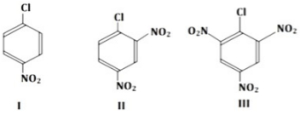
The correct order of reactivity for the reaction involving the cleavage of the $C-X$ bond in the following compounds is:
A
$I > II > III$
B
$II > III > I$
C
$III > I > II$
D
$III > II > I$
Solution
(D) The reaction involving the cleavage of the $C-X$ bond in haloarenes is Nucleophilic Aromatic Substitution $(S_NAr)$.
This reaction is facilitated by the presence of electron-withdrawing groups (like $-NO_2$) at the ortho and para positions,which stabilize the carbanion intermediate formed during the reaction.
Compound $I$ has one $-NO_2$ group at the para position.
Compound $II$ has two $-NO_2$ groups (one at ortho and one at para position).
Compound $III$ has three $-NO_2$ groups (two at ortho and one at para position).
As the number of electron-withdrawing groups increases,the reactivity towards nucleophilic substitution increases.
Therefore,the correct order of reactivity is $III > II > I$.
This reaction is facilitated by the presence of electron-withdrawing groups (like $-NO_2$) at the ortho and para positions,which stabilize the carbanion intermediate formed during the reaction.
Compound $I$ has one $-NO_2$ group at the para position.
Compound $II$ has two $-NO_2$ groups (one at ortho and one at para position).
Compound $III$ has three $-NO_2$ groups (two at ortho and one at para position).
As the number of electron-withdrawing groups increases,the reactivity towards nucleophilic substitution increases.
Therefore,the correct order of reactivity is $III > II > I$.
0 likesView Solution
352
ChemistryEasyMCQMHT CET · 2025
Identify the name of the reaction in which an aryl halide reacts with an alkyl halide and sodium metal in the presence of dry ether to yield substituted aromatic compounds.
A
Wurtz reaction
B
Wurtz-Fittig reaction
C
Fittig reaction
D
Finkelstein reaction
Solution
(B) The reaction between an aryl halide $(Ar-X)$ and an alkyl halide $(R-X)$ in the presence of sodium metal $(Na)$ and dry ether is known as the $Wurtz-Fittig$ reaction.
The general equation is: $Ar-X + 2Na + R-X \xrightarrow{\text{dry ether}} Ar-R + 2NaX$.
This reaction is used to prepare alkyl-substituted aromatic compounds.
The general equation is: $Ar-X + 2Na + R-X \xrightarrow{\text{dry ether}} Ar-R + 2NaX$.
This reaction is used to prepare alkyl-substituted aromatic compounds.
0 likesView Solution
353
ChemistryEasyMCQMHT CET · 2025
Which of the following reactions is a Fittig reaction?
A
$2 CH_3Cl + 2 Na \xrightarrow[\text{dry ether}]{\Delta} C_2H_6 + 2 NaCl$
B
$2 C_6H_5Cl + 2 Na \xrightarrow[\text{dry ether}]{\Delta} C_6H_5-C_6H_5 + 2 NaCl$
C
$C_6H_5Cl + C_2H_5Cl + 2 Na \xrightarrow[\text{dry ether}]{\Delta} C_6H_5-C_2H_5 + 2 NaCl$
D
$CH_3Cl + C_2H_5Cl + 2 Na \xrightarrow[\text{dry ether}]{\Delta} CH_3-C_2H_5 + 2 NaCl$
Solution
(B) The Fittig reaction is a coupling reaction where two aryl halides react with sodium metal in the presence of dry ether to form a diaryl compound.
Option $B$ represents the reaction of two molecules of chlorobenzene $(C_6H_5Cl)$ with sodium to form biphenyl $(C_6H_5-C_6H_5)$,which is the definition of the Fittig reaction.
Option $A$ is the Wurtz reaction.
Option $C$ is the Wurtz-Fittig reaction.
Option $D$ is the Wurtz reaction.
Option $B$ represents the reaction of two molecules of chlorobenzene $(C_6H_5Cl)$ with sodium to form biphenyl $(C_6H_5-C_6H_5)$,which is the definition of the Fittig reaction.
Option $A$ is the Wurtz reaction.
Option $C$ is the Wurtz-Fittig reaction.
Option $D$ is the Wurtz reaction.
0 likesView Solution
354
ChemistryEasyMCQMHT CET · 2025
What type of arenes are obtained when arene diazonium chloride is treated with fluoroboric acid and then heated further?
A
$Ar-NO_2$
B
$Ar-F$
C
$Ar-Cl$
D
$Ar-H$
Solution
(B) When arene diazonium chloride $(Ar-N_2^+Cl^-)$ is treated with fluoroboric acid $(HBF_4)$,it forms arene diazonium fluoroborate $(Ar-N_2^+BF_4^-)$ as a precipitate.
Upon heating,this salt decomposes to yield fluoroarene $(Ar-F)$,boron trifluoride $(BF_3)$,and nitrogen gas $(N_2)$.
The reaction is: $Ar-N_2^+Cl^- + HBF_4 \rightarrow Ar-N_2^+BF_4^- + HCl$.
Then,$Ar-N_2^+BF_4^- \xrightarrow{\Delta} Ar-F + BF_3 + N_2$.
Upon heating,this salt decomposes to yield fluoroarene $(Ar-F)$,boron trifluoride $(BF_3)$,and nitrogen gas $(N_2)$.
The reaction is: $Ar-N_2^+Cl^- + HBF_4 \rightarrow Ar-N_2^+BF_4^- + HCl$.
Then,$Ar-N_2^+BF_4^- \xrightarrow{\Delta} Ar-F + BF_3 + N_2$.
0 likesView Solution
355
ChemistryEasyMCQMHT CET · 2025
Identify the name of the reaction in which an aryl halide reacts with an alkyl halide and sodium metal in dry ether to produce substituted aromatic compounds.
A
Wurtz reaction
B
Fittig reaction
C
Wurtz-Fittig reaction
D
Friedel Crafts reaction
Solution
(C) The reaction of an aryl halide with an alkyl halide in the presence of sodium metal and dry ether is known as the $Wurtz-Fittig$ reaction.
In this reaction,the alkyl group from the alkyl halide replaces the halogen atom on the aromatic ring.
The general equation is: $Ar-X + R-X + 2Na \xrightarrow{\text{dry ether}} Ar-R + 2NaX$.
In this reaction,the alkyl group from the alkyl halide replaces the halogen atom on the aromatic ring.
The general equation is: $Ar-X + R-X + 2Na \xrightarrow{\text{dry ether}} Ar-R + 2NaX$.
0 likesView Solution
356
ChemistryEasyMCQMHT CET · 2025
The reaction of bromobenzene with bromomethane and sodium metal in dry ether to give toluene is known as:
A
Wurtz reaction
B
Fittig reaction
C
Friedel-Crafts reaction
D
Wurtz-Fittig reaction
Solution
(D) The reaction involves an aryl halide (bromobenzene) and an alkyl halide (bromomethane) reacting with sodium metal in the presence of dry ether to form an alkylbenzene (toluene). This specific reaction is known as the $Wurtz-Fittig$ reaction. The general equation is: $C_6H_5Br + CH_3Br + 2Na \xrightarrow{\text{dry ether}} C_6H_5CH_3 + 2NaBr$.
0 likesView Solution
357
ChemistryMediumMCQMHT CET · 2025
Which of the following has the highest reactivity towards nucleophilic substitution reaction involving the cleavage of the $C-Cl$ bond?
A
Chlorobenzene
B
$p-$Nitrochlorobenzene
C
$2,4-$Dinitrochlorobenzene
D
$2,4,6-$Trinitrochlorobenzene
Solution
(D) Nucleophilic aromatic substitution in aryl halides is facilitated by the presence of electron-withdrawing groups $(EWG)$ at the ortho and para positions relative to the halogen atom.
These groups stabilize the carbanion intermediate (Meisenheimer complex) formed during the reaction through resonance and inductive effects.
As the number of electron-withdrawing nitro groups $(-NO_2)$ increases,the electron density on the benzene ring decreases,making the carbon atom attached to the chlorine more electrophilic and thus more susceptible to nucleophilic attack.
Therefore,$2,4,6-$trinitrochlorobenzene has the highest number of electron-withdrawing groups,making it the most reactive towards nucleophilic substitution.
These groups stabilize the carbanion intermediate (Meisenheimer complex) formed during the reaction through resonance and inductive effects.
As the number of electron-withdrawing nitro groups $(-NO_2)$ increases,the electron density on the benzene ring decreases,making the carbon atom attached to the chlorine more electrophilic and thus more susceptible to nucleophilic attack.
Therefore,$2,4,6-$trinitrochlorobenzene has the highest number of electron-withdrawing groups,making it the most reactive towards nucleophilic substitution.
0 likesView Solution
358
ChemistryEasyMCQMHT CET · 2025
The reaction of aryl halide with sodium metal in dry ether to give biphenyl is known as
A
Swartz reaction
B
Wurtz reaction
C
Fittig reaction
D
Wurtz-fittig reaction
Solution
(C) The reaction of two molecules of an aryl halide with sodium metal in the presence of dry ether to form a diaryl (biphenyl) is known as the $Fittig$ reaction.
$2Ar-X + 2Na \xrightarrow{\text{dry ether}} Ar-Ar + 2NaX$
Here,$Ar$ represents an aryl group and $X$ represents a halogen atom.
$2Ar-X + 2Na \xrightarrow{\text{dry ether}} Ar-Ar + 2NaX$
Here,$Ar$ represents an aryl group and $X$ represents a halogen atom.
0 likesView Solution
359
ChemistryMediumMCQMHT CET · 2025
Which of the following compounds has the most difficulty in breaking the $C-X$ bond?
A
$o-$Nitrochlorobenzene
B
$m-$Nitrochlorobenzene
C
$p-$Nitrochlorobenzene
D
$2,4,6-$Trinitrochlorobenzene
Solution
(B) The ease of breaking the $C-X$ bond in haloarenes depends on the electron density at the carbon atom attached to the halogen.
Electron-withdrawing groups (like $-NO_2$) at the ortho and para positions increase the reactivity of the $C-X$ bond towards nucleophilic substitution by stabilizing the carbanion intermediate.
In $m-$Nitrochlorobenzene,the $-NO_2$ group is at the meta position,which does not exert a strong electron-withdrawing effect on the carbon attached to the chlorine through resonance.
Therefore,$m-$Nitrochlorobenzene has the least activation for nucleophilic substitution,making the $C-X$ bond the most difficult to break among the given options.
Electron-withdrawing groups (like $-NO_2$) at the ortho and para positions increase the reactivity of the $C-X$ bond towards nucleophilic substitution by stabilizing the carbanion intermediate.
In $m-$Nitrochlorobenzene,the $-NO_2$ group is at the meta position,which does not exert a strong electron-withdrawing effect on the carbon attached to the chlorine through resonance.
Therefore,$m-$Nitrochlorobenzene has the least activation for nucleophilic substitution,making the $C-X$ bond the most difficult to break among the given options.
0 likesView Solution
360
ChemistryMediumMCQMHT CET · 2025
Identify $A$ in the following reaction.
$A \text{ (excess)} + \text{Acetyl chloride (excess)}$ $\xrightarrow[AlCl_3]{\text{Anhydrous}} 1-\text{Chloroacetophenone} + 4-\text{Chloroacetophenone}$
$A \text{ (excess)} + \text{Acetyl chloride (excess)}$ $\xrightarrow[AlCl_3]{\text{Anhydrous}} 1-\text{Chloroacetophenone} + 4-\text{Chloroacetophenone}$
A
Benzene
B
Chlorobenzene
C
Toluene
D
Phenol
Solution
(B) The reaction is a Friedel-Crafts acylation of $A$ with acetyl chloride in the presence of anhydrous $AlCl_3$.
The products formed are $1-\text{chloroacetophenone}$ (ortho-substituted) and $4-\text{chloroacetophenone}$ (para-substituted).
Since the products contain a chlorine atom attached to the benzene ring,the starting material $A$ must be $Chlorobenzene$.
Chlorobenzene is an ortho/para directing group due to the $+M$ effect of the chlorine atom,which explains the formation of the observed products.
The products formed are $1-\text{chloroacetophenone}$ (ortho-substituted) and $4-\text{chloroacetophenone}$ (para-substituted).
Since the products contain a chlorine atom attached to the benzene ring,the starting material $A$ must be $Chlorobenzene$.
Chlorobenzene is an ortho/para directing group due to the $+M$ effect of the chlorine atom,which explains the formation of the observed products.
0 likesView Solution
361
ChemistryEasyMCQMHT CET · 2025
Identify the product when chlorobenzene is heated with nitrating mixture.
A
Only $1-$chloro$-4-$nitrobenzene
B
Only $1-$chloro$-2-$nitrobenzene
C
Mixture of $1-$chloro$-2-$nitrobenzene and $1-$chloro$-4-$nitrobenzene
D
$2,4,6-$trinitrochlorobenzene
Solution
(C) Chlorobenzene undergoes electrophilic aromatic substitution when treated with a nitrating mixture (concentrated $HNO_3$ and concentrated $H_2SO_4$).
Since the chlorine atom is ortho/para-directing due to the resonance effect,the nitration occurs at both the ortho and para positions.
Therefore,the reaction yields a mixture of $1-$chloro$-2-$nitrobenzene (ortho-isomer) and $1-$chloro$-4-$nitrobenzene (para-isomer).
Since the chlorine atom is ortho/para-directing due to the resonance effect,the nitration occurs at both the ortho and para positions.
Therefore,the reaction yields a mixture of $1-$chloro$-2-$nitrobenzene (ortho-isomer) and $1-$chloro$-4-$nitrobenzene (para-isomer).
0 likesView Solution
362
ChemistryEasyMCQMHT CET · 2025
Which of the following is a Fittig reaction?
A
$C_6H_5Br + CH_3Br + 2Na \xrightarrow[\text{dry ether}]{} C_6H_5-CH_3 + 2NaBr$
B
$2C_2H_5Br + 2Na \xrightarrow[\text{dry ether}]{} C_2H_5-C_2H_5 + 2NaBr$
C
$2CH_3Br + 2Na \xrightarrow[\text{dry ether}]{} CH_3-CH_3 + 2NaBr$
D
$2C_6H_5Br + 2Na \xrightarrow[\text{dry ether}]{} C_6H_5-C_6H_5 + 2NaBr$
Solution
(D) The Fittig reaction involves the coupling of two aryl halide molecules in the presence of sodium metal and dry ether to form a diaryl compound.
Option $A$ represents the Wurtz-Fittig reaction.
Options $B$ and $C$ represent the Wurtz reaction.
Option $D$ represents the Fittig reaction: $2C_6H_5Br + 2Na \xrightarrow[\text{dry ether}]{} C_6H_5-C_6H_5 + 2NaBr$.
Option $A$ represents the Wurtz-Fittig reaction.
Options $B$ and $C$ represent the Wurtz reaction.
Option $D$ represents the Fittig reaction: $2C_6H_5Br + 2Na \xrightarrow[\text{dry ether}]{} C_6H_5-C_6H_5 + 2NaBr$.
0 likesView Solution
363
ChemistryEasyMCQMHT CET · 2025
Which among the following is a benzylic halide?
A
$C_6H_5-CH_2-X$
B
$C_6H_5-X$
C
$C_6H_5-CH=CH-X$
D
$C_6H_5-CH_2-CH_2-X$
Solution
(A) benzylic halide is a compound in which the halogen atom is bonded to an $sp^3$ hybridized carbon atom,which is directly attached to an aromatic ring.
In the structure $C_6H_5-CH_2-X$,the halogen atom $X$ is attached to a carbon atom that is bonded to a benzene ring $(C_6H_5)$.
This carbon atom is $sp^3$ hybridized,making it a benzylic halide.
Therefore,the correct option is $A$.
In the structure $C_6H_5-CH_2-X$,the halogen atom $X$ is attached to a carbon atom that is bonded to a benzene ring $(C_6H_5)$.
This carbon atom is $sp^3$ hybridized,making it a benzylic halide.
Therefore,the correct option is $A$.
0 likesView Solution
364
ChemistryEasyMCQMHT CET · 2025
Which among the following is a haloarene?
A
Benzyl halide
B
Cyclohexenyl halide
C
Cyclohexyl halide
D
Aryl halide (Haloarene)
Solution
(D) haloarene is a compound in which a halogen atom is directly attached to an aromatic ring (benzene ring).
In option $D$,the halogen atom $X$ is directly bonded to the carbon atom of the benzene ring,which makes it an aryl halide or haloarene.
In option $A$,the halogen is attached to a side chain carbon,making it a benzyl halide.
In options $B$ and $C$,the compounds are aliphatic cyclic halides,not aromatic.
In option $D$,the halogen atom $X$ is directly bonded to the carbon atom of the benzene ring,which makes it an aryl halide or haloarene.
In option $A$,the halogen is attached to a side chain carbon,making it a benzyl halide.
In options $B$ and $C$,the compounds are aliphatic cyclic halides,not aromatic.
0 likesView Solution
365
ChemistryMediumMCQMHT CET · 2025
Identify '$A$' in the following reaction.
$A + \text{Acetyl chloride}$ $\xrightarrow[AlCl_3]{\text{anhydrous}} 1-\text{chloroacetophenone} + 4-\text{chloroacetophenone}$
$A + \text{Acetyl chloride}$ $\xrightarrow[AlCl_3]{\text{anhydrous}} 1-\text{chloroacetophenone} + 4-\text{chloroacetophenone}$
A
Benzene
B
Chlorobenzene
C
Toluene
D
Phenol
Solution
(B) The reaction is a Friedel-Crafts acylation of a substituted benzene ring.
Since the products are $1-\text{chloroacetophenone}$ (ortho-isomer) and $4-\text{chloroacetophenone}$ (para-isomer),the starting material '$A$' must be chlorobenzene.
Chlorobenzene undergoes electrophilic aromatic substitution where the chlorine atom is ortho/para-directing,leading to the formation of these specific products.
Since the products are $1-\text{chloroacetophenone}$ (ortho-isomer) and $4-\text{chloroacetophenone}$ (para-isomer),the starting material '$A$' must be chlorobenzene.
Chlorobenzene undergoes electrophilic aromatic substitution where the chlorine atom is ortho/para-directing,leading to the formation of these specific products.
0 likesView Solution
366
ChemistryEasyMCQMHT CET · 2025
Which among the following is a benzylic halide?
A
Bromobenzene
B
Bromophenylmethane
C
$4-$Bromotoluene
D
$1-$Bromo$-2-$phenylethane
Solution
(B) benzylic halide is a compound in which the halogen atom is bonded to an $sp^3$ hybridized carbon atom,which is further attached to an aromatic ring.
In $Bromophenylmethane$ (also known as benzyl bromide),the bromine atom is attached to a $-CH_2-$ group,which is directly bonded to a benzene ring.
This structure fits the definition of a benzylic halide.
Therefore,the correct option is $B$.
In $Bromophenylmethane$ (also known as benzyl bromide),the bromine atom is attached to a $-CH_2-$ group,which is directly bonded to a benzene ring.
This structure fits the definition of a benzylic halide.
Therefore,the correct option is $B$.
0 likesView Solution
367
ChemistryMediumMCQMHT CET · 2025
Identify the compound formed by the action of chromyl chloride on toluene in the presence of $CS_2$,followed by hydrolysis.
A
Chlorobenzene
B
Benzal chloride
C
Benzaldehyde
D
Benzoic acid
Solution
(C) The reaction described is the $Etard$ reaction.
In this reaction,toluene reacts with chromyl chloride $(CrO_2Cl_2)$ in the presence of a non-polar solvent like $CS_2$ or $CCl_4$ to form a brown chromium complex.
This complex,upon subsequent hydrolysis,yields benzaldehyde $(C_6H_5CHO)$.
In this reaction,toluene reacts with chromyl chloride $(CrO_2Cl_2)$ in the presence of a non-polar solvent like $CS_2$ or $CCl_4$ to form a brown chromium complex.
This complex,upon subsequent hydrolysis,yields benzaldehyde $(C_6H_5CHO)$.
0 likesView Solution
368
ChemistryEasyMCQMHT CET · 2025
Which of the following reactions represents the Wolff-Kishner reduction?
A
$RCOCl \xrightarrow[Pd-BaSO_4]{H_2} RCHO + HCl$
B
$RCN \xrightarrow[H_3O^+]{SnCl_2, HCl} RCHO + NH_4Cl$
C
$RCHO \xrightarrow[\Delta]{Zn-Hg, \text{conc. } HCl} RCH_3 + H_2O$
D
$RCOR' \xrightarrow[\text{ii) } KOH, HO(CH_2)_2OH]{\text{i) } H_2N-NH_2} RCH_2R'$
Solution
(D) The Wolff-Kishner reduction is a reaction used to convert carbonyl groups (aldehydes or ketones) into alkanes.
It involves the formation of a hydrazone intermediate by reacting the carbonyl compound with hydrazine $(H_2N-NH_2)$,followed by base-catalyzed decomposition (using $KOH$ in ethylene glycol) at high temperatures.
Option $D$ correctly represents this process: $RCOR' \xrightarrow[\text{ii) } KOH, HO(CH_2)_2OH]{\text{i) } H_2N-NH_2} RCH_2R'$.
Option $A$ is Rosenmund reduction,option $B$ is Stephen reduction,and option $C$ is Clemmensen reduction.
It involves the formation of a hydrazone intermediate by reacting the carbonyl compound with hydrazine $(H_2N-NH_2)$,followed by base-catalyzed decomposition (using $KOH$ in ethylene glycol) at high temperatures.
Option $D$ correctly represents this process: $RCOR' \xrightarrow[\text{ii) } KOH, HO(CH_2)_2OH]{\text{i) } H_2N-NH_2} RCH_2R'$.
Option $A$ is Rosenmund reduction,option $B$ is Stephen reduction,and option $C$ is Clemmensen reduction.
0 likesView Solution
369
ChemistryEasyMCQMHT CET · 2025
Which of the following is used as a catalyst in the Fischer-Tropsch process for the synthesis of gasoline?
A
$Fe-Cr$
B
$Co-Th$
C
$Mo$
D
$Ni$
Solution
(B) The Fischer-Tropsch process is a collection of chemical reactions that converts a mixture of carbon monoxide and hydrogen into liquid hydrocarbons.
In this process,catalysts such as $Fe$ (iron) or $Co$ (cobalt) are typically used.
Specifically,for the synthesis of gasoline-range hydrocarbons,a cobalt-thorium $(Co-Th)$ catalyst is commonly employed to facilitate the hydrogenation of carbon monoxide.
In this process,catalysts such as $Fe$ (iron) or $Co$ (cobalt) are typically used.
Specifically,for the synthesis of gasoline-range hydrocarbons,a cobalt-thorium $(Co-Th)$ catalyst is commonly employed to facilitate the hydrogenation of carbon monoxide.
0 likesView Solution
370
ChemistryMediumMCQMHT CET · 2025
Identify the product when ethylbenzene reacts with dilute nitric acid.
A
$o$-Nitroethylbenzene
B
$p$-Nitroethylbenzene
C
Ethoxybenzene
D
Benzoic acid
Solution
(B) Ethylbenzene reacts with dilute nitric acid under specific conditions,but typically,dilute nitric acid is not a strong enough nitrating agent to perform electrophilic aromatic substitution on the benzene ring of ethylbenzene effectively. However,if the reaction is considered in the context of standard organic chemistry problems,the alkyl group $(-CH_2CH_3)$ is an ortho/para directing group. Therefore,the expected products of nitration would be a mixture of $o$-nitroethylbenzene and $p$-nitroethylbenzene. Given the options,both $A$ and $B$ are valid isomers,but usually,$p$-nitroethylbenzene is the major product due to steric hindrance at the ortho position. If the question implies a specific reaction condition leading to a single major product,$p$-nitroethylbenzene is the standard answer.
0 likesView Solution
371
ChemistryMediumMCQMHT CET · 2025
Identify the product formed in the following reaction.
$C_6H_5-CH_2-CH_3 \xrightarrow[ii) H_3O^{+}]{i) \text{alk. } KMnO_4} \text{Product}$
$C_6H_5-CH_2-CH_3 \xrightarrow[ii) H_3O^{+}]{i) \text{alk. } KMnO_4} \text{Product}$
A
$C_6H_5-CH_2-COOH$
B
$C_6H_5CH_2-CH_2-COOH$
C
$C_6H_5-OH$
D
$C_6H_5-COOH$
Solution
(D) The reaction of an alkylbenzene with an alkyl group having at least one benzylic hydrogen atom with alkaline $KMnO_4$ followed by acidic hydrolysis $(H_3O^+)$ results in the oxidation of the alkyl side chain to a carboxylic acid group.
In the given reactant,$C_6H_5-CH_2-CH_3$ (ethylbenzene),the benzylic carbon is the $CH_2$ group.
Upon oxidation,the entire alkyl side chain is converted into a carboxyl group $(-COOH)$ attached to the benzene ring.
Therefore,the product formed is benzoic acid,$C_6H_5-COOH$.
In the given reactant,$C_6H_5-CH_2-CH_3$ (ethylbenzene),the benzylic carbon is the $CH_2$ group.
Upon oxidation,the entire alkyl side chain is converted into a carboxyl group $(-COOH)$ attached to the benzene ring.
Therefore,the product formed is benzoic acid,$C_6H_5-COOH$.
0 likesView Solution
372
ChemistryMediumMCQMHT CET · 2025
Which of the following compounds can be obtained by an azo coupling reaction?
A
Benzenediazonium chloride
B
Fluoroarene
C
$p$-Hydroxyazobenzene
D
$N$-Ethylbenzenesulfonamide
Solution
(C) Azo coupling reactions involve the reaction of a diazonium salt with an electron-rich aromatic compound (like a phenol or an aromatic amine) to form an azo compound $(Ar-N=N-Ar')$.
In this reaction,benzenediazonium chloride reacts with phenol in a basic medium to produce $p$-hydroxyazobenzene.
Therefore,$p$-hydroxyazobenzene is the product obtained via an azo coupling reaction.
In this reaction,benzenediazonium chloride reacts with phenol in a basic medium to produce $p$-hydroxyazobenzene.
Therefore,$p$-hydroxyazobenzene is the product obtained via an azo coupling reaction.
0 likesView Solution
373
ChemistryEasyMCQMHT CET · 2025
Identify the major product formed in the following reaction.
$Chlorobenzene \xrightarrow{Cl_2, \text{ Anhydrous } FeCl_3} \text{Product}$
$Chlorobenzene \xrightarrow{Cl_2, \text{ Anhydrous } FeCl_3} \text{Product}$
A
$1,2-dichlorobenzene$
B
$1,3-dichlorobenzene$
C
$1,3,5-trichlorobenzene$
D
$1,4-dichlorobenzene$
Solution
(D) The reaction of $Chlorobenzene$ with $Cl_2$ in the presence of anhydrous $FeCl_3$ is an electrophilic aromatic substitution reaction (chlorination).
$Chlorine$ atom on the benzene ring is ortho/para-directing due to the resonance effect.
However,the para-isomer is the major product due to less steric hindrance compared to the ortho-isomer.
Therefore,$1,4-dichlorobenzene$ is the major product.
$Chlorine$ atom on the benzene ring is ortho/para-directing due to the resonance effect.
However,the para-isomer is the major product due to less steric hindrance compared to the ortho-isomer.
Therefore,$1,4-dichlorobenzene$ is the major product.
0 likesView Solution
374
ChemistryMediumMCQMHT CET · 2025
Identify $A$ in the following reaction.
$A + \text{chloromethane} \xrightarrow[AlCl_3]{\text{Anhydrous}} 1-\text{chlorotoluene} + 4-\text{chlorotoluene}$
$A + \text{chloromethane} \xrightarrow[AlCl_3]{\text{Anhydrous}} 1-\text{chlorotoluene} + 4-\text{chlorotoluene}$
A
Benzene
B
Chlorobenzene
C
Toluene
D
Phenol
Solution
(B) The reaction is an electrophilic aromatic substitution,specifically a Friedel-Crafts alkylation.
Chlorobenzene reacts with chloromethane in the presence of anhydrous $AlCl_3$ to form $1-\text{chloro}-2-\text{methylbenzene}$ $(o-\text{chlorotoluene})$ and $1-\text{chloro}-4-\text{methylbenzene}$ $(p-\text{chlorotoluene})$.
Since the product is a mixture of $1-\text{chlorotoluene}$ (ortho-isomer) and $4-\text{chlorotoluene}$ (para-isomer),the reactant $A$ must be $Chlorobenzene$ because the chlorine atom on the benzene ring is ortho/para-directing.
Chlorobenzene reacts with chloromethane in the presence of anhydrous $AlCl_3$ to form $1-\text{chloro}-2-\text{methylbenzene}$ $(o-\text{chlorotoluene})$ and $1-\text{chloro}-4-\text{methylbenzene}$ $(p-\text{chlorotoluene})$.
Since the product is a mixture of $1-\text{chlorotoluene}$ (ortho-isomer) and $4-\text{chlorotoluene}$ (para-isomer),the reactant $A$ must be $Chlorobenzene$ because the chlorine atom on the benzene ring is ortho/para-directing.
0 likesView Solution
375
ChemistryMediumMCQMHT CET · 2025
Identify '$A$' in the following reaction.
$A +$ Acetyl chloride $\xrightarrow{\text{Anhydrous } AlCl_3} 1-$Chloroacetophenone $+ 4-$Chloroacetophenone
$A +$ Acetyl chloride $\xrightarrow{\text{Anhydrous } AlCl_3} 1-$Chloroacetophenone $+ 4-$Chloroacetophenone
A
Benzene
B
Chlorobenzene
C
Toluene
D
Phenol
Solution
(B) The reaction is a Friedel-Crafts acylation of an aromatic compound '$A$' with acetyl chloride in the presence of anhydrous $AlCl_3$.
Since the products formed are $1-$chloroacetophenone (ortho-substituted) and $4-$chloroacetophenone (para-substituted),the starting material '$A$' must be chlorobenzene.
The chlorine atom on the benzene ring is ortho/para-directing,which explains the formation of these specific isomers.
Since the products formed are $1-$chloroacetophenone (ortho-substituted) and $4-$chloroacetophenone (para-substituted),the starting material '$A$' must be chlorobenzene.
The chlorine atom on the benzene ring is ortho/para-directing,which explains the formation of these specific isomers.
0 likesView Solution
376
ChemistryEasyMCQMHT CET · 2025
Identify the correct order of acidity of hydrides of $16^{th}$ group elements from the following.
A
$H_2O < H_2S < H_2Se < H_2Te$
B
$H_2Te < H_2O < H_2S < H_2Se$
C
$H_2Te > H_2Se > H_2S > H_2O$
D
$H_2Te > H_2Se > H_2O > H_2S$
Solution
(C) The acidity of hydrides of group $16$ elements increases down the group.
As we move down the group from $O$ to $Te$,the atomic size of the central atom increases.
This leads to a decrease in the bond dissociation enthalpy of the $E-H$ bond (where $E = O, S, Se, Te$).
Consequently,the ease of releasing $H^+$ ions increases,making the hydrides more acidic.
Therefore,the correct order of acidity is $H_2O < H_2S < H_2Se < H_2Te$ or $H_2Te > H_2Se > H_2S > H_2O$.
As we move down the group from $O$ to $Te$,the atomic size of the central atom increases.
This leads to a decrease in the bond dissociation enthalpy of the $E-H$ bond (where $E = O, S, Se, Te$).
Consequently,the ease of releasing $H^+$ ions increases,making the hydrides more acidic.
Therefore,the correct order of acidity is $H_2O < H_2S < H_2Se < H_2Te$ or $H_2Te > H_2Se > H_2S > H_2O$.
0 likesView Solution
377
ChemistryEasyMCQMHT CET · 2025
Identify the role of glycerol in the following reaction: $2 H_2O_{2(\ell)} \xrightarrow{\text{glycerol}} 2 H_2O_{(\ell)} + O_{2(g)}$
A
Homogeneous catalyst
B
Inhibitor
C
Promoter
D
Heterogeneous catalyst
Solution
(B) The decomposition of hydrogen peroxide $(H_2O_2)$ is a spontaneous reaction. Glycerol acts as a negative catalyst or an inhibitor in this reaction. It slows down the rate of decomposition of $H_2O_2$ by forming a complex or by stabilizing the reactant,thereby preventing its rapid breakdown into water and oxygen.
0 likesView Solution
Vedclass Products
For Students
Vedclass Test Series
Mock tests in real MHT CET style covering Chemistry with performance analysis. 5-day free trial.
Start Free TrialFor Teachers
Exam Paper Generator
Generate Set A/B/C/D Chemistry papers from 7.5L+ questions in 2 minutes. 3 chapters free.
Try FreeFor Institutes
Online Exam Module
Run live MHT CET mock exams with unlimited students, 360° analytics & white-label branding.
See DemoFrequently Asked Questions
How many Chemistry questions are in MHT CET 2025?
There are 843 Chemistry questions from the MHT CET 2025 paper on Vedclass, each with a detailed step-by-step solution in English.
Are MHT CET 2025 Chemistry solutions available in English?
Yes. All solutions on this page are in English. You can also switch to English or Hindi using the language buttons above the questions.
Can I practice MHT CET 2025 Chemistry as a timed test?
Yes. Use the Vedclass Test Series to attempt a full MHT CET mock test covering Chemistry with time limits and instant score analysis.
Can teachers create Chemistry papers from MHT CET previous year questions?
Yes. The Vedclass Exam Paper Generator lets teachers mix MHT CET Chemistry questions and generate Set A/B/C/D papers in minutes.
For Teachers & Institutes
Build a Custom Chemistry Paper
Pick MHT CET 2025 Chemistry questions, set difficulty, and generate Set A/B/C/D in 2 minutes.