
ChemistryQ251–350 of 900 questions
Page 6 of 10 · English
251
ChemistryEasyMCQMHT CET · 2024
What is the value of percent atom economy when reactants having a sum of formula weight $78 \ u$ result in the formation of a product with a formula weight of $65 \ u$ (in $\%$)?
A
$70$
B
$78$
C
$83$
D
$65$
Solution
(C) $\text{Percent atom economy} = \frac{\text{Formula weight of the desired product}}{\text{Sum of formula weight of all the reactants used in the reaction}} \times 100$
$\text{Percent atom economy} = \frac{65 \ u}{78 \ u} \times 100 = 83.33 \% \approx 83 \%$
$\text{Percent atom economy} = \frac{65 \ u}{78 \ u} \times 100 = 83.33 \% \approx 83 \%$
0 likesView Solution
252
ChemistryMediumMCQMHT CET · 2024
What is the percentage by mass of oxygen in $NaOH$? (Atomic mass of $Na=23 \ u, O=16 \ u, H=1 \ u$)
A
$16$
B
$20$
C
$40$
D
$60$
Solution
(C) The molar mass of $NaOH$ is calculated as: $23 + 16 + 1 = 40 \ u$.
The percentage by mass of oxygen is given by the formula: $\frac{\text{Atomic mass of } O}{\text{Molar mass of } NaOH} \times 100$.
Substituting the values: $\frac{16}{40} \times 100 = 40 \%$.
The percentage by mass of oxygen is given by the formula: $\frac{\text{Atomic mass of } O}{\text{Molar mass of } NaOH} \times 100$.
Substituting the values: $\frac{16}{40} \times 100 = 40 \%$.
0 likesView Solution
253
ChemistryEasyMCQMHT CET · 2024
Which of the following equations is true for $8.8 \times 10^{-2} \ kg$ of carbon dioxide gas?
A
$PV = 1.5 \ RT$
B
$PV = RT$
C
$PV = 2 \ RT$
D
$PV = 3 \ RT$
Solution
(C) Given mass of $CO_2 = 8.8 \times 10^{-2} \ kg = 88 \ g$.
The molar mass of $CO_2$ is $44 \ g \ mol^{-1}$.
The number of moles $n$ is calculated as $n = \frac{\text{mass}}{\text{molar mass}} = \frac{88 \ g}{44 \ g \ mol^{-1}} = 2 \ mol$.
According to the ideal gas equation,$PV = nRT$.
Substituting $n = 2$,we get $PV = 2 \ RT$.
The molar mass of $CO_2$ is $44 \ g \ mol^{-1}$.
The number of moles $n$ is calculated as $n = \frac{\text{mass}}{\text{molar mass}} = \frac{88 \ g}{44 \ g \ mol^{-1}} = 2 \ mol$.
According to the ideal gas equation,$PV = nRT$.
Substituting $n = 2$,we get $PV = 2 \ RT$.
0 likesView Solution
254
ChemistryEasyMCQMHT CET · 2024
How many moles of dioxygen are present in $8.314 \times 10^{-3} \ m^3$ of it at $318 \ K$ having pressure $3.18 \times 10^5 \ N \ m^{-2}$ (in $mole$)? $(R=8.314 \ J \ K^{-1} \ mol^{-1})$
A
$0.1$
B
$1.0$
C
$1.5$
D
$2.0$
Solution
(B) Using the ideal gas equation: $PV = nRT$
Rearranging for $n$: $n = \frac{PV}{RT}$
Given values: $P = 3.18 \times 10^5 \ N \ m^{-2}$,$V = 8.314 \times 10^{-3} \ m^3$,$T = 318 \ K$,$R = 8.314 \ J \ K^{-1} \ mol^{-1}$
Substituting the values: $n = \frac{(3.18 \times 10^5) \times (8.314 \times 10^{-3})}{8.314 \times 318}$
$n = \frac{3.18 \times 10^2}{318} = \frac{318}{318} = 1 \ mole$
Rearranging for $n$: $n = \frac{PV}{RT}$
Given values: $P = 3.18 \times 10^5 \ N \ m^{-2}$,$V = 8.314 \times 10^{-3} \ m^3$,$T = 318 \ K$,$R = 8.314 \ J \ K^{-1} \ mol^{-1}$
Substituting the values: $n = \frac{(3.18 \times 10^5) \times (8.314 \times 10^{-3})}{8.314 \times 318}$
$n = \frac{3.18 \times 10^2}{318} = \frac{318}{318} = 1 \ mole$
0 likesView Solution
255
ChemistryEasyMCQMHT CET · 2024
Which of the following graphs explains Boyle's law?
A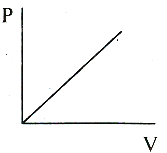
B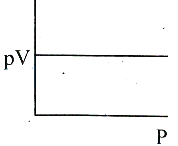
C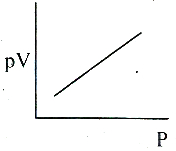
D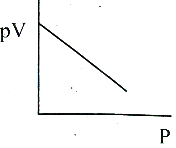
Solution
(B) According to Boyle's law,for a fixed amount of an ideal gas at constant temperature,the pressure $P$ is inversely proportional to the volume $V$,i.e.,$P \propto \frac{1}{V}$.
This implies that $PV = k$,where $k$ is a constant.
Therefore,if we plot $PV$ on the y-axis and $P$ on the x-axis,the value of $PV$ remains constant regardless of the change in pressure $P$.
This results in a horizontal straight line parallel to the pressure axis.
This implies that $PV = k$,where $k$ is a constant.
Therefore,if we plot $PV$ on the y-axis and $P$ on the x-axis,the value of $PV$ remains constant regardless of the change in pressure $P$.
This results in a horizontal straight line parallel to the pressure axis.
0 likesView Solution
256
ChemistryEasyMCQMHT CET · 2024
Calculate the volume of gas at $1.25 \ atm$,if the volume occupied by the gas at $1 \ atm$ and at the same temperature is $25 \ mL$. (in $mL$)
A
$15$
B
$20$
C
$25$
D
$35$
Solution
(B) According to Boyle's law,at constant temperature and amount of gas:
$P_1 V_1 = P_2 V_2$
Given:
$P_1 = 1 \ atm$,$V_1 = 25 \ mL$
$P_2 = 1.25 \ atm$,$V_2 = ?$
Substituting the values:
$1 \ atm \times 25 \ mL = 1.25 \ atm \times V_2$
$V_2 = \frac{1 \ atm \times 25 \ mL}{1.25 \ atm} = 20 \ mL$
$P_1 V_1 = P_2 V_2$
Given:
$P_1 = 1 \ atm$,$V_1 = 25 \ mL$
$P_2 = 1.25 \ atm$,$V_2 = ?$
Substituting the values:
$1 \ atm \times 25 \ mL = 1.25 \ atm \times V_2$
$V_2 = \frac{1 \ atm \times 25 \ mL}{1.25 \ atm} = 20 \ mL$
0 likesView Solution
257
ChemistryEasyMCQMHT CET · 2024
$A$ gas occupies $11.2 \ dm^3$ at $105 \ kPa$. What is the volume if pressure is increased to $210 \ kPa$ (in $dm^3$)?
A
$5.6$
B
$16.8$
C
$22.4$
D
$33.6$
Solution
(A) According to Boyle's law,at constant temperature,the product of pressure and volume is constant.
$P_1 V_1 = P_2 V_2$
Given:
$P_1 = 105 \ kPa$,$V_1 = 11.2 \ dm^3$
$P_2 = 210 \ kPa$,$V_2 = ?$
Substituting the values:
$V_2 = \frac{P_1 V_1}{P_2} = \frac{105 \ kPa \times 11.2 \ dm^3}{210 \ kPa} = 5.6 \ dm^3$
$P_1 V_1 = P_2 V_2$
Given:
$P_1 = 105 \ kPa$,$V_1 = 11.2 \ dm^3$
$P_2 = 210 \ kPa$,$V_2 = ?$
Substituting the values:
$V_2 = \frac{P_1 V_1}{P_2} = \frac{105 \ kPa \times 11.2 \ dm^3}{210 \ kPa} = 5.6 \ dm^3$
0 likesView Solution
258
ChemistryEasyMCQMHT CET · 2024
What is the volume of a gas at $1.032 \times 10^5 \ Nm^{-2}$ if it occupies $1 \ dm^3$ of volume at normal temperature and pressure (in $dm^3$)?
A
$0.982$
B
$1.3$
C
$1.5$
D
$1.7$
Solution
(A) Normal temperature and pressure $(NTP)$ implies $P_1 = 1 \ atm = 1.01325 \times 10^5 \ Nm^{-2}$ and $V_1 = 1 \ dm^3$.
Given $P_2 = 1.032 \times 10^5 \ Nm^{-2}$.
Using Boyle's Law,$P_1 V_1 = P_2 V_2$.
$V_2 = \frac{P_1 V_1}{P_2} = \frac{1.01325 \times 10^5 \ Nm^{-2} \times 1 \ dm^3}{1.032 \times 10^5 \ Nm^{-2}}$.
$V_2 \approx 0.982 \ dm^3$.
Given $P_2 = 1.032 \times 10^5 \ Nm^{-2}$.
Using Boyle's Law,$P_1 V_1 = P_2 V_2$.
$V_2 = \frac{P_1 V_1}{P_2} = \frac{1.01325 \times 10^5 \ Nm^{-2} \times 1 \ dm^3}{1.032 \times 10^5 \ Nm^{-2}}$.
$V_2 \approx 0.982 \ dm^3$.
0 likesView Solution
259
ChemistryMediumMCQMHT CET · 2024
If $P_1$ is the partial pressure of a gas and $x_1$ is its mole fraction in a mixture,then the correct relation between $P_1$ and $x_1$ is:
A
$P_{total} = P_1 x_1$
B
$x_1 = \frac{P_1}{P_{total}}$
C
$P_{total} = 1 - P_1 x_1$
D
$P_{total} = P_1(1 - x_1)$
Solution
(B) According to Dalton's Law of Partial Pressures,the partial pressure of a gas $(P_1)$ in a mixture is the product of its mole fraction $(x_1)$ and the total pressure $(P_{total})$ of the mixture.
$P_1 = x_1 \cdot P_{total}$
Rearranging this equation to solve for the mole fraction $(x_1)$ gives:
$x_1 = \frac{P_1}{P_{total}}$
Therefore,the correct relation is $x_1 = \frac{P_1}{P_{total}}$.
$P_1 = x_1 \cdot P_{total}$
Rearranging this equation to solve for the mole fraction $(x_1)$ gives:
$x_1 = \frac{P_1}{P_{total}}$
Therefore,the correct relation is $x_1 = \frac{P_1}{P_{total}}$.
0 likesView Solution
260
ChemistryEasyMCQMHT CET · 2024
$3.4$ moles of an ideal gas occupies a volume of $68 \ mL$ at $300 \ K$. What would be the pressure of the gas? $(R = 8.314 \ J \ K^{-1} \ mol^{-1})$
A
$1.247 \times 10^2 \ kPa$
B
$2.431 \times 10^3 \ kPa$
C
$1.031 \times 10^5 \ kPa$
D
$3.247 \times 10^5 \ kPa$
Solution
(A) Given: $n = 3.4 \ mol$,$T = 300 \ K$,$V = 68 \ mL = 68 \times 10^{-3} \ L = 0.068 \ dm^3$,$R = 8.314 \ J \ K^{-1} \ mol^{-1}$.
Using the ideal gas equation: $PV = nRT$.
$P = \frac{nRT}{V} = \frac{3.4 \ mol \times 8.314 \ J \ K^{-1} \ mol^{-1} \times 300 \ K}{0.068 \ dm^3}$.
Since $1 \ J = 1 \ Pa \cdot m^3$ and $1 \ dm^3 = 10^{-3} \ m^3$,the pressure $P = \frac{8480.28}{0.068 \times 10^{-3}} \ Pa = 124710000 \ Pa = 1.2471 \times 10^5 \ kPa$ is incorrect in the original prompt's unit conversion.
Recalculating: $P = \frac{3.4 \times 8.314 \times 300}{0.068 \times 10^{-3}} \ Pa = 1.2471 \times 10^8 \ Pa = 1.2471 \times 10^5 \ kPa$.
Using the ideal gas equation: $PV = nRT$.
$P = \frac{nRT}{V} = \frac{3.4 \ mol \times 8.314 \ J \ K^{-1} \ mol^{-1} \times 300 \ K}{0.068 \ dm^3}$.
Since $1 \ J = 1 \ Pa \cdot m^3$ and $1 \ dm^3 = 10^{-3} \ m^3$,the pressure $P = \frac{8480.28}{0.068 \times 10^{-3}} \ Pa = 124710000 \ Pa = 1.2471 \times 10^5 \ kPa$ is incorrect in the original prompt's unit conversion.
Recalculating: $P = \frac{3.4 \times 8.314 \times 300}{0.068 \times 10^{-3}} \ Pa = 1.2471 \times 10^8 \ Pa = 1.2471 \times 10^5 \ kPa$.
0 likesView Solution
261
ChemistryEasyMCQMHT CET · 2024
Which of the following equations gives the combined relationship of Boyle's law and Charles's law?
A
$\frac{P_1 V_2}{T_1} = \frac{P_2 V_1}{T_2}$
B
$n = \frac{RT}{PV}$
C
$\frac{P_1 V_1}{T_1} = \frac{P_2 V_2}{T_2}$
D
$p = \frac{RT}{nV}$
Solution
(C) Boyle's law states that at constant temperature,$PV = k_1$.
Charles's law states that at constant pressure,$\frac{V}{T} = k_2$.
Combining these two laws for a fixed amount of gas,we get the combined gas law: $\frac{PV}{T} = k$.
For a gas changing from state $1$ $(P_1, V_1, T_1)$ to state $2$ $(P_2, V_2, T_2)$,the relationship is expressed as:
$\frac{P_1 V_1}{T_1} = \frac{P_2 V_2}{T_2}$.
Charles's law states that at constant pressure,$\frac{V}{T} = k_2$.
Combining these two laws for a fixed amount of gas,we get the combined gas law: $\frac{PV}{T} = k$.
For a gas changing from state $1$ $(P_1, V_1, T_1)$ to state $2$ $(P_2, V_2, T_2)$,the relationship is expressed as:
$\frac{P_1 V_1}{T_1} = \frac{P_2 V_2}{T_2}$.
0 likesView Solution
262
ChemistryEasyMCQMHT CET · 2024
What is the numerical value of gas constant $R$ in terms of $L \ atm \ K^{-1} \ mol^{-1}$?
A
$0.085$
B
$0.082$
C
$8.314$
D
$1.987$
Solution
(B) The ideal gas constant $R$ is a fundamental physical constant.
In the units of $L \ atm \ K^{-1} \ mol^{-1}$,the value of $R$ is approximately $0.0821 \ L \ atm \ K^{-1} \ mol^{-1}$.
Among the given options,$0.082$ is the closest approximation to this value.
Therefore,the correct option is $B$.
In the units of $L \ atm \ K^{-1} \ mol^{-1}$,the value of $R$ is approximately $0.0821 \ L \ atm \ K^{-1} \ mol^{-1}$.
Among the given options,$0.082$ is the closest approximation to this value.
Therefore,the correct option is $B$.
0 likesView Solution
263
ChemistryMediumMCQMHT CET · 2024
Which of the following gases of the same mass exerts the highest pressure at a constant temperature?
A
$H_2$
B
$N_2$
C
$O_2$
D
$Cl_2$
Solution
(A) Let the mass of each gas be $m = 1 \ g$.
The number of moles $n = \frac{m}{M}$,where $M$ is the molar mass.
Since $m$ is constant,$n \propto \frac{1}{M}$.
The molar masses are: $M(H_2) = 2 \ g/mol$,$M(N_2) = 28 \ g/mol$,$M(O_2) = 32 \ g/mol$,$M(Cl_2) = 71 \ g/mol$.
Thus,the number of moles follows the order: $n(H_2) > n(N_2) > n(O_2) > n(Cl_2)$.
From the ideal gas equation $PV = nRT$,at constant $T$ and $V$,$P \propto n$.
Therefore,the gas with the highest number of moles will exert the highest pressure.
Since $H_2$ has the lowest molar mass,it has the highest number of moles for a given mass,and thus exerts the highest pressure.
The number of moles $n = \frac{m}{M}$,where $M$ is the molar mass.
Since $m$ is constant,$n \propto \frac{1}{M}$.
The molar masses are: $M(H_2) = 2 \ g/mol$,$M(N_2) = 28 \ g/mol$,$M(O_2) = 32 \ g/mol$,$M(Cl_2) = 71 \ g/mol$.
Thus,the number of moles follows the order: $n(H_2) > n(N_2) > n(O_2) > n(Cl_2)$.
From the ideal gas equation $PV = nRT$,at constant $T$ and $V$,$P \propto n$.
Therefore,the gas with the highest number of moles will exert the highest pressure.
Since $H_2$ has the lowest molar mass,it has the highest number of moles for a given mass,and thus exerts the highest pressure.
0 likesView Solution
264
ChemistryMediumMCQMHT CET · 2024
Calculate the partial pressure exerted by dioxygen from a mixture of $32 \ g$ $O_2$,$80 \ g$ $Ar$ (molar mass $40 \ g/mol$) and $4 \ g$ dihydrogen $(P_{\text{total}} = 10 \ bar)$. (in $bar$)
A
$1$
B
$2$
C
$4$
D
$5$
Solution
(B) Step $1$: Calculate the number of moles of each gas.
$n_{O_2} = \frac{32 \ g}{32 \ g/mol} = 1 \ mol$
$n_{Ar} = \frac{80 \ g}{40 \ g/mol} = 2 \ mol$
$n_{H_2} = \frac{4 \ g}{2 \ g/mol} = 2 \ mol$
Step $2$: Calculate the total number of moles.
$n_{\text{total}} = n_{O_2} + n_{Ar} + n_{H_2} = 1 + 2 + 2 = 5 \ mol$
Step $3$: Calculate the mole fraction of dioxygen $(x_{O_2})$.
$x_{O_2} = \frac{n_{O_2}}{n_{\text{total}}} = \frac{1}{5} = 0.2$
Step $4$: Calculate the partial pressure of dioxygen $(P_{O_2})$.
$P_{O_2} = x_{O_2} \times P_{\text{total}} = 0.2 \times 10 \ bar = 2 \ bar$
$n_{O_2} = \frac{32 \ g}{32 \ g/mol} = 1 \ mol$
$n_{Ar} = \frac{80 \ g}{40 \ g/mol} = 2 \ mol$
$n_{H_2} = \frac{4 \ g}{2 \ g/mol} = 2 \ mol$
Step $2$: Calculate the total number of moles.
$n_{\text{total}} = n_{O_2} + n_{Ar} + n_{H_2} = 1 + 2 + 2 = 5 \ mol$
Step $3$: Calculate the mole fraction of dioxygen $(x_{O_2})$.
$x_{O_2} = \frac{n_{O_2}}{n_{\text{total}}} = \frac{1}{5} = 0.2$
Step $4$: Calculate the partial pressure of dioxygen $(P_{O_2})$.
$P_{O_2} = x_{O_2} \times P_{\text{total}} = 0.2 \times 10 \ bar = 2 \ bar$
0 likesView Solution
265
ChemistryEasyMCQMHT CET · 2024
Which of the following formulas is used to calculate the compressibility factor?
A
$Z = \frac{PVT}{R}$
B
$Z = \frac{nRT}{PV}$
C
$Z = \frac{PV}{nRT}$
D
$Z = \left(\frac{PV}{RT}\right) \times n$
Solution
(C) The compressibility factor,denoted by $Z$,is defined as the ratio of the actual molar volume of a gas to the molar volume of an ideal gas at the same temperature and pressure.
For $n$ moles of a gas,the ideal gas equation is $PV = nRT$.
Therefore,the compressibility factor is given by the ratio $Z = \frac{PV}{nRT}$.
Thus,option $C$ is the correct formula.
For $n$ moles of a gas,the ideal gas equation is $PV = nRT$.
Therefore,the compressibility factor is given by the ratio $Z = \frac{PV}{nRT}$.
Thus,option $C$ is the correct formula.
0 likesView Solution
266
ChemistryMediumMCQMHT CET · 2024
Which among the following gases is difficult to liquefy?
A
$SO_2$
B
$Cl_2$
C
$NH_3$
D
$O_2$
Solution
(D) The ease of liquefaction of a gas depends on its critical temperature $(T_{c})$.
Gases with higher critical temperatures are easier to liquefy because they can be liquefied at higher temperatures.
The critical temperatures of the given gases are approximately: $SO_2$ $(430 \ K)$,$Cl_2$ $(417 \ K)$,$NH_3$ $(405 \ K)$,and $O_2$ $(154.6 \ K)$.
Since $O_2$ has the lowest critical temperature,it is the most difficult to liquefy among the given options.
Gases with higher critical temperatures are easier to liquefy because they can be liquefied at higher temperatures.
The critical temperatures of the given gases are approximately: $SO_2$ $(430 \ K)$,$Cl_2$ $(417 \ K)$,$NH_3$ $(405 \ K)$,and $O_2$ $(154.6 \ K)$.
Since $O_2$ has the lowest critical temperature,it is the most difficult to liquefy among the given options.
0 likesView Solution
267
ChemistryEasyMCQMHT CET · 2024
What is the representation of an element having a mass number of $40$ and $21$ neutrons in it?
A
${ }_{18}^{40} X$
B
${ }_{19}^{40} X$
C
${ }_{12}^{40} X$
D
${ }_{20}^{40} X$
Solution
(B) The number of protons $(Z)$ is calculated by subtracting the number of neutrons $(N)$ from the mass number $(A)$:
$Z = A - N = 40 - 21 = 19$.
Since the atomic number is $19$,the element is potassium $(K)$.
The standard representation of an element is ${ }_{Z}^{A} X$,where $A$ is the mass number and $Z$ is the atomic number.
Substituting the values,we get ${ }_{19}^{40} X$.
Therefore,the correct option is $(B)$.
$Z = A - N = 40 - 21 = 19$.
Since the atomic number is $19$,the element is potassium $(K)$.
The standard representation of an element is ${ }_{Z}^{A} X$,where $A$ is the mass number and $Z$ is the atomic number.
Substituting the values,we get ${ }_{19}^{40} X$.
Therefore,the correct option is $(B)$.
0 likesView Solution
268
ChemistryEasyMCQMHT CET · 2024
Which of the following statements is correct regarding isobars?
A
These have same number of neutrons.
B
These are the atoms of different elements.
C
These have same atomic number.
D
These have different mass number.
Solution
(B) Isobars are defined as atoms of different elements that have the same mass number but different atomic numbers.
For example,${ }_{6}^{14}C$ and ${ }_{7}^{14}N$ both have a mass number of $14$ but different atomic numbers ($6$ and $7$ respectively).
For example,${ }_{6}^{14}C$ and ${ }_{7}^{14}N$ both have a mass number of $14$ but different atomic numbers ($6$ and $7$ respectively).
0 likesView Solution
269
ChemistryEasyMCQMHT CET · 2024
Which of the following species contains $20$ electrons?
A
$K^{+}$
B
$Ca$
C
$Mg$
D
$Cl$
Solution
(B) To determine the number of electrons in each species,we look at their atomic numbers $(Z)$:
$1$. For $K^{+}$: Atomic number of $K$ is $19$. Since it is a cation with a $+1$ charge,it has $19 - 1 = 18$ electrons.
$2$. For $Ca$: Atomic number of $Ca$ is $20$. As a neutral atom,it has $20$ electrons.
$3$. For $Mg$: Atomic number of $Mg$ is $12$. As a neutral atom,it has $12$ electrons.
$4$. For $Cl$: Atomic number of $Cl$ is $17$. As a neutral atom,it has $17$ electrons.
Therefore,the species containing $20$ electrons is $Ca$.
$1$. For $K^{+}$: Atomic number of $K$ is $19$. Since it is a cation with a $+1$ charge,it has $19 - 1 = 18$ electrons.
$2$. For $Ca$: Atomic number of $Ca$ is $20$. As a neutral atom,it has $20$ electrons.
$3$. For $Mg$: Atomic number of $Mg$ is $12$. As a neutral atom,it has $12$ electrons.
$4$. For $Cl$: Atomic number of $Cl$ is $17$. As a neutral atom,it has $17$ electrons.
Therefore,the species containing $20$ electrons is $Ca$.
0 likesView Solution
270
ChemistryMediumMCQMHT CET · 2024
What is the energy associated with the fourth orbit of a hydrogen atom?
$R_H = 2.18 \times 10^{-18} \ J$
$R_H = 2.18 \times 10^{-18} \ J$
A
$-0.436 \times 10^{-18} \ J$
B
$-0.545 \times 10^{-18} \ J$
C
$-0.242 \times 10^{-18} \ J$
D
$-0.136 \times 10^{-18} \ J$
Solution
(D) The energy of an electron in the $n^{th}$ orbit of a hydrogen-like atom is given by the formula:
$E_n = -R_H \times \frac{Z^2}{n^2} \ J$
For a hydrogen atom,the atomic number $Z = 1$.
For the fourth orbit,$n = 4$.
Substituting the values:
$E_4 = -2.18 \times 10^{-18} \times \frac{1^2}{4^2} \ J$
$E_4 = -2.18 \times 10^{-18} \times \frac{1}{16} \ J$
$E_4 = -0.13625 \times 10^{-18} \ J \approx -0.136 \times 10^{-18} \ J$
$E_n = -R_H \times \frac{Z^2}{n^2} \ J$
For a hydrogen atom,the atomic number $Z = 1$.
For the fourth orbit,$n = 4$.
Substituting the values:
$E_4 = -2.18 \times 10^{-18} \times \frac{1^2}{4^2} \ J$
$E_4 = -2.18 \times 10^{-18} \times \frac{1}{16} \ J$
$E_4 = -0.13625 \times 10^{-18} \ J \approx -0.136 \times 10^{-18} \ J$
0 likesView Solution
271
ChemistryEasyMCQMHT CET · 2024
What is the amount of energy associated with the first orbit of a monopositive helium ion? $[R_{H} = 2.18 \times 10^{-18} \ J]$
A
$-1.9 \times 10^{-18} \ J$
B
$-4.36 \times 10^{-18} \ J$
C
$-6.54 \times 10^{-18} \ J$
D
$-8.72 \times 10^{-18} \ J$
Solution
(D) For the first orbit of a monopositive $He^{+}$ ion,the atomic number $Z = 2$ and the orbit number $n = 1$.
The energy of an electron in the $n^{th}$ orbit is given by the formula:
$E_n = -2.18 \times 10^{-18} \left( \frac{Z^2}{n^2} \right) \ J$
Substituting the values $Z = 2$ and $n = 1$:
$E_1 = -2.18 \times 10^{-18} \left( \frac{2^2}{1^2} \right) \ J$
$E_1 = -2.18 \times 10^{-18} \times 4 \ J$
$E_1 = -8.72 \times 10^{-18} \ J$
The energy of an electron in the $n^{th}$ orbit is given by the formula:
$E_n = -2.18 \times 10^{-18} \left( \frac{Z^2}{n^2} \right) \ J$
Substituting the values $Z = 2$ and $n = 1$:
$E_1 = -2.18 \times 10^{-18} \left( \frac{2^2}{1^2} \right) \ J$
$E_1 = -2.18 \times 10^{-18} \times 4 \ J$
$E_1 = -8.72 \times 10^{-18} \ J$
0 likesView Solution
272
ChemistryEasyMCQMHT CET · 2024
What is the energy associated with the first orbit of $He^{+}$?
A
$-2.18 \times 10^{-18} \ J$
B
$-4.36 \times 10^{-18} \ J$
C
$-6.54 \times 10^{-18} \ J$
D
$-8.72 \times 10^{-18} \ J$
Solution
(D) For the first orbit of the monopositive $He^{+}$ ion,the atomic number $Z = 2$ and the principal quantum number $n = 1$.
The energy of an orbit is given by the formula: $E_n = -2.18 \times 10^{-18} \left(\frac{Z^2}{n^2}\right) \ J$.
Substituting the values: $E_1 = -2.18 \times 10^{-18} \left(\frac{2^2}{1^2}\right) \ J$.
$E_1 = -2.18 \times 10^{-18} \times 4 \ J = -8.72 \times 10^{-18} \ J$.
The energy of an orbit is given by the formula: $E_n = -2.18 \times 10^{-18} \left(\frac{Z^2}{n^2}\right) \ J$.
Substituting the values: $E_1 = -2.18 \times 10^{-18} \left(\frac{2^2}{1^2}\right) \ J$.
$E_1 = -2.18 \times 10^{-18} \times 4 \ J = -8.72 \times 10^{-18} \ J$.
0 likesView Solution
273
ChemistryEasyMCQMHT CET · 2024
Which parameter is indicated by the number of waves passing through a given point in one second?
A
Wavelength
B
Frequency
C
Wave number
D
Amplitude
Solution
(B) Frequency is defined as the number of waves that pass through a given point in one second.
It is measured in Hertz $(Hz)$,where $1 \ Hz = 1 \ s^{-1}$.
- $(A)$ Wavelength: The distance between two consecutive crests or troughs.
- $(C)$ Wave number: The number of wavelengths per unit length $(1 / \lambda)$.
- $(D)$ Amplitude: The maximum displacement of the wave from its mean position.
It is measured in Hertz $(Hz)$,where $1 \ Hz = 1 \ s^{-1}$.
- $(A)$ Wavelength: The distance between two consecutive crests or troughs.
- $(C)$ Wave number: The number of wavelengths per unit length $(1 / \lambda)$.
- $(D)$ Amplitude: The maximum displacement of the wave from its mean position.
0 likesView Solution
274
ChemistryEasyMCQMHT CET · 2024
Which of the following is the radius of the first orbit of $He^{+}$ (in $pm$)?
A
$52.90$
B
$78.90$
C
$26.45$
D
$13.35$
Solution
(C) The radius of the $n^{\text{th}}$ orbit is given by the formula: $r_n = \frac{52.9 \times n^2}{Z} \ pm$.
For $He^{+}$, the atomic number $Z = 2$ and for the first orbit $n = 1$.
Substituting these values: $r_1 = \frac{52.9 \times (1)^2}{2} \ pm = 26.45 \ pm$.
For $He^{+}$, the atomic number $Z = 2$ and for the first orbit $n = 1$.
Substituting these values: $r_1 = \frac{52.9 \times (1)^2}{2} \ pm = 26.45 \ pm$.
0 likesView Solution
275
ChemistryEasyMCQMHT CET · 2024
Which of the following equations gives the angular momentum of an electron in a stationary orbit?
A
$mvr = \frac{2 \pi}{h} \times n$
B
$mvr = \frac{nh}{2 \pi}$
C
$mvh = n \times \frac{r}{2 \pi}$
D
$mv = \left( \frac{h \times r}{2 \pi} \right) n$
Solution
(B) According to Bohr's model of the atom,the angular momentum $(L)$ of an electron in a stationary orbit is quantized and is given by the equation:
$L = mvr = \frac{nh}{2 \pi}$
where $m$ is the mass of the electron,$v$ is the velocity,$r$ is the radius of the orbit,$n$ is the principal quantum number $(n = 1, 2, 3, ...)$,and $h$ is Planck's constant.
$L = mvr = \frac{nh}{2 \pi}$
where $m$ is the mass of the electron,$v$ is the velocity,$r$ is the radius of the orbit,$n$ is the principal quantum number $(n = 1, 2, 3, ...)$,and $h$ is Planck's constant.
0 likesView Solution
276
ChemistryMediumMCQMHT CET · 2024
Which of the following statements is $NOT$ correct regarding the Bohr model?
A
It failed to account for finer details of the hydrogen spectrum.
B
It is unable to explain atomic spectra other than hydrogen.
C
It explains the Zeeman effect.
D
It failed to explain the ability of atoms to form molecules by chemical bonds.
Solution
(C) The Bohr model of the atom could not explain the splitting of spectral lines in the presence of a magnetic field,which is known as the Zeeman effect. Therefore,the statement that it explains the Zeeman effect is incorrect.
0 likesView Solution
277
ChemistryDifficultMCQMHT CET · 2024
Calculate the radius of the first orbit of $Li^{2+}$. (in $pm$)
A
$70.53$
B
$158.7$
C
$17.63$
D
$282.13$
Solution
(C) The radius of the $n^{th}$ orbit for a hydrogen-like species is given by the formula: $r_n = \frac{52.9 \times n^2}{Z} \ pm$.
For the $Li^{2+}$ ion, the atomic number $Z = 3$.
For the first orbit, the principal quantum number $n = 1$.
Substituting these values into the formula: $r_1 = \frac{52.9 \times (1)^2}{3} \ pm = 17.63 \ pm$.
For the $Li^{2+}$ ion, the atomic number $Z = 3$.
For the first orbit, the principal quantum number $n = 1$.
Substituting these values into the formula: $r_1 = \frac{52.9 \times (1)^2}{3} \ pm = 17.63 \ pm$.
0 likesView Solution
278
ChemistryEasyMCQMHT CET · 2024
Calculate the radius of the first orbit of $He^{+}$. (in $pm$)
A
$26.45$
B
$13.23$
C
$48.62$
D
$39.46$
Solution
(A) The radius of the $n^{th}$ orbit of a hydrogen-like species is given by the formula: $r_n = \frac{52.9 \times n^2}{Z} \ pm$.
For $He^{+}$, the atomic number $Z = 2$ and for the first orbit, $n = 1$.
Substituting these values: $r_1 = \frac{52.9 \times (1)^2}{2} \ pm = 26.45 \ pm$.
For $He^{+}$, the atomic number $Z = 2$ and for the first orbit, $n = 1$.
Substituting these values: $r_1 = \frac{52.9 \times (1)^2}{2} \ pm = 26.45 \ pm$.
0 likesView Solution
279
ChemistryMediumMCQMHT CET · 2024
What is the wave number of the lowest energy transition in the Balmer series?
A
$R_H \left( \frac{36}{5} \right)$
B
$R_H \left( \frac{5}{36} \right)$
C
$R_H \left( \frac{21}{100} \right)$
D
$R_H \left( \frac{100}{21} \right)$
Solution
(B) The lowest energy transition in the Balmer series occurs from $n_2 = 3$ to $n_1 = 2$.
Using the Rydberg formula for wave number: $\overline{v} = R_H \left[ \frac{1}{n_1^2} - \frac{1}{n_2^2} \right]$.
Substituting the values: $\overline{v} = R_H \left[ \frac{1}{2^2} - \frac{1}{3^2} \right]$.
$\overline{v} = R_H \left[ \frac{1}{4} - \frac{1}{9} \right] = R_H \left[ \frac{9-4}{36} \right] = R_H \left( \frac{5}{36} \right)$.
Using the Rydberg formula for wave number: $\overline{v} = R_H \left[ \frac{1}{n_1^2} - \frac{1}{n_2^2} \right]$.
Substituting the values: $\overline{v} = R_H \left[ \frac{1}{2^2} - \frac{1}{3^2} \right]$.
$\overline{v} = R_H \left[ \frac{1}{4} - \frac{1}{9} \right] = R_H \left[ \frac{9-4}{36} \right] = R_H \left( \frac{5}{36} \right)$.
0 likesView Solution
280
ChemistryEasyMCQMHT CET · 2024
Calculate the wavelength for the emission of a photon having a wave number of $11516 \ cm^{-1}$. (in $nm$)
A
$216$
B
$434$
C
$868$
D
$642$
Solution
(C) The relationship between wavelength $(\lambda)$ and wave number $(\bar{\nu})$ is given by: $\lambda = \frac{1}{\bar{\nu}}$
Given $\bar{\nu} = 11516 \ cm^{-1}$.
$\lambda = \frac{1}{11516 \ cm^{-1}} \approx 8.6835 \times 10^{-5} \ cm$.
To convert this to nanometers $(nm)$,we use the conversion factor $1 \ nm = 10^{-7} \ cm$:
$\lambda = 8.6835 \times 10^{-5} \ cm \times \frac{1 \ nm}{10^{-7} \ cm} = 868.35 \ nm \approx 868 \ nm$.
Given $\bar{\nu} = 11516 \ cm^{-1}$.
$\lambda = \frac{1}{11516 \ cm^{-1}} \approx 8.6835 \times 10^{-5} \ cm$.
To convert this to nanometers $(nm)$,we use the conversion factor $1 \ nm = 10^{-7} \ cm$:
$\lambda = 8.6835 \times 10^{-5} \ cm \times \frac{1 \ nm}{10^{-7} \ cm} = 868.35 \ nm \approx 868 \ nm$.
0 likesView Solution
281
ChemistryMediumMCQMHT CET · 2024
What is the wave number of the lowest energy transition associated with the Lyman series?
A
$\bar{v}=R_{H}\left(\frac{3}{4}\right)$
B
$\bar{v}=R_{H}\left(\frac{5}{36}\right)$
C
$\bar{v}=R_{H}\left(\frac{4}{3}\right)$
D
$\bar{v}=R_{H}\left(\frac{36}{5}\right)$
Solution
(A) For the Lyman series,the electron transitions to the ground state,so $n_1 = 1$.
The lowest energy transition in the Lyman series corresponds to the transition from the nearest higher energy level,which is $n_2 = 2$.
The Rydberg formula for the wave number $\bar{v}$ is given by $\bar{v} = R_{H} \left( \frac{1}{n_1^2} - \frac{1}{n_2^2} \right)$.
Substituting the values $n_1 = 1$ and $n_2 = 2$:
$\bar{v} = R_{H} \left( \frac{1}{1^2} - \frac{1}{2^2} \right) \ cm^{-1}$
$\bar{v} = R_{H} \left( 1 - \frac{1}{4} \right) \ cm^{-1}$
$\bar{v} = R_{H} \left( \frac{3}{4} \right) \ cm^{-1}$
The lowest energy transition in the Lyman series corresponds to the transition from the nearest higher energy level,which is $n_2 = 2$.
The Rydberg formula for the wave number $\bar{v}$ is given by $\bar{v} = R_{H} \left( \frac{1}{n_1^2} - \frac{1}{n_2^2} \right)$.
Substituting the values $n_1 = 1$ and $n_2 = 2$:
$\bar{v} = R_{H} \left( \frac{1}{1^2} - \frac{1}{2^2} \right) \ cm^{-1}$
$\bar{v} = R_{H} \left( 1 - \frac{1}{4} \right) \ cm^{-1}$
$\bar{v} = R_{H} \left( \frac{3}{4} \right) \ cm^{-1}$
0 likesView Solution
282
ChemistryEasyMCQMHT CET · 2024
What is the wavenumber of a radiation having a wavelength of $0.25 \mu m$?
A
$2.5 \times 10^6 \ m^{-1}$
B
$4.0 \times 10^6 \ m^{-1}$
C
$6.5 \times 10^6 \ m^{-1}$
D
$8.0 \times 10^6 \ m^{-1}$
Solution
(B) The wavenumber $(\bar{\nu})$ is defined as the reciprocal of the wavelength $(\lambda)$.
$\bar{\nu} = \frac{1}{\lambda}$
Given,$\lambda = 0.25 \mu m = 0.25 \times 10^{-6} \ m$.
Substituting the value in the formula:
$\bar{\nu} = \frac{1}{0.25 \times 10^{-6} \ m} = 4.0 \times 10^6 \ m^{-1}$.
$\bar{\nu} = \frac{1}{\lambda}$
Given,$\lambda = 0.25 \mu m = 0.25 \times 10^{-6} \ m$.
Substituting the value in the formula:
$\bar{\nu} = \frac{1}{0.25 \times 10^{-6} \ m} = 4.0 \times 10^6 \ m^{-1}$.
0 likesView Solution
283
ChemistryEasyMCQMHT CET · 2024
Which of the following series of emission spectral lines for hydrogen is observed in the visible region?
A
Paschen
B
Lyman
C
Pfund
D
Balmer
Solution
(D) The $Balmer$ series refers to a series of emission spectral lines in the visible region of the electromagnetic spectrum for hydrogen.
These lines are produced when an electron transitions from a higher energy level $(n \geq 3)$ to the second energy level $(n=2)$ of the hydrogen atom.
The wavelengths of the lines in the $Balmer$ series fall within the visible light spectrum.
They correspond to the colors observed in hydrogen's emission spectrum,including red,blue,and violet lines.
These lines are produced when an electron transitions from a higher energy level $(n \geq 3)$ to the second energy level $(n=2)$ of the hydrogen atom.
The wavelengths of the lines in the $Balmer$ series fall within the visible light spectrum.
They correspond to the colors observed in hydrogen's emission spectrum,including red,blue,and violet lines.
0 likesView Solution
284
ChemistryEasyMCQMHT CET · 2024
What is the momentum of a microscopic particle having de Broglie's wavelength $6.0 \ \mathring{A}$? $(h = 6.63 \times 10^{-34} \ J \ s)$
A
$4.6 \times 10^{-24} \ kg \ m \ s^{-1}$
B
$1.1 \times 10^{-24} \ kg \ m \ s^{-1}$
C
$3.18 \times 10^{-24} \ kg \ m \ s^{-1}$
D
$6.36 \times 10^{-24} \ kg \ m \ s^{-1}$
Solution
(B) According to the de Broglie's equation,$\lambda = \frac{h}{p}$.
Therefore,the momentum $p$ is given by $p = \frac{h}{\lambda}$.
Given,$h = 6.63 \times 10^{-34} \ J \ s$ and $\lambda = 6.0 \ \mathring{A} = 6.0 \times 10^{-10} \ m$.
Substituting the values,$p = \frac{6.63 \times 10^{-34} \ J \ s}{6.0 \times 10^{-10} \ m} = 1.105 \times 10^{-24} \ kg \ m \ s^{-1} \approx 1.1 \times 10^{-24} \ kg \ m \ s^{-1}$.
Therefore,the momentum $p$ is given by $p = \frac{h}{\lambda}$.
Given,$h = 6.63 \times 10^{-34} \ J \ s$ and $\lambda = 6.0 \ \mathring{A} = 6.0 \times 10^{-10} \ m$.
Substituting the values,$p = \frac{6.63 \times 10^{-34} \ J \ s}{6.0 \times 10^{-10} \ m} = 1.105 \times 10^{-24} \ kg \ m \ s^{-1} \approx 1.1 \times 10^{-24} \ kg \ m \ s^{-1}$.
0 likesView Solution
285
ChemistryEasyMCQMHT CET · 2024
What is the frequency of violet light having wavelength $400 \ nm$?
A
$3.0 \times 10^{14} \ Hz$
B
$4.0 \times 10^{14} \ Hz$
C
$7.5 \times 10^{14} \ Hz$
D
$9.0 \times 10^{14} \ Hz$
Solution
(C) The frequency $\nu$ is calculated using the formula $\nu = \frac{c}{\lambda}$.
Given: Speed of light $c = 3 \times 10^8 \ m \ s^{-1}$ and wavelength $\lambda = 400 \ nm = 400 \times 10^{-9} \ m$.
Substituting the values: $\nu = \frac{3 \times 10^8 \ m \ s^{-1}}{400 \times 10^{-9} \ m} = 7.5 \times 10^{14} \ Hz$.
Given: Speed of light $c = 3 \times 10^8 \ m \ s^{-1}$ and wavelength $\lambda = 400 \ nm = 400 \times 10^{-9} \ m$.
Substituting the values: $\nu = \frac{3 \times 10^8 \ m \ s^{-1}}{400 \times 10^{-9} \ m} = 7.5 \times 10^{14} \ Hz$.
0 likesView Solution
286
ChemistryEasyMCQMHT CET · 2024
What is de Broglie's wavelength for a particle having mass $6.64 \times 10^{-27} \ kg$ moving with velocity of $3 \times 10^3 \ ms^{-1}$ (in $nm$)? $[h = 6.63 \times 10^{-34} \ Js]$
A
$0.111$
B
$0.0333$
C
$1.22$
D
$2.42$
Solution
(B) The de Broglie wavelength $\lambda$ is given by the formula $\lambda = \frac{h}{mv}$.
Given: $h = 6.63 \times 10^{-34} \ J \cdot s$,$m = 6.64 \times 10^{-27} \ kg$,and $v = 3 \times 10^3 \ ms^{-1}$.
Substituting the values: $\lambda = \frac{6.63 \times 10^{-34}}{6.64 \times 10^{-27} \times 3 \times 10^3} \ m$.
$\lambda = \frac{6.63}{19.92} \times 10^{-34 - (-27) - 3} \ m$.
$\lambda \approx 0.333 \times 10^{-10} \ m = 0.0333 \times 10^{-9} \ m$.
Since $1 \ nm = 10^{-9} \ m$,we get $\lambda = 0.0333 \ nm$.
Given: $h = 6.63 \times 10^{-34} \ J \cdot s$,$m = 6.64 \times 10^{-27} \ kg$,and $v = 3 \times 10^3 \ ms^{-1}$.
Substituting the values: $\lambda = \frac{6.63 \times 10^{-34}}{6.64 \times 10^{-27} \times 3 \times 10^3} \ m$.
$\lambda = \frac{6.63}{19.92} \times 10^{-34 - (-27) - 3} \ m$.
$\lambda \approx 0.333 \times 10^{-10} \ m = 0.0333 \times 10^{-9} \ m$.
Since $1 \ nm = 10^{-9} \ m$,we get $\lambda = 0.0333 \ nm$.
0 likesView Solution
287
ChemistryEasyMCQMHT CET · 2024
Which of the following orbitals has the same value of $(n+l)$ as that of the $3d$ orbital?
A
$4s$
B
$3s$
C
$4p$
D
$2p$
Solution
(C) The value of $(n+l)$ for the $3d$ orbital is calculated as follows:
For $3d$,$n=3$ and $l=2$,so $(n+l) = 3+2 = 5$.
Now,let us calculate the $(n+l)$ values for the given options:
$A) 4s$: $n=4, l=0 \implies (n+l) = 4+0 = 4$
$B) 3s$: $n=3, l=0 \implies (n+l) = 3+0 = 3$
$C) 4p$: $n=4, l=1 \implies (n+l) = 4+1 = 5$
$D) 2p$: $n=2, l=1 \implies (n+l) = 2+1 = 3$
Comparing these values,the $4p$ orbital has the same $(n+l)$ value of $5$ as the $3d$ orbital.
For $3d$,$n=3$ and $l=2$,so $(n+l) = 3+2 = 5$.
Now,let us calculate the $(n+l)$ values for the given options:
$A) 4s$: $n=4, l=0 \implies (n+l) = 4+0 = 4$
$B) 3s$: $n=3, l=0 \implies (n+l) = 3+0 = 3$
$C) 4p$: $n=4, l=1 \implies (n+l) = 4+1 = 5$
$D) 2p$: $n=2, l=1 \implies (n+l) = 2+1 = 3$
Comparing these values,the $4p$ orbital has the same $(n+l)$ value of $5$ as the $3d$ orbital.
0 likesView Solution
288
ChemistryEasyMCQMHT CET · 2024
Which of the following orbitals is represented by $n=3$ and $l=2$?
A
$3s$
B
$3p$
C
$3d$
D
$3f$
Solution
(C) The principal quantum number $n$ represents the shell number,and the azimuthal quantum number $l$ represents the subshell type.
For $l=0$,the subshell is $s$.
For $l=1$,the subshell is $p$.
For $l=2$,the subshell is $d$.
For $l=3$,the subshell is $f$.
Given $n=3$ and $l=2$,the orbital is $3d$.
For $l=0$,the subshell is $s$.
For $l=1$,the subshell is $p$.
For $l=2$,the subshell is $d$.
For $l=3$,the subshell is $f$.
Given $n=3$ and $l=2$,the orbital is $3d$.
0 likesView Solution
289
ChemistryEasyMCQMHT CET · 2024
What is the total number of orbitals present in $N$ shell?
A
$1$
B
$4$
C
$9$
D
$16$
Solution
(D) The $N$ shell corresponds to the principal quantum number $n = 4$.
For a given $n$,the possible values of the azimuthal quantum number $l$ range from $0$ to $n-1$.
Thus,for $n = 4$,$l = 0, 1, 2, 3$ (corresponding to $4s, 4p, 4d, 4f$ subshells).
The number of orbitals in a subshell is given by $2l + 1$.
For $l = 0$ $(4s)$: $2(0) + 1 = 1$ orbital.
For $l = 1$ $(4p)$: $2(1) + 1 = 3$ orbitals.
For $l = 2$ $(4d)$: $2(2) + 1 = 5$ orbitals.
For $l = 3$ $(4f)$: $2(3) + 1 = 7$ orbitals.
Total number of orbitals in $N$ shell $= 1 + 3 + 5 + 7 = 16$.
Alternatively,the total number of orbitals in a shell is given by $n^2 = 4^2 = 16$.
For a given $n$,the possible values of the azimuthal quantum number $l$ range from $0$ to $n-1$.
Thus,for $n = 4$,$l = 0, 1, 2, 3$ (corresponding to $4s, 4p, 4d, 4f$ subshells).
The number of orbitals in a subshell is given by $2l + 1$.
For $l = 0$ $(4s)$: $2(0) + 1 = 1$ orbital.
For $l = 1$ $(4p)$: $2(1) + 1 = 3$ orbitals.
For $l = 2$ $(4d)$: $2(2) + 1 = 5$ orbitals.
For $l = 3$ $(4f)$: $2(3) + 1 = 7$ orbitals.
Total number of orbitals in $N$ shell $= 1 + 3 + 5 + 7 = 16$.
Alternatively,the total number of orbitals in a shell is given by $n^2 = 4^2 = 16$.
0 likesView Solution
290
ChemistryEasyMCQMHT CET · 2024
What is the designation of an orbital with quantum numbers $n=4$ and $l=3$?
A
$4s$
B
$4p$
C
$4d$
D
$4f$
Solution
(D) The orbital designation is determined by the principal quantum number $n$ and the azimuthal quantum number $l$.
For $l=0$,the orbital is $s$.
For $l=1$,the orbital is $p$.
For $l=2$,the orbital is $d$.
For $l=3$,the orbital is $f$.
Given $n=4$ and $l=3$,the orbital is $4f$.
For $l=0$,the orbital is $s$.
For $l=1$,the orbital is $p$.
For $l=2$,the orbital is $d$.
For $l=3$,the orbital is $f$.
Given $n=4$ and $l=3$,the orbital is $4f$.
0 likesView Solution
291
ChemistryMediumMCQMHT CET · 2024
Which of the following rules states that it is impossible to determine simultaneously the exact position and exact momentum of an electron?
A
Aufbau's principle
B
de Broglie's hypothesis
C
Heisenberg uncertainty principle
D
Pauli's exclusion principle
Solution
(C) According to the Heisenberg uncertainty principle,it is impossible to determine simultaneously the exact position and exact momentum of a microscopic particle like an electron.
Mathematically,it is expressed as $\Delta x \times \Delta p \geq \frac{h}{4\pi}$,where $\Delta x$ is the uncertainty in position and $\Delta p$ is the uncertainty in momentum.
Mathematically,it is expressed as $\Delta x \times \Delta p \geq \frac{h}{4\pi}$,where $\Delta x$ is the uncertainty in position and $\Delta p$ is the uncertainty in momentum.
0 likesView Solution
292
ChemistryMediumMCQMHT CET · 2024
What is the number of electrons present in antibonding orbitals of $N_2$ molecule according to molecular orbital theory?
A
$14$
B
$04$
C
$10$
D
$06$
Solution
(B) The electronic configuration of $N_2$ molecule ($14$ electrons) is $(\sigma 1s)^2 (\sigma^* 1s)^2 (\sigma 2s)^2 (\sigma^* 2s)^2 (\pi 2p_x)^2 (\pi 2p_y)^2 (\sigma 2p_z)^2$.
The antibonding orbitals are those marked with an asterisk $(*)$.
These are $(\sigma^* 1s)^2$ and $(\sigma^* 2s)^2$.
Total number of electrons in antibonding orbitals $= 2 + 2 = 4$.
The antibonding orbitals are those marked with an asterisk $(*)$.
These are $(\sigma^* 1s)^2$ and $(\sigma^* 2s)^2$.
Total number of electrons in antibonding orbitals $= 2 + 2 = 4$.
0 likesView Solution
293
ChemistryEasyMCQMHT CET · 2024
Which among the following is $NOT$ an intensive property?
A
Internal energy
B
Viscosity
C
Surface tension
D
Specific heat
Solution
(A) An intensive property is independent of the amount of substance present in the system. Examples include viscosity,surface tension,and specific heat.
An extensive property depends on the amount of substance present in the system.
Internal energy $(U)$ is an extensive property because its value depends on the quantity of matter in the system.
An extensive property depends on the amount of substance present in the system.
Internal energy $(U)$ is an extensive property because its value depends on the quantity of matter in the system.
0 likesView Solution
294
ChemistryEasyMCQMHT CET · 2024
Which among the following pairs of properties are intensive?
A
surface tension and viscosity
B
mass and temperature
C
internal energy and boiling point
D
heat capacity and specific heat
Solution
(A) The correct answer is $A$.
Intensive properties are properties that do not depend on the amount or size of the substance and remain the same regardless of the quantity of the material present.
Extensive properties depend on the amount of substance.
$1$. Surface tension and viscosity are both intensive properties because they are independent of the amount of substance.
$2$. Mass,internal energy,and heat capacity are extensive properties as they depend on the amount of matter.
$3$. Temperature,boiling point,and specific heat are intensive properties.
Since both surface tension and viscosity are intensive,option $A$ is correct.
Intensive properties are properties that do not depend on the amount or size of the substance and remain the same regardless of the quantity of the material present.
Extensive properties depend on the amount of substance.
$1$. Surface tension and viscosity are both intensive properties because they are independent of the amount of substance.
$2$. Mass,internal energy,and heat capacity are extensive properties as they depend on the amount of matter.
$3$. Temperature,boiling point,and specific heat are intensive properties.
Since both surface tension and viscosity are intensive,option $A$ is correct.
0 likesView Solution
295
ChemistryMediumMCQMHT CET · 2024
$A$ gas absorbs a certain amount of heat and expands by $200 \ cm^3$ against a constant external pressure of $2 \times 10^5 \ Nm^{-2}$. What is the work done by the system (in $J$)?
A
$-400.3$
B
$-40.0$
C
$-3.947$
D
$-253.1$
Solution
(B) The work done by the system during expansion is given by the formula: $W = -P_{ext} \Delta V$.
Given:
External pressure $P_{ext} = 2 \times 10^5 \ Nm^{-2}$
Change in volume $\Delta V = 200 \ cm^3 = 200 \times 10^{-6} \ m^3 = 2 \times 10^{-4} \ m^3$.
Substituting the values:
$W = -(2 \times 10^5 \ Nm^{-2}) \times (2 \times 10^{-4} \ m^3)$
$W = -40 \ J$.
Therefore,the work done by the system is $-40 \ J$.
Given:
External pressure $P_{ext} = 2 \times 10^5 \ Nm^{-2}$
Change in volume $\Delta V = 200 \ cm^3 = 200 \times 10^{-6} \ m^3 = 2 \times 10^{-4} \ m^3$.
Substituting the values:
$W = -(2 \times 10^5 \ Nm^{-2}) \times (2 \times 10^{-4} \ m^3)$
$W = -40 \ J$.
Therefore,the work done by the system is $-40 \ J$.
0 likesView Solution
296
ChemistryEasyMCQMHT CET · 2024
In a process,$605 \ J$ of heat is absorbed by the system and $380 \ J$ of work is done by the system on the surroundings. What is the value of $\Delta U$?
A
$-225 \ J$
B
$-985 \ J$
C
$+225 \ J$
D
$+985 \ J$
Solution
(C) According to the first law of thermodynamics,the change in internal energy is given by $\Delta U = q + w$.
Here,heat is absorbed by the system,so $q = +605 \ J$.
Work is done by the system on the surroundings,so $w = -380 \ J$.
Substituting these values into the equation: $\Delta U = 605 \ J + (-380 \ J) = +225 \ J$.
Here,heat is absorbed by the system,so $q = +605 \ J$.
Work is done by the system on the surroundings,so $w = -380 \ J$.
Substituting these values into the equation: $\Delta U = 605 \ J + (-380 \ J) = +225 \ J$.
0 likesView Solution
297
ChemistryEasyMCQMHT CET · 2024
If $100 \ L$ of gas is enclosed in a cylinder, absorbs $302.6 \ J$ of heat and expands to $200 \ L$ against a constant external pressure of $2 \ Pa$, calculate the internal energy change of the gas. (in $J$)
A
$200$
B
$300$
C
$400$
D
$100$
Solution
(D) Given:
$q = 302.6 \ J$ (heat absorbed by the system is positive).
$P_{ext} = 2 \ Pa$.
$V_1 = 100 \ L$, $V_2 = 200 \ L$.
$\Delta V = V_2 - V_1 = 200 \ L - 100 \ L = 100 \ L$.
Since $1 \ L \cdot Pa = 1 \ J$ is not the standard conversion (usually $1 \ L \cdot atm = 101.3 \ J$), we use the given units directly:
Work done $W = -P_{ext} \Delta V = -(2 \ Pa) \times (100 \ L) = -200 \ J$.
According to the First Law of Thermodynamics:
$\Delta U = q + W$.
$\Delta U = 302.6 \ J + (-200 \ J) = 102.6 \ J$.
The closest value among the options is $100 \ J$.
$q = 302.6 \ J$ (heat absorbed by the system is positive).
$P_{ext} = 2 \ Pa$.
$V_1 = 100 \ L$, $V_2 = 200 \ L$.
$\Delta V = V_2 - V_1 = 200 \ L - 100 \ L = 100 \ L$.
Since $1 \ L \cdot Pa = 1 \ J$ is not the standard conversion (usually $1 \ L \cdot atm = 101.3 \ J$), we use the given units directly:
Work done $W = -P_{ext} \Delta V = -(2 \ Pa) \times (100 \ L) = -200 \ J$.
According to the First Law of Thermodynamics:
$\Delta U = q + W$.
$\Delta U = 302.6 \ J + (-200 \ J) = 102.6 \ J$.
The closest value among the options is $100 \ J$.
0 likesView Solution
298
ChemistryEasyMCQMHT CET · 2024
Which of the following statements is appropriate as per the first law of thermodynamics?
A
Energy of the system remains constant.
B
Energy of the surrounding remains constant.
C
Entropy of the universe remains constant.
D
Energy of the universe remains constant.
Solution
(D) The first law of thermodynamics is a statement of the law of conservation of energy.
It states that energy cannot be created or destroyed; it can only be transferred or transformed from one form to another.
In the context of thermodynamics,the total energy of the universe (system + surroundings) remains constant.
Mathematically,for an isolated system,$\Delta U_{universe} = 0$,which implies that the energy of the universe is conserved.
It states that energy cannot be created or destroyed; it can only be transferred or transformed from one form to another.
In the context of thermodynamics,the total energy of the universe (system + surroundings) remains constant.
Mathematically,for an isolated system,$\Delta U_{universe} = 0$,which implies that the energy of the universe is conserved.
0 likesView Solution
299
ChemistryEasyMCQMHT CET · 2024
Which of the following set of properties is correct when one mole of a gas is heated keeping volume constant by increasing temperature and supplying $500 \ J$ of heat?
A
$q = w = 500 \ J, \Delta U = 0$
B
$q = \Delta U = 500 \ J, w = 0$
C
$q = \Delta U = -500 \ J, w = 0$
D
$q = 500 \ J, \Delta U = w = 0$
Solution
(B) Heat is supplied to the system,so $q = 500 \ J$.
At constant volume,the change in volume $\Delta V = 0$.
Since work done $w = -P_{ext} \Delta V$,it follows that $w = 0$.
According to the first law of thermodynamics,$\Delta U = q + w$.
Substituting the values,$\Delta U = 500 \ J + 0 \ J = 500 \ J$.
Thus,$q = \Delta U = 500 \ J$ and $w = 0$.
At constant volume,the change in volume $\Delta V = 0$.
Since work done $w = -P_{ext} \Delta V$,it follows that $w = 0$.
According to the first law of thermodynamics,$\Delta U = q + w$.
Substituting the values,$\Delta U = 500 \ J + 0 \ J = 500 \ J$.
Thus,$q = \Delta U = 500 \ J$ and $w = 0$.
0 likesView Solution
300
ChemistryEasyMCQMHT CET · 2024
Which of the following symbols represents the heat of reaction at constant volume?
A
$\Delta H$
B
$dq$
C
$\Delta S$
D
$\Delta U$
Solution
(D) According to the first law of thermodynamics,$\Delta U = q + w$.
For a process at constant volume (isochoric process),the work done $w = -P_{ext} \cdot \Delta V = 0$.
Therefore,$\Delta U = q_v$,where $q_v$ is the heat of reaction at constant volume.
For a process at constant volume (isochoric process),the work done $w = -P_{ext} \cdot \Delta V = 0$.
Therefore,$\Delta U = q_v$,where $q_v$ is the heat of reaction at constant volume.
0 likesView Solution
301
ChemistryEasyMCQMHT CET · 2024
The limiting molar conductivities $(\Lambda_0)$ for $NaCl$,$KBr$ and $KCl$ are $126$,$152$ and $150 \ S \ cm^2 \ mol^{-1}$ respectively. What is the $\Lambda_0$ of $NaBr$?
A
$128 \ S \ cm^2 \ mol^{-1}$
B
$302 \ S \ cm^2 \ mol^{-1}$
C
$278 \ S \ cm^2 \ mol^{-1}$
D
$176 \ S \ cm^2 \ mol^{-1}$
Solution
(A) According to Kohlrausch's law of independent migration of ions,the limiting molar conductivity of an electrolyte is the sum of the limiting molar conductivities of its constituent ions.
$\Lambda_{0(NaBr)} = \lambda^0_{Na^+} + \lambda^0_{Br^-}$
$\Lambda_{0(NaCl)} = \lambda^0_{Na^+} + \lambda^0_{Cl^-} = 126 \ S \ cm^2 \ mol^{-1}$
$\Lambda_{0(KBr)} = \lambda^0_{K^+} + \lambda^0_{Br^-} = 152 \ S \ cm^2 \ mol^{-1}$
$\Lambda_{0(KCl)} = \lambda^0_{K^+} + \lambda^0_{Cl^-} = 150 \ S \ cm^2 \ mol^{-1}$
To find $\Lambda_{0(NaBr)}$,we perform the operation:
$\Lambda_{0(NaBr)} = \Lambda_{0(NaCl)} + \Lambda_{0(KBr)} - \Lambda_{0(KCl)}$
$\Lambda_{0(NaBr)} = 126 + 152 - 150 = 128 \ S \ cm^2 \ mol^{-1}$
$\Lambda_{0(NaBr)} = \lambda^0_{Na^+} + \lambda^0_{Br^-}$
$\Lambda_{0(NaCl)} = \lambda^0_{Na^+} + \lambda^0_{Cl^-} = 126 \ S \ cm^2 \ mol^{-1}$
$\Lambda_{0(KBr)} = \lambda^0_{K^+} + \lambda^0_{Br^-} = 152 \ S \ cm^2 \ mol^{-1}$
$\Lambda_{0(KCl)} = \lambda^0_{K^+} + \lambda^0_{Cl^-} = 150 \ S \ cm^2 \ mol^{-1}$
To find $\Lambda_{0(NaBr)}$,we perform the operation:
$\Lambda_{0(NaBr)} = \Lambda_{0(NaCl)} + \Lambda_{0(KBr)} - \Lambda_{0(KCl)}$
$\Lambda_{0(NaBr)} = 126 + 152 - 150 = 128 \ S \ cm^2 \ mol^{-1}$
0 likesView Solution
302
ChemistryEasyMCQMHT CET · 2024
The conductivity of $0.005 \ M$ $NaI$ solution at $25^{\circ} C$ is $6.07 \times 10^{-4} \ \Omega^{-1} \ cm^{-1}$. Calculate its molar conductivity.
A
$121.4 \ \Omega^{-1} \ cm^2 \ mol^{-1}$
B
$110.1 \ \Omega^{-1} \ cm^2 \ mol^{-1}$
C
$201.1 \ \Omega^{-1} \ cm^2 \ mol^{-1}$
D
$241.4 \ \Omega^{-1} \ cm^2 \ mol^{-1}$
Solution
(A) The formula for molar conductivity is $\Lambda_{m} = \frac{1000 \times \kappa}{c}$.
Given,conductivity $\kappa = 6.07 \times 10^{-4} \ \Omega^{-1} \ cm^{-1}$ and concentration $c = 0.005 \ M$.
Substituting the values:
$\Lambda_{m} = \frac{1000 \times 6.07 \times 10^{-4}}{0.005} \ \Omega^{-1} \ cm^2 \ mol^{-1}$.
$\Lambda_{m} = \frac{0.607}{0.005} \ \Omega^{-1} \ cm^2 \ mol^{-1} = 121.4 \ \Omega^{-1} \ cm^2 \ mol^{-1}$.
Given,conductivity $\kappa = 6.07 \times 10^{-4} \ \Omega^{-1} \ cm^{-1}$ and concentration $c = 0.005 \ M$.
Substituting the values:
$\Lambda_{m} = \frac{1000 \times 6.07 \times 10^{-4}}{0.005} \ \Omega^{-1} \ cm^2 \ mol^{-1}$.
$\Lambda_{m} = \frac{0.607}{0.005} \ \Omega^{-1} \ cm^2 \ mol^{-1} = 121.4 \ \Omega^{-1} \ cm^2 \ mol^{-1}$.
0 likesView Solution
303
ChemistryEasyMCQMHT CET · 2024
Which of the following expressions for conductivity of a solution of an electrolyte is $NOT$ correct?
A
$\kappa = \frac{1}{\varrho}$
B
$\kappa = G \cdot \frac{1}{a}$
C
$\kappa = \frac{1}{R} \cdot \frac{l}{A}$
D
$\kappa = \Lambda_m \cdot c$
Solution
(B) Conductivity $(\kappa)$ is defined as the reciprocal of resistivity $(\varrho)$. Thus,$\kappa = \frac{1}{\varrho}$.
For a given electrolytic cell,the relationship between conductivity $(\kappa)$ and conductance $(G)$ is given by $\kappa = G \cdot G^*$,where $G^*$ is the cell constant,defined as $\frac{l}{A}$.
Evaluating the options:
$A$: $\kappa = \frac{1}{\varrho}$ is the correct definition of conductivity.
$B$: $\kappa = G \cdot \frac{1}{a}$ is incorrect because the correct relation is $\kappa = G \cdot a$ (assuming $a$ is the cell constant).
$C$: $\kappa = \frac{1}{R} \cdot \frac{l}{A}$ is correct because $G = \frac{1}{R}$ and $\frac{l}{A}$ is the cell constant.
$D$: $\kappa = \Lambda_m \cdot c$ is correct based on the definition of molar conductivity,$\Lambda_m = \frac{\kappa}{c}$.
Therefore,the incorrect expression is $B$.
For a given electrolytic cell,the relationship between conductivity $(\kappa)$ and conductance $(G)$ is given by $\kappa = G \cdot G^*$,where $G^*$ is the cell constant,defined as $\frac{l}{A}$.
Evaluating the options:
$A$: $\kappa = \frac{1}{\varrho}$ is the correct definition of conductivity.
$B$: $\kappa = G \cdot \frac{1}{a}$ is incorrect because the correct relation is $\kappa = G \cdot a$ (assuming $a$ is the cell constant).
$C$: $\kappa = \frac{1}{R} \cdot \frac{l}{A}$ is correct because $G = \frac{1}{R}$ and $\frac{l}{A}$ is the cell constant.
$D$: $\kappa = \Lambda_m \cdot c$ is correct based on the definition of molar conductivity,$\Lambda_m = \frac{\kappa}{c}$.
Therefore,the incorrect expression is $B$.
0 likesView Solution
304
ChemistryMediumMCQMHT CET · 2024
What is the conductivity of $0.02 \ M$ $AgNO_3$ solution having cell constant $1.1 \ cm^{-1}$ and resistance $94.5 \ \Omega$?
A
$0.0216 \ \Omega^{-1} \ cm^{-1}$
B
$0.0116 \ \Omega^{-1} \ cm^{-1}$
C
$0.0416 \ \Omega^{-1} \ cm^{-1}$
D
$0.0859 \ \Omega^{-1} \ cm^{-1}$
Solution
(B) The conductivity $(\kappa)$ is calculated using the formula: $\kappa = \frac{\text{Cell constant}}{R}$
Substituting the given values: $\kappa = \frac{1.1 \ cm^{-1}}{94.5 \ \Omega}$
$\kappa = 0.0116 \ \Omega^{-1} \ cm^{-1}$
Substituting the given values: $\kappa = \frac{1.1 \ cm^{-1}}{94.5 \ \Omega}$
$\kappa = 0.0116 \ \Omega^{-1} \ cm^{-1}$
0 likesView Solution
305
ChemistryMediumMCQMHT CET · 2024
For which electrolyte the molar conductivity at infinite dilution cannot be obtained graphically?
A
$HNO_3$
B
$H_2SO_4$
C
$CH_3COOH$
D
$KCl$
Solution
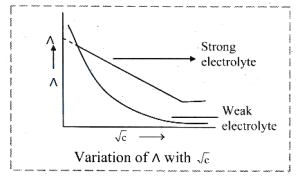
(C) The molar conductivity of a weak electrolyte like $CH_3COOH$ does not vary linearly with the square root of concentration,as shown in the graph.
Unlike strong electrolytes,the curve for a weak electrolyte does not intersect the y-axis upon extrapolation.
Therefore,the molar conductivity at infinite dilution $(\Lambda_0)$ for weak electrolytes cannot be determined by the graphical extrapolation method.
Unlike strong electrolytes,the curve for a weak electrolyte does not intersect the y-axis upon extrapolation.
Therefore,the molar conductivity at infinite dilution $(\Lambda_0)$ for weak electrolytes cannot be determined by the graphical extrapolation method.
0 likesView Solution
306
ChemistryMediumMCQMHT CET · 2024
Resistance and conductivity of a cell containing $0.1 \ M \ KCl$ solution at $298 \ K$ are $115 \ \Omega$ and $1.90 \times 10^{-6} \ S \ cm^{-1}$ respectively. What is the value of cell constant (in $cm^{-1}$)?
A
$0.165$
B
$1.601$
C
$2.185$
D
$0.218$
Solution
(D) The cell constant $\left(\frac{l}{A}\right)$ is defined by the relationship: $\frac{l}{A} = \kappa \times R$
where $\kappa$ is the conductivity and $R$ is the resistance.
Given:
$\kappa = 1.90 \times 10^{-6} \ S \ cm^{-1}$
$R = 115 \ \Omega$
Calculation:
$\frac{l}{A} = (1.90 \times 10^{-6} \ S \ cm^{-1}) \times (115 \ \Omega) = 0.2185 \ cm^{-1}$
Rounding to three decimal places,we get $0.218 \ cm^{-1}$.
Thus,the correct option is $D$.
where $\kappa$ is the conductivity and $R$ is the resistance.
Given:
$\kappa = 1.90 \times 10^{-6} \ S \ cm^{-1}$
$R = 115 \ \Omega$
Calculation:
$\frac{l}{A} = (1.90 \times 10^{-6} \ S \ cm^{-1}) \times (115 \ \Omega) = 0.2185 \ cm^{-1}$
Rounding to three decimal places,we get $0.218 \ cm^{-1}$.
Thus,the correct option is $D$.
0 likesView Solution
307
ChemistryMediumMCQMHT CET · 2024
Which of the following substances conducts electricity?
A
Diamond
B
Sulphur (solid)
C
Molten $NaCl$
D
Crystalline $NaCl$
Solution
(C) $(1)$ Diamond: Diamond does not conduct electricity. It is an insulator because it has no free electrons or ions to carry charge. The carbon atoms in diamond form a strong covalent network,preventing the free flow of electrons.
$(2)$ Sulphur (solid): Sulphur in its solid form also does not conduct electricity. It is a non-metal and does not have free electrons or charged particles to facilitate conduction.
$(3)$ Molten $NaCl$: Molten $NaCl$ (sodium chloride in its liquid form) conducts electricity. When $NaCl$ is heated to its melting point,it dissociates into free sodium $(Na^+)$ and chloride ions $(Cl^-)$,which are able to move freely and carry an electric current.
$(4)$ Crystalline $NaCl$: Crystalline $NaCl$ (solid sodium chloride) does not conduct electricity. While it contains ions ($Na^+$ and $Cl^-$),they are not free to move in the solid state. For conduction,the ions need to be mobile,which happens only in the molten state.
$(2)$ Sulphur (solid): Sulphur in its solid form also does not conduct electricity. It is a non-metal and does not have free electrons or charged particles to facilitate conduction.
$(3)$ Molten $NaCl$: Molten $NaCl$ (sodium chloride in its liquid form) conducts electricity. When $NaCl$ is heated to its melting point,it dissociates into free sodium $(Na^+)$ and chloride ions $(Cl^-)$,which are able to move freely and carry an electric current.
$(4)$ Crystalline $NaCl$: Crystalline $NaCl$ (solid sodium chloride) does not conduct electricity. While it contains ions ($Na^+$ and $Cl^-$),they are not free to move in the solid state. For conduction,the ions need to be mobile,which happens only in the molten state.
0 likesView Solution
308
ChemistryEasyMCQMHT CET · 2024
What is the conductivity of $0.05 \ M$ $KCl$ solution if cell constant is $1.32 \ cm^{-1}$ and resistance is $528 \ \Omega$?
A
$0.0401 \ \Omega^{-1} \ cm^{-1}$
B
$0.0051 \ \Omega^{-1} \ cm^{-1}$
C
$0.0025 \ \Omega^{-1} \ cm^{-1}$
D
$0.0691 \ \Omega^{-1} \ cm^{-1}$
Solution
(C) The conductivity $(\kappa)$ is calculated using the formula: $\kappa = \frac{\text{Cell constant}}{R}$.
Given: Cell constant = $1.32 \ cm^{-1}$,Resistance $(R)$ = $528 \ \Omega$.
$\kappa = \frac{1.32 \ cm^{-1}}{528 \ \Omega} = 0.0025 \ \Omega^{-1} \ cm^{-1}$.
Given: Cell constant = $1.32 \ cm^{-1}$,Resistance $(R)$ = $528 \ \Omega$.
$\kappa = \frac{1.32 \ cm^{-1}}{528 \ \Omega} = 0.0025 \ \Omega^{-1} \ cm^{-1}$.
0 likesView Solution
309
ChemistryEasyMCQMHT CET · 2024
$A$ conductivity cell dipped in $0.05 \ M$ $KCl$ has resistance $600 \ \Omega$. If conductivity is $0.0012 \ \Omega^{-1} \ cm^{-1}$,what is the value of cell constant (in $cm^{-1}$)?
A
$0.50$
B
$0.72$
C
$1.5$
D
$2.0$
Solution
(B) The relationship between conductivity $(k)$,resistance $(R)$,and cell constant $(G^*)$ is given by:
$k = \frac{G^*}{R}$
Therefore,the cell constant is:
$G^* = k \times R$
Given:
$k = 0.0012 \ \Omega^{-1} \ cm^{-1}$
$R = 600 \ \Omega$
Substituting the values:
$G^* = 0.0012 \ \Omega^{-1} \ cm^{-1} \times 600 \ \Omega = 0.72 \ cm^{-1}$
$k = \frac{G^*}{R}$
Therefore,the cell constant is:
$G^* = k \times R$
Given:
$k = 0.0012 \ \Omega^{-1} \ cm^{-1}$
$R = 600 \ \Omega$
Substituting the values:
$G^* = 0.0012 \ \Omega^{-1} \ cm^{-1} \times 600 \ \Omega = 0.72 \ cm^{-1}$
0 likesView Solution
310
ChemistryEasyMCQMHT CET · 2024
Which of the following units of electrical measurement is not equivalent to $1$ Siemen?
A
$\Omega^{-1}$
B
$A V^{-1}$
C
$C V^{-1} s^{-1}$
D
$\Omega$
Solution
(D) $\because V = I R$ and $Q = I t$
Conductance $(G) = \frac{1}{R} = \frac{I}{V} = \frac{Q}{V t}$
Substituting with units,
$\therefore 1 \text{ Siemen} = \frac{1}{\Omega} = \Omega^{-1} = \frac{A}{V} = A V^{-1} = \frac{C}{V s} = C V^{-1} s^{-1}$
Since $\Omega$ is the unit of resistance,it is not equivalent to $1$ Siemen.
Conductance $(G) = \frac{1}{R} = \frac{I}{V} = \frac{Q}{V t}$
Substituting with units,
$\therefore 1 \text{ Siemen} = \frac{1}{\Omega} = \Omega^{-1} = \frac{A}{V} = A V^{-1} = \frac{C}{V s} = C V^{-1} s^{-1}$
Since $\Omega$ is the unit of resistance,it is not equivalent to $1$ Siemen.
0 likesView Solution
311
ChemistryEasyMCQMHT CET · 2024
The conductivity of $0.02 \ M$ $KCl$ solution is $0.00250 \ \Omega^{-1} \ cm^{-1}$. What is its molar conductivity?
A
$125 \ \Omega^{-1} \ cm^{2} \ mol^{-1}$
B
$0.05 \ \Omega^{-1} \ cm^{2} \ mol^{-1}$
C
$725 \ \Omega^{-1} \ cm^{2} \ mol^{-1}$
D
$8000 \ \Omega^{-1} \ cm^{2} \ mol^{-1}$
Solution
(A) The formula for molar conductivity $(\Lambda_m)$ is given by: $\Lambda_m = \frac{1000 \times \kappa}{C}$
Given:
Conductivity $(\kappa)$ = $0.00250 \ \Omega^{-1} \ cm^{-1}$
Concentration $(C)$ = $0.02 \ M$
Substituting the values:
$\Lambda_m = \frac{1000 \times 0.00250}{0.02} \ \Omega^{-1} \ cm^2 \ mol^{-1}$
$\Lambda_m = \frac{2.5}{0.02} \ \Omega^{-1} \ cm^2 \ mol^{-1}$
$\Lambda_m = 125 \ \Omega^{-1} \ cm^2 \ mol^{-1}$
Given:
Conductivity $(\kappa)$ = $0.00250 \ \Omega^{-1} \ cm^{-1}$
Concentration $(C)$ = $0.02 \ M$
Substituting the values:
$\Lambda_m = \frac{1000 \times 0.00250}{0.02} \ \Omega^{-1} \ cm^2 \ mol^{-1}$
$\Lambda_m = \frac{2.5}{0.02} \ \Omega^{-1} \ cm^2 \ mol^{-1}$
$\Lambda_m = 125 \ \Omega^{-1} \ cm^2 \ mol^{-1}$
0 likesView Solution
312
ChemistryEasyMCQMHT CET · 2024
The resistance of a conductivity cell filled with $0.1 \ M$ $KCl$ solution is $100 \ \Omega$ and the conductivity is $1.70 \times 10^{-4} \ S \ cm^{-1}$. What is the cell constant of the cell (in $cm^{-1}$)?
A
$1.70$
B
$0.017$
C
$0.058$
D
$0.012$
Solution
(B) The formula for cell constant $(G^*)$ is given by:
$G^* = \kappa \times R$
Where:
- $\kappa$ is the conductivity $(S \ cm^{-1})$,
- $R$ is the resistance $(\Omega)$.
Given:
- $\kappa = 1.70 \times 10^{-4} \ S \ cm^{-1}$,
- $R = 100 \ \Omega$.
Calculation:
$G^* = (1.70 \times 10^{-4} \ S \ cm^{-1}) \times (100 \ \Omega) = 0.017 \ cm^{-1}$.
Therefore,the cell constant is $0.017 \ cm^{-1}$.
Hence,the correct option is $B$.
$G^* = \kappa \times R$
Where:
- $\kappa$ is the conductivity $(S \ cm^{-1})$,
- $R$ is the resistance $(\Omega)$.
Given:
- $\kappa = 1.70 \times 10^{-4} \ S \ cm^{-1}$,
- $R = 100 \ \Omega$.
Calculation:
$G^* = (1.70 \times 10^{-4} \ S \ cm^{-1}) \times (100 \ \Omega) = 0.017 \ cm^{-1}$.
Therefore,the cell constant is $0.017 \ cm^{-1}$.
Hence,the correct option is $B$.
0 likesView Solution
313
ChemistryMediumMCQMHT CET · 2024
Which of the following cannot be used as a standard solution for the determination of the cell constant of a conductivity cell?
A
$1 \ M \ KCl$
B
$0.1 \ M \ KCl$
C
$0.01 \ M \ KCl$
D
Saturated $KCl$
Solution
(D) saturated $KCl$ solution is not typically used as a standard solution for conductivity calibration.
The reason is that a saturated $KCl$ solution may have variable composition due to temperature changes,partial crystallization,and the difficulty in ensuring a uniform,reproducible concentration.
Thus,it does not have a precisely known or easily reproducible conductivity value compared to the other standard concentrations.
Conclusion: Out of the given options,the saturated $KCl$ solution (Option $D$) is not suitable for use as a standard solution in determining the cell constant because its concentration and thus its conductivity are not stable or easily reproducible.
The reason is that a saturated $KCl$ solution may have variable composition due to temperature changes,partial crystallization,and the difficulty in ensuring a uniform,reproducible concentration.
Thus,it does not have a precisely known or easily reproducible conductivity value compared to the other standard concentrations.
Conclusion: Out of the given options,the saturated $KCl$ solution (Option $D$) is not suitable for use as a standard solution in determining the cell constant because its concentration and thus its conductivity are not stable or easily reproducible.
0 likesView Solution
314
ChemistryMediumMCQMHT CET · 2024
Cell constant of a conductivity cell is $0.9 \ cm^{-1}$ and resistance shown by $AgNO_3$ solution is $6530 \ \Omega$. What is the conductivity of $AgNO_3$ solution?
A
$725 \ \Omega^{-1} \ cm^{-1}$
B
$5870 \ \Omega^{-1} \ cm^{-1}$
C
$1.38 \times 10^{-4} \ \Omega^{-1} \ cm^{-1}$
D
$4.72 \times 10^{-4} \ \Omega^{-1} \ cm^{-1}$
Solution
(C) The conductivity $(\kappa)$ is given by the formula: $\kappa = \frac{\text{Cell constant}}{R}$
Given: Cell constant $= 0.9 \ cm^{-1}$ and $R = 6530 \ \Omega$.
Substituting the values: $\kappa = \frac{0.9 \ cm^{-1}}{6530 \ \Omega} = 1.378 \times 10^{-4} \ \Omega^{-1} \ cm^{-1} \approx 1.38 \times 10^{-4} \ \Omega^{-1} \ cm^{-1}$.
Given: Cell constant $= 0.9 \ cm^{-1}$ and $R = 6530 \ \Omega$.
Substituting the values: $\kappa = \frac{0.9 \ cm^{-1}}{6530 \ \Omega} = 1.378 \times 10^{-4} \ \Omega^{-1} \ cm^{-1} \approx 1.38 \times 10^{-4} \ \Omega^{-1} \ cm^{-1}$.
0 likesView Solution
315
ChemistryEasyMCQMHT CET · 2024
What is the concentration of an electrolyte solution to have molar conductivity of $101 \ \Omega^{-1} \ cm^2 \ mol^{-1}$ and conductivity of $1.01 \times 10^{-2} \ \Omega^{-1} \ cm^{-1}$ at $298 \ K$ (in $M$)?
A
$0.05$
B
$0.1$
C
$0.15$
D
$0.2$
Solution
(B) The formula for molar conductivity $(\Lambda_m)$ is given by: $\Lambda_m = \frac{1000 \times \kappa}{c}$
Given: $\Lambda_m = 101 \ \Omega^{-1} \ cm^2 \ mol^{-1}$ and $\kappa = 1.01 \times 10^{-2} \ \Omega^{-1} \ cm^{-1}$
Substituting the values: $101 = \frac{1000 \times 1.01 \times 10^{-2}}{c}$
$101 = \frac{10.1}{c}$
$c = \frac{10.1}{101} = 0.1 \ M$
Given: $\Lambda_m = 101 \ \Omega^{-1} \ cm^2 \ mol^{-1}$ and $\kappa = 1.01 \times 10^{-2} \ \Omega^{-1} \ cm^{-1}$
Substituting the values: $101 = \frac{1000 \times 1.01 \times 10^{-2}}{c}$
$101 = \frac{10.1}{c}$
$c = \frac{10.1}{101} = 0.1 \ M$
0 likesView Solution
316
ChemistryEasyMCQMHT CET · 2024
The conductivity of $0.02 \ M$ solution of $AgNO_3$ is $0.00216 \ \Omega^{-1} \ cm^{-1}$ at $298 \ K$. What is its molar conductivity?
A
$232.0 \ \Omega^{-1} \ cm^2 \ mol^{-1}$
B
$402.0 \ \Omega^{-1} \ cm^2 \ mol^{-1}$
C
$108.0 \ \Omega^{-1} \ cm^2 \ mol^{-1}$
D
$150.0 \ \Omega^{-1} \ cm^2 \ mol^{-1}$
Solution
(C) The formula for molar conductivity is $\Lambda_m = \frac{1000 \times \kappa}{C}$.
Given: $\kappa = 0.00216 \ \Omega^{-1} \ cm^{-1}$ and $C = 0.02 \ M$.
Substituting the values: $\Lambda_m = \frac{1000 \times 0.00216}{0.02} = 108.0 \ \Omega^{-1} \ cm^2 \ mol^{-1}$.
Given: $\kappa = 0.00216 \ \Omega^{-1} \ cm^{-1}$ and $C = 0.02 \ M$.
Substituting the values: $\Lambda_m = \frac{1000 \times 0.00216}{0.02} = 108.0 \ \Omega^{-1} \ cm^2 \ mol^{-1}$.
0 likesView Solution
317
ChemistryEasyMCQMHT CET · 2024
What is the conductivity of $0.05 \ M$ $NaOH$ solution having resistance $31.5 \ \Omega$ and cell constant $0.315 \ cm^{-1}$?
A
$100 \ \Omega^{-1} \ cm^{-1}$
B
$0.02 \ \Omega^{-1} \ cm^{-1}$
C
$0.09 \ \Omega^{-1} \ cm^{-1}$
D
$0.01 \ \Omega^{-1} \ cm^{-1}$
Solution
(D) The formula for conductivity $(k)$ is given by: $k = \frac{1}{R} \times \frac{l}{A}$
Given: Resistance $(R)$ = $31.5 \ \Omega$ and Cell constant $(\frac{l}{A})$ = $0.315 \ cm^{-1}$
Substituting the values: $k = \frac{1}{31.5 \ \Omega} \times 0.315 \ cm^{-1}$
$k = 0.01 \ \Omega^{-1} \ cm^{-1}$
Given: Resistance $(R)$ = $31.5 \ \Omega$ and Cell constant $(\frac{l}{A})$ = $0.315 \ cm^{-1}$
Substituting the values: $k = \frac{1}{31.5 \ \Omega} \times 0.315 \ cm^{-1}$
$k = 0.01 \ \Omega^{-1} \ cm^{-1}$
0 likesView Solution
318
ChemistryEasyMCQMHT CET · 2024
Calculate the cell constant of a conductivity cell containing $0.1 \ M$ $KCl$ solution having a resistance of $60 \ \Omega$ and a conductivity of $0.014 \ \Omega^{-1} \ cm^{-1}$ at $25^{\circ} \ C$. (in $cm^{-1}$)
A
$0.42$
B
$0.84$
C
$0.60$
D
$1.04$
Solution
(B) The relationship between conductivity $(\kappa)$,resistance $(R)$,and cell constant $(G^*)$ is given by:
$\kappa = \frac{1}{R} \times G^*$
Given:
Resistance $(R)$ = $60 \ \Omega$
Conductivity $(\kappa)$ = $0.014 \ \Omega^{-1} \ cm^{-1}$
Substituting the values:
$0.014 \ \Omega^{-1} \ cm^{-1} = \frac{1}{60 \ \Omega} \times G^*$
$G^* = 0.014 \ \Omega^{-1} \ cm^{-1} \times 60 \ \Omega$
$G^* = 0.84 \ cm^{-1}$
$\kappa = \frac{1}{R} \times G^*$
Given:
Resistance $(R)$ = $60 \ \Omega$
Conductivity $(\kappa)$ = $0.014 \ \Omega^{-1} \ cm^{-1}$
Substituting the values:
$0.014 \ \Omega^{-1} \ cm^{-1} = \frac{1}{60 \ \Omega} \times G^*$
$G^* = 0.014 \ \Omega^{-1} \ cm^{-1} \times 60 \ \Omega$
$G^* = 0.84 \ cm^{-1}$
0 likesView Solution
319
ChemistryMediumMCQMHT CET · 2024
Which is the most commonly used refrigerant Freon-$12$?
A
Monochloromonofluoromethane
B
Dichlorodifluoromethane
C
Chlorodifluoromethane
D
Dichlorofluoromethane
Solution
(B) The correct answer is $B$. Dichlorodifluoromethane.
Freon-$12$,also known as dichlorodifluoromethane $(CCl_2F_2)$,is a commonly used refrigerant.
It was widely used in refrigeration and air conditioning systems for many years until its use was phased out due to concerns about ozone layer depletion.
Here is a quick explanation of the other options:
$-$ $A$. Monochloromonofluoromethane: This is not the correct structure for Freon-$12$.
$-$ $C$. Chlorodifluoromethane: This is Freon-$22$,not Freon-$12$.
$-$ $D$. Dichlorofluoromethane: This is not the correct chemical name for Freon-$12$.
Freon-$12$,also known as dichlorodifluoromethane $(CCl_2F_2)$,is a commonly used refrigerant.
It was widely used in refrigeration and air conditioning systems for many years until its use was phased out due to concerns about ozone layer depletion.
Here is a quick explanation of the other options:
$-$ $A$. Monochloromonofluoromethane: This is not the correct structure for Freon-$12$.
$-$ $C$. Chlorodifluoromethane: This is Freon-$22$,not Freon-$12$.
$-$ $D$. Dichlorofluoromethane: This is not the correct chemical name for Freon-$12$.
0 likesView Solution
320
ChemistryMediumMCQMHT CET · 2024
Which of the following nanomaterials has two dimensions less than $100 \ nm$?
A
Nanowires
B
Microcapsules
C
Quantum dots
D
Nanorings
Solution
(A) Nanowires are one-dimensional nanostructures in which two dimensions are in the nanoscale $(< 100 \ nm)$.
Quantum dots are zero-dimensional structures in which all three dimensions are in the nanoscale $(< 100 \ nm)$.
Microcapsules are generally larger than the nanoscale range.
Nanorings are typically considered zero-dimensional or specific nanostructures depending on their geometry,but nanowires are the standard example of having two dimensions in the nanoscale.
Quantum dots are zero-dimensional structures in which all three dimensions are in the nanoscale $(< 100 \ nm)$.
Microcapsules are generally larger than the nanoscale range.
Nanorings are typically considered zero-dimensional or specific nanostructures depending on their geometry,but nanowires are the standard example of having two dimensions in the nanoscale.
0 likesView Solution
321
ChemistryMediumMCQMHT CET · 2024
Identify the instrument used to find the structure of the surface of a material.
A
Scanning electron microscope
B
$X$-ray diffractometer
C
Transmission electron microscope
D
$UV$-visible spectrophotometer
Solution
(A) The Scanning Electron Microscope $(SEM)$ is the instrument used to examine the surface structure of materials at high magnification.
It works by scanning a focused beam of electrons across the surface of a sample.
The electrons interact with the atoms on the surface,producing signals that are used to create an image of the surface's topography,morphology,and composition.
It works by scanning a focused beam of electrons across the surface of a sample.
The electrons interact with the atoms on the surface,producing signals that are used to create an image of the surface's topography,morphology,and composition.
0 likesView Solution
322
ChemistryMediumMCQMHT CET · 2024
Identify one-dimensional nanostructure from the following.
A
Nanowires
B
Nanoparticles
C
Thin films
D
Quantum dots
Solution
(A) One-dimensional nanostructures are materials that have two dimensions in the nanometer range and one dimension that is much larger, such as $Nanowires$.
$Nanoparticles$ are zero-dimensional, $Thin films$ are two-dimensional, and $Quantum dots$ are zero-dimensional nanostructures.
$Nanoparticles$ are zero-dimensional, $Thin films$ are two-dimensional, and $Quantum dots$ are zero-dimensional nanostructures.
0 likesView Solution
323
ChemistryMediumMCQMHT CET · 2024
Which of the following polymers is believed to leach a human carcinogen into food when used as household plastic?
A
$LDPE$
B
$PP$
C
$PS$
D
$PET$
Solution
(C) $PS$ (Polystyrene) is believed to leach styrene,which is a possible human carcinogen,into food when used as a household plastic.
0 likesView Solution
324
ChemistryMediumMCQMHT CET · 2024
Which of the following is $1^{\circ}$ allylic alcohol?
A
$CH_2=CH-CH(CH_3)-OH$
B
$CH_2=CH-CH_2-OH$
C
$CH_2=CH-C(CH_3)_2-OH$
D
$CH_3-CH=CH-CH_2-CH_2-OH$
Solution
(B) An allylic alcohol is one where the $-OH$ group is attached to a carbon atom adjacent to a carbon-carbon double bond $(C=C-C-OH)$.
$A$ $1^{\circ}$ allylic alcohol has the $-OH$ group attached to a primary carbon ($CH_2$ group) which is adjacent to a double bond.
$1.$ $CH_2=CH-CH(CH_3)-OH$: The $-OH$ is on a secondary carbon,so it is a $2^{\circ}$ allylic alcohol.
$2.$ $CH_2=CH-CH_2-OH$: The $-OH$ is on a primary carbon adjacent to the double bond,so it is a $1^{\circ}$ allylic alcohol.
$3.$ $CH_2=CH-C(CH_3)_2-OH$: The $-OH$ is on a tertiary carbon,so it is a $3^{\circ}$ allylic alcohol.
$4.$ $CH_3-CH=CH-CH_2-CH_2-OH$: The $-OH$ is on a carbon that is not adjacent to the double bond,so it is not an allylic alcohol.
Therefore,the correct option is $B$.
$A$ $1^{\circ}$ allylic alcohol has the $-OH$ group attached to a primary carbon ($CH_2$ group) which is adjacent to a double bond.
$1.$ $CH_2=CH-CH(CH_3)-OH$: The $-OH$ is on a secondary carbon,so it is a $2^{\circ}$ allylic alcohol.
$2.$ $CH_2=CH-CH_2-OH$: The $-OH$ is on a primary carbon adjacent to the double bond,so it is a $1^{\circ}$ allylic alcohol.
$3.$ $CH_2=CH-C(CH_3)_2-OH$: The $-OH$ is on a tertiary carbon,so it is a $3^{\circ}$ allylic alcohol.
$4.$ $CH_3-CH=CH-CH_2-CH_2-OH$: The $-OH$ is on a carbon that is not adjacent to the double bond,so it is not an allylic alcohol.
Therefore,the correct option is $B$.
0 likesView Solution
325
ChemistryDifficultMCQMHT CET · 2024
Which of the following is a pair of dihydric phenols?
A
Resorcinol and pyrogallol
B
Quinol and phloroglucinol
C
Phloroglucinol and pyrogallol
D
Catechol and Quinol
Solution
(D) Dihydric phenols are compounds containing two hydroxyl $(-OH)$ groups attached to a benzene ring.
$1$. Catechol has two $-OH$ groups at the $1,2$-positions.
$2$. Resorcinol has two $-OH$ groups at the $1,3$-positions.
$3$. Quinol (or hydroquinone) has two $-OH$ groups at the $1,4$-positions.
$4$. Phloroglucinol has three $-OH$ groups at the $1,3,5$-positions (trihydric phenol).
$5$. Pyrogallol has three $-OH$ groups at the $1,2,3$-positions (trihydric phenol).
Therefore,the pair of dihydric phenols is Catechol and Quinol.
$1$. Catechol has two $-OH$ groups at the $1,2$-positions.
$2$. Resorcinol has two $-OH$ groups at the $1,3$-positions.
$3$. Quinol (or hydroquinone) has two $-OH$ groups at the $1,4$-positions.
$4$. Phloroglucinol has three $-OH$ groups at the $1,3,5$-positions (trihydric phenol).
$5$. Pyrogallol has three $-OH$ groups at the $1,2,3$-positions (trihydric phenol).
Therefore,the pair of dihydric phenols is Catechol and Quinol.
0 likesView Solution
326
ChemistryMediumMCQMHT CET · 2024
Which of the following is the $IUPAC$ name of hydroquinone?
A
Benzene-$1, 2$-diol
B
Benzene-$1, 3$-diol
C
Benzene-$1, 4$-diol
D
Benzene-$1, 3, 5$-triol
Solution
(C) Hydroquinone is a dihydroxy benzene derivative where the two hydroxyl $(-OH)$ groups are attached at the $1$ and $4$ positions of the benzene ring.
According to $IUPAC$ nomenclature,this structure is named as Benzene-$1, 4$-diol.
According to $IUPAC$ nomenclature,this structure is named as Benzene-$1, 4$-diol.
0 likesView Solution
327
ChemistryMediumMCQMHT CET · 2024
Which of the following is the molecular formula of cyclohexylamine?
A
$C_6H_8N$
B
$C_6H_{10}N$
C
$C_6H_{12}N$
D
$C_6H_{13}N$
Solution
(D) Cyclohexylamine consists of a cyclohexane ring $(C_6H_{11})$ attached to an amino group $(-NH_2)$.
Combining these,the molecular formula is $C_6H_{11} + NH_2 = C_6H_{13}N$.
Combining these,the molecular formula is $C_6H_{11} + NH_2 = C_6H_{13}N$.
0 likesView Solution
328
ChemistryMediumMCQMHT CET · 2024
Which among the following compounds is $NOT$ a tertiary amine?
A
$N, N$-Dimethylaniline
B
$N$-Methyl-$N$-phenylaniline
C
butan$-1$-amine
D
$N, N$-Dimethyl$-1$-butanamine
Solution
(C) The classification of amines is based on the number of alkyl or aryl groups attached to the nitrogen atom.
Primary $(1^{\circ})$ amines contain the $-NH_2$ group.
Secondary $(2^{\circ})$ amines contain the $-NH-$ group.
Tertiary $(3^{\circ})$ amines contain the $-N-$ group (where the nitrogen is bonded to three carbon atoms).
In butan$-1$-amine $(CH_3CH_2CH_2CH_2NH_2)$,the nitrogen is attached to only one carbon atom,making it a primary $(1^{\circ})$ amine. Therefore,it is not a tertiary amine.
Primary $(1^{\circ})$ amines contain the $-NH_2$ group.
Secondary $(2^{\circ})$ amines contain the $-NH-$ group.
Tertiary $(3^{\circ})$ amines contain the $-N-$ group (where the nitrogen is bonded to three carbon atoms).
In butan$-1$-amine $(CH_3CH_2CH_2CH_2NH_2)$,the nitrogen is attached to only one carbon atom,making it a primary $(1^{\circ})$ amine. Therefore,it is not a tertiary amine.
0 likesView Solution
329
ChemistryMediumMCQMHT CET · 2024
What is the name of isobutyl alcohol according to the carbinol system?
A
Ethyl methyl carbinol
B
Isobutyl carbinol
C
Isopropyl carbinol
D
Diethyl carbinol
Solution
(C) In the carbinol system,alcohols are named as derivatives of methyl alcohol,which is referred to as $CH_3OH$ or carbinol.
For isobutyl alcohol,the structure is $(CH_3)_2CH-CH_2OH$.
This can be viewed as a carbinol group $(-CH_2OH)$ attached to an isopropyl group $((CH_3)_2CH-)$.
Therefore,the name according to the carbinol system is isopropyl carbinol.
For isobutyl alcohol,the structure is $(CH_3)_2CH-CH_2OH$.
This can be viewed as a carbinol group $(-CH_2OH)$ attached to an isopropyl group $((CH_3)_2CH-)$.
Therefore,the name according to the carbinol system is isopropyl carbinol.
0 likesView Solution
330
ChemistryMediumMCQMHT CET · 2024
Which of the following compounds is a trihydric alcohol?
A
Quinol
B
Catechol
C
Glycerol
D
Resorcinol
Solution
(C) trihydric alcohol is an alcohol that contains three hydroxyl $(-OH)$ groups in its molecule.
$1$. Quinol (Benzene$-1,4-$diol) has two $-OH$ groups (dihydric).
$2$. Catechol (Benzene$-1,2-$diol) has two $-OH$ groups (dihydric).
$3$. Glycerol $(CH_2(OH)-CH(OH)-CH_2(OH))$ has three $-OH$ groups (trihydric).
$4$. Resorcinol (Benzene$-1,3-$diol) has two $-OH$ groups (dihydric).
Therefore,the correct answer is Glycerol.
$1$. Quinol (Benzene$-1,4-$diol) has two $-OH$ groups (dihydric).
$2$. Catechol (Benzene$-1,2-$diol) has two $-OH$ groups (dihydric).
$3$. Glycerol $(CH_2(OH)-CH(OH)-CH_2(OH))$ has three $-OH$ groups (trihydric).
$4$. Resorcinol (Benzene$-1,3-$diol) has two $-OH$ groups (dihydric).
Therefore,the correct answer is Glycerol.
0 likesView Solution
331
ChemistryMediumMCQMHT CET · 2024
Which of the following is $NOT$ a dihydric compound?
A
Crotonyl alcohol
B
Resorcinol
C
Ethylene glycol
D
Quinol
Solution
(A) dihydric compound is one that contains two hydroxyl $(-OH)$ groups in its structure.
$1$. Crotonyl alcohol $(CH_3-CH=CH-CH_2OH)$ contains only one $-OH$ group,so it is a monohydric alcohol.
$2$. Resorcinol $(C_6H_4(OH)_2)$ contains two $-OH$ groups attached to the benzene ring,so it is a dihydric phenol.
$3$. Ethylene glycol $(HO-CH_2-CH_2-OH)$ contains two $-OH$ groups,so it is a dihydric alcohol.
$4$. Quinol $(C_6H_4(OH)_2)$ contains two $-OH$ groups attached to the benzene ring,so it is a dihydric phenol.
Therefore,Crotonyl alcohol is not a dihydric compound.
$1$. Crotonyl alcohol $(CH_3-CH=CH-CH_2OH)$ contains only one $-OH$ group,so it is a monohydric alcohol.
$2$. Resorcinol $(C_6H_4(OH)_2)$ contains two $-OH$ groups attached to the benzene ring,so it is a dihydric phenol.
$3$. Ethylene glycol $(HO-CH_2-CH_2-OH)$ contains two $-OH$ groups,so it is a dihydric alcohol.
$4$. Quinol $(C_6H_4(OH)_2)$ contains two $-OH$ groups attached to the benzene ring,so it is a dihydric phenol.
Therefore,Crotonyl alcohol is not a dihydric compound.
0 likesView Solution
332
ChemistryMediumMCQMHT CET · 2024
Which among the following is $NOT$ a dicarboxylic acid?
A
Adipic acid
B
Glutaric acid
C
Valeric acid
D
Malonic acid
Solution
(C) The structures of the given acids are as follows:
$1$. Adipic acid: $HOOC-(CH_2)_4-COOH$ (Dicarboxylic acid)
$2$. Glutaric acid: $HOOC-(CH_2)_3-COOH$ (Dicarboxylic acid)
$3$. Valeric acid: $CH_3-CH_2-CH_2-CH_2-COOH$ (Monocarboxylic acid)
$4$. Malonic acid: $HOOC-CH_2-COOH$ (Dicarboxylic acid)
Therefore,Valeric acid is not a dicarboxylic acid.
$1$. Adipic acid: $HOOC-(CH_2)_4-COOH$ (Dicarboxylic acid)
$2$. Glutaric acid: $HOOC-(CH_2)_3-COOH$ (Dicarboxylic acid)
$3$. Valeric acid: $CH_3-CH_2-CH_2-CH_2-COOH$ (Monocarboxylic acid)
$4$. Malonic acid: $HOOC-CH_2-COOH$ (Dicarboxylic acid)
Therefore,Valeric acid is not a dicarboxylic acid.
0 likesView Solution
333
ChemistryMediumMCQMHT CET · 2024
Which of the following is a secondary benzylic alcohol?
A
Benzyl alcohol $(C_6H_5CH_2OH)$
B
$2-$Phenylpropan$-2-$ol $(C_6H_5C(CH_3)_2OH)$
C
$1-$Phenylethanol $(C_6H_5CH(OH)CH_3)$
D
$2-$Phenylbutan$-2-$ol $(C_6H_5C(OH)(CH_3)CH_2CH_3)$
Solution
(C) In a secondary benzylic alcohol,the $-OH$ group is attached to an $sp^3$ hybridized carbon atom,which is directly bonded to an aromatic ring and two other carbon atoms (or one carbon and one hydrogen atom,specifically a secondary carbon).
$1$. In option $A$,the $-OH$ group is attached to a primary carbon $(C_6H_5CH_2OH)$,making it a primary benzylic alcohol.
$2$. In option $B$,the $-OH$ group is attached to a tertiary carbon $(C_6H_5C(CH_3)_2OH)$,making it a tertiary benzylic alcohol.
$3$. In option $C$,the $-OH$ group is attached to a secondary carbon $(C_6H_5CH(OH)CH_3)$,which is bonded to the aromatic ring,making it a secondary benzylic alcohol.
$4$. In option $D$,the $-OH$ group is attached to a tertiary carbon $(C_6H_5C(OH)(CH_3)CH_2CH_3)$,making it a tertiary benzylic alcohol.
Therefore,the correct answer is $C$.
$1$. In option $A$,the $-OH$ group is attached to a primary carbon $(C_6H_5CH_2OH)$,making it a primary benzylic alcohol.
$2$. In option $B$,the $-OH$ group is attached to a tertiary carbon $(C_6H_5C(CH_3)_2OH)$,making it a tertiary benzylic alcohol.
$3$. In option $C$,the $-OH$ group is attached to a secondary carbon $(C_6H_5CH(OH)CH_3)$,which is bonded to the aromatic ring,making it a secondary benzylic alcohol.
$4$. In option $D$,the $-OH$ group is attached to a tertiary carbon $(C_6H_5C(OH)(CH_3)CH_2CH_3)$,making it a tertiary benzylic alcohol.
Therefore,the correct answer is $C$.
0 likesView Solution
334
ChemistryMediumMCQMHT CET · 2024
What is the general molecular formula of aldehydes?
A
$C_n H_{2n+1} O$
B
$C_n H_{2n} O$
C
$C_n H_{2n+1} O_2$
D
$C_n H_{2n} O_2$
Solution
(B) Aldehydes are organic compounds containing a functional group with the structure $-CHO$.
The general molecular formula for saturated aliphatic aldehydes is $C_n H_{2n} O$,where $n$ is the number of carbon atoms $(n \ge 1)$.
For example,if $n=1$,the formula is $CH_2O$ (Formaldehyde,$HCHO$).
If $n=2$,the formula is $C_2H_4O$ (Acetaldehyde,$CH_3CHO$).
The general molecular formula for saturated aliphatic aldehydes is $C_n H_{2n} O$,where $n$ is the number of carbon atoms $(n \ge 1)$.
For example,if $n=1$,the formula is $CH_2O$ (Formaldehyde,$HCHO$).
If $n=2$,the formula is $C_2H_4O$ (Acetaldehyde,$CH_3CHO$).
0 likesView Solution
335
ChemistryEasyMCQMHT CET · 2024
Which among the following is $NOT$ an allylic halide?
A
$CH_2=CH-CH_2-X$
B
$CH_3-CH=CH-CH_2-X$
C
$CH_3-CH_2-CH=CH-CH_2-X$
D
$CH_3-CH=CH-CH_2-CH_2-X$
Solution
(D) An allylic halide is a compound in which the halogen atom is attached to an $sp^3$ hybridized carbon atom next to a carbon-carbon double bond $(C=C-C-X)$.
In option $A$,$B$,and $C$,the halogen atom $(X)$ is attached to the carbon atom directly adjacent to the double bond.
In option $D$,the structure is $CH_3-CH=CH-CH_2-CH_2-X$. Here,the halogen atom is attached to a carbon atom that is two positions away from the double bond,making it a homoallylic halide,not an allylic halide.
Therefore,the correct option is $D$.
In option $A$,$B$,and $C$,the halogen atom $(X)$ is attached to the carbon atom directly adjacent to the double bond.
In option $D$,the structure is $CH_3-CH=CH-CH_2-CH_2-X$. Here,the halogen atom is attached to a carbon atom that is two positions away from the double bond,making it a homoallylic halide,not an allylic halide.
Therefore,the correct option is $D$.
0 likesView Solution
336
ChemistryEasyMCQMHT CET · 2024
Which of the following is a tricarboxylic acid?
A
Propionic acid
B
Oxalic acid
C
Malonic acid
D
Citric acid
Solution
(D) tricarboxylic acid is an organic compound that contains three carboxylic acid $(-COOH)$ functional groups.
$1$. Propionic acid $(CH_3CH_2COOH)$ is a monocarboxylic acid.
$2$. Oxalic acid $(HOOC-COOH)$ is a dicarboxylic acid.
$3$. Malonic acid $(HOOC-CH_2-COOH)$ is a dicarboxylic acid.
$4$. Citric acid $(HOOC-CH_2-C(OH)(COOH)-CH_2-COOH)$ contains three $-COOH$ groups,making it a tricarboxylic acid.
Therefore,the correct option is $D$.
$1$. Propionic acid $(CH_3CH_2COOH)$ is a monocarboxylic acid.
$2$. Oxalic acid $(HOOC-COOH)$ is a dicarboxylic acid.
$3$. Malonic acid $(HOOC-CH_2-COOH)$ is a dicarboxylic acid.
$4$. Citric acid $(HOOC-CH_2-C(OH)(COOH)-CH_2-COOH)$ contains three $-COOH$ groups,making it a tricarboxylic acid.
Therefore,the correct option is $D$.
0 likesView Solution
337
ChemistryEasyMCQMHT CET · 2024
Identify the chiral molecule from the following.
A
$2-$Chloropropane
B
$2-$Chloro$-2-$methylbutane
C
$3-$Chloro$-3-$methylbutane
D
$2-$Chloropentane
Solution
(D) molecule is chiral if it contains a chiral center,which is a carbon atom bonded to four different groups.
$1$. $2-$Chloropropane: $CH_3-CHCl-CH_3$ (The central carbon is bonded to two identical methyl groups,so it is achiral).
$2$. $2-$Chloro$-2-$methylbutane: $CH_3-CCl(CH_3)-CH_2-CH_3$ (The central carbon is bonded to two identical methyl groups,so it is achiral).
$3$. $3-$Chloro$-3-$methylbutane: $CH_3-CH_2-CCl(CH_3)-CH_3$ (The central carbon is bonded to two identical methyl groups,so it is achiral).
$4$. $2-$Chloropentane: $CH_3-CHCl-CH_2-CH_2-CH_3$ (The $C-2$ carbon is bonded to four different groups: $-H$,$-Cl$,$-CH_3$,and $-CH_2CH_2CH_3$,so it is chiral).
Therefore,the correct option is $D$.
$1$. $2-$Chloropropane: $CH_3-CHCl-CH_3$ (The central carbon is bonded to two identical methyl groups,so it is achiral).
$2$. $2-$Chloro$-2-$methylbutane: $CH_3-CCl(CH_3)-CH_2-CH_3$ (The central carbon is bonded to two identical methyl groups,so it is achiral).
$3$. $3-$Chloro$-3-$methylbutane: $CH_3-CH_2-CCl(CH_3)-CH_3$ (The central carbon is bonded to two identical methyl groups,so it is achiral).
$4$. $2-$Chloropentane: $CH_3-CHCl-CH_2-CH_2-CH_3$ (The $C-2$ carbon is bonded to four different groups: $-H$,$-Cl$,$-CH_3$,and $-CH_2CH_2CH_3$,so it is chiral).
Therefore,the correct option is $D$.
0 likesView Solution
338
ChemistryMediumMCQMHT CET · 2024
Identify the chiral molecule from the following.
A
$2-$Iodopropane
B
$2-$Iodo$-2-$methylbutane
C
$2-$Iodo$-3-$methylbutane
D
$3-$Iodopentane
Solution
(C) chiral carbon atom is defined as a carbon atom that is bonded to four different groups or atoms.
Let us analyze the structures:
$A$. $2-$Iodopropane: $CH_3-CH(I)-CH_3$. The central carbon is attached to two identical $-CH_3$ groups,so it is achiral.
$B$. $2-$Iodo$-2-$methylbutane: $CH_3-C(I)(CH_3)-CH_2-CH_3$. The central carbon is attached to two identical $-CH_3$ groups,so it is achiral.
$C$. $2-$Iodo$-3-$methylbutane: $CH_3-CH(I)-CH(CH_3)_2$. The carbon at position $2$ is attached to four different groups: $-H$,$-I$,$-CH_3$,and $-CH(CH_3)_2$. Thus,it is a chiral molecule.
$D$. $3-$Iodopentane: $CH_3-CH_2-CH(I)-CH_2-CH_3$. The carbon at position $3$ is attached to two identical $-CH_2CH_3$ groups,so it is achiral.
Therefore,the correct option is $C$.
Let us analyze the structures:
$A$. $2-$Iodopropane: $CH_3-CH(I)-CH_3$. The central carbon is attached to two identical $-CH_3$ groups,so it is achiral.
$B$. $2-$Iodo$-2-$methylbutane: $CH_3-C(I)(CH_3)-CH_2-CH_3$. The central carbon is attached to two identical $-CH_3$ groups,so it is achiral.
$C$. $2-$Iodo$-3-$methylbutane: $CH_3-CH(I)-CH(CH_3)_2$. The carbon at position $2$ is attached to four different groups: $-H$,$-I$,$-CH_3$,and $-CH(CH_3)_2$. Thus,it is a chiral molecule.
$D$. $3-$Iodopentane: $CH_3-CH_2-CH(I)-CH_2-CH_3$. The carbon at position $3$ is attached to two identical $-CH_2CH_3$ groups,so it is achiral.
Therefore,the correct option is $C$.
0 likesView Solution
339
ChemistryMediumMCQMHT CET · 2024
What is the number of chiral carbon atoms in threose?
A
$One$
B
$Two$
C
$Three$
D
$Four$
Solution
(B) The structure of threose is $CHO-CH(OH)-CH(OH)-CH_2OH$.
$A$ chiral carbon atom is a carbon atom bonded to four different groups.
In the structure of threose,the two central carbon atoms (at positions $2$ and $3$) are each bonded to four different groups: $-H$,$-OH$,$-CHO$ (or $-CH_2OH$),and the other chiral carbon.
Therefore,there are $2$ chiral carbon atoms in the threose molecule,as indicated by the asterisks $(*)$ in the structure.
$A$ chiral carbon atom is a carbon atom bonded to four different groups.
In the structure of threose,the two central carbon atoms (at positions $2$ and $3$) are each bonded to four different groups: $-H$,$-OH$,$-CHO$ (or $-CH_2OH$),and the other chiral carbon.
Therefore,there are $2$ chiral carbon atoms in the threose molecule,as indicated by the asterisks $(*)$ in the structure.
0 likesView Solution
340
ChemistryEasyMCQMHT CET · 2024
Which of the following isomers of $C_4H_9Br$ is a chiral molecule?
A
$n$-Butyl bromide
B
$sec$-Butyl bromide
C
Isobutyl bromide
D
$tert$-Butyl bromide
Solution
(B) chiral molecule is one that contains at least one chiral carbon atom (a carbon atom bonded to four different groups).
$n$-Butyl bromide: $CH_3-CH_2-CH_2-CH_2Br$ (No chiral carbon).
$sec$-Butyl bromide: $CH_3-CH(Br)-CH_2-CH_3$. The carbon atom marked with an asterisk $({}^*)$ is bonded to four different groups: $-H, -CH_3, -Br, -CH_2CH_3$. Thus,it is chiral.
Isobutyl bromide: $(CH_3)_2CH-CH_2Br$ (No chiral carbon).
$tert$-Butyl bromide: $(CH_3)_3CBr$ (No chiral carbon).
Therefore,$sec$-butyl bromide is the chiral molecule.
$n$-Butyl bromide: $CH_3-CH_2-CH_2-CH_2Br$ (No chiral carbon).
$sec$-Butyl bromide: $CH_3-CH(Br)-CH_2-CH_3$. The carbon atom marked with an asterisk $({}^*)$ is bonded to four different groups: $-H, -CH_3, -Br, -CH_2CH_3$. Thus,it is chiral.
Isobutyl bromide: $(CH_3)_2CH-CH_2Br$ (No chiral carbon).
$tert$-Butyl bromide: $(CH_3)_3CBr$ (No chiral carbon).
Therefore,$sec$-butyl bromide is the chiral molecule.
0 likesView Solution
341
ChemistryEasyMCQMHT CET · 2024
Identify the chiral molecule from the following:
A
$2-$Bromopropane
B
$2-$Bromo$-2-$methylbutane
C
$2-$Bromo$-3-$methylbutane
D
$3-$Bromopentane
Solution
(C) molecule is chiral if it contains at least one chiral carbon atom (a carbon atom bonded to four different groups).
$A$. $2-$Bromopropane: $CH_3-CH(Br)-CH_3$. The central carbon is bonded to two identical methyl groups. It is achiral.
$B$. $2-$Bromo$-2-$methylbutane: $CH_3-C(Br)(CH_3)-CH_2-CH_3$. The central carbon is bonded to two identical methyl groups. It is achiral.
$C$. $2-$Bromo$-3-$methylbutane: $CH_3-CH(Br)-CH(CH_3)_2$. The carbon at position $2$ is bonded to four different groups: $-H$,$-Br$,$-CH_3$,and $-CH(CH_3)_2$. Thus,it is chiral.
$D$. $3-$Bromopentane: $CH_3-CH_2-CH(Br)-CH_2-CH_3$. The central carbon is bonded to two identical ethyl groups. It is achiral.
Therefore,the correct option is $C$.
$A$. $2-$Bromopropane: $CH_3-CH(Br)-CH_3$. The central carbon is bonded to two identical methyl groups. It is achiral.
$B$. $2-$Bromo$-2-$methylbutane: $CH_3-C(Br)(CH_3)-CH_2-CH_3$. The central carbon is bonded to two identical methyl groups. It is achiral.
$C$. $2-$Bromo$-3-$methylbutane: $CH_3-CH(Br)-CH(CH_3)_2$. The carbon at position $2$ is bonded to four different groups: $-H$,$-Br$,$-CH_3$,and $-CH(CH_3)_2$. Thus,it is chiral.
$D$. $3-$Bromopentane: $CH_3-CH_2-CH(Br)-CH_2-CH_3$. The central carbon is bonded to two identical ethyl groups. It is achiral.
Therefore,the correct option is $C$.
0 likesView Solution
342
ChemistryEasyMCQMHT CET · 2024
Identify elements present in copper pyrites.
A
$Cu, K, S$
B
$Mg, Cu, P$
C
$Ca, S, O$
D
$Fe, Cu, S$
Solution
(D) The chemical formula for copper pyrites is $CuFeS_2$.
Thus,the elements present in copper pyrites are Copper $(Cu)$,Iron $(Fe)$,and Sulfur $(S)$.
Thus,the elements present in copper pyrites are Copper $(Cu)$,Iron $(Fe)$,and Sulfur $(S)$.
0 likesView Solution
343
ChemistryEasyMCQMHT CET · 2024
Identify a mineral of zinc from the following.
A
Siderite
B
Calamine
C
Chalcocite
D
Limonite
Solution
(B) The minerals and their chemical formulas are as follows:
$A$. Siderite: $FeCO_3$
$B$. Calamine: $ZnCO_3$
$C$. Chalcocite: $Cu_2S$
$D$. Limonite: $2Fe_2O_3 \cdot 3H_2O$
Among the given options,Calamine $(ZnCO_3)$ is a mineral of zinc.
$A$. Siderite: $FeCO_3$
$B$. Calamine: $ZnCO_3$
$C$. Chalcocite: $Cu_2S$
$D$. Limonite: $2Fe_2O_3 \cdot 3H_2O$
Among the given options,Calamine $(ZnCO_3)$ is a mineral of zinc.
0 likesView Solution
344
ChemistryEasyMCQMHT CET · 2024
Which among the following minerals contains a radioactive element?
A
$Cleveite$
B
$Carnallite$
C
$Chile$ saltpetre
D
$Baryte$
Solution
(A) $Cleveite$ is a variety of uraninite and it contains uranium,which is a radioactive element.
0 likesView Solution
345
ChemistryMediumMCQMHT CET · 2024
Which of the following is a mineral of copper?
A
Chalcopyrite
B
Zincite
C
Limonite
D
Siderite
Solution
(A) The mineral $CuFeS_2$ is known as Chalcopyrite,which is a major ore of copper.
$Zincite$ is an ore of zinc $(ZnO)$.
$Limonite$ is an ore of iron $(Fe_2O_3 \cdot 3H_2O)$.
$Siderite$ is an ore of iron $(FeCO_3)$.
$Zincite$ is an ore of zinc $(ZnO)$.
$Limonite$ is an ore of iron $(Fe_2O_3 \cdot 3H_2O)$.
$Siderite$ is an ore of iron $(FeCO_3)$.
0 likesView Solution
346
ChemistryEasyMCQMHT CET · 2024
Which of the following compounds is obtained by using Swartz reaction?
A
Alkyl iodides
B
Alkyl bromides
C
Alkyl chlorides
D
Alkyl fluorides
Solution
(D) The Swartz reaction is a method used to prepare alkyl fluorides by heating alkyl chlorides or alkyl bromides in the presence of metallic fluorides such as $AgF$,$Hg_2F_2$,$CoF_2$,or $SbF_3$.
The general reaction is: $R-X + AgF \rightarrow R-F + AgX$ (where $X = Cl, Br$).
Thus,the product obtained is an alkyl fluoride.
The general reaction is: $R-X + AgF \rightarrow R-F + AgX$ (where $X = Cl, Br$).
Thus,the product obtained is an alkyl fluoride.
0 likesView Solution
347
ChemistryMediumMCQMHT CET · 2024
Which of the following alkyl halides has the highest boiling point?
A
$CH_3F$
B
$CH_3Cl$
C
$CH_3Br$
D
$CH_3I$
Solution
(D) For a given alkyl group,the boiling point of alkyl halides increases as the size and mass of the halogen atom increase.
This is due to the increase in the magnitude of van der Waals forces with an increase in the size and mass of the halogen.
Thus,the boiling point follows the order: $CH_3I > CH_3Br > CH_3Cl > CH_3F$.
Therefore,$CH_3I$ has the highest boiling point.
This is due to the increase in the magnitude of van der Waals forces with an increase in the size and mass of the halogen.
Thus,the boiling point follows the order: $CH_3I > CH_3Br > CH_3Cl > CH_3F$.
Therefore,$CH_3I$ has the highest boiling point.
0 likesView Solution
348
ChemistryEasyMCQMHT CET · 2024
Identify compound $Q$ in the following reaction: $R-OH + Q \longrightarrow R-Cl + HCl + POCl_3$
A
$HCl$
B
$PCl_3$
C
$PCl_5$
D
$SOCl_2$
Solution
(C) Alcohols react with phosphorus pentachloride $(PCl_5)$ to produce alkyl chlorides,phosphorus oxychloride $(POCl_3)$,and hydrogen chloride $(HCl)$.
The balanced chemical equation is:
$R-OH + PCl_5 \longrightarrow R-Cl + POCl_3 + HCl$
The balanced chemical equation is:
$R-OH + PCl_5 \longrightarrow R-Cl + POCl_3 + HCl$
0 likesView Solution
349
ChemistryDifficultMCQMHT CET · 2024
Identify $B$ in the following conversion: $CH_3-I$ $\xrightarrow{KCN} A$ $\xrightarrow{Na / C_2H_5OH} B$
A
$CH_3-CH_2-CN$
B
$CH_3-CH_2-CH_3$
C
$CH_3-NH-C_2H_5$
D
$CH_3-CH_2-NH_2$
Solution
(D) is methyl cyanide $(CH_3-CN)$ formed by the nucleophilic substitution of $CH_3-I$ with $KCN$.
The reduction of $CH_3-CN$ using $Na / C_2H_5OH$ is known as the Mendius reduction,which produces ethylamine $(CH_3-CH_2-NH_2)$ as product $B$.
$CH_3-I + KCN \rightarrow CH_3-CN (A) + KI$
$CH_3-CN + 4[H] \xrightarrow{Na / C_2H_5OH} CH_3-CH_2-NH_2 (B)$
The reduction of $CH_3-CN$ using $Na / C_2H_5OH$ is known as the Mendius reduction,which produces ethylamine $(CH_3-CH_2-NH_2)$ as product $B$.
$CH_3-I + KCN \rightarrow CH_3-CN (A) + KI$
$CH_3-CN + 4[H] \xrightarrow{Na / C_2H_5OH} CH_3-CH_2-NH_2 (B)$
0 likesView Solution
350
ChemistryMediumMCQMHT CET · 2024
Which among the following reactions is used for the preparation of alkyl fluorides?
A
Finkelstein reaction
B
Swartz reaction
C
Fittig reaction
D
Wurtz reaction
Solution
(B) Alkyl fluorides are prepared by heating alkyl chlorides or bromides with metal fluorides such as $AgF$,$Hg_2F_2$,$AsF_3$,$SbF_3$,etc. This reaction is known as the Swartz reaction.
$R-Cl + AgF \longrightarrow R-F + AgCl \downarrow$
$R-Cl + AgF \longrightarrow R-F + AgCl \downarrow$
0 likesView Solution
Vedclass Products
For Students
Vedclass Test Series
Mock tests in real MHT CET style covering Chemistry with performance analysis. 5-day free trial.
Start Free TrialFor Teachers
Exam Paper Generator
Generate Set A/B/C/D Chemistry papers from 7.5L+ questions in 2 minutes. 3 chapters free.
Try FreeFor Institutes
Online Exam Module
Run live MHT CET mock exams with unlimited students, 360° analytics & white-label branding.
See DemoFrequently Asked Questions
How many Chemistry questions are in MHT CET 2024?
There are 900 Chemistry questions from the MHT CET 2024 paper on Vedclass, each with a detailed step-by-step solution in English.
Are MHT CET 2024 Chemistry solutions available in English?
Yes. All solutions on this page are in English. You can also switch to English or Hindi using the language buttons above the questions.
Can I practice MHT CET 2024 Chemistry as a timed test?
Yes. Use the Vedclass Test Series to attempt a full MHT CET mock test covering Chemistry with time limits and instant score analysis.
Can teachers create Chemistry papers from MHT CET previous year questions?
Yes. The Vedclass Exam Paper Generator lets teachers mix MHT CET Chemistry questions and generate Set A/B/C/D papers in minutes.
For Teachers & Institutes
Build a Custom Chemistry Paper
Pick MHT CET 2024 Chemistry questions, set difficulty, and generate Set A/B/C/D in 2 minutes.