
ChemistryQ201–300 of 900 questions
Page 5 of 10 · English
201
ChemistryEasyMCQMHT CET · 2024
Which of the following compounds contains chlorine in $+5$ oxidation state?
A
$HClO_4$
B
$HClO_2$
C
$HClO_3$
D
$HCl$
Solution
(C) To find the oxidation state of chlorine $(Cl)$ in the given compounds,we use the rule that the sum of oxidation states of all atoms in a neutral molecule is $0$. Let the oxidation state of $Cl$ be $x$. The oxidation state of hydrogen $(H)$ is $+1$ and oxygen $(O)$ is $-2$.
$1.$ For $HClO_4$: $1 + x + 4(-2) = 0 \implies x - 7 = 0 \implies x = +7$.
$2.$ For $HClO_2$: $1 + x + 2(-2) = 0 \implies x - 3 = 0 \implies x = +3$.
$3.$ For $HClO_3$: $1 + x + 3(-2) = 0 \implies x - 5 = 0 \implies x = +5$.
$4.$ For $HCl$: $1 + x = 0 \implies x = -1$.
Thus,$HClO_3$ contains chlorine in the $+5$ oxidation state.
$1.$ For $HClO_4$: $1 + x + 4(-2) = 0 \implies x - 7 = 0 \implies x = +7$.
$2.$ For $HClO_2$: $1 + x + 2(-2) = 0 \implies x - 3 = 0 \implies x = +3$.
$3.$ For $HClO_3$: $1 + x + 3(-2) = 0 \implies x - 5 = 0 \implies x = +5$.
$4.$ For $HCl$: $1 + x = 0 \implies x = -1$.
Thus,$HClO_3$ contains chlorine in the $+5$ oxidation state.
0 likesView Solution
202
ChemistryMediumMCQMHT CET · 2024
What is the number of moles of sulfur atoms present in $n$ mole molecules of mustard gas?
A
$n$
B
$3 \ n$
C
$2 \ n$
D
$4 \ n$
Solution
(A) The chemical formula of mustard gas is $(ClCH_2CH_2)_2S$.
Each molecule of mustard gas contains $1$ sulfur atom.
Therefore,$n$ moles of mustard gas molecules contain $n \times 1 = n$ moles of sulfur atoms.
Each molecule of mustard gas contains $1$ sulfur atom.
Therefore,$n$ moles of mustard gas molecules contain $n \times 1 = n$ moles of sulfur atoms.
0 likesView Solution
203
ChemistryEasyMCQMHT CET · 2024
Identify the reactivity order for halogens towards alkanes.
A
$F_2 > Cl_2 > Br_2 > I_2$
B
$Br_2 > Cl_2 > F_2 > I_2$
C
$F_2 > Cl_2 > Br_2 > I_2$
D
$Cl_2 > F_2 > Br_2 > I_2$
Solution
(A) The reactivity of halogens towards alkanes is determined by the bond dissociation energy and the electronegativity of the halogen atoms.
Fluorine is the most reactive due to its high electronegativity and the low bond dissociation energy of the $F-F$ bond.
As we move down the group,the reactivity decreases.
Therefore,the correct order of reactivity is $F_2 > Cl_2 > Br_2 > I_2$.
Fluorine is the most reactive due to its high electronegativity and the low bond dissociation energy of the $F-F$ bond.
As we move down the group,the reactivity decreases.
Therefore,the correct order of reactivity is $F_2 > Cl_2 > Br_2 > I_2$.
0 likesView Solution
204
ChemistryEasyMCQMHT CET · 2024
Which group element from the following achieves noble gas configuration after gaining two electrons?
A
Group-$14$
B
Group-$15$
C
Group-$16$
D
Group-$13$
Solution
(C) The elements of group $16$ (such as $O, S$,etc.) have a valence shell configuration of $ns^2 np^4$.
They require $2$ more electrons to complete their octet $(ns^2 np^6)$,which corresponds to the stable electronic configuration of the nearest noble gas.
Therefore,group $16$ elements achieve noble gas configuration by gaining $2$ electrons.
They require $2$ more electrons to complete their octet $(ns^2 np^6)$,which corresponds to the stable electronic configuration of the nearest noble gas.
Therefore,group $16$ elements achieve noble gas configuration by gaining $2$ electrons.
0 likesView Solution
205
ChemistryMediumMCQMHT CET · 2024
Which of the following changes involves the transfer of $5$ electrons?
A
$MnO_4^{-} \longrightarrow Mn^{2+}$
B
$CrO_4^{2-} \longrightarrow Cr^{3+}$
C
$NO_3^{-} \longrightarrow NH_4^{+}$
D
$Cr_2O_7^{2-} \longrightarrow 2Cr^{3+}$
Solution
(A) To determine the number of electrons transferred,we calculate the change in the oxidation state of the central atom:
$1$. In $MnO_4^{-}$,the oxidation state of $Mn$ is $+7$. In $Mn^{2+}$,it is $+2$. The change is $7 - 2 = 5$ electrons.
$2$. In $CrO_4^{2-}$,the oxidation state of $Cr$ is $+6$. In $Cr^{3+}$,it is $+3$. The change is $6 - 3 = 3$ electrons.
$3$. In $NO_3^{-}$,the oxidation state of $N$ is $+5$. In $NH_4^{+}$,it is $-3$. The change is $5 - (-3) = 8$ electrons.
$4$. In $Cr_2O_7^{2-}$,the oxidation state of $Cr$ is $+6$. In $2Cr^{3+}$,the total charge change for two $Cr$ atoms is $2 \times (6 - 3) = 6$ electrons.
Thus,the change involving the transfer of $5$ electrons is $MnO_4^{-} \longrightarrow Mn^{2+}$.
$1$. In $MnO_4^{-}$,the oxidation state of $Mn$ is $+7$. In $Mn^{2+}$,it is $+2$. The change is $7 - 2 = 5$ electrons.
$2$. In $CrO_4^{2-}$,the oxidation state of $Cr$ is $+6$. In $Cr^{3+}$,it is $+3$. The change is $6 - 3 = 3$ electrons.
$3$. In $NO_3^{-}$,the oxidation state of $N$ is $+5$. In $NH_4^{+}$,it is $-3$. The change is $5 - (-3) = 8$ electrons.
$4$. In $Cr_2O_7^{2-}$,the oxidation state of $Cr$ is $+6$. In $2Cr^{3+}$,the total charge change for two $Cr$ atoms is $2 \times (6 - 3) = 6$ electrons.
Thus,the change involving the transfer of $5$ electrons is $MnO_4^{-} \longrightarrow Mn^{2+}$.
0 likesView Solution
206
ChemistryMediumMCQMHT CET · 2024
Identify the element reduced in the following reaction: $Cr_2O_7^{2-} + 14H^{+} + 6I^{-} \longrightarrow 2Cr^{3+} + 7H_2O + 3I_2$
A
$Cr$
B
$H$
C
$O$
D
$I$
Solution
(A) In the given redox reaction,the oxidation state of $Cr$ changes from $+6$ in $Cr_2O_7^{2-}$ to $+3$ in $Cr^{3+}$.
Since the oxidation state of $Cr$ decreases,$Cr$ is reduced.
The oxidation state of $I$ changes from $-1$ in $I^{-}$ to $0$ in $I_2$.
Since the oxidation state of $I$ increases,$I$ is oxidized.
Therefore,the element reduced is $Cr$.
Since the oxidation state of $Cr$ decreases,$Cr$ is reduced.
The oxidation state of $I$ changes from $-1$ in $I^{-}$ to $0$ in $I_2$.
Since the oxidation state of $I$ increases,$I$ is oxidized.
Therefore,the element reduced is $Cr$.
0 likesView Solution
207
ChemistryEasyMCQMHT CET · 2024
In which of the following compounds does chlorine have the highest oxidation state?
A
$KCl$
B
$HClO$
C
$HClO_2$
D
$HClO_4$
Solution
(D) To find the oxidation state of chlorine $(Cl)$ in each compound,we use the rules for oxidation numbers:
$1$. In $KCl$,the oxidation state of $K$ is $+1$. Let the oxidation state of $Cl$ be $x$. So,$1 + x = 0$,which gives $x = -1$.
$2$. In $HClO$,the oxidation state of $H$ is $+1$ and $O$ is $-2$. Let the oxidation state of $Cl$ be $x$. So,$1 + x - 2 = 0$,which gives $x = +1$.
$3$. In $HClO_2$,the oxidation state of $H$ is $+1$ and $O$ is $-2$. Let the oxidation state of $Cl$ be $x$. So,$1 + x + 2(-2) = 0$,which gives $1 + x - 4 = 0$,so $x = +3$.
$4$. In $HClO_4$,the oxidation state of $H$ is $+1$ and $O$ is $-2$. Let the oxidation state of $Cl$ be $x$. So,$1 + x + 4(-2) = 0$,which gives $1 + x - 8 = 0$,so $x = +7$.
Comparing the values: $-1, +1, +3, +7$. The highest oxidation state is $+7$ in $HClO_4$.
$1$. In $KCl$,the oxidation state of $K$ is $+1$. Let the oxidation state of $Cl$ be $x$. So,$1 + x = 0$,which gives $x = -1$.
$2$. In $HClO$,the oxidation state of $H$ is $+1$ and $O$ is $-2$. Let the oxidation state of $Cl$ be $x$. So,$1 + x - 2 = 0$,which gives $x = +1$.
$3$. In $HClO_2$,the oxidation state of $H$ is $+1$ and $O$ is $-2$. Let the oxidation state of $Cl$ be $x$. So,$1 + x + 2(-2) = 0$,which gives $1 + x - 4 = 0$,so $x = +3$.
$4$. In $HClO_4$,the oxidation state of $H$ is $+1$ and $O$ is $-2$. Let the oxidation state of $Cl$ be $x$. So,$1 + x + 4(-2) = 0$,which gives $1 + x - 8 = 0$,so $x = +7$.
Comparing the values: $-1, +1, +3, +7$. The highest oxidation state is $+7$ in $HClO_4$.
0 likesView Solution
208
ChemistryEasyMCQMHT CET · 2024
Which compound from the following contains iodine with the highest oxidation number?
A
$KIO_3$
B
$KI$
C
$IF_5$
D
$KIO_4$
Solution
(D) To find the oxidation number of iodine $(I)$ in each compound:
$1$. In $KIO_3$: $1 + x + 3(-2) = 0 \implies x = +5$
$2$. In $KI$: $1 + x = 0 \implies x = -1$
$3$. In $IF_5$: $x + 5(-1) = 0 \implies x = +5$
$4$. In $KIO_4$: $1 + x + 4(-2) = 0 \implies x = +7$
Comparing the values: $+5, -1, +5, +7$. The highest oxidation number is $+7$ in $KIO_4$.
$1$. In $KIO_3$: $1 + x + 3(-2) = 0 \implies x = +5$
$2$. In $KI$: $1 + x = 0 \implies x = -1$
$3$. In $IF_5$: $x + 5(-1) = 0 \implies x = +5$
$4$. In $KIO_4$: $1 + x + 4(-2) = 0 \implies x = +7$
Comparing the values: $+5, -1, +5, +7$. The highest oxidation number is $+7$ in $KIO_4$.
0 likesView Solution
209
ChemistryEasyMCQMHT CET · 2024
What is the oxidation state of $S$ in $SO_4^{2-}$?
A
$+6$
B
$-6$
C
$+2$
D
$+3$
Solution
(A) Let the oxidation state of $S$ in $SO_4^{2-}$ be $x$.
The sum of oxidation states of all atoms in an ion is equal to the charge on the ion.
$x + 4(-2) = -2$
$x - 8 = -2$
$x = -2 + 8$
$x = +6$
Therefore,the oxidation state of $S$ in $SO_4^{2-}$ is $+6$.
The sum of oxidation states of all atoms in an ion is equal to the charge on the ion.
$x + 4(-2) = -2$
$x - 8 = -2$
$x = -2 + 8$
$x = +6$
Therefore,the oxidation state of $S$ in $SO_4^{2-}$ is $+6$.
0 likesView Solution
210
ChemistryEasyMCQMHT CET · 2024
What is the oxidation state of iodine in $I_2Cl_6$?
A
$7$
B
$-3$
C
$3$
D
$-2$
Solution
(C) Let $x$ be the oxidation state of $I$ in $I_2Cl_6$.
Since the oxidation state of chlorine $(Cl)$ in this compound is $-1$,we can write the equation:
$2x + 6 \times (-1) = 0$
$2x - 6 = 0$
$2x = 6$
$x = +3$
Therefore,the oxidation state of iodine in $I_2Cl_6$ is $+3$.
Since the oxidation state of chlorine $(Cl)$ in this compound is $-1$,we can write the equation:
$2x + 6 \times (-1) = 0$
$2x - 6 = 0$
$2x = 6$
$x = +3$
Therefore,the oxidation state of iodine in $I_2Cl_6$ is $+3$.
0 likesView Solution
211
ChemistryEasyMCQMHT CET · 2024
What is the oxidation number of carbon in $K_2C_2O_4$?
A
$-2$
B
$-3$
C
$3$
D
$4$
Solution
(C) Let the oxidation state of $C$ be $x$ in $K_2C_2O_4$.
The sum of oxidation states of all atoms in a neutral molecule is $0$.
$2(+1) + 2(x) + 4(-2) = 0$
$2 + 2x - 8 = 0$
$2x - 6 = 0$
$2x = 6$
$x = +3$
Therefore,the oxidation number of carbon is $+3$.
The sum of oxidation states of all atoms in a neutral molecule is $0$.
$2(+1) + 2(x) + 4(-2) = 0$
$2 + 2x - 8 = 0$
$2x - 6 = 0$
$2x = 6$
$x = +3$
Therefore,the oxidation number of carbon is $+3$.
0 likesView Solution
212
ChemistryEasyMCQMHT CET · 2024
What is the change in oxidation number of $S$ in the following reaction?
$H_2S + NO_3^- \longrightarrow H_2O + NO + S$
$H_2S + NO_3^- \longrightarrow H_2O + NO + S$
A
$-2$ to $0$
B
$0$ to $-2$
C
$-2$ to $+2$
D
$0$ to $+2$
Solution
(A) In the reactant $H_2S$,the oxidation number of $S$ is calculated as follows: $2(+1) + x = 0$,which gives $x = -2$.
In the product $S$ (elemental state),the oxidation number of $S$ is $0$.
Therefore,the change in the oxidation number of $S$ is from $-2$ to $0$.
In the product $S$ (elemental state),the oxidation number of $S$ is $0$.
Therefore,the change in the oxidation number of $S$ is from $-2$ to $0$.
0 likesView Solution
213
ChemistryEasyMCQMHT CET · 2024
What is the oxidation number of $S$ in $SO_3^{2-}$?
A
$+4$
B
$+2$
C
$+5$
D
$+6$
Solution
(A) Let the oxidation state of $S$ be $x$ in $SO_3^{2-}$.
The sum of oxidation states of all atoms in an ion is equal to the charge on the ion.
$x + 3(-2) = -2$
$x - 6 = -2$
$x = -2 + 6$
$x = +4$
Therefore,the oxidation number of $S$ in $SO_3^{2-}$ is $+4$.
The sum of oxidation states of all atoms in an ion is equal to the charge on the ion.
$x + 3(-2) = -2$
$x - 6 = -2$
$x = -2 + 6$
$x = +4$
Therefore,the oxidation number of $S$ in $SO_3^{2-}$ is $+4$.
0 likesView Solution
214
ChemistryEasyMCQMHT CET · 2024
Which of the following elements in $+1$ oxidation state has the largest ionic radius?
A
$Rb^+$
B
$K^+$
C
$Na^+$
D
$Li^+$
Solution
(A) The ionic radius of alkali metals increases down the group as the number of shells increases.
$Li^+$ has $2$ electrons in $1$ shell.
$Na^+$ has $10$ electrons in $2$ shells.
$K^+$ has $18$ electrons in $3$ shells.
$Rb^+$ has $36$ electrons in $4$ shells.
Since $Rb^+$ has the highest number of shells,it has the largest ionic radius.
Therefore,the correct option is $A$.
$Li^+$ has $2$ electrons in $1$ shell.
$Na^+$ has $10$ electrons in $2$ shells.
$K^+$ has $18$ electrons in $3$ shells.
$Rb^+$ has $36$ electrons in $4$ shells.
Since $Rb^+$ has the highest number of shells,it has the largest ionic radius.
Therefore,the correct option is $A$.
0 likesView Solution
215
ChemistryEasyMCQMHT CET · 2024
What is the change in the oxidation number of nitrogen when $NO_3^{-}$ is converted to $NH_4^{+}$ ion?
A
$+5$ to $-3$
B
$-3$ to $+5$
C
$+3$ to $-5$
D
$-5$ to $+3$
Solution
(A) In $NO_3^{-}$,let the oxidation number of $N$ be $x$. Since the oxidation number of $O$ is $-2$,we have: $x + 3(-2) = -1 \implies x - 6 = -1 \implies x = +5$.
In $NH_4^{+}$,let the oxidation number of $N$ be $y$. Since the oxidation number of $H$ is $+1$,we have: $y + 4(+1) = +1 \implies y + 4 = +1 \implies y = -3$.
Therefore,the oxidation number of nitrogen changes from $+5$ to $-3$.
In $NH_4^{+}$,let the oxidation number of $N$ be $y$. Since the oxidation number of $H$ is $+1$,we have: $y + 4(+1) = +1 \implies y + 4 = +1 \implies y = -3$.
Therefore,the oxidation number of nitrogen changes from $+5$ to $-3$.
0 likesView Solution
216
ChemistryEasyMCQMHT CET · 2024
What is the oxidation state of phosphorus in the phosphate ion $(PO_4^{3-})$?
A
$-5$
B
$3$
C
$+5$
D
$6$
Solution
(C) Let the oxidation state of phosphorus be $x$.
In the phosphate ion $(PO_4^{3-})$,the sum of oxidation states of all atoms equals the charge on the ion.
$x + 4 \times (-2) = -3$
$x - 8 = -3$
$x = -3 + 8$
$x = +5$
Therefore,the oxidation state of phosphorus is $+5$.
In the phosphate ion $(PO_4^{3-})$,the sum of oxidation states of all atoms equals the charge on the ion.
$x + 4 \times (-2) = -3$
$x - 8 = -3$
$x = -3 + 8$
$x = +5$
Therefore,the oxidation state of phosphorus is $+5$.
0 likesView Solution
217
ChemistryEasyMCQMHT CET · 2024
What is the value of $x$ and $y$ in order to balance the following redox reaction?
$x CuO + y NH_3 \longrightarrow x Cu + N_2 + x H_2 O$
$x CuO + y NH_3 \longrightarrow x Cu + N_2 + x H_2 O$
A
$x = 2, y = 1$
B
$x = 1, y = 2$
C
$x = 3, y = 2$
D
$x = 2, y = 3$
Solution
(C) The given reaction is: $x CuO + y NH_3 \rightarrow x Cu + N_2 + x H_2 O$.
Step $1$: Balance the atoms other than $O$ and $H$. Since $x$ is the coefficient for $CuO$ and $Cu$,the $Cu$ atoms are balanced.
Step $2$: Balance $N$ atoms. There are $2$ nitrogen atoms in $N_2$,so we need $2$ $NH_3$ molecules to provide $2$ $N$ atoms. Thus,$y = 2$.
Step $3$: Balance $O$ atoms. There are $x$ oxygen atoms in $x CuO$,so we need $x$ $H_2 O$ molecules. This matches the equation.
Step $4$: Balance $H$ atoms. There are $3y$ hydrogen atoms in $y NH_3$ and $2x$ hydrogen atoms in $x H_2 O$. Therefore,$3y = 2x$.
Step $5$: Substitute $y = 2$ into the equation $3y = 2x$: $3(2) = 2x$ $\Rightarrow 6 = 2x$ $\Rightarrow x = 3$.
Thus,$x = 3$ and $y = 2$. The balanced equation is $3 CuO + 2 NH_3 \rightarrow 3 Cu + N_2 + 3 H_2 O$.
Step $1$: Balance the atoms other than $O$ and $H$. Since $x$ is the coefficient for $CuO$ and $Cu$,the $Cu$ atoms are balanced.
Step $2$: Balance $N$ atoms. There are $2$ nitrogen atoms in $N_2$,so we need $2$ $NH_3$ molecules to provide $2$ $N$ atoms. Thus,$y = 2$.
Step $3$: Balance $O$ atoms. There are $x$ oxygen atoms in $x CuO$,so we need $x$ $H_2 O$ molecules. This matches the equation.
Step $4$: Balance $H$ atoms. There are $3y$ hydrogen atoms in $y NH_3$ and $2x$ hydrogen atoms in $x H_2 O$. Therefore,$3y = 2x$.
Step $5$: Substitute $y = 2$ into the equation $3y = 2x$: $3(2) = 2x$ $\Rightarrow 6 = 2x$ $\Rightarrow x = 3$.
Thus,$x = 3$ and $y = 2$. The balanced equation is $3 CuO + 2 NH_3 \rightarrow 3 Cu + N_2 + 3 H_2 O$.
0 likesView Solution
218
ChemistryMediumMCQMHT CET · 2024
Which of the following colours is developed when alkali metal is dissolved in liquid ammonia?
A
dark red
B
violet
C
deep blue
D
green
Solution
(C) Alkali metals dissolve in liquid ammonia to form a deep blue coloured solution.
This colour is due to the presence of ammoniated electrons,which absorb energy in the visible region of the electromagnetic spectrum.
This colour is due to the presence of ammoniated electrons,which absorb energy in the visible region of the electromagnetic spectrum.
0 likesView Solution
219
ChemistryEasyMCQMHT CET · 2024
Which of the following compounds is obtained as a by-product in the synthesis of sodium carbonate by the Solvay process?
A
Ammonium carbonate
B
Sodium bicarbonate
C
Calcium chloride
D
Ammonium chloride
Solution
(C) In the Solvay process,the recovery of ammonia is achieved by treating the ammonium chloride $(NH_4Cl)$ solution with slaked lime $(Ca(OH)_2)$.
The chemical reaction is as follows:
$2NH_4Cl + Ca(OH)_2 \rightarrow CaCl_2 + 2H_2O + 2NH_3$
As shown in the reaction,calcium chloride $(CaCl_2)$ is obtained as a by-product.
The chemical reaction is as follows:
$2NH_4Cl + Ca(OH)_2 \rightarrow CaCl_2 + 2H_2O + 2NH_3$
As shown in the reaction,calcium chloride $(CaCl_2)$ is obtained as a by-product.
0 likesView Solution
220
ChemistryMediumMCQMHT CET · 2024
Which compound is used in medicine as a barium meal for intestinal $X$-ray?
A
Barium chloride
B
Barium sulphate
C
Barium sulphide
D
Barium nitrate
Solution
(B) Barium tests are used to examine the digestive tract using a white powder called barium sulphate $(BaSO_4)$.
This powder is insoluble in water and is not absorbed by the body,making it safe for internal use.
For a barium meal,the barium sulphate powder is mixed with water and swallowed.
Since barium is a heavy element,it absorbs $X$-rays effectively,allowing the digestive tract to be clearly visible on $X$-ray images.
This powder is insoluble in water and is not absorbed by the body,making it safe for internal use.
For a barium meal,the barium sulphate powder is mixed with water and swallowed.
Since barium is a heavy element,it absorbs $X$-rays effectively,allowing the digestive tract to be clearly visible on $X$-ray images.
0 likesView Solution
221
ChemistryMediumMCQMHT CET · 2024
Which of the following does not react with cold or hot water?
A
$Ba$
B
$Ca$
C
$Sr$
D
$Be$
Solution
(D) $Be$ (Beryllium) does not react with water even at high temperatures because of the formation of a stable,protective oxide layer on its surface.
0 likesView Solution
222
ChemistryMediumMCQMHT CET · 2024
Which of the following elements does not react with water to form metal hydroxide?
A
$Mg$
B
$Ca$
C
$Be$
D
$Sr$
Solution
(C) Beryllium $(Be)$ is the only alkaline earth metal that does not react with water or steam,even at red heat.
This is due to its exceptionally small atomic size and high ionization energy compared to other elements in the group $(Group \ 2)$.
This is due to its exceptionally small atomic size and high ionization energy compared to other elements in the group $(Group \ 2)$.
0 likesView Solution
223
ChemistryEasyMCQMHT CET · 2024
Identify the correct statement for the following reaction:
$3 \ Mg + N_2 \longrightarrow Mg_3N_2$
$3 \ Mg + N_2 \longrightarrow Mg_3N_2$
A
$Mg$ is reduced
B
$Mg$ is oxidised
C
$N_2$ is oxidised
D
Oxidation state of $Mg$ changes from $+2$ to zero
Solution
(B) In the reaction $3 \ Mg + N_2 \longrightarrow Mg_3N_2$,the oxidation state of $Mg$ changes from $0$ (in elemental form) to $+2$ (in $Mg_3N_2$).
Since there is an increase in the oxidation state of $Mg$,it undergoes oxidation.
Similarly,the oxidation state of $N$ changes from $0$ (in $N_2$) to $-3$ (in $Mg_3N_2$),which means $N_2$ undergoes reduction.
Therefore,$Mg$ is oxidised.
Since there is an increase in the oxidation state of $Mg$,it undergoes oxidation.
Similarly,the oxidation state of $N$ changes from $0$ (in $N_2$) to $-3$ (in $Mg_3N_2$),which means $N_2$ undergoes reduction.
Therefore,$Mg$ is oxidised.
0 likesView Solution
224
ChemistryMediumMCQMHT CET · 2024
Which of the following elements belongs to the $second$ group and $fifth$ period of the periodic table?
A
Rubidium
B
Strontium
C
Caesium
D
Barium
Solution
(B) The $second$ group consists of alkaline earth metals,which are located in Group $2$ of the periodic table.
The $fifth$ period corresponds to the row where the element is located.
Strontium $(Sr)$ has an atomic number of $38$ and its electronic configuration is $[Kr] 5s^2$.
Therefore,it belongs to Group $2$ and Period $5$ of the periodic table.
The $fifth$ period corresponds to the row where the element is located.
Strontium $(Sr)$ has an atomic number of $38$ and its electronic configuration is $[Kr] 5s^2$.
Therefore,it belongs to Group $2$ and Period $5$ of the periodic table.
0 likesView Solution
225
ChemistryMediumMCQMHT CET · 2024
What products are obtained when beryllium oxide is treated separately with aqueous $HCl$ and aqueous $NaOH$ solutions respectively?
A
$BeCl_2$ and $Be(OH)_2$
B
$BeCl_2$ and $Na_2BeO_4$
C
$Be(OH)_2$ and $BeCl_2$
D
$BeCl_2$ and $Na_2BeO_2$
Solution
(D) Beryllium oxide $(BeO)$ is amphoteric in nature,meaning it reacts with both acids and bases.
$1$. Reaction with aqueous $HCl$:
$BeO + 2HCl_{(aq)} \longrightarrow BeCl_2 + H_2O$
The products are beryllium chloride $(BeCl_2)$ and water.
$2$. Reaction with aqueous $NaOH$:
$BeO + 2NaOH_{(aq)} \longrightarrow Na_2BeO_2 + H_2O$
The products are sodium beryllate $(Na_2BeO_2)$ and water.
Therefore,the products obtained are $BeCl_2$ and $Na_2BeO_2$.
$1$. Reaction with aqueous $HCl$:
$BeO + 2HCl_{(aq)} \longrightarrow BeCl_2 + H_2O$
The products are beryllium chloride $(BeCl_2)$ and water.
$2$. Reaction with aqueous $NaOH$:
$BeO + 2NaOH_{(aq)} \longrightarrow Na_2BeO_2 + H_2O$
The products are sodium beryllate $(Na_2BeO_2)$ and water.
Therefore,the products obtained are $BeCl_2$ and $Na_2BeO_2$.
0 likesView Solution
226
ChemistryMediumMCQMHT CET · 2024
Which of the following compounds is recovered in Solvay's process when $NH_4Cl$ is treated with slaked lime?
A
$NaCl$
B
$NH_4HCO_3$
C
$NH_3$
D
$CO_2$
Solution
(C) In the Solvay process,$NH_4Cl$ is treated with slaked lime $(Ca(OH)_2)$ to recover ammonia $(NH_3)$.
The chemical reaction is as follows:
$2NH_4Cl + Ca(OH)_2 \rightarrow CaCl_2 + 2H_2O + 2NH_3$
Thus,$NH_3$ is recovered.
The chemical reaction is as follows:
$2NH_4Cl + Ca(OH)_2 \rightarrow CaCl_2 + 2H_2O + 2NH_3$
Thus,$NH_3$ is recovered.
0 likesView Solution
227
ChemistryMediumMCQMHT CET · 2024
Which of the following elements is used in a photoelectric cell?
A
Beryllium
B
Liquid sodium
C
Caesium
D
Calcium
Solution
(C) $1$. Metals that have low ionization enthalpies are used in photoelectric cells.
$2$. The most popular metal used in photoelectric cells is Caesium $(Cs)$,which has the atomic number $55$.
$3$. Caesium belongs to group $1$ (alkali metals) and period $6$.
$4$. The electronic configuration of Caesium is $[Xe] 6s^1$.
$5$. Caesium is used widely in photocells as it can easily convert solar energy into electrical energy.
$6$. When Caesium is exposed to sunlight,it starts emitting electrons,which induces electric flow and generates electricity.
$7$. Thus,Caesium is the most preferred metal used in photoelectric cells.
$2$. The most popular metal used in photoelectric cells is Caesium $(Cs)$,which has the atomic number $55$.
$3$. Caesium belongs to group $1$ (alkali metals) and period $6$.
$4$. The electronic configuration of Caesium is $[Xe] 6s^1$.
$5$. Caesium is used widely in photocells as it can easily convert solar energy into electrical energy.
$6$. When Caesium is exposed to sunlight,it starts emitting electrons,which induces electric flow and generates electricity.
$7$. Thus,Caesium is the most preferred metal used in photoelectric cells.
0 likesView Solution
228
ChemistryEasyMCQMHT CET · 2024
Beryllium shows diagonal relationship with
A
$Na$
B
$Mg$
C
$Al$
D
$Si$
Solution
(C) $Be$ is the first element of group $2$ which shows a diagonal relationship with $Al$,the second element of group $13$.
0 likesView Solution
229
ChemistryEasyMCQMHT CET · 2024
Which among the following forces of attraction is developed between polar and non-polar molecules?
A
Dipole-induced dipole interaction
B
Ion-dipole interaction
C
Dipole-dipole interaction
D
van der Waals forces
Solution
(A) Dipole-induced dipole interaction occurs between polar and non-polar molecules.
When a polar molecule approaches a non-polar molecule,it distorts the electron cloud of the non-polar molecule,inducing a temporary dipole in it.
This results in an attractive force known as dipole-induced dipole interaction.
When a polar molecule approaches a non-polar molecule,it distorts the electron cloud of the non-polar molecule,inducing a temporary dipole in it.
This results in an attractive force known as dipole-induced dipole interaction.
0 likesView Solution
230
ChemistryMediumMCQMHT CET · 2024
Which of the following pairs has dipole-induced dipole interaction as the intermolecular force?
A
$NH_3 + C_6H_6$
B
$NaCl + H_2O$
C
$CH_4 + C_2H_6$
D
$HF + H_2O$
Solution
(A) dipole-induced dipole interaction occurs between a polar molecule (having a permanent dipole) and a non-polar molecule (which becomes polarized due to the presence of the polar molecule).
$NH_3$ is a polar molecule with a permanent dipole moment.
$C_6H_6$ (benzene) is a non-polar molecule.
Therefore,the interaction between $NH_3$ and $C_6H_6$ is a dipole-induced dipole interaction.
In contrast,$NaCl + H_2O$ involves ion-dipole interactions,$CH_4 + C_2H_6$ involves London dispersion forces,and $HF + H_2O$ involves hydrogen bonding.
$NH_3$ is a polar molecule with a permanent dipole moment.
$C_6H_6$ (benzene) is a non-polar molecule.
Therefore,the interaction between $NH_3$ and $C_6H_6$ is a dipole-induced dipole interaction.
In contrast,$NaCl + H_2O$ involves ion-dipole interactions,$CH_4 + C_2H_6$ involves London dispersion forces,and $HF + H_2O$ involves hydrogen bonding.
0 likesView Solution
231
ChemistryMediumMCQMHT CET · 2024
The solubility of $CaCO_3$ is $7 \times 10^{-5} \ mol \ dm^{-3}$ at $25^{\circ} C$. What is its solubility product at same temperature?
A
$6.7 \times 10^{-9}$
B
$9.0 \times 10^{-9}$
C
$1.12 \times 10^{-9}$
D
$4.9 \times 10^{-9}$
Solution
(D) The dissociation of $CaCO_3$ is given by: $CaCO_{3(s)} \rightleftharpoons Ca^{2+}_{(aq)} + CO^{2-}_{3(aq)}$.
Let the solubility be $S = 7 \times 10^{-5} \ mol \ dm^{-3}$.
The solubility product expression is $K_{sp} = [Ca^{2+}][CO^{2-}_{3}] = S \times S = S^2$.
Substituting the value of $S$:
$K_{sp} = (7 \times 10^{-5})^2 = 49 \times 10^{-10} = 4.9 \times 10^{-9}$.
Let the solubility be $S = 7 \times 10^{-5} \ mol \ dm^{-3}$.
The solubility product expression is $K_{sp} = [Ca^{2+}][CO^{2-}_{3}] = S \times S = S^2$.
Substituting the value of $S$:
$K_{sp} = (7 \times 10^{-5})^2 = 49 \times 10^{-10} = 4.9 \times 10^{-9}$.
0 likesView Solution
232
ChemistryEasyMCQMHT CET · 2024
The degree of dissociation of $0.01 \ M$ solution of $NH_4OH$ is $4.2 \times 10^{-2}$. What is the percent dissociation of $NH_4OH$ (in $\%$)?
A
$2.4$
B
$4.2$
C
$0.2$
D
$0.4$
Solution
(B) The degree of dissociation $(\alpha)$ is given as $4.2 \times 10^{-2}$.
To find the percent dissociation,multiply the degree of dissociation by $100$.
$\text{Percent dissociation} = \alpha \times 100$
$\text{Percent dissociation} = 4.2 \times 10^{-2} \times 100 = 4.2 \%$
To find the percent dissociation,multiply the degree of dissociation by $100$.
$\text{Percent dissociation} = \alpha \times 100$
$\text{Percent dissociation} = 4.2 \times 10^{-2} \times 100 = 4.2 \%$
0 likesView Solution
233
ChemistryEasyMCQMHT CET · 2024
Which of the following pairs of compounds does not demonstrate the law of multiple proportions?
A
$CuO, Cu_2O$
B
$NaNO_3, CaCO_3$
C
$CO, CO_2$
D
$N_2O_4, N_2O_5$
Solution
(B) The law of multiple proportions states that when two elements combine to form more than one compound,the masses of one element that combine with a fixed mass of the other are in the ratio of small whole numbers.
$CuO$ and $Cu_2O$ consist of $Cu$ and $O$.
$CO$ and $CO_2$ consist of $C$ and $O$.
$N_2O_4$ and $N_2O_5$ consist of $N$ and $O$.
$NaNO_3$ and $CaCO_3$ are different compounds containing different sets of elements ($Na, N, O$ vs $Ca, C, O$).
Therefore,they do not satisfy the criteria for the law of multiple proportions.
$CuO$ and $Cu_2O$ consist of $Cu$ and $O$.
$CO$ and $CO_2$ consist of $C$ and $O$.
$N_2O_4$ and $N_2O_5$ consist of $N$ and $O$.
$NaNO_3$ and $CaCO_3$ are different compounds containing different sets of elements ($Na, N, O$ vs $Ca, C, O$).
Therefore,they do not satisfy the criteria for the law of multiple proportions.
0 likesView Solution
234
ChemistryEasyMCQMHT CET · 2024
"$A$ given compound always contains the same proportion of elements" is a statement of $-$
A
Law of combining volumes of gases
B
Law of conservation of mass
C
Law of multiple proportions
D
Law of definite proportions
Solution
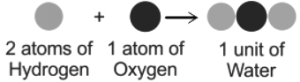
(D) The statement "$A$ given compound always contains the same proportion of elements by mass" refers to the $Law \ of \ definite \ proportions$.
This law states that a chemical compound always consists of the same elements combined together in the same fixed proportion by mass,regardless of its source or method of preparation.
For example,water $(H_2O)$ always contains hydrogen and oxygen in a mass ratio of $1:8$.
This law states that a chemical compound always consists of the same elements combined together in the same fixed proportion by mass,regardless of its source or method of preparation.
For example,water $(H_2O)$ always contains hydrogen and oxygen in a mass ratio of $1:8$.
0 likesView Solution
235
ChemistryEasyMCQMHT CET · 2024
Which law is illustrated by compounds $H_2O$ and $H_2O_2$ formed from two different elements,$H$ and $O$?
A
Law of Constant proportion.
B
Law of Conservation of mass.
C
Law of Multiple proportion.
D
Avogadro's law.
Solution
(C) The correct answer is $C$ (Law of Multiple Proportions).
Explanation:
The Law of Multiple Proportions states that when two elements combine to form more than one compound,the different masses of one element that combine with a fixed mass of the other element are in simple whole number ratios.
- In $H_2O$,$2 \ g$ of hydrogen combines with $16 \ g$ of oxygen.
- In $H_2O_2$,$2 \ g$ of hydrogen combines with $32 \ g$ of oxygen.
- The masses of oxygen ($16 \ g$ and $32 \ g$) that combine with a fixed mass of hydrogen $(2 \ g)$ are in the ratio $16:32$,which simplifies to $1:2$,a simple whole number ratio.
- Therefore,these compounds illustrate the Law of Multiple Proportions.
Explanation:
The Law of Multiple Proportions states that when two elements combine to form more than one compound,the different masses of one element that combine with a fixed mass of the other element are in simple whole number ratios.
- In $H_2O$,$2 \ g$ of hydrogen combines with $16 \ g$ of oxygen.
- In $H_2O_2$,$2 \ g$ of hydrogen combines with $32 \ g$ of oxygen.
- The masses of oxygen ($16 \ g$ and $32 \ g$) that combine with a fixed mass of hydrogen $(2 \ g)$ are in the ratio $16:32$,which simplifies to $1:2$,a simple whole number ratio.
- Therefore,these compounds illustrate the Law of Multiple Proportions.
0 likesView Solution
236
ChemistryEasyMCQMHT CET · 2024
Which of the following pairs of compounds cannot demonstrate the law of multiple proportions?
A
$NO, NO_2$
B
$CO, CO_2$
C
$H_2O, H_2O_2$
D
$Na_2S, NaF$
Solution
(D) The law of multiple proportions states that when two elements combine to form two or more compounds,the masses of one element that combine with a fixed mass of the other are in the ratio of small whole numbers.
This law is applicable only when the same two elements form different compounds.
In the pair $Na_2S$ and $NaF$,the elements involved are different ($S$ and $F$),so they cannot demonstrate the law of multiple proportions.
This law is applicable only when the same two elements form different compounds.
In the pair $Na_2S$ and $NaF$,the elements involved are different ($S$ and $F$),so they cannot demonstrate the law of multiple proportions.
0 likesView Solution
237
ChemistryEasyMCQMHT CET · 2024
What is the mass in $kg$ of $5$ mole of acetic acid $(mol. mass = 60 \ g \ mol^{-1})$ (in $kg$)?
A
$0.3$
B
$3.0$
C
$30$
D
$300$
Solution
(A) $\text{Number of moles} = 5 = \frac{\text{Given mass (g)}}{\text{Molar mass}}$
$\text{For acetic acid, } M = 60 \ g \ mol^{-1}$
$\text{Given mass (g)} = 5 \ mol \times 60 \ g \ mol^{-1} = 300 \ g$
$\text{Mass in } kg = \frac{300 \ g}{1000} = 0.3 \ kg$
$\text{For acetic acid, } M = 60 \ g \ mol^{-1}$
$\text{Given mass (g)} = 5 \ mol \times 60 \ g \ mol^{-1} = 300 \ g$
$\text{Mass in } kg = \frac{300 \ g}{1000} = 0.3 \ kg$
0 likesView Solution
238
ChemistryEasyMCQMHT CET · 2024
How many moles of carbon atoms are present in $3.6 \ kg$ of carbon?
A
$3.0 \times 10^2 \ mole$
B
$1.8 \times 10^2 \ mole$
C
$2.4 \times 10^2 \ mole$
D
$4.8 \times 10^2 \ mole$
Solution
(A) Given mass of carbon $= 3.6 \ kg = 3600 \ g$.
Molar mass of carbon $= 12 \ g/mol$.
The number of moles is calculated as:
$n = \frac{\text{mass}}{\text{molar mass}} = \frac{3600 \ g}{12 \ g/mol} = 300 \ mol$.
This can be expressed as $3.0 \times 10^2 \ mol$.
Molar mass of carbon $= 12 \ g/mol$.
The number of moles is calculated as:
$n = \frac{\text{mass}}{\text{molar mass}} = \frac{3600 \ g}{12 \ g/mol} = 300 \ mol$.
This can be expressed as $3.0 \times 10^2 \ mol$.
0 likesView Solution
239
ChemistryMediumMCQMHT CET · 2024
What is the number of moles of nitrogen atoms present in one mole of cytosine?
A
$5$
B
$4$
C
$3$
D
$2$
Solution
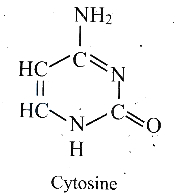
(C) The chemical formula of cytosine is $C_4H_5N_3O$.
From the chemical formula,it is evident that one molecule of cytosine contains $3$ nitrogen atoms.
Therefore,one mole of cytosine contains $3$ moles of nitrogen atoms.
From the chemical formula,it is evident that one molecule of cytosine contains $3$ nitrogen atoms.
Therefore,one mole of cytosine contains $3$ moles of nitrogen atoms.
0 likesView Solution
240
ChemistryEasyMCQMHT CET · 2024
Calculate the number of moles present in $9.10 \times 10^{-2} \ kg$ of water.
A
$0.9$
B
$1.8$
C
$3.0$
D
$5.0$
Solution
(D) The molar mass of water $(H_2O)$ is $18 \times 10^{-3} \ kg \ mol^{-1}$.
Number of moles $(n) = \frac{\text{Given mass}}{\text{Molar mass}}$.
$n = \frac{9.10 \times 10^{-2} \ kg}{18 \times 10^{-3} \ kg \ mol^{-1}}$.
$n = \frac{91 \times 10^{-3}}{18 \times 10^{-3}} = 5.055 \approx 5.0 \ mol$.
Number of moles $(n) = \frac{\text{Given mass}}{\text{Molar mass}}$.
$n = \frac{9.10 \times 10^{-2} \ kg}{18 \times 10^{-3} \ kg \ mol^{-1}}$.
$n = \frac{91 \times 10^{-3}}{18 \times 10^{-3}} = 5.055 \approx 5.0 \ mol$.
0 likesView Solution
241
ChemistryMediumMCQMHT CET · 2024
What is the volume occupied by $1$ molecule of water, if its density is $1 \,g \,cm^{-3}$?
A
$9.0 \times 10^{-23} \,cm^3$
B
$2.98 \times 10^{-23} \,cm^3$
C
$6.023 \times 10^{-23} \,cm^3$
D
$5.50 \times 10^{-23} \,cm^3$
Solution
(B) The molar mass of water $(H_2O)$ is $18 \,g/mol$.
$1 \,mol$ of water contains $6.022 \times 10^{23}$ molecules.
Mass of $6.022 \times 10^{23}$ molecules of water $= 18 \,g$.
Therefore, the mass of $1$ molecule of water $= \frac{18 \,g}{6.022 \times 10^{23}} = 2.988 \times 10^{-23} \,g$.
Given that $\text{density} = \frac{\text{mass}}{\text{volume}}$, the volume occupied by $1$ molecule is $\text{Volume} = \frac{\text{mass}}{\text{density}}$.
$\text{Volume} = \frac{2.988 \times 10^{-23} \,g}{1 \,g \,cm^{-3}} = 2.988 \times 10^{-23} \,cm^3 \approx 2.98 \times 10^{-23} \,cm^3$.
$1 \,mol$ of water contains $6.022 \times 10^{23}$ molecules.
Mass of $6.022 \times 10^{23}$ molecules of water $= 18 \,g$.
Therefore, the mass of $1$ molecule of water $= \frac{18 \,g}{6.022 \times 10^{23}} = 2.988 \times 10^{-23} \,g$.
Given that $\text{density} = \frac{\text{mass}}{\text{volume}}$, the volume occupied by $1$ molecule is $\text{Volume} = \frac{\text{mass}}{\text{density}}$.
$\text{Volume} = \frac{2.988 \times 10^{-23} \,g}{1 \,g \,cm^{-3}} = 2.988 \times 10^{-23} \,cm^3 \approx 2.98 \times 10^{-23} \,cm^3$.
0 likesView Solution
242
ChemistryMediumMCQMHT CET · 2024
Chlorine has two isotopes $^{35}Cl$ and $^{37}Cl$ with an average atomic mass of $35.5$. What is the ratio of their relative abundance respectively?
A
$1:1$
B
$2:1$
C
$1:3$
D
$3:1$
Solution
(D) Let the relative abundance of $^{35}Cl$ be $x\%$ and $^{37}Cl$ be $(100-x)\%$.
Average atomic mass = $\frac{(35 \times x) + (37 \times (100-x))}{100} = 35.5$
$35x + 3700 - 37x = 3550$
$-2x = -150$
$x = 75$
Abundance of $^{35}Cl = 75\%$ and $^{37}Cl = 25\%$.
Ratio = $75:25 = 3:1$.
Average atomic mass = $\frac{(35 \times x) + (37 \times (100-x))}{100} = 35.5$
$35x + 3700 - 37x = 3550$
$-2x = -150$
$x = 75$
Abundance of $^{35}Cl = 75\%$ and $^{37}Cl = 25\%$.
Ratio = $75:25 = 3:1$.
0 likesView Solution
243
ChemistryMediumMCQMHT CET · 2024
Chlorine exists in two isotopic forms $^{35}Cl$ and $^{37}Cl$. If the average atomic mass of chlorine is $35.5$,what is the percentage abundance of these isotopes respectively?
A
$25 \%, 75 \%$
B
$75 \%, 25 \%$
C
$50 \%, 50 \%$
D
$35 \%, 65 \%$
Solution
(B) Let the percentage abundance of $^{35}Cl$ be $x$ and that of $^{37}Cl$ be $(100 - x)$.
Average atomic mass is given by the formula:
$\text{Average atomic mass} = \frac{(\text{mass of } ^{35}Cl \times x) + (\text{mass of } ^{37}Cl \times (100 - x))}{100}$
Substituting the values:
$35.5 = \frac{35x + 37(100 - x)}{100}$
$3550 = 35x + 3700 - 37x$
$3550 = 3700 - 2x$
$2x = 3700 - 3550$
$2x = 150$
$x = 75$
Therefore,the abundance of $^{35}Cl$ is $75 \%$ and the abundance of $^{37}Cl$ is $100 - 75 = 25 \%$.
Average atomic mass is given by the formula:
$\text{Average atomic mass} = \frac{(\text{mass of } ^{35}Cl \times x) + (\text{mass of } ^{37}Cl \times (100 - x))}{100}$
Substituting the values:
$35.5 = \frac{35x + 37(100 - x)}{100}$
$3550 = 35x + 3700 - 37x$
$3550 = 3700 - 2x$
$2x = 3700 - 3550$
$2x = 150$
$x = 75$
Therefore,the abundance of $^{35}Cl$ is $75 \%$ and the abundance of $^{37}Cl$ is $100 - 75 = 25 \%$.
0 likesView Solution
244
ChemistryMediumMCQMHT CET · 2024
How many molecules of carbon dioxide are formed when $0.6 \ g$ carbon is burnt in air?
A
$3.01 \times 10^{22}$
B
$2.01 \times 10^{23}$
C
$6.02 \times 10^{22}$
D
$5.02 \times 10^{23}$
Solution
(A) The chemical equation for the combustion of carbon is: $C + O_2 \rightarrow CO_2$
From the stoichiometry of the reaction,$12 \ g$ of $C$ produces $44 \ g$ of $CO_2$.
Therefore,$0.6 \ g$ of $C$ will produce: $\frac{44 \times 0.6}{12} = 2.2 \ g$ of $CO_2$.
The molar mass of $CO_2$ is $44 \ g/mol$.
Number of moles of $CO_2 = \frac{2.2 \ g}{44 \ g/mol} = 0.05 \ mol$.
Number of molecules of $CO_2 = \text{moles} \times N_A = 0.05 \times 6.022 \times 10^{23} = 3.011 \times 10^{22}$ molecules.
From the stoichiometry of the reaction,$12 \ g$ of $C$ produces $44 \ g$ of $CO_2$.
Therefore,$0.6 \ g$ of $C$ will produce: $\frac{44 \times 0.6}{12} = 2.2 \ g$ of $CO_2$.
The molar mass of $CO_2$ is $44 \ g/mol$.
Number of moles of $CO_2 = \frac{2.2 \ g}{44 \ g/mol} = 0.05 \ mol$.
Number of molecules of $CO_2 = \text{moles} \times N_A = 0.05 \times 6.022 \times 10^{23} = 3.011 \times 10^{22}$ molecules.
0 likesView Solution
245
ChemistryMediumMCQMHT CET · 2024
What is the number of moles of water molecules present in a mole of carnallite?
A
$6$
B
$4$
C
$5$
D
$1$
Solution
(A) The chemical formula of carnallite is $KCl \cdot MgCl_2 \cdot 6 H_2O$.
From the formula,it is evident that $1$ mole of carnallite contains $6$ moles of water molecules.
From the formula,it is evident that $1$ mole of carnallite contains $6$ moles of water molecules.
0 likesView Solution
246
ChemistryEasyMCQMHT CET · 2024
Find the number of moles of sodium atoms in $6.9 \times 10^{-2} \ kg$ (Atomic mass $= 23 \ g \ mol^{-1}$)
A
$1.5$
B
$0.3$
C
$3$
D
$2.3$
Solution
(C) The number of moles is calculated using the formula: $\text{Moles} = \frac{\text{Mass in grams}}{\text{Molar mass}}$
Given mass $= 6.9 \times 10^{-2} \ kg = 6.9 \times 10^{-2} \times 10^3 \ g = 69 \ g$
Molar mass of sodium $= 23 \ g \ mol^{-1}$
Number of moles $= \frac{69 \ g}{23 \ g \ mol^{-1}} = 3 \ mol$
Given mass $= 6.9 \times 10^{-2} \ kg = 6.9 \times 10^{-2} \times 10^3 \ g = 69 \ g$
Molar mass of sodium $= 23 \ g \ mol^{-1}$
Number of moles $= \frac{69 \ g}{23 \ g \ mol^{-1}} = 3 \ mol$
0 likesView Solution
247
ChemistryEasyMCQMHT CET · 2024
Calculate the mass in $kg$ of $2.5 \ mol$ of ammonia.
A
$5.10 \times 10^{-2} \ kg$
B
$4.25 \times 10^{-2} \ kg$
C
$1.72 \times 10^{-2} \ kg$
D
$3.44 \times 10^{-2} \ kg$
Solution
(B) The chemical formula of ammonia is $NH_3$.
The molar mass of $NH_3 = 14 + (3 \times 1) = 17 \ g \ mol^{-1}$.
Mass in grams $= \text{moles} \times \text{molar mass} = 2.5 \ mol \times 17 \ g \ mol^{-1} = 42.5 \ g$.
To convert the mass into $kg$,divide by $1000$:
Mass in $kg = \frac{42.5 \ g}{1000} = 0.0425 \ kg = 4.25 \times 10^{-2} \ kg$.
The molar mass of $NH_3 = 14 + (3 \times 1) = 17 \ g \ mol^{-1}$.
Mass in grams $= \text{moles} \times \text{molar mass} = 2.5 \ mol \times 17 \ g \ mol^{-1} = 42.5 \ g$.
To convert the mass into $kg$,divide by $1000$:
Mass in $kg = \frac{42.5 \ g}{1000} = 0.0425 \ kg = 4.25 \times 10^{-2} \ kg$.
0 likesView Solution
248
ChemistryMediumMCQMHT CET · 2024
Calculate the mass in $kg$ of $4.48 \ dm^3$ of carbon dioxide $(CO_2)$ at $STP$.
A
$2.2 \times 10^{-3}$
B
$4.4 \times 10^{-3}$
C
$6.6 \times 10^{-3}$
D
$8.8 \times 10^{-3}$
Solution
(D) At $STP$,$1 \ mol$ of any gas occupies $22.4 \ dm^3$ volume.
The molar mass of $CO_2$ is $12 + (2 \times 16) = 44 \ g/mol$.
Thus,$22.4 \ dm^3$ of $CO_2$ at $STP$ has a mass of $44 \ g$.
Therefore,the mass of $4.48 \ dm^3$ of $CO_2$ at $STP$ is calculated as:
$\text{Mass} = \frac{44 \ g}{22.4 \ dm^3} \times 4.48 \ dm^3 = 8.8 \ g$.
To convert the mass into $kg$,we divide by $1000$:
$8.8 \ g = 8.8 \times 10^{-3} \ kg$.
The molar mass of $CO_2$ is $12 + (2 \times 16) = 44 \ g/mol$.
Thus,$22.4 \ dm^3$ of $CO_2$ at $STP$ has a mass of $44 \ g$.
Therefore,the mass of $4.48 \ dm^3$ of $CO_2$ at $STP$ is calculated as:
$\text{Mass} = \frac{44 \ g}{22.4 \ dm^3} \times 4.48 \ dm^3 = 8.8 \ g$.
To convert the mass into $kg$,we divide by $1000$:
$8.8 \ g = 8.8 \times 10^{-3} \ kg$.
0 likesView Solution
249
ChemistryEasyMCQMHT CET · 2024
What is the volume of oxygen required for complete combustion of $0.25 \ mole$ of methane at $\text{S.T.P.}$ (in $dm^3$)?
A
$22.4$
B
$5.6$
C
$11.2$
D
$7.46$
Solution
(C) The balanced chemical equation for the combustion of methane is:
$CH_4(g) + 2O_2(g) \longrightarrow CO_2(g) + 2H_2O(l)$
According to the stoichiometry of the reaction,$1 \ mole$ of $CH_4$ requires $2 \ moles$ of $O_2$.
At $\text{S.T.P.}$,$1 \ mole$ of any gas occupies $22.4 \ dm^3$.
Therefore,$2 \ moles$ of $O_2$ occupy $2 \times 22.4 \ dm^3 = 44.8 \ dm^3$.
For $0.25 \ mole$ of $CH_4$,the volume of $O_2$ required is:
$V = 0.25 \times 44.8 \ dm^3 = 11.2 \ dm^3$.
$CH_4(g) + 2O_2(g) \longrightarrow CO_2(g) + 2H_2O(l)$
According to the stoichiometry of the reaction,$1 \ mole$ of $CH_4$ requires $2 \ moles$ of $O_2$.
At $\text{S.T.P.}$,$1 \ mole$ of any gas occupies $22.4 \ dm^3$.
Therefore,$2 \ moles$ of $O_2$ occupy $2 \times 22.4 \ dm^3 = 44.8 \ dm^3$.
For $0.25 \ mole$ of $CH_4$,the volume of $O_2$ required is:
$V = 0.25 \times 44.8 \ dm^3 = 11.2 \ dm^3$.
0 likesView Solution
250
ChemistryEasyMCQMHT CET · 2024
What is the volume occupied by $2.5 \ mol$ of ammonia gas at $\text{STP}$ (in $dm^3$)?
A
$22.4$
B
$25.0$
C
$33.6$
D
$56.0$
Solution
(D) At $\text{STP}$, $1 \ mol$ of any ideal gas occupies a volume of $22.4 \ dm^3$.
Therefore, the volume occupied by $2.5 \ mol$ of ammonia gas is calculated as:
$V = n \times 22.4 \ dm^3 \ mol^{-1}$
$V = 2.5 \ mol \times 22.4 \ dm^3 \ mol^{-1} = 56.0 \ dm^3$.
Therefore, the volume occupied by $2.5 \ mol$ of ammonia gas is calculated as:
$V = n \times 22.4 \ dm^3 \ mol^{-1}$
$V = 2.5 \ mol \times 22.4 \ dm^3 \ mol^{-1} = 56.0 \ dm^3$.
0 likesView Solution
251
ChemistryEasyMCQMHT CET · 2024
Which element from the following exhibits the lowest number of different oxidation states?
A
$Sc$
B
$Cu$
C
$Ti$
D
$Zn$
Solution
(D) The number of oxidation states exhibited by transition elements depends on the number of unpaired electrons in their $d$-orbitals.
$Sc$ $([Ar] 3d^1 4s^2)$ shows $+2, +3$ oxidation states.
$Ti$ $([Ar] 3d^2 4s^2)$ shows $+2, +3, +4$ oxidation states.
$Cu$ $([Ar] 3d^{10} 4s^1)$ shows $+1, +2$ oxidation states.
$Zn$ $([Ar] 3d^{10} 4s^2)$ has a completely filled $d$-subshell and shows only $+2$ oxidation state.
Therefore,$Zn$ exhibits the lowest number of different oxidation states.
$Sc$ $([Ar] 3d^1 4s^2)$ shows $+2, +3$ oxidation states.
$Ti$ $([Ar] 3d^2 4s^2)$ shows $+2, +3, +4$ oxidation states.
$Cu$ $([Ar] 3d^{10} 4s^1)$ shows $+1, +2$ oxidation states.
$Zn$ $([Ar] 3d^{10} 4s^2)$ has a completely filled $d$-subshell and shows only $+2$ oxidation state.
Therefore,$Zn$ exhibits the lowest number of different oxidation states.
0 likesView Solution
252
ChemistryEasyMCQMHT CET · 2024
Which of the following metal ions in their respective oxidation states forms a coloured compound?
A
$Zn^{2+}$
B
$Fe^{2+}$
C
$Cu^{+}$
D
$Sc^{3+}$
Solution
(B) The colour of a transition metal ion depends on the presence of unpaired electrons in its $d$-orbitals,which allows for $d-d$ transitions.
| Metal Ion | Electronic Configuration | Unpaired Electrons |
| :--- | :--- | :--- |
| $Zn^{2+}$ | $4s^0 3d^{10}$ | $0$ |
| $Cu^{+}$ | $4s^0 3d^{10}$ | $0$ |
| $Fe^{2+}$ | $4s^0 3d^6$ | $4$ |
| $Sc^{3+}$ | $4s^0 3d^0$ | $0$ |
Since $Fe^{2+}$ has $4$ unpaired electrons,it can undergo $d-d$ transitions and thus forms coloured compounds.
| Metal Ion | Electronic Configuration | Unpaired Electrons |
| :--- | :--- | :--- |
| $Zn^{2+}$ | $4s^0 3d^{10}$ | $0$ |
| $Cu^{+}$ | $4s^0 3d^{10}$ | $0$ |
| $Fe^{2+}$ | $4s^0 3d^6$ | $4$ |
| $Sc^{3+}$ | $4s^0 3d^0$ | $0$ |
Since $Fe^{2+}$ has $4$ unpaired electrons,it can undergo $d-d$ transitions and thus forms coloured compounds.
0 likesView Solution
253
ChemistryEasyMCQMHT CET · 2024
Which pair of elements from the following has half-filled $d$-orbitals in their observed electronic configuration?
A
$Cu$ and $Mn$
B
$Mn$ and $Cr$
C
$Zn$ and $Co$
D
$Cu$ and $Zn$
Solution
(B) The electronic configuration of $Mn$ $(Z=25)$ is $[Ar] 3d^5 4s^2$,which contains a half-filled $d$-subshell $(d^5)$.
The electronic configuration of $Cr$ $(Z=24)$ is $[Ar] 3d^5 4s^1$,which also contains a half-filled $d$-subshell $(d^5)$.
Therefore,the pair of elements with half-filled $d$-orbitals is $Mn$ and $Cr$.
The electronic configuration of $Cr$ $(Z=24)$ is $[Ar] 3d^5 4s^1$,which also contains a half-filled $d$-subshell $(d^5)$.
Therefore,the pair of elements with half-filled $d$-orbitals is $Mn$ and $Cr$.
0 likesView Solution
254
ChemistryEasyMCQMHT CET · 2024
Which element from the following in $+2$ oxidation state exhibits the highest magnetic moment?
A
$Fe$
B
$Cr$
C
$Mn$
D
$Ni$
Solution
(C) The magnetic moment $\mu$ is calculated using the formula $\mu = \sqrt{n(n+2)} \ BM$,where $n$ is the number of unpaired electrons.
$1$. For $Fe^{2+}$ $(3d^6)$: $n = 4$,$\mu = \sqrt{4(4+2)} = \sqrt{24} \approx 4.89 \ BM$.
$2$. For $Cr^{2+}$ $(3d^4)$: $n = 4$,$\mu = \sqrt{4(4+2)} = \sqrt{24} \approx 4.89 \ BM$.
$3$. For $Mn^{2+}$ $(3d^5)$: $n = 5$,$\mu = \sqrt{5(5+2)} = \sqrt{35} \approx 5.91 \ BM$.
$4$. For $Ni^{2+}$ $(3d^8)$: $n = 2$,$\mu = \sqrt{2(2+2)} = \sqrt{8} \approx 2.83 \ BM$.
Comparing the values,$Mn^{2+}$ has the highest number of unpaired electrons $(n=5)$,and therefore exhibits the highest magnetic moment.
$1$. For $Fe^{2+}$ $(3d^6)$: $n = 4$,$\mu = \sqrt{4(4+2)} = \sqrt{24} \approx 4.89 \ BM$.
$2$. For $Cr^{2+}$ $(3d^4)$: $n = 4$,$\mu = \sqrt{4(4+2)} = \sqrt{24} \approx 4.89 \ BM$.
$3$. For $Mn^{2+}$ $(3d^5)$: $n = 5$,$\mu = \sqrt{5(5+2)} = \sqrt{35} \approx 5.91 \ BM$.
$4$. For $Ni^{2+}$ $(3d^8)$: $n = 2$,$\mu = \sqrt{2(2+2)} = \sqrt{8} \approx 2.83 \ BM$.
Comparing the values,$Mn^{2+}$ has the highest number of unpaired electrons $(n=5)$,and therefore exhibits the highest magnetic moment.
0 likesView Solution
255
ChemistryEasyMCQMHT CET · 2024
Identify the false statement about transition elements.
A
These exhibit properties between those of $s$ and $p$ block elements.
B
All these elements are grouped as $3d$ to $6d$ series.
C
$5d$ series is comprised of all elements from $La(Z=57)$ to $Hg(Z=80)$.
D
Elements of $6d$ series belong to the $7^{\text{th}}$ period of the periodic table.
Solution
(C) The $5d$ series of transition elements includes elements from $Z=72$ $(Hf)$ to $Z=80$ $(Hg)$.
Lanthanum ($La$,$Z=57$) is a $d$-block element but is often considered the start of the lanthanide series.
The statement in option $C$ is false because the $5d$ series does not include all elements from $La$ to $Hg$ as a continuous transition series,and the range provided is inaccurate regarding the definition of the $5d$ transition series.
Lanthanum ($La$,$Z=57$) is a $d$-block element but is often considered the start of the lanthanide series.
The statement in option $C$ is false because the $5d$ series does not include all elements from $La$ to $Hg$ as a continuous transition series,and the range provided is inaccurate regarding the definition of the $5d$ transition series.
0 likesView Solution
256
ChemistryMediumMCQMHT CET · 2024
Which element from the following does $NOT$ exhibit a magnetic moment in the $+2$ oxidation state?
A
$Mn$
B
$Co$
C
$Fe$
D
$Zn$
Solution
(D) The magnetic moment of an ion is given by the formula $\mu = \sqrt{n(n+2)} \text{ BM}$,where $n$ is the number of unpaired electrons.
For an ion to exhibit a magnetic moment,it must have at least one unpaired electron $(n > 0)$.
Let us analyze the electronic configuration of the given elements in their $+2$ oxidation state:
$1$. $Mn^{2+}$: $[Ar]3d^5$ $(n = 5)$
$2$. $Co^{2+}$: $[Ar]3d^7$ $(n = 3)$
$3$. $Fe^{2+}$: $[Ar]3d^6$ $(n = 4)$
$4$. $Zn^{2+}$: $[Ar]3d^{10}$ $(n = 0)$
Since $Zn^{2+}$ has a completely filled $3d$ subshell,it has $0$ unpaired electrons. Therefore,it does not exhibit a magnetic moment.
For an ion to exhibit a magnetic moment,it must have at least one unpaired electron $(n > 0)$.
Let us analyze the electronic configuration of the given elements in their $+2$ oxidation state:
$1$. $Mn^{2+}$: $[Ar]3d^5$ $(n = 5)$
$2$. $Co^{2+}$: $[Ar]3d^7$ $(n = 3)$
$3$. $Fe^{2+}$: $[Ar]3d^6$ $(n = 4)$
$4$. $Zn^{2+}$: $[Ar]3d^{10}$ $(n = 0)$
Since $Zn^{2+}$ has a completely filled $3d$ subshell,it has $0$ unpaired electrons. Therefore,it does not exhibit a magnetic moment.
0 likesView Solution
257
ChemistryMediumMCQMHT CET · 2024
Which element from the following exhibits the highest number of various different possible oxidation states?
A
$Fe$
B
$Cr$
C
$Mn$
D
$Ni$
Solution
(C) The oxidation states of the given transition elements are as follows:
$Fe$ $(3d^6 4s^2)$: $+2, +3, +4, +5, +6$
$Cr$ $(3d^5 4s^1)$: $+2, +3, +4, +5, +6$
$Mn$ $(3d^5 4s^2)$: $+2, +3, +4, +5, +6, +7$
$Ni$ $(3d^8 4s^2)$: $+2, +3, +4$
Comparing these,$Mn$ exhibits the highest number of oxidation states (from $+2$ to $+7$).
$Fe$ $(3d^6 4s^2)$: $+2, +3, +4, +5, +6$
$Cr$ $(3d^5 4s^1)$: $+2, +3, +4, +5, +6$
$Mn$ $(3d^5 4s^2)$: $+2, +3, +4, +5, +6, +7$
$Ni$ $(3d^8 4s^2)$: $+2, +3, +4$
Comparing these,$Mn$ exhibits the highest number of oxidation states (from $+2$ to $+7$).
0 likesView Solution
258
ChemistryMediumMCQMHT CET · 2024
Which element from the following has the lowest first ionization enthalpy $(IE_1)$?
A
$Cu$
B
$Sc$
C
$Mn$
D
$Zn$
Solution
(B) The first ionization enthalpy $(IE_1)$ of the $3d$ transition series elements generally increases from left to right across the period due to the increase in effective nuclear charge.
Among the given elements ($Sc$,$Mn$,$Cu$,$Zn$),$Sc$ $(Z=21)$ is the first element of the $3d$ series.
Since $IE_1$ increases as we move from left to right,the element at the beginning of the series will have the lowest ionization enthalpy.
Therefore,$Sc$ has the lowest $IE_1$ value.
Among the given elements ($Sc$,$Mn$,$Cu$,$Zn$),$Sc$ $(Z=21)$ is the first element of the $3d$ series.
Since $IE_1$ increases as we move from left to right,the element at the beginning of the series will have the lowest ionization enthalpy.
Therefore,$Sc$ has the lowest $IE_1$ value.
0 likesView Solution
259
ChemistryEasyMCQMHT CET · 2024
Which element from the following is $NOT$ considered a transition element on the basis of electronic configuration?
A
$Ti$
B
$V$
C
$Hg$
D
$Ag$
Solution
(C) Transition elements are defined as elements that have partially filled $d-$orbitals in their ground state or in any of their common oxidation states.
$Hg$ has an electronic configuration of $[Xe] 4f^{14} 5d^{10} 6s^2$.
Since $Hg$ has a completely filled $d-$orbital $(d^{10})$ in its ground state and does not form ions with partially filled $d-$orbitals,it is not considered a transition element.
Similarly,$Zn$ and $Cd$ are also not considered transition elements for the same reason.
$Hg$ has an electronic configuration of $[Xe] 4f^{14} 5d^{10} 6s^2$.
Since $Hg$ has a completely filled $d-$orbital $(d^{10})$ in its ground state and does not form ions with partially filled $d-$orbitals,it is not considered a transition element.
Similarly,$Zn$ and $Cd$ are also not considered transition elements for the same reason.
0 likesView Solution
260
ChemistryEasyMCQMHT CET · 2024
Which element from the following is the last element of the $5d$-transition series?
A
$Hg$
B
$Cd$
C
$In$
D
$Ag$
Solution
(A) The $5d$ transition series consists of elements from Lanthanum ($La$,atomic number $57$) to Mercury ($Hg$,atomic number $80$).
This series comprises a portion of the $d$-block elements,specifically those where the $5d$ electron shell is being filled progressively.
$Hg$ (Mercury) is the last element of this series,with an atomic number of $80$.
Its electron configuration is $[Xe] 4f^{14} 5d^{10} 6s^2$.
Mercury is well-known for being the only metal that is liquid at room temperature.
This series comprises a portion of the $d$-block elements,specifically those where the $5d$ electron shell is being filled progressively.
$Hg$ (Mercury) is the last element of this series,with an atomic number of $80$.
Its electron configuration is $[Xe] 4f^{14} 5d^{10} 6s^2$.
Mercury is well-known for being the only metal that is liquid at room temperature.
0 likesView Solution
261
ChemistryEasyMCQMHT CET · 2024
Identify the alloy used for construction of gas turbine engines.
A
Nichrome
B
Bronze
C
Stainless steel
D
Cupra-nickel
Solution
(A) Nichrome,an alloy of nickel and chromium in the ratio $80:20$,is specifically used for the construction of gas turbine engines due to its high heat resistance and oxidation resistance.
Titanium alloys are also used in aerospace applications for their ability to withstand stress at high temperatures.
Titanium alloys are also used in aerospace applications for their ability to withstand stress at high temperatures.
0 likesView Solution
262
ChemistryEasyMCQMHT CET · 2024
Which among the following properties is $\underline{NOT}$ exhibited by transition elements?
A
These are generally hard.
B
These form alloys with other metals.
C
These do not conduct heat.
D
These are malleable and ductile.
Solution
(C) Transition elements are metals and possess metallic properties.
They are generally hard,malleable,and ductile.
They can form alloys with other metals.
Transition elements are good conductors of both heat and electricity.
Therefore,the statement that they do not conduct heat is incorrect.
They are generally hard,malleable,and ductile.
They can form alloys with other metals.
Transition elements are good conductors of both heat and electricity.
Therefore,the statement that they do not conduct heat is incorrect.
0 likesView Solution
263
ChemistryMediumMCQMHT CET · 2024
Which of the following alloys is used in the construction of the outer fuselage of ultra-high-speed aircraft?
A
Nichrome
B
Cupra-nickel
C
Stainless steel
D
Bronze
Solution
(C) Stainless steels are used in the construction of the outer fuselage of ultra-high-speed aircraft due to their high strength and resistance to corrosion at elevated temperatures.
0 likesView Solution
264
ChemistryMediumMCQMHT CET · 2024
Which pair of metal ions from the following has the same number of unpaired electrons?
A
$Co^{2+}$ and $Mn^{3+}$
B
$Mn^{2+}$ and $Zn^{2+}$
C
$Fe^{3+}$ and $Mn^{2+}$
D
$Sc^{3+}$ and $Co^{2+}$
Solution
(C) To determine the number of unpaired electrons,we look at the electronic configuration of each ion:
$Fe^{3+} = [Ar] 3d^5$ ($5$ unpaired electrons)
$Mn^{2+} = [Ar] 3d^5$ ($5$ unpaired electrons)
$Co^{2+} = [Ar] 3d^7$ ($3$ unpaired electrons)
$Sc^{3+} = [Ar] 3d^0$ ($0$ unpaired electrons)
$Zn^{2+} = [Ar] 3d^{10}$ ($0$ unpaired electrons)
$Mn^{3+} = [Ar] 3d^4$ ($4$ unpaired electrons)
Comparing the pairs:
Option $A$: $Co^{2+}$ $(3)$ and $Mn^{3+}$ $(4)$ - Different
Option $B$: $Mn^{2+}$ $(5)$ and $Zn^{2+}$ $(0)$ - Different
Option $C$: $Fe^{3+}$ $(5)$ and $Mn^{2+}$ $(5)$ - Same
Option $D$: $Sc^{3+}$ $(0)$ and $Co^{2+}$ $(3)$ - Different
Therefore,the pair with the same number of unpaired electrons is $Fe^{3+}$ and $Mn^{2+}$.
$Fe^{3+} = [Ar] 3d^5$ ($5$ unpaired electrons)
$Mn^{2+} = [Ar] 3d^5$ ($5$ unpaired electrons)
$Co^{2+} = [Ar] 3d^7$ ($3$ unpaired electrons)
$Sc^{3+} = [Ar] 3d^0$ ($0$ unpaired electrons)
$Zn^{2+} = [Ar] 3d^{10}$ ($0$ unpaired electrons)
$Mn^{3+} = [Ar] 3d^4$ ($4$ unpaired electrons)
Comparing the pairs:
Option $A$: $Co^{2+}$ $(3)$ and $Mn^{3+}$ $(4)$ - Different
Option $B$: $Mn^{2+}$ $(5)$ and $Zn^{2+}$ $(0)$ - Different
Option $C$: $Fe^{3+}$ $(5)$ and $Mn^{2+}$ $(5)$ - Same
Option $D$: $Sc^{3+}$ $(0)$ and $Co^{2+}$ $(3)$ - Different
Therefore,the pair with the same number of unpaired electrons is $Fe^{3+}$ and $Mn^{2+}$.
0 likesView Solution
265
ChemistryEasyMCQMHT CET · 2024
Which of the following is $NOT$ a lanthanoid element?
A
$Pm$
B
$Er$
C
$Yb$
D
$Hf$
Solution
(D) The lanthanoids are the elements with atomic numbers $57$ to $71$.
$Pm$ (Promethium,$Z=61$),$Er$ (Erbium,$Z=68$),and $Yb$ (Ytterbium,$Z=70$) are lanthanoids.
$Hf$ (Hafnium,$Z=72$) is a $d$-block transition element belonging to the $6th$ period and $4th$ group.
$Pm$ (Promethium,$Z=61$),$Er$ (Erbium,$Z=68$),and $Yb$ (Ytterbium,$Z=70$) are lanthanoids.
$Hf$ (Hafnium,$Z=72$) is a $d$-block transition element belonging to the $6th$ period and $4th$ group.
0 likesView Solution
266
ChemistryDifficultMCQMHT CET · 2024
Which of the following lanthanoids exhibits no effective magnetic moment in the $+3$ oxidation state?
A
$Ce$
B
$La$
C
$Gd$
D
$Eu$
Solution
(B) $La$ (Lanthanum) has an atomic number of $57$.
In the $ 3$ oxidation state,its electronic configuration is $[Xe] 4f^0$.
Since there are no unpaired electrons $(n = 0)$,the effective magnetic moment $(\mu_{eff} = \sqrt{n(n 2)} \ BM)$ is $0 \ BM$.
In the $ 3$ oxidation state,its electronic configuration is $[Xe] 4f^0$.
Since there are no unpaired electrons $(n = 0)$,the effective magnetic moment $(\mu_{eff} = \sqrt{n(n 2)} \ BM)$ is $0 \ BM$.
0 likesView Solution
267
ChemistryMediumMCQMHT CET · 2024
Identify the element having the smallest ionic size in the $+3$ state from the following.
A
Nd
B
Ho
C
Sm
D
Lu
Solution
(D) The phenomenon of lanthanide contraction is observed in $4f$ elements due to the increase in effective nuclear charge as we move across the series.
As a result,the atomic and ionic radii decrease continuously from lanthanum $(Z=57)$ to lutetium $(Z=71)$.
Since lutetium $(Lu)$ is the last element in the lanthanide series,it has the highest effective nuclear charge and therefore the smallest ionic radius in the $+3$ state.
As a result,the atomic and ionic radii decrease continuously from lanthanum $(Z=57)$ to lutetium $(Z=71)$.
Since lutetium $(Lu)$ is the last element in the lanthanide series,it has the highest effective nuclear charge and therefore the smallest ionic radius in the $+3$ state.
0 likesView Solution
268
ChemistryEasyMCQMHT CET · 2024
Which element from the following has a half-filled $4f$ orbital in its observed ground state?
A
$Gd$
B
$Sm$
C
$Nd$
D
$Ho$
Solution
(A) The electronic configuration of Gadolinium ($Gd$,$Z=64$) is $[Xe] 4f^7 5d^1 6s^2$.
In this configuration,the $4f$ subshell contains $7$ electrons,which corresponds to a half-filled $4f$ orbital ($f^{14}$ is fully filled,so $f^7$ is half-filled).
In this configuration,the $4f$ subshell contains $7$ electrons,which corresponds to a half-filled $4f$ orbital ($f^{14}$ is fully filled,so $f^7$ is half-filled).
0 likesView Solution
269
ChemistryMediumMCQMHT CET · 2024
Which of the following properties of lanthanoids is $NOT$ true?
A
These are bad conductors of heat and electricity.
B
These are soft metals.
C
Coordination number is usually greater than six.
D
These are strongly paramagnetic.
Solution
(A) $1$. These are bad conductors of heat and electricity: This statement is incorrect. Lanthanoids are metallic in nature and are generally good conductors of heat and electricity,similar to other metals.
$2$. These are soft metals: This is true. Lanthanoids are relatively soft metals,and their hardness increases with increasing atomic number.
$3$. Coordination number is usually greater than six: This is true. Due to their large ionic radii,lanthanoids often exhibit high coordination numbers,typically ranging from $8$ to $12$ in their complexes.
$4$. These are strongly paramagnetic: This is true. Lanthanoids possess unpaired $f$-electrons,which result in paramagnetic behavior. Many lanthanoid ions exhibit strong paramagnetism.
$2$. These are soft metals: This is true. Lanthanoids are relatively soft metals,and their hardness increases with increasing atomic number.
$3$. Coordination number is usually greater than six: This is true. Due to their large ionic radii,lanthanoids often exhibit high coordination numbers,typically ranging from $8$ to $12$ in their complexes.
$4$. These are strongly paramagnetic: This is true. Lanthanoids possess unpaired $f$-electrons,which result in paramagnetic behavior. Many lanthanoid ions exhibit strong paramagnetism.
0 likesView Solution
270
ChemistryEasyMCQMHT CET · 2024
Which of the following elements belongs to the actinoids?
A
$Cm$
B
$Pm$
C
$Tm$
D
$Sm$
Solution
(A) The actinoids are the elements from atomic number $89$ to $103$.
Among the given options,$Cm$ (Curium,atomic number $96$) belongs to the actinoid series.
$Pm$ (Promethium),$Tm$ (Thulium),and $Sm$ (Samarium) are lanthanoids.
Among the given options,$Cm$ (Curium,atomic number $96$) belongs to the actinoid series.
$Pm$ (Promethium),$Tm$ (Thulium),and $Sm$ (Samarium) are lanthanoids.
0 likesView Solution
271
ChemistryMediumMCQMHT CET · 2024
Which element from the following has a completely filled $f$-orbital in both observed and expected electronic configurations?
A
$Sm$
B
$Pr$
C
$Lu$
D
$Dy$
Solution
(C) The atomic number of $Lu$ is $71$.
Its electronic configuration is $[Xe] 4f^{14} 5d^1 6s^2$.
In this configuration,the $4f$ subshell is completely filled with $14$ electrons,which matches both the expected and observed electronic configurations.
Its electronic configuration is $[Xe] 4f^{14} 5d^1 6s^2$.
In this configuration,the $4f$ subshell is completely filled with $14$ electrons,which matches both the expected and observed electronic configurations.
0 likesView Solution
272
ChemistryMediumMCQMHT CET · 2024
Identify the rare earth element from the following.
A
$Sm$
B
$Hg$
C
$Zn$
D
$W$
Solution
(A) $(1)$ $Sm$ stands for Samarium,which is a rare earth element. Rare earth elements are a group of $17$ elements that include the $15$ lanthanides plus scandium $(Sc)$ and yttrium $(Y)$. Samarium $(Sm)$ is a member of the lanthanide series and is considered a rare earth element.
$(2)$ $Hg$ stands for Mercury,which is a transition metal,not a rare earth element.
$(3)$ $Zn$ stands for Zinc,which is a transition metal,not a rare earth element.
$(4)$ $W$ stands for Tungsten,which is a transition metal,not a rare earth element.
$(2)$ $Hg$ stands for Mercury,which is a transition metal,not a rare earth element.
$(3)$ $Zn$ stands for Zinc,which is a transition metal,not a rare earth element.
$(4)$ $W$ stands for Tungsten,which is a transition metal,not a rare earth element.
0 likesView Solution
273
ChemistryEasyMCQMHT CET · 2024
What is the general formula of lanthanoid hydroxide? (Consider $Ln$ as any lanthanoid element)
A
$Ln(OH)$
B
$Ln(OH)_2$
C
$Ln(OH)_3$
D
$Ln(OH)_4$
Solution
(C) The most stable and common oxidation state of lanthanoids $(Ln)$ is $+3$.
Therefore,when $Ln^{3+}$ reacts with hydroxide ions $(OH^-)$,the resulting compound is $Ln(OH)_3$.
Therefore,when $Ln^{3+}$ reacts with hydroxide ions $(OH^-)$,the resulting compound is $Ln(OH)_3$.
0 likesView Solution
274
ChemistryDifficultMCQMHT CET · 2024
Which of the following elements has a completely filled $4f$ orbital in its ground state electronic configuration?
A
$W$
B
$Yb$
C
$Eu$
D
$Cd$
Solution
(B) The ground state electronic configurations are as follows:
$Yb (Z=70): [Xe] 4f^{14} 6s^2$
$Eu (Z=63): [Xe] 4f^7 6s^2$
$Cd (Z=48): [Kr] 4d^{10} 5s^2$
$W (Z=74): [Xe] 4f^{14} 5d^4 6s^2$
Among the given options,$Yb$ has a completely filled $4f$ orbital $(4f^{14})$.
$Yb (Z=70): [Xe] 4f^{14} 6s^2$
$Eu (Z=63): [Xe] 4f^7 6s^2$
$Cd (Z=48): [Kr] 4d^{10} 5s^2$
$W (Z=74): [Xe] 4f^{14} 5d^4 6s^2$
Among the given options,$Yb$ has a completely filled $4f$ orbital $(4f^{14})$.
0 likesView Solution
275
ChemistryEasyMCQMHT CET · 2024
Identify an actinoid element from the following.
A
$No$
B
$Mo$
C
$Co$
D
$Ce$
Solution
(A) The actinoid series consists of elements with atomic numbers from $89$ to $103$.
- $No$ (Nobelium) has an atomic number of $102$,which places it within the actinoid series.
- $Mo$ (Molybdenum) is a $d$-block element with atomic number $42$.
- $Co$ (Cobalt) is a $d$-block element with atomic number $27$.
- $Ce$ (Cerium) is a lanthanoid element with atomic number $58$.
Therefore,$No$ is the correct actinoid element.
- $No$ (Nobelium) has an atomic number of $102$,which places it within the actinoid series.
- $Mo$ (Molybdenum) is a $d$-block element with atomic number $42$.
- $Co$ (Cobalt) is a $d$-block element with atomic number $27$.
- $Ce$ (Cerium) is a lanthanoid element with atomic number $58$.
Therefore,$No$ is the correct actinoid element.
0 likesView Solution
276
ChemistryMediumMCQMHT CET · 2024
Which of the following is $NOT$ true about the electrolysis of molten $NaCl$?
A
$Cl_2$ gas is liberated at the anode.
B
$Na$ is deposited at the cathode.
C
The decomposition of $NaCl$ into $Na_{(s)}$ and $Cl_{2(g)}$ is spontaneous.
D
Electrical energy is used to carry out the reaction.
Solution
(C) The electrolysis of molten $NaCl$ is a non-spontaneous process because the standard cell potential $(E^\circ_{cell})$ is negative.
Therefore,the decomposition of $NaCl$ into $Na_{(s)}$ and $Cl_{2(g)}$ is not spontaneous.
Electrical energy is required to drive this non-spontaneous reaction.
At the anode,$Cl^-$ ions are oxidized to $Cl_2$ gas.
At the cathode,$Na^+$ ions are reduced to $Na$ metal.
Therefore,the decomposition of $NaCl$ into $Na_{(s)}$ and $Cl_{2(g)}$ is not spontaneous.
Electrical energy is required to drive this non-spontaneous reaction.
At the anode,$Cl^-$ ions are oxidized to $Cl_2$ gas.
At the cathode,$Na^+$ ions are reduced to $Na$ metal.
0 likesView Solution
277
ChemistryMediumMCQMHT CET · 2024
Which of the following expressions is used to calculate $E_{cell}$ for the following cell at $25^{\circ} C$?
$Pb_{(s)} | Pb^{2+}_{(1 \ M)} || Ag^{+}_{(10 \ M)} | Ag_{(s)}$
$Pb_{(s)} | Pb^{2+}_{(1 \ M)} || Ag^{+}_{(10 \ M)} | Ag_{(s)}$
A
$E_{cell} = (E^{\circ}_{cell} + 0.0592) \ V$
B
$E_{cell} = (E^{\circ}_{cell} - 0.0592) \ V$
C
$E_{cell} = (E^{\circ}_{cell} - 0.0296) \ V$
D
$E_{cell} = (E^{\circ}_{cell} + 0.0296) \ V$
Solution
(A) The cell reaction is: $Pb_{(s)} + 2Ag^{+}_{(10 \ M)} \rightarrow Pb^{2+}_{(1 \ M)} + 2Ag_{(s)}$
Using the Nernst equation at $25^{\circ} C$ $(298 \ K)$:
$E_{cell} = E^{\circ}_{cell} - \frac{0.0592}{n} \log_{10} Q$
Here,$n = 2$ (number of electrons transferred).
$Q = \frac{[Pb^{2+}]}{[Ag^{+}]^{2}} = \frac{1}{(10)^{2}} = 10^{-2}$
Substituting the values:
$E_{cell} = E^{\circ}_{cell} - \frac{0.0592}{2} \log_{10} (10^{-2})$
$E_{cell} = E^{\circ}_{cell} - \frac{0.0592}{2} \times (-2)$
$E_{cell} = E^{\circ}_{cell} + 0.0592 \ V$
Using the Nernst equation at $25^{\circ} C$ $(298 \ K)$:
$E_{cell} = E^{\circ}_{cell} - \frac{0.0592}{n} \log_{10} Q$
Here,$n = 2$ (number of electrons transferred).
$Q = \frac{[Pb^{2+}]}{[Ag^{+}]^{2}} = \frac{1}{(10)^{2}} = 10^{-2}$
Substituting the values:
$E_{cell} = E^{\circ}_{cell} - \frac{0.0592}{2} \log_{10} (10^{-2})$
$E_{cell} = E^{\circ}_{cell} - \frac{0.0592}{2} \times (-2)$
$E_{cell} = E^{\circ}_{cell} + 0.0592 \ V$
0 likesView Solution
278
ChemistryMediumMCQMHT CET · 2024
Calculate the quantity of electricity required to liberate $0.1 \ mole$ of chlorine gas during electrolysis of molten sodium chloride. (in $C$)
A
$9665$
B
$19300$
C
$14500$
D
$96500$
Solution
(B) During the electrolysis of molten $NaCl$,the oxidation reaction at the anode is:
$2Cl^{-} \longrightarrow Cl_2 + 2e^{-}$
From the stoichiometry of the reaction,$1 \ mole$ of $Cl_2$ gas is produced by the transfer of $2 \ moles$ of electrons.
Therefore,to liberate $0.1 \ mole$ of $Cl_2$,the required number of moles of electrons is $0.1 \times 2 = 0.2 \ mole$.
The quantity of electricity $Q$ is given by $Q = n \times F$,where $n$ is the number of moles of electrons and $F$ is Faraday's constant $(96500 \ C \ mol^{-1})$.
$Q = 0.2 \ mole \times 96500 \ C \ mol^{-1} = 19300 \ C$.
$2Cl^{-} \longrightarrow Cl_2 + 2e^{-}$
From the stoichiometry of the reaction,$1 \ mole$ of $Cl_2$ gas is produced by the transfer of $2 \ moles$ of electrons.
Therefore,to liberate $0.1 \ mole$ of $Cl_2$,the required number of moles of electrons is $0.1 \times 2 = 0.2 \ mole$.
The quantity of electricity $Q$ is given by $Q = n \times F$,where $n$ is the number of moles of electrons and $F$ is Faraday's constant $(96500 \ C \ mol^{-1})$.
$Q = 0.2 \ mole \times 96500 \ C \ mol^{-1} = 19300 \ C$.
0 likesView Solution
279
ChemistryMediumMCQMHT CET · 2024
Calculate the amount of electricity required in coulombs to convert $0.08 \ mol$ of $MnO_4^{-}$ to $Mn^{2+}$. (in $C$)
A
$96500$
B
$38600$
C
$48250$
D
$19300$
Solution
(B) The reduction half-reaction is: $MnO_4^{-} + 8H^{+} + 5e^{-} \longrightarrow Mn^{2+} + 4H_2O$.
From the stoichiometry,$1 \ mol$ of $MnO_4^{-}$ requires $5 \ mol$ of electrons $(5 \ F)$ for reduction to $Mn^{2+}$.
Therefore,for $0.08 \ mol$ of $MnO_4^{-}$,the electricity required is $0.08 \times 5 \ F = 0.4 \ F$.
Since $1 \ F = 96500 \ C$,the total charge in coulombs is $0.4 \times 96500 \ C = 38600 \ C$.
From the stoichiometry,$1 \ mol$ of $MnO_4^{-}$ requires $5 \ mol$ of electrons $(5 \ F)$ for reduction to $Mn^{2+}$.
Therefore,for $0.08 \ mol$ of $MnO_4^{-}$,the electricity required is $0.08 \times 5 \ F = 0.4 \ F$.
Since $1 \ F = 96500 \ C$,the total charge in coulombs is $0.4 \times 96500 \ C = 38600 \ C$.
0 likesView Solution
280
ChemistryMediumMCQMHT CET · 2024
If $E^{\circ}_{\text{cell}}$ for $Cd_{(s)} | Cd_{(1M)}^{2+} || Ag_{(1M)}^{+} | Ag_{(s)}$ is $1.2 \ V$,what is the emf of the cell at $25^{\circ} C$ (in $V$)?
A
$-1.2$
B
$2.4$
C
$-2.4$
D
$1.2$
Solution
(D) The cell reaction is: $Cd_{(s)} + 2Ag^{+}_{(aq)} \longrightarrow Cd^{2+}_{(aq)} + 2Ag_{(s)}$
For this reaction,the number of electrons transferred is $n = 2$.
The Nernst equation at $298 \ K$ is given by: $E_{\text{cell}} = E^{\circ}_{\text{cell}} - \frac{0.0592}{n} \log_{10} \frac{[Cd^{2+}]}{[Ag^{+}]^2}$
Given $[Cd^{2+}] = 1 \ M$ and $[Ag^{+}] = 1 \ M$,the reaction quotient $Q = \frac{1}{(1)^2} = 1$.
Substituting the values: $E_{\text{cell}} = 1.2 - \frac{0.0592}{2} \log_{10}(1)$
Since $\log_{10}(1) = 0$,we get $E_{\text{cell}} = 1.2 - 0 = 1.2 \ V$.
For this reaction,the number of electrons transferred is $n = 2$.
The Nernst equation at $298 \ K$ is given by: $E_{\text{cell}} = E^{\circ}_{\text{cell}} - \frac{0.0592}{n} \log_{10} \frac{[Cd^{2+}]}{[Ag^{+}]^2}$
Given $[Cd^{2+}] = 1 \ M$ and $[Ag^{+}] = 1 \ M$,the reaction quotient $Q = \frac{1}{(1)^2} = 1$.
Substituting the values: $E_{\text{cell}} = 1.2 - \frac{0.0592}{2} \log_{10}(1)$
Since $\log_{10}(1) = 0$,we get $E_{\text{cell}} = 1.2 - 0 = 1.2 \ V$.
0 likesView Solution
281
ChemistryMediumMCQMHT CET · 2024
What is the quantity of electricity required to produce $4.8 \ g$ of $Mg$ (molar mass $= 24 \ g \ mol^{-1}$) from its salt solution (in $F$)?
A
$10$
B
$4$
C
$1$
D
$0.4$
Solution
(D) The reduction reaction for magnesium is: $Mg^{2+} + 2e^{-} \longrightarrow Mg$.
According to the stoichiometry,$2 \ mol$ of electrons $(2 \ F)$ are required to deposit $1 \ mol$ of $Mg$.
Molar mass of $Mg = 24 \ g \ mol^{-1}$.
Number of moles of $Mg = \frac{4.8 \ g}{24 \ g \ mol^{-1}} = 0.2 \ mol$.
Electricity required $= 0.2 \ mol \times 2 \ F \ mol^{-1} = 0.4 \ F$.
According to the stoichiometry,$2 \ mol$ of electrons $(2 \ F)$ are required to deposit $1 \ mol$ of $Mg$.
Molar mass of $Mg = 24 \ g \ mol^{-1}$.
Number of moles of $Mg = \frac{4.8 \ g}{24 \ g \ mol^{-1}} = 0.2 \ mol$.
Electricity required $= 0.2 \ mol \times 2 \ F \ mol^{-1} = 0.4 \ F$.
0 likesView Solution
282
ChemistryMediumMCQMHT CET · 2024
Calculate the $E^{\circ}_{cell}$ of the cell $Al | Al^{3+} || H^+ | H_{2(g)}, Pt$ given that $E^{\circ}_{Al^{3+}/Al} = -1.66 \ V$. (in $V$)
A
$1.66$
B
$-1.66$
C
$0.83$
D
$3.32$
Solution
(A) The cell reaction is: $Al(s) + 3H^+(aq) \rightarrow Al^{3+}(aq) + \frac{3}{2}H_2(g)$.
For this cell,the anode is $Al$ and the cathode is $Pt, H_2$.
The standard electrode potential of the standard hydrogen electrode $(SHE)$ is $E^{\circ}_{H^+/H_2} = 0.00 \ V$.
The standard cell potential is given by the formula: $E^{\circ}_{cell} = E^{\circ}_{cathode} - E^{\circ}_{anode}$.
Substituting the values: $E^{\circ}_{cell} = E^{\circ}_{H^+/H_2} - E^{\circ}_{Al^{3+}/Al} = 0.00 \ V - (-1.66 \ V) = 1.66 \ V$.
For this cell,the anode is $Al$ and the cathode is $Pt, H_2$.
The standard electrode potential of the standard hydrogen electrode $(SHE)$ is $E^{\circ}_{H^+/H_2} = 0.00 \ V$.
The standard cell potential is given by the formula: $E^{\circ}_{cell} = E^{\circ}_{cathode} - E^{\circ}_{anode}$.
Substituting the values: $E^{\circ}_{cell} = E^{\circ}_{H^+/H_2} - E^{\circ}_{Al^{3+}/Al} = 0.00 \ V - (-1.66 \ V) = 1.66 \ V$.
0 likesView Solution
283
ChemistryEasyMCQMHT CET · 2024
Which of the following is released at the cathode during the electrolysis of aqueous sodium chloride?
A
$Cl_{2(g)}$
B
$Na_{(s)}$
C
$O_{2(g)}$
D
$H_{2(g)}$
Solution
(D) During the electrolysis of aqueous $NaCl$,the ions present in the solution are $Na^+$,$Cl^-$,$H^+$,and $OH^-$.
At the cathode,the reduction potential of water is higher than that of $Na^+$ ions.
Therefore,water is reduced in preference to $Na^+$ ions.
The reaction at the cathode is: $2H_2O_{(l)} + 2e^- \rightarrow H_{2(g)} + 2OH^-_{(aq)}$.
At the cathode,the reduction potential of water is higher than that of $Na^+$ ions.
Therefore,water is reduced in preference to $Na^+$ ions.
The reaction at the cathode is: $2H_2O_{(l)} + 2e^- \rightarrow H_{2(g)} + 2OH^-_{(aq)}$.
0 likesView Solution
284
ChemistryEasyMCQMHT CET · 2024
When fused $NaCl$ undergoes electrolysis,the product formed at the cathode is:
A
$Cl_{2(g)}$
B
$Na_{(s)}$
C
$Na-Hg_{(l)}$
D
$H_{2(g)}$
Solution
(B) During the electrolysis of fused (molten) $NaCl$,the electrolyte dissociates into $Na^+$ and $Cl^-$ ions.
At the cathode,$Na^+$ ions undergo reduction: $Na^+ + e^- \rightarrow Na_{(s)}$.
At the anode,$Cl^-$ ions undergo oxidation: $2Cl^- \rightarrow Cl_{2(g)} + 2e^-$.
Therefore,the product formed at the cathode is metallic sodium,$Na_{(s)}$.
At the cathode,$Na^+$ ions undergo reduction: $Na^+ + e^- \rightarrow Na_{(s)}$.
At the anode,$Cl^-$ ions undergo oxidation: $2Cl^- \rightarrow Cl_{2(g)} + 2e^-$.
Therefore,the product formed at the cathode is metallic sodium,$Na_{(s)}$.
0 likesView Solution
285
ChemistryMediumMCQMHT CET · 2024
Calculate the mass of $Ca$ deposited at the cathode by passing $0.8 \ A$ current through molten $CaCl_2$ for $60 \ minutes$. [Molar mass of $Ca = 40 \ g \ mol^{-1}$] (in $g$)
A
$0.4$
B
$0.5$
C
$0.6$
D
$0.7$
Solution
(C) The reduction reaction at the cathode is: $Ca^{2+} + 2e^{-} \longrightarrow Ca_{(s)}$
From the reaction,$2 \ mol$ of electrons are required to deposit $1 \ mol$ of $Ca$.
The total charge passed $(Q)$ is given by $Q = I \times t = 0.8 \ A \times (60 \times 60 \ s) = 2880 \ C$.
The number of moles of electrons passed is $n = \frac{Q}{F} = \frac{2880}{96500} \approx 0.0298 \ mol$.
Since $2 \ mol$ of $e^{-}$ deposit $1 \ mol$ of $Ca$,the moles of $Ca$ deposited is $\frac{0.0298}{2} = 0.0149 \ mol$.
Mass of $Ca = \text{moles} \times \text{molar mass} = 0.0149 \ mol \times 40 \ g \ mol^{-1} \approx 0.597 \ g \approx 0.6 \ g$.
From the reaction,$2 \ mol$ of electrons are required to deposit $1 \ mol$ of $Ca$.
The total charge passed $(Q)$ is given by $Q = I \times t = 0.8 \ A \times (60 \times 60 \ s) = 2880 \ C$.
The number of moles of electrons passed is $n = \frac{Q}{F} = \frac{2880}{96500} \approx 0.0298 \ mol$.
Since $2 \ mol$ of $e^{-}$ deposit $1 \ mol$ of $Ca$,the moles of $Ca$ deposited is $\frac{0.0298}{2} = 0.0149 \ mol$.
Mass of $Ca = \text{moles} \times \text{molar mass} = 0.0149 \ mol \times 40 \ g \ mol^{-1} \approx 0.597 \ g \approx 0.6 \ g$.
0 likesView Solution
286
ChemistryMediumMCQMHT CET · 2024
The $E^{\circ}_{cell}$ of $Cu_{(s)} | Cu^{2+}_{(1M)} || Ag^{+}_{(1M)} | Ag_{(s)}$ is $0.647 \ V$. Calculate the $E^{\circ}_{Ag}$ if $E^{\circ}_{Cu}$ is $0.153 \ V$. (in $V$)
A
$0.8$
B
$0.5$
C
$-0.8$
D
$-0.5$
Solution
(A) The given cell is composed of a copper electrode as the anode and a silver electrode as the cathode.
The standard cell potential is given by the formula:
$E^{\circ}_{cell} = E^{\circ}_{cathode} - E^{\circ}_{anode}$
Substituting the given values:
$E^{\circ}_{cell} = E^{\circ}_{Ag^{+}|Ag} - E^{\circ}_{Cu^{2+}|Cu}$
$0.647 \ V = E^{\circ}_{Ag^{+}|Ag} - 0.153 \ V$
$E^{\circ}_{Ag^{+}|Ag} = 0.647 \ V + 0.153 \ V = 0.8 \ V$
The standard cell potential is given by the formula:
$E^{\circ}_{cell} = E^{\circ}_{cathode} - E^{\circ}_{anode}$
Substituting the given values:
$E^{\circ}_{cell} = E^{\circ}_{Ag^{+}|Ag} - E^{\circ}_{Cu^{2+}|Cu}$
$0.647 \ V = E^{\circ}_{Ag^{+}|Ag} - 0.153 \ V$
$E^{\circ}_{Ag^{+}|Ag} = 0.647 \ V + 0.153 \ V = 0.8 \ V$
0 likesView Solution
287
ChemistryMediumMCQMHT CET · 2024
What is the decreasing order of deposition of metal on electrode if standard reduction potentials are given as: $Ag^{+} | Ag = 0.80 \ V$,$Cu^{2+} | Cu = 0.337 \ V$,$Sn^{2+} | Sn = -0.136 \ V$,$Cd^{2+} | Cd = -0.403 \ V$?
A
$Ag > Cu > Sn > Cd$
B
$Cu > Sn > Cd > Ag$
C
$Sn > Cd > Ag > Cu$
D
$Cd > Sn > Cu > Ag$
Solution
(A) The higher the standard reduction potential $(E^\circ)$ value,the greater the tendency of the species to accept electrons and undergo reduction.
Order of $E^\circ_{red}: Ag^{+} (0.80 \ V) > Cu^{2+} (0.337 \ V) > Sn^{2+} (-0.136 \ V) > Cd^{2+} (-0.403 \ V)$.
Therefore,the decreasing order of deposition of metal on the electrode is $Ag > Cu > Sn > Cd$.
Order of $E^\circ_{red}: Ag^{+} (0.80 \ V) > Cu^{2+} (0.337 \ V) > Sn^{2+} (-0.136 \ V) > Cd^{2+} (-0.403 \ V)$.
Therefore,the decreasing order of deposition of metal on the electrode is $Ag > Cu > Sn > Cd$.
0 likesView Solution
288
ChemistryMediumMCQMHT CET · 2024
Consider the following cell:
$Zn_{(s)} \mid Zn^{2+}_{(1M)} \parallel KCl_{(sat)} \mid Hg_2Cl_{2(paste)} \mid Hg$
$E^{\circ}_{cell} = 1.007 \ V$ and $E^{\circ}_{calomel} = 0.242 \ V$
What is the standard potential of $Zn$ (in $V$)?
$Zn_{(s)} \mid Zn^{2+}_{(1M)} \parallel KCl_{(sat)} \mid Hg_2Cl_{2(paste)} \mid Hg$
$E^{\circ}_{cell} = 1.007 \ V$ and $E^{\circ}_{calomel} = 0.242 \ V$
What is the standard potential of $Zn$ (in $V$)?
A
$-0.765$
B
$0.765$
C
$-1.247$
D
$1.247$
Solution
(A) The standard cell potential is given by the formula:
$E^{\circ}_{cell} = E^{\circ}_{cathode} - E^{\circ}_{anode}$
Here,the calomel electrode acts as the cathode and the zinc electrode acts as the anode.
$E^{\circ}_{cell} = E^{\circ}_{calomel} - E^{\circ}_{Zn^{2+}/Zn}$
Substituting the given values:
$1.007 \ V = 0.242 \ V - E^{\circ}_{Zn^{2+}/Zn}$
$E^{\circ}_{Zn^{2+}/Zn} = 0.242 \ V - 1.007 \ V$
$E^{\circ}_{Zn^{2+}/Zn} = -0.765 \ V$
$E^{\circ}_{cell} = E^{\circ}_{cathode} - E^{\circ}_{anode}$
Here,the calomel electrode acts as the cathode and the zinc electrode acts as the anode.
$E^{\circ}_{cell} = E^{\circ}_{calomel} - E^{\circ}_{Zn^{2+}/Zn}$
Substituting the given values:
$1.007 \ V = 0.242 \ V - E^{\circ}_{Zn^{2+}/Zn}$
$E^{\circ}_{Zn^{2+}/Zn} = 0.242 \ V - 1.007 \ V$
$E^{\circ}_{Zn^{2+}/Zn} = -0.765 \ V$
0 likesView Solution
289
ChemistryEasyMCQMHT CET · 2024
Which of the following equations represents the correct relationship between the standard cell potential and the equilibrium constant for a cell reaction?
A
$E_{\text{cell}}^{\circ} = -\frac{2.303 RT}{nF} \log K$
B
$E_{\text{cell}}^{\circ} = \frac{0.0592}{nF} \log_{10} K$
C
$E_{\text{cell}}^{\circ} = \frac{0.0592}{n} \log_{10} K$
D
$E_{\text{cell}}^{\circ} = \frac{0.0592}{n} \ln K$
Solution
(C) At equilibrium,the cell potential $E_{\text{cell}} = 0$ and the reaction quotient $Q = K$.
The Nernst equation is given by: $E_{\text{cell}} = E_{\text{cell}}^{\circ} - \frac{0.0592}{n} \log_{10} Q$.
Substituting the equilibrium conditions: $0 = E_{\text{cell}}^{\circ} - \frac{0.0592}{n} \log_{10} K$.
Rearranging this gives: $E_{\text{cell}}^{\circ} = \frac{0.0592}{n} \log_{10} K$.
The Nernst equation is given by: $E_{\text{cell}} = E_{\text{cell}}^{\circ} - \frac{0.0592}{n} \log_{10} Q$.
Substituting the equilibrium conditions: $0 = E_{\text{cell}}^{\circ} - \frac{0.0592}{n} \log_{10} K$.
Rearranging this gives: $E_{\text{cell}}^{\circ} = \frac{0.0592}{n} \log_{10} K$.
0 likesView Solution
290
ChemistryEasyMCQMHT CET · 2024
What is the number of faraday required to produce $0.18 \ g$ aluminium at cathode during electrolysis of molten $AlCl_3$ (in $F$)? (Molar mass of $Al = 27 \ g \ mol^{-1}$)
A
$0.02$
B
$0.03$
C
$0.25$
D
$0.30$
Solution
(A) The reduction reaction at the cathode is: $Al^{3+} + 3e^{-} \longrightarrow Al_{(s)}$
According to the stoichiometry,$1 \ mol$ of $Al$ $(27 \ g)$ requires $3 \ F$ of electricity.
Therefore,the number of faradays required to produce $0.18 \ g$ of $Al$ is:
$F = \frac{3 \times 0.18}{27} = \frac{0.54}{27} = 0.02 \ F$.
According to the stoichiometry,$1 \ mol$ of $Al$ $(27 \ g)$ requires $3 \ F$ of electricity.
Therefore,the number of faradays required to produce $0.18 \ g$ of $Al$ is:
$F = \frac{3 \times 0.18}{27} = \frac{0.54}{27} = 0.02 \ F$.
0 likesView Solution
291
ChemistryMediumMCQMHT CET · 2024
Which of the following changes occurs during the discharging of a lead accumulator?
A
$Pb_{(s)}$ is reduced
B
$H_2 SO_4$ is consumed
C
$PbSO_4$ is consumed
D
$PbO_2$ is produced
Solution
(B) During the discharging of a lead accumulator,the following overall cell reaction occurs:
$Pb_{(s)} + PbO_{2_{(s)}} + 2 H_2 SO_{4_{(aq)}} \rightarrow 2 PbSO_{4_{(s)}} + 2 H_2 O_{(l)}$
In this process,$Pb$ is oxidized at the anode and $PbO_2$ is reduced at the cathode.
As the reaction proceeds,$H_2 SO_4$ is consumed,leading to a decrease in the concentration of the electrolyte.
$Pb_{(s)} + PbO_{2_{(s)}} + 2 H_2 SO_{4_{(aq)}} \rightarrow 2 PbSO_{4_{(s)}} + 2 H_2 O_{(l)}$
In this process,$Pb$ is oxidized at the anode and $PbO_2$ is reduced at the cathode.
As the reaction proceeds,$H_2 SO_4$ is consumed,leading to a decrease in the concentration of the electrolyte.
0 likesView Solution
292
ChemistryMediumMCQMHT CET · 2024
Which of the following statements is $NOT$ correct for $H_2-O_2$ fuel cell?
A
$H_{2(g)}$ serves as fuel
B
$O_{2(g)}$ is an oxidising agent
C
Platinum wires are used as anode and cathode
D
Hot aqueous $KOH$ solution acts as an electrolyte
Solution
(C) In an $H_2-O_2$ fuel cell,the electrodes are typically porous carbon electrodes impregnated with catalysts like platinum,palladium,or nickel to facilitate the reactions.
The use of platinum wires as electrodes is not standard practice because:
$1$. Platinum is expensive,and using it as solid wires would not be cost-effective.
$2$. Porous electrodes increase the surface area for the reaction and improve efficiency.
Conclusion: The statement that platinum wires are used as anode and cathode is $NOT$ correct.
The use of platinum wires as electrodes is not standard practice because:
$1$. Platinum is expensive,and using it as solid wires would not be cost-effective.
$2$. Porous electrodes increase the surface area for the reaction and improve efficiency.
Conclusion: The statement that platinum wires are used as anode and cathode is $NOT$ correct.
0 likesView Solution
293
ChemistryMediumMCQMHT CET · 2024
Calculate the amount of electricity required to convert $1.1 \ mol$ of $Cr_2O_7^{2-}$ to $Cr^{3+}$ in acidic medium.
A
$6.369 \times 10^5 \ C$
B
$1.462 \times 10^5 \ C$
C
$4.839 \times 10^5 \ C$
D
$3.419 \times 10^5 \ C$
Solution
(A) The balanced half-reaction for the reduction of dichromate in acidic medium is:
$Cr_2O_7^{2-} + 14H^+ + 6e^- \longrightarrow 2Cr^{3+} + 7H_2O$
From the stoichiometry,$1 \ mol$ of $Cr_2O_7^{2-}$ requires $6 \ mol$ of electrons for reduction.
Therefore,for $1.1 \ mol$ of $Cr_2O_7^{2-}$,the number of moles of electrons required is $1.1 \times 6 = 6.6 \ mol$.
The total charge $Q$ is given by $Q = n \times F$,where $n$ is the number of moles of electrons and $F$ is Faraday's constant $(96500 \ C/mol)$.
$Q = 6.6 \ mol \times 96500 \ C/mol = 636900 \ C = 6.369 \times 10^5 \ C$.
$Cr_2O_7^{2-} + 14H^+ + 6e^- \longrightarrow 2Cr^{3+} + 7H_2O$
From the stoichiometry,$1 \ mol$ of $Cr_2O_7^{2-}$ requires $6 \ mol$ of electrons for reduction.
Therefore,for $1.1 \ mol$ of $Cr_2O_7^{2-}$,the number of moles of electrons required is $1.1 \times 6 = 6.6 \ mol$.
The total charge $Q$ is given by $Q = n \times F$,where $n$ is the number of moles of electrons and $F$ is Faraday's constant $(96500 \ C/mol)$.
$Q = 6.6 \ mol \times 96500 \ C/mol = 636900 \ C = 6.369 \times 10^5 \ C$.
0 likesView Solution
294
ChemistryDifficultMCQMHT CET · 2024
Which of the following reactions occurs at the cathode during the discharging of a lead accumulator?
A
$PbSO_{4(s)} + 2 e^{-} \longrightarrow Pb_{(s)} + SO_{4(aq)}^{2-}$
B
$Pb_{(s)} + SO_{4(aq)}^{2-} \longrightarrow PbSO_{4(s)} + 2 e^{-}$
C
$PbO_{2(s)} + 4 H_{(aq)}^{+} + SO_{4(aq)}^{2-} + 2 e^{-} \longrightarrow PbSO_{4(s)} + 2 H_2 O_{(l)}$
D
$PbSO_{4(s)} + 2 H_2 O_{(l)} \longrightarrow PbO_{2(s)} + 4 H_{(aq)}^{+} + SO_{4(aq)}^{2-} + 2 e^{-}$
Solution
(C) During the discharging of a lead storage battery (lead accumulator),the cathode is made of lead dioxide $(PbO_2)$.
At the cathode,$PbO_2$ undergoes reduction by gaining electrons in the presence of sulfuric acid $(H_2SO_4)$.
The balanced chemical equation for the reduction reaction at the cathode is:
$PbO_{2(s)} + 4 H_{(aq)}^{+} + SO_{4(aq)}^{2-} + 2 e^{-} \longrightarrow PbSO_{4(s)} + 2 H_2 O_{(l)}$
Therefore,the correct option is $(C)$.
At the cathode,$PbO_2$ undergoes reduction by gaining electrons in the presence of sulfuric acid $(H_2SO_4)$.
The balanced chemical equation for the reduction reaction at the cathode is:
$PbO_{2(s)} + 4 H_{(aq)}^{+} + SO_{4(aq)}^{2-} + 2 e^{-} \longrightarrow PbSO_{4(s)} + 2 H_2 O_{(l)}$
Therefore,the correct option is $(C)$.
0 likesView Solution
295
ChemistryMediumMCQMHT CET · 2024
Which of the following is used to avoid leakage of electrolyte in a dry cell?
A
Paste of $MnO_2$
B
Paste of $NH_4Cl$
C
Starch
D
Paste of $ZnCl_2$
Solution
(C) In a dry cell,the cathode is an inert graphite rod placed in the center,surrounded by an electrolyte paste.
The electrolyte consists of a moist paste of $NH_4Cl$ and $ZnCl_2$.
Starch is added to this paste to increase its viscosity,which prevents the leakage of the electrolyte from the cell.
The electrolyte consists of a moist paste of $NH_4Cl$ and $ZnCl_2$.
Starch is added to this paste to increase its viscosity,which prevents the leakage of the electrolyte from the cell.
0 likesView Solution
296
ChemistryEasyMCQMHT CET · 2024
The resistance of a decimolar solution of $NaCl$ is $30 \ \Omega$. Calculate the conductivity of the solution if the cell constant is $0.33 \ cm^{-1}$.
A
$0.025 \ \Omega^{-1} \ cm^{-1}$
B
$0.035 \ \Omega^{-1} \ cm^{-1}$
C
$0.011 \ \Omega^{-1} \ cm^{-1}$
D
$0.029 \ \Omega^{-1} \ cm^{-1}$
Solution
(C) The conductivity $(\kappa)$ is given by the formula: $\kappa = \frac{\text{cell constant}}{R}$.
Given: Cell constant = $0.33 \ cm^{-1}$,Resistance $(R)$ = $30 \ \Omega$.
$\kappa = \frac{0.33 \ cm^{-1}}{30 \ \Omega} = 0.011 \ \Omega^{-1} \ cm^{-1}$.
Given: Cell constant = $0.33 \ cm^{-1}$,Resistance $(R)$ = $30 \ \Omega$.
$\kappa = \frac{0.33 \ cm^{-1}}{30 \ \Omega} = 0.011 \ \Omega^{-1} \ cm^{-1}$.
0 likesView Solution
297
ChemistryEasyMCQMHT CET · 2024
The resistance of a conductivity cell of $0.1 \ M$ $KCl$ solution is $120 \ \Omega$ and conductivity is $1.64 \times 10^{-4} \ S \ cm^{-1}$. What is the value of cell constant (in $cm^{-1}$)?
A
$0.0136$
B
$0.0618$
C
$0.0196$
D
$0.0731$
Solution
(C) The relationship between conductivity $(k)$,cell constant $(G^*)$,and resistance $(R)$ is given by:
$k = \frac{G^*}{R}$
Therefore,the cell constant $(G^*)$ is:
$G^* = k \times R$
Substituting the given values:
$G^* = (1.64 \times 10^{-4} \ S \ cm^{-1}) \times (120 \ \Omega)$
$G^* = 0.01968 \ \text{cm}^{-1} \approx 0.0196 \ \text{cm}^{-1}$
$k = \frac{G^*}{R}$
Therefore,the cell constant $(G^*)$ is:
$G^* = k \times R$
Substituting the given values:
$G^* = (1.64 \times 10^{-4} \ S \ cm^{-1}) \times (120 \ \Omega)$
$G^* = 0.01968 \ \text{cm}^{-1} \approx 0.0196 \ \text{cm}^{-1}$
0 likesView Solution
298
ChemistryMediumMCQMHT CET · 2024
The molar conductivity of $0.02 \ M$ $KCl$ solution is $410 \ \Omega^{-1} \ cm^2 \ mol^{-1}$ at $25^{\circ} C$. Calculate its conductivity?
A
$8.2 \times 10^{-3} \ \Omega^{-1} \ cm^{-1}$
B
$2.8 \times 10^{-3} \ \Omega^{-1} \ cm^{-1}$
C
$4.1 \times 10^{-3} \ \Omega^{-1} \ cm^{-1}$
D
$5.4 \times 10^{-3} \ \Omega^{-1} \ cm^{-1}$
Solution
(A) The formula for molar conductivity is $\Lambda_{m} = \frac{1000 \kappa}{C}$.
Given: $\Lambda_{m} = 410 \ \Omega^{-1} \ cm^2 \ mol^{-1}$ and $C = 0.02 \ M$.
Rearranging the formula to find conductivity $(\kappa)$: $\kappa = \frac{\Lambda_{m} \times C}{1000}$.
Substituting the values: $\kappa = \frac{410 \times 0.02}{1000} \ \Omega^{-1} \ cm^{-1}$.
$\kappa = \frac{8.2}{1000} \ \Omega^{-1} \ cm^{-1} = 8.2 \times 10^{-3} \ \Omega^{-1} \ cm^{-1}$.
Given: $\Lambda_{m} = 410 \ \Omega^{-1} \ cm^2 \ mol^{-1}$ and $C = 0.02 \ M$.
Rearranging the formula to find conductivity $(\kappa)$: $\kappa = \frac{\Lambda_{m} \times C}{1000}$.
Substituting the values: $\kappa = \frac{410 \times 0.02}{1000} \ \Omega^{-1} \ cm^{-1}$.
$\kappa = \frac{8.2}{1000} \ \Omega^{-1} \ cm^{-1} = 8.2 \times 10^{-3} \ \Omega^{-1} \ cm^{-1}$.
0 likesView Solution
299
ChemistryEasyMCQMHT CET · 2024
What is the cell constant,if two platinum electrodes in a conductivity cell are separated by $0.92 \ cm$ and the area of cross-section is $1.2 \ cm^2$ (in $cm^{-1}$)?
A
$0.767$
B
$0.906$
C
$1.304$
D
$1.104$
Solution
(A) The cell constant $(G^*)$ is defined as the ratio of the distance between the electrodes $(l)$ to the area of cross-section $(A)$:
$G^* = \frac{l}{A}$
Given:
$l = 0.92 \ cm$
$A = 1.2 \ cm^2$
Calculation:
$G^* = \frac{0.92 \ cm}{1.2 \ cm^2} = 0.7666... \ cm^{-1} \approx 0.767 \ cm^{-1}$
$G^* = \frac{l}{A}$
Given:
$l = 0.92 \ cm$
$A = 1.2 \ cm^2$
Calculation:
$G^* = \frac{0.92 \ cm}{1.2 \ cm^2} = 0.7666... \ cm^{-1} \approx 0.767 \ cm^{-1}$
0 likesView Solution
300
ChemistryEasyMCQMHT CET · 2024
$A$ conductivity cell dipped in $0.05 \ M$ $KCl$ has a resistance of $600 \ \Omega$. If the conductivity is $0.0015 \ \Omega^{-1} \ cm^{-1}$,what is the value of the cell constant (in $cm^{-1}$)?
A
$0.47$
B
$0.90$
C
$1.5$
D
$2.5$
Solution
(B) The relationship between conductivity $(k)$,resistance $(R)$,and cell constant $(G^*)$ is given by the formula:
$k = \frac{1}{R} \times G^*$
Rearranging the formula to solve for the cell constant:
$G^* = k \times R$
Given values:
$k = 0.0015 \ \Omega^{-1} \ cm^{-1}$
$R = 600 \ \Omega$
Substituting the values:
$G^* = 0.0015 \ \Omega^{-1} \ cm^{-1} \times 600 \ \Omega = 0.90 \ cm^{-1}$
$k = \frac{1}{R} \times G^*$
Rearranging the formula to solve for the cell constant:
$G^* = k \times R$
Given values:
$k = 0.0015 \ \Omega^{-1} \ cm^{-1}$
$R = 600 \ \Omega$
Substituting the values:
$G^* = 0.0015 \ \Omega^{-1} \ cm^{-1} \times 600 \ \Omega = 0.90 \ cm^{-1}$
0 likesView Solution
Vedclass Products
For Students
Vedclass Test Series
Mock tests in real MHT CET style covering Chemistry with performance analysis. 5-day free trial.
Start Free TrialFor Teachers
Exam Paper Generator
Generate Set A/B/C/D Chemistry papers from 7.5L+ questions in 2 minutes. 3 chapters free.
Try FreeFor Institutes
Online Exam Module
Run live MHT CET mock exams with unlimited students, 360° analytics & white-label branding.
See DemoFrequently Asked Questions
How many Chemistry questions are in MHT CET 2024?
There are 900 Chemistry questions from the MHT CET 2024 paper on Vedclass, each with a detailed step-by-step solution in English.
Are MHT CET 2024 Chemistry solutions available in English?
Yes. All solutions on this page are in English. You can also switch to English or Hindi using the language buttons above the questions.
Can I practice MHT CET 2024 Chemistry as a timed test?
Yes. Use the Vedclass Test Series to attempt a full MHT CET mock test covering Chemistry with time limits and instant score analysis.
Can teachers create Chemistry papers from MHT CET previous year questions?
Yes. The Vedclass Exam Paper Generator lets teachers mix MHT CET Chemistry questions and generate Set A/B/C/D papers in minutes.
For Teachers & Institutes
Build a Custom Chemistry Paper
Pick MHT CET 2024 Chemistry questions, set difficulty, and generate Set A/B/C/D in 2 minutes.