
ChemistryQ351–450 of 900 questions
Page 8 of 10 · English
351
ChemistryMCQMHT CET · 2024
Let the function $g:(-\infty, \infty) \rightarrow \left(-\frac{\pi}{2}, \frac{\pi}{2}\right)$ be given by $g(u) = 2 \tan^{-1}(e^u) - \frac{\pi}{2}$. Then $g$ is
A
even and is strictly increasing in $(0, \infty)$.
B
odd and is strictly decreasing in $(-\infty, \infty)$.
C
odd and is strictly increasing in $(-\infty, \infty)$.
D
neither even nor odd,but is strictly increasing in $(-\infty, \infty)$.
Solution
(C) Given the function $g(u) = 2 \tan^{-1}(e^u) - \frac{\pi}{2}$.
To check for odd/even,we evaluate $g(-u)$:
$g(-u) = 2 \tan^{-1}(e^{-u}) - \frac{\pi}{2}$.
Using the identity $\tan^{-1}(x) + \cot^{-1}(x) = \frac{\pi}{2}$,we have $\tan^{-1}(e^{-u}) = \frac{\pi}{2} - \cot^{-1}(e^{-u})$.
Substituting this into $g(-u)$:
$g(-u) = 2(\frac{\pi}{2} - \cot^{-1}(e^{-u})) - \frac{\pi}{2} = \frac{\pi}{2} - 2 \cot^{-1}(e^{-u})$.
Since $\cot^{-1}(e^{-u}) = \tan^{-1}(e^u)$,we get:
$g(-u) = \frac{\pi}{2} - 2 \tan^{-1}(e^u) = -(2 \tan^{-1}(e^u) - \frac{\pi}{2}) = -g(u)$.
Thus,$g(u)$ is an odd function.
To check for monotonicity,we find the derivative $g'(u)$:
$g'(u) = \frac{d}{du} [2 \tan^{-1}(e^u) - \frac{\pi}{2}] = 2 \cdot \frac{1}{1 + (e^u)^2} \cdot e^u = \frac{2e^u}{1 + e^{2u}}$.
Since $e^u > 0$ for all $u \in (-\infty, \infty)$,$g'(u) > 0$.
Therefore,$g(u)$ is strictly increasing in $(-\infty, \infty)$.
To check for odd/even,we evaluate $g(-u)$:
$g(-u) = 2 \tan^{-1}(e^{-u}) - \frac{\pi}{2}$.
Using the identity $\tan^{-1}(x) + \cot^{-1}(x) = \frac{\pi}{2}$,we have $\tan^{-1}(e^{-u}) = \frac{\pi}{2} - \cot^{-1}(e^{-u})$.
Substituting this into $g(-u)$:
$g(-u) = 2(\frac{\pi}{2} - \cot^{-1}(e^{-u})) - \frac{\pi}{2} = \frac{\pi}{2} - 2 \cot^{-1}(e^{-u})$.
Since $\cot^{-1}(e^{-u}) = \tan^{-1}(e^u)$,we get:
$g(-u) = \frac{\pi}{2} - 2 \tan^{-1}(e^u) = -(2 \tan^{-1}(e^u) - \frac{\pi}{2}) = -g(u)$.
Thus,$g(u)$ is an odd function.
To check for monotonicity,we find the derivative $g'(u)$:
$g'(u) = \frac{d}{du} [2 \tan^{-1}(e^u) - \frac{\pi}{2}] = 2 \cdot \frac{1}{1 + (e^u)^2} \cdot e^u = \frac{2e^u}{1 + e^{2u}}$.
Since $e^u > 0$ for all $u \in (-\infty, \infty)$,$g'(u) > 0$.
Therefore,$g(u)$ is strictly increasing in $(-\infty, \infty)$.
0 likesView Solution
352
ChemistryMCQMHT CET · 2024
Let $f:[-1, 3] \to R$ be defined as $f(x) = \begin{cases} |x| + [x], & -1 \le x < 1 \\ x + |x|, & 1 \le x < 2 \\ x + [x], & 2 \le x \le 3 \end{cases}$ where $[t]$ denotes the greatest integer function. Then $f$ is discontinuous at:
A
only two points
B
only three points
C
four or more points
D
only one point
Solution
(B) Given $f(x) = \begin{cases} |x| + [x], & -1 \le x < 1 \\ x + |x|, & 1 \le x < 2 \\ x + [x], & 2 \le x \le 3 \end{cases}$.
For $-1 \le x < 0$,$f(x) = -x + (-1) = -(x+1)$.
For $0 \le x < 1$,$f(x) = x + 0 = x$.
For $1 \le x < 2$,$f(x) = x + x = 2x$.
For $2 \le x < 3$,$f(x) = x + 2$.
For $x = 3$,$f(3) = 3 + [3] = 3 + 3 = 6$.
Checking continuity:
At $x = 0$: $LHL = \lim_{x \to 0^-} -(x+1) = -1$,$RHL = \lim_{x \to 0^+} x = 0$. Since $LHL \neq RHL$,$f$ is discontinuous at $x = 0$.
At $x = 1$: $LHL = \lim_{x \to 1^-} x = 1$,$RHL = \lim_{x \to 1^+} 2x = 2$. Since $LHL \neq RHL$,$f$ is discontinuous at $x = 1$.
At $x = 2$: $LHL = \lim_{x \to 2^-} 2x = 4$,$RHL = \lim_{x \to 2^+} (x+2) = 4$. Since $LHL = RHL = f(2) = 4$,$f$ is continuous at $x = 2$.
At $x = 3$: $LHL = \lim_{x \to 3^-} (x+2) = 5$,$f(3) = 6$. Since $LHL \neq f(3)$,$f$ is discontinuous at $x = 3$.
Thus,$f$ is discontinuous at $x = 0, 1, 3$ (three points).
For $-1 \le x < 0$,$f(x) = -x + (-1) = -(x+1)$.
For $0 \le x < 1$,$f(x) = x + 0 = x$.
For $1 \le x < 2$,$f(x) = x + x = 2x$.
For $2 \le x < 3$,$f(x) = x + 2$.
For $x = 3$,$f(3) = 3 + [3] = 3 + 3 = 6$.
Checking continuity:
At $x = 0$: $LHL = \lim_{x \to 0^-} -(x+1) = -1$,$RHL = \lim_{x \to 0^+} x = 0$. Since $LHL \neq RHL$,$f$ is discontinuous at $x = 0$.
At $x = 1$: $LHL = \lim_{x \to 1^-} x = 1$,$RHL = \lim_{x \to 1^+} 2x = 2$. Since $LHL \neq RHL$,$f$ is discontinuous at $x = 1$.
At $x = 2$: $LHL = \lim_{x \to 2^-} 2x = 4$,$RHL = \lim_{x \to 2^+} (x+2) = 4$. Since $LHL = RHL = f(2) = 4$,$f$ is continuous at $x = 2$.
At $x = 3$: $LHL = \lim_{x \to 3^-} (x+2) = 5$,$f(3) = 6$. Since $LHL \neq f(3)$,$f$ is discontinuous at $x = 3$.
Thus,$f$ is discontinuous at $x = 0, 1, 3$ (three points).
0 likesView Solution
353
ChemistryMCQMHT CET · 2024
$\int \left(1+x-\frac{1}{x}\right) e^{x+\frac{1}{x}} ~d x$ is equal to
A
$(x-1) e^{x+\frac{1}{x}}+c$,where $c$ is a constant of integration.
B
$x e^{x+\frac{1}{x}}+c$,where $c$ is a constant of integration.
C
$(x+1) e^{x+\frac{1}{x}}+c$,where $c$ is a constant of integration.
D
$-x e^{x+\frac{1}{x}}+c$,where $c$ is a constant of integration.
Solution
(B) Let $I = \int \left(1+x-\frac{1}{x}\right) e^{x+\frac{1}{x}} ~d x$.
We can rewrite the integrand as:
$I = \int \left[ x e^{x+\frac{1}{x}} \left(1-\frac{1}{x^2}\right) + e^{x+\frac{1}{x}} \right] d x$.
This is in the form $\int [x f'(x) + f(x)] dx$,where $f(x) = e^{x+\frac{1}{x}}$.
Since $\frac{d}{dx} (e^{x+\frac{1}{x}}) = e^{x+\frac{1}{x}} \cdot (1 - \frac{1}{x^2}) = f'(x)$,
the integral evaluates to $x f(x) + c$.
Therefore,$I = x e^{x+\frac{1}{x}} + c$.
We can rewrite the integrand as:
$I = \int \left[ x e^{x+\frac{1}{x}} \left(1-\frac{1}{x^2}\right) + e^{x+\frac{1}{x}} \right] d x$.
This is in the form $\int [x f'(x) + f(x)] dx$,where $f(x) = e^{x+\frac{1}{x}}$.
Since $\frac{d}{dx} (e^{x+\frac{1}{x}}) = e^{x+\frac{1}{x}} \cdot (1 - \frac{1}{x^2}) = f'(x)$,
the integral evaluates to $x f(x) + c$.
Therefore,$I = x e^{x+\frac{1}{x}} + c$.
0 likesView Solution
354
ChemistryMCQMHT CET · 2024
Considering only the principal values of inverse functions,the set $A = \{x \geq 0, \tan^{-1}(2x) + \tan^{-1}(3x) = \frac{\pi}{4}\}$
A
is an empty set.
B
is a singleton set.
C
contains more than two elements.
D
contains two elements.
Solution
(B) Given the equation: $\tan^{-1}(2x) + \tan^{-1}(3x) = \frac{\pi}{4}$
Using the formula $\tan^{-1}(a) + \tan^{-1}(b) = \tan^{-1}\left(\frac{a+b}{1-ab}\right)$,we get:
$\tan^{-1}\left(\frac{2x+3x}{1-(2x)(3x)}\right) = \frac{\pi}{4}$
$\frac{5x}{1-6x^2} = \tan\left(\frac{\pi}{4}\right) = 1$
$5x = 1 - 6x^2$
$6x^2 + 5x - 1 = 0$
Factoring the quadratic equation: $(6x - 1)(x + 1) = 0$
This gives $x = \frac{1}{6}$ or $x = -1$.
Since the condition is $x \geq 0$,we reject $x = -1$.
Thus,$x = \frac{1}{6}$ is the only solution.
Therefore,the set $A = \{\frac{1}{6}\}$ is a singleton set.
Using the formula $\tan^{-1}(a) + \tan^{-1}(b) = \tan^{-1}\left(\frac{a+b}{1-ab}\right)$,we get:
$\tan^{-1}\left(\frac{2x+3x}{1-(2x)(3x)}\right) = \frac{\pi}{4}$
$\frac{5x}{1-6x^2} = \tan\left(\frac{\pi}{4}\right) = 1$
$5x = 1 - 6x^2$
$6x^2 + 5x - 1 = 0$
Factoring the quadratic equation: $(6x - 1)(x + 1) = 0$
This gives $x = \frac{1}{6}$ or $x = -1$.
Since the condition is $x \geq 0$,we reject $x = -1$.
Thus,$x = \frac{1}{6}$ is the only solution.
Therefore,the set $A = \{\frac{1}{6}\}$ is a singleton set.
0 likesView Solution
355
ChemistryMCQMHT CET · 2024
Considering only the Principal values of inverse functions,the set $A = \{x \geq 0 \mid \tan^{-1}(2x) + \tan^{-1}(3x) = \frac{\pi}{4}\}$
A
contains two elements.
B
contains more than two elements.
C
is an empty set.
D
is a singleton set.
Solution
(D) Given the equation: $\tan^{-1}(2x) + \tan^{-1}(3x) = \frac{\pi}{4}$
Using the identity $\tan^{-1}(A) + \tan^{-1}(B) = \tan^{-1}\left(\frac{A+B}{1-AB}\right)$,we get:
$\tan^{-1}\left(\frac{2x + 3x}{1 - (2x)(3x)}\right) = \frac{\pi}{4}$
$\frac{5x}{1 - 6x^2} = \tan\left(\frac{\pi}{4}\right)$
$\frac{5x}{1 - 6x^2} = 1$
$5x = 1 - 6x^2$
$6x^2 + 5x - 1 = 0$
Factoring the quadratic equation: $6x^2 + 6x - x - 1 = 0$
$6x(x + 1) - 1(x + 1) = 0$
$(6x - 1)(x + 1) = 0$
This gives $x = \frac{1}{6}$ or $x = -1$.
Since the set $A$ is defined for $x \geq 0$,we reject $x = -1$.
Thus,$x = \frac{1}{6}$ is the only solution.
Therefore,the set $A = \{\frac{1}{6}\}$ is a singleton set.
Using the identity $\tan^{-1}(A) + \tan^{-1}(B) = \tan^{-1}\left(\frac{A+B}{1-AB}\right)$,we get:
$\tan^{-1}\left(\frac{2x + 3x}{1 - (2x)(3x)}\right) = \frac{\pi}{4}$
$\frac{5x}{1 - 6x^2} = \tan\left(\frac{\pi}{4}\right)$
$\frac{5x}{1 - 6x^2} = 1$
$5x = 1 - 6x^2$
$6x^2 + 5x - 1 = 0$
Factoring the quadratic equation: $6x^2 + 6x - x - 1 = 0$
$6x(x + 1) - 1(x + 1) = 0$
$(6x - 1)(x + 1) = 0$
This gives $x = \frac{1}{6}$ or $x = -1$.
Since the set $A$ is defined for $x \geq 0$,we reject $x = -1$.
Thus,$x = \frac{1}{6}$ is the only solution.
Therefore,the set $A = \{\frac{1}{6}\}$ is a singleton set.
0 likesView Solution
356
ChemistryMCQMHT CET · 2024
If $\sin ^{-1}\left(\frac{x}{13}\right)+\operatorname{cosec}^{-1}\left(\frac{13}{12}\right)=\frac{\pi}{2}$,then the value of $x$ is
A
$4$
B
$12$
C
$5$
D
$11$
Solution
(C) Given the equation: $\sin ^{-1}\left(\frac{x}{13}\right)+\operatorname{cosec}^{-1}\left(\frac{13}{12}\right)=\frac{\pi}{2}$
We know that $\operatorname{cosec}^{-1}(y) = \sec^{-1}(\frac{1}{y})$. Therefore,$\operatorname{cosec}^{-1}\left(\frac{13}{12}\right) = \sec^{-1}\left(\frac{12}{13}\right)$.
Substituting this into the equation: $\sin ^{-1}\left(\frac{x}{13}\right) + \sec^{-1}\left(\frac{12}{13}\right) = \frac{\pi}{2}$.
We also know the identity $\sin^{-1}(\theta) + \cos^{-1}(\theta) = \frac{\pi}{2}$,which implies $\cos^{-1}(\theta) = \frac{\pi}{2} - \sin^{-1}(\theta)$.
Since $\sec^{-1}\left(\frac{12}{13}\right) = \cos^{-1}\left(\frac{13}{12}\right)$ is not correct,let us use $\sec^{-1}(y) = \cos^{-1}(\frac{1}{y})$.
Thus,$\sec^{-1}\left(\frac{12}{13}\right) = \cos^{-1}\left(\frac{13}{12}\right)$ is invalid as the domain of $\cos^{-1}$ is $[-1, 1]$.
Correct approach: $\operatorname{cosec}^{-1}\left(\frac{13}{12}\right) = \sin^{-1}\left(\frac{12}{13}\right)$.
So,$\sin ^{-1}\left(\frac{x}{13}\right) + \sin^{-1}\left(\frac{12}{13}\right) = \frac{\pi}{2}$.
$\sin ^{-1}\left(\frac{x}{13}\right) = \frac{\pi}{2} - \sin^{-1}\left(\frac{12}{13}\right) = \cos^{-1}\left(\frac{12}{13}\right)$.
Since $\cos^{-1}\left(\frac{12}{13}\right) = \sin^{-1}\left(\sqrt{1 - (\frac{12}{13})^2}\right) = \sin^{-1}\left(\sqrt{\frac{169-144}{169}}\right) = \sin^{-1}\left(\frac{5}{13}\right)$.
Comparing both sides,we get $\frac{x}{13} = \frac{5}{13}$,which implies $x = 5$.
We know that $\operatorname{cosec}^{-1}(y) = \sec^{-1}(\frac{1}{y})$. Therefore,$\operatorname{cosec}^{-1}\left(\frac{13}{12}\right) = \sec^{-1}\left(\frac{12}{13}\right)$.
Substituting this into the equation: $\sin ^{-1}\left(\frac{x}{13}\right) + \sec^{-1}\left(\frac{12}{13}\right) = \frac{\pi}{2}$.
We also know the identity $\sin^{-1}(\theta) + \cos^{-1}(\theta) = \frac{\pi}{2}$,which implies $\cos^{-1}(\theta) = \frac{\pi}{2} - \sin^{-1}(\theta)$.
Since $\sec^{-1}\left(\frac{12}{13}\right) = \cos^{-1}\left(\frac{13}{12}\right)$ is not correct,let us use $\sec^{-1}(y) = \cos^{-1}(\frac{1}{y})$.
Thus,$\sec^{-1}\left(\frac{12}{13}\right) = \cos^{-1}\left(\frac{13}{12}\right)$ is invalid as the domain of $\cos^{-1}$ is $[-1, 1]$.
Correct approach: $\operatorname{cosec}^{-1}\left(\frac{13}{12}\right) = \sin^{-1}\left(\frac{12}{13}\right)$.
So,$\sin ^{-1}\left(\frac{x}{13}\right) + \sin^{-1}\left(\frac{12}{13}\right) = \frac{\pi}{2}$.
$\sin ^{-1}\left(\frac{x}{13}\right) = \frac{\pi}{2} - \sin^{-1}\left(\frac{12}{13}\right) = \cos^{-1}\left(\frac{12}{13}\right)$.
Since $\cos^{-1}\left(\frac{12}{13}\right) = \sin^{-1}\left(\sqrt{1 - (\frac{12}{13})^2}\right) = \sin^{-1}\left(\sqrt{\frac{169-144}{169}}\right) = \sin^{-1}\left(\frac{5}{13}\right)$.
Comparing both sides,we get $\frac{x}{13} = \frac{5}{13}$,which implies $x = 5$.
0 likesView Solution
357
ChemistryMCQMHT CET · 2024
If $\cot ^{-1}(\sqrt{\cos \alpha})-\tan ^{-1}(\sqrt{\cos \alpha})=x$,then the value of $\sin x$ is
A
$\cot ^2\left(\frac{\alpha}{2}\right)$
B
$\tan ^2\left(\frac{\alpha}{2}\right)$
C
$\tan \alpha$
D
$\cot \left(\frac{\alpha}{2}\right)$
Solution
(B) Given the equation: $\cot ^{-1}(\sqrt{\cos \alpha})-\tan ^{-1}(\sqrt{\cos \alpha})=x$
Using the identity $\cot ^{-1}(y) = \tan ^{-1}(\frac{1}{y})$,we have:
$\tan ^{-1}\left(\frac{1}{\sqrt{\cos \alpha}}\right)-\tan ^{-1}(\sqrt{\cos \alpha})=x$
Applying the formula $\tan ^{-1}(A) - \tan ^{-1}(B) = \tan ^{-1}\left(\frac{A-B}{1+AB}\right)$:
$\tan ^{-1}\left[\frac{\frac{1}{\sqrt{\cos \alpha}}-\sqrt{\cos \alpha}}{1+\frac{1}{\sqrt{\cos \alpha}} \cdot \sqrt{\cos \alpha}}\right]=x$
$\tan ^{-1}\left[\frac{\frac{1-\cos \alpha}{\sqrt{\cos \alpha}}}{1+1}\right]=x$
$\tan ^{-1}\left(\frac{1-\cos \alpha}{2\sqrt{\cos \alpha}}\right)=x$
Thus,$\tan x = \frac{1-\cos \alpha}{2\sqrt{\cos \alpha}}$.
To find $\sin x$,we use the identity $\sin x = \frac{\tan x}{\sqrt{1+\tan^2 x}}$ or geometric construction.
Alternatively,using the identity $\sin x = \frac{2\tan(x/2)}{1+\tan^2(x/2)}$ is complex here,so we use $\sin x = \frac{1-\cos \alpha}{1+\cos \alpha}$ directly from the simplification of the expression.
$\sin x = \frac{2\sin^2(\alpha/2)}{2\cos^2(\alpha/2)} = \tan^2\left(\frac{\alpha}{2}\right)$.
Using the identity $\cot ^{-1}(y) = \tan ^{-1}(\frac{1}{y})$,we have:
$\tan ^{-1}\left(\frac{1}{\sqrt{\cos \alpha}}\right)-\tan ^{-1}(\sqrt{\cos \alpha})=x$
Applying the formula $\tan ^{-1}(A) - \tan ^{-1}(B) = \tan ^{-1}\left(\frac{A-B}{1+AB}\right)$:
$\tan ^{-1}\left[\frac{\frac{1}{\sqrt{\cos \alpha}}-\sqrt{\cos \alpha}}{1+\frac{1}{\sqrt{\cos \alpha}} \cdot \sqrt{\cos \alpha}}\right]=x$
$\tan ^{-1}\left[\frac{\frac{1-\cos \alpha}{\sqrt{\cos \alpha}}}{1+1}\right]=x$
$\tan ^{-1}\left(\frac{1-\cos \alpha}{2\sqrt{\cos \alpha}}\right)=x$
Thus,$\tan x = \frac{1-\cos \alpha}{2\sqrt{\cos \alpha}}$.
To find $\sin x$,we use the identity $\sin x = \frac{\tan x}{\sqrt{1+\tan^2 x}}$ or geometric construction.
Alternatively,using the identity $\sin x = \frac{2\tan(x/2)}{1+\tan^2(x/2)}$ is complex here,so we use $\sin x = \frac{1-\cos \alpha}{1+\cos \alpha}$ directly from the simplification of the expression.
$\sin x = \frac{2\sin^2(\alpha/2)}{2\cos^2(\alpha/2)} = \tan^2\left(\frac{\alpha}{2}\right)$.
0 likesView Solution
358
ChemistryMCQMHT CET · 2024
The number of real solutions of $\tan ^{-1} \sqrt{x(x+1)}+\sin ^{-1} \sqrt{x^2+x+1}=\frac{\pi}{2}$ is
A
zero.
B
one.
C
two.
D
infinite.
Solution
(C) The given equation is $\tan ^{-1} \sqrt{x(x+1)}+\sin ^{-1} \sqrt{x^2+x+1}=\frac{\pi}{2}$.
For $\tan ^{-1} \sqrt{x(x+1)}$ to be defined,we must have $x(x+1) \geq 0$.
For $\sin ^{-1} \sqrt{x^2+x+1}$ to be defined,the argument must satisfy $0 \leq \sqrt{x^2+x+1} \leq 1$,which implies $0 \leq x^2+x+1 \leq 1$.
The inequality $x^2+x+1 \leq 1$ simplifies to $x^2+x \leq 0$,or $x(x+1) \leq 0$.
Combining $x(x+1) \geq 0$ and $x(x+1) \leq 0$,we must have $x(x+1) = 0$.
This gives $x = 0$ or $x = -1$.
If $x = 0$,the equation becomes $\tan ^{-1} \sqrt{0} + \sin ^{-1} \sqrt{1} = 0 + \frac{\pi}{2} = \frac{\pi}{2}$.
If $x = -1$,the equation becomes $\tan ^{-1} \sqrt{0} + \sin ^{-1} \sqrt{1} = 0 + \frac{\pi}{2} = \frac{\pi}{2}$.
Both values satisfy the equation,so there are $2$ real solutions.
For $\tan ^{-1} \sqrt{x(x+1)}$ to be defined,we must have $x(x+1) \geq 0$.
For $\sin ^{-1} \sqrt{x^2+x+1}$ to be defined,the argument must satisfy $0 \leq \sqrt{x^2+x+1} \leq 1$,which implies $0 \leq x^2+x+1 \leq 1$.
The inequality $x^2+x+1 \leq 1$ simplifies to $x^2+x \leq 0$,or $x(x+1) \leq 0$.
Combining $x(x+1) \geq 0$ and $x(x+1) \leq 0$,we must have $x(x+1) = 0$.
This gives $x = 0$ or $x = -1$.
If $x = 0$,the equation becomes $\tan ^{-1} \sqrt{0} + \sin ^{-1} \sqrt{1} = 0 + \frac{\pi}{2} = \frac{\pi}{2}$.
If $x = -1$,the equation becomes $\tan ^{-1} \sqrt{0} + \sin ^{-1} \sqrt{1} = 0 + \frac{\pi}{2} = \frac{\pi}{2}$.
Both values satisfy the equation,so there are $2$ real solutions.
0 likesView Solution
359
ChemistryMCQMHT CET · 2024
$2 \pi - \left(\sin ^{-1} \frac{4}{5} + \sin ^{-1} \frac{5}{13} + \sin ^{-1} \frac{16}{65}\right)$ is equal to
A
$\frac{\pi}{2}$
B
$\frac{5 \pi}{4}$
C
$\frac{7 \pi}{4}$
D
$\frac{3 \pi}{2}$
Solution
(D) Let $x = \sin ^{-1} \frac{4}{5} + \sin ^{-1} \frac{5}{13} + \sin ^{-1} \frac{16}{65}$.
First,convert $\sin ^{-1} \frac{4}{5}$ and $\sin ^{-1} \frac{5}{13}$ to $\tan ^{-1}$ form:
$\sin ^{-1} \frac{4}{5} = \tan ^{-1} \frac{4}{3}$ and $\sin ^{-1} \frac{5}{13} = \tan ^{-1} \frac{5}{12}$.
Now,calculate the sum $\tan ^{-1} \frac{4}{3} + \tan ^{-1} \frac{5}{12}$:
$\tan ^{-1} \left(\frac{\frac{4}{3} + \frac{5}{12}}{1 - \frac{4}{3} \times \frac{5}{12}}\right) = \tan ^{-1} \left(\frac{\frac{16+5}{12}}{\frac{36-20}{36}}\right) = \tan ^{-1} \left(\frac{21}{12} \times \frac{36}{16}\right) = \tan ^{-1} \left(\frac{63}{16}\right)$.
Since $\tan ^{-1} \frac{63}{16} = \cot ^{-1} \frac{16}{63}$,we convert this to $\sin ^{-1}$ form. Let $\theta = \tan ^{-1} \frac{63}{16}$,then $\tan \theta = \frac{63}{16}$,so $\sin \theta = \frac{63}{65}$.
Thus,$\sin ^{-1} \frac{63}{65} + \sin ^{-1} \frac{16}{65} = \frac{\pi}{2}$ (using $\sin ^{-1} x + \cos ^{-1} x = \frac{\pi}{2}$ and $\sin ^{-1} \frac{16}{65} = \cos ^{-1} \frac{63}{65}$).
The expression becomes $2 \pi - \frac{\pi}{2} = \frac{3 \pi}{2}$.
First,convert $\sin ^{-1} \frac{4}{5}$ and $\sin ^{-1} \frac{5}{13}$ to $\tan ^{-1}$ form:
$\sin ^{-1} \frac{4}{5} = \tan ^{-1} \frac{4}{3}$ and $\sin ^{-1} \frac{5}{13} = \tan ^{-1} \frac{5}{12}$.
Now,calculate the sum $\tan ^{-1} \frac{4}{3} + \tan ^{-1} \frac{5}{12}$:
$\tan ^{-1} \left(\frac{\frac{4}{3} + \frac{5}{12}}{1 - \frac{4}{3} \times \frac{5}{12}}\right) = \tan ^{-1} \left(\frac{\frac{16+5}{12}}{\frac{36-20}{36}}\right) = \tan ^{-1} \left(\frac{21}{12} \times \frac{36}{16}\right) = \tan ^{-1} \left(\frac{63}{16}\right)$.
Since $\tan ^{-1} \frac{63}{16} = \cot ^{-1} \frac{16}{63}$,we convert this to $\sin ^{-1}$ form. Let $\theta = \tan ^{-1} \frac{63}{16}$,then $\tan \theta = \frac{63}{16}$,so $\sin \theta = \frac{63}{65}$.
Thus,$\sin ^{-1} \frac{63}{65} + \sin ^{-1} \frac{16}{65} = \frac{\pi}{2}$ (using $\sin ^{-1} x + \cos ^{-1} x = \frac{\pi}{2}$ and $\sin ^{-1} \frac{16}{65} = \cos ^{-1} \frac{63}{65}$).
The expression becomes $2 \pi - \frac{\pi}{2} = \frac{3 \pi}{2}$.
0 likesView Solution
360
ChemistryMCQMHT CET · 2024
If $p \rightarrow (\sim p \vee \sim q)$ is false,then the truth values of $p$ and $q$ are respectively:
A
$F, F$
B
$F, T$
C
$T, T$
D
$T, F$
Solution
(C) The implication $p \rightarrow r$ is false only when $p$ is $T$ and $r$ is $F$.
Here,$p \rightarrow (\sim p \vee \sim q)$ is false.
This implies $p = T$ and $(\sim p \vee \sim q) = F$.
Since $p = T$,$\sim p = F$.
Substituting this,we get $(F \vee \sim q) = F$.
For the disjunction to be false,both components must be false.
Thus,$\sim q = F$,which means $q = T$.
Therefore,the truth values are $p = T$ and $q = T$.
Here,$p \rightarrow (\sim p \vee \sim q)$ is false.
This implies $p = T$ and $(\sim p \vee \sim q) = F$.
Since $p = T$,$\sim p = F$.
Substituting this,we get $(F \vee \sim q) = F$.
For the disjunction to be false,both components must be false.
Thus,$\sim q = F$,which means $q = T$.
Therefore,the truth values are $p = T$ and $q = T$.
0 likesView Solution
361
ChemistryMCQMHT CET · 2024
If $p \rightarrow (q \vee r)$ is false,then the truth values of $p, q, r$ are respectively
A
$T, F, F$
B
$T, T, F$
C
$F, F, F$
D
$F, T, T$
Solution
(A) The implication $p \rightarrow (q \vee r)$ is false only when the antecedent $p$ is true and the consequent $(q \vee r)$ is false.
Since $(q \vee r)$ is false,both $q$ and $r$ must be false.
Therefore,the truth values are $p = T, q = F, r = F$.
Since $(q \vee r)$ is false,both $q$ and $r$ must be false.
Therefore,the truth values are $p = T, q = F, r = F$.
0 likesView Solution
362
ChemistryMCQMHT CET · 2024
The number of four-letter words that can be formed using the letters of the word $BARRACK$ is:
A
$120$
B
$264$
C
$270$
D
$144$
Solution
(C) The word $BARRACK$ contains $7$ letters: $A, A, R, R, B, C, K$.
Case $I$: All four letters are different. We choose $4$ letters from ${A, R, B, C, K}$.
Number of ways $= {}^{5}C_{4} \times 4! = 5 \times 24 = 120$.
Case $II$: Two letters are the same $(R, R)$ and two are different. We choose $2$ letters from ${A, B, C, K}$.
Number of ways $= {}^{4}C_{2} \times \frac{4!}{2!} = 6 \times 12 = 72$.
Case $III$: Two letters are the same $(A, A)$ and two are different. We choose $2$ letters from ${R, B, C, K}$.
Number of ways $= {}^{4}C_{2} \times \frac{4!}{2!} = 6 \times 12 = 72$.
Case $IV$: Two letters are $A, A$ and two are $R, R$.
Number of ways $= \frac{4!}{2!2!} = 6$.
Total number of words $= 120 + 72 + 72 + 6 = 270$.
Case $I$: All four letters are different. We choose $4$ letters from ${A, R, B, C, K}$.
Number of ways $= {}^{5}C_{4} \times 4! = 5 \times 24 = 120$.
Case $II$: Two letters are the same $(R, R)$ and two are different. We choose $2$ letters from ${A, B, C, K}$.
Number of ways $= {}^{4}C_{2} \times \frac{4!}{2!} = 6 \times 12 = 72$.
Case $III$: Two letters are the same $(A, A)$ and two are different. We choose $2$ letters from ${R, B, C, K}$.
Number of ways $= {}^{4}C_{2} \times \frac{4!}{2!} = 6 \times 12 = 72$.
Case $IV$: Two letters are $A, A$ and two are $R, R$.
Number of ways $= \frac{4!}{2!2!} = 6$.
Total number of words $= 120 + 72 + 72 + 6 = 270$.
0 likesView Solution
363
ChemistryMCQMHT CET · 2024
There are $3$ sections in a question paper and each section contains $5$ questions. $A$ candidate has to answer a total of $5$ questions,choosing at least one question from each section. Then the number of ways,in which the candidate can choose the questions,is
A
$750$
B
$1500$
C
$2255$
D
$2250$
Solution
(D) Let the number of questions chosen from the three sections be $(n_1, n_2, n_3)$ such that $n_1 + n_2 + n_3 = 5$ and $n_i \ge 1$ for $i = 1, 2, 3$.
The possible combinations of $(n_1, n_2, n_3)$ are $(3, 1, 1), (1, 3, 1), (1, 1, 3), (2, 2, 1), (2, 1, 2), (1, 2, 2)$.
The number of ways to choose the questions is given by the sum of products of combinations:
$= ({ }^5C_3 \times { }^5C_1 \times { }^5C_1) + ({ }^5C_1 \times { }^5C_3 \times { }^5C_1) + ({ }^5C_1 \times { }^5C_1 \times { }^5C_3) + ({ }^5C_2 \times { }^5C_2 \times { }^5C_1) + ({ }^5C_2 \times { }^5C_1 \times { }^5C_2) + ({ }^5C_1 \times { }^5C_2 \times { }^5C_2)$
$= (10 \times 5 \times 5) + (5 \times 10 \times 5) + (5 \times 5 \times 10) + (10 \times 10 \times 5) + (10 \times 5 \times 10) + (5 \times 10 \times 10)$
$= 250 + 250 + 250 + 500 + 500 + 500$
$= 2250$
The possible combinations of $(n_1, n_2, n_3)$ are $(3, 1, 1), (1, 3, 1), (1, 1, 3), (2, 2, 1), (2, 1, 2), (1, 2, 2)$.
The number of ways to choose the questions is given by the sum of products of combinations:
$= ({ }^5C_3 \times { }^5C_1 \times { }^5C_1) + ({ }^5C_1 \times { }^5C_3 \times { }^5C_1) + ({ }^5C_1 \times { }^5C_1 \times { }^5C_3) + ({ }^5C_2 \times { }^5C_2 \times { }^5C_1) + ({ }^5C_2 \times { }^5C_1 \times { }^5C_2) + ({ }^5C_1 \times { }^5C_2 \times { }^5C_2)$
$= (10 \times 5 \times 5) + (5 \times 10 \times 5) + (5 \times 5 \times 10) + (10 \times 10 \times 5) + (10 \times 5 \times 10) + (5 \times 10 \times 10)$
$= 250 + 250 + 250 + 500 + 500 + 500$
$= 2250$
0 likesView Solution
364
ChemistryMCQMHT CET · 2024
$A$ committee of $11$ members is to be formed from $8$ males and $5$ females. If $m$ is the number of ways the committee is formed with at least $6$ males and $n$ is the number of ways the committee is formed with at least $3$ females,then:
A
$m+n=68$
B
$m=n=78$
C
$m=n=68$
D
$n=m-8$
Solution
(B) committee of $11$ members is to be formed from $8$ males and $5$ females.
When at least $6$ males are included,the committee can contain:
($6$ males and $5$ females),($7$ males and $4$ females),or ($8$ males and $3$ females).
$m = {}^{8}C_{6} \times {}^{5}C_{5} + {}^{8}C_{7} \times {}^{5}C_{4} + {}^{8}C_{8} \times {}^{5}C_{3}$
$m = (28 \times 1) + (8 \times 5) + (1 \times 10) = 28 + 40 + 10 = 78$.
When at least $3$ females are included,the committee can contain:
($3$ females and $8$ males),($4$ females and $7$ males),or ($5$ females and $6$ males).
$n = {}^{5}C_{3} \times {}^{8}C_{8} + {}^{5}C_{4} \times {}^{8}C_{7} + {}^{5}C_{5} \times {}^{8}C_{6}$
$n = (10 \times 1) + (5 \times 8) + (1 \times 28) = 10 + 40 + 28 = 78$.
Therefore,$m = n = 78$.
When at least $6$ males are included,the committee can contain:
($6$ males and $5$ females),($7$ males and $4$ females),or ($8$ males and $3$ females).
$m = {}^{8}C_{6} \times {}^{5}C_{5} + {}^{8}C_{7} \times {}^{5}C_{4} + {}^{8}C_{8} \times {}^{5}C_{3}$
$m = (28 \times 1) + (8 \times 5) + (1 \times 10) = 28 + 40 + 10 = 78$.
When at least $3$ females are included,the committee can contain:
($3$ females and $8$ males),($4$ females and $7$ males),or ($5$ females and $6$ males).
$n = {}^{5}C_{3} \times {}^{8}C_{8} + {}^{5}C_{4} \times {}^{8}C_{7} + {}^{5}C_{5} \times {}^{8}C_{6}$
$n = (10 \times 1) + (5 \times 8) + (1 \times 28) = 10 + 40 + 28 = 78$.
Therefore,$m = n = 78$.
0 likesView Solution
365
ChemistryMCQMHT CET · 2024
$A$ random variable $X$ has the following probability distribution:
Then $P(X > 2)$ is equal to:
| $X$ | $1$ | $2$ | $3$ | $4$ | $5$ |
| $P(X)$ | $k^2$ | $2k$ | $k$ | $2k$ | $5k^2$ |
Then $P(X > 2)$ is equal to:
A
$\frac{7}{12}$
B
$\frac{23}{36}$
C
$\frac{1}{36}$
D
$\frac{1}{6}$
Solution
(B) For a probability distribution,the sum of all probabilities must be equal to $1$.
$k^2 + 2k + k + 2k + 5k^2 = 1$
$6k^2 + 5k = 1$
$6k^2 + 5k - 1 = 0$
$6k^2 + 6k - k - 1 = 0$
$6k(k + 1) - 1(k + 1) = 0$
$(6k - 1)(k + 1) = 0$
Since $P(X) \geq 0$,$k$ must be positive,so $k = \frac{1}{6}$ (as $k = -1$ is not possible).
We need to find $P(X > 2) = P(X = 3) + P(X = 4) + P(X = 5)$.
$P(X > 2) = k + 2k + 5k^2 = 3k + 5k^2$.
Substituting $k = \frac{1}{6}$:
$P(X > 2) = 3(\frac{1}{6}) + 5(\frac{1}{6})^2$
$P(X > 2) = \frac{1}{2} + \frac{5}{36}$
$P(X > 2) = \frac{18}{36} + \frac{5}{36} = \frac{23}{36}$.
$k^2 + 2k + k + 2k + 5k^2 = 1$
$6k^2 + 5k = 1$
$6k^2 + 5k - 1 = 0$
$6k^2 + 6k - k - 1 = 0$
$6k(k + 1) - 1(k + 1) = 0$
$(6k - 1)(k + 1) = 0$
Since $P(X) \geq 0$,$k$ must be positive,so $k = \frac{1}{6}$ (as $k = -1$ is not possible).
We need to find $P(X > 2) = P(X = 3) + P(X = 4) + P(X = 5)$.
$P(X > 2) = k + 2k + 5k^2 = 3k + 5k^2$.
Substituting $k = \frac{1}{6}$:
$P(X > 2) = 3(\frac{1}{6}) + 5(\frac{1}{6})^2$
$P(X > 2) = \frac{1}{2} + \frac{5}{36}$
$P(X > 2) = \frac{18}{36} + \frac{5}{36} = \frac{23}{36}$.
0 likesView Solution
366
ChemistryMCQMHT CET · 2024
$A$ random variable $X$ takes the values $0, 1, 2, 3, \ldots$ with probability $P(X=x)=k(x+1)\left(\frac{1}{5}\right)^x$,where $k$ is a constant. Then $P(X=0)$ is
A
$\frac{16}{25}$
B
$\frac{7}{25}$
C
$\frac{19}{25}$
D
$\frac{18}{25}$
Solution
(A) We know that the sum of all probabilities in a probability distribution is $1$,so $\sum_{x=0}^{\infty} P(X=x) = 1$.
Substituting the given expression: $k \sum_{x=0}^{\infty} (x+1) \left(\frac{1}{5}\right)^x = 1$.
Expanding the series: $k \left[ 1 + 2\left(\frac{1}{5}\right) + 3\left(\frac{1}{5}\right)^2 + 4\left(\frac{1}{5}\right)^3 + \ldots \right] = 1$.
This is an arithmetico-geometric series of the form $\sum_{n=0}^{\infty} (a+nd)r^n = \frac{a}{1-r} + \frac{dr}{(1-r)^2}$ where $a=1, d=1, r=\frac{1}{5}$.
Calculating the sum: $k \left[ \frac{1}{1-\frac{1}{5}} + \frac{1 \times \frac{1}{5}}{(1-\frac{1}{5})^2} \right] = 1$.
$k \left[ \frac{5}{4} + \frac{1/5}{16/25} \right] = 1 \Rightarrow k \left[ \frac{5}{4} + \frac{5}{16} \right] = 1$.
$k \left[ \frac{20+5}{16} \right] = 1 \Rightarrow k \left( \frac{25}{16} \right) = 1 \Rightarrow k = \frac{16}{25}$.
Now,$P(X=0) = k(0+1)\left(\frac{1}{5}\right)^0 = k(1)(1) = k$.
Therefore,$P(X=0) = \frac{16}{25}$.
Substituting the given expression: $k \sum_{x=0}^{\infty} (x+1) \left(\frac{1}{5}\right)^x = 1$.
Expanding the series: $k \left[ 1 + 2\left(\frac{1}{5}\right) + 3\left(\frac{1}{5}\right)^2 + 4\left(\frac{1}{5}\right)^3 + \ldots \right] = 1$.
This is an arithmetico-geometric series of the form $\sum_{n=0}^{\infty} (a+nd)r^n = \frac{a}{1-r} + \frac{dr}{(1-r)^2}$ where $a=1, d=1, r=\frac{1}{5}$.
Calculating the sum: $k \left[ \frac{1}{1-\frac{1}{5}} + \frac{1 \times \frac{1}{5}}{(1-\frac{1}{5})^2} \right] = 1$.
$k \left[ \frac{5}{4} + \frac{1/5}{16/25} \right] = 1 \Rightarrow k \left[ \frac{5}{4} + \frac{5}{16} \right] = 1$.
$k \left[ \frac{20+5}{16} \right] = 1 \Rightarrow k \left( \frac{25}{16} \right) = 1 \Rightarrow k = \frac{16}{25}$.
Now,$P(X=0) = k(0+1)\left(\frac{1}{5}\right)^0 = k(1)(1) = k$.
Therefore,$P(X=0) = \frac{16}{25}$.
0 likesView Solution
367
ChemistryMCQMHT CET · 2024
If the angles of a triangle are in the ratio $4:1:1$,then the ratio of the longest side to the perimeter is
A
$1:6$
B
$\sqrt{3}:(2+\sqrt{3})$
C
$1:(2+\sqrt{3})$
D
$2:3$
Solution
(B) Let the angles of the triangle be $4x, x$,and $x$.
Since the sum of angles in a triangle is $180^{\circ}$,we have $4x + x + x = 180^{\circ}$,which implies $6x = 180^{\circ}$,so $x = 30^{\circ}$.
The angles are $120^{\circ}, 30^{\circ}$,and $30^{\circ}$.
Using the Sine Rule,$\frac{a}{\sin A} = \frac{b}{\sin B} = \frac{c}{\sin C} = k$.
Thus,$a = k \sin 120^{\circ}$,$b = k \sin 30^{\circ}$,and $c = k \sin 30^{\circ}$.
The longest side is $a$ (opposite to $120^{\circ}$).
The ratio of the longest side to the perimeter is $\frac{a}{a+b+c} = \frac{\sin 120^{\circ}}{\sin 120^{\circ} + \sin 30^{\circ} + \sin 30^{\circ}}$.
Substituting the values: $\frac{\frac{\sqrt{3}}{2}}{\frac{\sqrt{3}}{2} + \frac{1}{2} + \frac{1}{2}} = \frac{\frac{\sqrt{3}}{2}}{\frac{\sqrt{3}+2}{2}} = \frac{\sqrt{3}}{2+\sqrt{3}}$.
Since the sum of angles in a triangle is $180^{\circ}$,we have $4x + x + x = 180^{\circ}$,which implies $6x = 180^{\circ}$,so $x = 30^{\circ}$.
The angles are $120^{\circ}, 30^{\circ}$,and $30^{\circ}$.
Using the Sine Rule,$\frac{a}{\sin A} = \frac{b}{\sin B} = \frac{c}{\sin C} = k$.
Thus,$a = k \sin 120^{\circ}$,$b = k \sin 30^{\circ}$,and $c = k \sin 30^{\circ}$.
The longest side is $a$ (opposite to $120^{\circ}$).
The ratio of the longest side to the perimeter is $\frac{a}{a+b+c} = \frac{\sin 120^{\circ}}{\sin 120^{\circ} + \sin 30^{\circ} + \sin 30^{\circ}}$.
Substituting the values: $\frac{\frac{\sqrt{3}}{2}}{\frac{\sqrt{3}}{2} + \frac{1}{2} + \frac{1}{2}} = \frac{\frac{\sqrt{3}}{2}}{\frac{\sqrt{3}+2}{2}} = \frac{\sqrt{3}}{2+\sqrt{3}}$.
0 likesView Solution
368
ChemistryMCQMHT CET · 2024
The number of roots of the equation $(81)^{\sin ^2 x} + (81)^{\cos ^2 x} = 30$ in the interval $[0, \pi]$ is equal to
A
$4$
B
$8$
C
$3$
D
$2$
Solution
(A) Given equation: $(81)^{\sin ^2 x} + (81)^{\cos ^2 x} = 30 \dots (i)$
Let $y = 81^{\sin ^2 x}$.
Then $81^{\cos ^2 x} = 81^{(1 - \sin ^2 x)} = \frac{81}{81^{\sin ^2 x}} = \frac{81}{y}$.
Substituting into $(i)$,we get $y + \frac{81}{y} = 30$.
$y^2 - 30y + 81 = 0$.
$(y - 27)(y - 3) = 0$.
So,$y = 27$ or $y = 3$.
Case $1$: $81^{\sin ^2 x} = 27 \implies 3^{4 \sin ^2 x} = 3^3 \implies 4 \sin ^2 x = 3 \implies \sin ^2 x = \frac{3}{4} \implies \sin x = \pm \frac{\sqrt{3}}{2}$.
Since $x \in [0, \pi]$,$\sin x$ must be positive,so $\sin x = \frac{\sqrt{3}}{2} \implies x = \frac{\pi}{3}, \frac{2\pi}{3}$.
Case $2$: $81^{\sin ^2 x} = 3 \implies 3^{4 \sin ^2 x} = 3^1 \implies 4 \sin ^2 x = 1 \implies \sin ^2 x = \frac{1}{4} \implies \sin x = \pm \frac{1}{2}$.
Since $x \in [0, \pi]$,$\sin x = \frac{1}{2} \implies x = \frac{\pi}{6}, \frac{5\pi}{6}$.
The roots are $\frac{\pi}{3}, \frac{2\pi}{3}, \frac{\pi}{6}, \frac{5\pi}{6}$.
Thus,the total number of roots is $4$.
Let $y = 81^{\sin ^2 x}$.
Then $81^{\cos ^2 x} = 81^{(1 - \sin ^2 x)} = \frac{81}{81^{\sin ^2 x}} = \frac{81}{y}$.
Substituting into $(i)$,we get $y + \frac{81}{y} = 30$.
$y^2 - 30y + 81 = 0$.
$(y - 27)(y - 3) = 0$.
So,$y = 27$ or $y = 3$.
Case $1$: $81^{\sin ^2 x} = 27 \implies 3^{4 \sin ^2 x} = 3^3 \implies 4 \sin ^2 x = 3 \implies \sin ^2 x = \frac{3}{4} \implies \sin x = \pm \frac{\sqrt{3}}{2}$.
Since $x \in [0, \pi]$,$\sin x$ must be positive,so $\sin x = \frac{\sqrt{3}}{2} \implies x = \frac{\pi}{3}, \frac{2\pi}{3}$.
Case $2$: $81^{\sin ^2 x} = 3 \implies 3^{4 \sin ^2 x} = 3^1 \implies 4 \sin ^2 x = 1 \implies \sin ^2 x = \frac{1}{4} \implies \sin x = \pm \frac{1}{2}$.
Since $x \in [0, \pi]$,$\sin x = \frac{1}{2} \implies x = \frac{\pi}{6}, \frac{5\pi}{6}$.
The roots are $\frac{\pi}{3}, \frac{2\pi}{3}, \frac{\pi}{6}, \frac{5\pi}{6}$.
Thus,the total number of roots is $4$.
0 likesView Solution
369
ChemistryMCQMHT CET · 2024
If the lines $\frac{x-1}{2}=\frac{y+1}{3}=\frac{z-1}{4}$ and $\frac{x-3}{1}=\frac{y-k}{2}=\frac{z}{1}$ intersect,then the value of $k$ is:
A
$\frac{3}{2}$
B
$\frac{9}{2}$
C
$-\frac{2}{9}$
D
$-\frac{3}{2}$
Solution
(B) For two lines $\frac{x-x_1}{a_1} = \frac{y-y_1}{b_1} = \frac{z-z_1}{c_1}$ and $\frac{x-x_2}{a_2} = \frac{y-y_2}{b_2} = \frac{z-z_2}{c_2}$ to intersect,the condition is $\left|\begin{array}{ccc} x_2-x_1 & y_2-y_1 & z_2-z_1 \\ a_1 & b_1 & c_1 \\ a_2 & b_2 & c_2 \end{array}\right| = 0$.
Substituting the given values: $(x_1, y_1, z_1) = (1, -1, 1)$,$(a_1, b_1, c_1) = (2, 3, 4)$,$(x_2, y_2, z_2) = (3, k, 0)$,and $(a_2, b_2, c_2) = (1, 2, 1)$.
The determinant becomes: $\left|\begin{array}{ccc} 3-1 & k-(-1) & 0-1 \\ 2 & 3 & 4 \\ 1 & 2 & 1 \end{array}\right| = 0$.
$\left|\begin{array}{ccc} 2 & k+1 & -1 \\ 2 & 3 & 4 \\ 1 & 2 & 1 \end{array}\right| = 0$.
Expanding the determinant: $2(3(1) - 4(2)) - (k+1)(2(1) - 4(1)) - 1(2(2) - 3(1)) = 0$.
$2(3-8) - (k+1)(2-4) - 1(4-3) = 0$.
$2(-5) - (k+1)(-2) - 1(1) = 0$.
$-10 + 2k + 2 - 1 = 0$.
$2k - 9 = 0$.
$k = \frac{9}{2}$.
Substituting the given values: $(x_1, y_1, z_1) = (1, -1, 1)$,$(a_1, b_1, c_1) = (2, 3, 4)$,$(x_2, y_2, z_2) = (3, k, 0)$,and $(a_2, b_2, c_2) = (1, 2, 1)$.
The determinant becomes: $\left|\begin{array}{ccc} 3-1 & k-(-1) & 0-1 \\ 2 & 3 & 4 \\ 1 & 2 & 1 \end{array}\right| = 0$.
$\left|\begin{array}{ccc} 2 & k+1 & -1 \\ 2 & 3 & 4 \\ 1 & 2 & 1 \end{array}\right| = 0$.
Expanding the determinant: $2(3(1) - 4(2)) - (k+1)(2(1) - 4(1)) - 1(2(2) - 3(1)) = 0$.
$2(3-8) - (k+1)(2-4) - 1(4-3) = 0$.
$2(-5) - (k+1)(-2) - 1(1) = 0$.
$-10 + 2k + 2 - 1 = 0$.
$2k - 9 = 0$.
$k = \frac{9}{2}$.
0 likesView Solution
370
ChemistryMCQMHT CET · 2024
Let $P(3, 2, 6)$ be a point in space and $Q$ be a point on the line $\vec{r} = (\hat{i} - \hat{j} + 2\hat{k}) + \mu(-3\hat{i} + \hat{j} + 5\hat{k})$. Then the value of $\mu$ for which the vector $\vec{PQ}$ is parallel to the plane $x - 4y + 3z = 1$ is:
A
$\frac{1}{4}$
B
$-\frac{1}{4}$
C
$\frac{1}{8}$
D
$-\frac{1}{8}$
Solution
(A) Any point $Q$ on the line $\vec{r}$ can be represented as $Q(1 - 3\mu, -1 + \mu, 2 + 5\mu)$.
Given $P(3, 2, 6)$,the vector $\vec{PQ}$ is calculated as:
$\vec{PQ} = (1 - 3\mu - 3)\hat{i} + (-1 + \mu - 2)\hat{j} + (2 + 5\mu - 6)\hat{k} = (-3\mu - 2)\hat{i} + (\mu - 3)\hat{j} + (5\mu - 4)\hat{k}$.
Since $\vec{PQ}$ is parallel to the plane $x - 4y + 3z = 1$,it must be perpendicular to the normal vector $\vec{n} = \hat{i} - 4\hat{j} + 3\hat{k}$ of the plane.
Therefore,$\vec{PQ} \cdot \vec{n} = 0$.
$1(-3\mu - 2) - 4(\mu - 3) + 3(5\mu - 4) = 0$.
$-3\mu - 2 - 4\mu + 12 + 15\mu - 12 = 0$.
$8\mu - 2 = 0$.
$8\mu = 2 \Rightarrow \mu = \frac{1}{4}$.
Given $P(3, 2, 6)$,the vector $\vec{PQ}$ is calculated as:
$\vec{PQ} = (1 - 3\mu - 3)\hat{i} + (-1 + \mu - 2)\hat{j} + (2 + 5\mu - 6)\hat{k} = (-3\mu - 2)\hat{i} + (\mu - 3)\hat{j} + (5\mu - 4)\hat{k}$.
Since $\vec{PQ}$ is parallel to the plane $x - 4y + 3z = 1$,it must be perpendicular to the normal vector $\vec{n} = \hat{i} - 4\hat{j} + 3\hat{k}$ of the plane.
Therefore,$\vec{PQ} \cdot \vec{n} = 0$.
$1(-3\mu - 2) - 4(\mu - 3) + 3(5\mu - 4) = 0$.
$-3\mu - 2 - 4\mu + 12 + 15\mu - 12 = 0$.
$8\mu - 2 = 0$.
$8\mu = 2 \Rightarrow \mu = \frac{1}{4}$.
0 likesView Solution
371
ChemistryMCQMHT CET · 2024
The value of $m$,such that the line $\frac{x-4}{1}=\frac{y-2}{1}=\frac{z-m}{2}$ lies in the plane $2x-4y+z=7$,is
A
$7$
B
$-7$
C
no real value
D
$4$
Solution
(A) The line $\frac{x-4}{1}=\frac{y-2}{1}=\frac{z-m}{2}$ lies in the plane $2x-4y+z=7$.
First,the point $(4, 2, m)$ lies on the line,so it must also lie on the plane.
Substituting the point $(4, 2, m)$ into the plane equation $2x-4y+z=7$:
$2(4) - 4(2) + m = 7$
$8 - 8 + m = 7$
$m = 7$
Second,the direction vector of the line $\vec{v} = (1, 1, 2)$ must be perpendicular to the normal vector of the plane $\vec{n} = (2, -4, 1)$.
Checking the dot product: $\vec{v} \cdot \vec{n} = (1)(2) + (1)(-4) + (2)(1) = 2 - 4 + 2 = 0$.
Since the dot product is $0$,the line is parallel to the plane. Since the point $(4, 2, 7)$ lies on the plane,the entire line lies in the plane.
Thus,the value of $m$ is $7$.
First,the point $(4, 2, m)$ lies on the line,so it must also lie on the plane.
Substituting the point $(4, 2, m)$ into the plane equation $2x-4y+z=7$:
$2(4) - 4(2) + m = 7$
$8 - 8 + m = 7$
$m = 7$
Second,the direction vector of the line $\vec{v} = (1, 1, 2)$ must be perpendicular to the normal vector of the plane $\vec{n} = (2, -4, 1)$.
Checking the dot product: $\vec{v} \cdot \vec{n} = (1)(2) + (1)(-4) + (2)(1) = 2 - 4 + 2 = 0$.
Since the dot product is $0$,the line is parallel to the plane. Since the point $(4, 2, 7)$ lies on the plane,the entire line lies in the plane.
Thus,the value of $m$ is $7$.
0 likesView Solution
372
ChemistryMCQMHT CET · 2024
The number of integral values of $k$ for which the equation $7 \cos x + 5 \sin x = 2k + 1$ has a solution is:
A
$4$
B
$8$
C
$10$
D
$12$
Solution
(B) The equation is of the form $a \cos x + b \sin x = c$,which has a solution if and only if $-\sqrt{a^2 + b^2} \leq c \leq \sqrt{a^2 + b^2}$.
Here,$a = 7$,$b = 5$,and $c = 2k + 1$.
Thus,$-\sqrt{7^2 + 5^2} \leq 2k + 1 \leq \sqrt{7^2 + 5^2}$.
$-\sqrt{49 + 25} \leq 2k + 1 \leq \sqrt{49 + 25}$.
$-\sqrt{74} \leq 2k + 1 \leq \sqrt{74}$.
Since $\sqrt{74} \approx 8.602$,we have $-8.602 \leq 2k + 1 \leq 8.602$.
Subtracting $1$ from all sides: $-9.602 \leq 2k \leq 7.602$.
Dividing by $2$: $-4.801 \leq k \leq 3.801$.
The integral values of $k$ are $\{-4, -3, -2, -1, 0, 1, 2, 3\}$.
The total number of such integral values is $8$.
Here,$a = 7$,$b = 5$,and $c = 2k + 1$.
Thus,$-\sqrt{7^2 + 5^2} \leq 2k + 1 \leq \sqrt{7^2 + 5^2}$.
$-\sqrt{49 + 25} \leq 2k + 1 \leq \sqrt{49 + 25}$.
$-\sqrt{74} \leq 2k + 1 \leq \sqrt{74}$.
Since $\sqrt{74} \approx 8.602$,we have $-8.602 \leq 2k + 1 \leq 8.602$.
Subtracting $1$ from all sides: $-9.602 \leq 2k \leq 7.602$.
Dividing by $2$: $-4.801 \leq k \leq 3.801$.
The integral values of $k$ are $\{-4, -3, -2, -1, 0, 1, 2, 3\}$.
The total number of such integral values is $8$.
0 likesView Solution
373
ChemistryMCQMHT CET · 2024
Let $2 \sin^2 x + 3 \sin x - 2 > 0$ and $x^2 - x - 2 < 0$. ($x$ is measured in radians). The $x$ lies in the interval
A
$\left(\frac{\pi}{6}, \frac{5 \pi}{6}\right)$
B
$\left(-1, \frac{5 \pi}{6}\right)$
C
$(-1, 2)$
D
$\left(\frac{\pi}{6}, 2\right)$
Solution
(D) $2 \sin^2 x + 3 \sin x - 2 > 0$ . . . . . . $(i)$
Let $y = \sin x$.
Then the inequality becomes $2 y^2 + 3 y - 2 > 0$.
Factorizing,we get $(2 y - 1)(y + 2) > 0$.
Since $\sin x$ is always $\geq -1$,the term $(y + 2)$ is always positive.
Therefore,$2 y - 1 > 0$,which implies $\sin x > \frac{1}{2}$.
For $x$ in a standard range,this gives $x \in \left(\frac{\pi}{6}, \frac{5 \pi}{6}\right)$.
Given $x^2 - x - 2 < 0$,we factorize to get $(x - 2)(x + 1) < 0$.
This implies $x \in (-1, 2)$.
Taking the intersection of $x \in \left(\frac{\pi}{6}, \frac{5 \pi}{6}\right)$ and $x \in (-1, 2)$,since $\frac{\pi}{6} \approx 0.52$ and $\frac{5 \pi}{6} \approx 2.61$,the intersection is $\left(\frac{\pi}{6}, 2\right)$.
Let $y = \sin x$.
Then the inequality becomes $2 y^2 + 3 y - 2 > 0$.
Factorizing,we get $(2 y - 1)(y + 2) > 0$.
Since $\sin x$ is always $\geq -1$,the term $(y + 2)$ is always positive.
Therefore,$2 y - 1 > 0$,which implies $\sin x > \frac{1}{2}$.
For $x$ in a standard range,this gives $x \in \left(\frac{\pi}{6}, \frac{5 \pi}{6}\right)$.
Given $x^2 - x - 2 < 0$,we factorize to get $(x - 2)(x + 1) < 0$.
This implies $x \in (-1, 2)$.
Taking the intersection of $x \in \left(\frac{\pi}{6}, \frac{5 \pi}{6}\right)$ and $x \in (-1, 2)$,since $\frac{\pi}{6} \approx 0.52$ and $\frac{5 \pi}{6} \approx 2.61$,the intersection is $\left(\frac{\pi}{6}, 2\right)$.
0 likesView Solution
374
ChemistryMCQMHT CET · 2024
Let $P = \{\theta : \sin \theta - \cos \theta = \sqrt{2} \cos \theta\}$ and $Q = \{\theta : \sin \theta + \cos \theta = \sqrt{2} \sin \theta\}$ be two sets,then:
A
$P \subset Q$ and $Q - P \neq \phi$
B
$Q \not \subset P$
C
$P \not \subset Q$
D
$P = Q$
Solution
(D) For set $P$: $\sin \theta - \cos \theta = \sqrt{2} \cos \theta$
$\Rightarrow \sin \theta = (\sqrt{2} + 1) \cos \theta$
$\Rightarrow \tan \theta = \sqrt{2} + 1$
For set $Q$: $\sin \theta + \cos \theta = \sqrt{2} \sin \theta$
$\Rightarrow \cos \theta = (\sqrt{2} - 1) \sin \theta$
$\Rightarrow \frac{1}{\sqrt{2} - 1} = \tan \theta$
$\Rightarrow \tan \theta = \frac{\sqrt{2} + 1}{(\sqrt{2} - 1)(\sqrt{2} + 1)} = \sqrt{2} + 1$
Since both sets $P$ and $Q$ represent the same set of values for $\theta$ satisfying $\tan \theta = \sqrt{2} + 1$,we have $P = Q$.
$\Rightarrow \sin \theta = (\sqrt{2} + 1) \cos \theta$
$\Rightarrow \tan \theta = \sqrt{2} + 1$
For set $Q$: $\sin \theta + \cos \theta = \sqrt{2} \sin \theta$
$\Rightarrow \cos \theta = (\sqrt{2} - 1) \sin \theta$
$\Rightarrow \frac{1}{\sqrt{2} - 1} = \tan \theta$
$\Rightarrow \tan \theta = \frac{\sqrt{2} + 1}{(\sqrt{2} - 1)(\sqrt{2} + 1)} = \sqrt{2} + 1$
Since both sets $P$ and $Q$ represent the same set of values for $\theta$ satisfying $\tan \theta = \sqrt{2} + 1$,we have $P = Q$.
0 likesView Solution
375
ChemistryMCQMHT CET · 2024
If the vectors $\overline{AB}=3 \hat{i}+4 \hat{k}$ and $\overline{AC}=5 \hat{i}-2 \hat{j}+4 \hat{k}$ are the sides of the triangle $ABC$,then the length of the median through $A$ is
A
$\sqrt{45}$ units
B
$\sqrt{18}$ units
C
$\sqrt{72}$ units
D
$\sqrt{33}$ units
Solution
(D) Let $AD$ be the median of $\triangle ABC$ through vertex $A$.
The median vector $\overline{AD}$ is given by the formula $\overline{AD} = \frac{\overline{AB} + \overline{AC}}{2}$.
Substituting the given vectors:
$\overline{AD} = \frac{(3 \hat{i} + 4 \hat{k}) + (5 \hat{i} - 2 \hat{j} + 4 \hat{k})}{2}$
$\overline{AD} = \frac{8 \hat{i} - 2 \hat{j} + 8 \hat{k}}{2}$
$\overline{AD} = 4 \hat{i} - \hat{j} + 4 \hat{k}$
Now,calculate the length (magnitude) of the median $\overline{AD}$:
$|\overline{AD}| = \sqrt{4^2 + (-1)^2 + 4^2}$
$|\overline{AD}| = \sqrt{16 + 1 + 16}$
$|\overline{AD}| = \sqrt{33}$ units.
The median vector $\overline{AD}$ is given by the formula $\overline{AD} = \frac{\overline{AB} + \overline{AC}}{2}$.
Substituting the given vectors:
$\overline{AD} = \frac{(3 \hat{i} + 4 \hat{k}) + (5 \hat{i} - 2 \hat{j} + 4 \hat{k})}{2}$
$\overline{AD} = \frac{8 \hat{i} - 2 \hat{j} + 8 \hat{k}}{2}$
$\overline{AD} = 4 \hat{i} - \hat{j} + 4 \hat{k}$
Now,calculate the length (magnitude) of the median $\overline{AD}$:
$|\overline{AD}| = \sqrt{4^2 + (-1)^2 + 4^2}$
$|\overline{AD}| = \sqrt{16 + 1 + 16}$
$|\overline{AD}| = \sqrt{33}$ units.
0 likesView Solution
376
ChemistryMCQMHT CET · 2024
Let $\overline{a}, \overline{b}$ and $\overline{c}$ be three vectors having magnitudes $1, 1$ and $2$ respectively. If $\overline{a} \times(\overline{a} \times \overline{c})+\overline{b}=\overline{0}$,then the acute angle between $\overline{a}$ and $\overline{c}$ is
A
$\frac{\pi}{6}$
B
$\frac{\pi}{4}$
C
$\frac{\pi}{3}$
D
$\frac{\pi}{2}$
Solution
(A) Given,$|\overline{a}|=1, |\overline{b}|=1$ and $|\overline{c}|=2$.
Using the vector triple product formula $\overline{a} \times (\overline{b} \times \overline{c}) = (\overline{a} \cdot \overline{c})\overline{b} - (\overline{a} \cdot \overline{b})\overline{c}$,we have:
$\overline{a} \times (\overline{a} \times \overline{c}) = (\overline{a} \cdot \overline{c})\overline{a} - (\overline{a} \cdot \overline{a})\overline{c}$.
Since $|\overline{a}|=1$,we have $\overline{a} \cdot \overline{a} = 1$.
Substituting this into the given equation $\overline{a} \times (\overline{a} \times \overline{c}) + \overline{b} = \overline{0}$:
$(\overline{a} \cdot \overline{c})\overline{a} - \overline{c} + \overline{b} = \overline{0}$.
Rearranging gives $(\overline{a} \cdot \overline{c})\overline{a} - \overline{c} = -\overline{b}$.
Taking the squared magnitude on both sides:
$|(\overline{a} \cdot \overline{c})\overline{a} - \overline{c}|^2 = |-\overline{b}|^2$.
$(\overline{a} \cdot \overline{c})^2 |\overline{a}|^2 + |\overline{c}|^2 - 2(\overline{a} \cdot \overline{c})(\overline{a} \cdot \overline{c}) = |\overline{b}|^2$.
$(\overline{a} \cdot \overline{c})^2(1) + 4 - 2(\overline{a} \cdot \overline{c})^2 = 1$.
$-(\overline{a} \cdot \overline{c})^2 = -3 \Rightarrow (\overline{a} \cdot \overline{c})^2 = 3$.
Thus,$\overline{a} \cdot \overline{c} = \sqrt{3}$ (since the angle is acute,$\cos \theta > 0$).
$|\overline{a}||\overline{c}| \cos \theta = \sqrt{3} \Rightarrow (1)(2) \cos \theta = \sqrt{3}$.
$\cos \theta = \frac{\sqrt{3}}{2} \Rightarrow \theta = \frac{\pi}{6}$.
Using the vector triple product formula $\overline{a} \times (\overline{b} \times \overline{c}) = (\overline{a} \cdot \overline{c})\overline{b} - (\overline{a} \cdot \overline{b})\overline{c}$,we have:
$\overline{a} \times (\overline{a} \times \overline{c}) = (\overline{a} \cdot \overline{c})\overline{a} - (\overline{a} \cdot \overline{a})\overline{c}$.
Since $|\overline{a}|=1$,we have $\overline{a} \cdot \overline{a} = 1$.
Substituting this into the given equation $\overline{a} \times (\overline{a} \times \overline{c}) + \overline{b} = \overline{0}$:
$(\overline{a} \cdot \overline{c})\overline{a} - \overline{c} + \overline{b} = \overline{0}$.
Rearranging gives $(\overline{a} \cdot \overline{c})\overline{a} - \overline{c} = -\overline{b}$.
Taking the squared magnitude on both sides:
$|(\overline{a} \cdot \overline{c})\overline{a} - \overline{c}|^2 = |-\overline{b}|^2$.
$(\overline{a} \cdot \overline{c})^2 |\overline{a}|^2 + |\overline{c}|^2 - 2(\overline{a} \cdot \overline{c})(\overline{a} \cdot \overline{c}) = |\overline{b}|^2$.
$(\overline{a} \cdot \overline{c})^2(1) + 4 - 2(\overline{a} \cdot \overline{c})^2 = 1$.
$-(\overline{a} \cdot \overline{c})^2 = -3 \Rightarrow (\overline{a} \cdot \overline{c})^2 = 3$.
Thus,$\overline{a} \cdot \overline{c} = \sqrt{3}$ (since the angle is acute,$\cos \theta > 0$).
$|\overline{a}||\overline{c}| \cos \theta = \sqrt{3} \Rightarrow (1)(2) \cos \theta = \sqrt{3}$.
$\cos \theta = \frac{\sqrt{3}}{2} \Rightarrow \theta = \frac{\pi}{6}$.
0 likesView Solution
377
ChemistryMCQMHT CET · 2024
The number of distinct real values of $\lambda$,for which the vectors $-\lambda^2 \hat{i}+\hat{j}+\hat{k}$,$\hat{i}-\lambda^2 \hat{j}+\hat{k}$ and $\hat{i}+\hat{j}-\lambda^2 \hat{k}$ are coplanar,is
A
zero.
B
two.
C
one.
D
three.
Solution
(B) For three vectors to be coplanar,their scalar triple product must be zero. Thus,we have the determinant equation:
$\left|\begin{array}{ccc} -\lambda^2 & 1 & 1 \\ 1 & -\lambda^2 & 1 \\ 1 & 1 & -\lambda^2 \end{array}\right| = 0$
Expanding the determinant along the first row:
$-\lambda^2(\lambda^4 - 1) - 1(-\lambda^2 - 1) + 1(1 + \lambda^2) = 0$
$-\lambda^6 + \lambda^2 + \lambda^2 + 1 + 1 + \lambda^2 = 0$
$-\lambda^6 + 3\lambda^2 + 2 = 0$
$\lambda^6 - 3\lambda^2 - 2 = 0$
Let $t = \lambda^2$. Then the equation becomes $t^3 - 3t - 2 = 0$.
By testing roots,for $t = -1$,$(-1)^3 - 3(-1) - 2 = -1 + 3 - 2 = 0$. So $(t+1)$ is a factor.
$(t+1)(t^2 - t - 2) = 0$
$(t+1)(t+1)(t-2) = 0$
$(t+1)^2(t-2) = 0$
Thus,$t = -1$ or $t = 2$.
Since $t = \lambda^2$,we have $\lambda^2 = -1$ (no real solution) or $\lambda^2 = 2$.
For real $\lambda$,$\lambda = \pm \sqrt{2}$.
Therefore,there are two distinct real values of $\lambda$.
$\left|\begin{array}{ccc} -\lambda^2 & 1 & 1 \\ 1 & -\lambda^2 & 1 \\ 1 & 1 & -\lambda^2 \end{array}\right| = 0$
Expanding the determinant along the first row:
$-\lambda^2(\lambda^4 - 1) - 1(-\lambda^2 - 1) + 1(1 + \lambda^2) = 0$
$-\lambda^6 + \lambda^2 + \lambda^2 + 1 + 1 + \lambda^2 = 0$
$-\lambda^6 + 3\lambda^2 + 2 = 0$
$\lambda^6 - 3\lambda^2 - 2 = 0$
Let $t = \lambda^2$. Then the equation becomes $t^3 - 3t - 2 = 0$.
By testing roots,for $t = -1$,$(-1)^3 - 3(-1) - 2 = -1 + 3 - 2 = 0$. So $(t+1)$ is a factor.
$(t+1)(t^2 - t - 2) = 0$
$(t+1)(t+1)(t-2) = 0$
$(t+1)^2(t-2) = 0$
Thus,$t = -1$ or $t = 2$.
Since $t = \lambda^2$,we have $\lambda^2 = -1$ (no real solution) or $\lambda^2 = 2$.
For real $\lambda$,$\lambda = \pm \sqrt{2}$.
Therefore,there are two distinct real values of $\lambda$.
0 likesView Solution
378
ChemistryMCQMHT CET · 2024
Let $\overline{a}, \overline{b}$ and $\overline{c}$ be three non-zero vectors such that no two of them are collinear and $(\overline{a} \times \overline{b}) \times \overline{c}=\frac{1}{3}|\overline{b}||\overline{c}| \overline{a}$. If $\theta$ is the angle between the vectors $\overline{b}$ and $\overline{c}$,then the value of $\sin \theta$ is
A
$\frac{2}{3}$
B
$\frac{-\sqrt{2}}{3}$
C
$-\frac{1}{3}$
D
$\frac{2 \sqrt{2}}{3}$
Solution
(D) Given: $(\overline{a} \times \overline{b}) \times \overline{c}=\frac{1}{3}|\overline{b}||\overline{c}| \overline{a}$
Using the vector triple product formula: $(\overline{a} \times \overline{b}) \times \overline{c} = (\overline{a} \cdot \overline{c}) \overline{b} - (\overline{b} \cdot \overline{c}) \overline{a}$
Comparing the given equation with the formula,we observe that the coefficient of $\overline{b}$ must be zero since there is no $\overline{b}$ term on the right side of the given equation. Thus,$(\overline{a} \cdot \overline{c}) = 0$.
Now,comparing the coefficients of $\overline{a}$,we get: $-(\overline{b} \cdot \overline{c}) = \frac{1}{3}|\overline{b}||\overline{c}|$
Using the definition of the dot product,$\overline{b} \cdot \overline{c} = |\overline{b}||\overline{c}| \cos \theta$,we have:
$-|\overline{b}||\overline{c}| \cos \theta = \frac{1}{3}|\overline{b}||\overline{c}|$
Since the vectors are non-zero,we can divide by $|\overline{b}||\overline{c}|$:
$\cos \theta = -\frac{1}{3}$
Using the identity $\sin^2 \theta + \cos^2 \theta = 1$,we find:
$\sin^2 \theta = 1 - (-\frac{1}{3})^2 = 1 - \frac{1}{9} = \frac{8}{9}$
Since $\theta$ is the angle between two vectors,$0 \le \theta \le \pi$,so $\sin \theta$ must be non-negative:
$\sin \theta = \sqrt{\frac{8}{9}} = \frac{2 \sqrt{2}}{3}$
Using the vector triple product formula: $(\overline{a} \times \overline{b}) \times \overline{c} = (\overline{a} \cdot \overline{c}) \overline{b} - (\overline{b} \cdot \overline{c}) \overline{a}$
Comparing the given equation with the formula,we observe that the coefficient of $\overline{b}$ must be zero since there is no $\overline{b}$ term on the right side of the given equation. Thus,$(\overline{a} \cdot \overline{c}) = 0$.
Now,comparing the coefficients of $\overline{a}$,we get: $-(\overline{b} \cdot \overline{c}) = \frac{1}{3}|\overline{b}||\overline{c}|$
Using the definition of the dot product,$\overline{b} \cdot \overline{c} = |\overline{b}||\overline{c}| \cos \theta$,we have:
$-|\overline{b}||\overline{c}| \cos \theta = \frac{1}{3}|\overline{b}||\overline{c}|$
Since the vectors are non-zero,we can divide by $|\overline{b}||\overline{c}|$:
$\cos \theta = -\frac{1}{3}$
Using the identity $\sin^2 \theta + \cos^2 \theta = 1$,we find:
$\sin^2 \theta = 1 - (-\frac{1}{3})^2 = 1 - \frac{1}{9} = \frac{8}{9}$
Since $\theta$ is the angle between two vectors,$0 \le \theta \le \pi$,so $\sin \theta$ must be non-negative:
$\sin \theta = \sqrt{\frac{8}{9}} = \frac{2 \sqrt{2}}{3}$
0 likesView Solution
379
ChemistryMCQMHT CET · 2024
Let $P, Q, R$ and $S$ be the points on the plane with position vectors $-2 \hat{i}-\hat{j}$,$4 \hat{i}$,$3 \hat{i}+3 \hat{j}$ and $-3 \hat{i}+2 \hat{j}$ respectively. Then the quadrilateral $PQRS$ must be a
A
parallelogram,which is neither a rhombus nor a rectangle.
B
square.
C
rectangle,but not a square.
D
rhombus,but not a square.
Solution
(A) The coordinates of the points are $P(-2, -1)$,$Q(4, 0)$,$R(3, 3)$,and $S(-3, 2)$.
Calculate the slopes of the sides:
$m_{PQ} = \frac{0 - (-1)}{4 - (-2)} = \frac{1}{6}$
$m_{SR} = \frac{3 - 2}{3 - (-3)} = \frac{1}{6}$
$m_{QR} = \frac{3 - 0}{3 - 4} = \frac{3}{-1} = -3$
$m_{PS} = \frac{2 - (-1)}{-3 - (-2)} = \frac{3}{-1} = -3$
Since $m_{PQ} = m_{SR}$ and $m_{QR} = m_{PS}$,the opposite sides are parallel,so $PQRS$ is a parallelogram.
Now,check the lengths of the sides:
$PQ = \sqrt{(4 - (-2))^2 + (0 - (-1))^2} = \sqrt{6^2 + 1^2} = \sqrt{37}$
$QR = \sqrt{(3 - 4)^2 + (3 - 0)^2} = \sqrt{(-1)^2 + 3^2} = \sqrt{10}$
Since $PQ \neq QR$,it is not a rhombus.
Check the product of slopes of adjacent sides:
$m_{PQ} \times m_{QR} = \frac{1}{6} \times (-3) = -0.5 \neq -1$.
Since the product of slopes is not $-1$,the adjacent sides are not perpendicular,so it is not a rectangle.
Therefore,$PQRS$ is a parallelogram,which is neither a rhombus nor a rectangle.
Calculate the slopes of the sides:
$m_{PQ} = \frac{0 - (-1)}{4 - (-2)} = \frac{1}{6}$
$m_{SR} = \frac{3 - 2}{3 - (-3)} = \frac{1}{6}$
$m_{QR} = \frac{3 - 0}{3 - 4} = \frac{3}{-1} = -3$
$m_{PS} = \frac{2 - (-1)}{-3 - (-2)} = \frac{3}{-1} = -3$
Since $m_{PQ} = m_{SR}$ and $m_{QR} = m_{PS}$,the opposite sides are parallel,so $PQRS$ is a parallelogram.
Now,check the lengths of the sides:
$PQ = \sqrt{(4 - (-2))^2 + (0 - (-1))^2} = \sqrt{6^2 + 1^2} = \sqrt{37}$
$QR = \sqrt{(3 - 4)^2 + (3 - 0)^2} = \sqrt{(-1)^2 + 3^2} = \sqrt{10}$
Since $PQ \neq QR$,it is not a rhombus.
Check the product of slopes of adjacent sides:
$m_{PQ} \times m_{QR} = \frac{1}{6} \times (-3) = -0.5 \neq -1$.
Since the product of slopes is not $-1$,the adjacent sides are not perpendicular,so it is not a rectangle.
Therefore,$PQRS$ is a parallelogram,which is neither a rhombus nor a rectangle.
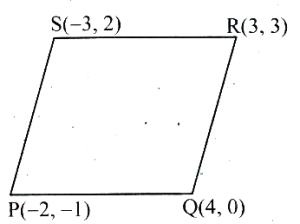
0 likesView Solution
380
ChemistryMCQMHT CET · 2024
Let $\overline{a}=2 \hat{i}+\hat{j}-2 \hat{k}$ and $\overline{b}=\hat{i}+\hat{j}$. Let $\overline{c}$ be a vector such that $|\overline{c}-\overline{a}|=3$,$|(\overline{a} \times \overline{b}) \times \overline{c}|=3$,and the angle between $\overline{c}$ and $\overline{a} \times \overline{b}$ is $30^{\circ}$. Then $\overline{a} \cdot \overline{c}$ is equal to
A
$2$
B
$-\frac{1}{8}$
C
$\frac{25}{8}$
D
$5$
Solution
(A) Given $\overline{a}=2 \hat{i}+\hat{j}-2 \hat{k}$ and $\overline{b}=\hat{i}+\hat{j}$.
First,calculate the magnitude of $\overline{a}$: $|\overline{a}|=\sqrt{2^2+1^2+(-2)^2}=\sqrt{4+1+4}=3$.
Next,calculate the cross product $\overline{a} \times \overline{b}$:
$\overline{a} \times \overline{b}=\begin{vmatrix} \hat{i} & \hat{j} & \hat{k} \\ 2 & 1 & -2 \\ 1 & 1 & 0 \end{vmatrix} = \hat{i}(0 - (-2)) - \hat{j}(0 - (-2)) + \hat{k}(2 - 1) = 2 \hat{i}-2 \hat{j}+\hat{k}$.
The magnitude is $|\overline{a} \times \overline{b}|=\sqrt{2^2+(-2)^2+1^2}=\sqrt{4+4+1}=3$.
Given that the angle $\theta$ between $\overline{c}$ and $\overline{a} \times \overline{b}$ is $30^{\circ}$,we use the formula for the magnitude of the cross product:
$|(\overline{a} \times \overline{b}) \times \overline{c}| = |\overline{a} \times \overline{b}| |\overline{c}| \sin(30^{\circ})$.
Substituting the known values: $3 = 3 \times |\overline{c}| \times \frac{1}{2}$.
This gives $|\overline{c}| = 2$.
Now,use the condition $|\overline{c}-\overline{a}|=3$. Squaring both sides:
$|\overline{c}|^2 + |\overline{a}|^2 - 2(\overline{a} \cdot \overline{c}) = 3^2$.
Substituting $|\overline{c}|=2$ and $|\overline{a}|=3$:
$2^2 + 3^2 - 2(\overline{a} \cdot \overline{c}) = 9$.
$4 + 9 - 2(\overline{a} \cdot \overline{c}) = 9$.
$13 - 2(\overline{a} \cdot \overline{c}) = 9$.
$2(\overline{a} \cdot \overline{c}) = 4$.
$\overline{a} \cdot \overline{c} = 2$.
First,calculate the magnitude of $\overline{a}$: $|\overline{a}|=\sqrt{2^2+1^2+(-2)^2}=\sqrt{4+1+4}=3$.
Next,calculate the cross product $\overline{a} \times \overline{b}$:
$\overline{a} \times \overline{b}=\begin{vmatrix} \hat{i} & \hat{j} & \hat{k} \\ 2 & 1 & -2 \\ 1 & 1 & 0 \end{vmatrix} = \hat{i}(0 - (-2)) - \hat{j}(0 - (-2)) + \hat{k}(2 - 1) = 2 \hat{i}-2 \hat{j}+\hat{k}$.
The magnitude is $|\overline{a} \times \overline{b}|=\sqrt{2^2+(-2)^2+1^2}=\sqrt{4+4+1}=3$.
Given that the angle $\theta$ between $\overline{c}$ and $\overline{a} \times \overline{b}$ is $30^{\circ}$,we use the formula for the magnitude of the cross product:
$|(\overline{a} \times \overline{b}) \times \overline{c}| = |\overline{a} \times \overline{b}| |\overline{c}| \sin(30^{\circ})$.
Substituting the known values: $3 = 3 \times |\overline{c}| \times \frac{1}{2}$.
This gives $|\overline{c}| = 2$.
Now,use the condition $|\overline{c}-\overline{a}|=3$. Squaring both sides:
$|\overline{c}|^2 + |\overline{a}|^2 - 2(\overline{a} \cdot \overline{c}) = 3^2$.
Substituting $|\overline{c}|=2$ and $|\overline{a}|=3$:
$2^2 + 3^2 - 2(\overline{a} \cdot \overline{c}) = 9$.
$4 + 9 - 2(\overline{a} \cdot \overline{c}) = 9$.
$13 - 2(\overline{a} \cdot \overline{c}) = 9$.
$2(\overline{a} \cdot \overline{c}) = 4$.
$\overline{a} \cdot \overline{c} = 2$.
0 likesView Solution
381
ChemistryMCQMHT CET · 2024
The area (in sq. units) of the parallelogram whose diagonals are along the vectors $8 \hat{i}-6 \hat{j}$ and $3 \hat{i}+4 \hat{j}-12 \hat{k}$ is:
A
$52$
B
$26$
C
$65$
D
$20$
Solution
(C) Let $\vec{d_1} = 8 \hat{i} - 6 \hat{j}$ and $\vec{d_2} = 3 \hat{i} + 4 \hat{j} - 12 \hat{k}$ be the diagonals of the parallelogram.
The area of a parallelogram with diagonals $\vec{d_1}$ and $\vec{d_2}$ is given by $\text{Area} = \frac{1}{2} |\vec{d_1} \times \vec{d_2}|$.
First,calculate the cross product $\vec{d_1} \times \vec{d_2}$:
$\vec{d_1} \times \vec{d_2} = \begin{vmatrix} \hat{i} & \hat{j} & \hat{k} \\ 8 & -6 & 0 \\ 3 & 4 & -12 \end{vmatrix}$
$= \hat{i}((-6)(-12) - (0)(4)) - \hat{j}((8)(-12) - (0)(3)) + \hat{k}((8)(4) - (-6)(3))$
$= \hat{i}(72 - 0) - \hat{j}(-96 - 0) + \hat{k}(32 + 18)$
$= 72 \hat{i} + 96 \hat{j} + 50 \hat{k}$.
Now,find the magnitude $|\vec{d_1} \times \vec{d_2}|$:
$|\vec{d_1} \times \vec{d_2}| = \sqrt{72^2 + 96^2 + 50^2} = \sqrt{5184 + 9216 + 2500} = \sqrt{16900} = 130$.
Finally,the area is $\frac{1}{2} \times 130 = 65$ sq. units.
The area of a parallelogram with diagonals $\vec{d_1}$ and $\vec{d_2}$ is given by $\text{Area} = \frac{1}{2} |\vec{d_1} \times \vec{d_2}|$.
First,calculate the cross product $\vec{d_1} \times \vec{d_2}$:
$\vec{d_1} \times \vec{d_2} = \begin{vmatrix} \hat{i} & \hat{j} & \hat{k} \\ 8 & -6 & 0 \\ 3 & 4 & -12 \end{vmatrix}$
$= \hat{i}((-6)(-12) - (0)(4)) - \hat{j}((8)(-12) - (0)(3)) + \hat{k}((8)(4) - (-6)(3))$
$= \hat{i}(72 - 0) - \hat{j}(-96 - 0) + \hat{k}(32 + 18)$
$= 72 \hat{i} + 96 \hat{j} + 50 \hat{k}$.
Now,find the magnitude $|\vec{d_1} \times \vec{d_2}|$:
$|\vec{d_1} \times \vec{d_2}| = \sqrt{72^2 + 96^2 + 50^2} = \sqrt{5184 + 9216 + 2500} = \sqrt{16900} = 130$.
Finally,the area is $\frac{1}{2} \times 130 = 65$ sq. units.
0 likesView Solution
382
ChemistryMCQMHT CET · 2024
If $\overline{a}$ and $\overline{b}$ are two unit vectors such that $5 \overline{a} + 4 \overline{b}$ and $\overline{a} - 2 \overline{b}$ are perpendicular to each other,then the angle between $\overline{a}$ and $\overline{b}$ is
A
$\frac{2 \pi}{3}$
B
$\cos^{-1}\left(\frac{2}{3}\right)$
C
$\frac{\pi}{3}$
D
$\cos^{-1}\left(\frac{1}{3}\right)$
Solution
(A) Let $\theta$ be the angle between $\overline{a}$ and $\overline{b}$.
Since $\overline{a}$ and $\overline{b}$ are unit vectors,$|\overline{a}| = 1$ and $|\overline{b}| = 1$.
The vectors $5 \overline{a} + 4 \overline{b}$ and $\overline{a} - 2 \overline{b}$ are perpendicular,so their dot product is $0$.
$(5 \overline{a} + 4 \overline{b}) \cdot (\overline{a} - 2 \overline{b}) = 0$
$5(\overline{a} \cdot \overline{a}) - 10(\overline{a} \cdot \overline{b}) + 4(\overline{b} \cdot \overline{a}) - 8(\overline{b} \cdot \overline{b}) = 0$
$5|\overline{a}|^2 - 6(\overline{a} \cdot \overline{b}) - 8|\overline{b}|^2 = 0$
Since $|\overline{a}| = 1$ and $|\overline{b}| = 1$,and $\overline{a} \cdot \overline{b} = |\overline{a}||\overline{b}| \cos \theta = \cos \theta$:
$5(1)^2 - 6 \cos \theta - 8(1)^2 = 0$
$5 - 6 \cos \theta - 8 = 0$
$-6 \cos \theta = 3$
$\cos \theta = -\frac{3}{6} = -\frac{1}{2}$
$\theta = \cos^{-1}\left(-\frac{1}{2}\right) = \frac{2 \pi}{3}$.
Since $\overline{a}$ and $\overline{b}$ are unit vectors,$|\overline{a}| = 1$ and $|\overline{b}| = 1$.
The vectors $5 \overline{a} + 4 \overline{b}$ and $\overline{a} - 2 \overline{b}$ are perpendicular,so their dot product is $0$.
$(5 \overline{a} + 4 \overline{b}) \cdot (\overline{a} - 2 \overline{b}) = 0$
$5(\overline{a} \cdot \overline{a}) - 10(\overline{a} \cdot \overline{b}) + 4(\overline{b} \cdot \overline{a}) - 8(\overline{b} \cdot \overline{b}) = 0$
$5|\overline{a}|^2 - 6(\overline{a} \cdot \overline{b}) - 8|\overline{b}|^2 = 0$
Since $|\overline{a}| = 1$ and $|\overline{b}| = 1$,and $\overline{a} \cdot \overline{b} = |\overline{a}||\overline{b}| \cos \theta = \cos \theta$:
$5(1)^2 - 6 \cos \theta - 8(1)^2 = 0$
$5 - 6 \cos \theta - 8 = 0$
$-6 \cos \theta = 3$
$\cos \theta = -\frac{3}{6} = -\frac{1}{2}$
$\theta = \cos^{-1}\left(-\frac{1}{2}\right) = \frac{2 \pi}{3}$.
0 likesView Solution
383
ChemistryMCQMHT CET · 2024
Let $\overline{a}=\hat{i}+\hat{j}+\hat{k}$,$\overline{b}=\hat{i}-\hat{j}+\hat{k}$ and $\overline{c}=\hat{i}-\hat{j}-\hat{k}$ be three vectors. $A$ vector $\overline{v}$ in the plane of $\overline{a}$ and $\overline{b}$,whose projection on $\overline{c}$ is $\frac{1}{\sqrt{3}}$,is given by
A
$\hat{i}-3 \hat{j}+3 \hat{k}$
B
$-3 \hat{i}-3 \hat{j}-\hat{k}$
C
$3 \hat{i}-\hat{j}+3 \hat{k}$
D
$\hat{i}+3 \hat{j}-3 \hat{k}$
Solution
(C) Given $\overline{a}=\hat{i}+\hat{j}+\hat{k}$,$\overline{b}=\hat{i}-\hat{j}+\hat{k}$ and $\overline{c}=\hat{i}-\hat{j}-\hat{k}$.
Since $\overline{v}$ lies in the plane of $\overline{a}$ and $\overline{b}$,we can write $\overline{v} = m\overline{a} + n\overline{b}$.
$\overline{v} = m(\hat{i}+\hat{j}+\hat{k}) + n(\hat{i}-\hat{j}+\hat{k}) = (m+n)\hat{i} + (m-n)\hat{j} + (m+n)\hat{k} \quad \dots(i)$
The projection of $\overline{v}$ on $\overline{c}$ is given by $\frac{\overline{v} \cdot \overline{c}}{|\overline{c}|} = \frac{1}{\sqrt{3}}$.
$|\overline{c}| = \sqrt{1^2 + (-1)^2 + (-1)^2} = \sqrt{3}$.
So,$\frac{(m+n)(1) + (m-n)(-1) + (m+n)(-1)}{\sqrt{3}} = \frac{1}{\sqrt{3}}$.
$m+n - m+n - m-n = 1 \implies n-m = 1 \implies n = m+1$.
Substituting $n = m+1$ into $(i)$:
$\overline{v} = (m+m+1)\hat{i} + (m-(m+1))\hat{j} + (m+m+1)\hat{k} = (2m+1)\hat{i} - \hat{j} + (2m+1)\hat{k}$.
For $m=1$,$\overline{v} = 3\hat{i} - \hat{j} + 3\hat{k}$,which matches option $C$.
Since $\overline{v}$ lies in the plane of $\overline{a}$ and $\overline{b}$,we can write $\overline{v} = m\overline{a} + n\overline{b}$.
$\overline{v} = m(\hat{i}+\hat{j}+\hat{k}) + n(\hat{i}-\hat{j}+\hat{k}) = (m+n)\hat{i} + (m-n)\hat{j} + (m+n)\hat{k} \quad \dots(i)$
The projection of $\overline{v}$ on $\overline{c}$ is given by $\frac{\overline{v} \cdot \overline{c}}{|\overline{c}|} = \frac{1}{\sqrt{3}}$.
$|\overline{c}| = \sqrt{1^2 + (-1)^2 + (-1)^2} = \sqrt{3}$.
So,$\frac{(m+n)(1) + (m-n)(-1) + (m+n)(-1)}{\sqrt{3}} = \frac{1}{\sqrt{3}}$.
$m+n - m+n - m-n = 1 \implies n-m = 1 \implies n = m+1$.
Substituting $n = m+1$ into $(i)$:
$\overline{v} = (m+m+1)\hat{i} + (m-(m+1))\hat{j} + (m+m+1)\hat{k} = (2m+1)\hat{i} - \hat{j} + (2m+1)\hat{k}$.
For $m=1$,$\overline{v} = 3\hat{i} - \hat{j} + 3\hat{k}$,which matches option $C$.
0 likesView Solution
384
ChemistryMCQMHT CET · 2024
Let the vectors $\overline{a}, \overline{b}, \overline{c}$ be such that $|\overline{a}|=2, |\overline{b}|=4$ and $|\overline{c}|=4$. If the projection of $\overline{b}$ on $\overline{a}$ is equal to the projection of $\overline{c}$ on $\overline{a}$ and $\overline{b}$ is perpendicular to $\overline{c}$,then the value of $|\overline{a}+\overline{b}-\overline{c}|$ is
A
$2 \sqrt{5}$
B
$6$
C
$4$
D
$4 \sqrt{2}$
Solution
(B) Given: $|\overline{a}|=2, |\overline{b}|=4, |\overline{c}|=4$.
According to the condition,the projection of $\overline{b}$ on $\overline{a}$ is equal to the projection of $\overline{c}$ on $\overline{a}$.
$\frac{\overline{b} \cdot \overline{a}}{|\overline{a}|} = \frac{\overline{c} \cdot \overline{a}}{|\overline{a}|} \Rightarrow \overline{b} \cdot \overline{a} = \overline{c} \cdot \overline{a} \Rightarrow (\overline{b} - \overline{c}) \cdot \overline{a} = 0 \dots (i)$.
Also,$\overline{b}$ is perpendicular to $\overline{c}$,so $\overline{b} \cdot \overline{c} = 0$.
Now,$|\overline{a} + \overline{b} - \overline{c}|^2 = |\overline{a}|^2 + |\overline{b} - \overline{c}|^2 + 2 \overline{a} \cdot (\overline{b} - \overline{c})$.
Using $(i)$,$2 \overline{a} \cdot (\overline{b} - \overline{c}) = 0$.
So,$|\overline{a} + \overline{b} - \overline{c}|^2 = |\overline{a}|^2 + |\overline{b}|^2 + |\overline{c}|^2 - 2(\overline{b} \cdot \overline{c})$.
Substituting the values: $|\overline{a} + \overline{b} - \overline{c}|^2 = (2)^2 + (4)^2 + (4)^2 - 2(0) = 4 + 16 + 16 = 36$.
Therefore,$|\overline{a} + \overline{b} - \overline{c}| = \sqrt{36} = 6$.
According to the condition,the projection of $\overline{b}$ on $\overline{a}$ is equal to the projection of $\overline{c}$ on $\overline{a}$.
$\frac{\overline{b} \cdot \overline{a}}{|\overline{a}|} = \frac{\overline{c} \cdot \overline{a}}{|\overline{a}|} \Rightarrow \overline{b} \cdot \overline{a} = \overline{c} \cdot \overline{a} \Rightarrow (\overline{b} - \overline{c}) \cdot \overline{a} = 0 \dots (i)$.
Also,$\overline{b}$ is perpendicular to $\overline{c}$,so $\overline{b} \cdot \overline{c} = 0$.
Now,$|\overline{a} + \overline{b} - \overline{c}|^2 = |\overline{a}|^2 + |\overline{b} - \overline{c}|^2 + 2 \overline{a} \cdot (\overline{b} - \overline{c})$.
Using $(i)$,$2 \overline{a} \cdot (\overline{b} - \overline{c}) = 0$.
So,$|\overline{a} + \overline{b} - \overline{c}|^2 = |\overline{a}|^2 + |\overline{b}|^2 + |\overline{c}|^2 - 2(\overline{b} \cdot \overline{c})$.
Substituting the values: $|\overline{a} + \overline{b} - \overline{c}|^2 = (2)^2 + (4)^2 + (4)^2 - 2(0) = 4 + 16 + 16 = 36$.
Therefore,$|\overline{a} + \overline{b} - \overline{c}| = \sqrt{36} = 6$.
0 likesView Solution
385
ChemistryMCQMHT CET · 2024
When a capacitor is connected in series to an $LR$ circuit,the alternating current flowing in the circuit
A
is zero.
B
increases.
C
decreases.
D
remains constant.
Solution
(B) The impedance of an $L-R$ circuit is given by $Z_1 = \sqrt{R^2 + X_L^2}$.
When a capacitor is connected in series,the circuit becomes an $L-C-R$ circuit.
The impedance of an $L-C-R$ circuit is given by $Z_2 = \sqrt{R^2 + (X_L - X_C)^2}$.
Since $(X_L - X_C)^2 < X_L^2$ (assuming the circuit is not at resonance where $X_L = X_C$),the total impedance $Z_2$ is less than $Z_1$.
According to Ohm's law for $AC$ circuits,$I = \frac{V}{Z}$.
Since the impedance $Z$ decreases,the alternating current $I$ flowing in the circuit increases.
When a capacitor is connected in series,the circuit becomes an $L-C-R$ circuit.
The impedance of an $L-C-R$ circuit is given by $Z_2 = \sqrt{R^2 + (X_L - X_C)^2}$.
Since $(X_L - X_C)^2 < X_L^2$ (assuming the circuit is not at resonance where $X_L = X_C$),the total impedance $Z_2$ is less than $Z_1$.
According to Ohm's law for $AC$ circuits,$I = \frac{V}{Z}$.
Since the impedance $Z$ decreases,the alternating current $I$ flowing in the circuit increases.
0 likesView Solution
386
ChemistryMCQMHT CET · 2024
When a capacitor is connected in series to an $LR$ circuit,the alternating current flowing in the circuit
A
is zero.
B
remains constant.
C
increases.
D
decreases.
Solution
(C) The impedance of an $LR$ circuit is given by $Z_{LR} = \sqrt{R^2 + X_L^2}$.
When a capacitor is connected in series,the circuit becomes an $LCR$ circuit.
The impedance of an $LCR$ circuit is given by $Z_{LCR} = \sqrt{R^2 + (X_L - X_C)^2}$.
Since $(X_L - X_C)^2 < X_L^2$ (assuming $X_C$ is not zero),the total impedance $Z$ of the circuit decreases.
According to Ohm's law for $AC$ circuits,$I = \frac{V}{Z}$.
Since $I \propto \frac{1}{Z}$,a decrease in impedance $Z$ leads to an increase in the alternating current $I$ flowing through the circuit.
When a capacitor is connected in series,the circuit becomes an $LCR$ circuit.
The impedance of an $LCR$ circuit is given by $Z_{LCR} = \sqrt{R^2 + (X_L - X_C)^2}$.
Since $(X_L - X_C)^2 < X_L^2$ (assuming $X_C$ is not zero),the total impedance $Z$ of the circuit decreases.
According to Ohm's law for $AC$ circuits,$I = \frac{V}{Z}$.
Since $I \propto \frac{1}{Z}$,a decrease in impedance $Z$ leads to an increase in the alternating current $I$ flowing through the circuit.
0 likesView Solution
387
ChemistryMCQMHT CET · 2024
$A$ coil of self-inductance $L$ is connected in series with a bulb $B$ and an $A.C.$ source. Brightness of the bulb decreases when
A
frequency of $A.C.$ source is decreased.
B
number of turns in the coil is reduced.
C
a capacitance of reactance $(X_L - X_C)$ is included in the same circuit.
D
an iron rod is inserted in the coil.
Solution
(D) The impedance of the $A.C.$ circuit is given by $Z = \sqrt{R^2 + X_L^2}$,where $X_L = \omega L = 2\pi f L$ is the inductive reactance.
When an iron rod is inserted into the coil,the permeability of the core increases,which significantly increases the self-inductance $L$ of the coil.
As $L$ increases,the inductive reactance $X_L = 2\pi f L$ increases.
Consequently,the total impedance $Z = \sqrt{R^2 + X_L^2}$ of the circuit increases.
Since the current in the circuit is $I = V/Z$,an increase in $Z$ leads to a decrease in the current $I$ flowing through the bulb.
As the brightness of the bulb is proportional to $I^2 R$,a decrease in current results in a decrease in the brightness of the bulb.
When an iron rod is inserted into the coil,the permeability of the core increases,which significantly increases the self-inductance $L$ of the coil.
As $L$ increases,the inductive reactance $X_L = 2\pi f L$ increases.
Consequently,the total impedance $Z = \sqrt{R^2 + X_L^2}$ of the circuit increases.
Since the current in the circuit is $I = V/Z$,an increase in $Z$ leads to a decrease in the current $I$ flowing through the bulb.
As the brightness of the bulb is proportional to $I^2 R$,a decrease in current results in a decrease in the brightness of the bulb.
0 likesView Solution
388
ChemistryMCQMHT CET · 2024
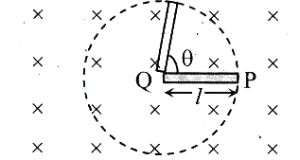
$A$ metal rod of length '$l$' rotates about one of its ends in a plane perpendicular to a magnetic field of induction '$B$'. If the e.m.f. induced between the ends of the rod is '$e$',then the number of revolutions made by the rod per second is
A
$\frac{e}{B \pi l^2}$
B
$\frac{e}{B \pi^2 l}$
C
$\frac{B^2}{e \pi l}$
D
$\frac{\pi l^2}{eB}$
Solution
(A) When a conducting rod of length '$l$' rotates about one of its ends in a uniform magnetic field '$B$' with an angular velocity '$\omega$',the induced e.m.f. '$e$' is given by the formula:
$e = \frac{1}{2} B \omega l^2$
We know that the angular velocity '$\omega$' is related to the frequency of rotation '$n$' (revolutions per second) by the relation:
$\omega = 2 \pi n$
Substituting this value of '$\omega$' into the e.m.f. equation:
$e = \frac{1}{2} B (2 \pi n) l^2$
$e = B \pi n l^2$
To find the number of revolutions per second '$n$',we rearrange the formula:
$n = \frac{e}{B \pi l^2}$
$e = \frac{1}{2} B \omega l^2$
We know that the angular velocity '$\omega$' is related to the frequency of rotation '$n$' (revolutions per second) by the relation:
$\omega = 2 \pi n$
Substituting this value of '$\omega$' into the e.m.f. equation:
$e = \frac{1}{2} B (2 \pi n) l^2$
$e = B \pi n l^2$
To find the number of revolutions per second '$n$',we rearrange the formula:
$n = \frac{e}{B \pi l^2}$
0 likesView Solution
389
ChemistryMCQMHT CET · 2024
An air-cored coil has a self-inductance of $0.1 \ H$. $A$ soft iron core of relative permeability $1000$ is introduced,and the number of turns is reduced to $\left(\frac{1}{10}\right)^{\text{th}}$. The value of the new self-inductance is:
A
$0.1 \ H$
B
$1 \ mH$
C
$1 \ H$
D
$10 \ mH$
Solution
(C) The formula for the self-inductance of a solenoid is $L = \frac{\mu_0 N^2 A}{l}$.
When an iron core is introduced,the permeability becomes $\mu = \mu_0 \mu_r$. The new inductance $L'$ is given by $L' = \frac{\mu_0 \mu_r (N')^2 A}{l}$.
Given $\mu_r = 1000$ and $N' = \frac{N}{10}$.
Substituting these values: $L' = \frac{\mu_0 \times 1000 \times (N/10)^2 A}{l} = \frac{\mu_0 \times 1000 \times N^2 A}{100 \times l} = 10 \times \left( \frac{\mu_0 N^2 A}{l} \right)$.
Since the initial inductance $L = 0.1 \ H$,we have $L' = 10 \times L = 10 \times 0.1 \ H = 1 \ H$.
When an iron core is introduced,the permeability becomes $\mu = \mu_0 \mu_r$. The new inductance $L'$ is given by $L' = \frac{\mu_0 \mu_r (N')^2 A}{l}$.
Given $\mu_r = 1000$ and $N' = \frac{N}{10}$.
Substituting these values: $L' = \frac{\mu_0 \times 1000 \times (N/10)^2 A}{l} = \frac{\mu_0 \times 1000 \times N^2 A}{100 \times l} = 10 \times \left( \frac{\mu_0 N^2 A}{l} \right)$.
Since the initial inductance $L = 0.1 \ H$,we have $L' = 10 \times L = 10 \times 0.1 \ H = 1 \ H$.
0 likesView Solution
390
ChemistryMCQMHT CET · 2024
Three charges $2q, -q$ and $-q$ are located at the vertices of an equilateral triangle. At the centre of the triangle,
A
the field is zero but potential is non-zero.
B
the field is non-zero but potential is zero.
C
both field and potential are zero.
D
both field and potential are non-zero.
Solution
(B) Let $r$ be the distance from each vertex to the centre of the equilateral triangle.
The electric potential $V$ at the centre due to the three charges is the algebraic sum of the potentials due to each charge:
$V = V_{2q} + V_{-q} + V_{-q} = \frac{k(2q)}{r} + \frac{k(-q)}{r} + \frac{k(-q)}{r} = \frac{k}{r} (2q - q - q) = 0$.
Thus,the potential at the centre is zero.
For the electric field,the field due to the two $-q$ charges at the base will have a resultant pointing towards the base,while the field due to the $2q$ charge at the top will point away from it (downwards). Since the magnitudes of these fields do not cancel out,the net electric field at the centre is non-zero.
The electric potential $V$ at the centre due to the three charges is the algebraic sum of the potentials due to each charge:
$V = V_{2q} + V_{-q} + V_{-q} = \frac{k(2q)}{r} + \frac{k(-q)}{r} + \frac{k(-q)}{r} = \frac{k}{r} (2q - q - q) = 0$.
Thus,the potential at the centre is zero.
For the electric field,the field due to the two $-q$ charges at the base will have a resultant pointing towards the base,while the field due to the $2q$ charge at the top will point away from it (downwards). Since the magnitudes of these fields do not cancel out,the net electric field at the centre is non-zero.
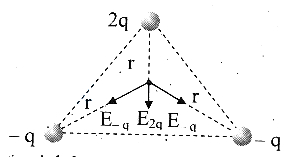
0 likesView Solution
391
ChemistryMCQMHT CET · 2024
Charges of $2 \mu C$ and $-3 \mu C$ are placed at two points $A$ and $B$ separated by $1 \ m$. The distance of the point from $A$,where the net potential is zero,is (in $m$)
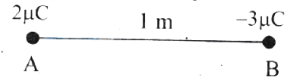
A
$0.7$
B
$0.5$
C
$0.4$
D
$0.6$
Solution
(C) The electric potential $V$ due to a point charge $q$ at a distance $r$ is given by $V = \frac{Kq}{r}$.
Let $r_1$ be the distance from point $A$ (where charge $q_1 = 2 \mu C$) and $r_2$ be the distance from point $B$ (where charge $q_2 = -3 \mu C$) to the point where the net potential is zero.
For the net potential to be zero,the sum of potentials must be zero: $V_A + V_B = 0$.
$\frac{K(2 \times 10^{-6})}{r_1} + \frac{K(-3 \times 10^{-6})}{r_2} = 0$
$\frac{2}{r_1} = \frac{3}{r_2}$
$\frac{r_2}{r_1} = \frac{3}{2}$
Since the total distance between $A$ and $B$ is $1 \ m$,we have $r_1 + r_2 = 1 \ m$,which implies $r_2 = 1 - r_1$.
Substituting this into the ratio:
$\frac{1 - r_1}{r_1} = \frac{3}{2}$
$2(1 - r_1) = 3r_1$
$2 - 2r_1 = 3r_1$
$5r_1 = 2$
$r_1 = \frac{2}{5} = 0.4 \ m$.
Thus,the distance from point $A$ is $0.4 \ m$.
Let $r_1$ be the distance from point $A$ (where charge $q_1 = 2 \mu C$) and $r_2$ be the distance from point $B$ (where charge $q_2 = -3 \mu C$) to the point where the net potential is zero.
For the net potential to be zero,the sum of potentials must be zero: $V_A + V_B = 0$.
$\frac{K(2 \times 10^{-6})}{r_1} + \frac{K(-3 \times 10^{-6})}{r_2} = 0$
$\frac{2}{r_1} = \frac{3}{r_2}$
$\frac{r_2}{r_1} = \frac{3}{2}$
Since the total distance between $A$ and $B$ is $1 \ m$,we have $r_1 + r_2 = 1 \ m$,which implies $r_2 = 1 - r_1$.
Substituting this into the ratio:
$\frac{1 - r_1}{r_1} = \frac{3}{2}$
$2(1 - r_1) = 3r_1$
$2 - 2r_1 = 3r_1$
$5r_1 = 2$
$r_1 = \frac{2}{5} = 0.4 \ m$.
Thus,the distance from point $A$ is $0.4 \ m$.
0 likesView Solution
392
ChemistryMCQMHT CET · 2024
$A$ meter scale is supported on a wedge at its center of gravity. $A$ body of weight '$w$' is suspended from the $20 \text{ cm}$ mark and another weight of $25 \text{ g}$ is suspended from the $74 \text{ cm}$ mark. The system is balanced and the meter scale remains perfectly horizontal. Neglecting the weight of the meter scale,the weight of the body '$w$' is: (in $text{ g}$)
A
$33$
B
$30$
C
$20$
D
$15$
Solution
(C) The meter scale is supported at its center of gravity,which is the $50 \text{ cm}$ mark.
For the scale to be in equilibrium,the clockwise torque must equal the counter-clockwise torque about the pivot point ($50 \text{ cm}$ mark).
The distance of the first weight '$w$' from the pivot is $d_1 = |50 \text{ cm} - 20 \text{ cm}| = 30 \text{ cm}$.
The distance of the second weight $(25 \text{ g})$ from the pivot is $d_2 = |74 \text{ cm} - 50 \text{ cm}| = 24 \text{ cm}$.
Applying the principle of moments: $w \times d_1 = 25 \text{ g} \times d_2$.
$w \times 30 \text{ cm} = 25 \text{ g} \times 24 \text{ cm}$.
$w = (25 \times 24) / 30 = 600 / 30 = 20 \text{ g}$.
Thus,the weight of the body is $20 \text{ g}$.
For the scale to be in equilibrium,the clockwise torque must equal the counter-clockwise torque about the pivot point ($50 \text{ cm}$ mark).
The distance of the first weight '$w$' from the pivot is $d_1 = |50 \text{ cm} - 20 \text{ cm}| = 30 \text{ cm}$.
The distance of the second weight $(25 \text{ g})$ from the pivot is $d_2 = |74 \text{ cm} - 50 \text{ cm}| = 24 \text{ cm}$.
Applying the principle of moments: $w \times d_1 = 25 \text{ g} \times d_2$.
$w \times 30 \text{ cm} = 25 \text{ g} \times 24 \text{ cm}$.
$w = (25 \times 24) / 30 = 600 / 30 = 20 \text{ g}$.
Thus,the weight of the body is $20 \text{ g}$.
0 likesView Solution
393
ChemistryMCQMHT CET · 2024
$A$ simple pendulum has a periodic time $T_1$ when it is on the surface of the Earth of radius $R$. Its periodic time is $T_2$ when it is taken to a height $R$ above the Earth's surface. The value of $\frac{T_2}{T_1}$ is
A
$\sqrt{2}$
B
$1$
C
$2$
D
$\frac{1}{2}$
Solution
(C) The time period of a simple pendulum is given by $T = 2 \pi \sqrt{\frac{l}{g}}$.
On the surface of the Earth,$T_1 = 2 \pi \sqrt{\frac{l}{g}}$,where $g$ is the acceleration due to gravity at the surface.
At a height $h = R$ above the Earth's surface,the acceleration due to gravity $g_h$ is given by $g_h = \frac{GM}{(R+h)^2} = \frac{GM}{(R+R)^2} = \frac{GM}{4R^2} = \frac{g}{4}$.
The time period at height $h$ is $T_2 = 2 \pi \sqrt{\frac{l}{g_h}}$.
Taking the ratio,$\frac{T_2}{T_1} = \sqrt{\frac{g}{g_h}} = \sqrt{\frac{g}{g/4}} = \sqrt{4} = 2$.
On the surface of the Earth,$T_1 = 2 \pi \sqrt{\frac{l}{g}}$,where $g$ is the acceleration due to gravity at the surface.
At a height $h = R$ above the Earth's surface,the acceleration due to gravity $g_h$ is given by $g_h = \frac{GM}{(R+h)^2} = \frac{GM}{(R+R)^2} = \frac{GM}{4R^2} = \frac{g}{4}$.
The time period at height $h$ is $T_2 = 2 \pi \sqrt{\frac{l}{g_h}}$.
Taking the ratio,$\frac{T_2}{T_1} = \sqrt{\frac{g}{g_h}} = \sqrt{\frac{g}{g/4}} = \sqrt{4} = 2$.
0 likesView Solution
394
ChemistryMCQMHT CET · 2024
According to the law of equipartition of energy,the molar specific heat of a diatomic gas at constant volume,where the molecule has one additional vibrational mode,is:
A
$\frac{9}{2} R$
B
$\frac{5}{2} R$
C
$\frac{3}{2} R$
D
$\frac{7}{2} R$
Solution
(D) standard diatomic gas molecule has $3$ translational and $2$ rotational degrees of freedom,totaling $5$ degrees of freedom.
When one additional vibrational mode is considered,it contributes $2$ degrees of freedom (one for kinetic energy and one for potential energy).
Therefore,the total number of degrees of freedom $f = 5 + 2 = 7$.
The molar specific heat at constant volume is given by $C_V = \frac{f}{2} R$.
Substituting $f = 7$,we get $C_V = \frac{7}{2} R$.
When one additional vibrational mode is considered,it contributes $2$ degrees of freedom (one for kinetic energy and one for potential energy).
Therefore,the total number of degrees of freedom $f = 5 + 2 = 7$.
The molar specific heat at constant volume is given by $C_V = \frac{f}{2} R$.
Substituting $f = 7$,we get $C_V = \frac{7}{2} R$.
0 likesView Solution
395
ChemistryMCQMHT CET · 2024
For a gas,$\frac{R}{C_{v}}=0.4$,where $R$ is the universal gas constant and $C_{v}$ is the molar specific heat at constant volume. The gas is made up of molecules which are
A
rigid diatomic.
B
monoatomic.
C
non-rigid diatomic.
D
polyatomic.
Solution
(A) Given: $\frac{R}{C_v} = 0.4$
$C_V = \frac{R}{0.4} = \frac{R}{2/5} = \frac{5R}{2}$
We know that for an ideal gas,$C_P = C_V + R$.
Substituting the value of $C_V$: $C_P = \frac{5R}{2} + R = \frac{7R}{2}$
The adiabatic index $\gamma$ is given by $\gamma = \frac{C_P}{C_V}$.
$\gamma = \frac{7R/2}{5R/2} = \frac{7}{5} = 1.4$.
For a rigid diatomic gas,the degrees of freedom $f = 5$.
The molar specific heat at constant volume is $C_V = \frac{fR}{2} = \frac{5R}{2}$.
Since the calculated $C_V$ matches the value for a rigid diatomic gas,the gas is made up of rigid diatomic molecules.
$C_V = \frac{R}{0.4} = \frac{R}{2/5} = \frac{5R}{2}$
We know that for an ideal gas,$C_P = C_V + R$.
Substituting the value of $C_V$: $C_P = \frac{5R}{2} + R = \frac{7R}{2}$
The adiabatic index $\gamma$ is given by $\gamma = \frac{C_P}{C_V}$.
$\gamma = \frac{7R/2}{5R/2} = \frac{7}{5} = 1.4$.
For a rigid diatomic gas,the degrees of freedom $f = 5$.
The molar specific heat at constant volume is $C_V = \frac{fR}{2} = \frac{5R}{2}$.
Since the calculated $C_V$ matches the value for a rigid diatomic gas,the gas is made up of rigid diatomic molecules.
0 likesView Solution
396
ChemistryMCQMHT CET · 2024
The magnetic field at the centre of a current-carrying circular coil of area '$A$' is '$B$'. The magnetic moment of the coil is ($\mu_0 =$ permeability of free space).
A
$\frac{2 \mu_0 \pi^{1 / 2}}{BA^{3 / 2}}$
B
$\frac{BA^{3 / 2}}{\mu_0 \pi}$
C
$\frac{2 B A^{3 / 2}}{\mu_0 \pi^{1 / 2}}$
D
$\frac{BA^2}{\mu_0 \pi}$
Solution
(C) The area of the circular coil is $A = \pi r^2$,which implies the radius $r = \sqrt{\frac{A}{\pi}}$.
The magnetic field at the centre of a circular coil is given by $B = \frac{\mu_0 I}{2r}$.
Substituting the value of $r$,we get $B = \frac{\mu_0 I}{2 \sqrt{\frac{A}{\pi}}}$.
Solving for the current $I$,we have $I = \frac{2B}{\mu_0} \sqrt{\frac{A}{\pi}}$.
The magnetic moment $m$ of the coil is defined as $m = IA$.
Substituting the expression for $I$,we get $m = \left( \frac{2B}{\mu_0} \sqrt{\frac{A}{\pi}} \right) \times A$.
Simplifying this,$m = \frac{2B}{\mu_0} \frac{A^{1/2}}{\pi^{1/2}} \times A = \frac{2B A^{3/2}}{\mu_0 \pi^{1/2}}$.
The magnetic field at the centre of a circular coil is given by $B = \frac{\mu_0 I}{2r}$.
Substituting the value of $r$,we get $B = \frac{\mu_0 I}{2 \sqrt{\frac{A}{\pi}}}$.
Solving for the current $I$,we have $I = \frac{2B}{\mu_0} \sqrt{\frac{A}{\pi}}$.
The magnetic moment $m$ of the coil is defined as $m = IA$.
Substituting the expression for $I$,we get $m = \left( \frac{2B}{\mu_0} \sqrt{\frac{A}{\pi}} \right) \times A$.
Simplifying this,$m = \frac{2B}{\mu_0} \frac{A^{1/2}}{\pi^{1/2}} \times A = \frac{2B A^{3/2}}{\mu_0 \pi^{1/2}}$.
0 likesView Solution
397
ChemistryMCQMHT CET · 2024
The materials having negative magnetic susceptibility are
A
both paramagnetic and ferromagnetic.
B
paramagnetic.
C
diamagnetic.
D
ferromagnetic.
Solution
(C) Diamagnetic materials have a negative magnetic susceptibility $(\chi < 0)$.
- Explanation: Diamagnetic materials exhibit a weak negative susceptibility to external magnetic fields, which means they are slightly repelled by magnetic fields.
- Unlike paramagnetic or ferromagnetic materials, which have positive susceptibility, diamagnetic materials develop an induced magnetic moment in the direction opposite to the applied magnetic field.
- They do not retain any magnetic properties once the external magnetic field is removed.
- Explanation: Diamagnetic materials exhibit a weak negative susceptibility to external magnetic fields, which means they are slightly repelled by magnetic fields.
- Unlike paramagnetic or ferromagnetic materials, which have positive susceptibility, diamagnetic materials develop an induced magnetic moment in the direction opposite to the applied magnetic field.
- They do not retain any magnetic properties once the external magnetic field is removed.
0 likesView Solution
398
ChemistryMCQMHT CET · 2024
Three liquids of densities $\rho_1, \rho_2$ and $\rho_3$ (with $\rho_1 > \rho_2 > \rho_3$) having same value of surface tension $T$,rise to the same height in three identical capillaries. Angle of contact $\theta_1, \theta_2$ and $\theta_3$ respectively obey
A
$\frac{\pi}{2} > \theta_1 > \theta_2 > \theta_3 > 0$
B
$0 \le \theta_1 < \theta_2 < \theta_3 < \frac{\pi}{2}$
C
$\frac{\pi}{2} < \theta_1 < \theta_2 < \theta_3 < \pi$
D
$\pi > \theta_1 > \theta_2 > \frac{\pi}{2}$
Solution
(B) The height $h$ to which a liquid rises in a capillary tube is given by the formula: $h = \frac{2 T \cos \theta}{r g \rho}$.
Since $h, T, r,$ and $g$ are constant for all three liquids,we have $\cos \theta \propto \rho$.
Given $\rho_1 > \rho_2 > \rho_3$,it follows that $\cos \theta_1 > \cos \theta_2 > \cos \theta_3$.
Since the cosine function is a decreasing function in the interval $[0, \frac{\pi}{2}]$,a larger value of $\cos \theta$ corresponds to a smaller value of $\theta$.
Therefore,$\theta_1 < \theta_2 < \theta_3$.
Since the liquids rise in the capillary,the angles of contact must be acute $(0 \le \theta < \frac{\pi}{2})$.
Thus,the correct relation is $0 \le \theta_1 < \theta_2 < \theta_3 < \frac{\pi}{2}$.
Since $h, T, r,$ and $g$ are constant for all three liquids,we have $\cos \theta \propto \rho$.
Given $\rho_1 > \rho_2 > \rho_3$,it follows that $\cos \theta_1 > \cos \theta_2 > \cos \theta_3$.
Since the cosine function is a decreasing function in the interval $[0, \frac{\pi}{2}]$,a larger value of $\cos \theta$ corresponds to a smaller value of $\theta$.
Therefore,$\theta_1 < \theta_2 < \theta_3$.
Since the liquids rise in the capillary,the angles of contact must be acute $(0 \le \theta < \frac{\pi}{2})$.
Thus,the correct relation is $0 \le \theta_1 < \theta_2 < \theta_3 < \frac{\pi}{2}$.
0 likesView Solution
399
ChemistryMCQMHT CET · 2024
$A$ small sphere oscillates simple harmonically in a watch glass whose radius of curvature is $1.6 \ m$. The period of oscillation of the sphere in seconds is (acceleration due to gravity,$g = 10 \ m/s^2$). (in $pi$)
A
$0.8$
B
$0.6$
C
$0.4$
D
$0.2$
Solution
(A) The time period $T$ of a simple pendulum is given by the formula $T = 2 \pi \sqrt{\frac{L}{g}}$.
In the case of a sphere oscillating in a watch glass,the effective length $L$ of the pendulum is equal to the radius of curvature $R$ of the watch glass.
Given,$R = L = 1.6 \ m$ and $g = 10 \ m/s^2$.
Substituting these values into the formula:
$T = 2 \pi \sqrt{\frac{1.6}{10}}$
$T = 2 \pi \sqrt{0.16}$
$T = 2 \pi \times 0.4$
$T = 0.8 \pi \ s$.
In the case of a sphere oscillating in a watch glass,the effective length $L$ of the pendulum is equal to the radius of curvature $R$ of the watch glass.
Given,$R = L = 1.6 \ m$ and $g = 10 \ m/s^2$.
Substituting these values into the formula:
$T = 2 \pi \sqrt{\frac{1.6}{10}}$
$T = 2 \pi \sqrt{0.16}$
$T = 2 \pi \times 0.4$
$T = 0.8 \pi \ s$.
0 likesView Solution
400
ChemistryMCQMHT CET · 2024
All the springs in figures $(a)$,$(b)$,and $(c)$ are identical,each having a force constant $K$. The mass attached to each system is $m$. If $T_a, T_b$,and $T_c$ are the time periods of oscillations of the three systems respectively,then:
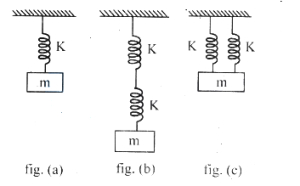
A
$T_{a}=\sqrt{2} ~T_{b}$
B
$T_a=\frac{T_c}{\sqrt{2}}$
C
$T_{b}=2 ~T_{a}$
D
$T_b=2 T_c$
Solution
(D) For system $(a)$: The effective spring constant is $K_{eff} = K$. The time period is $T_a = 2 \pi \sqrt{\frac{m}{K}}$.
For system $(b)$: The two springs are in series. The effective spring constant is $\frac{1}{K_{eff}} = \frac{1}{K} + \frac{1}{K} = \frac{2}{K}$,so $K_{eff} = \frac{K}{2}$. The time period is $T_b = 2 \pi \sqrt{\frac{m}{K/2}} = 2 \pi \sqrt{\frac{2m}{K}} = \sqrt{2} T_a$.
For system $(c)$: The two springs are in parallel. The effective spring constant is $K_{eff} = K + K = 2K$. The time period is $T_c = 2 \pi \sqrt{\frac{m}{2K}} = \frac{1}{\sqrt{2}} (2 \pi \sqrt{\frac{m}{K}}) = \frac{T_a}{\sqrt{2}}$.
From $T_b = \sqrt{2} T_a$ and $T_c = \frac{T_a}{\sqrt{2}}$,we can write $T_a = \sqrt{2} T_c$.
Substituting this into the expression for $T_b$: $T_b = \sqrt{2} (\sqrt{2} T_c) = 2 T_c$.
For system $(b)$: The two springs are in series. The effective spring constant is $\frac{1}{K_{eff}} = \frac{1}{K} + \frac{1}{K} = \frac{2}{K}$,so $K_{eff} = \frac{K}{2}$. The time period is $T_b = 2 \pi \sqrt{\frac{m}{K/2}} = 2 \pi \sqrt{\frac{2m}{K}} = \sqrt{2} T_a$.
For system $(c)$: The two springs are in parallel. The effective spring constant is $K_{eff} = K + K = 2K$. The time period is $T_c = 2 \pi \sqrt{\frac{m}{2K}} = \frac{1}{\sqrt{2}} (2 \pi \sqrt{\frac{m}{K}}) = \frac{T_a}{\sqrt{2}}$.
From $T_b = \sqrt{2} T_a$ and $T_c = \frac{T_a}{\sqrt{2}}$,we can write $T_a = \sqrt{2} T_c$.
Substituting this into the expression for $T_b$: $T_b = \sqrt{2} (\sqrt{2} T_c) = 2 T_c$.
0 likesView Solution
401
ChemistryMediumMCQMHT CET · 2024
Identify a polymer obtained from $\beta$-hydroxybutyric acid and $\beta$-hydroxyvaleric acid.
A
$PHBV$
B
Nylon $2-$nylon $6$
C
Buna-$N$
D
Thermocol
Solution
(A) The copolymer formed by the condensation polymerization of $3$-hydroxybutanoic acid ($\beta$-hydroxybutyric acid) and $3$-hydroxypentanoic acid ($\beta$-hydroxyvaleric acid) is known as Poly-$\beta$-hydroxybutyrate-co-$\beta$-hydroxyvalerate, abbreviated as $PHBV$.
The reaction is:
$n(HO-CH(CH_3)-CH_2-COOH) + n(HO-CH(CH_2CH_3)-CH_2-COOH)$ $\rightarrow [-O-CH(CH_3)-CH_2-CO-O-CH(CH_2CH_3)-CH_2-CO-]_n + 2nH_2O$
Thus, the correct option is $A$.
The reaction is:
$n(HO-CH(CH_3)-CH_2-COOH) + n(HO-CH(CH_2CH_3)-CH_2-COOH)$ $\rightarrow [-O-CH(CH_3)-CH_2-CO-O-CH(CH_2CH_3)-CH_2-CO-]_n + 2nH_2O$
Thus, the correct option is $A$.
0 likesView Solution
402
ChemistryMediumMCQMHT CET · 2024
Which of the following statements is $NOT$ correct about thermoplastic polymers?
A
These are softened on heating.
B
Intermolecular forces involved in these are moderately strong,intermediate between elastomers and fibres.
C
These possess extensive cross-linking by covalent bonds.
D
These are easily moulded.
Solution
(C) Thermoplastic polymers are linear or slightly branched long-chain molecules that soften on heating and harden on cooling. They do not possess extensive cross-linking by covalent bonds; such cross-linking is characteristic of thermosetting polymers.
0 likesView Solution
403
ChemistryDifficultMCQMHT CET · 2024
Identify the source of linen from the following:
A
Flax plant
B
Cotton plant
C
Cane plant
D
Rubber plant
Solution
(A) $(1)$ Flax plant: Linen is a natural fiber derived from the flax plant ($Linum$ $usitatissimum$). The fibers are obtained from the stem of the flax plant and are known for their strength,durability,and breathability. Linen is one of the oldest textile fibers used by humans.
$(2)$ Cotton plant: Cotton fibers come from the cotton plant $(Gossypium)$,not from flax. Cotton is widely used to make fabrics like cotton cloth,but it is a different material from linen.
$(3)$ Cane plant: The cane plant,such as sugarcane or bamboo,is not a source of linen. However,bamboo fibers are used to create textiles in some cases,but this is not the source of linen.
$(4)$ Rubber plant: Rubber comes from the latex of the rubber tree ($Hevea$ $brasiliensis$) and is used for making rubber products,not linen fabric.
$(2)$ Cotton plant: Cotton fibers come from the cotton plant $(Gossypium)$,not from flax. Cotton is widely used to make fabrics like cotton cloth,but it is a different material from linen.
$(3)$ Cane plant: The cane plant,such as sugarcane or bamboo,is not a source of linen. However,bamboo fibers are used to create textiles in some cases,but this is not the source of linen.
$(4)$ Rubber plant: Rubber comes from the latex of the rubber tree ($Hevea$ $brasiliensis$) and is used for making rubber products,not linen fabric.
0 likesView Solution
404
ChemistryEasyMCQMHT CET · 2024
Which of the following polymers contains the $-CO-NH-$ linkage in it?
A
Urea formaldehyde resin
B
Glyptal
C
Polycarbonate
D
Thermacol
Solution
(A) The $-CO-NH-$ linkage is characteristic of amide groups,which are found in polyamides (like Nylon) and certain condensation polymers.
Urea formaldehyde resin is formed by the condensation reaction between urea and formaldehyde.
The structure of urea formaldehyde resin is: $[-NH-CO-NH-CH_2-]_n$.
This structure clearly contains the $-CO-NH-$ linkage.
Therefore,the correct option is $A$.
Urea formaldehyde resin is formed by the condensation reaction between urea and formaldehyde.
The structure of urea formaldehyde resin is: $[-NH-CO-NH-CH_2-]_n$.
This structure clearly contains the $-CO-NH-$ linkage.
Therefore,the correct option is $A$.
0 likesView Solution
405
ChemistryMediumMCQMHT CET · 2024
Which of the following polymers (trade name) is used to obtain paints?
A
$Glyptal$
B
$Polycarbonate$
C
$Perspex$
D
$PVC$
Solution
(A) $Glyptal$ is a polyester obtained by the condensation polymerization of glycerol and phthalic anhydride. It is widely used in the manufacture of paints and lacquers.
0 likesView Solution
406
ChemistryMediumMCQMHT CET · 2024
Identify the monomer used to obtain a polymer that resembles wool.
A
$CH_2=CHCN$
B
$F_2C=CF_2$
C
$H_2C=CHCl$
D
$H_2C=C(Cl)-CH=CH_2$
Solution
(A) Orlon,also known as polyacrylonitrile $(PAN)$,is a synthetic polymer that resembles wool and is used as a wool substitute. It is obtained by the polymerization of acrylonitrile monomer,which has the chemical formula $CH_2=CHCN$.
0 likesView Solution
407
ChemistryMediumMCQMHT CET · 2024
Which of the following is a semisynthetic polymer?
A
Dacron
B
Nylon $6$
C
Wool
D
Cellulose nitrate
Solution
(D) $Dacron$ and $Nylon \ 6$: Synthetic polymer.
$Wool$: Natural polymer.
$Cellulose \ nitrate$: Semisynthetic polymer.
$Wool$: Natural polymer.
$Cellulose \ nitrate$: Semisynthetic polymer.
0 likesView Solution
408
ChemistryMediumMCQMHT CET · 2024
Which of the following polymers is used as a substitute for wool?
A
Teflon
B
$LDP$
C
Dacron
D
Polyacrylonitrile
Solution
(D) Polyacrylonitrile $(PAN)$ is used as a substitute for wool in the form of acrylic fibers.
These synthetic fibers are often used to make fabrics that mimic wool,such as in clothing and blankets.
These synthetic fibers are often used to make fabrics that mimic wool,such as in clothing and blankets.
0 likesView Solution
409
ChemistryMediumMCQMHT CET · 2024
Identify the monomers used for the preparation of Buna-$S$.
A
Phenol and formaldehyde
B
$1,3-$butadiene and styrene
C
Ethylene glycol and styrene
D
$\beta-$hydroxy butyric acid and phenol
Solution
(B) Buna-$S$ is a synthetic rubber formed by the copolymerization of $1,3-$butadiene and styrene in the presence of a sodium catalyst.
The reaction is as follows:
$n(CH_2=CH-CH=CH_2) + n(C_6H_5CH=CH_2) \xrightarrow{Na} -[CH_2-CH=CH-CH_2-CH(C_6H_5)-CH_2]_n-$
The reaction is as follows:
$n(CH_2=CH-CH=CH_2) + n(C_6H_5CH=CH_2) \xrightarrow{Na} -[CH_2-CH=CH-CH_2-CH(C_6H_5)-CH_2]_n-$
0 likesView Solution
410
ChemistryMediumMCQMHT CET · 2024
Which among the following polymers is obtained by ring opening polymerization process?
A
Polyacrylonitrile
B
Nylon $6,6$
C
Nylon $6$
D
Terylene
Solution
(C) Nylon $6$ is prepared by heating caprolactam with water at a high temperature $(533-543 \ K)$.
During this process,the amide bond in the cyclic caprolactam ring breaks,leading to ring opening polymerization.
The reaction is as follows:
$\epsilon$-Caprolactam ($n$ molecules) $\xrightarrow{H_2O, 533-543 \ K} [NH-(CH_2)_5-CO]_n$ (Nylon $6$).
During this process,the amide bond in the cyclic caprolactam ring breaks,leading to ring opening polymerization.
The reaction is as follows:
$\epsilon$-Caprolactam ($n$ molecules) $\xrightarrow{H_2O, 533-543 \ K} [NH-(CH_2)_5-CO]_n$ (Nylon $6$).
0 likesView Solution
411
ChemistryEasyMCQMHT CET · 2024
Which of the following is a use of polyester fibres?
A
Making bristles of brushes.
B
To obtain orlon.
C
To obtain electric insulators.
D
To obtain terywool.
Solution
(D) Polyester fibers are commonly used to make blended fabrics like terywool,which is a blend of polyester and wool.
0 likesView Solution
412
ChemistryMediumMCQMHT CET · 2024
Which of the following is $NOT$ true about natural rubber?
A
It is formed by addition polymerization.
B
It is a linear polymer.
C
It has cis configuration of $C=C$.
D
It contains butadiene and styrene as monomer units.
Solution
(D) $1$. It is formed by addition polymerization: Natural rubber is formed by the addition polymerization of isoprene units. This is correct.
$2$. It is a linear polymer: Natural rubber is primarily a linear polymer of isoprene,although it may have a slight degree of branching. This is correct.
$3$. It has cis configuration of $C=C$: Natural rubber has $cis-1,4-polyisoprene$ as its primary structure,which gives it elasticity. This is correct.
$4$. It contains butadiene and styrene as monomer units: This is incorrect. Butadiene and styrene are the monomers of synthetic rubber known as styrene-butadiene rubber $(SBR)$,not natural rubber. Natural rubber contains isoprene $(2-methyl-1,3-butadiene)$ as its monomer.
$2$. It is a linear polymer: Natural rubber is primarily a linear polymer of isoprene,although it may have a slight degree of branching. This is correct.
$3$. It has cis configuration of $C=C$: Natural rubber has $cis-1,4-polyisoprene$ as its primary structure,which gives it elasticity. This is correct.
$4$. It contains butadiene and styrene as monomer units: This is incorrect. Butadiene and styrene are the monomers of synthetic rubber known as styrene-butadiene rubber $(SBR)$,not natural rubber. Natural rubber contains isoprene $(2-methyl-1,3-butadiene)$ as its monomer.
0 likesView Solution
413
ChemistryDifficultMCQMHT CET · 2024
Which of the following statements about neoprene is false?
A
It is a copolymer and polymerization occurs in the presence of $MgO$.
B
It is a synthetic rubber.
C
It is used to prepare hose pipes for the transport of gasoline.
D
The monomer involved in its preparation is unsaturated.
Solution
(A) Neoprene is a synthetic rubber (elastomer) formed by the free radical polymerization of chloroprene ($2-$chloro$-1,3-$butadiene).
It is a homopolymer,not a copolymer,because it is formed from a single type of monomer unit.
It is used to prepare hose pipes for the transport of gasoline due to its resistance to oils and chemicals.
The monomer chloroprene $(CH_2=CCl-CH=CH_2)$ is an unsaturated compound.
Therefore,the statement that it is a copolymer is false.
It is a homopolymer,not a copolymer,because it is formed from a single type of monomer unit.
It is used to prepare hose pipes for the transport of gasoline due to its resistance to oils and chemicals.
The monomer chloroprene $(CH_2=CCl-CH=CH_2)$ is an unsaturated compound.
Therefore,the statement that it is a copolymer is false.
0 likesView Solution
414
ChemistryMediumMCQMHT CET · 2024
Identify the thermoplastic polymer from the following.
A
Urea formaldehyde resin
B
Bakelite
C
Polythene
D
Buna-$N$
Solution
(C) Polythene (Option $C$) is a thermoplastic polymer. Thermoplastics are materials that become pliable or moldable above a specific temperature and solidify upon cooling. They can be remelted and remolded multiple times without losing their chemical properties. Polythene,commonly known as polyethylene,is widely used in applications like packaging films,containers,and insulation for cables due to its flexibility,strength,and recyclability.
Urea formaldehyde resin (Option $A$) and Bakelite (Option $B$) are examples of thermosetting polymers,which harden permanently after being heated and cannot be remolded.
Buna-$N$ (Option $D$) is a synthetic rubber,not a thermoplastic.
Urea formaldehyde resin (Option $A$) and Bakelite (Option $B$) are examples of thermosetting polymers,which harden permanently after being heated and cannot be remolded.
Buna-$N$ (Option $D$) is a synthetic rubber,not a thermoplastic.
0 likesView Solution
415
ChemistryMediumMCQMHT CET · 2024
Which of the following monomers is used to obtain the polymer represented as $-(CH_2-CH(CONH_2))_n-$?
A
Acrylamide
B
Urea and Formaldehyde
C
Bisphenol
D
Methylmethacrylate
Solution
(A) The given polymer is $-(CH_2-CH(CONH_2))_n-$,which is polyacrylamide.
Polyacrylamide is formed by the addition polymerization of the monomer acrylamide $(CH_2=CH-CONH_2)$.
Therefore,the correct monomer is acrylamide.
Polyacrylamide is formed by the addition polymerization of the monomer acrylamide $(CH_2=CH-CONH_2)$.
Therefore,the correct monomer is acrylamide.
0 likesView Solution
416
ChemistryMediumMCQMHT CET · 2024
Which of the following polymers requires a dihydric alcohol and an aromatic dicarboxylic acid for its synthesis?
A
Nylon $6$
B
Dacron
C
Bakelite
D
Polyacrylamide
Solution
(B) Dacron (also known as Terylene) is a polyester formed by the condensation polymerization of ethylene glycol (a dihydric alcohol) and terephthalic acid (an aromatic dicarboxylic acid) in the presence of a zinc acetate-antimony trioxide catalyst at $420-460 \ K$.
0 likesView Solution
417
ChemistryDifficultMCQMHT CET · 2024
Which of the following polymers contains an ester linkage?
A
$Nylon-6$
B
Polyacrylonitrile
C
Teflon
D
$PHBV$
Solution
(D) $PHBV$ (Poly-$\beta$-hydroxybutyrate-co-$\beta$-hydroxyvalerate) is a polyester formed by the copolymerization of $3$-hydroxybutanoic acid and $3$-hydroxypentanoic acid.
It contains an ester linkage $(-COO-)$ in its polymer chain,as shown in the structure:
$[-O-CH(CH_3)-CH_2-CO-O-CH(CH_2CH_3)-CH_2-CO-]_n$.
It contains an ester linkage $(-COO-)$ in its polymer chain,as shown in the structure:
$[-O-CH(CH_3)-CH_2-CO-O-CH(CH_2CH_3)-CH_2-CO-]_n$.
0 likesView Solution
418
ChemistryEasyMCQMHT CET · 2024
Which among the following polymers is used to manufacture water pipes?
A
Polycarbonate
B
$PVC$
C
Buna-$N$
D
Polyacrylamide
Solution
(B) $PVC$ (polyvinyl chloride) is a widely used thermoplastic polymer.
It is primarily used in the manufacturing of water pipes,raincoats,and electrical insulation due to its durability and resistance to chemicals.
It is primarily used in the manufacturing of water pipes,raincoats,and electrical insulation due to its durability and resistance to chemicals.
0 likesView Solution
419
ChemistryMediumMCQMHT CET · 2024
Which of the following polymers does not contain an $N$ atom?
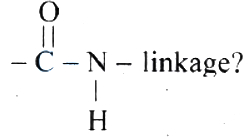
A
$PAN$
B
Nylon $6$
C
Nylon $6,6$
D
Nylon $2,6$
Solution
(A) The chemical structures of the given polymers are as follows:
$1$. $PAN$ (Polyacrylonitrile): The monomer is acrylonitrile,$CH_2=CH-CN$. The polymer structure is $[-CH_2-CH(CN)-]_n$. It contains a nitrogen atom in the cyano group $(-CN)$.
$2$. Nylon $6$: It is a polyamide formed from caprolactam. Its structure is $[-CO-(CH_2)_5-NH-]_n$. It contains nitrogen in the amide linkage $(-CONH-)$.
$3$. Nylon $6,6$: It is a polyamide formed from hexamethylenediamine and adipic acid. Its structure is $[-NH-(CH_2)_6-NH-CO-(CH_2)_4-CO-]_n$. It contains nitrogen in the amide linkage.
$4$. Nylon $2-6$: It is a polyamide copolymer of glycine and aminocaproic acid. It contains nitrogen in the amide linkage.
Wait,re-evaluating the question: $PAN$ (Polyacrylonitrile) contains a nitrogen atom in the $-CN$ group. Let us re-examine the options. All listed polymers contain nitrogen. However,in the context of typical chemistry problems,$PAN$ is often contrasted with polyamides. If the question specifically asks for the absence of an $N$ atom,there might be a typo in the question or options. Given the options,all contain $N$. If we assume the question implies the absence of an amide linkage $(-CONH-)$,then $PAN$ is the correct answer as it contains a nitrile group $(-CN)$ instead of an amide group.
$1$. $PAN$ (Polyacrylonitrile): The monomer is acrylonitrile,$CH_2=CH-CN$. The polymer structure is $[-CH_2-CH(CN)-]_n$. It contains a nitrogen atom in the cyano group $(-CN)$.
$2$. Nylon $6$: It is a polyamide formed from caprolactam. Its structure is $[-CO-(CH_2)_5-NH-]_n$. It contains nitrogen in the amide linkage $(-CONH-)$.
$3$. Nylon $6,6$: It is a polyamide formed from hexamethylenediamine and adipic acid. Its structure is $[-NH-(CH_2)_6-NH-CO-(CH_2)_4-CO-]_n$. It contains nitrogen in the amide linkage.
$4$. Nylon $2-6$: It is a polyamide copolymer of glycine and aminocaproic acid. It contains nitrogen in the amide linkage.
Wait,re-evaluating the question: $PAN$ (Polyacrylonitrile) contains a nitrogen atom in the $-CN$ group. Let us re-examine the options. All listed polymers contain nitrogen. However,in the context of typical chemistry problems,$PAN$ is often contrasted with polyamides. If the question specifically asks for the absence of an $N$ atom,there might be a typo in the question or options. Given the options,all contain $N$. If we assume the question implies the absence of an amide linkage $(-CONH-)$,then $PAN$ is the correct answer as it contains a nitrile group $(-CN)$ instead of an amide group.
0 likesView Solution
420
ChemistryMediumMCQMHT CET · 2024
Identify the polymer used to obtain disposable cups and plates.
A
$LDPE$
B
Polypropylene
C
$HDPE$
D
Polystyrene
Solution
(D) Polystyrene is a polymer made up of monomeric units of aromatic styrene molecules.
Polystyrene is widely used to manufacture foam-based products,including disposable cups and plates,due to its lightweight and insulating properties.
Polystyrene is widely used to manufacture foam-based products,including disposable cups and plates,due to its lightweight and insulating properties.
0 likesView Solution
421
ChemistryMediumMCQMHT CET · 2024
Which of the following polymers needs $HO-CH_2-CH_2-OH$ as one of the monomers for its preparation?
A
Nylon $6,6$
B
Dacron
C
Polyacrylamide
D
Buna-$N$
Solution
(B) The monomer $HO-CH_2-CH_2-OH$ is known as ethylene glycol.
It is used in the preparation of Dacron (also known as Terylene).
Dacron is a polyester formed by the condensation polymerization of ethylene glycol and terephthalic acid in the presence of a zinc acetate-antimony trioxide catalyst at $420-460 \ K$.
The reaction is: $n \ HO-CH_2-CH_2-OH + n \ HOOC-C_6H_4-COOH \rightarrow [-O-CH_2-CH_2-O-CO-C_6H_4-CO-]_n + 2n \ H_2O$.
It is used in the preparation of Dacron (also known as Terylene).
Dacron is a polyester formed by the condensation polymerization of ethylene glycol and terephthalic acid in the presence of a zinc acetate-antimony trioxide catalyst at $420-460 \ K$.
The reaction is: $n \ HO-CH_2-CH_2-OH + n \ HOOC-C_6H_4-COOH \rightarrow [-O-CH_2-CH_2-O-CO-C_6H_4-CO-]_n + 2n \ H_2O$.
0 likesView Solution
422
ChemistryMediumMCQMHT CET · 2024
Which of the following polymers is a urea-formaldehyde resin?
A
$[NH-CO-NH-CH_2]_n$
B
$[CH(C_6H_5)-CH_2]_n$
C
$[CH_2-CH(CONH_2)-CO]_n$
D
$[NH(CH_2)_5CO]_n$
Solution
(A) The urea-formaldehyde resin is a thermosetting polymer formed by the condensation polymerization of urea $(NH_2CONH_2)$ and formaldehyde $(HCHO)$.
The reaction involves the formation of methylol urea derivatives,which then undergo further condensation to form a cross-linked network structure.
The repeating unit of the linear polymer chain formed during the process is represented as $[NH-CO-NH-CH_2]_n$.
Therefore,the correct option is $A$.
The reaction involves the formation of methylol urea derivatives,which then undergo further condensation to form a cross-linked network structure.
The repeating unit of the linear polymer chain formed during the process is represented as $[NH-CO-NH-CH_2]_n$.
Therefore,the correct option is $A$.
0 likesView Solution
423
ChemistryMediumMCQMHT CET · 2024
Which of the following polymers is classified as a fibre?
A
Polyesters
B
Vulcanized rubber
C
Polythene
D
Polyvinyls
Solution
(A) Polymers are classified into different types based on their intermolecular forces,such as elastomers,fibres,thermoplastic polymers,and thermosetting polymers.
- $Fibres$ are thread-forming solids which possess high tensile strength and high modulus.
- $Polyesters$ (such as polyethylene terephthalate or $PET$) are classic examples of fibres because they have strong intermolecular forces like hydrogen bonding or dipole-dipole interactions,which allow them to be drawn into long,thin threads for textile applications.
- $Vulcanized$ $rubber$ is an elastomer,while $Polythene$ and $Polyvinyls$ are thermoplastic polymers.
- $Fibres$ are thread-forming solids which possess high tensile strength and high modulus.
- $Polyesters$ (such as polyethylene terephthalate or $PET$) are classic examples of fibres because they have strong intermolecular forces like hydrogen bonding or dipole-dipole interactions,which allow them to be drawn into long,thin threads for textile applications.
- $Vulcanized$ $rubber$ is an elastomer,while $Polythene$ and $Polyvinyls$ are thermoplastic polymers.
0 likesView Solution
424
ChemistryMediumMCQMHT CET · 2024
What is the highest oxidation state of third row transition elements?
A
$5$
B
$6$
C
$7$
D
$8$
Solution
(D) The third row transition elements belong to the $5d$ series.
Among these,Ruthenium $(Ru)$ and Osmium $(Os)$ exhibit the highest oxidation state of $+8$.
This is observed in compounds like $RuO_4$ and $OsO_4$.
Among these,Ruthenium $(Ru)$ and Osmium $(Os)$ exhibit the highest oxidation state of $+8$.
This is observed in compounds like $RuO_4$ and $OsO_4$.
0 likesView Solution
425
ChemistryEasyMCQMHT CET · 2024
What is the oxidation state of the central metal ion in the $\left[ Fe(CN)_6 \right]^{4-}$ complex?
A
$2$
B
$-6$
C
$-4$
D
$3$
Solution
(A) Let the oxidation state of $Fe$ be $x$.
In the complex $\left[ Fe(CN)_6 \right]^{4-}$,the charge on the $CN^-$ ligand is $-1$.
Therefore,the equation is: $x + 6(-1) = -4$.
$x - 6 = -4$.
$x = +2$.
Thus,the oxidation state of $Fe$ is $+2$.
In the complex $\left[ Fe(CN)_6 \right]^{4-}$,the charge on the $CN^-$ ligand is $-1$.
Therefore,the equation is: $x + 6(-1) = -4$.
$x - 6 = -4$.
$x = +2$.
Thus,the oxidation state of $Fe$ is $+2$.
0 likesView Solution
426
ChemistryMediumMCQMHT CET · 2024
Which from the following solids exhibits isotropic properties?
A
Diamond
B
Graphite
C
Sodium
D
Metallic glass
Solution
(D) Amorphous solids are isotropic in nature,meaning they exhibit the same magnitude for physical properties like refractive index,electrical conductivity,etc.,in every direction.
Metallic glass is an amorphous solid.
Therefore,it is isotropic in nature.
Metallic glass is an amorphous solid.
Therefore,it is isotropic in nature.
0 likesView Solution
427
ChemistryEasyMCQMHT CET · 2024
Which of the following statements is $NOT$ true regarding a crystalline solid?
A
There is a regularity and periodicity in the arrangement of constituent particles.
B
It is isotropic.
C
It melts at a definite temperature.
D
It has different magnitudes for refractive index in every direction.
Solution
(B) Crystalline solids are anisotropic in nature,meaning their physical properties such as refractive index,thermal conductivity,and electrical conductivity vary when measured in different directions. Therefore,the statement that a crystalline solid is isotropic is incorrect.
0 likesView Solution
428
ChemistryEasyMCQMHT CET · 2024
Identify a zero dimensional nano structure from the following.
A
Nanorods
B
Nanoparticles
C
Thin films
D
Fibres
Solution
(B) $(1)$ Nanorods: $1D$ structure: Elongated in one dimension (length),confined in the other two (width and height).
$(2)$ Nanoparticles: $0D$ structure: No elongation in any dimension,confined in all directions (usually spherical).
$(3)$ Thin films: $2D$ structure: Thin in one dimension (thickness) but extends in the other two (length and width).
$(4)$ Fibres: $1D$ structure: Elongated in one dimension (length),confined in the other two.
$(2)$ Nanoparticles: $0D$ structure: No elongation in any dimension,confined in all directions (usually spherical).
$(3)$ Thin films: $2D$ structure: Thin in one dimension (thickness) but extends in the other two (length and width).
$(4)$ Fibres: $1D$ structure: Elongated in one dimension (length),confined in the other two.
0 likesView Solution
429
ChemistryDifficultMCQMHT CET · 2024
Calculate the number of atoms in $0.3 \ g$ of a metal if it forms a $bcc$ structure,given that $[\rho \times a^3 = 3 \times 10^{-22} \ g]$.
A
$1.0 \times 10^{21}$
B
$2.0 \times 10^{21}$
C
$3.0 \times 10^{21}$
D
$4.0 \times 10^{21}$
Solution
(B) For a $bcc$ unit cell,the number of atoms per unit cell is $n = 2$.
The mass of one unit cell is given by the product of density $(\rho)$ and volume $(a^3)$,which is $\rho \times a^3 = 3 \times 10^{-22} \ g$.
The number of unit cells in $0.3 \ g$ of the metal is $\frac{\text{Total mass}}{\text{Mass of one unit cell}} = \frac{0.3 \ g}{3 \times 10^{-22} \ g} = 1.0 \times 10^{21}$ unit cells.
Since each $bcc$ unit cell contains $2$ atoms,the total number of atoms is $2 \times (1.0 \times 10^{21}) = 2.0 \times 10^{21}$ atoms.
The mass of one unit cell is given by the product of density $(\rho)$ and volume $(a^3)$,which is $\rho \times a^3 = 3 \times 10^{-22} \ g$.
The number of unit cells in $0.3 \ g$ of the metal is $\frac{\text{Total mass}}{\text{Mass of one unit cell}} = \frac{0.3 \ g}{3 \times 10^{-22} \ g} = 1.0 \times 10^{21}$ unit cells.
Since each $bcc$ unit cell contains $2$ atoms,the total number of atoms is $2 \times (1.0 \times 10^{21}) = 2.0 \times 10^{21}$ atoms.
0 likesView Solution
430
ChemistryEasyMCQMHT CET · 2024
Which among the following is an example of a one-dimensional nanostructure?
A
Nano rings
B
Nano tubes
C
Layers and coatings
D
Quantum dots
Solution
(B) One-dimensional nanomaterial: In one-dimensional nanomaterial,one dimension is outside the nanoscale range,while two dimensions are within the nanoscale range. This can be visualized as a wire. Examples of $1D$ nanomaterials include nanotubes,nanorods,and nanowires.
0 likesView Solution
431
ChemistryEasyMCQMHT CET · 2024
Identify the instrument used to determine the crystal structure from the following:
A
$X$-ray diffractometer
B
$UV$-Visible spectrophotometer
C
Scanning electron microscope
D
Transmission electron microscope
Solution
(A) $X$-Ray Diffraction $(XRD)$:
- It is an experimental technique used to determine the atomic and molecular structure of a crystal,where the crystalline lattice causes an incident beam of $X$-rays to diffract into many specific directions.
- It is primarily used to obtain the three-dimensional molecular structure of a crystal.
- $A$ purified sample at high concentration is crystallized,and these crystals are exposed to an $X$-ray beam to analyze the diffraction pattern.
- It is an experimental technique used to determine the atomic and molecular structure of a crystal,where the crystalline lattice causes an incident beam of $X$-rays to diffract into many specific directions.
- It is primarily used to obtain the three-dimensional molecular structure of a crystal.
- $A$ purified sample at high concentration is crystallized,and these crystals are exposed to an $X$-ray beam to analyze the diffraction pattern.
0 likesView Solution
432
ChemistryEasyMCQMHT CET · 2024
$A$ compound is formed by two elements $A$ and $B$. The atoms of element $B$ form $ccp$ structure. The atoms of $A$ occupy $1/3$ of tetrahedral voids. What is the formula of the compound?
A
$A_2B_3$
B
$AB$
C
$AB_2$
D
$AB_3$
Solution
(A) The atoms of element $B$ form $ccp$ structure. Let the number of $B$ atoms be $n$.
The number of tetrahedral voids generated is $2n$.
The atoms of element $A$ occupy $1/3$ of these tetrahedral voids.
Hence,the number of $A$ atoms $= 2n \times 1/3 = 2n/3$.
The ratio of $A$ atoms to $B$ atoms is $(2n/3) : n = 2/3 : 1 = 2 : 3$.
Therefore,the formula of the compound is $A_2B_3$.
The number of tetrahedral voids generated is $2n$.
The atoms of element $A$ occupy $1/3$ of these tetrahedral voids.
Hence,the number of $A$ atoms $= 2n \times 1/3 = 2n/3$.
The ratio of $A$ atoms to $B$ atoms is $(2n/3) : n = 2/3 : 1 = 2 : 3$.
Therefore,the formula of the compound is $A_2B_3$.
0 likesView Solution
433
ChemistryMediumMCQMHT CET · 2024
What type of solid is silica?
A
Ionic
B
Covalent
C
Molecular
D
Metallic
Solution
(B) Silica $(SiO_2)$ is a covalent solid (also known as a network solid).
In this structure,silicon and oxygen atoms are held together by strong covalent bonds in a continuous three-dimensional network.
This extensive bonding results in high hardness and a very high melting point for silica.
In this structure,silicon and oxygen atoms are held together by strong covalent bonds in a continuous three-dimensional network.
This extensive bonding results in high hardness and a very high melting point for silica.
0 likesView Solution
434
ChemistryMediumMCQMHT CET · 2024
Calculate the edge length of $fcc$ unit cell if the radius of the metal atom is $139 \ pm$.
A
$2.78 \times 10^{-8} \ cm$
B
$3.21 \times 10^{-8} \ cm$
C
$3.93 \times 10^{-8} \ cm$
D
$6.95 \times 10^{-8} \ cm$
Solution
(C) For an $fcc$ unit cell, the relationship between the edge length $a$ and the atomic radius $r$ is given by $\sqrt{2} a = 4 r$.
Rearranging for $a$, we get $a = 2 \sqrt{2} r$.
Given $r = 139 \ pm = 139 \times 10^{-10} \ cm$.
Substituting the values: $a = 2 \times 1.414 \times 139 \ pm = 393.1 \ pm$.
Converting to centimeters: $a = 393.1 \times 10^{-10} \ cm = 3.93 \times 10^{-8} \ cm$.
Rearranging for $a$, we get $a = 2 \sqrt{2} r$.
Given $r = 139 \ pm = 139 \times 10^{-10} \ cm$.
Substituting the values: $a = 2 \times 1.414 \times 139 \ pm = 393.1 \ pm$.
Converting to centimeters: $a = 393.1 \times 10^{-10} \ cm = 3.93 \times 10^{-8} \ cm$.
0 likesView Solution
435
ChemistryDifficultMCQMHT CET · 2024
Calculate the volume of the unit cell of an element having a molar mass of $27 \ g \ mol^{-1}$ that forms an $fcc$ unit cell. Given: $\rho \cdot N_{A} = 16.0 \times 10^{23} \ g \ cm^{-3} \ mol^{-1}$.
A
$7.50 \times 10^{-23} \ cm^3$
B
$6.75 \times 10^{-23} \ cm^3$
C
$5.75 \times 10^{-23} \ cm^3$
D
$8.25 \times 10^{-23} \ cm^3$
Solution
(B) For an $fcc$ unit cell,the number of atoms per unit cell is $n = 4$.
The formula for density is $\rho = \frac{n \times M}{a^3 \times N_{A}}$,where $a^3$ is the volume of the unit cell $(V)$.
Rearranging the formula to solve for $V$: $V = a^3 = \frac{n \times M}{\rho \times N_{A}}$.
Substituting the given values: $V = \frac{4 \times 27 \ g \ mol^{-1}}{16.0 \times 10^{23} \ g \ cm^{-3} \ mol^{-1}}$.
$V = \frac{108}{16.0 \times 10^{23}} \ cm^3 = 6.75 \times 10^{-23} \ cm^3$.
The formula for density is $\rho = \frac{n \times M}{a^3 \times N_{A}}$,where $a^3$ is the volume of the unit cell $(V)$.
Rearranging the formula to solve for $V$: $V = a^3 = \frac{n \times M}{\rho \times N_{A}}$.
Substituting the given values: $V = \frac{4 \times 27 \ g \ mol^{-1}}{16.0 \times 10^{23} \ g \ cm^{-3} \ mol^{-1}}$.
$V = \frac{108}{16.0 \times 10^{23}} \ cm^3 = 6.75 \times 10^{-23} \ cm^3$.
0 likesView Solution
436
ChemistryMediumMCQMHT CET · 2024
What is the total number of particles present in a $bcc$ unit cell?
A
$1$
B
$2$
C
$3$
D
$4$
Solution
(B) In a $bcc$ unit cell,there are $8$ corner atoms,each contributing $\frac{1}{8}$ to the unit cell,and $1$ body-centered atom,which contributes $1$ to the unit cell.
Total number of particles = $(\frac{1}{8} \times 8) + 1 = 1 + 1 = 2$.
Total number of particles = $(\frac{1}{8} \times 8) + 1 = 1 + 1 = 2$.
0 likesView Solution
437
ChemistryEasyMCQMHT CET · 2024
Calculate the number of unit cells in $10.8 \ g$ of metal,given that $\rho a^3 = 7.2 \times 10^{-22} \ g$.
A
$1.5 \times 10^{22}$
B
$3.0 \times 10^{22}$
C
$4.5 \times 10^{22}$
D
$6.0 \times 10^{22}$
Solution
(A) The mass of the metal is $m = 10.8 \ g$.
The mass of one unit cell is given by the product of density $(\rho)$ and volume $(a^3)$,which is $\rho a^3 = 7.2 \times 10^{-22} \ g$.
The number of unit cells is calculated by dividing the total mass of the metal by the mass of one unit cell:
$\text{Number of unit cells} = \frac{m}{\rho a^3} = \frac{10.8 \ g}{7.2 \times 10^{-22} \ g} = 1.5 \times 10^{22}$.
The mass of one unit cell is given by the product of density $(\rho)$ and volume $(a^3)$,which is $\rho a^3 = 7.2 \times 10^{-22} \ g$.
The number of unit cells is calculated by dividing the total mass of the metal by the mass of one unit cell:
$\text{Number of unit cells} = \frac{m}{\rho a^3} = \frac{10.8 \ g}{7.2 \times 10^{-22} \ g} = 1.5 \times 10^{22}$.
0 likesView Solution
438
ChemistryEasyMCQMHT CET · 2024
Calculate the radius of an atom of metal if it forms a simple cubic unit cell with an edge length of $380 \ pm$. (in $pm$)
A
$285.0$
B
$67.2$
C
$190.0$
D
$82.3$
Solution
(C) For a simple cubic unit cell, the relationship between the edge length $(a)$ and the atomic radius $(r)$ is given by $a = 2r$.
Given edge length $(a) = 380 \ pm$.
Therefore, the radius $(r) = \frac{a}{2} = \frac{380 \ pm}{2} = 190 \ pm$.
Given edge length $(a) = 380 \ pm$.
Therefore, the radius $(r) = \frac{a}{2} = \frac{380 \ pm}{2} = 190 \ pm$.
0 likesView Solution
439
ChemistryMediumMCQMHT CET · 2024
Calculate the volume occupied by all atoms in a $bcc$ unit cell if the volume of the unit cell is $1.5 \times 10^{-22} \ cm^3$.
A
$2.40 \times 10^{-22} \ cm^3$
B
$3.51 \times 10^{-22} \ cm^3$
C
$1.56 \times 10^{-22} \ cm^3$
D
$1.02 \times 10^{-22} \ cm^3$
Solution
(D) $bcc$ unit cell contains $2$ atoms per unit cell.
The packing efficiency of a $bcc$ unit cell is $68\%$,which means $68\%$ of the total volume of the unit cell is occupied by the atoms.
Volume occupied by atoms $= 0.68 \times \text{Volume of unit cell}$.
Volume occupied by atoms $= 0.68 \times 1.5 \times 10^{-22} \ cm^3 = 1.02 \times 10^{-22} \ cm^3$.
The packing efficiency of a $bcc$ unit cell is $68\%$,which means $68\%$ of the total volume of the unit cell is occupied by the atoms.
Volume occupied by atoms $= 0.68 \times \text{Volume of unit cell}$.
Volume occupied by atoms $= 0.68 \times 1.5 \times 10^{-22} \ cm^3 = 1.02 \times 10^{-22} \ cm^3$.
0 likesView Solution
440
ChemistryEasyMCQMHT CET · 2024
What is the coordination number of a particle in $hcp$ structure?
A
$2$
B
$4$
C
$6$
D
$12$
Solution
(D) In $hcp$ structures,each sphere is surrounded by $12$ neighbouring spheres: $6$ in its own layer,$3$ in the layer above,and $3$ in the layer below.
Therefore,the coordination number of any sphere in an $hcp$ structure is $12$.
Therefore,the coordination number of any sphere in an $hcp$ structure is $12$.
0 likesView Solution
441
ChemistryMediumMCQMHT CET · 2024
Calculate the density of an element having molar mass $63 \ g \ mol^{-1}$ that forms $FCC$ structure $\left[a^3 \times N_{A} = 28 \ cm^3 \ mol^{-1}\right]$ (in $g \ cm^{-3}$)
A
$6.0$
B
$9.0$
C
$5.0$
D
$7.0$
Solution
(B) For an $FCC$ lattice,the number of atoms per unit cell is $n = 4$.
The formula for density $\rho$ is given by $\rho = \frac{M \times n}{a^3 \times N_{A}}$.
Substituting the given values: $\rho = \frac{63 \ g \ mol^{-1} \times 4}{28 \ cm^3 \ mol^{-1}}$.
$\rho = \frac{252}{28} \ g \ cm^{-3} = 9.0 \ g \ cm^{-3}$.
The formula for density $\rho$ is given by $\rho = \frac{M \times n}{a^3 \times N_{A}}$.
Substituting the given values: $\rho = \frac{63 \ g \ mol^{-1} \times 4}{28 \ cm^3 \ mol^{-1}}$.
$\rho = \frac{252}{28} \ g \ cm^{-3} = 9.0 \ g \ cm^{-3}$.
0 likesView Solution
442
ChemistryEasyMCQMHT CET · 2024
Calculate the volume of the unit cell of an element having a molar mass of $63.5 \ g \ mol^{-1}$ that forms an $fcc$ structure $\left[\varrho \times N_{A} = 5.5 \times 10^{24} \ g \ cm^{-3} \ mol^{-1}\right]$.
A
$4.102 \times 10^{-25} \ cm^3$
B
$5.430 \times 10^{-23} \ cm^3$
C
$5.014 \times 10^{-23} \ cm^3$
D
$4.618 \times 10^{-23} \ cm^3$
Solution
(D) The density formula for a unit cell is given by $\rho = \frac{n \times M}{a^3 \times N_{A}}$.
Here,$n$ is the number of atoms per unit cell for an $fcc$ structure,which is $4$.
$M$ is the molar mass,given as $63.5 \ g \ mol^{-1}$.
The volume of the unit cell is $V = a^3$.
Rearranging the formula,we get $a^3 = \frac{n \times M}{\rho \times N_{A}}$.
Substituting the given values: $a^3 = \frac{4 \times 63.5}{5.5 \times 10^{24}}$.
$a^3 = \frac{254}{5.5 \times 10^{24}} = 4.618 \times 10^{-23} \ cm^3$.
Here,$n$ is the number of atoms per unit cell for an $fcc$ structure,which is $4$.
$M$ is the molar mass,given as $63.5 \ g \ mol^{-1}$.
The volume of the unit cell is $V = a^3$.
Rearranging the formula,we get $a^3 = \frac{n \times M}{\rho \times N_{A}}$.
Substituting the given values: $a^3 = \frac{4 \times 63.5}{5.5 \times 10^{24}}$.
$a^3 = \frac{254}{5.5 \times 10^{24}} = 4.618 \times 10^{-23} \ cm^3$.
0 likesView Solution
443
ChemistryMediumMCQMHT CET · 2024
Find the void volume of a $bcc$ unit cell in $cm^3$ if the volume of the unit cell is $1.5 \times 10^{-22} \ cm^3$.
A
$4.8 \times 10^{-23}$
B
$3.6 \times 10^{-23}$
C
$2.4 \times 10^{-23}$
D
$1.2 \times 10^{-23}$
Solution
(A) The volume of the unit cell is given as $V_{total} = 1.5 \times 10^{-22} \ cm^3$.
In a $bcc$ (body-centered cubic) unit cell,the packing efficiency is $68 \%$.
Therefore,the percentage of void volume is $100 \% - 68 \% = 32 \%$.
Void volume $= 32 \% \text{ of } V_{total} = 0.32 \times 1.5 \times 10^{-22} \ cm^3$.
Void volume $= 0.48 \times 10^{-22} \ cm^3 = 4.8 \times 10^{-23} \ cm^3$.
In a $bcc$ (body-centered cubic) unit cell,the packing efficiency is $68 \%$.
Therefore,the percentage of void volume is $100 \% - 68 \% = 32 \%$.
Void volume $= 32 \% \text{ of } V_{total} = 0.32 \times 1.5 \times 10^{-22} \ cm^3$.
Void volume $= 0.48 \times 10^{-22} \ cm^3 = 4.8 \times 10^{-23} \ cm^3$.
0 likesView Solution
444
ChemistryEasyMCQMHT CET · 2024
Calculate the radius of a metal atom if it forms a $bcc$ unit cell having an edge length of $530 \ pm$. (in $pm$)
A
$229.5$
B
$187.4$
C
$459.0$
D
$265.2$
Solution
(A) For a $bcc$ unit cell, the relationship between edge length $a$ and atomic radius $r$ is given by $a = \frac{4r}{\sqrt{3}}$.
Rearranging for $r$, we get $r = \frac{a \sqrt{3}}{4}$.
Substituting the given value $a = 530 \ pm$:
$r = \frac{530 \times \sqrt{3}}{4} \approx \frac{530 \times 1.732}{4} = \frac{917.96}{4} \approx 229.5 \ pm$.
Therefore, the radius of the metal atom is $229.5 \ pm$.
Rearranging for $r$, we get $r = \frac{a \sqrt{3}}{4}$.
Substituting the given value $a = 530 \ pm$:
$r = \frac{530 \times \sqrt{3}}{4} \approx \frac{530 \times 1.732}{4} = \frac{917.96}{4} \approx 229.5 \ pm$.
Therefore, the radius of the metal atom is $229.5 \ pm$.
0 likesView Solution
445
ChemistryMediumMCQMHT CET · 2024
Calculate the molar mass of an element having a density of $8.6 \ g \ cm^{-3}$ if it forms a $bcc$ structure $[a^3 \times N_{A} = 22.0 \ cm^3 \ mol^{-1}]$.
A
$106.18 \ g \ mol^{-1}$
B
$94.6 \ g \ mol^{-1}$
C
$88.25 \ g \ mol^{-1}$
D
$80.16 \ g \ mol^{-1}$
Solution
(B) For a $bcc$ unit cell,the number of atoms per unit cell is $n = 2$.
The formula for density $(\rho)$ is $\rho = \frac{M \times n}{a^3 \times N_{A}}$.
Given: $\rho = 8.6 \ g \ cm^{-3}$ and $a^3 \times N_{A} = 22.0 \ cm^3 \ mol^{-1}$.
Substituting the values: $8.6 \ g \ cm^{-3} = \frac{M \times 2}{22.0 \ cm^3 \ mol^{-1}}$.
Therefore,$M = \frac{8.6 \times 22.0}{2} = \frac{189.2}{2} = 94.6 \ g \ mol^{-1}$.
The formula for density $(\rho)$ is $\rho = \frac{M \times n}{a^3 \times N_{A}}$.
Given: $\rho = 8.6 \ g \ cm^{-3}$ and $a^3 \times N_{A} = 22.0 \ cm^3 \ mol^{-1}$.
Substituting the values: $8.6 \ g \ cm^{-3} = \frac{M \times 2}{22.0 \ cm^3 \ mol^{-1}}$.
Therefore,$M = \frac{8.6 \times 22.0}{2} = \frac{189.2}{2} = 94.6 \ g \ mol^{-1}$.
0 likesView Solution
446
ChemistryMediumMCQMHT CET · 2024
What is the total number of different types of unit cells present in the triclinic crystal system?
A
$1$
B
$2$
C
$3$
D
$4$
Solution
(A) The triclinic crystal system is one of the seven crystal systems in crystallography. In this system,the unit cell is characterized by the least symmetry: all three sides have different lengths,and the angles between them are all different and not $90^{\circ}$.
Characteristics of the Triclinic System:
- The unit cell has $a \neq b \neq c$ (all sides are of different lengths).
- The angles between the axes are $\alpha \neq \beta \neq \gamma$,and all are not $90^{\circ}$.
There is only one type of unit cell in the triclinic system,which is the primitive (simple) unit cell. Due to the lack of symmetry,no other types of unit cells (like body-centered or face-centered) are possible.
Therefore,the total number of different types of unit cells present in the triclinic crystal system is $1$.
Characteristics of the Triclinic System:
- The unit cell has $a \neq b \neq c$ (all sides are of different lengths).
- The angles between the axes are $\alpha \neq \beta \neq \gamma$,and all are not $90^{\circ}$.
There is only one type of unit cell in the triclinic system,which is the primitive (simple) unit cell. Due to the lack of symmetry,no other types of unit cells (like body-centered or face-centered) are possible.
Therefore,the total number of different types of unit cells present in the triclinic crystal system is $1$.
0 likesView Solution
447
ChemistryDifficultMCQMHT CET · 2024
Calculate the void volume of a simple cubic unit cell if the volume of the unit cell is $5.5 \times 10^{-22} \ cm^3$.
A
$1.435 \times 10^{-22} \ cm^3$
B
$1.761 \times 10^{-22} \ cm^3$
C
$2.619 \times 10^{-22} \ cm^3$
D
$3.880 \times 10^{-22} \ cm^3$
Solution
(C) The packing efficiency of a simple cubic $(SCC)$ unit cell is $52.4 \%$.
Therefore,the void space (empty space) percentage is $100 \% - 52.4 \% = 47.6 \%$.
Given,the volume of the unit cell = $5.5 \times 10^{-22} \ cm^3$.
Void volume = $47.6 \% \text{ of } 5.5 \times 10^{-22} \ cm^3$.
Void volume = $\frac{47.6}{100} \times 5.5 \times 10^{-22} \ cm^3 = 2.618 \times 10^{-22} \ cm^3 \approx 2.619 \times 10^{-22} \ cm^3$.
Therefore,the void space (empty space) percentage is $100 \% - 52.4 \% = 47.6 \%$.
Given,the volume of the unit cell = $5.5 \times 10^{-22} \ cm^3$.
Void volume = $47.6 \% \text{ of } 5.5 \times 10^{-22} \ cm^3$.
Void volume = $\frac{47.6}{100} \times 5.5 \times 10^{-22} \ cm^3 = 2.618 \times 10^{-22} \ cm^3 \approx 2.619 \times 10^{-22} \ cm^3$.
0 likesView Solution
448
ChemistryEasyMCQMHT CET · 2024
What is the total number of atoms present in an $fcc$ unit cell?
A
$2$
B
$4$
C
$6$
D
$1$
Solution
(B) In a face-centered cubic $(fcc)$ unit cell,atoms are present at the corners and at the centers of each face.
Number of atoms at corners $= 8 \times \frac{1}{8} = 1$.
Number of atoms at face centers $= 6 \times \frac{1}{2} = 3$.
Total number of atoms $= 1 + 3 = 4$.
Number of atoms at corners $= 8 \times \frac{1}{8} = 1$.
Number of atoms at face centers $= 6 \times \frac{1}{2} = 3$.
Total number of atoms $= 1 + 3 = 4$.
0 likesView Solution
449
ChemistryMediumMCQMHT CET · 2024
What is the relation between edge length $a$ and the total volume occupied by atoms in a $BCC$ unit cell?
A
$V = \frac{\pi a^3}{6}$
B
$V = \frac{\sqrt{3} \pi a^3}{8}$
C
$V = \frac{\pi a^3}{3 \sqrt{2}}$
D
$V = \frac{\pi a^3}{16}$
Solution
(B) In a $BCC$ (Body-Centered Cubic) unit cell,the number of atoms per unit cell $(Z)$ is $2$.
The radius $(r)$ of the atom is related to the edge length $(a)$ by the formula $r = \frac{\sqrt{3}a}{4}$.
The volume of one atom is $V_{atom} = \frac{4}{3} \pi r^3$.
The total volume occupied by atoms $(V)$ is $Z \times V_{atom} = 2 \times \frac{4}{3} \pi \left( \frac{\sqrt{3}a}{4} \right)^3$.
$V = \frac{8}{3} \pi \left( \frac{3 \sqrt{3} a^3}{64} \right) = \frac{\sqrt{3} \pi a^3}{8}$.
Thus,the correct option is $(B)$.
The radius $(r)$ of the atom is related to the edge length $(a)$ by the formula $r = \frac{\sqrt{3}a}{4}$.
The volume of one atom is $V_{atom} = \frac{4}{3} \pi r^3$.
The total volume occupied by atoms $(V)$ is $Z \times V_{atom} = 2 \times \frac{4}{3} \pi \left( \frac{\sqrt{3}a}{4} \right)^3$.
$V = \frac{8}{3} \pi \left( \frac{3 \sqrt{3} a^3}{64} \right) = \frac{\sqrt{3} \pi a^3}{8}$.
Thus,the correct option is $(B)$.
0 likesView Solution
450
ChemistryMediumMCQMHT CET · 2024
Calculate the volume of the unit cell when a metal having a density of $1 \ g \ cm^{-3}$ and a molar mass of $23 \ g \ mol^{-1}$ crystallizes to form a $bcc$ structure.
A
$6.0 \times 10^{-23} \ cm^3$
B
$8.6 \times 10^{-23} \ cm^3$
C
$9.5 \times 10^{-23} \ cm^3$
D
$7.6 \times 10^{-23} \ cm^3$
Solution
(D) For a $bcc$ unit cell,the number of atoms per unit cell,$n = 2$.
The formula for density is $\rho = \frac{M \times n}{a^3 \times N_A}$.
The volume of the unit cell is $a^3 = \frac{M \times n}{\rho \times N_A}$.
Substituting the given values: $a^3 = \frac{23 \ g \ mol^{-1} \times 2}{1 \ g \ cm^{-3} \times 6.022 \times 10^{23} \ mol^{-1}}$.
$a^3 = \frac{46}{6.022 \times 10^{23}} \ cm^3 \approx 7.638 \times 10^{-23} \ cm^3$.
Thus,the volume is approximately $7.6 \times 10^{-23} \ cm^3$.
The formula for density is $\rho = \frac{M \times n}{a^3 \times N_A}$.
The volume of the unit cell is $a^3 = \frac{M \times n}{\rho \times N_A}$.
Substituting the given values: $a^3 = \frac{23 \ g \ mol^{-1} \times 2}{1 \ g \ cm^{-3} \times 6.022 \times 10^{23} \ mol^{-1}}$.
$a^3 = \frac{46}{6.022 \times 10^{23}} \ cm^3 \approx 7.638 \times 10^{-23} \ cm^3$.
Thus,the volume is approximately $7.6 \times 10^{-23} \ cm^3$.
0 likesView Solution
Vedclass Products
For Students
Vedclass Test Series
Mock tests in real MHT CET style covering Chemistry with performance analysis. 5-day free trial.
Start Free TrialFor Teachers
Exam Paper Generator
Generate Set A/B/C/D Chemistry papers from 7.5L+ questions in 2 minutes. 3 chapters free.
Try FreeFor Institutes
Online Exam Module
Run live MHT CET mock exams with unlimited students, 360° analytics & white-label branding.
See DemoFrequently Asked Questions
How many Chemistry questions are in MHT CET 2024?
There are 900 Chemistry questions from the MHT CET 2024 paper on Vedclass, each with a detailed step-by-step solution in English.
Are MHT CET 2024 Chemistry solutions available in English?
Yes. All solutions on this page are in English. You can also switch to English or Hindi using the language buttons above the questions.
Can I practice MHT CET 2024 Chemistry as a timed test?
Yes. Use the Vedclass Test Series to attempt a full MHT CET mock test covering Chemistry with time limits and instant score analysis.
Can teachers create Chemistry papers from MHT CET previous year questions?
Yes. The Vedclass Exam Paper Generator lets teachers mix MHT CET Chemistry questions and generate Set A/B/C/D papers in minutes.
For Teachers & Institutes
Build a Custom Chemistry Paper
Pick MHT CET 2024 Chemistry questions, set difficulty, and generate Set A/B/C/D in 2 minutes.