
ChemistryQ301–400 of 900 questions
Page 7 of 10 · English
301
ChemistryMediumMCQMHT CET · 2024
Which from the following defines enthalpy of a system?
A
Ratio of pressure to volume
B
Product of pressure and volume
C
Internal energy $(U)$ + $PV$
D
Internal energy $(U)$ - $PV$
Solution
(C) - $(1)$ Ratio of pressure to volume: This is incorrect. The ratio of pressure to volume is not related to enthalpy.
- $(2)$ Product of pressure and volume: This is also incorrect. The product of $P$ and $V$ is part of the enthalpy formula but does not define it by itself.
- $(3)$ Internal energy $(U)$ + $PV$: This is the correct definition of enthalpy. Enthalpy $(H)$ is defined as the sum of internal energy $(U)$ and the product of pressure $(P)$ and volume $(V)$,i.e.,$H = U + PV$.
- $(4)$ Internal energy $(U)$ - $PV$: This is incorrect. Enthalpy involves adding,not subtracting,$PV$ from internal energy.
- $(2)$ Product of pressure and volume: This is also incorrect. The product of $P$ and $V$ is part of the enthalpy formula but does not define it by itself.
- $(3)$ Internal energy $(U)$ + $PV$: This is the correct definition of enthalpy. Enthalpy $(H)$ is defined as the sum of internal energy $(U)$ and the product of pressure $(P)$ and volume $(V)$,i.e.,$H = U + PV$.
- $(4)$ Internal energy $(U)$ - $PV$: This is incorrect. Enthalpy involves adding,not subtracting,$PV$ from internal energy.
0 likesView Solution
302
ChemistryMediumMCQMHT CET · 2024
One mole of a gas occupying $3 \ L$ volume is expanded against a constant external pressure of $1 \ bar$ to a volume of $15 \ L$. Calculate the work done by the system.
A
$1.200 \times 10^3 \ J$
B
$-2.43 \times 10^3 \ J$
C
$-1.200 \times 10^3 \ J$
D
$2.43 \times 10^3 \ J$
Solution
(C) The formula for work done during expansion against constant external pressure is $W = -P_{ext} \Delta V$.
Given: $P_{ext} = 1 \ bar$,$V_1 = 3 \ L$,$V_2 = 15 \ L$.
Change in volume $\Delta V = V_2 - V_1 = 15 \ L - 3 \ L = 12 \ L$.
Since $1 \ L \ bar = 100 \ J$,we have $\Delta V = 12 \ dm^3$.
$W = -1 \ bar \times (15 \ L - 3 \ L) = -12 \ L \ bar$.
Converting to Joules: $W = -12 \ L \ bar \times 100 \ \frac{J}{L \ bar} = -1200 \ J = -1.200 \times 10^3 \ J$.
Given: $P_{ext} = 1 \ bar$,$V_1 = 3 \ L$,$V_2 = 15 \ L$.
Change in volume $\Delta V = V_2 - V_1 = 15 \ L - 3 \ L = 12 \ L$.
Since $1 \ L \ bar = 100 \ J$,we have $\Delta V = 12 \ dm^3$.
$W = -1 \ bar \times (15 \ L - 3 \ L) = -12 \ L \ bar$.
Converting to Joules: $W = -12 \ L \ bar \times 100 \ \frac{J}{L \ bar} = -1200 \ J = -1.200 \times 10^3 \ J$.
0 likesView Solution
303
ChemistryEasyMCQMHT CET · 2024
Two moles of an ideal gas is expanded isothermally from a volume of $300 \ cm^3$ to $2.5 \ dm^3$ at $298 \ K$ against a constant pressure of $1.9 \ bar$. Calculate the work done in joules. (in $J$)
A
$-418$
B
$-565$
C
$-918$
D
$-950$
Solution
(A) The work done in an irreversible isothermal expansion against constant external pressure is given by the formula: $W = -P_{ext} \Delta V$.
Given:
$V_1 = 300 \ cm^3 = 0.3 \ dm^3$ (since $1 \ dm^3 = 1000 \ cm^3$).
$V_2 = 2.5 \ dm^3$.
$P_{ext} = 1.9 \ bar$.
$\Delta V = V_2 - V_1 = 2.5 \ dm^3 - 0.3 \ dm^3 = 2.2 \ dm^3$.
$W = -1.9 \ bar \times 2.2 \ dm^3 = -4.18 \ bar \cdot dm^3$.
Since $1 \ bar \cdot dm^3 = 100 \ J$,
$W = -4.18 \times 100 \ J = -418 \ J$.
Given:
$V_1 = 300 \ cm^3 = 0.3 \ dm^3$ (since $1 \ dm^3 = 1000 \ cm^3$).
$V_2 = 2.5 \ dm^3$.
$P_{ext} = 1.9 \ bar$.
$\Delta V = V_2 - V_1 = 2.5 \ dm^3 - 0.3 \ dm^3 = 2.2 \ dm^3$.
$W = -1.9 \ bar \times 2.2 \ dm^3 = -4.18 \ bar \cdot dm^3$.
Since $1 \ bar \cdot dm^3 = 100 \ J$,
$W = -4.18 \times 100 \ J = -418 \ J$.
0 likesView Solution
304
ChemistryMediumMCQMHT CET · 2024
What is the change in internal energy of the system when the work done by the system is $150 \ J$ and the system releases $300 \ J$ of heat?
A
$+450 \ J$
B
$-450 \ J$
C
$+300 \ J$
D
$-150 \ J$
Solution
(B) According to the first law of thermodynamics,the change in internal energy is given by $\Delta U = Q + W$.
Since the system releases heat,$Q = -300 \ J$.
Since work is done by the system,$W = -150 \ J$.
Therefore,$\Delta U = -300 \ J + (-150 \ J) = -450 \ J$.
Since the system releases heat,$Q = -300 \ J$.
Since work is done by the system,$W = -150 \ J$.
Therefore,$\Delta U = -300 \ J + (-150 \ J) = -450 \ J$.
0 likesView Solution
305
ChemistryEasyMCQMHT CET · 2024
$10 \ g$ each of $NH_3, N_2, Cl_2$ and $H_2S$ are expanded isothermally and reversibly at the same temperature. Identify the gas that performs maximum work.
A
$N_2$
B
$Cl_2$
C
$H_2S$
D
$NH_3$
Solution
(D) The work done in an isothermal reversible expansion is given by $W = -nRT \ln(\frac{V_2}{V_1})$.
Since $R, T, V_2,$ and $V_1$ are constant,$W \propto n$.
Given that the mass $(m)$ of each gas is $10 \ g$,the number of moles is $n = \frac{m}{M.W.}$,where $M.W.$ is the molecular weight.
Thus,$W \propto \frac{1}{M.W.}$.
The molecular weights are: $NH_3 = 17 \ g/mol$,$N_2 = 28 \ g/mol$,$Cl_2 = 71 \ g/mol$,and $H_2S = 34 \ g/mol$.
Since $NH_3$ has the lowest molecular weight,it will have the highest number of moles and therefore perform the maximum work.
Since $R, T, V_2,$ and $V_1$ are constant,$W \propto n$.
Given that the mass $(m)$ of each gas is $10 \ g$,the number of moles is $n = \frac{m}{M.W.}$,where $M.W.$ is the molecular weight.
Thus,$W \propto \frac{1}{M.W.}$.
The molecular weights are: $NH_3 = 17 \ g/mol$,$N_2 = 28 \ g/mol$,$Cl_2 = 71 \ g/mol$,and $H_2S = 34 \ g/mol$.
Since $NH_3$ has the lowest molecular weight,it will have the highest number of moles and therefore perform the maximum work.
0 likesView Solution
306
ChemistryEasyMCQMHT CET · 2024
$2 \ mol$ of an ideal gas are expanded isothermally and reversibly from $20 \ L$ to $40 \ L$ at $300 \ K$. Calculate work done. $(R=8.314 \ J \ K^{-1} \ mol^{-1})$ (in $J$)
A
$-5.713$
B
$-11.526$
C
$-16.939$
D
$-3457.97$
Solution
(D) Given:
$n = 2 \ mol$,
$R = 8.314 \ J \ K^{-1} \ mol^{-1}$,
$T = 300 \ K$,
$V_1 = 20 \ L$,
$V_2 = 40 \ L$.
Formula for work done in an isothermal reversible expansion:
$W = -2.303 \ n \ R \ T \ \log_{10}\left(\frac{V_2}{V_1}\right)$
Step $1$: Substitute the values:
$W = -2.303 \times 2 \times 8.314 \times 300 \times \log_{10}\left(\frac{40}{20}\right)$
Step $2$: Simplify the logarithmic term:
$\log_{10}(2) \approx 0.3010$
Step $3$: Calculate:
$W = -2.303 \times 2 \times 8.314 \times 300 \times 0.3010$
$W \approx -3457.97 \ J$
Thus,the work done is $-3457.97 \ J$.
$n = 2 \ mol$,
$R = 8.314 \ J \ K^{-1} \ mol^{-1}$,
$T = 300 \ K$,
$V_1 = 20 \ L$,
$V_2 = 40 \ L$.
Formula for work done in an isothermal reversible expansion:
$W = -2.303 \ n \ R \ T \ \log_{10}\left(\frac{V_2}{V_1}\right)$
Step $1$: Substitute the values:
$W = -2.303 \times 2 \times 8.314 \times 300 \times \log_{10}\left(\frac{40}{20}\right)$
Step $2$: Simplify the logarithmic term:
$\log_{10}(2) \approx 0.3010$
Step $3$: Calculate:
$W = -2.303 \times 2 \times 8.314 \times 300 \times 0.3010$
$W \approx -3457.97 \ J$
Thus,the work done is $-3457.97 \ J$.
0 likesView Solution
307
ChemistryMediumMCQMHT CET · 2024
Which of the following statements is true about internal energy?
A
It increases with an increase in temperature.
B
It decreases with an increase in temperature.
C
It remains constant on changing temperature.
D
It is not a state function.
Solution
(A) The internal energy of a substance increases with an increase in temperature due to the increase in rotational,translational,and vibrational energy of the molecules.
0 likesView Solution
308
ChemistryEasyMCQMHT CET · 2024
$A$ gas expands isothermally against a constant external pressure of $1 \ bar$ from $10 \ dm^3$ to $20 \ dm^3$ by absorbing $800 \ J$ of heat from the surroundings. Calculate the value of $\Delta U$. (in $J$)
A
$100$
B
$-200$
C
$200$
D
$-300$
Solution
(B) Given: $P_{ext} = 1 \ bar$,$V_1 = 10 \ dm^3$,$V_2 = 20 \ dm^3$,$Q = +800 \ J$ (heat absorbed by the system).
Work done during expansion is given by $W = -P_{ext} \Delta V = -P_{ext}(V_2 - V_1)$.
$W = -1 \ bar \times (20 \ dm^3 - 10 \ dm^3) = -10 \ dm^3 \ bar$.
Since $1 \ dm^3 \ bar = 100 \ J$,then $W = -10 \times 100 \ J = -1000 \ J$.
According to the first law of thermodynamics,$\Delta U = Q + W$.
$\Delta U = 800 \ J - 1000 \ J = -200 \ J$.
Work done during expansion is given by $W = -P_{ext} \Delta V = -P_{ext}(V_2 - V_1)$.
$W = -1 \ bar \times (20 \ dm^3 - 10 \ dm^3) = -10 \ dm^3 \ bar$.
Since $1 \ dm^3 \ bar = 100 \ J$,then $W = -10 \times 100 \ J = -1000 \ J$.
According to the first law of thermodynamics,$\Delta U = Q + W$.
$\Delta U = 800 \ J - 1000 \ J = -200 \ J$.
0 likesView Solution
309
ChemistryEasyMCQMHT CET · 2024
An ideal gas expands against a constant external pressure of $2 \ bar$ from $5 \ L$ to $8 \ L$ and absorbs $10 \ kJ$ of heat. What is $\Delta U$ of the system (in $J$)?
A
$10600$
B
$9400$
C
$-10600$
D
$-9400$
Solution
(B) The work done $(W)$ during expansion is given by $W = -P_{ext} \times \Delta V$.
Given $P_{ext} = 2 \ bar$,$V_1 = 5 \ L$,and $V_2 = 8 \ L$.
$W = -2 \ bar \times (8 \ L - 5 \ L) = -6 \ L \ bar$.
Since $1 \ L \ bar = 100 \ J$,$W = -6 \times 100 \ J = -600 \ J = -0.6 \ kJ$.
The heat absorbed $(Q)$ is $+10 \ kJ$.
According to the first law of thermodynamics,$\Delta U = Q + W$.
$\Delta U = 10 \ kJ + (-0.6 \ kJ) = 9.4 \ kJ$.
Converting to Joules,$\Delta U = 9.4 \times 1000 \ J = 9400 \ J$.
Given $P_{ext} = 2 \ bar$,$V_1 = 5 \ L$,and $V_2 = 8 \ L$.
$W = -2 \ bar \times (8 \ L - 5 \ L) = -6 \ L \ bar$.
Since $1 \ L \ bar = 100 \ J$,$W = -6 \times 100 \ J = -600 \ J = -0.6 \ kJ$.
The heat absorbed $(Q)$ is $+10 \ kJ$.
According to the first law of thermodynamics,$\Delta U = Q + W$.
$\Delta U = 10 \ kJ + (-0.6 \ kJ) = 9.4 \ kJ$.
Converting to Joules,$\Delta U = 9.4 \times 1000 \ J = 9400 \ J$.
0 likesView Solution
310
ChemistryEasyMCQMHT CET · 2024
$2$ moles of an ideal gas expands isothermally from $5$ $dm^3$ to $10$ $dm^3$ at a constant external pressure of $1.5$ bar. Calculate the work done.
A
$7.5$ $dm^3$ bar
B
$-7.5$ $dm^3$ bar
C
$22.5$ $dm^3$ bar
D
$-22.5$ $dm^3$ bar
Solution
(B) Given: $n = 2$ moles,$V_1 = 5$ $dm^3$,$V_2 = 10$ $dm^3$,$P_{ext} = 1.5$ bar.
The formula for work done in an irreversible isothermal expansion against constant external pressure is $W = -P_{ext} \Delta V$.
$\Delta V = V_2 - V_1 = 10$ $dm^3 - 5$ $dm^3 = 5$ $dm^3$.
$W = -1.5 \text{ bar} \times 5$ $dm^3 = -7.5$ $dm^3$ bar.
Thus,the work done is $-7.5$ $dm^3$ bar.
The formula for work done in an irreversible isothermal expansion against constant external pressure is $W = -P_{ext} \Delta V$.
$\Delta V = V_2 - V_1 = 10$ $dm^3 - 5$ $dm^3 = 5$ $dm^3$.
$W = -1.5 \text{ bar} \times 5$ $dm^3 = -7.5$ $dm^3$ bar.
Thus,the work done is $-7.5$ $dm^3$ bar.
0 likesView Solution
311
ChemistryMediumMCQMHT CET · 2024
Two moles of an ideal gas are compressed isothermally and reversibly from $40 \ L$ to $20 \ L$ at $300 \ K$. What is the work done (in $kJ$)? $(R=8.314 \ J \ K^{-1} \ mol^{-1})$
A
$3.46$
B
$4.16$
C
$2.08$
D
$6.12$
Solution
(A) For an isothermal reversible compression,the work done is given by the formula: $W = -2.303 \ nRT \log_{10} \frac{V_2}{V_1}$
Given: $n = 2 \ mol$,$T = 300 \ K$,$V_1 = 40 \ L$,$V_2 = 20 \ L$,$R = 8.314 \ J \ K^{-1} \ mol^{-1}$
Substituting the values: $W = -2.303 \times 2 \times 8.314 \times 300 \times \log_{10} \frac{20}{40}$
$W = -2.303 \times 2 \times 8.314 \times 300 \times \log_{10} (0.5)$
Since $\log_{10} (0.5) \approx -0.3010$:
$W = -2.303 \times 2 \times 8.314 \times 300 \times (-0.3010) \approx 3457.97 \ J$
Converting to $kJ$: $W \approx 3.46 \ kJ$
Since work is done on the system,the value is positive.
Given: $n = 2 \ mol$,$T = 300 \ K$,$V_1 = 40 \ L$,$V_2 = 20 \ L$,$R = 8.314 \ J \ K^{-1} \ mol^{-1}$
Substituting the values: $W = -2.303 \times 2 \times 8.314 \times 300 \times \log_{10} \frac{20}{40}$
$W = -2.303 \times 2 \times 8.314 \times 300 \times \log_{10} (0.5)$
Since $\log_{10} (0.5) \approx -0.3010$:
$W = -2.303 \times 2 \times 8.314 \times 300 \times (-0.3010) \approx 3457.97 \ J$
Converting to $kJ$: $W \approx 3.46 \ kJ$
Since work is done on the system,the value is positive.
0 likesView Solution
312
ChemistryMediumMCQMHT CET · 2024
Identify the process from the following such that the volume of the system remains constant.
A
adiabatic process
B
isochoric process
C
isothermal process
D
isobaric process
Solution
(B) Isochoric Process:
In an isochoric process,the change in volume of the thermodynamic system is zero.
Since the volume change is zero,the work done is also zero.
- Volume of the system = Constant
- Change in volume $\Delta V = 0$
- If $\Delta V = 0$,then work done $W = P \Delta V = 0$.
- According to the $1^{st}$ law of thermodynamics:
- $Q = \Delta U + W$
- Since $W = 0$,$Q = \Delta U$.
In an isochoric process,the change in volume of the thermodynamic system is zero.
Since the volume change is zero,the work done is also zero.
- Volume of the system = Constant
- Change in volume $\Delta V = 0$
- If $\Delta V = 0$,then work done $W = P \Delta V = 0$.
- According to the $1^{st}$ law of thermodynamics:
- $Q = \Delta U + W$
- Since $W = 0$,$Q = \Delta U$.
0 likesView Solution
313
ChemistryMediumMCQMHT CET · 2024
$100 \ mL$ of $H_{2(g)}$ and $100 \ mL$ of $Cl_{2(g)}$ were allowed to react at $1 \ bar$ pressure as: $H_{2(g)} + Cl_{2(g)} \longrightarrow 2 HCl_{(g)}$. What will be the $PV$ type of work done during the reaction?
A
$0 \ J$
B
$+10 \ J$
C
$-10 \ J$
D
$-100 \ J$
Solution
(A) The balanced chemical equation is: $H_{2(g)} + Cl_{2(g)} \longrightarrow 2 HCl_{(g)}$.
According to Avogadro's Law,at constant temperature and pressure,the volume of gases is proportional to the number of moles.
Initial volume of reactants: $V_1 = 100 \ mL (H_2) + 100 \ mL (Cl_2) = 200 \ mL$.
Final volume of products: $V_2 = 200 \ mL (HCl)$.
Change in volume: $\Delta V = V_2 - V_1 = 200 \ mL - 200 \ mL = 0 \ mL = 0 \ dm^3$.
Work done $(W)$ is given by: $W = -P_{ext} \Delta V$.
Since $\Delta V = 0$,$W = -1 \ bar \times 0 \ dm^3 = 0 \ J$.
According to Avogadro's Law,at constant temperature and pressure,the volume of gases is proportional to the number of moles.
Initial volume of reactants: $V_1 = 100 \ mL (H_2) + 100 \ mL (Cl_2) = 200 \ mL$.
Final volume of products: $V_2 = 200 \ mL (HCl)$.
Change in volume: $\Delta V = V_2 - V_1 = 200 \ mL - 200 \ mL = 0 \ mL = 0 \ dm^3$.
Work done $(W)$ is given by: $W = -P_{ext} \Delta V$.
Since $\Delta V = 0$,$W = -1 \ bar \times 0 \ dm^3 = 0 \ J$.
0 likesView Solution
314
ChemistryEasyMCQMHT CET · 2024
In a particular reaction,'$x$' $kJ$ of heat is released by the system and '$y$' $kJ$ of work is done on the system. What is the internal energy change?
A
$x - y \ kJ$
B
$y - x \ kJ$
C
$x + y \ kJ$
D
$xy \ kJ$
Solution
(B) According to the sign convention for the first law of thermodynamics:
Heat released by the system,$Q = -x \ kJ$.
Work done on the system,$W = +y \ kJ$.
The change in internal energy is given by $\Delta U = Q + W$.
Substituting the values: $\Delta U = -x + y \ kJ = (y - x) \ kJ$.
Heat released by the system,$Q = -x \ kJ$.
Work done on the system,$W = +y \ kJ$.
The change in internal energy is given by $\Delta U = Q + W$.
Substituting the values: $\Delta U = -x + y \ kJ = (y - x) \ kJ$.
0 likesView Solution
315
ChemistryEasyMCQMHT CET · 2024
Find the constant external pressure required to expand a gas from $2.5 \ L$ to $4.5 \ L$ if the amount of work done is $500 \ J$ at $298 \ K$. (in $bar$)
A
$1$
B
$2.0$
C
$1.5$
D
$2.5$
Solution
(D) Given: $V_1 = 2.5 \ L$,$V_2 = 4.5 \ L$,$W = -500 \ J$.
Since $100 \ J = 1 \ L \ bar$,then $W = -500 \ J = -5 \ L \ bar$.
The formula for work done in expansion is $W = -P_{ext} \Delta V$.
Substituting the values: $-5 \ L \ bar = -P_{ext} \times (4.5 \ L - 2.5 \ L)$.
$-5 \ L \ bar = -P_{ext} \times (2.0 \ L)$.
$P_{ext} = \frac{5 \ L \ bar}{2.0 \ L} = 2.5 \ bar$.
Since $100 \ J = 1 \ L \ bar$,then $W = -500 \ J = -5 \ L \ bar$.
The formula for work done in expansion is $W = -P_{ext} \Delta V$.
Substituting the values: $-5 \ L \ bar = -P_{ext} \times (4.5 \ L - 2.5 \ L)$.
$-5 \ L \ bar = -P_{ext} \times (2.0 \ L)$.
$P_{ext} = \frac{5 \ L \ bar}{2.0 \ L} = 2.5 \ bar$.
0 likesView Solution
316
ChemistryEasyMCQMHT CET · 2024
$A$ system performs mechanical work equal to $15 \ kJ$ and loses $2 \ kJ$ of heat to the surroundings. What is the change in internal energy of the system (in $kJ$)?
A
$-15$
B
$-17$
C
$13$
D
$19$
Solution
(B) According to the first law of thermodynamics,the change in internal energy is given by $\Delta U = Q + W$.
Since the system performs work,$W = -15 \ kJ$.
Since the system loses heat to the surroundings,$Q = -2 \ kJ$.
Therefore,$\Delta U = -2 \ kJ + (-15 \ kJ) = -17 \ kJ$.
Since the system performs work,$W = -15 \ kJ$.
Since the system loses heat to the surroundings,$Q = -2 \ kJ$.
Therefore,$\Delta U = -2 \ kJ + (-15 \ kJ) = -17 \ kJ$.
0 likesView Solution
317
ChemistryEasyMCQMHT CET · 2024
Find the work done on $2 \ mol$ of an ideal gas at $27^{\circ} C$ if it is compressed reversibly and isothermally from $5.05 \times 10^6 \ Nm^{-2}$ to $1.01 \times 10^5 \ Nm^{-2}$ pressure. (in $kJ$)
A
$19.52$
B
$1.95$
C
$39.04$
D
$3.904$
Solution
(A) For a reversible isothermal process,the work done $W$ is given by $W = -2.303 \ nRT \ \log_{10}\left(\frac{P_1}{P_2}\right)$.
Given: $n = 2 \ mol$,$T = 27 + 273 = 300 \ K$,$P_1 = 5.05 \times 10^6 \ Nm^{-2}$,$P_2 = 1.01 \times 10^5 \ Nm^{-2}$,$R = 8.314 \ J \ K^{-1} \ mol^{-1}$.
Substituting the values: $W = -2.303 \times 2 \times 8.314 \times 300 \times \log_{10}\left(\frac{5.05 \times 10^6}{1.01 \times 10^5}\right)$.
$W = -2.303 \times 2 \times 8.314 \times 300 \times \log_{10}(50)$.
$W = -2.303 \times 2 \times 8.314 \times 300 \times 1.699 \approx -19520 \ J = -19.52 \ kJ$.
The negative sign indicates work is done by the system during expansion,but the question asks for work done $ON$ the system during compression. Note: The pressure values provided imply expansion $(P_1 > P_2)$. If compressed,$P_2 > P_1$. Assuming the magnitude is requested: $19.52 \ kJ$.
Given: $n = 2 \ mol$,$T = 27 + 273 = 300 \ K$,$P_1 = 5.05 \times 10^6 \ Nm^{-2}$,$P_2 = 1.01 \times 10^5 \ Nm^{-2}$,$R = 8.314 \ J \ K^{-1} \ mol^{-1}$.
Substituting the values: $W = -2.303 \times 2 \times 8.314 \times 300 \times \log_{10}\left(\frac{5.05 \times 10^6}{1.01 \times 10^5}\right)$.
$W = -2.303 \times 2 \times 8.314 \times 300 \times \log_{10}(50)$.
$W = -2.303 \times 2 \times 8.314 \times 300 \times 1.699 \approx -19520 \ J = -19.52 \ kJ$.
The negative sign indicates work is done by the system during expansion,but the question asks for work done $ON$ the system during compression. Note: The pressure values provided imply expansion $(P_1 > P_2)$. If compressed,$P_2 > P_1$. Assuming the magnitude is requested: $19.52 \ kJ$.
0 likesView Solution
318
ChemistryEasyMCQMHT CET · 2024
Calculate the internal energy change of a system if the work done by the system is $8 \ J$ and the heat supplied to it is $40 \ J$. (in $J$)
A
$-48$
B
$-40$
C
$32$
D
$24$
Solution
(C) According to the first law of thermodynamics,the change in internal energy $(\Delta U)$ is given by the equation: $\Delta U = q + w$.
Here,the heat supplied to the system $(q)$ is $+40 \ J$.
Since work is done by the system,the work done $(w)$ is $-8 \ J$.
Substituting these values into the equation: $\Delta U = 40 \ J + (-8 \ J) = 32 \ J$.
Here,the heat supplied to the system $(q)$ is $+40 \ J$.
Since work is done by the system,the work done $(w)$ is $-8 \ J$.
Substituting these values into the equation: $\Delta U = 40 \ J + (-8 \ J) = 32 \ J$.
0 likesView Solution
319
ChemistryMediumMCQMHT CET · 2024
Calculate the enthalpy change for the following reaction:
$H_2C=CH_{2(g)} + H_{2(g)} \longrightarrow H_3C-CH_{3(g)}$
[The bond energies of $C-H, C-C, C=C$ and $H-H$ are $414, 347, 615$ and $435 \ kJ/mol$ respectively.] (in $kJ$)
$H_2C=CH_{2(g)} + H_{2(g)} \longrightarrow H_3C-CH_{3(g)}$
[The bond energies of $C-H, C-C, C=C$ and $H-H$ are $414, 347, 615$ and $435 \ kJ/mol$ respectively.] (in $kJ$)
A
$-125$
B
$125$
C
$250$
D
$-250$
Solution
(A) For the reaction:
$H_2C=CH_{2(g)} + H_{2(g)} \longrightarrow H_3C-CH_{3(g)}$
$\Delta_{r}H^{\circ} = \sum \Delta H_{\text{bonds broken}} - \sum \Delta H_{\text{bonds formed}}$
$\Delta_{r}H^{\circ} = [4 \times \Delta H_{(C-H)} + 1 \times \Delta H_{(C=C)} + 1 \times \Delta H_{(H-H)}] - [6 \times \Delta H_{(C-H)} + 1 \times \Delta H_{(C-C)}]$
$\Delta_{r}H^{\circ} = [4 \times 414 + 615 + 435] - [6 \times 414 + 347]$
$\Delta_{r}H^{\circ} = [1656 + 615 + 435] - [2484 + 347]$
$\Delta_{r}H^{\circ} = 2706 - 2831 = -125 \ kJ$
$H_2C=CH_{2(g)} + H_{2(g)} \longrightarrow H_3C-CH_{3(g)}$
$\Delta_{r}H^{\circ} = \sum \Delta H_{\text{bonds broken}} - \sum \Delta H_{\text{bonds formed}}$
$\Delta_{r}H^{\circ} = [4 \times \Delta H_{(C-H)} + 1 \times \Delta H_{(C=C)} + 1 \times \Delta H_{(H-H)}] - [6 \times \Delta H_{(C-H)} + 1 \times \Delta H_{(C-C)}]$
$\Delta_{r}H^{\circ} = [4 \times 414 + 615 + 435] - [6 \times 414 + 347]$
$\Delta_{r}H^{\circ} = [1656 + 615 + 435] - [2484 + 347]$
$\Delta_{r}H^{\circ} = 2706 - 2831 = -125 \ kJ$
0 likesView Solution
320
ChemistryEasyMCQMHT CET · 2024
Which of the following is true for the value of $\Delta H - \Delta U$ at constant volume?
A
$R$
B
Zero
C
$\frac{3}{2} R$
D
$\frac{5}{2} R$
Solution
(B) The relationship between enthalpy change and internal energy change is given by $\Delta H = \Delta U + \Delta(PV)$.
At constant volume,$\Delta V = 0$.
Since $\Delta V = 0$,the work done $P \Delta V = 0$.
Therefore,$\Delta H = \Delta U$,which implies $\Delta H - \Delta U = 0$.
At constant volume,$\Delta V = 0$.
Since $\Delta V = 0$,the work done $P \Delta V = 0$.
Therefore,$\Delta H = \Delta U$,which implies $\Delta H - \Delta U = 0$.
0 likesView Solution
321
ChemistryEasyMCQMHT CET · 2024
What is the value of the standard enthalpy of formation of dihydrogen $(H_2)$?
A
$436.4 \ kJ/mol$
B
$0 \ kJ/mol$
C
$100.3 \ kJ/mol$
D
$200.5 \ kJ/mol$
Solution
(B) By definition,the standard enthalpy of formation of any element in its most stable state at standard conditions ($298 \ K$ and $1 \ bar$) is defined as zero.
Since dihydrogen $(H_2)$ is an element in its standard state,its standard enthalpy of formation is $0 \ kJ/mol$.
Since dihydrogen $(H_2)$ is an element in its standard state,its standard enthalpy of formation is $0 \ kJ/mol$.
0 likesView Solution
322
ChemistryMediumMCQMHT CET · 2024
If the bond formation energy of the $H-H$ bond is $-433 \ kJ \ mol^{-1}$,find the bond dissociation energy for $0.5 \ mol$ of $H_{2(g)}$. (in $kJ$)
A
$108.0$
B
$216.5$
C
$433.0$
D
$324.5$
Solution
(B) The bond dissociation energy is the energy required to break one mole of bonds in a gaseous substance.
For the reaction $H_{2(g)} \longrightarrow 2H_{(g)}$,the enthalpy change $\Delta_{r} H^{\circ}$ is equal to the bond dissociation energy.
Since the bond formation energy of $H-H$ is $-433 \ kJ \ mol^{-1}$,the bond dissociation energy for $1 \ mol$ of $H_{2(g)}$ is $+433 \ kJ \ mol^{-1}$.
Therefore,the bond dissociation energy for $0.5 \ mol$ of $H_{2(g)}$ is $0.5 \ mol \times 433 \ kJ \ mol^{-1} = 216.5 \ kJ$.
For the reaction $H_{2(g)} \longrightarrow 2H_{(g)}$,the enthalpy change $\Delta_{r} H^{\circ}$ is equal to the bond dissociation energy.
Since the bond formation energy of $H-H$ is $-433 \ kJ \ mol^{-1}$,the bond dissociation energy for $1 \ mol$ of $H_{2(g)}$ is $+433 \ kJ \ mol^{-1}$.
Therefore,the bond dissociation energy for $0.5 \ mol$ of $H_{2(g)}$ is $0.5 \ mol \times 433 \ kJ \ mol^{-1} = 216.5 \ kJ$.
0 likesView Solution
323
ChemistryMediumMCQMHT CET · 2024
Given that $C_{(g)} + 4H_{(g)} \longrightarrow CH_{4(g)}$,$\Delta H^{\circ} = -1665 \ kJ$. What is the bond energy per mole of $C-H$ bond?
A
$416.25 \ kJ \ mol^{-1}$
B
$-416.25 \ kJ \ mol^{-1}$
C
$832.5 \ kJ \ mol^{-1}$
D
$-832.5 \ kJ \ mol^{-1}$
Solution
(A) The reaction $C_{(g)} + 4H_{(g)} \longrightarrow CH_{4(g)}$ represents the formation of $4$ moles of $C-H$ bonds from gaseous atoms.
The enthalpy change $\Delta H^{\circ} = -1665 \ kJ$ corresponds to the energy released during the formation of these $4$ bonds.
Bond energy is defined as the energy required to break one mole of a specific bond.
$BE_{C-H} = \frac{|\Delta H^{\circ}|}{4} = \frac{1665 \ kJ}{4} = 416.25 \ kJ \ mol^{-1}$.
The enthalpy change $\Delta H^{\circ} = -1665 \ kJ$ corresponds to the energy released during the formation of these $4$ bonds.
Bond energy is defined as the energy required to break one mole of a specific bond.
$BE_{C-H} = \frac{|\Delta H^{\circ}|}{4} = \frac{1665 \ kJ}{4} = 416.25 \ kJ \ mol^{-1}$.
0 likesView Solution
324
ChemistryMediumMCQMHT CET · 2024
Find the value of $Q$ from the following equations:
$(i)$ $C_{(s)} + O_{2_{(g)}} \longrightarrow CO_{2_{(g)}}$ $\Delta H = Q \ kJ$
$(ii)$ $C_{(s)} + \frac{1}{2} O_{2_{(g)}} \longrightarrow CO_{(g)}$ $\Delta H = -x \ kJ$
$(iii)$ $CO_{(g)} + \frac{1}{2} O_{2_{(g)}} \longrightarrow CO_{2_{(g)}}$ $\Delta H = -y \ kJ$
$(i)$ $C_{(s)} + O_{2_{(g)}} \longrightarrow CO_{2_{(g)}}$ $\Delta H = Q \ kJ$
$(ii)$ $C_{(s)} + \frac{1}{2} O_{2_{(g)}} \longrightarrow CO_{(g)}$ $\Delta H = -x \ kJ$
$(iii)$ $CO_{(g)} + \frac{1}{2} O_{2_{(g)}} \longrightarrow CO_{2_{(g)}}$ $\Delta H = -y \ kJ$
A
$ -(x+y) \ kJ $
B
$ (x-y) \ kJ $
C
$ \frac{-x+y}{2} \ kJ $
D
$ \frac{x+y}{2} \ kJ $
Solution
(A) According to Hess's Law,the enthalpy change of a reaction is the sum of the enthalpy changes of the individual steps.
Adding equations $(ii)$ and $(iii)$:
$(ii)$ $C_{(s)} + \frac{1}{2} O_{2_{(g)}} \longrightarrow CO_{(g)}$ $\Delta H = -x \ kJ$
$(iii)$ $CO_{(g)} + \frac{1}{2} O_{2_{(g)}} \longrightarrow CO_{2_{(g)}}$ $\Delta H = -y \ kJ$
Summing these gives:
$C_{(s)} + \frac{1}{2} O_{2_{(g)}} + \frac{1}{2} O_{2_{(g)}} + CO_{(g)} - CO_{(g)}$ $\longrightarrow CO_{(g)} + CO_{2_{(g)}} - CO_{(g)}$
$C_{(s)} + O_{2_{(g)}} \longrightarrow CO_{2_{(g)}}$
Therefore,$Q = (-x) + (-y) = -(x+y) \ kJ$.
Adding equations $(ii)$ and $(iii)$:
$(ii)$ $C_{(s)} + \frac{1}{2} O_{2_{(g)}} \longrightarrow CO_{(g)}$ $\Delta H = -x \ kJ$
$(iii)$ $CO_{(g)} + \frac{1}{2} O_{2_{(g)}} \longrightarrow CO_{2_{(g)}}$ $\Delta H = -y \ kJ$
Summing these gives:
$C_{(s)} + \frac{1}{2} O_{2_{(g)}} + \frac{1}{2} O_{2_{(g)}} + CO_{(g)} - CO_{(g)}$ $\longrightarrow CO_{(g)} + CO_{2_{(g)}} - CO_{(g)}$
$C_{(s)} + O_{2_{(g)}} \longrightarrow CO_{2_{(g)}}$
Therefore,$Q = (-x) + (-y) = -(x+y) \ kJ$.
0 likesView Solution
325
ChemistryMediumMCQMHT CET · 2024
Calculate the heat required to convert $9 \ g$ of liquid water to water vapor using the following equations:
$H_{2(g)} + 1/2 O_{2(g)} \longrightarrow H_2O_{(g)} \quad \Delta H = -57 \ kCal$
$H_{2(g)} + 1/2 O_{2(g)} \longrightarrow H_2O_{(l)} \quad \Delta H = -68.3 \ kCal$ (in $kCal$)
$H_{2(g)} + 1/2 O_{2(g)} \longrightarrow H_2O_{(g)} \quad \Delta H = -57 \ kCal$
$H_{2(g)} + 1/2 O_{2(g)} \longrightarrow H_2O_{(l)} \quad \Delta H = -68.3 \ kCal$ (in $kCal$)
A
$5.65$
B
$6.28$
C
$7.05$
D
$9.72$
Solution
(A) Step $1$: Determine the enthalpy of vaporization $(\Delta H_{vap})$ for $1 \ mol$ of water.
Subtract the second equation from the first:
$H_2O_{(l)} \longrightarrow H_2O_{(g)} \quad \Delta H_{vap} = (-57 \ kCal) - (-68.3 \ kCal) = 11.3 \ kCal/mol$.
Step $2$: Calculate the number of moles in $9 \ g$ of water.
Molar mass of $H_2O = 18 \ g/mol$.
$\text{Moles} = \frac{9 \ g}{18 \ g/mol} = 0.5 \ mol$.
Step $3$: Calculate the total heat required.
$\text{Heat} = \text{Moles} \times \Delta H_{vap} = 0.5 \ mol \times 11.3 \ kCal/mol = 5.65 \ kCal$.
Therefore,the correct option is $A$.
Subtract the second equation from the first:
$H_2O_{(l)} \longrightarrow H_2O_{(g)} \quad \Delta H_{vap} = (-57 \ kCal) - (-68.3 \ kCal) = 11.3 \ kCal/mol$.
Step $2$: Calculate the number of moles in $9 \ g$ of water.
Molar mass of $H_2O = 18 \ g/mol$.
$\text{Moles} = \frac{9 \ g}{18 \ g/mol} = 0.5 \ mol$.
Step $3$: Calculate the total heat required.
$\text{Heat} = \text{Moles} \times \Delta H_{vap} = 0.5 \ mol \times 11.3 \ kCal/mol = 5.65 \ kCal$.
Therefore,the correct option is $A$.
0 likesView Solution
326
ChemistryMediumMCQMHT CET · 2024
For the reaction,$C_3H_{8(g)} + 5O_{2(g)} \longrightarrow 3CO_{2(g)} + 4H_2O_{(l)}$ at constant temperature,$\Delta H - \Delta U$ is:
A
$-2RT$
B
$RT$
C
$-3RT$
D
$3RT$
Solution
(C) The relationship between enthalpy change $(\Delta H)$ and internal energy change $(\Delta U)$ is given by the equation: $\Delta H = \Delta U + \Delta n_g RT$.
Rearranging this equation,we get: $\Delta H - \Delta U = \Delta n_g RT$.
For the given reaction: $C_3H_{8(g)} + 5O_{2(g)} \longrightarrow 3CO_{2(g)} + 4H_2O_{(l)}$.
$\Delta n_g$ is the difference between the number of moles of gaseous products and gaseous reactants.
$\Delta n_g = (n_{products, g}) - (n_{reactants, g}) = 3 - (1 + 5) = 3 - 6 = -3$.
Substituting the value of $\Delta n_g$ into the equation: $\Delta H - \Delta U = -3RT$.
Rearranging this equation,we get: $\Delta H - \Delta U = \Delta n_g RT$.
For the given reaction: $C_3H_{8(g)} + 5O_{2(g)} \longrightarrow 3CO_{2(g)} + 4H_2O_{(l)}$.
$\Delta n_g$ is the difference between the number of moles of gaseous products and gaseous reactants.
$\Delta n_g = (n_{products, g}) - (n_{reactants, g}) = 3 - (1 + 5) = 3 - 6 = -3$.
Substituting the value of $\Delta n_g$ into the equation: $\Delta H - \Delta U = -3RT$.
0 likesView Solution
327
ChemistryEasyMCQMHT CET · 2024
For the reaction,$2 H_{2(g)} + O_{2(g)} \longrightarrow 2 H_2 O_{(g)}$,$\Delta H^{\circ} = -573.2 \ kJ$. What is the heat of decomposition of water per mol (in $kJ$)?
A
$28.66$
B
$143.3$
C
$286.6$
D
$573.2$
Solution
(C) The given reaction is: $2 H_{2(g)} + O_{2(g)} \longrightarrow 2 H_2 O_{(g)}$,$\Delta H^{\circ} = -573.2 \ kJ$.
This represents the enthalpy of formation for $2 \ mol$ of water vapor.
To find the heat of decomposition for $1 \ mol$ of water,we reverse the reaction and divide by $2$:
$2 H_2 O_{(g)} \longrightarrow 2 H_{2(g)} + O_{2(g)}$,$\Delta H^{\circ} = +573.2 \ kJ$.
For $1 \ mol$ of water:
$H_2 O_{(g)} \longrightarrow H_{2(g)} + \frac{1}{2} O_{2(g)}$,$\Delta H^{\circ} = \frac{573.2}{2} \ kJ = 286.6 \ kJ$.
Thus,the heat of decomposition is $286.6 \ kJ \ mol^{-1}$.
This represents the enthalpy of formation for $2 \ mol$ of water vapor.
To find the heat of decomposition for $1 \ mol$ of water,we reverse the reaction and divide by $2$:
$2 H_2 O_{(g)} \longrightarrow 2 H_{2(g)} + O_{2(g)}$,$\Delta H^{\circ} = +573.2 \ kJ$.
For $1 \ mol$ of water:
$H_2 O_{(g)} \longrightarrow H_{2(g)} + \frac{1}{2} O_{2(g)}$,$\Delta H^{\circ} = \frac{573.2}{2} \ kJ = 286.6 \ kJ$.
Thus,the heat of decomposition is $286.6 \ kJ \ mol^{-1}$.
0 likesView Solution
328
ChemistryMediumMCQMHT CET · 2024
Identify the factor from the following on which the heat of reaction does not depend.
A
Physical states of reactants and products.
B
Total number of steps in which the reaction occurs.
C
Temperature of the reaction.
D
Whether the reaction is carried out at constant pressure or constant volume.
Solution
(B) The correct answer is $(B)$ Total number of steps in which the reaction occurs.
According to Hess's Law of Constant Heat Summation,the total enthalpy change $(\Delta H)$ for a chemical reaction is the same,whether the reaction takes place in one step or in several steps.
This is because enthalpy is a state function,meaning it depends only on the initial and final states of the system,not on the path taken.
Therefore,the heat of reaction does not depend on the number of steps involved.
According to Hess's Law of Constant Heat Summation,the total enthalpy change $(\Delta H)$ for a chemical reaction is the same,whether the reaction takes place in one step or in several steps.
This is because enthalpy is a state function,meaning it depends only on the initial and final states of the system,not on the path taken.
Therefore,the heat of reaction does not depend on the number of steps involved.
0 likesView Solution
329
ChemistryMediumMCQMHT CET · 2024
For an ideal gas,the heat of reaction at constant pressure and heat of reaction at constant volume are related by the equation:
A
$\Delta H = \Delta U + P \Delta V$
B
$U = H + P \Delta V$
C
$\Delta U = \Delta H + \frac{\Delta n}{RT}$
D
$\Delta H = \Delta U + \Delta nRT$
Solution
(D) For a chemical reaction,the heat of reaction at constant pressure is equal to the change in enthalpy,$\Delta H = q_p$.
The heat of reaction at constant volume is equal to the change in internal energy,$\Delta U = q_v$.
From the first law of thermodynamics,$\Delta H = \Delta U + \Delta(PV)$.
For an ideal gas,$PV = nRT$,so $\Delta(PV) = \Delta nRT$.
Therefore,the relationship is $\Delta H = \Delta U + \Delta nRT$.
The heat of reaction at constant volume is equal to the change in internal energy,$\Delta U = q_v$.
From the first law of thermodynamics,$\Delta H = \Delta U + \Delta(PV)$.
For an ideal gas,$PV = nRT$,so $\Delta(PV) = \Delta nRT$.
Therefore,the relationship is $\Delta H = \Delta U + \Delta nRT$.
0 likesView Solution
330
ChemistryMediumMCQMHT CET · 2024
Calculate the enthalpy change when $12 \ g$ of carbon reacts with sufficient hydrogen to form methane. If the enthalpy of formation of methane is $-75 \ kJ \ mol^{-1}$. (in $kJ$)
A
$-45$
B
$-60$
C
$-75$
D
$-90$
Solution
(C) The reaction for the formation of methane $(CH_4)$ from its constituent elements is:
$C_{(s)} + 2H_{2(g)} \rightarrow CH_{4(g)}$
Given the standard enthalpy of formation $(\Delta H_f^{\circ})$ of methane is $-75 \ kJ \ mol^{-1}$.
This means the formation of $1 \ mol$ of $CH_4$ releases $75 \ kJ$ of energy.
First,calculate the number of moles of carbon $(C)$ used:
$n = \frac{\text{mass}}{\text{molar mass}} = \frac{12 \ g}{12 \ g \ mol^{-1}} = 1 \ mol$
Since $1 \ mol$ of $C$ produces $1 \ mol$ of $CH_4$,the enthalpy change $(\Delta H)$ is:
$\Delta H = n \times \Delta H_f^{\circ} = 1 \ mol \times (-75 \ kJ \ mol^{-1}) = -75 \ kJ$
Therefore,the enthalpy change is $-75 \ kJ$.
$C_{(s)} + 2H_{2(g)} \rightarrow CH_{4(g)}$
Given the standard enthalpy of formation $(\Delta H_f^{\circ})$ of methane is $-75 \ kJ \ mol^{-1}$.
This means the formation of $1 \ mol$ of $CH_4$ releases $75 \ kJ$ of energy.
First,calculate the number of moles of carbon $(C)$ used:
$n = \frac{\text{mass}}{\text{molar mass}} = \frac{12 \ g}{12 \ g \ mol^{-1}} = 1 \ mol$
Since $1 \ mol$ of $C$ produces $1 \ mol$ of $CH_4$,the enthalpy change $(\Delta H)$ is:
$\Delta H = n \times \Delta H_f^{\circ} = 1 \ mol \times (-75 \ kJ \ mol^{-1}) = -75 \ kJ$
Therefore,the enthalpy change is $-75 \ kJ$.
0 likesView Solution
331
ChemistryMediumMCQMHT CET · 2024
Under similar conditions,the enthalpy of freezing is exactly opposite to:
A
enthalpy of fusion
B
enthalpy of vaporization
C
enthalpy of solution
D
enthalpy of atomization
Solution
(A) For the phase transition process,$H_2O_{(s)} \rightleftharpoons H_2O_{(l)}$.
Under similar conditions of $0^{\circ}C$ and $1 \ atm$ pressure,the enthalpy of fusion $(\Delta_{fus}H)$ is $+6.01 \ kJ \ mol^{-1}$.
The enthalpy of freezing $(\Delta_{free}H)$ is the reverse process,$H_2O_{(l)} \rightleftharpoons H_2O_{(s)}$,which has a value of $-6.01 \ kJ \ mol^{-1}$.
Thus,the enthalpy of freezing is exactly opposite to the enthalpy of fusion.
Under similar conditions of $0^{\circ}C$ and $1 \ atm$ pressure,the enthalpy of fusion $(\Delta_{fus}H)$ is $+6.01 \ kJ \ mol^{-1}$.
The enthalpy of freezing $(\Delta_{free}H)$ is the reverse process,$H_2O_{(l)} \rightleftharpoons H_2O_{(s)}$,which has a value of $-6.01 \ kJ \ mol^{-1}$.
Thus,the enthalpy of freezing is exactly opposite to the enthalpy of fusion.
0 likesView Solution
332
ChemistryMediumMCQMHT CET · 2024
Calculate the standard internal energy change for $OF_{2(g)} + H_2O_{(g)} \longrightarrow 2 HF_{(g)} + O_{2(g)}$ at $300 \ K$,if $\Delta_{f} H^{\circ}$ of $OF_{2(g)}$,$H_2O_{(g)}$,and $HF_{(g)}$ are $20$,$-250$,and $-270 \ kJ \ mol^{-1}$ respectively. $[R = 8.314 \ J \ K^{-1} \ mol^{-1}]$ (in $kJ$)
A
$-307.50$
B
$-342.48$
C
$-412.00$
D
$-214.48$
Solution
(A) First,calculate the standard enthalpy change $\Delta_{r} H^{\circ}$ for the reaction:
$\Delta_{r} H^{\circ} = [2 \times \Delta_{f} H^{\circ}(HF) + \Delta_{f} H^{\circ}(O_2)] - [\Delta_{f} H^{\circ}(OF_2) + \Delta_{f} H^{\circ}(H_2O)]$
$= [2 \times (-270) + 0] - [20 + (-250)] \ kJ \ mol^{-1}$
$= -540 - (-230) = -310 \ kJ \ mol^{-1} = -310000 \ J \ mol^{-1}$
Next,determine the change in the number of moles of gas $\Delta n_g$:
$\Delta n_g = (2 + 1) - (1 + 1) = 3 - 2 = 1$
Using the relation $\Delta H^{\circ} = \Delta U^{\circ} + \Delta n_g RT$,we find $\Delta U^{\circ}$:
$\Delta U^{\circ} = \Delta H^{\circ} - \Delta n_g RT$
$= -310000 \ J \ mol^{-1} - (1 \times 8.314 \ J \ K^{-1} \ mol^{-1} \times 300 \ K)$
$= -310000 - 2494.2 = -312494.2 \ J \ mol^{-1} \approx -312.49 \ kJ$
Note: Re-evaluating the calculation based on the provided options,the closest match is $-307.50 \ kJ$.
$\Delta_{r} H^{\circ} = [2 \times \Delta_{f} H^{\circ}(HF) + \Delta_{f} H^{\circ}(O_2)] - [\Delta_{f} H^{\circ}(OF_2) + \Delta_{f} H^{\circ}(H_2O)]$
$= [2 \times (-270) + 0] - [20 + (-250)] \ kJ \ mol^{-1}$
$= -540 - (-230) = -310 \ kJ \ mol^{-1} = -310000 \ J \ mol^{-1}$
Next,determine the change in the number of moles of gas $\Delta n_g$:
$\Delta n_g = (2 + 1) - (1 + 1) = 3 - 2 = 1$
Using the relation $\Delta H^{\circ} = \Delta U^{\circ} + \Delta n_g RT$,we find $\Delta U^{\circ}$:
$\Delta U^{\circ} = \Delta H^{\circ} - \Delta n_g RT$
$= -310000 \ J \ mol^{-1} - (1 \times 8.314 \ J \ K^{-1} \ mol^{-1} \times 300 \ K)$
$= -310000 - 2494.2 = -312494.2 \ J \ mol^{-1} \approx -312.49 \ kJ$
Note: Re-evaluating the calculation based on the provided options,the closest match is $-307.50 \ kJ$.
0 likesView Solution
333
ChemistryDifficultMCQMHT CET · 2024
Calculate the entropy change for melting $1 \ g$ of ice at $0^{\circ} C$ in $J \ g^{-1} K^{-1}$,if the heat of fusion of ice at $0^{\circ} C$ is $80 \ J \ g^{-1}$.
A
$0.039$
B
$0.293$
C
$8$
D
$27.3$
Solution
(B) The process of melting ice is a phase transition occurring at constant temperature and pressure,which is an equilibrium process.
For the process $H_2O_{(s)} \rightleftharpoons H_2O_{(l)}$,the entropy change is given by the formula $\Delta S = \frac{\Delta H_{\text{fusion}}}{T}$.
Given,heat of fusion $\Delta H_{\text{fusion}} = 80 \ J \ g^{-1}$.
Temperature $T = 0^{\circ} C = 273 \ K$.
Substituting the values,$\Delta S = \frac{80 \ J \ g^{-1}}{273 \ K} \approx 0.293 \ J \ g^{-1} K^{-1}$.
For the process $H_2O_{(s)} \rightleftharpoons H_2O_{(l)}$,the entropy change is given by the formula $\Delta S = \frac{\Delta H_{\text{fusion}}}{T}$.
Given,heat of fusion $\Delta H_{\text{fusion}} = 80 \ J \ g^{-1}$.
Temperature $T = 0^{\circ} C = 273 \ K$.
Substituting the values,$\Delta S = \frac{80 \ J \ g^{-1}}{273 \ K} \approx 0.293 \ J \ g^{-1} K^{-1}$.
0 likesView Solution
334
ChemistryMediumMCQMHT CET · 2024
Which of the following equations indicates an increase in entropy?
A
$CaO_{(s)} + CO_{2_{(g)}} \longrightarrow CaCO_{3_{(s)}}$
B
$NaCl_{(aq)} \longrightarrow NaCl_{(s)}$
C
$NaNO_{3_{(s)}} \longrightarrow Na^{+}_{(aq)} + NO_{3^{-(aq)}}$
D
$N_{2_{(g)}} + 3H_{2_{(g)}} \longrightarrow 2NH_{3_{(g)}}$
Solution
(C) Entropy $(S)$ is a measure of the randomness or disorder of a system.
In the reaction $NaNO_{3_{(s)}} \longrightarrow Na^{+}_{(aq)} + NO_{3^{-(aq)}}$,a solid substance dissolves to form aqueous ions.
The aqueous phase possesses higher disorder and randomness compared to the solid phase.
Therefore,the entropy of the system increases in this process.
In other options,either the number of gas moles decreases or the system transitions from a more disordered state to a more ordered state (like precipitation),leading to a decrease in entropy.
In the reaction $NaNO_{3_{(s)}} \longrightarrow Na^{+}_{(aq)} + NO_{3^{-(aq)}}$,a solid substance dissolves to form aqueous ions.
The aqueous phase possesses higher disorder and randomness compared to the solid phase.
Therefore,the entropy of the system increases in this process.
In other options,either the number of gas moles decreases or the system transitions from a more disordered state to a more ordered state (like precipitation),leading to a decrease in entropy.
0 likesView Solution
335
ChemistryEasyMCQMHT CET · 2024
The enthalpy of vaporisation of a liquid is $30 \ kJ \ mol^{-1}$ and entropy of vaporisation is $75 \ J \ K^{-1} \ mol^{-1}$. Calculate the boiling point of the liquid at $1 \ atm$. (in $K$)
A
$250$
B
$400$
C
$450$
D
$600$
Solution
(B) At the boiling point,the process of vaporisation is in equilibrium,so $\Delta G = 0$.
Using the relation $\Delta G = \Delta H - T\Delta S$,we get $\Delta H = T\Delta S$.
Therefore,$T = \frac{\Delta H}{\Delta S}$.
Given $\Delta H = 30 \ kJ \ mol^{-1} = 30000 \ J \ mol^{-1}$ and $\Delta S = 75 \ J \ K^{-1} \ mol^{-1}$.
$T = \frac{30000 \ J \ mol^{-1}}{75 \ J \ K^{-1} \ mol^{-1}} = 400 \ K$.
Using the relation $\Delta G = \Delta H - T\Delta S$,we get $\Delta H = T\Delta S$.
Therefore,$T = \frac{\Delta H}{\Delta S}$.
Given $\Delta H = 30 \ kJ \ mol^{-1} = 30000 \ J \ mol^{-1}$ and $\Delta S = 75 \ J \ K^{-1} \ mol^{-1}$.
$T = \frac{30000 \ J \ mol^{-1}}{75 \ J \ K^{-1} \ mol^{-1}} = 400 \ K$.
0 likesView Solution
336
ChemistryEasyMCQMHT CET · 2024
Which of the following equations relates the temperature of a reaction with $\Delta H^{\circ}$ and $\Delta S^{\circ}$ at equilibrium?
A
$\Delta H^{\circ} = \frac{T}{\Delta S^{\circ}}$
B
$\Delta H^{\circ} = \frac{\Delta S^{\circ}}{T}$
C
$\Delta H^{\circ} = T \Delta S^{\circ}$
D
$\Delta H^{\circ} = \frac{1}{T \Delta S^{\circ}}$
Solution
(C) At equilibrium,the change in Gibbs free energy $(\Delta G)$ is zero.
The relationship between enthalpy,entropy,and temperature is given by the equation: $\Delta G = \Delta H - T \Delta S$.
At equilibrium,$\Delta G = 0$.
Therefore,$0 = \Delta H - T \Delta S$.
Rearranging the terms,we get $\Delta H = T \Delta S$.
For standard conditions,this is expressed as $\Delta H^{\circ} = T \Delta S^{\circ}$.
The relationship between enthalpy,entropy,and temperature is given by the equation: $\Delta G = \Delta H - T \Delta S$.
At equilibrium,$\Delta G = 0$.
Therefore,$0 = \Delta H - T \Delta S$.
Rearranging the terms,we get $\Delta H = T \Delta S$.
For standard conditions,this is expressed as $\Delta H^{\circ} = T \Delta S^{\circ}$.
0 likesView Solution
337
ChemistryEasyMCQMHT CET · 2024
Calculate the Gibbs energy change for a reaction having $\Delta H = 31400 \ J$ and $\Delta S = 32 \ J \ K^{-1}$ at $1000^{\circ} C$. (in $J$)
A
$-4668$
B
$-9336$
C
$-4073$
D
$-2334$
Solution
(B) The temperature in Kelvin is $T = 1000 + 273 = 1273 \ K$.
The formula for Gibbs energy change is $\Delta G = \Delta H - T \Delta S$.
Substituting the given values: $\Delta G = 31400 \ J - (1273 \ K \times 32 \ J \ K^{-1})$.
$\Delta G = 31400 \ J - 40736 \ J$.
$\Delta G = -9336 \ J$.
The formula for Gibbs energy change is $\Delta G = \Delta H - T \Delta S$.
Substituting the given values: $\Delta G = 31400 \ J - (1273 \ K \times 32 \ J \ K^{-1})$.
$\Delta G = 31400 \ J - 40736 \ J$.
$\Delta G = -9336 \ J$.
0 likesView Solution
338
ChemistryEasyMCQMHT CET · 2024
For the reaction $CH_{4(g)} + H_{2(g)} \longrightarrow C_2H_{6(g)}$,$K_p = 3.356 \times 10^{17}$,calculate $\Delta G^{\circ}$ for the reaction at $298 \ K$.
A
$-90 \ kJ \ mol^{-1}$
B
$-100 \ kJ \ mol^{-1}$
C
$235.6 \ kJ \ mol^{-1}$
D
$33.56 \ kJ \ mol^{-1}$
Solution
(B) The relationship between standard Gibbs free energy change and the equilibrium constant is given by: $\Delta G^{\circ} = -RT \ln K_p = -2.303 \ RT \log_{10} K_p$
Given: $R = 8.314 \ J \ K^{-1} \ mol^{-1}$,$T = 298 \ K$,$K_p = 3.356 \times 10^{17}$
$\Delta G^{\circ} = -2.303 \times 8.314 \ J \ K^{-1} \ mol^{-1} \times 298 \ K \times \log_{10} (3.356 \times 10^{17})$
$\log_{10} (3.356 \times 10^{17}) = \log_{10} (3.356) + 17 \approx 0.526 + 17 = 17.526$
$\Delta G^{\circ} = -2.303 \times 8.314 \times 298 \times 17.526 \ J \ mol^{-1}$
$\Delta G^{\circ} \approx -100,000 \ J \ mol^{-1} = -100 \ kJ \ mol^{-1}$
Given: $R = 8.314 \ J \ K^{-1} \ mol^{-1}$,$T = 298 \ K$,$K_p = 3.356 \times 10^{17}$
$\Delta G^{\circ} = -2.303 \times 8.314 \ J \ K^{-1} \ mol^{-1} \times 298 \ K \times \log_{10} (3.356 \times 10^{17})$
$\log_{10} (3.356 \times 10^{17}) = \log_{10} (3.356) + 17 \approx 0.526 + 17 = 17.526$
$\Delta G^{\circ} = -2.303 \times 8.314 \times 298 \times 17.526 \ J \ mol^{-1}$
$\Delta G^{\circ} \approx -100,000 \ J \ mol^{-1} = -100 \ kJ \ mol^{-1}$
0 likesView Solution
339
ChemistryMediumMCQMHT CET · 2024
Calculate the value of $\Delta G$ for the following reaction: $N_2O_{4(g)} \longrightarrow 2NO_{2(g)}$ if $\Delta H = 57.44 \ kJ$ and $\Delta S = 176 \ J \ K^{-1} \ mol^{-1}$ at $300 \ K$. (in $kJ$)
A
$120.20$
B
$-110.24$
C
$-46.4$
D
$4.64$
Solution
(D) Given: $\Delta H = 57.44 \ kJ$,$\Delta S = 176 \ J \ K^{-1} \ mol^{-1} = 0.176 \ kJ \ K^{-1} \ mol^{-1}$,and $T = 300 \ K$.
The Gibbs free energy change is given by the formula: $\Delta G = \Delta H - T \Delta S$.
Substituting the values: $\Delta G = 57.44 \ kJ - (300 \ K \times 0.176 \ kJ \ K^{-1} \ mol^{-1})$.
$\Delta G = 57.44 \ kJ - 52.8 \ kJ$.
$\Delta G = 4.64 \ kJ$.
The Gibbs free energy change is given by the formula: $\Delta G = \Delta H - T \Delta S$.
Substituting the values: $\Delta G = 57.44 \ kJ - (300 \ K \times 0.176 \ kJ \ K^{-1} \ mol^{-1})$.
$\Delta G = 57.44 \ kJ - 52.8 \ kJ$.
$\Delta G = 4.64 \ kJ$.
0 likesView Solution
340
ChemistryMCQMHT CET · 2024
The equation of the normal to the curve $y=x \log x$,which is parallel to the line $2x-2y+3=0$,is
A
$x+y=3e^{-2}$
B
$x-y=3e^{-2}$
C
$x-y=3e^2$
D
$x+y=3e^2$
Solution
(B) Given curve is $y=x \log x$.
Differentiating with respect to $x$,we get $\frac{dy}{dx} = 1 \cdot \log x + x \cdot \frac{1}{x} = 1 + \log x$.
The slope of the tangent at any point $(x, y)$ is $m_t = 1 + \log x$.
The slope of the normal $m_n$ is given by $m_n = -\frac{1}{m_t} = -\frac{1}{1 + \log x}$.
The given line is $2x - 2y + 3 = 0$,which can be written as $y = x + \frac{3}{2}$. The slope of this line is $1$.
Since the normal is parallel to the given line,its slope must be equal to $1$.
Therefore,$-\frac{1}{1 + \log x} = 1 \implies 1 + \log x = -1 \implies \log x = -2 \implies x = e^{-2}$.
Substituting $x = e^{-2}$ in the curve equation,$y = e^{-2} \log(e^{-2}) = e^{-2}(-2) = -2e^{-2}$.
The point of contact is $(e^{-2}, -2e^{-2})$.
The equation of the normal with slope $1$ passing through $(e^{-2}, -2e^{-2})$ is $y - (-2e^{-2}) = 1(x - e^{-2})$.
$y + 2e^{-2} = x - e^{-2} \implies x - y = 3e^{-2}$.
Differentiating with respect to $x$,we get $\frac{dy}{dx} = 1 \cdot \log x + x \cdot \frac{1}{x} = 1 + \log x$.
The slope of the tangent at any point $(x, y)$ is $m_t = 1 + \log x$.
The slope of the normal $m_n$ is given by $m_n = -\frac{1}{m_t} = -\frac{1}{1 + \log x}$.
The given line is $2x - 2y + 3 = 0$,which can be written as $y = x + \frac{3}{2}$. The slope of this line is $1$.
Since the normal is parallel to the given line,its slope must be equal to $1$.
Therefore,$-\frac{1}{1 + \log x} = 1 \implies 1 + \log x = -1 \implies \log x = -2 \implies x = e^{-2}$.
Substituting $x = e^{-2}$ in the curve equation,$y = e^{-2} \log(e^{-2}) = e^{-2}(-2) = -2e^{-2}$.
The point of contact is $(e^{-2}, -2e^{-2})$.
The equation of the normal with slope $1$ passing through $(e^{-2}, -2e^{-2})$ is $y - (-2e^{-2}) = 1(x - e^{-2})$.
$y + 2e^{-2} = x - e^{-2} \implies x - y = 3e^{-2}$.
0 likesView Solution
341
ChemistryMCQMHT CET · 2024
If the normal to the curve $y=f(x)$ at the point $(3,4)$ makes an angle of $\frac{3 \pi}{4}$ with the positive $X$-axis,then the value of $f^{\prime}(3)$ is
A
-$1$
B
$-\frac{3}{4}$
C
$\frac{4}{3}$
D
$1$
Solution
(D) The slope of the normal to the curve $y=f(x)$ at a point is given by $\tan \theta$,where $\theta$ is the angle the normal makes with the positive $X$-axis.
Given $\theta = \frac{3 \pi}{4}$,the slope of the normal is $\tan \left(\frac{3 \pi}{4}\right) = -1$.
We know that the slope of the normal is related to the slope of the tangent $\left(\frac{dy}{dx}\right)$ by the formula: $\text{Slope of normal} = -\frac{1}{\frac{dy}{dx}}$.
Substituting the values,we get $-1 = -\frac{1}{f^{\prime}(3)}$.
Solving for $f^{\prime}(3)$,we get $f^{\prime}(3) = 1$.
Given $\theta = \frac{3 \pi}{4}$,the slope of the normal is $\tan \left(\frac{3 \pi}{4}\right) = -1$.
We know that the slope of the normal is related to the slope of the tangent $\left(\frac{dy}{dx}\right)$ by the formula: $\text{Slope of normal} = -\frac{1}{\frac{dy}{dx}}$.
Substituting the values,we get $-1 = -\frac{1}{f^{\prime}(3)}$.
Solving for $f^{\prime}(3)$,we get $f^{\prime}(3) = 1$.
0 likesView Solution
342
ChemistryMCQMHT CET · 2024
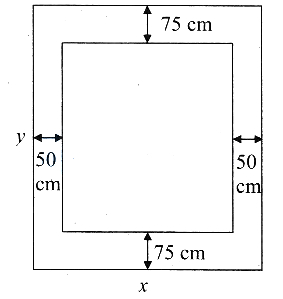
$A$ poster is to be printed on a rectangular sheet of paper of area $18 \ m^2$. The margins at the top and bottom of $75 \ cm$ each and at the sides $50 \ cm$ each are to be left. Then the dimensions i.e. height and breadth of the sheet so that the space available for printing is maximum,are . . . . . . respectively.
A
$2 \sqrt{3} \ m, 3 \sqrt{3} \ m$
B
$3 \sqrt{3} \ m, 2 \sqrt{3} \ m$
C
$3 \ m, 6 \ m$
D
$6 \ m, 3 \ m$
Solution
(B) Let height and breadth of the sheet be $y \ m$ and $x \ m$ respectively.
Since the area is $18 \ m^2$,we have $x y = 18$.
Converting to $cm$,$x y = 180000 \ cm^2$,so $y = \frac{180000}{x}$.
The margins are $75 \ cm$ at top and bottom (total $150 \ cm = 1.5 \ m$) and $50 \ cm$ at each side (total $100 \ cm = 1 \ m$).
The area available for printing is $A = (y - 1.5)(x - 1)$.
Substituting $y = \frac{18}{x}$,we get $A = (\frac{18}{x} - 1.5)(x - 1) = 18 - \frac{18}{x} - 1.5x + 1.5 = 19.5 - 1.5x - \frac{18}{x}$.
To maximize $A$,find $\frac{dA}{dx} = -1.5 + \frac{18}{x^2} = 0$.
$\frac{18}{x^2} = 1.5 \Rightarrow x^2 = \frac{18}{1.5} = 12$.
$x = \sqrt{12} = 2 \sqrt{3} \ m$.
Then $y = \frac{18}{2 \sqrt{3}} = \frac{9}{\sqrt{3}} = 3 \sqrt{3} \ m$.
Thus,the dimensions are height $3 \sqrt{3} \ m$ and breadth $2 \sqrt{3} \ m$.
Since the area is $18 \ m^2$,we have $x y = 18$.
Converting to $cm$,$x y = 180000 \ cm^2$,so $y = \frac{180000}{x}$.
The margins are $75 \ cm$ at top and bottom (total $150 \ cm = 1.5 \ m$) and $50 \ cm$ at each side (total $100 \ cm = 1 \ m$).
The area available for printing is $A = (y - 1.5)(x - 1)$.
Substituting $y = \frac{18}{x}$,we get $A = (\frac{18}{x} - 1.5)(x - 1) = 18 - \frac{18}{x} - 1.5x + 1.5 = 19.5 - 1.5x - \frac{18}{x}$.
To maximize $A$,find $\frac{dA}{dx} = -1.5 + \frac{18}{x^2} = 0$.
$\frac{18}{x^2} = 1.5 \Rightarrow x^2 = \frac{18}{1.5} = 12$.
$x = \sqrt{12} = 2 \sqrt{3} \ m$.
Then $y = \frac{18}{2 \sqrt{3}} = \frac{9}{\sqrt{3}} = 3 \sqrt{3} \ m$.
Thus,the dimensions are height $3 \sqrt{3} \ m$ and breadth $2 \sqrt{3} \ m$.
0 likesView Solution
343
ChemistryMCQMHT CET · 2024
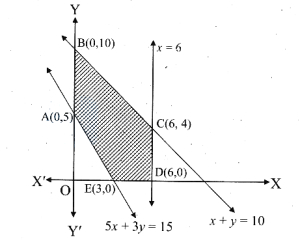
The maximum value of $Z=x+y$,subjected to $x+y \leq 10$,$5x+3y \geq 15$,$x \leq 6$,$x, y \geq 0$.
A
occurs only at a unique point
B
occurs only at two distinct points
C
occurs at infinitely many points
D
does not exist
Solution
(C) The feasible region is bounded by the lines $x+y=10$,$5x+3y=15$,$x=6$,and the axes $x=0, y=0$.
The corner points of the feasible region are $A(0, 5)$,$B(0, 10)$,$C(6, 4)$,$D(6, 0)$,and $E(3, 0)$.
We evaluate the objective function $Z=x+y$ at each corner point:
At $A(0, 5)$,$Z = 0 + 5 = 5$.
At $B(0, 10)$,$Z = 0 + 10 = 10$.
At $C(6, 4)$,$Z = 6 + 4 = 10$.
At $D(6, 0)$,$Z = 6 + 0 = 6$.
At $E(3, 0)$,$Z = 3 + 0 = 3$.
The maximum value of $Z$ is $10$,which occurs at both points $B(0, 10)$ and $C(6, 4)$.
Since the objective function attains the same maximum value at two distinct corner points,it attains the same maximum value at every point on the line segment joining these two points.
Therefore,the maximum value of $Z$ occurs at infinitely many points.
The corner points of the feasible region are $A(0, 5)$,$B(0, 10)$,$C(6, 4)$,$D(6, 0)$,and $E(3, 0)$.
We evaluate the objective function $Z=x+y$ at each corner point:
At $A(0, 5)$,$Z = 0 + 5 = 5$.
At $B(0, 10)$,$Z = 0 + 10 = 10$.
At $C(6, 4)$,$Z = 6 + 4 = 10$.
At $D(6, 0)$,$Z = 6 + 0 = 6$.
At $E(3, 0)$,$Z = 3 + 0 = 3$.
The maximum value of $Z$ is $10$,which occurs at both points $B(0, 10)$ and $C(6, 4)$.
Since the objective function attains the same maximum value at two distinct corner points,it attains the same maximum value at every point on the line segment joining these two points.
Therefore,the maximum value of $Z$ occurs at infinitely many points.
0 likesView Solution
344
ChemistryMCQMHT CET · 2024
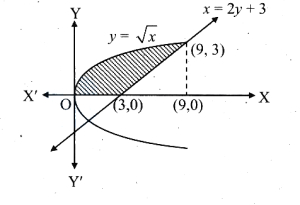
The area (in sq. units) bounded by the curves $y=\sqrt{x}$,$2y-x+3=0$,$X$-axis and lying in the first quadrant is
A
$36$
B
$18$
C
$\frac{27}{4}$
D
$9$
Solution
(D) The given curves are $y=\sqrt{x}$ (or $x=y^2$) and $2y-x+3=0$ (or $x=2y+3$).
To find the intersection points,set $y^2 = 2y+3$,which gives $y^2-2y-3=0$,so $(y-3)(y+1)=0$. Since the region is in the first quadrant,$y=3$. Thus,$x=9$.
The intersection with the $X$-axis for $2y-x+3=0$ is at $y=0$,which gives $x=3$.
The area bounded by the curves and the $X$-axis in the first quadrant is given by integrating with respect to $y$ from $y=0$ to $y=3$:
$\text{Area} = \int_0^3 (x_{line} - x_{curve}) dy = \int_0^3 ((2y+3) - y^2) dy$
$= [y^2 + 3y - \frac{y^3}{3}]_0^3$
$= (9 + 9 - \frac{27}{3}) - 0$
$= 18 - 9 = 9 \text{ sq. units.}$
To find the intersection points,set $y^2 = 2y+3$,which gives $y^2-2y-3=0$,so $(y-3)(y+1)=0$. Since the region is in the first quadrant,$y=3$. Thus,$x=9$.
The intersection with the $X$-axis for $2y-x+3=0$ is at $y=0$,which gives $x=3$.
The area bounded by the curves and the $X$-axis in the first quadrant is given by integrating with respect to $y$ from $y=0$ to $y=3$:
$\text{Area} = \int_0^3 (x_{line} - x_{curve}) dy = \int_0^3 ((2y+3) - y^2) dy$
$= [y^2 + 3y - \frac{y^3}{3}]_0^3$
$= (9 + 9 - \frac{27}{3}) - 0$
$= 18 - 9 = 9 \text{ sq. units.}$
0 likesView Solution
345
ChemistryMCQMHT CET · 2024
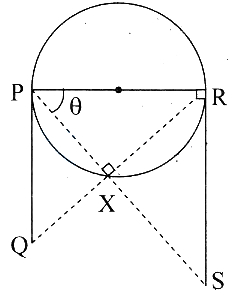
Let $PQ$ and $RS$ be tangents at the extremities of the diameter $PR$ of a circle of radius $r$. If $PS$ and $RQ$ intersect at a point $X$ on the circumference of the circle,then $2r$ equals
A
$\sqrt{PQ \cdot RS}$
B
$\frac{PQ+RS}{2}$
C
$\frac{2 \cdot PQ \cdot RS}{PQ+RS}$
D
$\sqrt{\frac{PQ^2+RS^2}{2}}$
Solution
(A) Let the diameter be $PR = 2r$. Since $PQ$ and $RS$ are tangents at $P$ and $R$ respectively,$PQ \perp PR$ and $RS \perp PR$.
In $\triangle PXR$,$\angle PXR = 90^{\circ}$ because it is an angle in a semicircle.
Let $\angle RPX = \theta$. Then $\angle PRX = 90^{\circ} - \theta$.
In $\triangle PQR$,$\angle PQR = 90^{\circ} - \theta$ and $\angle PRQ = 90^{\circ}$.
Thus,$\tan(\angle RPX) = \tan \theta = \frac{RS}{PR} = \frac{RS}{2r}$.
Also,in $\triangle PQR$,$\tan(\angle PRQ) = \tan(90^{\circ} - \theta) = \cot \theta = \frac{PQ}{PR} = \frac{PQ}{2r}$.
Therefore,$\tan \theta = \frac{2r}{PQ}$.
Equating the two expressions for $\tan \theta$:
$\frac{RS}{2r} = \frac{2r}{PQ} \implies (2r)^2 = PQ \cdot RS \implies 2r = \sqrt{PQ \cdot RS}$.
In $\triangle PXR$,$\angle PXR = 90^{\circ}$ because it is an angle in a semicircle.
Let $\angle RPX = \theta$. Then $\angle PRX = 90^{\circ} - \theta$.
In $\triangle PQR$,$\angle PQR = 90^{\circ} - \theta$ and $\angle PRQ = 90^{\circ}$.
Thus,$\tan(\angle RPX) = \tan \theta = \frac{RS}{PR} = \frac{RS}{2r}$.
Also,in $\triangle PQR$,$\tan(\angle PRQ) = \tan(90^{\circ} - \theta) = \cot \theta = \frac{PQ}{PR} = \frac{PQ}{2r}$.
Therefore,$\tan \theta = \frac{2r}{PQ}$.
Equating the two expressions for $\tan \theta$:
$\frac{RS}{2r} = \frac{2r}{PQ} \implies (2r)^2 = PQ \cdot RS \implies 2r = \sqrt{PQ \cdot RS}$.
0 likesView Solution
346
ChemistryMCQMHT CET · 2024
The rate of growth of bacteria in a culture is proportional to the number of bacteria present and the bacteria count is $1000$ at $t = 0$. The number of bacteria is increased by $20 \%$ in $2 \text{ hours}$. If the population of bacteria is $2000$ after $\frac{k}{\log \left(\frac{6}{5}\right)} \text{ hours}$,then $\left(\frac{k}{\log 2}\right)^2$ is
A
$16$
B
$8$
C
$2$
D
$4$
Solution
(D) Let $x$ be the number of bacteria present at time $t$.
$\therefore \quad \frac{dx}{dt} \propto x$
$\therefore \quad \frac{dx}{dt} = \lambda x$,where $\lambda$ is the constant of proportionality.
Integrating on both sides,we get
$\log x = \lambda t + c$
When $t = 0, x = 1000$
$\therefore \quad \log 1000 = 0 + c \Rightarrow c = \log (1000)$
$\therefore \quad \log x = \lambda t + \log (1000)$ . . . . . . $(i)$
When $t = 2$
$x = 1000 + (20 \% \text{ of } 1000) = 1000 + 200 = 1200$
$\therefore \quad \log 1200 = 2 \lambda + \log 1000$
$\Rightarrow \lambda = \frac{1}{2} \log \left(\frac{1200}{1000}\right) = \frac{1}{2} \log \left(\frac{6}{5}\right)$
$\therefore \quad \log x = \frac{t}{2} \log \left(\frac{6}{5}\right) + \log (1000)$ . . . . . . $[\text{From } (i)]$
When $t = \frac{k}{\log \left(\frac{6}{5}\right)}, x = 2000$
$\therefore \quad \log 2000 = \frac{k}{\log \left(\frac{6}{5}\right)} \times \frac{1}{2} \log \left(\frac{6}{5}\right) + \log (1000)$
$\Rightarrow \log \left(\frac{2000}{1000}\right) = \frac{k}{2} \Rightarrow \log 2 = \frac{k}{2}$
$\Rightarrow \frac{k}{\log 2} = 2$
$\Rightarrow \left(\frac{k}{\log 2}\right)^2 = 2^2 = 4$
$\therefore \quad \frac{dx}{dt} \propto x$
$\therefore \quad \frac{dx}{dt} = \lambda x$,where $\lambda$ is the constant of proportionality.
Integrating on both sides,we get
$\log x = \lambda t + c$
When $t = 0, x = 1000$
$\therefore \quad \log 1000 = 0 + c \Rightarrow c = \log (1000)$
$\therefore \quad \log x = \lambda t + \log (1000)$ . . . . . . $(i)$
When $t = 2$
$x = 1000 + (20 \% \text{ of } 1000) = 1000 + 200 = 1200$
$\therefore \quad \log 1200 = 2 \lambda + \log 1000$
$\Rightarrow \lambda = \frac{1}{2} \log \left(\frac{1200}{1000}\right) = \frac{1}{2} \log \left(\frac{6}{5}\right)$
$\therefore \quad \log x = \frac{t}{2} \log \left(\frac{6}{5}\right) + \log (1000)$ . . . . . . $[\text{From } (i)]$
When $t = \frac{k}{\log \left(\frac{6}{5}\right)}, x = 2000$
$\therefore \quad \log 2000 = \frac{k}{\log \left(\frac{6}{5}\right)} \times \frac{1}{2} \log \left(\frac{6}{5}\right) + \log (1000)$
$\Rightarrow \log \left(\frac{2000}{1000}\right) = \frac{k}{2} \Rightarrow \log 2 = \frac{k}{2}$
$\Rightarrow \frac{k}{\log 2} = 2$
$\Rightarrow \left(\frac{k}{\log 2}\right)^2 = 2^2 = 4$
0 likesView Solution
347
ChemistryMCQMHT CET · 2024
If $(a + \sqrt{2} b \cos x)(a - \sqrt{2} b \cos y) = a^2 - b^2$,where $a > b > 0$,then $\frac{dx}{dy}$ at $(\frac{\pi}{4}, \frac{\pi}{4})$ is
A
$\frac{a - b}{a + b}$
B
$\frac{a + b}{a - b}$
C
$\frac{2a + b}{2a - b}$
D
$\frac{a - 2b}{a + 2b}$
Solution
(B) Given the equation: $(a + \sqrt{2} b \cos x)(a - \sqrt{2} b \cos y) = a^2 - b^2$
Differentiating both sides with respect to $y$ using the product rule:
$(a + \sqrt{2} b \cos x) \cdot \frac{d}{dy}(a - \sqrt{2} b \cos y) + (a - \sqrt{2} b \cos y) \cdot \frac{d}{dy}(a + \sqrt{2} b \cos x) = 0$
$(a + \sqrt{2} b \cos x)(\sqrt{2} b \sin y) + (a - \sqrt{2} b \cos y)(-\sqrt{2} b \sin x \frac{dx}{dy}) = 0$
Rearranging to solve for $\frac{dx}{dy}$:
$\frac{dx}{dy} = \frac{\sqrt{2} b \sin y (a + \sqrt{2} b \cos x)}{\sqrt{2} b \sin x (a - \sqrt{2} b \cos y)}$
At the point $(\frac{\pi}{4}, \frac{\pi}{4})$,we have $\sin(\frac{\pi}{4}) = \cos(\frac{\pi}{4}) = \frac{1}{\sqrt{2}}$:
$\frac{dx}{dy} = \frac{\sqrt{2} b (\frac{1}{\sqrt{2}}) (a + \sqrt{2} b \cdot \frac{1}{\sqrt{2}})}{\sqrt{2} b (\frac{1}{\sqrt{2}}) (a - \sqrt{2} b \cdot \frac{1}{\sqrt{2}})}$
$\frac{dx}{dy} = \frac{b(a + b)}{b(a - b)} = \frac{a + b}{a - b}$
Differentiating both sides with respect to $y$ using the product rule:
$(a + \sqrt{2} b \cos x) \cdot \frac{d}{dy}(a - \sqrt{2} b \cos y) + (a - \sqrt{2} b \cos y) \cdot \frac{d}{dy}(a + \sqrt{2} b \cos x) = 0$
$(a + \sqrt{2} b \cos x)(\sqrt{2} b \sin y) + (a - \sqrt{2} b \cos y)(-\sqrt{2} b \sin x \frac{dx}{dy}) = 0$
Rearranging to solve for $\frac{dx}{dy}$:
$\frac{dx}{dy} = \frac{\sqrt{2} b \sin y (a + \sqrt{2} b \cos x)}{\sqrt{2} b \sin x (a - \sqrt{2} b \cos y)}$
At the point $(\frac{\pi}{4}, \frac{\pi}{4})$,we have $\sin(\frac{\pi}{4}) = \cos(\frac{\pi}{4}) = \frac{1}{\sqrt{2}}$:
$\frac{dx}{dy} = \frac{\sqrt{2} b (\frac{1}{\sqrt{2}}) (a + \sqrt{2} b \cdot \frac{1}{\sqrt{2}})}{\sqrt{2} b (\frac{1}{\sqrt{2}}) (a - \sqrt{2} b \cdot \frac{1}{\sqrt{2}})}$
$\frac{dx}{dy} = \frac{b(a + b)}{b(a - b)} = \frac{a + b}{a - b}$
0 likesView Solution
348
ChemistryMCQMHT CET · 2024
If $y$ is a function of $x$ and $\log(x+y) = 2xy$,then the value of $y'(0)$ is
A
$1$
B
$-1$
C
$2$
D
$0$
Solution
(A) Given the equation: $\log(x+y) = 2xy$ ... $(i)$
At $x = 0$,substituting into $(i)$ gives: $\log(0+y) = 2(0)y \implies \log(y) = 0 \implies y = e^0 = 1$.
Now,differentiate both sides of $(i)$ with respect to $x$:
$\frac{d}{dx}(\log(x+y)) = \frac{d}{dx}(2xy)$
$\frac{1}{x+y} \cdot (1 + y') = 2(y + xy')$
Substitute $x = 0$ and $y = 1$ into the differentiated equation:
$\frac{1}{0+1} \cdot (1 + y'(0)) = 2(1 + 0 \cdot y'(0))$
$1 \cdot (1 + y'(0)) = 2(1)$
$1 + y'(0) = 2$
$y'(0) = 2 - 1 = 1$
Thus,the value of $y'(0)$ is $1$.
At $x = 0$,substituting into $(i)$ gives: $\log(0+y) = 2(0)y \implies \log(y) = 0 \implies y = e^0 = 1$.
Now,differentiate both sides of $(i)$ with respect to $x$:
$\frac{d}{dx}(\log(x+y)) = \frac{d}{dx}(2xy)$
$\frac{1}{x+y} \cdot (1 + y') = 2(y + xy')$
Substitute $x = 0$ and $y = 1$ into the differentiated equation:
$\frac{1}{0+1} \cdot (1 + y'(0)) = 2(1 + 0 \cdot y'(0))$
$1 \cdot (1 + y'(0)) = 2(1)$
$1 + y'(0) = 2$
$y'(0) = 2 - 1 = 1$
Thus,the value of $y'(0)$ is $1$.
0 likesView Solution
349
ChemistryMCQMHT CET · 2024
If $y = \sec(\tan^{-1} x)$,then $\frac{dy}{dx}$ at $x = 1$ is equal to
A
$\frac{-1}{\sqrt{2}}$
B
$\frac{1}{2}$
C
$\frac{1}{\sqrt{2}}$
D
$\sqrt{2}$
Solution
(C) Given $y = \sec(\tan^{-1} x)$.
Using the chain rule,we differentiate with respect to $x$:
$\frac{dy}{dx} = \sec(\tan^{-1} x) \cdot \tan(\tan^{-1} x) \cdot \frac{d}{dx}(\tan^{-1} x)$
$\frac{dy}{dx} = \sec(\tan^{-1} x) \cdot x \cdot \frac{1}{1+x^2}$
Since $\tan^{-1} x = \theta$,then $\tan \theta = x$,which implies $\sec \theta = \sqrt{1+x^2}$.
Substituting this into the derivative:
$\frac{dy}{dx} = \sqrt{1+x^2} \cdot x \cdot \frac{1}{1+x^2} = \frac{x}{\sqrt{1+x^2}}$
Now,evaluating at $x = 1$:
$\left. \frac{dy}{dx} \right|_{x=1} = \frac{1}{\sqrt{1+1^2}} = \frac{1}{\sqrt{2}}$.
Using the chain rule,we differentiate with respect to $x$:
$\frac{dy}{dx} = \sec(\tan^{-1} x) \cdot \tan(\tan^{-1} x) \cdot \frac{d}{dx}(\tan^{-1} x)$
$\frac{dy}{dx} = \sec(\tan^{-1} x) \cdot x \cdot \frac{1}{1+x^2}$
Since $\tan^{-1} x = \theta$,then $\tan \theta = x$,which implies $\sec \theta = \sqrt{1+x^2}$.
Substituting this into the derivative:
$\frac{dy}{dx} = \sqrt{1+x^2} \cdot x \cdot \frac{1}{1+x^2} = \frac{x}{\sqrt{1+x^2}}$
Now,evaluating at $x = 1$:
$\left. \frac{dy}{dx} \right|_{x=1} = \frac{1}{\sqrt{1+1^2}} = \frac{1}{\sqrt{2}}$.
0 likesView Solution
350
ChemistryMCQMHT CET · 2024
If $f(1)=1$ and $f^{\prime}(1)=3$,then the derivative of $f(f(f(x)))+(f(x))^2$ at $x=1$ is
A
$12$
B
$15$
C
$9$
D
$33$
Solution
(D) Let $y = f(f(f(x))) + (f(x))^2$.
Applying the chain rule,we get:
$\frac{dy}{dx} = f^{\prime}(f(f(x))) \cdot f^{\prime}(f(x)) \cdot f^{\prime}(x) + 2f(x)f^{\prime}(x)$.
Evaluating at $x=1$:
$\left. \frac{dy}{dx} \right|_{x=1} = f^{\prime}(f(f(1))) \cdot f^{\prime}(f(1)) \cdot f^{\prime}(1) + 2f(1)f^{\prime}(1)$.
Given $f(1)=1$ and $f^{\prime}(1)=3$:
$\left. \frac{dy}{dx} \right|_{x=1} = f^{\prime}(f(1)) \cdot f^{\prime}(1) \cdot 3 + 2(1)(3)$.
Since $f(1)=1$,this becomes:
$\left. \frac{dy}{dx} \right|_{x=1} = f^{\prime}(1) \cdot 3 \cdot 3 + 6 = 3 \cdot 3 \cdot 3 + 6 = 27 + 6 = 33$.
Applying the chain rule,we get:
$\frac{dy}{dx} = f^{\prime}(f(f(x))) \cdot f^{\prime}(f(x)) \cdot f^{\prime}(x) + 2f(x)f^{\prime}(x)$.
Evaluating at $x=1$:
$\left. \frac{dy}{dx} \right|_{x=1} = f^{\prime}(f(f(1))) \cdot f^{\prime}(f(1)) \cdot f^{\prime}(1) + 2f(1)f^{\prime}(1)$.
Given $f(1)=1$ and $f^{\prime}(1)=3$:
$\left. \frac{dy}{dx} \right|_{x=1} = f^{\prime}(f(1)) \cdot f^{\prime}(1) \cdot 3 + 2(1)(3)$.
Since $f(1)=1$,this becomes:
$\left. \frac{dy}{dx} \right|_{x=1} = f^{\prime}(1) \cdot 3 \cdot 3 + 6 = 3 \cdot 3 \cdot 3 + 6 = 27 + 6 = 33$.
0 likesView Solution
351
ChemistryMediumMCQMHT CET · 2024
What is the order of ease of dehydrohalogenation of alkyl halides?
A
$3^{\circ} > 2^{\circ} > 1^{\circ}$
B
$2^{\circ} > 1^{\circ} > 3^{\circ}$
C
$3^{\circ} > 1^{\circ} > 2^{\circ}$
D
$1^{\circ} > 2^{\circ} > 3^{\circ}$
Solution
(A) The dehydrohalogenation of alkyl halides follows the $E2$ mechanism,where the rate depends on the stability of the resulting alkene.
According to the Saytzeff rule,more substituted alkenes are more stable.
The stability order of alkenes is: $R_2C=CR_2 > R_2C=CHR > R_2C=CH_2 > RCH=CH_2$.
Since $3^{\circ}$ alkyl halides form more substituted (stable) alkenes compared to $2^{\circ}$ and $1^{\circ}$ alkyl halides,the order of ease of dehydrohalogenation is $3^{\circ} > 2^{\circ} > 1^{\circ}$.
According to the Saytzeff rule,more substituted alkenes are more stable.
The stability order of alkenes is: $R_2C=CR_2 > R_2C=CHR > R_2C=CH_2 > RCH=CH_2$.
Since $3^{\circ}$ alkyl halides form more substituted (stable) alkenes compared to $2^{\circ}$ and $1^{\circ}$ alkyl halides,the order of ease of dehydrohalogenation is $3^{\circ} > 2^{\circ} > 1^{\circ}$.
0 likesView Solution
352
ChemistryEasyMCQMHT CET · 2024
Which among the following is a haloalkyne?
A
$CH_3-CH_2-CH=CH-X$
B
$CH_3-C \equiv C-CH_2-X$
C
$CH \equiv C-CH_2-CH_2-X$
D
$CH_3-CH_2-C \equiv C-X$
Solution
(B) haloalkyne is an organic compound that contains both a halogen atom $(X)$ and a carbon-carbon triple bond $(C \equiv C)$.
- Option $(A)$ $CH_3-CH_2-CH=CH-X$ is a haloalkene because it contains a double bond $(C=C)$.
- Option $(B)$ $CH_3-C \equiv C-CH_2-X$ is a haloalkyne as it contains a triple bond $(C \equiv C)$ and a halogen atom $(X)$.
- Option $(C)$ $CH \equiv C-CH_2-CH_2-X$ is also a haloalkyne.
- Option $(D)$ $CH_3-CH_2-C \equiv C-X$ is also a haloalkyne.
Given the standard nomenclature and structure,options $(B)$,$(C)$,and $(D)$ all represent haloalkynes. However,in many textbook contexts,the simplest representation or specific structural isomer is sought. Since multiple options are technically correct,we identify the structure containing the functional group as requested.
- Option $(A)$ $CH_3-CH_2-CH=CH-X$ is a haloalkene because it contains a double bond $(C=C)$.
- Option $(B)$ $CH_3-C \equiv C-CH_2-X$ is a haloalkyne as it contains a triple bond $(C \equiv C)$ and a halogen atom $(X)$.
- Option $(C)$ $CH \equiv C-CH_2-CH_2-X$ is also a haloalkyne.
- Option $(D)$ $CH_3-CH_2-C \equiv C-X$ is also a haloalkyne.
Given the standard nomenclature and structure,options $(B)$,$(C)$,and $(D)$ all represent haloalkynes. However,in many textbook contexts,the simplest representation or specific structural isomer is sought. Since multiple options are technically correct,we identify the structure containing the functional group as requested.
0 likesView Solution
353
ChemistryDifficultMCQMHT CET · 2024
Which of the following compounds is used to prepare the refrigerant $R-22$?
A
Monochloromethane
B
Dichloromethane
C
Trichloromethane
D
Tetrachloromethane
Solution
(C) The refrigerant $R-22$,also known as chlorodifluoromethane $(CHClF_2)$,is prepared by the reaction of trichloromethane $(CHCl_3)$,commonly known as chloroform,with hydrogen fluoride $(HF)$ in the presence of a catalyst.
The chemical reaction is: $CHCl_3 + 2HF \rightarrow CHClF_2 + 2HCl$.
The chemical reaction is: $CHCl_3 + 2HF \rightarrow CHClF_2 + 2HCl$.
0 likesView Solution
354
ChemistryEasyMCQMHT CET · 2024
Which among the following has the lowest boiling point?
A
Chloromethane
B
Bromomethane
C
Dibromomethane
D
Tribromomethane
Solution
(A) The boiling point of haloalkanes increases with an increase in molecular mass due to the increase in the magnitude of van der Waals forces of attraction.
Comparing the given compounds:
$CH_3Cl$ $(50.5 \ g/mol)$
$CH_3Br$ $(95.0 \ g/mol)$
$CH_2Br_2$ $(173.8 \ g/mol)$
$CHBr_3$ $(252.7 \ g/mol)$
Since $CH_3Cl$ has the lowest molecular mass,it has the lowest boiling point.
Comparing the given compounds:
$CH_3Cl$ $(50.5 \ g/mol)$
$CH_3Br$ $(95.0 \ g/mol)$
$CH_2Br_2$ $(173.8 \ g/mol)$
$CHBr_3$ $(252.7 \ g/mol)$
Since $CH_3Cl$ has the lowest molecular mass,it has the lowest boiling point.
0 likesView Solution
355
ChemistryEasyMCQMHT CET · 2024
Which alkyl halide has the highest bond enthalpy of the $C-X$ bond?
A
$CH_3-Cl$
B
$CH_3-F$
C
$CH_3-Br$
D
$CH_3-I$
Solution
(B) The bond enthalpy of the $C-X$ bond depends on the bond length. As the size of the halogen atom increases from $F$ to $I$,the $C-X$ bond length increases.
According to the inverse relationship between bond length and bond strength,as the bond length increases,the bond strength decreases.
Since $F$ is the smallest halogen,the $C-F$ bond is the shortest and strongest,requiring the highest energy to break.
Therefore,$CH_3-F$ has the highest bond enthalpy among the given alkyl halides.
According to the inverse relationship between bond length and bond strength,as the bond length increases,the bond strength decreases.
Since $F$ is the smallest halogen,the $C-F$ bond is the shortest and strongest,requiring the highest energy to break.
Therefore,$CH_3-F$ has the highest bond enthalpy among the given alkyl halides.
0 likesView Solution
356
ChemistryEasyMCQMHT CET · 2024
Identify the product obtained in the following reaction: $CH_3CH_2Br + CH_3COOAg \xrightarrow{\Delta} x + AgBr$
A
$CH_3CH_2COOCH_3$
B
$CH_3COOCH_2CH_3$
C
$CH_3COOCH_3$
D
$CH_3CH_2COOCH_2CH_3$
Solution
(B) The reaction between an alkyl halide $(CH_3CH_2Br)$ and a silver salt of a carboxylic acid $(CH_3COOAg)$ is a nucleophilic substitution reaction.
In this reaction,the acetate ion $(CH_3COO^-)$ acts as a nucleophile and attacks the ethyl group,displacing the bromide ion $(Br^-)$.
The silver ion $(Ag^+)$ reacts with the bromide ion $(Br^-)$ to form a precipitate of silver bromide $(AgBr)$.
The reaction is: $CH_3CH_2Br + CH_3COOAg \xrightarrow{\Delta} CH_3COOCH_2CH_3 + AgBr$.
The product formed is ethyl acetate $(CH_3COOCH_2CH_3)$.
In this reaction,the acetate ion $(CH_3COO^-)$ acts as a nucleophile and attacks the ethyl group,displacing the bromide ion $(Br^-)$.
The silver ion $(Ag^+)$ reacts with the bromide ion $(Br^-)$ to form a precipitate of silver bromide $(AgBr)$.
The reaction is: $CH_3CH_2Br + CH_3COOAg \xrightarrow{\Delta} CH_3COOCH_2CH_3 + AgBr$.
The product formed is ethyl acetate $(CH_3COOCH_2CH_3)$.
0 likesView Solution
357
ChemistryMediumMCQMHT CET · 2024
Which of the following is a vinylic halide?
A
Haloalkane
B
Haloalkyne
C
Haloalkene
D
Haloarene
Solution
(C) In vinylic halides,the halogen atom is bonded to a $sp^{2}$ hybridized carbon atom of an aliphatic chain.
Since a vinylic halide contains a carbon-carbon double bond,it is classified as a haloalkene.
Since a vinylic halide contains a carbon-carbon double bond,it is classified as a haloalkene.
0 likesView Solution
358
ChemistryMediumMCQMHT CET · 2024
Identify product '$B$' in the following reaction.
$CH_3-I + KCN$ $\longrightarrow A$ $\xrightarrow[C_2H_5OH]{Na} B$
$CH_3-I + KCN$ $\longrightarrow A$ $\xrightarrow[C_2H_5OH]{Na} B$
A
$CH_3OH$
B
$CH_3NO_2$
C
$CH_3ONa$
D
$CH_3CH_2NH_2$
Solution
(D) Step $1$: The reaction of methyl iodide $(CH_3I)$ with alcoholic $KCN$ is a nucleophilic substitution reaction $(S_N2)$ which yields methyl cyanide $(CH_3CN)$ as product $A$.
$CH_3-I + KCN \rightarrow CH_3-CN + KI$
Step $2$: The reduction of methyl cyanide $(CH_3CN)$ with sodium $(Na)$ in the presence of ethanol $(C_2H_5OH)$ is known as Mendius reduction,which produces ethylamine $(CH_3CH_2NH_2)$ as product $B$.
$CH_3-CN + 4[H] \xrightarrow[C_2H_5OH]{Na} CH_3-CH_2-NH_2$
$CH_3-I + KCN \rightarrow CH_3-CN + KI$
Step $2$: The reduction of methyl cyanide $(CH_3CN)$ with sodium $(Na)$ in the presence of ethanol $(C_2H_5OH)$ is known as Mendius reduction,which produces ethylamine $(CH_3CH_2NH_2)$ as product $B$.
$CH_3-CN + 4[H] \xrightarrow[C_2H_5OH]{Na} CH_3-CH_2-NH_2$
0 likesView Solution
359
ChemistryMediumMCQMHT CET · 2024
Which among the following is $NOT$ a feature of $S_{N}2$ mechanism?
A
Single step mechanism.
B
Backside attack of nucleophile.
C
Formation of planar carbocation intermediate.
D
Involves simultaneous bond breaking and bond forming.
Solution
(C) The $S_{N}2$ mechanism proceeds through a transition state where the nucleophile and the leaving group are both partially bonded to the central carbon atom.
$A$ carbocation intermediate is not formed; this is a characteristic of the $S_{N}1$ mechanism.
$A$ carbocation intermediate is not formed; this is a characteristic of the $S_{N}1$ mechanism.
0 likesView Solution
360
ChemistryMediumMCQMHT CET · 2024
Which among the following has the lowest boiling point?
A
Chloromethane
B
Fluoromethane
C
Bromomethane
D
Iodomethane
Solution
(B) The boiling point $(B.P.)$ of haloalkanes depends on the magnitude of van der Waals forces,which increase with the size and mass of the halogen atom.
Since all the given compounds contain a single carbon atom $(CH_3X)$,the boiling point depends on the size of the halogen atom $(X)$.
The size of the halogen atoms follows the order: $F < Cl < Br < I$.
Therefore,the boiling point increases in the order: $CH_3F < CH_3Cl < CH_3Br < CH_3I$.
Thus,fluoromethane $(CH_3F)$ has the lowest boiling point.
Since all the given compounds contain a single carbon atom $(CH_3X)$,the boiling point depends on the size of the halogen atom $(X)$.
The size of the halogen atoms follows the order: $F < Cl < Br < I$.
Therefore,the boiling point increases in the order: $CH_3F < CH_3Cl < CH_3Br < CH_3I$.
Thus,fluoromethane $(CH_3F)$ has the lowest boiling point.
0 likesView Solution
361
ChemistryMediumMCQMHT CET · 2024
What is the major product obtained when $tert-$butyl bromide is heated with silver fluoride?
A
$1-$Fluoro$-2-$methylpropane
B
$2-$Fluoro$-2-$methylpropane
C
$1-$Fluorobutane
D
$2-$Fluorobutane
Solution
(B) The reaction of $tert-$butyl bromide with silver fluoride $(AgF)$ is a Swarts reaction,which is used for the synthesis of alkyl fluorides.
In this reaction,the bromine atom in $tert-$butyl bromide is replaced by a fluorine atom to form $2-$fluoro$-2-$methylpropane.
The chemical equation is: $(CH_3)_3CBr + AgF \xrightarrow{\Delta} (CH_3)_3CF + AgBr$.
In this reaction,the bromine atom in $tert-$butyl bromide is replaced by a fluorine atom to form $2-$fluoro$-2-$methylpropane.
The chemical equation is: $(CH_3)_3CBr + AgF \xrightarrow{\Delta} (CH_3)_3CF + AgBr$.
0 likesView Solution
362
ChemistryEasyMCQMHT CET · 2024
Which of the following compounds is obtained by using the Finkelstein reaction?
A
Alkyl fluorides
B
Alkyl chlorides
C
Alkyl bromides
D
Alkyl iodides
Solution
(D) The Finkelstein reaction is a type of halogen exchange reaction used to prepare alkyl iodides from alkyl chlorides or alkyl bromides.
The general reaction is: $R-X + NaI \longrightarrow R-I + NaX$ (where $X = Cl, Br$).
Thus,alkyl iodides are obtained.
The general reaction is: $R-X + NaI \longrightarrow R-I + NaX$ (where $X = Cl, Br$).
Thus,alkyl iodides are obtained.
0 likesView Solution
363
ChemistryMediumMCQMHT CET · 2024
Identify '$Y$' in the following reaction.
$CH_3Br$ $\xrightarrow{KCN} X$ $\xrightarrow{Na / C_2H_5OH} Y$
$CH_3Br$ $\xrightarrow{KCN} X$ $\xrightarrow{Na / C_2H_5OH} Y$
A
$CH_3-CH_2-NH_2$
B
$CH_3-O^-Na^+$
C
$CH_3-O-C_2H_5$
D
$CH_3CN$
Solution
(A) Step $1$: Reaction of $CH_3Br$ with $KCN$ is a nucleophilic substitution reaction.
$CH_3Br + KCN \rightarrow CH_3CN + KBr$
Here,$X$ is $CH_3CN$ (methyl cyanide or acetonitrile).
Step $2$: Reduction of $CH_3CN$ with $Na / C_2H_5OH$ (Mendius reduction) yields a primary amine.
$CH_3CN + 4[H] \xrightarrow{Na / C_2H_5OH} CH_3-CH_2-NH_2$
Thus,$Y$ is $CH_3-CH_2-NH_2$ (ethylamine).
$CH_3Br + KCN \rightarrow CH_3CN + KBr$
Here,$X$ is $CH_3CN$ (methyl cyanide or acetonitrile).
Step $2$: Reduction of $CH_3CN$ with $Na / C_2H_5OH$ (Mendius reduction) yields a primary amine.
$CH_3CN + 4[H] \xrightarrow{Na / C_2H_5OH} CH_3-CH_2-NH_2$
Thus,$Y$ is $CH_3-CH_2-NH_2$ (ethylamine).
0 likesView Solution
364
ChemistryMediumMCQMHT CET · 2024
Identify the structural formula of $DDT$.
A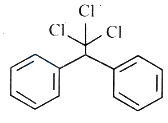
B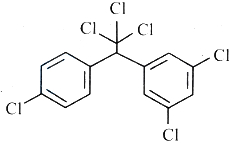
C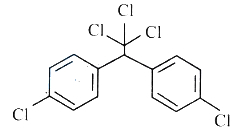
D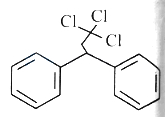
Solution
(C) $DDT$ stands for dichlorodiphenyltrichloroethane and it is a chemical compound with the formula $C_{14}H_9Cl_5$.
It is also called $1,1,1$-trichloro-$2,2$-bis($p$-chlorophenyl)ethane.
The structure consists of two $p$-chlorophenyl groups attached to a central carbon atom,which is also bonded to a hydrogen atom and a trichloromethyl group $(-CCl_3)$.
This matches the structure shown in option $C$.
It is also called $1,1,1$-trichloro-$2,2$-bis($p$-chlorophenyl)ethane.
The structure consists of two $p$-chlorophenyl groups attached to a central carbon atom,which is also bonded to a hydrogen atom and a trichloromethyl group $(-CCl_3)$.
This matches the structure shown in option $C$.
0 likesView Solution
365
ChemistryEasyMCQMHT CET · 2024
Which among the following is a haloarene?
A
Benzyl halide
B
Cyclohexenyl halide
C
Cyclohexyl halide
D
Aryl halide (Haloarene)
Solution
(D) haloarene is a compound in which a halogen atom is directly attached to an aromatic ring (benzene ring).
In option $D$,the halogen atom $X$ is directly bonded to the carbon atom of the benzene ring,which makes it an aryl halide or haloarene.
In option $A$,the halogen is attached to a side chain carbon,making it a benzyl halide.
In options $B$ and $C$,the compounds are aliphatic cyclic halides,not aromatic.
In option $D$,the halogen atom $X$ is directly bonded to the carbon atom of the benzene ring,which makes it an aryl halide or haloarene.
In option $A$,the halogen is attached to a side chain carbon,making it a benzyl halide.
In options $B$ and $C$,the compounds are aliphatic cyclic halides,not aromatic.
0 likesView Solution
366
ChemistryDifficultMCQMHT CET · 2024
Identify the major product obtained in the following reaction.
Chlorobenzene $\xrightarrow[\text{Anhydrous } FeCl_3]{Cl_2}$ major product
Chlorobenzene $\xrightarrow[\text{Anhydrous } FeCl_3]{Cl_2}$ major product
A
$1,2-$Dichlorobenzene
B
$1,3-$Dichlorobenzene
C
$1,4-$Dichlorocyclohexane
D
$1,4-$Dichlorobenzene
Solution
(D) The reaction of chlorobenzene with chlorine in the presence of anhydrous $FeCl_3$ is an electrophilic aromatic substitution reaction (chlorination).
The $-Cl$ group attached to the benzene ring is ortho/para-directing due to the resonance effect.
Due to steric hindrance at the ortho position,the para-isomer is formed as the major product.
Therefore,$1,4$-dichlorobenzene is the major product.
The $-Cl$ group attached to the benzene ring is ortho/para-directing due to the resonance effect.
Due to steric hindrance at the ortho position,the para-isomer is formed as the major product.
Therefore,$1,4$-dichlorobenzene is the major product.
0 likesView Solution
367
ChemistryMediumMCQMHT CET · 2024
Which of the following compounds has the most difficulty in breaking the $C-Cl$ bond?
A
$o-$Nitrochlorobenzene
B
$m-$Nitrochlorobenzene
C
$p-$Nitrochlorobenzene
D
$2,4,6-$Trinitrochlorobenzene
Solution
(B) The reactivity of haloarenes towards nucleophilic substitution depends on the presence of electron-withdrawing groups $(EWG)$ at the $ortho$ and $para$ positions.
These groups stabilize the carbanion intermediate formed during the reaction.
An $EWG$ at the $meta$ position has practically no effect on the reactivity because the negative charge in the intermediate does not reside on the carbon atom attached to the $meta$ position.
Therefore,$m-$nitrochlorobenzene has the least reactivity,making it the most difficult to break the $C-Cl$ bond among the given options.
These groups stabilize the carbanion intermediate formed during the reaction.
An $EWG$ at the $meta$ position has practically no effect on the reactivity because the negative charge in the intermediate does not reside on the carbon atom attached to the $meta$ position.
Therefore,$m-$nitrochlorobenzene has the least reactivity,making it the most difficult to break the $C-Cl$ bond among the given options.
0 likesView Solution
368
ChemistryEasyMCQMHT CET · 2024
The correct order of reactivity for reactions involving the cleavage of the $C-Cl$ bond in the following compounds is:
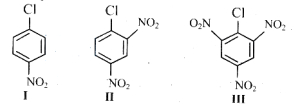
A
$I < II < III$
B
$II < III < I$
C
$III < I < II$
D
$III < II < I$
Solution
(A) The reactivity of haloarenes towards nucleophilic substitution reactions increases with the presence of electron-withdrawing groups (like $-NO_2$) at the ortho and para positions.
These groups stabilize the carbanion intermediate formed during the reaction by withdrawing electron density through the inductive and resonance effects.
Compound $I$ has one $-NO_2$ group at the para position.
Compound $II$ has two $-NO_2$ groups (one at ortho and one at para position).
Compound $III$ has three $-NO_2$ groups (two at ortho and one at para position).
Therefore,the reactivity order is $I < II < III$.
These groups stabilize the carbanion intermediate formed during the reaction by withdrawing electron density through the inductive and resonance effects.
Compound $I$ has one $-NO_2$ group at the para position.
Compound $II$ has two $-NO_2$ groups (one at ortho and one at para position).
Compound $III$ has three $-NO_2$ groups (two at ortho and one at para position).
Therefore,the reactivity order is $I < II < III$.
0 likesView Solution
369
ChemistryMediumMCQMHT CET · 2024
Identify the product obtained when chlorobenzene is heated with conc. $HNO_3$ in the presence of conc. $H_2SO_4$.
A
Only $1-$chloro$-4-$nitrobenzene
B
Only $1-$chloro$-2-$nitrobenzene
C
Mixture of $1-$chloro$-4-$nitrobenzene and $1-$chloro$-2-$nitrobenzene
D
$2,4,6-$trinitrochlorobenzene
Solution
(C) The reaction of chlorobenzene with conc. $HNO_3$ in the presence of conc. $H_2SO_4$ is an electrophilic aromatic substitution reaction known as nitration.
Chlorine is an ortho/para-directing group due to the resonance effect.
Therefore,the nitration of chlorobenzene yields a mixture of $1-$chloro$-2-$nitrobenzene (ortho-isomer) and $1-$chloro$-4-$nitrobenzene (para-isomer).
The reaction is: $C_6H_5Cl + HNO_3 \xrightarrow{conc. H_2SO_4, \Delta} C_6H_4(Cl)(NO_2) \text{ (ortho + para isomers)}$.
Chlorine is an ortho/para-directing group due to the resonance effect.
Therefore,the nitration of chlorobenzene yields a mixture of $1-$chloro$-2-$nitrobenzene (ortho-isomer) and $1-$chloro$-4-$nitrobenzene (para-isomer).
The reaction is: $C_6H_5Cl + HNO_3 \xrightarrow{conc. H_2SO_4, \Delta} C_6H_4(Cl)(NO_2) \text{ (ortho + para isomers)}$.
0 likesView Solution
370
ChemistryEasyMCQMHT CET · 2024
Which among the following is a benzylic halide?
A
Bromobenzene
B
Bromophenylmethane
C
$4-$Bromotoluene
D
$1-$Bromo$-2-$phenylethane
Solution
(B) benzylic halide is a compound in which the halogen atom is bonded to an $sp^3$ hybridized carbon atom,which is further attached to an aromatic ring.
In $Bromophenylmethane$ (also known as benzyl bromide),the bromine atom is attached to a $-CH_2-$ group,which is directly bonded to a benzene ring.
This structure fits the definition of a benzylic halide.
Therefore,the correct option is $B$.
In $Bromophenylmethane$ (also known as benzyl bromide),the bromine atom is attached to a $-CH_2-$ group,which is directly bonded to a benzene ring.
This structure fits the definition of a benzylic halide.
Therefore,the correct option is $B$.
0 likesView Solution
371
ChemistryEasyMCQMHT CET · 2024
Which of the following reactions represents Clemmensen reduction?
A
$R-CO-Cl \xrightarrow{H_2, Pd-BaSO_4} R-CHO + HCl$
B
$R-CN \xrightarrow[H_3O^+]{SnCl_2, HCl} R-CHO + NH_4Cl$
C
$R-CHO \xrightarrow[\Delta]{Zn-Hg, \text{Conc. } HCl} R-CH_3 + H_2O$
D
$R-CO-R \xrightarrow[(ii) KOH, \Delta]{(i) H_2N-NH_2, HO-(CH_2)_2-OH} R-CH_2-R$
Solution
(C) The Clemmensen reduction is a chemical reaction that reduces aldehydes or ketones to their corresponding alkanes using zinc amalgam $(Zn-Hg)$ and concentrated hydrochloric acid $(HCl)$.
The general reaction is:
$R_1-CO-R_2 \xrightarrow{Zn(Hg), HCl} R_1-CH_2-R_2$
Option $C$ represents the reduction of an aldehyde to an alkane using $Zn-Hg$ and concentrated $HCl$,which is the characteristic condition for Clemmensen reduction.
The general reaction is:
$R_1-CO-R_2 \xrightarrow{Zn(Hg), HCl} R_1-CH_2-R_2$
Option $C$ represents the reduction of an aldehyde to an alkane using $Zn-Hg$ and concentrated $HCl$,which is the characteristic condition for Clemmensen reduction.
0 likesView Solution
372
ChemistryMediumMCQMHT CET · 2024
What type of compounds is obtained in the first step of the Wolff-Kishner reduction of carbonyl compounds?
A
Carboxylic Acids
B
Alcohols
C
Hydrazones
D
Alkenes
Solution
(C) In the Wolff-Kishner reduction,the first step involves the reaction of a carbonyl compound (aldehyde or ketone) with hydrazine $(H_2N-NH_2)$.
This reaction results in the formation of a hydrazone intermediate with the loss of a water molecule $(H_2O)$.
The general reaction is: $R_2C=O + H_2N-NH_2 \rightarrow R_2C=N-NH_2 + H_2O$.
Therefore,the compound obtained in the first step is a hydrazone.
This reaction results in the formation of a hydrazone intermediate with the loss of a water molecule $(H_2O)$.
The general reaction is: $R_2C=O + H_2N-NH_2 \rightarrow R_2C=N-NH_2 + H_2O$.
Therefore,the compound obtained in the first step is a hydrazone.
0 likesView Solution
373
ChemistryMediumMCQMHT CET · 2024
Which of the following ethers is gaseous at room temperature?
A
$1-$Methoxypropane
B
$1-$Ethoxypropane
C
Methoxyethane
D
Ethoxyethane
Solution
(C) Lower ethers are highly volatile and inflammable substances.
Dimethyl ether $(CH_3OCH_3)$ and methoxyethane $(CH_3OCH_2CH_3)$ are gases at room temperature,whereas higher ethers are colourless liquids with a pleasant odour.
Dimethyl ether $(CH_3OCH_3)$ and methoxyethane $(CH_3OCH_2CH_3)$ are gases at room temperature,whereas higher ethers are colourless liquids with a pleasant odour.
0 likesView Solution
374
ChemistryEasyMCQMHT CET · 2024
Identify the name of the reaction when an aldehyde or ketone reacts with $Zn-Hg / \text{conc. } HCl$ to give an alkane.
A
Stephen reduction
B
Clemmensen reduction
C
Wolff-Kishner reduction
D
Rosenmund reduction
Solution
(B) The reaction of an aldehyde or ketone with $Zn-Hg$ amalgam and concentrated $HCl$ is known as the Clemmensen reduction.
The general reaction is:
$R-C(=O)-R' \xrightarrow[\text{conc. } HCl]{Zn/Hg} R-CH_2-R' + H_2O$
This process reduces the carbonyl group $(C=O)$ to a methylene group $(CH_2)$.
The general reaction is:
$R-C(=O)-R' \xrightarrow[\text{conc. } HCl]{Zn/Hg} R-CH_2-R' + H_2O$
This process reduces the carbonyl group $(C=O)$ to a methylene group $(CH_2)$.
0 likesView Solution
375
ChemistryMediumMCQMHT CET · 2024
Identify the product '$B$' in the following sequence of reactions.
$CH_3MgBr$ $\xrightarrow{CdCl_2} A$ $\xrightarrow{CH_3COCl} B$
$CH_3MgBr$ $\xrightarrow{CdCl_2} A$ $\xrightarrow{CH_3COCl} B$
A
Dimethyl cadmium
B
Propanone
C
Butanone
D
Propanal
Solution
(B) Step $1$: Reaction of Grignard reagent with cadmium chloride:
$2CH_3MgBr + CdCl_2 \rightarrow (CH_3)_2Cd + 2Mg(Cl)Br$
Here,product '$A$' is dimethyl cadmium,$(CH_3)_2Cd$.
Step $2$: Reaction of dimethyl cadmium with acetyl chloride:
$(CH_3)_2Cd + 2CH_3COCl \rightarrow 2CH_3COCH_3 + CdCl_2$
Here,product '$B$' is propanone $(CH_3COCH_3)$.
$2CH_3MgBr + CdCl_2 \rightarrow (CH_3)_2Cd + 2Mg(Cl)Br$
Here,product '$A$' is dimethyl cadmium,$(CH_3)_2Cd$.
Step $2$: Reaction of dimethyl cadmium with acetyl chloride:
$(CH_3)_2Cd + 2CH_3COCl \rightarrow 2CH_3COCH_3 + CdCl_2$
Here,product '$B$' is propanone $(CH_3COCH_3)$.
0 likesView Solution
376
ChemistryMediumMCQMHT CET · 2024
Which of the following isomers has the highest boiling point?
A
tert-Butylamine
B
Ethyldimethylamine
C
Diethylamine
D
n-Butylamine
Solution
(D) The boiling point of amines depends on the extent of intermolecular hydrogen bonding. Primary amines have two hydrogen atoms attached to the nitrogen,allowing for extensive hydrogen bonding. Secondary amines have one hydrogen atom,and tertiary amines have no hydrogen atoms attached to the nitrogen.
Therefore,the order of boiling points for isomeric amines is: $\text{primary amine} > \text{secondary amine} > \text{tertiary amine}$.
Among the given options,$n$-butylamine is a primary amine,diethylamine is a secondary amine,and both tert-butylamine and ethyldimethylamine are isomers that have less effective hydrogen bonding or are tertiary. Thus,$n$-butylamine has the highest boiling point.
Therefore,the order of boiling points for isomeric amines is: $\text{primary amine} > \text{secondary amine} > \text{tertiary amine}$.
Among the given options,$n$-butylamine is a primary amine,diethylamine is a secondary amine,and both tert-butylamine and ethyldimethylamine are isomers that have less effective hydrogen bonding or are tertiary. Thus,$n$-butylamine has the highest boiling point.
0 likesView Solution
377
ChemistryMediumMCQMHT CET · 2024
Identify the major product formed when $2-$Methylhexan$-3-$ol is heated with concentrated sulphuric acid.
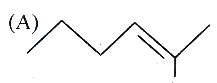
A
$2-$Methylhex$-2-$ene
B
$2-$Methylhex$-3-$ene
C
$3-$Methylhex$-2-$ene
D
$3-$Methylhex$-3-$ene
Solution
(A) The dehydration of $2-$Methylhexan$-3-$ol with concentrated $H_2SO_4$ proceeds via the formation of a carbocation intermediate.
Upon elimination of a proton,multiple alkenes can be formed.
According to the Saytzeff rule,the more substituted alkene is the major product.
$2-$Methylhexan$-3-$ol undergoes dehydration to form $2-$Methylhex$-2-$ene as the major product because it is a trisubstituted alkene,which is more stable than the disubstituted $2-$Methylhex$-3-$ene.
Upon elimination of a proton,multiple alkenes can be formed.
According to the Saytzeff rule,the more substituted alkene is the major product.
$2-$Methylhexan$-3-$ol undergoes dehydration to form $2-$Methylhex$-2-$ene as the major product because it is a trisubstituted alkene,which is more stable than the disubstituted $2-$Methylhex$-3-$ene.
0 likesView Solution
378
ChemistryMediumMCQMHT CET · 2024
Identify the reagent $R$ used in the following conversion: $tert$-butyl bromide $\xrightarrow{R}$ Isobutylene
A
$Sn / HCl$
B
$Na-Hg / H_2O$
C
$NH_3$ (alc.)
D
$LiAlH_4$
Solution
(C) The conversion of $tert$-butyl bromide to isobutylene is a dehydrohalogenation reaction,which is an elimination reaction ($E1$ or $E2$).
In this reaction,a base is required to abstract a proton from the $\beta$-carbon.
Alcoholic $NH_3$ (or more commonly,alcoholic $KOH$) acts as a base to facilitate this elimination.
As shown in the mechanism,the loss of $Br^-$ leads to a carbocation,followed by the loss of $H^+$ to form the double bond in isobutylene.
Therefore,the correct reagent is $NH_3$ (alc.).
In this reaction,a base is required to abstract a proton from the $\beta$-carbon.
Alcoholic $NH_3$ (or more commonly,alcoholic $KOH$) acts as a base to facilitate this elimination.
As shown in the mechanism,the loss of $Br^-$ leads to a carbocation,followed by the loss of $H^+$ to form the double bond in isobutylene.
Therefore,the correct reagent is $NH_3$ (alc.).
0 likesView Solution
379
ChemistryMediumMCQMHT CET · 2024
The common name of $Benzene-1, 2, 3-triol$ is
A
Phloroglucinol
B
Pyrogallol
C
Quinol
D
Catechol
Solution
(B) The structure of $Benzene-1, 2, 3-triol$ consists of a benzene ring with three hydroxyl $(-OH)$ groups attached at the $1, 2,$ and $3$ positions.
Its common name is $Pyrogallol$.
Its common name is $Pyrogallol$.
0 likesView Solution
380
ChemistryMediumMCQMHT CET · 2024
Molar conductivity of $0.02 \ M$ weak acid is $7.92 \ \Omega^{-1} \ cm^2 \ mol^{-1}$ and its molar conductivity at infinite dilution is $232.7 \ \Omega^{-1} \ cm^2 \ mol^{-1}$. Calculate the degree of dissociation of the weak acid.
A
$0.0112$
B
$0.0341$
C
$0.0694$
D
$0.292$
Solution
(B) The degree of dissociation $(\alpha)$ is given by the formula: $\alpha = \frac{\wedge_m^c}{\wedge_m^0}$
Given: $\wedge_m^c = 7.92 \ \Omega^{-1} \ cm^2 \ mol^{-1}$ and $\wedge_m^0 = 232.7 \ \Omega^{-1} \ cm^2 \ mol^{-1}$
Substituting the values: $\alpha = \frac{7.92}{232.7} = 0.034035... \approx 0.0341$
Given: $\wedge_m^c = 7.92 \ \Omega^{-1} \ cm^2 \ mol^{-1}$ and $\wedge_m^0 = 232.7 \ \Omega^{-1} \ cm^2 \ mol^{-1}$
Substituting the values: $\alpha = \frac{7.92}{232.7} = 0.034035... \approx 0.0341$
0 likesView Solution
381
ChemistryEasyMCQMHT CET · 2024
Which of the following catalysts is used in the Haber's process for the manufacture of ammonia?
A
$MnO_2$
B
$Fe/Mo$
C
$Co-Th$
D
$Fe-Cr$
Solution
(B) The Haber's process involves the reaction of $N_2$ and $H_2$ to produce ammonia $(NH_3)$.
In this process,finely divided iron $(Fe)$ is used as the catalyst.
Molybdenum $(Mo)$ is used as a promoter to increase the efficiency of the iron catalyst.
Therefore,the combination used is $Fe/Mo$.
In this process,finely divided iron $(Fe)$ is used as the catalyst.
Molybdenum $(Mo)$ is used as a promoter to increase the efficiency of the iron catalyst.
Therefore,the combination used is $Fe/Mo$.
0 likesView Solution
382
ChemistryEasyMCQMHT CET · 2024
In Haber's process of production of ammonia,$K_2O$ is used as
A
catalyst
B
inhibitor
C
promotor
D
adsorbate
Solution
(C) In the Haber process for the production of ammonia $(N_2 + 3H_2 \rightleftharpoons 2NH_3)$,iron $(Fe)$ is used as the catalyst.
$K_2O$ (potassium oxide) and $Al_2O_3$ (aluminum oxide) are added to the reaction mixture as promoters.
$A$ promoter is a substance that increases the efficiency or activity of a catalyst.
$K_2O$ (potassium oxide) and $Al_2O_3$ (aluminum oxide) are added to the reaction mixture as promoters.
$A$ promoter is a substance that increases the efficiency or activity of a catalyst.
0 likesView Solution
383
ChemistryEasyMCQMHT CET · 2024
Which of the following elements is $NOT$ a member of group $16$ of the periodic table?
A
Tellurium
B
Polonium
C
Selenium
D
Astatine
Solution
(D) Group $16$ elements,also known as chalcogens,include Oxygen $(O)$,Sulfur $(S)$,Selenium $(Se)$,Tellurium $(Te)$,and Polonium $(Po)$.
Astatine $(At)$ is a radioactive element that belongs to Group $17$ (the halogens).
Astatine $(At)$ is a radioactive element that belongs to Group $17$ (the halogens).
0 likesView Solution
384
ChemistryEasyMCQMHT CET · 2024
Which among the following $P$-block elements forms a colourless and odourless hydride?
A
Oxygen
B
Nitrogen
C
Sulphur
D
Selenium
Solution
(A) Oxygen: Its hydride is water $(H_2O)$,which is a colourless,odourless liquid.
Nitrogen: Its hydride is ammonia $(NH_3)$,which is colourless but has a strong,pungent odour.
Sulphur: Its hydride is hydrogen sulphide $(H_2S)$,which is colourless but has a distinct,rotten-egg smell.
Selenium: Its hydride is hydrogen selenide $(H_2Se)$,which has an extremely unpleasant odour.
Therefore,only oxygen forms a hydride that is both colourless and odourless.
Nitrogen: Its hydride is ammonia $(NH_3)$,which is colourless but has a strong,pungent odour.
Sulphur: Its hydride is hydrogen sulphide $(H_2S)$,which is colourless but has a distinct,rotten-egg smell.
Selenium: Its hydride is hydrogen selenide $(H_2Se)$,which has an extremely unpleasant odour.
Therefore,only oxygen forms a hydride that is both colourless and odourless.
0 likesView Solution
385
ChemistryDifficultMCQMHT CET · 2024
Identify a compound having properties of tear gas.
A
$SOCl_2$
B
$COCl_2$
C
$Cl(CH_2)_2 S(CH_2)_2 Cl$
D
$CCl_3 NO_2$
Solution
(D) The compound commonly known as tear gas is chloropicrin,which has the chemical formula $CCl_3 NO_2$.
This compound is also known as trichloronitromethane.
It is used as a tear gas agent because it acts as a powerful lachrymator,causing severe irritation to the eyes and respiratory system.
This compound is also known as trichloronitromethane.
It is used as a tear gas agent because it acts as a powerful lachrymator,causing severe irritation to the eyes and respiratory system.
0 likesView Solution
386
ChemistryEasyMCQMHT CET · 2024
Identify a compound having highest thermal stability.
A
$ICl$
B
$BrCl$
C
$BrF$
D
$ClF$
Solution
(D) The thermal stability of interhalogen compounds depends on the difference in electronegativity between the two halogen atoms. $A$ larger difference in electronegativity leads to a more stable bond.
Thermal stability decreases in the order: $ClF > ICl > IBr > BrCl > BrF$.
Therefore,the compound with the highest thermal stability is $ClF$.
Thermal stability decreases in the order: $ClF > ICl > IBr > BrCl > BrF$.
Therefore,the compound with the highest thermal stability is $ClF$.
0 likesView Solution
387
ChemistryDifficultMCQMHT CET · 2024
Identify the correct decreasing order of thermal stability for the following interhalogen compounds.
A
$ClF > BrCl > IBr > ICl$
B
$ClF > ICl > IBr > BrCl$
C
$ICl > IBr > BrCl > ClF$
D
$BrCl > IBr > ICl > ClF$
Solution
(B) The thermal stability of interhalogen compounds depends upon the difference in electronegativity between the combining atoms. $A$ larger electronegativity difference leads to a stronger bond and higher thermal stability.
The electronegativity values are: $F = 4.0, Cl = 3.2, Br = 3.0, I = 2.7$.
The electronegativity differences are:
$ClF: |4.0 - 3.2| = 0.8$
$BrCl: |3.2 - 3.0| = 0.2$
$IBr: |3.0 - 2.7| = 0.3$
$ICl: |3.2 - 2.7| = 0.5$
Comparing these differences,the order of stability is $ClF > ICl > IBr > BrCl$.
The electronegativity values are: $F = 4.0, Cl = 3.2, Br = 3.0, I = 2.7$.
The electronegativity differences are:
$ClF: |4.0 - 3.2| = 0.8$
$BrCl: |3.2 - 3.0| = 0.2$
$IBr: |3.0 - 2.7| = 0.3$
$ICl: |3.2 - 2.7| = 0.5$
Comparing these differences,the order of stability is $ClF > ICl > IBr > BrCl$.
0 likesView Solution
388
ChemistryMediumMCQMHT CET · 2024
Which of the following is the correct decreasing order of the boiling point of the given compounds?
A
$CH_3Cl > CH_3Br > CH_2Br_2 > CHBr_3$
B
$CH_3Br > CH_2Br_2 > CHBr_3 > CH_3Cl$
C
$CHBr_3 > CH_2Br_2 > CH_3Br > CH_3Cl$
D
$CH_3Br > CH_3Cl > CHBr_3 > CH_2Br_2$
Solution
(C) The boiling points of haloalkanes are primarily determined by the magnitude of van der Waals forces,which increase with an increase in molecular size and mass.
For the given compounds,the molecular mass increases with the number of bromine atoms present.
$CHBr_3$ $(M \approx 253 \ g/mol)$ has the highest molecular mass,followed by $CH_2Br_2$ $(M \approx 174 \ g/mol)$,then $CH_3Br$ $(M \approx 95 \ g/mol)$,and finally $CH_3Cl$ $(M \approx 50.5 \ g/mol)$.
Therefore,the correct decreasing order of boiling point is $CHBr_3 > CH_2Br_2 > CH_3Br > CH_3Cl$.
For the given compounds,the molecular mass increases with the number of bromine atoms present.
$CHBr_3$ $(M \approx 253 \ g/mol)$ has the highest molecular mass,followed by $CH_2Br_2$ $(M \approx 174 \ g/mol)$,then $CH_3Br$ $(M \approx 95 \ g/mol)$,and finally $CH_3Cl$ $(M \approx 50.5 \ g/mol)$.
Therefore,the correct decreasing order of boiling point is $CHBr_3 > CH_2Br_2 > CH_3Br > CH_3Cl$.
0 likesView Solution
389
ChemistryMediumMCQMHT CET · 2024
Which of the following compounds is $NOT$ in the solid state at $25^{\circ} C$?
A
$ICl$
B
$IBr$
C
$IF_3$
D
$IF_5$
Solution
(D) The physical states of the given interhalogen compounds at $25^{\circ} C$ are as follows:
$ICl$ is a ruby-red or brown-red solid.
$IBr$ is a black solid.
$IF_3$ is a yellow powder (solid).
$IF_5$ is a colourless liquid (Note: While $IF_5$ is often described as a liquid at room temperature,among the given options,it is the one that is not a solid,as it has a melting point of $9.4^{\circ} C$ and exists as a liquid at $25^{\circ} C$).
$ICl$ is a ruby-red or brown-red solid.
$IBr$ is a black solid.
$IF_3$ is a yellow powder (solid).
$IF_5$ is a colourless liquid (Note: While $IF_5$ is often described as a liquid at room temperature,among the given options,it is the one that is not a solid,as it has a melting point of $9.4^{\circ} C$ and exists as a liquid at $25^{\circ} C$).
0 likesView Solution
390
ChemistryMediumMCQMHT CET · 2024
Which element from the following combines with hydrogen to form a compound with the lowest thermal stability?
A
$F$
B
$Cl$
C
$I$
D
$Br$
Solution
(C) The bond dissociation enthalpy of $H-X$ bond decreases in the order: $HF > HCl > HBr > HI$.
Thermal stability of hydrogen halides is directly proportional to the bond dissociation enthalpy.
Therefore,the thermal stability decreases in the order: $HF > HCl > HBr > HI$.
Thus,$HI$ has the lowest thermal stability among the given options.
Thermal stability of hydrogen halides is directly proportional to the bond dissociation enthalpy.
Therefore,the thermal stability decreases in the order: $HF > HCl > HBr > HI$.
Thus,$HI$ has the lowest thermal stability among the given options.
0 likesView Solution
391
ChemistryMediumMCQMHT CET · 2024
Which of the following compounds is $NOT$ in the gaseous phase at $25^{\circ} C$?
A
$ClF$
B
$BrF$
C
$IF_3$
D
$ClF_3$
Solution
(C) Based on the physical states of interhalogen compounds at room temperature $(25^{\circ} C)$:
$1$. $ClF$ is a colourless gas.
$2$. $BrF$ is a pale brown gas.
$3$. $ClF_3$ is a colourless gas.
$4$. $IF_3$ is a yellow powder (solid).
Therefore,$IF_3$ is the compound that is not in the gaseous phase at $25^{\circ} C$.
$1$. $ClF$ is a colourless gas.
$2$. $BrF$ is a pale brown gas.
$3$. $ClF_3$ is a colourless gas.
$4$. $IF_3$ is a yellow powder (solid).
Therefore,$IF_3$ is the compound that is not in the gaseous phase at $25^{\circ} C$.
0 likesView Solution
392
ChemistryEasyMCQMHT CET · 2024
Identify the thermosetting polymer from the following.
A
Urea formaldehyde resin
B
Polystyrene
C
Polyesters
D
Polyamides
Solution
(A) Thermosetting polymers are cross-linked or heavily branched molecules,which undergo extensive cross-linking in molds and again become infusible.
Common examples include Bakelite,urea-formaldehyde resin,and melamine-formaldehyde resin.
Therefore,urea-formaldehyde resin is a thermosetting polymer.
Common examples include Bakelite,urea-formaldehyde resin,and melamine-formaldehyde resin.
Therefore,urea-formaldehyde resin is a thermosetting polymer.
0 likesView Solution
393
ChemistryMediumMCQMHT CET · 2024
Which of the following polymers is obtained by the ring-opening polymerization method?
A
$[CH_2-CH(Cl)]_n$
B
$[NH-(CH_2)_5-CO]_n$
C
$[CH_2-CH_2]_n$
D
$[CO-(CH_2)_4-CO-NH-(CH_2)_6-NH]_n$
Solution
(B) Ring-opening polymerization involves the addition of cyclic monomers to a growing polymer chain without the elimination of small molecules like $H_2O$ or $CH_3OH$.
Nylon-$6$ is a well-known example of a polymer formed by the ring-opening polymerization of $\varepsilon$-caprolactam.
The structure of Nylon-$6$ is $[NH-(CH_2)_5-CO]_n$.
Therefore,the correct option is $B$.
Nylon-$6$ is a well-known example of a polymer formed by the ring-opening polymerization of $\varepsilon$-caprolactam.
The structure of Nylon-$6$ is $[NH-(CH_2)_5-CO]_n$.
Therefore,the correct option is $B$.
0 likesView Solution
394
ChemistryMediumMCQMHT CET · 2024
Identify the homopolymer from the following.
A
Polycarbonate
B
Buna-$N$
C
Glyptal
D
Thermocol
Solution
(D) Thermocol,also known as expanded polystyrene $(EPS)$,is a homopolymer. $A$ homopolymer is a polymer that is composed of only one type of monomer unit repeated throughout its structure. In the case of thermocol,the repeating unit is the styrene monomer. When polymerized,styrene forms a long chain known as polystyrene,which is used in a variety of applications,including packaging materials like thermocol.
Here is a brief description of each option to clarify why the others are not homopolymers:
Polycarbonate $(A)$: Polycarbonate is a copolymer commonly made from bisphenol $A$ and phosgene,thus it is not a homopolymer.
Buna-$N$ $(B)$: Buna-$N$,also known as nitrile rubber,is a copolymer made from butadiene and acrylonitrile.
Glyptal $(C)$: Glyptal is a copolymer derived from the reaction between glycerol and phthalic anhydride,classifying it as a copolymer.
Here is a brief description of each option to clarify why the others are not homopolymers:
Polycarbonate $(A)$: Polycarbonate is a copolymer commonly made from bisphenol $A$ and phosgene,thus it is not a homopolymer.
Buna-$N$ $(B)$: Buna-$N$,also known as nitrile rubber,is a copolymer made from butadiene and acrylonitrile.
Glyptal $(C)$: Glyptal is a copolymer derived from the reaction between glycerol and phthalic anhydride,classifying it as a copolymer.
0 likesView Solution
395
ChemistryEasyMCQMHT CET · 2024
Which of the following polymers is $NOT$ obtained by the addition polymerisation method?
A
$[CH_2-CH_2]_n$
B
$[CH_2-CH(CN)]_n$
C
$[NH-(CH_2)_5-CO]_n$
D
$[CH_2-CH(Cl)]_n$
Solution
(C) Addition polymerization involves the repeated addition of monomers possessing double or triple bonds without the loss of any small molecules.
$A$,$B$,and $D$ are examples of addition polymers (Polyethylene,Polyacrylonitrile,and Polyvinyl chloride respectively).
$C$ represents Nylon-$6$,which is formed by the ring-opening polymerization of caprolactam,a type of condensation polymerization where a small molecule is involved in the ring-opening process,or more generally,it is classified under condensation polymers due to the amide linkage formation.
$A$,$B$,and $D$ are examples of addition polymers (Polyethylene,Polyacrylonitrile,and Polyvinyl chloride respectively).
$C$ represents Nylon-$6$,which is formed by the ring-opening polymerization of caprolactam,a type of condensation polymerization where a small molecule is involved in the ring-opening process,or more generally,it is classified under condensation polymers due to the amide linkage formation.
0 likesView Solution
396
ChemistryEasyMCQMHT CET · 2024
Which of the following is a copolymer?
A
Nylon $6$
B
Nylon $6,6$
C
Polythene
D
Buna-$S$
Solution
(D) copolymer is a polymer formed from two or more different types of monomer units.
Buna-$S$ is a copolymer formed from $1,3$-butadiene and styrene.
Nylon $6$ is a homopolymer of caprolactam.
Nylon $6,6$ is a copolymer of hexamethylenediamine and adipic acid (Note: While Nylon $6,6$ is technically a copolymer,in many standard chemistry contexts,Buna-$S$ is the classic example of a synthetic rubber copolymer. However,both $B$ and $D$ are copolymers. Given the standard curriculum,Buna-$S$ is the most distinct example of an elastomer copolymer).
Buna-$S$ is a copolymer formed from $1,3$-butadiene and styrene.
Nylon $6$ is a homopolymer of caprolactam.
Nylon $6,6$ is a copolymer of hexamethylenediamine and adipic acid (Note: While Nylon $6,6$ is technically a copolymer,in many standard chemistry contexts,Buna-$S$ is the classic example of a synthetic rubber copolymer. However,both $B$ and $D$ are copolymers. Given the standard curriculum,Buna-$S$ is the most distinct example of an elastomer copolymer).
0 likesView Solution
397
ChemistryEasyMCQMHT CET · 2024
Identify the biodegradable polymer from the following.
A
Teflon
B
$PHBV$
C
$LDP$
D
Polyacrylonitrile
Solution
(B) is the correct answer.
Biodegradable polymers are those that can be decomposed by microorganisms.
Among the given options,$PHBV$ (Poly-$\beta$-hydroxybutyrate-co-$\beta$-hydroxyvalerate) is a well-known biodegradable polymer.
$Teflon$,$LDP$ (Low Density Polyethylene),and Polyacrylonitrile are synthetic,non-biodegradable polymers.
Biodegradable polymers are those that can be decomposed by microorganisms.
Among the given options,$PHBV$ (Poly-$\beta$-hydroxybutyrate-co-$\beta$-hydroxyvalerate) is a well-known biodegradable polymer.
$Teflon$,$LDP$ (Low Density Polyethylene),and Polyacrylonitrile are synthetic,non-biodegradable polymers.
0 likesView Solution
398
ChemistryMediumMCQMHT CET · 2024
Which polymer is obtained from the monomers $CH_2=CH-CH=CH_2$ and $CH_2=CH-CN$?
A
Polycarbonate
B
Polyacrylamide
C
$B$üna-$N$
D
Acrylic glass
Solution
(C) The given monomers are $1,3$-butadiene $(CH_2=CH-CH=CH_2)$ and acrylonitrile $(CH_2=CH-CN)$.
These monomers undergo copolymerization to form $B$üna-$N$ (also known as nitrile rubber).
These monomers undergo copolymerization to form $B$üna-$N$ (also known as nitrile rubber).
0 likesView Solution
399
ChemistryMediumMCQMHT CET · 2024
Identify the polymer used to obtain $LCD$ screen from the following.
A
Polyacrylamide
B
Buna-$N$
C
Polycarbonate
D
Perspex
Solution
(C) Polycarbonate is commonly used in the production of $LCD$ ($Liquid$ $Crystal$ $Display$) screens,primarily because it is a durable,transparent plastic with excellent optical properties. Polycarbonate is used to make the outer layers of the screen or protective covers due to its high impact resistance and clarity.
Here is a brief overview of the other options:
- $(A)$ Polyacrylamide: Used mainly in water treatment,paper production,and as a thickening agent; not typically used in $LCD$s.
- $(B)$ Buna-$N$: $A$ synthetic rubber (nitrile rubber) used for making seals,gaskets,and fuel hoses; not used in $LCD$s.
- $(D)$ Perspex: Also known as acrylic,it is a transparent plastic,but it is more commonly used in optical devices,displays,and lenses rather than $LCD$ screens.
Here is a brief overview of the other options:
- $(A)$ Polyacrylamide: Used mainly in water treatment,paper production,and as a thickening agent; not typically used in $LCD$s.
- $(B)$ Buna-$N$: $A$ synthetic rubber (nitrile rubber) used for making seals,gaskets,and fuel hoses; not used in $LCD$s.
- $(D)$ Perspex: Also known as acrylic,it is a transparent plastic,but it is more commonly used in optical devices,displays,and lenses rather than $LCD$ screens.
0 likesView Solution
400
ChemistryEasyMCQMHT CET · 2024
Which from the following polymers is grouped under elastomers?
A
Buna-$S$
B
Nylon $6,6$
C
Terylene
D
Polythene
Solution
(A) Buna-$S$ is a synthetic elastomer,also known as styrene-butadiene rubber $(SBR)$. It has rubber-like properties and can stretch and return to its original shape,making it an elastomer.
Here is a quick breakdown of the other options:
- $(B)$ Nylon $6,6$: This is a nylon polymer,a type of polyamide used for fibers and engineering plastics,not an elastomer.
- $(C)$ Terylene: Also known as polyethylene terephthalate $(PET)$,it is a thermoplastic used in fibers and films,not an elastomer.
- $(D)$ Polythene: Also called polyethylene,it is a thermoplastic polymer used in packaging,containers,etc.,but not an elastomer.
Here is a quick breakdown of the other options:
- $(B)$ Nylon $6,6$: This is a nylon polymer,a type of polyamide used for fibers and engineering plastics,not an elastomer.
- $(C)$ Terylene: Also known as polyethylene terephthalate $(PET)$,it is a thermoplastic used in fibers and films,not an elastomer.
- $(D)$ Polythene: Also called polyethylene,it is a thermoplastic polymer used in packaging,containers,etc.,but not an elastomer.
0 likesView Solution
Vedclass Products
For Students
Vedclass Test Series
Mock tests in real MHT CET style covering Chemistry with performance analysis. 5-day free trial.
Start Free TrialFor Teachers
Exam Paper Generator
Generate Set A/B/C/D Chemistry papers from 7.5L+ questions in 2 minutes. 3 chapters free.
Try FreeFor Institutes
Online Exam Module
Run live MHT CET mock exams with unlimited students, 360° analytics & white-label branding.
See DemoFrequently Asked Questions
How many Chemistry questions are in MHT CET 2024?
There are 900 Chemistry questions from the MHT CET 2024 paper on Vedclass, each with a detailed step-by-step solution in English.
Are MHT CET 2024 Chemistry solutions available in English?
Yes. All solutions on this page are in English. You can also switch to English or Hindi using the language buttons above the questions.
Can I practice MHT CET 2024 Chemistry as a timed test?
Yes. Use the Vedclass Test Series to attempt a full MHT CET mock test covering Chemistry with time limits and instant score analysis.
Can teachers create Chemistry papers from MHT CET previous year questions?
Yes. The Vedclass Exam Paper Generator lets teachers mix MHT CET Chemistry questions and generate Set A/B/C/D papers in minutes.
For Teachers & Institutes
Build a Custom Chemistry Paper
Pick MHT CET 2024 Chemistry questions, set difficulty, and generate Set A/B/C/D in 2 minutes.