
ChemistryQ101–200 of 900 questions
Page 3 of 10 · English
101
ChemistryEasyMCQMHT CET · 2024
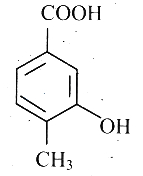
What is the $IUPAC$ name of the following compound?
A
$3-$Carboxy$-6-$methylphenol
B
$5-$Carboxy$-2-$methylphenol
C
$3-$Hydroxy$-4-$methylbenzoic acid
D
$4-$methyl$-5-$hydroxybenzoic acid
Solution
(C) The principal functional group is the carboxylic acid $(-COOH)$ group,which is assigned position $1$ on the benzene ring.
Following the numbering to give the lowest possible locants to the substituents,the hydroxyl group $(-OH)$ is at position $3$ and the methyl group $(-CH_3)$ is at position $4$.
Therefore,the $IUPAC$ name is $3-$hydroxy$-4-$methylbenzoic acid.
Following the numbering to give the lowest possible locants to the substituents,the hydroxyl group $(-OH)$ is at position $3$ and the methyl group $(-CH_3)$ is at position $4$.
Therefore,the $IUPAC$ name is $3-$hydroxy$-4-$methylbenzoic acid.
0 likesView Solution
102
ChemistryDifficultMCQMHT CET · 2024
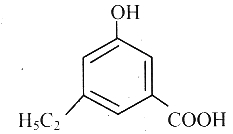
What is the $IUPAC$ name of the following compound?
A
$3-$Carboxy$-5-$ethylphenol
B
$5-$Carboxy$-3-$ethylphenol
C
$3-$Ethyl$-5-$hydroxybenzoic acid
D
$5-$Ethyl$-3-$hydroxybenzoic acid
Solution
(D) $1$. Identify the principal functional group. The $-COOH$ group has higher priority than the $-OH$ group and the alkyl group. Therefore,the parent compound is benzoic acid.
$2$. Number the benzene ring starting from the carbon attached to the $-COOH$ group as $C-1$.
$3$. Assign positions to the substituents: the $-OH$ group is at position $3$ and the ethyl group $(-C_2H_5)$ is at position $5$.
$4$. Arrange the substituents in alphabetical order: 'e' for ethyl comes before 'h' for hydroxy.
$5$. Combining these,the $IUPAC$ name is $3-$hydroxy$-5-$ethylbenzoic acid. However,looking at the options provided,option $D$ ($5-$Ethyl$-3-$hydroxybenzoic acid) is the correct nomenclature based on the numbering shown in the provided solution image.
$2$. Number the benzene ring starting from the carbon attached to the $-COOH$ group as $C-1$.
$3$. Assign positions to the substituents: the $-OH$ group is at position $3$ and the ethyl group $(-C_2H_5)$ is at position $5$.
$4$. Arrange the substituents in alphabetical order: 'e' for ethyl comes before 'h' for hydroxy.
$5$. Combining these,the $IUPAC$ name is $3-$hydroxy$-5-$ethylbenzoic acid. However,looking at the options provided,option $D$ ($5-$Ethyl$-3-$hydroxybenzoic acid) is the correct nomenclature based on the numbering shown in the provided solution image.
0 likesView Solution
103
ChemistryEasyMCQMHT CET · 2024
What is the numerical difference in molar masses of the second and third members of a homologous series?
A
$14$
B
$12$
C
$10$
D
$2$
Solution
(A) homologous series is a group of organic compounds having the same functional group and similar chemical properties,where each successive member differs by a $-CH_2$ (methylene) group.
Since the atomic mass of $C$ is $12$ and $H$ is $1$,the molar mass of a $-CH_2$ group is $12 + (2 \times 1) = 14 \ g/mol$.
Therefore,the numerical difference in the molar masses of any two successive members (such as the second and third members) is $14$.
Since the atomic mass of $C$ is $12$ and $H$ is $1$,the molar mass of a $-CH_2$ group is $12 + (2 \times 1) = 14 \ g/mol$.
Therefore,the numerical difference in the molar masses of any two successive members (such as the second and third members) is $14$.
0 likesView Solution
104
ChemistryEasyMCQMHT CET · 2024
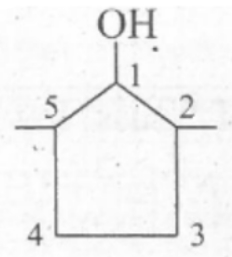
What is the $IUPAC$ name of the following compound?
A
$2,5-$Dimethylpentan$-1-$ol
B
$1,3-$Dimethylpentan$-2-$ol
C
$2,5-$Dimethylcyclopentanol
D
$1,3-$Dimethylcyclopentan$-2-$ol
Solution
(C) $1$. The given compound is a five-membered cyclic ring (cyclopentane) with an $-OH$ group and two methyl groups attached.
$2$. According to $IUPAC$ nomenclature rules,the carbon atom attached to the principal functional group $(-OH)$ is assigned the number $1$.
$3$. Numbering the ring to give the lowest possible locants to the substituents (methyl groups),we go from the $-OH$ carbon $(C-1)$ towards the methyl groups.
$4$. The methyl groups are at positions $2$ and $5$. Thus,the name is $2,5-$dimethylcyclopentanol.
$2$. According to $IUPAC$ nomenclature rules,the carbon atom attached to the principal functional group $(-OH)$ is assigned the number $1$.
$3$. Numbering the ring to give the lowest possible locants to the substituents (methyl groups),we go from the $-OH$ carbon $(C-1)$ towards the methyl groups.
$4$. The methyl groups are at positions $2$ and $5$. Thus,the name is $2,5-$dimethylcyclopentanol.
0 likesView Solution
105
ChemistryMCQMHT CET · 2024
According to the carbinol system,tert-butyl alcohol is named as:
A
methyl carbinol
B
ethyl carbinol
C
propyl carbinol
D
trimethyl carbinol
Solution
(D) In the carbinol system,the carbon atom attached to the $-OH$ group is considered as the carbinol $(CH_3OH)$.
For tert-butyl alcohol,the structure is $(CH_3)_3C-OH$.
Here,three methyl groups are attached to the carbinol carbon.
Therefore,it is named as trimethyl carbinol.
For tert-butyl alcohol,the structure is $(CH_3)_3C-OH$.
Here,three methyl groups are attached to the carbinol carbon.
Therefore,it is named as trimethyl carbinol.
0 likesView Solution
106
ChemistryMCQMHT CET · 2024
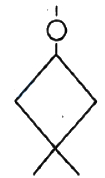
What is the $IUPAC$ name of the following compound?
A
$1-$Methoxy$-3,3-$dimethylcyclobutane
B
$3-$Methoxy$-1,1-$dimethylcyclobutane
C
$3,3-$dimethylcyclobutoxymethane
D
$1-$Methoxy$-3-$isopropylbutane
Solution
(B) $1$. Identify the parent chain: The parent ring is a cyclobutane ring.
$2$. Identify substituents: There is a methoxy group $(-OCH_3)$ and two methyl groups $(-CH_3)$.
$3$. Numbering: Number the ring to give the lowest possible locants to the substituents. Starting from the carbon with the two methyl groups as $1$,the methoxy group is at position $3$.
$4$. Name: The compound is $3-$methoxy$-1,1-$dimethylcyclobutane.
$2$. Identify substituents: There is a methoxy group $(-OCH_3)$ and two methyl groups $(-CH_3)$.
$3$. Numbering: Number the ring to give the lowest possible locants to the substituents. Starting from the carbon with the two methyl groups as $1$,the methoxy group is at position $3$.
$4$. Name: The compound is $3-$methoxy$-1,1-$dimethylcyclobutane.
0 likesView Solution
107
ChemistryMCQMHT CET · 2024
What is the $IUPAC$ name of the following compound?
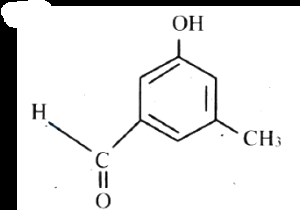
A
$3-$formyl-$5-$methylphenol
B
$5-$formyl-$3-$methylphenol
C
$3-$hydroxy-$5-$methylbenzaldehyde
D
$5-$hydroxy-$3-$methylbenzaldehyde
Solution
(C) $1$. Identify the principal functional group. The aldehyde group $(-CHO)$ has higher priority than the hydroxyl group $(-OH)$ and the methyl group $(-CH_3)$.
$2$. The parent chain is the benzene ring with the aldehyde group,which is named as benzaldehyde.
$3$. Number the ring starting from the carbon attached to the $-CHO$ group as $1$.
$4$. The $-OH$ group is at position $3$ and the $-CH_3$ group is at position $5$.
$5$. Therefore,the $IUPAC$ name is $3-$hydroxy-$5-$methylbenzaldehyde.
$2$. The parent chain is the benzene ring with the aldehyde group,which is named as benzaldehyde.
$3$. Number the ring starting from the carbon attached to the $-CHO$ group as $1$.
$4$. The $-OH$ group is at position $3$ and the $-CH_3$ group is at position $5$.
$5$. Therefore,the $IUPAC$ name is $3-$hydroxy-$5-$methylbenzaldehyde.
0 likesView Solution
108
ChemistryEasyMCQMHT CET · 2024
What is the $IUPAC$ name of the following compound?
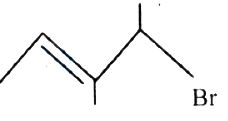
A
$1-$Bromo$-1,2-$dimethylbut$-2-$ene
B
$4-$Bromo$-3-$methylpent$-2-$ene
C
$4-$Bromo$-3,4-$dimethylbut$-2-$ene
D
$2-$Bromo$-3-$methylpent$-3-$ene
Solution
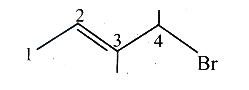
(B) $1$. Identify the longest carbon chain containing the double bond. The chain has $5$ carbons,so the parent alkane is pentene.
$2$. Number the chain from the end that gives the double bond the lowest possible locant. Numbering from left to right,the double bond starts at carbon $2$.
$3$. Identify substituents: There is a methyl group at position $3$ and a bromine atom at position $4$.
$4$. Combine these to get the $IUPAC$ name: $4-$bromo$-3-$methylpent$-2-$ene.
$2$. Number the chain from the end that gives the double bond the lowest possible locant. Numbering from left to right,the double bond starts at carbon $2$.
$3$. Identify substituents: There is a methyl group at position $3$ and a bromine atom at position $4$.
$4$. Combine these to get the $IUPAC$ name: $4-$bromo$-3-$methylpent$-2-$ene.
0 likesView Solution
109
ChemistryDifficultMCQMHT CET · 2024
What is the $IUPAC$ name of the following compound?
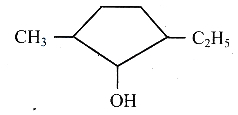
A
$2-$Ethyl$-3-$methylcyclopentanol
B
$2-$Ethyl$-5-$methylcyclopentanol
C
$2-$Methyl$-3-$ethylcyclopentanol
D
$1-$Methyl$-3-$ethylcyclopentan$-2-$ol
Solution
(B) $1$. Identify the principal functional group: The $-OH$ group is the principal functional group,so the parent chain is a cyclopentanol. The carbon attached to the $-OH$ group is assigned position $1$.
$2$. Number the ring: To give the lowest possible locants to the substituents (ethyl and methyl groups),we number the ring starting from the carbon with the $-OH$ group as $1$. Moving clockwise,the ethyl group is at position $2$ and the methyl group is at position $5$.
$3$. Alphabetical order: Substituents are listed alphabetically. Since 'ethyl' comes before 'methyl',the name is $2-$ethyl$-5-$methylcyclopentanol.
$2$. Number the ring: To give the lowest possible locants to the substituents (ethyl and methyl groups),we number the ring starting from the carbon with the $-OH$ group as $1$. Moving clockwise,the ethyl group is at position $2$ and the methyl group is at position $5$.
$3$. Alphabetical order: Substituents are listed alphabetically. Since 'ethyl' comes before 'methyl',the name is $2-$ethyl$-5-$methylcyclopentanol.
0 likesView Solution
110
ChemistryEasyMCQMHT CET · 2024
What is the molar mass of the third member of a homologous series if the molar mass of the first member is $46 \ g \ mol^{-1}$?
A
$60 \ g \ mol^{-1}$
B
$74 \ g \ mol^{-1}$
C
$138 \ g \ mol^{-1}$
D
$80 \ g \ mol^{-1}$
Solution
(B) Two successive members of a homologous series differ by one $-CH_2-$ (methylene) unit,which corresponds to a molar mass difference of $(12 + 2 \times 1) = 14 \ g \ mol^{-1}$.
Given,molar mass of the first member $= 46 \ g \ mol^{-1}$.
The second member will have a molar mass of $46 + 14 = 60 \ g \ mol^{-1}$.
The third member will have a molar mass of $60 + 14 = 74 \ g \ mol^{-1}$.
Therefore,the molar mass of the third member is $74 \ g \ mol^{-1}$.
Given,molar mass of the first member $= 46 \ g \ mol^{-1}$.
The second member will have a molar mass of $46 + 14 = 60 \ g \ mol^{-1}$.
The third member will have a molar mass of $60 + 14 = 74 \ g \ mol^{-1}$.
Therefore,the molar mass of the third member is $74 \ g \ mol^{-1}$.
0 likesView Solution
111
ChemistryMediumMCQMHT CET · 2024
Which compound from the following contains an $N$ atom in its ring?
A
Furan
B
Thiophene
C
$THF$
D
Pyrrole
Solution
(D) The structures of the given compounds are as follows:
$1$. Furan: $A$ five-membered heterocyclic ring containing an oxygen atom.
$2$. Thiophene: $A$ five-membered heterocyclic ring containing a sulfur atom.
$3$. $THF$ (Tetrahydrofuran): $A$ saturated five-membered ring containing an oxygen atom.
$4$. Pyrrole: $A$ five-membered heterocyclic ring containing a nitrogen $(N)$ atom.
Therefore,the compound that contains an $N$ atom in its ring is Pyrrole.
$1$. Furan: $A$ five-membered heterocyclic ring containing an oxygen atom.
$2$. Thiophene: $A$ five-membered heterocyclic ring containing a sulfur atom.
$3$. $THF$ (Tetrahydrofuran): $A$ saturated five-membered ring containing an oxygen atom.
$4$. Pyrrole: $A$ five-membered heterocyclic ring containing a nitrogen $(N)$ atom.
Therefore,the compound that contains an $N$ atom in its ring is Pyrrole.
0 likesView Solution
112
ChemistryMediumMCQMHT CET · 2024
Which of the following compounds contains an $S$ atom in its ring?
A
Nitromethane
B
Furan
C
Pyran
D
Thiophene
Solution
(D) The structure of thiophene is a five-membered heterocyclic ring containing four carbon atoms and one sulfur atom.
Among the given options,only thiophene contains an $S$ atom in its ring structure.
Among the given options,only thiophene contains an $S$ atom in its ring structure.
0 likesView Solution
113
ChemistryMediumMCQMHT CET · 2024
What is the molecular formula of undecane?
A
$C_{11}H_{24}$
B
$C_9H_{18}$
C
$C_{12}H_{26}$
D
$C_{20}H_{42}$
Solution
(A) Undecane is an alkane with $11$ carbon atoms. The general formula for alkanes is $C_nH_{2n+2}$.
For $n = 11$,the molecular formula is $C_{11}H_{2(11)+2} = C_{11}H_{24}$.
The structural formula is $CH_3-(CH_2)_9-CH_3$.
For $n = 11$,the molecular formula is $C_{11}H_{2(11)+2} = C_{11}H_{24}$.
The structural formula is $CH_3-(CH_2)_9-CH_3$.
0 likesView Solution
114
ChemistryEasyMCQMHT CET · 2024
Which of the following compounds contains oxygen as a heteroatom?
A
Furan
B
Pyridine
C
Thiophene
D
Piperidine
Solution
(A) heteroatom is an atom other than carbon or hydrogen in an organic ring structure.
$1$. Furan contains an oxygen atom $(O)$ in its five-membered ring.
$2$. Pyridine contains a nitrogen atom $(N)$ in its six-membered ring.
$3$. Thiophene contains a sulfur atom $(S)$ in its five-membered ring.
$4$. Piperidine contains a nitrogen atom $(N)$ in its six-membered ring.
Therefore,Furan is the compound that contains oxygen as a heteroatom.
$1$. Furan contains an oxygen atom $(O)$ in its five-membered ring.
$2$. Pyridine contains a nitrogen atom $(N)$ in its six-membered ring.
$3$. Thiophene contains a sulfur atom $(S)$ in its five-membered ring.
$4$. Piperidine contains a nitrogen atom $(N)$ in its six-membered ring.
Therefore,Furan is the compound that contains oxygen as a heteroatom.
0 likesView Solution
115
ChemistryMediumMCQMHT CET · 2024
Identify the correct pair of molecule and the heteroatom present in it,respectively,from the following:
A
Furan-$S$
B
Pyrrole-$N$
C
Thiophene-$O$
D
Piperidine-$S$
Solution
(B) The structures of the given molecules are as follows:
$1$. Furan: $A$ five-membered heterocyclic ring containing an oxygen atom $(O)$.
$2$. Pyrrole: $A$ five-membered heterocyclic ring containing a nitrogen atom $(N)$.
$3$. Thiophene: $A$ five-membered heterocyclic ring containing a sulfur atom $(S)$.
$4$. Piperidine: $A$ six-membered saturated heterocyclic ring containing a nitrogen atom $(N)$.
Comparing these with the given options:
- Option $A$: Furan-$S$ (Incorrect,Furan contains $O$)
- Option $B$: Pyrrole-$N$ (Correct)
- Option $C$: Thiophene-$O$ (Incorrect,Thiophene contains $S$)
- Option $D$: Piperidine-$S$ (Incorrect,Piperidine contains $N$)
Therefore,the correct pair is Pyrrole-$N$.
$1$. Furan: $A$ five-membered heterocyclic ring containing an oxygen atom $(O)$.
$2$. Pyrrole: $A$ five-membered heterocyclic ring containing a nitrogen atom $(N)$.
$3$. Thiophene: $A$ five-membered heterocyclic ring containing a sulfur atom $(S)$.
$4$. Piperidine: $A$ six-membered saturated heterocyclic ring containing a nitrogen atom $(N)$.
Comparing these with the given options:
- Option $A$: Furan-$S$ (Incorrect,Furan contains $O$)
- Option $B$: Pyrrole-$N$ (Correct)
- Option $C$: Thiophene-$O$ (Incorrect,Thiophene contains $S$)
- Option $D$: Piperidine-$S$ (Incorrect,Piperidine contains $N$)
Therefore,the correct pair is Pyrrole-$N$.
0 likesView Solution
116
ChemistryEasyMCQMHT CET · 2024
Which of the following carbocations is the least stable?
A
$(R)_3C^{+}$
B
$(R)_2CH^{+}$
C
$R-CH_2^{+}$
D
$H_3C^{+}$
Solution
(D) The stability of carbocations is determined by the inductive effect and hyperconjugation.
Alkyl groups are electron-donating,which stabilizes the positive charge on the carbon atom.
Therefore,the order of stability is: $(R)_3C^{+} > (R)_2CH^{+} > R-CH_2^{+} > H_3C^{+}$.
Thus,the methyl carbocation $(H_3C^{+})$ is the least stable.
Alkyl groups are electron-donating,which stabilizes the positive charge on the carbon atom.
Therefore,the order of stability is: $(R)_3C^{+} > (R)_2CH^{+} > R-CH_2^{+} > H_3C^{+}$.
Thus,the methyl carbocation $(H_3C^{+})$ is the least stable.
0 likesView Solution
117
ChemistryEasyMCQMHT CET · 2024
The correct stability order of alkyl substituted alkenes is
A
$R_2C=CHR > R_2C=CH_2 > R_2C=CR_2$
B
$R_2C=CR_2 > R_2C=CHR > R_2C=CH_2$
C
$R_2C=CH_2 > R_2C=CR_2 > R_2C=CHR$
D
$R_2C=CR_2 > R_2C=CH_2 > R_2C=CHR$
Solution
(B) The stability of alkenes increases with an increase in the number of alkyl groups attached to the doubly bonded carbon atoms due to the hyperconjugation effect and inductive effect.
The order of stability is:
$R_2C=CR_2 > R_2C=CHR > R_2C=CH_2$
Thus,the correct option is $B$.
The order of stability is:
$R_2C=CR_2 > R_2C=CHR > R_2C=CH_2$
Thus,the correct option is $B$.
0 likesView Solution
118
ChemistryMediumMCQMHT CET · 2024
Which of the following groups exhibits $(+)R$ effect?
A
$-NHR$
B
$-CN$
C
$-NO_2$
D
$-COOR$
Solution
(A) The $(+)R$ effect (positive resonance effect) is shown by groups that donate electron density to the conjugated system through resonance.
This typically occurs when the atom directly attached to the conjugated system possesses at least one lone pair of electrons.
Among the given options,the $-NHR$ group has a lone pair on the nitrogen atom,which it can donate to the conjugated system,thus exhibiting the $(+)R$ effect.
The other groups ($-CN$,$-NO_2$,and $-COOR$) are electron-withdrawing groups that exhibit the $(-)R$ effect.
This typically occurs when the atom directly attached to the conjugated system possesses at least one lone pair of electrons.
Among the given options,the $-NHR$ group has a lone pair on the nitrogen atom,which it can donate to the conjugated system,thus exhibiting the $(+)R$ effect.
The other groups ($-CN$,$-NO_2$,and $-COOR$) are electron-withdrawing groups that exhibit the $(-)R$ effect.
0 likesView Solution
119
ChemistryMCQMHT CET · 2024
Which of the following alkenes does $NOT$ exhibit $cis-trans$ isomerism?
A
$But-1-ene$
B
$But-2-ene$
C
$3,4-Dimethylhex-3-ene$
D
$Pent-2-ene$
Solution
(A) For an alkene to exhibit $cis-trans$ isomerism,each carbon atom of the double bond must be attached to two different groups.
In $But-1-ene$ $(CH_2=CH-CH_2-CH_3)$,the first carbon atom is attached to two identical hydrogen atoms.
Therefore,it cannot show $cis-trans$ isomerism.
$But-2-ene$,$3,4-Dimethylhex-3-ene$,and $Pent-2-ene$ all have different groups attached to each carbon of the double bond,allowing them to exhibit $cis-trans$ isomerism.
In $But-1-ene$ $(CH_2=CH-CH_2-CH_3)$,the first carbon atom is attached to two identical hydrogen atoms.
Therefore,it cannot show $cis-trans$ isomerism.
$But-2-ene$,$3,4-Dimethylhex-3-ene$,and $Pent-2-ene$ all have different groups attached to each carbon of the double bond,allowing them to exhibit $cis-trans$ isomerism.
0 likesView Solution
120
ChemistryDifficultMCQMHT CET · 2024
What is the number of moles of carbon atoms present in $n$ mole molecules of an alkane if it exhibits five structural isomers?
A
$4$
B
$3$
C
$5$
D
$6$
Solution
(D) An alkane exhibits five structural isomers when it contains $6$ carbon atoms (hexane,$C_6H_{14}$).
Therefore,in $n$ moles of such alkane molecules,the number of moles of carbon atoms is $6 \times n = 6n$.
The structural isomers of $C_6H_{14}$ are:
$1$. $CH_3-(CH_2)_4-CH_3$ (Hexane)
$2$. $CH_3-CH(CH_3)-(CH_2)_2-CH_3$ ($2$-Methylpentane)
$3$. $CH_3-CH_2-CH(CH_3)-CH_2-CH_3$ ($3$-Methylpentane)
$4$. $CH_3-C(CH_3)_2-CH_2-CH_3$ ($2$,$2$-Dimethylbutane)
$5$. $CH_3-CH(CH_3)-CH(CH_3)-CH_3$ ($2$,$3$-Dimethylbutane)
Therefore,in $n$ moles of such alkane molecules,the number of moles of carbon atoms is $6 \times n = 6n$.
The structural isomers of $C_6H_{14}$ are:
$1$. $CH_3-(CH_2)_4-CH_3$ (Hexane)
$2$. $CH_3-CH(CH_3)-(CH_2)_2-CH_3$ ($2$-Methylpentane)
$3$. $CH_3-CH_2-CH(CH_3)-CH_2-CH_3$ ($3$-Methylpentane)
$4$. $CH_3-C(CH_3)_2-CH_2-CH_3$ ($2$,$2$-Dimethylbutane)
$5$. $CH_3-CH(CH_3)-CH(CH_3)-CH_3$ ($2$,$3$-Dimethylbutane)
0 likesView Solution
121
ChemistryMediumMCQMHT CET · 2024
Which of the following properties is $NOT$ identical for enantiomers?
A
Melting point
B
Density
C
Refractive index
D
Sign of optical rotation
Solution
(D) Enantiomers are non-superimposable mirror images of each other. They possess identical physical properties such as $melting \ point$,$density$,and $refractive \ index$. However,they differ in their interaction with plane-polarized light,specifically in the $sign$ of their $optical \ rotation$ (one is dextrorotatory and the other is levorotatory).
0 likesView Solution
122
ChemistryMCQMHT CET · 2024
Which of the following alkenes does $NOT$ exhibit cis-trans isomerism?
A
But$-1-$ene
B
But$-2-$ene
C
$3,4-$Dimethylhex$-3-$ene
D
Pent$-2-$ene
Solution
(A) For an alkene to exhibit $cis-trans$ isomerism,each carbon atom of the double bond must be attached to two different groups.
In $But-1-ene$ $(CH_3-CH_2-CH=CH_2)$,the terminal carbon atom is attached to two identical hydrogen atoms.
Therefore,it cannot show $cis-trans$ isomerism.
In contrast,$But-2-ene$,$3,4-Dimethylhex-3-ene$,and $Pent-2-ene$ all have different groups attached to each carbon of the double bond,allowing for $cis-trans$ isomerism.
In $But-1-ene$ $(CH_3-CH_2-CH=CH_2)$,the terminal carbon atom is attached to two identical hydrogen atoms.
Therefore,it cannot show $cis-trans$ isomerism.
In contrast,$But-2-ene$,$3,4-Dimethylhex-3-ene$,and $Pent-2-ene$ all have different groups attached to each carbon of the double bond,allowing for $cis-trans$ isomerism.
0 likesView Solution
123
ChemistryEasyMCQMHT CET · 2024
Which of the following pairs of compounds exhibits metamerism?
A
$but-2-ene$ and $but-1-ene$
B
$Methoxymethane$ and $Ethanol$
C
$Ethoxyethane$ and $Methoxypropane$
D
$Butane$ and $2-Methylpropane$
Solution
(C) $Ethoxyethane$ $(CH_3-CH_2-O-CH_2-CH_3)$ and $methoxypropane$ $(CH_3-O-CH_2-CH_2-CH_3)$ have the same functional group (ether) but have a different distribution of carbon atoms attached to the ethereal oxygen atom. Thus,this pair of compounds exhibits metamerism.
0 likesView Solution
124
ChemistryMediumMCQMHT CET · 2024
Which among the following is $NOT$ a pair of isomers?
A
$Butan-2-ol$ and $2-Methylpropan-1-ol$
B
$Butan-1-ol$ and $1-Methoxypropane$
C
$1-Methoxypropane$ and $Ethoxyethane$
D
$Methoxyethane$ and $Ethoxyethane$
Solution
(D) Isomers are compounds that have the same molecular formula but different structural arrangements.
$A$: $Butan-2-ol$ $(C_4H_{10}O)$ and $2-Methylpropan-1-ol$ $(C_4H_{10}O)$ are chain isomers.
$B$: $Butan-1-ol$ $(C_4H_{10}O)$ and $1-Methoxypropane$ $(C_4H_{10}O)$ are functional isomers.
$C$: $1-Methoxypropane$ $(C_4H_{10}O)$ and $Ethoxyethane$ $(C_4H_{10}O)$ are metameric isomers.
$D$: $Methoxyethane$ $(C_3H_8O)$ and $Ethoxyethane$ $(C_4H_{10}O)$ have different molecular formulas,so they cannot be isomers.
$A$: $Butan-2-ol$ $(C_4H_{10}O)$ and $2-Methylpropan-1-ol$ $(C_4H_{10}O)$ are chain isomers.
$B$: $Butan-1-ol$ $(C_4H_{10}O)$ and $1-Methoxypropane$ $(C_4H_{10}O)$ are functional isomers.
$C$: $1-Methoxypropane$ $(C_4H_{10}O)$ and $Ethoxyethane$ $(C_4H_{10}O)$ are metameric isomers.
$D$: $Methoxyethane$ $(C_3H_8O)$ and $Ethoxyethane$ $(C_4H_{10}O)$ have different molecular formulas,so they cannot be isomers.
0 likesView Solution
125
ChemistryDifficultMCQMHT CET · 2024
Which among the following is $NOT$ a true statement regarding enantiomers?
A
Enantiomers have identical refractive index.
B
Enantiomers have same chemical properties.
C
Enantiomers are superimposable mirror images of each other.
D
Enantiomers have equal but opposite optical rotation.
Solution
(C) Enantiomers are non-superimposable mirror images of each other. Therefore,the statement that they are superimposable is incorrect.
0 likesView Solution
126
ChemistryMediumMCQMHT CET · 2024
What is the number of chiral carbon atoms present in $2-$chloro$-3,4-$dimethylhexane?
A
One
B
Two
C
Three
D
Four
Solution
(C) The structure of $2-$chloro$-3,4-$dimethylhexane is $CH_3-CH(Cl)-CH(CH_3)-CH(CH_3)-CH_2-CH_3$.
$A$ chiral carbon atom is a carbon atom bonded to four different groups.
Let us examine the carbons:
$1$. $C2$ is bonded to $-H, -Cl, -CH_3$,and $-CH(CH_3)CH(CH_3)CH_2CH_3$. It is chiral.
$2$. $C3$ is bonded to $-H, -CH_3, -CH(Cl)CH_3$,and $-CH(CH_3)CH_2CH_3$. It is chiral.
$3$. $C4$ is bonded to $-H, -CH_3, -CH_2CH_3$,and $-CH(CH_3)CH(Cl)CH_3$. It is chiral.
Thus,there are $3$ chiral carbon atoms in the molecule.
$A$ chiral carbon atom is a carbon atom bonded to four different groups.
Let us examine the carbons:
$1$. $C2$ is bonded to $-H, -Cl, -CH_3$,and $-CH(CH_3)CH(CH_3)CH_2CH_3$. It is chiral.
$2$. $C3$ is bonded to $-H, -CH_3, -CH(Cl)CH_3$,and $-CH(CH_3)CH_2CH_3$. It is chiral.
$3$. $C4$ is bonded to $-H, -CH_3, -CH_2CH_3$,and $-CH(CH_3)CH(Cl)CH_3$. It is chiral.
Thus,there are $3$ chiral carbon atoms in the molecule.
0 likesView Solution
127
ChemistryEasyMCQMHT CET · 2024
Which of the following alkenes does $\underline{NOT}$ exhibit cis-trans isomerism?
A
but$-1-$ene
B
but$-2-$ene
C
$3,4-$Dimethylhex$-3-$ene
D
pent$-2-$ene
Solution
(A) For an alkene to exhibit cis-trans isomerism,each carbon atom of the double bond must be attached to two different groups.
In but$-1-$ene $(CH_3-CH_2-CH=CH_2)$,the terminal carbon atom $(C_1)$ is bonded to two identical hydrogen atoms.
Therefore,it cannot exhibit cis-trans isomerism.
In but$-1-$ene $(CH_3-CH_2-CH=CH_2)$,the terminal carbon atom $(C_1)$ is bonded to two identical hydrogen atoms.
Therefore,it cannot exhibit cis-trans isomerism.
0 likesView Solution
128
ChemistryEasyMCQMHT CET · 2024
Which of the following is $NOT$ an optically active compound?
A
$1,2-$Diiodobutane
B
$1,3-$Diiodobutane
C
$1,4-$Diiodobutane
D
$2,3-$Diiodobutane
Solution
(C) compound is optically active if it lacks a plane of symmetry and a center of symmetry,making it chiral.
$1,2-$Diiodobutane,$1,3-$Diiodobutane,and $2,3-$Diiodobutane possess at least one chiral carbon atom and lack internal symmetry,making them optically active.
$1,4-$Diiodobutane $(I-CH_2-CH_2-CH_2-CH_2-I)$ has a plane of symmetry passing through the center of the molecule.
Therefore,it is achiral and optically inactive.
$1,2-$Diiodobutane,$1,3-$Diiodobutane,and $2,3-$Diiodobutane possess at least one chiral carbon atom and lack internal symmetry,making them optically active.
$1,4-$Diiodobutane $(I-CH_2-CH_2-CH_2-CH_2-I)$ has a plane of symmetry passing through the center of the molecule.
Therefore,it is achiral and optically inactive.
0 likesView Solution
129
ChemistryMediumMCQMHT CET · 2024
Which of the following is $NOT$ obtained when a mixture of methyl bromide and ethyl bromide is treated with sodium metal in the presence of dry ether?
A
$Ethane$
B
$Propane$
C
$Butane$
D
$Pentane$
Solution
(D) The reaction of a mixture of alkyl halides with sodium metal in the presence of dry ether is known as the Wurtz reaction.
When a mixture of methyl bromide $(CH_3Br)$ and ethyl bromide $(C_2H_5Br)$ is treated with sodium metal,the following coupling reactions occur:
$1$. $CH_3Br + 2Na + BrCH_3 \rightarrow CH_3-CH_3$ $(Ethane)$
$2$. $C_2H_5Br + 2Na + BrC_2H_5 \rightarrow C_2H_5-C_2H_5$ $(n-Butane)$
$3$. $CH_3Br + 2Na + BrC_2H_5 \rightarrow CH_3-C_2H_5$ $(Propane)$
Since $Pentane$ $(C_5H_{12})$ cannot be formed from the coupling of methyl $(C_1)$ and ethyl $(C_2)$ radicals,it is not obtained in the product mixture.
When a mixture of methyl bromide $(CH_3Br)$ and ethyl bromide $(C_2H_5Br)$ is treated with sodium metal,the following coupling reactions occur:
$1$. $CH_3Br + 2Na + BrCH_3 \rightarrow CH_3-CH_3$ $(Ethane)$
$2$. $C_2H_5Br + 2Na + BrC_2H_5 \rightarrow C_2H_5-C_2H_5$ $(n-Butane)$
$3$. $CH_3Br + 2Na + BrC_2H_5 \rightarrow CH_3-C_2H_5$ $(Propane)$
Since $Pentane$ $(C_5H_{12})$ cannot be formed from the coupling of methyl $(C_1)$ and ethyl $(C_2)$ radicals,it is not obtained in the product mixture.
0 likesView Solution
130
ChemistryDifficultMCQMHT CET · 2024
What is the molar mass of the product hydrocarbon when $2$ moles of methyl bromide react with a large excess of sodium in dry ether?
A
$15.0 \ g \ mol^{-1}$
B
$30.0 \ g \ mol^{-1}$
C
$7.5 \ g \ mol^{-1}$
D
$40.0 \ g \ mol^{-1}$
Solution
(B) The reaction of methyl bromide $(CH_3Br)$ with sodium in the presence of dry ether is a Wurtz reaction.
The chemical equation for the reaction is:
$2CH_3Br + 2Na \xrightarrow{\text{dry ether}} CH_3-CH_3 + 2NaBr$
The product formed is ethane $(C_2H_6)$.
The molar mass of ethane is calculated as:
$M = (2 \times 12.01) + (6 \times 1.008) \approx 24 + 6 = 30.0 \ g \ mol^{-1}$.
Thus,the molar mass of the product is $30.0 \ g \ mol^{-1}$.
The chemical equation for the reaction is:
$2CH_3Br + 2Na \xrightarrow{\text{dry ether}} CH_3-CH_3 + 2NaBr$
The product formed is ethane $(C_2H_6)$.
The molar mass of ethane is calculated as:
$M = (2 \times 12.01) + (6 \times 1.008) \approx 24 + 6 = 30.0 \ g \ mol^{-1}$.
Thus,the molar mass of the product is $30.0 \ g \ mol^{-1}$.
0 likesView Solution
131
ChemistryEasyMCQMHT CET · 2024
Identify the major product formed in the bromination of $2-$methylpropane.
A
$1-$Bromopropane
B
$2-$Bromopropane
C
$1-$Bromo$-2-$methylpropane
D
$2-$Bromo$-2-$methylpropane
Solution
(D) The bromination of $2-$methylpropane proceeds via a free radical mechanism.
In the propagation step,a hydrogen atom is abstracted from the alkane to form an alkyl radical.
The abstraction of a hydrogen atom from the tertiary carbon atom leads to the formation of a $3^{\circ}$ alkyl radical,while abstraction from a primary carbon atom leads to a $1^{\circ}$ alkyl radical.
Since the $3^{\circ}$ alkyl radical is more stable than the $1^{\circ}$ alkyl radical due to hyperconjugation and inductive effects,the reaction proceeds primarily through the $3^{\circ}$ radical intermediate.
Consequently,$2-$bromo$-2-$methylpropane is the major product.
In the propagation step,a hydrogen atom is abstracted from the alkane to form an alkyl radical.
The abstraction of a hydrogen atom from the tertiary carbon atom leads to the formation of a $3^{\circ}$ alkyl radical,while abstraction from a primary carbon atom leads to a $1^{\circ}$ alkyl radical.
Since the $3^{\circ}$ alkyl radical is more stable than the $1^{\circ}$ alkyl radical due to hyperconjugation and inductive effects,the reaction proceeds primarily through the $3^{\circ}$ radical intermediate.
Consequently,$2-$bromo$-2-$methylpropane is the major product.
0 likesView Solution
132
ChemistryMCQMHT CET · 2024
Which of the following is $NOT$ obtained when a mixture of methyl bromide and ethyl bromide is treated with sodium metal in the presence of dry ether?
A
Ethane
B
Propane
C
Butane
D
Pentane
Solution
(D) The reaction of a mixture of alkyl halides with sodium metal in the presence of dry ether is known as the Wurtz reaction.
When a mixture of methyl bromide $(CH_3Br)$ and ethyl bromide $(CH_3CH_2Br)$ is treated with sodium metal,the following coupling reactions occur:
$1$. $CH_3Br + 2Na + BrCH_3 \rightarrow CH_3-CH_3$ (Ethane)
$2$. $CH_3CH_2Br + 2Na + BrCH_2CH_3 \rightarrow CH_3CH_2-CH_2CH_3$ (Butane)
$3$. $CH_3Br + 2Na + BrCH_2CH_3 \rightarrow CH_3-CH_2CH_3$ (Propane)
Thus,the products formed are ethane,butane,and propane.
Pentane $(C_5H_{12})$ is not formed in this reaction.
When a mixture of methyl bromide $(CH_3Br)$ and ethyl bromide $(CH_3CH_2Br)$ is treated with sodium metal,the following coupling reactions occur:
$1$. $CH_3Br + 2Na + BrCH_3 \rightarrow CH_3-CH_3$ (Ethane)
$2$. $CH_3CH_2Br + 2Na + BrCH_2CH_3 \rightarrow CH_3CH_2-CH_2CH_3$ (Butane)
$3$. $CH_3Br + 2Na + BrCH_2CH_3 \rightarrow CH_3-CH_2CH_3$ (Propane)
Thus,the products formed are ethane,butane,and propane.
Pentane $(C_5H_{12})$ is not formed in this reaction.
0 likesView Solution
133
ChemistryMediumMCQMHT CET · 2024
Identify the major product $(99 \%)$ formed when $(CH_3)_3CH$ is treated with $Br_2$ in $UV$ light.
A
$(CH_3)_3CHCH_2Br$
B
$(CH_3)_3CBr$
C
$(CH_3)_2CHCH(CH_3)Br$
D
$CH_3(CH_2)_2CH_2Br$
Solution
(B) The reaction of $(CH_3)_3CH$ (isobutane) with $Br_2$ in the presence of $UV$ light is a free radical substitution reaction.
Bromination is highly selective compared to chlorination.
The stability of the intermediate free radical determines the major product.
The tertiary free radical $(CH_3)_3C^{\bullet}$ is more stable than the primary free radical $(CH_3)_2CHCH_2^{\bullet}$.
Therefore,the bromine atom replaces the hydrogen atom at the tertiary carbon to form $2-$bromo$-2-$methylpropane as the major product $(99 \%)$.
Bromination is highly selective compared to chlorination.
The stability of the intermediate free radical determines the major product.
The tertiary free radical $(CH_3)_3C^{\bullet}$ is more stable than the primary free radical $(CH_3)_2CHCH_2^{\bullet}$.
Therefore,the bromine atom replaces the hydrogen atom at the tertiary carbon to form $2-$bromo$-2-$methylpropane as the major product $(99 \%)$.
0 likesView Solution
134
ChemistryMediumMCQMHT CET · 2024
Identify the product $B$ in the following reaction sequence.
$C_2H_5-Br$ $\xrightarrow[\text{Dry ether}]{Mg} A$ $\xrightarrow{CH_3OH} B$
$C_2H_5-Br$ $\xrightarrow[\text{Dry ether}]{Mg} A$ $\xrightarrow{CH_3OH} B$
A
$CH_3-CH_2-CH_3$
B
$C_2H_5-O^-CH_3$
C
$C_2H_6$
D
$C_2H_5-OH$
Solution
(C) $1$. The reaction of $C_2H_5-Br$ with $Mg$ in the presence of dry ether forms a Grignard reagent,$C_2H_5MgBr$ (compound $A$).
$2$. Grignard reagents are strong bases and react with compounds containing active hydrogen atoms (like alcohols,water,or amines) to form alkanes.
$3$. The reaction is: $C_2H_5MgBr + CH_3OH \rightarrow C_2H_6 + Mg(Br)OCH_3$.
$4$. Thus,the product $B$ is ethane $(C_2H_6)$.
$2$. Grignard reagents are strong bases and react with compounds containing active hydrogen atoms (like alcohols,water,or amines) to form alkanes.
$3$. The reaction is: $C_2H_5MgBr + CH_3OH \rightarrow C_2H_6 + Mg(Br)OCH_3$.
$4$. Thus,the product $B$ is ethane $(C_2H_6)$.
0 likesView Solution
135
ChemistryMCQMHT CET · 2024
Which among the following is a haloarene?
A
Benzyl halide
B
Cyclohexenyl halide
C
Cyclohexyl halide
D
Aryl halide (Haloarene)
Solution
(D) Haloarenes are compounds in which a halogen atom is directly attached to an aromatic ring (benzene ring).
In option $A$,the halogen is attached to a side chain (benzyl position).
In option $B$ and $C$,the halogen is attached to a non-aromatic cyclic ring.
In option $D$,the halogen is directly attached to the benzene ring,which defines it as a haloarene.
In option $A$,the halogen is attached to a side chain (benzyl position).
In option $B$ and $C$,the halogen is attached to a non-aromatic cyclic ring.
In option $D$,the halogen is directly attached to the benzene ring,which defines it as a haloarene.
0 likesView Solution
136
ChemistryMediumMCQMHT CET · 2024
Which of the following is $NOT$ obtained when a mixture of bromoethane and $1$-bromopropane is treated with sodium metal in dry ether?
A
Propane
B
Butane
C
Pentane
D
Hexane
Solution
(A) The reaction of a mixture of alkyl halides with sodium metal in the presence of dry ether is known as the Wurtz reaction. When a mixture of $CH_3CH_2Br$ (bromoethane) and $CH_3CH_2CH_2Br$ ($1$-bromopropane) is used,the following coupling products are formed:
$1$. Self-coupling of bromoethane: $CH_3CH_2-CH_2CH_3$ ($n$-butane).
$2$. Self-coupling of $1$-bromopropane: $CH_3CH_2CH_2-CH_2CH_2CH_3$ ($n$-hexane).
$3$. Cross-coupling of bromoethane and $1$-bromopropane: $CH_3CH_2-CH_2CH_2CH_3$ ($n$-pentane).
Propane is not formed in this reaction mixture.
$1$. Self-coupling of bromoethane: $CH_3CH_2-CH_2CH_3$ ($n$-butane).
$2$. Self-coupling of $1$-bromopropane: $CH_3CH_2CH_2-CH_2CH_2CH_3$ ($n$-hexane).
$3$. Cross-coupling of bromoethane and $1$-bromopropane: $CH_3CH_2-CH_2CH_2CH_3$ ($n$-pentane).
Propane is not formed in this reaction mixture.
0 likesView Solution
137
ChemistryEasyMCQMHT CET · 2024
Which of the following has the highest boiling point?
A
$2-$methoxypropane
B
$n-$butane
C
$2-$methylbutane
D
$n-$pentane
Solution
(D) The boiling point of alkanes increases with an increase in the number of carbon atoms due to increased van der Waals forces.
For isomers,the boiling point decreases with an increase in branching due to a decrease in surface area.
$n-$pentane $(C_5H_{12})$ has five carbon atoms in a straight chain,whereas $2-$methylbutane is a branched isomer with a lower boiling point.
$n-$butane has only four carbon atoms,and $2-$methoxypropane is an ether.
Comparing the molar masses and intermolecular forces,$n-$pentane exhibits the highest boiling point among the given options.
For isomers,the boiling point decreases with an increase in branching due to a decrease in surface area.
$n-$pentane $(C_5H_{12})$ has five carbon atoms in a straight chain,whereas $2-$methylbutane is a branched isomer with a lower boiling point.
$n-$butane has only four carbon atoms,and $2-$methoxypropane is an ether.
Comparing the molar masses and intermolecular forces,$n-$pentane exhibits the highest boiling point among the given options.
0 likesView Solution
138
ChemistryDifficultMCQMHT CET · 2024
Which of the following combinations represents water gas?
A
$CO_{(g)} + H_{2_{(g)}}$
B
$CO_{(g)} + 2H_{2_{(g)}}$
C
$CO_{2_{(g)}} + 3H_{2_{(g)}}$
D
$CO_{2_{(g)}} + 2H_{2_{(g)}}$
Solution
(A) Water gas is a mixture of carbon monoxide $(CO)$ and hydrogen $(H_2)$.
It is produced by the reaction of methane with steam at high temperature in the presence of a nickel catalyst:
$CH_{4(g)} + H_2O_{(g)} \xrightarrow{1270 \ K, \ Ni} CO_{(g)} + 3H_{2(g)}$
Thus,the mixture of $CO_{(g)}$ and $H_{2(g)}$ is known as water gas or syngas.
It is produced by the reaction of methane with steam at high temperature in the presence of a nickel catalyst:
$CH_{4(g)} + H_2O_{(g)} \xrightarrow{1270 \ K, \ Ni} CO_{(g)} + 3H_{2(g)}$
Thus,the mixture of $CO_{(g)}$ and $H_{2(g)}$ is known as water gas or syngas.
0 likesView Solution
139
ChemistryMediumMCQMHT CET · 2024
Which of the following alkyl-substituted alkenes is the most stable?
A
$R_2C=CR_2$
B
$R_2C=CHR$
C
$R_2C=CH_2$
D
$RCH=CH_2$
Solution
(A) The stability of an alkene increases with the number of alkyl groups attached to the doubly bonded carbon atoms due to the hyperconjugation effect and inductive effect.
$R_2C=CR_2$ is a tetra-substituted alkene,which has the maximum number of alkyl groups.
Therefore,$R_2C=CR_2$ is the most stable alkene.
$R_2C=CR_2$ is a tetra-substituted alkene,which has the maximum number of alkyl groups.
Therefore,$R_2C=CR_2$ is the most stable alkene.
0 likesView Solution
140
ChemistryEasyMCQMHT CET · 2024
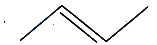
Identify the number of moles of $H$ atoms present in $n$ moles of the organic compound represented as: (in $n$)
A
$4$
B
$6$
C
$8$
D
$2$
Solution
(C) The given structure is $but-2-ene$ $(CH_3-CH=CH-CH_3)$.
Counting the number of hydrogen atoms in one molecule of $but-2-ene$:
$CH_3$ $(3)$ + $CH$ $(1)$ + $CH$ $(1)$ + $CH_3$ $(3)$ = $8$ hydrogen atoms.
Therefore,$1$ mole of the compound contains $8$ moles of $H$ atoms.
Thus,$n$ moles of the organic compound will contain $8 \ n$ moles of $H$ atoms.
Counting the number of hydrogen atoms in one molecule of $but-2-ene$:
$CH_3$ $(3)$ + $CH$ $(1)$ + $CH$ $(1)$ + $CH_3$ $(3)$ = $8$ hydrogen atoms.
Therefore,$1$ mole of the compound contains $8$ moles of $H$ atoms.
Thus,$n$ moles of the organic compound will contain $8 \ n$ moles of $H$ atoms.
0 likesView Solution
141
ChemistryDifficultMCQMHT CET · 2024
Identify the correct stability order of the following alkenes:
$I) (CH_3)_2C=C(CH_3)_2$
$II) (CH_3)_2C=CH_2$
$III) (CH_3)_2C=CHCH_3$
$I) (CH_3)_2C=C(CH_3)_2$
$II) (CH_3)_2C=CH_2$
$III) (CH_3)_2C=CHCH_3$
A
$III > II > I$
B
$I > III > II$
C
$II > I > III$
D
$I > II > III$
Solution
(B) The stability of alkenes is determined by the number of alkyl groups attached to the doubly bonded carbon atoms (hyperconjugation effect).
More alkyl groups lead to greater stability.
$I) (CH_3)_2C=C(CH_3)_2$ has $12$ alpha-hydrogens.
$II) (CH_3)_2C=CH_2$ has $6$ alpha-hydrogens.
$III) (CH_3)_2C=CHCH_3$ has $9$ alpha-hydrogens.
Therefore,the order of stability is $I > III > II$.
More alkyl groups lead to greater stability.
$I) (CH_3)_2C=C(CH_3)_2$ has $12$ alpha-hydrogens.
$II) (CH_3)_2C=CH_2$ has $6$ alpha-hydrogens.
$III) (CH_3)_2C=CHCH_3$ has $9$ alpha-hydrogens.
Therefore,the order of stability is $I > III > II$.
0 likesView Solution
142
ChemistryMediumMCQMHT CET · 2024
Identify the alkadiene molecule from the following.
A
Isoprene
B
$ \beta $-Phellandrene
C
but-$2$-ene
D
pent-$1$-ene
Solution
(A) An alkadiene is a hydrocarbon containing two double bonds.
$1$. Isoprene ($2$-methylbuta-$1,3$-diene) has two double bonds,making it an alkadiene.
$2$. $\beta$-Phellandrene is an alkatriene as it contains three double bonds.
$3$. But-$2$-ene and pent-$1$-ene are monoalkenes containing only one double bond.
Therefore,the correct option is $A$.
$1$. Isoprene ($2$-methylbuta-$1,3$-diene) has two double bonds,making it an alkadiene.
$2$. $\beta$-Phellandrene is an alkatriene as it contains three double bonds.
$3$. But-$2$-ene and pent-$1$-ene are monoalkenes containing only one double bond.
Therefore,the correct option is $A$.
0 likesView Solution
143
ChemistryMediumMCQMHT CET · 2024
Identify the products obtained in the ozonolysis of propene.
A
Methanol and Ethanol
B
Methanal and Ethanol
C
Methanal and Ethanal
D
Methanol and Ethanal
Solution
(C) The ozonolysis of propene $(CH_3-CH=CH_2)$ involves the reaction with ozone $(O_3)$ to form a cyclic ozonide intermediate.
This intermediate is then cleaved using zinc dust and water $(Zn/H_2O)$ to produce carbonyl compounds.
The reaction is as follows:
$CH_3-CH=CH_2 + O_3 \rightarrow \text{Propene ozonide}$
$\text{Propene ozonide} + H_2O/Zn \rightarrow CH_3CHO + HCHO + ZnO$
The products formed are $CH_3CHO$ (Ethanal) and $HCHO$ (Methanal).
This intermediate is then cleaved using zinc dust and water $(Zn/H_2O)$ to produce carbonyl compounds.
The reaction is as follows:
$CH_3-CH=CH_2 + O_3 \rightarrow \text{Propene ozonide}$
$\text{Propene ozonide} + H_2O/Zn \rightarrow CH_3CHO + HCHO + ZnO$
The products formed are $CH_3CHO$ (Ethanal) and $HCHO$ (Methanal).
0 likesView Solution
144
ChemistryMediumMCQMHT CET · 2024
Identify the product of ozonolysis of $but-2-ene$ from the following:
A
$Acetone$ and $formaldehyde$
B
$Acetaldehyde$ and $formaldehyde$
C
$Acetone$
D
$Acetaldehyde$
Solution
(D) The ozonolysis of $but-2-ene$ $(CH_3-CH=CH-CH_3)$ involves the addition of ozone $(O_3)$ to form an ozonide intermediate.
This ozonide is then cleaved by $Zn$ dust and $H_2O$ (reductive cleavage).
The reaction is: $CH_3-CH=CH-CH_3 + O_3$ $\rightarrow \text{ozonide}$ $\xrightarrow{Zn/H_2O} 2CH_3CHO$.
The product formed is $2$ moles of $acetaldehyde$ $(CH_3CHO)$.
This ozonide is then cleaved by $Zn$ dust and $H_2O$ (reductive cleavage).
The reaction is: $CH_3-CH=CH-CH_3 + O_3$ $\rightarrow \text{ozonide}$ $\xrightarrow{Zn/H_2O} 2CH_3CHO$.
The product formed is $2$ moles of $acetaldehyde$ $(CH_3CHO)$.
0 likesView Solution
145
ChemistryMediumMCQMHT CET · 2024
Which of the following catalysts is used to convert an alkyne $(-C \equiv C-)$ to form a $cis$-alkene?
A
$ZnCl_2 / HCl$
B
$Pd-C / \text{quinoline}$
C
$Na / \text{liquid } NH_3$
D
$Na / Hg \text{ in } H_2O$
Solution
(B) The partial hydrogenation of an alkyne to a $cis$-alkene is achieved using Lindlar's catalyst,which consists of $Pd$ supported on $CaCO_3$ or $BaSO_4$ and poisoned with quinoline or lead acetate.
This catalyst prevents the further reduction of the alkene to an alkane.
Therefore,the correct catalyst is $Pd-C / \text{quinoline}$ (often referred to as Lindlar's catalyst).
This catalyst prevents the further reduction of the alkene to an alkane.
Therefore,the correct catalyst is $Pd-C / \text{quinoline}$ (often referred to as Lindlar's catalyst).
0 likesView Solution
146
ChemistryDifficultMCQMHT CET · 2024
Which of the following compounds is obtained when cyclohexene is oxidized using $KMnO_4$ in dilute $H_2SO_4$?
A
Cyclohexanol
B
Cyclohexanone
C
Benzoic acid
D
Adipic acid
Solution
(D) When cyclohexene is treated with a strong oxidizing agent like $KMnO_4$ in the presence of dilute $H_2SO_4$ (acidic medium),the double bond undergoes oxidative cleavage.
This reaction breaks the ring and oxidizes the carbons at the double bond to carboxylic acid groups.
The product formed is hexanedioic acid,commonly known as Adipic acid,with the formula $HOOC-(CH_2)_4-COOH$.
This reaction breaks the ring and oxidizes the carbons at the double bond to carboxylic acid groups.
The product formed is hexanedioic acid,commonly known as Adipic acid,with the formula $HOOC-(CH_2)_4-COOH$.
0 likesView Solution
147
ChemistryMediumMCQMHT CET · 2024
Which of the following reactions is not possible for benzene due to its reversible nature?
A
Hydrogenation
B
Chlorination
C
Bromination
D
Iodination
Solution
(D) The electrophilic substitution reaction of benzene with iodine $(I_2)$ is a reversible process. The reaction is as follows: $C_6H_6 + I_2 \rightleftharpoons C_6H_5I + HI$.
Because the byproduct $HI$ is a strong reducing agent,it reduces the iodobenzene back to benzene,making the forward reaction unfavorable. Therefore,direct iodination of benzene is not possible without the presence of an oxidizing agent (like $HNO_3$ or $HIO_3$) to consume the $HI$ produced.
Because the byproduct $HI$ is a strong reducing agent,it reduces the iodobenzene back to benzene,making the forward reaction unfavorable. Therefore,direct iodination of benzene is not possible without the presence of an oxidizing agent (like $HNO_3$ or $HIO_3$) to consume the $HI$ produced.
0 likesView Solution
148
ChemistryMediumMCQMHT CET · 2024
Which of the following is not a property of hydrogen peroxide?
A
It is immiscible in water.
B
It is a pale blue coloured liquid in pure state.
C
Its strength is explained in volume unit.
D
It is a mild oxidising as well as reducing agent.
Solution
(A) Let's analyze the properties of hydrogen peroxide $(H_2O_2)$:
-$A$. It is immiscible in water: This statement is false. Hydrogen peroxide is miscible in water in all proportions because it forms hydrogen bonds with water molecules.
-$B$. It is a pale blue coloured liquid in pure state: This statement is true. Pure hydrogen peroxide is a clear,pale blue liquid.
-$C$. Its strength is explained in volume unit: This statement is true. The concentration of $H_2O_2$ is commonly expressed as 'volume strength' (e.g.,$10$ volume $H_2O_2$),which refers to the volume of oxygen gas liberated at $STP$ by $1$ volume of the solution.
-$D$. It is a mild oxidising as well as reducing agent: This statement is true. $H_2O_2$ acts as an oxidising agent in both acidic and basic media,and it can also act as a reducing agent towards strong oxidising agents.
-$A$. It is immiscible in water: This statement is false. Hydrogen peroxide is miscible in water in all proportions because it forms hydrogen bonds with water molecules.
-$B$. It is a pale blue coloured liquid in pure state: This statement is true. Pure hydrogen peroxide is a clear,pale blue liquid.
-$C$. Its strength is explained in volume unit: This statement is true. The concentration of $H_2O_2$ is commonly expressed as 'volume strength' (e.g.,$10$ volume $H_2O_2$),which refers to the volume of oxygen gas liberated at $STP$ by $1$ volume of the solution.
-$D$. It is a mild oxidising as well as reducing agent: This statement is true. $H_2O_2$ acts as an oxidising agent in both acidic and basic media,and it can also act as a reducing agent towards strong oxidising agents.
0 likesView Solution
149
ChemistryMediumMCQMHT CET · 2024
What type of intermolecular or intramolecular forces are present in ethylene glycol?
A
Dipole-induced dipole
B
Dipole-dipole
C
Dispersion forces
D
Intramolecular hydrogen bonding
Solution
(D) Ethylene glycol $(HO-CH_2-CH_2-OH)$ contains two hydroxyl $(-OH)$ groups on adjacent carbon atoms.
Due to the proximity of these two $-OH$ groups,a hydrogen atom from one hydroxyl group forms a hydrogen bond with the oxygen atom of the other hydroxyl group within the same molecule.
This specific type of interaction is known as intramolecular hydrogen bonding.
Due to the proximity of these two $-OH$ groups,a hydrogen atom from one hydroxyl group forms a hydrogen bond with the oxygen atom of the other hydroxyl group within the same molecule.
This specific type of interaction is known as intramolecular hydrogen bonding.
0 likesView Solution
150
ChemistryMediumMCQMHT CET · 2024
Which of the following salt solutions turns red litmus blue?
A
$NH_4CN$
B
$NH_4Cl$
C
$NH_4NO_3$
D
$NaNO_3$
Solution
(A) salt solution that turns red litmus blue must be basic in nature.
$NH_4CN$ is a salt of a weak acid $(HCN)$ and a weak base $(NH_4OH)$.
The $pH$ of such a salt is given by the formula $pH = 7 + \frac{1}{2}(pK_a - pK_b)$.
For $HCN$,$K_a = 6.2 \times 10^{-10}$ $(pK_a \approx 9.21)$ and for $NH_4OH$,$K_b = 1.8 \times 10^{-5}$ $(pK_b \approx 4.74)$.
Since $pK_a > pK_b$,the resulting solution is slightly basic $(pH > 7)$.
$NH_4Cl$ and $NH_4NO_3$ are salts of a strong acid and a weak base,making them acidic.
$NaNO_3$ is a salt of a strong acid and a strong base,making it neutral.
$NH_4CN$ is a salt of a weak acid $(HCN)$ and a weak base $(NH_4OH)$.
The $pH$ of such a salt is given by the formula $pH = 7 + \frac{1}{2}(pK_a - pK_b)$.
For $HCN$,$K_a = 6.2 \times 10^{-10}$ $(pK_a \approx 9.21)$ and for $NH_4OH$,$K_b = 1.8 \times 10^{-5}$ $(pK_b \approx 4.74)$.
Since $pK_a > pK_b$,the resulting solution is slightly basic $(pH > 7)$.
$NH_4Cl$ and $NH_4NO_3$ are salts of a strong acid and a weak base,making them acidic.
$NaNO_3$ is a salt of a strong acid and a strong base,making it neutral.
0 likesView Solution
151
ChemistryEasyMCQMHT CET · 2024
What is the number of amino acids present in a single turn of an $\alpha$-helix of a protein?
A
$1.3$
B
$3.1$
C
$3.6$
D
$6.3$
Solution
(C) The $\alpha$-helix is a common secondary structure of proteins.
In an $\alpha$-helix,the polypeptide chain is coiled into a right-handed screw.
Each turn of the helix contains approximately $3.6$ amino acid residues.
This structure is stabilized by hydrogen bonds between the $C=O$ group of one amino acid and the $N-H$ group of the fourth amino acid along the chain.
In an $\alpha$-helix,the polypeptide chain is coiled into a right-handed screw.
Each turn of the helix contains approximately $3.6$ amino acid residues.
This structure is stabilized by hydrogen bonds between the $C=O$ group of one amino acid and the $N-H$ group of the fourth amino acid along the chain.
0 likesView Solution
152
ChemistryMediumMCQMHT CET · 2024
Identify the nitrogen atom of a purine base that bonds with the $1^{\prime}$ carbon of ribose to form a ribonucleoside.
A
$1^{\text{st}}$
B
$3^{\text{rd}}$
C
$7^{\text{th}}$
D
$9^{\text{th}}$
Solution
(D) In purine bases,the nitrogen atom at the $9^{\text{th}}$ position forms a $\beta$-glycosidic linkage with the $1^{\prime}$ carbon atom of the ribose sugar.
This bond formation results in the synthesis of a ribonucleoside.
This bond formation results in the synthesis of a ribonucleoside.
0 likesView Solution
153
ChemistryDifficultMCQMHT CET · 2024
Which $C$ atom of ribose sugar (numbered from $1^{\prime}$ to $5^{\prime}$) bonds with the phosphate group to form $AMP$ (in $^{\prime}$)?
A
$1$
B
$3$
C
$4$
D
$5$
Solution
(D) In $AMP$ (Adenosine monophosphate),the nucleotide is formed by the attachment of a phosphate group to the ribose sugar.
Based on the structure of $AMP$,the phosphate group is esterified to the hydroxyl group attached to the $5^{\prime}$ carbon atom of the ribose sugar.
Therefore,the $5^{\prime}$ carbon atom is the one that bonds with the phosphate group.
Based on the structure of $AMP$,the phosphate group is esterified to the hydroxyl group attached to the $5^{\prime}$ carbon atom of the ribose sugar.
Therefore,the $5^{\prime}$ carbon atom is the one that bonds with the phosphate group.
0 likesView Solution
154
ChemistryMediumMCQMHT CET · 2024
Which of the following statements is $NOT$ true for nucleic acids?
A
$5^{\prime}$ end of a polynucleotide has a free phosphate group.
B
Nucleic acids contain a backbone formed of $-C-O-C-$ linkage.
C
$A$ polynucleotide has a free $-OH$ group at the $3^{\prime}$ end.
D
Neighbouring nucleotides are bonded through a phosphodiester linkage.
Solution
(B) Option $B$ is $NOT$ true for nucleic acids.
In nucleic acids,the backbone is formed by a sugar-phosphate linkage rather than a $-C-O-C-$ linkage.
The backbone is composed of alternating sugar and phosphate groups,connected by phosphodiester bonds.
Each phosphate group links the $3^{\prime}$ carbon atom of one sugar molecule to the $5^{\prime}$ carbon atom of the next sugar molecule,which forms the characteristic sugar-phosphate-sugar chain of $DNA$ and $RNA$.
In nucleic acids,the backbone is formed by a sugar-phosphate linkage rather than a $-C-O-C-$ linkage.
The backbone is composed of alternating sugar and phosphate groups,connected by phosphodiester bonds.
Each phosphate group links the $3^{\prime}$ carbon atom of one sugar molecule to the $5^{\prime}$ carbon atom of the next sugar molecule,which forms the characteristic sugar-phosphate-sugar chain of $DNA$ and $RNA$.
0 likesView Solution
155
ChemistryMediumMCQMHT CET · 2024
Which of the following is $NOT$ a salient feature of the Watson and Crick model for $DNA$?
A
Polynucleotide strands wind into a right-handed double helix.
B
Sugar-phosphate backbone lies on the inside and bases lie on the outside of the helix.
C
Double helix is stabilized by hydrogen bonding formed between two strands.
D
$A=T$ and $G=C$ are complementary base pairs.
Solution
(B) In the Watson and Crick model of $DNA$,the sugar-phosphate backbone lies on the outside of the double helix,while the nitrogenous bases $(A, T, G, C)$ are located on the inside of the helix,where they form specific hydrogen-bonded base pairs.
Therefore,the statement that the sugar-phosphate backbone lies on the inside and bases lie on the outside is incorrect.
Thus,option $(B)$ is the correct answer.
Therefore,the statement that the sugar-phosphate backbone lies on the inside and bases lie on the outside is incorrect.
Thus,option $(B)$ is the correct answer.
0 likesView Solution
156
ChemistryMediumMCQMHT CET · 2024
Which of the following nitrogen bases of nucleic acids is derived from purine?
A
Cytosine
B
Uracil
C
Guanine
D
Thymine
Solution
(C) Nitrogenous bases in nucleic acids are classified into two types: purines and pyrimidines.
- Purines are bicyclic (two-ring) structures,which include Adenine $(A)$ and Guanine $(G)$.
- Pyrimidines are monocyclic (single-ring) structures,which include Cytosine $(C)$,Thymine $(T)$,and Uracil $(U)$.
Therefore,Guanine is the nitrogen base derived from purine.
- Purines are bicyclic (two-ring) structures,which include Adenine $(A)$ and Guanine $(G)$.
- Pyrimidines are monocyclic (single-ring) structures,which include Cytosine $(C)$,Thymine $(T)$,and Uracil $(U)$.
Therefore,Guanine is the nitrogen base derived from purine.
0 likesView Solution
157
ChemistryEasyMCQMHT CET · 2024
Which of the following is $NOT$ a dicarboxylic acid?
A
Citric acid
B
Malonic acid
C
Oxalic acid
D
Glutaric acid
Solution
(A) dicarboxylic acid contains two carboxyl $(-COOH)$ groups in its structure.
$1$. Citric acid has the structure $HOOC-CH_2-C(OH)(COOH)-CH_2-COOH$,which contains three carboxyl groups,making it a tricarboxylic acid.
$2$. Malonic acid $(HOOC-CH_2-COOH)$ is a dicarboxylic acid.
$3$. Oxalic acid $(HOOC-COOH)$ is a dicarboxylic acid.
$4$. Glutaric acid $(HOOC-(CH_2)_3-COOH)$ is a dicarboxylic acid.
Therefore,citric acid is not a dicarboxylic acid.
$1$. Citric acid has the structure $HOOC-CH_2-C(OH)(COOH)-CH_2-COOH$,which contains three carboxyl groups,making it a tricarboxylic acid.
$2$. Malonic acid $(HOOC-CH_2-COOH)$ is a dicarboxylic acid.
$3$. Oxalic acid $(HOOC-COOH)$ is a dicarboxylic acid.
$4$. Glutaric acid $(HOOC-(CH_2)_3-COOH)$ is a dicarboxylic acid.
Therefore,citric acid is not a dicarboxylic acid.
0 likesView Solution
158
ChemistryMediumMCQMHT CET · 2024
Identify product '$B$' in the following reaction: $\text{Cumene}$ $\xrightarrow[\Delta]{KMnO_4, KOH} A$ $\xrightarrow{H_3 O^{+}} B$
A
Phenol
B
Benzophenone
C
Benzaldehyde
D
Benzoic acid
Solution
(D) The reaction of cumene (isopropylbenzene) with alkaline $KMnO_4$ followed by heating results in the oxidation of the alkyl side chain to a carboxylate group.
In the first step,cumene is oxidized to potassium benzoate $(A)$.
In the second step,acidification of potassium benzoate with $H_3O^+$ yields benzoic acid $(B)$.
In the first step,cumene is oxidized to potassium benzoate $(A)$.
In the second step,acidification of potassium benzoate with $H_3O^+$ yields benzoic acid $(B)$.
0 likesView Solution
159
ChemistryEasyMCQMHT CET · 2024
Which compound from the following has the highest boiling point?
A
$n-C_4H_9OH$
B
$(CH_3)_3CNH_2$
C
$C_2H_5N(CH_3)_2$
D
$C_2H_5COOH$
Solution
(D) The boiling point of a compound depends on the strength of intermolecular forces.
Carboxylic acids $(C_2H_5COOH)$ form stable dimers due to strong intermolecular hydrogen bonding,which is significantly stronger than the hydrogen bonding in alcohols $(n-C_4H_9OH)$ or the dipole-dipole interactions in amines.
Therefore,$C_2H_5COOH$ has the highest boiling point among the given compounds.
Carboxylic acids $(C_2H_5COOH)$ form stable dimers due to strong intermolecular hydrogen bonding,which is significantly stronger than the hydrogen bonding in alcohols $(n-C_4H_9OH)$ or the dipole-dipole interactions in amines.
Therefore,$C_2H_5COOH$ has the highest boiling point among the given compounds.
0 likesView Solution
160
ChemistryEasyMCQMHT CET · 2024
Identify the product formed in the following reaction.
$C_6H_5-CH_2-CH_3 \xrightarrow[\text{ii) } H_3O^{+}]{\text{alk. } KMnO_4} \text{product}$
$C_6H_5-CH_2-CH_3 \xrightarrow[\text{ii) } H_3O^{+}]{\text{alk. } KMnO_4} \text{product}$
A
$C_6H_5-CH_2COOH$
B
$C_6H_5-CH_2-CH_2-CH_2-COOH$
C
$C_6H_5-OH$
D
$C_6H_5-COOH$
Solution
(D) The reaction of an alkylbenzene with an alkyl group having at least one benzylic hydrogen atom with alkaline $KMnO_4$ followed by acidic hydrolysis $(H_3O^+)$ results in the oxidation of the alkyl side chain to a carboxylic acid group.
In the given reaction,ethylbenzene $(C_6H_5-CH_2-CH_3)$ is oxidized to benzoic acid $(C_6H_5-COOH)$.
The reaction is: $C_6H_5-CH_2-CH_3 \xrightarrow[\text{(ii) } H_3O^{+}]{\text{(i) alk. } KMnO_4} C_6H_5-COOH$.
In the given reaction,ethylbenzene $(C_6H_5-CH_2-CH_3)$ is oxidized to benzoic acid $(C_6H_5-COOH)$.
The reaction is: $C_6H_5-CH_2-CH_3 \xrightarrow[\text{(ii) } H_3O^{+}]{\text{(i) alk. } KMnO_4} C_6H_5-COOH$.
0 likesView Solution
161
ChemistryEasyMCQMHT CET · 2024
Select the $CORRECT$ increasing order of boiling points of alcohols,amines,and carboxylic acids of comparable molar mass from the following.
A
$Amines < Alcohols < Carboxylic \ acids$
B
$Amines < Carboxylic \ acids < Alcohols$
C
$Alcohols < Amines < Carboxylic \ acids$
D
$Carboxylic \ acids < Alcohols < Amines$
Solution
(A) The boiling point depends on the strength of intermolecular forces,primarily hydrogen bonding.
$N-H$ bonds in amines are less polar than $O-H$ bonds in alcohols,leading to weaker hydrogen bonding in amines.
Carboxylic acids contain a $-COOH$ group,which allows for the formation of stable dimeric structures through strong intermolecular hydrogen bonding.
Therefore,the strength of hydrogen bonding follows the order: $Amines < Alcohols < Carboxylic \ acids$.
Consequently,the increasing order of boiling points is $Amines < Alcohols < Carboxylic \ acids$.
$N-H$ bonds in amines are less polar than $O-H$ bonds in alcohols,leading to weaker hydrogen bonding in amines.
Carboxylic acids contain a $-COOH$ group,which allows for the formation of stable dimeric structures through strong intermolecular hydrogen bonding.
Therefore,the strength of hydrogen bonding follows the order: $Amines < Alcohols < Carboxylic \ acids$.
Consequently,the increasing order of boiling points is $Amines < Alcohols < Carboxylic \ acids$.
0 likesView Solution
162
ChemistryMediumMCQMHT CET · 2024
Which of the following compounds is $NOT$ a mono carboxylic acid?
A
Phthalic acid
B
Salicylic acid
C
$o$-toluic acid
D
Benzoic acid
Solution
(A) mono carboxylic acid contains only one $-COOH$ group in its structure.
$1$. Phthalic acid $(C_6H_4(COOH)_2)$ contains two $-COOH$ groups attached to the benzene ring at ortho positions,making it a dicarboxylic acid.
$2$. Salicylic acid $(C_6H_4(OH)(COOH))$ contains one $-COOH$ group and one $-OH$ group,making it a mono carboxylic acid.
$3$. $o$-toluic acid $(C_6H_4(CH_3)(COOH))$ contains one $-COOH$ group,making it a mono carboxylic acid.
$4$. Benzoic acid $(C_6H_5COOH)$ contains one $-COOH$ group,making it a mono carboxylic acid.
Therefore,Phthalic acid is not a mono carboxylic acid.
$1$. Phthalic acid $(C_6H_4(COOH)_2)$ contains two $-COOH$ groups attached to the benzene ring at ortho positions,making it a dicarboxylic acid.
$2$. Salicylic acid $(C_6H_4(OH)(COOH))$ contains one $-COOH$ group and one $-OH$ group,making it a mono carboxylic acid.
$3$. $o$-toluic acid $(C_6H_4(CH_3)(COOH))$ contains one $-COOH$ group,making it a mono carboxylic acid.
$4$. Benzoic acid $(C_6H_5COOH)$ contains one $-COOH$ group,making it a mono carboxylic acid.
Therefore,Phthalic acid is not a mono carboxylic acid.
0 likesView Solution
163
ChemistryMediumMCQMHT CET · 2024
Which among the following is a pair of monocarboxylic acids?
A
Malonic acid and propionic acid
B
Valeric acid and succinic acid
C
Acetic acid and adipic acid
D
Butyric acid and caproic acid
Solution
(D) Monocarboxylic acids contain only one $-COOH$ group in their structure.
$A$. Malonic acid $(HOOC-CH_2-COOH)$ is a dicarboxylic acid,while propionic acid $(CH_3-CH_2-COOH)$ is a monocarboxylic acid.
$B$. Valeric acid $(CH_3(CH_2)_3COOH)$ is a monocarboxylic acid,while succinic acid $(HOOC-(CH_2)_2-COOH)$ is a dicarboxylic acid.
$C$. Acetic acid $(CH_3COOH)$ is a monocarboxylic acid,while adipic acid $(HOOC-(CH_2)_4-COOH)$ is a dicarboxylic acid.
$D$. Butyric acid $(CH_3(CH_2)_2COOH)$ and caproic acid $(CH_3(CH_2)_4COOH)$ both contain only one $-COOH$ group,so they are both monocarboxylic acids.
$A$. Malonic acid $(HOOC-CH_2-COOH)$ is a dicarboxylic acid,while propionic acid $(CH_3-CH_2-COOH)$ is a monocarboxylic acid.
$B$. Valeric acid $(CH_3(CH_2)_3COOH)$ is a monocarboxylic acid,while succinic acid $(HOOC-(CH_2)_2-COOH)$ is a dicarboxylic acid.
$C$. Acetic acid $(CH_3COOH)$ is a monocarboxylic acid,while adipic acid $(HOOC-(CH_2)_4-COOH)$ is a dicarboxylic acid.
$D$. Butyric acid $(CH_3(CH_2)_2COOH)$ and caproic acid $(CH_3(CH_2)_4COOH)$ both contain only one $-COOH$ group,so they are both monocarboxylic acids.
0 likesView Solution
164
ChemistryMediumMCQMHT CET · 2024
Identify the product obtained when benzoyl chloride is treated with dimethyl cadmium.
A
Acetophenone
B
Benzoic acid
C
Benzophenone
D
Benzaldehyde
Solution
(A) The reaction between an acid chloride $(RCOCl)$ and a dialkyl cadmium reagent $(R'_2Cd)$ is a standard method for the preparation of ketones.
In this reaction,$2$ moles of benzoyl chloride $(C_6H_5COCl)$ react with $1$ mole of dimethyl cadmium $((CH_3)_2Cd)$ to produce acetophenone $(C_6H_5COCH_3)$ and cadmium chloride $(CdCl_2)$.
The chemical equation is:
$2C_6H_5COCl + (CH_3)_2Cd \rightarrow 2C_6H_5COCH_3 + CdCl_2$
Thus,the product obtained is acetophenone.
In this reaction,$2$ moles of benzoyl chloride $(C_6H_5COCl)$ react with $1$ mole of dimethyl cadmium $((CH_3)_2Cd)$ to produce acetophenone $(C_6H_5COCH_3)$ and cadmium chloride $(CdCl_2)$.
The chemical equation is:
$2C_6H_5COCl + (CH_3)_2Cd \rightarrow 2C_6H_5COCH_3 + CdCl_2$
Thus,the product obtained is acetophenone.
0 likesView Solution
165
ChemistryEasyMCQMHT CET · 2024
Identify the product $X$ in the following reaction.
$CH_3COCl \xrightarrow{H_2O} X$
$CH_3COCl \xrightarrow{H_2O} X$
A
Ethanol
B
Ethanal
C
Ethanoic acid
D
Ethylethanoate
Solution
(C) The reaction of ethanoyl chloride $(CH_3COCl)$ with water $(H_2O)$ is a hydrolysis reaction.
In this reaction,the chlorine atom is replaced by a hydroxyl group $(-OH)$ from water.
The chemical equation is: $CH_3COCl + H_2O \rightarrow CH_3COOH + HCl$.
The product $X$ formed is ethanoic acid $(CH_3COOH)$.
In this reaction,the chlorine atom is replaced by a hydroxyl group $(-OH)$ from water.
The chemical equation is: $CH_3COCl + H_2O \rightarrow CH_3COOH + HCl$.
The product $X$ formed is ethanoic acid $(CH_3COOH)$.
0 likesView Solution
166
ChemistryMediumMCQMHT CET · 2024
What is the rate of formation of $O_2$ for the reaction stated below?
$2 N_2O_{5(g)} \longrightarrow 4 NO_{2(g)} + O_{2(g)}$
Given: $\left| \frac{d[N_2O_5]}{dt} \right| = 0.02 \ mol \ dm^{-3} \ s^{-1}$
$2 N_2O_{5(g)} \longrightarrow 4 NO_{2(g)} + O_{2(g)}$
Given: $\left| \frac{d[N_2O_5]}{dt} \right| = 0.02 \ mol \ dm^{-3} \ s^{-1}$
A
$0.01 \ mol \ dm^{-3} \ s^{-1}$
B
$0.02 \ mol \ dm^{-3} \ s^{-1}$
C
$0.03 \ mol \ dm^{-3} \ s^{-1}$
D
$0.04 \ mol \ dm^{-3} \ s^{-1}$
Solution
(A) The rate of reaction is given by the expression:
$\text{Rate} = -\frac{1}{2} \frac{d[N_2O_5]}{dt} = \frac{d[O_2]}{dt}$
Given that the rate of disappearance of $N_2O_5$ is $\left| \frac{d[N_2O_5]}{dt} \right| = 0.02 \ mol \ dm^{-3} \ s^{-1}$.
Substituting this value into the expression:
$\frac{d[O_2]}{dt} = \frac{1}{2} \times 0.02 \ mol \ dm^{-3} \ s^{-1} = 0.01 \ mol \ dm^{-3} \ s^{-1}$.
$\text{Rate} = -\frac{1}{2} \frac{d[N_2O_5]}{dt} = \frac{d[O_2]}{dt}$
Given that the rate of disappearance of $N_2O_5$ is $\left| \frac{d[N_2O_5]}{dt} \right| = 0.02 \ mol \ dm^{-3} \ s^{-1}$.
Substituting this value into the expression:
$\frac{d[O_2]}{dt} = \frac{1}{2} \times 0.02 \ mol \ dm^{-3} \ s^{-1} = 0.01 \ mol \ dm^{-3} \ s^{-1}$.
0 likesView Solution
167
ChemistryEasyMCQMHT CET · 2024
For the reaction,$A + 3B \longrightarrow 2C$,the rate of consumption of $A$ is $1.4 \ mol \ dm^{-3} \ s^{-1}$. Calculate the rate of formation of $C$.
A
$0.07 \ mol \ dm^{-3} \ s^{-1}$
B
$1.4 \ mol \ dm^{-3} \ s^{-1}$
C
$2.8 \ mol \ dm^{-3} \ s^{-1}$
D
$3.5 \ mol \ dm^{-3} \ s^{-1}$
Solution
(C) For the reaction,$A + 3B \longrightarrow 2C$,the rate of reaction is given by:
$-\frac{d[A]}{dt} = -\frac{1}{3} \frac{d[B]}{dt} = \frac{1}{2} \frac{d[C]}{dt}$
Given that the rate of consumption of $A$ is $-\frac{d[A]}{dt} = 1.4 \ mol \ dm^{-3} \ s^{-1}$.
Equating the terms for $A$ and $C$:
$-\frac{d[A]}{dt} = \frac{1}{2} \frac{d[C]}{dt}$
$1.4 = \frac{1}{2} \frac{d[C]}{dt}$
$\frac{d[C]}{dt} = 2 \times 1.4 \ mol \ dm^{-3} \ s^{-1} = 2.8 \ mol \ dm^{-3} \ s^{-1}$
$-\frac{d[A]}{dt} = -\frac{1}{3} \frac{d[B]}{dt} = \frac{1}{2} \frac{d[C]}{dt}$
Given that the rate of consumption of $A$ is $-\frac{d[A]}{dt} = 1.4 \ mol \ dm^{-3} \ s^{-1}$.
Equating the terms for $A$ and $C$:
$-\frac{d[A]}{dt} = \frac{1}{2} \frac{d[C]}{dt}$
$1.4 = \frac{1}{2} \frac{d[C]}{dt}$
$\frac{d[C]}{dt} = 2 \times 1.4 \ mol \ dm^{-3} \ s^{-1} = 2.8 \ mol \ dm^{-3} \ s^{-1}$
0 likesView Solution
168
ChemistryMediumMCQMHT CET · 2024
For a reaction,$2 \ N_2O_{5(g)} \longrightarrow 4 \ NO_{2(g)} + O_{2(g)}$. The $N_2O_5$ disappears at a rate of $0.06 \ mol \ dm^{-3} \ s^{-1}$. What is the rate of $NO_{2(g)}$ formation (in $mol \ dm^{-3} \ s^{-1}$)?
A
$0.06$
B
$0.12$
C
$0.18$
D
$0.24$
Solution
(B) The given reaction is: $2 \ N_2O_{5(g)} \longrightarrow 4 \ NO_{2(g)} + O_{2(g)}$.
The rate of reaction is expressed as: $-\frac{1}{2} \frac{d[N_2O_5]}{dt} = \frac{1}{4} \frac{d[NO_2]}{dt}$.
Given that the rate of disappearance of $N_2O_5$ is $-\frac{d[N_2O_5]}{dt} = 0.06 \ mol \ dm^{-3} \ s^{-1}$.
Substituting this into the rate expression: $\frac{1}{2} \times (0.06) = \frac{1}{4} \frac{d[NO_2]}{dt}$.
Therefore,the rate of formation of $NO_2$ is: $\frac{d[NO_2]}{dt} = 2 \times 0.06 = 0.12 \ mol \ dm^{-3} \ s^{-1}$.
The rate of reaction is expressed as: $-\frac{1}{2} \frac{d[N_2O_5]}{dt} = \frac{1}{4} \frac{d[NO_2]}{dt}$.
Given that the rate of disappearance of $N_2O_5$ is $-\frac{d[N_2O_5]}{dt} = 0.06 \ mol \ dm^{-3} \ s^{-1}$.
Substituting this into the rate expression: $\frac{1}{2} \times (0.06) = \frac{1}{4} \frac{d[NO_2]}{dt}$.
Therefore,the rate of formation of $NO_2$ is: $\frac{d[NO_2]}{dt} = 2 \times 0.06 = 0.12 \ mol \ dm^{-3} \ s^{-1}$.
0 likesView Solution
169
ChemistryDifficultMCQMHT CET · 2024
For the reaction,$3 I_{(aq)}^{-} + S_2 O_{8_{(aq)}}^{2-} \longrightarrow 2 SO_{4_{(aq)}}^{2-} + I_{3_{(aq)}}^{-}$,the rate of formation of $SO_{4_{(aq)}}^{2-}$ is $0.044 \ mol \ dm^{-3} \ s^{-1}$. Calculate the rate of consumption of $I_{(aq)}^{-}$.
A
$0.022 \ mol \ dm^{-3} \ s^{-1}$
B
$0.044 \ mol \ dm^{-3} \ s^{-1}$
C
$0.066 \ mol \ dm^{-3} \ s^{-1}$
D
$0.088 \ mol \ dm^{-3} \ s^{-1}$
Solution
(C) The given reaction is $3 I_{(aq)}^{-} + S_2 O_{8_{(aq)}}^{2-} \longrightarrow 2 SO_{4_{(aq)}}^{2-} + I_{3_{(aq)}}^{-}$.
The rate of reaction is expressed as: $\text{Rate} = -\frac{1}{3} \frac{d[I^{-}]}{dt} = -\frac{d[S_2 O_8^{2-}]}{dt} = \frac{1}{2} \frac{d[SO_4^{2-}]}{dt} = \frac{d[I_3^{-}]}{dt}$.
From the expression,the rate of consumption of $I^{-}$ is given by $-\frac{d[I^{-}]}{dt} = \frac{3}{2} \times \frac{d[SO_4^{2-}]}{dt}$.
Given $\frac{d[SO_4^{2-}]}{dt} = 0.044 \ mol \ dm^{-3} \ s^{-1}$,we have:
Rate of consumption of $I^{-} = \frac{3}{2} \times 0.044 = 0.066 \ mol \ dm^{-3} \ s^{-1}$.
The rate of reaction is expressed as: $\text{Rate} = -\frac{1}{3} \frac{d[I^{-}]}{dt} = -\frac{d[S_2 O_8^{2-}]}{dt} = \frac{1}{2} \frac{d[SO_4^{2-}]}{dt} = \frac{d[I_3^{-}]}{dt}$.
From the expression,the rate of consumption of $I^{-}$ is given by $-\frac{d[I^{-}]}{dt} = \frac{3}{2} \times \frac{d[SO_4^{2-}]}{dt}$.
Given $\frac{d[SO_4^{2-}]}{dt} = 0.044 \ mol \ dm^{-3} \ s^{-1}$,we have:
Rate of consumption of $I^{-} = \frac{3}{2} \times 0.044 = 0.066 \ mol \ dm^{-3} \ s^{-1}$.
0 likesView Solution
170
ChemistryEasyMCQMHT CET · 2024
For the reaction,$N_{2(g)} + 3 H_{2(g)} \longrightarrow 2 NH_{3(g)}$,$NH_{3}$ is formed at a rate of $0.088 \ mol \ dm^{-3} \ s^{-1}$. Calculate the consumption rate of $N_{2(g)}$.
A
$0.011 \ mol \ dm^{-3} \ s^{-1}$
B
$0.022 \ mol \ dm^{-3} \ s^{-1}$
C
$0.033 \ mol \ dm^{-3} \ s^{-1}$
D
$0.044 \ mol \ dm^{-3} \ s^{-1}$
Solution
(D) The balanced chemical equation is: $N_{2(g)} + 3 H_{2(g)} \longrightarrow 2 NH_{3(g)}$
The rate of reaction is given by: $\text{Rate} = -\frac{d[N_{2}]}{dt} = -\frac{1}{3} \frac{d[H_{2}]}{dt} = \frac{1}{2} \frac{d[NH_{3}]}{dt}$
Given that the rate of formation of $NH_{3}$ is $\frac{d[NH_{3}]}{dt} = 0.088 \ mol \ dm^{-3} \ s^{-1}$.
Substituting this into the rate expression: $-\frac{d[N_{2}]}{dt} = \frac{1}{2} \times \frac{d[NH_{3}]}{dt}$
$-\frac{d[N_{2}]}{dt} = \frac{1}{2} \times 0.088 \ mol \ dm^{-3} \ s^{-1} = 0.044 \ mol \ dm^{-3} \ s^{-1}$
Therefore,the rate of consumption of $N_{2}$ is $0.044 \ mol \ dm^{-3} \ s^{-1}$.
The rate of reaction is given by: $\text{Rate} = -\frac{d[N_{2}]}{dt} = -\frac{1}{3} \frac{d[H_{2}]}{dt} = \frac{1}{2} \frac{d[NH_{3}]}{dt}$
Given that the rate of formation of $NH_{3}$ is $\frac{d[NH_{3}]}{dt} = 0.088 \ mol \ dm^{-3} \ s^{-1}$.
Substituting this into the rate expression: $-\frac{d[N_{2}]}{dt} = \frac{1}{2} \times \frac{d[NH_{3}]}{dt}$
$-\frac{d[N_{2}]}{dt} = \frac{1}{2} \times 0.088 \ mol \ dm^{-3} \ s^{-1} = 0.044 \ mol \ dm^{-3} \ s^{-1}$
Therefore,the rate of consumption of $N_{2}$ is $0.044 \ mol \ dm^{-3} \ s^{-1}$.
0 likesView Solution
171
ChemistryEasyMCQMHT CET · 2024
The reaction $2 A + B + C \longrightarrow D + E$ is found to be first order in $A$,second order in $B$,and zero order in $C$. What is the effect of increasing the concentration of all reactants twice?
A
Rate of reaction increases $8$ times.
B
Rate of reaction increases $24$ times.
C
Rate of reaction increases $36$ times.
D
Rate of reaction remains unaffected.
Solution
(A) The rate law for the reaction is given by: $\text{Rate} = k[A]^1[B]^2[C]^0$.
When the concentration of all reactants is doubled,the new concentrations are $[A]' = 2[A]$,$[B]' = 2[B]$,and $[C]' = 2[C]$.
The new rate $(\text{Rate})_1$ is: $(\text{Rate})_1 = k[2A]^1[2B]^2[2C]^0$.
$(\text{Rate})_1 = k \times 2[A] \times 4[B]^2 \times 1$.
$(\text{Rate})_1 = 8 \times k[A][B]^2$.
Therefore,the rate of reaction increases $8$ times.
When the concentration of all reactants is doubled,the new concentrations are $[A]' = 2[A]$,$[B]' = 2[B]$,and $[C]' = 2[C]$.
The new rate $(\text{Rate})_1$ is: $(\text{Rate})_1 = k[2A]^1[2B]^2[2C]^0$.
$(\text{Rate})_1 = k \times 2[A] \times 4[B]^2 \times 1$.
$(\text{Rate})_1 = 8 \times k[A][B]^2$.
Therefore,the rate of reaction increases $8$ times.
0 likesView Solution
172
ChemistryEasyMCQMHT CET · 2024
Which of the following is an elementary reaction?
A
$C_2H_5I_{(g)} \longrightarrow C_2H_{4(g)} + HI_{(g)}$
B
$2NO_2Cl_{(g)} \longrightarrow 2NO_{2(g)} + Cl_{2(g)}$
C
$2NO_{2(g)} + F_{2(g)} \longrightarrow 2NO_2F_{(g)}$
D
$2NO_{(g)} + Cl_{2(g)} \longrightarrow 2NOCl_{(g)}$
Solution
(A) An elementary reaction is a reaction that occurs in a single step.
Option $A$ represents the decomposition of ethyl iodide,which is a unimolecular elementary reaction.
Options $B$,$C$,and $D$ are complex reactions that occur through multiple steps.
Option $A$ represents the decomposition of ethyl iodide,which is a unimolecular elementary reaction.
Options $B$,$C$,and $D$ are complex reactions that occur through multiple steps.
0 likesView Solution
173
ChemistryMediumMCQMHT CET · 2024
Rate law for a reaction is $r=k[A]^2[B]$. If rate constant is $6.25 \ mol^{-2} \ dm^6 \ s^{-1}$,what is the rate of reaction when $[A]=1 \ mol \ dm^{-3}$ and $[B]=0.2 \ mol \ dm^{-3}$?
A
$1.250 \ mol \ dm^{-3} \ s^{-1}$
B
$2.125 \ mol \ dm^{-3} \ s^{-1}$
C
$3.105 \ mol \ dm^{-3} \ s^{-1}$
D
$2.0 \times 10^{-2} \ mol \ dm^{-3} \ s^{-1}$
Solution
(A) The rate law is given by $r = k[A]^2[B]$.
Given values are $k = 6.25 \ mol^{-2} \ dm^6 \ s^{-1}$,$[A] = 1 \ mol \ dm^{-3}$,and $[B] = 0.2 \ mol \ dm^{-3}$.
Substituting these values into the rate law equation:
$r = 6.25 \times (1)^2 \times (0.2)$
$r = 6.25 \times 0.2 = 1.250 \ mol \ dm^{-3} \ s^{-1}$.
Given values are $k = 6.25 \ mol^{-2} \ dm^6 \ s^{-1}$,$[A] = 1 \ mol \ dm^{-3}$,and $[B] = 0.2 \ mol \ dm^{-3}$.
Substituting these values into the rate law equation:
$r = 6.25 \times (1)^2 \times (0.2)$
$r = 6.25 \times 0.2 = 1.250 \ mol \ dm^{-3} \ s^{-1}$.
0 likesView Solution
174
ChemistryEasyMCQMHT CET · 2024
If the instantaneous rate of reaction is given as $-\frac{1}{a} \frac{d[A]}{dt} = -\frac{1}{b} \frac{d[B]}{dt} = \frac{1}{c} \frac{d[C]}{dt} = \frac{1}{d} \frac{d[D]}{dt}$,then the reaction is represented as:
A
$A + B \longrightarrow C + D$
B
$aA + B \longrightarrow cC + dD$
C
$aA + bB \longrightarrow cC + dD$
D
$aA + bB \longrightarrow C + D$
Solution
(C) The instantaneous rate of a reaction $aA + bB \longrightarrow cC + dD$ is expressed as:
$-\frac{1}{a} \frac{d[A]}{dt} = -\frac{1}{b} \frac{d[B]}{dt} = \frac{1}{c} \frac{d[C]}{dt} = \frac{1}{d} \frac{d[D]}{dt}$
Comparing this with the given expression,the stoichiometric coefficients for reactants $A$ and $B$ are $a$ and $b$,and for products $C$ and $D$ are $c$ and $d$ respectively.
Therefore,the reaction is $aA + bB \longrightarrow cC + dD$.
$-\frac{1}{a} \frac{d[A]}{dt} = -\frac{1}{b} \frac{d[B]}{dt} = \frac{1}{c} \frac{d[C]}{dt} = \frac{1}{d} \frac{d[D]}{dt}$
Comparing this with the given expression,the stoichiometric coefficients for reactants $A$ and $B$ are $a$ and $b$,and for products $C$ and $D$ are $c$ and $d$ respectively.
Therefore,the reaction is $aA + bB \longrightarrow cC + dD$.
0 likesView Solution
175
ChemistryEasyMCQMHT CET · 2024
For a reaction $r = k[A][B]^2$,if the concentration of $A$ is doubled,the rate of reaction:
A
increases by $2$
B
decreases by $\frac{1}{2}$
C
increases by $4$
D
decreases by $2$
Solution
(A) The initial rate of reaction is given by $r_1 = k[A][B]^2$.
When the concentration of $A$ is doubled,the new concentration is $[A]' = 2[A]$.
The new rate of reaction is $r_2 = k[2A][B]^2 = 2 \times k[A][B]^2$.
Therefore,$r_2 = 2 \times r_1$.
Thus,the rate of reaction increases by a factor of $2$.
When the concentration of $A$ is doubled,the new concentration is $[A]' = 2[A]$.
The new rate of reaction is $r_2 = k[2A][B]^2 = 2 \times k[A][B]^2$.
Therefore,$r_2 = 2 \times r_1$.
Thus,the rate of reaction increases by a factor of $2$.
0 likesView Solution
176
ChemistryEasyMCQMHT CET · 2024
The reaction given below $2 NH_{3(g)} \xrightarrow{Pt} N_{2(g)} + 3 H_{2(g)}$ has a rate of reaction of $2.5 \times 10^{-6} \ mol \ dm^{-3} \ sec^{-1}$. What is the rate of formation of $H_{2(g)}$?
A
$2.5 \times 10^{-6} \ mol \ dm^{-3} \ sec^{-1}$
B
$3.75 \times 10^{-6} \ mol \ dm^{-3} \ sec^{-1}$
C
$5.0 \times 10^{-6} \ mol \ dm^{-3} \ sec^{-1}$
D
$7.5 \times 10^{-6} \ mol \ dm^{-3} \ sec^{-1}$
Solution
(D) For the reaction,$2 NH_{3(g)} \xrightarrow{Pt} N_{2(g)} + 3 H_{2(g)}$
The rate of reaction is given by:
$\text{Rate} = -\frac{1}{2} \frac{d[NH_3]}{dt} = \frac{d[N_2]}{dt} = \frac{1}{3} \frac{d[H_2]}{dt}$
Given that the rate of reaction is $2.5 \times 10^{-6} \ mol \ dm^{-3} \ sec^{-1}$,we have:
$\text{Rate} = \frac{1}{3} \frac{d[H_2]}{dt} = 2.5 \times 10^{-6} \ mol \ dm^{-3} \ sec^{-1}$
Therefore,the rate of formation of $H_{2(g)}$ is:
$\frac{d[H_2]}{dt} = 3 \times 2.5 \times 10^{-6} \ mol \ dm^{-3} \ sec^{-1} = 7.5 \times 10^{-6} \ mol \ dm^{-3} \ sec^{-1}$
The rate of reaction is given by:
$\text{Rate} = -\frac{1}{2} \frac{d[NH_3]}{dt} = \frac{d[N_2]}{dt} = \frac{1}{3} \frac{d[H_2]}{dt}$
Given that the rate of reaction is $2.5 \times 10^{-6} \ mol \ dm^{-3} \ sec^{-1}$,we have:
$\text{Rate} = \frac{1}{3} \frac{d[H_2]}{dt} = 2.5 \times 10^{-6} \ mol \ dm^{-3} \ sec^{-1}$
Therefore,the rate of formation of $H_{2(g)}$ is:
$\frac{d[H_2]}{dt} = 3 \times 2.5 \times 10^{-6} \ mol \ dm^{-3} \ sec^{-1} = 7.5 \times 10^{-6} \ mol \ dm^{-3} \ sec^{-1}$
0 likesView Solution
177
ChemistryEasyMCQMHT CET · 2024
For the reaction,$CH_3Br_{(aq)} + OH_{(aq)}^{-} \longrightarrow CH_3OH_{(aq)} + Br_{(aq)}^{-}$,the rate of consumption of $OH_{(aq)}^{-}$ is $x \ mol \ dm^{-3} \ s^{-1}$. What is the rate of formation of $Br_{(aq)}^{-}$ (in $mol \ dm^{-3} \ s^{-1}$)?
A
$0.5 \ x$
B
$x$
C
$2 \ x$
D
$1.5 \ x$
Solution
(B) The rate of reaction is determined by the stoichiometry of the balanced chemical equation.
For the reaction: $CH_3Br_{(aq)} + OH_{(aq)}^{-} \longrightarrow CH_3OH_{(aq)} + Br_{(aq)}^{-}$
The rate expression is: $-\frac{d[CH_3Br]}{dt} = -\frac{d[OH^{-}]}{dt} = \frac{d[CH_3OH]}{dt} = \frac{d[Br^{-}]}{dt}$
Given that the rate of consumption of $OH_{(aq)}^{-}$ is $x \ mol \ dm^{-3} \ s^{-1}$,i.e.,$-\frac{d[OH^{-}]}{dt} = x$.
Since the stoichiometric coefficients of $OH^{-}$ and $Br^{-}$ are both $1$,the rate of formation of $Br_{(aq)}^{-}$ is equal to the rate of consumption of $OH_{(aq)}^{-}$.
Therefore,the rate of formation of $Br_{(aq)}^{-}$ is $x \ mol \ dm^{-3} \ s^{-1}$.
For the reaction: $CH_3Br_{(aq)} + OH_{(aq)}^{-} \longrightarrow CH_3OH_{(aq)} + Br_{(aq)}^{-}$
The rate expression is: $-\frac{d[CH_3Br]}{dt} = -\frac{d[OH^{-}]}{dt} = \frac{d[CH_3OH]}{dt} = \frac{d[Br^{-}]}{dt}$
Given that the rate of consumption of $OH_{(aq)}^{-}$ is $x \ mol \ dm^{-3} \ s^{-1}$,i.e.,$-\frac{d[OH^{-}]}{dt} = x$.
Since the stoichiometric coefficients of $OH^{-}$ and $Br^{-}$ are both $1$,the rate of formation of $Br_{(aq)}^{-}$ is equal to the rate of consumption of $OH_{(aq)}^{-}$.
Therefore,the rate of formation of $Br_{(aq)}^{-}$ is $x \ mol \ dm^{-3} \ s^{-1}$.
0 likesView Solution
178
ChemistryMediumMCQMHT CET · 2024
The rate law for the reaction $2NO + Cl_2 \rightarrow 2NOCl$ is given by $\text{rate} = k[NO]^2[Cl_2]$. Under what conditions will the value of the rate constant $k$ increase?
A
By increasing temperature
B
By increasing $[NO]$
C
By increasing $[Cl_2]$
D
By increasing both $[NO]$ and $[Cl_2]$
Solution
(A) The Arrhenius equation $k = Ae^{-E_a / RT}$ demonstrates that as the temperature $T$ increases,the term $e^{-E_a / RT}$ increases.
Consequently,the rate constant $k$ increases with a rise in temperature.
Changes in concentration do not affect the value of $k$ at a constant temperature.
Consequently,the rate constant $k$ increases with a rise in temperature.
Changes in concentration do not affect the value of $k$ at a constant temperature.
0 likesView Solution
179
ChemistryMediumMCQMHT CET · 2024
Calculate the time required for a reactant to decrease in concentration from $100 \%$ to $20 \%$,if the rate constant of the first-order reaction is $0.02303 \ hour^{-1}$. (in $hour$)
A
$28$
B
$42$
C
$56$
D
$70$
Solution
(D) For a first-order reaction,the integrated rate equation is given by: $k = \frac{2.303}{t} \log \frac{[A]_0}{[A]_t}$
Given: $k = 0.02303 \ hour^{-1}$,$[A]_0 = 100$,$[A]_t = 20$
Substituting the values: $0.02303 = \frac{2.303}{t} \log \frac{100}{20}$
$0.02303 = \frac{2.303}{t} \log 5$
Since $\log 5 \approx 0.699$,we have: $t = \frac{2.303 \times 0.699}{0.02303} \approx 100 \times 0.699 = 69.9 \ hour$
Rounding to the nearest integer,$t \approx 70 \ hour$.
Given: $k = 0.02303 \ hour^{-1}$,$[A]_0 = 100$,$[A]_t = 20$
Substituting the values: $0.02303 = \frac{2.303}{t} \log \frac{100}{20}$
$0.02303 = \frac{2.303}{t} \log 5$
Since $\log 5 \approx 0.699$,we have: $t = \frac{2.303 \times 0.699}{0.02303} \approx 100 \times 0.699 = 69.9 \ hour$
Rounding to the nearest integer,$t \approx 70 \ hour$.
0 likesView Solution
180
ChemistryMediumMCQMHT CET · 2024
For the reaction $2 N_2O_{5(g)} \longrightarrow 4 NO_{2(g)} + O_{2(g)}$,the rate and rate constant are $1.02 \times 10^{-4} \ mol \ L^{-1} \ s^{-1}$ and $3.4 \times 10^{-5} \ s^{-1}$ respectively. What is the concentration of $N_2O_5$?
A
$1.7 \ mol \ L^{-1}$
B
$3.0 \ mol \ L^{-1}$
C
$3.4 \ mol \ L^{-1}$
D
$5.1 \ mol \ L^{-1}$
Solution
(B) The given reaction is $2 N_2O_{5(g)} \longrightarrow 4 NO_{2(g)} + O_{2(g)}$.
Since the unit of the rate constant is $s^{-1}$,it is a first-order reaction.
The rate law expression is given by: $\text{Rate} = k[N_2O_5]$.
Substituting the given values: $1.02 \times 10^{-4} = 3.4 \times 10^{-5} \times [N_2O_5]$.
Therefore,$[N_2O_5] = \frac{1.02 \times 10^{-4}}{3.4 \times 10^{-5}} = 3.0 \ mol \ L^{-1}$.
Since the unit of the rate constant is $s^{-1}$,it is a first-order reaction.
The rate law expression is given by: $\text{Rate} = k[N_2O_5]$.
Substituting the given values: $1.02 \times 10^{-4} = 3.4 \times 10^{-5} \times [N_2O_5]$.
Therefore,$[N_2O_5] = \frac{1.02 \times 10^{-4}}{3.4 \times 10^{-5}} = 3.0 \ mol \ L^{-1}$.
0 likesView Solution
181
ChemistryMediumMCQMHT CET · 2024
What is the half-life of a first-order reaction if the time required to decrease the concentration of the reactant from $0.8 \text{ M}$ to $0.2 \text{ M}$ is $12 \text{ hours}$ (in $\text{ hours}$)?
A
$1.5$
B
$3$
C
$6$
D
$12$
Solution
(C) For a first-order reaction,the concentration decreases from $0.8 \text{ M}$ to $0.2 \text{ M}$ in two half-lives $(2 \times t_{1/2})$:
$0.8 \text{ M}$ $\xrightarrow{t_{1/2}} 0.4 \text{ M}$ $\xrightarrow{t_{1/2}} 0.2 \text{ M}$
Given that the total time taken is $12 \text{ hours}$.
Therefore,$2 \times t_{1/2} = 12 \text{ hours}$.
$t_{1/2} = \frac{12}{2} = 6 \text{ hours}$.
$0.8 \text{ M}$ $\xrightarrow{t_{1/2}} 0.4 \text{ M}$ $\xrightarrow{t_{1/2}} 0.2 \text{ M}$
Given that the total time taken is $12 \text{ hours}$.
Therefore,$2 \times t_{1/2} = 12 \text{ hours}$.
$t_{1/2} = \frac{12}{2} = 6 \text{ hours}$.
0 likesView Solution
182
ChemistryDifficultMCQMHT CET · 2024
Find the percentage of unreacted reactant for a zero order reaction in $90 \ s$ having a rate constant of $1 \ mol \ dm^{-3} \ s^{-1}$. (in $\%$)
A
$5$
B
$10$
C
$15$
D
$20$
Solution
(B) For a zero order reaction,the rate constant $k$ is given by the equation: $k = \frac{[A]_0 - [A]_t}{t}$.
Assuming the initial concentration $[A]_0 = 100 \ \%$.
Given $k = 1 \ mol \ dm^{-3} \ s^{-1}$ and $t = 90 \ s$.
Substituting the values: $1 = \frac{100 - [A]_t}{90}$.
$100 - [A]_t = 90$.
$[A]_t = 100 - 90 = 10 \ \%$.
Thus,the percentage of unreacted reactant is $10 \ \%$.
Assuming the initial concentration $[A]_0 = 100 \ \%$.
Given $k = 1 \ mol \ dm^{-3} \ s^{-1}$ and $t = 90 \ s$.
Substituting the values: $1 = \frac{100 - [A]_t}{90}$.
$100 - [A]_t = 90$.
$[A]_t = 100 - 90 = 10 \ \%$.
Thus,the percentage of unreacted reactant is $10 \ \%$.
0 likesView Solution
183
ChemistryEasyMCQMHT CET · 2024
For the reaction,$NO_{2(g)} + CO_{(g)} \longrightarrow NO_{(g)} + CO_{2(g)}$,the rate of reaction is proportional to the square of $[NO_2]$ and independent of $[CO]$. What is the rate law equation?
A
$r = k \frac{[NO_2]^{1/2}}{[CO]}$
B
$r = k [NO_2]^2 [CO]^0$
C
$r = \frac{1}{2} k [NO_2] [CO]$
D
$r = k [NO_2]^2 [CO]$
Solution
(B) The rate law expression is defined as $r = k [A]^x [B]^y$.
Given that the rate is proportional to the square of $[NO_2]$,the order with respect to $NO_2$ is $2$ $(x = 2)$.
Given that the rate is independent of $[CO]$,the order with respect to $CO$ is $0$ $(y = 0)$.
Therefore,the rate law equation is $r = k [NO_2]^2 [CO]^0$.
Given that the rate is proportional to the square of $[NO_2]$,the order with respect to $NO_2$ is $2$ $(x = 2)$.
Given that the rate is independent of $[CO]$,the order with respect to $CO$ is $0$ $(y = 0)$.
Therefore,the rate law equation is $r = k [NO_2]^2 [CO]^0$.
0 likesView Solution
184
ChemistryMediumMCQMHT CET · 2024
Consider the reaction $3 I^{-} + S_2 O_8^{2-} \longrightarrow I_3^{-} + 2 SO_4^{2-}$. At a particular time $t$,$\frac{d[SO_4^{2-}]}{dt}$ is $2.2 \times 10^{-2} \ mol \ dm^{-3} \ s^{-1}$. What is the value of $\frac{d[S_2 O_8^{2-}]}{dt}$?
A
$1.1 \times 10^{-2} \ mol \ dm^{-3} \ s^{-1}$
B
$2.2 \times 10^{-2} \ mol \ dm^{-3} \ s^{-1}$
C
$3.3 \times 10^{-2} \ mol \ dm^{-3} \ s^{-1}$
D
$6.6 \times 10^{-2} \ mol \ dm^{-3} \ s^{-1}$
Solution
(A) The given reaction is $3 I^{-} + S_2 O_8^{2-} \longrightarrow I_3^{-} + 2 SO_4^{2-}$.
According to the rate expression:
$Rate = -\frac{1}{3} \frac{d[I^{-}]}{dt} = -\frac{d[S_2 O_8^{2-}]}{dt} = \frac{d[I_3^{-}]}{dt} = \frac{1}{2} \frac{d[SO_4^{2-}]}{dt}$.
We are given $\frac{d[SO_4^{2-}]}{dt} = 2.2 \times 10^{-2} \ mol \ dm^{-3} \ s^{-1}$.
Equating the terms for $S_2 O_8^{2-}$ and $SO_4^{2-}$:
$-\frac{d[S_2 O_8^{2-}]}{dt} = \frac{1}{2} \frac{d[SO_4^{2-}]}{dt}$.
Therefore,$\frac{d[S_2 O_8^{2-}]}{dt} = -\frac{1}{2} \frac{d[SO_4^{2-}]}{dt}$.
Substituting the value:
$\frac{d[S_2 O_8^{2-}]}{dt} = -\frac{1}{2} \times (2.2 \times 10^{-2}) = -1.1 \times 10^{-2} \ mol \ dm^{-3} \ s^{-1}$.
According to the rate expression:
$Rate = -\frac{1}{3} \frac{d[I^{-}]}{dt} = -\frac{d[S_2 O_8^{2-}]}{dt} = \frac{d[I_3^{-}]}{dt} = \frac{1}{2} \frac{d[SO_4^{2-}]}{dt}$.
We are given $\frac{d[SO_4^{2-}]}{dt} = 2.2 \times 10^{-2} \ mol \ dm^{-3} \ s^{-1}$.
Equating the terms for $S_2 O_8^{2-}$ and $SO_4^{2-}$:
$-\frac{d[S_2 O_8^{2-}]}{dt} = \frac{1}{2} \frac{d[SO_4^{2-}]}{dt}$.
Therefore,$\frac{d[S_2 O_8^{2-}]}{dt} = -\frac{1}{2} \frac{d[SO_4^{2-}]}{dt}$.
Substituting the value:
$\frac{d[S_2 O_8^{2-}]}{dt} = -\frac{1}{2} \times (2.2 \times 10^{-2}) = -1.1 \times 10^{-2} \ mol \ dm^{-3} \ s^{-1}$.
0 likesView Solution
185
ChemistryEasyMCQMHT CET · 2024
Identify the order of the following reaction:
$2H_2O_{2(aq)} \longrightarrow 2H_2O_{(l)} + O_{2(g)}$
$2H_2O_{2(aq)} \longrightarrow 2H_2O_{(l)} + O_{2(g)}$
A
$0$
B
$1$
C
$1.5$
D
$2$
Solution
(B) The decomposition of hydrogen peroxide $(H_2O_2)$ is a well-known example of a first-order reaction.
The rate law for this reaction is given by: $\text{Rate} = k[H_2O_2]^1$.
Therefore,the order of the reaction is $1$.
The rate law for this reaction is given by: $\text{Rate} = k[H_2O_2]^1$.
Therefore,the order of the reaction is $1$.
0 likesView Solution
186
ChemistryEasyMCQMHT CET · 2024
Calculate the rate constant of a first-order reaction if the concentration of the reactant decreases by $90 \%$ in $30 \ minutes$.
A
$2.16 \times 10^{-2} \ min^{-1}$
B
$3.52 \times 10^{-2} \ min^{-1}$
C
$4.81 \times 10^{-2} \ min^{-1}$
D
$7.67 \times 10^{-2} \ min^{-1}$
Solution
(D) For a first-order reaction,the rate constant $k$ is given by the formula: $k = \frac{2.303}{t} \log_{10} \frac{[A]_0}{[A]_t}$.
If the concentration decreases by $90 \%$,then the remaining concentration $[A]_t$ is $10 \%$ of the initial concentration $[A]_0$.
So,$[A]_t = 0.1 [A]_0$ or $\frac{[A]_0}{[A]_t} = 10$.
Given $t = 30 \ min$,we substitute these values into the equation:
$k = \frac{2.303}{30} \log_{10} (10)$.
Since $\log_{10} (10) = 1$,we get:
$k = \frac{2.303}{30} \approx 7.67 \times 10^{-2} \ min^{-1}$.
If the concentration decreases by $90 \%$,then the remaining concentration $[A]_t$ is $10 \%$ of the initial concentration $[A]_0$.
So,$[A]_t = 0.1 [A]_0$ or $\frac{[A]_0}{[A]_t} = 10$.
Given $t = 30 \ min$,we substitute these values into the equation:
$k = \frac{2.303}{30} \log_{10} (10)$.
Since $\log_{10} (10) = 1$,we get:
$k = \frac{2.303}{30} \approx 7.67 \times 10^{-2} \ min^{-1}$.
0 likesView Solution
187
ChemistryMediumMCQMHT CET · 2024
Which of the following is $NOT$ true about the order of a reaction?
A
It is the sum of the powers of the concentration terms in the rate law equation.
B
It may be an integer,a fraction,or zero.
C
It is a theoretical quantity.
D
It is an experimentally determined quantity.
Solution
(C) The order of a reaction is defined as the sum of the powers of the concentration terms in the rate law expression. It is an experimentally determined quantity and can be an integer,a fraction,or zero. It is $NOT$ a theoretical quantity,as it cannot be determined simply from the stoichiometric coefficients of a balanced chemical equation.
0 likesView Solution
188
ChemistryEasyMCQMHT CET · 2024
For a zero order reaction,$A \longrightarrow \text{product}$,the concentration of $A$ decreases from $1.2 \ mol \ dm^{-3}$ to $0.4 \ mol \ dm^{-3}$ in $240 \ s$. What is the rate constant of the reaction?
A
$0.1 \ mol \ dm^{-3} \ min^{-1}$
B
$0.2 \ mol \ dm^{-3} \ min^{-1}$
C
$0.3 \ mol \ dm^{-3} \ min^{-1}$
D
$0.4 \ mol \ dm^{-3} \ min^{-1}$
Solution
(B) For a zero order reaction,the rate constant $k$ is given by the formula: $k = \frac{[A]_0 - [A]_t}{t}$
Given: $[A]_0 = 1.2 \ mol \ dm^{-3}$,$[A]_t = 0.4 \ mol \ dm^{-3}$,and $t = 240 \ s$.
Converting time to minutes: $t = \frac{240 \ s}{60 \ s/min} = 4 \ min$.
Substituting the values: $k = \frac{1.2 - 0.4}{4} = \frac{0.8}{4} = 0.2 \ mol \ dm^{-3} \ min^{-1}$.
Given: $[A]_0 = 1.2 \ mol \ dm^{-3}$,$[A]_t = 0.4 \ mol \ dm^{-3}$,and $t = 240 \ s$.
Converting time to minutes: $t = \frac{240 \ s}{60 \ s/min} = 4 \ min$.
Substituting the values: $k = \frac{1.2 - 0.4}{4} = \frac{0.8}{4} = 0.2 \ mol \ dm^{-3} \ min^{-1}$.
0 likesView Solution
189
ChemistryMediumMCQMHT CET · 2024
Which of the following determines the rate of a multistep reaction?
A
Rate of the slowest step.
B
Rate of the fastest step.
C
Average rate of various steps.
D
Instantaneous rate of a fast step.
Solution
(A) The correct answer is $(A)$.
In a multistep reaction,the overall rate of the reaction is determined by the rate of the slowest step,which is known as the rate-determining step.
This step acts as a bottleneck,limiting the overall speed at which the entire reaction proceeds.
Even if other steps are faster,the overall rate cannot exceed the rate of the slowest step.
In a multistep reaction,the overall rate of the reaction is determined by the rate of the slowest step,which is known as the rate-determining step.
This step acts as a bottleneck,limiting the overall speed at which the entire reaction proceeds.
Even if other steps are faster,the overall rate cannot exceed the rate of the slowest step.
0 likesView Solution
190
ChemistryEasyMCQMHT CET · 2024
For the reaction $A + B \longrightarrow \text{product}$,the rate law equation is $\text{rate} = k[A]^2[B]$. If the rate of reaction is $0.22 \ mol \ L^{-1} \ s^{-1}$,calculate the rate constant $k$. Given: $[A] = 1 \ mol \ L^{-1}, [B] = 0.25 \ mol \ L^{-1}$.
A
$0.44 \ mol^{-2} \ L^2 \ s^{-1}$
B
$0.88 \ mol^{-2} \ L^2 \ s^{-1}$
C
$1.136 \ mol^{-2} \ L^2 \ s^{-1}$
D
$3.52 \ mol^{-2} \ L^2 \ s^{-1}$
Solution
(B) The rate law is given by: $\text{rate} = k[A]^2[B]$.
Substituting the given values: $0.22 \ mol \ L^{-1} \ s^{-1} = k \times (1 \ mol \ L^{-1})^2 \times (0.25 \ mol \ L^{-1})$.
$0.22 = k \times 1 \times 0.25$.
$k = \frac{0.22}{0.25} = 0.88 \ mol^{-2} \ L^2 \ s^{-1}$.
Substituting the given values: $0.22 \ mol \ L^{-1} \ s^{-1} = k \times (1 \ mol \ L^{-1})^2 \times (0.25 \ mol \ L^{-1})$.
$0.22 = k \times 1 \times 0.25$.
$k = \frac{0.22}{0.25} = 0.88 \ mol^{-2} \ L^2 \ s^{-1}$.
0 likesView Solution
191
ChemistryEasyMCQMHT CET · 2024
What is the time needed to reduce the initial concentration of reactant to $10 \%$ in a first order reaction if its half life time is $10 \ minute$?
A
$15 \ minute$
B
$20 \ minute$
C
$25 \ minute$
D
$33 \ minute$
Solution
(D) For a first order reaction,the rate constant $k$ is given by $k = \frac{0.693}{t_{1/2}}$.
Given $t_{1/2} = 10 \ minute$,so $k = \frac{0.693}{10 \ min} = 0.0693 \ min^{-1}$.
The integrated rate equation is $t = \frac{2.303}{k} \log_{10} \frac{[A]_0}{[A]_t}$.
Here,$[A]_0 = 100$ and $[A]_t = 10$ (since concentration reduces to $10 \%$).
Substituting the values: $t = \frac{2.303}{0.0693 \ min^{-1}} \log_{10} \frac{100}{10} = \frac{2.303}{0.0693} \times \log_{10} 10 = \frac{2.303}{0.0693} \times 1 \approx 33.23 \ minute$.
Rounding to the nearest integer,$t = 33 \ minute$.
Given $t_{1/2} = 10 \ minute$,so $k = \frac{0.693}{10 \ min} = 0.0693 \ min^{-1}$.
The integrated rate equation is $t = \frac{2.303}{k} \log_{10} \frac{[A]_0}{[A]_t}$.
Here,$[A]_0 = 100$ and $[A]_t = 10$ (since concentration reduces to $10 \%$).
Substituting the values: $t = \frac{2.303}{0.0693 \ min^{-1}} \log_{10} \frac{100}{10} = \frac{2.303}{0.0693} \times \log_{10} 10 = \frac{2.303}{0.0693} \times 1 \approx 33.23 \ minute$.
Rounding to the nearest integer,$t = 33 \ minute$.
0 likesView Solution
192
ChemistryMediumMCQMHT CET · 2024
$A$ first order reaction takes $40 \ min$ for $20 \%$ decomposition. Calculate its rate constant.
A
$5.6 \times 10^{-3} \ min^{-1}$
B
$4.5 \times 10^{-3} \ min^{-1}$
C
$6.5 \times 10^{-3} \ min^{-1}$
D
$7.2 \times 10^{-3} \ min^{-1}$
Solution
(A) For a first order reaction,the rate constant $k$ is given by the formula: $k = \frac{2.303}{t} \log_{10} \frac{[A]_0}{[A]_t}$.
Given that the reaction is $20 \%$ decomposed,if the initial concentration $[A]_0 = 100$,then the remaining concentration $[A]_t = 100 - 20 = 80$.
Substituting the values into the formula: $k = \frac{2.303}{40 \ min} \log_{10} \frac{100}{80}$.
$k = \frac{2.303}{40} \log_{10} (1.25)$.
Using $\log_{10} (1.25) \approx 0.0969$,we get $k = \frac{2.303 \times 0.0969}{40} \ min^{-1}$.
$k \approx 0.00557 \ min^{-1} = 5.57 \times 10^{-3} \ min^{-1}$.
Rounding to two significant figures,$k \approx 5.6 \times 10^{-3} \ min^{-1}$.
Given that the reaction is $20 \%$ decomposed,if the initial concentration $[A]_0 = 100$,then the remaining concentration $[A]_t = 100 - 20 = 80$.
Substituting the values into the formula: $k = \frac{2.303}{40 \ min} \log_{10} \frac{100}{80}$.
$k = \frac{2.303}{40} \log_{10} (1.25)$.
Using $\log_{10} (1.25) \approx 0.0969$,we get $k = \frac{2.303 \times 0.0969}{40} \ min^{-1}$.
$k \approx 0.00557 \ min^{-1} = 5.57 \times 10^{-3} \ min^{-1}$.
Rounding to two significant figures,$k \approx 5.6 \times 10^{-3} \ min^{-1}$.
0 likesView Solution
193
ChemistryEasyMCQMHT CET · 2024
Which among the following statements is $NOT$ true about rate constant?
A
It is independent of concentration.
B
It varies with temperature.
C
For unit concentration it is equal to rate of reaction.
D
It is directly proportional to the product of concentrations of reacting species.
Solution
(D) The rate of reaction is given by the expression: $Rate = k[A]^x[B]^y$.
Here,$k$ is the rate constant.
$1$. The rate constant $k$ is independent of the concentration of reactants.
$2$. It varies with temperature according to the Arrhenius equation.
$3$. When the concentration of each reactant is unity,the rate of reaction is equal to the rate constant $(Rate = k)$.
$4$. The rate of reaction is directly proportional to the product of concentrations of reacting species,not the rate constant itself.
Therefore,statement $D$ is incorrect.
Here,$k$ is the rate constant.
$1$. The rate constant $k$ is independent of the concentration of reactants.
$2$. It varies with temperature according to the Arrhenius equation.
$3$. When the concentration of each reactant is unity,the rate of reaction is equal to the rate constant $(Rate = k)$.
$4$. The rate of reaction is directly proportional to the product of concentrations of reacting species,not the rate constant itself.
Therefore,statement $D$ is incorrect.
0 likesView Solution
194
ChemistryMediumMCQMHT CET · 2024
For the reaction $2 NO_{(g)} + 2 H_{2(g)} \longrightarrow N_{2(g)} + 2 H_2O_{(g)}$ with the rate law $\text{rate} = k[NO]^2[H_2]$,what is the order of reaction with respect to $H_2$ and the overall order of reaction,respectively?
A
$0, 2$
B
$1, 3$
C
$2, 1$
D
$3, 1$
Solution
(B) The given rate law is $\text{rate} = k[NO]^2[H_2]$.
From the rate law expression,the exponent of $[H_2]$ is $1$,so the order of reaction with respect to $H_2$ is $1$.
The overall order of reaction is the sum of the exponents of the concentration terms in the rate law.
$\text{Overall order} = 2 + 1 = 3$.
Therefore,the order with respect to $H_2$ is $1$ and the overall order is $3$.
From the rate law expression,the exponent of $[H_2]$ is $1$,so the order of reaction with respect to $H_2$ is $1$.
The overall order of reaction is the sum of the exponents of the concentration terms in the rate law.
$\text{Overall order} = 2 + 1 = 3$.
Therefore,the order with respect to $H_2$ is $1$ and the overall order is $3$.
0 likesView Solution
195
ChemistryEasyMCQMHT CET · 2024
For the reaction $A + B \rightarrow \text{product}$,the rate of reaction is $3.6 \times 10^{-2} \ mol \ dm^{-3} \ sec^{-1}$. When $[A] = 0.2 \ mol \ dm^{-3}$ and $[B] = 0.1 \ mol \ dm^{-3}$,calculate the rate constant of the reaction if the reaction is first order in $A$ and second order in $B$.
A
$3.6 \ mol^{-2} \ dm^6 \ sec^{-1}$
B
$1.8 \ mol^{-2} \ dm^6 \ sec^{-1}$
C
$18 \ mol^{-2} \ dm^6 \ sec^{-1}$
D
$36 \ mol^{-2} \ dm^6 \ sec^{-1}$
Solution
(C) The rate law for the reaction is given by: $Rate = k[A]^1[B]^2$
Rearranging to solve for the rate constant $k$: $k = \frac{Rate}{[A][B]^2}$
Substituting the given values: $k = \frac{3.6 \times 10^{-2} \ mol \ dm^{-3} \ sec^{-1}}{(0.2 \ mol \ dm^{-3})(0.1 \ mol \ dm^{-3})^2}$
$k = \frac{3.6 \times 10^{-2}}{0.2 \times 0.01} = \frac{3.6 \times 10^{-2}}{0.002} = 18 \ mol^{-2} \ dm^6 \ sec^{-1}$
Rearranging to solve for the rate constant $k$: $k = \frac{Rate}{[A][B]^2}$
Substituting the given values: $k = \frac{3.6 \times 10^{-2} \ mol \ dm^{-3} \ sec^{-1}}{(0.2 \ mol \ dm^{-3})(0.1 \ mol \ dm^{-3})^2}$
$k = \frac{3.6 \times 10^{-2}}{0.2 \times 0.01} = \frac{3.6 \times 10^{-2}}{0.002} = 18 \ mol^{-2} \ dm^6 \ sec^{-1}$
0 likesView Solution
196
ChemistryEasyMCQMHT CET · 2024
The rate of reaction,$A + B \rightarrow \text{product}$,is $7.2 \times 10^{-2} \ mol \ dm^{-3} \ s^{-1}$ at $[A] = 0.4 \ mol \ dm^{-3}$ and $[B] = 0.1 \ mol \ dm^{-3}$. The reaction is first order in $A$ and second order in $B$. Calculate the rate constant.
A
$14 \ mol^{-2} \ dm^6 \ s^{-1}$
B
$12 \ mol^{-2} \ dm^6 \ s^{-1}$
C
$18 \ mol^{-2} \ dm^6 \ s^{-1}$
D
$20 \ mol^{-2} \ dm^6 \ s^{-1}$
Solution
(C) The rate law for the reaction is given by: $Rate = k[A]^1[B]^2$
Given: $Rate = 7.2 \times 10^{-2} \ mol \ dm^{-3} \ s^{-1}$,$[A] = 0.4 \ mol \ dm^{-3}$,and $[B] = 0.1 \ mol \ dm^{-3}$.
Rearranging the rate law to solve for the rate constant $k$: $k = \frac{Rate}{[A][B]^2}$
Substituting the values: $k = \frac{7.2 \times 10^{-2}}{(0.4)(0.1)^2} = \frac{7.2 \times 10^{-2}}{0.4 \times 0.01} = \frac{7.2 \times 10^{-2}}{4 \times 10^{-3}} = 1.8 \times 10^1 = 18 \ mol^{-2} \ dm^6 \ s^{-1}$.
Given: $Rate = 7.2 \times 10^{-2} \ mol \ dm^{-3} \ s^{-1}$,$[A] = 0.4 \ mol \ dm^{-3}$,and $[B] = 0.1 \ mol \ dm^{-3}$.
Rearranging the rate law to solve for the rate constant $k$: $k = \frac{Rate}{[A][B]^2}$
Substituting the values: $k = \frac{7.2 \times 10^{-2}}{(0.4)(0.1)^2} = \frac{7.2 \times 10^{-2}}{0.4 \times 0.01} = \frac{7.2 \times 10^{-2}}{4 \times 10^{-3}} = 1.8 \times 10^1 = 18 \ mol^{-2} \ dm^6 \ s^{-1}$.
0 likesView Solution
197
ChemistryEasyMCQMHT CET · 2024
For the reaction,$H_{2(g)} + Br_{2(g)} \longrightarrow 2 HBr_{(g)}$,$r = k[H_2][Br_2]^{\frac{1}{2}}$. What is the molecularity and order of reaction respectively?
A
Monomolecular and $\frac{1}{2}$
B
Monomolecular and $1$
C
Monomolecular and $\frac{3}{2}$
D
Bimolecular and $\frac{3}{2}$
Solution
(D) Molecularity is the number of reacting species taking part in an elementary reaction,which must collide simultaneously in order to bring about a chemical reaction. For the given reaction,there are $2$ reactant molecules ($1$ molecule of $H_2$ and $1$ molecule of $Br_2$),so the molecularity is $2$ (Bimolecular).
Order of reaction is the sum of the powers of the concentration terms in the rate law expression.
Given rate law: $r = k[H_2]^1[Br_2]^{\frac{1}{2}}$.
Order $= 1 + \frac{1}{2} = \frac{3}{2}$.
Order of reaction is the sum of the powers of the concentration terms in the rate law expression.
Given rate law: $r = k[H_2]^1[Br_2]^{\frac{1}{2}}$.
Order $= 1 + \frac{1}{2} = \frac{3}{2}$.
0 likesView Solution
198
ChemistryEasyMCQMHT CET · 2024
In a first order reaction,if the concentration of reactant drops from $0.8 \ mol \ L^{-1}$ to $0.4 \ mol \ L^{-1}$ in $15$ minutes,what is the time required to drop the concentration from $0.1 \ mol \ L^{-1}$ to $0.025 \ mol \ L^{-1}$?
A
$7.5$ minutes
B
$15$ minutes
C
$30$ minutes
D
$60$ minutes
Solution
(C) For a first order reaction,the half-life $(t_{1/2})$ is independent of the initial concentration.
Given that the concentration drops from $0.8 \ mol \ L^{-1}$ to $0.4 \ mol \ L^{-1}$ (which is half) in $15$ minutes,the half-life is $t_{1/2} = 15$ minutes.
To drop the concentration from $0.1 \ mol \ L^{-1}$ to $0.025 \ mol \ L^{-1}$:
Step $1$: $0.1 \ mol \ L^{-1} \rightarrow 0.05 \ mol \ L^{-1}$ (one half-life,$15$ minutes).
Step $2$: $0.05 \ mol \ L^{-1} \rightarrow 0.025 \ mol \ L^{-1}$ (another half-life,$15$ minutes).
Total time required $= 15 + 15 = 30$ minutes.
Given that the concentration drops from $0.8 \ mol \ L^{-1}$ to $0.4 \ mol \ L^{-1}$ (which is half) in $15$ minutes,the half-life is $t_{1/2} = 15$ minutes.
To drop the concentration from $0.1 \ mol \ L^{-1}$ to $0.025 \ mol \ L^{-1}$:
Step $1$: $0.1 \ mol \ L^{-1} \rightarrow 0.05 \ mol \ L^{-1}$ (one half-life,$15$ minutes).
Step $2$: $0.05 \ mol \ L^{-1} \rightarrow 0.025 \ mol \ L^{-1}$ (another half-life,$15$ minutes).
Total time required $= 15 + 15 = 30$ minutes.
0 likesView Solution
199
ChemistryMediumMCQMHT CET · 2024
Which of the following statements is correct about a zero order reaction?
A
Rate of reaction depends on the rate constant.
B
Rate of reaction is independent of the concentration of the reactant.
C
Half-life of the reaction does not depend on the initial concentration.
D
Unit of the rate constant is $\text{time}^{-1}$.
Solution
(B) For a zero order reaction,the rate is given by $\text{Rate} = k[A]^0 = k$.
This means the rate of the reaction is equal to the rate constant $(k)$ and is independent of the concentration of the reactants.
Therefore,statement $B$ is correct.
Statement $C$ is incorrect because for a zero order reaction,the half-life $(t_{1/2})$ is given by $t_{1/2} = \frac{[A]_0}{2k}$,which depends on the initial concentration $[A]_0$.
Statement $D$ is incorrect because the unit of the rate constant for a zero order reaction is $\text{mol L}^{-1} \text{s}^{-1}$.
This means the rate of the reaction is equal to the rate constant $(k)$ and is independent of the concentration of the reactants.
Therefore,statement $B$ is correct.
Statement $C$ is incorrect because for a zero order reaction,the half-life $(t_{1/2})$ is given by $t_{1/2} = \frac{[A]_0}{2k}$,which depends on the initial concentration $[A]_0$.
Statement $D$ is incorrect because the unit of the rate constant for a zero order reaction is $\text{mol L}^{-1} \text{s}^{-1}$.
0 likesView Solution
200
ChemistryMediumMCQMHT CET · 2024
What time is required for $100 \ g$ of reactant to reduce to $25 \ g$ in a first order reaction having half life $5760 \ year$ (in $year$)?
A
$4760$
B
$8640.26$
C
$2880.15$
D
$11526.48$
Solution
(D) For a first order reaction,the amount of reactant remaining is given by the formula: $[A_t] = [A_0] \times (1/2)^n$,where $n$ is the number of half-lives.
Given $[A_0] = 100 \ g$ and $[A_t] = 25 \ g$,we have $25 = 100 \times (1/2)^n$.
$(1/2)^n = 25/100 = 1/4 = (1/2)^2$.
Thus,$n = 2$ half-lives.
Since one half-life $t_{1/2} = 5760 \ year$,the total time $t = n \times t_{1/2} = 2 \times 5760 \ year = 11520 \ year$.
Alternatively,using the rate constant formula: $k = 0.693 / 5760 \ year^{-1}$.
$t = (2.303 / k) \times \log_{10}(100/25) = (2.303 \times 5760 / 0.693) \times \log_{10}(4) \approx 11526.5 \ year$.
Given $[A_0] = 100 \ g$ and $[A_t] = 25 \ g$,we have $25 = 100 \times (1/2)^n$.
$(1/2)^n = 25/100 = 1/4 = (1/2)^2$.
Thus,$n = 2$ half-lives.
Since one half-life $t_{1/2} = 5760 \ year$,the total time $t = n \times t_{1/2} = 2 \times 5760 \ year = 11520 \ year$.
Alternatively,using the rate constant formula: $k = 0.693 / 5760 \ year^{-1}$.
$t = (2.303 / k) \times \log_{10}(100/25) = (2.303 \times 5760 / 0.693) \times \log_{10}(4) \approx 11526.5 \ year$.
0 likesView Solution
Vedclass Products
For Students
Vedclass Test Series
Mock tests in real MHT CET style covering Chemistry with performance analysis. 5-day free trial.
Start Free TrialFor Teachers
Exam Paper Generator
Generate Set A/B/C/D Chemistry papers from 7.5L+ questions in 2 minutes. 3 chapters free.
Try FreeFor Institutes
Online Exam Module
Run live MHT CET mock exams with unlimited students, 360° analytics & white-label branding.
See DemoFrequently Asked Questions
How many Chemistry questions are in MHT CET 2024?
There are 900 Chemistry questions from the MHT CET 2024 paper on Vedclass, each with a detailed step-by-step solution in English.
Are MHT CET 2024 Chemistry solutions available in English?
Yes. All solutions on this page are in English. You can also switch to English or Hindi using the language buttons above the questions.
Can I practice MHT CET 2024 Chemistry as a timed test?
Yes. Use the Vedclass Test Series to attempt a full MHT CET mock test covering Chemistry with time limits and instant score analysis.
Can teachers create Chemistry papers from MHT CET previous year questions?
Yes. The Vedclass Exam Paper Generator lets teachers mix MHT CET Chemistry questions and generate Set A/B/C/D papers in minutes.
For Teachers & Institutes
Build a Custom Chemistry Paper
Pick MHT CET 2024 Chemistry questions, set difficulty, and generate Set A/B/C/D in 2 minutes.