
ChemistryQ401–458 of 900 questions
Page 9 of 10 · English
401
ChemistryMCQMHT CET · 2024
$A$ musical instrument $P$ produces sound waves of frequency $n$ and amplitude $A_P$. Another musical instrument $Q$ produces sound waves of frequency $\frac{n}{4}$. The waves produced by $P$ and $Q$ have equal energies. If the amplitude of waves produced by $P$ is $A_P$,the amplitude of waves produced by $Q$ will be: (in $A_P$)
A
$2$
B
$4$
C
$6$
D
$9$
Solution
(B) The energy $E$ of a sound wave is proportional to the square of its frequency $n$ and the square of its amplitude $A$.
$E \propto n^2 A^2$.
Given that the energies of the waves produced by $P$ and $Q$ are equal,we have:
$n_P^2 A_P^2 = n_Q^2 A_Q^2$.
Substituting the given values $n_P = n$ and $n_Q = \frac{n}{4}$:
$n^2 A_P^2 = (\frac{n}{4})^2 A_Q^2$.
$n^2 A_P^2 = \frac{n^2}{16} A_Q^2$.
$A_P^2 = \frac{A_Q^2}{16}$.
$A_Q^2 = 16 A_P^2$.
Taking the square root on both sides,we get:
$A_Q = 4 A_P$.
$E \propto n^2 A^2$.
Given that the energies of the waves produced by $P$ and $Q$ are equal,we have:
$n_P^2 A_P^2 = n_Q^2 A_Q^2$.
Substituting the given values $n_P = n$ and $n_Q = \frac{n}{4}$:
$n^2 A_P^2 = (\frac{n}{4})^2 A_Q^2$.
$n^2 A_P^2 = \frac{n^2}{16} A_Q^2$.
$A_P^2 = \frac{A_Q^2}{16}$.
$A_Q^2 = 16 A_P^2$.
Taking the square root on both sides,we get:
$A_Q = 4 A_P$.
0 likesView Solution
402
ChemistryMCQMHT CET · 2024
The resultant gate and its Boolean expression in the given circuit is
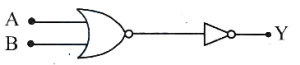
A
$OR$,$A+B$
B
$AND$,$A \cdot B$
C
$NOR$,$\overline{A+B}$
D
$NAND$,$\overline{A \cdot B}$
Solution
(A) The given circuit consists of a $NOR$ gate followed by a $NOT$ gate.
$1$. The output of the $NOR$ gate is $\overline{A+B}$.
$2$. This output is then passed through a $NOT$ gate (inverter),which performs the complement operation.
$3$. The final output $Y$ is the complement of the $NOR$ output: $Y = \overline{(\overline{A+B})} = A+B$.
$4$. The Boolean expression $A+B$ corresponds to the $OR$ gate.
Therefore,the combination of a $NOR$ gate and a $NOT$ gate acts as an $OR$ gate.
$1$. The output of the $NOR$ gate is $\overline{A+B}$.
$2$. This output is then passed through a $NOT$ gate (inverter),which performs the complement operation.
$3$. The final output $Y$ is the complement of the $NOR$ output: $Y = \overline{(\overline{A+B})} = A+B$.
$4$. The Boolean expression $A+B$ corresponds to the $OR$ gate.
Therefore,the combination of a $NOR$ gate and a $NOT$ gate acts as an $OR$ gate.
0 likesView Solution
403
ChemistryMCQMHT CET · 2024
At a certain temperature,$\operatorname{rod} A$ and $\operatorname{rod} B$ of different materials have lengths $L_A$ and $L_B$ respectively. Their coefficients of linear expansion are $\alpha_A$ and $\alpha_B$ respectively. It is observed that the difference between their lengths remains constant at all temperatures. The ratio $L_{A}: L_{B}$ is given by
A
$\frac{\alpha_A}{\alpha_B}$
B
$\frac{\alpha_B}{\alpha_A}$
C
$\frac{\alpha_A+\alpha_B}{\alpha_A}$
D
$\frac{\alpha_A+\alpha_B}{\alpha_B}$
Solution
(B) Let the initial lengths be $L_A$ and $L_B$ at temperature $T_0$. At a temperature $T = T_0 + \Delta T$,the new lengths are:
$L_A' = L_A(1 + \alpha_A \Delta T)$
$L_B' = L_B(1 + \alpha_B \Delta T)$
The difference in lengths is $\Delta L = L_A' - L_B' = (L_A - L_B) + (L_A \alpha_A - L_B \alpha_B) \Delta T$.
For the difference in length to remain constant at all temperatures,the term containing $\Delta T$ must be zero.
Therefore,$L_A \alpha_A - L_B \alpha_B = 0$.
$L_A \alpha_A = L_B \alpha_B$.
Thus,the ratio $\frac{L_A}{L_B} = \frac{\alpha_B}{\alpha_A}$.
$L_A' = L_A(1 + \alpha_A \Delta T)$
$L_B' = L_B(1 + \alpha_B \Delta T)$
The difference in lengths is $\Delta L = L_A' - L_B' = (L_A - L_B) + (L_A \alpha_A - L_B \alpha_B) \Delta T$.
For the difference in length to remain constant at all temperatures,the term containing $\Delta T$ must be zero.
Therefore,$L_A \alpha_A - L_B \alpha_B = 0$.
$L_A \alpha_A = L_B \alpha_B$.
Thus,the ratio $\frac{L_A}{L_B} = \frac{\alpha_B}{\alpha_A}$.
0 likesView Solution
404
ChemistryMCQMHT CET · 2024
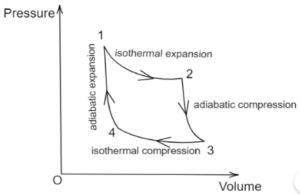
The first operation involved in a Carnot cycle is
A
isothermal expansion.
B
adiabatic expansion.
C
isothermal compression.
D
adiabatic compression.
Solution
(A) Carnot cycle consists of four reversible processes:
$1$. Isothermal expansion: The gas expands at a constant temperature $T_1$ by absorbing heat from the source.
$2$. Adiabatic expansion: The gas expands further without any heat exchange,and its temperature drops to $T_2$.
$3$. Isothermal compression: The gas is compressed at a constant temperature $T_2$ by rejecting heat to the sink.
$4$. Adiabatic compression: The gas is compressed further without any heat exchange,and its temperature rises back to $T_1$.
As shown in the $P-V$ diagram,the cycle starts with isothermal expansion from state $1$ to state $2$. Therefore,the correct option is $A$.
$1$. Isothermal expansion: The gas expands at a constant temperature $T_1$ by absorbing heat from the source.
$2$. Adiabatic expansion: The gas expands further without any heat exchange,and its temperature drops to $T_2$.
$3$. Isothermal compression: The gas is compressed at a constant temperature $T_2$ by rejecting heat to the sink.
$4$. Adiabatic compression: The gas is compressed further without any heat exchange,and its temperature rises back to $T_1$.
As shown in the $P-V$ diagram,the cycle starts with isothermal expansion from state $1$ to state $2$. Therefore,the correct option is $A$.
0 likesView Solution
405
ChemistryMCQMHT CET · 2024
An observer moves towards a stationary source of sound with a velocity of one-fifth of the velocity of sound. The percentage increase in the apparent frequency is (in $\%$)
A
$5$
B
$10$
C
$20$
D
$25$
Solution
(C) When an observer moves towards a stationary source of sound,the apparent frequency $n^{\prime}$ is given by the Doppler effect formula:
$n^{\prime} = \left( \frac{v + v_{o}}{v} \right) n$
Where $v$ is the velocity of sound and $v_{o}$ is the velocity of the observer.
Given that $v_{o} = \frac{v}{5}$,we substitute this into the formula:
$n^{\prime} = \left( \frac{v + \frac{v}{5}}{v} \right) n = \left( \frac{\frac{6v}{5}}{v} \right) n = \frac{6}{5} n = 1.2n$
The increase in frequency is $\Delta n = n^{\prime} - n = 1.2n - n = 0.2n$.
The percentage increase is $\left( \frac{\Delta n}{n} \right) \times 100 = \left( \frac{0.2n}{n} \right) \times 100 = 20 \%$.
$n^{\prime} = \left( \frac{v + v_{o}}{v} \right) n$
Where $v$ is the velocity of sound and $v_{o}$ is the velocity of the observer.
Given that $v_{o} = \frac{v}{5}$,we substitute this into the formula:
$n^{\prime} = \left( \frac{v + \frac{v}{5}}{v} \right) n = \left( \frac{\frac{6v}{5}}{v} \right) n = \frac{6}{5} n = 1.2n$
The increase in frequency is $\Delta n = n^{\prime} - n = 1.2n - n = 0.2n$.
The percentage increase is $\left( \frac{\Delta n}{n} \right) \times 100 = \left( \frac{0.2n}{n} \right) \times 100 = 20 \%$.
0 likesView Solution
406
ChemistryMCQMHT CET · 2024
Velocity of sound waves in air is $330 \ m/s$. For a particular sound wave in air,a path difference of $40 \ cm$ is equivalent to a phase difference of $1.6 \pi$. The frequency of this wave is: (in $Hz$)
A
$165$
B
$150$
C
$660$
D
$330$
Solution
(C) Given: Velocity of sound $v = 330 \ m/s$,path difference $x = 40 \ cm = 0.4 \ m$,and phase difference $\phi = 1.6 \pi$.
We know the relationship between phase difference and path difference is given by $\phi = \frac{2 \pi}{\lambda} \cdot x$.
Substituting the values: $1.6 \pi = \frac{2 \pi}{\lambda} \times 0.4$.
$1.6 = \frac{0.8}{\lambda} \implies \lambda = \frac{0.8}{1.6} = 0.5 \ m$.
Using the wave equation $v = f \lambda$,we find the frequency $f = \frac{v}{\lambda}$.
$f = \frac{330}{0.5} = 660 \ Hz$.
We know the relationship between phase difference and path difference is given by $\phi = \frac{2 \pi}{\lambda} \cdot x$.
Substituting the values: $1.6 \pi = \frac{2 \pi}{\lambda} \times 0.4$.
$1.6 = \frac{0.8}{\lambda} \implies \lambda = \frac{0.8}{1.6} = 0.5 \ m$.
Using the wave equation $v = f \lambda$,we find the frequency $f = \frac{v}{\lambda}$.
$f = \frac{330}{0.5} = 660 \ Hz$.
0 likesView Solution
407
ChemistryMCQMHT CET · 2024
$A$ sonometer wire is stretched by hanging a metal bob. The fundamental frequency of vibration of the wire is '$n_1$'. When the bob is completely immersed in water,the frequency of vibration of the wire becomes '$n_2$'. The relative density of the metal of the bob is
A
$\frac{n_1^2}{n_1^2-n_2^2}$
B
$\frac{n_2^2}{n_1^2-n_2^2}$
C
$\frac{n_1^2}{n_1^2+n_2^2}$
D
$\frac{n_2^2}{n_1^2+n_2^2}$
Solution
(A) The fundamental frequency of a sonometer wire is given by $n = \frac{1}{2L} \sqrt{\frac{T}{\mu}}$,where $T$ is the tension in the wire.
When the bob is in air,the tension $T_1 = W = mg$,where $W$ is the weight of the bob.
So,$n_1 = \frac{1}{2L} \sqrt{\frac{W}{\mu}}$.
When the bob is immersed in water,the effective weight (tension) becomes $T_2 = W - F_B$,where $F_B$ is the buoyant force.
$T_2 = W - \frac{W}{\sigma} = W(1 - \frac{1}{\sigma})$,where $\sigma$ is the relative density of the metal.
So,$n_2 = \frac{1}{2L} \sqrt{\frac{W(1 - 1/\sigma)}{\mu}}$.
Taking the ratio: $\frac{n_1}{n_2} = \sqrt{\frac{1}{1 - 1/\sigma}} = \sqrt{\frac{\sigma}{\sigma - 1}}$.
Squaring both sides: $\frac{n_1^2}{n_2^2} = \frac{\sigma}{\sigma - 1}$.
$n_1^2(\sigma - 1) = n_2^2 \sigma$.
$\sigma(n_1^2 - n_2^2) = n_1^2$.
Therefore,$\sigma = \frac{n_1^2}{n_1^2 - n_2^2}$.
When the bob is in air,the tension $T_1 = W = mg$,where $W$ is the weight of the bob.
So,$n_1 = \frac{1}{2L} \sqrt{\frac{W}{\mu}}$.
When the bob is immersed in water,the effective weight (tension) becomes $T_2 = W - F_B$,where $F_B$ is the buoyant force.
$T_2 = W - \frac{W}{\sigma} = W(1 - \frac{1}{\sigma})$,where $\sigma$ is the relative density of the metal.
So,$n_2 = \frac{1}{2L} \sqrt{\frac{W(1 - 1/\sigma)}{\mu}}$.
Taking the ratio: $\frac{n_1}{n_2} = \sqrt{\frac{1}{1 - 1/\sigma}} = \sqrt{\frac{\sigma}{\sigma - 1}}$.
Squaring both sides: $\frac{n_1^2}{n_2^2} = \frac{\sigma}{\sigma - 1}$.
$n_1^2(\sigma - 1) = n_2^2 \sigma$.
$\sigma(n_1^2 - n_2^2) = n_1^2$.
Therefore,$\sigma = \frac{n_1^2}{n_1^2 - n_2^2}$.
0 likesView Solution
408
ChemistryMCQMHT CET · 2024
The end correction for the vibrations of air column in a tube of circular cross-section will be more if the tube is
A
reduced in length.
B
increased in length.
C
made thinner.
D
widened.
Solution
(D) The end correction $e$ for a tube of circular cross-section is given by the formula $e = 0.6r$ or $e = 0.3d$,where $r$ is the radius and $d$ is the diameter of the tube.
Since the end correction $e$ is directly proportional to the diameter $d$ $(e \propto d)$,increasing the diameter of the tube will result in a larger end correction.
Therefore,the end correction will be more if the tube is widened.
Since the end correction $e$ is directly proportional to the diameter $d$ $(e \propto d)$,increasing the diameter of the tube will result in a larger end correction.
Therefore,the end correction will be more if the tube is widened.
0 likesView Solution
409
ChemistryEasyMCQMHT CET · 2024
Calculate the volume of $fcc$ unit cell if the radius of a particle in it is $106.05 \ pm$.
A
$7.4 \times 10^{-23} \ cm^3$
B
$9.9 \times 10^{-23} \ cm^3$
C
$2.7 \times 10^{-23} \ cm^3$
D
$6.4 \times 10^{-23} \ cm^3$
Solution
$(C)$ For an $fcc$ unit cell, the relationship between edge length $a$ and radius $r$ is $a = \frac{4r}{\sqrt{2}} = 2\sqrt{2}r$.
Given $r = 106.05 \ pm$, we calculate $a = 2 \times 1.414 \times 106.05 \approx 300 \ pm$.
Converting to centimeters: $a = 300 \times 10^{-10} \ cm = 3 \times 10^{-8} \ cm$.
Volume of the unit cell $V = a^3 = (3 \times 10^{-8} \ cm)^3 = 27 \times 10^{-24} \ cm^3 = 2.7 \times 10^{-23} \ cm^3$.
Given $r = 106.05 \ pm$, we calculate $a = 2 \times 1.414 \times 106.05 \approx 300 \ pm$.
Converting to centimeters: $a = 300 \times 10^{-10} \ cm = 3 \times 10^{-8} \ cm$.
Volume of the unit cell $V = a^3 = (3 \times 10^{-8} \ cm)^3 = 27 \times 10^{-24} \ cm^3 = 2.7 \times 10^{-23} \ cm^3$.
0 likesView Solution
410
ChemistryEasyMCQMHT CET · 2024
What is the coordination number of a particle in $fcc$ structure?
A
$12$
B
$2$
C
$4$
D
$6$
Solution
(A) In a face-centered cubic $(fcc)$ lattice,each atom is in contact with $4$ atoms in its own layer,$4$ atoms in the layer above,and $4$ atoms in the layer below.
Therefore,the total coordination number of an atom in an $fcc$ structure is $4 + 4 + 4 = 12$.
Therefore,the total coordination number of an atom in an $fcc$ structure is $4 + 4 + 4 = 12$.
0 likesView Solution
411
ChemistryEasyMCQMHT CET · 2024
Calculate the molar mass of an element having density $5.6 \ g \ cm^{-3}$ that forms a $bcc$ structure. $\left[a^3 \times N_{A}=75 \ cm^3 \ mol^{-1}\right]$
A
$198 \ g \ mol^{-1}$
B
$210 \ g \ mol^{-1}$
C
$118 \ g \ mol^{-1}$
D
$225 \ g \ mol^{-1}$
Solution
(B) For a $bcc$ unit cell,the number of atoms per unit cell,$n = 2$.
The formula for density is $\rho = \frac{M \times n}{a^3 \times N_A}$.
Substituting the given values: $5.6 \ g \ cm^{-3} = \frac{M \times 2}{75 \ cm^3 \ mol^{-1}}$.
Solving for $M$: $M = \frac{5.6 \times 75}{2} = 210 \ g \ mol^{-1}$.
The formula for density is $\rho = \frac{M \times n}{a^3 \times N_A}$.
Substituting the given values: $5.6 \ g \ cm^{-3} = \frac{M \times 2}{75 \ cm^3 \ mol^{-1}}$.
Solving for $M$: $M = \frac{5.6 \times 75}{2} = 210 \ g \ mol^{-1}$.
0 likesView Solution
412
ChemistryEasyMCQMHT CET · 2024
Calculate the number of atoms per unit cell of an element having a molar mass of $92.0 \ g \ mol^{-1}$ and a density of $8.6 \ g \ cm^{-3}$ forming a cubic unit cell structure. Given $[a^3 \times N_{A} = 21.5 \ cm^3 \ mol^{-1}]$.
A
$1$
B
$2$
C
$3$
D
$4$
Solution
(B) The formula for density $(\rho)$ of a cubic unit cell is given by $\rho = \frac{M \times n}{a^3 \times N_A}$.
Here,$M$ is the molar mass,$n$ is the number of atoms per unit cell,$a^3$ is the volume of the unit cell,and $N_A$ is Avogadro's number.
Rearranging the formula to solve for $n$: $n = \frac{\rho \times a^3 \times N_A}{M}$.
Substituting the given values: $n = \frac{8.6 \ g \ cm^{-3} \times 21.5 \ cm^3 \ mol^{-1}}{92.0 \ g \ mol^{-1}}$.
$n = \frac{184.9}{92.0} \approx 2$.
Therefore,the number of atoms per unit cell is $2$.
Here,$M$ is the molar mass,$n$ is the number of atoms per unit cell,$a^3$ is the volume of the unit cell,and $N_A$ is Avogadro's number.
Rearranging the formula to solve for $n$: $n = \frac{\rho \times a^3 \times N_A}{M}$.
Substituting the given values: $n = \frac{8.6 \ g \ cm^{-3} \times 21.5 \ cm^3 \ mol^{-1}}{92.0 \ g \ mol^{-1}}$.
$n = \frac{184.9}{92.0} \approx 2$.
Therefore,the number of atoms per unit cell is $2$.
0 likesView Solution
413
ChemistryEasyMCQMHT CET · 2024
Calculate the volume of the unit cell for an element having a molar mass of $92 \ g \ mol^{-1}$ that forms a $bcc$ structure,given $\left[\varrho \times N_{A} = 5.0 \times 10^{24} \ g \ cm^{-3} \ mol^{-1}\right]$.
A
$2.44 \times 10^{-23} \ cm^3$
B
$5.86 \times 10^{-23} \ cm^3$
C
$3.68 \times 10^{-23} \ cm^3$
D
$4.76 \times 10^{-23} \ cm^3$
Solution
(C) For a $bcc$ unit cell,the number of atoms per unit cell is $n = 2$.
The formula for density is $\rho = \frac{M \times n}{a^3 \times N_A}$.
Rearranging for the volume of the unit cell $(a^3)$,we get $a^3 = \frac{M \times n}{\rho \times N_A}$.
Substituting the given values: $a^3 = \frac{92 \ g \ mol^{-1} \times 2}{5.0 \times 10^{24} \ g \ cm^{-3} \ mol^{-1}}$.
$a^3 = \frac{184}{5.0 \times 10^{24}} \ cm^3 = 36.8 \times 10^{-24} \ cm^3 = 3.68 \times 10^{-23} \ cm^3$.
The formula for density is $\rho = \frac{M \times n}{a^3 \times N_A}$.
Rearranging for the volume of the unit cell $(a^3)$,we get $a^3 = \frac{M \times n}{\rho \times N_A}$.
Substituting the given values: $a^3 = \frac{92 \ g \ mol^{-1} \times 2}{5.0 \times 10^{24} \ g \ cm^{-3} \ mol^{-1}}$.
$a^3 = \frac{184}{5.0 \times 10^{24}} \ cm^3 = 36.8 \times 10^{-24} \ cm^3 = 3.68 \times 10^{-23} \ cm^3$.
0 likesView Solution
414
ChemistryMediumMCQMHT CET · 2024
What is the minimum number of spheres required to develop a tetrahedral void?
A
$2$
B
$4$
C
$6$
D
$3$
Solution
(B) tetrahedral void is a type of interstitial space formed in a close-packed arrangement of spheres.
To create a tetrahedral void,a minimum of $4$ spheres are required.
The void is formed in the empty space between these $4$ spheres when they are arranged in a tetrahedral geometry.
In structures like $FCC$ (Face-Centered Cubic) or $HCP$ (Hexagonal Close-Packed),this void is created by the arrangement of $4$ spheres.
To create a tetrahedral void,a minimum of $4$ spheres are required.
The void is formed in the empty space between these $4$ spheres when they are arranged in a tetrahedral geometry.
In structures like $FCC$ (Face-Centered Cubic) or $HCP$ (Hexagonal Close-Packed),this void is created by the arrangement of $4$ spheres.
0 likesView Solution
415
ChemistryEasyMCQMHT CET · 2024
Calculate the density of a metal having molar mass $197 \ g \ mol^{-1}$ if it forms $fcc$ structure. $\left[a^3 \times N_{A}=40 \ cm^3 \ mol^{-1}\right]$ (in $g \ cm^{-3}$)
A
$23.5$
B
$21.2$
C
$17.5$
D
$19.7$
Solution
(D) For an $fcc$ structure,the number of atoms per unit cell,$n = 4$.
The formula for density is $\rho = \frac{n \times M}{a^3 \times N_{A}}$.
Given: $M = 197 \ g \ mol^{-1}$ and $a^3 \times N_{A} = 40 \ cm^3 \ mol^{-1}$.
Substituting the values: $\rho = \frac{4 \times 197 \ g \ mol^{-1}}{40 \ cm^3 \ mol^{-1}} = 19.7 \ g \ cm^{-3}$.
The formula for density is $\rho = \frac{n \times M}{a^3 \times N_{A}}$.
Given: $M = 197 \ g \ mol^{-1}$ and $a^3 \times N_{A} = 40 \ cm^3 \ mol^{-1}$.
Substituting the values: $\rho = \frac{4 \times 197 \ g \ mol^{-1}}{40 \ cm^3 \ mol^{-1}} = 19.7 \ g \ cm^{-3}$.
0 likesView Solution
416
ChemistryEasyMCQMHT CET · 2024
Calculate the volume of a simple cubic unit cell if the radius of the particle in it is $400 \ pm$.
A
$6.36 \times 10^{-22} \ cm^3$
B
$5.12 \times 10^{-22} \ cm^3$
C
$5.84 \times 10^{-22} \ cm^3$
D
$6.60 \times 10^{-22} \ cm^3$
Solution
(B) For a simple cubic unit cell,the relationship between edge length $a$ and radius $r$ is $r = \frac{a}{2}$.
Therefore,$a = 2r = 2 \times 400 \ pm = 800 \ pm$.
Converting the edge length to centimeters: $a = 800 \ pm = 800 \times 10^{-10} \ cm = 8 \times 10^{-8} \ cm$.
The volume of the unit cell is $V = a^3 = (8 \times 10^{-8} \ cm)^3$.
$V = 512 \times 10^{-24} \ cm^3 = 5.12 \times 10^{-22} \ cm^3$.
Therefore,$a = 2r = 2 \times 400 \ pm = 800 \ pm$.
Converting the edge length to centimeters: $a = 800 \ pm = 800 \times 10^{-10} \ cm = 8 \times 10^{-8} \ cm$.
The volume of the unit cell is $V = a^3 = (8 \times 10^{-8} \ cm)^3$.
$V = 512 \times 10^{-24} \ cm^3 = 5.12 \times 10^{-22} \ cm^3$.
0 likesView Solution
417
ChemistryMediumMCQMHT CET · 2024
What is the number of octahedral voids present in $0.2 \ mol$ of a compound forming $hcp$ structure?
A
$1.204 \times 10^{23}$
B
$2.387 \times 10^{23}$
C
$3.011 \times 10^{23}$
D
$3.321 \times 10^{23}$
Solution
(A) In a crystal lattice,the number of octahedral voids is equal to the number of atoms present in the lattice.
Given,the amount of compound $= 0.2 \ mol$.
Number of atoms $= 0.2 \times N_A = 0.2 \times 6.022 \times 10^{23} = 1.2044 \times 10^{23}$.
Since the number of octahedral voids equals the number of atoms,the number of octahedral voids $= 1.2044 \times 10^{23}$.
Given,the amount of compound $= 0.2 \ mol$.
Number of atoms $= 0.2 \times N_A = 0.2 \times 6.022 \times 10^{23} = 1.2044 \times 10^{23}$.
Since the number of octahedral voids equals the number of atoms,the number of octahedral voids $= 1.2044 \times 10^{23}$.
0 likesView Solution
418
ChemistryEasyMCQMHT CET · 2024
Metallic silver has $fcc$ structure. If the radius of the $Ag$ atom is $144 \ pm$, what is the edge length of the unit cell?
A
$4.07 \times 10^{-8} \ cm$
B
$3.22 \times 10^{-8} \ cm$
C
$2.63 \times 10^{-8} \ cm$
D
$2.23 \times 10^{-8} \ cm$
Solution
(A) For an $fcc$ unit cell, the relationship between the edge length $a$ and the atomic radius $r$ is given by $r = \frac{a}{2\sqrt{2}}$.
Rearranging for $a$, we get $a = 2\sqrt{2} \times r$.
Given $r = 144 \ pm$, then $a = 2 \times 1.414 \times 144 \ pm = 407.23 \ pm$.
Converting to centimeters: $407.23 \ pm = 407.23 \times 10^{-10} \ cm = 4.07 \times 10^{-8} \ cm$.
Rearranging for $a$, we get $a = 2\sqrt{2} \times r$.
Given $r = 144 \ pm$, then $a = 2 \times 1.414 \times 144 \ pm = 407.23 \ pm$.
Converting to centimeters: $407.23 \ pm = 407.23 \times 10^{-10} \ cm = 4.07 \times 10^{-8} \ cm$.
0 likesView Solution
419
ChemistryEasyMCQMHT CET · 2024
$A$ metal crystallises in $bcc$ structure with edge length $4 \times 10^{-8} \ cm$. If density of unit cell is $10 \ g \ cm^{-3}$,what is its molar mass?
A
$60 \ g \ mol^{-1}$
B
$152 \ g \ mol^{-1}$
C
$120 \ g \ mol^{-1}$
D
$193 \ g \ mol^{-1}$
Solution
(D) For $bcc$ unit cell,the number of atoms per unit cell $n = 2$.
The density formula is $\rho = \frac{M \times n}{a^3 \times N_A}$.
Given: $\rho = 10 \ g \ cm^{-3}$,$a = 4 \times 10^{-8} \ cm$,$N_A = 6.022 \times 10^{23} \ mol^{-1}$.
Substituting the values: $10 = \frac{M \times 2}{(4 \times 10^{-8})^3 \times 6.022 \times 10^{23}}$.
$M = \frac{10 \times 64 \times 10^{-24} \times 6.022 \times 10^{23}}{2}$.
$M = \frac{10 \times 64 \times 0.1 \times 6.022}{2} = \frac{385.4}{2} \approx 192.7 \ g \ mol^{-1}$.
Thus,the molar mass is approximately $193 \ g \ mol^{-1}$.
The density formula is $\rho = \frac{M \times n}{a^3 \times N_A}$.
Given: $\rho = 10 \ g \ cm^{-3}$,$a = 4 \times 10^{-8} \ cm$,$N_A = 6.022 \times 10^{23} \ mol^{-1}$.
Substituting the values: $10 = \frac{M \times 2}{(4 \times 10^{-8})^3 \times 6.022 \times 10^{23}}$.
$M = \frac{10 \times 64 \times 10^{-24} \times 6.022 \times 10^{23}}{2}$.
$M = \frac{10 \times 64 \times 0.1 \times 6.022}{2} = \frac{385.4}{2} \approx 192.7 \ g \ mol^{-1}$.
Thus,the molar mass is approximately $193 \ g \ mol^{-1}$.
0 likesView Solution
420
ChemistryEasyMCQMHT CET · 2024
What is the atomic radius of an element if it crystallises in a $BCC$ structure with an edge length of unit cell $287 \ pm$ (in $pm$)?
A
$124$
B
$131$
C
$137$
D
$174$
Solution
(A) For a $BCC$ unit cell, the relationship between the atomic radius $(r)$ and the edge length $(a)$ is given by: $4r = \sqrt{3}a$.
Substituting the given value of $a = 287 \ pm$:
$r = \frac{\sqrt{3}}{4} \times 287$
$r = \frac{1.732 \times 287}{4}$
$r = \frac{497.084}{4} \approx 124.27 \ pm$.
Rounding to the nearest integer, the atomic radius is $124 \ pm$.
Substituting the given value of $a = 287 \ pm$:
$r = \frac{\sqrt{3}}{4} \times 287$
$r = \frac{1.732 \times 287}{4}$
$r = \frac{497.084}{4} \approx 124.27 \ pm$.
Rounding to the nearest integer, the atomic radius is $124 \ pm$.
0 likesView Solution
421
ChemistryDifficultMCQMHT CET · 2024
Which type of unit cell from the following is common to all seven types of crystal systems?
A
Simple
B
Body-centred
C
Face-centred
D
Base-centred
Solution
(A) The seven crystal systems are Cubic,Orthorhombic,Tetragonal,Monoclinic,Triclinic,Rhombohedral,and Hexagonal.
By observing the Bravais lattices for these systems,we find that the 'Simple' (or primitive) unit cell is present in all seven crystal systems.
| Sr. No. | Type of System | Bravais lattices present |
| :--- | :--- | :--- |
| $1$ | Cubic | Simple,Face-centered,Body-centered |
| $2$ | Orthorhombic | Simple,Base-centered,Face-centered,Body-centered |
| $3$ | Tetragonal | Simple,Body-centered |
| $4$ | Monoclinic | Simple,Base-centered |
| $5$ | Triclinic | Simple |
| $6$ | Rhombohedral | Simple |
| $7$ | Hexagonal | Simple or primitive |
By observing the Bravais lattices for these systems,we find that the 'Simple' (or primitive) unit cell is present in all seven crystal systems.
| Sr. No. | Type of System | Bravais lattices present |
| :--- | :--- | :--- |
| $1$ | Cubic | Simple,Face-centered,Body-centered |
| $2$ | Orthorhombic | Simple,Base-centered,Face-centered,Body-centered |
| $3$ | Tetragonal | Simple,Body-centered |
| $4$ | Monoclinic | Simple,Base-centered |
| $5$ | Triclinic | Simple |
| $6$ | Rhombohedral | Simple |
| $7$ | Hexagonal | Simple or primitive |
0 likesView Solution
422
ChemistryEasyMCQMHT CET · 2024
Calculate the total volume occupied by all atoms in a simple cubic unit cell if the radius of the atom is $3 \times 10^{-8} \ cm$.
A
$1.13 \times 10^{-22} \ cm^3$
B
$2.25 \times 10^{-22} \ cm^3$
C
$3.15 \times 10^{-22} \ cm^3$
D
$4.37 \times 10^{-22} \ cm^3$
Solution
(A) For a simple cubic unit cell,the number of atoms per unit cell $(n)$ is $1$.
Total volume occupied by atoms in the unit cell $= n \times \frac{4}{3} \pi r^3$.
Given $r = 3 \times 10^{-8} \ cm$.
Volume $= 1 \times \frac{4}{3} \times 3.14159 \times (3 \times 10^{-8} \ cm)^3$.
Volume $= \frac{4}{3} \times 3.14159 \times 27 \times 10^{-24} \ cm^3$.
Volume $= 4 \times 3.14159 \times 9 \times 10^{-24} \ cm^3$.
Volume $= 113.097 \times 10^{-24} \ cm^3 = 1.13 \times 10^{-22} \ cm^3$.
Total volume occupied by atoms in the unit cell $= n \times \frac{4}{3} \pi r^3$.
Given $r = 3 \times 10^{-8} \ cm$.
Volume $= 1 \times \frac{4}{3} \times 3.14159 \times (3 \times 10^{-8} \ cm)^3$.
Volume $= \frac{4}{3} \times 3.14159 \times 27 \times 10^{-24} \ cm^3$.
Volume $= 4 \times 3.14159 \times 9 \times 10^{-24} \ cm^3$.
Volume $= 113.097 \times 10^{-24} \ cm^3 = 1.13 \times 10^{-22} \ cm^3$.
0 likesView Solution
423
ChemistryEasyMCQMHT CET · 2024
What is the volume of one particle in $BCC$ structure if '$a$' is edge length?
A
$\frac{\pi a^3}{3 \sqrt{2}}$
B
$\frac{\pi a^3}{12 \sqrt{2}}$
C
$\frac{\sqrt{3} \pi a^3}{16}$
D
$\frac{\sqrt{3} \pi a^3}{8}$
Solution
(C) For $BCC$ unit cell,the relation between radius $r$ and edge length $a$ is $r = \frac{\sqrt{3}}{4} a$.
The volume of one spherical particle is given by $V = \frac{4}{3} \pi r^3$.
Substituting the value of $r$:
$V = \frac{4}{3} \pi \left( \frac{\sqrt{3}}{4} a \right)^3 = \frac{4}{3} \pi \left( \frac{3 \sqrt{3} a^3}{64} \right) = \frac{\sqrt{3} \pi a^3}{16}$.
The volume of one spherical particle is given by $V = \frac{4}{3} \pi r^3$.
Substituting the value of $r$:
$V = \frac{4}{3} \pi \left( \frac{\sqrt{3}}{4} a \right)^3 = \frac{4}{3} \pi \left( \frac{3 \sqrt{3} a^3}{64} \right) = \frac{\sqrt{3} \pi a^3}{16}$.
0 likesView Solution
424
ChemistryEasyMCQMHT CET · 2024
The unit cell of an element has an edge length of $5 \mathring{A}$ and a density of $4 \ g \ cm^{-3}$. If its atomic mass is $149 \ g \ mol^{-1}$,identify the crystal structure.
A
Simple cubic
B
Body-centred cubic
C
Face-centred cubic
D
Hexagonal close-packed
Solution
(B) The density formula is given by $\rho = \frac{n \times M}{a^3 \times N_A}$.
Rearranging for the number of atoms per unit cell $(n)$: $n = \frac{\rho \times N_A \times a^3}{M}$.
Given: $\rho = 4 \ g \ cm^{-3}$,$M = 149 \ g \ mol^{-1}$,$a = 5 \mathring{A} = 5 \times 10^{-8} \ cm$,and $N_A = 6.022 \times 10^{23} \ mol^{-1}$.
Substituting the values: $n = \frac{4 \times 6.022 \times 10^{23} \times (5 \times 10^{-8})^3}{149}$.
$n = \frac{4 \times 6.022 \times 10^{23} \times 125 \times 10^{-24}}{149} = \frac{301.1}{149} \approx 2.02$.
Since $n \approx 2$,the crystal structure is Body-centred cubic $(BCC)$.
Rearranging for the number of atoms per unit cell $(n)$: $n = \frac{\rho \times N_A \times a^3}{M}$.
Given: $\rho = 4 \ g \ cm^{-3}$,$M = 149 \ g \ mol^{-1}$,$a = 5 \mathring{A} = 5 \times 10^{-8} \ cm$,and $N_A = 6.022 \times 10^{23} \ mol^{-1}$.
Substituting the values: $n = \frac{4 \times 6.022 \times 10^{23} \times (5 \times 10^{-8})^3}{149}$.
$n = \frac{4 \times 6.022 \times 10^{23} \times 125 \times 10^{-24}}{149} = \frac{301.1}{149} \approx 2.02$.
Since $n \approx 2$,the crystal structure is Body-centred cubic $(BCC)$.
0 likesView Solution
425
ChemistryDifficultMCQMHT CET · 2024
In a solid,$B^{-}$ ions occupy corners of a cube forming $ccp$ structure. If $A^{+}$ ions occupy half the tetrahedral voids,the formula of the solid is:
A
$A_2B$
B
$AB_2$
C
$A_2B_3$
D
$AB$
Solution
(D) In a $ccp$ structure,the number of effective atoms per unit cell is $4$. Since $B^{-}$ ions form the $ccp$ structure,the number of $B^{-}$ ions $= 4$.
In a $ccp$ lattice,the number of tetrahedral voids is twice the number of atoms,so the number of tetrahedral voids $= 2 \times 4 = 8$.
$A^{+}$ ions occupy half of the tetrahedral voids,so the number of $A^{+}$ ions $= 8 \times (1/2) = 4$.
The ratio of $A^{+} : B^{-}$ is $4 : 4$,which simplifies to $1 : 1$.
Therefore,the formula of the solid is $AB$.
In a $ccp$ lattice,the number of tetrahedral voids is twice the number of atoms,so the number of tetrahedral voids $= 2 \times 4 = 8$.
$A^{+}$ ions occupy half of the tetrahedral voids,so the number of $A^{+}$ ions $= 8 \times (1/2) = 4$.
The ratio of $A^{+} : B^{-}$ is $4 : 4$,which simplifies to $1 : 1$.
Therefore,the formula of the solid is $AB$.
0 likesView Solution
426
ChemistryMediumMCQMHT CET · 2024
Find the void volume of $fcc$ unit cell in $cm^3$ if the volume of $fcc$ unit cell is $1.25 \times 10^{-22} \ cm^3$.
A
$3.25 \times 10^{-23}$
B
$2.16 \times 10^{-23}$
C
$1.34 \times 10^{-23}$
D
$4.20 \times 10^{-23}$
Solution
(A) For an $fcc$ unit cell,the packing efficiency is $74 \%$.
Therefore,the percentage of unoccupied space (void volume) is $100 \% - 74 \% = 26 \%$.
Void volume $= 1.25 \times 10^{-22} \ cm^3 \times \frac{26}{100}$.
Void volume $= 3.25 \times 10^{-23} \ cm^3$.
Therefore,the percentage of unoccupied space (void volume) is $100 \% - 74 \% = 26 \%$.
Void volume $= 1.25 \times 10^{-22} \ cm^3 \times \frac{26}{100}$.
Void volume $= 3.25 \times 10^{-23} \ cm^3$.
0 likesView Solution
427
ChemistryEasyMCQMHT CET · 2024
Calculate the number of unit cells in $0.9 \ g$ of a metal if it forms a $bcc$ structure. Given: $\rho \times a^3 = 3 \times 10^{-22} \ g$.
A
$1.0 \times 10^{21}$
B
$2.0 \times 10^{21}$
C
$3.0 \times 10^{21}$
D
$4.0 \times 10^{21}$
Solution
(C) The mass of the unit cell is given by the product of density $(\rho)$ and volume $(a^3)$,which is $\rho \times a^3 = 3 \times 10^{-22} \ g$.
Number of unit cells = $\frac{\text{Total mass of metal}}{\text{Mass of one unit cell}}$
Number of unit cells = $\frac{0.9 \ g}{3 \times 10^{-22} \ g}$
Number of unit cells = $0.3 \times 10^{22} = 3.0 \times 10^{21}$.
Number of unit cells = $\frac{\text{Total mass of metal}}{\text{Mass of one unit cell}}$
Number of unit cells = $\frac{0.9 \ g}{3 \times 10^{-22} \ g}$
Number of unit cells = $0.3 \times 10^{22} = 3.0 \times 10^{21}$.
0 likesView Solution
428
ChemistryEasyMCQMHT CET · 2024
What is the total number of particles present in a base-centred unit cell?
A
$1$
B
$4$
C
$2$
D
$6$
Solution
(C) In a base-centred unit cell,particles are present at the $8$ corners and at the centers of $2$ opposite faces.
Contribution from $8$ corners $= 8 \times \frac{1}{8} = 1$.
Contribution from $2$ face centres $= 2 \times \frac{1}{2} = 1$.
Total number of particles $= 1 + 1 = 2$.
Contribution from $8$ corners $= 8 \times \frac{1}{8} = 1$.
Contribution from $2$ face centres $= 2 \times \frac{1}{2} = 1$.
Total number of particles $= 1 + 1 = 2$.
0 likesView Solution
429
ChemistryEasyMCQMHT CET · 2024
Calculate the number of unit cells in $0.4 \ g$ of metal if the product of density and volume of the unit cell is $1.2 \times 10^{-22} \ g$.
A
$1.1 \times 10^{21}$
B
$2.2 \times 10^{21}$
C
$3.3 \times 10^{21}$
D
$4.4 \times 10^{21}$
Solution
(C) The mass of the metal is given as $m = 0.4 \ g$.
The product of density $(\rho)$ and volume of the unit cell $(V = a^3)$ is given as $\rho \times a^3 = 1.2 \times 10^{-22} \ g$.
The number of unit cells is calculated by dividing the total mass of the metal by the mass of one unit cell.
$\text{Number of unit cells} = \frac{\text{Total mass}}{\text{Mass of one unit cell}} = \frac{m}{\rho \times a^3}$.
Substituting the values: $\frac{0.4 \ g}{1.2 \times 10^{-22} \ g} = 3.33 \times 10^{21}$.
Therefore,the number of unit cells is $3.3 \times 10^{21}$.
The product of density $(\rho)$ and volume of the unit cell $(V = a^3)$ is given as $\rho \times a^3 = 1.2 \times 10^{-22} \ g$.
The number of unit cells is calculated by dividing the total mass of the metal by the mass of one unit cell.
$\text{Number of unit cells} = \frac{\text{Total mass}}{\text{Mass of one unit cell}} = \frac{m}{\rho \times a^3}$.
Substituting the values: $\frac{0.4 \ g}{1.2 \times 10^{-22} \ g} = 3.33 \times 10^{21}$.
Therefore,the number of unit cells is $3.3 \times 10^{21}$.
0 likesView Solution
430
ChemistryDifficultMCQMHT CET · 2024
What is the total number of tetrahedral voids in $0.6 \ mole$ of a compound that forms a $hcp$ structure?
A
$3.6132 \times 10^{23}$
B
$7.2264 \times 10^{23}$
C
$4.8396 \times 10^{23}$
D
$5.0331 \times 10^{23}$
Solution
(B) In a crystal lattice,the number of tetrahedral voids is twice the number of atoms present in the lattice.
$1 \ mole$ of compound contains $6.022 \times 10^{23}$ atoms.
$0.6 \ mole$ of compound contains $0.6 \times 6.022 \times 10^{23}$ atoms.
Number of tetrahedral voids $= 2 \times (\text{Number of atoms}) = 2 \times 0.6 \times 6.022 \times 10^{23}$.
$= 1.2 \times 6.022 \times 10^{23} = 7.2264 \times 10^{23}$ voids.
$1 \ mole$ of compound contains $6.022 \times 10^{23}$ atoms.
$0.6 \ mole$ of compound contains $0.6 \times 6.022 \times 10^{23}$ atoms.
Number of tetrahedral voids $= 2 \times (\text{Number of atoms}) = 2 \times 0.6 \times 6.022 \times 10^{23}$.
$= 1.2 \times 6.022 \times 10^{23} = 7.2264 \times 10^{23}$ voids.
0 likesView Solution
431
ChemistryEasyMCQMHT CET · 2024
In an ionic solid,equal number of cations and anions are missing from their regular positions in the crystal lattice,creating vacancies. This is called-
A
Vacancy defect
B
Self interstitial defect
C
Schottky defect
D
Frenkel defect
Solution
(C) The correct answer is $C$ (Schottky defect).
$A$ $Schottky$ defect occurs in an ionic solid when equal numbers of cations and anions are missing from their regular positions in the crystal lattice,creating vacancies.
This defect maintains the overall electrical neutrality of the crystal.
$A$ $Schottky$ defect occurs in an ionic solid when equal numbers of cations and anions are missing from their regular positions in the crystal lattice,creating vacancies.
This defect maintains the overall electrical neutrality of the crystal.
0 likesView Solution
432
ChemistryMediumMCQMHT CET · 2024
Identify the ferromagnetic substance from the following.
A
$NaCl$
B
$C_6H_6$
C
$CrO_2$
D
$H_2O$
Solution
(C) The magnetic properties of the given substances are as follows:
$1$. $NaCl$: Diamagnetic
$2$. $C_6H_6$: Diamagnetic
$3$. $CrO_2$: Ferromagnetic
$4$. $H_2O$: Diamagnetic
Therefore,$CrO_2$ is the ferromagnetic substance.
$1$. $NaCl$: Diamagnetic
$2$. $C_6H_6$: Diamagnetic
$3$. $CrO_2$: Ferromagnetic
$4$. $H_2O$: Diamagnetic
Therefore,$CrO_2$ is the ferromagnetic substance.
0 likesView Solution
433
ChemistryDifficultMCQMHT CET · 2024
$n$-type semiconductor is formed when:
A
Silicon is doped with phosphorus
B
Silicon is doped with boron
C
Germanium is doped with boron
D
Germanium is doped with aluminium
Solution
(A) An $n$-type semiconductor is formed when a group $14$ element (like silicon or germanium) is doped with a group $15$ element (like phosphorus or arsenic) that has more valence electrons.
$(1)$ Silicon has $4$ valence electrons. Phosphorus has $5$ valence electrons.
$(2)$ When silicon is doped with phosphorus,$4$ electrons of phosphorus form covalent bonds with silicon,while the $5^{th}$ electron remains free.
$(3)$ This extra free electron increases the electrical conductivity,resulting in an $n$-type semiconductor.
$(1)$ Silicon has $4$ valence electrons. Phosphorus has $5$ valence electrons.
$(2)$ When silicon is doped with phosphorus,$4$ electrons of phosphorus form covalent bonds with silicon,while the $5^{th}$ electron remains free.
$(3)$ This extra free electron increases the electrical conductivity,resulting in an $n$-type semiconductor.
0 likesView Solution
434
ChemistryMediumMCQMHT CET · 2024
Which among the following is a ferromagnetic substance?
A
$NaCl$
B
$H_2O$
C
$O_2$
D
$CrO_2$
Solution
(D) Ferromagnetic substances are those that are strongly attracted by a magnetic field and show permanent magnetism even when the magnetic field is removed.
Examples include $Fe$,$Co$,$Ni$,$CrO_2$,and $Fe_3O_4$.
Analyzing the given options:
- $NaCl$ is diamagnetic.
- $H_2O$ is diamagnetic.
- $O_2$ is paramagnetic.
- $CrO_2$ is ferromagnetic.
Therefore,the correct option is $D$.
Examples include $Fe$,$Co$,$Ni$,$CrO_2$,and $Fe_3O_4$.
Analyzing the given options:
- $NaCl$ is diamagnetic.
- $H_2O$ is diamagnetic.
- $O_2$ is paramagnetic.
- $CrO_2$ is ferromagnetic.
Therefore,the correct option is $D$.
0 likesView Solution
435
ChemistryEasyMCQMHT CET · 2024
Identify an example of a solution that consists of a solid as the solute and a liquid as the solvent.
A
Sea water
B
Sugar in water
C
Carbonated water
D
Chloroform in nitrogen
Solution
(B) solution of a solid solute in a liquid solvent is a common type of solution.
In the given options,$A$ (Sea water) is a solution of salt (solid) in water (liquid).
$B$ (Sugar in water) is also a solid in liquid solution.
$C$ (Carbonated water) is a gas in liquid solution.
$D$ (Chloroform in nitrogen) is a liquid in gas solution.
Since the question asks for a solid in liquid solution,both $A$ and $B$ fit the criteria. However,$B$ is the most standard textbook example.
In the given options,$A$ (Sea water) is a solution of salt (solid) in water (liquid).
$B$ (Sugar in water) is also a solid in liquid solution.
$C$ (Carbonated water) is a gas in liquid solution.
$D$ (Chloroform in nitrogen) is a liquid in gas solution.
Since the question asks for a solid in liquid solution,both $A$ and $B$ fit the criteria. However,$B$ is the most standard textbook example.
0 likesView Solution
436
ChemistryMediumMCQMHT CET · 2024
Identify the reason for the solubility of polar solute in polar solvent from the following.
A
solute - solute interactions,solute - solvent interactions and solvent - solvent interactions are of similar magnitude.
B
solute - solute interactions $>$ solute - solvent interactions $>$ solvent - solvent interactions.
C
solvent - solvent interactions $>$ solute - solvent interactions $>$ solute - solute interactions.
D
solute - solvent interactions $>$ solute - solute interactions $>$ solvent - solvent interactions.
Solution
(A) The solubility of a polar solute in a polar solvent is mainly due to the favorable interactions between the solute and solvent molecules. These interactions are crucial for the dissolution process.
The most appropriate explanation for this is when the solute - solute,solvent - solvent,and solute - solvent interactions are comparable in magnitude. This balance allows the solute to dissolve efficiently,as the solvent can break apart the solute molecules while maintaining similar intermolecular forces within the mixture.
Correct answer: $A$. Solute - solute interactions,solute - solvent interactions,and solvent - solvent interactions are of similar magnitude.
The most appropriate explanation for this is when the solute - solute,solvent - solvent,and solute - solvent interactions are comparable in magnitude. This balance allows the solute to dissolve efficiently,as the solvent can break apart the solute molecules while maintaining similar intermolecular forces within the mixture.
Correct answer: $A$. Solute - solute interactions,solute - solvent interactions,and solvent - solvent interactions are of similar magnitude.
0 likesView Solution
437
ChemistryMediumMCQMHT CET · 2024
What type of solution is an alloy?
A
Solid in liquid
B
Gas in liquid
C
Solid in gas
D
Solid in solid
Solution
(D) An alloy is a homogeneous mixture of two or more metals,or a metal and a non-metal. Since both the solute and the solvent are in the solid state,an alloy is classified as a $Solid$ in $Solid$ solution.
0 likesView Solution
438
ChemistryMediumMCQMHT CET · 2024
Which of the following ionic solids exhibits a decrease in its solubility in water with an increase in temperature?
A
$NaCl$
B
$KNO_3$
C
$NaNO_3$
D
$Na_2SO_4$
Solution
(D) Among the given options,sodium sulfate $(Na_2SO_4)$ exhibits a decrease in solubility with an increase in temperature.
This behavior is unusual because,for most ionic solids,solubility tends to increase with temperature.
However,for $Na_2SO_4$,its dissolution is exothermic,meaning it releases heat when it dissolves in water.
According to Le Chatelier's principle,if the dissolution process is exothermic,increasing the temperature will shift the equilibrium to favor the undissolved solid,thereby reducing solubility at higher temperatures.
Solubility trends for other salts:
- $(1)$ $NaCl$ (Sodium chloride): $NaCl$'s solubility increases with temperature.
- $(2)$ $KNO_3$ (Potassium nitrate): $KNO_3$'s solubility increases significantly with temperature.
- $(3)$ $NaNO_3$ (Sodium nitrate): $NaNO_3$'s solubility also increases with temperature.
This behavior is unusual because,for most ionic solids,solubility tends to increase with temperature.
However,for $Na_2SO_4$,its dissolution is exothermic,meaning it releases heat when it dissolves in water.
According to Le Chatelier's principle,if the dissolution process is exothermic,increasing the temperature will shift the equilibrium to favor the undissolved solid,thereby reducing solubility at higher temperatures.
Solubility trends for other salts:
- $(1)$ $NaCl$ (Sodium chloride): $NaCl$'s solubility increases with temperature.
- $(2)$ $KNO_3$ (Potassium nitrate): $KNO_3$'s solubility increases significantly with temperature.
- $(3)$ $NaNO_3$ (Sodium nitrate): $NaNO_3$'s solubility also increases with temperature.
0 likesView Solution
439
ChemistryMediumMCQMHT CET · 2024
The solution containing $18 \ g \ dm^{-3}$ of glucose (molar mass $180 \ g \ mol^{-1}$) in water and another containing $6 \ g \ dm^{-3}$ of solute $A$ in water boil at the same temperature. What is the molar mass of $A$?
A
$54 \ g \ mol^{-1}$
B
$90 \ g \ mol^{-1}$
C
$120 \ g \ mol^{-1}$
D
$60 \ g \ mol^{-1}$
Solution
(D) Since both solutions boil at the same temperature,their elevation in boiling point $(\Delta T_b)$ must be the same.
Since $\Delta T_b = K_b \times m$,and $K_b$ is the same for the same solvent (water),the molality $(m)$ of both solutions must be equal.
Given concentration in $g \ dm^{-3}$ is $C = \frac{W}{V}$. For a fixed volume of solvent,the molarity and molality are proportional to the concentration divided by the molar mass.
$\frac{C_{\text{glucose}}}{M_{\text{glucose}}} = \frac{C_A}{M_A}$
Substituting the given values:
$\frac{18}{180} = \frac{6}{M_A}$
$0.1 = \frac{6}{M_A}$
$M_A = \frac{6}{0.1} = 60 \ g \ mol^{-1}$.
Since $\Delta T_b = K_b \times m$,and $K_b$ is the same for the same solvent (water),the molality $(m)$ of both solutions must be equal.
Given concentration in $g \ dm^{-3}$ is $C = \frac{W}{V}$. For a fixed volume of solvent,the molarity and molality are proportional to the concentration divided by the molar mass.
$\frac{C_{\text{glucose}}}{M_{\text{glucose}}} = \frac{C_A}{M_A}$
Substituting the given values:
$\frac{18}{180} = \frac{6}{M_A}$
$0.1 = \frac{6}{M_A}$
$M_A = \frac{6}{0.1} = 60 \ g \ mol^{-1}$.
0 likesView Solution
440
ChemistryDifficultMCQMHT CET · 2024
Which of the following solutions will not show flow of solvent in either direction when separated by a semipermeable membrane?
A
$6 \ g$ urea $dm^{-3}$ and $85.5 \ g$ sucrose $dm^{-3}$
B
$15 \ g$ urea $dm^{-3}$ and $34.2 \ g$ sucrose $dm^{-3}$
C
$6 \ g$ urea $dm^{-3}$ and $34.2 \ g$ sucrose $dm^{-3}$
D
$15 \ g$ urea $dm^{-3}$ and $171 \ g$ sucrose $dm^{-3}$
Solution
(C) Two solutions separated by a semipermeable membrane will not show any net flow of solvent if they are isotonic,meaning they have the same osmotic pressure $(\pi = CRT)$.
For solutions with the same volume,this condition is met if the number of moles of solute is equal $(n_{urea} = n_{sucrose})$.
Checking option $C$:
Moles of urea = $\frac{6 \ g}{60 \ g \ mol^{-1}} = 0.1 \ mol$.
Moles of sucrose = $\frac{34.2 \ g}{342 \ g \ mol^{-1}} = 0.1 \ mol$.
Since the number of moles is equal,the osmotic pressures are equal,and no net flow of solvent occurs.
For solutions with the same volume,this condition is met if the number of moles of solute is equal $(n_{urea} = n_{sucrose})$.
Checking option $C$:
Moles of urea = $\frac{6 \ g}{60 \ g \ mol^{-1}} = 0.1 \ mol$.
Moles of sucrose = $\frac{34.2 \ g}{342 \ g \ mol^{-1}} = 0.1 \ mol$.
Since the number of moles is equal,the osmotic pressures are equal,and no net flow of solvent occurs.
0 likesView Solution
441
ChemistryEasyMCQMHT CET · 2024
Carbonated water is an example of a solution of
A
Gas in liquid
B
Gas in gas
C
Gas in solid
D
Solid in gas
Solution
(A) Carbonated water (soda-water) is prepared by dissolving $CO_2$ gas under high pressure in water.
Since the solute is a gas $(CO_2)$ and the solvent is a liquid (water), it is classified as a $Gas \ in \ liquid$ type of solution.
Since the solute is a gas $(CO_2)$ and the solvent is a liquid (water), it is classified as a $Gas \ in \ liquid$ type of solution.
0 likesView Solution
442
ChemistryEasyMCQMHT CET · 2024
What type of solution is iodine in air?
A
Liquid in solid
B
Solid in gas
C
Solid in liquid
D
Liquid in gas
Solution
(B) solution of iodine in air is an example of a solid dispersed in a gas. Iodine is a solid at room temperature and it undergoes sublimation to form iodine vapor,which is a gas. Therefore,it is a solid in gas type of solution.
0 likesView Solution
443
ChemistryDifficultMCQMHT CET · 2024
$A$ solution of a non-volatile solute is obtained by dissolving $2 \ g$ of solute in $50 \ g$ of benzene. Calculate the vapour pressure of the solution if the vapour pressure of pure benzene is $640 \ mmHg$ at $25^{\circ} C$. [Molar mass of benzene $= 78 \ g \ mol^{-1}$,Molar mass of solute $= 64 \ g \ mol^{-1}$] (in $mm \ Hg$)
A
$600.21$
B
$604.52$
C
$608.64$
D
$612.83$
Solution
(C) According to Raoult's Law for non-volatile solutes: $\frac{P^0 - P}{P^0} = \frac{n_2}{n_1 + n_2} \approx \frac{n_2}{n_1} = \frac{W_2 \times M_1}{M_2 \times W_1}$
Given: $W_2 = 2 \ g$,$W_1 = 50 \ g$,$M_2 = 64 \ g \ mol^{-1}$,$M_1 = 78 \ g \ mol^{-1}$,$P^0 = 640 \ mm \ Hg$
$\frac{640 - P}{640} = \frac{2 \times 78}{64 \times 50}$
$\frac{640 - P}{640} = \frac{156}{3200} = 0.04875$
$640 - P = 640 \times 0.04875 = 31.2$
$P = 640 - 31.2 = 608.8 \ mm \ Hg$
The closest value is $608.64 \ mm \ Hg$.
Given: $W_2 = 2 \ g$,$W_1 = 50 \ g$,$M_2 = 64 \ g \ mol^{-1}$,$M_1 = 78 \ g \ mol^{-1}$,$P^0 = 640 \ mm \ Hg$
$\frac{640 - P}{640} = \frac{2 \times 78}{64 \times 50}$
$\frac{640 - P}{640} = \frac{156}{3200} = 0.04875$
$640 - P = 640 \times 0.04875 = 31.2$
$P = 640 - 31.2 = 608.8 \ mm \ Hg$
The closest value is $608.64 \ mm \ Hg$.
0 likesView Solution
444
ChemistryEasyMCQMHT CET · 2024
Calculate the vapour pressure of a solution containing a mixture of $2 \ moles$ of volatile liquid $A$ and $3 \ moles$ of volatile liquid $B$ at room temperature. $(P_{A}^{\circ} = 420 \ mm \ Hg, P_{B}^{\circ} = 610 \ mm \ Hg)$ (in $mm \ Hg$)
A
$600$
B
$570$
C
$534$
D
$480$
Solution
(C) The mole fraction of $A$ is $x_A = \frac{n_A}{n_A + n_B} = \frac{2}{2+3} = 0.4$.
The mole fraction of $B$ is $x_B = \frac{n_B}{n_A + n_B} = \frac{3}{2+3} = 0.6$.
According to Raoult's law,the total vapour pressure of the solution is $P_{\text{total}} = P_{A}^{\circ} x_A + P_{B}^{\circ} x_B$.
Substituting the values: $P_{\text{total}} = (420 \times 0.4) + (610 \times 0.6)$.
$P_{\text{total}} = 168 + 366 = 534 \ mm \ Hg$.
The mole fraction of $B$ is $x_B = \frac{n_B}{n_A + n_B} = \frac{3}{2+3} = 0.6$.
According to Raoult's law,the total vapour pressure of the solution is $P_{\text{total}} = P_{A}^{\circ} x_A + P_{B}^{\circ} x_B$.
Substituting the values: $P_{\text{total}} = (420 \times 0.4) + (610 \times 0.6)$.
$P_{\text{total}} = 168 + 366 = 534 \ mm \ Hg$.
0 likesView Solution
445
ChemistryMediumMCQMHT CET · 2024
What is the relation between the vapour pressure of the solution,the vapour pressure of the pure solvent,and its mole fraction in the solution?
A
$P_1 = P_1^* x_1$
B
$P_1^* = P_1 x_1$
C
$P_1 = P_1^* x_2$
D
$P_1^* = P_1 x_2$
Solution
(A) The relation between the vapour pressure of the solution $(P_1)$,the vapour pressure of the pure solvent $(P_1^*)$,and the mole fraction of the solvent $(x_1)$ in the solution is defined by Raoult's Law for an ideal solution.
Raoult's Law states that for a solution of volatile liquids,the partial vapour pressure of each component in the solution is directly proportional to its mole fraction present in the solution.
The mathematical expression is:
$P_1 = P_1^* \cdot x_1$
Where:
-$P_1$ is the partial vapour pressure of the solvent in the solution.
-$P_1^*$ is the vapour pressure of the pure solvent.
-$x_1$ is the mole fraction of the solvent in the solution.
Therefore,the correct option is $(A)$.
Raoult's Law states that for a solution of volatile liquids,the partial vapour pressure of each component in the solution is directly proportional to its mole fraction present in the solution.
The mathematical expression is:
$P_1 = P_1^* \cdot x_1$
Where:
-$P_1$ is the partial vapour pressure of the solvent in the solution.
-$P_1^*$ is the vapour pressure of the pure solvent.
-$x_1$ is the mole fraction of the solvent in the solution.
Therefore,the correct option is $(A)$.
0 likesView Solution
446
ChemistryMediumMCQMHT CET · 2024
What is the osmotic pressure of a solution prepared by dissolving $3 \ g$ of solute in $2 \ dm^3$ of water at $300 \ K$ (in $atm$)? (Molar mass of solute $= 60 \ g \ mol^{-1}$,$R = 0.0821 \ dm^3 \ atm \ K^{-1} \ mol^{-1}$)
A
$0.76$
B
$0.62$
C
$0.51$
D
$0.84$
Solution
(B) The formula for osmotic pressure is $\pi = MRT$.
Here,$M$ is the molarity,$R$ is the gas constant,and $T$ is the temperature.
Molarity $M = \frac{n_2}{V} = \frac{\text{mass} / \text{molar mass}}{V} = \frac{3 / 60}{2} = \frac{0.05}{2} = 0.025 \ mol \ dm^{-3}$.
Substituting the values: $\pi = 0.025 \times 0.0821 \times 300$.
$\pi = 0.61575 \ atm \approx 0.62 \ atm$.
Here,$M$ is the molarity,$R$ is the gas constant,and $T$ is the temperature.
Molarity $M = \frac{n_2}{V} = \frac{\text{mass} / \text{molar mass}}{V} = \frac{3 / 60}{2} = \frac{0.05}{2} = 0.025 \ mol \ dm^{-3}$.
Substituting the values: $\pi = 0.025 \times 0.0821 \times 300$.
$\pi = 0.61575 \ atm \approx 0.62 \ atm$.
0 likesView Solution
447
ChemistryEasyMCQMHT CET · 2024
Identify the false statement among the following.
A
Ideal solutions obey Raoult's law over the entire range of temperature and concentration.
B
For an ideal solution,$\Delta_{\text{mix}}V = 0$.
C
Non-ideal solutions do not obey Raoult's law over the entire range of concentration.
D
The vapour pressure of a non-ideal solution always lies between the vapour pressures of the pure components.
Solution
(D) $(1)$ Ideal solutions obey Raoult's law over the entire range of temperature and concentration: This is true. An ideal solution is one in which the intermolecular interactions between the components are identical to those between the molecules of the individual components.
$(2)$ For an ideal solution,$\Delta_{\text{mix}}V = 0$: This is true. In an ideal solution,the volume change upon mixing is zero,meaning the total volume of the solution is the sum of the volumes of the individual components.
$(3)$ Non-ideal solutions do not obey Raoult's law over the entire range of concentration: This is true. Non-ideal solutions exhibit deviations from Raoult's law due to differences in intermolecular forces between the components.
$(4)$ The vapour pressure of a non-ideal solution always lies between the vapour pressures of the pure components: This statement is false. In non-ideal solutions,the vapour pressure can be higher (positive deviation) or lower (negative deviation) than the vapour pressures of the pure components.
$(2)$ For an ideal solution,$\Delta_{\text{mix}}V = 0$: This is true. In an ideal solution,the volume change upon mixing is zero,meaning the total volume of the solution is the sum of the volumes of the individual components.
$(3)$ Non-ideal solutions do not obey Raoult's law over the entire range of concentration: This is true. Non-ideal solutions exhibit deviations from Raoult's law due to differences in intermolecular forces between the components.
$(4)$ The vapour pressure of a non-ideal solution always lies between the vapour pressures of the pure components: This statement is false. In non-ideal solutions,the vapour pressure can be higher (positive deviation) or lower (negative deviation) than the vapour pressures of the pure components.
0 likesView Solution
448
ChemistryDifficultMCQMHT CET · 2024
$A$ solution of a nonvolatile solute is obtained by dissolving $0.8 \ g$ in $0.3 \ dm^3$ of water. The solution has an osmotic pressure of $0.2 \ atm$ at $300 \ K$. Calculate the molar mass of the solute. $[R = 0.082 \ atm \ dm^3 \ K^{-1} \ mol^{-1}]$
A
$300 \ g \ mol^{-1}$
B
$340 \ g \ mol^{-1}$
C
$328 \ g \ mol^{-1}$
D
$352 \ g \ mol^{-1}$
Solution
(C) The formula for osmotic pressure is $\pi = CRT = \frac{W_2}{M_2 V} RT$.
Rearranging to solve for molar mass $M_2$:
$M_2 = \frac{W_2 RT}{\pi V}$
Given: $W_2 = 0.8 \ g$,$V = 0.3 \ dm^3$,$\pi = 0.2 \ atm$,$T = 300 \ K$,$R = 0.082 \ atm \ dm^3 \ K^{-1} \ mol^{-1}$.
Substituting the values:
$M_2 = \frac{0.8 \times 0.082 \times 300}{0.2 \times 0.3}$
$M_2 = \frac{19.68}{0.06} = 328 \ g \ mol^{-1}$.
Rearranging to solve for molar mass $M_2$:
$M_2 = \frac{W_2 RT}{\pi V}$
Given: $W_2 = 0.8 \ g$,$V = 0.3 \ dm^3$,$\pi = 0.2 \ atm$,$T = 300 \ K$,$R = 0.082 \ atm \ dm^3 \ K^{-1} \ mol^{-1}$.
Substituting the values:
$M_2 = \frac{0.8 \times 0.082 \times 300}{0.2 \times 0.3}$
$M_2 = \frac{19.68}{0.06} = 328 \ g \ mol^{-1}$.
0 likesView Solution
449
ChemistryEasyMCQMHT CET · 2024
Calculate the solubility of a gas having partial pressure $0.15 \ bar$ at $25^{\circ} C$.
$[K_{H} = 0.16 \ mol \ dm^{-3} \ bar^{-1}]$
$[K_{H} = 0.16 \ mol \ dm^{-3} \ bar^{-1}]$
A
$2.4 \times 10^{-2} \ mol \ dm^{-3}$
B
$3.0 \times 10^{-2} \ mol \ dm^{-3}$
C
$2.7 \times 10^{-2} \ mol \ dm^{-3}$
D
$1.8 \times 10^{-2} \ mol \ dm^{-3}$
Solution
(A) According to Henry's Law,the solubility $(S)$ of a gas is given by the formula: $S = K_{H} \times P$.
Given: $K_{H} = 0.16 \ mol \ dm^{-3} \ bar^{-1}$ and $P = 0.15 \ bar$.
Substituting the values: $S = 0.16 \ mol \ dm^{-3} \ bar^{-1} \times 0.15 \ bar = 0.024 \ mol \ dm^{-3}$.
Therefore,$S = 2.4 \times 10^{-2} \ mol \ dm^{-3}$.
Given: $K_{H} = 0.16 \ mol \ dm^{-3} \ bar^{-1}$ and $P = 0.15 \ bar$.
Substituting the values: $S = 0.16 \ mol \ dm^{-3} \ bar^{-1} \times 0.15 \ bar = 0.024 \ mol \ dm^{-3}$.
Therefore,$S = 2.4 \times 10^{-2} \ mol \ dm^{-3}$.
0 likesView Solution
450
ChemistryMediumMCQMHT CET · 2024
Calculate Henry's law constant if the solubility of a gas in water at $25^{\circ} C$ is $5.14 \times 10^{-4} \ mol \ dm^{-3}$ and the partial pressure of the gas above the solution is $0.75 \ bar$.
A
$6.85 \times 10^{-4} \ mol \ dm^{-3} \ bar^{-1}$
B
$5.14 \times 10^{-4} \ mol \ dm^{-3} \ bar^{-1}$
C
$1.028 \times 10^{-4} \ mol \ dm^{-3} \ bar^{-1}$
D
$1.371 \times 10^{-4} \ mol \ dm^{-3} \ bar^{-1}$
Solution
(A) According to Henry's law,the solubility $(S)$ is related to the partial pressure $(P)$ by the equation: $S = K_H P$
Here,$K_H$ is the Henry's law constant.
Rearranging the formula to solve for $K_H$: $K_H = \frac{S}{P}$
Substituting the given values: $K_H = \frac{5.14 \times 10^{-4} \ mol \ dm^{-3}}{0.75 \ bar} = 6.85 \times 10^{-4} \ mol \ dm^{-3} \ bar^{-1}$
Here,$K_H$ is the Henry's law constant.
Rearranging the formula to solve for $K_H$: $K_H = \frac{S}{P}$
Substituting the given values: $K_H = \frac{5.14 \times 10^{-4} \ mol \ dm^{-3}}{0.75 \ bar} = 6.85 \times 10^{-4} \ mol \ dm^{-3} \ bar^{-1}$
0 likesView Solution
451
ChemistryMediumMCQMHT CET · 2024
Calculate the molality of a solution of a non-volatile solute having a depression in freezing point of $0.93 \ K$ and a cryoscopic constant of the solvent of $1.86 \ K \ kg \ mol^{-1}$.
A
$0.3 \ mol \ kg^{-1}$
B
$0.4 \ mol \ kg^{-1}$
C
$0.5 \ mol \ kg^{-1}$
D
$0.6 \ mol \ kg^{-1}$
Solution
(C) The formula for depression in freezing point is $\Delta T_{f} = K_{f} \times m$.
Given: $\Delta T_{f} = 0.93 \ K$ and $K_{f} = 1.86 \ K \ kg \ mol^{-1}$.
Rearranging the formula for molality $(m)$:
$m = \frac{\Delta T_{f}}{K_{f}} = \frac{0.93 \ K}{1.86 \ K \ kg \ mol^{-1}} = 0.5 \ mol \ kg^{-1}$.
Given: $\Delta T_{f} = 0.93 \ K$ and $K_{f} = 1.86 \ K \ kg \ mol^{-1}$.
Rearranging the formula for molality $(m)$:
$m = \frac{\Delta T_{f}}{K_{f}} = \frac{0.93 \ K}{1.86 \ K \ kg \ mol^{-1}} = 0.5 \ mol \ kg^{-1}$.
0 likesView Solution
452
ChemistryDifficultMCQMHT CET · 2024
Calculate the molar mass of a non-volatile solute when $5 \ g$ of it is dissolved in $50 \ g$ of solvent,which boils at $119.6^{\circ} C$. $[K_{b} = 3.2 \ K \ kg \ mol^{-1}$,boiling point of pure solvent $= 118^{\circ} C]$.
A
$180 \ g \ mol^{-1}$
B
$210 \ g \ mol^{-1}$
C
$200 \ g \ mol^{-1}$
D
$190 \ g \ mol^{-1}$
Solution
(C) The elevation in boiling point is given by $\Delta T_{b} = T_{b} - T_{b}^{\circ} = 119.6^{\circ} C - 118^{\circ} C = 1.6 \ K$.
Using the formula $\Delta T_{b} = \frac{1000 \times K_{b} \times W_{2}}{M_{2} \times W_{1}}$,where $W_{2} = 5 \ g$,$W_{1} = 50 \ g$,and $K_{b} = 3.2 \ K \ kg \ mol^{-1}$.
Rearranging for molar mass $M_{2}$: $M_{2} = \frac{1000 \times 3.2 \times 5}{1.6 \times 50}$.
$M_{2} = \frac{16000}{80} = 200 \ g \ mol^{-1}$.
Using the formula $\Delta T_{b} = \frac{1000 \times K_{b} \times W_{2}}{M_{2} \times W_{1}}$,where $W_{2} = 5 \ g$,$W_{1} = 50 \ g$,and $K_{b} = 3.2 \ K \ kg \ mol^{-1}$.
Rearranging for molar mass $M_{2}$: $M_{2} = \frac{1000 \times 3.2 \times 5}{1.6 \times 50}$.
$M_{2} = \frac{16000}{80} = 200 \ g \ mol^{-1}$.
0 likesView Solution
453
ChemistryEasyMCQMHT CET · 2024
Calculate the van't Hoff factor of a $0.2 \ m$ aqueous solution of an electrolyte if it freezes at $-0.7 \ K$ $\left[K_{f} = 1.86 \ K \ kg \ mol^{-1}\right]$.
A
$1.304$
B
$1.123$
C
$1.432$
D
$1.882$
Solution
(D) The formula for freezing point depression is $\Delta T_{f} = i \times m \times K_{f}$.
Given $\Delta T_{f} = 0.7 \ K$,$m = 0.2 \ m$,and $K_{f} = 1.86 \ K \ kg \ mol^{-1}$.
Substituting the values: $0.7 = i \times 0.2 \times 1.86$.
$i = \frac{0.7}{0.2 \times 1.86} = \frac{0.7}{0.372} \approx 1.882$.
Given $\Delta T_{f} = 0.7 \ K$,$m = 0.2 \ m$,and $K_{f} = 1.86 \ K \ kg \ mol^{-1}$.
Substituting the values: $0.7 = i \times 0.2 \times 1.86$.
$i = \frac{0.7}{0.2 \times 1.86} = \frac{0.7}{0.372} \approx 1.882$.
0 likesView Solution
454
ChemistryEasyMCQMHT CET · 2024
Identify the false statement from the following.
A
The boiling point of a solution containing a non-volatile solute is always higher than that of the pure solvent.
B
At any temperature,the vapour pressure of a solution containing a non-volatile solute is lower than that of the pure solvent.
C
The boiling point of a liquid is the temperature at which its vapour pressure equals atmospheric pressure.
D
The molal elevation constant is the boiling point elevation produced by a $1$ molal solution.
Solution
(D) The molal elevation constant $(K_b)$ is defined as the elevation in boiling point produced by a $1$ molal solution (i.e.,$1 \ mol$ of solute dissolved in $1 \ kg$ of solvent). Option $D$ states '$1$ molar solution',which is incorrect because molarity depends on temperature,whereas molality is used for boiling point elevation.
0 likesView Solution
455
ChemistryEasyMCQMHT CET · 2024
Calculate the molar mass of a nonvolatile solute when $1.5 \ g$ of it is dissolved in $90 \ g$ of solvent,decreasing its freezing point by $0.25 \ K$. Given: $K_{f} = 1.2 \ K \ kg \ mol^{-1}$.
A
$72 \ g \ mol^{-1}$
B
$80 \ g \ mol^{-1}$
C
$88 \ g \ mol^{-1}$
D
$96 \ g \ mol^{-1}$
Solution
(B) The formula for molar mass of a solute is: $M_2 = \frac{1000 \times K_{f} \times W_2}{\Delta T_{f} \times W_1}$
Given: $W_2 = 1.5 \ g$,$W_1 = 90 \ g$,$\Delta T_{f} = 0.25 \ K$,$K_{f} = 1.2 \ K \ kg \ mol^{-1}$.
Substituting the values: $M_2 = \frac{1000 \times 1.2 \times 1.5}{0.25 \times 90}$
$M_2 = \frac{1800}{22.5} = 80 \ g \ mol^{-1}$.
Given: $W_2 = 1.5 \ g$,$W_1 = 90 \ g$,$\Delta T_{f} = 0.25 \ K$,$K_{f} = 1.2 \ K \ kg \ mol^{-1}$.
Substituting the values: $M_2 = \frac{1000 \times 1.2 \times 1.5}{0.25 \times 90}$
$M_2 = \frac{1800}{22.5} = 80 \ g \ mol^{-1}$.
0 likesView Solution
456
ChemistryMediumMCQMHT CET · 2024
Which of the following statements is correct for an aqueous solution of $6 \ g \ L^{-1}$ urea and $17.12 \ g \ L^{-1}$ sucrose? [Molar mass of urea $= 60 \ g \ mol^{-1}$,Molar mass of sucrose $= 342 \ g \ mol^{-1}$]
A
Osmotic pressure exhibited by urea solution is lower than that of sucrose solution.
B
Urea solution is hypertonic to sucrose solution.
C
These solutions are isotonic.
D
On doubling the concentration of sucrose solution,it becomes hypertonic to urea solution.
Solution
(B) Calculate the molarity $(M)$ of the urea solution: $M_{urea} = \frac{6 \ g \ L^{-1}}{60 \ g \ mol^{-1}} = 0.1 \ mol \ L^{-1}$.
Calculate the molarity $(M)$ of the sucrose solution: $M_{sucrose} = \frac{17.12 \ g \ L^{-1}}{342 \ g \ mol^{-1}} \approx 0.05 \ mol \ L^{-1}$.
Since osmotic pressure $\pi = CRT$,and the temperature $(T)$ is constant,the solution with higher molar concentration has higher osmotic pressure.
As $0.1 \ M > 0.05 \ M$,the urea solution has a higher osmotic pressure than the sucrose solution.
Therefore,the urea solution is hypertonic to the sucrose solution.
Calculate the molarity $(M)$ of the sucrose solution: $M_{sucrose} = \frac{17.12 \ g \ L^{-1}}{342 \ g \ mol^{-1}} \approx 0.05 \ mol \ L^{-1}$.
Since osmotic pressure $\pi = CRT$,and the temperature $(T)$ is constant,the solution with higher molar concentration has higher osmotic pressure.
As $0.1 \ M > 0.05 \ M$,the urea solution has a higher osmotic pressure than the sucrose solution.
Therefore,the urea solution is hypertonic to the sucrose solution.
0 likesView Solution
457
ChemistryEasyMCQMHT CET · 2024
$A$ solution of non-volatile solute has a boiling point elevation of $1.75 \ K$. Calculate the molality of the solution $[K_{b} = 3.5 \ K \ kg \ mol^{-1}]$.
A
$0.77 \ mol \ kg^{-1}$
B
$0.69 \ mol \ kg^{-1}$
C
$0.50 \ mol \ kg^{-1}$
D
$0.35 \ mol \ kg^{-1}$
Solution
(C) The formula for boiling point elevation is $\Delta T_{b} = K_{b} \times m$.
Given $\Delta T_{b} = 1.75 \ K$ and $K_{b} = 3.5 \ K \ kg \ mol^{-1}$.
Substituting the values: $1.75 \ K = 3.5 \ K \ kg \ mol^{-1} \times m$.
Solving for molality: $m = \frac{1.75}{3.5} = 0.50 \ mol \ kg^{-1}$.
Given $\Delta T_{b} = 1.75 \ K$ and $K_{b} = 3.5 \ K \ kg \ mol^{-1}$.
Substituting the values: $1.75 \ K = 3.5 \ K \ kg \ mol^{-1} \times m$.
Solving for molality: $m = \frac{1.75}{3.5} = 0.50 \ mol \ kg^{-1}$.
0 likesView Solution
458
ChemistryEasyMCQMHT CET · 2024
Which of the following equations correctly represents the molar mass of a solute by knowing the boiling point elevation?
A
$M_2 = \frac{1000 \times K_b \times W_2}{\Delta T_b \times W_1}$
B
$M_2 = \frac{1000 \times K_b \times W_1}{\Delta T_b \times W_2}$
C
$M_2 = \frac{1000 \times \Delta T_b \times W_1}{K_b \times W_2}$
D
$M_2 = \frac{1000 \times K_b \times W_2}{\Delta T_b \times W_1}$
Solution
(A) The elevation in boiling point $(\Delta T_b)$ is given by the formula: $\Delta T_b = K_b \times m$,where $m$ is the molality of the solution.
Molality $(m)$ is defined as the number of moles of solute $(n_2)$ per kilogram of solvent $(W_1 \text{ in grams})$.
$m = \frac{n_2 \times 1000}{W_1} = \frac{W_2 \times 1000}{M_2 \times W_1}$.
Substituting this into the elevation formula: $\Delta T_b = \frac{K_b \times W_2 \times 1000}{M_2 \times W_1}$.
Rearranging for the molar mass of the solute $(M_2)$: $M_2 = \frac{1000 \times K_b \times W_2}{\Delta T_b \times W_1}$.
Molality $(m)$ is defined as the number of moles of solute $(n_2)$ per kilogram of solvent $(W_1 \text{ in grams})$.
$m = \frac{n_2 \times 1000}{W_1} = \frac{W_2 \times 1000}{M_2 \times W_1}$.
Substituting this into the elevation formula: $\Delta T_b = \frac{K_b \times W_2 \times 1000}{M_2 \times W_1}$.
Rearranging for the molar mass of the solute $(M_2)$: $M_2 = \frac{1000 \times K_b \times W_2}{\Delta T_b \times W_1}$.
0 likesView Solution
Vedclass Products
For Students
Vedclass Test Series
Mock tests in real MHT CET style covering Chemistry with performance analysis. 5-day free trial.
Start Free TrialFor Teachers
Exam Paper Generator
Generate Set A/B/C/D Chemistry papers from 7.5L+ questions in 2 minutes. 3 chapters free.
Try FreeFor Institutes
Online Exam Module
Run live MHT CET mock exams with unlimited students, 360° analytics & white-label branding.
See DemoFrequently Asked Questions
How many Chemistry questions are in MHT CET 2024?
There are 900 Chemistry questions from the MHT CET 2024 paper on Vedclass, each with a detailed step-by-step solution in English.
Are MHT CET 2024 Chemistry solutions available in English?
Yes. All solutions on this page are in English. You can also switch to English or Hindi using the language buttons above the questions.
Can I practice MHT CET 2024 Chemistry as a timed test?
Yes. Use the Vedclass Test Series to attempt a full MHT CET mock test covering Chemistry with time limits and instant score analysis.
Can teachers create Chemistry papers from MHT CET previous year questions?
Yes. The Vedclass Exam Paper Generator lets teachers mix MHT CET Chemistry questions and generate Set A/B/C/D papers in minutes.
For Teachers & Institutes
Build a Custom Chemistry Paper
Pick MHT CET 2024 Chemistry questions, set difficulty, and generate Set A/B/C/D in 2 minutes.